As submitted to the Securities and Exchange Commission on January 2, 2026
PART II – INFORMATION REQUIRED IN OFFERING CIRCULAR
Preliminary Offering Circular dated January 2, 2026 (subject to completion)
An offering statement pursuant to Regulation A relating to these securities has been filed with the Securities and Exchange Commission. Information contained in this Preliminary Offering Circular is subject to completion or amendment. These securities may not be sold nor may offers to buy be accepted before the offering statement filed with the Commission is qualified. This Preliminary Offering Circular shall not constitute an offer to sell or the solicitation of an offer to buy nor may there be any sales of these securities in any state in which such offer, solicitation or sale would be unlawful before registration or qualification under the laws of any such state. We may elect to satisfy our obligation to deliver a Final Offering Circular by sending you a notice within two business days after the completion of our sale to you that contains the URL where the Final Offering Circular or the offering statement in which such Final Offering Circular was filed may be obtained.
OFFERING CIRCULAR
HAPPYNEST REIT, INC.

Sponsored by
Happy Nest Holdings, LLC
Rescission Offer for 143,972 Shares of Common Stock
HappyNest REIT, Inc. (the “Company”) is offering to repurchase up to 143,972 shares of common stock, par value $0.0001 per share (the “Shares”), from certain shareholders who purchased Shares between July 29, 2022 and December 31, 2024 (the “Rescission Offer”). The repurchase price per Share will be calculated as the sum of the price per Share of $10.00 (the price per Share in effect between July 29, 2022 and December 31, 2024) plus a statutory interest which varies from state to state, further described in section titled Rescission Offer, below. This Rescission Offer is conducted in accordance with Regulation A promulgated under the Securities Act of 1933, as amended (the “Securities Act”). This Rescission Offer is set to expire thirty (30) days after commencement of the offer on _____, 2026 (the “Rescission Offer Expiration Date”).
The Rescission Offer is estimated to commence within one week of qualification of the Offering Statement by the SEC, of which this Offering Circular forms a part. This offering will terminate at the earliest of (a) the date on which all 143,972 shares eligible for repurchase under this Rescission Offer are repurchased or (b) thirty (30) days after the commencement of this Rescission Offer.
Title of Securities |
| Number |
|
| Rescission Offer Price(1) |
|
| Commission |
|
| Proceeds to Company(2) |
| ||||
Common Stock |
|
| 143,972 |
|
| $ | 10.00 |
|
| $ | -0- |
|
| $ | -0- |
|
|
(1)The repurchase price per Share is calculated as the sum of the price per Share of $10.00 plus a statutory interest amount which varies by state and is described in section Rescission Offer, below.
(2)This Rescission Offer does not represent a sale of Shares of the Company by the Company and will not result in proceeds raised for the Company.
We focus our investments on single-tenant commercial properties with strong real estate fundamentals, leased to creditworthy tenants via long-term net leases that provide for corporate lease guarantees, contractual rent increases, lease extension options, and limited landlord obligations. We may choose to acquire ownership interests directly or indirectly in individual properties, portfolios of assets, or shares of or interests in other real estate investment trusts.
We are externally managed by HappyNest Advisors, LLC (our “Advisor”), an affiliate of HappyNest Holdings LLC (our “Sponsor”).
The repurchase price per Share will be an amount equal to $10.00 per Share plus interest at the current statutory rate (which varies by state and has accrued starting the date the Share was purchased through the date this Rescission Offer expires), multiplied by the number of Shares purchased by investor between July 29, 2022 and December 31, 2024. Our Advisor set our initial offering price at $10.00 per share. As of the date of this offering, our per share purchase price remains equal to $10.00 per share.
We are directly offering to repurchase up to 143,972 shares of our common stock this Rescission Offer is not made through registered broker-dealers or investment advisors who are typically paid commissions and fees for providing transaction services.
We intend to elect to qualify and be taxed as a real estate investment trust (“REIT”) for U.S. federal income tax purposes commencing with the taxable year ending December 31, 2026. To assist us in qualifying as a REIT, among other purposes, our charter contains certain restrictions relating to the ownership and transfer of our common stock. See “Description of Our Capital Stock — Restriction on Ownership of Shares” in this offering circular.
There is currently no public trading market for Shares of our common stock. We do not intend to apply to have the Shares of our common stock approved for trading on any public trading market upon the completion of this offering.
Generally, no sale may be made to you in this offering if the aggregate purchase price you pay is more than 10% of the greater of your annual income or net worth. Different rules apply to accredited investors and non-natural persons. Before making any representation that your investment does not exceed applicable thresholds, we encourage you to review Rule 251(d)(2)(i)(C) of Regulation A. For general information on investing, we encourage you to refer to www.investor.gov.
This Rescission Offer is speculative and involves substantial risks. See “Risk Factors” to read about the more significant risks you should consider before accepting this Rescission Offer. These risks include the following:
| · | We have a limited operating history. Our prior performance may not predict our future results. Therefore, there is no assurance that we will achieve our investment objectives. |
| · | You will not have the opportunity to evaluate our investments before we make them, which makes your investment more speculative. |
|
|
|
| · | Our Sponsor and its affiliates have not sponsored prior real estate investment programs that otherwise would be required to be disclosed under applicable rules and regulations of the SEC. Accordingly, this offering circular does not contain any information concerning prior performance of our Sponsor and its affiliates. |
| · | At this early stage in its development, our Sponsor has funded substantially all operations with proceeds from private financings from individual investors. To continue the development of its platform, our Sponsor would require substantial additional funds. To meet its financing requirements in the future, our Sponsor may raise funds through equity offerings, debt financings or strategic alliances. Raising additional funds may involve agreements or covenants that restrict the Sponsor’s business activities and options. Additional funding may not be available to it on favorable terms, or at all. If our Sponsor is unable to obtain additional funds, it may be forced to reduce or terminate its operations. Any inability for our Sponsor to fund operations could have a substantial and adverse effect on the viability and operations of the HappyNest Platform. Additionally, if we are not able to raise substantial funds, and are unable to reimburse our Sponsor for any expenses that it has paid or will pay on our behalf, there could be an adverse effect on our Sponsor’s financial condition and operations, which could, in turn, adversely affect our operations. |
| · | We may fail to qualify as a REIT, which could adversely affect our operations and our ability to make dividends due to increased corporate tax obligations. |
| · | We are not required to obtain stockholder consent prior to changing our investment guidelines, which could result in our pursuing different types of investments than those described in this offering. |
| · | The only source of cash for dividends to investors will be cash flow from operations, cash proceeds generated from the dividend reinvestment plan, operating cash flow not intended for dividends, and/or borrowings and capital transactions, such as asset sales or refinancing proceeds. We do not use the net proceeds from our offerings to pay dividends. In addition, the amount of cash available for dividends may be limited due to redemptions of our shares. Our board of directors will have flexibility to determine the allocation of available cash available as between the payment of dividends and redemption of our shares. |
| · | Initial dividends may not represent earnings from operations since we may declare dividends prior to acquiring significant assets. Our board of directors may choose to pay stockholders a larger dividend than available cash flow from operations may support, to the extent that the Sponsor and Advisor are willing, in its sole discretion, to defer reimbursements and fees due to them. |
| · | We will rely on third-party valuations of our investment assets. |
| · | Our asset valuations and NAV calculations have been subject to good faith assumptions and estimates determined by our Advisor. As a result, asset valuations and our NAV may not accurately reflect the price we would achieve by liquidating our entire portfolio. |
| · | We are unable to determine the amount of dividends that will be paid to investors and can provide no guarantee of any return on your investment. |
| · | Our shares are not traded on any exchange and we do not intend to list our shares on any exchange in the foreseeable future. Our share repurchase program may be restricted by our access to capital. Our charter provides that we may not repurchase shares of our common stock if such repurchase would materially impair our capital or operations as determined by our board of directors. Investors must be prepared to hold our shares for an indefinite length of time and share repurchases, if any, may be subject to changes in value from the original share purchase price. |
| · | We will not have an independent “due diligence” review of the offering because we do not use an underwriter or placement agent. |
| · | Our Sponsor may in the future establish and sponsor additional offerings, and our Advisor may in the future advise investment vehicles, including offerings and investment vehicles that pursue investment strategies similar to ours. To the extent that they undertake such activities, they may face conflicts of interest, including time constraints conflicts related to the allocation of investment opportunities among their programs. |
| · | This offering is being made pursuant to recently adopted rules and regulations under the newly revised Regulation A (commonly referred to as “Regulation A+”) of the Securities Act. The legal and compliance requirements of these rules and regulations, including ongoing reporting requirements related thereto, are relatively untested. |
| · | Real estate investments are subject to general downturns in the industry as well as downturns in specific geographic areas. Some retail real estate investments are subject to industry-specific downturns and pressures such as changes in consumer preferences, internet influences, and the like. We cannot predict that a tenant or tenants will remain in occupancy in a particular building or that any tenant will remain solvent. We also cannot predict the future value of our properties. Accordingly, we cannot guarantee that you will receive cash distributions or appreciation of your investment. |
| · | Retailers will face continued competition from discount or value retailers, factory outlet centers, wholesale clubs, mail order catalogues and operators and television shopping networks. In addition, improvements in technology and faster delivery speeds have spurred the increased popularity of shopping via the Internet. As a result, the “brick and mortar” retail industry is facing lower demand, reductions in sales revenues and increased bankruptcies throughout the United States. Such conditions could adversely affect any retail tenants we may have and, consequently, our funds available for distribution. |
| · | Mobile malware, viruses, hacking, and phishing attacks have become more prevalent in our industry and may occur on our systems in the future. The HappyNest Platform may be an attractive target for these sorts of attacks. Although it is difficult to determine what, if any, harm may directly result from an interruption or attack, any failure to maintain performance, reliability, security, and availability of our services and technical infrastructure to the satisfaction of our users may seriously harm our reputation and our ability to retain existing users and attract new users. |
| · | Certain shares of the Company’s common stock were issued outside of the Regulation A exemption; therefore, certain shareholders may have rescission rights, which could impact the financial performance of the Company. |
| · | We may continue to have liability after the expiration of the Rescission Offer. |
| · | Your federal right of rescission may not survive if you affirmatively reject or fail to accept this Rescission Offer. |
| · | We cannot predict whether the amounts you would receive in the Rescission Offer would be greater than the fair market value of the Shares. |
| · | In order to accept this Rescission Offer, you will need to complete, sign, and mail the Rescission Offer Election Form and provide sensitive personal information. |
| · | Federal or state income tax consequences may result from accepting this Rescission Offer. |
| · | We may have to comply with additional state-level securities registration laws in making this Rescission Offer. |
The United States Securities and Exchange Commission, or the SEC, does not pass upon the merits of or give its approval to any securities offered or the terms of the offering, nor does it pass upon the accuracy or completeness of any offering circular or other solicitation materials. These securities are offered pursuant to an exemption from registration with the SEC; however, the SEC has not made an independent determination that the securities offered are exempt from registration.
The use of projections or forecasts in this offering is prohibited. No one is permitted to make any oral or written predictions about the cash benefits or tax consequences you will receive from your investment in our common stock.
This offering circular follows the Form S-11 disclosure format.
1997 Annapolis Exchange Parkway, Suite 300
Annapolis, Maryland 21401
www.myhappynest.com
The date of this offering circular is December 31, 2025.
|
3 |
IMPORTANT INFORMATION ABOUT THIS OFFERING CIRCULAR
Please carefully read the information in this offering circular and any accompanying offering circular supplements, which we refer to collectively as the offering circular. You should rely only on the information contained in this offering circular. We have not authorized anyone to provide you with different information. This offering circular may only be used where it is legal to sell these securities. You should not assume that the information contained in this offering circular is accurate as of any date later than the date hereof or such other dates as are stated herein or as of the respective dates of any documents or other information incorporated herein by reference.
This offering circular is part of an offering statement that we filed with the SEC using a continuous offering process. Periodically, as we make material investments or have other material developments, we will provide an offering circular supplement that may add, update or change information contained in this offering circular. Any statement that we make in this offering circular will be modified or superseded by any inconsistent statement made by us in a subsequent offering circular supplement. The offering statement we filed with the SEC includes exhibits that provide more detailed descriptions of the matters discussed in this offering circular. You should read this offering circular and the related exhibits filed with the SEC and any offering circular supplement, together with additional information contained in our annual reports, semi-annual reports and other reports and information statements that we will file periodically with the SEC. See the section entitled “Additional Information” below for more details.
The offering statement and all supplements and reports that we have filed or will file in the future can be read at the SEC website, www.sec.gov, on our HappyNest mobile app, or on our website at www.myhappynest.com. The contents of our website (other than the offering statement, this offering circular and the appendices and exhibits thereto) are not incorporated by reference in or otherwise a part of this offering circular.
Our Sponsor will be permitted to make a determination that the purchasers of such shares in our offerings are “qualified purchasers” in reliance on the information and representations provided by the stockholder regarding the stockholder’s financial situation. “Qualified purchasers” include: (i) “accredited investors” under Rule 501(a) of Regulation D and (ii) all other investors so long as their investment in our common stock does not represent more than 10% of the greater of their annual income or net worth (for natural persons), or 10% of the greater of annual revenue or net assets at fiscal year-end (for non-natural persons). Before making any representation that you are an accredited investor or that your investment does not exceed applicable thresholds, we encourage you to review Rule 501 of Regulation D and Rule 251(d)(2)(i)(C) of Regulation A. For general information on investing, we encourage you to refer to www.investor.gov.
Table of Contents
MANAGEMENT’S DISCUSSION AND ANALYSIS OF RESULTS OF OPERATIONS | |
Unless otherwise indicated, data contained in this offering circular concerning the business of the Company are based on information from various public sources. Although we believe that these data are generally reliable, such information is inherently imprecise, and our estimates and expectations based on these data involve a number of assumptions and limitations. As a result, you are cautioned not to give undue weight to such data, estimates or expectations.
Our logo and some of our trademarks and tradenames are used in this offering circular. This offering circular also includes trademarks, tradenames and service marks that are the property of other organizations. Solely for convenience, trademarks, tradenames and service marks referred to in this offering circular may appear without the ®, ™ and SM symbols, but those references are not intended to indicate in any way that we will not assert to the fullest extent under applicable law our rights or the rights of the applicable licensor to these trademarks, tradenames and service marks.
|
4 |
QUESTIONS AND ANSWERS ABOUT THIS RESCISSION OFFER
The following questions and answers about this offering highlight material information regarding us and this offering that is not otherwise addressed in the “Offering Summary” section of this offering circular. You should read this entire offering circular, including the section entitled “Risk Factors,” before deciding to accept this Rescission Offer to repurchase Shares. The use of the terms “HappyNest”, the “Company”, “we”, “us” or “our” in this offering circular refer to HappyNest REIT, Inc. unless the context indicates otherwise. Please refer to the section titled Rescission Offer, below, for more information.
What is an offer of rescission?
An offer of rescission is an offer by an issuer of securities to repurchase from an investor securities previously sold to the investor.
Why is the Company offering rescission to investors?
Under Regulation A, an issuer may offer securities on a continuous basis, so long as the issuer amends its offering statement annually to update the issuer’s financial information in the offering statement and any other changes to its disclosures for up to three years after the initial qualification date of the initial offering statement. After such time, in order to make an offer of securities under Regulation A, an issuer is required to submit a new offering statement covering its securities for qualification by the SEC.
The Company, which previously made annual amendments to its offering statement (Commission File No. 024-10928) and made continuous offers of its securities under Regulation A, failed to submit a new offering statement for qualification under Rule 251 of Regulation A. Therefore, the Regulation A exemption may not have been available for issuances of 143,972 shares of the Company’s common stock made between July 29, 2022 and December 31, 2024, and such shares of common stock may be subject to rescission.
Which securities are covered by this Rescission Offer?
The Company is offering to repurchase up to 143,972 Shares of common stock, issued between July 29, 2022 and December 31, 2024, to investors who made their purchase through the HappyNest Platform.
|
5 |
Are you eligible to accept this Rescission Offer?
You are eligible to accept this Rescission Offer if you purchased shares of common stock offered by the Company between July 29, 2022 and December 31, 2024.
Is the amount you receive for your shares we purchase through the Rescission Offer taxable?
The Company is not qualified to give tax advice to any individual investor; each individual investor’s tax situation is different, and it is the recommendation of the Company that individual investors consult with a tax advisor prior to accepting the Company’s offer of rescission.
What will you receive if you accept the Rescission Offer?
Any investor accepting this Rescission Offer will receive a check in an amount equal to $10.00 per Share plus interest at the current statutory rate (which varies by state and has accrued starting the date the Share was purchased through the date this Rescission Offer expires), multiplied by the number of Shares purchased by investor between July 29, 2022 and December 31, 2024.
What is an example of what you would receive if you accept the Rescission Offer?
If you purchased 10 shares of Shares of common stock on January 1, 2023 and you accept this Rescission Offer through the acceptance procedures described herein, the Company would send you a check for $100.00, plus interest in a statutory amount depending on the state in which you reside.
What would the statutory interest rate be if you were to accept the Rescission Offer?
The statutory interest rate is determined by an individual investor’s state of residence. Statutory interest rates for each state are set forth in the section titled Rescission Offer, below.
How do you accept the Rescission Offer?
If you wish to accept this Rescission Offer, you must complete the Rescission Offer Election Form (Appendix A), sign the Rescission Offer Election Form, and mail the Rescission Offer Election Form to HappyNest REIT, Inc., 1997 Annapolis Exchange Parkway, Suite 300, Annapolis, Maryland 21401. The Rescission Offer Election Form must be postmarked no later than the Rescission Offer Expiration Date (_____, 2026). Each investor is responsible for paying any costs associated with mailing the Rescission Offer Election Form to the Company.
|
6 |
If you accept the Rescission Offer, when and how will you receive payment?
If we receive your acceptance of the Rescission Offer, and we are able to confirm your eligibility to participate in this Rescission Offer, we will send a check to the street address listed on your Rescission Offer Election Form via mail. Please allow some time for fulfillment of your request.
What information do you have to provide to accept the Rescission Offer?
You will provide the Company with your name, address, and social security number, as is required to allow the Company to perform certain Know Your Customer (“KYC”) and Anti-Money Laundering (“AML”) processes. This should be the same information that was initially required to purchase the Company’s Shares. Investors accepting the Rescission Offer must execute a copy of the Rescission Offer Election Form (Appendix A).
How long do you have to accept the Rescission Offer?
Eligible individual investors have until _____, 2026 to accept the Rescission Offer. If you do nothing, you will be deemed to have rejected the Rescission Offer.
Can I accept the rescission offer in part?
No, you may accept the Rescission Offer in full or not at all. Your acceptance of the Rescission Offer will require the Company to repurchase all Shares of common stock of the Company purchased by such investor on or after July 29, 2022 and December 31, 2024.
What happens if you do not elect to accept the Rescission Offer?
You will be deemed to have rejected the Rescission Offer.
|
7 |
Can you change your decision after submitting a Rescission Offer Election Form?
Yes, you can change your decision about accepting this Rescission Offer at any time before the expiration date. If you change your mind, please email us at info@myhappynest.com.
If you do not accept the rescission offer, can you sell your shares?
The Company has discontinued its Share Redemption Program; therefore, if you do not accept this Rescission Offer, you may not be able to sell your Shares later.
How do you reject this Rescission Offer?
To reject the Rescission Offer, you do not have to act. If we do not receive your acceptance of the Rescission Offer by _____, 2026, you will be deemed to have rejected the Rescission Offer.
When is it reasonable to consider acceptance of the Rescission Offer?
We believe it is reasonable for every investor who purchased Shares between July 29, 2022 and December 31, 2024 to consider accepting this Rescission Offer. We recommend you carefully read this offering circular describing our Rescission Offer before accepting or rejecting this Rescission Offer.
What remedies or rights do I have now that I will not have after expiration of the Rescission Offer?
We recommend that you consult an attorney regarding your rights and remedies relating to this Rescission Offer. It is unclear whether you will have a right of rescission under federal securities laws after the expiration of this Rescission Offer. Federal courts have previously ruled that a person who rejects or fails to accept a rescission offer is precluded from later seeking similar relief. We believe that your acceptance of this Rescission Offer will preclude you from later seeking similar relief.
Where can you get more information about HappyNest REIT, Inc.?
You can obtain more information about the Company from the Company’s offering circulars and reports made with the SEC; these filings are available on the SEC’s website at www.sec.gov. Furthermore, you can access the Company’s website at www.myhappynest.com for more information.
Is there a representative of the Company you can contact regarding this Rescission Offer?
If you have more questions about the offering, or if you require additional copies of this offering circular, you can contact us by email info@myhappynest.com or mail at:
HappyNest Holdings, LLC
Attn: Investor Relations
1997 Annapolis Exchange Parkway, Suite 300
Annapolis, MD 21401
|
8 |
OFFERING SUMMARY
This offering summary highlights material information regarding our business and this offering that is not otherwise addressed in the “Questions and Answers About this Offering” section of this offering circular. Because it is a summary, it may not contain all of the information that is important to you. To understand this offering fully, you should read the entire offering circular carefully, including the “Risk Factors” section before making a decision to invest in our common shares.
About the Company
The Company is a real estate investment trust that focuses primarily on acquiring a diverse portfolio of commercial real estate properties through direct ownership structures and limited partnerships with existing operators. Our growth trajectory has been marked by the strategic acquisition of properties and investments, ensuring we have a broad and diversified asset base that spans across different real estate sectors.
The Company strives to prioritize quality and strategic location, ensuring each property and investment aligns with our long-term vision. With a focus on net lease properties, our assets are largely characterized by, long-term leases, and tenants with robust credit profiles.
The mailing address of our principal executive offices is 1997 Annapolis Exchange Parkway, Suite 300, Annapolis, MD 21401. Our website address is www.myhappynest.com. HappyNest is not registered, and does not intend to register, as an investment company under the Investment Company Act of 1940. HappyNest intends to be taxed as a REIT under the amended Tax Reform Act of 1986, beginning with the taxable year ending December 31, 2026.
Rescission Offer
Total Shares of common stock subject to this Rescission Offer:143,972
Total Shares of common stock outstanding:335,608
Use of proceeds:The Company will not receive any proceeds from this Rescission Offer.
Recent Developments
Capital Raised
Through June 30, 2025, the aggregate amount raised by the Company was $3,321,917.
Affiliated Entities
On April 13, 2020, the Company finalized the formation of HappyNest Operating Partnership L.P. (the “Operating Partnership”). The Company is the sole General Partner and also a Limited Partner of the Operating Partnership. The Company also formed HNR Fremont One, LLC (“HNR Fremont”), HNR Easthampton One, LLC (“HNR Easthampton”), HNR Donna One, LLC (“HNR Donna”), HNR Salem One, LLC (“HNR Salem”), HNR Rainbow I LLC (“HNR Rainbow”), HNR West Tech LLC (“HNR West Tech”), HNR Fleetwood LLC (“HNR Fleetwood”), HNR Cobb LLC (“HNR Cobb”), and HNR Hermitage, LLC (“HNR Hermitage”) each wholly owned subsidiaries of the Operating Partnership.
Assets Acquired or Redeemed
See “Management’s Discussion and Analysis of Results of Operations – Assets Acquired or Redeemed” for a detailed summary of our assets.
Advisory Agreement
The Company and the Advisor renewed the Advisory Agreement for a one-year term, effective as of February 19, 2025.
Redemption Plan
During the six-month period ended June 30, 2025 and the year ended December 31, 2024, we redeemed, in aggregate, 26,587 and 31,315 shares of common stock, respectively, pursuant to our share redemption plan.
Investment Strategy
Our core investment strategy aims to capitalize on the burgeoning opportunities in select commercial real estate sectors, particularly net lease retail, flex-office, industrial, and multifamily assets. While we primarily intend to acquire a diversified portfolio of these real estate assets, we may also hold liquid assets, such as cash and cash equivalents, to provide financial flexibility for pending acquisitions, redemptions, dividend payments, and to hedge against interest rate volatility.
Key Investment Focus:
| 1. | Retail Assets: Our focus will be on acquiring retail properties that are resilient to economic downturns and resistant to the challenges posed by the internet. These will be strategically located in highly visible and easily accessible locations. |
| 2. | Industrial Corridors: Given the current trends favoring logistics and e-commerce, we aim to acquire industrial properties situated in irreplaceable logistics corridors. |
| 3. | Multifamily Investments: We plan on targeting properties in cities demonstrating strong growth and demographic trends favoring urban living, specifically those with a rising tech and innovation ecosystem. |
| 4. | Net Lease Attributes: Central to our strategy is the "net" nature of the leases, which we believe increases the predictability of cash flows by passing on most of the property-level expenses to tenants, thereby stabilizing our cash distributions to stockholders. |
Strategic Benefits:
| · | Predictable Cash Flows: Tenants with strong financials in net lease properties tend to provide a higher probability of timely and full rent payments. |
| · | Reduced Economic Risk: Long-term leases act as a buffer against short-term economic volatilities. |
| · | Hedge Against Inflation: With the current inflationary pressures on the dollar, net lease assets offer the potential for increased rental rates in the future. |
| · | Active Asset Management: Through a hands-on approach, we intend to reposition underperforming assets, exploit market inefficiencies, and time asset sales adeptly. |
| · | Financial Structuring: Our team will continually assess the financial structure to optimize capital allocation and maximize returns for our stockholders. |
| · | Net lease assets have historically tended to maintain a higher transactional velocity in down markets than other real estate investment types; |
While our strategy is rooted in long-term vision, we maintain the flexibility to adapt our portfolio to changing market conditions. We may also explore other investment types in primary, secondary, or tertiary markets, if deemed to be in the best interest of our stockholders.
By aligning our investment strategy with the current market landscape, we aim to provide our investors with stable, predictable cash distributions, while also setting the stage for long-term asset value appreciation.
Investment Objectives
Our primary investment objectives are to:
| · | deliver stable cash distributions at reasonable yields; |
| · | diversify our portfolio of assets by tenant, type, and/or geography; |
| · | increase portfolio value over time through appreciation, asset management, and financial structuring; and |
| · | preserve investor capital regardless of market conditions. |
Market Opportunities
In the face of current market fluxes, opportunities are emerging within the commercial real estate realm, particularly in the net lease retail, flex-office, industrial, and multifamily sectors. Given the recent shifts in transaction volumes and rising cap rates influenced by economic uncertainties and rising interest rates, we anticipate a favorable environment for discerning investors. Particularly, the net lease market's protracted cap rate expansion, after a long-standing stability, indicates a potential for investors to recognize substantial value. Moreover, the multifamily sector presents timely investment opportunities, particularly as changing demographics and societal trends favor urban living and flexible housing solutions. The recent data on multifamily properties highlight a pivot, with these assets overtaking offices for the largest share of commercial real estate investment. While the national vacancy rate is returning to pre-pandemic levels, the persistent demand in major cities suggests that multifamily units, especially in urban centers, remain a hot commodity. The rise in rent growth in mid-size and smaller cities further underscores the potential of this sector. Combined with the demographic trends of a younger population seeking mobility, rental flexibility, and urban amenities, the multifamily sector is well-poised for growth. This, paired with the strong job market and lower housing affordability due to higher mortgage rates, indicates a robust potential for value appreciation in the multifamily segment. This backdrop, combined with robust underlying asset fundamentals, positions our stakeholders for promising prospects in the near horizon.
The undeniable merits of real estate investments have been traditionally acknowledged by seasoned investors as a strategic pillar in diversified portfolios. While equities offer a plethora of opportunities, they also bring with them the inherent volatility that may unsettle many. Commercial real estate, with its notable low correlation to traditional stock markets, stands out as a reliable haven, offering both stability and growth potential.
As we navigate these dynamic times, we remain resolute. We are committed to expanding our portfolio with a focus on single-tenant net-leased assets backed by tenants who demonstrate resilience both to global disruptions and the evolving digital landscape. Our mission remains twofold: to consistently provide our shareholders with stable cash inflows and to enhance asset value through meticulous asset management. In this endeavor, we are not just seeking properties; we are curating a future-proof portfolio designed to weather challenges and seize opportunities.
Our Advisor
Our Advisor manages HappyNest pursuant to a contract with us. Our Advisor was formed as a New York limited liability company in February 2017, and it is currently a wholly owned subsidiary of our Sponsor. Our Advisor is responsible for sourcing, acquiring, and managing all real estate investments on our behalf, subject to oversight and approval by our board of directors. Our Advisor expects to source investment opportunities through various channels, including, but not limited to, our extensive network of owners, developers, lawyers, investment bankers, private equity groups, asset managers, real estate operating companies, REITs, real estate brokers, mortgage brokers, title insurance agencies, and lenders. Our Advisor has a fiduciary duty to us and to our stockholders. The Investment Committee of our board of directors, will authorize and approve all investments that we make other than de minimis investments. The Investment Committee will be composed of a majority of independent directors.
|
9 |
About the HappyNest Platform
Our Sponsor owns and operates the HappyNest Platform. We have entered into a license agreement with our Sponsor effective upon the commencement of this offering, and our Sponsor granted us a non-exclusive, royalty free license to use the name “HappyNest” and the HappyNest Platform. We do not pay our Sponsor any sales commissions or other fees for hosting this offering on the HappyNest Platform.
Our Structure
We own all our assets and conduct the majority of operations through the Operating Partnership which will allow us to operate as an UPREIT. This chart shows our ownership structure:
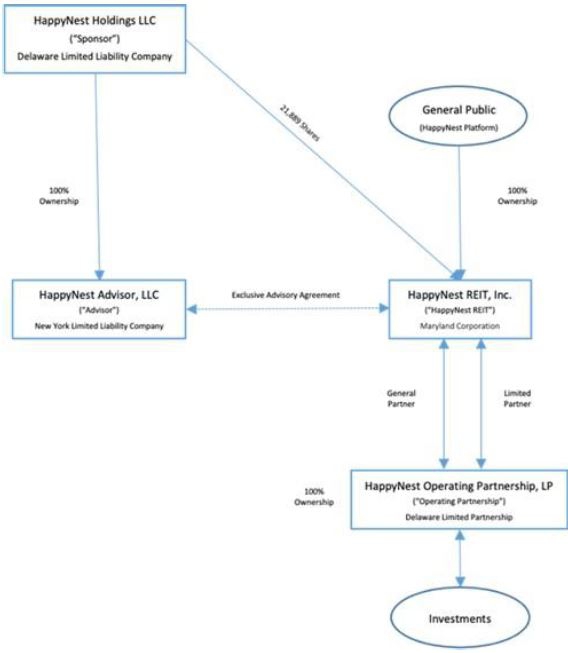
HappyNest does not directly own any real estate properties in the UPREIT structure; rather it owns substantial interests in the Operating Partnership through being the Operating Partnership’s sole general partner and one of the limited partners in the Operating Partnership.
Fees and Compensation to our Sponsor, Advisor and Independent Board Members
The following table summarizes all of the compensation and fees that we will pay to our Sponsor, Advisor and independent members of the HappyNest Board.
Type of Compensation |
| Determination of Amount |
| Maximum Amount from |
|
|
|
|
|
Organization and Offering Stage | ||||
| ||||
Organization and Offering Expenses |
| Our Sponsor pays organization and offering expenses on our behalf in connection with the offering of our shares. We reimburse our Sponsor for these costs and future organization and offering costs it may incur on our behalf, up to a maximum of 3.0% of the aggregate gross offering proceeds. |
| $-0- |
|
|
|
|
|
Acquisition, Operations and Disposition Stage | ||||
| ||||
Asset Management Fee |
| A monthly fee of 0.0417% of our “total invested value” as of the immediately preceding September 30 or March 31 (0.50% on a per annum basis), payable to our Advisor. “Total invested value,” for any period, means the aggregate book value of our assets before reserves for amortization and depreciation, impairments or other similar non-cash reserves. |
| Not determinable at this time |
|
|
|
|
|
Acquisition Fee* |
| 3.0% of the contract price of a property (including all fees and expenses, other than those of the Advisor for which HappyNest is not responsible). Such fees and expenses will not exceed an amount that would result in HappyNest paying more than 6.0% of the contract price of a property when aggregated with all other broker fees paid by or on behalf of HappyNest in connection with such acquisition excluding fees and expenses. This fee will be paid to our Advisor upon each real estate investment or any other investment by HappyNest. |
| Not determinable at this time |
Disposition Fee |
| 3.0% of contract price of a property (including all fees and expenses). Such fees and expenses will not exceed an amount that would result in HappyNest paying more than 6.0% of the contract price of a property when aggregated with all other broker fees paid by or on behalf of HappyNest in connection with such acquisition excluding fees and expenses. This fee will be paid to our Advisor upon each disposition by HappyNest. |
| Not determinable at this time |
|
|
|
|
|
Property Management Fee |
| Our Properties are intended to be triple-net single tenant properties with limited property management responsibilities. However, if our Advisor or its affiliates provides property management services for our real estate investments, we will pay fees up to 1.00% of effective gross revenues from the property being managed. We also will reimburse our Advisor or its affiliates for property-level expenses that it pays or incurs on our behalf. This does not include the Advisor’s overhead, employee costs borne by the Advisor, utilities or technology costs. Our Advisor or its affiliates may subcontract the performance of its property management duties to third parties and pay all or a portion of its property management fee to the third parties with whom it contracts for these services. |
| Not determinable at this time |
|
|
|
|
|
Other Operating Expenses |
| We reimburse our Advisor for out-of-pocket expenses of third parties in connection with providing services to us. This does not include the Advisor’s overhead, employee costs borne by the Advisor, utilities or technology costs. The expense reimbursements that we pay to our Advisor also include expenses incurred by our Sponsor in the performance of services under the shared services agreement between our Advisor and our Sponsor, including any increases in insurance attributable to the management or operation of our Company. |
| Not determinable at this time |
|
| Additional Fees and Compensation |
|
|
|
|
|
|
|
Independent Director Compensation |
| We have granted each of the non-employee members of our board an initial equity grant of 5,000 restricted shares of common stock, of which 5,000 shares have currently vested. In addition to the initial grant of restricted shares of common stock, we intend to grant members of our board 2,500 restricted shares of common stock each annually. In addition, we reimburse directors for reasonable out-of-pocket expenses incurred in connection with attendance at meetings of our board of directors. |
| Assuming a value of $10.00 per share of common stock, and assuming that the 5% limit has not been reached, $300,000 represents the aggregate value of the initial grant of restricted common shares, and $150,000 represents the aggregate value of the annual grant of restricted common shares (assuming we continue to have six non-employee board members). |
* Several of the fees we pay our Advisor are a percentage of the purchase price or value of an investment, and these fees will be greater to the extent we fund acquisitions through the incurrence of debt which, along with our other liabilities, we expect to represent no more than 50% of our total net assets (before deducting depreciation and other non-cash reserves and non-cash items).
** We have accrued asset management fees. For the six months ended June 30, 2025 and 2024, the Company incurred asset management fees in the amount of approximately $5,700 and $5,700, respectively, which is recorded within operating expenses on the Company's consolidated statements of operations. As of June 30, 2025 and 2024, these amounts are included within due to affiliates on the Company's consolidated balance sheets.
*** We have accrued acquisition fees. For the six months ended June 30, 2025 and 2024, the Company incurred acquisition fees in the amount of approximately $-0- and $22,500, respectively, which are recorded within operating expenses on the Company's consolidated statements of operations. As of June 30, 2025, these amounts are included within due to affiliates on the Company's consolidated balance sheets.
**** We have accrued disposition fees. For the six months ended June 30, 2025 and 2024, the Company incurred disposition fees in the amount of approximately $-0- and $22,500, respectively, which are recorded within operating expenses on the Company's consolidated statements of operations. As of June 30, 2025, these amounts are included within due to affiliates on the Company's consolidated balance sheets.
See “Compensation” for a more detailed explanation of the fees and expenses payable to our Sponsor, Advisor and their affiliates.
|
10 |
Summary of Risk Factors
Investing in our common stock involves a high degree of risk. You should carefully review the “Risk Factors” section of this offering circular, beginning on page 34, which contains a detailed discussion of the material risks that you should consider before you invest in our common stock.
Conflicts of Interest
Although currently HappyNest is the only investment vehicle sponsored or managed by our Sponsor and Advisor, certain of our officers may in the future serve as officers or employees of other vehicles that may in the future be sponsored by our Sponsor, and other companies unaffiliated with our Sponsor. These other business activities may in the future reduce the time these persons spend managing our business. In addition, these persons may have obligations to those entities, the fulfillment of which might not be in the best interests of us, or any of our stockholders. Although currently HappyNest is the only investment vehicle sponsored or managed by our Sponsor and Advisor, if our Sponsor or Advisor sponsor or manage other investment vehicles in the future, our officers and our Advisor may face conflicts of interest in allocating sale, financing, leasing and other business opportunities among the real properties owned by the companies.
Distributions
We do not expect to declare any distributions until the proceeds from any public offering are invested and generating operating cash flow. Thereafter, we intend to pay dividends on a quarterly basis contingent upon the approval of our board of directors. We expect to pay all dividends from cash flow from operations. Our cash flow from operations may decrease in the future, which may adversely affect our ability to maintain the level of our dividends. Our board of directors may also choose to pay stockholders a larger dividend than available cash flow from operations may support, limited to the extent that the Sponsor and Advisor are willing, in its sole discretion, to defer reimbursements and fees due to it. All deferred reimbursements and fees will not be subject to any interest and will be paid at the discretion of our board of directors. We will not use the net proceeds from our offering to pay dividends. In addition, the amount of cash available for dividends may be limited due to redemptions of our shares pursuant to our share repurchase program. Our board of directors will have flexibility to determine the allocation of available cash available as between the payment of dividends and redemption of our shares.
Leverage Policy
We intend to utilize debt financing (i.e. mortgage debt) to complete some of our property acquisitions. Measured across our portfolio as a whole, we intend to maintain a debt ratio of 50% or less of our net assets (before deducting depreciation and other non-cash reserves and non-cash items). This debt ratio is determined on our portfolio as a whole, and does not restrict the amount of debt that may be incurred with respect to a particular property. We may choose to alter our debt policy in the future, in the sole discretion of the HappyNest Board.
Valuation
Our board of directors, including a majority of our independent directors, has adopted valuation guidelines and methodologies for use in connection with the valuation of our assets and liabilities and the calculation of our NAV. The overarching principle of these guidelines is to produce a valuation that represents a fair and accurate estimate of the value of our investments or the price that would be received for our investments in an arm’s-length transaction between market participants, less our liabilities, balancing considerations of cost, speed and accuracy.
Our Advisor set our initial offering price at $10.00 per share. As of the date of this Rescission Offer, the Company has fixed its per share equal to $10.00 per share.
Investment Company Act Considerations
We intend to conduct our operations so that neither we, nor any of our subsidiaries, is required to register as investment companies under the Investment Company Act. Section 3(a)(1)(A) of the Investment Company Act defines an investment company as any issuer that is or holds itself out as being engaged primarily in the business of investing, reinvesting or trading in securities. Section 3(a)(1)(C) of the Investment Company Act defines an investment company as any issuer that is engaged or proposes to engage in the business of investing, reinvesting, owning, holding or trading in securities and owns or proposes to acquire investment securities having a value exceeding 40% of the value of the issuer’s total assets (exclusive of U.S. Government securities and cash items) on an unconsolidated basis, which we refer to as the 40% test. Excluded from the term “investment securities,” among other things, are U.S. Government securities and securities issued by majority-owned subsidiaries that are not themselves investment companies and are not relying on the exception from the definition of investment company set forth in Section 3(c)(1) or Section 3(c)(7) of the Investment Company Act.
We anticipate that we will hold real estate and real estate-related assets described below (i) directly, (ii) through wholly owned subsidiaries, (iii) through majority-owned joint venture subsidiaries, and, (iv) to a lesser extent, through minority-owned joint venture subsidiaries.
We intend, directly or through our subsidiaries, to originate, invest in and manage a diversified portfolio of commercial real estate investments. We expect to use substantially all of the net proceeds from this offering to originate, acquire and structure a diversified portfolio of commercial real estate properties. We may also invest, to a limited extent, in commercial real estate loans, as well as commercial real estate-related debt securities and other real estate-related assets.
The securities issued by any wholly owned or majority-owned subsidiary that we may form and that are excluded from the definition of “investment company” based on Section 3(c)(1) or 3(c)(7) of the Investment Company Act, together with any other investment securities we may own, may not have a value in excess of 40% of the value of our total assets on an unconsolidated basis, unless another exemption to the registration requirements of the Investment Company Act is applicable.
|
11 |
RISK FACTORS
An investment in our common stock involves substantial risks. You should carefully consider the following risk factors in addition to the other information contained in this offering circular before purchasing shares. The occurrence of any of the following risks might cause you to lose a significant part of your investment. The risks and uncertainties discussed below are not the only ones we face, but do represent those risks and uncertainties that we believe are most significant to our business, operating results, prospects and financial condition. Some statements in this offering circular, including statements in the following risk factors, constitute forward-looking statements. Please refer to the section entitled “Cautionary Note Regarding Forward-Looking Statements.”
Risks Related to this Rescission Offer
Certain shares of the Company’s common stock were issued outside of the Regulation A exemption; therefore, certain shareholders may have rescission rights, which could impact the financial performance of the Company.
Under Regulation A, an issuer may offer securities on a continuous basis, so long as the issuer amends its offering statement annually to update the issuer’s financial information in the offering statement and any other changes to its disclosures for up to three years after the initial qualification date of the initial offering statement. After such time, in order to make an offer of securities under Regulation A, an issuer is required to submit a new offering statement covering its securities for qualification by the SEC.
However, the Company failed to submit a new offering statement for qualification under Rule 251 of Regulation A. Therefore, the Regulation A exemption was not available for certain issuances of shares of the Company’s common stock made between July 29, 2022 and December 31, 2024, and such shares of common stock may be subject to rescission.
The Company intends to conduct an offer of rescission available to certain shareholders. If shareholders of the Company eligible to accept this Rescission Offer elect to accept the offer, the Company would be required to devote sufficient cash resources to cover the repurchase of Shares of eligible shareholders accepting the Rescission Offer.
We may continue to have liability after the expiration of the Rescission Offer.
While the Company intends to make this Rescission Offer to remedy the issuances of its securities made outside of the Regulation A exemption, there remains uncertainty to the extent of the Company’s liability under federal and state laws after the completion of the rescission offer.
Your federal right of rescission may not survive if you affirmatively reject or fail to accept this Rescission Offer.
If you affirmatively reject or fail to accept this Rescission Offer, it is uncertain whether you would continue to have a right of rescission under federal securities laws after the expiration of this Rescission Offer. Federal courts have previously ruled that a person who rejects or fails to accept a rescission offer is precluded from later seeking similar relief.
We cannot predict whether the amounts you would receive in the Rescission Offer would be greater than the fair market value of the Shares.
The amount you would receive in accepting this Rescission Offer is fixed and may not reflect the book value of the Shares. As a result, if you accept the Rescission Offer, you may receive less than the fair market value of the Shares we would repurchase from you.
In order to accept this Rescission Offer, you will need to complete, sign, and mail the Rescission Offer Election Form and provide sensitive personal information.
Investors who accept this Rescission Offer will be required to fill out and submit the Rescission Offer Election Form, which includes providing the Company your personal information.
Federal or state income tax consequences may result from accepting this Rescission Offer.
Any shareholder accepting this Rescission Offer may be required to pay federal or state income tax on the amount received. We recommend you consult with your tax advisor prior to accepting this Rescission Offer.
We may have to comply with additional state-level securities registration laws in making this Rescission Offer.
The Company may be required to comply with state-level securities registration requirements in making this Rescission Offer. There is a risk that a failure to comply with such requirements could result in financial harm to the Company. Furthermore, compliance with such requirements may be onerous and expensive and require substantial time and resources of the Company.
Risks Related to the Start-up Nature of Our Business, Our Advisor and Our Sponsor
We are a newly-formed entity with limited history.
We have limited operating history. You should consider an investment in our common stock in light of the risks, uncertainties and difficulties frequently encountered by other newly-formed companies with similar objectives. To be successful in this market, we and our Advisor, who is not newly formed but is newly operational, must, among other things:
| · | identify and acquire real estate assets consistent with our investment strategies; |
|
|
|
| · | raise additional funds, both for us and our Sponsor; |
|
|
|
| · | increase awareness of our name within the investment products market; |
|
|
|
| · | attract, integrate, motivate and retain qualified personnel to manage our day-to-day operations; |
| · | respond to competition for our targeted real estate properties and other investments as well as for potential investors; and |
|
|
|
| · | build and expand our operations structure to support our business. |
There can be no assurance that we will achieve our investment objectives. As of the date of this offering circular, we have not made any investments in real estate or otherwise and do not own any properties or have any operations or independent financing.
We have minimal operating capital, limited significant assets and minimal revenue from operations.
There can be no assurance that we will be able to raise sufficient operating capital to successfully execute our investment strategy. The failure to successfully raise operating capital, and the failure to attract qualified real estate companies and sufficient investor purchase commitments, could result in our bankruptcy or other event which would have a material adverse effect on us and our stockholders. We have limited significant assets or financial resources, so such adverse events could put your investment dollars at significant risk.
Our Sponsor is a development stage company with limited operating history and no revenues to date. As a company in the early stages of development, our Sponsor faces increased risks, uncertainties, expenses and difficulties.
Our Sponsor and the owner and operator of the HappyNest Platform, has a limited operating history. For us to be successful, the volume of acquisitions originated through the HappyNest Platform will need to increase, which will require our Sponsor or its affiliates (including our Advisor) to increase its facilities, personnel and infrastructure to accommodate the greater obligations and demands on the HappyNest Platform. The HappyNest Platform is designed to maintain all transactions in real estate assets and stockholder records. Our Sponsor expects to constantly update its software and mobile application and expand its customer support services and retain an appropriate number of employees to maintain the operations of its platform. If our business grows substantially, our Sponsor may need to make significant new investments in personnel and infrastructure to support that growth. If our Sponsor is unable to increase the capacity of its platform and maintain the necessary infrastructure, or if our Advisor is unable to make significant investments on a timely basis or at reasonable costs, you may experience delays in receipt of distributions on our common stock, periodic downtime of the HappyNest Platform or other disruptions to our business and operations. If our Sponsor is unable to raise additional capital, it may face limits on its ability to operate as currently planned, which may adversely affect our ability to continue to operate.
You will not have the opportunity to evaluate our investments before we make them, which makes your investment more speculative.
You will be unable to evaluate the economic merit of assets before we invest in them, you will have to rely entirely on the ability of our Advisor to select suitable and successful investment opportunities. These factors increase the risk that your investment may not generate returns comparable to those of our competitors.
Portfolio properties in which we invest face significant competition in the commercial property rental market, which may limit our ability achieve returns on our investments.
We expect to use substantially all of the proceeds from this offering to invest in a diversified portfolio of real estate and real estate-related investments. We focus our investments on single-tenant commercial properties with strong real estate fundamentals, leased to creditworthy tenants via long-term net leases that provide for corporate lease guarantees, contractual rent increases, lease extension options, and limited landlord obligations. Our portfolio investments will depend on rental income from commercial tenants to cover their operating costs. As a result, the success of our investment depends in large part upon the portfolio company’s ability to attract tenants for its properties. In addition, we could also be adversely affected by high vacancy rates of tenants in the commercial real estate market, which could result in an excess supply of commercial space and reduce occupancy and rental rates. Continuing development of commercial buildings will increase the supply of commercial real estate available and exacerbate competition for tenants.
We may have potential liability arising out of a possible violation of Section 5 of the Securities Act in connection with our failure to timely file a new offering statement.
We may have potential liability for certain sales, offers or issuances of equity securities of the Company in possible violation of the registration requirements set forth in Section 5 of the Securities Act. Under our prior offering statement filed pursuant to Regulation A of the Securities Act and the related Offering Circular, which was qualified on July 29, 2019, we were able to continuously offer our securities in the Prior Offering for a period of three years since such qualification date, or July 29, 2022.
On August 30, 2023, we discovered an inadvertent failure to file a new offering statement pursuant to Regulation A by July 29, 2022. Upon such discovery, we took steps to immediately suspend offers and sales of our common stock. However, due to technology limitations, we were not able to formally disengage the App controlling the HappyNest Platform and found that the removal of the App in its entirety would eliminate the ability of our shareholders to access important information about our Company and would adversely affect our ability to continue our business. Between July 29, 2022 and August 30, 2023, we issued 90,227 Shares of common stock in consideration for an aggregate purchase price of $902,270. In total, 143,972 Shares have been issued after July 29, 2022, all of which are subject to this Rescission Offer.
To the extent that we have not registered or failed to maintain an effective registration statement with respect to any of the transactions in securities described above and with respect to our ongoing offering of shares of common stock, and a violation of Section 5 of the Securities Act did in fact occur or is occurring, eligible holders of our securities that participated in these offerings would have a right to rescind their transactions, and the Company may have to refund any amounts paid for the securities, which could have a materially adverse effect on the Company’s financial condition. Eligible securityholders have not filed a claim against the Company alleging a violation of Section 5 of the Securities Act with respect to these transactions, but they could file a claim in the future.
If our Sponsor and Advisor fail to attract and retain key personnel, we may not be able to achieve our anticipated level of growth and our business could suffer.
Our future depends on the continued contributions of our executive officers and other key personnel of our Advisor and of our Sponsor, each of whom would be difficult to replace. In particular, Jesse Prince, the Co-founder/Chief Executive Officer of our Advisor and of our Sponsor and Leonardo Sessa, the Co-founder/President of our Sponsor, are critical to the management of our business and operations and the development of our strategic direction. The loss of the services of Jesse Prince, Leonardo Sessa or other key personnel of our Advisor and/or our Sponsor and the process to replace any of them could involve significant time and expense and may significantly delay or prevent the achievement of our business objectives. Additionally, our Advisor intends to hire various real estate and business professionals to manage various aspects of day-to-day operations, including but not limited to acquisitions, asset management, property management, marketing, and information technology. We believe that our success depends, in large part, upon our Advisor’s ability to attract and retain highly skilled professionals to fill these roles. Competition for such professionals is intense, and our Advisor may be unsuccessful in attracting and retaining such skilled professionals. If we lose or are unable to obtain the services of highly skilled professionals, our ability to implement our investment strategies could be delayed or hindered.
Our Sponsor will need to raise substantial additional capital to fund its operations, and if it fails to obtain additional funding, it may be unable to continue operations.
At this early stage in its development, our Sponsor has funded substantially all operations with proceeds from private financings from individual investors. To continue the development of its platform, our Sponsor will require substantial additional funds. To meet its financing requirements in the future, our Sponsor may raise funds through equity offerings, debt financings or strategic alliances. Raising additional funds may involve agreements or covenants that restrict the Sponsor’s business activities and options. Additional funding may not be available to it on favorable terms, or at all. If our Sponsor is unable to obtain additional funds, it may be forced to reduce or terminate its operations. Any inability for our Sponsor to fund operations could have a substantial and adverse effect on the viability and operations of the HappyNest Platform. Additionally, if we are not able to raise substantial funds in this offering, and are unable to reimburse our Sponsor for any expenses that it has paid or will pay on our behalf, there could be an adverse effect on our Sponsor’s financial condition and operations, which could, in turn, adversely affect our operations.
If our Sponsor were to enter bankruptcy proceedings, the operation of the HappyNest Platform and the activities with respect to our operations and business would be interrupted.
If our Sponsor were to enter bankruptcy proceedings or were to cease operations, we would be required to find other ways to meet obligations regarding our operations and business. Such alternatives could result in delays in the disbursement of distributions or the filing of reports or could require us to pay significant fees to another company that we engage to perform services for us.
Our Advisor is dependent on our ability to raise proceeds in this offering in order to pay the fees through which it will fund its operations. If it does not receive such fees, it will not be able to run our day-to-day operations without obtaining other sources of funding. If we fail to raise substantial proceeds in this offering to pay our Advisor, and if it fails to obtain additional funding, it may be unable to continue operations.
Our Advisor is responsible for sourcing, acquiring, and managing all real estate investments on our behalf, subject to oversight and approval by our board of directors. Our Advisor’s only present source of funding is the compensation that it will receive from us, and we will only be able to pay such compensation to the extent that we raise sufficient proceeds in this offering, unless our Advisor is able to raise substantial additional funds. To meet its financing requirements in the future, our Advisor may raise funds through equity offerings, debt financings or strategic alliances. Raising additional funds may involve agreements or covenants that restrict our Advisor’s business activities and options. Additional funding may not be available to it on favorable terms, or at all. If we are unable to raise sufficient proceeds in this offering to compensate our Advisor, and if our Advisor is unable to obtain additional funds, it may be forced to reduce or terminate its operations. Any inability for our Advisor to fund operations could have a substantial and adverse effect on the viability and operations of HappyNest.
|
12 |
We have no investment criteria limiting the size of each investment we make, and we currently have relatively few investments. Any individual real estate investment that we make using the proceeds of this offering could represent a material percentage of our assets, and if that investment experiences a loss, the value of your investment in us could be significantly diminished.
Due to a relatively small asset base and an anticipated high concentration of our total assets in relatively large individual real estate assets, the value of your investment could vary more widely with the performance of specific assets than if the offering amount were greater or if we invested in a more diverse portfolio of properties. Because of this potential asset concentration, even modest changes in the value of our real estate assets could have a significant impact on the value of your investment.
We face significant competition for real estate investment opportunities, which may limit our ability to acquire suitable investments and achieve our investment objectives or pay distributions.
We face competition from various entities for real estate investment opportunities, including other REITs, pension funds, banks and insurance companies, investment funds and companies, partnerships and developers. Most of our current or potential competitors have significantly more financial, technical, marketing and other resources than we do and may be able to devote greater resources to the development, promotion, sale and support of their platforms and distribution channels, and may be able to take on more risk than we can. Larger real estate programs may enjoy significant competitive advantages that result from, among other things, a lower cost of capital and enhanced operating efficiencies. In addition, the number of entities and the amount of funds competing for suitable properties may increase. Any such increase would result in increased demand for these assets and therefore increased prices paid for them. If we pay higher prices for properties and other investments, our profitability will be reduced and you may experience a lower return on your investment. Our potential competitors may also have longer operating histories, more extensive customer bases, greater brand recognition and broader customer relationships than we have. These competitors may be better able to develop new products, to respond quickly to new technologies and to undertake more extensive marketing campaigns. The online real estate investing industry is driven by constant innovation. If we are unable to compete with such companies and meet the need for innovation, this offering may not raise enough proceeds for us to succeed in our business plan. Competition from these entities may reduce the number of suitable investment opportunities offered to us or increase the bargaining power of property owners seeking to sell. In addition, the number of entities and the amount of funds competing for suitable investments may increase. If we acquire investments at higher prices and/or by using less-than-ideal capital structures, our returns will be lower and the value of our assets may not appreciate or may decrease significantly below the amount we paid for such assets. If such events occur, our stockholders may experience a lower return on their investment.
If we are unable to find suitable investments, we may not be able to achieve our investment objectives or pay distributions.
Our ability to achieve our investment objectives and to pay distributions depends upon the performance of our Advisor in the acquisition of our investments and the ability of our Advisor to source investment opportunities for us through the open market or through established relationships with several net lease funds, developers, operators and other real estate professionals. The more money we raise in this offering, the greater our challenge will be to invest all of the net offering proceeds on attractive terms. We cannot assure you that our Advisor will be successful in obtaining suitable investments on financially attractive terms through our relationships or the open market or that, if our Advisor makes investments on our behalf, our objectives will be achieved. If we, through our Advisor, are unable to find suitable investments promptly, we will hold the proceeds from this offering in an interest-bearing account or invest the proceeds in short-term assets. If we would continue to be unsuccessful in locating suitable investments, we may ultimately decide to liquidate. In the event we are unable to timely locate suitable investments, we may be unable or limited in our ability to pay distributions and we may not be able to meet our investment objectives.
Failure to qualify as a REIT would reduce our net earnings available for investment or distribution.
Our qualification as a REIT will depend upon our ability to meet requirements regarding our organization and ownership, distributions of our income, the nature and diversification of our income and assets and other tests imposed by the Internal Revenue Code. If we fail to qualify as a REIT for any taxable year after electing REIT status, we will be subject to federal income tax on our taxable income at corporate rates. In addition, we would generally be ineligible to elect REIT treatment for four taxable years following the year in which we lost our REIT status. Losing our REIT status would reduce our net earnings available for investment or distribution to stockholders because of the additional tax liability. In addition, distributions would no longer qualify for the dividends-paid deduction and we would no longer be required to make distributions. If this occurs, we might be required to borrow funds or liquidate some investments in order to pay the applicable tax. See “Federal Income Tax Considerations”.
Risks Related to an Investment in Our Common Stock
The offering price of our common stock was not established on an independent basis; the actual value of your investment may be substantially less than what you pay.
We established the offering price of our shares on an arbitrary basis. The selling price of our common stock bears no relationship to our book or asset values or to any other established criteria for valuing shares. Because the offering price is not based upon any independent valuation, the offering price may not be indicative of the proceeds that you would receive upon liquidation. At the time of this Rescission Offer, the Company has set the price of its Shares at $10.00 per Share.
Our per share purchase price was previously determined based on NAV and is equal the quotient of our NAV, divided by the number of our shares of common stock outstanding as of the end of the most recently completed semi-annual period (our “NAV per share”), but excluding Restricted Stock and Sponsor-held shares of common stock, and was adjusted semi-annually, on September 30 and March 31 of each year. There can be no assurance that the NAV per share will equal or exceed $10.00 in the future. If the NAV per share is valued at less than $10.00, you may lose some or all of your investment. If we were to take into account Restricted Stock and Sponsor-held shares of common stock in calculating NAV per share, it would be dilutive and reduce the overall value of shares of common stock.
There is no public trading market for our common stock and there may never be one; therefore, it may be difficult for you to sell your shares.
There currently is no public market for our common stock and there may never be one. Our charter also prohibits the direct or constructive ownership of more than 9.8% of the outstanding shares of our common stock by any one person, unless exempted by our board of directors, which may deter large investors from purchasing your shares. Moreover, our share repurchase program includes numerous restrictions that would limit your ability to sell your shares to us. The HappyNest Board may reject any request for repurchase of shares, suspend (in whole or in part) the share repurchase program at any time and from time to time upon notice to our stockholders and amend or terminate our share repurchase program at any time upon 30 days’ notice to our stockholders. Our charter provides that we may not repurchase shares of our common stock if such repurchase would materially impair our capital or operations as determined by our board of directors. Therefore, it may be difficult for you to sell your shares promptly or at all. If you are able to sell your shares, you likely will have to sell them at a substantial discount to the price you paid for the shares. It also is likely that your shares would not be accepted as the primary collateral for a loan. You should purchase the shares only as a long-term investment because of the illiquid nature of the shares. See “Investor Suitability Standards,” “Description of Securities — Restrictions on Ownership and Transfer” and “Share Repurchase Program” elsewhere in this offering circular for a more complete discussion on the restrictions on your ability to transfer your shares.
Our stockholders may not be able to sell their shares under our Share Repurchase Program.
On December 30, 2025, a majority of the board of directors of the Company voted to terminate the Share Repurchase Program; the Share Repurchase Program will be terminated effective January 29, 2026. We do not expect that a secondary market for resale of our common stock will develop, and we had previously implemented a share repurchase program for stockholders who wished to sell their shares.
|
13 |
We may be unable to pay or maintain cash distributions or increase distributions over time.
There are many factors that can affect the availability and timing of cash distributions to stockholders who have opted out of participating in our dividend reinvestment plan. Distributions will be based principally on distribution expectations of our potential investors and cash available from our operations. The amount of cash available for distribution will be affected by many factors, such as our ability to buy properties as offering proceeds become available and our operating expense levels, as well as many other variables. Actual cash available for distribution may vary substantially from estimates. We cannot assure you that we will be able to pay or maintain distributions or that distributions will increase over time, nor can we give any assurance that rents from the properties will increase, or that future acquisitions of real properties will increase our cash available for distribution to stockholders. For a description of the factors that can affect the availability and timing of cash distributions to stockholders. See “Description of Our Capital Stock — Distributions”.
No rule, regulation, or industry practice requires that we calculate our NAV in a certain way, and our board of directors, including a majority of our independent directors, may adopt changes to our valuation guidelines.
There are no existing rules or regulatory bodies that specifically govern the manner in which we calculate our NAV and there is no established practice among publicly offered REITs, whether exchange-listed or not, for calculating NAV in order to establish a purchase and repurchase price. As a result, it is important that you pay particular attention to the specific methodologies and assumptions we use to calculate our NAV, as other publicly offered REITs may use different methodologies or assumptions to determine their NAV. In addition, our board of directors, including a majority of our independent directors, will review the appropriateness of our valuation guidelines at least annually and may, at any time, adopt changes to our valuation guidelines.
Initially, and from time to time on a going-forward basis, we may not generate sufficient cash flow from operations to fund distributions. If we pay distributions from sources other than our cash flow from operations, we will have fewer funds available for investments and your overall return will be reduced.
We expect to pay all dividends from cash flow from operations, although our organization documents do not prohibit us from paying distributions from any source, including, borrowings, offering proceeds or waivers of fees payable to our Advisor or sales of assets. Until the proceeds from this offering are fully invested, and from time to time during the operational stage, we may not generate sufficient cash flow from operations to fund distributions.
In addition, the amount of cash available for dividends may be limited due to redemptions of our shares; to the extent that we need to use cash to satisfy redemptions, we will not have such cash available for dividends. The HappyNest Board will have flexibility to determine the allocation of available cash available as between the payment of dividends and redemption of our shares.
If we pay distributions from financings or other sources other than our cash flow from operations, we will have fewer funds available for investments in real estate properties and the number of real estate properties that we invest in and the overall return to our stockholders may be reduced. If we fund distributions from borrowings, our interest expense and other financing costs, as well as the repayment of such borrowings, will reduce our earnings and cash flow from operations available for distribution in future periods, and accordingly your overall return may be reduced. If we fund distributions from the sale of assets, this will affect our ability to generate cash flows from operations in future periods.
Our Sponsor and its affiliates have not sponsored prior real estate investment programs that otherwise would be required to be disclosed under applicable rules and regulations of the SEC, which means that you will be unable to assess their prior performance with other investment programs.
Our Sponsor and its affiliates have not sponsored prior real estate investment programs that otherwise would be required to be disclosed under applicable rules and regulations of the SEC. Accordingly, this offering circular does not contain any information concerning prior performance of our Sponsor and its affiliates, which means that you will be unable to assess any results from their prior activities before deciding whether to purchase shares of our common stock.
There may be deficiencies with our internal controls that require improvements, and if we are unable to adequately evaluate internal controls, we may be subject to sanctions.
As a Tier-2 issuer under Regulation A, we will not need to provide a report on the effectiveness of our internal controls over financial reporting, and we will be exempt from the auditor attestation requirements concerning any such report so long as we are a Tier-2 issuer.
|
14 |
We are an “emerging growth company” under the federal securities laws and will be subject to reduced public company reporting requirements.
In April 2012, President Obama signed into law the Jumpstart Our Business Startups Act, or the JOBS Act. We are an “emerging growth company”, as defined in the JOBS Act, and are eligible to take advantage of certain exemptions from, or reduced disclosure obligations relating to, various reporting requirements that are normally applicable to public companies. We could remain an “emerging growth company” for up to five years, or until the earliest of (1) the last day of the first fiscal year in which we have total annual gross revenue of $1.07 billion or more, (2) December 31 of the fiscal year that we become a “large accelerated filer” as defined in Rule 12b-2 under the Exchange Act (which would occur if the market value of our common stock held by non-affiliates exceeds $700 million, measured as of the last business day of our most recently completed second fiscal quarter, and we have been publicly reporting for at least 12 months) or (3) the date on which we have issued more than $1 billion in non-convertible debt during the preceding three year period. Under the JOBS Act, emerging growth companies are not required to (1) provide an auditor’s attestation report on management’s assessment of the effectiveness of internal control over financial reporting, pursuant to Section 404 of the Sarbanes-Oxley Act, (2) comply with new requirements adopted by the Public Company Accounting Oversight Board, or the PCAOB, which require mandatory audit firm rotation or a supplement to the auditor’s report in which the auditor must provide additional information about the audit and the issuer’s financial statements, (3) comply with new audit rules adopted by the PCAOB after April 5, 2012 (unless the SEC determines otherwise), (4) provide certain disclosures relating to executive compensation generally required for larger public companies or (5) hold stockholder advisory votes on executive compensation. If we take advantage of any of these exemptions, we do not know if some investors will find our common stock less attractive as a result.
Additionally, the JOBS Act provides that an “emerging growth company” may take advantage of an extended transition period for complying with new or revised accounting standards that have different effective dates for public and private companies. This means an “emerging growth company” can delay adopting certain accounting standards until such standards are otherwise applicable to private companies. However, we are electing to “opt out” of such extended transition period, and will therefore comply with new or revised accounting standards on the applicable dates on which the adoption of such standards are required for non-emerging growth companies. Section 107 of the JOBS Act provides that our decision to opt out of such extended transition period for compliance with new or revised accounting standards is irrevocable.
We may offer securities for sale through another, concurrent offering.
We reserve the right to offer for sale additional securities under the exemption within Rule 506(c) of Regulation D. The concurrent offering may be offered at the same time as a Regulation A offering. The concurrent offering under Rule 506(c) would be made exclusively to accredited investors, as defined in Rule 501(a) of Regulation D, which means that not all investors eligible to participate in a Regulation A offering would be eligible to participate in our Rule 506(c) offering.
Furthermore, the terms of a Rule 506(c) offering may differ from those of our Regulation A offering, and investors purchasing our securities through our Rule 506(c) offering may receive more favorable investment terms.
Risks Related to Our Organization and Corporate Structure
Our stockholders will have limited control over changes in our policies and operations, which increases the uncertainty and risks our stockholders face.
Our board of directors determines our major policies, including our policies regarding financing, growth, debt capitalization, REIT qualification and distributions. Our board of directors may amend or revise these and other policies without a vote of the stockholders. Under Maryland General Corporation Law and our articles of incorporation, our stockholders have a right to vote only on limited matters. Our board’s broad discretion in setting policies and our stockholders’ inability to exert control over those policies increases the uncertainty and risks our stockholders face.
Our charter limits the number of shares a person may own and permits our board of directors to issue classes of preferred stock with terms that may subordinate the rights of our common stockholders or discourage a third party from acquiring us in a manner that could result in a premium price to our stockholders.
Our charter, with certain exceptions, authorizes our directors to take such actions as are necessary and desirable to preserve our qualification as a REIT. To help us comply with the REIT ownership requirements of the Internal Revenue Code, our articles of incorporation prohibit a person from directly or constructively owning more than 9.8% of our outstanding shares, unless exempted by our board of directors. In addition, our board of directors may classify or reclassify any unissued common stock or preferred stock and establish the preferences, conversion or other rights, voting powers, restrictions, limitations as to distributions, qualifications and terms or conditions of repurchase of any such stock. Thus, our board of directors could authorize the issuance of preferred stock with priority as to distributions and amounts payable upon liquidation over the rights of the holders of our common stock. These provisions may have the effect of delaying, deferring or preventing a change in control of us, including an extraordinary transaction (such as a merger, tender offer or sale of all or substantially all of our assets) that might provide a premium price to holders of our common stock.
We may change our investment objectives and policies without stockholder approval.
We may make adjustments to our target portfolio based on real estate market conditions and investment opportunities, and we may change our investment objectives and policies at any time without the consent of our stockholders. These policies may change over time. The methods of implementing our investment policies also may vary, as new real estate development trends emerge and new investment techniques are developed. Our investment policies, the methods for their implementation, and our other objectives, policies and procedures may be altered by our Advisor without the approval of our stockholders. As a result, the nature of your investment could change without your consent.
Our investors’ interest in us could be diluted if we issue additional shares of common stock, which could reduce the overall value of their investment.
Our common stockholders do not have preemptive rights to any shares we issue in the future. Our charter authorizes us to issue 200,000,000 shares of common stock. Our board of directors may increase the number of authorized shares of common stock without stockholder approval. After our investors purchase shares in this offering, our board may elect to (i) sell additional shares in this or in future public offerings, including through our dividend reinvestment plan; (ii) issue equity interests in private offerings; (iii) issue shares to our Advisor and/or Sponsor, or their successors or assigns, in payment of outstanding fee obligations; (iv) issue shares of our common stock to sellers of properties or assets we acquire in connection with an exchange of limited partnership interests of the Operating Partnership; or (v) otherwise issue additional shares of our capital stock. To the extent we issue additional equity interests after our investors purchase shares, whether in this or future primary offerings, pursuant to our dividend reinvestment plan or otherwise, our investors’ percentage ownership interest in us would be diluted. In addition, depending upon the terms and pricing of any additional issuance of shares, the use of the proceeds and the value of our real estate investments, our investors could also experience dilution in the book value and NAV per share of their shares and in the earnings and distributions per share.
Our rights and the rights of our stockholders to recover claims against our independent directors are limited, which could reduce our stockholders’ and our recovery against our independent directors if they negligently cause us to incur losses.
Maryland law provides that a director has no liability in that capacity if he or she performs his or her duties in good faith, in a manner he or she reasonably believes to be in our best interests and with the care that an ordinarily prudent person in a like position would use under similar circumstances. Our bylaws provide that none of our independent directors shall be liable to us or our stockholders for monetary damages and that we will generally indemnify them for losses unless they are negligent or engage in willful misconduct. As a result, you and we may have more limited rights against our independent directors than might otherwise exist under common law, which could reduce your and our recovery from these persons if they act in a negligent manner. In addition, we may be obligated to fund the defense costs incurred by our independent directors (as well as by our other directors, officers, employees and agents) in some cases, which would decrease the cash otherwise available for distribution to you.
Although we will not currently be afforded the protection of the Maryland General Corporation Law relating to deterring or defending hostile takeovers, our board of directors could opt into these provisions of Maryland law in the future, which may discourage others from trying to acquire control of us and may prevent our stockholders from receiving a premium price for their stock in connection with a business combination.
Under Maryland law, “business combinations” between a Maryland corporation and certain interested stockholders or affiliates of interested stockholders are prohibited for five years after the most recent date on which the interested stockholder becomes an interested stockholder. These business combinations include a merger, consolidation, share exchange, or, in circumstances specified in the statute, an asset transfer or issuance or reclassification of equity securities. Also under Maryland law, control shares of a Maryland corporation acquired in a control share acquisition have no voting rights except to the extent approved by a vote of two-thirds of the votes entitled to be cast on the matter. Shares owned by the acquirer, an officer of the corporation or an employee of the corporation who is also a director of the corporation are excluded from the vote on whether to accord voting rights to the control shares. Should our board of directors opt into these provisions of Maryland law, it may discourage others from trying to acquire control of us and increase the difficulty of consummating any offer. Similarly, provisions of Title 3, Subtitle 8 of the Maryland General Corporation Law could provide similar anti-takeover protection. For more information about the business combination, control share acquisition and Subtitle 8 provisions of Maryland law, see “Description of Shares—Business Combinations, Control Share Acquisitions, and—Subtitle 8”.
Our charter includes an anti-takeover provision that may discourage a stockholder from launching a tender offer for our shares.
Our charter provides that any tender offer made by a stockholder, including any “mini-tender” offer, must comply with most provisions of Regulation 14D of the Securities Exchange Act of 1934, as amended. The offering stockholder must provide our company notice of such tender offer at least 10 business days before initiating the tender offer. If the offering stockholder does not comply with these requirements, our company will have the right to repurchase that stockholder’s shares and any shares acquired in such tender offer. In addition, the noncomplying stockholder shall be responsible for all of our company’s expenses in connection with that stockholder’s noncompliance. This provision of our charter may discourage a stockholder from initiating a tender offer for our shares and prevent our stockholders from receiving a premium price for their shares in such a transaction.
Payment of fees to our Advisor, Sponsor and their affiliates reduces cash available for investment and distribution to our stockholders and increases the risk that our stockholders will not be able to recover the amount of their investment in our shares.
Our Advisor, Sponsor and their affiliates perform services for us in connection with the selection and acquisition of our real estate investments, the management and leasing of our real estate properties, the administration of our real estate-related investments and the disposition of our real estate investments. We pay them substantial fees for these services, which results in immediate dilution of the value of our stockholders’ investment and reduces the amount of cash available for investment or distribution to stockholders. Under certain circumstances, these fees may be comparable or higher than the commission which an investor would pay to a registered broker dealer or an investment advisor who was facilitating an investment, such as the purchase of publicly traded securities. Compensation to be paid to our Advisor may be increased subject to approval by our independent directors and the other limitations in our charter, which would further dilute our stockholders’ investment and reduce the amount of cash available for investment or distribution to stockholders. See “Compensation”.
You may be more likely to sustain a loss on your investment because our Sponsor does not have as strong an economic incentive to avoid losses as do sponsors who have made significant equity investments in their companies.
Because it has not made a significant equity investment in our company, our Sponsor will have little exposure to loss in the value of our common stock. Without this exposure, our investors may be at a greater risk of loss because our Sponsor does not have as much to lose from a decrease in the value of our shares as do those sponsors who make more significant equity investments in their companies.
Any adverse changes in our Advisor or Sponsor’s financial health or our relationship with our Sponsor or its affiliates could hinder our operating performance and the return on your investment.
We have engaged our Advisor to manage our operations and our portfolio of investments. Our Advisor utilizes its or our Sponsor’s personnel to perform services on its behalf for us. Our ability to achieve our investment objectives and to pay distributions is dependent upon the performance of our Advisor, Sponsor and their affiliates as well as our Advisor and Sponsor’s real estate professionals in the identification and acquisition or origination of investments, the management of our assets and operation of our day-to-day activities. Any adverse changes in our Sponsor’s financial condition or our relationship with our Advisor or Sponsor could hinder their ability to successfully manage our operations and our portfolio of investments. Our Sponsor will be continuing to raise funds to finance its operations, and an inability of our Sponsor to do so could adversely affect its, our Advisor’s and/or our ability to operate.
|
15 |
Your investment return may be reduced if we are required to register as an investment company under the Investment Company Act; if we or our subsidiaries become an unregistered investment company, we could not continue our business.
Neither we nor any of our subsidiaries intend to register as investment companies under the Investment Company Act. If we or our subsidiaries were obligated to register as investment companies, we would have to comply with a variety of substantive requirements under the Investment Company Act that impose, among other things:
| · | limitations on capital structure; |
| · | restrictions on specified investments; |
| · | prohibitions on transactions with affiliates; and |
| · | compliance with reporting, record keeping, voting, proxy disclosure and other rules and regulations that would significantly increase our operating expenses. |
Under the relevant provisions of Section 3(a)(1) of the Investment Company Act, an investment company is any issuer that:
| · | is or holds itself out as being engaged primarily, or proposes to engage primarily, in the business of investing, reinvesting or trading in securities (the “primarily engaged test”); or |
| · | is engaged or proposes to engage in the business of investing, reinvesting, owning, holding or trading in securities and owns or proposes to acquire “investment securities” having a value exceeding 40% of the value of such issuer’s total assets (exclusive of U.S. government securities and cash items) on an unconsolidated basis (the “40% test”). “Investment securities” excludes U.S. government securities and securities of majority-owned subsidiaries that are not themselves investment companies and are not relying on the exception from the definition of investment company under Section 3(c)(1) or Section 3(c)(7) (relating to private investment companies). |
We believe that neither we nor our Operating Partnership will be required to register as an investment company based on the following analysis. With respect to the 40% test, the entities through which we and our Operating Partnership intend to own our assets will be majority-owned subsidiaries that are not themselves investment companies and generally will not rely on the exceptions from the definition of investment company under Section 3(c)(1) or Section 3(c)(7).
With respect to the primarily engaged test, we and our Operating Partnership are holding companies and do not intend to invest or trade in securities ourselves. Rather, through the majority-owned subsidiaries of our Operating Partnership, we and our Operating Partnership are primarily engaged in the non-investment company businesses of these subsidiaries, namely the business of purchasing or otherwise acquiring real estate and real estate-related assets.
We believe that most of the subsidiaries of our Operating Partnership will be able to rely on Section 3(c)(5)(C) of the Investment Company Act for an exception from the definition of an investment company. (Any other subsidiaries of our Operating Partnership should be able to rely on the exceptions for private investment companies pursuant to Section 3(c)(1) and Section 3(c)(7) of the Investment Company Act). As reflected in no-action letters, the SEC staff’s position on Section 3(c)(5)(C) generally requires that an issuer maintain at least 55% of its assets in “mortgages and other liens on and interests in real estate,” or qualifying assets; at least 80% of its assets in qualifying assets plus real estate-related assets; and no more than 20% of the value of its assets in other than qualifying assets and real estate-related assets, which we refer to as miscellaneous assets. To constitute a qualifying asset under this 55% requirement, a real estate interest must meet various criteria based on no-action letters. We expect that each of the subsidiaries of our Operating Partnership relying on Section 3(c)(5)(C) will invest at least 55% of its assets in qualifying assets, and approximately an additional 25% of its assets in other types of real estate-related assets. We expect to rely on guidance published by the SEC staff or on our analyses of guidance published with respect to types of assets to determine which assets are qualifying real estate assets and real estate-related assets.
To maintain compliance with the Investment Company Act, our subsidiaries may be unable to sell assets we would otherwise want them to sell and may need to sell assets we would otherwise wish them to retain. In addition, our subsidiaries may have to acquire additional assets that they might not otherwise have acquired or may have to forego opportunities to make investments that we would otherwise want them to make and would be important to our investment strategy. Moreover, the SEC or its staff may issue interpretations with respect to various types of assets that are contrary to our views and current SEC staff interpretations are subject to change, which increases the risk of non-compliance and the risk that we may be forced to make adverse changes to our portfolio. In this regard, we note that in 2011 the SEC issued a concept release indicating that the SEC and its staff were reviewing interpretive issues relating to Section 3(c)(5)(C) and soliciting views on the application of Section 3(c)(5)(C) to companies engaged in the business of acquiring mortgages and mortgage-related instruments
If we were required to register as an investment company but failed to do so, we would be prohibited from engaging in our business and criminal and civil actions could be brought against us. In addition, our contracts would be unenforceable unless a court required enforcement and a court could appoint a receiver to take control of us and liquidate our business.
Furthermore, if the Company were to be required to register under the Investment Company Act, the Company would no longer be eligible to raise capital through Regulation A. Without the ability to use Regulation A to sell our securities, the Company’s capital-raising activities could be significantly hampered, which would prevent the Company from enacting its planned operations.
For more information related to compliance with the Investment Company Act, see “Investment Objectives and Criteria—Investment Company Act and Certain Other Policies.”
Rapid changes in the values of our assets may make it more difficult for us to maintain our qualification as a REIT or our exception from the definition of an investment company under the Investment Company Act.
If the market value or income potential of our qualifying real estate assets changes as compared to the market value or income potential of our non-qualifying assets, or if the market value or income potential of our assets that are considered “real estate-related assets” under the Investment Company Act or REIT qualification tests changes as compared to the market value or income potential of our assets that are not considered “real estate-related assets” under the Investment Company Act or REIT qualification tests, whether as a result of increased interest rates, prepayment rates or other factors, we may need to modify our investment portfolio in order to maintain our REIT qualification or exception from the definition of an investment company. If the decline in asset values or income occurs quickly, this may be especially difficult, if not impossible, to accomplish. This difficulty may be exacerbated by the illiquid nature of many of the assets that we may own. We may have to make investment decisions that we otherwise would not make absent REIT and Investment Company Act considerations.
Laws intended to prohibit money laundering may require us to disclose investor information to regulatory authorities.
The Uniting and Strengthening America By Providing Appropriate Tools Required to Intercept and Obstruct Terrorism Act of 2001, or the PATRIOT Act, requires that financial institutions establish and maintain compliance programs to guard against money laundering activities, and requires the Secretary of the U.S. Treasury, or the Treasury, to prescribe regulations in connection with anti-money laundering policies of financial institutions. The Financial Crimes Enforcement Network, or FinCEN, an agency of the Treasury, has announced that it is likely that such regulations would subject certain pooled investment vehicles to enact anti-money laundering policies. It is possible that there could be promulgated legislation or regulations that would require us or our service providers to share information with governmental authorities with respect to prospective investors in connection with the establishment of anti-money laundering procedures. Such legislation and regulations could require us to implement additional restrictions on the transfer shares of our common stock to comply with such legislation and regulations.
We intend to collect such information as is necessary to verify the identity of prospective stockholders and the source of the payment of subscription monies, or as is necessary to comply with any customer identification programs required by FinCEN or the SEC. If a prospective stockholder delays or fails to produce any information required for verification purposes, an application for, or transfer of, our common shares may be refused. We will not have the ability to reject a transfer of our common stock where all necessary information is provided and any other applicable transfer requirements, including those imposed under the transfer provisions of our charter, are satisfied.
Risks Related to Conflicts of Interest
The ability of our Sponsor, our Advisor and their respective officers and other personnel to engage in other business activities, including managing other similar companies, may reduce the time our Sponsor or our Advisor spends managing our business and may result in certain conflicts of interest.
Although currently HappyNest is the only investment vehicle sponsored or managed by our Sponsor and Advisor, certain of our officers may in the future serve as officers or employees of other vehicles that may in the future sponsored by our Sponsor, and other companies unaffiliated with our Sponsor. These other business activities may in the future reduce the time these persons spend managing our business. In addition, these persons may have obligations to those entities, the fulfillment of which might not be in the best interests of us, or any of our stockholders. Although currently HappyNest is the only investment vehicle sponsored or managed by our Sponsor and Advisor, if our Sponsor or Advisor sponsor or manage other investment vehicles in the future, our officers and our Advisor may face conflicts of interest in allocating sale, financing, leasing and other business opportunities among the real properties owned by the companies.
There are conflicts of interest among us, our Advisor and its affiliates, including our Sponsor.
Our Chief Executive Officer, Jesse Prince, is also the Chief Executive Officer of our Advisor and a principal of our Sponsor. Our Sponsor is controlled by Jesse Prince and Leonardo Sessa. All the agreements and arrangements between such parties, including those relating to compensation, are not the result of arm’s-length negotiations. Our Sponsor and Advisor and their affiliates will try to balance our interests with their own. However, to the extent that such parties take actions that are more favorable to other entities than us, these actions could have negative impact on our financial performance and, consequently, on distributions to stockholders and the value of our common shares.
We currently have an agreement with our Advisor to perform certain services for our real estate portfolio.
Our agreement with our Advisor provides that our Advisor or its affiliates may provide property management services for the real estate properties that we acquire. The fees, commissions and expense reimbursements paid to our Advisor or its affiliates in connection with these services have not and will not be determined with the benefit of arm’s length negotiations of the type normally conducted between unrelated parties. Even though all such agreements will be subject to approval by our independent directors, they could be on terms not as favorable to us as those we could receive from a third party.
The interests of our Advisor, its executive officers and its other affiliates may conflict with your interests.
Our charter provides our Advisor with broad powers and authority which may result in one or more conflicts of interest between your interests and those of our Advisor, its executive officers and its other affiliates. This risk is increased by
our Advisor being controlled by Jesse Prince, who is the sole manager of the Advisor and Co-founder and Chief Executive Officer of our Sponsor and Leonardo Sessa, Co-founder and President of our Sponsor. Messrs. Prince and Sessa may in the future participate, directly or indirectly in other offerings by our Sponsor and its affiliates. Potential conflicts of interest include, but are not limited to, the following:
| · | our Advisor, its executive officers and its other affiliates may continue to offer other real estate investment opportunities, including other equity offerings similar to this offering, and may make investments in real estate assets for their own respective accounts, whether or not competitive with our business; |
|
|
|
| · | our Advisor, its executive officers and its other affiliates will not be required to disgorge any profits or fees or other compensation they may receive from any other business they own separately from us, and you will not be entitled to receive or share in any of the profits or fees or other compensation from any other business owned and operated by our Advisor, its executive officers and/or its other affiliates for their own benefit; |
|
|
|
| · | we may engage our Advisor or affiliates of our Advisor to perform services at prevailing market rates. Prevailing market rates are determined by our Advisor based on industry standards and expectations of what our Advisor would be able to negotiate with a third party on an arm’s length basis; and |
|
|
|
| · | our Advisor, its executive officers and its other affiliates are not required to devote all of their time and efforts to our affairs. |
|
16 |
Our Advisor faces conflicts of interest relating to its compensation structure, including the payment of acquisition fees and asset management fees, which could result in actions that are not necessarily in our stockholders’ long-term best interest.
Our Advisor is entitled to fees and distributions that are structured in a manner intended to provide incentives to our Advisor to perform in both our and our stockholders' long-term best interests. The fees to which our Advisor will be entitled include acquisition fees, asset management fees, disposition fees and other fees. Because our Advisor will be entitled to receive substantial compensation regardless of our performance, our Advisor’s interests may not be wholly aligned with the interests of our stockholders.
Asset management fees are based on our “total invested value”, which means, for any period, the aggregate book value of our assets before reserves for amortization and depreciation, impairments or other similar non-cash reserves. Compensation based on our total invested value may create an incentive for the Advisor to use more leverage to grow our asset base. In addition, our Advisor will receive the asset management fee with respect to the ongoing operation and management of properties based on the amount of our initial investment and capital expenditures and not on the performance of those investments, which could result in our Advisor not having adequate incentive to manage our portfolio to provide profitable operations during the period we hold our investments. On the other hand, our Advisor could be motivated to recommend riskier or more speculative investments in order to increase the fees payable to our Advisor or for us to generate the specified levels of performance or net sales proceeds that would entitle our Advisor to fees or distributions. Furthermore, our Advisor will receive an acquisition fee that is based on the contract purchase price of each property acquired or the origination or acquisition price of any real estate-related investment, rather than on the performance of those investments. Therefore, our Advisor may have an incentive to recommend investments more quickly or with a higher purchase price or investments that may not produce the maximum risk adjusted returns in order to receive such acquisition fees.
Our UPREIT structure may result in potential conflicts of interest with our Operating Partnership or limited partners in our Operating Partnership whose interests may not be aligned with those of our stockholders.
Conflicts of interest exist or could arise in the future as a result of the relationships between us and our affiliates, on the one hand, and our Operating Partnership or any partner thereof, on the other. Our directors and officers have duties to our company under applicable Maryland law in connection with their direction of the management of our company. At the same time, we, as sole member and general partner of our operating partnership, have duties to our Operating Partnership and to the limited partners under Delaware law in connection with the management of our Operating Partnership.
Under Delaware law, the general partner of a Delaware limited partnership has fiduciary duties of care and loyalty, and an obligation of good faith, to the partnership and its partners. While these duties and obligations cannot be eliminated entirely in the limited partnership agreement, Delaware law permits the parties to a limited partnership agreement to specify certain types or categories of activities that do not violate the general partner’s duty of loyalty and to modify the duty of care and obligation of good faith, so long as such modifications are not unreasonable. These duties as general partner of our Operating Partnership to the partnership and its partners may come into conflict with the interests of our company. Under the partnership agreement of our Operating Partnership, we anticipate that upon the admission of a person other than one of our subsidiaries as a limited partner in our Operating Partnership, the limited partners of our Operating Partnership will expressly agree that we are acting for the benefit of the Operating Partnership, the limited partners of our Operating Partnership and our stockholders, collectively. As general partner, we are under no obligation to give priority to the separate interests of the limited partners in deciding whether to cause our Operating Partnership to take or decline to take any actions. If there is a conflict between the interests of us or our stockholders, on the one hand, and the interests of the limited partners of our Operating Partnership other than us or our subsidiaries, on the other, we anticipate that the partnership agreement of our Operating Partnership will provide that any of our actions or failures to act that give priority to the separate interests of us or our stockholders that do not result in a violation of the contractual rights of the limited partners of our Operating Partnership under the partnership agreement will not violate the duties that we owe to our Operating Partnership and its partners.
Additionally, the partnership agreement of our Operating Partnership expressly limits our liability by providing that we and our directors, officers, agents and employees, will not be liable or accountable to our Operating Partnership or its partners for money damages. In addition, our Operating Partnership is required to indemnify us, our directors, officers and employees from and against any and all claims arising from operations of our Operating Partnership in which any indemnitee may be involved, or is threatened to be involved, as a party or otherwise unless it is established that the act or omission of the indemnitee constituted fraud, intentional harm or gross negligence on the part of the indemnitee, the claim is brought by the indemnitee (other than to enforce the indemnitee’s rights to indemnification or advance of expenses) or the indemnitee is found to be liable to our Operating Partnership, and then only with respect to each such claim.
The provisions of Delaware law that allow the fiduciary duties of a general partner to be modified by a partnership agreement have not been tested in a court of law, and we have not obtained an opinion of counsel covering the provisions set forth in the partnership agreement that purport to waive or restrict our fiduciary duties.
Risks Related to the HappyNest Platform
We do not own the HappyNest name or HappyNest Platform, but were granted a license by our Sponsor to use both. Use of the name and HappyNest Platform by other parties or the termination of our license agreement may harm our business.
We have entered into a license agreement with our Sponsor effective upon the commencement of this offering, pursuant to which our Sponsor will grant us a non-exclusive, royalty-free license to use the name “HappyNest.” Under this agreement, we will have a right to use the “HappyNest” name and the HappyNest Platform as long as our Advisor continues to manage us. Our Sponsor will retain the right to continue using the “HappyNest” name. Our Sponsor is not precluded from licensing or transferring the ownership of the “HappyNest” name to third parties, some of whom may compete against us. Consequently, we will be unable to prevent any damage to the goodwill associated with our name that may occur as a result of the activities of our sponsor or others related to the use of our name. Furthermore, in the event the license agreement is terminated, we will be required to change our name and cease using the “HappyNest” name. Any of these events could disrupt our recognition in the market place, damage any goodwill we may have generated and otherwise harm our business.
If our security is compromised or if the HappyNest Platform, or any of the third parties that the HappyNest Platform utilizes, is subjected to attacks that frustrate or thwart our users’ ability to access our services, our users may cut back on or stop using the HappyNest Platform and services altogether, which could seriously harm our business.
Our efforts to protect the information that our users have shared with us may be unsuccessful due to the actions of third parties, software bugs, or other technical malfunctions, employee error or malfeasance, or other factors. In addition, third parties may attempt to fraudulently induce employees or users to disclose information to gain access to our data or our users’ data. If any of these events occur, our or our users’ information could be accessed or disclosed improperly. Our Privacy Policy governs how we may use and share the information that our users have provided us.
We have leveraged third party vendors to store and process sensitive financial information instead of storing it on our own systems. Any incidents involving our technology or the technology of a third-party services provider, where our users’ information is accessed without authorization or is improperly used, where funds of our users are misappropriated, or incidents that violate our or our third-party provider’s Terms of Service or policies, could damage our reputation and our brand and diminish our competitive position. In addition, affected users or government authorities could initiate legal or regulatory action against us over those incidents, which could cause us to incur significant expense and liability or result in orders or consent decrees forcing us to modify our business practices. Maintaining the trust of our users is important to sustain our growth, retention, and user engagement. Concerns over our privacy practices, whether actual or unfounded, could damage our reputation and brand and deter users, advertisers, and partners from using our products and services. Any of these occurrences could seriously harm our business.
Mobile malware, viruses, hacking and phishing attacks, spamming, and improper or illegal use of the HappyNest Platform, or of any of the third-parties services that the HappyNest Platform utilizes, could seriously harm our business and reputation.
Mobile malware, viruses, hacking, and phishing attacks have become more prevalent in our industry and may occur on our systems in the future. The HappyNest Platform, including the technology incorporated in the HappyNest Platform that is licensed from third parties, may be an attractive target for these sorts of attacks. Potential harms that could result from an attack on the HappyNest Platform range from a denial of service, illegal access to confidential user information, and misappropriation of funds. Although it is difficult to determine the extent of the harm that would result from an interruption or attack, any failure to maintain performance, reliability, security, and availability of our services and technical infrastructure to the satisfaction of our users may harm our users, and also seriously harm our reputation and our ability to retain existing users and attract new users.
Because we store, process, and use data, some of which contains personal information, we are subject to complex and evolving federal, state, and foreign laws and regulations regarding privacy, data protection, and other matters. Many of these laws and regulations are subject to change and uncertain interpretation, and could result in investigations, claims, changes to our business practices, increased cost of operations, and declines in user growth, retention, or engagement, any of which could seriously harm our business.
We are subject to a variety of laws and regulations in the United States that involve matters central to our business, including user privacy, data protection, content, intellectual property, distribution, electronic contracts and other communications, competition, protection of minors, consumer protection, taxation, and online-payment services. These laws and regulations constantly evolve and remain subject to significant change. In addition, the application and interpretation of these laws and regulations are often uncertain, particularly in the new and rapidly evolving industry in which we operate. Because we store, process, and use data, some of which contains personal information, we are subject to complex and evolving federal and state laws and regulations regarding privacy, data protection, and other matters. Many of these laws and regulations are subject to change and uncertain interpretation, and could result in investigations, claims, changes to our business practices, increased cost of operations, and declines in user growth, retention, or engagement, any of which could seriously harm our business.
Any significant disruption in service on the HappyNest Platform or in its computer systems could reduce the attractiveness of the investment platform and result in a loss of users.
If a catastrophic event resulted in a platform outage and physical data loss, the HappyNest Platform’s ability to perform its obligations would be materially and adversely affected. The satisfactory performance, reliability, and availability of our Sponsor’s technology and its underlying hosting services infrastructure are critical to successful operations, level of customer service, reputation and ability to attract new users and retain existing users. Our Sponsor’s hosting services infrastructure is provided by a third-party hosting provider (the “Hosting Provider”). Our Sponsor also maintains a backup system at a separate location that is owned and operated by a third party. The Hosting Provider, and other third-party service providers, do not guarantee that users’ access to the HappyNest Platform will be uninterrupted, error-free or secure. Our Sponsor’s operations depend on the Hosting Provider’s, and other third-party service providers’ ability to protect its and our Sponsor’s systems in its facilities against damage or interruption from natural disasters, power or telecommunications failures, air quality, temperature, humidity and other environmental concerns, computer viruses or other attempts to harm our systems, criminal acts and similar events. If our Sponsor’s arrangement with the Hosting Provider, and other third-party service providers, is terminated, or there is a lapse of service or damage to its facilities, our Sponsor could experience interruptions in its service as well as delays and additional expense in arranging new facilities. Any interruptions or delays in service, whether as a result of an error by the Hosting Provider, other third-party service providers, or other third-party error, our Sponsor’s own error, natural disasters or security breaches, whether accidental or willful, could harm our ability to perform any services for corresponding project investments or maintain accurate accounts, and could harm our Sponsor’s relationships with its users and its reputations. Additionally, in the event of damage or interruption, our Sponsor’s insurance policies may not adequately compensate us for any losses that we may incur. Our Sponsor’s disaster recovery plan has not been tested under actual disaster conditions, and it may not have sufficient capacity to recover all data and services in the event of an outage at a facility operated by the Hosting Provider. These factors could prevent us from processing or posting payments on the corresponding investments, damage the brand and reputation, divert our sponsor’s employees’ attention, and cause users to abandon the HappyNest Platform.
|
17 |
Risks Related to Our Investments
Our real estate assets will be subject to the risks typically associated with real estate.
Our real estate assets will be subject to the risks typically associated with real estate. The value of real estate may be adversely affected by a number of risks, including:
| · | natural disasters such as hurricanes, earthquakes and floods; |
| · | acts of war or terrorism; |
| · | adverse changes in national and local economic and real estate conditions; |
| · | an oversupply of (or a reduction in demand for) space in the areas where particular properties are located and the attractiveness of particular properties to prospective tenants; |
| · | changes in governmental laws and regulations, fiscal policies and zoning ordinances and the related costs of compliance therewith and the potential for liability under applicable laws; |
| · | costs of remediation and liabilities associated with environmental conditions affecting properties; and |
| · | the potential for uninsured or underinsured property losses. |
The value of each property is affected significantly by its ability to generate cash flow and net income, which in turn depends on the amount of rental or other income that can be generated net of expenses required to be incurred with respect to the property. Many expenditures associated with properties (such as operating expenses and capital expenditures) cannot be reduced when there is a reduction in income from the properties.
These factors may have a material adverse effect on the value that we can realize from our assets.
We may obtain only limited warranties when we purchase a property.
The seller of a property will often sell such property in its “as is” condition on a “where is” basis and “with all faults,” without any warranties of merchantability or fitness for a particular use or purpose. In addition, purchase agreements may contain only limited warranties, representations and indemnifications that will only survive for a limited period after the closing. Also, most sellers of large commercial properties are special purpose entities without significant assets other than the property itself. The purchase of properties with limited warranties or from undercapitalized sellers increases the risk that we may lose some or all of our invested capital in the property as well as the loss of rental income from that property.
We may finance properties with lock-out provisions, which may prohibit us from selling a property, or may require us to maintain specified debt levels for a period of years on some properties.
Lock-out provisions are provisions that generally prohibit repayment of a loan balance for a certain number of years following the origination date of a loan. Such provisions are typically provided by the code or the terms of the agreement underlying a loan. Lock-out provisions could materially restrict us from selling or otherwise disposing of or refinancing properties. These provisions would affect our ability to turn our investments into cash and thus affect cash available for share repurchases or distributions to stockholders. Lock-out provisions may prohibit us from reducing the outstanding indebtedness with respect to any properties, refinancing such indebtedness on a non-recourse basis at maturity, or increasing the amount of indebtedness with respect to such properties.
Lock-out provisions could impair our ability to take actions during the lock-out period that would otherwise be in your best interests and, therefore, may have an adverse impact on the value of the shares, relative to the value that would result if the lock-out provisions did not exist. In particular, lock-out provisions could preclude us from participating in major transactions that could result in a disposition of our assets or a change in control even though that disposition or change in control might be in your best interests.
Properties that become vacant could be difficult to re-lease or sell, which could diminish the return on these properties and adversely affect our cash flow and ability to pay distributions to our stockholders.
Properties may incur vacancies either by the expiration and non-renewal of tenant leases or the default of tenants under their leases. If vacancies continue for a long period of time, we may suffer reduced revenues resulting in less cash available for distribution to our stockholders.
We intend to purchase properties with (or enter into, as necessary) long-term leases with tenants, which may not result in fair market rental rates over time.
We intend to purchase properties with (or enter into, as necessary) long-term leases with tenants and include renewal options that specify a maximum rate increase. These leases would provide for rent to increase over time; however, if we do not accurately judge the potential for increases in market rental rates, we may set the terms of these long-term leases at levels such that, even after contractual rent increases, the rent under our long-term leases is less than then-current market rates. Further, we may have no ability to terminate those leases or to adjust the rent to then-prevailing market rates. As a result, our cash available for distribution could be lower than if we did not purchase properties with, or enter into, long-term leases.
We depend on tenants for our revenue generated by our real estate investments and, accordingly, our revenue generated by our real estate investments and our ability to make distributions to our stockholders are dependent upon the success and economic viability of our tenants and our ability to retain and attract tenants. Non-renewals, terminations or lease defaults could reduce our net income and limit our ability to make distributions to our stockholders.
The success of our real estate investments materially depends upon the financial stability of the tenants leasing the properties we own. The inability of a single major tenant or a significant number of smaller tenants to meet their rental obligations would significantly lower our net income. A non-renewal after the expiration of a lease term, termination or default by a tenant on its lease payments to us would cause us to lose the revenue associated with such lease and require us to find an alternative source of revenue to meet mortgage payments and prevent a foreclosure if the property is subject to a mortgage. In the event of a tenant default or bankruptcy, we may experience delays in enforcing our rights as landlord of a property and may incur substantial costs in protecting our investment and re-leasing the property. Tenants may have the right to terminate their leases upon the occurrence of certain customary events of default and, in other circumstances, may not renew their leases or, because of market conditions, may only be able to renew their leases on terms that are less favorable to us than the terms of their initial leases. Further, some of our assets may be outfitted to suit the particular needs of the tenants. We may have difficulty replacing the tenants of these properties if the outfitted space limits the types of businesses that could lease that space without major renovation. If a tenant does not renew, terminates or defaults on a lease, we may be unable to lease the property for the rent previously received or sell the property without incurring a loss. These events could cause us to reduce distributions to stockholders.
The bankruptcy or insolvency of our tenants or delays by our tenants in making rental payments could seriously harm our operating results and financial condition.
Any bankruptcy filings by or relating to any of our tenants could bar us from collecting pre-bankruptcy debts from that tenant, unless we receive an order permitting us to do so from the bankruptcy court. A tenant bankruptcy could delay our efforts to collect past due balances under the relevant leases, and could ultimately preclude full collection of these sums. If a lease is rejected by a tenant in bankruptcy, we would have only a general unsecured claim for damages. Any unsecured claim we hold against a bankrupt entity may be paid only to the extent that funds are available and only in the same percentage as is paid to all other holders of unsecured claims. We may recover substantially less than the full value of any unsecured claims, which would harm our financial condition.
Actions of our potential future tenants-in-common could reduce the returns on tenants-in-common investments and decrease our stockholders’ overall return.
We may enter into tenants-in-common or other joint ownership structures with third parties to acquire properties and other assets. Such investments may involve risks not otherwise present with other methods of investment, including, for example, the following risks:
| · | our co-owner in an investment could become insolvent or bankrupt; |
| · | our co-owner may at any time have economic or business interests or goals that are or that become inconsistent with our business interests or goals; |
| · | our co-owner may be in a position to take action contrary to our instructions or requests or contrary to our policies or objectives; or |
| · | disputes between us and our co-owner may result in litigation or arbitration that would increase our expenses and prevent our officers and directors from focusing their time and effort on our operations. |
While we intend that any co-ownership investment that we enter into will be subject to a co-ownership contractual arrangement that will address some or all of the above issues, any of the above might still subject a property to liabilities in excess of those contemplated and thus reduce our returns on that investment and the value of your investment in us.
We anticipate involvement in a variety of litigation.
We anticipate involvement in a range of legal actions in the ordinary course of business. These actions may include eviction proceedings and other landlord-tenant disputes, challenges to title and ownership rights and issues with local officials arising from the condition or maintenance of one or more of our properties. These actions can be time-consuming and expensive. While we intend to vigorously defend any non-meritorious action or challenge, we cannot assure you that we will not be subject to expenses and losses that may adversely affect our operating results.
Actions of any joint venture partners that we may have in the future could reduce the returns on joint venture investments and decrease our shareholders’ overall return.
We may enter into joint ventures to acquire properties and other assets. We may also purchase properties in joint ventures or in partnerships, co-tenancies or other co-ownership arrangements. Such investments may involve risks not otherwise present with other methods of investment, including, for example, the following risks:
| · | that our co-venturer, co-tenant or partner in an investment could become insolvent or bankrupt; |
| · | that such co-venturer, co-tenant or partner may at any time have economic or business interests or goals that are or that become inconsistent with our business interests or goals; |
| · | that such co-venturer, co-tenant or partner may be in a position to take action contrary to our instructions or requests or contrary to our policies or objectives; or |
| · | that disputes between us and our co-venturer, co-tenant or partner may result in litigation or arbitration that would increase our expenses and prevent our officers and directors from focusing their time and effort on our operations. |
Any of the above might subject a property to liabilities in excess of those contemplated and thus reduce our returns on that investment and the value of your investment.
Uninsured losses relating to real property could reduce our cash flow from operations and the return on our stockholders’ investment in us.
We expect that most of the properties we acquire will be subject to leases requiring the tenants thereunder to be financially responsible for property liability and casualty insurance. However, there are types of losses, generally catastrophic in nature, such as losses due to wars, acts of terrorism, earthquakes, floods, hurricanes, pollution or environmental matters that are uninsurable and/or that the tenants are not contractually obligated to provide insurance for. In such instances, we may be required to provide other financial support, either through financial assurances or self-insurance, to cover potential losses. We may not have adequate coverage for such losses. If any of our properties incurs a casualty loss that is not fully insured, the value of our assets will be reduced by any such uninsured loss, which will reduce the value of your investment in us. In addition, other than any working capital reserve and other reserves we may establish, we have limited sources of funding to repair or reconstruct any uninsured property.
We may not be able to sell our properties at a price equal to, or greater than, the price for which we purchased such properties, which may lead to a decrease in the value of our assets.
The value of a property to a potential purchaser may not increase over time, which may restrict our ability to sell a property, or if we are able to sell such property, may lead to a sale price less than the price that we paid to purchase the property.
If we provide financing to a purchaser in connection with the disposition of a property, we may be exposed to undesirable tax liabilities in the event that our taxable income exceeds the actual cash proceeds received in the sale.
While we generally intend to hold each property for a minimum of three years, on the recommendation of the Advisor, the HappyNest Board may choose to sell a property at any time if it determines that the sale of the property would be in the best interests of our stockholders. In such event, we may choose to provide seller financing to a purchaser, subject to the determination of the Advisor, in consultation with the HappyNest Board, that this is in the best interest of our stockholders. Lending a purchaser some or all of the purchase price may expose us to undesirable tax liabilities in the event that our taxable income exceeds the actual cash proceeds received in the sale.
Joint venture investments could be adversely affected by our lack of sole decision-making authority, our reliance on the financial condition of co-venturers and disputes between us and our co-venturers.
We may enter into joint ventures, partnerships and other co-ownership arrangements (including preferred equity investments) for the purpose of making investments. In such event, we would not be in a position to exercise sole decision-making authority regarding the joint venture. Investments in joint ventures may, under certain circumstances, involve risks not present were a third party not involved, including the possibility that partners or co-venturers might become bankrupt or fail to fund their required capital contributions. Co-venturers may have economic or other business interests or goals which are inconsistent with our business interests or goals, and may be in a position to take actions contrary to our policies or objectives. Such investments may also have the potential risk of impasses on decisions, such as a sale, because neither we nor the co-venturer would have full control over the joint venture. In addition, to the extent our participation represents a minority interest, a majority of the participants may be able to take actions which are not in our best interests because of our lack of full control. Disputes between us and co-venturers may result in litigation or arbitration that would increase our expenses and prevent our officers from focusing their time and effort on our business. Consequently, actions by or disputes with co-venturers might result in subjecting properties owned by the joint venture to additional risk. In addition, we may in certain circumstances be liable for the actions of our co-venturers.
Acquiring or attempting to acquire multiple properties in a single transaction may adversely affect our operations.
From time to time, we may attempt to acquire multiple properties in a single transaction. Multiple-property portfolio acquisitions are more complex and expensive than single-property acquisitions, and the risk that a portfolio acquisition does not close may be greater than in a single-property acquisition. A seller may require that a group of properties be purchased as a package even though we may not want to purchase one or more properties in the portfolio. In these situations, if we are unable to identify another person or entity to acquire the unwanted properties, we may be required to operate or attempt to dispose of these properties. To acquire multiple properties in a single transaction we may be required to accumulate a large amount of cash. We would expect the returns that we earn on such cash to be less than the ultimate returns in real property and therefore, accumulating such cash could reduce the funds available for distributions.
Most of our properties will depend upon a single tenant for their rental income, and our financial condition and ability to make distributions may be adversely affected by the bankruptcy or insolvency, a downturn in the business, or a tenant’s lease termination.
We expect that most of our properties will be occupied by only one tenant or will derive a majority of their rental income from one tenant and, therefore, the success of those properties will be materially dependent on the financial stability of such tenants. Lease payment defaults by tenants could cause us to reduce the amount of distributions we pay. A default of a tenant on its lease payments to us and the potential resulting vacancy would cause us to lose the revenue from the property and force us to find an alternative source of revenue to meet any mortgage payment and prevent a foreclosure if the property is subject to a mortgage. In the event of a default, we may experience delays in enforcing our rights as landlord and may incur substantial costs in protecting our investment and re-letting the property. If a lease is terminated or an existing tenant elects not to renew a lease upon its expiration, there is no assurance that we will be able to lease the property for the rent previously received or sell the property without incurring a loss. A default by a tenant, the failure of a guarantor to fulfill its obligations or other premature termination of a lease, or a tenant’s election not to extend a lease upon its expiration, could have an adverse effect on our financial condition and our ability to pay distributions.
If a tenant declares bankruptcy, we may be unable to collect balances due under relevant leases.
Any of our tenants, or any guarantor of a tenant’s lease obligations, could be subject to a bankruptcy proceeding pursuant to Title 11 of the bankruptcy laws of the United States. Such a bankruptcy filing would bar all efforts by us to collect pre-bankruptcy debts from these entities or their properties, unless we receive an enabling order from the bankruptcy court. Post-bankruptcy debts would be paid currently. If a lease is assumed, all pre-bankruptcy balances owing under it must be paid in full. If a lease is rejected by a tenant in bankruptcy, we would have a general unsecured claim for damages. If a lease is rejected, it is unlikely we would receive any payments from the tenant because our claim is capped at the rent reserved under the lease, without acceleration, for the greater of one year or 15% of the remaining term of the lease, but not greater than three years, plus rent already due but unpaid. This claim could be paid only in the event funds were available, and then only in the same percentage as that realized on other unsecured claims.
A tenant or lease guarantor bankruptcy could delay efforts to collect past due balances under the relevant leases, and could ultimately preclude full collection of these sums. Such an event could cause a decrease or cessation of rental payments that would mean a reduction in our cash flow and the amount available for distributions to you. In the event of a bankruptcy, we cannot assure you that the tenant or its trustee will assume our lease. If a given lease, or guaranty of a lease, is not assumed, our cash flow and the amounts available for distributions to you may be adversely affected. Further, our lenders may have a first priority claim to any recovery under the leases, any guarantees and any credit support, such as security deposits and letters of credit.
Purchasing single-tenant net lease properties that rely on one tenant for rent payments could increase the economic losses we experience from unexpected vacancy and may negatively impact our ability to make distributions to stockholders.
Most assets we acquire will derive the majority of their effective gross income from only one tenant. A loss of this income may intensify the economic impact we experience in the event of a tenant default or early termination of tenancy.
We rely on the rental revenue from each net lease property to sufficiently pay all operating expenses, service any mortgage payments, and produce excess cash flow for distributions. A sudden loss of income from a property encumbered by a mortgage note may cause us to use alternative funding sources to avoid foreclosure and may negatively impact our ability to make distributions to our stockholders.
We will diversify our portfolio by tenant to mitigate credit risk, however, we may own several properties with the same tenant or corporate guarantor. In the case of a tenant filing for bankruptcy pursuant, we may be unable to collect rent or other balances due under the terms of the lease(s).
History has shown that it is possible for financially strong publicly traded tenants to fall out of favor with the buying public during the primary term of the lease and ultimately go bankrupt. In the United States, bankruptcy is governed by federal law, and all of our tenants and guarantors could be subject to bankruptcy proceeding pursuant to Title 11 of the United State Code, also known as the United States Bankruptcy Code. Certain debtor protections provided under bankruptcy law may restrict our ability to collect rent or other outstanding balances from these entities or their properties, until the bankruptcy court issues a decision.
In the event of the tenant filing for bankruptcy, we may be unable to collect any or all of the outstanding balance, and our lenders may have a senior priority claim to any cash recovered from liquidation, letters of credit, security deposits, or any other form of credit support. Bankruptcy proceedings may delay or reduce the amount of cash flow available for distributions to our stockholders.
Fair market rental rates may increase at a greater rate than the contractual rent increases provided in the lease.
We intend to mainly purchase property with net leases that contain contractual periodic rental rate increases during the primary term and extension options. Depending on local real estate market conditions, fair market rental rates may increase at a greater rate than rental growth provided by the lease. Below market rental rates may negatively impact the residual value potential of that property or our ability to secure favorable financing terms.
Our real estate investments may include special-use single tenant properties that may be difficult to sell or re-lease upon tenant defaults or early lease terminations.
We focus our investments on commercial properties, a number of which will be special use single tenant properties. With these properties, if the current lease is terminated or not renewed, we may be required to renovate the property or to make rent concessions in order to lease the property to another tenant or sell the property. In addition, in the event we are forced to sell the property, we may have difficulty selling it to a party other than the tenant or borrower due to the special purpose for which the property may have been designed. These and other limitations may affect our ability to sell or re-lease properties and adversely affect returns to you.
|
18 |
If a sale-leaseback transaction is recharacterized in a tenant’s bankruptcy proceeding, our financial condition could be adversely affected.
We may enter into sale-leaseback transactions, whereby we would purchase a property and then lease the same property back to the person from whom we purchased it. In the event of the bankruptcy of a tenant, a transaction structured as a sale-leaseback may be recharacterized as either a financing or a joint venture, either of which outcomes could adversely affect our business. If the sale-leaseback were recharacterized as a financing, we might not be considered the owner of the property, and as a result would have the status of a creditor in relation to the tenant. In that event, we would no longer have the right to sell or encumber our ownership interest in the property. Instead, we would have a claim against the tenant for the amounts owed under the lease, with the claim arguably secured by the property. The tenant/debtor might have the ability to propose a plan restructuring the term, interest rate and amortization schedule of its outstanding balance. If confirmed by the bankruptcy court, we could be bound by the new terms, and prevented from foreclosing our lien on the property. If the sale-leaseback were recharacterized as a joint venture, our lessee and we could be treated as co-venturers with regard to the property. As a result, we could be held liable, under some circumstances, for debts incurred by the lessee relating to the property. Either of these outcomes could adversely affect our cash flow and the amount available for distributions to you.
We have no established investment criteria limiting the geographic concentration of our investments in commercial real estate and real estate-related assets. If our investments are concentrated in an area that experiences adverse economic conditions, our investments may lose value and we may experience losses.
Certain of our investments in commercial real estate and real estate-related assets may be in one geographic location or secured by a single property or properties in one geographic location. These investments may carry the risks associated with significant geographical concentration. We have not established and do not plan to establish any investment criteria to limit our exposure to these risks for future investments. As a result, our investments may be overly concentrated in certain geographic areas, and we may experience losses as a result. A worsening of economic conditions in the geographic area in which our investments may be concentrated could have an adverse effect on our business, including reducing the demand for new financings, limiting the ability of customers to pay financed amounts and impairing the value of our collateral.
To the extent we acquire retail properties, our revenue will be significantly impacted by the success and economic viability of our retail anchor tenants. Our reliance on a single tenant or significant tenants in certain buildings may decrease our ability to lease vacated space and adversely affect the returns on our stockholders’ investment.
In the retail sector, a tenant occupying all or a large portion of the gross leasable area of a retail center, commonly referred to as an anchor tenant, may become insolvent, may suffer a downturn in business and default on or terminate its lease, or may decide not to renew its lease. Any of these events would result in a reduction or cessation in rental payments to us from that tenant and would adversely affect our financial condition. A lease termination by an anchor tenant could result in lease terminations or reductions in rent by other tenants whose leases may permit cancellation or rent reduction if an anchor tenant’s lease is terminated. In such event, we may be unable to re-lease the vacated space. Similarly, the leases of some anchor tenants may permit the anchor tenant to transfer its lease to another retailer. The transfer to a new anchor tenant could cause customer traffic in the retail center to decrease and thereby reduce the income generated by that retail center. A lease transfer to a new anchor tenant could also allow other tenants, under the terms of their respective leases, to make reduced rental payments or to terminate their leases. In the event that we are unable to re-lease the vacated space to a new anchor tenant, we may incur additional expenses in order to renovate and subdivide the space to be able to re-lease the space to more than one tenant.
Any retail tenants we may have will face competition from numerous retail channels and retail tenants may be disproportionately affected by current economic conditions. These events could reduce our profitability at any retail properties we acquire and affect our ability to pay distributions.
Retailers will face continued competition from discount or value retailers, factory outlet centers, wholesale clubs, mail order catalogues and operators and television shopping networks. In addition, improvements in technology and faster delivery speeds have spurred the increased popularity of shopping via the Internet. As a result, the “brick and mortar” retail industry is facing lower demand, reductions in sales revenues and increased bankruptcies throughout the United States. Such conditions could adversely affect any retail tenants we may have and, consequently, our funds available for distribution.
Further downgrades of the U.S. credit rating, impending automatic spending cuts or a government shutdown could negatively impact our liquidity, financial condition and earnings.
Recent U.S. debt ceiling and budget deficit concerns have increased the possibility of additional credit rating downgrades and economic slowdowns, or a recession in the United States. Although U.S. lawmakers passed legislation to raise the federal debt ceiling on multiple occasions, ratings agencies have lowered or threatened to lower the long-term sovereign credit rating on the United States. The impact of this or any further downgrades to the U.S. government’s sovereign credit rating or its perceived creditworthiness could adversely affect the United States and global financial markets and economic conditions. With the improvement of the U.S. economy, the Federal Reserve may continue to raise interest rates, which would increase borrowing costs and may negatively impact our ability to access the debt markets on favorable terms. In addition, disagreement over the federal budget has caused the U.S. federal government to essentially shut down for periods of time. Continued adverse political and economic conditions could have an adverse effect on our business, financial condition and results of operations.
Disruptions in the financial markets or deteriorating economic conditions could adversely impact the commercial real estate market, including historical risk premium spreads, which could hinder our ability to implement our business strategy and generate returns to you.
The success of our business is significantly related to general economic conditions and, accordingly, our business could be harmed by an economic slowdown and downturn in real estate asset values. Periods of economic slowdown or recession, significantly rising interest rates, declining employment levels, decreasing demand for real estate, declining real estate values, or the public perception that any of these events may occur, could reduce volumes for any of our business lines.
Declining economic conditions could negatively impact commercial real estate fundamentals and result in lower occupancy, lower rental rates and declining values in our real estate portfolio and in the collateral securing our loan investments, which could have the following negative effects on us:
| · | the values of our investments in commercial properties could decrease below the amounts paid for such investments; and/or |
| · | revenues from our properties could decrease due to fewer tenants and/or lower rental rates, making it more difficult for us to pay distributions or meet our debt service obligations on debt financing. |
During an economic downturn, it may take longer for us to dispose of real estate investments, or the selling prices that we secure may be lower than originally anticipated. As a result, the carrying value of our real estate investments may be impaired and we could record losses as a result of such impairment. Further, as a result of our target leverage, our exposure to adverse general economic conditions would be heightened.
A downturn could make it difficult for us to obtain refinancing some of our debt obligations prior to or at maturity, or it could cause us not be able to refinance these obligations at terms as favorable as the terms of our initial indebtedness. In such an event, we may be unable to obtain additional debt financing on attractive terms or at all. If we are not able to refinance initial indebtedness on attractive terms, we may be forced to dispose of some of our assets.
All of the conditions described above could adversely impact our business performance and profitability, which could result in our failure to make distributions to our investors and could decrease the value of an investment in us. In addition, in an extreme deterioration of our business, we could have insufficient liquidity to meet our debt service obligations when they come due in future years. If we fail to meet our payment or other obligations under secured loans, the lenders will be entitled to proceed against the collateral granted to them to secure the debt owed.
Risks Associated with Debt Financing
We intend to obtain lines of credit, mortgage indebtedness and other borrowings, which increases our risk of loss due to potential foreclosure.
We intend to obtain lines of credit and long-term financing that may be secured by our properties and other assets. In some instances, we acquire real properties by financing a portion of the price of the properties and mortgaging or pledging some or all of the properties purchased as security for that debt. We may also incur mortgage debt on properties that we already own in order to obtain funds to acquire additional properties, to fund property improvements and other capital expenditures, to pay distributions and for other purposes. In addition, we may borrow as necessary or advisable to ensure that we maintain our qualification as a REIT for federal income tax purposes, including borrowings to satisfy the REIT requirement that we distribute at least 90% of our annual REIT taxable income to our stockholders (computed without regard to the dividends-paid deduction and excluding net capital gain). However, we can give our stockholders no assurance that we will be able to obtain such borrowings on satisfactory terms or at all.
If we do mortgage a property and there is a shortfall between the cash flow generated by that property and the cash flow needed to service mortgage debt on that property, then the amount of cash available for distribution to our stockholders may be reduced. In addition, incurring mortgage debt increases the risk of loss of a property since defaults on indebtedness secured by a property may result in lenders initiating foreclosure actions. In that case, we could lose the property securing the loan that is in default, reducing the value of our stockholders’ investment in us. For tax purposes, a foreclosure of any of our properties would be treated as a sale of the property for a purchase price equal to the outstanding balance of the debt secured by the mortgage. If the outstanding balance of the debt secured by the mortgage exceeds our tax basis in the property, we would recognize taxable income on foreclosure even though we would not necessarily receive any cash proceeds. We may give full or partial guarantees to lenders of mortgage or other debt on behalf of the entities that own our properties. When we give a guaranty on behalf of an entity that owns one of our properties, we will be responsible to the lender for satisfaction of all or a part of the debt or other amounts related to the debt if it is not paid by such entity. If any mortgages contain cross-collateralization or cross-default provisions, a default on a mortgage secured by a single property could affect mortgages secured by other properties.
We may utilize repurchase agreements as a component of our financing strategy. Repurchase agreements economically resemble short-term, variable-rate financing and usually require the maintenance of specific loan-to- collateral value ratios. If the market value of the assets subject to a repurchase agreement declines, we may be required to provide additional collateral or make cash payments to maintain the required loan-to-collateral value ratios. If we are unable to provide such collateral or cash repayments, we may lose our economic interest in the underlying assets.
We may also obtain recourse debt to finance our acquisitions and meet our REIT distribution requirements. If we have insufficient income to service our recourse debt obligations, our lenders could institute proceedings against us to foreclose upon our assets. If a lender successfully forecloses upon any of our assets, our ability to pay cash distributions to our stockholders will be limited and our stockholders could lose money.
The prevailing interest rate environment may result in higher mortgage rates or changes in underwriting standards that may make it difficult for us to finance or refinance properties, which could reduce the number of properties we can acquire, our cash flow from operations and the amount of cash available for distribution to our stockholders.
Recent actions by the Federal Reserve have led to an increase in interest rates. Furthermore, public statements from the Federal Reserve suggest that we may anticipate further rate hikes in the future. These increases can impact the availability and cost of financing for commercial real estate acquisitions and developments. As rates rise, the cost of borrowing increases, potentially making it more challenging for us to obtain favorable financing terms or refinance existing debt.
If mortgage debt is unavailable at reasonable rates, we may not be able to finance the purchase of properties. If we place mortgage debt on a property, we run the risk of being unable to refinance part or all of the debt when it becomes due or of being unable to refinance on favorable terms. If interest rates are higher when we refinance properties subject to mortgage debt, our income could be reduced. We may be unable to refinance or may only be able to partly refinance properties if underwriting standards, including loan to value ratios and yield requirements, among other requirements, are more strict than when we originally financed the properties. If any of these events occurs, our cash flow could be reduced and/or we might have to pay down existing mortgages. This, in turn, would reduce cash available for distribution to our stockholders, could cause us to require additional capital and may hinder our ability to raise capital by issuing more stock or by borrowing more money.
Investors should be aware that a rising interest rate environment, coupled with stricter underwriting standards, can impact our operational efficiency, profitability, and ability to distribute returns to our stockholders.
|
19 |
The reversal of the historically low interest rate environment may adversely affect our net interest income and profitability.
The Federal Reserve Board decreased benchmark interest rates significantly, to near zero, in response to the COVID-19 pandemic. The Federal Reserve Board has reversed its policy of near zero interest rates given its concerns over inflation. Market interest rates have risen significantly in response to the Federal Reserve Board’s recent rate increases. The increase in market interest rates could have an adverse effect on our net interest income and profitability, and we expect that it will have an adverse effect on the present net value of our assets and liabilities and the corresponding value of our equity.
We may use leverage in connection with any real estate investments we make, which increases the risk of loss associated with this type of investment.
We may finance the acquisition of certain real estate-related investments with warehouse lines of credit and repurchase agreements. Although the use of leverage may enhance returns and increase the number of investments that we can make, it may also substantially increase the risk of loss. There can be no assurance that leveraged financing will be available to us on favorable terms or that, among other factors, the terms of such financing will parallel the maturities of the leases in underlying assets acquired. If alternative financing is not available, we may have to liquidate assets at unfavorable prices to pay off such financing. The return on our investments and cash available for distribution to our stockholders may be reduced to the extent that changes in market conditions cause the cost of our financing to increase relative to the income that we can derive from the assets we acquire.
Our debt service payments will reduce our cash available for distribution. We may not be able to meet our debt service obligations and, to the extent that we cannot, we risk the loss of some or all of our assets to foreclosure or sale to satisfy our debt obligations. If we utilize repurchase financing and if the market value of the assets subject to a repurchase agreement declines, we may be required to provide additional collateral or make cash payments to maintain the required loan-to-collateral value ratio. If we are unable to provide such collateral or cash repayments, we may lose our economic interest in the underlying assets. Further, credit facility providers and warehouse facility providers may require us to maintain a certain amount of cash reserves or to set aside unleveraged assets sufficient to maintain a specified liquidity position that would allow us to satisfy our collateral obligations. As a result, we may not be able to leverage our assets as fully as we would choose, which could reduce our return on assets. In the event that we are unable to meet these collateral obligations, our financial condition could deteriorate rapidly.
We may not be able to access financing sources on attractive terms, which could adversely affect our ability to execute our business plan.
We may finance our assets over the long-term through a variety of means, including repurchase agreements, credit facilities, issuances of commercial mortgage-backed securities and other structured financings. Our ability to execute this strategy will depend on various conditions in the markets for financing in this manner that are beyond our control, including lack of liquidity and greater credit spreads. We cannot be certain that these markets will remain an efficient source of long-term financing for our assets. If our strategy is not viable, we will have to find alternative forms of long-term financing for our assets, as secured revolving credit facilities and repurchase agreements may not accommodate long-term financing. This could subject us to more recourse indebtedness and the risk that debt service on less efficient forms of financing would require a larger portion of our cash flow, thereby reducing cash available for distribution to our stockholders and funds available for operations as well as for future business opportunities.
Lenders may require us to enter into restrictive covenants relating to our operations, which could limit our ability to pay distributions to our stockholders.
When providing financing, a lender may impose restrictions on us that affect our distribution and operating policies and our ability to incur additional debt. Loan agreements into which we enter may contain covenants that limit our ability to further mortgage a property or that prohibit us from discontinuing insurance coverage or replacing our advisor. These or other limitations would decrease our operating flexibility and our ability to achieve our operating objectives and limit our ability to pay distributions to our stockholders.
Increases in interest rates would increase the amount of our debt payments and limit our ability to pay distributions to our stockholders.
We may incur variable rate debt. Increases in interest rates will increase the cost of that debt, which could reduce our cash flow from operations and the cash we have available for distribution to our stockholders. In addition, if we need to repay existing debt during periods of rising interest rates, we could be required to liquidate one or more of our investments at times that may not permit realization of the maximum return on such investments.
We have broad authority to incur debt and debt levels could hinder our ability to make distributions and decrease the value of our stockholders’ investment in us.
We may incur debt until our total liabilities would exceed 50% of the cost of our tangible assets (before deducting depreciation or other noncash reserves) and we may exceed this limit with the approval of our independent directors. High debt levels would cause us to incur higher interest charges and higher debt service payments and may also be accompanied by restrictive covenants. These factors could limit the amount of cash we have available to distribute to our stockholders and could result in a decline in the value of our stockholders’ investment in us.
To hedge against interest rate fluctuations, we may use derivative financial instruments that may be costly and ineffective.
From time to time, we may use derivative financial instruments to hedge exposures to changes in interest rates on loans secured by our assets. Derivative instruments may include interest rate swap contracts, interest rate cap or floor contracts, futures or forward contracts, options or repurchase agreements. Our actual hedging decisions will be determined in light of the facts and circumstances existing at the time of the hedge and may differ from our currently anticipated hedging strategy. There is no assurance that our hedging strategy will achieve our objectives. We may be subject to costs, such as transaction fees or breakage costs, if we terminate these arrangements.
To the extent that we use derivative financial instruments to hedge against interest rate fluctuations, we will be exposed to credit risk, basis risk and legal enforceability risks. In this context, credit risk is the failure of the counterparty to perform under the terms of the derivative contract. If the fair value of a derivative contract is positive, the counterparty owes us, which creates credit risk for us. Basis risk occurs when the index upon which the contract is based is more or less variable than the index upon which the hedged asset or liability is based, thereby making the hedge less effective. Finally, legal enforceability risks encompass general contractual risks including the risk that the counterparty will breach the terms of, or fail to perform its obligations under, the derivative contract. As a result of the global credit crisis, there is a risk that counterparties could fail, shut down, file for bankruptcy or be unable to pay out contracts. The failure of a counterparty that holds collateral that we post in connection with an interest rate swap agreement could result in the loss of that collateral.
Costs imposed pursuant to laws and governmental regulations may reduce our net income and our cash available for distribution to our stockholders.
Real property and the operations conducted on real property are subject to federal, state and local laws and regulations relating to protection of the environment and human health. We could be subject to liability in the form of fines, penalties or damages for noncompliance with these laws and regulations. These laws and regulations generally govern wastewater discharges, air emissions, the operation and removal of underground and above-ground storage tanks, the use, storage, treatment, transportation and disposal of solid and hazardous materials, the remediation of contamination associated with the release or disposal of solid and hazardous materials, the presence of toxic building materials and other health and safety-related concerns.
Some of these laws and regulations may impose joint and several liability on the tenants, owners or operators of real property for the costs to investigate or remediate contaminated properties, regardless of fault, whether the contamination occurred prior to purchase, or whether the acts causing the contamination were legal. Activities of our tenants, the condition of properties at the time we buy them, operations in the vicinity of our properties, such as the presence of underground storage tanks, or activities of unrelated third parties may affect our properties.
The presence of hazardous substances, or the failure to properly manage or remediate these substances, may hinder our ability to sell, rent or pledge such property as collateral for future borrowings. Any material expenditures, fines, penalties or damages we must pay will reduce our ability to pay distributions to our stockholders and may reduce the value of our stockholders’ investment in us.
The costs of defending against claims of environmental liability, of complying with environmental regulatory requirements, of remediating any contaminated property or of paying personal injury or other damage claims could reduce our cash available for distribution to our stockholders.
Under various federal, state and local environmental laws, ordinances and regulations, a current or previous real property owner or operator may be liable for the cost of removing or remediating hazardous or toxic substances on, under or in such property. These costs could be substantial. Such laws often impose liability whether or not the owner or operator knew of, or was responsible for, the presence of such hazardous or toxic substances. Environmental laws also may impose liens on property or restrictions on the manner in which property may be used or businesses may be operated, and these restrictions may require substantial expenditures or prevent us from entering into leases with prospective tenants that may be impacted by such laws. Environmental laws provide for sanctions for noncompliance and may be enforced by governmental agencies or, in certain circumstances, by private parties. Certain environmental laws and common law principles could be used to impose liability for the release of and exposure to hazardous substances, including asbestos-containing materials and lead-based paint. Third parties may seek recovery from real property owners or operators for personal injury or property damage associated with exposure to released hazardous substances and governments may seek recovery for natural resource damage. The costs of defending against claims of environmental liability, of complying with environmental regulatory requirements, of remediating any contaminated property, or of paying personal injury, property damage or natural resource damage claims could reduce our cash available for distribution to our stockholders.
We intend that most if not all of our real estate acquisitions be subject to Phase I environmental assessments prior to the time they are acquired; however, such assessments may not provide complete environmental histories due, for example, to limited available information about prior operations at the properties or other gaps in information at the time we acquire the property. A Phase I environmental assessment is an initial environmental investigation to identify potential environmental liabilities associated with the current and past uses of a given property. If any of our properties were found to contain hazardous or toxic substances after our acquisition, the value of our investment could decrease below the amount paid for such investment.
Costs associated with complying with the Americans with Disabilities Act may decrease our cash available for distribution.
Our properties may be subject to the Americans with Disabilities Act of 1990, as amended, or the Disabilities Act. Under the Disabilities Act, all places of public accommodation are required to comply with federal requirements related to access and use by disabled persons. The Disabilities Act has separate compliance requirements for “public accommodations” and “commercial facilities” that generally require that buildings and services be made accessible and available to people with disabilities. The Disabilities Act’s requirements could require removal of access barriers and could result in the imposition of injunctive relief, monetary penalties or, in some cases, an award of damages. Any funds used for Disabilities Act compliance will reduce our net income and the amount of cash available for distribution to our stockholders.
Property taxes could increase due to property tax rate changes or reassessment, which could impact our cash flow.
Even if we qualify as a REIT for U.S. federal income tax purposes, we generally will be required to pay state and local taxes on our properties. The real property taxes on our properties may increase as property tax rates change or as our properties are assessed or reassessed by taxing authorities. If the property taxes we pay increase, our financial condition, results of operations, cash flow, common stock value and our ability to satisfy our principal and interest obligations and to make distributions to our stockholders could be adversely affected.
|
20 |
U.S. Federal Income Tax Risks
Failure to qualify as a REIT would subject us to federal income tax, which would reduce the cash available for distribution to our stockholders.
We expect to operate in a manner that will allow us to qualify as a REIT for federal income tax purposes. However, the federal income tax laws governing REITs are extremely complex, and interpretations of the federal income tax laws governing qualification as a REIT are limited. Qualifying as a REIT requires us to meet various tests regarding the nature of our assets and our income, the ownership of our outstanding stock, and the amount of our distributions on an ongoing basis. While we intend to operate so that we will qualify as a REIT, given the highly complex nature of the rules governing REITs, the ongoing importance of factual determinations, including the tax treatment of certain investments we may make, and the possibility of future changes in our circumstances, no assurance can be given that we will so qualify for any particular year. If we fail to qualify as a REIT in any calendar year and we do not qualify for certain statutory relief provisions, we would be required to pay entity-level federal income tax on our taxable income. We might need to borrow money or sell assets to pay that tax. Our payment of income tax would decrease the amount of our income available for distribution to our stockholders. Furthermore, if we fail to maintain our qualification as a REIT and we do not qualify for certain statutory relief provisions, we no longer would be required to distribute substantially all of our REIT taxable income to our stockholders. Unless our failure to qualify as a REIT were excused under federal tax laws, we would be disqualified from taxation as a REIT for the four taxable years following the year during which qualification was lost.
Our stockholders will have current tax liability on distributions they elect to reinvest in our common stock.
To the extent that our stockholders participate in our dividend reinvestment plan, they will be deemed to have received, and for income tax purposes will be taxed on, the amount reinvested in shares of our common stock to the extent the amount reinvested was not a tax-free return of capital. In addition, our stockholders will be treated for tax purposes as having received an additional distribution to the extent the shares are purchased at a discount to fair market value, if any. As a result, stockholders participating in the dividend reinvestment plan may have to use funds from other sources to pay their tax liability on the value of the shares of common stock received. See “Description of Shares—Dividend Reinvestment Plan—Tax Consequences of Participation”.
Even if we qualify as a REIT for federal income tax purposes, we may be subject to other tax liabilities that reduce our cash flow and our ability to make distributions to our stockholders.
Even if we qualify as a REIT for federal income tax purposes, we may be subject to some federal, state and local taxes on our income or property. For example:
| · | In order to qualify as a REIT, we must distribute annually at least 90% of our REIT taxable income to our stockholders (which is determined without regard to the dividends-paid deduction or net capital gain). To the extent that we satisfy the distribution requirement but distribute less than 100% of our REIT taxable income, we will be subject to federal corporate income tax on the undistributed income. |
| · | We will be subject to a 4% nondeductible excise tax on the amount, if any, by which distributions we pay in any calendar year are less than the sum of 85% of our ordinary income, 95% of our capital gain net income and 100% of our undistributed income from prior years. |
| · | Income and gain from “foreclosure property” is subject to special rules. Generally, income and gain from foreclosure property is subject to corporate income tax at the highest applicable rate. |
| · | If we sell an asset that we hold primarily for sale to customers in the ordinary course of business, our gain would be subject to the 100% “prohibited transaction” tax. |
REIT distribution requirements could adversely affect our ability to execute our business plan.
As discussed above, we generally must distribute annually at least 90% of our REIT taxable income, subject to certain adjustments and excluding any net capital gain, in order for federal corporate income tax not to apply to earnings that we distribute. To the extent that we satisfy this distribution requirement, but distribute less than 100% of our REIT taxable income, we will be subject to federal corporate income tax on our undistributed REIT taxable income. In addition, we will be subject to a 4% nondeductible excise tax if the actual amount that we pay out to our stockholders in a calendar year is less than a minimum amount specified under federal tax laws. We intend to make distributions to our stockholders to comply with the REIT requirements of the Internal Revenue Code.
From time to time, we may generate taxable income greater than our income for financial reporting purposes, or our taxable income may be greater than our cash flow available for distribution to stockholders. If we do not have other funds available in these situations we could be required to borrow funds, sell investments at disadvantageous prices or find another alternative source of funds to make distributions sufficient to enable us to pay out enough of our taxable income to satisfy the REIT distribution requirements and to avoid corporate income tax and the 4% excise tax in a particular year. These alternatives could increase our costs or reduce our equity. Thus, compliance with the REIT requirements may hinder our ability to operate solely on the basis of maximizing profits.
To maintain our REIT status, we may be forced to forego otherwise attractive business or investment opportunities, which may delay or hinder our ability to meet our investment objectives and reduce our stockholders’ overall return.
To qualify as a REIT, we must satisfy certain tests on an ongoing basis concerning, among other things, the sources of our income, nature of our assets and the amounts we distribute to our stockholders. We may be required to make distributions to stockholders at times when it would be more advantageous to reinvest cash in our business or when we do not have funds readily available for distribution. Compliance with the REIT requirements may hinder our ability to operate solely on the basis of maximizing profits and reduce the value of our stockholders’ investment.
Potential characterization of distributions or gain on sale may be treated as unrelated business taxable income to tax-exempt investors.
If a tax-exempt stockholder has incurred debt to purchase or hold our common stock, then a portion of the distributions to and gains realized on the sale of common stock by such tax-exempt stockholder may be subject to federal income tax as unrelated business taxable income under the Internal Revenue Code.
Complying with REIT requirements may force us to liquidate otherwise attractive investments.
To qualify as a REIT, we must ensure that at the end of each calendar quarter, at least 75% of the value of our assets consists of cash, cash items, government securities and qualified REIT real estate assets, including certain mortgage loans and residential and commercial mortgage-backed securities. In addition, not more than 5% of the value of our total assets can be represented by securities of any one issuer, we may not hold securities possessing more than 10% of the total voting power or 10% of the total value of the outstanding securities of any one issuer, and no more than 20% of the value of our total assets can be represented by securities of one or more taxable REIT subsidiaries. If we fail to comply with these requirements at the end of any calendar quarter, we generally must correct the failure within 30 days after the end of the calendar quarter or qualify for certain statutory relief provisions to avoid losing our REIT qualification and suffering adverse tax consequences. As a result, we may be required to liquidate from our portfolio otherwise attractive investments. These actions could have the effect of reducing our income and amounts available for distribution to our stockholders.
Ownership limitations may restrict change of control or business combination opportunities in which our stockholders might receive a premium for their shares.
In order for us to qualify as a REIT for each taxable year, no more than 50% in value of our outstanding capital stock may be owned, directly or indirectly, by five or fewer individuals during the last half of any calendar year. “Individuals” for this purpose include natural persons, and some entities such as private foundations. To preserve our REIT qualification, our charter generally prohibits any person from directly or constructively owning more than 9.8% of our outstanding shares. This ownership limitation could have the effect of discouraging a takeover or other transaction in which our stockholders might receive a premium for their shares over the then prevailing market price or which our stockholders might believe to be otherwise in their best interests.
Our tax reporting may be late.
Although we will use commercially reasonable efforts to deliver a Schedule K-1 to our investors by March 15th in the year following the end of each taxable year; there can be no assurance that we will be able to meet this deadline. Accordingly, you may be required to obtain one or more extensions for filing federal, state and local income tax returns each year.
We may be subject to adverse legislative or regulatory tax changes.
At any time, the federal income tax laws or regulations governing REITs or the administrative interpretations of those laws or regulations may be amended. We cannot predict when or if any new federal income tax law, regulation or administrative interpretation, or any amendment to any existing federal income tax law, regulation or administrative interpretation, will be adopted, promulgated or become effective and any such law, regulation or interpretation may take effect retroactively. We and our stockholders could be adversely affected by any such change in, or any new, federal income tax law, regulation or administrative interpretation.
|
21 |
CAUTIONARY NOTE REGARDING FORWARD-LOOKING STATEMENTS
We make statements in this offering circular that are forward-looking statements within the meaning of the federal securities laws. The words “believe,” “estimate,” “expect,” “anticipate,” “intend,” “plan,” “seek,” “may,” and similar expressions or statements regarding future periods are intended to identify forward-looking statements. These forward-looking statements involve known and unknown risks, uncertainties and other important factors that could cause our actual results, performance or achievements, or industry results, to differ materially from any predictions of future results, performance or achievements that we express or imply in this offering circular or in the information incorporated by reference into this offering circular.
The forward-looking statements included in this offering circular are based upon our current expectations, plans, estimates, assumptions and beliefs that involve numerous risks and uncertainties. Assumptions relating to the foregoing involve judgments with respect to, among other things, future economic, competitive and market conditions and future business decisions, all of which are difficult or impossible to predict accurately and many of which are beyond our control. Although we believe that the expectations reflected in such forward-looking statements are based on reasonable assumptions, our actual results and performance could differ materially from those set forth in the forward-looking statements. Factors which could have a material adverse effect on our operations and future prospects include, but are not limited to:
· | our ability to effectively deploy the proceeds raised in this offering; |
|
|
· | changes in economic conditions generally and the real estate and securities markets specifically; |
|
|
· | the impact of the COVID-19 pandemic on our business, financial condition and results of operations; |
|
|
· | limited ability to dispose of assets because of the relative illiquidity of real estate investments; |
|
|
· | intense competition in the real estate market that may limit our ability to attract or retain tenants or re-lease space; |
|
|
· | defaults on or non-renewal of leases by tenants; |
|
|
· | increased interest rates and operating costs; |
|
|
· | our failure to obtain necessary outside financing; |
|
|
· | decreased rental rates or increased vacancy rates; |
· | the risk associated with potential breach or expiration of a ground lease, if any; |
|
|
· | difficulties in identifying properties to complete, and consummating, real estate acquisitions, developments, joint ventures and dispositions; |
|
|
· | our failure to successfully operate acquired properties and operations; |
|
|
· | exposure to liability relating to environmental and health and safety matters; |
|
|
· | changes in real estate and zoning laws and increases in real property tax rates; |
|
|
· | failure of acquisitions to yield anticipated results; |
|
|
· | risks associated with breaches of our data security; |
|
|
· | our level of debt and the terms and limitations imposed on us by our debt agreements; |
|
|
· | the need to invest additional equity in connection with debt refinancings as a result of reduced asset values; |
· | our ability to retain our executive officers and other key personnel of our Advisor, our Sponsor and its affiliates; |
|
|
· | expected rates of return provided to investors; |
|
|
· | our Sponsor’s and Advisor’s ability to retain and hire competent employees and appropriately staff their operations; |
|
|
· | legislative or regulatory changes impacting our business or our assets (including changes to SEC guidance related to Regulation A); |
· | changes in business conditions and the market value of our assets, including changes in interest rates, prepayment risk, operator or borrower defaults or bankruptcy, and generally the increased risk of loss if our investments fail to perform as expected; |
|
|
· | our ability to implement effective conflicts of interest policies and procedures; |
|
|
· | our compliance with applicable local, state and federal laws, the Investment Company Act and other laws; and |
|
|
· | changes to generally accepted accounting principles, or GAAP. |
· | our ability to retain our executive officers and other key personnel of our Advisor, our Sponsor and its affiliates; |
· | expected rates of return provided to investors; |
|
|
· | our Sponsor’s and Advisor’s ability to retain and hire competent employees and appropriately staff their operations; |
|
|
· | legislative or regulatory changes impacting our business or our assets (including changes to SEC guidance related to Regulation A); |
|
|
· | changes in business conditions and the market value of our assets, including changes in interest rates, prepayment risk, operator or borrower defaults or bankruptcy, and generally the increased risk of loss if our investments fail to perform as expected; |
|
|
· | our ability to implement effective conflicts of interest policies and procedures; |
|
|
· | our compliance with applicable local, state and federal laws, the Investment Company Act and other laws; and |
|
|
· | changes to generally accepted accounting principles, or GAAP. |
Any of the assumptions underlying forward-looking statements could be inaccurate. You are cautioned not to place undue reliance on any forward-looking statements included in this offering circular. All forward-looking statements are made as of the date of this offering circular and the risk that actual results will differ materially from the expectations expressed in this offering circular will increase with the passage of time. Except as otherwise required by the federal securities laws, we undertake no obligation to publicly update or revise any forward-looking statements after the date of this offering circular, whether as a result of new information, future events, changed circumstances or any other reason. In light of the significant uncertainties inherent in the forward-looking statements included in this offering circular, including, without limitation, the risks described under “Risk Factors”, the inclusion of such forward-looking statements should not be regarded as a representation by us or any other person that the objectives and plans set forth in this offering circular will be achieved.
|
22 |
USE OF PROCEEDS
The company will not receive any proceeds from this Rescission Offer.
|
23 |
MANAGEMENT
Board of Directors
HappyNest operates under the direction of our board of directors, the members of which are accountable to us and our stockholders as fiduciaries. The HappyNest Board is responsible for the management and control of our affairs. In addition, our board has a fiduciary duty to our stockholders to supervise our relationship with our Advisor, who shall manage our day-to-day operations and our portfolio of real estate investments. The HappyNest Board will approve our investments in the targeted properties, communicate with our Advisor, and oversee our operations. Because of the conflicts of interest created by our relationships with our Advisor and various affiliates, many of the responsibilities of the HappyNest Board have been delegated to our independent directors under our Articles of Incorporation and are intended to be delegated to a committee that consists solely of independent directors. This committee is the Conflicts Committee and is discussed below and under “Conflicts of Interest, Certain Conflict Resolution Measures – Conflicts Committee.”
We operate under articles of incorporation and bylaws which act as our governing documents. Our directors, including our independent directors, approved the provisions of our articles of incorporation and bylaws by resolutions adopted by unanimous consent prior to our first meeting of the board of directors.
The term of office of each director is one year. Each director will serve until the next annual meeting of stockholders and until his successor has been duly elected and qualified. The presence in person or by proxy of stockholders entitled to cast a majority of all the votes entitled to be cast on any matter at any stockholder meeting constitutes a quorum. Under our charter, a majority of the shares entitled to vote and present in person or by proxy at a meeting of stockholders at which a quorum is present is required for the election of the directors at a meeting of stockholders called for that purpose. This means that, of the shares entitled to vote and present in person or by proxy, a director nominee needs to receive affirmative votes from a majority of such shares in order to be elected to our board of directors. Therefore, if a nominee receives fewer “for” votes than “withhold” votes in an election, then the nominee will not be elected.
Although our board of directors may increase or decrease the number of directors, a decrease may not have the effect of shortening the term of any incumbent director. Any director may resign at any time. Any director or the entire board of directors may be removed, with or without cause, by a vote of the holders of a majority of the shares then entitled to vote on the election of directors at any meeting of stockholders called expressly for that purpose. The notice of the meeting will indicate that the purpose, or one of the purposes, of the meeting is to determine if the director(s) shall be removed.
Unless otherwise provided by Maryland law, the HappyNest Board is responsible for selecting its own nominees and recommending them for election by the stockholders, provided that the independent directors or the Conflicts Committee will nominate replacements for any vacancies among the independent director positions. Unless filled by a vote of the stockholders as permitted by the Maryland General Corporation Law, a vacancy that results from the removal of a director will be filled by a vote of a majority of the remaining directors. Any vacancy on our board of directors for any other cause will be filled by a vote of a majority of the remaining directors, even if such majority vote is less than a quorum.
Our directors are accountable to us and our stockholders as fiduciaries. This means that our directors must perform their duties in good faith and in a manner each director believes to be in our and our stockholders’ best interests. Further, our directors must act with such care as a prudent person in a similar position would use under similar circumstances, including exercising reasonable inquiry when taking actions. However, our directors and executive officers are not required to devote all of their time to our business and must devote only such time to our affairs as their duties may require. We do not expect that our directors will be required to devote a substantial portion of their time to us in discharging their duties.
In addition to meetings of the various committees of the board, which committees we describe below, we expect our directors to hold at least four regular board meetings each year. The HappyNest Board has the authority to fix the compensation of all officers that it selects and may pay compensation to directors for services rendered to us in any other capacity, although we expect our Conflicts Committee would act on these matters.
Our general investment and borrowing policies are set forth in the Offering Circular. Our directors may establish further written policies on investments and borrowings and will monitor our administrative procedures, investment operations and performance to ensure that our executive officers and our advisor follow these policies and that these policies continue to be in the best interests of our stockholders. Unless modified by our directors, we will follow the policies on investments and borrowings set forth in this Offering Circular.
Selection of Our Board of Directors; Independent Directors
In determining the composition of the HappyNest Board, our initial board of directors’ goal was to assemble a group of persons whose individual skills, character, judgment, leadership experience, real estate experience and business acumen would complement each other and bring a diverse set of skills and experiences to our board as a whole. As provided in the NASAA REIT Guidelines, directors must have had at least three years of relevant experience in these fields, and at least one director must have had at least three years of relevant real estate experience. All of our current directors have at least three years’ relevant experience in the real estate business.
Our articles of incorporation provide that a majority of the HappyNest Board must be independent directors. Thomas K. Engberg serves as the Chairman of the HappyNest Board; he, Ryan Severino, Justin Algor, and Allan Grafman are our independent directors. An independent director is a person who meets the requirements set forth in our charter and who is not one of our officers or employees or an officer or employee of our Advisor, our Sponsor or any of their affiliates, and has not been so for the previous two years.
Executive Officers and Directors
We have provided below certain information about our executive officers and directors.
Name |
| Age |
|
| Position |
Jesse Prince |
| 42 |
|
| Chief Executive Officer, Chief Financial Officer, President, Secretary, Treasurer & Director |
Thomas K. Engberg |
| 70 |
|
| Chairman of the Board of Directors |
Ryan Severino |
| 50 |
|
| Director |
Lindsay Ornstein |
| 47 |
|
| Director |
Christopher Caltabiano |
| 49 |
|
| Director |
Justin R. Algor |
| 43 |
|
| Director |
Allan Grafman |
| 71 |
|
| Director |
Jesse Prince, Chief Executive Officer, Chief Financial Officer, President, Secretary, Treasurer and Director – Mr. Prince serves as our Chief Executive Officer, Chief Financial Officer, President, Secretary and Treasurer and as a member of the HappyNest Board. As our Chief Executive Officer and a principal of our Advisor, Mr. Prince will provide the HappyNest Board with first-hand insights and recommendations on the execution of our business strategy and our operation. Mr. Prince indirectly owns and controls our Advisor, and he has direct ownership and control of our Sponsor. Mr. Prince has more than 10 years’ real estate experience as an investor, investment sales broker, asset manager and consultant and has participated as a principal in real estate transactions valued in excess of $20 million, and as an investment broker in real estate transactions valued in excess of $515 million. Mr. Prince has advised several public and private clients on real estate acquisition and financial strategies. Prior to forming HappyNest, Mr. Prince was responsible for developing one of the top producing investment sales teams at Stan Johnson Company, a single-tenant net lease focused investment advisory firm. Mr. Prince graduated from the United States Military Academy at West Point, managed hundreds of soldiers on multiple combat tours, and was honorably discharged from the Army in 2010 holding the rank of Captain. He holds a Masters in Real Estate Finance from New York University where he graduated with “distinction” and is a licensed New York State Real Estate Broker. Jesse has served on the Board of Governors for the West Point Society of New York and has served on the Military Affairs Committee for the Union League Club.
Thomas K. Engberg, Chairman of the Board of Directors – Thomas Engberg is Chief Investment Officer of Loja Group and Chief Executive of its subsidiary, Loja Real Estate, LLC. Loja is a private equity real estate fund manager focused on retail investments across the U.S. Mr. Engberg is a 35-year veteran of the retail real estate business. Since its inception in 2009 Mr. Engberg has directed Loja in the acquisition of over $450 million in retail properties on behalf of a separate account investor. Prior to joining Loja, Mr. Engberg was Executive Vice President of London based Capital & Counties USA, Inc. where he was responsible for building a retail development program in the Western U.S. During the 10 years preceding his time at Capital & Counties, Mr. Engberg served as Senior Vice President of Regency Centers Corporation where he was in charge of investments for the Northern California region. While at Regency, Mr. Engberg built a team that acquired and developed some 4 million square feet of retail space representing nearly $1 billion in value. Prior to joining Regency, Mr. Engberg was a principal in his own shopping center investment and development company, Douglas Thomas Properties. Mr. Engberg was the Northern California State Director for the International Council of Shopping Centers, and has served on various committees of that organization including Program and Governmental Affairs. He has served as Vice Chairman of the Board of the California Business Properties Association and is a founding member of The Belden Club, a San Francisco-based real estate organization. He is a 1977 graduate of the University of California, Davis with a degree in Economics.
Ryan Severino, Director – Ryan Severino is the chief economist at JLL where he manages the economics team and is responsible for global and regional economic research, analysis and forecasting as well as property market forecasting. Prior to JLL, Ryan served as senior economist and director of research at Reis in the research and economics department, the team responsible for the firm’s market forecasting, valuation, and portfolio analytics services. Ryan also served as the Associate Director of Research at MetLife Real Estate Investments where he was responsible for macroeconomic and real estate market analysis, formulating portfolio strategy, and conducting deal reviews. Before joining MetLife, Ryan served as the Director of Investment Strategy and Market Research at Starwood Capital Group where he directed the entire research effort at the firm. Ryan has also held research positions at Prudential Real Estate Investors and UBS. Additionally, Ryan currently serves as an Adjunct Professor of finance and economics at Columbia University and New York University teaching courses such as Urban Economics, Portfolio and Risk Management, Microeconomics, and Macroeconomics. He also has experience in real estate asset management, portfolio management, and acquisitions. Ryan’s original research has appeared in a number of journals such as the Wharton Real Estate Review and The Real Estate Finance Journal. His assessments of market conditions have appeared in international publications like The Economist, The Wall Street Journal, The New York Times, and The Financial Times and on business networks such as CNBC and Bloomberg. Ryan is a member of the CFA Institute, the American Economic Association, the National Association for Business Economics, ULI, and NCREIF. Ryan holds a master’s degree from Columbia University, where he studied International Finance and Economics, a bachelor’s degree from Georgetown University, where he studied Finance, Japanese, and Economics, and is a CFA Charterholder.
Lindsay Ornstein, Director – Lindsay Ornstein is the co-founder and leader of the Transwestern New York. She also co-leads Transwestern’s New York Nonprofit Practice and Branding Services within the Transwestern Consulting Group. Lindsay’s experience exceeds 20 years and has completed over three million square feet of transactions. She has represented Robin Hood Foundation and their grantees for more than a decade. Recent work includes the co-location feasibility assessment of seven Robin Hood grantees into a shared 100,000 SF space. Lindsay is expert at communicating between nonprofit boards, staff, and funders. Lindsay graduated Summa Cum Laude and top of her class as a communications major from the University of Pennsylvania. Before joining Transwestern in 2011, Lindsay served as a principal and founding member of Centric Real Estate Advisors. Lindsay currently serves as chairman of the Young Men’s/Women’s Real Estate Association and was the 2017 Young Real Estate Professional of the Year.
Christopher P. Caltabiano, Director – Christopher Caltabiano is a Senior Vice President at Northwood Investors, and is responsible for overseeing asset management activities and developing and executing investment strategies for the company’s multi-billion dollar office and mixed use portfolios located in the eastern half of the United States. Prior to joining Northwood, Mr. Caltabiano was a Senior Vice President at Shorenstein Properties, and managed a $2.5 billion office portfolio across the east coast of the United States. Prior to that he a Vice President at AIG Global Real Estate where he was responsible for sourcing new equity investments and managing the East Coast asset management team. Prior to AIGGRE, Mr. Caltabiano served as an associate for Rockwood Real Estate Advisors, and as an analyst and consultant at Bloomberg Financial Markets. He graduated from St. Johns University with a B.S. in Finance, and from NYU Schack Institute of Real Estate with an M.S. in Real Estate Finance. He has been an Adjunct Assistant Professor at the NYU Schack Institute of Real Estate since 2009 and a frequent lecturer on real estate, capital markets, corporate finance, valuation and risk management at the Fordham University, New York Institute of Finance, Technical University of Berlin and University of Amsterdam. His research on these subjects has been published in the Real Estate Review.
Justin R. Algor, Director – Justin R. Algor is the Chief Operating Officer of Virtu Financial’s Global Execution Services Business, Chief of Staff to the Chief Executive Officer, Chief Executive Officer of Virtu Financial Canada ULC and serves as a Member of the firm’s Management Committee. Justin’s recent focus has been on the acquisition and integration of two multinational agency brokerage and financial markets technology firms with deal value in excess of $2 billion. Prior to joining Virtu, Mr. Algor served in various capacities at Goldman Sachs and J.P. Morgan. Mr. Algor graduated from the United States Military Academy at West Point and served in the capacity of an Infantry Platoon Leader with the 82nd Airborne Division both domestically and abroad on humanitarian relief efforts and in combat operations. Justin was honorably discharged from the Army in 2009 upon completion of his duties as an Infantry Basic Training Company Commander. Justin holds a Masters in Business Administration from The University of Texas at Austin.
Allan Grafman, Director – Mr. Allan Grafman has served as an officer and/or director of a number of companies over the past 35 years. Since January 1996, Mr. Grafman has served as the chief executive officer of All Media Ventures, which he founded and which assists companies with raising capital, identifying market opportunities, licensing brands and developing business. From September 2005 to September 2013, he served as operating partner of Mercury Capital Partners, a private equity investment fund. From 2002 to 2005, Mr. Grafman served as president of Archie Comics. Mr. Grafman also served as president and chief executive officer of Modelwire from 2000 to 2001. Earlier in his career, Mr. Grafman served as executive vice president and chief financial officer of Hallmark Entertainment, vice president and managing director of Tribune Company and vice president and general manager of Disney/ABC/Capital Cities Cable Television. Mr. Grafman served as chairman of the board of Majesco from May 2007 to December 2014. Mr. Grafman is also active in a number of corporate governance advisory boards, including the National Association of Corporate Directors. Mr. Grafman holds masters degrees in finance and economics from Columbia University, and a bachelor of arts degree from Indiana University in Russian language and literature.
Committees of Our Board of Directors
The HappyNest Board may delegate many of its powers to one or more committees. Our charter requires that each committee consist of at least a majority of independent directors. Our board has appointed a Conflicts Committee, which consists solely of independent directors, and an Audit Committee and an Investment Committee, each of which consists of a majority of independent directors.
Conflicts Committee
In order to reduce or eliminate certain potential conflicts of interest, in the future, the board of directors has appointed a Conflicts Committee of the HappyNest Board, which is composed of our independent directors, Thomas Engberg, Ryan Severino and Justin Algor. The Conflicts Committee operates pursuant to a Conflicts Committee charter, which has been adopted by the board of directors to define the committee’s responsibilities. The Conflicts Committee charter authorizes the Conflicts Committee to act on any matter permitted under Maryland law. Both the HappyNest Board and the Conflicts Committee must act upon those conflict-of-interest matters that cannot be delegated to a committee under Maryland law. The Conflicts Committee is also empowered to retain its own legal and financial advisors at our expense.
The Conflicts Committee charter requires that the Conflicts Committee discharge certain board responsibilities, which includes the nomination of independent directors and the compensation of our independent directors. Our Conflicts Committee also discharges the board’s responsibilities relating to the compensation of our executives. Subject to the limitations in our charter and with stockholder approval, the Conflicts Committee may also create stock-award plans.
Audit Committee
The HappyNest Board has appointed an Audit Committee to assist the board in carrying out its responsibility as to the independence and competence of our independent public accountants, which is composed of our independent directors, Thomas Engberg, Ryan Severino, Justin Algor, and Allan Grafman. The Audit Committee operates pursuant to an Audit Committee charter adopted by the board of directors to define the committee’s responsibilities.
Investment Committee
The HappyNest Board has appointed an Investment Committee to assist our board of directors in fulfilling its oversight responsibilities by (i) reviewing and approving each investment we make, (ii) establishing our investment guidelines and policies, and overseeing our investments, and the investment activity of other accounts and funds held for our benefit, and (iii) overseeing the investment activities of our subsidiaries. The Investment Committee consists of three members, including Christopher Caltabiano, and two of our independent directors, Ryan Severino and Justin Algor. The Investment Committee operates pursuant to an Investment Committee charter, which has been adopted by the board of directors to define the committee’s responsibilities.
Compensation of Directors
As of June 30, 2025, the Company granted a total of 30,000 restricted shares of our common stock (“Restricted Stock”) to our six non-employee directors pursuant to the Company’s 2018 Equity Compensation Plan (the “2018 Plan”).
On November 14, 2019, the Company granted 20,000 restricted shares of common stock under the Plan to certain executive Board Members. On July 27, 2020, the Company granted an additional 10,000 restricted shares of common stock to certain executive Board Members. The restricted shares vest ratably over a four-year period, with twenty-five percent of the number of shares vesting on each one-year anniversary of the grant date, provided that the grantee continues to provide their respective services to the Company through the applicable vesting date.
We intend to grant each of our non-employee directors, annually, 2,500 shares of our common stock. The shares to be issued to directors will be restricted securities issued in private transactions in reliance on an exemption from registration requirements of the Securities Act under Section 4(a)(2) thereof, and we have not agreed to file a registration statement with respect to issuance of the shares to the directors. The aggregate number of shares of common stock that may be issued or used for reference purposes or with respect to which awards may be granted to directors will not exceed 5% of our outstanding common shares on a fully diluted basis at any time (subject to adjustment for stock splits, combinations, reclassifications, reorganizations and certain other specified events pursuant to the stock incentive plan).
A director who holds Restricted Stock has all of the rights of a stockholder, including, without limitation, the right to vote and the right to receive distributions on the shares of our common stock. Although distributions will be paid on Restricted Stock, whether or not vested, at the same rate and on the same date as on common stock generally, holders of Restricted Stock are prohibited from selling such shares until they vest.
In addition, we intend to reimburse directors for reasonable out-of-pocket expenses incurred in connection with attendance at meetings of our board of directors. Directors who are also executive officers of HappyNest, our Sponsor, or any of its affiliates will receive no compensation for services rendered as a director.
Compensation of Executive Officer
Any of our executive officers who are also employed by our Sponsor or Advisor will be compensated solely by our Sponsor or Advisor, as applicable, and not directly by HappyNest, for any services they perform on our behalf. Because we pay a fee to our Advisor pursuant to our advisory agreement, however, we do indirectly pay costs related to these individuals. Currently, Mr. Jesse Prince, our chief executive officer, is also the chief executive officer of our Sponsor and Advisor. HappyNest does not currently have a chief financial officer and is not actively recruiting one, but may decide to hire an individual to serve in such capacity in the future.
Mr. Prince has not received any form of compensation from the Company, including direct payments any equity awards or deferred payments that has not yet been paid. His role and contributions to the Company have been executed without financial remuneration, aligning with our early-stage growth strategy and financial prudence.
Furthermore, it is important to clarify that none of the payments made to our Sponsor or Advisor have been intended to furnish compensation to any named executive officer or directors of the Company. These payments are strictly for the services rendered by the Sponsor and Advisor in their respective capacities and do not serve as indirect compensation for our executive officers or directors.
|
24 |
Advisor and Sponsor
Our Advisor is HappyNest Advisors, LLC, a limited liability company formed in the State of New York on February 21, 2017, and our Sponsor is HappyNest Holdings LLC, a Delaware limited liability company (formerly known as Vitellus, LLC) formed on February 1, 2017. Our Advisor was originally named Crown Prince Holdings, LLC, and was wholly-owned by Jesse Prince. It has not previously had any operations. On March 5, 2018, the entity’s name was changed to HappyNest Advisors, LLC, and on March 8, 2018, Mr. Prince contributed 100% of the ownership interests in our Advisor to our Sponsor. Our Sponsor was formed on February 1, 2017. Our Sponsor and our Advisor are both headquartered at 1997 Annapolis Exchange Parkway, Suite 300, Annapolis, Maryland 21401. Our Advisor has contractual and fiduciary responsibilities to us and our stockholders.
All of our administrative functions and operations are managed and performed by our Advisor and its affiliates. Certain of our directors and executive officers are also executive officers of our Advisor and our Sponsor. We entered into an advisory agreement, (the “Advisory Agreement”), with our Advisor, which was unanimously approved by our board, including our independent directors, and which appointed our Advisor to manage, operate, direct and supervise our operations. In connection with advising us and managing our operations, our Advisor will face conflicts of interest. See “Risk Factors — Risks Related to Conflicts of Interest” in our Offering Circular. Our Advisor is subject to the supervision of the HappyNest Board and provides only the services that are delegated to it. Our independent directors are responsible for reviewing the performance of our Advisor and determining that the compensation to be paid to our advisor is reasonable in relation to the nature and quality of services performed and that our investment objectives are being carried out.
The Advisor has contracted with a real estate consulting firm to assist HappyNest with certain real estate and related services that the Advisor is obligated to provide to HappyNest under the Advisory Agreement.
Advisory Agreement
Under our Advisory Agreement with the Advisor, the obligations of our Advisor include:
Investment Advisory and Acquisition
| · | Source and acquire assets that are consistent with our overall investment strategy to ensure the portfolio provides stockholders with diversification and sufficient cash flow for distributions; |
| · | Advise HappyNest on market conditions and its potential impact on the portfolio’s performance; |
| · | Supervise our debt financing strategies; |
| · | Source and negotiation joint ventures, limited partnerships and other co-investment relationships; |
| · | Conduct due diligence and underwriting for potential investments, including by obtaining information regarding the market, property, tenant, lease terms, and capital markets; |
| · | Prepare reports describing the merits and risks of acquisition opportunities along with recommendations to facilitate our boards’ consideration of such potential acquisitions; |
| · | Negotiate and execute, subject to Board approval, all agreements related to investments approved by the board; and |
| · | Manage the transaction process, including coordinating with third-party vendors such as legal, engineers, consultants, lenders, and co-investors to ensure the successful completion of approved investments. |
Asset Management
| · | Monitor market reports and property conditions to help our portfolio achieve desired performance and return metrics; |
| · | Develop and implement a strategy for managing property and portfolio level administration, operation, leasing, marketing, financing, capital improvements, refinancing and dispositions; |
| · | Identify, interview, and select persons necessary to help enable the Advisor to perform its obligations under the Advisory Agreement, including, but not limited to, lawyers, accountants, lenders, depositories, developers, property management companies, construction companies, technical managers, corporate fiduciaries, insurance agents, agents for collection, and escrow agents; |
| · | Coordinate and manage relationships between us and any of our co-investment partners; |
| · | Coordinate and manage tenant relationships and use commercially reasonable efforts to enforce HappyNest’s rights as landlord in the event of a default; |
| · | Monitor the management, operation and maintenance of the Property to assure that properties are being operated and maintained in an efficient, economic and satisfactory manner; |
| · | Consult with respect to the underwriting, analysis and budgeting of financing or borrowing arrangements or hedging activities undertaken with respect to our assets; and |
| · | Perform other services as may be requested by our Board of Directors and agreed to by our Advisor, from time to time, relating to our assets. |
Financing Services
| · | Source and negotiate terms for financing agreements;
|
| · | Identify, source, and manage relationships with various third-party brokers, lenders, and other capital sources; and |
| · | Manage debt and/or equity financing transactions from inception to completion. |
Disposition
| · | Manage and execute asset dispositions, sales and liquidity transactions approved by the Board of Directors; and |
| · | Identify and recommend asset disposition opportunities to the Board of Directors that will be accretive to the value of our assets. |
Stockholder Services
| · | Determine and authorize cash distributions and dividend reinvestments in accordance with our distribution policy and dividend reinvestment plan; |
| · | Manage investor relations and notify stockholders of written and electronic reports through the HappyNest Platform; and |
| · | Approve and manage share repurchase requests in accordance with our share repurchase policy. |
Accounting Services
| · | Maintain accounting data necessary to prepare and file periodic reports required by the SEC and other regulatory agencies; |
| · | Keep and maintain our books and records; |
| · | Provide cash management services; and |
| · | Coordinate with third parties, including, but not limited to, tax and compliance services, risk management services, independent accountants, and consultants for all IRS and tax-related matters. |
Other Administrative Services
| · | Perform administrative functions required to manage our day-to-day operations; |
| · | Monitor all required reporting and stockholder records are being maintained by our transfer agent in accordance with applicable law; |
| · | Provide the Board of Directors with updates on any regulatory changes that may affect our compliance requirements; |
| · | Monitor our compliance with tax requirements relating to our status as a REIT; |
| · | Coordinate with transfer agent with regards to any distributions, special dividends, or other payments to stockholders; and |
| · | Acquire appropriate insurance coverage. |
See “Compensation”, for a detailed discussion of the fees and reimbursements payable to our Advisor under the Advisory Agreement.
Our Advisory Agreement has an initial term of twelve months from the date of our Offering, with annual renewals thereafter unless earlier terminated, with or without cause, by the action of a majority of the independent members of the HappyNest Board on at least 60 days’ notice (following the initial 12-month term). There are no limits on the number of renewal terms for our Advisory Agreement. There are no penalties to HappyNest for termination of our Advisory Agreement by our board. Our Advisor is bound by the terms of the Advisory Agreement to cooperate with any notice of termination from our board and, upon receipt of a notice of termination, to take all necessary steps to ensure an orderly transition of advisory functions to any successor.
It is the duty of our board of directors to evaluate the performance of our Advisor before renewing the Advisory Agreement. The criteria used in such evaluation will be reflected in the minutes of the meeting at which the performance and criteria are discussed. Our board will determine that any successor entity possesses sufficient qualifications to perform the advisory functions and that the compensation provided for in the Advisory Agreement is justified.
Our Advisor and its affiliates expect to engage in other business ventures and, as a result, they will not dedicate their resources exclusively to our business. However, pursuant to the Advisory Agreement, our Advisor must devote sufficient resources to our business to discharge its obligations to us. Our Advisor may assign the Advisory Agreement to an affiliate upon our approval. We may assign or transfer the Advisory Agreement to a successor entity.
|
25 |
COMPENSATION
Fees and Compensation to our Sponsor, Advisor and Independent Board Members
Our Advisor manages our day-to-day affairs and our portfolio of real estate investments, subject to the supervision of our board. The following table summarizes the compensation and fees that we pay to our Advisor and its affiliates (including our Sponsor), including any amounts to reimburse their costs in providing services, and amounts that we pay to our independent directors:
Type of Compensation |
| Determination of Amount |
| Maximum Amount from |
|
|
|
|
|
Organization and Offering Stage | ||||
| ||||
Organization and Offering Expenses |
| Our Sponsor pays organization and offering expenses on our behalf in connection with the offering of our shares. We reimburse our Sponsor for these costs and future organization and offering costs it may incur on our behalf, up to a maximum of 3.0% of the aggregate gross offering proceeds. |
| $-0- |
|
|
|
|
|
Acquisition, Operations and Disposition Stage | ||||
| ||||
Asset Management Fee |
| A monthly fee of 0.0417% of our “total invested value” as of the immediately preceding September 30 or March 31 (0.50% on a per annum basis), payable to our Advisor. “Total invested value,” for any period, means the aggregate book value of our assets before reserves for amortization and depreciation, impairments or other similar non-cash reserves. |
| Not determinable at this time |
|
|
|
|
|
Acquisition Fee* |
| 3.0% of the contract price of a property (including all fees and expenses, other than those of the Advisor for which HappyNest is not responsible). Such fees and expenses will not exceed an amount that would result in HappyNest paying more than 6.0% of the contract price of a property when aggregated with all other broker fees paid by or on behalf of HappyNest in connection with such acquisition excluding fees and expenses. This fee will be paid to our Advisor upon each real estate investment or any other investment by HappyNest. |
| Not determinable at this time |
Disposition Fee |
| 3.0% of contract price of a property (including all fees and expenses). Such fees and expenses will not exceed an amount that would result in HappyNest paying more than 6.0% of the contract price of a property when aggregated with all other broker fees paid by or on behalf of HappyNest in connection with such acquisition excluding fees and expenses. This fee will be paid to our Advisor upon each disposition by HappyNest. |
| Not determinable at this time |
|
|
|
|
|
Property Management Fee |
| Our Properties are intended to be triple-net single tenant properties with limited property management responsibilities. However, if our Advisor or its affiliates provides property management services for our real estate investments, we will pay fees up to 1.00% of effective gross revenues from the property being managed. We also will reimburse our Advisor or its affiliates for property-level expenses that it pays or incurs on our behalf. This does not include the Advisor’s overhead, employee costs borne by the Advisor, utilities or technology costs. Our Advisor or its affiliates may subcontract the performance of its property management duties to third parties and pay all or a portion of its property management fee to the third parties with whom it contracts for these services. |
| Not determinable at this time |
|
|
|
|
|
Other Operating Expenses |
| We reimburse our Advisor for out-of-pocket expenses of third parties in connection with providing services to us. This does not include the Advisor’s overhead, employee costs borne by the Advisor, utilities or technology costs. The expense reimbursements that we pay to our Advisor also include expenses incurred by our Sponsor in the performance of services under the shared services agreement between our Advisor and our Sponsor, including any increases in insurance attributable to the management or operation of our Company. |
| Not determinable at this time |
|
| Additional Fees and Compensation |
|
|
|
|
|
|
|
Independent Director Compensation |
| We have granted each of the non-employee members of our board an initial equity grant of 5,000 restricted shares of common stock, of which 5,000 shares have currently vested. In addition to the initial grant of restricted shares of common stock, we intend to grant members of our board 2,500 restricted shares of common stock each annually. In addition, we reimburse directors for reasonable out-of-pocket expenses incurred in connection with attendance at meetings of our board of directors. |
| Assuming a value of $10.00 per share of common stock, and assuming that the 5% limit has not been reached, $300,000 represents the aggregate value of the initial grant of restricted common shares, and $150,000 represents the aggregate value of the annual grant of restricted common shares (assuming we continue to have six non-employee board members). |
* Several of the fees we pay our Advisor are a percentage of the purchase price or value of an investment, and these fees will be greater to the extent we fund acquisitions through the incurrence of debt which, along with our other liabilities, we expect to represent no more than 50% of our total net assets (before deducting depreciation and other non-cash reserves and non-cash items).
** We have accrued asset management fees. For the six months ended June 30, 2025 and 2024, the Company incurred asset management fees in the amount of approximately $5,700 and $5,700, respectively, which is recorded within operating expenses on the Company's consolidated statements of operations. As of June 30, 2025 and 2024, these amounts are included within due to affiliates on the Company's consolidated balance sheets.
*** We have accrued acquisition fees. For the six months ended June 30, 2025 and 2024, the Company incurred acquisition fees in the amount of approximately $-0- and $22,500, respectively, which are recorded within operating expenses on the Company's consolidated statements of operations. As of June 30, 2025, these amounts are included within due to affiliates on the Company's consolidated balance sheets.
**** We have accrued disposition fees. For the six months ended June 30, 2025 and 2024, the Company incurred disposition fees in the amount of approximately $-0- and $22,500, respectively, which are recorded within operating expenses on the Company's consolidated statements of operations. As of June 30, 2025, these amounts are included within due to affiliates on the Company's consolidated balance sheets.
Additionally, we will reimburse our Advisor for all of the costs incurred by it or its affiliates in connection with our organization and the Offering, subject a limit of 3.0% of the aggregate gross offering proceeds of this offering. Organization and offering expenses consist of the actual legal, accounting, printing, marketing, advertising, filing fees, transfer agent costs and other accountable offering-related expenses, including but not limited to: (i) amounts to reimburse our Advisor and its affiliates (including our Sponsor) for all marketing related costs and expenses; (ii) personnel employed to respond to inquiries from prospective stockholders; and (iii) facilities and technology costs, insurance expenses and other costs and expenses associated with our Offering and marketing of our shares of common stock. The expenses and payments subject to reimbursement by us include personnel and related direct employment or overhead costs related to existing / prospective investor relations of our Advisor and its affiliates.
If (i) we request that our Advisor perform services that are outside of the scope of the Advisory Agreement or (ii) there are changes to the regulatory environment in which we and our Advisor operate that significantly increases the level of services performed by our Advisor, such that the costs and expenses borne by our Advisor for which it is not entitled to separate reimbursement, such services will be separately compensated at rates and in amounts as are agreed to by our Advisor and our independent directors.
Initial Investment by Our Sponsor
Our Sponsor purchased 100 shares of our common stock at a purchase price of $10.00 per share, for an aggregate purchase price of $1,000 in connection with our formation. On November 2, 2019, our Sponsor purchased an additional 19,900 shares of our common stock, at $10.00 per share, in a private placement. Although nothing prohibits our Sponsor or its affiliates (including our Advisor) from acquiring additional shares of our common stock, neither our Sponsor nor any of its affiliates (including our Advisor) currently has any options or warrants to acquire any additional shares of our common stock other than as described above. Our Advisor is currently owned and controlled by our Sponsor.
Management Decisions
The primary responsibility for the management decisions of our Advisor, including the selection of real estate investments to be recommended to the HappyNest Board, the negotiation for these investments and asset management decisions, resides in Mr. Prince. All proposed investments that exceed de minimis amounts established by our board, including a majority of our independent directors, must be approved by at least a majority of our board, including a majority of our independent directors. Unless otherwise provided by our articles of incorporation, the independent members of our board may approve a proposed investment without action by our full board of directors if the approving members of the independent members of our board constitute at least a majority of our total board of directors.
License Agreement
We have entered into a license agreement with our Sponsor, pursuant to which our Sponsor has granted us a non-exclusive, royalty free license to use the name “HappyNest” and the HappyNest Platform. We will conduct our Offering on the HappyNest Platform, which will host our Offering in connection with the distribution of the common shares offered pursuant to our Offering Circular. The HappyNest Platform is owned and operated by our Sponsor. We will not pay our Sponsor any sales commissions for hosting our Offering on the HappyNest Platform. Although the Sponsor intends to host other offerings in the future, this is the inaugural offering on the HappyNest Platform. We will have no rights to use the name “HappyNest” other than with respect to those granted by the license. In the event that we terminate our agreement with the Advisor, we would be required to change our name and cease use of the HappyNest Platform.
2018 Equity Compensation Plan
We have adopted the 2018 Equity Compensation Plan (the “Plan”) effective as of December 2018. Under such plan, we may grant equity-based incentive awards, including options, restricted stock, and other stock-based awards, to any directors, employees, advisors, and consultants that provide services to us or any of our subsidiaries on terms and conditions that are from time to time determined by us. An aggregate of 750,000 shares of our common stock are reserved for issuance under the Plan (which is 15% of the maximum offering amount). The purpose of the Plan is to provide financial incentives for selected directors, employees, advisors, and consultants of the company, thereby promoting the long-term growth and financial success of the company. The vesting schedule and restrictions on transferability for such shares will be determined by our Board of Directors in connection with each such award. The restrictions may lapse separately or in combination at such times, under such circumstances, including, without limitation, a specified period of service or the satisfaction of pre-established criteria, in such installments or otherwise, as our Board of Directors may determine. As of June 30, 2025, 30,000 shares have been granted under the Plan.
Liabilities and Indemnification of our Sponsor, Advisors, Officers, and Directors
To the extent permitted by Maryland law, our charter requires us to indemnify our Sponsor, Advisors and our and their officers, directors, and affiliates, or collectively Indemnified Persons, for losses incurred through their service to us in that capacity. Our obligation to indemnify Indemnified Persons is subject to the following conditions:
| · | the party seeking indemnification acted in a manner which it believed to be in our best interests; |
| · | the party seeking indemnification was acting on our behalf in their official capacity; |
| · | in the case of an independent director, the liability or loss was not the result of gross negligence or deliberate misconduct by the independent director; |
| · | in the case of a non-independent director, our Advisor, our Sponsor or one of their affiliates, the liability or loss was not the result of negligence or misconduct by the party seeking exculpation or indemnification; and |
| · | the indemnification is recoverable only out of our net assets and not from assets of our stockholders. |
We are restricted from providing indemnification of our directors, our Advisor, our Sponsor, and their affiliates for liabilities arising from or out of a violation of state or federal securities laws, unless one or more of the following conditions are met:
| · | there has been a successful adjudication on the merits of each count involving alleged securities law violations; |
| · | the claims have been dismissed on the merits by a court of competent jurisdiction; or |
| · | a court of competent jurisdiction approves a settlement of the claims against the indemnitee and finds that indemnification of the settlement and the related costs should be made, and the court considering the request for indemnification has been advised of the position of the SEC and of the published position of any state securities regulatory authority in which the securities were offered as to indemnification for violations of securities laws. |
The advancement of funds to our directors, Sponsor, Advisor or affiliates for any costs incurred, including, but not limited to legal expenses, as a result of any legal action requiring indemnification shall only be permissible if all of the following conditions are satisfied:
| · | the legal action relates to acts or omissions with respect to the performance of duties or services on our behalf; |
| · | the legal action is initiated by a third party who is not one of our stockholders; or |
| · | the legal action is initiated by stockholders acting in his or her capacity as a stockholder with the advancement receiving approval by a court of competent jurisdiction. |
Our directors, Sponsor, Advisor or affiliates will be liable for repayment of any advanced funds, including any applicable legal rate of interest accrued, if it is determined that their actions should not be entitled to indemnification. We have purchased and maintain liability insurance on behalf of all of our directors and officers for claims asserted against them while acting within their official capacity, but will not cover any actions found to be ineligible for indemnification by a court of competent jurisdiction. The expenses incurred by the Company in connection with purchasing insurance have been paid for by the Sponsor.
|
26 |
VALUATION POLICIES
We established the offering price of our shares on an arbitrary basis. The selling price of our common stock bears no relationship to our book or asset values or to any other established criteria for valuing shares. Because the Share price is not based upon any independent valuation, the offering price may not be indicative of the proceeds that you would receive upon liquidation. At the time of this Rescission Offer, the Company has set the price of its Shares at $10.00 per Share.
Our per share purchase price was previously determined based on NAV and is equal the quotient of our NAV, divided by the number of our shares of common stock outstanding as of the end of the most recently completed semi-annual period (our “NAV per share”), but excluding Restricted Stock and Sponsor-held shares of common stock, and was adjusted semi-annually, on September 30 and March 31 of each year. There can be no assurance that the NAV per share will equal or exceed $10.00 in the future. If the NAV per share is valued at less than $10.00, you may lose some or all of your investment.
As of the date of this Rescission Offer, the Company intends to seek third-party valuations for its investment portfolio.
|
27 |
PRINCIPAL STOCKHOLDERS
The following table sets forth the beneficial ownership of our common stock as June 30, 2025 for (i) each person or group that holds more than 5% of our common stock, and (ii) for the executive officers and directors of our company as a group.
Unless otherwise indicated below, each person or entity has an address in care of our principal executive offices at 1997 Annapolis Exchange Parkway, Suite 300, Annapolis, Maryland 21401.
Name of Beneficial Owner(1) |
| Number of |
|
| Percent of |
| ||
5% Stockholders |
|
|
|
|
|
|
|
|
HappyNest Holdings LLC (2) |
|
| 23,462 | (2) |
|
| 7.05 | % |
|
|
|
|
|
|
|
|
|
Officers and Directors |
|
|
|
|
|
|
|
|
All executive officers and directors as a group (7 persons) (3) |
|
| 54,856 |
|
|
| 16.49 | % |
(1)Under SEC rules, a person is deemed to be a “beneficial owner” of a security if that person has or shares “voting power,” which includes the power to dispose of or to direct the disposition of such security. A person also is deemed to be a beneficial owner of any securities which that person has a right to acquire within 60 days. Under these rules, more than one person may be deemed to be a beneficial owner of the same securities and a person may be deemed to be a beneficial owner of securities as to which he or she has no economic or pecuniary interest.
(2)Messrs. Prince and Sessa, the co-founders of our Sponsor jointly hold voting and dispositive power with respect to all securities owned by our Sponsor.
(3)Director of the Company. The number of shares includes 5,000 Restricted Stocks granted to each non-employee director under the 2018 Equity Compensation Plan. See Item 3. “Directors and Officers — Compensation of Directors”.
|
28 |
CONFLICTS OF INTEREST
We are subject to various conflicts of interest arising out of our relationship with our Sponsor, our Advisor and their affiliates, some of whom serve as our executive officers and directors. We discuss these conflicts below and conclude this section with a discussion of the corporate governance measures we have adopted to ameliorate some of the risks posed by these conflicts.
General
Mr. Prince is our Chief Executive Officer and a member of our board of director. Additionally, he is the Chief Executive Officer of our Advisor and a principal of our Sponsor. In the future, other key real estate professionals that may join our us or our Advisor may also become key professionals of our Sponsor. In such capacities, Mr. Prince, and such other individuals have, or will have, as the case may be, legal obligations with respect to our Advisor and/or our Sponsor, as applicable, that are similar to their obligations to us. In the future, these individuals and other affiliates of our Advisor and Sponsor may organize other real estate-related or debt-related programs and acquire for their own account real estate-related investments that may be suitable for us.
Allocation of Investment Opportunities
Our Sponsor may in the future establish and sponsor additional offerings, and our Advisor may in the future advise investment vehicles, including offerings and investment vehicles that pursue investment strategies similar to ours. If a sale, financing, investment or other business opportunity would be suitable for more than one of either of their sponsored or advised programs, our Sponsor or Advisor, as applicable in each such case, will allocate it according to the policies and procedures adopted by our Sponsor and Advisor.
The policies of each of our Sponsor and Advisor generally are to allocate investment opportunities to their sponsored and advised programs on an equitable and fair basis, based on a variety of criteria, including, among other things, size of account and consistency with a program’s investment guidelines and strategies. However, conflicts of interest could arise in connection with transactions our Sponsor or Advisor effects on behalf of HappyNest, transactions our Sponsor or Advisor effect for other programs, and transactions that our Sponsor or Advisor or their affiliates engages in for his own account. Transactions entered into on behalf of these various parties may differ in substance, timing, and amount, due to, among other things, differences in investment objectives, abilities to take advantage of particular investment opportunities, or other factors affecting the appropriateness or suitability of particular investment activities. Differences could also be due to limitations on the size or availability of particular opportunities.
Our Sponsor and Advisor will allocate investments among the various programs in a manner they believe to be as fair and equitable as possible, considering each program’s objectives, limitations and capital available for investment, but programs may not all invest in the same financial instruments or in the same proportionate amounts. Although in any particular allocation of a transaction or series of transactions, we may be treated more or less favorably than other programs sponsored or advised by our Sponsor or advised by our Advisor, they will seek to treat HappyNest and their other sponsored or advised programs equitably on an overall basis. However, although the goal of our Sponsor and Advisor is to be fundamentally fair on an overall basis with respect to all programs, there can be no assurance that on an overall investment-by-investment basis a particular program will not be treated more favorably than another. Our Sponsor and Advisor will not knowingly or deliberately favor any sponsored program over another, although various factors may result in our company and such other programs achieving different results.
There also is the possibility that we will invest in opportunities that our Sponsor or Advisor has declined to invest in for other programs it has sponsored or advised on, and that these other programs may invest in opportunities not selected for investment by us.
Allocation of Time
We rely on our Sponsor and Advisor’s key professionals— presently, Mr. Prince and Mr. Sessa— for the day-to-day operation of our business. As a result of each of their interests in other entities that may be sponsored by our Sponsor or advised by our Advisor, as may exist in the future from time to time, each of their obligations to other investors and the fact that each of them may engage in other business activities on behalf of themselves and others, Mr. Prince and Mr. Sessa may face conflicts of interest in allocating their time among us, our Advisor, such other affiliates of our Sponsor or Advisor as may exist in the future from time to time, and such other business activities as either of them are involved in from time to time. However, we believe that our Advisor and its affiliates have sufficient real estate and debt finance experience to fully discharge their responsibilities to the HappyNest entities for which they work.
Receipt of Fees and Other Compensation by our Advisor and its Affiliates
Our Advisor will receive substantial fees from us, which fees will not be negotiated at arm’s length. These fees could influence our Advisor’s advice to us as well as the judgment of affiliates of our Advisor, some of whom also serve as our Advisor’s officers and as key members of our Sponsor. Among other matters, these compensation arrangements could affect their judgment with respect to:
| · | the continuation, renewal or enforcement of provisions in our charter involving our Advisor and its affiliates; |
| · | public offerings of equity by us, which will likely entitle our Advisor to increased acquisition fees and asset management fees; |
| · | acquisitions of investments at higher purchase prices, which entitle our Advisor to higher acquisition fees, regardless of the quality or performance of the investment; |
| · | whether we seek stockholder approval to internalize our management, which may entail acquiring assets (such as office space, furnishings and technology costs) and the key members of our Sponsor or Advisor who are performing services for us for consideration that would be negotiated at that time and may result in these real estate professionals receiving more compensation from us than they currently receive from our Advisor; and |
| · | whether and when we seek to sell the company or its assets or to seek a merger of the company, including with companies affiliated or sponsored or managed by our Sponsor, our Advisor or their affiliates, any of which may entitle our Advisor to an exit fee, or seek a listing or quotation of our common shares, which would not entitle our Advisor to an exit fee. |
No Independent Underwriter
As part of our strategy to reduce costs and to maximize the amount of offering proceeds that can be invested, we have conducting this offering without the aid of an independent underwriter. While this has the benefit of reducing costs, you will not have the benefit of an independent due diligence review and investigation of the type normally performed by an independent underwriter in connection with the offering of securities. See “Plan of Distribution”.
License Agreement
We have entered into a license agreement with our Sponsor effective upon the commencement of this offering, pursuant to which our Sponsor granted us a non-exclusive, royalty free license to use the name “HappyNest”. See “Management—License Agreement”.
Indemnification Agreements
We have entered into indemnification agreements with our directors and executive officers, providing for procedures for indemnification and advancements by us of certain expenses and costs by us to the fullest extent permitted by law relating to claims, suits or proceedings arising from their service to us or, at our request, service to other entities, as an officer or director.
Certain Conflict Resolution Measures
Conflicts Committee
In order to reduce or eliminate certain potential conflicts of interest, in the future, the board of directors has appointed a Conflicts Committee of the HappyNest Board, which is composed of our independent directors, Thomas Engberg, Ryan Severino and Justin Algor. The Conflicts Committee operates pursuant to a Conflicts Committee charter, which has been adopted by the board of directors to define the committee’s responsibilities. The Conflicts Committee charter authorizes the Conflicts Committee to act on any matter permitted under Maryland law. Both the HappyNest Board and the Conflicts Committee must act upon those conflict-of-interest matters that cannot be delegated to a committee under Maryland law. The Conflicts Committee is also empowered to retain its own legal and financial advisors at our expense.
The Conflicts Committee charter requires that the Conflicts Committee discharge certain board responsibilities, which includes the nomination of independent directors and the compensation of our independent directors. Our Conflicts Committee also discharges the board’s responsibilities relating to the compensation of our executives. Subject to the limitations in our charter and with stockholder approval, the Conflicts Committee may also create stock-award plans.
The Conflicts Committee is authorized to act on any matter permitted under Maryland law. Both our board of directors and the Conflicts Committee must act upon those conflict-of-interest matters that cannot be delegated to a committee under Maryland law. Among the matters we expect the Conflicts Committee to act upon are:
| · | the continuation, renewal or enforcement of our agreements with our Advisor and its affiliates, including the advisory agreement; |
| · | public offerings of securities; |
| · | sales of properties and other investments; |
| · | investments in properties and other assets; |
| · | borrowings; |
| · | transactions with affiliates; |
| · | compensation of our officers and directors who are affiliated with our Advisor; |
| · | whether and when we seek to list our shares of common stock on a national securities exchange; |
| · | whether and when we seek to become self-managed; and |
| · | whether and when we seek to sell HappyNest or substantially all of our assets. |
Charter Provisions Relating to Conflicts of Interest
In addition to the appointment of the Conflicts Committee, our charter contains restrictions relating to conflicts of interest, including the following:
|
29 |
Advisor Compensation. Our independent directors evaluate at least annually whether the compensation that we contract to pay to our Advisor is reasonable in relation to the nature and quality of services performed and whether such compensation is within the limits prescribed by the charter. Our independent directors also supervise the performance of our Advisor and the compensation we pay to it to determine whether the provisions of our compensation arrangements are being carried out. This evaluation is based on the following factors as well as any other factors deemed relevant by our independent directors:
| · | the size of the advisory fee in relation to the size, composition, and profitability of the Company; |
| · | the success of our Advisor in generating appropriate investment opportunities; |
| · | the rates charged to other companies, including other REITs, by advisors performing similar services; |
| · | additional revenues realized by our Advisor and its affiliates through their relationship with us, including whether we pay them or they are paid by others with whom we do business; |
| · | the quality and extent of service and advice furnished by our Advisor and its affiliates; |
| · | the performance of our investment portfolio; and |
| · | the quality of our portfolio relative to the investments generated by our advisor and its affiliates for their own account and for their other clients. |
Under our charter, we can only pay our Advisor or its affiliates an acquisition or disposition fee or commission in connection with the purchase or sale of an asset if: (i) the fee does not exceed 3.0% of the sales price of the asset; and (ii) if in connection with an acquisition or disposition in which commissions are paid to third parties unaffiliated with our Advisor or its affiliates, the commission paid to our advisor or its affiliates does not exceed 6.0% when combined with the commissions paid to such unaffiliated third parties. We do not intend to purchase assets from or sell assets to affiliates. However, if we do purchase an asset from or sell an asset to an affiliate, our organizational documents would not prohibit us from paying our Advisor or its affiliates an acquisition or disposition fee. Before we purchase or sell an asset from or to an affiliate, our charter would require that a majority of our board of directors (including a majority of our independent directors) not otherwise interested in the transaction conclude that the transaction is fair and reasonable to us.
Our charter also limits the amount of acquisition fees and acquisition expenses we can incur to a total of (i) 3.0% of the contract purchase price for the property, or (ii) when combined with all other broker fees paid by or on behalf of HappyNest in connection with the acquisition of such property, 6.0% of the contract price of such property. This limit may only be exceeded if a majority of our board of directors (including a majority of the independent directors) not otherwise interested in the transaction approves the fees and expenses and finds the transaction to be commercially competitive, fair and reasonable to us. Any increase in the acquisition fee stipulated in the advisory agreement would require the approval of a majority of the members of our board of directors.
Term of Advisory Agreement. Each advisory agreement shall have a term of no more than one year. A majority of our independent directors or our Advisor may terminate our advisory agreement with our Advisor with or without cause or penalty on 60 days’ written notice. In such event, our Advisor must cooperate with us and our directors in making an orderly transition of the advisory function.
Our Acquisitions and Dispositions. We will not purchase or lease assets in which our Sponsor, Advisor, any of our directors or officers or any of their affiliates has an interest, or sell assets to our Sponsor, Advisor, any of our directors or officers or any of their affiliates, without a determination by a majority of our board of directors (including a majority of our independent directors) not otherwise interested in the transaction that such transaction is fair and reasonable to us and at a price to us no greater than, in the case of a purchase or lease, the cost of the asset to the affiliated seller or lessor, unless there is substantial justification for the excess amount, and no less than the fair market value of such asset, unless there is a substantial justification for the discount. In no event may we acquire any such real property at an amount in excess of the cost of the property to the applicable affiliated party.
Valuations of our assets will be undertaken by a finance team employed by or on behalf of our Advisor. In cases in which a majority of our independent directors so determine, and in all cases in which real property is acquired from our Sponsor, Advisor, any of our directors or officers or any of their affiliates, the fair market value shall be determined by an independent expert selected by our independent directors not otherwise interested in the transaction.
Other Transactions Involving Affiliates. A majority of our board of directors (including a majority of our independent directors) not otherwise interested in the transactions must conclude that all other transactions, between us and our Sponsor, Advisor, any of our officers or directors or any of their affiliates are fair and reasonable to us and on terms and conditions not less favorable to us than those available from unaffiliated third parties.
Limitation on Operating Expenses. In the event that our independent directors do not determine such excess expenses are justified, our Advisor must reimburse us the amount by which our aggregate total operating expenses for the four fiscal quarters then ended exceed the greater of 2% of our average invested assets or 25% of our net income, unless our independent directors have determined that such excess expenses were justified based on unusual and non-recurring factors; provided, that this requirement is waived until the earlier of (x) December 31, 2020 and (y) the date on which our NAV first exceeds ten million dollars ($10,000,000). Average invested assets means the average of the aggregate book value of our properties, directly or indirectly held by us, that are invested in equity interests in, and loans secured by, real estate, before additions to reserves for amortization and depreciation, impairments, bad debts or other similar non-cash reserves, computed by taking the average of such values at the end of each month during the prior 12 month period, and calculated in accordance with GAAP. Total operating expenses means all expenses paid or incurred by us, as determined under GAAP, that are in any way related to our operation, including advisory fees, but excluding (i) the expenses of raising capital such as organization and offering expenses, legal, audit, accounting, underwriting, brokerage, listing, registration and other fees, printing and other such expenses and taxes incurred in connection with the issuance, distribution, transfer, registration and listing of our stock on a national securities exchange; (ii) interest payments; (iii) taxes; (iv) non-cash expenditures such as depreciation, amortization and bad debt reserves; (v) reasonable incentive fees; and (vi) acquisition fees, acquisition expenses (including expenses relating to potential investments that we do not close), disposition fees on the sale of real property and other expenses connected with the acquisition, disposition and ownership of real estate interests or other property (other than disposition fees on the sale of assets other than real property), including the costs of insurance premiums, legal services, maintenance, repair and improvement of property.
Repurchase of Our Shares. Our charter provides that we may not repurchase shares of our common stock if such repurchase would materially impair our capital or operations as determined by our board of directors. In addition, our charter prohibits us from paying a fee to our Sponsor, Advisor, our directors or officers, or any of their affiliates in connection with our repurchase of our common stock.
Loans to Affiliates. We will not make any loans to our Sponsor, Advisor or to our directors or officers or any of their affiliates. In addition, we will not borrow from any of them unless a majority of our board of directors (including a majority of our independent directors) not otherwise interested in the transaction approves the transaction as being fair, competitive and commercially reasonable and no less favorable to us than comparable loans between unaffiliated parties. These restrictions on loans will only apply to advances of cash that are commonly viewed as loans, as determined by our board of directors. By way of example only, the prohibition on loans would not restrict advances of cash for legal expenses or other costs incurred as a result of any legal action for which indemnification is being sought nor would the prohibition limit our ability to advance reimbursable expenses incurred by our Sponsor or Advisor, our directors or officers or their affiliates.
Reports to Stockholders. Our charter requires that we prepare an annual report and deliver it to our common stockholders within 120 days after the end of each fiscal year. Our directors are required to take reasonable steps to ensure that the annual report complies with our charter provisions. Among the matters that must be included in the annual report or included in a proxy statement delivered with the annual report are:
| · | financial statements prepared in accordance with GAAP that are audited and reported on by independent certified public accountants. |
| · | the ratio of the costs of raising capital during the year to the capital raised; |
| · | the aggregate amount of advisory fees and the aggregate amount of other fees paid to our Advisor and any affiliates of our Advisor by us or third parties doing business with us during the year; |
| · | our total operating expenses for the year stated as a percentage of our average invested assets and as a percentage of our net income; |
| · | a report from the conflicts committee that our policies are in the best interests of our common stockholders and the basis for such determination; and |
| · | a separately stated, full disclosure of all material terms, factors and circumstances surrounding any and all transactions involving us and our Sponsor or Advisor, any director or office or any affiliate thereof during the year, which disclosure has been examined and commented upon in the report by the conflicts committee with regard to the fairness of such transactions. |
Ratification of Charter Provisions. Our board of directors (including our independent directors) reviewed and ratified our charter by the vote of a majority of its members (including a majority of our independent directors), as required by our charter.
|
30 |
BUSINESS AND INVESTMENT STRATEGY
Business Summary
The Company is a real estate investment trust that focuses primarily on acquiring a diverse portfolio of commercial real estate properties through direct ownership structures and limited partnerships with existing operators. Our growth trajectory has been marked by the strategic acquisition of properties and investments, ensuring we have a broad and diversified asset base that spans across different real estate sectors.
To date, the Company’s portfolio encompasses a myriad of properties and investments, each offering unique value propositions (capitalized terms are defined below under the section entitled Investments):
| · | The Fremont Property in Fremont, Indiana, includes 42.87 acres of land, hosting a FedEx Freight truck terminal and distribution facility. This facility, spanning approximately 118,526 square feet, is leased to FedEx Freight East, Inc. |
| · | Our stake in The Easthampton Property in Easthampton, Massachusetts, which until its recent sale, comprised an 8,775 square foot commercial building on a 1.54-acre plot. This property was prominently leased to CVS, Inc. for its pharmacy operations. |
| · | The Kelsey Howard Lane Apartment Homes Property in Austin, TX, is spread over approximately 23.63 acres. This property plans to house a 383-unit multifamily community, further diversifying our portfolio. |
| · | Our investment in Rainbow Realty Group, II, LLC aligns us with the burgeoning cannabis industry, as Rainbow Realty aims to own, lease, and provide loans for commercial and industrial real estate properties tied to the cannabis sector. |
| · | The West Tech Industrial Property in Minneapolis, Minnesota, adds to our industrial portfolio, encapsulating a 5-building flex/light industrial/office tech space. |
| · | The addition of the Fleetwood 3MC property in Chattanooga, TN, a 161-unit multifamily apartment building, underscores our commitment to diversifying across the residential sector. |
| · | Further investments in Bonner Carrington Credit Partners I, LLC, Cobb CC Industrial Property Investors LP, and other strategic acquisitions, augment our expansive portfolio, positioning the Company as a comprehensive and diversified real estate investment entity. |
The Company’s strives to prioritize quality and strategic location, ensuring each property and investment aligns with our long-term vision. With a focus on net lease properties, our assets are largely characterized by, long-term leases, and tenants with robust credit profiles.
Key Highlights:
| · | Diverse Portfolio: Our portfolio consists of a combined total of nine distinct properties and limited partnership investments. |
| · | Geographical Spread: Our investments span multiple states, including Indiana, Texas, Minnesota, and Tennessee. This geographical diversity functions to aid in risk mitigation, ensuring that our assets are not concentrated in any single market. |
| · | Asset Types: Our asset diversity is evident across various real estate sectors. In the realm of industrial real estate, our investments in the FedEx Freight truck terminal, known as the Fremont Property, and the West Tech Industrial Property located in Minneapolis highlight our vision of tapping into the potential of industrial hubs. The multifamily segment is another area where we've made significant strides, with acquisitions such as the Kelsey Howard Lane Apartment Homes Property in Austin and the Fleetwood 3MC property in Chattanooga solidifying our presence. Additionally, our strategic investments in specialized ventures like the Rainbow Realty Group, II, LLC reflect our agility and versatility in exploring niche sectors, including the burgeoning cannabis industry. |
In summary, the Company’s existing business is a testament to our strategic acquisitions, our commitment to diversifying our asset base, and our drive to continuously deliver value to our stakeholders.
|
31 |
Investments
We intend to invest in a diversified portfolio of single-tenant net leased income producing commercial properties, commercial real estate debt instruments, and other commercial real estate related investments.
On April 24, 2020, the Company, through a wholly owned subsidiary of the Operating Partnership, CPI Fremont Three LLC (“CPI Fremont Three”), purchased an indirect 2.67% tenancy in common interest in real property located in Fremont, Indiana (the “Fremont Property”), pursuant to a tenancy in common agreement (the “Fremont TIC Agreement”), for an aggregate investment amount of $250,000. The Fremont Property consists of approximately 42.87 acres of land. A FedEx Freight truck terminal and distribution facility is located on the Fremont Property, with a footprint of approximately 118,526 square feet. The Fremont Property was purchased subject to a lease by FedEx Freight East, Inc. (the “Fremont Lease”).
On June 23, 2020, the Company, through a wholly owned subsidiary of the Operating Partnership, CPI East Hampton III, LLC (“CPI East Hampton III”), purchased a 13.548% tenancy in common interest in real property located in Easthampton, Massachusetts (the “Easthampton Property”), pursuant to a tenancy in common agreement (the “Easthampton TIC Agreement”), for an aggregate investment amount of $252,589. The Easthampton Property consists of an 8,775 square foot commercial building, located on 1.54 acres of land. The Easthampton Property was purchased subject to a lease with CVS, Inc. for usage of the property as a CVS Pharmacy (the “Easthampton Lease”). On December 30, 2022, the property was sold, and the Company received a distribution totaling approximately $306,000.
On December 4, 2021, HNR Donna purchased a minority 20.76% pro-rata LP interest in The Kelsey Howard Lane Partners LLC, (the “Kelsey Howard Lane Apartment Homes Property”) for an aggregate investment amount of $150,000. Kelsey Howard Lane Apartment Homes Property is located on approximately 23.63 acres of land and developments are expected to include a 383-unit multifamily community.
On July 6, 2022, HNR Rainbow purchased a 0.66% pro rata share investment in Rainbow Realty Group, II, LLC, pursuant to a subscription agreement for an aggregate investment amount of $300,000. As of December 31, 2022, the Company paid approximately $204,000 of the total investment amount owed. As of December 31, 2023, the Company paid the remaining $96,000. Rainbow Realty plans to own and lease commercial and industrial real estate properties and to make loans secured by real property to selected borrowers that operate in the cannabis industry or rent to such cannabis operators. Rainbow Realty’s target assets are retail dispensaries and industrial cultivation facilities (and loans secured by such facilities that are) leased to or owned by tenants and/or borrowers in the medical and/or adult use cannabis industry.
On July 12, 2022, HNR West Tech purchased a 1.39% pro rata share investment in West Tech Industrial Property Investors LP, pursuant to a subscription agreement for an aggregate investment amount of $200,000. West Tech Industrial Property Investors LP indirectly acquired and operates the 5-building flex/light industrial/office tech space known as Minneapolis West Tech Industrial Portfolio located in Minneapolis, Minnesota through a 100% ownership interest in West Tech Industrial Property LP.
On July 18, 2022, HNR Salem purchased a 0.5867% pro rata share investment in Founder Class Shares in Trevian Capital Debt Fund, LP (“Trevian Capital Debt”), pursuant to subscription agreement for an aggregate investment amount of $250,000. Trevian Capital Debt’s primary strategy entails originating senior-secured (first lien) mortgages secured by commercial and multifamily real estate nationwide. These loans are typically in a first lien position and are provided to borrowers whose needs do not meet conventional timing and/or underwriting guidelines.
On August 12, 2022, HNR Fleetwood purchased a 3.48755% pro rata share investment in Fleetwood 3MC, LLC (“Fleetwood 3MC”), pursuant to a subscription agreement for an aggregate investment amount of $200,000. Fleetwood 3MC purchased a 100% ownership interest in the property commonly known as 232 E. 11th Street, Chattanooga, TN 37402, a 161-unit multi-family apartment building.
On October 6, 2022, the Company purchased a 2.50% pro rata share investment in Bonner Carrington Credit Partners I, LLC, pursuant to a subscription agreement for an aggregate investment amount of $400,000.
On December 30, 2022, the Easthampton Property was sold for a sales price of approximately $6,000,000. Proceeds from the sale totaled approximately $2,260,000, net of repayment of approximately $3,540,000 of outstanding senior loans and closing costs of approximately $200,000. The Company’s final distribution received from the sale totaled approximately $306,000.
On July 21, 2023, HNR Salem One LLC, a wholly owned subsidiary of HappyNest Operating Partnership L.P., our operating partnership, added an additional $500,000 to its initial investment in Trevian Capital Debt. This addition brings the aggregate investment amount to $750,000. This investment was made pursuant to an addendum to the original Trevian Capital Debt subscription agreement dated July 18, 2022.
On July 25, 2023, HNR Cobb LLC, a wholly owned subsidiary of HappyNest Operating Partnership L.P., our operating partnership, purchased a limited partnership interest in Cobb CC Industrial Property Investors LP (“Cobb CC Industrial LP”), pursuant to a subscription agreement (the “Cobb Subscription Agreement”), for an aggregate investment amount of $50,000.
On April 30, 2024, the Company liquidated its position in Founder Class Shares of Trevian Capital Debt Fund, LP, which represented an aggregate investment of approximately $750,000.
On May 10, 2024, HNR Hermitage, LLC, a wholly owned subsidiary of HappyNest Operating Partnership L.P., purchased an indirect 4.122% tenancy-in-common non-controlling interest in real property in Hermitage, PA (the FedEx Ground Hermitage Facility), for an aggregate investment amount of approximately $750,000, through its subsidiary, CPI Hermitage Five LLC.
We focus on investments with strong real estate fundamentals and long-term net leases to creditworthy tenants that provide for corporate lease guarantees, contractual rent increases, lease extension options, and limited landlord obligations. We may choose to acquire ownership interests, directly or indirectly in individual properties, portfolios of assets, or shares of or interests in other REITs.
Our acquisition parameters are subject to change depending on real estate market conditions and investment opportunities available. Our board has the right to pursue other investment types in primary, secondary or tertiary markets if believed to be in the best interest of our stockholders, without a vote of stockholders.
Exits
On December 30, 2022, the Easthampton Property was sold, and the Company received a distribution totaling approximately $306,000.
On April 30, 2024, the Company liquidated its position in Founder Class Shares of Trevian Capital Debt Fund, LP, which represented an aggregate investment of approximately $750,000.
Investment Philosophy and Guiding Principles
| · | We value quality over yield; |
| · | Seek the highest total returns at the lowest risk possible; |
| · | Add-value through active management; |
| · | Use quantitative risk analysis to guide investment decisions. |
Investment Objectives
| · | Deliver stable cash distributions at reasonable yields; |
| · | Diversify our portfolio of assets by tenant, type, and/or geography; |
| · | Increase portfolio value over time through appreciation, asset management, and financial structuring; and |
| · | Preserve investor capital regardless of market conditions. |
Investment Strategy
We intend to acquire a diversified portfolio of net lease properties, amongst other investment types. Although our investment strategy is intended to result in the acquisition of mainly commercial real estate properties, we may also own liquid assets (such as liquid non-real estate assets and securities, including cash and cash equivalents), including pending acquisition of real estate properties, redemption of our shares or payment of dividends, to hedge against interest rate risk, to improve liquidity and to limit market exposure.
We aim to provide our investors with stable and predictable cash distributions with the potential for long-term growth through an increase in the value of our assets. We intend to focus on internet resistant retail assets in highly visible and accessible locations. We will seek investment opportunities with long-term net leases to credit rated tenants with corporate lease guarantees and contractual rent increases. Long terms are intended to protect stockholders from near-term economic risks.
The “net” attribute of the leases is intended to increase our predictability of cash flow by assigning the tenant responsibility for variable asset-level operating expenses, including, but not limited to real estate and other taxes, insurance, utilities and property maintenance. This is different than a gross lease where the landlord is required to pay the majority of the property level operating expenses.
Net lease properties typically provide investors with several benefits:
| · | Tenants with strong financials have a higher probability of paying their rent on time and in full; |
| · | Stable cash flow allows for more predictable and regular cash distributions to stockholders; |
| · | Long-term leases help to insulate investors from short-term economic risks; |
| · | Corporate lease guarantees help to provide assurances that, unless the tenant files for bankruptcy, rent is paid to the landlord regardless of whether or not the business continues to operate at that location until the end of the contractual term; |
| · | The tenant assumes responsibility for property level expenses, operating and capital, which helps to limit the volatility of cash flows that may occur from variable expenses associated with other lease structures; |
| · | Net lease assets have historically tended to maintain a higher transactional velocity in down markets than other real estate investment types; |
| · | Contractual periodic rent help to preserve investor capital by providing a hedge against inflation; and |
| · | Net lease assets generally have been intended to provide a greater risk premium spread than corporate bonds with equal credit risk and minimal management. |
The dollar may continue to experience inflationary pressure that is likely to result in higher rental rates for commercial real estate in the future. While net leases are generally long-term in nature, landlords will occasionally have the opportunity to renegotiate the in-place rental rates with the tenant at the end of the lease term that are more in-line with the growth in market rates. Stockholders may gain additional value from the portfolio realizing those higher rates, and/or from general market appreciation, preserving their real rates of return.
We may seek to add value to our portfolio through active management and market awareness. Active management may include repositioning underperforming assets, exploiting short-term arbitrage opportunities to take advantage of market pricing inefficiencies, correctly timing sales, and financial structuring.
We may enter into one or more joint ventures, tenant-in-common investments or other co-ownership arrangements for the acquisition, development or improvement of properties with third parties or affiliates of our Advisor, including present and future real estate investment offering and real estate investment trusts (“REITs”) sponsored by affiliates of our Sponsor. We also may serve as mortgage lender to, or acquire interests in or securities issued by, these joint ventures, tenant-in-common investments or other joint venture arrangements.
We reserve the right to pursue other investment types in primary, secondary or tertiary markets if believed to be in the best interest of our stockholders.
|
32 |
Market Overview and Opportunity
It is a widely held belief that real estate investments should be a component of all investors’ portfolios, either as an alternative to or in addition to equities and fixed income securities. While equities offer many benefits, their price volatility carries a great deal of risk. We believe commercial real estate’s low correlation to public equities makes it an effective way to diversify an investment portfolio.
HappyNest intends to continue growing our diversified commercial real estate portfolio, focusing on single-tenant net leased properties with short to mid-term leases. Our objective is to deliver a combination of stable cash distributions and appreciation. We intend to do this by owning and acquiring properties leased to pandemic/internet resistant businesses while increasing portfolio value through active asset management.
We believe by purchasing grocery, pharmacy, automotive, and convenience store with net leases, and other opportunistic industrial and multi-family assets with sound real estate fundamentals, we can deliver attractive risk-adjusted returns for our shareholders.
Our relationships with several net lease funds, developers, operators and other real estate professionals across asset classes is expected to provide us with the advantage of reviewing quality investment opportunities prior to them being openly marketed, which may result in us achieving more favorable cap rates on some assets than if we were to acquire them in an open market transaction.
In the current economic climate, marked by increased borrowing costs and general uncertainty, the commercial real estate market presents unique investment opportunities, particularly in the net lease retail, flex-office, industrial, and multifamily sectors. These segments offer compelling prospects for investors with a strategic approach, even as broader market conditions fluctuate.
The recent increase in cap rates for net lease retail, office, and industrial assets increase is a departure from the downward trend observed over the past decade. The single tenant net lease retail, flex-office, and industrial sectors are witnessing cap rate expansion, which, coupled with the strong underlying fundamentals of the assets, positions investors for promising returns in the near future.
The multifamily sector also presents timely opportunities, particularly in urban centers experiencing growth in the tech and innovation sectors. The presence of a young demographic seeking rental flexibility further enhances the appeal of this sector. Additionally, mid-size and smaller cities demonstrating rapid rent growth are viable targets for multifamily investments.
Key benchmark interest rates have risen as of March 2025, with the Federal funds rate standing at 4.5% and the Bank prime loan rate at 7.50%, according to the Federal Reserve. This rise in interest rates has influenced the cap rate expansion and shifts in transaction volumes within the commercial real estate market.
While inflation remains a concern for investments ranging from commercial real estate to equities, the limited supply of investment grade assets in single-tenant net-lease will keep the environment competitive and should control extreme cap rate movement in the near term.
Our investment strategy will focus on acquiring assets within these prime sectors, capitalizing on the cap rate expansion within the net lease market. We will emphasize properties with robust underlying fundamentals and target multifamily opportunities in urban centers and rapidly growing mid-size cities. Active asset management, geographic diversification, and a long-term vision with short-term flexibility will underpin our approach. In addition, a portion of our proceeds will be allocated to multifamily development and other timely opportunities, ensuring a diversified investment portfolio.
By aligning our strategy with current market trends and data, we aim to deliver stable cash distributions and long-term appreciation for our investors, even in the face of economic uncertainties.
We believe that the net proceeds from our offering can be deployed into suitable investments, in accordance with our acquisition policies. Our relationships with several net lease funds, developers, operators and other real estate professionals are expected to provide the advantage of reviewing quality investment opportunities prior to them being openly marketed, which may result in us achieving more favorable cap rates on some assets than if we were to acquire them in an open market transaction.
Acquisition and Investment Policies
Our Advisor is responsible for sourcing, underwriting, negotiating, and presenting investment opportunities to the HappyNest Investment Committee. Our Advisor will review investment opportunities for consistency with HappyNest’s investment strategy. All acquisitions will be subject to approval by the Investment Committee at the behest of our Board of Directors.
Prior to completing any transaction, our Advisor will conduct appropriate due diligence, including attempting to identify environmental, structural, or financial issues that could be reasonably likely to impact our investment thesis.
Our due diligence and underwriting standards will ensure that potential investments are thoroughly inspected in key areas, including, but not limited to the following:
| · | Tenant credit analysis, which includes the analysis of market competition, capital structure, key ratios, and the track record of the corporate management; |
| · | Market analysis, which includes an evaluation of demographics, employment, economic drivers, absorption, market supply & demand, population growth, lease term, market rent comparables, competition and potential competitive entries; |
| · | Real estate fundamentals, which includes an evaluation of third-party property condition reports, including appraisals, engineering and environmental reports, residual value, visibility, accessibility, general curb appeal, and rent, including, but not limited to, percentage rent, rent concessions, rent escalation clauses, and any other form of additional rent; and |
| · | Asset level economics, which includes key return metric analysis (i.e. cash dividend yield, total return, return sensitivity, and various equity multiples), and property valuation using the income, sales and replacement cost approach to determine a reconciled value. |
Our Advisor will strive to streamline, standardize and automate our due diligence methodologies to improve our internal systems and provide the framework for future technological developments.
We are not limited on the percentage of our net offering proceeds we can invest in an individual asset or asset class, nor are we restricted on the number, size, type or geographic distribution of properties that we may acquire. We will evaluate the validity of our investment strategy and acquisition criteria prior to each property level acquisition to ensure they are consistent with the real estate property markets, capital markets, and other circumstances that may exist at that time.
We intend to focus initially on properties with leases of greater than 10 years and tenants with strong private credit history or a public credit rating equivalent to Moody’s rating of Baa3 or greater. We expect that a majority of the assets we acquire, at least initially, will be priced between $1 million to $10 million to quickly scale the quantity and diversity of assets in our overall portfolio.
Tenant Credit Analysis
Our Advisor intends to follow the corporate credit rating policy and process of Moody’s Investors Services, a global credit research firm, if a public credit rating is not available. Our credit analysis will generally incorporate an evaluation of enterprise value, financial statements analysis, and review of corporate management.
Although past and present performance may not be indicative of future results, an in-depth tenant credit analysis is intended to provide a way to evaluate the lessee’s ability to perform its duties, as prescribed in the lease, for at least the remaining term of the lease agreement.
We do not anticipate conducting continuous detailed credit analysis for tenants following an acquisition. However, we will exercise reasonable efforts to monitor the business performance of our tenants by using available public information and financial data that may be provided by the tenant to identify any pending credit issues.
Debt Finance Strategy & Policies
We intend to utilize debt financing to complete some of our property acquisitions. Debt may come in many forms, including, but not limited to, bank loans, seller financing, institutional investors or high net worth individuals. We may use loan proceeds for the purchase of new assets, to refinance existing debt, pay share repurchase requests, and/or conduct property level repairs and maintenance.
Measured across our portfolio as a whole, we intend to maintain a debt ratio of 50% or less of our net assets (before deducting depreciation and other non-cash reserves and non-cash items). This debt ratio is determined on our portfolio as a whole, and does not restrict the amount of debt that may be incurred with respect to a particular property. For example, HappyNest could incur a loan of 65% of the total cost of a particular property, so long as the overall amount of debt across HappyNest’s entire portfolio remains at or below 50% of our net assets (before deducting depreciation and other non-cash reserves and non-cash items).
From time to time we may be required to incur short-term/interim debt to finance new developments or reposition existing assets. Our Advisor will be required to present the Investment Committee with satisfactory permanent financing or asset disposition strategies prior to closing on any short-term loans.
We may choose to alter our debt policy in the future, in the sole discretion of the HappyNest Board.
Changes to our debt policy will be based on various market conditions including cost of capital and the availability of suitable investments. Stockholders will be notified of all changes to our debt finance policy in our SEC reports.
|
33 |
Ownership Structure
Choosing our ownership structure for individual assets and the portfolio is one of the most critical ways to limit risk and maintain control of our investments. We may seek to acquire assets on our own or with partners. We intend to be the sole owner of our investments whenever possible. This form of ownership provides us with the most flexibility and control over important asset level decisions.
We own all our assets and conduct the majority of operations through HappyNest Operating Partnership, L.P., or the Operating Partnership, which allows us to operate as an umbrella REIT, or UPREIT. This chart shows our ownership structure:
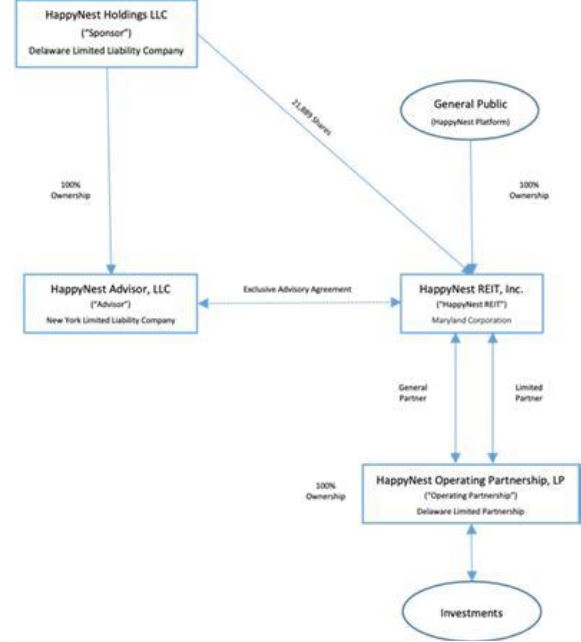
HappyNest does not directly own any real estate properties in the UPREIT structure; rather it owns substantial interests in the Operating Partnership through being the Operating Partnership’s sole general partner and one of the limited partners in the Operating Partnership. See “The Operating Partnership Agreement”.
The UPREIT structure is an industry standard structure that we anticipate may provide several advantages in our investment activities compared to all-cash purchasers, when seeking investment opportunities from persons who might not otherwise sell their properties due to unfavorable tax consequences. For example, UPREIT structures allow a property owner to defer taxable capital gains by contributing their property to the Operating Partnership in exchange for limited partnership units in the Operating Partnership, or OP Units. OP Units will be exchangeable by those other property owners on a one for one basis for our shares at a price to be determined by our most recently published NAV per share at the time of exchange. Those other property owners will also have the right to have HappyNest redeem their OP Units on the same terms as our other stockholders in accordance with our share repurchase program, as described in more detail below. Those exchanges and redemptions will be a taxable event to those other property owners, so those other property owners may choose to exchange or redeem their shares over a period of time to spread our their tax liability over time.
Co-Ownership Investment
We may acquire some of our properties in the form of a co-ownership, including but not limited to tenants-in-common and joint ventures. Co-ownership will allow us to quickly deploy the initial net proceeds from our offering into smaller interests in multiple properties, and it is intended to provide our initial investors with greater potential for cash distributions in the early stages of HappyNest along with higher levels of diversification by property type and location. These types of structures may also be necessary to access certain investments that would otherwise be unavailable.
Disposition Policies
We generally intend to hold each property for a minimum of three years. However, on the recommendation of the Advisor, our Investment Committee may choose to sell a property at any time if it determines that the sale of the property would be in the best interests of our stockholders. The Advisor, in consultation with our Investment Committee, will consider viable offers from reputable sources and make a determination as to whether or not a particular asset should be sold.
When determining whether or not to sell an asset, the Advisor, in consultation with our Investment Committee, will take into consideration applicable factors, including the then-current property and capital market conditions, the availability of investment opportunities suitable for a 1031 exchange or some other tax deferred exchange, and the impact the potential disposition would have on the performance and value of our portfolio.
We may choose to provide seller financing to a purchaser if the Advisor, in consultation with our Investment Committee, determines it to be in the best interest of our stockholders. Lending a purchaser some or all of the purchase price, may expose us to undesirable tax liabilities in the event that our taxable income exceeds the actual cash proceeds received in the sale.
The sale of assets to third parties or to affiliates of our Advisor is subject to review and approval of the Conflicts Committee of HappyNest Board, as described above under “Management—Committees of Our Board of Directors—Conflicts Committee”.
Investment Company Act and Certain Other Policies
We intend to conduct our operations so that neither we nor any of our subsidiaries will be required to register as an investment company under the Investment Company Act. Under the relevant provisions of Section 3(a)(1) of the Investment Company Act, an investment company is any issuer that:
| · | is or holds itself out as being engaged primarily, or proposes to engage primarily, in the business of investing, reinvesting or trading in securities (the “primarily engaged test”); or |
| · | is engaged or proposes to engage in the business of investing, reinvesting, owning, holding or trading in securities and owns or proposes to acquire “investment securities” having a value exceeding 40% of the value of such issuer’s total assets (exclusive of U.S. government securities and cash items) on an unconsolidated basis (the “40% test”). “Investment securities” excludes U.S. government securities and securities of majority-owned subsidiaries that are not themselves investment companies and are not relying on the exception from the definition of investment company under Section 3(c)(1) or Section 3(c)(7) (relating to private investment companies). |
We believe that neither we nor our Operating Partnership will be required to register as an investment company based on the following analysis. With respect to the 40% test, most of the entities through which we intend to own our assets are majority-owned subsidiaries that are not themselves investment companies and are not relying on the exceptions from the definition of investment company under Section 3(c)(1) or Section 3(c)(7) (relating to private investment companies).
With respect to the primarily engaged test, we are a holding company and do not intend to invest or trade in securities ourselves. Rather, we are primarily engaged in the non-investment company businesses of these subsidiaries, namely the business of purchasing or otherwise acquiring real estate and real estate-related assets.
We believe that we will be able to rely on Section 3(c)(5)(C) of the Investment Company Act for an exception from the definition of an investment company. As reflected in no-action letters, the SEC staff’s position on Section 3(c)(5)(C) generally requires that an issuer maintain at least 55% of its assets in “mortgages and other liens on and interests in real estate,” or qualifying assets; at least 80% of its assets in qualifying assets plus real estate-related assets; and no more than 20% of the value of its assets in other than qualifying assets and real estate-related assets, which we refer to as miscellaneous assets. To constitute a qualifying asset under this 55% requirement, a real estate interest must meet various criteria based on no-action letters. We expect that we will develop and maintain a portfolio of real estate interests and real estate-type assets that complies with SEC guidance on Section 3(c)(5)(C), allowing the Company to remain exempt from registration under the Investment Company Act. We expect to rely on guidance published by the SEC staff or on our analyses of guidance published with respect to types of assets to determine which assets are qualifying real estate assets and real estate-related assets.
To avoid registration as an investment company, we expect to limit the investments that we make, directly or indirectly, in assets that are not qualifying assets and in assets that are not real estate-related assets. In 2011, the SEC issued a concept release indicating that the SEC and its staff were reviewing interpretive issues relating to Section 3(c)(5)(C) and soliciting views on the application of Section 3(c)(5)(C) to companies engaged in the business of acquiring mortgages and mortgage-related instruments. To the extent that the SEC or its staff provides guidance regarding any of the matters bearing upon the exceptions we and our subsidiaries rely on from registration as an investment company, we may be required to adjust our strategy accordingly. Any guidance from the SEC or its staff could further inhibit our ability to pursue the strategies we have chosen.
If at any time the character of our investments could cause us to be deemed as an investment company for purposes of the 1940 Act, we will take all necessary actions to attempt to ensure that we are not deemed to be an investment company. See “Risk Factors — Risks Related to Our Corporate Structure”. In addition, we do not intend to underwrite securities of other issuers or actively trade in loans or other investments.
Subject to the restrictions we must follow in order to qualify to be taxed as a REIT, we may make investments other than as previously described in this prospectus, although we do not currently intend to do so. We have authority to purchase or otherwise reacquire our shares of common stock or any of our other securities. We have no present intention of repurchasing any of our shares of common stock except pursuant to our share repurchase program, and we would only take such action in conformity with applicable federal and state laws and the requirements for qualifying as a REIT under the Code.
|
34 |
MANAGEMENT’S DISCUSSION AND ANALYSIS OF
FINANCIAL CONDITION AND RESULTS OF OPERATIONS
Overview
We are a Maryland corporation that was formed on February 14, 2018, to acquire and manage a diversified portfolio of single-tenant net leased income producing properties, real estate debt, and other real estate related investments. We plan to diversify our portfolio by credit, geography, investment size, and risk to achieve a portfolio of real estate assets that preserve investment capital, provide a steady stream of current income, and achieve conservative capital appreciation over time.
Although we are not limited as to the form our investments may take, our investments in real estate will generally constitute acquiring fee title or interests in entities that own and operate real estate. We will make acquisitions of our real estate investments directly through HappyNest Operating Partners, L.P., our operating partnership (the “Operating Partnership”), or indirectly through limited liability companies or limited partnerships, including through other real estate investment trusts, or REITs, or through investments in joint ventures, partnerships, tenants-in-common, co-tenancies or other co-ownership arrangements with other owners of properties, affiliates of our advisor or other persons.
The number and type of real estate assets we may acquire will depend upon the number of shares sold and the resulting amount of the net proceeds available for investment. If we are unable to raise substantial funds, we will make fewer investments resulting in less diversification in terms of the number of investments owned and the geographic regions in which our investments are located. Consequently, the likelihood of our profitability being affected by the performance of any one of our investments will increase. In addition, if we are unable to raise substantial funds, our fixed operating expenses, as a percentage of gross income, will be higher, which may have a material adverse effect on our ability to pay distributions.
HappyNest Advisors, LLC, our advisor (the “Advisor”), is responsible for sourcing, acquiring, and managing the day-to-day operations of our real estate investments. Our Advisor has the authority to make all of our investment decisions, subject to the direction and oversight of our board, which consists mainly of independent directors.
The current competitive nature of the market for acquisition opportunities in our chosen asset class may present challenges sourcing suitable investments in 2025. Our Advisor is expected to work diligently to source properties and create strategic relationships that enable us to achieve our investment objectives. Changes in the general economy and key interest rate benchmarks may affect the amount a purchaser is capable of paying for real estate assets. The pricing of real estate assets does not generally move in tandem with changes to the capital markets. However, pricing does tend to adjust over time to reflect historical average market risk premiums.
We intend to be taxed as a REIT under the amended Tax Reform Act of 1986, beginning with the taxable year ending December 31, 2026. Should we qualify as a REIT for U.S. federal income tax purposes, we will not be subject to most U.S. federal income tax to the extent we distribute qualifying dividends to our stockholders in accordance with Section 856(c) of the Code. In the event we fail to qualify as a REIT in any taxable year, we will be subject to U.S. federal income tax on our taxable income at regular corporate income tax rates and generally will not be permitted to qualify for treatment as a REIT for U.S. federal income tax purposes for four years following the year in which our qualification is denied. Failing to qualify as a REIT could materially and adversely affect our net income and cash available for distribution. We believe we are organized in such a manner and will operate in such a way as to enable us to qualify for treatment as a REIT for U.S. federal income tax purposes for the taxable year ending December 31, 2026 and subsequent tax years.
Because we conduct substantially all of our operations through the Operating Partnership, we will be considered an Umbrella Partnership Real Estate Investment Trust, or UPREIT. Using an UPREIT structure may give us an advantage in acquiring properties from persons who might not otherwise sell their properties because of unfavorable tax results. Generally, a sale of property directly to a REIT, or a contribution in exchange for REIT shares, is a taxable transaction to the selling property owner. However, in an UPREIT structure, a seller of a property who desires to defer taxable gain on the sale of property may transfer the property to the Operating Partnership in exchange for partnership interests in the Operating Partnership potentially deferring a gain for tax purposes.
We present our financial statements and the income, expenses and depreciation on a consolidated basis with our Operating Partnership. All items of income, gain, deduction (including depreciation), loss and credit flow through the Operating Partnership to us as all subsidiary entities are disregarded for federal tax purposes. These tax items do not generally flow through us to our stockholders. Rather, our operating results and net capital gains effectively flow through us to our stockholders as and when we pay distributions.
We will monitor the various qualification tests that we must meet to maintain our status as a REIT. Ownership of our shares will be monitored to ensure that no more 50% in value of our outstanding shares is owned, directly or indirectly, by five or fewer individuals at any time. We also will determine periodically that the gross income, asset and distribution tests as described in the section of our Offering Circular entitled “Federal Income Tax Considerations—Taxation of HappyNest REIT, Inc.— Income Tests, —Assets Tests” and “— Annual Distribution Requirements” are satisfied.
We are not aware of any other material trends or uncertainties, favorable or unfavorable, other than national economic conditions affecting real estate generally, that may be reasonably anticipated to have a material impact on either our capital resources or the revenues or income to be derived from acquiring commercial real estate properties and other real estate related investments, other than those referred to elsewhere in this Offering Circular.
Liquidity and Capital Resources
We require capital to fund our investment activities and operating expenses. Our capital sources may include net proceeds from the Offering, cash flow from operations, and borrowings under loans and credit facilities.
As of June 30, 2025, the Company had cash and cash equivalents of $14,898. For the foreseeable future we will be dependent upon our ability to finance our operations from the sale of equity or other financing alternatives. Our principal demands for funds will be to purchase real estate properties and make other real estate investments, for the payment of operating expenses and distributions, and for the payment of principal and interest on any indebtedness we incur. Although we depend upon the net proceeds from the sale of our shares of common stock to conduct substantially all of our operations, we may fund our capital requirements from a variety of other sources.
As of June 30, 2025, our indebtedness primarily consisted of expenses reimbursable to our affiliates for the costs incurred by us in connection with our organization and our Offering, fees payable to our affiliates that we incurred in connection with the acquisitions of our investment properties, as well as stock-based compensation expenses.
For the six months ended June 30, 2025, the Company recorded an accumulated deficit of $871,138. This raises substantial doubt about the Company’s ability to continue as a going concern. The continuation of the Company as a going concern is dependent upon successful financing through equity investors and profitable investment opportunities expected to have long-term benefits.
Once we have acquired a substantial portion of our real estate portfolio with the proceeds from our Offering, we expect that our debt ratio will not exceed 50% (before deducting depreciation or other non-cash reserves). Although our borrowing policy is not to exceed 50% of the portfolio’s net assets (equivalent to 50% of the cost of our assets), we have imposed no limitation on the amount we may borrow for the purchase of individual assets. For example, HappyNest may take on a property level loan at 65% loan-to-cost (LTC) so long as our total portfolio’s debt ratio, including all debt financings and other liabilities, does not exceed our limitations. Any debt financing for investments that will render our debt ratio in excess of 50% must be approved by a majority of our independent directors, or our Conflicts Committee, and disclosed to our stockholders in any subsequent public reports.
In order to qualify as a REIT for income tax purposes we are required to pay minimum annual distributions to our stockholders of at least 90% of HappyNest’s taxable income (computed without regard to the dividends paid deduction and excluding net capital gain). We intend for our investments to provide sufficient available cash flow from operations to pay distributions. Our Advisor may deem, from time to time, our then-current financial condition capable of supporting distributions in excess of the minimum distribution amount. In the event we are required to pay dividends prior to having invested a substantial portion of the net proceeds from our Offering, our Sponsor or Advisor may choose, at their sole discretion, to defer reimbursements and fees due to them in order to increase the capital available for distributions to stockholders. The amount and frequency of fee reimbursements to our Sponsor and Advisor may adversely impact our ability to make future distributions and requires approval of the majority of our independent directors or our Conflicts Committee prior to payment. As of June 30, 2025, our Sponsor has deferred its right to payment in reimbursement for the costs incurred by it or its affiliates in connection with our organization and our Offering.
|
35 |
Although we depend upon the net proceeds from the sale of our shares of common stock to conduct substantially all of our operations, we may fund our capital requirements from a variety of other sources.
Our primary sources and uses of funds may be as follows:
Sources
| · | Sale of shares of common stock through our Offering pursuant to Regulation A |
| · | Sale of shares of common stock through our dividend reinvestment plan |
| · | Rent payments from our tenants |
| · | Proceeds from mortgage loans, credit facilities, or other amount borrowed |
|
|
|
| · | Distribution from investments |
Uses
Short-term liquidity and capital requirements:
| · | Property level operating expenses, if any |
| · | Interest and principal payments on mortgage loans, credit facilities, or other debt obligations |
| · | Distributions to stockholders |
| · | Fees or reimbursements payable to our Sponsor and Advisor |
| · | Repurchases of shares under the share repurchase program |
| · | General and administrative expenses |
Long-term liquidity and capital requirements:
| · | Acquisitions of new real estate investments |
| · | Payment of deferred investment property acquisition obligation |
| · | Interest & principal payments on mortgage loans and credit facility |
| · | Tenant improvements, leasing commissions, and other capital expenditures |
| · | Repurchases of shares under the dividend reinvestment plan |
Results of Operations
As of June 30, 2025, the aggregate amount raised by the Company was $3,321,917.
Revenue
The Company records revenue from its equity method investments for the Company's share of the undistributed earnings or losses from the underlying entity. The Company recorded approximately $76,000 and $102,000 in undistributed earnings for the six months ended June 30, 2025 and 2024, respectively.
Expenses
Asset Management and other fees – related party
For the six months ended June 30, 2025 and 2024, the Company incurred asset management fees in the amount of approximately $5,700 and $5,700, respectively, which is recorded within operating expenses on the Company’s consolidated statements of operations. As of June 30, 2025 and 2024, these amounts are included within due to affiliates on the Company’s consolidated balance sheets.
Acquisition Fee
For the six months ended June 30, 2025 and 2024, the Company incurred acquisition fees in the amount of approximately $-0- and $22,500, respectively, which are recorded within operating expenses on the Company’s consolidated statements of operations. As of June 30, 2025, these amounts are included within due to affiliates on the Company’s consolidated balance sheets.
Disposition Fee
For the six months ended June 30, 2025 and 2024, the Company incurred disposition fees in the amount of approximately $-0- and $22,500, respectively, which are recorded within operating expenses on the Company's consolidated statements of operations. As of June 30, 2025, these amounts are included within due to affiliates on the Company's consolidated balance sheets.
Property Management Fee
For the six months ended June 30, 2025 and 2024, the Company incurred no property management fees.
Advisory Agreement Fee
For the six months ended June 30, 2025 and 2024, the Company incurred no advisory agreement fees.
Sponsor and Subscriber Administration Fee
No such fees have been paid or accrued as of June 30, 2025 and December 31, 2024, and the Sponsor has not collected or contributed to the Sponsor fee as of June 30, 2025 and 2024. The Company has never paid the Sponsor this fee, and it is expected that the fee will be altogether eliminated going forward.
Stock Compensation Expense
On November 14, 2019, the Company granted 20,000 restricted shares of common stock under the HappyNest REIT, Inc. 2018 Equity Compensation Plan to certain executive Board Members. On July 27, 2020, the Company granted an additional 10,000 restricted shares of common stock to certain executive Board Members.
The fair value of the restricted shares granted were based on the fair value of the Company’s stock as determined by management. No shares were granted during the years ended June 30, 2025 and 2024 under the Plan, with 30,000 shares granted previously. The restricted shares vest ratably over a four-year period commencing on their respective grant dates, with twenty-five percent of the number of shares vesting on each one-year anniversary of their respective grant date, provided that the grantee continues to provide their respective services to the Company through the applicable vesting date. During the six months ended June 30, 2025 and 2024, -0- and 1,250 restricted shares have vested, respectively.
The fair value of the restricted shares granted were based on the fair value of the Company's stock as determined by management. This resulted in the recognition of stock-based compensation expense of $-0- and $12,500 being recognized for the six months ended June 30, 2025 and 2024, respectively.
Summary of Critical Accounting Policies
The discussion and analysis of our financial condition and results of operations is based upon our consolidated financial statements which have been prepared in accordance with generally accepted accounting principles in the United States (“GAAP”). The preparation of financial statements requires us to make estimates and judgments that affect the reported amounts in our consolidated financial statements.
We believe the application of accounting policies, and the estimates inherently required therein, are reasonable. These accounting policies and estimates are periodically reevaluated, and adjustments are made when facts and circumstances dictate a change. We base our estimates on industry experience and on various other assumptions that we believe to be reasonable under the circumstances, the results of which form our basis for making judgments about the carrying values of assets and liabilities that may not be readily apparent from other sources. Actual results may differ from these estimates under different assumptions or conditions, or if management made different judgments or utilized different estimates.
|
36 |
Recent Developments
Offering
As of June 30, 2025, the aggregate amount raised by the Company was $3,321,917 (not including the $200,000 received from our sponsor).
The Company has identified a potential liability related to certain equity securities sales and issuances that may not comply with Section 5 of the Securities Act's registration requirements. This issue arose after the expiration of our previous Regulation A offering on July 29, 2022, due to the inadvertent failure to file a new Offering Statement. Upon discovery, sales were suspended, but technical limitations prevented the complete disengagement of the HappyNest Platform. To mitigate adverse effects on business operations and maintain access to essential shareholder information, the Company took corrective actions, including segregating funds received post-expiration and exercising shareholders' recession rights. During this period, the Company issued shares worth approximately $1.15 million. While no claims of violation have been made by security holders, they may have the right to rescind their transactions, posing a potential financial impact on the Company.
Our Sponsor has agreed to defer its right to reimbursement from the Company for the costs incurred by it or its affiliates in connection with our organization and our Offering, which became due upon the Company exceeding the minimum offering amount. This reimbursement is subject to a limit of 3.0% of the aggregate gross offering proceeds of our Offering.
Affiliated Entities
On April 13, 2020, the Company finalized the formation of HappyNest Operating Partnership L.P. (the “Operating Partnership”). The Company is the sole General Partner and also a Limited Partner of the Operating Partnership. The Company also formed HNR Fremont One, LLC (“HNR Fremont”), HNR Easthampton One, LLC (“HNR Easthampton”), HNR Donna One, LLC (“HNR Donna”), HNR Salem One, LLC (“HNR Salem”), HNR Rainbow I LLC (“HNR Rainbow”), HNR West Tech LLC (“HNR West Tech”), HNR Fleetwood LLC (“HNR Fleetwood”), HNR Cobb LLC (“HNR Cobb”), and HNR Hermitage, LLC (“HNR Hermitage”) each wholly owned subsidiaries of the Operating Partnership.
Assets Acquired or Redeemed
On April 24, 2020, the Company, through a wholly owned subsidiary of the Operating Partnership, CPI Fremont Three LLC (“CPI Fremont Three”), purchased an indirect 2.67% tenancy in common interest in real property located in Fremont, Indiana (the “Fremont Property”), pursuant to a tenancy in common agreement (the “Fremont TIC Agreement”), for an aggregate investment amount of $250,000. The Fremont Property consists of approximately 42.87 acres of land. A FedEx Freight truck terminal and distribution facility is located on the Fremont Property, with a footprint of approximately 118,526 square feet. The Fremont Property was purchased subject to a lease by FedEx Freight East, Inc. (the “Fremont Lease”).
On June 23, 2020, the Company, through a wholly owned subsidiary of the Operating Partnership, CPI East Hampton III, LLC (“CPI East Hampton III”), purchased a 13.548% tenancy in common interest in real property located in Easthampton, Massachusetts (the “Easthampton Property”), pursuant to a tenancy in common agreement (the “Easthampton TIC Agreement”), for an aggregate investment amount of $252,589. The Easthampton Property consists of an 8,775 square foot commercial building, located on 1.54 acres of land. The Easthampton Property was purchased subject to a lease with CVS, Inc. for usage of the property as a CVS Pharmacy (the “Easthampton Lease”). On December 30, 2022, the property was sold, and the Company received a distribution totaling approximately $306,000.
On December 4, 2021, HNR Donna purchased an indirect 4.28% tenancy-in-common noncontrolling interest in real property in Austin, TX (the “Kelsey Howard Lane Apartment Homes Property”) for an aggregate investment amount of $150,000. Kelsey Howard Lane Apartment Homes Property is located on approximately 23.63 acres of land and developments are expected to include a 383-unit multifamily community.
On July 6, 2022, HNR Rainbow purchased a 0.66% pro rata share investment in Rainbow Realty Group, II, LLC, pursuant to a subscription agreement for an aggregate investment amount of $300,000. For the six months ended June 30, 2025 the Company received cash distributions from this investment of approximately $16,600, with approximately $8,500 of distributions which relate to revenue earned during the year ended December 31, 2024. Total distributions of profits recorded in equity in income on the Company's consolidated statements of operations are approximately $17,800 for the six months ended June 30, 2025, with approximately $9,600 of distributions of profits still owed to the Company which is recorded as a receivable on the Company's consolidated balance sheet as of June 30, 2025.
On July 12, 2022, HNR West Tech purchased a 1.39% pro rata share investment in West Tech Industrial Property Investors LP, pursuant to a subscription agreement for an aggregate investment amount of $200,000. For the six months ended June 30, 2025, the Company received cash distributions from this investment of approximately $8,200, with approximately $4,100 of distributions which relate to revenue earned during the year ended December 31, 2024. Total distributions of profits recorded in equity in income on the Company's consolidated statements of operations are approximately $8,600 for the six months ended June 30, 2025, with approximately $4,500 of distributions of profits still owed to the Company which is recorded as a receivable on the Company's consolidated balance sheet as of June 30, 2025.
On July 18, 2022, HNR Salem purchased a 0.5867% pro rata share investment in Founder Class Shares in Trevian Capital Debt Fund, LP, pursuant to a subscription agreement for an investment amount of $250,000. On July 21, 2023, HNR Salem added an additional $500,000 to its initial investment in Trevian Capital Debt Fund, LP. This addition brings the aggregate investment amount to $750,000 made pursuant to an addendum to the original subscription agreement. On April 30, 2024, this investment was terminated and HNR Salem was refunded their total investment balance of $750,000.
On August 12, 2022, HNR Fleetwood purchased a 3.48755% pro rata share investment in Fleetwood 3MC, LLC, pursuant to a subscription agreement for an aggregate investment amount of $200,000. For the six months ended June 30, 2025, the Company received $0 cash distributions from this investment. There were no distributions of profits for the six months ended June 30, 2025.
On October 6, 2022, the Company purchased a 2.50% pro rata share investment in Bonner Carrington Credit Partners I, LLC, pursuant to a subscription agreement for an aggregate investment amount of $400,000. For the six months ended June 30, 2025, the Company received $24,000 cash distributions from this investment, with approximately $12,000 of distributions which relate to revenue earned during the year ended December 31, 2024. Total distributions of profits recorded in equity in income on the Company's consolidated statements of operations are approximately $24,000 for the six months ended June 30, 2025, with $12,000 of distributions of profits still owed to the Company which is recorded as a receivable on the Company's consolidated balance sheet as of June 30, 2025.
On August 23, 2023, HNR Cobb purchased a 0.39% pro rata share investment in Cobb CC Industrial Property Investors GP LLC, pursuant to a subscription agreement for an aggregate investment amount of $50,000. For the six months ended June 30, 2025, the Company received approximately $1,000 cash distributions from this investment, with approximately $500 of distributions which relate to revenue earned during the year ended December 31, 2024. Total distributions of profits recorded in equity in income on the Company's consolidated statements of operations are approximately $1,000 for the six months ended June 30, 2025, with approximately $500 of distributions of profits still owed to the Company which is recorded as a receivable on the Company's consolidated balance sheet as of June 30, 2025.
On July 21, 2023, HNR Salem One LLC, a wholly owned subsidiary of HappyNest Operating Partnership L.P., our operating partnership, added an additional $500,000 to its initial investment in Trevian Capital Debt. This addition brings the aggregate investment amount to $750,000. This investment was made pursuant to an addendum to the original Trevian Capital Debt subscription agreement dated July 18, 2022.
On July 25, 2023, HNR Cobb LLC, a wholly owned subsidiary of HappyNest Operating Partnership L.P., our operating partnership, purchased a limited partnership interest in Cobb CC Industrial Property Investors LP (“Cobb CC Industrial LP”), pursuant to a subscription agreement (the “Cobb Subscription Agreement”), for an aggregate investment amount of $50,000.
On May 10, 2024, HNR Hermitage, LLC, a wholly owned subsidiary of HappyNest Operating Partnership L.P., purchased an indirect 4.122% tenancy-in-common non-controlling interest in real property in Hermitage, PA (the FedEx Ground Hermitage Facility), for an aggregate investment amount of $750,000, through its subsidiary, CPI Hermitage Five LLC.
Capital Raised
As of June 30, 2025, the aggregate amount raised by the Company was $3,321,917.
Net Asset Value as of March 31, 2025
As of March 31, 2025, our NAV per common share was $10.00. This NAV per common share reflects the an estimation of the value of our real estate portfolio and our board of directors’ decision to carry all assets at cost for 12 months beforehand. As of the date of this Rescission Offer, the Company intends to rely upon third parties in valuing its investment assets.
Advisory Agreement
The Company and the Advisor renewed the Advisory Agreement for a one-year term, effective as of February 19, 2025.
Redemption Plan
During the six-month period ended June 30, 2025 and the year ended December 31, 2024, we redeemed, in aggregate, 26,587 and 31,315 shares of common stock, respectively, pursuant to our share redemption plan.
|
37 |
U.S. FEDERAL INCOME TAX CONSIDERATIONS
The following is a summary of the material U.S. federal income tax consequences of an investment in our common stock. For purposes of this section, references to “HappyNest”, “we,” “our” and “us” mean only HappyNest and not our subsidiaries or other lower-tier entities, except as otherwise indicated. This summary is based upon the Internal Revenue Code, the regulations promulgated by the U.S.
Treasury Department, rulings and other administrative pronouncements issued by the Internal Revenue Service, and judicial decisions, all as currently in effect, and all of which are subject to differing interpretations or to change, possibly with retroactive effect. No assurance can be given that the Internal Revenue Service would not assert, or that a court would not sustain, a position contrary to any of the tax consequences described below. We have not sought and do not currently expect to seek an opinion of counsel or advance ruling from the Internal Revenue Service regarding any matter discussed in this offering circular. The summary is also based upon the assumption that we will operate HappyNest and our subsidiaries and affiliated entities in accordance with their applicable organizational documents. This summary does not purport to discuss all aspects of U.S. federal income taxation that may be important to a particular investor in light of its investment or tax circumstances or to investors subject to special tax rules, such as:
| · | financial institutions; |
| · | insurance companies; |
| · | real estate investment trusts; |
| · | regulated investment companies; |
| · | dealers in securities; |
| · | traders in securities that elect to use a mark-to market method of accounting for their securities holdings; |
| · | partnerships and trusts; |
| · | persons who hold our stock on behalf of other persons as nominees; |
| · | persons who receive our stock through the exercise of employee stock options or otherwise as compensation; |
| · | persons holding our stock as part of a “straddle,” “hedge,” “conversion transaction,” “constructive ownership transaction,” “synthetic security” or other integrated investment; |
| · | “S” corporations; |
and, except to the extent discussed below:
| · | tax-exempt organizations; and |
| · | foreign investors. |
This summary assumes that investors will hold their common stock as a capital asset, which generally means as property held for investment.
The U.S. federal income tax treatment of holders of our common stock depends in some instances on determinations of fact and interpretations of complex provisions of U.S. federal income tax law for which no clear precedent or authority may be available. In addition, the tax consequences to any particular stockholder of holding our common stock will depend on the stockholder’s particular tax circumstances. This summary does not give a detailed discussion of any state, local, or foreign tax considerations. You are urged to consult your tax advisor regarding the federal, state, local and foreign income and other tax consequences to you in light of your particular investment or tax circumstances of acquiring, holding, exchanging, or otherwise disposing of our common stock.
Taxation of HappyNest
We intend to be taxed as a REIT commencing with our taxable year ended December 31, 2026. We believe that we have been organized and will operate in such a manner as to qualify for taxation as a REIT.
Qualification and taxation as a REIT depend on our ability to meet on a continuing basis, through actual operating results, distribution levels, sources of income, and asset ownership, various qualification requirements imposed upon REITs by the Internal Revenue Code. Our ability to qualify as a REIT requires that we satisfy certain asset ownership tests, some of which depend upon the fair market values of assets that we own directly or indirectly. Such values may not be susceptible to a precise determination. Accordingly, no assurance can be given that the actual results of our operations for any taxable year will satisfy such requirements for qualification and taxation as a REIT.
If we fail to qualify for taxation as a REIT in any taxable year and the relief provisions described herein do not apply, we will be subject to tax on our taxable income at regular U.S. federal corporate rates (currently 21%) As a result, our failure to qualify as a REIT would significantly reduce the cash we have available to distribute to our shareholders. Unless entitled to statutory relief, we would not be able to re-elect to be taxed as a REIT until our fifth taxable year after the year of disqualification. It is not possible to state whether we would be entitled to statutory relief.
Taxation of REITs in General
In any year in which we qualify as a REIT, the portion of our REIT taxable income that we distribute to our shareholders generally may be deducted and effectively is not subject to U.S. federal corporate income tax. This treatment substantially eliminates the “double taxation” at the corporate and stockholder levels that generally applies to most corporations. As a result, the income that we generate generally is taxed only at the stockholder level upon distribution to our stockholders.
If we qualify as a REIT, we will nonetheless be subject to federal tax in the following circumstances:
| · | We will be taxed at regular corporate rates on any undistributed taxable income, including undistributed net capital gains. |
| · | If we have net income from prohibited transactions, which are, in general, sales or other dispositions of inventory or property held primarily for sale to customers in the ordinary course of business, other than foreclosure property, such income will be subject to a 100% tax. See “Prohibited Transactions”. |
| · | If we elect to treat property that we acquire in connection with a foreclosure of a mortgage loan or certain leasehold terminations as “foreclosure property,” we may thereby avoid the 100% tax on gain from a resale of that property (if the sale would otherwise constitute a prohibited transaction), but the income from the sale or operation of the property may be subject to corporate income tax at the highest applicable rate (currently 21%). |
| · | If we should fail to satisfy the 75% gross income test or the 95% gross income test, as discussed below, but nonetheless maintain our qualification as a REIT because we satisfy other requirements, we will be subject to a 100% tax on an amount based on the magnitude of the failure, as adjusted to reflect the profit margin associated with our gross income. |
| · | If we should violate the asset tests (other than certain de minimis violations) or other requirements applicable to REITs, as described below, and yet maintain our qualification as a REIT because there is reasonable cause for the failure and other applicable requirements are met, we may be subject to an excise tax. In that case, the amount of the excise tax will be at least $50,000 per failure and, in the case of certain asset test failures, will be determined as the amount of net income generated by the assets in question multiplied by the highest corporate tax rate (currently 21%) if that amount exceeds $50,000 per failure. |
| · | If we should fail to distribute during each calendar year at least the sum of (a) 85% of our REIT ordinary income for such year; (b) 95% of our REIT capital gain net income for such year; and (c) any undistributed taxable income from prior periods, we would be subject to a nondeductible 4% excise tax on the excess of the required distribution over the sum of (i) the amounts that we actually distributed and (ii) the amounts we retained and upon which we paid income tax at the corporate level. |
We may be required to pay monetary penalties to the Internal Revenue Service in certain circumstances, including if we fail to meet record keeping requirements intended to monitor our compliance with rules relating to the composition of a REIT’s stockholders, as described in “Taxation of HappyNest – Requirements for Qualification”.
In addition, we and our subsidiaries may be subject to a variety of taxes, including payroll taxes and state and local and foreign income, property and other taxes on our assets and operations. We could also be subject to tax in situations and on transactions not presently contemplated.
Requirements for Qualification—General
The Internal Revenue Code defines a REIT as a corporation, trust or association which has seven main attributes:
(1) | it is managed by one or more trustees or directors; |
(2) | its beneficial ownership is evidenced by transferable shares, or by transferable certificates of beneficial interest; |
(3) | it would be taxable as a domestic corporation but for its election to be subject to tax as a REIT; |
(4) | it is neither a financial institution nor an insurance company subject to specific provisions of the Internal Revenue Code; |
(5) | its beneficial ownership is held by 100 or more persons; |
(6) | during the last half of each taxable year, not more than 50% in value of its outstanding stock is owned, directly or indirectly, by five or fewer “individuals” (as defined in the Internal Revenue Code to include specified tax-exempt entities); and |
(7) | it meets other tests described below, including with respect to the nature of its income and assets. |
The Internal Revenue Code provides that conditions (1) through (4) must be met during the entire taxable year, and that condition (5) must be met during at least 335 days of a taxable year of 12 months, or during a proportionate part of a shorter taxable year. Conditions (5) and (6) need not be met during a corporation’s initial tax year as a REIT.
We believe that we will issue common stock in this offering with sufficient diversity of ownership to satisfy conditions (5) and (6). In addition, our charter provides restrictions regarding the ownership and transfer of our shares, which are intended to assist us in satisfying and continuing to satisfy the share ownership requirements described in conditions (5) and (6) above.
To monitor compliance with the share ownership requirements, we generally are required to maintain records regarding the actual ownership of our shares. To do so, we must demand written statements each year from the record holders of significant percentages of our stock pursuant to which the record holders must disclose the actual owners of the shares (i.e., the persons required to include our distributions in their gross income). We must maintain a list of those persons failing or refusing to comply with this demand as part of our records. We could be subject to monetary penalties if we fail to comply with these record-keeping requirements. If you fail or refuse to comply with the demands, you will be required by Treasury regulations to submit a statement with your tax return disclosing your actual ownership of our shares and other information.
In addition, a corporation generally may not elect to become a REIT unless its taxable year is the calendar year. We have adopted December 31 as our year-end, and thereby satisfy this requirement.
The Internal Revenue Code provides relief from violations of the REIT gross income requirements, as described under “Income Tests”, in cases where a violation is due to reasonable cause and not to willful neglect, and other requirements are met, including the payment of a penalty tax that is based upon the magnitude of the violation. In addition, certain provisions of the Internal Revenue Code extend similar relief in the case of certain violations of the REIT asset requirements (See “Asset Tests”) and other REIT requirements, again provided that the violation is due to reasonable cause and not willful neglect, and other conditions are met, including the payment of a penalty tax. If we fail to satisfy any of the various REIT requirements, there can be no assurance that these relief provisions would be available to enable us to maintain our qualification as a REIT, and, if such relief provisions are available, the amount of any resultant penalty tax could be substantial.
|
38 |
Effect of Subsidiary Entities
Ownership of Partnership Interests. If we are a partner in an entity that is treated as a partnership for federal income tax purposes, Treasury regulations provide that we are deemed to own our proportionate share of the partnership’s assets, and to earn our proportionate share of the partnership’s income, for purposes of the asset and gross income tests applicable to REITs. Our proportionate share of a partnership’s assets and income is based on our capital interest in the partnership (except that for purposes of the 10% value test, our proportionate share of the partnership’s assets is based on our proportionate interest in the equity and certain debt securities issued by the partnership). In addition, the assets and gross income of the partnership are deemed to retain the same character in our hands. Thus, our proportionate share of the assets and items of income of any of our subsidiary partnerships will be treated as our assets and items of income for purposes of applying the REIT requirements. For any period of time that we own 100% of our Operating Partnership, all of the Operating Partnership’s assets and income will be deemed to be ours for federal income tax purposes as discussed below in “Disregarded Subsidiaries”.
Disregarded Subsidiaries. If we own a corporate subsidiary that is a qualified REIT subsidiary, that subsidiary is generally disregarded for federal income tax purposes, and all of the subsidiary’s assets, liabilities and items of income, deduction and credit are treated as our assets, liabilities and items of income, deduction and credit, including for purposes of the gross income and asset tests applicable to REITs. A qualified REIT subsidiary is any corporation, other than a TRS (as described below), that is directly or indirectly wholly owned by a REIT. Other non-corporate entities that are wholly owned by us, including single member limited liability companies that have not elected to be taxed as corporations for federal income tax purposes, are also generally disregarded as separate entities for federal income tax purposes, including for purposes of the REIT income and asset tests. Disregarded subsidiaries, along with any partnerships in which we hold an equity interest, are sometimes referred to herein as “pass-through subsidiaries.”
In the event that a disregarded subsidiary of ours ceases to be wholly owned—for example, if any equity interest in the subsidiary is acquired by a person other than us or another disregarded subsidiary of ours—the subsidiary’s separate existence would no longer be disregarded for federal income tax purposes. Instead, the subsidiary would have multiple owners and would be treated as either a partnership or a taxable corporation. Such an event could, depending on the circumstances, adversely affect our ability to satisfy the various asset and gross income requirements applicable to REITs, including the requirement that REITs generally may not own, directly or indirectly, more than 10% of the securities of another corporation. See “Asset Tests”, and “Income Tests”.
Taxable Corporate Subsidiaries. In the future we may jointly elect with any of our subsidiary corporations, whether or not wholly owned, to treat such subsidiary corporations as taxable REIT subsidiaries, or TRSs. A REIT is permitted to own up to 100% of the stock of one or more TRSs. A domestic TRS is a fully taxable corporation that may earn income that would not be qualifying income if earned directly by the parent REIT. The subsidiary and the REIT must jointly elect to treat the subsidiary as a TRS. A corporation other than a qualified REIT subsidiary with respect to which a TRS directly or indirectly owns more than 35% of the voting power or value of the stock will automatically be treated as a TRS. We generally may not own more than 10% of the securities of a taxable corporation, as measured by voting power or value, unless we and such corporation elect to treat such corporation as a TRS. Overall, no more than 20% of the value of a REIT’s assets may consist of stock or securities of one or more TRSs. In certain cases, a REIT may be subject to excise taxes as a result of engaging in certain transactions with a TRS. To the extent we have a TRS in the future, we will scrutinize our transactions with the TRS in an attempt to avoid any such excise tax; however, we cannot assure you that we will be successful.
Income Tests
In order to qualify as a REIT, we must satisfy two gross income requirements on an annual basis. First, at least 75% of our gross income for each taxable year, excluding gross income from sales of inventory or dealer property in “prohibited transactions” and excluding gross income from certain hedging transactions, generally must be derived from investments relating to real property or mortgages on real property, including interest income derived from mortgage loans secured by real property (including certain types of mortgage-backed securities), “rents from real property,” distributions received from other REITs and gains from the sale of real estate assets, as well as specified income from temporary investments. Second, at least 95% of our gross income in each taxable year, excluding gross income from prohibited transactions and certain hedging transactions, must be derived from some combination of such income from investments in real property (i.e., income that qualifies under the 75% income test described above), as well as other dividends, interest, and gain from the sale or disposition of stock or securities, which need not have any relation to real property.
Interest income constitutes qualifying mortgage interest for purposes of the 75% income test (as described above) to the extent that the obligation upon which such interest is paid is secured by a mortgage on real property. If we receive interest income with respect to a mortgage loan that is secured by both real property and other property, and the highest principal amount of the loan outstanding during a taxable year exceeds the fair market value of the real property on the date that we acquired or originated the mortgage loan, the interest income will be apportioned between the real property and the other collateral, and our income from the arrangement will qualify for purposes of the 75% income test only to the extent that the interest is allocable to the real property. Even if a loan is not secured by real property, or is under secured, the income that it generates may nonetheless qualify for purposes of the 95% income test.
To the extent that the terms of a loan provide for contingent interest that is based on the cash proceeds realized upon the sale of the property securing the loan (which we refer to as a shared appreciation provision), income attributable to the participation feature will be treated as gain from sale of the underlying property, which generally will be qualifying income for purposes of both the 75% and 95% gross income tests provided that the real property is not held as inventory or dealer property or primarily for sale to customers in the ordinary course of business. To the extent that we derive interest income from a mortgage loan or income from the rental of real property (discussed below) where all or a portion of the amount of interest or rental income payable is contingent, such income generally will qualify for purposes of the gross income tests only if it is based upon the gross receipts or sales and not on the net income or profits of the borrower or lessee. This limitation does not apply, however, where the borrower or lessee leases substantially all of its interest in the property to tenants or subtenants to the extent that the rental income derived by the borrower or lessee, as the case may be, would qualify as rents from real property had we earned the income directly.
We and our subsidiaries may invest in mezzanine loans, which are loans secured by equity interests in an entity that directly or indirectly owns real property, rather than by a direct mortgage of the real property. The Internal Revenue Service has issued Revenue Procedure 2003-65, which provides a safe harbor applicable to mezzanine loans. Under the Revenue Procedure, if a mezzanine loan meets each of the requirements contained in the Revenue Procedure, (1) the mezzanine loan will be treated by the Internal Revenue Service as a real estate asset for purposes of the asset tests described below and (2) interest derived from the mezzanine loan will be treated as qualifying mortgage interest for purposes of the 75% income test. Although the Revenue Procedure provides a safe harbor on which taxpayers may rely, it does not prescribe rules of substantive tax law. We intend to structure any investments in mezzanine loans in a manner that generally complies with the various requirements applicable to our qualification as a REIT. However, to the extent that any of our mezzanine loans do not meet all safe harbor requirements set forth in the Revenue Procedure, there can be no assurance that the Internal Revenue Service will not challenge the tax treatment of these loans.
Rents received by us will qualify as “rents from real property” in satisfying the gross income requirements described above only if several conditions are met. Rent attributable to personal property leased in connection with a lease of real property must not exceed 15% of the total rent received under the lease. In addition, the amount of rent must not be based in whole or in part on the income or profits of any person. Amounts received as rent, however, generally will not be excluded from rents from real property solely by reason of being based on fixed percentages of gross receipts or sales. Moreover, for rents received to qualify as “rents from real property,” we generally must not operate or manage the property or furnish or render services to the tenants of such property, other than through an “independent contractor” from which we derive no revenue. We are permitted, however, to perform services that are “usually or customarily rendered” in connection with the rental of space for occupancy only and which are not otherwise considered rendered to the occupant of the property. In addition, we may directly or indirectly provide non-customary services to tenants of our properties without disqualifying all of the rent from the property if the payments for such services do not exceed 1% of the total gross income from the properties. For purposes of this test, we are deemed to have received income from such non-customary services in an amount at least 150% of the direct cost of providing the services. Moreover, we are generally permitted to provide services to tenants or others through a TRS without disqualifying the rental income received from tenants for purposes of the income tests. Also, rental income will qualify as rents from real property only to the extent that we do not directly or constructively hold a 10% or greater interest, as measured by vote or value, in the lessee’s equity, except with respect to the equity in TRSs.
We may directly or indirectly receive distributions from TRSs or other corporations that are not REITs or qualified REIT subsidiaries. These distributions generally are treated as dividend income to the extent of the earnings and profits of the distributing corporation. Such distributions will generally constitute qualifying income for purposes of the 95% gross income test, but not for purposes of the 75% gross income test. Any distributions that we receive from a REIT, however, will be qualifying income for purposes of both the 95% and 75% income tests.
We and our subsidiaries may enter into hedging transactions with respect to one or more of our assets or liabilities. Hedging transactions could take a variety of forms, including interest rate swap agreements, interest rate cap agreements, options, futures contracts, forward rate agreements or similar financial instruments. Except to the extent provided by Treasury regulations, any income from a hedging transaction we entered into (1) in the normal course of our business primarily to manage risk of interest rate, inflation and/or currency fluctuations with respect to borrowings made or to be made, or ordinary obligations incurred or to be incurred, to acquire or carry real estate assets, which is clearly identified as specified in Treasury regulations before the closing of the day on which it was acquired, originated or entered into, including gain from the sale or disposition of such a transaction, and (2) primarily to manage risk of currency fluctuations with respect to any item of income or gain that would be qualifying income under the 75% or 95% income tests which is clearly identified as such before the closing of the day on which it was acquired, originated or entered into, will not constitute gross income for purposes of the 75% or 95% gross income tests. To the extent that we enter into other types of hedging transactions, the income from those transactions is likely to be treated as non-qualifying income for purposes of the 75% or 95% gross income tests. We intend to structure any hedging transactions in a manner that does not jeopardize our qualification as a REIT.
If we fail to satisfy one or both of the 75% or 95% gross income tests for any taxable year, we may still qualify as a REIT for such year if we are entitled to relief under applicable provisions of the Internal Revenue Code. These relief provisions will be generally available if (1) our failure to meet these tests was due to reasonable cause and not due to willful neglect and (2) following our identification of the failure to meet the 75% or 95% gross income test for any taxable year, we file a schedule with the Internal Revenue Service setting forth each item of our gross income for purposes of the 75% or 95% gross income test for such taxable year in accordance with Treasury regulations yet to be issued. It is not possible to state whether we would be entitled to the benefit of these relief provisions in all circumstances. If these relief provisions are inapplicable to a particular set of circumstances, we will not qualify as a REIT. As discussed above under “Taxation of REITs in General” even where these relief provisions apply, the Internal Revenue Code imposes a tax based upon the amount by which we fail to satisfy the particular gross income test.
Asset Tests
At the close of each calendar quarter, we must also satisfy several tests relating to the nature of our assets. First, at least 75% of the value of our total assets must be represented by some combination of “real estate assets,” cash, cash items, and U.S. government securities. For this purpose, real estate assets include interests in real property, such as land, buildings, leasehold interests in real property, stock of other corporations that qualify as REITs and some kinds of mortgage-backed securities and mortgage loans. Assets that do not qualify for purposes of the 75% test are subject to the additional asset tests described below. Not more than 25% of the value of our total assets may consist of securities other than those in the 75% asset class.
Second, the value of any one issuer’s securities that we own may not exceed 5% of the value of our total assets.
Third, we may not own more than 10% of any one issuer’s outstanding securities, as measured by either voting power or value. The 5% and 10% asset tests do not apply to securities of TRSs and qualified REIT subsidiaries and the 10% asset test does not apply to “straight debt” having specified characteristics and to certain other securities described below. Solely for purposes of the 10% asset test, the determination of our interest in the assets of a partnership or limited liability company in which we own an interest will be based on our proportionate interest in any securities issued by the partnership or limited liability company, excluding for this purpose certain securities described in the Internal Revenue Code.
Fourth, the aggregate value of all securities of taxable REIT subsidiaries that we hold may not exceed 20% of the value of our total assets.
Fifth, the aggregate value of all non-qualified publicly offered REIT debt that we hold may not exceed 25% of the value of our total assets.
Notwithstanding the general rule, as noted above, that for purposes of the REIT income and asset tests we are treated as owning our proportionate share of the underlying assets of a subsidiary partnership, if we hold indebtedness issued by a partnership, the indebtedness will be subject to, and may cause a violation of, the asset tests unless the indebtedness is a qualifying mortgage asset or other conditions are met. Similarly, although stock of another REIT is a qualifying asset for purposes of the REIT asset tests, any non-mortgage debt that is issued by another REIT may not so qualify (such debt, however, will not be treated as “securities” for purposes of the 10% asset test, as explained below).
Certain relief provisions are available to REITs to satisfy the asset requirements or to maintain REIT qualification notwithstanding certain violations of the asset and other requirements. One such provision allows a REIT which fails one or more of the asset requirements to nevertheless maintain its REIT qualification if (1) the REIT provides the Internal Revenue Service with a description of each asset causing the failure; (2) the failure is due to reasonable cause and not willful neglect; (3) the REIT pays a tax equal to the greater of (a) $50,000 per failure and (b) the product of the net income generated by the assets that caused the failure multiplied by the highest applicable corporate tax rate (currently 21%); and (4) the REIT either disposes of the assets causing the failure within six months after the last day of the quarter in which it identifies the failure, or otherwise satisfies the relevant asset tests within that time frame.
In the case of de minimis violations of the 10% and 5% asset tests, a REIT may maintain its qualification despite a violation of such requirements if (1) the value of the assets causing the violation does not exceed the lesser of 1% of the REIT’s total assets and $10,000,000, and (2) the REIT either disposes of the assets causing the failure within six months after the last day of the quarter in which it identifies the failure, or the relevant tests are otherwise satisfied within that time frame.
Certain securities will not cause a violation of the 10% asset test described above. Such securities include instruments that constitute “straight debt,” which includes, among other things, securities having certain contingency features. A security does not qualify as “straight debt” where a REIT (or a controlled TRS of the REIT) owns other securities of the same issuer which do not qualify as straight debt, unless the value of those other securities constitute, in the aggregate, 1% or less of the total value of that issuer’s outstanding securities. In addition to straight debt, the Internal Revenue Code provides that certain other securities will not violate the 10% asset test. Such securities include (1) any loan made to an individual or an estate; (2) certain rental agreements pursuant to which one or more payments are to be made in subsequent years (other than agreements between a REIT and certain persons related to the REIT under attribution rules); (3) any obligation to pay rents from real property; (4) securities issued by governmental entities that are not dependent in whole or in part on the profits of (or payments made by) a non-governmental entity; (5) any security (including debt securities) issued by another REIT; and (6) any debt instrument issued by a partnership if the partnership’s income is of a nature that it would satisfy the 75% gross income test described above under “Income Tests”. In applying the 10% asset test, a debt security issued by a partnership is not taken into account to the extent, if any, of the REIT’s proportionate interest in the equity and certain debt securities issued by that partnership.
No independent appraisals will be obtained to support our conclusions as to the value of our total assets or the value of any particular security or securities. Moreover, values of some assets, including instruments issued in securitization transactions, may not be susceptible to a precise determination, and values are subject to change in the future. Furthermore, the proper classification of an instrument as debt or equity for federal income tax purposes may be uncertain in some circumstances, which could affect the application of the REIT asset requirements. Accordingly, there can be no assurance that the Internal Revenue Service will not contend that our interests in our subsidiaries or in the securities of other issuers will not cause a violation of the REIT asset tests. If we should fail to satisfy the asset tests at the end of a calendar quarter, such a failure would not cause us to lose our REIT qualification if we (1) satisfied the asset tests at the close of the preceding calendar quarter and (2) the discrepancy between the value of our assets and the asset requirements was not wholly or partly caused by an acquisition of non-qualifying assets, but instead arose from changes in the market value of our assets. If the condition described in (2) were not satisfied, we still could avoid disqualification by eliminating any discrepancy within 30 days after the close of the calendar quarter in which it arose or by making use of relief provisions described below.
|
39 |
Annual Distribution Requirements
In order to qualify as a REIT, we are required to make distributions, other than capital gain distributions, to our stockholders in an amount at least equal to:
(a) | The sum of (i) 90% of our “REIT taxable income,” computed without regard to the dividends paid deduction and net capital gain or loss, and (ii) 90% of our after-tax net income, if any, from foreclosure property, minus |
(b) | the sum of specified items of non-cash income. |
We generally must make these distributions in the taxable year to which they relate, or in the following taxable year if declared before we timely file our tax return for the year and if paid with or before the first regular distribution payment after such declaration.
To the extent that we distribute at least 90%, but less than 100%, of our “REIT taxable income,” as adjusted, we will be subject to tax at ordinary corporate tax rates on the retained portion. We may elect to retain, rather than distribute, our net long-term capital gains and pay tax on such gains. In this case, we could elect for our stockholders to include their proportionate shares of such undistributed long-term capital gains in income, and to receive a corresponding credit for their share of the tax that we paid. Our stockholders would then increase their adjusted basis of their stock by the difference between (a) the amounts of capital gain distributions that we designated and that they include in their taxable income minus (b) the tax that we paid on their behalf with respect to that income.
To the extent that we have available net operating losses carried forward from prior tax years, such losses may reduce the amount of distributions that we must make in order to comply with the REIT distribution requirements. Such losses, however, will generally not affect the character, in the hands of our stockholders, of any distributions that are actually made as ordinary dividends or capital gains. See “Taxation of Stockholders — Taxation of Taxable Domestic Stockholders”.
If we should fail to distribute during each calendar year at least the sum of (a) 85% of our REIT ordinary income for such year; (b) 95% of our REIT capital gain net income for such year; and (c) any undistributed taxable income from prior periods, we would be subject to a non-deductible 4% excise tax on the excess of such required distribution over the sum of (x) the amounts actually distributed plus (y) the amounts of income we retained and on which we have paid corporate income tax.
It is possible that, from time to time, we may not have sufficient cash to meet the distribution requirements due to timing differences between (a) our actual receipt of cash, including receipt of distributions from our subsidiaries and (b) our inclusion of items in income for federal income tax purposes.
In the event that such timing differences occur, in order to meet the distribution requirements, it might be necessary for us to arrange for short-term, or possibly long-term, borrowings, or to pay distributions in the form of taxable in-kind distributions of property.
We may be able to rectify a failure to meet the distribution requirements for a year by paying “deficiency dividends” to stockholders in a later year, which may be included in our deduction for distributions paid for the earlier year. In this case, we may be able to avoid losing REIT qualification or being taxed on amounts distributed as deficiency dividends. We will be required to pay interest and a penalty based on the amount of any deduction taken for deficiency dividends.
Failure to Qualify
If we fail to satisfy one or more requirements for REIT qualification other than the gross income or asset tests, we could avoid disqualification if our failure is due to reasonable cause and not to willful neglect and we pay a penalty of $50,000 for each such failure. Relief provisions are available for failures of the gross income tests and asset tests, as described above in “Income Tests” and ”Asset Tests”.
If we fail to qualify for taxation as a REIT in any taxable year, and the relief provisions described above do not apply, we would be subject to tax on our taxable income at regular corporate rates. We cannot deduct distributions to stockholders in any year in which we are not a REIT, nor would we be required to make distributions in such a year. In this situation, to the extent of current and accumulated earnings and profits, distributions to domestic stockholders that are individuals, trusts and estates will generally be taxable as ordinary income. In addition, subject to the limitations of the Internal Revenue Code, corporate distributees may be eligible for the dividends received deduction. Unless we are entitled to relief under specific statutory provisions, we would also be disqualified from re-electing to be taxed as a REIT for the four taxable years following the year during which we lost qualification. It is not possible to state whether, in all circumstances, we would be entitled to this statutory relief.
Prohibited Transactions
Net income that we derive from a prohibited transaction is subject to a 100% tax. The term prohibited transaction generally includes a sale or other disposition of property that is held primarily for sale to customers in the ordinary course of a trade or business. We intend to conduct our operations so that no asset that we own (or are treated as owning) will be treated as, or as having been, held for sale to customers, and that a sale of any such asset will not be treated as having been in the ordinary course of our business. Whether property is held “primarily for sale to customers in the ordinary course of a trade or business” depends on the particular facts and circumstances. No assurance can be given that any property that we sell will not be treated as property held for sale to customers, or that we can comply with certain safe-harbor provisions of the Internal Revenue Code that would prevent such treatment. The 100% tax does not apply to gains from the sale of property that is held through a TRS or other taxable corporation, although such income will potentially be subject to tax in the hands of the TRS or other taxable corporation at regular corporate rates, nor does the 100% tax apply to sales that qualify for a safe harbor as described in Section 857(b)(6) of the Internal Revenue Code.
Taxation of Stockholders
Taxation of Taxable Domestic Stockholders
Definitions. In this section, the phrase “domestic stockholder” means a holder of our common stock that for federal income tax purposes is:
| · | a citizen or resident of the United States; |
| · | a corporation or other entity treated as a corporation for U.S. federal income tax purposes created or organized in or under the laws of the United States or of any political subdivision thereof; |
| · | an estate, the income of which is subject to U.S. federal income taxation regardless of its source; or |
| · | a trust, if (1) a U.S. court is able to exercise primary supervision over the administration of the trust and one or more U.S. persons have the authority to control all substantial decisions of the trust or (2) it has a valid election in place to be treated as a U.S. person. |
If a partnership, including for this purpose any entity that is treated as a partnership for U.S. federal income tax purposes, holds our common stock, the tax treatment of a partner in the partnership will generally depend upon the status of the partner and the activities of the partnership. An investor that is a partnership and the partners in such partnership should consult their tax advisors about the U.S. federal income tax consequences of the acquisition, ownership and disposition of our common stock.
Distributions. So long as we qualify as a REIT, the distributions that we make to our taxable domestic stockholders out of current or accumulated earnings and profits that we do not designate as capital gain distributions will generally be taken into account by stockholders as ordinary income and will not be eligible for the preferential rates for “qualified dividends” or for the dividends received deduction for corporations. Ordinary income is taxed at graduated rates, with the highest marginal rate being 37%.
Domestic stockholders that are individuals, trusts and estates may be taxed at the preferential rate for qualified dividend income (20% rate plus 3.8% net investment income tax) on distributions designated by and received from REITs to the extent that the distributions are attributable to:
| · | income retained by the REIT in the prior taxable year on which the REIT was subject to corporate level income tax (less the amount of tax); |
|
|
|
| · | distributions received by the REIT from TRSs or other taxable C corporations; or |
|
|
|
| · | income in the prior taxable year from the sales of “built-in gain” property acquired by the REIT from C corporations in carryover basis transactions (less the amount of corporate tax on such income). |
Distributions that we designate as capital gain dividends will generally be taxed to our stockholders as long-term capital gains, to the extent that such distributions do not exceed our actual net capital gain for the taxable year, without regard to the period for which the stockholder that receives such distribution has held its stock. We may elect to retain and pay taxes on some or all of our net long-term capital gains, in which case provisions of the Internal Revenue Code will treat our stockholders as having received, solely for tax purposes, our undistributed capital gains, and the stockholders will receive a corresponding credit for taxes that we paid on such undistributed capital gains. See “Taxation of HappyNest — Annual Distribution Requirements”. Corporate stockholders may be required to treat up to 20% of some capital gain distributions as ordinary income. Long-term capital gains are generally taxable at maximum federal rates of 23.8% (combined capital gains and net investment income tax) in the case of stockholders that are individuals, trusts and estates, and 21% in the case of stockholders that are corporations.
Generally, our designated capital gain dividends will be broken out into net capital gains distributions (which are taxable to taxable domestic shareholders that are individuals, estates or trusts at a maximum rate of 20% for individual taxpayers in the highest tax bracket) and unrecaptured Section 1250 gain distributions (which are taxable to taxable domestic shareholders that are individuals, estates or trusts at a maximum rate of 25%).
Distributions in excess of our current and accumulated earnings and profits will generally represent a return of capital and will not be taxable to a stockholder to the extent that the amount of such distributions do not exceed the adjusted basis of the stockholder’s shares with respect to which the distributions were made. Rather, the distributions will reduce the adjusted basis of the stockholder’s shares. To the extent that such distributions exceed the adjusted basis of a stockholder’s shares, the stockholder generally must include such distributions in income as long-term capital gain, or short-term capital gain if the shares have been held for one year or less. In addition, any distribution that we declare in October, November or December of any year and that is payable to a stockholder of record on a specified date in any such month will be treated as both paid by us and received by the stockholder on December 31 of such year, provided that we actually pay the distribution before the end of January of the following calendar year. However, this treatment only applies to the extent of the REIT's earnings and profits existing on December 31. To the extent the shareholder distribution paid in January exceeds available earnings and profits as of December 31, the excess will be treated as a distribution taxable to shareholders in the year paid. As such, for tax reporting purposes, January distributions paid to our shareholders may be split between two tax years.
To the extent that we have available net operating losses and capital losses carried forward from prior tax years, such losses may reduce the amount of distributions that we must make in order to comply with the REIT distribution requirements. See “Taxation of HappyNest — Annual Distribution Requirements”. Such losses, however, are not passed through to stockholders and do not offset income of stockholders from other sources, nor would such losses affect the character of any distributions that we make, which are generally subject to tax in the hands of stockholders to the extent that we have current or accumulated earnings and profits.
Dispositions of Our Stock. In general, a shareholder will recognize gain or loss for federal income tax purposes on the sale or other disposition of our stock in an amount equal to the difference between (1) the amount of cash and the fair market value of any property received in the sale or other disposition, and (2) the shareholder’s adjusted tax basis in the stock. Capital gains recognized by individuals, trusts and estates upon the sale or disposition of our stock will be subject to a maximum federal income tax rate of 20% if the stock is held as a capital asset and for more than one year, and will be taxed as ordinary income rates (of up to 37%) if the stock is held for one year or less. In any event, a 3.8% net investment income tax may also apply. Gains recognized by stockholders that are corporations are subject to federal income tax at a maximum rate of 21%, whether or not such gains are classified as long-term capital gains. Capital losses recognized by a stockholder upon the disposition of our stock that was held for more than one year at the time of disposition will be considered long-term capital losses, and are generally available only to offset capital gain income of the stockholder but not ordinary income (except in the case of individuals, who may offset up to $3,000 of ordinary income each year). In addition, any loss upon a sale or exchange of shares of our stock by a stockholder who has held the shares for six months or less, after applying holding period rules, will be treated as a long-term capital loss to the extent of distributions that we make that are required to be treated by the stockholder as long-term capital gain.
If an investor recognizes a loss upon a subsequent disposition of our stock or other securities in an amount that exceeds a prescribed threshold, it is possible that the provisions of Treasury regulations involving “reportable transactions” could apply, with a resulting requirement to separately disclose the loss-generating transaction to the Internal Revenue Service. These regulations, though directed towards “tax shelters,” are broadly written and apply to transactions that would not typically be considered tax shelters. The Internal Revenue Code imposes significant penalties for failure to comply with these requirements. You should consult your tax advisor concerning any possible disclosure obligation with respect to the receipt or disposition of our stock or securities or transactions that we might undertake directly or indirectly. Moreover, you should be aware that we and other participants in the transactions in which we are involved (including their advisors) might be subject to disclosure or other requirements pursuant to these regulations.
Tax Consequences of Participation in Dividend Reinvestment Plan
If you participate in our dividend reinvestment plan, in which you will be automatically enrolled by the HappyNest Platform unless you affirmatively opt out, and are subject to federal income taxation, you will incur a tax liability for distributions allocated to you even though you have elected not to receive the distributions in cash but rather to have the distributions withheld and reinvested pursuant to our dividend reinvestment plan. Specifically, you will be treated as if you have received the distribution from us in cash and then applied such distribution to the purchase of additional shares. You may be subject to backup withholding if you fail to comply with certain tax requirements. See “—Backup Withholding and Information Reporting”.
Backup Withholding and Information Reporting
We will report to our domestic stockholders and the Internal Revenue Service the amount of dividends paid during each calendar year and the amount of any tax withheld. Under the backup withholding rules, a domestic stockholder may be subject to backup withholding with respect to dividends paid unless the holder is a corporation or comes within other exempt categories and, when required, demonstrates this fact or provides a taxpayer identification number or social security number, certifies as to no loss of exemption from backup withholding and otherwise complies with applicable requirements of the backup withholding rules. A domestic stockholder that does not provide his or her correct taxpayer identification number or social security number may also be subject to penalties imposed by the Internal Revenue Service. In addition, we may be required to withhold a portion of a capital gain distribution to any domestic stockholder who fails to certify its non-foreign status.
Payment of the proceeds of a sale of our common stock within the United States is subject to both backup withholding and information reporting unless the beneficial owner certifies under penalties of perjury that it is a non-U.S. stockholder (and the payor does not have actual knowledge or reason to know that the beneficial owner is a U.S. person) or the holder otherwise establishes an exemption. Payment of the proceeds of a sale of our common stock conducted through certain U.S.-related financial intermediaries is subject to information reporting (but not backup withholding) unless the financial intermediary has documentary evidence in its records that the beneficial owner is a non-U.S. stockholder and specified conditions are met or an exemption is otherwise established.
Backup withholding is not an additional tax. Rather, the amount of any backup withholding with respect to a payment to a domestic shareholder will be allowed as a credit against such person's United States federal income tax liability and may entitle such person to a refund, provided that the required information is timely furnished to the Internal Revenue Service.
Other Tax Considerations
Legislative or Other Actions Affecting REITs
The rules dealing with federal income taxation are constantly under review by persons involved in the legislative process and by the Internal Revenue Service and the U.S. Treasury Department. Changes to the federal tax laws and interpretations thereof could adversely affect an investment in our stock.
State, Local and Foreign Taxes
We and our subsidiaries and stockholders may be subject to state, local or foreign taxation in various jurisdictions including those in which we or they transact business, own property or reside. We may own real property assets located in numerous jurisdictions, and may be required to file tax returns in some or all of those jurisdictions. Our state, local or foreign tax treatment and that of our stockholders may not conform to the federal income tax treatment discussed above. We may own foreign real estate assets and pay foreign property taxes, and dispositions of foreign property or operations involving, or investments in, foreign real estate assets may give rise to foreign income or other tax liability in amounts that could be substantial. Any foreign taxes that we incur do not pass through to stockholders as a credit against their U.S. federal income tax liability. Prospective investors should consult their tax advisors regarding the application and effect of state, local and foreign income and other tax laws on an investment in our stock.
|
40 |
ERISA CONSIDERATIONS
The Employee Retirement Income Security Act of 1974, as amended, or ERISA, is a broad statutory framework that governs most U.S. retirement and other U.S. employee benefit plans. ERISA and the rules and regulations of the Department of Labor, or the DOL, under ERISA contain provisions that should be considered by fiduciaries of employee benefit plans subject to the provisions of Title I of ERISA (“ERISA Plans”) and their legal advisors. In particular, a fiduciary of an ERISA Plan should consider whether an investment in our common stock (or, in the case of a participant-directed defined contribution plan, or a Participant-Directed Plan, making our common shares available for investment under the Participant-Directed Plan) satisfies the requirements set forth in Part 4 of Title I of ERISA, including the requirements that (1) the investment satisfy the prudence and diversification standards of ERISA, (2) the investment be in the best interests of the participants and beneficiaries of the ERISA Plan, (3) the investment be permissible under the terms of the ERISA Plan’s investment policies and governing instruments and (4) the investment does not give rise to a non-exempt prohibited transaction under ERISA or Section 4975 of the Code.
In determining whether an investment in our common stock (or making shares of our common stock available as an investment option under a Participant-Directed Plan) is prudent for ERISA purposes, a fiduciary of an ERISA Plan should consider all relevant facts and circumstances including, without limitation, possible limitations on the transferability of shares of our common stock, whether the investment provides sufficient liquidity in light of the foreseeable needs of the ERISA Plan (or the participant account in a Participant-Directed Plan), and whether the investment is reasonably designed, as part of the ERISA Plan’s portfolio, to further the ERISA Plan’s purposes, taking into consideration the risk of loss and the opportunity for gain (or other return) associated with the investment. It should be noted that we will invest our assets in accordance with the investment objectives and guidelines described herein, and that neither our Advisor nor any of its affiliates has any responsibility for developing any overall investment strategy for any ERISA Plan (or the participant account in a Participant-Directed Plan) or for advising any ERISA Plan (or participant in a Participant-Directed Plan) as to the advisability or prudence of an investment in us. Rather, it is the obligation of the appropriate fiduciary for each ERISA Plan (or participant in a Participant-Directed Plan) to consider whether an investment in our common stock by the ERISA Plan (or making such shares available for investment under a Participant-Directed Plan in which event it is the obligation of the participant to consider whether an investment in our common stock is advisable), when judged in light of the overall portfolio of the ERISA Plan, will meet the prudence, diversification and other applicable requirements of ERISA.
Section 406 of ERISA and Section 4975 of the Code prohibit certain transactions involving the assets of an ERISA Plan, as well as those plans that are not subject to ERISA but that are subject to Section 4975 of the Code, such as individual retirement accounts, or IRAs and non-ERISA Keogh plans, or collectively with ERISA Plans, Plans, and certain persons (referred to as “parties in interest” for purposes of ERISA or “disqualified persons” for purposes of the Code) having certain relationships to Plans, unless a statutory or administrative exemption is applicable to the transaction. A party in interest or disqualified person who engages in a non-exempt prohibited transaction may be subject to non-deductible excise taxes and other penalties and liabilities under ERISA and the Code, and the transaction might have to be rescinded. In addition, a fiduciary who causes an ERISA Plan to engage in a non-exempt prohibited transaction may be personally liable for any resultant loss incurred by the ERISA Plan and may be subject to other potential remedies.
A Plan that proposes to invest in our common stock (or to make shares of our common stock available for investment under a Participant-Directed Plan) may already maintain a relationship with our Advisor or one or more of its affiliates, as a result of which our Advisor or such affiliate may be a “party in interest” under ERISA or a “disqualified person” under the Code, with respect to such Plan (e.g., if our Advisor or such affiliate provides investment management, investment advisory or other services to that Plan). ERISA (and the Code) prohibits plan assets from being used for the benefit of a party in interest (or disqualified person). This prohibition is not triggered by “incidental” benefits to a party in interest (or disqualified person) that result from a transaction involving the Plan that is motivated solely by the interests of the Plan. ERISA (and the Code) also prohibits a fiduciary from using its position to cause the Plan to make an investment from which the fiduciary, its affiliates or certain parties in which it has an interest would receive a fee or other consideration or benefit. In this circumstance, Plans that propose to invest in our common stock should consult with their counsel to determine whether an investment in our common stock would result in a transaction that is prohibited by ERISA or Section 4975 of the Code.
If our assets were considered to be assets of a Plan (referred to herein as “Plan Assets”), our management might be deemed to be fiduciaries of the investing Plan. In this event, the operation of the company could become subject to the restrictions of the fiduciary responsibility and prohibited transaction provisions of Title I of ERISA and/or the prohibited transaction rules of Section 4975 of the Code.
The DOL has promulgated a final regulation under ERISA, 29 C.F.R. § 2510.3-101 (as modified by Section 3(42) of ERISA, the “Plan Assets Regulation”), that provides guidelines as to whether, and under what circumstances, the underlying assets of an entity will be deemed to constitute Plan Assets for purposes of applying the fiduciary requirements of Title I of ERISA (including the prohibited transaction rules of Section 406 of ERISA) and the prohibited transaction provisions of Code Section 4975.
Under the Plan Assets Regulation, the assets of an entity in which a Plan or IRA makes an equity investment will generally be deemed to be assets of such Plan or IRA unless the entity satisfies one of the exceptions to this general rule. Generally, the exceptions require that the investment in the entity be one of the following:
| · | in securities issued by an investment company registered under the Investment Company Act; |
| · | in “publicly offered securities,” defined generally as interests that are “freely transferable,” “widely held” and registered with the SEC; |
| · | in an “operating company” which includes “venture capital operating companies” and “real estate operating companies;” or |
| · | in which equity participation by “benefit plan investors” is not significant. |
The shares of common stock will constitute an “equity interest” for purposes of the Plan Assets Regulation, and the shares of common stock may not constitute “publicly offered securities” for purposes of the Plan Assets Regulation. In addition, the shares will not be issued by a registered investment company.
The 25% Limit.
Under the Plan Assets Regulation, and assuming no other exemption applies, an entity’s assets would be deemed to include “plan assets” subject to ERISA on any date if, immediately after the most recent acquisition of any equity interest in the entity, 25% or more of the value of any class of equity interests in the entity is held by “benefit plan investors” (the “25% Limit”). For purposes of this determination, the value of equity interests held by a person (other than a benefit plan investor) that has discretionary authority or control with respect to the assets of the entity or that provides investment advice for a fee with respect to such assets (or any affiliate of such a person) is disregarded. The term “benefit plan investor” is defined in the Plan Assets Regulation as (a) any employee benefit plan (as defined in Section 3(3) of ERISA) that is subject to the provisions of Title I of ERISA, (b) any plan that is subject to Section 4975 of the Code and (c) any entity whose underlying assets include plan assets by reason of a plan’s investment in the entity (to the extent of such plan’s investment in the entity). Thus, while our assets would not be considered to be “plan assets” for purposes of ERISA so long as the 25% Limit is not exceeded. Our charter provides that if benefit plan investors exceed the 25% Limit, we may redeem their interests at a price equal to the then current NAV per share. We intend to rely on this aspect of the Plan Assets Regulation.
Operating Companies.
Under the Plan Assets Regulation, an entity is an “operating company” if it is primarily engaged, directly or through a majority-owned subsidiary or subsidiaries, in the production or sale of a product or service other than the investment of capital. In addition, the Plan Assets Regulation provides that the term operating company includes an entity qualifying as a real estate operating company, or REOC, or a venture capital operating company, or VCOC. An entity is a REOC if: (i) on its “initial valuation date and on at least one day within each annual valuation period,” at least 50% of the entity’s assets, valued at cost (other than short-term investments pending long-term commitment or distribution to investors) are invested in real estate that is managed or developed and with respect to which such entity has the right to substantially participate directly in management or development activities; and (ii) such entity in the ordinary course of its business is engaged directly in the management and development of real estate during the 12-month period. The “initial valuation date” is the date on which an entity first makes an investment that is not a short-term investment of funds pending long-term commitment. An entity’s “annual valuation period” is a pre-established period not exceeding 90 days in duration, which begins no later than the anniversary of the entity’s initial valuation date. Certain examples in the Plan Assets Regulation clarify that the management and development activities of an entity looking to qualify as a REOC may be carried out by independent contractors (including, in the case of a partnership, affiliates of the general partner) under the supervision of the entity. An entity will qualify as a VCOC if (i) on its initial valuation date and on at least one day during each annual valuation period, at least 50% of the entity’s assets, valued at cost, consist of “venture capital investments,” and (ii) the entity, in the ordinary course of business, actually exercises management rights with respect to one or more of its venture capital investments. The Plan Assets Regulation defines the term “venture capital investments” as investments in an operating company (other than a VCOC) with respect to which the investor obtains management rights.
If the 25% Limit is exceeded and we do not exercise our right to redeem benefit plan investors as described above, we may try to operate in a manner that will enable us to qualify as a VCOC or a REOC or to meet such other exception as may be available to prevent our assets from being treated as assets of any investing Plan for purposes of the Plan Assets Regulation. Accordingly, we believe, on the basis of the Plan Assets Regulation, that our underlying assets should not constitute “plan assets” for purposes of ERISA. However, no assurance can be given that this will be the case.
If our assets are deemed to constitute “plan assets” under ERISA, certain of the transactions in which we might normally engage could constitute a non-exempt “prohibited transaction” under ERISA or Section 4975 of the Code. In such circumstances, in our sole discretion, we may void or undo any such prohibited transaction, and we may require each investor that is a “benefit plan investor” to redeem their shares of common stock upon terms that we consider appropriate.
Prospective investors that are subject to the provisions of Title I of ERISA or Code Section 4975 should consult with their counsel and advisors as to the provisions of Title I of ERISA or Code Section 4975 relevant to an investment in our common stock.
As discussed above, although IRAs and non-ERISA Keogh plans are not subject to ERISA, they are subject to the provisions of Section 4975 of the Code, prohibiting transactions with “disqualified persons” and investments and transactions involving fiduciary conflicts. A prohibited transaction or conflict of interest could arise if the fiduciary making the decision to invest has a personal interest in or affiliation with our company or any of its respective affiliates. In the case of an IRA, a prohibited transaction or conflict of interest that involves the beneficiary of the IRA could result in disqualification of the IRA. A fiduciary for an IRA who has any personal interest in or affiliation with our company or any of its respective affiliates, should consult with his or her tax and legal advisors regarding the impact such interest may have on an investment in our shares with assets of the IRA.
Shares sold by us may be purchased or owned by investors who are investing Plan assets. Our acceptance of an investment by a Plan should not be considered to be a determination or representation by us or any of our respective affiliates that such an investment is appropriate for a Plan. In consultation with its advisors, each prospective Plan investor should carefully consider whether an investment in our company is appropriate for, and permissible under, the terms of the Plan’s governing documents.
Governmental plans, foreign plans and most church plans, while not subject to the fiduciary responsibility provisions of ERISA or the provisions of Code Section 4975, may nevertheless be subject to local, foreign, state or other federal laws that are substantially similar to the foregoing provisions of ERISA and the Code. Fiduciaries of any such plans should consult with their counsel and advisors before deciding to invest in our common stock.
|
41 |
DESCRIPTION OF OUR CAPITAL STOCK
Our charter authorizes the issuance of 250,000,000 shares of capital stock, of which 200,000,000 shares are designated as common stock, par value of $0.0001 per share, and 50,000,000 are designated as preferred stock, par value of $0.001 per share. Our board of directors may amend our charter to increase or decrease the amount of our authorized shares of capital stock. As of June 30, 2025, 335,608 shares of our common stock were issued and outstanding, and no shares of preferred stock were issued and outstanding.
Common Stock
The holders of shares of our common stock are entitled to one vote per share on all matters submitted to a stockholder vote of our stockholders, including the election of our directors. Our charter does not provide for cumulative voting in the election of our directors. Therefore, the holders of a majority of our outstanding shares of common stock can elect the entire HappyNest Board. Unless applicable law requires otherwise, and except as our charter may provide with respect to any series of preferred stock that we may issue in the future, the holders of our common stock will possess exclusive voting power.
Holders of shares of our common stock are entitled to receive such distributions as declared from time to time by our board out of legally available funds, subject to any preferential rights of any preferred stock that we issue in the future. In any liquidation, each outstanding share of common stock entitles its holder to share (based on the percentage of shares held) in the assets that remain after we pay our liabilities and any preferential distributions owed to preferred stockholders. Holders of shares of our common stock do not have preemptive rights, which means that you will not have an automatic option to purchase any new shares that we issue, nor do holders of our shares of common stock have any preference, conversion, exchange, sinking fund, or appraisal rights. Our shares of common stock, when purchased and paid for and issued in accordance with the terms of the offering circular, will be legally issued, fully paid and non-assessable.
Our board of directors has authorized the issuance of shares of our capital stock with electronic certificates in so-called “PDF” format, though we intend to issue all shares as uncertificated shares unless a certificate is requested. Information regarding restrictions on the transferability of our shares appear on our share certificates. Our transfer agent, Colonial Stock Transfer Co., has been engaged by us for managing registrar and transfer agent functions. We will treat the record holder of our stock as the legal and beneficial owner of the shares until a new owner delivers such information to our transfer agent as our transfer agent may request with respect to any share transfers.
Preferred Stock
Our charter authorizes our board of directors to designate and issue one or more classes or series of preferred stock without approval of our common stockholders. Our board of directors may determine the relative rights, preferences and privileges of each class or series of preferred stock so issued, which may be more beneficial than the rights, preferences and privileges attributable to our common stock. The issuance of preferred stock could have the effect of delaying or preventing a change in control. Our board of directors has no present plans to issue preferred stock but may do so at any time in the future without stockholder approval. A majority of our independent directors who do not have an interest in the transaction must approve any issuance of preferred stock. The independent directors are authorized by our charter to consult with company counsel or independent counsel at our expense before deciding whether to approve the issuance of preferred stock.
Meetings and Special Voting Requirements
An annual meeting of our stockholders will be held each year, at least 30 days after delivery of our annual report. Special meetings of stockholders may be called only upon the request of a majority of our directors, a majority of our independent directors, our chief executive officer, our president or upon the written request of common stockholders holding at least 10% of the votes entitled to be cast on any issue proposed to be considered at the special meeting. Upon receipt of a written request of common stockholders holding at least 10% of the votes entitled to be cast stating the purpose of the special meeting, our secretary, will provide all of our stockholders written notice of the meeting and the purpose of such meeting. The meeting must be held not less than 15 days nor more than 60 days after the distribution of the notice of the meeting. The presence in person or by proxy of stockholders entitled to cast a majority of all the votes entitled to be cast on any matter at any stockholder meeting constitutes a quorum. Unless otherwise provided by the Maryland General Corporation Law or our charter, the affirmative vote of a majority of all votes cast is necessary to take stockholder action. Under our charter, a majority of the shares entitled to vote and present in person or by proxy at a meeting of stockholders at which a quorum is present is required for the election of the directors at a meeting of stockholders called for that purpose. This means that, of the shares entitled to vote and present in person or by proxy, a director nominee needs to receive affirmative votes from a majority of such shares in order to be elected to our board of directors. Therefore, if a nominee receives fewer “for” votes than “withhold” votes in an election, then the nominee will not be elected.
Our charter provides a director may be removed from office by the affirmative vote of at least two thirds of the votes entitled to be cast in the event of the director’s willful misconduct or gross negligence.
Other than amendments permitted to be made without stockholder approval under Maryland law or by a specific provision in the charter, our charter generally may be amended only upon the approval of a majority of all the votes entitled to be cast on the matter.
Our charter provides that, without the approval of the majority of the shares of stock entitled to vote on the matter, our board of directors may not
| · | cause our liquidation or dissolution; |
| · | sell all or substantially all of our assets other than in the ordinary course of business; or |
| · | cause our merger or reorganization. |
The term of our Advisory Agreement with our Advisor is one year but may be renewed for an unlimited number of successive one-year periods upon the mutual consent of our Advisor and us. While the stockholders do not have the ability to vote to replace our Advisor or to select a new Advisor, any director or the entire board of directors may be removed, with or without cause, by a vote of the holders of a majority of the shares then entitled to vote on the election of directors at any meeting of stockholders called expressly for the purpose of removing a director.
Advance Notice for Stockholder Nominations for Directors and Proposals of New Business
In order for a stockholder to nominate a director or propose new business at the annual stockholders’ meeting, our bylaws generally require that the stockholder give notice of the nomination or proposal not less than 70 days nor more than 90 days prior to the first anniversary of the preceding year’s annual stockholders’ meeting, unless such nomination or proposal is made pursuant to the company’s notice of the meeting or by or at the direction of our board of directors. Our bylaws contain a similar notice requirement in connection with nominations for directors at a special meeting of stockholders called for the purpose of electing one or more directors. Failure to comply with the notice provisions will make stockholders unable to nominate directors or propose new business.
|
42 |
Restriction on Ownership of Shares
Ownership Limit
To maintain our REIT qualification, not more than 50% in value of our outstanding shares of common stock may be owned, directly or indirectly, by five or fewer individuals (including certain entities treated as individuals under the Internal Revenue Code) during the last half of each taxable year. In addition, at least 100 persons who are independent of us and each other must beneficially own our outstanding shares for at least 335 days per 12-month taxable year or during a proportionate part of a shorter taxable year. Each of the requirements specified in the two preceding sentences shall not apply to any period prior to the second year for which we elect to be taxed as a REIT.
To help ensure our continued REIT qualification, our charter prohibits any person or group of persons from acquiring, directly or indirectly, beneficial ownership of more than 9.8% of our outstanding shares unless exempted by our board of directors. Our board of directors may waive this ownership limit with respect to a particular person if our board receives evidence that ownership in excess of the limit will not jeopardize our REIT status. For purposes of this provision, we treat corporations, partnerships and other entities as single persons.
Any attempted transfer of our shares that, if effective, would result in a violation of our ownership limit or would result in our shares being owned by fewer than 100 persons will be null and void and will cause the number of shares causing the violation to be automatically transferred to a trust for the exclusive benefit of one or more charitable beneficiaries. The prohibited transferee will not acquire any rights in the shares. The automatic transfer will be deemed to be effective as of the close of business on the business day prior to the date of the attempted transfer. We will designate a trustee of the trust that will not be affiliated with us or the prohibited transferee. We will also name one or more charitable organizations as a beneficiary of the share trust.
Shares held in trust will remain issued and outstanding shares and, except as otherwise provided, will be entitled to the same rights and privileges as all other shares of the same class or series. The prohibited transferee will not benefit economically from any of the shares held in trust, will not have any rights to dividends or distributions and will not have the right to vote or any other rights attributable to the shares held in the trust. The trustee will receive all dividends and distributions on the shares held in trust and will hold such dividends or distributions in trust for the benefit of the charitable beneficiary. The trustee may not vote any shares held in trust.
As soon as practicable after receiving notice from us that any of our shares have been transferred to the trust for the charitable beneficiary, the trustee will sell those shares to a person designated by the trustee whose ownership of the shares will not violate the above restrictions. Upon the sale, the interest of the charitable beneficiary in the shares sold will terminate and the trustee will distribute the net proceeds of the sale to the prohibited transferee and to the charitable beneficiary as follows. The prohibited transferee will receive the lesser of (i) the price paid by the prohibited transferee for the shares or, if the prohibited transferee did not give value for the shares in connection with the event causing the shares to be held in the trust (e.g., a gift, devise or other similar transaction), the market price (as defined in our charter) of the shares on the day of the event causing the shares to be held in the trust and (ii) the price received by the trustee from the sale or other disposition of the shares. Any net sale proceeds in excess of the amount payable to the prohibited transferee will be paid immediately to the charitable beneficiary. If, prior to our discovery that shares have been transferred to the trust, the shares are sold by the prohibited transferee, then (i) the shares shall be deemed to have been sold on behalf of the trust and (ii) to the extent that the prohibited transferee received an amount for the shares that exceeds the amount he was entitled to receive, the excess shall be paid to the trustee upon demand.
In addition, shares held in the trust for the charitable beneficiary will be deemed to have been offered for sale to us, or our designee, at a price per share equal to the lesser of (i) the price per share in the transaction that resulted in the transfer to the trust (or, in the case of a devise or gift, the market price at the time of the devise or gift) and (ii) the market price on the date we, or our designee, accept the offer. We will have the right to accept the offer until the trustee has sold the shares. Upon a sale to us, the interest of the charitable beneficiary in the shares sold will terminate and the trustee will distribute the net proceeds of the sale to the prohibited transferee.
Any person who acquires or attempts to acquire shares in violation of the foregoing restrictions or who would have owned the shares that were transferred to any such trust must give us immediate written notice of such event, and any person who proposes or attempts to acquire or receive shares in violation of the foregoing restrictions must give us at least 15 days’ written notice prior to such transaction. In both cases, such persons shall provide to us such other information as we may request in order to determine the effect, if any, of such transfer on our status as a REIT.
The foregoing restrictions will continue to apply until the HappyNest Board determines it is no longer in our best interest to continue to qualify as a REIT. The ownership limit does not apply to any underwriter in an offering of our shares or to a person or persons exempted from the ownership limit by our board of directors based upon appropriate assurances that our qualification as a REIT would not be jeopardized.
Within 30 days after the end of each taxable year, every owner of 5% or more of our outstanding capital stock will be asked to deliver to us a statement setting forth the number of shares owned directly or indirectly by such person and a description of how such person holds the shares. Each such owner shall also provide us with such additional information as we may request in order to determine the effect, if any, of his or her beneficial ownership on our status as a REIT and to ensure compliance with our ownership limit.
These restrictions could delay, defer or prevent a transaction or change in control of our company that might involve a premium price for our shares of common stock or otherwise be in the best interests of our stockholders.
The constructive ownership rules under the Internal Revenue Code are complex and may cause stock owned actually or constructively by a group of related individuals and/or entities to be owned constructively by one individual or entity. As a result, the acquisition of less than 9.8% of our outstanding shares (or the acquisition of an interest in an entity that owns, actually or constructively, common stock) by an individual or entity could, nevertheless, cause that individual or entity, or another individual or entity, to own constructively in excess of 9.8% (in value or in number of shares, whichever is more restrictive) of our outstanding shares and thereby violate the applicable ownership limit. Thus, we cannot guarantee that the restriction on ownership of our outstanding shares will be effective.
Distributions
We expect to authorize and declare distributions based on daily record dates, and we expect to pay such distributions on a quarterly basis. The rate is determined by our board of directors based on our financial condition and such other factors as our board of directors deems relevant. Our board of directors has not pre-established a percentage range of return for distributions to stockholders. We have not established a minimum distribution level, and our charter does not require that we make distributions to our stockholders.
Generally, our policy is to pay distributions from cash flow from operations, and over the long-term, we expect that our distributions will be paid from cash flow from operations. During our offering stage, when we may raise capital more quickly than we acquire income-producing assets, and for some period after our offering stage, we may not pay distributions solely from our cash flow from operations. Further, because we may receive income from interest or rents at various times during our fiscal year and because we may need cash flow from operations during a particular period to fund capital expenditures and other expenses, we expect that, from time to time during our operational stage, we will declare distributions in anticipation of cash flow that we expect to receive during a later period and we will pay these distributions in advance of our actual receipt of these funds. In these instances, our Advisor may elect in its sole discretion to defer, but not waive, fees and/or reimbursements to which it is otherwise entitled to fund some or all of our distributions. We will not use the proceeds from sales of our common stock or borrowed money to pay distributions but rather will pay distributions from cash flow from operations and, as elected solely by our Advisor and/or Sponsor, from deferred reimbursements and fees. If we pay distributions from sources other than our cash flow from operations, we will have less funds available for investment in properties and other assets, the overall return to our stockholders may be reduced and subsequent investors will experience dilution.
Our operating performance cannot be accurately predicted and may deteriorate in the future due to numerous factors, including those discussed under “Risk Factors”. Those factors include our ability to continue to raise capital to make additional investments; the future operating performance of our current and future real estate investments in the existing real estate and financial environment; our Advisor’s ability to identify additional real estate investments that are suitable to execute our investment objectives; the success and economic viability of our tenants; our ability to refinance existing indebtedness at comparable terms; changes in interest rates on any variable rate debt obligations we incur; and the level of participation in our dividend reinvestment plan. In the event our cash flow from operations decreases in the future, the level of our distributions may also decrease. In addition, future distributions declared and paid may exceed cash flow from operations, to the extent that the advisor defers payment of fees and reimbursements to which it is entitled.
To maintain our qualification as a REIT, we must make aggregate annual distributions to our stockholders of at least 90% of our REIT taxable income (which is computed without regard to the dividends-paid deduction or net capital gain and which does not necessarily equal net income as calculated in accordance with GAAP). If we meet the REIT qualification requirements, we generally will not be subject to federal income tax on the income that we distribute to our stockholders each year. Our board of directors may authorize distributions in excess of those required for us to maintain REIT status depending on our financial condition and such other factors as our board of directors deems relevant. See “Federal Income Tax Considerations—Taxation of HappyNest —Annual Distribution Requirements.” For the tax treatment of distributions that you receive, including distributions that are reinvested pursuant to our dividend reinvestment plan, please see the section of this offering circular entitled, “Federal Income Tax Considerations—Taxation of Stockholders—Tax Consequences of Participation in Dividend Reinvestment Plan.”
Inspection of Books and Records
As a part of our books and records, we maintain at our principal office an alphabetical list of the names of our common stockholders, along with their addresses and telephone numbers and the number of shares of common stock held by each of them. We update this stockholder list at least quarterly and it is available for inspection at our principal office by a common stockholder or his or her designated agent upon request of the stockholder for a proper purchase related to such stockholder’s status as a stockholder of the Company. We may impose a reasonable charge for expenses incurred in reproducing such list. Stockholders, however, may not sell or use this list for commercial purposes or other improper purposes. The purposes for which stockholders may request this list include matters relating to their voting rights.
If our Advisor or our board of directors neglects or refuses to make available a copy of the stockholder list as requested, our Advisor and/or board, as the case may be, shall be liable to the common stockholder requesting the list for the costs, including attorneys’ fees, incurred by that stockholder for compelling the production of the stockholder list and any actual damages suffered by any common stockholder for the neglect or refusal to produce the list. It shall be a defense that the actual purpose and reason for the requests for inspection or for a copy of the stockholder list is not for a proper purpose but is instead for the purpose of securing such list of stockholders or other information for the purpose of selling such list or copies thereof, or of using the same for a commercial purpose other than in the interest of the applicant as a stockholder relative to the affairs of our company. We may require that the stockholder requesting the stockholder list represent that the request is not for a commercial purpose unrelated to the stockholder’s interest in our company. The remedies provided by our charter to stockholders requesting copies of the stockholder list are in addition to, and do not in any way limit, other remedies available to stockholders under federal law, or the law of any state.
Business Combinations
Under the Maryland General Corporation Law, business combinations between a Maryland corporation and an interested stockholder or the interested stockholder’s affiliate are prohibited for five years after the most recent date on which the stockholder becomes an interested stockholder. For this purpose, the term “business combination” includes mergers, consolidations, share exchanges, asset transfers and issuances or reclassifications of equity securities. An “interested stockholder” is defined for this purpose as: (i) any person who beneficially owns 10% or more of the voting power of the corporation’s shares or (ii) an affiliate or associate of the corporation who, at any time within the two-year period prior to the date in question, was the beneficial owner of 10% or more of the voting power of the then outstanding voting shares of the corporation. A person is not an interested stockholder under the statute if the board of directors approved in advance the transaction by which he otherwise would have become an interested stockholder. However, in approving a transaction, the board of directors may provide that its approval is subject to compliance, at or after the time of approval, with any terms and conditions determined by the board.
After the five-year prohibition, any business combination between the corporation and an interested stockholder generally must be recommended by the board of directors of the corporation and approved by the affirmative vote of at least: (i) 80% of the votes entitled to be cast by holders of outstanding voting shares of the corporation and (ii) two-thirds of the votes entitled to be cast by holders of voting shares of the corporation other than shares held by the interested stockholder or its affiliate with whom the business combination is to be effected, or held by an affiliate or associate of the interested stockholder.
These super-majority vote requirements do not apply if the corporation’s common stockholders receive a minimum price, as defined under the Maryland General Corporation Law, for their shares in the form of cash or other consideration in the same form as previously paid by the interested stockholder for its shares.
None of these provisions of the Maryland General Corporation Law will apply, however, to business combinations that are approved or exempted by the board of directors of the corporation prior to the time that the interested stockholder becomes an interested stockholder. We have opted out of these provisions by resolution of our board of directors. However, our board of directors may, by resolution, opt in to the business combination statute in the future.
Control Share Acquisitions
The Maryland General Corporation Law provides that control shares of a Maryland corporation acquired in a control share acquisition have no voting rights except to the extent approved by a vote of two-thirds of the votes entitled to be cast on the matter. Shares owned by the acquirer, an officer of the corporation or an employee of the corporation who is also a director of the corporation are excluded from the vote on whether to accord voting rights to the control shares. “Control shares” are voting shares that, if aggregated with all other shares owned by the acquirer or with respect to which the acquirer has the right to vote or to direct the voting of, other than solely by virtue of revocable proxy, would entitle the acquirer to exercise voting power in electing directors within one of the following ranges of voting power:
| · | one-tenth or more but less than one-third; |
| · | one-third or more but less than a majority; or |
| · | a majority or more of all voting power. |
Control shares do not include shares the acquiring person is then entitled to vote as a result of having previously obtained stockholder approval. Except as otherwise specified in the statute, a “control share acquisition” means the acquisition of control shares.
Once a person who has made or proposes to make a control share acquisition has undertaken to pay expenses and has satisfied other required conditions, the person may compel the board of directors to call a special meeting of stockholders to be held within 50 days of the demand to consider the voting rights of the shares. If no request for a meeting is made, the corporation may itself present the question at any stockholders meeting.
If voting rights are not approved for the control shares at the meeting or if the acquiring person does not deliver an “acquiring person statement” for the control shares as required by the statute, the corporation may repurchase any or all of the control shares for their fair value, except for control shares for which voting rights have previously been approved. Fair value is to be determined for this purpose without regard to the absence of voting rights for the control shares, and is to be determined as of the date of the last control share acquisition or of any meeting of stockholders at which the voting rights for control shares are considered and not approved.
If voting rights for control shares are approved at a stockholders meeting and the acquirer becomes entitled to vote a majority of the shares entitled to vote, all other stockholders may exercise appraisal rights. The fair value of the shares as determined for purposes of these appraisal rights may not be less than the highest price per share paid in the control share acquisition. Some of the limitations and restrictions otherwise applicable to the exercise of dissenters’ rights do not apply in the context of a control share acquisition.
The control share acquisition statute does not apply to shares acquired in a merger, consolidation or share exchange if the corporation is a party to the transaction or to acquisitions approved or exempted by the charter or bylaws of the corporation.
Our bylaws contain a provision exempting from the control share acquisition statute any and all acquisitions by any person of our stock. There can be no assurance that this provision will not be amended or eliminated at any time in the future.
|
43 |
Subtitle 8
Subtitle 8 of Title 3 of the Maryland General Corporation Law permits a Maryland corporation with a class of equity securities registered under the Securities Exchange Act of 1934, as amended, and at least three independent directors to elect to be subject, by provision in its charter or bylaws or a resolution of its board of directors and notwithstanding any contrary provision in the charter or bylaws, to any or all of five provisions:
| · | a classified board, |
| · | a two-thirds vote requirement for removing a director, |
| · | a requirement that the number of directors be fixed only by vote of the directors, |
| · | a requirement that a vacancy on the board be filled only by the affirmative vote of a majority of the remaining directors in office and for the remainder of the full term of the directorship in which the vacancy occurred, and |
| · | a majority requirement for the calling of a special meeting of stockholders. |
We have added provisions to our charter that, upon becoming eligible to make the election provided for by MGCL Section 3-802(a)(2), the Company elects to become subject to MGCL Section 3-804(c), under which a vacancy on the board be filled only by the affirmative vote of a majority of the remaining directors in office and for the remainder of the full term of the directorship in which the vacancy occurred. Through provisions in our bylaws unrelated to Subtitle 8, we already vest in our board of directors the exclusive power to fix the number of directorships. Our bylaws may be amended by our board of directors.
Tender Offers
Our charter provides that any tender offer made by any person, including any “mini-tender” offer, must comply with certain notice and disclosure requirements. These procedural requirements with respect to tender offers apply to any widespread solicitation for shares of our stock at firm prices for a limited time period.
In order for any person to conduct a tender offer for shares of our stock, our charter requires that the person comply with Regulation 14D of the Securities Exchange Act of 1934, as amended, and provide us notice of such tender offer at least 10 business days before initiating the tender offer. Pursuant to our charter, Regulation 14D would require any person initiating a tender offer to provide:
| · | Specific disclosure to stockholders focusing on the terms of the offer and information about the bidder; |
|
|
|
| · | The ability to allow stockholders to withdraw tendered shares while the offer remains open; |
|
|
|
| · | The right to have tendered shares accepted on a pro rata basis throughout the term of the offer if the offer is for less than all of our shares; and |
|
|
|
| · | That all stockholders of the subject class of shares be treated equally. |
In addition to the foregoing, there are certain ramifications to any person who attempts to conduct a noncompliant tender offer. If any person initiates a tender offer without complying with the provisions set forth above, in our sole discretion, we shall have the right to repurchase such noncompliant person’s shares and any shares acquired in such tender offer. The noncomplying person shall also be responsible for all of our expenses in connection with that person’s noncompliance.
Restrictions on Roll-Up Transactions
A Roll-up Transaction is a transaction involving the acquisition, merger, conversion or consolidation, directly or indirectly, of us and the issuance of securities of an entity that is created or would survive after the successful completion of a Roll-up Transaction, which we refer to as a Roll-up Entity. This term does not include:
| · | a transaction involving our securities that have been for at least 12 months listed on a national securities exchange; or |
|
|
|
| · | a transaction involving only our conversion into a trust or association if, as a consequence of the transaction, there will be no significant adverse change in the voting rights of our common stockholders, the term of our existence, the compensation to our advisor or our investment objectives. |
In connection with any proposed Roll-up Transaction, an appraisal of all our assets will be obtained from a competent independent appraiser. Our assets will be appraised on a consistent basis, and the appraisal will be based on an evaluation of all relevant information and will indicate the value of our assets as of a date immediately preceding the announcement of the proposed Roll-up Transaction. If the appraisal will be included in a prospectus used to offer the securities of a Roll-Up Entity, the appraisal will be filed with the SEC and, if applicable, the states in which registration of such securities is sought, as an exhibit to the registration statement for the offering. The appraisal will assume an orderly liquidation of assets over a 12-month period. The terms of the engagement of the independent appraiser will clearly state that the engagement is for our benefit and the benefit of our stockholders. A summary of the appraisal, indicating all material assumptions underlying the appraisal, will be included in a report to our stockholders in connection with any proposed Roll-up Transaction.
In connection with a proposed Roll-up Transaction, the person sponsoring the Roll-up Transaction must offer to our common stockholders who vote “no” on the proposal the choice of:
(1) | accepting the securities of the Roll-up Entity offered in the proposed Roll-up Transaction; or |
(2) | one of the following: |
| (A) | remaining as common stockholders of us and preserving their interests in us on the same terms and conditions as existed previously; or |
| (B) | receiving cash in an amount equal to the stockholders’ pro rata share of the appraised value of our net assets. |
We are prohibited from participating in any proposed Roll-up Transaction:
| · | that would result in our common stockholders having democracy rights in a Roll-up Entity that are less than those provided in our charter and bylaws with respect to the election and removal of directors and the other voting rights of our common stockholders, annual reports, annual and special meetings of common stockholders, the amendment of our charter and our dissolution; |
| · | that includes provisions that would operate to materially impede or frustrate the accumulation of shares by any purchaser of the securities of the Roll-up Entity, except to the minimum extent necessary to preserve the tax status of the Roll-up Entity, or that would limit the ability of an investor to exercise the voting rights of its securities of the Roll-up Entity on the basis of the number of shares of common stock that such investor had held in us; |
| · | in which investors’ rights of access to the records of the Roll-up Entity would be less than those provided in our charter and described in the section of this offering circular entitled “Description of Shares—Meetings and Special Voting Requirements”; or |
| · | in which any of the costs of the Roll-up Transaction would be borne by us if the Roll-up Transaction would not be approved by our common stockholders. |
Reports to Stockholders
Our charter requires that we prepare an annual report and deliver it to our common stockholders within 120 days after the end of each fiscal year. Our Advisor is required to take reasonable steps to ensure that the annual report complies with our charter provisions and with applicable securities laws.
Under the Securities Act, we must update this offering circular upon the occurrence of certain events, such as asset acquisitions. We will file updated offering circulars and offering circular supplements with the SEC. We are also subject to the informational reporting requirements of the Exchange Act that are applicable to Tier 2 companies whose securities are registered pursuant to Regulation A, and accordingly, we will file annual reports, semi-annual reports and other information with the SEC. In addition, we will provide you directly with periodic updates, including offering circulars, offering circular supplements, pricing supplements, information statements and other information.
We will provide such periodic updates electronically through the HappyNest Platform website at www.myhappynest.com, and documents will be provided electronically. You may access and print all periodic updates provided through our website. As periodic updates become available, we will notify you of this by sending you an e-mail message that will include instructions on how to retrieve the periodic updates. If our e-mail notification is returned to us as “undeliverable,” we will contact you to obtain your updated e-mail address. We will provide you with paper copies at any time upon request. The contents of the HappyNest Platform website are not incorporated by reference in or otherwise a part of this offering circular.
Concurrent Securities Offering
The Company proposes to offer for sale additional securities under the exemption within Rule 506(c) of Regulation D. This offering is expected to be offered concurrently with the Company’s Regulation A offering described in this Offering Circular. The concurrent offering under Rule 506(c) is to be made exclusively to accredited investors, as defined in Rule 501(a) of Regulation D. The terms of the Company’s Rule 506(c) offering may differ from those of the Company’s Regulation A offering described in this offering circular.
Restricted Stock and Sponsor-Held Shares
The Company does not intend to reissue any shares of common stock that have been cancelled, including shares associated with Restricted Stock or Sponsor-held shares that were previously cancelled. Such cancellations were intended to permanently reduce the number of outstanding shares of common stock.
|
44 |
DIVIDEND REINVESTMENT PLAN
On December 30, 2025, a majority of the board of directors of the Company voted to terminate the dividend-reinvestment program (the “Dividend Reinvestment Program,” or “DRIP”). Previously, shareholders of the Company were automatically enrolled in the Dividend Reinvestment Program. The Dividend Reinvestment used the dividends made by the Company to its shareholders to reinvest in additional shares of common stock of the Company. However, the board of directors of the Company found it advisable and in the best interests of the Company to terminate the Dividend Reinvestment Program for compliance with Regulation A. The Share Repurchase Program is terminated effective January 9, 2026.
|
45 |
SHARE REPURCHASE PROGRAM
On December 30, 2025, a majority of the board of directors of the “Company voted to terminate the share-redemption program (the “Share Repurchase Program”). Previously, shareholders of the Company were permitted to request to redeem their shares pursuant to the Share Repurchase Program. The board of directors of the Company found it advisable and in the best interests of the Company to terminate the Share Repurchase Program for compliance with the exemptive provisions of section 3(c)(5)(C) of the Investment Company of 1940. The Share Repurchase Program is terminated effective January 29, 2026.
During the six-month period ended June 30, 2025 and the year ended December 31, 2024, we redeemed, in aggregate, 26,587 and 31,315 shares of common stock, respectively, pursuant to our share redemption plan.
|
46 |
THE OPERATING PARTNERSHIP AGREEMENT
The following is a summary of the material terms included in the limited partnership agreement of our Operating Partnership.
Conducting our operations through the Operating Partnership allows the sellers of properties to contribute their property interests to the Operating Partnership in exchange for partnership interests rather than for cash or shares of our common stock. This will enable the seller to defer some or all the potential taxable gain on the transfer. From the seller’s perspective, there are also differences between the ownership of shares of common stock and partnership units, some of which may be material because they impact the business organization form, distribution rights, voting rights, transferability of equity interests received and U.S. federal income taxation.
Description of Partnership Units
Partnership interests in the operating partnership, will be divided into “units.” Initially, the Operating Partnership will have two classes of units: (a) “GP Units;” and (b) “OP Units.”
GP Units
GP Units will represent an interest as a general partner in the Operating Partnership and we, as general partner, will hold all such units. In our capacity as general partner, we will manage the Operating Partnership and be liable for certain unpaid debts and liabilities of the Operating Partnership.
Limited Partnership Units Generally
Limited partnership units represent an interest as a limited partner in the Operating Partnership.
The Operating Partnership may issue additional units and classes of units with rights different from, and superior to, those of limited partnership units of any class, without the consent of the limited partners. Holders of limited partnership units will not have any preemptive rights with respect to the issuance of additional units.
Limited partners of any class have the right to participate in the management of the Operating Partnership. Limited partners of any class who do not participate in the management of the Operating Partnership, by virtue of their status as limited partners, generally will not be liable for the debts and liabilities of the Operating Partnership beyond the amount of their capital contributions. The voting rights of the limited partners of any class are generally limited to approval of specific types of amendments to the operating partnership agreement. With respect to such amendments, each OP Unit will have one vote. See “— Management of the Operating Partnership” below for a more detailed discussion of this subject.
In general, each OP Unit (and GP Unit) share equally in distributions from the Operating Partnership when such distributions are declared by us, the general partner, which decision will be made in our sole discretion. Upon the Operating Partnership’s liquidation, OP Units (and GP Units) will share equally on a unit-by-unit basis in the assets of the Operating Partnership that are available for distribution, after payment of all liabilities, establishment of reserves and after payment of any preferred return owed to holders of limited partnership preferred units. In addition, a portion of the items of income, gain, loss and deduction of the Operating Partnership for U.S. federal income tax purposes will be allocated to each limited partnership common unit, regardless of whether any distributions are made by the Operating Partnership. See “U.S. Federal Income Tax Considerations — Tax Aspects of Investments in Partnerships” in this offering circular for a description of the manner in which income, gain, loss and deductions are allocated under the Operating Partnership agreement. As general partner, we may amend the allocation and distribution sections of the Operating Partnership agreement to reflect the issuance of additional units and classes of units without the consent of the limited partners.
Under certain circumstances, holders of limited partnership units of any class may be restricted from transferring their interests without the consent of the general partner. See “— Transferability of Interests” below for a discussion of certain restrictions imposed by the Operating Partnership agreement on such transfers.
OP Units
For each OP Unit received, investors are generally required to contribute money or property, with a net equity value determined by the general partner. Limited partners holding OP Units will not be obligated to make additional capital contributions to the Operating Partnership. Further, such holders will not have the right to make additional capital contributions to the Operating Partnership or to purchase additional OP Units without our consent as general partner. For further information on capital contributions, see “— Capital Contributions” below.
After owning an OP Unit for one year, a holder of OP Units generally may, subject to certain restrictions, exchange OP Units for the cash value of a corresponding number of shares of common stock or, at the option of the Operating Partnership, a corresponding number of shares of common stock. See “— Limited Partner Exchange Rights” below for a description of these rights and the amount and types of consideration a limited partner is entitled to receive upon exercise of such rights. These exchange rights are accelerated in the case of some extraordinary transactions. See “— Extraordinary Transactions” below for an explanation of the exchange rights under such circumstances.
Management of the Operating Partnership
The Operating Partnership is organized as a Delaware limited partnership. We are the general partner of the Operating Partnership and expect to continue conducting substantially all of our business through it. Pursuant to the Operating Partnership agreement, we, as the general partner, have full, exclusive and complete responsibility and discretion in the management and control of the partnership, including the ability to enter into major transactions, such as acquisitions, dispositions and refinancing, and to cause changes in the Operating Partnership’s business and distribution policies. Further, we may, without the consent of the limited partners:
| · | file a voluntary petition seeking liquidation, reorganization, arrangement or readjustment, in any form, of the partnership’s debts under Title 11 of the United States Bankruptcy Code, or any other federal or state insolvency law, or corresponding provisions of future laws, or file an answer consenting to or acquiescing in any such petition; or |
| · | cause the Operating Partnership to make an assignment for the benefit of its creditors or admit in writing its inability to pay its debts as they mature. |
The limited partners, in their capacities as such, have no authority to transact business for, or participate in the management or decisions of, the Operating Partnership, except as provided in the Operating Partnership agreement and as required by applicable law. Further, the limited partners will have no right to remove us as the general partner.
As general partner, we also may amend the Operating Partnership agreement without the consent of any other partners. However, the following amendments will require the unanimous written consent of the affected limited partners or the consent of limited partners holding more than 50% of the voting power in the Operating Partnership:
| · | any amendment that alters or changes the distribution and liquidation rights of limited partners, subject to the exceptions discussed below under the “— Distributions” portion of this section; |
| · | any amendment that alters or changes the limited partner’s exchange rights; |
| · | any amendment that imposes on limited partners any obligation to make additional capital contributions; or |
| · | any amendment that alters the terms of the Operating Partnership agreement regarding the rights of the limited partners with respect to extraordinary transactions. |
Indemnification
To the extent permitted by law, the Operating Partnership agreement will provide for indemnification of us when acting in our capacity as general partner. It also provides for indemnification of our Advisor, its principals and other persons that we may designate under the same conditions, and subject to the same restrictions, applicable to the indemnification of officers, employees and stockholders under our operating agreement. See “Management — Limited Liability and Indemnification of Directors, Officers, Employees and Other Agents” in this offering circular.
Transferability of Interests
Under the Operating Partnership agreement, we provide that may not withdraw from the partnership or transfer or assign all of our general partnership interest without the consent of holders of two-thirds of the limited partnership interests, except in connection with the sale of all or substantially all of our assets. Under certain circumstances and with the prior written consent of the general partner and satisfaction of other conditions set forth in the Operating Partnership agreement, holders of limited partnership units may withdraw from the partnership and transfer and/or encumber all or any part of their units.
In addition, limited partnership units are not registered under the federal or state securities laws. As a result, the ability of a holder to transfer its units may be restricted under such laws.
|
47 |
Extraordinary Transactions
The Operating Partnership agreement generally permits us and/or the Operating Partnership to engage in any authorized business combination without the consent of the limited partners. Generally, a business combination for these purposes is any merger, consolidation or other combination with or into another entity, or the sale of all or substantially all the assets of any entity, or any liquidation, reclassification, recapitalization or change in the terms of the equity stock into which a unit may be converted. We will be required to send to each limited partner notice of a proposed business combination at least 15 days prior to the record date for the stockholder vote on the combination, if any.
Any limited partners who timely exchange their units prior to the record date for the stockholder vote on a business combination will be entitled to vote their shares in any stockholder vote on the business combination. Limited partners who exchange their units after the record date may not vote their shares in any stockholder vote on the proposed business combination.
We cannot consummate a business combination (other than one in which we are the surviving entity) unless all limited partners receive, or have the right to election to receive, for each OP Unit they own, an amount of cash, securities or other property equal to the amount of cash, securities or other property or value paid in the combination to a holder of a common share. If, in connection with a business combination, a tender or similar offer has been accepted by holders of more than 50% of the outstanding common shares, then each limited partner will have the option to exchange its OP Units for the amount of cash, securities or other property which the limited partner would have received had it exercised its exchange rights under the operating partnership agreement, and tendered the shares of common shares received upon exercise of the exchange rights immediately prior to the expiration of the offer.
However, we may merge into or consolidate with another entity without adhering to these limitations if, immediately after the merger or consolidation, substantially all the assets of the surviving entity, other than the partnership units held by us, are contributed to the Operating Partnership as a capital contribution in exchange for partnership units with a fair market value equal to the value of the assets contributed as determined by the surviving entity’s general partner in good faith and the surviving entity’s general partner expressly agrees to assume all of our obligations as general partner under the Operating Partnership agreement.
Issuance of Additional Units
As general partner of the Operating Partnership, we are able to, without the consent of the limited partners, cause the Operating Partnership to issue additional units representing general and/or limited partnership interests. A new issuance may include preferred units, which may have rights which are different than, and/or superior to, those of GP Units and OP Units. Furthermore, the Operating Partnership agreement will require the issuance of additional units to us corresponding with any issuance of stock by us pursuant to a dividend reinvestment plan or as a result of distributing stock in order to meet our annual distribution requirement to maintain our status as a REIT.
Capital Contributions
The Operating Partnership agreement provides that, if the Operating Partnership requires additional funds at any time, or from time to time, in excess of funds available to it from prior borrowings or capital contributions, we, as general partner, have the right to raise additional funds required by the Operating Partnership by causing it to borrow the necessary funds from third parties on such terms and conditions as we deem appropriate. As an alternative to borrowing funds required by the Operating Partnership, we may contribute the amount of such required funds as an additional capital contribution. The Operating Partnership agreement also provides that we must contribute cash or other property received in exchange for the issuance of equity stock to the Operating Partnership in exchange for units. Upon the contribution of cash or other property received in exchange for the issuance of shares of common stock, we will receive one OP Unit for each share of common stock issued by us. Upon the contribution of the cash or other property received in exchange for the issuance of each share of equity stock other than shares of common stock, we will receive one unit with rights and preferences respecting distributions corresponding to the rights and preferences of the equity stock that contribute additional capital to the Operating Partnership, our partnership interest will be increased on a proportionate basis. Conversely, the partnership interests of the other limited partners will be decreased on a proportionate basis if we contribute any additional capital.
As of June 30, 2025, the Operating Partnership has not required additional funds.
|
48 |
Distributions
The Operating Partnership agreement sets forth the manner in which distributions from the partnership will be made to partners. Distributions from the partnership will be made at the times and in the amounts determined by us, as the general partner. Under the Operating Partnership agreement, preferred units, if any, may entitle their holders to distributions prior to the payment of distributions for the other units.
The Operating Partnership agreement provides that cash available for distribution will be distributed to the partners holding GP Units and OP Units based on their percentage interests.
The Operating Partnership agreement also provides that, as general partner, we have the right to amend the distribution provisions of the Operating Partnership agreement to reflect the issuance of additional classes of units. The Operating Partnership agreement further provides that, as general partner, we will use our best efforts to ensure sufficient distributions are made to meet the annual REIT distribution requirements and to avoid U.S. federal income and excise taxes on our earnings.
Liquidation
Upon the liquidation of the Operating Partnership, after payment of debts and obligations, any remaining assets of the partnership will be distributed to partners pro rata in accordance with their positive capital accounts.
Allocations
The Operating Partnership agreement will provide that net income, net loss and any other individual items of income, gain, loss or deduction of the operating partnership will be allocated among the partners in accordance with their percentage interests.
Operations
The Operating Partnership agreement will require that the partnership be operated in a manner that will:
| · | satisfy the requirements for our classification as a REIT; |
| · | avoid any U.S. federal income or excise tax liability, unless we otherwise cease to qualify as a REIT; and |
| · | ensure that the Operating Partnership will not be classified as a publicly traded partnership under the Code. |
Pursuant to the Operating Partnership agreement, the Operating Partnership assumes and pays when due, or reimburses us for, payment of all administrative and operating costs and expenses incurred by the Operating Partnership and the administrative costs and expenses that we incur on behalf, or for the benefit, of the Operating Partnership.
Limited Partner Exchange Rights
Pursuant to the Operating Partnership agreement, each holder of OP Units (other than us) has the right, but not the obligation, to exchange all or a portion of his, her or its OP Units for cash or, at the Operating Partnership’s option, for shares of common stock on such terms and subject to such conditions and restrictions as will be contained in one or more exchange rights agreement among us, as the general partner, the Operating Partnership and one or more limited partners; provided, however, that such OP Units have been outstanding for at least one year. The form of the exchange rights agreement will be provided by the general partner.
Exercise of exchange rights will be a taxable transaction in which gain or loss will be recognized by the limited partner exercising its right to exchange its units for the cash value of a corresponding number of shares of common stock or, at the option of the Operating Partnership, a corresponding number of shares of common stock, to the extent that the amount realized exceeds the limited partner’s adjusted basis in the units exchanged.
Tax Matters
Pursuant to the Operating Partnership agreement, we are the partnership representative of the Operating Partnership, and as such, have authority to make tax decisions under the Code on behalf of the Operating Partnership. Taxable income and loss generally will be allocated in a manner that reflects the entitlement of the general partner and limited partners to receive distributions from the Operating Partnership. We file a federal income tax return annually on behalf of the Operating Partnership on IRS Form 1065 (or such other successor form) or on any other IRS form as may be required. To the extent that any special purpose entity is not wholly owned by the Operating Partnership or is a TRS, we arrange for the preparation and filing of the appropriate tax returns for such special purpose entity for U.S. federal income tax purposes. For a description of other tax consequences stemming from our investment in the Operating Partnership, see “U.S. Federal Income Tax Considerations — Tax Aspects of Investments in Partnerships” in this offering circular.
Duties and Conflicts
Except as otherwise set forth under the sections entitled “Conflicts of Interest” and “Management” in this offering circular, any limited partner may engage in other business activities outside the Operating Partnership, including business activities that directly compete with the Operating Partnership.
Term
The Operating Partnership will continue in full force and effect until dissolved and terminated (i) upon our dissolution, bankruptcy, insolvency or termination, (ii) an election made by us, as the general partner, with the consent of the limited partners holding at least a majority of the percentage interest of the limited partners (including limited partner interests held by the general partner), (iii) an event of withdrawal by us, as the general partner (as defined in the Delaware Revised Uniform Limited Partnership Act), other than an event of bankruptcy, unless, within ninety days after such event of withdrawal, a majority in interest of the remaining limited partners consent to continuing the business of the operating partnership and to the appointment of a successor general partner, (iv) upon the sale or other disposition of all or substantially all the assets of the Operating Partnership unless we, as general partner, elect to continue the business of the Operating Partnership to collect the indebtedness or other consideration to be received in exchange for the assets of the Operating Partnership, or (v) by operation of law.
|
49 |
PLAN OF DISTRIBUTION
No Shares will be sold to investors pursuant to this Rescission Offer. No commissions or fees will be paid to any brokers, dealers, or underwriters.
|
50 |
CERTAIN RELATIONSHIPS AND RELATED PERSON TRANSACTIONS
Compensation, Expense Reimbursement, and Advisor Participation Interest
The Sponsor, Advisor, and Affiliates will be entitled to reimbursement for organization and offering expenses incurred in conjunction with the Offering on, or after, the date the minimum offering amount is met. The Company will reimburse the Sponsor, Advisor, and affiliates for actual expenses incurred on behalf of the Company in connection with the selection, acquisition, or origination of an investment, to the extent not reimbursed by third parties of the transaction, whether or not the Company ultimately acquires or originates the investment. These reimbursements are subject to the reimbursement limits described in the Offering and the terms of reimbursement are set forth in the Advisory Agreement between HappyNest REIT, Inc. and HappyNest Advisors, LLC, included in the offering as Exhibit 6.1.
The Company will reimburse the Advisor for any out-of-pocket expenses paid to third parties in connection with the transaction, which also may include expenses incurred by the Sponsor in the performance of services pursuant to a shared services agreement between the Advisor and the Sponsor, including any increases in insurance attributable to the management or operation of the Company. The Advisor is not entitled to reimbursement for overhead, including employee costs borne by the Advisor, utilities or technology costs.
Sponsor and Subscriber Administration Fee
No such fees have been paid or accrued as of June 30, 2025 and December 31, 2024, and the Sponsor has not collected or contributed to the Sponsor fee as of June 30, 2025 and 2024.
Asset Management Fee
The Company will pay its Advisor a monthly fee of 0.0417% of total investment value. For purposes of this fee, “total investment value” means, for any period, the aggregate book value of our assets before reserves for amortization and depreciation, impairments or other similar non-cash reserves. For the six months ended June 30, 2025 and 2024, the Company incurred asset management fees in the amount of approximately $5,700 and $5,700, respectively, which is recorded within operating expenses on the Company’s consolidated statements of operations. As of June 30, 2025 and 2024, these amounts are included within due to affiliates on the Company’s consolidated balance sheets.
Acquisition Fees
For each acquisition, the Company will pay its Advisor 3.0% of the Contract Price (as defined in the “Articles of Incorporation”, as amended on February 14, 2019) of each property acquisition. The total of all acquisition fees and acquisition expenses shall be reasonable and shall not exceed 6.0% of the Contract Price (as defined in “Articles of Incorporation”, as amended on February 14, 2019) of each property acquisition. However, a majority of the directors (including a majority of the independent directors) not otherwise interested in the transaction may approve fees in excess of these limits if they determine the transaction to be commercially competitive, fair and reasonable to the Company. This fee will be paid to our Advisor upon each real estate investment or any other investment by the Company. For the six months ended June 30, 2025 and 2024, the Company incurred acquisition fees in the amount of approximately $-0- and $22,500, respectively, which are recorded within operating expenses on the Company’s consolidated statements of operations. As of June 30, 2025, these amounts are included within due to affiliates on the Company’s consolidated balance sheets.
Disposition Fees
For substantial assistance in connection with the sale of properties or other investments, the Company will pay its Advisor 3.0% of the Contract Price (as defined in “Articles of Incorporation”, as amended on February 14, 2019) of each property (including all fees and expenses). The disposition fees paid by the Company may not exceed 6.0% of the Contract Price (as defined in “Articles of Incorporation”, as amended on February 14, 2019) of a property when aggregated with all other broker fees paid by or on behalf of the Company in connection with its disposition, excluding fees and expenses. This fee will be paid to the Company’s Advisor upon each disposition by the Company. For the six months ended June 30, 2025 and 2024, the Company incurred disposition fees in the amount of approximately $-0- and $22,500, respectively, which are recorded within operating expenses on the Company's consolidated statements of operations. As of June 30, 2025, these amounts are included within due to affiliates on the Company's consolidated balance sheets.
Property Management Fees
If the Company’s Advisor or its affiliates provides property management services for its real estate investments, the Company will pay fees up to 1.00% of effective gross revenues from the properties managed. The Company also will reimburse the Advisor or its affiliates for property-level expenses that it pays or incurs on its behalf. This does not include the Advisor’s overhead, employee costs borne by the Advisor, utilities or technology costs. The Advisor or its affiliates may subcontract the performance of its property management duties to third parties and pay all or a portion of its property management fee to the third parties with whom it contracts for these services. For the six months ended June 30, 2025 and 2024, the Company incurred no property management fees.
Advisory Agreement
During February 2019, the Company entered into an Advisory Agreement with an advisor to manage, operate, direct, and supervise the operations of the Company. The Company shall pay the advisor fees as defined within the agreement, plus related expense reimbursements. This agreement is in effect for a period of one year and may be renewed for successive one-year terms upon mutual consent from both parties. This Advisory Agreement has been renewed by the Company with no changes made to the original agreement and has a new termination date of February 19, 2026. The Company will pay for all related fees under this agreement when incurred. For the six months ended June 30, 2025 and 2024, the Company incurred no advisory agreement fees.
Related Party Receivable
Cash that is received from sales of the Company’s common stock are initially housed in a bank account that is held by a related party through common ownership. Once the stock transaction is officially cleared, the cash gets transferred to a bank account that is held directly by the Company. As of June 30, 2025 and December 31, 2024, there was $55,903 and $383,267, respectively, in the related party bank account and is included within related party receivable on the Company’s consolidated balance sheets.
Related Party Investments
The Company's investments in Kelsey Howard Lane Apartment Homes Property for $150,000 during 2021 and Bonner Carrington Credit Partners I, LLC for $400,000 during 2022 are considered related party transactions, due to these investment companies holding investments in the Company's Sponsor. The Company recorded gains on these related party investments of $24,000 for the six months ended June 30, 2025 and 2024, respectively.
|
51 |
RESCISSION OFFER
Overview
Under Regulation A, an issuer may offer securities on a continuous basis, so long as the issuer amends its offering statement annually to update the issuer’s financial information in the offering statement and any other changes to its disclosures for up to three years after the initial qualification date of the initial offering statement. After such time, in order to make an offer of securities under Regulation A, an issuer is required to submit a new offering statement covering its securities for qualification by the SEC.
The Company, which previously made annual amendments to its offering statement (Commission File No. 024-10928) and made continuous offers of its securities under Regulation A, failed to submit a new offering statement for qualification under Rule 251 of Regulation A. Therefore, the Regulation A exemption may not have been available for issuances of 143,972 Shares of the Company’s common stock made on July 29, 2022 and after, and such Shares of common stock may be subject to rescission.
The Rescission Offer
The Company makes this Rescission Offer to any holder of Shares of the Company who were issued shares of common stock between July 29, 2022 and December 31, 2024 (the “Eligible Shareholders”). The Company intends to offer to repurchase shares of its common stock from Eligible Shareholders who accepts the Rescission Offer.
Through the Rescission Offer, Eligible Shareholders will have the option to participate in the Rescission Offer or to continue to hold shares of common stock issued on or after July 29, 2022. Eligible Shareholders who elect to participate in the Rescission Offer would receive, in exchange for their shares of common stock issued on or after July 29, 2022, the amount of their investment plus interest, to be determined in accordance with state statutes.
Repurchase Price
The repurchase price of Shares shall be an amount equal to $10.00 per Share plus interest at the current statutory rate (which varies by state and has accrued starting the date the Share was purchased through the date this Rescission Offer expires) per Share, multiplied by the number of Shares purchased by investor between July 29, 2022 and December 31, 2024.
The applicable statutory interest rate for each state or relevant jurisdiction is as follows:
State |
| Interest Rate |
|
| State |
| Interest Rate |
| ||
Alabama |
|
| _____ | % |
| Nebraska |
|
| _____ | % |
Alaska |
|
| _____ | % |
| Nevada |
|
| _____ | % |
Arizona |
|
| _____ | % |
| New Hampshire |
|
| _____ | % |
Arkansas |
|
| _____ | % |
| New Jersey |
|
| _____ | % |
California |
|
| _____ | % |
| New Mexico |
|
| _____ | % |
Colorado |
|
| _____ | % |
| New York |
|
| _____ | % |
Connecticut |
|
| _____ | % |
| North Carolina |
|
| _____ | % |
Delaware |
|
| _____ | % |
| North Dakota |
|
| _____ | % |
Florida |
|
| _____ | % |
| Ohio |
|
| _____ | % |
Georgia |
|
| _____ | % |
| Oklahoma |
|
| _____ | % |
Hawaii |
|
| _____ | % |
| Oregon |
|
| _____ | % |
Idaho |
|
| _____ | % |
| Pennsylvania |
|
| _____ | % |
Illinois |
|
| _____ | % |
| Puerto Rico |
|
| _____ | % |
Indiana |
|
| _____ | % |
| Rhode Island |
|
| _____ | % |
Iowa |
|
| _____ | % |
| South Carolina |
|
| _____ | % |
Kansas |
|
| _____ | % |
| South Dakota |
|
| _____ | % |
Kentucky |
|
| _____ | % |
| Tennessee |
|
| _____ | % |
Louisiana |
|
| _____ | % |
| Texas |
|
| _____ | % |
Maine |
|
| _____ | % |
| Utah |
|
| _____ | % |
Maryland |
|
| _____ | % |
| Vermont |
|
| _____ | % |
Massachusetts |
|
| _____ | % |
| Virginia |
|
| _____ | % |
Michigan |
|
| _____ | % |
| Washington |
|
| _____ | % |
Minnesota |
|
| _____ | % |
| Washington, D.C. |
|
| _____ | % |
Mississippi |
|
| _____ | % |
| West Virginia |
|
| _____ | % |
Missouri |
|
| _____ | % |
| Wisconsin |
|
| _____ | % |
Montana |
|
| _____ | % |
| Wyoming |
|
| _____ | % |
Acceptance
Eligible Shareholders who wish to accept this Rescission Offer must complete the Rescission Offer Election Form (Appendix A), sign the Rescission Offer Election Form, and mail the Rescission Offer Election Form to HappyNest REIT, Inc., 1997 Annapolis Exchange Parkway, Suite 300, Annapolis, Maryland 21401. In order to complete the Rescission Offer Election Form, you must provide the following information:
·Full Legal Name;
·Street Address;
·Email Address;
·Phone Number;
·Number of Shares Held;
·Date(s) of Share Purchase(s); and
·Signature and Date.
To be valid and acceptable, the Rescission Offer Election Form must be postmarked no later than the Rescission Offer Expiration Date (_____, 2026). Each investor is responsible for paying any costs associated with mailing the Rescission Offer Election Form to the Company.
Rescission Offer Payments
Upon receipt of your Rescission Offer Election Form, we will process your submission. If we receive your acceptance of the Rescission Offer, and we are able to confirm your eligibility to participate in this Rescission Offer, we will send a check to the street address listed on your Rescission Offer Election Form via mail in the amount described in this section. Please allow some time for fulfillment of your request.
Rejection or Failure to Affirmatively Accept this Rescission Offer
Failure to affirmatively accept this Rescission Offer has the same effect as rejecting this Rescission Offer. If you should fail to accept this Rescission Offer, or if you should reject the rescission offer, the Company will not repurchase your Shares, and you will not be entitled to receive payment in exchange for your Shares under this Rescission Offer. Furthermore, your failure to accept this Rescission Offer may have the effect of barring you from lawsuits against the Company arising from its potential violations of securities regulations.
Solicitation
Neither the Company nor any of its affiliates will make recommendations with respect to this Rescission Offer. Eligible Shareholders will be encouraged to review materials relating to Rescission Offer carefully and to make an independent evaluation with respect to its terms once available.
Effects of this Rescission Offer
This Rescission Offer may not terminate a purchaser’s right to rescind a sale of securities that was not registered or qualified under the Securities Act or applicable state securities laws and was not otherwise exempt from registration or qualification. If a court of law were to impose a greater remedy, our exposure as a result of the Rescission Offer could be higher.
|
52 |
ADDITIONAL INFORMATION
We have filed with the SEC an offering statement under the Securities Act on Form 1-A regarding this offering. This offering circular, which is part of the offering statement, does not contain all the information set forth in the offering statement and the exhibits related thereto filed with the SEC, reference to which is hereby made. Upon the qualification of the offering statement, we will be subject to the informational reporting requirements of the Exchange Act that are applicable to Tier 2 companies whose securities are registered pursuant to Regulation A, and accordingly, we will file annual reports, semi-annual reports and other information with the SEC. You may read and copy the offering statement, the related exhibits and the reports and other information we file with the SEC at the SEC’s public reference facilities maintained by the SEC at 100 F Street, N.E., Washington, DC 20549. You can also request copies of those documents, upon payment of a duplicating fee, by writing to the SEC. Please call the SEC at 1-800-SEC-0330 for further information regarding the operation of the public reference rooms. The SEC also maintains a website at www.sec.gov that contains reports, information statements and other information regarding issuers that file with the SEC.
You may also request a copy of these filings at no cost, by writing, emailing or telephoning us at:
HappyNest Holdings, LLC
1997 Annapolis Exchange Parkway, Suite 300
Annapolis, MD 21401
info@myhappynest.com
Within 120 days after the end of each fiscal year we will provide to our stockholders of record an annual report. The annual report will contain audited financial statements and certain other financial and narrative information that we are required to provide to stockholders.
We also maintain a website at www.myhappynest.com, where there may be additional information about our business, but the contents of that site are not incorporated by reference in or otherwise a part of this offering circular.
|
53 |
HAPPYNEST REIT, INC.
Consolidated Financial Statements (Unaudited)
June 30, 2025
HAPPYNEST REIT, INC.
Consolidated Balance Sheets
As of June 30, 2025 (Unaudited) and December 31, 2024
|
As of June 30, 2025 (Unaudited) |
As of December 31, 2024 | |||
| Assets | ||||
| Cash and cash equivalents | $ 14,898 | $ 42,520 | ||
| Related party receivable | 55,903 | 383,267 | ||
| Equity investments in real estate | 1,201,291 | 1,197,725 | ||
| Investment in limited partnerships | 1,150,000 | 1,150,000 | ||
| Related party loan receivable | 20,027 | 18,782 | ||
| Prepaid Expenses | 47,417 | 13,414 | - | |
| Investment receivable | 49,329 | 44,810 | ||
| Total assets | $ 2,538,864 | $ 2,850,518 | ||
| Liabilities and Stockholders’ Equity | ||||
| Accounts payable | $ 15,765 | $ 72,955 | ||
| Redemptions Payable | 263,003 | |||
| Due to affiliates | 410,223 | 337,000 | ||
| Total liabilities | 425,987 | 672,958 | ||
| Stockholders’ Equity: | ||||
|
Preferred stock, $0.001 par value; 50,000,000 shares authorized; 0 shares issued and outstanding |
- | - | ||
|
Common stock, $0.0001 par value; 200,000,000 shares authorized; 335,605 and 362,163 shares issued and outstanding, respectively |
33 | 36 | ||
| Stockholders’ rescission rights | 1,439,721 | 1,439,721 | ||
| Additional paid-in capital | 1,544,260 | 1,558,619 | ||
| Accumulated deficit | (871,138) | (820,816) | ||
| Total stockholders’ equity | 2,112,876 | 2,117,560 | ||
| Total liabilities and stockholders’ equity | $ 2,538,864 | $ 2,850,518 |
See notes to consolidated financial statements.
|
F-1 |
HAPPYNEST REIT, INC.
Consolidated Statements of Operations
For the Six Months Ended June 30, 2025 and 2024 (Unaudited)
| 2025 | 2024 | ||
| Equity in earnings of equity method investment in real estate, net | $ 24,442 | $ 24,442 | |
| Equity in income from cost method investments in limited partnerships | 77,893 | 77,891 | |
| Total | 102,335 | 102,333 | |
| Operating expenses | 187,046 | 186,146 | |
| Loss from operations | (84,711) | (83,812.64) | |
| Other income (expense), net | 142 | 142.73 | |
| Loss before income tax | (84,569) | (83,670) | |
| Income tax expense | - | - | |
| Net loss | $ (84,569) | $ (83,670) | |
| Loss per common share: | |||
| Basic | $ (0.15) | $ (0.23) | |
| Diluted | $ (0.15) | $ (0.23) | |
| Weighted-average common shares outstanding: | |||
| Basic | 335,608 | 349,815 | |
| Diluted | 335,608 | 349,815 |
See notes to consolidated financial statements.
|
F-2 |
HAPPYNEST REIT, INC.
Consolidated Statements of Changes in Stockholders’ Equity
For the Six Months Ended June 30, 2025 and 2024 (Unaudited)
| Total | ||||||||
| Preferred Stock | Common Stock | Additional | Stockholders’ | Accumulated | Stockholders’ | |||
| Shares | Amount | Shares | Amount | Paid-in Capital | Rescission Rights | Deficit | Equity | |
| Balance - January 1, 2024 | - | $ - | 332,752 | $ 33 | $ 1,873,834 | $ 1,145,327 | $ (606,504) | $ 2,412,690 |
| Issuance of common stock | - | - | 60,726 | 6 | 313,150 | 294,109 | - | 607,265 |
| Repurchase of shares | - | - | (31,315) | (3) | (313,150) | - | - | (313,153) |
| Stock-based compensation | - | - | - | - | 12,500 | - | - | 12,500 |
| Distributions paid | - | - | - | - | (66,796) | - | - | (66,796) |
| Net loss | - | - | - | - | - | - | (84,569) | (84,569) |
| Balance - June 30, 2024 | - | $ - | 362,163 | $ 36 | $ 1,819,538 | $ 1,439,436 | $ (691,073) | $ 2,567,937 |
| Balance - January 1, 2025 | - | $ - | 362,192 | $ 36 | $ 1,558,622 | $ 1,439,721 | $ (820,816) | $ 2,412,690 |
| Issuance of common stock | - | - | - | - | - | - | - | - |
| Repurchase of shares | - | - | (26,587) | (3) | (265,870) | - | - | (265,873) |
| Stock-based compensation | - | - | - | - | - | - | - | - |
| Distributions paid | - | - | - | - | 251,508 | - | - | (251,508) |
| Net loss | - | - | - | - | - | - | (50,322) | (50,322) |
| Balance - June 30, 2025 | - | $ - | 335,605 | $ 33 | $ 1,544,260 | $ 1,439,721 | $ (871,138) | $ 2,112,876 |
See notes to consolidated financial statements.
|
F-3 |
HAPPYNEST REIT, INC.
Consolidated Statements of Cash Flows
For the Six Months Ended June 30, 2025 and 2024 (Unaudited)
| 2025 | 2024 | ||
| Cash flows from operating activities: | |||
| Net loss | $ (50,322) | $ (84,570) | |
| Stock-based compensation | - | 12,500 | |
| Equity in earnings of equity method investment in real estate, net | (3,565) | (24,442) | |
| Earnings from investments in limited partnerships | - | (77,892) | |
| Distributions received from equity investments in real estate | - | 3,952 | |
| Distributions received from limited partnerships | - | 90,101 | |
| Interest Receivable | (4,520) | - | |
|
Adjustments to reconcile net loss to net cash provided by (used in) operating activities: |
|||
| Changes in operating assets and liabilities: | |||
| Due to affiliates | 73,223 | 60,378 | |
| Prepaid expenses | (34,003) | - | |
| Dwolla Holding Account | 327,365 | - | |
| Accounts payable | (57,190) | (110,037) | |
| Net cash provided by (used in) operating activities | 250,988 | (130,010) | |
| Cash flows from investing activities: | |||
| Proceeds from investment in limited partnerships | - | (750,000) | |
| Investment in equity investments in real estate | - | 750,000 | |
| Investment in limited partnerships | - | - | |
| Loan receivable | (1,245) | (16,603) | |
| Net cash used in investing activities | (1,245) | (16,603) | |
| Cash flows from financing activities: | |||
| Proceeds from issuance of common stock | (3) | 59,686 | |
| Investor Holding Account | (277,362) | - | |
| Distribution payments | - | (1,000) | |
| Net cash provided by financing activities | (277,365) | 58,686 | |
| Net change in cash and cash equivalents | (27,622) | (87,927) | |
| Cash and cash equivalents, beginning of period | 42,520 | 130,047 | |
| Cash and cash equivalents, end of period | $ 14,898 | $ 42,120 | |
| Supplemental disclosure of non-cash financing activity: | |||
| Proceeds raised and reclassed to stockholders’ rescission rights | $ (265,860) | $ 294,109 | |
| Change in related party receivable | $ (327,365) | $ 168,630 | |
| Reinvested dividends | - | $65,796 | |
| Issuance of bonus shares | - | $ 20 | |
| Stock repurchased through related party account | $ 265,870 | $ 313,148 |
See notes to consolidated financial statements.
|
F-4 |
HAPPYNEST REIT, INC.
Notes to Consolidated Financial Statements (Unaudited)
June 30, 2025
NOTE 1 – BUSINESS AND ORGANIZATION
Nature of Operations
HappyNest REIT, Inc. ("HappyNest"), was incorporated in the State of Maryland on February 14, 2018. HappyNest intends to qualify as a real estate investment trust ("REIT") for U.S. federal income tax purposes. HappyNest is headquartered in Charlotte, North Carolina and was formed for the purpose of providing the opportunity to invest in a low-cost, professionally managed portfolio of commercial real estate assets to investors who have, until recently, had limited access to these types of investments.
HappyNest is externally managed by its advisor HappyNest Advisors, LLC ("Advisor"), which is an affiliate of its Sponsor, HappyNest Holdings, LLC, (the "Sponsor"), formerly known as Vitellus, LLC.
The Company's Offering (the "Offering") is being sold on a "best efforts" basis and consists of a minimum of $300,000 of its shares of its common stock, at an initial offering price of $10.00 per share. A maximum of $50 million in HappyNest's common shares may be sold to the public in this Offering at an initial offering price of $10.00 per share in accordance with Regulation A of the Securities Act of 1933, as amended (the "Securities Act"). HappyNest has the authority to issue up to 200 million common shares.
The Company met its minimum offering of $300,000 (not including $200,000 from its Sponsor) on April 24, 2020 and commenced operations. As of June 30, 2025, the aggregate amounts raised by the Company was $3,323,712 (see Note 7).
An affiliated entity through common ownership was formed during 2020 and named HappyNest Operating Partnership, L.P. ("Operating Partnership"). HappyNest contributed $200 in capital contributions for 100% ownership interest in the Operating Partnership, and HappyNest is the sole General Partner of the Operating Partnership.
During July and August 2022, affiliated entities through common ownership were formed and named HNR Rainbow I, LLC ("HNR Rainbow"), HNR West Tech LLC ("HNR West Tech"), and HNR Fleetwood LLC ("HNR Fleetwood"), which are all wholly owned subsidiaries of the Operating Partnership. During July 2023 and May 2024, additional affiliated entities through common ownership were formed and named HNR Cobb, LLC ("HNR Cobb") and HNR Hermitage, LLC ("HNR Hermitage"), respectively, which are also wholly owned subsidiaries of the Operating Partnership.
The Company is not registered as an investment company under the Investment Company Act of 1940, as amended.
Principles of Consolidation
The accompanying consolidated financial statements include the accounts of HappyNest and its wholly owned subsidiary HappyNest Operating Partnership, L.P. (collectively referred to as the "Company"). All significant intercompany balances and transactions have been eliminated.
Going Concern
The accompanying consolidated financial statements have been prepared in conformity with accounting principles generally accepted in the United States of America ("U.S. GAAP") which contemplate continuation of the Company as a going concern. This implies that the Company will continue to realize its assets and discharge its liabilities in the normal course of business. For the six months ended June 30, 2025, the Company generated positive cash flows from operations of $250,988, has a net loss of $50,322, and has an accumulated deficit of $871,138. This raises substantial doubt about the Company's ability to continue as a going concern. The continuation of the Company as a going concern is dependent upon the successful financing through equity investors and profitable investment opportunities expected to have long-term benefits.
NOTE 2 – BASIS OF PRESENTATION
The accompanying consolidated financial statements include the accounts of the Company prepared in conformity with U.S. GAAP and Article 8 of Regulation S-X of the rules and regulations of the Securities and Exchange Commission ("SEC"). Accordingly, certain information and footnote disclosure required for complete consolidated financial statements are not included herein. The consolidated balance sheet as of December 31, 2024 has been derived from the Company's audited financial statements as of that date, but does not include all of the information and footnotes required by GAAP for complete financial statements. The accompanying consolidated financial statements should be read in conjunction with the Company's audited financial statements and notes thereto as of December 31, 2024.
The interim financial data as of June 30, 2025 is unaudited and is not necessarily indicative of the results to be expected for the year ending December 31, 2025 or for any other interim period or for any other future periods. In the opinion of the Company's management, the accompanying unaudited condensed and consolidated financial statements, includes only normal and recurring adjustments necessary for a fair statement of the Company's financial position as of June 30, 2025, and its result of operations and cash flows for the six months ended June 30, 2025 and 2024.
NOTE 3 – SUMMARY OF SIGNIFICANT ACCOUNTING POLICIES
Cash and Cash Equivalents
The Company considers all money market accounts and other highly liquid financial instruments purchased with original maturities of three months or less to be cash and cash equivalents.
Concentration of Credit Risk
Financial instruments that potentially subject the Company to concentrations of credit risk consist principally of cash and cash equivalents. The Company places its cash with high quality banking institutions which are insured by the Federal Deposit Insurance Corporation ("FDIC") up to certain limits. From time to time, the Company may maintain cash balances at certain institutions in excess of FDIC limits.
Equity Investments in Real Estate
Equity method investments in real estate are presented in the consolidated financial statements using the equity method of accounting since the Company does not control the joint venture. Under the equity method, the investment is initially recorded at the original investment amount, plus additional amounts invested, and are subsequently adjusted for the Company's share of the undistributed earnings or losses and distributions from the underlying entity. The Company records realized gains and losses on the sale of these investments in other income (expense), net on the statements of operations.
Investments in Limited Partnerships
Investments in limited partnership arrangements are accounted for using the cost method based on the Company's ownership interest. Under the cost method, the Company increases its investment for contributions and decreases its investment for distributions of capital. Distributions of profit are recorded in equity in income on the Company's consolidated statements of operations. An impairment is recorded to reduce the carrying value of other investments to their estimated fair value whenever management believes the carrying value has been permanently impaired. Any impairment loss is included in the provision for decline in carrying value of investments in the consolidated statement of operations.
Reclassifications
Certain prior periods have been reclassified in order to conform with current period presentation. These reclassifications have no impact on the Company's previously reported consolidated results.
Use of Estimates
The preparation of financial statements in conformity with U.S. GAAP requires management to make estimates and judgments that affect the amounts reported in the consolidated financial statements and accompanying notes. In addition, management's assessment of the Company's ability to continue as a going concern involves the estimation of the amount and timing of future cash inflows and outflows. On an ongoing basis, the Company evaluates its estimates, judgements, and methodologies. The Company bases its estimates on industry experience and on various other assumptions believed to be reasonable. Due to the inherent uncertainty involved in making estimates, actual results could differ materially from those estimates.
Income Taxes
The Company intends to elect to be taxed as a REIT under the Internal Revenue Code of 1986, as amended, and intends to operate as such. The Company expects to have little or no taxable income prior to electing REIT status. To qualify as a REIT, the Company must meet certain organizational and operational requirements, including a requirement to distribute at least 90% of the Company's annual REIT taxable income to its stockholders (which is computed without regard to the dividends paid deduction or net capital gain and which does not necessarily equal net income as calculated in accordance with generally accepted accounting principles). As a REIT, the Company generally will not be subject to U.S. federal income tax to the extent it distributes qualifying dividends to its stockholders. Even if the Company qualifies for taxation as a REIT, it may be subject to certain state and local taxes on its income and property, and federal income and excise taxes on its undistributed income.
Stock-based Compensation
The measurement and recognition of compensation expense for all stock-based payment awards are based on estimated fair values. Awards granted are valued at fair value and any compensation expense is recognized on a straight-line basis over the requisite service periods of each award.
Earnings per Share
Basic earnings per share is calculated on the basis of weighted-average number of common shares outstanding during the period. Basic earnings per share is computed by dividing income available to common members by the weighted-average common shares outstanding during the period. Diluted earnings per common share includes the dilutive effect of stock options, if any.
Organizational, Offering and Related Costs
The Company's Sponsor, Advisor or their affiliates intend to initially pay all of the costs associated with the organization and the offering of the Company's common shares. If any of these costs are paid by the Advisor or affiliates of the Advisor or Sponsor, the Sponsor will be responsible for reimbursing the Advisor or its affiliates. At the election of the Company's Sponsor, the Company will start to reimburse their Sponsor, without interest, for these organization and offering costs incurred both before and after such date. Reimbursement payments will be made in monthly installments, but the aggregate monthly amount reimbursed can never exceed 0.50% of the aggregate gross offering proceeds from the Company's offering; provided, however, no reimbursement will be made which, as a result of the reimbursement, would cause the net asset value to be less than $10.00 per share. If the sum of the total unreimbursed amount of such organization and offering costs, plus new costs incurred since the last reimbursement payment, exceeds the reimbursement limit described above for the applicable monthly installment, the excess will be eligible for reimbursement in subsequent months (subject to the 0.50% limit), calculated on an accumulated basis, until our Sponsor has been reimbursed in full.
The Company records a liability for organizational costs and offering costs payable to the Sponsor when it is probable and estimable that a liability has been incurred in accordance with ASC 450, Contingencies. When recorded by the Company, organization costs are expensed as incurred, and offering costs are netted against the proceeds on a pro rata basis charged to members' equity as such amounts are reimbursed to the Sponsor from the gross proceeds of the Offering. This reimbursement is subject to a limitation of 3% of the gross offering proceeds received by the Company.
Subject to the forgoing provision, the Company may make reimbursement payments in one or more installments.
The Company's minimum offering amount of $300,000 was met and they began operations on April 24, 2020. The total organization and offering costs incurred from inception through June 30, 2025 and 2024 was approximately $1,992,000 and $1,804,000, respectively, of which approximately $109,000 and $109,000, respectively, is available for reimbursement by the Company to the Sponsor as a result of the limitation to 3% of the total gross proceeds received by the Company in their Offering. The Company recorded approximately $0 and $9,000 within operating expenses on the Company's consolidated statements of operations for the six months ended June 30, 2025 and 2024, respectively. As of June 30, 2025 and 2024, the $109,000 and $109,000, respectively, are included within due to affiliates on the Company's consolidated balance sheets as the Company's Sponsor deferred its right to receive payment in reimbursement for the costs incurred by it or its affiliates in connection with the Company's organization and the Offering.
Recent Accounting Pronouncements
The Company has implemented all new accounting pronouncements that are in effect and that may impact its consolidated financial statements and does not believe that there are any other new accounting pronouncements that have been issued that might have a material impact on its financial position or results of operations.
NOTE 4 – EQUITY INVESTMENTS IN REAL ESTATE
The Company is party to a tenancy in common agreement with undivided interests in various unconsolidated properties which are accounted under the equity method of accounting (i.e. at cost, increased or decreased by our share of earnings or losses, less distributions, plus contributions and other adjustments required by equity method accounting). The real estate properties are owned by undivided interest and are subject to joint control by the owners. Consequently, the Company is able to exert significant influence over the operations of the real properties and as such accounts for these investments under the equity method of accounting.
The following table sets forth the Company's ownership interests in the investments in real estate and their respective carrying values. The carrying values of these investments are affected by the timing and nature of distributions:
| Carrying Value at | ||||||
| Unconsolidated Investments | State |
% Owned |
Initial Investment |
Acquisition Date |
June 30, 2025 |
December 31, 2024 |
| FedEx Fremont Freight (1) | IN | 2.67% | $ 250,000 | 4/24/2020 | $ 290,407 | $ 285,086 |
| Kelsey Howard (2) | TX | 4.28% | 150,000 | 12/4/2021 | 150,000 | 150,000 |
| FedEx Hermitage Facility (3) | PA | 4.12% | 750,000 | 5/10/2024 | 760,884 | 762,640 |
| $ 1,150,000 | $ 1,201,291 | $ 1,197,726 | ||||
|
F-5 |
The following table sets forth the Company’s share of the equity in earnings of equity method investment in real estate:
|
For the Six Months Ended June 30, 2025 |
For the Six Months Ended June 30, 2024 | ||
| FedEx Fremont Freight (1) | $ 12,797 | $ 11,381 | |
| Kelsey Howard (2) | - | - | |
| FedEx Hermitage Facility (3) | 19,415 | $ 13,061 | |
| Ending Balance | $ 22,212 | $ 24,442 |
The Kelsey Howard Property had no earnings during the six months ended June 30, 2025 and 2024 as a result of being under construction. No other-than-temporary impairment charges were recognized during the six months ended June 30, 2025 and 2024.
| (1) | (1) On April 24, 2020, HNR Fremont purchased an indirect 2.67% tenancy-in-common non-controlling interest in real property in Fremont, IN (the FedEx Fremont Freight Property), for an aggregate investment amount of $250,000, through its subsidiary, CPI Fremont Three. The total purchase price of the FedEx Fremont Property was $20,079,262 and is subject to a mortgage note. The Company's Advisor has deferred their fee in the amount of $7,500 related to the acquisition of such property in 2020. As of June 30, 2025 and 2024, this amount is included within due to affiliates on the Company's consolidated balance sheets. The FedEx Fremont Property is subject to a mortgage note with a total principal balance of $11,950,000, which matures on June 1, 2025, and bears interest at a rate of the applicable LIBOR rate plus 1.50%. Under the terms of this mortgage note, the tenants-in common are required to maintain certain financial ratios at specified levels, as defined within the mortgage note. Neither HappyNest REIT, Inc. nor our subsidiary CPI Fremont Three, is a guarantor under the mortgage note. CPI Fremont Three is joint and severally liable for the full balance of the mortgage note along with the other tenants in common, however the mortgagee's recourse for the enforcement and collection of the obligations under the mortgage note is limited to CPI Fremont Three and its assets and therefore limited to our investment of $250,000. Further, all members of the tenancy in common agreement have indemnified each other to their pro-rata share of the mortgage, therefore the amount outstanding under the mortgage note has not been recorded as a liability as CPI Fremont Three has not agreed to pay any amounts due and does not expect to pay any amounts as we expect that the rental revenues of the property will be utilized to pay the required debt service. As such, no liability has been recorded on the Company's consolidated balance sheet as of June 30, 2025 and 2024. Revenues for the six months ended June 30, 2024 were approximately $614,000, with related expenses of approximately $135,000, of which the Company has a 2.67% interest on the income of approximately $479,000. Revenues for the six months ended June 30, 2024 were approximately $612,000, with related expenses of approximately $118,000, of which the Company has a 2.67% interest on the income of approximately $426,000. |
| (2) | (2) On December 4, 2021, HNR Donna purchased an indirect 4.28% tenancy-in-common noncontrolling interest in real property in Austin, TX (the Kelsey Howard Lane Apartment Homes Property), for an aggregate investment amount of $150,000. The total purchase price of the Kelsey Howard Lane Apartment Homes Property was $9,785,600 and the development partnership has arranged to borrow approximately $56,300,000 from a banking institution to partially finance the acquisition and development of the project. The Company's Advisor has deferred their fee in the amount of $4,500 related to the acquisition of such property in 2021. As of June 30, 2025 and 2024, this amount is included within due to affiliates on the Company's consolidated balance sheet. Neither HappyNest REIT, Inc. nor its subsidiary HNR Donna, is a guarantor under the investment agreement. HNR Donna is joint and severally liable for the full balance of the purchase price along with the other tenants in common, however the recourse for the enforcement and collection of the obligations under the loan is limited to HNR Donna and its assets and therefore limited to our investment of $150,000. Further, all members of the tenancy in common agreement have indemnified each other to their pro-rata share of the debt, therefore the amount outstanding under the loan has not been recorded as a liability as HNR Donna has not agreed to pay any amounts due and does not expect to pay any amounts as we expect that the rental revenues of the property will be utilized to pay the required debt service. As such, no liability has been recorded on the Company's consolidated balance sheet as of June 30, 2025 and 2024. There was no revenue earned or expenses incurred for this property for the six months ended June 30, 2025 and 2024. |
| (3) | (3) On May 10, 2024, HNR Hermitage purchased an indirect 4.122% tenancy-in-common non-controlling interest in real property in Hermitage, PA (the FedEx Ground Hermitage Facility), for an aggregate investment amount of $750,000, through its subsidiary, CPI Hermitage Five LLC. The total purchase price of the FedEx Ground Hermitage Facility was $43,843,330 and is subject to a mortgage note. The Company's Advisor has deferred their fee in the amount of $22,500 related to the acquisition of such property in 2024. As of June 30, 2025, this amount is included within due to affiliates on the Company's consolidated balance sheets. The FedEx Ground Hermitage Facility is subject to a mortgage note with a total principal balance of $28,241,000, which matures on April 19, 2029, and bears interest at a rate per annum equal to Term secured overnight financing rate ("SOFR") plus 2.05%. Under the terms of this mortgage note, the tenants-in common are required to maintain certain financial ratios at specified levels, as defined within the mortgage note. Neither HappyNest REIT, Inc. nor our subsidiary CPI Hermitage Five, is a guarantor under the mortgage note. CPI Hermitage Five is joint and severally liable for the full balance of the mortgage note along with the other tenants in common, however the mortgagee's recourse for the enforcement and collection of the obligations under the mortgage note is limited to CPI Hermitage Five and its assets and therefore limited to our investment of $750,000. Further, all members of the tenancy-in- common agreement have indemnified each other to their pro-rata share of the mortgage, therefore the amount outstanding under the mortgage note has not been recorded as a liability as CPI Hermitage Five has not agreed to pay any amounts due and does not expect to pay any amounts as we expect that the rental revenues of the property will be utilized to pay the required debt service. As such, no liability has been recorded on the Company's consolidated balance sheet as of June 30, 2024. Revenues for the six months ended June 30, 2025 were approximately $1,738,000, with related expenses of approximately $1,267,000, of which the Company has a 4.122% interest on the income of approximately $471,000. Revenues for the six months ended June 30, 2024 were approximately $593,000, with related expenses of approximately $276,000, of which the Company has a 4.122% interest on the income of approximately $317,000. |
Summary financial information derived from the unaudited financial statements of these equity method investments as of June 30, 2025 and for the six-month period then ended is as follows:
|
FedEx Fremont Freight Property |
FedEx Ground Hermitage Facility | |||
| Real estate assets | $ 20,329,769 | $ 44,543,880 | ||
| Other assets | 1,585,930 | 616,274.11 | ||
| Total assets | $ 21,915,699 | $ 46,160,154 | ||
| Current liabilities | 1,731 | - | ||
| Non-current liabilities | 11,600,000 | 28,171,000 | ||
| Total liabilities | 11,601,731 | 28,171,000 | ||
| Stockholders’ equity | 10,313,967.51 | 17,919,154 | ||
| Total liabilities and stockholders’ equity | $ 20,867,551 | $ 46,160,153 | ||
| Revenues | $ 613,649 | $ 1,737,901 | ||
| Net income | $ 479,294 | $ 471,008 |
Summary financial information derived from the unaudited financial statements of these equity method investments as of June 30, 2024 and for the six-month period then ended is as follows:
|
FedEx Fremont Freight Property |
FedEx Ground Hermitage Facility | |||
| Real estate assets | $ 20,523,930 | $ 44,905,526 | ||
| Other assets | 343,621 | 968,458 | ||
| Total assets | $ 20,867,551 | $ 45,873,983 | ||
| Current liabilities | - | - | ||
| Non-current liabilities | 10,729,058 | 28,171,000 | ||
| Total liabilities | 10,729,058 | 28,171,000 | ||
| Stockholders’ equity | 10,138,493 | 17,702,983 | ||
| Total liabilities and stockholders’ equity | $ 20,867,551 | $ 45,873,983 | ||
| Revenues | $ 612,418 | $ 592,762 | ||
| Net income | $ 470,800 | $ 316,889 |
NOTE 5 – INVESTMENTS IN LIMITED PARTNERSHIPS
On July 6, 2022, HNR Rainbow purchased a 0.66% pro rata share investment in Rainbow Realty Group, II, LLC, pursuant to a subscription agreement for an aggregate investment amount of $300,000. For the six months ended June 30, 2025 the Company received cash distributions from this investment of approximately $16,600, with approximately $8,500 of distributions which relate to revenue earned during the year ended December 31, 2024. Total distributions of profits recorded in equity in income on the Company's consolidated statements of operations are approximately $17,800 for the six months ended June 30, 2025, with approximately $9,600 of distributions of profits still owed to the Company which is recorded as a receivable on the Company's consolidated balance sheet as of June 30, 2025.
On July 12, 2022, HNR West Tech purchased a 1.39% pro rata share investment in West Tech Industrial Property Investors LP, pursuant to a subscription agreement for an aggregate investment amount of $200,000. For the six months ended June 30, 2025, the Company received cash distributions from this investment of approximately $8,200, with approximately $4,100 of distributions which relate to revenue earned during the year ended December 31, 2024. Total distributions of profits recorded in equity in income on the Company's consolidated statements of operations are approximately $8,600 for the six months ended June 30, 2025, with approximately $4,500 of distributions of profits still owed to the Company which is recorded as a receivable on the Company's consolidated balance sheet as of June 30, 2025.
On July 18, 2022, HNR Salem purchased a 0.5867% pro rata share investment in Founder Class Shares in Trevian Capital Debt Fund, LP, pursuant to a subscription agreement for an investment amount of $250,000. On July 21, 2023, HNR Salem added an additional $500,000 to its initial investment in Trevian Capital Debt Fund, LP. This addition brings the aggregate investment amount to $750,000 made pursuant to an addendum to the original subscription agreement. On April 30, 2024, this investment was terminated and HNR Salem was refunded their total investment balance of $750,000.
On August 12, 2022, HNR Fleetwood purchased a 3.48755% pro rata share investment in Fleetwood 3MC, LLC, pursuant to a subscription agreement for an aggregate investment amount of $200,000. For the six months ended June 30, 2025, the Company received $0 cash distributions from this investment. There were no distributions of profits for the six months ended June 30, 2025.
On October 6, 2022, the Company purchased a 2.50% pro rata share investment in Bonner Carrington Credit Partners I, LLC, pursuant to a subscription agreement for an aggregate investment amount of $400,000. For the six months ended June 30, 2025, the Company received $24,000 cash distributions from this investment, with approximately $12,000 of distributions which relate to revenue earned during the year ended December 31, 2024. Total distributions of profits recorded in equity in income on the Company's consolidated statements of operations are approximately $24,000 for the six months ended June 30, 2025, with $12,000 of distributions of profits still owed to the Company which is recorded as a receivable on the Company's consolidated balance sheet as of June 30, 2025.
On August 23, 2023, HNR Cobb purchased a 0.39% pro rata share investment in Cobb CC Industrial Property Investors GP LLC, pursuant to a subscription agreement for an aggregate investment amount of $50,000. For the six months ended June 30, 2025, the Company received approximately $1,000 cash distributions from this investment, with approximately $500 of distributions which relate to revenue earned during the year ended December 31, 2024. Total distributions of profits recorded in equity in income on the Company's consolidated statements of operations are approximately $1,000 for the six months ended June 30, 2025, with approximately $500 of distributions of profits still owed to the Company which is recorded as a receivable on the Company's consolidated balance sheet as of June 30, 2025.
NOTE 6 – RELATED PARTY TRANSACTIONS
Compensation, Expense Reimbursement,and Advisor Participation Interest
The Sponsor, Advisor, and Affiliates will be entitled to reimbursement for organization and offering expenses incurred in conjunction with the Offering on, or after, the date the minimum offering amount is met. The Company will reimburse the Sponsor, Advisor, and affiliates for actual expenses incurred on behalf of the Company in connection with the selection, acquisition, or origination of an investment, to the extent not reimbursed by third parties of the transaction, whether or not the Company ultimately acquires or originates the investment. These reimbursements are subject to the reimbursement limits described in the Offering.
The Company will reimburse the Advisor for any out-of-pocket expenses paid to third parties in connection with the transaction, which also may include expenses incurred by the Sponsor in the performance of services pursuant to a shared services agreement between the Advisor and the Sponsor, including any increases in insurance attributable to the management or operation of the Company. The Advisor is not entitled to reimbursement for overhead, including employee costs borne by the Advisor, utilities or technology costs. See Note 3 - Summary of Significant Accounting Policies - Organizational, Offering and Related Costs. For the six months ended June 30, 2025 and 2024, the Company incurred no such fees.
Sponsor and Subscriber Administration Fee
The Sponsor shall be entitled to charge each HappyNest user account an administrative fee of up to $1 per month. This administrative fee, if any, will be deducted from the bank account linked to the user's HappyNest account on a monthly basis, and there will be no liability to the Company.
No such fees have been paid or accrued as of June 30, 2025 and December 31, 2024, and the Sponsor has not collected or contributed to the Sponsor fee as of June 30, 2025 and 2024.
Asset Management Fee
The Company will pay its Advisor a monthly fee of 0.0417% of total investment value. For purposes of this fee, "total investment value" means, for any period, the aggregate book value of our assets before reserves for amortization and depreciation, impairments or other similar non-cash reserves. For the six months ended June 30, 2025 and 2024, the Company incurred asset management fees in the amount of approximately $5,700 and $5,700, respectively, which is recorded within operating expenses on the Company's consolidated statements of operations. As of June 30, 2025 and 2024, these amounts are included within due to affiliates on the Company's consolidated balance sheets.
Acquisition Fees
For each acquisition, the Company will pay its Advisor 3.0% of the Contract Price (as defined in the "Articles of Incorporation", as amended on February 14, 2019) of each property acquisition. The total of all acquisition fees and acquisition expenses shall be reasonable and shall not exceed 6.0% of the Contract Price (as defined in "Articles of Incorporation", as amended on February 14, 2019) of each property acquisition. However, a majority of the directors (including a majority of the independent directors) not otherwise interested in the transaction may approve fees in excess of these limits if they determine the transaction to be commercially competitive, fair and reasonable to the Company. This fee will be paid to our Advisor upon each real estate investment or any other investment by the Company. For the six months ended June 30, 2025 and 2024, the Company incurred acquisition fees in the amount of approximately $-0- and $22,500, respectively, which are recorded within operating expenses on the Company's consolidated statements of operations. As of June 30, 2025, these amounts are included within due to affiliates on the Company's consolidated balance sheets.
Disposition Fees
For substantial assistance in connection with the sale of properties or other investments, the Company will pay its Advisor 3.0% of the Contract Price (as defined in "Articles of Incorporation", as amended on February 14, 2019) of each property (including all fees and expenses). The disposition fees paid by the Company may not exceed 6.0% of the Contract Price (as defined in "Articles of Incorporation", as amended on February 14, 2019) of a property when aggregated with all other broker fees paid by or on behalf of the Company in connection with its disposition, excluding fees and expenses. This fee will be paid to the Company's Advisor upon each disposition by the Company. For the six months ended June 30, 2025 and 2024, the Company incurred disposition fees in the amount of approximately $-0- and $22,500, respectively, which are recorded within operating expenses on the Company's consolidated statements of operations. As of June 30, 2025, these amounts are included within due to affiliates on the Company's consolidated balance sheets.
Property Management Fees
If the Company's Advisor or its affiliates provides property management services for its real estate investments, the Company will pay fees up to 1.00% of effective gross revenues from the properties managed. The Company also will reimburse the Advisor or its affiliates for property-level expenses that it pays or incurs on its behalf. This does not include the Advisor's overhead, employee costs borne by the Advisor, utilities or technology costs. The Advisor or its affiliates may subcontract the performance of its property management duties to third parties and pay all or a portion of its property management fee to the third parties with whom it contracts for these services. For the six months ended June 30, 2025 and 2024, the Company incurred no property management fees.
Advisory Agreement
During February 2019, the Company entered into an Advisory Agreement with an advisor to manage, operate, direct, and supervise the operations of the Company. The Company shall pay the advisor fees as defined within the agreement, plus related expense reimbursements. This agreement is in effect for a period of one year and may be renewed for successive one- year terms upon mutual consent from both parties. This Advisory Agreement has been renewed by the Company with no changes made to the original agreement and has a new termination date of February 19, 2026. The Company will pay for all related fees under this agreement when incurred. For the six months ended June 30, 2025 and 2024, no fees were incurred under this agreement.
Related Party Receivable
Cash that is received from sales of the Company's common stock are initially housed in a bank account that is held by a related party through common ownership. Once the stock transaction is officially cleared, the cash gets transferred to a bank account that is held directly by the Company. As of June 30, 2025 and 2024, there was approximately $55,903 and $383,000 respectively, in the related party bank account and is included within related party receivable on the Company's consolidated balance sheets.
Related Party Investments
The Company's investments in Kelsey Howard Lane Apartment Homes Property for $150,000 during 2021 and Bonner Carrington Credit Partners I, LLC for $400,000 during 2022 are considered related party transactions, due to these investment companies holding investments in the Company's Sponsor. The Company recorded gains on these related party investments of $24,000 for the six months ended June 30, 2025 and 2024, respectively.
Related Party Loan Receivable
On February 15, 2024, HNR Donna entered into a promissory note agreement with The Kelsey Howard Land Partners LLC (the "Maker"), a related-party, extending a loan in the amount of approximately $16,000. The loan bears interest at an annual rate of 15% with a maturity date of December 31, 2025, with an option for the Maker to extend the maturity date for successive one-year periods until December 31, 2030, under certain conditions.
NOTE 7 – STOCKHOLDERS’ EQUITY
Preferred Stock
As of June 30, 2025 and 2024, the Company has 50 million shares of $0.001 par value preferred stock authorized and available to issue for purposes of any future business transactions. All 50 million shares remained unissued as of June 30, 2025.
Authority is expressly vested in the Board, to authorize the issuance of one or more series of preferred stock without approval of the Company's common stockholders. The Board may determine the relative rights, preferences and privileges of each class or series of preferred stock issued, which may be more beneficial than the rights, preferences and privileges attributable to the Company's common stock. The issuance of preferred stock could have the effect of delaying or preventing a change in control. The Company's Board has no present plans to issue preferred stock but may do so at any time in the future without stockholder approval. A majority of the Company's independent directors who do not have an interest in the transaction must approve any issuance of preferred stock. The independent directors are authorized by the Company's charter to consult with company counsel or independent counsel at the Company's expense before deciding whether to approve the issuance of preferred stock.
Common Stock
The Company has 200 million shares of $0.0001 par value common stock authorized. As of December 31, 2024, 335,605 shares of common stock were issued and outstanding.
During the six months ended June 30, 2025, the Company repurchased 26,587 shares of common stock at a price of $10.00 per share, resulting in a value of $265,869. As a result, net shares of common stock issued during the six months ended June 30, 2024 was 29,411, and resulted in net outflow of $265,869. The Company has a related party receivable in relation to its stock issuances of $55,900 as of June 30, 2025.
The holders of shares of the Company's common stock are entitled to one vote per share on all matters submitted to a stockholder vote, including the election of the Company's directors. The Company's charter does not provide for cumulative voting in the election of its directors. Therefore, the holders of a majority of the Company's outstanding shares of common stock can elect the entire Company Board. Unless applicable law requires otherwise, and except as the Company's charter may provide with respect to any series of preferred stock that the Company may issue in the future, the holders of the Company's common stock will possess exclusive voting power.
Holders of shares of the Company's common stock are entitled to receive such distributions as declared from time to time by the Company's Board out of legally available funds, subject to any preferential rights of any preferred stock that the Company may issue in the future. In any liquidation, each outstanding share of common stock entitles its holder to share (based on the percentage of shares held) in the assets that remain after the Company pays its liabilities and any preferential distributions owed to preferred stockholders. Holders of shares of our common stock do not have preemptive rights, which means that such holders will not have an automatic option to purchase any new shares that the Company decides issue, nor do holders of the Company's shares of common stock have any preference, conversion, exchange, sinking fund, or appraisal rights. The Company's shares of common stock, when purchased and paid for and issued in accordance with the terms of the offering circular, will be legally issued, fully paid and non-assessable.
Stockholder Rescission Rights
The Company may have a potential liability for certain sales, offers or issuances of equity securities in possible violation of the registration requirements set forth in Section 5 of the Securities Act. Under the Company's prior Offering Statement filed pursuant to Regulation A of the Securities Act and the related Offering Circular qualified on July 29, 2019, the Company was able to continuously offer securities in the Prior Offering for a period of three years since such qualification date, or July 29, 2022. The Company discovered an inadvertent failure to file a new Offering Statement on Form 1-A and, upon such discovery, took steps to immediately suspend offers and sales of common stock. However, due to technology limitations, the Company was not able to formally disengage the Application controlling the HappyNest Platform and found that the removal of the Application in its entirety would eliminate the ability of the stockholders to access pertinent information about the Company and would adversely affect the Company's ability to continue business operations.
In an effort to avoid such detrimental consequences while meeting the obligations under the Securities Act, the Company segregated any and all funds received beginning July 29, 2022 through June 30, 2025 and disclosed transactions as stockholders' rescission rights. During the six months ended June 30, 2025 and 2024, the Company repurchased 26,587 and issued 29,411 shares of common stock, respectively, in consideration for an aggregate purchase price of $294,109 and $0 respectively. The Company also filed and continues to file financial information required under Regulation A and continue to disclose developments in the Company's business and operations on Form 1-Us.
To the extent that the Company has not registered or failed to maintain an effective registration statement with respect to any of the transactions in securities described above and with respect to the Company's ongoing offering of shares of common stock, and a violation of Section 5 of the Securities Act did in fact occur or is occurring, eligible holders of our securities that participated in these offerings would have a right to rescind their transactions, and the Company may have to refund any amounts paid for the securities, which could have a materially adverse effect on the Company's financial condition. Eligible security holders have not filed a claim against the Company alleging a violation of Section 5 of the Securities Act with respect to these transactions, but they could file a claim in the future.
Equity Incentive Plan
Effective December 2018, the Company approved the HappyNest REIT, Inc. 2018 Equity Compensation Plan (the "Plan"), and reserved 750,000 shares of the Company's common stock, $0.0001 par value, for issuance under the Plan. The restricted stock shall be granted at an exercise price per share equal to at least the fair market value of the shares of common stock on the date of grant. Participants will generally have all rights of a stockholder of the Company from grant date until forfeiture, if any.
No shares were granted during the years ended June 30, 2025 and 2024 under the Plan, with 30,000 shares granted previously. The restricted shares vest ratably over a four-year period commencing on their respective grant dates, with twenty-five percent of the number of shares vesting on each one-year anniversary of their respective grant date, provided that the grantee continues to provide their respective services to the Company through the applicable vesting date. During the six months ended June 30, 2025 and 2024, -0- and 1,250 restricted shares have vested, respectively.
The fair value of the restricted shares granted were based on the fair value of the Company's stock as determined by management. This resulted in the recognition of stock-based compensation expense of $-0- and $12,500 being recognized for the six months ended June 30, 2025 and 2024, respectively, and is included in operating expenses in the accompanying consolidated statements of operations.
A summary of the Company’s restricted stock grant activity is as follows:
|
Number of Restricted Stock |
Weighted Average Grant Date Fair Value | ||
| Unvested at January 1, 2023 | $ 10,000 | $ 10.00 | |
| Granted | - | - | |
| Vested | (3,750) | 10.00 | |
| Forfeited | - | - | |
| Unvested at June 30, 2023 | $ 6,250 | $ 10.00 | |
| Unvested at January 1, 2024 | 3,125 | 10.00 | |
| Granted | - | - | |
| Vested | (1,250) | 10.00 | |
| Forfeited | - | - | |
| Unvested at June 30, 2024 | $ 1,875 | $ 10.00 |
The total fair value of shares that vested was $-0- and $12,500 for the six months ended June 30, 2025 and 2024, respectively.
As of June 30, 2025 and 2024, total unrecognized stock-based compensation expense of $-0- and $2,083, respectively, is expected to be recognized over the remaining contractual term of 0.03 and 0.61 years, respectively.
Dividend Reinvestment Plan
Effective December 2018, the Company approved a Dividend Reinvestment Plan, offering up to 500,000 shares of the Company's common stock, $0.0001 par value, for an initial offering price which will equal the most recently determined Net Asset Value ("NAV") per share. The Company's NAV per share will be the amount determined on a semi-annual basis in accordance with the Company's valuation policy. As of June 30, 2025 and December 31, 2024, the NAV was determined by management to be $10 per share. During the six months ended June 30, 2025 and 2024, the Company issued -0- and 6,580 shares of common stock, respectively, under the Dividend Reinvestment Plan (see Note 6).
NOTE 8 – DISTRIBUTIONS
During January 2024, the Company declared a dividend, valued at $0.20 per common share outstanding, which resulted in distributions payable to its stockholders in the amount of approximately $65,800. These dividends consisted of 6,580 shares of the Company's common stock issued under the Company's Dividend Reinvestment Plan (see Note 7), with the rest being paid out in cash of approximately $1,000.
There were no dividends declared in the six months ending June 30, 2025.
NOTE 9 – SUBSEQUENT EVENTS
In preparing the accompanying consolidated financial statements, the Company has evaluated subsequent events through September 19, 2025 and determined that no subsequent events have occurred that would require recognition in the consolidated financial statements or disclosures in the notes thereto.
|
F-6 |
|
|
APPENDIX A
FORM OF RESCISSION OFFER ACCEPTANCE
RESCISSION OFFER ELECTION FORM
HAPPYNEST REIT, INC.
A Maryland Corporation
IF YOU WISH TO ACCEPT OUR RESCISSION OFFER, YOU MUST COMPLETE, PRINT, SIGN AND SUBMIT THIS FORM (THE “RESCISSION OFFER ELECTION FORM”), PURSUANT TO THE INSTRUCTIONS HEREIN, AND MAIL THIS FORM TO THE ADDRESS HEREIN. ALL ELECTION FORMS MUST BE POSTMARKED BY _____, 2026 (THE “EXPIRATION DATE”).
PLEASE RETURN THE COMPLETED FORM TO THE ADDRESS OF THE COMPANY LOCATED:
1997 ANNAPOLIS EXCHANGE PARKWAY, SUITE 300, ANNAPOLIS, MARYLAND 21401.
YOU SHOULD REVIEW OUR RESCISSION OFFER OFFERING CIRCULAR CAREFULLY AND CONSULT A TRUSTED ADVISOR BEFORE DECIDING WHETHER TO ACCEPT OR REJECT THIS RESCISSION OFFER.
HappyNest REIT, Inc.
1997 Annapolis Exchange Parkway, Suite 300
Annapolis, Maryland 21401
To the management of HappyNest REIT, Inc.:
I have received and read the offering circular dated _____, 2026 of HappyNest REIT, Inc. (the “Company”) relating to its rescission offer (the “Rescission Offer”), pursuant to which the Company offers to repurchase shares of common stock (the “Shares”) that I purchased from the Company between July 29, 2022 and December 31, 2024 (the “Purchase Period”) and, therefore, rescind the original transaction. I acknowledge that I have had an opportunity to carefully review the information from the Company that I consider important in making my election. I advise the Company as follows by placing an “X” in the proper spaces provided below (and filling in the appropriate table(s), if applicable):
¨ | 1. | I hereby elect to reject the rescission offer and desire to retain the Shares. |
|
|
|
¨ | 2. | I hereby elect to accept the rescission offer and rescind the sale of all of my Shares and to receive my capital contribution |
|
|
|
Please Note:
For any election to accept the Rescission Offer to be effective, you must complete, sign, and mail this Rescission Offer Election Form to 1997 Annapolis Exchange Parkway, Suite 300, Annapolis, Maryland 21401. We must receive a properly completed form that is postmarked before _____, 2026 in order for your election to be effective. You are responsible for paying any costs associated with mailing this Rescission Offer Election Form. We may contact you regarding this election to accept the Rescission Offer to communicate regarding your election.
After you have completed and submitted this Rescission Offer Election Form and elected to accept this Rescission Offer, you may contact info@myhappynest.com to cancel your acceptance of this Rescission Offer.
Effective as of the Expiration Date of the rescission offer, the undersigned accepts the Rescission Offer for all Shares that the undersigned purchased during the Purchase Period. As of the date hereof and as of the Expiration Date, the undersigned hereby represents that the undersigned is conveying all interests in the Shares free and clear of all liens and encumbrances of any kind, and that except as otherwise indicated no such interest has been previously or concurrently transferred in any manner or any other person or entity.
If you elect to accept this Rescission Offer, you will receive a check in an amount equal to $10.00 per Share plus interest at the current statutory rate (which varies by state and has accrued starting the date the Share was purchased through the date this Rescission Offer expires), multiplied by the number of Shares purchased by investor during the Purchase Period.
Please contact info@myhappynest.com with questions about this Rescission Offer.
[SIGNATURE PAGE TO FOLLOW]
|
A-1 |
I hereby certify that the information contained in this Rescission Offer Election Form is true and correct.
If you are electing to accept this Rescission Offer as an individual, please complete this section:
First Name (Printed):
_____________________________
Middle Name (Printed) (If Applicable):
_____________________________
Last Name (Printed):
_____________________________
Street Address 1:
_____________________________
Street Address 2:
_____________________________
City, State ZIP Code:
_____________________________
Email Address:
_____________________________
Phone Number:
_____________________________
Number of Shares Held:
_____________________________
Date(s) of Share Purchase(s):
_____________________________
Signature:
_____________________________
Date:
_____________________________
If you are electing to accept this Rescission Offer on behalf of an entity (such as a corporation, limited liability company, trust, etc.), please complete this section:
Name of Entity:
_____________________________
Form of Organization (e.g., corporation, limited liability company, trust, etc.):
_____________________________
Jurisdiction of Organization (e.g., California, Delaware, New York, etc.):
_____________________________
Street Address 1:
_____________________________
Street Address 2:
_____________________________
City, State ZIP Code:
_____________________________
Email Address:
_____________________________
Phone Number:
_____________________________
Name and Title of Signatory:
_____________________________
Number of Shares Held:
_____________________________
Date(s) of Share Purchase(s):
_____________________________
Signature:
_____________________________
Date:
_____________________________
|
A-2 |
PART III – EXHIBITS
Index to Exhibits
Exhibit No. |
| Description |
2.1† |
| Articles of Amendment and Restatement of HappyNest REIT, Inc. (incorporated by reference to Exhibit 2.1 to the Registrant’s Offering Statement on Form 1-A (File No. 024-10928) filed on February 15, 2019). |
|
|
|
2.2† |
| Amended and Restated Bylaws of HappyNest REIT, Inc. (incorporated by reference to Exhibit 2.2 to the Registrant’s Offering Statement on Form 1-A (File No. 024-10928) filed on February 15, 2019). |
|
|
|
4.1** |
| Form of Rescission Offer Acceptance. |
|
|
|
4.2† |
| Share Repurchase Program. |
|
|
|
4.3† |
| Dividend Reinvestment Plan. |
|
|
|
6.1† |
| Advisory Agreement between HappyNest REIT, Inc. and HappyNest Advisors, LLC. |
|
|
|
6.2† |
| License Agreement between HappyNest REIT, Inc. and Vitellus, LLC. |
|
|
|
6.3† |
| Agreement of Limited Partnership of HappyNest Operating Partnership Agreement, L.P. |
|
|
|
6.4† |
| HappyNest REIT 2018 Equity Compensation Plan (incorporated by reference to Exhibit 6.4 to the Registrant’s Offering Statement on Form 1-A (File No. 024-10928) filed on December 27, 2018). |
|
|
|
6.5† |
| Form of Restricted Stock Agreement (incorporated by reference to Exhibit 6.5 to the Registrant’s Offering Statement on Form 1-A (File No. 024-10928) filed on December 27, 2018). |
|
|
|
6.6† |
| Form of Indemnification Agreement (incorporated by reference to Exhibit 6.6 to the Registrant’s Offering Statement on Form 1-A (File No. 024-10928) filed on December 27, 2018). |
|
|
|
6.7† |
| Tenancy In Common Agreement made as of April 24, 2020, by and among CPI Fremont Three LLC and other investors (incorporated by reference to Exhibit 6.1 to the Registrant’s Current Report on Form 1-U (File No. 24R-00235) filed on April 30, 2020). |
|
|
|
6.8† |
| Mortgage Note made as of April 24, 2020, by and among CPI Fremont Three LLC and other investors in favor of People’s United Bank, National Association (incorporated by reference to Exhibit 6.2 to the Registrant’s Current Report on Form 1-U (File No. 24R-00235) filed on April 30, 2020). |
|
|
|
6.9† |
| Tenancy In Common Agreement made as of June 22, 2020, by and among CPI East Hampton I, LLC, CPI East Hampton II, LLC and CPI East Hampton III, LLC (incorporated by reference to Exhibit 6.1 to the Registrant’s Current Report on Form 1-U (File No. 24R-00235) filed on June 29, 2020). |
|
|
|
6.10† |
| Loan Agreement made as of June 22, 2020, by and between Centreville Bank and CPI East Hampton I, LLC, CPI East Hampton II, LLC, and CPI East Hampton III, LLC (incorporated by reference to Exhibit 6.2 to the Registrant’s Current Report on Form 1-U (File No. 24R-00235) filed on June 29, 2020). |
|
|
|
6.11† |
| Subscription Agreement made as of December 4, 2021 by and between The Kelsey Howard Lane Partners LLP and HNR Donna One LLC (incorporated by reference to Exhibit 6.1 to the Registrant’s Current Report on Form 1-U (File No. 24R-00235) filed on December 9, 2021). |
6.12† |
| Promissory Note dated as of December 28, 2021, by and among CPI Berlin I, LLC and HappyNest REIT, Inc (incorporated by reference to Exhibit 6.1 to the Registrant’s Current Report on Form 1-U (File No. 24R-00235) filed on December 29, 2021. |
|
|
|
6.13† |
| Subscription Agreement made as of July 6, 2022, by and between HNR Rainbow I LLC and Rainbow Realty Group II LLC (incorporated by reference to Exhibit 6.1 to the Registrant's Current Report on Form 1-U (File No. 24R-00235) filed on July 12, 2022). |
|
|
|
6.14† |
| Subscription Agreement made as of July 6, 2022, by and between HNR West Tech LLC and West Tech Industrial Property Investors LP (incorporated by reference to Exhibit 6.2 to the Registrant's Current Report on Form 1-U (File No. 24R-00235) filed on July 12, 2022). |
6.15† |
| Subscription Agreement made as of July 18, 2022, by and between HNR Salem One LLC and Trevian Capital Debt Fund, LP (incorporated by reference to Exhibit 6.1 to the Registrant's Current Report on Form 1-U (File No. 24R-00235) filed on July 22, 2022). |
|
|
|
6.16† |
| Subscription Agreement made as of August 12, 2022, by and between HNR Fleetwood LLC and Fleetwood 3MC, LLC (incorporated by reference to Exhibit 6.1 to the Registrant's Current Report on Form 1-U (File No. 24R-00235) filed on August 18, 2022). |
|
|
|
6.17† |
| Real Estate Purchase Agreement made as of December 19, 2022, by and between CPI East Hampton I, LLC, CPI East Hampton II, LLC, and CPI East Hampton III, LLC (collectively "Seller"), and Weny Pat LLC ("Purchaser") (incorporated by reference to Exhibit 6.1 to the Registrant's Current Report on Form 1-U (File No. 24R-00235) filed on January 6, 2023). |
|
|
|
6.18† |
| Addendum to Subscription Agreement made as of July 18, 2022, by and between HNR Salem One LLC and Trevian Capital Debt Fund, LP (incorporated by reference to Exhibit 6.1 to the Registrant's Current Report on Form 1-U (File No. 24R-00235) filed on July 31, 2023). |
|
|
|
6.19† |
| Subscription Agreement made as of July 25, 2023 by and between HNR Cobb LLC and Cobb CC Industrial Property Investors LP (incorporated by reference to Exhibit 6.2 to the Registrant's Current Report on Form 1-U (File No. 24R-00235) filed on July 31, 2023). |
|
|
|
6.20† |
| Loose Change Terms and Conditions |
|
|
|
11.2† |
| Consent |
|
|
|
12.1† |
| Opinion as to the legality of the securities being qualified. |
|
|
|
13.1† |
| Testing the Waters Materials. |
** | Filed herewith. |
|
|
† | Previously filed. |
|
|
SIGNATURES
Pursuant to the requirements of Regulation A, the issuer certifies that it has reasonable grounds to believe that it meets all of the requirements for filing on Form 1-A and has duly caused this offering statement to be signed on its behalf by the undersigned, thereunto duly authorized, in the City of New York, State of New York, on April 3, 2025.
| HappyNest REIT, Inc. | ||
|
|
| |
| By: | /s/ Jesse Prince | |
|
| Name: | Jesse Prince |
|
| Title: | Chief Executive Officer, Chief Financial Officer, President, Treasurer and Secretary |
|
|
| (Principal Executive Officer, Principal Financing Officer and Principal Accounting Officer) |
This offering statement has been signed by the following persons in the capacities and on the dates indicated.
Signature |
| Title |
| Date |
|
|
|
|
|
/s/ Jesse Prince |
| Chief Executive Officer, Chief Financial Officer, |
| January 2, 2026 |
Jesse Prince |
|
|
|
|
|
|
|
|
|
/s/ Ryan Severino |
| Director |
| January 2, 2026 |
Ryan Severino |
|
|
|
|
|
|
|
|
|
/s/ Christopher Caltabiano |
| Director |
| January 2, 2026 |
Christopher Caltabiano |
|
|
|
|
|
|
|
|
|
/s/ Justin R. Algor |
| Director |
| January 2, 2026 |
Justin R. Algor |
|
|
|
|