0001654954-18-000597.txt : 20180307 0001654954-18-000597.hdr.sgml : 20180307 20180119203012 ACCESSION NUMBER: 0001654954-18-000597 CONFORMED SUBMISSION TYPE: 1-A/A PUBLIC DOCUMENT COUNT: 13 FILED AS OF DATE: 20180122 DATE AS OF CHANGE: 20180206 FILER: COMPANY DATA: COMPANY CONFORMED NAME: Bitzumi, Inc. CENTRAL INDEX KEY: 0001721217 STANDARD INDUSTRIAL CLASSIFICATION: SECURITY & COMMODITY BROKERS, DEALERS, EXCHANGES & SERVICES [6200] IRS NUMBER: 821868185 STATE OF INCORPORATION: DE FISCAL YEAR END: 1231 FILING VALUES: FORM TYPE: 1-A/A SEC ACT: 1933 Act SEC FILE NUMBER: 024-10768 FILM NUMBER: 18538558 BUSINESS ADDRESS: STREET 1: 55 5TH AVE STREET 2: SUITE 1702 CITY: NEW YORK STATE: NY ZIP: 10003 BUSINESS PHONE: 347-491-4016 MAIL ADDRESS: STREET 1: 55 5TH AVE STREET 2: SUITE 1702 CITY: NEW YORK STATE: NY ZIP: 10003 1-A/A 1 primary_doc.xml 1-A/A LIVE 0001721217 XXXXXXXX 024-10768 Bitzumi, Inc. DE 2017 0001721217 6099 82-1868185 1 4 55 5th Avenue Suite 1702 New York NY 10003 347-491-4011 Teresa Goody Other 259249.00 0.00 30000.00 0.00 401332.00 0.00 0.00 0.00 401332.00 401332.00 0.00 51167.00 0.00 -51167.00 0.00 0.00 Rosenberg Rich Baker Berman & Company Common Stock 111076211 000000000 n/a 0 0 true true Tier2 Audited Equity (common or preferred stock) Y N N Y N N 4000000 111076211 10000000.00 0.00 0.00 0.00 10000000.00 Rosenberg Rich Baker Berman & Company 10000.00 CrowdCheck Law LLP (formerly KHLK, LLP) 40000.00 Various States 9000000.00 162182 9000000.00 8,000 fee plus 50 basis points on aggregate raise (max $10,000,000 raise would be $50,0000 fee) false true AL AK AZ AR CA CO CT DE DC FL GA HI ID IL IN IA KS KY LA ME MD MA MI MN MS MO MT NE NV NH NJ NM NY NC ND OH OK OR PA RI SC SD TN TX UT VT VA WA WV WI WY PR AL AK AZ AR CA CO CT DE DC FL GA HI ID IL IN IA KS KY LA ME MD MA MI MN MS MO MT NE NV NH NJ NM NY NC ND OH OK OR PA RI SC SD TN TX UT VT VA WA WV WI WY PR false Bitzumi, Inc. Common Stock 111076211 0 452499 Issuances in non-public transactions exempt from registration under the private offering exemption of Section 4(a)(2) of the Securities Act. PART II AND III 2 bitzumi_012018.htm OFFERING CIRCULAR SEC Connect
 
 
 AN OFFERING STATEMENT PURSUANT TO REGULATION A RELATING TO THESE SECURITIES HAS BEEN FILED WITH THE SECURITIES AND EXCHANGE COMMISSION. INFORMATION CONTAINED IN THIS PRELIMINARY OFFERING CIRCULAR IS SUBJECT TO COMPLETION OR AMENDMENT. THESE SECURITIES MAY NOT BE SOLD NOR MAY OFFERS TO BUY BE ACCEPTED BEFORE THE OFFERING STATEMENT FILED WITH THE COMMISSION IS QUALIFIED. THIS PRELIMINARY OFFERING CIRCULAR SHALL NOT CONSTITUTE AN OFFER TO SELL OR THE SOLICITATION OF AN OFFER TO BUY NOR MAY THERE BE ANY SALES OF THESE SECURITIES IN ANY STATE IN WHICH SUCH OFFER, SOLICITATION OR SALE WOULD BE UNLAWFUL BEFORE REGISTRATION OR QUALIFICATION UNDER THE LAWS OF SUCH STATE. THE COMPANY MAY ELECT TO SATISFY ITS OBLIGATION TO DELIVER A FINAL OFFERING CIRCULAR BY SENDING YOU A NOTICE WITHIN TWO BUSINESS DAYS AFTER THE COMPLETION OF THE COMPANY’S SALE TO YOU THAT CONTAINS THE URL WHERE THE FINAL OFFERING CIRCULAR OR THE OFFERING STATEMENT IN WHICH SUCH FINAL OFFERING CIRCULAR WAS FILED MAY BE OBTAINED.
 
 
PRELIMINARY OFFERING CIRCULAR DATED JANUARY 19, 2018
 
Bitzumi, Inc.

 
55 5th Avenue, Suite 1702
New York, NY 10003
646-741-9600
 
 
4,000,000 shares of Common Stock, par value $0.0001
 
SEE “DESCRIPTION OF CAPITAL STOCK” AT PAGE 58


Price to Public
 
 
Broker-Dealer discount and commissions
 
 
Proceeds to issuer
 
 
Proceeds to other persons
 
Per share/unit
 2.50 
 0.5%
 2.25 
 0 
Total Minimum
 $1,000,000 
 $13,000 
 $900,000 
 0 
Total Maximum
 $10,000,000 
 $58,000 
 $9,000,000 
 0 
 
The issuer will pay the expenses of the offering; which it estimates to be $120,000. See “Plan of Distribution.”
 
The company has engaged Sageworks Capital, LLC, member FINRA/SIPC (the “Broker-Dealer” or “Broker”) to assist in the placement of its securities. See “Plan of Distribution; Selling Security Holders” for details of compensation paid to the Broker.
 
$1,000,000 MINIMUM OFFERING AMOUNT (400,000 SHARES OF COMMON STOCK).
$10,000,000 MAXIMUM OFFERING AMOUNT (4,000,000 SHARES OF COMMON STOCK).
 
 
The company has engaged Prime Trust LLC as an escrow agent (the “Escrow Agent”) to hold funds tendered by investors in compliance with SEC Rules 15c2-4 and 10b-9. The offering is being conducted on a best-efforts basis with a minimum offering amount of $1,000,000. The offering will terminate at the earlier of: (1) the date at which the maximum offering amount has been sold, (2) the date which is one year from this offering being qualified by the Commission, or (3) the date at which the offering is earlier terminated by us in our sole discretion.
 
After the Offering Statement has been qualified by the Securities and Exchange Commission, we will accept tenders of funds to purchase the shares. The funds tendered by potential investors will be held by Prime Trust LLC. If the minimum of $1,000,000 is not raised, the Escrow Agent will return the funds to the investors. See “Plan of Distribution; Investors’ Tender of Funds.”
 
THE UNITED STATES SECURITIES AND EXCHANGE COMMISSION DOES NOT PASS UPON THE MERITS OR GIVE ITS APPROVAL OF ANY SECURITIES OFFERED OR THE TERMS OF THE OFFERING, NOR DOES IT PASS UPON THE ACCURACY OR COMPLETENESS OF ANY OFFERING CIRCULAR OR OTHER SOLICITATION MATERIALS. THESE SECURITIES ARE OFFERED PURSUANT TO AN EXEMPTION FROM REGISTRATION WITH THE COMMISSION; HOWEVER THE COMMISSION HAS NOT MADE AN INDEPENDENT DETERMINATION THAT THE SECURITIES OFFERED ARE EXEMPT FROM REGISTRATION
 
GENERALLY NO SALE MAY BE MADE TO YOU IN THIS OFFERING IF THE AGGREGATE PURCHASE PRICE YOU PAY IS MORE THAN 10% OF THE GREATER OF YOUR ANNUAL INCOME OR NET WORTH. DIFFERENT RULES APPLY TO ACCREDITED INVESTORS AND NON-NATURAL PERSONS. BEFORE MAKING ANY REPRESENTATION THAT YOUR INVESTMENT DOES NOT EXCEED APPLICABLE THRESHOLDS, WE ENCOURAGE YOU TO REVIEW RULE 251(d)(2)(i)(C) OF REGULATION A. FOR GENERAL INFORMATION ON INVESTING, WE ENCOURAGE YOU TO REFER TO www.investor.gov.
 
This offering is inherently risky. See “Risk Factors” on page 9.
 
Sales of these securities will commence on approximately _________, 2018.
 
The company is following the Form S-1 format of disclosure under Regulation A.


TABLE OF CONTENTS


In this Offering Circular, the term “Bitzumi” or “the company” refers to Bitzumi, Inc. and its subsidiaries.


STATEMENT REGARDING FORWARD-LOOKING STATEMENTS
 
THIS OFFERING CIRCULAR MAY CONTAIN FORWARD-LOOKING STATEMENTS AND INFORMATION RELATING TO, AMONG OTHER THINGS, THE COMPANY, ITS BUSINESS PLAN AND STRATEGY, AND ITS INDUSTRY. THESE FORWARD-LOOKING STATEMENTS ARE BASED ON THE BELIEFS OF, ASSUMPTIONS MADE BY, AND INFORMATION CURRENTLY AVAILABLE TO THE COMPANY’S MANAGEMENT. WHEN USED IN THE OFFERING MATERIALS, THE WORDS “ESTIMATE,” “PROJECT,” “BELIEVE,” “ANTICIPATE,” “INTEND,” “EXPECT” AND SIMILAR EXPRESSIONS ARE INTENDED TO IDENTIFY FORWARD-LOOKING STATEMENTS, WHICH CONSTITUTE FORWARD LOOKING STATEMENTS. THESE STATEMENTS REFLECT MANAGEMENT’S CURRENT VIEWS WITH RESPECT TO FUTURE EVENTS AND ARE SUBJECT TO RISKS AND UNCERTAINTIES THAT COULD CAUSE THE COMPANY’S ACTUAL RESULTS TO DIFFER MATERIALLY FROM THOSE CONTAINED IN THE FORWARD-LOOKING STATEMENTS. INVESTORS ARE CAUTIONED NOT TO PLACE UNDUE RELIANCE ON THESE FORWARD-LOOKING STATEMENTS, WHICH SPEAK ONLY AS OF THE DATE ON WHICH THEY ARE MADE. THE COMPANY DOES NOT UNDERTAKE ANY OBLIGATION TO REVISE OR UPDATE THESE FORWARD-LOOKING STATEMENTS TO REFLECT EVENTS OR CIRCUMSTANCES AFTER SUCH DATE OR TO REFLECT THE OCCURRENCE OF UNANTICIPATED EVENTS.
 
Industry and Market Data
 
Although we are responsible for all disclosure contained in this Offering Circular, in some cases we have relied on certain market and industry data obtained from third-party sources that we believe to be reliable. Market estimates are calculated by using independent industry publications in conjunction with our assumptions regarding the Bitcoin industry and market. While we are not aware of any misstatements regarding any market, industry or similar data presented herein, such data involves risks and uncertainties and is subject to change based on various factors, including those discussed under the headings “Statement Regarding Forward­ Looking Statements” and “Risk Factors” in this Offering Circular.


OFFERING CIRCULAR SUMMARY
 
This summary highlights selected information contained elsewhere in this Offering Circular. This summary is not complete and does not contain all the information that you should consider before deciding whether to invest in our Common Stock. You should carefully read the entire Offering Circular, including the risks associated with an investment in the company discussed in the "Risk Factors" section of this Offering Circular, before making an investment decision. Some of the statements in this Offering Circular are forward­ looking statements. See the section entitled "Statement Regarding Forward­ Looking Statements."
 
Company Information
 
The company was organized on June 13, 2017 under the laws of the State of Delaware. Our principal executive office is located at 55 Fifth Avenue, New York, NY 10003, and our telephone number is 646-741-9600. Our website address is www.bitzumi.com. We do not incorporate the information on or accessible through our website into this Offering Circular, and you should not consider any information on, or that can be accessed through, our website or that of Ebit News a part of this Offering Circular.
 
On July 24, 2017, we launched a beta version 1.1 of www.bitzumi.com to test our exchange and wallet on a limited basis. On September 22, 2017, we registered with FinCen as a money services business and are in the process of obtaining licenses as a money transmitter business in each of the 50 states. We anticipate having a public launch of www.bitzumi.com by early 2018.
 
On July 24, 2017, we launched a beta version of www.ebitnews.com to develop a cryptocurrency publication business.
 
Our Business
 
Bitzumi is a vertically-integrated Bitcoin exchange and marketplace. Our mission is to drive growth to the cryptocurrency industry. We plan to launch our business divisions with a phased approach. Initially, our primary focus will be to develop a publishing and marketing company to educate potential Bitzumi exchange/wallet consumers, and to gain name recognition. We intend to deliver users to Bitzumi’s and affiliates’ crypto-related offerings and products. Ultimately, we intend for our primary product to be our cryptocurrency exchange and digital storage on www.bitzumi.com. We also plan to develop various educational and information products and newsletters focusing on the cryptocurrency industry.
 
Below is an overview of the Bitzumi’s corporate structure.
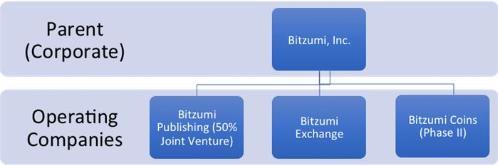


We anticipate implementing a two-phased approach to our business model. Phase I is to focus on developing an online presence to direct users and traffic to our targeted crypto-related products. In Phase II (following the public launch of our exchange), we plan to evaluate blockchain technologies and other growth initiatives, including developing our Bitzumi Coins division. Since we believe the most prominent use case for blockchain technologies is digital currencies, we expect to create special purpose coins for particular industries as our focus in Phase II. We anticipate continuing to evaluate other blockchain technology opportunities, as well as technologies that are complementary to our business strategy in an effort to minimize risks and enhance shareholder value. This will include evaluating opportunities that diversify our revenue streams, provide other consumer services and provide on-ramps for new users.
 
Below is an illustration our business model:
 
Our Products
 
Phase I: Publication / News Portal
 
Our publication business is intended to educate consumers on cryptocurrency and blockchain technology. It is expected to function as a news aggregation site as well as publishing original content. On June 27, 2017, we launched beta version of the site at www.ebitnews.com. We plan to acquire and/or partner with other news portals to become the leading news and information publisher for the cryptocurrency industry. Our business model anticipates initially deriving revenue from subscriptions and to later generate revenue from marketing as well.
 
On October 4, 2017, we entered into a 50% joint venture with Ibis Venture Partners, LLC (“Ibis Venture”) and formed Bitzumi Publishing, LLC, a New York limited liability company (“Bitzumi Publishing”), with the intention to market and sell various cryptocurrency newsletters and related informational and educational products.
 
On October 9, 2017, Bitzumi Publishing partnered with Agora Financial, LLC to market and sell a newsletter created by James Altucher, one of our co-founders. Bitzumi Publishing’s goal is to dominate search engine traffic in the cryptocurrency industry and drive traffic to both our Bitzumi exchange and other product offerings, such as subscription-based newsletters.
 
On January 10, 2018, Bitzumi entered into a joint venture and servicing agreement with Acacia Research Corporation (“Acacia”) to create a patent registration platform using Blockchain technology. In addition, Acacia and Bitzumi have agreed to a strategic investment by Acacia. See “Management’s Discussion and Analysis.”


Phase II: Exchange and Wallet
 
We intend Bitzumi to be a cryptocurrency exchange that provides a reliable and secure way to buy, sell, store, and trade to and from the following fiat and digital currencies: US dollars (“USD”), Bitcoin (“BTC”), Litecoin (“LTC”), and Ethereum (“ETH”). Bitzumi is expected to provide 24/7 access to customers’ digital wallets as well as liquidity into USD through integration with customer debit cards.
 
We intend that Bitzumi will focus on four key elements to distinguish itself from its competitors: security, customer support, a mix of advanced and simple trading tools, and most importantly, liquidity. We plan for our business model to focus on growth through customer acquisitions and marketing of our platform.
 
Payment Processing and Escrow
 
We plan to develop processing and escrow technology to facilitate the use of cryptocurrency in various industries. The platform is under development and we anticipate that it will be launched in 2018.
 
Market Overview
 
Bitcoin, Ethereum, and Litecoin
 
Bitcoins, Ethereum, and Litecoins are cryptocurrency, or digital commodities that are based on an open source protocol. Cryptocurrency is not issued by any government, bank, or central organization, but instead exists on an online, peer-to-­peer computer network. Each cryptocurrency has its own network (such as the Bitcoin Network, the Ethereum Network, and the Litecoin Network), which hosts a public transaction ledger where its respective cryptocurrency (respectively, Bitcoin, Ether, and Litecoin) transfers are recorded (the “Blockchain”). The Blockchain is a public record of the creation, custody, and flow of funds of cryptocurrency, and shows every transaction effected on the Blockchain among users’ online “digital wallets.” Digital wallets store cryptocurrency, and cryptocurrency may be sent or received through users’ digital wallets by using public and private keys that are part of the particular cryptocurrency’s network’s cryptographic security mechanism.
 
Software is used to access the cryptocurrency networks, and to create, move, and own cyrptocurrency. Bitcoins, Ether, and Litecoins have no physical existence beyond the record of transactions on the Blockchain.
 
Bitcoin History
 
The first decentralized cryptocurrency was Bitcoin, which was created in 2009. Bitcoin is still the most prominent cryptocurrency today. The Bitcoin Network is a recent technological innovation, and the Bitcoins that are created, transferred, used, and stored by entities and individuals have certain features associated with several types of assets, most notably commodities, securities, and currencies. Many U.S. regulators, including the Financial Crimes Enforcement Network of the U.S. Department of the Treasury (“FinCEN”), the U.S. Securities and Exchange Commission (“SEC”), the U.S. Commodity Futures Trading Commission (“CFTC”), the U.S. Internal Revenue Service (“IRS”), and state regulators, including the New York Department of Financial Services (“NYDFS”), have made official pronouncements or issued guidance or rules regarding the treatment of Bitcoins and other digital currencies, and may offer additional guidance or rules in the future. Other U.S. and state agencies have not made official pronouncements or issued guidance or rules regarding the treatment of Bitcoins. The treatment of Bitcoins and other digital currencies is often uncertain or contradictory in other countries. The regulatory uncertainty surrounding the treatment of Bitcoins and similar cryptocurrencies creates risks for the company. See “Risk Factors Related to Regulation.”


The Offering
 
Issuer:
 
Bitzumi, Inc.
 
Securities offered by the company:
 
Common Stock, par value $0.0001
 
Securities offered by selling stockholders:
 
None
 
Number of shares of Common Stock outstanding before the offering:
 
111,076,211
 
Number of shares of Common Stock to be outstanding after the offering:
 
115,076,211
Price per share:
 
$2.50
Minimum offering amount:
 
$1,000,000
 
Maximum offering amount:
 
$10,000,000
 
Use of proceeds:
 
We intend to use the proceeds towards offering expenses, software development, marketing and advertising, licensing and regulatory compliance, operational and customer support, public company and corporate costs, research and development and other application development, and working capital.
 
Risk factors
 
Risk Factors Related to the company
We have an evolving business model.
We have a limited operating history and a history of operating losses, and expect to incur significant additional operating losses.
We may need to secure additional financing.
Any valuation at this stage is difficult to assess.
Any inability to attract and retain additional personnel could affect our ability to successfully grow our business.
Loss of employees or contractors could affect our ability to successfully grow our business.
State licensing procedures are lengthy and expensive.
We may need to implement additional finance and accounting systems, procedures and controls as we grow our business and organization and to satisfy new reporting requirements.
Our auditors have issued a “going concern” audit opinion.
We have not conducted an evaluation of the effectiveness of our internal control over financial reporting and will not be required to do so until we are a public company. If we are unable to implement and maintain effective internal control over financial reporting investors may lose confidence in the accuracy and completeness of our financial reports and the market price of our Common Stock may be negatively affected.
Conflicts of interest may occur.
Our stock price may be volatile.


We have not paid cash dividends in the past and do not expect to pay dividends in the future. Any return on investment may be limited to the value of our Common Stock.
There is currently no trading market for our Common Stock and we cannot ensure that one will ever develop or be sustained.
You will experience future dilution as a result of future equity offerings.
We may be unable to protect our proprietary technology or keep up with that of our competitors.
We may not be able to obtain trademark protection for our marks, which could impede our efforts to build brand identity.
We may be accused of infringing intellectual property rights of third parties.
Implications of Being an Emerging Growth Company As an emerging growth company, we intend to take advantage of all of reduced reporting requirements and exemptions, including the longer phase-in periods for the adoption of new or revised financial accounting standards under the JOBS Act. Our election to use the phase-in periods may make it difficult to compare our financial statements to those of non-emerging growth companies and other emerging growth companies that have opted out of the phase-in periods.
 
Risk Factors Related to Cryptocurrency Networks and Cryptocurrency
The value of cryptocurrency and fluctuations in the price of cryptocurrency could materially and adversely affect the business and investment in the company.
The loss or destruction of a private key required to access cryptocurrency may be irreversible. Our loss of access to our private keys or our experience of a data loss relating to the cryptocurrency we hold could adversely affect an investment in our company.
We depend on third parties to provide execution of our trading platform, Internet, telecommunication and fiber optic network connectivity to the customers in our data centers, and any delays or disruptions in service could adversely affect an investment in us.
Power outages, limited availability of electrical resources, and increased energy costs could adversely affect our business.
The further development and acceptance of cryptocurrency networks, which represents a new and rapidly changing industry, are subject to a variety of factors that are difficult to evaluate. The slowing or stopping of the development or acceptance of digital currency systems may adversely affect our business.
Currently, there is relatively small use of cryptocurrency in the retail and commercial marketplace in comparison to relatively large use by speculators, thus contributing to price volatility that could adversely affect an investment in us.
The acceptance of Bitcoin network, Ethereum network, or Litecoin network software patches or upgrades by a significant, but not overwhelming, percentage of the users and miners in the respective networks could result in a “fork” in the Blockchain, resulting in the operation of two separate networks until such time as the forked Blockchains are merged. The temporary or permanent existence of forked Blockchains could adversely impact an investment in us.
The open-source structure of cryptocurrency network protocol means that the Core Developers and other contributors to the protocol are generally not directly compensated for their contributions in maintaining and developing the protocol. A failure to properly monitor and upgrade the protocol could damage the cryptocurrency network and an investment in us.
If the awards of cryptocurrency for solving blocks and transaction fees for recording transactions are not sufficiently high to incentivize miners, miners may respond in a way that reduces confidence in the cryptocurrency networks, which could adversely affect an investment in our company.
To the extent that any miners cease to record transactions in solved blocks, transactions that do not include the payment of a transaction fee will not be recorded on the Blockchain until a block is solved by a miner who does not require the payment of transaction fees. Any widespread delays in the recording of transactions could result in a loss of confidence in the cryptocurrency networks, which could adversely impact an investment in us.
Intellectual property rights claims may adversely affect the operation of cryptocurrency networks.


The cryptocurrency exchanges on which cryptocurrency trade are relatively new and, in most cases, largely unregulated and may therefore be more exposed to fraud and failure than established, regulated exchanges for other products. To the extent that the cryptocurrency exchanges representing a substantial portion of the volume in cryptocurrency trading are involved in fraud or experience security failures or other operational issues, such cryptocurrency exchanges’ failures may result in a reduction in the price of cryptocurrency and can adversely affect an investment in us.
Our ability to adopt technology in response to changing security needs or trends poses a challenge to the safekeeping of our cryptocurrency.
Security threats to us could result in a loss of company’s cryptocurrency, or damage to our reputation and our brand, each of which could adversely affect an investment in us.
Cryptocurrency transactions are irrevocable and stolen or incorrectly transferred cryptocurrency may be irretrievable. As a result, any incorrectly executed cryptocurrency transactions could render company liable to lawsuits or criminal charges to the extent company facilitates bad transactions, and thus, adversely affect an investment in us.
Our cryptocurrency may be subject to loss, damage, theft, or restriction on access.
A loss of confidence in our security system, or a breach of our security system, may adversely affect us and the value of an investment in us.
The limited rights of legal recourse against us, and our lack of insurance protection expose us and our shareholders to the risk of loss of our cryptocurrency for which no person is liable.
Cryptocurrency held by us are not subject to FDIC or SIPC protections.
We may not have adequate sources of recovery if our cryptocurrency is lost, stolen, or destroyed.
Political or economic crises may motivate large-scale sales of cryptocurrency, which could result in a reduction in cryptocurrency value and adversely affect an investment in us.
The sale of our cryptocurrency to pay expenses at a time of low cryptocurrency prices could adversely affect an investment in us.
 
Risk Factors Related to Publication Business
The further development and acceptance of cryptocurrency, which represent a new and rapidly changing industry, are subject to a variety of factors that are difficult to evaluate. The slowing or stopping of the development or acceptance of cryptocurrencies may adversely affect our newsletter and an investment in our company. 
We face significant competition across the media landscape, including from magazine publishers, digital publishers, social media platforms, search platforms, portals and digital marketing services, among others, which we expect will continue, and as a result we may not be able to maintain or improve our operating results. 
Service disruptions or failures of our or our vendors’ information systems and networks as a result of computer viruses, misappropriation of data or other malfeasance, natural disasters (including extreme weather), accidental releases of information or other similar events, may disrupt our business, damage our reputation or have a negative impact on our results of operations. 
Our business may suffer if we cannot protect our intellectual property. 
Technology in the media industry continues to evolve rapidly.
We face significant competition. Many of our competitors and potential competitors have larger customer bases, more established brand recognition and greater financial, marketing, technological, and personnel resources than we do, which could put us at a competitive disadvantage. Additionally, some of our competitors and potential competitors are better capitalized than we are and able to obtain capital more easily, which could put us at a competitive disadvantage. 
Failure to maintain our reputation for trustworthiness may harm our business. 
We rely heavily on joint ventures for the success of our publication business, thus, any problem with our joint venture relationships could have an adverse impact on our business.


Risk Factors Related to Regulation
U.S. and international regulatory changes or actions may restrict the use of or impose heightened regulatory burdens on cryptocurrency or the operation of cryptocurrency network based on currency, securities, or commodities regulations in a manner that adversely affects an investment in us.
It may be illegal now, or in the future, to acquire, own, hold, sell or use cryptocurrency in one or more countries, and ownership of, holding or trading in or company’s securities may also be considered illegal and subject to sanction.
Our business of converting cryptocurrencies to US dollars and vice versa require our registration as a “money services business” under the regulations promulgated by FinCEN under the authority of the US Bank Secrecy Act, and require the licensing or other registration as a money transmitter (or equivalent designation) under state law in any state in which we plan to operate. This process is lengthy and expensive, and any delays could delay commencing operations and cost additional money, which may have an adverse impact on the operation of our company and investment in our company.
If federal or state legislatures or agencies initiate or release tax determinations that change the classification of cryptocurrency as property for tax purposes, such determination could have a negative tax consequence on our company, and adversely affect investment in us.
Legislative and regulatory developments, including with respect to privacy, could adversely affect our business. 
 
Summary Financial Information
 
The following table summarizes the relevant financial data for our business and should be read with our financial statements, which are included in this prospectus. We have not had any significant operations to date, so only balance sheet data is presented.


September 30, 2017


Actual
 
 
As Adjusted(5)
 
Balance Sheet Data:


Working capital (1)
 $384,249 
 $10,326,249 
Total assets(2)
  401,332 
  10,401,332 
Total liabilities(3)
  - 
  58,000 
Shareholders’ equity(4)
  401,332 
  10,343,332 
 
(1)            
The “as adjusted” calculation includes $10,000,000 cash from the proceeds of this offering if the maximum amount is raised, plus $401,332 of actual shareholders’ equity as of September 30, 2017, less $58,000 of deferred underwriting commissions.
(2)            
The “as adjusted” calculation includes $10,000,000 net cash from the proceeds of this offering, plus $401,332 of actual shareholders’ equity as of September 30, 2017.
(3)            
The “as adjusted” calculation includes $58,000 of deferred underwriting commissions.
(4)            
The “as adjusted” calculation.
(5)            
The “as adjusted” column gives effect to the “maximum offering amount” of $10,000,000.


RISK FACTORS
 
The SEC requires the company to identify risks that are specific to its business and its financial condition. The company is still subject to all the same risks that all companies in its business, and all companies in the economy, are exposed to. These include risks relating to economic downturns, political and economic events and technological developments. Additionally, early-stage companies are inherently riskier than more developed companies. You should consider general risks as well as specific risks when deciding whether to invest.
 
Risk Factors Related to the Company
 
We have an evolving business model.
 
As digital currencies and blockchain technologies evolve, so will our business model. We may continue to try to offer additional types of products or services, and we cannot offer any assurance that any of them will be successful. From time to time we may also modify aspects of our business model relating to our product mix and service offerings. We cannot offer any assurance that these or any other modifications will be successful or will not result in harm to the business. We may not be able to manage growth effectively, which could damage our reputation, limit our growth, and negatively affect our operating results.
 
We have a limited operating history and a history of operating losses, and expect to incur significant additional operating losses.
 
We have a limited operating history. Therefore, there is no historical financial information on which to base an evaluation of our performance. Our prospects must be considered in light of the uncertainties, risks, expenses, and difficulties frequently encountered by companies in their early stages of operations. We have generated net losses of $51,167 for the period from June 13, 2017 (inception) through September 30, 2017. We expect to incur significant additional losses over the next 12 months as we continue to maintain and expand our existing operations. The amount of future losses and when, if ever, we will achieve profitability are uncertain. If we are unsuccessful at executing on our business plan, our business, prospects, and results of operations may be materially adversely affected.
 
We are likely to need to secure additional financing.
 
We anticipate that we will incur operating losses for the foreseeable future. Our historical cash burn rate for the period from June 13, 2017 (inception) through September 30, 2017 was on average approximately $14,000 per month, which included costs associated with the build out of our exchange platform. As a result, we expect that the cash we currently have on hand will fund our operations through April 2018. As of September 30, 2017, we had a cash position equal to $259,249. We are likely to require additional funds for our anticipated operations and further expansion and if we are not successful in securing additional financing, we may be required to delay significantly, reduce the scope of or eliminate one or more of our business activities, downsize our general and administrative infrastructure, or seek alternative measures to avoid insolvency. It is possible that future offerings will be at a different valuation, especially if an investor is a strategic investor and/or is willing to invest a significant amount of funds.
 
Any valuation at this stage is difficult to assess.
 
The valuation for the offering was established by the company. Unlike listed companies that are valued publicly through market-driven stock prices, the valuation of private companies, especially startups, is difficult to assess and you may risk overpaying for your investment.
 
Any inability to attract and retain additional personnel could affect our ability to successfully grow our business.
 
Our future success depends on our ability to identify, attract, hire, train, retain and motivate other highly-skilled technical, managerial, editorial, marketing and customer service personnel. Competition for such personnel is intense. Our failure to retain and attract the necessary technical, managerial, editorial, marketing, and customer service personnel could harm our business.


Loss of employees or contractors could affect our ability to successfully grow our business.
 
Our future success depends on our ability to retain certain key employees and contractors related to software and blockchain technology and development of proprietary content and newsletters for our publications. Our failure to retain these relationships, or adequately replace them in a timely manner, could harm our business.
 
State licensing procedures are lengthy and expensive.
 
We are required to obtain approval from federal and states regulatory authorities to operate as a money servicer. The cost to do so may exceed $1,000,000 and take 12-18 months to complete. We cannot fully operate until we obtain these licenses, and any delay in obtaining licenses could harm our business.
 
We may need to implement additional finance and accounting systems, procedures and controls as we grow our business and organization and to satisfy new reporting requirements.
 
We are required to comply with a variety of reporting, accounting, and other rules and regulations. Compliance with existing requirements is expensive. Further requirements may increase our costs and require additional management time and resources. We may need to implement additional finance and accounting systems, procedures and controls to satisfy our reporting requirements. If our internal controls over financial reporting are determined to be ineffective, such failure could cause investors to lose confidence in our reported financial information, negatively affect the market price of our Common Stock, subject us to regulatory investigations and penalties, and adversely impact our business and financial condition.
 
Our auditors have issued a “going concern” audit opinion.
 
Our independent auditors have indicated in their report on our September 30, 2017 financial statements that the company’s ability to continue as a going concern is dependent on our ability to implement the business plan, generate sufficient revenues, and to control operating expenses. A “going concern” opinion indicates that the financial statements have been prepared assuming we will continue as a going concern and do not include any adjustments to reflect the possible future effects on the recoverability and classification of assets, or the amounts and classification of liabilities that may result if we do not continue as a going concern. Therefore, you should not rely on our balance sheet as an indication of the amount of proceeds that would be available to satisfy claims of creditors, and potentially be available for distribution to stockholders, in the event of liquidation.
 
We have not conducted an evaluation of the effectiveness of our internal control over financial reporting and will not be required to do so until we are a public company. If we are unable to implement and maintain effective internal control over financial reporting investors may lose confidence in the accuracy and completeness of our financial reports and the market price of our Common Stock may be negatively affected.
 
We hope to list as a public company eventually, and at that time various accounting rules applicable to public companies will apply to us. We are uncertain that we have the procedures in place to make sure we meet those requirements, and compliance will be a burden. If and when required, our independent registered public accounting firm is unable to express an opinion as to the effectiveness of our internal control over financial reporting, at that time, investors may lose confidence in the accuracy and completeness of our financial reports and the market price of our Common Stock could be negatively affected, and we could become subject to investigations by the stock exchange on which our securities are listed, the SEC, or other regulatory authorities, which could require additional financial and management resources.


-10-
 
Conflicts of interest may occur.
 
Our chief executive officer, Scot Cohen, is involved in oil and gas and other companies including being the executive chairman of both Petro River Oil Corp and Wrap Technologies. He is also the managing member of various oil and gas related special purpose entities and a member of the Board of Directors of True Drinks, Inc.  In the event such positions and interest results in a conflict of interest between us and any of these other entities, he could potentially make decisions that are not in the best interest of the shareholders of the company.
 
To the extent that such other companies may participate in ventures in which we may desire to participate or the amount of time and attention we require overlaps with the needs of such other companies, Mr. Cohen may have a conflict of interest.  Our Board of Directors and Mr. Cohen will attempt to minimize such conflicts.  In determining whether or not our interests conflict with those of Mr. Cohen, our disinterested directors will primarily consider the potential benefits to us, the degree of risk to which we may be exposed and its financial position at that time.  Other than as indicated, the company has no other procedures or mechanisms to deal with conflicts of interest. It is possible that the existence of potential conflicts or decisions made in connection with such conflicts could adversely affect the price of our Common Stock and could cause the price to be less than it might have been if the conflicts did not exist or were avoided. Mr. Cohen will split his time equally between Bitzumi and his other business interests.
 
Our stock price may be volatile.
 
The market price of our Common Stock, if and when trading begins, is likely to be highly volatile and could fluctuate widely in price in response to various factors, many of which are beyond our control, including the following:
 
Changes to the Bitcoin industry, including value of Bitcoin and demand for Bitcoin;
We may not be able to compete successfully against current and future competitors;
Competitive pricing pressures;
Our ability to obtain working capital financing;
Additions or departures of key personnel;
Sales of our Common Stock;
Our ability to execute our business plan;
Operating results that fall below expectations;
Loss of any strategic relationship, including our joint venture partner in Bitzumi Publishing;
Regulatory developments, particularly those affecting cryptocurrency; and
Economic and other external factors.
 
In addition, the securities markets have from time to time experienced significant price and volume fluctuations that are unrelated to the operating performance of particular companies. These market fluctuations may also materially and adversely affect the market price of our Common Stock. As a result, you may be unable to resell your shares at a desired price.
 
We have not paid cash dividends in the past and do not expect to pay dividends in the future. Any return on investment may be limited to the value of our Common Stock.
 
We have never paid cash dividends on our Common Stock and do not anticipate doing so in the foreseeable future. The payment of dividends on our Common Stock will depend on earnings, financial condition and other business and economic factors affecting us at such time as our board of directors may consider relevant. If we do not pay dividends, our Common Stock may be less valuable because a return on your investment will only occur if our stock price appreciates.


-11-
 
There is currently no trading market for our Common Stock and we cannot ensure that one will ever develop or be sustained.
 
There is no current market for any of our shares of stock and a market may not develop. We hope to list our Common Stock on the Nasdaq Capital Market (“NASDAQ”) if we raise enough money in this offering, but there is no guarantee that we will be able to do so. See “Implications of being an emerging growth company.” If not listed on NASDAQ, shares of Common Stock, when issued, may be traded on the over-the-counter market to the extent any demand exists. Even if listed on NASDAQ, a liquid trading market may not develop. Investors should assume that they may not be able to liquidate their investment for some time, or be able to pledge their shares as collateral.
 
You will experience future dilution as a result of future equity offerings.
 
We may in the future offer additional shares of our Common Stock or other securities convertible into or exchangeable for our Common Stock. Although no assurances can be given that we will consummate a financing, in the event we do, or in the event we sell shares of Common Stock or other securities convertible into shares of our Common Stock in the future, additional and substantial dilution will occur. In addition, current investors or investors purchasing shares or other securities in the future could have rights superior to investors in this offering. Subsequent offerings at a lower price (a “down round”) or securities convertible into or exchangeable for our Common Stock at a lower price (including the securities held by Acacia) could result in additional dilution.
 
We may be unable to protect our proprietary technology or keep up with that of our competitors.
 
Our success depends to a significant degree upon the protection of our software and other proprietary intellectual property rights. We may be unable to deter misappropriation of our proprietary information, detect unauthorized use, or take appropriate steps to enforce our intellectual property rights. In addition, our competitors may now have or may in the future develop technologies that are as good as or better than our technology without violating our proprietary rights. Our failure to protect our software and other proprietary intellectual property rights or to utilize technologies that are as good as our competitors’ could put us at a disadvantage to our competitors.
 
We may not be able to obtain trademark protection for our marks, which could impede our efforts to build brand identity.
 
We have filed a trademark application with the Patent and Trademark Office seeking registration of the trademark, BITZUMI and EBIT NEWS. There can be no assurance that our application will be successful or that we will be able to secure significant protection for our trademark in the United States or elsewhere as we expand internationally. Our competitors or others could adopt product or service marks similar to our mark, or try to prevent us from using our mark, thereby impeding our ability to build brand identity and possibly leading to customer confusion. Any claim by another party against us or customer confusion related to our trademark, or our failure to obtain trademark registration, could harm our business.
 
We may be accused of infringing intellectual property rights of third parties.
 
Other parties may claim that we infringe their intellectual property rights. In the future we may be subject to legal claims of alleged infringement of the intellectual property rights of third parties. The ready availability of damages, royalties, and the potential for injunctive relief has increased the defense litigation costs of patent infringement claims, especially those asserted by third parties whose sole or primary business is to assert such claims. Such claims, even if not meritorious, may result in significant expenditure of financial and managerial resources, and the payment of damages or settlement amounts. Additionally, we may become subject to injunctions prohibiting us from using software or business processes we currently use or may need to use in the future, or requiring us to obtain licenses from third parties when such licenses may not be available on financially feasible terms or terms acceptable to us or at all. In addition, we may not be able to obtain on favorable terms, or at all, licenses or other rights with respect to intellectual property we do not own.


-12-
 
Implications of being an “emerging growth company”
 
As an issuer with less than $1 billion in total annual gross revenues during our last fiscal year, we will qualify as an “emerging growth company” under the Jumpstart Our Business Startups Act of 2012 (the “JOBS Act”) if and when we become a public company. An emerging growth company may take advantage of certain reduced reporting requirements and is relieved of certain other significant requirements that are otherwise generally applicable to public companies. In particular, as an emerging growth company we:
 
Would not be required to obtain an auditor attestation on our internal controls over financial reporting pursuant to the Sarbanes-Oxley Act of 2002;
Would not be required to provide a detailed narrative disclosure discussing our compensation principles, objectives and elements and analyzing how those elements fit with our principles and objectives (commonly referred to as “compensation discussion and analysis”);
Would not be required to obtain a non-binding advisory vote from our stockholders on executive compensation or golden parachute arrangements (commonly referred to as the “say-on-pay,” “say-on-frequency” and “say-on-golden-parachute” votes);
Would be exempt from certain executive compensation disclosure provisions requiring a pay-for-performance graph and CEO pay ratio disclosure;
May present only two years of audited financial statements and only two years of related Management’s Discussion and Analysis of Financial Condition and Results of Operations; and
Would be eligible to claim longer phase-in periods for the adoption of new or revised financial accounting standards.
 
We intend to take advantage of all of these reduced reporting requirements and exemptions, including the longer phase-in periods for the adoption of new or revised financial accounting standards under §107 of the JOBS Act. Our election to use the phase-in periods may make it difficult to compare our financial statements to those of non-emerging growth companies and other emerging growth companies that have opted out of the phase-in periods under §107 of the JOBS Act.
 
Under the JOBS Act, we may take advantage of the above-described reduced reporting requirements and exemptions for up to five years after our initial sale of common equity pursuant to a registration statement declared effective under the Securities Act of 1933, as amended (“Securities Act”), or such earlier time that we no longer meet the definition of an emerging growth company. Note that this offering, while a public offering, is not a sale of common equity pursuant to a registration statement, since the offering is conducted pursuant to an exemption from the registration requirements. In this regard, the JOBS Act provides that we would cease to be an “emerging growth company” if we have more than $1 billion in annual revenues, have more than $700 million in market value of our Common Stock held by non-affiliates, or issue more than $1 billion in principal amount of non-convertible debt over a three-year period.
 
 
-13-
 
Risk Factors Related to Cryptocurrency Networks and Cryptocurrency
 
The value of cryptocurrency and fluctuations in the price of cryptocurrency could materially and adversely affect the business and investment in the company.
 
Several factors may affect the value of cryptocurrency, including, but not limited to:
 
Total cryptocurrency in existence;
Global cryptocurrency demand, which is influenced by the growth of retail merchants’ and commercial businesses’ acceptance of cryptocurrency as payment for goods and services, the security of online cryptocurrency exchanges and digital wallets that hold cryptocurrency, the perception that the use and holding of cryptocurrency is safe and secure, the lack of regulatory restrictions on their use and the reputation of cryptocurrency for illicit use;
Global cryptocurrency supply, which is influenced by similar factors as global cryptocurrency demand, in addition to fiat currency needs by miners (for example, to invest in equipment or pay electricity bills) and taxpayers who may liquidate cryptocurrency holdings around tax deadlines to meet tax obligations;
Investors’ expectations with respect to the rate of inflation or deflation of fiat currencies or cryptocurrency;
Interest rates;
Currency exchange rates, including the rates at which cryptocurrency may be exchanged for fiat currencies;
Fiat currency withdrawal and deposit policies of cryptocurrency exchanges and liquidity of such cryptocurrency exchanges;
Interruptions in service from or failures of major cryptocurrency exchanges;
Cyber theft of cryptocurrency from online cryptocurrency wallet providers, or news of such theft from such providers, or from individuals’ cryptocurrency wallets;
Investment and trading activities of large investors, including private and registered funds, that may directly or indirectly invest in cryptocurrency;
Monetary policies of governments, trade restrictions, currency devaluations and revaluations;
Regulatory measures, if any, that restrict the use of cryptocurrency as a form of payment or the purchase of cryptocurrency on the cryptocurrency market;
The availability and popularity of businesses that provide cryptocurrency ­related services;
The maintenance and development of the open­source software protocol of certain cryptocurrency networks;
Increased competition from other forms of cryptocurrency or payments services;
Global or regional political, economic, or financial events and situations;
Expectations among cryptocurrency economy participants that the value of cryptocurrency will soon change; and
Fees associated with processing a cryptocurrency transaction.
 
The loss or destruction of a private key required to access cryptocurrency may be irreversible. Our loss of access to our private keys or our experience of a data loss relating to the cryptocurrency we hold could adversely affect an investment in our company.
 
Cryptocurrency is controllable only by the possessor of both the unique public key and private key relating to the local or online digital wallet in which the cryptocurrency is held. We are required by the operation of cryptocurrency networks to publish the public key relating to a digital wallet in use by us when the cryptocurrency network first verifies a spending transaction from that digital wallet, and disseminates such information into the cryptocurrency network. We safeguard and keep private the private keys relating to our cryptocurrency by utilizing AlphaPoint, an offsite third-party storage facility; to the extent a private key is lost, destroyed or otherwise compromised and no backup of the private key is accessible, we will be unable to access the cryptocurrency held by the private key and the private key will not be capable of being restored by the cryptocurrency network. Any loss of private keys relating to digital wallets used to store our cryptocurrency could adversely affect an investment in us.
 
 
-14-
 
We depend on third parties to provide execution of our trading platform, Internet, telecommunication and fiber optic network connectivity to the customers in our data centers, and any delays or disruptions in service could adversely affect an investment in us.
 
We rely on third-party service providers. In particular, we will depend on third parties to provide real time quotation and trading execution with our trading platform, Internet, telecommunication, and fiber optic network connectivity to our servers in our data center, and we have no control over the reliability of the services provided by these suppliers. We may in the future experience difficulties due to service failures unrelated to our systems and services. Any Internet, telecommunication, or fiber optic network failures may result in significant loss of connectivity of our wallets to the cryptocurrency exchanges, which could consequently impair our ability to facilitate cryptocurrency transactions, which could adversely impact an investment in us.
 
Power outages, limited availability of electrical resources, and increased energy costs could adversely affect our business.
 
Our operations are subject to electrical power outages, regional competition for available power, and increased energy costs. Any of these could result in loss of connectivity to our wallets, increased costs of operation, and/or damage to our servers and electrical equipment, which could consequently impair our ability to facilitate cryptocurrency transactions, which could adversely impact an investment in us.
 
The further development and acceptance of cryptocurrency networks, which represents a new and rapidly changing industry, are subject to a variety of factors that are difficult to evaluate. The slowing or stopping of the development or acceptance of digital currency systems may adversely affect our business.
 
Digital currencies may be used, among other things, to buy and sell goods and services are a new and rapidly evolving industry. The growth of the digital currency industry in general, and in particular the Bitcoin industry, Ethereum industry, and Litecoin industry, are subject to a high degree of uncertainty. The factors affecting the further development of the digital currencies industry, as well as the Bitcoin, Ethereum and Litecoin industries, include:
 
Continued worldwide growth in the adoption and use of Bitcoins, Ethereum, and Litecoins, and other cryptocurrency;
Government and quasi-government regulation of Bitcoin, Ethereum, and Litecoin, and other cryptocurrency and their use, or restrictions on or regulation of access to and operation of cryptocurrency networks and system;
The maintenance and development of the open-source software protocol of various cryptocurrency networks;
The availability and popularity of other forms or methods of buying and selling goods and services, including new means of using fiat currencies; and
General economic conditions and the regulatory environment relating to digital currencies.
 
A decline in the popularity or acceptance of the Bitcoin Network, Ethereum Network, or Litecoin Network could adversely affect an investment in us.


-15-
 
Currently, there is relatively small use of cryptocurrency in the retail and commercial marketplace in comparison to relatively large use by speculators, thus contributing to price volatility that could adversely affect an investment in us.
 
As relatively new products and technologies, cryptocurrency has only recently become widely accepted as a means of payment for goods and services by many major retail and commercial outlets, and use of cryptocurrency by consumers to pay such retail and commercial outlets remains limited. Conversely, a significant portion of cryptocurrency demand is generated by speculators and investors seeking to profit from the short- or long-term holding of cryptocurrency. A lack of expansion by cryptocurrency into retail and commercial markets, or a contraction of such use, may result in increased volatility or a reduction in the price of cryptocurrencies, either of which could adversely impact an investment in us.
 
The acceptance of Bitcoin Network, Ethereum Network, or Litecoin Network software patches or upgrades by a significant, but not overwhelming, percentage of the users and miners in the respective networks could result in a “fork” in the Blockchain, resulting in the operation of two separate networks until such time as the forked Blockchains are merged. The temporary or permanent existence of forked Blockchains could adversely impact an investment in us.
 
Bitcoin, Ethereum, and Litecoin are open source projects and, although there is an influential group of leaders in the cryptocurrency community, there is no official developer or group of developers that formally controls the Bitcoin, Ethereum, or Litecoin Networks. Any individual can download the particular cryptocurrency network software and make any desired modifications, which are proposed to users and miners on the respective network through software downloads and upgrades. A substantial majority of miners and the particular cryptocurrency users must consent to those software modifications by downloading the altered software or upgrade that implements the changes; otherwise, the changes do not become a part of the cryptocurrency network. Generally, changes to various cryptocurrency networks have been accepted by the vast majority of users and miners, ensuring that the cryptocurrency networks remain coherent economic systems; however, a developer or group of developers could potentially propose a modification to a cryptocurrency network that is not accepted by avast majority of miners and users, but that is nonetheless accepted by a substantial population of participants in the respective cryptocurrency network. In such a case, and if the modification is material and/or not backwards compatible with the prior version of the respective cryptocurrency network software, a “fork” in the Blockchain could develop and two separate networks of the same cryptocurrency could result, one running the pre-modification software program and the other running the modified version (e.g., a second Bitcoin Network). Such a fork in the Blockchain typically would be addressed by community-led efforts to merge the forked Blockchains, and several prior forks have been so merged without any material impact on the price of Bitcoin, although there can be no assurance that this will always be the case upon a fork. This kind of split in a Bitcoin, Ethereum, or Litecoin Network could materially and adversely impact an investment in us and, in the worst case scenario, harm the sustainability of the respective network’s economy.
 
The open-source structure of cryptocurrency network protocol means that the Core Developers and other contributors to the protocol are generally not directly compensated for their contributions in maintaining and developing the protocol. A failure to properly monitor and upgrade the protocol could damage the cryptocurrency network and an investment in us.
 
The Bitcoin, Ethereum, and Litecoin Networks operate based on an open-source protocol maintained by the Core Developers and other contributors. The Core Developers are those developers employed by MIT Media Lab’s Digital Currency Initiative who oversee the Bitcoin Network. See “Crytpographic Security Used in the Bitcoin Network—Modification to the Bitcoin Network.” As these network protocols are not sold and the networks’ use does not generate revenues for its development team, the Core Developers and contributors are generally not compensated for maintaining and updating the respective cryptocurrency network protocol. To the extent that material issues arise with the Bitcoin, Ethereum, or Litecoin Network protocols, and the Core Developers and open-source contributor community are unable to address the issues adequately or in a timely manner, the respective cryptocurrency network and an investment in us may be adversely affected.


-16-
 
If the awards of cryptocurrency for solving blocks and transaction fees for recording transactions are not sufficiently high to incentivize miners, miners may respond in a way that reduces confidence in the cryptocurrency networks, which could adversely affect an investment in our company.
 
If the award of new cryptocurrency for solving blocks declines and transaction fees are not sufficiently high, miners may not have an adequate incentive to continue mining and may cease their mining operations. See “Overview of the Bitcoin Network Operations--Bitcoin Mining and Creation of New Bitcoins.” Miners ceasing operations would reduce the collective processing power on the cryptocurrency networks, which would adversely affect the confirmation process for transactions (i.e., temporarily decreasing the speed at which blocks are added to the Blockchain until the next scheduled adjustment in difficulty for block solutions) and make the cryptocurrency networks more vulnerable to a malicious actor or botnet obtaining control in excess of 50 percent of the processing power on the cryptocurrency networks. Any reduction in confidence in the confirmation process or processing power of cryptocurrency networks may adversely impact an investment in us.
 
In addition, to the extent to which the value of cryptocurrency mined by a professionalized mining operation exceeds the allocable capital and operating costs determines the profit margin of such operation. A professionalized mining operation may be more likely to sell a higher percentage of its newly mined cryptocurrency rapidly if it is operating at a low profit margin—and it may partially or completely cease operations if its profit margin is negative. In a low profit margin environment, a higher percentage of the new cryptocurrency mined each day will be sold into the cryptocurrency exchange markets more rapidly, thereby reducing cryptocurrency prices. Lower cryptocurrency prices will result in further tightening of profit margins, particularly for professionalized mining operations with higher costs and more limited capital reserves, creating a network effect that may further reduce the price of cryptocurrency until mining operations with higher operating costs become unprofitable and remove mining power from the cryptocurrency networks. The network effect of reduced profit margins resulting in greater sales of newly mined cryptocurrency could result in a reduction in the price of cryptocurrency that could adversely impact an investment in our company.
 
To the extent that any miners cease to record transactions in solved blocks, transactions that do not include the payment of a transaction fee will not be recorded on the Blockchain until a block is solved by a miner who does not require the payment of transaction fees. Any widespread delays in the recording of transactions could result in a loss of confidence in the cryptocurrency networks, which could adversely impact an investment in us.
 
To the extent that any miners cease to record transactions in solved blocks, such transactions will not be recorded on the Blockchain. Currently, there are no known incentives for miners to elect to exclude the recording of transactions in solved blocks; however, to the extent that any such incentives arise (e.g., a collective movement among miners or one or more mining pools forcing cryptocurrency users to pay transaction fees as a substitute for or in addition to the award of new cryptocurrency upon the solving of a block), actions of miners solving a significant number of blocks could delay the recording and confirmation of transactions on the Blockchain. Any systemic delays in the recording and confirmation of transactions on the Blockchain could result in greater exposure to double-spending transactions and a loss of confidence in cryptocurrency networks, which could adversely impact an investment in our company. 
 
Intellectual property rights claims may adversely affect the operation of cryptocurrency networks.
 
Third parties may assert intellectual property claims relating to the holding and transfer of digital currencies and their source code. Regardless of the merit of any intellectual property or other legal action, any threatened action that reduces confidence in cryptocurrency networks’ long-term viability or the ability of end-users to hold and transfer cryptocurrency may adversely affect an investment in us. Additionally, a meritorious intellectual property claim could prevent us and other end-users from accessing cryptocurrency networks or holding or transferring their cryptocurrency. As a result, an intellectual property claim against us or other large cryptocurrency network participants could adversely affect an investment in us.


-17-
 
The cryptocurrency exchanges on which cryptocurrency trade are relatively new and, in most cases, largely unregulated and may therefore be more exposed to fraud and failure than established, regulated exchanges for other products. To the extent that the cryptocurrency exchanges representing a substantial portion of the volume in cryptocurrency trading are involved in fraud or experience security failures or other operational issues, such cryptocurrency exchanges’ failures may result in a reduction in the price of cryptocurrency and can adversely affect an investment in us.
 
The cryptocurrency exchanges on which cryptocurrency trade are new and, in most cases, largely unregulated. Furthermore, many cryptocurrency exchanges do not provide the public with significant information regarding their ownership structure, management teams, corporate practices, or regulatory compliance. As a result, the marketplace may lose confidence in, or may experience problems relating to, cryptocurrency exchanges, including prominent exchanges handling a significant portion of the volume of cryptocurrency trading. These potential consequences of a cryptocurrency exchange’s failure could reduce the demand and use of cryptocurrency, reduce the value of cryptocurrency, and/or adversely affect an investment in us.
 
Over the past four years, many cryptocurrency exchanges have been closed due to fraud, failure, or security breaches. In many of these instances, the customers of such cryptocurrency exchanges were not compensated or made whole for the partial or complete losses of their account balances in such cryptocurrency exchanges. While smaller cryptocurrency exchanges are less likely to have the infrastructure and capitalization that make larger cryptocurrency exchanges more stable, larger cryptocurrency exchanges are more likely to be appealing targets for hackers and “malware” (i.e., software used or programmed by attackers to disrupt computer operation, gather sensitive information, or gain access to private computer systems).
 
A lack of stability in the cryptocurrency exchange market and the closure or temporary shutdown of cryptocurrency exchanges due to fraud, business failure, hackers or malware, or government-mandated regulation may reduce confidence in cryptocurrency networks and result in greater volatility in cryptocurrency value. These potential consequences of a cryptocurrency exchange’s failure could reflect poorly on us even if we are not involved in that failure, and adversely affect an investment in our company.
 
Our ability to adopt technology in response to changing security needs or trends poses a challenge to the safekeeping of our cryptocurrency.
 
The history of the cryptocurrency exchange markets has shown that cryptocurrency exchanges and large holders of cryptocurrency must adapt to technological change in order to secure and safeguard their cryptocurrency. We rely on AlphaPoint, a third-party off site storage provider, to safeguard our cryptocurrency holdings from theft, loss, destruction or other issues relating to hackers and technological attack. We believe that it may become a more appealing target of security threats as the size of our cryptocurrency holdings grow. To the extent that either our third-party storage sites or we are unable to identify and mitigate or stop new security threats, our cryptocurrency holdings may be subject to theft, loss, destruction or other attack, which could adversely affect an investment in us.
 
Security threats to us could result in a loss of company’s cryptocurrency, or damage to our reputation and our brand, each of which could adversely affect an investment in us.
 
Security breaches, computer malware, and computer hacking attacks have been a prevalent concern in cryptocurrency exchange markets since the launch of cryptocurrency networks. Any security breach caused by hacking, which involves efforts to gain unauthorized access to information or systems, or to cause intentional malfunctions or loss or corruption of data, software, hardware or other computer equipment, and the inadvertent transmission of computer viruses, could harm our business operations or result in loss of our cryptocurrency. Any breach of our infrastructure could result in damage to our reputation which could adversely affect an investment in us. Furthermore, we believe that, as our assets grow, we may become a more appealing target for security threats such as hackers and malware.


-18-
 
We rely solely on AlphaPoint to safeguard our cryptocurrency holdings from theft, loss, destruction or other issues relating to hackers and technological attack. Nevertheless, our third-party storage provider security system may not be impenetrable and may not be free from defect or immune to acts of God, and any loss due to a security breach, software defect or act of God will be borne by us.
 
The security system and operational infrastructure may be breached due to the actions of outside parties, error or malfeasance of an employee of ours, or otherwise, and, as a result, an unauthorized party may obtain access to our, private keys, data or cryptocurrency holdings. Additionally, outside parties may attempt to fraudulently induce employees of ours to disclose sensitive information in order to gain access to our infrastructure. As the techniques used to obtain unauthorized access, disable or degrade service, or sabotage systems change frequently, or may be designed to remain dormant until a predetermined event and often are not recognized until launched against a target, we may be unable to anticipate these techniques or implement adequate preventative measures. If an actual or perceived breach of our security system occurs, the market perception of the effectiveness of our security system could be harmed, which could adversely affect an investment in us.
 
In the event of a security breach, we may be forced to cease operations, or suffer a reduction in assets, the occurrence of each of which could adversely affect an investment in us.
 
Cryptocurrency transactions are irrevocable and stolen or incorrectly transferred cryptocurrency may be irretrievable. As a result, any incorrectly executed cryptocurrency transactions could render company liable to lawsuits or criminal charges to the extent company facilitates bad transactions, and thus, adversely affect an investment in us.
 
Cryptocurrency transactions are not, from an administrative perspective, reversible without the consent and active participation of the recipient of the transaction or, in theory, control or consent of a majority of the processing power on the cryptocurrency network. Once a transaction has been verified and recorded in a block that is added to the Blockchain, an incorrect transfer of cryptocurrency or a theft of cryptocurrency generally will not be reversible and we may not be capable of seeking compensation for any such transfer or theft. Although our transfers of cryptocurrency will regularly be made to or from vendors, consultants, services providers, etc. it is possible that, through computer or human error, or through theft or criminal action, our cryptocurrency could be transferred from us in incorrect amounts or to unauthorized third parties. To the extent that we are unable to seek a corrective transaction with such third-party or are incapable of identifying the third-party that has received our cryptocurrency through error or theft, we will be unable to revert or otherwise recover incorrectly transferred company cryptocurrency. To the extent that we are unable to seek redress for such error or theft, such loss could adversely affect an investment in us. In addition, incorrectly executed cryptocurrency transactions could render company liable to lawsuits or criminal charges to the extent company facilitates bad transactions, and thus, adversely affect an investment in us.
 
Our cryptocurrency holdings may be subject to loss, damage, theft, or restriction on access.
 
There is a risk that part or all of our cryptocurrency holdings could be lost, stolen or destroyed. We believe that our cryptocurrency holdings will be an appealing target to hackers or malware distributors seeking to destroy, damage or steal our cryptocurrency. Although we utilize AlphaPoint for enterprise multi-signature storage solution, to minimize the risk of loss, damage and theft, we cannot guarantee that it will prevent such loss, damage or theft, whether caused intentionally, accidentally or by act of God. Access to our cryptocurrency could also be restricted by natural events (such as an earthquake or flood) or human actions (such as a terrorist attack). Any of these events may adversely affect our operations and, consequently, an investment in us.


-19-
 
A loss of confidence in our security system, or a breach of our security system, may adversely affect us and the value of an investment in us.
 
We will take measures to protect us and our cryptocurrency holdings from unauthorized access, damage or theft; however, it is possible that the security system may not prevent the improper access to, or damage or theft of our cryptocurrency. A security breach could harm our reputation or result in the loss of some or all of our cryptocurrency. A resulting perception that our measures do not adequately protect our cryptocurrency could result in a loss of current or potential shareholders, reducing demand for our Common Stock and causing our shares to decrease in value.
 
The limited rights of legal recourse against us, and our lack of insurance protection expose us and our shareholders to the risk of loss of our cryptocurrency for which no person is liable.
 
The cryptocurrency held by us are not insured. Therefore, a loss may be suffered with respect to our cryptocurrency, which is not covered by insurance and for which no person is liable in damages which could adversely affect our operations and, consequently, an investment in us.
 
Cryptocurrency held by us is not subject to FDIC or SIPC protections.
 
We do not hold our cryptocurrency with a banking institution or a member of the Federal Deposit Insurance Corporation (“FDIC”) or the Securities Investor Protection Corporation (“SIPC”) and, therefore, our cryptocurrency is not subject to the protections enjoyed by depositors with FDIC or SIPC member institutions.
 
We may not have adequate sources of recovery if our cryptocurrency is lost, stolen, or destroyed.
 
If our cryptocurrency is lost, stolen, or destroyed under circumstances rendering a party liable to us, the responsible party may not have the financial resources sufficient to satisfy our claim. For example, as to a particular event of loss, the only source of recovery for us might be limited, to the extent identifiable, other responsible third parties (e.g., a thief or terrorist), any of which may not have the financial resources (including liability insurance coverage) to satisfy a valid claim of ours.
 
Political or economic crises may motivate large-scale sales of cryptocurrency, which could result in a reduction in cryptocurrency value and adversely affect an investment in us.
 
As an alternative to fiat currencies that are backed by central governments, digital currencies such as Bitcoin, Ethereum, and Litecoin, which are relatively new, are subject to supply and demand forces based upon the desirability of an alternative, decentralized means of buying and selling goods and services, and it is unclear how such supply and demand will be impacted by geopolitical events. Nevertheless, political or economic crises may motivate large-scale acquisitions or sales of Bitcoins, Ethereum, or Litecoins, either globally or locally. Large-scale sales of Bitcoins, Ethereum, or Litecoins, would result in a reduction in the respective cryptocurrency value and could adversely affect an investment in us.
 
The sale of our cryptocurrency to pay expenses at a time of low cryptocurrency prices could adversely affect an investment in us.
 
We may sell cryptocurrency to pay expenses on an as-needed basis, irrespective of then-current cryptocurrency prices. Consequently, our cryptocurrency may be sold at a time when the cryptocurrency prices on the cryptocurrency exchange market are low, which could adversely affect an investment in us.


-20-
 
Risk Factors Related to Publication Business
 
The further development and acceptance of cryptocurrency, which represent a new and rapidly changing industry, are subject to a variety of factors that are difficult to evaluate. The slowing or stopping of the development or acceptance of cryptocurrencies may adversely affect our newsletter and an investment in our company. 
 
Cryptocurrency such as Bitcoins that may be used, among other things, to buy and sell goods and services are a new and rapidly evolving industry of which the Bitcoin Network is a prominent, but not unique, part. The growth of the cryptocurrency industry in general, and the Bitcoin Network in particular, is subject to a high degree of uncertainty. The factors affecting the further development of the cryptocurrency industry, as well as the Bitcoin Network, include:  
 
Continued worldwide growth in the adoption and use of Bitcoin and other digital currencies; 
Government and quasi-government regulation of cryptocurrency and other digital assets and their use, or restrictions on or regulation of access to and operation of the Bitcoin Network to similar digital asset systems; 
Changes in consumer demographics and public tastes preferences; 
General economic conditions and regulatory environment relating to digital assets; and 
Negative consumer perception of cryptocurrencies. 
 
Overall, a decline in the popularity or acceptance of cryptocurrency could impact interest in our newsletter, and would harm the price of shares and investment in our company. 
 
We face significant competition across the media landscape, including from magazine publishers, digital publishers, social media platforms, search platforms, portals and digital marketing services, among others, which we expect will continue, and as a result we may not be able to maintain or improve our operating results. 
 
We compete with other cryptocurrency newsletter and magazine publishers for market share and for the time and attention. We also compete with digital publishers and other forms of media, including, among others, social media platforms, search platforms, portals and digital marketing services. The competition we face has intensified as a result of the growing popularity of mobile devices, such as smartphones and social-media platforms, and the shift in consumer preference from print media to digital media for the delivery and consumption of content, including video content. Social media and other platforms such as Facebook, Twitter, Snapchat, Google and Yahoo! are successful in gathering national, local, and entertainment news and information from multiple sources and attracting a broad readership base. News aggregation websites and customized news feeds (often free to users) may reduce our traffic levels by minimizing the need for the audience to subscribe to our newsletter, or to visit our websites or use our digital applications directly. Given the ever-growing and rapidly changing number of digital media options available on the Internet, we may not be able to increase subscribers or our online traffic sufficiently and retain or grow a base of frequent patrons to our newsletter. In addition, the ever-growing and rapidly changing number of digital media options available on the Internet may lead to technologies and alternatives that we are not able to offer. If we are unable to demonstrate to consumers the continuing value of our print and digital platforms, our business, financial condition and results of operations may be adversely affected. 


-21-
 
Service disruptions or failures of our or our vendors’ information systems and networks as a result of computer viruses, misappropriation of data or other malfeasance, natural disasters (including extreme weather), accidental releases of information or other similar events, may disrupt our business, damage our reputation or have a negative impact on our results of operations. 
 
Because information systems, networks, and other technologies are critical to many of our operating activities, shutdowns or service disruptions at our company or vendors that provide information systems, networks, printing or other services to us pose increasing risks. Such disruptions may be caused by events such as computer hacking, phishing attacks, dissemination of computer viruses, malware, worms and other destructive or disruptive software, denial of service attacks and other malicious activity, as well as power outages, natural disasters (including extreme weather), terrorist attacks or other similar events. Such events could have an adverse impact on us and our customers, including degradation or disruption of service, loss of data and damage to equipment and data. In addition, system redundancy may be ineffective or inadequate, and our disaster recovery planning may not be sufficient to cover all eventualities. Significant events could result in a disruption of our operations, customer or advertiser dissatisfaction, damage to our reputation or brands or a loss of customers or revenues. In addition, we may not have adequate insurance coverage to compensate for any losses associated with such events. 
 
We could be subject to risks caused by misappropriation, misuse, leakage, falsification or intentional or accidental release or loss of information maintained in the information systems and networks of our company and our vendors, including personal information of our employees and customers, and company and vendor confidential data. In addition, outside parties may attempt to penetrate our systems or those of our vendors or fraudulently induce our employees or customers or employees of our vendors to disclose sensitive information in order to gain access to our data, or to take control of our sites in order to publish false information or otherwise mislead our users. Like other companies, we have on occasion experienced, and will continue to experience, threats to our data and systems, including malicious codes and viruses, and other cyber attacks. The number and complexity of these threats continue to increase over time. If a material breach of our security or that of our vendors occurs, the market perception of the effectiveness of our security measures could be harmed, we could lose customers, audience and advertisers and our reputation, brands and credibility could be damaged. We could be required to expend significant amounts of money and other resources to repair or replace information systems or networks. In addition, we could be subject to regulatory actions and claims made by consumers and groups in private litigation involving privacy issues related to consumer data collection and use practices and other data privacy laws and regulations, including claims for misuse or inappropriate disclosure of data, as well as unfair or deceptive practices. Although we develop and maintain systems and controls designed to prevent these events from occurring, and we have a process to identify and mitigate threats, the development and maintenance of these systems, controls and processes is costly and requires ongoing monitoring and updating as technologies change and efforts to overcome security measures become more sophisticated. Moreover, despite our efforts, the possibility of these events occurring cannot be eliminated entirely. Because we distribute most of our content digitally, outsource more of our information systems to vendors, engage in more electronic transactions with consumers and rely more on cloud-based information systems, the related security risks will increase and we will need to expend additional resources to protect our technology and information systems. Additionally, a growing portion of our subscription revenues, is dependent on the continuous service model and our ability to automatically renew customers (with proper notifications and authorizations) using credit or debit cards that customers provide at the time of purchase. Significant credit card breaches at major retailers have resulted in a number of banks re-issuing credit cards. This may create a break in our relationship with customers whose cards are reissued and results in lost renewal revenue. A continuation or increase in such breaches and resulting re-issuances could adversely impact our business, financial condition and results of operations. 
 
We are also subject to payment card association rules and obligations under our contracts with payment card processors. Under these rules and obligations, if information is compromised, we could be liable to payment card issuers for the cost of associated expenses and penalties. In addition, if we fail to follow payment card industry security standards, even if no customer information is compromised, we could incur significant fines or experience a significant increase in payment card transaction costs. Furthermore, if we fail to comply with the chargeback policies established by a payment card processor, it could result in us incurring significant fines or even the termination of our contract with that payment card processor. 


-22-
 
Our business may suffer if we cannot protect our intellectual property. 
 
Our business depends on our intellectual property, including our valuable brands, content, services and internally developed technology. We believe our proprietary trademarks and other intellectual property rights are important to our continued success and our competitive position. Unauthorized parties may attempt to copy or otherwise unlawfully obtain and use our content, services, technology and other intellectual property, and we cannot be certain that the steps we have taken to protect our proprietary rights will prevent any misappropriation or confusion among consumers and merchants, or unauthorized use of these rights. 
 
Advancements in technology have made the unauthorized duplication and wide dissemination of content easier, making the enforcement of intellectual property rights more challenging. In addition, as our business and the risk of misappropriation of our intellectual property rights have become more global in scope, we may not be able to protect our proprietary rights in a cost-effective manner in a multitude of jurisdictions with varying laws. 
 
If we are unable to procure, protect and enforce our intellectual property rights, including maintaining and monetizing our intellectual property rights to our content, we may not realize the full value of these assets, and our business and profitability may suffer. In addition, if we must litigate in the United States or elsewhere to enforce our intellectual property rights or determine the validity and scope of the proprietary rights of others, such litigation may be costly and divert the attention of our management. In addition, if we must take actions, including litigation, in the United States or elsewhere to enforce our intellectual property rights or determine the validity and scope of the proprietary rights of others, such actions may be costly and divert the attention of our management. 
 
Technology in the media industry continues to evolve rapidly. 
 
Technology in the media industry continues to evolve rapidly. Advances in technology have led to an increasing number of methods for delivery of content and have resulted in a wide variety of consumer demands and expectations, which are also rapidly evolving. If we are unable to exploit new and existing technologies to distinguish our products and services from those of our competitors or adapt to new distribution methods that provide optimal user experiences, our business and financial results may be adversely affected. 
 
The increasing number of digital media options available on the Internet, through social networking tools and through mobile and other devices distributing content is expanding consumer choice significantly. Faced with a multitude of media choices and a dramatic increase in accessible information, consumers may place greater value on when, where, how and at what price they consume digital content. 
 
In addition, the expenditures necessary to implement these new technologies could be substantial and other companies employing such technologies before we are able to do so could aggressively compete with our business. 
 
We face significant competition. Many of our competitors and potential competitors have larger customer bases, more established brand recognition and greater financial, marketing, technological, and personnel resources than we do, which could put us at a competitive disadvantage. Additionally, some of our competitors and potential competitors are better capitalized than we are and able to obtain capital more easily, which could put us at a competitive disadvantage. 
  
Some of our competitors have larger customer bases, more established name recognition, a greater market share and greater financial, marketing, technological and personnel resources than we do. Increased competition could result in price reductions, reduced margins or loss of market share, any of which could materially adversely affect our business, results of operations, and financial condition. Accordingly, we cannot guarantee that we will be able to compete effectively with our current or future competitors or that this competition will not significantly harm our business. 


-23-
 
Failure to maintain our reputation for trustworthiness may harm our business. 
 
Our brand is based on the integrity of our editorial content. We require all of our content contributors, whether employees or outside contributors, to adhere to strict standards of integrity, including standards that are designed to prevent any actual or potential conflict of interest, and to comply with all applicable laws, including securities laws. The occurrence of events such as our misreporting a cryptocurrency technological advancement, could harm our reputation for trustworthiness and reduce readership. In addition, in the event the reputation of any of our directors, officers, key contributors, writers, or editorial staff were harmed for any other reason, we could suffer as result of our association with the individual, and also could suffer if the quantity or value of future services we received from the individual was diminished. These events could materially adversely affect our business, results of operations and financial condition. 
 
We rely heavily on joint ventures for the success of our publication business, thus, any problem with our joint venture relationships could have an adverse impact on our business.
 
We rely heavily on our ability to locate, attract, and maintain joint venture agreements with companies that can successfully launch and maintain cryptocurrency publications. If those joint venture companies breach our agreements, terminate our agreements, or we are unable to partner with such cryptocurrency publications in the future, that could have an adverse impact on our publication business.
 
Risk Factors Related to Regulation
 
U.S. and international regulatory changes or actions may restrict the use of or impose heightened regulatory burdens on cryptocurrency or the operation of cryptocurrency network based on currency, securities, or commodities regulations in a manner that adversely affects an investment in us.
 
Until recently, little or no regulatory attention has been directed toward cryptocurrency and the cryptocurrency networks by U.S. federal and state governments, foreign governments, and self-regulatory agencies. As cryptocurrency has grown in popularity and in market size, the Federal Reserve Board, U.S. Congress, and certain US agencies (e.g., FinCEN and the Federal Bureau of Investigation) have begun to examine the operations of cryptocurrency networks, cryptocurrency users, and cryptocurrency exchange markets. Local state regulators such as the California Department of Financial Institutions and the New York State Department of Financial Services have also initiated examinations of Bitcoins, the Bitcoin Network, and the regulation thereof. Additionally, a U.S. federal magistrate judge in the U.S. District Court for the Eastern District of Texas has ruled that “Bitcoin is a currency or form of money,” two CFTC commissioners publicly expressed a belief that derivatives based on Bitcoins are subject to the same regulation as those based on commodities, and the IRS released guidance treating cryptocurrency as property that is not currency for U.S. federal income tax purposes, although there is no indication yet whether other courts or federal or state regulators will follow these asset classifications. There is a possibility of future regulatory change altering, perhaps to a material extent, the nature of an investment in us or our ability to continue to operate.
  
Currently, neither the SEC nor the CFTC has formally asserted regulatory authority over cryptocurrency, cryptocurrency networks, or cryptocurrency trading and ownership, though in testimony before the U.S. Senate Committee on Agriculture, Nutrition and Forestry on December 10, 2014, CFTC Chairman Timothy Massad stated that the CFTC believed it had jurisdiction over derivative instruments such as futures and swaps based on digital currencies. On July 25, 2017, the SEC issued an investigative report, stating that offers and sales of digital assets by “virtual” organizations using distributed ledger or cryptocurrency technology (i.e., Initial Coin Offerings or Token Sales) are subject to the requirements of the federal securities laws. To the extent that Bitcoins, Ethereum, or Litecoins, themselves are determined to be a security, commodity future or other regulated asset, or to the extent that a US or foreign government or quasi-governmental agency exerts regulatory authority over the Bitcoin, Ethereum, or Litecoin Networks, or cryptocurrency trading and ownership, trading or ownership in cryptocurrency may be adversely affected, which could adversely affect an investment in our company.


-24-
 
To the extent that future regulatory actions or policies limit the ability to exchange cryptocurrency or utilize them for payments, the demand for cryptocurrency will be reduced. Furthermore, regulatory actions may limit the ability of end-users to convert cryptocurrency into fiat currency (e.g., U.S. Dollars) or use cryptocurrency to pay for goods and services. Such regulatory actions or policies could adversely affect an investment in us.
 
Cryptocurrency currently faces an uncertain regulatory landscape in not only the United States but also in many foreign jurisdictions such as the European Union, China and Russia. While certain governments such as Germany—where the Ministry of Finance has declared Bitcoins to be “Rechnungseinheiten” (a form of private money that is recognized as a unit of account, but not recognized in the same manner as fiat currency) — have issued guidance as to how to treat Bitcoins, most regulatory bodies have not yet issued official statements regarding intention to regulate or determinations on regulation of cryptocurrency, the cryptocurrency networks, and cryptocurrency users. Among those for which preliminary guidance has been issued in some form, Canada and Taiwan have labeled cryptocurrency as a digital or virtual currency, distinct from fiat currency, while Sweden and Norway are among those to categorize cryptocurrency as a form of virtual asset or commodity. In China, authorities have recently banned use of Bitcoins and ordered Beijing-based cryptocurrency exchanges to cease trading and immediately notify users of their closures. Similarly, Russia has indicated an intent to ban use of Bitcoins and Russia’s Central Bank stated that at this stage they will not approve any cryptocurrency trading on any official exchange, nor will it approve the use of the technology for infrastructure purposes. In May 2014, the Central Bank of Bolivia banned the use of Bitcoins as a means of payment. In the summer and fall of 2014, Ecuador announced plans for its own state-backed electronic money, while passing legislation that reportedly prohibits the use of decentralized digital currencies. Conversely, regulatory bodies in some countries such as India and Switzerland have declined to exercise regulatory authority when afforded the opportunity. Various foreign jurisdictions may, in the near future, adopt laws, regulations, or directives that affect cryptocurrency networks and its users, particularly cryptocurrency exchanges and service providers that fall within such jurisdictions’ regulatory scope. Other countries such as Malaysia and Australia have been considering regulation, classification, and potential bans. Such laws, regulations, or directives may conflict with those of the United States and may negatively impact the acceptance of cryptocurrency by users, merchants, and service providers outside of the United States and may, therefore, impede the growth of the cryptocurrency economy.
 
The effect of any future regulatory change on our company or cryptocurrency is impossible to predict, but such change could be substantial and adverse to us and could adversely affect an investment in us.
 
It may be illegal now, or in the future, to acquire, own, hold, sell or use cryptocurrency in one or more countries, and ownership of, holding or trading in or company’s securities may also be considered illegal and subject to sanction.
 
Although currently cryptocurrency is not regulated or are lightly regulated in most countries, including the United States, one or more countries may take regulatory actions in the future that severely restricts the right to acquire, own, hold, sell or use cryptocurrency or to exchange cryptocurrency for fiat currency. Such restrictions may adversely affect an investment in our company.
 
Our business of converting cryptocurrencies to U.S. dollars and vice versa require our registration as a “money services business” under the regulations promulgated by FinCEN under the authority of the U.S. Bank Secrecy Act, and require the licensing or other registration as a money transmitter (or equivalent designation) under state law in any state in which we plan to operate. This process is lengthy and expensive, and any delays could delay commencing operations and cost additional money, which may have an adverse impact on the operation of our company and investment in our company.
 
Our activities cause us to be deemed a “money service business” under the regulations promulgated by FinCEN under the authority of the U.S. Bank Secrecy Act. We are required to comply with FinCEN regulations, including those that mandate us to register with FinCEN, implement anti-money laundering programs, make certain reports to FinCEN, and maintain certain records.


-25-
 
Our activities also cause us to be deemed a “money transmitter” (or equivalent designation) under state law in all states in which we plan to operate, and require us to seek a license or otherwise register with a state regulator and comply with state regulations that may including the implementation of anti-money laundering programs, maintenance of certain records and other operational requirements.
 
Such additional federal or state regulatory obligations may cause us to incur extraordinary expenses, possibly affecting an investment in us in a material and adverse manner. Furthermore, we may not be able to obtain the necessary licenses and regulatory approval to conduct our money transmittal services, which may adversely affect an investment in our company.
 
If federal or state legislatures or agencies initiate or release tax determinations that change the classification of cryptocurrency as property for tax purposes, such determination could have a negative tax consequence on our company, and adversely affect investment in us.
 
Current IRS guidance indicates that cryptocurrency should be treated and taxed as property, and that transactions involving the payment of cryptocurrency for goods and services should be treated as barter transactions. This treatment creates a potential tax reporting requirement for any circumstance where the ownership of a cryptocurrency passes from one person to another, usually by means of cryptocurrency transactions (including off-Blockchain transactions).
 
On December 5, 2014, the New York State Department of Taxation and Finance issued guidance regarding the application of state tax law to digital currencies. The agency determined that New York State would follow IRS guidance with respect to the treatment of digital currencies such for state income tax purposes. Furthermore, they defined digital currencies to be a form of “intangible property,” meaning the purchase and sale of cryptocurrency for fiat currency is not subject to state income tax (although transactions of cryptocurrency for other goods and services maybe subject to sales tax under barter transaction treatment). It is unclear if other states will follow the guidance of the IRS and the New York State Department of Taxation and Finance with respect to the treatment of cryptocurrency for income tax and sales tax purposes. If a state adopts a different treatment, such treatment may have negative consequences including the imposition of greater a greater tax burden on investors in cryptocurrency or imposing a greater cost on the acquisition and disposition of cryptocurrency, generally; in either case potentially having a negative effect on prices in the cryptocurrency exchange markets and may adversely affect an investment in our company.
 
Foreign jurisdictions may also elect to treat digital currencies differently for tax purposes than the IRS or the New York State Department of Taxation and Finance. To the extent that a foreign jurisdiction with a significant share of the market of cryptocurrency users imposes onerous tax burdens on cryptocurrency users, or imposes sales or value added tax on purchases and sales of cryptocurrency for fiat currency, such actions could result in decreased demand for cryptocurrency in such jurisdiction, which could impact the price of cryptocurrency and negatively impact an investment in our company.
 
Legislative and regulatory developments, including with respect to privacy, could adversely affect our business. 
 
Our business is subject to government regulation in the jurisdictions in which we operate, and our websites, which are available worldwide, may be subject to laws regulating the Internet even in jurisdictions where we do not do business. Among others, we are subject to laws and regulations with respect to online privacy and the collection and use of consumer data. Various federal and state laws and regulations, as well as the laws of foreign jurisdictions in which we operate, govern the collection, use, retention, sharing and security of the data we receive from and about our readers. Failure to protect confidential customer data or to provide customers with adequate notice of our privacy policies could subject us to liabilities imposed by these jurisdictions.  


-26-
 
Existing privacy-related laws and regulations are evolving and subject to potentially differing interpretations, and various federal and state legislative and regulatory bodies, as well as foreign legislative and regulatory bodies, may expand current or enact new laws regarding privacy and data security-related matters. We may incur increased costs necessary to comply with existing and newly adopted laws and regulations or penalties for any failure to comply.  
 
In addition, any failure, or perceived failure, by us to comply with our posted privacy policies or with any data-related requirements could result in claims against us by governmental entities or others and/or increased costs to change our practices. They could also result in negative publicity and a loss of confidence in us by our readers and advertisers. All of these potential consequences could adversely affect our business and results of operations. 


-27-
 
USE OF PROCEEDS
 
We estimate that the net proceeds to the issuer of a fully subscribed offering, after the expenses of the offering (payment to the broker-dealer, and legal, accounting and related expenses), will be approximately $9,000,000. We plan to use these proceeds as follows:
 
Software development and support, consisting of the continued development of the Bitcoin exchange and wallets, industry news portal, payment processing and escrow, as well as additional research and development in the foregoing areas and other blockchain technologies.
Marketing and advertisement campaigns that will focus primarily on Facebook, Google Adwords, and Yahoo.
Implement aggressive customer acquisition strategy, including company acquisitions and/or free cryptocurrency incentives to new customers.
Secure proper money transmitter licenses domestically and internationally for public launch of exchange.
Operational staff and support and customer service staff and support.
Pursue listing on the NASDAQ.
General office expenses consisting of rent, office supplies, computers and other equipment.
Research and development and other application development related to blockchain technology and/or cryptocurrency
Working capital and other general corporate purposes.
 
The precise amounts that we will devote to each of the foregoing items, and the timing of expenditures, will vary depending on numerous factors.
 
The following table sets forth a breakdown of our estimated use of our net proceeds as we currently expect to use them over the next 12 months, assuming the sale of, respectively, 100%, 50%, and 10% of the shares offered for sale in this offering.


100% of Shares Sold
 
 
Percent
 
 
50% of Shares Sold
 
 
Percent
 
 
10% of Shares Sold
 
 
Percent
 
Gross Proceeds
 $10,000,000 
  100.00%
 $5,000,000 
  50.00%
 $1,000,000 
  10%
Broker/Dealer Fee
 $58,000
 
  0.58%
 $33,000
 
  0.66%
 $13,000
 
  1.30%
Offering Marketing Expenses
 $880,000 
  8.80%
 $405,000 
  8.10%
 $25,000 
  2.50%
Other Offering Expenses
 $62,000
 
  0.62%
 $62,000 
  1.24%
 $62,000
 
  6.20%
Software Development
 $250,000 
  2.50%
 $120,000 
  2.40%
 $120,000 
  12.00%
Marketing & Advertising
 $4,000,000 
  40.00%
 $1,500,000 
  30.00%
 $100,000 
  10.00%
Licensing & Regulatory
 $1,000,000 
  10.00%
 $1,000,000 
  20.00%
 $250,000 
  25%
Operational & Customer Support
 $500,000 
  5.00%
 $250,000 
  5.00%
 $120,000 
  12.00%
Public Company & Corporate Costs
 $350,000 
  3.50%
 $350,000 
  7.00%
 $200,000 
  20.00%
R&D & other application Development
 $1,000,000 
  10.00%
 $100,000 
  2.00%
  - 
  0.00%
Working Capital
 $1,900,000 
  19.00%
 $1,180,000 
  23.60%
 $110,000 
  11.00%
Total
 $10,000,000 
  100%
 $5,000,000 
  100%
 $1,000,000 
  100%


-28-
 
As indicated in the table above, if we sell the only the midpoint or minimum of the shares offered for sale in this offering, the reduced proceeds would require us to lower at a larger percentage our marketing, advertising and new software and application development costs.
 
None the proceeds from the offering will be used to compensate or otherwise make payments to the directors or officers of the company.
 
The expected use of net proceeds from this offering represents our intentions based on our current plans and business conditions, which could change in the future as our plans and business conditions evolve and change. The amounts and timing of our actual expenditures, specifically with respect to working capital, may vary significantly depending on numerous factors. As a result, the company reserves the right to change the above use of proceeds if management believes it is in the best interests of the company. 
 
In the event we do not sell all of the shares being offered, we may seek additional financing from other sources to support the intended use of proceeds indicated above. If we secure additional equity funding, investors in this offering would be diluted. No plans for additional financing are currently being contemplated by the company, and in all events, there can be no assurance that additional financing would be available to use when wanted or needed and, if available, on terms acceptable to us.


-29-
 
DILUTION
 
Dilution means a reduction in value, control or earnings of the shares the investor owns.
 
Immediate Dilution
 
An early-stage company typically sells its shares (or grants options over its shares) to its founders and early employees at a very low cash cost, because they are, in effect, putting their “sweat equity” into the company. When the company seeks cash investments from outside investors, like you, the new investors typically pay a much larger sum for their shares than the founders or earlier investors, which means that the cash value of your stake is diluted because all the shares are worth the same amount, and you paid more than earlier investors for your shares.
 
Upon completion of this offering, in the event all of the shares are sold, the net tangible book value of the 115,076,211 shares of Common Stock outstanding will be 9,401,332 or approximately $0.08 per share. The net tangible book value of the shares of Common Stock held by our existing shareholders will be increased by $0.08 per share without any additional investment on their part. Investors in the offering will incur an immediate dilution of $2.42 per share.
 
After completion of this offering, if 2,500,000 shares of Common Stock are sold, investors in the offering will own 3.48% of the total number of shares then outstanding for which they will have made cash investment of $10 million, or $2.50 per share. Our existing shareholders will own 96.52% of the total number of shares of Common Stock then outstanding, for which they have made contributions of cash totaling $0.00 per share.
 
In the event all shares are not sold upon completion of this offering, the following table details the range of possible outcomes from the offering assuming the sale of 100%, 50% and 10%. The information in this table would be affected in the event that any future investments were made at a different valuation, and by the shares issued to Acacia, and to be issued to Acacia in the future. See "Management’s Discussion and Analysis of Financial Condition and Results of Operations."
 
Funding Level
 
 100% of Shares Sold
 
 
 50% of Shares Sold
 
 
 10% of Shares Sold


Offering price
 $2.50 
 $2.50 
 $2.50 
Net tangible book value per common share before offering
 $0.00 
 $0.00 
 $0.00 
Pro forma net tangible book value per common share after
 $0.08 
 $0.04 
 $0.01 
Dilution to investors
 $2.42 
 $2.46 
 $2.49 
Dilution as a percentage of offering price
  96.73%
  98.27%
  99.53%
 
Based on 111,076,211 shares of Common Stock outstanding as of September 30, 2017 and total stockholder's equity of $401,332 as of September 30, 2017.
 
The above dilution table does not include the 533,333 shares to be issued to Acacia per the January 10, 2018 Securities Purchase Agreement (discussed below). If these shares were included above, the dilution as a percentage of the offering price would be 96.75%, 98.27% and 99.55%, respectively.
 
Since inception, the officers, directors, promoters and affiliated persons have paid an aggregate average price of $.0001 per share of Common Stock in comparison to the offering price of $2.50 per common share.


-30-
 
Future Dilution
 
Another important way of looking at dilution is the dilution that happens due to future actions by the company. The investor’s stake in a company could be diluted due to the company issuing additional shares. In other words, when the company issues more shares, the percentage of the company that you own will go down, even though the value of the company may go up. You will own a smaller piece of a larger company. This increase in number of shares outstanding could result from a stock offering (such as an initial public offering, another crowdfunding round, a venture capital round, angel investment), employees exercising stock options, or by conversion of certain instruments (e.g. convertible bonds, preferred shares or warrants) into stock.
 
If the company decides to issue more shares, an investor could experience value dilution, with each share being worth less than before, and control dilution, with the total percentage an investor owns being less than before. There may also be earnings dilution, with a reduction in the amount earned per share (though this typically occurs only if the company offers dividends, and most early stage companies are unlikely to offer dividends, preferring to invest any earnings into the company).
The type of dilution that hurts early-stage investors most occurs when the company sells more shares in a “down round,” meaning at a lower valuation than in earlier offerings.
 
An example of how this might occur is as follows (numbers are for illustrative purposes only):
 
In June 2014 Jane invests $20,000 for shares that represent 2% of a company valued at $1 million.
In December 2014 the company is doing very well and sells $5 million in shares to venture capitalists on a valuation (before the new investment) of $10 million. Jane now owns only 1.3% of the company but her stake is worth $200,000.
In June 2015 the company has run into serious problems and in order to stay afloat it raises $1 million at a valuation of only $2 million (the “down round”). Jane now owns only 0.89% of the company and her stake is worth only $26,660.
 
This type of dilution might also happen upon conversion of convertible notes into shares. Typically, the terms of convertible notes issued by early-stage companies provide that in the event of another round of financing, the holders of the convertible notes get to convert their notes into equity at a “discount” to the price paid by the new investors, i.e., they get more shares than the new investors would for the same price. Additionally, convertible notes may have a “price cap” on the conversion price, which effectively acts as a share price ceiling. Either way, the holders of the convertible notes get more shares for their money than new investors. In the event that the financing is a “down round” the holders of the convertible notes will dilute existing equity holders, and even more than the new investors do, because they get more shares for their money. Investors should pay careful attention to the amount of convertible notes that the company has issued (and may issue in the future, and the terms of those notes.
 
If you are making an investment expecting to own a certain percentage of the company or expecting each share to hold a certain amount of value, it’s important to realize how the value of those shares can decrease by actions taken by the company. Dilution can make drastic changes to the value of each share, ownership percentage, voting control, and earnings per share.


-31-
 
MANAGEMENT’S DISCUSSION AND ANALYSIS OF FINANCIAL CONDITION AND RESULTS OF OPERATIONS
 
Financial Results
 
We have a limited operating history. Therefore, there is limited historical financial information upon which to base an evaluation of our performance. Our prospects must be considered in light of the uncertainties, risks, expenses, and difficulties frequently encountered by companies in their early stages of operations. Our financials as of September 30, 2017, show a net loss of $51,167. We expect to incur additional net expenses over the next several years as we continue to maintain and expand our existing operations. The amount of future losses and when, if ever, we will achieve profitability are uncertain.
 
Plan of Operations
 
Overview
 
The company launched www.bitzumi.com, its beta version of its cryptocurrency exchange and marketplace, on July 24, 2017. In connection with beta launch, the company also launched its information and news site www.ebitnews.com to increase awareness and facilitate information about both the cryptocurrency and blockchain markets. On October 4, 2017, we formed Bitzumi Publishing, LLC in a joint venture with Ibis Venture to market and sell various cryptocurrency newsletters and related informational and educational products. The company plans to develop a publishing and marketing company to deliver cryptocurrency-related education, offerings, and products, in an effort to increase awareness of cryptocurrency and Bitzumi and to build a following of Bitzumi in particular. On January 10, 2018, Bitzumi entered into a joint venture and servicing agreement with Acacia to create a patent registration platform using Blockchain technology. That agreement appears as Exhibit 6.7 to the Offering Statement of which this Offering Circular forms a part. In addition, Acacia and Bitzumi have agreed to a strategic investment by Acacia as discussed below.
 
We anticipate that ultimately, our primary product will be our cryptocurrency exchange and digital storage on www.bitzumi.com. Following consummation of this offering, the company’s management team plans to develop proprietary technology based on the blockchain platform relating to authentication and smart contracts in the Fintech and government sectors.
 
The company’s current plans are to continue testing the beta version of www.bitzumi.com, including integration of Anti-Money Laundering (“AML”) compliance and authentication technology. The company plans to do a rolling public launch based on securing the proper federal and state money transmitter licenses in the United States. During this time, Bitzumi plans to focus on garnering market share for Bitzumi Publishing, which it expects will lay a foundation of consumer awareness and acceptance of the Bitzumi exchange and wallet launch.
 
The company expects to commence full-scale marketing operations upon the successful raising of capital under this Offering.
 
Milestones

 
Actions Already Taken: The company is operational, has raised $452,500 in private placements so far and has already taken the following steps:
 
 
Bitzumi Beta Web Site launch and branding
 
Ebit News Web Site launch and branding
 
AML and compliance integration
 
Facebook & Twitter and other social media data integration for both Bitzumi and Ebit News
 
Bitzumi Publishing joint venture and agreement with Agora Financial to market and sell various cryptocurrency newsletters and related informational and educational products.
 
 
Customer support testing and training  
 
Bitzumi and Acacia joint venture and servicing agreement to create a patent registration platform using Blockchain technology and Acacia becoming a strategic investor. 
 
Customer support testing and training
 
Marketing tool integration
 
 
(The company uses third-party tools to market and test campaigns.)
 
Strategic public relations campaign – design and test
 
Tactical public relations campaign – design and test
 
Test Facebook, Google, Yahoo and other marketing ad campaigns
 
Filed application for money service business with FinCen
 

Internal reporting, A/R collections, Member Support


-32-
 
Prior to Initial Qualification of the Offering:  The company has developed and tested marketing messages to attract customers and partners. Efforts include public relations, Facebook advertising, remarketing, and Google and Yahoo search advertising. This effort has resulted in a steady small stream of traffic and new members. In addition, Ebit News has continued to increase traffic and awareness in its efforts to be a leading sector industry news aggregator. The traffic generated by these marketing test efforts also allows the company to test its systems and procedures. In the approximately three months since beta launch, we’ve confirmed that our exchange platform and wallet storage is working as planned.
 
Operations after Qualification: Upon qualification by the SEC, the company plans to use its website to raise capital from third-party investors. The company’s marketing campaign to support that effort is expected to focus primarily on individuals who have exhibited an interested in investing and crowdfunding products.
 
The company anticipates also beginning the process to rollout mobile offerings (Android and IOS applications). It expects to have also begun the process to enable it to be quoted on NASDAQ. While the company cannot guarantee liquidity for investors, it believes that being quoted is a necessary precursor to having a liquid market for shareholders.
 
Operations after Closing: The company is seeking to raise a total of $10,000,000 under this offering. The company established a minimum raise of $1,000,000. It believes that requiring investors to be customers in order to participate in the Offering is important to its marketing and customer acquisition strategy.
 
The company intends its marketing efforts to focus on building its customer base quickly. The company forecasts that its cryptocurrency exchange will be cash flow neutral at about the 45,000 customer accounts. The company overall breakeven will be impacted by the rate of its subscription and marketing revenue growth. Depending upon the speed of success of its marketing efforts, the company may need to raise additional capital. See “Statement Regarding Forward-Looking Statements.”
 
 Liquidity and Capital Resources
 
We are a startup and anticipate that we will incur operating losses for the foreseeable future. Our historical cash burn rate for the period from June 13, 2017 (inception) through September 30, 2017 was on average approximately $14,000 per month, we estimate that we currently have enough cash resources to support us through April 2018, and we are likely to seek funds (in addition to the funds that we may raise in this offering) in order to extend our operational runway.
 
On January 10, 2018, we signed a Securities Purchase Agreement with Acacia in which Acacia invested $1 million in return for 533,333 shares and a warrant to purchase 2,133,333 shares at an exercise price of $1.875. Also on January 10, 2018, we signed a Joint Venture and Services Agreement with Acacia, where Acacia committed to invest no less than $10 million in total capital investment in Bitzumi, and upon such investment they would receive as compensation for the servicing and joint venture development a warrant to purchase 30,000,000 shares at an exercise price of $0.01.
 
We may accept investments from other investors who can provide strategic support to our operations and/or make a significant investment, and the basis for any such investments may be on the basis of valuations that are significantly lower than the valuation in this offering or the Acacia investment.


-33-
 
OVERVIEW OF SELECT CRYPTOCURRENCY INDUSTRIES AND MARKETS
 
Introduction to Bitcoins, Ethereum, Litecoins, and the Blockchain
 
Bitcoin
 
A Bitcoin is a decentralized digital currency that is issued by, and transmitted through, an open source, public, digital protocol platform using cryptographic security that is known as the Bitcoin Network. The Bitcoin Network is an online, peer-to-­peer user network that hosts the public transaction ledger, known as the Blockchain, and the source code that comprises the basis for the cryptography and digital protocols governing the Bitcoin Network. No single entity owns or operates the Bitcoin Network, the infrastructure of which is collectively maintained by a decentralized user base. Bitcoins can be used to pay for goods and services or can be converted to fiat currencies, such as the U.S. Dollar, at rates determined on Bitcoin Exchanges or in individual end-user-to-end­-user transactions under a barter system.
 
Bitcoin’s digital protocol verifies transactions through a process known as mining See “Bitcoin Mining and Creation of New Bitcoins” in more detail below. The mining of Bitcoins rewards users who verify transactions over time at a decreasing rate incrementally.
This digital protocol allows there to be a controlled supply of Bitcoin in the long term that is finite at twenty-one million Bitcoins. Currently there are over sixteen and a half million Bitcoins in circulation.
Bitcoins mining protocol works on a proof-of-work (PoW) consensus system. This means that a certain amount of computer power and verification is needed for a transaction to be considered valid by the Bitcoin Blockchain. Once the set amount of “work” is completed, and all necessary conditions are met, the transaction is approved and executed.
 
Ethereum
 
Ethereum is a decentralized digital currency that is issued by, and transmitted though, an open-source, public, blockchain-based distributed computing platform featuring smart contract (scripting) functionality. The Ethereum Network is an online, peer­-to­-peer user network that hosts the public transaction ledger, known as the Blockchain, and the source code that comprises the basis for the cryptography and digital protocols governing the Ethereum Network. No single entity owns or operates the Ethereum Network, the infrastructure of which is collectively maintained by a decentralized user base. Ethereum’s token called “Ether” can be used to pay for goods and services or can be converted to fiat currencies, such as the U.S. Dollar, at rates determined on Ethereum exchanges or in individual end­ user­ to­ end­ user transactions under a barter system. It also provides a decentralized Turing-complete virtual machine, the Ethereum Virtual Machine (“EVM”), which can execute scripts using an international network of public nodes. Ethereum differs from Bitcoin in the following ways:
 
The Ethereum Network aims to process a block every 14 to 15 seconds, rather than Bitcoin's 10 minutes, which its developers claim allows for faster transaction confirmation.
Ether is mined on a proof-of-stake (PoS) consensus system, unlike Bitcoin, which is mined on a proof-of-work (PoW) consensus system.

Proof-of-stake is a mining criteria similar to proof-of-work in that it verifies users’ transactions, however, it involves pledging or backing a portion of your ether as a way to vouch for a transactions validity.
Ethereum releases the same amount of Ether each year ad infinitum, whereas Bitcoin has an overall supply cap of twenty-one million.
Ethereum has a different method for costing transactions depending on their computational complexity, bandwidth use, and storage needs, which is called “Gas” and is limited per block. Bitcoin transactions compete equally with each other, and are limited by the block size.
Ethereum has its own Turing complete internal code, which means that it can implement a programmable contract. A contract is essentially an automated agent that lives on the Ethereum Network, has an Ethereum address and balance, and can send and receive transactions. A contract is “activated” every time someone sends a transaction to it, at which point it runs its code, possibly modifying its internal state or even sending some transactions, and then shuts down.
 
 
-34-
 
Litecoin
 
Litecoin is a decentralized digital currency that is issued by, and transmitted though, an open-source, public, digital protocol platform using cryptographic security that is known as the Litecoin Network. The Litecoin Network is an online, peer­to­peer user network that hosts the public transaction ledger, known as the Blockchain, and the source code that comprises the basis for the cryptography and digital protocols governing the Litecoin Network. No single entity owns or operates the Litecoin Network, the infrastructure of which is collectively maintained by a decentralized user base. Litecoins can be used to pay for goods and services or can be converted to fiat currencies, such as the U.S. Dollar, at rates determined on Litecoin exchanges or in individual end­ user­ to­ end­ user transactions under a barter system. Litecoin differs from Bitcoin in three key ways:
 
The Litecoin Network aims to process a block every 2.5 minutes, rather than Bitcoin's 10 minutes, which its developers claim allows for faster transaction confirmation.
Litecoin uses scrypt in its proof-of-work algorithm, a sequential memory-hard function requiring asymptotically more memory than an algorithm that is not memory-hard. This means that, unlike Bitcoin mining, Litecoin mining relies on RAM (random access memory) size instead of raw processing power alone.
To highlight the difference in hashing power (mining power), as of October 16, 2017, the total hashing rate of the Bitcoin Network is over 11,000,000 Terra Hashes per second, while Litecoin is just 20 Tera Hashes per second.
The Litecoin Network will produce 84 million Litecoins, or four times as many currency units as will be issued by the Bitcoin Network.
 
Blockchain
 
Cryptocurrencies are “stored” or reflected on a digital transaction ledger known as the “Blockchain,” which is a digital file stored in a decentralized manner on the computers of each Bitcoin Network (or other network) user. The Blockchain records the transaction history of all cryptocurrencies in existence and, through the transparent reporting of transactions, allows the cryptocurrency networks to verify the association of each cryptocurrency with the digital wallet that owns them. The cryptocurrency networks and cryptocurrency software programs can interpret the Blockchain to determine the exact cryptocurrency balance, if any, of any digital wallet listed in the Blockchain as having taken part in a transaction on the cryptocurrency network.
 
The Blockchain comprises a digital file, downloaded and stored, in whole or in part, on all cryptocurrency users’ software programs. The file includes all blocks that have been solved by miners and is updated to include new blocks as they are solved. As each newly solved block refers back to and “connects” with the immediately prior solved block, the addition of a new block adds to the Blockchain in a manner similar to a new link being added to a chain. Because each new block records outstanding cryptocurrency transactions, and outstanding transactions are settled and validated through such recording, the Blockchain represents a complete, transparent and unbroken history of all transactions on the Bitcoin Network.
 
Each cryptocurrency transaction is broadcast to the cryptocurrency network and recorded in the Blockchain. The cryptocurrency network is decentralized and does not rely on either governmental authorities or financial institutions to create, transmit or determine the value of cryptocurrency. Rather, cryptocurrency is created and allocated by the cryptocurrency network protocol through a “mining” process subject to a strict, well-known issuance schedule. The value of cryptocurrency is determined by the supply of and demand for the cryptocurrency in the respective cryptocurrency exchange market (and in private end -user -to- end -user transactions), as well as the number of merchants that accept them. As Bitcoin transactions can be broadcast to the Bitcoin network by any user’s cryptocurrency software and cryptocurrency can be transferred without the involvement of intermediaries or third parties, there are little or no transaction costs in direct peer -to -peer transactions on cryptocurrency networks. Third-party service providers such as cryptocurrency exchanges and cryptocurrency third -party payment processing services may charge significant fees for processing transactions and for converting, or facilitating the conversion of, cryptocurrency to or from fiat currency.


-35-
 
Overview of the Bitcoin Network’s Operations
 
The Bitcoin Network, Ethereum Network, and Litecoin Network are similar in operations, and thus, the Bitcoin overview and explanations are equally applicable to the Ethereum and Litecoin Networks.
 
In order to own, transfer, or use Bitcoins, a person generally must have Internet access to connect to the Bitcoin Network. Bitcoin transactions between parties occur rapidly (typically between a few seconds and a few minutes) and may be made directly between end -users without the need for a third- party intermediary, although there are entities that provide third -party intermediary services. To prevent the possibility of double- spending a single Bitcoin, each transaction is recorded, time stamped and publicly displayed in a “block” in the publicly available Blockchain. Thus, the Bitcoin Network provides confirmation against double- spending by memorializing every transaction in the Blockchain, which is publicly accessible and downloaded in part or in whole by all users’ Bitcoin Network software programs as described below. This memorialization and verification against double- spending is accomplished through the Bitcoin mining process, which adds “blocks” of data, including recent transaction information, to the Blockchain.
 
Summary of a Bitcoin Transaction
 
In a Bitcoin transaction between two parties, the following circumstances must be in place: (i) the party seeking to send Bitcoins must have a digital wallet and the Bitcoin Network must recognize that digital wallet as having sufficient Bitcoins for the spending transaction, (ii) the receiving party must have a digital wallet and (iii) the spending party must have internet access with which to send its spending transaction.
 
Next, the receiving party must provide the spending party with its wallet’s digital address, an identifying series of 27 to 34 alphanumeric characters that represents the wallet’s routing number on the Bitcoin Network and allows the Blockchain to record the sending of Bitcoins to that wallet. The receiving party can provide this address to the spending party in alphanumeric format or an encoded format such as a Quick Response Code (commonly known as a QR Code), which may be scanned by a smartphone or other device to quickly transmit the information.
 
After the provision of the receiving wallet’s digital address, the spending party must enter the address into its Bitcoin software program along with the number of Bitcoins to be sent. The number of Bitcoins to be sent will typically be agreed upon between the two parties based on a set number of Bitcoins or an agreed-on conversion of the value of fiat currency to Bitcoins. Most Bitcoin software programs also allow, and often suggest, the payment of a transaction fee (also known as a miner’s fee). Transaction fees are not required to be included by many Bitcoin software programs, but, when they are included, they are paid by the spending party on top of the specified amount of Bitcoins being sent in the transaction. Transaction fees, if any, are typically a fractional number of Bitcoins (for example, 0.005 or 0.0005 Bitcoins) and are automatically transferred by the Bitcoin Network to the Bitcoin miner that solves and adds the block recording the spending transaction on the Blockchain. See below “Bitcoin Mining and Creation of New Bitcoins.”
 
After the entry of the wallet’s digital address, the number of Bitcoins to be sent and the transaction fees, if any, to be paid, the spending party will transmit the spending transaction. The transmission of the spending transaction results in the creation of a data packet by the spending party’s Bitcoin software program. The data packet includes data showing (i) the destination digital wallet’s address, (ii) the number of Bitcoins being sent, (iii) the transaction fees, if any, and (iv) the spending party’s digital signature, verifying the authenticity of the transaction. The data packet also includes references called “inputs” and “outputs,” which are used by the Blockchain to identify the source of the Bitcoins being spent and record the flow of Bitcoins from one transaction to the next transaction in which the Bitcoins are spent. The digital signature exposes the spending party’s digital wallet address and public key to the Bitcoin Network, though, for the receiving party, only its digital wallet address is revealed. The spending party’s Bitcoin software will transmit the data packet onto the decentralized Bitcoin Network, resulting in the propagation of the information among the software programs of Bitcoin users across the Bitcoin Network for eventual inclusion in the Blockchain. Typically, the data will spread to a vast majority of Bitcoin miners within the course of less than one minute.


-36-
 
As discussed in greater detail below in “Bitcoin Mining and Creation of New Bitcoins,” Bitcoin miners record transactions when they solve for and add blocks of information to the Blockchain. When a miner solves for a block, it creates that block, which includes data relating to (i) the solution to the block, (ii) a reference to the prior block in the Blockchain to which the new block is being added and (iii) all transactions that have occurred but have not yet been added to the Blockchain. The miner becomes aware of outstanding, unrecorded transactions through the data packet transmission and propagation discussed above. Typically, Bitcoin transactions will be recorded in the next chronological block if the spending party has an internet connection and at least one minute has passed between the transaction’s data packet transmission and the solution of the next block. If a transaction is not recorded in the next chronological block, it is usually recorded in the next block thereafter.
 
Bitcoin transactions that are micropayments (typically, less than 0.01 Bitcoins) and that do not include transaction fees to miners are currently deprioritized for recording; meaning that, depending on Bitcoin miner policies, these transactions may take longer to record than typical transactions if the transactions do not include a transaction fee. Additionally, transactions initiated by spending wallets with poor connections to the Bitcoin Network (i.e., few or poor-quality connections to nodes or “supernodes” that relay transaction data) may be delayed in the propagation of their transaction data and, therefore, transaction recording on the Blockchain. Finally, to the extent that a miner chooses to limit the transactions it includes in a solved block (whether by the payment of transaction fees or otherwise), a transaction not meeting that miner’s criteria will not be included.
 
To the extent that a transaction has not yet been recorded, there is a greater chance that the spending wallet can double -spend the Bitcoins sent in the original transaction. If the next block solved is by an honest miner not involved in the attempt to double -spend Bitcoin and if the transaction data for both the original and double -spend transactions have been propagated onto the Bitcoin Network, the transaction that is received with the earlier time stamp will be recorded by the solving miner, regardless of whether the double -spending transaction includes a larger transaction fee. If the double -spend transaction propagates to the solving miner and the original transaction has not, then the double- spending has a greater chance of success. As a result of the high difficulty in successfully initiating a double spend without the assistance of a coordinated attack, the probability of success for a double -spend transaction attempt is limited. See “Double -Spending and the Bitcoin Network Confirmation System” and “Forms of Attack Against the Bitcoin Network” below.
 
Upon the addition of a block included in the Blockchain, the Bitcoin software program of both the spending party and the receiving party will show confirmation of the transaction on the Blockchain and reflect an adjustment to the Bitcoin balance in each party’s digital wallet, completing the Bitcoin transaction. Typically, Bitcoin software programs will automatically check for and display additional confirmations of six or more blocks in the Blockchain. See “Double- Spending and the Bitcoin Network Confirmation System” below.
 
Bitcoin Mining and Creation of New Bitcoins
 
Mining Process
 
The “mining process” or “mining” is the process by which Bitcoins are created and Bitcoin transactions are verified. To begin mining, a user, or “miner,” can download and run a mining client, which, like regular Bitcoin Network software programs, turns the user’s computer into a “node” on the Bitcoin Network that validates blocks. Bitcoin transactions are recorded in new blocks that are added to the Blockchain and new Bitcoins being issued to the miners. Miners, through the use of the Bitcoin software program, engage in a set of prescribed complex mathematical calculations in order to add a block to the Blockchain and thereby confirm Bitcoin transactions included in that block’s data.


-37-
 
Most Bitcoin transactions are recorded in blocks added to the Blockchain. Each block contains the details of some or all of the most recent transactions that are not memorialized in prior blocks, as well as a record of the award of Bitcoins to the miner who added the new block. In order to add blocks to the Blockchain, a miner must map an input data set (i.e., the Blockchain, plus a block of the most recent Bitcoin Network transactions and an arbitrary number called a “nonce”) to a desired output data set of a predetermined length (the “hash value”) using the SHA­256 cryptographic hash algorithm. Each unique block can only be solved and added to the Blockchain by one miner; therefore, all individual miners and mining pools on the Bitcoin Network are engaged in a competitive process of constantly increasing their computing power to improve their likelihood of solving for new blocks. As more miners join the Bitcoin Network and its processing power increases, the Bitcoin Network adjusts the complexity of the block­ solving equation to maintain a predetermined pace of adding a new block to the Blockchain approximately every ten minutes.
 
A miner’s proposed block is added to the Blockchain once a majority of the nodes on the Bitcoin Network confirms the miner’s work. Miners that are successful in adding a block to the Blockchain are automatically awarded Bitcoins for their effort plus any transaction fees paid by transferors whose transactions are recorded in the block. This reward system is the method by which new Bitcoins enter into circulation to the public.
 
Incentives for Mining
 
As noted above, miners that are successful in adding a block to the Blockchain are automatically awarded Bitcoins for their effort. Given the increasing difficulty of the target established by the Bitcoin Network, current miners are required to invest in expensive mining devices with adequate processing power to hash at a competitive rate. The first wave of mining devices used central processing units (CPUs) used in standard home computers. Miners soon discovered that graphic processing units (GPUs) provided them with more processing power and the second wave of miners entered the Bitcoin Network. Today, the Bitcoin Network is well into a third wave of mining devices, which consist of mining computers that are designed solely for mining purposes. Such devices include ASIC (application­ specific integrated circuit) machines built specifically for Bitcoin mining by specialized companies. These new computers are significantly more expensive than standard home computers. Miners also incur substantial electricity costs in order to continuously power and cool their devices while solving for a new block.
 
The Bitcoin Network is designed in such a way that the reward for adding new blocks to the Blockchain decreases over time and the production (and reward) of Bitcoins will eventually cease. Once such incentive mechanism ceases to be profitable, miners will only have transaction fees to incentivize them and as a result, it is expected that miners will need to be better compensated with higher transaction fees to ensure that there is adequate incentive for them to continue mining.
 
Mining Pools
 
The significant increase in the number of miners and the increasing in mining capacity have radically increased the difficulty of finding a valid hash since the first block was mined. In some respects, hashing is akin to a mathematical lottery, and miners that have devices with greater processing power (i.e., the ability to make more hash calculations per second) are more likely to be successful miners. Currently, the likelihood that an individual acting alone will be able to be awarded a Bitcoin is extremely low. As a result, mining “pools” have developed in which multiple miners act cohesively and combine their processing power to solve blocks. When a pool solves a new block, the pool operator receives the Bitcoin and, after taking a nominal fee, splits the resulting reward among the pool participants based on the processing power they each contributed to solve for such block. Mining pools provide participants with access to smaller, but steadier and more frequent, Bitcoin payouts.


-38-
 
Cryptographic Security Used in the Bitcoin Network
 
Public and Private Keys
 
All transactions on the Bitcoin Network are secured using public­ key cryptography, a technique which underpins many online transactions. Public­ key cryptography works by generating two mathematically related keys (one a public key and the other a private key). One of these, the private key, is retained in the individual’s wallet and the other key is made public and serves as the address to which a Bitcoin can be transferred and from which money can be transferred by the owner of the Bitcoin wallet. In the case of Bitcoin transactions, the public key is an address (a string of letters and numbers) that is used to encode payments, which can then only be retrieved with its associated private key, and is used to authorize the transaction. In other words, the payor uses his private key to approve any transfers to a recipient’s account. Users on the Bitcoin Network can confirm that the user signed the transaction with the appropriate private key, but cannot reverse engineer the private key from the signature.
 
Double­ Spending and the Bitcoin Network Confirmation System
 
To ensure the integrity of Bitcoin transactions from the recipient’s side (i.e., to prevent double­ spending by a payor), every Bitcoin transaction is broadcast to the Bitcoin Network and recorded in the Blockchain through the “mining process” (defined above), which time­stamps the transaction and memorializes the change in the ownership of the Bitcoin(s) transferred. Adding a block to the Blockchain requires Bitcoin “miners” (defined below) to exert significant computational effort to verify it is a valid transaction. Requiring this computational effort, or “proof of work,” prevents a malicious actor from either adding fraudulent blocks to generate Bitcoins (i.e., counterfeit Bitcoins) or overwriting existing valid blocks to reverse its prior transactions.
 
A transaction in Bitcoins between two parties is recorded in the Blockchain in a block only if that block is accepted as valid by a majority of the nodes on the Bitcoin Network. Validation of a block is achieved by confirming the cryptographic hash value included in the block’s solution and by the block’s addition to the longest confirmed Blockchain on the Bitcoin Network. For a transaction, inclusion in a block on the Blockchain constitutes a “confirmation” of the Bitcoin transaction. As each block contains a reference to the immediately preceding block, additional blocks appended to and incorporated into the Blockchain constitute additional confirmations of the transactions in such prior blocks, and a transaction included in a block for the first time is confirmed once against double­ spending. The layered confirmation process makes changing historical blocks (and reversing transactions) exponentially more difficult the further back one goes in the Blockchain. Bitcoin Exchanges and users can set their own threshold as to how many confirmations are required until funds from the transferor are considered valid. However, statistically speaking, a transaction is virtually final after six confirmations as it would be extremely difficult to challenge the validity of the transaction at that point.
 
At this point in the evolution of the Bitcoin Network, Bitcoin transactions are considered irreversible. Once a transaction appears in the Blockchain, no one has the authority to reverse it. If someone were to attempt to undo a past transaction in a block recorded on the Blockchain, such individual would have to exert tremendous processing power in a series of complicated transactions that may not be achieved at this point in the Bitcoin Network’s development.
 
Mathematically Controlled Supply
 
The supply of new Bitcoins is mathematically controlled in a manner so that the number of Bitcoins grows at a limited rate pursuant to a pre­set schedule. The number of Bitcoins awarded for solving a new block is automatically halved after every 210,000 blocks are added to the Blockchain. Currently, the fixed reward for solving a new block is 12.5 Bitcoins per block and this is expected to decrease by half to become 6.25 Bitcoins after the next 210,000 blocks have entered the Bitcoin Network, which is expected to be July 2020. This deliberately controlled rate of Bitcoin creation means that the number of Bitcoins in existence will increase at a controlled rate until the number of Bitcoins in existence reaches the pre­determined 21 million Bitcoins. According to www.coinmarketcap.com, as of September 29, 2017, approximately 16.30 million Bitcoins have been mined, and estimates of when the 21 million Bitcoin limitation will be reached range up to the year 2140.


-39-
 
In the case of Ethereum (Ether), according to www.coinmarketcap.com, the total supply of Ether and its rate of issuance was decided by the donations gathered during the 2014 presale. At its inception, sixty million Ether were created to contributors of the presale. From there on, five Ether are created every block that is mined which is in turn rewarded to the miner of the transaction. As stated before, this allows the supply of Ether to grow ad infinitum in contrast to Bitcoin’s limited supply of twenty-one million. As of October 26, 2017, there are 95.3 million Ether in circulation.
 
Litecoins supply control structure is extremely similar to Bitcoin in that it is capped at a finite amount that is four times that of Bitcoin (84 million). The mining reward is also similar in that it is halved every 840,000 blocks in comparison to Bitcoins halving every 210,000 blocks. According to www.coinmarket.com, as of October 26, 2017, there are 53.5 million Litecoins in circulation.
 
Modifications to the Bitcoin Protocol
 
Bitcoin is an open source project (i.e., a product whose source code is freely available to the public and that utilizes crowdsourcing to identify possible issues, problems and defects) with no official developer or group of developers that controls the Bitcoin Network. However, the Bitcoin Network’s development is overseen by a core group of developers including those employed by MIT Media Lab’s Digital Currency Initiative (the “Core Developers”). The Core Developers are able to access and can alter the Bitcoin Network source code and, as a result, they are responsible for quasi­ official releases of updates and other changes to the Bitcoin Network’s source code. The release of updates to the Bitcoin Network’s source code does not guarantee that the updated will be automatically adopted. Users and miners must accept any changes made to the Bitcoin source code by downloading the proposed modification of the Bitcoin Network’s source code. A modification of the Bitcoin Network’s source code is only effective with respect to the Bitcoin users and miners who download it. If a modification is accepted only by a percentage of users and miners, a division in the Bitcoin Network will occur such that one network will run the pre­modification source code and the other network will run the modified source code. Such a division is known as a “fork” in the Bitcoin Network. See “Risk Factors Related to Cryptocurrency Networks and Cryptocurrency.” The acceptance of Bitcoin Network software patches or upgrades by a significant, but not overwhelming, percentage of the users and miners in the Bitcoin Network could result in a “fork” in the Blockchain, resulting in the operation of two separate networks.” Consequently, as a practical matter, a modification to the source code only becomes part of the Bitcoin Network if accepted by participants collectively having a majority of the processing power on the Bitcoin Network.
 
Core Development of the Bitcoin source code has increasingly focused on modifications of the Bitcoin protocol to allow non­financial and next generation uses (sometimes referred to as Bitcoin 2.0 projects). These uses include smart contracts and distributed registers built into, built atop or pegged alongside the Blockchain. For example, the white paper for Blockstream, a company of which Core Developers Pieter Wuille and Gregory Maxwell are a part, calls for the use of “pegged sidechains” to develop programming environments that are built within block chain ledgers that can interact with and rely on the security of the Bitcoin Network and Blockchain, while remaining independent thereof. The Trust’s activities will not directly relate to Bitcoin 2.0 projects, though Bitcoin 2.0 projects may utilize Bitcoins as tokens for the facilitation of their non­financial uses, thereby potentially increasing demand for Bitcoins and the utility of the Bitcoin Network as a whole. Conversely, Bitcoin 2.0 projects that operate and are built within the Blockchain may increase the data flow on the Bitcoin Network and could either “bloat” the size of the Blockchain or slow confirmation times. At this time, Bitcoin 2.0 projects remain in early stages and have not been materially integrated into the Blockchain or Bitcoin Network.
 
Bitcoin Value
 
Bitcoins are not a fiat currency (i.e., a currency that is backed by a central bank or a national, supra­national or quasi­national organization) and are not backed by hard assets or other credit. As a result, the value of Bitcoins is currently determined by the value that various market participants place on Bitcoins through their transactions.
 
According to www.coinmarketcap.com, the current value, as of October 26, 2017, of Bitcoin is U.S. $5,927.27, of Ethereum is U.S. $299.11, and of Litecoin is U.S. $56.57.


-40-
 
Exchange Valuation
 
Due to the peer-­to­-peer framework of the Bitcoin Network and the protocols thereunder, transferors and recipients of Bitcoins are able to determine the value of the Bitcoins transferred by mutual agreement or barter with respect to their transactions. As a result, the most common means of determining the value of a Bitcoin is by surveying one or more Bitcoin Exchanges where Bitcoins are bought, sold, and traded. On each Bitcoin Exchange, Bitcoins are traded with publicly disclosed valuations for each transaction, measured by one or more fiat currencies such as the U.S. Dollar or the Chinese Yuan.
 
Numerous factors have impacted the value of Bitcoins. For example, historically, a large percentage of the global Bitcoin trading volume occurred on self­-reported, unregulated exchanges in China, thus the Bitcoin exchange industry in China has had an impact on the value of Bitcoins in the past. In January 2017, when transaction fees for Bitcoin was implanted, the effect was a reduction in the volume traded on Chinese exchanges and changed the global liquidity profile for Bitcoins, which put downward pressure on the valuation. On September 15, 2017, when Chinese authorities banned Bitcoin sales and local exchanges under regulatory pressure, the price fell as low as $2,972—a drop of 40% from a high of just below $5,000 earlier that month—before recovering to about $3,600 in the afternoon.
 
In September 2017, Russian authorities stated the intent to ban cryptocurrency. In the same month, Japan issued operating licenses to eleven new Bitcoin exchanges. As of October 16, 2017, Bitcoin’s price had increased to over $5,600.
 
October 10, 2017, there was a reported flash crash of Bitcoin, but only one exchange is reported to have logged it.
 
However, the main driving force behind bitcoin’s value has to do with supply and demand. The price fluctuation of bitcoin is similar to that of securities. When there is skepticism in the market, such as with the 2017 China crackdown, people decide to capitalize on their already materialized gains and sell. This causes more people to sell and the price resultantly drops. The opposite occurs when there are positive developments in the market. When a company or corporation begins accepting bitcoin as payment, or makes investments in the blockchain, players in the market view this in a similar way to a positive earnings report from a public company. Buy orders flood the exchanges thus driving the price up. What we have seen in the market recently with bitcoin hitting all-time highs is also similar to securities markets.
 
What we have seen in recent years is a boom in the number of exchanges and merchants as well. Compared to previous years, there are more places than ever to buy sell and trade bitcoin (among other cryptocurrencies). This trajectory towards a more “mainstream” acceptance has contributed to bitcoins success dramatically.
 
Forms of Attack Against the Bitcoin Network
 
Exploitation of Flaws in the Bitcoin Network’s Source Code
 
As with any other computer code, flaws in the Bitcoin Network source code have been exposed by certain malicious actors. Several errors and defects have been found and corrected, including those that disabled some functionality for users, exposed users’ information, or allowed users to create multiple views of the Bitcoin Network. Discovery of flaws in or exploitations of the source code that allow malicious actors to take or create money in contravention of known Bitcoin Network rules have been relatively rare. For example, in 2010, a hacker or group of hackers exploited a flaw in the Bitcoin Network source code that allowed them to generate 184 billion Bitcoins in a transaction and send them to two digital wallet addresses. However, the Bitcoin community and developers identified and reversed the manipulated transactions within approximately three hours, and the flaw was corrected with an updated version of the Bitcoin protocol.
 
The Core Developers, in conjunction with other developers and miners, work continuously in an attempt to ensure that flaws are quickly fixed or removed. Because open source codes rely on transparency to promote community­ sourced identification and solution of problems within the code, such flaws have been discovered and quickly corrected by the Core Developers or the Bitcoin community.


-41-
 
Greater than 50% of Network Computational Power
 
A malicious actor can structure an attack after such actor gains control of more than half of the Bitcoin Network’s processing power or “hashrate.” During May and June 2014, mining pool GHash.io’s hashing power approached 50% of the processing power on the Bitcoin Network. During a brief period in early June, the mining pool may have controlled in excess of one ­half of the Bitcoin Network’s processing power. Although no malicious activity or abnormal transaction recording was observed, the incident establishes that it is possible that a substantial mining pool may accumulate close to or more than a majority of the processing power on the Bitcoin Network.
 
If a malicious actor acquired sufficient computational power necessary to control the Bitcoin Network, among other things, it would be able to reverse transactions and possibly engage in double ­spending, or prevent some or all transactions from being confirmed, and prevent some or all other miners from mining any valid new blocks. A number of computer scientists and cryptographers believe that the immense collective processing power of the Bitcoin Network makes it impracticable for an actor to gain control of computers representing a majority of the processing power on the Bitcoin Network.
 
Cancer Nodes
 
Cancer nodes are fake Bitcoin nodes, which a malicious actor sets up to either place connecting users on a separate network or disconnect them from all networks. This form of attack involves a malicious actor propagating “cancer nodes” to isolate certain users from the legitimate Bitcoin Network. A target user who is surrounded by such cancer nodes would be placed on a separate “network,” allowing the malicious actor to relay only blocks created by the separate network and thus opening the target user to double ­spending attacks. By using cancer nodes, a malicious actor can also disconnect the target user from the Bitcoin economy entirely by refusing to relay any blocks or transactions. Bitcoin software programs make these attacks more difficult by limiting the number of outbound connections through which users are connected to the Bitcoin Network.
 
Double­ Spending Risks
 
A malicious actor may attempt to double spend Bitcoins by manipulating the formation of the Blockchain rather than through control of the Bitcoin Network. Variations of this form of attack include the “Finney attack,” “race attack” and “vector76 attack.” In this type of attack, a miner creates a valid new block containing a double- spend transaction and schedules the release of such attack block so that it is added to the Blockchain before a target user’s legitimate transaction can be included in a block. All double -spend attacks require that the miner sequence and execute the steps of its attack with sufficient speed and accuracy. Typically, transactions that allow for a zero confirmation acceptance tend to be prone to these types of attacks. Users and merchants can reduce the risk of a double -spend attack by waiting for multiple confirmations from the Bitcoin Network before settling a transaction. These attacks require extensive coordination and are very expensive. Accordingly, traders and merchants may still execute instantaneous, low- value transactions without confirmation, because it is generally agreed that a malicious miner would be unwilling to carry out a double -spend attack for low- value transactions. Users and merchants can take additional precautions by adjusting their Bitcoin Network software programs to connect only to other well connected nodes and to disable incoming connections. These precautions reduce the risk of double- spend attacks involving manipulation of a target’s connectivity to the Bitcoin Network (as is the case with vector76 and race attacks).
 
 
-42-
 
Market Participants
 
Miners
 
Miners range from Bitcoin enthusiasts to professional mining operations that design and build dedicated machines and data centers, but the vast majority of mining is now undertaken by mining pools. See “—Bitcoin Mining and Creation of New Bitcoins” above.
 
Investment and Speculative Sector
 
This sector includes the investment and trading activities of both private and professional investors and speculators. These participants range from hedge funds such as Jersey- based Global Advisors (Jersey) Limited (GABI) to day traders who invest in Bitcoins by trading on Bitcoin Exchanges such as Luxembourg -based Bitstamp and Hong Kong -based Bitfinex. See “Bitcoin Exchange Market” below.

Historically, larger financial services institutions are publicly reported to have limited involvement in investment and trading in Bitcoin. In December 2013, Wedbush Securities and Bank of America Merrill Lynch released preliminary research reports on Bitcoin as both a payment tool and investment vehicle. Additionally, in December, the Federal Reserve Bank of Chicago released a primer on Bitcoin prepared by a senior economist. In early 2014, Fitch Ratings, Goldman Sachs, JPMorgan Chase, PricewaterhouseCoopers, UBS Securities and Wedbush Securities, among others, released additional research reports analyzing Bitcoin on the basis of Bitcoin value, technological innovation or payment system mechanics. In December 2014, the Federal Reserve Board’s Divisions of Research & Statistics and Monetary Affairs released an analysis of the Bitcoin Network’s transaction system and the Bitcoin Exchange Market’s economics. In 2015, the following eight banking giants become involved in Bitcoin and blockchain technology, BNP Paribas, Société Générale, Citibank, UBS, Barclays, Goldman Sachs, Banco Santander, Standard Chartered. In addition, institutions including Alliance Bernstein, Goldman Sachs and KPMG issued further research reports. Additionally, institutions including Goldman Sachs, Citi, NASDAQ, Visa, Mastercard, CME Group, CIBC, Fortress Investment Group, J.P. Morgan, The Depository Trust & Clearing Corporation and The PNC Financial Services Group made, or proposed to make, direct or indirect investments in Bitcoins or the Bitcoin ecosystem. In 2016, this list grew to include ABN AMRO, Accenture, ASX Limited, Broadridge Financial Solutions, Deutsche Börse Group, ICAP, AXA Strategic Ventures, Bank of Tokyo Mitsubishi UFJ, Thomson Reuters, and Wells Fargo.
 
The current environment surrounding bitcoins is speculative, with large financial institutions taking both sides on the viability of the cryptocurrency industry. In 2017, Goldman Sachs published a report focused on cryptocurrency in which it suggests that clients should be keeping a closer eye on the market. On the other hand, JP Morgan’s CEO has come out vocally against the cryptocurrency industry, while at the same time supporting the application of blockchain technology.
 
Retail Sector
 
The retail sector includes users transacting in direct peer­ to­ peer Bitcoin transactions through the direct sending of Bitcoins over the Bitcoin Network. The retail sector also includes transactions between consumers paying for goods or services from commercial or service businesses through direct transactions or third-party service providers such as BitPay, Coinbase, and GoCoin. BitPay, Coinbase, and GoCoin provide a merchant platform for instantaneous transactions whereby the consumer sends Bitcoins to BitPay, Coinbase, or GoCoin, which then provides either the Bitcoins or the cash value thereof to the commercial or service business utilizing the platform. PayPal, Square, and Shopify are examples of traditional merchant payment processors or merchant platforms that have also added Bitcoin payment options for their merchant customers. Payment processing through Bitcoin typically reduces the transaction cost for merchants, relative to the costs paid for credit card transaction processing.


-43-
 
Service Sector
 
The service sector is the sector in which our company will operate. This sector includes companies that provide a variety of services including the buying, selling, payment processing, and storing of Bitcoins. Bitfinex, Bitstamp, and OKCoin are three of the largest Bitcoin Exchanges in the world. BTCC, Huobi and OKCoin are large Bitcoin Exchanges based in China that primarily feature trading of Bitcoins for Chinese Yuan. Coinbase is a multi­service financial institution that provides digital wallets that store Bitcoins for users and also serves as a retail gateway whereby users can purchase Bitcoins for fiat currency. Coinbase, BitPay, BitPagos, and GoCoin are examples of Bitcoin payment processors that allow merchants to accept Bitcoins as payment. As the Bitcoin Network continues to grow in acceptance, it is anticipated that service providers will expand the currently available range of services and that additional parties will enter the service sector for the Bitcoin Network. For example, Bitcoin custodian Xapo was the first Bitcoin company to propose and provide a Bitcoin debit card service that could permit simpler point­ of­ sale merchant transactions denominated in Bitcoins. Meanwhile, BitGo, a Bitcoin custodian and digital wallet, has pioneered the use of “multi­signature” storage as an enhanced security feature to retail and enterprise clients.
 
Bitcoin Market
 
Global Bitcoin Market
 
Global trade in Bitcoins consists of individual end­ user­ to­ end­ user transactions, together with facilitated exchange­ based Bitcoin trading. A limited market currently exists for Bitcoin­ based derivatives. There is currently no reliable data on the total number or demographic composition of users or miners on the Bitcoin Network.
 
Bitcoin Exchange Market
 
Online Bitcoin Exchanges represent a substantial percentage of Bitcoin buying and selling activity and provide the most data with respect to prevailing valuations of Bitcoins. Currently, there are several Bitcoin Exchanges operating worldwide. These exchanges include established exchanges such as Bitstamp, GDAX (formerly known as Coinbase Exchange), and Bitfinex, which provide a number of options for buying and selling Bitcoins. Among the Bitcoin Exchanges eligible for inclusion in the Index, domicile, regulation, and legal compliance varies.
 
Dark Pools
 
In addition to open online Bitcoin Exchanges, there are “dark pools,” which are Bitcoin trading platforms that do not publicly report Bitcoin trade data. Market participants have the ability to execute large block trades on a dark pool without revealing those trades and the related price data to the public Bitcoin Exchange Market, although any withdrawal from or deposit to a dark pool platform may be recorded on the Blockchain. Tradehill is an example of one such institutional dark pool, although it halted operations in August 2013 to allow for regulatory compliance upgrades. Genesis also operates a form of dark pool through a trading desk that buys and sells large blocks of Bitcoins without publicly reporting trade data. Informal dark pools are currently believed to exist, particularly among wholesale buyers of Bitcoin and Bitcoin mining groups that obtain large supplies of Bitcoin through mining. Such informal dark pools function as a result of the peer-to-peer nature of the Bitcoin Network, which allows direct transactions between any seller and buyer. As the Bitcoin Exchange Market and Bitcoin dark pools have a limited history, it is difficult to estimate the impact of dark pools on the Bitcoin Exchange Market.


-44-
 
Goods and Services
 
Bitcoins increasingly can be used to purchase goods and services, either online or at physical locations. While reliable data is not readily available on the retail and commercial market penetration of the Bitcoin Network, there are numerous indications of its increasing acceptance. For example, the Bitcoin payment processors Bitpay and Coinbase publicly represent that over 100,000 businesses and organizations are now using those processors’ services to accept Bitcoin payments. Additionally, PayPal announced that it would allow merchants that use its payment processing services to accept Bitcoin. A wide range of industries now accept Bitcoins as a form of payment. Additionally, for-profit internet-based companies such as Microsoft, WordPress, Reddit, Zynga, Expedia, Dell, TigerDirect.com and Overstock.com, as well as non-profit institutions such as Khan Academy and charitable organizations such as the Red Cross have received attention for accepting donations in Bitcoins.
 
While Bitcoin and BitPay currently dominate the area of goods and services, there are still businesses like CoinPayments.net and GoCoin.com which allow merchants to accept other cryptocurrencies such as Ethereum and Litecoin. Even though the acceptance of Litecoin and Ethereum is lesser than that of Bitcoin, the use as currency for each has grown more and more each year. Overstock.com not only accepts Bitcoin but Litecoin and Ethereum as well. Large enterprises such as Cisco Systems have become involved with smaller cryptocurrencies such as Ethereum, as evidenced by joining the Enterprise Ethereum Alliance in early 2017.The Enterprise Ethereum Alliance connects Fortune 500 enterprises, startups, academics, and technology vendors with Ethereum subject matter experts.
 
End­ User­ to­ End­ User
 
The Bitcoin end user to end user ecosystem operates on a continuous, 24 hour per day basis. This is accomplished through decentralized peer to peer transactions between parties on a principal to principal basis.
 
All risks and issues of credit are between the parties directly involved in the transaction. Liquidity can change from time to time during the course of a 24-hour trading day. The Bitcoin Network rules that require transaction fees are generally not enforced, therefore transaction costs, if any, are negotiable between the parties and may vary widely, although, where transaction fees are included, they are paid by the sending party in a Bitcoin transaction. These transactions occur remotely through the internet, and in-person through forums. There are currently no official designated market makers for Bitcoins and hence no standard transaction sizes, bid-offer spreads or typical known cost per transaction. Bitzumi is intended to create a market by bringing together counterparties trading in Bitcoins. In addition, Bitzumi plans to partner with other market markers, such as Bitstamp, to provide liquidity to its exchange. This means that when a customer comes to the exchange with an order that is too large to fill, Bitzumi has a source of inventory for the respective currency to fulfill the order. For example, if a customer comes to the exchange with a Buy order for 1,000 BTC in which no one is selling 1,000 BTC, Bitzumi’s Remarketer powered by AlphaPoint’s API fills that order by purchasing the inventory from Bitstamp and thus filling the order properly and efficiently. This is not needed for all transactions as Buy and Sell orders will fill themselves in almost all cases. The market makers including Bitstamp allow Bitzumi to provide liquidity to the exchange without having to rely strictly on the customers.
 
 
-45-
 
Government Oversight
 
As cryptocurrency have grown in both popularity and market size, the U.S. Congress and a number of U.S. federal and state agencies (including FinCEN, SEC, CFTC, FINRA, the Consumer Financial Protection Bureau (“CFPB”), the Department of Justice, the Department of Homeland Security, the Federal Bureau of Investigation, the IRS and state financial institution regulators) have been examining the operations of cryptocurrency, cryptocurrency users and cryptocurrency exchanges, with particular focus on the extent to which cryptocurrency can be used to launder the proceeds of illegal activities or fund criminal or terrorist enterprises and the safety and soundness of exchanges or other service-providers that hold cryptocurrency for users. Many of these state and federal agencies have issued consumer advisories regarding the risks posed by cryptocurrency to investors. In addition, Federal and state agencies, and other countries have issued rules or guidance about the treatment of cryptocurrency transactions or requirements for businesses engaged in cryptocurrency activity. On-going and future regulatory actions may alter, perhaps to a materially adverse extent, the nature of an investment in the company or the ability of the company to continue to operate. Additionally, U.S. state and Federal, and foreign regulators and legislatures have taken action against cryptocurrency businesses or enacted restrictive regimes in response to adverse publicity arising from hacks, consumer harm, or criminal activity stemming from cryptocurrency activity. See “Risk Factors Related to the Regulation.”
 
Various foreign jurisdictions may, in the near future, adopt laws, regulations or directives that affect cryptocurrency networks, cryptocurrency wallets, and their users that fall within such jurisdictions’ regulatory scope. Such laws, regulations, or directives may conflict with those of the United States and may negatively impact the acceptance of cryptocurrency by users, merchants, and service providers outside the United States and may therefore impede the growth or sustainability of the cryptocurrency economy in the European Union, China, Japan, Russia and the United States and globally, or otherwise negatively affect the value of cryptocurrency.
 
The effect of any future regulatory change on the company or cryptocurrency is impossible to predict, but such change could be substantial and adverse to the company.


-46-
 
OUR BUSINESS
 
Company Information
 
The company was organized on June 13, 2017 under the laws of the State of Delaware. Our principal executive office is located at 55 Fifth Avenue, New York, NY 10003, and our telephone number is 347-491-4016. Our website address is www.bitzumi.com.
 
On July 24, 2017, we launched a beta version 1.1 of www.bitzumi.com to test our exchange and wallet on a limited basis. On September 22, 2017, we registered with FinCen as a money services business and are in the process of obtaining licenses as a money transmitter business in each of the 50 states. We anticipate having a public launch of www.bitzumi.com by early 2018.
 
On July 24, 2017, we launched a beta version of www.ebitnews.com to develop a cryptocurrency publication business.
 
Below is an overview of our corporate structure:


We have not participated in any bankruptcy, receivership, or similar proceeding. We have not had any material reclassification, merger, consolidation, or purchase or sale of a significant amount of assets not in the ordinary course of business.
 
Our Business
 
We anticipate that Bitzumi will be a vertically-integrated Bitcoin exchange and marketplace. Our mission is to drive growth to the cryptocurrency industry. We plan to launch our business divisions with a phased approach. Initially, our primary focus will be to develop a publishing and marketing company, aimed to educate potential Bitzumi exchange/wallet consumers, and to gain name recognition. We intend to deliver users to Bitzumi’s and affiliate crypto-related offerings and products. Ultimately, we intend for our primary product to be our cryptocurrency exchange and digital storage on www.bitzumi.com. We also plan to develop various educational and information products and newsletters focusing on the cryptocurrency industry.


-47-
 
We anticipate implementing a two-phased approach to our business model. Phase I is to focus on developing an online presence to direct users and traffic to our targeted crypto-related products. In Phase II (following the public launch of our exchange), we plan to evaluate blockchain technologies and other growth initiatives, including developing our Bitzumi Coins division. Since we believe the most prominent use case for blockchain technologies is digital currencies, we expect to create special purpose coins for particular industries as our focus in Phase II. We anticipate continuing to evaluate other blockchain technology opportunities, as well as technologies that are complementary to our business strategy in an effort to minimize risks and enhance shareholder value. This will include evaluating opportunities that diversify our revenue streams, provide other consumer services and provide on-ramps for new users.
 
Our business model in Phase I is to focus on developing an online presence to direct users and traffic to our targeted crypto-related products. Below is an illustration our business model:
 
Principal Product/Services
 
We anticipate that our principal products and services in Phase I will be the following:
 
Publication / News Portal
 
On October 4, 2017, we entered into a 50% joint venture with Ibis Venture and formed Bitzumi Publishing, LLC, a New York limited liability company (“Bitzumi Publishing”), to develop our publishing business. Bitzumi Publishing plans to grow our publishing business network by acquiring and developing:
 
Portals
Niche satellite websites
Comparison websites
Centralized content
Technology to support network
Influencers and thought leaders


-48-
 
Our initial product will be to market our news site www.ebitnews.com which we beta launched on June 27, 2017. We plan to also market various cryptocurrency newsletters and related informational and educational products. On October 9, 2017, Bitzumi Publishing partnered with Agora Financial, LLC with the intention to market and sell a newsletter highlighting investment opportunities within the cryptocurrency industry, including details of new initial coin offerings. The newsletter is created by James Altucher, one of our co-founders. We are currently in the process of setting up our affiliate and marketing networks relating to this newsletter and other product offerings. We expect to launch Bitzumi Publishing business in 2018.
 
Our expected strategy with our publication business is to educate consumers on cryptocurrency and blockchain technology and to monetize on traffic through advertising and product sales through both our owned and operated assets as well as third-parties. Bitzumi Publishing’s strategy is illustrated below:
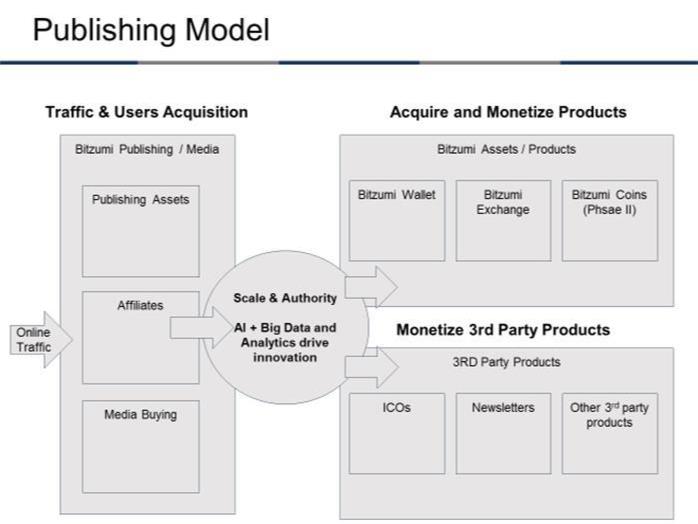
 
 
We anticipate launching our publishing business in 2018.
 
We anticipate that our principal products and services in Phase II will be the following:
 
Exchange and Wallet
 
We anticipate Bitzumi will be a cryptocurrency exchange that we expect to provide a reliable and secure way to buy, sell, store, and trade to and from the following fiat and digital currencies: US dollars, Bitcoin, Litecoin, and Ethereum We expect Bitzumi to provide 24/7 access to customers’ digital wallets as well as liquidity into USD through integration with customer debit cards. We are still in the research and development phase of this product. We intend that Bitzumi will focus on four key elements to distinguish itself from its competitors: security, customer support, a mix of advanced and simple trading tools, and most importantly, liquidity. Our business model is projected to focus on growth through customer acquisitions and marketing of our platform. In addition, on January 10, 2018, Bitzumi entered into a joint venture and servicing agreement with Acacia to create a patent registration platform using Blockchain technology. That agreement appears as Exhibit 6.7 to the Offering Statement of which this Offering Circular forms a part.


-49-
 
Payment Processing and Escrow
 
We plan to develop processing and escrow technology to facilitate the use of cryptocurrency in various industries. The platform is under development and we anticipate that it will be launched in 2018.
 
In Phase II (following the public launch of our exchange), we plan to evaluate blockchain technologies and other growth initiatives, including developing our Bitzumi Coins division. Since we believe that the most prominent use case for blockchain technologies is digital currencies, we expect that creating special purpose coins for particular industries is our focus in Phase II. We anticipate continuing to evaluate other blockchain technology opportunities, as well as technologies that are complementary to our business strategy in an effort to minimize risks and enhance shareholder value. This is expected to include evaluating opportunities that diversify our revenue streams, provide other consumer services and provide on-ramps for new users. We are still in the research and development phase of this product.
 
Competition
 
The industry is still in its infancy and we believe that the key differentiator will be marketing and customer acquisition strategies. We believe that our current and future competition is centered on the following areas:
 
Merchants that choose to accept digital currencies at their branded websites and affiliate seller websites;
Physical “brick and mortar” locations, distributors, vendors and manufacturers that sell products and accept digital currencies as payment;
Other mobile applications, websites, shopping sites, niche aggregation sites, private sale sites and group buying sites that sell or distribute products in exchange for digital currency;
Companies that are engaged in transaction verification services which may have lower operating costs then our operations;
Providers of mobile applications and websites, that offer secure storage solutions for digital currency; and
Digital currency focused companies that offer exchange, payment processing, remittance, money transmission service, and financial services that enable consumers or vendors to exchange or improve the acceptance of digital currency.
 
We believe that many of our current and potential competitors have greater resources, longer histories, more customers, and greater brand recognition. They may secure better terms from suppliers, adopt more aggressive pricing, and devote more resources to technology, infrastructure, fulfillment, and marketing. Other companies also may enter into business combinations or alliances that strengthen their competitive positions.
 
There are numerous digital currencies founded on cryptography, other than Bitcoin, Ethererum, and Litecoin, including: Ripple, IOTA, NEM dash, NEO, Ethereum classic, Monero, Zcash, OmiseGo, and many others. We believe that the Bitcoin Network, however, possesses the “first­ to­ market” advantage and has captured the majority of the industry’s market share. We believe that Litecoin and Ethereum are also among the most prominent digital currencies. While there are many exchanges that offer cryptocurrency buy and sell services around the globe, we view the most notable as being Coinbase, Bitstamp, and GDAX (a subsidiary of Coinbase).
 
Coinbase
 
Founded in 2012, Coinbase operates in 32 countries serving over 7 million customers (as of May 2017). With a casual investor and retail investor customer focus, Coinbase is the most popular and well-known exchange.


-50-
 
GDAX (Global Digital Asset Exchange)
 
A subsidiary of Coinbase, GDAX was creating to fulfill the market need for high volume, skilled traders in the digital asset marketplace. GDAX allows users to buy and sell cryptocurrencies just like Coinbase, but in higher volume and at lower cost. GDAX is considered to be the “etrade of cryptocurrencies”.
 
Bitstamp
 
Founded in Luxembourg in 2011, Bitstamp was one of the first exchanges to be licensed in all 50 U.S. states, as well as the first Ripple gateway. As well as being licensed in the United States, Bitstamp is fully licensed in the European Union as well.
 
The below table is a list of other exchange and monthly volume as of September 29, 2017. All figures provided by coinmarketcap.com, Bitcoincharts.com and data.Bitcoinity.org.
 
 
Exchange Name
 
 
Monthly Volume (BTC)
 
 
Monthly Volume (USD)
 
 
Trust Rating
 
 
Crypto Currencies
 
Coinbase
  520,000 
  2,170,480,000 
     A+ 
BTC, LTC, ETH
Bitstamp
  360,000 
  1,502,640,000 
  
BTC. XRP, LTC
CEX.IO
  29,400 
  122,715,600 
  
75+ pairings
Local Bitcoins
  13,181 
  55,017,494 
  
BTC
Kraken
  137,160 
  572,505,840 
  B+ 
BTC, ETH, LTC, Dash
BITFINEX
  1,196,760 
  4,995,276,240 
  B+ 
BTC, ETH, LTC, ETC, ZEC
Poloniex
  180,000 
  751,320,000 
  B+ 
BTC, ETH, LTC, XRP, ETC, ZEC
GDAX
  309,000 
  1,289,766,000 
  B+ 
BTC, ETH, LTC
 
Suppliers/Manufacturers
 
Our company plans to use remarketers to provide customers with access to cryptocurrency. Bitzumi will partner with other exchanges in order to have the necessary inventory of Bitcoin, Ethereum, and Litecoin at any given moment to fill an order. See explanation regarding liquidity in Bitcoin Market—End User to End User.
 
Technology
 
We use third-party open source platforms as well as internally developed tools to operate our website, and a combination of proprietary technologies and commercially available licensed technologies and solutions to support our operations. We license Exchange software from AlphaPoint. AlphaPoint will all provide all technical support and maintenance for our exchange. AlphaPoint is entitled to 20% revenues for commissions, with a minimum of $10,000 fee per month. We have pre-paid for all licensing and support until July 2018.


-51-
 
We have entered into an agreement with IdentityMind to provide Anti-Money Laundering (“AML”) and Know Your Customer (“KYC”) integration software to properly operate our exchange. IdentityMind is responsible for all of our KYC services and regulatory compliance. KYC is a vital aspect of our business, as we must know whom our customers are and have proper documentation. With this service, IdentityMind ensures that people who should not have access to an anonymous currency, such as Bitcoin, do not gain such access. This includes someone with a history of fraud or a criminal record such that their access to the exchange could be seen as a risk. IdentityMind’s services extend to AML to the extent that, in tandem with trading limits, large buy and sell orders are monitored and suspicious activity is identified and reported to us. For example, if an account holder is buying their weekly or monthly limit each period respectively, IdentityMind’s Application Programming Interface (“API”) allows us to see this as a potential risk so that we can appropriately respond to ensure there is no illegal conduct occurring.
 
Required Government Approval
 
On September 22, 2017, we registered with FinCen as a money services business and are in the process of obtaining licenses as a money transmitter business in each of the 50 states. We anticipate having a full public launch by early 2018.
 
This process is expensive and time-consuming. The timeframe for obtaining all the necessary licenses is not predictable. The effect of these and potential future governmental regulations on the business could have a materially adverse effect on our business as well as increase our costs for compliance.
 
Intellectual Property
 
Our trademark (in application, filed September 5, 2017), domain names, and proprietary technology are needed for us to remain competitive and we rely on trademark, copyright, patent law, trade-secret protection, and confidentiality and/or license agreements with our employees, customers, partners, and others to protect our proprietary rights. We have registered, or applied for the registration of, a number of U.S. and international domain names, and trademarks.
 
Legal Matters
 
The company is not involved in any litigation, and its management is not aware of any pending or threatened legal actions relating to its intellectual property, conduct of its business activities, or otherwise.
 
Certain legal matters with respect to the shares of Common Stock offered hereby will be passed upon by CrowdCheck Law LLP.
 
Research and Development Costs
 
From June 13, 2017 (inception) through September 30, 2017, the company has spent approximately $140,000 on software development for the cryptocurrency exchange. We plan to allocate up to 10% of our budget to R&D to develop proprietary software and applications utilizing blockchain technologies
 
Employees
 
We have 1 full-time employee and 4 part-time employees. We also hire several consultants on a project and part-time basis.
 
Currently there are no employment agreements with any executives.
 
Company’s Property
 
We do not own any significant property. The Company sub-leases its space in New York from Extract Advisors LLC on a month-to-month basis, with rent payments to commence on March 1, 2018 at a rate of $500 per month.


-52-
 
DIRECTORS, EXECUTIVE OFFICERS AND SIGNIFICANT EMPLOYEES
 
The company currently has no employees that it identifies as significant employees. The director and executive officers are set forth in the chart below.
 
Name
Position
Age
Term of Office (if indefinite, give date appointed)
Approximate hours per week (if part-time)/full-time
Directors:


Scot Cohen
Director
48
Indefinite, appointed June 2017
Full-time
Glenn Pollack
Director
60
Indefinite, appointed September 2017
Part time (as required)


Executive Officers:


Scot Cohen
  CEO
48
Indefinite, appointed June 2017
Full-time
David Briones
  CFO & Secretary
41
Indefinite, appointed September 2017
Part-time (10 hours per week)
 
Scot Cohen
Chief Executive Officer, and Chairman of the Board
 
Mr. Cohen has over 20 years of experience in institutional asset management, wealth management, and capital markets.  Since 2009, Mr. Cohen founded and served as principal of the Iroquois Capital Opportunity Fund, a closed-end private equity fund that focused on investments in North American oil and gas. He has also managed several operating partnerships that actively invest in the energy sector and he maintains an active investment portfolio in public companies, early stage private companies, hedge funds, and alternative assets including real estate.  Prior to Iroquois Capital, Mr. Cohen founded a merchant bank, which actively participated in structured investments in public companies.  The investment strategy at the merchant bank was to take positions in public companies through private investment vehicles and then work to actively enhance the value of these positions.  Mr. Cohen began his career at Oppenheimer & Company in a sales capacity and later transitioned to a boutique investment banking firm where he spent two years.  
 
Mr. Cohen is currently active on a number of public and private company boards and is involved with various charitable ventures. Mr. Cohen earned a Bachelor of Science degree from Ohio University in 1991.
 
Currently, Mr. Cohen is the Executive Chairman of the Board of Petro River Oil Corp. (“PTRC”) an oil and gas exploration and production company, and on the Board of Directors of True Drinks, a consumer goods company specializing in flavored water for kids. He is also the Executive Chairman and co-founder of Wrap Technologies, a company focusing on providing new non-lethal tools for modern policing. Wrap Technologies is in the process of raising up to $4 million pursuant to an offering registered under the Securities Act. Wrap Technologies has requested quotation on the OTCQX. Mr. Cohen is also involved with several oil and gas special purpose vehicles and private investments with public companies.
 
 
-53-
 
Glenn Pollack
Independent Director
 
Mr. Pollack is a Managing Director and Founder of Candlewood Partners, LLC (“Candlewood”), a merchant bank he founded in 2001, focused on middle market corporate finance and infrastructure projects, and is the Manager of Green Bull Georgia Partners, LLC, a special purpose vehicle controlled by Mr. Pollack established to purchase certain senior debt of Register Communications, Inc. (“Register”). In connection with the purchase of the senior debt, Mr. Pollack became a director of Register, which filed for Chapter 11 protection under the United States Bankruptcy Code in December 2015. Prior to founding Candlewood, Mr. Pollack was a Managing Director and Principal of a middle market investment banking firm with offices in Chicago and Cleveland. He was responsible for the Restructuring Group and was involved in other corporate finance transactions including mergers and acquisitions and capital raising for special situations. He also spent five years as the CEO of a regional distributor of perishable foods with annual revenues of $180 million and over 250 employees in four states. Mr. Pollack is a certified public accountant and has worked for Price Waterhouse as a consultant and for Touche Ross as an auditor.
 
David Briones
Chief Financial Officer
 
Mr. Briones has over fifteen years of public accounting and executive level experience. He is the CEO of Brio Financial Group, which he founded in 2010, and in that capacity, he consults with various public companies in financial reporting, internal control development and evaluation, budgeting and forecasting. David has developed a specialty representing private companies as the outsourced CFO/Financial reporting specialist as a private company navigates toward becoming a public company through a self-filing, a reverse merger or through a traditional initial public offering.  David’s client list crosses various industries: Technology/Internet, Manufacturing, Oil and Gas, Food and Beverage, Bio-technology, Software, Medical Device, Entertainment, Hedge Funds and Insurance.
 
Prior to founding Brio, Mr. Briones had managed the Public Company and Hedge Fund practices at Bartolomei Pucciarelli, LLC (“BP”). Within that capacity, he performed audit services, outsourced CFO functions, and/or consulted with clients through difficult SEC comment periods particularly through application of complex accounting principles for a vast public company client base. Prior to joining BP, Mr. Briones was an auditor with PricewaterhouseCoopers LLP in New York, New York. He specialized in the financial services group, and most notably worked the MONY Group, Prudential Financial, and MetLife initial public offerings. He was promoted to Senior Associate after only 8 months of service at PwC and acted in managerial roles within his first two years at PwC.
 
Director Independence
 
For a director to be considered “independent,” the Board must affirmatively determine that the director has no material relationship with the company (directly or as a partner, stockholder or officer of an organization that has a relationship with the company). In each case, the Board considers all relevant facts and circumstances. We currently have one independent director.
 
Committees of the Board of Directors
 
During 2018, we plan to add at least one additional Board member and then we expect our Board of Directors will establish an Audit Committee and a Compensation Committee to assist it with its responsibilities. We expect all members of the Audit and Compensation Committees will meet the criteria for independence.
 
DIRECTOR COMPENSATION
 
We have not yet established arrangements to compensate our directors for their services.


-54-
 
EXECUTIVE COMPENSATION
 
We have identified Scot Cohen and David Briones as our named executive officers. Our named executive officers for 2018 could change, as we may hire or appoint new executive officers.
 
For the period from inception and ending September 2017, our 2017 compensation for our three highest-paid directors and executive officers was as follows:
 
Name
 
Capacities in which compensation was received
 
 
Cash compensation ($)
 
 
Other compensation ($)
 
 
Total compensation ($)
 
Scot Cohen
Executive
  - 
  - 
  - 
David Briones
Executive
  - 


There is no compensation arrangement between Mr. Cohen and the company for his services as the company’s Chief Executive Officer. There is an agreement to issue Mr. David Briones 250,000 stock options under our 2017 equity compensation plan following the conclusion of this offering. The total number of shares of Common Stock that may be issued pursuant to Stock Awards shall not exceed in the aggregate of 30,000,000 shares. We have not yet established arrangements to compensate our directors for their services.


-55-
 
RELATED PERSON TRANSACTIONS
 
The company has not undertaken any related party transactions.
 
Statement of Policy
 
Our board of directors recognizes the fact that transactions with related persons present a heightened risk of conflicts of interests and/or improper valuation (or the perception thereof). Prior to any listing on NASDAQ, our board of directors will adopt a written policy on transactions with related persons in conformity with the requirements for issuers having publicly held Common Stock listed on the NASDAQ Capital Market. Under the policy any related-person transaction, and any material amendment or modification of a related-person transaction, will be required to be reviewed and approved or ratified by a committee of the board of directors composed solely of independent directors who are disinterested, or by the disinterested members of the board of directors and any employment relationship or transaction involving an executive officer and any related compensation will be required to be recommended by the Compensation Committee to the board of directors for its approval.
 
In connection with the review and approval or ratification of a related-person transaction:
 
The management must disclose to the audit committee or another independent body of the board of directors, as applicable, the name of the related person and the basis on which the person is a related person, the material terms of the related-person transaction, including the approximate dollar value of the amount involved in the transaction, and all the material facts as to the related person's direct or indirect interest in, or relationship to, the related-person transaction;
 
The management must advise the audit committee or another independent body of the board of directors, as applicable, whether the related-person transaction complies with the terms of our agreements governing any material outstanding indebtedness that limit or restrict our ability to enter into a related-person transaction;
 
The management must advise the audit committee or another independent body of the board of directors, as applicable, whether the related-person transaction will be required to be disclosed in our applicable filings under the Securities Act or the Exchange Act and related rules, and, to the extent required to be disclosed, management must ensure that the related-person transaction is disclosed in accordance with such Acts and related rules; and management must advise the audit committee or another independent body of the board of directors, as applicable, whether the related-person transaction constitutes a "personal loan" for purposes of Section 402 of the Sarbanes-Oxley Act.
 
In addition, the related-person transaction policy will provide that the audit committee or another independent body of the board of directors, as applicable, must consider whether any approval or ratification of a related-person transaction involving a non-employee director or director nominee would compromise the director or director nominee's status as an "independent", "outside", or "non-employee" director, as applicable, under the rules and regulations of the SEC, the NASDAQ Capital Market and the Internal Revenue Code.


-56-
 
SECURITY OWNERSHIP OF CERTAIN BENEFICIAL OWNERS AND MANAGEMENT
 
The following table sets forth certain information known to us regarding beneficial ownership of our capital stock as of November 27, 2017 for (i) all executive officers and directors as a group and (ii) each person, or group of affiliated persons, known by us to be the beneficial owner of more than five percent (5%) of our capital stock. The percentage of beneficial ownership in the table below is based on 111,076,211 shares of Common Stock deemed to be outstanding as of November 27, 2017.
 
Name and address of beneficial owner
 
Amount and nature of beneficial ownership
 
 
Amount and nature of beneficial ownership acquirable
 
 
Ownership percent of class before offering Ownership percent of class after offering (3)
 
Scot Cohen (1)
  33,500,000 
  0 
 29.11%
River Asset Management, Inc. (2)
  10,750,000 
  0 
  9.34%
 
(1) The business address for Scot Cohen is Bitzumi, 55 5th Avenue, Suite 1702, New York, NY 10003.
(2) The business address for River Asset Management, Inc., is 14 Arbor Field Way, Lake Grove, New York 11755
(3) Assumes maximum offering of 4,000,000 shares sold and 115,076,211 shares issued and outstanding after maximum offering.


-57-
 
DESCRIPTION OF CAPITAL STOCK
 
Summary of Securities
 
The following description summarizes certain terms of our capital stock, as in effect upon the completion of this offering. We will submit to our stockholders for approval an amended and restated certificate of incorporation and amended and restated bylaws to be effective upon the completion of this offering, and this description summarizes the provisions included in such documents. Because it is only a summary, it does not contain all the information that may be important to you. For a complete description of the matters set forth in this section you should refer to our amended and restated certificate of incorporation and bylaws, which are included as exhibits to this Offering Circular, and to the applicable provisions of Delaware law.
 
Immediately following the completion of this offering, our authorized capital stock will consist of shares of Common Stock, $0.0001 par value per share, and shares of preferred stock, $0.0001 par value per share.
 
As of November 27, 2017, there 299,500,000 shares of Common Stock authorized, and 111,076,211 shares of our Common Stock outstanding and held of record by twenty-two stockholders. The rights, preferences, and privileges of the holders of our Common Stock are subject to the rights of the holders of shares of any series of preferred stock in which we may issue in the future. There are 500,000 shares of Preferred Stock authorized with none issued, and 30,000,000 stock options authorized with none issued. The total number of authorized securities are 330,000,000.
 
Common Stock
 
Dividend Rights
 
Subject to preferences that may apply to any shares of preferred stock that may be issued, the holders of our Common Stock are entitled to receive ratably any dividends as may be declared by our board of directors out of funds legally available for dividends. See the section titled “Dividend Policy” for additional information. We have authorized, but no issued, preferred stock.
 
Voting Rights
 
Holders of our Common Stock are entitled to one vote per share on any matter to be voted upon by stockholders. We have not provided for cumulative voting for the election of directors in our amended and restated certificate of incorporation. Our bylaws establish a board of directors whose term is for one year, to be elected at the annual meeting of stockholders.
 
No Preemptive or Similar Rights
 
Our Common Stock is not entitled to preemptive rights, and is not subject to conversion, redemption, or sinking fund provisions.
 
Liquidation Rights
 
If we become subject to a liquidation, dissolution or winding ­up, the assets legally available for distribution to our stockholders would be distributable ratably among the holders of our Common Stock outstanding at that time, subject to prior satisfaction of all outstanding debt and liabilities and the preferential rights of and the payment of liquidation preferences, if any, on any outstanding shares of preferred stock.


-58-
 
Undesignated Preferred Stock
 
Following this offering, our board of directors will be authorized, subject to limitations prescribed by Delaware law, to issue preferred stock in one or more series, to establish from time to time the number of shares to be included in each series, and to determine for each such series of preferred stock the voting powers, designations, preferences, and special rights, qualifications, limitations, or restrictions as permitted by law, in each case without further vote of action by our stockholders. Our board of directors will also be able to increase or decrease the number of shares of any series of preferred stock, but not below the number of shares of that series then outstanding, without any further vote or action by our stockholders. Our board of directors may authorize the issuance of preferred stock with voting or conversion rights that could adversely affect the voting power or other rights of the holders of Common Stock. The issuance of preferred stock, while providing flexibility in connection with possible acquisitions and other corporate purposes, could, among other things, have the effect of delaying, deferring or preventing a change in control of our company and might adversely affect the market price of our Common Stock and the voting and other rights of the holders of our Common Stock. We have no current plan to issue any shares of preferred stock.
 
Options
 
Currently, there are 30,000,000 authorized options but no options issued.
 
Preferred Stock
 
Currently, there are 500,000 authorized Preferred Stock but no Preferred Stock issued.
 
Anti­ Takeover Matters
 
Charter and Bylaw Provisions
 
The provisions of Delaware law, our certificate of incorporation, and our bylaws include a number of provisions that may have the effect of delaying, deferring, or discouraging another person from acquiring control of our company and discouraging takeover bids. These provisions may also have the effect of encouraging persons considering unsolicited tender offers or other unilateral takeover proposals to negotiate with our board of directors rather than pursue non-­negotiated takeover attempts. These provisions include the items described below.
 
Board Composition and Filling Vacancies
 
Our bylaws provide that any vacancy on our board of directors may only be filled by the affirmative vote of a majority of our directors then in office even if less than a quorum. Further, any directorship vacancy resulting from an increase in the size of our board of directors, may be filled by election of the board of directors, but only for a term continuing until the next election of directors by the shareholders.
 
No Cumulative Voting
 
The Delaware General Corporation Law provides that stockholders are not entitled to the right to cumulate votes in the election of directors unless certificate of incorporation provides otherwise. Neither our certificate of incorporation nor our bylaws provide that there shall be no cumulative voting.


-59-
 
Choice of Forum
 
Our bylaws provide that the Court of Chancery of the State of Delaware will be the exclusive forum for any derivative action or proceeding brought on our behalf; any action asserting a breach of fiduciary duty; any action asserting a claim against us arising pursuant to the Delaware General Corporation Law, our restated certificate of incorporation or our restated bylaws; or any action asserting a claim against us that is governed by the internal affairs doctrine. The enforceability of similar choice of forum provisions in other companies’ certificates of incorporation has been challenged in legal proceedings, and it is possible that a court could find these types of provisions to be inapplicable or unenforceable.
 
Limitations of Director Liability and Indemnification of Directors and Officers
 
We intend to maintain general liability insurance that covers certain liabilities of our directors and officers arising out of claims based on acts or omissions in their capacities as directors or officers, including liabilities under the Securities Act. Insofar as indemnification for liabilities arising under the Securities Act may be permitted to directors, officers, or persons who control us, we have been informed that in the opinion of the SEC such indemnification is against public policy as expressed in the Securities Act and is therefore unenforceable. These provisions may discourage stockholders from bringing a lawsuit against our directors for breach of their fiduciary duty. These provisions may also have the effect of reducing the likelihood of derivative litigation against directors and officers, even though such an action, if successful, might otherwise benefit us and our stockholders. Furthermore, a stockholder’s investment may be adversely affected to the extent we pay the costs of settlement and damage awards against directors and officers pursuant to these indemnification provisions. We believe that these provisions, the indemnification agreements, and the insurance are necessary to attract and retain talented and experienced directors and officers. At present, there is no pending litigation or proceeding involving any of our directors or officers where indemnification will be required or permitted. We are not aware of any threatened litigation or proceeding that might result in a claim for such indemnification.
 
Exchange Listing
 
We are in the process of applying to have our Common Stock approved for listing on NASDAQ, but we cannot guarantee that we will satisfy the listing requirements or otherwise be accepted for such listing. 


Transfer Agent and Registrar
The transfer agent and registrar for our Common Stock is Colonial Stock Transfer Company Inc. The transfer agent’s address is 66 Exchange Place, Suite 100, Salt Lake City, UT, and its telephone number is 801-355-5740.


-60-
 
DIVIDEND POLICY
 
Since our inception, we have not paid any dividends on our Common Stock, and we currently expect that, for the foreseeable future, all earnings (if any) will be retained for the development of our business and no dividends will be declared or paid. In the future, our Board of Directors may decide, at their discretion, whether dividends may be declared and paid, taking into consideration, among other things, our earnings (if any), operating results, financial condition and capital requirements, general business conditions and other pertinent facts.


-61-
 
SHARES ELIGIBLE FOR FUTURE SALE
 
Prior to this offering, there has been no market for our Common Stock. Future sales of substantial amounts of our Common Stock, or securities or instruments convertible into our Common Stock, in the public market, or the perception that such sales may occur, could adversely affect the market price of our Common Stock prevailing from time to time. Furthermore, because there will be limits on the number of shares available for resale shortly after this offering concludes, due to contractual and legal restrictions described below, there may be resales of substantial amounts of our Common Stock in the public market after those restrictions lapse. This could adversely affect the market price of our Common Stock prevailing at that time.
 
Upon completion of this offering, assuming the maximum amount of shares of Common Stock offered in this offering are sold, there will be 115,076,211 shares of our Common Stock outstanding. This number excludes any issuance of additional shares of Common Stock that could occur in connection with any exercise of stock options outstanding as of the date of this Offering Circular.
 
These 4,000,000 shares of our Common Stock will be freely tradable in the public market, except to the extent they are acquired by an “affiliate” of ours, as such term is defined in Rule 405 under the Securities Act. Under Rule 405, an affiliate of a specified person is a person that directly, or indirectly through one or more intermediaries, controls or is controlled by, or is under common control with, the specified person. Any affiliate of ours that acquires our shares can only further transact in such shares in compliance with Rule 144 under the Securities Act, which imposes sales volume limitations and other restrictions on such further transactions. See “— Rule 144,” below.
 
In addition to the foregoing, shares of our Common Stock not sold in this offering will be restricted securities written the meaning of Rule 144, and would be tradable only if they are sold pursuant to a registration statement under the Securities Act or if they qualify for an exemption from registration, including under Rule 144. See “— Rule 144,” below.
 
Rule 144
 
In general, a person who has beneficially owned restricted shares of our Common Stock for at least one year, in the event we are a company that files reports under Regulation A, or at least six months, in the event we have been a company that files reports under the Exchange Act for at least 90 days, would be entitled to sell such securities, provided that such person is not deemed to be an affiliate of ours at the time of sale or to have been an affiliate of ours at any time during the three months preceding the sale. A person who is an affiliate of ours at such time would be subject to additional restrictions, by which such person would be entitled to sell within any three -month period only a number of shares that does not exceed the greater of the following:
 
1% of the number of shares of our Common Stock then outstanding; or
the average weekly trading volume of our Common Stock during the four calendar weeks preceding the filing by such person with the SEC of a notice on Form 144 with respect to the sale; provided that, in each case, we have been subject to the periodic reporting requirements of the Exchange Act for at least 90 days before the sale. Persons replying on Rule 144 to transact in our Common Stock must also comply with the manner of sale, notice and other provisions of Rule 144, to the extent applicable. In general, Rule 701 allows a stockholder who purchased shares of our capital stock pursuant to a written compensatory plan or contract and who is not deemed to have been an affiliate of ours during the immediately preceding 90 days to sell those shares in reliance upon Rule 144, but without being required to comply with the public information, holding period, volume limitation or notice provisions of Rule 144. Persons relying on Rule 701 to transact in our Common Stock, however, are required to wait until 90 days after the date of this Offering Circular before selling shares pursuant to Rule 701.
 
Lock­ Up Agreements
 
There are no lock-up agreements with our officers, directors, and current stockholders.


-62-
 
PLAN OF DISTRIBUTION
 
The company is offering up to 4,000,000 shares of Common Stock, on a “best efforts basis” as described in this Offering Circular. The company has engaged Sageworks Capital LLC as its broker-dealer to assist in the placement of its securities. Sageworks Capital LLC under no obligation to purchase any securities or arrange for the sale of any specific number or dollar amount of securities.
 
The company intends to use an online platform at the domain name www.bitzumicorp.com (the “Online Platform”) to provide technology tools to allow for the sales of securities in this offering.
 
Investment Fee on Sales of Securities
 
Sageworks Capital will act as a referring broker-dealer, in which all sales will be placed through the efforts of Sageworks Capital. As compensation for these efforts, the company will pay Sageworks Capital a one-time set up fee of $8,000 and 50 basis points on the aggregate amount raised by the company from investors. The fee for the minimum raise of $1,000,000 would be $13,000 and for the maximum raise of $10,000,000 would be $58,000.
 
Termination of Offering
 
The Offering will terminate at the earlier of (1) the date at which the maximum offering amount has been sold, (2) the date that is twelve months from the date of this Offering Statement being qualified by the Commission, or (3) the date at which the Offering is earlier terminated by the company in its sole discretion, which may happen at any time (the “Offering Termination Date”). The Managing Broker-Dealer has agreed to comply with the provisions of SEC Rule 15c2-4 as to all funds provided by you for the purchase of the Shares. On any closing date for the Offering, the deposited funds, minus applicable expenses, will be delivered to our company.
  
Selling Security holders
 
No securities are being sold for the account of security holders; all net proceeds of this offering will go to the company.
 
Investors’ Tender of Funds

After the Offering Statement has been qualified by the Commission, the company will accept tenders of funds to purchase the Common Stock. The funds tendered by potential investors will be held by Prime Trust LLC, the escrow agent. The offering will terminate (and subscriptions will no longer be accepted) at the earlier of: (1) the date at which the maximum offering amount has been sold, (2) the date which is one year from this offering being qualified by the Commission, or (3) the date at which the offering is earlier terminated by us in our sole discretion.
 
The escrow agent will not investigate the desirability or advisability of investment in the shares in this Offering nor will it approve, endorse or pass upon the merits of purchasing those shares. The company must raise its minimum offering of $1,000,000 in order to close the offering and receive funds; there are no other conditions that the company must meet in order to hold the closing. Tendered funds will only be returned to investors upon termination of the offering as set out above, in which case any money tendered by potential investors that is still held in escrow will be promptly returned by the escrow agent upon our instruction.
 
In the event that it takes some time for the company to raise funds in this offering, the company will rely on income from sales and cash on hand of $276,449 as of November 27, 2017.
 
Investors will be required to subscribe to the Offering via the Online Platform, and agree to the terms of the Offering and subscription agreement, which includes the adoption of the Investors’ Rights Agreement, First Refusal Agreement, and Voting Agreement (copies of which have been filed as an Exhibit to the Offering Statement of which this Offering Circular is part). The subscription agreement includes a representation by the investor to the effect that, if you are not an “accredited investor” as defined under securities law, you are investing an amount that does not exceed the greater of 10% of your annual income or 10% of your net worth (excluding your principal residence).


-63-
Table of Contents
 
 
Offering Expenses
 
We are responsible for all offering fees and expenses, including the following: (i) fees and disbursements of our legal counsel, accountants, and other professionals we engage; (ii) fees and expenses incurred in the production of offering documents, including design, printing, photograph, and written material procurement costs; (iii) all filing fees, including FINRA and blue sky notice filing fees; (iv) all of the legal fees related to the filing of notice filings under state securities laws and FINRA clearance; and (v) our transportation, accommodation, and other roadshow expenses.
 
Investment Limitations
 
Generally, no sale may be made to you in this offering if the aggregate purchase price you pay is more than 10% of the greater of your annual income or net worth (please see below on how to calculate your net worth). Different rules apply to accredited investors and non-natural persons. Before making any representation that your investment does not exceed applicable thresholds, we encourage you to review Rule 251(d)(2)(i)(C) of Regulation A. For general information on investing, we encourage you to refer to www.investor.gov.

Because this is a Tier 2 Regulation A offering, most investors must comply with the 10% limitation on investment in the offering. The only investor in this offering exempt from this limitation is an "accredited investor" as defined under Rule 501 of Regulation D under the Securities Act (an "Accredited Investor"). If you meet one of the following tests you should qualify as an Accredited Investor:
 
i.
You are a natural person who has had individual income in excess of $200,000 in each of the two most recent years, or joint income with your spouse in excess of $300,000 in each of these years, and have a reasonable expectation of reaching the same income level in the current year;
ii.
You are a natural person and your individual net worth, or joint net worth with your spouse, exceeds $1,000,000 at the time you purchase Offered Shares (please see below on how to calculate your net worth);
iii.
You are an executive officer or general partner of the issuer or a manager or executive officer of the general partner of the issuer;
iv.
You are an organization described in Section 501(c)(3) of the Internal Revenue Code of 1986, as amended, or the Code, a corporation, a Massachusetts or similar business trust or a partnership, not formed for the specific purpose of acquiring the Offered Shares, with total assets in excess of $5,000,000;
v.
You are a bank or a savings and loan association or other institution as defined in the Securities Act, a broker or dealer registered pursuant to Section 15 of the Exchange Act, an insurance company as defined by the Securities Act, an investment company registered under the Investment Company Act of 1940 (the "Investment Company Act"), or a business development company as defined in that act, any Small Business Investment Company licensed by the Small Business Investment Act of 1958 or a private business development company as defined in the Investment Advisers Act of 1940;
vi.
You are an entity (including an Individual Retirement Account trust) in which each equity owner is an accredited investor;
vii.
You are a trust with total assets in excess of $5,000,000, your purchase of Offered Shares is directed by a person who either alone or with his purchaser representative(s) (as defined in Regulation D promulgated under the Securities Act) has such knowledge and experience in financial and business matters that he is capable of evaluating the merits and risks of the prospective investment, and you were not formed for the specific purpose of investing in the Offered Shares; or
viii.
You are a plan established and maintained by a state, its political subdivisions, or any agency or instrumentality of a state or its political subdivisions, for the benefit of its employees, if such plan has assets in excess of $5,000,000.
 
Offering Period and Expiration Date
 
This offering will start on or after the Qualification Date and will terminate if the Minimum Offering is not reached or, if it is reached, on the Termination Date.
 
Procedures for Subscribing
 
If you decide to subscribe for Offered Shares in this offering, you should:
 
Go to www.bitzumicorp.com, click on the "Invest Now" button and follow the procedures as described.
 
1.           
Electronically receive, review, execute and deliver to us a subscription agreement; and
 
2.           
Deliver funds directly by wire or electronic funds transfer via ACH to the specified account maintained by Bitzumi.
 
Any potential investor will have ample time to review the subscription agreement, along with their counsel, prior to making any final investment decision. We shall only deliver such subscription agreement upon request after a potential investor has had ample opportunity to review this Offering Circular.
 
The Subscription Agreement is governed by, and construed according to, the laws of the State of New York. The Subscription Agreement includes a provision in which the parties irrevocably waive the right to a jury trial in any action.
 
 
-64-
 
Right to Reject Subscriptions
 
After we receive your complete, executed subscription agreement and the funds required under the subscription agreement have been transferred to the escrow account, we have the right to review and accept or reject your subscription in whole or in part, for any reason or for no reason. We will return all monies from rejected subscriptions immediately to you, without interest or deduction.
 
Acceptance of Subscriptions
 
Upon our acceptance of a subscription agreement, we will countersign the subscription agreement and issue the shares subscribed at closing. Once you submit the subscription agreement and it is accepted, you may not revoke or change your subscription or request your subscription funds. All accepted subscription agreements are irrevocable.
 
Under Rule 251 of Regulation A, non-accredited, non-natural investors are subject to the investment limitation and may only invest funds which do not exceed 10% of the greater of the purchaser's revenue or net assets (as of the purchaser's most recent fiscal year end). A non-accredited, natural person may only invest funds which do not exceed 10% of the greater of the purchaser's annual income or net worth (please see below on how to calculate your net worth).
 
For the purposes of calculating your net worth, it is defined as the difference between total assets and total liabilities. This calculation must exclude the value of your primary residence and may exclude any indebtedness secured by your primary residence (up to an amount equal to the value of your primary residence). In the case of fiduciary accounts, net worth and/or income suitability requirements may be satisfied by the beneficiary of the account or by the fiduciary, if the fiduciary directly or indirectly provides funds for the purchase of the Offered Shares.
 
In order to purchase Offered Shares and prior to the acceptance of any funds from an investor, an investor will be required to represent, to the company's satisfaction, that he is either an accredited investor or is in compliance with the 10% of net worth or annual income limitation on investment in this offering. 
 
Registrar and Transfer Agent, Book-Entry Only
 
All Shares will be issued by our Transfer Agent to investors in book-entry only format and will be represented by a stock transfer ledger, maintained by our Transfer Agent.
 
Investors in the Shares will not be entitled to have the stock certificates registered in their names, and will not receive or be entitled to receive physical delivery of the Shares in definitive form. Transfers of investors, common stock will be facilitated through the Transfer Agent. As a result, you will not be entitled to receive a stock certificate representing your interest in the Shares. Your ability to pledge Shares, and to take other actions, may be limited because you will not possess a physical certificate that represents your Shares. Investors will receive written confirmation from the Transfer Agent upon closing of their purchases. Transfers of the Shares will be recorded on the stock transfer ledger maintained by the Transfer Agent. We have no responsibility for any aspect of the actions of the Transfer Agent. In addition, we have no responsibility or liability for any aspect of the records kept by the Transfer Agent relating to, or payments made on account of investors in, the Shares, or for maintaining, supervising or reviewing any records relating to ownership of Shares. We also do not supervise the systems of the Transfer Agent.
 
Pricing of Offering
 
Prior to the offering, there has been no public market for the Offered Shares. Our Common Stock is presently not traded on any market or securities exchange. We are offering the Shares at a price of $2.50 per Share, which is set forth on the cover page of this offering circular. Such offering price does not have any relationship to any established criteria of value, such as book value or earnings per share of Common Stock. The price of our Common Stock is not based on past earnings, nor is the price of our Common Stock indicative of the current market value of the assets owned by us. No valuation or appraisal has been prepared for our business and potential business expansion. The principal factors considered in determining the initial public offering price include:
 
the information set forth in this Offering Circular;
our history and prospects and the history of and prospects for the industry in which we compete;
our past and present financial performance;
our prospects for future earnings and the present state of our development;
the general condition of the securities markets at the time of this offering;
the recent market prices of, and demand for, publicly traded Common Stock of generally comparable companies; and
other factors deemed relevant by the Underwriter and us.  


-65-
 
EXPERTS
 
The financial statements of the company appearing elsewhere in this Offering Circular have been included herein in reliance upon the report, which includes an explanatory paragraph as to the company’s ability to continue as a going concern, of Rosenberg Rich Baker Berman & Company (“RRBB”), an independent registered public accounting firm, appearing elsewhere herein, and upon the authority of RRBB as experts in accounting and auditing.
 
WHERE YOU CAN FIND ADDITIONAL INFORMATION
 
We have filed with the SEC a Regulation A Offering Statement on Form 1-A under the Securities Act with respect to the shares of Common Stock offered hereby. This Offering Circular, which constitutes a part of the Offering Statement, does not contain all of the information set forth in the Offering Statement or the exhibits and schedules filed therewith. For further information about us and the Common Stock offered hereby, we refer you to the Offering Statement and the exhibits and schedules filed therewith. Statements contained in this Offering Circular regarding the contents of any contract or other document that is filed as an exhibit to the Offering Statement are not necessarily complete, and each such statement is qualified in all respects by reference to the full text of such contract or other document filed as an exhibit to the Offering Statement. Upon the completion of this offering, we will be required to file ongoing reports as required by Regulation A. The SEC also maintains an Internet website that contains reports, proxy statements and other information about issuers, including us, that file electronically with the SEC. The address of this site is www.sec.gov.
 
 
-66-
 
BITZUMI, INC.
 
 FINANCIAL STATEMENTS
 
FOR THE PERIOD FROM
 
JUNE 13, 2017 (INCEPTION) THROUGH SEPTEMBER 30, 2017


Page
 
 
Report of Independent Registered Public Accounting Firm
F-1
 
 
F-2
 
 
F-3
 
 
F-4
 
 
F-5
 
 
F-6-F-13


-67-
 
 
REPORT OF INDEPENDENT REGISTERED PUBLIC ACCOUNTING FIRM
 
 
To the Board of Directors and
Stockholders of Bitzumi, Inc.
 
We have audited the accompanying balance sheet of Bitzumi, Inc. as of September 30, 2017, and the related statements of operations, stockholders’ equity, and cash flows for the period from June 13, 2017 (inception) through September 30, 2017. Bitzumi, Inc.’s management is responsible for these financial statements. Our responsibility is to express an opinion on these financial statements based on our audits.
 
We conducted our audits in accordance with the standards of the Public Company Accounting Oversight Board (United States). Those standards require that we plan and perform the audit to obtain reasonable assurance about whether the financial statements are free of material misstatement. The company is not required to have, nor were we engaged to perform, an audit of its internal control over financial reporting. Our audit included consideration of internal control over financial reporting as a basis for designing audit procedures that are appropriate in the circumstances, but not for the purpose of expressing an opinion on the effectiveness of the company’s internal control over financial reporting. Accordingly, we express no such opinion. An audit also includes examining, on a test basis, evidence supporting the amounts and disclosures in the financial statements, assessing the accounting principles used and significant estimates made by management, as well as evaluating the overall financial statement presentation. We believe that our audits provide a reasonable basis for our opinion.
 
In our opinion, the financial statements referred to above present fairly, in all material respects, the financial position of Bitzumi, Inc. as of September 30, 2017, and the results of its operations and its cash flows for the period from June 13, 2017 (inception) through September 30, 2017, in conformity with accounting principles generally accepted in the United States of America.
 
The accompanying financial statements have been prepared assuming the Company will continue as a going concern. As discussed in Note 2 to the financial statements, the Company had a net loss, has not generated any revenue and will require additional investment. These conditions raise substantial doubt about its ability to continue as a going concern. Management’s plans regarding those matters are also described in Note 2. The financial statements do not include any adjustments that might result from the outcome of this uncertainty. Our opinion is not modified with respect to that matter.
 
/s/ Rosenberg Rich Baker Berman & Company
 
 
Somerset, New Jersey
November 27, 2017


BITZUMI, INC.
  BALANCE SHEET


September 30,


2017
 
ASSETS


CURRENT ASSETS


Cash
 $259,249 
Prepaid expenses
  95,000 
Stock subscription receivable
  30,000 
 
    
TOTAL CURRENT ASSETS
  384,249 
 
    
Prepaid Expenses - Long-Term
  17,083 
 
    
TOTAL ASSETS
 $401,332 
 
    
LIABILITIES AND STOCKHOLDERS' EQUITY


CURRENT LIABILITIES
    
Accounts payable and accrued expenses
  - 
 
    
TOTAL CURRENT LIABILITIES
  - 
 
    
COMMITMENTS AND CONTINGENCIES
  - 
 
    
STOCKHOLDERS’ EQUITY
    
Preferred stock, $0.01 par value, 500,000 shares authorized, no shares issued and outstanding
  - 
Common stock, $0.0001 par value, 299,500,000 shares authorized, 111,076,211 shares issued and outstanding
  11,108 
Additional paid in capital
  441,391 
Accumulated deficit
  (51,167)
TOTAL STOCKHOLDERS' EQUITY
  401,332 
 
    
TOTAL LIABILITIES AND STOCKHOLDERS' EQUITY
 $401,332 
 
See accompanying notes to the financial statements.


BITZUMI, INC.
 STATEMENT OF OPERATIONS


For the Period From


June 13, 2017


(Inception) Through


September 30, 2017


Revenue


Sales
 $- 
Cost of goods sold
  - 
Gross Profit
  - 


OPERATING EXPENSES
    
General and administrative
  51,167 
Total Operating Expenses
  51,167 
 
    
NET LOSS FROM OPERATIONS
  (51,167)
 
    
Net loss before provision for income taxes
  (51,167)
 
    
Provision for Income Taxes
  - 
 
    
NET LOSS
 $(51,167)
 
    
Net loss per share basic and diluted
 $(0.00)
 
    
Weighted average number of shares outstanding during the period - basic and diluted
  102,288,518 
 
See accompanying notes to the financial statements.


BITZUMI, INC.
 STATEMENT OF STOCKHOLDERS' EQUITY
FOR THE PERIOD FROM JUNE 13, 2017 (INCEPTION) THROUGH SEPTEMBER 30, 2017


Additional


Common


Paid-in
 
 
Accumulated


Shares
 
 
Par
 
 
Capital
 
 
Deficit
 
 
Total


Balance June 13, 2017 (inception)
  - 
 $- 
 $- 
 $- 
 $- 


Stock Issued for Cash
  111,076,211 
  11,108 
  441,391 
  - 
  452,499 


Net loss
  - 
  - 
  - 
  (51,167)
  (51,167)


Balance September 30, 2017
  111,076,211 
 $11,108 
 $441,391 
 $(51,167)
 $401,332 
 
 
See accompanying notes to the financial statements.


BITZUMI, INC.
 STATEMENT OF CASH FLOW


For the Period From


June 13, 2017


(Inception) Through


September 30, 2017


CASH FLOWS FROM OPERATING ACTIVITIES:


Net loss
 $(51,167)
   Adjustments to reconcile net loss to net cash used in operating activities
    
   Changes in operating assets and liabilities
    
Prepaid expenses
  (112,083)
 
    
 Net Cash Used In Operating Activities
  (163,250)
 
    
CASH FLOWS FROM FINANCING ACTIVITIES:
    
Proceeds from sale of securities
  422,499 
Net Cash Provided By Financing Activities
  422,499 
 
    
NET INCREASE IN CASH
  259,249 
 
    
CASH AND CASH EQUIVALENTS AT BEGINNING OF YEAR
  - 
 
    
CASH AND CASH EQUIVALENTS AT END OF YEAR
 $259,249 
 
    
Supplemental cash flow information:
    
Cash paid for income taxes
 $- 
Cash paid for interest expense
 $- 
 
    
Supplemental disclosure of non-cash investing & financing activities:


Common stock issued for receivable
 $30,000 
 
See accompanying notes to the financial statements.
 
 
Bitzumi, Inc.
September 30, 2017
Notes to the Financial Statements
 
Note 1 – Organization and Operations
 
Bitzumi, Inc.
 
Bitzumi, Inc., (“Bitzumi” or the “Company”) was incorporated on June 13, 2017, under the laws of the State of Delaware. The Company, will be a vertically-integrated Bitcoin exchange and marketplace.
 
Note 2 – Going Concern Analysis
 
Going Concern Analysis
 
The Company was incorporated on June 13, 2017 and through the date of this report has generated no revenues. As of September 30, 2017, the Company had a net loss of $51,167. As a result, these conditions had raised doubt regarding our ability to continue as a going concern beyond September 30, 2018. The accompanying financial statements have been prepared assuming that the Company will continue as a going concern.
 
The financial statements do not include any adjustments to reflect the possible future effects on the recoverability and classification of assets or the amounts and classification of liabilities that may result from the matters discussed herein. While the Company believes in the viability of management’s strategy to generate sufficient revenue, control costs and the ability to raise additional funds if necessary, there can be no assurances to that effect. The Company’s ability to continue as a going concern is dependent upon the ability to implement the business plan, generate sufficient revenues and to control operating expenses.
 
Note 3 – Significant and Critical Accounting Policies and Practices
 
The management of the Company is responsible for the selection and use of appropriate accounting policies and their application. Critical accounting policies and practices are those that are both most important to the portrayal of the Company’s financial condition and results and require management’s most difficult, subjective, or complex judgments, often as a result of the need to make estimates about the effects of matters that are inherently uncertain. The Company’s significant and critical accounting policies and practices are disclosed below as required by generally accepted accounting principles.
 
Basis of Presentation
 
The Company’s financial statements have been prepared in accordance with accounting principles generally accepted in the United States of America (“US GAAP”).
 
Use of Estimates and Assumptions and Critical Accounting Estimates and Assumptions
 
The preparation of financial statements in conformity with U.S. GAAP requires management to make estimates and assumptions that affect the reported amounts of assets and liabilities and disclosure of contingent assets and liabilities at the dates of the financial statements and the reported amounts of revenues and expenses during the reporting periods. Actual results could differ from those estimates.
 
Cash and Cash Equivalents
 
The Company considers investments with original maturities of three months or less to be cash equivalents.
 
The Company minimizes its credit risk associated with cash by periodically evaluating the credit quality of its primary financial institution. The balance at times may exceed federally insured limits.


Fair Value of Financial Instruments
 
For purpose of this disclosure, the fair value of a financial instrument is the amount at which the instrument could be exchanged in a current transaction between willing parties, other than in a forced sale or liquidation. The carrying amount of the Company’s short-term financial instruments approximates fair value due to the relatively short period to maturity for these instruments.
 
Fair Value of Financial Instruments
 
The Company follows ASC 820-10 of the FASB Accounting Standards Codification to measure the fair value of its financial instruments and disclosures about fair value of its financial instruments. ASC 820-10 establishes a framework for measuring fair value in accounting principles generally accepted in the United States of America (U.S. GAAP), and expands disclosures about fair value measurements. To increase consistency and comparability in fair value measurements and related disclosures, ASC 820-10 establishes a fair value hierarchy which prioritizes the inputs to valuation techniques used to measure fair value into three (3) broad levels. The three (3) levels of fair value hierarchy defined by ASC 820-10 are described below:
 
Level 1
 
Quoted market prices available in active markets for identical assets or liabilities as of the reporting date.


Level 2
 
Pricing inputs other than quoted prices in active markets included in Level 1, which are either directly or indirectly observable as of the reporting date.


Level 3
 
Pricing inputs that are generally unobservable inputs and not corroborated by market data.
 
Financial assets are considered Level 3 when their fair values are determined using pricing models, discounted cash flow methodologies or similar techniques and at least one significant model assumption or input is unobservable.
 
The fair value hierarchy gives the highest priority to quoted prices (unadjusted) in active markets for identical assets or liabilities and the lowest priority to unobservable inputs. If the inputs used to measure the financial assets and liabilities fall within more than one level described above, the categorization is based on the lowest level input that is significant to the fair value measurement of the instrument.
 
The carrying amounts of the Company’s financial assets and liabilities, such as cash, prepaid expenses and other current assets, accounts payable and accrued expenses approximate their fair values because of the short maturity of these instruments.
 
Transactions involving related parties typically cannot be presumed to be carried out on an arm’s-length basis, as the requisite conditions of competitive, free-market dealings may not exist. 
 
Revenue Recognition and Cost of Revenues
 
The Company follows Paragraph 605-10-S99-1 of the FASB Accounting Standards Codification for revenue recognition. The Company will recognize revenue when it is realized or realizable and earned. The Company considers revenue realized or realizable and earned when all of the following criteria are met: (i) persuasive evidence of an arrangement exists, (ii) the product has been shipped or the services have been rendered to the customer, (iii) the sales price is fixed or determinable, and (iv) collectability is reasonably assured.
 
The Company recognizes cost of revenues in the period in which the revenues were earned.


Equity–based compensation
 
The Company recognizes compensation expense for all equity–based payments in accordance with ASC 718 “Compensation – Stock Compensation”. Under fair value recognition provisions, the Company recognizes equity–based compensation net of an estimated forfeiture rate and recognizes compensation cost only for those shares expected to vest over the requisite service period of the award.
 
Restricted stock awards are granted at the discretion of the Company. These awards are restricted as to the transfer of ownership and generally vest over the requisite service periods, typically over a four-year period (vesting on a straight–line basis). The fair value of a stock award is equal to the fair market value of a share of Company stock on the grant date.
 
The fair value of option award is estimated on the date of grant using the Black–Scholes option valuation model. The Black–Scholes option valuation model requires the development of assumptions that are input into the model. These assumptions are the expected stock volatility, the risk–free interest rate, the expected life of the option, the dividend yield on the underlying stock and the expected forfeiture rate. Expected volatility is calculated based on the historical volatility of the Company’s Common stock over the expected option life and other appropriate factors. The expected option term is computed using the “simplified” method as permitted under the provisions of ASC 718-10-S99. The Company uses the simplified method to calculate expected term of share options and similar instruments as the Company does not have sufficient historical exercise data to provide a reasonable basis upon which to estimate expected term. Risk–free interest rates are calculated based on continuously compounded risk–free rates for the appropriate term. The dividend yield is assumed to be zero as the Company has never paid or declared any cash dividends on the Common stock of the Company and does not intend to pay dividends on the Common stock in the foreseeable future. The expected forfeiture rate is estimated based on historical experience.
 
Determining the appropriate fair value model and calculating the fair value of equity–based payment awards requires the input of the subjective assumptions described above. The assumptions used in calculating the fair value of equity–based payment awards represent management’s best estimates, which involve inherent uncertainties and the application of management’s judgment. As a result, if factors change and the Company uses different assumptions, the equity–based compensation could be materially different in the future. In addition, the Company is required to estimate the expected forfeiture rate and recognize expense only for those shares expected to vest. If the actual forfeiture rate is materially different from the Company’s estimate, the equity–based compensation could be significantly different from what the Company has recorded in the current period.
 
The Company accounts for share–based payments granted to non–employees in accordance with ASC 505-40, “Equity Based Payments to Non–Employees”. The Company determines the fair value of the stock–based payment as either the fair value of the consideration received or the fair value of the equity instruments issued, whichever is more reliably measurable. If the fair value of the equity instruments issued is used, it is measured using the stock price and other measurement assumptions as of the earlier of either (1) the date at which a commitment for performance by the counterparty to earn the equity instruments is reached, or (2) the date at which the counterparty’s performance is complete. The fair value of the equity instruments is re-measured each reporting period over the requisite service period.
 
Income Taxes
 
Income taxes are provided in accordance with ASC No. 740, “Accounting for Income Taxes”. A deferred tax asset or liability is recorded for all temporary differences between financial and tax reporting and net operating loss carryforwards. Deferred tax expense (benefit) results from the net change during the period of deferred tax assets and liabilities.
 
Deferred tax assets are reduced by a valuation allowance when, in the opinion of management, it is more likely than not that some portion or all of the deferred tax assets will not be realized. Deferred tax assets and liabilities are adjusted for the effects of changes in tax laws and rates on the date of enactment.


Earnings per Share
 
Earnings per share (“EPS”) is the amount of earnings attributable to each share of common stock. For convenience, the term is used to refer to either earnings or loss per share. EPS is computed pursuant to Section 260-10-45 of the FASB Accounting Standards Codification. Pursuant to ASC Paragraphs 260-10-45-10 through 260-10-45-16, basic EPS shall be computed by dividing income available to common stockholders (the numerator) by the weighted-average number of common shares outstanding (the denominator) during the period. Income available to common stockholders shall be computed by deducting both the dividends declared in the period on preferred stock (whether or not paid) and the dividends accumulated for the period on cumulative preferred stock (whether or not earned) from income from continuing operations (if that amount appears in the income statement) and also from net income. The computation of diluted EPS is similar to the computation of basic EPS except that the denominator is increased to include the number of additional common shares that would have been outstanding if the dilutive potential common shares had been issued during the period to reflect the potential dilution that could occur from common shares issuable through contingent shares issuance arrangement, stock options or warrants.
 
There were no dilutive potential common shares issued during the period.
 
Recently Issued Accounting Pronouncements
 
In April 2016, the FASB issued ASU No. 2016-10, “Revenue from Contracts with Customers: Identifying Performance Obligations and Licensing (Topic 606)”. In March 2016, the FASB issued ASU No. 2016-08, “Revenue from Contracts with Customers: Principal versus Agent Considerations (Reporting Revenue Gross verses Net) (Topic 606)”. These amendments provide additional clarification and implementation guidance on the previously issued ASU 2014-09, “Revenue from Contracts with Customers”. The amendments in ASU 2016-10 provide clarifying guidance on materiality of performance obligations; evaluating distinct performance obligations; treatment of shipping and handling costs; and determining whether an entity’s promise to grant a license provides a customer with either a right to use an entity’s intellectual property or a right to access an entity’s intellectual property. The amendments in ASU 2016-08 clarify how an entity should identify the specified good or service for the principal versus agent evaluation and how it should apply the control principle to certain types of arrangements. The adoption of ASU 2016-10 and ASU 2016-08 is to coincide with an entity’s adoption of ASU 2014-09, which the Company intends to adopt for interim and annual reporting periods beginning after December 15, 2017. The Company is in the process of evaluating the standard and does not expect the adoption will have a material effect on its financial statements and disclosures.
 
In May 2016, the FASB issued ASU No. 2016-12, “Revenue from Contracts with Customers (Topic 606): Narrow-Scope Improvements and Practical Expedients”, which narrowly amended the revenue recognition guidance regarding collectability, noncash consideration, presentation of sales tax and transition and is effective during the same period as ASU 2014-09. The Company is currently evaluating the standard and does not expect the adoption will have a material effect on its financial statements and disclosures.
 
In August 2016, the FASB issued ASU 2016-15, “Statement of Cash Flows (Topic 230): Classification of Certain Cash Receipts and Cash Payments” (“ASU 2016-15”). ASU 2016-15 will make eight targeted changes to how cash receipts and cash payments are presented and classified in the statement of cash flows. ASU 2016-15 is effective for fiscal years beginning after December 15, 2017. The new standard will require adoption on a retrospective basis unless it is impracticable to apply, in which case it would be required to apply the amendments prospectively as of the earliest date practicable. The Company is currently in the process of evaluating the impact of ASU 2016-15 on its financial statements.


In October 2016, the FASB issued ASU 2016-16, “Income Taxes (Topic 740): Intra-Entity Transfers of Assets Other than Inventory”, which eliminates the exception that prohibits the recognition of current and deferred income tax effects for intra-entity transfers of assets other than inventory until the asset has been sold to an outside party. The updated guidance is effective for annual periods beginning after December 15, 2019, including interim periods within those fiscal years. Early adoption of the update is permitted. The Company is currently evaluating the impact of the new standard.
  
In November 2016, the FASB issued ASU 2016-18, “Statement of Cash Flows (Topic 230)”, requiring that the statement of cash flows explain the change in the total cash, cash equivalents, and amounts generally described as restricted cash or restricted cash equivalents. This guidance is effective for fiscal years, and interim reporting periods therein, beginning after December 15, 2017 with early adoption permitted. The provisions of this guidance are to be applied using a retrospective approach which requires application of the guidance for all periods presented. The Company is currently evaluating the impact of the new standard.
 
In May 2017, the FASB issued ASU 2017-09, “Compensation—Stock Compensation (Topic 718): Scope of Modification Accounting,” which provides guidance about which changes to the terms or conditions of a share-based payment award require an entity to apply modification accounting in Topic 718. This standard is required to be adopted in the first quarter of 2018. The Company is currently evaluating the impact this guidance will have on its financial statements and related disclosures.
 
In July 2017, the FASB issued ASU 2017-11, “Earnings Per Share (Topic 260), Distinguishing Liabilities from Equity (Topic 480) and Derivatives and Hedging (Topic 815): I. Accounting for Certain Financial Instruments with Down Round Features; II. Replacement of the Indefinite Deferral for Mandatorily Redeemable Financial Instruments of Certain Nonpublic Entities and Certain Mandatorily Redeemable Noncontrolling Interests with a Scope Exception”. Part I of this update addresses the complexity of accounting for certain financial instruments with down round features. Down round features are features of certain equity-linked instruments (or embedded features) that result in the strike price being reduced on the basis of the pricing of future equity offerings. Current accounting guidance creates cost and complexity for entities that issue financial instruments (such as warrants and convertible instruments) with down round features that require fair value measurement of the entire instrument or conversion option. Part II of this update addresses the difficulty of navigating Topic 480, Distinguishing Liabilities from Equity, because of the existence of extensive pending content in the FASB Accounting Standards Codification. This pending content is the result of the indefinite deferral of accounting requirements about mandatorily redeemable financial instruments of certain nonpublic entities and certain mandatorily redeemable noncontrolling interests. The amendments in Part II of this update do not have an accounting effect. This ASU is effective for fiscal years, and interim periods within those years, beginning after December 15, 2018.
 
Management does not believe that any recently issued, but not yet effective accounting pronouncements, when adopted, will have a material effect on the accompanying financial statements.
  
Note 4 – Commitments and Contingencies
 
Software Subscription and Services Agreement
 
On June 16, 2017 (the “Effective Date”), the Company entered into a Software Subscription and Services Agreement (the “Software Agreement”) with AlphaPoint, Corp. The Software Agreement initial term is for three years from the Effective Date (the “Initial Term”). The term of the Software Agreement will be automatically extended for additional one-year periods (each a “Renewal Term” and together with the Initial Term, the “Term”), unless either the Company or AlphaPoint, Corp. gives prior written notice of non-renewal to the other party no later than sixty (60) days prior to the expiration of the then current Term or terminates the agreement in accordance with the Terms and Conditions specified in the agreement.
 
The Company is required to pay AlphaPoint a minimum monthly fee of $10,000 with $60,000 payable on the Effective Date and $60,000 paid on the Commencement Date, which is the date on which a functional beta version of the software is delivered or July 17, 2017. Thereafter annually in advance on the first anniversary of the Commencement Date.


F-10
 
In addition, AlphaPoint is to receive a Subscription Fee which shall be the greater of the minimum monthly fee of $10,000 or AlphaPoint’s revenue share of 20% of the Gross Revenue, as defined in the agreement, but in no case lower than $10,000.
 
There is also a Startup Fee, defined in the agreement, of $30,000 due and payable on the Effective Date.
 
 Operating Lease
 
The Company sub-leases its space in New York from Extract Advisors LLC on a month-to-month basis, with rent payments to commence on March 1, 2018 at a rate of $500 per month.
 
Note 5 – Stockholders’ Equity
 
The Company’s authorized capital stock consists of 300,000,000 shares, of which 299,500,000 are for shares of common stock, par value $0.0001 per share, and 500,000 are for shares of preferred stock, par value $0.01 per share, of which none have been designated or issued.
 
From June 19, 2017 through September 30, 2017 there were 111,076,211 shares of common stock sold for $452,499 in cash. Of this amount 615,006 shares of common stock sold for $30,000 in the aggregate, are being shown as a stock subscription receivable, with the cash being received on October 3, 2017. Each share of the common stock entitles its holder to one vote on each matter submitted to the shareholders.
 
2017 Equity Compensation Plan
 
On June 15, 2017, the Board approved, authorized and adopted, with stockholder approval, the 2017 Equity Compensation Plan (the “Plan”). The Plan was amended on October 2, 2017. The Plan provides for the issuance of up to 30,000,000 shares of common stock, par value $.0001 per share, of the Company through (i) the grant of non-qualified options (the “Options”), (ii) Common Stock, (iii) Restricted Stock, (iv) Restricted Stock Units, to directors, consultants, and employees.
 
The Plan shall be administered by the Board.
 
Each Option shall contain the following material terms:
 
(i)
the exercise price, which shall be determined by the Board at the time of grant, shall not be less than 100% of the Fair Market Value (defined as the closing price on the final trading day immediately prior to the grant on the principal exchange or quotation system on which the common stock is listed or quoted, as applicable, and in the absence of such market, determined in good faith by the board) of the common stock of the Company, provided that if the recipient of the Option owns more than ten percent (10%) of the total combined voting power of the Company, the exercise price shall be at least 110% of the Fair Market Value;
 
There were no options granted during the period through the date of this report.
 
Note 6 – Credit Risk
 
Financial instruments that potentially subject the Company to significant concentration of credit risk consist primarily of cash and cash equivalents. As of September 30, 2017, substantially all of the Company’s cash and cash equivalents were held by major financial institutions insured by the Federal Deposits Insurance Corporation (“FDIC”).


F-11
 
Note 7 – Income Tax Provision
 
Deferred Tax Assets
 
At September 30, 2017, the Company has available for U.S. federal income tax purposes a net operating loss (“NOL”) carry-forwards of approximately $51,167 that may be used to offset future taxable income through the fiscal year ending September 30, 2037. If not used, these NOLs may be subject to limitation under Internal Revenue Code Section 382 should there be a greater than 50% ownership change as determined under the regulations. The Company plans on undertaking a detailed analysis of any historical and/or current Section 382 ownership changes that may limit the utilization of the net operating loss carryovers. No tax benefit has been reported with respect to these net operating loss carry-forwards in the accompanying financial statements since the Company believes that the realization of its net deferred tax asset of approximately $ 17,397 was not considered more likely than not and accordingly, the potential tax benefits of the net loss carry-forwards are fully offset by a valuation allowance of $ 17,397.
 
Deferred tax assets consist primarily of the tax effect of NOL carry-forwards. The Company has provided a full valuation allowance on the deferred tax assets because of the uncertainty regarding its realizability. In assessing the realization of deferred tax assets, management considers whether it is more likely than not that some portion or all of the deferred tax assets will not be realized. The ultimate realization of deferred tax assets is dependent upon future generation for taxable income during the periods in which temporary differences representing net future deductible amounts become deductible. Management considers the scheduled reversal of deferred tax liabilities, projected future taxable income and tax planning strategies in making this assessment. After consideration of all the information available, Management believes that significant uncertainty exists with respect to future realization of the deferred tax assets and has therefore established a full valuation allowance. The valuation allowance increased by approximately $ 17,397 for the period from June 13, 2017 (inception) through September 30, 2017.
 
The Company evaluated the provisions of ASC 740 related to the accounting for uncertainty in income taxes recognized in an enterprise’s financial statements. ASC 740 prescribes a comprehensive model for how a company should recognize, present, and disclose uncertain positions that the Company has taken or expects to take in its tax return. For those benefits to be recognized, a tax position must be more-likely-than-not to be sustained upon examination by taxing authorities. Differences between tax positions taken or expected to be taken in a tax return and the net benefit recognized and measured pursuant to the interpretation are referred to as “unrecognized benefits.” A liability is recognized (or amount of net operating loss carry forward or amount of tax refundable is reduced) for unrecognized tax benefit because it represents an enterprise’s potential future obligation to the taxing authority for a tax position that was not recognized as a result of applying the provisions of ASC 740.
 
If applicable, interest costs related to the unrecognized tax benefits are required to be calculated and would be classified as “Other expenses – Interest expense” in the statement of operations. Penalties would be recognized as a component of “General and administrative.”
 
No interest or penalties on unpaid tax were recorded for the period from June 13, 2017 (inception) through September 30, 2017. As of September 30, 2017, no liability for unrecognized tax benefits was required to be reported. The Company does not expect any significant changes in its unrecognized tax benefits in the next year.
 
Components of deferred tax assets are as follows:
 
 
 September 30, 2017 
Net deferred tax assets – Non-current:


Expected income tax benefit from NOL carry-forwards
 $17,397 
Less valuation allowance
  (17,397)
Deferred tax assets, net of valuation allowance
 $- 


F-12
 
Income Tax Provision in the Statements of Operations
 
A reconciliation of the federal statutory income tax rate and the effective income tax rate as a percentage of income before income taxes is as follows:


For the Period From June 13, 2017 (inception) through September 30, 2017  


Federal statutory income tax rate
  34.0%
 
    
Change in valuation allowance on net operating loss carry-forwards
  (34.0%)
 
    
Effective income tax rate
  0.0%
 
Note 8 – Subsequent Events
 
On October 4, 2017, the Company entered into a 50% joint venture with Ibis Venture and formed Bitzumi Publishing, LLC, a New York limited liability company (“Bitzumi Publishing”), to develop its publishing business.


F-13
 
Index to Exhibits
 
1.
2.1
2.2.
Bylaws*
3.1 
3.2 
3.3 
4.
6.1.
6.2.
6.3.
6.4.
6.5.
6.6.
6.7 
8. 
11.
12.
13.
 
* Previously filed
** Revised 


SIGNATURES
 
Pursuant to the requirements of Regulation A, the issuer certifies that it has reasonable grounds to believe that it meets all of the requirements for filing on Form 1-A and has duly caused this offering statement to be signed on its behalf by the undersigned, thereunto duly authorized in the City of New York, State of New York, on November 28, 2017.


BITZUMI INC.
 
 
By:  /s/ Scot Cohen
       Scot Cohen, Chief Executive Officer


The offering statement has been signed by the following persons in the capacities and on the dates indicated.
 
Signature
Title
Date
 
/s/ Scot Cohen
Scot Cohen
 
Chief Executive Officer &
Chairman of the Board of Directors
 
 January 19, 2018
/s/ David Briones
David Briones
 
Chief Financial Officer &
Chief Accounting Officer
 
 January 19, 2018
/s/ Glenn Pollack
Glenn Pollack
 
Director
 
 January 19, 2018


EX1A-3 HLDRS RTS 4 ex3-2.htm ACACIA SECURITIES PURCHASE AGREEMENT WITH EXHIBITS (ACACIA WARRANT 1 AND ACACIA WARRANT 2 Exhibit 3.2
 
Exhibit 3.2
 
EXECUTION COPY
 
SECURITIES PURCHASE AGREEMENT
 
This Securities Purchase Agreement (this “Agreement”) is dated as of January 10, 2018 among Bitzumi, Inc., a Delaware corporation (the “Company”), and the purchasers identified on the signature pages hereto (each, a “Purchaser” and collectively, the “Purchasers”).
 
WHEREAS, subject to the terms and conditions set forth in this Agreement and pursuant to Section 4(2) of the Securities Act of 1933, as amended (the “Securities Act”), the Company desires to issue and sell to each Purchaser, and each Purchaser, severally and not jointly, desires to purchase from the Company, certain securities of the Company as more fully described in this Agreement.
 
NOW, THEREFORE, IN CONSIDERATION of the mutual covenants contained in this Agreement, and for other good and valuable consideration the receipt and adequacy of which are hereby acknowledged, the Company and each of the Purchasers, severally and not jointly, agree as follows:
 
ARTICLEI.
DEFINITIONS
 
1.1. Definitions. In addition to the terms defined elsewhere in this Agreement, the following terms have the meanings indicated:
 
“Affiliate” means any Person that, directly or indirectly through one or more intermediaries, controls or is controlled by or is under common control with a Person, as such terms are used in and construed under Rule 144 under the Securities Act. With respect to a Purchaser, any investment fund or managed account that is managed on a discretionary basis by the same investment manager as such Purchaser will be deemed to be an Affiliate of such Purchaser.
 
“Business Day” means any day other than Saturday, Sunday or other day on which the Federal Reserve Bank of New York is closed.
 
“Change of Control” means the occurrence of any of the following in one or a series of related transactions: (i) an acquisition after the date hereof by an individual or legal entity or “group” (as described in Rule 13d-5(b)(1) under the Exchange Act) of more than 50% of the voting rights or equity interests in the Company; (ii) a replacement of more than one-half of the members of the Company’s board of directors that is not approved by those individuals who are members of the board of directors on the date hereof (or other directors previously approved by such individuals); (iii) a merger or consolidation of the Company or any significant Subsidiary or a sale of more than one-half of the assets of the Company in one or a series of related transactions, unless following such transaction or series of transactions, the holders of the Company’s securities prior to the first such transaction continue to hold at least two-thirds of the voting rights and equity interests in the surviving entity or acquirer of such assets; (iv) a recapitalization, reorganization or other transaction involving the Company or any significant Subsidiary that constitutes or results in a transfer of more than one-half of the voting rights or equity interests in the Company; (v) consummation of a “Rule 13e-3 transaction” as defined in Rule 13e-3 under the Exchange Act with respect to the Company, or (vi) the execution by the Company or its controlling stockholders of an agreement providing for or reasonably likely to result in any of the foregoing events.
 
“Closing” means the closing of the purchase and sale of the Shares and Warrants pursuant to Section 2.1.


-1-
 
“Closing Date” means the date of the Closing.
 
“Closing Price” means, for any date, the price determined by the first of the following clauses that applies: (a) if the Common Stock is then listed or quoted on an Eligible Market or any other national securities exchange, the closing price per share of the Common Stock for such date (or the nearest preceding date) on the primary Eligible Market or exchange on which the Common Stock is then listed or quoted; (b) if prices for the Common Stock are then quoted on the OTC Bulletin Board, the closing bid price per share of the Common Stock for such date (or the nearest preceding date) so quoted; (c) if prices for the Common Stock are then reported in the “Pink Sheets” published by the National Quotation Bureau Incorporated (or a similar organization or agency succeeding to its functions of reporting prices), the most recent closing bid price per share of the Common Stock so reported; or (d) in all other cases, the fair market value of a share of Common Stock as determined by an independent appraiser selected in good faith by Purchasers holding a majority of the Securities.
 
“Commission” means the Securities and Exchange Commission.
 
“Common Stock” means the common stock of the Company, par value $0.0001 per share.
 
Common Stock Equivalents” means, collectively, Options and Convertible Securities.
 
“Company Counsel” means The Disclosure Law Group, counsel to the Company.
 
Convertible Securities” means any stock or securities (other than Options) convertible into or exercisable or exchangeable for Common Stock.
 
“Effective Date” means the date that the Registration Statement is first declared effective by the Commission.
 
“Eligible Market” means any of the New York Stock Exchange, the American Stock Exchange, the NASDAQ Global Select Market, NASDAQ Global Market, the NASDAQ Capital Market or the OTC Bulletin Board.
 
“Exchange Act” means the Securities Exchange Act of 1934, as amended.
 
 “Filing Date” means the 45th day after the date of the IPO with respect to the initial Registration Statement required to be filed hereunder, and, with respect to any additional Registration Statements that may be required pursuant to Section 6.1(b), the 60th day following the date on which the Company first receives such registration request from Purchasers.
 
“IPO” means the closing of the share issuance set forth under the Company’s current Regulation A offering circular filed with the Commission.
 
“Lien” means any lien, charge, claim, security interest, encumbrance, right of first refusal or other restriction.
 
“Losses” means any and all losses, claims, damages, liabilities, settlement costs and expenses, including, without limitation, costs of preparation and reasonable attorneys’ fees.
 
 
-2-
 
Options” means any rights, warrants or options to subscribe for or purchase Common Stock or Convertible Securities (including all Warrants and Additional Warrants that can be issued under the Transaction Documents).
 
“Person” means any individual or corporation, partnership, trust, incorporated or unincorporated association, joint venture, limited liability company, joint stock company, government (or an agency or subdivision thereof) or any court or other federal, state, local or other governmental authority or other entity of any kind.
 
“Per Unit Purchase Price” means $1.875.
 
 “Proceeding” means an action, claim, suit, investigation or proceeding (including, without limitation, an investigation or partial proceeding, such as a deposition), whether commenced or threatened.
 
“Prospectus” means the prospectus included in the Registration Statement (including, without limitation, a prospectus that includes any information previously omitted from a prospectus filed as part of an effective registration statement in reliance upon Rule 430A promulgated under the Securities Act), as amended or supplemented by any prospectus supplement, with respect to the terms of the offering of any portion of the Registrable Securities covered by the Registration Statement, and all other amendments and supplements to the Prospectus including post effective amendments, and all material incorporated by reference or deemed to be incorporated by reference in such Prospectus.
 
“Purchaser Counsel” has the meaning set forth in Section 6.2(a).
 
“Registrable Securities” means any Common Stock (including Underlying Shares) issued or issuable pursuant to the Transaction Documents, together with any securities issued or issuable upon any stock split, dividend or other distribution, recapitalization or similar event with respect to the foregoing and any Common Stock hereafter acquired by a Purchaser (or issuable upon the conversion or exercise of any warrant, right or other security that is hereafter issued to a Purchaser).
 
“Registration Statement” means each registration statement required to be filed under Article VI, including (in each case) the Prospectus, amendments and supplements to such registration statement or Prospectus, including pre- and post-effective amendments, all exhibits thereto, and all material incorporated by reference or deemed to be incorporated by reference in such registration statement.
 
“Restricted Person” means, as of Closing, each of the executive officers of the Company and each of the members of the Company’s board of directors.
 
“Rule 144,” “Rule 415,” and “Rule 424” means Rule 144, Rule 415 and Rule 424, respectively, promulgated by the Commission pursuant to the Securities Act, as such Rules may be amended from time to time, or any similar rule or regulation hereafter adopted by the Commission having substantially the same effect as such Rule.
 
“Securities” means the Shares, the Warrant and the Underlying Shares.
 
 “Shares” means the shares of Common Stock, which are being issued and sold to the Purchasers at the Closing.
 
“Subsidiary” means any Person in which the Company, directly or indirectly, owns capital stock or holds an equity or similar interest.
 
 
-3-
 
“Trading Day” means (a) any day on which the Common Stock is listed or quoted and traded on its primary Trading Market, or (b) if the Common Stock is not then listed or quoted and traded on its primary Trading Market, then a day on which trading occurs on an Eligible Market (or any successor thereto), or (c) if trading ceases to occur on an Eligible Market (or any successor thereto), any Business Day.
 
“Trading Market” means any Eligible Market, or any national securities exchange, market or trading or quotation facility on which the Common Stock is then listed or quoted.
 
“Transaction Documents” means this Agreement, the Warrant and any other documents or agreements executed in connection with the transactions contemplated hereunder.
 
Transfer Agent Instructions” means the Irrevocable Transfer Agent Instructions executed by the Company and delivered to and acknowledged in writing by the Company’s transfer agent.
 
“Underlying Shares” means the shares of Common Stock issuable upon exercise of the Warrants.
 
“Unit” means (i) one (1) Share, and (ii) a Warrant to acquire four (4) shares of Common Stock,
 
Warrant” means each Common Stock purchase warrant in the form of Exhibit A.
 
 
ARTICLEII.
PURCHASE AND SALE
 
2.1. Subject to the terms and conditions set forth in this Agreement, at the Closing the Company shall issue and sell to each Purchaser, and each Purchaser shall, severally and not jointly, purchase from the Company, the Shares and the Warrant for the purchase price set forth on Schedule A hereto under the heading “Purchase Price”. The Closing shall take place at such location or time as the parties may agree.
 
2.2. Closing Deliveries.
 
(a) At the Closing, the Company shall deliver or cause to be delivered to each Purchaser the following:
 
(i) one or more stock certificates, free and clear of all restrictive and other legends (except as expressly provided in Section 4.1(b) hereof), evidencing such number of Shares equal to the number of Units indicated on Schedule A hereto under the heading “Units”, registered in the name of such Purchaser; and
 
(ii) a Warrant, registered in the name of such Purchaser, pursuant to which such Purchaser shall have the right to acquire such number of Underlying Shares indicated on Schedule A hereto under the heading “Warrant Shares”.


-4-
 
(b) At the Closing, each Purchaser shall deliver or cause to be delivered an amount equal to the Per Unit Purchase Price multiplied by the number of Units purchased, in United States dollars and in immediately available funds, by wire transfer to the Company’s account at:
 
Bank: Bank of America
Account Name: Bitzumi, Inc
Address:                      55 5th Avenue, Suite 1702
New York, NY 10003
Routing #: 026-009593  
A/C #: 4830704233755
 
 
The total purchase price payable by each Purchaser shall be set forth on Schedule A hereto under the heading “Purchase Price.”
 
ARTICLEIII.
REPRESENTATIONS AND WARRANTIES
 
3.1. Representations and Warranties of the Company. The Company hereby represents and warrants to each of the Purchasers as follows:
 
(a) Subsidiaries. The Company has no direct or indirect Subsidiaries other than those listed in Schedule 3.1(a). Except as disclosed in Schedule 3.1(a), the Company owns, directly or indirectly, all of the capital stock or comparable equity interests of each Subsidiary free and clear of any Lien and all the issued and outstanding shares of capital stock or comparable equity interest of each Subsidiary are validly issued and are fully paid, non-assessable and free of preemptive and similar rights.
 
(b) Organization and Qualification. Each of the Company and the Subsidiaries is an entity duly organized, validly existing and in good standing under the laws of the jurisdiction of its incorporation or organization (as applicable), with the requisite power and authority to own and use its properties and assets and to carry on its business as currently conducted. Neither the Company nor any Subsidiary is in violation of any of the provisions of its respective certificate or articles of incorporation, bylaws or otherorganizational or charter documents. Each of the Company and the Subsidiaries is duly qualified to conduct business and is in good standing as a foreign corporation or other entity in each jurisdiction in which the nature of the business conducted or property owned by it makes such qualification necessary, except where the failure to be so qualified or in good standing, as the case may be, could not, individually or in the aggregate, (i) adversely affect the legality, validity or enforceability of any Transaction Document, (ii) have or result in a material adverse effect on the results of operations, assets, prospects, business or condition (financial or otherwise) of the Company and the Subsidiaries, taken as a whole on a consolidated basis, or (iii) adversely impair the Company’s ability to perform fully on a timely basis its obligations under any of the Transaction Documents (any of (i), (ii) or (iii), a “Material Adverse Effect”).
 
(c) Authorization; Enforcement. The Company has the requisite corporate power and authority to enter into and to consummate the transactions contemplated by each of the Transaction Documents and otherwise to carry out its obligations hereunder and thereunder. The execution and delivery of each of the Transaction Documents by the Company and the consummation by it of the transactions contemplated hereby and thereby have been duly authorized by all necessary action on the part of the Company and no further consent or action is required by the Company, its Board of Directors or its stockholders. Each of the Transaction Documents has been (or upon delivery will be) duly executed by the Company and, assuming the due authorization, execution and delivery by the other parties thereto, is, or when delivered in accordance with the terms hereof, will constitute, the valid and binding obligation of the Company enforceable against the Company in accordance with its terms. Neither the Company nor any Subsidiary is in violation of any of the provisions of its certificate or articles of incorporation, bylaws or other organizational or charter documents.
 
 
-5-
 
(d) No Conflicts. The execution, delivery and performance of the Transaction Documents by the Company and the consummation by the Company of the transactions contemplated hereby and thereby do not and will not (i) conflict with or violate any provision of the Company’s or any Subsidiary’s certificate or articles of incorporation, bylaws or other organizational or charter documents, (ii) conflict with, or constitute a default (or an event that with notice or lapse of time or both would become a default) under, or give to others any rights of termination, amendment, acceleration or cancellation (with or without notice, lapse of time or both) of, any agreement, credit facility, debt or other instrument (evidencing a Company or Subsidiary debt or otherwise) or other understanding to which the Company or any Subsidiary is a party or by which any property or asset of the Company or any Subsidiary is bound or affected, or (iii) result in a violation of any law, rule, regulation, order, judgment, injunction, decree or other restriction of any court or governmental authority to which the Company or a Subsidiary is subject (including federal and state securities laws and regulations and the rules and regulations of any self-regulatory organization to which the Company or its securities are subject), or by which any property or asset of the Company or a Subsidiary is bound or affected.
 
(e) Issuance of the Securities. The Securities (including the Underlying Shares) are duly authorized and, when issued and paid for in accordance with the Transaction Documents, will be duly and validly issued, fully paid and nonassessable, free and clear of all Liens and shall not be subject to preemptive rights or similar rights of stockholders. The Company has reserved from its duly authorized capital stock the maximum number of shares of Common Stock currently issuable upon exercise of the Warrants.
 
(f) Capitalization. The number of shares and type of all authorized, issued and outstanding capital stock, options and other securities of the Company (whether or not presently convertible into or exercisable or exchangeable for shares of capital stock of the Company), as of January 10, 2018, is set forth in Schedule 3.1(f). All outstanding shares of capital stock are duly authorized, validly issued, fully paid and nonassessable and have been issued in compliance with all applicable securities laws. Except as set forth on Schedule 3.1(f), there are no outstanding options, warrants, rights (including conversion or preemptive rights and rights of first refusal or similar rights) or agreements, orally or in writing, to purchase or acquire from the Company any shares of Common Stock or any securities convertible into or exchangeable for shares of Common Stock, or any similar right to participate in the transactions contemplated by the Transaction Documents. Except as set forth herein, the Company is presently not under any obligation and has not granted any rights to register under the Securities Act any of its presently outstanding securities or any of its securities issuable upon exercise or conversion of its currently outstanding securities. To the Company’s knowledge, except as contemplated in the Voting Agreement, no stockholder of the Company has entered into any agreements with respect to the voting of capital shares of the Company.
 
(g) Absence of Litigation. There is no action, suit, claim, proceeding, inquiry or investigation before or by any court, public board, government agency, self-regulatory organization or body pending or, to the knowledge of the Company, threatened against or affecting the Company or any of its Subsidiaries that is reasonably likely to, individually or in the aggregate, have a Material Adverse Effect
 
(h) Certain Fees. No brokerage or finder’s fees or commissions are or will be payable by the Company to any broker, financial advisor or consultant, finder, placement agent, investment banker, bank or other Person with respect to the transactions contemplated by this Agreement, and the Company has not taken any action that would cause any Purchaser to be liable for any such fees or commissions.
 
(i) Private Placement. Neither the Company nor any Person acting on the Company’s behalf
 
 
-6-
 
(j) has sold or offered to sell or solicited any offer to buy the Securities by means of any form of general solicitation or advertising. Neither the Company nor any of its Affiliates nor any Person acting on the Company’s behalf has, directly or indirectly, at any time within the past six months, made any offer or sale of any security or solicitation of any offer to buy any security under circumstances that would (i) eliminate the availability of the exemption from registration under Regulation D under the Securities Act in connection with the offer and sale of the Securities as contemplated hereby or (ii) cause the offering of the Securities pursuant to the Transaction Documents to be integrated with prior offerings by the Company for purposes of any applicable law, regulation or stockholder approval provisions, including, without limitation, under the rules and regulations of any Trading Market. Assuming the accuracy of the Purchasers representations and warranties set forth in Section 3.2, no registration under the Securities Act is required for the offer and sale of the Securities by the Company to the Purchasers as contemplated hereby. The Company is not, and is not an Affiliate of, an “investment company” within the meaning of the Investment Company Act of 1940, as amended. The Company is not a United States real property holding corporation within the meaning of the Foreign Investment in Real Property Tax Act of 1980.
 
(k) Offering Circular. The Preliminary Offering Circular filed by the Company with the Commission on January 4, 2018 (the “Offering Circular”) complied in all material respects with the requirements of federal law and all rules and regulations thereunder, and did not contain any untrue statement or omit a material fact required to be stated therein or necessary in order to make the statements therein, in light of the circumstances under which they were made, not misleading. The information contained in the Offering Circular, including the financial statements of the Company, is true and accurate in all material respects.
 
3.2. Representations and Warranties of the Purchasers. Each Purchaser hereby, as to itself only and for no other Purchaser, represents and warrants to the Company as follows:
 
(a) Organization; Authority. Such Purchaser is an entity duly organized, validly existing and in good standing under the laws of the jurisdiction of its organization with the requisite corporate or partnership power and authority to enter into and to consummate the transactions contemplated by the Transaction Documents and otherwise to carry out its obligations hereunder and thereunder. The purchase by such Purchaser of the Shares and the Warrants hereunder has been duly authorized by all necessary action on the part of such Purchaser. This Agreement has been duly executed and delivered by such Purchaser and, assuming the due authorization, execution and delivery by the other parties hereto, constitutes the valid and binding obligation of such Purchaser, enforceable against it in accordance with its terms except (i) as limited by laws of general application relating to bankruptcy, insolvency and the relief of debtors and (ii) as limited by rules of law governing specific performance, injunctive relief or other equitable remedies and by general principles of equity.
 
(b) No Conflicts. The execution and delivery of the Transaction Documents by the Purchaser and the consummation by such Purchaser of the transactions contemplated hereby and thereby do not and will not (i) conflict with or violate any provision of such Purchaser’s certificate or articles of incorporation, bylaws or other organizational or charter documents; (ii) conflict with, or constitute a default (or an event that with notice or lapse of time or both would become a default) under, or give to others any rights of termination, amendment, acceleration or cancellation (with or without notice, lapse of time or both) of, any agreement, credit facility, debt or other instrument or other understanding to which such Purchaser is a party or by which any property or asset of such Purchaser is bound or affected, or (iii) result in a violation of any law, rule, regulation, order, judgment, injunction, decree or other restriction of any court or governmental authority to which such Purchaser is subject.
 
(c) Purchaser Status. At the time such Purchaser was offered the Shares and the Warrants, it was, and at the date hereof it is, an “accredited investor” as defined in Rule 501(a) under the Securities Act.
 
 
-7-
 
(d) Experience of such Purchaser. Such Purchaser, either alone or together with its representatives, has such knowledge, sophistication and experience in business and financial matters so as to be capable of evaluating the merits and risks of the prospective investment in the Securities, and has so evaluated the merits and risks of such investment. Such Purchaser is able to bear the economic risk of an investment in the Securities and, at the present time, is able to afford a complete loss of such investment.
 
3.3. Schedules. For purposes of the Transaction Documents, disclosure of information in the Schedules shall automatically constitute disclosure in all sections or subsections of the Schedules to the extent it is reasonably apparent from a reading of the disclosure that such disclosure is applicable to such other sections and subsections.
 
ARTICLEIV.
OTHER AGREEMENTS OF THE PARTIES
 
4.1. Transfer Restrictions.
 
(a) Securities may only be disposed of pursuant to an effective registration statement under the Securities Act or pursuant to an available exemption from the registration requirements of the Securities Act, and in compliance with any applicable state securities laws. In connection with any transfer of Securities other than pursuant to an effective registration statement or to the Company or pursuant to Rule 144, except as otherwise set forth herein, the Company may require the transferor to provide to the Company an opinion of counsel selected by the transferor, the form and substance of which opinion shall be reasonably satisfactory to the Company, to the effect that such transfer does not require registration under the Securities Act. Notwithstanding the foregoing, the Company hereby consents to and agrees to register on the books of the Company and with its transfer agent, without any such legal opinion, any transfer of Securities by a Purchaser to an Affiliate of such Purchaser, provided that the transferee certifies to the Company that it is an “accredited investor” as defined in Rule 501(a) under the Securities Act.
 
(b) The Purchasers agree to the imprinting, so long as is required by this Section 4.1(b), of the following legend on any certificate evidencing Securities:
 
[NEITHER] THESE SECURITIES [NOR THE SECURITIES INTO WHICH THESE SECURITIES ARE EXERCISABLE] HAVE [NOT] BEEN REGISTERED WITH THE SECURITIES AND EXCHANGE COMMISSION OR THE SECURITIES COMMISSION OF ANY STATE IN RELIANCE UPON AN EXEMPTION FROM REGISTRATION UNDER THE SECURITIES ACT OF 1933, AS AMENDED (THE “SECURITIES ACT”), AND, ACCORDINGLY, MAY NOT BE OFFERED OR SOLD EXCEPT PURSUANT TO AN EFFECTIVE REGISTRATION STATEMENT UNDER THE SECURITIES ACT OR PURSUANT TO AN AVAILABLE EXEMPTION FROM, OR IN A TRANSACTION NOT SUBJECT TO, THE REGISTRATION REQUIREMENTS OF THE SECURITIES ACT AND IN COMPLIANCE WITH APPLICABLE STATE SECURITIES LAWS OR BLUE SKY LAWS. NOTWITHSTANDING THE FOREGOING, THESE SECURITIES AND THE SECURITIES ISSUABLE UPON EXERCISE OF THESE SECURITIES MAY BE PLEDGED IN CONNECTION WITH A BONA FIDE MARGIN ACCOUNT OR OTHER LOAN OR FINANCING ARRANGEMENT SECURED BY SUCH SECURITIES.


-8-
 
Certificates evidencing Securities shall not be required to contain such legend or any other legend (i) while a Registration Statement covering the resale of such Securities is effective under the Securities Act, (ii) following any sale of such Securities pursuant to Rule 144, or (iii) if such legend is not required under applicable requirements of the Securities Act (including judicial interpretations and pronouncements issued by the Staff of the Commission). The Company shall cause its counsel to issue the letter included in the Transfer Agent Instructions to the Company’s transfer agent on the Effective Date. Following the Effective Date or at such earlier time as a legend is no longer required for certain Securities, the Company will cause its transfer agent, no later than three Trading Days following the delivery by a Purchaser to the Company or the Company’s transfer agent of a legended certificate representing such Securities, to deliver or cause to be delivered to such Purchaser a certificate representing such Securities that is free from all restrictive and other legends. The Company may not make any notation on its records or give instructions to any transfer agent of the Company that enlarge the restrictions on transfer set forth in this Section.
 
(c) The Company acknowledges and agrees that a Purchaser may from time to time pledge or grant a security interest in some or all of the Securities in connection with a bona fide margin agreement or other loan or financing arrangement secured by the Securities and, if required under the terms of such agreement, loan or arrangement, such Purchaser may transfer pledged or secured Securities to the pledgees or secured parties that are accredited investors. Such a pledge or transfer would not be subject to approval of the Company and no legal opinion of the pledgee, secured party or pledgor shall be required in connection therewith. Further, no notice shall be required of such pledge. At the appropriate Purchaser’s expense, the Company will execute and deliver such reasonable documentation as a pledgee or secured party of Securities may reasonably request in connection with a pledge or transfer of the Securities, including the preparation and filing of any required prospectus supplement under Rule 424(b)(3) of the Securities Act or other applicable provision of the Securities Act to appropriately amend the list of selling stockholders thereunder.
 
4.2. Furnishing of Information. As long as any Purchaser owns Securities, the Company covenants to timely file (or obtain extensions in respect thereof and file within the applicable grace period) all reports required to be filed by the Company after the date hereof pursuant to the Exchange Act. Upon the request of any Purchaser, the Company shall deliver to such Purchaser a written certification of a duly authorized officer as to whether it has complied with the preceding sentence. As long as any Purchaser owns Securities, if the Company is not required to file reports pursuant to such laws, it will prepare and furnish to the Purchasers and make publicly available in accordance with paragraph (c) of Rule 144 such information asis required for the Purchasers to sell the Securities under Rule 144. The Company further covenants that it will take such further action as any holder of Securities may reasonably request to satisfy the provisions of Rule 144 applicable to the issuer of securities relating to transactions for the sale of securities pursuant to Rule 144.
 
4.3. Integration. The Company shall not, and shall use its commercially reasonable efforts to ensure that no Affiliate of the Company shall, sell, offer for sale or solicit offers to buy or otherwise negotiate in respect of any security (as defined in Section 2 of the Securities Act) that would be integrated with the offer or sale of the Securities in a manner that would require the registration under the Securities Act of the sale of the Securities to the Purchasers or that would be integrated with the offer or sale of the Securities for purposes of the rules and regulations of any Trading Market.
 
 
-9-
 
 
4.4. Board Seat. The Company shall grant to the Purchasers a right to appoint one (1) independent director to the Company’s Board of Directors within 90 days of the date hereof. For so long as the Purchasers hold a number of shares of Common Stock (including Common Stock issuable upon exercise of warrants held by the Purchasers) equal to or greater than one and one-half percent (1.5%) of the total issued and outstanding shares of Common Stock of the Company, the Company shall grant the Purchasers a right to appoint one (1) director to the Company’s Board of Directors. In addition, for so long as the Purchasers hold any shares of Common Stock, the Purchasers shall have the right to have up to three (3) non-voting observers who shall be present at the Company’s board meetings. In connection therewith, the Company shall give such observers copies of all notices, minutes, consents and other materials, financial or otherwise, which the Company provides to its Board of Directors. The Company shall compensate such observers in the same manner as the members of its Board of Directors and reimburse such observers for all reasonable out-of-pocket travel expenses incurred (consistent with the Company’s travel policy) in connection with attending meetings of the Board of Directors.
 
4.5. D&O Insurance. Prior to the IPO, the Company and the Purchasers shall mutually agree on and bind an acceptable directors and officer insurance policy with an acceptable carrier.
 
4.6. Securities Laws Disclosure; Publicity. The Company and Purchasers shall file a joint press release acceptable to the Company and Purchasers disclosing all material terms of the transactions contemplated hereby. The Company and the Purchasers shall consult with each other in issuing any press releases or otherwise making public statements or filings and other communications with the Commission or any regulatory agency or Trading Market with respect to the transactions contemplated hereby, and neither party shall issue any such press release or otherwise make any such public statement, filing or other communication without the prior consent of the other, except if such disclosure is required by law, in which case the disclosing party shall promptly provide the other party with prior notice of such public statement, filing or other communication.
 
4.7. Use of Proceeds. Except as set forth on Schedule 4.7, the Company shall use the net proceeds from the sale of the Securities hereunder for working capital purposes and other general corporate purposes, but not (i) for the satisfaction of any portion of the Company’s debt (other than payment of trade payables and accrued expenses in the ordinary course of the Company’s business and consistent with past practice), (ii) to redeem any Company equity or equity-equivalent securities, or (iii) to settle any outstanding litigation.
 
4.8. IPO Price. Without the written consent of the Purchasers, the Company shall not sell its Common Stock in the IPO for a price less than $2.50 per share.
 
ARTICLEV.
CONDITIONS
 
5.1. Conditions Precedent to the Obligations of the Purchasers. The obligation of each Purchaser to acquire Securities at the Closing is subject to the satisfaction or waiver by such Purchaser, at or before the Closing, of each of the following conditions:
 
(a) Representations and Warranties. The representations and warranties of the Company contained herein shall be true and correct in all material respects as of the date when made and as of the Closing as though made on and as of such date;
 
 
-10-
 
(b) Performance. The Company and each other Purchaser shall have performed, satisfied and complied in all material respects with all covenants, agreements and conditions required by the Transaction Documents to be performed, satisfied or complied with by it at or prior to the Closing;
 
(c) No Injunction. No statute, rule, regulation, executive order, decree, ruling or injunction shall have been enacted, entered, promulgated or endorsed by any court or governmental authority of competent jurisdiction that prohibits the consummation of any of the transactions contemplated by the Transaction Documents;
 
(d) Adverse Changes. Since the date of execution of this Agreement, no event or series of events shall have occurred that reasonably would be expected to have or result in a Material Adverse Effect.
 
(e) Voting Agreement. The Company and the Major Stockholders (as defined in the Voting Agreement) shall have executed and delivered the Voting Agreement in substantially the form of Exhibit B attached hereto (the “Voting Agreement”).
 
5.2. Conditions Precedent to the Obligations of the Company. The obligation of the Company to sell Securities at the Closing is subject to the satisfaction or waiver by the Company, at or before the Closing, of each of the following conditions:
 
(a) Representations and Warranties. The representations and warranties of the Purchasers contained herein shall be true and correct in all material respects as of the date when made and as of the Closing Date as though made on and as of such date;
 
(b) Performance. The Purchasers shall have performed, satisfied and complied in all material respects with all covenants, agreements and conditions required by the Transaction Documents to be performed, satisfied or complied with by the Purchasers at or prior to the Closing; and
 
(c) No Injunction. No statute, rule, regulation, executive order, decree, ruling or injunction shall have been enacted, entered, promulgated or endorsed by any court or governmental authority of competent jurisdiction that prohibits the consummation of any of the transactions contemplated by the Transaction Documents.
 
ARTICLEVI.
REGISTRATION RIGHTS
 
6.1. Registration
 
(a) As promptly as possible, and in any event on or prior to the Filing Date, the Company shall prepare and file with the Commission a Registration Statement covering the resale of all Registrable Securities for an offering to be made on a continuous basis pursuant to Rule 415. The Registration Statement shall be on Form S-3 (except if the Company is not then eligible to register for resale the Registrable Securities on Form S-3, in which case such registration shall be on Form S-1) and shall contain (except if otherwise directed by the Purchasers) the plan of distribution.
 
(b) If at any time prior to the five (5) years after the date of this Agreement, the Company receives a request from Purchasers that the Company file a Registration Statement with respect to at least forty percent (40%) of the Registrable Securities then outstanding and not registered under a previous Registration Statement, then the Company shall as soon as practicable, and in any event prior to the Filing Date, file on Form S-3 (except if the Company is not then eligible to register for resale the Registrable Securities on Form S-3, in which case such registration shall be on Form S-1) registration statement covering all Registrable Securities that the Purchasers requested to be registered.


-11-
 
(c) The Company shall use its commercially reasonable efforts to cause any Registration Statement filed pursuant to this Section 6.1 to be declared effective by the Commission as promptly as possible after the filing thereof, and shall use its commercially reasonable efforts to keep such Registration Statement continuously effective under the Securities Act until the earlier of (i) the second anniversary of the Effective Date, (ii) the date when all Registrable Securities covered by such Registration Statement have been sold publicly, or (iii) the date on which the Registrable Securities are eligible for sale without registration pursuant to Rule 144 (the “Effectiveness Period”). The Company shall notify each Purchaser in writing promptly (and in any event within one Business Day) after receiving notification from the Commission that the Registration Statement has been declared effective.
 
(d) The Company further agrees that, in the event that the Registration Statement to be filed pursuant to Section 6.1(a) has not been filed on the Filing Date (such event a “Registration Default”), the Company shall issue to the Purchasers an aggregate number of shares of Common Stock at no cost to the Purchasers equal to two and one-half percent (2.5%) of the maximum number of Registrable Securities to be registered pursuant to the Registration Statement on the date of the Registration Default and shall continue to issue an aggregate number of shares of Common Stock at no cost to the Purchasers equal to two and one-half percent (2.5%) of the maximum number of Registrable Securities to be registered pursuant to the Registration Statement for every Delinquency Period in which the Company fails to file the Registration Statement, as required;provided, however, that if the Purchasers fail to provide the Company with any material information that is reasonably required to be provided in such Registration Statement with respect to such Purchasers as set forth herein, then the date of Registration Default described above for such Purchasers shall be extended until three (3) days following the date of receipt by the Company of such required information. The Company shall deliver said shares to the Purchasers by the fifth (5th) day after the date of the Registration Default and the fifth (5th) day after each Delinquency Period, as applicable. Notwithstanding the foregoing, nothing shall preclude the Purchasers from pursuing or obtaining any available remedies at law, specific performance or other equitable relief with respect to this Section 6.1(d) or otherwise in accordance with applicable law. “Delinquency Period” shall mean each ninety (90) day period after which a Registration Statement is to be filed pursuant to Section 6.1(a).
 
6.2. Registration Procedures. In connection with the Company’s registration obligations hereunder, the Company shall:
 
(a) Not less than three Trading Days prior to the filing of a Registration Statement or any related Prospectus or any amendment or supplement thereto (including any document that would be incorporated or deemed to be incorporated therein by reference), the Company shall (i) furnish to each Purchaser and any counsel designated by any Purchaser (each, a “Purchaser Counsel”, and Acacia Research Corporation has initially designated Stradling Yocca Carlson & Rauth, P.C. as Purchaser Counsel) copies of all such documents proposed to be filed, which documents (other than those incorporated or deemed to be incorporated by reference) will be subject to the review of each Purchaser and Purchaser Counsel upon their request and on a confidential basis strictly in accordance with Regulation FD promulgated pursuant to the Exchange Act, and (ii) cause its officers and directors, counsel and independent certified public accountants to respond to such inquiries as shall be necessary, in the reasonable opinion of respective counsel, to conduct a reasonable investigation within the meaning of the Securities Act. The Company shall not file a Registration Statement or any such Prospectus or any amendments or supplements thereto to which Purchasers holding a majority of the Registrable Securities shall reasonably object. The Company shall list its Common Stock on an Eligible Market prior to or concurrently with the filing of a Registration Statement filed pursuant to Section 6.1.
 
 
-12-
 
(b) (i) Prepare and file with the Commission such amendments, including post-effective amendments, to each Registration Statement and the Prospectus used in connection therewith as may be necessary to keep the Registration Statement continuously effective as to the applicable Registrable Securities for the Effectiveness Period and prepare and file with the Commission such additional Registration Statements in order to register for resale under the Securities Act all of the Registrable Securities; (ii) cause the related Prospectus to be amended or supplemented by any required Prospectus supplement, and as so supplemented or amended to be filed pursuant to Rule 424; (iii) respond as promptly as reasonably possible, and in any event within ten days, to any comments received from the Commission with respect to the Registration Statement or any amendment thereto and as promptly as reasonably possible provide the Purchasers true and complete copies of all correspondence from and to the Commission relating to the Registration Statement; and (iv) comply in all material respectswith the provisions of the Securities Act and the Exchange Act with respect to the disposition of all Registrable Securities covered by the Registration Statement during the applicable period in accordance with the intended methods of disposition by the Purchasers thereof set forth in the Registration Statement as so amended or in such Prospectus as so supplemented
 
(c) Notify the Purchasers of Registrable Securities to be sold and Purchaser Counsel as promptly as reasonably possible, and (if requested by any such Person) confirm such notice in writing no later than one Trading Day thereafter, of any of the following events: (i) the Commission notifies the Company whether there will be a “review” of any Registration Statement; (ii) the Commission comments in writing on any Registration Statement (in which case the Company shall deliver to each Purchaser a copy of such comments and of all written responses thereto); (iii) any Registration Statement or any post-effective amendment is declared effective; (iv) the Commission or any other Federal or state governmental authority requests any amendment or supplement to any Registration Statement or Prospectus or requests additional information related thereto; (v) the Commission issues any stop order suspending the effectiveness of any Registration Statement or initiates any Proceedings for that purpose; (vi) the Company receives notice of any suspension of the qualification or exemption from qualification of any Registrable Securities for sale in any jurisdiction, or theinitiation or threat of any Proceeding for such purpose; or (vii) the financial statements included in any Registration Statement become ineligible for inclusion therein or any statement made in any Registration Statement or Prospectus or any document incorporated or deemed to be incorporated therein by reference is untrue in any material respect or any revision to a Registration Statement, Prospectus or other document is required so that it will not contain any untrue statement of a material fact or omit to state any material fact required to be stated therein or necessary to make the statements therein, in the light of the circumstances under which they were made, not misleading.
 
(d) Use its commercially reasonable efforts to avoid the issuance of or, if issued, obtain the withdrawal of (i) any order suspending the effectiveness of any Registration Statement, or (ii) any suspension of the qualification (or exemption from qualification) of any of the Registrable Securities for sale in any jurisdiction, as soon as possible.
 
(e) Furnish to each Purchaser and Purchaser Counsel, without charge, at least one conformed copy of each Registration Statement and each amendment thereto, including financial statements and schedules, all documents incorporated or deemed to be incorporated therein by reference, and all exhibits to the extent requested by such Person (including those previously furnished or incorporated by reference) promptly after the filing of such documents with the Commission.
 
(f) Promptly deliver to each Purchaser and Purchaser Counsel, without charge, as many copies of the Prospectus or Prospectuses (including each form of prospectus) and each amendment or supplement thereto as such Persons may reasonably request. The Company hereby consents to the use of such Prospectus and each amendment or supplement thereto by each of the selling Purchasers in connection with the offering and sale of the Registrable Securities covered by such Prospectus and any amendment or supplement thereto.
 
 
-13-
 
(g)  (i) In the time and manner required by each Trading Market, prepare and file with such Trading Market an additional shares listing application covering all of the Registrable Securities; (ii) take all steps necessary to cause such Registrable Securities to be approved for listing on each Trading Market as soon as possible thereafter; (iii) provide to the Purchasers evidence of such listing; and (iv) maintain the listing of such Registrable Securities on each such Trading Market or another Eligible Market.
 
(h) Prior to any public offering of Registrable Securities, use its reasonable commercially reasonable efforts to register or qualify or cooperate with the selling Purchasers and each applicable Purchaser Counsel in connection with the registration or qualification (or exemption from such registration or qualification) of such Registrable Securities for offer and sale under the securities or Blue Sky laws of such jurisdictions within the United States as any Purchaser requests in writing, to keep each such registration or qualification (or exemption therefrom) effective during the Effectiveness Period and to do any and all other acts or things necessary or advisable to enable the disposition in such jurisdictions of the Registrable Securities covered by a Registration Statement.
 
(i) Cooperate with the Purchasers to facilitate the timely preparation and delivery of certificates representing Registrable Securities to be delivered to a transferee pursuant to a Registration Statement, which certificates shall be free, to the extent permitted by this Agreement, of all restrictive legends, and to enable such Registrable Securities to be in such denominations and registered in such names as any such Purchasers may request.
 
(j) Upon the occurrence of any event described in Section 6.2(c)(vii), as promptly as reasonably possible, prepare a supplement or amendment, including a post-effective amendment, to the Registration Statement or a supplement to the related Prospectus or any document incorporated or deemed to be incorporated therein by reference, and file any other required document so that, as thereafter delivered, neither the Registration Statement nor such Prospectus will contain an untrue statement of a material fact or omit to state a material fact required to be stated therein or necessary to make the statements therein, in the light of the circumstances under which they were made, not misleading.
 
(k) Cooperate with any due diligence investigation undertaken by the Purchasers in connection with the sale of Registrable Securities, including, without limitation, by making available any documents and information; provided that the Company will not deliver or make available to any Purchaser material, nonpublic information unless such Purchaser specifically requests in advance to receive material, nonpublic information in writing.
 
(l) If Holders of a majority of the Registrable Securities being offered pursuant to a Registration Statement select underwriters for the offering, the Company shall enter into and perform its obligations under an underwriting agreement, in usual and customary form, including, without limitation, by providing customary legal opinions, comfort letters and indemnification and contribution obligations.
 
(m) Comply with all applicable rules and regulations of the Commission.
 
6.3. Registration Expenses. The Company shall pay all fees and expenses incident to the performance of or compliance with this Agreement by the Company, including without limitation (a) all registration and filing fees and expenses, including without limitation those related to filings with the Commission, any Trading Market and in connection with applicable state securities or Blue Sky laws, (b) printing expenses (including without limitation expenses of printing certificates for Registrable Securities and of printing prospectuses requested by the Purchasers), (c) messenger, telephone and delivery expenses, (d) fees and disbursements of counsel for the Company, (e) fees and expenses of all other Persons retained by the Company in connection with the consummation of the transactions contemplated by this Agreement, and (f) all listing fees to be paid by the Company to the Trading Market.
 
 
-14-
 
6.4. Indemnification
 
(a) Indemnification by the Company. The Company shall, notwithstanding any termination of this Agreement, indemnify and hold harmless each Purchaser, the officers, directors, partners, members, agents, brokers (including brokers who offer and sell Registrable Securities as principal as a result of a pledge or any failure to perform under a margin call of Common Stock), investment advisors and employees of each of them, each Person who controls any such Purchaser (within the meaning of Section 15 of the Securities Act or Section 20 of the Exchange Act) and the officers, directors, partners, members, agents and employees of each such controlling Person, to the fullest extent permitted by applicable law, from and against any and all Losses, as incurred, arising out of or relating to any untrue or alleged untrue statement of a material fact contained in the Registration Statement, any Prospectus or anyform of prospectus or in any amendment or supplement thereto or in any preliminary prospectus, or arising out of or relating to any omission or alleged omission of a material fact required to be stated therein or necessary to make the statements therein (in the case of any Prospectus or form of prospectus or supplement thereto, in the light of the circumstances under which they were made) not misleading, except to the extent, but only to the extent, that (i) such untrue statements, alleged untrue statements, omissions or alleged omissions are based solely upon information regarding such Purchaser furnished in writing to the Company by such Purchaser expressly for use therein, or to the extent that such information relates to such Purchaser or such Purchaser’s proposed method of distribution of Registrable Securities and was reviewed and expressly approved in writing by such Purchaser expressly for use in the Registration Statement, such Prospectus or such form of Prospectus or in any amendment or supplement thereto or (ii) in the case of an occurrence of an event of the type specified in Section 6.2(c)(v)-(vii), the use by such Purchaser of an outdated or defective Prospectus after the Company has notified such Purchaser in writing that the Prospectus is outdated or defective and prior to the receipt by such Purchaser of the Advice contemplated in Section 6.5. The Company shall notify the Purchasers promptly of the institution, threat or assertion of any Proceeding of which the Company is aware in connection with the transactions contemplated by this Agreement.
 
(b) Indemnification by Purchasers. Each Purchaser shall, severally and not jointly, indemnify and hold harmless the Company, its directors, officers, agents and employees, each Person who controls the Company (within the meaning of Section 15 of the Securities Act and Section 20 of the Exchange Act), and the directors, officers, agents or employees of such controlling Persons, to the fullest extent permitted by applicable law, from and against all Losses (asdetermined by a court of competent jurisdiction in a final judgment not subject to appeal or review) arising solely out of any untrue statement of a material fact contained in the Registration Statement, any Prospectus, or any form of prospectus, or in any amendment or supplement thereto, or arising solely out of any omission of a material fact required to be stated therein or necessary to make the statements therein (in the case of any Prospectus or form of prospectus or supplement thereto, in the light of the circumstances under which they were made) not misleading to the extent, but only to the extent, that such untrue statement or omission is contained in any information so furnished in writing by such Purchaser to the Company specifically for inclusionin such Registration Statement or such Prospectus or to the extent that (i) such untrue statements or omissions are based solely upon information regarding such Purchaser furnished in writing to the Company by such Purchaser expressly for use therein, or to the extent that such information relates to such Purchaser or such Purchaser’s proposed method of distribution of Registrable Securities and was reviewed and expressly approved in writing by such Purchaser expressly for use in the Registration Statement, such Prospectus or such form of Prospectus or in any amendment or supplement thereto or (ii) in the case of an occurrence of an event of the type specified in Section 6.2(c)(v)-(vii), the use by such Purchaser of an outdated or defective Prospectus after the Company has notified such Purchaser in writing that the Prospectus is outdated or defective and prior to the receipt by such Purchaser of the Advice contemplated in Section 6.5. In no event shall the liability of any selling Purchaser hereunder be greater in amount than the dollar amount of the net proceeds received by such Purchaser upon the sale of the Registrable Securities giving rise to such indemnification obligation.
 
 
-15-
 
(c) Conduct of Indemnification Proceedings. If any Proceeding shall be brought or asserted against any Person entitled to indemnity hereunder (an “Indemnified Party”), such Indemnified Party shall promptly notify the Person from whom indemnity is sought (the “Indemnifying Party”) in writing, and the Indemnifying Party shall assume the defense thereof, including the employment of counsel reasonably satisfactory to the Indemnified Party and the payment of all fees and expenses incurred in connection with defense thereof; provided, that the failure of any Indemnified Party to give such notice shall not relieve the Indemnifying Party of its obligations or liabilities pursuant to this Agreement, except (and only) to the extent that it shall be finally determined by a court of competent jurisdiction (which determination is not subject to appeal or further review) that such failure shall have proximately and materially adversely prejudiced the Indemnifying Party.
 
An Indemnified Party shall have the right to employ separate counsel in any such Proceeding and to participate in the defense thereof, but the fees and expenses of such counsel shall be at the expense of such Indemnified Party or Parties unless: (i) the Indemnifying Party has agreed in writing to pay such fees and expenses; or (ii) the Indemnifying Party shall have failed promptly to assume the defense of such Proceeding and to employ counsel reasonably satisfactory to such Indemnified Party in any such Proceeding; or (iii) the named parties to any such Proceeding (including any impleaded parties) include both such Indemnified Party and the Indemnifying Party, and such Indemnified Party shall have been advised by counsel that a conflict of interest is likely to exist if the same counsel were to represent such Indemnified Party and the Indemnifying Party (in which case, if such Indemnified Party notifies the Indemnifying Party in writing that it elects to employ separate counsel at the expense of the Indemnifying Party, the Indemnifying Party shall not have the right to assume the defense thereof and such counsel shall be at the expense of the Indemnifying Party). The Indemnifying Party shall not be liable for any settlement of any such Proceeding effected without its written consent, which consent shall not be unreasonably withheld. No Indemnifying Party shall, without the prior written consent of the Indemnified Party, effect any settlement of any pending Proceeding in respect of which any Indemnified Party is a party, unless such settlement includes an unconditional release of such Indemnified Party from all liability on claims that are the subject matter of such Proceeding.
 
All fees and expenses of the Indemnified Party (including reasonable fees and expenses to the extent incurred in connection with investigating or preparing to defend such Proceeding in a manner not inconsistent with this Section) shall be paid to the Indemnified Party, as incurred, within ten Trading Days of written notice thereof to the Indemnifying Party (regardless of whether it is ultimately determined that an Indemnified Party is not entitled to indemnification hereunder; provided, that the Indemnifying Party may require such Indemnified Party to undertake to reimburse all such fees and expenses to the extent it is finally judicially determined that such Indemnified Party is not entitled to indemnification hereunder).
 
(d) Contribution. If a claim for indemnification under Section 6.4(a) or (b) is unavailable to an Indemnified Party (by reason of public policy or otherwise), then each Indemnifying Party, in lieu of indemnifying such Indemnified Party, shall contribute to the amount paid or payable by such Indemnified Party as a result of such Losses, in such proportion as is appropriate to reflect the relative fault of the Indemnifying Party and Indemnified Party in connection with the actions, statements or omissions that resulted in such Losses as well as any other relevant equitable considerations. The relative fault of such Indemnifying Party and Indemnified Party shall be determined by reference to, among other things, whether any action in question, including any untrue or alleged untrue statement of a material fact or omission or alleged omission of a material fact, has been taken or made by, or relates to information supplied by, such Indemnifying Party or Indemnified Party, and the parties’ relative intent, knowledge, access to information and opportunity to correct or prevent such action, statement or omission. The amount paid or payable by a party as a result of any Losses shall be deemed to include, subject to the limitations set forth in Section 6.4(c), any reasonable attorneys’ or other reasonable fees or expenses incurred by such party in connection with any Proceeding to the extent such party would have been indemnified for such fees or expenses if the indemnification provided for in this Section was available to such party in accordance with its terms.


-16-
 
The parties hereto agree that it would not be just and equitable if contribution pursuant to this Section 6.4(d) were determined by pro rata allocation or by any other method of allocation that does not take into account the equitable considerations referred to in the immediately preceding paragraph. Notwithstanding the provisions of this Section 6.4(d), no Purchaser shall be required to contribute, in the aggregate, any amount in excess of the amount by which the proceeds actually received by such Purchaser from the sale of the Registrable Securities subject to the Proceeding exceeds the amount of any damages that such Purchaser has otherwise been required to pay by reason of such untrue or alleged untrue statement or omission or alleged omission. No Person guilty of fraudulent misrepresentation (within the meaning of Section 11(f) of the Securities Act) shall be entitled to contribution from any Person who was not guilty of such fraudulent misrepresentation.
 
The indemnity and contribution agreements contained in this Section are in addition to any liability that the Indemnifying Parties may have to the Indemnified Parties.
 
6.5. Dispositions. Each Purchaser agrees that it will comply with the prospectus delivery requirements of the Securities Act as applicable to it in connection with sales of Registrable Securities pursuant to the Registration Statement. Each Purchaser further agrees that, upon receipt of a notice from the Company of the occurrence of any event of the kind described in Sections 6.2(c)(v), (vi) or (vii), such Purchaser will discontinue disposition of such Registrable Securities under the Registration Statement until such Purchaser’s receipt of the copies of the supplemented Prospectus and/or amended Registration Statement contemplated by Section 6.2(j), or until it is advised in writing (the “Advice”) by the Company that the use of the applicable Prospectus may be resumed, and, in either case, has received copies of any additional or supplemental filings that are incorporated or deemed to be incorporated by reference in such Prospectus or Registration Statement. The Company may provide appropriate stop orders and stop transfer instructions to enforce the provisions of this paragraph.
 
6.6. Reports Under Exchange Act. With a view to making available to Purchasers the benefits of Rule 144 of the Commission and any other rule or regulation of the Commission that may at any time permit a Purchaser to sell securities of the Company to the public without registration or pursuant to a registration on Form S-3, the Company shall:
 
(a) make and keep available adequate current public information, as those terms are understood and defined in Rule 144 of the Commission, at all times after the effective date of the registration statement filed by the Company for the IPO;
 
(b) use commercially reasonable efforts to file with the Commission in a timely manner all reports and other documents required of the Company under the Securities Act and the Exchange Act (at any time after the Company has become subject to such reporting requirements); and
 
(c) furnish to the Purchasers, so long as Purchasers own any Registrable Securities, forthwith upon request (i) to the extent accurate, a written statement by the Company that it has complied with the reporting requirements of Rule 144 of the Commission (at any time after ninety (90) days after the effective date of the registration statement filed by the Company for the IPO), the Securities Act, and the Exchange Act (at any time after the Company has become subject to such reporting requirements), or that it qualifies as a registrant whose securities may be resold pursuant to Form S-3 (at any time after the Company so qualifies); (ii) a copy of the most recent annual or quarterly report of the Company and such other reports and documents so filed by the Company; and (iii) such other information as may be reasonably requested in availing any Purchaser of any rule or regulation of the Commission that permits the selling of any such securities without registration (at any time after the Company has become subject to the reporting requirements under the Exchange Act) or pursuant to Form S-3 (at any time after the Company so qualifies to use such form).


-17-
 
6.7. Limitations on Subsequent Registration Rights
 
. From and after the date of this Agreement, the Company shall not, without the prior written consent of the Purchasers, enter into any agreement with any holder or prospective holder of any securities of the Company that would provide to such holder the right to include securities in any registration statement on other than either a pro rata basis with respect to the Registrable Securities or on a subordinate basis after the Purchasers have had the opportunity to include in the registration and offering all shares of Registrable Securities that they wish to so include. The Company shall not (i) permit any holder or prospective holder to include such securities in any registration statement unless, under the terms of such agreement, such holder or prospective holder may include such securities in any such registration statement only to the extent that the inclusion of such securities will not reduce the number of the Registrable Securities of the Purchasers that are included; or (ii) allow such holder or prospective holder to initiate a demand for registration of any securities held by such holder or prospective holder.
 
ARTICLEVII.
MISCELLANEOUS
 
7.1. Termination. This Agreement may be terminated by the Company or any Purchaser, by written notice to the other parties, if the Closing has not been consummated by the third Trading Day following the date of this Agreement; provided that no such termination will affect the right of any party to sue for any breach by the other party (or parties).
 
7.2. Fees and Expenses. Each party shall pay the fees and expenses of its advisers, counsel, accountants and other experts, if any, and all other expenses incurred by such party incident to the negotiation, preparation, execution, delivery and performance of this Agreement. The Company shall pay all transfer agent fees, stamp taxes and other taxes and duties levied in connection with the issuance of the Securities.
 
7.3. Entire Agreement. The Transaction Documents, together with the Exhibits and Schedules thereto, contain the entire understanding of the parties with respect to the subject matter hereof and supersede all prior agreements and understandings, oral or written, with respect to such matters, which the parties acknowledge have been merged into such documents, exhibits and schedules. At or after the Closing, and without further consideration, the Company will execute and deliver to the Purchasers such further documents as may be reasonably requested in order to give practical effect to the intention of the parties under the Transaction Documents.
 
7.4. Notices. Any and all notices or other communications or deliveries required or permitted to be provided hereunder shall be in writing and shall be deemed given and effective on the earliest of (a) the date of transmission, if such notice or communication is delivered via facsimile at the facsimile number specified in this Section prior to 6:30 p.m. (New York City time) on a Trading Day, (b) the next Trading Day after the date of transmission, if such notice or communication is delivered via facsimile atthe facsimile number specified in this Section on a day that is not a Trading Day or later than 6:30 p.m. (New York City time) on any Trading Day, (c) the Trading Day following the date of deposit with a nationally recognized overnight courier service, or(d) upon actual receipt by the party to whom such notice is required to be given. The addresses and facsimile numbers for such notices and communications are those set forth on the signature pages hereof, or such other address or facsimile number as may be designated in writing hereafter, in the same manner, by any such Person.
 
 
-18-
 
7.5. Amendments; Waivers. No provision of this Agreement may be waived or amended except in a written instrument signed, in the case of an amendment, by the Company and Purchasers holding a majority of the Shares or, in the case of a waiver, by the party against whom enforcement of any such waiver is sought. No waiver of any default with respect to any provision, condition or requirement of this Agreement shall be deemed to be a continuing waiver in the future or a waiver of any subsequent default or a waiver of any other provision, condition or requirement hereof, nor shall any delay or omission of either party to exercise any right hereunder in any manner impair the exercise of any such right. Notwithstanding the foregoing, a waiver or consent to depart from the provisions hereof with respect to a matter that relates exclusively to the rights of Purchasers under Article VI and that does not directly or indirectly affect the rights of other Purchasers may be given by Purchasers holding at least a majority of the Registrable Securities to which such waiver or consent relates.
 
7.6. Construction. The headings herein are for convenience only, do not constitute a part of this Agreement and shall not be deemed to limit or affect any of the provisions hereof. The language used in this Agreement will be deemed to be the language chosen by the parties to express their mutual intent, and no rules of strict construction will be applied against any party.
 
7.7. Successors and Assigns. This Agreement shall be binding upon and inure to the benefit of the parties and their successors and permitted assigns. The Company may not assign this Agreement or any rights or obligations hereunder without the prior written consent of the Purchasers. Any Purchaser may assign its rights under this Agreement to any Person to whom such Purchaser assigns or transfers any Securities, provided such transferee agrees in writing to be bound, with respect to the transferred Securities, by the provisions hereof that apply to the “Purchasers.” Notwithstanding anything to the contrary herein, Securities may be assigned to any Person in connection with a bona fide margin account or other loan or financing arrangement secured by such Securities.
 
7.8. No Third-Party Beneficiaries. This Agreement is intended for the benefit of the parties hereto and their respective successors and permitted assigns and is not for the benefit of, nor may any provision hereof be enforced by, any other Person, except that each Indemnified Party is an intended third party beneficiary of Section 6.4 and (in each case) may enforce the provisions of such Sections directly against the parties with obligations thereunder.
 
7.9. Governing Law; Venue; Waiver Of Jury Trial. ALL QUESTIONS CONCERNING THE CONSTRUCTION, VALIDITY, ENFORCEMENT AND INTERPRETATION OF THIS AGREEMENT SHALL BE GOVERNED BY AND CONSTRUED AND ENFORCED IN ACCORDANCE WITH THE LAWS OF THE STATE OF NEW YORK. THE COMPANY AND PURCHASERS HEREBY IRREVOCABLY SUBMIT TOTHE EXCLUSIVE JURISDICTION OF THE STATE AND FEDERAL COURTS SITTING IN THE CITY OF NEW YORK, BOROUGH OF MANHATTAN FOR THE ADJUDICATION OF ANY DISPUTE BROUGHT BY THE COMPANY OR ANY PURCHASER HEREUNDER, IN CONNECTION HEREWITH OR WITH ANY TRANSACTION CONTEMPLATED HEREBY OR DISCUSSED HEREIN (INCLUDING WITH RESPECT TO THE ENFORCEMENT OF ANY OF THE TRANSACTION DOCUMENTS), AND HEREBY IRREVOCABLY WAIVE, AND AGREE NOT TO ASSERT IN ANY SUIT, ACTION OR PROCEEDING BROUGHT BY THE COMPANY OR ANY PURCHASER, ANY CLAIM THATIT IS NOT PERSONALLY SUBJECT TO THE JURISDICTION OF ANY SUCH COURT, OR THAT SUCH SUIT, ACTION OR PROCEEDING IS IMPROPER. EACH PARTY HEREBY IRREVOCABLY WAIVES PERSONAL SERVICE OF PROCESS AND CONSENTS TO PROCESS BEING SERVED IN ANY SUCH SUIT, ACTION OR PROCEEDING BY MAILING A COPY THEREOF VIA REGISTERED OR CERTIFIED MAIL OR OVERNIGHT DELIVERY (WITH EVIDENCE OF DELIVERY) TO SUCH PARTY AT THE ADDRESS IN EFFECT FOR NOTICES TO IT UNDER THIS AGREEMENT AND AGREES THAT SUCH SERVICE SHALL CONSTITUTE GOOD AND SUFFICIENT SERVICE OF PROCESS AND NOTICE THEREOF. NOTHING CONTAINED HEREIN SHALL BE DEEMED TO LIMIT IN ANY WAY ANY RIGHT TO SERVE PROCESS IN ANY MANNER PERMITTED BY LAW. THE COMPANY AND PURCHASERS HEREBY WAIVE ALL RIGHTS TO A TRIAL BY JURY.
 
 
-19-
 
7.10. Survival. The representations, warranties, agreements and covenants contained herein shall survive the Closing and the delivery and/or exercise of the Securities, as applicable.
 
7.11. Execution. This Agreement may be executed in two or more counterparts, all of which when taken together shall be considered one and the same agreement and shall become effective when counterparts have been signed by each party and delivered to the other party, it being understood that both parties need not sign the same counterpart. In the event that any signature is delivered by facsimile transmission, such signature shall create a valid and binding obligation of the party executing (or on whose behalf such signature is executed) with the same force and effect as if such facsimile signature page were an original thereof.
 
7.12. Severability. If any provision of this Agreement is held to be invalid or unenforceable in any respect, the validity and enforceability of the remaining terms and provisions of this Agreement shall not in any way be affected or impaired thereby and the parties will attempt to agree upon a valid and enforceable provision that is a reasonable substitute therefor, and upon so agreeing, shall incorporate such substitute provision in this Agreement.
 
7.13. Rescission and Withdrawal Right. Notwithstanding anything to the contrary contained in (and without limiting any similar provisions of) the Transaction Documents, whenever any Purchaser exercises a right, election, demand or option under a Transaction Document and the Company does not timelyperform its related obligations within the periods therein provided, then such Purchaser may rescind or withdraw, in its sole discretion from time to time upon written notice to the Company, any relevant notice, demand or election in whole or in part without prejudice to its future actions and rights.
 
7.14. Replacement of Securities. If any certificate or instrument evidencing any Securities is mutilated, lost, stolen or destroyed, the Company shall issue or cause to be issued in exchange and substitution for and upon cancellation thereof, or in lieu of and substitution therefor, a new certificate or instrument, but only upon receipt of evidence reasonably satisfactory to the Company of such loss, theft or destruction and customary and reasonable indemnity, if requested. The applicants for a new certificate or instrument under such circumstances shall also pay any reasonable third-party costs associated with the issuance of such replacement Securities.
 
7.15. Remedies. In addition to being entitled to exercise all rights provided herein or granted by law, including recovery of damages each of the Purchasers and the Company will be entitled to specific performance under the Transaction Documents. The parties agree that monetary damages may not be adequate compensation for any loss incurred by reason of any breach of obligations described in the foregoing sentence and hereby agrees to waive in any action for specific performance of any such obligation the defense that a remedy at law would be adequate.
 
7.16. Payment Set Aside. To the extent that the Company makes a payment or payments to any Purchaser hereunder or pursuant to the Warrants or any Purchaser enforces or exercises its rights hereunder or thereunder, and such payment or payments or the proceeds of such enforcement or exercise or any part thereof are subsequently invalidated, declared to be fraudulent or preferential, set aside, recovered from, disgorged by or are required to be refunded, repaid or otherwise restored to the Company by a trustee, receiver or any otherPerson under any law (including, without limitation, any bankruptcy law, state or federal law, common law or equitable cause of action), then to the extent of any such restoration the obligation or part thereof originally intended to be satisfied shall be revived and continued in full force and effect as if such payment had not been made or such enforcement or setoff had not occurred.
 
7.17. Adjustments in Share Numbers and Prices. In the event of any stock split, subdivision, dividend or distribution payable in shares of Common Stock (or other securities or rights convertible into, or entitling the holder thereof to receive directly or indirectly shares of Common Stock), combination or other similar recapitalization or event occurring after the date hereof, each reference in any Transaction Document to a number of shares or a price per share shall be amended to appropriately account for such event.
 
 
[SIGNATURE PAGES TO FOLLOW]
 
 
-20-
 
IN WITNESS WHEREOF, the parties hereto have caused this Agreement to be duly executed by their respective authorized signatories as of the date first indicated above.
 
BITZUMI, INC.
 
By:            
__________________________
Name:                       
Scot Cohen
Title:                       
Executive Chairman
 
Address for Notice:
 
Bitzumi, Inc.
 
55 5th Avenue, Suite 1702
 
New York, NY 10003
 
Facsimile No.: 212-504-0863
 
Telephone No.: 347-491-4016
 
Attn: Scot Cohen, Executive Chairman


[REMAINDER OF PAGE INTENTIONALLY LEFT BLANK
SIGNATURE PAGES FOR PURCHASERS FOLLOW]


-21-
 
ACACIA RESEARCH CORPORATION
 
By:            
__________________________
Name:
Title:
 
Address for Notice:
520 Newport Center Dr #1200
Newport Beach, CA 92660
Attn: Edward Treska, Executive Vice President General Counsel
 
With a copy to:
 
Stradling Yocca Carlson & Rauth, P.C.
660 Newport Center Drive, Suite 1600
Newport Beach, CA 92660
Facsimile No.: 949-823-5117
Telephone No.: 949-725-4117
Attn: Mark L. Skaist


-22-
 
Exhibits:
 
A               
Form of Warrant
B               
Form of Voting Agreement


-23-
 
Schedule A


Purchasers


Units


Warrant Shares


Purchase Price
 
Acacia Research Corporation
 
533,333
 
2,133,333
 
$1,000,000


-24-


EXHIBIT A
 
NEITHER THESE SECURITIES NOR THE SECURITIES FOR WHICH THESE SECURITIES ARE EXERCISABLE HAVE BEEN REGISTERED WITH THE SECURITIES AND EXCHANGE COMMISSION OR THE SECURITIES COMMISSION OF ANY STATE IN RELIANCE UPON AN EXEMPTION FROM REGISTRATION UNDER THE SECURITIES ACT OF 1933, AS AMENDED (THE “SECURITIES ACT”), AND, ACCORDINGLY, MAY NOT BE OFFERED OR SOLD EXCEPT PURSUANT TO AN EFFECTIVE REGISTRATION STATEMENT UNDER THE SECURITIES ACT OR PURSUANT TO AN AVAILABLE EXEMPTION FROM, OR IN A TRANSACTION NOT SUBJECT TO, THE REGISTRATION REQUIREMENTS OF THE SECURITIES ACT AND IN COMPLIANCE WITH APPLICABLE STATE SECURITIES OR BLUE SKY LAWS. THESE SECURITIES AND THE SECURITIES ISSUABLE UPON EXERCISE OF THESE SECURITIES MAY BE PLEDGED IN CONNECTION WITH A BONA FIDE MARGIN ACCOUNT OR OTHER LOAN SECURED BY SUCH SECURITIES.


BITZUMI, INC.
 
WARRANT
 
Warrant No. 1  Dated: January 10, 2018
 
Bitzumi, Inc., a Delaware corporation (the “Company”), hereby certifies that, for value received, Acacia Research Corporation or its registered assigns (the “Holder”), is entitled to purchase from the Company up to a total of 2,133,333 shares of common stock, $0.0001 par value per share (the “Common Stock”), of the Company (each such share, a “Warrant Share” and all such shares, the “Warrant Shares”) at an exercise price equal to $1.875 per share (as adjusted from time to time as provided in Section 9, the “Exercise Price”), at any time and from time to time from and after the date hereof and through and including the date that is three (3) days after the date of the IPO (as defined in the Purchase Agreement) (the “Expiration Date”), and subject to the following terms and conditions. This Warrant (this “Warrant”) is issued pursuant to that certain Securities Purchase Agreement, dated as of January 10, 2018, by and among the Company and the Purchasers identified therein (the “Purchase Agreement”). This warrant is referred to herein as the “Warrant.”
 
ARTICLEVIII.                                  Definitions. In addition to the terms defined elsewhere in this Warrant, capitalized terms that are not otherwise defined herein have the meanings given to such terms in the Purchase Agreement.
 
ARTICLEIX.                                  Registration of Warrant. The Company shall register this Warrant, upon records to be maintained by the Company for that purpose (the “Warrant Register”), in the name of the record Holder hereof from time to time. The Company may deem and treat the registered Holder of this Warrant as the absolute owner hereof for the purpose of any exercise hereof or any distribution to the Holder, and for all other purposes, absent actual notice to the contrary.
 
ARTICLEX.                                  Registration of Transfers. The Company shall register the transfer of any portion of this Warrant in the Warrant Register, upon surrender of this Warrant, with the Form of Assignment attached hereto duly completed and signed, to the Transfer Agent or to the Company at its address specified herein. Upon any such registration or transfer, a new warrant to purchase Common Stock, in substantially the form of this Warrant (any such new warrant, a “New Warrant”), evidencing the portion of this Warrant so transferred shall be issued to the transferee and a New Warrant evidencing the remaining portion of this Warrant not so transferred, if any, shall be issued to the transferring Holder. The acceptance of the New Warrant by the transferee thereof shall be deemed the acceptance by such transferee of all of the rights and obligations of a holder of a Warrant.
 
-25-
 
ARTICLEXI.                                 
Exercise and Duration of Warrants.
11.1. This Warrant shall be exercisable by the registered Holder at any time and from time to time on or after the date hereof to and including the Expiration Date. At 6:30 P.M., New York City time on the Expiration Date, the portion of this Warrant not exercised prior thereto shall be and become void and of no value.
 
11.2. A Holder may exercise this Warrant by delivering to the Company (i) an exercise notice, in the form attached hereto (the “Exercise Notice”), appropriately completed and duly signed, and (ii) payment of the Exercise Price for the number of Warrant Shares as to which this Warrant is being, and the date such items are delivered to the Company (as determined in accordance with the notice provisions hereof) is an “Exercise Date.” The Holder shall not be required to deliver the original Warrant in order to effect an exercise hereunder.
 
ARTICLEXII.                                 
Delivery of Warrant Shares.
 
12.1. Upon exercise of this Warrant, the Company shall promptly (but in no event later than three Trading Days after the Exercise Date) issue or cause to be issued and cause to be delivered to or upon the written order of the Holder and in such name or names as the Holder may designate, a certificate for the Warrant Shares issuable upon such exercise, free of restrictive legends unless a registration statement covering the resale of the Warrant Shares and naming the Holder asa selling stockholder thereunder is not then effective and the Warrant Shares are not freely transferable without volume restrictions pursuant to Rule 144 under the Securities Act. The Holder, or any Person so designated by the Holder to receive Warrant Shares, shall be deemed to have become holder of record of such Warrant Shares as of the Exercise Date. The Company shall, upon request of the Holder, use its best efforts to deliver Warrant Shares hereunder electronically through the Depository Trust Corporation or another established clearing corporation performing similar functions.
 
12.2. This Warrant is exercisable, either in its entirety or, from time to time, for a portion of the number of Warrant Shares. Upon surrender of this Warrant following one or more partial exercises, the Company shall issue or cause to be issued, at its expense, a New Warrant evidencing the right to purchase the remaining number of Warrant Shares.
 
12.3. The Company’s obligations to issue and deliver Warrant Shares in accordance with the terms hereof are absolute and unconditional, irrespective of any action or inaction by the Holder to enforce the same, any waiver or consent with respect to any provision hereof, the recovery of any judgment against any Person or any action to enforce thesame, or any setoff, counterclaim, recoupment, limitation or termination, or any breach or alleged breach by the Holder or any other Person of any obligation to the Company or any violation or alleged violation of law by the Holder or any other Person, and irrespective of any other circumstance which might otherwise limit such obligation of the Company to the Holder in connection with the issuance of Warrant Shares. Nothing herein shall limit a Holder’s right to pursue any other remedies available to it hereunder, at law or in equity including, without limitation, a decree of specific performance and/or injunctive relief with respect to the Company’s failure to timely deliver certificates representing shares of Common Stock upon exercise of the Warrant as required pursuant to the terms hereof.
 
ARTICLEXIII.                                  Charges, Taxes and Expenses. Issuance and delivery of certificates for shares of Common Stock upon exercise of this Warrant shall be made without charge to the Holder for any issue or transfer tax, withholding tax, transfer agent fee or other incidental tax or expense in respect of the issuance of such certificates, all of which taxes and expenses shall be paid by the Company; provided, however, that the Company shall not be required to pay any tax which may be payable in respect of any transfer involved in the registration of any certificates for Warrant Shares or Warrants in a name other than that of the Holder or an Affiliate thereof. The Holder shall be responsible for all other tax liability that may arise as a result of holding or transferring this Warrant or receiving Warrant Shares upon exercise hereof.
 
ARTICLEXIV.                                             Replacement of Warrant. If this Warrant is mutilated, lost, stolen or destroyed, the Company shall issue or cause to be issued in exchange and substitution for and upon cancellation hereof, or in lieu of and substitution for this Warrant, a New Warrant, but only upon receipt of evidence reasonably satisfactory to the Company of such loss, theft or destruction and customary and reasonable bond or indemnity, if requested. Applicants for a New Warrant under such circumstances shall also comply with such other reasonable regulations and procedures and pay such other reasonable third-party costs as the Company may prescribe.
 
ARTICLEXV.                                  Reservation of Warrant Shares. The Company covenants that it will at all times reserve and keep available out of the aggregate of its authorized but unissued and otherwise unreserved Common Stock, solely for the purpose of enabling it to issue Warrant Shares upon exercise of this Warrant as herein provided, the number of Warrant Shares which are then issuable and deliverable upon the exercise of this entire Warrant, free from preemptive rights or any other contingent purchase rights of persons other than the Holder (taking into account the adjustments and restrictions of Section 9). The Company covenants that all Warrant Shares so issuable and deliverable shall, upon issuance and the payment of the applicable Exercise Price in accordance with the terms hereof, be duly and validly authorized, issued and fully paid and nonassessable. The Company will take all such actions as may be necessary to assure that such shares of Common Stock may be issued as provided herein without violation of any applicable law or regulation, or of any requirements of any securities exchange or automated quotation system upon which the Common Stock may be listed.
 
ARTICLEXVI.                                             Certain Adjustments. The Exercise Price and number of Warrant Shares issuable upon exercise of this Warrant are subject to adjustment from time to time as set forth in this Section 9.
 
16.1. Stock Dividends and Splits. If the Company, at any time while this Warrant is outstanding, (i) pays a stock dividend on its Common Stock or otherwise makes a distribution on any class of capital stock that is payable in shares of Common Stock, (ii) subdivides outstanding shares of Common Stock into a larger number of shares, or (iii) combines outstanding shares of Common Stock into a smaller number of shares, then in each such case the Exercise Price shall be multiplied by a fractionof which the numerator shall be the number of shares of Common Stock outstanding immediately before such event and of which the denominator shall be the number of shares of Common Stock outstanding immediately after such event. Any adjustment made pursuant to clause (i) of this paragraph shall become effective immediately after the record date for the determination of stockholders entitled to receive such dividend or distribution, and any adjustment pursuant to clause (ii) or (iii) of this paragraph shall become effective immediately after the effective date of such subdivision or combination.
 
 
-26-
 
16.2. Pro Rata Distributions. If the Company, at any time while this Warrant is outstanding, distributes to all holders of Common Stock (i) evidences of its indebtedness, (ii) any security (other than a distribution of Common Stock covered by the preceding paragraph), (iii) rights or warrants to subscribe for or purchase any security, or (iv) any other asset (in each case, “Distributed Property”), then in each such case the Exercise Price in effect immediately prior to the record date fixed for determination of stockholders entitled to receive such distribution shall be adjusted (effective on such record date) to equal the product of such Exercise Price times a fraction of which the denominator shall be the average of the Closing Prices for the five Trading Days immediately prior to (but not including) such record date (after the IPO or the fair market value of the Common Stock as determined in good faith by the Board of Directors if before the IPO) and of which the numerator shall be such average less the then fair market value of the Distributed Property distributed in respect of one outstanding share of Common Stock, as determined by the Company’s independent certified public accountants that regularly examine the financial statements of the Company (an “Appraiser”). In such event, the Holder, after receipt of the determination by the Appraiser, shall have the right to select an additional appraiser (which shall be a nationally recognized accounting firm), in which case such fair market value shall be deemed to equal the average of the values determined by each of the Appraiser and such appraiser. As an alternative to the foregoing adjustment to the Exercise Price, at therequest of the Holder delivered before the 90th day after such record date the Company will deliver to such Holder, the Distributed Property that such Holder would have been entitled to receive in respect of the Warrant Shares for which this Warrant could have been exercised immediately prior to such record date, upon any exercise of the Warrant that occurs after such record date.
 
16.3. Fundamental Transactions. If, at any time while this Warrant is outstanding, (i) the Company effects any merger or consolidation of the Company with or into another Person, (ii) the Company effects any sale of all or substantially all of its assets in one or a series of related transactions, (iii) any tender offer or exchange offer (whether by the Company or another Person) is completed pursuant to which holders of Common Stock are permitted to tender or exchange their shares for other securities, cash or property, or (iv) the Company effects any reclassification of the Common Stock or any compulsory share exchange pursuant to which the Common Stock is effectively converted into or exchanged for other securities, cash or property (other than as a result of a subdivision or combination of shares of Common Stock covered by Section 9(a) above) (in any such case, a “Fundamental Transaction”), then the Holder shall have the right thereafter to receive, upon exercise of this Warrant, the same amount and kind of securities, cash or property as it would have been entitled to receive upon the occurrence of such Fundamental Transaction if it had been, immediately prior to such Fundamental Transaction, the holder of the number of Warrant Shares then issuable upon exercise in full of this Warrant (the “Alternate Consideration”). The aggregate Exercise Price for this Warrant will not be affected by any such Fundamental Transaction, but the Company shall apportion such aggregate Exercise Price among the Alternate Consideration in a reasonable manner reflecting the relative value of any different components of the Alternate Consideration. If holders of Common Stock are given any choice as to the securities, cash or property to be received in a Fundamental Transaction, then the Holder shall be given the same choice as to the Alternate Consideration it receives upon any exercise of this Warrant following such Fundamental Transaction. In the event of a Fundamental Transaction, the Company or the successor or purchasing Person, as the case may be, shall execute with the Holder a written agreement providing that:
 
(x)           
this Warrant shall thereafter entitle the Holder to purchase the Alternate Consideration in accordance with this section 9(c),
 
(y)           
in the case of any such successor or purchasing Person, upon such consolidation, merger, statutory exchange, combination, sale or conveyance such successor or purchasing Person shall be jointly and severally liable with the Company for the performance of all of the Company’s obligations under this Warrant and the Purchase Agreement, and


-27-
 
(z)            
if registration or qualification is required under the Securities Act or applicable state law for the public resale by the Holder of shares of stock and other securities so issuable upon exercise of this Warrant, all rights applicable to registration of the Common Stock issuable upon exercise of this Warrant shall apply to the Alternate Consideration.
 
If, in the case of any Fundamental Transaction, the Alternate Consideration includes shares of stock, other securities, other property or assets of a Person other than the Company or any such successor or purchasing Person, as the case may be, in such Fundamental Transaction, then such written agreement shall also be executed by such other Person and shall contain such additional provisions to protect the interests of the Holder as the Board of Directors of the Company shall reasonably consider necessary by reason of the foregoing. At the Holder’s request, any successor to the Company or surviving entity in such Fundamental Transaction shall issue to the Holder a new warrant consistent with the foregoing provisions and evidencing the Holder’s right to purchase the Alternate Consideration for the aggregate Exercise Price upon exercise thereof. The terms of any agreement pursuant to which a Fundamental Transaction is effected shall include terms requiring any such successor or surviving entity to comply with the provisions of this paragraph (c) and insuring that the Warrant (or any such replacement security) will be similarly adjusted upon any subsequent transaction analogous to a Fundamental Transaction. If any Fundamental Transaction constitutes or results in a Change of Control, then at the request of the Holder delivered before the 30th day after such Fundamental Transaction, the Company (or any such successor or surviving entity) will purchase the Warrant from the Holder for a purchase price, payable in cash within five Trading Days after such request (or, if later, on the effective date of the Fundamental Transaction), equal to the Black-Scholes value (calculated in accordance with Bloomberg, L.P. using a 180 day historical volatility) of the remaining unexercised portion of this Warrant on the date of such request in the case of a third party tender offer, or, in the case of any other Fundamental Transaction, on the date of the execution of definitive documentation governing such Fundamental Transaction.
 
16.4. Number of Warrant Shares. Simultaneously with any adjustments to the Exercise Price pursuant to paragraphs (a) or (b) of this Section, the number of Warrant Shares that may be purchased upon exercise of this Warrant shall be increased or decreased proportionately, so that after such adjustment the aggregate Exercise Price payable hereunder for the increased or decreased number of Warrant Shares shall be the same as the aggregate Exercise Price in effect immediately prior to such adjustment.
 
16.5. Calculations. All calculations under this Section 9 shall be made to the nearest cent or the nearest 1/100th of a share, as applicable. The number of shares of Common Stock outstanding at any given time shall not include shares owned or held by or for the account of the Company, and the disposition of any such shares shall be considered an issue or sale of Common Stock.
 
16.6. Notice of Adjustments. Upon the occurrence of each adjustment pursuant to this Section 9, the Company at its expense will promptly compute such adjustment in accordance with the terms of this Warrant and prepare a certificate setting forth such adjustment, including a statement of the adjusted Exercise Price and adjusted number or type of Warrant Shares or other securities issuable upon exercise of this Warrant (as applicable), describing the transactions giving rise to such adjustments and showing in detail the facts upon which such adjustment is based. Upon written request, the Company will promptly deliver a copy of each such certificate to the Holder and to the Company’s Transfer Agent.
 
 
-28-
 
16.7. Notice of Corporate Events. If the Company (i) declares a dividend or any other distribution of cash, securities or other property in respect of its Common Stock, including without limitation any granting of rights or warrants to subscribe for or purchase any capital stock of the Company or any Subsidiary, (ii) authorizes or approves, enters into any agreement contemplating or solicits stockholder approval for any Fundamental Transaction or (iii) authorizes the voluntary dissolution, liquidation or winding up of the affairs of the Company, then the Company shall deliver to the Holder a notice describing the material terms and conditions of such transaction, at least 20 calendar days prior to the applicable record or effective date on which a Person would need to hold Common Stock in order to participate in or vote with respect to such transaction, and the Company will take all steps reasonably necessary in order to insure that the Holder is given the practical opportunity to exercise this Warrant prior to such time so as to participate in or vote with respect to such transaction.
 
ARTICLEXVII.                                             Payment of Exercise Price. The Holder shall pay the Exercise Price in immediately available funds.
 
ARTICLEXVIII.                                             Limitation on Exercise. Notwithstanding anything to the contrary contained herein, the number of shares of Common Stock that may be acquired by the Holder upon any exercise of this Warrant (or otherwise in respect hereof) shall be limited to the extent necessary to insure that, following such exercise (or other issuance), the total number of shares of Common Stock then beneficially owned by such Holder and its Affiliates and any other Persons whose beneficial ownership of Common Stock would be aggregated with the Holder’s for purposes of Section 13(d) of the Exchange Act, does not exceed 9.999% (the “Maximum Percentage”) of the total number of issued and outstanding shares of Common Stock (including for such purpose the shares of Common Stock issuable upon such exercise). For such purposes, beneficial ownership shall be determined in accordance with Section 13(d) of the Exchange Act and the rules and regulations promulgated thereunder. Each delivery of an Exercise Notice hereunder will constitute a representation by the Holder that it has evaluated the limitation set forth in this paragraph and determined that issuance of the full number of Warrant Shares requested in such Exercise Notice is permitted under this paragraph. The Company’s obligation to issue shares of Common Stock in excess of the limitation referred to in this Section shall be suspended (and shall not terminate or expire notwithstanding any contrary provisions hereof) until such time, if any, as such shares of Common Stock may be issued in compliance with such limitation. By written notice to the Company, the Holder shall have the right at any time and from time to time to reduce its Maximum Percentage immediately upon notice to the Company in the event and only to the extent that Section 16 of the Exchange Act or the rules promulgated thereunder (or any successor statute or rules) is changed to reduce the beneficial ownership percentage threshold thereunder to a percentage less than 9.999%. The limitations on exercise set forth in this Section 11 shall terminate immediately prior to the consummation of a Fundamental Transaction or any time thereafter if Holder provides notice to the Company of its desire to terminate this Section 11.
 
ARTICLEXIX.                                             Fractional Shares. The Company shall not be required to issue or cause to be issued fractional Warrant Shares on the exercise of this Warrant. If any fraction of a Warrant Share would, except for the provisions of this Section, be issuable upon exercise of this Warrant, the number of Warrant Shares to be issued will be rounded up to the nearest whole share.
 
ARTICLEXX.                                  Notices. Any and all notices or other communications or deliveries hereunder (including without limitation any Exercise Notice) shall be in writing and shall be deemed given and effective on the earliest of (i) the date of transmission, if such notice or communication is delivered via facsimile at the facsimile number specified in this Section prior to 6:30 p.m. (New York City time) on a Trading Day, (ii) the next Trading Day after the date of transmission, if such notice or communication is delivered via facsimile at the facsimile number specified in this Section on a day that is not a Trading Day or later than 6:30 p.m. (New York City time) on any Trading Day, (iii) the Trading Day following the date of mailing, if sent by nationally recognized overnight courier service, or (iv) upon actual receipt by the party to whom such notice is required to be given. The address for such notices or communications shall be as set forth in the Purchase Agreement.
 
-29-
 
ARTICLEXXI.                                             Warrant Agent. The Company shall serve as warrant agent under this Warrant. Upon 30 days’ notice to the Holder, the Company may appoint a new warrant agent. Any corporation into which the Company or any new warrant agent may be merged or any corporation resulting from any consolidation to which the Company or any new warrant agent shall be a party or any corporation to which the Company or any new warrant agent transfers substantially all of its corporate trust or shareholders services business shall be a successor warrant agent under this Warrant without any further act. Any such successor warrant agent shall promptly cause notice of its succession as warrant agent to be mailed (by first class mail, postage prepaid) to the Holder at the Holder’s last address as shown on the Warrant Register.
 
ARTICLEXXII.                                             Miscellaneous.
 
22.1. Subject to the restrictions on transfer set forth herein, this Warrant may be assigned by the Holder. This Warrant may not be assigned by the Company except to a successor in the event of a Fundamental Transaction. This Warrant shall be binding on and inure to the benefit of the parties hereto and their respective successors and assigns. Subject to the preceding sentence, nothing in this Warrant shall be construed to give to any Person other than the Company and the Holder any legal or equitable right, remedy or cause of action under this Warrant. This Warrant may be amended only in writing signed by the Company and the Holder or their successors and assigns.
 
22.2. The Company will not, by amendment of its governing documents or through any reorganization, transfer of assets, consolidation, merger, dissolution, issue or sale of securities or any other voluntary action, avoid or seek to avoid the observance or performance of any of the terms of this Warrant, but will at all times in good faith assist in the carrying out of all such terms and in the taking of all such action as may be necessary or appropriate in order to protect the rights of the Holder against impairment. Without limiting the generality of the foregoing, theCompany (i) will not increase the par value of any Warrant Shares above the amount payable therefor on such exercise, (ii) will take all such action as may be reasonably necessary or appropriate in order that the Company may validly and legally issue fully paid and nonassessable Warrant Shares on the exercise of this Warrant, and (iii) will not close its shareholder books or records in any manner which interferes with the timely exercise of this Warrant.
 
22.3. Governing Law; Venue; Waiver Of Jury Trial. All questions concerning the construction, validity, enforcement and interpretation of this Warrant shall be governed by and construed and enforced in accordance with the internal laws of the State of New York, without regard to the principles of conflicts of law thereof. Each party agrees that all legal proceedings concerning the interpretations, enforcement and defense of the transactions contemplated by any of the Transaction Documents (whether brought against a party hereto or its respective Affiliates, directors, officers, shareholders, employees or agents) shall be commenced exclusively in the state and federal courts sitting in the City of New York, Borough of Manhattan. Each party hereto hereby irrevocably submits to the exclusive jurisdiction of the state and federal courts sitting in the City of New York, Borough of Manhattan for the adjudication of any dispute hereunder or in connection herewith or with any transaction contemplated hereby or discussed herein (including with respect to the enforcement of any of this Warrant), and hereby irrevocably waives, and agrees not to assert in any suit, action or proceeding, any claim that it is not personally subject to the jurisdiction of any such court, that such suit, action or proceeding is improper. Each party hereto hereby irrevocably waives personal service of process and consents to process being served in any such suit, action or proceeding by mailing a copy thereof via registered or certified mail or overnight delivery (with evidence of delivery) to such party at the address in effect for notices to it under this Warrant and agrees that such service shall constitute good and sufficient service of process and notice thereof. Nothing contained herein shall be deemed to limit in any way any right to serve process in any manner permitted by law. Each party hereto hereby irrevocably waives, to the fullest extent permitted by applicable law, any and all right to trial by jury in any legal proceeding arising out of or relating to this Warrant or any of the Transaction Documents or the transactions contemplated hereby or thereby. If either party shall commence an action or proceeding to enforce any provisions of this Warrant or any Transaction Document, then the prevailing party in such action or proceeding shall be reimbursed by the other party for its reasonable attorneys fees and other reasonable costs and expenses incurred with the investigation, preparation and prosecution of such action or proceeding.
 
22.4. The headings herein are for convenience only, do not constitute a part of this Warrant and shall not be deemed to limit or affect any of the provisions hereof.
 
22.5. In case any one or more of the provisions of this Warrant shall be invalid or unenforceable in any respect, the validity and enforceability of the remaining terms and provisions of this Warrant shall not in any way be affected or impaired thereby and the parties will attempt in good faith to agree upon a valid and enforceable provision which shall be a commercially reasonable substitute therefor, and upon so agreeing, shall incorporate such substitute provision in this Warrant.
 
[REMAINDER OF PAGE INTENTIONALLY LEFT BLANK,
 
SIGNATURE PAGE FOLLOWS]


-30-
 
 
-31-
 
IN WITNESS WHEREOF, the Company has caused this Warrant to be duly executed by its authorized officer as of the date first indicated above.
 
 
BITZUMI, INC.
 
 
By: 
Name: Scot Cohen
Title: Executive Chairman
 
-32-
 
FORM OF EXERCISE NOTICE
 
(To be executed by the Holder to exercise the right to purchase shares of Common Stock under the foregoing Warrant)
 
To: Bitzumi, Inc.
 
The undersigned is the Holder of Warrant No. 1 (the “Warrant”) issued by Bitzumi, Inc., a Delaware corporation (the “Company”). Capitalized terms used herein and not otherwise defined have the respective meanings set forth in the Warrant.
 
 
22.5.0.0.1.
The Warrant is currently exercisable to purchase a total of ______________ Warrant Shares.
 
 
22.5.0.0.2.
The undersigned Holder hereby exercises its right to purchase _________________ Warrant Shares pursuant to the Warrant.
 
 
22.5.0.0.3.
Payment of the Exercise Price shall be made by wire in immediately available funds in the sum of $____________ to the Company in accordance with the terms of the Warrant.
 
 
22.5.0.0.4.
Pursuant to this exercise, the Company shall deliver to the holder _______________ Warrant Shares in accordance with the terms of the Warrant.
 
 
22.5.0.0.5.
Following this exercise, the Warrant shall be exercisable to purchase a total of ______________ Warrant Shares.


Dated:                                      ,
 
Name of Holder:


(Print)                                                              


By:                                                              
 
 
Name:                                                              
 
 
Title:                                                              


(Signature must conform in all respects to name of holder as specified on the face of the Warrant)
 
 
-33-
 
FORM OF ASSIGNMENT
 
[To be completed and signed only upon transfer of Warrant]
 
FOR VALUE RECEIVED, the undersigned hereby sells, assigns and transfers unto ________________________________ the right represented by the within Warrant to purchase ____________ shares of Common Stock of Bitzumi, Inc. to which the within Warrant relates and appoints ________________ attorney to transfer said right on the books of Bitzumi, Inc. with full power of substitution in the premises.


Dated:                                      ,


(Signature must conform in all respects to name of holder as specified on the face of the Warrant)


Address of Transferee


In the presence of:


-34-
 
EXHIBIT A
 
NEITHER THESE SECURITIES NOR THE SECURITIES FOR WHICH THESE SECURITIES ARE EXERCISABLE HAVE BEEN REGISTERED WITH THE SECURITIES AND EXCHANGE COMMISSION OR THE SECURITIES COMMISSION OF ANY STATE IN RELIANCE UPON AN EXEMPTION FROM REGISTRATION UNDER THE SECURITIES ACT OF 1933, AS AMENDED (THE “SECURITIES ACT”), AND, ACCORDINGLY, MAY NOT BE OFFERED OR SOLD EXCEPT PURSUANT TO AN EFFECTIVE REGISTRATION STATEMENT UNDER THE SECURITIES ACT OR PURSUANT TO AN AVAILABLE EXEMPTION FROM, OR IN A TRANSACTION NOT SUBJECT TO, THE REGISTRATION REQUIREMENTS OF THE SECURITIES ACT AND IN COMPLIANCE WITH APPLICABLE STATE SECURITIES OR BLUE SKY LAWS. THESE SECURITIES AND THE SECURITIES ISSUABLE UPON EXERCISE OF THESE SECURITIES MAY BE PLEDGED IN CONNECTION WITH A BONA FIDE MARGIN ACCOUNT OR OTHER LOAN SECURED BY SUCH SECURITIES.


BITZUMI, INC.
 
WARRANT
 
Warrant No. 2  Dated: January 10, 2018
 
Bitzumi, Inc., a Delaware corporation (the “Company”), hereby certifies that, for value received, Acacia Research Corporation or its registered assigns (the “Holder”), is entitled to purchase from the Company up to a total of 30,000,000 shares of common stock, $0.0001 par value per share (the “Common Stock”), of the Company (each such share, a “Warrant Share” and all such shares, the “Warrant Shares”) at an exercise price equal to $0.01 per share (as adjusted from time to time as provided in Section 9, the “Exercise Price”), at any time and from time to time from and after the date hereof and through and including the three year anniversary of the date hereof (the “Expiration Date”), and subject to the following terms and conditions; provided however, that if the Holder shall be prohibited by Section 11 from exercising this Warrant for all of the remaining Warrant Shares on the Expiration Date, the Expiration Date shall be automatically extended until the earlier of (i) thirty (30) days after the time when the exercise of this Warrant shall no longer be limited by the Maximum Percentage pursuant to Section 11 and (ii) 5 years from the date of this Warrant. This Warrant (this “Warrant”) is issued pursuant to that certain Joint Venture and Service Agreement, dated as of January 10, 2018, by and among the Company and the Holder (the “Joint Venture Agreement”). This warrant is referred to herein as the “Warrant.”
 
ARTICLEXXIII.                                             Definitions. In addition to the terms defined elsewhere in this Warrant, capitalized terms that are not otherwise defined herein have the meanings given to such terms in the Joint Venture Agreement.
 
ARTICLEXXIV.                                             Registration of Warrant. The Company shall register this Warrant, upon records to be maintained by the Company for that purpose (the “Warrant Register”), in the name of the record Holder hereof from time to time. The Company may deem and treat the registered Holder of this Warrant as the absolute owner hereof for the purpose of any exercise hereof or any distribution to the Holder, and for all other purposes, absent actual notice to the contrary.
 
-35-
 
ARTICLEXXV.                                             Registration of Transfers. The Company shall register the transfer of any portion of this Warrant in the Warrant Register, upon surrender of this Warrant, with the Form of Assignment attached hereto duly completed and signed, to the Transfer Agent or to the Company at its address specified herein. Upon any such registration or transfer, a new warrant to purchase Common Stock, in substantially the form of this Warrant (any such new warrant, a “New Warrant”), evidencing the portion of this Warrant so transferred shall be issued to the transferee and a New Warrant evidencing the remaining portion of this Warrant not so transferred, if any, shall be issued to the transferring Holder. The acceptance of the New Warrant by the transferee thereof shall be deemed the acceptance by such transferee of all of the rights and obligations of a holder of a Warrant.
 
ARTICLEXXVI.                                             Exercise and Duration of Warrants.
 
26.1. This Warrant shall be exercisable by the registered Holder at any time and from time to time on or after the date hereof to and including the Expiration Date. At 6:30 P.M., New York City time on the Expiration Date, the portion of this Warrant not exercised prior thereto shall be and become void and of no value.
 
26.2. A Holder may exercise this Warrant by delivering to the Company (i) an exercise notice, in the form attached hereto (the “Exercise Notice”), appropriately completed and duly signed, and (ii) payment of the Exercise Price for the number of Warrant Shares as to which this Warrant is being, and the date such items are delivered to the Company (as determined in accordance with the notice provisions hereof) is an “Exercise Date.” The Holder shall not be required to deliver the original Warrant in order to effect an exercise hereunder.
 
ARTICLEXXVII.                                            
Delivery of Warrant Shares.
 
27.1. Upon exercise of this Warrant, the Company shall promptly (but in no event later than three Trading Days after the Exercise Date) issue or cause to be issued and cause to be delivered to or upon the written order of the Holder and in such name or names as the Holder may designate, a certificate for the Warrant Shares issuable upon such exercise, free of restrictive legends unless a registration statement covering the resale of the Warrant Shares and naming the Holder as a selling stockholder thereunder is not then effective and the Warrant Shares are not freely transferable without volume restrictions pursuant to Rule 144 under the Securities Act. The Holder, or any Person so designated by the Holder to receive Warrant Shares, shall be deemed to have become holder of record of such Warrant Shares as of the Exercise Date. The Company shall, upon request of the Holder, use its best efforts to deliver Warrant Shares hereunder electronically through the Depository Trust Corporation or another established clearing corporation performing similar functions.
 
27.2. This Warrant is exercisable, either in its entirety or, from time to time, for a portion of the number of Warrant Shares. Upon surrender of this Warrant following one or more partial exercises, the Company shall issue or cause to be issued, at its expense, a New Warrant evidencing the right to purchase the remaining number of Warrant Shares.
 
27.3. The Company’s obligations to issue and deliver Warrant Shares in accordance with the terms hereof are absolute and unconditional, irrespective of any action or inaction by the Holder to enforce the same, any waiver or consent with respect to any provision hereof, the recovery of any judgment against any Person or any action to enforce the same, or any setoff, counterclaim, recoupment, limitation or termination, or any breach or alleged breach by the Holder or any other Person of any obligation to the Company or any violation or alleged violation of law by the Holder or any other Person, and irrespective of any other circumstance which might otherwise limit such obligation of the Company to the Holder in connection with the issuance of Warrant Shares. Nothing herein shall limit a Holder’s right to pursue any other remedies available to it hereunder, at law or in equity including, without limitation, a decree of specific performance and/or injunctive relief with respect to the Company’s failure to timely deliver certificates representing shares of Common Stock upon exercise of the Warrant as required pursuant to the terms hereof.


-36-
 
ARTICLEXXVIII.                                             Charges, Taxes and Expenses. Issuance and delivery of certificates for shares of Common Stock upon exercise of this Warrant shall be made without charge to the Holder for any issue or transfer tax, withholding tax, transfer agent fee or other incidental tax or expense in respect of the issuance of such certificates, all of which taxes and expenses shall be paid by the Company; provided, however, that the Company shall not be required to pay any tax which may be payable in respect of any transfer involved in the registration of any certificates for Warrant Shares or Warrants in a name other than that of the Holder or an Affiliate thereof. The Holder shall be responsible for all other tax liability that may arise as a result of holding or transferring this Warrant or receiving Warrant Shares upon exercise hereof.
 
ARTICLEXXIX.                                             Replacement of Warrant. If this Warrant is mutilated, lost, stolen or destroyed, the Company shall issue or cause to be issued in exchange and substitution for and upon cancellation hereof, or in lieu of and substitution for this Warrant, a New Warrant, but only upon receipt of evidence reasonably satisfactory to the Company of such loss, theft or destruction and customary and reasonable bond or indemnity, if requested. Applicants for a New Warrant under such circumstances shall also comply with such other reasonable regulations and procedures and pay such other reasonable third-party costs as the Company may prescribe.
 
ARTICLEXXX.                                             Reservation of Warrant Shares. The Company covenants that it will at all times reserve and keep available out of the aggregate of its authorized but unissued and otherwise unreserved Common Stock, solely for the purpose of enabling it to issue Warrant Shares upon exercise of this Warrant as herein provided, the number of Warrant Shares which are then issuable and deliverable upon the exercise of this entire Warrant, free from preemptive rights or any other contingent purchase rights of persons other than the Holder (taking into account the adjustments and restrictions of Section 9). The Company covenants that all Warrant Shares so issuable and deliverable shall, upon issuance and the payment of the applicable Exercise Price in accordance with the terms hereof, be duly and validly authorized, issued and fully paid and nonassessable. The Company will take all such actions as may be necessary to assure that such shares of Common Stock may be issued as provided herein without violation of any applicable law or regulation, or of any requirements of any securities exchange or automated quotation system upon which the Common Stock may be listed.
 
ARTICLEXXXI.                                            
Certain Adjustments. The Exercise Price and number of Warrant Shares issuable upon exercise of this Warrant are subject to adjustment from time to time as set forth in this Section 9.
 
31.1. Stock Dividends and Splits. If the Company, at any time while this Warrant is outstanding, (i) pays a stock dividend on its Common Stock or otherwise makes a distribution on any class of capital stock that is payable in shares of Common Stock, (ii) subdivides outstanding shares of Common Stock into a larger number of shares, or (iii) combines outstanding shares of Common Stock into a smaller number of shares, then in each such case the Exercise Price shall be multiplied by a fraction of which the numerator shall be the number of shares of Common Stock outstanding immediately before such event and of which the denominator shall be the number of shares of Common Stock outstanding immediately after such event. Any adjustment made pursuant to clause (i) of this paragraph shall become effective immediately after the record date for the determination of stockholders entitled to receive such dividend or distribution, and any adjustment pursuant to clause (ii) or (iii) of this paragraph shall become effective immediately after the effective date of such subdivision or combination.
 
 
-37-
 
31.2. Pro Rata Distributions. If the Company, at any time while this Warrant is outstanding, distributes to all holders of Common Stock (i) evidences of its indebtedness, (ii) any security (other than a distribution of Common Stock covered by the preceding paragraph), (iii) rights or warrants to subscribe for or purchase any security, or (iv) any other asset (in each case, “Distributed Property”), then in each such case the Exercise Price in effect immediately prior to the record date fixed for determination of stockholders entitled to receive such distribution shall be adjusted (effective on such record date) to equal the product of such Exercise Price times a fraction of which the denominator shall be the average of the Closing Prices for the five Trading Days immediately prior to (but not including) such record date and of which the numerator shall be such average less the then fair market value of the Distributed Property distributed in respect of one outstanding share of Common Stock, as determined by the Company's independent certified public accountants that regularly examine the financial statements of the Company (an “Appraiser”). In such event, the Holder, after receipt of the determination by the Appraiser, shall have the right to select an additional appraiser (which shall be a nationally recognized accounting firm), in which case such fair market value shall be deemed to equal the average of the values determined by each of the Appraiser and such appraiser. As an alternative to the foregoing adjustment to the Exercise Price, at the request of theHolder delivered before the 90th day after such record date the Company will deliver to such Holder, the Distributed Property that such Holder would have been entitled to receive in respect of the Warrant Shares for which this Warrant could have been exercised immediately prior to such record date, upon any exercise of the Warrant that occurs after such record date.
 
31.3. Fundamental Transactions. If, at any time while this Warrant is outstanding, (i) the Company effects any merger or consolidation of the Company with or into another Person, (ii) the Company effects any sale of all or substantially all of its assets in one or a series of related transactions, (iii) any tender offer or exchange offer (whether by the Company or another Person) is completed pursuant to which holders of Common Stock are permitted to tender or exchange their shares for other securities, cash or property, or (iv) the Company effects any reclassification of the Common Stock or any compulsory share exchange pursuant to which the Common Stock is effectively converted into or exchanged for other securities, cash or property (other than as a result of a subdivision or combination of shares of Common Stock covered by Section 9(a) above) (in any such case, a “Fundamental Transaction”), then the Holder shall have the right thereafter to receive, upon exercise of this Warrant, the same amount and kind of securities, cash or property as it would have been entitled to receive upon the occurrence of such Fundamental Transaction if it had been, immediately prior to such Fundamental Transaction, the holder of the number of Warrant Shares then issuable upon exercise in full of this Warrant (the “Alternate Consideration”). The aggregate Exercise Price for this Warrant will not be affected by any such Fundamental Transaction, but the Company shall apportion such aggregate Exercise Price among the Alternate Consideration in a reasonable manner reflecting the relative value of any different components of the Alternate Consideration. If holders of Common Stock are given any choice as to the securities, cash or property to be received in a Fundamental Transaction, then the Holder shall be given the same choice as to the Alternate Consideration it receives upon any exercise of this Warrant following such Fundamental Transaction. In the event of a Fundamental Transaction, the Company or the successor or purchasing Person, as the case may be, shall execute with the Holder a written agreement providing that:
 
(x)           
this Warrant shall thereafter entitle the Holder to purchase the Alternate Consideration in accordance with this section 9(c),
 
(y)           
in the case of any such successor or purchasing Person, upon such consolidation, merger, statutory exchange, combination, sale or conveyance such successor or purchasing Person shall be jointly and severally liable with the Company for the performance of all of the Company's obligations under this Warrant and the Purchase Agreement, and


-38-
 
(z)            
if registration or qualification is required under the Securities Act or applicable state law for the public resale by the Holder of shares of stock and other securities so issuable upon exercise of this Warrant, all rights applicable to registration of the Common Stock issuable upon exercise of this Warrant shall apply to the Alternate Consideration.
 
If, in the case of any Fundamental Transaction, the Alternate Consideration includes shares of stock, other securities, other property or assets of a Person other than the Company or any such successor or purchasing Person, as the case may be, in such Fundamental Transaction, then such written agreement shall also be executed by such other Person and shall contain such additional provisions to protect the interests of the Holder as the Board of Directors of the Company shall reasonably consider necessary by reason of the foregoing. At the Holder’s request, any successor to the Company or surviving entity in such Fundamental Transaction shall issue to the Holder a new warrant consistent with the foregoing provisions and evidencing the Holder’s right to purchase the Alternate Consideration for the aggregate Exercise Price upon exercise thereof. The terms of any agreement pursuant to which a Fundamental Transaction is effected shall include terms requiring any such successor or surviving entity to comply with the provisions of this paragraph (c) and insuring that the Warrant (or any such replacement security) will be similarly adjusted upon any subsequent transaction analogous to a Fundamental Transaction. If any Fundamental Transaction constitutes or results in a Change of Control, then at the request of the Holder delivered before the 30th day after such Fundamental Transaction, the Company (or any such successor or surviving entity) will purchase the Warrant from the Holder for a purchase price, payable in cash within five Trading Days after such request (or, if later, on the effective date of the Fundamental Transaction), equal to the Black-Scholes value (calculated in accordance with Bloomberg, L.P. using a 180 day historical volatility) of the remaining unexercised portion of this Warrant on the date of such request in the case of a third party tender offer, or, in the case of any other Fundamental Transaction, on the date of the execution of definitive documentation governing such Fundamental Transaction.
 
31.4. Number of Warrant Shares. Simultaneously with any adjustments to the Exercise Price pursuant to paragraphs (a) or (b) of this Section, the number of Warrant Shares that may be purchased upon exercise of this Warrant shall be increased or decreased proportionately, so that after such adjustment the aggregate Exercise Price payable hereunder for the increased or decreased number of Warrant Shares shall be the same as the aggregate Exercise Price in effect immediately prior to such adjustment.
 
31.5. Calculations. All calculations under this Section 9 shall be made to the nearest cent or the nearest 1/100th of a share, as applicable. The number of shares of Common Stock outstanding at any given time shall not include shares owned or held by or for the account of the Company, and the disposition of any such shares shall be considered an issue or sale of Common Stock.
 
31.6. Notice of Adjustments. Upon the occurrence of each adjustment pursuant to this Section 9, the Company at its expense will promptly compute such adjustment in accordance with the terms of this Warrant and prepare a certificate setting forth such adjustment, including a statement of the adjusted Exercise Price and adjusted number or type of Warrant Shares or other securities issuable upon exercise of this Warrant (as applicable), describing the transactions giving rise to such adjustments and showing in detail the facts upon which such adjustment is based. Upon written request, the Company will promptly deliver a copy of each such certificate to the Holder and to the Company’s Transfer Agent.
 
 
-39-
 
31.7. Notice of Corporate Events. If the Company (i) declares a dividend or any other distribution of cash, securities or other property in respect of its Common Stock, including without limitation any granting of rights or warrants to subscribe for or purchase any capital stock of the Company or any Subsidiary, (ii) authorizes or approves, enters into any agreement contemplating or solicits stockholder approval for any Fundamental Transaction or (iii) authorizes the voluntary dissolution, liquidation or winding up of the affairs of the Company, then the Company shall deliver to the Holder a notice describing the material terms and conditions of such transaction, at least 20 calendar days prior to the applicable record or effective date on which a Person would need to hold Common Stock in order to participate in or vote with respect to such transaction, and the Company will take all steps reasonably necessary in order to insure that the Holder is given the practical opportunity to exercise this Warrant prior to such time so as to participate in or vote with respect to such transaction.
 
ARTICLEXXXII.                                             Payment of Exercise Price. The Holder shall pay the Exercise Price in immediately available funds.
 
ARTICLEXXXIII.                                             Limitation on Exercise. (a) Notwithstanding anything to the contrary contained herein, the number of shares of Common Stock that may be acquired by the Holder upon any exercise of this Warrant (or otherwise in respect hereof) shall be limited to the extent necessary to insure that, following such exercise (or other issuance), the total number of shares of Common Stock then beneficially owned by such Holder and its Affiliates and any other Persons whose beneficial ownership of Common Stock would be aggregated with the Holder’s for purposes of Section 13(d) of the Exchange Act, does not exceed 9.999% (the “Maximum Percentage”) of the total number of issued and outstanding shares of Common Stock (including for such purpose the shares of Common Stock issuable upon such exercise). For such purposes, beneficial ownership shall be determined in accordance with Section 13(d) of the Exchange Act and the rules and regulations promulgated thereunder. Each delivery of an Exercise Notice hereunder will constitute a representation by the Holder that it has evaluated the limitation set forth in this paragraph and determined that issuance of the full number of Warrant Shares requested in such Exercise Notice is permitted under this paragraph. The Company’s obligation to issue shares of Common Stock in excess of the limitation referred to in this Section shall be suspended (and shall not terminate or expire notwithstanding any contrary provisions hereof) until such time, if any, as such shares of Common Stock may be issued in compliance with such limitation. By written notice to the Company, the Holder shall have the right at any time and from time to time to reduce its Maximum Percentage immediately upon notice to the Company in the event and only to the extent that Section 16 of the Exchange Act or the rules promulgated thereunder (or any successor statute or rules) is changed to reduce the beneficial ownership percentage threshold thereunder to a percentage less than 9.999%. The limitations on exercise set forth in this Section 11 shall terminate immediately prior to the consummation of a Fundamental Transaction or any time thereafter if Holder provides notice to the Company of its desire to terminate this Section 11.
 
ARTICLEXXXIV.                                             Fractional Shares. The Company shall not be required to issue or cause to be issued fractional Warrant Shares on the exercise of this Warrant. If any fraction of a Warrant Share would, except for the provisions of this Section, be issuable upon exercise of this Warrant, the number of Warrant Shares to be issued will be rounded up to the nearest whole share.
 
ARTICLEXXXV.                                             Notices. Any and all notices or other communications or deliveries hereunder (including without limitation any Exercise Notice) shall be in writing and shall be deemed given and effective on the earliest of (i) the date of transmission, if such notice or communication is delivered via facsimile at the facsimile number specified in this Section prior to 6:30 p.m. (New York City time) on a Trading Day, (ii) the next Trading Day after the date of transmission, if such notice or communication is delivered via facsimile at the facsimile number specified in this Section on a day that is not a Trading Day or later than 6:30 p.m. (New York City time) on any Trading Day, (iii) the Trading Day following the date of mailing, if sent by nationally recognized overnight courier service, or (iv) upon actual receipt by the party to whom such notice is required to be given. The address for such notices or communications shall be as set forth in the Purchase Agreement.
 
-40-
 
ARTICLEXXXVI.                                             Warrant Agent. The Company shall serve as warrant agent under this Warrant. Upon 30 days' notice to the Holder, the Company may appoint a new warrant agent. Any corporation into which the Company or any new warrant agent may be merged or any corporation resulting from any consolidation to which the Company or any new warrant agent shall be a party or any corporation to which the Company or any new warrant agent transfers substantially all of its corporate trust or shareholders services business shall be a successor warrant agent under this Warrant without any further act. Any such successor warrant agent shall promptly cause notice of its succession as warrant agent to be mailed (by first class mail, postage prepaid) to the Holder at the Holder's last address as shown on the Warrant Register.
 
ARTICLEXXXVII.                                             Miscellaneous.
37.1. Subject to the restrictions on transfer set forth herein, this Warrant may be assigned by the Holder. This Warrant may not be assigned by the Company except to a successor in the event of a Fundamental Transaction. This Warrant shall be binding on and inure to the benefit of the parties hereto and their respective successors and assigns. Subject to the preceding sentence, nothing in this Warrant shall be construed to give to any Person other than the Company and the Holder any legal or equitable right, remedy or cause of action under this Warrant. This Warrant may be amended only in writing signed by the Company and the Holder or their successors and assigns.
 
37.2. The Company will not, by amendment of its governing documents or through any reorganization, transfer of assets, consolidation, merger, dissolution, issue or sale of securities or any other voluntary action, avoid or seek to avoid the observance or performance of any of the terms of this Warrant, but will at all times in good faith assist in the carrying out of all such terms and in the taking of all such action as may be necessary or appropriate in order to protect the rights of the Holder against impairment. Without limiting the generality of the foregoing, the Company (i) will not increase the par value of any Warrant Shares above the amount payable therefor on such exercise, (ii) will take all such action as may be reasonably necessary or appropriate in order that the Company may validly and legally issue fully paid and nonassessable Warrant Shares on the exercise of this Warrant, and (iii) will not close its shareholder books or records in any manner which interferes with the timely exercise of this Warrant.
 
37.3. Governing Law; Venue; Waiver Of Jury Trial. All questions concerning the construction, validity, enforcement and interpretation of this Warrant shall be governed by and construed and enforced in accordance with the internal laws of the State of New York, without regard to the principles of conflicts of law thereof. Each party agrees that all legal proceedings concerning the interpretations, enforcement and defense of the transactions contemplated by any of the Transaction Documents (whether brought against a party hereto or its respective Affiliates, directors, officers, shareholders, employees or agents) shall be commenced exclusively in the state and federal courts sitting in the City of New York, Borough of Manhattan. Each party hereto hereby irrevocably submits to the exclusive jurisdiction of the state and federal courts sitting in the City of New York, Borough of Manhattan for the adjudication of any dispute hereunder or in connection herewith or with any transaction contemplated hereby or discussed herein (including with respect to the enforcement of any of this Warrant), and hereby irrevocably waives, and agrees not to assert in any suit, action or proceeding, any claim that it is not personally subject to the jurisdiction of any such court, that such suit, action or proceeding is improper. Each party heretohereby irrevocably waives personal service of process and consents to process being served in any such suit, action or proceeding by mailing a copy thereof via registered or certified mail or overnight delivery (with evidence of delivery) to such party atthe address in effect for notices to it under this Warrant and agrees that such service shall constitute good and sufficient service of process and notice thereof. Nothing contained herein shall be deemed to limit in any way any right to serve process inany manner permitted by law. Each party hereto hereby irrevocably waives, to the fullest extent permitted by applicable law, any and all right to trial by jury in any legal proceeding arising out of or relating to this Warrant or any of the Transaction Documents or the transactions contemplated hereby or thereby. If either party shall commence an action or proceeding to enforce any provisions of this Warrant or any Transaction Document, then the prevailing party in such action or proceeding shall be reimbursed by the other party for its reasonable attorneys fees and other reasonable costs and expenses incurred with the investigation, preparation and prosecution of such action or proceeding.
 
 
-41-
 
37.4. The headings herein are for convenience only, do not constitute a part of this Warrant and shall not be deemed to limit or affect any of the provisions hereof.
 
37.5. In case any one or more of the provisions of this Warrant shall be invalid or unenforceable in any respect, the validity and enforceability of the remaining terms and provisions of this Warrant shall not in any way be affected or impaired thereby and the parties will attempt in good faith to agree upon a valid and enforceable provision which shall be a commercially reasonable substitute therefor, and upon so agreeing, shall incorporate such substitute provision in this Warrant.
 
[REMAINDER OF PAGE INTENTIONALLY LEFT BLANK,
 
SIGNATURE PAGE FOLLOWS]


-42-
 
 
-43-
 
IN WITNESS WHEREOF, the Company has caused this Warrant to be duly executed by its authorized officer as of the date first indicated above.
 
 
BITZUMI, INC.
 
 
By: 
Name: Scot Cohen
Title: Executive Chairman
 
-44-
 
FORM OF EXERCISE NOTICE
 
(To be executed by the Holder to exercise the right to purchase shares of Common Stock under the foregoing Warrant)
 
To: Bitzumi, Inc.
 
The undersigned is the Holder of Warrant No. 2 (the “Warrant”) issued by Bitzumi, Inc., a Delaware corporation (the “Company”). Capitalized terms used herein and not otherwise defined have the respective meanings set forth in the Warrant.
 
 
37.5.0.0.1.
The Warrant is currently exercisable to purchase a total of ______________ Warrant Shares.
 
 
37.5.0.0.2.
The undersigned Holder hereby exercises its right to purchase _________________ Warrant Shares pursuant to the Warrant.
 
 
37.5.0.0.3.
Payment of the Exercise Price shall be made by wire in immediately available funds in the sum of $____________ to the Company in accordance with the terms of the Warrant.
 
 
37.5.0.0.4.
Pursuant to this exercise, the Company shall deliver to the holder _______________ Warrant Shares in accordance with the terms of the Warrant.
 
 
37.5.0.0.5.
Following this exercise, the Warrant shall be exercisable to purchase a total of ______________ Warrant Shares.


Dated:                                      ,
 
Name of Holder:


(Print)                                                              


By:                                                              
 
 
Name:                                                              
 
 
Title:                                                              


(Signature must conform in all respects to name of holder as specified on the face of the Warrant)
 
 
-45-
 
FORM OF ASSIGNMENT
 
[To be completed and signed only upon transfer of Warrant]
 
FOR VALUE RECEIVED, the undersigned hereby sells, assigns and transfers unto ________________________________ the right represented by the within Warrant to purchase ____________ shares of Common Stock of Bitzumi, Inc. to which the within Warrant relates and appoints ________________ attorney to transfer said right on the books of Bitzumi, Inc. with full power of substitution in the premises.


Dated:                                      ,


(Signature must conform in all respects to name of holder as specified on the face of the Warrant)


Address of Transferee


In the presence of:


-46-
EX1A-3 HLDRS RTS 5 ex3-3.htm ACACIA VOTING AGREEMENT Exhibit 3.3
 
Exhibit 3.3
 
BITZUMI, INC.
 
VOTING AGREEMENT
 
This Voting Agreement (this “Agreement”) is made as of January 10, 2018 by and among Bitzumi, Inc., a Delaware corporation (the “Company”), the persons and entities listed on Exhibit A (each a “Major Stockholder,” and collectively the “Major Stockholders”), and the persons listed on Exhibit B (each a “Purchaser,” and collectively the “Purchasers”).
 
RECITALS
 
Each Major Stockholder currently owns that number of shares of the Company’s Common Stock indicated beside such Major Stockholder’s name on Exhibit A hereto.
 
The Major Stockholders and the Company desire to induce the Purchasers to purchase certain securities of the Company (the “Securities”) pursuant to that certain Securities Purchase Agreement of even data herewith, by and among the Company and the Purchasers (the “Purchase Agreement”), and it is a condition to the closing of the sale of the Securities to the Purchasers that the Major Stockholders and the Company execute and deliver this Agreement to provide the Purchasers the right, among other rights, to elect a member of the Board of Directors of the Company (the “Board”) in accordance with the terms of this Agreement.
 
The parties therefore agree as follows:
 
SECTION 1 
 
VOTING
 
1.1 General. During the term of this Agreement, the Major Stockholders agree to vote all shares of the Company’s voting securities now or hereafter owned by them, whether beneficially or otherwise, or as to which they have voting power (the “Shares”) in accordance with the provisions of this Agreement.
 
SECTION 2 
 
Election of Directors
 
2.1 Voting. During the term of this Agreement, each Major Stockholder agrees to vote all Shares in such manner as may be necessary to elect (and maintain in office) as a member of the Company’s Board, the Purchaser Designee (as defined below) as one of the members of the Board; provided such Purchaser Designee meeting the requirements set forth herein and of an independent director as determined by the Company’s Eligible Market.
 
2.2 Designation of Directors. The “Purchaser Designee” shall be chosen by the Purchasers for so long as they hold shares of Common Stock (including Common Stock issuable upon exercise of warrants held by the Purchasers) equal to or greater than one and one-half percent (1.5%) of the total issued and outstanding shares of Common Stock of the Company.


-1-


2.3 Current Designees. For the purpose of this Agreement, the Purchaser Designee shall initially be designated by the Purchasers upon written notice provided to the Company.
 
2.4 Changes in Designees. From time to time during the term of this Agreement, the Purchasers, in their sole discretion may:
 
(a) notify the Company in writing of an intention to remove from the Company’s Board any incumbent Purchaser Designee who occupies a board seat; or
 
(b) notify the Company in writing of an intention to select a new Purchaser Designee for election to a board seat (whether to replace a prior Purchaser Designee or to fill a vacancy in such board seat).
 
In the event of such an initiation of a removal or selection of a Purchaser Designee under this section, the Company shall take such reasonable actions as are necessary to facilitate such removals or elections, including, without limitation, soliciting the votes of the appropriate stockholders, and the Major Stockholders shall vote their Shares to cause: (a) the removal from the Board of the Purchaser Designee so designated for removal; and (b) the election to the Board of any new Purchaser Designee so designated.
 
2.5 No Liability for Election of Recommended Director. None of the parties and no officer, director, stockholder, partner, employee or agent of any party makes any representation or warranty as to the fitness or competence of the nominee of any party hereunder to serve on the Board by virtue of such party’s execution of this Agreement or by the act of such party in voting for such nominee pursuant to this Agreement.
 
2.6 Failure to Designate a Board Member. In the absence of any designation from the Purchasers, the Purchaser Designee director previously designated by them and then serving shall be reelected if still eligible to serve as provided herein.
 
2.7 Removal of Board Members. Each Major Stockholder also agrees to vote, or cause to be voted, all Shares owned by such Major Stockholder, or over which such Major Stockholder has voting control, from time to time and at all times, in whatever manner as shall be necessary to ensure that:
 
(a) no director elected pursuant to Subsection 2.1 of this Agreement may be removed from office other than for cause unless (i) such removal is directed or approved by the Purchasers; or (ii) the Purchasers are no longer so entitled to designate or approve such director or occupy such Board seat;
 
(b) any vacancies created by the resignation, removal or death of a director elected pursuant to Subsection 2.1 shall be filled pursuant to the provisions of this Section 2; and
 
(c) upon the request of any party entitled to designate a director as provided in Subsection 2.1 to remove such director, such director shall be removed.
 
All Major Stockholders agree to execute any written consents required to perform the obligations of this Agreement, and the Company agrees at the request of the Purchasers to call a special meeting of stockholders for the purpose of electing directors.


-2-


2.8 No “Bad Actor” Designees. Each Purchaser hereby represents and warrants to the Company that, to such Purchaser’s knowledge, none of the “bad actor” disqualifying events described in Rule 506(d)(1)(i)-(viii) promulgated under the Securities Act of 1933, as amended (the “Securities Act”) (each, a “Disqualification Event”), is applicable to such Person’s initial designee named above except, if applicable, for a Disqualification Event as to which Rule 506(d)(2)(ii) or (iii) or (d)(3) is applicable. Any director designee to whom any Disqualification Event is applicable, except for a Disqualification Event as to which Rule 506(d)(2)(ii) or (iii) or (d)(3) is applicable, is hereinafter referred to as a “Disqualified Designee”. Each Person with the right to designate or participate in the designation of a director as specified above hereby covenants and agrees (A) not to designate or participate in the designation of any director designee who, to such Person’s knowledge, is a Disqualified Designee and (B) that in the event such Person becomes aware that any individual previously designated by any such Person is or has become a Disqualified Designee, such Person shall as promptly as practicable take such actions as are necessary to remove such Disqualified Designee from the Board and designate a replacement designee who is not a Disqualified Designee.
 
SECTION 3 
 
TERMINATION
 
3.1 Termination. This Agreement shall terminate upon a Change of Control Transaction. “Change of Control Transaction” means either (a) the acquisition of the Company by another entity by means of any transaction or series of related transactions to which the Company is party (including, without limitation, any stock acquisition, reorganization, merger or consolidation but excluding any sale of stock for capital raising purposes) other than a transaction or series of transactions in which the holders of the voting securities of the Company outstanding immediately prior to such transaction continue to retain (either by such voting securities remaining outstanding or by such voting securities being converted into voting securities of the surviving entity), as a result of shares in the Company held by such holders prior to such transaction, at least fifty percent (50%) of the total voting power represented by the voting securities of the Corporation or such surviving entity outstanding immediately after such transaction or series of transactions; or (b) a sale, lease, transfer, exclusive license or other conveyance or disposition of all or substantially all of the assets of the Company.
 
SECTION 4 
 
Additional Shares
 
4.1 Additional Shares. In the event that subsequent to the date of this Agreement any shares or other securities (other than pursuant to a Change of Control Transaction) are issued on, or in exchange for, any of the Shares by reason of any stock dividend, stock split, consolidation of shares, reclassification or consolidation involving the Company, such shares or securities shall be deemed to be Shares for purposes of this Agreement.
 
SECTION 5 
 
Restrictive Legend
 
5.1 Restrictive Legend. Each certificate representing any of the Shares subject to this Agreement shall be marked by the Company with a legend reading substantially as follows:
 
THE SHARES EVIDENCED HEREBY ARE SUBJECT TO A VOTING AGREEMENT (A COPY OF WHICH MAY BE OBTAINED FROM THE ISSUER) AND BY ACCEPTING ANY INTEREST IN SUCH SHARES THE PERSON HOLDING SUCH INTEREST SHALL BE DEEMED TO AGREE TO AND SHALL BECOME BOUND BY ALL THE PROVISIONS OF SAID VOTING AGREEMENT.


-3-


SECTION 6
 
miscellaneous
 
6.1 Certain Definitions. Shares “held” by a Major Stockholder shall mean any Shares directly or indirectly owned (of record or beneficially) by such Major Stockholder or as to which such Major Stockholder has voting power. “Vote” shall include any exercise of voting rights whether at an annual or special meeting or by written consent or in any other manner permitted by applicable law.
 
6.2 Notices. All notices and other communications required or permitted hereunder shall be in writing and shall be mailed by registered or certified mail, postage prepaid, sent by facsimile or electronic mail or otherwise delivered by hand, messenger or courier service addressed:
 
(a) if to Purchasers, to the address, facsimile number or electronic mail address as shown in the Company’s records, as may be updated in accordance with the provisions hereof, with a copy to Stradling Yocca Carlson & Rauth, P.C., Attn: Mark L. Skaist, Esq., 660 Newport Center Drive, Suite 1600, Newport Beach, CA 92660.
 
(b) if to a Major Stockholder, to such Major Stockholder’s address, facsimile number or electronic mail address as shown in the exhibits to this Agreement or in the Company’s records, as may be updated in accordance with the provisions hereof; or
 
(c) if to the Company, to the attention of the Chief Executive Officer of the Company at 55 5th Avenue, Suite 1702, New York, NY 10003, as may be updated in accordance with the provisions hereof.
 
Each such notice or other communication shall for all purposes of this Agreement be treated as effective or having been given (i) if delivered by hand, messenger or courier service, when delivered, or (ii) if sent by mail, at the earlier of its receipt or 72 hours after the same has been deposited in a regularly maintained receptacle for the deposit of the United States mail, addressed and mailed as aforesaid, or (iii) if sent by facsimile, upon confirmation of facsimile transfer or, if sent by electronic mail, upon confirmation of delivery when directed to the relevant electronic mail address. In the event of any conflict between the Company’s books and records and this Agreement or any notice delivered hereunder, the Company’s books and records will control absent fraud or error.
 
6.3 Successors and Assigns. The provisions of this Agreement shall inure to the benefit of, and be binding upon, the successors, assigns, heirs, executors and administrators of the parties. The Company shall not permit the transfer of any Shares on its books or issue a new certificate representing any Shares unless and until the person to whom such security is to be transferred shall have executed a written agreement pursuant to which such person becomes a party to this Agreement and agrees to be bound by all the provisions hereof as if such person was a Major Stockholder hereunder.
 
6.4 Governing Law. This Agreement shall be governed in all respects by the internal laws of the State of New York as applied to agreements entered into among New York residents to be performed entirely within New York, without regard to principles of conflicts of law.
 
6.5 Titles and Subtitles. The titles and subtitles used in this Agreement are used for convenience only and are not to be considered in construing or interpreting this Agreement. All references in this Agreement to sections, paragraphs and exhibits shall, unless otherwise provided, refer to sections and paragraphs hereof and exhibits attached hereto.


-4-


6.6 Further Assurances. Each party agrees to execute and deliver, by the proper exercise of its corporate, limited liability company, partnership or other powers, all such other and additional instruments and documents and do all such other acts and things as may be necessary to more fully effectuate this Agreement.
 
6.7 Entire Agreement. This Agreement and the exhibits hereto constitute the full and entire understanding and agreement between the parties with regard to the subjects hereof. No party shall be liable or bound to any other party in any manner with regard to the subjects hereof or thereof by any warranties, representations or covenants except as specifically set forth herein.
 
6.8 Specific Performance. It is agreed and understood that monetary damages would not adequately compensate an injured party for the breach of this Agreement by any party, that this Agreement shall be specifically enforceable, and that any breach or threatened breach of this Agreement shall be the proper subject of a temporary or permanent injunction or restraining order. Further, each party waives any claim or defense that there is an adequate remedy at law for such breach or threatened breach.
 
6.9 Amendment. Except as expressly provided herein, neither this Agreement nor any term hereof may be amended, waived, discharged or terminated other than by a written instrument referencing this Agreement and signed by (i) the Company, (ii) Major Stockholders holding a majority of the common stock (determined on an as-converted basis) held by all Major Stockholders and (iii) the Purchasers. Any such amendment, waiver, discharge or termination effected in accordance with this paragraph shall be binding upon each party that has entered into this voting agreement.
 
6.10 No Waiver. The failure or delay by a party to enforce any provision of this Agreement will not in any way be construed as a waiver of any such provision or prevent that party from thereafter enforcing any other provision of this Agreement. The rights granted to the parties hereunder are cumulative and will not constitute a waiver of any party’s right to assert any other legal remedy available to it.
 
6.11 Jurisdiction and Venue. With respect to any disputes arising out of or related to this Agreement, the parties consent to the exclusive jurisdiction of, and venue in, the state or federal courts sitting in the City of New York, Borough of Manhattan.
 
6.12 Attorney’s Fees. In the event that any suit or action is instituted to enforce any provision in this Agreement, the prevailing party in such dispute shall be entitled to recover from the losing party all fees, costs and expenses of enforcing any right of such prevailing party under or with respect to this Agreement, including without limitation, such reasonable fees and expenses of attorneys and accountants, which shall include, without limitation, all fees, costs and expenses of appeals.
 
6.13 Stock Splits, Stock Dividends, etc.
 
  In the event of any issuance of Shares of the Company’s voting securities hereafter to any of the Major Stockholders (including, without limitation, in connection with any stock split, stock dividend, recapitalization, reorganization, or the like), such Shares shall become subject to this Agreement and shall be notated with the legend set forth in Subsection 5.1.
 
6.14 Severability. If any provision of this Agreement becomes or is declared by a court of competent jurisdiction to be illegal, unenforceable or void, portions of such provision, or such provision in its entirety, to the extent necessary, shall be severed from this Agreement, and such court will replace such illegal, void or unenforceable provision of this Agreement with a valid and enforceable provision that will achieve, to the extent possible, the same economic, business and other purposes of the illegal, void or unenforceable provision. The balance of this Agreement shall be enforceable in accordance with its terms.
 
6.15 Counterparts. This Agreement may be executed in one or more counterparts, each of which will be deemed an original, but all of which together will constitute one and the same agreement. Facsimile or electronic copies of signed signature pages will be deemed binding originals.
 
6.16 Jury Trial. EACH OF THE PARTIES HERETO HEREBY IRREVOCABLY WAIVES, TO THE FULLEST EXTENT PERMITTED BY LAW, ANY AND ALL RIGHT TO TRIAL BY JURY IN ANY LEGAL PROCEEDING (WHETHER SOUNDING IN CONTRACT, TORT OR OTHERWISE) ARISING OUT OF OR RELATED TO THIS AGREEMENT.
 
(signature pages follow)
 
 
-5-
 
The parties are signing this Voting Agreement as of the date stated in the introductory clause.
 
BITZUMI, INC.
a Delaware corporation
 
By:                                                                            
 
Name:                                                                            
 
Title:                                                                            


-6-
 
 
The parties are signing this Voting Agreement as of the date stated in the introductory clause.
 
 
MAJOR STOCKHOLDER
 
Scot Cohen


(Signature)


(Print name of signatory, if signing for an entity)


(Print title of signatory, if signing for an entity)
 
River Asset Management, Inc.


(Signature)


(Print name of signatory, if signing for an entity)


(Print title of signatory, if signing for an entity)
 
 
-7-
 
The parties are signing this Voting Agreement as of the date stated in the introductory clause.
 
 
PURCHASER
 
Acacia Research Corporation


(Signature)


(Print name of signatory, if signing for an entity)


(Print title of signatory, if signing for an entity)
 
 
-8-


-9-
 
EXHIBIT A
MAJOR INVESTORS
 
NAME
NUMBER OF SHARES OF COMMON STOCK
Scot Cohen
33,500,000
River Asset Management, Inc.
10,750,000


-10-


EXHIBIT B
PURCHASERS
 
Acacia Research Corporation


-11-
EX1A-4 SUBS AGMT 6 ex4.htm FORM OF SUBSCRIPTION AGREEMENT Blueprint
 
Exhibit 4
 
SUBSCRIPTION AGREEMENT
 
 
THIS INVESTMENT INVOLVES A HIGH DEGREE OF RISK. THIS INVESTMENT IS SUITABLE ONLY FOR PERSONS WHO CAN BEAR THE ECONOMIC RISK FOR AN INDEFINITE PERIOD OF TIME AND WHO CAN AFFORD TO LOSE THEIR ENTIRE INVESTMENT. FURTHERMORE, INVESTORS MUST UNDERSTAND THAT SUCH INVESTMENT IS ILLIQUID AND IS EXPECTED TO CONTINUE TO BE ILLIQUID FOR AN INDEFINITE PERIOD OF TIME. NO PUBLIC MARKET EXISTS FOR THE SECURITIES, AND NO PUBLIC MARKET IS EXPECTED TO DEVELOP FOLLOWING THIS OFFERING.
 
THE SECURITIES OFFERED HEREBY HAVE NOT BEEN REGISTERED UNDER THE SECURITIES ACT OF 1933, AS AMENDED (THE “ACT”), OR ANY STATE SECURITIES OR BLUE SKY LAWS AND ARE BEING OFFERED AND SOLD IN RELIANCE ON EXEMPTIONS FROM THE REGISTRATION REQUIREMENTS OF THE ACT AND STATE SECURITIES OR BLUE SKY LAWS. ALTHOUGH AN OFFERING STATEMENT HAS BEEN FILED WITH THE SECURITIES AND EXCHANGE COMMISSION (THE “SEC”), THAT OFFERING STATEMENT DOES NOT INCLUDE THE SAME INFORMATION THAT WOULD BE INCLUDED IN A REGISTRATION STATEMENT UNDER THE ACT. THE SECURITIES HAVE NOT BEEN APPROVED OR DISAPPROVED BY THE SEC, ANY STATE SECURITIES COMMISSION OR OTHER REGULATORY AUTHORITY, NOR HAVE ANY OF THE FOREGOING AUTHORITIES PASSED UPON THE MERITS OF THIS OFFERING OR THE ADEQUACY OR ACCURACY OF THE SUBSCRIPTION AGREEMENT OR ANY OTHER MATERIALS OR INFORMATION MADE AVAILABLE TO SUBSCRIBER IN CONNECTION WITH THIS OFFERING OVER THE ONLINE OFFERING PAGE MAINTAINED BY THE COMPANY (THE “WEBSITE”) OR THROUGH SAGEWORKS CAPITAL, LLC (THE “BROKER”). ANY REPRESENTATION TO THE CONTRARY IS UNLAWFUL.
 
INVESTORS WHO ARE NOT “ACCREDITED INVESTORS” (AS THAT TERM IS DEFINED IN SECTION 501 OF REGULATION D PROMULGATED UNDER THE ACT) ARE SUBJECT TO LIMITATIONS ON THE AMOUNT THEY MAY INVEST, AS SET OUT IN SECTION 4. THE COMPANY IS RELYING ON THE REPRESENTATIONS AND WARRANTIES SET FORTH BY EACH SUBSCRIBER IN THIS SUBSCRIPTION AGREEMENT AND THE OTHER INFORMATION PROVIDED BY SUBSCRIBER IN CONNECTION WITH THIS OFFERING TO DETERMINE THE APPLICABILITY TO THIS OFFERING OF EXEMPTIONS FROM THE REGISTRATION REQUIREMENTS OF THE ACT.
 
PROSPECTIVE INVESTORS MAY NOT TREAT THE FOLLOWING AS LEGAL ADVICE OR TAX ADVICE: CONTENTS OF THE SUBSCRIPTION AGREEMENT, THE OFFERING CIRCULAR OR ANY OF THE OTHER MATERIALS AVAILABLE ON THE PLATFORM (COLLECTIVELY, THE “OFFERING MATERIALS”) OR ANY PRIOR OR SUBSEQUENT COMMUNICATIONS FROM THE COMPANY OR ANY OF ITS OFFICERS, EMPLOYEES OR AGENTS (INCLUDING “TESTING THE WATERS” MATERIALS). WE ARE NOT PROVIDING INVESTMENT, TAX OR LEGAL ADVICE IN ANY OFFERING MATERIALS. IN MAKING AN INVESTMENT DECISION, EACH PROSPECTIVE INVESTOR SHOULD CONSULT THE INVESTOR’S OWN COUNSEL, ACCOUNTANT AND OTHER PROFESSIONAL ADVISOR AS TO INVESTMENT, LEGAL, TAX AND OTHER RELATED MATTERS CONCERNING THE INVESTOR’S PROPOSED INVESTMENT.


-1-
 
 
THE OFFERING MATERIALS MAY CONTAIN FORWARD-LOOKING STATEMENTS AND INFORMATION RELATING TO, AMONG OTHER THINGS, THE COMPANY, ITS BUSINESS PLAN AND STRATEGY, AND ITS INDUSTRY. THESE FORWARD-LOOKING STATEMENTS ARE BASED ON THE BELIEFS OF, ASSUMPTIONS MADE BY, AND INFORMATION CURRENTLY AVAILABLE TO THE COMPANY’S MANAGEMENT. WHEN USED IN THE OFFERING MATERIALS, THE WORDS “ESTIMATE,” “PROJECT,” “BELIEVE,” “ANTICIPATE,” “INTEND,” “EXPECT” AND SIMILAR EXPRESSIONS ARE INTENDED TO IDENTIFY FORWARD-LOOKING STATEMENTS, WHICH CONSTITUTE FORWARD LOOKING STATEMENTS. THESE STATEMENTS REFLECT MANAGEMENT’S CURRENT VIEWS WITH RESPECT TO FUTURE EVENTS AND ARE SUBJECT TO RISKS AND UNCERTAINTIES THAT COULD CAUSE THE COMPANY’S ACTUAL RESULTS TO DIFFER MATERIALLY FROM THOSE CONTAINED IN THE FORWARD-LOOKING STATEMENTS. INVESTORS ARE CAUTIONED NOT TO PLACE UNDUE RELIANCE ON THESE FORWARD-LOOKING STATEMENTS, WHICH SPEAK ONLY AS OF THE DATE ON WHICH THEY ARE MADE. THE COMPANY DOES NOT UNDERTAKE ANY OBLIGATION TO REVISE OR UPDATE THESE FORWARD-LOOKING STATEMENTS TO REFLECT EVENTS OR CIRCUMSTANCES AFTER SUCH DATE OR TO REFLECT THE OCCURRENCE OF UNANTICIPATED EVENTS.
 
THE COMPANY MAY NOT BE OFFERING THE SECURITIES IN EVERY STATE. THE OFFERING MATERIALS DO NOT CONSTITUTE AN OFFER OR SOLICITATION IN ANY STATE OR JURISDICTION IN WHICH THE SECURITIES ARE NOT BEING OFFERED.
 
THE INFORMATION PRESENTED IN THE OFFERING MATERIALS WAS PREPARED BY THE COMPANY SOLELY FOR THE USE BY PROSPECTIVE INVESTORS IN CONNECTION WITH THIS OFFERING. NOTHING CONTAINED IN THE OFFERING MATERIALS IS OR SHOULD BE RELIED UPON AS A PROMISE OR REPRESENTATION AS TO THE FUTURE PERFORMANCE OF THE COMPANY.
 
THE COMPANY RESERVES THE RIGHT IN ITS SOLE DISCRETION AND FOR ANY REASON WHATSOEVER TO MODIFY, AMEND AND/OR WITHDRAW ALL OR A PORTION OF THE OFFERING AND/OR ACCEPT OR REJECT IN WHOLE OR IN PART ANY PROSPECTIVE INVESTMENT IN THE SECURITIES OR TO ALLOT TO ANY PROSPECTIVE INVESTOR LESS THAN THE AMOUNT OF SECURITIES SUCH INVESTOR DESIRES TO PURCHASE. EXCEPT AS OTHERWISE INDICATED, THE OFFERING MATERIALS SPEAK AS OF THEIR DATE. NEITHER THE DELIVERY NOR THE PURCHASE OF THE SECURITIES SHALL, UNDER ANY CIRCUMSTANCES, CREATE ANY IMPLICATION THAT THERE HAS BEEN NO CHANGE IN THE AFFAIRS OF THE COMPANY SINCE THAT DATE.


-2-


TO:     Bitzumi, Inc.
           55 5th Avenue, Suite 1702
           New York, NY 10003
 
 
Ladies and Gentlemen:
 
1. Subscription.
 
(a) The undersigned (“Subscriber”) hereby irrevocably subscribes for and agrees to purchase Common Stock (the “Securities”), of Bitzumi, Inc., a Delaware Corporation (the “Company”), at a purchase price of $2.50 per share of Common Stock (the “Per Security Price”), upon the terms and conditions set forth herein. There is no minimum subscription. The rights of the Common Stock are as set forth in Articles of Organization and Bylaws, which are Exhibits to the Offering Statement of the Company filed with the SEC (the “Offering Statement”).
 
(b) Subscriber understands that the Securities are being offered pursuant to an offering circular dated __________ (the “Offering Circular”) filed with the SEC as part of the Offering Statement. By executing this Subscription Agreement, Subscriber acknowledges that Subscriber has received this Subscription Agreement, copies of the Offering Circular and Offering Statement including exhibits thereto and any other information required by the Subscriber to make an investment decision.
 
(c) The Subscriber’s subscription may be accepted or rejected in whole or in part, at any time prior to a Closing Date (as hereinafter defined), by the Company at its sole discretion. In addition, the Company, at its sole discretion, may allocate to Subscriber only a portion of the number of Securities Subscriber has subscribed for. The Company will notify Subscriber whether this subscription is accepted (whether in whole or in part) or rejected. If Subscriber’s subscription is rejected, Subscriber’s payment (or portion thereof if partially rejected) will be returned to Subscriber without interest and all of Subscriber’s obligations hereunder shall terminate.
 
(d) The aggregate number of Securities sold shall not exceed 4,000,000 (the “Maximum Offering”). The Company may accept subscriptions until _________, unless otherwise extended by the Company in its sole discretion in accordance with applicable SEC regulations for such other period required to sell the Maximum Offering (the “Termination Date”). Providing that subscriptions for 400,000 Securities are received (the “Minimum Offering”), the Company may elect at any time to close all or any portion of this offering, on various dates at or prior to the Termination Date (each a “Closing Date”).
 
(e) In the event of rejection of this subscription in its entirety, or in the event the sale of the Securities (or any portion thereof) is not consummated for any reason, this Subscription Agreement shall have no force or effect, except for Section 5 hereof, which shall remain in force and effect.
 
 
-3-
 
 
(f) The terms of this Subscription Agreement shall be binding upon Subscriber and its transferees, heirs, successors and assigns (collectively, “Transferees”); provided that for any such transfer to be deemed effective, the Transferee shall have executed and delivered to the Company in advance an instrument in a form acceptable to the Company in its sole discretion, pursuant to which the proposed Transferee shall be acknowledge, agree, and be bound by the representations and warranties of Subscriber, terms of this Subscription Agreement.
 
2. Purchase Procedure.
 
(a) Payment. The purchase price for the Securities shall be paid simultaneously with the execution and delivery to the Company of the signature page of this Subscription Agreement. Subscriber shall payment for the aggregate purchase price of the Securities by ACH electronic transfer or wire transfer to an account designated by the Company, or otherwise as instructed in the Company’s Website.
 
(b) Escrow arrangements. Payment for the Securities shall be received by Prime Trust (the “Escrow Agent”) from the undersigned by transfer of immediately available funds, check or other means approved by the Company at least two days prior to the applicable Closing Date, in the amount as set forth on the signature page hereto. Upon such Closing Date, the Escrow Agent shall release such funds to the Company. The undersigned shall receive notice and evidence of the digital entry of the number of the Securities owned by undersigned reflected on the books and records of the Company and verified by Colonial Stock Transfer Company Inc., (the “Transfer Agent”), which books and records shall bear a notation that the Securities were sold in reliance upon Regulation A.
 
3. Representations and Warranties of the Company.
 
The Company represents and warrants to Subscriber that the following representations and warranties are true and complete in all material respects as of the date of each Closing Date, except as otherwise indicated. For purposes of this Agreement, an individual shall be deemed to have “knowledge” of a particular fact or other matter if such individual is actually aware of such fact. The Company will be deemed to have “knowledge” of a particular fact or other matter if one of the Company’s current officers has, or at any time had, actual knowledge of such fact or other matter.
 
(a) Organization and Standing. The Company is a corporation duly formed, validly existing and in good standing under the laws of the State of Delaware. The Company has all requisite power and authority to own and operate its properties and assets, to execute and deliver this Subscription Agreement and any other agreements or instruments required hereunder. The Company is duly qualified and is authorized to do business and is in good standing as a foreign corporation in all jurisdictions in which the nature of its activities and of its properties (both owned and leased) makes such qualification necessary, except for those jurisdictions in which failure to do so would not have a material adverse effect on the Company or its business.
 
 
-4-
 
 
(b) Issuance of the Securities. The issuance, sale and delivery of the Securities in accordance with this Subscription Agreement has been duly authorized by all necessary corporate action on the part of the Company. The Securities, when so issued, sold and delivered against payment therefor in accordance with the provisions of this Subscription Agreement, will be duly and validly issued, fully paid and non-assessable.
 
(c) Authority for Agreement. The execution and delivery by the Company of this Subscription Agreement and the consummation of the transactions contemplated hereby (including the issuance, sale and delivery of the Securities) are within the Company’s powers and have been duly authorized by all necessary corporate action on the part of the Company. Upon full execution hereof, this Subscription Agreement shall constitute a valid and binding agreement of the Company, enforceable against the Company in accordance with its terms, except (i) as limited by applicable bankruptcy, insolvency, reorganization, moratorium, and other laws of general application affecting enforcement of creditors’ rights generally, (ii) as limited by laws relating to the availability of specific performance, injunctive relief, or other equitable remedies and (iii) with respect to provisions relating to indemnification and contribution, as limited by considerations of public policy and by federal or state securities laws.
 
(d) No filings. Assuming the accuracy of the Subscriber’s representations and warranties set forth in Section 4 hereof, no order, license, consent, authorization or approval of, or exemption by, or action by or in respect of, or notice to, or filing or registration with, any governmental body, agency or official is required by or with respect to the Company in connection with the execution, delivery and performance by the Company of this Subscription Agreement except (i) for such filings as may be required under Regulation A or under any applicable state securities laws, (ii) for such other filings and approvals as have been made or obtained, or (iii) where the failure to obtain any such order, license, consent, authorization, approval or exemption or give any such notice or make any filing or registration would not have a material adverse effect on the ability of the Company to perform its obligations hereunder.
 
(e) Capitalization. The authorized and outstanding units securities of the Company immediately prior to the initial investment in the Securities is as set forth “Securities being Offered” in the Offering Circular. Except as set forth in the Offering Circular, there are no outstanding options, warrants, rights (including conversion or preemptive rights and rights of first refusal), or agreements of any kind (oral or written) for the purchase or acquisition from the Company of any of its securities.
 
(f) Financial statements. Complete copies of the Company’s financial statements consisting of the balance sheets of the Company as at September 30, 2017, and the related statements of income, stockholders’ equity and cash flows since June 13, 2017 (inception) (the “Financial Statements”) have been made available to the Subscriber and appear in the Offering Circular. The Financial Statements are based on the books and records of the Company and fairly present in all material respects the financial condition of the Company as of the respective dates they were prepared and the results of the operations and cash flows of the Company for the periods indicated. Rosenberg Rich Baker Berman & Company, which has audited the Financial Statements, is an independent accounting firm within the rules and regulations adopted by the SEC.


-5-
 
 
(g) Proceeds. The Company shall use the proceeds from the issuance and sale of the Securities as set forth in “Use of Proceeds to issuer” in the Offering Circular.
 
(h) Litigation. There is no pending action, suit, proceeding, arbitration, mediation, complaint, claim, charge or investigation before any court, arbitrator, mediator or governmental body, or to the Company’s knowledge, currently threatened in writing (a) against the Company or (b) against any consultant, officer, manager, director or key employee of the Company arising out of his or her consulting, employment or board relationship with the Company or that could otherwise materially impact the Company.
 
4. Representations and Warranties of Subscriber. By executing this Subscription Agreement, Subscriber (and, if Subscriber is purchasing the Securities subscribed for hereby in a fiduciary capacity, the person or persons for whom Subscriber is so purchasing) represents and warrants, which representations and warranties are true and complete in all material respects as of such Subscriber’s respective Closing Date(s):
 
(a) Requisite Power and Authority. Such Subscriber has all necessary power and authority under all applicable provisions of law to execute and deliver this Subscription Agreement and other agreements required hereunder and to carry out their provisions. All action on Subscriber’s part required for the lawful execution and delivery of this Subscription Agreement and other agreements required hereunder have been or will be effectively taken prior to the Closing Date. Upon their execution and delivery, this Subscription Agreement and other agreements required hereunder will be valid and binding obligations of Subscriber, enforceable in accordance with their terms, except (a) as limited by applicable bankruptcy, insolvency, reorganization, moratorium or other laws of general application affecting enforcement of creditors’ rights and (b) as limited by general principles of equity that restrict the availability of equitable remedies.
 
(b) Investment Representations. Subscriber understands that the Securities have not been registered under the Securities Act of 1933, as amended (the “Securities Act”). Subscriber also understands that the Securities are being offered and sold pursuant to an exemption from registration contained in the Securities Act based in part upon Subscriber’s representations contained in this Subscription Agreement.
 
(c) Illiquidity and Continued Economic Risk. Subscriber acknowledges and agrees that there is no ready public market for the Securities and that there is no guarantee that a market for their resale will ever exist. Subscriber must bear the economic risk of this investment indefinitely and the Company has no obligation to list the Securities on any market or take any steps (including registration under the Securities Act or the Securities Exchange Act of 1934, as amended) with respect to facilitating trading or resale of the Securities. Subscriber acknowledges that Subscriber is able to bear the economic risk of losing Subscriber’s entire investment in the Securities. Subscriber also understands that an investment in the Company involves significant risks and has taken full cognizance of and understands all of the risk factors relating to the purchase of Securities.


-6-
 
 
 (d) Accredited Investor Status or Investment Limits. Subscriber represents that either:
 
(i) Subscriber is an “accredited investor” within the meaning of Rule 501 of Regulation D under the Securities Act. Subscriber represents and warrants that the information set forth in response to question (c) on the signature page hereto concerning Subscriber is true and correct; or
 
(ii) The purchase price set out in paragraph (b) of the signature page to this Subscription Agreement, together with any other amounts previously used to purchase Securities in this offering, does not exceed 10% of the greater of the Subscriber’s annual income or net worth.
 
Subscriber represents that to the extent it has any questions with respect to its status as an accredited investor, or the application of the investment limits, it has sought professional advice.
 
(e) Shareholder information. Within five days after receipt of a request from the Company, the Subscriber hereby agrees to provide such information with respect to its status as a shareholder (or potential shareholder) and to execute and deliver such documents as may reasonably be necessary to comply with any and all laws and regulations to which the Company is or may become subject. Subscriber further agrees that in the event it transfers any Securities, it will require the transferee of such Securities to agree to provide such information to the Company as a condition of such transfer.
 
(f) Company Information. Subscriber understands that the Company is subject to all the risks that apply to early-stage companies, whether or not those risks are explicitly set out in the Offering Circular. Subscriber has had such opportunity as it deems necessary (which opportunity may have presented through online chat or commentary functions) to discuss the Company’s business, management and financial affairs with managers, officers and management of the Company and has had the opportunity to review the Company’s operations and facilities. Subscriber has also had the opportunity to ask questions of and receive answers from the Company and its management regarding the terms and conditions of this investment. Subscriber acknowledges that except as set forth herein, no representations or warranties have been made to Subscriber, or to Subscriber’s advisors or representative, by the Company or others with respect to the business or prospects of the Company or its financial condition.
 
(g) Valuation. The Subscriber acknowledges that the price of the Securities was set by the Company on the basis of the Company’s internal valuation and no warranties are made as to value. The Subscriber further acknowledges that future offerings of Securities may be made at lower valuations, with the result that the Subscriber’s investment will bear a lower valuation.
 
(h) Domicile. Subscriber maintains Subscriber’s domicile (and is not a transient or temporary resident) at the address shown on the signature page.
 
(i) No Brokerage Fees. There are no claims for brokerage commission, finders’ fees or similar compensation in connection with the transactions contemplated by this Subscription Agreement or related documents based on any arrangement or agreement binding upon Subscriber.


-7-
 
 
(j) Foreign Investors. If Subscriber is not a United States person (as defined by Section 7701(a)(30) of the Internal Revenue Code of 1986, as amended), Subscriber hereby represents that it has satisfied itself as to the full observance of the laws of its jurisdiction in connection with any invitation to subscribe for the Securities or any use of this Subscription Agreement, including (i) the legal requirements within its jurisdiction for the purchase of the Securities, (ii) any foreign exchange restrictions applicable to such purchase, (iii) any governmental or other consents that may need to be obtained, and (iv) the income tax and other tax consequences, if any, that may be relevant to the purchase, holding, redemption, sale, or transfer of the Securities. Subscriber’s subscription and payment for and continued beneficial ownership of the Securities will not violate any applicable securities or other laws of the Subscriber’s jurisdiction.
 
5. Survival of Representations and Indemnity. The representations, warranties and covenants made by the Subscriber herein shall survive the Termination Date of this Agreement.
 
6. Governing Law; Jurisdiction. This Subscription Agreement shall be governed and construed in accordance with the laws of the State of New York.
 
EACH OF THE SUBSCRIBER AND THE COMPANY CONSENTS TO THE JURISDICTION OF ANY STATE OR FEDERAL COURT OF COMPETENT JURISDICTION LOCATED WITHIN THE NEW YORK AND NO OTHER PLACE AND IRREVOCABLY AGREES THAT ALL ACTIONS OR PROCEEDINGS RELATING TO THIS SUBSCRIPTION AGREEMENT MAY BE LITIGATED IN SUCH COURTS. EACH OF SUBSCRIBER AND THE COMPANY ACCEPTS FOR ITSELF AND HIMSELF AND IN CONNECTION WITH ITS AND HIS RESPECTIVE PROPERTIES, GENERALLY AND UNCONDITIONALLY, THE EXCLUSIVE JURISDICTION OF THE AFORESAID COURTS AND WAIVES ANY DEFENSE OF FORUM NON CONVENIENS, AND IRREVOCABLY AGREES TO BE BOUND BY ANY JUDGMENT RENDERED THEREBY IN CONNECTION WITH THIS SUBSCRIPTION AGREEMENT. EACH OF SUBSCRIBER AND THE COMPANY FURTHER IRREVOCABLY CONSENTS TO THE SERVICE OF PROCESS OUT OF ANY OF THE AFOREMENTIONED COURTS IN THE MANNER AND IN THE ADDRESS SPECIFIED IN SECTION 8 AND THE SIGNATURE PAGE OF THIS SUBSCRIPTION AGREEMENT.
 
EACH OF THE PARTIES HERETO HEREBY IRREVOCABLY WAIVES ALL RIGHT TO TRIAL BY JURY IN ANY ACTION, PROCEEDING OR COUNTERCLAIM (WHETHER BASED IN CONTRACT, TORT OR OTHERWISE) ARISING OUT OF OR RELATING TO THIS SUBSCRIPTION AGREEMENT OR THE ACTIONS OF EITHER PARTY IN THE NEGOTIATION, ADMINISTRATION, PERFORMANCE AND ENFORCEMENT THEREOF, EACH OF THE PARTIES HERETO ALSO WAIVES ANY BOND OR SURETY OR SECURITY UPON SUCH BOND WHICH MIGHT, BUT FOR THIS WAIVER, BE REQUIRED OF SUCH PARTY. EACH OF THE PARTIES HERETO FURTHER WARRANTS AND REPRESENTS THAT IT HAS REVIEWED THIS WAIVER WITH ITS LEGAL COUNSEL, AND THAT IT KNOWINGLY AND VOLUNTARILY WAIVES ITS JURY TRIAL RIGHTS FOLLOWING CONSULTATION WITH LEGAL COUNSEL. THIS WAIVER IS IRREVOCABLE, MEANING THAT IT MAY NOT BE MODIFIED EITHER ORALLY OR IN WRITING, AND THIS WAIVER SHALL APPLY TO ANY SUBSEQUENT AMENDMENTS, RENEWALS, SUPPLEMENTS OR MODIFICATIONS TO THIS SUBSCRIPTION AGREEMENT. IN THE EVENT OF LITIGATION, THIS SUBSCRIPTION AGREEMENT MAY BE FILED AS A WRITTEN CONSENT TO A TRIAL BY THE COURT.


-8-
 
 
7. Notices. Notice, requests, demands and other communications relating to this Subscription Agreement and the transactions contemplated herein shall be in writing and shall be deemed to have been duly given if and when (a) delivered personally, on the date of such delivery; or (b) mailed by registered or certified mail, postage prepaid, return receipt requested, in the third day after the posting thereof; or (c) emailed, telecopied or cabled, on the date of such delivery to the address of the respective parties as follows:
 
 
If to the Company, to:
Bitzumi, Inc.
55 5th Avenue, Suite 1702
New York, NY 10003
 
with a required copy to:
CrowdCheck Law, LLP
1423 Leslie Avenue
Alexandria, VA 22301
 
If to a Subscriber, to Subscriber’s address as shown on the signature page hereto or to such other address as may be specified by written notice from time to time by the party entitled to receive such notice. Any notices, requests, demands or other communications by telecopy or cable shall be confirmed by letter given in accordance with (a) or (b) above.
 
8. Miscellaneous.
 
(a) All pronouns and any variations thereof shall be deemed to refer to the masculine, feminine, neuter, singular or plural, as the identity of the person or persons or entity or entities may require.
 
(b) This Subscription Agreement is not transferable or assignable by Subscriber.
 
(c) The representations, warranties and agreements contained herein shall be deemed to be made by and be binding upon Subscriber and its heirs, executors, administrators and successors and shall inure to the benefit of the Company and its successors and assigns.
 
(d) None of the provisions of this Subscription Agreement may be waived, changed or terminated orally or otherwise, except as specifically set forth herein or except by a writing signed by the Company and Subscriber.
 
(e) In the event any part of this Subscription Agreement is found to be void or unenforceable, the remaining provisions are intended to be separable and binding with the same effect as if the void or unenforceable part were never the subject of agreement.
 
(f) The invalidity, illegality or unenforceability of one or more of the provisions of this Subscription Agreement in any jurisdiction shall not affect the validity, legality or enforceability of the remainder of this Subscription Agreement in such jurisdiction or the validity, legality or enforceability of this Subscription Agreement, including any such provision, in any other jurisdiction, it being intended that all rights and obligations of the parties hereunder shall be enforceable to the fullest extent permitted by law.


-9-
 
 
(g) This Subscription Agreement supersedes all prior discussions and agreements between the parties with respect to the subject matter hereof and contains the sole and entire agreement between the parties hereto with respect to the subject matter hereof.
 
(h) The terms and provisions of this Subscription Agreement are intended solely for the benefit of each party hereto and their respective successors and assigns, and it is not the intention of the parties to confer, and no provision hereof shall confer, third-party beneficiary rights upon any other person.
 
(i) The headings used in this Subscription Agreement have been inserted for convenience of reference only and do not define or limit the provisions hereof.
 
(j) This Subscription Agreement may be executed in any number of counterparts, each of which will be deemed an original, but all of which together will constitute one and the same instrument.
 
(k) If any recapitalization or other transaction affecting the stock of the Company is effected, then any new, substituted or additional securities or other property which is distributed with respect to the Securities shall be immediately subject to this Subscription Agreement, to the same extent that the Securities, immediately prior thereto, shall have been covered by this Subscription Agreement.
 
(l) No failure or delay by any party in exercising any right, power or privilege under this Subscription Agreement shall operate as a waiver thereof nor shall any single or partial exercise thereof preclude any other or further exercise thereof or the exercise of any other right, power or privilege. The rights and remedies herein provided shall be cumulative and not exclusive of any rights or remedies provided by law.
 
 
[SIGNATURE PAGE FOLLOWS]


-10-
 
 
BITZUMI, INC.
 
SUBSCRIPTION AGREEMENT SIGNATURE PAGE
 
 
The undersigned, desiring to purchase Common Stock of Bitzumi, Inc., by executing this signature page, hereby executes, adopts and agrees to all terms, conditions and representations of the Subscription Agreement.


(a)            The number of Common Stock the undersigned hereby irrevocably subscribes for is:
______________
(print number of Securities)
 
(b)            The aggregate purchase price (based on a purchase price of $2.50 per Security) for the Common Stock the undersigned hereby irrevocably subscribes for is:
 
$_____________
(print aggregate purchase price)
(c)            EITHER (i) The undersigned is an accredited investor (as that term is defined in Regulation D under the Securities Act because the undersigned meets the criteria set forth in the following paragraph(s) of Appendix A attached hereto:
OR (ii) The amount set forth in paragraph (b) above (together with any previous investments in the Securities pursuant to this offering) does not exceed 10% of the greater of the undersigned’s net worth or annual income.
 
______________
(print applicable number from Appendix A)
___________
 
(d)            The Securities being subscribed for will be owned by, and should be recorded on the Company’s books as held in the name of:
 
 
___________________________________________
(print name of owner or joint owners)


-11-


If the Securities are to be purchased in joint names, both Subscribers must sign:
 
________________________________________
Signature
 
________________________________________
Name (Please Print)
________________________________________
Email address
 
________________________________________
Address
________________________________________
 
________________________________________
Telephone Number
 
________________________________________
Social Security Number/EIN
 
________________________________________
Date
 
________________________________________
Signature
 
________________________________________
Name (Please Print)
________________________________________
Email address
 
________________________________________
Address
________________________________________
 
________________________________________
Telephone Number
 
________________________________________
Social Security Number
 
________________________________________
Date
 
 
* * * * *
 
 
-12-
 
  \
 
This Subscription is accepted
on _____________, 20__
Bitzumi, Inc.
 
By:            _______________________________
Name: Scot Cohen
Title: Chief Executive Officer


-13-
 
 
APPENDIX A
 
An accredited investor includes the following categories of investor:
 
(1) Any bank as defined in section 3(a)(2) of the Act, or any savings and loan association or other institution as defined in section 3(a)(5)(A) of the Act whether acting in its individual or fiduciary capacity; any broker or dealer registered pursuant to section 15 of the Securities Exchange Act of 1934; any insurance company as defined in section 2(a)(13) of the Act; any investment company registered under the Investment Company Act of 1940 or a business development company as defined in section 2(a)(48) of that Act; any Small Business Investment Company licensed by the U.S. Small Business Administration under section 301(c) or (d) of the Small Business Investment Act of 1958; any plan established and maintained by a state, its political subdivisions, or any agency or instrumentality of a state or its political subdivisions, for the benefit of its employees, if such plan has total assets in excess of $5,000,000; any employee benefit plan within the meaning of the Employee Retirement Income Security Act of 1974 if the investment decision is made by a plan fiduciary, as defined in section 3(21) of such act, which is either a bank, savings and loan association, insurance company, or registered investment adviser, or if the employee benefit plan has total assets in excess of $5,000,000 or, if a self-directed plan, with investment decisions made solely by persons that are accredited investors;
 
(2) Any private business development company as defined in section 202(a)(22) of the Investment Advisers Act of 1940;
 
(3) Any organization described in section 501(c)(3) of the Internal Revenue Code, corporation, Massachusetts or similar business trust, or partnership, not formed for the specific purpose of acquiring the securities offered, with total assets in excess of $5,000,000;
 
(4) Any director, executive officer, or general partner of the issuer of the securities being offered or sold, or any director, executive officer, or general partner of a general partner of that issuer;
 
(5) Any natural person whose individual net worth, or joint net worth with that person's spouse, exceeds $1,000,000.
 
(i) Except as provided in paragraph (a)(5)(ii) of this section, for purposes of calculating net worth under this paragraph (a)(5):
 
(A) The person's primary residence shall not be included as an asset;
 
(B) Indebtedness that is secured by the person's primary residence, up to the estimated fair market value of the primary residence at the time of the sale of securities, shall not be included as a liability (except that if the amount of such indebtedness outstanding at the time of sale of securities exceeds the amount outstanding 60 days before such time, other than as a result of the acquisition of the primary residence, the amount of such excess shall be included as a liability); and


-14-
 
 
(C) Indebtedness that is secured by the person's primary residence in excess of the estimated fair market value of the primary residence at the time of the sale of securities shall be included as a liability;
 
(ii) Paragraph (a)(5)(i) of this section will not apply to any calculation of a person's net worth made in connection with a purchase of securities in accordance with a right to purchase such securities, provided that:
 
(A) Such right was held by the person on July 20, 2010;
 
(B) The person qualified as an accredited investor on the basis of net worth at the time the person acquired such right; and
 
(C) The person held securities of the same issuer, other than such right, on July 20, 2010.
 
(6) Any natural person who had an individual income in excess of $200,000 in each of the two most recent years or joint income with that person's spouse in excess of $300,000 in each of those years and has a reasonable expectation of reaching the same income level in the current year;
 
(7) Any trust, with total assets in excess of $5,000,000, not formed for the specific purpose of acquiring the securities offered, whose purchase is directed by a sophisticated person as described in §230.506(b)(2)(ii); and
 
(8) Any entity in which all of the equity owners are accredited investors.


-15-
EX1A-6 MAT CTRCT 7 ex6-7.htm BITZUMI-ACACIA JOINT VENTURE AND SERVICING AGREEMENT Exhibit 6.7
 
Exhibit 6.7
 
JOINT VENTURE AND SERVICES AGREEMENT
 
This JOINT VENTURE AND SERVICES AGREEMENT (this “Agreement”) is made as of January 10, 2018, by and between Acacia Research Corporation, a Delaware corporation (“Acacia”), and Bitzumi, Inc., a Delaware corporation (“Bitzumi and, together with Acacia, the Parties”).
 
WHEREAS, Acacia, through its wholly and majority- owned and controlled operating subsidiaries, invests in, licenses and enforces patented technologies; and
 
WHEREAS, Bitzumi and Acacia desire to create a joint venture to apply Acacia’s and its Affiliates’ (as defined herein) legal and technological expertise to develop and create a patent related platform utilizing blockchain technology as set forth on Exhibit A hereto; and
 
WHEREAS, in connection with the joint venture, Acacia shall assist Bitzumi in identifying, acquiring, registering, monetizing and enforcing Intellectual Property (as defined herein) assets, upon the terms and subject to the conditions set forth in this Agreement.
 
NOW, THEREFORE, in consideration of the mutual covenants and agreements contained herein and for other good and valuable consideration, the receipt and sufficiency of which are hereby acknowledged, the Parties hereto agree as follows:
 
1. DEFINITIONS; INTERPRETATION
 
1.1 Definitions. The following terms shall have the respective meanings set out below and grammatical variations of such terms shall have corresponding meanings:
 
“Affiliate- shall mean, when used with respect to any Person, another Person that directly or indirectly, through one or more intermediaries, controls, is controlled by, or is under common control with such Person. For the purposes of this definition, “control”, when used with respect to any Person, shall mean the possession, directly or indirectly, of the power to direct or cause the direction of the management and policies of such Person, whether through the ownership of voting securities or other interests, by contract or otherwise.
 
“Business Day” shall mean any day that is not a Saturday, a Sunday or any other day on which banks are required or authorized by Law to be closed in New York or California.
 
“Costs and Expenses” has the meaning set forth in Section 4.2.
 
“Governmental Authority- shall mean any foreign, federal, state or local court, administrative agency, official board, bureau, governmental or quasi-governmental entities having competent jurisdiction over Acacia, Bitzumi or any of their respective Subsidiaries, and any other tribunal or commission or other governmental department, authority or instrumentality or any subdivision, agency, mediator, commission or authority of competent jurisdiction.


-1-


“Intellectual Property” means, collectively, any U.S. and non-U.S. issued, registered, unregistered and pending: (i) patents and patent applications (including any divisionals, continuations, continuations-in-part, reissues, renewals, re-examinations, extensions, provisional and applications for any of the foregoing), inventor’s certificates, utility model rights and similar rights, petty patents and applications therefor; (ii) works of authorship, mask works, copyrights, and copyright and mask work registrations and applications for registration; (iii) trademarks and service marks (including those which are protected without registration due to their well-known status), trade names, corporate names, domain names, logos, slogans, taglines, trade dress, general intangibles of like nature, and other indicia of source, origin, endorsement, sponsorship or certification, designs, industrial designs, product packaging shape, and other elements of product and product packaging appearance together with all registrations and applications for registration of any of the foregoing and all goodwill related to any of the foregoing; (iv) unpatented inventions (whether or not patentable), trade secrets under applicable law, know-how and confidential or proprietary information, including (in whatever form or medium), discoveries, ideas, compositions, rights in software (including all source and object code related thereto), computer software documentation, database, drawings, designs, plans, proposals, specifications, photographs, samples, models, processes, procedures, data, information, manuals, reports, financial, marketing and business data, pricing and cost information, correspondence and notes; (v) all claims and rights related to any of the foregoing; and (vi) all other intellectual property or proprietary rights.
 
“Law” will mean any federal, state, local or foreign law (including common law), statute, code, ordinance, rule, regulation, agency requirement, or treaty of any Governmental Authority.
 
“Materials” has the meaning set forth in Section 11.1.
 
“Party” has the meaning set forth in the preamble.
 
“Person” or “person” means a natural person, corporation, company, joint venture, individual business trust, trust association, partnership, limited partnership, limited liability company or other entity, including a Governmental Authority.
 
“Providing Party” has the meaning set forth in Section 8.
 
“Receiving Party” has the meaning set forth in Section 8.
 
“Service Provider” means Acacia and/or any of its Affiliates providing Services hereunder.
 
“Service Recipient” means Bitzumi and/or any of its Subsidiaries receiving Services hereunder.
 
“Service Recipient Data” means all the data owned and provided solely by Service Recipient, or created by Service Provider solely on behalf, or for the benefit, of Service Recipient, that is used by Service Provider solely in relation to the provision of the Services, including employee information, customer information, product details and pricing information.


-2-


“Services” has the meaning set forth in Section 2.1.
 
 Subsidiary” shall mean, with respect to any Person, a corporation, partnership, association, limited liability company, trust or other form of legal entity in which such Person, a Subsidiary of such Person or such Person and one or more Subsidiaries of such Person, directly or indirectly, has either (i) a majority ownership in (A) the equity or (B) the interest in the capital or profits thereof, (ii) the power to elect, or to direct the election of, a majority of the board of directors or other analogous governing body of such entity, or (iii) the title or function of general partner or manager, or the right to designate the Person having such title or function.
 
“Term” has the meaning set forth in Section 9.2.
 
2. JOINT VENTURE
 
2.1 Acacia and Bitzumi agree to enter into a joint venture for the development of a patent-related platform utilizing blockchain technology based on the following conditions:
 
(a) A mutually agreeable budget and development plan approved by Bitzumi and Acacia;
 
(b) An aggregate of $10 million dollar capital investment by Acacia into Bitzumi (taking into account all prior investments made by Acacia into Bitzumi), it being agreed that if Acacia has offered to invest $10 million into Bitzumi, Bitzumi shall be obligated to accept such investment within thirty (30) days from the date hereof, provided that, except as otherwise set forth in the Securities Purchase Agreement between Acacia and Bitzumi and the Warrant issued to Acacia thereunder, the price per share of common stock payable by Acacia in connection with such investment shall be $2.50 per share; and
 
(c) Acacia to provide all patent and other related services, including its legal and technological expertise and services as set forth in Section 3 below.
 
3. SERVICES
 
3.1 Services. During the term of this Agreement, at Bitzumi’s request from time to time during the Term hereof, pursuant to a plan to be jointly developed by the Parties, Acacia shall provide Bitzumi, on a non-exclusive basis, such advisory support services and other assistance as Bitzumi may reasonably require in connection with the acquisition, prosecution and development of Bitzumi’s Intellectual Property, including without limitation (i) advisory services to build an intellectual property portfolio to support Bitzumi’s business plans that includes, among other things, advisory services towards (a) identification of proprietary assets eligible for intellectual property protection, (b) identification of rights to pursue with respect to such assets, (c) identification and hiring of adequate legal resources to implement the intellectual property strategy, and (d) identification, acquisition or licensing of third party intellectual property assets, (ii) advisory services directed to help protect Bitzumi’s Intellectual Property from unauthorized use or misappropriation of Bitzumi’s intellectual property assets that includes, among other things, advisory services towards formulating a strategy to pursue a potential infringer based on the relative strength of Bitzumi’s rights including advising on the type of action to pursue, identifying the right venue and jurisdiction to pursue the action and hiring an appropriate legal team, (iii) advisory services to assist Bitzumi with identifying patentable subject matter, drafting patent applications and claims, prosecution of Bitzumi’s patent applications, building a patent portfolio to support Bitzumi’s business needs(iv) where necessary and if mutually agreed, advisory services related to infringement where Bitzumi is alleged to be infringing third party intellectual property rights that includes advisory services on the legal and business strategy to pursue, (v) advisory services towards commercialization of Bitzumi’s intellectual property assets including, without limitation, licensing such assets to third parties, engaging with standard setting organizations, patent pools and entering into cross-licensing arrangements (collectively, the “Services”).


-3-


3.2 Service Provider and Service Recipient shall, and shall cause their respective Affiliates to, comply with applicable privacy and data security Laws in the provision or receipt of Services.
 
3.3 The Parties acknowledge that, subject to Sections 3.2, the manner, means, and resources to provide the Services are in the reasonable discretion of Service Provider; provided that Service Provider shall in good faith discuss and consider any reasonable suggestions of Service Recipient with respect to the foregoing that are consistent with the terms of this Agreement.
 
3.4 Unless otherwise provided for in this Agreement, the Parties shall use their commercially reasonable efforts to cooperate with each other in all matters relating to the provision and receipt of the Services. Such cooperation shall include exchanging information, providing electronic access to systems used in connection with the Services and obtaining all consents, licenses, sublicenses or approvals necessary (including the payment of any reasonable fees or expenses) to permit each Party to perform its obligations hereunder, in each case, subject to the restrictions of Section 9. Each Party shall cooperate with the other Party in determining the extent to which any tax is due and owing with respect to any of the Services, and in providing and making available appropriate documentation or information reasonably requested by the other Party including, but not limited to, applicable resale and/or exemption certificates.
 
4. CONSIDERATION
 
4.1 As consideration for Acacia entering into this Agreement and immediately following the funding of the capital investment under Section 2.1(b), Bitzumi shall issue to Acacia a warrant to purchase 30,000,000 shares of Bitzumi’s Common Stock, par value $0.0001 per share at an exercise price of $.01 per share in the form attached hereto as Exhibit A (the “Warrant”).
 
4.2 Not later than twenty-one (21) days after the last day of each calendar month, Service Provider shall provide to Service Recipient an itemized invoice for the preceding month’s reasonable incidental out-of-pocket costs and expenses reasonably incurred by Service Provider in providing such Services, including air fare (coach class), lodging, meals, mileage, parking and ground transportation, as well as the actual cost paid by Service Provider to third-party service providers with respect to any Services provided by such third-party service providers (“Costs and Expenses”).
 
4.3 The amount stated in such invoice shall be paid by Service Recipient in full within forty-five (45) days of the date of Service Recipient’s receipt of the invoice (or the next Business Day following such date, if such forty fifth (45th) day is not a Business Day) through payment to an account designated by Service Provider.
 
4.4 Without prejudice to Service Provider’s other rights and remedies, in the event any sum due (other than those subject to dispute in good faith) to Service Provider pursuant to the terms of this Agreement remains unpaid thirty (30) Business Days after the applicable due date, interest shall accrue daily, from the due date until the date of actual payment, at an annual interest rate equal to 6%.
 
4.5 Notwithstanding anything to the contrary contained herein, all Costs and Expenses above $500 shall require the prior written approval and authorization of the Service Recipient.


-4-


5. ACCESS
 
Each Service Provider and Service Recipient shall, and shall cause their respective Affiliates to, provide to each other and their respective agents and vendors reasonable access (during normal business hours (when appropriate with respect to physical access), upon reasonable notice and supervised by the appropriate personnel of the Parties or as otherwise agreed by the Parties) to the information, personnel, and systems necessary for the efficient and accurate administration, provision, receipt or use of each of the Services and to avoid the duplication of any expenses or benefits thereunder; provided that all such information shall be shared subject to the confidentiality obligations set forth in Section 8, and any Party or third-party vendor receiving such information shall agree to be bound by such obligations prior to the provision of any such information.
 
6. LIMITED WARRANTY
 
NOTWITHSTANDING ANY PROVISION TO THE CONTRARY, UNLESS EXPRESSLY SET FORTH HEREIN, THE SERVICE PROVIDER REPRESENTS AND WARRANTS ONLY THAT THE SERVICES SHALL BE IN CONFORMITY WITH THIS AGREEMENT. THE ABOVE-STATED LIMITED WARRANTY IS THE SERVICE PROVIDER’S SOLE AND EXCLUSIVE WARRANTY WITH RESPECT TO ANY SERVICES PROVIDED UNDER THIS AGREEMENT. THE SERVICE PROVIDER DOES NOT MAKE ANY OTHER WARRANTIES, WHETHER EXPRESS, IMPLIED OR STATUTORY AND SPECIFICALLY DISCLAIMS ANY IMPLIED WARRANTIES, WHETHER OF MERCHANTABILITY, SUITABILITY, FITNESS FOR A PARTICULAR PURPOSE, OR OTHERWISE FOR SUCH SERVICES.
 
7. LIMITATION ON DAMAGES
 
IN NO EVENT SHALL ANY PARTY OR SUCH PARTY’S AFFILIATES, OR ANY OF ITS OR THEIR RESPECTIVE OFFICERS, DIRECTORS, EMPLOYEES, AGENTS OR REPRESENTATIVES, BE LIABLE FOR SPECIAL, PUNITIVE, EXEMPLARY, CONSEQUENTIAL OR INDIRECT DAMAGES, WHETHER BASED ON CONTRACT, TORT, STRICT LIABILITY, OTHER LAW OR OTHERWISE.
 
THE LIABILITY OF SERVICE PROVIDER WITH RESPECT TO THE SERVICES PROVIDED SHALL BE LIMITED TO, AND SERVICE RECIPIENT’S SOLE REMEDY FOR ANY BREACH OF THIS AGREEMENT SHALL BE, THE TERMINATION OF THIS AGREEMENT PURSUANT TO SECTION 9.2(C), WHICH TERMINATION SHALL NOT AFFECT ACACIA’S RIGHTS UNDER THE WARRANT. IF THIS AGREEMENT IS TERMINATED PURSUANT TO SECTION 9.2(C), IT WILL BECOME VOID AND OF NO FURTHER FORCE AND EFFECT, WITH NO LIABILITY ON THE PART OF SERVICE PROVIDER. FORCE MAJEURE
 
7.1 Neither Party shall be responsible for failure or delay in performance of its obligations hereunder, if and to the extent caused by an act of God or public enemy, war, government acts, regulations or orders, fire, flood, embargo, quarantine, epidemic, labor stoppages or disruptions, unusually severe weather or other similar cause beyond the control of the affected party (a “Force Majeure Event”), provided that the affected party shall have, promptly after knowledge of the beginning of a Force Majeure Event, notified the other party of such a Force Majeure Event, the reason therefor, and the estimated probable duration and consequence thereof. The Parties acknowledge and agree that such estimation shall not be considered binding in any way, and the affected party shall not incur liability of any kind if such estimation proves to be inaccurate. The affected party shall use its commercially reasonable efforts to restore performance of its obligations in accordance with this Agreement as soon as reasonably practicable following the commencement of a Force Majeure Event.


-5-


7.2 In the event that Service Provider is excused from supplying a Service pursuant to Section 7.1, Service Recipient shall be free to acquire replacement services from a third party at Service Recipient’s expense, and without liability to Service Provider, for the period and to the extent reasonably necessitated by such non-performance.
 
8. CONFIDENTIALITY OF INFORMATION
 
Except as provided below, all data and information disclosed between Service Provider and Service Recipient pursuant to this Agreement, including information relating to or received from third parties and any Service Recipient Data, are deemed “Confidential Information” of the Party disclosing such information. A Party receiving Confidential Information (the “Receiving Party”) shall not use such information for any purpose other than for which it was disclosed by the party providing such information (the “Providing Party”) and, except as otherwise permitted by this Agreement, shall not disclose to third parties any Confidential Information for a period of five (5) years from the termination or expiration of this Agreement or, with respect to any trade secrets, indefinitely. Notwithstanding the foregoing, “Confidential Information” shall not include any information that (a) is generally known to the public at the time of disclosure or becomes generally known without the Receiving Party violating or breaching any confidentiality obligations under this Agreement; (b) is in the Receiving Party’s possession at the time of disclosure free of any confidential obligations to any party; (c) becomes known to the Receiving Party through disclosure by sources other than the Providing Party without such sources violating any confidentiality obligations to the Disclosing Party or any third party; or (d) is independently developed by the Receiving Party without reference to or reliance upon the Providing Party's Confidential Information.
 
9. TERM AND TERMINATION
 
9.1 This is a master agreement and shall be construed as a separate and independent agreement for each and every Service provided under this Agreement. Any termination of this Agreement with respect to any Service shall not terminate this Agreement with respect to any other Service then being provided pursuant to this Agreement.
 
9.2 This Agreement shall continue for a term of two (2) years after the date hereof, unless sooner terminated as provided in this Section 9.2 (the “Term”). This Agreement may be terminated as follows:
 
(a)           upon the mutual agreement of the Parties;
 
(b)           by Acacia, upon written notice to Bitzumi, if Service Recipient commits a material breach of its obligations under this Agreement and such breach continues uncured for a period of thirty (30) days after Service Provider has given prior written notice of such breach to Service Recipient;
 
(c)           by Bitzumi, upon written notice to Acacia, if Service Provider commits a material breach of its obligations under this Agreement and such breach continues uncured for a period of thirty (30) days after Service Recipient has given prior written notice of such breach to Service Provider or
 
(d)           by Acacia, upon thirty (30) days’ prior written notice to Bitzumi, in the event of a cessation of operations by Bitzumi or the institution by or against Bitzumi of any proceeding (whether voluntary or judicially ordered) in bankruptcy or for dissolution, liquidation, winding up, reorganization, arrangement or the appointment of a receiver, trustee or judicial administrator, in each case that is not dismissed within sixty (60) days of the initiation of such action, or if Bitzumi makes an assignment for the benefit of, or composition or arrangement with, creditors or admits in writing, its inability to pay its debts as they become due or fails to clear any check or note when presented for payment.


-6-


9.3 Upon termination or expiration of this Agreement for any reason, Service Provider shall, upon the written request of Service Recipient, deliver to Service Recipient or destroy (provided such destruction is promptly confirmed in writing by Service Provider if requested by Service Recipient), at Service Provider’s option, all data, records and other information provided to Service Provider by Service Recipient and pertaining to any matters for which Service Provider was providing Services hereunder; provided, however, Service Provider may retain copies of such data, records and information to the extent necessary for accounting, tax reporting, and compliance with Service Provider’s document retention policies, subject to the requirements of Section 8.
 
10. RELATIONSHIP OF PARTIES
 
In providing the Services, Service Provider is acting as and shall be considered an independent contractor. This Agreement is not intended to create and shall not be construed as creating between Service Provider and Service Recipient any relationship other than an independent contractor and purchaser of contract services. The Parties specifically acknowledge that they are not, and this Agreement is not intended to and shall not be construed to make them, affiliates of one another and that no principal and agent, joint venture, partnership or similar relationship, or any other relationship, that imposes or implies any fiduciary duty, including any duty of care or duty of loyalty exists between the Parties. Except as expressly set forth herein, no Party has the authority to, and each Party agrees that it shall not, directly or indirectly contract any obligations of any kind in the name of or chargeable against the other Party without such other Party’s prior written consent.
 
10.1 The Parties agree to use good faith efforts to resolve any controversy or claim arising out of this Agreement, the interpretation of any of the provisions hereof, or the actions of the Parties hereunder. In the event of a breach of this Agreement, or a dispute as to the meaning of this Agreement or any of its terms which the Parties cannot resolve by themselves amicably, the following provisions shall apply:
 
(a)           If, within thirty (30) days after one Party notifies the other in writing of the existence of a dispute, either Party may, at its option, provide written notice of the intent to arbitrate. In the event the Party that is the recipient of such notice agrees to arbitrate, arbitration shall be according to the rules of the American Arbitration Association, except as herein modified by the Parties or otherwise as agreed to by the Parties. Within ten (10) days of the agreement of the Parties to arbitrate, each Party will select an arbitrator, and notify the other Party of its selection. Within fifteen (15) days after receipt of such notice, the respective arbitrators will select a third arbitrator. All such arbitrators shall have experience in the respective businesses of the Parties. Decisions of the panel must be in writing and will be final and binding upon the Parties, and judgment may be entered thereon by any court having jurisdiction.
 
(b)           The arbitration proceedings will be held in Orange County, California, unless the Parties agree to a different location. All negotiation and arbitration proceedings will be confidential and will be treated as compromise and settlement negotiations for purpose of all rules of evidence. Each Party shall bear its own cost of presenting its case, including attorney’s fees, and one-half of the cost incurred by the arbitration panel, or any mediation or alternative dispute resolution procedure, as the case may be.


-7-


10.2 Nothing in this Section 10 shall supersede the notice/cure and termination rights of the Parties otherwise set forth in this Agreement. This Section 10 shall apply without prejudice to any Party’s right to seek equitable remedies or injunctive relief to which such Party may be entitled at any time.
 
11. RECORDS
 
11.1 The Service Recipient Data shall be and shall remain the property of Service Recipient and, to the extent reasonably practicable, shall be promptly provided to Service Recipient by Service Provider upon Service Recipient’s request. The Service Provider shall use Service Recipient Data solely to provide the Services to Service Recipient as set forth herein and for no other purpose whatsoever.
 
11.2 Notwithstanding anything herein to the contrary and subject to Section 8, Service Provider may retain copies of the Materials and Service Recipient Data in accordance with policies and procedures implemented by Service Provider in order to comply with applicable Law or document retention policies as in effect from time to time and in accordance with past practices.
 
12. INTELLECTUAL PROPERTY
 
Unless otherwise specifically provided herein, this Agreement shall not transfer ownership of any Intellectual Property from either Party to the other Party or to any third party. Ownership of any Intellectual Property created by a Service Provider in connection with providing a Service to a Service Recipient under this Agreement shall be retained by such Service Provider, unless based on Service Recipient’s Confidential Information or unless otherwise agreed to between the Service Provider and the Service Recipient, in writing. If Service Provider creates any Intellectual Property in connection with providing a Service based, in whole or in part, on Service Recipient’s Confidential Information or to the extent agreed to between the Service Provider and the Service Recipient, then the creation of such Intellectual Property that is primarily related to or arising from the applicable Service shall be considered a “work made for hire” under applicable Law and shall be owned by Service Recipient.
 
13. ASSIGNMENT
 
This Agreement and all of the provisions hereof shall be binding upon and shall inure to the benefit of the Parties hereto and their respective successors and permitted assigns. Neither this Agreement nor any of the rights, interests or obligations hereunder shall be assigned or delegated, directly or indirectly, in whole or in part, including by operation of law, by any Party hereto without the prior written consent of the other Party hereto, which consent shall not be unreasonably withheld, except that Acacia may delegate its rights or obligations hereunder, in whole or in part, to any of its Affiliates without the consent of Bitzumi; provided, however, that such Affiliate agrees in writing to be bound by this Agreement and to assume all of Acacia’s obligations under this Agreement. For the avoidance of doubt, no such delegation shall relieve Acacia of any of its obligations hereunder.


-8-


14. NOTICES
 
All notices, requests, claims, demands and other communications to be given or delivered under or by the provisions of this Agreement shall be in writing and shall be deemed given only (a) when delivered personally to the recipient, (b) one (1) Business Day after being sent to the recipient by reputable overnight courier service (charges prepaid), provided that confirmation of delivery is received, (c) upon machine-generated acknowledgment of receipt after transmittal by facsimile or (d) five (5) days after being mailed to the recipient by certified or registered mail (return receipt requested and postage prepaid). Such notices, demands and other communications shall be sent to the Parties at the following addresses (or at such address for a Party as will be specified by like notice):
 
(i)           If to Acacia:
 
Acacia Research Corporation
520 Newport Center Drive #1200
Newport Beach, CA 92660
Attn.  Edward Treska, Executive Vice President General Counsel
Facsimile: _______________
 
(ii)           If to Bitzumi:
Bitzumi, Inc.
55 5th Avenue, Suite 1702
New York, NY 10003
Attention: Scot Cohen
Facsimile: 212-504-0863
 
Any Party to this Agreement may notify any other Party of any changes to the address or any of the other details specified in this paragraph; provided that such notification shall only be effective on the date specified in such notice or five (5) Business Days after the notice is given, whichever is later. Rejection or other refusal to accept or the inability to deliver because of changed address of which no notice was given shall be deemed to be receipt of the notice as of the date of such rejection, refusal or inability to deliver.
 
15. SURVIVAL
 
The Parties’ rights and obligations under Sections 2, 3, 5, 6, 8, 9.3 and 10 through 16 shall survive expiration or termination of this Agreement.
 
16. GENERAL PROVISIONS
 
16.1 Severability. If any provision of this Agreement or the application of any such provision to any Person or circumstance shall be declared judicially to be invalid, unenforceable or void, such decision shall not have the effect of invalidating or voiding the remainder of this Agreement, it being the intent and agreement of the Parties that this Agreement shall be deemed amended by modifying such provision to the extent necessary to render it valid, legal and enforceable while preserving its intent or, if such modification is not possible, by substituting therefor another provision that is valid, legal and enforceable and that achieves the original intent of the Parties.


-9-


16.2 Counterparts. This Agreement may be executed in one or more counterparts each of which when executed shall be deemed to be an original but all of which taken together shall constitute one and the same agreement. Delivery of an executed counterpart of a signature page to this Agreement by facsimile or portable document format (PDF) shall be as effective as delivery of a manually executed counterpart of any such Agreement.
 
16.3 Entire Agreement. This Agreement constitutes the entire agreement between the Parties with respect to the subject matter hereof and shall supersede all previous negotiations, commitments and writings with respect to such subject matter.
 
16.4 Amendments; Waivers. This Agreement may not be amended except by an instrument in writing signed by both Parties. No failure or delay by either Party in exercising any right hereunder shall operate as a waiver thereof nor shall any single or partial exercise thereof preclude any other or further exercise thereof or the exercise of any other right hereunder. Any agreement on the part of either Party to any such waiver shall be valid only if set forth in an instrument in writing signed on behalf of such Party.
 
16.5 No Third Party Beneficiaries. Nothing in this Agreement, express or implied, is intended to or shall confer upon any Person any legal or equitable right, benefit or remedy of any nature whatsoever under or by reason of this Agreement, and, no Person shall be deemed a third party beneficiary under or by reason of this Agreement.
 
16.6 Waiver of Jury Trial. AS A SPECIFICALLY BARGAINED INDUCEMENT FOR EACH OF THE PARTIES TO ENTER INTO THIS AGREEMENT (WITH EACH PARTY HAVING HAD OPPORTUNITY TO CONSULT COUNSEL), EACH OF THE PARTIES EXPRESSLY AND IRREVOCABLY WAIVES THE RIGHT TO A TRIAL BY JURY IN ANY ACTION OR PROCEEDING UNDER THIS AGREEMENT OR ANY ACTION OR PROCEEDING ARISING OUT OF THE TRANSACTIONS CONTEMPLATED HEREBY, REGARDLESS OF WHICH PARTY INITIATES SUCH ACTION OR PROCEEDING, AND ANY ACTION OR PROCEEDING UNDER THIS AGREEMENT OR ANY ACTION OR PROCEEDING ARISING OUT OF THE TRANSACTIONS CONTEMPLATED HEREBY SHALL BE TRIED IN A COURT OF COMPETENT JURISDICTION BY A JUDGE SITTING WITHOUT A JURY.
 
16.7 Governing Law. This Agreement and all issues and questions concerning the construction, validity, enforcement and interpretation of this Agreement shall be governed by, and construed in accordance with, the Laws of the State of California, without giving effect to any choice of law or conflict of law rules or provisions (whether of the State of California or any other jurisdiction) that would cause the application of the Laws of any jurisdiction other than the State of California. In furtherance of the foregoing, the internal Laws of the State of California shall control the interpretation and construction of this Agreement, even though under that jurisdiction’s choice of law or conflict of law analysis, the substantive Law of some other jurisdiction would ordinarily apply.
 
[SIGNATURES ON THE FOLLOWING PAGE]


-10-


-11-


IN WITNESS WHEREOF, the Parties have caused this Joint Venture and Services Agreement to be executed and delivered by their duly authorized representatives as of the date first above written.
 
ACACIA RESEARCH CORPORATION
 
By: __________________________
 
Name:
 
Title:
 
BITZUMI, INC.
 
By: ___________________________
 
Name: Scot Cohen
 
Title: Executive Chairman


[Signature Page to Joint Venture and Services Agreement]


-12-


EXHIBIT A
 
COMMON STOCK WARRANT


-13-
EX1A-11 CONSENT 8 ex11.htm CONSENTS OF AUDITING ACCOUNTANT, ROSENBERG RICH BAKER BERMAN & COMPANY ex11
 
  Exhibit 11
 
 
CONSENT OF INDEPENDENT REGISTERED PUBLIC ACCOUNTING FIRM
 
We hereby consent to the inclusion in this Offering Statement of our report dated November 27, 2017, relating to the financial statements of Bitzumi, Inc., which appear in such Offering Statement. We also consent to the reference to us under the heading “Experts” in such Registration Statement.
 
/s/ Rosenberg Rich Baker Berman & Company
 
Somerset, New Jersey
January 19, 2018


GRAPHIC 9 bitzumi.jpg IMAGE begin 644 bitzumi.jpg M_]C_X 02D9)1@ ! 0$ 8 !@ #_X0 Z17AI9@ 34T *@ @ U$0 $ M ! 0 %$1 0 ! %$2 0 ! #_VP!# @&!@<& M!0@'!P<)"0@*#!0-# L+#!D2$P\4'1H?'AT:'!P@)"XG("(L(QP<*#7J#A(6&AXB)BI*3E)66EYB9FJ*CI*6FIZBI MJK*SM+6VM[BYNL+#Q,7&Q\C)RM+3U-76U]C9VN'BX^3EYN?HZ>KQ\O/T]?;W M^/GZ_\0 'P$ P$! 0$! 0$! 0 $" P0%!@<("0H+_\0 M1$ @$" M! 0#! <%! 0 0)W $" Q$$!2$Q!A)!40=A<1,B,H$(%$*1H;'!"2,S4O 5 M8G+1"A8D-.$E\1<8&1HF)R@I*C4V-S@Y.D-$149'2$E*4U155E=865IC9&5F M9VAI:G-T=79W>'EZ@H.$A8:'B(F*DI.4E9:7F)F:HJ.DI::GJ*FJLK.TM;:W MN+FZPL/$Q<;'R,G*TM/4U=;7V-G:XN/DY>;GZ.GJ\O/T]?;W^/GZ_]H # ,! M (1 Q$ /P#W^BBB@ HHHH **** "BBB@ HHHH **** "BBB@ HHHH **** M"BBB@ HHHH **** "BBB@ HHHH **** "BBB@ HHHH **** "BBB@ HHHH * M*** "BBL+Q7XDM_"/ANZUNZAEF@MMFZ.'&X[G5!C) ZM0!NT5QW@3X@V'C^T MO+BPM+FV6T=4<3[*]$\(V<-WK=[]EA MFD\M&\IY,MC.,*">@H W:\]^-W_)(]:^L'_H^.E_X7=\/?\ H/'_ , I_P#X MBN/^*/Q0\'>)/AWJFE:5J_VB\G\GRXOLTR;MLJ,>60#H#WH ;^S7_P @77O^ MOB+_ -!->:-_R<+_ -S2/_2JNG^"7CKPUX0TS5X==U'[))<31M$/(DDW *0? MNJ<=>]<4=:T\_&/^WO/_ .);_;XO//V-_J?/W[MN,_=YQC- 'V916?I>L:=K M5H+O3+^WO; MM_XWX'Q;UC ZK!G_ +\I3?@E_P E=T3Z7'_HB2@#T4_LT6N./%$V?^O(?_%U MYW\0?A5J_@-%NVFCO]+=Q&MU&FQE8C.'3)VY.<$$CCL3BOKVN3^)8L6^&GB$ M:AY?D_89"OF' \T#,?X^9LQ[XH ^3/"OBS5O!^M1:CI5S(F&'G19_=SJ.JN. MXY//49R,&OLS0]8M?$&AV>KV#;K:[B$J9()7/53@D;@<@C/!!%?"=?7/P.,I M^$^D^: %#S^5[KYK_P!=U 'HU%>9:I\0]4L?&U]HJ6UHUO!JVEV",RMO*72, MSD_-C(V\1:O\0?$%GK6H6L.O\ @&**"YDC2.ZGN1,BJQ #@#&X8YQQG-4_^%G>)/\ MH9?AO_X$77^% 'M-87B'Q?H/A1;=]F1^=>9_\+.\ M2?\ 0R_#?_P(NO\ "ND\4:QK']@:#>6D^LR374'F3R>&[".[BY& ?\ H8X?^_$O_P 31_PN+P#_ -#'#_WXE_\ B:XO_A(/$_\ MST^(_P#X3MI1_P )!XG_ .>GQ'_\)VTH [3_ (7%X!_Z&.'_ +\2_P#Q-'_" MXO /_0QP_P#?B7_XFN2F\0:I:&TMV\1>)9]:NC_H^A_9+%+EAM#!I"JN(4Y& M2^" &.W@USFJ:I?>)#-J&I7%CJ2VB!G=V8:+I;CMW-W.0< #<,R8&\< ^BJ M*XOQ5XLOM#U*\M;:&!DAT&[U-3(&),D17:IP1\IR<]_<5RD/Q3UF76+>T-G8 M!);_ $>V)V/D+>0-)(?O=01A?;KF@#U^BBO)4^)^L-XB;3C:V(B&IZM9[@C[ MMEI"LD9^]U);YO;IB@#UJBN)\(^+K[Q!J,%M=0VZ+)HEGJ),2L#YDN[<.2?E M&!CO[FG^*_'"Z)>_V1IEK]NUM[=KDH\@C@M(1UFGD/"(.3ZG '&10!V=%>%) MXR\3ZC,UQ#K^N:E"25D7PSX=66UAD!P46:;YFXP>G?K4:>._%>DW*O+K=TKR M,1!8>*M%73UG4 D[)XSMWC@?.57YA0![S17A-S\4O$FN7)O%B1QLVJ^.;%1S-=7?A6W>*-1U9@IRH M'7OQ0![M17EGAWXGS?Z&GB![&>QOI_L]KK6F%OLYEP,13(_S0R=#R,'/0 $U MUOCW7[KPMX,OM9LHX9+BW:$*DP)4[Y40YP0>C'O0!TU%>31?$S5VU^2P-I9> M4NJZM9@A'W;+2%9(S][[Q)P>V.@%=YX1U:?7_".EZO6R2NL8.T$CG& M23C\: -VBBB@ HHHH **** "BBB@#Y#^.'_)6]8_W8/_ $2E8WP[\16?A/QS MIVN7T<\MM;>;O2!07.Z-D& 2!U8=ZV?CA_R5O6/]V#_T2E9/PUT"Q\4>/],T M?4ED:TN!+Y@C?:WRQ.PY^JB@#W$_M&^$MIVZ;K9.. 88A_[4KRSXB_%S4/'4 M*Z=!;G3M)4[F@$FYYF!X+G X'4*.,\DG Q['_P *!\#_ //&_P#_ */^%9> MK_L[^'+FWD_LO4-0L[I@/+,C++$#GG*X#'(S_%QUYZ$ ^<+"T^WW]O:>?!!Y M\BQ^=/($CCR<;F8]%'4FOMWPYHEMX<\.Z?H]G@PVD*QAMN-YZLY'JQ)8^YKX MQ\2^&]2\):Y/I.JQ".XBY#*$? M^PSXA_G5'Q%_R5C5_P#L9_#W_HJ2KVB?\E"\(_\ 89\0_P Z .J\3Z'XEL;' M6-:@\974<,$<]VEHEE!A54%A&&*D]!C)S7!WNO>*[31FU'_A*KU]NE6.I>7] MFMQ_Q\R^7LSY?\/7..?05[%XS_Y$7Q#_ -@VY_\ 135XGK'_ ")$LQ"AV(C8#G:#CMVK(^%G_ #.G_8U7W_LE;GBGQ7#X M;6U@2RN=0U2^+I8V-LA+3LH!.6Z(HR"6/09.#B@#G;OX0?#2PM)+F\T>*WMX MANDEFU"=$0>I)DP*\\GG\.:6#>^"]-30]/N%=(M;G1Y[VZI-?:@LMY*$35980^JZDCJ0$T^WQ_HT1RV'X^^N#QLH :\&UKG3/L M-T&N MW/HL-T?MMTO5IM3NSQ$F"6,8(P91D*?FK0T31=1\3:C$FEK9:@]C-) M$M^+<)I&E!N2+2'C[1("2=[#&0A.R_[#/A;_P!)'KT7XDMY6OWA<$"?PEJD49_O M, C$?E7G%NRKK,-XQ"VMMJ?AB>>8G"11_9&&]CT"Y(Y/K0!]-5\X0_\ (\/_ M -A_Q-_Z2I7T?7S8DT2^*!?EU^QRZQXEN(YQRDD?V5?G4C[R\'D>E '??#+_ M )#MI_V*>F?^SUY_%J,>LV4NJ7CM)%?QW?B35;5W/[^.&4PVMJ6Y)C#KT(Q@ M]L#'H'PQ&[6[=@0?+\+:6K8/0D.0/RYKR?1?^17D_P"Q)N?_ $YO0!UB>%-4 M\3:A4ME8)?76DQ7[W6G:C;&4)(ZK+\\$JDJ0V21Y9..F[U'P=_R43QW_P!= MK'_TF%;E M'P.",#KV'(MZW_R-D7_8XZ+_ .D@KTSXF_\ ),_$7_7E)_*@#R2>Q>+6YM-U M>X$DMYJ/]@:N8(547HG0R6EV4QM$JMR3R>!SR<[NJZQ* M1GQ_#3_DF?AW_ *\8_P"5>.0?\CE/_P!C#XD_])%KV/X: M?\DS\._]>,?\J .JHHHH **** "BBB@ HHHH ^0_CA_R5O6/]V#_ -$I3?@E M_P E=T3Z7'_HB2F?&6YAN_BMK;P2I(B-%$61@PW+$BL..X8$$=B#3_@E_P E M=T3Z7'_HB2@#Z^HHJ-W6)"[L%51EF8X 'J: /#?VD-+@;2]%U?"+<1SO:L0H MW.K+N&3UPI4X'^V?6OGZWN)K2YAN;>1HIX7$DG?&WQU:>+/ M$-OI^ERI/I^FAU$Z9Q+*Q&X@YP5 4 '']X@D$&N,\%>&Y?%GB_3]'C1VCFE! MN&0X*0CEVST'RYQ[X'>@#V'Q#_R5C5_^QG\/?^BGJ]HG_)0O"/\ V&?$/\ZZ M_4?AL+_Q5>:X=5*?:=3T_4/)^SYV_959=F=W.[=UQQZ&I[+X?BS\0Z3JG]IE MO[/O-0NO*\C'F?:C]W.[C;ZX.?:@#:\9_P#(B^(?^P;<_P#HIJ\3UC_D2Y/^ MQ4T+_P!*17O.LZ>-7T/4--,GE_;+:2W,FW.W>I7..^,UQ5Y\+Q=Z*VG?VN5W M:58Z;YGV;/\ Q[2>9OQN_BZ8[>IH E^%G_,Z?]C5??\ LE0?%1FFATJQ7^T[ ML3M(9-*T]O*%X@VAO.G_ .64*[L-Z[QTQD=-X7\-?\(V=:_TLW/]IZK/J/\ MJ]GE^9CY.ISC'7C/I63\0_!%[XZTVWT^+7I=,M58M/$D/F+/T*[AN7A2,XYY M/L* /([=5O7MLW>CO!92R6BWTP6+1=,8Y.+>-\?:IOO-N;(R5)W##CH+:ZTW M1;N\GTWQ!X4U"^O(1'=ZOJ6NR)=S\<[?+7]RHZ (V<*N3D#'2/\ #CQ3);06 MS^.+-H+==D,3>&K0K$OHHZ <#IZ5'_PJWQ'_ -#EIW_A+VE 'G[Z%X8D=G=? M +,QRS'Q->DD^O6D_L#PK_SS\ ?^%->UZ#_PJWQ'_P!#EIW_ (2]I1_PJSQ' M_P!#EIW_ (2]I0!H_%#2V^Q:?XDCM/M?]C/*;NU//G67< #^]LY!)& #U MZ5Y8H2U33X)KS3;^"2R:TMGO&,5IKNG*=R1^:>(+F)AM&[:5;8,\?-]*UYMJ M_P ,%C-P_AFYM;2"X8CQ]Y.< 8 Q0!Q ;Q%]A_X1\1? M$;['Y7E?8_LT&-_]W[?_ ,\L\9VXV\=.*RG2.[6^ACN].L(8K1;2X>S/FVFA M:>QW/'YHXFN922IV[BQ+C//R[G_"G-4\CR?^$6\)>;U\W^U-0\OZ;-V?UKL- M)^%Z2FW?Q/-:75O XF@T;3[86]A!)W8IUE/^T_8D$'- $_PPTIOL>H^)7M?L MBZS)$;.U!QY-E"GEVX([-MR3@D$$?2O%-%_Y%>3_ +$FY_\ 3F]?5M>467P9 M%GI;67]N[]VBRZ3O^R8^_U &YX._Y*)X[_ .NUC_Z3"N2^ M)7_(\^(O^Q&E_P#2FO2=(\._V5X@UW51<^:VJO"WE[,>5Y<83KGG.,]JR?$G M@+_A(-;U#4CJ1MS>:&^C^7Y&[9NDW^9G<,^FW]: //=;_P"1LB_[''1?_205 MZ9\3?^29^(O^O*3^59M[\.1=ZLM]_:I3;K%EJ>S[/G_CWA\O9G=_%USVZ8-= M-XET7_A(O#6HZ/Y_V<7D#0F79NV9[XR,_G0!XWXC_P"2CS?]C;H/_I,U+!_R M:A%_UT'_ *<*[S4?AO\ ;_$+ZO\ VJ4+:M8ZGY7V?/\ Q[1&/9G=_%G.<<>A MH3X;[/A2G@?^U=]S=_P'K[^U 'F$'_ ".4_P#V,/B3_P!) M%KV/X:?\DS\._P#7C'_*L&/X6"/67U$ZP3NU#4;[R_LW_/W$(]N=W\&,YQSZ M"NQ\-:/_ ,(]X;T[1_/,XLX%A\W9MWX'7&3C\Z ->BBB@ HHHH **** "O,/ MC8?$P\.:>/"_]K?:3=_O?[,$F_9L/79SC.*]/HH ^'_^$'\7?]"MK?\ X+Y? M_B:EBTCQ?X5E&LII>L:8;;I>-:R1"/=\OWB,#.['XU]MUY[\;O\ DD>M?6#_ M -'QT ?/^F^*_B=K*R/I>H^(;Y(R [6JR2A2>QV@XK&U/7_%VLW#:1J6IZO= MS/,(FL)I9&)D#8"^7_>W<8QG->T?LU_\@77O^OB+_P!!->:-_P G"_\ AW-G&&"O-?J;=4SWPWS,/]T&OHSX=?#;3_ .GR,CB M[U6X&)[QTV_+G(1!SM7N>Y/)Z #NZ* "BBB@ HHHH **** "BBB@ HHHH ** M** "BBB@ HHHH **** "BBB@ HHHH **** "BBB@ HHHH **** "BBB@ KSW MXW?\DCUKZP?^CXZ]"IDD:2H4D164]589!H \/_9K_P"0+KW_ %\1?^@FO-&_ MY.%_[FD?^E5?7,<$, (BB2//78H&:;]DM_,\S[/%YF=V[8,Y]<^M $]%%% ! M1110 4444 %%%% !1110 4444 %%%% !1110 4444 %%%% !1110 4444 %% M%% !1110 4444 %%%% !1110 4444 %%%% !1110 4444 %%%% !1110 444 M4 %%%% !1110 4444 %%%% !1110 4444 %%%% !1110 4444 %%%% !1110 M 4444 %%%% !1110 4444 %%%% !1110 4444 %%%% !1110 4444 %%%% ! >1110 4444 %%%% !1110 4444 %%%% !1110!__9 end GRAPHIC 10 businessmodel.jpg IMAGE begin 644 businessmodel.jpg M_]C_X 02D9)1@ ! 0$ 8 !@ #_X0 Z17AI9@ 34T *@ @ U$0 $ M ! 0 %$1 0 ! %$2 0 ! #_VP!# @&!@<& M!0@'!P<)"0@*#!0-# L+#!D2$P\4'1H?'AT:'!P@)"XG("(L(QP<*#7J#A(6&AXB)BI*3E)66EYB9FJ*CI*6FIZBI MJK*SM+6VM[BYNL+#Q,7&Q\C)RM+3U-76U]C9VN'BX^3EYN?HZ>KQ\O/T]?;W M^/GZ_\0 'P$ P$! 0$! 0$! 0 $" P0%!@<("0H+_\0 M1$ @$" M! 0#! <%! 0 0)W $" Q$$!2$Q!A)!40=A<1,B,H$(%$*1H;'!"2,S4O 5 M8G+1"A8D-.$E\1<8&1HF)R@I*C4V-S@Y.D-$149'2$E*4U155E=865IC9&5F M9VAI:G-T=79W>'EZ@H.$A8:'B(F*DI.4E9:7F)F:HJ.DI::GJ*FJLK.TM;:W MN+FZPL/$Q<;'R,G*TM/4U=;7V-G:XN/DY>;GZ.GJ\O/T]?;W^/GZ_]H # ,! M (1 Q$ /P#W^BBB@ HHHH **** "BBB@ HHHH **** "BBB@ HHHH **** M"BBB@ HHHH **** "BBB@ HHHH **** "BBB@ HHHH **** "BBB@ HHHH * M*** "BBB@ HHHH **** "BBB@ HHHH **** "BBB@ HHHH **** "BBB@ HH MHH **** "BBB@ HHHH **** "BBB@ HHHH **** "BBB@ HHHH **** "BBB M@ HHHH **** "BBO/_%OQ#FTO68_#GA[3&U;7I!N:$'"0KZN?IS0!Z!17E$V MM?%G2(7OKW0M*O;9!N>"WE_> =\8ZUV7@_QEIOC31A?V&Y&1MD]O)]^%_0_X MT =+1110 4444 %%<5\2_%M[X,\*_P!J6$,4LWGI%MESC!^E<_#KOQ;:%+@> M&](DC90X N0"01GUH ]5HKAO OCU_%%S?:5J>G/INM6!_P!(MBW,TGF9R,,0<8]A0!ZO15#2=1B MU?1[/48&!BN85E4@^HS7G7Q5^*%UX'O+&RTRV@GN9HVFF\W)")G"]/4YH ]4 MHJK8S-J6Z(\U MK TB*_0D>M0^"];G\1^#M+UBY1$GNH?,=4^Z#DCC\J .@HHHH **** "BBB@ M HHHH **** "BBB@ HHHH **** "BBB@ HHHH **** "BBB@ HHHH **** " MBBB@ HHHH **** "BBB@ HHHH **** "BBB@ HHHH **** "BBB@ HHHH ** M** "O'O@H!J6J>+=>N0&OIM0,1<]0O7'\ORKV&O%+"\_X5+X]U2WU.)T\-:S M-Y]O=JA*PR>C?GC\C0![77CWA>-=#^/OB'2[4;;6]MEN711\JL0&X';J:Z_4 M/BAX-TZP:[;7K290NY8X'WN_L *YKX8:;J&L>)-9\=:M;-;-J)V64$@^98AW M_+ H N_"35=0U6+Q(;^]FN3#JLD<7F-G8H)X'M1)JVH#X^0Z6+R;[ =+:0V^ M[Y-WKCUK!^%^OZ9X*.<#Y9=N,E?49R,^U %(+G3M-@F69Y8R2Z * M $3D8!)R?I7K?A_3+G1]"M;"ZU":_GA!#7,H^9^<\_RK@_ F/^%P^/?7S(OY M"O5* /+?CV>" /:@#D_A3>0Z_XS\0>(KV>.#6K MC]T=+VE7MXP1R<@9/%;'A35M0NOC#XRT^>\FDL[9(C#"S96/*C.!7/Z%?V_C M'X[C7= C\G M[H/0D"M[Q3JWA/5_&4GAGQEI$-NJ0![._N&P)QAT]7C@+?(K;DY M]>37%V=EIOA;XH:%8^!M:GNX;MR+ZS6;S8XXQW)_ST%=3XV/QJ?X2G_BK/'W_87?_P!":I-?/_&0 M?A;_ *\9_P#T%J *.K:WJ7C;Q[J7ARSUXZ+HND@+C!ASBL/^P_#6E_%GQ!9^-+9?L^H MR?:M/N)F*QG<22,CZX_"M34+'X<6OB?2]'T3P_%K6H7,HW"VN"5MU&/F8Y(] M_H* +WC37KB_^)D?A:^\0S>'=)2T$PGB81M<.3TWG[HZ_D:V?#GA_P 2:!XF MM6T[Q!-KGAFXC/G&\G$CQ-V*MWJ#Q9K'A34_&!\,>,M'ABB$ DL]0G; DSC( M5ARO?OVKD(+'2_"OQ*T&T\#:S<7*7I/^/I0!K:[J\OB#XGZC MXTVQC3[,D$@A:Y8@$GS#]?TKJ/"6A^)]!\1M#_;3ZQX9F@W1S7,H M>6-^P![BLKQ!J/@WQ'XPO_#GC#2H;*YMD7[)>3OL,Z'KM<8Q],^OI7.>';>U M\._%S3](\&:O<:AI<\3-J$'F^;' !G'/3/3\Z />J\<^(%E#J/QK\)V-PH:* MXLIHV!'8AQ7L=>1^,R/^%_>"?^O>3_V>@#1^#E_+'X>O_#MXQ%UH=V]N0W7R M\DK_ %KS/QQ_Q/M#\7>,'YB?48M/L6/_ #RCR&(]F-=#\0=2N/A[X^U+4K.- MO+\0Z8\2;?X;D1LLWZDT ;GB[Q)K M?PSX1\/3?9=0U2!&DN\9,,049('KU_*J.N^#_$O@S1Y?$&C>+M3OKJR7S;BV MOGWQS(/O8!Z-?!GBZXC!-7EMY';19Q->Q@9,:N0>GMTKMO&'Q&\-+X#OI[/5(+J2\M7BM MX8FW.S,I'*]1C.3GTH P-#\5/X.^ &G:E#&LETR^3;JW3>S'!/L.M+:>$-5O M]-CU2\^)%W#K->K(&. MZM;3+#X07?AV+5)5LH<1 S123L'1\\3QZF4.I:=') M:W+IC;(1T88]:[#X5?\ )+_#W_7J/YFN'TXZ1/\ ![Q/?Z-X=DT>TGA<(9)- MQN% X?V':NX^%7_)+_#W_7J/YF@#L:*** "BBB@ HHHH **** "BBB@ HHHH M **** "BBB@ HHHH **** "BBB@ HHHH **** "BBB@ HHHH **** "BBB@ MHHHH **** "BBB@ HHHH **** "BBB@ HHHH **** $HKBY/BGX2BD:-]1(9 M3@CRS3?^%K^$/^@D?^_9JN278GFCW.VJM=V5MJ%LUM>6T5Q"WWHY4#*?P-L$F'( M;RL_H>*Z8# P!@"N*_X6OX0_Z"1_[]FC_A:_A#_H)'_OV:.278.:/N4N-4T:TNIEZ2.GS?B1U_&KMOH>EVMQ!<0:?;1301&&)XXPI1#_",=JYO M_A:_A#_H)'_OV:/^%K^$/^@D?^_9HY)]@YH]SJ;?2[&UO;B[M[6**YN2#-*J MX:3'J>]7:XG_ (6OX0_Z"1_[]FC_ (6OX0_Z"1_[]FCDEV#FCW.IU'2['5K7 M[-J-K%=09#>7*NX9'?%97_"!^%?^A?T[_OP*R_\ A:_A#_H)'_OV:/\ A:_A M#_H)'_OV:.2?8.:/M8/_"U_"'_02/\ W[-'_"U_"'_02/\ W[-')/L'-'N;UMX9T.SA MM8K;2[2)+1_,MPD0'EM_>'O[U)J^@:3K\(AU73K>[C7[HF0$CZ'J*YW_ (6O MX0_Z"1_[]FC_ (6OX0_Z"1_[]FCDGV#FCW-W1O"VA>'U8:1I5K9EOO-$F&/X M]:MII=A%J,2?,?QZU7_ .$XT'_G[/\ MWP:/^$XT'_G[/_?!H O:OH.E:] (-5T^WO(UY43(#CZ'J*@T;PKH/AX-_9.D MVMF6^\T2?,?QZU!_PG&@_P#/V?\ O@T?\)QH/_/V?^^#0!:UGPWHGB&-4U?3 M+:\"_=,J D?0]:=HWAS1O#T+1:1IEM9JWWO*0 GZGJ:I_P#"<:#_ ,_9_P"^ M#1_PG&@_\_9_[X- '150GTK3[G48+^>SADO+<8BF9]^V:?H5E!<9R)%CR0?49Z?A3O^$XT'_G[ M/_?!H_X3C0?^?L_]\&@#=DCCFB:.5%>-QAE89!'H16!:^!O"]C>2W=KH-C%/ M*"KNL0Y!Z_3\*=_PG&@_\_9_[X-'_"<:#_S]G_O@T :]G8VFGV:6EG;QP6Z# M"Q(N%'X5A3_#_P (W%]]ME\/6#7!.2_E 9/TZ5(WCG0%4L;PX R?D-9O_"U_ M"'_02/\ W[--1D]D)M+E+:6EO86D=K:0I M#;Q#:D:#"J/0"N2_X6OX0_Z"1_[]FC_A:_A#_H)'_OV:?)/L+FCW.VHKB?\ MA:_A#_H)'_OV:/\ A:_A#_H)'_OV:.278.:/<[:BN)_X6OX0_P"@D?\ OV:/ M^%K^$/\ H)'_ +]FCDEV#FCW.VHKB?\ A:_A#_H)'_OV:/\ A:_A#_H)'_OV M:.278.:/<[:BN)_X6OX0_P"@D?\ OV:/^%K^$/\ H)'_ +]FCDEV#FCW.VHK MB?\ A:_A#_H)'_OV:/\ A:_A#_H)'_OV:.278.:/<[:BN)_X6OX0_P"@D?\ MOV:/^%K^$/\ H)'_ +]FCDEV#FCW.VHKB?\ A:_A#_H)'_OV:/\ A:_A#_H) M'_OV:.278.:/<[:BN4M/B-X9O@QM[_=MZ_(:L_\ ";Z%_P _9_[X-)IIV92= MSHZ*YW_A.-!_Y^S_ -\&C_A.-!_Y^S_WP:0'145SO_"<:#_S]G_O@T?\)QH/ M_/V?^^#0!T5%<[_PG&@_\_9_[X-'_"<:#_S]G_O@T =%17._\)QH/_/V?^^# M1_PG&@_\_9_[X- '145SO_"<:#_S]G_O@T?\)QH/_/V?^^#0!T5%<[_PG&@_ M\_9_[X-'_"<:#_S]G_O@T =%17._\)QH/_/V?^^#1_PG&@_\_9_[X- '145S MO_"<:#_S]G_O@T?\)QH/_/V?^^#0!T-%<9+\4?"<$SQ2:B0Z'##RSUIG_"U_ M"'_02/\ W[-5R2[$\T>YVU%<3_PM?PA_T$C_ -^S1_PM?PA_T$C_ -^S1R2[ M!S1[G;45Q/\ PM?PA_T$C_W[-'_"U_"'_02/_?LTYVU%<3_PM?PA_ MT$C_ -^S1_PM?PA_T$C_ -^S1R2[!S1[G;45Q/\ PM?PA_T$C_W[-'_"U_"' M_02/_?LTYVU%<3_PM?PA_T$C_ -^S1_PM?PA_T$C_ -^S1R2[!S1[ MG;45Q/\ PM?PA_T$C_W[-'_"U_"'_02/_?LTYVU%<3_PM?PA_T$C_ M -^S1_PM?PA_T$C_ -^S1R2[!S1[G;4_QK;_ +?T;_H+V'_@2G^- M']OZ-_T%[#_P)3_&CFEW#EB8G_"M?!O_ $ ;7_Q[_&C_ (5KX-_Z -K_ ./? MXUMGQ!HPZZO8#_MY3_&@>(-&/35[ _\ ;RG^-'-+N'+'L8G_ K7P=_T +7_ M ,>_QH_X5KX._P"@!:_^/?XUN?V[H_\ T%;'_P "$_QIW]M:5_T$K/\ [_K_ M (TN:?<+1,'_ (5KX-_Z -K_ ./?XU<@\%>&[:(10Z1;H@Z*,_XUH_VSI?\ MT$K/_O\ K_C2_P!LZ7_T$K/_ +_K_C1>3W!'_P#H%P?K_C1_PB'A_P#Z!<'Z_P"-7/\ A(-%_P"@O8?^!*?XT?\ M"0:+_P!!>P_\"4_QH I_\(AX?_Z!<'Z_XT?\(AX?_P"@7!^O^-7/^$@T7_H+ MV'_@2G^-'_"0:+_T%[#_ ,"4_P : *?_ B'A_\ Z!<'Z_XT?\(AX?\ ^@7! M^O\ C5S^W]&_Z"]A_P"!*?XT?V_HW_07L/\ P)3_ !H J?\ "(:!_P! N#]? M\:/^$0T#_H%P?K_C5O\ M_1O^@M8?^!*?XT?V_HW;5K#_P "4_QH"Y4_X1#0 M/^@7!^O^-'_"(:!_T"X/U_QJW_;VC_\ 06L?_ A/\:/[>T?_ *"UC_X$)_C0 M%RG_ ,(CX?\ ^@7!^O\ C1_PB/A__H%P?K_C5S^WM'_Z"MC_ .!"?XT?V[I' M_05L?_ A/\:!713/@_P^RE3I4!!&".?\:H?\*T\&_P#0 M?_ ![_ !K;_MW2 M/^@K8_\ @0G^-']NZ1_T%;'_ ,"$_P ::P_P# E/\ &CFEW"T3%_X5KX._Z %K_P"/?XT?\*U\'?\ 0 M?_'O\ M:V_[?T7_ *"]A_X$I_C1_;^B_P#07L/_ )3_&ES2[ARQ,3_ (5KX._Z %K_ M ./?XT?\*U\'?] "U_\ 'O\ &MO^W]%_Z"]A_P"!*?XTG]OZ+_T%[#_P)3_& MGS2[ARQ,7_A6O@[_ * %K_X]_C1_PK7P=_T +7_Q[_&MK^W]%_Z"]A_X$I_C M0-?T8]-7L#]+E/\ &CFEW#EB9UMX$\,6886^C6\>[KC//ZU/_P (AX?_ .@7 M!^O^-7/[=TC_ *"MC_X$)_C1_;ND?]!6Q_\ A/\:3N]6/1%/_A$?#__ $"X M/U_QH_X1'P__ - N#]?\:M_V[H__ $%;'_P(3_&E_M[1_P#H*V/_ ($)_C2" MZ*G_ B&@?\ 0+@_7_&C_A$- _Z!<'Z_XU;_ +>T?_H+6'_@2G^-']O:-_T% MK#_P)3_&@=RG_P (AX?_ .@7!^O^-'_"(>'_ /H%P?K_ (U<_M_1O^@M8?\ M@2G^-']OZ-_T%K#_ ,"4_P : *G_ B&@?\ 0+@_7_&C_A$- _Z!<'Z_XU;_ M +?T;_H+6'_@2G^-']OZ-_T%K#_P)3_&@+E3_A$- _Z!<'Z_XT?\(AH'_0+@ M_7_&K?\ ;^C?]!>P_P# E/\ &C^W]&_Z"]A_X$I_C0%RI_PB&@?] N#]?\:/ M^$0T#_H%P?K_ (U;_M_1O^@O8?\ @2G^-']OZ-_T%[#_ ,"4_P : N4_^$0\ M/_\ 0+@_7_&C_A$/#_\ T"X/U_QJY_PD&B_]!>P_\"4_QH_X2#1?^@O8?^!* M?XT 4_\ A$/#_P#T"X/U_P :/^$0\/\ _0+@_7_&KG_"0:+_ -!>P_\ E/\ M:/\ A(-%_P"@O8?^!*?XT 8TGPY\(RR-))H5JSN_QH_X5KX-_P"@#:_^/?XUM_\ "0:-_P!!>P_\"4_QH_X2#1O^ M@O8?^!*?XTQB?\*U\&_\ 0!M?_'O\:/\ A6O@W_H VO\ X]_C6W_P MD&C?]!>P_P# E/\ &C_A(-&_Z"]A_P"!*?XTQB?\ "M?!O_0!M?\ MQ[_&C_A6O@W_ * -K_X]_C6W_P )!HW_ $%[#_P)3_&C_A(-&_Z"^G_^!*?X MTQB?\*U\'?] "U_\ 'O\ &C_A6O@[_H 6O_CW^-;?]OZ+_P!!>P_\ M"4_QH_M_1?\ H+V'_@2G^-+FEW#EB8G_ K7P=_T +7_ ,>_QH_X5KX._P"@ M!:_^/?XUM?V_HO\ T%[#_P "4_QH_M_1?^@O8?\ @2G^-/FEW#EB8O\ PK7P M;_T ;7_Q[_&C_A6O@W_H VO_ (]_C6W_ ,)!HW_07L/_ )3_&C_ (2#1O\ MH+V'_@2G^-'-+N'+'L8G_"M?!O\ T ;7_P >_P :/^%:^#?^@#:_^/?XUM_\ M)!HW_07T_P#\"4_QH_X2#1?^@QI__@2G^-+FEW#ECV,3_A6O@[_H 6O_ (]_ MC3O^%;^#_P#H!6W_ (]_C6Q_;^B_]!>P_P# E/\ &C^W]&_Z"]A_X$I_C3YI M=PY8GQ@Z)YC?(O4]J0(G9%_*G/\ ZQOK3:LQ)GM8YD#(B[L>G6JGEH#@HOY5 MGWAU'K3M<5[.QF[$_N+^5.5$_N+^5%%(NP[RT_N+^5+ MY:?W%_*@'-+0(=Y4;I@HN1[4Q4094HO'M4@.*)%R-PIB(B$Z!%_*EC1#\I1> M?:C;SFGCCI2 3[,D@96497D<4V)(QP%7@Y'%78RN V!FB2"-7W<#/(IV%?H3 M[(V16"+R/2M2S57A7Y5XXZ5F02*!MXQVS5N*8Q_=(K2+,9*^AH^7&/X0?PI MJ^;PB_=]*J"\?^ZM*+P[]VP=,=:OF1GRLQ]011<$%5ZGM5(1J0WR+Q[5K7,7 MG'<>3FJ\L&V-B,=/2L6M3HBU8S_+3^XOY4"-/[B_E1NYIRU)H)Y:?W%_*@1I MC[B_E3J44"&^6G]Q?RI1&G]Q?RI33ABF PQIC[B_E3A%'C[B_E2[=W !/X5, MMO*W\)'UH$0%$'1%_*H]H4\(OY5?6U[O(H]J1X8O4DT6%S(KK+'P'C7GN!5E M$B<94*?PJ+R5SG%.50I&#BF)V)Q&G]Q?RIPB3^XOY5=2QDXW2*1]*C9$65HP MP++UJK,SNBMY2?W%'X4GEH/X%_*K.RFE: NB)=HZHI_"I0L9'W5_*HBN#2Y( M.10%AQC3^XOY5$\:8^XOY5+NW#WJ-J!HIR01G)"+^5*BQJ@^1<_2G2GL/QI% M4D5)?0;\N?NK^57+>U4#>ZK[#%%O;!3OD'T%-N;G.4C/'B?]\BF-",<;?^^14U)0,K>4=Q M4!"?=:4Q#^*)#]!3\_OC]*>32*(-D7= /J*3RH\<*OY5*::44]L?2@9'Y2?W M%_*D\I/[B_E3\$=&_.C)';/TH C\I/[B_E2>2O\ <7\JDWCOQ2@YZ4 0^4G_ M #S7\J3RT_N+^534AI 0^6G]Q?RH\M/[B_E4U)Q0,B\I/[B_E2>6G]Q?RJ4T ME("+RT_N+^5'EI_<7\JD--H&,V)_<7\J3RU)X1?RJ8)GK3L 46"Y$((\/N+^5'EQ_P!Q?RIQ-&":!C-D?]Q?RIIC0_P+^52X MQ10!&(D_N+^5'EI_<7\JD[4E #/+3^XOY4GEI_<7\J?24@&^6G]Q?RI/+3^X MOY4^DH&-V1_W%_*F;$_N+^52TV@!/,(D8'IDU(#FDN(")'9.F3D5"DA7Z>E, M>^Q8J_:R[UVG[P_6L\$,,BK$68V#@X:FB)+0?=VVX MJG=VF,R1C_>6FT$9=&40<&I!4=/7GBI+9(!E:EC7'#=ZFLX%EF"-G;C)Q3[X M 7&Q1@*H JK:7,[ZV*;IL;';M30OKQ5G =,'[PJN=@[]ZCE1E; M!R?0T5+*&EB5U/(^\* ZD<+93Z5/59?ED]B*LIROTIH&+D^IK6L[6.2/,@)X MSP:RJU],?(8$\ 54=S*>VA6:,>4Q4MN!XY[5!,C>7P2>.E7X8\>>C=/X2>]5 MV50N'E4?2FT),P3U-.4CUJ5[0>8Q#9&:<(%7J:RLS>Z(P">@S4JV[8Y(7\:? MP*3>/2G85Q?(B'WI,_2I0(1T7/U-5RYI,DTQ6+GFD#C:/H*892>K$U6YIWS4 M7%8E+TS<:3#8Z4]4W4#&<<_P!*W,8IOD1.V6C4GN<5;5S*,K&=#OVX;YA[U(T?&0*T MTLX&Z*5^AIS6#CF-@P]#1RL7.C$9,"H&X-:LML"2""C?2L^XMY(SEER/45+1 M<9)D&X'CH::S$#!%(U-RP/J*DTL1'K5R! %#-VJ(8DDW.0.]$DNX;1PO\Z0/ M4=<7&[Y$/R]SZU6(([5(B9.3TI[+N% ]$5Z*<00<&FGBD,8U(D;2-A14BPO) MSM.WVJ<;HUP(V _W:!W'P1+ ,[S?G2;CZ?E2\4A7/:@ WCZ4;A2XQVI-H/0?E0 A)- R3BG>6WKQ3E&' M7Y>XZ4 ;VH>!/$NEV#WUWICK;QJ'=E8,44]"0.0*YX;>NX?G7L/C/Q3IFCZ] MJ%O96[S:AJ5E;6T\[2@PK'@=% Z^N34MQ/HT_C^\TU;+2%6VL3)IRF-%CEN2 M@QO/0_0\5-RG%=#QK6FD+XG_ +-D5'(+:-(@K# M^+H=I('Y47#E/'!TZ4ZCM2TR1II*4TE PI*6B@!*:>M.IA^]2 6BD+ 4PL30 M,<3QUJ/=24M TBZ65W8CKDY%02P!_F3AO3UJ>6/=(S+PP/6EB.6Q(,']#5$W M*D(:,Y(P?0U=0AQD5))"LH]&'0U4(DA?G@_SHM8+W+2Y1MR\$5;BE64'!Y'4 M5G^>'&%Z]Z=%N5PR]JI,AH6ZM-I\Q.%)Y'I4T%DHLI+A^?E^0?UJWM/&H3J<.JY]QBC2UF.SO=%=H)H>70@>M12=I6I\3<[3T;BF2#:<5$7]*15KDQMGSQ@*#U)I05#?,Y [[:K,Q;DDTYE6TTUN_%-)LER2,S!I"*VAIRCJ:CEL(QSS3Y&+G1CXI,5HFU0'[M0SQ*A M7:,9%38I23*ZQYJ00TJC!J=>E-(&R$1 5((Q3]M. IV)N1F/) Y]*U+.Q6 M!W&9#^E-T^WW,9F' .%K1VU<8]3*<^@E1MQ4H%-9*I+R]9C:C@\(3] M34R:N5"#:&7$*2.?+3;SU'>JLMM+#@NORGO5@ZA)GY44>M023R3=6)'I6;L; MI21 5_*F\9YZ5-43#'2I+1*,8XI*B1MO!Z5;M[:2Y;"#CNQZ"A$O0@,9DX4$ MMV JS;6*H=\PRW9>PK2CL?)'[J0ANY(ILL#GDKO(ZX:JY2'.^B(RJ'J%IA6' MU4?0TUA&!S&P^H)H A/0*3[4Q#'$>.'/YYJ(J#T!;_@%6"@[9'T-(5/]XTBD MRHT.1Q A_#%1M;C'_'N,^S5<^;UIK;O6E8=V46M1C[A7ZU3$?O>GX4-M.1D@_6E8=R'=)CE32;V'4'\JD4-TYJ0!L=318+E?S?6CS M14^QCZ?E33$3V7\J+!=$?F4OF9'6E,)/\(I/LS8[#\:6H]!,C/049]":/(/O M^='DMV)H#0,GUIPDQ_#^-1F-Q3<2#^$T7"Q9\T>A%;^A>&FUC3KK5+F_@TW3 M+9@DEU.I(+GHJJ.2:Y?YQU5ORKLM!UC2;OP5=^%M9NY-/!NQ>6]V(C(N[&"K M <]*+C446H?AQJ5UXBT_3X;N*YLKZ+SX=0B!9#$.IQU!]JFD^'8CT_6M4DNK MU;.P8QP%K5O,F8#.2/X5![_C6GIWCG0]+U_P]8VU].-(TJUEBEO&1E\]V'7: M.=N?6L>#QE O@C4;*;4;F6]EU,3+$SN?,ASR"W3!'8TKL=D"W,9 MD\XQL%V^N?2O1KWX@Z1/=ZRC:E)-83:5##!"R/L>5<;EP1QWYK=N=2BO-$\3 MZLFH7R6DNE11BTN(&CCMGXP!NX)^G447#E1XMR0K)'$4 P/D?@-_N\5Y]FFF2T/--[TF M:0M@9- #J0L!49;-)0.PXN:82:*2@=@HHS2$TA@:2DI:!FJRYD8>YI7",N"* ME=-K-]:B(K0QN0^88VPZ-#5 M>;B$]L&KT6I1I"D93.%QUZU7$UG<,OF/$S+ZM4DCV8C_ ':HTA].U:K>Z,6K MI)H9-J"QAA'$V2.,G@5B,[/(S."1@>IK7@MT YYJ%AWJ:!JU22,9-LMJB@ M<#%.P*1:DQ5F(PCBHV3*XJ<@8J-F4=30"*,D6#5.X3E?I6G))%CEA6==2QY7 M'-1)&L6RML-*H(HW$]%-(0XJ^YJ!%/+$X:>3T4=!2;&ET(IG#M\JA5 M'3%,3[U(>IIT?6H->@\CC(IAJ5$>1PJ ECVK5MM,2(!Y/F?T["J46R')1,VW ML-Y#RG:GIW-:L+I&HC4 *.E2,F:B,>#R*M*QFY'+?6GN(W$NPR6P4[H0^=I)] M\5$? .N/)IL9LP3?C@ I M78YP^G>%-?U&\L[=-,FC^UG$4LJE4QC))/IBGW7AN:TLK@3+-K'Q!!KU[<6K78DELC&ZBWCQ@@=CCI@4L?BG1+6* M6'^UI;K=KJ7JR-"^?)ZGKZ=,>U*[*Y8G W6D:G9(CW6GW,*R-L0O&1N;T%)> M:+JFGP^=>:=0-\L94<]*]"@\]9O$"7=K"8V8F 9SMST^E+ MXQ_=?#J[8ZE>W0N]7,L)NXVC8 Y.%5N<#\J7,Q\BL>5;AZB@99'=065 "Q'; M)QS^-=I<:AI]GE4HM=LHK26WN)UG>2% M!/*D.%GQ(#MQC(.W/.!UHN+E1Q[OEL@C/3K4\-E-*H9(RP8,0<@ XZ\GTKI; MSQ%8JUZ]I)#O\AUMY!#E@2P('*@#@'_&I[GQ#I5PLD:3J+93,4B^S\$N@P1Q MQ\V:+E6.5M[>2YD,=NAD<*6*KUP!DG\JCR,9S77?VQHT-K;I'<-(\:R+N,1W M -%M /RCO]:XU=VT JV?I33):),TN*0#'\)H+'T_6@0ZM#1["'4+J;[3,T5M M;0-<3L@RVQ<9"^YR*R]SYX4?G5K3[^[TR[6ZMS&' *LKKN5U/56'<&@:1N?\ M(S%J]E%?>'WE,)F$$L-ZZ[XW) 4Y48*G/7M0O@/6W@20M9))(\D<=N\^)9&3 MDJJXZXY'M5;_ (2O4HV M8[*S@$+Q+;V\.V,;NK8))W=#G/&*67QCK4]]#>O M-!Y\$IE1A%T8QB,GKZ ?CS4ZE:$\W@+6K=5DG-K%#@F6:20K'"<9PY*\''IF M@^&K>/QI;Z&TTLL+QH[/$5+,3$'(4XQUX!HF\<:QH:&]=^"#<0)-IHEM"/]9!J< MR!_O;5*E!SD\8Q6?_P (9?J/,-YIGV525>Z%S^Z1P0"A;'WN1QC\:R[75[ZS M$_E3MOG,99W.YAL;G-:C>,KYE,1L=,^RL2SVHMSY3.2"9",_>X'.?PHU M#0EU'P1?Q>(KC2[+RYE3+1L\@!9!QD\8]?PI;7P%<7UFTEMJ6E32B78 DY*E M0NXL"%R>GI37^(&LF5YREBL[LZ5]C;.@YY/..*GM/"EQ+XH31+B. M6.0.?-*KN8(N=S #KP":BN];O+O6FU9Y EV6#[H\J!CH/I]:;#KM];75Y=13 ML+FZ4J\X)WJ",-6-M%"\ MD**/%W8M-EC,HE8K&O&UN%)^;/'%8FE>'I9_&,&@ZBLT+F?RI5C(#@XSQ MGC\ZV&^)&N%V8PV)#8!41,HP%"@9# X&T=ZY^/6KQ=<;6,HUV7,A+C(R1CN: M-0NCI]0\ 3&2U73XKJTFD1Y98M0F1RL2X DW1 _*2<=#R*S!X$\0G4DL%MXC M.Z,Z_/P0IP1TZGL.]0:3XNU/1K>."W,+QQAE D4YV-@E,J0=N0#C/6I%\<:Y M')(\)(-UM@S$N<(",Y. 3CZ"B[\;:M=S0R,MN@AGBN(T56* MJ\>=OWF)Q\QR,U/%\0];A_U<=DC,-LS)"5:<8Q\Y#9/&.F.E&H:&!JNEW>BZ MA)8WJ!9H\'C.&!&01G'!JEVJYJNJ7&KZA)>W17S9,<+G"@= ,DG'XU3SQ0 @ MHHHH&)2TE% '1R1#S&(..>E1,@!^88J>0?.WUJ.7#+M;D=ZV:.=%4H,YIL4; M,KA/X0234IML1DJV1CUJ73CNMV7OD@^])+4;>@FFX$['.&*]:F>UDEGGRT)JU@<7>Z'W-BEI,K>8"[#[H'ZTEN^# M582/+('D8LQ'4T^(X;\:5]=!V=M2WYC?:R@ PZXSZ4^2U8VJQ(PW+W(JG/<& M%D9<;B>OI5W-R(]V]#_P&J5A.Z*$*G@X%5K5N MH[4GHQK5$IZU%-'N7/I4["D YH H0DI)['@UHQAMV0*411QG)0'/Z5;2560; M2F:$B92'*>.:<'P>!41,AZ%:0+)D\C\*NY%BXMP_84_S)F[@550RKCC-6 [] MQU]J:9+0-YC#ECS4+=>2W:F!VR3N.3UJ5-S '[IXI%#1;JQ.#A% MZL:58"-KX&T,.3QFI@3EMRY#=0/YT\.A\LMR5."#W%.PKLVX(\+G'7FI:9;2 M"2$'.2.#4I%;G,]P&",&J[694Y W+5@<5,C8HL*]AWEC K)O;57N'/?/6MKB MJMS",EPP!/0&G)70HNS.9N;8Q\]<=<4^VMA&OFRCZ+6C+$8\M(I_QJJY+')_ M 5CRV9NI-HKW)+1L36?$8/6 MDVBF-&.U:[&.XXD>M-/S"D$?;-(8V'?]: &Y*GZ58MXVNIXX8\;Y&VC)XS5. M1'[&G6TTMM<1RQMAD8,,^HI#L;$6BW4\+2AH@B[\DL>-C!3P!GJ:3_A&[Z58 MF'E*9-I =B,!@2">.F!GBE_M^]66*18K9&A+%-L6 "QR3U]JA;7;UGAD?RVD MB&U9"G)&"N#SCH:G4I !H&$\J11.'^5B_0].E+)KE M\9UDD$>55XRC1_*RNM)XAAU6>]B^U:E)J0>:2"W=IC(EFQ';"-RYDB$6$D+ !BPSST'Y5'J&K76HQ-'.(@K.KXC3: 57 M:,>V*-1W1E;?:@KCM3SA:3)/(!(]:8A!@4A84;212[>* &Y)I-OK3\4AH ;1 M12'%( )I,BF/G:)#J=Q8O=7QE@7S#N<+O4L% " M,?:O9QZ=JUW9Q3":.&0JL@_B%5CJ%VLWG)=W F QY@E8-^>IZ3865M!;26D%B6E:.)!="P2Y5,IN+-NSM!/?T[T:E M%9Z5#,;G2;9K&U:*.QN(X ?/9XCN;./WH#<\YQC%<6\7B&62.W^S7RRI (\1 MJRLT0Z!L=0.G-4)8[]4:*87(CM3@HY;$.?8\+2&=5XFT5#ITU]9Q1011RF26 M,+\RL3C9D<#;TV_C4=MX8T]M"M[V9-09FMA=OXXKE"\Y M@):24PL_.6.UF]_4U-!'J5S9R);+=RVL9WND98HI]2.F: .KU#3]*U+QUKD, MD,UKI]C$Y2.W"(PV%4'\.,?-G.,^]7]3^'NFQ%;>QOIGO)25@C9\B4A=Q/W% MXQD GG'-<,;#5/LQNVM;OR91S,5.'!]3WS44LU_A3--=?N#L4O(W[L^@YX_ M"D,]#/P\T)K:.6'59W1L,)0V0XW8VJ-F W?[WX51A\!Z?J0TR?3#J/V:[NQ# M*)-K-"FTY)5Q M):W_ )*.2"SQLFX!C@9(/L..UIQQ0/0JFBBB@!II*6CB@!**0D49HN M%-YHQ0,Z69PK M,<]ZAY(Z]:2XDW2L,< ^M(,;<[36US"Q=^SXTV67OCBJ>E2HH?>0!G/-:EN5 MDTYTYZ%:QHM-G=>=J >IIM;-$K9IEQY[1')!3.>PK.O)_/W'^$<**2XA6"3R MP^YA][VJ%O\ 5M]:ALTC%;CX^J_2C=M-(O!'TI#R::X M5 &V;5)^4]?K5BUC,@;#%67H:CM(]SS <[<\XX%.PKCENY+Q#"R*!W:M*QCB MAA9'&8Y.OM6=%&RL1",X&2*O6MPCCRV^5OYU4=]2);:#+F P2;0=R]0:@SAA MBK[84E&&4([U4,1\T =,XS3:!/N2JFY>:9NDBE*R(K8&3Q5V-,PD+@G=WJ"Z M ESM!$GJ#Q18E,B\^$]4VGVIZ['Y5B/K5/!_BZT]6.T@'%*Y5BZ(&/(<'Z&G M>7,G9A5!7<='JPDUT!\LF/K331+3)O,D'5F_$T>8_P#>-,^U39_>")OPIWGQ M$ E"#[4[A8:[L3R:N:+I\6JZ[:VMP6$)W/($^\549('UJF6B;[K8^M+#=SV% MY!=VDNR>%MR..QJ7L..YHQ7'_"1WD.GVVG6%BC,75T4YC102L_# MEIJ$MI_9VI^;;3W!MY)9;?RVB8*6SMR<@@=_2HK;PQ:2Q6/VG5/)GOF=(8A!N 96*_,<\ D= M>:H6>M36R6"QA,65PUQ'D=6)!Y]N!6VGB!+?3=,\FWMIKJ!96+R)EH7:1B,> MO!S569%T6!IODV, BC>*TE,OR9+%7QU]?>K3^';6))B^K M>3R..*PO['X$=$NM2$4DETUK&$BWAF&W!SG M@'6YAA9XYFFC9EY7=]Y?H:)M=GGMF@$,,<1B,050> 6#=? M7(IVD+W!IT9)O*E6ZW6DD#S-(T>-H4X((SUS7.S6:O\ -'\K>G:NC-\EMX:^ MP1SK))<3"1P!_JE ^[GW/:LA4+'BFE?2>U=# MJUJK:9,R#]Z%X/K7/V5M)/=G-C*A/4?UJ73L+<2(. MR"LCS;N>+8&#;LC&.>.:WO#^DZE>^;)%9SL&P =G^-*+O+0<[1CJRT0:0[O2 MN@B\':M(N66*/_>>K4?@:[)S)?0#Z*U;\DNQRNM374Y3YO[OZT'..AKK_P#A M!9O^?^+_ +X-1OX&O!REY WH-I%')(7MZ?AJ'%HUA4BWHS:GT^ MS>&:%8((;T;_ "XUGR-HD !R3C.W/>K5Q:6"VRVQCMVMHI9M[^?S&-@P1SSD M_6N/!)=G;DDY.>YIQQU^6HL:C3SV]M"NRYBCAFCE+%U*$DD9..0.PK M-LM)EOY,1!50,JL[' &3@?C[5IW^G:AEX&N&EAM@S,TF%50K%,_H!4V*OY%K M^Q=*C^S"58))#(\;F.3Y<;00Y!?) .>XJ*WTC2'6#SVMHRKR(^'SYK -MV_- M]TD ,;@ 3 ML;@<#YNO_ OSJNWAW4(W5#;+N+%2 P.PXS\WIQS2Q:%XYSFH]2AM;7P]/"L MZ0@A@&"Y&XJ3@-C^[GO2L.Y1I.U:$>BW\VXI",1LZNS, %*8W9^F16>?_ ->F_P#"#^%/^A>L/^_?_P!>HYB^1GS? MNIK-VKZ3_P"$(\*_]"_8?]^__KT?\(1X5_Z%^P_[]_\ UZ.9!R,^:C73:+J5 MGITFC)).B#,TTDN,B%W4HA/^Z0&_&O;CX&\*?]"]8?\ ?O\ ^O1_P@WA3_H7 MM/\ ^_?_ ->CF'RL\JMKY-(T+48M9\02:A))M,5O8W6) -W+"5@<9_NX]ZM+ MXET&ZM%M+V2=#JB;)BX7,QM8H&E-R%M\<9)BQUX]>M8O MB":"XCDBM;B)Q)^":]Q_X0;PI_T+VG_]^_\ Z]'_ @OA/\ MZ%W3_P#OW_\ 7I7"Q\W36S0HS&2)MK!<*V3R,U7S7TS_ ,(+X3_Z%[3_ /OW M_P#7H_X0;PG_ -"]I_\ W[_^O3Y@Y3YEIN>:^G/^$%\*?]"[8?\ ?JD_X03P MG_T+NG_]^_\ Z]%PY3YDW#UI-P]*^G/^$#\)?]"[I_\ W[_^O1_P@GA+_H7= M/_[]_P#UZ+CY3YAS1@U]/#P)X3S_ ,B[I_\ W[_^O7@7C:SMK#QEJ5K:0)!; MQR82-!@*,=J+W$T<[BEI<"DIA8**** .AD0-(W'>KB6J'3W( W'G\J@/+.0# MP>:MVL@\ME)Z5TQ1S2;((Y5MK>0D$Y' %9;:I,?]6 @_,UNM;P")BYR,=^!7 M/7C*\NR$ 1IQ\OP)4C!QVJ[/9IQ[?A6>\4UIRP+P^H'2GJA:, MOS184,F#&>C"JAP' %6;>56CRA#QGJ*9- 5;S$R4[^HIOR$M-"G-'DDBH",( MWM5B60*Q Y-0R>:G0@=*E%,>(FIZPDG!- M.5P1G-+O .:JR)U(BN#UKH/!>FVNH^,=)@NXQ+ ]P \;=&'H:P9"=V0.M7-& MUFXT/5;;4+=$::W<.@<<9]Z3&M[GI>M^&M/O;9+6>VM=+U/[=(L(L!YC&V . M&9 Q].IQ6.WPW5-0FBGU@):)8B]2X:#DKG!!4'@_G7-:=XCOM-UZ?6(5B>:X MWB6.1=R,K]5^E:L_CK5+I'5XK9 ]G]BPD> (\YX'8U/++H4W%[EQ/#>@-X%F MU&._E:Z^V>3',82,^BXSQGKFK%]X 73XM22TUE;J[L3%YD)A*#$F .<] MT_Q'BKGYO?TK'U#Q3J5_/!A)^M>'%U8L0 ?XDSP?Y?G44IQ MJ2#$PJ4:=T/TSPMHVDJHMK)&.NAA8HR%&7@@C!%59V+#@=*];U/1+'5H M\7$0$F/EE7AA_C7 :YX=NM()9E\VV)XE4G4RK#4_LL)AE M@6:(R)*%+8PR]/PJS=ZW+=+.K0J/.0H<'IF3?_/BLPH <@?2D/>L;'7=FM<> M(9KBXEEEC=A.C)<1F4E&# [1_#T]ZHQZR((%@CMP%C$JIELX60 '/J>*UK3 M3K)TTXR0;X9_]=<^=C:W.%QVYQS38M MEBB2YAVW3P%R7E^1&R?O8/' J'8M M7*=MX@=KNY\Q(DCNI"TN[. ",8XY_&HKW6+>/4[:2SBW0V]J+7;G[PP02#^- M:T^GZ?7;)*LAN&7>6F MV=!_L\TM"K,QY]<:=)D\@)+-"D#R;LYC3@ #L< 9/M4B:])#'&4A47,<"VPE MSQY8/ QZ]LUKWNA:+;$JADF4SM'YB.?W9$NT G.,;><^]4)K'3IK/4Y;:W$+ M6TC",R3,591QP<_>]CUI70[,BN/$?F6LT$5FD2S&5G.XDYD*D_EM&*P#)C@" MD+'M41XZTQ;BER:;2;U^M-+D]!BD.PX\5J>&&'_"5:7_ -?*5C')ZFM;PO\ M\C5I7_7RE)E(^H&/S'ZTE;>FQHUH2R*3O/)%4_$&M6/A[3_M,\ DD=MD4* ; MI&]!_C6:3D[+B>66Q]3ZT1>)_$\TJQQ+ MI[NW"JL&2:ZOJ=7R^\X?[1HWM=_<=317+/XH\2QNR.-/5E."#;X(-(GC+7H6 M#RVVGW,8^]&J%&(]CZT?4ZOE]X+,:-[7?W'545JZ'JECKNEQWUJ@"ME71E^9 M&'53[BDU=$C:'8H7.30 ZW MLGG^8_*GKZ_2M".S@B'";CZMS5#Q'KD'AW1)KZ7C:-J *3\QZ?A7G'PU^()U M#Q/?:)U 'K>Q/[B_E37MX9!\T:_EBI*Y:Z;^UI) MY)RSQK:P^7S+=MZ^F:MQ_RU_I3B)G-4AI/F/M1CWJB0S29%+BFTAG86^QUE'C*5R9&MR\C<'IDUG1+E35 MV[G68 +G '&:BM5/E,<'&?2H>K+6B*1&":C?F(GWJ63[Y'O3''[D_6LRQH^\ M/I4P.*(+>2>3Y1@#J36G'91)]X;S[U48MBDTBK&";*;:,\5)!YB*P9&QM';I MQ6M&NVREVJ /2@'.[_='\JTY+&7,8S<=JZ>TYMH^1]VLO('! (/:MZ&%&@3 M:,<=JNG'4BH]""2+>,$ KW!JG)F*<6XYC9&C85K2(,9'!]16;<6\- MTX63Y)UY21>#BDXVV&G?$? M[$PZ'ZT2Q^<_F0L,@Y91WJ;+H.[ZE VT1."^['N!4JVL(Z02-]&J941YV5AU MZU2O+=[=B5)VGH12M8I.^A8*PKTMROU)H 3^XM5K*5G<1O(?FX#%NE:(@(8J MQS0M1/0C"@]5%;7A.T@N_&&CV\\*20R7*JZ,,AAZ&L\6JXR"1]*+#4+C2-5M MK^ *9[:0.F[ID4VM!1>IZ5_PC6E2:AK6JV-K&^FM8W"B(C_CWN$."/;U%8G_ M @2Q:(EU<:FD=VUL+GR2@V[?3=G[V.V*P]/\6:G8+JBPNGEZD&\^-AD9;.2 M/0\FK$GBB_N=(CL+FVM9Q'%Y,=PT0,JIZ!JA1D6Y19U%[X0T6:YT^TTZZDBN M9K#SU0Q9\T@$Y)SP3Z5#)X(,%K%<2WQ"-:F:3]W]R08Q'U]QS6*GB_4 VFR- M'$)M/XAE,?S%?[I/<5)-XNU"]L[NRDEC\N[G\Y\#!!]!Z#BJ2FNI+<'T-6Z\ M'"&"YCAU+?J5I;BXGM_+PH4]0&[D5K:5X9L=/\0I:M++[^UC?J(C/Y!@)V\;2,?RJG M&=M62I03T1H)X=&GW^K6,=Y%)<0Z6TUQ'):AU0G^%"3U_P!JJI\"6\<;[-9+ MWRZY'K39=>U5YGN5$/F/ M8?8.G!BQ_/WJ.6>Y?-3V-^+P5:PQSQR:F3?V]H+J2%8OE (R &S7(E&N)UBA MC9I78!549)-=U#XE@CT.2-[M+[4;BU6UC2*UVR>@#MWQ[5U?@GP5'HD*W]^B MOJ4@R 1D0CT'OZFG[1PC[PO9*QZ=''?:PJRW9^9(3RL?U]3777& MOZ9:3&"6Z3SAUBC!=E^H7.*R_$=[>R7"Z;I\[$*0>X;/.[US7/)N6K-HM)\L=+$]GKNG7L@AAND\X] M(GRCG\#S7"?$G36TK5K/Q9;J2D:F&[4=U/0_TKK]6O=!N[%CVZSP,2A)'(P01U!'8UGZE M'<2:SIWV>3RF"2Y5E)W2$Y.<=":H5E8UWNDC MO(;4@[Y49U/8!<9_G23W20301,K%IRP3'L,US$/D.-)DOUD\@K<[MZMCF3@- M[5/;*^+,HLGV<3W)@W Y$>WY?H/2D/E.DB8+<2)"!]DE5MQRWWD/0-]:DN+-?LFJ7@B?[4EV&B?G* M_,O3]:!:XEC<2&-M5Y R,K@?I4,\2VT MEQ;E'33$OD\Q%!P(S&"?^ [NN* Y3J*:Z+(C(ZAD88*D9!%8VAFW_M#5!:9% MN'BV#! 'RG[H/:MNF2U9GG_B;PFUHK7FG(6@'+Q#DI[CVKCN_->XUY[XQ\,_ M9-^IV*?N"PIO&>E!<=A49=CQ4%I",H[X%19VM\HI:0TB@+.W?%)]:3-%(8G2ES3 M329H$*:U?"Y_XJK2O^OE*R"0!R:T_"TJ_P#"6Z4!S_I*?SI%)'V#I7_'F?\ M?-<#\2I&_M[2$)^18Y& ]S@9KOM*_P"/1O\ KH:\Z^*;;-:TMO\ IBX_6M<) M_&1SX_\ W>7R_,P8"TLBQH"68X %=_I":=H5OYNX7%PX^:8=.>R^U<%X:EW> M(].'K.O\Z[?7=/%R\RZ;!*\<;9E,/\+_ .P.Y]?2N[$-.:IR=DSQ\#&T742N MT[?\,,U>.RUF![R)%CN,<..AQZ^M<1)(48JP*L#@@]C7H/AVT^P&.*]B>*20 M;H-Y&#Z@^C>U>:ZI-C4[S_KN_P#Z$:K#R7,X1V08Z%E&H]V=O\+W)?6DS\GG MHP'N5YKKM:ZP?0_TKC?A,VY=9;UF3_T&NRUGK!]#_2O.Q7\:1[6!_@1,JBBB MN$?!\FBZC M>W]V($=I"L$4"!5"]W..I/OTI_C/X@:=X.$-N]O-?:E<#=#9VX^8C^\?05RJ M?&6;3=4CM/%'AJZTJ*?&R?=N ![D=_P- 'K%8-WI=Q;WC7%K&TT#R^>8HV59 M8Y.Y0MP0>X.*VXI8YX4FB=7CD4,CJ017)^*?'EMH-S]B@A^TW8&7!;"I MZ ^I]JN$)5'RQ1G4JPIQYINR+']F7]],ZM#+:Q2*8Y))S'O"'[P0)GD^I/&: MZ/RD6V\E5 C";0/8"N,TWQY,;NVM];TQ[ 78!@FYV-GIUKMF(",3T S3E3E! MVD%.M"JKQ9@8P:^:/B#_ ,CYJW_77^E?2^F[IO[H/Y5T61 MC5I0S_Q4,GW1_RXGT_WJ&"DOZ3*VWATMHU*ZFQX[VY_QJJ9-22_I,R=1BD<)LQCODUD,&6_C'?' M]:ZLVEA=WB6L.J-YLF=H-L<'\QA61 4;Y JX'IVJQ:IYAF3'WHF&/Q%4KNZBM]97&H/^K&Y;2"_/DW"*V]20 MV &0@9SQ]*R JS1LD@R#5S1KN.ZFDD^QQ12)*%W1D\@A^.3[5A"66/,D;&2, MD\'[P_QHHA>131X!Y(P0>U5)+ M9V*>6,\\"IVV-=]S4%R%[55NI-YR%J2T8P I+@5?$UMMPR@_5:JUT1LS,@;) MP1BK:,5'!_#%0LB+^=PIH4X^4G\ M:EB9D&'VC/>J2)>Q8N=D<>U>IJB220!W-2R'?@CG/2F3((I(@W0GYJ;$D65= M((@B*26^\U"RX!4YXZ>]5X2#*3N8@$X'7BNT\$>&UUG51>SJ39VI!8$<._8? M3N:3E97!1N["_#^[TG3O$1;6@T%UPMLTJX12?7T/H:]S!!&000>F*XOQ#X5T M_P 0PYE0172C"3H.1['U%X]C7))>TU M6YUPER:/8ZUK^ZTSQ!K5R+9)K5'A,VUB)47RQR!C! ^OK6>EKIWB#Q--<6.H MVP62(-L$&9!CJ0&&W/(YP36C>BWU:!=8TW_3+::+R;J*(_,\?7(_VU/;O7/6 MOARZDN[>ZT75;:=8'W(T@VS1]FY0,C/3<.#5J"XO[GQ382W5O';JT$K+&&+2!./ MO\8'..!69!HEMIDZWGB&Z@ED0EH;2(;LMGKM[GIP !72:1!<2W<^K7L9BGF4 M)%"3DPQ#G!]R>3^%*?*MBZ:G)J^FNW^9POQ/L6T75]/\6VJ?(&$%Z .JGH3^ M'\A5J.1)8TEC;6YQP&_K4>IB\:S*6*J97(4EGV[5[D'UK#M(=1$6H6MK9)"IG56_?\A=O( M!QU]Z!I71M)J]I+"TT3M(%F, "J22XZ@5+%?V\WD[&8M-G:NTY&.N?3%8VF6 M_P#HM\+B VB6]VTD;1ON*X4#CCGC\\U%$\^G2,ZJ$=XED1)%+,P+XV?7^(^Y MI#Y4=/45Q$\T6Q)Y(6!R&3K]/I4OX8]J*8BM9V26@D(D>625MTDDAR6/;\!5 MFBB@04C*KHR.H96&""."*6B@9X]XOT"30]3W19-E/EHC_=/=:YDCWKW;7-)B MUO29K*3 9AF-O[K#H:\/N+62UN)()L++&Q5AZ$5Q58&';_A*]*&W_EY3M18+GUYI7_'H?\ ?->8?&([;_2S_L-_.O3] M*_X]#_OFO-OC):2B/3-0"%H8G*2$#[O<5IA':NC'&QYJ#7H>>V%]-:SQS12, MDB'*GT-=E:_$/5X(DCA2T2-!@*L7_P!>L0^)]"NG#RZ;APC?P?*6)'. >,@8 M]J2+6]!\F)?[/9)-F)7/S9.WL/J?T%>Q)*I\<#Y_V=2D_P!W.QM7GQ U>YA: M&5;1E/\ TR.0?4<\&N,O+MYI'DDD+.Y+,3W)ZUT4OB?1A-]HBLCYQN/PK/U#7M#GMY&73P+ERYR4Z$YP>OH1QCC%$$H?#&PY4YU=:DKV.Z^#1W6 M&J'_ *;+_*NYUGK!]#_2N,^#EE/#X?N[J5"J7$V8\]P!C-=IK/WH/Q_I7C8E MWK2/H,&K48HR?QHQ11BL#J"K=C.(I2K'"O\ H:J4M 'COQ,L;O3/C/INLW=R MUKITTD#I='=M0)CZ+=Z3%?+>7]QJ?VNRCM6>7*/P0Y8 M<'T537N,R66I69L=6LX;NU;^"5 P'X&H=%\%>%-&N?M>E:/9Q7&N/PZ?A7GNMS#P]XKU:2_TQ+U+T%H& ME. ?0U[!@^E5;VQL[Z'RKZWAFC'($J@X^F:VHU%3>JNF<^)H.K%1:_ M*GB.]TF#3+Q[J5HU0VX7"P' !Q[<'\J]7NY?(M([?=NDV@,?H*J06^E:1N&F M64$4C<%T3'Z]ZB9B[%F))/4FBM64THQV1.'H.FY2D]6(.M?-7Q +?\)WJV!_ MRU_I7TJ.M?-/Q!*_\)WJV6/^M_I62.B1S>3W(%,+^]'[OWHRG0"J)$#DGBER M:"54XI,KZ4#.EGFE$K;73KW%()Y-F?D)^E/DF7S&RHZ^E,:5/3'TKJ,;#7GD M=-K1)M;@D&K^NOCQ)?HS':KA5&.@"C J@[$Q@_PDCK71:E&HU[4#@9,F?T%- M*Y#TDOG^AREK'FXD7,'VB6=CY43,0@4 M'!8XY//:DHV'*5B@3M.3T S6=+(TK[CT["NA?[)J%G<7$%N+:>W :2)&)1D) MQD9Y!!(JB-I&0!3:N*,BDL2MIDX'#8X&*HRH8V8$?PC^5=&H'V.3ITJ\8[2Q MM(9[FW6ZN+A=R1N2$11QDXY).*'3N#GRG!$'-=?:NPAC ^Z.>O&*;<#]PB=.YI0BXA*:FB[HV3XELLX'S'O[&L@N& MNH1D8"CI]:O: I7Q+8@C^(_R-8+;OM<>/[HZ?6FWH3%>\_1'7Z?*1/)QTC/\ MQ6+JTA/B>[;H?,;^=7=+\S[3+ECCRFX)]Q6?JH8^([L+U,C_ ,ZJ3NB8KWV* M]C%Y7VF^NQ;K*3Y:*A9F ."<=A4$]BUK<0%9DFMYAF*9>C#OP>A'I5VYBAU& MWA4W45M=0)Y3QSY4,!T(./SJ&9H&BLM/@E\^.!F,DR@[2S8R![#%0UJ4FRSX M:;$MP,])TY_!ZHL$&EQN<@ECR#[U>\,QD7%TF.DR?R>L]E:33-F/]6Q)H6P? M;?R*]QY0:/:G.!\V>$X'[L' ^II+*K6\2LF0) /4-Q2OO< MX\R0XZ8-.[%RHOB4]E(I&E4H0S$-VXJF/,1>3)]32"X*DY+'/K3Y@Y20W+0. MA4]^E/>_-PB2NGR*V#M[5FS!A\^YB <\CI4\$J"R5"IY)#^XS4J3&XK,HN78?Q,>IKR?X3>'Q+X@NM2D3=# M9J/*;MO;I^0YKV>L:DV_=-(12U"J]]8VNI6C6MY"LT+=58=/<>AJQ169H>:W M>EZYX"O&U'1)'N=/8YDC/.!Z,/ZBNKT/5?#OC2/?+9QQ7ZC,D+':Q]P1C<*W M_8\@]0:X/Q/X$E><:KXQG>8%.T,?53V/MTJ^;FWT?^^VLXHW_OXRP_$\UIUYAX4^)K-<#2?%"?8[U6V+.PVJQ]&'8^_2O30P90 MRD$$9!'>L9J2?O&T.6WNCJ\M^(NE'2=;LO%5L-J$B"\ '# ]"?Y5ZE6=K.EP M:UI-UIURN8IXRA]CV-.$N6285(*<7%G!(ZR1K(C!D8!E([@TZL'PX\UI]IT. M\R+JP#_GU%;U>M%W5SYFI!PDXL****H@/PI" 2"0"1T)'2EHX R> M*!A15*.6\ND\V$PQ1$_()%+,1Z\$8IVS4?\ GXMO^_)_^*H)N6Z*J;-1_P"? MBV_[\G_XJC9J/_/Q;?\ ?D__ !5 7+=%5-FH_P#/Q;?]^3_\51LU'_GXMO\ MOR?_ (J@+ENO+?B;H1BOX=6@RJ3_ "3 =-XZ'\1_*O1'DO8'A,DMNZ/*L9"Q MD'G\:@\2Z8-7\/7EIC+E-T?KN'(K.K#FC8WPU7V=1,\$^S$\E\?C4@M]HR$W M'U8XH6,X()(85'AB^,G\ZX#WKCVBE8?,ZJHZ[:AZ=:.HN@H55!!<8/:F/&J]^M7M/TS^U!<113*EZO,,+#B4=P#Z^U40#EH M)00RG'(P0?2DT":O88/*Q\S8_"E_<>K&D>,*W(YIO2@JP_,7;=^=:OAAD_X2 MK2@-W_'RG>L>M7PQ_P C7I/_ %])286/K_2O^/,_[YJ/6TLI-,FCOX5FMW&& MC(SNIVD_\>9_ZZ&I+ZV%SL#<@-CQ>Z\#:=+=.]K#<01$_*A?= MBF#P'#_?G_.O9?[-MA_RRS0-.M\#]UR.OO7>L=-(\Z6!@V>,GP)!_>G_ #JQ M8^"-,M[Q)+RWN+F$'E-^*]?.G6YX\L"FMIMN5P(_QH>-FU8(X&*=R;31:C3X M5LT6.W5<(JC 4>E5=:ZP?C_2KMC;_9HV0="C'X3*-%!I# M2&'2C-619RF%9/EVD9'-5&?"Y(.*5T/E8[F@$@Y!(^E8&J^+],TBX%O,MS-< M8W-%;Q;V4>I]!532?B%X?UB[:UAFEAF RJSJ%W^N.:+H+,ZT32=!(WYTA9F^ M\Q/U-9]OJ]E=9^SS"0@X.T=#4]Y>06$9DN)-@"!SP> ??I1=!9DYX-!K&_X2 M6QP2$G('HH_QJ)O%VFQKEUN![;!_C1=!9FZ.M?,GQ#_Y'[5_^NO]*^FHW$D< MM/Q3<4^D!ORM)YC<=Z5%9LE\!1U.*DE0O*2N I/)]*9,^4VKPHKK,ADDA= MUX 4$8%=!JT[_P#"0:FHQQ)QQ_LBN:_C7GN*ZG54"Z[J!XYDR3^ JH:D2^)? M/]#$B+RJ,C+D]%%; $5SIJ6%_P"=;2P,3#)Y1;"MR0RCGKSFG::3:Z7?7L.! M.CI$CXY4-DDCT/%:=A?--:QW,LSB1/\ 1;B7<=WEO]U\^H/%4D95)/IT,"]F MCT^V>QTX2W5U=X$DGDLH"+SM4'D\@$GVK"^UW",58;6'4%<$5W&IWX6=H&D(^9U"@C/J>>M3*+ON5 M3GIJMS'BO9VLI%";W/0*N2:U5NX[VV2RO7DM;RV&U)/(9U*GG# <@\]:GLI# M8^'+N[@^2X:58ED4?,JX).#V/'6M*PO/M$:7#W#0M(HL[J<'YE/6.0G]/PII M/N3.75+8P)KL06C:;IPENIIF#SRF$J"%Z*JGG'?)I_,B 2#Y@.01C%:FK:J] MK;R7D([+Y/X1_.B2 MT*C\;]#9TS)N),#_ )9'^8I+AC:7^K7L8 N5G\J-R/N;B22/?BIM+7%PXQ_R MS/\ ,56OKUK;7;^$V\,TJDNJ3VNIPPQ%4EFD\ZZ3:,'=]U"/9?YU3;6&C\^".PLXU<@M MM5N2IR.IIEMK7VK4?-DTRQ,C/EGVOG/_ 'U4WU2!4]6[&OIT*6_B/5(8QA$N ME"CT'SU02(!I5VC8S5;T69[K6KZ>0 /)<*QQT_CJ)?OM_O&KBKH%=2=_(H75 MLK6\@Z;!D5G+"#);G^_P?SK:NA^XF_W*JO#Q:R <*0#4RCJ:Q>AGW8C@FV2I MEL>E:=E>6^K6_P#9^H-Y;1@+:W3#E/\ 8?U7W[50UF,M=;@!C9UJ.X'[VX'^ MRO\ *LWHV-I21II:W=B)+:YAVNAQR>OT]14/F,CYC<@^U;FDSQ:AI45G?O@H M<03M_!['V_E6;>:>]C?/'+'M8...Q]Q[5I;1-&:EK9[E9KF1L>82P[4@:%QD MJ?SJXMNKP+D=,BJ]K;;"R'NH_F:+,K0BGVHF.B,,-]*@53"&)/RHVY3ZC-6; MX!@P]J--LS>W,-MR?/G6+\"P_P :A[E+8][^'^F_V=X.LRZXFN09Y,]?FZ#\ M!73TV.)8(DA486-0@_ 8IUJNHZ;9ZM8R6=_ M;I/;N.58?J/0TT]+,5M;HT]*U:QUJQCO=/N$G@<9#*>GL1V-:%>%ZCH7B#X< M7AU7P]-).M-\6VH\EA!>J/WELYY'NOJ*F4+:K M8TC.^C.7^)-@VC:Y8^*K9/W;,+>] '4=B?P_D*L(ZR(KHM:7!K M6C76FW !CN(RN3V/8_@<5Y-X:FGMA=:'> K=:=(8\$\E.QKLPM2ZY6>9F%'_ M )>(WZ***[#R0IDO^ID_W3_*GTR7_4R?[I_E0!1BO8[6QM%99))9%^2.)=S' MU./3WI_]HO\ \^%W_P!\57CAN$6SO;9%E98#$\;-C*DYR#ZY%6/M=Y_T#9/^ M^U_QI/@ Z*W(K,8!?GQ^\(_+WKN/B7:+%KMO=G[LL'/N0,D;8]:C7GL+L#^3_P ZY]G^=ACO35>1'#H^Q@001U!H3L*4+ZK< MLNA)*.I61>"#U^E5SP<&N@%W!\6:2 /\ EZ2L;(]*V?">6\5Z6>BBY2H-#ZMAOI[= M2D94+DGD9IQU:[_O)_WS50G+GZTSO69H7O[5N\?>3_OBC^UKO^\G_?%4NU)0 M!>_M6[/\2?\ ?-!U:[SPR?\ ?-4N@Q1UH N?VO=_WD_[YJ"XNYKHKYI!V],# M%0T4 *U(W2E-!H WK10UA$#Z5SFLWD.E:'<7\F,1*Q53_$W8?G7269Q8Q9]* M\R^*-X8?#%I:J0//N\')QPN6K)[FRV(_ DZ_;9+B91+/<'?++CEB?Z5RGQ?\ M+QQ:A-XBTJW:!K>2,7&S@?,.& ]<]:N>$[O[-.BM*0=N>.:U_$]X+S3M9L]D MTHGA"[N, [:+V9-KHYGPUJ]Q8>$Q=6H#:O=>9]DW+E8]HRS$>X! ]P:U9K_7 M+3=/>7 MOS5M:OHL.F>'M/:WA6:WDD6%[C!VE23G((Z,.,^U-B1SAN#;7$4D._[-=Q^> MH<\IG'!_E45Q=DJW/:B6-4L;F,,Y6TN0QD(X8L,A1[*-M9EPQ1Y$)^Z2* /< MK$YT^U]X4_\ 017S?\0$SX^U;/3S>?RKZ/T_G3K/_KA'_P"@BOG'XAG_ (KK M5A_TU_I6L3.1S#G)XZ#I3*4CGDT<9ZTR1*7-&!1^!H&=/(ZI(4QE<\U!*NW@ M9([&FR$F5OF<\U(C$KY;,1GH377>YE8K\;U/N*Z76+AAKVI# PLG]!7-G<), M,V?FZ8KJ]7TKS-;OY/[3LH_,?.QY,%>!P>*<3.;2DK]G^AGZ3JT0M+NUN+7S M8Y9%<8IV-M;S"+3VQ+&8V!F)?;Z(L4A/]K:=@G'^M/^%+>V MLUD6AF7##D$W+DN@Y[CUI._0M1BF:=EJ<"Z'<07 M5IYR>8)!MJTG5JE MR=A\L6S4NM?L+\PK<:0_[N-8UVW# "M:XN89[&VMK>W,,<)9AERV2Y,HQ5K$_AUMOB2U&.I/\ (UCW,F;R+C^$?SK8 MT8@>*;/'=OZ&L*YXNH_]T?SIRV%%>^_1'1:?($DF-+AA+N6*1#&S#D@'O3)-,E%TNV:VD7LPF49Y]"6TNWC M$?F&57BG0D' !!!/H*JR6L]WJ9G4VR(,*B_:48@#@9YZU%M4">MKE[2+BRCU MCR(//:2>3=EP, *&_P :C7[S?6H;.W&FZFM_IX[4R-RL7"_A3;U*2T+ M$D<,S9E4MZ5R-Y?2/>R,C%5W8"^P]:Z?[1M<[C@#TK BTF35=5>&TD0Y)9F. M0L:]R3V%8U;O8TA97;.J\/PRZA:1I$HRW))Z*.Y/M6GJMS%+!%9Q'S5M^//; MJQ]![546>&RTT:;ITA,*\2S]YC_\359\-$/F'2MU\-C"W-+F)8^(@#ZTU2H8 M'_9J SHJD%^U1^>"X )ZXI71?*5KYF5F91QU-=%\/(5O/&.EQD943LY'T7_& ML6YFA8E,9;:-W%=+\*+?;X\0=56WD<'WX_QK*>ERXGO74YHHHKE-0HID4L&'-GJ"G>84;:K'U4]C^E>A44TVMA- M7.%\)?$__2$T;Q0IM+]<()W&U6/HWH??I3/B)IQTC7[#Q;:E?L[XAO2#P1_" MW]*V_%7@W3?%5J1.HBO%&([E5^8>Q]17G=UJ&K^$;.3PQXEA-YHMQ&8TFSDK MZ,A/I_=-7'27-$4ES1Y)=3L4=)8UDC8,C@,K#N#TIU<=X'U^">T&DS7*O<0$ MB)NGF)VQ[^U=C7HQES*Y\]5ING)Q84R7_4R?[I_E3Z9+_J9/]T_RJB"*P_Y! M\'^Y5BJ]A_R#X/\ @ 6V !FY0\#ZU;JK?=+7_KY3 M^M6J!'G7Q7BS:Z7+G'[QU/'L*\R:('DL3^%>K?%,XTC3^,_OV_D*\I,D>?\ MZU<-?XSW,$W[) @" YW%3U&*DMT"W QGD''%,)QT/2IH&S*!GMZUDCJ92?'F MOG/4]*3Y?[K5.1@L<]S_ #K;MK:#1;5-1U)5DN7&ZUM&[_[;CT]!0HW%*5D) M:VL&BP0ZKJ$9:Y(W6=KG!)[.WH!^M8LU[-E*$^47*5F)((O ME;D'[U:?AN/R_%VDXY4W*8/XTF6MSZ>DGAA?$LT49.2-[A<_G7"Z'XROM2UC M2[262U*7,]VD@7&<1MA/S'YUF_&^PM9?"\&H-$#=0W C23)R%/45Q?BBY\%P M>$-,DT(I%KZ>63);[E(./FW'IUK(U/H*EZ"N/B\37MJ='L9((KB>YMXB\HDZ MLP_6H[+Q3K6H:D]@--B250P60[6&2V.,>@% '94GXUR,_C9K:YU2*2S4B MS;8A#_?).!GT%93>.-<1HX_[/B9I\&,[#G!Z<=Z /1#25P__ GLZ:5/-+8H M;J!U5ER54@YY]CD=*[*TF-S903E=IEC#D#MD4 :OVOR[2-<]!7DWQ4NF-EI; M;0RK<,/QP:[^ZN0GRYZ5YSXZMO[4\-N"N]H)?- ]<5EU-GL8>C:RL,Z*%&[9 MT"YK7N-2N)I+IOL\[+M4L0F !BL;PM>6MO)%OB7[O0BNFU_Q/!#I&HVD, 62 M\18DD7'R\)EV_-UY[5S>H M'_3;K_?-0ZAKKI:3S&39K?D M_7FI=MB6I731E+MV]NM;=IK=W%8+")E*Q\('4-@>V:8OB&?:/]!T[_P'_P#K MTY_$-PMMN%EI^0?^??\ ^O35D*5Y;Q)3KE[YF-\/_?I:=_;E[_?B_P"_2U9T M77'U#5EM)K*P^:-R#Y.!D(2,G/'-7 ^HD?\ 'OHG_?K_]N2 #-K9#_MC_ /7HB-Q_NBZ5JUU+XFM(&:/8Y(($8!Z' MO7-W'_'S'_NC^=;#^)+F*]5X;:R1@.'$'(^G-8]SQA5.+3O:Q< MC /&.:@<#[6O^?2IE_G4$KXN 4YP*'L6B*3 F?BHK2/#%L\AJ;[9J3S/WV #UZXIBL3%PB'GG!Q4'F%HA@X! M/-0&1HVE+ X4D#W%,&YWB8 A*7,%BA.[76J>09UA1W"[G.%7W-7-2U.WM[5M M)T@D6N?W]P1AKAOZ+Z"L2X.;B0^K&F5SN3U-'!-JYH:?J5Q;NL(;,;,!ANU; MI=V ^IKD02&!]#77Q9>-6]>:TI-O04U;49LR#D]4P?SJ=%'FYQ_%G]*B(;I[ M'F@;]W'K6IFRK)/_ *>ZG.,8) KOOA,S#QO\PY-K(.?J*\]OU,=PD@Y\U=I] MC79?"Z]*^/+%&/W]\.3WX)_I6KL5=?_9OI4NFSW.CZ;#I5B9F:;49HFFB0/(0JY) ;C)(S^==K'I]G M$MLL=M&JVN3 ,?ZO/7%13Z5ILT!M9K:(QR2F7;D@E^[ @YS]*TYDS)0:,*UO M=:N;NRTR>62SFD:9S.T2>;)&GW1MY4-ZU7T2[FM9K>)YXY5EU6Z6:78/F"QY MR/0\ETO172#398H1GVH<^6[ M#!)]R*7,K;#Y7?IF5&=[)CFVNTX(QV/HPKK/!OC-=9B6RU M!E2^7A7Z"7_Z]>MZAI]IJMA-8WT"S6\J[71OYCT-?/\ XR\"7WA"[::V,DVG M2-F"=?O1G^ZWH?>MJ55Q9A7H1JQLSU:FN"T;J.I4@?E7&>#?%[ZA&EAJH*70 M&(YF&!+['W_G7:UW1DI*Z/#J4Y4Y11S7MFDBAERYP?\ M=IS:=;Y5H@89%.0\9YIZ"U&1W\TJEDL9" Q4_..HI_VJY_Y\)/\ OL4FFC;: MNI8L1,^6/4\UWS%Y-<-9-S9[N#LJ**:'< MDA/>GV?_ !\J?4&K*V.U2/,'-+#:>2^[>&]JS47?75S?71\QZ"KGV=,8\P$4UK:-NLM+E8[E#ECS6]X1D!\4: M7&_(^TKCVK.^R0C_ ):5K>&((1XITLA^?M*4K,=T>F?&^^M8?"L%B\RBZFN MZ1=RHZGZ4FJ^)?!TWPX%G<75G=7!LEC2"-;MP,<=0:],N+2UN7S<6T$Q7 M(4RQ*^/ID5P.B>"+FQU?2[FXM+3R[>>[>7"J>)&RGUP/RK$U,GP!X7ULZ7HM M]>81(9-ZI*V'$>[(X_.NML?#U]::YJ-\6BV7$?SKN;*%K>PMX'QNCC5#CID"K!Q MWHR* .7U2:87DJB.0@'LIKGYO.>-E:WE()/'EFO2-WO1N]S4\I7,>(_\(XT- MXUQ;).D9Y:(PL0ISV/\ 2J.K6T[3;FM+O XP86S^6.*]\WGU/YT>8?[Q_.CE M%<\"MM O[G1)(5MIHSEF@E:-LQYX;MW'%)+I^KW-N8)["X3:XZ'&.>E;C<>]))*WF-@G[U*\K>7G)S6]Q6&_:&8 M8.[GWJ5/]6:KB5B!ENM3H?EI)@RP/NBG2?\ 'H?K3!]T59AE@A7?<6WVB('F M/>4S^(K0EDV@?\A[_MWF_P#19K/C=D^ZQ%;$.N:997GG0Z HDV%,F[<\,,'M MZ&F+J6D?] 8_P"OQ_\ "A)=S.\KWY?R_P PLM;OK2UDAA,;H6W;9(PX!]>> ME2>(;M_[6E+!*2\ MD>"W^SQD_+%O+[?Q-=K\-' U358K>1(M4FT^1+%V(!\SN%)_B(Z5CSM&]DS) MU'3=1TVY1=1LI[5F'R^:A7/TJ/[-/>ZC%;VL333,ORH@R3CFO0O#%G?6VA:; MIWBQ'^T7.N0_8[>\;=)L_P"6AYY"FM?1&M;W5--OQ8VEK<6VL75FC6Z[,Q"- ML9]3[T>UT#D/*)Q- D?FQ^6)5W*3_$*K-)@CD8KU;R;&RT!]0^P6D\T&@I<* M)EW*9/.(R16C_8^EK/:$5URQ5,\9/?M3]J'*>,YRQH M&U1S^M;U_'I\'CEHH+O2:AH,]>V2^&]/ M%U/J8M+26^^R?Z+;M8^7*2&^9F@S@X&,55NCI&FVL4UMX>@\R;4DMYK>YB ( MRN7"Y/R@]O2H51-CY3QFV?[5!)N('S$<=JE7BU7V_P *]9\5:2]K;)>Z3I=L M9%EDB-N^G^7($*Y) SAU4?QUY!,2NG$KR?:JB[JXFM3 )RY-%&"#R,&DK T) M0H-F[=UQ?9QL! M)YIB2;QSV]*@9LJ!1%T/.*UN189<2B9I;<=1AD)'(-6O"VH2Z9XFTBY&0PNQ MO'L3@_H:RKIF%[N!YXYI9=P>.[A8C)'(_A-9O4NQ]@'!.5Z'D?2DK)\,:FNL M>&-.O@@&37"MJ]O?^+=(O9GFC*W3PP0-"XVIL8;CQ MC+''T 'O7=4R6&.>:&65=\D#%HF)^X2""1^!(HBTB9)LXS1[BYAMK6_N[.V9 M=0O6A>8',Z2,2 V>F!C&.U)=VLNG3QVK.C 0BWE^S@AG1Y!MW'^\QPOT+&NH M31=.CO\ [A[BK=54CMM*L7\M-L29<@')8D^OJ331_:3J&/ MV:+/.PY)'U]ZS>YHKVU+E%5-FI8SYEM_WR:-NH_\]+;_ +Y-("W153;J/_/6 MV_[Y-&W4?^>MM_WR: +=17-M!>6TEM^%;T7=M$\^CR-\LJ#+PG^ZW]#5CP=XW:] MD&FZHKI)G$%PXP''HWO[U[9/!%E5W0FI*Z/#JT94I&/6K=%% !11574[Y--TNZO9,;8(R^#W..!2V'%-NR/&?'5]+ M>^+[TQSJ(X2(@,]U&#^MA_*M;PLB?\ "6:5\Y_X^4[5CXK8\*C_ M (JS2?\ KY2D!]3-C<>>]-XI6^\?K25F6'%'%%% !Q1Q110 <>E''I110 4H M1B,A2?PI*^<_BO?7D'Q!OHX;NXC0*F%25@!QZ9H ^CMC_P!P_E1L;^X?RKX] M74M18_\ '_=<<_ZYO\:<=2U ?\OUV/3$S?XU<8-JX'V!L;^X?RHV/_<;\J^/ MSJ=^/^7^[ /3]\W^-:]O)--H4U\;R[$D3A"&NF .>AH=-H5SZIV/_<;\J-C_ M -QORKY.BFO8K'[7<:A=LK/MC19V&\_7/2K%O?/<6US)YEW&\4;% ;AV#D>^ M>"*2B#9]4;'_ +C?E1L?^X?RKY4:XOX;6.\FDNLRG$<23N.!U).:FBDO+JT% MY:W%XC0R*LT33N< D?,#FGR!S'U)WKYE^(38\>ZMQ_RU_I7TI:9^QV^>OE)_ M(5\U?$+_ )'W5_\ KK_2I0,YK=29I,450A:V3S5M6PWRK23!HD)7CIUI[.J M '-5B0<=!S36.5Z\C-.XK"E%E$CJ>0:CY%$@X6I> MPRQ:QZEJ[5WM9(VBG5.I1ASCWKHV\;1"QADGMFDN_P"T1*XXVM;!M_E? M]]4DVAF9;6NJ7$+99(V48D=I0R9^BC'M6@_C#3H)I ;S49&G\XBX,:[[ M42# 1!Z#^@Q4-L=D5GM8W:21I")$"XSUY_B%5MUQ'=[)3,H= M!*5D)^8G^+G^==7_ ,)EIJ3R@P33M@C=(HW3X6(;F]V,;'\:/$OB#3/$MY"D M#/"88I90TD8')Y$8H3=]@:.:^WW3W$S-=3$K\JDR'@8Z"J4DA2Q)S@XIAE5; MJ4,V,G@>M)@K%"^@\I(YE/#@9'H<52RW7MZU;EG>:TV-T M0]:A&/LON'_I6$K7T+6Q=TRR^U%W9RJKQ@=ZV'&T8]!Q6?HS;89,@X+#FKTK MAB<&MH)*)$MR/.13H\=,=:8IP*QHN M6!93WW57D.;:%1[_ ,ZS;L[E=+'N/P8UA_LNH:# M\'Z]+HNN6=]DA[=\2#^_&>"/RKZ>AFCN((YX7#Q2*'1AW!Y%1-6=T(?1114 M%%%% %+5O^07-_P'_P!"%9^OW=Y%J-E;6MT]NLK+O9%4DYD5.X/8UH:M_P @ MN;_@/_H0I-5T>SU:/;:%N#V,G6H&TE+2\AN[E[C[3 MM9I9CAALZM;B*9S)Y91E8DD_."2,GL/\:EMO#TRR1F M_P!6NK^*-]Z13 8S@CG\">*LK#;>'=*E>*-Y #N(!^9R>@]AZ>E/I819CU*R MFN?L\=W"\V2-@<$Y'443ZE8VLWE3W<,V%]+^C98E;!/XDY.?>DN=-O;O7)+R72+K[/+&AD@%]'M>13QD>F.U%D%SI[F\ MMK,*;F=(@QPN\XR:KW4L<]M9S0NLD;W$95U.01STK'U>#4]3GLY4TJZ@>%R' M>.^C4[#U'U) _6K=M)%_9UK:Q6KVHM+J.'R7<,5QG'(X-)K0%N;=-DCCFB>* M5%DC<%61AD,#V-.HH&>!_$?X;RZ TFKZ/$TNELKR'R3\L-PQ^Y[-[>]?0K*KHR.H96&&5AD$>E>(_$3X:'3#+K&APEK$_-/;* M,F'W7U7^5:4YN+,ZM*-6/+([P$$ @@@\@CO17EO@[QL=/\O3M3D+6AXBF/)B M]C[?RKU%65U#*P96&00<@BO0A-26AX5:C*E*S%HHHJS(*\[^*FN"VL+?2(F_ M>7!\R4#L@Z#\3_*N_NKF&RM);JX<)#$I=V/8"O MR,;S32&0U9VI_=%)M3T%<5CVRKO-&X^M6-J>@HV)Z+ M2L%RMO-&\U.4C]!2!8\G@46 @WFC7%.Z+F$= Q JI_PN;Q M;_SVM?\ OR*P=7\/ZQ/K6HS1:5>/$US*0ZPL01O/.<50'A_67MQ<)I5XT)7< M'$#$$>N<5D6=K9_%KQK?W<5I:FWEFE8*B+ ,DUZ)I.K^)_*1]5U&%Y6Y$-M" M .O3)Z_TS[8KRCP-YFEZB;NZTR]D2XB*0310%\'O@=^ 16[K7C+6;:WED@T" MZMX>AFNXVQG(QGL1C(Q[^U 'I[Z]=R1<3E.RN@'S'VR.GO7'^)O$WCS0(&O; M>ZM;NP4X9Q;@/'_O#/3WJ/PMXD77M-^U2,JW:?)<+&,OCT4=%4C]:>/$&ASZ MDNA'$LK1/'+)YVUK_W MY%<%,%6>0)]T,0/IFHJ /8/!OQ1\2ZWXPTO3;R6W-O ,>_P#A5JX,B.0X1"C$+LX %1/$ M60S1*Q4\\=!Z@UV:J%D9J5W=E8KR1SP,CBMV"(#P??A6/,Z')&!69%:S3G]V M"T:CEB?E'/>MB.X1-"NH8;B,,9%\I2PY Z\>M8S[AS:V1'KWDQ:?IJ0I(,1G M[S C)"Y[>I-89)"^6KL%4?-SU]:Z6*Z?4?#HLC=+;W%NV4,C!1(#V^O'Z5@2 MP1VI87#(S8P(XWSSZDUC?4I.YH^)2RO9Q@G9Y"GKUX__ %5+X2^:YN$8 HRK MNSWYJ&XGAU?2[=48)?6PV%7;'F+Z@^O'2HK69=.@>$.#=7#JI"G.Q0?7UI\U MBTCZMLO^/&U_ZY)_Z"*^;?B#_P CYJW_ %U_I7TE9_\ 'E;?]ZMQ_RU_I4H3.:HIN[V-&[VJB1:2C/M29HN,UKA6:=R2%7/4U&9.,("?)!(^#FKG, M&PQ'$B\Y]#32T$SL[WP:U@P$^IPBS2$RRW00LJXXP,<-GV-9U_X=33HY'N]2 M@C8N5MEVL?M "JQ.\1 M[YVBG*2$7Y"2DD@J.[!B,^A(S6>VI MW$TOGN(_.C^5GV_?)))8^YS4ZW#0@7_C^7_=I[DK=C'4J1FGF]F%P$++M,6P M_*.G6H%RTZN3V-4!*%42,V!GUJI>L/,3GHM6AGYJ9- LP&<@CBAJZT$C/##[ M-*,<9%-C.;9Q_M"KLEHL5G(%!)QDFLY&^0CUK)IKC8#J:VCL2]QO2E'2FNWS&FYIB(I$4Y:H&QLAJ4?_ ]JWJQ:L(**** * M6K?\@N;_ (#_ .A"KS?>/UJCJW_(+F_X#_Z$*O-]X_6D'02LW7O^0/+_ +R_ MSK2JM?V8O[&2V,C1;^CJ 2I'0X/!IH"T>M)6;]BU3_H./_X"15E3W&LQ7TMN M-7RJ75O ";2/.)%R3]1181T]84?_ !\7?_82C_E5O[#JG_0]%% 'BWQ'^%QC:76O#\( M\HY:XM%_A]63V]JY;P=XUFT)TT_5-S:>QPDG4PG_ KZ2KR3XB_#5G\[6] B M^;E[FS4?>]60?S%:0FXLBI3C4CRR.FCDCFB26)U>-QN5E.01ZBG5Y#X0\8R: M(XL[P%M/9L<=83Z@>GJ*Z_Q=XOCT[3!%I4TJB<;GB MSPE2-3D74YKXF>*1,_\ 8=FX,<9SPJ2?>&8R[M['+%NI-0 MYK@G-RE=GMT:2I044.W>PHW>PIM&:FYJ+N]A1N]A3:*0"[O84;O8?E24F: % MW>PI=Y]!^5-HHN [S#Z#\JV?";D^+M)&!S=)V]ZQ*V?"'_(XZ/\ ]?:?SH ^ MAM7U.TN?#]K!:ZK:^=&LJNJZNMN4.3U'.:DT#7M+BTGPU(=6L8U@TH)+(VI* MJQ/L7 :+/S'Z]*^7-<_YO^OJ7_P!#-,TV6*"\1IT#PGY74C/!K%E-V5SV M?Q'XLDTCX;>&9M#UR :A%?2AW@9=P1O,R2ASM!S^M5OC=XONKJYL-*T[68Y] M,N+)'N8H'1U:0,>I'0\#C-<;%H>F;C*B%XSAERVX $8P/7GGFL35-#EBOPEK M"664%DC4EBF.H)]JA5(MV,HUX2=CI;7PI WAR.:WOKI)+J%)9X5;".F[G([X M/3-31^"+"-KQE>]D:"?RD$3*&(*J>^!_$:JQZMJFDZ=;7$GV51:0>0L1R2ZD MYY/J/2LW_A.+MAS.5*O*3Y9:%]?!UE<1(\# M7492\\BX24J3&GKQQFG3>#+"W:\EDNI5M5$/V>4D8;><9/':L>T\8WEDM\EM M;P1QW9R44'"'&.*;)XMO9=*MM/>*)X8'5LL"2X4Y ;VI\M6^Y?L\1??0[GPY MX8L]'\::'-;+?2D728N"4,1R#GIR*R_B9Y"?$6_>:5E-@ZD9ZKG&!UIDJ7 <1N'RIP._/UII M\_R\$/M+=,=ZUNT[FUM+$\4;S[5&4C*/.XCU M'&*KP[S.(]Y52" >@(__ %T^%;NTGCFCW1R\B/CD]JEM]R))ZFE?1QWRO(EJ MT?EQC9'$-WH.?3UKGVC8/L"MN_ND8-7IIKUU>=_,<.-KMSP<_P _\:JL2T0; M/S+P3W]O\*N4W*UPIQ<8V&O;S1H'>)E4@$$BDM_^/J'_ 'U_G3BYD0+OSM&! MD]J=;(/M463_ !KT/O4FB?<^O[3_ (\[?_KDG\A7S3\0V(\?:O\ ]=?Z5]*V MG_'E;_\ 7)/Y"OFGXA_\C]J__77^E- SF=QHW&DHIDB[C29HI*!FK*W$121\N>M7. M(8OH*:DR2CCKW!K3E5K",YNE2#[HI;I @! X-,4_+6=K,"2+_7+22MNF<^]$ M6?-6D*'))XR3UJN@$70GWIT"D\8[4ORK]:E0XZ>E2EJ J*L/0Y<]?:IB1L7( MJJT3O)D*3[U8=E15RRY':K0ACDLY5.#TH?:76 '/=SZFD,H#Y13D]S44)W76 M:5P)AQ<#V%0 _P"N_P!ZIB<7'X573GS?K28#V.Z=/]VIAPP]JA'WU;VJ4#YJ M$-DH/!IRU$O (IZ=15(DG= ;23/'RGDUSX7:"AKY0OG_T@'T6N@\- M>*M0\*WB7=FW# >9$3\DB^A']:F44VPL?45%<]X4\9:7XNLO-LI-ER@_>VKG MYT/]1[UT-9"*>J@G3)MJEC\IPHR?O"E.J6N3_KO^_#_X5;HJ0*?]IVO_ $V_ M[\/_ (4G]JVF[;NEW8SCR6SC\JNUGW$/GZN@\V2/%L3F-L9^<4#)/[3M?^FW M_?A_\*RI8[.YU+[:MY<^4TL4S1+;L0S1C"\XZ>M:OV6YAD5[:Y9SG#)<$LI' M]#1I.?[+@W8S@YQ]:+L6@?VG:_\ 3;_OP_\ A4-S>17+6T<0E+?:$;F)@ !G MN16E10 4444P"BBB@ H[T=B3P ,DGM7E?COXK0V/F:5X>E6:[Y66[7E8O4+Z MM[]J$K@Q]F/<5YV)5/UI;J5Y-TDCL\CL2 MS, G*@H?S%0LQW=*<)N,5-^XR*6TF3) MWKZKS4:H"O-61.5.0:=YLU)H$1+R<4[;[FFI]ZI*0QNWCK2,<'BGTQ^M " DG%;7A/D4E4D4DDK(\X_X4EX3_YZZE_W_7_XFC_A27A/_GKJ7_?] M?_B:]'-)0,XC1OA5X=T/5[74[-[\W%L^^,23*5S[C;7EWQ/NOL_Q$U-6W;)8 M51MIP1QUKZ)%<;K_ ,,M!\2:O+J=\UR)Y WEO@<4 ?/MKJ")#'&6PD0 4-_ M>W9W?@":F;6D60CRV?8PV/GK@G^?3Z5[1_PI7PM_?O?^_M+_ ,*5\+?W[W_O M[3N!XFNJP MF!\?+M7(PN#DX]JDBUYDP6$AVX.>/0@C]%O[][_P!_*>OP;\-*,+-? 8QCS:2 ^=\I@C:>>G/2I+?;]IA^4_?7 MO[U]!-\&/##XW27IP,#]Y0GP8\+HZN'O=O_UR3^0KYI^( M?_(_:O\ ]=?Z5]-1H(XTC7[J*%'X5\S?$/'_ GFK<<^=_2A SEZ2EQ15"$H MI>])0!ISG,S'WIJGBG3C$S?4TQ36P"?A4EN=LZ?E4= .&!%+J!:NI,ML';K4 M0BDV"11W[=::,R2 =R:O$J@49P.@J_B=Q%"68R1!&'S ]:=%&2/FZ5;>-& ) M SZU ^0Q6DXN]V Z,@2@ 4UE)5<^].A \P4I^XGXT^@%=H>X-2P GKT'6C&3 MBI/EBCH2 )90$([FHO("@,>2:KM)N;/:K;$[%I)W BVEI"BG&138E,=R$SDB MIA\K>Y%0QD"_Y_SQ2>X$C9%P"1VJNG,DB^IJS,?WZU!!C?(3ZT/<"4CD5)&- MS&F-C(QS2H=K&GU (* 22< "O>)_#4A\"R>$PMKF+3A=* M?-4R_:@2[?+UQ@TW*U@L>%GI2'I7I^D^#- N;3PS%I/<:S;.SSPO\D+ G MDC'Z4MAX+T 66@B[M=0NYM2NIK5I;9\)'M8@.>#^5',@L>5L.:$YQ7HMUX1T M+3] B>>*7,KA8\OF^52!T)J]&D\SA887DVIN8J,[1ZGVKTR\^&6EWG]FQV[ MR64C7_V2Z7SO-Z#)P2J_-[#(J7PS%HUOK&O0V>FZA:VT.EW$I]JL6:%25?##:,BO3X/#6GV@O+S2Y[ MRVMKWP[]K$)DR0=V-K'N*=-X,\/+'=6D"7:7T6CQZB)C("F<K>&?C!;L\=CXD BE(PMY&ORM_O#L?<51N/!6 MB6T>IV7D7[75AIRW1NRW[J1V&< 8[?6O(KMMTH)]*)JVY8_P2-L8?G6X/F4.O*GHPY%2T(J?9[O_G_/_?H?XTVWLI[> M-(UO28U[&,<_K5VBD 444=:8!145Q<06:;[J>*!1SF5PO\ZY#6/BGX6TG/:_\ &+6= M11HM+B33H6XW#YY"/KT'X5Y_<7,MU.T]S-)-,W+/(Q)/XU:@^H6.P\:_$[5? M$F^RLBUAIIX,:-\\G^\W]!7"P)@**;(PWU-"06'TJTEGM$,=!2_Q+]:D;[M*P%/RNM)Y1S4WK25-AC C#H:42R) MQ3NU1M]XT; /_TGNM-^S;N8W#^W0TG\ IH^]2 1D*G!!!]Z84!/6K(F M<<-\P]#1^Z<]T/Z460$"0YY#5I^'YH;+Q)IUQ/($ABN%9W/0 53,+#D7]*.4+GTM_PL+PG_ -!F#]:/^%A^$_\ MH-0?K7S04(I-A]*.4=SZ7/Q#\)_]!J#\C2?\+$\)_P#0:@_(U\T%3_=I-I]* M7*%SZ9_X6'X3Q_R&H/UH_P"%A^$_^@U!^M?,^/;]*3'M1RBN?3/_ L3PE_T M&H/R-'_"P_"?_0:@_(U\RX%&!18#Z9_X6)X2_P"@U!^M'_"Q/"7_ $&H/R-? M,A S28%%AW/IT?$/PE_T&H/R-'_"P_"7_0:@_(U\R #%+@>E'**Y]-?\+#\) M_P#0:@_(T?\ "Q/"7_0:@_(U\R48]J.49]-_\+$\)9_Y#4'Y&O O&M[;:EXQ MU*\LY1+;RR91QT(Q6!CVI>U-*PA**** "DI:* -&;_6-]:C45)*/WC?6HU'O MBM0"EI2H'5OTIO>@"Q:@>82>H'%%W)^\50?NG-1))Y4@-1Y,DH[EFIWTL@+& M]U12,\\TI;=SCGO4^ J 'H.*/*4]./I5V CB^_\ A0?NK]* -DF#VII?=M4# MH*!#A\O/YFJ\KE\^E2.W\(Z=S4)^Z?I4MC(A5Y75@HS]*S"^>!5L\1+4Q8%U MU!P<\XJAG%[G-7XI58 '[V*HS,/MG YJY=P'OF28M3U"_-2QD8^[BGG_CV)]6IAH9OW6/> MI M64SP%)HG*21L&1AV(Z&M)=?U5=:;6EU&8:F>MUD;SQCK67I[ W4*M@@R* M"/7FNZO[G28+R]@E>P^U++,+9T@PD'R@*'&WGG=V/6FF*PFH>/M2F\.Z39:9 M)/$FJ6:0S:I>W M%O:;90I;B/&,,2/3CK6O=:CI5W:^2]Q L20^3$!#\Z8FSDDU2^TA=/N M([6XA>:2S>(F-<;V\P$=%49Q[4?(#+O_ !9XAU&.-;S6;J95E65=S@8<=&&. M]3/XP\0W-T[7.LW,CR0M"S,1DH?O*>.AI= ETLP6?VZ>VB:"[,D@E0DR1[#P M, YY[&M*&[T3R())7MDN5MBBHJC8D@V_,24ZD;N"&YHT[ 8G_"2ZTDZ0+JDX MA%K]E" C'D]=G3IFK2>(]:FGD9=0N6E>V^RL1@EH0/N?2KK:OIK:C8^7#8*A MEE>==G &?EPVWTZ<8]JAL+NUL?%LEQ%<*UL0RK*T8QRA XQTR?2K7H(Z*?QP MEEX7DTV)-5DN+JU$0:^E4QQ1GO&!R<]LUYE=A5==IX([FN]DU33I?*@N6MI( MHH( &\K^-3\PSC.,=NE9\NHZ6TIDE-FD?GSF>,P#=+$?]6(^.,#/IU%3)66P MSC$E /)[UZ9R]M+Y[6_E6Z0LSH51MV1 MC^]MSC.<=ZT;G48-*T[3[>Y>Q:YD>&2X5;8!63YLG;M'\@:A2'8X\,'PN:OIIW66IW<./[LIX_ UGW+1&[F-N?W6\[,>F>*16W?[U:[DV.M@^)GBZ M ?VO)*!_P ]5#5,?C#XPC8[;FS/^]; _P!:XN3A2P[=JJ$U,D@L=T/B[XQF MRC7MNC>J0 5G7GQ"\77@VRZY=!2>50A1_*N4:0#O\PH$S?+G!]ZG0=B[<7MU M>,3=7,TY/7S)"W\ZA''2HO-YZ"E$GJ*=P+!/RBF[\TA<>6/I3-PQ57%81S\_ M-3PXS^%4RX+UU*.X-#I,8%0.!CI4LC# YJ!F&:& 8^=?K4CCY:C_C'U MJ1_NT@("!S28'O2FDI#%Q[FH6'S'FIJB/4TF $?(.:3!W=>U*?NBD'WOPI + MSZT@A** M4,K_ 'AM/M08S_ X:D%AIZ44-N YI,GTH&+24;O8TFX4@%I*,CUI,CUH&(0, M=*,#TH;I10 TJ*-@IU%(!H7%&TTZDH ;M-)BGTAH ;BDIXZ44@&"BG44 ,HI MU)0!?D_UC<]S30,<4LA_>-QW--YK4!?4=J3H:3.,^M-W>E "/PU3V@W2 GM4 M#X$+<5&/W@*CTI)7R:? / ME)[UGUL,K2((RH'IS5D\Q+45S]]?I4W_ "R6DMV CN490.#BHUR9\]S3OON, MTC'9)D=J;$6@/EIAZU&MPS';@5(.:J]P'1G:QQC\:,D]Z:1DTM "L<"H33W/ M:HZ3 :::>E+2-]TU(#H5+S(B\,S ^]=')X:ND,[&Z@DCMF=;J4$D1%0"W^] MP1TKG+>3RKB.0C(1@WY5T-SXFN[J]N)((8TMY7=Y(0G$@8 ,7_ #IBA7 D_X M1R>*+SYKB-;O>K5YX:6.:XC@NE,=O+*K3R#;E4 S\OKS M^-9H\07@$S+Y:O(GE;U&"L?]P#IBI+G6]1DCD+JJ)?(([=F)Q,2,\>@^O?BLS3]/?4[Y;2-]CL< E21G..W3ZUL: M;XH:V:.:Z'G2V[!H$\L8!"XZ]OUK(L-5N--DE,(1EDQN1QD$@Y!_ TM1FI:> M&61YUO9XXYEMY98H0>6V< YZ8S^E4]0T]]-OOLDKAI!PV%( .>Q[CW'%.;Q+ M?LL@<0NTJ/$TA3YMC]5'M5'4=6NKV6#?L5($V0H@.$7).!GGJ333: UIO#,T M=^Y6:).9/*A+99@GWN:72=+^W2K+)*L-L9DA9V[LW0#\ >:H?V_J,UPMRY!9 M"XW;.!O^]5O2;Z\L6<0*CQEDEPZ[@'7[K?AGZ6W?SJI?:A<7<;17 BERQ="Z\QL<9*_7 Z^E.496 E?P?>_:9%@N(MT+*CNI M( D(X4'^9[9I]AX3FO+N".[U!%+JCS;,56N]1O7BN&GBCN(KB M0.X=3M#@<$>AJ&VUW4+9O.B=0RQ1Q#Y?X4;<#[P_6HF7=R.O<4T^H/-/!W=.&% M.]QE5N9#3T&0M.>+))4<]Q2("%4_6HMJ TT$]*#32"3D=J )0QZ Y%*3QUJ M$@^]#,=V*+@ '[VKD7WB%JMN.:FF/ ]ZKT2&B12?,% M2NWR&HD^^*D?[IH6P$(G^*O#MKX M@TZZ06L#7S(1!,XP5;MDCFMHT92C[?C;C<. MN:] ET/3]=\6ZA'KC36]BB$PWMO6O#^A^(O$-U M>H84N!J^/TI\'@;P\8;I(8VO%2.]D:Y%R/W+1$B-=HZ\ 'WS1<+'E7F'&& MY'O1\AZ<&NY\8^&_#FC^&[>?39WEN6$1282!DF#+EL^A!K%O+3PXG@VSN;:] MN&U5II Z&!1G 3AOGX49.&QSSZ4[A8P#&_&%)STP.M,(.,D''KBO4_!.HZ;# MX/@U>]6V>;0+B7$,@&Z82 ;>.X!S6Q>Z!H5YJ<&DL]G+9VZ->2;9@I)GDXQC MKM4?AFE<#Q40R, 5BD8'H0A.<=:C(%>XZ9%8Z1;6FGV]Y&T-K+JT<9:0$E=F M%S]?UK%3PQX1TE= N-WVGS);8M(\H,W-%P/)B..._2G,K*<' M12Z/X8775MIM?*MJ M"ZC'%>;IT0K;%"02![_C1<9YGR!UHR:]:LO#?AFP;1KUH(BOV]([A;R<9<%C M@J!P4QCK^-1KX3\/7+W,MS L/F7=RMRR7:J+!%!,9 [[NM*XK'E.3Z4;J]5C M\->#X[$/);M++';V4I876T2-*VUQCL .:27P5X2MM,U25KN29H;JXA#I*"8 MO^KX[@^M%P/*\BC(KUB'PKX1N-=FTV*TD!AM8G^T278\EI'4$[NZ@<\C/7FO M*KB,17,T8*L$O)JDH*D-_'5FXEW1HJ]3UIQT3 6-FD^9 MU/M !$?K4S2HN 6P:M+01F..:E@&4/-3SA)5X9=PZF.1O/3BI%/S4XJ-V<"JMH(B3)!.!^ M5/4XIYQVI *+ (IU,Q1G'-,!YC#80/4<\]1@5R%AIEUJ",UM&A16"%G=4&X]!D]3[5,FBZ@9?*^S8U:.,2P+NE/FKM3MRV< YXH70[Z201K '8Q^: M K@Y7<%R/Q(%.P%RPLH'\07,9FM9HX22H"#;-ZA0>!^/2M2YMM#CF:VBCMS' M))=9D#Y90L>Z/!_WOSK''AF^:VD=?):5)U@\E)59BQ'L?;I3(O#FIR-\D4)7 M;N\P3ILQG;][..M(#7U&&UBT2XA@2W%O]K0V[(V7ECV#YCZ\YY-:6EK:0:0S M(+?;)9'S)6;Y_-W_ '1_P''%8$?AW4X'*/!&"2V6\U=J[>#DYP#]:E_X1[4\ MJQMU!9G0 R*"=HRW?H!SGI6D4DMP-YTT=M1AB=8W2269F?=RQ!^1M.M+VXM$<6\ICWE("4'S/9A2$9/HPJOO*N3[U M95A*O7YO6FM0(".:?@ 4\INZ\,*9R.M%K 12+SFH2><&K#\U&R@CFI8";N M,'\#4D;,.0:@Y'7I3@<=*28$KN&/IBH\>]+PPI,8^E #X_OT^3[M,CP7_"G2 M?=I] (,UZ+\,]"MYC+K%VBR>4^R!6&0&'5J\X->J?#>\0^'I+<,/,BF)9?8] M*VPL5*HDSDQDI1HMQ.RU/Q%::7<6=O.6:>[D$<2+]>I]JOZG=II6G7-[.28K M="[A1S@>EAXZ<7R)/??[RY!?6FJZUN$R,C(8'L17B/C+0X]!\0R0P _9I M1YL.>P/4?A3]*\::MH-BNGQ)%Y:$D"6,DC/;K5#7/$%[XAN(9KT1!XD*+Y:X M&"DTW4UNH+26UNA<7&##$X.Z3/3 [U)X9KX7\ M0M)<(NF71:&802\CB0]%)SR:A.@:VL0F;3[D1^6TP*]!L_%&D MW-AIEK?/9+%_;\LTZ"/&V+L_MGUHEU;PY61EI#A"[L3P%R2:U;3Q/J-AID:K+I_VR*QNGLU!(D5"4 '6J.[OD5Z3IGC6QT#P?X?CB M0W-]&+B*5?.(2%)#@EDQ\YQG'(K7N+SP!%JUJ8+;3WM$25HF).&3ROE1QUSN MQR>:>N\\\9W5ZA9>)M!U'1?#] MKK,5C' +ZYEFMXXB$AX_=D@<[2<9]:234O"EG:W5P]OI-UK$>GC>J1G[.\_F M<;1ZA>N.*+A8\P\W'\9_[ZIPG( 7>2.RD\5ZHFK^#XX%'V3269%LB"T1R6/^ MNSSVJ+9X'30]:C%W92&0W#VR;"'C<-F, ]2,?A1<+'F)=7.23N] M!T-NL *PM!DY4'H&Z>].X6/-18WLNGR7X@E:S@<1O-_"C'H/J<55W$Y!8G/4 M9ZUZ5X/U;1H]'U:SDGL(8I=3BECAO@64P G=CU(4U;QX$?P_J:PSV;>;YLEK M%*A5XW#C:N>N,=_2E<#RK?Q]\_\ ?56;"QO=3N_LMA#+<3LI>SGG_:ZTTD8/(KU/P[;Z#:^!-(O=6AT]89C=+3[AC& M11D>M>M7O_"+^'-1U#2#!8S2Z?#&L'49EC\E2%:,H-A?U7=FBX'D61ZBEVMM#[6VDX#8X)^M>K_VEX/@GO9%M-,\ MXW%HI##>C+DB5E]..M9/BK5=*N/!K:;I4UD([75IRD2KAS$3\C*>XQ_2BX'G MM)110(LR'YV]=QHCI''[UOJ:5>#6B&/!^:CH:3N:7J*8A'ZTT*/O-T'2G8W- M2_>( Z"@8AZ%CU[5'&'Y5+!;,%/S#\J=<.8UW 9YJ.&Z;GY11:*8%>93Y@W#H,4\ M?=!]J6X?>5RO/M26%MS?NF88; SSGD\USZC%/J;(#1T_4VLK9K=[>.YA,RSA9&(VR*" >/8GB MM!?%=P,O)9V\MRT9C,[%@VTN'Z XZC%<^*6G9 :D6KNMQ?O);Q2QWW^NB)(' MWMPP1SP:M+XA9+0P"P@R8/L_F;W#"/>'P.?;&:PP>*7/I3L!OOXMNS>P%8]%*R Z>P\ M67<:7""&+;-([N S#.[W'/% UR8S6[F/)MY'D0B5@V6Q_%G/&!6)#&L9W#/( MYJ8=:VC%6 +V\:[U&ZG>-(VD8?*OU_I3-WR. >U+=OM 4>M01GY'^E0WJ M+GBFT\#BI !2&G4TT M 1-]X_6D1BKC%#?>/UI!PPI#+RL'7!ZB@C(YZU7'!R*G5]W!X85:=Q!'CD,! M3'B'44_C/- /S;6% %?RQ3?*(Y'-3M@'&:2IL!7Q2\]"*D(YR*3/K2L P J< MBG%PRX/!I>G:C (H ;M&*MZ7JEUHUX+FT?:W1E/1AZ&JA0XX-=]I/@_1[[2; M6ZE<]#)Y4\ZO(9+E([QKFU0OCRPP*LIQU&#QZ$>])@9_WR2 *EUKXEG5+&\AAM9[>6ZB=6<2_<=F0G;CG'R_K2U XMM)U%)C$UC< M"4#)3RSNZXZ?6H[O3[NPN/L]W:R0S$9".O)^GK7?1_$RUBU5=7&DROJ"#RU+ M3?(4XZC'7BN>\3^*$UW4;*>&"6*.T7"[W^8\YZ]OUI@58?".M3P7+BPG62!4 M?RBAW2*S8R/IWJFGA_6)$B9-,NF$A*I^[/)&<_R/Y5UVI_$9+VU*06=Q'<.T M+/AJ.?P+J=M#NE>$$2[7Y^5%_O[NF M,'..PYK0F\;Z?=6=6\@R91(@ "H'3) )QTS1J!S,%M+>72V]I$]Q*[$(L:Y+?A6M'X7U'^S M-4O[J,VL>G%5D65?F9VZ*/PYS4\/B2"'Q/+J0M'%O+!Y$B1,(W(V!2X(X5B1 MGCU(I^L^*EU*PN+&"&:.!DABC,DNYBL>>7/021W4BO\ -)&1A /]T?F:+L#GGTCQ#<6 @^S7TEI: M.P$3*2D3'&[ ['I4&FV&OV]^D^F6UVEU$6*R0 AD(Z\]C757'Q)DDU*UN8K: M98[9&$&[UQC-6[+XE6&G)-;VVE7"6\\GG2$S@OOSNX]LT <3'I& MJW\T=Q<03JMU-L^TS@X+DX^8GW[UFRHT,KQ2*5D1BK*1R"*[^?QQ9ZUIZ:=> MV\L>^93YTDNY8%#[R5P!GTP<]2:XO5ICJ&K7E\% %Q,TFT=LF@"ED44T@CJ* M2@!^:2FYI,T :#1MYKDJ?O4F*O/%\[?,>OI4(M03]X]?2M^5B*X(S@T[OQ4C MPQQN03R/UIA*KRHP>P-*P"-C&!^-,=MHQW[T[.WDU$P)'3))J6QD1.34L'WC M]*E%H,#+G/TJ6&T75QEIV48S@4;XRN&(-5;QBLJD>E3P1K M)$K9Z]JJ^MA#21GBCJVVK C0=JCE5-^<@&BP$9&&P#3>YIQ^\*:.]( IF[Y^ MM2 @ YJ+'6D,D5LL.]2%^*BB(S3STIH0%^.M1._RDTYNE,8?(:38$D94KS3L MKZ5'$<+3J$P';O04F:3)HH 4=2*=V%,!^>GT (:=W%--.SR*8$WVC#@;:MHP M8 ^M9W_+0&KZ?*J@^E:1;8#V.%)]*SKB\V'"K^M6YWQ$P]>*RYAEA]*51OH" M%N&W 'U-)']UOI4;@@#GBGQ_=;W%8WU&*.U28^0$4SL*D'^J'UJD(2DYI_6D MH K,/G-(#^\7-.?[Q^M C^XWK4#)"1VIQ&1G/-1G)[4[)]:H1(K!QM/#4N=K MM-Z4@' @UV'A#Q)%9I_9UZ^R(MF*0]%)[&N-P#36'%:4ZCIRYD M9U:4:L>61[@EI;7MS:O-&DH20/&W7!]0:Z358([O3+J"8%HY8RK '&0:^>[# M6M3TMU:SO9(]I!"YRO'M7I\'Q!MM7\*Z@2PM=5BMV81YX<@=5_PKK^L0F]58 M\FK@JL&FG=?D688++2;+9&L=O;IR23@?B>]><>*]=36;Y4@S]E@R$)_B/I7E\6*LCNP^$]G+GD[L0KS2%:=0W2N4[1@6E( MIW;DXH)'J*+ ,/2F&I,CIQFDXSCN:30$8Z'ZTZD7!+#/0T[;2 ;12E2.HI,4 M =!I.@0ZA!9-/N1W=S86VN3?98=S6@E MB#DEU (DVXQ@GC&>.MQR(,+TRUC*!]K! \DI MKG=/\4WVEV:6R065PL3E[=KF 2- QZE#GCGGOS5.]UF_U&>"6ZF+M"BJH' . MTD@D="[\]''V:VBW2;\Q1[2.,;1S]WOCUI 5Q2T#I2 MCK3 =3#3Z8W6F 9(IV_'>F44 2[\CD TA13T.*CI0QHN -&R]L_2F5*']Z-W MM0!K)-YN[^\#@T^L]9/+N&/;)S5\M40Q9LUHNE/N"$9MQP.@JQ;Q;@6/;I5= 3WJ67_ %:U$W2I9?N**A; 57ZYI(G, M]J9+,WG%#G MJ:.!>&Z@]JK?1"*Q5G7"C-1%7!P0D=(C@G\!5>2229@J+U[5$D@&0@\Y] M:F/2I8H-L8W*;+'Y:'G/'2I: 9&>*? MFDMXRXRW"]JED1(Q]XDGM0D[7&1T59@B!&YAUZ"F3NN=B@#'6G;017/!S4W6 MH34J$;.320 :6F.P[HXJ8-[5JK6 26- MI#PV .U5)H9!_#GZ5=W4G4\TFDPN4EMG<888'O4(_=EE/TK5Q5*XC D/H1FH ME&VP7(NPJ7_ED*@&5^4]NE3@YBXI(!.U!XHSA:9R>IH @?[Q^M3CF*+\:@<@ M$XJ5&RD8],U*&!%.Q2M@KTYI.<4Q"[.M'>F *X/RM1]P\\CUI" M,TF_'RMWH :^1R#D4W?ZU)]WW!J-T[CI28P#BER#WJ*C%*X#\8Z4A/%-R?6D M).*5P)*2FB3UIVX&@!:2BB@!,"M.6+1AX;AECN;HZT;@B2$J/*$78@].M'A:W2X62X"O$\8D5E/7*G/:NO\ $-E<6&FVCZ/I$$L-U+-_ M:DZV2R-"X<@H1C]T%7D8Q7F".\;!XW9''1D8@C\13Q=W*APMS.!)]\"5OF^O M//XTK >K:EI5FC:W9RZ9:Q>&K?3!+87PB4%Y=H*L)>K,6R"N3]*SOA_I&GZU MX+U2PN;>W^U7]V+2UN7C!>*0IN7#=0"1C\:\Y:>9H%A,TIB!R(RY*C\.E,62 M1!A)'4 YPK$<^OUHL![%JOA+2=7AT*SLK%%M[2*X2YE@(C>8QX!8L%8L=Q/8 MFLV7P)HF@W4MQ/-?3/!K%O:VRJ5VL'".-^1SU([9KRZ*XN$;*7$R%2<%9",9 MZ]ZE9@>OZU\.M+OO%TK-/.(YUGNI&B(6-F4X\F/" MDAAU/!]A6?'X5T&VT^^2QAO+RYM]5M8UNE.&A1^?F5DZ \'(&>/I7F'VJY4@ MBXG!#;@1*V0>YZ]:7[5<;G;[1.&?[Y\QLM]>>:+ >K77@'1[[4YS=7&H->7= M]>PI(A144PKN!*A>_<#%8VK> M-T[PE?:BAU!KBUM+:=;DLOV>:X#[1/U^T39R2#YAZGJ>M;5QXJNI- ?1H+>"VM9=GGF/),NWIUZ#/.!WH MLP.?(IO-/-)0 VBG&DQ0 RBG%:3!I Z4X=:2@=:8#Z8W6GTP]: $HHHI %% M%% !29HHH M/_K6^IJW;R_)M/4=*A\EV+. ,9.*2.*990^!QUYK6-TP+HX&3 M4,T>]=_<5+U;VI]:6NA%6VCY+GMP*M@\&F@!5P. *4=*:5D(CNY/+7/?&!5" M$YM9RNY%#V! I78M]!3<\ *8O3)[\FGBD,.*C8<\4\FFT,!"[%0I.0.E6;$@2[6Z$56P#4T ^;-.. MX%VYC (<>E,MI,QE,]*89204R<#VIL;!) V..]:75]!#+A2LI)S@\BK5MCRP M0,'H:9<;)(PP.=O.*;!)L<>AI+20$TLY1MG3^M)&-PW'!]*=<)O&_;RM0Q2A M'P?NG]*I[Z@.DD"9DMT[^]27H%R M618E []A44"F9RS'..M2R1K,F1UZ@U50M&_'#"A[^0%Z9RD?RCKQ]*IU=BD6 M5>G/<5!- 4^9>5_E3DKZ@0&DIU)4 (:2CN:7F@8^*0QL3C.109I&/WL?2FXI M*+B)4FD3^+/UJ478QRI_"JU)34F@+1NN/E7\ZA+%CECDU'FG47; 1ER..HZ5 M+&1Y7%,[<4T-L;_9:C8!^>*:QP,4 ]J:W6D! >IJS&/DB_&JI/S'ZU;3A(L= M<&E$8I5EYHZ'FI+^)?RJ+)J99,?2G/$&7U)D>M+0 W%T4 -SZTF:4T8H 2BC%%( HHHH ,4 X(K-R5QCS]VF,*1,$Y/>I&2HFX9S@ M4\QCL:<, 8'2@^]581 R-3.AYJQ2$ ]12:&1 $]!4BAD.0*=2@TTA#1(=W?F MGTU@#2?.!@$?6@!67D@^]]*0AL?>S4D?RC!]:.H$OVEHSAN1[U7:16YP0 M#4CLA4\\U$V/+Q3;8$T=V NT@G'>JTX1FW(,>H-,''.:D*[AUZU+;:&)#<&, M;2,K3Y)4D(.T@^M0%"IP:<%R<4DWL!,I*GI,<<4WO3@<4P&TC\C'K4C#(I M@7.<]J (D/KUIQ.:"G\?YTX**D96/W^1WJY",[,^AJNXR35J$96( C@&G'GTJ,]:0!24M%(!O:FN,T_M3#2 :/ M2I%?;49H'6A:#)G0.-R]:KE<'%2JQ4\4]E#C(ZT-7 IDM)1FD 4444 %%%%, 7I1BD7I3J0#:4,:** %W>M+D'I3** M+@/I*9N(IP8=Z "BESGI2XH ;12XHQ0 E*M)3EI@+3#3R.*C(H **.:,T@"B MBB@!,48I:2@#0B 8'@'YCV]ZL@#&-H_*J<4PBW*5).XU,+I3_":VBU8"TJC& M<#\J'[5#]K7'W3^=2D@@8JTT2Q">:50#G@?E32:@-TJ,PVG(XHNEN,GD PO MZ>E1X !X'3TJ-[Q"J_*?SI@NE;C:>14N2N!"_3 ZFB-0S?2CJ2?3@4[;GBLQ MDHP.E*:8$V'UH)JA#AQ2\&F9IU !2_A1DTM,!,^U%&*.: #\*.,TE)2 <<8S MV^E12$X'I22.?N@TTR$C&!2;&"J6YXJ4YQQ4(5B,@4Y9.,'K23 '<-B@'# T MPG+9IU("P*"<#-(ARM-D/.*L0A8DTE%%("0(",\TC#!I Q'&:,C/K3 *0\4N M:0T@$)IX&!0JXY-!/% #68 XI::@W$FI0H% "#(J15'7O2+UI]4@&,OY=ZBP M5)'ITJP>E1,I*\=1TH8%8_>-31G&W'8&HCUIZ]OI4(9,)>H&4J<&I^O2@X88-#5P*U)D&G2+MXJ*I8"FDHHI )2T44@"BBEQQQ0 M U>E+2#I2T %%%% !24M% #*4=:#UH% !2Y-)VI:0"[O:ESD4VBF ZE6F9-. M0\4 //2HS3\\4RF 48HHI )BDYIU% "4E.Q3<>U $S_ZQOJ:!(1THHIC'!MP MY'ZUI#H.O2BBMH(D<4'J?TK-F $KGGKZT4420%=F&T<=_6E5R#THHK$HE# # M&.GO3MY4Y HHJB2<.".GZU%(0.@Q^-%%:6 C\P[\8J4.3Q116=V \-[4F_V_ M6BBM+ &_V_6D\P_Y-%%%@%W^WZTF[C_Z]%%39 5Z3/M11691+&_R=._K392. M#C]:**HD86QV_6E#>WZT45-V42(Y!IS,"V<'\Z**JX";_;]:3S/;]:**+DB> M9[?K3@_M^M%%%P%W#T_6D+^WZT447 >&^4''ZTO!'0_G115V0#5D"\;?UIRR M9[?K113L _?[?K3]W^_P"=+FBB@!*3?QT_6BBI %/%+Q[_ )T4 M4 ''O^=&:** #-&:** &;_;]:?Q[_G110 WCW_.DS]?SHHH 3?[?K1O]OUHH MH 7?[?K3EXHHH 7/!IF[_/%%% #M_M^M)N]OUHHH D*X.#@_A3 GRAPHIC 11 corporatestructure.jpg IMAGE begin 644 corporatestructure.jpg M_]C_X 02D9)1@ ! 0$ 8 !@ #_X0 Z17AI9@ 34T *@ @ U$0 $ M ! 0 %$1 0 ! %$2 0 ! #_VP!# @&!@<& M!0@'!P<)"0@*#!0-# L+#!D2$P\4'1H?'AT:'!P@)"XG("(L(QP<*#7J#A(6&AXB)BI*3E)66EYB9FJ*CI*6FIZBI MJK*SM+6VM[BYNL+#Q,7&Q\C)RM+3U-76U]C9VN'BX^3EYN?HZ>KQ\O/T]?;W M^/GZ_\0 'P$ P$! 0$! 0$! 0 $" P0%!@<("0H+_\0 M1$ @$" M! 0#! <%! 0 0)W $" Q$$!2$Q!A)!40=A<1,B,H$(%$*1H;'!"2,S4O 5 M8G+1"A8D-.$E\1<8&1HF)R@I*C4V-S@Y.D-$149'2$E*4U155E=865IC9&5F M9VAI:G-T=79W>'EZ@H.$A8:'B(F*DI.4E9:7F)F:HJ.DI::GJ*FJLK.TM;:W MN+FZPL/$Q<;'R,G*TM/4U=;7V-G:XN/DY>;GZ.GJ\O/T]?;W^/GZ_]H # ,! M (1 Q$ /P#V6ZU"1I"L3;5!QD=ZK_;+G_GLWYU"P^8TE=*BD0VR?[7<_P#/ M5OSH^UW/_/5OSJ"BGRH6I/\ :[G_ )ZM^='VNY_YZM^=044K?G1]KN?^>K?G4%%'*@U)_M=S_P ]6_.C M[7<_\]6_.H**.5!J3_:[G_GJWYT?:[G_ )ZM^=044K?G1]KN?^>K?G4%%'*@U)_M=S_SU;\Z/M=S_P ] M6_.H**.5!J3_ &NY_P">K?G1]KN?^>K?G4%%'*@U)_M=S_SU;\Z/M=S_ ,]6 M_.H**.5!J3_:[G_GJWYT?:[G_GJWYU!11RH-2?[7<_\ /5OSH^UW/_/5OSJ" MBCE0:D_VNY_YZM^='VNY_P">K?G4%%'*@U)_M=S_ ,]6_.C[7<_\]6_.H**. M5!J3_;+G_GLWYT?;+G_GLWYU!2$X&?3FCE07+'VRX_Y[-^='VRX_Y[-^=>57 M^I3W]R\LDAP3\JYX ^E5=Y]:[5@=-6<[Q&IZ]]LN/^>S?G2_;+C_ )[-^=>0 M;SZT;SZT_J*[B^L/L>O_ &RX_P">S?G1]LN/^>S?G7D&\^M&\^M'U%=P^L/L M>O\ VRX_Y[-^=)]LN/\ GLWYUY#O/K1O/K1]170;SZT;SZT?45W#ZP^QZ_\ ;;C_ )[-^='VRY_YZM^=>0>8?6NA\*ZC M.NI+9LY:&53\I/0@9R/RJ)X/EC=%1KW=F=]]LN?^>S?G1]LN?^>S?G4%%[)_M=S_P ]6_.C[7<_\]6_.H**.5!J3_:[G_GJWYT?:[G_ )ZM^=044K?G1]KN?^>K?G4%%'*@U)_M M=S_SU;\Z/M=S_P ]6_.H**.5!J3_ &NY_P">K?G1]KN?^>K?G4%%'*@U)_M= MS_SU;\Z5+ZX5L^83[&J]%%D&IKC5$P,J>GK16314.?#6I7$4%MJ:>9,<1>8C( M'/H"P )_&NBKR+34U+Q3\.M#\/VFBW4:KY3-J$^Q8D57R63G)..!P*ZWQ)=1 MQZIY#>)[^S<0AH[/3[;S)!U^=\*QP?3BI3 ["BO,4\1:_JN@>$#:ZC]FN]1N MI;>XF$0PP4,-VWUXSCUK3\0ZI?:#+H>@C4[^1KLRO/?I );C8O.%55QGD#.# M@"GS =W17F[:_K%KH7B?RKC49(;.T6>ROKVV,,H8YRAR &QC.<=#5F6YU[1+ MGPY?W>M27BZG=1V]S:F)5B42*2"F!D$>I)S1S!8[M;B%[AX%E0S( 7C##5E79AU)8B,_+]T=!CGWKT"FG< HHHIB"B MBB@ HHHH **** "BBB@ HHHH **** "BBB@ HHHH *1ONGZ4M(_W&^AH6XGL M>1!N!S2[J@!XI8WJ3;J-U0YHS3Y17)MU&[WJ'-&:.4+DV[WHW>]0Y MHS1RAHMCPL<^(K;Z/_ .@FL'-;/A0_\5):_1__ $$U ME67[N7H5!^\CTJBBBO$/3"BBB@ HHHH **** "BBB@ HHHH **** "BBBD M M%%% "MU--IS=33:8!116+#K3W/B^?1H(T,-I:K+<2GJ'<_(H_ $GZTAFU3)H M_.@DBSC>I7/ID8KFI/%\US>7,&B:'>:HEI(8[B>-DCC##JJEC\Q'M6_9WBWE MA#=F*6W$B[C'<+L=#TPP[&BZ KZ!I*Z#H%CI23-,MK%Y8D88+:Z4,"NX'(]12;TSC>N0,XS19 "(;*WT*!+R5ETBYDG0N@S)OW<'GC&[K[5H:]X?767L[J"[ELM0LG+6]S&H M8KD892IX(([5L[EW%0PW#J,\BD9U7EF"YX&3BBR YZ;PYJ-_H6IZ=JNN279O MHO+#+;I&L(_V5'4G/<]JL:IX=34X='C-PR?V9SQ^=%D!@S^&YCXI_MRQU22U,T:174/E*XF1#D8)^Z>V:Z"H M+F[@M+*:\E?]S%&9&9>> ,G'K3=/OH-3T^WOK9BT,\:R(2,'!&1F@"S12!@P MRK ^XYK'\-ZQ-J]G<_:XDBO+2ZEM9XTS@%3P1GG!4@T ;-%%%,04444 %%%% M !1110 4444 %%%% !1110 4444 %(WW&^AI:1ON-]#3C\0GL>+[C2AN:A!X MI<\5]"MCR7N;]UH7V:S$XGD9@L+,&AVJ?, ("MGDC/(JO/H]Q#;B<,GEM0N."=O7W-12:U!.NVXLRZ"]:Z MVB7&0V,H>/11S7-%UNJ-/<*\NG7D+!9(2"S(HPP/+C*]#W%2QZ+J=+@ S $.N>,A?N\] .,4V37O,F63[/C:+ MC^/_ )ZY]NV?TJKU>Q/N=60RZ=<6\4S3QLC1JC#&"I#'@Y!Z?2F6%J;UK@>8 M$\F!Y\XSG:,XJ<:O'-:)931^7&T<,+R;LX".23C'H:K6M]'9SWABC9HIH9(4 M#-RH;@$\>F*M.=G?ZMYK.0).H5B M,\,&]NHJ_P#\)$POIKI;<9DFAE"ENFP$8Z=\UGS363%_(MYD!'R%Y@V#G/.% M&>.*(.I?WD)\MM"'?6YX1.?$UK]'_P#0#7/9K>\'G_BJ+3Z/_P"@&G6_AR]! MT_B1ZA1117@'JA1110 4444 %%%% !1110 4444 %%%% !1112 6BBB@!6ZF MFTYNIIM, KC_ P"WBOQFV0)_M<:J3_=\KY?ZUV%<_;:+4,%P<'YL#/%:^H^"/#VJ7TE[+S/] M[:1FK%YX5T6^L;2RFL56&S_X]O)8QM%_NL#D4K,#E((4TC6?&&CZ<673$TP7 M AW%E@E96!"YZ9'.*I#1+/3_ (.W6J1"1M1N=*5I;EY"SMG:<=< # P*[W3_ M [I6F:=<6-K:[(;D-Y^7+/)N!!+,3DG!/?BJ7B'0FF\"7FAZ5"!FU\BWC9^ M@&,#)^E+E8'+:CI&GZ*OA75=+ED_M&XOX8Y)_/+M=)(#OW'/S>OM5S3=+L?% M/BCQ*^N1?:GL[E;:WA=V"PQ;00P (P2<]!4VJ>$=$UB]-Y=VK_:&38\D,SQ&1?1MI&X?6BP'GD0FU3PYH6G MS7ERUNOB"6SBG64AW@&X#YN_&1FNMUS3M"TV#2=$CT5KPSSR&TL4F*(S!>Z;9K)8^.M(NK%(+6W598K)9C*D+>63\I'N <=J;+9Q:= M\,_#Z:7:JAU:>TBO62:K Y!?G;D\9'K7H&E^&M(T877V&T$?VL 3[G+^9 M@8YR3D\G)[YJO;>#M"M=,N=-2S+65SC?#)*SJ,=-N3\N/:CE8&-H.@ZGI_BF M*\ATFUTG36MFCN+>"\,JROP58+@8(YR?>K?APD>.O&"I_JO-M6/IO,7/XXQ6 MGI?A?2]'N_M=K'.9PAC5I[EY2JY' W$X' _*H?"FD7FFVU_<:EL^WZA>27,P M1@P4$X1<]\*!^=-(#?HHHJA!1110 4444 %%%% !1110 4444 %%%% !1110 M 4C?<;Z&EIK_ '&^AIQ^(3V/#P>!2YJ,'BC=7T:V/'>Y)FC-1[J-U $F:,U' MNHW4 29HS4>ZC=0!)FC-1[J-U $F:W?!Q_XJFT^C_P#H!KGMU;_@PY\5V?T? M_P! -9UOX(69FT5H_V5 M)_>7\S_A2_V3)_?7\S1SQ"S,VBM+^R9/[Z_F:/[)D_OK^9HYXA9F;16E_9,G M]]?S-']DR?WU_,T<\0LS-HK1_LF3^^OYG_"C^R9/[Z_F?\*.>(69G45I?V3) M_?7\S1_9,G]]/S-'/$+,S:*TO[)D_OI^9H_LJ3^\OYG_ HYXA9F;16E_9,G M]]?S-']E2?WE_,_X4<\0LS-H(R,>M:7]DR?WU_,T?V3)_?7\S1SQ"S/&=7\' MZG:7T@M+:2XMV)*-&,D#T(K/_P"$$_P#".:W_ - RY_[XH_X1S6_^@9<_]\5[K_94G]]? MSH_LJ3^^OYT_[3?9"^IKN>%?\(YK?_0,N?\ OBFOX?UB*-I)-.N%11EF*< > MM>\?V5)_?7\ZS?$.FNGAS4FWKQ;2'K[&FLR?9!]37<\;_P"$UEL[=.N3@X.$[U[G'I7\S_ (4?V3)_>7\S_A7)SQ.BS,ZB MM'^R9/[R_F?\*/[)D_O+^9_PHYXA9F=16C_9,G]Y?S/^%']DR?WE_,_X4<\0 MLS.HK1_LF3^\OYG_ H_LF3^\OYG_"CGB%F9U%:7]DR?WU_,TG]DR?WE_,_X M4<\0LS.HK1_LF3^\OYG_ H_LF3^\OYG_"CGB%F9U%:7]DR?WU_,TG]DR?WE M_,_X4<\0LS.HK2_LB3^^OYFE323N^>08]J7/$+,SL'THK>^R0X_U8HJ?:(?* M6*,UCW6HRF0K$=J@]?6J_P!NN/\ GH:E4VT.YT&?I1GZ5S_VZX_YZ&C[=IH]DPYCH,_2C/TKG_MUQ_SU-'VZX_YZFCV3#F.@S]*,_2N M?^W7'_/4T?;KC_GH:/9,.8Z#/THS]*Y_[=I_.CV3#F.@S]*, M_2N?^VW/_/1J/M\__/8_G3]DPYD=!GZ49^E<]_:$_P#SV_6C^T)_^>WZT>QD M',CH<_2C/TKGO[0G_P">WZT?VA/_ ,]OUH]C(.9&K=7,T,L4<$*RR29/S/M M ]\'UIGVC4O^?&'_ ,"/_L:Q);Z8WUL?./W7[_2K/]H3_P#/;]:?LI"YC2^T M:C_SXP_^!'_V-'VC4?\ GQA_\"/_ +&LW^T)_P#GM^M']H3_ //;]:/92[!= M&E]HU'_GQA_\"/\ [&C[1J/_ #XP_P#@1_\ 8UF_VA/_ ,]OUH_M"?\ Y[?K M1[*78+HTOM&I?\^,/_@1_P#8T?:-2_Y\8?\ P(_^QK.^VW/_ #T:C[=WZT.E+L)-&E_Q-?6 MS_\ 'J/^)KZV?_CU9O\ :$__ #V_6C^T)_\ GM^M+V4AW1I?\37UL_\ QZC_ M (FOK9_^/5F_VA/_ ,]OUI?MMQ_SU-'LI!=&C_Q-?6S_ /'J/^)KZV?_ (]6 M=]NN/^>I_.C[=K.^W7'_/0_G2- MJ$R*6:8A0,DDX%/V;"Z-+_B:^MG_ ./4?\37UL__ !ZL/_A([?\ Z"4/_?T4 MG_"26_\ T$H?^_@JO8S["YXF[_Q-?6S_ /'J/^)KZV?_ (]6%_PDEO\ ]!*' M_OX*/^$DM_\ H)0_]_!1[&?8.>)N_P#$U];/_P >I/\ B:^MG_X]6'_PDEO_ M -!*'_OX*/\ A)+?_H)0_P#?P4>QGV#GB;#W%]!/;B=;9HY9/+)3.1P3W^E: MF?I7%7FOP2/:D7\+;)PQQ(.!M:K/_"26_P#T$H?^_@H="?8%-'6?E1^5HK/&JI@94T5')(JYDMU--IS=33:Z#,**** "BL' M4?%^DZ;J+:>3G:[9FZTZX$T:L4<8*LC# M^%@>0:+H#0HHHH **/Q%% !14K6UI80WN MV:>&9D5#;QF0G?T.!_#WS3 O44<<\]**0!1110 4444P,[7;V2PTF6>+B3A5 M/H3QFO.I)Y)G+R.SN>K,\_W MU_D:ZNO(KQ4:C2.^DVXJX4A.!GTI:1ONGZ&LHFCV/,]1U.;4KIY978H6RB9X M4?2JFZH0W%&ZO:C!)62/-%-2G744LF=FAD4X4G.T@9X_*N7W5L^% MCGQ%;?1__036=:"]F]"H2]Y'HM%%%>.>@%R&PH/_ '%4X&-MXU\ M:&S.R,6$,LA0X"S[&Y^N.36Q=>#XVU.YU#3-5U#2I[MMUP+5U*2M_>*L" <= MQ4MOX>M=$\/:G;V0FFGN8Y'FFE;?+/(5(R3W/H*BS&<5-_;-AX!L/&!\07TM M^D4$C0LX\ET+*I0IW.#UZDYJ[J&HW6L>*]5LI6U];2P$4<,>D@##LNXLYR"? M8=.*G\.>!$F\,:/%J-]J?V5(XIY-+E<",2CGG(W8W<[FWDZ*DYMPC+*%Z95U(R/6EJ!R^HWOB0^#] 6>ZN-/U2;4TMGF=0'9"7 9E MZ9*X..F16CJ]E::-8V>F7/B#7Y'GE=DBMW,ES<' R,@9"CKV'-;MSXZO;N=K&Y6Z6:1@7D9<_>..G/;%&M>'8]7OK*_2\N;*^L]XAG@VD@,,,I# M@@_2JL!Q%O)#(3H<6D7.J7US;P312P&0H#&(SE4X7D?7FE9@9U[;7^M?$+4=+_M MF]L["*PAE,5JX5BQ9APQ^[[XZ\5D-K^H6_A">WN-2N +773IDUZ@S<&W!R6' M'+X(&0,]Z[Z+1H(O$-UK2R2&XN+=(&4D;0%)(('7//K7'^*/#!LK&/['#?W% MK-K!U&[>U.;B'*XS%C!ZCGOBAIV D\&0FX\3:C=66JZK>Z-#$B0-=S,4:0YW M@!@"V,#GWQS7>UQ'A;^TCX@=K5]:.A"W(<:N"&,V1CRPWS8QG/:NWIK83"BB MBJ&8/C X\/2?]=$_G7G6:]$\9?\ (N2_]=$_G7#Z+9QZAJ!@F61E$4D@6,_, MQ52P X/7%>K@VE1%,<+Q]?TK?VT%9F/+(M:)J%I;6=OYSVRF.>1G, M@;S%5E493'&>#36U&%;>:WM;I(O,L8TRPQN<,"P/'7&:K/HHEB@%LOSRK;C+ MR M6S*EK)?6TL?V1XUEQR)6 //' R HZ]*C_M&VM4Q;30M(!;)O$>00 =^,C\ZS MTT::6., QPN%E:1I). $.#T'_P"NB'0KB>Y$(GMP&,8CD).URXRN.,\@'K5\ ME-;R#FEV-0ZG8S7H:1X3''=3>7A (BGRC@=,US.ZK5K:HXU!I"'6V@9AM/W MFW!5_#)S6J^B0S7-I#;QRB&1@'NA,DB_=W$8 ^4\'KZ52<*;L)N4D8&ZEW5M MP:9IUS'#.9XI=U1!N*-U?11CH>4WJ2[JLV5HUZTH66.-8HS([ MOG QZ<]ZH[JTM&U&/3[BX>1Y8_-@:)7B4,5)QS@GVJ)I\KY=PBU?4>=(NOM M:VT>V25Y$1 F2&W#<#G'3'K_ $J![&]3S"UK-B)L.=API]_S%:2TG54 +$QD ],FME-?T^":CW5/JM['?:G-1Z;1117@GJ!7#^.S_ M *;9_P#7(_SKN*X/Q\<7]G_UR;^==.#_ (R,,1_#9R^:VWT1/['-ZLLP86RW M!+18B.YMNT-G[WX5S^ZM8:XJV2PI;,)A;?92YF)4KZ[,=?QKU*RGIR'%%QUN M2W.BRPQR2":)56Y, 2615?(QR>?>H+C2KRU#-(J%5\O)60,/GR5Z>N#3Y=9B MNGG:XL3()+G[2$64C&>"IXZ8&,TXZ[!)<76;%WCN720QFXY#H3C!"CC#8QBL MU[5;K^OO'[K$BT/49MP6),AWCP9%!9D^\ "1G%,.ES1)G)Z9IQU]C>;&[KYHQCIVJ%=89;)K;R1S:?9MV[_ *:>9G^E M->V"\":WL[06275[<2Q+,[+$L48<_+C+')''-,.EW0MOM&U3'M#[=XW["#D<>U2OK2R0DBSQ=- MNT@D."@QC M"XZX '6A^T6P+E)6T2\9IC%&"B.Z*'=0S%.H SR0.>*IW%I-;0Q22E!Y@#*N M\%L$9!(Z@&K3:^QO(IS; &*::7;NZ^8,8Z=L56NM36?3(+-86'E-G>[[CTQA M>!M'?'-./M;JZ$^6VA5)KU'P[_R+UC_US_J:\IW5ZKX;Y\.6'_7/^IK#'KW$ M;85^\S5HHHKRCN%;J:;3FZFFTP"LK7=?M= M8Y;A999IY!%;V\*[I)G_ +JB MM6N,\22);_$7PG/=D"V(N8T9N@E*C;SZ]<4GL!JZ3X@O+Z_^R7V@7^FNR%XW ME*.C =1N4G:?8UNY&<9&?2L[Q!?2Z=H&HW-N ;J*UEDB0]695)''>O/=0T>R ML?AI#XHMII5UL017(U#SF,DDC$9!YP0G/6O/[ MO3H==^)L-MJ0D:W.BI+);"0JCMO/# =0,YQ659>&;*?PYXH:XENISI=S=L6JH-RE.>#D]3GH!1<#U;\0/K2 @C(((]17F3DZ]=^ 4U&YEVWM@YN DA4 MSG8IVDCDY/4=ZO:?]@\->(_$^GQR20Z'!IT=W)&CL?L[G<&"501K8^(O#%_I_A^71[>]N?+,SW8=[F-HR1O0$GT.2: MT;/P]9>(/$/BXZGYTT<-V!#$96"1L8E.\ ?Q<#GVHY@.WO+RYMKNRAAL7N(Y MY"DLJN ( !G)!Y.3QQ5TE> 2.>F>]>5Z3>W-YIGPWFN)I))7N95=BV2P5' S MZ\"H8;+4?$MUK]P^C"_N$OIK>&Y;4?*>S"X"A%QQCKGOFCF ]:) &6('J3Q1 M7!:SH.N76FZ%<7UE'JYLH"E_IQF*B9R /,!Z,1@\'UKI?"]YIU_X6(*6:)XSN M'9E*G\<&O0_&W_(LR_\ 71/YUYANKU\$DZ+3/.Q+M4-"RU%K))$\B&9)&5RL MH. RDD'@CU-6_P#A)+DLSFWMC+YLDR2%6S&S]<4J1G'MD'C-5*5*^J(2GT,Q MM;GDMUMY((9(AY0((/S",$#G/?<<_P!*?=-$7M]P!8,GS; M<^XW#\J$Z=F[;![VPK:[=.CJ4B^=95/!Z2'+=_RJ_IOB&.&%TN&921$A**QW MQH",<,""<_2E?3=-FGN#),L=O9O':DHVTLV#N<_*<\@X'?UJ#^R+ 0PJ)II) M9DG9)00$ C+8)&,\[?:DY4I*U@2FBE;WL,+W\:QLL%S$R(O4K\P9?U J6'79 MK5$6TM[>W D65]@8^80"!G)/')X]ZL7MA9R!C;P2Q&+38[G!?(=CMYZ>YS3K MK1K.SMIY)C<;U:"-%W!<-)'N).1V/:FI4GN@M-%(ZO(9(62WAC6 -Y4:@E48 M]6Y))/\ @*BGU*6XM8[=T3Y=N7&=S;00,Y/N>E;!TZRTW5K6.&X:2=+P021L M=P92<$_=&,\\<]17-S 1W$D8(8*Y4$=\&M*?))Z(F7,MSO/A^?\>U]_OI_(UVE>5B_XS.^A_#04U_N-]#3J:_W&^AK".YJ]CQ3-&ZH@ MW I=U?1K8\=[DH/S"NCU6QLVUU=-@>UC5I?+ AC<=,UR^ZKTNLW M\LHE>X!D&?G$:ACD8/(&>E95(R;3CYEQDEN7;G28+#SS=W,@\F18&\J,-\Y7 M<>I'RC'7O4]YIEO*CR6[L)HK>V>2)8Q@[U4'!SRV2#T[UDIJ]_&"%N6Y55Y4 M'A1A>HZ@'&>M,74KM79EN75F5%)'7"8V_E@?E6?LZN]RN:)L-H42LC/<21Q& M*:1]RJS+Y>,C"L1SGUX[TZ'P_#)+N-S+]F*PL'"*&42 \MDXP,'.":R9=7OI MCE[DY"NN H'#?>Z#OBK>G^();.%HI5>4$H 0X7"ID!3\IRO/UHE&MRWN.\'T M)?[%A%B+@WJKYB221;MH!"D@ _-G)QV!K&S5F75KF19(PR)"S,RQ! 0FXY(7 M(R!]*I;JVIJ2OS&8AB]PK,2?\ T$5TPO;;_A(H;)SY MTJW"E,1!/(41G*@]\Y'Y5PT-W)!'/&A^2=-CJ>01D$?CQ4?FR>9YF]M_][// MYUSSH<[=W_6AHIV6ATMOIUK=O!%)/,MYFP\K%0L8V\@@8)&3D'':N7CN)HB#'-(A4$ JQ& >HI3RG?XA\Z[&]XATZQTX;+;S/-CF,9)#8=<=144.+"V8$+SG>>:Y>2XFE1$DED=$&%5F)"_2A9Y 1EV*C'RDDC .0,>E7[* M7*DV+F5]C3\0HD.NW*H Q5R!V9E#']2:S-U%Q<27-Q)/*HVR7$!.=K=5/8@CD'W%7:*0&)I M/A+1]%N#<6MO(TY0H);B9YF53U W$X'TJO!X%\/6]VDZ63[8Y/,C@:=VA1O4 M1D[1^5='119#*0TJR_MHZOY1^W&#[/YFX_,^U:%% CB]8\&0WVK>';9+/=I&GV\L3#S2&C^4;,'.*UF:6UIZU#?>#M&O[V6\>*XAFF_UQMKF2$2_[P4C M)]ZWJ*+(#&O_ MIFH+;B5;F(V\?E1M;W,D9V?W20>1]:T+"PM=+L8K*R@6& MWB7:B+T'_P!>K-%%@"BBBF!SGCC_ )%B7_KJG\Z\MS7L>O:8=8T>:S5PCMAD M)Z;AR,UY;-X?]^F_P */["UC_H% M7G_?IO\ "NSFI]T8?\ ?IO\*.:GW0W-L[/!< M2Q,_WF1R"?K3?M4^5/G2?*&"_,> >N/3.:L?V#K/_0+O/^_1H_L+6/\ H%WG M_?EO\*?/3[H.678C34;R,Q%+J9?*4K'M7$P82SRON(+;G)R0, M _@*G_L+6/\ H%WG_?EO\*/["UC_ *!5Y_WZ;_"ES4^Z"TNPL6KWD=Q!,\[S M& [HUE8L%., _A_2J6XYR3D]ZN?V%K'_ $"[S_OTW^%.70-9=@!I=WR>\9'\ MZ2G3747+)]#L/AT$=3L;R06UK)<6 MQ;]VT8W$#T(ZUF_V%K/_ $"[O_OT:]^%6#5[GE2A).UBEFC-7?["UC_H%7G_ M 'Z;_"C^PM8_Z!5Y_P!^F_PJO:P[D\DNQ2S1FKO]A:Q_T"KS_OTW^%']A:S_ M - N\_[]&CVL.X#?#-[:Z@NHWT1A5%(CC;[Q)&.1V M'UK&O5A[-ZETH2YUH=Y1117B'J!7GOQ%.-0L?^N+?^A5Z%6!XH\._P!O6L9B M=8[F'.PMT(/4&M\--0JJ3V,JT7*#2/*=U&ZNC_X0/7/^><'_ '^%)_P@>N_\ M\H/^_P *]CZQ2_F1Y_LI]CG=U&ZNB_X0/7?^>4'_ '^%'_"!Z[_SR@_[_"CV M]+^9![*?8YW=1NKHO^$#UW_GE!_W^%'_ @>N_\ /.#_ +_"CV]+^9?>'LI] MCG=U&ZNB_P"$#UW_ )Y0?]_A1_P@>N_\\H/^_P */;T_YD'LI]CG=U&ZNB_X M0/7?^>4'_?X4?\('KO\ SR@_[_"CV]+^9![*?8YW->O>%^?#&G_])%."QY&*J?9?\ ;/Y445$&)A]E_P!L_E1]E_VS^5%% M6 ?9?]L_E1]E_P!L_E110 ?9?]L_E1]E_P!L_E110 ?9?]L_E1]E_P!L_E11 M0 ?9?]L_E1]E_P!L_E110 ?9?]L_E1]E_P!L_E110 ?9?]L_E1]E_P!L_E11 M0 ?9?]L_E1]E_P!L_E110 ?9?]L_E2?9A_?_ $HHH /LP_O_ *4?9A_?_2BB MG<+!]F']_P#2C[,/[_Z4447"P?9A_?\ TH^S#^_^E%%%PL'V8?W_ -*/LP_O M_I111<+!]F']_P#2C[,/[_Z4447"POV7_;/Y4?9?]L_E112 /LO^V?RH^R_[ M9_*BB@ ^R_[9_*D^S#^_^E%%%PL'V8?W_P!*/LP_O_I113N%@^S#^_\ I1]F M']_]***+A8/LP_O_ *4?9A_?_2BBB["P?9A_?_2C[,/[_P"E%%%PL'V8?W_T MH^RC^]^E%%%P%^R_[9_*C[+_ +9_*BBD ?9?]L_E1]E_VS^5%% !]E_VS^5' MV7_;/Y444 'V7_;/Y4?9?]L_E110 ?9?]L_E1]E_VS^5%% !]E_VS^5'V7_; M/Y444 'V7_;/Y4?9?]L_E110 ?9?]L_E3XK)7D"ESCZ444I/0#66UA"@;!TH (HHKGNS0__]D! end GRAPHIC 12 crowdchecklaw.jpg IMAGE begin 644 crowdchecklaw.jpg M_]C_X 02D9)1@ ! 0$ 8 !@ #_VP!# (! 0(! 0(" @(" @(" P4# P,# M P8$! ,%!P8'!P<&!P<("0L)" @*" <'"@T*"@L,# P,!PD.#PT,#@L,# S_ MVP!# 0(" @,# P8# P8," <(# P,# P,# P,# P,# P,# P,# P,# P,# P, M# P,# P,# P,# P,# P,# P,# P,# S_P 1" !, +,# 2( A$! Q$!_\0 M'P 04! 0$! 0$ $" P0%!@<("0H+_\0 M1 @$# P($ P4% M! 0 %] 0(# 01!1(A,4$&$U%A!R)Q%#*!D:$((T*QP152T? D,V)R@@D* M%A<8&1HE)B7J#A(6&AXB)BI*3E)66EYB9FJ*CI*6FIZBIJK*SM+6VM[BYNL+#Q,7& MQ\C)RM+3U-76U]C9VN'BX^3EYN?HZ>KQ\O/T]?;W^/GZ_\0 'P$ P$! 0$! M 0$! 0 $" P0%!@<("0H+_\0 M1$ @$"! 0#! <%! 0 0)W $" M Q$$!2$Q!A)!40=A<1,B,H$(%$*1H;'!"2,S4O 58G+1"A8D-.$E\1<8&1HF M)R@I*C4V-S@Y.D-$149'2$E*4U155E=865IC9&5F9VAI:G-T=79W>'EZ@H.$ MA8:'B(F*DI.4E9:7F)F:HJ.DI::GJ*FJLK.TM;:WN+FZPL/$Q<;'R,G*TM/4 MU=;7V-G:XN/DY>;GZ.GJ\O/T]?;W^/GZ_]H # ,! (1 Q$ /P#]^**** "B MBB@ HHHH **** ([JZCLK:2::1(H8E+R2.P544#)))X [U^-7_!3/\ X.;K MS3_&ES\._P!F*RM=;OQ!*X96/W$<88]!_P M=%?\%(]1^%?@G2OV?/!E]-;:OXVL_P"T?%<]JQ\^/3&0;EU?>!R8X M]O26O2/^"2/_ 2]^'O_ 28_9:F^./QH.DV'Q"_LDZIK&IZFH:+P7:,H(L[ M<8.)L%5D=1O=V\M@[)?%+L M?"_AG_@D#^WW_P %$H$UWXE^+=:T&PU >8D?CKQ/<1,%/IIUN'$(_P!EDC/M M6EJ/_!L'^U1\$X/[8\"?$?P37J5I.3??^O\ ([7X6_\ !8/]L?\ X))?%:S\'_'_ $/Q#XPT M%F.=/\5D&]GA! :2PU5-RS8Q_&TJ]CLSFOVX_8K_ &W?A[^WW\$K/QW\.M6^ MWZ;*WD7EI.HBO=(N0 6M[F+)*2#([E6!#*64@U^'W_!0;_@JQK7_ 6NM_"7 M@31/#LGPZ^&OA:)/$7C*YOY(KF2.Z0.#LG XA1-WEC"M(SDNH6,"OG'_ (): M_P#!0Z;_ ()K_MMV_B;2-0U"Z^&>M7HTKQ):3KM:^TLR$1W31C@3P!O-4CG& M]. Y%>75HT<9.="$5'$02E)+;6]DWLI.S:5[VU>C1ZL(XC"4:>+F[T*DG&+> M[<;.;N3RI1NC:VT*W80QX/&TRVL9([[CZU[;_ ,'; MW[4.J6#?"_X-6-Q+;Z5J<,WBS68T; O#')Y%HC>JJXG?'316];,^7?-]4K M-;\VOX'XVYS6W\.?AWJWQ8\:V'A_0[?[3J.H/L0'A(E'+2.>R*.2?ZXKZ-_9 M]\)_#_\ :X^#UYX2GT?1?#'Q$TN#S+?4;.W$37RIPLV!]X=I4]]P]NGM]#L/ M^"*]27A]0N" 1"2.PX)7L MB_WL_.;H)$*D9!&"#WJ:]O9M2O9KFYEDN+FYD:6:61MSRNQRS$]R22:B)P*^ MSX>R6.6814'+GJ2;E4F]YS?Q2?Y)=(I);'P?$^?RS?'/$*"ITHI0IP6U.G'X M8K\Y/[4FY/5G]5'_ 1 ^+=Y\:O^"4WP6UC49VN;ZUT/^QYI&.68V4TEFI)[ MG9"M?5E?(?\ P0:^'-U\,/\ @DG\&+*]B>"YU#2IM89'&"$O+J:ZC_..5#^- M?7E?$8VWUBIR[7?YGOX6_L8#(KF(Z9';Z3XJGM 1+ITD4FZ MPU'(Z!6/E,W\)$';)'U1^P;^V%\+?^"]/[!NJ?#KXDV]C/XQBTZ.S\8:")!# M<)*F/+U6R/4(9 LBNH/E2?(W;=]Y>+?"6F>/?"VHZ)K>GVFJZ/J]M)9WUE=1 M"6"[AD4J\;H>&5E)!!]:_"_]OC_@WM^+7[&'Q=_X6O\ LGZAK^I:7ITS7MKI M.FWIB\1>&R3S';L2/MD&.-A)DV_*RR@%J]_"5Z>)HQP]67+./PR_1_U_P?'Q M%*I0JNO3CS1E\2_4\M_:F_X-S_VD/V0/B<->^$T7_"T-!TZY^TZ9J&E316^L M6H!.U+BUD90[8X8Q%U8$Y5<[1Y]KG_!*;]L?]M_XP_;=0^#6N^'7=$MHY-:D MBTO3M-B7K@RN7(SN8[%9B3T/%>^?!O\ X.G_ (X_L]2CPS\9?AOHOBK4]./E M3RW F\,ZP2.#YT31O&6_W8T^E=K\1/\ @\)U"YT*[WA,9]9CBY4(2JQBXJII?E=FUNNWY]W?"./HK"3P,:\XT9R M4I4];.232=K;I/\ +LK?#7_!2C_@C]\4_P#@F//H=WXJ^P^)?"VNQ(D?B+1X MI/L-M>E27LY=XW1OP2C, )5!(P0RKP?_ 3K_8>UW_@H;^UEX:^&VCQ7"Z== MRB\\0ZA&N5TG2XV'VB9CT#$'RXP>LDB#UQ]6P_#7]M[_ (. _&^GSZ_'J.D_ M#R*<2Q7-]:2:-X5TP9_UD,)_>7DH!X(\UN<;T!)K]JO^":__ 3+\ ?\$RO@ MPWAKPDLNJ:YJI2?Q!XBNXU6\UJ=00,@<1PIEA'$IPH)Y9F9FZ\5F\L-A^2I) M.KY=/4XL/EL:];G@FJ?GU]#W[POX9L/!7AG3M&TJVCLM,TBUBLK.WC&$@AC0 M(B#V"J /I5^BBOACZP**** "BBB@ HHHH **** "BL[Q#XOTGPBD+:KJFG:8 MMPVR(W=RD E;T7<1D_2KK7<2-$#)&#-Q&"P_><9X]>.>*=GN*ZO8DHJGH_B' M3_$,,TEA?6=]';RM#*UO.LHBD7[R,5)PPR,@\C-0:!XTT?Q7-/'I>K:9J4EJ M=LRVETDQA/HP4G'XT68:#Y#]Y0=R_B*:BV2Y);G245\_?\ !+'49+K_ ()Q M_!^ZN[B25V\,6\DL\\I9CP269F.?Q)KV/PY\4_#'B_5GL=)\1Z#JE[%DO;VF MH132H!URJL31B>2A6=&4E>[2\[!@O:8G#K$P@[63?6UU?5D'Q#^#'@_XN6Z1 M>+/"?AKQ/$@PJ:OI<%ZJCV$JM7.>$?V-OA#X U);S0OA5\-]%O$; _\ !.KQ[9^&/$OQNO/$&N06-C#XG$:3ZE?".*,F2YPH:1L# MIT'I7UYHNNV7B73(KW3KRUU"RG&8KBVF66*0=/E920:\G),[6882->/NN5_= MO?:3CY;V['T/$W#<\HQ\\++WU'E][ELFY0C*W7:_?S+0X'TZ45@:]\5?"_A7 M6%T_5/$F@:;?OC;;76H10S-GIA68'GZ5O*V\ CD'D$=Z]*-6$FXQ:;6_D>+. MA5A%2G%I/:ZW].XM&*Y^U^*_A:^\1?V/#XE\/S:MNV?8DU&%KC=Z>6&W9]L5 M\V_L^ZA<3?\ !4?XNP/DH4B:5C&A_T/HI.!U/0=Z\K&YQ3H5*,(+F] MI/DT>WNM^?;;0]W+.'JN*I8FK4;A[&G[2SB_>7-&-EM;XKWUV/K*C&:S+3QG MH]_KLFEP:MIDVIP[O,M([I&GCVXSE =PQD9XXS7Y@?\ !SEX@U#09?V6_L&H M:A8?:/B,D'S5_WGL;8*,MOF5RBX')R1BL^25KVT*YE>QUE% M8VC?$7P_XC\'-XBT_7=&O_#Z1R3-J=M>Q2V:I'GS&,RL4PNUMQS@;3GI1X-^ M(WA[XBZ VJ^']>T;7=+1VC:\TZ]BNK=67EE,B,5R,C(SQFERL+HV:*\]7]K? MX4NN1\3OAX1ZCQ'9_P#QRBJ]E/LQ<\>Y\Y?L*_LP^!/VP_@;;_&7XJ>&='^( M/C/XERW=[.VOVZW\6A6OVF6.'3;6*0%((X40(=@#,X=F))XR/VR_V1O#/@J7 M]FGX:>'+C7]$\,W7Q%NH=D6KW#W%K:3:;?R3VD,S.9(HFC#0A48;$2R$S2V2E5>$ M2.2[1EVCW,Q"#)KZ(@\$W=UX?_90U'6_%'B;Q3JUQXQDUV:_U:>*2>2:YTJ^ M=H_DC15A3S"$15&U0H[5]+*G7A)8GF]QW<5V]UVTVTV/B85L-4B\%R?O(\JE M*RU]^-]=W=ZZB_'S]GOPAH7Q?^#7[/7AG1;3P-\+O&TNL>(?$FFZ$O\ 9Z^( M?L$%N$LI'CPQ61I$>7G/[5_CK M_@KW\9+WP#\8=9\[P7X4,>J3:/H]M%8P>(9()0T:7Q"L\D0=58QHT:,5&X$< M5E@XUJM.->,O=A?F7?6[];JRU_(WS">'H5YX64+SJ6Y'9>[HHK7>-I)R]WO? M<^M=-\;6WP'_ &_QXMU3_B3>&_CE\.EU>^\P_);ZIHR"63=[_8;@Y[D6Q]*\ M\_89U?6?@C\=])\=>+;BXMM._:LT>_\ %=U'<-E-)U&U=[NU@&?N Z/* 1ZV M35ZC_P %;_@]I?Q:^ WA2*^EOK.2V\8:=:)<6,HBF$%XS65U#N(/R2V\\B,. MX(JU_P %9_A)IGC/]AK58A+>Z1+X:N[&XTNYTV0036+-*MHP0[2 K6]Q-&1C M[KD5G1E&I"$'_P O/=?RT7YQ_P# 37$TYT:E6HGI1]]>?-K+[[2M_B/!_#LV MM^)OV6OARAU'4O#,G[77Q2GU3Q%J-G,;:\ATFZ2XN(;6*4?-&TME9VL 8'(# MOCDU]#_$O_@F'\&!\+[B#POX0T3X=:[HUK)-I'B;0818ZII,ZH2LQN5P\@R/ MG65F5QN# YKT#XW_ +*_A3XM?L\6_@2[2_TW2_#\-K-HMWIMQ]GOM$N+,*;6 MXMI<'9+&4&#@C&0002#^9G[,'[MEI9]O-F&)EA M\%)4,5#VCE%*+\]GOM>7O75WKY(].T[Q3J5[_P $W_V5/ T>J-H^B>-[&WM] M6O(FVHT:M$@4G^Y^]+D'@[%SP*^PO!'_ 3B^%7PZ\:^'=?TG1KZVU+PT_FP MO]OE9;F0#"R2@GD@\@+M&>H(XKSW]G_]F/PO\8_^"6?PV\.:U'=O;Z-X)?BC^T[I^GZOXW\9W%EX.,CV,# M:D7C=5RICD5@0R,HP0,''0BOQ3B:OA<'Q//Z]159UY1]FWO#E=GNM-?>TW>C M/Z6X*PN-S'@>E_9>)EAUAH3]JEHJO-&Z>C5_=]Q\VRU78VOV*_V6?"/[1WQ5 M^+=QXPM+C5+71M?EBM;(7,D,*R2S7&Z8[""7 4 <\ GUJ?\ 9*\6ZI^SY\*? MVD[#1)YIX_ \\KZ6DGS>1(#<1>;CIG$4;-Q@E*]<_P""=GA6#PWXS^+TD,D\ MAO?$ D<2$$*?,N#Q@#CGOFH_V)O .GQ_%GXZPS*]Y;:UK#)=07&UHW1I;H,N M !P0Q'.:\3*(!H4$UX#'L_LG_ !>F^'/@?Q?XMTCPAJ[J[V*WP(@$I =8 MVVY48/KD]R:^X_#W[+OAG5/V8;+X=:F^K:SH4MDB^;?W9ENT8XD5TDP-I1L; M< !0 ,8XKS,AP QME"!MV<'MLQ[5]/_!SP+8R_P#!0WXKW,X>Z74](%O<6\P5X9$( MM005QR"!R"2.36M*MA(]= M\5IY^K:U(O[]YW^;+($?(()RS98YR,?%'_!T/_K?V5O\ LI*?^T*^D_V4 MO#@_9Z_;4\3^!_#MY?+X5U&:=VTZXD$D<#)&LB-&< @@'9G)RH .2 1Y!_P< M3_#6R^(LO[-_VR>\@_LWQ\D\?V=D&YOW/#;E;CCMBOUGPXQ%.6'I0A!0]FY0 M:6W-%.[75WWUU[WW/PWQ4PE:&95:M6JZBJJ-2+E\2C+6,6EHN5:6CI9*UMER MG_!63XD_ +XJ?\%#= \$S?L[>,?VH/C?X7T(I+H%AJ#VVCZ5:RE9D:X#,8C( MH<-N\O:%G4,Q)0+X'_P3&^',-O\ \%D/BU\(+SX0W7P,\%_$OX9W4/B+X<2Z MRFK6\6Y+<+,KK\@WI-(57DH)7 P#@:W_ <5Z#J?[ O[8_AGX_\ PB\5^)_! M/Q$^(=FVF:U-97$36MQ'#''&#Y3QMDLL<08,2I,2,%##<>]_X)D_L^0> ?\ M@L-HGBZ[\4^,?%OB;QE\)8]=UC4M?OH[J>\NKL6[2,2L:;54(B(BX550 "OT M2,.3 \Z>CAW>Z\KV2[:7/S.4W/%R;O'VD>/(O!N@VJOB6\MM3G,-SY:]T9;:5N/^?U/6NH^#7QVU?_@C!^S[ M^V]^SIKVJ1?V[H^FVFH>$IE'E+>S:E##92S0)ZB.:WEXZ>2_I7T=^U]^Q=X* M\3?\''WPPUZXAO!+K0TWQ#?6J-&+:YO+2*Y\J1E*$_\ +G 6&[DI[U:_X+:? ML5^"?C?_ ,%5?V;]1UF&]63Q7/9:5K$=N\:1ZA!!J,>P290G.V>1"01E<#M6 ML:U*L'RKT=_\U]Q]!?\ !+7_ (),?#7X6?\ M!/CX4Z3XV\":#J7BQ]$34=4FNK16F2>[=[MHF)&?W?G>7_VSHK[KV[> , < 7#M17RU3%U9S GRAPHIC 13 publishingmodel.jpg IMAGE begin 644 publishingmodel.jpg M_]C_X 02D9)1@ ! 0$ 8 !@ #_X0 Z17AI9@ 34T *@ @ U$0 $ M ! 0 %$1 0 ! %$2 0 ! #_VP!# @&!@<& M!0@'!P<)"0@*#!0-# L+#!D2$P\4'1H?'AT:'!P@)"XG("(L(QP<*#7J#A(6&AXB)BI*3E)66EYB9FJ*CI*6FIZBI MJK*SM+6VM[BYNL+#Q,7&Q\C)RM+3U-76U]C9VN'BX^3EYN?HZ>KQ\O/T]?;W M^/GZ_\0 'P$ P$! 0$! 0$! 0 $" P0%!@<("0H+_\0 M1$ @$" M! 0#! <%! 0 0)W $" Q$$!2$Q!A)!40=A<1,B,H$(%$*1H;'!"2,S4O 5 M8G+1"A8D-.$E\1<8&1HF)R@I*C4V-S@Y.D-$149'2$E*4U155E=865IC9&5F M9VAI:G-T=79W>'EZ@H.$A8:'B(F*DI.4E9:7F)F:HJ.DI::GJ*FJLK.TM;:W MN+FZPL/$Q<;'R,G*TM/4U=;7V-G:XN/DY>;GZ.GJ\O/T]?;W^/GZ_]H # ,! M (1 Q$ /P#W^BBB@ HHHH **3(]12T %%&:* "BBC- !111D>M !1110 44 M4F1ZT +1110 4444 %%%% !111D>M !129'J*7(]: "BBB@ HHHH **3(]:6 M@ HHI,CUH 6BBB@ HHHH **** "BBB@ HHHH **** "BBB@ HHHH **** "B MBB@ HHHH **** "BBB@ HHHH **** "BBB@ HHHH **** "BBB@ HHHH *** M* "BBB@ HHHH **** "BBB@ HHHH **** "BBB@ H[444 >/>+M<\8W'Q0A\ M,^'M:CL(Y;;S!YD*. 1UZ@U8FT3XO643SQ>*-.O&0;O)>V5=WY+6#XSUMO#W MQUM=173KF_*66T06Z@NV1UK=G^+>J7,#PZ?X'UHW+#$?FQ@*#^% '0_#GQK+ MXNTJX^W0"WU&RE,-S&O3/J*[@,I'!!SZ&O'= \+:IX=^''B74=6'E:CJ*/,\ M:GF(8Z5UOPI=I?AIHSR.S,8N6*-0UVWUJ76+U M9!:WKQ1LRJ@50>!P #^-9?P\EDD^(WC5'E=E20;07) ^GI7)_#KP1'XMOM=D MU:[N?[+BOI EK#*4#N6/S'UH ^@U=74,C!E/0@YKSW0?$FJWOQ:U[1+BZWZ? M:P*\,6P#:2?7&?UK T^WE^'7Q-T_1;.ZN)=#U52$AFD+^4_L35KPK_R7CQ3_ M ->J?SH [3PU;>)8+S4FUZ^M[BW>8FS2(#*)Z'"CG\ZZ![F"-PCS1JYZ*S $ MUY%X!N;\2^.I+5WDN8[B3R59B<'!Q7)>%(/ VO6??#'X>VWBOPS)=ZW>7LMFMQ M(MM:Q3%$3GEN.IH ]\5T=0R,K*>A!S7->';;Q-!J^K/K=];SV3RYLDC S&OH MV%']:X;X=BY\/?$?7O"274T^FPH)H5F?<4SVS3_A_+*_B;QX'ED8).VT%B=O M';- 'K3S11(7DD1$'5F; %*DB2*&1U93T(.0:\%^&_@I/&>D7D^NZC?36$-W M(EO:QSE54YY8XZUM>!X9O"GQ5U3PK;W4\VDFW\^))GW&,^E 'K\DT42%Y)$1 M1U9F %"R1N 5=6!Z$'K7BVDZ8WQ6\6ZU=ZS=7(T>PF-O;VD4A0$CN<50UOPO M-X/^(GABVL=1O&TBXN]]J\2^+/C?Q3X;\6V=EH5V4A:# MS9(A$K[L'G[P)KVVO&O&=K'??'#1;250R363QL"..0: /4= U./6M!L=3B.Y M;B%7S[XY_6O+?B]X_P!;\/:M::=H%R8'5/-NF$2OA2>.H.*U_A'?M8Z7J_AV M\;$FC7+J,_\ /,\C\*\_\0(=9\+>)_%DZY-W?I!;''2-6QQ]: /?M%N9+G1K M*XG?=++"C.W W$CVJXMS TIB6:,R#J@89'X5Y-XUUW4;?PWX9\/:3<-;W.L! M(GF7AE3 SCWJ>_\ @QI-MHLD^G7VH1:Q#&72[-RQ+.!GD4 >KU$UQ"',7G)Y MF,A=PS^5>-P_$K45^#USJ#R_\3>&7[$)?5\X!^M7M+^$-C=:#%?7>I:BVNS1 M";[:MPPVN1D<=* -KX<>(=4UZ?7!J=UYZVMZT4/R!=JCMP!G\:[R6Y@@ ,TT M<8/ WL!FO&?A3=3Z%X<\5W%[(9I[.X=I&/\ &P%8/AU_"'BV"76_''BA3>W$ MC&.S-X8A N>. >M 'T0&5EX8$$<$&O/O OB+5=8\7^*=/OKH36]C/7_P#R'O# MO@N#2=8NI+74;$-$]NT3EV.> N!7M-9[:/ISW8NGL+9K@=)3$-P_&@#R?X27 M4M]XR\77D]O+;FX991%(,, >F?3BLSX:>-],\-76MV6MR/:6LM](\%RR-L+; MCE21WKW1((HW9TB56;[S!<$_6H9=+L)[HV]K!:0B&V@CAC7H ML:A1^5*MO"DK2K$@E;[SA1D_4T >1_#B6[@N_&\MC$);E+MVBC;HS#/%5D\5 M?#SQ-IK?\)KIUI8ZQ$2MQ$\+(^1Z,!DU[-'!%$6,<,:%CEMJ@9/J:JW&BZ9= MS+-<:?:RR YWO$": /(_AA:SPZ!XHEMA<#07#_8%N 1D8/(![5TOP2X^'L>? M^?J7_P!"KT(11I'Y:1JJ 8V@LB"%9FF6%!(W#.%&X_C2);PQ,[1PHI/!UZ#Q_Q,)OYU5L1G]H>_]/[/Z_A7JL4$4"E88DC4G)5%"C]*;]FB M\\SB)!*1MW[1NQ]: /&M$UB'X5^*]:T[7HYH=,U"+&63GJ#CG-9^O\ MC*#Q9\2?"[:?!/\ V;#<8BN98R@F;OMSU KJ]0U3QAX=U^^74="F\1:/,VZU M:V12T/\ LD8JMINF:]XS\<:=K>HZ(^BZ3I@)@@F $DC'V'04 >M5Y%XC_P"3 M@/#I_P"G=J]=J$V\+2K*T49E7[KE 2/H: /#?B;)?^$/&\UYID;%?$%G]E.W MM)G /ZUK^/-&30/@G:Z8@P8O*W^I;.3^M>M26\,Y4RP(Y4Y4LH.#[9Z4LL$4 MR;)8E=2D[!LV;!MZ;<< 53CT33(KHW4>G6JS'K((5 M#?G0!X];_#[4YO@M(0 MO8&)O,:0#&!@8YKU/'M5(Z1IS78NVT^V-P.DIB7=^= 'D/PPMY?$?AGQ?!+& MT,U[<2#8_!4L#C-9_@C4_!_A_3WT#QII5G::I9.R^==68;S5SP0=IKW>.WBB M),<2)N.6VJ!D^IQ5:]TFPU#!O+&WN,=/,C#']: /._!6JZ?KOB^XD\/>&-/M M]%MEPNI+:"-W?_9.!Q4?PQ_Y*#XW][L8KU"""*WC$<$*Q1CHJ* !^ I4MXHG M=XX41G.695 +'WH FHHHH **** "BBB@ HHHH **** "BBB@ HHHH **** " MBBB@ HHHH **** "BBB@ HHHH **** "BBB@ HHHH **** "BBB@ HHHH ** M** "BBB@ HHHH **** "BBB@ HHHH **** "BBB@!**\O;XX: C%3:W?!QT% M-_X7EH/_ #YW?Y"J]G,CGB>I45Y;_P +RT'_ )\[O\A1_P +RT'_ )\[O\A1 M[.8<\3U*BO+?^%Y:#_SYW?Y"C_A>6@_\^=W^0H]G,.>)ZE17EO\ PO+0?^?. M[_(4?\+RT'_GSN_R%'LYASQ/4J*\M_X7EH/_ #YW?Y"C_A>6@_\ /G=_D*/9 MS#GB>I45Y;_PO+0?^?.[_(4?\+RT'_GSN_R%'LYASQ/4J*\M_P"%Y:#_ ,^= MW^0H_P"%Y:#_ ,^=W^0H]G,.>)ZE17EO_"\M!_Y\[O\ (4?\+RT'_GSN_P A M1[.8<\3U*BO+?^%Y:#_SYW?Y"M>T^*.DW=LDZ6UP%;U H<)+5E*2>QWE%<7_ M ,+)TO\ YX3_ *4?\+)TO_GA/^E2,[/'K_*BN,_X63I?_/"?]*/^%DZ7_P \ M)_TH [2BN+_X63I?_/"?]*/^%DZ7_P \)_TH [2BN+_X63I?_/"?]*/^%DZ7 M_P \)_TH [2BN+_X63I?_/"?]*/^%DZ7_P \)_TH [2BN+_X63I?_/"?]*/^ M%DZ7_P \)_TH [2BN+_X63I?_/"?]*/^%DZ7_P \)_TH [2BN+_X63I?_/"? M]*/^%DZ9_P \)_TH [.BN'G^)NE6\#S-;W!"#. !6+_PO+0?^?2[_(52A)[" M6@_P#/G=_D*/\ A>6@_P#/G=_D*/9S)YXGJ5%>6_\ "\M! M_P"?.[_(4?\ "\M!_P"?.[_(4>SF'/$]2HKRW_A>6@_\^=W^0H_X7EH/_/G= M_D*/9S#GB>I45Y;_ ,+RT'_GSN_R%'_"\M!_Y\[O\A1[.8<\3U*BO+?^%Y:# M_P ^=W^0H_X7EH/_ #YW?Y"CV6_\+RT'_GSN_R%'_"\M!_Y\[O\ MA1[.8<\3U*BO+?\ A>6@_P#/G=_D*/\ A>6@_P#/G=_D*/9S#GB>I45Y;_PO M+0?^?.[_ "%'_"\M _Y\[O\ (4>SF'/$]2HKS[3OBUHVI1N\5M.@?\^=W^0J_9S(YXGJ5%>6_\+RT' M_GSN_P A1_PO+0?^?.[_ "%+V6_\+RT'_GSN_R%'_"\M!_Y\[O\ MA1[.8<\3U*BO+?\ A>6@_P#/G=_D*/\ A>6@_P#/G=_D*/9S#GB>I45Y;_PO M+0?^?.[_ "%'_"\M!_Y\[O\ (4>SF'/$]2HKRW_A>6@_\^=W^0H_X7EH/_/G M=_D*/9S#GB>I45Y;_P +RT'_ )\[O\A1_P +RT'_ )\[O\A1[.8<\3U*BO+? M^%Y:#_SYW?Y"C_A>6@_\^=W^0H]G,.>)ZE1^->6_\+QT#_GSN_R%2CXUZ"1G M[)=_]\BG[.8<\3O?[#TG_H%V?_?A/\*/[#TG_H%V7_@.G^%:%%1KW*L9_P#8 M>D_] NR_\!T_PH_L/2?^@79?^ Z?X5H44:]PL9_]AZ3_ - NR_\ =/\*/[# MTG_H%V7_ (#I_A6A11KW"QG_ -AZ3_T"[+_P'3_"C^P])_Z!=E_X#I_A6A11 MKW"QG_V'I/\ T"[+_P !T_PH_L/2?^@79?\ @.G^%:%%&O<+&?\ V'I/_0+L MO_ =/\*/[#TG_H%V7_@.G^%:%%&O<+&?_8>D_P#0+LO_ '3_"C^P])_Z!=E M_P" Z?X5H44:]PL9_P#8>D_] NR_\!T_PH_L/2?^@79?^ Z?X5H44:]PLC/_ M +#TG_H&67_@.G^%2KIE@HVK8VP ["%D_] NR_\!T_PK0HHU[A8S_[#TG_ *!=E_X#I_A1_8>D_P#0+LO_ '3_"M" MBC7N%C/_ +#TG_H%V7_@.G^%']AZ3_T"[+_P'3_"M"BC7N%C/_L/2?\ H%V7 M_@.G^%']AZ3_ - NR_\ =/\*T**->X6,_\ L/2?^@79?^ Z?X4?V'I/_0+L MO_ =/\*T**->X6,_^P])_P"@79?^ Z?X4?V'I/\ T"[+_P !T_PK0HHU[A8S M_P"P])_Z!=E_X#I_A1_8>D_] NR_\!T_PK0HHU[A8S_[#TG_ *!=E_X#I_A1 M_8>D_P#0+LO_ '3_"M"BC7N%BFFDZ=&,)86JY_NPJ/Z4[^SK'_GSM_^_2_X M5:HHUZCV*O\ 9UC_ ,^5O_WZ7_"C^SK'_GRM_P#OTO\ A5NB@"I_9UC_ ,^5 MO_WZ7_"C^SK'_GRM_P#OTO\ A5NB@"I_9UC_ ,^5O_WZ7_"C^SK'_GRM_P#O MTO\ A5NB@"I_9UC_ ,^5O_WZ7_"C^SK'_GRM_P#OTO\ A5NB@"I_9UC_ ,^5 MO_WZ7_"C^SK'_GRM_P#OTO\ A5NB@"I_9UC_ ,^5O_WZ7_"C^SK'_GRM_P#O MTO\ A5NB@"I_9UC_ ,^5O_WZ7_"C^SK'_GRM_P#OTO\ A5NB@"I_9UC_ ,^5 MO_WZ7_"C^SK'_GRM_P#OTO\ A5NB@#._L72LY_LRSR?^G=?\*/[#TG_H%V7_ M (#I_A6A11KW%9=C/_L/2?\ H%V7_@.G^%']AZ3_ - NR_\ =/\*T**->X6 M,_\ L/2?^@79?^ Z?X4?V'I/_0+LO_ =/\*T**->X6,_^P])_P"@79?^ Z?X M4?V'I/\ T"[+_P !T_PK0HHU[A8S_P"P])_Z!=E_X#I_A1_8>D_] NR_\!T_ MPK0HHU[A8S_[#TG_ *!=E_X#I_A1_8>D_P#0+LO_ '3_"M"BC7N%C/_ +#T MG_H%V7_@.G^%']AZ3_T"[+_P'3_"M"BC7N%C/_L/2?\ H%V7_@.G^%']AZ3_ M - NR_\ =/\*T**->X6,_\ L/2?^@79?^ Z?X4O]C:5_P! NS_[\)_A5^BC M7N%EV%HHHH&%%%% !1110 4444 %%%% !1110 4444 %%%% !1110 4444 % M%%% !1110 4444 %%%% !1110 4444 %%%% !1110 4444 %%%% !1110 44 M44 %%%% !1110 4444 %%%% !1110 4444 %%%% !1110 4444 %%%% !111 M0 4444 %%%% !1110 4444 %%%% !1110 4444 %%%% !1110 4444 %%%% M!1110 4444 %%%96O6.I:AIK0Z7JATVY)R)Q"LN!Z8;B@#4R/6C(]:\B\%77 MBW4[W4[O4/%;RVFD731RPBSC'GJHR>>WX5T.E_$_2M8M+F\MM.U;[+;1EFE- MKD$YQL7!Y;Z4 =[D4@((R"*X!?B;9W-GJD<.EZI;ZA9VQG%K<0 .PQPP&[&/ M6O-U^(GBIO#.GS?:=5^TZI=A1<"QCV1I_=B_O'ZT ?0^0>A%&1ZUYOI/C&/3 M)=;?6=6O;B'3XHR\=Q:)&R$CH-I^8GTQ6]X=\;V7B.]DLTL-1LKA(Q(J7D&S M>AZ$M;?P^U# M5M4\*076LG?<.S&-RH5I(\_*Q X!(H ZW-)D>HKA+S7]2B^+5CHD=P/[/ELV MD>+:.6SUSC-58/&$]EXP\5+JMTQTK2K=)44(,KGKT&3^= 'HU)D8SFN0T+QY M9:W(X_L_4K.(0^>L]S"!&R>H8$C\ZATOXE:-JNJ6]E';W\"74C1VMU-#MBG8 M=0K9Y_*@#M<@]Z7-<%;?%'1[J]O((K/4Q'9-(+F_:KWA[QY9^ M([Q+>#3=3MUE3S(IIX!Y'O"\LUDP%_. MZP6H_P"FC' K)\!^+[J;P[J">)KE5U'27*WC$ ?+U!P * /0\CUHKBM$^(NE M:U?1VJV6I6B3(TD$]S;E(Y5'4@Y_G5%_BUH2,&%EJC6SS_9XKI;<>5(^>?QK*7QK;OXEAG.HW46GO MIGVPVK6RX"_WB^=V?;!H ]!R*3(]:XW0_']GXBF$-OINIVZ2QF2&XF@_=R > MX)Q^.*XN7XE7^GV.EFV:[U0W>IR022O9JA" XV* V,^_>@#V;(]12Y&<9KSZ MU\:6MCK'B*;4M1N!:6"1N;>2V5?))'0$$EB?0U;TGXDZ5JEP]M)9:C87 A-Q M%%>0[#,@&HI:\^LOBOH=[/8#[%J<4%[)Y,=U);XCWY^[N!KT&@ M HHHH **** "BBB@ HHHH **** "BBB@ HHHH **** "C-(6 4DGH,FO';#X MA:S-\05FFX^Q0>8(%_VCD?I1J7Q"TC3S81QPWM[/?1>=%!:P;W$?]YAD8% '99' MK29'J*X:T^)VB7MC;7<4%]Y=Q>_84WQ!6#^I&>!^M-\3>-;:WM?$%C;7-W9W M>EPI))<+ LF QXV@GG\: .[R/6ER*X+_ (6/86=_::.UIJE_?R6\4I:&V!!# M#[Q^;Y?4]J>WQ/T-=3:V,-]]F286[WXA_<+(?X2V?UQ0!W.1ZTN15&_U"'3] M/FO90[Q1)O(B0NQ^@'6N7TGXC:=J=_-9/IVIV5Q';FY6.[A"&2,=UP3^M '; M9'K17G]G\6-#O9K%19:FEO?2^3%=26X$6_\ NDY_EFJ7C#XG6]GI^L6VD1WS M7%F-C7L<&Z"*3T+9_I0!Z;29'J*YNRU*ZE\!1ZE))FZ-CYK28'+;] 'O61ZT9%>5>$/B'-;?#^#5?$MQ- M=7LMR]O&D,0,DK _=50 ,UN1_$_1#H^H7TUO?VSZ?@W%I- %F0'H=N>GXT = MQD>HIJ)8&"^LVD@-Q%+=0[$D0#)*G/\ 2FZ=\3-&U'4(;:.U MOXH[@LMKHIBT5PVI?$ MO2K"X\C[#J=PT<2RW/D0;A;*W3S.>*Z2?4$N/#LVHV$H=&MFEB=>_P N0: - M7(]:3(]:^?8/'/B2W\/V.N_\)I:7=S),$?1V@CWD;L8^7FO2S\1[!=>70O[- MU*74 B-*(( R1AAG).> * .XR*,CUK@)/BKH<>H/#]FU%[..;R'U%;?-NK], M%LYZ^U+XB^)%AIKW]A9PWUS=6]L9'GMH!)'!D?*6.?Z&@#OLCUI,CUKSWP5X MZ-[I?ANRU1IYM4U2V:83*@"D*3UZ8/T%7I/B3HD6F7=\R7F+>Z-GY7E O+)Z M( >?TH [7(]:,C&W>@#T+(HK.TG48]6TZ&\BBGB65(K+X4G0K69+?5@S'*28!!;)7<.F17 MI=% 'D/AWP#KMCKE[?SZ?:VL=UIKVVR.Y,C"0C&2QZYJS%X$UM/"G@_362'[ M1I5V);G]YP%YZ>M>JT4 >5ZO\.]5U6]\4.'BB%^\4MFY.063G##L*Z'PQ!XT MDOS)X@33[2SBA$<<%L?,:1A_$6/('M79T4 >;^-?".LWWB>#7-,L;'4U6V:V M>SO7V*,_Q*?6JOPV\"Z_X0U:ZFU!K62VNHA@1RNQAY_U8![>]>I44 (]3U==/&JZN@1;7!D@11 MT#'O7IM% 'CWAKX%_AMJ^F: MIIT-[IFGFTL)"PO/M#,\@[;4Z*:]BHH X#PUX2U32O#^OV<\=J9[^YEDB5_G MC96Z;A6%X.\!^(='\56]^UM!I-E$I%Q#;7;2I#-1\ M7^)=,CFF:WT2T5I&:&7;*9>V*Q9?A;?V>KWT6G7DTVFZI:-%=R74^Z19/X6] MQ7K5% 'G'A[2?'*I;:5JBZ=:Z5:V[0,\!WO<<8!Y^Y7$^(=&\3>&_"UCHU[# M9'2;;4D,,\;DRR@MD KVKWVH)K:&X0+-$DJ@Y =3ZAX-\6+<>(H=) MBL9K'7(PQFFE*O&<#C'>KUGX%UJ'5K.X,=ILAT?[&WF'3+;'<742)S@CTJ6' MPGXJUS6+?4?$$%C:'3[-[>VCM9"WFLPQN)_A'M7J5% 'E"> =<7P5X=THI + MJPOQ<38DXV[L\'N:]7HHH **** "BBB@ HHHH **** "BBB@ HHHH **** " MBBB@#&\30ZG<>';Z#241[Z2(I$)&VKSQG->:3_!9D\)116VI7K:M#B9(WG/D M>=G)X[?6O9** /*E\.^.='U>XU328-/GN-3MDCNA/+_J)%&-P[,/:K5_X7\5 MVGB'3?$&GFQOM06T^S7BRGRE)/\ $N/3TKTNB@#P+P]X>UO7/"TTM@ML^IV& MNO<&-VVI(P/(#=A6]=^!O%>JIXJN;V&R2ZU>VC2)(YB54@\@Y_G7K$-M#;AA M!#'$&;,GU.Y6,6S:7%:95\G>HP>/2N4B^%VL6FJ M2VBZ=87>GR7GVC[9/<,&526.I]Z]KHH P?$^FZE?>%KNPT:X%M>O%LBD/ M&/;VKSK0?A_XBM==74KBQM+?=I\EM*$NVE=G(X8EO7VKV.B@#RE? .MKX*\/ M:7L@^U6%\+B8"3C;G/!JKJ/@CQ?#::_HVEQ:?+INJS&<3RR$/&3U7;WKV"B@ M#G[/2+J'P0FDN%^U+9>20#\N[;CK7F5O\)M7^V>&99O*5;./;?*LG#8)*X]: M]MHH \@@^'.O6V@Z?+;_ &7^U]-U*6\@B=SY _$^NVVO:GJ, M=G!JNH1);Q6T,F41%.>6[FO7:* /-]2\#:GJ.LZ)(?+2VMM/>UG8/\RL5QP. M]8GAGX;:OINI:;;WNFZ>;33Y"XO3<.[R>F(^BFO8Z* /(;GP)XG;2?$^DI#: M/;ZC<_:+>;SB&SGH1VJ+4?"WCN?Q5;7YTS3+^RL(ECLH+BY*HI &7('4U['1 M0!XYK7P^\0W.NWFIQ:=87C:G$@FCFNF1;=QUQC[ZUZ-:Z.]IX0&D1)&LBVIB M4)PFX@],]LUNT4 <'X$\ V.A:#9?VEI-C_:T6=\ZQAFZ_P!ZI]*\+WUMXZ\0 MZK<+']CU"!(XV5OFXZY':NUHH \>;P'XNCTFX\)1)I[:)/<^;]N+D2HA;=C9 MW/O5NX\$^*-'U+5X_#Z6$]EJMN(WDN9"K0L%QG'?->K44 >06?@7Q3HMOX4N M[""RN+_2[=[>>&27:OS'[P;'.*CC^'7B;^Q99':S&JQ:J;^%0Q\N0'J">U>Q MT4 >;:AH'C3Q+X5UBVUC[!!<7(7[+:PG*I@_Q/WS63KO@OQ'K6GZ4]WH6F7$ M\%MY+HETT,L3#@%9!U'M7K]% '.>"M(U+0_"]K8ZM=FZNH\DN6+8!Z+D\G%= M'110 4444 %%%% !1110 4444 %%%% !1110 4444 %5KB]M[0J)Y A89 -6 M:R+_ /Y"T'/_ "R;^= %C^U['_GX'Y&C^U['_GX'Y&JV3ZTA..I H M?VO8_ M\_ _(T?VO8_\_ _(U5SQG-+DXSF@"S_:]C_S\#\C1_:]C_S\#\C5;)]:,D=3 M0!9_M>Q_Y^!^1H_MBP_Y^!^1JMD^M)O!.-PR/>@"U_:]C_S\#\C1_:]C_P _ M _(U6R?6C/O0!9_M>Q_Y^!^1H_M>Q_Y^!^1JMD^M)GWH M?VO8_\_ _(T?VO M8_\ /P/R-5LGUHR?6@"S_:]C_P _ _(T?VO8_P#/P/R-5<^]+GWH L_VO8_\ M_ _(T?VO8_\ /P/R-5L\XS1D^M %G^U['_GX'Y&C^U['_GX'Y&JV?>@$GH: M+/\ :]C_ ,_ _(U/;W4-TI:%PP'6L_)]:?II_P!,NO\ @/\ *@#5HHHH *** M* "BBB@ HHHH **** "BBB@"M<7MO:D":0*3SC&:A_M>Q_Y^!^1JO>?\A5?^ MN7]:3)]: +/]KV/_ #\#\C1_:]C_ ,_ _(U6R?6C)]: +/\ :]C_ ,_ _(T? MVO8_\_ _(U6R?6C)]: +/]KV/_/P/R-']KV/_/P/R-5LGUHR?6@"S_:]C_S\ M#\C1_:]C_P _ _(U6R?6C)]: +/]KV/_ #\#\C1_:]C_ ,_ _(U6R?6C)]: M+/\ :]C_ ,_ _(T?VO8_\_ _(U5SCJ: P(R&&!WH M?VO8_\_ _(T?VO8_\ M/P/R-5LGUHR?6@"S_:]C_P _ _(T?VO8_P#/P/R-5LG&Q_P"?@?D:J[N< M;AGTS2Y- %G^U['_ )^!^1H_M>Q_Y^!^1JMD^M&3ZT 6?[7L?^?@?D:/[7L? M^?@?D:K9/K1D^M %G^U['_GX'Y&C^U['_GX'Y&JV3ZT9/K0!9_M>Q_Y^!^1H M_M>Q_P"?@?D:K9/K1D^M %G^U['_ )^!^1H_M>Q_Y^!^1JMD^M&3ZT 6?[7L M?^?@?D:/[7L?^?@?D:K9/K1D^M %G^U['_GX'Y&C^U['_GX'Y&JV3ZT9/K0! M9_M>Q_Y^!^1H_M>Q_P"?@?D:K9/K1DYZT :<,T<\8DB8,I[BI:SM(_X\B?\ MIHW\ZT: "BBB@ HHHH **** "BBB@ K'O_\ D+0?]<6_G6Q6/?\ _(6@_P"N M+?SH0"5R'BRVGO==TNVAL!?!DJD'@SP[:7/GP:5''*#G< M)'/;TW8- &%>>*=4VVL=K);B6:WBD!9<@,QP3BH#X@UV'S1=36DL232VK*D1 M4L5&=^&:VW'!X!Q7!:/97YTZRU"RT^XM98M\LMY+^:]*C@CBMU M@1%$*KL"#H!Z4V"V@MK9;:")4A48$>. * . UKQ%?W.G6<4<\,;SVZ3LX[-O MP,^U0:EK6I)JBVMY-%-+:!U,D0*I(" 1D>HKLE\)>'T60#28,2??'//.?7CF MI8_#>BQ0I%'IL(C0DJ/F.,]>IYH Y5_$6J"ZN+>^<6]O)&Z6X$.Z-\+QB0'A MO8BJUMK.K6FF6]K>S0W"O;Q2QL%(*Y;!!YYKLAX:T5;QKL:;")W!!;G!SUXS MC]*F;1-,<(&L83L01KP>%'(% ')VWB;68?*NKM[:6"Y$P2%(R"A3H2>]:?A_ M5-5N-8:TU"ZMID:T6X3R%QMW'IUK7?1;'R!'#;Q0M&&\E@,^66')K+\->%/[ M!N[BZDEA:650@$"%5 '[E$2)LC\QWR"3M&1G\376>$M6N]8 MT=I;Y5%Q',T3X&#QZ\G!^E69/#6B36OV9]-A,/&%RPP1TY!S5NPTVRTR P6- MM';Q%MY1,X)]>: +5/TW_C[NO^ _RIE/TW_C[NO^ _RH$S6HHHH **** "BB MB@ HHHH **** "BBB@#(O/\ D*+_ -&]6V)"X!&W)XK5G\%^&[FX:XETF(RL22ZR.IR>O0BK'_"+Z$;E;EM,A,Z@ M.2Q/'3OC- ')?\)!XEVJ_P!JL@'M&NP/(.5 ;&WKWKIO#-])J$=]+(BJ1,, M'_9J_P#V+INT+]BAP(S"!S]PG)'YU/:V5K8JRVL"0AR&8)W/2@#AO%>NRP^( M$:W^UE-,VNXA0E&)/(8CVJY-XFOX]?4O(D.ELRB&00^9&Y89 9P%M"CN8[A-,@$T8PIY&/PS@_C0!RR^,-4LH[Y]1 M&)EC9X+;R/E?!QE'!PP]JJ7&L^(KRS2&#PY MHUI--+!I\*R3 B3EB"#U&"2!^ J.+PMH4-I+:QZ;"L$K!Y$RQW$=.2<\>V* M,?2->U.3Q$UGJCB$2,XA00?(^.Z2 G)]016U:LUQXENFR?+MHUC SP2>3^(I M]KX?TFQO3>6MA%%<'^-2QQ^!. ?<"KT-O#;F0PH$,C;VQW/J: /.UL+S4;_4 M#:Z;%=!E\@OI4#>0FR/K\JYSC&?YT 87]J:SJ&DWM MZM]:6\#K)%'#M(E0KW!SR?:J=OKVLZ?)8QW=P!8B./=#3X!<2J5>3!Y!Z\9Q^0J)/"F@I+%*NEPAH1A"&;CTR,X/ZT ;'4 M ^HS11[44 %%%% !1110 4444 %%%% !1WHH[T 6-&_X\C_UT;^=:-9VC?\ M'D?^NC?SK1H$%%%% !1110 4444 %%%% !6/?_\ (6@_ZXM_.MBL>_\ ^0M! M_P!<6_G0@$HHHH&%%%% !1110 4444 %%%% !1110 4444 %%%% !1110 44 M44 %/TW_ (^[K_@/\J93]-_X^[K_ (#_ "H$S6HHHH **** "BBB@ HHHH * M*** "BBB@#(O/^0HO_7'^M-IU[_R%%_ZX_UIM (****!A1110 4444 %%%% M!1110 4444 %%%% !1110 4444 %%%% !1110 4444 %%%% !1110 4444 % M%%% !1110 4444 %%%% !1WHH[T 6-&_X\C_ -=&_G6C6=HW_'D?^NC?SK1H M$%%%% !1110 4444 %%%% !6/?\ _(6@_P"N+?SK8K'O_P#D+0?]<6_G0@$H MHHH&%%44A-Q=7.^:==K@*$DQV]JD^PKC_CXNO^_QH$6J*J_8%_Y^+O\ [^FC M["O_ #\77_?XT#+5%5?L*?\ /Q=?]_J/L*?\_%UQ_P!-J +5%5?L"_\ /Q=_ M]_31]@7_ )^+K_O\: +5%5?L*_\ /Q=?]_C1]A7&?M%U_P!_C0!:HJK]A3_G MXNO^_P!1]A7_ )^+K_O\: +5%5?L*_\ /Q=?]_C1]A3_ )^+K_O]0!:HK/O+ M40VKR)<709<'F7/>M '@?3- !1110 4_3?\ C[NO^ _RIE/TW_C[NO\ @/\ M*@3-:BBB@ HHHH **** "BBB@ HHHH **** ,B]_Y"B_]9??\^UO_W]/^%%OJ=E=!C!9??\^T'_?T_X5')K%C$;P/,%-DN^;(^X/6D@UFPN5L7AG#K M?*6M]H^\!UH EWWW_/K!_P!_3_A1YE]_S[6__?T_X4V]U2RT^ 3W,ZK&6V[E M^;GTJ>"YAN(8YHI%*2#87"Q3PHA<':5?=T_ M"G6M[;7T;26LRRHK%"5YY'6FR_\ (0MOHU,"PYVJS8S@9Q56.XO98UD2VAVL M,C,I_P *M2_ZI_\ =/\ *H;+_CPA_P!VD WS+[_GU@_[^G_"CS+[_GU@_P"_ MI_PJU10,J^9??\^L'_?T_P"%&^^_Y]8/^_I_PJ+5-8L]'BCDO&<"1MJA$+$G MZ"HK?Q%IES:FY2X(C#%'+KM*$9??\^UO_W]/^%'F7W_ #[6_P#W M]/\ A3X;VVGC22*XB97&5.\ D5+N7^^O//6@97WWW_/K!_W]/^%&^^_Y]8/^ M_I_PJQYB8'SJ<],-UIL,RSQ+*F=K=,B@"'S+[_GU@_[^G_"CS+[_ )]8/^_I M_P *M44 4I+F[A3?);Q!,@<2DGG\*NU5U#_CS_X$O\ZM=Z!%7[1LV6CQ1O=NX$C;4"(6) M/T%,"7S+[_GV@_[^G_"CS+[_ )]H/^_I_P *JP>(=,N+7[5'<8B#%7++M*$= M0P/2KT5W;SQI)%<1LKC*G< 2/I2 C\R^_P"?:W_[^G_"C???\^L'_?T_X58W M+_?7\Z/,CQ]]3D$C#=:!E?S+[_GV@_[^G_"C???\^L'_ ']/^%30S)<1++'G M:W3(K*G\5:-!>M:R7@WJVQW"$HC>C-V- B_YE]_S[6__ ']/^%'F7W_/M!_W M]/\ A5C>N0 ZDD9 !Y(ID5S%/$LB. K$@!C@DT#(O,OO^?:W_P"_I_PHWWW_ M #[0?]_3_A5C'<5"L"5(!XS4W>JEA_J9/^NK?S MJWWH L:-_P >1_ZZ-_.M&L[1O^/(_P#71OYUHT""BBB@ HHHH **** "BBB@ M K'O_P#D+0?]<6_G6Q6/?_\ (6@_ZXM_.A )1110,JVW_'S=_P#70?RK*\5: MO/I%O:&&^M;+SYO+>XN8]Z(,>A*C]:U;;_CYN_\ KH/Y5%J.F)J,MHSL MO+ MYFTKN#>V*!&%HOBII;MK2YGAOU:;RH+VS0)')QD]S^AJ/_A-S_:9"6%S-9"+ M>S(B[HP&P68YZ?3FMK6=&?48[9K2Z%E/;2>9&RQ@CD8.1TK%B\$7, VPZTZ+ M)&8I_P!R,R G)QZ&@8V'QPD9GFO&W0)N*+%&/F&>.2?\*FN_%]S&-,E@TNY( MN'=6M_D:0X&058-M_'-.C\%I )!!?,FY&12%8T;R5B&\%CC&<\G/_ .NG_P#"90,A0:9? MM>!RC68">8 !G/7&,>]11^"TCMWB^V,=Q7G;TPVZJ6O:->V%\VI::EY-<32$ MEK:-7,8*XP5/7/KGB@#K-*U&+5]-AOH8Y$CF'"N ".W.*QKKQ%/;^*8K,)%_ M9^1#-+_$)2,@?3%7_#=E/IWAZSMKG_7HI+Y ZDYZ#C-9D_@;2KF&>2:&)]2E ME\T7VS]XC9R,>PH L0>+;6>]NH4M;GR;4L'N#6?5UU";4 9$!VR) JRDD8^9L.[^T7B&6<+AHH%1<@Y#,O\ $?6@![>.1-+:K::?/\TQCND+1LT0"YZ@X/YU ML:'XBBUX.\%G/%".5E[D?>;WH V=0_P"/&3\/YU9'0?2JVH?\ M>,GX?SJR.@^E A:***!A3]-_X^[K_@/\J93]-_X^[K_@/\J!,UJ*** "BBB@ M HHHH **** "BBB@ HHHH R+W_D*+_UQ_K5.Z_X^+/\ ZZ'^57+W_D*+_P!< M?ZU3NO\ CXL_^NA_E3 J>)8I)O#=]'$DCNT1P(URWX#UKA1!<7)\RSEUJ_*V M?ER-?V[1F(Y'RQ_(N?UKT^ER>[$_C2&>43VUI;6\VG7&D7HDGNMSW"6DLBQJ M0,D%1R:NW&^W6XLK&RU)H;AK=K;]P^-B_>W9'R_0\UZ6&(Z$_G2;F]3^= 'F M,?AQW:W>6SNRTD=RTV7DY;^#//Y5TO@^&\B%W]KCF7*1!3*".@YZUU%'- '' M>)-.NYO$EK';P2/:ZBJQ7J_VE$MR M]U%+^[^S[+%Y"%[X<.%3W!%>M9/J?SI,GU(_&@#G/!UJEE87< MI()!$/^[4 MTO\ JG_W3_*H;+_CPA_W: +%%%9^KZJ-(M4F%M+:QB,DB#'4 *W\JYD:==W44_E0ZA==1E)9?DZL,#CTX% M=]9ZK(XS?VYQ\Q!P: //+:/2[B]T^ MWETK4;9+2)1O%E/^]DQ@#(& H]Z29-0N[2"Q2SU%9+>*5)F,;JN2W&#CYN.X MKO;'Q'I]]>36:W*)<12-&8V<9;'4CVJ9-;TR3S0FH6Y$/,F''RT <(_A^2TN M+J6UM+L&&YA\@AG( *?,1SZ]:[/PU'-%H%LLZ.LHW;@XP>IQ4ZZYI;6K7:ZC M;F!6VM)Y@P&["E?6M+2"*>34;98ICB-B_#?2@"]12 @J&!!#<@CO2T 5=0_X M\_\ @2_SJUWJKJ'_ !Y_\"7^=6N] %6T_P!==?\ 77^E8'C-7W:7+YNH0QQS M$O-81%Y$&.H 5OY5OVG^NNO^NO\ 2K6?3BA@>8?V==74,RQP7]S:S32.)KJ, MI++E>KK@?AP*+=-*N-0L89-+U&V6UA4*WV.<>;)C &0,!1[UZ?N."2QXY^E8 M,_BHK)!%9Z?^A$T@!1/,&2#TH J>'8ID\.VT


Erin E. Martin
Division of Corporation Finance
Securities and Exchange Commission
Washington DC 20549
 
January 19, 2018
 
Re:         Bitzumi, Inc.
Amendment No. 1 to
Offering Statement on Form 1-A
Filed January 4, 2018
File No. 024-10768
 
Dear Ms. Martin:
 
We acknowledge receipt of comments in your letter of January 17, 2018 regarding the Offering Statement of Bitzumi, Inc. (the “Company”), which we have set out below, together with our responses.
 
General
 
1.
We note your response to comments 4 and 5, your revised disclosure in the “Plan of Distribution” section and your subscription agreement wherein you indicate that once the minimum is reached, you “may elect at any time to close all or any portion of this offering, on various dates” prior to the termination of the offering. We also note that the agreement indicates that an investor’s subscription is irrevocable. Please explain to us in more detail how the “rolling closings” will work in conjunction with this offering. For example, please provide us with the following information:
 
Clarify whether shareholders who irrevocably subscribe to the offering will have to wait until the next “rolling closing” to receive the shares and, if so, what rights subscribers have after remitting payment but prior to closing, particularly as they compare to the rights of subscribers who have received shares in a prior closing;
 
Provide additional detail about the timing and mechanics of the “rolling closing,” such as how often they will occur, how long a “rolling closing” will take and whether the decision to effect a “rolling closing” is in the company’s sole discretion after the minimum offering amount is raised; and 

 
Provide us with your detailed legal analysis demonstrating how the potential suspension and delay of the offering in the manner identified above would be consistent with a continuous offering for purposes of compliance with Rule 251(d)(3)(i)(F) of Regulation A. For example, if multiple persons subscribe at the same time, your current disclosure appears to indicate that you have the ability to accept the subscription and deliver shares to one purchaser and delay acceptance and delivery of shares to another. 

 
 The Company has decided to hold only one closing, at the termination of the offering. We have revised the offering statement accordingly.
 
Subscription Agreement
 
2. We note the fourth paragraph on page 1 of the subscription agreement indicates that investors should not rely on information provided in the offering circular, test-the-waters materials or other communications from the company and its officers or directors in making their investment decision and that investors must rely on their own examination of the company in making an investment. Please note that it is inappropriate to state or imply that investors may not rely on the information provided to them by you. In addition, we note that third paragraph on page 2 indicates that no representations or warranties are made with respect to the accuracy of the information provided in your offering materials. You are responsible for the accuracy of the information distributed to investors and therefore, this disclaimer appears to be overly broad. Please revise your subscription agreement to remove any inappropriate disclaimers accordingly.
 
We have revised the subscription agreement as suggested.
 
 
If you have additional comments or questions, please contact me at sara.hanks@khlklaw.com.
 
Sincerely,
 
/s/ Sara Hanks
 
Sara Hanks
Managing Partner
CrowdCheck Law, LLP (f/k/a KHLK LLP)
 
cc: Scot Cohen, Executive Chairman
Bitzumi, Inc.
 

.;:P;>,$9)Q6'8:BVD: M?)HL^CW5S>^N:Z>/5=/FO&M([Z!KE?O1J_-.M=3LKYI M(K6\BF:,X=$?.* .$N+6Y.I2K)8W@UDW2O!-&'\I(?3=]T =,<55&B75TEY- MQ&:]&[_C1DXZF@ M=: *EA_J9/\ KJW\ZM]ZJ6'^ID_ZZM_.K?>@"QHW_'D?^NC?SK1K.T;_ (\C M_P!=&_G6C0(**** "BBB@ HHHH **** "L>__P"0M!_UQ;^=;%8]_P#\A:#_ M *XM_.A )1110,JVW_'S=_\ 70?RJU56V_X^;O\ ZZ#^56J "BBB@ HHHH * M*** "BBB@ HHHH **** *NH?\>,GX?SJR.@^E5M0_P"/&3\/YU9'0?2@0M%% M% PI^F_\?=U_P'^5,I^F_P#'W=?\!_E0)FM1110 4444 %%%% !1110 4444 M %%%% &1>_\ (47_ *X_UJG=?\?%G_UT/\JN7O\ R%%_ZX_UJG=?\?%G_P!= M#_*F!:HHHI#"BBB@ HHHH **** "BBB@ JK+_P A&V^C5:JK+_R$;;Z-0A,L M2_ZI_P#=/\JALO\ CPA_W:FE_P!4_P#NG^50V7_'A#_NT 6*Y_Q?ITNIZ3#' M#9/>!)U=X$D$;,HZ_,2O/XUT%% SAY]#FOM!N-*L?#UQI?GN,RW-V)O+_P!H M?.Q_446^D:G9W$$DF@07@-NEML:1 L)4_?Y.<'KQS7=/$0Q+9^4+C"_4YKU*C\: M/.=5TUM$U5+^6SMC:EXPMNS(BR$)@]>,CWK.L_#M_?:?:7T-GBT?C0!YHOA37)M6CF M>UEB=))@\QGC$>&! **OS?7=6IX1\.WFFZDD]U;7D9@A,7F37,;*^?[JH 2/ M]XYKM_QHS0!Q^H:%J,^MW-S'"IBDO;>8-O RJ [CC^E:FBJTFM:S>*,023!4 M/9B!R:W*146,810HZX% "T#K10.M %2P_P!3)_UU;^=6^]5+#_4R?]=6_G5O MO0!8T;_CR/\ UT;^=:-9VC?\>1_ZZ-_.M&@04444 %%%% !1110 4444 %8] M_P#\A:#_ *XM_.MBL>__ .0M!_UQ;^=" 2BBB@95MO\ CYN_^N@_E5JJMM_Q M\W?_ %T'\JM4 %%%% !1110 4444 %%%% !1110 4444 5=0_P"/&3\/YU9' M0?2JVH?\>,GX?SJR.@^E A:***!A3]-_X^[K_@/\J93]-_X^[K_@/\J!,UJ* M** "BBB@ HHHH **** "BBB@ HHHH R+W_D*+_UQ_K5.Z_X^+/\ ZZ'^57+W M_D*+_P!?_ E_G5KO574/^//_ ($O M\ZM=Z *MI_KKK_KK_2K55;3_ %UU_P!=?Z5:H8!1110 4444 %%%% !1110 M4#K10.M %2P_U,G_ %U;^=6^]5+#_4R?]=6_G5OO0!8T;_CR/_71OYUHUG:- M_P >1_ZZ-_.M&@04444 %%%% !1110 4444 %8]__P A:#_KBW\ZV*Q[_P#Y M"T'_ %Q;^=" 2BBB@95MO^/F[_ZZ#^56JJVW_'S=_P#70?RJU0 4444 %%%% M !1110 4444 %%%% !1110!5U#_CQD_#^=61T'TJMJ'_ !XR?A_.K(Z#Z4"% MHHHH&%/TW_C[NO\ @/\ *F4_3?\ C[NO^ _RH$S6HHIK.B*69E"CJ2: '45G MR:K;9VQ;YV_Z9C(_,\5 VHWC_P"KMD53T,DG(_ #^M &O16(9M0/_+>!1[1' M/\Z-]YWO6_[X'^% &W1D9QFL42WZ_=NT/^_'G^6*<+V_3J+>7V!*?XT ;%%9 M8U3 Q/;31^K+AE_Q_2KD%W;W'^JE1CW /(^HH L4444 9%[_ ,A1?^N/]:IW M7_'Q9_\ 70_RJY>_\A1?^N/]:IW7_'Q:?]=#_*F!:HHHI#"BBB@ HHHH *** M* "BBB@ JK+_ ,A&V^C5:JK+_P A"V^C4(3+$O\ JG_W3_*H;+_CPA_W:FE_ MU3_[I_E45E_QX0_[M $]%%% PHHHH **** "BBB@ HHHH JZA_QY_P# E_G5 MKO574/\ CS_X$O\ .K7>@"K:?ZZZ_P"NO]*M55M/]==?]=?Z5:H8!1110 44 M44 %%%% !1110 4#K10.M %2P_U,G_75OYU;[U4L/]3)_P!=6_G5OO0!8T;_ M (\C_P!=&_G6C6=HW_'D?^NC?SK1H$%%%% !1110 4444 %%%% !6/?_ /(6 M@_ZXM_.MBL>__P"0M!_UQ;^=" 2BBB@95MO^/F[_ .N@_E5JJMM_Q\W?_70? MRJU0 4444 %%%% !1110 4444 %%%% !1110!5U#_CQD_#^=61T'TJMJ'_'C M)^'\ZLCH/I0(6BBB@84ZP98[F[9R%4!1AAA5&F/$LA!Y#C[K*<%:!$M[_P A1?\ KC_6JEVD MK-"\48D,;[B-VVD,TRWJM?>?\^0_P"_R_X5:HH J^?>?\^0_P"_R_X4>?>?\^0_[_+_ (5:HH J M^=>?\^(_[_+_ (4U1<2WD4DEN(D13G]X&.35RB@0C@M&RCJ5('-4K=KR*WCC M:R!*C'^N7_"KU% RKY]Y_P ^0_[_ "_X4>?>?\^0_P"_R_X5:HH J^?>?\^0 M_P"_R_X4>?>?\^0_[_+_ (5:HH J^?>?\^0_[_+_ (4>?>?\^0_[_+_A5JB@ M"KY]Y_SY#_O\O^%'GWG_ #Y#_O\ +_A5JB@"KY]Y_P ^0_[_ "_X4>=>?\^0 M_P"_R_X5:HH H7!O)XO+%F "P)/G+Z_2K_>BB@"DOVJ":?9;"19'W!A(%[4_ MS[S_ )\A_P!_E_PJU10(J^?>?\^0_P"_R_X4>?>?\^0_[_+_ (5:HH&5?/O/ M^?(?]_E_PH\^\_Y\A_W^7_"K5% %7S[S_GR'_?Y?\*//O/\ GR'_ '^7_"K5 M% %7S[S_ )\A_P!_E_PH\^\_Y\A_W^7_ JU10!5\^\_Y\A_W^7_ H\^\_Y M\1_W^7_"K5% %>SCDC@82J%9G+8!S5CO11WH L:-_P >1_ZZ-_.M&L[1O^/( M_P#71OYUHT""BBB@ HHHH **** "BBB@ K'O_P#D+0?]<6_G6Q6/?_\ (6@_ MZXM_.A )1110,IA;F&YG9+99$D8,&\P ]/I3O.O/^?)?^_X_PJU10(J^;>?\ M^2_]_P ?X4>;>?\ /DO_ '_'^%6J*!E7S;S_ )\E_P"_X_PH\V\_Y\E_[_C_ M JU10!5\V\_Y\E_[_C_ H\V\_Y\E_[_C_"K5% %7S;S_GR7_O^/\*/-O/^ M?)?^_P"/\*M44 5?-O/^?)?^_P"/\*/-O/\ GR7_ +_C_"K5% %7S;S_ )\E M_P"_X_PH\V\_Y\E_[_C_ JU10!0N3>SP-&+11NQD^>./TJ_T&/0"BB@ ^E1 M2RB-0H&7;[B>OO3Y)%CC9VZ#MZU%!&V3-+_K7[>@["@!88=A+O\ -(W5O3V% M3444 %%%% !1110 4444 %%%';- !1110 4444 (5#J58 J>H(K/M9KO82EJ M&BW$)F4 X'X=*T:JV'_'H/\ >;^= @\V\_Y\E_[_ (_PH\Z\_P"?)?\ O^/\ M*M44#*E6*;)&LB%6&0:ABD:.00RG)/W'_O#TH L4444 %%%% !1110 4444 %%%% M !1110 4444 %%%% !1110 4444 %%%% !1110 4444 %%%% !1110 4444 M%'>BCO0!8T;_ (\C_P!=&_G6C6=HW_'D?^NC?SK1H$%%%% !1110 4444 %% M%% !6/?_ /(6@_ZXM_.MBL>__P"0M!_UQ;^=" 2BBB@93\R[EN)DB:%4C8#Y MU))_6G;+_P#YZ6O_ '[/^-%M_P ?-W_UT'\JM4"*NR__ .>EK_W[/^-&R_\ M^>EK_P!^S_C5JB@95V7_ /STM?\ OV?\:-M__P ]+7_OV?\ &K#.L:.[\*HR M0/#%;,4:.0@,?3\#0!L;+_ /YZ6O\ W[/^-&R__P">EK_W M[/\ C7-V?CZRO;HV\5J=Z1+)*3*-/GL&O9Y([2!0"6FE7 MC/8@'CI0!H[;[_GK:_\ ?!_QHVW_ /STM?\ OV?\:H?\)5I#7]G:1WT4C7:% MXW63Y<#K5B+Q!H\MO//%J=J\-N<3.LG"'WH GVW_ /STM?\ OV?\:-E__P ] M+7_OV?\ &G6=]::C;+EK_W[/\ C1LO_P#G MK:_]^S_C5JB@"C.]_!"TA>V;&,C8?7ZU=[#Z57U#_CQD_#^=23R^3;L_<+@# MWIB(O^/B[QUBA_5JM5#;1F*!5/WS]X^IJ:D,*YK5O'&E:/J;Z?+%?3S1J'F- MM"9$A4]"Y!XKI:\S\9Z'J=WKTUQ:Z+=2SO&%M;^PNO+*GTF4GE10!Z/'J":!XB?QA#?2V$L>VZ?S)$(VF,K@9;.6^F,4 >CZ5K5EK&FI?6 M[,D+R&,>;A#D'!J?4M0M]*TZ>_NV*P0)N<@9('M7D]QX2\1?V98)]GE,*"=6 M@1%0Z7;R/->"-([C)&]T_B /3=B@#:T+Q'9>( M8YC:I/$\) >*= K+D9!P"1@CTJ'Q#XMTKPP;7^T7ESN3^' M^E:]H6L7-F]E-%H+@M UP4\W=_MD<_2G>)O"_B#Q1XHO)H9K>TLX;7[/"UQ# MYGF;N6(YX^M 'H8EC8*0ZG>NY>>2*I76MZ;9W*VTUY$+AXVE2,$%F5>N*X2" MS\20'0KJYTR>>2TM);.5(W')Z*W/8U3T[POJ=L^BW5WI4DDD=M/%*006C=B= MI/K0!Z1H^KVFMZ?%>V3GRY5+*K8#@9QR*MB:(E\2QG9]_##Y?KZ5YEI7A#4[ M"+0GM+5K6Z$4ZW4H8\,V=N[VJ&'PSK7V81V^FSVD\5E+%=RM-G[6[=,<\^N: M /1[C6+2VNX8&9F\Q68RIADCQR=QSQ4EEJEAJ5HMU9W<,T+,=0 M!WH ]H!# $$$'H15:P!^R#C^-OYU-;PK;VT4"?=C0(/P&*@%@JYV7%PBDYP) M!@?I0!;HJK]B_P"GN[_[^#_"JXMF6]:)KRZVLNY/W@_'M0(TJ*I3VICMY'6\ MNLJI(^1_ZZ-_ M.M&L[1C_ *$?^NC?SK1H$%%%% !1110 4444 %,,L:R+&9%#L,JI/)I]8FJ+ MOU2V&XJPC;##L: -O-8^H?\ (6@_ZXM_.K5G>&3]U-\LH_)O>JNH?\A:#_KB MW\Z $HHHH&5;;_CYN_\ KH/Y5:JK;?\ 'S=_]=!_*K5 !1110!FZ_;75[H\U MI9G;)/B-GSRBD\D>^*YE_"FHV+WD-O>2W]O>6ZHYN-BE'0C&-J@8Q]:[BB@# MCM1\/W]Q+=-'"A\SR-I)'\(YK+'A?6X+-0L"MB1"RI(%? S]TD''X5Z+FC\: M /.+7PEK$=D;4GX?SI+G]Y-;0 M]P]A45RUW/;O$MDR[L#_6K2!KS[5YK61("!5'FKQZTQ$UU+.ES L6"&#% ME(^]BIXI5E3B@ HHHH *JWL980NLCQE'QE1S@U:J*Y5GMY%'=>#0!/)HSR0 MNHU&X.Y<#(3_ J*#0W159[Z?S H7Y57;CV!!K3M)!+:Q..C**LT[B,O^QW_ M .@A<_DG_P 31_8[_P#00N?R3_XFM2C(I7 R_P"QW_Z"%S^2?_$T?V.__00N M?R3_ .)K4I,CU%%P,S^QW_Z"%S^2?_$T?V.__00N?R3_ .)K4HHN!E_V._\ MT$+G\D_^)H_L=_\ H(7/Y)_\36GD>M+1<#+_ +'?_H(7/Y)_\31_8[_]!"Y_ M)/\ XFM3(HS1<#+_ +'?_H(7/Y)_\31_8[_]!"Y_)/\ XFM/(]>M+1<#+_L= M_P#H(7/Y)_\ $T?V._\ T$+G\D_^)K4HR*+@9?\ 8[_]!"Y_)/\ XFC^QW_Z M"%S^2?\ Q-:E&11<#+_L=_\ H(7/Y)_\31_8[_\ 00N?R3_XFM2C(HN!E_V. M_P#T$+G\D_\ B:/['?\ Z"%S^2?_ !-:>1ZTM%P,O^QW_P"@A<_DG_Q-']CO M_P!!"Y_)/_B:T\CUHR/6BX&9_8[_ /00N?R3_P")H_L=_P#H(7/Y)_\ $UJ9 M%)D9QFBX&9_8[_\ 00N?R3_XFC^QW_Z"%S^2?_$UJ447 R_['?\ Z"%S^2?_ M !-']CO_ -!"Y_)/_B:T\CUI((H9$CDMYD=_NJS("WT^:I?[8/_/A=?DO^-GIBLR/4M=2TEE.IRPK9P0LL!0'>&./G)]J /3 MUUY'8JEI<,PZ@%,_SJ!YGN[Z.7[/+$B(5/F 7481(N'6-AGLU5/#MU=7NA6T]ZT37!&&:)PP/XC%:,T2RKM)P1]TCJ#2 ?1 M4,4C;S%+Q(._]ZIJ!E6V_P"/F[_ZZ#^56JJVW_'S=_\ 70?RJU0 4444 %%% M% !1110 4444 %5;7_CYN_\ KI_2K55;7_CXN_\ KI_2@1:HHHH&%%%% !11 M10!!)&ROYT/WOXD[-_\ 7KDO&?B[4-&2SAT2"&XNY0TLBS D+$OWNA'-=8[M M<,8HFP@.'D_H*YK4OA_IFMZ]+J.K;KB/R1#! K%1%ZGCKF@1)9>*9-0\2:79 MVZQ&RO+ W18@EPWIG-7M6\6:-HFI6EA>WL,=Q<-M ,B@Q\9RV3P#67X>\#?V M#J=M<#4&FAM8I(88F7D(QR!GVK5U;PKH^LW]K>WEG'+-;MN!*@[O9L]10,H^ M-_$5SX>\/1ZA826N^29(Q+."T85OXC@BN>TKQ]?W,6LB>]TJZCL;=9EO+2-O M+!)QAE)R:ZSQ1X<;Q!HT=A;W*VABE66-C&'4;>@V]*PAX N[H7\NIZRDUW=6 M_P!G4P6PA1%SG)5>IH TI_'>D6*[;F29WC2,SR0PDHA8<9]*/%NMZKIXTF+1 M?LHFU"<1AKI"RJ",]B*Y+Q!X:U..>\T[2X=1>.\\CS&%N&B'+K6;;3#::@ME=V#K+'(8@XR!CH: *&F^+[RSNM3T_P 1Q0"\L@KA[%6* MRJW3"\G/XTL_Q#L#_9IL;:>Z%Y=&V?"X,3#J#ZFJ\WP]EN[:ZEOM:>?5+F5) M)+@Q (0O1-H_AI;7X>/96L*1:F!/#>_:T<0@+SU7;0!MVWB[2KG6ETE6F6YD M+",O$0KD=0/6G:QXJTS0;A(+UI03CE4/$OCVWTQ)(=,!FNHYXXY':(F)2QZ9&!G%23>!Q+:ZM! M]NP=0:)RP3E-@'3ZXJ"]\ RS_:(K75C!8W,Z7$D!B!)=<=#Z'% ':H=T:L>I M )_&G4U!M15_NC%.H *;)_JW_P!T_P J=39/]6_^Z?Y4 7M*_P"07;'_ &*N MU2TK_D%VP_V*NT,05R/Q!\73>#/#W]J0V8NG\P((VD^%=&U>VT\7,VHC)A+X$>.O./6NYN/% M&DZ=96=QJNH6MB;F-759I0#R/?M7A%YX/UL_\)';RV4TEK81[=/01YSO8'Y? M6NJU"T_L?Q>^IZYH%UJEA2X7!4C^'- 'JUQK^D6D<,EQJ=K%' M.I:)FE4!QZ@]Z;;^(='N]-DU&WU*UDLX^'G65=B_4YXKQS3?"6I>;X-@U'39 M&MUNIIC!(NX6\9Y56]*KZOX7U=[/Q3%IUA-';C58IQ#'%Q)&.I5?XL>G>@#U MN]\:Z%;>'+O6X+^"[M;53N\F16)/8?4U1M/',6HIHES:+:?9+]6,S27*AH<# M.,=S7GVF:#-JFE>*;J"UOY%GLA&J3V"6R2N.A6,#J/6G6D$C+X)N8=%NQ%8) M(MU&;?:=P4YX]Z /5;7QAX(]%N=3?3H-4M M)+U/O0+,"P]L9KQGPOY5_P"*[O4M0\/WUGJ$VZ'3H8[';#; @X9F]3ZU5\.: M!J U/2M-N;?4H[^TOFE=HM/1 G.=QGZL#0![?X@U:?1])EO+;3Y[^=2 EO"/ MF.9=3NM2LM;T]-*NM/57F'GB1 I[[L#!K<\1W][I>C37EEITE_) M'C,$;89E[D>XKR2QLKN\A\5SZ+I6H6VCW=F3Y-U&0[W!Z[<\T >M1^*M!F@G MN(M7LGA@ ,L@F&U >F3GBLC2_'-MK/C.31; V]S:BU%PMU#+NR--;TSQ=;>'M%T6&_N)K(/BW8YDO[2S%BP:ZM3L(;/W=P]:F\2^&(?!_@J6 M#0](_M%I[E7N7NH_M#^\A4_>(]* .XM?%.A7MA->VVK6DMK!_K95F&$^I[5A M:W\3/#>D0Q.E_;W;/.L16&53L)[DYZ8KS"WT?49;+QH\=G?N+RPC\AI;/R#( M0>=J+P*W/$_A6*Q^'OAZ2UT0L\$T,MVD,&Z0C'.1U- 'JUKKNEWL,LEMJ%O( ML*AY2LH.P8SD^@JOJ6O06OA>ZURS:.[ABA::,HWROCWKR'QO;W5CKMN-$@:& M#Q3;);/'MV-&01SM[<5Z=K>D?8OAO>:591%C'8F*-$'+''IZT ? M^!_AA8OH>D7VL3:E--$HD%G<3$1QO_N4_P -^&'F\6^,KV?3]MP\Q%E/+'C& M5QE3]: .]B\4:%-JC:;'JUFUZ#@PB8;L^F,]:H^)O&FE>'K*\W7EHVH0Q&1+ M1Y@&;T&.M>16VD7$FA6/AR+PU>1>)(+X22WWD850&R9/,[\5/J^FSV(\8:9J M/AV[U'4]1??9W<=OO4K@?Q?PX]* /7]"\2VFK:?9R22PPW=Q;BX-L'RP7UQU MQ5EO$6C1Z>]^^I6JVBML:8RC;GTSGK7DUFM]XWNBW4]E9:K-/>67EDOM8\$IWH ]3UWX@Z%HWAY=9CN MXKRW>41)Y,BGG_IH/Y4 8 M-SK?A2XU18[H6LM\APIDMMSKSV)7CZUO-!;R;F>&)BX&[* Y],^M8SQ?\5U% M(8@5_L]@7*<9W=.G6N.NX9K;0(Y93<+)=7TBS33M*4503@%4YQZ#I0,[V\FT M?39(%N5M8I)6Q$/+&21SZ4RWFT/7(Y8HHK6\BW[G#0!E+#OR!D^]<%ING'4H M-,>_2YFDA6Y0.X=2 !QP>@]*=':SV&FI!"EU%9_9XC<"/=N"EOFQWH ].1%C MC5$4*BC"J. !Z8'04ZLCPXUD^E_\2][I[3S&\MKD'./;/.*TY9?* XW.?NKZ MT ,NRI0*TS*[QSS1;^6 M"$=?RJS10!5^R/\ \_MU_P!]+_A1]D?_ )_;K_OI?\*M44 9]W#-#:R.E]2>XA97"J@.[UY]*LJJQH%484= MJ !55$"*N%':EHHI#/+_ !MXVO=+\5K!9:I!;VVGK&]U S*&G+'[H!Y.!Z5T M>I^-_L=[+!::9+>>79B\:1'4 )^-71X+T1FU![BS2YEOV+2RS*&9<\84]L4R MU\%:;:QNJ/<-OL_L9);GRZ ,W4?B/8Z>+.3[(\D,\<(/ M!@N-%U&STVW6:74W3SFFFV+%MXW#CDXH I)XYU.^U988+ 0V$EC+#[ FRD,DT4EK:?9,QG =" M,'-1-X%TP16ZP3WELT,/D%X)=IDCSG:U %<^/(5\3+HWV%T;*@M-*D;'(ZJ& M/./;FM'7_$3:7=P:=:64EY>W"/(J1D+M51R7] MRLLK2LRKY2JQ&#]*M:3XW2"TA^WK<2),)V6XF*@ED/W#@?E6SI/@W3-&GMYK M9IF:")X4WMGY6.3G/4U%-X&T>XT6'2I!-]GAN#<(=WS;BS9&:)9Y4>559%8\8!Y8_2NYAE2>&.:,Y210RGV/-86H>#M+U#4%O"9H9- MBQR+"^!(J] ?:M\ (@11A5& !V% "T444 %0W+%;:3'WL<5-56\+L\$,>WRG .> ME.PCI::1GCM65]LU'UM>?]EO\:/M>H>MK_WRW^-(#4VFEZ]CD5E?:]0];7_O MEO\ &C[7J'K:_P#?+?XT :O(HQ65]KU#UM?^^6_QH^UZAZVO_?+?XT :F..@ MHVFLO[7J'K:_]\M_C1]KU#UM?^^6_P : -3![C-+SGI65]KU#UM?^^6_QH^U MZAG&;7_OEO\ &@#6[4W!/&*R_MFH>MK_ -\M_C1]KU#UM?\ OEO\: -7'M^E M)MQZUE_;-0];7_OEO\:/M>H>MK_WRW^- &I@D\BE(SVZ_E65]KU#UM?^^6_Q MH^UZAZVO_?+?XT :F/:C!_R:R_M>H'H;7_OEO\:/M>H>MK_WRW^- %0^#=); MQ-_PD$D<\U^O^K,LS,D?^ZI.!708S_\ 7K*^V:AZVO\ WRW^-'VO4/6U_P"^ M6_QH UL<8IN,<8X^E9?VO4/6U_[Y;_&C[7J&,YM?^^6_QH U.>XI<>U97VO4 M/6U_[Y;_ !H^UZAZVO\ WRW^- &ICT%&.>]9?VO4/6U_[Y;_ !H^UZAZVO\ MWRW^- &K@TF/KBLO[7J'K:_]\M_C1]KU#UM?^^6_QH UNE+61]KU#UM?^^6_ MQH^UZAZVO_?+?XT :]%9'VO4/6U_[Y;_ !H^UZAZVO\ WRW^- &O161]KU#U MM?\ OEO\:/M>H>MK_P!\M_C0!KT5D?:]0];7_OEO\:/M>H>MK_WRW^- &O15 M2PN&NK8.Z@,"0<=.*MT %%%% !6>^E1R3O,)IXV9T>- MB0[YY'X5NUB:D^-4M50%G:-MJCO3 '=@0J[G=N%7UJ![8P:G"78M*T3%CV'/ M05K6EIY WO\ -,WWF]/:J>H?\A:#_KBW\Z $HHHI#*MM_P ?-W_UT'\JM55M MO^/F[_ZZ#^56J "BBB@ HHHH **** "BBB@ HHHH **** *VH?\ 'C)^'\ZE MEC$L#(?XEXJ'4/\ CQD_#^=61T'TIB(K60O WWT^5A[BIJJR?Z/=>;_ ,LY M/E<>A[&K5(84444 %<[XXNOL7A6XN-A?:Z# 6'<5T55[VQM=1MFMKR$2P MM@E#W(Y!H X6]\:ZQ:R:F\-O:-9Z;)#&P=F+R!P._MFEO?&^L0S:E<0VEH;. MPN(HF#LV]P^.F/K77OX?TJ1+E'LT*W3*TW^V5Z9^E(_A_27CN8VL8RERRO*/ M[S+T)H Y:Y\;Z@D]U=PVMM_9]I=):O&S$3,6_B'YTL/C:^?41ICVL*WL,TAN M^-G&;J>/RY9". M77T/M0!Y[_PL#5]1M=5A@6"%EL6N;:Y5&&,'& &'/UIZ>*+K3)K:]O8Q=7*Z M,)RRR$!B3@?+T^IKL[;PEH-DTAM]-B3S(S$^.J_3VJ6W\-:/:[1'81@+$ M8 #R A_AY[4 >.=6TVWO([JVLY;J.VCN8FA8[-KD#:V>_/6MOP_KVI7NN MWVE:G#;"2"&.=7MR<8;LG0B*<@R+ZXZ<^GM5Z+3;.WO9+R M*%5N)$6-W]5'04 6J*** "J:3WO:K]%,16W7^/]7:_]_&_PIUK M"T5FL,VTMSN"DD<_6IZ*0%96-JVQR3$Q^5SU'L?:K-(RJRE6&5/!!JNK&V<( MY)B;A6[CV/M0,LT444 %%%% !1110!5U"^CTZU-P\4LO(58X4+,Q]A64WBVS M%K!)%:WDLDLAB^SK'AU<=00:T=6GNH+!I+6T>Z8$!XHVPY7N5/K7'6WAJ[NC M:QR6VH6MD;MY$'GE+B-"/XV4YSGW- &^WBZR2SEF>TNUFAF2%[9HOW@+=!@\ M$&KFFZY;ZC=/:&WN+6Z5=WDW$>TD>H[$?2N3;1-1TJRN+==/O+YXK^*X6Y5A M)+/&#T)8C)'N:W[/[9JWB6+5);"[L+:WA:)5N@%>0M[ G % "W'BRUMKJYC: MQO7BMV"S3QQY1:V%U"T>1(ENH?,D4.L98;BOKBN:M_##WFHZG)>W-[#;S7&X M0QRX21:Y^_\ #^K/KYDBTV[ BNU=#$D8B\O&,[_O$^U '"QN(V12!F6%>JB@#L?M]I]F^TBZA,'_ #T#C;^=0V6K6>H6 MYGAE4("<[B!T[_2N)?1;J2X;44\/3KIOV@,=+VJ';Y<;MF=M5H-(UBPLG6/0 M[H_:K5X5CCV_N27R-W/ QZ4 >BO?6D;%6N8@X3?MWC.WUQ5>SUS3;VT@N8KR M'9.2(]S $GTKE=-T>XMKN2"\\/R7-Q*VX7Q("HNW&">N?;I6.= U&&WL6@T2 M\CN8T\HJT,I44R+?Y,?F!5DVC<%Z XZ#VI] !1110 4 M444 %%%% !1110 4444 %'>BCO0!8T;_ (\C_P!=&_G6C6=HW_'D?^NC?SK1 MH$%%%% !1110 4444 %,"C(;:,CH2.:?10 5CW__ "%H/^N+?SK8K'O_ /D+ M0?\ 7%OYT(!****!E6V_X^;O_KH/Y5:JC%/##=70EE1"7!&Y@,\5/]KMO^?F M'_OL4 3T5!]KMO\ GYA_[[%'VNV_Y^8?^^Q0!/14'VNV_P"?F'_OL4?:[;_G MYA_[[% $]%0?:[;_ )^8?^^Q1]KMO^?F'_OL4 3T5!]KMO\ GYA_[[%'VNV_ MY^8?^^Q0!/14'VNV_P"?F'_OL4?:[;_GYA_[[% $]%0?:[;_ )^8?^^Q1]KM MO^?F'_OL4 ,U#_CQD_#^=61T'TJC?7-N]G(B7$3,<84."3S5[L/I0(1D5T96 M&588(J&%VB?[/(1_P"NC?SK1K.T;_CR M/_71OYUHT""BBB@ HHHH **** "BBB@ K'O_ /D+0?\ 7%OYUL5CW_\ R%H/ M^N+?SH0"4444#&M'&QR8T)/,7_ 'P/\*/) MA_YXQ?\ ? _PI]%%PL,\F'_GC%_WP/\ "CR8?^>,7_? _P *?11<+#/)A_YX MQ?\ ? _PH\F'_GC%_P!\#_"GT47"PSR8?^>,7_? _P */)A_YXQ?]\#_ I] M%%PL,\F'_GC%_P!\#_"CR8?^>,7_ 'P/\*?11<+#/)A_YXQ?]\#_ H\F'_G MC%_WP/\ "GT47"PP0P_\\D_[X%/HHH **** &21)*FUQP>A'4&J\HI:GETT$E[<^2YZ@#Y3]1_ MA563S[E/H&%%%% !11@T4 %';-! MXZ\5"+E&;;"K3/Z1C/Z]!0!-49ES)Y<2F28]%4]/J:F2PNIN9F\F,_P(WZUH06T=N@2.,*.^!U^OK0*YBM;21:BOGOO;RL@?PJ<]A5CFG7O_(47_KC_ M %JG> .]O$20CR88 XSQZTP+6#Z48/I57^SK?_IK_P!_F_QH_LZW_P"FO_?Y MO\:0%K!YX-5;6S:%1YC!RI.W P!_]>C^SK?_ *:_]_F_QI/[.M_^FO\ W^;_ M !I@6\'THP?2JO\ 9UO_ --O^_S?XTG]G6__ $U_[_-_C2 MX/I1@^E5?[.M M_P#IK_W^;_&C^SK?_IK_ -_F_P : +6#Z48/I57^SK?_ *:_]_F_QH_LZW_Z M:_\ ?YO\: +6#Z455_LZW_Z:_P#?YO\ &F"%+:^A6(N%=6R&@88/I1@^E4$@2ZGN#*9"4?:N'*X M_(U+_9UO_P!-?^_S?XT"+6#Z48/I53^SK;_IK_W^;_&E_LZW_P"FO_?YO\: M+6#Z48/I57^SK?TF_P"_S?XT?V=;^DW_ '^;_&@"U@^E&#Z54_LZV_Z:_P#? MYO\ &E_LZW_Z:_\ ?YO\: +6#Z48/I57^SK?TFY_Z;-_C1_9UO\ ]-?^_P W M^- %K!]*,'TJK_9UO_TU_P"_S?XT?V=;G_GK_P!_F_QH M4=ZJV!/D,-Q(61 ME&>PJUWH&6-&_P"/(_\ 71OYUHUG:-_QY'_KHW\ZT:!!1110 4444 %%%% ! M1110 5CW_P#R%H/^N+?SK8K'O_\ D+0?]<6_G0@$HHHH&4$M;>XN[HS1*Y#@ M M]*E_LVR_Y]8_UHMO\ CYN_^N@_E5JF(J_V=9?\^L?ZT?V;9?\ /K'^M6J\ M_L_$VI0-X@CN[EI9!*XL 0/EQ\NT?CS2&=M_9ME_SZQ_K1_9ME_SZQ_K7"V? MCJ[L=,L[>X1+V^$7F7,DC%"1G V[5.6_ #WJ]J'BO4+I4DTVU$=DL\</?.:!'6?V;9?\^L?ZT?V;9?\^L?ZUQ]UXZFTZPAD%HD^59Y/-F)D M(#8X"K_, >];?B34IXO!\U_92302.B,K1 ;QN(Z9[T :O]FV0ZVL?ZT?V;9? M\^L?ZUQ=CXBO=,O98Y7U"YA98]B:D%60EC@E=JCY1WK8D\6_9]1N()[4);PN MT9E\SEF"[@,8QS0!N?V;9?\ /K'^M']FV7_/K'^M,GX?SJR.@^E,0M%%%(84_3?^/NZ_X#_*F4_3?^/NZ_X#_*@3-:DQ M2T4 4Y]/MKA@TD(W#HPX(_*J[:2P&(;N5,]=P#_SK4HHN!CG3[]>$F@<>LB$ M']*3[#J7]^T_[Y;_ !K9HH QQ9:E_?M/^^6_QIPTRY;[]ZP]51!C]:UJ* ,Y M-(M09<;HXV8 M9]0,U-44\/GVTL).WS$*9QTR,4 G MXFK,FHZ[)-::4L=G!J+H9)922\:H#@%1ZGT-)%X7NK".W;2M4%M2# M>DJCH=N1@_C4O_",SPK#<6NK2IJ<9;==2IY@DSU!7/W?0 C% %1_%%-=)8W7VVS2Y\F6 OSLD R/RK!F\)SW-K<-/J4)@.B^6>WXY]ZT]!T<:'I:V0F,V&+;@NT<]@,G ]!F@#3HHHH *J MR_\ (1MOHU6JJR_\A&V^C4(3+$O^J?\ W3_*H;+_ (\(?]VII?\ 5/\ [I_E M4-E_QX0_[M %@=17%6GC"\?3]1-S%%'.:.X:>.Y5/F7+9*X[B@8LGC;3X;H6TB2-MPDDH(VAR,[<=?QI3XVTQ M91%LFWF)9, >IQCZU#'X)BAU?[7%-:B%Y!+(KV2/*6]I#T!]*9!X#MX-2CO/ MMLC>70U: M">-[*2(;+2X>Z\X0FV3:S!FY'(XQ[U6;P*TUM]GN-2CEC^SB'!M1V;*D@D@^ MXQS[5:L/"1M6@=[FV\R*82E;:S6!" , 8!/ZD_2@"SIGB>'5-1DM(;*X C8H M\A"X5AU!';ZUNUS2>$V_X21=6DO8VV.7 2V"2G_9>0$;E]MM=+0!5U#_ (\_ M^!+_ #JUWJKJ'_'G_P "7^=6N] %6T_UUUC_ )Z_TK,U"^U*YU=M+TE[:W:* M(22S3(6QD] !U^M:=I_KKK_KK_2J.HZ/=37ZZAIFH+97>SRV+P^:CK[KD<_C M0P,&?Q?JEI=XLB3<,$ 9^48ZF*JOX+N;^RCDO=22:\Q&1YEJ#$%4?=:,G#?G^%6]'\'C2KF.9KT2E M)'<*L(0?,,8 '04 ,TGQD+FP:;4;.2TD5&D ."K -C ]ZZ>"3SH8Y=I7> P5 MNHS7&W7A>8SZ98&22>*&X:9IA%M41'DQL<\G/M7:CL,8 Z4 5+#_ %,G_75O MYU;[U4L/]3)_UU;^=6^] %C1O^/(_P#71OYUHUG:-_QY'_KHW\ZT:!!1110 M4444 %%%% !1110 5CW_ /R%H/\ KBW\ZV*Q[_\ Y"T'_7%OYT(!****!E6V M_P"/F[_ZZ#^56JJVW_'S=_\ 70?RJU0 5A-X2TQYXIF$A>*X>X4Y_B;J#ZBM MVB@#GI/!U@PC\JXNH&52C-#)@NI.<&EN/!^GSW2S"6ZC0,KM"DI".RCAB.YK MH** .:F\$:;*I59[R)7C,4JQRX\QX'?-=910!DGP]8G4EOQY@F5PP&> 0-H_#%+R+:*'.?+0)GUP,5)110!5U#_CQD_#^=61T'TJMJ M'_'C)^'\ZLCH/I0(6BBB@84_3?\ C[NO^ _RIE/TW_C[NO\ @/\ *@3-:BBB M@ HHHH **** "BBB@ HHHH **** ,B]_Y"B_]$/^[4TO^J?_=/\JALO^/"'_=H ML4444#"BBB@ HHHH **** "BBB@"KJ'_ !Y_\"7^=6N]5=0_X\_^!+_.K7>@ M"K:?ZZZ_ZZ_TJU56T_UUU_UU_I5JA@%<_K.O7]AJ9L[+3X[@16_VB5VEV;5! MY ]3BN@KG-5\-?VOX@%U-//%:BV\HB"7:7YR5;@_+0!3_P"$QNI$N+B'3U-K M&R1QDRX>1W^Z/08[FI&\4ZE'/_9CZ7&-7\S8J";]UMQG=G^E:A\-::;.YM1& MXBG(8@-@H1T*GMBJW_"(6!@93.(7%_& MJ(8W*3_-*I.2'..>?2K47A6P@O1F* '4#K10.M %2P_P!3)_UU;^=6^]5+ M#_4R?]=6_G5OO0!8T;_CR/\ UT;^=:-9VC?\>1_ZZ-_.M&@04444 %%%% !1 M110 4444 %8]_P#\A:#_ *XM_.MBL>__ .0M!_UQ;^=" 2BBB@95MO\ CYN_ M^N@_E5JJMM_Q\W?_ %T'\JM4 %%%% !1110 4444 %%%% !1110 4444 5=0 M_P"/&3\/YU9'0?2JVH?\>,GX?SJR.@^E A:***!A3]-_X^[K_@/\J93]-_X^ M[K_@/\J!,UJ*** "BBB@ HHHH **** "BBB@ HHHH R+W_D*+_UQ_K5.Z_X^ M+/\ ZZ'^57+W_D*+_P!?_ E_G5KO M574/^//_ ($O\ZM=Z *MI_KKK_KK_2K55;3_ %UU_P!=?Z5:H8!1110 4444 M %%%% !1110 4#K10.M %2P_U,G_ %U;^=6^]5+#_4R?]=6_G5OO0!8T;_CR M/_71OYUHUG:-_P >1_ZZ-_.M&@04444 %%%% !1110 4444 %8]__P A:#_K MBW\ZV*Q[_P#Y"T'_ %Q;^=" 2BBB@95MO^/F[_ZZ#^56JJVW_'S=_P#70?RJ MU0 4444 %%%% !1110 4444 %%%% !1110!5U#_CQD_#^=61T'TJMJ'_ !XR M?A_.K(Z#Z4"%HHHH&%/TW_C[NO\ @/\ *F4_3?\ C[NO^ _RH$S6HHHH *** M* "BBB@ HHHH **** "BBB@#(O?^0HO_ %Q_K5.Z_P"/BS_ZZ'^57+W_ )"B M_P#7'^M4[K_CXL_^NA_E3 M4444AA1110 4444 %%%% !1110 55E_Y"-M]& MJU567_D(6WT:A"98E_U3_P"Z?Y5#9?\ 'A#_ +M32_ZI_P#=/\JALO\ CPA_ MW: +%%%% PHHHH **** "BBB@ HHHH JZA_QY_\ E_G5KO574/^//\ X$O\ MZM=Z *MI_KKK_KK_ $JU56T_UUU_UU_I5JA@%%%% !1110 4444 %%%% !0. MM% ZT 5+#_4R?]=6_G5OO52P_P!3)_UU;^=6^] %C1O^/(_]=&_G6C6=HW_' MD?\ KHW\ZT:!!1110 4444 %%%% !1110 5CW_\ R%H/^N+?SK8K'O\ _D+0 M?]<6_G0@$HHHH&5;;_CYN_\ KH/Y5:JK;?\ 'S=_]=!_*K5 !1110 4444 % M%%% !1110 4444 %%%% %74/^/&3\/YU9'0?2JVH?\>,GX?SJR.@^E A:*** M!A3]-_X^[K_@/\J93]-_X^[K_@/\J!,UJ*** "BBB@ HHHH **** "BBB@ H MHHH R+W_ )"B_P#7'^M4[K_CYLQ_TT/\JN7O_(47_KC_ %JO/;I<*H=G7:<@ MHQ!%,":BJOV%?^?BZ_[_ !H^PK_S\77_ '^-(9:HJK]A7_GXNO\ O\:/L*_\ M_%U_W^- %JBJOV%?^?BZ_P"_QH^PK_S\77_?XT 6J*J_85_Y^+K_ +_&C["O M_/Q=?]_C0!:HJK]A7_GXNO\ O\:/L*_\_%U_W^- %JJLO_(0MOHU'V%?^?BZ M_P"_QIT=FD/8A8C.26.3G\:D[T 6-&_X\C_UT;^=:-9VC?\>1 M_P"NC?SK1H$%%%% !1110 4444 %%%% !6/?_P#(6@_ZXM_.MBL>_P#^0M!_ MUQ;^=" 2BBB@95MO^/F[_P"N@_E5JJ>+F"XF:.!95D;<"9 N.*=YUY_SY+_W M_'^% BU157SKS_GR7_O^/\*/.O/^?)?^_P"/\*!EJBJOG7G_ #Y+_P!_Q_A1 MYUY_SY+_ -_Q_A0!:HJKYUY_SY+_ -_Q_A1YUY_SY+_W_'^% %JBJOG7G_/D MO_?\?X4>=>?\^2_]_P ?X4 6J*J^=>?\^2_]_P ?X4>=>?\ /DO_ '_'^% % MJBJOG7G_ #Y+_P!_Q_A1YUY_SY+_ -_Q_A0 :A_QXR?A_.K(Z#Z52G^V3PM% M]D50Q'/G@X_2KW0 >E,04444AA3]-_X^[K_@/\J93]-_X^[K_@/\J!,UJ*** M "BBB@ HHHH **** "BBB@ HHHH R+S_ )"B_P#7'^M-IUY_R%%_ZX_UIM ( M****!A1110 4444 %%%% !1110 4444 %%%% !1110 4444 %%%% !1110 4 M444 %%%% !1110 4444 %%%% !1110 4444 %%%% !1WHH[T 6-&_P"/(_\ M71OYUHUG:-_QY'_KHW\ZT:!!1110 4444 %%%% !1110 5CW_P#R%H/^N+?S MK8K'O_\ D+0?]_\ (47_ *X_UIM (****!A1 M110 4444 %%%% !1110 4444 %%%% !1110 4444 %%%% !1110 4444 %%% M% !1110 4444 %%%% !1110 4444 %%%% !1WHH[T 6-&_X\C_UT;^=:-9VC M?\>1_P"NC?SK1H$%%%% !1110 4444 %%%% !5&[TY+N9)6EFC9 5'EOMJ]1 M0!E_V,G_ #]WG_?W_P"M1_8R?\_=Y_W]_P#K5J447 R_[&3_ )^[S_O[_P#6 MH_L9/^?N\_[^_P#UJU**+@9?]C)_S]WG_?W_ .M1_8R?\_=Y_P!_?_K5J447 M R_[&3_G[O/^_O\ ]:C^QD_Y^[S_ +^__6K4HHN!E_V,G_/W>?\ ?W_ZU']C M)_S]WG_?W_ZU:E%%P,O^QD_Y^[S_ +^__6H_L9/^?N\_[^__ %JU**+@9?\ M8R?\_=Y_W]_^M1_8R?\ /W>?]_?_ *U:E%%P,O\ L9/^?N\_[^__ %J/[&3_ M )^[S_O[_P#6K4HHN!E_V,G_ #]WG_?W_P"M1_8R?\_=Y_W]_P#K5J447 R_ M[&3_ )^[S_O[_P#6H_L9/^?N\_[^_P#UJU**+@9?]C)_S]WG_?W_ .M5FTL4 MM"Y6260OU,C;JMT4 %%%% !1110 4444 %%%% !1110 4444 8FHS10:FIED M5 8L GZU!_:%G_S]1_G70D4F:8'/_P!H6?\ S]1_G1_:%G_S]1_G709HS2 Y M_P#M"S_Y^H_SH_M"S_Y^H_SKH,T9H Y_^T+/_GZC_.C^T+/_ )^H_P ZZ#-& M: .?_M"S_P"?J/\ .C^T+/\ Y^H_SKH,T9H Y_\ M"S_ .?J/\Z/[0L_^?J/ M\ZZ#-&: .?\ [0L_^?J/\Z/[0L_^?J/\ZZ#-&: .?_M"S_Y^H_SH_M"S_P"? MJ/\ .N@S1F@#G_[0L_\ GZC_ #H_M"S_ .?J/\ZZ#-&: .?_ +0L_P#GZC_. MC^T+/_GZC_.N@S1F@#G_ .T+/_GZC_.C^T+/_GZC_.N@S1F@#G_[0L_^?J/\ MZ/[0L_\ GZC_ #KH,T9H Y_^T+/_ )^H_P Z/[0L_P#GZC_.N@S1F@#G_P"T M+/\ Y^H_SH_M"S_Y^H_SKH,T9H Y_P#M"S_Y^H_SH_M"S_Y^H_SKH,T9H Y_ M^T+/_GZC_.C^T+/_ )^H_P ZZ#-&: .?_M"S_P"?J/\ .C^T+/\ Y^H_SKH, MT9H Y_\ M"S_ .?J/\Z/[0L_^?J/\ZZ#-&: .?\ [0L_^?J/\Z/[0L_^?J/\ MZZ#-&: .?_M"S_Y^H_SH_M"S_P"?J/\ .N@S1F@#G_[0L_\ GZC_ #I1J%GG A_CZC_.M_-)F@"CHS!K'<#D%VQ^=:-(!@4M !1110!__9 end COVER 14 filename14.htm Blueprint