U.S. SECURITIES AND EXCHANGE COMMISSION
Washington, DC 20549
FORM 1-A
Amendment No. 7
REGULATION A OFFERING CIRCULAR UNDER THE SECURITIES ACT OF 1933
|
BioLife4D Corporation |
|
(Exact name of issuer as specified in its charter) |
Delaware
(State of other jurisdiction of incorporation or organization)
318 Half Day Road, Suite 201
Buffalo Grove, IL 60089
(224) 602-9569
(Address, including zip code, and telephone number,
including area code of issuer’s principal executive office)
Jillian Sidoti
Trowbridge Sidoti
38730 Sky Canyon Drive – Ste A
Murrieta, CA 92563
323-799-1342
jillian@crowdfundinglawyers.net
(Name, address, including zip code, and telephone number,
including area code, of agent for service)
|
8731 |
|
81-4586116 |
|
(Primary Standard Industrial Classification Code Number) |
|
(I.R.S. Employer Identification Number) |
This Preliminary Offering Circular shall only be qualified upon order of the Commission, unless a subsequent amendment is filed indicating the intention to become qualified by operation of the terms of Regulation A.
This Preliminary Offering Circular is following the offering circular format described in Part II of Form 1-A.
PART II – PRELIMINARY OFFERING CIRCULAR - FORM 1-A: TIER 2
Dated ______________
PURSUANT TO REGULATION A OF THE SECURITIES ACT OF 1933

BioLife4D Corporation
318 Half Day Road, Suite 201
Buffalo Grove, IL 60089
5,000,000 Shares of Class A Common Stock at $10.00 per Share
Minimum Investment: 25 Shares ($250.00)
Maximum Offering: $50,000,000.00
The Company is hereby providing the information required by Part I of Form S-1 (17 9 CFR 239.18 and are following the requirements for a smaller reporting company as it meets the definition of that term in Rule 405 (17 CFR 230.405).
AN OFFERING STATEMENT PURSUANT TO REGULATION A RELATING TO THESE SECURITIES HAS BEEN FILED WITH THE SECURITIES AND EXCHANGE COMMISSION. INFORMATION CONTAINED IN THIS PRELIMINARY OFFERING CIRCULAR IS SUBJECT TO COMPLETION OR AMENDMENT. THESE SECURITIES MAY NOT BE SOLD NOR MAY OFFERS TO BUY BE ACCEPTED BEFORE THE OFFERING STATEMENT FILED WITH THE COMMISSION IS QUALIFIED. THIS PRELIMINARY OFFERING CIRCULAR SHALL NOT CONSTITUTE AN OFFER TO SELL OR THE SOLICITATION OF AN OFFER TO BUY NOR MAY THERE BE ANY SALES OF THESE SECURITIES IN ANY STATE IN WHICH SUCH OFFER, SOLICITATION OR SALE WOULD BE UNLAWFUL BEFORE REGISTRATION OR QUALIFICATION UNDER THE LAWS OF ANY SUCH STATE. WE MAY ELECT TO SATISFY OUR OBLIGATION TO DELIVER A FINAL OFFERING CIRCULAR BY SENDING YOU A NOTICE WITHIN TWO BUSINESS DAYS AFTER THE COMPLETION OF OUR SALE TO YOU THAT CONTAINS THE URL WHERE THE FINAL OFFERING CIRCULAR OR THE OFFERING STATEMENT IN WHICH SUCH FINAL OFFERING CIRCULAR WAS FILED MAY BE OBTAINED.
PLEASE REVIEW ALL RISK FACTORS ON PAGE 13 BEFORE MAKING AN INVESTMENT IN THIS COMPANY. AN INVESTMENT IN THIS COMPANY SHOULD ONLY BE MADE IF YOU ARE CAPABLE OF EVALUATING THE RISKS AND MERITS OF THIS INVESTMENT AND IF YOU HAVE SUFFICIENT RESOURCES TO BEAR THE ENTIRE LOSS OF YOUR INVESTMENT, SHOULD THAT OCCUR.
| 2 |
THE UNITED STATES SECURITIES AND EXCHANGE COMMISSION DOES NOT PASS UPON THE MERITS OF OR GIVE ITS APPROVAL TO ANY SECURITIES OFFERED OR THE TERMS OF THE OFFERING, NOR DOES IT PASS UPON THE ACCURACY OR COMPLETENESS OF ANY OFFERING CIRCULAR OR OTHER SELLING LITERATURE. THESE SECURITIES ARE OFFERED PURSUANT TO AN EXEMPTION FROM REGISTRATION WITH THE COMMISSION; HOWEVER, THE COMMISSION HAS NOT MADE AN INDEPENDENT DETERMINATION THAT THE SECURITIES OFFERED HEREUNDER ARE EXEMPT FROM REGISTRATION.
Because these securities are being offered on a “best efforts” basis, the following disclosures are hereby made:
|
|
|
Price to Public |
|
|
Commissions (1) |
|
|
Proceeds to Company (2) |
|
|
Proceeds to Other Persons (3) |
||||
|
Minimum Investment |
|
$ | 250.00 |
|
|
|
2.50 |
|
|
|
247.50 |
|
|
None |
|
|
Maximum Offering |
|
$ | 50,000,000.00 |
|
|
|
500,000 |
|
|
|
49,500,000 |
|
|
None |
|
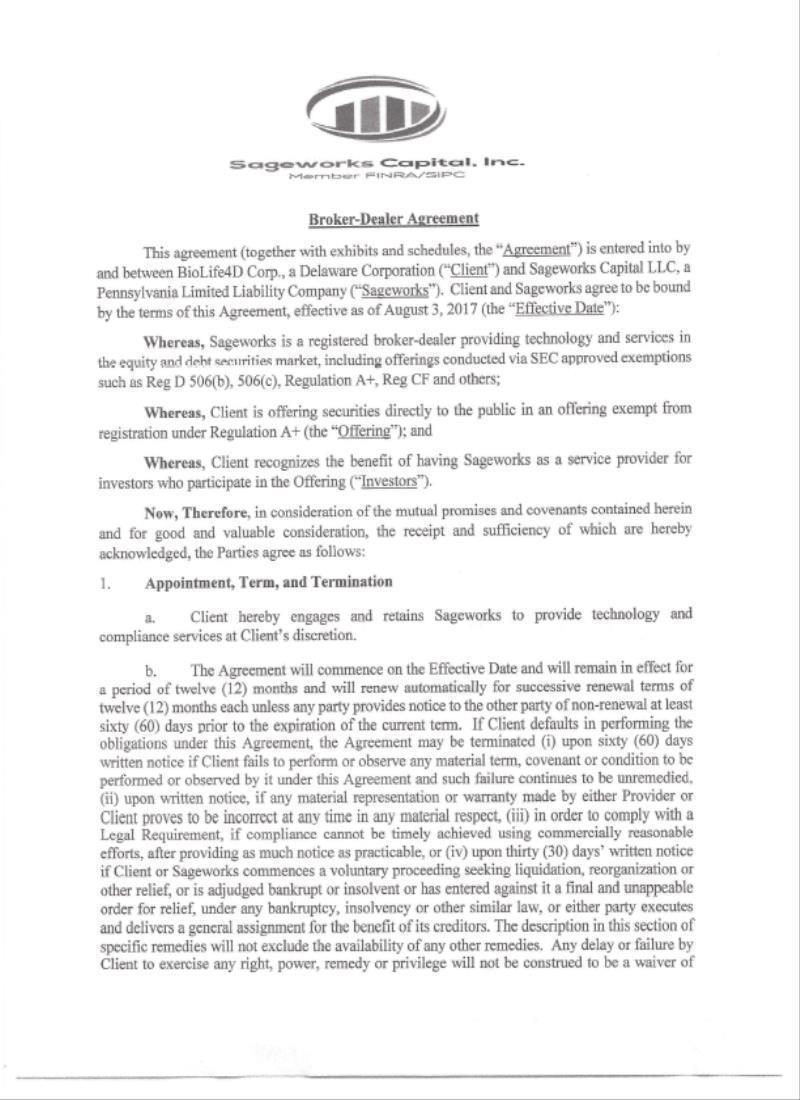
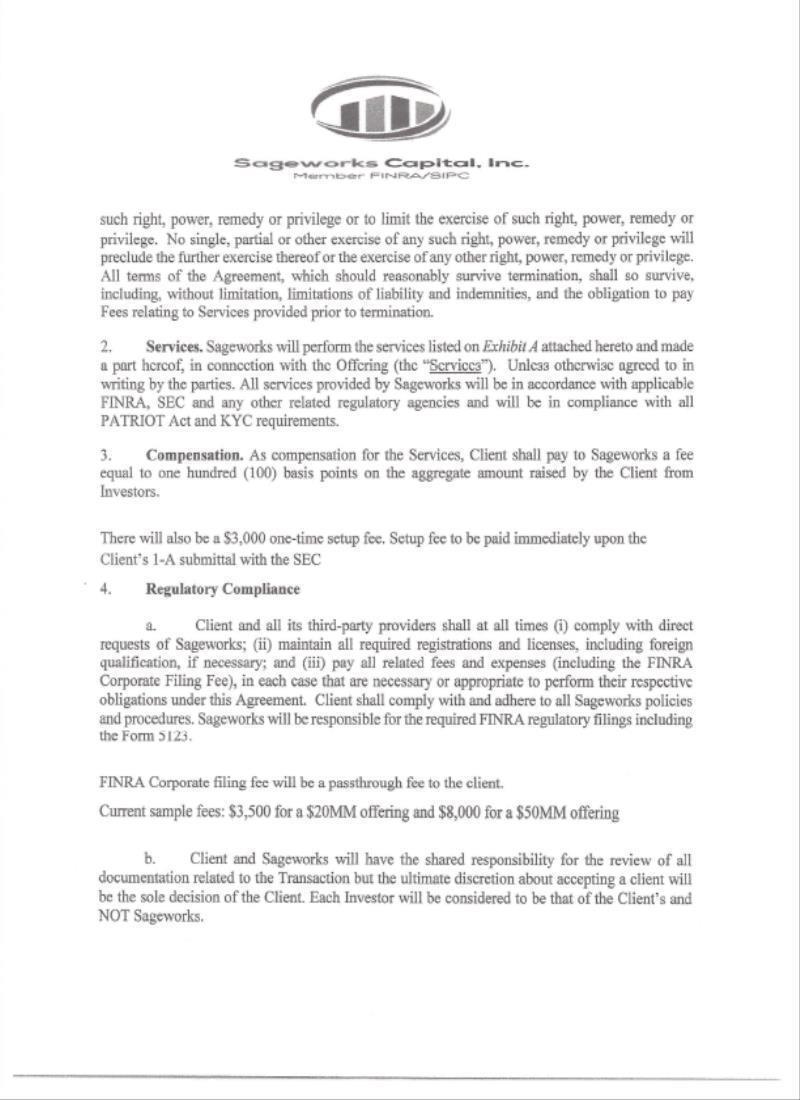
(1) The Company shall pay Sageworks Capital LLC a broker-dealer services fee equivalent to 1% on funds raised in the Offering. Sageworks LLC is not an underwriter and will not be paid underwriting fees, but will be paid service fees. See “PLAN OF DISTRIBUTION.”
(2) Does not reflect payment of expenses of this offering, which are estimated to not exceed $500,000 and which include, among other things, legal fees, accounting costs, reproduction expenses, due diligence, marketing, consulting, administrative services other costs of blue sky compliance, and actual out-of-pocket expenses incurred by the Company selling the Shares, but which do not include administrative fees paid to Sageworks Capital LLC or technology providers. If the company engages the services of additional broker-dealers in connection with the offering, their commissions will be an additional expense of the offering. See the “Plan of Distribution” for details regarding the compensation payable in connection with this offering. This amount represents the proceeds of the offering to the Company, which will be used as set out in “USE OF PROCEEDS TO COMPANY.”
(3) There are no finder’s fees or other fees being paid to third parties from the proceeds, other than those disclosed below. See "PLAN OF DISTRIBUTION."
GENERALLY, NO SALE MAY BE MADE TO YOU IN THIS OFFERING IF THE AGGREGATE PURCHASE PRICE YOU PAY IS MORE THAN 10% OF THE GREATER OF YOUR ANNUAL INCOME OR NET WORTH. DIFFERENT RULES APPLY TO ACCREDITED INVESTORS AND NON-NATURAL PERSONS. BEFORE MAKING ANY REPRESENTATION THAT YOUR INVESTMENT DOES NOT EXCEED APPLICABLE THRESHOLDS, WE ENCOURAGE YOU TO REVIEW RULE 251(D)(2)(I)(C) OF REGULATION A. FOR GENERAL INFORMATION ON INVESTING, WE ENCOURAGE YOU TO REFER TO WWW.INVESTOR.GOV.
| 3 |
This offering (the “Offering”) consists of Class A Common Stock (the “Shares” or individually, each a “Share”) that is being offered on a “best efforts” basis, which means that there is no guarantee that any minimum amount will be sold. The Shares are being offered and sold by BioLife4D Corporation, a Delaware Corporation (“BioLife4D” or the “Company”). There are 5,000,000 Shares being offered at a price of $10.00 per Share with a minimum purchase of 25 Shares per investor. The Shares are being offered on a best efforts basis to an unlimited number of accredited investors and an unlimited number of non-accredited investors only by the Company and through Sageworks Capital LLC a broker/dealer registered with the Securities and Exchange Commission (the “SEC”) and a member of the Financial Industry Regulatory Authority (“FINRA”). The maximum aggregate amount of the Shares offered is $50,000,000.00 (the “Maximum Offering”). There is no minimum number of Shares that needs to be sold in order for funds to be released to the Company and for this Offering to close.
The Shares are being offered pursuant to Regulation A of Section 3(b) of the Securities Act of 1933, as amended, for Tier 2 offerings. The Shares will only be issued to purchasers who satisfy the requirements set forth in Regulation A. The offering is expected to expire on the first of: (i) all of the Shares offered are sold; or (ii) unless sooner terminated by the company’s CEO. Funds shall be deposited in a Company account that may be controlled by Sageworks Capital LLC. Funds will be promptly refunded without interest, for sales that are not consummated. All funds received shall be held only in a non-interest bearing bank account. Upon each closing under the terms as set out in this Offering Circular, funds will be immediately transferred to the Company where they will be available for use in the operations of the Company’s business in a manner consistent with the “USE OF PROCEEDS TO COMPANY” in this Offering Circular. This Offering may remain open for a twelve (12) month period but may extend past the Closing Date at the discretion of the Company and in accordance with the rules and provisions of Regulation A of the JOBS Act.
THIS OFFERING CIRCULAR DOES NOT CONSTITUTE AN OFFER OR SOLICITATION IN ANY JURISDICTION IN WHICH SUCH AN OFFER OR SOLICITATION WOULD BE UNLAWFUL. NO PERSON HAS BEEN AUTHORIZED TO GIVE ANY INFORMATION OR TO MAKE ANY REPRESENTATIONS CONCERNING THE COMPANY OTHER THAN THOSE CONTAINED IN THIS OFFERING CIRCULAR, AND IF GIVEN OR MADE, SUCH OTHER INFORMATION OR REPRESENTATION MUST NOT BE RELIED UPON.
_____________________________________
PROSPECTIVE INVESTORS ARE NOT TO CONSTRUE THE CONTENTS OF THIS OFFERING CIRCULAR, OR OF ANY PRIOR OR SUBSEQUENT COMMUNICATIONS FROM THE COMPANY OR ANY OF ITS EMPLOYEES, AGENTS OR AFFILIATES, AS INVESTMENT, LEGAL, FINANCIAL OR TAX ADVICE.
_____________________________________
BEFORE INVESTING IN THIS OFFERING, PLEASE REVIEW ALL DOCUMENTS CAREFULLY, ASK ANY QUESTIONS OF THE COMPANY’S MANAGEMENT THAT YOU WOULD LIKE ANSWERED AND CONSULT YOUR OWN COUNSEL, ACCOUNTANT AND OTHER PROFESSIONAL ADVISORS AS TO LEGAL, TAX AND OTHER RELATED MATTERS CONCERNING THIS INVESTMENT.
| 4 |
NASAA UNIFORM LEGEND
FOR RESIDENTS OF ALL STATES: THE PRESENCE OF A LEGEND FOR ANY GIVEN STATE REFLECTS ONLY THAT A LEGEND MAY BE REQUIRED BY THAT STATE AND SHOULD NOT BE CONSTRUED TO MEAN AN OFFER OR SALE MAY BE MADE IN A PARTICULAR STATE. IF YOU ARE UNCERTAIN AS TO WHETHER OR NOT OFFERS OR SALES MAY BE LAWFULLY MADE IN ANY GIVEN STATE, YOU ARE HEREBY ADVISED TO CONTACT THE COMPANY. THE SECURITIES DESCRIBED IN THIS OFFERING CIRCULAR HAVE NOT BEEN REGISTERED UNDER ANY STATE SECURITIES LAWS (COMMONLY CALLED "BLUE SKY" LAWS).
IN MAKING AN INVESTMENT DECISION INVESTORS MUST RELY ON THEIR OWN EXAMINATION OF THE PERSON OR ENTITY CREATING THE SECURITIES AND THE TERMS OF THE OFFERING, INCLUDING THE MERITS AND RISKS INVOLVED. THESE SECURITIES HAVE NOT BEEN RECOMMENDED BY ANY FEDERAL OR STATE SECURITIES COMMISSION OR REGULATORY AUTHORITY. FURTHERMORE, THE FOREGOING AUTHORITIES HAVE NOT CONFIRMED THE ACCURACY OR DETERMINED THE ADEQUACY OF THIS DOCUMENT. ANY REPRESENTATION TO THE CONTRARY IS A CRIMINAL OFFENSE.
_____________________________________
NOTICE TO FOREIGN INVESTORS
IF THE PURCHASER LIVES OUTSIDE THE UNITED STATES, IT IS THE PURCHASER'S RESPONSIBILITY TO FULLY OBSERVE THE LAWS OF ANY RELEVANT TERRITORY OR JURISDICTION OUTSIDE THE UNITED STATES IN CONNECTION WITH ANY PURCHASE OF THE SECURITIES, INCLUDING OBTAINING REQUIRED GOVERNMENTAL OR OTHER CONSENTS OR OBSERVING ANY OTHER REQUIRED LEGAL OR OTHER FORMALITIES. THE COMPANY RESERVES THE RIGHT TO DENY THE PURCHASE OF THE SECURITIES BY ANY FOREIGN PURCHASER.
_____________________________________
| 5 |
Forward Looking Statement Disclosure
This Form 1-A, Offering Circular, and any documents incorporated by reference herein or therein contain forward-looking statements and are subject to risks and uncertainties. All statements other than statements of historical fact or relating to present facts or current conditions included in this Form 1-A, Offering Circular, and any documents incorporated by reference are forward-looking statements. Forward-looking statements give the Company's current reasonable expectations and projections relating to its financial condition, results of operations, plans, objectives, future performance and business. You can identify forward-looking statements by the fact that they do not relate strictly to historical or current facts. These statements may include words such as "anticipate," "estimate," "expect," "project," "plan," "intend," "believe," "may," "should," "can have," "likely" and other words and terms of similar meaning in connection with any discussion of the timing or nature of future operating or financial performance or other events. The forward-looking statements contained in this Form 1-A, Offering Circular, and any documents incorporated by reference herein or therein are based on reasonable assumptions the Company has made in light of its industry experience, perceptions of historical trends, current conditions, expected future developments and other factors it believes are appropriate under the circumstances. As you read and consider this Form 1-A, Offering Circular, and any documents incorporated by reference, you should understand that these statements are not guarantees of performance or results. They involve risks, uncertainties (many of which are beyond the Company's control) and assumptions. Although the Company believes that these forward-looking statements are based on reasonable assumptions, you should be aware that many factors could affect its actual operating and financial performance and cause its performance to differ materially from the performance anticipated in the forward-looking statements. Should one or more of these risks or uncertainties materialize, or should any of these assumptions prove incorrect or change, the Company's actual operating and financial performance may vary in material respects from the performance projected in these forward-looking statements. Any forward-looking statement made by the Company in this Form 1-A, Offering Circular or any documents incorporated by reference herein speaks only as of the date of this Form 1-A, Offering Circular or any documents incorporated by reference herein. Factors or events that could cause our actual operating and financial performance to differ may emerge from time to time, and it is not possible for the Company to predict all of them. The Company undertakes no obligation to update any forward-looking statement, whether as a result of new information, future developments or otherwise, except as may be required by law.
_____________________________________
About This Form 1-A and Offering Circular
In making an investment decision, you should rely only on the information contained in this Form 1-A and Offering Circular. The Company has not authorized anyone to provide you with information different from that contained in this Form 1-A and Offering Circular. We are offering to sell, and seeking offers to buy the Shares only in jurisdictions where offers and sales are permitted. You should assume that the information contained in this Form 1-A and Offering Circular is accurate only as of the date of this Form 1-A and Offering Circular, regardless of the time of delivery of this Form 1-A and Offering Circular. Our business, financial condition, results of operations, and prospects may have changed since that date. Statements contained herein as to the content of any agreements or other documents are summaries and, therefore, are necessarily selective and incomplete and are qualified in their entirety by the actual agreements or other documents. The Company will provide the opportunity to ask questions of and receive answers from the Company's management concerning terms and conditions of the Offering, the Company or any other relevant matters and any additional reasonable information to any prospective investor prior to the consummation of the sale of the Shares. This Form 1-A and Offering Circular do not purport to contain all of the information that may be required to evaluate the Offering and any recipient hereof should conduct its own independent analysis. The statements of the Company contained herein are based on information believed to be reliable. No warranty can be made as to the accuracy of such information or that circumstances have not changed since the date of this Form 1-A and Offering Circular. The Company does not expect to update or otherwise revise this Form 1-A, Offering Circular or other materials supplied herewith. The delivery of this Form 1-A and Offering Circular at any time does not imply that the information contained herein is correct as of any time subsequent to the date of this Form 1-A and Offering Circular. This Form 1-A and Offering Circular are submitted in connection with the Offering described herein and may not be reproduced or used for any other purpose.
| 6 |
EXEMPTIONS UNDER JUMPSTART OUR BUSINESS STARTUPS ACT
We are an emerging growth company. An emerging growth company is one that had total annual gross revenues of less than $1,000,000,000 (as such amount is indexed for inflation every 5 years by the Commission to reflect the change in the Consumer Price Index for All Urban Consumers published by the Bureau of Labor Statistics, setting the threshold to the nearest 1,000,000) during its most recently completed fiscal year. We would lose our emerging growth status if we were to exceed $1,000,000,000 in gross revenues. We are not sure this will ever take place.
Because we are an emerging growth company, we have the exemption from Section 404(b) of Sarbanes-Oxley Act of 2002 and Section 14A(a) and (b) of the Securities Exchange Act of 1934. Under Section 404(b), we are now exempt from the internal control assessment required by subsection (a) that requires each independent auditor that prepares or issues the audit report for the issuer shall attest to, and report on, the assessment made by the management of the issuer. We are also not required to receive a separate resolution regarding either executive compensation or for any golden parachutes for our executives so long as we continue to operate as an emerging growth company.
We hereby elect to use the extended transition period for complying with new or revised accounting standards under Section 102(b)(1).
We will lose our status as an emerging growth company in the following circumstances:
·
The end of the fiscal year in which our annual revenues exceed $1 billion.
·
The end of the fiscal year in which the fifth anniversary of our IPO occurred.
·
The date on which we have, during the previous three-year period, issued more than $1 billion in non-convertible debt.
·
The date on which we qualify as a large accelerated filer.
| 7 |
OFFERING SUMMARY
The following summary is qualified in its entirety by the more detailed information appearing elsewhere in this Offering Circular and/or incorporated by reference in this Offering Circular. For full offering details, please (1) thoroughly review this Form 1-A filed with the Securities and Exchange Commission (2) thoroughly review this Offering Circular and (3) thoroughly review any attached documents to or documents referenced in, this Form 1-A and Offering Circular.
|
Type of Stock Offering: |
|
Class A Common Stock |
|
|
|
|
|
Price Per Share: |
|
$10.00 |
|
|
|
|
|
Minimum Investment: |
|
$250.00 per investor (25 Shares of Class A Common Stock) |
|
|
|
|
|
Maximum Offering: |
|
$50,000,000.00. The Company will not accept investments greater than the Maximum Offering amount. |
|
|
|
|
|
Maximum Shares Offered: |
|
5,000,000 Shares of Class A Common Stock |
|
|
|
|
|
Use of Proceeds: |
|
See the description in section entitled “USE OF PROCEEDS TO COMPANY” on page 36 herein. |
|
|
|
|
|
Voting Rights: |
|
The Shares have no voting rights. See the description of the voting rights all the Company’s other classes of stock on page 67 herein. |
|
|
|
|
|
Length of Offering: |
|
Shares will be offered on a continuous basis until either (1) the maximum number of Shares or sold; (2) if the Company in its sole discretion withdraws this Offering. |
|
|
|
|
|
Implicit Valuation: |
|
The implicit valuation of the Company’s outstanding shares is calculated by multiplying the number of shares currently outstanding by the offering price per share. |
PERKS
The Company will provide the following perquisites (“perks”) to investors in this offering, in addition to the Shares purchased, at each level of investment defined below, after a subscription for investment is accepted and after Shares are issued to the investor:
If an investor purchases at least $250.00 of Class A Common Stock (25 Shares), the investor will receive exclusive custom communications, newsletters and webinars.
If an investor purchases at least $750.00 of Class A Common Stock (75 Shares), the investor will receive everything at the $250 level, plus additional access to an investors-only web portal where they can access exclusive content such as live video coverage of BioLife4D lab activity and behind-the-scenes footage of ongoing development efforts.
| 8 |
If an investor purchases at least $2,500.00 of Class A Common Stock (250 Shares), the investor will receive everything at the $250 level and at the $750 level, plus named recognition on the BioLife4D Wall of Appreciation, access to exclusive live video feeds of BioLife4D’s first viable heart being bioprinted and the company’s first bioprinted heart transplant operation.
If an investor purchases at least $100,000.00 of Class A Common Stock (1,000 Shares), the investor will receive everything at the $250 level, the $750 level and the $2,500.00 level, plus a personal VIP tour of BioLife4D facilities and laboratory, a personalized lab coat and equipment to keep, a private dinner with company founders, and the opportunity to witness live and in-person the first heart transplant operation utilizing a BioLife4D bioprinted heart.
If an investor purchases at least $500,000.00 of Class A Common Stock (5000 Shares), the investor will receive everything at the $250 level, the $750 level, the $2,500.00 level and the $100,000 level, plus exclusive rights to help name BioLife4D’s bioprinting technology that will be utilized to bioprint the first heart for the company’s first transplant operation.
The Offering
|
Class B Common Stock Outstanding (1) |
10,200,000 Shares |
|
Class A Common Stock in this Offering (2) |
5,000,000 Shares |
|
Class A Common Stock Outstanding |
93,500 Shares |
|
Total Stock to be outstanding after the offering (3) |
15,293,500 |
1. There are 2 classes of stock in the Company at present: Class A Common Stock and Class B Common Stock. For a full description of the rights of each class of stock, please see the section of this Offering Circular entitled “SECURITIES BEING OFFERED” on page 67 below.
2. The total number of Shares of Class A Common Stock (5,000,000) assumes that the maximum number of Shares are sold in this offering.
The Company may not be able to sell the Maximum Offering Amount. The Company will conduct one or more closings on a rolling basis as funds are received from investors. Funds tendered by investors will be kept in an account in the Company’s name at Evolve bank and will be immediately available to the Company. Once a subscription agreement is accepted by the Company, funds are non-refundable.
The Company plans to begin sales immediately after this Preliminary Offering Circular has been qualified by the Securities and Exchange Commission (the “SEC”). The Company will provide final pricing information in a final Offering Circular or supplemental Preliminary Offering Circular. The net proceeds of the Offering will be the gross proceeds of the Shares sold minus the expenses of the offering.
We are not listed on any trading market or stock exchange, and our ability to list our stock in the future is uncertain. Investors should not assume that the Offered Shares will be listed. A public trading market for the Shares may not develop.
| 9 |
RISK FACTORS
The purchase of the Company’s Class A Common Stock involves substantial risks. You should carefully consider the following risk factors in addition to any other risks associated with this investment. The Shares offered by the Company constitute a highly speculative investment and you should be in an economic position to lose your entire investment. The risks listed do not necessarily comprise all those associated with an investment in the Shares and are not set out in any particular order of priority. Additional risks and uncertainties may also have an adverse effect on the Company’s business and your investment in the Shares. An investment in the Company may not be suitable for all recipients of this Offering Circular. You are advised to consult an independent professional adviser or attorney who specializes in investments of this kind before making any decision to invest. You should consider carefully whether an investment in the Company is suitable in the light of your personal circumstances and the financial resources available to you.
The discussions and information in this Offering Circular may contain both historical and forward-looking statements. To the extent that the Offering Circular contains forward-looking statements regarding the financial condition, operating results, business prospects, or any other aspect of the Company’s business, please be advised that the Company’s actual financial condition, operating results, and business performance may differ materially from that projected or estimated by the Company in forward-looking statements. The Company has attempted to identify, in context, certain of the factors it currently believes may cause actual future experience and results may differ from the Company’s current expectations.
Before investing, you should carefully read and carefully consider the following risk factors:
Risks Relating to the Company and Its Business
The Company Has Limited Operating History
The Company has a limited operating history and there can be no assurance that the Company's proposed plan of business can be realized in the manner contemplated and, if it cannot be, shareholders may lose all or a substantial part of their investment. There is no guarantee that it will ever realize any significant operating revenues or that its operations will ever be profitable.
The Company Is Dependent Upon Its Management, Founders, Key Personnel and Consultants to Execute the Business Plan, And Many Of Them Will Have Concurrent Responsibilities At Other Companies
The Company's success is heavily dependent upon the continued active participation of the Company's current executive officers as well as other key personnel and consultants. Many of them will have concurrent responsibilities at other entities. Some of the advisors, scientists, consultants and others to whom the Company’s ultimate success may be reliant have not signed contracts with the Company and may not ever do so. Loss of the services of one or more of these individuals could have a material adverse effect upon the Company's business, financial condition or results of operations. Further, the Company's success and achievement of the Company's growth plans depend on the Company's ability to recruit, hire, train and retain other highly qualified scientific, technical and managerial personnel. Competition for qualified employees and consultants among companies in the applicable industries is intense, and the loss of any of such persons, or an inability to attract, retain and motivate any additional highly skilled employees and consultants required for the initiation and expansion of the Company's activities, could have a materially adverse effect on it. The inability to attract and retain the necessary personnel, consultants and advisors could have a material adverse effect on the Company's business, financial condition or results of operations.
| 10 |
The Company Is Attempting To 3D Print And Transplant Human Hearts, Which Has Never Been Done and May Not Be Possible
The Company's success is dependent upon the ability of the Company to 3D print and transplant human hearts, which has never been successfully done by the Company or any other person or entity. Should the Company be unable to successfully 3D print and transplant human hearts, or should a competitor be able to do so prior to the Company being able to do so, your investment may be significantly affected and the Company may fail.
3D Printed Organs May Fail Once Transplanted Into Patients Causing Serious Injury or Death to The Patients, Leading to Lawsuits and Bad Publicity For the Company
The Company's success is dependent upon the ability of the Company to successfully transplant a human heart. Because this has never been done by the Company or any other person or entity, there are significant risks that a patient may have adverse effects from the Company’s efforts. For example, a patient’s body may reject the transplanted organ, a patient may suffer significant health issues as a result of the transplanted organ and a patient may die if the patient’s body rejects the transplanted organ, the organ fails for any reason, or for other complications of the surgical procedures to transplant the heart. Any or all of these occurrences could lead to the Company being subject to lawsuits, bad publicity, and other effects which could have a detrimental effect on the Company and on your investment.
Although Dependent Upon Certain Key Personnel, The Company Does Not Have Any Key Man Life Insurance Policies On Any Such People At The Time Of This Offering.
The Company is dependent upon management in order to conduct its operations and execute its business plan, however, the Company has not purchased any insurance policies with respect to those individuals in the event of their death or disability. Therefore, should any of these key personnel, management or founders die or become disabled, the Company will not receive any compensation that would assist with such person's absence. The loss of such person could negatively affect the Company and its operations.
| 11 |
The Company Is Or Will Be Subject To Income Taxes As Well As Non-Income Based Taxes, Such As Payroll, Sales, Use, Value-Added, Net Worth, Property And Goods And Services Taxes.
Significant judgment is required in determining our provision for income taxes and other tax liabilities. In the ordinary course of our business, there are many transactions and calculations where the ultimate tax determination is uncertain. Although the Company believes that our tax estimates will be reasonable: (i) there is no assurance that the final determination of tax audits or tax disputes will not be different from what is reflected in our income tax provisions, expense amounts for non-income based taxes and accruals and (ii) any material differences could have an adverse effect on our financial position and results of operations in the period or periods for which determination is made.
The Company Is Not Subject To Sarbanes-Oxley Regulations And Lack The Financial Controls And Safeguards Required Of Public Companies.
The Company does not have the internal infrastructure necessary, and is not required, to complete an attestation about our financial controls that would be required under Section 404 of the Sarbanes-Oxley Act of 2002. There can be no assurances that there are no significant deficiencies or material weaknesses in the quality of our financial controls. The Company expects to incur additional expenses and diversion of management's time if and when it becomes necessary to perform the system and process evaluation, testing and remediation required in order to comply with the management certification and auditor attestation requirements.
The Company Has Engaged In Certain Transactions With Related Persons.
Please see the section of this Offering Circular entitled “Interest of Management and Others in Certain Related-Party Transactions and Agreements”
Changes In Laws Or Regulations Could Harm The Company’s Performance.
Various federal and state laws, including labor laws, govern the Company’s relationship with our employees and affect operating costs. These laws may include minimum wage requirements, overtime pay, healthcare reform and the implementation of various federal and state healthcare laws, unemployment tax rates, workers' compensation rates, citizenship requirements, union membership and sales taxes. A number of factors could adversely affect our operating results, including additional government-imposed increases in minimum wages, overtime pay, paid leaves of absence and mandated health benefits, mandated training for employees, changing regulations from the National Labor Relations Board and increased employee litigation including claims relating to the Fair Labor Standards Act.
The Company’s Bank Accounts Will Not Be Fully Insured
The Company’s regular bank accounts for this Offering each have federal insurance that is limited to a certain amount of coverage. It is anticipated that the account balances in each account may exceed those limits at times. In the event that any of Company’s banks should fail, the Company may not be able to recover all amounts deposited in these bank accounts.
| 12 |
The Company’s Business Plan Is Speculative
The Company’s present business and planned business are speculative and subject to numerous risks and uncertainties. There is no assurance that the Company will generate significant revenues or profits.
The Company Faces Significant Competition in the United States and Elsewhere
The Company will face significant competition in the United States and elsewhere (please see the sub- section entitled “Competitive Landscape and Distinctions” below in this Offering Circular.
The Company Will Likely Incur Debt
The Company will likely incur debt (including secured debt) in the future and in the continuing operations of its business. Complying with obligations under such indebtedness may have a material adverse effect on the Company and on your investment.
The Company’s Expenses Could Increase Without a Corresponding Increase in Revenues
The Company’s operating and other expenses could increase without a corresponding increase in revenues, which could have a material adverse effect on the Company’s financial results and on your investment. Factors which could increase operating and other expenses include, but are not limited to (1) increases in the rate of inflation, (2) increases in taxes and other statutory charges, (3) changes in laws, regulations or government policies which increase the costs of compliance with such laws, regulations or policies, (4) significant increases in insurance premiums, (5) increases in borrowing costs, and (5) unexpected increases in costs of supplies, goods, materials, construction, equipment or distribution.
An Inability to Maintain and Enhance Product Image Could Affect Your Investment
It is important that the Company maintains and enhances the image of any new products. The image and reputation of the Company’s products may be impacted for various reasons including, but not limited to, bad publicity, litigation, and complaints from regulatory bodies. Such problems, even when unsubstantiated, could be harmful to the Company’s image and the reputation of its products. These claims may not be covered by the Company’s insurance policies. Any resulting litigation could be costly for the Company, divert management attention, and could result in increased costs of doing business, or otherwise have a material adverse effect on the Company’s business, results of operations, and financial condition. Any negative publicity generated could damage the Company’s reputation and diminish the value of the Company’s brand, which could have a material adverse effect on the Company’s business, results of operations, and financial condition, as well as your investment. Deterioration in the Company’s brand equity (brand image, reputation and product quality) may have a material adverse effect on its financial results as well as your investment.
| 13 |
If We Are Unable To Effectively Protect Our Intellectual Property, It May Impair Our Ability To Compete
Our success will depend on our ability to obtain and maintain meaningful intellectual property protection for any such intellectual property. The names and/or logos of Company brands may be challenged by holders of trademarks who file opposition notices, or otherwise contest, trademark applications by the Company for its brands. Similarly, domains owned and used by the Company may be challenged by others who contest the ability of the Company to use the domain name or URL. Our business depends on proprietary technology that may be infringed. Some or all of our products depend or will depend on our proprietary technology for their success. We rely on a combination of trade secrets, copyrights and trademarks, together with non-disclosure agreements, confidentiality provisions in sales, procurement, employment and other agreements and technical measures to establish and protect proprietary rights in our products. While we may seek patents for some or all of our products and technology, there is no guarantee that such patents will be granted. Our ability to successfully protect our technology may be limited because intellectual property laws in certain jurisdictions may be relatively ineffective, detecting infringements and enforcing proprietary rights may divert management’s attention and company resources, contractual measures such as non-disclosure agreements and confidentiality provisions may afford only limited protection, any patents we may receive will expire, thus providing competitors access to the applicable technology, competitors may independently develop products that are substantially equivalent or superior to our products or circumvent our intellectual property rights; and competitors may register patents in technologies relevant to our business areas. In addition, various parties may assert infringement claims against us. The cost of defending against infringement claims could be significant, regardless of whether the claims are valid. If we are not successful in defending such claims, we may be prevented from the use or sale of certain of our products, or liable for damages and required to obtain licenses, which may not be available on reasonable terms, any of which may have a material adverse impact on our business, results of operation or financial condition.
Computer, Website or Information System Breakdown Could Affect The Company’s Business
Computer, website and/or information system breakdowns as well as cyber security attacks could impair the Company’s ability to service its customers leading to reduced revenue from sales and/or reputational damage, which could have a material adverse effect on the Company’s financial results as well as your investment.
Changes In The Economy Could Have a Detrimental Impact On The Company
Changes in the general economic climate could have a detrimental impact on the Company’s revenue. It is possible that recessionary pressures and other economic factors (such as declining incomes, future potential rising interest rates, higher unemployment and tax increases) may adversely affect the Company. Any of such events or occurrences could have a material adverse effect on the Company’s financial results and on your investment.
| 14 |
The Amount Of Capital The Company Is Attempting To Raise In This Offering May Not Be Enough To Sustain The Company's Current Business Plan
In order to achieve the Company's near and long-term goals, the Company may need to procure funds in addition to the amount raised in the Offering. There is no guarantee the Company will be able to raise such funds on acceptable terms or at all. If we are not able to raise sufficient capital in the future, we will not be able to execute our business plan, our continued operations will be in jeopardy and we may be forced to cease operations and sell or otherwise transfer all or substantially all of our remaining assets, which could cause you to lose all or a portion of your investment.
We May Not Be Able To Obtain Adequate Financing To Continue Our Operations
The Company may require additional debt and/or equity financing to pursue our growth and business strategies. These include, but are not limited to enhancing our operating infrastructure and otherwise respond to competitive pressures. Given our limited operating history and existing losses, there can be no assurance that additional financing will be available, or, if available, that the terms will be acceptable to us. Lack of additional funding could force us to curtail substantially our growth plans. Furthermore, the issuance by us of any additional securities pursuant to any future fundraising activities undertaken by us would dilute the ownership of existing shareholders and may reduce the price of our Shares.
Terms Of Subsequent Financing, If Any, May Adversely Impact Your Investment
We may have to engage in common equity, debt, or preferred stock financings in the future. Your rights and the value of your investment in the Class A Common Stock could be reduced by the dilution caused by future equity issuances. Interest on debt securities could increase costs and negatively impact operating results. In the event we are permitted to issue preferred stock pursuant to the terms of our Company documents, preferred stock could be issued in series from time to time with such designation, rights, preferences, and limitations as needed to raise capital. The terms of preferred stock would be more advantageous to those investors than to the holders of Class A Common Stock. In addition, if we need to raise more equity capital from the sale of common stock, institutional or other investors may negotiate terms at least as, and possibly more, favorable than the terms of your investment. Shares of common stock which we sell could be sold into any market that develops, which could adversely affect the market price.
| 15 |
Our Employees, Executive Officers, Directors And Insider Shareholders Beneficially Own Or Control A Substantial Portion Of Our Outstanding Shares
Our employees, executive officers, directors and insider shareholders beneficially own or control a substantial portion of our outstanding type of stock which may limit your ability and the ability of our other shareholders, whether acting alone or together, to propose or direct the management or overall direction of our company. Additionally, this concentration of ownership could discourage or prevent a potential takeover of our Company that might otherwise result in an investor receiving a premium over the market price for its Shares. The majority of our currently outstanding Shares of stock are beneficially owned and controlled by a group of insiders, including our employees, directors, executive officers and inside shareholders. Accordingly, our employees, directors, executive officers and insider shareholders may have the power to control the election of our directors and the approval of actions for which the approval of our shareholders is required. If you acquire our Shares, you will have no effective voice in the management of our Company. Such concentrated control of our Company may adversely affect the price of our Shares. Our principal shareholders may be able to control matters requiring approval by our shareholders, including the election of directors, mergers or other business combinations. Such concentrated control may also make it difficult for our shareholders to receive a premium for their Shares in the event that we merge with a third party or enter into different transactions which require shareholder approval. These provisions could also limit the price that investors might be willing to pay in the future for our Shares.
Our Independent Auditor Firm Has Expressed In Its Report To Our Audited Financial Statements A Substantial Doubt About Our Ability To Continue As A Going Concern.
We have not yet entered into the commercialization stage of our products and therefore commercialization is uncertain and expected to require substantial expenditures. We have not yet generated sufficient revenues from our operations to fund our activities, and are therefore dependent upon external sources for financing our operations. There is a risk that we will be unable to obtain necessary financing to continue our operations on terms acceptable to us or at all. As a result, our independent auditor firm has expressed in its auditors’ report on the financial statements a substantial doubt regarding our ability to continue as a going concern. Our financial statements do not include any adjustments that might result from the outcome of the uncertainty regarding our ability to continue as a going concern. This going concern opinion could materially limit our ability to raise additional funds through the issuance of equity or debt securities or otherwise. Future reports on our financial statements may include an explanatory paragraph with respect to our ability to continue as a going concern. If we cannot continue as a going concern, our stockholders may lose their entire investment in the Class A Common Stock.
Our Operating Plan Relies In Large Part Upon Assumptions And Analyses Developed By The Company. If These Assumptions Or Analyses Prove To Be Incorrect, The Company’s Actual Operating Results May Be Materially Different From Our Forecasted Results
Whether actual operating results and business developments will be consistent with the Company’s expectations and assumptions as reflected in its forecast depends on a number of factors, many of which are outside the Company’s control, including, but not limited to:
|
|
· | whether the Company can obtain sufficient capital to sustain and grow its business |
|
|
|
|
|
|
· | our ability to manage the Company’s growth |
|
|
|
|
|
|
· | whether the Company can manage relationships with key vendors and advertisers |
|
|
|
|
|
|
· | demand for the Company’s products and services |
|
|
|
|
|
|
· | the timing and costs of new and existing marketing and promotional efforts |
|
|
|
|
|
|
· | competition |
|
|
|
|
|
|
· | the Company’s ability to retain existing key management, to integrate recent hires and to attract, retain and motivate qualified personnel |
|
|
|
|
|
|
· | the overall strength and stability of domestic and international economies |
Unfavorable changes in any of these or other factors, most of which are beyond the Company’s control, could materially and adversely affect its business, results of operations and financial condition.
| 16 |
To Date, The Company Has Had Operating Losses And Does Not Expect To Be Initially Profitable For At Least The Foreseeable Future, And Cannot Accurately Predict When It Might Become Profitable
The Company has been operating at a loss since the Company's inception, and the Company expects to continue to incur losses for the foreseeable future. Further, the Company may not be able to generate significant revenues in the future. In addition, the Company expects to incur substantial operating expenses in order to fund the expansion of the Company's business. As a result, The Company expects to continue to experience substantial negative cash flow for at least the foreseeable future and cannot predict when, or even if, the Company might become profitable.
The Company May Be Unable To Manage Their Growth Or Implement Their Expansion Strategy
The Company may not be able to expand the Company's product and service offerings, the Company's markets, or implement the other features of the Company's business strategy at the rate or to the extent presently planned. The Company's projected growth will place a significant strain on the Company's administrative, operational and financial resources. If the Company is unable to successfully manage the Company's future growth, establish and continue to upgrade the Company's operating and financial control systems, recruit and hire necessary personnel or effectively manage unexpected expansion difficulties, the Company's financial condition and results of operations could be materially and adversely affected.
The Company Relies Upon Trade Secret Protection To Protect Its Intellectual Property; It May Be Difficult And Costly To Protect The Company's Proprietary Rights And The Company May Not Be Able To Ensure Their Protection
The Company currently relies on trade secrets. While the Company uses reasonable efforts to protect these trade secrets, the Company cannot assure that its employees, consultants, contractors or advisors will not, unintentionally or willfully, disclose the Company's trade secrets to competitors or other third parties. In addition, courts outside the United States are sometimes less willing to protect trade secrets. Moreover, the Company's competitors may independently develop equivalent knowledge, methods and know-how. If the Company is unable to defend the Company's trade secrets from others use, or if the Company's competitors develop equivalent knowledge, it could have a material adverse effect on the Company's business. Any infringement of the Company's proprietary rights could result in significant litigation costs, and any failure to adequately protect the Company's proprietary rights could result in the Company's competitors offering similar products, potentially resulting in loss of a competitive advantage and decreased revenue. Existing patent, copyright, trademark and trade secret laws afford only limited protection. In addition, the laws of some foreign countries do not protect the Company's proprietary rights to the same extent as do the laws of the United States. Therefore, the Company may not be able to protect the Company's proprietary rights against unauthorized third-party use. Enforcing a claim that a third party illegally obtained and is using the Company's trade secrets could be expensive and time consuming, and the outcome of such a claim is unpredictable. Litigation may be necessary in the future to enforce the Company's intellectual property rights, to protect the Company's trade secrets or to determine the validity and scope of the proprietary rights of others. This litigation could result in substantial costs and diversion of resources and could materially adversely affect the Company's future operating results.
| 17 |
The Company's Business Model Is Evolving
The Company's business model is unproven and is likely to continue to evolve. Accordingly, the Company's initial business model may not be successful and may need to be changed. The Company's ability to generate significant revenues will depend, in large part, on the Company's ability to successfully market the Company's products to potential users who may not be convinced of the need for the Company's products and services or who may be reluctant to rely upon third parties to develop and provide these products. The Company intends to continue to develop the Company's business model as the Company's market continues to evolve.
If The Company Fails To Maintain And Enhance Awareness Of The Company's Brand, The Company's Business And Financial Results Could Be Adversely Affected
The Company believes that maintaining and enhancing awareness of the Company's brand is critical to achieving widespread acceptance and success of the Company's business. The Company also believes that the importance of brand recognition will increase due to the relatively low barriers to entry in the Company's market. Maintaining and enhancing the Company's brand awareness may require the Company to spend increasing amounts of money on, and devote greater resources to, advertising, marketing and other brand-building efforts, and these investments may not be successful. Further, even if these efforts are successful, they may not be cost-effective. If the Company is unable to continuously maintain and enhance the Company's media presence, the Company's market may decrease and the Company may fail to attract advertisers and subscribers, which could in turn result in lost revenues and adversely affect the Company's business and financial results.
The Company Needs to Increase Brand Awareness
Due to a variety of factors, the Company's opportunity to achieve and maintain a significant market share may be limited. Developing and maintaining awareness of the Company's brand name, among other factors, is critical. Further, the importance of brand recognition will increase as competition in the Company's market increases. Successfully promoting and positioning the Company's brand, products and services will depend largely on the effectiveness of the Company's marketing efforts. Therefore, the Company may need to increase the Company's financial commitment to creating and maintaining brand awareness. If the Company fails to successfully promote the Company's brand name or if the Company incurs significant expenses promoting and maintaining the Company's brand name, it would have a material adverse effect on the Company's results of operations.
| 18 |
The Company Faces Competition In The Company's Markets From Various Large And Small Companies, Some Of Which Have Greater Financial, Research And Development, Production And Other Resources Than Does The Company
In many cases, the Company’s competitors have longer operating histories, established ties to the market and consumers, greater brand awareness, and greater financial, technical and marketing resources. The Company's ability to compete depends, in part, upon a number of factors outside the Company's control, including the ability of the Company's competitors to develop alternatives that are superior. If the Company fails to successfully compete in its markets, or if the Company incurs significant expenses in order to compete, it could have a material adverse effect on the Company's results of operations.
Our Company Could Face Several Regulatory Hurdles
Some or all of our products will need to comply with many governmental standards and regulations relating to the marketing, use and sale of our products in general. Compliance with all of these requirements may delay, or prohibit, commercialization in the Unites States and in various countries, thereby adversely affecting our business and financial condition.
A Data Security Breach Could Expose The Company To Liability And Protracted And Costly Litigation, And Could Adversely Affect The Company's Reputation And Operating Revenues
To the extent that the Company's activities involve the storage and transmission of confidential information, the Company and/or third-party processors will receive, transmit and store confidential customer and other information. Encryption software and the other technologies used to provide security for storage, processing and transmission of confidential customer and other information may not be effective to protect against data security breaches by third parties. The risk of unauthorized circumvention of such security measures has been heightened by advances in computer capabilities and the increasing sophistication of hackers. Improper access to the Company's or these third parties' systems or databases could result in the theft, publication, deletion or modification of confidential customer and other information. A data security breach of the systems on which sensitive account information are stored could lead to fraudulent activity involving the Company's products and services, reputational damage, and claims or regulatory actions against us. If the Company is sued in connection with any data security breach, the Company could be involved in protracted and costly litigation. If unsuccessful in defending that litigation, the Company might be forced to pay damages and/or change the Company's business practices or pricing structure, any of which could have a material adverse effect on the Company's operating revenues and profitability. The Company would also likely have to pay fines, penalties and/or other assessments imposed as a result of any data security breach.
| 19 |
The Company Depends On Third-Party Providers For A Reliable Internet Infrastructure And The Failure Of These Third Parties, Or The Internet In General, For Any Reason Could Significantly Impair The Company's Ability To Conduct Its Business
The Company may outsource some or all of its online presence and data management to third parties who host the actual servers and provide power and security in multiple data centers in each geographic location. These third-party facilities could require uninterrupted access to the Internet. If the operation of the servers is interrupted for any reason, including natural disaster, financial insolvency of a third-party provider, or malicious electronic intrusion into the data center, its business could be significantly damaged. As has occurred with many Internet-based businesses, the Company may be subject to "denial-of-service" attacks in which unknown individuals bombard its computer servers with requests for data, thereby degrading the servers' performance. The Company cannot be certain it will be successful in quickly identifying and neutralizing these attacks. If either a third-party facility failed, or the Company's ability to access the Internet was interfered with because of the failure of Internet equipment in general or if the Company becomes subject to malicious attacks of computer intruders, its business and operating results will could be materially adversely affected.
Limitation On Director Liability
The Company may provide for the indemnification of directors to the fullest extent permitted by law and, to the extent permitted by such law, eliminate or limit the personal liability of directors to the Company and its shareholders for monetary damages for certain breaches of fiduciary duty. Such indemnification may be available for liabilities arising in connection with this Offering. Insofar as indemnification for liabilities arising under the Securities Act may be permitted to directors, officers or persons controlling the Company pursuant to the foregoing provisions, the Company has been informed that in the opinion of the Securities and Exchange Commission such indemnification is against public policy as expressed in the Securities Act and is therefore unenforceable.
The Company’s Expenses Could Increase Without a Corresponding Increase in Revenues
The Company’s operating and other expenses could increase without a corresponding increase in revenues, which could have a material adverse effect on the Company’s financial results and on your investment. Factors which could increase operating and other expenses include, but are not limited to (1) increases in the rate of inflation, (2) increases in taxes and other statutory charges, (3) changes in laws, regulations or government policies which increase the costs of compliance with such laws, regulations or policies, (4) significant increases in insurance premiums, (5) increases in borrowing costs, and (5) unexpected increases in costs of supplies, goods, materials, construction, equipment or distribution.
Changes In The Economy Could Have a Detrimental Impact
Changes in the general economic climate could have a detrimental impact on the Company’s revenue. It is possible that recessionary pressures and other economic factors (such as declining incomes, future potential rising interest rates, higher unemployment and tax increases) may decrease the disposable income that customers have available to spend on products and services like those of the Company and may adversely affect customers’ confidence and willingness to spend. Any of such events or occurrences could have a material adverse effect on the Company’s financial results and on your investment.
| 20 |
The Regulatory Approval Processes Of The FDA, Other Regulatory Bodies And Similar Foreign Authorities Is Lengthy, Time Consuming And Inherently Unpredictable
The Company believes its products and services will require FDA and/or other regulatory approval in the future for some or all of our products or services. However, we do not believe that this process will take place for three years. At that time, we will be unsure of what the process will be as there is no definitive process for review and approval of 3D bioprinted devices or tissues. The regulatory approval processes of the FDA, other regulatory bodies and similar foreign authorities could be lengthy, time consuming and inherently unpredictable, and if we are ultimately unable to obtain regulatory approval for our products and services, our business will be substantially harmed.
We believe our future products may be regulated under Medical Devices under the FDA. This type of regulation presents many risks.
We currently do not have any devices regulated by the FDA, but believe that our future products will be regulated under medical device reporting and will be subject to those laws and regulations. The Medical Device Reporting laws and regulations require us to provide information to the FDA on deaths or serious injuries alleged to have been associated with the use of our devices, as well as product malfunctions that likely would cause or contribute to death or serious injury if the malfunction were to recur. In addition, the FDA prohibits an approved device from being marketed for off-label use. The FDA and other agencies actively enforce the laws and regulations prohibiting the promotion of off-label uses, and a company that is found to have improperly promoted off-label uses may be subject to significant liability, including substantial monetary penalties and criminal prosecution.
There are currently no definitive regulatory requirement for the sale or use of 3D tissues. The regulatory environment is full of uncertainty.
Therapeutic tissues and other regenerative medicine products are subject to an extensive, lengthy and uncertain regulatory approval process by the FDA and comparable agencies in other countries. The regulation of new products is extensive, and the required process of laboratory testing and human studies is lengthy and expensive. The resource investment of time, staff and expense to satisfy these regulations will fall on us for the products we are developing. We may not be able to obtain FDA approvals for those products in a timely manner, or at all. We may encounter significant delays or excessive costs in our efforts to secure necessary approvals or licenses. Even if we obtain FDA regulatory approvals, the FDA extensively regulates manufacturing, labeling, distributing, marketing, promotion and advertising after product approval. Moreover, several of our product development areas may involve relatively new technology and have not been the subject of extensive product testing in humans. The regulatory requirements governing these products and related clinical procedures remain uncertain and the products themselves may be subject to substantial review by the FDA and/or foreign governmental regulatory authorities that could prevent or delay approval of these products and procedures. Regulatory requirements ultimately imposed on our products could limit our ability to test, manufacture and, ultimately, commercialize our products and thereby could adversely affect our financial condition and results of operations.
Our Revenues Will Be Dependent, In Part, Upon The Size Of The Markets In The Territories For Which We Gain Regulatory Approval And Have Commercial Rights
The Company believes its products and services will require FDA and/or other regulatory approval in the future and our revenues will be dependent, in part, upon the size of the markets in the territories for which we gain regulatory approval and have commercial rights. If the markets for patient subsets that we are targeting are not as significant as we estimate, we may not generate significant revenues from sales of our products or services.
Our Products And Services Will Require Regulatory Approval In Countries Outside Of The United States
The Company believes its products and services will require FDA and/or other regulatory approval in the future as well as regulatory approval in countries outside of the United States. We must comply with numerous and varying regulatory requirements of such countries regarding safety and efficacy and governing, among other things, possibly clinical trials and commercial sales, pricing and distribution of our product candidates, and we cannot predict success in these jurisdictions.
| 21 |
Our Products And Services Could Fail To Receive Regulatory Approval For Many Reasons
The Company believes its products and services will require FDA and/or other regulatory approval in the future for some of all of our products or services. The time required to obtain approval by the FDA, other regulatory bodies and comparable foreign authorities is unpredictable but could take many years following commencement of clinical trials, depending upon numerous factors. In addition, approval policies, regulations, or the type and amount of clinical data necessary to gain approval may change during the course of a product candidate’s clinical development. Our products and services could fail to receive regulatory approval for many reasons, including the following:
·
the FDA, other regulatory body or comparable foreign regulatory authorities may disagree with the design or implementation of our clinical trials, if any are required;
·
we may be unable to demonstrate to the satisfaction of the FDA, other regulatory body or comparable foreign regulatory authorities that a product or service is safe and effective for its proposed indication;
·
the results of clinical trials, if any are required, may not meet the level of statistical significance required by the FDA, other regulatory body or comparable foreign regulatory authorities for approval;
·
we may be unable to demonstrate that a product or service’s clinical and other benefits outweigh its safety risks;
·
the FDA, other regulatory body or comparable foreign regulatory authorities may disagree with our interpretation of data from preclinical studies or clinical trials, if any are required;
·
the FDA, other regulatory body or comparable foreign regulatory authorities may fail to approve the manufacturing processes or facilities of third-party manufacturers with which we contract for clinical and commercial supplies; and
·
the approval policies or regulations of the FDA, other regulatory body or comparable foreign regulatory authorities may significantly change in a manner rendering our clinical data insufficient for approval.
Even If We Were To Obtain Regulatory Approval, Regulatory Authorities May Approve Any Of Our Products Or Services For Fewer Or More Limited Indications Than We Request
The Company believes its products and services will require FDA and/or other regulatory approval in the future. Even if we were to obtain such approval, regulatory authorities may approve any of our products or services for fewer or more limited indications than we request or may grant approval contingent on the performance of costly post-marketing clinical trials. Any of the foregoing scenarios could materially harm the commercial prospects for our products and services.
Undesirable Side Effects Caused By Our Products Or Services Could Cause Us Or Regulatory Authorities To Interrupt, Delay Or Halt Clinical Trials And Could Result In The Delay Or Denial Of Regulatory Approval
The Company believes its products and services will require FDA and/or other regulatory approval in the future, and undesirable side effects caused by our products or services could cause us or regulatory authorities to interrupt, delay or halt clinical trials and could result in the delay or denial of regulatory approval by the FDA, other regulatory body or other comparable foreign authorities. Additionally, if one or more of our products or services receives approval, and we or others later identify undesirable side effects caused by such products or services, a number of potentially significant negative consequences could result, including:
|
|
· | regulatory authorities may withdraw approvals of such products or services; |
|
|
|
|
|
|
· | we may be required to create a guide outlining the risks of such side effects for distribution to patients; |
|
|
|
|
|
|
· | we could be sued and held liable for harm caused to patients; and |
|
|
|
|
|
|
· | our reputation may suffer. |
Any of these occurrences may harm our business, financial condition and prospects significantly.
| 22 |
The FDA, Other Regulatory Bodies And Other Comparable Foreign Regulatory Authorities Each Have Substantial Discretion In The Approval Process And May Either Refuse To Consider Our Application For Review Or May Form The Opinion After Review Of Our Data That Our Application Is Insufficient To Allow Approval Of Our Products Or Services
The Company believes its products and services will require FDA and/or other regulatory approval in the future. The FDA, other regulatory bodies and other comparable foreign regulatory authorities each have substantial discretion in the approval process and may either refuse to consider our application for review or may form the opinion after review of our data that our application is insufficient to allow approval of our products or services. Approval procedures vary among jurisdictions and can involve requirements and administrative review periods different from, and greater than, those in the United States. Moreover, any approvals that we obtain may not cover all of the clinical indications for which we are seeking approval, or could contain significant limitations in the form of narrow indications, warnings, precautions or contraindications with respect to conditions of use. In such an event, our ability to generate revenues from such products would be greatly reduced and our business would be harmed.
A Regulatory Authority May Require That We Conduct Additional Clinical, Preclinical Or Manufacturing Validation Studies And Submit That Data Before It Will Reconsider Our Application
The Company believes its products and services will require FDA and/or other regulatory approval in the future. If and when this occurs, and a regulatory authority does not consider or approve our application, it may require that we conduct additional clinical, preclinical or manufacturing validation studies and submit that data before it will reconsider our application. Depending on the extent of these or any other studies, approval of any applications that we submit may be delayed by several years, or may require us to expend more resources than we have available. It is also possible that additional studies, if performed and completed, may not be successful or considered sufficient by the applicable regulatory authority for approval or even to make our applications approvable. If any of these outcomes occur, we may be forced to abandon one or more of our applications for approval, which might significantly harm our business and prospects.
Regulatory Approval To Market A Product Or Service May Be Subject To Limitations On The Indicated Uses For Which We May Market The Product Or Service.
The Company believes its products and services will require FDA and/or other regulatory approval in the future. Even if we do receive regulatory approval to market a product or service, any such approval may be subject to limitations on the indicated uses for which we may market the product or service. It is possible that none of our existing products or services we may seek to develop in the future will ever obtain the appropriate regulatory approvals necessary for us to commence product sales. In many countries outside the United States, a product candidate must be approved for reimbursement before it can be approved for sale in that country. In some cases, the price that we intend to charge for our products or services is also subject to approval. Any delay in obtaining, or an inability to obtain, applicable regulatory approvals would prevent us from commercializing our product candidates, generating revenues and achieving and sustaining profitability.
| 23 |
Even If We Receive Regulatory Approval For Any Of Our Products Or Services, We Will Be Subject To Ongoing Obligations And Continued Regulatory Review, Which May Result In Significant Additional Expense
The Company believes its products and services will require FDA and/or other regulatory approval in the future for some or all of our products or services. Even if we receive regulatory approval for any of our products or services, we will be subject to ongoing obligations and continued regulatory review, which may result in significant additional expense. Additionally, our products and services, if approved, could be subject to restrictions and market withdrawal and we may be subject to penalties if we fail to comply with regulatory requirements or experience unanticipated problems with our products or services.
If We Are Unable To Adapt To Changes In Existing Requirements Or The Adoption Of New Requirements Or Policies, Or If We Are Not Able To Maintain Regulatory Compliance, We May Lose Any Market Approval
The FDA’s policies may change and additional government regulations may be enacted that could prevent, limit or delay regulatory approval of our products or services. If we are slow or unable to adapt to changes in existing requirements or the adoption of new requirements or policies, or if we are not able to maintain regulatory compliance, we may lose any market approval that we may have obtained, which would adversely affect our business, prospects and ability to achieve or sustain profitability.
We Currently Have Limited Marketing And Limited Sales Organization In Place
We currently have limited marketing and limited sales organization for our products and services. If we are unable to establish sufficient marketing and sales capabilities or enter into agreements with third parties to market and sell our products and services, we may not be able to effectively market and sell our product and services, or generate product revenues.
Our Products And/Or Services May Not Gain Market Acceptance
Our products and/or services may not gain market acceptance among physicians, health care payors, patients and the medical community, which are critical to commercial success. Market acceptance of any product or service depends on a number of factors, including:
·
the efficacy and safety as demonstrated in clinical trials, if required;
·
the timing of market introduction of such product or service as well as competitive products;
·
the clinical indications for which the product or service is approved;
·
acceptance by physicians, hospitals and patients of the product or service as a safe and effective treatment;
·
the potential and perceived advantages of such product or service over alternative treatments, especially with respect to patient subsets that we are targeting with such product or service;
·
the safety of such product or service seen in a broader patient group, including its use outside the approved indications;
·
the cost of treatment in relation to alternative treatments;
·
the availability of adequate reimbursement and pricing by third-party payors and government authorities;
·
the prevalence and severity of adverse side effects; and
·
the effectiveness of our sales and marketing efforts.
| 24 |
We May Face Significant Competition From Other Biotechnology Companies, And Our Operating Results Will Suffer If We Fail To Compete Effectively
We may face significant competition from other biotechnology companies, and our operating results could suffer if we fail to compete effectively. The biotechnology industry is intensely competitive and subject to rapid and significant technological change. We have competitors both in the United States and internationally, including major biotechnology companies and universities and other research institutions. Many of our competitors have substantially greater financial, technical and other resources, such as larger research and development staff and experienced marketing and manufacturing organizations. Additional mergers and acquisitions in the biotechnology industries may result in even more resources being concentrated in our competitors. As a result, these companies may obtain regulatory approval, if required, or market acceptance more rapidly than we are able and may be more effective in selling and marketing their products as well. Smaller or early-stage companies may also prove to be significant competitors, particularly through collaborative arrangements with large, established companies. Competition may increase further as a result of advances in the commercial applicability of technologies and greater availability of capital for investment in these industries. Our competitors may succeed in developing, acquiring or licensing on similar products or services that we may develop.
We Will Be Reliant On Government Authorities And Third-Party Payors, Such As Private Health Insurers And Health Maintenance Organizations, Who Decide Which Products And Services They Will Pay For And Establish Reimbursement Levels
Government authorities and third-party payors, such as private health insurers and health maintenance organizations, decide which products and services they will pay for and establish reimbursement levels. Reimbursement by a third-party payor may depend upon a number of factors, including the third-party payor’s determination that use of a product or service is:
·
a covered benefit under its health plan;
·
safe, effective and medically necessary;
·
appropriate for the specific patient;
·
cost-effective; and
·
neither experimental nor investigational.
| 25 |
Obtaining coverage and reimbursement approval for a product or service from a government or other third-party payor is a time consuming and costly process that could require us to provide supporting scientific, clinical and cost-effectiveness data for the use of our products to the payor. We may not be able to provide data sufficient to gain acceptance with respect to coverage and reimbursement. If reimbursement of our future products or services is unavailable or limited in scope or amount, or if pricing is set at unsatisfactory levels, we may be unable to achieve or sustain profitability.
Legislative And Regulatory Changes To The Health Care System Could Impact Our Ability To Sell Our Products Or Services Profitably
In both the United States and certain foreign jurisdictions, there have been and we expect there will continue to be a number of legislative and regulatory changes to the health care system that could impact our ability to sell our products or services profitably. There have been, and likely will continue to be, legislative and regulatory proposals at the federal and state levels directed at broadening the availability of healthcare and containing or lowering the cost of healthcare. We cannot predict the initiatives that may be adopted in the future. The continuing efforts of the government, insurance companies, managed care organizations and other payors of healthcare services to contain or reduce costs of healthcare may adversely affect:
·
the demand for any products or services for which we may market and/or obtain regulatory approval, if required;
·
our ability to set a price that we believe is fair for our products and services;
·
our ability to generate revenues and achieve or maintain profitability;
·
the level of taxes that we are required to pay; and
·
the availability of capital.
In addition, governments may impose price controls, which may adversely affect our future profitability.
We May Not Be Able To Attract Or Retain Qualified Management And Scientific Personnel In The Future Due To The Intense Competition For A Limited Number Of Qualified Personnel Among Biotechnology Businesses
We may not be able to attract or retain qualified management and scientific personnel in the future due to the intense competition for a limited number of qualified personnel among biotechnology businesses. Many of the other biotechnology companies that we compete against for qualified personnel have greater financial and other resources, different risk profiles and a longer history in the industry than we do. If we are unable to continue to attract and retain high quality personnel, the rate and success at which we can develop and commercialize products and services will be limited.
| 26 |
Our Future Financial Performance And Our Ability To Commercialize Our Products And Services And To Compete Effectively Will Depend, In Part, On Our Ability To Manage Any Future Growth Effectively
As our operations expand, we expect that we will need to manage additional relationships with various strategic partners, suppliers and other third parties. Our future financial performance and our ability to commercialize our products and services and to compete effectively will depend, in part, on our ability to manage any future growth effectively. To that end, we must be able to manage our development efforts effectively and hire, train and integrate additional management, administrative and sales and marketing personnel. We may not be able to accomplish these tasks, and our failure to accomplish any of them could prevent us from successfully growing our company.
Our Employees May Engage In Misconduct Or Other Improper Activities, Including Noncompliance With Regulatory Standards And Requirements, Which Could Have A Material Adverse Effect On Our Business.
Our Employees May Engage In Misconduct Or Other Improper Activities, Including Noncompliance With Regulatory Standards And Requirements, Which Could Have A Material Adverse Effect On Our Business. We are exposed to the risk of employee fraud or other misconduct. Misconduct by employees could include, but is not limited to, intentional failures to comply with FDA or other regulatory regulations that may apply, provide accurate information to the FDA or other regulatory agencies, comply with manufacturing standards we have established, comply with federal and state health-care fraud and abuse laws and regulations, report financial information or data accurately or disclose unauthorized activities to us. In particular, sales, marketing and business arrangements in the healthcare and biotechnology industry are subject to extensive laws and regulations intended to prevent fraud, kickbacks, self-dealing and other abusive practices. These laws and regulations may restrict or prohibit a wide range of pricing, discounting, marketing and promotion, sales commission, customer incentive programs and other business arrangements. Employee misconduct could also involve the improper use of information obtained in the course of clinical trials, which could result in regulatory sanctions and serious harm to our reputation. It is not always possible to identify and deter employee misconduct, and the precautions we take to detect and prevent this activity may not be effective in controlling unknown or unmanaged risks or losses or in protecting us from governmental investigations or other actions or lawsuits stemming from a failure to be in compliance with such laws or regulations. If any such actions are instituted against us, and we are not successful in defending ourselves or asserting our rights, those actions could have a significant impact on our business and results of operations, including the imposition of significant fines or other sanctions.
| 27 |
If Product Liability Lawsuits Are Brought Against Us, We May Incur Substantial Liabilities And May Be Required To Limit Commercialization Of Our Products And Services
If product liability lawsuits are brought against us, we may incur substantial liabilities and may be required to limit commercialization of our products and services. We face an inherent risk of product liability as a result of our products and services. For example, we may be sued if any product we develop allegedly causes injury or is found to be otherwise unsuitable during product testing, manufacturing, marketing or sale. Any such product liability claims may include allegations of defects in manufacturing, defects in design, a failure to warn of dangers inherent in the product, negligence, strict liability, and a breach of warranties. Claims could also be asserted under state consumer protection acts. If we cannot successfully defend ourselves against product liability claims, we may incur substantial liabilities or be required to limit commercialization of our products and services. Even successful defense would require significant financial and management resources. Regardless of the merits or eventual outcome, liability claims may result in:
·
decreased demand for the products and services that we may develop;
·
injury to our reputation;
·
withdrawal of clinical trial participants, if required;
·
initiation of investigations by regulators;
·
costs to defend the related litigation;
·
a diversion of management’s time and our resources;
·
substantial monetary awards to patients or others;
·
product recalls, withdrawals, marketing or promotional restrictions;
·
loss of revenues from product sales; and
·
the inability to commercialize our products and services.
Our Inability To Obtain And Retain Sufficient Product Liability Insurance At An Acceptable Cost To Protect Against Potential Product Liability Claims Could Prevent Or Inhibit The Commercialization Of Products And Services We Develop
Our inability to obtain and retain sufficient product liability insurance at an acceptable cost to protect against potential product liability claims could prevent or inhibit the commercialization of products and services we develop. Although we plan to maintain such insurance, any claim that may be brought against us could result in a court judgment or settlement in an amount that is not covered, in whole or in part, by our insurance or that is in excess of the limits of our insurance coverage. Our insurance policies also have various exclusions, and we may be subject to a product liability claim for which we have no coverage. We will have to pay any amounts awarded by a court or negotiated in a settlement that exceed our coverage limitations or that are not covered by our insurance, and we may not have, or be able to obtain, sufficient capital to pay such amounts.
| 28 |
Risks Relating to This Offering and Investment
The Company May Undertake Additional Equity or Debt Financing That May Dilute The Shares In This Offering
The Company may undertake further equity or debt financing which may be dilutive to existing shareholders, including you, or result in an issuance of securities whose rights, preferences and privileges are senior to those of existing shareholders, including you, and also reducing the value of Shares subscribed for under this Offering.
An Investment In The Shares Is Speculative And There Can Be No Assurance Of Any Return On Any Such Investment
An investment in the Company’s Shares is speculative and there is no assurance that investors will obtain any return on their investment. Investors will be subject to substantial risks involved in an investment in the Company, including the risk of losing their entire investment.
The Shares Are Offered On A “Best Efforts” Basis And The Company May Not Raise The Maximum Amount Being Offered
Since the Company is offering the Shares on a “best efforts” basis, there is no assurance that the Company will sell enough Shares to meet its capital needs. If you purchase Shares in this Offering, you will do so without any assurance that the Company will raise enough money to satisfy the full USE OF PROCEEDS TO COMPANY which the Company has outlined in this Offering Circular or to meet the Company’s working capital needs.
If The Maximum Offering Is Not Raised, It May Increase The Amount Of Long-Term Debt Or The Amount Of Additional Equity It Needs To Raise
There is no assurance that the maximum amount of Shares in this offering will be sold. If the maximum Offering amount is not sold, we may need to incur additional debt or raise additional equity in order to finance our operations. Increasing the amount of debt will increase our debt service obligations and make less cash available for distribution to our shareholders. Increasing the amount of additional equity that we will have to seek in the future will further dilute those investors participating in this Offering.
We Have Not Paid Dividends In The Past And Do Not Expect To Pay Dividends In The Foreseeable Future, So Any Return On Investment May Be Limited To The Value Of Our Shares
We have never paid cash dividends on our Shares and do not anticipate paying cash dividends in the foreseeable future. The payment of dividends on our Shares will depend on earnings, financial condition and other business and economic factors affecting it at such time that management may consider relevant. If we do not pay dividends, our Shares may be less valuable because a return on your investment will only occur if its stock price appreciates.
| 29 |
The Company May Not Be Able To Obtain Additional Financing
Even if the Company is successful in selling the maximum number of Shares in the Offering, the Company may require additional funds to continue and grow its business. The Company may not be able to obtain additional financing as needed, on acceptable terms, or at all, which would force the Company to delay its plans for growth and implementation of its strategy which could seriously harm its business, financial condition and results of operations. If the Company needs additional funds, the Company may seek to obtain them primarily through additional equity or debt financings. Those additional financings could result in dilution to the Company’s current shareholders and to you if you invest in this Offering.
An Investment in the Company's Shares Could Result In A Loss of Your Entire Investment
An investment in the Company's Shares offered in this Offering involves a high degree of risk and you should not purchase the Shares if you cannot afford the loss of your entire investment. You may not be able to liquidate your investment for any reason in the near future.
There Is No Assurance The Company Will Be Able To Pay Distributions To Shareholders
While the Company may choose to pay distributions at some point in the future to its shareholders, there can be no assurance that cash flow and profits will allow such distributions to be made.
There is No Public Trading Market for the Company's Shares
At present, there is no active trading market for the Company’s securities and the Company cannot assure that a trading market will develop. The Company’s Class A Common Stock has no trading symbol. In order to obtain a trading symbol and authorization to have the Company’s securities trade publicly, the Company must file an application on Form 211 with, and receive the approval by, the Financial Industry Regulatory Authority (“FINRA”) of which there is no assurance, before active trading of the Company’s securities could commence. If the Company’s securities ever publicly trade, they may be relegated to the OTC Pink Sheets. The OTC Pink Sheets provide significantly less liquidity than the NASD’s automated quotation system, or NASDAQ Stock Market. Prices for securities traded solely on the Pink Sheets may be difficult to obtain and holders of the Shares and the Company’s securities may be unable to resell their securities at or near their original price or at any price. In any event, except to the extent that investors’ Shares may be registered on a Form S-1 Registration Statement with the Securities and Exchange Commission in the future, there is absolutely no assurance that Shares could be sold under Rule 144 or otherwise until the Company becomes a current public reporting company with the Securities and Exchange Commission and otherwise is current in the Company’s business, financial and management information reporting, and applicable holding periods have been satisfied.
| 30 |
Sales Of Our Shares By Insiders Under Rule 144 Or Otherwise Could Reduce The Price Of Our Shares, If A Trading Market Should Develop
Certain officers, directors and/or other insiders may hold shares in the Company and may be able to sell their stock in a trading market if one should develop. The availability for sale of substantial amounts of stock by officers, directors and/or other insiders could reduce prevailing market prices for our securities in any trading market that may develop.
Should Our Securities Become Quoted On A Public Market, Sales Of A Substantial Number Of Shares Of Our Type Of Stock May Cause The Price Of Our Type Of Stock To Decline
Should a market develop and our shareholders sell substantial amounts of our Shares in the public market, Shares sold may cause the price to decrease below the current offering price. These sales may also make it more difficult for us to sell equity or equity-related securities at a time and price that we deem reasonable or appropriate.
Because The Company Does Not Have An Audit Or Compensation Committee, Shareholders Will Have To Rely On Our Directors To Perform These Functions
The Company does not have an audit or compensation committee comprised of independent directors or any audit or compensation committee. The board of directors performs these functions as a whole. No members of the board of directors are independent directors. Thus, there is a potential conflict in that board members who are also part of management will participate in discussions concerning management compensation and audit issues that may affect management decisions.
The Company Has Made Assumptions In Its Projections and In Forward-Looking Statements That May Not Be Accurate
The discussions and information in this Offering Circular may contain both historical and “forward-looking statements” which can be identified by the use of forward-looking terminology including the terms “believes,” “anticipates,” “continues,” “expects,” “intends,” “may,” “will,” “would,” “should,” or, in each case, their negative or other variations or comparable terminology. You should not place undue reliance on forward-looking statements. These forward-looking statements include matters that are not historical facts. Forward-looking statements involve risk and uncertainty because they relate to future events and circumstances. Forward-looking statements contained in this Offering Circular, based on past trends or activities, should not be taken as a representation that such trends or activities will continue in the future. To the extent that the Offering Circular contains forward-looking statements regarding the financial condition, operating results, business prospects, or any other aspect of the Company’s business, please be advised that the Company’s actual financial condition, operating results, and business performance may differ materially from that projected or estimated by the Company. The Company has attempted to identify, in context, certain of the factors it currently believes may cause actual future experience and results to differ from its current expectations. The differences may be caused by a variety of factors, including but not limited to adverse economic conditions, lack of market acceptance, reduction of consumer demand, unexpected costs and operating deficits, lower sales and revenues than forecast, default on leases or other indebtedness, loss of suppliers, loss of supply, loss of distribution and service contracts, price increases for capital, supplies and materials, inadequate capital, inability to raise capital or financing, failure to obtain customers, loss of customers and failure to obtain new customers, the risk of litigation and administrative proceedings involving the Company or its employees, loss of government licenses and permits or failure to obtain them, higher than anticipated labor costs, the possible acquisition of new businesses or products that result in operating losses or that do not perform as anticipated, resulting in unanticipated losses, the possible fluctuation and volatility of the Company’s operating results and financial condition, adverse publicity and news coverage, inability to carry out marketing and sales plans, loss of key executives, changes in interest rates, inflationary factors, and other specific risks that may be referred to in this Offering Circular or in other reports issued by us or by third-party publishers.
| 31 |
Investors In This Offering Will Experience Immediate And Substantial Dilution
Due to our significant accumulated deficit, investors in this offering will suffer immediate and substantial dilution of $6.77 per share or approximately 67.7% of the offering price of the shares if the maximum offering is sold. Further, if all of the shares offered hereby are sold, investors in this offering will own approximately 32.33% of the then outstanding shares of common stock, but will have paid approximately 100% of the total consideration for our outstanding shares. See “Dilution.”
The Company Has Significant Discretion Over The Net Proceeds Of This Offering
The Company has significant discretion over the net proceeds of this Offering. As is the case with any business, particularly one without a proven business model, it should be expected that certain expenses unforeseeable to management at this juncture will arise in the future. There can be no assurance that management's use of proceeds generated through this offering will prove optimal or translate into revenue or profitability for the Company. Investors are urged to consult with their attorneys, accountants and personal investment advisors prior to making any decision to invest in the Company.
The Offering Price For The Type Of Stock Has Been Determined By The Company
The price at which the Shares are being offered has been arbitrarily determined by the Company. There is no relationship between the offering price and our assets, book value, net worth, or any other economic or recognized criteria of value. Rather, the price of the Shares was derived as a result of internal decisions based upon various factors including prevailing market conditions, our future prospects and our capital structure. These prices do not necessarily accurately reflect the actual value of the Shares or the price that may be realized upon disposition of the Shares.
You Should Be Aware Of The Long-Term Nature Of This Investment
There is not now, and likely will not be in the near future, a public market, for the Shares. Because the Shares have not been registered under the Securities Act or under the securities laws of any state or non-United States jurisdiction, the Shares may have certain transfer restrictions. It is not currently contemplated that registration under the Securities Act or other securities laws will be effected. Limitations on the transfer of the Shares may also adversely affect the price that you might be able to obtain for the Shares in a private sale. You should be aware of the long-term nature of your investment in the Company. You will be required to represent that you are purchasing the Securities for your own account, for investment purposes and not with a view to resale or distribution thereof.
| 32 |
Neither The Offering Nor The Securities Have Been Registered Under Federal Or State Securities Laws, Leading To An Absence Of Certain Regulation Applicable To The Company
The Company also has relied on exemptions provided by Regulation A of the JOBS Act from securities registration requirements under applicable state and federal securities laws. Investors in the Company, therefore, will not receive any of the benefits that such registration would otherwise provide. Prospective investors must therefore assess the adequacy of disclosure and the fairness of the terms of this Offering on their own or in conjunction with their personal advisors.
The Shares In This Offering Have No Protective Provisions.
The Shares in this Offering have no protective provisions. As such, you will not be afforded protection, by any provision of the Shares or as a Shareholder in the event of a transaction that may adversely affect you, including a reorganization, restructuring, merger or other similar transaction involving the Company. If there is a "liquidation event" or "change of control" the Shares being offered do not provide you with any protection. In addition, there are no provisions attached to the Shares in the Offering that would permit you to require the Company to repurchase the Shares in the event of a takeover, recapitalization or similar transaction.
The Shares In This Offering Are Subject to A Right of First Refusal Under Certain Circumstances.
The Shares in this Offering are subject to a right of first refusal. Until the Shares are listed on an exchange and made available for trading, no Shareholder shall sell, assign, pledge or in any manner transfer any of the Shares of the corporation or any right or interest therein, whether voluntarily or by operation of law, or by gift or otherwise, without first giving written notice thereof to the Company, who then shall have the right to purchase the Shares from the Shareholder, subject to certain limitations. For a complete description of this right of first refusal, see “SECURITIES BEING OFFERED” below and the Company’s Bylaws.
You Will Not Have A Vote Or Influence On The Management Of The Company
Substantially all decisions with respect to the management of the Company will be made exclusively by the officers, directors, managers or employees of the Company. You will have a very limited ability, if at all, to vote on issues of Company management and will not have the right or power to take part in the management of the Company and will not be represented on the board of directors or by managers of the Company. Accordingly, no person should purchase Shares unless he or she is willing to entrust all aspects of management to the Company.
No Guarantee of Return on Investment
There is no assurance that you will realize a return on your investment or that you will not lose your entire investment. For this reason, you should read this Form 1-A, Offering Circular and all exhibits and referenced materials carefully and should consult with your own attorney and business advisor prior to making any investment decision.
IN ADDITION TO THE RISKS LISTED ABOVE, BUSINESSES ARE OFTEN SUBJECT TO RISKS NOT FORESEEN OR FULLY APPRECIATED BY THE MANAGEMENT. IT IS NOT POSSIBLE TO FORESEE ALL RISKS THAT MAY AFFECT THE COMPANY. MOREOVER, THE COMPANY CANNOT PREDICT WHETHER THE COMPANY WILL SUCCESSFULLY EFFECTUATE THE COMPANY'S CURRENT BUSINESS PLAN. EACH PROSPECTIVE PURCHASER IS ENCOURAGED TO CAREFULLY ANALYZE THE RISKS AND MERITS OF AN INVESTMENT IN THE SECURITIES AND SHOULD TAKE INTO CONSIDERATION WHEN MAKING SUCH ANALYSIS, AMONG OTHER FACTORS, THE RISK FACTORS DISCUSSED ABOVE.
| 33 |
USE OF PROCEEDS TO COMPANY
The Use of Proceeds is an estimate based on the Company’s current business plan. We may find it necessary or advisable to reallocate portions of the net proceeds reserved for one category to another, or to add additional categories, and we will have broad discretion in doing so. For example, if our research and development activities need to be bolstered beyond our initial estimates we may allocate additional resources by reallocating proceeds from other categories such as marketing for the purposes of research and development. We do not believe we will reallocate from our fixed costs such as equipment or rent.
The maximum gross proceeds from the sale of the Shares in this Offering are $50,000,000.00. The net proceeds from the offering, assuming it is fully subscribed, are expected to be approximately $49,500,000 after the payment of offering costs including broker-dealer and selling commissions, but before printing, mailing, marketing, legal and accounting costs, and other compliance and professional fees that may be incurred. The estimate of the budget for offering costs is an estimate only and the actual offering costs may differ from those expected by management.
A portion of the proceeds from this Offering may ultimately be used to compensate or otherwise make payments to officers or directors of the Company. The officers and directors of the Company may be paid salaries and receive benefits that are commensurate with similar companies, and a portion of the proceeds may be used to pay these ongoing business expenses.
| 34 |
The Company reserves the right to change the use of proceeds set out herein based on the needs of the ongoing business of the Company and the discretion of the Company’s management. The Company may reallocate the estimated use of proceeds among the various categories or for other uses if management deems such a reallocation to be appropriate. Until sufficient funds are raised by the Company to sufficiently fund research activities, management may utilize some or all of the funds from this Offering for further capital raising efforts, rather than as set out in this Use of Proceeds section of the Offering Circular.
The Company has attempted to identify, in context, certain of the factors it currently believes may cause actual future experience and results to differ from its current expectations. The differences may be caused by a variety of factors, including but not limited to adverse economic conditions, lack of market acceptance, reduction of consumer demand, unexpected costs and operating deficits, lower sales and revenues than forecast, default on leases or other indebtedness, loss of suppliers, loss of supply, loss of distribution and service contracts, price increases for capital, supplies and materials, inadequate capital, inability to raise capital or financing, failure to obtain customers, loss of customers and failure to obtain new customers, the risk of litigation and administrative proceedings involving the Company or its employees, loss of government licenses and permits or failure to obtain them, higher than anticipated labor costs, the possible acquisition of new businesses or products that result in operating losses or that do not perform as anticipated, resulting in unanticipated losses, the possible fluctuation and volatility of the Company’s operating results and financial condition, adverse publicity and news coverage, inability to carry out marketing and sales plans, loss of key executives, changes in interest rates, inflationary factors, and other specific risks that may be referred to in this Offering Circular or in other reports issued by us or by third-party publishers.
|
|
|
|
10% |
|
|
25% |
|
|
50% |
|
|
75% |
|
|
100% | |||||
|
Shares Sold |
|
|
500,000 |
|
|
|
1,250,000 |
|
|
|
2,500,000 |
|
|
|
3,750,000 |
|
|
|
5,000,000 |
|
|
Gross Proceeds |
|
$ | 5,000,000 |
|
|
$ | 12,500,000 |
|
|
$ | 25,000,000 |
|
|
$ | 37,500,000 |
|
|
$ | 50,000,000 |
|
|
Offering Expenses (1) |
|
$ | 625,000 |
|
|
$ | 625,000 |
|
|
$ | 625,000 |
|
|
$ | 625,000 |
|
|
$ | 625,000 |
|
|
Selling Commissions & Fees (2) |
|
$ | 50,000 |
|
|
$ | 125,000 |
|
|
$ | 250,000 |
|
|
$ | 375,000 |
|
|
$ | 500,000 |
|
|
Net Proceeds |
|
$ | 4,325,000 |
|
|
$ | 11,750,000 |
|
|
$ | 24,125,000 |
|
|
$ | 36,500,000 |
|
|
$ | 48,875,000 |
|
|
Marketing |
|
$ | 200,000 |
|
|
$ | 250,000 |
|
|
$ | 250,000 |
|
|
$ | 250,000 |
|
|
$ | 250,000 |
|
|
Salaries and Wages (3) |
|
$ | 1,250,000 |
|
|
$ | 1,750,000 |
|
|
$ | 1,750,000 |
|
|
$ | 1,750,000 |
|
|
$ | 1,750,000 |
|
|
Rent (4) |
|
$ | 60,000 |
|
|
$ | 125,000 |
|
|
$ | 125,000 |
|
|
$ | 125,000 |
|
|
$ | 125,000 |
|
|
Equipment (5) |
|
$ | 900,000 |
|
|
$ | 1,750,000 |
|
|
$ | 1,750,000 |
|
|
$ | 1,750,000 |
|
|
$ | 1,750,000 |
|
|
Office Expense |
|
$ | 25,000 |
|
|
$ | 35,000 |
|
|
$ | 35,000 |
|
|
$ | 35,000 |
|
|
$ | 35,000 |
|
|
Furniture; Fixtures |
|
$ | 15,000 |
|
|
$ | 25,000 |
|
|
$ | 25,000 |
|
|
$ | 25,000 |
|
|
$ | 25,000 |
|
|
Travel |
|
$ | 15,000 |
|
|
$ | 25,000 |
|
|
$ | 25,000 |
|
|
$ | 25,000 |
|
|
$ | 25,000 |
|
|
Utilities |
|
$ | 70,000 |
|
|
$ | 125,000 |
|
|
$ | 125,000 |
|
|
$ | 125,000 |
|
|
$ | 125,000 |
|
|
Computers & Software |
|
$ | 35,000 |
|
|
$ | 50,000 |
|
|
$ | 50,000 |
|
|
$ | 50,000 |
|
|
$ | 50,000 |
|
|
Licenses |
|
$ | 5,000 |
|
|
$ | 10,000 |
|
|
$ | 10,000 |
|
|
$ | 10,000 |
|
|
$ | 10,000 |
|
|
Insurance |
|
$ | 50,000 |
|
|
$ | 100,000 |
|
|
$ | 100,000 |
|
|
$ | 100,000 |
|
|
$ | 100,000 |
|
|
Legal and Accounting |
|
$ | 55,000 |
|
|
$ | 60,000 |
|
|
$ | 60,000 |
|
|
$ | 60,000 |
|
|
$ | 60,000 |
|
|
Working Capital (6) |
|
$ | 300,000 |
|
|
$ | 600,000 |
|
|
$ | 600,000 |
|
|
$ | 600,000 |
|
|
$ | 600,000 |
|
|
Reserves for Subsequent Years 2 - n (7) |
|
$ | 1,345,000 |
|
|
$ | 6,845,000 |
|
|
$ | 19,220,000 |
|
|
$ | 31,595,000 |
|
|
$ | 43,970,000 |
|
|
Total Use of Net Proceeds |
|
$ | 4,325,000 |
|
|
$ | 11,750,000 |
|
|
$ | 24,125,000 |
|
|
$ | 36,500,000 |
|
|
$ | 48,875,000 |
|
|
Total Use of Gross Proceeds |
|
$ | 5,000,000 |
|
|
$ | 12,500,000 |
|
|
$ | 25,000,000 |
|
|
$ | 37,500,000 |
|
|
$ | 50,000,000 |
|
____________
1 There were loans made for $600,000 to cover financing of the Regulation A offering. Total expenditures for this expense anticipated to be $500,000, which would leave an additional $100,000 received from these notes to be added to each working capital number in the chart above. These direct and indirect expenditures include primarily SEC legal, preliminary legal and accounting, auditing services, marketing expenses, digital advertising expenses, fees charged by the Broker dealer including processing services ($12,000) and filing fees ($11,000), and other similar expenses related to the Regulation A offering. The loans accrue 6% annual interest, and it is anticipated that the total amount which will be repaid on these loans, including interest, is $625,000.
2.The Broker Dealer receives a one percent (1%) commission on proceeds raised. Transaction fees charged by broker are included in their 1% fee. Investments made by credit card or debit card will incur a surcharge charged by the credit card service provider, which are expected to be less than $50,000 total.
3 In the event we need additional personnel, we may reallocate funds from the Working Capital category for these purposes. We may add additional staff to further expedite research activities.
4. We will rent a smaller space if we are to raise 10% of this Offering and operate for one year. If we only raise 10% we will need to find other sources of capital to carry out our business plan after the first year. If we raise 25% of the funds in this Offering, we believe we will have enough capital in reserves to satisfy our requirements for a minimum of three years. If we raise 50% of the funds in this Offering, we believe we will have enough capital in reserves to satisfy our requirements for at least five years. If we raise 75% of the funds in this Offering, we believe we will have enough capital in reserves to satisfy our requirements for at least seven years. If we raise 100% of the funds in this Offering, we believe we will have enough capital in reserves to satisfy our requirements for at least ten years.
5 Lab equipment. We believe we will need to purchase approximately $1,750,000 in research equipment but will be scaled as required. If, however, we need additional equipment we may choose to allocate portions of our Reserves or Working Capital towards such additional equipment.
6. It is the intention of Management to utilize the working capital to specifically fund the capital requirements for ongoing day-to-day operations other than those which are otherwise detailed above.
7. The Company does not believe that it will generate revenues in the short term as the Company must set up a lab, generate tissues, and test tissues prior to revenue generation. Therefore, the Company intends to keep a reserve as noted, adjusted for inflation. Please see footnote #4 for more information on the expected timeline of funds. The Company plans to continue to acquire industry leading experts in the fields of regenerative medicine, biomedical engineering, and other relevant and related fields to join its existing science team and further enhance its efforts. The Company has estimated certain expense for salaries and wages for the scientific team over three years. It may happen, however, that delays in research would lend to the decision to hire additional personnel. At this time, the Company may elect to reallocate proceeds from reserves. At present, management’s best estimate of the use of proceeds, at various funding milestones, is set out in the chart above. However, potential investors should note that this chart contains only the best estimates of the Company’s management based upon information available to them at the present time. The actual use of proceeds is likely to vary from this chart based upon circumstances as they exist in the future and various needs of the Company at different times in the future.
| 35 |
DETERMINATION OF OFFERING PRICE
This Offering is a self-underwritten offering, which means that it does not involve the participation of an underwriter to market, distribute or sell the common stock offered under this offering. Our Offering Price is arbitrary with no relation to value of the company. The Company has engaged Sageworks Capital LLC, a broker-dealer registered with the SEC and a member of the Financial Industry Regulatory Authority (“FINRA”), to perform administrative and technology related functions in connection with this offering, but not for underwriting or placement agent services.
If all of the Shares in this offering are fully subscribed and sold, the Shares offered herein will constitute approximately 32.33% of the total Shares of stock of the Company.
DILUTION
The term "dilution" refers to the reduction (as a percentage of the aggregate Shares outstanding) that occurs for any given share of stock when additional Shares are issued. If all of the Shares in this offering are fully subscribed and sold, the Shares offered herein will constitute approximately 32.33% of the total Shares of stock of the Company. The Company anticipates that subsequent to this offering the Company may require additional capital and such capital may take the form of Class A Common Stock, other stock or securities or debt convertible into stock. Such future fund raising will further dilute the percentage ownership of the Shares sold herein in the Company.
If you invest in our Class A Common Stock, your interest will be diluted immediately to the extent of the difference between the offering price per share of our Class A Common Stock and the pro forma net tangible book value per share of our Class A Common Stock after this offering. As of the date of this Offering, the net tangible book value of the Company was approximately ($81,830) since the Company has not generated any revenue to date. Based on the number of Shares of Class A Common Stock and Class B Common Stock issued and outstanding as of the date of this Offering Circular, that equates to a net tangible book value of approximately ($.00782) per share of Class A Common Stock on a pro forma basis. Net tangible book value per share consists of shareholders’ equity adjusted for the retained earnings (deficit), divided by the total number of Shares of Class A Common Stock outstanding. The pro forma net tangible book value, assuming full subscription in this Offering, would be $3.20 per share of Class A Common Stock.
Thus, if the Offering is fully subscribed, the net tangible book value per share of Class B Common Stock owned by our current shareholders will have immediately increased by approximately $3.20 without any additional investment on their part and the net tangible book value per Share for new investors in the Class A Common Stock will be immediately diluted to $3.20 per Share. These calculations do not include the costs of the offering, and such expenses will cause further dilution.
| 36 |
The following table illustrates this per Share dilution assuming 100% of the Shares Offered are sold. It assumes a net tangible value of $49,918,170 (numerator) and total shares of 15,463,500 (denominator):
|
Offering price per Share* |
|
$ | 10.00 |
|
|
|
|
|
|
|
|
Net Tangible Book Value per Share before Offering (based on 5,000,000 Shares) |
|
$ | (0.00782 | ) |
|
|
|
|
|
|
|
Increase in Net Tangible Book Value per Share Attributable to Shares Offered Hereby (based on 5,000,000 Shares) |
|
$ | 3.20 |
|
|
|
|
|
|
|
|
Net Tangible Book Value per Share after Offering (based on 5,000,000 Shares) |
|
$ | 3.20 |
|
|
|
|
|
|
|
|
Dilution of Net Tangible Book Value per Share to Purchasers in this Offering |
|
$ | 6.80 |
|
_______
*Before deduction of offering expenses
The following table illustrates this per Share dilution assuming 75% of the Shares Offered are sold. It assumes a net tangible value of $37,418,170 (numerator) and total shares of 14,213,500 (denominator):
|
Offering price per Share* |
|
$ | 10.00 |
|
|
|
|
|
|
|
|
Net Tangible Book Value per Share before Offering (based on 3,750,000 Shares) |
|
$ | (0.00782 | ) |
|
|
|
|
|
|
|
Increase in Net Tangible Book Value per Share Attributable to Shares Offered Hereby (based on 3,750,000 Shares) |
|
$ | 2.61 |
|
|
|
|
|
|
|
|
Net Tangible Book Value per Share after Offering (based on 3,750,000 Shares) |
|
$ | 2.60 |
|
|
|
|
|
|
|
|
Dilution of Net Tangible Book Value per Share to Purchasers in this Offering |
|
$ | 7.40 |
|
_______
*Before deduction of offering expenses
| 37 |
The following table illustrates this per Share dilution assuming 50% of the Shares Offered are sold. It assumes a net tangible value of $24,418,170 (numerator) and total shares of 12,963,500 (denominator):
|
Offering price per Share* |
|
$ | 10.00 |
|
|
|
|
|
|
|
|
Net Tangible Book Value per Share before Offering (based on 2,500,000 Shares) |
|
$ | (0.00782 |
) |
|
|
|
|
|
|
|
Increase in Net Tangible Book Value per Share Attributable to Shares Offered Hereby (based on 2,500,000 Shares) |
|
$ | 1.88 |
|
|
|
|
|
|
|
|
Net Tangible Book Value per Share after Offering (based on 2,500,000 Shares) |
|
$ | 1.89 |
|
|
|
|
|
|
|
|
Dilution of Net Tangible Book Value per Share to Purchasers in this Offering |
|
$ | 8.12 |
|
_______
*Before deduction of offering expenses
The following table illustrates this per Share dilution assuming 25% of the Shares Offered are sold. It assumes a net tangible value of $11,918,170 (numerator) and total shares of 11,713,500 (denominator):
|
Offering price per Share* |
|
$ | 10.00 |
|
|
|
|
|
|
|
|
Net Tangible Book Value per Share before Offering (based on,1250,000 Shares) |
|
$ | (0.00782 | ) |
|
|
|
|
|
|
|
Increase in Net Tangible Book Value per Share Attributable to Shares Offered Hereby (based on 1,250,000 Shares) |
|
$ | 1.03 |
|
|
|
|
|
|
|
|
Net Tangible Book Value per Share after Offering (based on 1,250,000 Shares) |
|
$ | 1.02 |
|
|
|
|
|
|
|
|
Dilution of Net Tangible Book Value per Share to Purchasers in this Offering |
|
$ | 8.98 |
|
_______
*Before deduction of offering expenses
| 38 |
The following table illustrates this per Share dilution assuming 10% of the Shares Offered are sold. It assumes a net tangible value of $4,418,170 (numerator) and total shares of 10,963,500 (denominator):
|
Offering price per Share* |
|
$ | 10.00 |
|
|
|
|
|
|
|
|
Net Tangible Book Value per Share before Offering (based on 500,000 Shares) |
|
$ | (0.00782 | ) |
|
|
|
|
|
|
|
Increase in Net Tangible Book Value per Share Attributable to Shares Offered Hereby (based on 500,000 Shares) |
|
$ | .41 |
|
|
|
|
|
|
|
|
Net Tangible Book Value per Share after Offering (based on 500,000 Shares) |
|
$ | .40 |
|
|
|
|
|
|
|
|
Dilution of Net Tangible Book Value per Share to Purchasers in this Offering |
|
$ | 9.60 |
|
________
*Before deduction of offering expenses
PLAN OF DISTRIBUTION
We are offering a Maximum Offering of up to $50,000,000 in Shares of our Class A Common Stock. The offering is being conducted on a best-efforts basis without any minimum number of shares or amount of proceeds required to be sold. There is no minimum subscription amount required (other than a per investor minimum purchase) to distribute funds to the Company. The Company will not initially sell the Shares through commissioned broker-dealers, but may do so after the commencement of the offering. Any such arrangement will add to our expenses in connection with the offering. If we engage one or more commissioned sales agents or underwriters, we will supplement this Form 1-A to describe the arrangement. Funds tendered by investors will be kept in an account at Evolve bank in the name of the Company and will be immediately available to the Company. All subscribers will be instructed by the Company or its agents to transfer funds by wire, check, credit or debit cards or ACH transfer directly to the bank account established for this Offering or deliver checks made payable to “BioLife4D Corporation”. Subscribers have no right to a return of their funds unless the Company rejects a subscription agreement within ten (10) days of tender, in which event investor funds held in the account at Evolve Bank will promptly be refunded to each investor without interest. The Company may terminate the offering at any time for any reason at its sole discretion, and may extend the Offering past the Closing Date if the absolutely discretion of the Company and in accordance with the rules and provisions of Regulation A of the JOBS Act.
None of the Shares being sold in this offering are being sold by existing securities holders. All of the Class A Common Stock was authorized as of June 15, 2017 and issued by the Company.
After the Offering Statement has been qualified by the Securities and Exchange Commission (the “SEC”), the Company will accept tenders of funds to purchase the Shares. The Company does not intend to use an escrow agent as this is a “best efforts” offering and funds will be available immediately to the Company for use.
We initially will use our existing website, www.biolife4d.com, to provide notification of the Offering. This Preliminary Offering Circular will be furnished to prospective investors via download 24 hours per day, 7 days per week on the www.biolife4d.com website.
| 39 |
You will be required to complete a subscription agreement in order to invest. The subscription agreement includes a representation to the effect that, if you are not an “accredited investor” as defined under securities law, you are investing an amount that does not exceed the greater of 10% of your annual income or 10% of your net worth, as described in the subscription agreement.
The Company has engaged Sageworks Capital LLC, a broker-dealer registered with the SEC and a member of the Financial Industry Regulatory Authority (“FINRA”), to perform the following administrative and technology related functions in connection with this offering, but not for underwriting or placement agent services:
| 1. | Accept investor data from the company; |
|
|
|
| 2. | Review and process information from potential investors, including but not limited to running reasonable background checks for anti-money laundering ("AML"), IRS tax fraud identification and USA PATRIOT Act purposes, and gather and review responses to customer identification information; |
|
|
|
| 3. | Review subscription agreements received from prospective investors to confirm they are complete; |
|
|
|
| 4. | Advise the company as to permitted investment limits for investors pursuant to Regulation A, Tier 2; |
|
|
|
| 5. | Contact the company and/or the company's agents, if needed, to gather additional information or clarification from prospective investors; |
|
|
|
| 6. | Provide the company with prompt notice about inconsistent, incorrect or otherwise flagged (e.g. for underage or AML reasons) subscriptions; |
|
|
|
| 7. | Serve as registered agent where required for state blue sky requirements, |
|
|
|
| 8. | Transmit data to the company's transfer agent in the form of book-entry data for maintaining the company's responsibilities for managing investors (investor relationship management, aka “IRM”) and record keeping; |
|
|
|
| 9. | Keep investor details and data confidential and not disclose to any third party except as required by regulators, by law or in our performance under this Agreement (e.g. as needed for AML); and |
|
|
|
| 10. | Comply with any required FINRA filings including filings required under Rule 5110 for the offering. |
| 40 |
The Company has agreed to pay Sageworks Capital LLC, a service fee equal to 1% on all funds raised in the Offering. Sageworks will also be paid $12,000 for a website fee and up to $11,000 for other filing fees.
Funds will be deposited in an account at Evolve bank and will be made immediately available to the Company. No escrow account will be utilized. If a subscription is rejected, funds will be returned to subscribers within ten days of such rejection without deduction or interest. Upon acceptance by us of a subscription, a confirmation of such acceptance will be sent to the subscriber by the Company. Sageworks Capital LLC has not investigated the desirability or advisability of investment in the shares nor approved, endorsed or passed upon the merits of purchasing the Shares. Sageworks Capital LLC is not participating as an underwriter and under no circumstance will it solicit any investment in the Company, recommend the Company's securities or provide investment advice to any prospective investor, or make any securities recommendations to investors. Sageworks Capital LLC is not distributing any securities offering prospectuses or making any oral representations concerning the securities offering prospectus or the securities offering. Based upon Sageworks Capital LLC's anticipated limited role in this offering, it has not and will not conduct extensive due diligence of this securities offering and no investor should rely on Sageworks Capital LLC's involvement in this offering as any basis for a belief that it has done extensive due diligence. Sageworks Capital LLC does not expressly or impliedly affirm the completeness or accuracy of the Form 1-A and/or Offering Circular presented to investors by the Company. All inquiries regarding this offering should be made directly to the Company.
This offering will commence on the qualification of this Offering Circular, as determined by the Securities and Exchange Commission and continue indefinitely until all of the offered Shares are sold or the Offering is terminated in the Company’s sole discretion. Funds received from investors will be counted towards the Offering only if the form of payment, such as a check, clears the banking system and represents immediately available funds held by us prior to the termination of the subscription period, or prior to the termination of the extended subscription period if extended by the Company.
If you decide to subscribe for any Class A Common Stock in this offering, you must deliver a check, certified funds or another acceptable form of payment for acceptance or rejection. The minimum investment amount for a single investor is 25 Shares of Class A Common Stock in the cumulative principal amount of $250.00. All subscription checks should be sent to Sageworks Capital LLC made payable to Biolife4D at the following address: 252 Bradley Court Philadelphia, PA 18966. If a subscription is rejected, all funds will be returned to subscribers within ten days of such rejection without deduction or interest. Upon acceptance by the company of a subscription, a confirmation of such acceptance will be sent to the investor.
The Company maintains the right to accept or reject subscriptions in whole or in part, for any reason or for no reason. All monies from rejected subscriptions will be returned by the Company to the investor, without interest or deductions.
| 41 |
This is an offering made under “Tier 2” of Regulation A, and the shares will not be listed on a registered national securities exchange upon qualification. Therefore, the shares will be sold only to a person if the aggregate purchase price paid by such person is no more than 10% of the greater of such person's annual income or net worth, not including the value of his primary residence, as calculated under Rule 501 of Regulation D promulgated under Section 4(a)(2) of the Securities Act of 1933, as amended. In the case of sales to fiduciary accounts (Keogh Plans, Individual Retirement Accounts (IRAs) and Qualified Pension/Profit Sharing Plans or Trusts), the above suitability standards must be met by the fiduciary account, the beneficiary of the fiduciary account, or by the donor who directly or indirectly supplies the funds for the purchase of the shares. Investor suitability standards in certain states may be higher than those described in this Form 1-A and/or Offering Circular. These standards represent minimum suitability requirements for prospective investors, and the satisfaction of such standards does not necessarily mean that an investment in the Company is suitable for such persons. Different rules apply to accredited investors.
Each investor must represent in writing that he/she/it meets the applicable requirements set forth above and in the Subscription Agreement, including, among other things, that (i) he/she/it is purchasing the shares for his/her/its own account and (ii) he/she/it has such knowledge and experience in financial and business matters that he/she/it is capable of evaluating without outside assistance the merits and risks of investing in the shares, or he/she/it and his/her/its purchaser representative together have such knowledge and experience that they are capable of evaluating the merits and risks of investing in the shares. Broker-dealers and other persons participating in the offering must make a reasonable inquiry in order to verify an investor's suitability for an investment in the company. Transferees of the shares will be required to meet the above suitability standards.
The shares may not be offered, sold, transferred, or delivered, directly or indirectly, to any person who (i) is named on the list of “specially designated nationals” or “blocked persons” maintained by the U.S. Office of Foreign Assets Control (“OFAC”) at www.ustreas.gov/offices/enforcement/ofac/sdn or as otherwise published from time to time, (ii) an agency of the government of a Sanctioned Country, (iii) an organization controlled by a Sanctioned Country, or (iv) is a person residing in a Sanctioned Country, to the extent subject to a sanctions program administered by OFAC. A “Sanctioned Country” means a country subject to a sanctions program identified on the list maintained by OFAC and available at www.ustreas.gov/offices/enforcement/ofac/sdn or as otherwise published from time to time. Furthermore, the shares may not be offered, sold, transferred, or delivered, directly or indirectly, to any person who (i) has more than fifteen percent (15%) of its assets in Sanctioned Countries or (ii) derives more than fifteen percent (15%) of its operating income from investments in, or transactions with, sanctioned persons or Sanctioned Countries.
The sale of other securities of the same class as those to be offered for the period of distribution will be limited and restricted to those sold through this Offering. Because the Shares being sold are not publicly or otherwise traded, the market for the securities offered is presently stabilized.
| 42 |
DESCRIPTION OF THE BUSINESS
Overview
BIOLIFE4D is a pioneering biotech company that plans to leverage current advances in life sciences and cardiac tissue engineering to build human hearts suitable for implantation – lifesaving technology that ultimately gives patients the gift of time.
Operated by seasoned business leaders, guided by world-class biomedical engineers and life sciences experts, and financed through equity crowdfunding, BIOLIFE4D is driving a movement to transform the treatment of heart disease, the leading cause of death among both men and women globally.
BIOLIFE4D is committed to perfecting the technology to make viable organ replacement a safe, accessible and affordable reality. BIOLIFE4D’s groundbreaking approach converges recent breakthroughs in regenerative medicine, adult stem cell biology, 3D printing techniques and computing technology that could make organ replacement commercially viable and commonplace globally.
BIOLIFE4D plans to create a patient-specific, fully functioning heart through 3D bioprinting using the patient’s own cells – eliminating the well-known challenges of organ rejection and long donor waiting lists that plague existing organ transplant methods.
BIOLIFE4D will not have to make an exact copy or even recreate every feature set of the desired organ; it will only need to facilitate the minimum feature set which recreates the core properties of the organ. It is important to note that BIOLIFE4D does not believe it needs to invent new technology, rather improve, adopt and optimize current technologies to create what it plans to be a commercially viable, safe and sustainable process. BIOLIFE4D seeks to improve, optimize, adapt and capitalize on current technologies to create a commercially viable and sustainable process solution. BIOLIFE4D plans to strategically position itself at the center of an unprecedented convergence of regenerative medicine, stem cell biology, additive manufacturing (3D printing) and computing technology – all having reached a level of maturity whereby BIOLIFE4D is convinced that commercially viable bioprinting solutions can be created through optimization, not invention. While it is impossible to predict the exact amount of time it will take to fully optimize this process, BIOLIFE4D believes that by creating the optimal circumstances to accelerate current efforts it will be able to achieve the most rapid solution possible. Inherent in the time frame is the ultimate interaction of the FDA in this time frame. It is impossible to predict the exact time frame that the FDA approval process, but we plan to work closely with the FDA at the appropriate time in an attempt to help them reduce the time for necessary approvals.
Equity Crowdfunding Investment Thesis
BIOLIFE4D plans to bring revolutionary life-saving care to the masses, and the company wants the masses to have an opportunity to be a part of this revolution. Equity crowdfunding can help this happen.
Equity crowdfunding refers to the online offering of private company securities to a large group of people who can participate with a relatively small investment. It has become especially popular since President Barack Obama signed the Jumpstart Our Business Startups (JOBS) Act into law in 2012.
Regulation A+ is a part of the JOBS Act, a law that allows companies to raise up to $50 million by offering stock participation to the general public. By opening itself up for an equity crowdfunding raise of this kind, BIOLIFE4D is not only enabling everyday people to own a piece of a potentially remarkable new process that could save millions of lives, but also to share financially in its tremendous potential success.
Equity crowdfunding aligns perfectly with the company’s strategy and philosophy. BIOLIFE4D’s innovative process will not be just for “the one percent.” BIOLIFE4D will strive to make this an affordable solution for the global population. An investment in BIOLIFE4D is not a donation, but rather an investment in the company’s goal of bettering humanity’s future.
As BIOLIFE4D succeeds, so too should its investors. With a projected market in the billions of dollars, bioprinting could be medicine’s next big frontier.1
Origins of the Company
After several years of extensive research into the specific processes and technologies of the evolving 3D bioprinting and regenerative medicine fields, medical manufacturing industry veteran Steven Morris recognized the huge financial and human potential of this emerging market. This research, along with more than 15 years of extensive hands-on experience in the medical field, led to the formation of BIOLIFE4D, a regenerative medicine 3D bioprinting company, whose goal is to facilitate the biological printing of viable human organs, beginning with a heart, for utilization in patient-specific human transplantation. In plain terms, the mission of BIOLIFE4D is to make human heart replacement safe, affordable and accessible everywhere – saving lives and giving mankind the gift of time.
| 43 |
BIOLIFE4D will leverage and optimize the best available research and technology, capitalize on new advancements in digital capabilities, and bring together highly experienced industry specialists in an innovative and creative way to drive a single shared vision to revolutionize medical care for the benefit of all humanity.
The BIOLIFE4D business board of directors has a proven record of success, particularly in the areas of manufacturing, business management, operational and process optimization, quality system development and optimization, industry and regulatory compliance, investment and financial services, business development and client relations.
In addition, BIOLIFE4D has already established a scientific advisory board with specific experience in life-sciences, biomedical engineering and tissue engineering, and it has also engaged specialists in mechanical engineering, software technologies and applications engineering.
Preliminary Milestones
After qualification of the Form 1-A, the Company intends on embarking on fundraising efforts. As fund raising efforts commence, its executive team intends to finalize its location in suburban Chicago for its lab. It is expected that it will take up to 120 days to locate, build out, and open an appropriate lab.
After opening the lab the Company -plans to begin -full research and development efforts. Within six months from opening the lab it plans to be printing tissues. Twelve months after printing of tissues the Company -plans to begin printing heart components with the intention of printing a full heart within 36 months.
During this initial timeframe of 36 months, the Company would not require any FDA approvals because it does not intend on conducting human trials during that time. When the Company does intend to embark on human clinical trials-it will provide an expected timeline for FDA approval based on FDA requirements as they exist at that time.
FDA Timeline Expectations
We are not aware of any current U.S. Food and Drug Administration (FDA) regulatory requirements for sale or use of 3D printed tissue or organs. GLP data is required in the development of any human therapeutic and we plan to design our technology platform to support compliance with GLPAs. As we move into clinical and commercial settings, full compliance with the FDA’s cGTP (current Good Tissue Practices) and cGMP (current Good Manufacturing Practices) guidelines will be required for suitable design and documentation for clinical use of our products. When we do, in fact, attempt to acquire FDA approvals, we do believe that this process could take many years. Therefore, shareholders should not expect that we will generate any revenues for at least five years, if not more.
On December 4, 2017, the FDA released a statement regarding its policies related to 3D bioprinting. The FDA is currently making an effort to provide a comprehensive policy framework to manufacturers and a more efficacious pathway to getting state-of-the-art medical products into the hands of patients and health care providers. The FDA also plans to review the regulatory issues related to the bioprinting of biological, cellular and tissue-based products in order to determine whether additional guidance is needed beyond the recently released regulatory framework on regenerative medicine medical products. The Center for Biologics Evaluation and Research has recently interacted with more than a half-dozen manufacturers who have expressed interest in using 3D printing in some capacity to produce their medical products.1
_________
1 http://www.fda.gov/NewsEvents/Newsroom/PressAnnouncements/ucm587547.htm Retrieved December 6, 2017
| 44 |
Compassionate Use Exemption
At the appropriate time, after appropriate lab tests and trials regarding animals are complete, the Company might look to the use of a Compassionate Use Exemption. Compassionate Use Exemption may be used when a patient is faced with a serious or life-threatening disease or condition and has no other options. The compassionate use provision may allow us to test our products on patients where their treating physician believes the device will save the life of the patient or if there is no other alternative.
The compassionate use provision provides a path to accessing investigational devices that have not received FDA approval or clearance for patients for whom the treating physician believes the device may provide a benefit in treating and/or diagnosing their disease or condition. There is no guarantee the FDA will provide us this type of clearance as it is traditionally used for devices.
Medical Devices
We believe that our future products will be regulated in the United States similarly as Class III medical devices by the FDA under the Federal Food, Drug and Cosmetic Act. The FDA classifies medical devices into one of three classes based upon controls the FDA considers necessary to reasonably ensure their safety and effectiveness. Class I devices are subject to general controls such as labeling, adherence to good manufacturing practices and maintenance of product complaint records, but are usually exempt from premarket notification requirements. Class II devices are subject to the same general controls and also are subject to special controls such as performance standards and may also require clinical testing prior to approval. Class III devices are subject to the highest level of controls because they are life-sustaining or life-supporting devices. Class III devices require rigorous preclinical and clinical testing prior to their approval and generally require a pre-market approval, or PMA, or a PMA supplement approval by the FDA prior to their sale.
Manufacturers must file an Investigational Device Exemption, or IDE, application if human clinical studies of a device are required and if the FDA considers investigational use of the device to represent significant risk to the patient. The IDE application must be supported by data, typically including the results of animal and nonclinical laboratory testing of the device. The animal and nonclinical laboratory testing must meet the FDA’s good laboratory practice requirements. If the IDE application is approved by the FDA, human clinical studies may begin at a specific number of investigational sites with a maximum number of patients, as approved by the FDA. The clinical studies must be conducted under the review of an independent institutional review board to ensure the protection of patients’ rights.
Generally, upon completion of these human clinical studies, a manufacturer seeks approval of a Class III medical device from the FDA by submitting a PMA or PMA supplement application. A PMA application must be supported by extensive data, including the results of the clinical studies, as well as testing and literature to establish the safety and effectiveness of the device. PMA approval may be conditioned upon the conduct of certain post-approval studies, such as long-term follow-up studies.
As an alternative to the PMA approval process, manufacturers may apply for a Humanitarian Use Device, or HUD, designation and a corresponding HDE. An HUD is a designation for a medical device intended to benefit patients in the treatment or diagnosis of a disease or condition that affects or is manifested in fewer than 4,000 individuals in the United States per year. An applicant for an HUD designation must provide documentation that the device meets the criteria of an HUD as well as provide a description of the disease or condition the device is meant to treat, along with proposed indications and the reasons why the device is needed for its intended population. Once an HUD designation is obtained for the device, the device can be submitted for an HDE. An HDE application is similar to an application for a PMA, but is exempt from the effectiveness requirements of a PMA. Instead, the FDA must determine that the device does not expose patients to an unreasonable or significant risk of illness or injury, and that the probable benefit to health outweighs the risk of injury or illness from its use, taking into account the probable risks and benefits of currently available devices or alternative forms of treatment. “Reasonably obtainable” clinical data are required to support an HDE application. These data may be obtained from the clinical use of the device for a different HDE-approved indication or from a clinical study of the HUD designated device. If the clinical data are available from the clinical use of the device for a different indication, the HDE can be granted without an IDE. If clinical data are to be obtained from a clinical study of the HUD designated device, an IDE application is required to request approval for the clinical study. When the clinical study is completed, the company can submit an HDE application for approval to market the device as an HUD.
| 45 |
Obtaining an HDE designation allows the manufacturer to market the device as an HUD up to a maximum of 4,000 patients in the United States per year. However, before a facility is permitted to use an HDE-approved device, other than for emergency use, it must receive approval from its applicable Institutional Review Board, or IRB. This could limit the number of patients eligible to receive an HDE-approved device each year. The device manufacturer is responsible for ensuring that an HDE-approved device is administered only in facilities having an IRB constituted and acting in accordance with the FDA’s regulations governing IRBs, including continuing review of use of the device.
Also, unless an HDE-approved device satisfies certain eligibility criteria, it cannot be sold for an amount that exceeds the costs of research and development, fabrication, and distribution of the device. In order to be sold at a price in excess of these costs, the HDE-approved device must satisfy one of the following criteria, which we refer to as the HDE Eligibility Criteria:
|
· |
The device is intended for the treatment or diagnosis of a disease or condition that occurs in pediatric patients or in a pediatric subpopulation, and such device is labeled for use in pediatric patients or in a pediatric subpopulation in which the disease or condition occurs; or |
|
· |
The device is intended for the treatment or diagnosis of a disease or condition that does not occur in pediatric patients, or that occurs in pediatric patients in such numbers that the development of the device for such patients is impossible, highly impracticable or unsafe. |
We believe that FDA regulations will require us to register as a medical device manufacturer with the FDA. Because of this, the FDA will most likely inspect us on a routine basis for compliance with the Quality System Regulation, or QSR. These regulations require that we manufacture our products and maintain related documentation in a prescribed manner with respect to manufacturing, testing and control activities. We have undergone and expect to continue to undergo regular QSR inspections in connection with the manufacture of our products at our facility. Further, the FDA most likely will require us to comply with various FDA regulations regarding labeling. Failure by us or by our suppliers to comply with applicable regulatory requirements can result in enforcement action by the FDA or state authorities, which may include any of the following sanctions:
|
· |
warning letters, fines, injunctions, consent decrees and civil penalties; |
|
· |
customer notifications, recall or seizure of our products; |
|
· |
operating restrictions, partial suspension or total shutdown of production; |
|
· |
delay in processing applications for new products or modifications to existing products; |
|
· |
mandatory product recalls; |
|
· |
withdrawing approvals that have already been granted; and |
|
· |
criminal prosecution. |
The Medical Device Reporting laws and regulations require us to provide information to the FDA on deaths or serious injuries alleged to have been associated with the use of our devices, as well as product malfunctions that likely would cause or contribute to death or serious injury if the malfunction were to recur. In addition, the FDA prohibits an approved device from being marketed for off-label use. The FDA and other agencies actively enforce the laws and regulations prohibiting the promotion of off-label uses, and a company that is found to have improperly promoted off-label uses may be subject to significant liability, including substantial monetary penalties and criminal prosecution.
We will also subject to other federal, state and local laws, regulations, and recommendations relating to safe working conditions, laboratory, and manufacturing practices.
| 46 |
Market Drivers
Heart disease is the cause of one in every four deaths.2 In the U.S. alone, heart disease claims more than 610,000 lives every year.2 And only around 5,000 cardiac transplants occur worldwide every year.3 Heart disease is the leading cause of death for both men and women.2 In fact, cardiovascular diseases surpass the annual mortality rate of all types of cancer combined.4 Just in the U.S., one person dies of a heart disease-related event every minute.5 And in China, cardiovascular disease claims a life every 10 seconds.6 This is a truly global problem.
Optimizing a proposed groundbreaking cardiac tissue regeneration and organ replacement process, BIOLIFE4D plans to address a critical unmet need in the treatment of this devastating disease. While BIOLIFE4D plans to focus on the human heart, the process may also be leveraged to address numerous other medical challenges.
Ultimately, by providing viable tissues and/or organs bioprinted from a patient’s own cells to replace damaged organs, BIOLIFE4D plans to tap into a global market serving the continually expanding global human population.
Current human organ transplant capabilities – with their myriad challenges, high costs and other deficiencies – are ripe for the kind of innovation and process optimization that BIOLIFE4D looks to deliver.
In the addition to current immunotherapy drug complications and donor organ rejection risks, organ transplant surgery and the associated follow-up are also expensive, costing patients more than $300 billion in 2012.7 In the U.S. alone, more than 100,000 citizens are on a transplant waiting list, and many others need to be on the list but do not qualify due to disqualifying factors.8 In 2009, 25 people per day died while on the waiting list in the U.S. alone.8
And even for those fortunate enough to receive a donor transplant, approximately 50% still die within ten years of the transplant.8 BIOLIFE4D’s proposed process specifically addresses this challenge.
Separate from its primary focus on organ transplants, BIOLIFE4D could potentially leverage its process to also participate in pharmaceutical discovery and address the need for better predictive tools that pharmaceutical companies can use to more efficiently test drug efficacy and/or toxicity. In the U.S., pharmaceuticals spend more than $50 billion each year on new drug discovery.9 But in 2016, only 22 new drugs were approved by the U.S. Food and Drug Administration.10 Human tissues created by the BIOLIFE4D process could make drug compound evaluation faster, more accurate and less risky than conventional testing methods used by pharmaceutical companies.
Yet another potentially significant opportunity that the BIOLIFE process could provide is an alternative to pharmaceutical testing on animals.
Competitive Positioning and Value Proposition
BIOLIFE4D is purpose-driven, with leadership that has set its sights on a single shared vision. The company continues to assemble a best-in-class team with a history of success – a team that can navigate their way along the forefront of an evolution in life-sciences technology, and who can move and pivot quickly without the management bureaucracy or corporate red tape that might prevent some of BIOLIFE4D’s competitors from being efficient, innovative or creative.
Standing ready to capitalize on a potentially significant market opportunity, BIOLIFE4D plans to take advantage of these favorable competitive dynamics for success. It plans to leverage and optimize the best available research and technology to revolutionize medical care through innovation and introduce a potential paradigm shift in three-dimensional patient-specific organ bioprinting.
BIOLIFE4D plans to strategically position itself at the center of an unprecedented convergence of regenerative medicine, adult stem cell biology, additive manufacturing and computing technology – all having reached a level of maturity whereby BIOLIFE4D is convinced that commercially viable solutions can be created through optimization, not invention.
| 47 |
History documents many examples of commercially viable businesses – even entirely new industries – that were born not from an invention itself, but from the optimization of an evolutionary process. Consider these examples:
|
|
· | In 1901 Ransom Eli Olds invented the assembly line; in 1913 Henry Ford optimized a process that made it commercially viable. |
|
|
|
|
|
|
· | In 1879 David Edward Hughes invented the radio; in 1895 Guglielmo Marconi optimized a process that made it commercially viable. |
|
|
|
|
|
|
· | In 1849 Antonio Meucci invented the telephone; in 1876 Alexander Graham Bell optimized a process that made it commercially viable. |
|
|
|
|
|
|
· | In 1802 Sir Humphry Davy invented the incandescent light; in 1879 Thomas Edison optimized a process that made it commercially viable. |
|
|
|
|
|
|
· | In 1608 Hans Lippershey invented the telescope; in 1609 Galileo Galilei optimized a process that made it commercially viable. |
BIOLIFE4D’s objective is not to invent new technology, but rather to improve, optimize, adapt and capitalize on current technologies to create a commercially viable and sustainable process solution.
3D Bioprinting Optimized by BIOLIFE4D
For years, scientists, engineers and hobbyists alike have been printing objects using 3D printing devices. The 3D printing industry alone has a projected worth of over $30 billion by 2022.11
That technology has more recently been put to use in applications involving living tissue. Today, advancements in regenerative medicine, adult stem cell biology and additive manufacturing have already enabled specialized 3D printing to produce human body parts including multilayered skin, bone, vascular grafts, tracheal splints, heart tissue and cartilaginous structures – and even simple organs.12
By definition, 3D bioprinting is the process of creating cell patterns in a confined space using 3D printing technologies, thereby preserving cell function and viability within the printed construct. 3D bioprinting applies advances in regenerative medicine, adult stem cell biology, additive manufacturing and computing technology to the development of functional biological structures with the potential to restore, maintain, improve, and/or replace existing organ function.
| 48 |
Everything in the human body is made up of cells, and nature itself has been evolving the capability of programming cells to do specific jobs for millions of years. The human embryo is the best example of this biological manufacturing process. Every cell begins as a stem cell and then is biologically programmed to do a specific job through the natural biologic process inside the body.
During the 3D bioprinting process, BIOLIFE4D plans to replicate the same conditions in vitro (outside of the body) as occur naturally in vivo (within the body) while promoting natural biologic processes in an accelerated timeframe and in a manner that allows the cells to be specialized for a desired purpose.
BIOLIFE4D will not have to make an exact copy or even recreate every feature set of the desired organ; it will only need to facilitate the minimum feature set which recreates the core properties of the organ. It is important to note that BIOLIFE4D does not believe it needs to invent new technology, rather improve, adopt and optimize current technologies to create what it plans to be a commercially viable, safe and sustainable process.
Transformative Benefits of 3D Bioprinting Human Tissue
Delivering potentially transformative medical benefits, the 3D bioprinting process optimized by BIOLIFE4D could:
|
|
· | Eliminate rejection of transplant by utilizing patient’s own cells to produce an organ |
|
|
|
|
|
|
· | Eradicate immunosuppressant therapy requirement (and bad side effects) for the patient |
|
|
|
|
|
|
· | Provide functionality with capabilities very similar to those in the original organ |
|
|
|
|
|
|
· | Decrease wait time of patients for human organs |
|
|
|
|
|
|
· | Minimize need for organ donors |
|
|
|
|
|
|
· | Increase patient longevity without compromising quality of life |
|
|
|
|
|
|
· | Potentially eliminate the need for pharmaceutical testing on animals |
|
|
|
|
|
|
· | Allow for patient-specific pharmaceutical testing |
The Safe Utilization of a Patient’s Own Adult Stem Cells
Adult stem cells play a safe, non-controversial and important role in the BIOLIFE4D’s planned bioprinting process.
Because every cell in the human body has the same number of genes and the same DNA, recent discoveries have shown that every cell has the potential to be “re-programmed” and transformed into essentially any other cell. Originally, this kind of stem cell research was limited to cells taken from human embryos, creating a moral and ethical dilemma for many – but no longer. The BIOLIFE4D process would not involve any embryotic stem cells.
In 2006, Japanese Nobel Prize-winning stem cell researcher Dr. Shinya Yamanaka discovered that by introducing a few genes via a chemical procedure in lab, mature adult specialized cells (i.e.: blood cells) could be reprogrammed to become adult stem cells.13 This development proved to be a major breakthrough that would spur medical advances such as the 3D bioprinting processes being developed and optimized by BIOLIFE4D.
| 49 |
Adult stem cells—regardless of their source—have three general properties: they are capable of dividing and renewing themselves; they are unspecialized; and under certain conditions they can become tissue‐ or organ‐specific cells with specialized functions. In short, these adult stem cells could be re-programmed into developing desired specialized cell types such as cardiomyocytes (heart cells). Adult stem cells that are induced in this manner are called induced pluripotent stem cells (iPS).
In the planned BIOLIFE4D process, iPS cells will be redirected into organ-specific cells through a process called differentiation which refers to the process by which one type of cell can be changed into different types of specialized cells. After the iPS cells are transformed into the specific organ cells desired, they are monitored to confirm they are the desired organ cell type and further tested to ensure they are viable and safe. These organ-specific cells are then incubated where they continue to divide and multiply in number to make sufficient quantities as needed to create the bio-ink used during the 3D bioprinting process.
High-Level Bioprinted Organ Replacement Process Overview
The proposed BIOLIFE4D bioprinted organ replacement process begins with a magnetic resonance imaging (MRI) test used to create a detailed three-dimensional image of a patient’s original heart. Using this image, a computer software program will construct a digital model of a new heart for the patient, matching the shape and size of the original. Next, doctors safely take cells from the patient via a blood sample, and leveraging recent stem cell research breakthroughs, BIOLIFE4D plans to reprogram those blood cells and convert them to create specialized heart cells. A “bio-ink” is created using these specialized cells, which is then fed into a 3D bioprinter to print a heart with the dimensions obtained from the MRI. The heart is then matured in a bioreactor, conditioned to make it stronger and readied for patient transplant – a life-saving option that could be significantly safer and faster than traditional donor-based transplant methods.
Detailed Bioprinted Organ Replacement Process Overview
| 1. | An MRI scan would be performed and a small blood sample is collected from the patient. |
|
|
|
| 2. | Because every cell in a human body has the same number of genes and the same DNA, every cell has the potential to be converted to essentially any other cell. In the second step of the process, the blood cells from the sample would be converted to unspecialized adult induced pluripotent stem cells (iPS) – cells that can ultimately be changed back into specialized cells of our choice. |
|
|
|
| 3. | Through a process called differentiation, iPS cells would be converted to almost any type of specialized cell in the human body, in this case cardiomyocytes (heart cells). |
|
|
|
| 4. | These cells would then be combined with nutrients and other necessary factors in a liquid environment (hydrogel) to keep the cells alive and viable throughout the process. This bio-ink of living cells would be sustained in this aqueous 3D environment. |
| 50 |
| 5. | The bio-ink would then be loaded into a bioprinter, a highly specialized 3D printer designed to protect the viable living cells during the printing process. |
|
|
|
| 6. | An appropriately sized heart would then be printed one layer at a time, guided by computer software following the specific dimensions obtained from the MRI. Since the heart cells would not be fused together at this point, a biocompatible and biodegradable scaffolding would be included with each layer to support the cells and hold them in place. |
|
|
|
| 7. | When the process is complete, the heart would be moved to a bioreactor which would mimic the nutrient and oxygen-rich conditions inside a human body. |
|
|
|
| 8. | The individual cells would begin self-organizing and fusing into networks which would connect to form living tissue. The cells would even begin to beat in unison. |
|
|
|
| 9. | Once this process is far enough along, the scaffolding would be dissolved leaving only the fully formed heart. |
|
|
|
| 10. | A successful patient transplant would then be possible and carried out by a transplant surgeon. Given the original MRI and blood sample, the new heart should be both a perfect fit and a perfect genetic match for the patient – free from the risk of rejection or the need for immunosuppressant therapy that has plagued conventional organ transplant methods. |
Partnerships and Collaborations
BIOLIFE4D intends to align with major research universities, government-backed institutions, hospitals, foundations and/or pharmaceutical companies to be disclosed when and where appropriate.
Competitive Landscape and Distinctions
There are players in the 3D bioprinting industry and adjacent fields, and it is important to make the distinction between what many of these companies do in comparison to the focus of BIOLIFE4D.
For example, some of the firms listed below tend to focus on creating tissues for pharmaceutical testing. Some focus on building and selling 3D bioprinting hardware devices. Others use 3D printers to create artificial limbs or models of organs.
In contrast, BIOLIFE4D is focused only on creating living, viable, fully-formed organs for transplant.
| 51 |
Business and research competitors of BIOLIFE4D could include the following:
|
|
· | Advanced Solutions Life Sciences (U.S.) |
|
|
|
|
|
|
· | Aspect Biosystems (Canada) |
|
|
|
|
|
|
· | Bio3D Technologies (U.S.) |
|
|
|
|
|
|
· | BioBots (U.S.) |
|
|
|
|
|
|
· | Cyfuse Biomedical K.K. (Japan) |
|
|
|
|
|
|
· | Organovo (U.S.) |
|
|
|
|
|
|
· | Rokit (South Korea) |
|
|
|
|
|
|
· | 3D Bioprinting Solutions (Russia) |
|
|
|
|
|
|
· | Wake Forest Institute for Regenerative Medicine (U.S.) |
U.S. Regulatory and Risk Considerations
At the time of this filing, bioprinted tissues used in research and education require no U.S. FDA approval during animal and in-vitro (outside of the body) testing. In a 2014 paper entitled “Bioprinting: Organs on Demand,” James S. Gwinn, III discussed risk and safety considerations involving bioprinting while conducting research for a program sponsored by the American Society of Mechanical Engineers.14
“The FDA is tasked with evaluating all devices, including any that utilize 3D bioprinting technology, for safety and effectiveness, and appropriate benefit and risk determination, regardless of the manufacturing technologies used. Safety is paramount at the FDA with somewhat less emphasis placed on form and function. Safety, form, and function are relative terms, though. Over 28,000 times last year, the FDA allowed organ donations because they made the difference between life and death in otherwise terminally‐ill patients. The agency allowed these transplants knowing full-well that virtually every organ transplant ever performed would likely fail without a near‐constant stream of medication.”
Gwinn continued:
“Ultimately, the decision that must be made with regard to approving bioprinted organs could boil down to risk versus reward. The first patient‐specific organs made via bioprinting may pose substantial risks to the patients. These patients will most likely have exhausted all other options before considering this method of treatment.”
| 52 |
Summary of Potential Profit Centers
While it is the intention of BIOLIFE4D to focus on creating 3D bioprinted organs for life-saving transplants, the associated process could also lend itself to additional revenue streams which could include:
|
|
· | Bioprinted tissues for drug testing and cell based therapies |
|
|
|
|
|
|
· | Biocompatibility, cytotoxicity, pre-clinical Studies, predictive modeling |
|
|
|
|
|
|
· | Bioprinted tissues for patient-specific drug testing |
|
|
|
|
|
|
· | Bioprinted tissues for animal-free cosmetic testing |
|
|
|
|
|
|
· | Bioprinted tissues for regenerative medicine, including tissue replacement products for individualized surgical implantation |
|
|
|
|
|
|
· | Bioprinting of human organs for specialized testing purposes (usage other than transplants). |
|
|
|
|
|
|
· | Licensing/royalty opportunities |
|
|
|
|
|
|
· | Bio-ink material |
|
|
|
|
|
|
· | Bioprinting devices |
|
|
|
|
|
|
· | Proprietary bioprinting processes |
|
|
|
|
|
|
· | Various others |
Supporting Statistical Citation Footnotes
| 1. | Research and Markets, “Bioprinting Markets: Materials, Equipment and Applications - 2017 to 2027,” April 2017 |
|
|
|
| 2. | CDC, NCHS. Underlying Cause of Death 1999-2013 on CDC WONDER Online Database, released 2015. Data are from the Multiple Cause of Death Files, 1999-2013, as compiled from data provided by the 57 vital statistics jurisdictions through the Vital Statistics Cooperative Program. |
|
|
|
| 3. | Taylor DO, Edwards LB, Boucek MM, et al. Registry of the International Society for Heart and Lung Transplantation: twenty-fourth official adult heart transplant report--2007. J Heart Lung Transplant 2007; 26:769. |
|
|
|
| 4. | CDC.gov – Heart Disease Facts; American Heart Association – 2015 Heart Disease and Stroke Update, compiled by AHA, CDC, NIH and other governmental sources. |
|
|
|
| 5. | Mozzafarian D, Benjamin EJ, Go AS, et al. on behalf of the American Heart Association Statistics Committee and Stroke Statistics Subcommittee. Heart Disease and Stroke Statistics – 2015 Update: a report from the American Heart Association. Circulation. 2015; 131:e29-e322. |
|
|
|
| 6. | European Society of Cardiology. "One CVD death in China every 10 seconds." ScienceDaily, October 11, 2012. |
|
|
|
| 7. | 3D Print Exchange. National Institutes of Health. Accessed July 9, 2014. |
|
|
|
| 8. | Hertz M, Taylor D, Trulock E, Boucek M, Mohacsi P, Edwards L, et al. The registry of the International Society for Heart and Lung Transplantation: nineteenth official report-2002. J Heart Lung Transplant. 2002; 21:950. |
| 53 |
| 9. | Pharmaceutical Research and Manufacturers of America's (PhRMA), “Biopharmaceutical Research Industry Profile,” April 2015. |
|
|
|
| 10. | U.S. Food and Drug Administration, “Novel Drug Approvals for 2016,” January 26, 2017. |
|
|
|
| 11. | MarketsandMarkets, "3D Printing Market by Printer Type, Material Type (Metals, Plastics, Ceramics & Others), Material Form (Powder, Liquid, Filament), Process, Technology, Software, Service, Application, Vertical and Geography - Global Forecast to 2022," April 2016. |
|
|
|
| 12. | Nature Biotechnology, “3D bioprinting of tissues and organs,” Sean V Murphy and Anthony Atala, August 5, 2014. |
|
|
|
| 13. | Takahashi, K.; Yamanaka, S. (2006), "Induction of Pluripotent Stem Cells from Mouse Embryonic and Adult Fibroblast Cultures by Defined Factors," Cell, 126 (4): 663–76. |
|
|
|
| 14. | Gwinn III, James S., (August 1, 2014), “Bioprinting: Organs on Demand,” p 14. |
DESCRIPTION OF PROPERTY
The Company owns no real property. With the proceeds from this Offering, the Company intends to procure appropriate office and lab space as discussed in our section entitled “Use of Proceeds.”
SELECTED FINANCIAL DATA
The following summary financial data should be read in conjunction with “MANAGEMENT’S DISCUSSION AND ANALYSIS OF FINANCIAL CONDITION” and the Financial Statements and Class A Common Stock thereto, included elsewhere in this Offering. The statement of operations and balance sheet data from inception through the period ended December 31, 2016 are derived from our audited financial statements.
|
|
|
As of June 30, 2017 |
|
|
As of December 31, 2016 |
| ||
|
|
|
|
|
|
|
| ||
|
TOTAL ASSETS |
|
$ | 552,378 |
|
|
$ | 500 |
|
|
|
|
|
|
|
|
|
|
|
|
LIABILITIES AND SHAREHOLDERS’ EQUITY |
|
|
|
|
|
|
|
|
|
|
|
|
|
|
|
|
|
|
|
LIABILITIES |
|
|
|
|
|
|
|
|
|
|
|
|
|
|
|
|
|
|
|
Current Liabilities |
|
$ | 1,3021,302 |
|
|
$ | 0 |
|
|
|
|
|
|
|
|
|
|
|
|
Loan From Manager |
|
|
|
|
|
$ | 821 |
|
|
|
|
|
|
|
|
|
|
|
|
Shareholder Note |
|
$ | 632,906 |
|
|
|
|
|
|
|
|
|
|
|
|
|
|
|
|
TOTAL LIABILITIES |
|
$ | 602,529 |
|
|
$ | 821 |
|
|
|
|
|
|
|
|
|
|
|
|
TOTAL SHAREHOLDERS’ EQUITY |
|
$ | (81,830 | ) |
|
$ | (321 | ) |
|
|
|
|
|
|
|
|
|
|
|
TOTAL LIABILITIES AND SHAREHOLDERS’ EQUITY |
|
$ | 552,978 |
|
|
$ | 500 |
|
| 54 |
|
|
|
Six Months Ended June 30, 2017 |
|
|
Inception to December 31, 2016 |
| ||
|
|
|
|
|
|
|
| ||
|
Revenues |
|
|
|
|
|
| ||
|
|
|
|
|
|
|
| ||
|
Expenses |
|
$ | 81,509 |
|
|
$ | 321 |
|
|
|
|
|
|
|
|
|
|
|
|
Net Income (Loss) |
|
$ | (81,509 | ) |
|
$ | (321 | ) |
MANAGEMENT’S DISCUSSION AND ANALYSIS OF FINANCIAL CONDITION AND RESULTS OF OPERATION
You should read the following discussion and analysis of our financial condition and results of our operations together with our financial statements and related notes appearing at the end of this Offering Circular. This discussion contains forward-looking statements reflecting our current expectations that involve risks and uncertainties. Actual results and the timing of events may differ materially from those contained in these forward-looking statements due to a number of factors, including those discussed in the section entitled “Risk Factors” and elsewhere in this Offering Circular.
BUSINESS
BioLife4D Corporation (the “Company”) was formed as BioGen3D Corporation on November 14, 2016 as a Delaware Corporation for the general purpose of engaging in any lawful activity for which corporations may be organized under the law of the State of Delaware. On June 5, 2017, the Company filed a Certificate of Amendment to the Certificate of Incorporation and changed the Company’s name to BioLife4D Corporation.
There are two classes of stock in the Company:
| 1. | Class B Common Stock and |
| 2. | Class A Common Stock. |
The total number of shares of both classes of stock the Company is authorized to issue is 17,000,000 shares, 11,000,000 of which are Class B Common Stock and 6,000,000 of which are Class A Common Stock. The Shares being sold in this Offering are all Class A Common Stock.
| 55 |
Description of Rights of Classes of Stock
All Shares of Class A Common Stock shall be identical and are non-voting (shall not be entitled to vote on any matter). The Shares to be issued pursuant to this Offering will be Class A Common Stock. All holders of shares of Class B Common Stock (which are not being sold in this Offering) shall be identical and shall at every meeting of the stockholders be entitled to one vote for each share of the capital stock held by such stockholder. All of the other terms (except for voting) of the Class A Common Stock shall be identical to the Class B Common Stock, except for the right of first refusal that attaches to the Class A Common Stock, as explained in this Offering Circular and in the Company’s Bylaws.
Results of Operations
The period of November 14, 2016 (date of inception) to December 31, 2016
Revenue. Total revenue for the period from November 14, 2016 (date of inception) to December 31, 2016 was $0. November 14, 2016 (date of inception) to December 31, 2016 as the Company was in the start-up phase.
Operating Expenses. Operating expenses for the period from November 14, 2016 (date of inception) to December 31, 2016 were $320.99. Operating expenses for the period were comprised of the types of expenses shown in the USE OF PROCEEDS TO COMPANY chart above.
Net Loss. Net loss for the period from November 14, 2016 (date of inception) to December 31, 2016 was $320.99. This is equal to the Operating Expenses since there were no revenues during that start-up period.
The period ended June 30, 2017
Revenue. Total revenue for the period ended June 30, 2017 was $0.
Operating Expenses. Operating expenses for the period June 30, 2017 were $81,509. Operating expenses were for selling, general and administrative expenses.
Net Loss. Net loss for the period ended June 30, 2017 was $81,509.
Liquidity and Capital Resources
The Company had net cash of $500.00 at December 31, 2016 and net cash of $552,978 as of June 30, 2017.
During the period from November 14, 2016 (date of inception) to December 31, 2016, we used $320.99 of cash to cover the operating expenses. For the period ended June 30, 2017, cash was used for general administrative expenses of $81,509.
During the period from November 14, 2016 (date of inception) to December 31, 2016, $320.99 of Company cash was used for either financing activities or investing activities and all capital needs were met by the founders. For the period ended June 30, 2017 $81,509 of Company cash was used for administrative activities and all capital needs were met by the founders.
| 56 |
Related Party Transactions.
As of December 31, 2016, the Company has recorded long-term loans payable from Mr. Morris, an executive, of $821 for purposes of funding the Company for expenses associated with seeking the securities registration exemption described above.
During the period from January 1, 2017 and June 30, 2017, the Company issued additional long-term loans payable (“Shareholder Notes”) to Mr. Morris and associates of the Company and relatives of Mr. Morris in excess of $600,000. The terms of these notes provide that the principal amounts are subject to 6 percent interest per annum. Additionally, the holders of these long-term loans payable were also granted a cumulative amount of 200,000 shares of voting common stock and 60,000 shares of Class A common stock. The terms of the long-term loans payable are largely similar among all of the holders except for which holders received voting and Class A stock and how many shares were received by the holders of the Shareholder Notes.
Furthermore, the terms of the long-term loans payable provide that when the Company issues any other stock, debt or other strategic financing where the proceeds exceed $600,000, the holders of the long-term loans payable shall be repaid in full, plus accrued and unpaid interest.
Plan of Operations
Management of the Company intends to use a substantial portion of the net proceeds for general working capital and, once certain funding milestones are met, to move into full implementation to secure the final location where we will establish our lab, undertake setting it up and then immediately commence full blown research and development activities. The Company plans to continue to acquire industry leading experts in the fields of regenerative medicine, biomedical engineering, and other relevant and related fields to join its existing science team and further enhance its efforts. The Company will also likely reach out to strategic partners for alliances to further strengthen its positions.
In our opinion, the proceeds from this Offering may not satisfy our cash requirements indefinitely, so we anticipate that it will be necessary to raise additional funds to implement the plan of operations as it evolves over time. During that time frame, we may not be able to satisfy our cash requirements through sales and the proceeds from this Offering alone, and therefore we anticipate that we will need to attempt to raise additional capital through the sale of additional securities in additional offerings, or through other methods of obtaining financing such as through loans or other types of debt. We cannot assure that we will have sufficient capital to finance our growth and business operations or that such capital will be available on terms that are favorable to us or at all. We are currently incurring operating deficits that are expected to continue for the foreseeable future.
| 57 |
Trend Information
Because we are still in the startup phase and have only recently launched the Company, we are unable to identify any recent trends in site visitations, revenue or expenses since the latest financial year. Thus, we are unable to identify any known trends, uncertainties, demands, commitments or events involving our business that are reasonably likely to have a material effect on our revenues, income from continuing operations, profitability, liquidity or capital resources, or that would cause the reported financial information in this Offering to not be indicative of future operating results or financial condition.
Off-Balance Sheet Arrangements
We do not have any off-balance sheet arrangements that have or are reasonably likely to have a current or future effect on our financial condition, changes in financial condition, revenues or expenses, results of operations, liquidity, capital expenditures or capital resources that is material to investors.
Critical Accounting Policies
We have identified the policies outlined in this Offering Circular and attachments as critical to our business operations and an understanding of our results of operations. Those policies outlined are not intended to be a comprehensive list of all of our accounting policies. In many cases, the accounting treatment of a particular transaction is specifically dictated by accounting principles generally accepted in the United States, with no need for management's judgment in their application. The impact and any associated risks related to these policies on our business operations is discussed throughout Management's Discussion and Analysis of Financial Condition and Results of Operation where such policies affect our reported and expected financial results. Note that our preparation of the consolidated financial statements requires us to make estimates and assumptions that affect the reported amounts of assets and liabilities, disclosure of contingent assets and liabilities at the date of our consolidated financial statements, and the reported amounts of revenue and expenses during the reporting period. There can be no assurance that actual results will not differ from those estimates.
Revenue Recognition
The Company had no revenue during 2016. The Company had no product returns during 2016.
Additional Company Matters
The Company has not filed for bankruptcy protection nor has it ever been involved in receivership or similar proceedings. The Company is not presently involved in any legal proceedings material to the business or financial condition of the Company. The Company does not anticipate any material reclassification, merger, consolidation, or purchase or sale of a significant proportion of assets (not in the ordinary course of business) during the next 12 months.
| 58 |
DIRECTORS, EXECUTIVE OFFICERS AND SIGNIFICANT EMPLOYEES
The directors, executive officers and significant employees of the Company as of the date of this filing are as follows:
|
Name |
|
Position |
|
Age |
|
Term of Office |
|
PT Hours (1) |
|
FT Hours (2) |
|
Executive Officers |
|
|
|
|
|
| ||||
|
Steven Morris |
|
CEO, President, Secretary |
|
53 |
|
11-14-16 to present |
|
n/a |
|
50 |
|
Jim Hechtman |
|
CFO, Treasurer |
|
47 |
|
11-14-16 to present |
|
1 |
|
n/a |
|
Dr. Jefferey Morgan |
|
Chief Medical Officer |
|
43 |
|
11-14-16 to present |
|
10 |
|
n/a |
|
Dr. Ravi K. Birla |
|
Chief Science Officer |
|
44 |
|
1-1-18 to present |
|
10 |
|
n/a |
|
Directors |
|
|
|
|
|
| ||||
|
Steven Morris |
|
Director |
|
53 |
|
11-14-16 to present |
|
n/a |
|
50 |
|
Franklin Pierce |
|
Director |
|
79 |
|
11-14-16 to present |
|
10 |
|
n/a |
__________
| (1) | Approximate Hours Worked Per Week For Part Time Employee |
|
|
|
| (2) | Approximate Hours Worked Per Week For Full Time Employee |
Directors, Executive Officers and Significant Employees
As of the date of this filing, BIOLIFE4D has one full-time employee. It has also established a business board of directors and a scientific advisory board. In addition, BIOLIFE4D has engaged with other key individuals possessing a range of expertise including mechanical engineering, process engineering, software engineering, computational modeling and other areas. These additional key individuals could start employment at BIOLIFE4D at such time as the company has sufficient capital or financing to fund the expanded launch of its business activities and research and development.
The number of business and direct research personnel hired by BIOLIFE4D will scale based upon funds raised in the equity crowdfunding offering and as operating needs warrant. Certain skilled executive positions, such as a Chief Compliance Officer to manage U.S. FDA requirements, will be filled in a timely fashion as the business progresses.
BIOLIFE4D business board members serve unless and until a successor is elected and qualified. Business board members will not receive compensation for attendance in board meetings, but may be reimbursed for reasonable expenses incurred during the course of their performance. Personnel currently serving as officers and board members of BIOLIFE4D include:
| 59 |
Steven Morris – CEO, President, Secretary and Chairman of the Board of Directors
BIOLIFE4D Founder and CEO Steven Morris has more than 20 years of extensive experience in the precision machining and manufacturing industries, including 15 years serving as President of privately-held Inland Midwest Corporation (IMC). he acquired a controlling interest in IMC and led the company’s transformation into a premier, state-of-the-art facility catering exclusively to the medical technologies industry. By concentrating on strategic process optimization, technical innovation, quality and customer service, IMC became a preeminent supplier in the industry counting some of the largest U.S. and international medical companies as its customers. The company was marketed as a “boutique” supplier to select industry OEM leaders, including Medtronic Spinal and Biologics, Wright Medical, Biomet and Zimmer.
Under Steven’s leadership, the company achieved much success including earning many Supplier of the Year awards from various customers. In fact, Medtronic, a multi-billion dollar international leader in the medical industry, ranked IMC among its top global suppliers for its Spine and Biologics division.
After several years of high profitability, Steven negotiated a successful exit strategy and sold the company in 2011. He remained on as President for two years following the sale.
After leaving IMC, he formed Creative Manufacturing Consulting Solutions (CMCS), a consulting company focused on achieving sustainable manufacturing solutions in the areas of operational and process optimization, quality system development and optimization, and industry and regulatory compliance – particularly those related to the International Organization for Standardization and the U.S. Food and Drug Administration.
While leading CMCS, Steven simultaneously conducted more than two years of in-depth research into the specific processes and technologies of the 3D bioprinting and regenerative medicine field – and quickly recognized the nearly unlimited financial and human potential of this emerging market. Coupling his vast hands-on experience in medical manufacturing with extensive research and a partnership with industry-leading experts he formed BIOLIFE4D, a regenerative medicine 3D bioprinting company with the goal of facilitating the biological printing of viable human organs for utilization in patient-specific human transplantation.
Steven’s key strengths include building and optimizing state-of-the-art innovative processes, putting together best-in-class teams, and having a keen sense of strategic vision. He is uncompromising when it comes to producing the highest quality product and customer service. His diverse and comprehensive knowledge of medical devices, processes optimization and medical technologies will be extremely beneficial to the success of BIOLIFE4D. In addition, he has made his career building lasting relationships with customers and suppliers as evidenced by his successful reinvention of IMC.
| 60 |
Steven went to college at Tulane University as an undergraduate and then continued his studies at the University of Texas, Austin where he studied business. He has served for more than a decade on the executive board of the Illinois Manufacturing Foundation, a non-profit organization dedicated to job-specific skill set training and job placement for unemployed, underemployed, at-risk and other individuals who faced challenges and are looking for a second chance. He is also a Big Brother, providing guidance and mentoring to the same individual for over 30 years.
Jim Hechtman – Chief Financial Officer and Treasurer
Jim Hechtman is CFO for BIOLIFE4D, leveraging significant business and financial acumen serving as Managing Partner for The Hechtman Group Ltd. Under Jim’s leadership since 1993, The Hechtman Group Ltd. has become a successful growth-oriented firm specializing in CPA services and business guidance for small businesses. Jim focuses on key development priorities for the firm including strategic planning, long-term trusted-advisor client and business partner relationships, and effective staff development to steadily increase skill and talent within an entrepreneurial culture.
Jim is a hands-on executive skilled in developing comprehensive growth plans and financial guidance. He provides consulting services that speed progress for start-ups as well as providing on-going support for effective operations and planning. He will bring his extensive experience in corporate taxation to bear on BIOLIFE4D’s behalf.
Prior to The Hechtman Group Ltd, Jim served in the tax department of a national public accounting firm for several years. Jim graduated from the University of Michigan in 1991. His professional associations include the American Institute of Certified Public Accountants (AICPA), the Illinois CPA Society, The International Council of Shopping Centers, the Home Builders Association of Greater Chicago, the Lincoln Park Builder Association and the Northbrook Chamber of Commerce.
| 61 |
Jeffrey Adam Morgan, M.D., FACS, FACC
Chief Medical Officer, BIOLIFE4D
Professor and Chief, Division of Cardiothoracic Transplantation and Circulatory Support, Baylor College of Medicine (BCM)Surgical Director, Advanced Heart Failure Center of Excellence, BCM
Sue Smith Endowed Chair of Surgery, BCM
Surgical Director, Mechanical Circulatory Support and Cardiac Transplantation, Texas Heart Institute
Dr. Jeffrey A. Morgan is Chief Medical Officer for BIOLIFE4D.
An accomplished academic and medical professional, Morgan also holds multiple positions of leadership at Baylor College of Medicine, including Chief of the Division of Cardiothoracic Transplantation and Circulatory Support; Surgical Director for the Advanced Heart Failure Center of Excellence, and the Lester and the Sue Smith Endowed Chair of Surgery. He is also Surgical Director of Mechanical Circulatory Support and Cardiac Transplantation at Texas Heart Institute.
Morgan specializes in treating patients with advanced heart and/or lung failure. Dr. Morgan implants mechanical circulatory support devices for left ventricular, right ventricular, or biventricular failure as a bridge to transplant (BTT) or destination therapy (DT). This includes left ventricular assist devices (LVADs), such as the HeartMate II, HeartMate III, and HeartWare HVAD, as well as the Syncardia total artificial heart (TAH).
Morgan completed his General Surgery Residency at Mount Sinai Medical Center in New York and his Cardiothoracic Surgery Residency at New York University. He went on to complete fellowship training in cardiac transplantation and mechanical circulatory support at Columbia Presbyterian Medical Center.
Prior to joining the teams at Baylor and Texas Heart Institute, Morgan previously held a position as associate professor at Wayne State University School of Medicine. He served as surgical director for Mechanical Circulatory Support and associate director for Heart and Lung Transplantation at Henry Ford Hospital in Detroit.
Morgan’s research is focused on advanced heart failure with numerous publications, national and international presentations, and book chapters to his credit. He is the section editor for Adult Mechanical Circulatory Support for the American Society of Artificial Internal Organs (ASAIO) Journal and is on the Editorial Board of The Journal of Heart and Lung Transplantation. He is also a reviewer for several other journals including The Annals of Thoracic Surgery and the Journal of the American College of Cardiology. Dr. Morgan served on the ISHLT Standards and Guidelines Committee and was a Task Force chair for the ISHLT Guidelines for MCS. He is also a previous chair of the Cardiac Track Programming Committee for the ASAIO Annual Conference. Dr. Morgan has moderated numerous sessions on mechanical support and transplant at ASAIO, ISHLT, and the American College of Cardiology.
Morgan is passionate about improving outcomes in patients with advanced heart or lung failure. He has participated in numerous clinical trials including Thoratec’s HeartMate II BTT and DT trials, Heartware’s HVAD BTT and DT trials, the HeartMate III trial, and Syncardia’s 50 cc TAH trial.
In addition, he is investigating the utility of stem cells as an adjunct measure for myocardial recovery, as part of the LVAD MPC II trial.
Morgan completed his undergraduate studies at Yeshiva University in New York City before earning a MD from Albert Einstein College of Medicine. He completed a residency in General Surgery at Mount Sinai Medical Center, a residency in Cardiothoracic Surgery at New York University and a Fellowship in Cardiac Transplantation and Mechanical Circulatory Support at Columbia Presbyterian Medical Center.
Morgan is a member of the American Medical Association, the International Society of Heart and Lung Transplant, the Society of Thoracic Surgeons and the American Society for Artificial Internal Organs.
He is also certified by the American Board of Thoracic Surgery and the American Board of General Surgery.
| 62 |
Ravi K. Birla, PhD – Chief Science Officer
Dr. Ravi K. Birla joined BioLife4D as the Chief Science Officer in the beginning of 2018. For the year 2017, Dr. Birla served as the Associate Director of Stem Cell Engineering at the Texas Heart Institute where he was responsible for the day to day operations of a large research unit and oversee all aspects of operations. He provided scientific direction of all research projects, ensuring scientific integrity of the research, establishing milestones and monitoring deliverables, supervising research staff, securing/managing external funds and oversight for manuscript submission. Between September 2011 and December 2016, Dr. Birla served as an Associate Professor at the University of Texas. There, he was the Principal Investigator of the Artificial Heart Laboratory, with research activities funded through an NIH R01. His responsibilities included recruiting and training graduate students and post-doctoral fellows. This research was presented at numerous national and international conferences and received significant press coverage. Furthermore, he developed curriculum surrounding cardiac tissue engineering, leading to the publication of 2 textbooks, both as solo author. Prior this work, Dr. Birla served as an Associate Professor at Tulane University and a Research Scientist at the University of Michigan. Dr. Birla holds a B.S. and M.S. from the University of the West Indies in Chemical Engineering where he also served as a Research Assistant and a PhD in BioMedical/Medical Engineering from the University of Michigan. Dr. Birla has been the recipient of multiple awards and grants including, Outstanding Research Award: Khait L, Birla RK, “Molecular Profiling of Bioengineered Heart Muscle”. 19th Annual Research Conference, University of Michigan, Ann Arbor, MI, April, 2007.
Dr. Birla has authored two books on the subject of tissue engineering, one which specifically focuses on the heart. He has broad based research experience within clinical environments and hospital settings, research institutes, academic organizations and biotechnology companies. His highly specialized scientific skillset includes stem cell engineering, biomaterial development, tissue and organ fabrication, bio-ink development, bio-printing and bioreactor development. Scientific interests include whole heart bioengineering, fabrication of 3D heart muscle, bioartificial ventricles, valves and blood vessels. Dr. Birla has trained over a dozen researchers, published over 60 manuscripts, and has secured over $3 million in federal funding. He maintains a strong technology development portfolio with six U.S. Patents and extensive commercialization experience working with Biotechnology companies.
Dr. Birla continues to hold the following professional memberships:
Biomedical Engineering Society (BMES) – 2010-present.
American Society for Engineering Education (ASEE) – 2010-present
Tissue Engineering International & Regenerative Medicine Society (TERMIS) – 2010 – present.
American Heart Association (AHA) – 2014 – present.
Franklin Pierce – Director
Franklin (Frank) Pierce began his career at the age of 17 by joining the U.S. Coast Guard. The Korean war was just ending, and the cold war had begun. After serving in various duties, including a 14-month deployment above the Arctic Circle, Coast Guard cutter patrols and air-sea rescue missions out of Miami, Frank was honorably discharged in 1959.
Immediately following his Coast Guard enlistment, Frank joined the Miami Springs Police Department where he served for six years before joining the Miami Dade Police Department. During 35 years of exemplary service with the Miami Dade Police Department Frank received numerous service metals including two purple hearts. After working in various strategic units he became a detective in the Criminal Intelligence Bureau. He also worked with the U.S. Drug Enforcement Administration and the U.S. Secret Service.
Upon retirement from a distinguished and decorated life of public service, Frank became a major investor and participant in a film company whose goal was to produce films in order to raise funds for the National Law Enforcement Officers Memorial and Museum in Washington DC. He has been further honored by having some of his poetry chosen to be permanently displayed at the memorial.
Recently, Frank has been concentrating on angel investments specifically related to the biomedical and emerging technologies sectors.
Scientific Advisory Board
BIOLIFE4D is also served by a scientific advisory board that includes:
| 63 |
Adam Feinberg
Associate Professor of Materials Science & Engineering and Biomedical Engineering
Carnegie Mellon University
Dr. Adam Feinberg is an Associate Professor in the Departments of Biomedical Engineering and Materials Science and Engineering at Carnegie Mellon University (CMU). He is also the principal investigator of the Regenerative Biomaterials and Therapeutics Group. His group develops materials-based engineering strategies to control the self-organization and assembly of various cell types into tissues.
Dr. Feinberg earned his BS in Materials Science and Engineering, with an option in bioengineering, from Cornell University with co-op experience working on total artificial hearts, followed by his MS and PhD in Biomedical Engineering from the University of Florida. He completed his postdoctoral training at Harvard University in the School of Engineering and Applied Sciences where he developed new biomaterials and cardiac tissue engineering strategies for 3-dimensional myocardial regeneration, with a focus on stem cell-based approaches. Dr. Feinberg joined CMU in the fall of 2010 as an Assistant Professor with joint appointments in Biomedical Engineering and Materials Science and Engineering.
For his ground-breaking work, Dr. Feinberg has been the recipient of a number of prestigious awards including:
|
|
· | National Institutes of Health Director’s New Innovator Award, 2012 |
|
|
|
|
|
|
· | George Tallman Ladd Faculty Research Award, Carnegie Institute of Technology, Carnegie Mellon University, 2013 |
|
|
|
|
|
|
· | National Science Foundation CAREER Award, 2015 |
Dr. Feinberg currently holds 10 U.S. patents and patent applications, has authored numerous publications, made more than 50 presentations, and is a member of the Materials Research Society, American Chemical Society, Society for Biomaterials, Biophysical Society, Biomedical Engineering Society, and the American Heart Association.
A globally recognized and sought after speaker on 3D bioprinting, Dr. Feinberg has testified before U.S. Congress, presented at the 47th World Economic Forum Annual Meeting, spoken at various conferences and been featured in numerous media outlets.
| 64 |
Ibrahim Ozbolat, Ph.D.
Associate Professor of Engineering Science and Mechanics
Penn State University
Dr. Ibrahim Ozbolat is an Associate Professor of Engineering Science and Mechanics in the Biomedical Engineering Department at Penn State University.
He received his Ph.D. in tissue engineering from the University at Buffalo (SUNY) in Buffalo, New York, and dual B.S. degrees in Mechanical Engineering and in Industrial Engineering from Middle East Technical University in Ankara, Turkey.
At Penn State, Ozbolat is a faculty member of the Huck Institute of the Life Sciences, Materials Research Institute, Center for Neural Engineering, Center for Innovative Materials Processing through Direct Digital Deposition, and Center for Research on Advanced Fiber Technologies. Previously, he was a faculty member of The University of Iowa, Iowa City, IA and spearheaded the Advanced Manufacturing Technology Group and the Biomanufacturing Laboratory.
He is also Principal Investigator at the Ozbolat Lab at Penn State, focusing on establishing cutting-edge bioprinting science and technology for various areas in regenerative medicine. Ozbolat’s major research thrust is in the area of Bioprinting and Tissue Engineering, with a focus on establishing cutting-edge bioprinting science and technologies in tissue and organ fabrication. Some of his current research interests include development of new bioinks for advanced tissue printing, development of new bioprinter technologies, understanding the physics of the bioprinting process, and scaling up the 3D bioprinting process for tissues and organs.
Ozbolat’s research on bioprinting for tissue and organ fabrication has been published in several high regarded venues. He has received various awards and been featured in national and international media numerous times. He frequently presents at global forums, conferences and seminars and organizes demonstrations and events for the public and youth – encouraging the participation of future leaders in medicine, engineering and science.
| 65 |
Sean Palecek, Ph.D.
Professor of Chemical and Biological Engineering
University of Wisconsin at Madison
Dr. Sean Palecek is a Professor of Chemical and Biological Engineering at the University of Wisconsin at Madison. He is also affiliated with the Department of Biomedical Engineering, the Stem Cell and Regenerative Medicine Center, and WiCell Research Institute.
He received his B.Ch.E. in Chemical Engineering from the University of Delaware majoring in chemical engineering with a minor in biology, M.S. in Chemical Engineering from the University of Illinois at Urbana-Champaign, and Ph.D. in Chemical Engineering from MIT.
Palecek is also Principal Investigator of the Palecek Group, with research interests that include cellular engineering, tissue engineering, stem cells, intercellular communication and robust cardiomyocyte differentiation.
His team at the Department of Chemical and Biological Engineering at the University of Wisconsin at Madison identifies chemical and mechanical cues that regulate human pluripotent stem cell self-renewal and differentiation, then uses those principles to design culture systems that apply those cues in the appropriate spatial and temporal manner.
His team has developed a protocol for the differentiation of stem cells which is uniform, inexpensive and far more efficient than alternative strategies. The protocol is both efficient and robust. The ability to make key heart cells in abundance and in a precisely defined way is critical because it shows the potential to make the production of large, uniform batches of cardiomyocytes.
He is interested in characterizing the nature in which quantitative changes in the flow of cellular signals and cellular signaling networks can control a wide variety of cellular processes in order to design strategies to stimulate or inhibit cellular signaling pathways either at the chemical or physical level, and thereby regulate cell functions. Stem cells make differentiation decisions based on signals from their microenvironment and he is likewise interested in how adhesive forces and mechanical strain affect self-renewal and differentiation.
Palecek is a recipient of a National Science Foundation CAREER award.
| 66 |
Shayn Peirce-Cottler, Ph.D.
Professor, Biomedical Engineering
University of Virginia
Dr. Shayn Peirce-Cottler is Professor of Biomedical Engineering (BME), Professor of Ophthalmology (joint appointment), and Professor of Plastic Surgery (joint appointment) at the University of Virginia. She is also a member of the Cardiovascular Research Center (CVRC) and Associate Director of the Cardiovascular Training Grant (CVTG).
Her research focus is on tissue engineering and regeneration, computational systems biology, vascular growth and remodeling, stem cell therapies, with numerous research publications to her credit.
Peirce-Cottler is Principal Investigator at UVa’s Peirce-Cottler Laboratory which uses a parallel approach that combines experimental models with agent-based computational models to guide the development of new approaches in tissue engineering and regenerative medicine. That work earned her induction to the American Institute for Medical and Biological Engineering’s College of Fellows.
Peirce-Cottler teaches courses at the undergraduate and graduate levels, and has also taught lectures and seminars to Medical School students and Medical Residents. For six years, she taught the year-long BME Capstone Design course required for all undergraduates at UVA majoring in BME. She also teaches a “Introduction to Biomedical Engineering” course offered to all second year BME students at UVa, covering such topics as medical device design, regulation and commercialization, communication, professionalism and ethics.
Peirce-Cottler earned her Ph.D in Biomedical Engineering from UVa, along with B.S. degrees in Biomedical Engineering and Engineering Mechanics from Johns Hopkins University.
In 2004, she was named to MIT Technology Review’s annual list of “Innovators Under 35.”
| 67 |
Ramille Shah, Ph.D.
Assistant Professor, Materials Science & Engineering and Surgery
Northwestern University
Dr. Ramille Shah is Assistant Professor of Materials Science & Engineering in the McCormick School of Engineering at Northwestern University. There, she is also Assistant Professor of Surgery in the Feinberg School of Medicine and a resident faculty member in the Simpson Querrey Institute for BioNanotechnology.
An accomplished researcher, Shah has particular interest in the development of new 3D printable functional materials for biomedical and non-biomedical applications, complex tissue and organ engineering, self-assembling biomaterials, mechanical stimulation of cells in scaffolding systems.
Shah is also Principal Investigator at the Shah Tissue Engineering and Additive Manufacturing (TEAM) Lab, a leader in the new and developing field of “3D-Printable Materials Development and Characterization”. The group develops novel processes for engineering new 3D-inks that greatly expand the variety of materials that are compatible with the additive manufacturing technique of direct ink writing.
Shah earned a Ph.D. in Biomaterials from the Department of Materials Science and Engineering at the Massachusetts Institute of Technology where she also minored in Business/Management for Biotech/Biomedical Industries. Earlier, she graduated cum laude with B.S. degree in Materials Science and Engineering (Specialization in Biomaterials) from Northwestern University.
Over the course of her career, Shah is credited with numerous research publications, given more than 100 scientific lectures and presentations and been widely covered in the media. She also holds several patents and invention disclosures.
| 68 |
Raimond L. Winslow, Ph.D.
Director, Institute for Computational Medicine, Johns Hopkins University
Director of the Center for Cardiovascular Bioinformatics and Modeling, Johns Hopkins University
Professor, Department of Biomedical Engineering, Johns Hopkins University
Dr. Raimond L. Winslow is a Professor of Biomedical Engineering at the Johns Hopkins University School of Medicine. He holds an additional appointment in the Whiting School of Engineering at Johns Hopkins, where he serves as Director of the Institute for Computational Medicine and Director of the Center for Cardiovascular Bioinformatics and Modeling.
Winslow holds a B.S. in electrical engineering from Worcester Polytechnic Institute and a Ph.D. in biomedical engineering from the Johns Hopkins University. He concluded his training at the Institute for Biomedical Computing and Department of Neurology within Washington University in St. Louis. He joined the faculty of Johns Hopkins in 1991 as an assistant professor, became an associate professor in 1994 and a full professor in 2000.
Winslow is a fellow of the Biomedical Engineering Society, American Heart Association and American Institute for Medical and Biological Engineering. He serves as Specialty Editor in Chief for the journal Frontiers in Computational Physiology and Medicine, and as a member of the editorial boards of Circulation Research, The Journal of Molecular and Cellular Cardiology, IET Systems Biology and the International Journal of Computational Medicine and Healthcare.
He has authored or co-authored more than 130 peer-reviewed articles and 12 book chapters, received numerous grants and awards and holds one patent.
| 69 |
Janet Zoldan, Ph.D.
Assistant Professor, Biomedical Engineering
University of Texas at Austin
Dr. Janet Zoldan is assistant professor at The University of Texas at Austin in the Department of Biomedical Engineering. She received her master’s degree and Ph.D. in materials engineering from Technion-Israel Institute of Technology, after which she completed her postdoctoral training at the Massachusetts Institute of Technology.
Zoldan is also Principal Investigator at The Zoldan Group, a research lab focused on human induced pluripotent stem cells (iPSCs) as a model system to explore key principles underlying tissue formation processes by integrating and applying materials and stem cell bioengineering.
The Zoldan Group is a dedicated to further elucidating the effects of a stem cell’s microenvironment on the cell’s proliferation, migration, and differentiation.
Utilizing a unique microfluidic device to deliver proteins into the cytoplasm of iPSCs, Zoldan Group researchers direct iPSC differentiation into cardiac lineages to develop safe, efficient, and robust production of patient-specific cell lines for cell replacement therapies and cardiovascular tissue engineering applications. The pluripotency of stem cells is used to create multi-cellular tissue-structures and induce tissue organization during cellular differentiation.
Zoldan has been recognized as a Children’s Glaucoma Foundation Fellow, an Aly Kaufmann Fellow, and with a Katz Family Award for Outstanding Excellency.
Her research is featured in numerous publications such as the Proceedings of the National Academy of Sciences as well as the international journal Biomaterials.
| 70 |
Jeffrey Hechtman – Outside Legal Counsel
Jeffrey Hechtman brings vast legal and IP protection experience to BIOLIFE4D, serving as a partner in the Business and Finance Group and a member the executive committee at the commercial law firm of Horwood Marcus & Berk (HMB).
At HMB, Jeff serves as outside general counsel for a wide variety of privately held startup, early stage and later stage businesses including manufacturers, distributors, service providers, technology companies, finance companies, financial service companies and real estate companies. Jeff also acts as outside general counsel and transactional counsel to numerous banks, lenders, funds (private equity, venture capital, turnaround, mezzanine and real estate), executives, investor groups and family offices.
Jeff provides counsel to his clients with a big picture, business approach. His clients rely on him not only for specific legal advice but also for practical, "big picture" advice related to building their businesses.
Prior to his Illinois Bar Admission in 1989, Jeff earned his J.D. from the University of Chicago and his B.S.E. in Accounting from the Wharton School at the University of Pennsylvania.
| 71 |
COMPENSATION OF DIRECTORS AND EXECUTIVE OFFICERS
From November 14, 2016 to the date of this Offering, the Company has paid no compensation to its officers or directors. The Company may hire additional officers in the future and pay them directly, and may choose to compensate its directors in the future.
|
Name |
|
Capacity in which compensation was received |
|
Cash Compensation ($) |
|
|
Other Compensation ($) |
|
|
Total Compensation ($) |
| |||
|
Executive Officers |
|
|
|
|
|
|
|
|
|
|
| |||
|
Steven Morris |
|
CEO, President and Secretary |
|
$ | 0 |
|
|
$ | 0 |
|
|
$ | 0 |
|
|
Jim Hechtman |
|
CFO and Treasurer |
|
$ | 0 |
|
|
$ | 0 |
|
|
$ | 0 |
|
|
Directors |
|
|
|
|
|
|
|
|
|
|
|
|
|
|
|
Steven Morris |
|
Director |
|
$ | 0 |
|
|
$ | 0 |
|
|
$ | 0 |
|
|
Franklin Pierce |
|
Director |
|
$ | 0 |
|
|
$ | 0 |
|
|
$ | 0 |
|
Broker Dealer Agreements
The Company has agreed to pay Sageworks Capital LLC, a service fee equal to 1% on all funds raised in the Offering. Sageworks will also be paid $12,000 for investor onboarding fees and $11,000 for filing fees.
Employment Agreements
The Company has not entered into any employment agreements with its executive officers or other employees to date. It may enter into employment agreements with them in the future.
Stock Incentive Plan
In the future, the Company may establish a management stock incentive plan pursuant to which stock options and awards may be authorized and granted to our directors, executive officers, employees and key employees or consultants. Details of such a plan, should one be established, have not been decided upon as of the date of this Offering. Stock options or a significant equity ownership position in the Company may be utilized by us in the future to attract one or more new key senior executives to manage and facilitate our growth. We have entered into Advisory Board agreements with various individuals that include 2,500 shares of stock issued upon execution of the agreements and a provision for 10,000 stock options in the future.
Board of Directors
Our board of directors currently consists of two directors:
|
|
· | Steven Morris |
|
|
|
|
|
|
· | Franklin Pierce |
| 72 |
None of our directors are “independent” as defined in Rule 4200 of FINRA’s listing standards. We may appoint an independent director(s) to our board of directors in the future, particularly to serve on appropriate committees should they be established.
Committees of the Board of Directors
We may establish an audit committee, compensation committee, a nominating and governance committee and other committees to our Board of Directors in the future, but have not done so as of the date of this Offering Circular. Until such committees are established, matters that would otherwise be addressed by such committees will be acted upon by the entire Board of Directors.
Director Compensation
We currently do not pay our directors any compensation for their services as board members, with the exception of reimbursing and board related expenses. In the future, we may compensate directors, particularly those who are not also employees and who act as independent board members, on either a per meeting or fixed compensation basis.
Limitation of Liability and Indemnification of Officers and Directors
Our Bylaws limit the liability of directors and officers of the Company. The Bylaws state that the Company shall indemnify, in accordance with and to the full extent now or hereafter permitted by law, any person who was or is a party or is threatened to be made a party to any threatened, pending or completed action, suit or proceeding, whether civil, criminal, administrative or investigative (including, without limitation, an action by or in the right of the corporation), by reason of his or her acting as a director or officer of the corporation (or a director or officer serving at the request of the corporation in any other capacity for or on behalf of the corporation) against any expenses (including attorneys’ fees, judgments, fines, ERISA or other excise taxes, penalties and amounts paid in settlement) actually and reasonably incurred by such director or officer in respect thereof; provided, however, that, the corporation shall not be obligated to indemnify any such director or officer with respect to proceedings, claims or actions initiated or brought voluntarily by such director and not by way of defense. Expenses that may be subject to indemnification hereunder shall be paid in advance of the final disposition of the action, suit or proceeding to the full extent permitted by Delaware law subject to the corporation’s receipt of any undertaking required thereby. The provisions of this article of the Company’s Bylaws shall be deemed to constitute a contract between the Company and each director or officer who serves in such capacity at any time while this article and the relevant provisions of Delaware law are in effect, and each such director or officer shall be deemed to be serving as such in reliance on the provisions of this article of the Company’s Bylaws, and any repeal of any such provisions or of such article of the Company’s Bylaws shall not affect any rights or obligations then existing with respect to any state of facts then or theretofore existing or any action, suit or proceeding theretofore or thereafter brought or threatened based in whole or in part upon any such state of facts. If a claim under this article of the Company’s Bylaws is not paid in full within thirty (30) days after a written claim has been received by the corporation, the claimant may at any time thereafter bring suit against the corporation to recover the unpaid amount of the claim and, if successful in whole or in part, the claimant also shall be entitled to be paid the expense of prosecuting such claim. It shall be a defense to any such action (other than an action brought to enforce a claim for expenses incurred in defending any proceeding in advance of its final disposition where the required undertaking, if any, has been provided to the corporation) that the claimant has not met the standards of conduct that make it permissible under Delaware law for the corporation to indemnify the claimant for the amount claimed, but the burden of proving such defense shall be on the corporation. Neither the failure of the corporation to have made a determination prior to the commencement of such action that indemnification of the claimant is proper under the circumstances because the claimant has met the applicable standard of conduct set forth in the Delaware law, nor an actual determination by the corporation that the claimant has not met such standard of conduct shall be a defense to the action or create a presumption that the claimant has not met the applicable standard of conduct. The rights of indemnification and advancement provided by this article of the Company’s Bylaws are not exclusive of any other right to indemnification or advancement provided by law, agreement or otherwise, and shall apply to actions, suits or proceedings commenced after the date hereof, whether or not arising from acts or omissions occurring before or after the adoption hereof, and shall continue as to a person who has ceased to be a director or officer of the corporation and shall inure to the benefit of the heirs, executors and administrators of such a person.
| 73 |
There is no pending litigation or proceeding involving any of our directors or officers as to which indemnification is required or permitted, and we are not aware of any threatened litigation or proceeding that may result in a claim for indemnification.
For additional information on indemnification and limitations on liability of our directors and officers, please review the Company’s Bylaws, which are attached to this Offering Circular.
SECURITY OWNERSHIP OF MANAGEMENT AND CERTAIN SECURITYHOLDERS
Beneficial ownership and percentage ownership are determined in accordance with the rules of the Securities and Exchange Commission and includes voting or investment power with respect to shares of the Company’s stock. This information does not necessarily indicate beneficial ownership for any other purpose.
Unless otherwise indicated and subject to applicable community property laws, to our knowledge, each shareholder named in the following table possesses sole voting and investment power over their shares of the Company’s stock.
The following table sets forth information regarding beneficial ownership of all classes of our stock by any of our directors or executive officers as of the date of the Regulation A offering:
|
CAP TABLE ILLUSTRATING OFFICERS AND DIRECTORS VOTING AND NON-VOTING STOCK OUTSTANDING (11.03.2017) |
|
|
|
Class B Common Stock |
|
|
Class B Common Stock |
|
|
Class-A Non-Voting Stock |
|
|
Class-A Non-Voting Stock |
| ||||||||||||||||||||
|
|
|
Shares |
|
|
Shares |
|
|
Shares |
|
|
Shares |
| ||||||||||||||||||||
|
Name and Position of |
|
Prior to Offering |
|
|
After Offering |
|
|
Prior to Offering |
|
|
After Offering |
| ||||||||||||||||||||
|
Officer/Director |
|
QTY |
|
|
% |
|
|
QTY |
|
|
% |
|
|
QTY |
|
|
% |
|
|
QTY |
|
|
% |
| ||||||||
|
|
|
|
|
|
|
|
|
|
|
|
|
|
|
|
|
|
|
|
|
|
|
|
|
| ||||||||
|
Steven Morris, CEO and Director |
|
|
9,100,000 |
|
|
|
89.0 | % |
|
|
9,100,000 |
|
|
|
89.0 | % |
|
|
0 |
|
|
|
0.0 | % |
|
|
0 |
|
|
|
0.0 | % |
|
(Stock in Trust) |
|
|
|
|
|
|
|
|
|
|
|
|
|
|
|
|
|
|
|
|
|
|
|
|
|
|
|
|
|
|
|
|
|
|
|
|
|
|
|
|
|
|
|
|
|
|
|
|
|
|
|
|
|
|
|
|
|
|
|
|
|
|
|
|
|
|
|
Jim Hechtman, CFO |
|
|
0 |
|
|
|
0.0 | % |
|
|
0 |
|
|
|
0.0 | % |
|
|
0 |
|
|
|
0.0 | % |
|
|
0 |
|
|
|
0.0 | % |
|
|
|
|
|
|
|
|
|
|
|
|
|
|
|
|
|
|
|
|
|
|
|
|
|
|
|
|
|
|
|
|
|
|
|
Jeffrey Hechtman, Legal Counsel |
|
|
0 |
|
|
|
0.0 | % |
|
|
0 |
|
|
|
0.0 | % |
|
|
40,000 |
|
|
|
43.0 | % |
|
|
40,000 |
|
|
|
0.8 | % |
|
(Stock in Trust) |
|
|
|
|
|
|
|
|
|
|
|
|
|
|
|
|
|
|
|
|
|
|
|
|
|
|
|
|
|
|
|
|
|
|
|
|
|
|
|
|
|
|
|
|
|
|
|
|
|
|
|
|
|
|
|
|
|
|
|
|
|
|
|
|
|
|
|
Franklin Peirce, Director |
|
|
0 |
|
|
|
0.0 | % |
|
|
0 |
|
|
|
0.0 | % |
|
|
20,000 |
|
|
|
21.0 | % |
|
|
20,000 |
|
|
|
0.4 | % |
|
|
|
|
|
|
|
|
|
|
|
|
|
|
|
|
|
|
|
|
|
|
|
|
|
|
|
|
|
|
|
|
|
|
|
NON-OFFICER/DIRECTOR OUTSTANDING STOCK |
|
|
1,100,000 |
|
|
|
11.0 | % |
|
|
1,100,000 |
|
|
|
11.0 | % |
|
|
33,500 |
|
|
|
36.0 | % |
|
|
33,500 |
|
|
|
0.7 | % |
|
|
|
|
|
|
|
|
|
|
|
|
|
|
|
|
|
|
|
|
|
|
|
|
|
|
|
|
|
|
|
|
|
|
|
New Shares In Offering |
|
|
N/A |
|
|
|
N/A |
|
|
|
N/A |
|
|
|
N/A |
|
|
|
N/A |
|
|
|
N/A |
|
|
|
5,000,000 |
|
|
|
98.1 | % |
|
|
|
|
|
|
|
|
|
|
|
|
|
|
|
|
|
|
|
|
|
|
|
|
|
|
|
|
|
|
|
|
|
|
|
Total Shares |
|
|
10,200,000 |
|
|
|
100.0 | % |
|
|
10,200,000 |
|
|
|
100.0 | % |
|
|
93,500 |
|
|
|
100.0 | % |
|
|
5,093,000 |
|
|
|
100.0 | % |
NOTE: There are also options outstanding for 170,000 total shares of Class A stock (all non-officer/directors).
| 74 |
CAPITALIZATION TABLE
The following table sets forth information regarding ownership by class of stock of our Class B Common Stock and Class A Common Stock by all shareholders as of the date of this Regulation A offering.
|
Shareholder |
|
Class B Common Issued |
|
|
Class-A Non-Voting Issued |
|
|
Class-A Non-Voting Options |
|
|
Total |
|
|
Class B Common and Class-A |
|
|
Option Grants |
|
|
Cumulative |
| |||||||
|
|
|
|
|
|
|
|
|
|
|
|
|
|
|
|
|
|
|
|
|
|
| |||||||
|
BioLife4D - SM Trust (1) |
|
|
6,000,000 |
|
|
|
|
|
|
|
|
|
6,000,000 |
|
|
|
58.29 | % |
|
|
|
|
|
57.34 | % | |||
|
1030 Trust (1) |
|
|
3,000,000 |
|
|
|
|
|
|
|
|
|
3,000,000 |
|
|
|
29.14 | % |
|
|
|
|
|
28.67 | % | |||
|
Marvin Somlo |
|
|
1,100,000 |
|
|
|
|
|
|
|
|
|
1,100,000 |
|
|
|
10.69 | % |
|
|
|
|
|
10.51 | % | |||
|
Steven Morris Trust (1) |
|
|
100,000 |
|
|
|
|
|
|
|
|
|
100,000 |
|
|
|
0.97 | % |
|
|
|
|
|
0.96 | % | |||
|
|
|
|
|
|
|
|
|
|
|
|
|
|
|
|
|
|
|
|
|
|
|
|
|
|
| |||
|
Total |
|
|
10,200,000 |
|
|
|
|
|
|
|
|
|
10,200,000 |
|
|
|
|
|
|
|
|
|
|
|
| |||
|
Cumulative Total |
|
|
|
|
|
|
|
|
|
|
|
|
10,200,000 |
|
|
|
|
|
|
|
|
|
|
|
| |||
|
|
|
|
|
|
|
|
|
|
|
|
|
|
|
|
|
|
|
|
|
|
|
|
|
|
| |||
|
SAA Trust (2) |
|
|
|
|
|
|
40,000 |
|
|
|
|
|
|
40,000 |
|
|
|
0.39 | % |
|
|
|
|
|
0.38 | % | ||
|
Franklin Pierce |
|
|
|
|
|
|
20,000 |
|
|
|
|
|
|
20,000 |
|
|
|
0.19 | % |
|
|
|
|
|
0.19 | % | ||
|
Adam Feinberg |
|
|
|
|
|
|
2,500 |
|
|
|
|
|
|
2,500 |
|
|
|
0.02 | % |
|
|
|
|
|
0.02 | % | ||
|
Ibrahim Ozbolat |
|
|
|
|
|
|
2,500 |
|
|
|
|
|
|
2,500 |
|
|
|
0.02 | % |
|
|
|
|
|
0.02 | % | ||
|
Sean Palecek |
|
|
|
|
|
|
2,500 |
|
|
|
|
|
|
2,500 |
|
|
|
0.02 | % |
|
|
|
|
|
0.02 | % | ||
|
Ramille Shah |
|
|
|
|
|
|
2,500 |
|
|
|
|
|
|
2,500 |
|
|
|
0.02 | % |
|
|
|
|
|
0.02 | % | ||
|
Shayn Peirce-Cottler |
|
|
|
|
|
|
2,500 |
|
|
|
|
|
|
2,500 |
|
|
|
0.02 | % |
|
|
|
|
|
0.02 | % | ||
|
Janet Zoldan |
|
|
|
|
|
|
2,500 |
|
|
|
|
|
|
2,500 |
|
|
|
0.02 | % |
|
|
|
|
|
0.02 | % | ||
|
Consociate Media |
|
|
|
|
|
|
2,500 |
|
|
|
|
|
|
2,500 |
|
|
|
0.02 | % |
|
|
|
|
|
0.02 | % | ||
|
Redtail Media |
|
|
|
|
|
|
6,000 |
|
|
|
|
|
|
6,000 |
|
|
|
0.06 | % |
|
|
|
|
|
0.06 | % | ||
|
Kendall Almerico |
|
|
|
|
|
|
2,500 |
|
|
|
|
|
|
2,500 |
|
|
|
0.02 | % |
|
|
|
|
|
0.02 | % | ||
|
Jillian Sodoti |
|
|
|
|
|
|
2,500 |
|
|
|
|
|
|
2,500 |
|
|
|
0.02 | % |
|
|
|
|
|
0.02 | % | ||
|
Jeffrey Morgan |
|
|
|
|
|
|
2,500 |
|
|
|
|
|
|
2,500 |
|
|
|
0.02 | % |
|
|
|
|
|
0.02 | % | ||
|
Raimond Winslow |
|
|
|
|
|
|
2,500 |
|
|
|
|
|
|
2,500 |
|
|
|
0.02 | % |
|
|
|
|
|
0.02 | % | ||
|
|
|
|
|
|
|
|
|
|
|
|
|
|
|
- |
|
|
|
|
|
|
|
|
|
|
|
| ||
|
Total |
|
|
|
|
|
|
93,500 |
|
|
|
|
|
|
93,500 |
|
|
|
|
|
|
|
|
|
|
|
| ||
|
Cumulative Total |
|
|
|
|
|
|
|
|
|
|
|
|
|
10,293,500 |
|
|
|
|
|
|
|
|
|
|
|
| ||
|
|
|
|
|
|
|
|
|
|
|
|
|
|
|
|
|
|
|
|
|
|
|
|
|
|
|
| ||
|
Option/Warrant Grants |
|
|
|
|
|
|
|
|
|
|
|
|
|
|
|
|
|
|
|
|
|
|
|
|
|
| ||
|
Adam Feinberg |
|
|
|
|
|
|
|
|
|
|
10,000 |
|
|
|
10,000 |
|
|
|
|
|
|
|
0.10 | % |
|
|
0.10 | % |
|
Ibrahim Ozbolat |
|
|
|
|
|
|
|
|
|
|
10,000 |
|
|
|
10,000 |
|
|
|
|
|
|
|
0.10 | % |
|
|
0.10 | % |
|
Sean Palecek |
|
|
|
|
|
|
|
|
|
|
10,000 |
|
|
|
10,000 |
|
|
|
|
|
|
|
0.10 | % |
|
|
0.10 | % |
|
Ramille Shah |
|
|
|
|
|
|
|
|
|
|
10,000 |
|
|
|
10,000 |
|
|
|
|
|
|
|
0.10 | % |
|
|
0.10 | % |
|
Shayn Peirce-Cottler |
|
|
|
|
|
|
|
|
|
|
10,000 |
|
|
|
10,000 |
|
|
|
|
|
|
|
0.10 | % |
|
|
0.10 | % |
|
Raimond Winslow |
|
|
|
|
|
|
|
|
|
|
10,000 |
|
|
|
10,000 |
|
|
|
|
|
|
|
0.10 | % |
|
|
0.10 | % |
|
Jeffrey Morgan |
|
|
|
|
|
|
|
|
|
|
100,000 |
|
|
|
100,000 |
|
|
|
|
|
|
|
0.96 | % |
|
|
0.96 | % |
|
Janet Zoldan |
|
|
|
|
|
|
|
|
|
|
10,000 |
|
|
|
10,000 |
|
|
|
|
|
|
|
0.10 | % |
|
|
0.10 | % |
|
|
|
|
|
|
|
|
|
|
|
|
|
|
|
|
|
|
|
|
|
|
|
|
|
|
|
|
|
|
|
Total |
|
|
|
|
|
|
|
|
|
|
170,000 |
|
|
|
170,000 |
|
|
|
|
|
|
|
|
|
|
|
|
|
|
Cumulative Total |
|
|
|
|
|
|
|
|
|
|
|
|
|
|
10,463,500 |
|
|
|
|
|
|
|
|
|
|
|
|
|
|
|
|
|
|
|
|
|
|
|
|
|
|
|
|
|
|
|
|
|
|
|
|
|
|
|
|
|
|
|
|
Total |
|
|
10,200,000 |
|
|
|
93,500 |
|
|
|
170,000 |
|
|
|
10,463,500 |
|
|
|
100.00 | % |
|
|
1.62 | % |
|
|
100.00 | % |
(*) As of November 15, 2017 no options have been exercised, but total stock these options represent are included in these totals.
(1) for the benefit of Steven Morris
(2) for the benefit of Jeff Hechtman’s children
| 75 |
INTEREST OF MANAGEMENT AND OTHERS IN CERTAIN RELATED-PARTY TRANSACTIONS AND AGREEMENTS
The Company has entered into agreements in the form of Promissory Notes with certain related parties as set out below. It is the intention of the Company to repay these promissory notes from the capital raised in this Offering, as set out in the Use of Proceeds herein.
As of December 31, 2016, the Company had recorded long-term loans payable from Steven Morris, CEO, President, Secretary and Director, of $821 for purposes of funding the Company. During the period from January 1, 2017 to June 30, 2017, the Company recorded additional long-term loans payable of more than $600,000 from Steven Morris, Franklin Pierce (a Director), Jeffrey Hechtman (Legal Counsel for the Company and brother of the CFO, Jim Hechtman) and Marvin Somlo. The terms of these notes provide that the principal amounts are subject to 6 percent interest per annum. Additionally, the holders of these long-term loans payable were also granted a cumulative amount of 260,000 shares of common stock. The terms of the long-term loans payable are largely similar among all of the holders. Furthermore, the terms of the long-term loans payable provide that when the Company issues any other stock, debt or other strategic financing where the proceeds exceed $600,000, the holders of the long-term loans payable shall be repaid in full, plus accrued but unpaid interest.
SECURITIES BEING OFFERED
The Company is offering Shares of its Class A Common Stock. Except as otherwise required by law, the Company’s Bylaws or its Certificate of Incorporation, each Class A Common Stock shareholder shall not be entitled to vote. The Shares of Class A Common Stock, when issued, will be fully paid and non-assessable. Since the holders of Class A Common Stock issued pursuant to this Offering Circular do not have voting rights, they should not expect to be able to influence any decisions by management of the Company through voting on Company matters.
There is one other class of stock in the Company as of the date of this Offering Circular. The Company does not expect to create any additional classes of stock during the next 12 months, but the Company is not limited from creating additional classes which may have preferred dividend, voting and/or liquidation rights or other benefits not available to holders of its Class A Common Stock if it chooses to do so.
The Company does not expect to declare dividends for holders of Class A Common Stock in the foreseeable future. Dividends will be declared, if at all (and subject to the rights of holders of additional classes of securities, if any), in the discretion of the Company’s Board of Directors. Dividends, if ever declared, may be paid in cash, in property, or in shares of the capital stock of the Company, subject to the provisions of law, the Company’s Bylaws and the Certificate of Incorporation. Before payment of any dividend, there may be set aside out of any funds of the Company available for dividends such sums as the Board of Directors, in its absolute discretion, deems proper as a reserve for working capital, to meet contingencies, for equalizing dividends, for repairing or maintaining any property of the Company, or for such other purposes as the Board of Directors shall deem in the best interests of the Company.
| 76 |
There is no minimum number of Shares that needs to be sold in order for funds to be released to the Company and for this Offering to close. The Company anticipates numerous closings to take place during the Offering.
The minimum subscription that will be accepted from an investor is Two Hundred Fifty Dollars ($250.00) (the "Minimum Subscription"). A subscription for Two Hundred Fifty Dollars ($250.00) or more in the Shares may be made only by tendering to the Company the executed Subscription Agreement (electronically or in writing) delivered with the subscription price in a form acceptable to the Company, via check, wire or ACH (or other payment methods the Company may later add). The execution and tender of the documents required, as detailed in the materials, constitutes a binding offer to purchase the number of Shares stipulated therein and an agreement to hold the offer open until the expiration date or until the offer is accepted or rejected by the Company, whichever occurs first.
The Company reserves the unqualified discretionary right to reject any subscription for Shares, in whole or in part. If the Company rejects any offer to subscribe for the Shares, it will return the subscription payment, without interest or reduction. The Company's acceptance of your subscription will be effective when an authorized representative of the Company issues you written or electronic notification that the subscription was accepted.
There is a right of first refusal attached to the Class A Common Stock in this Offering. Aside from this restriction, there are no liquidation rights, preemptive rights, conversion rights, redemption provisions, sinking fund provisions, impacts on classification of the Board of Directors where cumulative voting is permitted or required related to the Class A Common Stock, provisions discriminating against any existing or prospective holder of the Class A Common Stock as a result of such Shareholder owning a substantial amount of securities, or rights of Shareholders that may be modified otherwise than by a vote of a majority or more of the Shares outstanding, voting as a class defined in any corporate document as of the date of filing. The Class A Common Stock will not be subject to further calls or assessment by the Company. There are no restrictions on alienability of the Class A Common Stock in the corporate documents other than a right of first refusal and those disclosed in this Offering Circular. The Company intends to engage a transfer agent and registrant for the Shares. For additional information regarding the Shares, please review the Company’s Bylaws, which are attached to this Offering Circular. There are no restrictions on alienability other than the right of first refusal.
The right of first refusal is defined in the Company’s Bylaws as follows:
| 77 |
Restrictions on Transfers of Shares. Until the Common Stock of the corporation is listed on an exchange and is made available for trading, no stockholder shall sell, assign, pledge or in any manner transfer any of the shares of Common Stock of the corporation or any right or interest therein, whether voluntarily or by operation of law, or by gift or otherwise, except by a transfer which meets the requirements hereinafter set forth in this Section.
| (a) | If the stockholder receives from anyone a bona fide offer acceptable to the stockholder to purchase any of its shares of Common Stock, then the stockholder shall first give written notice thereof to the corporation. The notice shall name the proposed transferee and state the number of shares to be transferred, the price per share and all other terms and conditions of the offer. |
|
|
|
| (b) | For ten (10) days following receipt of such notice, the corporation shall have the option to purchase all (but not less than all) the shares specified in the notice at the price and upon the terms set forth in such bona fide offer. In the event the corporation elects to purchase all the shares, it shall give written notice to the selling stockholder of its election and settlement for said shares shall be made as provided below in paragraph (c). |
|
|
|
| (c) | In the event the corporation elects to acquire the shares of the selling stockholder as specified in said selling stockholder’s notice, the Secretary of the corporation shall so notify the selling stockholder and settlement thereof shall be made in cash within fifteen (15) days after the Secretary of the corporation receives said selling stockholder’s notice; provided that if the terms of payment set forth in said selling stockholder’s notice were other than cash against delivery, the corporation shall pay for said shares on the same terms and conditions set forth in said selling stockholder’s notice. |
|
|
|
| (d) | In the event the corporation does not elect to acquire all of the shares specified in the selling stockholder’s notice, said selling stockholder may, within a sixty-day period following the expiration of the rights granted to the corporation herein, sell elsewhere the shares specified in said selling stockholder’s notice which were not acquired by the corporation, in accordance with the provisions of paragraph (c) of this Section provided that said sale shall not be on terms and conditions more favorable to the purchaser than those contained in the bona fide offer set forth in said selling stockholder’s notice. All shares so sold by said selling stockholder shall continue to be subject to the provisions of this Section in the same manner as before said transfer. |
|
|
|
| (e) | Anything to the contrary contained herein notwithstanding, the following transactions shall be exempt from the provisions of this Section: |
|
|
|
|
|
(i) | A stockholder’s transfer of any or all shares held either during such stockholder’s lifetime or on death by will or intestacy to such stockholder’s immediate family. “Immediate family” as used herein shall mean spouse, lineal descendant, father, mother, brother, or sister of the stockholder making such transfer and shall include any trust established primarily for the benefit of the stockholder or his immediate family. |
|
|
|
|
|
|
(ii) | A stockholder’s bona fide pledge or mortgage of any shares with a commercial lending institution, provided that any subsequent transfer of said shares by said institution shall be conducted in the manner set forth in this Section. |
| 78 |
|
|
(iii) | A stockholder’s transfer of any or all of such stockholder’s shares to the corporation. |
|
|
|
|
|
|
(iv) | A corporate stockholder’s transfer of any or all of its shares to an affiliate thereof or pursuant to and in accordance with the terms of any merger, consolidation, or reclassification of shares or capital reorganization of the corporate stockholder. |
|
|
|
|
|
|
(v) | A corporate stockholder’s transfer of any or all of its shares to any or all of its stockholders. |
|
|
|
|
|
|
(vi) | A transfer by a stockholder which is limited or general partnership to any or all of its partners or retired partners, or to any such partner’s or retired partner’s estate. In any such case, the transferee, assignee or other recipient shall receive and hold such Common Stock subject to the provisions of this Section 8.14, and there shall be no further transfer of such Common Stock except in accordance with this Section. |
|
|
|
|
| (f) | The provisions of this Section may be waived with respect to any transfer either by the corporation, upon duly authorized action of the Board of Directors, or by the stockholders, upon the express written consent of the owners of a majority of the voting power of the corporation (excluding the votes represented by those shares to be sold by the selling stockholder). This Section may be amended or repealed only upon the express vote or written consent of the owners of a majority of the voting power of each outstanding class of voting securities of the corporation or by the duly authorized action of the Board of Directors. |
|
|
|
| (g) | Any sale or transfer, or purported sale or transfer, of securities of the corporation shall be null and void unless the terms, conditions, and provisions of this Section are strictly observed and followed. |
|
|
|
| (h) | The foregoing right of first refusal shall automatically terminate upon the date securities of the corporation are first offered to the public pursuant to a registration statement filed with, and declared effective by, the United States Securities and Exchange Commission under the Securities Act of 1933, as amended, or upon the listing of the securities of the corporation on any stock exchange subject to the Securities Exchange Act of 1934. These provisions of this Section shall also not apply to the corporation’s securities that are sold or granted to shareholders in any private placement or securities prior to the date securities of the corporation are first offered to the public pursuant to a Regulation A offering qualified by the United States Securities and Exchange Commission. |
| 79 |
INTERESTS OF NAMED EXPERTS AND COUNSEL
No expert or counsel named in this Offering as having prepared or certified any part of this Offering or having given an opinion upon the validity of the securities being registered or upon other legal matters in connection with the registration or offering of the Shares was employed on a contingency basis, or had, or is to receive, in connection with the Offering, a substantial interest, direct or indirect, in the registrant or any of its parents or subsidiaries. Nor was any such person connected with the registrant or any of its parents or subsidiaries as a promoter, managing or principal underwriter, voting trustee, director, officer, or employee.
The financial statements included in this Offering and the registration statement have been audited by IndigoSpire to the extent and for the period set forth in their report appearing elsewhere herein and in the registration statement, and are included in reliance upon such report given upon the authority of said firm as experts in auditing and accounting.
Trowbridge Sidoti LLP is providing legal services relating to this Form 1-A.
DISQUALIFYING EVENTS DISCLOSURE
Recent changes to Regulation A promulgated under the Securities Act prohibit an issuer from claiming an exemption from registration of its securities under such rule if the issuer, any of its predecessors, any affiliated issuer, any director, executive officer, other officer participating in the offering of the interests, general partner or managing member of the issuer, any beneficial owner of 20% or more of the voting power of the issuer’s outstanding voting equity securities, any promoter connected with the issuer in any capacity as of the date hereof, any investment manager of the issuer, any person that has been or will be paid (directly or indirectly) remuneration for solicitation of purchasers in connection with such sale of the issuer’s interests, any general partner or managing member of any such investment manager or solicitor, or any director, executive officer or other officer participating in the offering of any such investment manager or solicitor or general partner or managing member of such investment manager or solicitor has been subject to certain “Disqualifying Events” described in Rule 506(d)(1) of Regulation D subsequent to September 23, 2013, subject to certain limited exceptions. The Company is required to exercise reasonable care in conducting an inquiry to determine whether any such persons have been subject to such Disqualifying Events and is required to disclose any Disqualifying Events that occurred prior to September 23, 2013 to investors in the Company. The Company believes that it has exercised reasonable care in conducting an inquiry into Disqualifying Events by the foregoing persons and is aware of the no such Disqualifying Events.
It is possible that (a) Disqualifying Events may exist of which the Company is not aware and (b) the SEC, a court or other finder of fact may determine that the steps that the Company has taken to conduct its inquiry were inadequate and did not constitute reasonable care. If such a finding were made, the Company may lose its ability to rely upon exemptions under Regulation A, and, depending on the circumstances, may be required to register the Offering of the Company’s Class A Common Stock with the SEC and under applicable state securities laws or to conduct a rescission offer with respect to the securities sold in the Offering.
| 80 |
ERISA CONSIDERATIONS
Trustees and other fiduciaries of qualified retirement plans or IRAs that are set up as part of a plan sponsored and maintained by an employer, as well as trustees and fiduciaries of Keogh Plans under which employees, in addition to self-employed individuals, are participants (together, “ERISA Plans”), are governed by the fiduciary responsibility provisions of Title 1 of the Employee Retirement Income Security Act of 1974 (“ERISA”). An investment in the Shares by an ERISA Plan must be made in accordance with the general obligation of fiduciaries under ERISA to discharge their duties (i) for the exclusive purpose of providing benefits to participants and their beneficiaries; (ii) with the same standard of care that would be exercised by a prudent man familiar with such matters acting under similar circumstances; (iii) in such a manner as to diversify the investments of the plan, unless it is clearly prudent not do so; and (iv) in accordance with the documents establishing the plan. Fiduciaries considering an investment in the Shares should accordingly consult their own legal advisors if they have any concern as to whether the investment would be inconsistent with any of these criteria.
Fiduciaries of certain ERISA Plans which provide for individual accounts (for example, those which qualify under Section 401(k) of the Code, Keogh Plans and IRAs) and which permit a beneficiary to exercise independent control over the assets in his individual account, will not be liable for any investment loss or for any breach of the prudence or diversification obligations which results from the exercise of such control by the beneficiary, nor will the beneficiary be deemed to be a fiduciary subject to the general fiduciary obligations merely by virtue of his exercise of such control. On October 13, 1992, the Department of Labor issued regulations establishing criteria for determining whether the extent of a beneficiary’s independent control over the assets in his account is adequate to relieve the ERISA Plan’s fiduciaries of their obligations with respect to an investment directed by the beneficiary. Under the regulations, the beneficiary must not only exercise actual, independent control in directing the particular investment transaction, but also the ERISA Plan must give the participant or beneficiary a reasonable opportunity to exercise such control, and must permit him to choose among a broad range of investment alternatives.
Trustees and other fiduciaries making the investment decision for any qualified retirement plan, IRA or Keogh Plan (or beneficiaries exercising control over their individual accounts) should also consider the application of the prohibited transactions provisions of ERISA and the Code in making their investment decision. Sales and certain other transactions between a qualified retirement plan, IRA or Keogh Plan and certain persons related to it (e.g., a plan sponsor, fiduciary, or service provider) are prohibited transactions. The particular facts concerning the sponsorship, operations and other investments of a qualified retirement plan, IRA or Keogh Plan may cause a wide range of persons to be treated as parties in interest or disqualified persons with respect to it. Any fiduciary, participant or beneficiary considering an investment in Shares by a qualified retirement plan IRA or Keogh Plan should examine the individual circumstances of that plan to determine that the investment will not be a prohibited transaction. Fiduciaries, participants or beneficiaries considering an investment in the Shares should consult their own legal advisors if they have any concern as to whether the investment would be a prohibited transaction.
| 81 |
Regulations issued on November 13, 1986, by the Department of Labor (the “Final Plan Assets Regulations”) provide that when an ERISA Plan or any other plan covered by Code Section 4975 (e.g., an IRA or a Keogh Plan which covers only self-employed persons) makes an investment in an equity interest of an entity that is neither a “publicly offered security” nor a security issued by an investment company registered under the Investment Company Act of 1940, the underlying assets of the entity in which the investment is made could be treated as assets of the investing plan (referred to in ERISA as “plan assets”). Programs which are deemed to be operating companies or which do not issue more than 25% of their equity interests to ERISA Plans are exempt from being designated as holding “plan assets.” Management anticipates that we would clearly be characterized as an “operating company” for the purposes of the regulations, and that it would therefore not be deemed to be holding “plan assets.”
Classification of our assets of as “plan assets” could adversely affect both the plan fiduciary and management. The term “fiduciary” is defined generally to include any person who exercises any authority or control over the management or disposition of plan assets. Thus, classification of our assets as plan assets could make the management a “fiduciary” of an investing plan. If our assets are deemed to be plan assets of investor plans, transactions which may occur in the course of its operations may constitute violations by the management of fiduciary duties under ERISA. Violation of fiduciary duties by management could result in liability not only for management but also for the trustee or other fiduciary of an investing ERISA Plan. In addition, if our assets are classified as “plan assets,” certain transactions that we might enter into in the ordinary course of our business might constitute “prohibited transactions” under ERISA and the Code.
Under Code Section 408(i), as amended by the Tax Reform Act of 1986, IRA trustees must report the fair market value of investments to IRA holders by January 31 of each year. The Service has not yet promulgated regulations defining appropriate methods for the determination of fair market value for this purpose. In addition, the assets of an ERISA Plan or Keogh Plan must be valued at their “current value” as of the close of the plan’s fiscal year in order to comply with certain reporting obligations under ERISA and the Code. For purposes of such requirements, “current value” means fair market value where available. Otherwise, current value means the fair value as determined in good faith under the terms of the plan by a trustee or other named fiduciary, assuming an orderly liquidation at the time of the determination. We do not have an obligation under ERISA or the Code with respect to such reports or valuation although management will use good faith efforts to assist fiduciaries with their valuation reports. There can be no assurance, however, that any value so established (i) could or will actually be realized by the IRA, ERISA Plan or Keogh Plan upon sale of the Shares or upon liquidation of us, or (ii) will comply with the ERISA or Code requirements.
The income earned by a qualified pension, profit sharing or stock bonus plan (collectively, “Qualified Plan”) and by an individual retirement account (“IRA”) is generally exempt from taxation. However, if a Qualified Plan or IRA earns “unrelated business taxable income” (“UBTI”), this income will be subject to tax to the extent it exceeds $1,000 during any fiscal year. The amount of unrelated business taxable income in excess of $1,000 in any fiscal year will be taxed at rates up to 36%. In addition, such unrelated business taxable income may result in a tax preference, which may be subject to the alternative minimum tax. It is anticipated that income and gain from an investment in the Shares will not be taxed as UBTI to tax exempt shareholders, because they are participating only as passive financing sources.
| 82 |
INVESTOR ELIGIBILITY STANDARDS
The Shares will be sold only to a person who is not an accredited investor if the aggregate purchase price paid by such person is no more than 10% of the greater of such person’s annual income or net worth, not including the value of his primary residence, as calculated under Rule 501 of Regulation D promulgated under Section 4(a)(2) of the Securities Act of 1933, as amended. In the case of sales to fiduciary accounts (Keogh Plans, Individual Retirement Accounts (IRAs) and Qualified Pension/Profit Sharing Plans or Trusts), the above suitability standards must be met by the fiduciary account, the beneficiary of the fiduciary account, or by the donor who directly or indirectly supplies the funds for the purchase of Shares. Investor suitability standards in certain states may be higher than those described in this Offering Circular. These standards represent minimum suitability requirements for prospective investors, and the satisfaction of such standards does not necessarily mean that an investment in the Company is suitable for such persons.
Each investor must represent in writing that he/she/it meets the applicable requirements set forth above and in the Subscription Agreement, including, among other things, that (i) he/she/it is purchasing the Shares for his/her/its own account and (ii) he/she/it has such knowledge and experience in financial and business matters that he/she/it is capable of evaluating without outside assistance the merits and risks of investing in the Shares, or he/she/it and his/her/its purchaser representative together have such knowledge and experience that they are capable of evaluating the merits and risks of investing in the Shares. Transferees of Shares will be required to meet the above suitability standards.
| 83 |
WHERE YOU CAN FIND MORE INFORMATION
The Company has filed a Regulation A Offering Statement on Form 1-A with the SEC under the Securities Act of 1933 with respect to the shares of the Class A Common Stock offered hereby. This Preliminary Offering Circular, which constitutes a part of the Offering Statement, does not contain all of the information set forth in the Offering Statement or the exhibits and schedules filed therewith. For further information about us and the Class A Common Stock offered hereby, we refer you to the Offering Statement and the exhibits and schedules filed therewith. Statements contained in this Offering Circular regarding the contents of any contract or other document that is filed as an exhibit to the Offering Statement are not necessarily complete, and each such statement is qualified in all respects by reference to the full text of such contract or other document filed as an exhibit to the Offering Statement. Upon the completion of this Offering, the Company will be required to file periodic reports and other information with the SEC pursuant to the Securities Exchange Act of 1934. You may read and copy this information at the SEC's Public Reference Room, 100 F Street, N.E., Room 1580, Washington, D.C. 20549. You may obtain information on the operation of the Public Reference Room by calling the SEC at 1-800-SEC-0330. The SEC also maintains an internet website that contains reports, proxy statements and other information about issuers, including the Company, that file electronically with the SEC. The address of this site is www.sec.gov.
| 84 |
SIGNATURES
Pursuant to the requirements of Regulation A, the issuer certifies that it has reasonable grounds to believe that it meets all of the requirements for filing on Form 1-A and has duly caused this offering statement to be signed on its behalf by the undersigned, thereunto duly authorized, in the City of Chicago, State of Illinois, on January 22, 2018.
|
BioLife4D Corporation, |
|||
|
January 22, 2018 |
/s/ Steven Morris | ||
|
|
By: |
Steven Morris | |
|
Chief Executive Officer and Director |
|||
|
|
|
|
|
|
January 22, 2018 |
|
/s/ James Hechtman |
|
|
|
By: |
James Hechtman |
|
|
|
|
Chief Financial Officer, Chief Accounting Officer |
|
January 22, 2018 By: Director
/s/ Franklin Pierce
Franklin Pierce
| 85 |
ACKNOWLEDGEMENT ADOPTING TYPED SIGNATURES
The undersigned hereby authenticate, acknowledge and otherwise adopt the typed signatures above and as otherwise appear in this filing and Offering.
|
BioLife4D Corporation, |
|||
|
January 22, 2018 |
/s/ Steven Morris | ||
|
|
By: |
Steven Morris | |
|
Chief Executive Officer and Director |
|||
|
|
|
|
|
|
January 22, 2018 |
|
/s/ James Hechtman |
|
|
|
By: |
James Hechtman |
|
|
|
|
Chief Financial Officer, Chief Accounting Officer |
|
|
January 22, 2018 |
/s/ Franklin Pierce | ||
|
|
By: |
Franklin Pierce | |
|
Director |
| 86 |
SECTION F/S
FINANCIAL STATEMENTS
| 79 |
Biolife4D Corporation
(a Delaware corporation)
Audited Financial Statements
Period from November 14, 2016 (inception) ending December 31, 2016 and the
Period from January 1, 2017 through March 31, 2017
Prepared by:

IndigoSpire CPA Group, LLC
Aurora, CO 80012
| FS-1 |
Financial Statements
Biolife4D Corporation
| FS-2 |
| Table of Contents |

November 20, 2017
|
To: |
Board of Directors, Biolife4D Corporation |
|
Attn: Steven Morris, Executive | |
|
| |
|
Re: |
2016 Financial Statement Audit |
We have audited the accompanying financial statements of Biolife4D Corporation (a corporation organized in the Delaware) and f/k/a BioGen3D Corporation (the “Company”), which comprise the balance sheets as of December 31, 2016, and the related statements of income, retained earnings, and cash flows for the period of November 14, 2016 through December 31, 2016 and the related notes to the financial statements. The other financial results and statements presented herein, for the period of January 1, 2017 through June 30, 2017, are unaudited and no assurance is given.
Management’s Responsibility for the Financial Statements
Management is responsible for the preparation and fair presentation of these financial statements in accordance with accounting principles generally accepted in the United States of America; this includes the design, implementation, and maintenance of internal control relevant to the preparation and fair presentation of financial statements that are free from material misstatement, whether due to fraud or error.
Auditor’s Responsibility
Our responsibility is to express an opinion on these financial statements based on our audit. We conducted our audit of the Company’s financial statements in accordance with auditing standards generally accepted in the United States of America. Those standards require that we plan and perform the audit to obtain reasonable assurance about whether the financial statements are free from material misstatement.
| FS-3 |
| Table of Contents |
An audit involves performing procedures to obtain audit evidence about the amounts and disclosures in the financial statements. The procedures selected depend on the auditor’s judgment, including the assessment of the risks of material misstatement of the financial statements, whether due to fraud or error. In making those risk assessments, the auditor considers internal control relevant to the entity’s preparation and fair presentation of the financial statements in order to design audit procedures that are appropriate in the circumstances, but not for the purpose of expressing an opinion on the effectiveness of the entity’s internal control. Accordingly, we express no such opinion.
An audit also includes evaluating the appropriateness of accounting policies used and the reasonableness of significant accounting estimates made by management, as well as evaluating the overall presentation of the financial statements. We believe that the audit evidence we have obtained is sufficient and appropriate to provide a basis for our audit opinion.
Opinion
In our opinion, the financial statements referred to above present fairly, in all material respects, the financial position of the Company as of the December 31, 2016, and the results of its operations and its cash flows for the periods of November 14, 2016 (inception) through December 31, 2016 in accordance with accounting principles generally accepted in the United States of America. The financial position of the Company as of June 30, 2017 and the results of its operations, cash flows and shareholders’ equity for the periods of January 1, 2017 through June 30, 2017 are unaudited and, thus, we provide no assurance or opinion with regards to whether the financial statements from those periods conform to generally accepted accounting principles.
Emphasis of Matter Regarding Going Concer
The accompanying financial statements have been prepared assuming that the Company will continue as a going concern. As described in the Notes to the Financial Statements, the Company is a business that has not yet commenced its planned operations, has incurred costs, and has not generated any material revenues while seeking to raise capital under Title IV of the JOBS Act. Considering these factors, there exists substantial doubt as to whether the Company can continue as a going concern. These financial statements do not include any adjustments that might result from the outcome of this uncertainty and we provide no opinion at this time about whether the Company will be successful in its plans to continue as a going concern.
Sincerely,
 IndigoSpire CPA Group
IndigoSpire CPA Group, LLC
Aurora, Colorado
| FS-4 |
| Table of Contents |
|
Balance Sheet As of June 30, 2017 (unaudited) and December 31, 2016 (audited) See Accountant's’ Audit Report and Notes to the Financial Statements |
|
|
|
June 30, 2017 (unaudited) |
|
|
2016 (audited) |
| ||
|
ASSETS | ||||||||
|
ASSETS |
|
|
|
|
|
| ||
|
Current Assets |
|
|
|
|
|
| ||
|
Cash & Cash Equivalents |
|
|
552,978 |
|
|
|
500 |
|
|
Total Current Assets |
|
|
552,978 |
|
|
|
500 |
|
|
|
|
|
|
|
|
|
|
|
|
Non-current Assets |
|
|
|
|
|
|
|
|
|
None |
|
|
|
|
|
|
|
|
|
|
|
|
|
|
|
|
|
|
|
TOTAL ASSETS |
|
|
552,978 |
|
|
|
500 |
|
|
|
|
|
|
|
|
|
|
|
|
LIABILITIES AND SHAREHOLDERS’ EQUITY | ||||||||
|
LIABILITIES |
|
|
|
|
|
|
|
|
|
Current Liabilities |
|
|
|
|
|
|
|
|
|
Accounts Payable |
|
|
1,302 |
|
|
|
0 |
|
|
Total Current Liabilities |
|
|
1,302 |
|
|
|
0 |
|
|
|
|
|
|
|
|
|
|
|
|
Non-current Liabilities |
|
|
|
|
|
|
|
|
|
Loan from Manager |
|
|
0 |
|
|
|
821 |
|
|
Shareholder Notes |
|
|
632,906 |
|
|
|
0 |
|
|
TOTAL LIABILITIES |
|
|
634,208 |
|
|
|
821 |
|
|
|
|
|
|
|
|
|
|
|
|
SHAREHOLDER EQUITY |
|
|
|
|
|
|
|
|
|
Class B Common Stock ($0.00001 par; 11,000,000 shares authorized; 10,200,000 shares and 10,000,000 issued, respectively) |
|
|
102 |
|
|
|
100 |
|
|
Class A Common Stock ($0.00001 par; 6,000,000 shares authorized; 88,500 and 28,500 shares issued, respectively) |
|
|
1 |
|
|
|
0 |
|
|
Additional Paid-in Capital |
|
|
(103 | ) |
|
|
(100 | ) |
|
Retained Earnings, net of Distributions |
|
|
(81,830 | ) |
|
|
(321 | ) |
|
|
|
|
|
|
|
|
|
|
|
TOTAL SHAREHOLDER EQUITY |
|
|
(81,830 | ) |
|
|
(321 | ) |
The accompanying Notes are an important and integral part of the financial statements
| FS-5 |
| Table of Contents |
|
Income Statement For the period from November 14, 2016 (inception) through December 31, 2016 (audited) And for the period January 1, 2017 through June 30, 2017 (unaudited) See Accountant's’ Audit Report and Notes to the Financial Statements |
|
|
|
2017 (unaudited) |
|
|
2016 (audited) |
| ||
|
|
|
|
|
|
|
| ||
|
Revenues, net of Allowances and Returns |
0 | 0 | ||||||
|
Less: Cost of Revenues |
0 | 0 | ||||||
|
|
|
|
|
|
|
|
|
|
|
Total Gross Profit |
0 | 0 | ||||||
|
|
|
|
|
|
|
|
|
|
|
Selling, General and Administrative |
|
|
81,509 |
321 |
| |||
|
|
|
|
|
|
|
|
|
|
|
Total Income from Operations |
|
|
(81,509 | ) | (321 | ) | ||
|
|
|
|
|
|
|
|
|
|
|
Other Income and Expense |
|
|
0 | 0 |
| |||
|
|
|
|
|
|
|
|
|
|
|
Total Income before Taxes |
|
|
(81,509 |
) | (321 | ) | ||
|
|
|
|
|
|
|
|
|
|
|
Provision/(Benefit) for Income Taxes |
|
|
0 | 0 |
| |||
|
|
|
|
|
|
|
|
|
|
|
NET INCOME |
|
|
(81,509 | ) | (321 | ) | ||
The accompanying Notes are an important and integral part of the financial statements
| FS-6 |
| Table of Contents |
|
Statement of Changes in Shareholders’ Equity For the period from November 14, 2016 (inception) through December 31, 2016 (audited) And for the period from January 1, 2017 through June 30, 2017 (unaudited) See Accountant's’ Audit Report and Notes to the Financial Statements |
|
|
|
Class B Common Stock |
Class A Common Stock |
Additional Paid-in |
Accumulated Earnings/ |
|||||||||||||||||||||||
|
# of Shares |
$ Amount |
# of Shares |
$ Amount |
Capital |
(Deficit) |
Total |
| |||||||||||||||||||||
|
|
|
|
|
|
|
|
|
|
|
|
|
|
|
|
|
|
|
|
|
|
| |||||||
|
Balance at November 14, 2016 (inception) |
0 | $ | 0 | 0 | $ | 0 | $ | 0 | $ | 0 | $ | 0 | ||||||||||||||||
|
Issuance of founding Class B Common Stock ($0.00001 par) |
10,000,000 | 100 | (100 | ) | 0 | |||||||||||||||||||||||
|
Issuance of Class A Common Stock ($0.00001 par) |
28,500 | 0 | (0 | ) | 0 | |||||||||||||||||||||||
|
2016 Net Income |
(321 | ) | (321 | ) | ||||||||||||||||||||||||
|
Balance at December 31, 2016 (audited) |
10,000,000 | 100 | 28,500 | 0 | (100 | ) | (321 | ) | (321 | ) | ||||||||||||||||||
|
Issuance of Common Stock with Shareholder Notes |
200,000 | 2 | 60,000 | 1 | (3 | ) | 0 | |||||||||||||||||||||
|
2017 Net Income |
(81,509 |
) |
(81,509 |
) | ||||||||||||||||||||||||
|
Balance at June 30, 2017 (unaudited) |
10,200,000 | 102 | 88,500 | 1 | (103 | ) | (81,830 | ) | (81,830 | ) | ||||||||||||||||||
The accompanying Notes are an important and integral part of the financial statements
| FS-7 |
| Table of Contents |
|
Statement of Cash Flows For the period from November 14, 2016 (inception) through December 31, 2016 (audited) And for the period from January 1, 2017 through June 30, 2017 (unaudited) See Accountant's’ Audit Report and Notes to the Financial Statements |
|
|
|
2017 (unaudited) |
2016 (audited) |
| ||||
|
CASH FLOWS FROM OPERATIONS |
||||||||
|
Net Income |
(81,509 |
) | (321 | ) | ||||
|
Other Adjustments to Net Income |
1,302 |
0 | ||||||
|
|
|
|
|
|
|
|
|
|
|
TOTAL CASH FLOWS FROM OPERATIONS |
(80,207 |
) | (321 | ) | ||||
|
|
|
|
|
|
|
|
|
|
|
CASH FLOWS FROM INVESTING ACTIVITIES |
||||||||
|
None |
0 | 0 | ||||||
|
|
|
|
|
|
|
|
|
|
|
TOTAL CASH FLOWS FROM INVESTING ACTIVITIES |
0 | 0 | ||||||
|
|
|
|
|
|
|
|
|
|
|
CASH FLOWS FROM SHAREHOLDERS’ FINANCING ACTIVITIES |
||||||||
|
Shareholder Notes |
632,906 |
831 |
| |||||
|
|
|
|
|
|
|
|
|
|
|
CASH FLOWS FROM SHAREHOLDERS’ FINANCING ACTIVITIES |
632,906 |
831 | ||||||
|
|
|
|
|
|
|
|
|
|
|
NET CHANGE IN CASH POSITION |
552,699 |
500 | ||||||
|
|
|
|
|
|
|
|
|
|
|
Cash, beginning of year |
500 | 0 | ||||||
|
Cash, end of year |
552,378 |
500 | ||||||
|
|
|
|
|
|
|
|
|
|
|
Interest Paid |
0 | 0 | ||||||
|
Taxes Paid |
0 | 0 | ||||||
|
|
|
|
|
|
|
|
|
|
|
Significant Non-Cash Transactions |
||||||||
|
Number of Voting Common Shares issued to founder |
10,000,000 | |||||||
|
Number of Class A Common Shares issued |
28,500 | |||||||
|
Number of Voting Common Shares issued with Shareholder Notes |
200,000 | |||||||
|
Number of Class A Common Shares issued with Shareholder Notes |
60,000 | |||||||
The accompanying Notes are an important and integral part of the financial statements
| FS-8 |
| Table of Contents |
|
Notes and Additional Disclosures to the Financial Statements For the period from November 14, 2016, 2016 (inception) ending December 31, 2016 (audited) And for the period from January 1, 2017 through June 30, 2017 (unaudited) |
Note 1 – Summary of Significant Accounting Policies and Corporate Structure
(a) Summary – Biolife4D Corporation (f/k/a BioGen3D Corporation) (the “Company”) is an early-stage investment corporation established by the executive officer and principal shareholder, Steven Morris, to develop critical life-saving technology. The Company was formed under the name of BioGen3D Corporation on November 14, 2016 and changed its name to Biolife4D Corporation on June 5, 2017, subsequent to the balance sheet of these financial statements. The Company is headquartered in Chicago, Illinois.
The Company has not yet begun operations as it is still progressing through the regulatory and capital raising stage. It has not yet made any capital investments and has not yet accepted any investor capital aside from issuing shareholder notes (discussed in more detail below) for expenses associated with the efforts of seeking regulatory and legal approvals.
Once the Company has raised sufficient capital, it plans to develop the technology to bio-print a human heart for transplantation.
The Company is seeking an exemption from securities registration under Title IV of the JOBS Act. If approved, the Company my issue securities up to $50 million in value and plans to do so by issuing up to 5,000,000 shares of Class A common stock.
(b) Methods of Accounting and Basis for Presentation – The Company prepares the financial statements in accordance with US generally accepted accounting principles which includes usage of the accrual method of accounting to match expenses with the period in which they are associated with revenue.
The accounting and reporting policies of the Company also conform to Article 8 of Regulation S-X of the regulations promulgated by the U.S. Securities and Exchange Commission.
The Company has elected to adopt early application of the Accounting Standards Update No. 2014-10, “Development Stage Entities (Topic 915): Elimination of Certain Financial Reporting Requirements.” The Company does not present or disclose certain items otherwise required under Topic 915.
(c) Estimates – The Company prepares the financial statements in accordance with US generally accepted accounting principles which requires management to make estimates and assumptions that affect the reported amounts of assets, liabilities, revenues, expenses and costs as of the date of the financial statements. Actual results are reconciled with these estimates as they occur but they may differ from initial reporting.
(d) Comparative Financial Statements – Under US generally accepted accounting principles and applicable presentation standards, financial statements are presented in a comparative fashion with prior periods. Years presented herein comply with the disclosure requirements under Title IV of the JOBS Act.
(e) Revenue Recognition – The Company recognizes revenue and costs in accordance with US generally accepted accounting principles.
| FS-9 |
| Table of Contents |
In May 2014, the Financial Accounting Statements Board (“FASB”) issued Accounting Standards Update No. 2014-09 which significantly updates the standards for revenue recognition for all entities, public, private and not-for- profit, that have contracts with customers to provide goods or services. For private entities, such as the Company, the effective date for implementation of these new standards is for annual periods beginning after December 15, 2018. No pro-forma or early adoption of these new revenue recognition standards has been implemented by the Company.
(f) Cash and Cash Equivalents – As of the reporting period, the Company’s cash deposits are held in an FDIC-insured financial institution. As of June 30, 2017 and December 31, 2016, the Company held cash balances of $552,378 and $500, respectively.
(g) Accounts or Investments Receivable – As of the reporting period, the Company does not have any account receivable or investor capital commitments receivable.
(h) Fair Value of Financial Instruments - The Company discloses fair value information about financial instruments based upon certain market assumptions and pertinent information available to management. As of the balance sheet date, there were no financial instruments outstanding requiring fair value disclosure.
(i) Common Equity – The Company has authorized 11,000,000 shares of voting, $0.00001 par value common stock and an additional 6,000,000 of non-voting, $0.00001 par value common stock. As of June 30, 2017 and December 31, 2016, the Company had 10,200,000 and 10,000,000 voting shares issued and outstanding and 88,500 and 28,500 non-voting shares issued and outstanding. As of June 30, 2017 and December 31, 2016, Mr. Morris beneficially owned 98 percent and 100 percent, respectively, of the voting common shares.
(j) Deferred Offering Costs - The Company complies with the requirements of ASC 340-10. The Deferred Offering Costs of the Company consist solely of legal fees incurred in connection with the capital raising efforts of the Company. Under ASC 340-10, costs incurred are capitalized until the offering whereupon the offering costs are charged to shareholders’ equity or expensed. While the Company had not incurred any Deferred Offering Costs as of the periods presented, the Company has subsequent to June 30, 2017 spent more than $25,000 on legal and issuing costs that would be properly capitalized until the share offering.
(k) Start-Up Costs - In accordance with ASC 720, costs related to start-up activities, including organizational costs, are expensed in the period incurred. The Company has incurred $81,509 and $321 of Start-Up Costs as of the June 30, 2017 and December 31, 2016. In conjunction with the Company’s capital raising efforts, the Company will continue to incur marketing, office and professional expenses.
(l) Income Taxes – The Company accounts for the income taxes with the recognition of estimated income taxes payable or refundable on income tax returns for the current period and for the estimated future tax effect attribute to the temporary book-to-tax differences and carryforwards generated. Measurement of the deferred items of income tax is based on enacted tax laws and rates and compared to the realizable value of any deferred tax assets. At June 30, 2017 and December 31, 2016, the Company has a combined federal net operating loss (“NOL”) carryforward of $81,509 and $321, respectively. Due to the uncertainty of the Company’s ability to generate taxable income in the future, the Company has recorded a full valuation allowance against the deferred tax asset created by the NOL carryforward. The NOL carryforward will begin to expire in 2036.
At this time, no activity of the Company requires a provision for state income tax.
| FS-10 |
| Table of Contents |
Note 2 – Share-Based Expenses
ASC 718 “Compensation – Stock Compensation” prescribes accounting and reporting standards for all share-based payment transactions in which employee services are acquired. Transactions include incurring liabilities, or issuing or offering to issue shares, options, and other equity instruments such as employee stock ownership plans and stock appreciation rights. Share-based payments to employees, including grants of employee stock options, are recognized as compensation expense in the financial statements based on their fair values. That expense is recognized over the period during which an employee is required to provide services in exchange for the award, known as the requisite service period (usually the vesting period).
The Company accounts for stock-based compensation issued to non-employees and consultants in accordance with the provisions of ASC 505-50, “Equity – Based Payments to Non-Employees.” Measurement of share-based payment transactions with non-employees is based on the fair value of whichever is more reliably measurable: (a) the goods or services received; or (b) the equity instruments issued. The fair value of the share-based payment transaction is determined at the earlier of performance commitment date or performance completion date.
The company has issued 60,000 options for non-voting, $0.00001 par value per share common stock to certain non-employees and directors. All issuance of stock options were considered to be of nominal value through June 30, 2017.
Note 3 – Shareholder Notes
As of December 31, 2016, the Company has recorded long-term loans payable from Mr. Morris, an executive, of $821 for purposes of funding the Company for expenses associated with seeking the securities registration exemption described above.
During the period from January 1, 2017 and June 30, 2017, the Company issued additional long-term loans payable (“Shareholder Notes”) to Mr. Morris and associates of the Company and relatives of Mr. Morris in excess of $600,000. The terms of these notes provide that the principal amounts are subject to 6 percent interest per annum. Additionally, the holders of these long-term loans payable were also granted a cumulative amount of 200,000 shares of voting common stock and 60,000 shares of Class A common stock. The terms of the long-term loans payable are largely similar among all of the holders except for which holders received voting and Class A stock and how many shares were received by the holders of the Shareholder Notes.
Furthermore, the terms of the long-term loans payable provide that when the Company issues any other stock, debt or other strategic financing where the proceeds exceed $600,000, the holders of the long-term loans payable shall be repaid in full, plus accrued and unpaid interest.
In accordance with ASC 480-10-25-15, the 200,000 voting common shares and 60,000 non-voting common shares are accounted for separately from Shareholder Notes as they are freestanding from the Shareholder Note. Accordingly, the proceeds of the Shareholder Note are recorded as the proceeds from the issuance of a long-term liability while the freestanding shares issued are recorded as equity received in a non-cash transaction.
Note 4 – Line of Credit and Other Liabilities
The Company has not borrowed from any creditor other than the Loan from Affiliate described above.
| FS-11 |
| Table of Contents |
Note 5 – Related Party Transactions
The investment documents and Company governance allow for related party transactions.
As of the reporting date, the only related party transactions entered into by the Company is that of the Shareholder Notes, discussed in Note 3 – Shareholder Notes, above.
Note 6 - Going Concern
The Company’s ability to continue as a going concern in the next twelve months is dependent upon its ability to obtain capital financing from outside investors sufficient to execute upon the Company’s planned technological development and commercial activities. No assurance can be given that the Company will be able to successfully raise capital or continue as a going concern.
The financial statements do not include any adjustments relating to the recoverability and classification of recorded asset amounts or the amounts and classification of liabilities that might be necessary should the Company be unable to continue as a going concern.
Note 7 – Subsequent Events
The Company has evaluated subsequent events for recognition and disclosure through November 20, 2017 including adoption or implementation of any required accounting standard updates. There were no material events subsequent to the balance sheet date requiring further disclosure.
| FS-12 |
PART III: EXHIBITS
Index to Exhibits
|
Description |
|
Item |
|
Exhibit |
|
|
|
|
|
|
|
Broker-Dealer Services Agreement with Sageworks Capital LLC |
|
Item 17.1 |
|
1A-1 |
|
Charters (including amendments) |
|
Item 17.2 |
|
1A-2A |
|
Bylaws |
|
Item 17.2 |
|
1A-2B |
|
Subscription Agreement |
|
Item 17.4 |
|
1A-4 |
|
Material Contracts |
|
Item 17.6 |
|
1A-6 |
|
Consent of Independent Auditors |
|
Item 17.11 |
|
1A-11 |
|
Legal Opinion |
|
Item 17.12 |
|
1A-12 |
|
Testing The Waters |
|
Item 17.13 |
|
1A-13 |
| 80 |
EXHIBIT 1A-1
BROKER-DEALER SERVICES AGREEMENT WITH SAGEWORKS
CAPITAL LLC
| 81 |
EXHIBIT 1A-2A
CHARTER AND AMENDMENTS
| 82 |
EXHIBIT 1A-2B
BYLAWS
| 83 |
EXHIBIT 1A-4
FORM OF SUBSCRIPTION AGREEMENT
| 84 |
EXHIBIT 1A-6
MATERIAL CONTRACTS
| 85 |
EXHIBIT 1A-8
| 86 |
EXHIBIT 1A-11
CONSENT OF INDEPENDENT AUDITORS
| 87 |
EXHIBIT 1A-12
LEGAL OPINION
| 88 |
EXHIBIT 1A-13
TESTING THE WATERS
|
89 |