Post-Qualification Offering Circular Amendment No. 1
File No.: 024-10810
PART II
An Offering Statement pursuant to Regulation A relating to these securities has been filed with the Securities and Exchange Commission. Information contained in this Preliminary Offering Circular is subject to completion or amendment. These securities may not be sold nor may offers to buy be accepted before the Offering Statement filed with the Commission is qualified. This Preliminary Offering Circular shall not constitute an offer to sell or the solicitation of an offer to buy nor may there be any sales of these securities in any state in which such offer, solicitation or sale would be unlawful before registration or qualification under the laws of any such state. We may elect to satisfy our obligation to deliver a Final Offering Circular by sending you a notice within two business days after the completion of our sale to you that contains the URL where the Final Offering Circular or the Offering Statement in which such Final Offering Circular was filed may be obtained.
REGULATION A OFFERING CIRCULAR UNDER THE SECURITIES ACT OF 1933
OFFERING CIRCULAR MARCH , 2019, SUBJECT TO COMPLETION
EMERALD HEALTH PHARMACEUTICALS INC.
10,000,000 Shares of Common Stock
5910 Pacific Center Blvd, Ste 300
San Diego, California 92121
(800) 268-0719
www.emeraldpharma.life
This Post-Qualification Offering Circular Amendment No. 1 (this “PQA”) amends the offering circular of Emerald Health Pharmaceuticals Inc., dated March 27, 2018, as qualified on March 29, 2018, as supplemented on January 25, 2019 and March 4, 2019 (this “Offering Circular”).
Emerald Health Pharmaceuticals Inc., a Delaware corporation (the Company, EHP, we, or our) is offering up to 10,000,000 (the Maximum Offering) shares (the Shares) of our Common Stock, par value $0.0001 per share (Common Stock) to be sold in this offering (the Offering). This offering commenced on March 29, 2018, upon qualification of this offering by the SEC. As of March 26, 2019, we have received subscription agreements for approximately $11.6 million in this offering at $5.00 per share, representing approximately 2.3 million shares of Common Stock.
We are selling our Shares on a “best efforts” basis through a Tier 2 offering pursuant to Regulation A (Regulation A+) under the Securities Act of 1933, as amended (the Securities Act), and we intend to sell the Shares either directly to investors or through registered broker-dealers who are paid commissions. This Offering will terminate on the earlier of (i) March 25, 2020, (ii) the date on which the Maximum Offering is sold, or (iii) when the Board of Directors of the Company elects to terminate the offering (in each such case, the Termination Date). There is no escrow established for this Offering. We will hold closings upon the receipt of investors’ subscriptions and acceptance of such subscriptions by the Company. If, on the initial closing date, we have sold less than the Maximum Offering, then we may hold one or more additional closings for additional sales, until the earlier of: (i) the sale of the Maximum Offering or (ii) the Termination Date. There is no aggregate minimum requirement for the Offering to become effective, therefore, we reserve the right, subject to applicable securities laws, to begin applying “dollar one” of the proceeds from the Offering towards our business strategy, including without limitation, research and development expenses, offering expenses, working capital and general corporate purposes and other uses as more specifically set forth in the “Use of Proceeds” section of this offering circular (Offering Circular). The minimum investment amount from an investor is $10,000; however, we expressly reserve the right to waive this minimum in the sole discretion of our management. See “Securities Being Offered” beginning on page 53 for a discussion of certain items required by Item 14 of Part II of Form 1-A.
Investing in our Common Stock involves a high degree of risk. These are speculative securities. You should purchase these securities only if you can afford a complete loss of your investment. See “Risk Factors” starting on page 6 for a discussion of certain risks that you should consider in connection with an investment in our Common Stock.
THE SEC DOES NOT PASS UPON THE MERITS OF OR GIVE ITS APPROVAL TO ANY SECURITIES OFFERED OR THE TERMS OF THE OFFERING, NOR DOES IT PASS UPON THE ACCURACY OR COMPLETENESS OF ANY OFFERING CIRCULAR OR OTHER SOLICITATION MATERIALS. THESE SECURITIES ARE OFFERED PURSUANT TO AN EXEMPTION FROM REGISTRATION WITH THE COMMISSION; HOWEVER, THE COMMISSION HAS NOT MADE AN INDEPENDENT DETERMINATION THAT THE SECURITIES OFFERED ARE EXEMPT FROM REGISTRATION.
| Price to Public | Commissions | Proceeds to the | ||||||||||
| Per Share | $ | 5.00 | (1 | ) | $ | 5.00 | ||||||
| Maximum Offering(3) | $ | 50,000,000 | (1 | ) | $ | 50,000,000 | ||||||
| (1) | The shares may be offered through broker-dealers who are registered with the Financial Industry Regulatory Authority (“FINRA”). We do not have any agreements with broker-dealers as of the date of this offering. The proceeds of this offering may be deposited directly into the Company’s operating account for immediate use by it, with no obligation to refund subscriptions. There is no escrow established for this Offering. |
| (2) | The amounts shown are before deducting organization and offering costs to us, which include legal, accounting, printing, due diligence, marketing, consulting, selling and other costs incurred in the Offering of the Shares. (See “Use of Proceeds” and “Plan of Distribution.”) |
| (3) | The shares of Common Stock are being offered pursuant to Regulation A of Section 3(b) of the Securities Act of 1933, as amended, for Tier 2 offerings. The shares are only issued to purchasers who satisfy the requirements set forth in Regulation A. We have the option in our sole discretion to waive the minimum investment. |
GENERALLY, NO SALE MAY BE MADE TO YOU IN THIS OFFERING IF THE AGGREGATE PURCHASE PRICE YOU PAY IS MORE THAN TEN PERCENT (10%) OF THE GREATER OF YOUR ANNUAL INCOME OR YOUR NET WORTH. DIFFERENT RULES APPLY TO ACCREDITED INVESTORS AND NON-NATURAL PERSONS. BEFORE MAKING ANY REPRESENTATION THAT YOUR INVESTMENT DOES NOT EXCEED APPLICABLE THRESHOLDS, WE ENCOURAGE YOU TO REVIEW RULE 251(D)(2)(I)(C) OF REGULATION A+. FOR GENERAL INFORMATION ON INVESTING, WE ENCOURAGE YOU TO REFER TO WWW.INVESTOR.GOV.
This Offering Circular contains all of the representations by us concerning this Offering, and no person shall make different or broader statements than those contained herein. Investors are cautioned not to rely upon any information not expressly set forth in this Offering Circular.
The securities underlying this Offering Circular may not be sold until qualified by the Securities and Exchange Commission. This Offering Circular is not an offer to sell, nor soliciting an offer to buy, any shares of our Common Stock in any state or other jurisdiction in which such sale is prohibited.
The Company is following the “Offering Circular” format of disclosure under Regulation A+.
AN OFFERING STATEMENT PURSUANT TO REGULATION A+ RELATING TO THESE SECURITIES HAS BEEN FILED WITH THE SEC. INFORMATION CONTAINED IN THIS PRELIMINARY OFFERING CIRCULAR IS SUBJECT TO COMPLETION OR AMENDMENT. THESE SECURITIES MAY NOT BE SOLD NOR MAY OFFERS TO BUY BE ACCEPTED BEFORE THE OFFERING STATEMENT FILED WITH THE COMMISSION IS QUALIFIED. THIS PRELIMINARY OFFERING CIRCULAR SHALL NOT CONSTITUTE AN OFFER TO SELL OR THE SOLICITATION OF AN OFFER TO BUY NOR MAY THERE BE ANY SALES OF THESE SECURITIES IN ANY STATE IN WHICH SUCH OFFER, SOLICITATION OR SALE WOULD BE UNLAWFUL BEFORE REGISTRATION OR QUALIFICATION UNDER THE LAWS OF ANY SUCH STATE. WE MAY ELECT TO SATISFY OUR OBLIGATION TO DELIVER A FINAL OFFERING CIRCULAR BY SENDING YOU A NOTICE WITHIN TWO (2) BUSINESS DAYS AFTER THE COMPLETION OF OUR SALE TO YOU THAT CONTAINS THE URL WHERE THE FINAL OFFERING CIRCULAR OR THE OFFERING STATEMENT IN WHICH SUCH FINAL OFFERING CIRCULAR WAS FILED MAY BE OBTAINED.
The date of this Offering Circular is March __, 2019
IMPORTANT INFORMATION ABOUT THIS OFFERING CIRCULAR
We are offering to sell, and seeking offers to buy, our securities only in jurisdictions where such offers and sales are permitted. Please carefully read the information in this Offering Circular and any accompanying offering circular supplements, which we refer to collectively as the Offering Circular. You should rely only on the information contained in this Offering Circular. We have not authorized anyone to provide you with any information other than the information contained in this Offering Circular. The information contained in this Offering Circular is accurate only as of its date or as of the respective dates of any documents or other information incorporated herein by reference, regardless of the time of its delivery or of any sale or delivery of our securities. Neither the delivery of this Offering Circular nor any sale or delivery of our securities shall, under any circumstances, imply that there has been no change in our affairs since the date of this Offering Circular. This Offering Circular will be updated and made available for delivery to the extent required by the federal securities laws.
This offering circular is part of an offering statement that we filed with the Securities and Exchange Commission, or SEC, using a continuous offering process. Periodically, we may provide an offering circular supplement that would add, update or change information contained in this offering circular. Any statement that we make in this Offering Circular will be modified or superseded by any inconsistent statement made by us in a subsequent offering circular supplement. The offering statement we filed with the SEC includes exhibits that provide more detailed descriptions of the matters discussed in this Offering Circular. You should read this Offering Circular and the related exhibits filed with the SEC and any offering circular supplement, together with additional information contained in our annual reports, semi-annual reports and other reports and information statements that we will file periodically with the SEC. The offering statement and all supplements and reports that we have filed or will file in the future can be read at the SEC website, www.sec.gov.
Unless otherwise indicated, data contained in this Offering Circular concerning the business of the Company are based on information from various public sources. Although we believe that these data are generally reliable, such information is inherently imprecise, and our estimates and expectations based on these data involve a number of assumptions and limitations. As a result, you are cautioned not to give undue weight to such data, estimates or expectations.
In this Offering Circular, unless the context indicates otherwise, references to the “Company,” “EHP,” “we,” “our,” and “us” refer to the activities of and the assets and liabilities of the business and operations of Emerald Health Pharmaceuticals Inc.
i
CAUTIONARY STATEMENT REGARDING FORWARD-LOOKING STATEMENTS
Some of the statements under “Summary,” “Risk Factors,” “Management’s Discussion and Analysis of Financial Condition and Results of Operations,” “Our Business” and elsewhere in this Offering Circular constitute forward-looking statements. Forward-looking statements relate to expectations, beliefs, projections, future plans and strategies, anticipated events or trends and similar matters that are not historical facts. In some cases, you can identify forward-looking statements by terms such as “anticipate,” “believe,” “could,” “estimate,” “expect,” “intend,” “may,” “plan,” “potential,” “should,” “will” and “would” or the negatives of these terms or other comparable terminology.
You should not place undue reliance on forward looking statements. The cautionary statements set forth in this Offering Circular, including in “Risk Factors” and elsewhere, identify important factors which you should consider in evaluating our forward-looking statements. These factors include, among other things:
| ● | The success of our product candidates will require significant capital resources and years of clinical development efforts; |
| ● | The results of clinical testing and trial activities of our products; |
| ● | Our ability to obtain regulatory approval and market acceptance of, and reimbursement for our products; |
| ● | Our ability to protect our intellectual property and to develop, maintain and enhance a strong brand; |
| ● | Our ability to compete and succeed in a highly competitive and evolving industry; |
| ● | Our lack of operating history on which to judge our business prospects and management; |
| ● | Our ability to raise capital and the availability of future financing; |
| ● | Our ability to manage our research, development, expansion, growth and operating expenses; and |
| ● | Our reliance on third parties to conduct our research, preclinical studies and expected clinical trials. |
Although the forward-looking statements in this Offering Circular are based on our beliefs, assumptions and expectations, taking into account all information currently available to us, we cannot guarantee future transactions, results, performance, achievements or outcomes. No assurance can be made to any investor by anyone that the expectations reflected in our forward-looking statements will be attained, or that deviations from them will not be material and adverse. We undertake no obligation, other than as may be required by law, to re-issue this Offering Circular or otherwise make public statements updating our forward-looking statements.
ii
This summary highlights selected information contained elsewhere in this Offering Circular. This summary is not complete and does not contain all the information that you should consider before deciding whether to invest in our Common Stock. You should carefully read the entire Offering Circular, including the risks associated with an investment in the company discussed in the “Risk Factors” section of this Offering Circular, before making an investment decision. Some of the statements in this Offering Circular are forward-looking statements. See the section entitled “Cautionary Statement Regarding Forward-Looking Statements.”
Company Information
Emerald Health Pharmaceuticals Inc. (the Company, EHP, we, our, and us) was formed on March 2, 2017 under the laws of the State of Delaware, and is headquartered in San Diego, California. The Company was formed to acquire, discover, develop and commercialize drug candidates based on patented new chemical entities (NCEs) derived from cannabis molecules.
Our majority stockholder is Emerald Health Sciences Inc. (EHS). EHS is a private company formed to invest in companies operating within the cannabis/cannabinoid industry. As of the date of this Offering Circular, EHS owned 73% of our Common Stock. Accordingly, EHS exerts and will continue to exert significant influence over us and any action requiring the approval of the holders of our Common Stock, including the election of directors and amendments to our organizational documents, such as increases in our authorized shares of Common Stock and approval of significant corporate transactions.
In June 2017, pursuant to an Intellectual Property Transfer Agreement (IPTA) with VivaCell Biotechnology España S.L., a limited liability company formed under the laws of Spain (VivaCell), the Company acquired several issued patents, including three United States patents, two Japanese patents, one European patent, one Mexican patent and twenty-six pending patent applications covering two series of molecules containing NCE derivatives of cannabidiol (CBD) and cannabigerol (CBG) for cash consideration of $112,000. Future payments are due upon completion of certain milestones and we will pay VivaCell a 2.5% royalty on all net revenues of any drug developed from the intellectual property acquired pursuant to the IPTA. The assets acquired under the IPTA were in the research stage. Concurrently with the entry into the IPTA, the Company entered into a Research Agreement with VivaCell for an initial term of five years pursuant to which VivaCell will perform certain functions to support the research efforts associated with our development of the acquired technology.
Our mailing address is Emerald Health Pharmaceuticals Inc., 5910 Pacific Center Blvd, Ste. 300, San Diego, California 92121 and our telephone number is (800) 268-0719. Our website address is www.emeraldpharma.life. The information contained therein or accessible thereby shall not be deemed to be incorporated into this Offering Circular.
Our Business
We are a biotechnology/pharmaceutical company focused on developing product candidates derived from cannabinoids (molecules found in cannabis) to treat diseases with unmet medical needs primarily in inflammatory, autoimmune, metabolic, neurodegenerative and fibrotic diseases. We are currently developing two initial therapeutic product opportunities that together target four initial indications, multiple sclerosis (MS), scleroderma, or systemic sclerosis (SSc), Parkinson’s disease (PD) and Huntington’s disease (HD).
Our platform technology consists of a library of twenty-five derivatives of CBD and CBG, two of the main natural molecules found in the cannabis plant. These molecules are NCEs covered currently by three United States patents, two Japanese patents, two European patents, two Mexican patents, one patent in China and one patent in the Russian Federation. In addition, we have twenty-one pending patent applications. Our first two product candidates from this library of NCEs are EHP-101, an oral formulation containing a synthetic CBD derivative (VCE-004.8) and EHP-102, an oral formulation containing a synthetic CBG derivative (VCE-003.2). Based on the research and nonclinical studies conducted to date, we believe these initial product candidates represent potential disease-modifying therapeutics for indications with unmet medical need. We are currently targeting four distinct diseases, two for each product candidate. With EHP-101, we are initially targeting MS and SSc, and with EHP-102, we are targeting PD and HD. Other applications are also being investigated, both with our two current product candidates, different formulations, and other molecules within our NCE portfolio.
1
We believe our technology represents an advancement to existing therapies, including cannabis therapies, since our NCEs are chemically modified cannabinoids that our studies indicate act on additional validated targets to specifically treat these diseases, which CBD and CBG alone do not affect. Our scientists and scientific advisors have been involved in the research and development of cannabinoids since 2003.
We have completed preclinical proof of concept (POC) for both EHP-101 and EHP-102. POC is defined herein as the demonstration of positive effects in animal models for the intended human therapeutic use. We have completed our clinical-enabling nonclinical safety/toxicology studies for EHP-101, our lead candidate. We have manufactured both the NCE, VCE-004.8, and an oral formulation, EHP-101, under current Good Manufacturing Practices (cGMP). In September 2018, we advanced EHP-101 to a Phase I clinical (human) study in Australia to establish safety and human pharmacokinetics (PK) that could support worldwide Phase II clinical studies in both MS and SSc. For EHP-102, we are in the NCE manufacturing and formulation development stage and if successfully completed, expect to begin clinical-enabling preclinical studies for HD and PD in 2019.
We believe treatments for these indications represent markets with underserved patient populations, which we believe can benefit from cannabinoid-derived therapies. The MS therapeutic market in the seven major markets (United States, Germany, France, United Kingdom, Spain, Italy and Japan) alone was $16 billion in 2014 and is expected to grow to $18 billion in 2024. The PD therapeutic market was estimated at $2 billion in 2014 and is expected to grow to $3 billion by 2021. Both SSc and HD therapeutic markets qualify for orphan drug designation (ODD), which is a regulatory designation for rare diseases. With the SSc indication, we have been granted ODD from the United States Food and Drug Administration (FDA) and the European Medicines Agency (EMA). With the HD indication, we have also been granted ODD from the FDA and we plan to apply for ODD in Europe. While we have opportunities in each of these markets, the regulatory pathway to approval can take several years, therefore, we have no projected revenues from these markets in the near future.
Our current plans for our two initial product candidates are to advance EHP-101 into Phase II safety and efficacy studies in MS and SSc patients following completion of the ongoing Phase I study as well as advance EHP-102 into human clinical studies (Phase I) as quickly as possible. If such studies are successful, the product candidates will then advance into the required efficacy (Phase II and Phase III) studies thereafter.
Intellectual Property
Our intellectual property is related to the two series of molecules in our portfolio, containing twenty-five different molecules. We have sought and intend to continue to seek appropriate patent protection for our product candidates, as well as other proprietary technologies and their uses by filing patent applications in the United States and selected other countries.
Our patent portfolio provides a relatively long window for development and commercialization. As of the date of this Offering Circular, we owned a total of eleven issued composition of matter patents and twenty-one pending patent applications. These patents and patent applications will expire between 2030 through 2037 and may be eligible for patent term extension for delay caused by regulatory review, thereby further extending their patent terms. In addition, our patent portfolio is not specific to any single indication, which we believe will allow us to develop products for additional patient populations in markets with unmet medical need.
Product Pipeline
Our current product pipeline consists of two product candidates, EHP-101 and EHP-102, which we are developing for four disease indications. We own all intellectual property and all global development and marketing rights with respect to our product pipeline.
2
Competition
The biotechnology and pharmaceutical industries are subject to rapid and intense technological change. We face, and will continue to face, competition in the development and marketing of our product candidates from biotechnology and pharmaceutical companies, research institutions, government agencies and academic institutions. Competition may also arise from, among other things:
| ● | other drug development technologies; |
| ● | methods of preventing or reducing the incidence of disease, including vaccines; and |
| ● | new small molecule or other classes of therapeutic agents. |
Developments by others may render our product candidates or technologies obsolete or noncompetitive.
Risks Related to Our Business
Our business and our ability to execute our business strategy are subject to a number of risks as more fully described in the section titled “Risk Factors” beginning on page 6. These risks include, among others:
| ● | The success of our product candidates will require significant capital resources and years of clinical development efforts; |
| ● | The results of clinical testing and trial activities of our products; |
| ● | Our ability to obtain regulatory approval and market acceptance of, and reimbursement for our products; |
| ● | Our ability to protect our intellectual property and to develop, maintain and enhance a strong brand; |
3
| ● | Our ability to compete and succeed in a highly competitive and evolving industry; |
| ● | Our lack of operating history on which to judge our business prospects and management; |
| ● | Our ability to raise capital and the availability of future financing; |
| ● | Our ability to manage our research, development, expansion, growth and operating expenses; and |
| ● | Our reliance on third parties to conduct our research, preclinical studies and expected clinical trials. |
Our financial statements have been prepared assuming we will continue as a going concern, which contemplates the realization of assets and the satisfaction of liabilities in the normal course of business. Since inception, we have funded operations exclusively with the proceeds from a revolving loan and advances of expenditures paid for on our behalf by our majority stockholder. We currently have a revolving loan agreement in place with our majority stockholder, however, we do not have an agreement in place to continue such funding and any further borrowing under such facility will require consent of our majority stockholder. Our future viability is largely dependent upon our ability to raise additional capital to finance our operations. Our management expects that future sources of funding may include sales of equity, obtaining loans, or other strategic transactions. Although our management continues to pursue these plans, there is no assurance that we will be successful with this Offering or in obtaining sufficient financing on terms acceptable to us to continue to finance our operations, if at all. These circumstances raise substantial doubt on our ability to continue as a going concern, and our financial statements do not include any adjustments that might result from the outcome of these uncertainties.
4
REGULATION A+
We are offering our Common Stock pursuant to rules of the Securities and Exchange Commission mandated under the Jumpstart Our Business Startups Act of 2012 (the JOBS Act). These offering rules are often referred to as “Regulation A+.” We are relying upon “Tier 2” of Regulation A+, which allows us to offer of up to $50 million in a 12-month period.
In accordance with the requirements of Tier 2 of Regulation A+, we are required to publicly file annual, semiannual, and current event reports with the SEC.
| Issuer: | Emerald Health Pharmaceuticals Inc., a Delaware corporation. | |
| Shares Offered: | A maximum of 10,000,000 Shares of our Common Stock at an offering price of $5.00 per Share. | |
| Number of shares of Common Stock Outstanding as of March 26, 2019(1): | 12,279,880 shares of Common Stock. | |
| Number of shares of Common Stock to be Outstanding after the Offering (1): | 20,000,000 shares of Common Stock if the Maximum Offering is sold. | |
| Price per Share: | $5.00 | |
| Maximum Offering: | 10,000,000 Shares of our Common Stock, at a price of $5.00 per Share for total gross proceeds of $50,000,000. | |
| Use of Proceeds: |
If we sell all of the Shares being offered, our net proceeds (after estimated Offering expenses) will be approximately $49,515,000. We will use these net proceeds for research and development expenses, offering expenses, working capital and general corporate purposes. In addition, a portion of the proceeds raised may be used to pay, in whole or in part, the principal and/or the accrued interest on our loan to our majority stockholder and such other purposes described in the “Use of Proceeds” section of this Offering Circular. | |
| Risk Factors: | Investing in our Common Stock involves a high degree of risk. See “Risk Factors” starting on page 6. |
| (1) | In addition, there are 2,200,000 shares of Common Stock reserved for issuance under our 2018 Equity Incentive Plan of which 285,000 shares of Common Stock will be issuable upon exercise of outstanding grants at $5.00 per share and 1,775,000 will be issuable upon exercise of outstanding grants at $2.50 per share. |
5
An investment in our Common Stock involves a high degree of risk. You should carefully consider the risks described below, together with all of the other information included in this Offering Circular, before making an investment decision. If any of the following risks actually occurs, our business, financial condition or results of operations could suffer. In that case, the price of our shares of Common Stock could decline and you may lose all or part of your investment. See “Cautionary Statement Regarding Forward Looking Statements” above for a discussion of forward-looking statements and the significance of such statements in the context of this Offering Circular.
Risks Related to our Business and Industry
We are largely dependent on the success of our product candidates, EHP-101 and EHP-102, which are in clinical and preclinical development, respectively, and will require the effective execution of our business plan, significant capital resources and years of clinical development effort.
We currently have no products on the market, and our most advanced product candidate, EHP-101, began Phase I clinical trials in September 2018. Our business plan depends almost entirely on the successful preclinical and clinical development, regulatory approval and commercialization of EHP-101 and EHP-102, and substantial clinical development and regulatory approval efforts will be required before we are permitted to commence commercialization, if ever. It will be several years before we can commence and complete a pivotal study for EHP-101 or EHP-102, if ever. The clinical trials and manufacturing and marketing of EHP-101 and EHP-102 will be subject to extensive and rigorous review and regulation by numerous government authorities in the United States, Australia, the European Union (EU), Canada, and other jurisdictions where we intend to test and, if approved, market our product candidates. Before obtaining regulatory approvals for the commercial sale of any product candidate, we must demonstrate through preclinical testing and clinical trials that the product candidate is safe and effective for use in each target indication, and potentially in specific patient populations. This process can take many years and may include post-marketing studies and surveillance, which would require the expenditure of substantial resources beyond our existing funds. Of the large number of drugs in development for approval in the United States and the EU, only a small percentage successfully complete the FDA regulatory approval process or are granted a marketing authorization by the EMA or the other competent authorities in the EU Member States, as applicable, and are commercialized. Accordingly, even if we are able to obtain the requisite financing to continue to fund our research, development and clinical programs, we cannot assure you that any of our product candidates will be successfully developed or commercialized.
Because the results of efficacy and preclinical studies are not necessarily predictive of future results, EHP-101 and EHP-102 may not have favorable results in our planned clinical trials.
Any positive results from efficacy in preclinical testing of EHP-101 and EHP-102 may not necessarily be predictive of the results from our planned clinical trials. In addition, our interpretation of clinical data or our conclusions based on our preclinical in vitro and in vivo models may prove inaccurate. Many companies in the pharmaceutical and biotechnology industries have suffered significant setbacks in clinical trials after achieving positive results in preclinical development, and we cannot be certain that we will not face similar setbacks. These setbacks have been caused by, among other things, preclinical findings while clinical trials were underway or safety or efficacy observations in clinical trials, including adverse events. Moreover, preclinical data can be susceptible to varying interpretations and analyses, and many companies that believed their product candidates performed satisfactorily in preclinical studies nonetheless failed to obtain FDA approval or a marketing authorization granted by the EMA. If we fail to produce positive results in our planned clinical trials of EHP-101 and EHP-102, the development timeline and regulatory approval and commercialization prospects for EHP-101 and EHP-102, and, correspondingly, our business and financial prospects, would be materially adversely affected.
6
Failures or delays in our planned clinical trials of EHP-101 or EHP-102 could result in increased costs to us and could delay, prevent or limit our ability to generate revenue and continue our business.
EHP-101 is currently in a Phase I clinical study and EHP-102 is advancing through preclinical development. Successful completion of preclinical studies and clinical trials is a prerequisite to submitting a new drug application (NDA) to the FDA or a marketing authorization application (MAA) to the EMA. Clinical trials are expensive, difficult to design and implement, can take many years to complete and are uncertain as to outcome. A product candidate can unexpectedly fail at any stage of clinical development. The historic failure rate for product candidates is high due to scientific feasibility, findings related to safety and efficacy, changing regulatory standards and standards of medical care and other variables. We do not know whether our clinical trials will begin or be completed on schedule, if at all, as the commencement and completion of clinical trials can be delayed or prevented for a number of reasons, including, among others:
| ● | delays in reaching or failing to reach agreement on acceptable terms with prospective clinical trial sites, the terms of which can be subject to extensive negotiation and may vary significantly among different clinical trial sites; |
| ● | clinical sites or investigators deviating from trial protocol, failing to conduct the trial in accordance with applicable regulatory requirements, or dropping out of a trial or failure of third-party clinical trial managers to meet their contractual obligations or deadlines; |
| ● | delays or inability in manufacturing or obtaining sufficient quantity or quality of a product candidate or other materials necessary to conduct clinical trials due to regulatory and manufacturing constraints; |
| ● | delay or failure in reaching agreement with the FDA or a foreign regulatory authority on the design of a given trial, or in obtaining authorization to commence a trial; |
| ● | difficulties obtaining institutional review board (IRB), Drug Enforcement Administration (DEA) or comparable foreign regulatory authority, or ethics committee approval to conduct a clinical trial; |
| ● | challenges in recruiting and enrolling patients to participate in clinical trials, including the size and nature of the patient population, the proximity of patients to clinical trial sites, eligibility criteria for the clinical trial, the nature of the clinical trial protocol, the availability of approved effective treatments for the relevant indication and competition from other clinical trial programs for similar indications; |
| ● | severe or unexpected toxicities or drug-related side effects in our preclinical studies or experienced by patients in our clinical trials or by individuals using drugs similar to our product candidates; |
| ● | DEA or comparable foreign regulatory authority-related recordkeeping, reporting or security violations at a clinical trial site, leading the DEA, state authorities or comparable foreign regulatory authorities to suspend or revoke the site’s controlled substance registration and causing a delay or termination of planned or ongoing clinical trials; |
| ● | regulatory concerns with cannabinoid products generally and the potential for abuse of those products; |
| ● | difficulties retaining patients who have enrolled in a clinical trial who may withdraw due to lack of efficacy, side effects, personal issues or loss of interest and difficulties having subjects return for post-treatment follow-up; |
| ● | ambiguous or negative interim results; or |
| ● | lack of adequate funding to continue a clinical trial. |
In addition, a clinical trial may be suspended or terminated by us, the FDA, an Institutional Review Board (IRB), an ethics committee, a data safety monitoring board or other foreign regulatory authorities overseeing the clinical trial at issue due to a number of factors, including, among others:
| ● | failure to conduct the clinical trial in accordance with regulatory requirements or our clinical trial protocols; |
| ● | inspection of the clinical trial operations or clinical trial sites by the FDA, the DEA, the EMA or other foreign regulatory authorities that reveals deficiencies or violations that require us to undertake corrective action, including the imposition of a clinical hold; |
| ● | unforeseen safety issues, including any safety issues that could be identified in our ongoing toxicology studies; |
| ● | adverse side effects or lack of effectiveness; and |
| ● | changes in government regulations or administrative actions. |
If our clinical trials fail or are delayed for any of the above reasons, our development costs may increase, our approval process could be delayed and our ability to commercialize our product candidates could be materially harmed, which could have a material adverse effect on our business, financial condition or results of operations.
7
The regulatory approval processes of the FDA, the EMA and other comparable foreign regulatory authorities are lengthy, time-consuming and inherently unpredictable, and if we are ultimately unable to obtain timely regulatory approval for our product candidates, our business will be substantially harmed.
We are not permitted to market our product candidates in the United States or the EU until we receive approval of an NDA from the FDA or an MAA from the EMA, or in any foreign countries until we receive the requisite approval from such countries. Prior to submitting an NDA to the FDA or an MAA to the EMA for approval of our product candidates we will need to complete our preclinical studies and initiate and complete clinical trials. Successfully completing our clinical program and obtaining approval of an NDA or MAA is a complex, lengthy, expensive and uncertain process, and the FDA or EMA may delay, limit or deny approval of our product candidates for many reasons, including, among others, because:
| ● | we may not be able to demonstrate that our product candidates are safe and effective in treating patients to the satisfaction of the FDA or EMA; |
| ● | the results of our clinical trials may not meet the level of statistical or clinical significance required by the FDA or EMA for marketing approval; |
| ● | the FDA or EMA may disagree with the number, design, size, conduct or implementation of our clinical trials; |
| ● | the FDA or EMA may require that we conduct additional clinical trials; |
| ● | the FDA or EMA or other applicable foreign regulatory authorities may not approve the formulation, labeling or specifications of our product candidates; |
| ● | the contract research organizations (CROs) and other contractors that we may retain to conduct our clinical trials may take actions outside of our control that materially adversely impact our clinical trials; |
| ● | the FDA or EMA may find the data from preclinical studies and clinical trials insufficient to demonstrate that EHP-101 or EHP-102 are safe and effective for their proposed indications; |
| ● | the FDA or EMA may disagree with our interpretation of data from our preclinical studies and clinical trials; |
| ● | the FDA or EMA may not accept data generated at our clinical trial sites or may disagree with us over whether to accept efficacy results from clinical trial sites outside the United States or outside the EU, as applicable, where the standard of care is potentially different from that in the United States or in the EU, as applicable; |
| ● | if and when our NDAs or MAAs are submitted to the FDA or EMA, as applicable, the regulatory authorities may have difficulties scheduling the necessary review meetings in a timely manner, may recommend against approval of our application or may recommend or require, as a condition of approval, additional preclinical studies or clinical trials, limitations on approved labeling or distribution and use restrictions; |
| ● | the FDA may require development of a Risk Evaluation and Mitigation Strategy (REMS), which would use risk minimization strategies to ensure that the benefits of certain prescription drugs outweigh their risks, as a condition of approval or post-approval, and the EMA may grant only conditional marketing authorization or impose specific obligations as a condition for marketing authorization, or may require us to conduct post-authorization safety studies; |
| ● | the FDA, DEA, EMA or other applicable foreign regulatory agencies may not approve the manufacturing processes or facilities of third-party manufacturers with which we contract or DEA or other applicable foreign regulatory agency quotas may limit the quantities of controlled substances available to our manufacturers; or |
| ● | the FDA, EMA or other applicable foreign regulatory agencies may change their approval policies or adopt new regulations. |
Any of these factors, many of which are beyond our control, could increase development costs, jeopardize our ability to obtain regulatory approval for and successfully market EHP-101 or EHP-102 and generate product revenue. Moreover, because our business is almost entirely dependent upon these two candidates, any such setback in our pursuit of regulatory approval would have a material adverse effect on our business and prospects.
8
We are conducting a Phase I clinical trial for EHP-101 outside the United States and may choose to conduct additional clinical trials for EHP-101 and EHP-102 outside the United States, and the FDA may not accept data from such trials.
We are conducting a Phase I clinical trial for EHP-101 in Australia and we may choose to conduct additional clinical trials for EHP-101 and EHP-102 in countries outside the United States, including Australia, subject to applicable regulatory approval. We plan to submit NDAs for EHP-101 and EHP-102 to the FDA upon completion of all requisite clinical trials. Although the FDA may accept data from clinical trials conducted outside the United States, acceptance of such study data by the FDA is subject to certain conditions. For example, the clinical trial must be conducted in accordance with Good Clinical Practice (GCP) requirements and the FDA must be able to validate the data from the clinical trial through an onsite inspection if it deems such inspection necessary. There can be no assurance the FDA will accept data from clinical trials conducted outside of the United States. If the FDA does not accept any such data, it would likely result in the need for additional clinical trials, which would be costly and time-consuming and delay aspects of our development plan.
Even if EHP-101 or EHP-102 receive regulatory approval, they may still face future development and regulatory difficulties.
If we obtain regulatory approval for EHP-101 or EHP-102, such approval would be subject to extensive ongoing requirements by the FDA, EMA and other foreign regulatory authorities, and potentially the DEA, including requirements related to the manufacture, quality control, further development, labeling, packaging, storage, distribution, safety surveillance, import, export, advertising, promotion, recordkeeping and reporting of safety and other post-market information. The safety profile of any product will continue to be closely monitored by the FDA, EMA and other comparable foreign regulatory authorities. If the FDA, EMA, DEA or any other comparable foreign regulatory authority becomes aware of new safety information after approval of any of our product candidates, these regulatory authorities may require labeling changes or establishment of a Risk Evaluation and Mitigation Strategy (REMS), impose significant restrictions on a product’s indicated uses or marketing, initiate a change in the drug’s controlled substance schedule, impose ongoing requirements for potentially costly post-approval studies or post-market surveillance, impose a recall or seek to withdraw marketing approval altogether.
In addition, manufacturers of therapeutic products and their facilities are subject to continual review and periodic inspections by the FDA, the EMA and other comparable foreign regulatory authorities for compliance with current Good Manufacturing Practices (cGMPs). Further, manufacturers of controlled substances must obtain and maintain necessary DEA and state registrations and registrations with applicable foreign regulatory authorities and must establish and maintain processes to ensure compliance with DEA and state requirements and requirements of applicable foreign regulatory authorities governing, among other things, the storage, handling, security, recordkeeping and reporting for controlled substances. If we or a regulatory agency discover previously unknown problems with a product, such as adverse events of unanticipated severity or frequency, or problems with the facility where the product is manufactured, a regulatory agency may impose restrictions on that product, the manufacturing facility or us, including requiring recall or withdrawal of the product from the market or suspension of manufacturing. If we, our product candidates or the manufacturing facilities for our product candidates fail to comply with applicable regulatory requirements, a regulatory agency may, among other things, impose penalties or require us to undertake certain actions, each of which could be costly and time-consuming.
The occurrence of any event or penalty described above may inhibit our ability to commercialize our product candidates and may otherwise have a material adverse effect on our business, financial condition and results of operations.
Even if EHP-101 and EHP-102 advance through preclinical studies and clinical trials, we may experience difficulties in managing our growth and expanding our operations.
We have limited resources to carry out objectives for our current and future preclinical studies and clinical trials. Our company has no history of conducting clinical trials, prior to the present clinical trials, which is a time-consuming, expensive and uncertain process. In addition, while we have experienced management and expect to contract out many of the activities related to conducting these programs, we are a small company with only fifteen full-time employees and two consultants and therefore have limited internal resources both to conduct preclinical studies and clinical trials and to monitor third-party providers. As our product candidates advance through preclinical studies and clinical trials, we will need to expand our development, regulatory and manufacturing operations, either by expanding our internal capabilities or contracting with other organizations to provide these capabilities for us. In the future, we expect to have to manage additional relationships with collaborators or partners, suppliers and other organizations. Our ability to manage our operations and future growth will require us to continue to improve our operational, financial and management controls, reporting systems and procedures.
9
EHP-101 and EHP-102 may be subject to controlled substance laws and regulations; failure to receive necessary approvals may delay the launch of our products and failure to comply with these laws and regulations may adversely affect the results of our business operations.
Under the Controlled Substances Act (CSA), both CBD and CBG, which are derived from certain parts of the cannabis plant, fall into drug code 7350 and are considered controlled substances that are illegal under the CSA. In 2017, the DEA clarified its position on materials or products that would be considered to fall within the 7350 drug code. The DEA’s position is now that materials or products that consist solely of parts of the cannabis plant excluded from the CSA definition of marijuana are excluded from the 7350 (marijuana) or 7360 (marijuana) drug codes.
EHP-101 and EHP-102 are NCEs, which are not parts of the cannabis plant. They are synthetically manufactured derivatives of synthetically manufactured CBD and CBG. Even though our NCEs are not part of the cannabis plant, and therefore should not fall into either the 7350 or 7360 drug code, certain of these synthetically manufactured derivatives (though not all) may still be considered controlled substances under the CSA because they are derived from CBD and CBG molecules. We intend to seek regulatory responses in the United States and outside the United States as to whether certain of our synthetically manufactured molecules are controlled substances.
When pharmaceutical products are deemed controlled substances, they are subject to a high degree of regulation under the CSA, which establishes, among other things, certain registration, manufacturing quotas, security, recordkeeping, reporting, import, export and other requirements administered by the DEA. The DEA classifies controlled substances into five schedules: Schedule I, II, III, IV or V substances. Schedule I substances by definition have a high potential for abuse, have no currently “accepted medical use” in the United States, lack accepted safety for use under medical supervision, and may not be prescribed, marketed or sold in the United States. Pharmaceutical products approved for use in the United States may be listed as Schedule II, III, IV or V, with Schedule II substances considered to present the highest potential for abuse or dependence and Schedule V substances the lowest relative risk of abuse among such substances. Schedule I and II drugs are subject to the strictest controls under the CSA, including manufacturing and procurement quotas, security requirements and criteria for importation. In addition, dispensing of Schedule II drugs is further restricted. For example, they may not be refilled without a new prescription.
Cannabis and certain of the natural molecules found in the cannabis plant are currently Schedule I controlled substances. Products approved for medical use in the United States that contain cannabis or cannabis extracts must therefore be placed in Schedules II - V, since approval by the FDA satisfies the “accepted medical use” requirement.
Since our molecules are synthetic derivatives of synthetically manufactured cannabis molecules, we do not believe that EHP-101 or EHP-102 are controlled substances, however, if either are considered to be controlled substances, their manufacture, importation, exportation, domestic distribution, storage, sale and legitimate use may be subject to a significant degree of regulation by the DEA. The scheduling process may take one or more years beyond FDA approval, thereby significantly delaying product launch. However, if considered controlled substances, the DEA must issue a temporary order scheduling the drug within 90 days after FDA approves the drug and DEA receives a scientific and medical evaluation and scheduling recommendation from the United States Department of Health and Human Services (HHS). Furthermore, if the FDA, DEA or any foreign regulatory authority determines that EHP-101 or EHP-102 may have potential for abuse, it may require us to generate more clinical data than that which is currently anticipated, which could increase the cost and/or delay the launch of EHP-101 or EHP-102.
If any of our molecules are considered to be controlled substances because they were derived from cannabinoid molecules, to conduct preclinical studies and clinical trials in the United States prior to approval, each of our research sites may be required to submit a research protocol to the DEA and obtain and maintain DEA researcher registration that will allow those sites to handle and dispense the product candidates and to obtain the product from our manufacturer. If the DEA delays or denies the grant of a research registration to one or more research sites, the preclinical studies or clinical trials could be significantly delayed, and we could lose and be required to replace clinical trial sites, resulting in additional costs.
10
In the event any of our drug candidates are considered to be controlled substances, if they are scheduled as Schedule II or III, we will need to identify wholesale distributors with the appropriate DEA registrations and authority to distribute the products to pharmacies and other healthcare providers, and these distributors would need to obtain Schedule II or III distribution registrations. The failure to obtain, a delay in obtaining, or the loss of any of those registrations could result in increased costs to us. Furthermore, state and federal enforcement actions, regulatory requirements, and legislation intended to reduce prescription drug abuse, such as the requirement that physicians consult a state prescription drug monitoring program, may make physicians less willing to prescribe, and pharmacies to dispense, Schedule II products. Further, if any of our molecules are deemed to be a Schedule II drug, the DEA must establish an annual aggregate quota for the amount that may be manufactured or produced in the United States based on the DEA’s estimate of the quantity needed to meet legitimate medical, scientific, research and industrial needs. This limited aggregate amount that the DEA allows to be produced in the United States each year is allocated among individual companies, which, in turn, must annually apply to the DEA for individual manufacturing and procurement quotas. The quotas apply equally to the manufacturing of the Active Pharmaceutical Ingredients (APIs) and production of dosage forms. The DEA may adjust aggregate production quotas a few times per year, and individual manufacturing or procurement quotas from time to time during the year, although the DEA has substantial discretion in whether or not to make such adjustments for individual companies. A failure by us to obtain adequate quota could have a material adverse effect on our business, financial condition, results of operations and cash flows.
The federal government recently issued guidance to federal prosecutors concerning marijuana enforcement under the CSA. On January 4, 2018, Attorney General Jeff Sessions issued a memorandum for all United States Attorneys concerning marijuana enforcement. Mr. Sessions rescinded all previous prosecutorial guidance issued by the Department of Justice regarding marijuana, including the August 29, 2013 memorandum by James Cole, Deputy Attorney General (Cole Memorandum).
The Cole Memorandum previously set out the Department of Justice’s prosecutorial priorities in light of various states legalizing marijuana for medicinal and/or recreational use. It did not specify prosecutorial priorities related to the manufacture of CBD, CBG, NCEs or synthetic derivatives thereof. It is therefore not clear if the rescission of the Cole Memorandum will have any effect on our business to the extent that we are developing EHP-101 and EHP-102. The Cole Memorandum provided that when states have implemented strong and effective regulatory and enforcement systems to control the cultivation, distribution, sale, and possession of marijuana, conduct in compliance with those laws and regulations is less likely to threaten the federal priorities. Indeed, a robust system may affirmatively address those priorities by, for example, implementing effective measures to prevent diversion of marijuana outside of the regulated system and to other states, prohibiting access to marijuana by minors, and replacing an illicit marijuana trade that funds criminal enterprises with a tightly regulated market in which revenues are tracked and accounted for. In those circumstances, consistent with the traditional allocation of federal-state efforts in this area, the Cole Memorandum provided that enforcement of state law by state and local law enforcement and regulatory bodies should remain the primary means of addressing marijuana-related activity. If state enforcement efforts are not sufficiently robust to protect against the harms set forth above, the federal government may seek to challenge the regulatory structure itself in addition to continuing to bring individual enforcement actions, including criminal prosecutions, focused on those harms.
11
Although we do not believe that the Cole Memorandum was applicable to our business, if it had been applicable, by rescinding the Cole Memorandum, Mr. Sessions injected material uncertainty as it relates to how the Department of Justice will evaluate marijuana cases for prosecution, and risk into the Company’s business as it relates to the research, development, marketing and sale of its products containing CBD and CBG.
Mr. Sessions stated that U.S. Attorneys must decide whether or not to pursue prosecution of marijuana activity based upon factors including: the seriousness of the crime, the deterrent effect of criminal prosecution, and the cumulative impact of particular crimes on the community. Mr. Sessions reiterated that the cultivation, distribution and possession of marijuana continues to be a crime under the CSA.
If the Department of Justice exercises its prosecutorial discretion and prosecutes companies researching, developing, marketing or selling products containing controlled substances, the results of our business operations may be adversely affected. If we or any party which we must indemnify is prosecuted as a result, it may distract management’s attention from our primary business and result in significant litigation costs.
Individual states have also established controlled substance laws and regulations. Though state-controlled substance laws often mirror federal law, because the states are separate jurisdictions, they may separately schedule our product candidates as well. While some states automatically schedule a drug based on federal action, other states schedule drugs through rulemaking or a legislative action. State scheduling may delay commercial sale of any product for which we obtain federal regulatory approval and adverse scheduling could have a material adverse effect on the commercial attractiveness of such product. We or our partners must also obtain separate state registrations, permits or licenses in order to be able to obtain, handle, and distribute controlled substances for clinical trials or commercial sale, and failure to meet applicable regulatory requirements could lead to enforcement and sanctions by the states in addition to those from the DEA or otherwise arising under federal law.
As with the federal controlled substance regulations, because EHP-101 and EHP-102 are synthetically manufactured from synthetic CBD and CBG, respectively, and since under certain circumstances CBD and CBG are controlled substances under the CSA, failure to receive regulatory approvals, or the risk of facing prosecution at either the federal or state level (based on rescission of the Cole Memorandum) may hinder our operations and delay the launch of our products. We may face delays in our preclinical studies and clinical trials with EHP-101 and EHP-102 in the United States prior to approval. Under either DEA or state regulatory guidelines, each of our research sites may be required to submit a research protocol and obtain and maintain researcher registrations that would allow those sites to handle and dispense our product candidate and to obtain the product from our manufacturer. If the DEA or state regulatory body delays or denies the grant of a research registration to one or more research sites, the preclinical studies or clinical trials could be significantly delayed, and we could lose and be required to replace clinical trial sites, resulting in additional costs.
We currently manufacture EHP-101 and EHP-102 in Europe and are initiating technology transfer to other large-scale manufacturers. We are conducting a Phase I clinical trial for EHP-101 in Australia. In addition, we may decide to develop, manufacture or commercialize our product candidates in additional countries. As a result, we may also be subject to controlled substance laws and regulations from the Therapeutic Goods Administration in Australia and from other regulatory agencies in other countries where we develop, manufacture or commercialize EHP-101 or EHP-102 in the future. We plan to submit NDAs for EHP-101 and EHP-102 to the FDA upon completion of all requisite clinical trials and may require additional DEA approvals at such time as well.
If any of our product candidates are determined to be controlled substances, political and social pressures and adverse publicity could lead to delays in approval of, and increased expenses for, our product candidates. These pressures could also limit or restrict the introduction and marketing of our product candidates. Adverse publicity from cannabis misuse or adverse side effects from cannabis or other cannabinoid science products may adversely affect the commercial success or market penetration achievable by our product candidates.
12
Product shipment delays could have a material adverse effect on our business, results of operations and financial condition.
The shipment, import and export of EHP-101 and EHP-102 may require import and export licenses. In the United States, the FDA, United States Customs and Border Protection, and the DEA; in Europe, where EHP-101and EHP-102 are currently manufactured, the EMA and the European Commission; in Australia, where we conduct clinical trials, the Australian Customs and Board Protection Service and the Therapeutic Goods Administration; and in other countries, similar regulatory authorities, regulate the import and export of pharmaceutical products that contain controlled substances. Specifically, the import and export process requires the issuance of import and export licenses by the relevant controlled substance authority in both the importing and exporting country. We may not be granted, or if granted, maintain, such licenses from the authorities in certain countries.
We have been granted orphan drug status by the FDA and EMA for EHP-101 for the treatment of SSc, and we have been granted orphan drug status by the FDA for EHP-102 for the treatment of HD, but we may be unable to maintain the benefits associated orphan drug status, including market exclusivity, which may cause our revenue, if any, to be reduced.
Regulatory authorities in some jurisdictions, including the United States and EU, may designate drugs for relatively small patient populations as orphan drugs. The FDA may grant orphan drug designation to drugs intended to treat a rare disease or condition that affects fewer than 200,000 individuals annually in the United States, or, if the disease or condition affects more than 200,000 individuals annually in the United States, if there is no reasonable expectation that the cost of developing and making the drug would be recovered from sales in the United States. In the EU, the EMA’s Committee for Orphan Medicinal Products grants orphan drug designation to promote the development of products that are intended for the diagnosis, prevention or treatment of life-threatening or chronically debilitating conditions affecting not more than five in 10,000 persons in the EU. Additionally, designation is granted for products intended for the diagnosis, prevention or treatment of a life-threatening, seriously debilitating or serious and chronic condition and when, without incentives, it is unlikely that sales of the drug in the EU would be sufficient to justify the necessary investment in developing the drug.
In the United States, orphan drug designation entitles a party to financial incentives, such as opportunities for grant funding towards clinical trial costs, tax credits for certain research and user fee waivers under certain circumstances. In addition, if a product receives the first FDA approval for the drug and indication for which it has orphan drug designation, the product is entitled to seven years of market exclusivity, which means the FDA may not approve any other application for the same drug for the same indication for a period of seven years, except in limited circumstances, such as a showing of clinical superiority over the product with orphan drug exclusivity. Orphan drug exclusivity does not prevent the FDA from approving a different drug for the same disease or condition, or the same drug for a different disease or condition. In the EU, orphan drug designation also entitles a party to financial incentives such as reduction of fees or fee waivers and ten years of market exclusivity following drug approval. This period may be reduced to six years if the orphan drug designation criteria are no longer met, including where it is shown that the product is sufficiently profitable so that market exclusivity is no longer justified.
As a result, even though EHP-101 has received orphan drug designation in SSc in the United States and in Europe, and EHP-102 has received orphan drug designation in HD in the United States, the FDA can still approve other drugs that have a different active ingredient for use in treating the same indications. If EHP-101 receives orphan drug exclusivity in the EU, the EMA could also, in defined circumstances, approve a competing product. Furthermore, the FDA can waive orphan drug exclusivity if we are unable to manufacture sufficient supply of EHP-101 or if the FDA finds that a subsequent applicant for SSc demonstrates clinical superiority to EHP-101. In addition, the European Commission could reduce the term of exclusivity if EHP-101 is sufficiently profitable.
We have received orphan drug designation for EHP-101 in SSc from the FDA and the EMA, but exclusive marketing rights in the United States may be limited if we seek approval for an indication broader than the orphan designated indication and may be lost if the FDA or EMA later determines that the request for designation was materially defective or if the manufacturer is unable to assure sufficient quantities of the product to meet the needs of patients with the rare disease or condition.
13
Even if we are able to commercialize EHP-101 or EHP-102, the products may not receive coverage and adequate reimbursement from third-party payors, which could harm our business.
The availability of reimbursement by governmental and private payors is essential for most patients to be able to afford expensive treatments. Sales of our product candidates, if approved, will depend substantially on the extent to which the costs of these product candidates will be paid by health maintenance, managed care, pharmacy benefit and similar healthcare management organizations, or reimbursed by government health administration authorities, private health coverage insurers and other third-party payors. If reimbursement is not available, or is available only to limited levels, we may not be able to successfully commercialize EHP-101 or EHP-102. Even if coverage is provided, the approved reimbursement amount may not be high enough to allow us to establish or maintain pricing sufficient to realize a sufficient return on our investment.
There is significant uncertainty related to the insurance coverage and reimbursement of newly approved products. In the United States, the principal decisions about reimbursement for new medicines are typically made by the Centers for Medicare & Medicaid Services (CMS), an agency within the HHS, as CMS decides whether and to what extent a new medicine will be covered and reimbursed under Medicare. Private payors tend to follow CMS to a substantial degree.
Outside the United States, particularly in EU Member States, the pricing of prescription drugs is subject to governmental control. In these countries, pricing negotiations or the successful completion of Health Technology Assessment (HTA) procedures with governmental authorities can take considerable time after receipt of marketing authorization for a product. In addition, there can be considerable pressure by governments and other stakeholders on prices and reimbursement levels, including as part of cost containment measures. Certain countries allow companies to fix their own prices for medicines but monitor and control company profits. Political, economic and regulatory developments may further complicate pricing negotiations, and pricing negotiations may continue after reimbursement has been obtained. Reference pricing used by various EU Member States and parallel distribution, or arbitrage between low-priced and high-priced EU member states, can further reduce prices. In some countries, we or our collaborators may be required to conduct a clinical trial or other studies that compare the cost-effectiveness of our product candidates to other available therapies in order to obtain or maintain reimbursement or pricing approval. Publication of discounts by third-party payors or authorities may lead to further pressure on the prices or reimbursement levels within the country of publication and other countries. If reimbursement of any product candidate approved for marketing is unavailable or limited in scope or amount, or if pricing is set at unsatisfactory levels, our business, financial condition, results of operations or prospects could be adversely affected.
Our relationships with customers and third-party payors will be subject to applicable anti-kickback, fraud and abuse and other healthcare laws and regulations, which could expose us to criminal sanctions, civil penalties, contractual damages, reputational harm and diminished profits and future earnings.
Healthcare providers, physicians and third-party payors play a primary role in the recommendation and prescription of any product candidates for which we obtain marketing approval. Our future arrangements with third-party payors and customers may expose us to broadly applicable fraud and abuse and other healthcare laws and regulations that may constrain the business or financial arrangements and relationships through which we market, sell and distribute our products for which we obtain marketing approval. As a pharmaceutical company, even though we do not and will not control referrals of healthcare services or bill directly to Medicare, Medicaid or other third-party payors, certain federal and state healthcare laws and regulations pertaining to fraud and abuse and patients’ rights are and will be applicable to our business.
Efforts to ensure that our business arrangements with third parties will comply with applicable healthcare laws and regulations will involve substantial costs. It is possible that governmental authorities will conclude that our business practices may not comply with current or future statutes, regulations or case law involving applicable fraud and abuse or other healthcare laws and regulations. If our operations are found to be in violation of any of these laws or any other governmental regulations that may apply to us, we may be subject to significant civil, criminal and administrative penalties, damages, fines, imprisonment, exclusion from government funded healthcare programs, such as Medicare and Medicaid, and the curtailment or restructuring of our operations. If any physicians or other healthcare providers or entities with whom we expect to do business are found to not be in compliance with applicable laws, they may be subject to criminal, civil or administrative sanctions, including exclusions from government funded healthcare programs.
14
Our employees may engage in misconduct or other improper activities, including noncompliance with regulatory standards and requirements, which could subject us to significant liability and harm our reputation.
We are exposed to the risk of employee fraud or other misconduct. Misconduct by employees could include intentional failures to comply with DEA, FDA or EMA regulations or similar regulations of other foreign regulatory authorities or to provide accurate information to the DEA, FDA, EMA or other foreign regulatory authorities. In addition, misconduct by employees could include intentional failures to comply with certain manufacturing standards, to comply with United States federal and state healthcare fraud and abuse laws and regulations and similar laws and regulations established and enforced by comparable foreign regulatory authorities, to report financial information or data accurately or to disclose unauthorized activities to us. Employee misconduct could also involve the improper use of information obtained in the course of clinical trials, which could result in regulatory sanctions and serious harm to our reputation. If any such actions are instituted against us, and we are not successful in defending ourselves or asserting our rights, those actions could have a significant impact on our business and results of operations, including the imposition of significant fines or other sanctions.
If we are unable to develop sales, marketing and distribution capabilities or enter into agreements with third parties to perform these functions on acceptable terms, we may be unable to generate revenue.
We do not currently have any sales, marketing or distribution capabilities. If EHP-101 or EHP-102 is approved, we will need to develop internal sales, marketing and distribution capabilities to commercialize such products, which would be expensive and time-consuming, or enter into collaborations with third parties to perform these services. If we decide to market our products directly, we will need to commit significant financial and managerial resources to develop a marketing and sales force with technical expertise and supporting distribution, administration and compliance capabilities. If we rely on third parties with such capabilities to market our products or decide to co-promote products with collaborators, we will need to establish and maintain marketing and distribution arrangements with third parties, and there can be no assurance that we will be able to enter into such arrangements on acceptable terms or at all. In entering into third-party marketing or distribution arrangements, any revenue we receive will depend upon the efforts of the third parties and there can be no assurance that such third parties will establish adequate sales and distribution capabilities or be successful in gaining market acceptance of any approved product. If we are not successful in commercializing any product approved in the future, either on our own or through third parties, our business, financial condition and results of operations could be materially adversely affected.
Our product candidates, if approved, may be unable to achieve broad market acceptance and, consequently, limit our ability to generate revenue and profits from new products.
Even when product development is successful and regulatory approval has been obtained, our ability to generate significant revenue and profits depends on the acceptance of our products by physicians and patients. The market acceptance of any product depends on a number of factors, including but not limited to awareness of a product’s availability and benefits, the indication statement and warnings approved by regulatory authorities in the product label, continued demonstration of efficacy and safety in commercial use, perceptions by members of the health care community, including physicians, about the safety and effectiveness of our drugs, physicians’ willingness to prescribe the product, reimbursement from third-party payors such as government healthcare systems and insurance companies, the price of the product, pharmacological benefit and cost-effectiveness of our products relative to competing products; the nature of any post-approval risk management plans mandated by regulatory authorities, competition, and the effectiveness of marketing and distribution efforts. Any factors preventing or limiting the market acceptance of our product candidates could have a material adverse effect on our business, results of operations and financial condition.
15
If we receive regulatory approvals, we intend to market EHP-101 and EHP-102 in multiple jurisdictions where we have limited or no operating experience and may be subject to increased business and economic risks that could affect our financial results.
If we receive regulatory approvals, we plan to market EHP-101 and EHP-102 in jurisdictions where we have limited or no experience in marketing, developing and distributing our products. Certain markets have substantial legal and regulatory complexities that we may not have experience navigating. We are subject to a variety of risks inherent in doing business internationally, including risks related to the legal and regulatory environment in non-United States jurisdictions, including with respect to privacy and data security, trade control laws and unexpected changes in laws, regulatory requirements and enforcement, as well as risks related to fluctuations in currency exchange rates and political, social and economic instability in foreign countries. If we are unable to manage our international operations successfully, our financial results could be adversely affected. In addition, controlled substance legislation may differ in other jurisdictions and could restrict our ability to market our products internationally. Most countries are parties to the Single Convention on Narcotic Drugs 1961, which governs international trade and domestic control of narcotic substances, including cannabis extracts. Countries may interpret and implement their treaty obligations in a way that creates a legal obstacle to us obtaining marketing approval for EHP-101 or EHP-102 in those countries. These countries may not be willing or able to amend or otherwise modify their laws and regulations to permit EHP-101 or EHP-102 to be marketed, or achieving such amendments to the laws and regulations may take a prolonged period of time. We would be unable to market EHP-101 or EHP-102 in countries with such obstacles in the near future or perhaps at all without modification to laws and regulations.
Any inability to attract and retain qualified key management and technical personnel would impair our ability to implement our business plan.
Our success largely depends on the continued service of key management and other specialized personnel, including Dr. Avtar Dhillon, our executive chairman and president, Dr. James DeMesa, our chief executive officer, and Dr. Eduardo Muñoz, a consultant acting as our chief scientific officer. The loss of one or more members of our management team or other key employees or consultants could delay our research and development programs and materially harm our business, financial condition, results of operations and prospects. The relationships that our team has cultivated within the life sciences industry makes us particularly dependent upon their continued employment or services with us. Because our management team is not obligated to provide us with continued service, they could terminate their employment or services with us at any time without penalty, subject to providing any required advance notice. We do not maintain key person life insurance policies for any members of our management team. Our future success and growth will depend in large part on our continued ability to attract and retain other highly qualified scientific, technical and management personnel and consultants, as well as personnel and consultants with expertise in clinical testing, manufacturing, governmental regulation and commercialization. We face competition for personnel and consultants from other companies, universities, public and private research institutions, government entities and other organizations.
We face substantial competition, which may result in others discovering, developing or commercializing products before or more successfully than we do.
The development and commercialization of drugs is highly competitive. We compete with a variety of multinational pharmaceutical companies and specialized biotechnology companies, as well as products and processes being developed at universities and other research institutions. Our competitors have developed, are developing or will develop product candidates and processes competitive with our product candidates. Competitive therapeutic treatments include those that have already been approved and accepted by the medical community and any new treatments that may enter the market. We believe that a significant number of products are currently available, under development, and may become commercially available in the future, for the treatment of indications for which we may try to develop product candidates. If either of our product candidates, EHP-101 and EHP-102, is approved for the indications we are currently pursuing, it will compete with a range of therapeutic treatments that are either in development or currently marketed.
16
We are aware of multiple companies that are working in the cannabis therapeutic area, including pharmaceutical companies such as GW Pharmaceuticals plc (GW), which markets Sativex, a botanical cannabinoid oral mucosal for the treatment of spasticity due to multiple sclerosis.
More established companies may have a competitive advantage over us due to their greater size, cash flows and institutional experience. Compared to us, many of our competitors may have significantly greater financial, technical and human resources. As a result of these factors, our competitors may have an advantage in marketing their approved products and may obtain regulatory approval of their product candidates before we are able to, which may limit our ability to develop or commercialize our product candidates. Our competitors may also develop drugs that are safer, more effective, more widely used and less expensive than ours, and may also be more successful than us in manufacturing and marketing their products. These advantages could materially impact our ability to develop and, if approved, commercialize EHP-101 or EHP-102 successfully.
Our product candidates may compete with non-synthetic cannabinoid drugs, including therapies such as GW’s Sativex. Our product candidates may also compete with medical and recreational marijuana, in markets where the recreational and/or medical use of marijuana is legal. There is support in the United States for further legalization of marijuana. In markets where recreational and/or medical marijuana is not legal, our product candidates may compete with marijuana purchased in the illegal drug market. We cannot assess the extent to which patients may utilize marijuana obtained illegally for the treatment of the indications for which we are developing EHP-101 and EHP-102.
Mergers and acquisitions in the pharmaceutical and biotechnology industries may result in even more resources being concentrated among a smaller number of our competitors. Smaller and other early-stage companies may also prove to be significant competitors, particularly through collaborative arrangements with large and established companies. These companies compete with us in recruiting and retaining qualified scientific, management and commercial personnel, establishing clinical trial sites and subject registration for clinical trials, as well as in acquiring technologies complementary to, or necessary for, our programs.
Product liability lawsuits against us could cause us to incur substantial liabilities.
Our use of EHP-101 and EHP-102 in clinical trials and the sale of EHP-101 and EHP-102, if approved, exposes us to the risk of product liability claims. Product liability claims might be brought against us by patients, healthcare providers or others selling or otherwise coming into contact with EHP-101 or EHP-102. For example, we may be sued if any product we develop allegedly causes injury or is found to be otherwise unsuitable during product testing, manufacturing, marketing or sale. Any such product liability claims may include allegations of defects in manufacturing, defects in design, a failure to warn of dangers inherent in the product, including as a result of interactions with alcohol or other drugs, negligence, strict liability, and a breach of warranties. Claims could also be asserted under state consumer protection acts. If we become subject to product liability claims and cannot successfully defend ourselves against them, we could incur substantial liabilities. In addition, regardless of merit or eventual outcome, product liability claims may result in, among other things:
| ● | withdrawal of patients from our expected clinical trials; |
| ● | substantial monetary awards to patients or other claimants; |
| ● | decreased demand for EHP-101 or EHP-102 following marketing approval, if obtained; |
| ● | damage to our reputation and exposure to adverse publicity; |
| ● | increased FDA warnings on product labels or increased warnings imposed by the European Commission; |
| ● | litigation costs; |
| ● | distraction of management’s attention from our primary business; |
| ● | loss of revenue; and |
| ● | the inability to successfully commercialize EHP-101 or EHP-102, if approved. |
17
Risks Related to Our Intellectual Property
If we are unable to protect our intellectual property rights or if our intellectual property rights are inadequate for our technology and product candidates, our competitive position could be harmed.
Our commercial success will depend in large part on our ability to obtain and maintain patent and other intellectual property protection in the United States and other countries with respect to our proprietary technology and products. We rely on trade secret, patent, copyright and trademark laws, and confidentiality and other agreements with employees and third parties, all of which offer only limited protection. We seek to protect our proprietary position by filing and prosecuting patent applications in the United States and abroad related to our technologies and products that are important to our business.
The patent positions of biotechnology and pharmaceutical companies generally are highly uncertain, involve complex legal and factual questions and have in recent years been the subject of much litigation. As a result, the issuance, scope, validity, enforceability and commercial value of our patents are highly uncertain. The steps we have taken to protect our proprietary rights may not be adequate to preclude misappropriation of our proprietary information or infringement of our intellectual property rights, both inside and outside the United States. Our pending applications cannot be enforced against third parties practicing the technology claimed in such applications unless and until patents issue from such applications. Further, the examination process may require us to narrow the claims for our pending patent application, which may limit the scope of patent protection that may be obtained if these applications issue. We do not know whether the pending patent applications for any of our product candidates will result in the issuance of any patents that protect our technology or products, or if any of our issued patents will effectively prevent others from commercializing competitive technologies and products. The rights already granted under any of our currently issued patents and those that may be granted under future issued patents may not provide us with the proprietary protection or competitive advantages we are seeking. If we are unable to obtain and maintain patent protection for our technology and products, or if the scope of the patent protection obtained is not sufficient, our competitors could develop and commercialize technology and products similar or superior to ours, and our ability to successfully commercialize our technology and products may be adversely affected. It is also possible that we will fail to identify patentable aspects of inventions made in the course of our development and commercialization activities before it is too late to obtain patent protection on them.
Because the issuance of a patent is not conclusive as to its inventorship, scope, validity or enforceability, our issued patents may be challenged in the courts or patent offices in the United States and abroad. Any granted patents may be subjected to further post-grant proceedings that could limit their scope or enforceability. Claims that are amended during post-grant proceedings may not be broad enough to provide meaningful protection, which could limit our ability to stop others from using or commercializing similar or identical technology and products, or limit the duration of the patent protection for our technology and products. Publications of discoveries in the scientific literature often lag behind the actual discoveries, and patent applications in the United States and other jurisdictions are typically not published until 18 months after filing. Therefore, we cannot be certain that we were the first to make the inventions claimed in our owned patents or pending patent application, or that we were the first to file for patent protection of such inventions.
Protecting against the unauthorized use of our patented technology, trademarks and other intellectual property rights is expensive, difficult and may in some cases not be possible. In some cases, it may be difficult or impossible to detect third-party infringement or misappropriation of our intellectual property rights, even in relation to issued patent claims, and proving any such infringement may be even more difficult.
18
Obtaining and maintaining our patent protection depends on compliance with various procedural, document submission, fee payment and other requirements imposed by governmental patent agencies, and our patent protection could be reduced or eliminated for non-compliance with these requirements.
The United States Patent and Trademark Office (USPTO) and various foreign national or international patent agencies require compliance with a number of procedural, documentary, fee payment and other similar provisions during the patent application process. Periodic maintenance fees on any issued patent are due to be paid to the USPTO and various foreign national or international patent agencies in several stages over the lifetime of the patent. While an inadvertent lapse can in certain cases be cured by payment of a late fee or by other means in accordance with the applicable rules, there are situations in which noncompliance can result in abandonment or lapse of the patent or patent application, resulting in partial or complete loss of patent rights in the relevant jurisdiction. Non-compliance events that could result in abandonment or lapse of patent rights include, but are not limited to, failure to timely file national and regional stage patent applications or continuing applications thereof, based on our international patent applications, failure to respond to official actions within prescribed time limits, non-payment of fees and failure to properly legalize and submit formal documents. If we fail to maintain the patents and patent applications covering our product candidates, our competitors might be able to enter the market, which would have a material adverse effect on our business.
We may become subject to claims by third parties asserting that we or our employees have misappropriated their intellectual property, or claiming ownership of what we regard as our own intellectual property.
Our commercial success depends upon our ability to develop, manufacture, market and sell our product candidates, and to use our related proprietary technologies without violating the intellectual property rights of others. We may become party to, or threatened with, future adversarial proceedings or litigation regarding intellectual property rights with respect to our product candidates, including interference or derivation proceedings before the USPTO. Third parties may assert infringement or post grant invalidation claims against us based on existing patents or patents that may be granted in the future. If we are found to infringe a third party’s intellectual property rights, we could be required to obtain a license from such third party to continue commercializing our product candidates. However, we may not be able to obtain any required license on commercially reasonable terms or at all. Under certain circumstances, we could be forced, including by court order, to cease commercializing the applicable product candidate. In addition, in any such proceeding or litigation, we could be found liable for monetary damages. A finding of infringement could prevent us from commercializing our product candidates or force us to cease some of our business operations, which could materially harm our business. Any claims by third parties that we have misappropriated their confidential information or trade secrets could have a similar negative impact on our business.
While our preclinical studies and expected clinical trials are ongoing, we believe that the use of EHP-101 and EHP-102 in these preclinical studies and expected clinical trials falls within the scope of the exemptions provided by 35 U.S.C. Section 271(e)(1) in the United States, which exempts from patent infringement liability activities reasonably related to the development and submission of information to the FDA. As EHP-101 and EHP-102 progress toward commercialization, the possibility of a patent infringement claim against us increases. We attempt to ensure that our product candidates and the methods we employ to manufacture them, as well as the methods for their uses we intend to promote, do not infringe other parties’ patents and other proprietary rights. There can be no assurance they do not, however, and competitors or other parties may assert that we infringe their proprietary rights in any event.
We may become involved in lawsuits to protect or enforce our intellectual property, which could be expensive, time consuming and unsuccessful and have a material adverse effect on the success of our business.
Competitors may infringe our patents or misappropriate or otherwise violate our intellectual property rights. To counter infringement or unauthorized use, litigation may be necessary in the future to enforce or defend our intellectual property rights, to protect our trade secrets or to determine the validity and scope of our own intellectual property rights or the proprietary rights of others. Also, third parties may initiate legal proceedings against us to challenge the validity or scope of intellectual property rights we own. These proceedings can be expensive and time consuming. Many of our current and potential competitors have the ability to dedicate substantially greater resources to defend their intellectual property rights than we can. Accordingly, despite our efforts, we may not be able to prevent third parties from infringing upon or misappropriating our intellectual property. Litigation could result in substantial costs and diversion of management resources, which could harm our business and financial results. In addition, in an infringement proceeding, a court may decide that a patent owned by us is invalid or unenforceable, or may refuse to stop the other party from using the technology at issue on the grounds that our patents do not cover the technology in question. An adverse result in any litigation proceeding could put one or more of our patents at risk of being invalidated, held unenforceable or interpreted narrowly. Furthermore, because of the substantial amount of discovery required in connection with intellectual property litigation, there is a risk that some of our confidential information could be compromised by disclosure during this type of litigation. There could also be public announcements of the results of hearings, motions or other interim proceedings or developments.
19
We may not be able to protect our intellectual property rights throughout the world.
Filing, prosecuting and defending patents on all of our product candidates throughout the world would be prohibitively expensive. Therefore, we have filed applications and/or obtained patents only in key markets such as the United States, Europe, Japan, Canada and selected other countries. Competitors may use our technologies in jurisdictions where we have not obtained patent protection to develop their own products and, further, may be able to export otherwise infringing products to territories where we have patent protection but where enforcement is not as strong as that in the United States. Recent United States case law indicates that patent enforcement may not provide enough protection against resale of lower priced drugs in the United States made in extraterritorial jurisdictions. These products may compete with our products in jurisdictions where we do not have any issued patents and our patent claims or other intellectual property rights may not be effective or sufficient to prevent them from so competing.
Many companies have encountered significant problems in protecting and defending intellectual property rights in certain foreign jurisdictions. The legal systems of certain countries, particularly certain developing countries, do not favor the enforcement of patents and other intellectual property protection, particularly those relating to pharmaceuticals, which could make it difficult for us to stop the infringement of our patents or marketing of competing products in violation of our proprietary rights generally. As a result, proceedings to enforce our patent rights in certain foreign jurisdictions could result in substantial cost and divert our efforts and attention from other aspects of our business and could be unsuccessful.
Patent terms may be inadequate to protect our competitive position on our product candidates for an adequate amount of time.
Given the amount of time required for the development, testing and regulatory review of new product candidates, patents protecting such candidates might expire before or shortly after such candidates are commercialized. We expect to seek extensions of patent terms in the United States and, if available, in other countries where we are prosecuting patents. In the United States, the Drug Price Competition and Patent Term Restoration Act of 1984 permits a patent term extension of up to five years beyond the normal expiration of the patent, which is limited to the active ingredient and approved indication (or any additional indications approved during the period of extension). However, the applicable authorities, including the FDA and the USPTO, and any equivalent regulatory authorities in other countries, may not agree with our assessment of whether such extensions are available, and may refuse to grant extensions to our patents, or may grant more limited extensions than we request. If this occurs, our competitors may be able to take advantage of our investment in development and clinical trials by referencing our clinical and preclinical data and launch their product earlier than might otherwise be the case.
Risks Related to Our Company
We have no operating history on which to judge our business prospects and management.
The Company was incorporated on March 2, 2017 and only commenced operations thereafter. Accordingly, we have a very limited operating history upon which to base an evaluation of our business and prospects. Operating results for future periods are subject to numerous uncertainties and we cannot assure you that the Company will achieve or sustain profitability. The Company’s prospects must be considered in light of the risks encountered by companies in the early stage of development, particularly companies in new and rapidly evolving markets. Future operating results will depend upon many factors, including our success in attracting and retaining motivated and qualified personnel, our ability to establish short term credit lines or obtain financing from other sources, such as the contemplated Offering, our ability to develop and market new products, control costs, and general economic conditions. We cannot assure you that the Company will successfully address any of these risks.
Our financial situation creates doubt whether we will continue as a going concern.
Since inception, the Company has not generated revenues, has incurred losses and has an accumulated deficit of $6.4 million as of June 30, 2018. Further, we expect to incur a net loss for the fiscal year ending December 31, 2018 and thereafter, primarily as a result of increased operating expenses related to the expected clinical trials. There can be no assurances that we will be able to achieve a level of revenues adequate to generate sufficient cash flow from operations or obtain funding from this Offering or additional financing through private placements, public offerings and/or bank financing necessary to support our working capital requirements. To the extent that funds generated from any private placements, public offerings and/or bank financing are insufficient, we will have to raise additional working capital. No assurance can be given that additional financing will be available, or if available, will be on acceptable terms. These conditions raise substantial doubt about our ability to continue as a going concern. If adequate working capital is not available, we may be forced to discontinue operations, which would cause investors to lose their entire investment. Our auditors have indicated that these conditions raise substantial doubt about the Company’s ability to continue as a going concern.
20
We will need but may be unable to obtain additional funding on satisfactory terms, which could dilute our stockholders or impose burdensome financial restrictions on our business.
We have relied upon our majority stockholder to finance our operations to date, and in the future, we hope to rely on revenues generated from operations to fund all of the cash requirements of our activities. However, there can be no assurance that our majority stockholder will continue to finance our operations or that we will be able to generate any significant cash from our operating activities in the future. Our majority stockholder has financed our operations through a revolving loan agreement, under which we have the ability to continue borrowing although such continued funding is not guaranteed. The loan may be repaid by us or, at the option of our majority stockholder, converted by our majority stockholder into shares of the Company at $2.00 per share, which, if converted would significantly dilute stockholders purchasing Shares in this Offering. Future financings may not be available on a timely basis, in sufficient amounts or on terms acceptable to us, if at all. Any debt financing or other financing of securities senior to the Common Stock will likely include financial and other covenants that will restrict our flexibility. Any failure to comply with these covenants would have a material adverse effect on our business, prospects, financial condition and results of operations because we could lose our existing sources of funding and impair our ability to secure new sources of funding. However, there can be no assurance that the Company will be able to generate any investor interest in its securities. If we do not obtain additional financing, our business will never commence, in which case you would likely lose the entirety of your investment in us.
We will incur increased costs as a result of our public reporting obligations, and our management team will be required to devote substantial time to new compliance initiatives.
We are currently subject to the periodic reporting requirements of Regulation A for qualified issuers. Particularly after we are no longer an “emerging growth company,” we will continue to incur significant legal, accounting and other expenses that we did not incur as a private company. Our management and other personnel would need to devote a substantial amount of time to comply with our reporting obligations. Moreover, these reporting obligations will increase our legal and financial compliance costs and will make some activities more time-consuming and costly.
Failure to develop our internal controls over financial reporting as we grow could have an adverse impact on us.
As our Company matures we will need to continue to develop and improve our current internal control systems and procedures to manage our growth. We are required to establish and maintain appropriate internal controls over financial reporting. Failure to establish appropriate controls, or any failure of those controls once established, could adversely impact our public disclosures regarding our business, financial condition or results of operations. In addition, management’s assessment of internal controls over financial reporting may identify weaknesses and conditions that need to be addressed in our internal controls over financial reporting or other matters that may raise concerns for investors. Any actual or perceived weaknesses and conditions that need to be addressed in our internal control over financial reporting, disclosure of management’s assessment of our internal controls over financial reporting or disclosure of our public accounting firm’s attestation to or report on management’s assessment of our internal controls over financial reporting may have an adverse impact on the price of our Common Stock.
21
Our internal computer systems, or those of our third-party CROs or other contractors or consultants, may fail or suffer security breaches, which could result in a material disruption of our product candidates’ development programs.
Despite the implementation of security measures, our internal computer systems and those of our third-party CROs and other contractors and consultants are vulnerable to damage from computer viruses, unauthorized access, natural disasters, terrorism, war and telecommunication and electrical failures. While we have not experienced any such system failure, accident, or security breach to date, if such an event were to occur and cause interruptions in our operations, it could result in a material disruption of our programs. For example, the loss of clinical trial data for our product candidates could result in delays in our regulatory approval efforts and significantly increase our costs to recover or reproduce the data. To the extent that any disruption or security breach results in a loss of or damage to our data or applications or other data or applications relating to our technology or product candidates, or inappropriate disclosure of confidential or proprietary information, we could incur liabilities and the further development of our product candidates could be delayed.
Risks Related to Our Financial Position and Need for Capital
Even if this Offering is successful, we will need to raise additional funding, which may not be available on acceptable terms, or at all. Failure to obtain this necessary capital when needed may force us to delay, limit or terminate our product development efforts or other operations.
The proceeds from this Offering will be up to $50,000,000, assuming an offering price of $5.00 per share and the maximum sale of 10,000,000 shares of common stock, before deducting offering expenses payable by us. We expect that if the maximum sale of shares is achieved, the net proceeds from this Offering will be sufficient to fund our current operations for at least the next twenty-four months. However, (a) we may not achieve the maximum sale of 10,000,000 shares, and/or (b) our operating plan may change as a result of many factors currently unknown to us, and we may need to seek additional funds sooner than planned, through public or private equity or debt financings, government or other third-party funding, marketing and distribution arrangements and other collaborations, strategic alliances and licensing arrangements or a combination of these approaches. In any event, we will require additional capital to obtain regulatory approval for, and to commercialize, our product candidates. Raising funds in the current economic environment may present additional challenges. Even if we believe we have sufficient funds for our current or future operating plans, we may seek additional capital if market conditions are favorable or if we have specific strategic considerations.
Any additional fundraising efforts may divert our management from their day-to-day activities, which may adversely affect our ability to develop and commercialize our product candidates. In addition, we cannot guarantee that future financing will be available in sufficient amounts or on terms acceptable to us, if at all. Moreover, the terms of any financing may adversely affect the holdings or the rights of our stockholders and the issuance of additional securities, whether equity or debt, by us, or the possibility of such issuance, may cause the market price of our shares to decline. The sale of additional equity or convertible securities may dilute our existing stockholders. The incurrence of indebtedness would result in increased fixed payment obligations and we may be required to agree to certain restrictive covenants, such as limitations on our ability to incur additional debt, limitations on our ability to acquire, sell or license intellectual property rights and other operating restrictions that could adversely impact our ability to conduct our business. We could also be required to seek funds through arrangements with collaborative partners or otherwise at an earlier stage than otherwise would be desirable and we may be required to relinquish rights to some of our technologies or product candidate or otherwise agree to terms unfavorable to us, any of which may have a material adverse effect on our business, operating results and prospects.
If we are unable to obtain funding on a timely basis, we may be required to significantly curtail, delay or discontinue one or more of our research or development programs or the commercialization of any product candidate or be unable to expand our operations or otherwise capitalize on our business opportunities, as desired, which could materially affect our business, financial condition and results of operations.
If you purchase our Common Stock in this Offering, you will incur immediate and substantial dilution in the book value of your shares.
You will suffer immediate and substantial dilution in the net tangible book value of the Common Stock you purchase in this Offering. Assuming an offering price of $5.00 per share and all 10,000,000 Shares are sold for gross proceeds of $50,000,000, purchasers of Common Stock in this Offering will experience immediate dilution of $3.05 per share in net tangible book value of the Common Stock. In addition, investors purchasing Common Stock in this Offering will contribute up to 100% of the total amount invested by stockholders since inception but will only own 50% of the shares of Common Stock outstanding. In addition, our majority stockholder has financed our operations through a revolving loan agreement. As of June 30, 2018, $5.3 million has been advanced to us under the loan. We have the ability to continue borrowing under the loan although such continued borrowing is not guaranteed. The loan may be repaid by us or, at the option of our majority stockholder, converted by our majority stockholder into shares of the Company at $2.00 per share, which, if converted would significantly dilute stockholders purchasing Shares in this Offering. See “Dilution” on page 29 for a more detailed description of the dilution to new investors in the Offering.
No minimum capitalization.
We do not have a minimum capitalization and we may use the proceeds from this Offering immediately following our acceptance of the corresponding subscription agreements. We do not have any track record for self-underwritten Regulation A+ offerings and there can be no assurance we will sell the Maximum Offering. As of March 26, 2019, we have raised approximately $11.6 million in this offering, which amount could leave us with insufficient capital to implement our business plan, potentially resulting in greater operating losses unless we are able to raise the required capital from alternative sources. There is no assurance that alternative capital, if needed, would be available on terms acceptable to us, or at all.
22
Risks Related to Our Common Stock
We have a significant stockholder, which will limit your ability to influence corporate matters and may give rise to conflicts of interest.
Our majority stockholder is EHS, a private company formed to invest in companies operating within the cannabis industry. As of March 26, 2019, EHS owned 73% of our Common Stock. Following this Offering, assuming all of the Shares offered hereby are sold, we anticipate that EHS will own approximately 45% of our Common Stock. If less than 80% of the Shares offered hereby are sold, EHS will continue to own over 50% of our Common Stock and would continue to have the ability to control matters submitted to holders of our Common Stock for approval. Accordingly, EHS exerts and will continue to exert significant influence over us and any action requiring the approval of the holders of our Common Stock, including the election of directors and amendments to our organizational documents, such as increases in our authorized shares of Common Stock and approval of significant corporate transactions. This concentration of ownership may prevent or discourage unsolicited acquisition proposals or offers for our Common Stock that you may feel are in your best interest as one of our stockholders. Furthermore, the interests of EHS may not always coincide with your interests or the interests of other stockholders and EHS may act in a manner that advances its best interests and not necessarily those of other stockholders, including seeking a premium value for its Common Stock, which might affect the prevailing market price for our Common stock.
We engage in transactions with related parties and such transactions present possible conflicts of interest that could have an adverse effect on us.
We have entered into transactions with related parties. The details of certain of these transactions are set forth in “Interest of Management and Others in Certain Transactions.” One such transaction is our loan received from EHS, our majority stockholder, which is approximately $5.3 million at June 30, 2018.
Related party transactions create the possibility of conflicts of interest with regard to our management, including that:
| ● | we may enter into contracts between us, on the one hand, and related parties, on the other, that are not the result of arm’s-length transactions; |
| ● | our executive officers and directors that hold positions of responsibility with related parties may be aware of certain business opportunities that are appropriate for presentation to us as well as to such other related parties and may present such business opportunities to such other parties; and |
| ● | our executive officers and directors that hold positions of responsibility with related parties may have significant duties with, and spend significant time serving, other entities and may have conflicts of interest in allocating time. |
Such conflicts could cause an individual in our management to seek to advance his or her economic interests or the economic interests of certain related parties above ours. Further, the appearance of conflicts of interest created by related party transactions could impair the confidence of our investors. Notwithstanding this, it is possible that a conflict of interest could have a material adverse effect on our liquidity, results of operations and financial condition.
23
Our executive officers, directors, major stockholder and their respective affiliates will continue to exercise significant control over our Company after this Offering, which will limit your ability to influence corporate matters and could delay or prevent a change in corporate control.
Immediately following the completion of this Offering, and disregarding any shares of Common Stock that they purchase in this Offering, if any, the existing holdings of our executive officers, directors, major stockholder, will represent beneficial ownership, in the aggregate, of approximately 50% of our outstanding Common Stock, assuming we issue the number of shares of Common Stock as set forth on the cover page of this Offering Circular. Please see “Security Ownership of Management & Certain Security Holders” on page 53 for more information. As a result, these stockholders will be able to influence our management and affairs and control the outcome of matters submitted to our stockholders for approval, including the election of directors and any sale, merger, consolidation, or sale of all or substantially all of our assets. These stockholders acquired their shares of Common Stock for substantially less than the price of the shares of Common Stock being acquired in this Offering, and these stockholders may have interests, with respect to their Common Stock, that are different from those of investors in this Offering and the concentration of voting power among one or more of these stockholders may have an adverse effect on the price of our Common Stock. In addition, this concentration of ownership might adversely affect the market price of our Common Stock by:
| ● | delaying, deferring or preventing a change of control of the Company; |
| ● | impeding a merger, consolidation, takeover or other business combination involving the Company; or |
| ● | discouraging a potential acquirer from making a tender offer or otherwise attempting to obtain control of the Company. |
Conflicts of Interest
The Company may be subject to various potential conflicts of interest because of the fact that some of its officers and directors may be engaged in a range of business activities. All of the directors of the Company are also directors and/or officers of EHS. In addition, the Company’s executive officers and directors may devote time to their outside business interests, so long as such activities do not materially or adversely interfere with their duties to the Company. In some cases, the Company’s executive officers and directors may have fiduciary obligations associated with these business interests that interfere with their ability to devote time to the Company’s business and affairs and that could adversely affect the Company’s operations. These business interests could require significant time and attention of the Company’s executive officers and directors.
We have broad discretion in how we use the proceeds of this Offering and may not use these proceeds effectively, which could affect our results of operations and cause our Common Stock price to decline.
We will have considerable discretion in the application of the net proceeds of this Offering. We intend to use the net proceeds from this Offering to fund our business strategy, including without limitation, new and ongoing research and development expenses, offering expenses, working capital and other general corporate purposes, which may include funding for the hiring of additional personnel. As a result, investors will be relying upon management’s judgment with only limited information about our specific intentions for the use of the balance of the net proceeds of this Offering. We may use the net proceeds for purposes that do not yield a significant return or any return at all for our stockholders. In addition, pending their use, we may invest the net proceeds from this Offering in a manner that does not produce income or that loses value.
There is no existing market for our Common Stock, and you cannot be certain that an active trading market or a specific share price will be established.
Prior to this Offering, there has been no public market for shares of our Common Stock. We cannot predict the extent to which investor interest in our Company will lead to the development of a trading market or how liquid that market might become. The Offering price for the shares of our Common Stock has been arbitrarily determined by the Company and may not be indicative of the price that will prevail in any trading market following this Offering, if any. The market price for our Common Stock may decline below the Offering price, and our stock price is likely to be volatile.
24
We will use our best efforts to list our Common Stock for trading on a securities exchange however it is uncertain when our Common Stock will be listed on an exchange for trading, if ever.
There is currently no public market for our Common Stock and there can be no assurance that one will ever develop. Our Board of Directors may take actions necessary to list our Common Stock on a national securities exchange, such as the NASDAQ, if we raise a minimum of $5 million and we have progressed further towards a Phase I clinical trial in the discretion of the Board of Directors. As a result, our Common Stock sold in this Offering may not be listed on a securities exchange for an extended period of time, if at all. If our Common Stock is not listed on an exchange it may be difficult to sell or trade in shares of our Common Stock.
If our stock price fluctuates after the Offering, you could lose a significant part of your investment.
The market price of our Common Stock could be subject to wide fluctuations in response to, among other things, the risk factors described in this section of this Offering Circular, and other factors beyond our control, such as fluctuations in the valuation of companies perceived by investors to be comparable to us. Furthermore, the stock markets have experienced price and volume fluctuations that have affected and continue to affect the market prices of equity securities of many companies. These fluctuations often have been unrelated or disproportionate to the operating performance of those companies. These broad market and industry fluctuations, as well as general economic, political, and market conditions, such as recessions, interest rate changes or international currency fluctuations, may negatively affect the market price of our Common Stock. In the past, many companies that have experienced volatility in the market price of their stock have been subject to securities class action litigation. We may be the target of this type of litigation in the future. Securities litigation against us could result in substantial costs and divert our management’s attention from other business concerns, which could seriously harm our business.
Limitations of director liability and indemnification of directors, officers and employees.
Our Certificate of Incorporation, as amended (Certificate of Incorporation) limits the liability of directors to the maximum extent permitted by Delaware law. Delaware law provides that directors of a corporation will not be personally liable for monetary damages for breach of their fiduciary duties as directors, except for liability for any:
| ● | breach of their duty of loyalty to us or our stockholders; |
| ● | act or omission not in good faith or that involves intentional misconduct or a knowing violation of law; |
| ● | unlawful payments of dividends or unlawful stock repurchases or redemptions as provided in Section 174 of the Delaware General Corporation Law; or |
| ● | transactions for which the directors derived an improper personal benefit. |
These limitations of liability do not apply to liabilities arising under the federal or state securities laws and do not affect the availability of equitable remedies such as injunctive relief or rescission. Our corporate bylaws provide that we will indemnify our directors, officers and employees to the fullest extent permitted by law. Our bylaws also provide that we are obligated to advance expenses incurred by a director or officer in advance of the final disposition of any action or proceeding. We believe that these bylaw provisions are necessary to attract and retain qualified persons as directors and officers. We have entered into, and are authorized to enter into, indemnification agreements with our current and future officers and directors. The limitation of liability in our Certificate of Incorporation, bylaws and the indemnification agreements we have entered into with our officers and directors may discourage stockholders from bringing a lawsuit against directors for breach of their fiduciary duties. They may also reduce the likelihood of derivative litigation against directors and officers, even though an action, if successful, might provide a benefit to us and our stockholders. Our results of operations and financial condition may be harmed to the extent we pay the costs of settlement and damage awards against directors and officers pursuant to these indemnification provisions.
25
After the completion of this Offering, we may be at an increased risk of securities class action litigation.
Historically, securities class action litigation has often been brought against a company following a decline in the market price of its securities. This risk is especially relevant for us because biotechnology and pharmaceutical companies have experienced significant stock price volatility in recent years. If we were to be sued, it could result in substantial costs and a diversion of management’s attention and resources, which could harm our business.
We do not intend to pay dividends on our Common Stock and, consequently, your ability to achieve a return on your investment will depend on appreciation in the price of our Common Stock.
We have never declared or paid any cash dividend on our Common Stock and do not currently intend to do so in the foreseeable future. We currently anticipate that we will retain future earnings for the development, operation and expansion of our business and do not anticipate declaring or paying any cash dividends in the foreseeable future. Therefore, the success of an investment in shares of our Common Stock will depend upon any future appreciation in their value. There is no guarantee that shares of our Common Stock will appreciate in value or even maintain the price at which you purchased them.
We may terminate this Offering at any time during the Offering Period.
We reserve the right to terminate this Offering at any time, regardless of the number of Common Stock shares sold. In the event that we terminate this Offering at any time prior to the sale of all of the Common Stock shares offered hereby, whatever amount of capital that we have raised at that time will have already been utilized by the Company and no funds will be returned to subscribers.
Risks Related to Our Dependence on Third Parties
We will rely on third parties to conduct our research, preclinical studies and current and expected clinical trials. If these third parties do not successfully carry out their contractual duties or meet expected deadlines, we may not be able to obtain regulatory approval for or commercialize our product candidates.
We rely on CROs, clinical data management organizations and consultants to design and/or conduct, supervise and monitor our research, preclinical studies and clinical trials. We and our CROs are required to comply with various regulations which are enforced by the FDA and other regulatory agencies, including GCP and Good Laboratory Practices (GLP), and guidelines of the Competent Authorities of Member States of the EEA and comparable foreign regulatory authorities to ensure that the health, safety and rights of animals and patients are protected in preclinical studies, clinical development and clinical trials, and that trial data integrity is assured. Regulatory authorities ensure compliance with these requirements through periodic inspections of trial sponsors, principal investigators and trial sites. Our reliance on third parties that we do not control does not relieve us of these responsibilities and requirements. If we or any of our CROs fail to comply with applicable requirements, the clinical data generated in our clinical trials may be deemed unreliable and the FDA, the EMA or other comparable foreign regulatory authorities may require us to perform additional clinical trials before approving our marketing applications. We cannot assure you that upon inspection by a given regulatory authority, such regulatory authority will determine that any of our clinical trials comply with such requirements. In addition, our clinical trials must be conducted with products produced under cGMP requirements, which mandate, among other things, the methods, facilities and controls used in manufacturing, processing and packaging of a drug product to ensure its safety and identity. Failure to comply with these regulations may require us to repeat preclinical studies and clinical trials, which would delay the regulatory approval process.
Our CROs are not our employees, and except for remedies available to us under our agreements with such CROs, we cannot control whether or not they devote sufficient time and resources to our ongoing research, preclinical and clinical programs. If CROs do not successfully carry out their contractual duties or obligations or meet expected deadlines or if the quality or accuracy of the clinical data they obtain is compromised due to the failure to adhere to our clinical protocols, regulatory requirements or for other reasons, our clinical trials may be extended, delayed or terminated and we may not be able to obtain regulatory approval for or successfully commercialize our product candidates. As a result, our operations and the commercial prospects for our product candidates would be harmed, our costs could increase and our ability to generate revenue could be delayed or reduced. If their facilities are unable to operate because of an accident or incident, even for a short period of time, some or all of our research and development programs may be harmed or delayed, and our operations and financial condition could suffer.
26
Because we have relied on third parties, our internal capacity to perform these functions is limited. In addition, the use of third-party service providers requires us to disclose our proprietary information to these parties, which could increase the risk that this information will be misappropriated. We currently have a small number of employees, which limits the internal resources we have available to identify and monitor our third-party providers. To the extent we are unable to identify and successfully manage the performance of third-party service providers in the future, our business may be adversely affected. Though we carefully manage our relationships with our CROs, there can be no assurance that we will not encounter similar challenges or delays in the future or that these delays or challenges will not have a material adverse impact on our business, financial condition and prospects.
We rely on third-party manufacturers and suppliers to produce preclinical and clinical supplies, and intend to rely on third-party manufacturers for commercial supplies, of APIs and final dosage forms for EHP-101 and EHP-102, if approved.
We rely on third parties to supply the materials for, and manufacture, our research and development, and preclinical and clinical trial APIs. We do not own manufacturing facilities or supply sources for such components and materials. There can be no assurance that our supply of research and development, preclinical and clinical development drugs and other materials will not be limited, interrupted, restricted in certain geographic regions or of satisfactory quality or continue to be available at acceptable prices. In particular, any replacement of our API manufacturer could require significant effort and expertise because there may be a limited number of qualified manufacturers.
The manufacturing process for our product candidates is subject to review by the FDA, EMA, and other foreign regulatory authorities and potentially the DEA. Suppliers and manufacturers must meet applicable manufacturing requirements and undergo rigorous facility and process validation tests required by regulatory authorities in order to comply with regulatory standards such as cGMP. In addition, our manufacturers must ensure consistency among batches, including preclinical, clinical and, if approved, marketing batches. Demonstrating such consistency may require typical manufacturing controls as well as clinical data. Our manufacturers must also ensure that our batches conform to complex release specifications. Further, if one or more of our products are considered to be or contain a controlled substance, manufacturers of controlled substances must obtain and maintain necessary DEA and state registrations and registrations with applicable foreign regulatory authorities, and must establish and maintain processes to ensure compliance with DEA and state requirements and requirements of applicable foreign regulatory authorities governing, among other things, the storage, handling, security, recordkeeping and reporting for controlled substances. In the event that any of our suppliers or manufacturers fails to comply with such requirements or to perform its obligations to us in relation to quality, timing or otherwise, or if our supply of components or other materials becomes limited or interrupted for other reasons, we may be forced to manufacture the materials ourselves, for which we currently do not have the capabilities or resources, or enter into an agreement with another third party, which we may not be able to do on reasonable terms, if at all. In some cases, the technical skills or technology required to manufacture our product candidates may be unique or proprietary to the original manufacturer and we may have difficulty, or there may be contractual restrictions prohibiting us from, transferring such skills or technology to another third party and a feasible alternative may not exist. These factors would increase our reliance on such manufacturer or require us to obtain a license from such manufacturer in order to have another third party manufacture our product candidates. If we are required to change manufacturers for any reason, we will be required to verify that the new manufacturer maintains facilities and procedures that comply with quality standards and with all applicable regulations and guidelines. The delays associated with the verification of a new manufacturer could negatively affect our ability to develop product candidates in a timely manner or within budget.
We expect to continue to rely on third-party manufacturers if we receive regulatory approval for any product candidate. To the extent that we have existing, or enter into future, manufacturing arrangements with third parties, we will depend on these third parties to perform their obligations in a timely manner consistent with contractual and regulatory requirements, including those related to quality control and assurance. If we are unable to obtain or maintain third-party manufacturing for product candidates, or to do so on commercially reasonable terms, we may not be able to develop and commercialize our product candidates successfully. Our or a third party’s failure to execute on our manufacturing requirements could adversely affect our business in a number of ways, including:
| ● | an inability to initiate or continue preclinical studies or expected clinical trials of product candidates under development; |
| ● | delay in submitting regulatory applications, or receiving regulatory approvals, for product candidates; |
| ● | loss of the cooperation of a collaborator; |
| ● | subjecting our product candidates to additional inspections by regulatory authorities; and |
| ● | in the event of approval to market and commercialize a product candidate, an inability to meet commercial demands for our products. |
Our third-party manufacturers also may use hazardous materials, including chemicals and compounds that could be dangerous to human health and safety or the environment, and their operations may also produce hazardous waste products. In the event of contamination or injury, our third-party manufacturers could be held liable for damages or be penalized with fines in an amount exceeding their resources, which could result in our clinical trials or regulatory approvals being delayed or suspended.
27
If the Maximum Offering is sold, the maximum gross proceeds from the sale of our Common Stock will be $50,000,000. As of March 26, 2019, $11,608,400 has been raised under this offering. The net proceeds from the total maximum offering are expected to be approximately $49,515,000, after the payment of offering costs including legal and accounting costs, filing fees, marketing expenses. This amount does not include potential selling commissions. The estimate of the budget for offering costs is an estimate only and the actual offering costs may differ. We expect from time to time to evaluate the acquisition of businesses, intellectual property, products and technologies for which a portion of the net proceeds may be used, although we currently are not planning or negotiating any such transactions. The following table represents management’s best estimate of the uses of the net proceeds received from the sale of Common Stock assuming the sale of, respectively, 100%, 75%, 50% and 25% of Shares of the Common Stock offered for sale in this Offering.
Percentage of Offering Sold
| 100% | 75% | 50% | 25% | |||||||||||||
| Clinical studies | $ | 34,660,500 | $ | 25,995,375 | $ | 17,330,250 | $ | 8,665,125 | ||||||||
| Research and development | $ | 3,961,200 | $ | 2,970,900 | $ | 1,980,600 | $ | 990,300 | ||||||||
| General and administrative | $ | 10,893,300 | $ | 8,169,975 | $ | 5,446,650 | $ | 2,723,325 | ||||||||
| TOTAL | $ | 49,515,000 | $ | 37,136,250 | $ | 24,757,500 | $ | 12,378,750 | ||||||||
We are a pre-revenue clinical-stage biotechnology/pharmaceutical company and began operations in March 2017. Our plan of operations for the next few years includes advancing the development of two initial therapeutic product opportunities, EHP-101 and EHP-102, that together target four initial indications: MS, SSc, PD and HD. We have completed preclinical POC work for both EHP-101 and EHP-102. We have completed our clinical-enabling nonclinical safety/toxicology studies for EHP-101, our lead candidate. We have manufactured both the NCE, VCE-004.8, and an oral formulation, EHP-101, under current Good Manufacturing Practices (cGMP). In September 2018, we advanced EHP-101 to a Phase I clinical (human) study in Australia to establish safety and human pharmacokinetics (PK) that could support worldwide Phase II clinical studies in both MS and SSc.
For EHP-102, we are in the manufacturing and formulation development stage and, if successfully completed, expect to begin clinical-enabling preclinical studies for HD and PD in 2019. The amounts set forth above are our current estimates for such development, and we cannot be certain that actual costs will not vary from these estimates. Our management has significant flexibility and broad discretion in applying the net proceeds received in this Offering. We cannot assure you that our assumptions, expected costs and expenses and estimates will prove to be accurate or that unforeseen events, problems or delays will not occur that would require us to seek additional debt and/or equity funding, which may not be available on favorable terms, or at all. See “Risk Factors” starting on page 6.
The Company intends to use a portion of the proceeds raised in this Offering to fund the compensation payable to its executive officers as described under “Executive Compensation” below. The Company does not currently pay its directors cash compensation but may compensate them with the proceeds of the Offering. In addition, a portion of the proceeds raised may be used to pay, in whole or in part, the principal and/or the accrued interest on our loan with EHS.
This expected use of the net proceeds from this Offering represents our intentions based upon our current financial condition, results of operations, business plans and conditions. As of the date of this Offering Circular, we cannot predict with certainty all of the particular uses for the net proceeds to be received upon the closing of this Offering or the amounts that we will actually spend on the uses set forth above. The amounts and timing of our actual expenditures may vary significantly depending on numerous factors. As a result, our management will retain broad discretion over the allocation of the net proceeds from this Offering.
Although our business does not presently generate any cash, we believe that if we raise the Maximum Amount in this Offering, that we will have sufficient capital to finance our operations for at least the next 24 months. However, if we do not sell the Maximum Amount or if our operating and development costs are higher than expected, we will need to obtain additional financing prior to that time. Further, we expect that during or after such 24-month period, we will be required to raise additional funds to finance our operations until such time that we can conduct profitable revenue-generating activities.
28
Pending our use of the net proceeds from this Offering, we intend to invest the net proceeds in a variety of capital preservation investments, including short-term, investment grade, interest bearing instruments and United States government securities. We may also use a portion of the net proceeds for the investment in strategic partnerships and possibly the acquisition of complementary businesses, products or technologies, although we have no present commitments or agreements for any specific acquisitions or investments.
As of March 26, 2019, an aggregate of 12,279,880 shares of our Common Stock are issued and outstanding. In addition, there are 2,200,000 shares of our Common Stock reserved for issuance under our 2018 Equity Incentive Plan of which 285,000 shares of Common Stock will be issuable upon exercise of outstanding awards at $5.00 per share and 1,775,000 shares of Common Stock will be issuable upon exercise of outstanding awards at $2.50 per share. Future awards could be issued at per share prices above or below the Offering Price.
If you purchase Shares in this Offering, your ownership interest in our Common Stock will be diluted immediately, to the extent of the difference between the price to the public charged for each share in this Offering and the net tangible book value per share of our Common Stock after this Offering.
We currently have a revolving convertible loan agreement with our majority stockholder. If you purchase Shares in this Offering, your ownership interest in our Common Stock may be diluted if our majority stockholder converts the outstanding loan payable. Although our majority stockholder does not currently have plans to convert the loan, it may be converted by our majority stockholder into Common Stock at $2.00 per share (the Conversion). As of June 30, 2018, $5.3 million has been advanced to us under the loan, and this amount may increase in the future.
Our net tangible book value as of December 31, 2018 was $(10.7) million or $(1.08) per share based on 9,925,000 outstanding shares of Common Stock as of December 31, 2018. Net tangible book value per share equals the amount of our total tangible assets less total liabilities, divided by the total number of shares of our Common Stock outstanding, all as of the date specified.
If the Maximum Offering, at an offering price of $5.00 per share, is sold in this Offering, after deducting approximately $485,000 in offering expenses payable by us, our pro forma as adjusted net tangible book value at December 31, 2018 would be approximately $38.8 million or $1.95 per share. This amount represents an immediate increase in pro forma net tangible book value of $3.03 per share to our existing stockholders at December 31, 2018, and an immediate dilution in pro forma net tangible book value of approximately $3.05 per share to new investors purchasing shares of Common Stock in this Offering at a price of $5.00 per share.
The following table illustrates the per share dilution to new investors discussed above, assuming the sale of, respectively, 100%, 75%, 50% and 25% of the shares offered for sale in this offering (after our estimated offering expenses of $250,000) as well as the potential per share dilution to new investors from the Conversion:
| Funding Level | $ | 50,000,000 | $ | 37,500,000 | $ | 25,000,000 | $ | 12,500,000 | ||||||||
| Offering Price | $ | 5.00 | $ | 5.00 | $ | 5.00 | $ | 5.00 | ||||||||
| Pro forma net tangible book value per Common Stock share at December 31, 2018 | $ | (1.08 | ) | $ | (1.08 | ) | $ | (1.08 | ) | $ | (1.08 | ) | ||||
| Increase per common share attributable to investors in this Offering | $ | 3.03 | $ | 2.59 | $ | 2.00 | $ | 1.18 | ||||||||
| Pro forma net tangible book value per Common Stock share after the Offering | $ | 1.95 | $ | 1.51 | $ | 0.92 | $ | 0.10 | ||||||||
| Dilution to investors after the Offering(1) | $ | 3.05 | $ | 3.49 | $ | 4.08 | $ | 4.90 | ||||||||
| Increase per common share attributable to investors in this Offering after Conversion | $ | 3.04 | $ | 2.70 | $ | 2.28 | $ | 1.74 | ||||||||
| Pro forma net tangible book value per Common Stock share after the Offering and Conversion | $ | 1.96 | $ | 1.62 | $ | 1.20 | $ | 0.66 | ||||||||
| Dilution to investors after the Offering and Conversion(1) | $ | 3.04 | $ | 3.38 | $ | 3.80 | $ | 4.34 |
(1) Does not include any exercise of outstanding awards under the 2018 Equity Incentive Plan.
29
The following tables set forth, assuming the sale of, respectively, 100%, 75%, 50% and 25% of the shares offered for sale in this offering the total number of shares previously sold to existing stockholders as of December 31, 2018, the total consideration paid for the foregoing and the respective percentages applicable to such purchased shares and consideration paid based on an average price of $0.0001 per share paid by our existing stockholders and $5.00 per share paid by investors in this Offering. The tables do not include the effect of Conversion and does not include any exercise of outstanding awards under the 2018 Equity Incentive Plan.
| Shares Purchased | Total Consideration | |||||||||||||||
| Number | Percentage | Amount | Percentage | |||||||||||||
| Assuming 100% of Shares Sold: | ||||||||||||||||
| Existing stockholders | 9,925,000 | 49.81 | % | $ | 993 | --- | % | |||||||||
| New Investors | 10,000,000 | 50.19 | % | $ | 50,000,000 | 100.00 | % | |||||||||
| Total | 19,925,000 | 100.00 | % | $ | 50,000,993 | 100.00 | % | |||||||||
| Shares Purchased | Total Consideration | |||||||||||||||
| Number | Percentage | Amount | Percentage | |||||||||||||
| Assuming 75% of Shares Sold: | ||||||||||||||||
| Existing Stockholders | 9,925,000 | 56.96 | % | $ | 993 | --- | % | |||||||||
| New Investors | 7,500,000 | 43.04 | % | $ | 37,500,000 | 100.00 | % | |||||||||
| Total | 17,245,000 | 100.00 | % | $ | 37,500,993 | 100.00 | % | |||||||||
| Shares Purchased | Total Consideration | |||||||||||||||
| Number | Percentage | Amount | Percentage | |||||||||||||
| Assuming 50% of Shares Sold: | ||||||||||||||||
| Existing Stockholders | 9,925,000 | 66.50 | % | $ | 993 | --- | % | |||||||||
| New Investors | 5,000,000 | 33.50 | % | $ | 25,000,000 | 100.00 | % | |||||||||
| Total | 14,925,000 | 100.00 | % | $ | 25,000,993 | 100.00 | % | |||||||||
| Shares Purchased | Total Consideration | |||||||||||||||
| Number | Percentage | Amount | Percentage | |||||||||||||
| Assuming 25% of Shares Sold: | ||||||||||||||||
| Existing Stockholders | 9,925,000 | 79.88 | % | $ | 993 | --- | % | |||||||||
| New Investors | 2,500,000 | 20.12 | % | $ | 12,500,000 | 100.00 | % | |||||||||
| Total | 12,425,000 | 100.00 | % | $ | 12,500,993 | 100.00 | % | |||||||||
30
MANAGEMENT’S DISCUSSION & ANALYSIS OF FINANCIAL CONDITION & RESULTS OF OPERATIONS
You should read the following discussion and analysis of our financial condition and results of our operations together with our financial statements and the notes thereto appearing elsewhere in this Offering Circular. This discussion contains forward-looking statements reflecting our current expectations, whose actual outcomes involve risks and uncertainties. Actual results and the timing of events may differ materially from those stated in or implied by these forward-looking statements due to a number of factors, including those discussed in the sections entitled “Risk Factors” starting on page 6, “Cautionary Statement Regarding Forward-Looking Statements” starting on page ii, and elsewhere in this Offering Circular. Please see the notes to our Financial Statements for information about our Significant Accounting Policies.
Results of Operations for the Six Months Ended June 30, 2018, the Period from March 2, 2017 (inception) to June 30, 2017 and the Period from March 2, 2017 (inception) to December 31, 2017
Revenues
Emerald Health Pharmaceuticals Inc. (the Company, EHP, we, or our) is a pre-revenue development stage biotechnology company focused on the development of product candidates based on patented new chemical entities (NCEs) derived from two of the molecules found in the cannabis plant. We have no products approved for commercial sale and have not generated any revenues from product sales since our inception in March 2017.
Research and Development Expenses
Our research and development expenses were $2.4 million for the six months ended June 30, 2018, compared to $0.2 million for the period from March 2, 2017 (inception) to June 30, 2017. For the period from March 2, 2017 (inception) to December 31, 2017 research and development expenses were $2.5 million. To date, research and development expenses consist primarily of contract research fees, manufacturing, consultant fees, preclinical studies, and study related costs.
General and Administrative Expenses
Our general and administrative expenses were $0.8 million for the six months ended June 30, 2018, compared to $0.1 million for the period from March 2, 2017 (inception) to June 30, 2017 and $0.4 million for the period from March 2, 2017 (inception) to December 31, 2017. General and administrative expenses consist primarily of personnel, legal fees, and travel and office expenses.
Net Loss
Our net loss was $3.5 million for the six months ended June 30, 2018, $0.3 million for the period from March 2, 2017 (inception) to June 30, 2017 and $2.9 million for the period from March 2, 2017 (inception) to December 31, 2017.
Liquidity and Capital Resources
To date, we have generated no cash from operations and negative cash flows from operating activities. All costs in connection with our formation, development, legal services and support have been funded by EHS, our majority stockholder. EHS has financed our operations through a revolving loan agreement. We have the ability to continue borrowing under the loan but there is no guarantee of continued funding under the loan agreement. The loan may be repaid by us or, at the option of our majority stockholder, converted by our majority stockholder into shares of the Company at $2.00 per share, which, if converted would significantly dilute stockholders purchasing shares in this Offering (the Offering).
As of March 26, 2019, we have received subscription agreements for approximately $11.6 million in this offering at $5.00 per share, representing approximately 2.3 million shares of Common Stock. In March 2019, we also raised $146,000 in an exempt offshore offering under Regulation S.
Our future expenditures and capital requirements will depend on numerous factors, including the success of this Offering and the progress of our research and development efforts.
Our business does not presently generate any cash. We believe that if we raise $50,000,000.00 (the Maximum Amount) in this Offering, we will have sufficient capital to finance our operations for at least the next 24 months, however, if we do not sell the Maximum Amount or if our operating and development costs are higher than expected, we will need to obtain additional financing prior to that time. We do not have any track record for self-underwritten Regulation A+ offerings, and there can be no assurance we will raise the Maximum Amount. Further, we expect that after such 24-month period, we will be required to raise additional funds to finance our operations until such time that we can conduct profitable revenue-generating activities. However, no assurances can be made that we will be successful obtaining additional equity or debt financing, or that ultimately, we will achieve profitable operations and positive cash flow.
Going Concern
Our financial statements have been prepared on a going concern basis, which contemplates the realization of assets and the satisfaction of liabilities in the normal course of business. The Company’s ability to continue as a going concern is contingent upon its ability to raise additional capital as required. During the period from March 2, 2017 (inception) through June 30, 2018, the Company incurred net losses of $6.4 million. Initially, we intend to finance our operations through equity and debt financings.
The Company does not generate any cash on its own. We have funded operations in part in the form of expenditures paid for on behalf of the Company by our majority stockholder, EHS, in addition to advances received directly from EHS. The Company and EHS currently have a revolving loan agreement, however there is no guarantee of continued funding under the loan agreement.
31
Credit Facilities
In September 2017, the Company and EHS entered a revolving loan agreement, which was amended in January 2018. Under the loan, past advances and future advances, which EHP may draw down from time to time in one or more advances, will be evidenced by a demand grid promissory note (the Note). The Note will be revised to reflect the aggregate principal amount of the loan outstanding as of the date of each advance or repayment. The loan may be repaid by the Company or, at the option of EHS, converted by EHS into shares of EHP at $2.00 per share. The loan bears interest at 12% per annum, calculated semi-annually in advance. The Note is payable upon demand and includes no expiration date. As of June 30, 2018, we have an outstanding balance of $5.3 million under the loan plus accrued interest of approximately $0.3 million. We have the ability to continue borrowing under this loan agreement, however there is no guarantee of continued funding. In the event of conversion of the Note, investors in the Offering will suffer significant dilution.
Capital Expenditures
We do not have any contractual obligations for ongoing capital expenditures at this time.
Off-Balance Sheet Arrangements
We did not have during the periods presented, and we do not currently have, any off-balance sheet arrangements.
Plan of Operations
As noted above, the continuation of our current plan of operations requires us to raise significant additional capital. If we are successful in raising capital through the sale of shares offered for sale in this Offering Circular, we believe that the Company will have sufficient cash resources to fund its plan of operations for the next 24 months. If we are unable to do so, we may have to curtail and possibly cease some operations.
We are a pre-revenue development stage biotechnology company and began operations in March 2017. Our plan of operations for the next few years includes developing two initial therapeutic product opportunities, EHP-101 and EHP-102, that together target four initial indications: multiple sclerosis (MS), scleroderma, also known as systemic sclerosis (SSc), Parkinson’s disease (PD) and Huntington’s disease (HD). In September 2018, we commenced a Phase I clinical study in Australia to establish safety and pharmacokinetics (PK) of EHP-101 in healthy volunteers and we have completed preclinical proof of concept (POC) work for EHP-102. POC is defined herein as the demonstration of positive benefits in animal models for the intended human therapeutic use. Within the next year, we expect to advance EHP-101 to worldwide Phase II clinical studies in both MS and SSc. For EHP-102, we are in the manufacturing and formulation development stage and expect to begin clinical-enabling preclinical studies for HD and PD during 2019. Our expenses have increased significantly as we entered human clinical trials.
We continually evaluate our plan of operations to determine the manner in which we can most effectively utilize our limited cash resources. The timing of completion of any aspect of our plan of operations is highly dependent upon the availability of cash to implement that aspect of the plan and other factors beyond our control. There is no assurance that we will successfully obtain the required capital or revenues, or, if obtained, that the amounts will be sufficient to fund our ongoing operations.
These circumstances raise substantial doubt on our ability to continue as a going concern. Our financial statements do not include any adjustments relating to the recoverability and classification of recorded asset amounts, or amounts and classification of liabilities that might result from this uncertainty.
Contractual Obligations, Commitments and Contingencies
We may be required to make future payments to VivaCell Biotechnology España S.L. (VivaCell) based on the achievement of milestones set forth in the intellectual property transfer agreement. These milestone payments are based on the achievement of development or regulatory milestones, including commencement of various phases of clinical trials, filing of product license applications and approval of product licenses from the United States Food and Drug Administration (FDA) or a foreign regulatory agency. The aggregate amount of additional milestone payments that we could be required to pay under our agreement with VivaCell is 2.7 million Euros, or approximately $3.1 million per product, based upon the exchange rate at December 31, 2018. These amounts assume that all remaining milestones associated with the milestone payments are met. In the event that product license approval for any of the related products is obtained, we are required to make royalty payments of 2.5% of net revenues from commercial sales of the related products. Because the milestones are contingent, we are not in a position to reasonably estimate how much, if any, of the potential milestone payments will ultimately be paid, or when. Additionally, many of the milestone events are related to progress in clinical trials which will take several years to achieve.
32
Quantitative and Qualitative Disclosures about Market Risk
In the ordinary course of our business, we are not exposed to market risk of the sort that may arise from changes in interest rates or foreign currency exchange rates, or that may otherwise arise from transactions in derivatives.
Contingencies
Certain conditions may exist as of the date the financial statements are issued, which may result in a loss to the Company, but which will only be resolved when one or more future events occur or fail to occur. The Company’s management, in consultation with its legal counsel as appropriate, assesses such contingent liabilities, and such assessment inherently involves an exercise of judgment. In assessing loss contingencies related to legal proceedings that are pending against the Company or unasserted claims that may result in such proceedings, the Company, in consultation with legal counsel, evaluates the perceived merits of any legal proceedings or unasserted claims, as well as the perceived merits of the amount of relief sought or expected to be sought therein. If the assessment of a contingency indicates it is probable that a material loss has been incurred and the amount of the liability can be estimated, then the estimated liability would be accrued in the Company’s financial statements. If the assessment indicates a potentially material loss contingency is not probable, but is reasonably possible, or is probable, but cannot be estimated, then the nature of the contingent liability, together with an estimate of the range of possible loss, if determinable and material, would be disclosed. Loss contingencies considered remote are generally not disclosed unless they involve guarantees, in which case the guarantees would be disclosed. We are not aware of any matters which result in a loss contingency.
Relaxed Ongoing Reporting Requirements
Regulation A+ provides that a filer can take advantage of an extended transition period for complying with new or revised accounting standards. We have elected to avail ourselves of this exemption and, therefore, we will not be subject to the same adoption period for new or revised accounting standards as public companies.
Upon the completion of this Offering, we may elect to become a public reporting company under the Securities Exchange Act of 1934, as amended (the Exchange Act). If we elect to do so, we will be required to publicly report on an ongoing basis as an “emerging growth company” (as defined in the Jumpstart Our Business Startups Act of 2012, which we refer to as the JOBS Act) under the reporting rules set forth under the Exchange Act. As defined in the JOBS Act, an emerging growth company is defined as a company with less than $1 Billion in revenue during its last fiscal year. An emerging growth company may take advantage of specified reduced reporting and other burdens that are otherwise applicable generally to public companies.
For so long as we remain an “emerging growth company,” we may take advantage of certain exemptions from various reporting requirements that are applicable to other Exchange Act reporting companies that are not “emerging growth companies,” including but not limited to:
| ● | not being required to comply with the auditor attestation requirements of Section 404 of the Sarbanes-Oxley Act; |
| ● | taking advantage of extensions of time to comply with certain new or revised financial accounting standards; |
| ● | being permitted to comply with reduced disclosure obligations regarding executive compensation in our periodic reports and proxy statements; and |
| ● | being exempt from the requirement to hold a non-binding advisory vote on executive compensation and stockholder approval of any golden parachute payments not previously approved. |
If we are required to publicly report under the Exchange Act as an “emerging growth company”, we expect to take advantage of these reporting exemptions until we are no longer an emerging growth company. We would remain an “emerging growth company” for up to five years, though if the market value of our Common Stock that is held by non-affiliates exceeds $700 Million, we would cease to be an “emerging growth company.”
We have commenced reporting under the Regulation A+ reporting requirements. If we elect not to become a public reporting company under the Exchange Act, we will be required to continue to publicly report on an ongoing basis under the reporting rules set forth in Regulation A+ for Tier 2 issuers. The ongoing reporting requirements under Regulation A+ are more relaxed than for “emerging growth companies” under the Exchange Act. The differences include, but are not limited to, being required to file only annual and semi-annual reports, rather than annual and quarterly reports. Annual reports are due within 120 calendar days after the end of the issuer’s fiscal year, and semi-annual reports are due within 90 calendar days after the end of the first six months of the issuer’s fiscal year.
Trend Information
Because we are still in the startup phase and have only recently commenced our research and product development, we are unable to identify any recent trends in revenue or expenses. Thus, we are unable to identify any known trends, uncertainties, demands, commitments or events involving our business that are reasonably likely to have a material effect on our revenues, income from operations, profitability, liquidity or capital resources, or that would cause the reported financial information in this Offering to not be indicative of future operating results or financial condition.
Property
The Company does not own any real estate.
33
Overview
We are a biotechnology/pharmaceutical company headquartered in San Diego, California, focused on developing product candidates derived from cannabinoids (molecules found in cannabis) to treat diseases with unmet medical needs primarily in inflammatory, autoimmune, metabolic, neurodegenerative and fibrotic diseases. We are currently developing two initial therapeutic product opportunities that together target four initial indications, multiple sclerosis (MS), scleroderma, or systemic sclerosis (SSc), Parkinson’s disease (PD) and Huntington’s disease (HD).
Our platform technology consists of a library of twenty-five novel derivatives of CBD and CBG, two of the main natural molecules found in the cannabis plant. These molecules are NCEs covered by three United States patents, two Japanese patents, two Mexican patents, one patent in China and one patent in the Russian Federation. In addition, we have twenty-one pending patent applications.
Our current product pipeline includes two initial product candidates from our library of NCEs, EHP-101 and EHP-102. EHP-101 is an oral formulation of a novel synthetic CBD derivative and is our lead candidate; EHP-102 is a formulation of a novel synthetic CBG derivative. Based on our preclinical studies to date, we believe that these initial product candidates represent potential disease-modifying therapeutics for several indications with unmet medical need. We are currently targeting four distinct diseases, two for each of these initial product candidates. With EHP-101, we are initially targeting MS and SSc, and with EHP-102, we are initially targeting PD and HD. Other applications are also being investigated, with our two current product candidates, different formulations and other molecules within our NCE portfolio.
Our current plans for our two initial product candidates are to advance EHP-101 into Phase II safety and efficacy studies in MS and SSc patients following completion of the ongoing Phase I study as well as advance EHP-102 into human clinical studies (Phase I) as quickly as possible. If such studies are successful, the product candidates will then advance into efficacy (Phase II and Phase III) studies thereafter.
As support for this plan, we have completed preclinical POC work for both EHP-101 and EHP-102, and have completed our clinical-enabling preclinical studies for EHP-101, our lead candidate. In September 2018, we advanced EHP-101 to a Phase I study in Australia to establish safety and PK in human healthy volunteers that we believe could support worldwide Phase II clinical studies in both MS and SSc. For EHP-102, we are in the manufacturing and formulation development stage and, if successfully completed, expect to begin clinical-enabling studies for HD and PD in 2019.
We believe treatments for these indications represent markets with underserved patient populations. With the SSc indication, we have been granted ODD for EHP-101 from the United States FDA and the EMA in Europe. We have also been granted ODD from the FDA for EHP-102 in the HD indication.
We believe our cannabinoid-based technology platform represents an advancement to existing therapies because our NCEs are chemically modified from CBD and CBG to act on additional targets to specifically treat these diseases, which CBD and CBG alone do not affect.
Background and Pathology
Cannabis and the Endocannabinoid System
We believe that the body’s endocannabinoid system (ECS) promotes biological balance in our cells, tissues and organs supporting brain, immune, and nervous system function and overall health and wellness.
The ECS is presently thought to include:
| ● | main receptor sites on cells called cannabinoid type-1 (CB1) and cannabinoid type-2 (CB2) receptors |
| ● | compounds known as endocannabinoids, such as anandamide and 2-arachydonoil glycerol, which are produced in the body from dietary fats, that bind to CB1 and CB2 receptors; and |
| ● | enzymes that impact the production and metabolism of these endocannabinoids. |
34
In general, receptors within the body send vital information to cells, organs, and the nervous system, and are critical to maintaining optimal health and the maintenance of a stable internal environment despite fluctuations in the external environment, or homeostasis. In the human body, the ECS is believed to have more cellular receptor sites than any other receptor system. The ECS is comprised of lock-and-key receptor sites, mainly CB1 and CB2 receptors, which are activated by specific molecules produced in the body (endocannabinoids), or from plants (phytocannabinoids) and cannabinoid-like compounds.
Endocannabinoids and their receptors are found throughout the body: in the brain, organs, connective tissues, glands, and immune cells. In each tissue, the ECS performs different tasks, but the goal is always the same: homeostasis
We believe the role of the ECS in maintaining homeostasis could make it a promising target in medicine. The widespread distribution of cannabinoid receptors suggests that the ECS is important in maintaining overall bodily function and health, not only in the brain but also in peripheral organs. This, along with the ability of our molecules to affect additional receptors and pathways within the body, provides us with the potential for unique therapeutic advantages over current therapies for the diseases we are targeting.
Our Unique Technological Advantage
Our patented molecules are derivatives of CBD and CBG. We believe that CBD and CBG may provide positive health and therapeutic effects, primarily through interactions with the ECS. Our strategy in the creation of our cannabinoid derivatives is to improve upon these health and therapeutic benefits by modifying the CBD and CBG molecules so they interact with selected ECS receptors such as CB2 more strongly as well as additional well-known receptors and physiologic pathways involved in specific, life-threatening diseases. Using this strategy, we currently have rationally designed 25 molecules with possible disease-modifying capabilities based on various MOAs. We know of no other products on the market or product candidates in development that effect the same combined targets related to these diseases.
Biologic Receptors and Physiologic Pathways Involved in Our Initial Product Candidates
We believe that one of the competitive advantages of our technology is the effect our product candidates could have on various additional biologic receptors and physiologic/chemical pathways not displayed by other molecules (including other cannabinoids). Synthetic cannabinoids are designed to improve the bioactivities of their natural precursors and provide opportunities to advance their development into pharmaceutical products. Some examples of these receptors and pathways are:
Cannabinoid Receptor Type 2 (CB2)
Cannabinoids are a complex group of molecules that comprise phytocannabinoids (from plants), endocannabinoids (naturally occurring within the body) and synthetic cannabinoids (made synthetically). Cannabinoids were initially identified by their ability to bind and activate the classical endocannabinoid receptors CB1 and CB2, but these compounds also activate other types of receptors, including PPARγ. Tetrahydrocannabinol (THC), the primary psychoactive component of cannabis, produces many of its psychoactive effects by engaging CB1 cannabinoid receptors. CB2 receptors have been the subject of considerable attention, primarily due to their promising therapeutic potential for treating various pathologies while avoiding the adverse psychotropic effects that can accompany CB1 receptor–based therapies. We believe the multi-target activity of cannabinoids (specifically CBD and CBG) accounts for their ability to modulate several key processes including neuroprotection, inflammation, immunomodulation and vascular responses. Our technology, based on derivatives of CBD, can enhance the CB2 receptor and PPARγ modulation activity of CBD and provide additional physiologic pathway stabilization and activation which can potentially increase therapeutic benefits.
Peroxisome Proliferator-Activated Receptors
Peroxisome Proliferator-Activated Receptors (PPARs) play essential roles in the regulation of cellular differentiation, development, and metabolism (carbohydrate, lipid, protein). Three types of PPARs have been identified, alpha (a), gamma (g), and beta/delta (b/d). PPARγ is a nuclear receptor originally implicated in the regulation of cell growth, lipid metabolism and blood sugar regulation. However, PPARγ is broadly expressed and has been recognized to play a key role in inflammatory and connective tissue balance. PPARγ activators have been shown to prevent inflammation, dermal fibrosis and loss of fatty tissue. PPARγ is activated by some endocannabinoids and related signaling lipids, as well as by certain natural and synthetic cannabinoids.
35
Hypoxia Inducible Factor Pathway
Hypoxia-Inducible Factor (HIF)-1 is a protein complex that plays an integral role in the body’s response to low oxygen concentrations, or hypoxia. HIF-1 is among the primary genes involved in the homeostatic process and has two subunits, HIF-1a and HIF-1b. HIF operates in all mammalian cell types and responds to changes in oxygen, providing cells with a master regulator that coordinates changes in gene transcription. Hypoxia preconditioning induced by mild hypoxia can be beneficial in a wide number of disorders including neurologic and inflammatory diseases. Cellular adaptation to severe or mild hypoxia begins immediately with the activation of the HIF pathway, and regulates a plethora of genes involved in many biological processes, including red blood cell production, angiogenesis, neuroprotection, remyelination, vascular tone and immunity. HIF-1α activation may play a role in the inflammatory and the remitting phases of MS. For instance, HIF-1α may exert anti-inflammatory activity by inducing the release of transforming growth factor beta (TGFb), a potent anti-inflammatory cytokine. In addition, there is evidence suggesting that activation of the HIF pathway may be also linked to neuroprotection and remyelination. Thus, the erythropoietin (EPO) gene is HIF-dependent and EPO is neuroprotective in different animal models of MS. In addition, HIF-1α activates several blood vessels forming genes, including vascular endothelial growth factor (VEGF-A) and fibroblast growth factor-2 (FGF-2), which are mainly produced by vascular endothelial cells. The vascular endothelial cells produce factors that help maintain brain homeostasis within the context of the neurovascular unit. In general, HIF-1α activates many genes whose products exert neuroprotective activities and also HIF-1α activation is implicated in the modulation of the immune system.
Our Initial Product Candidates
We call our initial product candidates EHP-101 and EHP-102. EHP-101 is a formulation of one of our CBD derivatives (VCE-004.8) for oral administration and EHP-102 is a formulation of one of our CBG derivatives (VCE_003.2) currently being developed for oral administration. Based on the various additional biologic receptors and physiologic/chemical pathways affected by our product candidates, we believe our cannabinoid-based technology could be suitable medications for neurodegenerative, neurological, autoimmune, metabolic and fibrotic disorders. We believe that unlike most compounds in development for these diseases, EHP-101 and EHP-102 have the potential to be disease modifying, while most other compounds are limited to targeting the symptoms and side effects.
Here is a summary of our two initial product candidates:
EHP-101 (VCE-004.8)
Overview
Our lead product candidate, EHP-101, is an oral formulation of an NCE derived from CBD (reported as VCE-004.8 in some of the scientific literature) that affects some of the accepted biologic receptors and physiologic pathways involved in MS and SSc. Thus, our first two chosen indications for EHP-101 are (1) MS and (2) SSc.
We believe that the PPARγ and CB2 activators have strong potential as disease-modifying agents in MS and SSc. EHP-101 is a formulated product containing VCE-004.8 that is a ligand agonist of PPARγ and CB2 as demonstrated by in vitro binding and transcriptional assays. EHP-101 therefore has a potential ability to directly bind and activate PPARγ and CB2. We believe the combination of activities toward both PPARγ and CB2 -dependent signaling pathways could represent an important advancement in the development of anti-inflammatory and antifibrotic therapies for MS and SSc.
36
In addition to PPARγ and CB2, the HIF pathway also has potential benefits in MS and SSc. Studies have indicated that HIF-1α activation may play a role in inflammatory and remitting phases of MS. For instance, HIF-1α activates many genes whose products exert neuroprotective activities. HIF-1α activation is also implicated in the modulation of the immune system. In addition, there is strong evidence suggesting that activation of the HIF pathway may be linked to neuroprotection and myelination. HIF-1α also activates several genes involved in vascular physiology, including VEGF-A and FGF-2, which are mainly produced by vascular endothelial cells. The vascular endothelial cells produce factors that maintain brain homeostasis.
Formulation and Pharmacokinetics
EHP-101 is formulated as a combination of long-chain triglycerides (LCTs) with the API also known as VCE-004.8.
To date, the pharmacokinetic profile of EHP-101 has been studied in a number of mice, rat and dog studies. PK studies evaluate the drug absorption, distribution, metabolism, and excretion (ADME) from the body and measures, among other things, the concentration of the drug in plasma.
Toxicology
To date, we have completed extensive preclinical animal toxicology studies on EHP-101 that have supported the initiation of a human clinical Phase I study in Australia. Additional studies have been completed or are ongoing to support the initiation of Phase II studies worldwide. In addition, using a CB1 ligand agonist assay, we have found that EHP-101 has no CB1 activity resulting in no psychotropic effects.
Manufacturing and Supply for EHP-101
A cGMP process has been developed to manufacture EHP-101 API and drug product through our contract manufacturers. The current contract manufacturer of the API has produced several multi-kilogram scale bulk batches for use in our preclinical studies and ongoing Phase I clinical study of EHP-101. We do not own or operate manufacturing facilities for the production of EHP-101. We expect to depend on third-party suppliers and manufacturing organizations for all of our clinical trial quantities of raw materials and drug substance. EHP-101 API is a synthetic molecule, produced from synthetic CBD, and we believe there are readily available supplies of all raw materials needed for the manufacture of EHP-101. We are currently transferring the manufacturing of the API (VCE-004.8) and the formulation EHP-101 to an end-to-end contract manufacturer (CMO) with large scale and commercial capabilities.
Our Planned Clinical Trials
The GLP preclinical studies required to advance into Phase II human studies for MS and SSc are in progress, with completion currently expected in 2019. Once completed, we plan to initiate Phase II studies of EHP-101in MS and SSc patients in Australia, the United States, and/or Europe and other countries. Our plan was to design the Phase I study so that this single study allows us to proceed into Phase II for both MS and SSc. Prior to initiating Phase I, we sought advice from the FDA on (1) our strategy of pursuing one Phase I study in support of subsequent Phase II studies for both the MS and SSc indications, (2) the design of the planned Phase I study, with the aim of designing the study so that the subsequent Phase II studies could be completed wholly or partially in the United States, and (3) the preliminary planned design of our Phase II clinical studies.
EHP-101 Indication 1: Multiple Sclerosis
MS is a chronic autoimmune disease of the CNS that affects over 900,000 patients worldwide. Myelin provides insulation for nerve fibers and is essential to maintain conduction velocity. The hallmarks of MS include neuroinflammation, the loss of myelin and nerve cell damage. Disease progression is thought to be composed of two underlying processes: myelin destruction, or demyelination, with failure to remyelinate and progressive nerve cell damage with little capacity for recovery. Exacerbated innate and adaptive immune responses contribute to the pathophysiology of the disease and the majority of current therapies for MS are directed towards modulation of the immune response. However, therapies aimed to remyelinate nerve cells are needed.
Cannabinoids such as CBD that do not bind and activate CB1 and therefore do not produce psychotropic effects are considered of special interest as therapeutic agents in CNS diseases. In the CNS, there is evidence that CB2 receptors regulate neurotoxicity in certain cells of the CNS, called microglia. Cannabinoids also bind and activate the nuclear receptor superfamily of PPARs. Three forms of PPAR have been identified (PPARg, PPARa and PPARb/d) and within these receptors, PPARg can be activated weakly by cannabinoids such as CBD. Due, in part, to their PPARg-activating properties, we believe these cannabinoids may exert anti-inflammatory activities, thus showing a therapeutic potential for the treatment of inflammatory diseases. PPARg has been detected in certain nerve cells and participates in mechanisms that control activation of inflammatory response including modulation of cytokines and chemokine expression, neuronal dysfunction, and neurodegeneration. Neuroinflammation is an integral component to disorders such as Alzheimer’s disease, PD, stroke and MS.
37
Despite being the most common human primary demyelinating disease of the CNS, there is presently no cure for MS. PPARg activators have been shown to reduce the incidence and severity of disease in experimental models of MS, such as experimental autoimmune encephalomyelitis (EAE), and a small clinical trial suggested that PPARg could be a pharmacological target for the management of MS.
Our preliminary studies indicate that EHP-101 stabilizes HIF-1α and activates the HIF pathway in different CNS cells as demonstrated by in vivo protein expression and functional assays. The results of these assays show that EHP-101 up-regulates the expression of neuroprotective genes such as erythropoietin and VEGF-A. In addition, based on these assays, we believe that EHP-101 induces the expression of Arginase 1 in macrophages and microglia cells, which provides anti-inflammatory and anti-fibrotic activities.
In vivo experiments in two mouse models of MS, EAE and Theiler virus-induced encephalopathy (TMEV) using VCE-004.8 (10 mg/kg i.p.), have resulted in the prevention of demyelination, nerve cell damage and immune cell infiltration. VCE-004.8 also down-regulated the expression of several genes including chemokines, cytokines and adhesion molecules, which are closely associated with MS pathophysiology. In addition, EHP-101, the oral formulation of VCE-004.8, resulted in elimination of MS symptoms in the EAE model of MS in mice with doses as low as 5 mg/kg (total of 92 mice).
Summary of Mechanisms of EHP-101 in MS
 |
EHP-101 is a multifunctional drug acting at different molecular targets involved in the pathophysiology of MS. EHP-101 has potent anti-inflammatory and neuroprotective activity through effects on PPARɣ and CB2. In addition, EHP-101 activates the HIF pathway and mediates the expression of growth factors that play a role in CNS activity, homeostasis, and remyelination. |
In summary, we believe that EHP-101 is a promising product candidate for MS treatment, by ameliorating neuroinflammation through PPARg/CB2 receptors and by inducting neuroprotection and possibly remyelination through activation of the HIF pathway. These activities are summarized in the diagram above. We are not aware of any drugs currently on the market or in development with the same combined MOA as EHP-101.
EHP-101 Indication 2: Scleroderma
Our second indication for EHP-101 is SSc, a rare and heterogeneous disease that involves three main hallmarks: fibroblast dysfunction leading to increased deposition of extracellular matrix proteins, small vessel damage resulting in tissue hypoxia and an immune response with autoantibody production. Scleroderma is characterized by progressive thickening and fibrosis of the skin secondary to excessive collagen accumulation, that can be limited to skin areas below, but not above, the elbows and knees, with or without involvement of the face (limited cutaneous SSc) or wider skin areas (skin on the arms, above and below the elbows, frequently on the legs, above and below the knees, with or without involvement of the face as well as on the torso) (diffuse cutaneous SSc, or dcSSc), both with internal organs involvement (e.g., lung, kidney, heart, stomach, bowels).
SSc is initiated by microvascular injury and inflammation followed by fibroblast activation, a key event in fibrosis development. Activated fibroblasts are responsible for the excessive collagen synthesis and TGFβ production. TGFβ signaling plays a critical role in the regulation of cell growth, differentiation, and development in a wide range of biological systems. Excessive TGFβ signaling is the hallmark of SSc and different strategies aimed to disrupt this signaling pathway have been proposed for the treatment of SSc and related fibrotic diseases. Different studies prove that PPARγ and CB2 receptors are potential therapeutic targets for the disease because of their involvement in the inhibition of inflammation and fibrosis progression.
38
Recent evidence indicates that genetic and pharmacological manipulation of the endocannabinoid system modulates the fibrotic response. Thus, CB1 and CB2 receptors have shown different patterns in experimental models of dermal fibrosis. While CB1 activation is detrimental for the disease, CB2 activation has shown protection in mice from experimental dermal fibrosis.
SSc is a rare disease, with approximately 150,000 patients annually in the seven major markets and no cure. We have been granted ODD by the FDA in the United States and the EMA in Europe. SSc is a condition that is both chronically debilitating and life-threatening. The debilitating nature of the disease manifests itself through the development of painful lesions, disfigurement and the loss of ability to function normally. Currently there are no treatments for SSc that could stop the pathological fibrotic transformation in tissues of patients with SSc. Despite recent progress in the understanding of SSc pathophysiology, the current therapeutic recommendations focus on the management of organ specific morbidity and no single therapeutic agent has been proven to be efficacious as a universal disease-modifying agent that provides benefit to SSc patients regardless of which organs are affected by the disease.
SSc is life-threatening because of its effects on the vital organs: heart, lungs and kidneys. The life-threatening acute onset of severe hypertension and renal failure occurs in approximately 66% of patients with SSc within the first 12 months of diagnosis. Up to 80% of SSc patients develop interstitial lung disease. Despite advances in early recognition of the disease and availability of efficient treatments for some of its organ complications, the mortality of SSc continues to be high. Although the median survival rate is 21.9 years, it varies significantly among different population groups. Additionally, the side effects of immunosuppressive treatments, which SSc patients typically receive as a standard of care, often result in life-threatening complications requiring intensive care unit admissions. Furthermore, the sites of SSc activity, such as skin, lung and liver, are susceptible to malignant transformation. The incidences of skin, lung and liver cancers are 3 to 4-fold higher in SSc patients compared to general population.
As described previously, EHP-101 behaves as a dual activator of PPARγ and CB2 receptors and, therefore, inhibits collagen synthesis. Moreover, EHP-101 has been shown to inhibit the TGFβ-associated differentiation of cells (called myofibroblasts) that are responsible for fibrosis. Finally, EHP-101 also promotes ERK 1 and 2 activation, which plays a central role in cellular proliferation control.
The anti-fibrotic efficacy in vivo was investigated in a mouse model of scleroderma induced by bleomycin (BLM) in 64 mice (8 total groups with 8 mice in each group, using doses of 10 mg/kg and 20 mg/kg). EHP-101 reduced dermal thickness, blood vessel collagen accumulation and prevented other negative cell activities in the skin. In addition, it prevented the expression of several key genes associated with fibrosis, qualifying this synthetic cannabinoid as a promising compound for the management of scleroderma and, potentially, other fibrotic diseases.
As expected, histological examination of the skin after BLM administration resulted in dermal thickness and loss of the subcutaneous fat layer. Oral treatment with EHP-101 demonstrated a positive effect on the progression of dermal thickness, skin fibrosis, and perivascular collagen deposition. The fact that pre-treatment with the CB2 antagonist AM630 or the PPARg antagonist T007907 partially negated the effect of EHP-101 indicates that the anti-fibrotic response was dependent on the dual PPARg and CB2 activation.
HIF activators have not been investigated extensively in fibrotic diseases such as SSc, however, based on our preclinical studies, we believe that the potential of this class of compounds to induced vascular protection is expected from other experimental models. Moreover, we believe that EHP-101 strongly upregulates the expression of Arginase 1, probably through PPARγ/HIF-1a interaction, in macrophages, a class of immune cells that play a major role on the pathophysiology of SSc. Again, we believe that Arginase 1 has anti-inflammatory and anti-fibrotic activities.
39
Summary of Mechanisms of EHP-101 in SSc
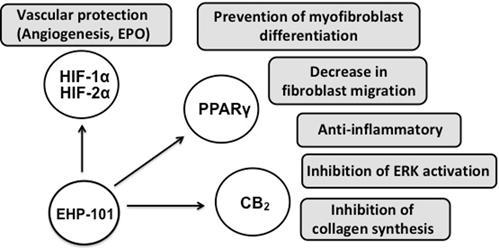 |
EHP-101 is a multifunctional drug acting at different molecular targets that are the hallmark of SSc. EHP-101 has potent anti-inflammatory and anti-fibrotic activities by targeting PPARɣ and CB2. EHP-101 also inhibits ERK activation, fibroblast to myofibroblast differentiation and collagen synthesis. In addition, EHP-101 activates the HIF pathway and mediates the expression of growth factors that can help vascular remodeling that is impaired in the disease (currently being studied in relation to benefits in SSc). |
EHP-102 (VCE-003.2)
Overview
Our second product candidate, EHP-102, is an oral formulation of VCE-003.2, a NCE derived from CBG that affects some of the accepted biologic receptors and pathways involved in various neurodegenerative diseases. Based on preclinical studies to date, we are developing EHP-102 initially for two indications, HD and PD.
VCE-003.2 is a CBG aminoquinone derivative acting primarily as a ligand activator of PPARg measured by binding and transcriptional assays. Preclinical studies have shown that VCE-003.2 is neuroprotective and anti-inflammatory in animal models of PD (15 mice, 10 mg/kg) and HD (24 mice, 20 mg/kg), as measured by proinflammatory cytokines and behavioral score, respectively. In addition, VCE-003.2 also reduced mutant huntingtin protein aggregates (altered huntingtin protein is associated with HD) detected by confocal microscopy techniques.
In addition to PPARγ and other potential receptor activation, EHP-102 is also an activator of the extracellular signal-regulated kinases (ERK) pathway (more recently referred to as the mitogen-activated protein kinases [MAPK] pathway). This pathway influences neural survival and can, therefore, provide benefits in neurodegenerative diseases such as HD and PD.
Formulation and Pharmacokinetics
We are currently in the manufacturing and formulation development stage for EHP-102. We expect to be able to finalize manufacturing process development and formulation prototype selection, then initiate PK and nonclinical studies in 2019.
Safety, Toxicology and Clinical Trials
Once the manufacturing and formulation development activities are completed for EHP-102, we plan to initiate an animal safety and toxicology program in support of initiating human clinical development.
Manufacturing and Supply for EHP-102
An industrial scalable process is being developed to manufacture the EHP-102 API (VCE-003.2) and drug product through our contract manufacturers. We do not own or operate manufacturing facilities for the production of EHP-102. We expect to depend on third-party suppliers and manufacturing organizations for all of our preclinical and clinical trial quantities of raw materials and drug substance.
Our Planned Clinical Trials
Since Phase I human studies are not expected to begin within the next year, we have not yet begun to develop the full clinical development plan for EHP-102.
40
EHP-102 Indication 1: Huntington’s Disease
HD is an autosomal dominant genetic disorder that causes progressive degeneration of nerve cells in the brain, specifically, cells of the basal ganglia. This devastating and disabling disease affects middle-aged people with typical onset between the ages of 30 and 50. The genetic defect that causes HD is an abnormal repeat of certain DNA sequences on chromosome number 4. With each successive generation, the number of repeats increases. There is a 50% chance that the disease will be passed to offspring.
HD is a rare disease with approximately 30,000 patients annually in the United States. We have been granted ODD by the FDA in the United States and intend to apply for ODD to the EMA in Europe in 2019.
One of the hallmark signs and symptoms of this disease is involuntary movements and tics. These involuntary movements and tics begin distally and move proximally as the disease progresses. The involuntary movements and tics are not specific and may involve the hands, feet, and face, with the most prominent movements taking place in the muscles of the back. The involuntary movements lead to the appearance that a patient is inebriated. Swallowing becomes difficult, and patients are at risk for choking. Reduced movement and rigidity are common. Patients may also suffer from flexion contractures and become bed bound. Finally, the patient is completely dependent on others for care. The risk of choking increases and the involuntary movements may become more severe or completely disappear. At this point the patients can no longer walk. Cognitive symptoms may include feelings of low self-esteem, guilt, anxiety, apathy, irritability, aggression, dementia and psychosis with paranoia and auditory hallucinations. The cause of death is usually from secondary causes of the disease such as choking and infection
There is no known curative treatment for HD. Treatment is mostly directed at symptomatic relief with suppression of the involuntary movements and tics. Dopamine-depleting agents, dopamine activators, benzodiazepines, glutamate antagonists, acetylcholinesterase inhibitors, dopamine antagonists, anti-seizure medications, cannabinoids, lithium, along with deep brain stimulation and fetal cell transplantation are being used to treat HD.
The molecular mechanisms of HD pathophysiology are unclear. The current model of disease progression includes development of mitochondrial dysfunction in the huntingtin protein. PPARγ is believed to play a key role in neurodegenerative diseases as it regulates neural progenitor cell proliferation and differentiation. Studies have demonstrated that there are significant defects in the PPARγ signaling pathway in mutant huntingtin expressing cells as compared to wild-type huntingtin protein cells. PPARγ activators improve mitochondrial function in cells expressing mutant huntingtin. The activation of the PPARγ signaling pathway can help mitochondrial function, a pivotal process in the pathogenesis of HD. Therefore, the PPARγ pathway could be a rational therapeutic target in the treatment of HD.
Preclinical in vitro studies have shown that VCE-003.2 preserves the ability to activate PPARg and exerts a prosurvival action in progenitor cells during neuronal differentiation. In addition to EHP-102’s effect on PPARg, our studies indicate effects on other receptor targets involved in neurodegeneration. For example, EHP-102 reduced mutant huntingtin aggregates in striatal cells as noted above. The neuroprotective profile of EHP-102 was also analyzed using two in vivo models of striatal neurodegeneration, which mimic HD in humans. EHP-102 inhibited the up-regulation of proinflammatory markers and improved antioxidant defenses in the brain of the test animals.
To assess the pathophysiological relevance of the neuroprotective action of EHP-102 in vivo, we employed two mouse models of the disease.
41
In summary, these studies suggest that EHP-102 displays neuroprotective and anti-inflammatory activities in different mouse models of HD using 20 mg/kg in 24 mice. For example, in these models EHP-102 has:
| ● | prevented neural damage and neuroinflammation; | |
| ● | alleviated motor symptomatology; | |
| ● | improved motor symptomatology in mice expressing a mutated form of huntingtin protein in the brain; | |
| ● | inhibited the up-regulation of proinflammatory markers such as COX-2, TNF-α, and IL-6; and | |
| ● | improved oxidative stress markers. |
These data suggest that EHP-102 could have potential for the treatment of HD and other neurodegenerative diseases with neuroinflammatory traits.
EHP-102 Indication 2: Parkinson’s Disease
PD is a long-term degenerative disorder of the central nervous system that mainly affects the motor system. It is a disease where damaged neurons do not produce sufficient dopamine (dopamine helps transmit impulses from the brain to the muscles). Over 10 million people suffer from PD worldwide. The symptoms generally present slowly over time. Early in the disease, the most obvious symptoms are shaking, rigidity, slowness of movement, and difficulty with walking. Thinking and behavioral problems may also occur. Dementia becomes common in the advanced stages of the disease. Depression and anxiety are also common, occurring in more than a third of people with PD. Other symptoms may include sensory, sleep, and emotional problems. The main motor symptoms are collectively called “Parkinsonism,” or a “Parkinsonian syndrome.”
Inflammation is a key pathogenic event in PD, so anti-inflammatory strategies are being investigated to limit neuronal deterioration in this disease. Certain cannabinoids have been shown to have anti-inflammatory and neuroprotective properties. In addition, epidemiological data support that the regular use of non-steroidal anti-inflammatory drugs (e.g., ibuprofen) reduces the risk of developing PD. In light of this, different anti-inflammatory agents have been investigated, at preclinical and clinical levels, with variable success in affecting the symptoms of PD.
Cannabinoids have been investigated for the reduction of inflammatory events in PD due mainly to selective CB2 receptor activation. Activating these receptors elicited frequent positive responses, predominantly by recruiting microglial cells and infiltrated macrophages to the CNS areas lesioned in PD, as well as on the anti-inflammatory and neuroprotective effects derived from the selective activation of these receptors. In addition, another possible rationale for the therapeutic potential in PD may be the possibility of targeting PPARg receptors with certain cannabinoids. Such conclusion is based on: (i) the relevant role played by these nuclear receptors in the control of inflammation in numerous pathological conditions (ii) the well-described PPARg-mediated anti-inflammatory activity of certain cannabinoids in different models of central and peripheral inflammation, and (iii) the effects of non-cannabinoid PPARg activators (e.g., thiazolidinediones) in PD. The three different PPAR isotypes (α, β/d and g) are expressed in all cell types in the brain and all of them, by functioning in an integrated manner as a complex system – the so-called the PPAR triad, have been reported to have neuroprotective properties.
Given the activity of EHP-102 on the PPARg receptor, which is an important factor involved in the control of inflammation, we evaluated its anti-inflammatory/neuroprotective properties in a typical in vivo inflammatory model of PD, LPS-lesioned mice (n=15) at an EHP-102 dosage of 10 mg/kg and viewed positive results in all measurements assessed, both qualitative and quantitative. Unlike EHP-101, EHP-102 has no activity on CB2, however, in this study proinflammatory mediators such as tumor necrosis factor-α (TNF-α), interleukin-1β (IL-1β), and inducible nitric oxide synthase (iNOS) were strongly reduced by the treatment with EHP-102. In this model and others, therefore, EHP-102 reduces inflammatory marker expression and prevents dopaminergic neuronal loss. It also improved clinical symptoms and recovered movement parameters (motor coordination and activity) in 6 mice injected with 3-NP and treated with 20 mg/kg of our drug candidate. These data lead us to believe EHP-102 could be a potential treatment for PD.
Intellectual Property
We believe it is important to our success that we:
| ● | obtain and maintain patent and other legal protections for the proprietary molecules, technology, inventions and improvements we consider important to our business; |
| ● | prosecute our patent applications and defend our issued patents; |
| ● | preserve the confidentiality of our trade secrets; and |
| ● | operate without infringing the patents and proprietary rights of third parties. |
42
We have sought and intend to continue to seek appropriate patent protection for our product candidates, as well as other proprietary technologies and their uses by filing additional patent applications in the United States and selected other countries.
As of the date of this Offering Circular, we owned a total of three United States patents, two Japanese patents, two European patents, two Mexican patents, one patent in China and one patent in the Russian Federation. In addition, we have twenty-one pending patent applications. These patents and patent applications will expire between 2030 through 2037 and could be eligible for patent term extension for delay caused by regulatory review, thereby further extending their patent terms. Our patent portfolio is not specific to any single indication, which we believe could allow us to develop products for additional patient populations in markets with unmet medical need.
Our patent plan is focused on two major areas, as follows:
| ● | First, to develop NCEs derived from cannabinoids; and | |
| ● | Second, to explore the possibility that our patented molecules synergize with other drugs for a well-defined application for MS, SSc, HD and PD. This type of combination therapy could lead to new intellectual property developments, which could also be protected by patents. While our existing patents cover all molecules in the two series’ of NCEs, we believe there are more molecules that can be discovered within this space. |
The following is a summary of our six patent families:
| Family Number |
Patent Publication/Application Number |
Status | Expiry | Title | Description | |||||
|
1 4.2 |
PCT/EP2017/057389 | Pending | Cannabidiol derivatives as inhibitors of the HIF prolyl hydroxylases activity | CBD quinone derivatives to be used as medicaments in therapy, particularly for treating diseases and conditions responsive to HIF-1 activation. | ||||||
|
2 3.1 |
US8772349 EP2551255B1 JP05575324B2 WO 2011/117429 |
Granted Granted Granted Expired |
2030 | Cannabinoid Quinone Derivatives | Cannabinoid quinone derivatives to be used as medicaments, particularly as PPARg activators for treating diseases which etiology is based on an impaired PPARg function and can benefit from PPARg activation. | |||||
|
3 3.3 |
US9802880 AU2015222384A1 CA2937275A1 CN106061937A EP2913321A1 JP2017513810A KR2016126006 MX2016010952 WO2015128200A1 BRPI1619891A2 IN201647028497A RU2016132415 IS247149 HK17103324.2 |
Granted Pending Pending Pending Pending Pending Pending Granted Expired Pending Pending Pending Pending Pending |
2035 | Cannabigerol Derivatives | CBG derivatives to be used as medicaments in therapy particularly for treating PPARg-related diseases due to their high PPARg activatoric effect. | |||||
|
3 3.3
|
EP 18382908.4 | Pending | 2038 | Cannabigerol Quinone Acid and Salts | CBG quinone acid and its salts, and new methods of synthesis | |||||
|
4 4.1 |
US9701618 AU2014390738A1 CA2945867A1 CN106232570A EP3131874A1 JP06167248B2 KR2016146765A IN201617038938A BRPI1623902A2 MX2016013151A WO2015158381A1 RU2667504 IS248030 HK17104665.7 |
Granted Pending Pending Granted Granted Granted Pending Pending Pending Granted Expired Granted Pending Pending |
2034 | Cannabidiol Quinone Derivatives | CBD quinone derivatives to be used as medicaments in therapy, particularly or treating diseases and conditions responsive to PPARg modulation due to their high PPARg activatoric effect | |||||
|
4 4.3 |
US62/801756
|
Pending | Cannabidiol Quinone Derivatives | CBD quinone derivatives to be used as Modulators of Cannabinoid Receptor Type 2 (CB2) |
Controlled Substances Laws
The CSA and its implementing regulations establish a “closed system” of distribution for controlled substances. The CSA imposes registration, security, recordkeeping and reporting, storage, manufacturing, distribution, labeling, importation, exportation, disposal and other requirements under the oversight of the DEA. The DEA is the federal agency responsible for regulating controlled substances, and requires those individuals or entities that manufacture, import, export, distribute, research, or dispense controlled substances to comply with the regulatory requirements to prevent the diversion of controlled substances to illicit channels of commerce.
43
Facilities that research, manufacture, distribute, import or export any controlled substance must register annually with the DEA. The DEA registration is specific to the particular location, activity(ies) and controlled substances utilized. For example, separate registrations are required for importation and manufacturing activities, and each registration authorizes which schedules of controlled substances the registrant may handle. However, certain coincident activities are permitted without obtaining a separate DEA registration, such as distribution of controlled substances by the manufacturer that produces them.
The DEA categorizes controlled substances into one of five schedules — Schedule I, II, III, IV, or V — with varying qualifications for listing in each schedule. Schedule I substances by definition have a high potential for abuse, have no currently “accepted medical use” in treatment in the United States and lack accepted safety for use under medical supervision. They may be used only in federally-approved research programs and may not be marketed or sold for dispensing to patients in the United States. Pharmaceutical products having a currently accepted medical use may be listed as Schedule II, III, IV or V substances, with Schedule II substances presenting the highest potential for abuse and physical or psychological dependence, and Schedule V substances presenting the lowest relative potential for abuse and dependence. The regulatory requirements are more restrictive for Schedule II substances than Schedule III-V substances. For example, all Schedule II drug prescriptions must be signed by a physician, physically presented to a pharmacist in most situations, and cannot be refilled. While cannabis and THC are Schedule I controlled substances, products approved for medical use in the United States that contain cannabis, THC or cannabis/THC extracts must be placed in Schedules II-V, since approval by the FDA satisfies the “acceptable medical use” requirement.
The DEA inspects all manufacturing facilities to review security, record keeping, reporting and compliance with other DEA regulatory requirements prior to issuing a controlled substance registration. The specific security requirements vary by the type of business activity and the schedule and quantity of controlled substances handled. The most stringent requirements apply to manufacturers of Schedule I and Schedule II substances. Required security measures commonly include background checks on employees and physical control of controlled substances through storage in approved vaults, safes and cages, and through use of alarm systems and surveillance cameras. An application for a manufacturing registration as a bulk manufacturer (not a dosage form manufacturer or a repacker/relabeler) for a Schedule I or II substance must be published in the Federal Register, and is open for 30 days to permit interested persons to submit comments, objections, or requests for a hearing. A copy of the notice of the Federal Register publication is forwarded by the DEA to all those registered, or applicants for registration, as bulk manufacturers of that substance. Once registered, manufacturing facilities must maintain records documenting the manufacture, receipt and distribution of all controlled substances. Manufacturers must submit periodic reports to the DEA of the distribution of Schedule I and II controlled substances, Schedule III narcotic substances, and other designated substances. Registrants must also report any controlled substance thefts or significant losses, and must adhere to certain requirements to dispose of controlled substances. As with applications for registration as a bulk manufacturer, an application for an importer registration for a Schedule I or II substance must also be published in the Federal Register, which remains open for 30 days for comments. Imports of Schedule I and II controlled substances for commercial purposes are generally restricted to substances not already available from a domestic supplier or where there is not adequate competition among domestic suppliers. In addition to an importer or exporter registration, importers and exporters must obtain a permit for every import or export of a Schedule I and II substance, Schedule III, IV and V narcotic, specially designated Schedule III non-narcotics, or Schedule IV or V narcotics controlled in Schedule I or II by the Convention on Psychotropic Substances and submit import or export declarations for Schedule III, IV and V non-narcotics.
The federal government recently issued guidance to federal prosecutors concerning marijuana enforcement under the CSA. On January 4, 2018, Attorney General Jeff Sessions issued a memorandum for all United States Attorneys concerning marijuana enforcement. Mr. Sessions rescinded all previous prosecutorial guidance issued by the Department of Justice regarding marijuana, including the Cole Memorandum.
The Cole Memorandum previously set out the Department of Justice’s prosecutorial priorities in light of various states legalizing marijuana for medicinal and/or recreational use. The Cole Memorandum provided that when states have implemented strong and effective regulatory and enforcement systems to control the cultivation, distribution, sale, and possession of marijuana, conduct in compliance with those laws and regulations is less likely to threaten the federal priorities. Indeed, a robust system may affirmatively address those priorities by, for example, implementing effective measures to prevent diversion of marijuana outside of the regulated system and to other states, prohibiting access to marijuana by minors, and replacing an illicit marijuana trade that funds criminal enterprises with a tightly regulated market in which revenues are tracked and accounted for. In those circumstances, consistent with the traditional allocation of federal-state efforts in this area, the Cole Memorandum provided that enforcement of state law by state and local law enforcement and regulatory bodies should remain the primary means of addressing marijuana-related activity. If state enforcement efforts are not sufficiently robust to protect against the harms set forth above, the federal government may seek to challenge the regulatory structure itself in addition to continuing to bring individual enforcement actions, including criminal prosecutions, focused on those harms.
44
By rescinding the Cole Memorandum, Mr. Sessions injected material uncertainty as it relates to how the Department of Justice will evaluate marijuana cases for prosecution.
For drugs manufactured in the United States, the DEA establishes annually an aggregate quota for the amount of substances within Schedules I and II that may be manufactured or produced in the United States based on the DEA’s estimate of the quantity needed to meet legitimate medical, scientific, research and industrial needs. This limited aggregate amount of cannabis that the DEA allows to be produced in the United States each year is allocated among individual companies, which, in turn, must annually apply to the DEA for individual manufacturing and procurement quotas. The quotas apply equally to the manufacturing of the active pharmaceutical ingredient and production of dosage forms. The DEA may adjust aggregate production quotas a few times per year, and individual manufacturing or procurement quotas from time to time during the year, although the DEA has substantial discretion in whether or not to make such adjustments for individual companies.
The states also maintain separate controlled substance laws and regulations, including licensing, recordkeeping, security, distribution, and dispensing requirements. State authorities, including Boards of Pharmacy, regulate use of controlled substances in each state. Failure to maintain compliance with applicable requirements, particularly as manifested in the loss or diversion of controlled substances, can result in enforcement action that could have a material adverse effect on our business, operations and financial condition. The DEA may seek civil penalties, refuse to renew necessary registrations, or initiate proceedings to revoke those registrations. In certain circumstances, violations could lead to criminal prosecution.
We currently manufacture the API and formulations, as well as perform most of the preclinical testing for EHP-101 and EHP-102 in Europe. We are conducting a Phase I trial for EHP-101 in Australia. We may decide to develop, manufacture or commercialize our product candidates in the United States or additional countries. As a result, we may be subject to controlled substance laws and regulations from regulatory agencies in countries where we develop, manufacture or commercialize EHP-101 and EHP-102 in the future.
Drug Approval Process in the Biotechnology Industry
Pipeline assets
Compared to the pharmaceutical industry, the biotechnology industry is more research and development (R&D) intensive. The fair value of a biotechnology company thus depends not only on its existing assets but also on its future growth assets.

The above graph shows the FDA’s drug approval process. The process is required in order for a new drug to enter the market. We are currently in the clinical development stage (Phase I) for EHP-101 and in the preclinical development stage for EHP-102. Since we are conducting our first clinical study in Australia, the approval from the Ethics Committee (HREC) and TGA was required in Australia, and the IND indicated in the above graphic will not be applicable until we initiate the process for a clinical study in the U.S., which is planned for Phase II studies.
45
DIRECTORS, EXECUTIVE OFFICERS AND SIGNIFICANT EMPLOYEES
| Name | Position | Age | Term of Office | Approximate
hours per week for part-time employees | ||||||||
| Executive Officers and Significant Employees: | ||||||||||||
| Avtar Dhillon | President | 57 | Since March 2017 | |||||||||
| James DeMesa | Chief Executive Officer | 61 | Since March 2017 | |||||||||
| Lisa Sanford | Chief Financial Officer | 52 | (1) | |||||||||
| Alain Rolland | Chief Development Officer | 59 | (2) | |||||||||
| Joachim Schupp | Chief Medical Officer | 66 | (3) | Dr. Schupp worked 30 hours per week in his role of Senior Vice President of Medical Affairs. | ||||||||
| Eduardo Muñoz | Chief Scientific Officer | 60 | Since June 2017 | Dr. Muñoz is a consultant who may be deemed a significant employee and acts as our Chief Scientific Officer pursuant to a consulting agreement with the University of Córdoba where Dr. Muñoz is employed in the Department of Cellular Biology, Physiology and Immunology. Dr. Muñoz works for us approximately 25 hours per week. | ||||||||
| Directors: | ||||||||||||
| Avtar S. Dhillon | Director & Executive Chairman | 57 | Since March 2017 | |||||||||
| James L. Heppell | Director | 63 | Since March 2017 | |||||||||
| Gaetano A. Morello | Director | 57 | Since March 2017 | |||||||||
| Punit S. Dhillon | Director | 38 | Since March 2017 | |||||||||
| (1) | Lisa Sanford was appointed Interim Chief Financial Officer as of October 1, 2018 and was appointed Chief Financial Officer as of April 1, 2019. From July 20, 2018 through September 30, 2018 she served as Vice President of Finance. |
| (2) | Alain Rolland was appointed Chief Development Officer as of May 1, 2018. From February 1, 2018 through April 20, 2018 he served as Vice President of Product Development. |
| (3) | Joachim Schupp was appointed Chief Medical Officer as of January 1, 2019. From August 1, 2018 through December 31, 2018 he served as Senior Vice President of Medical Affairs. |
There is no arrangement or understanding between the persons described above and any other person pursuant to which the person was selected to his or her office or position.
46
Executive Officers, Directors and Significant Employees
Avtar S. Dhillon, M.D., President and Executive Chairman. Dr. Dhillon is a life sciences entrepreneur with more than 20 years’ experience building public companies through mergers and acquisitions, leading innovation in scientific, engineering and farming enterprises, securing government grants and non-governmental organization (NGO) funding, and building IP portfolios through partnering. During his tenure from 2001 to 2009 as President and CEO at Inovio Pharmaceuticals, Inc., Dr. Dhillon led the company through restructuring and acquisitions. Since 2009, he has served as Inovio’s Chairman of the Board. Prior to joining Inovio, he was Vice President of MDS Capital Corp. (now Lumira Capital Corp.), one of North American’s leading healthcare venture capital organizations. Dr. Dhillon was a member of the Board of Directors of BC Advantage Funds, a venture capital corporation in British Columbia, from 2003 to January 2015. Dr. Dhillon is the CEO and Chairman of Northern Vine Canada Inc., which provides quality control laboratory services on raw materials and finished products to licensed manufacturers in Canada. Dr. Dhillon currently serves as a director and Chairman of OncoSec Medical Incorporated, a biotechnology company engaged in the development of new technologies to target and attack cancer, Vitality Biopharma, Inc., a biotechnology company engaged in pharmaceutical development of cannabinoid prodrugs, Arch Therapeutics, Inc., a medical device company, and Emerald Health Sciences Inc., a medical cannabis company and its subsidiaries Emerald Health Research Inc. and Emerald Health Bioceuticals Inc. He also serves as President and director at VivaCell Biotechnology, S.L., director at Pure Sunfarms Corp. and is a Scientific Advisor for Nemus Bioscience, Inc. Dr. Dhillon practiced family medicine for over 12 years and currently sits on the board of the Cannabis Association of Canada. He has a BSc (Honours) in Human Physiology and an MD from the University of British Columbia.
James M. DeMesa, M.D., Chief Executive Officer. Dr. DeMesa has 30 years of experience in biotech product development, clinical and regulatory management, and partnerships with pharmaceutical, biotech, and medical device companies. He is the former CEO of two public biotech companies: Migenix, from 2001 to 2008 and GenSci Regeneration Sciences, from 1996 to 2001 (now part of Integra LifeSciences). Dr. DeMesa also currently serves on the Board of Directors for two biotech companies: OncoSec Medical Incorporated and Induce Biologics. He also served as director for Trillium Therapeutics from 2005 to 2014. Previously, he was Vice President, Medical and Regulatory Affairs at Biodynamics International (now part of RTI Surgical) and Bentley Pharmaceuticals (now part of Teva Pharmaceuticals). Dr. DeMesa received his BA in Chemistry, MD, and MBA from the University of South Florida.
Eduardo Muñoz, PhD, M.D., Chief Scientific Officer. Dr. Muñoz has been a Professor of Immunology in the Department of Cell Biology, Physiology and Immunology of the University of Córdoba (Spain) since 1992 and Director of the Inflammation and Cancer Research Group at the Institute Maimonides for Biomedical Research of Córdoba since 2012. Dr. Muñoz has more than 30 years of experience in biomedical research, and is the author of nearly 200 articles, patents, and book chapters with almost 5,500 citations. He is experienced in the mechanism of actions of cannabinoids and endocannabinoids as well as the development of cannabinoid-based new chemical entities. Dr. Muñoz belongs to the editorial board of several scientific journals and is a co-founder of two biotech companies, VivaCell Biotechnology, S.L.(Spain) and Innohealth Group (Spain). He received a PhD in Medicine and Surgery at the University of Córdoba and was an associate researcher at Tufts University in Boston, and at the Institute Pasteur in Paris.
Lisa Sanford, Chief Financial Officer. Ms. Sanford has 30 years of diversified experience in finance and accounting in the life sciences, biotechnology and pharmaceutical industries. She served as Interim CFO of the Company since October 2018 and as the Company’s Vice President of Finance from July 2018 through September 2018. From April 2000 through July 2018, Ms. Sanford was an independent consultant for both public and private companies. Ms. Sanford also served as an audit senior manager at Ernst & Young LLP, where she worked for twelve years and was involved in multiple IPOs and business combinations. She received her bachelor’s degree in Accounting from Lehigh University and is a Certified Public Accountant.
47
Alain Rolland, PharmD, PhD, Chief Development Officer. Dr. Rolland has over 30 years of international leadership experience in pharmaceutical and biotech companies. He has focused on the discovery and development of biologics and small molecules in a variety of therapeutic areas including immuno-oncology, cardiovascular and hematological disorders, dermatology, and infection disease vaccines. Prior to joining EHP was a co-founder and served as CEO, President and Director of CHIME BioTherapeutics, Inc., Executive Vice President and Chief Scientific Officer at HUYA Bioscience International, Executive Vice President, Product Development at Vical, and Senior Vice President, Preclinical R&D, Head of the Woodlands Center of Valentis. Dr. Rolland has published over 90 scientific articles and book chapters and is editor of three scientific books. He is a member of several scientific societies, the founding Editor-in-Chief of Current Pharmaceutical Biotechnology, and an editorial board member of several journals. He is also the recipient of the Fellowship Award from the American Association of Pharmaceutical Scientists. Dr. Rolland earned his doctorate degree in Pharmacy (Pharm.D.) and in Pharmaceutical Sciences (Ph.D.) from Rennes University, France.
Joachim P.H. Schupp, M.D., Dr. med, Chief Medical Officer. Dr. Schupp has over 30 years of international pharmaceutical industry experience in all phases of drug development and several therapeutic areas. He directed multiple Phase I – IV clinical studies and led multiple international cross-functional project teams at Ciba-Geigy and Novartis Pharmaceuticals in Switzerland, which resulted in worldwide approval of several New Drug Applications (NDAs), Biologics License Applications (BLAs) and supplemental applications for small molecule drugs, biologics and devices currently on the market. Dr. Schupp also served as Vice President, Clinical & Regulatory Affairs at HUYA Bioscience International, Chief Medical Officer at Imprimis/Transdel Pharmaceuticals, Inc., Vice President, Clinical Development at Apricus Biosciences, Inc., Vice President, Medical Affairs at Adventrx Pharmaceuticals, Inc. and Vice President, Clinical Data Services at ProSanos, Inc. Prior to joining EHP, Dr. Schupp provided consulting services as a medical monitor and drug safety physician. Dr. Schupp received his MD and doctorate (Dr. med.) from Freie Universität Berlin in Germany and practiced medicine in Germany, South Africa, UK and Switzerland.
James L. Heppell, LLB, Director. Since 2014, Mr. Heppell has been involved with the Emerald Health companies. Mr. Heppell was Co-Founder, President and Director of BC Advantage Funds (VCC) Ltd., a venture fund that invests in and builds successful technology, life science, and clean technology companies from 2003 to 2014. Mr. Heppell’s first fund, the Advantage Life Sciences I Fund, won the Canadian Venture Capital Deal of the Year Award in 2006 for having the highest realized return (23.4x its investment in Aspreva Pharmaceuticals). Early in his career, Mr. Heppell practiced corporate securities law with Fasken Martineau DuMoulin. He then became President and CEO of Catalyst Corporate Finance Lawyers, a boutique corporate finance law firm for life science and tech companies. Mr. Heppell also serves on numerous Boards of Directors including VivaCell Biotechnology, S.L., Emerald Health Sciences Inc. and its various subsidiaries, each of which operates within the cannabis industry, Nemus Bioscience, Inc., Pure Sunfarms Corp., Northern Vine Canada Inc., 1152002 B.C. LTD, Sophiris Bio Inc. and the Clarence Heppell Foundation. He has a BSc in Microbiology and a law degree from the University of British Columbia.
Gaetano A. Morello, ND, Director. Dr. Morello is a clinician with experience in the clinical and medical application of cannabinoids. Dr. Morello has practiced at the Complex Chronic Disease Program at Woman’s Hospital in Vancouver, Canada since 2013. He also serves on the Quality Assurance Committee for the College of Naturopathic Physicians of British Columbia since 2010 as well as other health and medical panels. Since 2012, Dr. Morello has been a consultant provider at Integrative Therapeutics. He authored Stress and Anxiety, Whole Body Cleansing, Cleanse: The Ultimate Inside Out Approach and French Grape Seed Extract, and is a contributing author to A Textbook of Natural Medicine and numerous leading magazines and publications. Dr. Morello also serves on the Boards of Directors of Emerald Health Sciences Inc. and some of its subsidiaries, each of which operates within the cannabis industry. Dr. Morello has a BSc in Cell Biology/Nutrition from the University of British Columbia and a Doctorate in Naturopathic Medicine from Bastyr University.
48
Punit S. Dhillon, Director. Mr. Dhillon is the Co-Founder and former CEO of OncoSec Medical Incorporated, which develops advanced-stage immunotherapy to treat solid tumors. He served as President and Director of OncoSec from March 2011 to February 2018 and currently remains on the Board of Directors. Mr. Dhillon was formerly Vice President of Finance and Operations at Inovio Pharmaceuticals, Inc. Mr. Dhillon currently serves on numerous Boards of Directors, including VivaCell Biotechnology, S.L., Emerald Health Sciences Inc. and its subsidiaries, each of which operates within the cannabis industry, Nemus Bioscience, Inc., Northern Vine Laboratories and CannaChain Technologies. He also served as a director at Venturi Ventures from 2014 to 2016. Mr. Dhillon’s management experience spans corporate finance, M&A integration, successful in-licensing of key intellectual property, strategy implementation, corporate transactions and collaborations with leading universities and key global opinion leaders. In 2013, he was recognized as one of the “Top 100” CEOs by PharmaVoice and “Most Admired CEO” by the San Diego Business Journal in 2016. He was also recognized as a finalist for Ernst & Young’s “Entrepreneur of the Year.” Mr. Dhillon holds a BA (Honours) in Political Science and a minor in Business Administration from Simon Fraser University.
Board Leadership Structure and Risk Oversight
The Board oversees our business and considers the risks associated with our business strategy and decisions. The Board currently implements its risk oversight function as a whole. Each of the Board committees, when established, will also provide risk oversight in respect of its areas of concentration and reports material risks to the Board for further consideration.
Term of Office
Officers hold office until his or her successor is elected and qualified. Directors are appointed to serve for one year until the meeting of the Board following the annual meeting of stockholders and until their successors have been elected and qualified.
Director Independence
We use the definition of “independence” of The NASDAQ Stock Market to make this determination. NASDAQ Listing Rule 5605(a)(2) provides that an “independent director” is a person other than an officer or employee of the company or any other individual having a relationship which, in the opinion of the Company’s Board, would interfere with the exercise of independent judgment in carrying out the responsibilities of a director. The NASDAQ listing rules provide that a director cannot be considered independent if:
| ● | the director is, or at any time during the past three years was, an employee of the company; |
49
| ● | the director or a family member of the director accepted any compensation from the company in excess of $120,000 during any period of twelve consecutive months within the three years preceding the independence determination (subject to certain exemptions, including, among other things, compensation for board or board committee service); |
| ● | the director or a family member of the director is a partner in, controlling stockholder of, or an executive officer of an entity to which the company made, or from which the company received, payments in the current or any of the past three fiscal years that exceed 5% of the recipient’s consolidated gross revenue for that year or $200,000, whichever is greater (subject to certain exemptions; |
| ● | the director or a family member of the director is employed as an executive officer of an entity where, at any time during the past three years, any of the executive officers of the company served on the compensation committee of such other entity; or |
| ● | the director or a family member of the director is a current partner of the company’s outside auditor, or at any time during the past three years was a partner or employee of the company’s outside auditor, and who worked on the company’s audit. |
Under such definitions, we have no independent directors. However, our Common Stock is not currently quoted or listed on any national exchange or interdealer quotation system with a requirement that a majority of our Board be independent and, therefore, the Company is not subject to any director independence requirements.
Certain Relationships
Our Board of Directors are also the Board of Directors of our majority stockholder, EHS.
Punit Dhillon who serves on our Board of Directors is the nephew of Dr. Avtar Dhillon, President and Executive Chairman.
Involvement in Certain Legal Proceedings
To our knowledge, none of our current directors or executive officers has, during the past ten years:
| ● | been convicted in a criminal proceeding or been subject to a pending criminal proceeding (excluding traffic violations and other minor offenses); |
| ● | had any bankruptcy petition filed by or against the business or property of the person, or of any partnership, corporation or business association of which he or she was a general partner or executive officer, either at the time of the bankruptcy filing or within two years prior to that time; |
| ● | been subject to any order, judgment, or decree, not subsequently reversed, suspended or vacated, of any court of competent jurisdiction or federal or state authority, permanently or temporarily enjoining, barring, suspending or otherwise limiting, his involvement in any type of business, securities, futures, commodities, investment, banking, savings and loan, or insurance activities, or to be associated with persons engaged in any such activity; |
| ● | been found by a court of competent jurisdiction in a civil action or by the SEC or the Commodity Futures Trading Commission to have violated a federal or state securities or commodities law, and the judgment has not been reversed, suspended, or vacated; |
| ● | been the subject of, or a party to, any federal or state judicial or administrative order, judgment, decree, or finding, not subsequently reversed, suspended or vacated (not including any settlement of a civil proceeding among private litigants), relating to an alleged violation of any federal or state securities or commodities law or regulation, any law or regulation respecting financial institutions or insurance companies including, but not limited to, a temporary or permanent injunction, order of disgorgement or restitution, civil money penalty or temporary or permanent cease-and-desist order, or removal or prohibition order, or any law or regulation prohibiting mail or wire fraud or fraud in connection with any business entity; or |
| ● | been the subject of, or a party to, any sanction or order, not subsequently reversed, suspended or vacated, of any self-regulatory organization (as defined in Section 3(a)(26) of the Securities Exchange Act of 1934, as amended (the Exchange Act)), any registered entity (as defined in Section 1(a)(29) of the Commodity Exchange Act), or any equivalent exchange, association, entity or organization that has disciplinary authority over its members or persons associated with a member. |
50
Except as set forth above and in our discussion below in “Interest Of Management And Others In Certain Transactions,” none of our directors or executive officers has been involved in any transactions with us or any of our directors, executive officers, affiliates or associates which are required to be disclosed pursuant to the rules and regulations of the SEC.
We are not currently a party to any legal proceedings, the adverse outcome of which, individually or in the aggregate, we believe will have a material adverse effect on our business, financial condition or operating results.
COMPENSATION OF DIRECTORS AND EXECUTIVE OFFICERS
The following table represents information regarding the total compensation for the three highest paid executive officers or directors of the Company as of December 31, 2018:
| Cash Compensation | Other Compensation | Total Compensation | ||||||||||||
| Name | Capacity in which compensation was received | ($) | ($) (2) (3) | ($) | ||||||||||
| Avtar S. Dhillon (1) | Director | $ | --- | $ | 900,000 | $ | 900,000 | |||||||
| James M. DeMesa (4) | CEO | $ | 261,474 | $ | 880,000 | $ | 1,141,474 | |||||||
| Alain Rolland | Chief Development Officer | $ | 171,474 | $ | 252,123 | $ | 423,598 | |||||||
| (1) | Dr. Dhillon receives no compensation for his services as President or Executive Chairman of the Company. |
| (2) | These amounts reflect bonus payments of 50% and 40% of the annual salary for Dr. DeMesa and Dr. Rolland, respectively. |
| (3) | Any values reported in the “Other Compensation” column, if applicable, represents the aggregate grant date fair value, computed in accordance with Accounting Standards Codification (ASC) 718 Share Based Payments, of grants of stock options to each of our named executive officers and directors. |
| (4) | Dr. DeMesa’s annual salary was increased to $280,000 as of May 1, 2018. |
Director Compensation
We have four directors. We currently do not pay our directors any cash compensation for their services as board members. In January 2018, two of our directors, Gaetano A. Morello and Punit S. Dhillon, were each granted 100,000 options to purchase our Common Stock at $5.00 per share. In December 2018, the four directors were granted options to purchase a total of 800,000 shares of our Common Stock at $2.50 per share.
Employment Agreements
We do not currently have employment agreements with any of our officers or employees.
51
INterest of Management and others in CERTAIN TRANSACTIONS
Transactions with Related Persons
Except as described below and except for employment arrangements which are described under “executive compensation,” since March 2, 2017 (inception), there has not been, nor is there currently proposed, any transaction in which we are or were a participant, the amount involved exceeds the lesser of $120,000 or 1% of the total assets at December 31, 2018, and any of our directors, executive officers, holders of more than 5% of our common stock or any immediate family member of any of the foregoing had or will have a direct or indirect material interest.
In June 2017, we entered into the IPTA and a Research Agreement with VivaCell. A majority of the shares of VivaCell are owned by Emerald Health Research Inc. (EHR), which is a wholly owned subsidiary of our majority stockholder, EHS. EHP has no ownership or voting rights related to EHR or VivaCell.
In September 2017, we entered into a revolving loan agreement with EHS, our majority stockholder, which was amended in January 2018. Under the loan, past advances and future advances, which we may draw down from time to time in one or more advances, will be evidenced by a demand grid promissory note (the Note). The Note will be revised to reflect the aggregate principal amount of the loan outstanding as of the date of each advance or repayment. The loan may be repaid by us or, at the option of EHS, converted by EHS into shares of EHP at $2.00 per share. The loan bears interest at 12% per annum, calculated semi-annually in advance. The Note is payable upon demand and includes no expiration date. As of June 30, 2018, $5.3 million has been advanced to us under the loan. We have the ability to continue borrowing under this loan agreement, however there is no guarantee of continued funding. If the maximum proceeds under this offering are raised, a portion of the proceeds raised may be used to pay, in whole or in part, the principal and accrued interest on our loan with EHS.
Punit Dhillon, who serves on our Board of Directors, is the nephew of Dr. Avtar Dhillon, President and Executive Chairman.
Our Board of Directors are also the Board of Directors of our majority stockholder, EHS.
We have also entered into indemnification agreements with each of our directors and executive officers. In general, these indemnification agreements require the Company to indemnify a director to the fullest extent permitted by law against liabilities that may arise by reason of his or her service for the Company.
Review, Approval and Ratification of Related Party Transactions
Given our small size and limited financial resources, we have not adopted formal policies and procedures for the review, approval or ratification of transactions, such as those described above, with our executive officer(s), Director(s) and significant stockholders. We intend to establish formal policies and procedures in the future, once we have sufficient resources and have appointed additional Directors, so that such transactions will be subject to the review, approval or ratification of our Board of Directors, or an appropriate committee thereof. On a moving forward basis, our Directors will continue to approve any related party transaction.
52
SECURITY OWNERSHIP OF MANAGEMENT & CERTAIN SECURITYHOLDERS
The following table shows the beneficial ownership of our Common Stock as of March 26, 2019 held by (i) each person known to us to be the beneficial owner of more than 5% of any class of our shares; (ii) each director; (iii) each executive officer; and (iv) all directors and executive officers as a group. As of March 26, 2019, there were 12,279,880 shares of our Common Stock issued and outstanding.
Beneficial ownership is determined in accordance with the rules of the Commission, and generally includes voting power and/or investment power with respect to the securities held. Shares of Common Stock subject to options and warrants currently exercisable or which may become exercisable within 60 days of the date of this Offering Circular, are deemed outstanding and beneficially owned by the person holding such options or warrants for purposes of computing the number of shares and percentage beneficially owned by such person, but are not deemed outstanding for purposes of computing the percentage beneficially owned by any other person. Except as indicated in the footnotes to this table, the persons or entities named have sole voting and investment power with respect to all shares of Common Stock shown as beneficially owned by them.
The percentages below are based on fully diluted shares of our Common Stock as of the date of this Offering Circular. Unless otherwise indicated, the business address of each person listed is c/o Emerald Health Pharmaceuticals Inc., 5910 Pacific Center Blvd, Ste 300, San Diego, CA 92121.
Number of shares of Common Stock Beneficially Owned as of March 26, 2019 | % | Beneficially Owned After Maximum Offering | ||||||||||
| Directors and Officers: | ||||||||||||
| Avtar S. Dhillon | 708,333 | 5.5 | % | 3.5 | % | |||||||
| James M. DeMesa | 354,000 | 2.8 | % | 1.7 | % | |||||||
| James L. Heppell | 141,666 | 1.1 | % | * | ||||||||
| All directors and named executive officers as a group (8 persons) 5910 Pacific Center Blvd, Ste 300, San Diego, California, 92121 | 1,430,998 | 11.2 | % | 7.0 | % | |||||||
| Greater than 5% Beneficial Owners: | ||||||||||||
| Emerald Health Sciences Inc. 410-221 West Esplanade, North Vancouver, BC, V7M1A6 | 9,000,000 | 70.4 | % | 44 | % | |||||||
| * | Less than 1% |
The following is a summary of the rights of our capital stock as provided in our Certificate of Incorporation, and bylaws. For more detailed information, please see our Certificate of Incorporation and bylaws which have been filed as exhibits to the Offering Statement of which this Offering Circular is a part.
General
The Company is authorized to issue one class of stock. The total number of shares of stock which the Company is authorized to issue is One Hundred Million (100,000,000) shares of capital stock, consisting of One Hundred Million (100,000,000) shares of Common Stock. As of the date of this Offering Circular, the Company had 9,925,000 shares of Common Stock issued and outstanding. Two Million Two Hundred Thousand shares of Common Stock have been reserved for issuance under our 2018 Equity Incentive Plan, of which 2,060,000 shares of our Common Stock will be issuable upon exercise of outstanding grants.
Common Stock Voting
The holders of the Common Stock are entitled to one vote for each share held on all matters to be voted on by the Company’s stockholders. There shall be no cumulative voting.
53
Dividends
The holders of shares of Common Stock are entitled to dividends when and as declared by the Board from funds legally available therefor if, as and when determined by the Board of Directors of the Company in their sole discretion, subject to provisions of law, and any provision of the Company’s Certificate of Incorporation, as amended from time to time. There are no preemptive, conversion or redemption privileges, nor sinking fund provisions with respect to the Common Stock.
Liquidation
In the event of any voluntary or involuntary liquidation, dissolution or winding up of our affairs, the holders of our Common Stock will be entitled to share ratably in the net assets legally available for distribution to stockholders after the payment of or provision for all of our debts and other liabilities.
Fully Paid and Non-assessable
All outstanding shares of Common Stock are, and the Common Stock to be outstanding upon completion of this Offering will be, duly authorized, validly issued, fully paid and non-assessable.
Changes in Authorized Number
The number of authorized shares of Common Stock may be increased or decreased subject to the Company’s legal commitments at any time and from time to time to issue them, by the affirmative vote of the holders of a majority of the stock of the Company entitled to vote.
Delaware Anti-Takeover Statute
We may become subject to Section 203 of the Delaware General Corporation Law, which prohibits persons deemed to be “interested stockholders” from engaging in a “business combination” with a publicly held Delaware corporation for three years following the date these persons become interested stockholders unless the business combination is, or the transaction in which the person became an interested stockholder was, approved in a prescribed manner or another prescribed exception applies. Generally, an “interested stockholder” is a person who, together with affiliates and associates, owns, or within three years prior to the determination of interested stockholder status did own, 15% or more of a corporation’s voting stock. Generally, a “business combination” includes a merger, asset or stock sale, or other transaction resulting in a financial benefit to the interested stockholder. The existence of this provision may have an anti-takeover effect with respect to transactions not approved in advance by the Board of Directors. A Delaware corporation may “opt out” of these provisions with an express provision in its original certificate of incorporation or an express provision in its certificate of incorporation or bylaws resulting from a stockholders’ amendment approved by at least a majority of the outstanding voting shares. We have not opted out of these provisions. As a result, mergers or other takeover or change in control attempts of us may be discouraged or prevented.
Equity Incentive Plan
Compensation of Directors and Executive Officers
Each of the executive officers and directors listed above is eligible to receive equity compensation at the discretion of our board. In January 2018, the Company granted options to purchase 295,000 shares of Common Stock at $5.00 per share with one-third of the options vesting on the first, second and third anniversary of the date of grant. In December 2018, the Company granted options to purchase 1,780,000 shares of Common Stock at $2.50 per share with 800,000 (Directors’) options vesting monthly over twelve months. The remaining 980,000 options vest over three years, with 25% vesting upon grant and 25% vesting on each of the first, second and third anniversary of the date of grant.
Upon completion of this offering, our executive officers and directors will be eligible to receive equity awards under our equity incentive plans at any time at the discretion of our Board of Directors.
2018 Plan
We adopted the 2018 Equity Incentive Plan, as amended December 13, 2018, (the “2018 Plan”) on January 29, 2018. The 2018 Plan provides for the grant of incentive stock options, non-qualified stock options, stock appreciation rights, restricted stock, restricted stock units, dividend equivalent rights and other stock and cash-based awards. Shares issued under the 2018 Plan will be shares of our common stock. Incentive stock options may be granted only to our employees and employees of any parent or subsidiary corporation. All other awards may be granted to our employees, directors or consultants and to employees, directors or consultants of any affiliated entity.
Share Reserve
We have reserved 2,200,000 shares of our Common Stock for issuance pursuant to awards under the 2018 Plan. In general, shares subject to awards granted under the 2018 Plan that are not issued or that are returned to us, for example, because the award is forfeited, the shares are retained by us in satisfaction of amounts owed with respect to an award or the shares are surrendered in payment of an exercise or purchase price or tax withholding, will again become available for awards under the 2018 Plan.
54
Administration
Our Board of Directors or a committee of our Board of Directors will administer the 2018 Plan. The administrator has the power to determine when awards will be granted, which employees, directors or consultants will receive awards, the terms of the awards, including the number of shares subject to each award and the vesting schedule of the awards, and to interpret the terms of the 2018 Plan and the award agreements. The administrator also has the authority to reduce the exercise prices of outstanding stock options and the base appreciation amount of any stock appreciation right if the exercise price or base appreciation amount exceeds the fair market value of the underlying shares, and to cancel such options and stock appreciation rights in exchange for new awards, in each case without stockholder approval.
Stock Options
The 2018 Plan allows for the grant of incentive stock options that qualify under Section 422 of the Code and non-qualified stock options. The exercise price of all options granted under the 2018 Plan must at least be equal to the fair market value of our common stock on the date of grant. The term of an option may not exceed 10 years, except that with respect to any employee who owns more than 10% of the voting power of all classes of our outstanding stock or any parent or subsidiary corporation as of the grant date, the term must not exceed five years, and the exercise price must equal at least 110% of the fair market value on the grant date. Not more than 2,200,000 shares of our common stock may be issued pursuant to incentive stock options granted under the 2018 Plan.
After the continuous service of an option recipient terminates, the recipient’s options may be exercised, to the extent vested, for the period of time specified in the option agreement. However, an option may not be exercised later than the expiration of its term.
Stock Appreciation Rights
The 2018 Plan allows for the grant of stock appreciation rights. Stock appreciation rights allow the recipient to receive the appreciation in the fair market value of our Common Stock between the date of grant and the exercise date. The administrator will determine the terms of stock appreciation rights, including when such rights become exercisable and whether to pay the increased appreciation in cash or with shares of our common stock, or a combination thereof, except that the base appreciation amount used to determine the cash or shares to be issued pursuant to the exercise of a stock appreciation right will be no less than 100% of the fair market value per share on the date of grant. After the continuous service of a recipient of a stock appreciation right terminates, the recipient’s stock appreciation right may be exercised, to the extent vested, only to the extent provided in the stock appreciation right agreement.
55
Restricted Stock Awards
The 2018 Plan allows for the grant of restricted stock. Restricted stock awards are shares of our common stock that vest in accordance with terms and conditions established by the administrator. The administrator will determine the number of shares of restricted stock granted to any employee, director or consultant. The administrator may impose whatever conditions on vesting that it determines to be appropriate. For example, the administrator may set restrictions based on the achievement of specific performance goals or on the continuation of service or employment. Shares of restricted stock that do not vest are subject to repurchase or forfeiture.
Restricted Stock Units
The 2018 Plan allows for the grant of restricted stock units. Restricted stock units are awards that will result in payment to a recipient at the end of a specified period only if the vesting criteria established by the administrator are achieved or the award otherwise vests. The administrator may impose whatever conditions to vesting, or restrictions and conditions to payment, that it determines to be appropriate. The administrator may set restrictions based on the achievement of specific performance goals or on the continuation of service or employment. The administrator may specify in an award agreement that earned restricted stock units may be settled in shares of our common stock, other securities, cash or a combination thereof.
Other Awards
The 2018 Plan also allows for the grant of cash or stock-based awards that may or may not be subject to restrictions.
Terms of Awards
The administrator of the 2018 Plan determines the provisions, terms and conditions of each award, including vesting schedules, forfeiture provisions, form of payment (cash, shares, or other consideration) upon settlement of the award, payment contingencies and satisfaction of any performance criteria.
Performance Criteria
The 2018 Plan includes the following performance criteria that may be considered, individually or in combination, by the administrator: (i) increase in share price; (ii) earnings per share; (iii) total stockholder return, (iv) return on equity, (v) return on assets, (vi) return on investment; (vii) net operating income, (viii) cash flow, (ix) revenue; (x) economic value added, (xi) personal management objectives; or (vi) other measures of performance selected by the administrator.
Transferability of Awards
The 2018 Plan allows for the transfer of awards under the 2018 Plan only (i) by will, (ii) by the laws of descent and distribution and (iii) for awards other than incentive stock options, to the extent and in the manner authorized by the administrator. Only the recipient of an incentive stock option may exercise such award during his or her lifetime.
Certain Adjustments
In the event of certain changes in our capitalization, to prevent enlargement of the benefits or potential benefits available under the 2018 Plan, the administrator will make adjustments to one or more of the number of shares that are covered by outstanding awards, the exercise or purchase price of outstanding awards, the numerical share limits contained in the 2018 Plan and any other terms that the administrator determines require adjustment.
Changes in Control
The 2018 Plan provides that in the event of a corporate transaction, as such term is defined in the 2018 Plan, each outstanding award, to the extent not assumed or replaced, will automatically vest and become exercisable or be released from restrictions on transfer or forfeiture rights. To the extent outstanding awards are assumed or replaced in the event of a corporate transaction, each award will automatically vest and become exercisable or be released from restrictions on transfer or forfeiture rights if the holder’s employment is terminated without cause or for good reason (as such terms are defined in the 2018 Plan) within 12 months after the corporate transaction. In the event of a change in control, each award will automatically vest and become exercisable or be released from restrictions on transfer or forfeiture rights if the holder’s employment is terminated without cause or for good reason (as such terms are defined in the 2018 Plan) within 12 months after the change in control.
56
Plan Amendments and Termination
The 2018 Plan will automatically terminate 10 years following the date it becomes effective, unless we terminate it sooner. In addition, our Board of Directors has the authority to amend, suspend or terminate the 2018 Plan, subject to stockholder approval in the event such approval is required by law provided such action does not adversely affect the rights under any outstanding award.
Penny Stock Regulation
The SEC has adopted regulations which generally define “penny stock” to be any equity security that has a market price of less than $5.00 per share or an exercise price of less than $5.00 per share. Such securities are subject to rules that impose additional sales practice requirements on broker-dealers who sell them. For transactions covered by these rules, the broker-dealer must make a special suitability determination for the purchaser of such securities and have received the purchaser’s written consent to the transaction prior to the purchase. Additionally, for any transaction involving a penny stock, unless exempt, the rules require the delivery, prior to the transaction, of a disclosure schedule prepared by the SEC relating to the penny stock market. The broker-dealer also must disclose the commissions payable to both the broker-dealer and the registered representative, current quotations for the securities and, if the broker-dealer is the sole market-maker, the broker-dealer must disclose this fact and the broker-dealer’s presumed control over the market. Finally, among other requirements, monthly statements must be sent disclosing recent price information for the penny stock held in the account and information on the limited market in penny stocks. As our Common Stock immediately following this Offering may be subject to such penny stock rules, purchasers in this Offering will in all likelihood find it more difficult to sell their Common Stock shares in the secondary market.
57
The Company, which currently has 1,195 stockholders, is an alternative reporting company under Regulation A+, Tier 2 of the Securities Act. There is no public trading market for the Common Stock shares of the Company. The Company may, as an alternative reporting company, qualify its Common Stock shares for quotation on the NASDAQ or OTCBB (the Over the Counter Bulletin Board) or other secondary market for which the Company’s common Shares may then qualify, if it raises a minimum of $5 million and the Company has progressed further towards a Phase I clinical trial in the discretion of the Board of Directors. (See Risk Factors starting on page 6.)
We plan to retain any earnings for the foreseeable future for our operations. We have never paid any dividends on our Common Stock and do not anticipate paying any cash dividends in the foreseeable future. Any future determination to pay cash dividends will be at the sole discretion of our Board and will depend on our financial condition, operating results, capital requirements and such other factors as our Board deems relevant.
PLAN OF DISTRIBUTION & SELLING SECURITYHOLDERS
The shares are being offered by us on a “best-efforts” basis. There is no aggregate minimum to be raised in order for the Offering to become effective and therefore the Offering will be conducted on a “rolling basis.” This means we are entitled to begin applying “dollar one” of the proceeds from the Offering towards our business strategy, research and development expenses, offering expenses, commissions, working capital, reimbursements, and other uses as more specifically set forth in the “Use of Proceeds” starting on page 28.
The shares may be offered through broker-dealers who are registered with the Financial Industry Regulatory Authority (“FINRA”). We do not have any agreements with broker-dealers as of the date of this offering. The proceeds of this offering may be deposited directly into the Company’s operating account for immediate use by it, with no obligation to refund subscriptions. There is no escrow established for this Offering.
Generally speaking, Rule 3a4-1 provides an exemption from the broker-dealer registration requirements of the Exchange Act for persons associated with an issuer that participate in an offering of the issuer’s securities. None of our officers or directors are subject to any statutory disqualification, as that term is defined in Section 3(a)(39) of the Exchange Act. None of our officers or directors will be compensated in connection with his participation in the offering by the payment of commissions or other remuneration based either directly or indirectly on transactions in our securities. None of our officers or directors are, or have been within the past 12 months, a broker or dealer, and none of them are, or have been within the past 12 months, an associated person of a broker or dealer. At the end of the offering, our officers or directors will continue to primarily perform substantial duties for the Company or on its behalf otherwise than in connection with transactions in securities. Our officers or directors will not participate in selling an offering of securities for any issuer more than once every 12 months other than in reliance on Exchange Act Rule 3a4-1(a)(4)(i) or (iii) except that for securities issued pursuant to rule 415 under the Securities Act, the 12 months shall begin with the last sale of any security included within one rule 415 registration.
Selling Security Holders
No securities are being sold for the account of security holders; all net proceeds of this offering will go to the Company.
ADDITIONAL INFORMATION ABOUT THE OFFERING
Investment Limitations
Generally, no sale may be made to you in this Offering if the aggregate purchase price you pay is more than 10% of the greater of your annual income or net worth (please see below on how to calculate your net worth). Different rules apply to accredited investors and non-natural persons. Before making any representation that your investment does not exceed applicable thresholds, we encourage you to review Rule 251(d)(2)(i)(C) of Regulation A+. For general information on investing, we encourage you to refer to www.investor.gov.
58
Because this is a Tier 2, Regulation A+ offering, most investors must comply with the 10% limitation on investment in the Offering. The only investor in this Offering exempt from this limitation is an “accredited investor” as defined under Rule 501 of Regulation D under the Securities Act. If you meet one of the following tests you should qualify as an accredited investor:
| (i) | You are a natural person who has had individual income in excess of $200,000 in each of the two most recent years, or joint income with your spouse in excess of $300,000 in each of these years, and have a reasonable expectation of reaching the same income level in the current year; |
| (ii) | You are a natural person and your individual net worth, or joint net worth with your spouse, exceeds $1,000,000 at the time you purchase Shares (please see below on how to calculate your net worth); |
| (iii) | You are an executive officer or general partner of the issuer or a manager or executive officer of the general partner of the issuer; |
| (iv) | You are an organization described in Section 501(c)(3) of the Internal Revenue Code of 1986, as amended, or the Code, a corporation, a Massachusetts or similar business trust or a partnership, not formed for the specific purpose of acquiring the Shares, with total assets in excess of $5,000,000; |
| (v) | You are a bank or a savings and loan association or other institution as defined in the Securities Act, a broker or dealer registered pursuant to Section 15 of the Exchange Act, an insurance company as defined by the Securities Act, an investment company registered under the Investment Company Act of 1940 (Investment Company Act), or a business development company as defined in that act, any Small Business Investment Company licensed by the Small Business Investment Act of 1958 or a private business development company as defined in the Investment Advisers Act of 1940; |
| (vi) | You are an entity (including an Individual Retirement Account trust) in which each equity owner is an accredited investor; |
| (vii) | You are a trust with total assets in excess of $5,000,000, your purchase of Shares is directed by a person who either alone or with his purchaser representative(s) (as defined in Regulation D promulgated under the Securities Act) has such knowledge and experience in financial and business matters that he is capable of evaluating the merits and risks of the prospective investment, and you were not formed for the specific purpose of investing in the Shares; or |
| (viii) | You are a plan established and maintained by a state, its political subdivisions, or any agency or instrumentality of a state or its political subdivisions, for the benefit of its employees, if such plan has assets in excess of $5,000,000. |
Offering Period and Expiration Date
This Offering will start on the date on which the SEC initially qualifies this Offering Statement (the Qualification Date) and will terminate on the Termination Date.
Procedures for Subscribing
If you decide to subscribe for our Common Stock shares in this Offering, you should:
| 1. | Electronically receive, review, execute and deliver to us a Subscription Agreement; and |
| 2. | Deliver funds directly to the Company’s designated bank account via bank wire transfer (pursuant to the wire transfer instructions set forth in our Subscription Agreement) or electronic funds transfer via wire transfer or via personal check mailed to the Company, Emerald Health Pharmaceuticals Inc., at 5910 Pacific Center Blvd, Ste 300, San Diego, California 92121. |
Any potential investor will have ample time to review the subscription agreement, along with their counsel, prior to making any final investment decision. We shall only deliver such subscription agreement upon request after a potential investor has had ample opportunity to review this Offering Circular.
59
Right to Reject Subscriptions. After we receive your complete, executed subscription agreement and the funds required under the subscription agreement have been transferred to our designated account, we have the right to review and accept or reject your subscription in whole or in part, for any reason or for no reason. We will return all monies from rejected subscriptions immediately to you, without interest or deduction.
Acceptance of Subscriptions. Upon our acceptance of a subscription agreement, we will countersign the subscription agreement and issue the shares subscribed at closing. Once you submit the subscription agreement, you may not revoke or change your subscription or request your subscription funds. All submitted subscription agreements are irrevocable.
Under Rule 251 of Regulation A+, non-accredited, non-natural investors are subject to the investment limitation and may only invest funds which do not exceed 10% of the greater of the purchaser’s revenue or net assets (as of the purchaser’s most recent fiscal year end). A non-accredited, natural person may only invest funds which do not exceed 10% of the greater of the purchaser’s annual income or net worth (please see below on how to calculate your net worth).
NOTE: For the purposes of calculating your net worth, it is defined as the difference between total assets and total liabilities. This calculation must exclude the value of your primary residence and may exclude any indebtedness secured by your primary residence (up to an amount equal to the value of your primary residence). In the case of fiduciary accounts, net worth and/or income suitability requirements may be satisfied by the beneficiary of the account or by the fiduciary, if the fiduciary directly or indirectly provides funds for the purchase of the Shares.
In order to purchase our Common Stock shares and prior to the acceptance of any funds from an investor, an investor will be required to represent, to the Company’s satisfaction, that such investor is either an accredited investor or is in compliance with the 10% of net worth or annual income limitation on investment in this Offering.
Certain legal matters with respect to the shares of Common Stock offered hereby will be passed upon by Greenberg Traurig, P.A.
The financial statements of Emerald Health Pharmaceuticals Inc. as of December 31, 2017, which includes the balance sheet as of December 31, 2017 and the related statements of operations, stockholders’ deficit, and cash flows for the period from March 2, 2017 (inception) to December 31, 2017 included in this post-qualified amendment to the Offering Circular have been audited by Deloitte & Touche LLP, independent auditors, as stated in their report appearing herein, which report expresses an unqualified opinion on the financial statements and includes an emphasis-of-matter paragraph about the existence of substantial doubt concerning the Company’s ability to continue as a going concern. Such financial statements are included in reliance upon the report of such firm given upon their authority as experts in accounting and auditing.
WHERE YOU CAN FIND MORE INFORMATION
We have filed with the SEC a Regulation A+ Offering Statement on Form 1-A under the Securities Act with respect to the shares of Common Stock offered hereby. This Offering Circular, which constitutes a part of the Offering Statement, does not contain all of the information set forth in the Offering Statement or the exhibits and schedules filed therewith. For further information about us and the Common Stock offered hereby, we refer you to the Offering Statement and the exhibits and schedules filed therewith. Statements contained in this Offering Circular regarding the contents of any contract or other document that is filed as an exhibit to the Offering Statement are not necessarily complete, and each such statement is qualified in all respects by reference to the full text of such contract or other document filed as an exhibit to the Offering Statement. We are required to file periodic reports, proxy statements, and other information with the SEC pursuant to the Securities Exchange Act of 1934. You may obtain information on the operation of the Public Reference Room by calling the SEC at 1-800-SEC-0330. The SEC also maintains an Internet website that contains reports, proxy statements and other information about issuers, including us, that file electronically with the SEC. The address of this site is www.sec.gov.
60
EMERALD HEALTH PHARMACEUTICALS INC.
F-1
To the Board of Directors of
Emerald Health Pharmaceuticals Inc.
We have audited the accompanying consolidated financial statements of Emerald Health Pharmaceuticals Inc. (the “Company”), which comprise the consolidated balance sheet as of December 31, 2017, and the related consolidated statement of operations, statement of stockholders’ deficit, and statement of cash flows for the period from March 2, 2017 (inception) to December 31, 2017, and the related notes to the consolidated financial statements.
Management’s Responsibility for the Consolidated Financial Statements
Management is responsible for the preparation and fair presentation of these consolidated financial statements in accordance with accounting principles generally accepted in the United States of America; this includes the design, implementation, and maintenance of internal control relevant to the preparation and fair presentation of consolidated financial statements that are free from material misstatement, whether due to fraud or error.
Auditors’ Responsibility
Our responsibility is to express an opinion on these consolidated financial statements based on our audit. We conducted our audit in accordance with auditing standards generally accepted in the United States of America. Those standards require that we plan and perform the audit to obtain reasonable assurance about whether the consolidated financial statements are free from material misstatement.
An audit involves performing procedures to obtain audit evidence about the amounts and disclosures in the consolidated financial statements. The procedures selected depend on the auditor’s judgment, including the assessment of the risks of material misstatement of the financial statements, whether due to fraud or error. In making those risk assessments, the auditor considers internal control relevant to the Company’s preparation and fair presentation of the consolidated financial statements in order to design audit procedures that are appropriate in the circumstances, but not for the purpose of expressing an opinion on the effectiveness of the Company’s internal control. Accordingly, we express no such opinion. An audit also includes evaluating the appropriateness of accounting policies used and the reasonableness of significant accounting estimates made by management, as well as evaluating the overall presentation of the consolidated financial statements.
We believe that the audit evidence we have obtained is sufficient and appropriate to provide a basis for our audit opinion.
Opinion
In our opinion, the consolidated financial statements referred to above present fairly, in all material respects, the financial position of Emerald Health Pharmaceuticals Inc. as of December 31, 2017, and the results of its operations and its cash flows for the period from March 2, 2017 (inception) to December 31, 2017 in accordance with accounting principles generally accepted in the United States of America.
Emphasis of Matter Regarding Going Concern
The accompanying consolidated financial statements have been prepared assuming that the Company will continue as a going concern. As discussed in Note 1 to the consolidated financial statements, the Company has not generated sufficient cash in order to fund its operations which raises substantial doubt about its ability to continue as a going concern. Management’s evaluation of the events and conditions and management’s plans regarding these matters are also described in Note 1. The consolidated financial statements do not include any adjustments that might result from the outcome of this uncertainty. Our opinion is not modified with respect to this matter.
/s/ DELOITTE & TOUCHE LLP
San Diego, California
July 20, 2018
F-2
Emerald Health Pharmaceuticals Inc.
Consolidated Balance Sheet
| December 31, 2017 | ||||
| Assets | ||||
| Current assets: | ||||
| Cash and cash equivalents | $ | 52,789 | ||
| Deferred stock issuance costs | 72,702 | |||
| Other current assets | 14,360 | |||
| Total assets | $ | 139,851 | ||
| Liabilities and stockholders’ deficit | ||||
| Current liabilities: | ||||
| Accounts payable | $ | 1,001,479 | ||
| Accrued expenses | 789,454 | |||
| Related party loan | 1,264,646 | |||
| Total current liabilities | 3,055,579 | |||
| Commitments and contingencies (Note 5) | ||||
| Stockholders’ deficit: | ||||
| Common stock, $0.0001 par value; 20,000,000 shares authorized, 10,000,000 shares issued and outstanding | 1,000 | |||
| Accumulated other comprehensive loss | (645 | ) | ||
| Accumulated deficit | (2,916,083 | ) | ||
| Total stockholders’ deficit | (2,915,728 | ) | ||
| Total liabilities and stockholders’ deficit | $ | 139,851 | ||
See accompanying notes.
F-3
Emerald Health Pharmaceuticals Inc.
Consolidated Statement of Operations and Comprehensive Loss
| March 2, 2017 (inception) to December 31, 2017 | ||||
| Operating expenses: | ||||
| Research and development | $ | 2,455,428 | ||
| General and administrative | 408,487 | |||
| Total operating expenses | 2,863,915 | |||
| Operating loss | 2,863,915 | |||
| Other expenses: | ||||
| Interest expense | 34,157 | |||
| Foreign exchange loss | 18,011 | |||
| Net loss | 2,916,083 | |||
| Other comprehensive loss: | ||||
| Foreign currency translation adjustments | 645 | |||
| Comprehensive loss | $ | 2,916,728 | ||
| Net loss per share, basic and diluted | $ | (0.29 | ) | |
| Weighted-average common shares outstanding, basic and diluted | 10,000,000 | |||
See accompanying notes.
F-4
Emerald Health Pharmaceuticals Inc.
Consolidated Statement of Stockholders’ Deficit
Period from March 2, 2017 (inception) to December 31, 2017
| Common Stock | Additional Paid in | Accumulated Other Comprehensive | Accumulated | Total Stockholders’ | ||||||||||||||||||||
| Shares | Amount | Capital | Loss | Deficit | Deficit | |||||||||||||||||||
| Balance at March 2, 2017 (inception) | – | $ | – | $ | – | $ | – | $ | – | $ | – | |||||||||||||
| Issuance of common stock to founders at $0.0001 per share for cash | 1,000,000 | 100 | – | – | – | 100 | ||||||||||||||||||
| Issuance of common stock to related party at $0.0001 per share for cash | 9,000,000 | 900 | – | – | – | 900 | ||||||||||||||||||
| Net loss and comprehensive Loss | – | – | – | (645 | ) | (2,916,083 | ) | (2,916,728 | ) | |||||||||||||||
| Balance at December 31, 2017 | 10,000,000 | $ | 1,000 | $ | – | $ | (645 | ) | $ | (2,916,083 | ) | $ | (2,915,728 | ) | ||||||||||
See accompanying notes.
F-5
Emerald Health Pharmaceuticals Inc.
Consolidated Statement of Cash Flows
| March 2, 2017 (inception) to December 31, 2017 | ||||
| Operating activities | ||||
| Net loss | $ | (2,916,083 | ) | |
| Adjustments to reconcile net loss to net cash used in operating activities: | ||||
| Changes in operating assets and liabilities: | ||||
| Deferred stock issuance costs | (72,702 | ) | ||
| Prepaid and other current assets | (14,360 | ) | ||
| Accounts payable and accrued expenses | 1,790,933 | |||
| Net cash used in operating activities | (1,212,212 | ) | ||
| Financing activities | ||||
| Issuance of common stock | 1,000 | |||
| Loan received from related party | 1,264,646 | |||
| Net cash provided by financing activities | 1,265,646 | |||
| Effect of exchange rate changes on cash | (645 | ) | ||
| Net increase in cash and cash equivalents | 52,789 | |||
| Cash and cash equivalents at beginning of period | – | |||
| Cash and cash equivalents at end of period | $ | 52,789 | ||
See accompanying notes.
F-6
Emerald Health Pharmaceuticals Inc.
Notes to Financial Statements
1. Description of Business and Going Concern
Emerald Health Pharmaceuticals Inc. (EHP, or the Company) was incorporated in the state of Delaware in March 2017. The Company is a biotechnology company based in San Diego, California, and was formed to acquire, develop and commercialize drug candidates based on patented new chemical entities (NCEs) derived from cannabis. The Company is focused on developing product candidates derived from cannabinoids to meet unmet medical needs primarily in inflammatory, autoimmune, metabolic, neurodegenerative and fibrotic diseases. The Company is currently developing two initial therapeutic product opportunities that together target four initial indications.
The Company’s drug candidates are patented NCEs derived from two of the molecules found in the cannabis plant, cannabidiol (CBD) and cannabigerol (CBG). The first two product candidates are, EHP-101, a CBD derivative, and EHP-102, a CBG derivative. The Company is currently targeting four distinct diseases, two for each product candidate. With EHP-101 the Company is initially targeting multiple sclerosis (MS) and scleroderma, or systemic sclerosis (SSc), and with EHP-102 the Company is targeting Huntington’s disease (HD) and Parkinson’s disease (PD).
The Company acquired certain intellectual property from VivaCell Biotechnology España S.L. (VivaCell). A majority of the shares of VivaCell are owned by Emerald Health Research Inc. (EHR) which is a wholly owned subsidiary of Emerald Health Sciences Inc. (EHS). EHS is also the majority stockholder of EHP. EHP has no ownership or voting rights related to VivaCell. See Note 6 for further discussion.
The Company is subject to risks common to other life science companies in the development stage including, but not limited to, uncertainty of product development and commercialization, lack of marketing and sales history, development by its competitors of new technological innovations, dependence on key personnel, market acceptance of products, product liability, protection of proprietary technology, ability to raise additional financing, and compliance with FDA and other government regulations. If the Company does not successfully commercialize any product candidates, it will be unable to generate recurring product revenue or achieve profitability.
F-7
The Company’s financial statements have been prepared assuming the Company will continue as a going concern, which contemplates the realization of assets and the satisfaction of liabilities in the normal course of business. The Company has experienced losses since inception and has an accumulated deficit of $2,916,083 as of December 31, 2017. The Company does not generate any cash of its own. The Company has funded operations exclusively with the proceeds from a revolving loan and advances of expenditures paid by its majority stockholder on behalf of the Company, and there is no formal agreement for such arrangement to continue.
The future viability of the Company is largely dependent upon its ability to raise additional capital to finance its operations. Management expects that future sources of funding may include sales of equity, obtaining loans, or other strategic transactions. Although management continues to pursue these plans, there is no assurance that the Company will be successful in obtaining sufficient financing on terms acceptable to the Company to fund continuing operations, if at all. These circumstances raise substantial doubt on the Company’s ability to continue as a going concern. The financial statements do not include any adjustments that might result from the outcome of this uncertainty.
The Company is undertaking a “best efforts” offering of its common stock to raise additional capital. There is no assurance that such an offering will be successful.
2. Significant Accounting Policies
Basis of Presentation
These consolidated financial statements include the accounts of the Company and its subsidiaries and are prepared in conformity with accounting principles generally accepted in the United States of America.
In October 2017, Emerald Health Pharmaceuticals Australia Pty Ltd. (EHP Australia) was created as a wholly-owned subsidiary of Emerald Health Pharmaceuticals Inc. to facilitate the operation of clinical trials. EHP Australia’s functional currency, the Australian dollar, is also its reporting currency, and its financial statements are translated to U.S. dollars, the EFP’s reporting currency, prior to consolidation.
In December 2017, Emerald Health Pharmaceuticals, España Sociedad Limidata, (EHP España) was created as its wholly-owned subsidiary. EHP España’s functional currency, the Euro, is also its reporting currency, and its financial statements are translated to U.S. dollars prior to consolidation.
All intercompany accounts and transactions have been eliminated in consolidation.
Use of Estimates
The preparation of financial statements in conformity with generally accepted accounting principles requires management to make estimates and assumptions that affect the reported amounts of assets and liabilities at the date of the financial statements and the reported amounts of revenue and expenses during the reporting period. Actual results could differ from those estimates.
F-8
Cash and Cash Equivalents
The Company considers all highly liquid investments with an original maturity of three months or less from the date of purchase to be cash equivalents. As of December 31, 2017, the Company’s cash deposits are held in an FDIC-insured financial institution.
Research and Development
Research and development costs are charged to expense as incurred. Research and development costs primarily consist of patent fees, consulting, lab supplies, various studies, and other expenses.
Related Party Allocations
As of December 31, 2017, the Company recorded expenses totaling $8,200 for allocation of certain general and administrative costs incurred by EHS on behalf of the Company.
Income Taxes
The Company has incurred net operating losses since inception and is forecasting additional losses through December 31, 2017. Therefore, no United States federal, state, or foreign income taxes are expected to be paid for 2017 and no amounts payable have been recorded as of December 31, 2017.
The Company has a net operating loss of $2.8 million and a gross deferred tax asset of $0.1 million related to intellectual property as of December 31, 2017. Due to the Company’s history of losses since inception, there is not enough evidence at this time to support the conclusion that it will generate future income of a sufficient amount and nature to utilize the benefits of the Company’s net deferred tax assets. Accordingly, the Company fully reduced its net deferred tax assets by a valuation allowance, since it has been determined that it is more likely than not that all of the deferred tax assets will not be realized.
The Company has assessed its planned tax positions and determined there are no uncertain tax positions.
The Tax Reform Act of 1986 contains provisions which limit the ability to utilize the net operating loss carryforwards in the case of certain events including significant changes in ownership interests. If the Company’s net operating loss carryforwards are limited, and the Company has taxable income which exceeds the permissible yearly net operating loss carryforwards, the Company would incur a federal income tax liability even though net operating loss carryforwards would be available in future years.
On December 22, 2017, the Tax Cuts and Jobs Act (H.R. 1) (the Tax Act), was signed into law. The Tax Act includes numerous changes in existing tax law, including a permanent reduction in the federal corporate income tax rate from 35% to 21%. The rate reduction takes effect on January 1, 2018. As a result of the reduction of federal corporate income tax rates, the Company is required to revalue its deferred tax assets and deferred tax liabilities to account for the future impact of lower corporate tax rates on these deferred amounts. Because the company has recorded a valuation allowance against all deferred tax assets, the Tax Act will not have a significant impact on the financial statements of the Company.
F-9
Fair Value Measurements
The Company does not have any financial assets and liabilities reported at fair value on a recurring basis. The carrying amounts of the Company’s financial instruments including cash and cash equivalents, accounts payable and accrued liabilities approximate fair value due to the short term nature of those instruments. The Company’s Related Party Loan is carried at amortized cost. Due to the related party nature of these advances with the controlling shareholder, management has concluded that its fair value is not reasonably determinable (see Note 3).
The Company determines fair value based upon the exit price that would be received to sell an asset or paid to transfer a liability in an orderly transaction between market participants, as determined by either the principal market or the most advantageous market. Inputs used in the valuation techniques to derive fair values are classified based on a three-level hierarchy. These levels are:
Level 1—Quoted prices (unadjusted) in active markets that are accessible at the measurement date for assets or liabilities. The fair value hierarchy gives the highest priority to Level 1 inputs.
Level 2—Observable prices that are based on inputs not quoted on active markets, but corroborated by market data.
Level 3—Unobservable inputs are used when little or no market data is available. The fair value hierarchy gives the lowest priority to Level 3 inputs.
Comprehensive Loss
Comprehensive loss includes foreign currency translation adjustments related to the Company’s subsidiaries in Australia and Spain.
Business Segments
The Company operates in one business segment, which is within the United States, Europe, and Australia, and is dedicated to research of drug candidates based on new chemical entities (NCEs) derived from molecules found in the cannabis plant.
Net Loss per Share
The Company computes basic net loss per common share by dividing the applicable net loss by the weighted average number of common shares outstanding during the period. Diluted earnings per share is computed using the weighted average number of common shares outstanding during the period, plus additional shares to account for the dilutive effect of potential future issuances of common stock relating to stock options and other potentially dilutive securities using the treasury stock method.
There were no dilutive potential common shares issued during the period.
F-10
Recently Issued Accounting Pronouncements
In May 2014, the Financial Accounting Standards Board (FASB) issued Accounting Standard Update (ASU) No. 2014-09, Revenue from Contracts with Customers (Topic 606) (ASU No. 2014-09), which amends the existing accounting standards for revenue recognition. ASU No. 2014-09 is based on principles that govern the recognition of revenue at an amount to which an entity expects to be entitled when products are transferred to customers. ASU No. 2014-09 will be effective for the Company beginning January 1, 2019. Although early adoption is permitted, the Company does not plan to early adopt ASU No. 2014-09. The Company plans to adopt ASU No. 2014-09 using the full retrospective approach, which will not have an impact on the Company’s financial position or results of operations, as the Company is pre-revenue and does not anticipate generating material revenue prior to the Company’s required adoption date.
In February 2016, the FASB issued ASU No. 2016-02, Leases (Topic 842) (ASU No. 2016-02), which changes the presentation of assets and liabilities relating to leases. The core principle of ASU No. 2016-02 is that a lessee should recognize the assets and liabilities that arise from leases. All leases create an asset and a liability for the lessee in accordance with FASB Concepts Statement No. 6, Elements of Financial Statements, and, therefore, recognition of those lease assets and lease liabilities represents an improvement over previous GAAP, which did not require lease assets and lease liabilities to be recognized for most leases. ASU No. 2016-02 will be effective for the Company beginning January 1, 2020. The Company is currently evaluating the impact of this new standard on its financial statements.
In March 2016, the FASB issued ASU 2016-09, Compensation—Stock Compensation (Topic 718): Improvements to Employee Share-Based Payment Accounting. ASU 2016-09 modifies several aspects of the accounting for employee share-based payment transactions to include the accounting for income taxes, forfeitures and statutory tax withholding requirements, as well as the classification of related amounts within the statement of cash flows. The Company has early adopted the provisions of the ASU as of March 2, 2017 (inception).
In January 2017, the FASB issued ASU 2017-01, Business Combinations (Topic 805), amended guidance related to business combinations. The new guidance clarifies the definition of a business with the objective of adding guidance to assist entities with evaluating whether transactions should be accounted for as acquisitions (or disposals) of assets or businesses. The new accounting guidance is effective for annual periods beginning after December 15, 2017, including interim periods within those periods. The Company has early adopted the provisions of the ASU as of March 2, 2017 (inception).
3. Related Party Loan
Since inception, the Company has received advances from EHS to fund its operations. In September 2017, the Company and EHS entered a revolving loan agreement, which was amended in January 2018. Under the loan, past advances and future advances, which EHP may draw down from time to time in one or more advances, will be evidenced by a demand grid promissory note (the Note). The Note will be revised to reflect the aggregate principal amount of the loan outstanding as of the date of each advance or repayment. The loan may be repaid by the Company or converted by EHS into shares of EHP at $2.00 per share or at a price to be equally agreed to between EHS and the Company (Conversion Feature). The loan bears interest at 12% per annum, calculated semi-annually in advance. The Note is payable upon demand and has no expiration date. As of December 31, 2017, $1,264,646 has been advanced to EHP, $34,157 was recorded as accrued interest and the note reflecting these amounts was executed.
F-11
The Conversion Feature of the loan agreement is not considered an embedded derivative at December 31, 2017 under FASB Accounting Standards Codification (ASC) Topic 815, Derivatives and Hedging, since there are no provisions for net settlement nor is there a means for EHS to receive an asset that puts EHS in a position not substantially different from net settlement.
4. Common Stock
On March 2, 2017, the Company issued 9,000,000 shares of common stock at $0.0001 per share to EHS for proceeds of $900. An additional 1,000,000 shares were issued to the founders of the Company for total proceeds of $100. The shares issued to founders vested 25% on the date of issuance and will vest 25% annually thereafter until fully vested. Until the shares of common stock vest, the founders may not sell or transfer the unvested shares of common stock. In the event of the voluntary or involuntary termination of any of the founders, as an employee or director of the Company for any reason, the Company shall have the option to repurchase all or any portion of the shares of common stock for the same consideration which was originally paid by the founders.
In January 2018, the Company filed a Certificate of Amendment of the Certificate of Incorporation which increased the number of authorized shares that the Company can issue from 20,000,000 to 100,000,000 shares of common stock with a par value of $0.0001 per share.
In January 2018, the Company adopted the 2018 Equity Incentive Plan (the Plan) under which 1,500,000 shares of common stock are reserved for issuance. The Plan provides incentives to eligible employees, consultants, officers, and directors in the form of incentive stock options and non-qualified stock options, stock appreciation rights, restricted stock, restricted stock units and other rights or benefits. Recipients of stock options shall be eligible to purchase shares of the Company’s common stock at an exercise price equal to no less than the estimated fair market value of such stock on the date of grant. The maximum term of options granted under the Plan is ten years. Vesting schedules are determined by the Board of Directors. The Company granted 295,000 options with an exercise price of $5.00 per share and a vesting period of three years.
5. Commitments and Contingencies
In the ordinary course of business, the Company may become a party to lawsuits involving various matters. The Company is unaware of any such lawsuits presently pending against it which, individually or in the aggregate, are deemed to be material to the Company’s financial condition or results of operations.
F-12
6. Intellectual Property Transfer and Research Agreements
In June 2017, upon the execution of the Intellectual Property Transfer Agreement (IPTA), EHP paid VivaCell approximately $112,000 for the purchase of three United States patents, two Japanese patents, one European patent and fourteen pending patent applications covering two series of molecules containing analogs of CBD and CBG. Future payments of up to 2.7 million Euro per product are due upon completion of certain development milestones. As further consideration, the Company will pay VivaCell a 2.5% royalty on all net revenues of any drug developed from the transferred compounds.
The IPTA is an asset acquisition under FASB ASC Topic 805, Business Combinations, as the intellectual property purchased from VivaCell was determined by the Company to be a group of similar identifiable assets. Since the purchase consideration represents in-process research and development with no alternative future use the entire upfront payment was expensed to research and development expense in accordance with FASB ASC Topic 730, Research and Development.
Concurrent with the execution of the IPTA, the Company signed a Research Agreement with VivaCell for an initial term of 5 years. Under the terms of the Research Agreement, VivaCell is providing research services under the Company’s direction for consideration of cost plus a standard mark-up. Thereafter, the agreement will renew for successive one-year terms and may be terminated by either party on the expiration of the original term or any renewal term by delivering written notice at least 90 days prior to expiration. Since execution of the Research Agreement, the Company has recorded approximately $652,566 in research and development expense for services performed by VivaCell, of which $630,710 is included in accounts payable and $21,856 is included in accrued expenses as of December 31, 2017.
The Company performed a qualitative analysis to determine whether a variable interest in another entity represents a controlling financial interest in a variable interest entity. A controlling financial interest in a variable interest entity is characterized by having both the power to direct the most significant activities of the entity and the obligation to absorb losses or the right to receive benefits of the entity. Since EHP does not have voting control or other forms of control over the operations and decision making at VivaCell, the Company determined that it does not have a variable interest in VivaCell. This guidance requires on-going reassessments of variable interests based on changes in facts and circumstances. The Company continues to assess its variable interests and has determined that no significant changes have occurred as of July 20, 2018.
7. Balance Sheet Details
Accounts payable and accrued liabilities are comprised of the following:
| December 31, 2017 | ||||
| Research and development | $ | 1,558,115 | ||
| Professional and consulting | 137,360 | |||
| Other | 95,458 | |||
| Total | $ | 1,790,933 | ||
F-13
8. Defined Contribution Plan
Effective January 1, 2018, the Company adopted a defined contribution savings plan pursuant to Section 401(k) of the Internal Revenue Code. The plan is for the benefit of all qualifying employees and permits voluntary contributions by employees up to 100% of eligible compensation, subject to the Internal Revenue Service imposed maximum limits. The terms of the plan allow for discretionary employer contributions. The Company currently does not match employees’ contributions.
9. Subsequent Events
Offering Statement
In March 2018, the Company’s Offering Statement on Form 1-A was qualified by the U.S. Securities and Exchange Commission. The Company is selling common stock through a Tier 2 offering pursuant to Regulation A under the Securities Act of 1933, as amended. The Company intends to sell the common stock directly to investors and not through registered broker-dealers who are paid commissions. As of the date of this report, the Company has not received any proceeds as a result of this offering.
Subsidiary Agreements
In April 2018, the Company’s subsidiary, EHP Australia, executed three operating agreements – a Service Agreement, a Funding Agreement, and an IP License Agreement.
Under the Service Agreement, EHP Australia will provide research and development services for the Company for a fee of 5% of net costs. Additionally, if product commercialization occurs the Company will pay EHP Australia a fee of 5% of net sales. The Services agreement may be terminated at any time by either party.
Under the Funding Agreement, EHP Australia may borrow from the Company up to $AU2,000,000 per year, in one or more advances, which will be evidenced by a drawdown notice. The loan bears interest at 6.5% per annum and expires on April 5, 2020.
Pursuant to the IP License Agreement, the Company granted to EHP Australia a non-transferable license to use intellectual property. EHP Australia will pay the Company an annual license fee of 5% of net sales, billed quarterly. The IP License may be terminated at any time by either party.
Operating Leases
Effective May 1, 2018, the Company entered into a two-year non-cancelable building lease for its corporate headquarters in San Diego, California, comprising of 3,795 square feet. Under the lease, the Company will pay a base rent of $7,590 per month through April 30, 2019 after which time the base rent will increase to $8,349 per month. The Company paid a security deposit in the amount of $16,698 and the first month’s base rent in April 2018. The lease is classified as an operating lease.
F-14
Emerald Health Pharmaceuticals Inc.
Condensed Consolidated Balance Sheets
(Unaudited)
| June 30, 2018 | December 31, 2017 | |||||||
| Assets | ||||||||
| Current assets: | ||||||||
| Cash and cash equivalents | $ | 366,435 | $ | 52,789 | ||||
| Deferred stock issuance costs | 273,291 | 72,702 | ||||||
| Other current assets | 215,776 | 14,360 | ||||||
| Property and equipment, net | 91,057 | – | ||||||
| Total assets | $ | 946,559 | $ | 139,851 | ||||
| Liabilities and stockholders’ deficit | ||||||||
| Current liabilities: | ||||||||
| Accounts payable | $ | 719,116 | $ | 1,001,479 | ||||
| Accrued expenses | 1,273,927 | 789,454 | ||||||
| Related party loan | 5,314,751 | 1,264,646 | ||||||
| Total current liabilities | 7,307,794 | 3,055,579 | ||||||
| Commitments and contingencies (Note 6) | ||||||||
| Stockholders’ deficit: | ||||||||
| Common stock, $0.0001 par value; 100,000,000 and 20,000,000 shares authorized at June 30, 2018 and December 31, 2017, respectively: 10,000,000 shares issued and outstanding | 1,000 | 1,000 | ||||||
| Additional paid-in capital | 30,968 | – | ||||||
| Accumulated other comprehensive income (loss) | 1,947 | (645 | ) | |||||
| Accumulated deficit | (6,395,150 | ) | (2,916,083 | ) | ||||
| Total stockholders’ deficit | (6,361,235 | ) | (2,915,728 | ) | ||||
| Total liabilities and stockholders’ deficit | $ | 946,559 | $ | 139,851 | ||||
See accompanying notes.
F-15
Emerald Health Pharmaceuticals Inc.
Condensed Consolidated Statements of Operations and Comprehensive Loss
(Unaudited)
| Six Months Ended June 30, 2018 | March 2, 2017 | |||||||
| Revenue | $ | - | $ | - | ||||
| Operating expenses: | ||||||||
| Research and development | 2,374,741 | 214,264 | ||||||
| General and administrative | 767,524 | 130,885 | ||||||
| Total operating expenses | 3,142,265 | 345,149 | ||||||
| Operating loss | (3,142,265 | ) | (345,149 | ) | ||||
| Other expenses: | ||||||||
| Interest expense | 277,893 | – | ||||||
| Foreign exchange loss | 58,909 | – | ||||||
| Net loss | (3,479,067 | ) | (345,149 | ) | ||||
| Other comprehensive income (loss): | ||||||||
| Foreign currency translation adjustments | 2,592 | – | ||||||
| Comprehensive loss | $ | (3,476,475 | ) | $ | (345,149 | ) | ||
| Net loss per share, basic and diluted | $ | (0.35 | ) | $ | (0.03 | ) | ||
| Weighted-average common shares outstanding, basic and diluted | 10,000,000 | 10,000,000 | ||||||
See accompanying notes.
F-16
Emerald Health Pharmaceuticals Inc.
Condensed Consolidated Statements of Cash Flows
(Unaudited)
| Six Months Ended June 30, 2018 | March 2, 2017 (inception) to June 30, 2017 | |||||||
| Operating activities | ||||||||
| Net loss | $ | (3,479,067 | ) | $ | (345,149 | ) | ||
| Adjustments to reconcile net loss to net cash used in operating activities: | ||||||||
| Depreciation and amortization | 3,072 | – | ||||||
| Stock-based compensation | 30,968 | – | ||||||
| Changes in operating assets and liabilities: | ||||||||
| Prepaid and other current assets | (201,416 | ) | (1,300 | ) | ||||
| Accounts payable and accrued expenses | 48,390 | 75,790 | ||||||
| Net cash used in operating activities | (3,598,053 | ) | (270,659 | ) | ||||
| Investing activities | ||||||||
| Purchases of property and equipment | (94,129 | ) | – | |||||
| Net cash used in investing activities | (94,129 | ) | – | |||||
| Financing activities | ||||||||
| Issuance of common stock | – | 1,000 | ||||||
| Advances received from related party | 4,050,105 | 279,684 | ||||||
| Stock issuance costs | (46,869 | ) | – | |||||
| Net cash provided by financing activities | 4,003,236 | 280,684 | ||||||
| Effect of exchange rate changes on cash | 2,592 | – | ||||||
| Net increase in cash and cash equivalents | 313,646 | 10,025 | ||||||
| Cash and cash equivalents at beginning of period | 52,789 | – | ||||||
| Cash and cash equivalents at end of period | $ | 366,435 | $ | 10,025 | ||||
| Supplemental Disclosure of Non-Cash Activities: | ||||||||
| Deferred stock issuance costs in accounts payable and accrued expenses | $ | 153,720 | $ | – | ||||
See accompanying notes.
F-17
Emerald Health Pharmaceuticals Inc.
Notes to Condensed Consolidated Financial Statements
(Unaudited)
1. Description of Business and Going Concern
Emerald Health Pharmaceuticals Inc. (EHP, or the Company) was incorporated in the state of Delaware in March 2017. The Company is a biotechnology company based in San Diego, California, and was formed to acquire, discover, develop and commercialize drug candidates based on patented synthetic new chemical entities (NCEs) derived from non-psychotropic molecules found in the cannabis plant. The Company is focused on developing product candidates derived from synthetic cannabinoid molecules to meet unmet medical needs primarily in inflammatory, autoimmune, metabolic, neurodegenerative and fibrotic diseases. The Company is currently developing two initial therapeutic product candidates that together target four initial diseases.
The Company’s drug candidates are patented synthetic NCEs derived from two of the molecules found in the cannabis plant, cannabidiol (CBD) and cannabigerol (CBG). The first two product candidates are, EHP-101, an oral formulation of a CBD derivative, and EHP-102, an oral formulation of a CBG derivative. The Company is currently targeting four distinct diseases, two for each product candidate. With EHP-101, the lead product candidate, the Company is initially targeting multiple sclerosis (MS) and systemic sclerosis, or systemic scleroderma (SSc), and with EHP-102 the Company is targeting Huntington’s disease (HD) and Parkinson’s disease (PD).
The Company acquired certain intellectual property from VivaCell Biotechnology España S.L. (VivaCell). As of June 30, 2018, VivaCell is wholly owned by Emerald Health Research Inc. (EHR) which is a wholly owned subsidiary of Emerald Health Sciences Inc. (EHS). EHS is also the majority stockholder of EHP. EHP has no ownership or voting rights related to VivaCell. See Note 7 for further discussion.
The Company is subject to risks common to other life science companies in the development stage including, but not limited to, uncertainty of product development and commercialization, lack of marketing and sales history, development by its competitors of new technological innovations, dependence on key personnel, market acceptance of products, product liability, protection of proprietary technology, ability to raise additional financing, and compliance with FDA and other government regulations. If the Company does not successfully commercialize any product candidates, it will be unable to generate recurring product revenue or achieve profitability.
F-18
The Company’s financial statements have been prepared assuming the Company will continue as a going concern, which contemplates the realization of assets and the satisfaction of liabilities in the normal course of business. The Company has experienced losses since inception and has an accumulated deficit of $6,395,150 as of June 30, 2018. The Company does not generate any cash of its own. The Company has funded operations exclusively with the proceeds from a revolving loan and advances of expenditures paid by its majority stockholder on behalf of the Company, and there is no formal agreement for such arrangement to continue.
The future viability of the Company is largely dependent upon its ability to raise additional capital to finance its operations. Management expects that future sources of funding may include sales of equity, obtaining loans, or other strategic transactions. Although management continues to pursue these plans, there is no assurance that the Company will be successful in obtaining sufficient financing on terms acceptable to the Company to fund continuing operations, if at all. These circumstances raise substantial doubt on the Company’s ability to continue as a going concern. The financial statements do not include any adjustments that might result from the outcome of this uncertainty.
The Company is undertaking a “best efforts” offering of its common stock to raise additional capital. There is no assurance that such an offering will be successful.
2. Significant Accounting Policies
Basis of Presentation
The accompanying unaudited condensed consolidated financial statements have been prepared in conformity with accounting principles generally accepted in the United States (GAAP) and in accordance with the instructions to Form 1-SA and Regulation S-X. As permitted under these rules, certain footnotes or other financial information that are normally required by GAAP have been condensed or omitted. The Company has made estimates and judgments affecting the amounts reported in our consolidated financial statements and the accompanying notes. The actual results experienced by the Company may differ materially from our estimates. The financial information is unaudited but reflects all normal adjustments that are, in the opinion of management, necessary to provide a fair statement of results for the interim period presented. These condensed financial statements should be read in conjunction with the financial statements in the Company’s Special Financial Report on Form 1-K for the fiscal year ended December 31, 2017, filed with the Securities and Exchange Commission on July 20, 2018. The results for the six months ended June 30, 2018 are not necessarily indicative of the results expected for the full fiscal year.
Principles of Consolidation
The condensed consolidated financial statements include the accounts of the Company and its wholly-owned subsidiaries, Emerald Health Pharmaceuticals Australia Pty Ltd. (EHP Australia) and Emerald Health Pharmaceuticals, España Sociedad Limidata (EHP España). All intercompany accounts and transactions have been eliminated in consolidation.
Use of Estimates
The preparation of financial statements in conformity with generally accepted accounting principles requires management to make estimates and assumptions that affect the reported amounts of assets and liabilities at the date of the financial statements and the reported amounts of revenue and expenses during the reporting period. Actual results could differ from those estimates.
F-19
Cash and Cash Equivalents
The Company considers all highly liquid investments with an original maturity of three months or less from the date of purchase to be cash equivalents. As of June 30, 2018, the Company’s cash deposits are held in an FDIC-insured financial institution.
Research and Development
Research and development costs are charged to expense as incurred. Research and development expenses to date consist primarily of contract research fees, manufacturing, consultant fees, preclinical studies, and study related costs.
Income Taxes
The Company has incurred net operating losses since inception and is forecasting additional losses through December 31, 2018. Therefore, no United States federal, state, or foreign income taxes are expected to be paid for 2017 or 2018 and no amounts payable have been recorded as of December 31, 2017 and June 30, 2018.
The Company has federal net operating losses of $5.9 million and $2.8 million at June 30, 2018 and December 31, 2017, respectively. Additionally, the Company has state net operating losses of $0.8 million and $0.4 million at June 30, 2018 and December 31, 2017, respectively. The Company also has a gross deferred tax asset of $0.1 million related to intellectual property as of June 30, 2018 and December 31, 2017. Due to the Company’s history of losses since inception, there is not enough evidence at this time to support the conclusion that it will generate future income of a sufficient amount and nature to utilize the benefits of the Company’s net deferred tax assets. Accordingly, the Company fully reduced its net deferred tax assets by a valuation allowance, since it has been determined that it is more likely than not that all of the deferred tax assets will not be realized.
The Company has assessed its planned tax positions and determined there are no uncertain tax positions.
The Tax Reform Act of 1986 contains provisions which limit the ability to utilize the net operating loss carryforwards in the case of certain events including significant changes in ownership interests. If the Company’s net operating loss carryforwards are limited, and the Company has taxable income which exceeds the permissible yearly net operating loss carryforwards, the Company would incur a federal income tax liability even though net operating loss carryforwards would be available in future years.
On December 22, 2017, the Tax Cuts and Jobs Act (H.R. 1) (the Tax Act), was signed into law. The Tax Act includes numerous changes in existing tax law, including a permanent reduction in the federal corporate income tax rate from 35% to 21%. The rate reduction takes effect on January 1, 2018. As a result of the reduction of federal corporate income tax rates, the Company is required to revalue its deferred tax assets and deferred tax liabilities to account for the future impact of lower corporate tax rates on these deferred amounts. Because the company has recorded a valuation allowance against all deferred tax assets, the Tax Act will not have a significant impact on the financial statements of the Company.
F-20
Fair Value Measurements
The Company does not have any financial assets and liabilities reported at fair value on a recurring basis. The carrying amounts of the Company’s financial instruments including cash and cash equivalents, accounts payable and accrued liabilities approximate fair value due to the short-term nature of those instruments. The Company’s Related Party Loan is carried at amortized cost. Due to the related party nature of these advances with the controlling shareholder, management has concluded that its fair value is not reasonably determinable (see Note 3).
The Company determines fair value based upon the exit price that would be received to sell an asset or paid to transfer a liability in an orderly transaction between market participants, as determined by either the principal market or the most advantageous market. Inputs used in the valuation techniques to derive fair values are classified based on a three-level hierarchy. These levels are:
Level 1—Quoted prices (unadjusted) in active markets that are accessible at the measurement date for assets or liabilities. The fair value hierarchy gives the highest priority to Level 1 inputs.
Level 2—Observable prices that are based on inputs not quoted on active markets but corroborated by market data.
Level 3—Unobservable inputs are used when little or no market data is available. The fair value hierarchy gives the lowest priority to Level 3 inputs.
Business Segments
The Company operates within the United States, Europe, and Australia, in one business segment, which is dedicated to research of drug candidates based on patented synthetic new chemical entities (NCEs) derived from molecules found in the cannabis plant.
Stock-Based Compensation
The Company accounts for stock option awards in accordance with Financial Accounting Standards Board Accounting Standards Codification (FASB ASC) Topic No. 718, Compensation-Stock Compensation. Under FASB ASC Topic No. 718, compensation expense related to stock-based payments is recorded over the requisite service period based on the grant date fair value of the awards. Compensation previously recorded for unvested stock options that are forfeited is reversed upon forfeiture. The Company uses the Black-Scholes option pricing model for determining the estimated fair value for stock-based awards. The Black-Scholes model requires the use of assumptions which determine the fair value of stock-based awards, including the option’s expected term and the price volatility of the underlying stock.
Net Loss per Share
The Company computes basic net loss per common share by dividing the applicable net loss by the weighted average number of common shares outstanding during the period. Diluted earnings per share is computed using the weighted average number of common shares outstanding during the period, plus additional shares to account for the dilutive effect of potential future issuances of common stock relating to stock options and other potentially dilutive securities using the treasury stock method. There were 295,000 options that were excluded from the computation of diluted earnings per share for the six months ended June 30, 2018 as the effect would be anti-dilutive. There were no potentially dilutive securities outstanding during the period from March 2, 2017 (inception) to June 30, 2017.
Comprehensive Loss
Comprehensive loss includes foreign currency translation adjustments related to the Company’s subsidiaries in Australia and Spain.
F-21
Recently Issued Accounting Pronouncements
In May 2014, the Financial Accounting Standards Board (FASB) issued Accounting Standard Update (ASU) No. 2014-09, Revenue from Contracts with Customers (Topic 606) (ASU No. 2014-09), which amends the existing accounting standards for revenue recognition. ASU No. 2014-09 is based on principles that govern the recognition of revenue at an amount to which an entity expects to be entitled when products are transferred to customers. ASU No. 2014-09 will be effective for the Company beginning January 1, 2019. Although early adoption is permitted, the Company does not plan to early adopt ASU No. 2014-09. The Company plans to adopt ASU No. 2014-09 using the full retrospective approach, which will not have an impact on the Company’s financial position or results of operations, as the Company is pre-revenue and does not anticipate generating material revenue prior to the Company’s required adoption date.
In February 2016, the FASB issued ASU No. 2016-02, Leases (Topic 842) (ASU No. 2016-02), which changes the presentation of assets and liabilities relating to leases. The core principle of ASU No. 2016-02 is that a lessee should recognize the assets and liabilities that arise from leases. All leases create an asset and a liability for the lessee in accordance with FASB Concepts Statement No. 6, Elements of Financial Statements, and, therefore, recognition of those lease assets and lease liabilities represents an improvement over previous GAAP, which did not require lease assets and lease liabilities to be recognized for most leases. ASU No. 2016-02 will be effective for the Company beginning January 1, 2020. The Company is currently evaluating the impact of this new standard on its financial statements.
In March 2016, the FASB issued ASU 2016-09, Compensation—Stock Compensation (Topic 718): Improvements to Employee Share-Based Payment Accounting. ASU 2016-09 modifies several aspects of the accounting for employee share-based payment transactions to include the accounting for income taxes, forfeitures and statutory tax withholding requirements, as well as the classification of related amounts within the statement of cash flows. The Company has early adopted the provisions of the ASU as of March 2, 2017 (inception).
In January 2017, the FASB issued ASU 2017-01, Business Combinations (Topic 805), amended guidance related to business combinations. The new guidance clarifies the definition of a business with the objective of adding guidance to assist entities with evaluating whether transactions should be accounted for as acquisitions (or disposals) of assets or businesses. The new accounting guidance is effective for annual periods beginning after December 15, 2017, including interim periods within those periods. The Company has early adopted the provisions of the ASU as of March 2, 2017 (inception).
F-22
3. Related Parties
Related Party Loan
Since inception, the Company has received advances from EHS to fund its operations. In September 2017, the Company and EHS entered a revolving loan agreement, which was amended in January 2018. Under the loan, past advances and future advances, which EHP may draw down from time to time in one or more advances, will be evidenced by a demand grid promissory note (the Note). The Note will be revised to reflect the aggregate principal amount of the loan outstanding as of the date of each advance or repayment. The loan may be repaid by the Company or converted by EHS into shares of EHP at $2.00 per share or at a price to be equally agreed to between EHS and the Company (Conversion Feature). The loan bears interest at 12% per annum, calculated semi-annually in advance. The Note is payable upon demand and has no expiration date. As of June 30, 2018 and December 31, 2017, $5,314,751 and $1,264,646, respectively, is due to EHS under the loan and accrued interest of $311,736 and $34,157 as of June 30, 2018 and December 31, 2017, respectively, is included in accrued expenses.
The Conversion Feature of the loan agreement is not considered an embedded derivative at December 31, 2017 under FASB Accounting Standards Codification (ASC) Topic 815, Derivatives and Hedging, since there are no provisions for net settlement nor is there a means for EHS to receive an asset that puts EHS in a position not substantially different from net settlement.
Related Party Allocations
During the six months ended June 30, 2018, the Company recorded expenses totaling $6,000 for allocation of certain general and administrative costs incurred by EHS on behalf of the Company.
Subsidiary Agreements
In April 2018, the Company’s subsidiary, EHP Australia, executed three operating agreements – a Service Agreement, a Funding Agreement, and an IP License Agreement.
Under the Service Agreement, EHP Australia will provide research and development services for the Company for a fee of 5% of net costs. Additionally, if product commercialization occurs the Company will pay EHP Australia a fee of 5% of net sales. The Services agreement may be terminated at any time by either party.
Under the Funding Agreement, EHP Australia may borrow from the Company up to $AU2,000,000 per year, in one or more advances, which will be evidenced by a drawdown notice. The loan bears interest at 6.5% per annum and expires on April 5, 2020. As of June 30, 2018, approximately $218,000 has been advanced to EHP Australia under this loan.
Pursuant to the IP License Agreement, the Company granted to EHP Australia a non-transferable license to use certain specified intellectual property of the Company. EHP Australia will pay the Company an annual license fee of 5% of net sales, billed quarterly. The IP License may be terminated at any time by either party.
F-23
4. Common Stock
On March 2, 2017, the Company issued 9,000,000 shares of common stock at $0.0001 per share to EHS for proceeds of $900. An additional 1,000,000 shares were issued to the founders of the Company for total proceeds of $100. The shares issued to founders vested 25% on the date of issuance and will vest 25% annually thereafter until fully vested. Until the shares of common stock vest, the founders may not sell or transfer the unvested shares of common stock. In the event of the voluntary or involuntary termination of any of the founders, as an employee or director of the Company for any reason, the Company shall have the option to repurchase all or any portion of the shares of common stock for the same consideration which was originally paid by the founders.
In January 2018, the Company filed a Certificate of Amendment of the Certificate of Incorporation which increased the number of authorized shares that the Company can issue from 20,000,000 to 100,000,000 shares of common stock with a par value of $0.0001 per share.
The Company’s Offering Statement on Form 1-A was qualified by the U.S. Securities and Exchange Commission in March 2018. The Company is selling common stock through a Tier 2 offering pursuant to Regulation A under the Securities Act. The Company intends to sell the common stock directly to investors and not through registered broker-dealers who are paid commissions. As of the date of this report, the Company has not sold any shares of common stock in this offering, nor has it received any proceeds as a result of this offering.
5. Equity Incentive Plan
In January 2018, the Company adopted the 2018 Equity Incentive Plan (the Plan) under which 1,500,000 shares of common stock are reserved for issuance. The Plan provides incentives to eligible employees, consultants, officers, and directors in the form of incentive stock options and non-qualified stock options, stock appreciation rights, restricted stock, restricted stock units and other rights or benefits. Recipients of stock options shall be eligible to purchase shares of the Company’s common stock at an exercise price equal to no less than the estimated fair market value of such stock on the date of grant. The maximum term of options granted under the Plan is ten years. Vesting schedules are determined by the Board of Directors.
During the six months ended June 30, 2018, the Company granted 295,000 options with an exercise price of $5.00 per share and a vesting period of three years. The Company uses a Black-Scholes option-pricing model to value the Company’s option awards. Using this option-pricing model, the fair value of each employee and board member award is estimated on the grant date. The fair value is expensed on a straight-line basis over the vesting period. The option awards generally vest pro-rata annually. The expected volatility assumption is based on the volatility of the share price of comparable public companies. The expected life is determined using the “simplified method” permitted by Staff Accounting Bulletin Number 107 and 110 (the midpoint between the term of the agreement and the weighted average vesting term). The risk-free interest rate is based on the implied yield on a U.S. Treasury security at a constant maturity with a remaining term equal to the expected term of the option granted. The dividend yield is zero, as the Company has never declared a cash dividend.
For the six months ended June 30, 2018 the Company recorded stock-based compensation expense of $30,968, of which $1,220 was charged to research and development and $29,748 was charged to general and administrative. The fair value of the stock options granted was estimated on the date of grant using the Black-Scholes option pricing model with the following assumptions:
| Expected term (in years) | 6.0 | |||
| Stock price volatility | 90 | % | ||
| Risk-free interest rate | 2.53 | % | ||
| Dividend yield | 0 | % |
As of June 30, 2018, there was approximately $184,000 of unrecognized stock-based compensation expense. The grant date fair value of stock options granted during the six months ended June 30, 2018 was $0.73
F-24
6. Commitments and Contingencies
Effective May 1, 2018, the Company entered into a two-year non-cancelable building lease for its corporate headquarters in San Diego, California. Under the lease, the Company will pay a base rent of $7,590 per month through April 30, 2019 after which time the base rent will increase to $8,349 per month. The Company paid a security deposit in the amount of $16,698 and the first month’s base rent in April 2018.
Future minimum payments under the non-cancelable operating lease as of June 30, 2018 were as follows:
| 2018 | $ | 45,540 | ||
| 2019 | 97,152 | |||
| 2020 | 33,396 | |||
| $ | 176,088 |
7. Intellectual Property Transfer and Research Agreements
In June 2017, upon the execution of the Intellectual Property Transfer Agreement (IPTA), EHP paid VivaCell approximately $112,000 for the purchase of three United States patents, two Japanese patents, one European patent and fourteen pending patent applications covering two series of molecules containing derivatives of CBD and CBG. Future payments of up to 2.7 million Euro (approximately $3.2 million, based upon the exchange rate at June 30, 2018) per product are due upon completion of certain development milestones. As further consideration, the Company will pay VivaCell a 2.5% royalty on all net revenues of any drug developed from the transferred compounds.
The IPTA is an asset acquisition under FASB ASC Topic 805, Business Combinations, as the intellectual property purchased from VivaCell was determined by the Company to be a group of similar identifiable assets. Since the purchase consideration represents in-process research and development with no alternative future use the entire upfront payment was expensed to research and development expense in accordance with FASB ASC Topic 730, Research and Development.
Concurrent with the execution of the IPTA, the Company signed a Research Agreement with VivaCell for an initial term of 5 years. Under the terms of the Research Agreement, VivaCell is providing research services under the Company’s direction for consideration of cost plus a standard mark-up. Thereafter, the agreement will renew for successive one-year terms and may be terminated by either party on the expiration of the original term or any renewal term by delivering written notice at least 90 days prior to expiration. During the six months ended June 30, 2018, the Company recorded $273,524 in research and development expense for services performed by VivaCell. As of June 30, 2018 and December 31, 2017, $249,536 and $630,710, respectively, is included in accounts payable for amounts due to VivaCell.
The Company performed a qualitative analysis to determine whether a variable interest in another entity represents a controlling financial interest in a variable interest entity. A controlling financial interest in a variable interest entity is characterized by having both the power to direct the most significant activities of the entity and the obligation to absorb losses or the right to receive benefits of the entity. Since EHP does not have voting control or other forms of control over the operations and decision making at VivaCell, the Company determined that it does not have a variable interest in VivaCell. This guidance requires on-going reassessments of variable interests based on changes in facts and circumstances. The Company continues to assess its variable interests and has determined that no significant changes have occurred as of September 6, 2018.
F-25
8. Balance Sheet Details
Property and equipment consisted of the following:
| June 30, 2018 | December 31, 2017 | |||||||
| Furniture and fixtures | $ | 57,194 | $ | - | ||||
| Office equipment | 20,415 | - | ||||||
| Leasehold improvements | 16,520 | - | ||||||
| Property and equipment, gross | 94,129 | - | ||||||
| Accumulated depreciation | (3,072 | ) | - | |||||
| Property and equipment, net | $ | 91,057 | $ | - | ||||
Accounts payable and accrued liabilities are comprised of the following:
| June 30, 2018 | December 31, 2017 | |||||||
| Research and development | $ | 1,129,580 | $ | 1,558,115 | ||||
| Professional and consulting | 390,917 | 137,360 | ||||||
| Other | 472,546 | 95,458 | ||||||
| Total | $ | 1,993,043 | $ | 1,790,933 | ||||
9. Defined Contribution Plan
Effective January 1, 2018, the Company adopted a defined contribution savings plan pursuant to Section 401(k) of the Internal Revenue Code. The plan is for the benefit of all qualifying employees and permits voluntary contributions by employees up to 100% of eligible compensation, subject to the Internal Revenue Service imposed maximum limits. The terms of the plan allow for discretionary employer contributions. The Company currently does not match employees’ contributions.
10. Subsequent Events
During March 2019, we have received subscription agreements for approximately $11.6 million at $5.00 per share, representing approximately 2.3 million shares of Common Stock. In March 2019, we also raised $146,000 in an exempt offshore offering under Regulation S. Subsequent events were evaluated through March 29, 2019.
F-26
Part III – EXHIBITS
† Filed herewith.
# Previously filed.
* Portions of this exhibit containing confidential information have been omitted pursuant to a request for confidential treatment filed with the SEC pursuant to Rule 406 under the Securities Act. Confidential information has been omitted from the exhibit in places marked “[*****]“and has been filed separately with the SEC.
III-1
Pursuant to the requirements of Regulation A+, the issuer certifies that it has reasonable grounds to believe that it meets all of the requirements for filing on Form 1-A this Post-Qualification Amendment No. 1 and has duly caused this offering statement to be signed on behalf by the undersigned, thereunto duly authorized, in San Diego, State of California, on March 29, 2019.
| Emerald Health Pharmaceuticals Inc. | |||
| By: | /s/ James M. DeMesa | ||
| Name: | James M. DeMesa, M.D. | ||
| Title: | Chief Executive Officer | ||
KNOW ALL PERSONS BY THESE PRESENTS, that each person whose signature appears below constitutes and appoints James M. DeMesa, M.D., his true and lawful attorney-in-fact and agent, with full power of substitution, for him and in his name, place and stead, in any and all capacities, to sign any and all amendments to this Form 1-A offering statement, and to file the same with all exhibits thereto, and other documents in connection therewith, with the Securities and Exchange Commission, granting unto said attorney-in-fact and agent full power and authority to do and perform each and every act and thing requisite and ratifying and confirming all that said attorney-in-fact and agent or his substitute or substitutes may lawfully do or cause to be done by virtue hereof.
This offering statement has been signed by the following persons in the capacities and on the dates indicated.
| /s/ James M. DeMesa | Date: March 29, 2019 | |
|
Name: James M. DeMesa, M.D. Title: Chief Executive Officer |
||
| /s/ Lisa C. Sanford | Date: March 29, 2019 | |
|
Name: Lisa C. Sanford Title: Chief Financial Officer |
||
| * | Date: March 29, 2019 | |
|
Name: Avtar S. Dhillon, M.D. Title: President, Director and Executive Chairman |
||
| * | Date: March 29, 2019 | |
|
Name: James L. Heppell, LLB Title: Director |
||
| * | Date: March 29, 2019 | |
|
Name: Gaetano A. Morello, ND Title: Director |
||
| * | Date: March 29, 2019 | |
|
Name: Punit S. Dhillon Title: Director |
| *By: /s/ James M. DeMesa, M.D. | ||
|
Name: James M. DeMesa Title: Attorney-in-fact | ||
III-2