Use these links to rapidly review the document
TABLE OF CONTENTS
INDEX TO FINANCIAL STATEMENTS
PART IIINFORMATION REQUIRED IN OFFERING CIRCULAR
An offering statement pursuant to Regulation A relating to these securities has been filed with the United States Securities and Exchange Commission, which we refer to as the Commission. Information contained in this Preliminary Offering Circular is subject to completion or amendment. These securities may not be sold nor may offers to buy be accepted before the offering statement filed with the Commission is qualified. This Preliminary Offering Circular shall not constitute an offer to sell or the solicitation of an offer to buy nor may there be any sales of these securities in any jurisdiction in which such offer, solicitation or sale would be unlawful before registration or qualification under the laws of any such jurisdiction. We may elect to satisfy our obligation to deliver a Final Offering Circular by sending investors a notice within two business days after the completion of our sale to you that contains the URL where the Final Offering Circular or the offering statement in which such Final Offering Circular was filed may be obtained.
Subject to Completion, dated December 21, 2017
PRELIMINARY OFFERING CIRCULAR

ASPEN REIT, INC.
1,675,000 Shares
Common Stock
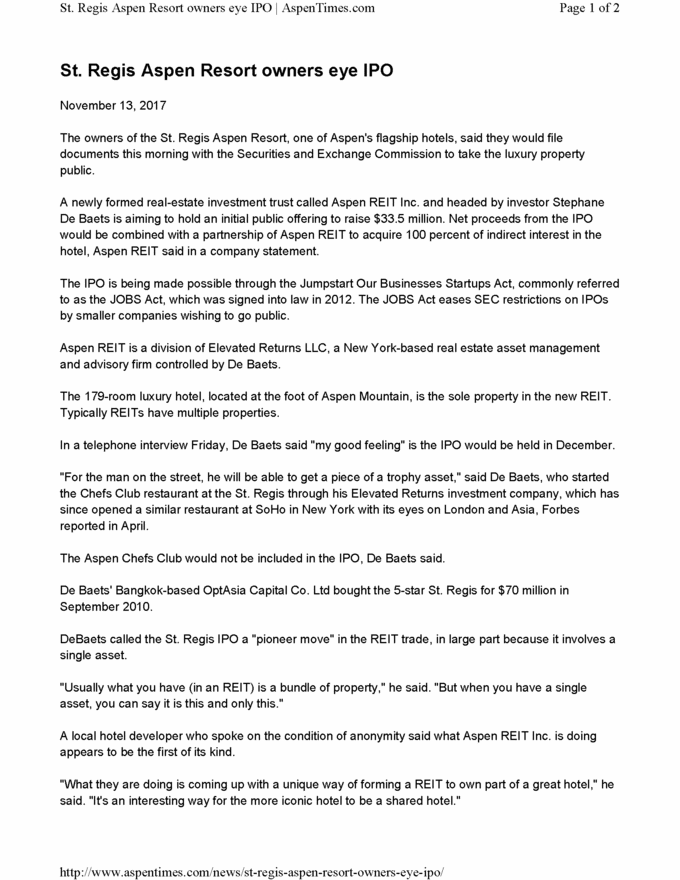
This preliminary offering circular, which we refer to as the Offering Circular, relates to an initial public offering of 1,675,000 shares of common stock, $0.01 par value per share at an initial public offering price of $20.00 per share of Aspen REIT, Inc. Prior to this offering, there has been no public market for our common stock. We intend to apply to list our common stock on the NYSE American exchange, or NYSE American, under the symbol "AJAX" and we expect our common stock to commence trading upon the closing of this offering.
We are an "emerging growth company" as defined in the Jumpstart Our Business Startups Act of 2012. This Offering Circular follows the disclosure format of Part I of Form S-11 pursuant to the general instructions of Part II(a)(1)(ii) of Form 1-A.
We intend to elect and qualify to be taxed as a real estate investment trust, or a REIT, for U.S. federal income tax purposes, commencing with our taxable year ending December 31, 2018. To assist us in qualifying as a REIT, among other purposes, stockholders are generally restricted from owning more than 9.8% by value or number of shares, whichever is more restrictive, of our aggregate outstanding shares of all classes and series, the outstanding shares of any class or series of our preferred stock or our outstanding common stock. Our charter contains various other restrictions on the ownership and transfer of our shares, see "Description of Capital StockRestrictions on Ownership and Transfer."
Investing in our common stock involves significant risks that are described in the "Risk Factors" section beginning on page 20 of this Offering Circular. You should carefully consider these risk factors prior to investing in our common stock.
Maxim Group LLC, which we refer to as the Lead Agent, is acting as lead managing selling agent to offer the shares to prospective investors on a "best efforts" basis. In addition, the Lead Agent may engage one or more sub-selling agents or selected dealers, which we collectively with the Lead Agent refer to herein as the Selling Agents. The Selling Agents are not purchasing the shares offered by us, and they are not required to sell any specific number or dollar amount of the shares in this offering.
|
||||||
| |
Price to Public |
Selling Agent Commissions(1) |
Proceeds, before expenses, to Issuer(2) |
|||
|---|---|---|---|---|---|---|
Per Share |
$20.00 | $1.40 | $18.60 | |||
Total Offering Amount |
$33,500,000 | $2,345,000 | $31,155,000 | |||
|
||||||
The shares are being offered on a "best efforts/all or none" basis. The offering will commence on the date of the offering is qualified by the Commission. Except for funds from investors participating directly through Selling Agents, all investor funds received from the date of this Offering Circular to the closing date of this offering, which is expected to take place on , 2017, will be deposited into an escrow account maintained by Prime Trust, LLC, which we refer to as Prime Trust, as escrow agent until closing. The closing date is also the termination date of this offering. If, on the closing date, investor funds are not received for the full amount of shares to be sold in this offering, the offering will terminate and any funds received will be returned promptly, without interest or deduction.
IN GENERAL, IF YOU ARE NOT AN "ACCREDITED INVESTOR" UNDER APPLICABLE SECURITIES LAWS, NO SALE MAY BE MADE TO YOU IN THIS OFFERING IF THE AGGREGATE PURCHASE PRICE YOU PAY IS MORE THAN 10% OF THE GREATER OF YOUR (I) ANNUAL INCOME OR (II) NET WORTH. DIFFERENT RULES APPLY TO ACCREDITED INVESTORS AND NON-NATURAL PERSONS. BEFORE MAKING ANY REPRESENTATION THAT YOUR INVESTMENT DOES NOT EXCEED APPLICABLE THRESHOLDS, WE ENCOURAGE YOU TO REVIEW RULE 251(d)(2)(i)(C) OF REGULATION A. FOR GENERAL INFORMATION ON INVESTING, WE ENCOURAGE YOU TO REFER TO www.investor.gov. For more information concerning the procedures of this offering, please see "Plan of Distribution" beginning on page 171, including the sections "Investment Limitations" and "Procedures for Subscribing" therein.
The Commission does not pass upon the merits of or give its approval to any securities offered or the terms of the offering, nor does it pass upon the accuracy or completeness of any offering circular or other solicitation materials. These securities are offered pursuant to an exemption from registration with the Commission; however, the Commission has not made an independent determination that the securities offered are exempt from registration.
Maxim Group LLC
The date of this Offering Circular is , 2017

TABLE OF CONTENTS
You should rely only on the information contained in this Offering Circular. We have not, and the Selling Agents have not, authorized anyone to provide you with additional information or information different from that contained in this Offering Circular. We are offering to sell, and seeking offers to buy, our shares of common stock only in jurisdictions where offers and sales are permitted. The information contained in this Offering Circular is accurate only as of the date of this Offering Circular, regardless of the time of delivery of this Offering Circular or of any sale of shares of common stock. Neither the delivery of this Offering Circular nor any sale or delivery of our securities shall, under any circumstances, imply that there has been no change in our affairs since the date of this Offering Circular. This Offering Circular will be updated and made available for delivery to the extent required by the federal securities laws.
MARKET AND INDUSTRY DATA AND FORECASTS
Certain market and industry data included in this Offering Circular have been obtained from third-party sources that we believe to be reliable. Market estimates are calculated by using independent industry publications, government publications and third-party forecasts in conjunction with our assumptions about our markets. We have not independently verified such third-party information. We use market data, including certain forecasts, in the "Industry and Market Information" sections under the captions "Offering Circular Summary" and "Business." We have obtained this information from an appraisal of the St. Regis Aspen Resort prepared for us by Jones Lang LaSalle, or JLL, a nationally recognized appraiser, in connection with our loan agreement entered into in April 2017. Furthermore, the data from STR, Inc., or STR, regarding results of hotel operations is not, and should not be construed as, legal or investment advice, or as an endorsement of any property, a recommendation regarding any particular security or course of action, or a guarantee of future performance. We pay STR a fee for its industry reports, which we receive in the regular course of our business in connection with our operations.
While we are not aware of any misstatements regarding any market, industry or similar data presented herein, such data involves risks and uncertainties and is subject to change based on various factors, including those discussed under the headings "Cautionary Note Regarding Forward-Looking Statements" and "Risk Factors" in this Offering Circular.
NOTICE REGARDING THE HOTEL MANAGER
Neither Marriott International Inc. nor Starwood Hotels & Resorts Worldwide, Inc. and its subsidiaries, which we collectively refer to as our Hotel Manager, nor any of their affiliates (i) hold an ownership interest in the St. Regis Aspen Resort Hotel, (ii) are a party to, or participant in, this offering, or (iii) are responsible for any disclosures or other information set forth herein.
i
CAUTIONARY NOTE REGARDING FORWARD-LOOKING STATEMENTS
Certain statements included in this Offering Circular and the documents incorporated into this Offering Circular by reference are "forward-looking statements" within the meaning of Section 27A of the Securities Act of 1933, as amended, or the Securities Act, and Section 21E of the Securities Exchange Act of 1934, as amended, or the Exchange Act. These forward-looking statements include information about possible or assumed future results of our business, financial condition, liquidity, results of operations, plans and objectives. When we use the words "believe," "expect," "anticipate," "estimate," "plan," "continue," "intend," "should," "may" or similar expressions, we intend to identify forward-looking statements.
The forward-looking statements contained in this Offering Circular reflect our current views about future events and are subject to numerous known and unknown risks, uncertainties, assumptions and changes in circumstances that may cause our actual results to differ significantly from those expressed in any forward-looking statement.
Statements regarding the following subjects, among others, may be forward-looking:
ii
The forward-looking statements are based on our beliefs, assumptions and expectations of our future performance, taking into account all information currently available to us. Forward-looking statements are not predictions of future events. These beliefs, assumptions and expectations can change as a result of many possible events or factors, not all of which are known to us. Some of these factors are described in this Offering Circular under the headings "Offering Circular Summary," "Risk Factors," "Management's Discussion and Analysis of Financial Condition and Results of Operations" and "Business." If a change occurs, our business, financial condition, liquidity and results of operations may vary materially from those expressed in our forward-looking statements. Any forward-looking statement speaks only as of the date on which it is made. New risks and uncertainties arise over time, and it is not possible for us to predict those events or how they may affect us. Except as required by law, we are not obligated to, and do not intend to, update or revise any forward-looking statements, whether as a result of new information, future events or otherwise.
iii
This summary highlights some of the information in this Offering Circular. It does not contain all of the information that you should consider before investing in our common stock. You should carefully read the more detailed information set forth under "Risk Factors" and the other information included in this Offering Circular.
Except where the context suggests otherwise, references in this Offering Circular to (1) "our company," "we," "us" and "our" refer to Aspen REIT, Inc., a Maryland corporation, together with its subsidiaries, (2) "our operating partnership" refers to Aspen OP, LP, a Delaware limited partnership, together with its subsidiaries, including Aspen Owner, LLC, which will own the St. Regis Aspen Resort upon completion of the contribution transactions described herein, (3) our "TRS" refers to Aspen TRS, Inc., a Delaware corporation and our taxable REIT subsidiary, or TRS, together with its wholly owned subsidiary which will lease the St. Regis Aspen Resort, and (4) the "St. Regis Aspen Resort" refers to our sole real estate asset, the St. Regis Aspen Resort, located in Aspen, Colorado. "Occupancy" is defined as the number of rooms rented at a hotel divided by the number of rooms available; "ADR" refers to average daily rate which is defined as the average room price per day attained by a hotel; and "RevPAR" refers to revenue per available room which is defined as ADR multiplied by occupancy.
We are structured as an umbrella partnership REIT, or UPREIT, for the purposes of owning a hotel asset. After giving effect to the contribution transactions described herein, which are expected to occur prior to or concurrently with the closing of this offering, we will own the St. Regis Aspen Resort through our operating partnership, of which we serve as the sole general partner. We expect that Aspen TRS, Inc., a wholly owned subsidiary of our operating partnership, will qualify as our TRS under the U.S. Internal Revenue Code of 1986, as amended, or the Code, and will lease the St. Regis Aspen Resort from our operating partnership. For a discussion of aspects of our REIT structure that could affect our operating results, see "Management's Discussion and Analysis of Financial Condition and Results of OperationsCertain Consequences of the Contribution Transactions and Our REIT Election" and "Risk FactorsRisks Related to Our Qualification as a REIT."
Unless otherwise indicated, the information contained in this Offering Circular assumes that the contribution transactions described under "The Structure and Formation of Our Company" have been completed.
Overview
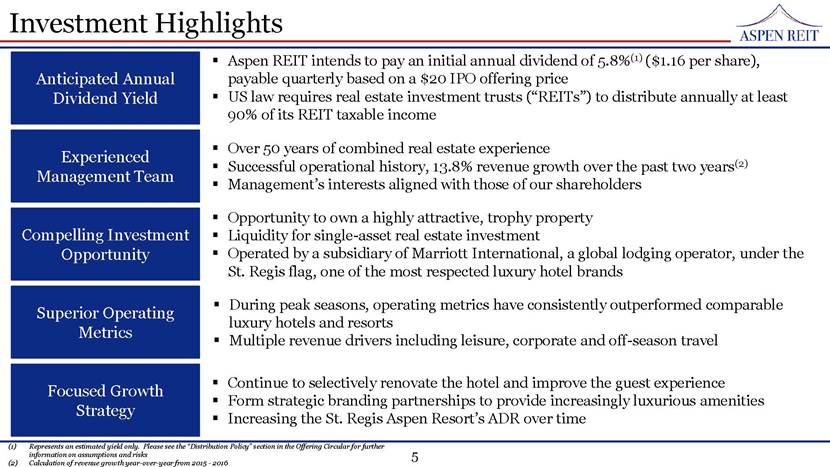
Aspen REIT, Inc. is a Maryland corporation that has been formed to own the St. Regis Aspen Resort in Aspen, Colorado. We are a single-asset REIT and currently intend to own only the St. Regis Aspen Resort. Therefore, an investment in our common stock is an investment in the St. Regis Aspen Resort.
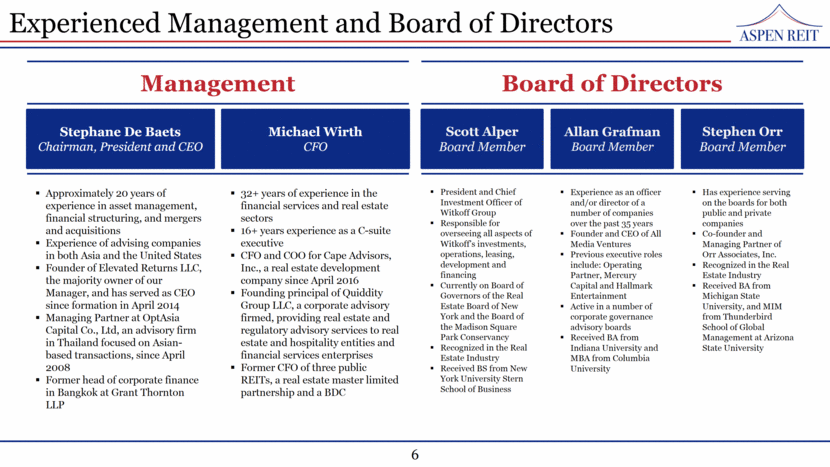
Upon the completion of this offering, we will be externally managed by ER-REITS, LLC, which we refer to as our Manager, which is a newly-formed, majority-owned subsidiary of Elevated Returns, LLC, or Elevated Returns, which in turn is wholly owned by Stephane De Baets, our chairman, chief executive officer and president. Elevated Returns is a New York based real estate asset management and advisory firm and, as of September 30, 2017, had approximately $250 million in assets under management, including the St. Regis Aspen Resort. We believe our relationship with Elevated Returns will provide us with significant advantages, as Elevated Returns executives are actively involved in the day-to-day management of its invested companies and focused on the ownership, operation and acquisition of hospitality assets located within the top markets throughout the United States.
The St. Regis Aspen Resort is a full-service luxury hotel located in Aspen, Colorado with an upscale restaurant, a private spa and heated outdoor pool with panoramic views of the Aspen mountainside. The resort is centrally located within walking distance of many of Aspen's high-end retail shops, restaurants and entertainment and two blocks from the base of Aspen Mountain. The St. Regis
1
Aspen Resort features on-site ski and snowboard rentals, as well as a ski valet service that removes the hassle from transporting equipment to and from the four nearby ski mountains each day. The St. Regis Aspen Resort recently completed $1.6 million of renovations.
The St. Regis Aspen Resort has 179 guest rooms, consisting of 154 standard rooms and 25 suites. Guests staying in suites enjoy the St. Regis Butler Service, which has been a hallmark of the St. Regis experience for over 100 years and provides packing and unpacking services, garment pressings and assistance with obtaining dinner reservations and theater tickets. In addition, the hotel offers approximately 29,000 square feet of indoor and outdoor conference and banquet venues with views of the Rocky Mountains, including 14 fully equipped meeting spaces that can accommodate special events and celebrations for up to 1,200 guests, and corporate meeting planners can enjoy the services of a St. Regis Meeting Butler, a highly trained individual who acts as a liaison between the meeting planners and other departments of the hotel. The indoor meeting space includes the 9,146-square-foot Grand Ballroom, which we believe is the largest ballroom in Aspen. The St. Regis Aspen Resort also features luxury recreational facilities, including the 15,000-square-foot Remède Spa, a fitness center, a heated outdoor swimming pool and three outdoor whirlpools with views of the mountainside. Additionally, various high-end retailers lease retail space from the hotel.
The St. Regis Aspen Resort operates three food and beverage outlets: Velvet Buck is the property's casual restaurant and also services the hotel's catering and in-room dining operations; Mountain Social, serving cocktails and light meals, is located off the lobby and offers both couch and table seating, a large fireplace, and views of Aspen Mountain; and Splash is open during the summer season and is located adjacent to the outdoor swimming pool. Light meals and cocktails from this outlet are served at dedicated outdoor tables and lounge chairs around the swimming pool. The hotel also leases space to the Chefs Club Aspen restaurant and bar, which is managed and owned in part by Mr. De Baets.
In addition to drawing couples and families for vacations throughout the year, the St. Regis Aspen Resort attracts celebrities, high net worth individuals and top executives and has a history of being selected for exclusive private events, both leisure- and business-related. The St. Regis Aspen Resort offers an array of activities year-round, including world-class skiing, snowmobiling and dog sledding during the winter and whitewater rafting, horseback riding, hiking, golf, hot air ballooning and paragliding during the summer. While famous for its skiing, Aspen and the surrounding area offer festivals year-round, including World Cup ski races, ESPN Winter X Games, Food & Wine Classic, Jazz Aspen Snowmass Labor Day Festival, and Aspen Music Festival. The St. Regis Aspen Resort is regularly the venue for well-known annual events in the entertainment, fashion and press industries, such as the Aspen Valley Polo Club, Après Ski Cocktail Classic and Wintersköl Awards Dinner.
The St. Regis Aspen Resort opened in 1992 as a Ritz-Carlton Hotel. In 1998, the property was converted to the St. Regis brand when it was purchased by Starwood Hotels & Resorts Worldwide, Inc. and its subsidiaries, which we collectively refer to as Starwood, or our Hotel Manager. In 2005, the property was divided into two separate units, a residential condominium complex, which is not and will not be owned by us, and the hotel unit, which represents the St. Regis Aspen Resort, which will be our sole asset. On October 30, 2010, our Predecessor purchased the St. Regis Aspen Resort from Starwood for approximately $70.0 million ($390,000 per room). We refer to this acquisition as the 2010 Acquisition. Starwood has managed the St. Regis Aspen Resort since 1998 and, in connection with the 2010 Acquisition, our Predecessor entered into a hotel management agreement with Sheraton Operating Corporation, a wholly owned subsidiary of Starwood, to continue its management of the hotel. The St. Regis brand provides a luxury experience at over 30 hotels around the world, including the St. Regis Aspen Resort. On September 23, 2016, Marriott International Inc., or Marriott, completed the acquisition of Starwood, after which Starwood became an indirect wholly owned subsidiary of Marriott, a worldwide operator, franchisor, and licensor of hotels and timeshare properties under numerous brand names. At year-end 2016, Marriott operated 1,821 properties (521,552 rooms)
2
under long-term management agreements with property owners, 48 properties (10,933 rooms) under long-term lease agreements with property owners, and 22 properties (9,906 rooms) that it owns.
Mr. De Baets, our chairman, chief executive officer and president, and the indirect majority owner of our Manager, has over 20 years of experience in asset management, financial structuring and mergers and acquisitions, and has been involved with the St. Regis Aspen Resort since our Predecessor acquired an interest in the hotel in 2010. Mr. De Baets has advised companies in both Asia and the United States and has significant experience and professional networks in both the real estate and hospitality industries.
Our Competitive Strengths
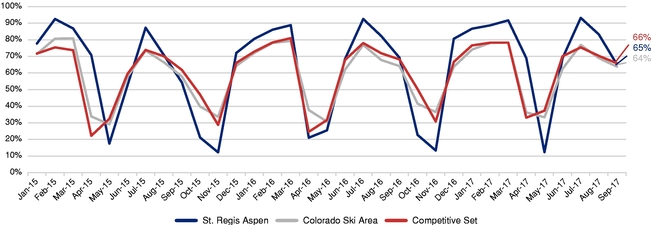
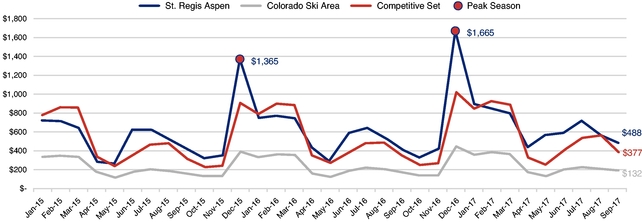
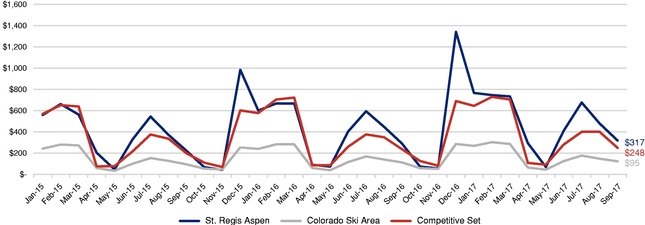
Our occupancy, ADR, and RevPAR are generally strong relative to our competitive set and the Colorado Ski Area.
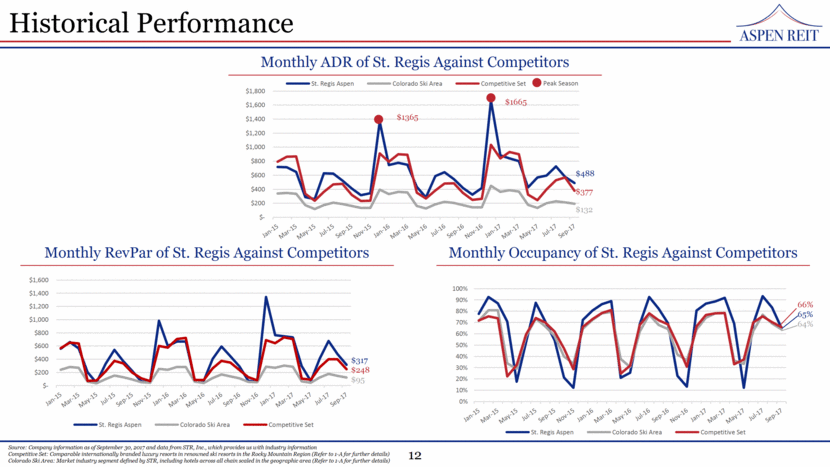
As measured by STR, Inc., or STR, which is an independent research firm that compiles data on the lodging industry, and as demonstrated in the charts below, our monthly occupancy, ADR and RevPAR are generally strong relative to our competitive set and also outperform the hotels in the Colorado Ski Area. We define our competitive set as comparable internationally branded luxury resorts in renowned ski resorts in the Rocky Mountain region, including Aspen-Snowmass, Colorado, Deer Valley-Park City, Utah, Vail-Avon, Colorado, and Jackson Hole, Wyoming. The Colorado Ski Area is a market industry segment defined by STR and is made up of all hotels across all chain scales that are located within the geographic area. The ski resort areas included in this geographic market are Vail-Avon, Aspen-Snowmass, Telluride, Breckenridge, Crested Butte, Fraser, and Granby.
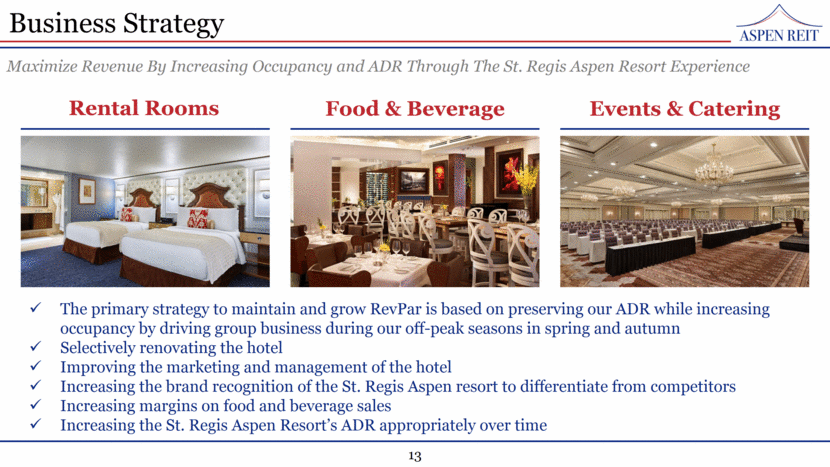
Our primary strategy to maintain and grow RevPAR is based on preserving our ADR while increasing occupancy by driving group business during our off-peak seasons in spring and autumn. Unlike many other properties, the St. Regis Aspen Resort limits the sale of vacant rooms at discounted rates through programs that fill rooms at the last minute. We believe that this policy helps preserve the St. Regis Aspen Resort's brand and maintain and grow a loyal clientele who are willing to pay higher prices for the St. Regis Aspen Resort experience.
The charts below show our monthly occupancy, ADR and RevPAR rates from January 2015 through September 30, 2017, as compared to our competitive set and the Colorado Ski Area.
Monthly occupancy of the St. Regis Aspen Resort, Competitive Set and Colorado Ski Area
Source: STR data.
3
Monthly ADR of the St. Regis Aspen Resort, Competitive Set and Colorado Ski Area
Source: STR data.
Monthly RevPAR of the St. Regis Aspen Resort, Competitive Set and Colorado Ski Area
Source: STR data.
We believe that our strong performance is primarily due to the high-quality service that the St. Regis Aspen Resort provides to our customers and the amenities of the resort.
The St. Regis Aspen Resort is a luxury hotel and a high-end asset.
We believe that high-end assets have characteristics that represent a well-defined segment within the property market which, over the long term, is more insulated from cyclical fluctuations of the real estate market. The St. Regis Aspen Resort is a luxury hotel that appeals to celebrities, high net worth individuals, tourists and corporate executives, among others. Aspen and the surrounding area, famous for its skiing, also offer festivals year-round, some of which include Wintersköl, Food & Wine Classic, Jazz Aspen Snowmass, and Aspen Music Festival. With views of the Rockies, it has access to winter skiing, summer sports and is within walking distance of all of Aspen's shops, restaurants and entertainment. We believe that our history and size give us a competitive advantage over new entrants to the market that are less connected to the community. The St. Regis Aspen Resort is regularly the
4
venue for well-known annual events in the entertainment, fashion and press industries, such as the Aspen Valley Polo Club, Après Ski Cocktail Classic, and Wintersköl Awards Dinner.
The St. Regis Aspen Resort is selected as a venue for high-profile events, which we believe results in higher ADR for the resort.
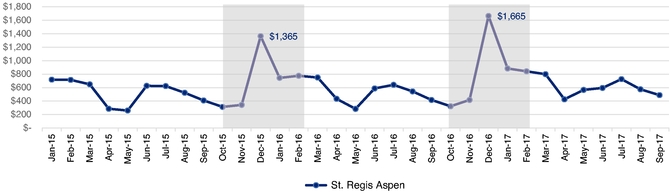
The St. Regis Aspen Resort has a history as a venue for high-profile exclusive events and attractions. Typically, the winter and summer seasons in Aspen are our most popular seasons for high-profile events, and we believe this drives, in part, higher occupancy during these seasons than in the spring and fall. Due to this popularity, we can also typically increase our room rates, contributing to what is typically a higher ADR for December through March and, to a lesser degree, June through August. Set forth below is a chart showing our monthly ADR from January 2015 to September 30, 2017, with event seasons highlighted.
St. Regis Aspen Resort Monthly ADR
Source: STR data.
Furthermore, we believe that hosting high-profile events attracts customers to the hotel beyond the days immediately surrounding the event. These events are often showcased in the press and reinforce our brand, contributing to our financial results.
Elevated Returns and Hotel Manager have extensive experience in managing luxury hotels and restaurants.
Mr. De Baets, our chairman, chief executive officer and president, and the sole owner of Elevated Returns, the majority owner of our Manager, has over 20 years of experience in asset management, financial structuring and mergers and acquisitions, and has been involved with the St. Regis Aspen Resort since the 2010 Acquisition. Mr. De Baets has advised companies in both Asia and the United States and has significant experience and professional networks in both the real estate and hospitality industries. Other notable properties of which Mr. De Baets has managed or currently manages and in which he has had or has an ownership interest include the Sunset Tower Hotel in West Hollywood, California, the Chefs Club restaurants in Aspen, Colorado and New York City, and Chefs Club Counter, Lupulo and Aldea Restaurants in New York City. While in Asia, Mr. De Baets specialized in the hospitality industry and has been involved in the acquisition, disposition and restructuring of numerous hotels.
Our chief financial officer, secretary and treasurer, Michael Wirth, joined Elevated Returns in 2016 and has over 30 years of experience in the real estate and financial services sectors and over 12 years of experience in the REIT industry. Mr. Wirth has also been a top executive at private and public real estate and financial services companies (taking five such companies through the initial public offering ("IPO") process) for over 16 years and holds independent board positions with private companies. In addition, Alex Ho, Elevated Returns' comptroller, has worked with Mr. De Baets for over 20 years, and
5
Jason Kirschenbaum, our Manager's managing director, joined Elevated Returns in 2016 and has over 10 years of experience in the real estate business, including real estate investment, financing and development.
Starwood has managed the St. Regis Aspen Resort since 1998, and in connection with the 2010 Acquisition, our Predecessor entered into a hotel management agreement with Sheraton Operating Corporation, a wholly owned subsidiary of Starwood, to continue Starwood's management of the hotel. The St. Regis brand provides a luxury experience at over 30 hotels around the world, including the St. Regis Aspen Resort. On September 23, 2016, Marriott completed the acquisition of Starwood, after which Starwood became an indirect wholly owned subsidiary of Marriott, a worldwide operator, franchisor, and licensor of hotels and timeshare properties under numerous brand names. At year-end 2016, Marriott operated 1,821 properties (521,552 rooms) under long-term management agreements with property owners, 48 properties (10,933 rooms) under long-term lease agreements with property owners, and 22 properties (9,906 rooms) that it owns.
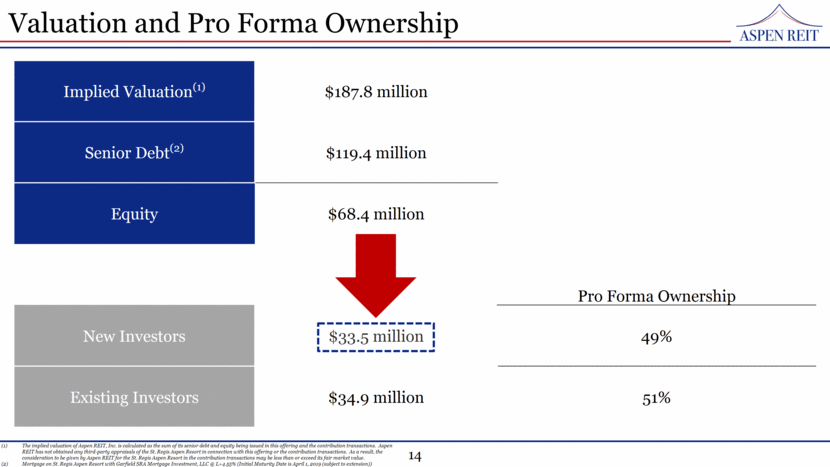
We believe our management team, together with Elevated Returns and our Hotel Manager, has the skills and experience necessary to effectively manage and operate a first-class resort destination, enabling us to provide attractive risk-adjusted returns to our stockholders. Upon the completion of this offering and the contribution transactions, our Predecessor, an entity in which Mr. De Baets is an indirect investor and serves as the president, is expected to own 51.0% of the equity interests in our operating partnership.
Aspen is a popular destination for leisure travel in multiple seasons, and we have an established presence in the Aspen area.
Aspen's desirability as a popular vacation destination and location for resort homes has made it one of the nation's most expensive areas to develop, and, as the city of Aspen is surrounded on three sides by National Forest Land, giving the area limited developable land, it is considered to be an extremely exclusive real estate market with the high barriers to entry. While Aspen began as a silver mining town, Aspen has become known as a luxury resort town for the wealthy and famous, and has become a second or third home to corporate executives and celebrities. As a result of this influx of wealth, Aspen boasts some of the most expensive real estate prices in the United States, and the downtown has been largely transformed into an upscale shopping district known for high-end restaurants, salons and boutiques, while also showcasing the rustic charm of the Mountain West, including landmarks like the Wheeler Opera House, which was built in 1889 during the area's silver mining boom. We believe the high real estate prices and barriers to entry for new development benefit us, as we have an established presence in Aspen as a provider of luxury lodging.
Moreover, with its luxury positioning and wide appeal to international travelers, Aspen has developed a strong economy of its own. Located high in the Rocky Mountains, Aspen is internationally renowned as a winter and summer resort. The Rocky Mountains generally have reliable snow, a long ski season and reliable vehicular and air access. Aspen, in particular, with access to four ski mountains (Aspen Mountain, Aspen Highlands, Buttermilk, and Snowmass Mountain), trail systems for snowshoeing and cross-country skiing and a vibrant après ski scene, offers an array of winter entertainment. In addition to being a leading world-class skiing destination, the area offers year-round recreational activities and cultural events that draw visitors during all seasons and make Aspen, and our hotel, less dependent on snowfall compared to other major U.S. ski resort destinations.
6
Our Business and Growth Strategies
By capitalizing on our competitive strengths, we seek to increase long-term stockholder value by achieving sustainable long-term growth. Our business and growth strategies to achieve these objectives include the following:
Increasing revenue with a sophisticated growth strategy to increase occupancy through the St. Regis Aspen Resort experience.
The St. Regis Aspen Resort's revenue is primarily driven by room rentals and food and beverage sales, as well as events and catering. We intend to continue implementing a strategy to maximize both room rental and food and beverage revenue. For the nine months ended September 30, 2017 and the year ended December 31, 2016, the St. Regis Aspen Resort's room rental revenues were $22.9 million and $28.7 million, respectively. In addition, we believe we have an opportunity to improve the St. Regis Aspen Resort's occupancy, which will further increase RevPAR. See "Our occupancy, ADR, and RevPAR are generally strong relative to our competitive set and the Colorado Ski Area."
In order to further capitalize on the value of the St. Regis Aspen Resort brand, we believe that we can grow the St. Regis Aspen Resort's revenue by continuing to implement a sophisticated strategy with goals such as the following:
Our Manager is incentivized to succeed.
Our business is customer focused, so our Manager is consistently making adjustments to fulfill our growth strategy and to adapt to changes in the market, so that we continue to meet and exceed our customers' expectations.
We have structured our relationship with our Manager and Hotel Manager so that our interests and the interests of our stockholders are closely aligned with those of our Manager and Hotel Manager over the long term. Upon the completion of this offering, our Predecessor, an entity in which Mr. De Baets is an indirect investor and serves as the president, is expected to own 51.0% of the equity interests in our operating partnership. In addition, we have structured our management arrangements with our Manager and Hotel Manager to provide for incentive fees based on our performance. We believe that Mr. De Baets' ownership of equity interests in our operating partnership, as well as the incentive fees that may be earned by our Manager and Hotel Manager, will create an incentive to maximize returns for our stockholders by aligning our interests with those of Mr. De Baets and our Manager and Hotel Manager. See also, "Our Principal Agreements."
Industry and Market Information
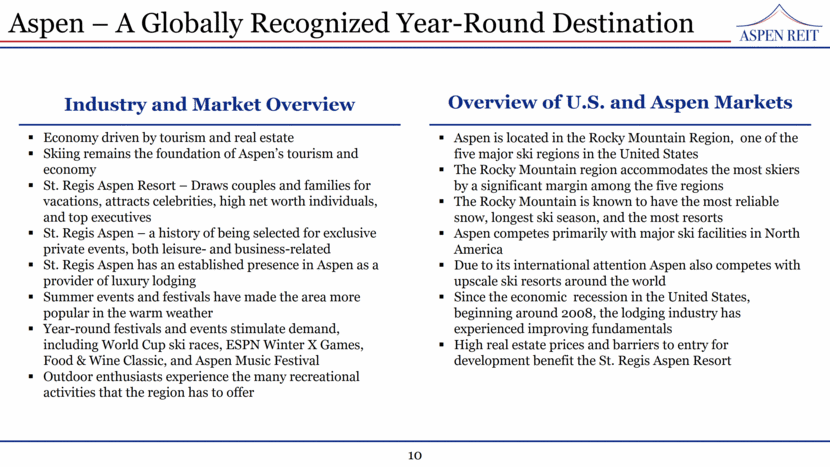
Tourism and real estate fuel the local Aspen economy. Although direct ski-generated revenues have been outpaced by real estate income, skiing remains the foundation of the Aspen tourism industry and economy. In connection to its tourism appeal and high revenue residents, the retail industry in Aspen has developed in the past years, with many high-end brands establishing their presence. The high-end retail environment is crucial in maintaining and growing the distinctive luxury appeal and positioning of Aspen.
7
Aspen draws people from all over the world. In winter, travelers from across the United States and abroad enjoy world-class skiing. The main tourist attractions in the Aspen area are the four ski resorts: Aspen Mountain, Aspen Highlands, Buttermilk, and Snowmass Mountain, which are all operated by the Aspen Skiing Company and together represent approximately 5,500 acres of skiable terrain. The St. Regis Aspen Resort is located close to the base of Aspen Mountain, which features 673 skiable acres, 3,267 feet of vertical drop, 76 trails, and eight lifts. Snowmass Mountain is the largest of the four mountains and features 3,132 skiable acres, 4,406 feet of vertical drop, and 21 lifts.
Aspen is situated in a relatively remote area of the Rocky Mountains, close to the Continental Divide. As a result, air travel tends to be a dominant mode of transportation for Aspen visitors, especially for those travelling a long distance, and airport passenger counts are important indicators of lodging demand. The nearest airport, AspenPitkin County Airport, is located approximately three miles from the central business district of Aspen, although the airports in Colorado, such as Denver, Grand Junction and Eagle, also serve the Aspen community and are located within an approximately three-hour drive of Aspen.
Aspen has primarily been a winter destination; however, in the past several years, new summer events and festivals have made the area more popular in warm weather. Year-round, outdoor enthusiasts experience the many recreational activities that the region has to offer, such as hiking, biking, golf, white-water rafting and fishing. Aspen is also rich in history and culture, including art galleries and music venues, and hosts internationally famous events. Below is a brief description of some major events and attractions in the area.
Overview of U.S. and Aspen Ski Markets
Downhill skiing is the primary demand generator for the Aspen market area, and the health and trends of the ski industry have a direct impact on the performance of the lodging market at ski resorts generally and in Aspen in particular. Aspen is located in the Rocky Mountain Region, which is one of the five major ski regions in the United States, as defined by the National Ski Areas Association, and includes the following states: Colorado, Idaho, Montana, New Mexico, Utah and Wyoming. Of the five major ski regions in the United States, the Rocky Mountain region accommodates the most skiers by a significant margin. While skier visitation can vary dramatically from year to year, depending on snowfall, the national economy, and international economic and political dynamics, the Rocky Mountain region is known to have the most reliable snow, the longest ski season, the most resorts, and some of the best vehicular and air access of the five major ski regions in the United States.
Aspen competes primarily with major ski facilities in North America and secondarily with upscale large ski resorts around the world and particularly in Continental Europe. The primary competitive
8
properties are full-service resorts that boast a large number of ski slopes and ski lifts, winters characterized typically by good snow conditions, well-developed entertainment, retail and restaurant amenities and high-end residential real estate. In particular, Aspen competes in North America with ski resorts such as Vail-Avon, Colorado, Jackson Hole, Wyoming, Deer Valley-Park City, Utah and Whistler, British Columbia, Canada. Due to its international reputation, Aspen also competes secondarily with resorts in Continental Europe such as Verbier, St. Moritz and Davos in Switzerland and Courcheval and Tignes/Val D'Isère in France.
Hotel Market
The hotel industry is highly competitive. We compete with other Aspen hotels for guests, as well as with comparable internationally branded luxury resorts in renowned ski resorts in the Rocky Mountain region, including Aspen-Snowmass, Colorado, Deer Valley-Park City, Utah, Vail-Avon, Colorado, and Jackson Hole, Wyoming. Competitive advantage within Aspen is based on a number of factors, including location, convenience, brand affiliation, room rates, range of services and guest amenities or accommodations offered and quality of customer service. Competitive advantage with other comparable ski resorts depends largely on snow conditions at the various resorts, as well as with the convenience of Aspen and brand affiliation with the St. Regis brand.
We also compete with existing and new hotels operated under various brand names. Three new hotels are scheduled to open in Aspen in the next five years, including another hotel affiliated with Starwood, which would compete directly with the St. Regis Aspen Resort for loyalty rewards program business. For further information, see "Risk FactorsRisks Related to our BusinessCompetition from other luxury hotels in Aspen, Colorado and alternative lodging companies could have a material adverse effect on our results of operations."
Summary Risk Factors
An investment in our common stock involves various risks. You should carefully consider the risks discussed below and under "Risk Factors" before purchasing our common stock. If any of the following risks or risks discussed under "Risk Factors" occurs, our business, financial condition or results of operations could be materially and adversely affected. In that case, the trading price of our common stock could decline, and you may lose some or all of your investment.
9
Contribution Transactions and Our Structure
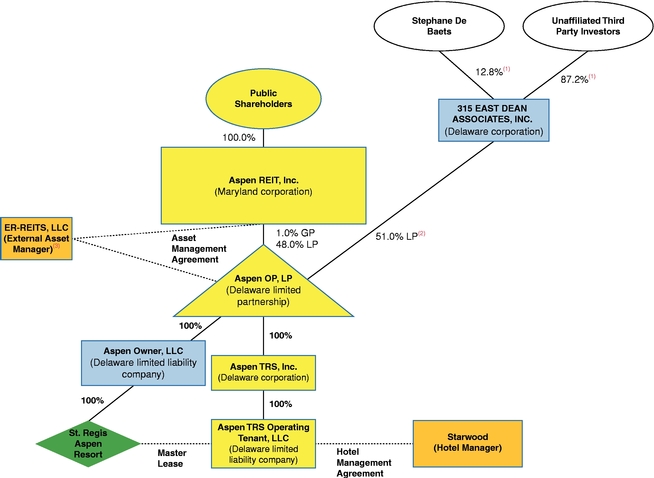
We were formed as a Maryland corporation on December 22, 2016. We will conduct our business through an UPREIT structure, in which the St. Regis Aspen Resort is wholly owned indirectly by our operating partnership, Aspen OP, LP. Aspen REIT is the sole general partner of our operating partnership and has the exclusive power to manage and conduct our operating partnership's business, subject to the limitations described in the limited partnership agreement. We will contribute the net proceeds of this offering to our operating partnership in exchange for OP units.
Through a series of transactions that we expect will occur prior to or concurrently with the completion of this offering, or the contribution transactions, we will acquire the St. Regis Aspen Resort. Our acquisition of these assets will be completed pursuant to a contribution and sale agreement, pursuant to which our Predecessor, an entity owned in part by Mr. De Baets, will contribute the asset to our operating partnership in exchange for an aggregate of 1,743,368 OP units and $32.5 million in cash. Upon the completion of this offering and the contribution transactions, our
10
Predecessor, an entity in which Mr. De Baets is an indirect investor and serves as president, is expected to own 51.0% of the equity interests in our operating partnership.
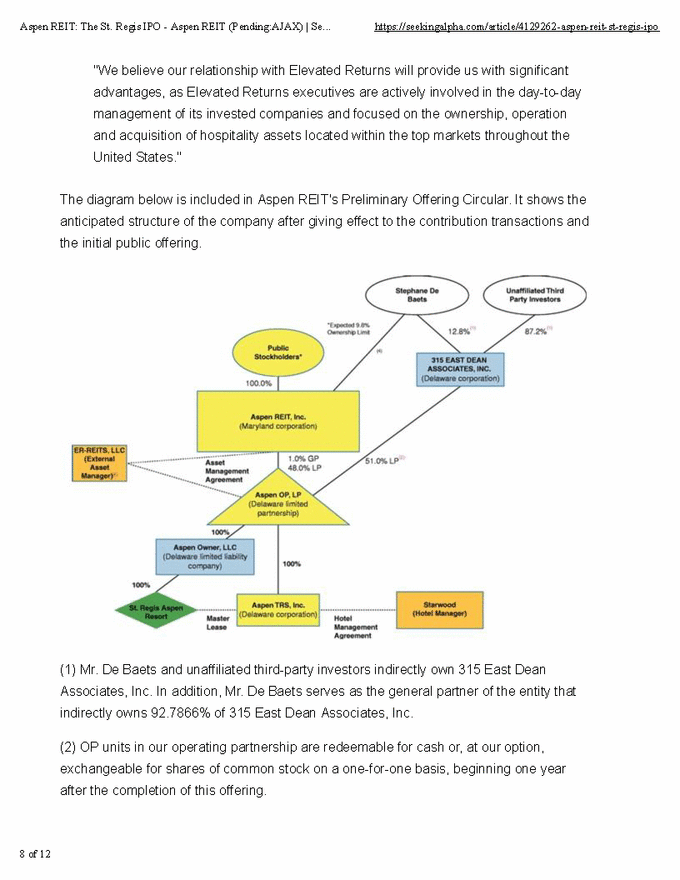
The following chart shows the anticipated structure of our company after giving effect to the contribution transactions and this offering.
The Management Agreement and the Manager
Manager
Effective upon the completion of this offering and the contribution transactions, we will be managed by ER-REITS, LLC, which is a newly-formed, majority-owned subsidiary of Elevated Returns, which in turn is wholly owned by Mr. De Baets and is a New York-based real estate asset management and advisory firm. As of September 30, 2017, Elevated Returns had approximately $250 million in assets under management, including the St. Regis Aspen Resort, in industries such as real estate and consumer brands. Elevated Returns executives are actively involved in the day-to-day management of its invested companies and focused on the ownership, operation, and acquisition of hospitality assets located within the top markets throughout the United States.
11
Our Manager's chief executive officer and president, Mr. De Baets, has over 20 years of experience in asset management, financial structuring, and mergers and acquisitions. He has advised companies in both Asia and the United States and has significant experience and professional networks in both real estate and hospitality. In 2015, Mr. De Baets formed Elevated Returns to focus on the acquisition and/or management of top lodging, restaurant and leisure assets, including the St. Regis Aspen Resort, Sunset Tower Hotel in West Hollywood, CA, Chefs Club Group (Chefs Club Aspen and Chefs Club NY), Chefs Club Counter and Noosa Hospitality which owns Aldea Restaurant and Lupulo Restaurant in New York, NY.
Elevated Returns' strategy focuses on:
While Elevated Returns has in the past acquired and managed, and both our Manager and Elevated Returns may in the future manage, other luxury hotels, neither our Manager nor Elevated Returns currently has any intent to acquire or manage any properties in the Aspen area that compete directly with the St. Regis Aspen Resort.
Our Manager's plans to further implement its overall strategy with respect to the St. Regis Aspen Resort by:
Management Agreement
We and our operating partnership will enter into a management agreement with our Manager that will be effective upon the completion of this offering and the contribution transactions. Pursuant to the terms of the management agreement, our Manager will perform certain services for us, subject to oversight by our board of directors. For more information about the terms of our management agreement, see "Our Principal AgreementsManagement Agreement."
Management Fees
We will pay our Manager a base management fee, in cash, payable quarterly in arrears, in an amount equal to the greater of: (i) $1,000,000 per year ($250,000 per quarter), which is subject to an annual increase equal to the greater of (a) a consumer price index, or CPI, adjustment and (b) 3.0%, and (ii) 1.5% of our stockholders' equity. The base management fee will be reduced by any of our expenses paid by us directly or reimbursed to our Manager that quarter; provided, however, that the
12
base management fee payable with respect to any calendar quarter shall never be less than $0. The base management fee is payable independent of our performance.
Our Manager will also be eligible to receive an incentive fee in an amount equal to the excess of (i) the product of (a) 25.0% and (b) the excess of (1) our Core Earnings for the previous 12-month period, over (2) the product of (A) our stockholders' equity in the previous 12-month period and (B) 7.0% per annum, over (ii) the sum of any incentive fees paid to our Manager with respect to the first three calendar quarters of such previous 12-month period. For a description of our "stockholders' equity" and "core earnings," see "Our Principal AgreementsManagement AgreementManagement FeesManagement Fees."
Upon the completion of this offering, without taking into account the payment of any potential incentive fee, we expect our management fees and expense reimbursements, as described in further detail below, will slightly decrease compared to the fees and expense reimbursements paid by our Predecessor; however, no assurances can be given that our expected fees and expense reimbursements will not increase.
Disposition Fee
Following a disposition of the St. Regis Aspen Resort or all or substantially all of our interest in the St. Regis Aspen Resort, we will pay our Manager a management sale fee, in cash, in an amount equal to 2.0% of the total consideration paid by the purchaser in connection with the disposition of the St. Regis Aspen Resort. No disposition fee shall be payable to our Manager in respect of any disposition that occurs during the 12 months following the completion of this offering if the total consideration paid by the purchaser (including any indebtedness assumed by the purchaser) in connection with the disposition of the St. Regis Aspen Resort is less than the value of the aggregate consideration paid by us and our operating partnership in the contribution transactions. For a description of "aggregate consideration" and "total consideration," see "Our Principal AgreementsManagement AgreementManagement FeesDisposition Fee."
Termination Fee
In conjunction with a termination of the management agreement by us, unless the termination is for cause, we will pay our Manager a termination fee equal to three times the sum of (i) the average annual base management fee and (ii) the average annual incentive fee earned by our Manager, in each case during the 24-month period immediately preceding such termination, calculated as of the end of the most recently completed fiscal quarter before the date of termination.
Expense Reimbursement
We will reimburse our Manager or its affiliates for certain costs and expenses relating to third-party services that are typically borne by an externally-managed company.
Hotel Management Agreement
In order to qualify as a REIT, we cannot directly or indirectly operate the St. Regis Aspen Resort. We will lease the St. Regis Aspen Resort to our TRS, which in turn engages the Hotel Manager to manage the St. Regis Aspen Resort. The St. Regis Aspen Resort is operated pursuant to a hotel management agreement with a wholly-owned subsidiary of our Hotel Manager, Starwood. For additional details regarding the principal terms of the hotel management agreement, see "Our Principal AgreementsHotel Management Agreement."
13
Financing Strategy
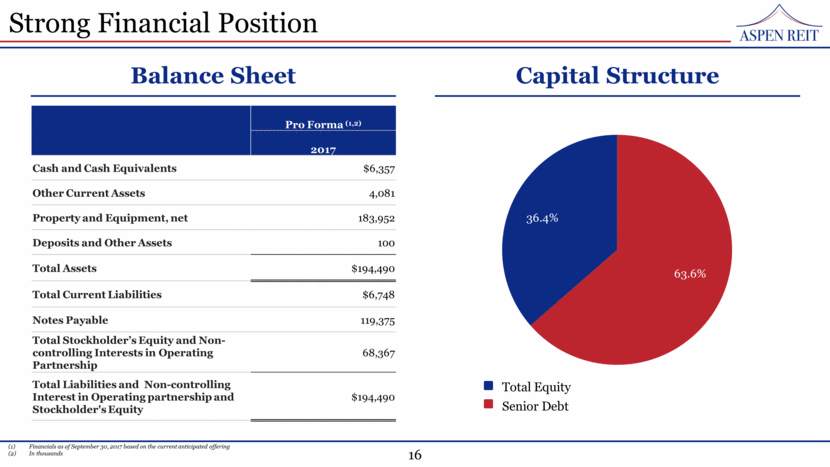
Upon the completion of this offering and the contribution transactions, our only long-term debt is expected to be a $120.0 million mortgage on the St. Regis Aspen Resort. As of the date of this Offering Circular, the principal amount outstanding under the mortgage was $120.0 million and the interest rate was 4.55% (subject to adjustment if the lender exercises its rights to bifurcate the promissory note) plus one-month LIBOR. The borrower has hedged against the potential rise in LIBOR above 3.0% pursuant to a rate cap agreement. The initial maturity date on the loan is April 1, 2019, which may be extended by us three times for a period of one year each, provided that certain conditions, including but not limited to satisfying a debt yield test, are met and an extension fee is paid in the amount of 0.25% of the amount of the outstanding principal amount of the loan. Our loan agreement contains restrictive covenants that may impact our ability to pay dividends and therefore our ability to qualify as a REIT. For a summary of the principal terms of this mortgage, see "FinancingLoan Agreement and Related Documents."
Restrictions on Ownership and Transfer
To assist us in complying with the limitations on the concentration of ownership of a REIT imposed by the Code, among other purposes, our charter prohibits, with certain exceptions, any stockholder from beneficially or constructively owning, applying certain attribution rules under the Code, more than 9.8% by value or number of shares, whichever is more restrictive, of any of the outstanding shares of our common stock, the outstanding shares of any class or series of our preferred stock, or the outstanding shares of our capital stock. For a further discussion of ownership and transfer restrictions, see "Description of Capital StockRestrictions on Ownership and Transfer."
Tax Status
In connection with this offering, we intend to elect to qualify to be taxed as a REIT under the Code, commencing with our taxable year ending on December 31, 2018. We believe that we have been organized in conformity with the requirements for qualification and taxation as a REIT under the Code, and that our proposed method of operation will enable us to meet the requirements for qualification and taxation as a REIT under the Code. To qualify, and maintain our qualification, as a REIT, we must meet on a continuing basis, through our organization and actual investment and operating results, various requirements under the Code relating to, among other things, the sources of our gross income, the composition and values of our assets, our distribution levels and the diversity of ownership of our common stock. If we fail to qualify as a REIT in any taxable year and do not qualify for certain statutory relief provisions, we will be subject to U.S. federal income tax at regular corporate rates and may be precluded from qualifying as a REIT for the subsequent four taxable years following the year during which we failed to qualify as a REIT. Even if we qualify for taxation as a REIT, we may still be subject to certain U.S. federal, state and local taxes on our income or property. Dividends paid by us generally will not be eligible for taxation at the preferential U.S. federal income tax rates that currently apply to certain distributions received by non-corporate individuals from taxable corporations.
In order for the income from our hotel operations to constitute "rents from real property" for purposes of the gross income tests required for REIT qualification, we cannot directly or indirectly operate the St. Regis Aspen Resort. Accordingly, we will lease the St. Regis Aspen Resort, which will be wholly owned by our operating partnership, to our TRS. Our TRS will pay rent to our operating partnership that can qualify as "rents from real property," provided that our Hotel Manager is an "eligible independent contractor," which we believe to be the case. Our TRS will be subject to U.S. federal income tax at regular corporate rates on its taxable income.
14
Implications of Being an Emerging Growth Company
We are an "emerging growth company" as defined in the Jumpstart Our Business Startups Act of 2012, or the JOBS Act, and we are eligible to take advantage of certain specified reduced disclosure and other requirements that are otherwise generally applicable to public companies that are not "emerging growth companies" including, but not limited to, not being required to comply with the auditor attestation requirements of Section 404 of the Sarbanes-Oxley Act of 2002, or the Sarbanes-Oxley Act, reduced disclosure obligations regarding executive compensation in our periodic reports and proxy statements, and exemptions from the requirements of holding a nonbinding advisory vote on executive compensation and stockholder approval of any golden parachute payments not previously approved.
Although we have not made a determination whether to take advantage of any or all of these exemptions, we expect to remain an "emerging growth company" for up to five years, or until the earliest of (1) the last day of the first fiscal year in which our annual gross revenues exceed $1.07 billion, (2) December 31 of the fiscal year that we become a "large accelerated filer" as defined in Rule 12b-2 under the Securities Exchange Act of 1934, as amended, or the Exchange Act, which would occur if the market value of our common stock that is held by non-affiliates exceeds $700.0 million as of the last business day of our most recently completed second fiscal quarter and we have been publicly reporting for at least 12 months or (3) the date on which we have issued more than $1.0 billion in non-convertible debt securities during the preceding three-year period.
In addition, Section 107 of the JOBS Act also provides that an emerging growth company can take advantage of the extended transition period provided in Section 7(a)(2)(B) of the Securities Act for complying with new or revised accounting standards, meaning that the company can delay the adoption of certain accounting standards until those standards would otherwise apply to private companies. We have chosen to take advantage of this extended transition period and, as a result, we will comply with new or revised accounting standards on the relevant dates on which adoption of such standards is required for private companies for as long as we maintain our emerging company status and do not revoke this election. Accordingly, the accounting standards that we apply while we remain an emerging growth company may differ materially from the accounting standards applied by other similar public companies, including emerging growth companies that have elected to opt out of this extended transition period. This election could have a material impact on our financial statements and the comparability of our financial statements to the financial statements of similar public companies. This potential lack of comparability could make it more difficult for investors to value our securities, which could have a material impact on the price of our common stock.
15
Common stock offered by us |
1,675,000 shares on a "best efforts/all or none" basis. | |
Common stock and OP units to be outstanding upon the completion of this offering and the contribution transactions |
3,418,368 shares and OP units(1). |
|
Use of proceeds |
We estimate that we will receive net proceeds from this offering in the amount of approximately $33.5 million. Our Predecessor has agreed to pay 100% of (i) the Selling Agent commissions payable to the Selling Agents in connection with this offering and (ii) our other offering and contribution transaction expenses, including the acquisition fee payable to our Manager and legal, accounting, consulting, and regulatory filing expenses. We intend to contribute the net proceeds of this offering to our operating partnership, which we expect will subsequently use the net proceeds as follows: |
|
|
approximately $32.5 million will be paid to 315 East Dean Associates, Inc., our Predecessor, in connection with the contribution transactions; and |
|
|
approximately $1.0 million will be reserved for working capital purposes, including capital expenditures. |
|
|
Prior to the use of the net proceeds for working capital purposes, we intend to invest such net proceeds in interest-bearing accounts and short-term, interest-bearing securities which are consistent with our intention to qualify for taxation as a REIT. See "Use of Proceeds." |
|
Distribution policy |
We intend to make regular quarterly distributions to holders of our common stock. U.S. federal income tax law generally requires that a REIT distribute annually at least 90% of its REIT taxable income, without regard to the deduction for dividends paid and excluding net capital gains, and that it pay tax at regular corporate rates to the extent that it annually distributes less than 100% of its taxable income. We intend to pay quarterly distributions, which on an annual basis will equal all or substantially all of our taxable income. |
|
|
Any distributions we make will be at the discretion of our board of directors and will depend upon, among other things, our actual results of operations. These results and our ability to pay distributions will be affected by various factors, including our revenues, operating expenses, the rental rate and occupancy rate of our hotel and unanticipated expenditures. For more information, see "Distribution Policy." |
16
|
We cannot assure you that we will make any distributions to our stockholders. |
|
NYSE American symbol |
"AJAX" |
|
Risk factors |
An investment in our common stock involves various risks. You should consider carefully the risks discussed below and under "Risk Factors" before purchasing shares of our common stock. |
Our Corporate Information
Our principal executive offices are located at 96 Spring Street, 6th Floor, New York, New York, 10012. Our telephone number is (646) 780-5451. Our website is www.aspenreit.com. The information on our website is not intended to form a part of or be incorporated by reference into this Offering Circular.
17
SUMMARY HISTORICAL AND PRO FORMA FINANCIAL OPERATING DATA
The following table sets forth summary financial and other data on (i) a historical basis for our Predecessor and (ii) a pro forma basis for our company giving effect to (a) the contribution transactions and related fair value adjustments, (b) this offering and the use of net proceeds therefrom as described under "Use of Proceeds," (c) entry into our management agreement with our Manager and (d) the refinancing of existing mortgage indebtedness of approximately $100.0 million and the April 2017 refinancing thereof for approximately $120.0 million.
The summary historical balance sheet information as of December 31, 2016 and 2015 of our Predecessor and summary historical statements of operations for the years ended December 31, 2016 and 2015 of our Predecessor have been derived from the audited historical financial statements of our Predecessor included elsewhere in this Offering Circular. The summary historical balance sheet information as of September 30, 2017 of our Predecessor and the summary statements of operations for the nine months ended September 30, 2017 and 2016 of our Predecessor have been derived from the unaudited historical financial statements of our Predecessor included elsewhere in this Offering Circular. The summary historical balance sheet information as of September 30, 2016 of our Predecessor have been derived from our Predecessor's unaudited historical financial statements not included in this Offering Circular. Our Predecessor's results of operations for the nine months ended September 30, 2017 are not necessarily indicative of our results of operations for the year ending December 31, 2017.
The summary pro forma balance sheet information as of September 30, 2017 and the summary pro forma statements of operations for the nine months ended September 30, 2017 and for the year ended December 31, 2016 have been derived from the unaudited pro forma financial statements included elsewhere in this Offering Circular. The summary pro forma balance sheet information as of December 31, 2016 have been derived from unaudited pro forma financial statements not included in this Offering Circular. The unaudited pro forma financial statements are not necessarily indicative of the actual financial position of our company or our Predecessor as of September 30, 2017 or December 31, 2016, nor are they indicative of the results of operations of future periods.
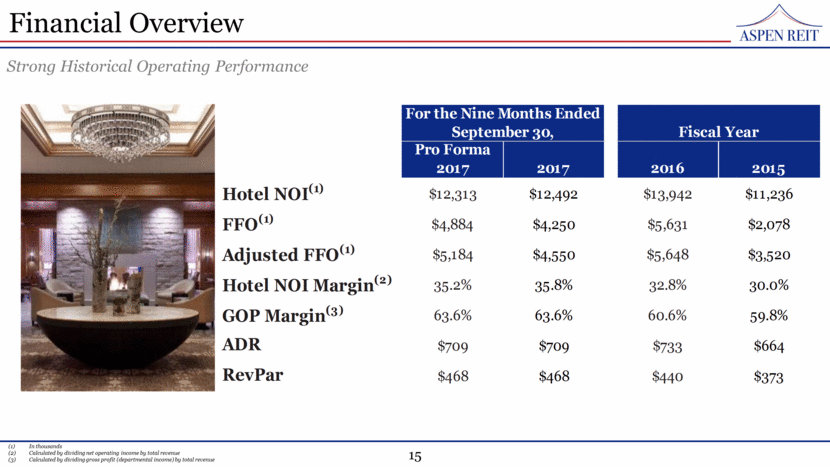
The summary performance data for Hotel Net Operating Income (Hotel NOI), funds from operations (FFO) and Adjusted FFO, are non-GAAP financial measures and are provided as additional information to complement GAAP measures by providing a further understanding of operating results from management's perspective. The reconciliation of these benchmarks to GAAP for the nine months ended September 30, 2017 and the year ended December 31, 2016 are detailed in "Management's Discussion and AnalysisResults of OperationsNon-GAAP Financial Measures."
The unaudited summary pro forma financial data as of and for the nine months ended September 30, 2017 and for the year ended December 31, 2016 is presented as if (i) the contribution transactions and related fair value adjustments, (ii) this offering and the use of proceeds therefrom as described under "Use of Proceeds," (iii) entry into our management agreement with our Manager and (iv) the refinancing of existing mortgage indebtedness of approximately $100.0 million and the April 2017 refinancing thereof for approximately $120.0 million, each as more fully described in this Offering Circular, took place concurrently on September 30, 2017 for the balance sheet data and on January 1, 2016 for the operating data. The unaudited pro forma financial data are not necessarily indicative of what our actual financial position and results of operations would have been as of the date and for the periods indicated, nor do they purport to represent our future financial position or results of operations.
You should read the summary historical consolidated financial and operating data set forth below in conjunction with the sections titled "Management's Discussion and Analysis of Financial Condition and Results of Operations" as well as our financial statements and the related notes included elsewhere in this Offering Circular. The following table summarizes certain selected consolidated financial data for the periods presented. Our historical results may not be indicative of our future performance. The summary historical consolidated financial and operating information presented below contains financial measures that are not presented in accordance with accounting principles generally accepted in the United States ("GAAP"). See "Non-GAAP Financial Measures."
18
| |
(unaudited) As of and for the nine months ended September 30, |
|
|
|
|
||||||||||||||
|---|---|---|---|---|---|---|---|---|---|---|---|---|---|---|---|---|---|---|---|
| |
|
|
Pro forma as of and for the nine months ended September 30, 2017 |
Pro forma as of and for the year ended December 31, 2016 |
|||||||||||||||
| |
As of and for the year ended December 31, |
||||||||||||||||||
| (in thousands, except percentages and per share amounts) |
2017 | 2016 | 2016 | 2015 | |||||||||||||||
Income Statement Data |
|||||||||||||||||||
Revenues, net |
|||||||||||||||||||
Rooms |
$ | 22,872 | $ | 20,659 | $ | 28,671 | $ | 24,350 | $ | 22,872 | $ | 28,671 | |||||||
Food and beverage |
6,962 | 7,085 | 8,148 | 8,022 | 6,962 | 8,148 | |||||||||||||
Other operating departments, rental and other |
5,099 | 4,650 | 5,745 | 5,028 | 5,099 | 5,745 | |||||||||||||
| | | | | | | | | | | | | | | | | | | | |
Total revenue |
34,933 | 32,394 | 42,564 | 37,400 | 34,933 | 42,564 | |||||||||||||
Departmental costs and expenses |
|||||||||||||||||||
Rooms |
5,077 | 4,920 | 6,350 | 5,416 | 5,077 | 6,350 | |||||||||||||
Food and beverage |
5,247 | 5,734 | 7,137 | 6,785 | 5,247 | 7,137 | |||||||||||||
Other operating departments, rental and other |
2,394 | 2,606 | 3,279 | 2,834 | 2,394 | 3,279 | |||||||||||||
| | | | | | | | | | | | | | | | | | | | |
Total departmental costs and expenses |
12,718 | 13,260 | 16,766 | 15,035 | 12,718 | 16,766 | |||||||||||||
| | | | | | | | | | | | | | | | | | | | |
Departmental income |
22,215 | 19,134 | 25,798 | 22,365 | 22,215 | 25,798 | |||||||||||||
| | | | | | | | | | | | | | | | | | | | |
Total operating expenses |
16,822 | 15,146 | 20,165 | 18,457 | 19,585 | 24,508 | |||||||||||||
| | | | | | | | | | | | | | | | | | | | |
Operating income, net |
5,393 | 3,988 | 5,633 | 3,908 | 2,630 | 1,290 | |||||||||||||
Interest expense |
5,230 | 4,318 | 5,792 | 7,273 | 5,366 | 6,334 | |||||||||||||
Other income |
| | (250 | ) | (213 | ) | | (250 | ) | ||||||||||
| | | | | | | | | | | | | | | | | | | | |
Net income (loss) |
163 | (330 | ) | 91 | (3,152 | ) | (2,736 | ) | (4,794 | ) | |||||||||
| | | | | | | | | | | | | | | | | | | | |
Net (income) loss attributable to non-controlling interest in operating partnership |
| | | | 1,395 | 2,445 | |||||||||||||
| | | | | | | | | | | | | | | | | | | | |
Net income (loss) attributable to the Company |
163 | (330 | ) | 91 | (3,152 | ) | (1,341 | ) | (2,349 | ) | |||||||||
| | | | | | | | | | | | | | | | | | | | |
| | | | | | | | | | | | | | | | | | | | |
| | | | | | | | | | | | | | | | | | | | |
Basic and diluted per common share data: |
|||||||||||||||||||
Basic and diluted net income (loss) available to common shareholders(1) |
$ | 0.00 | $ | (0.01 | ) | $ | 0.00 | $ | (0.06 | ) | $ | (0.80 | ) | $ | (1.40 | ) | |||
| | | | | | | | | | | | | | | | | | | | |
| | | | | | | | | | | | | | | | | | | | |
| | | | | | | | | | | | | | | | | | | | |
Basic weighted average common shares outstanding |
50,000,000 | 50,000,000 | 50,000,000 | 50,000,000 | 1,675,000 | 1,675,000 | |||||||||||||
Balance Sheet Data |
|||||||||||||||||||
Cash and cash equivalents |
$ | 5,357 | $ | 4,138 | $ | 6,030 | $ | 4,339 | $ | 6,357 | $ | 8,143 | |||||||
Other current assets |
4,080 | 3,601 | 7,993 | 7,230 | 4,081 | 7,993 | |||||||||||||
Property and equipment, net |
96,700 | 98,827 | 98,250 | 100,902 | 183,952 | 184,005 | |||||||||||||
Total assets |
106,481 | 106,762 | 112,471 | 112,699 | 194,490 | 200,338 | |||||||||||||
Total current liabilities |
6,991 | 6,889 | 12,073 | 10,505 | 6,748 | 12,073 | |||||||||||||
Notes payable |
119,375 | 99,794 | 99,897 | 99,484 | 119,375 | 119,897 | |||||||||||||
Stockholder's equity |
(19,885 | ) | 78 | 500 | 2,709 | 33,500 | 33,500 | ||||||||||||
Non-controlling interest in operating partnership |
| | | | 34,867 | 34,867 | |||||||||||||
Total stockholder's equity, and non-controlling interest in operatng partnership |
(19,885 | ) | 78 | 500 | 2,709 | 68,367 | 68,367 | ||||||||||||
Performance Data |
|||||||||||||||||||
Hotel NOI |
$ | 12,492 | $ | 9,885 | $ | 13,942 | $ | 11,236 | $ | 12,313 | $ | 13,372 | |||||||
FFO |
$ | 4,250 | $ | 3,830 | $ | 5,631 | $ | 2,078 | $ | 4,884 | $ | 5,380 | |||||||
Adjusted FFO |
$ | 4,550 | $ | 3,847 | $ | 5,648 | $ | 3,520 | $ | 5,184 | $ | 5,640 | |||||||
Rooms department net profit |
77.8 | % | 76.2 | % | 77.9 | % | 77.8 | % | 77.8 | % | 77.9 | % | |||||||
Occupancy |
66.0 | % | 67.0 | % | 60.0 | % | 56.1 | % | 66.0 | % | 60.0 | % | |||||||
ADR |
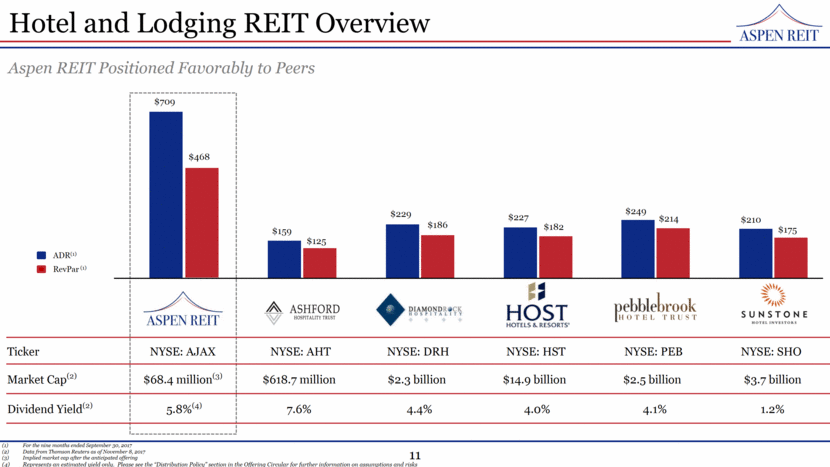
$ | 709 | $ | 628 | $ | 733 | $ | 664 | $ | 709 | $ | 733 | |||||||
RevPAR |
$ | 468 | $ | 421 | $ | 440 | $ | 373 | $ | 468 | $ | 440 | |||||||
Food & beverage department net profit |
24.6 | % | 19.1 | % | 12.4 | % | 15.4 | % | 24.6 | % | 12.4 | % | |||||||
Other operating department, rental and other net profit |
53.0 | % | 44.0 | % | 42.9 | % | 43.6 | % | 53.0 | % | 42.9 | % | |||||||
19
An investment in our common stock involves a high degree of risk. Before making an investment decision, you should carefully consider the following risk factors, together with the other information contained in this Offering Circular. If any of the risks discussed in this Offering Circular occurs, our business, financial condition, liquidity and results of operations could be materially and adversely affected. If this were to happen, the price of our common stock could decline significantly and you could lose a part or all of your investment.
The St. Regis Aspen Resort is our only real estate asset so our business is greatly exposed to the risks associated with that asset.
Although nothing in our charter or bylaws prevents us from acquiring other assets, including other hotels, in the future, upon completion of this offering and our contribution transactions, our investment will be, and is expected to continue to be, concentrated in a single assetthe St. Regis Aspen Resort. Our business would be materially adversely affected by harm or damage to the St. Regis Aspen Resort or its reputation in a way that cannot be quickly resolved and remedied. This concentration of risk in a single asset exposes us to greater risks associated with that asset than if our investments were more numerous and diversified.
We are dependent on our Manager, which is a newly-formed, majority owned subsidiary of Elevated Returns, which in turn is wholly owned by Mr. De Baets, our chairman, chief executive officer and president, for our success. We may not be able to find a suitable replacement for our Manager if our management agreement is terminated or if Mr. De Baets is unable for any reason to perform his duties.
We do not expect to have any employees and we rely completely on our Manager to perform certain services for us. We have no separate facilities and are completely reliant on our Manager, which has significant discretion as to the implementation of our operating policies and strategies. We depend on the diligence, skill and network of business contacts of our Manager. In addition, we offer no assurance that our Manager will remain our manager. The initial term of our management agreement with our Manager only extends until the third anniversary of the closing of this offering, with automatic one-year renewals thereafter. If the management agreement is terminated, and no suitable replacement is found to manage us, we may not be able to execute our business plan.
In addition, our success depends, to a significant extent, on the continued services of Stephane De Baets, Michael Wirth and the rest of our senior management team. As an externally managed company, our key personnel, including Messrs. De Baets and Wirth, will not be exclusively dedicated to our operations and may devote a substantial portion of their working time to matters unrelated to our business. We have not dedicated any particular number of employees to our business and do not require any employee-hour commitment to our business.
Mr. De Baets has established an extensive network of lodging industry contacts and relationships, including relationships with global and national hotel brands, hotel owners, financiers, operators, commercial real estate brokers, developers and management companies. Additionally, if Mr. De Baets no longer either (i) controls our Manager or (ii) is our chief executive officer or chairman of our board of directors, we could be in violation of the covenants in our loan agreement. See "Restrictive covenants in our loan agreement contain provisions limiting our ability to issue shares and OP units, and limiting non-publicly traded interests in the St. Regis Aspen Resort, which could have a material adverse effect on us." Although we have secured a $5.0 million "key person" life insurance policy, we do not otherwise maintain "key person" life insurance on any of our employees, and there can be no assurance that the amount of such coverage will be sufficient to offset any adverse economic effects on
20
our operations. Therefore, the loss of services of Mr. De Baets or other members of our senior management team would likely harm our business and our prospects.
Our management has very limited experience operating a REIT and operating a public company and therefore may have difficulty in successfully and profitably operating our business, or complying with regulatory requirements.
Prior to the completion of this offering, our management has had very limited experience operating a REIT and operating a public company. As a result, we cannot assure you that we will be able to successfully operate as a REIT, execute our business strategies as a public company, or comply with regulatory requirements applicable to public companies and REITs.
We are dependent on the performance of our Hotel Manager and could be materially and adversely affected if our Hotel Manager does not manage the St. Regis Aspen Resort in our best interests.
Since U.S. federal income tax laws restrict REITs and their subsidiaries from operating or managing hotels, we will not operate or manage the St. Regis Aspen Resort. Instead, we will lease the St. Regis Aspen Resort to our TRS, which will retain the Hotel Manager to operate the St. Regis Aspen Resort pursuant to a hotel management agreement. We could be materially and adversely affected if our Hotel Manager fails to provide quality services and amenities, fails to maintain a quality brand name or otherwise fails to manage the St. Regis Aspen Resort in our best interest. We will not have the authority to require the St. Regis Aspen Resort to be operated in a particular manner or to govern any particular aspect of the daily operations of the St. Regis Aspen Resort. Thus, even if we believe that the St. Regis Aspen Resort is being managed inefficiently or in a manner that does not result in satisfactory occupancy, ADR and RevPAR, we may not be able to make our Hotel Manager change its method of operating the St. Regis Aspen Resort. Our results of operations, financial position, cash flows and our ability to service debt and to make distributions to stockholders are, therefore, dependent on the ability of our Hotel Manager to operate the St. Regis Aspen Resort successfully.
In addition, from time to time, disputes may arise between us and our Hotel Manager regarding its performance or compliance with the terms of the hotel management agreement, which in turn could adversely affect our results of operations. We generally will attempt to resolve any such disputes through discussions and negotiations; however, if we are unable to reach satisfactory results through discussions and negotiations, we may choose to terminate our hotel management agreement, litigate the dispute or submit the matter to third-party dispute resolution, the outcome of which may be unfavorable to us.
In the event that our hotel management agreement is terminated, we can provide no assurances that we could find a replacement hotel manager in a timely manner, or at all, or that any replacement manager will be successful in operating the St. Regis Aspen Resort. Furthermore, if our Hotel Manager is financially unable or unwilling to perform its obligations pursuant to our hotel management agreement, our ability to find a replacement manager for the St. Regis Aspen Resort could be challenging and time consuming and could cause us to incur significant costs to obtain a new hotel management agreement for the hotel. Accordingly, if we lose our hotel management agreement, the operations at the St. Regis Aspen Resort could be materially and adversely affected, which could have a material adverse effect on us.
Adverse economic or other conditions in the specific market in which we do business, and the market more broadly, could negatively affect our occupancy levels and rates and therefore our operating results.
The St. Regis Aspen Resort is located in Aspen, Colorado. Aspen is a mountain resort community, which is currently one of the most expensive residential and lodging real estate markets in the United
21
States. Aspen's local economy depends heavily on the vacation, travel, tourism and recreation industries. As a result, we may be adversely affected by such factors as:
The "St. Regis" brand is not under our control, and negative publicity related to the St. Regis brand name, or our inability to continue to use the St. Regis brand name, could materially adversely affect our business.
We believe the "St. Regis" brand, which is integral to our corporate identity, represents high-end, luxury lodging. For so long as our hotel management agreement is in effect, our hotel will be operated under the St. Regis brand. However, there can be no guarantee that our Hotel Manager will elect to extend the term of the agreement at the expiration of the initial term or that we will be able to enter into a new hotel management with our Hotel Manager at the end of the term. In addition, our hotel management agreement provides that in the event our Hotel Manager decides that it cannot operate the hotel in accordance with the operating standards set forth in the hotel management agreement, it may elect to disassociate the hotel from the St. Regis brand. In the event that we are no longer able to use the St. Regis brand name, our business could be materially and adversely affected.
In addition, the St. Regis brand is licensed to and used by a number of other hotels operated by Starwood. We rely on the general goodwill of consumers towards the St. Regis brand as part of our external marketing strategy. Consequently, any adverse publicity towards the St. Regis brand name, or more generally, Starwood or Marriott, which own the St. Regis brand, or in relation to another St. Regis hotel over which we have no control or influence, could have a material adverse effect on our business.
Changes to the Starwood Preferred Guests, or SPG, guest loyalty program could adversely impact our revenues and ability to pay dividends.
We have been advised by Marriott that they intend to revise the SPG guest loyalty program for us beginning March 1, 2018. During 2016 and the first nine months of 2017, our revenues under this program were $3.3 million and $5.1 million, respectively. Although we continue to discuss with Marriott the details regarding such changes, there is a risk that any changes could result in a decrease in revenues to us which could reduce our profitability and could materially and adversely affect our results of operations and ability to pay dividends.
22
Our ability to make distributions to our stockholders may be adversely affected by various operating risks common to the lodging industry, including competition, over-building in the Aspen, Colorado market and dependence on business travel and tourism in Aspen, Colorado.
Hotels have different economic characteristics than many other real estate assets. A typical office property, for example, has long-term leases with third-party tenants, which provides a relatively stable long-term stream of revenue. Hotels, on the other hand, generate revenue from guests that typically stay at the hotel for only a few nights, which causes the room rate and occupancy levels at the St. Regis Aspen Resort to change every day, and results in earnings that can be highly volatile.
In addition, the St. Regis Aspen Resort is subject to various operating risks common to the lodging industry, many of which are beyond our control, including, among others, the following:
The occurrence of any of the foregoing could materially and adversely affect us.
Competition from other luxury hotels in Aspen, Colorado and alternative lodging companies could have a material adverse effect on our results of operations.
The lodging industry is highly competitive. The St. Regis Aspen Resort competes with other hotels for guests in Aspen, Colorado based on a number of factors, including location, convenience, brand affiliation, room rates, range of services and guest amenities or accommodations offered and quality of customer service. Competition is specific to the individual market in which the St. Regis Aspen Resort is located and includes competition from existing and new hotels, as well as alternative lodging companies such as Airbnb®, HomeAway® and VRBO®. Our competitors may have an operating model
23
that enables them to offer rooms at lower rates than we can, which could result in our competitors increasing their occupancy at our expense. In addition, our hotel management agreement does not contain any prohibition on Starwood opening hotels that would compete with the St. Regis Aspen Resort, and three new hotels are scheduled to open in Aspen in the next five years, including another hotel affiliated with Starwood, which would compete directly with the St. Regis Aspen Resort for loyalty rewards program business. Competition could adversely affect our occupancy, ADR and RevPAR, and may require us to provide additional amenities or make capital improvements that we otherwise would not have to make, which could reduce our profitability and could materially and adversely affect our results of operations.
If there are deficiencies in our disclosure controls and procedures or internal control over financial reporting, we may be unable to accurately present our financial statements or prevent fraud, which could materially and adversely affect us.
As a publicly traded company, we will be required to report our financial statements on a consolidated basis. Effective internal controls are necessary for us to accurately report our financial results. Section 404 of the Sarbanes-Oxley Act will require us to evaluate and report on our internal control over financial reporting. However, for as long as we are an "emerging growth company" under the JOBS Act, our independent registered public accounting firm will not be required to attest to the effectiveness of our internal control over financial reporting pursuant to Section 404(b) of the Sarbanes-Oxley Act. We could be an "emerging growth company" for up to five years.
An independent assessment of the effectiveness of our internal controls could detect problems that our management's assessment might not. There can be no guarantee that our internal control over financial reporting will be effective in accomplishing all control objectives all of the time. Furthermore, as we grow our business, our internal controls will become more complex, and we may require significantly more resources to ensure our internal controls remain effective. Deficiencies, including any material weakness, in our internal control over financial reporting which may occur in the future could result in misstatements of our results of operations that could require a restatement, failing to meet our public company reporting obligations and causing investors to lose confidence in our reported financial information, which could materially and adversely affect us.
The St. Regis Aspen Resort may not continue to be the venue chosen for high-profile events.
Historically, the St. Regis Aspen Resort has been the venue for various high-profile events, such as the Aspen Valley Polo Club, Après Ski Cocktail Classic and Wintersköl Awards Dinner. These events increase the St. Regis Aspen Resort's visibility in the media and typically directly or indirectly increase occupancy and increase food and beverage revenues.
However, whether the St. Regis Aspen Resort will be selected as a venue for a high-profile event is largely out of our control. The dates of an event and the requested venue size can be limiting factors for our potential clients. Additionally, our Manager and Hotel Manager attempt to maintain relationships with our event-related clients, but if key personnel at our Manager or Hotel Manager are no longer involved in our business, we may lose the business of certain event-related clients. If the number of high-profile events at the St. Regis Aspen Resort decreases, or the St. Regis Aspen Resort is no longer chosen for high-profile events at all, our operating results could be adversely affected.
There are risks associated with our indebtedness, which is secured by our only asset, the St. Regis Aspen Resort.
Upon the completion of this offering and the contribution transactions, our only long-term debt is expected to be a $120.0 million mortgage on the St. Regis Aspen Resort, which was entered into on April 3, 2017 with Garfield SRA Mortgage Investment, LLC. As of the date of this Offering Circular,
24
the principal amount outstanding under the mortgage was $120.0 million. Our level of debt and the limitations imposed on us by our mortgage could have significant adverse consequences, including the following:
Restrictive covenants in our loan agreement contain provisions limiting (1) our ability to issue shares of common stock in the future and (2) transfers of ownership interests by certain holders.
Our loan agreement with our senior mortgage lender includes restrictive covenants that could limit (1) our ability to issue shares of common stock in the future and (2) the ability of certain of our holders of OP units to transfer their OP units. Our loan agreement provides that any issuance of common stock by us or a transfer of the ownership interests in us by Mr. De Baets and Ravipan Jaruthavee, the majority owner of the St. Regis Aspen Resort, prior to the completion of this offering and the contribution transactions, will be permitted only if following such issuance or transfer, as the case may be, (i)(a) Mr. De Baets continues to own, directly or indirectly, at least 10.0% of our equity interests, including for this purpose his interests in our operating partnership and (b) Mr. De Baets has the right to receive at least 10.0% of the distributions, including for this purpose, his right to receive distributions from our operating partnership and (ii) Mr. De Baets and Ms. Jaruthavee collectively (a) own, directly or indirectly, at least 51.0% of the equity interests in us, including for this purpose their aggregate interests in our operating partnership and (b) have the right to at least 51.0% of the distributions, including for this purpose, their collective rights to distributions from our operating partnership. See "Our Mortgage Financing" for more information on our loan agreement.
Accordingly, we may not be able to issue additional shares of our common stock in the future unless we were able to obtain a waiver of these conditions. In addition, if Mr. De Baets or Ms. Jaruthavee were to transfer their ownership interests in us we may be in breach of the ownership requirements in our loan agreement, which could have a material adverse effect on our company. To mitigate this risk, our operating partnership has entered into a lock-up agreement with our Predecessor that provides that our Predecessor may not redeem or otherwise transfer any of its OP units during the term of our loan agreement without our prior written consent. In addition, the lock-up agreement provides that our Predecessor cannot make distributions of OP units to its stockholders unless Mr. De
25
Baets and Ms. Jaruthavee agree to be subject to lock-up agreements with our operating partnership on the same terms as our lock-up agreement described above with our Predecessor.
We could be in default under our loan agreement if the guarantors of our mortgage fail to meet certain financial covenants.
Mr. De Baets and ER Merry Way LP, or ER Merry Way, 315 East Dean Associates, Inc.'s indirect majority shareholder, have guaranteed our mortgage on the St. Regis Aspen Resort, but the guarantee is triggered only upon the occurrence of certain "bad acts" by us. See "FinancingGuaranty." Our loan agreement also provides that if Mr. De Baets and ER Merry Way, collectively, fail to maintain a net worth (as defined in the loan agreement) of at least $20.0 million and cash liquidity of at least $5.0 million, we would be in default under our loan agreement and our lender could exercise all remedies available to it, including accelerating our debt or foreclosing on the St. Regis Aspen Resort. Whether Mr. De Baets and ER Merry Way continue to meet these net worth and liquidity requirements is out of our control. As a result, we may unexpectedly be in default under our loan agreement because of their failure to meet these requirements, and this could have a material adverse effect on our business.
Our loan agreement may restrict our ability to make distributions to our stockholders.
Our loan agreement with our senior mortgage lender provides that in the event of (i) a failure by us to meet certain minimum debt yield thresholds resulting in a cash sweep period, (ii) a continuing event of default, (iii) a material default (after the expiration of any applicable notice and cure periods) by our Hotel Manager under the hotel management agreement, (iv) our Hotel Manager filing or being the subject of a bankruptcy petition, (v) a trustee or receiver being appointed for the Hotel Manager's assets, or (vi) our Hotel Manager being adjudicated insolvent or making an assignment for the benefit of creditors, we are not permitted to make distributions to our stockholders, even if necessary to maintain our REIT qualification. While we consider any of the foregoing events to be unlikely, such an event is beyond our control. As a result, we may unexpectedly be unable to make distributions to stockholders and maintain our REIT qualification, which could have a material adverse effect on our business and the value of our common stock. See "Our Mortgage Financing" for more information on our loan agreement.
The cyclical nature of the lodging industry may cause fluctuations in our operating performance, which could have a material adverse effect on us.
The lodging industry historically has been highly cyclical in nature. Fluctuations in lodging demand and, therefore, operating performance, are caused largely by general economic and local market conditions, which subsequently affect levels of business and leisure travel. In addition to general economic conditions, new hotel room supply is an important factor that can affect the lodging industry's performance, and overbuilding has the potential to further exacerbate the negative impact of an economic recession. Room rates and occupancy, and thus RevPAR, tend to increase when demand growth exceeds supply growth. We can provide no assurances regarding whether, or the extent to which, lodging demand will rebound or whether any such rebound will be sustained. An adverse change in lodging fundamentals could result in returns that are substantially below our expectations or result in losses, which could have a material adverse effect on us.
The seasonality of the lodging industry could have a material adverse effect on us.
The lodging industry is seasonal in nature, which can be expected to cause quarterly fluctuations in our revenues. Our quarterly earnings may be adversely affected by factors outside our control, including weather conditions and poor economic factors in the specific market in which we operate. For example, the St. Regis Aspen Resort generally experiences higher revenues in the months of December through
26
June. This seasonality can be expected to cause periodic fluctuations in the St. Regis Aspen Resort's room revenues, occupancy levels, room rates and operating expenses. We can provide no assurances that our cash flows will be sufficient to offset any shortfalls that occur as a result of these fluctuations. Consequently, volatility in our financial performance resulting from the seasonality of the lodging industry could have a material adverse effect on us.
Many of our real estate-related costs will not decrease even if revenues from the St. Regis Aspen Resort decrease.
Many costs, such as real estate taxes, insurance premiums and maintenance costs, generally are not reduced even when a hotel is not fully occupied, room rates decrease or other circumstances cause a reduction in revenues. If we are unable to offset these fixed costs with sufficient revenues from the St. Regis Aspen Resort, our financial performance could be materially and adversely affected.
As a REIT, it may be more difficult for us to fund capital expenditures.
The St. Regis Aspen Resort has an ongoing need for renovations and other capital improvements, including replacements, from time to time, of furniture, fixtures and equipment. We may not be able to fund capital improvements on the St. Regis Aspen Resort solely from cash provided from our operating activities because we must distribute at least 90% of our REIT taxable income, determined without regard to the deductions for dividends paid and excluding net capital gains, to maintain our qualification as a REIT, and we are subject to tax on any retained income and gains. As a result, our ability to fund capital expenditures through retained earnings is very limited. Consequently, we expect to rely upon the availability of debt or equity capital to fund capital improvements. In addition, our organizational documents do not limit the amount of debt we can incur. If we are unable to obtain the capital necessary to make required periodic capital expenditures and renovate the St. Regis Aspen Resort on attractive terms, or at all, our financial condition, liquidity and results of operations could be materially and adversely affected.
Increases in interest rates may increase the cost of hedging our interest expense and adversely affect our cash flow and our ability to service our indebtedness and make cash distributions to our stockholders.
Upon the completion of this offering and the contribution transactions, our only long-term debt is expected to be a $120.0 million mortgage on the St. Regis Aspen Resort. As of the date of this Offering Circular, the principal amount outstanding under the mortgage was $120.0 million. The interest rate is 4.55% (subject to adjustment if the lender exercises its rights to bifurcate the promissory note), plus the applicable one month LIBOR rate, which was approximately 5.79% as of September 30, 2017. We are required under our loan agreement to enter into a rate cap agreement. In connection with the completion of this offering and the contribution transactions, we will have assumed the existing rate cap agreement and hedged against a potential rise in one-month LIBOR above 3.0%.
Our hedging arrangements may not be effective in reducing our exposure to interest rate changes and they involve risks, such as the risk that the counterparty may fail to honor its obligations under an arrangement. There is no assurance that a potential counterparty will perform its obligations under a hedging arrangement or that we will be able to enforce such an arrangement. Additionally, the credit markets have recently experienced historic lows in interest rates. As the overall economy strengthens, it is possible that monetary policy will continue to tighten further, resulting in higher interest rates.
Interest rates on variable-rate debt could increase in the near future, which could increase our financing costs and hedging costs, and decrease our cash flow and our ability to pay cash distributions to our stockholders. Additionally, the failure to hedge effectively against interest rate changes may adversely affect our financial condition, results of operations and ability to make cash distributions to our stockholders.
27
We could become more highly leveraged in the future because our organizational documents contain no limitation on the amount of debt we may incur.
Our organizational documents contain no limitations on the amount of indebtedness that we or our operating partnership may incur. We could increase our total outstanding indebtedness at any time. If we become more highly leveraged, the resulting increase in debt service could adversely affect our ability to make payments on our outstanding indebtedness and to pay our anticipated cash distributions and/or to continue to make cash distributions to maintain our REIT qualification, and could harm our financial condition.
Disruptions in the financial markets could affect our ability to refinance our existing debt on reasonable terms or at all and have other adverse effects on us.
Uncertainty in the credit markets may negatively impact our ability to access additional debt financing or to refinance existing debt maturities on attractive terms (or at all), which may negatively affect our ability to make improvements to our property. In addition, we have approximately $120.0 million of debt outstanding which will mature on April 1, 2019. If interest rates are higher when we refinance this debt, our income could be reduced. We may be unable to refinance debt at appropriate times, which may require us to seek alternative sources of potentially less attractive financing, and may require us to adjust our business plans accordingly. In addition, these factors may make it more difficult for us to sell our property or may adversely affect the price we receive for our property, as prospective buyers may experience increased costs of debt financing or difficulties in obtaining debt financing.
Costs associated with complying with the Americans with Disabilities Act of 1990, or the ADA, may result in unanticipated expenses.
Under the ADA, places of public accommodation are required to meet certain U.S. federal requirements related to access and use by disabled persons. These requirements became effective in 1992. A number of additional U.S. federal, state and local laws may also require modifications to the St. Regis Aspen Resort, or restrict certain further renovations, with respect to access thereto by disabled persons. Noncompliance with the ADA could result in the imposition of fines or an award of damages to private litigants and also could result in an order to correct any non-complying feature, which could result in substantial capital expenditures. Although we believe that our properties substantially comply with present requirements of the ADA, we have not conducted an audit or investigation of all of the St. Regis Aspen Resort to determine its compliance. If the St. Regis Aspen Resort is not in compliance with the ADA or other legislation, then we would be required to incur additional costs to bring the St. Regis Aspen Resort into compliance. If we incur substantial costs to comply with the ADA or other legislation, our financial condition, results of operations, cash flow, per share trading price of our common stock and our ability to satisfy our debt service obligations and to make cash distributions to our stockholders could be adversely affected.
Environmental compliance costs and liabilities associated with operating the St. Regis Aspen Resort may affect our results of operations.
Under various U.S. federal, state and local laws, ordinances and regulations, owners and operators of real estate may be liable for the costs of investigating and remediating certain hazardous substances or other regulated materials on or in such property. Such laws often impose such liability without regard to whether the owner or operator knew of, or was responsible for, the presence of such substances or materials. The presence of such substances or materials, or the failure to properly remediate such substances, may adversely affect the owner's or operator's ability to lease, sell or rent such property or to borrow using such property as collateral. Persons who arrange for the disposal or treatment of hazardous substances or other regulated materials may be liable for the costs of removal
28
or remediation of such substances at a disposal or treatment facility, whether or not such facility is owned or operated by such person. Certain environmental laws impose liability for release of asbestos-containing materials into the air and third-parties may seek recovery from owners or operators of real properties for personal injury associated with asbestos-containing materials.
Certain environmental laws also impose liability, without regard to knowledge or fault, for removal or remediation of hazardous substances or other regulated materials upon owners and operators of contaminated property even after they no longer own or operate the property. Moreover, the past or present owner or operator from which a release emanates could be liable for any personal injuries or property damages that may result from such releases, as well as any damages to natural resources that may arise from such releases.
Certain environmental laws impose compliance obligations on owners and operators of real property with respect to the management of hazardous materials and other regulated substances. For example, environmental laws govern the management of asbestos-containing materials and lead-based paint. Failure to comply with these laws can result in penalties or other sanctions.
No assurances can be given that any prior owner or operator of the St. Regis Aspen Resort did not create any material environmental condition not known to us, or that a material environmental condition does not otherwise exist as to the St. Regis Aspen Resort. There also exists the risk that material environmental conditions, liabilities or compliance concerns may have arisen after the review was completed or may arise in the future. Finally, future laws, ordinances or regulations and future interpretations of existing laws, ordinances or regulations may impose additional material environmental liability.
We may become subject to litigation or threatened litigation that may divert management's time and attention, require us to pay damages and expenses or restrict the operation of our business.
We may become subject to disputes with commercial parties with whom we maintain relationships or other parties with whom we do business. Any such dispute could result in litigation between us and the other parties. Whether or not any dispute actually proceeds to litigation, we may be required to devote significant management time and attention to its successful resolution (through litigation, settlement or otherwise), which would detract from our management's ability to focus on our business. Any such resolution could involve the payment of damages or expenses by us, which may be significant. In addition, any such resolution could involve our agreement with terms that restrict the operation of our business. We also could be sued for personal injuries and/or property damage occurring at the St. Regis Aspen Resort. The liability insurance we maintain may not cover all costs and expenses arising from such lawsuits.
Our business is subject to the risks of fires and other natural catastrophic events and to interruption by man-made problems such as computer viruses or terrorism.
Our systems and operations are vulnerable to damage or interruption from fires, power losses, telecommunications failures, terrorist attacks, acts of war, human errors, break-ins and similar events. For example, a significant natural disaster, such as an earthquake, fire or flood, could have a material adverse impact on our business, operating results and financial condition. Our IT systems may also be vulnerable to computer viruses, break-ins and similar disruptions from unauthorized tampering with our computer systems, which could lead to interruptions, delays, loss of critical data or the unauthorized disclosure of confidential intellectual property or client data. We may not have sufficient protection or recovery plans in certain circumstances, such as natural disasters affecting the Aspen area, and our business interruption insurance may be insufficient to compensate us for losses that may occur. Such disruptions could negatively impact our ability to run our business, which could have an adverse effect on our operating results and financial condition.
29
Future terrorist attacks or changes in terror alert levels could materially and adversely affect our business.
Previous terrorist attacks and subsequent terrorist alerts have adversely affected the U.S. travel and hospitality industries since 2001, often disproportionately to the effect on the overall economy. The extent of impact that actual or threatened terrorist attacks in the U.S. or elsewhere could have on domestic and international travel and our business in particular cannot be determined, but any such attacks or the threat of such attacks could directly affect the value of the St. Regis Aspen Resort through damage, destruction or loss and could have a material adverse effect on travel and hotel demand, our ability to finance our business and our ability to insure the St. Regis Aspen Resort. Any of these events could materially and adversely affect our business, our operating results and our prospects.
Uninsured losses or losses in excess of our insurance coverage could adversely affect our financial condition, operating results and cash flow.
We maintain comprehensive liability, fire, flood and earthquake insurance with respect to the St. Regis Aspen Resort. Certain types of losses, however, may be either uninsurable or not economically insurable, such as losses due to tornadoes, blizzards, riots, acts of war or terrorism. Should an uninsured loss occur, we could lose both our investment in and anticipated profits and cash flow from our property. In addition, if any such loss is insured, we may be required to pay significant amounts on any claim for recovery of such a loss prior to our insurer being obligated to reimburse us for the loss, or the amount of the loss may exceed our coverage for the loss. As a result, our operating results may be adversely affected.
Pursuant to the JOBS Act, we are eligible to take advantage of certain specified reduced disclosure and other requirements that are otherwise generally applicable to public companies for so long as we are an "emerging growth company."
We are an "emerging growth company" as defined in the JOBS Act and we are eligible to take advantage of certain specified reduced disclosure and other requirements that are otherwise generally applicable to public companies that are not "emerging growth companies" including, but not limited to, not being required to comply with the auditor attestation requirements of Section 404 of the Sarbanes-Oxley Act, reduced disclosure obligations regarding executive compensation in our periodic reports and proxy statements, and exemptions from the requirements of holding a nonbinding advisory vote on executive compensation and stockholder approval of any golden parachute payments not previously approved. We may take advantage of these exemptions for up to five years or such earlier time that we are no longer an "emerging growth company." We would cease to be an "emerging growth company" if we have more than $1.07 billion in annual gross revenues, we have more than $700.0 million in market value of our shares held by non-affiliates, or we issue more than $1.0 billion of non-convertible debt over a three-year period. If we take advantage of any or all of these exceptions, we cannot predict if some investors will find our common stock less attractive. As a result, there may be a less active trading market for our common stock and our share price may be more volatile.
In addition, Section 107 of the JOBS Act also provides that an emerging growth company can take advantage of the extended transition period provided in Section 7(a)(2)(B) of the Securities Act for complying with new or revised accounting standards, meaning that the company can delay the adoption of certain accounting standards until those standards would otherwise apply to private companies. We have chosen to take advantage of this extended transition period and, as a result, we will comply with new or revised accounting standards on the relevant dates on which adoption of such standards is required for private companies for as long as we maintain our emerging company status and do not revoke this election. Accordingly, the accounting standards that we apply while we remain an emerging growth company may differ materially from the accounting standards applied by other similar public companies, including emerging growth companies that have elected to opt out of this extended
30
transition period. This election could have a material impact on our financial statements and the comparability of our financial statements to the financial statements of similar public companies. This potential lack of comparability could make it more difficult for investors to value our securities, which could have a material impact on the price of our common stock.
We are a smaller reporting company and the reduced reporting requirements available to smaller reporting companies may make our common stock less attractive to investors.
We are a "smaller reporting company," as defined in the Securities Act. For as long as we continue to be a smaller reporting company, we may take advantage of exemptions from various reporting requirements that are applicable to other public companies that are not smaller reporting companies, including not being required to comply with the auditor attestation requirements of Section 404 of the Sarbanes-Oxley Act, reduced disclosure obligations regarding historical financial statements, reduced executive compensation disclosure requirements in our periodic reports, registration statements, and proxy statements and exemptions from the requirements of holding non-binding advisory votes on executive compensation and stockholder approval of any golden parachute payments not previously approved. We cannot predict if investors will find our common stock less attractive because we may rely on these exemptions. We will remain a smaller reporting company until the beginning of a year in which we would have a public float of $75.0 million held by non-affiliates as of the last business day of the second quarter of the prior year.
Risks Related to Our Structure and Our Relationship with Our Manager
If the ownership of our common stock on a fully diluted basis continues to be highly concentrated, it will prevent you and other minority stockholders from influencing corporate decisions.
Upon the completion of this offering and the contribution transactions, we expect that our Predecessor will own approximately 51.0% of the equity interests in our operating partnership. All of our Predecessor's interests are expected to be held as OP units; however, OP units are redeemable for cash, or at our option, for shares of our common stock on a one-to-one basis beginning one year after the completion of this offering. Additionally, change of control transactions will require the approval of at least a majority of the holders of shares of our common stock and OP units voting as a single class. Furthermore, the terms of our loan agreement restrict certain transfers of shares of our common stock or OP units by Mr. De Baets or Ms. Jaruthavee, or issuances by us of such securities, unless certain conditions are met, including that (i)(a) Mr. De Baets continues to own, directly or indirectly, at least 10.0% of our equity interests when taken together with his interests in our operating partnership and (b) Mr. De Baets has the right to at least 10.0% of the distributions, when taken together with his right to distributions from our operating partnership and (ii) Mr. De Baets and Ms. Jaruthavee (a) own collectively, directly or indirectly, at least 51.0% of the equity interests in us when taken together with their aggregate interests in our Operating Partnership and (b) collectively, have the right to at least 51.0% of the distributions, when taken together with their collective rights to distributions from our Operating Partnership.
This concentration of ownership may delay, deter or prevent acts that would be favored by other holders. Also, our larger stockholders (on a fully diluted basis) may seek to cause us to take courses of action that, in their judgment, could enhance their investment in us, but which might involve risks to our other stockholders or adversely affect us or our other stockholders, including investors in this offering. As a result, the market price of our common stock could decline or stockholders might not receive a premium over the then-current market price of our common stock upon a change of control or the sale of all or substantially all of our interest in the St. Regis Aspen Resort. In addition, this concentration of ownership may adversely affect the trading price of our common stock because investors may perceive disadvantages in owning shares in a company with a significant concentration of ownership.
31
Compliance with the requirements of the Exchange Act and the Sarbanes-Oxley Act could result in higher operating costs and adversely affect our results of operations.
Upon the completion of this offering and the contribution transactions, we will be subject to the periodic reporting, proxy solicitation, insider trading prohibitions and other obligations imposed under the Exchange Act. In addition, certain of the provisions of the Sarbanes-Oxley Act will immediately become applicable to us. Compliance with these requirements will increase our legal, accounting and other compliance costs and the cost of directors' and officers' liability insurance, and will require management to devote substantial time and effort to ensure initial and ongoing compliance with these obligations. A key component of compliance under the Exchange Act is to produce quarterly and annual financial reports within prescribed time periods after the close of our fiscal year and each fiscal quarter. Historically, we have not been required to prepare such financial reports within these time periods. Failure to satisfy these reporting requirements may result in delisting of our common stock by the NYSE American, and inquiries from or sanctions by the Commission. We expect these rules, regulations and requirements to significantly increase our accounting, legal, compliance and other costs and to make some activities more time-consuming and costly. We may also need to hire additional accounting, legal, compliance and administrative staff with experience working for public companies. However, we may be unable to hire such additional staff on terms that are favorable to us, or at all. In addition, such additional staff may not be able to provide such services at levels sufficient to comply with these requirements. Moreover, the rules that will be applicable to us as a public company after this offering could make it more difficult and expensive for us to attract and retain qualified members of our board of directors and qualified executive officers. If we fail to predict these costs accurately or to manage these costs effectively, our operating results could be adversely affected.
There are various conflicts of interest in our relationship with our Manager, which could result in decisions that are not in the best interests of our stockholders. The management agreement with our Manager was not negotiated on an arm's-length basis and may not be as favorable to us as if it had been negotiated with an unaffiliated third party.
Our management agreement with our Manager, which is a newly-formed, majority owned subsidiary of Elevated Returns, which in turn is wholly owned by Mr. De Baets, was not negotiated on an arm's-length basis. Consequently, its terms, including fees payable to our Manager, may not be as favorable to us as if they had been negotiated with an unaffiliated third party. For example, termination of the management agreement without cause would be difficult and costly. Following the initial three-year term ending on November , 2020, the management agreement may be terminated annually upon the affirmative vote of our board of directors, including a majority of our independent directors, based upon (1) unsatisfactory performance by our Manager that is materially detrimental to us or (2) our determination that the management fees payable to our Manager are not fair, subject to our Manager's right to prevent any termination due to unfair fees by accepting a reduction of management and/or incentive fees agreed to by at least two-thirds of our board of directors, including a majority of our independent directors. We must provide our Manager 180 days' written notice of any termination. Additionally, upon such a termination, or if we materially breach the management agreement and our Manager terminates the management agreement, the management agreement provides that we will pay our Manager a termination fee equal to three times the sum of (i) the average annual base management fee and (ii) the average annual incentive fee earned by our Manager, in each case during the 24-month period immediately preceding such termination. These provisions increase the cost to us of terminating the management agreement and adversely affect our ability to terminate the management agreement without cause. In addition, we may choose not to enforce, or to enforce less vigorously, our rights and remedies under the agreement because of our desire to maintain our ongoing relationship with our Manager.
32
Further, our Manager or its affiliates may engage in additional management or investment opportunities that have overlapping objectives with ours, and thus will face conflicts in the allocation of resources between us, any other properties they manage and for their own accounts. Additionally, the ability of our Manager, and the officers and employees providing services to us under the management agreement, to engage in other business activities may reduce the time our Manager spends managing us. Under our management agreement, our officers are required to devote such amount of their time to our management as necessary and appropriate, commensurate with our level of activity but are not required to devote a specific amount of time to our affairs.
Our Manager's liability will be limited under the management agreement, and we have agreed to indemnify our Manager against certain liabilities, which may lead our Manager to act in a riskier manner on our behalf than it would when acting for its own account.
Under the management agreement, our Manager will not assume any responsibility to us other than to render the services called for under that agreement, and it will not be responsible for any action of our board of directors in following or declining to follow our Manager's advice or recommendations. Our Manager maintains a contractual, as opposed to a fiduciary, relationship with us. Under the terms of the management agreement, our Manager, its officers, stockholders, members, partners, managers and employees, and any person controlling or controlled by our Manager will not be liable to us, any subsidiary of ours, our directors, our stockholders or any subsidiary's stockholders, members or partners for acts or omissions performed in accordance with and pursuant to the management agreement, except those resulting from acts constituting negligence or misconduct. In addition, we have agreed to indemnify our Manager and each of its officers, directors, members, managers and employees from and against any claims or liabilities, including reasonable legal fees and other expenses reasonably incurred, arising out of or in connection with our business and operations or any action taken or omitted on our behalf pursuant to authority granted by the management agreement, except where attributable to negligence or misconduct. These protections may lead our Manager to act in a riskier manner when acting on our behalf than it would when acting for its own account.
Conflicts of interest could arise with respect to certain transactions between the holders of OP units, which include Mr. De Baets, on the one hand, and us and our stockholders, on the other.
Upon the completion of this offering and the contribution transactions, conflicts of interest could arise with respect to the interests of holders of OP units, which include Mr. De Baets, on the one hand, and which include members of our senior management team and us and our stockholders, on the other. In particular, the consummation of certain business combinations, the sale, disposition or transfer of the St. Regis Aspen Resort or the repayment of certain indebtedness that may be desirable to us or our stockholders could have adverse tax consequences to such unit holders. In addition, our directors and officers have duties to our company under applicable Maryland law in connection with their management of our company. At the same time, we have fiduciary duties, as a general partner, to our operating partnership and to the limited partners under Delaware law in connection with the management of our operating partnership. Our duties as a general partner to our operating partnership and its partners may come into conflict with the duties of our directors and officers to our company and our stockholders. Furthermore, our partnership agreement does not require us to resolve such conflicts in favor of either our company or the limited partners in our operating partnership and there can be no assurance that any procedural protections we implement to address these or other conflicts of interest will result in optimal outcomes for us and our stockholders.
33
The partnership agreement of our operating partnership contains provisions that may delay, defer or prevent a change in control or sale of the St. Regis Aspen Resort.
The partnership agreement of our operating partnership provides that change of control transactions are required to be approved by at least a majority of the holders of shares of our common stock and OP units voting as a single class. Procedurally, we will hold a stockholder vote and then an OP unit vote. For the purposes of the OP unit vote, we will be deemed to have voted our OP units in proportion to the manner in which all of our outstanding shares of common stock were voted in our stockholder vote. These approval rights could delay, deter, or prevent a transaction or a change in control that might involve a premium price for our common stock or otherwise be in the best interests of our stockholders. For a further discussion, see "Limited Partnership Agreement of Our Operating Partnership."
Certain provisions of Maryland law could inhibit a change in our control.
Certain "business combination" and "control share acquisition" provisions of the Maryland General Corporation Law, or the MGCL, may have the effect of inhibiting a third party from making a proposal to acquire us or of impeding a change in our control under circumstances that otherwise could provide the holders of our common stock with the opportunity to realize a premium over the then-prevailing market price of our common stock.
The "business combination" provisions of the MGCL, subject to certain limitations, generally prohibit certain business combinations between a Maryland corporation and an "interested stockholder" (defined generally as any person who beneficially owns, directly or indirectly, 10% or more of the voting power of our then-outstanding voting shares or an affiliate or associate of ours who, at any time within the two-year period prior to the date in question, was the beneficial owner, directly or indirectly, of 10% or more of the voting power of our then-outstanding shares) or an affiliate thereof for five years after the most recent date on which the interested stockholder becomes an interested stockholder and, thereafter, imposes special appraisal rights or special stockholder voting requirements on these business combinations. In general, after the five-year prohibition, any business combination between us and an interested stockholder must be recommended by our board of directors and approved by the affirmative vote of at least (1) 80% of the votes entitled to be cast by holders of outstanding shares of voting stock of the corporation and (2) two-thirds of the votes entitled to be cast by holders of our voting stock other than shares held by the interested stockholder with whom or with whose affiliate the business combination is to be effected or held by an affiliate or associate of the interested stockholder. In general, these super-majority vote requirements do not apply if, among other conditions, our common stockholders receive a minimum price (as provided under the MGCL) for their shares and the consideration is received in cash or in the same form as previously paid by the interested stockholder for its shares.
These provisions of the MGCL do not apply, however, to business combinations that are approved or exempted by our board of directors prior to the time that the interested stockholder becomes an interested stockholder. Our board of directors has by resolution exempted us from these provisions of the MGCL with respect to business combinations between us and (1) any other person, provided that such business combination is first approved by our board of directors (including a majority of our directors who are not affiliates or associates of such person), (2) Mr. De Baets and his affiliates and (3) persons acting in concert with any of the foregoing. As a result, such persons may be able to enter into business combinations with us without compliance by us with the supermajority vote requirements and other provisions of the statute. This resolution, however, may be altered or repealed by our board of directors in whole or in part at any time. If this resolution is repealed, or our board of directors does not otherwise approve a business combination, this statute may discourage others from trying to acquire control of us and increase the difficulty of consummating any offer. See "Certain Provisions of The Maryland General Corporation Law and Our Charter and BylawsBusiness Combinations."
34
The "control share" provisions of the MGCL provide that, subject to certain exceptions, holders of "control shares" of a Maryland corporation (generally defined as shares which, when aggregated with all other shares controlled by the stockholder (except solely by virtue of a revocable proxy), entitle the stockholder to exercise one of three increasing ranges of voting power in the election of directors) acquired in a "control share acquisition" (generally defined as the direct or indirect acquisition of ownership or control of issued and outstanding "control shares") have no voting rights with respect to such shares except to the extent approved by our stockholders by the affirmative vote of at least two-thirds of the votes entitled to be cast on the matter, excluding votes entitled to be cast by the acquirer of control shares, our officers and our personnel who are also our directors. Our bylaws contain a provision exempting from the control share acquisition statute any and all acquisitions by any person of shares of our stock. There can be no assurance that this provision will not be amended or eliminated at any time in the future. See "Certain Provisions of the Maryland General Corporation Law and Our Charter and Bylaws."
Our authorized but unissued shares of common and preferred stock may prevent a change in our control.
Our charter permits our board of directors to authorize us to issue additional shares of our authorized but unissued common or preferred stock. In addition, a majority of our entire board of directors may, without stockholder approval, amend our charter to increase the aggregate number of our shares of stock or the number of shares of stock of any class or series that we have the authority to issue. Also our board of directors may classify or reclassify any unissued shares of common or preferred stock and set the terms of the classified or reclassified shares. As a result, our board of directors may establish a series of shares of common or preferred stock that could delay or prevent a transaction or a change in control that might involve a premium price for shares of our common stock or otherwise be in the best interest of our stockholders.
Stockholders will have limited control over changes in our policies and operations, which increases the uncertainty and risks you face as a stockholder.
Our board of directors determines our major policies, including our policies regarding financing, growth, debt capitalization, REIT qualification and distributions. Our board of directors may amend or revise these and other policies without your vote. Our board of directors' broad discretion in setting policies and your inability to exert control over those policies increases the uncertainty and risks you face as a stockholder.
We may change our business and financing strategies without stockholder consent, which may subject us to different risks.
We may change our business and financing strategies at any time without the consent of our stockholders, which could result in our making investments and engaging in business activities that are different from, and possibly riskier than, the investments and businesses described in this document. For example, although we are currently a single-asset REIT, nothing in our charter or bylaws prevents us from acquiring other assets, including other hotels, in the future. A change in our strategy may increase our exposure to other risks or real estate market fluctuations.
Our rights and the rights of our stockholders to take action against our directors and officers are limited, which could limit your recourse in the event of actions not in your best interest.
Our charter limits the liability of our present and former directors and officers to us and our stockholders for money damages to the maximum extent permitted under Maryland law. Under current
35
Maryland law, our present and former directors and officers will not have any liability to us or our stockholders for money damages other than liability resulting from:
Our charter and our bylaws require us to indemnify each present and former director or officer, to the maximum extent permitted by Maryland law, in connection with any proceeding to which he or she is made, or threatened to be made, a party to or witness in by reason of his or her service to us as a director or officer or in certain other capacities. In addition, we may be obligated to pay or reimburse the expenses incurred by our present and former directors and officers without requiring a preliminary determination of their ultimate entitlement to indemnification. As a result, we and our stockholders may have more limited rights against our present and former directors and officers than might otherwise exist absent the current provisions in our charter and bylaws or that might exist with other companies, which could limit your recourse in the event of actions not in your best interest.
Our charter contains provisions that make removal of our directors difficult, which could make it difficult for our stockholders to effect changes to our management.
Our charter provides that, subject to the rights of holders of one or more classes or series of preferred stock, a director may be removed with or without cause, by the affirmative vote of at least two-thirds of the votes entitled to be cast generally in the election of directors. Vacancies on our board of directors generally may be filled only by a majority of the remaining directors in office, even if less than a quorum. These requirements make it more difficult to change our management by removing and replacing directors and may prevent a change in our control that is in the best interests of our stockholders.
Restrictions on ownership and transfer of our shares may restrict change of control or business combination opportunities in which our stockholders might receive a premium for their shares.
In order for us to qualify to be taxed as a REIT for each taxable year after our taxable year ending December 31, 2018, no more than 50% in value of our outstanding shares may be owned, directly or constructively, by five or fewer individuals during the last half of any calendar year, and at least 100 persons must beneficially own our shares during at least 335 days of a taxable year of 12 months, or during a proportionate portion of a shorter taxable year. "Individuals" for this purpose include natural persons, private foundations, some employee benefit plans and trusts, and some charitable trusts. To assist us in preserving our REIT qualification, among other purposes, our charter generally prohibits, among other limitations, any person from beneficially or constructively owning more than 9.8% in value or in number of shares, whichever is more restrictive, of the aggregate outstanding shares of all classes and series of our stock, the outstanding shares of any class or series of our preferred stock or the outstanding shares of our common stock. These ownership limits and the other restrictions on ownership and transfer of our shares contained in our charter could have the effect of discouraging a takeover or other transaction in which holders of our common stock might receive a premium for their shares over the then-prevailing market price or which holders might believe to be otherwise in their best interests.
36
Risks Related to Our Qualification as a REIT
Our failure to qualify or remain qualified as a REIT would subject us to U.S. federal income tax and applicable state and local taxes, which would reduce the amount of available cash to be distributed to our stockholders.
We believe that we have been organized and intend to operate in a manner that will enable us to qualify to be taxed as a REIT for U.S. federal income tax purposes commencing with our taxable year ending December 31, 2018. We have not requested, and do not intend to request a ruling from the Internal Revenue Service, or IRS, that we qualify to be taxed as a REIT. Qualification as a REIT involves the application of highly technical and complex Code provisions and the regulations promulgated by the U.S. Treasury Department, or Treasury Regulations, for which there are limited judicial and administrative interpretations. The complexity of these provisions and of applicable Treasury Regulations is greater in the case of a REIT that, like us, holds its assets through a partnership, and judicial and administrative interpretations of the U.S. federal income tax laws governing REIT qualification are limited. To qualify to be taxed as a REIT, we must meet, on an ongoing basis, various tests regarding the nature and diversification of our assets and our income, the ownership of our outstanding shares and the amount of our distributions. Our compliance with the REIT income and quarterly asset requirements also depends upon our ability to manage successfully the composition of our income and assets on an ongoing basis. Our ability to satisfy these asset tests depends upon our analysis of the characterization and fair market values of our assets, some of which are not susceptible to a precise determination, and for which we will not obtain independent appraisals. Moreover, new legislation, court decisions or administrative guidance may, in each case possibly with retroactive effect, make it more difficult or impossible for us to qualify to be taxed as a REIT. Thus, while we believe that we have been organized and intend to operate so that we will qualify to be taxed as a REIT, given the highly complex nature of the rules governing REITs, the ongoing importance of factual determinations and the possibility of future changes in our circumstances, no assurance can be given that we will so qualify for any particular year. These considerations also might restrict the types of assets that we can acquire or services that we can provide in the future.
If we fail to qualify to be taxed as a REIT in any taxable year, and we do not qualify for certain statutory relief provisions, we would be required to pay U.S. federal income tax, including any applicable alternative minimum tax, on our taxable income at regular corporate rates, and distributions to our stockholders would not be deductible by us in determining our taxable income. In such a case, we might need to borrow money, sell assets, or reduce or even cease making distributions in order to pay our taxes. Our payment of income tax would reduce significantly the amount of available cash to be distributed to our stockholders. Furthermore, if we fail to maintain our qualification as a REIT, we no longer would be required to make distributions to our stockholders. In addition, unless we were eligible for certain statutory relief provisions, we could not re-elect to be taxed as a REIT until the fifth calendar year following the year in which we failed to qualify.
Even if we qualify to be taxed as a REIT, we may face other tax liabilities that reduce our cash flow.
Even if we qualify for taxation as a REIT, we may be subject to certain U.S. federal, state and local taxes on our income and assets, including taxes on any undistributed income, alternative minimum taxes, state or local income, property and transfer taxes, including real property transfer taxes. In addition, we could, in certain circumstances, be required to pay an excise or penalty tax (which could be significant in amount) in order to utilize one or more relief provisions under the Code to maintain our qualification as a REIT. See "U.S. Federal Income Tax ConsiderationsTaxation of REITs in General." Any of these taxes would decrease our operating cash flow otherwise available to be distributed to our stockholders. In addition, our TRS will be subject to U.S. federal, state and local corporate taxes, and its after-tax net income will be available for distribution to us but is not required to be distributed to us.
37
If our lease with our TRS is not respected as a true lease for U.S. federal income tax purposes, we would fail to qualify to be taxed as a REIT.
To qualify to be taxed as a REIT, we will be required to satisfy two gross income tests, pursuant to which specified percentages of our gross income must be passive income, such as rent from real property. For rent paid pursuant to the lease between our operating partnership and our TRS, which constitutes substantially all of our gross income, to qualify for purposes of the REIT gross income tests, the lease must be respected as a true lease for U.S. federal income tax purposes and must not be treated as a service contract, joint venture or some other type of arrangement. We believe our lease will be respected as a true lease for U.S. federal income tax purposes. There can be no assurances, however, that the IRS will agree with this characterization. If the lease were not respected as a true lease for U.S. federal income tax purposes, we would not be able to satisfy either of the two gross income tests applicable to REITs, and we would likely cease to qualify as a REIT.
If our Hotel Manager does not qualify as an "eligible independent contractor" or if the St. Regis Aspen Resort is not a "qualified lodging facility," we will fail to qualify to be taxed as a REIT.
Rent paid by a lessee that is a "related party tenant" of ours will not be qualifying income for purposes of the two gross income tests applicable to REITs. An exception is provided, however, for leases of "qualified lodging facilities" to a TRS so long as the hotels are managed by an "eligible independent contractor" and certain other requirements are satisfied. Our operating partnership will lease the St. Regis Aspen Resort to our TRS, and our TRS will engage our Hotel Manager. We believe our Hotel Manager qualifies as an "eligible independent contractor." Among other requirements, to qualify as an eligible independent contractor, (i) the Hotel Manager and/or one or more actual or constructive owners of 10% or more of the Hotel Manager cannot own, actually or constructively, more than 35% of our outstanding shares, and (ii) one or more actual or constructive owners of more than 35% of our Hotel Manager cannot own 35% or more of our outstanding shares (determined by taking into account only the shares held by persons owning, actually or constructively, more than 5% of our outstanding shares because our shares will be regularly traded on an established securities market). The ownership attribution rules that apply for purposes of these 35% thresholds are complex, and monitoring actual and constructive ownership of our shares by Marriott's shareholders and of Marriott's shares by our owners may not be practical. Accordingly, there can be no assurance that these ownership levels will not be exceeded.
In addition, for our Hotel Manager to qualify as an eligible independent contractor, such company or a related person must be actively engaged in the trade or business of operating "qualified lodging facilities" (as defined below) for one or more persons not related to us or our TRS at each time that such company enters into a hotel management contract with our TRS. As of the date hereof, we believe that our Hotel Manager operates qualified lodging facilities for certain persons who are not related to us or our TRS. However, no assurances can be provided that any future hotel manager will in fact comply with this requirement.
Finally, the St. Regis Aspen Resort must be a "qualified lodging facility." A "qualified lodging facility" is a hotel, motel or other establishment more than one-half of the dwelling units in which are used on a transient basis, including customary amenities and facilities, provided that no wagering activities are conducted at or in connection with such facility by any person who is engaged in the business of accepting wagers and who is legally authorized to engage in such business at or in connection with such facility. As of the date hereof, we believe that the amenities provided at the St. Regis Aspen Resort are customary in that such amenities are customary for other properties of a comparable size and class owned by unrelated parties and therefore the St. Regis Aspen Resort is a qualified lodging facility. The REIT provisions of the Code provide no or only limited guidance for making determinations under the requirements for qualified lodging facilities, and there can be no assurance that these requirements will be satisfied.
38
Failure to make required distributions would subject us to tax, which would reduce the operating cash flow to our stockholders.
In order to qualify to be taxed as a REIT, we must distribute to our stockholders each calendar year at least 90% of our net taxable income (excluding net capital gain). To the extent that we satisfy the 90% distribution requirement, but distribute less than 100% of our net taxable income (including net capital gain), we would be subject to U.S. federal corporate income tax on our undistributed net taxable income. In addition, we will incur a 4% non-deductible excise tax on the amount, if any, by which our distributions in any calendar year are less than a minimum amount specified under U.S. federal income tax laws. Although we intend to distribute our net taxable income to our stockholders in a manner intended to satisfy the REIT 90% distribution requirement and to avoid the 4% non-deductible excise tax, it is possible that we, from time to time, may not have sufficient cash to distribute 100% of our net taxable income. There may be timing differences between our actual receipt of cash and the inclusion of items in our income for U.S. federal income tax purposes. Accordingly, there can be no assurance that we will be able to distribute net taxable income to stockholders in a manner that satisfies the REIT distribution requirements and avoids the 4% non-deductible excise tax.
To maintain our REIT qualification, we may be forced to borrow funds during unfavorable market conditions.
In order to maintain our REIT qualification and avoid the payment of income and excise taxes, we may need to borrow funds to meet the REIT distribution requirements even if the then-prevailing market conditions are not favorable for these borrowings. These borrowing needs could result from, among other things, timing differences between our actual receipt of cash and inclusion of income for U.S. federal income tax purposes, or the effect of non-deductible capital expenditures, the creation of reserves or required debt or amortization payments. These sources, however, may not be available on attractive terms or at all. Our access to third-party sources of capital depends on a number of factors, including the market's perception of our growth potential, our current debt levels, the per share trading price of our common stock, and our current and potential future earnings. We cannot assure you that we will have access to such capital on attractive terms at the desired times, or at all, which could adversely affect our financial condition, results of operations, cash flows and our ability to pay distributions on, and the per share trading price of, our common stock.
Our TRS will be subject to U.S. federal income tax, our ownership of our TRS will be limited, and we will be required to pay a 100% penalty tax on certain income or deductions if our transactions with our TRS are not conducted on arm's-length terms.
We operate the St. Regis Aspen Resort through our TRS. A TRS is a corporation other than a REIT in which a REIT directly or indirectly holds stock and that has made a joint election with such REIT to be treated as a TRS. If a TRS owns more than 35% of the total voting power or value of the outstanding securities of another corporation, such other corporation will also be treated as a TRS. Other than some activities relating to lodging and health care properties, a TRS may generally engage in any business, including the provision of customary or non-customary services to tenants of its parent REIT. A TRS is subject to U.S. federal income tax at regular corporate rates. Neither we, nor our TRS, can directly manage or operate hotels, making us entirely dependent on our Hotel Manager.
No more than 25% (20% for taxable years beginning after December 31, 2017) of the value of a REIT's total assets may consist of stock or securities of one or more TRS. This requirement limits the extent of the activities which we can conduct through our TRS. The values of some of our assets, including the equity value of our TRS, may not be subject to precise determination, and such value is subject to change in the future. Furthermore, if we lend money to our TRS, our TRS may be unable to deduct all or a portion of the interest paid to us, which could increase the tax liability of our TRS. In addition, the Code imposes a 100% tax on certain transactions between a TRS and its parent REIT that are not conducted on an arm's length basis. We intend to structure transactions with our TRS,
39
including the lease agreement with our TRS, on terms that we believe are arm's length to avoid incurring the 100% excise tax described above. There can be no assurances, however, that we will be able to avoid application of the 100% tax.
If our operating partnership is treated as a corporation for U.S. federal income tax purposes, we will cease to qualify to be taxed as a REIT.
We believe our operating partnership qualifies as a partnership for U.S. federal income tax purposes. As a partnership for U.S. federal income tax purposes, our operating partnership will not be subject to U.S. federal income tax on its income. Instead, each of its partners, including us, will be required to pay tax on its allocable share of our operating partnership's income. No assurance can be provided, however, that the IRS will not challenge our operating partnership's status as a partnership for U.S. federal income tax purposes, or that a court would not sustain such a challenge. If the IRS were successful in treating our operating partnership as a corporation for U.S. federal income tax purposes, we would fail to meet the gross income tests and certain of the asset tests applicable to REITs. As a result, we would cease to qualify to be taxed as a REIT and both we and our operating partnership would become subject to U.S. federal, state and local income tax. The payment by our operating partnership of income tax would reduce significantly the amount of cash available to our operating partnership to satisfy obligations to make principal and interest payments on its debt and to make distributions to its partners, including us.
Dividends payable by REITs do not qualify for the reduced tax rates on dividend income from regular corporations, which could adversely affect the value of our common stock.
The maximum U.S. federal income tax rate for certain qualified dividends payable to U.S. stockholders that are individuals, trusts and estates is 20%. Dividends payable by REITs, however, are generally not eligible for the reduced rates and therefore may be subject to up to a 39.6% maximum U.S. federal income tax rate on ordinary income. Although the reduced U.S. federal income tax rate applicable to dividend income from regular corporate dividends does not adversely affect the taxation of REITs or dividends paid by REITs, the more favorable rates applicable to regular corporate dividends could cause investors who are individuals, trusts and estates to perceive investments in REITs to be relatively less attractive than investments in the stocks of non-REIT corporations that pay dividends, which could adversely affect the value of the shares of REITs, including our common stock.
Complying with REIT requirements may limit our ability to hedge effectively and may cause us to incur tax liabilities.
The REIT provisions of the Code may limit our ability to hedge our assets and operations. Under these provisions, any income that we generate from transactions intended to hedge our interest rate and currency risks will generally be excluded from gross income for purposes of the 75% and 95% gross income tests if (i) the instrument (a) hedges interest rate risk or foreign currency exposure on liabilities used to carry or acquire real estate assets, (b) hedges risk of currency fluctuations with respect to any item of income or gain that would be qualifying income under the 75% or 95% gross income tests or (c) hedges an instrument described in clause (a) or (b) for a period following the extinguishment of the liability or the disposition of the asset that was previously hedged by the hedged instrument, and (ii) such instrument is properly identified under the applicable Treasury Regulations. Income from hedging transactions that does not meet these requirements will generally constitute non-qualifying income for purposes of both the REIT 75% and 95% gross income tests. See "U.S. Federal Income Tax ConsiderationsRequirements for QualificationGeneralGross Income Tests." As a result of these rules, we may have to limit our use of hedging techniques that might otherwise be advantageous or implement those hedges through a TRS. This could increase the cost of our hedging activities because our TRS would be subject to tax on gains or expose us to greater risks associated
40
with changes in interest rates than we would otherwise want to bear. In addition, losses in our TRS will generally not provide any tax benefit, except for being carried back or forward against past or future taxable income in the TRS.
The ability of our board of directors to revoke our REIT election without stockholder approval may cause adverse consequences to our stockholders.
Our charter provides that the board of directors may revoke or otherwise terminate our REIT election, without the approval of our stockholders, if the board determines that it is no longer in our best interest to attempt to, or continue to, qualify to be taxed as a REIT. If we cease to qualify to be taxed as a REIT, we would become subject to U.S. federal income tax on our net taxable income and we generally would no longer be required to distribute any of our net taxable income to our stockholders, which may have adverse consequences on our total return to our stockholders.
Legislative or regulatory tax changes related to REITs could materially and adversely affect our business.
The U.S. federal income tax laws and regulations governing REITs and their stockholders, as well as the administrative interpretations of those laws and regulations, are constantly under review and may be changed at any time, possibly with retroactive effect. No assurance can be given as to whether, when, or in what form, the U.S. federal income tax laws applicable to us and our stockholders may be enacted. Changes to the U.S. federal income tax laws and interpretations of U.S. federal tax laws could adversely affect an investment in our common stock.
Most recently, on December 20, 2017, Congress passed the Tax Cuts and Jobs Act (H.R. 1), or the TCJA. Assuming that the TCJA is signed into law, it will make significant changes to U.S. federal income tax laws applicable to businesses and their owners, including REITs and their stockholders, and may lessen the relative competitive advantage of operating as a REIT rather than as a C corporation.
Certain key provisions of the TCJA that could impact us and our stockholders, beginning in 2018, include:
41
Prospective investors are urged to consult with their tax advisors regarding the effects of the TCJA or other legislative, regulatory or administrative developments on an investment in our common stock.
Your investment has various tax risks.
Although provisions of the Code generally relevant to an investment in our common stock are described in "U.S. Federal Income Tax Considerations," you should consult your tax advisor concerning the effects of U.S. federal, state, local and non-U.S. tax laws to you with regard to an investment in our common stock.
Risks Related to Our Common Stock and This Offering
There is no public market for our common stock and a market may never develop, which could cause our common stock to trade at a discount and make it difficult for holders of our common stock to sell their shares.
We intend to apply to list our common stock on the NYSE American. However, our common stock will be newly issued securities for which there is no established trading market and there can be no assurance that an active trading market for our common stock will develop, or if one develops, be maintained. Accordingly, no assurance can be given as to the ability of our stockholders to sell their common stock or the price that our stockholders may obtain for their common stock.
Some of the factors that could negatively affect the market price of our common stock include:
42
Market factors unrelated to our performance could also negatively impact the market price of our common stock. One of the factors that investors may consider in deciding whether to buy or sell our common stock is our distribution rate as a percentage of our share price relative to market interest rates. If market interest rates increase, prospective investors may demand a higher distribution rate or seek alternative investments paying higher dividends or interest. As a result, interest rate fluctuations and conditions in capital markets can affect the market value of our common stock.
We cannot assure our ability to pay dividends in the future.
We intend to pay quarterly dividends and to make distributions to our stockholders in amounts such that all or substantially all of our net taxable income in each year is distributed. This, along with other factors, should enable us to continue to qualify for the tax benefits accorded to a REIT under the Code. We have not established a minimum dividends payment level, and all future distributions will be made at the discretion of our board of directors. Our ability to pay dividends will depend upon, among other factors:
Certain of these matters are beyond our control and any significant difference between our expectations and actual results could have a material adverse effect on our cash flow and our ability to make distributions to stockholders.
In addition, in the event of an event of default or certain other events, our loan agreement restricts our ability to make distributions to our stockholders, even if necessary to maintain our status as a REIT for U.S. federal income tax purposes. See "Risks Related to Our BusinessOur loan agreement may restrict our ability to make distributions to our stockholders."
An increase in market interest rates may have an adverse effect on the market price of our common stock and our ability to make or sustain distributions to our stockholders.
One of the factors that investors may consider in deciding whether to buy or sell shares of our common stock is our ability to make or sustain distributions and the rate of our distributions, if any, as a percentage of our share price, relative to market interest rates. If market interest rates increase, prospective investors may demand a higher distribution rate on shares of our common stock or seek alternative investments paying higher distributions or interest. As a result, interest rate fluctuations and capital market conditions can affect the market price of shares of our common stock. For instance, if interest rates rise without an increase in our distribution rate, the market price of shares of our common stock could decrease because potential investors may require a higher distribution yield on shares of our common stock as market rates on our interest-bearing instruments such as bonds rise. In addition, to the extent we have variable rate debt, rising interest rates would result in increased interest
43
expense on our variable rate debt, thereby adversely affecting our cash flow and our ability to service our indebtedness and make distributions to our stockholders.
Common stock and preferred stock eligible for future sale may have adverse effects on our stock price.
Subject to applicable law and the rules of any stock exchange on which our shares may be listed or traded, our board of directors, without common stockholder approval, may authorize us to issue additional authorized and unissued common stock and preferred stock on the terms and for the consideration it deems appropriate and may amend our charter to increase the total number of shares, or the number of shares of any class or series, that we are authorized to issue. In addition, in connection with the contribution transactions, our operating partnership issued 1,743,368 OP units, which, subject to the lock-up agreement entered into between our operating partnership and our Predecessor, are redeemable for cash or, at our option, exchangeable on a one-for-one basis into shares of common stock after an agreed period of time and certain other conditions. We have granted registration rights to those persons who will be eligible to receive common stock issuable upon exchange of OP units issued in our contribution transactions.
The registration rights agreement requires that as soon as practicable after the date that is one year after the closing of this offering, but in no event later than 60 calendar days thereafter, we file a shelf registration statement registering the offer and resale of the common stock issuable upon exchange of OP units (or securities convertible into or exchangeable for OP units) issued in our contribution transactions on a delayed or continuous basis until such securities are Registrable Shares (as defined therein). We have the right to include common stock to be sold for our own account or other holders in the shelf registration statement. We are required to use all commercially reasonable efforts to cause the shelf registration statement to be declared effective by the Commission as promptly as reasonably practicable after the filing thereof, and to keep such shelf registration statement continuously effective for a period ending when all shares of common stock covered by the shelf registration statement are no longer Registrable Shares, as defined in the shelf registration statement.
We intend to bear the expenses incident to these registration requirements, except that we will not bear the costs of (i) any underwriting fees, discounts or commissions, (ii) out-of-pocket expenses of the persons exercising the registration rights or (iii) transfer taxes.
We cannot predict the effect, if any, of future sales of our common stock or the availability of shares for future sales, on the market price of our common stock. The market price of our common stock may decline significantly when the restrictions on resale by certain of our stockholders lapse. Sales of substantial amounts of common stock or the perception that such sales could occur may adversely affect the prevailing market price for our common stock.
Future offerings of debt or equity securities, which may rank senior to our common stock, may adversely affect the market price of our common stock.
If we decide to issue debt securities in the future, which would rank senior to our common stock, it is likely that they will be governed by an indenture or other instrument containing covenants restricting our operating flexibility. Additionally, any equity securities or convertible or exchangeable securities that we issue in the future may have rights, preferences and privileges more favorable than those of our common stock and may result in dilution to owners of our common stock. We and, indirectly, our stockholders will bear the cost of issuing and servicing such securities. Because our decision to issue debt or equity securities in any future offering will depend on market conditions and other factors beyond our control, we cannot predict or estimate the amount, timing or nature of our future offerings. Thus, holders of our common stock will bear the risk of our future offerings reducing the market price of our common stock and diluting the value of their share holdings in us.
44
The determination of the offering price of our shares and the size of this offering is more arbitrary than the pricing of securities and size of an offering of a company with substantial historical operations.
Prior to this offering there has been no public market for any of our securities. The public offering price of the shares was negotiated between us and the Lead Agent. In determining the size of this offering, management held customary organizational meetings with representatives of the Lead Agent with respect to the state of capital markets, generally, and the amount the Lead Agent believed they reasonably could raise on our behalf. Factors considered in determining the size of this offering and the public offering price for the shares, include:
Although these factors were considered, the determination of our offering price is more arbitrary than the pricing of securities of a company that has substantial historical operations.
We have not obtained any third-party appraisals of the St. Regis Aspen Resort in connection with this offering or the contribution transactions. We have, however, taken into consideration the value contained in an appraisal by JLL that was obtained by our Predecessor in April 2017 in the ordinary course of our Predecessor's business. As a result, the consideration to be given by us for the St. Regis Aspen Resort in the contribution transactions may be less than or exceed its fair market value. For a further discussion of the consideration to be paid in connection with the contribution transactions, and the calculation of the initial management fee, see "The Structure and Formation of our CompanyContribution Transactions" and "Our Principal AgreementsManagement Agreement."
We will allocate the vast majority of the net proceeds from this offering to purchase the St. Regis Aspen Resort, and we may allocate any remaining offering proceeds in ways with which you may not agree.
We intend to contribute the net proceeds of this offering to our operating partnership, which we expect will subsequently use the net proceeds as follows: (i) approximately $32.5 million will be paid to our Predecessor in connection with the contribution transactions; and (ii) approximately $1.0 million will be reserved for working capital purposes, including capital expenditures. Mr. De Baets, who is an indirect owner and serves as the president of our Predecessor, will therefore receive or be a beneficiary of a significant portion of the net proceeds of this offering.
With respect to any remaining net proceeds of this offering, our management will have discretion in using such proceeds and may use the proceeds in ways with which you may not agree. We are not required to allocate such remaining net proceeds to any specific use and, therefore, you cannot determine at this time the value or propriety of our application of such proceeds. Moreover, you will not have an opportunity to evaluate the economic, financial or other information on which we base our decisions on how to use such proceeds. We may use such proceeds for corporate purposes that do not immediately enhance our prospects for the future or increase the value of your investment. As a result, you and other stockholders may not agree with our decisions. See "Use of Proceeds" for additional information.
45
Our Predecessor has agreed to pay 100% of (i) the Selling Agent commissions payable to the Selling Agents in connection with this offering and (ii) our other offering and contribution transaction expenses, including the acquisition fee payable to our Manager and legal, accounting, consulting, and regulatory filing expenses. After deducting the estimated Selling Agent commissions and expenses of this offering not paid by our Predecessor, we estimate that we will receive net proceeds from this offering in the amount of approximately $33.5 million. We intend to contribute the net proceeds of this offering to our operating partnership, which we expect will subsequently use the net proceeds as follows:
The initial public offering price of our common stock does not necessarily bear any relationship to the book value or the fair market value of the St. Regis Aspen Resort, but instead has been determined in consultation with the Lead Agent. Among the factors considered in determining that initial public offering price were the history and prospects for the industry in which we compete, the luxury hotel market, with a focus on the Aspen area, our financial information, the ability of our Manager and Hotel Manager and our business potential and earning prospects, the prevailing securities markets at the time of this offering, and the recent market prices of, and the demand for, publicly traded shares of generally comparable companies. We have not obtained any third-party appraisals of the St. Regis Aspen Resort in connection with this offering or the contribution transactions. We have, however, taken into consideration the value contained in an appraisal by JLL that was obtained by our Predecessor in April 2017 in the ordinary course of our Predecessor's business. As a result, the consideration to be given by us for the St. Regis Aspen Resort in the contribution transactions may be less than or exceed its fair market value. For a further discussion of the consideration to be paid in connection with the contribution transactions, see "The Structure and Formation of our CompanyContribution Transactions."
Prior to the use of the net proceeds for working capital purposes, we intend to invest such remaining net proceeds in interest-bearing accounts and short-term, interest-bearing securities which are consistent with our intention to qualify for taxation as a REIT.
46
We intend to make regular quarterly distributions to holders of shares of our common stock. We intend to pay a pro rata initial distribution with respect to the period commencing on the completion of this offering and ending on December 31, 2017, based on a distribution of $0.29 per share for a full quarter. On an annualized basis, this would be $1.16 per share, or an annual distribution rate of approximately 5.8%, based on the initial public offering price per share set forth on the cover page of this offering circular.
Readers are cautioned that our estimated distribution rate may differ from our expectations in the event that anticipated changes to the Starwood Preferred Guest, or SPG, guest loyalty program adversely affects our cash available for distribution or if other factors relating to our business adversely affect our cash available for distribution. For further information regarding the potential impact of anticipated changes to the SPG guest loyalty program to our results of operations and cash available for distribution, see footnote 3 to the table below.
We estimate that this initial annualized distribution will represent approximately 90% of our estimated cash available for distribution to our common stockholders for the 12 months ending September 30, 2018. Our estimated cash available for distribution reflects certain assumptions regarding our future cash flows during this period as presented in the table and footnotes below.
Although we believe we have included in this discussion of our distribution policy all material investing and financing activities (other than with respect to indebtedness that will be outstanding upon completion of this offering and the contribution transactions), any future investing and/or financing activities may have a material effect on our estimate of cash available for distribution. Because we have made the assumptions herein in estimating cash available for distribution, readers are cautioned that we do not intend this estimate to be a projection, forecast or promise of our actual results of operations or our liquidity, and we have estimated cash available for distribution for the sole purpose of estimating our initial annual distribution rate. Moreover, our estimate of cash available for distribution should not be considered as an alternative to cash flow from operating activities (computed in accordance with GAAP) or as an indicator of our liquidity or our ability to pay dividends or make other distributions to our stockholders. In addition, the methodology upon which we made the adjustments described below is not necessarily intended to be a basis for determining future distributions.
It is possible that our distributions may exceed our current and accumulated earnings and profits as determined for U.S. federal income tax purposes. Therefore, a portion of our distributions may represent a return of capital for U.S. federal income tax purposes. Return of capital distributions will not be taxable income to a U.S. stockholder, as defined in "U.S. Federal Income Tax Considerations", to the extent those distributions do not exceed the stockholder's adjusted tax basis in his or her common stock, but rather will reduce such adjusted basis in our common stock. Therefore, the gain (or loss) recognized on the sale of that common stock or upon our liquidation will be increased (or decreased) accordingly. To the extent those distributions exceed a taxable U.S. stockholder's adjusted tax basis in his or her common stock, they generally will be treated as a capital gain realized from the taxable disposition of those shares. The percentage of our stockholder distributions that exceeds our current and accumulated earnings and profits may vary substantially from year to year. For a more complete discussion of the tax treatment of distributions to holders of our common stock, see "U.S. Federal Income Tax Considerations."
Although we intend to maintain our initial distribution rate for the 12-month period following completion of this offering unless our actual or anticipated results of operations, cash flows or financial position, economic or market conditions or other factors differ materially from the assumptions used in our estimate, we offer no assurance or promises that such a level will be achieved or thereafter maintained. Any distributions we make in the future will be determined by our board of directors in its sole discretion out of funds legally available therefor and will depend upon a number of factors,
47
including our actual and anticipated results of operations, cash flows and financial position, economic or market conditions, prohibitions or other restrictions under financing agreements, our qualification as a REIT, applicable law, changes to the SPG loyalty program and other factors described herein. Our results of operations, cash flows and financial position will be affected by a number of factors, including the revenue we receive from the St. Regis Aspen Resort, interest expense and any unanticipated expenditures. For more information regarding factors that could materially and adversely affect our results of operations, cash flows and financial position, and our ability to pay dividends and make other distributions to our stockholders, see "Cautionary Note Regarding Forward-Looking Statements" and "Risk Factors."
We believe our estimate of cash available for distribution constitutes a reasonable basis for estimating the initial distribution amount; however, we offer no assurance that the estimate will prove accurate, and therefore actual distributions, if any, may therefore be significantly different from the estimated distributions. If our operating cash flow decreases, we may be required to fund distributions from working capital or borrow funds or issue equity or we may choose to make a portion of the required distributions in the form of a taxable stock dividend to preserve our cash balance or eliminate or otherwise reduce our distributions. We currently expect that our operating cash flow will cover our initial distribution for the 12 months following completion of this offering. We currently have no intention to make distributions using shares of our common stock.
In order to qualify as a REIT, we must distribute to our stockholders each calendar year at least 90% of our net taxable income (excluding net capital gain). To the extent that we satisfy the 90% distribution requirement, but distribute less than 100% of our net taxable income (including net capital gain), we would be subject to U.S. federal corporate income tax on our undistributed net taxable income. In addition, we will incur a 4% non-deductible excise tax on the amount, if any, by which our distributions in any calendar year are less than a minimum amount specified under U.S. federal income tax laws. We intend to make distributions to our stockholders in a manner intended to satisfy the REIT 90% distribution requirement and to eliminate U.S. federal income tax liability on our income and the 4% nondeductible excise tax. We anticipate that our estimated cash available for distribution will exceed the annual distribution requirements applicable to REITs. However, under some circumstances, we may be required to use cash reserves, incur debt, or issue equity on terms or at times that we regard as unfavorable or make a taxable distribution of our shares of common stock in order to satisfy the REIT 90% distribution requirement and to eliminate U.S. federal income tax and the 4% nondeductible excise tax in that year. For more information, see "Certain U.S. Federal Income Tax Considerations."
The following table describes our pro forma net income from continuing operations for the 12 months ended September 30, 2017, and the adjustments we have made thereto in order to estimate our initial cash available for distribution for the 12 months ending September 30, 2018 (amounts shown are presented in thousands, except share data, per share data and percentages). These calculations do not assume any changes to our operations or any unforeseen capital expenditures or other developments or occurrences which could affect substantially our results of operations and cash flows, or changes in our outstanding shares of common stock other than as set forth in the table below. Readers are cautioned that there is a risk that our actual results will not be the same as or comparable to the calculations below.
The estimated and prospective financial information shown below and elsewhere in this offering circular was not prepared with a view toward compliance with published guidelines of the SEC or the guidelines established by the American Institute of Certified Public Accountants for preparation and presentation of prospective financial information. The estimated and prospective financial information shown below and elsewhere in this offering circular has been prepared by and is the responsibility of, our management.
48
For purpose of the table below, we have assumed each OP unit has been redeemed for one share of our common stock. Under our operating partnership agreement, subject to certain restrictions, each OP unit may be exchanged for cash, or, at our option, one share of common stock.
Pro forma net loss for the 12 months ended December 31, 2016 |
$ | (4,795 | ) | |
Add: Pro forma net loss for the 9 months ended September 30, 2016 |
3,550 | |||
Add: Pro forma net loss for the 9 months ended September 30, 2017 |
(2,736 | ) | ||
| | | | | |
Pro forma net income for the 12 months ended September 30, 2017 |
$ | 3,981 | ||
Add: Depreciation |
9,561 | |||
Add: Amortization of lending cost(1) |
642 | |||
Less: Improvement reserves(2) |
(1,804 | ) | ||
| | | | | |
Estimated cash available for distribution to our stockholders and holders of OP units for the 12 months ending September 30, 2018(3) |
$ | 4,418 | ||
Total estimated initial annualized distribution to our stockholders |
$ | 3,976 | ||
Estimated initial annualized distribution per share of our common stock and OP unit(4) |
$ | 1.16 | ||
Estimated payout ratio(5) |
90.0 | % |
49
The following table presents our Predecessor's cash and cash equivalents and capitalization as of September 30, 2017 on a (1) historical basis for our Predecessor, and (2) pro forma basis for our company taking into account the historical capitalization of Aspen REIT, Inc. and both the contribution transactions and this offering. The pro forma adjustments give effect to this offering and the contribution transactions as if each had occurred on September 30, 2017 and the application of the net proceeds as described in "Use of Proceeds." You should read this table in conjunction with "Use of Proceeds," "Summary Historical and Pro Forma Financial and Operating Data," "Management's Discussion and Analysis of Financial Condition and Results of Operations," and the more detailed information contained in the financial statements and notes thereto included elsewhere in this Offering Circular.
| |
As of September 30, 2017 | ||||||
|---|---|---|---|---|---|---|---|
| (Dollars in thousands, except per share data) |
Historical(1) | Pro forma for the contribution transactions and this offering(2) |
|||||
Cash and cash equivalents |
$ | 5,357 | $ | 6,357 | |||
| | | | | | | | |
| | | | | | | | |
| | | | | | | | |
Restricted cash and cash equivalents(3) |
1,128 | 1,128 | |||||
| | | | | | | | |
| | | | | | | | |
| | | | | | | | |
Debt financing |
|||||||
Total debt financing |
$ | 119,375 | $ | 119,375 | |||
| | | | | | | | |
Stockholders' equity |
|||||||
Preferred stock, no shares authorized, no shares issued and outstanding on a historical basis; 50,000 shares authorized, no shares issued and outstanding on a pro forma basis |
| | |||||
Common stock, 50,000,000 ($1.00 par value) shares authorized and outstanding at September 30, 2017 (historical); 1,675,000 ($0.01 par value) shares authorized and outstanding at September 30, 2017 (pro forma)(4) |
50,000 | 17 | |||||
Additional paid in capital |
3,391 | 33,483 | |||||
Accumulated deficit |
(73,276 | ) | | ||||
Non-controlling interests in operating partnership |
| 34,867 | |||||
| | | | | | | | |
Total stockholders' equity and non-controlling interests in operating partnership |
(19,885 | ) | 68,367 | ||||
| | | | | | | | |
Total Capitalization |
$ | 99,490 | $ | 187,742 | |||
| | | | | | | | |
| | | | | | | | |
| | | | | | | | |
50
SELECTED HISTORICAL AND PRO FORMA FINANCIAL OPERATING DATA
The following table sets forth selected financial and other data on (i) a historical basis for our Predecessor and (ii) a pro forma basis for our company giving effect to (a) the contribution transactions and related fair value adjustments, (b) this offering and the use of net proceeds therefrom as described under "Use of Proceeds," (c) entry into our management agreement with our Manager and (d) the refinancing of existing mortgage indebtedness of approximately $100.0 million and the April 2017 refinancing thereof for approximately $120.0 million.
The selected historical balance sheet information as of December 31, 2016 and 2015 of our Predecessor and selected historical statements of operations for the years ended December 31, 2016 and 2015 of our Predecessor have been derived from the audited historical financial statements of our Predecessor included elsewhere in this Offering Circular. The selected historical balance sheet information as of September 30, 2017 of our Predecessor and the selected statements of operations for the nine months ended September 30, 2017 and 2016 of our Predecessor have been derived from the unaudited historical financial statements of our Predecessor included elsewhere in this Offering Circular. The summary historical balance sheet information as of September 30, 2016 of our Predecessor have been derived from our Predecessor's unaudited historical financial statements not included in this Offering Circular. Our Predecessor's results of operations for the nine months ended September 30, 2017 are not necessarily indicative of our results of operations for the year ending December 31, 2017.
The summary pro forma balance sheet information as of September 30, 2017 and the summary pro forma statements of operations for the nine months ended September 30, 2017 and for the year ended December 31, 2016 have been derived from the unaudited pro forma financial statements included elsewhere in this Offering Circular. The summary pro forma balance sheet information as of December 31, 2016 have been derived from unaudited pro forma financial statements not included in this Offering Circular. The unaudited pro forma financial statements are not necessarily indicative of the actual financial position of our company or our Predecessor as of September 30, 2017 or December 31, 2016, nor are they indicative of the results of operations of future periods.
The summary performance data for Hotel NOI, FFO and Adjusted FFO, are non-GAAP financial measures and are provided as additional information to complement GAAP measures by providing a further understanding of operating results from management's perspective. The reconciliation of these benchmarks to GAAP for the nine months ended September 30, 2017 and the year ended December 31, 2016 are detailed in "Management's Discussion and AnalysisResults of OperationsNon-GAAP Financial Measures."
The unaudited selected pro forma financial data as of and for the nine months ended September 30, 2017 and for the year ended December 31, 2016 is presented as if (i) the contribution transactions and related fair value adjustments, (ii) this offering and the use of proceeds therefrom as described under "Use of Proceeds," (iii) entry into our management agreement with our Manager and (iv) the refinancing of existing mortgage indebtedness of approximately $100.0 million and the April 2017 refinancing thereof for approximately $120.0 million, each as more fully described in this Offering Circular, took place concurrently on September 30, 2017 for the balance sheet data and on January 1, 2016 for the operating data. The unaudited pro forma financial data are not necessarily indicative of what our actual financial position and results of operations would have been as of the date and for the periods indicated, nor do they purport to represent our future financial position or results of operations.
You should read the summary historical consolidated financial and operating data set forth below in conjunction with the sections titled "Management's Discussion and Analysis of Financial Condition and Results of Operations" as well as our financial statements and the related notes included elsewhere in this Offering Circular. The following table summarizes certain selected consolidated financial data for the periods presented. Our historical results may not be indicative of our future performance. The summary historical consolidated financial and operating information presented below contains financial measures that are not presented in accordance with GAAP. See "Non-GAAP Financial Measures."
51
| |
(unaudited) As of and for the nine months ended September 30, |
|
|
Pro forma as of and for the nine months ended September 30, 2017 |
|
||||||||||||||
|---|---|---|---|---|---|---|---|---|---|---|---|---|---|---|---|---|---|---|---|
| |
As of and for the year ended December 31, |
|
|||||||||||||||||
| |
Pro forma as of and for the year ended December 31, 2016 |
||||||||||||||||||
| (in thousands, except percentages and per share amounts) |
2017 | 2016 | 2016 | 2015 | |||||||||||||||
Income Statement Data |
|||||||||||||||||||
Revenues, net |
|||||||||||||||||||
Rooms |
$ | 22,872 | $ | 20,659 | $ | 28,671 | $ | 24,350 | $ | 22,872 | $ | 28,671 | |||||||
Food and beverage |
6,962 | 7,085 | 8,148 | 8,022 | 6,962 | 8,148 | |||||||||||||
Other operating departments, rental and other |
5,099 | 4,650 | 5,745 | 5,028 | 5,099 | 5,745 | |||||||||||||
| | | | | | | | | | | | | | | | | | | | |
Total revenue |
34,933 | 32,394 | 42,564 | 37,400 | 34,933 | 42,564 | |||||||||||||
Departmental costs and expenses |
|||||||||||||||||||
Rooms |
5,077 | 4,920 | 6,350 | 5,416 | 5,077 | 6,350 | |||||||||||||
Food and beverage |
5,247 | 5,734 | 7,137 | 6,785 | 5,247 | 7,137 | |||||||||||||
Other operating departments, rental and other |
2,394 | 2,606 | 3,279 | 2,834 | 2,394 | 3,279 | |||||||||||||
| | | | | | | | | | | | | | | | | | | | |
Total departmental costs and expenses |
12,718 | 13,260 | 16,766 | 15,035 | 12,718 | 16,766 | |||||||||||||
| | | | | | | | | | | | | | | | | | | | |
Departmental income |
22,215 | 19,134 | 25,798 | 22,365 | 22,215 | 25,798 | |||||||||||||
| | | | | | | | | | | | | | | | | | | | |
Total operating expenses |
16,822 | 15,146 | 20,165 | 18,457 | 19,585 | 24,508 | |||||||||||||
| | | | | | | | | | | | | | | | | | | | |
Operating income, net |
5,393 | 3,988 | 5,633 | 3,908 | 2,630 | 1,290 | |||||||||||||
Interest expense |
5,230 | 4,318 | 5,792 | 7,273 | 5,366 | 6,334 | |||||||||||||
Other income |
| | (250 | ) | (213 | ) | | (250 | ) | ||||||||||
| | | | | | | | | | | | | | | | | | | | |
Net income (loss) |
163 | (330 | ) | 91 | (3,152 | ) | (2,736 | ) | (4,794 | ) | |||||||||
| | | | | | | | | | | | | | | | | | | | |
Net (income) loss attributable to non-controlling interest in operating partnership |
| | | | 1,395 | 2,445 | |||||||||||||
| | | | | | | | | | | | | | | | | | | | |
Net Income (loss) attributable to the Company |
163 | (330 | ) | 91 | (3,152 | ) | (1,341 | ) | (2,349 | ) | |||||||||
| | | | | | | | | | | | | | | | | | | | |
| | | | | | | | | | | | | | | | | | | | |
| | | | | | | | | | | | | | | | | | | | |
Basic and diluted per common share data: |
|||||||||||||||||||
Basic and diluted net income (loss) available to common shareholders(1) |
$ | 0.00 | $ | (0.01 | ) | $ | 0.00 | $ | (0.06 | ) | $ | (0.80 | ) | $ | (1.40 | ) | |||
| | | | | | | | | | | | | | | | | | | | |
| | | | | | | | | | | | | | | | | | | | |
| | | | | | | | | | | | | | | | | | | | |
Basic weighted average common shares outstanding |
50,000,000 | 50,000,000 | 50,000,000 | 50,000,000 | 1,675,000 | 1,675,000 | |||||||||||||
Balance Sheet Data |
|||||||||||||||||||
Cash and cash equivalents |
$ | 5,357 | $ | 4,138 | $ | 6,030 | $ | 4,339 | $ | 6,357 | $ | 8,143 | |||||||
Other current assets |
4,080 | 3,601 | 7,993 | 7,230 | 4,081 | 7,993 | |||||||||||||
Property and equipment, net |
96,700 | 98,827 | 98,250 | 100,902 | 183,952 | 184,005 | |||||||||||||
Total assets |
106,481 | 106,762 | 112,471 | 112,699 | 194,490 | 200,338 | |||||||||||||
Total current liabilities |
6,991 | 6,889 | 12,073 | 10,505 | 6,748 | 12,073 | |||||||||||||
Notes payable |
119,375 | 99,794 | 99,897 | 99,484 | 119,375 | 119,897 | |||||||||||||
Stockholder's equity |
(19,885 | ) | 78 | 500 | 2,709 | 33,500 | 33,500 | ||||||||||||
Non-controlling interest in operating partnership |
| | | | 34,867 | 34,867 | |||||||||||||
Total stockholder's equity, and non-controlling interest in operating partnership |
(19,885 | ) | 78 | 500 | 2,709 | 68,367 | 68,367 | ||||||||||||
Performance Data |
|||||||||||||||||||
Hotel NOI |
$ | 12,492 | $ | 9,885 | $ | 13,942 | $ | 11,236 | $ | 12,313 | $ | 13,372 | |||||||
FFO |
$ | 4,250 | $ | 3,830 | $ | 5,631 | $ | 2,078 | $ | 4,884 | $ | 5,380 | |||||||
Adjusted FFO |
$ | 4,550 | $ | 3,847 | $ | 5,648 | $ | 3,520 | $ | 5,184 | $ | 5,640 | |||||||
Rooms department net profit |
77.8 | % | 76.2 | % | 77.9 | % | 77.8 | % | 77.8 | % | 77.9 | % | |||||||
Occupancy |
66.0 | % | 67.0 | % | 60.0 | % | 56.1 | % | 66.0 | % | 60.0 | % | |||||||
ADR |
$ | 709 | $ | 628 | $ | 733 | $ | 664 | $ | 709 | $ | 733 | |||||||
RevPAR |
$ | 468 | $ | 421 | $ | 440 | $ | 373 | $ | 468 | $ | 440 | |||||||
Food & beverage department net profit |
24.6 | % | 19.1 | % | 12.4 | % | 15.4 | % | 24.6 | % | 12.4 | % | |||||||
Other operating department, rental and other net profit |
53.0 | % | 44.0 | % | 42.9 | % | 43.6 | % | 53.0 | % | 42.9 | % | |||||||
52
MANAGEMENT'S DISCUSSION AND ANALYSIS
OF FINANCIAL CONDITION AND RESULTS OF OPERATIONS
This Offering Circular contains forward-looking statements that involve risks and uncertainties. Our actual results could differ materially from those anticipated in our forward-looking statements for many reasons, including the risks described in "Risk Factors" and elsewhere in this Offering Circular. The historical financial position, results of operations and cash flows, as reflected in the accompanying historical financial statements of our Predecessor and related notes, are subject to management's evaluation and interpretation of business conditions, changing capital market conditions and other factors that could affect the ongoing viability of the St. Regis Aspen Resort. You should read the following discussion together with "Cautionary Note Regarding Forward-Looking Statements" and the historical financial statements and unaudited pro forma financial statements and, in each case, the related notes included elsewhere in this Offering Circular.
Upon the completion of this offering and the contribution transactions, the historical operations of our Predecessor will be combined with our company. The following discussion and analysis should be read in conjunction with "Business," "Summary Historical and Pro Forma Financial and Operating Data" and the historical and pro forma financial statements and related notes included elsewhere in this Offering Circular. Since our formation, we have not had any corporate activity. Accordingly, we believe a discussion of our results of operations would not be meaningful, and, in lieu thereof, this Management's Discussion and Analysis of Financial Condition and Results of Operations therefore discusses the historical operations of our Predecessor.
Unless the context otherwise requires or indicates, references in this section to "we," "our" and "us" refer to our company and its subsidiaries (including our operating partnership) after giving effect to the contribution transactions and our Predecessor before giving effect to the contribution transactions.
Overview
Our Company. Aspen REIT, Inc. is a Maryland corporation that has been formed to own the St. Regis Aspen Resort in Aspen, Colorado. We are a single-asset REIT and currently intend to own only the St. Regis Aspen Resort. Therefore, an investment in our common stock is an investment in the St. Regis Aspen Resort.
Our Manager. Effective upon the completion of this offering and the contribution transactions, we will be managed by ER-REITS, LLC, which is a newly-formed, majority-owned subsidiary of Elevated Returns, which in turn is wholly owned by Stephane De Baets, our chairman, chief executive officer and president and is a New York based real estate asset management and advisory firm. As of September 30, 2017, Elevated Returns had approximately $250 million in assets under management, including the St. Regis Aspen Resort, in industries such as real estate and consumer brands. Elevated Returns executives are actively involved in the day-to-day management of its invested companies and focused on the ownership, operation, and acquisition of hospitality assets located within the top markets throughout the United States.
Our Property. The St. Regis Aspen Resort is a full-service luxury hotel located in Aspen, Colorado with an upscale restaurant, a private spa and heated outdoor pool with panoramic views of the Aspen mountainside. The resort is centrally located within walking distance of many of Aspen's high-end retail shops, restaurants and entertainment and two blocks from the base of Aspen Mountain. The St. Regis Aspen Resort features on-site ski and snowboard rentals, as well as a ski valet service that removes the hassle from transporting equipment to and from the four nearby ski mountains each day. The St. Regis Aspen Resort recently completed $1.6 million of renovations.
The St. Regis Aspen Resort has 179 guest rooms, consisting of 154 standard rooms and 25 suites. Guests staying in suites enjoy the St. Regis Butler Service, which has been a hallmark of the St. Regis
53
experience for over 100 years and provides packing and unpacking services, garment pressings and assistance with obtaining dinner reservations and theater tickets. In addition, the hotel offers approximately 29,000 square feet of indoor and outdoor conference and banquet venues with views of the Rocky Mountains, including 14 fully equipped meeting spaces that can accommodate special events and celebrations for up to 1,200 guests, and corporate meeting planners can enjoy the services of a St. Regis Meeting Butler, a highly trained individual who acts as a liaison between the meeting planners and other departments of the hotel. The indoor meeting space includes the 9,146-square-foot Grand Ballroom, which we believe is the largest ballroom in Aspen. The St. Regis Aspen Resort also features luxury recreational facilities, including the 15,000-square-foot Remède Spa, a fitness center, a heated outdoor swimming pool and three outdoor whirlpools with views of the mountainside. Additionally, various high-end retailers lease retail space from the hotel.
The St. Regis Aspen Resort operates three food and beverage outlets: Velvet Buck is the property's casual restaurant and also services the hotel's catering and in-room dining operations; Mountain Social, serving cocktails and light meals, is located off the lobby and offers both couch and table seating, a large fireplace, and views of Aspen Mountain; and Splash, is open during the summer season and is located adjacent to the outdoor swimming pool. Light meals and cocktails from this outlet are served at dedicated outdoor tables and lounge chairs around the swimming pool. The hotel also leases space to the Chefs Club Aspen restaurant and bar, which is managed and owned in part by Mr. De Baets.
In addition to drawing couples and families for vacations throughout the year, the St. Regis Aspen Resort attracts celebrities, high net worth individuals and top executives and has a history of being selected for exclusive private events, both leisure- and business-related. The St. Regis Aspen Resort offers an array of activities year-round, including world-class skiing, snowmobiling and dog sledding during the winter and whitewater rafting, horseback riding, hiking, golf, hot air ballooning and paragliding during the summer. While famous for its skiing, Aspen and the surrounding area offer festivals year-round, including World Cup ski races, ESPN Winter X Games, Food & Wine Classic, Jazz Aspen Snowmass Labor Day Festival, and Aspen Music Festival. The St. Regis Aspen Resort is regularly the venue for well-known annual events in the entertainment, fashion and press industries, such as the Aspen Valley Polo Club, Après Ski Cocktail Classic and Wintersköl Awards Dinner.
Our Hotel Manager. Starwood, or our Hotel Manager, has managed the St. Regis Aspen Resort since our Predecessor acquired the St. Regis Aspen Resort in 2010. The St. Regis brand provides a luxury experience at over 30 hotels around the world, including the St. Regis Aspen Resort. On September 23, 2016, Marriott International Inc., or Marriott, completed the acquisition of Starwood, after which Starwood became an indirect wholly owned subsidiary of Marriott, a worldwide operator, franchisor, and licensor of hotels and timeshare properties under numerous brand names. At year-end 2016, Marriott operated 1,821 properties (521,552 rooms) under long-term management agreements with property owners, 48 properties (10,933 rooms) under long-term lease agreements with property owners, and 22 properties (9,906 rooms) that it owns.
Factors that May Influence Our Operating Results
Our overall approach to the management and operations of the St. Regis Aspen Resort is to make selective improvements and increase our ADR, over time, as the market allows. We are also optimistic about the trend of increasing demand in the lodging industry in Aspen. Specifically, the following factors may influence our operating results.
Growth Strategy. Our internal growth strategy is to enhance the operating performance of the St. Regis Aspen Resort by: (i) selectively renovating the hotel; (ii) improving the marketing and management of the hotel; (iii) increasing the brand recognition of the St. Regis Aspen Resort to
54
differentiate itself from competitors; (iv) increasing our margins on food and beverage sales; and (v) increasing the St. Regis Aspen Resort's ADR appropriately over time.
Property Strategy. With our Manager, we actively monitor the St. Regis Aspen Resort's operations, including property positioning, physical design, capital planning and investment, guest experience and overall strategic direction. In addition, we regularly review opportunities and efforts to enhance the quality and attractiveness of the St. Regis Aspen Resort, increase its long-term value and generate attractive returns on investment. We believe the brand recognition of "St. Regis" has the potential to generate attractive returns relative to other competing hotels in its market.
Local and Regional Economy. The demand for lodging, especially business travel, tends to fluctuate with the overall economy. Likewise, our results of operations are sensitive to changes in overall economic conditions that impact consumer spending, including discretionary spending. Furthermore, because we operate only in Aspen, positive or negative changes in economic or other conditions in the Aspen area, including the state budgetary shortfall, employment levels, natural hazards and other factors, may impact our overall performance. However, since the economic recession in the United States beginning around 2008, the lodging industry has experienced improving fundamentals, including demand, which we believe is still continuing industry-wide and at the St. Regis Aspen Resort. Furthermore, we believe that the St. Regis Aspen Resort is an iconic, high-end asset that has and will continue to be resistant to downturns in the market because of its unique history and location, and as a result of its pristine preservation.
Tourism. Our revenue is partly dependent on visitors to the St. Regis Aspen Resort and the surrounding area for leisure purposes. We believe that tourism has been rising in Aspen in recent years and will continue to do so in the future. However, tourism from non-U.S. visitors is typically sensitive to changes in currency exchange rates, which can be volatile. Recently the U.S. dollar has been strong relative to other currencies. If this continues to be the case, or the U.S. dollar becomes even stronger, this could make visiting the United States relatively more expensive for non-U.S. travelers. If tourism rates fall, we may not receive as many hotel and restaurant visitors.
Interest Rates. The United States has recently experienced low interest rates, but we expect that these interest rates could increase in the foreseeable future. We use debt to finance certain of our capital expenditures, so a change in interest rates could affect our results of operations. Currently, our only long-term debt is the $120.0 million mortgage on the St. Regis Aspen Resort that we will assume concurrently with the completion of this offering. The initial maturity date on the loan is April 1, 2019, which may be extended by us three times for a period of one year each, provided that certain conditions, including but not limited to satisfying a debt yield test, are met and an extension fee is paid in the amount of 0.25% of the amount of the outstanding principal amount of the loan. In connection with assuming this mortgage, we will also assume a rate cap agreement on this mortgage that would limit our interest rate exposure to a potential increase in LIBOR above 3.0%. If interest rates increase, our debt and/or hedging arrangements could become more expensive.
Competition. We operate in a competitive market and industry where potential guests have multiple hotel properties from which to choose locally, regionally, nationally and internationally. We compete with other Aspen hotels for guests, as well as with comparable internationally branded luxury resorts in renowned ski resorts in the Rocky Mountain region, including Aspen-Snowmass, Colorado, Deer Valley-Park City, Utah, Vail-Avon, Colorado, and Jackson Hole, Wyoming. The St. Regis Aspen Resort competes with other hotels for guests in Aspen, Colorado based on a number of factors, including location, convenience, brand affiliation, room rates, range of services and guest amenities or accommodations offered and quality of customer service. In addition, three new hotels are scheduled to open in Aspen in the next five years, including another hotel affiliated with Starwood, which would compete directly with the St. Regis Aspen Resort for loyalty rewards program business. Actions by our
55
competitors, such as increased development, may adversely affect our occupancy, ADR and RevPAR, while increasing the operating expenses of our property.
Key Indicators of Operating Performance
Revenue. Our revenue is derived from hotel operations, comprised by the following departmental revenues:
Departmental Expenses. Similar to our revenue, our departmental operating expenses consist of the following primary components:
Undistributed Operating Expenses. Generally, property operating expenses are unallocated, and include non-departmental expenses, such as sales and marketing, general and administrative, utilities, property taxes, repairs and maintenance and other property specific costs.
Fixed Charges. Generally, these expenses include insurance, property taxes and other fixed charges including management fees.
Management Fees. Upon the completion of this offering and the contribution transactions, our operating partnership will enter into a management agreement with our Manager that will be effective
56
upon the completion of this offering and the contribution transactions. Pursuant to the terms of the management agreement, our Manager will perform certain services for us, subject to oversight by our board of directors. For more information about the terms of our management agreement, see "Our Principal AgreementsManagement Agreement."
Management Fees. We will pay our Manager a base management fee, in cash, payable quarterly in arrears, in an amount equal to the greater of: (i) $1,000,000 per year ($250,000 per quarter), which is subject to an annual increase equal to the greater of (a) a consumer price index, or CPI, adjustment and (b) 3.0%, and (ii) 1.5% of our stockholders' equity. The base management fee will be reduced by any of our expenses paid by us directly or reimbursed to our Manager that quarter; provided, however, that the base management fee payable with respect to any calendar quarter shall never be less than $0. The base management fee is payable independent of our performance. Our Manager will also be eligible to receive an incentive fee in an amount equal to the excess of (i) the product of (a) 25.0% and (b) the excess of (1) our Core Earnings for the previous 12-month period, over (2) the product of (A) our stockholders' equity in the previous 12-month period and (B) 7.0% per annum, over (ii) the sum of any incentive fees paid to our Manager with respect to the first three calendar quarters of such previous 12-month period. Upon the completion of this offering, without taking into account the payment of any potential incentive fee, we expect our management fees and expense reimbursements, as described in further detail below, will slightly decrease compared to the fees and expense reimbursements paid by our Predecessor; however, no assurances can be given that our expected fees and expense reimbursements will not increase. For a description of our "stockholders' equity" and "core earnings," see "Our Principal AgreementsManagement AgreementManagement FeesManagement Fees."
Disposition Fee. Following a disposition of the St. Regis Aspen Resort or all or substantially all of our interest in the St. Regis Aspen Resort, we will pay our Manager a management sale fee, in cash, in an amount equal to 2.0% of the total consideration paid by the purchaser in connection with the disposition of the St. Regis Aspen Resort. No disposition fee shall be payable to our Manager in respect of any disposition that occurs during the 12 months following the completion of this offering if the total consideration paid by the purchaser (including any indebtedness assumed by the purchaser) in connection with the disposition of the St. Regis Aspen Resort is less than the value of the aggregate consideration paid by us and our operating partnership in the contribution transactions. For a description of "aggregate consideration" and "total consideration," see "Our Principal AgreementsManagement AgreementManagement FeesDisposition Fee."
Termination Fee. In conjunction with a termination of the management agreement by us, unless the termination is for cause, we will pay our Manager a termination fee equal to three times the sum of (i) the average annual base management fee and (ii) the average annual incentive fee earned by our Manager, in each case during the 24-month period immediately preceding such termination, calculated as of the end of the most recently completed fiscal quarter before the date of termination.
Expense Reimbursement. We will reimburse our Manager or its affiliates for certain costs and expenses relating to third-party services that are typically borne by an externally-managed company. Pursuant to our management agreement, our Manager may elect to reduce its base management fee with respect to some or all of these reimbursable expenses.
Hotel Management Fees. Our Hotel Manager receives a base hotel management fee and is also eligible to receive an incentive hotel management fee. The base hotel management fee is calculated as a percentage of the St. Regis Aspen Resort's operating revenues, but in no event is the base hotel management fee less than $500,000 per year, and the incentive hotel management fee is calculated as a percentage of the St. Regis Aspen Resort's operating profits. For additional details regarding the principal terms of the hotel management agreement, see "Our Principal AgreementsHotel Management Agreement."
57
Organizational and Offering Costs. Certain costs incurred by us related to equity offerings are charged as expenses in the period incurred. With regard to organizational and offering costs related to this offering, our Predecessor has agreed to pay all such costs and therefore we do not expect our results of operations to be affected.
Occupancy, ADR and RevPAR. We use a variety of operating and other information to evaluate the operating performance of our business. Certain key indicators include financial information that is prepared in accordance with GAAP, as well as other financial measures that are non-GAAP measures but are considered useful in both the lodging and REIT industries. See "Non-GAAP Financial Measures." In addition, we use other information that may not be financial in nature, including statistical information and comparative data. We use this information to measure hotel performance and/or business as a whole. These metrics are useful in evaluating the financial and operating performance of the St. Regis Aspen Resort, its contribution to cash flow and its potential to provide attractive long-term total returns. Key indicators related to hotel performance include:
We evaluate occupancy, ADR and RevPAR performance on an absolute basis with comparisons to budget and prior periods, as well as on a market basis. The table below includes the St. Regis Aspen Resort's occupancy, ADR and RevPAR for the periods indicated. For more information about occupancy, ADR and RevPAR for the periods indiciated, see "Results of OperationsComparison of the nine months ended September 30, 2017 to the nine months ended September 30, 2016Rooms Department" and "Comparison of the year ended December 31, 2016 to the year ended December 31, 2015Rooms Department."
| |
Nine Months Ended September 30, |
Years Ended December 31, |
|||||||||||
|---|---|---|---|---|---|---|---|---|---|---|---|---|---|
| |
2017 | 2016 | 2016 | 2015 | |||||||||
Number of rooms |
179 | 179 | 179 | 179 | |||||||||
Occupancy |
66.0 | % | 67.0 | % | 60.0 | % | 56.1 | % | |||||
ADR |
$ | 709 | $ | 628 | $ | 733 | $ | 664 | |||||
RevPAR |
$ | 468 | $ | 421 | $ | 440 | $ | 373 | |||||
58
We expect that our occupancy, ADR and RevPAR performance will be impacted by macroeconomic factors such as regional and local employment growth, personal and discretionary income, consumer confidence, corporate earnings, office vacancy rates and business relocation decisions, airport and other business and leisure travel, new hotel construction and the pricing strategies of competitors. In addition, our occupancy, ADR and RevPAR performance are dependent on the continued success of the St. Regis Aspen Resort and the attractiveness of the St. Regis brand.
Critical Accounting Policies and Use of Significant Estimates
Our financial statements have been prepared on the accrual basis of accounting in accordance with GAAP. The preparation of these financial statements requires us to make estimates and assumptions that affect the reported amounts of assets and liabilities and disclosure of contingent assets and liabilities at the date of the financial statements and the reported amounts of revenues and expenses during the reporting period. On an ongoing basis, we evaluate our estimates and assumptions, including those that impact our most critical accounting policies. We base our estimates and assumptions on historical experience and on various other factors that we believe are reasonable under the circumstances. Actual results may differ from these estimates. We believe the following are our most critical accounting policies. For a further discussion of our critical accounting policies, see the notes to our financial statements included elsewhere in this Offering Circular.
The JOBS Act permits us an extended transition period for complying with new or revised accounting standards affecting public companies. We have elected to take advantage of this extended transition period, which means that the financial statements included in this Offering Circular, as well as any financial statements that we file in the future, will not be subject to all new or revised accounting standards generally applicable to public companies for the transition period for so long as we remain an emerging growth company or until we affirmatively and irrevocably opt out of the extended transition period under the JOBS Act.
Basis of Presentation. The financial statements have been prepared from the historical balance sheets, statements of operations and cash flows attributed to 315 East Dean Associates, Inc. (the "Predecessor"). The financial statements are stated in U.S. dollars and have been prepared in accordance with the accounting principles generally accepted in the United States ("GAAP").
Use of Estimates. The preparation of our financial statements in conformity with GAAP requires us to make estimates and assumptions that affect the amounts reported in our financial statements and accompanying notes. Actual results, as determined at a later date, could differ from our estimates.
Cash and Equivalents. We consider all highly liquid investments that are purchased with an initial maturity of three months or less to be cash equivalents. A significant portion of our cash and cash equivalents is maintained at various financial institutions in amounts that may exceed federally insured limits of $250,000 per account; however, we limit our cash investments to high-quality financial institutions in order to minimize its credit risk. We have not experienced any losses and do not believe it is exposed to any significant risk on cash and cash equivalent balances.
We currently maintain cash in bank accounts that may, at times, exceed federally insured limits. We have not experienced any losses in such accounts.
Accounts Receivable. Accounts receivable is comprised of amounts due from hotel guests and amounts due from individuals or companies for banquets and other events provided by the St. Regis Aspen Resort. We provide an allowance for doubtful accounts, as necessary, for accounts deemed potentially uncollectible in the judgment of management. Generally, receivables are deemed uncollectible when we have determined that all legal remedies have been exhausted at which time the receivable is written off. As of September 30, 2017 and 2016, the allowance for doubtful accounts was
59
$0 and $12,000, respectively. As of December 31, 2016 and 2015, we have estimated an allowance for doubtful accounts of $6,000 and $1,000, respectively.
Residence Club Receivable. Located on the same lot but separate from the St. Regis Aspen Resort are certain condominium units owned and operated by parties separate from our company, which we refer to as the Residence Club. Historically, the Residence Club was owned and operated by our Hotel Manager. In May 2016 our Hotel Manager sold the Residence Club to a third party. Our relationship with our Hotel Manager (and, by extension the Residence Club during the time our Hotel Manager owned the Residence Club) is contractual, and while certain rights of authority have been conveyed through the hotel management agreement, our Hotel Manager does not significantly influence the management or operating policies of us or our Manager.
Under the terms of the hotel management agreement, we incur cash expenditures at the direction of our Hotel Manager related to the operations of the Residence Club. The cash expenditures incurred by us on behalf of the Residence Club include allocated shared payroll costs, food and beverage and other departmental staff, utilities and shared services costs (including laundry, fitness center and transportation) and any direct costs for repairs and maintenance, as applicable, based on the terms outlined within the hotel management agreement. It is the responsibility of our Hotel Manager to provide these services to Residence Club, and the cash expenditures incurred by us are subject to reimbursement. Under ASC Topic 605, "Revenue Recognition" such transactions are accounted for on a net basis in our capacity as an agent whereby we do not receive any benefit or obligation from the Residence Club, other than receiving a refund for the allocated cash expenditures.
For the nine months ended September 30, 2017 and the year ended December 31, 2016, total amounts refunded were $2,971,000 and $3,662,000, respectively. As of September 30, 2017 and December 31, 2016 the amounts due from the Residence Club were $1,308,000 and $519,000, respectively, and are included in "Other receivables" on the balance sheet.
Inventories. Inventories consist primarily of food, beverages and spa gift shop items and are stated in the balance sheet, at the lower of cost or net realizable value using the first-in, first-out (FIFO) method of costing inventories. Operating stock, which represents items such as china, glassware, silver, and linen are expensed when placed in service.
Property, Building and Equipment. Property, building and equipment are carried at cost and depreciation is recorded using the straight-line method over the assets' estimated useful lives, which are generally as follows; six years for furniture, fixtures and equipment, 15 years for improvements and 39 years for building.
The related cost and accumulated depreciation of assets retired or otherwise disposed of are removed from the accounts and the resultant gain or loss is reflected in earnings in the period incurred. Maintenance and repairs are expensed as incurred while additions and improvements are capitalized.
We review our long-lived assets for impairment whenever events or changes in circumstances indicate that the carrying value of the hotel property may not be recoverable. Events or circumstances that may cause a review include, but are not limited to, adverse permanent changes in the demand for lodging at the properties due to declining economic conditions and/or new hotel construction where the hotel is located. When such conditions exist, management performs an analysis to determine if the estimated undiscounted future cash flows from operations and the proceeds from an ultimate disposition of the hotel property exceeds its carrying value. If the estimated undiscounted future cash flows are found to be less than the carrying amount of the asset, an adjustment to reduce the carrying amount to the hotel property's estimated fair market value would be recorded and an impairment loss recognized.
60
We also reevaluate the periods of depreciation to determine whether subsequent events and circumstances warrant revised estimates of useful lives. As of September 30, 2017 and 2016 and December 31, 2016 and 2015, we expect our property, building and equipment to be fully recoverable.
Income Taxes. 315 East Dean Associates, Inc., our Predecessor, is a corporation for U.S. federal and state income tax purposes and therefore has paid federal, state and local taxes historically.
Upon the completion of this offering and the contribution transactions, the St. Regis Aspen Resort will be owned by us, and our tax structure will be significantly different than our tax structure was in prior periods. For a discussion of certain tax consequences upon completion of this offering and the contribution transactions, see "U.S. Federal Income Tax Considerations."
Financial Instruments. We are required to disclose the fair value of financial instruments pursuant to ASC Topic 820, "Fair Value Measurements and Disclosures." We adopted ASC Topic 820, which defines fair value, establishes a three-level valuation hierarchy for disclosures of fair value measurement and enhances disclosures requirements for fair value measurements. Our financial instruments are cash and cash equivalents, accounts receivable, accrued expenses, other current liabilities and long-term debt. We believe the carrying amounts for cash and equivalents, receivables, accrued expenses and other current liabilities are a reasonable estimate of fair value because of the short period of time between the origination of such instruments and their expected realization. The carrying amount for long-term debt is a reasonable estimate of fair value because the stated interest rate is fixed and equivalent to rates currently available.
The three levels of the valuation hierarchy are defined as follows:
Derivative Instruments. Concurrently with an April 2017 refinancing of our note payable, we purchased an interest rate cap agreement with a notional amount of $120.0 million to manage the exposure to interest rate movements on the restructured variable rate debt when one month LIBOR exceeds 3.0%. As of September 30, 2017 and December 31, 2016, one month LIBOR was 1.235% and 0.546%, respectively. The effective date of the interest rate cap agreement is March 31, 2017, and the agreement matures on April 7, 2019.
In April 2015, our Predecessor terminated an interest rate cap agreement associated with a refinanced note payable. The determination of the fair value of the interest rate cap includes estimates regarding future interest rate movements and their impact on future cash flows.
Our Predecessor received proceeds from this sale of the interest rate cap agreement of $700,000, which approximated the then-fair value of the instrument. The change in fair value from January 1, 2015 through April 6, 2015, the date of termination, was recognized as interest expense. Concurrently, with the termination of the interest rate cap associated with the refinanced note payable, our Predecessor purchased an interest rate cap agreement with a notional amount of $100.0 million to manage the exposure to interest rate movements on the restricted variable rate debt when one-month LIBOR exceeds 2.0%. As of December 31, 2016 and 2015, one-month LIBOR was 0.546% and 0.539%
61
respectively. The effective date of the interest rate cap agreement was April 6, 2015, and the agreement matured on April 15, 2017.
Our interest rate cap derivatives are not designated as a hedge and do not qualify for hedge accounting. Accordingly, changes in the fair value of the interest rate cap are recognized as interest expense. Our investment in the interest rate cap is included in "Deposits and other assets" on the balance sheets.
Revenue Recognition. We recognize revenue daily when earned, which is at the time rooms, food and beverage, or spa or other services are provided. Amounts received in advance of guest-stays are reflected as "Advanced deposits" in the accompanying balance sheets. Revenues are presented net of applicable sales tax. We lease restaurant and retail space to unafilliated tenants and a related party. The leases are cancellable by us with three to six months' notice, and provide minimum rental increases. For these leases, the aggregate rental income over the lease term is recognized on a straight-line basis over the lease term. The difference between the income receivable in any year and the amount received under the lease during that year is recorded as deferred rent on our balance sheet and has been included in "Deposits and other assets" on balance sheets, which will reverse over the lease term. Deferred rent as of September 30, 2017 and 2016 was $54,000 and $94,000, respectively, and as of December 31, 2016 and 2015 was $95,000 and $94,000, respectively. The leases expire at varying dates ranging from May 2018 to March 2023.
Recently Issued Accounting Pronouncements.
Leases. In February 2016, the Financial Accounting Standards Board ("FASB") issued amended guidance on the accounting for leasing transactions. The primary objective of this update is to increase transparency and comparability among organizations by recognizing lease assets and lease liabilities on the balance sheet and disclosing key information about leasing arrangements. Public entities must adopt the new guidance for reporting periods beginning after December 15, 2018, with early adoption permitted. Companies are required to use a modified retrospective approach for leases that exist or are entered into after the beginning of the earliest comparative period in the financial statements. We are currently evaluating the impact that the standard will have on our financial statements, and we have made no conclusions as of the date of this Offering Circular. We anticipate that we will adopt the standard beginning on January 1, 2019.
Revenue from Contracts with Customers. In May 2014, the FASB issued amended guidance on the recognition of revenue from contracts with customers. The objective of the new standard is to establish a single comprehensive model for entities to use in accounting for revenue arising from contracts with customers and will supersede most of the existing revenue recognition guidance, including industry-specific guidance. The new standard requires an entity to recognize revenue when it transfers promised goods or services to customers in an amount that reflects the consideration to which the entity expects to be entitled in exchange for those goods or services. In August 2015, the FASB approved a one-year deferral of the effective date of this standard. Public entities are required to adopt the new standard for fiscal years, and interim periods within those years, beginning after December 15, 2017, with the option of applying the standard early as of the original effective date for public entities. The new standard may be applied retrospectively to each prior period presented or retrospectively with the cumulative effect recognized as of the date of adoption. We are currently evaluating the impact of the new guidance and the method of adoption, and we have made some preliminary conclusions as of the date of this Offering Circular. We believe we will adopt this standard using the full retrospective method to restate each prior reporting period presented. We do not expect any significant impact upon adoption of this standard as our contracts with customers are (i) generally short-term (itinerant room stays at the Hotel with revenues booked after services are provided), (ii) services and not goods related, and (iii) not based on percentage of completion or other multi-period or interim benchmarks for performance. Revenue for other contracts, such as those for events, are similarly recognized upon
62
completion of services. We will continue to monitor and assess the possible impacts of this standard with possible early adoption prior to its mandated effectiveness.
REIT Qualification and Distribution Requirements
We will elect to be taxed as a REIT and to comply with the related provisions of the Code. Accordingly, we generally will not be subject to U.S. federal income tax on income and gains distributed to our stockholders as long as certain asset, income and share ownership tests are met. To maintain our qualification as a REIT, we must annually distribute at least 90% of our net taxable income to our stockholders and meet certain other requirements. If we are subject to audit and if the Internal Revenue Service determines that we failed to meet one or more of these requirements, we could lose our REIT qualification. If we did not qualify to be taxed as a REIT, our net income would become subject to U.S. federal, state and local income taxes, which would be substantial, and the resulting adverse effects on our results of operations, liquidity and amounts distributable to our stockholders would be material.
Although we currently intend to operate in a manner designed to qualify to be taxed as a REIT, it is possible that future economic, market, legal, tax or other considerations may cause our board of directors to authorize us to revoke our REIT election.
Certain Consequences of the Contribution Transactions and our REIT Election
As a result of the completion of this offering and the contribution transactions, and our election to qualify to be taxed as a REIT for U.S. federal income tax purposes, our operating results may vary from our historical property-level results. In the future, we will be subject to the following fees and expenses that we were not subject to previously:
Results of Operations
Below is a discussion of our recent results of operations. See the introduction to this "Management's Discussion and Analysis of Financial Condition and Results of Operations" and "Certain Consequences of the Contribution Transactions and our REIT Election" above for additional information regarding the periods presented and how our historical results could differ from our future results.
Certain figures, such as interest rates and other percentages, included in this section have been rounded for ease of presentation. Percentage figures included in this section have not in all cases been calculated on the basis of such rounded figures but on the basis of such amounts prior to rounding. For this reason, percentage amounts in this section may vary slightly from those obtained by performing the same calculations using the figures in our financial statements or in the associated text. Certain other amounts that appear in this section may similarly not sum due to rounding.
63
Comparison of the nine months ended September 30, 2017 to the nine months ended September 30, 2016
Presented below is the St. Regis Aspen Resort's statement of operations for the nine months ended September 30, 2017 and the nine months ended September 30, 2016:
| |
Nine Months Ended September 30, |
||||||
|---|---|---|---|---|---|---|---|
| |
2017 | 2016 | |||||
| |
(in thousands) |
||||||
Revenue: |
|||||||
Rooms |
$ | 22,872 | $ | 20,659 | |||
Food and Beverage |
6,962 | 7,085 | |||||
Other operating departments, rental, and other |
5,099 | 4,650 | |||||
| | | | | | | | |
Total revenue |
34,933 | 32,394 | |||||
Departmental Costs and Expenses: |
|||||||
Rooms |
5,077 | 4,920 | |||||
Food and Beverage |
5,247 | 5,734 | |||||
Other operating departments, rental, and other |
2,394 | 2,606 | |||||
| | | | | | | | |
Total departmental costs and expenses, exclusive of depreciation shown below |
12,718 | 13,260 | |||||
Departmental income |
22,215 |
19,134 |
|||||
Operating Expenses: |
|||||||
General and administrative |
3,395 | 3,381 | |||||
Marketing and promotion |
2,771 | 2,562 | |||||
Repairs and maintenance |
1,361 | 1,230 | |||||
Corporate expenses |
1,005 | 910 | |||||
Utilities |
492 | 484 | |||||
Management feesrelated party |
1,076 | 576 | |||||
Hotel management fees |
2,237 | 1,470 | |||||
Property taxes |
699 | 682 | |||||
Depreciation |
3,786 | 3,851 | |||||
| | | | | | | | |
Total Operating Expenses |
16,822 | 15,146 | |||||
| | | | | | | | |
Operating Income |
5,393 | 3,988 | |||||
| | | | | | | | |
Other (income) and Expenses: |
|||||||
Interest Expense |
5,230 | 4,318 | |||||
| | | | | | | | |
Net Income (Loss) |
$ | 163 | $ | (330 | ) | ||
| | | | | | | | |
| | | | | | | | |
| | | | | | | | |
Overview
Our net income was $163,000 for the nine months ended September 30, 2017, as compared to net loss of $330,000 for the nine months ended September 30, 2016. An increase in total hotel revenues and lower departmental costs resulted in higher departmental net income offset, in part, by higher operating expenses related to the generation of such revenues. For the nine months ended September 30, 2017, we incurred an additional $912,000 of third party financing fees and higher interest expense as a result of a refinancing in April 2017. In addition, during the nine months ended September 30, 2017, we paid $786,000 and $500,000 for incentive fees to our Hotel Manager and Elevated Returns, respectively. The discussion below first summarizes our main drivers, which are our revenue and expenses from our rooms department, food and beverage department and other departments, and then summarizes our other expenses and corporate expenses for the period.
64
Rooms Department
Overall, our room net profit for the nine months ended September 30, 2017 was $17.8 million, an increase of 13.4% as compared to $15.7 million for the nine months ended September 30, 2016. An analysis of room performance is presented below:
| |
Nine Months Ended September 30, |
||||||
|---|---|---|---|---|---|---|---|
| |
2017 | 2016 | |||||
| |
(in thousands, except percentages, ADR and RevPAR) |
||||||
Rooms Department |
|||||||
Revenue |
$ | 22,872 | $ | 20,659 | |||
Expense |
5,077 | 4,920 | |||||
| | | | | | | | |
Rooms department net profit |
$ | 17,795 | $ | 15,739 | |||
| | | | | | | | |
| | | | | | | | |
| | | | | | | | |
Rooms department net profit % |
77.8 | % | 76.2 | % | |||
Other rooms department metrics |
|||||||
Occupancy |
66.0 | % | 67.0 | % | |||
ADR |
$ | 709 | $ | 628 | |||
RevPAR |
$ | 468 | $ | 421 | |||
Our room revenue for the nine months ended September 30, 2017 was $22.9 million, an increase of 10.6% as compared to $20.7 million for the nine months ended September 30, 2016. This increase was primarily due to an average daily rate increase of approximately $81.00. Year over year, transient ADR increased by approximately $110.00, mainly in the Starwood Group Points award redemption category; transient room nights, which are guest stays not related to an associated group event at the Hotel, generally offer a higher ADR. Group ADR increased by approximately $80.00 as compared to 2016 with less buyout group contracts; group nights are guest stays related to an associated group event at the Hotel.
Occupancy for the nine months ended September 30, 2017 decreased to 66.0% from 67.0% for the nine months ended September 30, 2016. The net effect of the slight decrease in occupancy and increased ADR for the period resulted in a RevPAR increase of 11.2% to $468 from $421 for the prior nine months ended September 30, 2016.
Our room expense for the nine months ended September 30, 2017 and 2016 was $5.1 million and $4.9 million, respectively. Room expenses includes payroll, operating, reservations and guest supply expenses. Overall, rooms expenses increased at a lower percentage than rooms revenue, which, along with an increase in RevPAR contributed to an increase in rooms profit margin to 77.8% from 76.2% during the nine months ended September 30, 2017 and 2016, respectively.
65
Food & Beverage Department
Overall, our food and beverage net profit for the nine months ended September 30, 2017 was $1.7 million, an increase of 21.4% as compared to $1.4 million for the nine months ended September 30, 2016. An analysis of food and beverage performance is presented below:
| |
Nine months Ended September 30, |
||||||
|---|---|---|---|---|---|---|---|
| |
2017 | 2016 | |||||
| |
(in thousands, except percentages) |
||||||
Food & Beverage Department |
|||||||
Revenue: |
|||||||
Food and Beverage |
$ | 6,962 | $ | 7,085 | |||
Expenses: |
|||||||
Food and Beverage |
5,247 | 5,734 | |||||
| | | | | | | | |
Food & beverage department net profit |
$ | 1,715 | $ | 1,351 | |||
| | | | | | | | |
| | | | | | | | |
| | | | | | | | |
Food & beverage department net profit % |
24.6 | % | 19.1 | % | |||
Our food and beverage revenue for the nine months ended September 30, 2017 was $7.0 million, a decrease of 1.4% as compared to $7.1 million for the nine months ended September 30, 2016. This decrease was primarily due to a cancellation of group nights and food and beverage by one large group in February resulting in the loss of 844 group room nights as compared to the nine months ended September 30, 2016. In addition, there was less group revenue in June 2017 attributed to certain group stays, whose food and beverage purchases were lower than typical groups, that displaced other group business that may have been more profitable. This resulted in less banqueting revenue of approximately $510,000 as compared to the prior year.
Our food and beverage expenses for the nine months ended September 30, 2017 were $5.2 million, a decrease of 8.8% as compared to $5.7 million for the nine months ended September 30, 2016. This decrease, which is generally a variable expense relative to food and beverage revenues, was primarily due to lower banquet and catering revenues and the cost of food and beverage. The decrease in food and beverage expenses relative to revenues increased food and beverage net profit to 24.6% for the nine months ended September 30, 2017 as compared to 19.1% for the nine months ended September 30, 2016.
Other Operating Departments, Rental and Other
Overall, net profit from other operating departments, rental and other for the nine months ended September 30, 2017 was $2.7 million, an increase of 35.0% as compared to $2.0 million for the
66
nine months ended September 30, 2016. An analysis of the performance of these other operating departments is presented below:
| |
Nine months Ended September 30, |
||||||
|---|---|---|---|---|---|---|---|
| |
2017 | 2016 | |||||
| |
(in thousands, except percentages) |
||||||
Other Operating Department |
|||||||
Other revenue: |
|||||||
Other operating departments, rental and other |
$ | 5,099 | $ | 4,650 | |||
| | | | | | | | |
Other expenses: |
|||||||
Other operating departments, rental and other |
2,394 | 2,606 | |||||
| | | | | | | | |
Other operating department net profit |
$ | 2,705 | $ | 2,044 | |||
| | | | | | | | |
| | | | | | | | |
| | | | | | | | |
Other operating department net profit % |
53.0 | % | 44.4 | % | |||
Our other operating departments, rental and other revenue for the nine months ended September 30, 2017 was $5.1 million, an increase of 8.5% as compared to $4.7 million for the nine months ended September 30, 2016. This increase was primarily due to an increase in cancellation revenues of approximately $320,000, attributed to cancellation of group nights and food and beverage by one large group in the first quarter of 2017 and transient cancellation fees. Spa revenues also saw an increase of $164,000 in 2017 with increased revenues and enhanced offerings from additional marketing.
Our other operating departments, rental and other expenses for the nine months ended September 30, 2017 and 2016 were $2.4 million and $2.6 million, respectively. Other operating departments, rental and other expenses include payroll and labor-related expenses, operating supplies and laundry and linen expenses. The 8.5% increase in total other operating department revenue and 7.7% decrease in correlated expenses resulted in an increase in net profit for other operating departments to 53.0% from 44.4% for the nine months ended September 30, 2017 and 2016, respectively.
Other Operating Expenses
Our other operating expenses include expenses relating directly to the St. Regis Aspen Resort's operations that are not categorized within a revenue-generating department. Significant other operating expenses are discussed below:
General and Administrative Expenses. Our general and administrative expenses for the nine months ended September 30, 2017 and 2016 were $3.4 million. General and administrative expenses include salaries in the finance, Hotel Management (General Manager and Director of Operations) and human resources departments, bonus accruals, and other hotel administrative expenses.
Marketing and Promotion Expenses. Our marketing and promotion expenses for the nine months ended September 30, 2017 were $2.8 million, an increase of 7.7% as compared to $2.6 million for the nine months ended September 30, 2016. This increase was primarily due to higher labor costs for a new director of marketing position added since September 30, 2016, national marketing expenses and expenses for the Starwood Preferred Guest program. While such marketing expenses increased, the benefits of such increases are reflected in higher total revenues.
67
Repairs and Maintenance. Our repairs and maintenance expenses for the nine months ended September 30, 2017 were $1.4 million, an increase of 16.7% as compared to $1.2 million for the nine months ended September 30, 2016. This increase was primarily due to increases in building maintenance and repairs for items such as painting, wall coverings and general maintenance.
Corporate Expense. Our corporate expense for the nine months ended September 30, 2017 was $1.0 million an increase of 9.9% as compared to $910,000 for the nine months ended September 30, 2016. This increase was primarily due to $243,000 of third party costs related to our April 2017 refinancing, $124,000 of indirect expenses related to a planned equity offering and an increase of $272,000 in professional consulting fees, accounting, and travel fees. The nine months ended September 30, 2016 includes a one-time loss of funds of $475,000 caused by a hacker's impersonation of one of Elevated Returns' employees and, notwithstanding our having proper protocols in place, this hacker was successful due to an unaffiliated third party not properly following these protocols. Following this event, we updated our protocols to implement a more enhanced verification process to mitigate against a similar incident in the future.
Utilities. Utilities expense includes costs related to electric, gas, water and sewer charges. Utilities expenses for the nine months ended September 30, 2017 was $492,000, an increase of 1.7% as compared to $484,000 for the nine months ended September 30, 2016, primarily due to increased gas and electric charges, the usage of which generally correlates with increased occupancy.
Management FeesRelated Party Expense. Our related party management fee expense for the nine months ended September 30, 2017 was $1.1 million an increase of 91.0% as compared to $576,000 for the nine months ended September 30, 2016 primarily due to an incentive bonus payment of $500,000 in addition to the monthly $64,000 flat-fee designated in the management contract.
Hotel Management Fees Expense. Our hotel management fees expense for the nine months ended September 30, 2017 was $2.2 million, an increase of 46.7% as compared to $1.5 million for the nine months ended September 30, 2016. This increase was primarily due to an increase in base management fees by $108,000 and an increase in the earned incentive fee of $659,000 to the Hotel Manager due to higher hotel revenues for the nine months ended September 30, 2017 relative to the prior year. For more information on the fees payable under our hotel management agreement, see "Our Principal AgreementsHotel Management Agreement."
Property Taxes. Our property taxes expense for the nine months ended September 30, 2017 was $699,000, an increase of 2.5% as compared to $682,000 for the nine months ended September 30, 2016.
Depreciation. Our depreciation expense for the nine months ended September 30, 2017 was $3.8 million, a decrease of 2.6% as compared to $3.9 million for the nine months ended September 30, 2016. This depreciation decrease is primarily due to certain assets becoming fully depreciated in the first quarter of 2017 that were not fully depreciated in the first quarter of 2016, offset by additions to fixed assets during the year.
Other Expenses.
Other expenses include expenses not directly related to the St. Regis Aspen Resort's operation or those incurred at the corporate level. Significant other expenses are discussed below:
Interest Expense. Our interest expense for the nine months ended September 30, 2017 was $5.2 million, which represents an increase of 20.1% as compared to $4.3 million for the nine months ended September 30, 2016. The increase was primarily due to the refinancing of mortgage debt in April 2017 with an increase of par principal to $120.0 million from $100.0 million and a net increase in the interest rate as a result of an increase in one-month LIBOR offset in part by a base spread decrease to 4.55% over one-month LIBOR from 4.8%.
68
Comparison of the year ended December 31, 2016 to the year ended December 31, 2015
Presented below is the St Regis Aspen Resort's statement of operations for the year ended December 31, 2016 and the year ended December 31, 2015.
| |
Years Ended December 31, |
||||||
|---|---|---|---|---|---|---|---|
| |
2016 | 2015 | |||||
| |
(in thousands) |
||||||
Revenues |
|||||||
Rooms |
$ | 28,671 | $ | 24,350 | |||
Food and beverage |
8,148 | 8,021 | |||||
Other operating departments, rental, and other |
5,745 | 5,028 | |||||
| | | | | | | | |
Total revenues |
42,564 | 37,399 | |||||
Departmental costs and expenses |
|||||||
Rooms |
6,350 | 5,416 | |||||
Food and beverage |
7,137 | 6,785 | |||||
Other operating departments, rental, and other |
3,279 | 2,834 | |||||
| | | | | | | | |
Total departmental costs and expenses, exclusive of depreciation shown below |
16,766 | 15,035 | |||||
Departmental income |
25,798 |
22,365 |
|||||
| | | | | | | | |
Operating expenses |
|||||||
General and administrative |
4,483 | 4,101 | |||||
Marketing and promotion |
3,349 | 3,046 | |||||
Repairs and maintenance |
1,702 | 1,812 | |||||
Corporate expenses |
1,001 | 730 | |||||
Utilities |
643 | 735 | |||||
Management feesrelated party |
768 | 679 | |||||
Hotel management fees |
2,164 | 1,558 | |||||
Property taxes |
928 | 918 | |||||
Depreciation |
5,127 | 4,878 | |||||
| | | | | | | | |
Total operating expenses, exclusive of depreciation shown below |
20,165 | 18,457 | |||||
| | | | | | | | |
Operating income |
5,633 | 3,908 | |||||
Other (income) and expenses |
|||||||
Interest expense |
5,792 | 7,273 | |||||
Other income |
(250 | ) | (543 | ) | |||
Related party receivable write-off |
| 330 | |||||
| | | | | | | | |
Total other (income) and expenses |
5,542 | 7,059 | |||||
| | | | | | | | |
Net income (loss) |
$ | 91 | $ | (3,152 | ) | ||
| | | | | | | | |
| | | | | | | | |
| | | | | | | | |
Overview
Our net income was $91,000 for the year ended December 31, 2016, an increase of 102.9% as compared to a net loss of $3.2 million for the year ended December 31, 2015. The discussion below first summarizes our main drivers, which are our revenue and expenses from our rooms department, food and beverage department and other operating departments, rental and other, and then summarizes our other expenses and corporate expenses.
69
Rooms Department
Overall, our room net profit for the year ended December 31, 2016 was $22.3 million, an increase of 19% as compared to $18.9 million for the year ended December 31, 2015. An analysis of the rooms department's performance is presented below:
| |
Years ended December 31, |
||||||
|---|---|---|---|---|---|---|---|
| |
2016 | 2015 | |||||
| |
(in thousands, except percentages, ADR and RevPAR) |
||||||
Rooms Department |
|||||||
Revenue |
$ | 28,671 | $ | 24,350 | |||
Expenses |
6,350 | 5,416 | |||||
| | | | | | | | |
Rooms department net profit |
$ | 22,321 | $ | 18,934 | |||
| | | | | | | | |
| | | | | | | | |
| | | | | | | | |
Rooms department net profit % |
77.9 | % | 77.8 | % | |||
Occupancy |
60.0 | % | 56.1 | % | |||
ADR |
$ | 733 | $ | 664 | |||
RevPAR |
$ | 440 | $ | 373 | |||
Our room revenue for the year ended December 31, 2016 was $28.7 million, an increase of 17.6% as compared to $24.4 million for the year ended December 31, 2015. This increase was primarily due to a year over year occupancy increase of 3.9%, an increase in ADR of $69 and RevPAR growth of 18%. The SPG guest loyalty program had the largest impact on room revenue growth, accounting for an additional $2.4 million in room revenue, both from SPG guest paying nights and over 95% compensation premium.
Under the SPG guest loyalty program, compensation premium is additional revenues that we are eligible for when program participant occupancy exceeds certain contractual thresholds, which may vary from year to year. We have been advised by Marriott that they intend to revise the SPG guest loyalty program for us beginning March 1, 2018. Although we continue to discuss with Marriott the details regarding such changes, the impact of any changes could result in a decrease in revenues to us, which could reduce our profitability and could materially and adversely affect our results of operations and our ability to pay dividends. Based upon our discussions with our Hotel Manager, together with our revenue estimates for the remainder of the year ended December 31, 2017 (which estimate was based on our historical performance), we estimate that the changes to this program will have an adverse impact on our revenues compared to the year ended December 31, 2016 of $400,000 to $600,000, although there is a high degree of variability based on many factors including, but not limited to, market demand and holiday patterns. In turn, the amount of funds available for distribution to our stockholders for 2017 and beyond will be lowered, resulting in a potential lower yield on investment in our company.
Our room expenses for the year ended December 31, 2016 were $6.4 million, an increase of 18.5% as compared to $5.4 million for the year ended December 31, 2015. This year over year increase was primarily due to payroll expenses, which increased $430,000 due to increased occupancy, an increase of $60,000 for transient travel agent commissions, an increase of $70,000 for in-house promotional expense, a $50,000 increase in costs relating to guest supplies and a $45,000 increase in reservation fee expenses. These increased expenses were generally attributable to increased occupancy.
70
Food & Beverage Department
Overall, our food and beverage net profit for the year ended December 31, 2016 was $1.0 million, a decrease of 18.2% as compared to $1.2 million for the year ended December 31, 2015. An analysis of food and beverage performance is presented below:
| |
Years Ended December 31, |
||||||
|---|---|---|---|---|---|---|---|
| |
2016 | 2015 | |||||
| |
(in thousands, except percentages) |
||||||
Food & Beverage Department |
|||||||
Revenue: |
|||||||
Food & Beverage |
$ | 8,148 | $ | 8,021 | |||
| | | | | | | | |
Total food & beverage revenue |
|||||||
Expenses: |
|||||||
Food & Beverage |
7,137 | 6,785 | |||||
| | | | | | | | |
Food & beverage department net profit |
$ | 1,011 | $ | 1,236 | |||
| | | | | | | | |
| | | | | | | | |
| | | | | | | | |
Food & beverage department net profit % |
12.4 | % | 15.4 | % | |||
Our food and beverage revenue for the year ended December 31, 2016 was $8.1 million, an increase of 1.3% as compared to $8.0 million for the year ended December 31, 2015 primarily due to increased occupancy and increased average food checks in all outlets. Banquet and catering average check price increased, and we served 6,000 more meals in the restaurant, in-room-dining and lobby lounge bar.
Our food and beverage expense for the year ended December 31, 2016 was $7.1 million, an increase of 4.4% compared to $6.8 million for the year ended December 31, 2015 primarily due to higher labor and benefits costs and new uniforms in the restaurant.
Other Operating Departments, Rental and Other
Overall, net profit from other operating departments, rental and other for the year ended December 31, 2016 was $2.5 million, an increase of 12.4% as compared to $2.2 million for the year ended December 31, 2015. An analysis of the performance of these other operating departments is presented below:
| |
Years Ended December 31, |
||||||
|---|---|---|---|---|---|---|---|
| |
2016 | 2015 | |||||
| |
(in thousands, except percentages) |
||||||
Other Operating Department |
|||||||
Revenue: |
$ | 5,745 | $ | 5,028 | |||
| | | | | | | | |
Expenses: |
3,279 | 2,834 | |||||
| | | | | | | | |
Total other operating department net profit |
$ | 2,466 | $ | 2,194 | |||
| | | | | | | | |
Total other operating department net profit % |
42.9 | % | 43.6 | % | |||
Our other operating departments, rental and other revenue for the year ended December 31, 2016 was $5.7 million, an increase of 14.0% as compared to $5.0 million for the year ended December 31, 2015 primarily due to an increase in occupancy resulting in increased valet parking revenue and increased spa revenues.
71
Our operating departments, rental & other expense for the year ended December 31, 2016 was $3.3 million, an increase of 15.7% as compared to $2.8 million for the year ended December 31, 2015 primarily due to increased occupancy resulting in increased payroll and benefits expense and other operating expenses. Increases in other operating expenses included contract services, promotional costs, laundry, supplies and marketing costs for local awareness.
Other Operating Expenses
Our other operating expenses include expenses relating directly to the St. Regis Aspen Resort's operations that are not categorized within a revenue-generating department. Significant other operating expenses are discussed below:
General and Administrative Expenses. Our general and administrative expenses for the year ended December 31, 2016 were $4.5 million, an increase of 9.8% as compared to $4.1 million for the year ended December 31, 2015. This increase is higher primarily due to salary increases for major department heads of our Hotel Manager whereby, under the terms of our hotel management agreement, we are responsible for reimbursing our Hotel Manager for its personnel costs which we pay out of our operating account. In addition, year over year, we saw increases of $130,000 in credit card commissions, and $100,000 in relocation expenses.
Marketing and Promotion Expenses. Our marketing and promotion expenses for the year ended December 31, 2016 were $3.3 million, an increase of 10.0% as compared to $3.0 million for the year ended December 31, 2015 primarily due to increased occupancy and expenses related to the Starwood Preferred Guest program and $80,000 in national marketing fees.
Repairs and Maintenance. Our repairs and maintenance expenses for the year ended December 31, 2016 were $1.7 million, a decrease of 5.6% as compared to $1.8 million for the year ended December 31, 2015. This decrease was primarily due to savings on maintenance with the hotel's new boiler systems in place, and savings in painting, decorating and floor coverings, as multiple floors of the hotel were remodeled in 2015.
Corporate Expenses. Our corporate expenses for the year ended December 31, 2016 were $1.0 million, an increase of 37.0% as compared to $730,000 for the year ended December 31, 2015. This increase was primarily due to increases of approximately $80,000 in accounting fees and a one-time loss of funds of $475,000 caused by a hacker's impersonation of one of Elevated Returns' employees and, notwithstanding our having proper protocols in place, this hacker was successful due to an unaffiliated third party not properly following these protocols. Following this event, we updated our protocols to implement a more enhanced verification process to mitigate against a similar incident in the future. These increases were partially offset by a decrease in travel reimbursement.
Utilities Expense. Our utilities expenses for the year ended December 31, 2016 were $643,000, a decrease of 12.5% as compared to $735,000 for the year ended December 31, 2015. This decrease was primarily due to savings on electric and gas costs with the hotel's new boiler systems in place.
Management FeesRelated Party Expense. Our management fees paid to a related party expense for the year ended December 31, 2016 was $768,000, which was an increase of 13.1% as compared to $679,000 for the year ended December 31, 2015. This increase was due to an increase in the related party management annual fee from $679,000 to $768,000 per year as stipulated in a revised contract effective July 2015.
Hotel Management Fees Expense. Our hotel management fees expense for the year ended December 31, 2016 was $2.2 million, which was an increase of 37.5% as compared to $1.6 million for the year ended December 31, 2015. This increase was primarily due to our Hotel Manager earning an incentive fee for the first time due to increased revenues year over year. For more information on the fees payable under our hotel management agreement, see "Our Principal AgreementsHotel Management Agreement."
72
Property taxes. Our property taxes, for the year ended December 31, 2016 were $928,000, an increase of 1.1% as compared to $918,000 for the year ended December 31, 2015.
Depreciation. Our depreciation for the year ended December 31, 2016 increased 4.1% to $5.1 million as compared to $4.9 million for the year ended December 31, 2015. This increase was a result of increased depreciation on approximately $2.3 million in additions to fixed assets during 2016, including capital expenditures at the Hotel totaling $825,000 and new furniture and fixtures totaling $1.7 million.
Other Expenses
Other expenses include expenses not directly related to the St. Regis Aspen Resort's operations or those incurred at the corporate level. Significant other expenses are discussed below:
Interest Expense. Our interest expense for the year ended December 31, 2016 were $5.8 million as compared to $7.3 million for the year ended December 31, 2015. This decrease was primarily due to us refinancing debt in 2015 resulting in a write-off of deferred financing costs and interest rate cap of approximately $1.4 million.
Related party receivable write-off. We had no related party receivable write-off included for the year ended December 31, 2016 compared to $330,000 for the year ended December 31, 2015. This write-off in 2015 was with respect to a receivable from a related party, Chefs Club Aspen, which was considered uncollectible.
Non-GAAP Financial Measures
The following non-GAAP financial measures do not have standardized meanings prescribed by GAAP. Rather, these measures are provided as additional information to complement GAAP measures by providing further understanding of our results of operations from our management's perspective. Accordingly, they should not be considered in isolation or as a substitute for analysis of our financial information reported under GAAP. Hotel NOI, EBITDA, Adjusted EBITDA, FFO, and Adjusted FFO have important limitations as analytical tools and you should not consider them in isolation, as indicative of the cash available to us to make dividend payments or as a substitute for analysis of our results under GAAP. In addition, because other companies may calculate these non-GAAP measures differently than we do, these measures may not be comparable to measures reported by other companies. Moreover, our definition of these measures in this Offering Circular may not necessarily be the same as those we use for purposes of establishing covenant compliance under our financing agreements or for other purposes.
Hotel Net Operating Income (Hotel NOI)
We define Hotel NOI as net income (loss), as determined under GAAP, plus corporate expenses (which are not related to hotel operations), management fees, depreciation and amortization, interest expense and financing charges, income tax expenses, acquisition costs, organizational and offering costs, impairment of long-lived assets, and other non-operating expenses and by subtracting non-operating income. Hotel NOI is not a measure of performance calculated in accordance with GAAP and is an internal performance measure as we believe it provides useful information regarding our financial condition and results of operations because, when compared across periods, it reflects the impact on operations from trends in occupancy rates and hotel operating costs on an unleveraged basis and therefore providing perspective not immediately apparent from GAAP net income. For example, interest expense is not necessarily linked to the operating performance of the hotel or real estate asset. Similarly, management fees, at the hotel or asset management level, vary among properties based on ownership and operating structures and other non-comparable terms and characteristics. In addition,
73
because of historical cost accounting and useful life estimates, depreciation and amortization may distort operating performance measures at the property level.
We believe Hotel NOI is useful to investors and management in evaluating our operating performance because:
There are material limitations to using a non-GAAP measure such as NOI, including the difficulty associated with comparing results among more than one company and the inability to analyze certain significant items, including depreciation and interest expense, that directly affect our financial performance. We compensate for these limitations by considering the economic effect of the excluded expense items independently as well as in connection with our analysis of net income (loss). Hotel NOI should be considered in addition to, but not as a substitute for, other measures of financial performance reported in accordance with GAAP, such as total revenues, income from operations and net income (loss).
The following table presents a reconciliation of net income (loss) to Hotel NOI for the periods presented.
| |
|
|
|
|
Pro forma as of and for the nine months ended September 30, 2017 |
|
|||||||||||||
|---|---|---|---|---|---|---|---|---|---|---|---|---|---|---|---|---|---|---|---|
| |
Nine Months Ended September 30, |
Years Ended December 31, |
Pro forma as of and for the year ended December 31, 2016 |
||||||||||||||||
| (in thousands) |
2017 | 2016 | 2016 | 2015 | |||||||||||||||
Net income (loss) |
$ | 163 | $ | (330 | ) | $ | 91 | $ | (3,152 | ) | $ | (2,736 | ) | $ | (4,795 | ) | |||
Add |
|||||||||||||||||||
Depreciation |
3,786 | 3,851 | 5,127 | 4,878 | 7,220 | 9,367 | |||||||||||||
Interest expense |
5,230 | 4,318 | 5,792 | 7,273 | 5,366 | 6,335 | |||||||||||||
Management feesrelated party |
1,076 | 576 | 768 | 679 | 226 | 302 | |||||||||||||
Hotel management fees |
2,237 | 1,470 | 2,164 | 1,558 | 2,237 | 2,163 | |||||||||||||
| | | | | | | | | | | | | | | | | | | | |
Hotel NOI |
$ | 12,492 | $ | 9,885 | $ | 13,942 | $ | 11,236 | $ | 12,313 | $ | 13,372 | |||||||
| | | | | | | | | | | | | | | | | | | | |
| | | | | | | | | | | | | | | | | | | | |
| | | | | | | | | | | | | | | | | | | | |
EBITDA and Adjusted EBITDA
We define earnings before interest, taxes, depreciation and amortization ("EBITDA") as net income (loss), as determined under GAAP, plus interest expense, income taxes, depreciation and amortization expense. We define "Adjusted EBITDA" as EBITDA plus acquisition costs, organizational
74
and offering costs, equity-based compensation expense, impairment of long-lived assets with adjustments for non-recurring, non-operating income and expenses. These further adjustments eliminate the impact of items that we do not consider indicative of our core operating performance. In evaluating EBITDA and Adjusted EBITDA, you should be aware that in the future we may incur expenses that are the same as or similar to some of the adjustments in this presentation. Our presentation of EBITDA and Adjusted EBITDA should not be construed as an inference that our future results will be unaffected by unusual or non-recurring items.
We present EBITDA and Adjusted EBITDA because we believe they assist investors and analysts in comparing our performance across reporting periods on a consistent basis by excluding items that we do not believe are indicative of our core operating performance. EBITDA and Adjusted EBITDA have limitations as an analytical tool. Some of these limitations are:
We compensate for these limitations by considering the economic effect of the excluded expense items independently as well as in connection with our analysis of net income (loss). EBITDA and Adjusted EBITDA should be considered in addition to, but not as a substitute for, other measures of financial performance reported in accordance with GAAP, such as total revenues, income from operations, and net income (loss).The following table presents a reconciliation of net income (loss) to EBITDA and Adjusted EBITDA for the periods presented.
| |
|
|
|
|
Pro forma as of and for the nine months ended September 30, 2017 |
Pro forma as of and for the year ended December 31, 2016 |
|||||||||||||
|---|---|---|---|---|---|---|---|---|---|---|---|---|---|---|---|---|---|---|---|
| |
Nine Months Ended September 30, |
Years Ended December 31, |
|||||||||||||||||
| (in thousands) |
2017 | 2016 | 2016 | 2015 | |||||||||||||||
Net income (loss) |
$ | 163 | $ | (330 | ) | $ | 91 | $ | (3,152 | ) | $ | (2,736 | ) | $ | (4,795 | ) | |||
Add: |
|||||||||||||||||||
Depreciation |
3,786 | 3,851 | 5,127 | 4,878 | 7,220 | 9,367 | |||||||||||||
Interest expense |
5,230 | 4,318 | 5,792 | 7,274 | 5,366 | 6,335 | |||||||||||||
| | | | | | | | | | | | | | | | | | | | |
EBITDA and Adjusted EBITDA(1) |
$ | 9,179 | $ | 7,839 | $ | 11,010 | $ | 9,000 | $ | 9,850 | $ | 10,907 | |||||||
| | | | | | | | | | | | | | | | | | | | |
| | | | | | | | | | | | | | | | | | | | |
| | | | | | | | | | | | | | | | | | | | |
75
FFO and Adjusted FFO
Funds from operations, or FFO, is a widely used performance measure for real estate companies and REITs and is provided here as a supplemental measure of our operating performance. The April 2002 National Policy Bulletin of National Association of Real Estate Investment Trusts, or NAREIT, which we refer to as the White Paper, as amended, defines FFO as net income (as determined under GAAP), excluding gains (or losses) from sales of real estate and related impairment charges, plus real estate depreciation and amortization, and after adjustments for unconsolidated partnerships and joint ventures. We also include amortization in our definition of FFO because we believe amortization is analogous to real estate depreciation, as the value of such intangibles is inextricably connected to the real estate acquired. We define Adjusted FFO as FFO, as further adjusted to eliminate the impact of certain items that we do not consider indicative of our core operating performance. These further adjustments consist of acquisition costs, organizational and offering costs, gains on debt forgiveness and gains (losses) on early extinguishment of debt.
Management uses FFO and Adjusted FFO as a key performance indicator in evaluating operations. Given the nature of our business as a real estate owner and operator, we consider FFO and Adjusted FFO as key supplemental measures of our operating performance that are not specifically defined by GAAP. We believe that FFO and Adjusted FFO are useful to management and investors as starting points in measuring our operational performance because FFO and Adjusted FFO exclude various items included in net income (loss) that do not relate to or are not indicative of our operating performance such as gains (or losses) from sales of properties and depreciation, which can make periodic and peer analyses of operating performance more difficult. Our computation of FFO and Adjusted FFO may not be comparable to FFO reported by other REITs or real estate companies.
FFO and Adjusted FFO should be considered in addition to, but not as substitutes for, other measures of financial performance reported in accordance with GAAP, such as total revenues, operating income and net income (loss). FFO and Adjusted FFO do not represent cash generated from operating activities determined in accordance with GAAP and are not a measure of liquidity or indicators of our ability to make cash distributions. We believe that to further understand our performance, FFO and Adjusted FFO should be compared with our reported net income (loss) and considered in addition to cash flows computed in accordance with GAAP, as presented in our financial statements.
76
The following table presents a reconciliation of net income (loss) to FFO and Adjusted FFO for the periods presented.
| |
|
|
|
|
Pro forma as of and for the nine months ended September 30, 2017 |
|
|||||||||||||
|---|---|---|---|---|---|---|---|---|---|---|---|---|---|---|---|---|---|---|---|
| |
Nine months Ended September 30, |
Years Ended December 31, |
Pro forma as of and for the year ended December 31, 2016 |
||||||||||||||||
| (in thousands) |
2017 | 2016 | 2016 | 2015 | |||||||||||||||
Net income (loss) |
$ | 163 | $ | (330 | ) | $ | 91 | $ | (3,152 | ) | $ | (2,736 | ) | $ | (4,795 | ) | |||
Add |
|||||||||||||||||||
Depreciation |
3,786 | 3,851 | 5,127 | 4,878 | 7,220 | 9,367 | |||||||||||||
Amortization of lending costs |
301 | 309 | 413 | 352 | 400 | 808 | |||||||||||||
| | | | | | | | | | | | | | | | | | | | |
FFO |
4,250 | 3,830 | 5,631 | 2,078 | 4,884 | 5,380 | |||||||||||||
Add |
|||||||||||||||||||
Write-off of debt discount included in interest expense |
| | | 871 | | | |||||||||||||
Sale of interest rate cap |
| | | 571 | | | |||||||||||||
Third party financing expenses |
243 | | | | 243 | 243 | |||||||||||||
Fair value adjustments on interest cap |
57 | 17 | 17 | | 57 | 17 | |||||||||||||
| | | | | | | | | | | | | | | | | | | | |
Adjusted FFO |
$ | 4,550 | $ | 3,847 | $ | 5,648 | $ | 3,520 | $ | 5,184 | $ | 5,640 | |||||||
| | | | | | | | | | | | | | | | | | | | |
| | | | | | | | | | | | | | | | | | | | |
| | | | | | | | | | | | | | | | | | | | |
Quantitative and Qualitative Disclosure About Market Risk
Interest Rate and Hedging Risk
Prevailing market interest rates are sensitive to many factors, including governmental, monetary, tax policies, domestic and international economic conditions, and political or regulatory matters beyond our control. Our interest rate risk management objectives are to limit the impact of interest rate changes on earnings and cash flows and to lower overall borrowing costs. To achieve these objectives, we will seek to borrow primarily at fixed rates or variable rates with the lowest margins available. With respect to variable rate financing, we will assess interest rate risk by identifying and monitoring changes in interest rate exposures that may adversely impact expected future cash flows and by evaluating hedging opportunities. As a result, we may use derivative financial instruments, such as interest rate swaps or caps, to manage, or hedge, interest rate risks related to our borrowings. We do not engage in complex or esoteric derivative forms or use derivatives for trading or speculative purposes. We also use methods which incorporate standard market conventions and techniques, such as discounted cash flow analysis and option pricing models to determine fair value. All methods of estimating fair value result in general approximation of value and such value may or may not actually be realized.
Currently and upon the completion of this offering and the contribution transactions, we have and expect to have approximately $120.0 million of debt outstanding at a variable interest rate of 4.55% plus the greater of (i) 0.99% or (ii) one-month LIBOR. In connection with this debt, we will assume a rate cap agreement between 315 East Dean Associates, Inc. and SMBC Capital Markets, Inc. upon the completion of this offering. The rate cap agreement hedges against a rise in one-month LIBOR above 3.0%, and terminates on April 7, 2019 with no adjustment. Currently, one-month LIBOR is above 0.99%. So long as the rate cap does not apply, if one-month LIBOR were to increase or decrease by 5 basis points, the net increase or decrease in interest expense to us on our variable-rate debt would be $60,000 per year based on our current outstanding balance of $120.0 million.
Interest rate risk amounts were determined by considering the impact of hypothetical interest rates on our financial instruments. This sensitivity analysis does not consider the effect of any change in overall economic activity that could occur. Further, in the event of a change of that magnitude, we may
77
take actions to further mitigate our exposure to the change. However, due to the uncertainty of the specific actions that would be taken and their possible effects, these analyses assume no changes in our financial structure.
Liquidity and Capital Resources
Upon the completion of this offering and the contribution transactions, we expect to have approximately $7.0 million in cash on hand. This estimate assumes $33.5 million in net proceeds from this offering (assuming the use of the proceeds of this offering as described under "Use of Proceeds" and the payment by our Predecessor of 100% of certain of our expenses incurred in this offering). We believe we have sufficient current liquidity to meet financial obligations for at least the next 12 months.
Our principal source of funds to meet our cash requirements, including distributions to stockholders, is our operating cash flow. Historically, and in the future, our cash flow has been generated primarily from hotel operations.
Cash flow from hotel operations is subject to all operating risks common to the hotel industry, including:
Our short-term liquidity requirements consist primarily of property operating expenses and other expenditures directly associated with the St. Regis Aspen Resort, including:
We expect to use a portion of the proceeds from this offering to provide funds for the ongoing operations and capital improvement of the St. Regis Aspen Resort. We expect to fund the remainder of our short-term liquidity requirements from our operating cash flow and cash on hand.
Our long-term liquidity requirements consist primarily of funds necessary to pay for the costs of renovations, expansions and other capital expenditures that need to be made periodically with respect to the St. Regis Aspen Resort, and scheduled debt payments. We expect to meet our long-term liquidity requirements through various sources of capital, including possible future equity issuances, existing
78
working capital, net cash provided by operations, long-term mortgage indebtedness on the St. Regis Aspen Resort and other secured and unsecured borrowings. However, there are a number of factors that may have a material adverse effect on our ability to access these capital sources, including the state of overall equity and credit markets, our degree of leverage, our unencumbered asset base and borrowing restrictions imposed by lenders (including as a result of any failure to comply with financial covenants in our existing and future indebtedness), general market conditions for REITs, our operating performance and liquidity and market perceptions about us. The success of our business strategy will depend, in part, on our ability to access these various capital sources.
The St. Regis Aspen Resort will require periodic capital expenditures and renovation to remain competitive and consistent with its brand. In addition, any redevelopments or expansion of the St. Regis Aspen Resort will require significant capital outlays. We may not be able to fund such capital improvements solely from net cash provided by operations because once we elect REIT status we must distribute annually at least 90% of our REIT taxable income, determined without regard to the deductions for dividends paid and excluding net capital gains, to qualify and maintain our qualification as a REIT, and we are subject to tax on any retained income and gains. As a result, our ability to fund capital expenditures or hotel redevelopment through retained earnings is very limited. Consequently, we expect to rely upon the availability of debt or equity capital for these purposes. If we are unable to obtain the necessary capital on attractive terms, or at all, our financial condition, liquidity, results of operations and prospects could be materially and adversely affected.
We believe that, upon the completion of this offering and the contribution transactions, and as a publicly traded REIT, we will have access to multiple sources of capital to fund our long-term liquidity requirements, including the incurrence of additional debt and the issuance of debt and additional equity securities. However, as a new public company, we cannot assure you that this will be the case. Our ability to incur additional debt will be dependent on a number of factors, including our degree of leverage, the value of our unencumbered assets and borrowing restrictions that may be imposed by lenders. Our ability to access the equity capital markets will be dependent on a number of factors as well, including general market conditions for REITs and market perceptions about us.
We intend to pay quarterly distributions, which on an annual basis will equal all or substantially all of our net taxable income.
Our liquidity plans are subject to a number of risks and uncertainties, including those described under the heading "Risk Factors," some of which are outside of our control. Macroeconomic conditions could hinder our business plans, which could, in turn, adversely affect our financing strategy.
Cash Flow
As of September 30, 2017 we had $5.4 million of cash and cash equivalents, compared to $4.1 million at September 30, 2016. As of December 31, 2016, we had $6.0 million of cash and cash equivalents, compared to $4.3 million at December 31, 2015.
Cash Flows from Operating Activities
For the nine months ended September 30, 2017, net cash provided by operating activities was $2.2 million, as compared to net cash provided of $3.9 million for the nine months ended September 30, 2016. This change was primarily due to a year over year increase in receivables by $1.5 million, consistent with an increase in year-over-year revenues, and a decrease in accrued expenses and advance deposits for future room occupancy by $692,000 and a change in other receivables by $1.3 million.
79
Cash Flows from Investing Activities
For the nine months ended September 30, 2017, net cash used in investing activities was $1.4 million, as compared to $1.7 million for the nine months ended September 30, 2016. This change was primarily due to $459,000 of higher purchases of property and equipment offset by an increase of $759,000 in restricted cash balances during the nine months ended September 30, 2017.
Cash Flows from Financing Activities
For the nine months ended September 30, 2017, net cash used in financing activities was $1.4 million, as compared to net cash used of $2.3 million for the nine months ended September 30, 2016. This change was due to refinancing of mortgage debt in April 2017 from par principal of $100.0 million to $120.0 million, related debt financing costs and payment for an interest rate cap offset by distributions to stockholders of approximately $20.5 million.
Indebtedness
Our only long-term debt is a mortgage on the St. Regis Aspen Resort that we will assume concurrently with the completion of this offering and the contribution transactions. Specifically, we will assume the loan agreement with Garfield SRA Mortgage Investment LLC, as lender, the rate cap agreement with SMBC Capital Markets, Inc., and other related loan documents. However, we will not assume the guarantees provided in the guaranty agreement among the lender, Mr. De Baets, and ER Merry Way.
The current mortgage on the St. Regis Aspen Resort was refinanced on April 3, 2017, and is in an amount of up to $120.0 million. The initial maturity date on the loan is April 1, 2019, which may be extended by us three times for a period of one year each, provided that certain conditions, including but not limited to satisfying a debt yield test, are met and an extension fee is paid in the amount of 0.25% of the amount of the outstanding principal amount of the loan. The interest rate on the loan is 4.55% plus the greater of (i) 0.99% or (ii) one-month LIBOR.
Pursuant to the loan documents, certain issuances and transfers will be prohibited unless certain ownership requirements in the St. Regis Aspen Resort are maintained. Additionally, Mr. De Baets and ER Merry Way have provided certain guarantees to the lender. For a further discussion of the terms of the loan agreement and the related loan documents, see "Financing."
Management Fees
Management Fees
We will pay our Manager a base management fee, in cash, payable quarterly in arrears, in an amount equal to the greater of: (i) $1,000,000 per year ($250,000 per quarter), which is subject to an annual increase equal to the greater of (a) a consumer price index, or CPI, adjustment and (b) 3.0%, and (ii) 1.5% of our stockholders' equity. The base management fee will be reduced by any of our expenses paid by us or reimbursed to our Manager that quarter; provided, however, that the base management fee payable with respect to any calendar quarter shall never be less than $0. The base management fee is payable independent of our performance. For the purposes of calculating fees payable under our management agreement, "stockholders' equity" means (a) the sum of (1) the net proceeds received by us (or, without duplication, our subsidiaries) from all issuances of our or our subsidiaries' equity securities since inception, plus (2) cumulative Core Earnings from and after the closing of this offering to the end of the most recently completed calendar quarter, (b) less (1) any distributions to the our stockholders (or owners of our subsidiaries (other than us or any of our subsidiaries)), (2) any amount that we or any of our subsidiaries have paid to repurchase our common stock or common equity securities of our subsidiaries since this offering and (3) any incentive fee earned by our Manager following this offering. "Core Earnings" means: the net income (loss)
80
attributable to our stockholders or, without duplication, owners of our subsidiaries, computed in accordance with GAAP, including realized losses not otherwise included in net income (loss) and excluding (i) non-cash equity compensation expense, (ii) the incentive fee and the disposition fee payable to our Manager, (iii) depreciation and amortization, (iv) any unrealized gains or losses or other similar non-cash items that are included in net income for the applicable reporting period, regardless of whether such items are included in other comprehensive income or loss, or in net income, and (v) one-time events pursuant to changes in GAAP and certain material non-cash income or expense items after discussions between our Manager and our board of directors and approval by a majority of the independent directors.
Our Manager will also be eligible to receive an incentive fee in an amount equal to the excess of (i) the product of (a) 25.0% and (b) the excess of (1) our Core Earnings for the previous 12-month period, over (2) the product of (A) our stockholders' equity in the previous 12-month period and (B) 7.0% per annum, over (ii) the sum of any incentive fees paid to our Manager with respect to the first three calendar quarters of such previous 12-month period.
Upon the completion of this offering, without taking into account the payment of any potential incentive fee, we expect our management fees and expense reimbursements, as described in further detail below, will slightly decrease compared to the fees and expense reimbursements paid by our Predecessor; however, no assurances can be given that our expected fees and expense reimbursements will not increase.
Disposition Fee
Following a disposition of the St. Regis Aspen Resort or all or substantially all of our interest in the St. Regis Aspen Resort, we will pay our Manager a management sale fee, in cash, in an amount equal to 2.0% of the total consideration paid by the purchaser in connection with the disposition of the St. Regis Aspen Resort. No disposition fee shall be payable to our Manager in respect of any disposition that occurs during the 12 months following the completion of this offering if the total consideration paid by the purchaser (including any indebtedness assumed by the purchaser) in connection with the disposition of the St. Regis Aspen Resort is less than the value of the aggregate consideration paid by us and our operating partnership in the contribution transactions. For purposes of this calculation, the aggregate consideration in the contribution transactions will be equal to the sum of (1) the cash consideration paid by us plus (2) the product of the (a) the aggregate number of OP units issued by us in the contribution transactions multiplied by (b) the initial public offering price to the public shown on the cover page of this Offering Circular, and the total consideration paid by the purchaser in connection with any disposition will be equal to (a) the total value of all cash, securities and other property paid or payable, directly or indirectly, by an acquirer plus (b) the aggregate principal amount of all indebtedness or borrowed money outstanding immediately prior to consummation of a disposition, directly or indirectly, assumed, refinanced (including any premiums paid), extinguished or consolidated in connection with such disposition. For more information about the terms of our management agreement, see "Our Principal AgreementsManagement Agreement."
Termination Fee
In conjunction with a termination of the management agreement by us, unless the termination is for cause, we will pay our Manager a termination fee equal to three times the sum of (i) the average annual base management fee and (ii) the average annual incentive fee earned by our Manager, in each case during the 24-month period immediately preceding such termination, calculated as of the end of the most recently completed fiscal quarter before the date of termination.
81
Expense Reimbursement
We will reimburse our Manager or its affiliates for certain costs and expenses relating to third-party services that are typically borne by an externally-managed company.
Hotel Management Fees
In order to qualify as a REIT, we cannot directly or indirectly operate the St. Regis Aspen Resort. We will lease the St. Regis Aspen Resort to our TRS, which in turn engages the Hotel Manager to manage the St. Regis Aspen Resort. The St. Regis Aspen Resort is operated pursuant to a hotel management agreement with a wholly-owned subsidiary of our Hotel Manager, Starwood. For additional details regarding the principal terms of the hotel management agreement, see "Our Principal AgreementsHotel Management Agreement."
Seasonality
Although the hotel industry is seasonal in nature, our seasonal fluctuations in results may not necessarily be consistent with other hotels' seasonal fluctuations due to the nature of our operations relative to other hotels. We typically see a rise in occupancy, RevPAR and ADR during the winter and early summer months due to the increase in season-related events in Aspen, Colorado generally. This seasonality pattern can cause fluctuations in our quarterly revenues and results for any quarter may not be indicative of the results that may be achieved for the full fiscal year. We anticipate that our cash flows from the operations of the St. Regis Aspen Resort will be sufficient to enable us to make quarterly distributions to maintain our future REIT status. To the extent that cash flows from operations are insufficient during any quarter due to temporary or seasonal fluctuations in lease revenue, we expect to utilize other cash on hand or borrowings to fund required distributions. However, we cannot make any assurances that we will make distributions in the future.
Off-Balance Sheet Arrangements
We do not currently have, nor do we currently anticipate entering into, any relationships with unconsolidated entities or financial partnerships, such entities often referred to as structured finance or special purposes entities, which typically are established for the purpose of facilitating off-balance sheet arrangements or other contractually narrow or limited purposes. Further, we have not guaranteed any obligations of unconsolidated entities nor do we have any commitments or intent to provide funding to any such entities. Accordingly, we are not materially exposed to any financing, liquidity, market or credit risk that could arise if we had engaged in these relationships.
Inflation
We rely on the performance of the St. Regis Aspen Resort and the ability of our Hotel Manager to increase revenues to keep pace with inflation. We can generally increase room rates rather quickly, but competitive pressures may limit their ability to raise rates faster than inflation. Our general and administrative costs, such as real estate and personal property taxes, property and casualty insurance, and utilities, are subject to inflation as well. While inflation in the United States has been relatively low in recent years, it remains a factor in the U.S. economy and may impact the costs of property improvements and the operating costs noted above.
82
Overview
Aspen REIT, Inc. is a Maryland corporation that has been formed to own the St. Regis Aspen Resort in Aspen, Colorado. We are a single-asset REIT and currently intend to own only the St. Regis Aspen Resort. Therefore, an investment in our common stock is an investment in the St. Regis Aspen Resort.
Upon the completion of this offering, we will be externally managed by ER-REITS, LLC, which we refer to as our Manager, which is a newly-formed, majority-owned subsidiary of Elevated Returns, which is in turn wholly owned by Stephane De Baets, our chairman, chief executive officer and president. Elevated Returns is a New York-based real estate asset management and advisory firm and, as of September 30, 2017, had approximately $250 million in assets under management, including the St. Regis Aspen Resort. We believe our relationship with Elevated Returns will provide us with significant advantages, as Elevated Returns executives are actively involved in the day-to-day management of its invested companies and focused on the ownership, operation and acquisition of hospitality assets located within the top markets throughout the United States.
The St. Regis Aspen Resort is a full-service luxury hotel located in Aspen, Colorado with an upscale restaurant, a private spa and heated outdoor pool with panoramic views of the Aspen mountainside. The resort is centrally located within walking distance of many of Aspen's high-end retail shops, restaurants and entertainment and two blocks from the base of Aspen Mountain. The St. Regis Aspen Resort features on-site ski and snowboard rentals, as well as a ski valet service that removes the hassle from transporting equipment to and from the four nearby ski mountains each day. The St. Regis Aspen Resort recently completed $1.6 million of renovations.
The St. Regis Aspen Resort has 179 guest rooms, consisting of 154 standard rooms and 25 suites. Guests staying in suites enjoy the St. Regis Butler Service, which has been a hallmark of the St. Regis experience for over 100 years and provides packing and unpacking services, garment pressings and assistance with obtaining dinner reservations and theater tickets. In addition, the hotel offers approximately 29,000 square feet of indoor and outdoor conference and banquet venues with views of the Rocky Mountains, including 14 fully equipped meeting spaces that can accommodate special events and celebrations for up to 1,200 guests, and corporate meeting planners can enjoy the services of a St. Regis Meeting Butler, a highly trained individual who acts as a liaison between the meeting planners and other departments of the hotel. The indoor meeting space includes the 9,146-square-foot Grand Ballroom, which we believe is the largest ballroom in Aspen. The St. Regis Aspen Resort also features luxury recreational facilities, including the 15,000-square-foot Remède Spa, a fitness center, a heated outdoor swimming pool and three outdoor whirlpools with views of the mountainside. Additionally, various high-end retailers lease retail space from the hotel.
The St. Regis Aspen Resort operates three food and beverage outlets: Velvet Buck is the property's casual restaurant and also services the hotel's catering and in-room dining operations; Mountain Social, serving cocktails and light meals, is located off the lobby and offers both couch and table seating, a large fireplace, and views of Aspen Mountain; and Splash is open during the summer season and is located adjacent to the outdoor swimming pool. Light meals and cocktails from this outlet are served at dedicated outdoor tables and lounge chairs around the swimming pool. The hotel also leases space to the Chefs Club Aspen restaurant and bar, which is managed and owned in part by Mr. De Baets.
In addition to drawing couples and families for vacations throughout the year, the St. Regis Aspen Resort attracts celebrities, high net worth individuals and top executives and has a history of being selected for exclusive private events, both leisure- and business-related. The St. Regis Aspen Resort offers an array of activities year-round, including world-class skiing, snowmobiling and dog sledding
83
during the winter and whitewater rafting, horseback riding, hiking, golf, hot air ballooning and paragliding during the summer. While famous for its skiing, Aspen and the surrounding area offer festivals year-round, including World Cup ski races, ESPN Winter X Games, Food & Wine Classic, Jazz Aspen Snowmass Labor Day Festival, and Aspen Music Festival. The St. Regis Aspen Resort is regularly the venue for well-known annual events in the entertainment, fashion and press industries, such as the Aspen Valley Polo Club, Après Ski Cocktail Classic and Wintersköl Awards Dinner.
The St. Regis Aspen Resort opened in 1992 as a Ritz-Carlton Hotel. In 1998, the property was converted to the St. Regis brand when it was purchased by Starwood. In 2005, the property was divided into two separate units, a residential condominium complex, which is not and will not be owned by us, and the hotel unit, which represents the St. Regis Aspen Resort, which will be our sole asset. On October 30, 2010, our Predecessor purchased the St. Regis Aspen Resort from Starwood for approximately $70.0 million ($390,000 per room). We refer to this acquisition as the 2010 Acquisition. Starwood has managed the St. Regis Aspen Resort since 1998, and in connection with the 2010 Acquisition, our Predecessor entered into a hotel management agreement with Sheraton Operating Corporation, a wholly owned subsidiary of Starwood, to continue Starwood's management of the hotel. The St. Regis brand provides a luxury experience at over 30 hotels around the world, including the St. Regis Aspen Resort. On September 23, 2016, Marriott International Inc., or Marriott, completed the acquisition of Starwood, after which Starwood became an indirect wholly owned subsidiary of Marriott, a worldwide operator, franchisor, and licensor of hotels and timeshare properties under numerous brand names. At year-end 2016, Marriott operated 1,821 properties (521,552 rooms) under long-term management agreements with property owners, 48 properties (10,933 rooms) under long-term lease agreements with property owners, and 22 properties (9,906 rooms) that it owns.
Mr. De Baets, our chairman, chief executive officer and president, and the indirect majority owner of our Manager, has over 20 years of experience in asset management, financial structuring and mergers and acquisitions, and has been involved with the St. Regis Aspen Resort since our Predecessor acquired an interest in the hotel in 2010. Mr. De Baets has advised companies in both Asia and the United States and has significant experience and professional networks in both the real estate and hospitality industries.
Our Competitive Strengths
Our occupancy, ADR, and RevPAR are generally strong relative to our competitive set and the Colorado Ski Area.
As measured by STR, Inc., or STR, which is an independent research firm that compiles data on the lodging industry, and as demonstrated in the charts below, our monthly occupancy, ADR and RevPAR are generally strong relative to our competitive set and also outperform the hotels in the Colorado Ski Area. We define our competitive set as comparable internationally branded luxury resorts in renowned ski resorts in the Rocky Mountain region, including Aspen-Snowmass, Colorado, Deer Valley-Park City, Utah, Vail-Avon, Colorado, and Jackson Hole, Wyoming. The Colorado Ski Area is a market industry segment defined by STR and is made up of all hotels across all chain scales that are located within the geographic area. The ski resort areas included in this geographic market are Vail-Avon, Aspen-Snowmass, Telluride, Breckenridge, Crested Butte, Fraser, and Granby.
Our primary strategy to maintain and grow RevPAR is based on preserving our ADR while increasing occupancy by driving group business during our off-peak seasons in spring and autumn. Unlike many other properties, the St. Regis Aspen Resort limits the sale of vacant rooms at discounted rates through programs that fill rooms at the last minute. We believe that this policy helps preserve the St. Regis Aspen Resort's brand and maintain and grow a loyal clientele who are willing to pay higher prices for the St. Regis Aspen Resort experience.
84
The charts below show our monthly occupancy, ADR and RevPAR rates from January 2015 through September 30, 2017, as compared to our competitive set and the Colorado Ski Area.
Monthly occupancy of the St. Regis Aspen Resort, Competitive Set and Colorado Ski Area
Source: STR data.
Monthly ADR of the St. Regis Aspen Resort, Competitive Set and Colorado Ski Area
Source: STR data.
85
Monthly RevPAR of the St. Regis Aspen Resort, Competitive Set and Colorado Ski Area
Source: STR data.
We believe that our consistent strong performance is primarily due to the high-quality service that the St. Regis Aspen Resort provides to our customers and the amenities of the resort.
The St. Regis Aspen Resort is a luxury hotel and a high-end asset.
We believe that high-end assets have characteristics that represent a well-defined segment within the property market which, over the long term, is more insulated from cyclical fluctuations of the real estate market. The St. Regis Aspen Resort is a luxury hotel that appeals to celebrities, high net worth individuals, tourists and corporate executives, among others. Aspen and the surrounding area, famous for its skiing, also offer festivals year-round, some of which include Wintersköl, Food & Wine Classic, Jazz Aspen Snowmass, and Aspen Music Festival. With views of the Rockies, it has access to winter skiing, summer sports and is within walking distance of all of Aspen's shops, restaurants and entertainment. We believe that our history and size give us a competitive advantage over new entrants to the market that are less connected to the community. The St. Regis Aspen Resort is regularly the venue for well-known annual events in the entertainment, fashion and press industries, such as the Aspen Valley Polo Club, Après Ski Cocktail Classic and Wintersköl Awards Dinner.
The St. Regis Aspen Resort is selected as a venue for high-profile events, which we believe results in higher ADR for the resort.
The St. Regis Aspen Resort has a history as a venue for high-profile exclusive events and attractions. Typically, the winter and summer seasons in Aspen are our most popular seasons for high-profile events, and we believe this drives, in part, higher occupancy during these seasons than in the spring and fall. Due to this popularity, we can also typically increase our room rates, contributing to what is typically a higher ADR for December through March and, to a lesser degree, June through August. Set forth below is a chart showing our monthly ADR from January 2015 to September 30, 2017, with event seasons highlighted.
86
St. Regis Aspen Resort Monthly ADR
Source: STR data.
Furthermore, we believe that hosting high-profile events attracts customers to the hotel beyond the days immediately surrounding the event. These events are often showcased in the press and reinforce our brand, contributing to our financial results.
Elevated Returns and Hotel Manager have extensive experience in managing luxury hotels and restaurants.
Mr. De Baets, our chairman, chief executive officer and president, and the sole owner of Elevated Returns, the majority owner of our Manager, has over 20 years of experience in asset management, financial structuring and mergers and acquisitions, and has been involved with the St. Regis Aspen Resort since the 2010 Acquisition. Mr. De Baets has advised companies in both Asia and the United States and has significant experience and professional networks in both the real estate and hospitality industries. Other notable properties of which Mr. De Baets has managed or currently manages and in which he has had or has an ownership interest include the Sunset Tower Hotel in West Hollywood, California, the Chefs Club restaurants in Aspen, Colorado and New York City and Chefs Club Counter, Lupulo and Aldea Restaurants in New York City. While in Asia, Mr. De Baets specialized in the hospitality industry and has been involved in the acquisition, disposition and restructuring of numerous hotels.
Our chief financial officer, secretary and treasurer, Michael Wirth, joined Elevated Returns in 2016 and has over 30 years of experience in the real estate and financial services sectors and over 12 years of experience in the REIT industry. Mr. Wirth has also been a top executive at private and public real estate and financial services companies (taking five such companies through the initial public offering ("IPO") process) for over 16 years and holds independent board positions with private companies. In addition, Alex Ho, Elevated Returns' comptroller, has worked with Mr. De Baets for over 20 years, and Jason Kirschenbaum, our Manager's managing director, joined Elevated Returns in 2016 and has over 10 years of experience in the real estate business, including real estate investment, financing and development.
Starwood has managed the St. Regis Aspen Resort since 1998, and in connection with the 2010 Acquisition, our Predecessor entered into a hotel management agreement with Sheraton Operating Corporation, a wholly owned subsidiary of Starwood, to continue Starwood's management of the hotel. The St. Regis brand provides a luxury experience at over 30 hotels around the world, including the St. Regis Aspen Resort. On September 23, 2016, Marriott completed the acquisition of Starwood, after which Starwood became an indirect wholly owned subsidiary of Marriott, a worldwide operator, franchisor, and licensor of hotels and timeshare properties under numerous brand names. At year-end 2016, Marriott operated 1,821 properties (521,552 rooms) under long-term management agreements with property owners, 48 properties (10,933 rooms) under long-term lease agreements with property owners, and 22 properties (9,906 rooms) that it owns.
87
We believe our management team, together with Elevated Returns and our Hotel Manager, has the skills and experience necessary to effectively manage and operate a first-class resort destination, enabling us to provide attractive risk-adjusted returns to our stockholders. Upon the completion of this offering and the contribution transactions, our Predecessor, an entity in which Mr. De Baets is an indirect investor and serves as the president, is expected to own 51.0% of the equity interests in our operating partnership.
Aspen is a popular destination for leisure travel in multiple seasons, and we have an established presence in the Aspen area.
Aspen's desirability as a popular vacation destination and location for resort homes has made it one of the nation's most expensive areas to develop, and, as the city of Aspen is surrounded on three sides by National Forest Land, giving the area limited developable land, it is considered to be an extremely exclusive real estate market with high barriers to entry. While Aspen began as a silver mining town, Aspen has become known as a luxury resort town for the wealthy and famous, and has become a second or third home to corporate executives and celebrities. As a result of this influx of wealth, Aspen boasts some of the most expensive real estate prices in the United States, and the downtown has been largely transformed into an upscale shopping district known for high-end restaurants, salons and boutiques, while also showcasing the rustic charm of the Mountain West, including landmarks like the Wheeler Opera House, which was built in 1889 during the area's silver mining boom. We believe the high real estate prices and barriers to entry for new development benefit us, as we have an established presence in Aspen as a provider of luxury lodging.
Moreover, with its luxury positioning and wide appeal to international travelers, Aspen has developed a strong economy of its own. Located high in the Rocky Mountains, Aspen is internationally renowned as a winter and summer resort. The Rocky Mountains generally have reliable snow, a long ski season and reliable vehicular and air access. Aspen, in particular, with access to four ski mountains, Aspen Mountain, Aspen Highlands, Buttermilk, and Snowmass Mountain, trail systems for snowshoeing and cross-country skiing and a vibrant après ski scene, offers an array of winter entertainment. In addition to being a leading world-class skiing destination, the area offers year-round recreational activities and cultural events that draw visitors during all seasons and make Aspen, and our hotel, less dependent on snowfall compared to other major U.S. ski resort destinations.
Our Business and Growth Strategies
By capitalizing on our competitive strengths, we seek to increase long-term stockholder value by achieving sustainable long-term growth. Our business and growth strategies to achieve these objectives include the following:
Increasing revenue with a sophisticated growth strategy to increase occupancy through the St. Regis Aspen Resort experience.
The St. Regis Aspen Resort's revenue is primarily driven by room rentals and food and beverage sales, as well as events and catering. We intend to continue implementing a strategy to maximize both room rental and food and beverage revenue. For the nine months ended September 30, 2017 and the year ended December 31, 2016, the St. Regis Aspen Resort's room rental revenues were $22.9 million and $28.7 million, respectively. In addition, we believe we have an opportunity to improve the St. Regis Aspen Resort's occupancy, which will further increase RevPAR. See "Our occupancy, ADR, and RevPAR are generally strong relative to our competitive set and the Colorado Ski Area."
88
In order to further capitalize on the value of the St. Regis Aspen Resort brand, we believe that we can grow the St. Regis Aspen Resort's revenue by continuing to implement a sophisticated strategy with goals such as the following:
Our Manager is incentivized to succeed.
Our business is customer-focused, so our Manager is consistently making adjustments to fulfill our growth strategy and to adapt to changes in the market, so that we continue to meet and exceed our customers' expectations.
We have structured our relationship with our Manager and Hotel Manager so that our interests and the interests of our stockholders are closely aligned with those of our Manager and Hotel Manager over the long term. Upon completion of this offering, our Predecessor, an entity in which Mr. De Baets is an indirect investor and serves as the president, is expected to own 51.0% of the equity interests in our operating partnership. In addition, we have structured our management arrangements with our Manager and Hotel Manager to provide for incentive fees based on our performance. We believe that Mr. De Baets' ownership of equity interests in our operating partnership, as well as the incentive fees that may be earned by our Manager and Hotel Manager, will create an incentive to maximize returns for our stockholders by aligning our interests with those of our Mr. De Baets and our Manager and Hotel Manager. See also, "Our Principal Agreements."
Industry and Market Information
Tourism and real estate fuel the local Aspen economy. Although direct ski-generated revenues have been outpaced by real estate income, skiing remains the foundation of the Aspen tourism industry and economy. In connection to its tourism appeal and high revenue residents, the retail industry in Aspen has developed in the past years, with many high end brands establishing their presence. The high-end retail environment is crucial in maintaining and growing the distinctive luxury appeal and positioning of Aspen.
Aspen draws people from all over the world. In winter, travelers from across the United States and abroad enjoy world-class skiing. The main tourist attractions in the Aspen area are the four ski resorts: Aspen Mountain, Aspen Highlands, Buttermilk, and Snowmass Mountain, which are all operated by the Aspen Skiing Company and together represent approximately 5,500 acres of skiable terrain. The St. Regis Aspen Resort is located close to the base of Aspen Mountain, which features 673 skiable acres, 3,267 feet of vertical drop, 76 trails, and eight lifts. Snowmass Mountain is the largest of the four mountains and features 3,132 skiable acres, 4,406 feet of vertical drop, and 21 lifts.
Aspen is situated in a relatively remote area of the Rocky Mountains, close to the Continental Divide. As a result, air travel tends to be a dominant mode of transportation for Aspen visitors especially for those travelling a long distance. The nearest airport, AspenPitkin County Airport, is located approximately three miles from the central business district of Aspen, although other airports in Colorado, such as Denver, Grand Junction and Eagle, also serve the Aspen community and are located within an approximately three-hour drive of Aspen.
89
Aspen has primarily been a winter destination; however, in the past several years, new summer events and festivals have made the area more popular in warm weather. Year-round, outdoor enthusiasts experience the many recreational activities that the region has to offer, such as hiking, biking, golf, white-water rafting and fishing. Aspen is also rich in history and culture, including art galleries and music venues, and hosts internationally famous events. Below is brief description of some major events and attractions in the area.
Overview of U.S. and Aspen Ski Markets
Downhill skiing is the primary demand generator for the Aspen market area, and the health and trends of the ski industry have a direct impact on the performance of the lodging market at ski resorts generally and in Aspen in particular. Aspen is located in the Rocky Mountain Region, which is one of the five major ski regions in the United States, as defined by the National Ski Areas Association, of ("NSAA"), and includes the following states: Colorado, Idaho, Montana, New Mexico, Utah and Wyoming. Of the five major ski regions in the United States, the Rocky Mountain region accommodates the most skiers by a significant margin. While skier visitation can vary dramatically from year to year, depending on snowfall, the national economy, and international economic and political dynamics, the Rocky Mountain region is known to have the most reliable snow, the longest ski season, the most resorts, and some of the best vehicular and air access of the five major ski regions in the United States.
For example, during the 2015/16 ski season, three regions, the Northeast, Southeast and Midwest regions, had significantly fewer skier visits, resulting from weather challenges across the entire eastern half of the country during the 2015/2016 season. In contrast, the Rocky Mountain Region, where the St. Regis Aspen Resort is located, had a record-setting season for the region, with a 7.3% percent increase in skier visits during the 2015/2016 season, and the Aspen Skiing Company reported that during the 2015/2016 skiing season, skier visits increased by 3.0% for the four mountains it oversees. While international skier visits were down for the area during the last season, particularly from Australia and Brazil, it was offset by domestic visits, both overnight from other markets and pass use from locals.
Skier Visits
The following table summarizes the skier visits by region since the 2006/2007 season.
90
Skier / Snowboarder Visits by Region
Source: NSAA.
Aspen competes primarily with major ski facilities in North America and secondarily with upscale, large ski resorts around the world and particularly in Continental Europe. The primary competitive properties are full-service resorts that boast a large number of ski slopes and ski lifts, winters characterized typically by good snow conditions, well-developed entertainment, retail and restaurant amenities and high-end residential real estate. In particular, Aspen competes in North America with ski resorts such as Vail-Avon, Colorado, Jackson Hole, Wyoming, Deer Valley-Park City, Utah and Whistler, British Columbia, Canada. Due to its international reputation, Aspen also competes secondarily with resorts in Continental Europe such as Verbier, St. Moritz and Davos in Switzerland and Courchevel and Tignes/Val D'Isère in France.
The Management Agreement and the Manager
Manager
Effective upon the completion of this offering and the contribution transactions, we will be managed by ER-REITS, LLC, which is a newly-formed, majority-owned subsidiary of Elevated Returns, which in turn is wholly owned by Mr. De Baets and is a New York-based real estate asset management and advisory firm. As of September 30, 2017, Elevated Returns had approximately $250 million in assets under management, including the St. Regis Aspen Resort, in industries such as real estate and consumer brands. We believe our relationship with Elevated Returns will provide us with significant advantages, as Elevated Returns executives are actively involved in the day-to-day management of its invested companies and focused on the ownership, operation, and acquisition of hospitality assets located within the top markets throughout the United States.
Our Manager's chief executive officer and president, Mr. De Baets, has over 20 years of experience in asset management, financial structuring, and mergers and acquisitions. He has advised companies in both Asia and the United States and has significant experience and professional networks in both real estate and hospitality. In 2015, Mr. De Baets formed Elevated Returns to focus on the acquisition and/or management of top lodging, restaurant and leisure assets, including the St. Regis Aspen Resort, Sunset Tower Hotel in West Hollywood, CA, Chefs Club Group (Chefs Club Aspen and Chefs Club NY), Chefs Club Counter and Noosa Hospitality which owns Aldea Restaurant and Lupulo Restaurant in New York, NY.
Elevated Returns' strategy focuses on:
91
While Elevated Returns has in the past acquired and managed, and both our Manager and Elevated Returns may in the future manage other luxury hotels, neither our Manager nor Elevated Returns currently has any intent to acquire or manage any properties in the Aspen area that compete directly with the St. Regis Aspen Resort.
Our Manager plans to further implement its overall strategy with respect to the St. Regis Aspen Resort by:
Management Agreement
We and our operating partnership will enter into a management agreement with our Manager that will be effective upon the completion of this offering and the contribution transactions. Pursuant to the terms of the management agreement, our Manager will perform certain services for us, subject to oversight by our board of directors. For more information about the terms of our management agreement, see "Our Principal AgreementsManagement Agreement."
Management Fees
We will pay our Manager a base management fee, in cash, payable quarterly in arrears, in an amount equal to the greater of: (i) $1,000,000 per year ($250,000 per quarter), which is subject to an annual increase equal to the greater of (a) a consumer price index, or CPI, adjustment and (b) 3.0%, and (ii) 1.5% of our stockholders' equity. The base management fee will be reduced by any of our expenses paid by us directly or reimbursed to our Manager that quarter; provided, however, that the base management fee payable with respect to any calendar quarter shall never be less than $0. The base management fee is payable independent of our performance. For the purposes of calculating fees payable under our management agreement, "stockholders' equity" means (a) the sum of (1) the net proceeds received by us (or, without duplication, our subsidiaries) from all issuances of our or our subsidiaries' equity securities since inception, plus (2) cumulative Core Earnings from and after the closing of this offering to the end of the most recently completed calendar quarter, (b) less (1) any distributions to our stockholders (or owners of our subsidiaries (other than us or any of our subsidiaries)), (2) any amount that we or any of our subsidiaries has paid to repurchase our common stock or common equity securities of our subsidiaries since this offering and (3) any incentive fee earned by our Manager following this offering. "Core earnings" means: the net income (loss) attributable to our stockholders or, without duplication, owners of our subsidiaries, computed in accordance with GAAP, including realized losses not otherwise included in net income (loss) and excluding (i) non-cash equity compensation expense, (ii) the incentive fee and the disposition fee payable to our Manager, (iii) depreciation and amortization, (iv) any unrealized gains or losses or other similar non-cash items that are included in net income for the applicable reporting period, regardless of
92
whether such items are included in other comprehensive income or loss, or in net income, and (v) one-time events pursuant to changes in GAAP and certain material non-cash income or expense items after discussions between our Manager and our board of directors and approval by a majority of the independent directors.
Our Manager will also be eligible to receive an incentive fee in an amount equal to the excess of (i) the product of (a) 25.0% and (b) the excess of (1) our Core Earnings for the previous 12-month period, over (2) the product of (A) our stockholders' equity in the previous 12-month period and (B) 7.0% per annum, over (ii) the sum of any incentive fees paid to our Manager with respect to the first three calendar quarters of such previous 12-month period.
Upon the completion of this offering, without taking into account the payment of any potential incentive fee, we expect our management fees and expense reimbursements, as described in further detail below, will slightly decrease compared to the fees and expense reimbursements paid by our Predecessor; however, no assurances can be given that our expected fees and expense reimbursements will not increase.
Disposition Fee
Following a disposition of the St. Regis Aspen Resort or all or substantially all of our interest in the St. Regis Aspen Resort, we will pay our Manager a management sale fee, in cash, in an amount equal to 2.0% of the total consideration paid by the purchaser in connection with the disposition of the St. Regis Aspen Resort. No disposition fee shall be payable to our Manager in respect of any disposition that occurs during the 12 months following the completion of this offering if the total consideration paid by the purchaser (including any indebtedness assumed by the purchaser) in connection with the disposition of the St. Regis Aspen Resort is less than the value of the aggregate consideration paid by us and our operating partnership in the contribution transactions. For purposes of this calculation, the aggregate consideration in the contribution transactions will be equal to the sum of (1) the cash consideration paid by us plus (2) the product of the (a) the aggregate number of OP units issued by us in the contribution transactions multiplied by (b) the initial public offering price to the public shown on the cover page of this Offering Circular, and the total consideration paid by the purchaser in connection with any disposition will be equal to (a) the total value of all cash, securities and other property paid or payable, directly or indirectly, by an acquirer plus (b) the aggregate principal amount of all indebtedness or borrowed money outstanding immediately prior to consummation of a disposition, directly or indirectly, assumed, refinanced (including any premiums paid), extinguished or consolidated in connection with such disposition.
Termination Fee
In conjunction with a termination of the management agreement by us, unless the termination is for cause, we will pay our Manager a termination fee equal to three times the sum of (i) the average annual base management fee and (ii) the average annual incentive fee earned by our Manager, in each case during the 24-month period immediately preceding such termination, calculated as of the end of the most recently completed fiscal quarter before the date of termination.
Expense Reimbursement
We will reimburse our Manager or its affiliates for certain costs and expenses relating to third-party services that are typically borne by an externally-managed company.
93
The Hotel Manager and the Hotel Management Agreement
Hotel Manager
Starwood has managed the St. Regis Aspen Resort since 1998, and in connection with the 2010 Acquisition, our Predecessor entered into a hotel management agreement with Sheraton Operating Corporation, a wholly owned subsidiary of Starwood, to continue Starwood's management of the hotel. The St. Regis brand is Starwood's main luxury brand, which provides a luxury experience at over 30 hotels around the world, including the St. Regis Aspen Resort. On September 23, 2016, Marriott completed the acquisition of Starwood, after which Starwood became an indirect wholly owned subsidiary. Marriott is a worldwide operator, franchisor, and licensor of hotels and timeshare properties under numerous brand names, and the Marriott portfolio of brands is one of the largest of any lodging company in the world. At December 31, 2016, Marriott operated 1,821 properties (521,552 rooms) under long-term management agreements with property owners, 48 properties (10,933 rooms) under long-term lease agreements with property owners, and 22 properties (9,906 rooms) that it owns. Upon the completion of this offering, the St. Regis Aspen Resort will continue to be managed by Starwood, or our Hotel Manager.
Hotel Management Agreement
In order to qualify as a REIT, we cannot directly or indirectly operate the St. Regis Aspen Resort. We will lease the St. Regis Aspen Resort to our TRS, which in turn engages the Hotel Manager to manage the St. Regis Aspen Resort. The St. Regis Aspen Resort is operated pursuant to a hotel management agreement with a wholly-owned subsidiary of our Hotel Manager, Starwood.
Starwood was selected to operate all aspects of the Hotel through December 31, 2040 concurrently with the purchase of the Hotel. The hotel management agreement provides Starwood with the right to extend the term of the agreement for up to two additional 10-year terms and is not terminable upon sale. Our Hotel Manager shall receive a management fee comprised of a base fee and incentive fee. The base management fee is equal to the sum of (i) 4.0% of the St. Regis Aspen Resort's adjusted gross operating revenue (as defined in the hotel management agreement), plus (ii) 10.0% of the net operating income of all third party operated areas (as defined in the hotel management agreement) (other than the Chefs Club Restaurant), plus (iii) 2.0% of gross restaurant sales (as defined in the hotel management agreement) derived from the Chefs Club Restaurant, plus (iv) 25.0% of restaurant net operating income (as defined in the hotel management agreement) derived from the Chefs Club Restaurant, for each month during the term (including any partial month at the commencement and expiration or termination of the term), provided that in no event shall the base management fee be less than $500,000 each year.
Starwood is also eligible to receive an incentive management fee equal to 20.0% of gross operating profit less base management fees, taxes, insurance, FF&E Reserve, and 10.0% of the owner's project costs (as defined in the hotel management agreement) for capital improvements at the Hotel. The agreement also requires a reserve fund be maintained to ensure that funds are available for necessary capital improvements, which shall not exceed 4.0% of revenues per year. During 2016, the reserve fund was 4.0% of revenues. Our Hotel Manager is also entitled to reimbursement of certain expenses. For additional details regarding the principal terms of the hotel management agreement, see "Our Principal AgreementsHotel Management Agreement."
The agreement provides for cancellation without termination charges if defined operating results are not being achieved, beginning with the third year of the agreement.
Competition
The hotel industry is highly competitive. We compete with other Aspen hotels for guests, as well as with comparable internationally branded luxury resorts in renowned ski resorts in the Rocky Mountain
94
regions, including Aspen-Snowmass, Colorado, Deer Valley-Park City, Utah, Vail-Avon, Colorado, and Jackson Hole, Wyoming. Competitive advantage within Aspen is based on a number of factors, including location, convenience, brand affiliation, room rates, range of services and guest amenities or accommodations offered and quality of customer service. Competitive advantage with other comparable ski resorts depends largely on snow conditions at the various resorts, as well as with the convenience of Aspen and brand affiliation with the St. Regis brand.
We also compete with existing and new hotels operated under various brand names. Three new hotels are scheduled to open in Aspen in the next five years, including another hotel affiliated with Starwood, which would compete directly with the St. Regis Aspen Resort for loyalty rewards program business. For further information, see "Risk FactorsRisks Related to Our BusinessCompetition from other luxury hotels in Aspen, Colorado and alternative lodging companies could have a material adverse effect on our results of operations."
Regulatory Considerations
General
Generally, hotel properties are subject to various laws, ordinances and regulations, including those relating to public accommodations, insurance, and the environment. Changes in any of these laws, ordinances or regulations could increase the potential liability existing or created by those on our property. Laws, ordinances, or regulations affecting development, construction, operation, upkeep, safety and taxation requirements may result in significant unanticipated expenditures, loss of our property or other impairments to operations, which would adversely affect our cash flows from operating activities.
Under the ADA, all places of public accommodation are required to meet certain federal requirements related to access and use by disabled persons. These requirements became effective in 1992. A number of additional U.S. federal, state and local laws also exist that may require modifications to a property, or restrict certain further renovations thereof, with respect to access thereto by disabled persons. Noncompliance with the ADA could result in the imposition of fines or an award of damages to private litigants and also could result in an order to correct any non-complying feature, and in substantial capital expenditures. To the extent our property is not in compliance, we are likely to incur additional costs to comply with the ADA.
Insurance activities are subject to state insurance laws and regulations as determined by the particular insurance commissioner for each state in accordance with the McCarran-Ferguson Act, as well as subject to the Gramm-Leach-Bliley Act and the privacy regulations promulgated by the Federal Trade Commission pursuant thereto. For a description of our insurance coverage, see "Insurance."
Under the Comprehensive Environmental Response Compensation and Liability Act of 1980, as amended, or CERCLA, and comparable state laws, we may be required to investigate and remediate regulated hazardous materials at our property. CERCLA and comparable state laws typically impose strict joint and several liabilities without regard to whether a company knew of or caused the release of hazardous substances. The liability for the entire cost of clean-up could be imposed upon any responsible party. For further description of environmental matters, see "Environmental Matters."
Property management activities are often subject to state real estate brokerage laws and regulations as determined by the particular real estate commission for each state.
Changes in any of the laws governing our conduct could have an adverse impact on our ability to conduct our business or could materially affect our financial position, operating income, expense or cash flow.
95
Staffing
We will be managed by our Manager pursuant to the management agreement between our Manager and us. All of our officers are employees of our Manager. We will have no employees upon the completion of this offering and the contribution transactions.
As of September 30, 2017, our Hotel Manager operated the St. Regis Aspen Resort with a staff of approximately 285 of its employees.
Insurance
We believe that the St. Regis Aspen Resort is covered by adequate fire, flood, earthquake, wind (as deemed necessary or as required by our lenders) and property insurance as well as commercial liability insurance provided by reputable companies and with commercially reasonable deductibles and limits. Furthermore, we believe our businesses and business assets are likewise adequately insured against casualty loss and third-party liabilities. In addition, we intend to secure a $5.0 million "key person" life insurance policy on Mr. De Baets.
Environmental Matters
Pursuant to U.S. federal, state and local environmental laws and regulations, a current or previous owner or operator of real property may be required to investigate, remove and/or remediate a release of hazardous substances or other regulated materials at or emanating from such property. Further, under certain circumstances, such owners or operators of real property may be held liable for property damage, personal injury and/or natural resource damage resulting from or arising in connection with such releases. Certain of these laws have been interpreted to be joint and several unless the harm is divisible and there is a reasonable basis for allocation of responsibility. The failure to properly remediate the property may also adversely affect the owner's ability to lease, sell or rent the property or to borrow, using the property as collateral.
In connection with the ownership, operation and management of our property and any properties that we may acquire and/or manage in the future, we could be legally responsible for environmental liabilities or costs relating to a release of hazardous substances or other regulated materials at or emanating from such property. In order to assess the potential for such liability, we conducted an environmental assessment of the St. Regis Aspen Resort prior to acquisition, and manage the St. Regis Aspen Resort in accordance with environmental laws. We have engaged qualified, reputable and adequately insured environmental consulting firms to perform environmental site assessments and are not aware of any environmental issues that are expected to have a material impact on the operations of the St. Regis Aspen Resort. See "Risk FactorsRisks Related to Our BusinessEnvironmental compliance costs and liabilities associated with operating the St. Regis Aspen Resort may affect our results of operations."
Legal Proceedings
We are not currently subject to any legal proceedings that we consider to be material.
96
Management Agreement
We and our operating partnership will enter into a management agreement with our Manager that will be effective upon the completion of this offering and the contribution transactions. Pursuant to the terms of the management agreement, our Manager will perform certain services for us. Our Manager is subject to the oversight and supervision of our board of directors. Our management agreement does not obligate our Manager or the personnel provided by our Manager to work exclusively for us; however, they are required to devote such time to our management as is necessary and appropriate, commensurate with its level of activity.
Management Services
Our Manager will not be responsible for the day-to-day operations of the St. Regis Aspen Resort but will perform (or cause to be performed) the services and activities relating to our assets and operations described below:
97
98
Liability and Indemnification
Pursuant to the management agreement, our Manager does not assume any responsibility other than to render the services called for thereunder and will not be responsible for any action of our board of directors in following or declining to follow its advice or recommendations. Our Manager maintains a contractual, as opposed to a fiduciary, relationship with us. However, to the extent that officers of our Manager also serve as our officers or officers of any of our subsidiaries, such officers will owe us or the subsidiary, as applicable, duties under Maryland law in their capacity as officers of us or the subsidiary, which may include the duty to exercise reasonable care in the performance of such officers' responsibilities, as well as the duties of loyalty, good faith and candid disclosure. Under the terms of the management agreement, our Manager, its affiliates and their respective officers, directors, members, managers, partners, stockholders and employees will not be liable to us, any of our subsidiaries, our officers, our directors, our stockholders or any subsidiary's stockholders, partners or members for acts or omissions performed in accordance with and pursuant to the management agreement, except where such liability arises as a result of acts constituting gross negligence, willful misconduct, bad faith or reckless disregard of their duties under the management agreement. We have agreed to indemnify our Manager, its affiliates and each of their respective officers, directors, members, managers, partners, stockholders and employees from and against any claims or liabilities, including reasonable legal fees and other expenses reasonably incurred, arising out of or in connection with its business and operations or any action taken or omitted on its behalf pursuant to authority granted by the management agreement, except where attributable to gross negligence, willful misconduct, bad faith or reckless disregard of their duties under the management agreement. Our Manager has agreed to indemnify us and each of our officers, directors, employees, partners, members and agents from and against any claims or liabilities arising out of or in connection with acts of our Manager constituting gross negligence, willful misconduct, bad faith or reckless disregard of their duties under the management agreement or any claims by our Manager's employees relating to the terms and conditions of their employment by our Manager. However, our Manager's affiliates or its or their respective officers, directors, members, managers, partners, stockholders and employees will have no personal liability for any of the foregoing acts. In addition, as required by the management agreement, our Manager carries errors and omissions and other customary insurance.
If our Manager, its affiliates or any of their officers, directors, stockholders or employees becomes involved in any suit, action, proceeding or investigation in connection with any matter arising out of or in connection with our Manager's duties under the management agreement, we will periodically reimburse such person for reasonable legal and other expenses (including the cost of any investigation and preparation) incurred in connection therewith. However, prior to any such advancement of expenses, such person must provide us with (1) an undertaking to promptly repay us if it is ultimately determined that such person was not entitled to be indemnified as provided in the management agreement, and (2) a written affirmation that such person in good faith believes that it has met the standard of conduct necessary for indemnification under the management agreement.
Management Team
Pursuant to the terms of the management agreement, our Manager is required to provide us with a management team, including a president, chief executive officer, chief financial officer, secretary and treasurer, along with appropriate support personnel, to provide management services to us. However, none of the officers or employees of our Manager are obligated to be dedicated exclusively to us. Members of our management team are required to devote such time to our management as is necessary and appropriate, commensurate with its level of activity. We have no employees.
99
Our Manager is required to refrain from any action that, in its sole judgment made in good faith:
If our Manager is ordered to take any action by our board of directors, our Manager will promptly notify the board of directors if it is our Manager's judgment that such action would adversely and materially affect such status or violate any such law, rule or regulation or our charter or bylaws. Our Manager and its officers, directors, stockholders and employees will not be liable to us or our subsidiaries or any of their directors or stockholders for acts or omissions performed in accordance with and pursuant to the management agreement, except as provided in the management agreement.
Term and Termination
The management agreement may be amended or modified by agreement between us and our Manager. The management agreement has an initial term expiring three years after the completion of this offering and will be renewed for additional one-year terms thereafter unless at least two-thirds of our board of directors, including a majority of our independent directors, determines that (1) there has been unsatisfactory performance by our Manager that is materially detrimental to us or (2) the management fees payable to our Manager are not fair, subject to our Manager's right to prevent such termination due to unfair fees by accepting a reduction of management fees agreed to by at least two-thirds of our board of directors, including a majority of our independent directors. We must provide 180 days' prior written notice of any such termination.
In conjunction with a termination of the management agreement by us, unless the termination is for cause, we will pay our Manager a termination fee equal to three times the sum of (i) the average annual base management fee and (ii) the average annual incentive fee earned by our Manager, in each case during the 24-month period immediately preceding such termination, calculated as of the end of the most recently completed fiscal quarter before the date of termination.
We may also terminate the management agreement at any time, including during the initial term, without the payment of any termination fee, with at least 30 days' prior written notice from our board of directors for cause, which is defined as:
Our Manager may terminate the management agreement if we or any of our subsidiaries becomes required to register as an investment company under the Investment Company Act, with such termination deemed to occur immediately before such event, in which case we would not be required to pay the termination fee. Our Manager may decline to renew the management agreement by
100
providing us with 180 days' prior written notice, in which case we would not be required to pay the termination fee. In addition, if we breach the management agreement in any material respect or are otherwise unable to perform our obligations thereunder and the breach continues for a period of 30 days after written notice to us, our Manager may terminate the management agreement upon 60 days' prior written notice. If the management agreement is terminated by our Manager upon our breach, we would be required to pay our Manager the termination fee described above.
We may not assign our rights or responsibilities under the management agreement without the prior written consent of our Manager, except in the case of assignment to another REIT or other organization which is our successor, in which case the successor organization will be bound under the management agreement and by the terms of such assignment in the same manner as we are bound under the management agreement.
Management Fees
Management Fees
We will pay our Manager a base management fee, in cash, payable quarterly in arrears, in an amount equal to the greater of: (i) $1,000,000 per year ($250,000 per quarter), which is subject to an annual increase equal to the greater of (a) a consumer price index, or CPI, adjustment and (b) 3.0%, and (ii) 1.5% of our stockholders' equity. The base management fee will be reduced by any of our expenses paid by us directly or reimbursed to our Manager that quarter; provided, however, that the base management fee payable with respect to any calendar quarter shall never be less than $0. The base management fee is payable independent of our performance. For the purposes of calculating fees payable under our management agreement, "stockholders' equity" means (a) the sum of (1) the net proceeds received by us (or, without duplication, our subsidiaries) from all issuances of our or our subsidiaries' equity securities since inception, plus (2) cumulative Core Earnings from and after the closing of this offering to the end of the most recently completed calendar quarter, (b) less (1) any distributions to our stockholders (or owners of our subsidiaries (other than us or any of our subsidiaries)), (2) any amount that we or any of our subsidiaries has paid to repurchase our common stock or common equity securities of our subsidiaries since this offering and (3) any incentive fee earned by our Manager following this offering. "Core earnings" means: the net income (loss) attributable to our stockholders or, without duplication, owners of our subsidiaries, computed in accordance with GAAP, including realized losses not otherwise included in net income (loss) and excluding (i) non-cash equity compensation expense, (ii) the incentive fee and the disposition fee payable to our Manager, (iii) depreciation and amortization, (iv) any unrealized gains or losses or other similar non-cash items that are included in net income for the applicable reporting period, regardless of whether such items are included in other comprehensive income or loss, or in net income, and (v) one-time events pursuant to changes in GAAP and certain material non-cash income or expense items after discussions between our Manager and our board of directors and approval by a majority of the independent directors.
Our Manager will also be eligible to receive an incentive fee in an amount equal to the excess of (i) the product of (a) 25.0% and (b) the excess of (1) our Core Earnings for the previous 12-month period, over (2) the product of (A) our stockholders' equity in the previous 12-month period and (B) 7.0% per annum, over (ii) the sum of any incentive fees paid to our Manager with respect to the first three calendar quarters of such previous 12-month period.
Upon the completion of this offering, without taking into account the payment of any potential incentive fee, we expect our management fees and expense reimbursements, as described in further detail below, will slightly decrease compared to the fees and expense reimbursements paid by our Predecessor; however, no assurances can be given that our expected fees and expense reimbursements will not increase.
101
Illustrative Management Fee Calculations
The table below sets forth a simplified, hypothetical example of the base management fee calculation pursuant to our management agreement based on the following assumptions:
102
This example of the base management fee earned by our Manager is provided for illustrative purposes only and is qualified in its entirety by the terms of the management agreement, which is filed as an exhibit to the offering statement of which this offering circular forms a part.
| |
|
Illustrative Amount |
Calculation | ||||
|---|---|---|---|---|---|---|---|
| 1. | What are the proceeds received by us (or, without duplication, our subsidiaries) from the issuances of our or our subsidiaries' equity securities? | $ | 70.0 million | Assumes the proceeds from outstanding common stock issuances and the assumed value of OP unit issuances since inception | |||
2. |
What are Core Earnings? |
$ |
4.6 million |
Assumed to be an 6.5% annual yield on stockholders' equity |
|||
3. |
What are the distributions to stockholders following the completion of this offering? |
$ |
4.1 million |
Assumed to be equal to 90% of Core Earnings |
|||
4. |
What repurchases of our common stock for cash are made following the completion of this offering? |
|
None |
||||
5. |
What is the incentive fee following the completion of this offering? |
|
25% of the amount by which Core Earnings exceeds the product of 7.0% and our stockholders' equity |
||||
6. |
What is our stockholders' equity? |
$ |
70.5 million |
(a) the sum of (1) the net proceeds received by us (or, without duplication, our subsidiaries) from all issuances of our or our subsidiaries' equity securities since inception, plus (2) cumulative Core Earnings from and after the closing of this offering to the end of the most recently completed calendar quarter, (b) less (1) any distributions to our stockholders (or owners of our subsidiaries (other than us or any of our subsidiaries)), (2) any amount that we or any of our subsidiaries has paid to repurchase our common stock or common equity securities of our subsidiaries since this offering and (3) any incentive fee earned by our Manager following this offering. |
|||
7. |
What are our expenses? |
$ |
0.7 million |
Assumed expenses paid by us or reimbursed to our Manager pursuant to the management agreement |
|||
8. |
What is the base management fee? |
$ |
0.4 million |
1.5% of our stockholders' equity, less expenses |
|||
103
The table below sets forth a simplified, hypothetical example of the incentive fee calculation pursuant to our management agreement using a hurdle rate (the rate of return on stockholders' equity above which our Manager earns an incentive fee) of 7.0% per annum and an incentive rate (the proportion of the rate of return on stockholders' equity above the hurdle rate earned by our Manager as an incentive fee) of 25.0% based on the following assumptions:
This example of the incentive fee earned by our Manager is provided for illustrative purposes only and is qualified in its entirety by the terms of the management agreement, which is filed as an exhibit to the offering statement of which this offering circular forms a part.
| |
Illustrative Amount |
Calculation | |||
|---|---|---|---|---|---|
1. What are the Core Earnings? |
$ | 4.6 million | The annual yield on stockholders' equity (6.5%) multiplied by stockholders' equity in the previous 12-month period ($70.5 million) | ||
2. What is the Hurdle Amount? |
$ | 4.9 million | The hurdle rate (7.0% per annum) multiplied by stockholders equity in the previous 12-month period ($70.5 million) | ||
3. What is the Incentive Fee? |
| The incentive rate (25.0%) multiplied by the excess of the Core Earnings ($4.6 million) above the Hurdle Amount ($4.9 million) | |||
Disposition Fee
Following a disposition of the St. Regis Aspen Resort or all or substantially all of our interest in the St. Regis Aspen Resort, we will pay our Manager a management sale fee, in cash, in an amount equal to 2.0% of the total consideration paid by the purchaser in connection with the disposition of the St. Regis Aspen Resort. No disposition fee shall be payable to our Manager in respect of any disposition that occurs during the 12 months following the completion of this offering if the total consideration paid by the purchaser (including any indebtedness assumed by the purchaser) in connection with the disposition of the St. Regis Aspen Resort is less than the value of the aggregate consideration paid by us and our operating partnership in the contribution transactions. For purposes of this calculation, the aggregate consideration in the contribution transactions will be equal to the sum of (1) the cash consideration paid by us plus (2) the product of the (a) the aggregate number of OP units and shares of common stock issued by us multiplied by (b) the initial public offering price to the public shown on the cover page of this Offering Circular, and the total consideration paid by the purchaser in connection with any disposition will be equal to (a) the total value of all cash, securities and other property paid or payable, directly or indirectly, by an acquirer plus (b) the aggregate principal amount of all indebtedness or borrowed money outstanding immediately prior to consummation of a disposition, directly or indirectly, assumed, refinanced (including any premiums paid), extinguished or consolidated in connection with such disposition.
104
Reimbursement of Expenses
We pay all operating expenses, except those specifically required to be borne by our Manager under the management agreement. The expenses required to be paid by us include, but are not limited to:
105
assets, including but not limited to the St. Regis Aspen Resort, including appraisal, reporting, audit and legal fees;
We will have no obligation to pay, and our Manager will be wholly responsible for (i) rent, telephone, utilities, office furniture, equipment, machinery and other office, internal and overhead expenses attributable to the personnel of our Manager and its affiliates and (ii) the salaries and other compensation of the Manager's investment professionals who provide us with management or other services.
Hotel Management Agreement
In order to qualify to be taxed as a REIT, we cannot directly or indirectly operate the St. Regis Aspen Resort. We lease the St. Regis Aspen Resort to our TRS, which in turn engages the Hotel Manager to manage the St. Regis Aspen Resort. The St. Regis Aspen Resort is operated pursuant to an operating agreement with our Hotel Manager, which we refer to as the hotel management agreement. Our Hotel Manager receives a base management fee and is also eligible to receive an incentive management fee. The base management fee is calculated as a percentage of the St. Regis Aspen Resort's operating revenues, but in no event is the base management fee less than $500,000 per year, and the incentive management fee is calculated as a percentage of the St. Regis Aspen Resort's operating profits.
Below is a summary of the principal terms of the hotel management agreement with our Hotel Manager. This summary is qualified in its entirety by reference to the form of hotel management agreement filed as an exhibit to this offering statement of which this Offering Circular is a part.
Term
Our hotel management agreement has an initial term of 30 years, ending on December 31, 2040. Our Hotel Manager has the right to extend the term twice for a period of 10 years each, provided the Hotel Manager gives us 360 days' notice.
106
Amounts Payable
Under the hotel management agreement, our Hotel Manager receives a base management fee and an annual incentive management fee. For the nine months ended September 30, 2017 and 2016, our Hotel Manager earned $2.2 million and $1.5 million, respectively. For the years ended December 31, 2016 and 2015 our Hotel Manager earned $2.2 million and $1.6 million, respectively.
The base management fee is equal to the sum of (i) 4.0% of the St. Regis Aspen Resort's adjusted gross operating revenue (as defined in the hotel management agreement), plus (ii) 10.0% of the net operating income of all third-party operated areas (as defined in the hotel management agreement) (other than the Chefs Club Restaurant), plus (iii) 2.0% of gross restaurant sales (as defined in the hotel management agreement) derived from the Chefs Club Restaurant, plus (iv) 25.0% of restaurant net operating income (as defined in the hotel management agreement) derived from the Chefs Club Restaurant, for each month during the term (including any partial month at the commencement and expiration or termination of the term), provided that in no event shall the base management fee be less than $500,000 each year.
The incentive management fee is equal to 20.0% of the gross operating profit, if any, for each year, less the base management fee, taxes, insurance, FF&E Reserve (as defined in the hotel management agreement) and 10.0% of project costs (as defined in the hotel management agreement).
Our Hotel Manager is also entitled to reimbursement of certain expenses, including: (a) hotel personnel costs (as defined in the hotel management agreement) incurred by our Hotel Manager in accordance with the hotel management agreement; (b) the per diem charge as established by our Hotel Manager from time to time for personnel of our Hotel Manager assigned to special projects for the hotel; (c) all out-of-pocket costs incurred by our Hotel Manager in performing its services under the hotel management agreement, including air and ground transportation, meals, lodging, taxis, gratuities, document production, printing, promotional materials, stationary, postage, long-distance telephone calls and facsimiles; (d) payments made or incurred by our Hotel Manager to third parties for goods and services (i) in the ordinary course of business, (ii) in accordance with the operating plan (as defined in the hotel management agreement), (iii) as permitted by the hotel management agreement, or (iv) as otherwise approved by us, including specifically all amounts paid to third parties relating to third-party system services (as defined in the hotel management agreement); and (e) all taxes, other than income taxes, imposed against any reimbursements payable to our Hotel Manager under the hotel management agreement for expenses incurred for our account, including the other reimbursable expenses. For the nine months ended September 30, 2017 and 2016, we reimbursed our Hotel Manager of $3.9 million and $3.4 million in expenses. For the years ended December 31, 2016 and 2015, we reimbursed our Hotel Manager $7.9 million and $6.0 million in expenses.
Termination Events
Special Remedies of Our Hotel Manager in the Event of an Operating Standard Deficiency. In the event our Hotel Manager determines in its good faith judgment that it cannot operate the hotel in accordance with the operating standards set forth in the hotel management agreement (such determination, an "operating standard deficiency") and such operating standard deficiency is the proximate result of an event of default by us under the hotel management agreement, then, subject to certain notice and cure periods, our Hotel Manager may elect any one or more of the following remedies: (1) termination of the hotel management agreement; (2) suspension of restrictive covenants for so long as such operating standard deficiency continues; (3) increase the base management fee by 1.0% of gross operating revenue for so long as such operating standard deficiency continues; (4) suspend the hotel's reservation system for so long as such operating standard deficiency continues; or (5) disassociate the hotel from the St. Regis brand for so long as such operating standard deficiency continues, but continue to operate the hotel as an unbranded hotel under the terms of the hotel management agreement.
107
Termination Rights of Our Hotel Manager. Subject to certain qualifications, notice requirements and cure periods, our Hotel Manager may terminate the hotel management agreement in the event that:
Our Performance Termination Right. We have structured our hotel management agreement to align our interests with those of our Hotel Manager by providing us with a right to terminate the hotel management agreement if our Hotel Manager fails to achieve certain threshold criteria relating to the performance of the St. Regis Aspen Resort, as measured with respect to any two consecutive years, excluding years when a performance breach was caused by (i) a force majeure event, (ii) an operating standard deficiency, (iii) a breach by us of our obligations under the hotel management agreement or (iv) the impact of significant capital improvement programs at the St. Regis Aspen Resort or any of the hotels in the competitive set. A performance termination may be initiated by us if, in any two consecutive calendar years, each of the following occurs:
If our Hotel Manager does not meet these performance criteria, we may terminate the hotel management agreement by delivering a notice of termination to our Hotel Manager within 60 days after receipt of the annual financial statements for the second year in which the performance criteria were not met.
Hotel Lease
In order for the income from the St. Regis Aspen Resort to constitute "rents from real property" for purposes of the gross income tests required for REIT qualification, we cannot directly or indirectly operate the St. Regis Aspen Resort. Instead, we must lease the St. Regis Aspen Resort. Accordingly, in connection with completion of this offering and the contribution transactions, a subsidiary of our operating partnership will enter into a lease agreement pursuant to which the St. Regis Aspen Resort will be leased to our TRS. Our TRS will pay rent to us that we intend to treat as "rents from real property," provided that our Hotel Manager qualifies as an "eligible independent contractor" and certain other requirements are met. The rent to be paid pursuant to this lease will be .
108
Loan Agreement and Related Documents
On April 3, 2017, 315 East Dean Associates, Inc., our Predecessor and an entity in which Mr. De Baets is an indirect investor and serves as the president, entered into a loan agreement for a secured loan in amount of $120.0 million with Garfield SRA Mortgage Investment, LLC, as lender. In connection with this loan agreement, Mr. De Baets and ER Merry Way entered into a customary non-recourse carveout guaranty with the lender. Upon the completion of this offering and the contribution transactions, we will assume the loan agreement, and certain related agreements, but will not assume the guaranty provided by Mr. De Baets and ER Merry Way, which will also stay in place.
Term
The initial maturity date of the loan is April 1, 2019, at which time the unpaid principal balance, all accrued and unpaid interest and all other sums due and payable under the promissory note and the loan documents shall be paid in full. The initial maturity date on the loan may be extended by us three times for successive periods of one year each, provided that certain conditions, including but not limited to satisfying a debt yield test, are met and an extension fee is paid in the amount of 0.25% of the amount of the outstanding principal amount of the loan. The debt yield test for each extension term will be satisfied if the debt yield for the 12-month period then most recently ended is no less than (i) 8.5%, with respect to the first extension term, (ii) 9.0%, with respect to the second extension term, and (iii) 9.25%, with respect to the third extension term.
Any prepayment of the loan prior to October 1, 2018 would result in payment of a prepayment fee equal to the greater of (i) 1.0% of the principal amount of the loan prepaid and (ii) the Yield Maintenance Premium. The "Yield Maintenance Premium" is an amount equal to the product of (i) the principal amount of the loan prepaid, times (ii) 4.55% (subject to adjustment if the lender exercises its rights to bifurcate the promissory note), times (iii) 1/360, times (iv) the number of days from but excluding the 6th day of the calendar month in which the payment is being made through and including the earlier of the following dates: (a) October 1, 2018, and (b) if the borrower refinances the loan with the lender, July 1, 2018.
Interest
Interest payments and administrative fee payments are due on the first day of each calendar month. The interest rate on the loan is calculated relative to one month LIBOR or an alternative rate, if a LIBOR reference is deemed no longer applicable. So long as a LIBOR rate applies, the interest rate on the loan is equal to the sum of 4.55% (subject to adjustment if the lender exercises its rights to bifurcate the promissory note) plus the greater of (i) 0.99% or (ii) LIBOR.
Pursuant to the loan agreement, the borrower is required to maintain a rate cap agreement. Accordingly, in connection with the contribution transactions, we will assume the current rate cap agreement that hedges against a potential rise in one month LIBOR above 3.0%.
The loan agreement also requires us to deposit on the first day of each calendar month, 4.0% of the monthly operating income of the St. Regis Aspen Resort for the calendar month ending two months prior to the date in which such payment occurs into a reserve account to be used for maintenance and capital expenditures.
Ownership
Our loan agreement provides that any issuance of common stock by us or a transfer of the ownership interests in us by Mr. De Baets and Ravipan Jaruthavee, the majority owner of the St. Regis Aspen Resort prior to the completion of this offering and the contribution transactions, will
109
be permitted only if following such issuance or transfer, as the case may be, (i)(a) Mr. De Baets continues to own, directly or indirectly, at least 10.0% of our equity interests including for this purpose his interests in our operating partnership and (b) Mr. De Baets has the right to at least 10.0% of the distributions, when taken together with his right to distributions from our operating partnership and (ii) Mr. De Baets and Ms. Jaruthavee, collectively (a) own, directly or indirectly, at least 51.0% of the equity interests in us, including for this purpose their aggregate interests in our operating partnership and (b) have the right to at least 51.0% of the distributions, including for this purpose their collective rights to distributions from our operating partnership.
Events of Default
The loan agreement also includes customary events of default and customary cure periods. Additionally, it includes events of default relating to the failure of borrower to maintain its status as a single-purpose entity, the misuse of funds disbursed from the reserve account, the termination of the hotel management agreement and the failure of Mr. De Baets and ER Merry Way, an entity majority owned by Ms. Jaruthavee, to collectively maintain a net worth of at least $20.0 million and liquid assets of at least $5.0 million or otherwise default under the guaranty (see below under "Guaranty"). Upon the occurrence of an event of default after the applicable cure period, if any, the lender may accelerate the loan and exercise all rights and remedies available to it.
Guaranty
In connection with entering into the loan agreement, Mr. De Baets and ER Merry Way entered into a guaranty agreement with the lender. This guaranty agreement provides that Mr. De Baets and ER Merry Way, an entity that will indirectly control OP units representing a 51.0% ownership interest in our operating partnership upon the completion of this offering and the contribution transactions, will jointly and severally guarantee the payment of (i) certain obligations and liabilities of the borrower pursuant to the loan agreement and (ii) any and all costs and expenses incurred by the lender in connection with the enforcement of the guaranty and the preservation of the lender's rights under the guaranty, if certain events occur.
Specifically, Mr. De Baets and ER Merry Way are jointly and severally fully and personally liable for the full amount of all damages (as defined in the loan agreement) suffered by the lender because of:
110
of the deductible and further provided that the lender permits cash flow from the property to be applied for such purpose;
Additionally, all obligations to the lender as contemplated by the loan documents are fully recourse to the guarantors in the event that:
If the borrower fails to pay in full when due any of the foregoing guaranteed obligations, the guarantors will promptly pay the same, without any further demand or additional notice. Past-due obligations of the guarantors will be subject to a default rate of interest.
Our loan agreement also provides that if Mr. De Baets and ER Merry Way, collectively, fail to maintain a net worth (as defined in the loan agreement) of at least $20.0 million and cash liquidity of at least $5.0 million, or otherwise default under the guaranty agreement (see above under "Guaranty"), we would be in default under our loan agreement and our lender could exercise all remedies available to it, including accelerating our debt or foreclosing on the St. Regis Aspen Resort.
Restrictions on Our Ability to Pay Dividends
Our loan agreement provides (1) that in the event (A) that we fail to meet certain minimum debt yield thresholds, (B) of a material default (after the expiration of any applicable notice and cure periods) by our Hotel Manager under the hotel management agreement, (C) that our Hotel Manager files or is the subject of a bankruptcy petition, a trustee or receiver is appointed for the Hotel Manager's assets, or the Hotel Manager is adjudicated insolvent or makes an assignment for the benefit of creditors, or (2) during the continuance of an event of default, under the loan agreement, we are not permitted to make distributions to our stockholders, even if necessary to maintain our status as a REIT for U.S. federal income tax purposes. See "Risk FactorsRisks Related to Our BusinessOur loan agreement may restrict our ability to make distributions to our stockholders."
111
Our Directors, Director Nominees, Executive Officers
Upon the completion of this offering and the contribution transactions, our board of directors will consist of four directors, including a majority of independent directors for purposes of the New York Stock Exchange corporate governance listing standards and Rule 10A-3 under the Exchange Act. Each of our directors is elected by our stockholders to serve until the next annual meeting of our stockholders and until his or her successor is duly elected and qualifies. The first annual meeting of our stockholders after completion of this offering and the contribution transactions will be held in 2018. Our charter and bylaws provide that a majority of the entire board of directors may at any time increase or decrease the number of directors. However, the number of directors may never be less than the minimum number required by the Maryland General Corporation Law, or MGCL, nor more than 15. Subject to rights pursuant to any employment agreements, officers serve at the pleasure of our board of directors.
The following table sets forth certain information concerning the entities and individuals who are our executive officers, directors, director nominees and certain other key employees:
Name
|
Age | Position | |||
|---|---|---|---|---|---|
| Stephane De Baets | 48 | President, Chief Executive Officer and Chairman | |||
| Michael Wirth | 59 | Chief Financial Officer, Secretary and Treasurer | |||
| Scott Alper | 42 | Director Nominee | |||
| Allan Grafman | 64 | Director Nominee | |||
| Steven K. Orr | 64 | Director Nominee | |||
Executive Officer, Director, and Director Nominee Biographical Information
Set forth below is the biographical information of our executive officers, directors and director nominees listed above.
Stephane De Baets. Stephane De Baets has served as the president and chief executive officer of our company and the chairman of our board of directors since our company's inception. Mr. De Baets has approximately 20 years of experience in asset management, financial structuring, and mergers and acquisitions. Mr. De Baets has advised companies in both Asia and the United States and has significant experience and professional networks in both real estate and hospitality. Mr. De Baets founded Elevated Returns LLC, which is the majority owner of our Manager, and has served as its chief executive officer and president since its formation in April 2014. Since April 2008, Mr. De Baets has been Managing Partner at OptAsia Capital Co., Ltd., a professional financial advisory firm located in Bangkok, Thailand, which is focused on Asian-based transactions and outbound investments for Thai nationals. From February 2003 to April 2008, Mr. De Baets served as head of corporate finance in Bangkok at Grant Thornton LLP, where he advised listed and unlisted companies in their mergers and acquisitions and capital-raising strategies. From February 1999 to March 2001, Mr. De Baets served as director at Devonshire Capital, a boutique investment bank. Mr. De Baets also assisted in structuring and executing several takeovers of listed and unlisted companies. Mr. De Baets received a master's degree in management sciences, finance and marketing from Université Libre de Bruxelle, Solvay Business School, and received a bachelor of arts degree in business administration from Solvay Business School of Management.
Mr. De Baets is the chairman of our board of directors and we believe that his experience, leadership skills and extensive knowledge of our company and the industry qualify him to serve in this position.
Michael Wirth. Michael Wirth has served as the chief financial officer, secretary and treasurer of our company since its inception and has been a C-suite executive for over 16 years. During his career
112
he has led and executed five initial public offerings of newly organized or start-up companies. Mr. Wirth has over 32 years of experience in the financial services and real estate sectors. Since April 2016, Mr. Wirth has been the chief financial officer and chief operating officer for Cape Advisors, Inc., a real estate development company in New York City, Long Island and New Jersey. In addition, Mr. Wirth currently serves as lead independent director on the board of Quontic Bank, a community bank, and serves as the chairman of its executive committee and the audit committee. From January 2014 to March 2016, Mr. Wirth served as the chief executive officer and chairman of the board of directors at Maiden Lane Jewelry, Ltd., a wholesaler and manufacturer of jewelry with sales to independent jewelry retailers. From August 2012 to February 2014, Mr. Wirth was the founding principal of Quiddity Group LLC, a corporate advisory firm, providing real estate and regulatory advisory services to real estate and hospitality entities and financial services enterprises. From November 2006 to July 2012, Mr. Wirth served as the chief financial officer, executive vice president and chief compliance officer at KCAP Financial, Inc. (formerly Kohlberg Capital Corporation), a NASDAQ-listed business development company ("KCAP") that makes debt and equity investments in middle-market companies, and the chief financial officer of Katonah Debt Advisors, its wholly owned asset manager. From 2003 to 2006, Mr. Wirth was a co-founder, chief financial officer and executive vice president of New York Mortgage Trust, Inc., a mortgage REIT that completed its initial public offering in 2004, and is listed as NYMT on NASDAQ. From 2002 to 2003, Mr. Wirth served as the chief financial officer of Newcastle Investment Corp. (now known as Drive Shack Inc.), a mortgage REIT; Mr. Wirth also served as a senior vice president of Fortress Investment Group LLC, the external advisor of Newcastle, from 2002 to 2003. From 2000 to 2002, Mr. Wirth served as the senior vice president and chief financial officer of Charter Municipal Mortgage Acceptance Company (now known as Centerline Holding Company), a multi-family residential finance company, American Mortgage Acceptance Company, a mortgage REIT, and Aegis Realty Inc., a retail property REIT; Mr. Wirth also served as a senior vice president of Related Capital Company, which externally managed each of the foregoing companies, from 2000 to 2002. From 1997 to 2000, Mr. Wirth served as a vice president at CGA Investment Management, Inc., a monoline insurer of structured debt and an investor in real estate and asset-backed securities. From 1983 to 1997, Mr. Wirth was a senior manager with Deloitte & Touche LLP, a multinational professional services firm, and specialized in transaction, valuation and consulting services to the real estate and financial services industries. Mr. Wirth received a bachelor of business administration degree from Georgia State University and is a member of the American Institute of Certified Public Accountants.
In 2012, Mr. Wirth, in his capacity as Chief Financial Officer of KCAP Financial, Inc. (NASDAQ:KCAP), entered into a joint administrative settlement (along with KCAP Financial Inc.'s Chief Executive Officer and Chief Operating Officer) with the Commission as a result of a restatement of the financial statements for KCAP Financial, Inc. arising out of the valuation for KCAP Financial, Inc.'s assets. Without admitting or denying the findings of the Commission, Mr. Wirth consented to the entry of an order instituting cease-and-desist proceedings against him and paid a civil fine of $50,000. A cease-and-desist order was imposed against Mr. Wirth requiring that he not commit future violations of Section 13(a), 13(b)(2)(A) and 13(b)(2)(B) of the Exchange Act and Rules 12b-20, 13a-1, 13a-11 and 13a13 promulgated thereunder. In connection with this matter, the Commission did not allege that Mr. Wirth engaged in fraudulent conduct, or acted recklessly or intentionally.
Scott Alper. Mr. Alper currently serves as the President and Chief Investment Officer as well as a partner at Witkoff Group LLC ("Witkoff") a privately held, global real estate development and investment firm headquartered in New York City. Mr. Alper is responsible for overseeing all aspects of Witkoff's investments, operations, leasing, development, and financings. Since joining Witkoff in September 1997, Mr. Alper has overseen both equity and structured investments predominately in residential, hospitality, and office asset classes. Mr. Alper holds a bachelor of sciences degree from the New York University Stern School of Business and currently is on the Board of Governors of the Real Estate Board of New York and the Board of the Madison Square Park Conservancy.
113
Allan Grafman. Mr. Grafman has served as an officer and/or director of a number of companies over the past 35 years. Since January 1996, Mr. Grafman has served as the chief executive officer of All Media Ventures, which he founded and which assists companies with raising capital, identifying market opportunities, licensing brands and developing business. From September 2005 to September 2013, he served as operating partner of Mercury Capital Partners, a private equity investment fund. From 2002 to 2005, Mr. Grafman served as president of Archie Comics. Mr. Grafman also served as president and chief executive officer of Modelwire from 2000 to 2001. Earlier in his career, Mr. Grafman served as executive vice president and chief financial officer of Hallmark Entertainment, vice president and managing director of Tribune Company and vice president and general manager of Disney/ABC/Capital Cities Cable Television. Mr. Grafman served as chairman of the board of Majesco from May 2007 to December 2014. Mr. Grafman is also active in a number of corporate governance advisory boards, including the National Association of Corporate Directors. Mr. Grafman holds masters degrees in finance and economics from Columbia University, and a bachelor of arts degree from Indiana University in Russian language and literature.
Steven K. Orr. Mr. Orr co-founded Orr Associates, Inc., a consulting firm with offices in Washington, D.C. and New York City that supports operations and fundraising for nonprofits, in May 1991, and currently serves as managing partner and board member. He is responsible for coordinating strategy and execution for capital campaigns and fundraising events. Mr. Orr has served on the board of CariClub Inc. since June 2015, and has been Managing Member of Project 5A LLC since October 2009, Orr Family Aspen LLC since December 2016, and Keala Ranch #5 LLC since February 2017. Mr. Orr holds a masters degree in international management from the Thunderbird School of Global Management at Arizona State University and a bachelor of arts degree in finance and marketing from Michigan State University.
Executive Officers of our Manager
Messrs. De Baets and Wirth are the executive officers at our Manager and their biographical information is included above.
Corporate Governance Profile
We have structured our corporate governance in a manner we believe closely aligns our interests with those of our stockholders. Notable features of our corporate governance structure include the following:
114
Our business is managed by our Manager and our senior management team, subject to the supervision and oversight of our board of directors. Our directors will stay informed about our business by attending meetings of our board of directors and its committees and through supplemental reports and communications. Our independent directors will meet regularly in executive sessions without the presence of our officers or non-independent directors.
Our Board's Role in Risk Oversight
Our board of directors will play an active role in overseeing management of our risks. Upon the completion of this offering and the contribution transactions, the committees of our board of directors will assist our full board of directors in risk oversight by addressing specific matters within the purview of each committee. Our audit committee will focus on oversight of financial risks relating to us and our compensation committee will focus primarily on risks relating to executive compensation plans and arrangements, and our nominating and corporate governance committee will focus primarily on reputational and corporate governance risks relating to our company, including the independence of the members of our board of directors. While each committee will be responsible for evaluating certain risks and overseeing the management of such risks, our full board of directors plans to keep itself regularly informed regarding such risks through committee reports and otherwise. We believe the leadership structure of our board of directors supports effective risk management and oversight.
Board Committees
Our business is managed by our Manager, subject to the supervision and oversight of our board of directors. Upon the completion of this offering, a majority of our board of directors will be "independent," as determined by the requirements of the NYSE American. Our directors keep informed about our business by attendance at meetings of our board and its committees and through supplemental reports and communications. Our independent directors meet regularly in executive sessions without the presence of our corporate officers or non-independent directors.
Upon the completion of this offering and the contribution transactions, our board of directors will form an audit committee, a compensation committee and a nominating and corporate governance committee and adopt charters for each of these committees. Each of these committees will have three directors and will be composed exclusively of independent directors, as defined by the listing standards of the NYSE American. Moreover, the compensation committee will be composed exclusively of individuals intended to be, to the extent provided by Rule 16b-3 of the Exchange Act, non-employee directors and will, at such times as we are subject to Section 162(m) of the Code, qualify as outside directors for purposes of Section 162(m) of the Code.
Audit Committee
The audit committee will be comprised of Messrs. Alper, Grafman and Orr, each of whom will be an independent director and "financially literate" under the rules of the NYSE American or another national securities exchange. Mr. Grafman will chair our audit committee and serve as our audit committee financial expert, as that term is defined by the applicable SEC regulations.
The audit committee will be responsible for engaging independent certified public accountants, preparing audit committee reports, reviewing with the independent certified public accountants the plans and results of the audit engagement, approving professional services provided by the independent certified public accountants, reviewing the independence of the independent certified public accountants, considering the range of audit and non-audit fees and reviewing the adequacy of our internal accounting controls.
115
Compensation Committee
The compensation committee will be comprised of Messrs. Alper, Grafman and Orr, each of whom will be an independent director. Mr. Grafman will chair our compensation committee. The principal functions of the compensation committee will be to (1) evaluate the performance of our officers, (2) review the compensation payable to our officers, (3) evaluate the performance of our Manager, (4) review the compensation and fees payable to our Manager under the management agreement, (5) prepare compensation committee reports and (6) administer the issuance of any common stock issued to the personnel of our Manager who provide services to us.
Nominating and Corporate Governance Committee
The nominating and corporate governance committee will be comprised of Messrs. Alper, Grafman and Orr, each of whom will be an independent director. Mr. Grafman will chair our nominating and corporate governance committee. The nominating and corporate governance committee will be responsible for seeking, considering and recommending to the board qualified candidates for election as directors and will approve and recommend to the full board of directors the appointment of each of our officers.
It also will periodically prepare and submit to the board of directors for adoption the committee's selection criteria for director nominees. It will review and make recommendations on matters involving general operation of the board and our corporate governance and will annually recommend to the board of directors nominees for each committee of the board. In addition, the committee will annually facilitate the assessment of the board of directors' performance as a whole and of the individual directors and report thereon to the board.
Code of Business Conduct and Ethics
Our board of directors has established a code of business conduct and ethics that applies to our officers and directors and to our Manager's officers, directors and personnel when such individuals are acting for or on our behalf. Among other matters, our code of business conduct and ethics is designed to deter wrongdoing and to promote:
Any waiver of the code of business conduct and ethics for our officers or directors may be made only by our board of directors or one of our board committees and will be promptly disclosed as required by law or stock exchange regulations.
Director Compensation
We will pay a $40,000 annual base director's fee to each of our independent directors. Base directors' fees will be paid in cash. In addition, the chair of the audit committee will receive an additional annual cash retainer of $5,000. We will also reimburse all members of our board of directors for their travel expenses incurred in connection with their attendance at full board and committee meetings.
116
We will pay directors' fees only to those directors who are "independent" under the NYSE American listing standards. We have not made any payments to our independent director nominees since our inception.
Executive Compensation
Because our management agreement provides that our Manager is responsible for managing our affairs, our officers, who are officers and employees of our Manager, do not receive cash compensation from us for serving as our officers.
Except for certain equity grants, our Manager is responsible for, and we do not reimburse our Manager or its affiliates for, the salaries and benefits to be paid to personnel of our Manager who serve as our named executive officers. Instead, we will pay our Manager a management fee and our Manager uses the proceeds from the management fee in part to pay compensation to its officers and personnel, including those who serve as our other named executive officers.
Limitation of Liability and Indemnification
Maryland law permits a Maryland corporation to include in its charter a provision eliminating the liability of its directors and officers to the corporation and its stockholders for money damages, except for liability resulting from (1) actual receipt of an improper benefit or profit in money, property or services or (2) active and deliberate dishonesty that is established by a final judgment and is material to the cause of action. Our charter contains such a provision and eliminates the liability of our directors and officers to the maximum extent permitted by Maryland law. For further details with respect to the limitation on the liability of our directors and officers, the indemnification of our directors and officers and the relevant provisions of Maryland law, see "Certain Provisions of Maryland Law and Our Charter and BylawsIndemnification and Limitation of Directors' and Officers' Liability."
We intend to obtain a policy of insurance under which our directors and officers will be insured, subject to the limits of the policy, against certain losses arising from claims made against such directors and officers by reason of any acts or omissions covered under such policy in their respective capacities as directors or officers, including certain liabilities under the Securities Act. Additionally, we intend to enter into indemnification agreements with each of our directors, executive officers and certain other parties upon the completion of this offering and the contribution transactions.
Rule 10b5-1 Sales Plans
Subject to applicable "lock-up" agreements executed in connection with this offering, our directors and officers may adopt written plans, known as Rule 10b5-1 plans, in which they will contract with a broker to buy or sell our common stock on a periodic basis. Under a Rule 10b5-1 plan, a broker executes trades pursuant to parameters established by the director or officer when entering into the plan, without further direction from them. The director or officer may amend a Rule 10b5-1 plan in some circumstances and may terminate a plan at any time. Our directors and officers also may buy or sell additional shares outside of a Rule 10b5-1 plan when they are not in possession of material non-public information subject to compliance with the terms of our insider trading policy.
Compensation Committee Interlocks and Insider Participation
No member of the compensation committee is a current or former officer or employee of ours or any of our subsidiaries. None of our executive officers serves as a member of the board of directors or compensation committee of any company that has one or more of its executive officers serving as a member of our board of directors or compensation committee.
117
THE STRUCTURE AND FORMATION OF OUR COMPANY
Our Structure
We were formed as a Maryland corporation on December 22, 2016. We will conduct our business through an umbrella partnership, or UPREIT, structure, in which the St. Regis Aspen Resort is wholly owned indirectly by our operating partnership, Aspen OP, LP. Aspen REIT is the sole general partner of our operating partnership and has the exclusive power to manage and conduct our operating partnership's business, subject to the limitations described in the limited partnership agreement. We will contribute the net proceeds of this offering to our operating partnership in exchange for OP units.
Through a series of transactions that we expect will occur prior to or concurrently with the completion of this offering, or the contribution transactions, we will acquire the St. Regis Aspen Resort. Our acquisition of these assets will be completed pursuant to a contribution and sale agreement, pursuant to which our Predecessor, an entity owned in part by Mr. De Baets, will contribute the asset to our operating partnership in exchange for an aggregate of 1,743,368 OP units and $32.5 million in cash. The historical net tangible book deficit of the St. Regis Aspen Resort as of September 30, 2017 is estimated to be approximately $19.9 million. Upon the completion of this offering and the contribution transactions, our Predecessor, an entity in which Mr. De Baets is an indirect investor and serves as the president, is expected to own 51.0% of the equity interests in our operating partnership.
In order for the income from our hotel operations to constitute "rents from real property" for purposes of the gross income tests applicable to a REIT, we cannot directly or indirectly operate the St. Regis Aspen Resort. Accordingly, we will lease the St. Regis Aspen Resort to our TRS, which will be wholly owned by our operating partnership. Our TRS will pay rents to us that will be treated as "rents from real property," provided that our Hotel Manager is an "eligible independent contractor" and certain other requirements are met. We believe that our Hotel Manager meets these qualifications. See "Risk FactorsRisks Related to Our Qualification as a REITIf our Hotel Manager does not qualify as an "eligible independent contractor" or if the St. Regis Aspen Resort is not a "qualified lodging facility," we will fail to qualify to be taxed as a REIT."
Our History
The St. Regis Aspen Resort opened in 1992 as a Ritz-Carlton Hotel. In 1998, the property was converted to the St. Regis brand when it was purchased by Starwood, or our Hotel Manager. On October 30, 2010, 315 East Dean Associates, Inc., our Predecessor and an entity in which Mr. De Baets is an indirect investor and serves as the president, purchased the St. Regis Aspen Resort from Starwood for approximately $70.0 million ($390,000 per room). We refer to this acquisition as the 2010 Acquisition. Starwood has managed the St. Regis Aspen Resort since 1998, and in connection with the 2010 Acquisition, our Predecessor entered into a hotel management agreement with Starwood to continue its management of the hotel. The St. Regis brand provides a luxury experience at over 30 hotels around the world, including the St. Regis Aspen Resort. On September 23, 2016, Marriott International Inc., or Marriott, completed the acquisition of Starwood, after which Starwood became an indirect wholly owned subsidiary of Marriott, a worldwide operator, franchisor, and licensor of hotels and timeshare properties under numerous brand names. At year-end 2016, Marriott operated 1,821 properties (521,552 rooms) under long-term management agreements with property owners, 48 properties (10,933 rooms) under long-term lease agreements with property owners, and 22 properties (9,906 rooms) that it owns.
118
The following table presents information regarding the beneficial ownership of our common stock before and after giving effect to this offering and the contribution transactions, with respect to:
Unless otherwise indicated, all shares are owned directly and the indicated person has sole voting and investment powers. Except as indicated in the footnotes to the table below, the business address for each of the persons named below is c/o Elevated Returns, LLC, 96 Spring Street, 6th Floor, New York, New York, 10012.
| |
Common Stock and OP Units Beneficially Owned | ||||||||||||||||||||||||
|---|---|---|---|---|---|---|---|---|---|---|---|---|---|---|---|---|---|---|---|---|---|---|---|---|---|
| |
Immediately Prior to the Completion of this Offering and the Contribution Transactions |
Upon the Completion of this Offering and the Contribution Transactions |
|||||||||||||||||||||||
Name of Beneficial Owner(1)
|
Number of Shares of Common Stock Beneficially Owned |
Percentage of All Shares of Common Stock |
Number of OP Units in our Operating Partnership Beneficially Owned |
Percentage of All OP Units in our Operating Partnership |
Number of Shares of Common Stock Beneficially Owned |
Percentage of All Shares of Common Stock(2) |
Number of OP Units in our Operating Partnership Beneficially Owned |
Percentage of All OP Units in our Operating Partnership(3) |
|||||||||||||||||
Directors, Director Nominees and Named Executive Officers: |
|||||||||||||||||||||||||
Stephane De Baets(4) |
100 | 100.0 | % | | | | | 1,743,368 | 51.0 | % | |||||||||||||||
Michael Wirth |
| | | | | | | | |||||||||||||||||
Scott Alper |
| | | | | | | | |||||||||||||||||
Steven K. Orr |
| | | | | | | | |||||||||||||||||
All Directors, Director Nominees and Executive Officers as a Group (5 persons) |
100 | 100.0 | % | | | | | 1,743,368 | 51.0 | % | |||||||||||||||
Beneficial Owners of More than 5% of Outstanding Common Stock and Certain Other Stockholders: |
|||||||||||||||||||||||||
315 East Dean Associates, Inc.(4) |
| | | | | | 1,743,368 | 51.0 | % | ||||||||||||||||
119
CERTAIN RELATIONSHIPS AND RELATED TRANSACTIONS
Material Benefits to Related Parties
Upon the completion of this offering and the contribution transactions, our executive officers, directors and director nominees will have received material financial and other benefits, as described below.
Stephane De Baets
In the case of Stephane De Baets, our chairman, chief executive officer and president, an entity in which Mr. De Baets is an indirect investor and serves as the president will have received 1,743,368 OP units and $32.5 million in cash; Mr. De Baets' pro rata portion of the historical net tangible book deficit of the St. Regis Aspen Resort as of September 30, 2017, is estimated to be approximately $2.5 million. In addition, Mr. De Baets will have received the benefits of the indemnification agreement and the registration rights agreement as described below.
Michael Wirth
Michael Wirth, our chief financial officer, secretary and treasurer, will have received the benefits of the indemnification agreement as described below.
Scott Alper
Scott Alper, a director nominee, will have received the benefits of the indemnification agreement as described below.
Steven K. Orr
Steven K. Orr, a director nominee, will have received the benefits of the indemnification agreement as described below.
Allan Grafman
Allan Grafman, a director nominee, will have received the benefits of the indemnification agreement as described below.
Indemnification Agreements for Officers and Directors
We intend to enter into indemnification agreements with our directors and our executive officers that will be effective upon the completion of this offering and the contribution transactions. These indemnification agreements will provide indemnification to these persons by us to the maximum extent permitted by Maryland law and certain procedures for indemnification, including advancement by us of certain expenses relating to claims brought against these persons under certain circumstances. See "Our ManagementLimitation of Liability and Indemnification."
Registration Rights Agreement
We intend to provide registration rights to holders of our common stock (including common stock issuable upon redemption of OP units) issued in connection with our contribution transactions. See "Shares Eligible for Future SaleRegistration Rights Agreement."
Lock-up Agreements and Other Contractual Restrictions on Resale
In connection with the contribution transactions, our Predecessor has entered into a lock-up agreement with us that provides that our Predecessor may not redeem or otherwise transfer any of its
120
OP units during the term of our loan agreement without our prior written consent. In addition, the lock-up agreement provides that our Predecessor cannot make distributions to its shareholders unless Mr. De Baets and Ms. Jaruthavee agree to be subject to lock-up agreements with our operating partnership on the same terms as the lock-up agreement with our Predecessor.
Management Agreement
Concurrently with the completion of this offering and the contribution transactions, we and our operating partnership will enter into a management agreement with our Manager. Pursuant to the terms of the management agreement, our Manager will perform certain services for us, subject to oversight by our board of directors. For a summary of the principal terms of our management agreement, see "Our Principal AgreementsManagement Agreement."
Messrs. De Baets and Wirth, our named executive officers, are also employees of our Manager. As a result, this management agreement was negotiated between related parties, and its terms, including fees and other amounts payable, may not be as favorable to us as if they had been negotiated with unaffiliated third parties. See "Risk FactorsRisks Related to Our Structure and Our Relationship with Our ManagerThe management agreement with our Manager was not negotiated on an arm's-length basis and may not be as favorable to us as if it had been negotiated with an unaffiliated third party."
Hotel Lease
In order for us to qualify to be taxed as a REIT, none of Aspen REIT, our operating partnership or any subsidiary can operate the St. Regis Aspen Resort. A subsidiary of our operating partnership will lease the St. Regis Aspen Resort to our TRS, and the St. Regis Aspen Resort will be managed by an "eligible independent contractor," within the meaning of Section 856(d)(9) of the Code. The lease of the St. Regis Aspen Resort will be between two related parties controlled by us. See "Our Principal AgreementsHotel Lease."
Lease Agreement with Chefs Club
On April 3, 2013, we entered into a lease agreement with Chefs Club Aspen Inc., or Chefs Club, an entity managed and owned in part by Mr. De Baets, pursuant to which we lease restaurant space to Chefs Club. The lease agreement has an initial term ending on March 31, 2023 and may be extended by Chefs Club at its option for two additional terms of 5 years each.
Base rent currently payable under the lease agreement is $132,000 per year, payable in $11,000 monthly installments. The base rent is subject to adjustment on January 1 every third year to the higher of (i) the product of the base rent then payable multiplied by a consumer price index, or CPI, increase factor (as defined in the lease agreement) or (ii) 10.0%.
Subject to certain notice requirements, we have the right to close the St. Regis Aspen Resort or the portion of the hotel that is leased to Chefs Club if, in our reasonable discretion, it is in our interest to do so. In the event that such closure is reasonably expected to be permanent, we or Chefs Club have the right to terminate the lease, subject to certain notice requirements.
Conflicts of Interest
Following completion of this offering and the contribution transactions, there may be conflicts of interest with respect to certain transactions between the holders of OP units and our stockholders. In particular, the consummation of certain business combinations or the sale of all or substantially all of our interests in the St. Regis Aspen Resort could have adverse tax consequences to holders of OP units that would make those transactions, which may be desirable to our stockholders, less desirable to our
121
holders of OP units. Although we are not required to take into account any OP unit holder's individual tax position in considering a transaction, we are not prohibited from doing so. Certain members of our senior management team and directors received OP units as part of the contribution transactions.
We did not conduct arm's-length negotiations with the parties involved regarding the terms of the contribution transactions. In the course of structuring the contribution transactions, certain members of our senior management team and other contributors had the ability to influence the type and level of benefits that they received from us.
Related Person Transaction Policy
Our board of directors will adopt a written related person transaction policy, to be effective upon the completion of this offering, setting forth the policies and procedures for the review, approval or ratification of related person transactions. This policy will cover, with certain exceptions set forth in Item 404 of Regulation S-K under the Securities Act, any financial transaction, arrangement or relationship, or any series of similar transactions, arrangements or relationships, in which we were or are to be a participant, where the amount involved exceeds $120,000 and a related person had or will have a direct or indirect material interest. Under the policy, related person transactions will be approved or ratified by our board of directors or a duly authorized committee of the board of directors. Directors will recuse themselves from any vote on a related person transaction in which they have an interest.
We do not have a policy regarding related parties engaging for their own account in business activities of the type conducted by us; however, none of Mr. De Baets, our Manager or Elevated Returns currently has any intent to acquire or manage any properties in the Aspen area that compete directly with the St. Regis Aspen Resort.
122
The following summary description of our capital stock does not purport to be complete and is subject to and qualified in its entirety by reference to the MGCL and to our charter and our bylaws, each as amended and restated and is in effect upon the completion of this offering. For a more complete understanding of our capital stock, we encourage you to read carefully this entire Offering Circular and the documents incorporated by reference herein, as well as our charter and our bylaws, copies of which are filed with the Commission and which we incorporate by reference as exhibits to the offering statement of which this Offering Circular is a part. See "Where You Can Find More Information."
General
Our charter provides that we may issue up to 450,000,000 shares of common stock, $0.01 par value per share, and up to 50,000,000 shares of preferred stock, $0.01 par value per share. Our charter authorizes our board of directors to amend our charter to increase or decrease the aggregate number of shares of stock or the number of shares of stock of any class or series that we are authorized to issue with the approval of a majority of our entire board of directors and without stockholder approval. As of September 30, 2017, 100 shares of our common stock were issued and outstanding, and no shares of our preferred stock were issued and outstanding. Concurrent with this offering, we expect to redeem at cost the 100 shares of our common stock currently held by Mr. De Baets. After giving effect to this offering and the contribution transactions, 1,675,000 shares of our common stock will be issued and outstanding, and no shares of our preferred stock will be issued and outstanding. Under Maryland law, our stockholders are not generally liable for our debts or obligations solely by reason of their status as stockholders.
Shares of Common Stock
All of the shares of our common stock offered by this Offering Circular will, upon issuance, be duly authorized, validly issued, fully paid and nonassessable. Subject to the preferential rights, if any, of holders of any other class or series of our stock, classified now or in the future, and to the provisions of our charter regarding the restrictions on ownership and transfer of our stock, holders of outstanding shares of common stock are entitled to receive dividends on such shares of common stock out of assets legally available therefor if, as and when authorized by our board of directors and declared by us, and are entitled to share ratably in our assets legally available for distribution to our stockholders in the event of our liquidation, dissolution or winding up after payment of or adequate provision for all our known debts and liabilities.
Subject to the provisions of our charter regarding the restrictions on ownership and transfer of our stock and except as may otherwise be specified in the terms of any class or series of stock classified in the future, each outstanding share of common stock entitles the holder to one vote on all matters submitted to a vote of stockholders, including the election of directors, and the holders of shares of common stock will possess the exclusive voting power. A plurality of the votes cast in the election of directors is sufficient to elect a director and there is no cumulative voting in the election of directors, which means that the holders of a majority of the outstanding shares of common stock generally can elect all of the directors then standing for election, and the holders of the remaining shares will not be able to elect any directors.
Holders of shares of common stock have no preference, conversion, exchange, sinking fund, redemption or appraisal rights (unless otherwise determined by our board of directors) and have no preemptive rights to subscribe for any securities of our company. Subject to the provisions of our charter regarding the restrictions on ownership and transfer of our stock, shares of common stock will have equal dividend, liquidation and other rights.
123
Under the MGCL, a Maryland corporation generally cannot dissolve, amend its charter, merge or consolidate with or convert into another entity, sell all or substantially all of its assets or engage in a statutory share exchange unless the action is advised by its board of directors and approved by the affirmative vote of stockholders entitled to cast at least two-thirds of the votes entitled to be cast on the matter, unless a lesser percentage (but not less than a majority of all of the votes entitled to be cast on the matter) is specified in the corporation's charter. Our charter provides that these actions may be approved by a majority of all of the votes entitled to be cast on the matter, except that certain amendments to the provisions of our charter related to the removal of directors and the restrictions on ownership and transfer of our stock, and the vote required to amend such provisions, must be approved by the affirmative vote of stockholders entitled to cast at least two-thirds of all the votes entitled to be cast on the amendment. Maryland law also permits a Maryland corporation to transfer all or substantially all of its assets without the approval of the stockholders of the corporation if all of the equity interests of the transferee entity are owned, directly or indirectly, by the corporation. Because substantially all of our assets will be held by our operating partnership or its subsidiaries, these subsidiaries may be able to merge or transfer all or substantially all of their assets without the approval of our stockholders.
Power to Reclassify Our Unissued Shares of Stock
Our charter authorizes our board of directors to classify and reclassify any unissued shares of our common or preferred stock into other classes or series of stock, including one or more classes or series of stock that have priority with respect to voting rights, dividends or upon liquidation over our common stock, and authorizes us to issue the newly classified shares. Prior to the issuance of shares of each new class or series, our board of directors is required by Maryland law and by our charter to set, subject to the provisions of our charter regarding the restrictions on ownership and transfer of our stock, the preferences, conversion and other rights, voting powers, restrictions, limitations as to dividends and other distributions, qualifications and terms and conditions of redemption for each class or series. Our board of directors may take these actions without stockholder approval unless stockholder approval is required by the terms of any class or series of our stock or the rules of any stock exchange or automatic quotation system on which our securities may be listed or traded. Therefore, our board of directors could authorize the issuance of shares of common or preferred stock with terms and conditions that could have the effect of delaying, deferring or preventing a change in control or other transaction that might involve a premium price for shares of our common stock or otherwise be in the best interest of our stockholders. No shares of preferred stock are presently outstanding, and we have no present plans to issue any shares of preferred stock.
Power to Increase or Decrease Authorized Shares of Stock and Issue Additional Shares of Common and Preferred Stock
We believe that the power of our board of directors to amend our charter to increase or decrease the number of authorized shares of our stock, to authorize us to issue additional shares of common or preferred stock and to classify or reclassify unissued shares of common or preferred stock and thereafter to authorize us to issue such classified or reclassified shares of stock will provide us with increased flexibility in structuring possible future financings and acquisitions and in meeting other needs that might arise. The additional classes or series, as well as the additional shares of common stock, will be available for issuance without further action by our stockholders, unless such approval is required by the terms of any class or series of our stock or the rules of any stock exchange or automated quotation system on which our securities may be listed or traded. Although our board of directors does not currently intend to do so, it could authorize us to issue a class or series of stock that could, depending upon the terms of the particular class or series, delay, defer or prevent a change in control or other transaction that might involve a premium price for shares of our common stock or otherwise be in the best interest of our stockholders.
124
Restrictions on Ownership and Transfer
In order for us to qualify to be taxed as a REIT under the Code, shares of our stock must be owned by 100 or more persons during at least 335 days of a taxable year of 12 months (other than the first year for which an election to be a REIT has been made) or during a proportionate part of a shorter taxable year. Also, not more than 50% of the value of the outstanding shares of our stock may be owned, directly or constructively, by five or fewer individuals (as defined in the Code to include certain entities) during the last half of a taxable year (other than the first year for which an election to be a REIT has been made). To qualify to be taxed as a REIT, we must satisfy other requirements as well. See "U.S. Federal Income Tax ConsiderationsRequirements for QualificationGeneral."
Our charter contains restrictions on the ownership and transfer of our stock. The relevant sections of our charter provide that, after the completion of this offering and subject to the exceptions described below, no person or entity may own, or be deemed to own, by virtue of the applicable constructive ownership provisions of the Code, more than 9.8% by value or number of shares, whichever is more restrictive, of the outstanding shares of our common stock, the outstanding shares of any class or series of our preferred stock, or the aggregate outstanding shares of all classes and series of our capital stock. We refer to these limits collectively as the "ownership limit." An individual or entity that becomes subject to the ownership limit or any of the other restrictions on ownership and transfer of our stock described below is referred to as a "prohibited owner" if, had the violative transfer or other event been effective, the individual or entity would have been a beneficial or constructive owner or, if appropriate, a record owner of shares of our stock in violation of the ownership limit or other restriction.
The constructive ownership rules under the Code are complex and may cause shares of stock actually owned by a group of related individuals and/or entities to be owned beneficially or constructively by one individual or entity. As a result, the acquisition of less than 9.8% by value or number of shares, whichever is more restrictive, of the outstanding shares of our common stock, the outstanding shares of any class or series of our preferred stock or the aggregate outstanding shares of all classes and series of our capital stock (or the acquisition of an interest in an entity that owns beneficially or constructively, shares of our stock by an individual or entity), could, nevertheless, cause that individual or entity, or another individual or entity, to own beneficially or constructively in excess of the ownership limit.
Our board of directors may, in its sole discretion, subject to such conditions and the receipt of such representations and undertakings as it may require, prospectively or retroactively, waive all or any component of the ownership limit or establish a different limit on ownership, or excepted holder limit, for a particular stockholder if the stockholder's ownership in excess of the ownership limit would not result in our being "closely held" within the meaning of Section 856(h) of the Code (without regard to whether the ownership interest is held during the last half of a taxable year) or otherwise failing to qualify to be taxed as a REIT. As a condition of its waiver or grant of an excepted holder limit, our board of directors may, but is not required to, require an opinion of counsel or IRS ruling satisfactory to our board of directors in order to determine or ensure our qualification as a REIT.
In connection with granting a waiver of the ownership limit, creating an excepted holder limit or at any other time, our board of directors may from time to time increase or decrease the ownership limit or any component thereof for all other persons and entities unless, after giving effect to such increase, we would be "closely held" within the meaning of Section 856(h) of the Code (without regard to whether the ownership interest is held during the last half of a taxable year), or we would otherwise fail to qualify to be taxed as a REIT. Prior to the modification of the ownership limit, our board of directors may require such opinions of counsel, affidavits, undertakings or agreements as it may deem necessary or advisable in order to determine or ensure our qualification as a REIT. A reduced ownership limit will not apply to any person or entity whose percentage ownership of our common stock, preferred stock of any class or series, or stock of all classes and series, as applicable, is in excess
125
of such decreased ownership limit until such time as such person's or entity's percentage ownership of our common stock, preferred stock of any class or series, or stock of all classes and series, as applicable, equals or falls below the decreased ownership limit, but any further acquisition of shares of our common stock, preferred stock or stock of any class or series, as applicable, in excess of such percentage ownership of our common stock, preferred stock or stock of all classes and series will be in violation of the ownership limit.
Upon the completion of this offering and the contribution transactions, our charter will further prohibit:
Any person who acquires or attempts or intends to acquire beneficial or constructive ownership of shares of our stock that will or may violate the ownership limit or any of the other foregoing restrictions on ownership and transfer of our stock, or who would have owned shares of our stock transferred to a trust as described below, must immediately give us written notice of the event, or in the case of an attempted or proposed transaction, must give at least 15 days prior written notice to us and provide us with such other information as we may request in order to determine the effect of such transfer on our qualification as a REIT. The foregoing restrictions on ownership and transfer of our stock will not apply, in whole or in part, if our board of directors determines that it is no longer in our best interests to attempt to qualify, or to continue to qualify, as a REIT or that compliance with any such restriction or limitation is no longer required in order for us to qualify to be taxed as a REIT.
If any transfer of shares of our stock would result in shares of our stock being beneficially owned by fewer than 100 persons, such transfer will be null and void and the intended transferee will acquire no rights in such shares. In addition, if any purported transfer of shares of our stock or any other event would otherwise result in any person violating the ownership limit or an excepted holder limit established by our board of directors or in our being "closely held" under Section 856(h) of the Code (without regard to whether the ownership interest is held during the last half of a taxable year) or otherwise failing to qualify to be taxed as a REIT, then that number of shares (rounded up to the nearest whole share) that would cause us to violate such restrictions will be automatically transferred to, and held by, a trust for the exclusive benefit of one or more charitable organizations selected by us and the intended transferee will acquire no rights in such shares. The automatic transfer will be effective as of the close of business on the business day prior to the date of the violative transfer or other event that results in a transfer to the trust. If the transfer to the trust as described above is not automatically effective, for any reason, to prevent violation of the applicable ownership limit or our being "closely held" under Section 856(h) of the Code (without regard to whether the ownership interest is held during the last half of a taxable year) or otherwise failing to qualify to be taxed as a REIT, then our charter provides that the transfer of the shares will be null and void and the intended transferee will acquire no rights in such shares.
126
Shares of stock transferred to the trust are deemed offered for sale to us, or our designee, at a price per share equal to the lesser of (i) the price paid by the prohibited owner for the shares (or, if the event that resulted in the transfer to the trust did not involve a purchase of such shares of stock at market price (such as a devise or a gift), the last reported sales price on the NYSE American (or other applicable exchange) on the day of the event that resulted in the transfer of such shares of stock to the trust) and (ii) the market price per share on the date we accept, or our designee accepts, the offer. We may reduce the amount payable by the amount of any dividend or other distribution that we have paid to the prohibited owner before we discovered that the shares had been automatically transferred to the trust and that are then owed to the trustee as described below, and we may pay the amount of any such reduction to the trustee for the benefit of the charitable beneficiary. We have the right to accept such offer until the trustee has sold the shares of our stock held in the trust as discussed below. Upon a sale to us, the interest of the charitable beneficiary in the shares sold terminates, the trustee must distribute the net proceeds of the sale to the prohibited owner and pay any dividends or other distributions held by the trustee with respect to such shares of stock to the charitable beneficiary.
If we do not buy the shares, the trustee must, within 20 days of receiving notice from us of the transfer of shares to the trust, sell the shares to a person or entity designated by the trustee who could own the shares without violating the ownership limit or the other restrictions on ownership and transfer of our stock. After the sale of the shares, the interest of the charitable beneficiary in the shares transferred to the trust will terminate and the trustee must distribute to the prohibited owner an amount equal to the lesser of (i) the price paid by the prohibited owner for the shares or, if the event that resulted in the transfer to the trust did not involve a purchase of such shares of stock at market price (such as a devise or a gift), the last sales price reported on the NYSE American (or other applicable exchange) on the day of the event that resulted in the transfer of such shares of stock to the trust and (ii) the sales proceeds (net of commissions and other expenses of sale) received by the trust for the shares. The trustee may reduce the amount payable to the prohibited owner by the amount of any dividends or other distributions that we paid to the prohibited owner before we discovered that the shares had been automatically transferred to the trust and that are then owed to the trust as described above. Any net sales proceeds in excess of the amount payable to the prohibited owner must be immediately paid to the charitable beneficiary of the trust, together with other amounts held by the trustee with respect to such shares. In addition, if, prior to discovery by us that shares of stock have been transferred to the trust, such shares of stock are sold by a prohibited owner, then such shares will be deemed to have been sold on behalf of the trust and, to the extent that the prohibited owner received an amount for or in respect of such shares that exceeds the amount that such prohibited owner was entitled to receive, such excess amount must be paid to the trustee upon demand, for distribution to the charitable beneficiary. The prohibited owner has no rights in the shares held by the trust.
The trustee will be designated by us and must be unaffiliated with us and with any prohibited owner. Prior to the sale of any shares by the trust, the trustee will receive, in trust for the charitable beneficiary of the trust, all dividends and other distributions paid by us with respect to the shares held in trust and may also exercise all voting rights with respect to the shares held in trust. These rights will be exercised for the exclusive benefit of the charitable beneficiary of the trust. Any dividend or other distribution paid prior to our discovery that shares of stock have been transferred to the trust must be paid by the recipient to the trust upon demand.
Subject to Maryland law, effective as of the date that the shares have been transferred to the trust, the trustee will have the authority, at the trustee's sole discretion:
127
However, if we have already taken irreversible corporate action, then the trustee may not rescind and recast the vote.
In addition, if our board of directors determines that a proposed transfer or other event would violate the restrictions on ownership and transfer of our stock set forth in our charter, our board of directors may take such action as it deems necessary or advisable to refuse to give effect to or to prevent such transfer, including, but not limited to, causing us to redeem the shares of stock, refusing to give effect to the transfer on our books or instituting proceedings to enjoin the transfer.
Every owner of 5% or more (or such lower percentage as required by the Code or the regulations promulgated thereunder) of our stock, within 30 days after the end of each taxable year, must give us written notice, stating the stockholder's name and address, the number of shares of each class and series of our stock that the stockholder beneficially owns and a description of the manner in which the shares are held. Each such owner must provide to us in writing such additional information as we may request in order to determine the effect, if any, of the stockholder's beneficial ownership on our qualification as a REIT and to ensure compliance with the ownership limit. In addition, each stockholder must provide to us in writing such information as we may request in good faith in order to determine our qualification as a REIT and to comply with the requirements of any taxing authority or governmental authority or to determine such compliance.
Any certificates representing shares of our stock will bear a legend referring to the restrictions described above.
These restrictions on ownership and transfer will not apply, in whole or in part, if our board of directors determines that it is no longer in our best interests to continue to qualify to be taxed as a REIT or that compliance with any such restriction or limitation is no longer required in order for us to qualify to be taxed as a REIT.
Listing
We intend to apply to list our common stock on the NYSE American under the symbol "AJAX."
Transfer Agent and Registrar
We expect the transfer agent and registrar for our common stock to be Broadridge Corporate Issuer Solutions, Inc.
128
CERTAIN PROVISIONS OF THE MARYLAND GENERAL CORPORATION LAW AND OUR CHARTER AND BYLAWS
The following description of certain provisions of the MGCL and our charter and bylaws, each as amended and restated and as in effect upon the completion of this offering, is only a summary. For a complete description, we refer you to the MGCL and to our charter and our bylaws, copies of which are filed with the Commission and which we incorporate by reference as exhibits to the offering statement of which this Offering Circular is a part.
Our Board of Directors
Our charter and bylaws provide that the number of directors we have may be established only by our board of directors but may not be fewer than the minimum number required under the MGCL, which is one, and our bylaws provide that the number of our directors may not be more than 15. Because our board of directors has the power to amend our bylaws, it could modify our bylaws to change that range. Upon the completion of this offering and the contribution transactions, and subject to the terms of any class or series of preferred stock, vacancies on our board of directors may be filled only by a majority of the remaining directors, even if the remaining directors do not constitute a quorum, and any director elected to fill a vacancy will hold office for the remainder of the full term of the directorship in which the vacancy occurred and until his or her successor is duly elected and qualifies.
Except as may be provided with respect to any class or series of our stock, at each annual meeting of our stockholders, each of our directors will be elected by our stockholders to serve until the next annual meeting of our stockholders and until his or her successor is duly elected and qualifies. A plurality of the votes cast in the election of directors is sufficient to elect a director, and holders of shares of common stock will have no right to cumulative voting in the election of directors. Consequently, at each annual meeting of stockholders, the holders of a majority of the shares of common stock entitled to vote generally will be able to elect all of our directors at any annual meeting.
Removal of Directors
Our charter provides that, subject to the rights of holders of any class or series of our preferred stock to elect or remove one or more directors, a director may be removed with or without cause and only by the affirmative vote of at least two-thirds of the votes entitled to be cast generally in the election of directors. This provision, when coupled with the exclusive power of our board of directors to fill vacancies on our board of directors, precludes stockholders from (1) removing incumbent directors except upon a substantial affirmative vote and (2) filling the vacancies created by such removal with their own nominees.
Business Combinations
Under the MGCL, certain "business combinations" (including a merger, consolidation, statutory share exchange or, in certain circumstances, an asset transfer or issuance or reclassification of equity securities) between a Maryland corporation and an interested stockholder (defined generally as any person who beneficially owns, directly or indirectly, 10% or more of the voting power of the corporation's outstanding voting stock or an affiliate or associate of the corporation who, at any time within the two-year period prior to the date in question, was the beneficial owner, directly or indirectly, of 10% or more of the voting power of the then outstanding stock of the corporation) or an affiliate of such an interested stockholder are prohibited for five years after the most recent date on which the interested stockholder becomes an interested stockholder. Thereafter, any such business combination must generally be recommended by the board of directors of such corporation and approved by the affirmative vote of at least (1) 80% of the votes entitled to be cast by holders of outstanding shares of
129
voting stock of the corporation and (2) two-thirds of the votes entitled to be cast by holders of voting stock of the corporation other than shares held by the interested stockholder with whom (or with whose affiliate) the business combination is to be effected or held by an affiliate or associate of the interested stockholder, unless, among other conditions, the corporation's common stockholders receive a minimum price (as provided under the MGCL) for their shares and the consideration is received in cash or in the same form as previously paid by the interested stockholder for its shares. A person is not an interested stockholder under the statute if the board of directors approved in advance the transaction by which the person otherwise would have become an interested stockholder. A Maryland corporation's board of directors may provide that its approval is subject to compliance with any terms and conditions determined by it.
These provisions of the MGCL do not apply, however, to business combinations that are approved or exempted by a Maryland corporation's board of directors prior to the time that the interested stockholder becomes an interested stockholder. Pursuant to the statute, our board of directors has by resolution exempted business combinations between us and (1) any other person, provided that such business combination is first approved by our board of directors (including a majority of our directors who are not affiliates or associates of such person), (2) Mr. De Baets and his affiliates and (3) persons acting in concert with any of the foregoing. As a result, any person described above may be able to enter into business combinations with us, without compliance by our company with the supermajority vote requirements and other provisions of the statute. There is no assurance that our board of directors will not amend or repeal this resolution in the future.
The business combination statute may discourage others from trying to acquire control of us and increase the difficulty of consummating any offer.
Control Share Acquisitions
The MGCL provides that a holder of "control shares" of a Maryland corporation acquired in a "control share acquisition" has no voting rights with respect to the control shares except to the extent approved by the affirmative vote of at least two-thirds of the votes entitled to be cast on the matter, excluding shares of stock in the corporation in respect of which any of the following persons is entitled to exercise or direct the exercise of the voting power of such shares in the election of directors: (1) a person who makes or proposes to make a control share acquisition, (2) an officer of the corporation or (3) a director of the corporation who is also an employee of the corporation. "Control shares" are voting shares of stock which, if aggregated with all other such shares of stock owned by the acquirer, or in respect of which the acquirer is able to exercise or direct the exercise of voting power (except solely by virtue of a revocable proxy), would entitle the acquirer to exercise voting power in electing directors within one of the following ranges of voting power: (1) one-tenth or more but less than one-third; (2) one-third or more but less than a majority; or (3) a majority or more of all voting power. Control shares do not include shares that the acquiring person is then entitled to vote as a result of having previously obtained stockholder approval or shares acquired directly from the corporation. A "control share acquisition" means the acquisition of issued and outstanding control shares, subject to certain exceptions.
A person who has made or proposes to make a control share acquisition, upon satisfaction of certain conditions (including an undertaking to pay expenses and delivering an "acquiring person statement" as described in the MGCL), may compel the board of directors to call a special meeting of stockholders to be held within 50 days of demand to consider the voting rights of the shares. If no request for a meeting is made, the corporation may itself present the question at any stockholders meeting.
If voting rights are not approved at the meeting or if the acquiring person does not deliver an "acquiring person statement" as required by the statute, then, subject to certain conditions and
130
limitations, the corporation may redeem any or all of the control shares (except those for which voting rights have previously been approved) for fair value determined, without regard to the absence of voting rights for the control shares, as of the date of the last control share acquisition by the acquirer or, if a meeting of stockholders is held at which the voting rights of such shares are considered and not approved, as of the date of such meeting. If voting rights for control shares are approved at a stockholders meeting and the acquirer becomes entitled to vote a majority of the shares entitled to vote, all other stockholders may exercise appraisal rights. The fair value of the shares as determined for purposes of such appraisal rights may not be less than the highest price per share paid by the acquirer in the control share acquisition.
The control share acquisition statute does not apply to (1) shares acquired in a merger, consolidation or statutory share exchange if the corporation is a party to the transaction or (2) acquisitions approved or exempted by the charter or bylaws of the corporation.
Our bylaws contain a provision exempting from the control share acquisition statute any and all acquisitions by any person of shares of our stock. There is no assurance that such provision will not be amended or eliminated at any time in the future.
Subtitle 8
Subtitle 8 of Title 3 of the MGCL, or Subtitle 8, permits a Maryland corporation with a class of equity securities registered under the Exchange Act and at least three independent directors to elect to be subject, by provision in its charter or bylaws or a resolution of its board of directors and notwithstanding any contrary provision in the charter or bylaws, to any or all of five provisions of the MGCL which provide for:
Our charter provides that, at such time as we are able to make a Subtitle 8 election (which we expect to be upon the completion of this offering), vacancies on our board of directors may be filled only by the remaining directors and for the remainder of the full term of the directorship in which the vacancy occurred. Through provisions in our charter and bylaws unrelated to Subtitle 8, we already (1) require the affirmative vote of stockholders entitled to cast not less than two-thirds of all of the votes entitled to be cast generally in the election of directors for the removal of any director from the board of directors, with or without cause, (2) vest in the board of directors the exclusive power to fix the number of directorships and (3) require, unless called by our chairman of the board of directors, our chief executive officer, our president or our board of directors, the written request of stockholders entitled to cast not less than a majority of all votes entitled to be cast at such a meeting to call a special meeting of our stockholders.
Meetings of Stockholders
Pursuant to our bylaws, a meeting of our stockholders for the election of directors and the transaction of any other business will be held annually on a date and at the time and place set by our board of directors. The chairman of our board of directors, our chief executive officer, our president or
131
our board of directors may call a special meeting of our stockholders. Subject to the provisions of our bylaws, a special meeting of our stockholders to act on any matter that may properly be brought before a meeting of our stockholders must also be called by our secretary upon the written request of the stockholders entitled to cast not less than a majority of all the votes entitled to be cast at the meeting on such matter and containing the information required by our bylaws. Our secretary will inform the requesting stockholders of the reasonably estimated cost of preparing and delivering the notice of meeting (including our proxy materials), and the requesting stockholder must pay such estimated cost before our secretary is required to call the special meeting. Only the matters set forth in the notice of special meeting may be considered and acted upon at such meeting.
Amendment to Our Charter and Bylaws
Except for amendments to the provisions of our charter relating to the removal of directors and the restrictions on ownership and transfer of our stock, and the vote required to amend these provisions (each of which must be advised by our board of directors and approved by the affirmative vote of stockholders entitled to cast not less than two-thirds of all the votes entitled to be cast on the matter), our charter generally may be amended only if advised by our board of directors and approved by the affirmative vote of stockholders entitled to cast a majority of all of the votes entitled to be cast on the matter. However, our board of directors without stockholder approval, has the power under our charter to amend our charter from time to time to increase or decrease the aggregate number of shares of stock or the number of shares of stock of any class or series that we are authorized to issue and to classify or reclassify any unissued shares of our common stock or preferred stock into one or more classes or series of stock and to set the terms of such newly classified or reclassified shares. See "Description of Capital Stock."
Our board of directors has the exclusive power to adopt, alter or repeal any provision of our bylaws and to make new bylaws.
Exclusive Forum for Certain Litigation
Our bylaws provide that, unless we consent in writing to the selection of an alternative forum, the Circuit Court for Baltimore City, Maryland or, if that court does not have jurisdiction, the U.S. District Court for the District of Maryland, Baltimore Division, will be the sole and exclusive forum for (a) any derivative action or proceeding brought on our behalf, (b) any action asserting a claim of breach of any duty owed by us or by any director or officer or other employee to us or to our stockholders, (c) any action asserting a claim against us or any director or officer or other employee arising pursuant to any provision of the MGCL or our charter or bylaws, or (d) any action asserting a claim against us or any director or officer or other employee that is governed by the internal affairs doctrine.
Dissolution of Our Company
The dissolution of our company must be advised by a majority of our entire board of directors and approved by the affirmative vote of stockholders entitled to cast a majority of all of the votes entitled to be cast on the matter.
Advance Notice of Director Nominations and New Business
Our bylaws provide that, with respect to an annual meeting of stockholders, nominations of individuals for election to our board of directors and the proposal of other business to be considered by stockholders may be made only (1) pursuant to our notice of the meeting, (2) by or at the direction of our board of directors or (3) by a stockholder who was a stockholder of record at the time of giving the notice required by our bylaws, as of the record date for such meeting and at the time of the meeting, who is entitled to vote at the meeting on such business or in the election of each such
132
nominee and who has provided notice to us within the time period, and containing the information and other materials, specified by the advance notice provisions set forth in our bylaws.
With respect to special meetings of stockholders, only the business specified in our notice of meeting may be brought before the meeting. Nominations of individuals for election to our board of directors may be made only (1) by or at the direction of our board of directors or (2) provided that the meeting has been called for the purpose of electing directors, by a stockholder who is a stockholder of record at the time of giving notice, as of the record date for such meeting and at the time of the special meeting, is entitled to vote at the meeting in the election of each such nominee and has provided notice to us within the time period, and containing the information and other materials, specified by the advance notice provisions set forth in our bylaws.
The purpose of requiring stockholders to give us advance notice of nominations and other business is to afford our board of directors a meaningful opportunity to consider the qualifications of the proposed nominees and the advisability of any other proposed business and to the extent deemed necessary or advisable by our board of directors, to inform stockholders and make recommendations about such qualifications or business, as well as to provide a more orderly procedure for conducting meetings of stockholders. Although our bylaws do not give our board of directors any power to disapprove stockholder nominations for the election of directors or proposals recommending certain action, they may have the effect of precluding a contest for the election of directors or the consideration of stockholder proposals if proper procedures are not followed and of discouraging or deterring a third party from conducting a solicitation of proxies to elect its own slate of directors or to approve its own proposal without regard to whether consideration of such nominees or proposals might be harmful or beneficial to us and our stockholders.
Anti-Takeover Effect of Certain Provisions of Maryland Law and Our Charter and Bylaws
Our charter and bylaws and Maryland law contain provisions that may delay, defer or prevent a change in control or other transaction that might involve a premium price for shares of our common stock or otherwise be in the best interests of our stockholders, including business combination provisions, supermajority vote requirements and advance notice requirements for director nominations and stockholder proposals. Likewise, if we were to opt in to the classified board of directors or other provisions of Subtitle 8, or if we were to rescind the provision in our bylaws opting out of the control share provisions of the MGCL, these provisions of the MGCL could have similar anti-takeover effects.
Indemnification and Limitation of Directors' and Officers' Liability
Maryland law permits a Maryland corporation to include in its charter a provision eliminating the liability of its directors and officers to the corporation and its stockholders for money damages except for liability resulting from actual receipt of an improper benefit or profit in money, property or services or active and deliberate dishonesty that was established by a final judgment and was material to the cause of action. Our charter contains a provision that eliminates the liability of our directors and officers for money damages to the maximum extent permitted by Maryland law.
The MGCL requires us (unless our charter provides otherwise, which our charter does not) to indemnify a director or officer who has been successful, on the merits or otherwise, in the defense of any proceeding to which he or she is made a party by reason of his or her service in that capacity. The MGCL permits us to indemnify our present and former directors and officers, among others, against judgments, penalties, fines, settlements and reasonable expenses actually incurred by them in
133
connection with any proceeding to which they may be made or threatened to be made a party by reason of their service in those or other capacities unless it is established that:
Under the MGCL, we also may not indemnify a director or officer in a suit by us or on our behalf in which the director or officer was adjudged liable to us or in a suit in which the director or officer was adjudged liable on the basis that personal benefit was improperly received. A court may order indemnification if it determines that the director or officer is fairly and reasonably entitled to indemnification, even though the director or officer did not meet the prescribed standard of conduct or was adjudged liable on the basis that personal benefit was improperly received. However, indemnification for an adverse judgment in a suit by us or on our behalf, or for a judgment of liability on the basis that personal benefit was improperly received, is limited to expenses.
In addition, the MGCL permits us to advance reasonable expenses to a director or officer upon our receipt of:
Our charter obligates us, to the fullest extent permitted by Maryland law in effect from time to time, to indemnify and, without requiring a preliminary determination of the ultimate entitlement to indemnification, pay or reimburse reasonable expenses in advance of final disposition of a proceeding to:
In addition, we may, with the approval of our board of directors, provide such indemnification and advancement of expenses to an individual who served any predecessor of our company in any of the capacities described above.
Our charter and bylaws also permit us to indemnify and advance expenses to any employee or agent of our company or a predecessor of our company.
We expect to enter into indemnification agreements with each of our directors and executive officers that provide for indemnification to the maximum extent permitted by Maryland law.
Insofar as the foregoing provisions permit indemnification of directors, officers or persons controlling us for liability arising under the Securities Act, we have been informed that, in the opinion
134
of the Commission, this indemnification is against public policy as expressed in the Securities Act and is therefore unenforceable.
REIT Qualification
Our charter provides that our board of directors may authorize us to revoke or otherwise terminate our REIT election, without approval of our stockholders, if it determines that it is no longer in our best interests to continue to qualify to be taxed as a REIT. Our charter also provides that our board of directors may determine that compliance with any restriction or limitation on ownership and transfer of our stock is no longer required for us to qualify to be taxed as a REIT.
135
LIMITED PARTNERSHIP AGREEMENT OF OUR OPERATING PARTNERSHIP
The following is a summary of certain key terms of the Amended and Restated Limited Partnership Agreement of our operating partnership, which we refer to as our "operating partnership agreement," including the partnership unit designations in effect. This summary does not purport to be complete and is subject to and qualified in its entirety by reference to our operating partnership agreement, a copy of which is filed as an exhibit to the offering statement of which this Offering Circular is a part. See "Where You Can Find More Information." Capitalized terms not otherwise defined herein shall have the meaning ascribed to such terms of our operating partnership agreement.
General
Our operating partnership's partnership interests are currently classified as OP units. Aspen REIT is currently the general partner of our operating partnership and is authorized to cause our operating partnership to issue additional partnership interests at such prices and on such other terms as we determine in our sole discretion.
Our operating partnership is structured to permit each OP unit holder (other than the general partner in its capacity as a limited partner), through the exercise of its redemption rights beginning one year after the completion of this offering and the contribution transactions, to redeem its OP units in our operating partnership for cash in an amount equal to the product of the per share market value of our common stock multiplied by the number of OP units in our operating partnership to be redeemed by such holder, subject to certain adjustments, as described in our operating partnership agreement. However, we may determine, in our sole and absolute discretion, to satisfy any such redemption request in exchange for our common stock equal to the number of OP units in our operating partnership to be redeemed, subject to certain adjustments as described in our operating partnership agreement, in lieu of cash. For further detail on redemption and exchange, see "Redemption of OP Units."
The general partner of our operating partnership is under no obligation to give priority to the separate interests of the limited partners in deciding whether to cause our operating partnership to take or decline to take any actions. The general partner has full, exclusive and complete responsibility and discretion in the management and control of our operating partnership; provided, however, that the approval of the holders of a majority of the OP units may be required for certain actions, generally including amendments to our operating partnership agreement (except as discussed below and in our operating partnership agreement) and any action in contravention of an express prohibition or limitation of our operating partnership agreement, including any merger, consolidation or other combination, or sale of all or substantially all of our assets, in a transaction which results in a change of control of our operating partnership. See "Transferability of the General Partner Interest in our Operating Partnership; Extraordinary Transactions." The general partner may not perform any act that would subject a limited partner to liability as a general partner in any jurisdiction or any other liability except as provided in our operating partnership agreement or under the Delaware Revised Uniform Limited Partnership Act.
No amendment to our operating partnership agreement may be made without the consent of the general partner of our operating partnership and the consent of the holders of more than 50% of the outstanding OP units held by holders other than us. Under certain circumstances, our operating partnership agreement expressly provides that the general partner may amend our operating partnership agreement in its sole discretion, without the consent of the other partners, such as to (1) reflect sales, exchanges, conversions, transfers, redemptions, capital contributions, the issuance of additional partnership units or similar events having an effect on a partner's ownership of partnership units, or (2) reflect the admission of additional partners to our operating partnership.
136
Regulatory Requirements
Our operating partnership agreement provides that our operating partnership is to be operated in a manner that will (i) allow our company to satisfy the requirements for qualification and taxation as a REIT under the Code and avoid any U.S. federal income or excise tax liability and (ii) ensure that our operating partnership will not be classified as a "publicly traded partnership" taxable as a corporation for purposes of Section 7704 of the Code.
Distributions
The partnership agreement of our operating partnership provides that our operating partnership will distribute cash flow from operations to the partners of our operating partnership in accordance with their relative percentage interests at such times and in such amounts determined by us as the general partner such that a holder of one OP unit will receive the same amount of annual cash flow distributions from our operating partnership as the amount of annual distributions paid to the holder of one share of our common stock.
To satisfy the requirements to qualify to be taxed as a REIT and generally not be subject to U.S. federal income and excise tax, our current policy is to cause our operating partnership to pay distributions to holders of OP units which, on an annual basis, will equal all or substantially all of our taxable income. Any distributions we and our operating partnership make will be at the discretion of our board of directors and will depend upon our earnings and financial condition, maintenance of our REIT qualification, restrictions on making distributions under Delaware law and such other factors as our board of directors deems relevant. For more information, see "Distribution Policy."
Redemption of OP Units
Subject to certain limitations and exceptions as described in our operating partnership agreement, one year after the date of the completion of this offering and the contribution transactions, each existing holder of OP units at the time of completion of this offering and the contribution transactions (other than us) will have the right to cause our operating partnership to redeem all or a portion of his, her or its OP units for cash in an amount equal to the product of the per share market value of our common stock multiplied by the number of OP units in our operating partnership to be redeemed by such holder, subject to certain adjustments, as described in our operating partnership agreement. The market value of a common share for this purpose will be equal to the average of the closing trading price of a common share on a U.S. national securities exchange for the ten trading days before the day on which the redemption notice is given to us. If a holder of OP units has tendered its OP units for redemption, we, in our sole and absolute discretion, may elect to assume and satisfy our operating partnership's obligation and acquire some or all of the tendered OP units in exchange for shares of common stock, on a one-for-one basis, subject to certain adjustments, in lieu of our operating partnership paying cash for such tendered OP units. A tendering OP unit holder may elect to withdraw its redemption request at any time prior to the acceptance of cash or shares of common stock from our company. Redemption rights of OP unit holders may not be exercised, however, if and to the extent that the delivery of shares of common stock upon such exercise would result in any person owning shares in excess of the ownership limit or any other restriction on ownership and transfer of our shares of common stock set forth in our charter.
In connection with the contribution transactions, our operating partnership has entered into a lock-up agreement with our Predecessor that provides that our Predecessor may not redeem or otherwise transfer any of its OP units during the term of our loan agreement without our prior written consent. In addition, the lock-up agreement provides that our Predecessor cannot make distributions to its stockholders unless Mr. De Baets and Ms. Jaruthavee agree to be subject to lock-up agreements
137
with our operating partnership on the same terms as our lock-up agreement with our Predecessor described above.
Transferability of Limited Partner Interests
The limited partners of our operating partnership will not be able to transfer their OP units, in whole or in part, without the general partner's written consent; provided that (i) a limited partner may transfer all or any portion of its OP units for bona fide estate planning purposes to an immediate family member or the legal representative, estate, trustee or other successor in interest, as applicable, of such limited partner and (ii) subject to the satisfaction of certain conditions, the general partner will not unreasonably withhold its consent to any transfer beginning after one year after the completion of this offering and the contribution transactions.
Transferability of the General Partner Interest in our Operating Partnership; Extraordinary Transactions
We, as general partner of our operating partnership, will not be able to (i) voluntarily withdraw from our operating partnership, or (ii) transfer or assign our general partner interest in our operating partnership, including our limited partner interest, without the consent of more than 50% of the OP unit holders, unless the transfer is made in connection with any merger or sale of all or substantially all of the assets or shares of common stock of our company. In addition, subject to certain limited exceptions, we, as the general partner, will not engage in any merger, consolidation or other combination, or sale of all or substantially all of our assets, in a transaction which results in a change of control of the company unless approved by at least a majority of the holders of shares of our common stock and OP units voting as a single class (assuming conversion of OP units into shares of common stock on a one-for-one basis). Procedurally, we will hold a stockholder vote and then an OP unit vote. For the purposes of the OP unit vote, we will be deemed to have voted our OP units in proportion to the manner in which all of our outstanding shares of common stock were voted in our stockholder vote. Limited partners holding OP units shall be entitled to cast a number of votes equal to the total votes they would have been entitled to cast at our stockholders meeting had they exchanged their OP units for shares of our common stock as of the record date for the stockholders meeting.
Our operating partnership may also merge with or into or consolidate with another entity without the consent of the limited partners if (i) consummated in connection with a merger, consolidation or other combination of the general partner, or the sale of substantially all of its assets, in compliance with the standards set forth under the heading "Transfer of General Partner Interest in Operating Partnership; Extraordinary Transactions," or (ii) immediately after such merger or consolidation (1) substantially all of the assets of the successor or surviving entity, other than partnership units held by us, are contributed, directly or indirectly, to the partnership as a capital contribution in exchange for partnership units with a fair market value equal to the value of the assets so contributed as determined by the survivor in good faith and (2) the survivor expressly agrees to assume all of the general partner's obligations under our operating partnership agreement and our partnership agreement shall be amended after any such merger or consolidation so as to arrive at a new method of calculating the amounts payable upon exercise of the redemption right that approximates the existing method for such calculation as closely as reasonably possible.
We also may (1) transfer all or any portion of our directly or indirectly held general partnership interest to a wholly owned subsidiary, and following such transfer may withdraw as the general partner and (2) engage in a transaction required by law or by the rules of any national securities exchange on which our shares of common stock are listed.
Dissolution of our Operating Partnership
Our operating partnership will continue in full force perpetually or until sooner dissolved in accordance with its terms or as otherwise provided by law.
138
SHARES ELIGIBLE FOR FUTURE SALE
After giving effect to this offering and the contribution transactions, we will have 1,675,000 shares of common stock outstanding, and 1,743,368 OP units outstanding, which are exchangeable on a one-for-one basis into common stock after an agreed period of time and certain other conditions.
Our shares of common stock are newly issued securities for which there is no established trading market. No assurance can be given as to (1) the likelihood that an active market for shares of our common stock will develop, (2) the liquidity of any such market, (3) the ability of the stockholders to sell the shares or (4) the prices that stockholders may obtain for any of the shares. No prediction can be made as to the effect, if any, that future sales of shares or the availability of shares for future sale will have on the market price prevailing from time to time. Sales of substantial amounts of common stock, or the perception that such sales could occur, may affect adversely prevailing market prices of the common stock. See "Risk FactorsRisks Related to Our Common Stock."
For a description of certain restrictions on ownership and transfer of common stock, see "Description of Capital StockRestrictions on Ownership and Transfer."
Rule 144
Any additional shares of common stock that may be issued upon exchange of OP units will, when issued, be "restricted" securities under the meaning of Rule 144 under the Securities Act, and may not be sold in the absence of registration under the Securities Act unless an exemption from registration is available, including the exemption provided by Rule 144 under the Securities Act, or Rule 144.
In general, under Rule 144 under the Securities Act, a person (or persons whose shares are aggregated) who is not deemed to have been an affiliate of ours at any time during the three months preceding a sale, and who has beneficially owned restricted securities within the meaning of Rule 144 for at least six months (including any period of consecutive ownership of preceding non-affiliated holders) would be entitled to sell those shares, subject only to the availability of current public information about us. A non-affiliated person who has beneficially owned restricted securities within the meaning of Rule 144 for at least one year would be entitled to sell those shares without regard to the provisions of Rule 144.
A person (or persons whose shares are aggregated) who is deemed to be an affiliate of ours and who has beneficially owned restricted securities within the meaning of Rule 144 for at least six months would be entitled to sell within any three-month period a number of shares that does not exceed the greater of one percent of the then outstanding shares of our common stock or the average weekly trading volume of our common stock during the four calendar weeks preceding such sale. Such sales are also subject to certain manner of sale provisions, notice requirements and the availability of current public information about us (which requires that we are current in our periodic reports under the Exchange Act).
Redemption/Exchange Rights
Upon the completion of this offering and the contribution transactions, our operating partnership will have issued an aggregate of 1,743,368 OP units. Beginning one year after the date of the completion of this offering and the contribution transactions, each existing holder of OP units at the time of completion of this offering and the contribution transactions (other than us) will have the right to cause our operating partnership to redeem all or a portion of his, her or its OP units for cash in an amount equal to the product of the per share market value of our common stock multiplied by the number of OP units in our operating partnership to be redeemed by such holder, subject to the restrictions on ownership and transfer of our shares contained in our charter and described under the section entitled "Description of Capital StockRestrictions on Ownership and Transfer."
139
In connection with the contribution transactions, our operating partnership has entered into a lock-up agreement with our Predecessor that provides that our Predecessor may not redeem or otherwise transfer any of its OP units during the term of our loan agreement without our prior written consent. In addition, the lock-up agreement provides that our Predecessor cannot make distributions to its stockholders unless Mr. De Baets and Ms. Jaruthavee agree to be subject to lock-up agreements with our operating partnership on the same terms as our lock-up agreement with our Predecessor described above.
If a holder of OP units has tendered its OP units for redemption, we, in our sole and absolute discretion, may elect to assume and satisfy our operating partnership's obligation and acquire some or all of the tendered OP units in exchange for shares of common stock, on a one-for-one basis, subject to certain adjustments, in lieu of our operating partnership paying cash for such tendered OP units. Also see "Limited Partnership Agreement of our Operating Partnership."
Registration Rights Agreement
We have granted registration rights to those persons who received shares of common stock or who will be eligible to receive shares of common stock issuable upon exchange of OP units issued in our contribution transactions. The registration rights agreement requires that as soon as reasonably practicable after the date that is one year after the closing of this offering, but in no event later than 60 calendar days thereafter, we file a shelf registration statement registering the offer and resale of the common stock, including the common stock issuable upon exchange of OP units issued in our contribution transactions on a delayed or continuous basis. We have the right to include common stock to be sold for our own account or other holders in the shelf registration statement. We are required to use all commercially reasonable efforts to cause the shelf registration statement to be declared effective by the Commission as promptly as reasonably practicable after the filing thereof, and to keep such shelf registration statement continuously effective for a period ending when all shares of common stock covered by the shelf registration statement are no longer Registrable Shares, as defined in the shelf registration statement.
We intend to bear the expenses incident to these registration requirements, except that we will not bear the costs of (i) any underwriting fees, discounts or commissions, (ii) out-of-pocket expenses of the persons exercising the registration rights or (iii) transfer taxes.
Lock-up Agreements
We, our operating partnership, our Predecessor and our officers, and directors nominees have agreed not to directly or indirectly sell or transfer any common stock or securities convertible into, exchangeable for, exercisable for, or repayable with common stock, for a period of 180 days after the date of this Offering Circular without the prior written consent of the Lead Agent, subject to certain specific exceptions. For further detail on the terms of the lock-up agreements, see "Plan of Distribution."
140
U.S. FEDERAL INCOME TAX CONSIDERATIONS
The following is a summary of certain U.S. federal income tax consequences relating to our qualification and taxation as a REIT and the acquisition, holding and disposition of our common stock. For purposes of this section under the heading "U.S. Federal Income Tax Considerations," references to "the company," "we," "our" and "us" mean only Aspen REIT Inc., and not its subsidiaries or other lower-tier entities, except as otherwise indicated. You are urged to both review the following discussion and to consult your tax advisor to determine the effects of ownership and disposition of our shares in your individual tax situation, including any state, local or non-U.S. tax consequences.
This summary is based upon the Code, the Treasury Regulations, current administrative interpretations and practices of the IRS (including administrative interpretations and practices expressed in private letter rulings which are binding on the IRS only with respect to the particular taxpayers who requested and received those rulings) and judicial decisions, all as currently in effect, and all of which are subject to differing interpretations or to change, possibly with retroactive effect. No assurance can be given that the IRS would not assert, or that a court would not sustain, a position contrary to any of the tax consequences described below. No advance ruling has been or will be sought from the IRS regarding any matter discussed in this summary.
This summary is also based upon the assumption that the operation of our company, and of our subsidiaries and other lower-tier and affiliated entities, will in each case be in accordance with its applicable organizational documents or partnership agreements. This summary does not discuss the impact that U.S. state and local taxes and taxes imposed by non-U.S. jurisdictions could have on the matters discussed in this summary. In addition, this summary assumes that stockholders hold our common stock as a capital asset, which generally means as property held for investment. This summary is for general information only, and does not purport to discuss all aspects of U.S. federal income taxation that may be important to a particular stockholder in light of its investment or tax circumstances, or to stockholders subject to special tax rules, such as:
141
and, except to the extent discussed below:
For purposes of this summary, a U.S. stockholder is a beneficial owner of our common stock who for U.S. federal income tax purposes is: (a) a citizen or resident of the United States; (b) a corporation (including an entity treated as a corporation for U.S. federal income tax purposes) created or organized in or under the laws of the United States, any state thereof or the District of Columbia; or (c) an estate or trust whose income is subject to U.S. federal income taxation regardless of its source.
A non-U.S. stockholder is a beneficial owner of our common stock who is neither a U.S. stockholder nor an entity that is treated as a partnership or a disregarded entity for U.S. federal income tax purposes.
If an entity or arrangement treated as a partnership for U.S. federal income tax purposes holds our stock, the U.S. federal income tax treatment of a partner generally will depend upon the status of the partner and the activities of the partnership. A partner of a partnership holding our common stock should consult its tax advisor regarding the U.S. federal income tax consequences to the partner of the acquisition, ownership and disposition of our stock by the partnership.
THE U.S. FEDERAL INCOME TAX TREATMENT OF HOLDERS OF OUR COMMON STOCK DEPENDS IN SOME INSTANCES ON DETERMINATIONS OF FACT AND INTERPRETATIONS OF COMPLEX PROVISIONS OF U.S. FEDERAL INCOME TAX LAW FOR WHICH NO CLEAR PRECEDENT OR AUTHORITY MAY BE AVAILABLE. IN ADDITION, THE TAX CONSEQUENCES OF HOLDING OUR COMMON STOCK TO ANY PARTICULAR STOCKHOLDER WILL DEPEND ON THE STOCKHOLDER'S PARTICULAR TAX CIRCUMSTANCES. YOU ARE URGED TO CONSULT YOUR TAX ADVISOR REGARDING THE U.S. FEDERAL, STATE, LOCAL AND NON-U.S. INCOME AND OTHER TAX CONSEQUENCES TO YOU, IN LIGHT OF YOUR PARTICULAR INVESTMENT OR TAX CIRCUMSTANCES, OF ACQUIRING, HOLDING AND DISPOSING OF OUR COMMON STOCK.
Taxation of Our Company
We intend to elect and qualify to be taxed as a REIT under Sections 856 through 860 of the Code, commencing with our taxable year ending December 31, 2018, with the filing of our tax return for such taxable year. We believe that we have been organized and intend to operate in a manner that will allow us to qualify for taxation as a REIT under the Code commencing with our taxable year ending December 31, 2018.
Qualification and taxation as a REIT depends on our ability to meet, on a continuing basis, through actual results of our operations, sources of our income and assets, distribution levels, diversity of share ownership, changes in the actual or constructive ownership of us and our Hotel Manager, which is intended to be an "eligible independent contractor" within the meaning of Section 856(d)(9) of the Code with respect to us for any given year and various qualification requirements imposed upon REITs by the Code. In addition, our ability to qualify to be taxed as a REIT may depend in part upon the operating results, organizational structure and entity classification for U.S. federal income tax purposes of certain entities in which we invest, including our investment in our operating partnership. Our ability to qualify to be taxed as a REIT also requires that we satisfy certain asset and income tests, which depend upon the characterization for U.S. federal income tax purposes and the fair market values of assets directly or indirectly owned by us. Such values may not be susceptible to a precise determination. Accordingly, no assurance can be given that the actual results of our operations for any taxable year will satisfy the requirements for qualification and taxation as a REIT.
142
Taxation of REITs in General
As indicated above, our qualification and taxation as a REIT depends upon our ability to meet, on a continuing basis, various qualification requirements imposed upon REITs by the Code. The material qualification requirements are summarized below under "Requirements for QualificationGeneral." While we intend to be organized and to operate so that we qualify to be taxed as a REIT, no assurance can be given that the IRS will not challenge our qualification as a REIT, or that we will be able to operate in accordance with the REIT requirements in the future. See "Failure to Qualify."
Provided that we qualify to be taxed as a REIT, we will generally be entitled to a deduction for dividends that we pay to our stockholders and, therefore, will not be subject to U.S. federal corporate income tax on our net taxable income that is currently distributed to our stockholders. This treatment substantially eliminates the "double taxation" at the corporate and stockholder levels that generally results from investment in a C corporation. A "C corporation" is a corporation that generally is required to pay tax at the corporate level. Double taxation means taxation once at the corporate level when income is earned and once again at the stockholder level when the income is distributed. Income generated by a REIT generally is taxed only at the stockholder level upon a distribution of dividends by the REIT.
Non-corporate U.S. stockholders are generally taxed on corporate dividends at a maximum rate of 20% (the same as long-term capital gains), thereby substantially reducing, though not completely eliminating, the double taxation that has historically applied to corporate dividends.
With limited exceptions, however, ordinary dividends received by non-corporate U.S. stockholders from us or from other entities that are taxed as REITs are taxed at rates applicable to ordinary income, which are as high as 39.6%. Net operating losses, foreign tax credits and other tax attributes of a REIT generally do not pass through to the stockholders of the REIT, subject to special rules for certain items such as capital gains recognized by REITs. See "Taxation of stockholders."
If we qualify to be taxed as a REIT, we will nonetheless be subject to U.S. federal income tax as follows:
143
In addition, we and our subsidiaries may be subject to a variety of taxes other than U.S. federal income tax, including state and local income, transfer, franchise, property and other taxes. We could also be subject to tax in situations and on transactions not presently contemplated.
144
Requirements for QualificationGeneral
The Code defines a REIT as a corporation, trust or association:
The Code provides that conditions (1) through (4) must be met during the entire taxable year, and that condition (5) must be met during at least 335 days of a taxable year of 12 months, or during a proportionate part of a shorter taxable year. Conditions (5) and (6) do not need to be satisfied for the first taxable year for which an election to become a REIT has been made. Our charter provides restrictions regarding the ownership and transfer of our shares, which are intended, among other purposes, to assist us in satisfying the share ownership requirements described in conditions (5) and (6) above. For purposes of condition (6), an "individual" generally includes a supplemental unemployment compensation benefit plan, a private foundation or a portion of a trust permanently set aside or used exclusively for charitable purposes, but does not include a qualified pension plan or profit sharing trust.
To monitor compliance with the share ownership requirements, we are required to maintain records regarding the actual ownership of our shares. To do so, we must demand written statements each year from the record holders of significant percentages of our shares in which the record holders are to disclose the actual owners of the shares (i.e., the persons required to include in gross income the dividends paid by us). A list of those persons failing or refusing to comply with this demand must be maintained as part of our records. Failure by us to comply with these record-keeping requirements could subject us to monetary penalties. If we satisfy these requirements and after exercising reasonable diligence would not have known that condition (6) is not satisfied, we will be deemed to have satisfied such condition. A stockholder that fails or refuses to comply with the demand is required by Treasury Regulations to submit a statement with its tax return disclosing the actual ownership of the shares and other information.
145
For purposes of condition (8), we have adopted December 31 as our year end, and thereby satisfy this requirement, and we believe we had no accumulated earnings and profits with respect to our short taxable year ended December 31, 2016 or with respect to our taxable year ending December 31, 2017.
Effect of Subsidiary Entities
Ownership of Partnership Interests. In the case of a REIT that is a partner in a partnership (references herein to "partnership" include limited liability companies that are classified as partnerships for U.S. federal income tax purposes), Treasury Regulations provide that the REIT is deemed to own its proportionate share of the partnership's assets and to earn its proportionate share of the partnership's gross income based on its pro rata share of capital interests in the partnership for purposes of the asset and gross income tests applicable to REITs, as described below.
However, solely for purposes of the 10% value test, described below, the determination of a REIT's interest in partnership assets will be based on the REIT's proportionate interest in any securities issued by the partnership, excluding, for these purposes, certain excluded securities as described in the Code. In addition, the assets and gross income of the partnership generally are deemed to retain the same character in the hands of the REIT. Thus, our proportionate share of the assets and items of income of our operating partnership and any other partnerships in which we own an equity interest (including equity interests in any lower-tier partnerships), will be treated as our assets and items of income for purposes of applying the REIT requirements described below. Consequently, to the extent that we directly or indirectly hold a preferred or other equity interest in a partnership, the partnership's assets and operations may affect our ability to qualify to be taxed as a REIT, even though we may have no control, or only limited influence, over the partnership. We expect to hold all of our assets through our operating partnership, which we will have the exclusive power to manage as the sole general partner, subject to the limitations described in the limited partnership agreement. A summary of certain rules governing the U.S. federal income taxation of partnerships and their partners is provided below in "Tax Aspects of Investments in Partnerships."
Disregarded Subsidiaries. If a REIT owns a corporate subsidiary that is a "qualified REIT subsidiary," that subsidiary is disregarded as a separate entity for U.S. federal income tax purposes, and all assets, liabilities and items of income, deduction and credit of the subsidiary are treated as assets, liabilities and items of income, deduction and credit of the REIT, including for purposes of the gross income and asset tests applicable to REITs as summarized below. A qualified REIT subsidiary is any corporation, other than a TRS, as described below under "Requirements for QualificationGeneralEffect of Subsidiary EntitiesTaxable REIT Subsidiaries," that is wholly owned by a REIT, or by other disregarded subsidiaries of a REIT or by a combination of the two. Single member limited liability companies that are wholly owned by a REIT that have not elected to be taxed as corporations for U.S. federal income tax purposes are also generally disregarded as separate entities for U.S. federal income tax purposes, including for purposes of the REIT gross income and asset tests. Disregarded subsidiaries, along with partnerships in which we hold an equity interest, are sometimes referred to herein as "pass-through subsidiaries."
In the event that a disregarded subsidiary ceases to be wholly owned by usfor example, if any equity interest in the subsidiary is acquired by a person other than us or another disregarded subsidiary of oursthe subsidiary's separate existence would no longer be disregarded for U.S. federal income tax purposes. Instead, it would have multiple owners and would be treated as either a partnership or a taxable corporation. Such an event could, depending on the circumstances, adversely affect our ability to satisfy the various asset and gross income tests applicable to REITs, including the requirement that REITs generally may not own, directly or indirectly, more than 10% of the value or voting power of the outstanding securities of another corporation. See "Requirements for QualificationGeneral."
146
Taxable REIT Subsidiaries. A TRS is an entity that is taxable as a corporation in which the REIT owns, directly or indirectly, an equity interest, including stock, and that elects, together with the REIT, to be treated as a TRS under the Code. In addition, if a TRS of a REIT owns, directly or indirectly, securities representing more than 35% of the vote or value of a subsidiary corporation, that subsidiary will also be treated as a TRS. A TRS is a regular corporation subject to U.S. federal income tax, and state, local or non-U.S. income tax where applicable, at applicable corporate rates. If dividends are paid to us by a TRS then a portion of the dividends from us to our stockholders who are taxed at individual rates will generally be eligible for taxation at lower capital gains rates, rather than at ordinary income rates. See "Taxation of StockholdersTaxation of Taxable U.S. Stockholders." The income and assets of our TRS and its subsidiaries are not attributable to us for purposes of satisfying the income and asset ownership requirements applicable to REIT qualification.
A TRS must not directly or indirectly operate or manage a lodging or health care facility or, generally, provide to another person, under a franchise, license or otherwise, rights to any brand name under which any lodging facility or health care facility is operated. Although a TRS may not operate or manage a lodging facility, it may lease or own such a facility so long as the facility is a "qualified lodging facility" and is operated on behalf of the TRS by an "eligible independent contractor." A "qualified lodging facility" is, generally, a hotel at which no authorized gambling activities are conducted, and includes the customary amenities and facilities operated as part of, or associated with, the hotel. "Customary amenities" must be customary for other properties of a comparable size and class owned by other owners unrelated to the REIT. An "eligible independent contractor" is an independent contractor that, at the time a management agreement is entered into with a TRS to operate a "qualified lodging facility," is actively engaged in the trade or business of operating "qualified lodging facilities" for a person or persons unrelated to either the TRS or any REITs with which the TRS is affiliated. A hotel management company that otherwise would qualify as an "eligible independent contractor" with regard to a TRS of a REIT will not so qualify if the hotel management company and/or one or more actual or constructive owners of 10% or more of the hotel management company actually or constructively own more than 35% of the REIT, or one or more actual or constructive owners of more than 35% of the hotel management company own 35% or more of the REIT (determined with respect to a REIT whose shares are regularly traded on an established securities market by taking into account only the shares held by persons owning, directly or indirectly, more than 5% of the outstanding shares of the REIT and, if the stock of the eligible independent contractor is publicly traded, 5% of the publicly traded stock of the eligible independent contractor). We intend to take all steps reasonably practicable to ensure, that neither our TRS nor any of its subsidiaries will engage in "operating" or "managing" the St. Regis Aspen Resort and that our Hotel Manager engaged to operate and manage the St. Regis Aspen Resort will qualify as an "eligible independent contractor" with regard to our TRS. We believe that our Hotel Manager will qualify, and our Hotel Manager intends to qualify, as an eligible independent contractor. In that regard, constructive ownership under Section 318 of the Code resulting, for example, from relationships between our Hotel Manager and our other stockholders could impact our Hotel Manager's ability to satisfy the applicable ownership limit. Because of the broad scope of the attribution rules of Section 318 of the Code, it is possible that not all prohibited relationships will be identified and avoided. The existence of such a relationship would disqualify our Hotel Manager as an eligible independent contractor, which would in turn disqualify us as a REIT. Our charter restricts ownership and transfer of our shares in a manner intended to facilitate continuous qualification of our Hotel Manager as an eligible independent contractor, but no assurances can be given that such transfer and ownership restrictions will ensure that our Hotel Manager, in fact, will be an eligible independent contractor. Our Hotel Manager's failure to qualify as an eligible independent contractor does not give us the right to terminate the hotel management agreement.
Certain restrictions imposed on TRSs are intended to ensure that such entities will be subject to appropriate levels of U.S. federal income taxation. First, if a TRS has a debt-to-equity ratio as of the
147
close of the taxable year exceeding 1.5 to 1, a TRS may not deduct interest payments made in any year to an affiliated REIT to the extent that such payments exceed, generally, 50% of the TRS's adjusted taxable income for that year (although the TRS may carry forward to, and deduct in, a succeeding year interest expense disallowed under the 50% test provided certain conditions are met). In addition, a REIT would be obligated to pay a 100% penalty tax on some payments from the TRS that it receives, including interest or rent, or on certain expenses deducted by the TRS, if the IRS were able to assert successfully that the economic arrangements between the REIT and the TRS did not meet specified arm's length standards set forth in the Code. Our TRS may make interest and will make other payments to us, including payments of rent under the lease agreement with our TRS. There can be no assurance that the limitation on interest deductions applicable to TRSs will not apply to interest payments, if any, made to us by our TRS and its subsidiaries, resulting in an increase in the corporate income tax liability of our TRS. In addition, there can be no assurance that the IRS might not seek to impose the 100% excise tax on a portion of the payments received by us from, or expenses deducted by, our TRS and its subsidiaries.
We intend to structure transactions with our TRS on terms that we believe are arm's length to avoid incurring the 100% excise tax described above. There can be no assurances, however, that we will be able to avoid application of the 100% tax. We are also subject to the limitation that securities in TRSs (including our TRS) may not represent more than 25% (20% for taxable years beginning after December 31, 2017) of a REIT's assets. There can be no assurance that we will at all times be able to continue to comply with such limitation.
Gross Income Tests
In order to maintain our qualification as a REIT, we annually must satisfy two gross income tests. First, at least 75% of our gross income for each taxable year, excluding gross income from sales of inventory or dealer property in "prohibited transactions" and certain hedging and foreign currency transactions, must be derived from investments relating to real property or mortgages on real property, including "rents from real property," dividends received from and gain from the disposition of shares of other REITs, interest income derived from mortgage loans secured by real property (including certain types of mortgage-backed securities), and gains from the sale of real estate assets (other than income or gains with respect to debt instruments issued by public REITs that are not otherwise secured by real property), as well as income from certain kinds of temporary investments. Second, at least 95% of our gross income in each taxable year, excluding gross income from prohibited transactions and certain hedging and foreign currency transactions, must be derived from some combination of income that qualifies under the 75% income test described above, as well as other dividends, interest, and gain from the sale or disposition of stock or securities, which need not have any relation to real property.
For purposes of the 75% and 95% gross income tests, a REIT is deemed to have earned a proportionate share of the income earned by any entity or arrangement treated as a partnership for U.S. federal income tax purposes, in which it owns an interest, which share is determined by reference to its capital interest in such entity, and is deemed to have earned the income earned by any qualified REIT subsidiary.
We may directly or indirectly receive distributions from our TRS. These distributions will be classified as dividend income to the extent of the earnings and profits. Such distributions will generally constitute qualifying income for purposes of the 95% gross income test, but not for purposes of the 75% gross income test. We may from time to time need to make distributions from our TRS in order to keep the value of the securities that we hold in our TRS below 25% (20% for taxable years beginning after December 31, 2017) of our total assets. See "Asset Tests." While we will monitor our compliance with these income and asset tests, and intend to conduct our affairs so as to comply with them, they may at times be in conflict with one another. For example, it is possible that we may wish to distribute a dividend from our TRS in order to reduce the value of our TRS securities below 25%
148
(20% for taxable years beginning after December 31, 2017) of our assets, but may be unable to do so without violating the 75% gross income test. Although there are other measures we can take in such circumstances in order to remain in compliance with the requirements for REIT qualification, there can be no assurance that we will be able to comply with these tests in all market conditions.
Rents from Real Property. We expect that rents paid pursuant to the lease agreement with our TRS, together with dividends and interest received from our TRS and its subsidiaries generally will constitute most of our gross income. Several conditions must be satisfied in order for rents received by a REIT to qualify as "rents from real property."
First, the amount of rent must not be based in whole or in part on the income or profits of any person. An amount received or accrued generally will not be excluded from the term "rents from real property" solely by reason of being based on a fixed percentage or percentages of receipts or sales.
Second, rents received from a tenant will not qualify as "rents from real property" if a REIT, or an actual or constructive owner of 10% or more of that REIT, actually or constructively owns 10% or more of the tenant. An exception to this general rule allows a REIT to lease its hotel properties to a TRS without the rents received from that subsidiary being disqualified as "rents from real property" by reason of the REIT's direct or indirect ownership interest in the TRS, provided that the hotel is operated and managed by an "eligible independent contractor". As discussed above in "Effect of Subsidiary EntitiesTaxable REIT Subsidiaries", our TRS will pay rent to us that we intend to treat as "rents from real property", provided that our Hotel Manager qualifies as an "eligible independent contractor" and certain other requirements are met, which we believe to be the case.
Third, if rent attributable to personal property leased in connection with a lease of real property is greater than 15% of the total rent received under the lease, then the portion of rent attributable to such personal property will not qualify as "rents from real property."
Fourth, if a REIT operates or manages a property or furnishes or renders certain "impermissible services" to the tenants at the property, and the income derived from the services exceeds one percent of the total amount received by that REIT with respect to the property, then no amount received by the REIT with respect to the property will qualify as "rents from real property." Impermissible services are services other than services "usually or customarily rendered" in connection with the rental of real property and not otherwise considered "rendered to the occupant." For these purposes, the income that a REIT is considered to receive from the provision of "impermissible services" will not be less than 150% of the cost of providing the service. If the amount so received is one percent or less of the total amount received by us with respect to the property, then only the income from the impermissible services will not qualify as "rents from real property." There are two exceptions to this rule. First, impermissible services can be provided to tenants through an independent contractor from whom the REIT derives no income. To the extent that impermissible services are provided by an independent contractor, the cost of the services generally must be borne by the independent contractor. Second, impermissible services can be provided to tenants at a property by a TRS.
In order for the rent paid pursuant to a REIT's leases to constitute "rents from real property," the leases must be respected as true leases for U.S. federal income tax purposes. Accordingly, the leases cannot be treated as service contracts, joint ventures or some other type of arrangement. The determination of whether the leases are true leases for U.S. federal income tax purposes depends upon an analysis of all the surrounding facts and circumstances. In making such a determination, courts have considered a variety of factors, including the following:
149
In addition, Section 7701(e) of the Code provides that a contract that purports to be a service contract or a partnership agreement is treated instead as a lease of property if the contract is properly treated as such, taking into account all relevant factors. Since the determination of whether a service contract should be treated as a lease is inherently factual, the presence or absence of any single factor may not be dispositive in every case.
We have structured the lease agreement with our TRS in a manner intended to qualify as a true lease for U.S. federal income tax purposes. For example, with respect to the lease agreement with our TRS, we generally expect that:
150
account the risks associated with the lease, from the operation of the St. Regis Aspen Resort during the term of the lease; and
If, however, the lease agreement with our TRS was recharacterized as a service contract or partnership agreement, rather than a true lease, or disregarded altogether for tax purposes, all or part of the payments that the operating partnership receives from our TRS would not be considered rent and would not otherwise satisfy the various requirements for qualification as "rents from real property." In that case, we would not be able to satisfy either the 75% or 95% gross income tests and, as a result, would cease to qualify as a REIT.
As indicated above, "rents from real property" must not be based in whole or in part on the income or profits of any person. The lease agreement with our TRS provides for periodic payments of a minimum base rent plus, to the extent that it exceeds the base rent, additional rent which is calculated based upon the gross sales of the St. Regis Aspen Resort, plus certain other additional amounts. Payments made pursuant to the lease agreement with our TRS should qualify as "rents from real property" since they are generally based on either fixed dollar amounts or on specified percentages of gross sales fixed at the time the lease was entered into. The foregoing assumes that the lease agreement with our TRS will not be renegotiated during its term in a manner that has the effect of basing either the percentage rent or base rent on income or profits. The foregoing also assumes that the lease agreement with our TRS is not in reality used as a means of basing rent on income or profits. More generally, the rent payable under the lease agreement with our TRS will not qualify as "rents from real property" if, considering the lease and all the surrounding circumstances, the arrangement does not conform with normal business practice. We currently intend that we will not renegotiate the percentages used to determine the percentage rent during the term of the lease agreement with our TRS in a manner that has the effect of basing rent on income or profits. In addition, the lease agreement with our TRS was structured to ensure that the rental provisions and other terms conform with normal business practice and are not intended to be used as a means of basing rent on income or profits.
We will lease certain items of personal property to our TRS in connection with our lease agreement with our TRS. Under the Code, if a lease provides for the rental of both real and personal property and the portion of the rent attributable to personal property is 15% or less of the total rent due under the lease, then all rent paid pursuant to such lease qualifies as "rents from real property." If, however, a lease provides for the rental of both real and personal property, and the portion of the rent attributable to personal property exceeds 15% of the total rent due under the lease, then no portion of the rent that is attributable to personal property will qualify as "rents from real property." The amount of rent attributable to personal property is the amount which bears the same ratio to total rent for the taxable year as the average of the fair market value of the personal property at the beginning and end of the year bears to the average of the aggregate fair market value of both the real and personal property at the beginning and end of such year. We currently believe that, with respect to the lease agreement with our TRS, the amount of rent attributable to personal property will not exceed 15% of the total rent due under the lease.
We may in the future structure our lease agreement with our TRS such that our TRS will be required to take certain measures, including purchasing certain furniture, fixtures and equipment or to lease such property from a third party if necessary to ensure that all of the rent attributable to personal property with respect to the lease agreement with our TRS will qualify as "rents from real property." We expect that the only material tax impact of the ownership of this personal property by our TRS
151
would be that it would reduce the rent payments from the TRS to the operating partnership, which could increase the taxable income of the TRS.
Income from foreclosure property. If a REIT acquires real property and personal property incident to such real property through a foreclosure or similar process following a default on a lease of such property or a default on indebtedness owed to the REIT that is secured by the property, and if the REIT makes a timely election to treat such property as "foreclosure property" under applicable provisions of the Code, net income (including any foreign currency gain) the REIT realizes from such property generally will be subject to tax at the maximum U.S. federal corporate income tax rate, regardless of whether the REIT distributes such income to its stockholders currently. However, such income will nonetheless qualify for purposes of the 75% and 95% gross income tests even if it would not otherwise be qualifying income for such purposes in the absence of the foreclosure property election. If an unrelated third party lessee defaults under a lease, the REIT is permitted to lease the hotel to a taxable REIT subsidiary, in which case the hotel would not become foreclosure property, as described herein.
Interest. Interest income constitutes qualifying mortgage interest for purposes of the 75% gross income test to the extent that the obligation is secured by a mortgage on real property. If we receive interest income with respect to a mortgage loan that is secured by both real property and other property, and the highest principal amount of the loan outstanding during a taxable year exceeds the fair market value of the real property on the date that we acquired or originated the mortgage loan, then, subject to the exception described below, the interest income will be apportioned between the real property and the other property, and our income from the loan will qualify for purposes of the 75% gross income test only to the extent that the interest is allocable to the real property. If a loan is secured by both real property and personal property and the fair market value of the personal property does not exceed 15% of the fair market value of all real and personal property securing the loan, the loan is treated as secured solely by the real property for purposes of these rules. Even if a loan is not secured by real property or is undersecured, the income that it generates may nonetheless qualify for purposes of the 95% gross income test.
The interest apportionment rules under Treasury Regulation Section 1.856-5(c) provide that, if a mortgage is secured by both real property and other property, a REIT is required to apportion its annual interest income to the real property security based on a fraction, the numerator of which is the value of the real property securing the loan, determined when the REIT commits to acquire the loan, and the denominator of which is the highest "principal amount" of the loan during the year. As described above, for the purposes of these rules a loan that is secured by both real property and personal property is treated as secured solely by the real property if the fair market value of the personal property does not exceed 15% of the fair market value of all real and personal property securing the loan.
"Interest" generally will be non-qualifying income for purposes of the 75% and 95% gross income tests if it depends in whole or in part on the income or profits of any person. However, interest based upon a fixed percentage or percentages of receipts or sales may still qualify under the 75% and 95% gross income tests. We may receive interest payments from our TRS. These amounts of interest are qualifying income for purposes of the 95% gross income test but not necessarily the 75% gross income test. We do not anticipate that the amounts of interest derived from our TRS would affect our ability to continue to satisfy the 75% gross income test.
Dividend Income. We may directly or indirectly receive distributions from our TRS. These distributions will be classified as dividend income to the extent of the earnings and profits of our TRS. Such distributions will generally constitute qualifying income for purposes of the 95% gross income test, but not for purposes of the 75% gross income test. We may from time to time need to make distributions from our TRS in order to keep the value of the securities that we hold in our TRS below
152
25% (20% for taxable years beginning after December 31, 2017) of our total assets. See "Asset Tests." While we will monitor our compliance with these income and asset tests, and intend to conduct our affairs so as to comply with them, they may at times be in conflict with one another. For example, it is possible that we may wish to distribute a dividend from our TRS in order to reduce the value of our TRS securities below 25% (20% for taxable years beginning after December 31, 2017) of our assets, but may be unable to do so without violating the 75% gross income test. Although there are other measures we can take in such circumstances in order to remain in compliance with the requirements for REIT qualification, there can be no assurance that we will be able to comply with these tests in all market conditions.
Hedging Transactions. We may enter into hedging transactions with respect to one or more of our assets or liabilities. Hedging transactions could take a variety of forms, including hedging instruments such as interest rate swap agreements, interest rate cap agreements, swaptions, and options on such contracts, futures contracts, puts and calls, similar financial instruments or other financial instruments that we deem appropriate. Except to the extent provided by Treasury regulations, any income from a hedging transaction we enter into (1) in the normal course of our business primarily to manage risk of interest rate or price changes or currency fluctuations with respect to borrowings made or to be made, or ordinary obligations incurred or to be incurred, to acquire or carry real estate assets, which is clearly identified as specified in Treasury regulations before the close of the day on which it was acquired, originated, or entered into, including gain from the sale or disposition of such a transaction, (2) primarily to manage risk of currency fluctuations with respect to any item of income or gain that would be qualifying income under the 75% or 95% income tests which is clearly identified as such before the close of the day on which it was acquired, originated, or entered into, and (3) primarily to manage risk with respect to a hedging transaction described in clause (1) or (2) after the extinguishment of such borrowings or disposal of the asset producing such income that is hedged by the hedging transaction, which is clearly identified as such before the close of the day on which it was acquired, originated or entered into, will not constitute gross income for purposes of the 75% or 95% gross income tests. To the extent that we enter into other types of hedging transactions, the income from those transactions is likely to be treated as non-qualifying income for purposes of both of the 75% and 95% gross income tests. We intend to structure any hedging transactions in a manner that does not jeopardize our qualification as a REIT but there can be no assurances we will be successful in this regard.
Failure to Satisfy the Gross Income Tests. We intend to monitor our sources of income, including any non-qualifying income received by us, so as to ensure compliance with the gross income tests. If we fail to satisfy one or both of the 75% or 95% gross income tests for any taxable year, we may still qualify to be taxed as a REIT for the year if we are entitled to relief under applicable provisions of the Code. These relief provisions will generally be available if our failure to meet these tests was due to reasonable cause and not due to willful neglect and, following the identification of such failure, we set forth a description of each item of our gross income that satisfies the gross income tests in a schedule for the taxable year filed in accordance with the Treasury Regulations. It is not possible to state whether we would be entitled to the benefit of these relief provisions in all circumstances. If we fail to satisfy one or both of the gross income tests and these relief provisions are inapplicable to a particular set of circumstances, we will not qualify to be taxed as a REIT. As discussed above under "Taxation of Our CompanyTaxation of REITs in General," even where these relief provisions apply, a tax would be imposed upon the profit attributable to the amount by which we fail to satisfy the particular gross income test, which could be significant in amount.
Asset Tests
At the close of each calendar quarter we must also satisfy five tests relating to the nature of our assets, as noted above treating assets owned by our operating partnership as owned by us to the extent
153
of our capital interest in the operating partnership. First, at least 75% of the value of our total assets must be represented by some combination of "real estate assets," cash, cash items, U.S. government securities, and, under some circumstances, stock or debt instruments purchased with new capital. For this purpose, real estate assets include interests in real property (such as land, buildings, leasehold interests in real property), stock of other REITs, interests in mortgages secured by real property or by interests in real property, certain kinds of mortgage-backed securities and mortgage loans, debt instruments issued by publicly offered REITs, interests in obligations secured by both real property and personal property if the fair market value of the personal property does not exceed 15% of the total fair market value securing such mortgage, and personal property to the extent income from such personal property is treated as "rents from real property" because the personal property is rented in connection with a rental of real property and constitutes less than 15% of the aggregate property rented. Assets that do not qualify for purposes of the 75% test are subject to the additional asset tests described below.
Second, the value of any one issuer's securities owned by us may not exceed 5% of the value of our total assets (the 5% asset test). Third, we may not own more than 10% of any one issuer's outstanding securities, as measured by either (a) voting power (the 10% voting test), or (b) value (the 10% value test, and together with the 10% voting test, the 10% asset tests). Fourth, the aggregate value of all securities of our TRS held by us may not exceed 25% (20% for taxable years beginning after December 31, 2017) of the value of our total assets. Fifth, the aggregate value of debt instruments issued by publicly offered REITs held by us that are not otherwise secured by real property may not exceed 25% of the value of our total assets.
The 5% and 10% asset tests do not apply to securities of TRSs, qualified REIT subsidiaries, or securities that are "real estate assets" for purposes of the 75% asset test described above. The 10% value test does not apply to certain "straight debt" and other excluded securities, as described in the Code including, but not limited to, any loan to an individual or estate, any obligation to pay rents from real property and any security issued by a REIT. In addition, for these purposes: (1) a REIT's interest as a partner in a partnership is not considered a security for purposes of applying the 10% value test; (2) any debt instrument issued by a partnership (other than straight debt or security that is excluded from the 10% value test) will not be considered a security issued by the partnership if at least 75% of the partnership's gross income is derived from sources that would qualify for the 75% gross income test; and (3) any debt instrument issued by a partnership (other than straight debt or another excluded security) will not be considered a security issued by the partnership to the extent of the REIT's interest as a partner in the partnership. For purposes of the 10% value test, "straight debt" means a written unconditional promise to pay on demand or on a specified date a sum certain in money if (i) the debt is not convertible, directly or indirectly, into stock, (ii) the interest rate and interest payment dates are not contingent on profits, the borrower's discretion, or similar factors other than certain contingencies relating to the timing and amount of principal and interest payments, described in the Code, and (iii) in the case of an issuer that is a corporation or a partnership, securities that otherwise would be considered straight debt will not be so considered if we, and any of our "controlled taxable REIT subsidiaries," as defined in the Code, hold any securities of the corporate or partnership issuer which (a) are not straight debt or other excluded securities (prior to the application of this rule), and (b) have an aggregate value greater than 1% of the issuer's outstanding securities (including, for purposes of a partnership issuer, its interest as a partner in the partnership).
The asset tests must be satisfied at the close of each calendar quarter of our taxable year in which we (directly or through our operating partnership) acquire securities in the applicable issuer, and also at the close of each calendar quarter in which we increase our ownership of securities of such issuer (including as a result of increasing our interest in our operating partnership). For example, our indirect ownership of securities of each issuer will increase as a result of our capital contributions to our operating partnership or as limited partners exercise their redemption/exchange rights.
154
After initially meeting the asset tests at the close of any quarter, we will not lose our status as a REIT for failure to satisfy the asset tests at the end of a later quarter solely by reason of changes in asset values. If we fail to satisfy an asset test because we acquire securities or other property during a quarter (including as a result of an increase in our interest in our operating partnership), we may cure this failure by disposing of sufficient nonqualifying assets within 30 days after the close of that quarter. If we fail to cure any noncompliance with the asset tests within the 30 day cure period, we would cease to qualify to be taxed as a REIT unless we are eligible for certain relief provisions discussed below. We believe that our ownership of the St Regis Aspen Resort and our other assets will comply with the foregoing REIT asset requirements, and we intend to monitor compliance with such tests on an ongoing basis. There can be no assurance, however, that we will be successful in this effort.
Moreover, the values of some of our assets, including the securities of our TRS or other nonpublicly traded investments, may not be susceptible to a precise determination and are subject to changes in the future. Furthermore, the proper classification of an instrument as debt or equity for U.S. federal income tax purposes may be uncertain in some circumstances, which could affect the application of the REIT asset tests. Accordingly, there can be no assurance that the IRS will not successfully contend that our assets do not meet the requirements of the REIT asset tests.
Certain relief provisions may be available to us if we discover a failure to satisfy the asset tests described above after the 30 day cure period. Under these provisions, we will be deemed to have met the 5% and 10% asset tests if the value of our nonqualifying assets (i) does not exceed the lesser of (a) 1% of the total value of our assets at the end of the applicable quarter or (b) $10 million and (ii) we dispose of the nonqualifying assets or otherwise satisfy such tests within (a) six months after the last day of the quarter in which the failure to satisfy the asset tests is discovered or (b) the period of time prescribed by Treasury Regulations to be issued. For violations of any of the asset tests due to reasonable cause and not due to willful neglect and that are, in the case of the 5% and 10% asset tests, in excess of the de minimis exception described above, we may avoid disqualification as a REIT after the 30 day cure period by taking steps including (i) the disposition of sufficient nonqualifying assets, or the taking of other actions, which allow us to meet the asset tests within (a) six months after the last day of the quarter in which the failure to satisfy the asset tests is discovered or (b) the period of time prescribed by Treasury Regulations to be issued, (ii) paying a tax equal to the greater of (a) $50,000 or (b) the highest corporate tax rate multiplied by the net income generated by the nonqualifying assets, and (iii) disclosing certain information to the IRS.
Annual Distribution Requirements
In order to qualify to be taxed as a REIT, we are required to distribute dividends, other than capital gain dividends, to our stockholders in an amount at least equal to:
These distributions must be paid in the taxable year to which they relate, or in the following taxable year if such distributions are declared in October, November or December, are payable to stockholders of record on a specified date in any such month, and are actually paid before the end of January of the following year. Such distributions are treated as both paid by us and received by each stockholder on December 31 of the year in which they are declared. In addition, at our election, a distribution for a taxable year may be declared before we timely file our tax return for the year,
155
provided we pay such distribution with or before our first regular dividend payment after such declaration and such payment is made during the 12-month period following the close of such taxable year. These distributions are taxable to our stockholders in the year in which paid, even though the distributions relate to our prior taxable year for purposes of the 90% distribution requirement.
To the extent that we distribute at least 90%, but less than 100%, of our net taxable income, as adjusted, we will be subject to tax at ordinary corporate tax rates on the retained portion. In addition, we may elect to retain, rather than distribute, our net long-term capital gains and pay tax on such gains. In this case, we would elect to have our stockholders include their proportionate share of such undistributed long-term capital gains in their income and receive a corresponding credit for their proportionate share of the tax paid by us. Our stockholders would then increase their adjusted basis in our shares by the difference between the designated amounts included in their long-term capital gains and the tax deemed paid with respect to their proportionate shares.
If we fail to distribute on an annual basis at least the sum of (1) 85% of our ordinary income for such year, (2) 95% of our capital gain net income for such year and (3) any undistributed taxable income from prior periods, we will be subject to a non-deductible 4% excise tax on the excess of such required distribution over the sum of (A) the amounts actually distributed (taking into account excess distributions from prior periods) and (B) the amounts of income retained on which we have paid U.S. federal corporate income tax. We intend to make distributions to our stockholders in a manner that satisfies the REIT 90% distribution requirement that protects us from being subject to U.S. federal income tax on our income and the non-deductible 4% excise tax.
It is possible that we, from time to time, may not have sufficient cash to meet the REIT distribution requirements due to timing differences between the actual receipt of cash, and the inclusion of items in income by us for U.S. federal income tax purposes.
The IRS recently issued Revenue Procedure 2017-45, authorizing elective stock dividends to be made by public REITs. Pursuant to this revenue procedure, effective for distributions declared on or after August 11, 2017, the IRS will treat the distribution of stock pursuant to an elective stock dividend as a distribution of property under Section 301 of the Code (i.e., as a dividend to the extent of our earnings and profits), as long as at least 20% of the total dividend is available in cash and certain other requirements outlined in the revenue procedure are met.
We may be able to rectify a failure to meet the distribution requirements for a year by paying "deficiency dividends" to stockholders in a later year, which may be included in our deduction for dividends paid for the earlier year. In this case, we may be able to avoid losing our qualification as a REIT or being taxed on amounts distributed as deficiency dividends. However, we will be required to pay interest and a penalty based on the amount of any deduction taken for deficiency dividends.
Tax on Built-In Gains
If we acquire appreciated assets from a C corporation in a transaction in which the adjusted tax basis of the assets in our hands is less than the fair market value of the assets, determined at the time we acquired such assets, and if we subsequently dispose of any such assets during the 5-year period following the acquisition of the assets from the C corporation, we will be subject to tax at the highest corporate tax rates on any gain from such assets to the extent of the excess of the fair market value of the assets on the date that they were contributed to us over the basis of such assets on such date, which we refer to as "built-in gains." Similarly, to the extent that any C corporation holds an interest in an entity treated as a partnership for U.S. federal income tax purposes (either directly or through one or more other entities treated as partnerships for U.S. federal income tax purposes) and we acquire appreciated assets from such partnership in a transaction in which the adjusted tax basis of the assets in our hands is less than the fair market value determined at the time we acquired such assets, determined by reference to the adjusted tax basis of the assets in the hands of the partnership, the
156
underlying C corporation's proportionate share of such assets will be treated as contributed by a C corporation and therefore will be subject to the tax on built-in gains. However, the built-in gains tax will not apply if the C corporation elects to be subject to an immediate tax upon the transfer. Any gain from the sale of property acquired by us in an exchange under Section 1031 (a like kind exchange) or 1033 (an involuntary conversion) of the Code is excluded from the application of this built-in gains tax.
Recordkeeping Requirements
We are required to maintain records and request on an annual basis information from specified stockholders. These requirements are designed to assist us in determining the actual ownership of our outstanding shares and maintaining our qualification as a REIT.
Prohibited Transactions
Net income we derive from a prohibited transaction is subject to a 100% tax. The term "prohibited transaction" generally includes a sale or other disposition of property (other than foreclosure property) that is held as inventory or primarily for sale to customers in the ordinary course of a trade or business by a REIT, by a lower-tier partnership in which the REIT holds an equity interest or by a borrower that has issued a shared appreciation mortgage or similar debt instrument to the REIT. We do not expect to sell property in the ordinary course of our business. We intend to conduct our operations so that the real property owned by us or our pass-through subsidiaries will not be treated as held as inventory or primarily for sale to customers. However, whether property is held as inventory or "primarily for sale to customers in the ordinary course of a trade or business" depends on the particular facts and circumstances. The 100% tax will not apply to gains from the sale of property by a TRS, although such income will be subject to tax in the hands of the TRS at regular U.S. federal corporate income tax rates. No assurance can be given that any particular property in which we hold a direct or indirect interest will not be treated as property held as inventory or primarily for sale to customers.
Tax Aspects of Investments in Partnerships
General
We expect to hold all of our assets through our operating partnership, which will be classified as a partnership for U.S. federal income tax purposes. In general, partnerships are "pass-through" entities that are not subject to U.S. federal income tax. Rather, partners are allocated their proportionate shares of the items of income, gain, loss, deduction and credit of a partnership, and are subject to tax on these items without regard to whether the partners receive a distribution from the partnership. We will include in income the applicable proportionate share of these partnership items for purposes of the various REIT income tests, based on the relevant capital interest in such partnership, and in the computation of net taxable income. Moreover, for purposes of the REIT asset tests, we will include the proportionate share of assets held by our operating partnership (and any other subsidiary partnership), based on the relevant capital interest in such partnership (other than for purposes of the 10% value test, for which the determination of a REIT's interest in partnership assets is based on the REIT's proportionate interest in any securities issued by the partnership excluding, for these purposes, certain securities excluded under the Code). Consequently, to the extent that we hold an equity interest in a partnership, the partnership's assets and operations may affect our ability to qualify to be taxed as a REIT. We will have the exclusive power to manage our operating partnership as the sole general partner, subject to the limitations described in the limited partnership agreement. However, we may invest in partnerships over which we have no control, or only limited influence.
157
Entity Classification
The investment by us in our operating partnership (and other partnerships) involves special tax considerations, including the possibility of a challenge by the IRS of the status of any such subsidiary partnerships as a partnership (or a disregarded entity, as applicable), as opposed to an association taxable as a corporation, for U.S. federal income tax purposes. For example, an entity that would otherwise be classified as a partnership for U.S. federal income tax purposes may nonetheless be taxable as a corporation if it is a "publicly traded partnership" and certain other requirements are met. A partnership or limited liability company would be treated as a publicly traded partnership if its interests are traded on an established securities market or are readily tradable on a secondary market or a substantial equivalent thereof, within the meaning of applicable Treasury Regulations. In addition, under the relevant Treasury Regulations, interests in a partnership will not be considered readily tradable on a secondary market or on the substantial equivalent of a secondary market if the partnership qualifies for specified safe harbors, which are based on the specific facts and circumstances relating to the partnership. We believe that our operating partnership may qualify for at least one of these safe harbors and we do not anticipate that our operating partnership, or any subsidiary partnership or limited liability company will be treated as a publicly traded partnership which is taxable as a corporation. If any of these entities were treated as an association for U.S. federal income tax purposes, or a publicly traded partnership, it would be taxable as a corporation and, therefore, would be subject to an entity-level tax on its income. In such a situation, the character of the assets and items of gross income of the REIT holding interests in such partnership would change, which could preclude such REIT from satisfying the REIT asset tests (particularly the tests generally preventing a REIT from owning more than 10% of the voting securities, or more than 10% of the value of the securities, of a corporation) or the gross income tests as discussed in "Requirements for QualificationGeneralAsset Tests" and "Gross Income Tests" above, and in turn could prevent the REIT from qualifying as a REIT. See "Failure to Qualify," below, for a discussion of the effect of a failure to meet these tests for a taxable year. In addition, any change in the U.S. federal income tax status of any operating partnership in which we hold an interest might be treated as a taxable event, in which case such REIT could have taxable income that is subject to the REIT distribution requirements without receiving any cash.
Tax Allocations With Respect to Partnership Properties
A partnership is not a taxable entity for U.S. federal income tax purposes. Rather, we are required to take into account our allocable share of each of partnership item of income, gains, losses, deductions, and credits for any taxable year of such partnership ending within or with our taxable year, without regard to whether we have received or will receive any distribution from such partnership. For taxable years after December 31, 2017, however, the tax liability for adjustments to a partnership's tax returns made as a result of an audit by the IRS will be imposed on the partnership itself in certain circumstances absent an election to the contrary.
The partnership agreement of our operating partnership generally provides that items of operating income and loss will be allocated to the holders of units in a manner that is consistent with the distribution provisions of the partnership agreement. If an allocation of partnership income or loss does not comply with the requirements of Section 704(b) of the Code and the Treasury Regulations thereunder, the item subject to the allocation will be reallocated in accordance with the partners' interests in the partnership. This reallocation will be determined by taking into account all of the facts and circumstances relating to the economic arrangement of the partners with respect to such item. Our operating partnership's allocations of income and loss are intended to comply with the requirements of Section 704(b) of the Code of the Treasury Regulations promulgated thereunder.
Under Section 704(c) of the Code, income, gain, loss and deduction attributable to appreciated or depreciated property that is contributed to a partnership in exchange for an interest in the partnership
158
must be allocated for tax purposes in a manner such that the contributing partner is charged with, or benefits from, the unrealized gain or unrealized loss associated with the property at the time of the contribution. The amount of the unrealized gain or unrealized loss is generally equal to the difference between the fair market value, or book value, of the contributed property and the adjusted tax basis of such property at the time of the contribution (a "book-tax difference"). Such allocations are solely for U.S. federal income tax purposes and do not affect partnership capital accounts or other economic or legal arrangements among the partners.
315 East Dean Associates, Inc. made an in-kind contribution of the St. Regis Aspen Resort, which had a value in excess of its tax basis, to our operating partnership in exchange for interests in our operating partnership, including the contribution made in connection with the formation of our operating partnership. The partnership agreement of our operating partnership requires that allocations with respect to such property be made in a manner consistent with Section 704(c) of the Code. Treasury Regulations issued under Section 704(c) of the Code provide partnerships with a choice of several methods of allocating book-tax differences. Our operating partnership expects to use the traditional method for purposes of allocating its book-tax differences among its partners. Under the traditional method, which is the least favorable method from our perspective, the carryover basis of the St. Regis Aspen Resort in the hands of our operating partnership (1) may cause us to be allocated lower amounts of depreciation and other deductions for tax purposes than would be allocated to us if the St. Regis Aspen Resort were to have a tax basis equal to its fair market value at the time of acquisition and (2) in the event of a sale of the St. Regis Aspen Resort, could cause us to be allocated gain in excess of our corresponding economic or book gain (or taxable loss that is less than our economic or book loss), with a corresponding benefit to 315 East Dean Associates, Inc. Therefore, the use of the traditional method could result in our having taxable income that is in excess of our economic or book income as well as our cash distributions from our operating partnership, which might adversely affect our ability to comply with the REIT distribution requirements or result in our stockholders recognizing additional dividend income without an increase in distributions.
Failure to Qualify
In the event that we violate a provision of the Code that would result in our failure to qualify to be taxed as a REIT, we may nevertheless continue to qualify to be taxed as a REIT under specified relief provisions that will be available to us to avoid such disqualification if (1) the violation is due to reasonable cause and not due to willful neglect, (2) the REIT pays a penalty of $50,000 for each failure to satisfy a requirement for qualification as a REIT and (3) the violation does not include a violation under the gross income or asset tests described above (for which other specified relief provisions are available). This cure provision reduces the instances that could lead to our disqualification as a REIT for violations due to reasonable cause. Relief provisions are also available for failures of the income and asset tests, as described above in "Requirements for QualificationGeneralFailure to Satisfy the Gross Income Tests" and "Requirements for QualificationGeneralAsset Tests." If we fail to qualify for taxation as a REIT in any taxable year and none of the relief provisions of the Code apply, we will be subject to tax, including any applicable alternative minimum tax, on our taxable income at regular corporate rates. Distributions to our stockholders in any year in which we are not a REIT will not be deductible by us, nor will they be required to be made. In this situation, to the extent of current or accumulated earnings and profits, and, subject to limitations of the Code, distributions to our stockholders will generally be taxable in the case of our stockholders who are non-corporate U.S. stockholders at a maximum rate of 20%, and dividends in the hands of our corporate U.S. stockholders may be eligible for the dividends received deduction. Unless we are entitled to relief under the specific statutory provisions, we will also be disqualified from re-electing to be taxed as a REIT for the four taxable years following the year during which qualification was lost. It is not possible to state whether, in all circumstances, we will be entitled to statutory relief.
159
Taxation of Stockholders
Taxation of Taxable U.S. Stockholders
This section summarizes the taxation of U.S. stockholders that are not tax-exempt organizations.
Distributions. Provided that we qualify to be taxed as a REIT, distributions made to our taxable U.S. stockholders out of our current or accumulated earnings and profits, and not designated as capital gain dividends, will generally be taken into account by them as ordinary dividend income and will not be eligible for the dividends received deduction for corporations. In determining the extent to which a distribution with respect to our common stock constitutes a dividend for U.S. federal income tax purposes, our earnings and profits will be allocated first to distributions with respect to our preferred stock, if any, and then to our common stock. Dividends received from REITs are generally not eligible to be taxed at the preferential qualified dividend income rates available to non-corporate U.S. stockholders who receive qualified dividend income from taxable C corporations. Taxable distributions of stock made pursuant to recently issued Revenue Procedure 2017-45 will be treated as a dividend to the extent of our earnings and profits. Such taxable distribution may result in an amount of tax owed by the stockholder greater than any cash received with respect to such distribution.
Distributions from us that are designated as capital gain dividends will be taxed to U.S. stockholders as long-term capital gains, to the extent that they do not exceed our actual net capital gain for the taxable year, without regard to the period for which the U.S. stockholder has held its shares. To the extent that we elect under the applicable provisions of the Code to retain our net capital gains, U.S. stockholders will be treated as having received, for U.S. federal income tax purposes, our undistributed capital gains as well as a corresponding credit for taxes paid by us on such retained capital gains.
U.S. stockholders will increase their adjusted tax basis in their stock by the difference between their allocable share of such retained capital gain and their share of the tax paid by us. Corporate U.S. stockholders may be required to treat up to 20% of some capital gain dividends as ordinary income. Long-term capital gains are generally taxable at maximum U.S. federal rates of 20% in the case of non-corporate U.S. stockholders and 35% for corporations. Capital gains attributable to the sale of depreciable real property held for more than 12 months are subject to a 25% maximum U.S. federal income tax rate for U.S. stockholders who are taxed as individuals, to the extent of previously claimed depreciation deductions.
Distributions in excess of our current and accumulated earnings and profits will not be taxable to a U.S. stockholder to the extent that they do not exceed the adjusted tax basis of the U.S. stockholder's common stock in respect of which the distributions were made, but rather will reduce the adjusted tax basis of these shares. To the extent that such distributions exceed the adjusted tax basis of a U.S. stockholder's shares, they will be included in income as long-term capital gain if the shares have been held for more than one year. In addition, any dividend declared by us in October, November or December of any year and payable to a U.S. stockholder of record on a specified date in any such month will be treated as both paid by us and received by the U.S. stockholder on December 31 of such year, provided that the dividend is actually paid by us before the end of January of the following calendar year.
With respect to non-corporate U.S. stockholders, we may elect to designate a portion of our distributions paid to such U.S. stockholders as "qualified dividend income." A portion of a distribution that is properly designated as qualified dividend income is taxable to non-corporate U.S. stockholders as capital gain, provided that the U.S. stockholder has held the common share with respect to which the distribution is made for more than 60 days during the 121-day period beginning on the date that is 60 days before the date on which such common share became ex-dividend with respect to the relevant
160
distribution. The maximum amount of our distributions eligible to be designated as qualified dividend income for a taxable year is equal to the sum of:
provided that, in no case may the amount we designate as qualified dividend income exceed the amount we distribute to our stockholders as dividends with respect to the taxable year.
To the extent that we have available net operating losses and capital losses carried forward from prior tax years, such losses may reduce the amount of distributions that must be made in order to comply with the REIT distribution requirements. See "Requirements for QualificationGeneralAnnual Distribution Requirements." Such losses, however, are not passed through to U.S. stockholders and do not offset income of U.S. stockholders from other sources, nor do they affect the character of any distributions that are actually made by us, which are generally subject to tax in the hands of U.S. stockholders to the extent that we have current or accumulated earnings and profits.
Dispositions of our Common Stock. In general, a U.S. stockholder will realize gain or loss upon the sale, redemption or other taxable disposition of our common stock in an amount equal to the difference between the sum of the fair market value of any property and the amount of cash received in such disposition and the U.S. stockholder's adjusted tax basis in the common stock at the time of the disposition. In general, a U.S. stockholder's adjusted tax basis will equal the U.S. stockholder's acquisition cost, increased by the excess of net capital gains deemed distributed to the U.S. stockholder, as discussed above, less tax deemed paid on it and reduced by returns of capital. In general, capital gains recognized by non-corporate U.S. stockholders upon the sale or disposition of shares of our common stock will be subject to a maximum U.S. federal income tax rate of 20%, if the shares have been held by them for more than 12 months, and will be taxed at ordinary income rates (of up to 39.6%) if the shares have been held by them for 12 months or less. Gains recognized by U.S. stockholders that are corporations are subject to U.S. federal income tax at a maximum rate of 35%, whether or not classified as long-term capital gains. The IRS has the authority to prescribe, but has not yet prescribed, regulations that would apply a capital gain tax rate of 25% (which is generally higher than the long-term capital gain tax rates for non-corporate holders) to a portion of capital gain realized by a non-corporate holder on the sale of REIT stock or depositary shares that would correspond to the REIT's "unrecaptured Section 1250 gain."
Prospective holders are advised to consult their tax advisors with respect to their capital gain tax liability. Capital losses recognized by a U.S. stockholder upon the disposition of our common stock held for more than one year at the time of disposition will be considered long-term capital losses, and are generally available only to offset capital gain income of the U.S. stockholder but not ordinary income (except in the case of non-corporate taxpayers, who may offset up to $3,000 of ordinary income each year). In addition, any loss upon a sale or exchange of shares of our common stock by a U.S. stockholder who has held the shares for six months or less, after applying holding period rules, will be
161
treated as a long-term capital loss to the extent of distributions received from us that were required to be treated by the U.S. stockholder as long-term capital gain.
If a U.S. stockholder recognizes a loss upon a subsequent disposition of our common stock in an amount that exceeds a prescribed threshold, it is possible that the provisions of Treasury Regulations involving "reportable transactions" could apply, with a resulting requirement to separately disclose the loss generating transactions to the IRS. While these regulations are directed towards "tax shelters," they are written quite broadly, and apply to transactions that would not typically be considered tax shelters. Significant penalties apply for failure to comply with these requirements. You should consult your tax advisors concerning any possible disclosure obligation with respect to the receipt or disposition of our common stock, or transactions that might be undertaken directly or indirectly by us. Moreover, you should be aware that we and other participants in transactions involving us (including our advisors) might be subject to disclosure or other requirements pursuant to these regulations.
Passive Activity Losses and Investment Interest Limitations. Distributions made by us and gain arising from the sale or exchange by a U.S. stockholder of our common stock will not be treated as passive activity income. As a result, U.S. stockholders will not be able to apply any "passive losses" against income or gain relating to our common stock. Distributions made by us, to the extent they do not constitute a return of capital, generally will be treated as investment income for purposes of computing the investment interest limitation. A U.S. stockholder that elects to treat capital gain dividends or capital gains from the disposition of securities or qualified dividend income as investment income for purposes of the investment interest limitation will be taxed at ordinary income rates on such amounts.
Medicare Tax on Unearned Income. Certain U.S. stockholders that are individuals, estates or trusts will be required to pay an additional 3.8% tax on "net investment income," which includes, among other things, dividends on and capital gains from the sale or other disposition of securities. U.S. stockholders should consult their tax advisors regarding the effect, if any, of this additional tax on their ownership and disposition of our common stock.
Taxation of Tax-Exempt U.S. Stockholders
U.S. tax-exempt entities, including qualified employee pension and profit sharing trusts and individual retirement accounts, generally are exempt from U.S. federal income taxation. However, they are subject to taxation on their unrelated business taxable income, or UBTI. While many investments in real estate may generate UBTI, the IRS has ruled that dividend distributions from a REIT to a tax-exempt entity do not constitute UBTI. Based on that ruling, and provided that a tax-exempt U.S. stockholder has not held our common stock as "debt financed property" within the meaning of the Code (i.e., where the acquisition or holding of the property is financed through a borrowing by the tax-exempt stockholder), distributions from us and income from the sale of our common stock generally should not give rise to UBTI to a tax-exempt U.S. stockholder.
Tax-exempt U.S. stockholders that are social clubs, voluntary employee benefit associations, supplemental unemployment benefit trusts, and qualified group legal services plans exempt from U.S. federal income taxation under Sections 501(c)(7), (c)(9), (c)(17) and (c)(20) of the Code, respectively, are subject to different UBTI rules, which generally will require them to characterize distributions from us as UBTI unless they are able to properly claim a deduction for certain amounts set aside or placed in reserve for specific purposes so as to offset the income generated by their investment in our common stock. These prospective investors should consult their tax advisors concerning these "set aside" and reserve requirements.
In certain circumstances, a pension trust (1) that is described in Section 401(a) of the Code, (2) is tax exempt under Section 501(a) of the Code, and (3) that owns more than 10% of our common stock could be required to treat a percentage of the dividends from us as UBTI if we are a "pension-held
162
REIT." We will not be a pension-held REIT unless (1) either (A) one pension trust owns more than 25% of the value of our common stock, or (B) a group of pension trusts, each individually holding more than 10% of the value of our common stock, collectively owns more than 50% of such common stock and (2) we would not have qualified as a REIT but for the fact that Section 856(h)(3) of the Code provides that common stock owned by such trusts shall be treated, for purposes of the requirement that not more than 50% of the value of the outstanding common stock of a REIT is owned, directly or indirectly, by five or fewer "individuals" (as defined in the Code to include certain entities), as owned by the beneficiaries of such trusts. Although we do not anticipate that we will be treated as a pension-held REIT, there can be no assurance that this will be the case. Prospective stockholders who are tax-exempt organizations should consult with their tax advisors regarding the tax consequences of investing in our common stock. Certain restrictions on ownership and transfer of our common stock should generally prevent a tax-exempt entity from directly owning more than 10% of the value of our common stock.
Tax-exempt U.S. stockholders are urged to consult their tax advisors regarding the U.S. federal, state, local and non-U.S. tax consequences of owning our common stock.
Taxation of Non-U.S. Stockholders
The following is a summary of certain U.S. federal income tax consequences of the acquisition, ownership and disposition of our common stock applicable to non-U.S. stockholders. The discussion is based on current law and is for general information only. It addresses only selective and not all aspects of U.S. federal income taxation.
Ordinary Dividends. The portion of dividends received by non-U.S. stockholders payable out of our earnings and profits that are (a) not attributable to gains from sales or exchanges of U.S. real property interests, or USRPIs, (b) not attributable to our net capital gains, and (c) not effectively connected with a U.S. trade or business of the non-U.S. stockholder generally will be treated as ordinary income and will be subject to U.S. federal withholding tax at the rate of 30%, unless reduced or eliminated by an applicable income tax treaty. Under some treaties, however, lower rates generally applicable to dividends do not apply to dividends from REITs. In the case of a taxable stock dividend with respect to which any withholding tax is imposed on a non-U.S. stockholder, we may have to withhold or dispose of part of the shares otherwise distributable in such dividend and use such withheld shares or the proceeds of such disposition to satisfy the withholding tax imposed.
In general, non-U.S. stockholders will not be considered to be engaged in a U.S. trade or business solely as a result of their ownership of our common stock. In cases where the dividend income from a non-U.S. stockholder's investment in our common stock is, or is treated as, effectively connected with the non-U.S. stockholder's conduct of a U.S. trade or business, the non-U.S. stockholder generally will not be subject to the 30% withholding described above, but will be subject to U.S. federal income tax at graduated rates, in the same manner as U.S. stockholders are taxed with respect to such dividends, and may also be subject to the 30% branch profits tax (unless reduced or eliminated by an applicable income tax treaty) on the income after the application of the income tax in the case of a non-U.S. stockholder that is a corporation.
Non-Dividend Distributions. Unless (1) our common stock constitute USRPIs, or (2) either (A) if the non-U.S. stockholder's investment in our common stock is effectively connected with a U.S. trade or business conducted by such non-U.S. stockholder (in which case the non-U.S. stockholder will be subject to the same treatment as U.S. stockholders with respect to such gain) or (B) if the non-U.S. stockholder is a nonresident alien individual who was present in the U.S. for 183 days or more during the taxable year and has a "tax home" in the U.S. (in which case the non-U.S. stockholder will be subject to a 30% tax on the individual's net capital gain for the year), distributions by us which are not treated as dividends out of our earnings and profits will not be subject to U.S. federal income tax. If it
163
cannot be determined at the time at which a distribution is made whether or not the distribution will exceed current and accumulated earnings and profits, the distribution will be subject to withholding at the rate applicable to dividends. However, the non-U.S. stockholder may seek a refund from the IRS of any amounts withheld if it is subsequently determined that the distribution was, in fact, in excess of our current and accumulated earnings and profits.
If our common stock constitute USRPIs, as described below, distributions by us in excess of the sum of our earnings and profits plus the non-U.S. stockholder's adjusted tax basis in our common stock will be taxed under the Foreign Investment in Real Property Tax Act of 1980, or FIRPTA, at the rate of tax, including any applicable capital gains rates, that would apply to a U.S. stockholder of the same type (e.g., an individual or a corporation, as the case may be), and the collection of the tax will be enforced by a refundable withholding tax at a rate of 15% of the amount by which a distribution exceeds the stockholder's share of our earnings and profits. Non-U.S. stockholders that are treated as "qualified foreign pension funds" and "qualified stockholders" (except with respect to certain "applicable investors" of a "qualified stockholder," as discussed below) are exempt from U.S. federal income and applicable withholding taxes under FIRPTA on such distributions by us.
Capital Gain Dividends. Under FIRPTA, a distribution made by us to a non-U.S. stockholder, to the extent attributable to gains from dispositions of USRPIs held by us directly or through pass-through subsidiaries, or USRPI capital gains, will be considered effectively connected with a U.S. trade or business of the non-U.S. stockholder and will be subject to U.S. federal income tax at the rates applicable to U.S. stockholders, without regard to whether the distribution is designated as a capital gain dividend. In addition, we will be required to withhold tax equal to 35% of the amount of distribution to the extent it is attributable to USRPI capital gains. Distributions subject to FIRPTA may also be subject to a 30% branch profits tax in the hands of a non-U.S. stockholder that is a corporation. However, the 35% withholding tax will not apply to any distribution with respect to any class of our shares which is regularly traded on an established securities market located in the U.S. (as defined by applicable Treasury Regulations) if the non-U.S. stockholder did not own more than 10% of such class of common stock at any time during the one-year period ending on the date of such dividend. Instead, any such capital gain dividend received by such a stockholder will be treated as a distribution subject to the rules discussed above under "Taxation of StockholdersTaxation of Non-U.S. StockholdersOrdinary Dividends." Also, the branch profits tax will not apply to such a distribution. In addition, non-U.S. stockholders that are treated as "qualified foreign pension funds" and "qualified stockholders" (except with respect to certain "applicable investors" of a "qualified stockholder," as discussed below) are exempt from income and withholding taxes applicable under FIRPTA on distributions from us to the extent attributable to USRPI capital gains. We expect that our common stock will be regularly traded on an established securities market.
A distribution is not a USRPI capital gain if we held the underlying asset solely as a creditor. Capital gain dividends received by a non-U.S. stockholder from a REIT that are not USRPI capital gains are generally not subject to U.S. federal income or withholding tax, unless either (1) the non-U.S. stockholder's investment in our common stock is effectively connected with a U.S. trade or business conducted by such non-U.S. stockholder (in which case the non-U.S. stockholder will be subject to the same treatment as U.S. stockholders with respect to such gain) or (2) the non-U.S. stockholder is a nonresident alien individual who was present in the U.S. for 183 days or more during the taxable year and has a "tax home" in the U.S. (in which case the non-U.S. stockholder will be subject to a 30% tax on the individual's net capital gain for the year).
Dispositions of Our Common Stock. Unless our common stock constitute USRPIs, a sale of common stock by a non-U.S. stockholder generally will not be subject to U.S. federal income taxation
164
under FIRPTA. Generally, with respect to any particular stockholder, our common stock will constitute USRPIs only if each of the following three statements is true:
(a) Fifty percent or more of our assets on any of certain testing dates during a prescribed testing period consist of interests in real property located within the United States, excluding for this purpose, interests in real property solely in a capacity as a creditor.
(b) We are not a "domestically-controlled REIT." A domestically-controlled REIT includes a REIT, less than 50% of value of which is held directly or indirectly by non-U.S. persons at all times during a specified testing period (generally the lesser of the five-year period ending on the date of disposition of its shares of common stock or the period of existence). For this purpose, a REIT may generally presume that any class of the REIT's stock that is "regularly traded," as defined by the applicable Treasury Regulations, on an established securities market is held by U.S. persons except in the case of holders of 5% or more of such class of stock and except to the extent that the REIT has actual knowledge that such stock is held by non-U.S. persons. In addition, certain look-through and presumption rules apply for these purposes to any stock of a REIT that is held by a RIC or another REIT.
(c) Either (i) our common stock is not "regularly traded," as defined by applicable Treasury Regulations, on an established securities market; or (ii) our common stock is "regularly traded" on an established securities market and the selling non-U.S. stockholder has actually or constructively held over 10% of our outstanding stock any time during the shorter of the five-year period ending on the date of the sale or the period such selling non-U.S. stockholder held our stock.
In addition, as discussed below, even if we do not qualify as a domestically controlled REIT and our common stock is not regularly traded on an established securities market, non-U.S. stockholders that are treated as "qualified foreign pension funds" and "qualified stockholders" (except with respect to certain "applicable investors" of a "qualified stockholder"), are exempt from tax under FIRPTA on the sale of our common stock.
Specific wash sales rules applicable to sales of stock in a domestically-controlled REIT could result in gain recognition, taxable under FIRPTA, upon the sale of our securities even if we are a domestically controlled REIT. These rules would apply if a non-U.S. stockholder (a) disposes of our securities within a 30-day period preceding the ex-dividend date of a distribution, any portion of which, but for the disposition, would have been taxable to such non-U.S. stockholder as gain from the sale or exchange of a USRPI, and (b) acquires, or enters into a contract or option to acquire, other shares of our securities during the 61-day period that begins 30 days prior to such ex-dividend date.
If gain on the sale of our common stock were subject to taxation under FIRPTA, the non-U.S. stockholder would be subject to the same treatment as a U.S. stockholder with respect to such gain, subject to applicable alternative minimum tax and a special alternative minimum tax in the case of non-resident alien individuals, and the purchaser of the common stock could be required to withhold 15% of the purchase price and remit such amount to the IRS.
Gain from the sale of our common stock that would not otherwise be subject to FIRPTA will nonetheless be taxable in the U.S. to a non-U.S. stockholder in two cases: (1) if the non-U.S. stockholder's investment in our common stock is effectively connected with a U.S. trade or business conducted by such non-U.S. stockholder, the non-U.S. stockholder will be subject to the same treatment as a U.S. stockholder with respect to such gain, or (2) if the non-U.S. stockholder is a nonresident alien individual who was present in the U.S. for 183 days or more during the taxable year and has a "tax home" in the U.S., the nonresident alien individual will be subject to a 30% tax on the individual's capital gain.
Qualified Foreign Pension Funds. Any distribution to a "qualified foreign pension fund" (or an entity all of the interests of which are held by a "qualified foreign pension fund") who holds REIT
165
stock directly or indirectly (through one or more partnerships) will not be subject to U.S. tax as income effectively connected with a U.S. trade or business and thus will not be subject to special withholding rules under FIRPTA. In addition, a sale of our shares by a "qualified foreign pension fund" that holds such shares directly or indirectly (through one or more partnerships) will not be subject to U.S. federal income taxation under FIRPTA.
A qualified foreign pension fund is any trust, corporation, or other organization or arrangement (i) which is created or organized under the law of a country other than the United States, (ii) which is established to provide retirement or pension benefits to participants or beneficiaries that are current or former employees (or persons designated by such employees) of one or more employers in consideration for services rendered, (iii) which does not have a single participant or beneficiary with a right to more than 5% of its assets or income, (iv) which is subject to government regulation and provides annual information reporting about its beneficiaries to the relevant tax authorities in the country in which it is established or operates, and (v) with respect to which, under the laws of the country in which it is established or operates, (a) contributions to such organization or arrangement that would otherwise be subject to tax under such laws are deductible or excluded from the gross income of such entity or taxed at a reduced rate, or (b) taxation of any investment income of such organization or arrangement is deferred or such income is taxed at a reduced rate.
Qualified Stockholders. Stock of a REIT held (directly or through partnerships) by a "qualified stockholder", as defined below, will not constitute a USRPI, and capital gain dividends from such a REIT will not be treated as gain from the sale of a USRPI, unless a person (other than a qualified stockholder) that holds an interest (other than an interest solely as a creditor) in such qualified stockholder owns, taking into account applicable constructive ownership rules, more than 10% of the stock of the REIT. However, certain "applicable investors" of a qualified stockholder (i.e., non-U.S. persons who hold interests in the qualified stockholder (other than interests solely as a creditor), and hold more than 10% of our common stock (whether or not by reason of the investor's ownership in the qualified stockholder)) may be subject to FIRPTA withholding.
A qualified stockholder is a non-U.S. person that (i) either (a) is eligible for the benefits of a comprehensive income tax treaty with the United States which includes an exchange of information program and whose principal class of interests is listed and regularly traded on one or more recognized stock exchanges (as defined in such comprehensive income tax treaty), or (b) is a foreign partnership that is created or organized under foreign law as a limited partnership in a jurisdiction that has an agreement for the exchange of information with respect to taxes with the United States and has a class of limited partnership units representing greater than 50% of the value of all the partnership units that is regularly traded on the NYSE or NASDAQ markets, (ii) is a "qualified collective investment vehicle" (within the meaning of Section 897(k)(3)(B) of the Code), and (iii) maintains records on the identity of each person who, at any time during the non-U.S. person's taxable year, is the direct owner of 5% or more of the class of interests or units (as applicable) described in (i), above.
Backup Withholding and Information Reporting
We will report to our U.S. stockholders and the IRS the amount of dividends paid during each calendar year and the amount of any tax withheld. Under the backup withholding rules, a U.S. stockholder may be subject to backup withholding at a rate of 28%, with respect to dividends paid, unless the holder comes within an exempt category and, when required, demonstrates this fact or provides a taxpayer identification number or social security number, certifies as to no loss of exemption from backup withholding and otherwise complies with applicable requirements of the backup withholding rules. A U.S. stockholder that does not provide his or her correct taxpayer identification number or social security number may also be subject to penalties imposed by the IRS. Backup withholding is not an additional tax. In addition, we may be required to withhold a portion of capital gain distribution to any U.S. stockholder who fails to certify its non-foreign status.
166
We must report annually to the IRS and to each non-U.S. stockholder the amount of dividends paid to such holder and the tax withheld with respect to such dividends, regardless of whether withholding was required. Copies of the information returns reporting such dividends and withholding may also be made available to the tax authorities in the country in which the non-U.S. stockholder resides under the provisions of an applicable income tax treaty. A non-U.S. stockholder may be subject to backup withholding unless applicable certification requirements are met.
Payment of the proceeds of a sale of our common stock within the U.S. is subject to both backup withholding and information reporting unless the beneficial owner certifies under penalties of perjury that it is a non-U.S. stockholder (and the payor does not have actual knowledge or reason to know that the beneficial owner is a U.S. person) or the holder otherwise establishes an exemption. Payment of the proceeds of a sale of our common stock conducted through certain U.S. related financial intermediaries is subject to information reporting (but not backup withholding) unless the financial intermediary has documentary evidence in its records that the beneficial owner is a non-U.S. stockholder and specified conditions are met or an exemption is otherwise established.
Backup withholding is not an additional tax. Any amounts withheld under the backup withholding rules may be allowed as a refund or a credit against such holder's U.S. federal income tax liability, provided the required information is timely furnished to the IRS.
Foreign Accounts
Federal legislation may impose withholding taxes on certain types of payments made to "foreign financial institutions" and certain other non-U.S. entities. Under this legislation, the failure to comply with additional certification, information reporting and other specified requirements could result in withholding tax being imposed on payments of dividends and sales proceeds to U.S. stockholders who own shares of our common stock through foreign accounts or foreign intermediaries and certain non-U.S. stockholders. Under Treasury Regulations, a 30% withholding tax is imposed on payments made with respect to dividends on, and after December 31, 2018, with respect to gross proceeds from the sale or other disposition of, our common stock paid to a foreign financial institution or to a foreign entity other than a financial institution, unless (i) the foreign financial institution undertakes certain diligence and reporting obligations or (ii) the foreign entity that is not a financial institution either certifies it does not have any substantial United States owners or furnishes identifying information regarding each substantial United States owner. If the payee is a foreign financial institution (that is not otherwise exempt), it must either enter into an agreement with the U.S. Treasury Department requiring, among other things, that it undertake to identify accounts held by certain United States persons or United States-owned foreign entities, annually report certain information about such accounts, and withhold 30% on payments to account holders whose actions prevent it from complying with these reporting and other requirements, or in the case of a foreign financial institution that is resident in a jurisdiction that has entered into an intergovernmental agreement to implement this legislation comply with the revised diligence and reporting obligations of such intergovernmental agreement. Prospective investors should consult their tax advisors regarding this legislation.
State, Local and Non-U.S. Taxes
We and our subsidiaries and our stockholders may be subject to state, local and non-U.S. taxation in various jurisdictions, including those in which they or we transact business, own property or reside. We may own interests in properties located in a number of jurisdictions, and we may be required to file tax returns and pay taxes in certain of those jurisdictions. The state, local or non-U.S. tax treatment of our company and our stockholders may not conform to the U.S. federal income tax treatment discussed above. Any non-U.S. taxes incurred by us would not pass through to stockholders as a credit against their U.S. federal income tax liability. Prospective stockholders should consult their tax advisor
167
regarding the application and effect of state, local and non-U.S. income and other tax laws on an investment in our common stock.
Other Tax Considerations
Legislative or Other Actions Affecting REITs
The U.S. federal income tax laws and regulations governing REITs and their stockholders, as well as the administrative interpretations of those laws and regulations, are constantly under review and may be changed at any time, possibly with retroactive effect. No assurance can be given as to whether, when, or in what form, the U.S. federal income tax laws applicable to us and our stockholders may be enacted. Changes to the U.S. federal income tax laws and interpretations of U.S. federal tax laws could adversely affect an investment in our common stock.
Most recently, on December 20, 2017, Congress passed the Tax Cuts and Jobs Act (H.R. 1), or the TCJA. Assuming that the TCJA is signed into law, it will make significant changes to U.S. federal income tax laws applicable to businesses and their owners, including REITs and their stockholders, and may lessen the relative competitive advantage of operating as a REIT rather than as a C corporation.
Certain key provisions of the TCJA that could impact us and our stockholders, beginning in 2018, include:
Prospective investors are urged to consult with their tax advisors regarding the effects of the TCJA or other legislative, regulatory or administrative developments on an investment in our common stock.
168
The following is a summary of certain considerations associated with the purchase and holding of our common stock by (i) "employee benefit plans" that are subject to Title I of the Employee Retirement Income Security Act of 1974, as amended ("ERISA"), (ii) "plans" (including individual retirement accounts) as defined in and subject to Section 4975 of the Code, (iii) any plan, account or arrangement (including, without limitation, governmental, church and non-U.S. plans) that, while not subject to Title I of ERISA or Section 4975 of the Code, is subject to other federal, state, local or non-U.S. laws or regulations that are substantially similar to the foregoing provisions of ERISA and the Code ("Similar Laws"), and (iv) entities whose underlying assets are considered to include "plan assets" (within the meaning of ERISA or Similar Law) of any such plans, accounts and arrangements described in (i), (ii), (iii) or (iv) (each, a "Plan"). This summary is general in nature and is not intended to be all-inclusive. The following discussion is not intended to be exhaustive, but rather representative of the legal issues under ERISA, Section 4975 of the Code and Similar Law which may be of concern to a Plan investor in our common stock. Due to the complexity of the rules with respect to ERISA, the Code and Similar Law, and the penalties which may be imposed upon persons involved in prohibited transactions, it is particularly important that prospective Plan investors consult with their legal advisors regarding the consequences under ERISA, the Code and Similar Law of their investment in our common stock.
A fiduciary of an employee benefit plan, subject to ERISA should consider the fiduciary standards under ERISA in the context of the plan's particular circumstances before authorizing an investment of a portion of such plan's assets in shares of common stock. Accordingly, among other things, such fiduciary should consider (i) whether the investment satisfies the diversification requirements of Section 404(a)(1)(C) of ERISA, (ii) whether the investment is in accordance with the documents and instruments governing the plan as required by Section 404(a)(1)(D) of ERISA, and (iii) whether the investment is prudent under Section 404(a)(1)(B) of ERISA. In addition to the imposition of general fiduciary standards of investment prudence and diversification, ERISA, and the corresponding provisions of the Code, prohibit a wide range of transactions involving the assets of a plan and persons who have certain specified relationships to the plan ("parties in interest" within the meaning of ERISA, "disqualified persons" within the meaning of the Code). Thus, a Plan fiduciary considering an investment in shares of our common stock also should consider whether the acquisition or the continued holding of such shares might constitute or give rise to a direct or indirect prohibited transaction that is not subject to an exemption under ERISA or issued by the U.S. Department of Labor, or the DOL.
The DOL has issued final regulations (as modified by Section 3(42) of ERISA, the DOL Regulations) as to what constitutes assets of an employee benefit plan subject to ERISA. Under the DOL Regulations, if a Plan acquires an equity interest in an entity, which interest is neither a "publicly offered security" nor a security issued by an investment company registered under the 1940 Act, the plan's assets would include, for purposes of the fiduciary responsibility provision of ERISA, both the equity interest and an undivided interest in each of the entity's underlying assets unless certain specified exceptions apply. The DOL Regulations define a publicly offered security as a security that is "widely held," "freely transferable," and either part of a class of securities registered under the Exchange Act, or sold pursuant to an effective registration statement under the Securities Act (provided the securities are registered under the Exchange Act within 120 days after the end of the fiscal year of the issuer during which the public offering occurred). The shares of our common stock are being sold in an offering registered under the Securities Act and will be registered under the Exchange Act.
The DOL Regulations provide that a security is "widely held" only if it is part of a class of securities that is owned by 100 or more investors independent of the issuer and of one another. A security will not fail to be "widely held" because the number of independent investors falls below 100
169
subsequent to the initial public offering as a result of events beyond the issuer's control. We expect our common stock to be "widely held" upon the completion of this offering and the contribution transactions.
The DOL Regulations provide that whether a security is "freely transferable" is a factual question to be determined on the basis of all relevant facts and circumstances. The DOL Regulations further provide that when a security is part of an offering in which the minimum investment is $10,000 or less, as is the case with this offering, certain restrictions on transfer ordinarily will not, alone or in combination, affect the finding that such securities are "freely transferable." We believe that the restrictions imposed under our charter on the transfer of shares of our common stock are limited to the restrictions on transfer generally permitted under the DOL Regulations and are not likely to result in the failure of shares of our common stock to be "freely transferable." The DOL Regulations only establish a presumption in favor of the finding of free transferability, and, therefore, no assurance can be given that the DOL will not reach a contrary conclusion.
Assuming that our common stock will be deemed to be "widely held" and "freely transferable," we believe that our common stock will qualify as publicly offered securities for purposes of the DOL Regulations and that our assets should not be deemed to be "plan assets" of any Plan that invests in our common stock. However, no assurance can be given that this will be the case.
None of the Company, the Manager, the Selling Agents nor any of their respective affiliates (collectively, the "Transaction Parties") is undertaking to provide investment advice, or to give advice in a fiduciary capacity, in connection with the acquisition of our common stock by any Plan.
Each holder of our common stock will be deemed to have represented and agreed that its purchase and holding of such common stock (or any interest therein) will not constitute or result in a non-exempt prohibited transaction under ERISA or Section 4975 of the Code.
This Offering Circular is not directed to any particular prospective investor, nor does it address the needs of any particular prospective investor. None of the Transaction Parties will provide any advice or recommendation with respect to the management of any interests in our common stock or the advisability of acquiring, holding, disposing or exchanging of any such interest.
170
Nature of the Offering
This offering is being undertaken on a "best efforts/all or none" basis, meaning that in order to conduct the closing of this offering, we must receive subscriptions for the full amount of the shares being offering hereby. Maxim Group LLC, the lead selling agent of this offering, which we refer to as the "Lead Agent", may engage one or more sub-selling agents or selected dealers. The Selling Agents are not purchasing the shares offered by us, and they are not required to sell any specific number or dollar amount of the shares in this offering.
Offering Period
This offering will start on or after the date that the offering statement is qualified by the Commission and will terminate on the anticipated closing date of , 2017.
Minimum Investment per Investment
The minimum investment in this offering for U.S. individual investors is 100 shares of common stock. The minimum investment in this offering for non-U.S. individual investors and any investors that are entities is 500 shares of common stock.
Selling Agent Agreement with Lead Selling Agent
We have previously engaged Maxim Group LLC as our lead selling agent for this offering. Upon qualification of the offering statement, we will enter into a selling agency agreement with the Lead Agent. Our Predecessor will be a party to the selling agent agreement for purposes of its agreement to pay offering expenses as described below. The following are certain material terms of the selling agency agreement:
Offering Expenses. Our Predecessor has agreed that it will be responsible for all offering fees and expenses, which we refer to as the "Offering Expenses", including the following: (i) all filing fees and communication expenses relating to the qualification of the offering statement with the Commission and the filing of the offering materials with the Financial Industry Regulatory Authority, Inc. ("FINRA"); (ii) all fees and expenses relating to the listing of such shares on the NYSE American; (iii) all fees, expenses and disbursements relating to the registration or qualification of such shares under the "blue sky" securities laws of such states and other jurisdictions as the Lead Agent may reasonably designate (including, without limitation, all filing, qualification and registration fees, and the fees and disbursements of the Lead Agent's counsel, but in no event shall such amount exceed $5,000), (iv) the costs of all mailing and printing of this Offering Circular and all amendments, supplements and exhibits thereto and as many preliminary and final Offering Circulars as the Lead Agent may reasonably deem necessary; (v) fees and expenses of the transfer agent for the shares and stock transfer taxes, if any; (vi) the fees and expenses of the our accountants and the fees and expenses of the our legal counsel and other agents and representatives and (vii) the fees and expenses of counsel to the Lead Agent, up to a maximum of $275,000, irrespective of whether this offering is consummated. We have previously paid to the Lead Agent a $25,000 advance creditable against the Offering Expenses.
Reimbursable Expenses in the Event of Termination. In the event this offering does not close or is terminated for any reason, our Predecessor has agreed to reimburse the Lead Agent for all unreimbursed, reasonable, documented, out-of-pocket fees, expenses, and disbursements, including the Selling Agent's legal fees, up to $275,000.
171
Selling Agent Fee. The Selling Agents will receive a commission of 7.0% of the gross proceeds of this offering, which shall be deducted from the offering proceeds payable to our Predecessor and allocated by the Lead Agent to the other Selling Agents as it may determine.
The selling agency agreement also contains customary terms and provisions such as representations and warranties and indemnification.
Lock-Up Agreements
We, our operating partnership, our Predecessor, our officers, directors and director nominees have agreed with the Lead Agent, subject to certain exceptions, that, without the prior written consent of the Lead Agent, we and they will not, directly or indirectly, during the period ending 180 days after the date of the closing of this offering:
Exchange Listing
We intend to apply to list our common stock on the NYSE American under the symbol "AJAX." Our common stock will not commence trading on the NYSE American until each of the following conditions are met: (i) this offering is consummated; and (ii) we have filed a post-qualification amendment to this Offering Circular and a Registration Statement on Form 8-A (which will subject us to the reporting requirements of the Securities Exchange Act of 1934, as amended); and such post-qualification amendment is qualified by the Commission and the Form 8-A has become effective. Pursuant to applicable rules under Regulation A, the Form 8-A will not become effective until the Commission qualifies the post-qualification amendment. We intend to file the post-qualification amendment and request its qualification immediately prior to the closing of this offering in order that the Form 8-A may become effective as soon as practicable.
Pricing of this Offering
Prior to this offering, there has been no public market for our shares of common stock. The initial public offering price was determined by negotiation between us and the Lead Agent. The principal factors considered in determining the initial public offering price include:
172
Indemnification
We have agreed to indemnify the Selling Agents against certain liabilities, including liabilities under the Securities Act. If we are unable to provide this indemnification, we will contribute to the payments the Selling Agents and their affiliates and controlling persons may be required to make in respect of these liabilities.
The Selling Agents and their respective affiliates are engaged in various activities, which may include securities trading, commercial and investment banking, financial advisory, investment management, investment research, principal investment, hedging, financing and brokerage activities. The Selling Agents and their respective affiliates may in the future perform various financial advisory and investment banking services for us, for which they received or will receive customary fees and expenses.
Our Relationship with the Lead Agent
In the ordinary course of their various business activities (including, without limitation, securities trading, commercial and investment banking, financial advisory, investment management, investment research, principal investment, hedging, financing and brokerage activities), the Lead Agent and its affiliates may make or hold a broad array of investments and actively trade debt and equity securities (or related derivative securities) and financial instruments (including bank loans) for their own account and for the accounts of their customers, and such investment and securities activities may involve our company's securities. The Lead Agent and its affiliates may also make investment recommendations and/or publish or express independent research views in respect of such securities or instruments, or recommend to clients that they acquire, long and/or short positions in such securities and instruments (including, in each case, our company's securities). In addition, the Lead Agent and its affiliates may in the future perform various financial advisory and investment banking services for us, for which they received or will receive customary fees and expenses.
Investment Limitations
As set forth in Title IV of the JOBS Act, there would be no limits on how many shares an investor may purchase if this offering results in a listing of our common stock on the NYSE American or other national securities exchange. However, our common stock will not be listed on the NYSE American upon the initial qualification of the offering statement by the Commission.
Therefore, for individuals who are not accredited investors, no sale may be made to you in this offering if the aggregate purchase price you pay is more than 10% of the greater of your annual income or net worth (please see under "How to Calculate Net Worth"). Different rules apply to accredited investors and non-natural persons. Before making any representation that your investment does not exceed applicable thresholds, we encourage you to review Rule 251(d)(2)(i)(C) of Regulation A. For general information on investing, we encourage you to refer to www.investor.gov.
Because this is a Tier 2, Regulation A offering, non-accredited investors must therefore comply with the 10% limitation on investment in this offering. The only type of investor in this offering exempt from this limitation is an "accredited investor" as defined under Rule 501 of Regulation D under the
173
Securities Act (an Accredited Investor). If you meet one of the following tests, you should qualify as an Accredited Investor:
(i) You are a natural person who has had individual income in excess of $200,000 in each of the two most recent years, or joint income with your spouse in excess of $300,000 in each of these years, and have a reasonable expectation of reaching the same income level in the current year;
(ii) You are a natural person and your individual net worth, or joint net worth with your spouse, exceeds $1,000,000 at the time you purchase Shares (please see below under "How to Calculate Net Worth");
(iii) You are an executive officer or general partner of the issuer or a manager or executive officer of the general partner of the issuer;
(iv) You are an organization described in Section 501(c)(3) of the Code, a corporation, a Massachusetts or similar business trust or a partnership, not formed for the specific purpose of acquiring the shares in this Offering, with total assets in excess of $5,000,000;
(v) You are a bank or a savings and loan association or other institution as defined in the Securities Act, a broker or dealer registered pursuant to Section 15 of the Exchange Act, an insurance company as defined by the Securities Act, an investment company registered under the Investment Company Act of 1940 (the "Investment Company Act"), or a business development company as defined in that act, any Small Business Investment Company licensed by the Small Business Investment Act of 1958 or a private business development company as defined in the Investment Advisers Act of 1940;
(vi) You are an entity (including an Individual Retirement Account trust) in which each equity owner is an accredited investor;
(vii) You are a trust with total assets in excess of $5,000,000, your purchase of Shares is directed by a person who either alone or with his purchaser representative(s) (as defined in Regulation D promulgated under the Securities Act) has such knowledge and experience in financial and business matters that he is capable of evaluating the merits and risks of the prospective investment, and you were not formed for the specific purpose of investing in the shares in this Offering; or
(viii) You are a plan established and maintained by a state, its political subdivisions, or any agency or instrumentality of a state or its political subdivisions, for the benefit of its employees, if such plan has assets in excess of $5,000,000.
How to Calculate Net Worth. For the purposes of calculating your net worth, it is defined as the difference between total assets and total liabilities. This calculation must exclude the value of your primary residence and may exclude any indebtedness secured by your primary residence (up to an amount equal to the value of your primary residence). In the case of fiduciary accounts, net worth and/or income suitability requirements may be satisfied by the beneficiary of the account or by the fiduciary, if the fiduciary directly or indirectly provides funds for the purchase of the shares in this Offering.
In order to purchase the shares in this offering and prior to the acceptance of any funds from an investor, an investor will be required to represent, to our satisfaction, that he is either an accredited investor or is in compliance with the 10% of net worth or annual income limitation on investment in this Offering.
174
Escrow Account and Selling Agents
Investors who participate in this offering (except for investors who participate through Selling Agents other than the Lead Agent as described, below) will be required to deposit their funds in an escrow account held at Prime Trust, which we refer to as the Prime Trust Escrow Account, and such funds that Prime Trust receives shall be held in escrow until the closing of this offering or such other time as mutually agreed between us and the Lead Agent, and then used to complete share purchase, or returned (without interest or deduction) if this offering fails to close.
Investors who participate in this offering directly through their Selling Agents will pay their subscription amounts and receive their shares from such Selling Agents directly.
Prime Trust has not investigated the desirability or advisability of investment in our common stock nor approved, endorsed or passed upon the merits of purchasing our common stock.
Procedures for Subscribing
Potential investors may participate in this offering by accessing the Lead Agent's web portal: www.m-vest.com/aspenreit, which we refer to as the Portal. Potential investors may also participate in this offering through Selling Agents who will deal directly with the Lead Agent.
During the marketing period for this offering (which will commence when the offering statement is qualified by the Commission), each investor will provide an indication of interest (either through the Portal or through their Selling Agent) as to the amount of securities the investor intends to purchase. However, firm indications of interest can only be made after this Offering Circular has been qualified by the Commission.
Forty-eight hours prior to the anticipated closing of this offering, each investor that has money deposited with the escrow agent will be notified via e-mail that the indication of the amount of securities such investor wishes to purchase, or such lesser amount as may be determined by us and the Lead Agent in their discretion, is confirmed and will be finalized on closing. For investors participating through the Portal, indications will not be finalized without (i) sufficient funds deposited in the Prime Trust Escrow Account or if the investor elects to cancel such indication and (ii) the investor having executed the required subscription agreement for this offering (the form of which is filed as Exhibit 4.1 to the offering statement of which this Offering Circular is a part). For investors participating through their own Selling Agent, the foregoing will also apply, except subscription amounts for those investors will not be placed in escrow and final indictions will be given to the Lead Agent through the Selling Agent.
Upon the closing, the funds required to purchase that amount of shares will be removed from the Prime Trust Escrow Account and transferred to our account, and the amount of shares purchased will be deposited into such investor's account (either through the Portal or through the investor's Selling Agent). For investors who participate through the Portal, the transfer agent will make record of shares owned and deliver a statement to such investor. For those investors who participate through a Selling Agent, or are brokerage clients of the Lead Agent, the amount of shares purchased will be deposited into such investor's account. Unless the investor has executed a subscription agreement binding them to their investment, the investor may cancel such investor's desired investment within the required time and no funds will be withdrawn, no shares will be provided and the investor's indication will not be confirmed. In addition, if this offering does not close, no funds will be withdrawn, no shares will be issued, the investor's indication will not be confirmed and the funds deposited in the Prime Trust Escrow Account will be returned to the investor, without interest or deduction.
175
Below is a summary of the specific steps involved in the "indication of interest" process:
Step 1. Upon initial qualification of the offering statement by the Commission, investors may place an indication of interest for the amount of securities the investor intends to purchase via the Portal or via their Selling Agent.
Step 2. Investors participating through the Portal must fund the Prime Trust Escrow Account with sufficient funds to purchase shares if their indication is confirmed and the allocation is approved by us and the Lead Agent. Investors dealing through their own Selling Agent will not fund into escrow and will give their subscription indications to the Lead Agent via their Selling Agent. Indications of interest will not be finalized without sufficient funds in the Prime Trust Escrow Account or confirmed by a Selling Agent on behalf of our investor.
Step 3. Approximately 48 hours prior to closing of this offering, each investor that has money deposited with the Prime Trust Escrow Account for this offering will be notified via e-mail that the indication of the amount of shares such investor wishes to purchase is confirmed and will be finalized on closing. Unless the investor has executed a subscription agreement binding them to their investment, the investor may cancel such investor's desired investment within the required timeframe, in which case no funds will be withdrawn, no securities will be provided, the investor's indication will not be confirmed and funds deposited into escrow will be returned, without interest or deduction.
Step 4. Upon closing, investor funds will be debited from the Prime Trust Escrow Account, and shares will delivered in the amount of the allocation granted. Settlement of purchased shares for investors participating through their Selling Agents will take place between the Lead Agent and such Selling Agent.
Right to Reject Subscriptions. After we receive your complete, executed subscription agreement and the funds required under the subscription agreement have been transferred to the Prime Trust Escrow Account or indicated by a Selling Agent, as the case may be, we reserve the right to review and accept or reject your subscription in whole or in part, for any reason or for no reason. We will return all monies from rejected subscriptions deposited in escrow immediately to you, without interest or deduction.
Acceptance of Subscriptions. Upon our acceptance of a subscription agreement, we will countersign the subscription agreement and issue the shares subscribed at closing. Once you submit the subscription agreement and it is accepted, you may not revoke or change your subscription or request your subscription funds. All accepted subscription agreements are irrevocable.
Notice to Prospective Investors in Canada
This Offering Circular constitutes an "exempt offering document" as defined in and for the purposes of applicable Canadian securities laws. No prospectus has been filed with any securities commission or similar regulatory authority in Canada in connection with the offer and sale of the shares. No securities commission or similar regulatory authority in Canada has reviewed or in any way passed upon this Offering Circular or on the merits of the shares and any representation to the contrary is an offence.
Canadian investors are advised that this Offering Circular has been prepared in reliance on section 3A.3 of National Instrument 33-105 Underwriting Conflicts ("NI 33-105"). Pursuant to section 3A.3 of NI 33-105, this Offering Circular is exempt from the requirement that our company and the Selling Agents provide Canadian investors with certain conflicts of interest disclosure pertaining to "connected issuer" and/or "related issuer" relationships that may exist between our company and the Selling Agents as would otherwise be required pursuant to subsection 2.1(1) of NI 33-105.
176
Resale Restrictions
The offer and sale of the shares in Canada is being made on a private placement basis only and is exempt from the requirement that we prepare and file a prospectus under applicable Canadian securities laws. Any resale of shares acquired by a Canadian investor in this offering must be made in accordance with applicable Canadian securities laws, which may vary depending on the relevant jurisdiction, and which may require resales to be made in accordance with Canadian prospectus requirements, pursuant to a statutory exemption from the prospectus requirements, in a transaction exempt from the prospectus requirements or otherwise under a discretionary exemption from the prospectus requirements granted by the applicable local Canadian securities regulatory authority. These resale restrictions may under certain circumstances apply to resales of the shares outside of Canada.
Representations of Purchasers
Each Canadian investor who purchases shares will be deemed to have represented to our company, the Lead Agent and to each other Selling Agent from whom a purchase confirmation is received, as applicable, that the investor is (i) purchasing as principal, or is deemed to be purchasing as principal in accordance with applicable Canadian securities laws, for investment only and not with a view to resale or redistribution; (ii) an "accredited investor" as such term is defined in section 1.1 of National Instrument 45-106 Prospectus Exemptions or, in Ontario, as such term is defined in section 73.3(1) of the Securities Act (Ontario); and (iii) is a "permitted client" as such term is defined in section 1.1 of National Instrument 31-103 Registration Requirements, Exemptions and Ongoing Registrant Obligations.
Taxation and Eligibility for Investment
Any discussion of taxation and related matters contained in this Offering Circular does not purport to be a comprehensive description of all of the tax considerations that may be relevant to a Canadian investor when deciding to purchase the shares and, in particular, does not address any Canadian tax considerations. No representation or warranty is hereby made as to the tax consequences to a resident, or deemed resident, of Canada of an investment in the shares or with respect to the eligibility of the shares for investment by such investor under relevant Canadian federal and provincial legislation and regulations.
Rights of Action for Damages or Rescission
Securities legislation in certain of the Canadian jurisdictions provides certain purchasers of securities pursuant to an offering memorandum (such as this Offering Circular), including where the distribution involves an "eligible foreign security" as such term is defined in Ontario Securities Commission Rule 45-501 Ontario Prospectus and Registration Exemptions and in Multilateral Instrument 45-107 Listing Representation and Statutory Rights of Action Disclosure Exemptions, as applicable, with a remedy for damages or rescission, or both, in addition to any other rights they may have at law, where the offering memorandum, or other offering document that constitutes an offering memorandum, and any amendment thereto, contains a "misrepresentation" as defined under applicable Canadian securities laws. These remedies, or notice with respect to these remedies, must be exercised or delivered, as the case may be, by the purchaser within the time limits prescribed under, and are subject to limitations and defenses under, applicable Canadian securities legislation. In addition, these remedies are in addition to and without derogation from any other right or remedy available at law to the investor.
Language of Documents
Upon receipt of this document, each Canadian investor hereby confirms that it has expressly requested that all documents evidencing or relating in any way to the sale of the securities described
177
herein (including for greater certainty any purchase confirmation or any notice) be drawn up in the English language only. Par la réception de ce document, chaque investisseur canadien confirme par les présentes qu'il a expressément exigé que tous les documents faisant foi ou se rapportant de quelque manière que ce soit à la vente des valeurs mobilières décrites aux présentes (incluant, pour plus de certitude, toute confirmation d'achat ou tout avis) soient rédigés en anglais seulement.
Notice to Prospective Investors in the European Economic Area
In relation to each member state of the European Economic Area that has implemented the Prospectus Directive (each, a relevant member state) with effect from and including the date on which the Prospectus Directive is implemented in that relevant member state (the relevant implementation date), an offer of securities described in this Offering Circular may not be made to the public in that relevant member state other than:
provided that no such offer of securities shall require us or any Selling Agent to publish a prospectus pursuant to Article 3 of the Prospectus Directive.
Each person in a relevant member state who initially acquires any securities or to whom any offer is made will be deemed to have represented, acknowledged and agreed that it is a "qualified investor" within the meaning of the law in that relevant member state implementing Article 2(1)(e) of the Prospectus Directive. In the case of any securities being offered to a financial intermediary as that term is used in Article 3(2) of the Prospectus Directive, each such financial intermediary will be deemed to have represented, acknowledged and agreed that the securities acquired by it in the offer have not been acquired on a non-discretionary basis on behalf of, nor have they been acquired with a view to their offer or resale to, persons in circumstances which may give rise to an offer of securities to the public other than their offer or resale in a relevant member state to qualified investors as so defined or in circumstances in which the prior consent of the representatives have been obtained to each such proposed offer or resale.
We, the Selling Agents and their affiliates will rely upon the truth and accuracy of the foregoing representations, acknowledgements and agreements.
This Offering Circular has been prepared on the basis that any offer of securities in any relevant member state will be made pursuant to an exemption under the Prospectus Directive from the requirement to publish a prospectus for offers of securities. Accordingly any person making or intending to make an offer in that relevant member state of securities which are the subject of the offering contemplated in this Offering Circular may only do so in circumstances in which no obligation arises for us or any of the Selling Agents to publish a prospectus pursuant to Article 3 of the Prospectus Directive in relation to such offer. Neither we nor the Selling Agents have authorized, nor do they authorize, the making of any offer of securities in circumstances in which an obligation arises for us or the Selling Agents to publish a prospectus for such offer.
For purposes of this provision, the expression an "offer of securities to the public" in any relevant member state means the communication in any form and by any means of sufficient information on the terms of the offer and the securities to be offered so as to enable an investor to decide to purchase or subscribe for the securities, as the expression may be varied in that member state by any measure implementing the Prospectus Directive in that member state, and the expression "Prospectus Directive"
178
means Directive 2003/71/EC (and amendments thereto, including Directive 2010/73/EU), and includes any relevant implementing measure in each relevant member state.
We have not authorized and do not authorize the making of any offer of securities through any financial intermediary on their behalf. Accordingly, no purchaser of the securities, is authorized to make any further offer of the securities on behalf of us or the Selling Agents.
Notice to Prospective Investors in Hong Kong
This Offering Circular has not been delivered for registration to the Registrar of Companies in Hong Kong, and its contents have not been reviewed or approved by any regulatory authority in Hong Kong, nor has the Company been authorized by the Securities and Futures Commission in Hong Kong. This Offering Circular does not constitute an offer or invitation to the public in Hong Kong to acquire shares. Accordingly, unless permitted by the securities laws of Hong Kong, no person may issue or have in its possession for the purpose of issue, this Offering Circular or any advertisement, invitation or document relating to the shares, whether in Hong Kong or elsewhere, which is directed at, or the contents of which are likely to be accessed or read by, the public in Hong Kong other than in relation to shares which are intended to be disposed of only to persons outside Hong Kong or only to "professional investors" (as such term is defined in the Securities and Futures Ordinance (Cap. 571 of the Laws of Hong Kong) ("SFO") and the subsidiary legislation made thereunder) or in circumstances which do not result in this Offering Circular being a "prospectus" as defined in the Companies (Winding Up and Miscellaneous Provisions) Ordinance of Hong Kong (Cap. 32 of the Laws of Hong Kong) (the "CO") or which do not constitute an offer or an invitation to the public for the purposes of the SFO or the CO. The offer of the shares is personal to the person to whom this Offering Circular has been delivered by or on behalf of our company, and a subscription for shares will only be accepted from such person. No person to whom a copy of this Offering Circular is issued may issue, circulate or distribute this Offering Circular in Hong Kong or make or give a copy of this Offering Circular to any other person. You are advised to exercise caution in relation to the offer. If you are in any doubt about any of the contents of this Offering Circular, you should obtain independent professional advice. No document may be distributed, published or reproduced (in whole or in part), disclosed by or to any other person in Hong Kong or to any person to whom the offer of sale of the shares would be a breach of the CO or SFO.
Notice to Prospective Investors in Israel
This Offering Circular has not been approved by the Israeli Securities Authority. The shares offered hereunder are not being offered to the public in Israel, within the meaning of the Israeli Securities Law, 5728-1968 (the "Securities Law"), and are being offered to a limited number of investors qualifying under subsections 15.a(a)(1), (4) or (7) of the Securities Law, and under circumstances that will fall within the private placement or other exemptions of the Securities Law, the rules and regulations promulgated thereunder or the Joint Investment Trust Law, 5754-1994. This Offering Circular may not be reproduced or used for any other purpose, nor be furnished to any other person other than those to whom copies have been sent. Any offeree who purchases shares is purchasing such shares for its own benefit and account and not with the intent of distributing or offering such shares to other parties. Nothing in this Offering Circular should be considered investment advice as defined in the Israeli Regulation of Investment Advice, Investment Marketing and Investment Portfolio Management Law, 5755-1951.
Notice to Prospective Investors in Singapore
This Offering Circular has not been and will not be registered as a prospectus with the Monetary Authority of Singapore. Accordingly, this Offering Circular and any other document or material in connection with the offer or sale, or invitation for subscription or purchase, of shares of our common
179
stock may not be circulated or distributed, nor may shares of our common stock be offered or sold, or be made the subject of an invitation for subscription or purchase, whether directly or indirectly, to any person in Singapore other than (i) to an institutional investor (as defined in Section 4A of the Securities and Futures Act (Chapter 289 of Singapore) (the "SFA")) pursuant to Section 274 of the SFA, (ii) to a relevant person (as defined in Section 275(2) of the SFA) pursuant to Section 275(1) of the SFA, or any person pursuant to Section 275(1A) of the SFA, and in accordance with the conditions specified in Section 275 of the SFA, or (iii) otherwise pursuant to, and in accordance with the conditions of, any other applicable provision of the SFA.
Where shares of our common stock are subscribed or purchased under Section 275 of the SFA by a relevant person which is:
Notice to Prospective Investors in Switzerland
Shares of our common stock may not be publicly offered in Switzerland and will not be listed on the SIX Swiss Exchange ("SIX") or on any other stock exchange or regulated trading facility in Switzerland. This Offering Circular has been prepared without regard to the disclosure standards for issuance prospectuses under art. 652a or art. 1156 of the Swiss Code of Obligations or the disclosure standards for listing prospectuses under art. 27 ff. of the SIX Listing Rules or the listing rules of any other stock exchange or regulated trading facility in Switzerland. Neither this Offering Circular nor any other offering or marketing material relating to shares of our common stock or this offering may be publicly distributed or otherwise made publicly available in Switzerland.
Neither this Offering Circular nor any other offering or marketing material relating to this offering, us or shares of our common stock have been or will be filed with or approved by any Swiss regulatory authority. In particular, this Offering Circular will not be filed with, and the offer of shares of our common stock will not be supervised by, the Swiss Financial Market Supervisory Authority FINMA, and the offer of shares of our common stock has not been and will not be authorized under the Swiss Federal Act on Collective Investment Schemes ("CISA"). The investor protection afforded to acquirers of interests in collective investment schemes under the CISA does not extend to acquirers of shares of our common stock.
180
Notice to Prospective Investors in the United Kingdom
This Offering Circular has not been approved by an authorised person for the purposes of section 21 of the Financial Services and Markets Act 2000 ("FSMA") and is, accordingly, only being distributed in the United Kingdom to, and is only directed at (i) investment professionals falling within the description of persons in Article 19(5) of the Financial Services and Markets Act 2000 (Financial Promotion) Order 2005, as amended (the "Financial Promotion Order"); or (ii) high net worth companies and other persons falling within Article 49(2)(a) to (d) of the Financial Promotion Order; or (iii) to any other person to whom it may otherwise lawfully be communicated or made in accordance with the Financial Promotion Order (all such persons together being referred to as "relevant persons").
Shares of our common stock are only available to, and any invitation, offer or agreement to subscribe, purchase or otherwise acquire such shares will be engaged in only with, relevant persons. Any person who is not a relevant person should not act or rely on this document or any of its contents.
An invitation or inducement to engage in investment activity (within the meaning of Section 21 of FSMA) in connection with the issue or sale of any shares of our common stock which are the subject of the offering contemplated by this Offering Circular will only be communicated or caused to be communicated in circumstances in which Section 21(1) of FSMA does not apply to the issuer.
181
Certain legal matters relating to this offering will be passed upon for us by Clifford Chance US LLP, New York, New York. Ellenoff Grossman & Schole LLP, New York, New York, is acting as counsel to the Lead Agent.
The audited financial statements of our Predecessor as of December 31, 2016 and December 31, 2015 and for each of the two years in the period ended December 31, 2016, and the audited financial statements of our company as of September 30, 2017, included in this Offering Circular, have been so included in reliance upon the reports of Grant Thornton LLP, independent registered public accountants, upon the authority of said firm as experts in accounting and auditing.
WHERE YOU CAN FIND MORE INFORMATION
We have filed an offering statement on Form 1-A with the Commission under Regulation A of the Securities Act with respect to the common stock to be sold in this Offering. This Offering Circular does not contain all of the information set forth in the offering statement and exhibits and schedules to the offering statement. For further information with respect to us and the common stock to be sold in this offering, reference is made to the offering statement, including the exhibits and schedules to the offering statement. Copies of the offering statement, including the exhibits and schedules to the offering statement, may be examined without charge at the public reference room of the Commission, 100 F Street, N.E., Room 1580, Washington, D.C. 20549. Information about the operation of the public reference room may be obtained by calling the Commission at 1-800-SEC-0300. Copies of all or a portion of the offering statement may be obtained from the public reference room of the Commission upon payment of prescribed fees. Our Commission filings, including our offering statement, are also available to you, free of charge, on the Commission's website at www.sec.gov. You can also find out more information or indicate an interest in participating in the offering by accessing the Portal at www.m-vest.com/aspenreit.
As a result of this offering, we will become subject to the information and reporting requirements of the Exchange Act and will file periodic reports, proxy statements and will make available to our stockholders annual reports containing audited financial information for each year and quarterly reports for the first three quarters of each fiscal year containing unaudited interim financial information.
182
F-1
REPORT OF INDEPENDENT REGISTERED PUBLIC ACCOUNTING FIRM
Board
of Directors and Shareholder
Aspen REIT, Inc.
We have audited the accompanying balance sheet of Aspen REIT, Inc. (the "Company") as of September 30, 2017. The financial statement is the responsibility of the Company's management. Our responsibility is to express an opinion on this financial statement based on our audit.
We conducted our audit in accordance with the standards of the Public Company Accounting Oversight Board (United States). Those standards require that we plan and perform the audit to obtain reasonable assurance about whether the financial statement is free of material misstatement. We were not engaged to perform an audit of the Company's internal control over financial reporting. Our audit included consideration of internal control over financial reporting as a basis for designing audit procedures that are appropriate in the circumstances, but not for the purpose of expressing an opinion on the effectiveness of the Company's internal control over financial reporting. Accordingly, we express no such opinion. An audit also includes examining, on a test basis, evidence supporting the amounts and disclosures in the financial statements, assessing the accounting principles used and significant estimates made by management, as well as evaluating the overall financial statement presentation. We believe that our audit provides a reasonable basis for our opinion.
In our opinion, the financial statement referred to above presents fairly, in all material respects, the financial position of Aspen REIT, Inc. as of September 30, 2017 in conformity with accounting principles generally accepted in the United States of America.
/s/ Grant Thornton LLP
Irvine, California
November 13, 2017
F-2
ASPEN REIT, INC.
Balance Sheet as of September 30, 2017
Assets |
||||
Cash and cash equivalents |
$ | 1,000 | ||
| | | | | |
Total assets |
$ | 1,000 | ||
| | | | | |
| | | | | |
| | | | | |
Stockholder's equity: |
||||
Common stock, $0.01 par value, 1,000 shares authorized, 100 shares issued and outstanding |
$ | 1 | ||
| | | | | |
Additional paid-in-capital |
999 | |||
| | | | | |
Total stockholder's equity |
$ | 1,000 | ||
| | | | | |
| | | | | |
| | | | | |
F-3
ASPEN REIT, INC.
Notes to financial statements
1. Formation, Organization and Initial Public Offering
Aspen REIT, Inc. (the "Company") was formed as a different entity name on December 22, 2016, and changed its name to Aspen REIT, Inc. on April 5, 2017 as a corporation in the state of Maryland. The Company is authorized to issue 1,000 shares of common stock and was initially capitalized by issuing 100 shares of common stock to Mr. Stephane De Baets for a par value of $0.01 per share and a purchase price of $1,000. The Company currently has 100 shares issued, all of which are owned by Mr. De Baets. The Company has had no other operations since its formation.
The Company intends to conduct its initial public offering (the "IPO"), pursuant to which it proposes to issue common stock to the public. The Company intends to file an offering statement on Form 1-A with the Securities and Exchange Commission. Prior to or concurrently with this offering, the Company will complete the contribution transactions, pursuant to which the Company will acquire the St. Regis Aspen Resort in exchange for units of limited partner interest ("OP Units") in the Company's operating partnership and/or cash.
Upon the completion of the contribution transactions and this offering, our operations will be managed by ER-REITS, LLC, which we refer to as our manager, which is a newly-formed, majority-owned subsidiary of Elevated Returns, LLC, which in turn is wholly owned by Mr. De Baets.
The Company intends to qualify as a real estate investment trust (a "REIT") under the U.S. Internal Revenue Code of 1986, as amended, commencing with its taxable period ending on December 31, 2018. The Company generally will not be subject to U.S. federal income taxes on its taxable income to the extent that it annual distributes all of its net taxable income to stockholders and maintains its intended qualification as a REIT. In order to maintain its qualification as a REIT, the Company plans to distribute at least 90% of its taxable income to its stockholders.
Deferred Offering Costs
Our Predecessor has agreed to pay 100% of (i) the Selling Agent commissions; and (ii) our other offering and contribution transaction expenses, including the acquisition fee payable to our Manager. As a result, the Company has not capitalized costs relating to the IPO.
2. Basis of Presentation and Summary of Significant Accounting Policies
Basis of Presentation and Use of Estimates
The preparation of the balance sheet in accordance with accounting principles generally accepted in the United States of America requires management to make estimates and assumptions that affect the reported amounts of assets and liabilities and disclosures of contingent assets and liabilities at the date of the balance sheet. Actual results could differ from those estimates. Separate statements of operations, changes in stockholders' equity and cash flows have not been presented as there have been no activities for the Company.
3. Commitments and Contingencies
There are no commitments or contingencies as of September 30, 2017.
4. Subsequent Events
Management has evaluated subsequent events through November 13, 2017, the date the balance sheet was available to be issued. There were no subsequent events that have occurred which would require recognition or disclosure in the financial statements.
F-4
315 EAST DEAN ASSOCIATES, INC.
BALANCE SHEETS
| |
As of | ||||||
|---|---|---|---|---|---|---|---|
| |
September 30, 2017 |
December 31, 2016 |
|||||
| |
(unaudited) |
|
|||||
Assets |
|||||||
Current assets: |
|||||||
Cash and cash equivalents |
$ | 5,356,885 | $ | 6,030,138 | |||
Restricted cash and cash equivalents |
1,127,786 | 1,729,544 | |||||
Receivables, net |
687,077 | 5,183,685 | |||||
Inventories |
345,734 | 272,121 | |||||
Prepaid expenses and other |
611,640 | 289,033 | |||||
Other receivables |
1,308,364 | 518,802 | |||||
| | | | | | | | |
Total current assets |
9,437,486 | 14,023,323 | |||||
| | | | | | | | |
Property and equipment, net |
96,699,926 | 98,250,442 | |||||
Other assets: |
|||||||
Deposits and other assets |
343,935 | 196,922 | |||||
| | | | | | | | |
Total assets |
$ | 106,481,347 | $ | 112,470,687 | |||
| | | | | | | | |
| | | | | | | | |
| | | | | | | | |
Current liabilities: |
|||||||
Accounts payable |
785,692 | 1,566,906 | |||||
Accrued expenses |
3,617,980 | 4,396,685 | |||||
Advance deposits |
2,587,911 | 6,109,854 | |||||
| | | | | | | | |
Total current liabilities |
6,991,583 | 12,073,445 | |||||
Non-current liabilities: |
|||||||
Note payable |
119,374,832 |
99,896,890 |
|||||
| | | | | | | | |
Commitments and contingencies |
|||||||
Stockholder's equity (deficit) |
|||||||
Common stock, $1.00 par value, 50,000,000 shares authorized and outstanding |
50,000,000 | 50,000,000 | |||||
Additional paid-in capital |
3,391,452 | 3,391,452 | |||||
Accumulated deficit |
(73,276,520 | ) | (52,891,100 | ) | |||
| | | | | | | | |
Total stockholder's equity (deficit) |
(19,885,068 | ) | 500,352 | ||||
| | | | | | | | |
Total liabilities and stockholder's equity (deficit) |
$ | 106,481,347 | $ | 112,470,687 | |||
| | | | | | | | |
| | | | | | | | |
| | | | | | | | |
The accompanying notes are an integral part of these financial statements.
F-5
315 EAST DEAN ASSOCIATES, INC.
STATEMENTS OF OPERATIONS
| |
Nine Months Ended September 30, |
||||||
|---|---|---|---|---|---|---|---|
| |
2017 | 2016 | |||||
| |
(unaudited) |
(unaudited) |
|||||
Revenues, net |
|||||||
Rooms |
$ | 22,871,884 | $ | 20,659,148 | |||
Food and beverage |
6,962,427 | 7,085,278 | |||||
Other operating departments, rental, and other |
5,098,896 | 4,649,906 | |||||
| | | | | | | | |
Total revenues |
34,933,207 | 32,394,332 | |||||
Departmental costs and expenses |
|||||||
Rooms |
5,076,685 | 4,920,001 | |||||
Food and beverage |
5,246,851 | 5,734,024 | |||||
Other operating departments, rental, and other |
2,394,176 | 2,606,511 | |||||
| | | | | | | | |
Total departmental costs and expenses, exclusive of depreciation shown below |
12,717,712 | 13,260,536 | |||||
Departmental income |
22,215,495 |
19,133,796 |
|||||
| | | | | | | | |
Operating expenses |
|||||||
General and administrative |
3,396,352 | 3,381,813 | |||||
Marketing and promotion |
2,770,725 | 2,561,856 | |||||
Repairs and maintenance |
1,360,861 | 1,229,528 | |||||
Corporate expenses |
1,005,029 | 910,390 | |||||
Utilities |
492,247 | 483,574 | |||||
Management feesrelated party |
1,076,000 | 576,000 | |||||
Hotel management fees |
2,236,725 | 1,469,570 | |||||
Property taxes |
698,689 | 682,171 | |||||
Depreciation |
3,786,012 | 3,850,948 | |||||
| | | | | | | | |
Total operating expenses |
16,822,640 | 15,145,850 | |||||
| | | | | | | | |
Net operating income |
5,392,855 | 3,987,946 | |||||
Other expenses |
|||||||
Interest expense |
5,229,892 | 4,318,262 | |||||
| | | | | | | | |
Net Income (loss) |
$ | 162,963 | $ | (330,316 | ) | ||
| | | | | | | | |
| | | | | | | | |
| | | | | | | | |
Weighted average shares outstanding, basic and diluted |
50,000,000 | 50,000,000 | |||||
| | | | | | | | |
| | | | | | | | |
| | | | | | | | |
Earnings per share, basic and diluted |
$ | 0.00 | $ | (0.01 | ) | ||
| | | | | | | | |
| | | | | | | | |
| | | | | | | | |
The accompanying notes are an integral part of these financial statements.
F-6
315 EAST DEAN ASSOCIATES, INC.
STATEMENTS OF CHANGES IN STOCKHOLDER'S EQUITY (DEFICIT)
| |
Common Stock | |
|
Total stockholder's equity (deficit) |
||||||||||||
|---|---|---|---|---|---|---|---|---|---|---|---|---|---|---|---|---|
| |
Additional paid-in capital |
Accumulated deficit |
||||||||||||||
| |
Shares | Amount | ||||||||||||||
BalanceJanuary 1, 2016 |
50,000,000 | $ | 50,000,000 | $ | 3,241,452 | $ | (50,532,426 | ) | $ | 2,709,026 | ||||||
Net loss |
| | | (330,316 | ) | (330,316 | ) | |||||||||
Distributions |
| | | (2,450,000 | ) | (2,450,000 | ) | |||||||||
| | | | | | | | | | | | | | | | | |
BalanceSeptember 30, 2016 (unaudited) |
50,000,000 | 50,000,000 | 3,241,452 | (53,312,742 | ) | (71,290 | ) | |||||||||
Net income |
| | | 421,642 | 421,642 | |||||||||||
Contributions |
| | 150,000 | | 150,000 | |||||||||||
| | | | | | | | | | | | | | | | | |
BalanceDecember 31, 2016 |
50,000,000 | 50,000,000 | 3,391,452 | (52,891,100 | ) | 500,352 | ||||||||||
Net income |
| | | 162,963 | 162,963 | |||||||||||
Distributions |
| | | (20,548,383 | ) | (20,548,383 | ) | |||||||||
| | | | | | | | | | | | | | | | | |
BalanceSeptember 30, 2017 (unaudited) |
50,000,000 | $ | 50,000,000 | $ | 3,391,452 | $ | (73,276,520 | ) | $ | (19,885,068 | ) | |||||
| | | | | | | | | | | | | | | | | |
| | | | | | | | | | | | | | | | | |
| | | | | | | | | | | | | | | | | |
The accompanying notes are an integral part of these financial statements.
F-7
315 EAST DEAN ASSOCIATES, INC.
STATEMENTS OF CASH FLOWS
| |
Nine Months Ended September 30, |
||||||
|---|---|---|---|---|---|---|---|
| |
2017 | 2016 | |||||
| |
(unaudited) |
(unaudited) |
|||||
Cash flows provided by operating activities |
|||||||
Net income (loss) |
$ | 162,963 | $ | (330,316 | ) | ||
Adjustments to reconcile net income (loss) to net cash provided by operating activities |
|||||||
Depreciation |
3,786,012 | 3,850,948 | |||||
Amortization of loan costs as interest expense |
300,531 | 309,331 | |||||
Interest rate cap fair value |
57,276 | 17,293 | |||||
Provision for doubtful accounts |
(5,775 | ) | 11,310 | ||||
Changes in assets and liabilities |
|||||||
Restricted cash |
(225,766 | ) | 176,515 | ||||
Receivables |
4,502,383 | 2,971,779 | |||||
Inventories |
(73,613 | ) | 35,465 | ||||
Prepaid expenses and other |
(322,607 | ) | (164,883 | ) | |||
Other receivables |
(789,562 | ) | 531,221 | ||||
Deposits and other assets |
(144,989 | ) | 14,229 | ||||
Accounts payable |
(781,214 | ) | (7,780 | ) | |||
Accrued expenses |
(778,705 | ) | (879,911 | ) | |||
Advance deposits |
(3,521,943 | ) | (2,728,261 | ) | |||
| | | | | | | | |
Net cash flows provided by operating activities |
2,164,991 | 3,806,940 | |||||
| | | | | | | | |
Cash flows used in investing activities |
|||||||
Restricted cash |
827,524 | 68,469 | |||||
Purchase of property and equipment |
(2,235,493 | ) | (1,776,458 | ) | |||
| | | | | | | | |
Net cash flows used in investing activities |
(1,407,969 | ) | (1,707,989 | ) | |||
| | | | | | | | |
Cash flows provided by (used) in financing activities |
|||||||
Proceeds from refinancing of debt |
20,000,000 | | |||||
Proceeds from note payable to related party |
1,649,558 | | |||||
Repayment of note payable to related party |
(1,649,558 | ) | | ||||
Owner contribution to equity |
| 150,000 | |||||
Distributions paid |
(20,548,387 | ) | (2,450,000 | ) | |||
Payment for debt financing costs |
(822,588 | ) | | ||||
Payment for interest rate cap |
(59,300 | ) | | ||||
| | | | | | | | |
Net cash flows used in financing activities |
(1,430,275 | ) | (2,300,000 | ) | |||
| | | | | | | | |
Net increase (decrease) in cash and equivalents |
(673,253 | ) | (201,049 | ) | |||
| | | | | | | | |
Cash and cash equivalents, beginning of period |
6,030,138 | 4,339,343 | |||||
| | | | | | | | |
Cash and cash equivalents, end of period |
$ | 5,356,885 | $ | 4,138,294 | |||
| | | | | | | | |
| | | | | | | | |
| | | | | | | | |
Supplemental cash flow information |
|||||||
Cash paid for interest |
$ | 4,872,084 | $ | 3,991,638 | |||
Accrued offering costs |
$ | 243,600 | $ | | |||
The accompanying notes are an integral part of these financial statements.
F-8
315 EAST DEAN ASSOCIATES, INC.
Notes to financial statements
(unaudited)
Note 1Description of business and summary of significant accounting policies
315 East Dean Associates, Inc., dba The St. Regis Aspen Resort ("East Dean", the "Company", "we", "us" or "our") was incorporated on July 8, 2010 in the state of Delaware, United States of America ("USA"), and is domiciled in the USA. East Dean was formed for the purpose of acquiring and operating The St. Regis Aspen Resort (the "Hotel") in Aspen, Colorado, acquired on October 30, 2010. The Hotel is comprised of 179 guest rooms, food and beverage facilities, meeting space, spa and fitness center, restaurants and retail outlets. The Hotel's business is seasonal, with operating peaks during the winter and summer seasons.
The financial statements are stated in United States dollars and have been prepared in accordance with accounting principles generally accepted in the United States ("U.S. GAAP"). In the opinion of management, the accompanying unaudited financial statements contain all adjustments, consisting of normal, recurring adjustments, necessary to present fairly the financial position of the Company as of September 30, 2017, the results of operations for the nine months ended September 30, 2017 and 2016, and cash flows for the nine months ended September 30, 2017 and 2016.
Use of estimates
The preparation of financial statements in conformity with U.S. GAAP requires management to make estimates and assumptions that affect the reported amounts of assets and liabilities and disclosure of contingent assets and liabilities at the date of the financial statements and the reported amounts of revenues and expenses during the reporting period. Actual results, as determined at a later date, could differ from those estimates. The Company's most significant areas of estimation are:
Cash and cash equivalents
The Company considers all highly liquid investments purchased with an original maturity of three months or less to be cash equivalents. A significant portion of the Company's cash and cash equivalents is maintained at various financial institutions in amounts that may exceed federally insured limits of $250,000 per account; however, the Company limits its cash investments to high-quality financial institutions in order to minimize its credit risk. The Company has not experienced any losses and does not believe it is exposed to any significant risk on cash and cash equivalent balances.
F-9
315 EAST DEAN ASSOCIATES, INC.
Notes to financial statements (Continued)
(unaudited)
Note 1Description of business and summary of significant accounting policies (Continued)
Restricted cash and cash equivalents
Restricted cash represents required amounts to be reserved under the terms of the Company's note payable agreement for improvements and real estate taxes under the management agreement. Restricted cash and cash equivalents held by the Company consisted of the following:
| |
September 30, 2017 |
December 31, 2016 |
|||||
|---|---|---|---|---|---|---|---|
Property and equipment reservecash equivalent |
$ | 261,630 | $ | 1,089,154 | |||
Tax reservecash |
866,156 | 640,390 | |||||
| | | | | | | | |
Restricted cash |
$ | 1,127,786 | $ | 1,729,544 | |||
| | | | | | | | |
| | | | | | | | |
| | | | | | | | |
The property and equipment reserve is classified as a cash equivalent and held at fair value. Refer to Note 3Fair value of financial instruments for additional information.
Receivables
Accounts receivable is comprised of amounts due from hotel guests and amounts due from individuals or companies for banquets and other events provided by the St. Regis Aspen Resort. We provide an allowance for doubtful accounts, as necessary, for accounts deemed potentially uncollectible in the judgment of management. Generally, receivables are deemed uncollectible when we have determined that all legal remedies have been exhausted at which time the receivable is written off. As of September 30, 2017 the Company had no reserve for doubtful accounts and at December 31, 2016, the Company had an estimated allowance for doubtful accounts of $6,000.
Residence Club Receivable
Located on the same lot but separate from the Hotel are certain condominium units owned and operated by parties separate from the Company (the "Residence Club"). Historically, the Residence Club was owned and operated by our hotel manager. In May 2016, the hotel manager sold the Residence Club to a third party. Our relationship with our hotel manager (and, by extension the Residence Club during the time our hotel manager owned the Residence Club) is contractual, and while certain rights of authority have been conveyed through the hotel management agreement, our hotel manager does not significantly influence the management or operating policies of us or our manager.
Under the terms of the hotel management agreement, we incur cash expenditures at the direction of our hotel manager related to the operations of the Residence Club. The cash expenditures incurred by us on behalf of the Residence Club include allocated shared payroll costs, food and beverage and other departmental staff, utilities and shared services costs (including laundry, fitness center and transportation) and any direct costs for repairs and maintenance, as applicable, based on the terms outlined within the hotel management agreement. It is the responsibility of our hotel manager to provide these services to Residence Club, and the cash expenditures incurred by us are subject to reimbursement. Under ASC Topic 605, "Revenue Recognition" such transactions are accounted for on a net basis in our capacity as an agent whereby we do not receive any benefit or obligation from the Residence Club, other than the reimbursement of the cash expenditures.
F-10
315 EAST DEAN ASSOCIATES, INC.
Notes to financial statements (Continued)
(unaudited)
Note 1Description of business and summary of significant accounting policies (Continued)
For the nine months ended September 30, 2017 and the year ended December 31, 2016, total amounts refunded were $2,971,000 and $3,662,000, respectively. As of September 30, 2017 and December 31, 2016 the amounts due from the Residence Club were $1,308,000 and $519,000 respectively, and are included in "Other receivables" on the balance sheet.
Inventories
Inventories consist of food, beverage, and spa gift shop items and are stated at the lower of cost or net realizable value using the first-in, first-out method. Operating stock, which represents items such as china, glassware, silver, and linen, is expensed when placed in service.
Property and equipment
Property and equipment are carried at cost, net of accumulated depreciation. The related cost and accumulated depreciation of assets retired or otherwise disposed of are removed from the accounts and the resultant gain or loss is reflected in earnings in the period incurred. Routine repairs and maintenance are expensed as incurred. Expenditures that improve the functionality of the related property and equipment or extend its useful life are capitalized.
Depreciation is calculated on the straight-line method based on the following estimated useful lives:
| |
Years | |||
|---|---|---|---|---|
Land improvements |
15 | |||
Building |
39 | |||
Building improvements |
15 | |||
Furniture, fixtures and equipment |
3-7 | |||
We review our long-lived assets for impairment whenever events or changes in circumstances indicate that the carrying value of the hotel property may not be recoverable. Events or circumstances that may cause a review include, but are not limited to, adverse permanent changes in the demand for lodging at the properties due to declining economic conditions and/or new hotel construction where the hotel is located. When such conditions exist, management performs an analysis to determine if the estimated undiscounted future cash flows from operations and the proceeds from an ultimate disposition of the hotel property exceeds its carrying value. If the estimated undiscounted future cash flows are found to be less than the carrying amount of the asset, an adjustment to reduce the carrying amount to the hotel property's estimated fair market value would be recorded and an impairment loss recognized.
The Company also re-evaluates the periods of depreciation to determine whether subsequent events and circumstances warrant revised estimates of useful lives. As of September 30, 2017 and December 31, 2016, the Company expects these assets to be fully recoverable.
Financing costs
The Company capitalized lender origination costs and fees incurred with a debt restructuring accounted for as a modification of debt. Capitalized fees are amortized as an adjustment to interest
F-11
315 EAST DEAN ASSOCIATES, INC.
Notes to financial statements (Continued)
(unaudited)
Note 1Description of business and summary of significant accounting policies (Continued)
expense over the life of the borrowing on a straight-line basis, which approximates the effective interest method. Fees paid to third parties associated with the loan modification as well as unamortized deferred lending costs are expensed as interest expense.
Fair values of financial instruments
The Company is required to disclose the fair value of financial instruments pursuant to ASC Topic 820, "Fair Value Measurements and Disclosures." ASC 820, defines fair value, establishes a three-level valuation hierarchy for disclosures of fair value measurement and enhances disclosures requirements for fair value measurements.
The three levels are defined as follows:
Derivative instruments
Concurrently with an April 2017 refinancing of its note payable, the Company purchased an interest rate cap agreement with a notional amount of $120,000,000 to manage the exposure to interest rate movements on the restructured variable-rate debt when one-month LIBOR exceeds 3.0%. As of September 30, 2017, the one-month LIBOR was 1.235%. The effective date of the interest rate cap agreement is March 31, 2017, and the agreement matures on April 7, 2019. The Company paid $59,300 for this interest rate cap and the fair value of the cap as of September 30, 2017 was approximately $2,000.
Prior to the April 2017 refinancing, the Company had an interest rate cap agreement with a notional amount of $100,000,000 to manage the exposure to interest rate movements on the restructured variable-rate debt when one-month LIBOR exceeds 2.0%. The effective date of this interest rate cap agreement was April 6, 2015, and the agreement matured on April 15, 2017.
These derivatives are not designated as a hedge and does not qualify for hedge accounting. Accordingly, changes in the fair value of the interest rate cap are recognized as interest expense. The Company's investment in the interest rate cap is included in "Deposits and other assets" on the balance sheets.
Revenue recognition
The Company recognizes revenue daily when earned, on the close of each business day, which is at the time rooms, food and beverage, or spa or other services are provided. Amounts received in advance
F-12
315 EAST DEAN ASSOCIATES, INC.
Notes to financial statements (Continued)
(unaudited)
Note 1Description of business and summary of significant accounting policies (Continued)
of guest-stays are reflected as "Advance deposits" in the accompanying balance sheets. Cancellation revenue is recognized at the time the customer cancels the event and receives no future credit or promise of service. Revenues are reported net of occupancy and other taxes collected from customers and remitted to governmental authorities.
The Company leases restaurant and retail space to unafilliated tenants and a related party. The leases are cancellable by the Company with three to six months' notice, and provide for minimum rental increases. For these leases, the aggregate rental income over the lease term is recognized on a straight-line basis over the lease term. The difference between the income receivable in any year and the amount received under the lease during that year is recorded as deferred rent on the Company's balance sheet and has been included in "Deposits and other assets" on the balance sheets, which will reverse over the lease term. Deferred rent as of September 30, 2017 and December 31, 2016 was $54,000 and $95,000, respectively. The leases expire at varying dates ranging from May 2018 to March 2023.
Rental income for the nine months ended September 30, 2017 and 2016 was $760,000 and $794,000, respectively. Refer to Note 8Related party transactions for additional information.
Income taxes
Deferred income taxes are provided for the effects of temporary differences between the tax bases of assets and liabilities and their reported amounts in the financial statements. Deferred tax assets and liabilities are recognized for the future tax consequences attributable to differences between the financial statement carrying amounts of existing assets and liabilities and their respective tax bases primarily from operating loss carry forwards and depreciation. Deferred tax assets and liabilities are measured using enacted tax rates expected to apply to taxable income in the years in which those temporary differences are expected to be recovered or settled. The effect on deferred tax assets and liabilities of a change in tax rates is recognized in results of operations in the period that the change occurs.
Deferred tax assets are recognized to the extent that it is probable that future taxable income will be available against which any unused tax losses can be utilized. Valuation allowances are established, when necessary, to reduce deferred tax assets to the amount expected to be realized.
Management's judgment is required in determining provisions for income taxes, deferred tax assets and liabilities and the extent to which deferred tax assets and liabilities can be recognized. If the final outcome of these matters differs from the amounts initially recorded, differences will impact the income tax and deferred tax provisions in the period in which such determination is made.
The accounting standard governing uncertainty in income taxes clarifies the accounting and disclosure for uncertain tax positions. It prescribes a recognition threshold and measurement in the financial statements of a tax position taken or expected to be taken in a tax return of the entity.
In examining its tax positions under this standard, all entities in the financial statements assume its positions will be examined by the appropriate taxing authority, and the taxing authority will have full knowledge of all relevant information. The technical merits of the entities' tax positions are derived from sources of authorities in the tax law (legislation and statutes, legislative intent, regulations, rulings,
F-13
315 EAST DEAN ASSOCIATES, INC.
Notes to financial statements (Continued)
(unaudited)
Note 1Description of business and summary of significant accounting policies (Continued)
and case law) and their applicability to the facts and circumstances of the tax positions. Past administrative practices and precedents of the taxing authority in its dealings with the entities and similar enterprises that are widely understood have also been taken into account.
Each tax position has been evaluated without consideration of the possibility of offset or aggregation with other positions. Based on this evaluation, no unrecognized tax benefits have been recorded in the accompanying financial statements. Penalties and interest incurred related to underpayment of income tax are classified as income tax expense in the period incurred. No penalties or interest related to underpayment of income tax have been incurred for the nine months ended September 30, 2017 and for the year ended December 31, 2016.
Segment Information
The Company has determined that its business is conducted in one reportable segment: hotel ownership.
Deferred Offering Costs
An affiliate of the Company, Aspen REIT, Inc. ("Aspen REIT") intends to conduct its initial public offering (the "IPO"). Prior to or concurrently with the IPO, Aspen REIT will complete the contribution transactions, pursuant to which Aspen REIT will acquire the Hotel in exchange for units of limited partner interest in Aspen REIT's operating partnership and cash from the IPO. The Company has agreed to pay 100% of (i) the Selling Agent commissions; and (ii) other offering and contribution transaction expenses, including the acquisition fee paid to Aspen REIT's manager. We estimate that the total amount of these fees will be approximately $6.0 million. Deferred offering costs, consisting of legal, accounting and filing fees relating to the IPO, are capitalized. The deferred offering costs will be expensed upon the completion of the offering by Aspen REIT. In the event the offering is terminated or delayed, deferred offering costs will be expensed in the period of such event. As of September 30, 2017, $244,000 of deferred offering costs has been capitalized. There were no deferred offering costs capitalized as of December 31, 2016.
Recent accounting pronouncements
From time to time, the Financial Accounting Standards Board ("FASB") or other standards setting bodies issue new accounting pronouncements. Updates to the FASB Accounting Standards Codification are communicated through issuance of an Accounting Standards Update ("ASU").
In May 2014, the FASB issued ASU 2014-09, Revenue from Contracts with Customers, and has subsequently issued several supplemental and/or clarifying ASUs (collectively known as "ASC 606"). The objective of the new standard is to establish a single comprehensive model for entities to use in accounting for revenue arising from contracts with customers and will supersede most of the existing revenue recognition guidance, including industry-specific guidance. The new standard requires an entity to recognize revenue when it transfers promised goods or services to customers in an amount that reflects the consideration to which the entity expects to be entitled in exchange for those goods or services. In August 2015, the FASB approved a one-year deferral of the effective date of this standard. Public entities are required to adopt the new standard for fiscal years, and interim periods within those
F-14
315 EAST DEAN ASSOCIATES, INC.
Notes to financial statements (Continued)
(unaudited)
Note 1Description of business and summary of significant accounting policies (Continued)
years, beginning after December 15, 2017, with the option of applying the standard early as of the original effective date for public entities. The new standard may be applied retrospectively to each prior period presented or retrospectively with the cumulative effect recognized as of the date of adoption. The Company is currently evaluating the impact of the new guidance and the method of adoption, and has made some preliminary conclusions as of the date of this report. The Company believes it will adopt this standard using the full retrospective method to restate each prior reporting period presented. The Company does not expect any significant impact upon adoption of this standard as its contracts with customers are i) generally short-term (itinerant room stays at the Hotel with revenues booked after services are provided), ii) services and not goods related, and iii) not based on percentage of completion or other multi-period or interim benchmarks for performance. Revenue for other contracts, such as those for events, are similarly recognized upon completion of services. The Company will continue to monitor and assess the possible impacts of this standard with possible early adoption prior to its mandated effectiveness.
In February 2016, the FASB issued ASU 2016-02, Leases. The primary objective of this update is to increase transparency and comparability among organizations by recognizing lease assets and lease liabilities on the balance sheet and disclosing key information about leasing arrangements. Public entities must adopt the new guidance for reporting periods beginning after December 15, 2018, with early adoption permitted. Companies are required to use a modified retrospective approach for leases that exist or are entered into after the beginning of the earliest comparative period in the financial statements. The Company is currently evaluating the impact that the standard will have on the financial statements, and the Company has made no conclusions as of the date of this report. The Company anticipates that it will adopt the standard beginning on January 1, 2019.
In November 2016, the FASB issued ASU 2016-15, Statement of Cash Flows: Clarification of Certain Cash Receipts and Payments. The objective of ASU 2016-15 will require that a statement of cash flows explain the change during the period in the totals of cash, cash equivalents, and amounts generally described as restricted cash or restricted cash equivalents. Therefore, amounts generally described as restricted cash and restricted cash equivalents should be included with cash and cash equivalents when reconciling the beginning-of-period and end-of-period total amounts shown on the statement of cash flows. Public entities are required to adopt the new standard for fiscal years beginning after December 15, 2017, and interim periods within those years. Early adoption is permitted, including adoption in an interim period. If an entity early adopts the amendments in an interim period, any adjustments should be reflected as of the beginning of the fiscal year that includes that interim period. The Company is currently evaluating the impact that the standard will have on the financial statements, and has made no conclusions as of the date of this report.
F-15
315 EAST DEAN ASSOCIATES, INC.
Notes to financial statements (Continued)
(unaudited)
Note 2Property and equipment
Property and equipment are summarized as follows:
| |
September 30, 2017 |
December 31, 2016 |
|||||
|---|---|---|---|---|---|---|---|
| |
(unaudited) |
|
|||||
Land |
$ | 17,121,452 | $ | 17,121,452 | |||
Building |
86,596,997 | 86,374,638 | |||||
Personal property and equipment |
1,265,100 | 1,265,100 | |||||
Furniture, fixtures and equipment |
20,758,135 | 18,744,999 | |||||
| | | | | | | | |
|
125,741,685 | 123,506,189 | |||||
Less: Accumulated depreciation |
(29,041,759 | ) | (25,255,747 | ) | |||
| | | | | | | | |
Property and equipment, net |
$ | 96,699,926 | $ | 98,250,442 | |||
| | | | | | | | |
| | | | | | | | |
| | | | | | | | |
Depreciation expense for the nine months ended September 30, 2017 and 2016 was $3,786,000 and $3,851,000, respectively.
Note 3Fair value of financial instruments
The Company's financial instruments consist of cash and cash equivalents, money market mutual fund accounts and other receivables, accounts payable, and the note payable. The carrying amount of cash and cash equivalents, accounts and other receivables and accounts payable approximates fair value because of their short maturities. The carrying amount of the note payable approximates its fair value as the interest rate is adjusted regularly based on current market conditions.
The following tables present the carrying value and fair value, by fair value hierarchy, of the Company's financial instruments, at September 30, 2017 and December 31, 2016, respectively.
| |
As of September 30, 2017 (unaudited) | ||||||||||||
|---|---|---|---|---|---|---|---|---|---|---|---|---|---|
| |
Total Fair Value |
Quoted prices in active markets for identical assets/liabilities (Level 1) |
Significant other observable inputs (Level 2) |
Significant unobservable inputs (Level 3) |
|||||||||
Money market mutual fund |
$ | 261,630 | $ | 261,630 | $ | | $ | | |||||
Interest rate cap |
2,024 | | 2,024 | | |||||||||
| | | | | | | | | | | | | | |
Total |
$ | 263,654 | $ | 261,630 | $ | 2,024 | $ | | |||||
| | | | | | | | | | | | | | |
| | | | | | | | | | | | | | |
| | | | | | | | | | | | | | |
| |
As of December 31, 2016 | ||||||||||||
|---|---|---|---|---|---|---|---|---|---|---|---|---|---|
| |
Total Fair Value |
Quoted prices in active markets for identical assets/liabilities (Level 1) |
Significant other observable inputs (Level 2) |
Significant unobservable inputs (Level 3) |
|||||||||
Money market mutual fund |
$ | 1,089,154 | $ | 1,089,154 | | | |||||||
| | | | | | | | | | | | | | |
Total |
$ | 1,089,154 | $ | 1,089,154 | $ | | $ | | |||||
| | | | | | | | | | | | | | |
| | | | | | | | | | | | | | |
| | | | | | | | | | | | | | |
F-16
315 EAST DEAN ASSOCIATES, INC.
Notes to financial statements (Continued)
(unaudited)
Note 3Fair value of financial instruments (Continued)
The Company uses a market approach fair value methodology to value its money market mutual fund cash equivalent. The Company's money market mutual fund value is based on quoted prices in active markets for identical assets and is therefore defined as a Level 1 asset within the same class of nature and risk. To calculate NAV, the fund's assets are valued and liabilities are subtracted and the balance is divided by the number of shares outstanding and the fund's value is considered readily determinable. As of September 30, 2017 and December 31, 2016, cost basis was equivalent to fair value.
The Company's interest rate cap was valued using commercially reasonable industry and market practices and analysis based on market observable inputs for similar financial instruments, representing Level 2 assets as defined by U.S. GAAP. The fair value of the Company's interest rate cap represents the amount the Company would receive to terminate the contract.
Note 4Accrued expenses
The following table sets forth the components of the Company's accrued liabilities in the balance sheets.
| |
September 30, 2017 |
December 31, 2016 |
|||||
|---|---|---|---|---|---|---|---|
| |
(unaudited) |
|
|||||
Accrued commissions |
$ | 75,601 | $ | 157,400 | |||
Accrued employee compensation and benefits |
1,673,553 | 1,278,986 | |||||
Accrued real estate taxes payable |
667,952 | 882,060 | |||||
Accrued sales & use taxes payable |
349,192 | 933,784 | |||||
Other accrued liabilities* |
851,683 | 1,144,455 | |||||
| | | | | | | | |
Total accrued expenses |
$ | 3,617,980 | $ | 4,396,685 | |||
| | | | | | | | |
| | | | | | | | |
| | | | | | | | |
Note 5Note payable
In April 2017, the Company refinanced the mortgage with the current lender and obtained a new $120,000,000 note payable from the lender. The note matures in April 2019 with three successive one-year options to extend the scheduled maturity date pursuant to certain conditions set forth in the agreement. The note payable is interest only and bears interest at the greater of 0.99% or one-month LIBOR plus 4.55%. (5.79% at September 30, 2017). The note is collateralized by all assets of the Company. In addition, the note is personally guaranteed by the Company's chief executive officer and a parent company entity controlled by our chief executive officer. The Company is subject to certain financial reporting covenants applicable for quarterly periods during which the note is outstanding.
Concurrently with the refinancing of the note payable, the Company purchased an interest rate cap agreement with a notional amount of $120,000,000 to manage the exposure to interest rate movements on the variable-rate debt when LIBOR exceeds 3.00%. The interest rate cap agreement was effective in April 2017, and the agreement matures in April 2019.
Prior to the April 2017 refinancing, the Company had a mortgage whose initial term matured in April 2017 and was interest-only through maturity. The note payable bore interest of 4.8% plus the
F-17
315 EAST DEAN ASSOCIATES, INC.
Notes to financial statements (Continued)
(unaudited)
Note 5Note payable (Continued)
greater of 0.20% or one-month LIBOR (5.46% at December 31, 2016). The Company was required to obtain an interest rate cap agreement during the initial term and for any subsequent extension periods of the initial maturity date. The note payable was collateralized by all of the assets of the Company. In addition, the note was personally guaranteed by the Company's chief executive officer and a parent company entity controlled by our chief executive officer.
The following table sets forth information pertaining to the note payable.
| |
Principal amount of note payable |
Financing costs, net |
Total | |||||||
|---|---|---|---|---|---|---|---|---|---|---|
BalanceDecember 31, 2016 |
$ | 100,000,000 | $ | (103,110 | ) | $ | 99,896,890 | |||
Refinancingadditional proceeds |
20,000,000 | (822,588 | ) | 19,177,412 | ||||||
Amortization of lending costs |
| 300,530 | 300,530 | |||||||
| | | | | | | | | | | |
BalanceSeptember 30, 2017 (unaudited) |
$ | 120,000,000 | $ | (625,168 | ) | $ | 119,374,832 | |||
| | | | | | | | | | | |
| | | | | | | | | | | |
| | | | | | | | | | | |
The following table sets forth recorded interest expense:
| |
Nine Months Ended September 30, |
||||||
|---|---|---|---|---|---|---|---|
| |
2017 | 2016 | |||||
| |
(unaudited) |
(unaudited) |
|||||
Debt-based interest expense |
$ | 4,872,084 | $ | 3,991,638 | |||
Amortization of lending costs |
300,530 | 309,331 | |||||
Change in fair value of interest rate cap |
57,278 | 17,293 | |||||
| | | | | | | | |
Interest expense |
$ | 5,229,892 | $ | 4,318,262 | |||
| | | | | | | | |
| | | | | | | | |
| | | | | | | | |
F-18
315 EAST DEAN ASSOCIATES, INC.
Notes to financial statements (Continued)
(unaudited)
Note 6Income taxes
The components of the Company's net deferred taxes were as follows:
| |
September 30, 2017 |
December 31, 2016 |
|||||
|---|---|---|---|---|---|---|---|
| |
(unaudited) |
|
|||||
Total deferred tax assets |
|||||||
Accrued vacation |
$ | 128,861 | $ | 68,375 | |||
Allowance for doubtful accounts |
| 2,140 | |||||
Depreciation |
85,135 | | |||||
Amortization of intangibles |
8,531 | 46,320 | |||||
Loss carryforwards |
8,332,402 | 8,565,114 | |||||
| | | | | | | | |
Deferred tax assets |
8,554,929 | 8,681,949 | |||||
| | | | | | | | |
Total deferred tax liabilities |
|||||||
Prepaid expenses |
(226,648 | ) | (107,104 | ) | |||
Deferred rent asset |
| (35,166 | ) | ||||
Depreciation |
| (74,932 | ) | ||||
Section 481a adjustment |
(64,172 | ) | (102,675 | ) | |||
| | | | | | | | |
Deferred tax liabilities |
(290,820 | ) | (319,877 | ) | |||
| | | | | | | | |
Valuation allowance |
(8,264,109 | ) | (8,362,072 | ) | |||
| | | | | | | | |
Net deferred income tax assets (liabilities) |
$ | | $ | | |||
| | | | | | | | |
| | | | | | | | |
| | | | | | | | |
At September 30, 2017 and December 31, 2016, the Company has deferred tax assets of $8,554,929 and $8,681,949 respectively, substantially representing federal and state net operating loss carryforwards (which begin to expire in 2032), and deferred tax liabilities of $290,820 and $319,877, respectively, substantially representing depreciable assets.
Management believes the deferred tax assets are not realizable and has applied a full valuation allowance of $8,264,109 and $8,362,072 at September 30, 2017 and December 31, 2016, respectively.
The Company's policy is to recognize interest and penalties on any unrecognized tax benefits in income tax expense. No unrecognized tax benefits or related interest and penalties have been recognized by the Company for the periods ending September 30, 2017 and December 31, 2016.
As of September 30, 2017 and December 31, 2016, the Company is no longer subject to federal or state income tax examinations for years before 2013 and 2012, respectively, except with regard to the unutilized net operating losses carried forward from such periods.
F-19
315 EAST DEAN ASSOCIATES, INC.
Notes to financial statements (Continued)
(unaudited)
Note 6Income taxes (Continued)
A reconciliation of the Company's income tax provision to the statutory U.S. federal tax rates is as follows:
| |
September 30, 2017 |
September 30, 2016 |
|||||
|---|---|---|---|---|---|---|---|
| |
(unaudited) |
(unaudited) |
|||||
U.S. federal statutory rate |
34 | % | 34 | % | |||
State income taxes, net of federal tax benefit |
5 | % | 5 | % | |||
Change in valuation allowance impacting tax rate |
(60 | )% | (56 | )% | |||
Permanent Items |
14 | % | (3 | )% | |||
Net operating loss adjustment |
7 | % | 22 | % | |||
Depreciation adjustment |
| % | (2 | )% | |||
| | | | | | | | |
Total |
| % | | % | |||
| | | | | | | | |
| | | | | | | | |
| | | | | | | | |
Note 7Commitments and contingencies
Litigation
The Company from time to time can be involved in claims, suits, assessments, investigations and legal proceedings that arise from time to time in the ordinary course of its business of operating a hotel and as an owner of real estate. Management believes the Company has adequate insurance coverage for all such matters and that, although the ultimate outcome of such claims cannot be ascertained, the Company accrues a liability when it believes it is both probable that a liability has been incurred and that it can reasonably estimate the amount of the loss. The Company has no such accruals for the periods ended September 30, 2017 and December 31, 2016 and reviews any such activities at least quarterly and adjusts them to reflect ongoing negotiations, settlements, rulings, advice of legal counsel and other relevant information. To the extent new information is obtained and the Company's views on the probability of outcomes of claims, suits, assessments, investigations or legal proceedings change, the Company will accrue such liabilities in the period in which such determination is made. Current pending and threatened claims are not expected to have a material adverse impact on the Company's financial position, results of operations or cash flows.
Hotel management agreement
Concurrently with the purchase of the Hotel, the Company entered into a management agreement (the "Agreement") with a management company to operate all aspects of the Hotel through December 31, 2040. The Agreement provides the management company with the right to extend the term of the Agreement for up to two additional 10-year terms. The management company shall receive a management fee comprised of a base fee and an incentive fee. The base fee is 4% of gross operating revenue, as defined in the Agreement, plus 10% of the net operating income of all third party operated areas (as defined in the Agreement), for each month during the term (including any partial month at the commencement and expiration or termination of the term), provided that in no event shall the base management fee be less than $500,000 each year. The incentive fee is 20% of gross operating profit less base management fees, taxes, insurance, FF&E Reserve, and 10% of the owner's project costs, as defined in the Agreement, for capital improvements at the Hotel. The agreement also requires a
F-20
315 EAST DEAN ASSOCIATES, INC.
Notes to financial statements (Continued)
(unaudited)
Note 7Commitments and contingencies (Continued)
reserve fund be maintained to ensure that funds are available for necessary capital improvements, which shall not exceed 4% of revenues per year.
The Agreement provides for cancellation without termination charges if defined operating results are not being achieved, beginning with the third year of the Agreement.
Hotel management fees paid under this management agreement totaled $2,237,000 and $1,470,000 for the nine months ended September 30, 2017 and 2016, respectively.
Operating leases
Total rent expense for the nine months ended September 30, 2017 and 2016 was $252,000 and $252,000, respectively.
The Company has non-cancellable operating leases for equipment used in the operation of the Hotel. The leases expire at various dates through 2019. The following is a schedule of aggregate remaining non-cancellable operating lease payments:
Ending December 31, (unaudited)
|
|
|||
|---|---|---|---|---|
Remaining three months, 2017 |
$ | 14,993 | ||
2018 |
59,035 | |||
2019 |
58,167 | |||
| | | | | |
|
$ | 132,195 | ||
| | | | | |
| | | | | |
| | | | | |
Note 8Related party transactions
In January 2015, the Company entered into a management agreement with a related party through common ownership. Under the terms of the amended agreement, the Company shall pay $64,000 per month plus reimbursement for all expenses incurred in providing the services, as defined in the agreement. The term of the agreement is for twelve months and renews automatically unless written notice of termination is given no less than 60 days prior to the last day of the then-current term. Related party management fees paid totaled $576,000 for the nine months ended September 30, 2017 and 2016. In addition, a $500,000 incentive fee was paid during the nine months ended September 30, 2017.
On April 14, 2017, the Company borrowed $1,649,558 from a related party for distributions to shareholders, such amount noted separately on the balance sheet as a "Note payable to related party." On July 5, 2017, the Company repaid the amount payable.
Lease agreementrelated party
The Company leases a 5,000 square foot facility which includes a restaurant, lounge and bar located on the Hotel property to a related party through common ownership. The term of the lease is for 10 years and commenced in April 2013.
F-21
315 EAST DEAN ASSOCIATES, INC.
Notes to financial statements (Continued)
(unaudited)
Note 8Related party transactions (Continued)
The following is a schedule of aggregate future minimum rental income payments required by the related-party lease:
Ending December 31, (unaudited)
|
|
|||
|---|---|---|---|---|
Remaining three months, 2017 |
$ | 33,000 | ||
2018 |
132,000 | |||
2019 |
132,000 | |||
2020 |
145,200 | |||
2021 |
145,200 | |||
Thereafter |
185,100 | |||
| | | | | |
|
$ | 772,500 | ||
| | | | | |
| | | | | |
| | | | | |
Related-party rental income for the nine months ended September 30, 2017 and 2016, was $99,000 and $90,000, respectively.
Note 9Earnings per share
The table below calculates the earnings per share for the nine months ended September 30, 2017 and 2016:
| |
Nine Months Ended September 30, |
||||||
|---|---|---|---|---|---|---|---|
| |
2017 | 2016 | |||||
| |
(unaudited) |
(unaudited) |
|||||
Basic and diluted: |
|||||||
Net income (loss) |
$ | 162,963 | $ | (330,316 | ) | ||
Weighted average shares outstanding |
50,000,000 | 50,000,000 | |||||
| | | | | | | | |
Earnings per share, basic and diluted |
$ | 0.00 | $ | (0.01 | ) | ||
| | | | | | | | |
| | | | | | | | |
| | | | | | | | |
Note 10Subsequent events
Management performed an evaluation of the Company's activity through November 13, 2017, the date the financial statements were available to be issued. The Company is not aware of any other subsequent events that would require recognition or disclosure in the financial statements.
F-22
REPORT OF INDEPENDENT REGISTERED PUBLIC ACCOUNTING FIRM
Board
of Directors and Shareholder
315 East Dean Associates, Inc.
We have audited the accompanying balance sheets of 315 East Dean Associates, Inc. as of December 31, 2016 and 2015, and the related statements of operations, changes in stockholder's equity, and cash flows for each of the two years in the period ended December 31, 2016. These financial statements are the responsibility of the Company's management. Our responsibility is to express an opinion on these financial statements based on our audits.
We conducted our audits in accordance with the standards of the Public Company Accounting Oversight Board (United States). Those standards require that we plan and perform the audit to obtain reasonable assurance about whether the financial statements are free of material misstatement. We were not engaged to perform an audit of the Company's internal control over financial reporting. Our audits included consideration of internal control over financial reporting as a basis for designing audit procedures that are appropriate in the circumstances, but not for the purpose of expressing an opinion on the effectiveness of the Company's internal control over financial reporting. Accordingly, we express no such opinion. An audit also includes examining, on a test basis, evidence supporting the amounts and disclosures in the financial statements, assessing the accounting principles used and significant estimates made by management, as well as evaluating the overall financial statement presentation. We believe that our audits provide a reasonable basis for our opinion.
In our opinion, the financial statements referred to above present fairly, in all material respects, the financial position of 315 East Dean Associates, Inc. as of December 31, 2016 and 2015, and the results of its operations and its cash flows for each of the two years in the period ended December 31, 2016 in conformity with accounting principles generally accepted in the United States of America.
/s/ Grant Thornton LLP
Irvine,
California
July 12, 2017
F-23
315 EAST DEAN ASSOCIATES, INC.
BALANCE SHEETS
| |
As of December 31, | ||||||
|---|---|---|---|---|---|---|---|
| |
2016 | 2015 | |||||
Assets |
|||||||
Current assets: |
|||||||
Cash and cash equivalents |
$ | 6,030,138 | $ | 4,339,343 | |||
Restricted cash and cash equivalents |
1,729,544 | 1,847,466 | |||||
Receivables, net |
5,183,685 | 4,072,887 | |||||
Inventories |
272,121 | 285,525 | |||||
Prepaid expenses and other |
289,033 | 291,844 | |||||
Other receivables |
518,802 | 732,178 | |||||
| | | | | | | | |
Total current assets |
14,023,323 | 11,569,243 | |||||
| | | | | | | | |
Property and equipment, net |
98,250,442 | 100,901,583 | |||||
Other assets: |
|||||||
Deposits and other assets |
196,922 | 227,946 | |||||
| | | | | | | | |
Total assets |
$ | 112,470,687 | $ | 112,698,772 | |||
| | | | | | | | |
| | | | | | | | |
| | | | | | | | |
Current liabilities: |
|||||||
Accounts payable |
1,566,906 | 1,495,883 | |||||
Accrued expenses |
4,396,685 | 3,945,609 | |||||
Advance deposits |
6,109,854 | 5,063,806 | |||||
| | | | | | | | |
Total current liabilities |
12,073,445 | 10,505,298 | |||||
Non-current liabilities: |
|||||||
Note payable |
99,896,890 |
99,484,448 |
|||||
| | | | | | | | |
Commitments and contingencies |
|||||||
Stockholder's equity |
|||||||
Common stock, $1.00 par value, 50,000,000 shares authorized and outstanding |
50,000,000 | 50,000,000 | |||||
Additional paid-in capital |
3,391,452 | 3,241,452 | |||||
Accumulated deficit |
(52,891,100 | ) | (50,532,426 | ) | |||
| | | | | | | | |
Total stockholder's equity |
500,352 | 2,709,026 | |||||
| | | | | | | | |
Total liabilities and stockholder's equity |
$ | 112,470,687 | $ | 112,698,772 | |||
| | | | | | | | |
| | | | | | | | |
| | | | | | | | |
The accompanying notes are an integral part of these financial statements.
F-24
315 EAST DEAN ASSOCIATES, INC.
STATEMENTS OF OPERATIONS
| |
Years Ended December 31, |
||||||
|---|---|---|---|---|---|---|---|
| |
2016 | 2015 | |||||
Revenues, net |
|||||||
Rooms |
$ | 28,671,050 | $ | 24,350,141 | |||
Food and beverage |
8,147,673 | 8,021,444 | |||||
Other operating departments, rental, and other |
5,745,055 | 5,027,899 | |||||
| | | | | | | | |
Total revenues |
42,563,778 | 37,399,484 | |||||
Departmental costs and expenses |
|||||||
Rooms |
6,350,223 | 5,415,517 | |||||
Food and beverage |
7,136,969 | 6,785,110 | |||||
Other operating departments, rental, and other |
3,279,008 | 2,834,229 | |||||
| | | | | | | | |
Total departmental costs and expenses, exclusive of depreciation shown below |
16,766,200 | 15,034,856 | |||||
Departmental income |
25,797,578 |
22,364,628 |
|||||
| | | | | | | | |
Operating expenses |
|||||||
General and administrative |
4,482,962 | 4,101,429 | |||||
Marketing and promotion |
3,348,587 | 3,045,982 | |||||
Repairs and maintenance |
1,701,955 | 1,812,280 | |||||
Corporate expenses |
1,001,526 | 730,355 | |||||
Utilities |
642,528 | 734,555 | |||||
Management feesrelated party |
768,000 | 678,823 | |||||
Hotel management fees |
2,163,726 | 1,558,061 | |||||
Property taxes |
928,265 | 918,176 | |||||
Depreciation |
5,126,836 | 4,877,832 | |||||
| | | | | | | | |
Total operating expenses |
20,164,385 | 18,457,493 | |||||
| | | | | | | | |
Net operating income |
5,633,193 | 3,907,135 | |||||
Other (income) and expenses |
|||||||
Interest expense |
5,791,742 | 7,274,154 | |||||
Other income |
(249,875 | ) | (544,924 | ) | |||
Related party receivable write-off |
| 330,297 | |||||
| | | | | | | | |
Total other (income) and expenses |
5,541,867 | 7,059,527 | |||||
| | | | | | | | |
Net income (loss) |
$ | 91,326 | $ | (3,152,392 | ) | ||
| | | | | | | | |
| | | | | | | | |
| | | | | | | | |
Weighted average shares outstanding, basic and diluted |
50,000,000 | 50,000,000 | |||||
| | | | | | | | |
| | | | | | | | |
| | | | | | | | |
Earnings (loss) per share, basic and diluted |
$ | 0.00 | $ | (0.06 | ) | ||
| | | | | | | | |
| | | | | | | | |
| | | | | | | | |
The accompanying notes are an integral part of these financial statements.
F-25
315 EAST DEAN ASSOCIATES, INC.
STATEMENT OF CHANGES IN STOCKHOLDER'S EQUITY
| |
Common Stock | |
|
|
||||||||||||
|---|---|---|---|---|---|---|---|---|---|---|---|---|---|---|---|---|
| |
Additional paid-in capital |
Accumulated deficit |
Total stockholder's equity |
|||||||||||||
| |
Shares | Amount | ||||||||||||||
BalanceJanuary 1, 2015 |
50,000,000 | $ | 50,000,000 | $ | 2,741,452 | $ | (20,965,132 | ) | $ | 31,776,320 | ||||||
Net loss |
| | | (3,152,392 | ) | (3,152,392 | ) | |||||||||
Capital contributions |
| | 500,000 | | 500,000 | |||||||||||
Distributions |
| | | (26,414,902 | ) | (26,414,902 | ) | |||||||||
| | | | | | | | | | | | | | | | | |
BalanceDecember 31, 2015 |
50,000,000 | 50,000,000 | 3,241,452 | (50,532,426 | ) | 2,709,026 | ||||||||||
Net income |
| | | 91,326 | 91,326 | |||||||||||
Capital contributions |
| | 150,000 | | 150,000 | |||||||||||
Distributions |
| | | (2,450,000 | ) | (2,450,000 | ) | |||||||||
| | | | | | | | | | | | | | | | | |
BalanceDecember 31, 2016 |
50,000,000 | $ | 50,000,000 | $ | 3,391,452 | $ | (52,891,100 | ) | $ | 500,352 | ||||||
| | | | | | | | | | | | | | | | | |
| | | | | | | | | | | | | | | | | |
| | | | | | | | | | | | | | | | | |
The accompanying notes are an integral part of these financial statements.
F-26
315 EAST DEAN ASSOCIATES, INC.
STATEMENTS OF CASH FLOWS
| |
Year Ended December 31, | ||||||
|---|---|---|---|---|---|---|---|
| |
2016 | 2015 | |||||
Cash flows provided by operating activities |
|||||||
Net income (loss) |
$ | 91,326 | $ | (3,152,392 | ) | ||
Adjustments to reconcile net loss to net cash provided by operating activities |
|||||||
Depreciation |
5,126,836 | 4,877,832 | |||||
Amortization and write-off of loan costs as interest expense |
412,442 | 1,223,572 | |||||
Change in market value of interest rate cap contracts |
17,294 | 570,964 | |||||
Write-off of related party receivable |
| 330,297 | |||||
Changes in assets and liabilities |
|||||||
Restricted cash |
6,075 | (646,465 | ) | ||||
Receivables |
(1,110,798 | ) | (534,979 | ) | |||
Inventories |
13,404 | (24,119 | ) | ||||
Prepaid expenses and other |
2,811 | (51,131 | ) | ||||
Deposits and other assets |
31,024 | (2,201 | ) | ||||
Accounts payable |
71,023 | 788,651 | |||||
Accrued liabilities |
433,782 | 136,156 | |||||
Advance deposits |
1,046,048 | 264,184 | |||||
Other receivables |
244,792 | (244,792 | ) | ||||
| | | | | | | | |
Net cash flows provided by operating activities |
6,386,059 | 3,535,577 | |||||
| | | | | | | | |
Cash flows used in investing activities |
|||||||
Restricted cash |
111,847 | (1,201,001 | ) | ||||
Purchase of property and equipment |
(2,475,695 | ) | (1,608,722 | ) | |||
Net amounts incurred on behalf of Starwood Vacation Ownership |
(31,416 | ) | (97,001 | ) | |||
| | | | | | | | |
Net cash flows used in investing activities |
(2,395,264 | ) | (2,906,724 | ) | |||
| | | | | | | | |
Cash flows used in financing activities |
|||||||
Purchase of interest rate cap contract |
| (99,600 | ) | ||||
Payment of deferred financing costs |
| (824,882 | ) | ||||
Proceeds from the sale of interest rate cap contract |
| 700,000 | |||||
Distributions paid |
(2,450,000 | ) | (26,414,902 | ) | |||
Proceeds from refinance of note payable |
| 27,370,537 | |||||
Principal payments on note payable |
| (2,357,820 | ) | ||||
Contributions |
150,000 | | |||||
| | | | | | | | |
Net cash flows used in financing activities |
(2,300,000 | ) | (1,626,667 | ) | |||
| | | | | | | | |
Net increase (decrease) in cash and equivalents |
1,690,795 | (997,814 | ) | ||||
| | | | | | | | |
Cash and cash equivalents, beginning of year |
4,339,343 | 5,337,157 | |||||
| | | | | | | | |
Cash and cash equivalents, end of year |
$ | 6,030,138 | $ | 4,339,343 | |||
| | | | | | | | |
| | | | | | | | |
| | | | | | | | |
Supplemental cash flow information |
|||||||
Cash paid for interest |
$ | 5,362,169 | $ | 4,153,613 | |||
Exchange of amount due from parent for equity |
$ | | $ | 500,000 | |||
The accompanying notes are an integral part of these financial statements.
F-27
315 EAST DEAN ASSOCIATES, INC.
Notes to financial statements
Note 1Description of business and summary of significant accounting policies
315 East Dean Associates, Inc., dba The St. Regis Aspen Resort ("East Dean", the "Company", "we", "us" or "our") was incorporated on July 8, 2010 in the state of Delaware, United States of America ("USA"), and is domiciled in the USA. East Dean was formed for the purpose of acquiring and operating The St. Regis Aspen Resort (the "Hotel") in Aspen, Colorado, acquired on October 30, 2010. The Hotel is comprised of 179 guest rooms, food and beverage facilities, meeting space, spa and fitness center, restaurants and retail outlets. The Hotel's business is seasonal, with operating peaks during the winter and summer seasons.
The financial statements are stated in United States dollars and have been prepared in accordance with accounting principles generally accepted in the United States ("U.S. GAAP").
Use of estimates
The preparation of financial statements in conformity with U.S. GAAP requires management to make estimates and assumptions that affect the reported amounts of assets and liabilities and disclosure of contingent assets and liabilities at the date of the financial statements and the reported amounts of revenues and expenses during the reporting period. Actual results, as determined at a later date, could differ from those estimates. The Company's most significant areas of estimation are:
Cash and cash equivalents
The Company considers all highly liquid investments purchased with an original maturity of three months or less to be cash equivalents. A significant portion of the Company's cash and cash equivalents is maintained at various financial institutions in amounts that may exceed federally insured limits of $250,000 per account; however, the Company limits its cash investments to high-quality financial institutions in order to minimize its credit risk. The Company has not experienced any losses and does not believe it is exposed to any significant risk on cash and cash equivalent balances.
F-28
315 EAST DEAN ASSOCIATES, INC.
Notes to financial statements (Continued)
Note 1Description of business and summary of significant accounting policies (Continued)
Restricted cash and cash equivalents
Restricted cash represents required amounts to be reserved under the terms of the Company's note payable agreement for improvements and real estate taxes under the management agreement. Restricted cash and cash equivalents held by the Company consisted of the following:
| |
Year Ended December 31, |
||||||
|---|---|---|---|---|---|---|---|
| |
2016 | 2015 | |||||
Property and equipment reservecash equivalent |
$ | 1,089,154 | $ | 1,201,001 | |||
Tax reservecash |
640,390 | 646,465 | |||||
| | | | | | | | |
Restricted cash |
$ | 1,729,544 | $ | 1,847,466 | |||
| | | | | | | | |
| | | | | | | | |
| | | | | | | | |
The property and equipment reserve is classified as a cash equivalent and held at fair value. Refer to Note 3Fair value of financial instruments for additional information.
Receivables
Accounts receivable is comprised of amounts due from hotel guests and amounts due from individuals or companies for banquets and other events provided by the hotel. The Company provides an allowance for doubtful accounts, as necessary, for accounts deemed potentially uncollectible. An allowance for doubtful accounts is determined based on the age of the account balances, the creditworthiness of the customer and collection history. Accounts receivable are charged off when the balance is determined to be uncollectible. There was a $1,178 and $5,775 allowance for doubtful accounts required as of December 31, 2016 and 2015, respectively. Given the short-term nature of receivables, the Company generally does not charge interest on outstanding balances.
Residence Club Receivable
Located on the same lot but separate from the Hotel are certain condominium units owned and operated by parties separate from the Company (the "Residence Club"). Historically, the Residence Club was owned and operated by our hotel manager. In May 2016, the hotel manager sold the Residence Club to a third party. Our relationship with our hotel manager (and, by extension the Residence Club during the time our hotel manager owned the Residence Club) is contractual, and while certain rights of authority have been conveyed through the hotel management agreement, our hotel manager does not significantly influence the management or operating policies of us or our manager.
Under the terms of the hotel management agreement, we incur cash expenditures at the direction of our hotel manager related to the operations of the Residence Club. The cash expenditures incurred by us on behalf of the Residence Club include allocated shared payroll costs, food and beverage and other departmental staff, utilities and shared services costs (including laundry, fitness center and transportation) and any direct costs for repairs and maintenance, as applicable, based on the terms outlined within the hotel management agreement. It is the responsibility of our hotel manager to provide these services to Residence Club, and the cash expenditures incurred by us are subject to reimbursement. Under ASC Topic 605, "Revenue Recognition" such transactions are accounted for
F-29
315 EAST DEAN ASSOCIATES, INC.
Notes to financial statements (Continued)
Note 1Description of business and summary of significant accounting policies (Continued)
on a net basis in our capacity as an agent whereby we do not receive any benefit or obligation from the Residence Club, other than the reimbursement of the cash expenditures.
For the years ended December 31, 2016 and 2015, total amounts refunded were $3,662,000 and $3,605,000, respectively. As of December 31, 2016 and 2015 the amounts due from the Residence Club were $519,000 and $487,000, respectively, and are included in "Other receivables" on the balance sheet.
Inventories
Inventories consist of food, beverage, and spa gift shop items and are stated at the lower of cost or net realizable value using the first-in, first-out method. Operating stock, which represents items such as china, glassware, silver, and linen is expensed when placed in service.
Property and equipment
Property and equipment are carried at cost, net of accumulated depreciation. The related cost and accumulated depreciation of assets retired or otherwise disposed of are removed from the accounts and the resultant gain or loss is reflected in earnings in the period incurred. Routine repairs and maintenance are expensed as incurred. Expenditures that improve the functionality of the related property and equipment or extend its useful life are capitalized.
Depreciation is calculated on the straight-line method based on the following estimated useful lives:
| |
Years | |||
|---|---|---|---|---|
Land improvements |
15 | |||
Building |
39 | |||
Building improvements |
15 | |||
Furniture, fixtures and equipment |
3-7 | |||
We review our long-lived assets for impairment whenever events or changes in circumstances indicate that the carrying value of the hotel property may not be recoverable. Events or circumstances that may cause a review include, but are not limited to, adverse permanent changes in the demand for lodging at the properties due to declining economic conditions and/or new hotel construction where the hotel is located. When such conditions exist, management performs an analysis to determine if the estimated undiscounted future cash flows from operations and the proceeds from an ultimate disposition of the hotel property exceeds its carrying value. If the estimated undiscounted future cash flows are found to be less than the carrying amount of the asset, an adjustment to reduce the carrying amount to the hotel property's estimated fair market value would be recorded and an impairment loss recognized.
The Company also re-evaluates the periods of depreciation to determine whether subsequent events and circumstances warrant revised estimates of useful lives. As of December 31, 2016 and 2015, the Company expects these assets to be fully recoverable.
F-30
315 EAST DEAN ASSOCIATES, INC.
Notes to financial statements (Continued)
Note 1Description of business and summary of significant accounting policies (Continued)
Financing costs
The Company capitalizes third-party fees incurred with a debt restructuring accounted for as an extinguishment because effectively the old debt has been extinguished and new debt has been issued. These fees are amortized as an adjustment to interest expense over the life of the borrowing on a straight-line basis, which approximates the effective interest method. Fees paid to creditors associated with a term debt restructuring accounted for as an extinguishment as well as unamortized deferred lending costs associated with the restructured debt are expensed as interest expense as part of the loss on extinguishment.
Fair values of financial instruments
The Company is required to disclose the fair value of financial instruments pursuant to ASC Topic 820, "Fair Value Measurements and Disclosures." The Company adopted ASC Topic 820, "Financial Instruments" which defines fair value, establishes a three-level valuation hierarchy for disclosures of fair value measurement and enhances disclosures requirements for fair value measures.
The three levels are defined as follows:
Derivative instruments
In April 2015, the Company terminated an interest rate cap agreement associated with a refinanced note payable. The Company received proceeds from the sale of the interest rate cap agreement of $700,000 which approximated the then fair value of the instrument. The change in fair value from January 1, 2015 through April 6, 2015, the date of termination, was recognized as interest expense.
Concurrently with the termination of the interest rate cap associated with the refinanced note payable, the Company purchased an interest rate cap agreement with a notional amount of $100,000,000 to manage the exposure to interest rate movements on the restructured variable-rate debt when one-month LIBOR exceeds 2.0%. As of December 31, 2016 and 2015, one-month LIBOR was 0.546% and 0.539%, respectively. The effective date of the interest rate cap agreement was April 6, 2015, and the agreement matured on April 15, 2017. The derivative was not designated as a hedge and did not qualify for hedge accounting. Accordingly, changes in the fair value of the interest rate cap are recognized as interest expense. The Company's investment in the interest rate cap is included in "Deposits and other assets" on the balance sheets. Refer to Note 3Fair value of financial instruments and Note 10Subsequent events for additional information.
F-31
315 EAST DEAN ASSOCIATES, INC.
Notes to financial statements (Continued)
Note 1Description of business and summary of significant accounting policies (Continued)
Revenue recognition
The Company recognizes revenue daily when earned, on the close of each business day, which is at the time rooms, food and beverage, or spa or other services are provided. Amounts received in advance of guest-stays are reflected as "Advance deposits" in the accompanying balance sheets. Cancellation revenue is recognized at the time the customer cancels the event and receives no future credit or promise of service. Revenues are reported net of occupancy and other taxes collected from customers and remitted to governmental authorities.
The Company leases restaurant and retail space to unaffiliated tenants and a related party. The leases are cancellable by the Company with three to six months' notice, and provide for minimum rental increases. For these leases, the aggregate rental income over the lease term is recognized on a straight-line basis over the lease term. The difference between the income receivable in any year and the amount received under the lease during that year is recorded as deferred rent on the Company's balance sheet and has been included in "Deposits and other assets" on the balance sheets, which will reverse over the lease term. Deferred rent as of December 31, 2016 and 2015 was $94,901 and $93,602, respectively. The leases expire at varying dates ranging from May 2018 to March 2023.
The following is a schedule of aggregate future minimum rental income payments required by these leases:
Year ending December 31,
|
|
|||
|---|---|---|---|---|
2017 |
$ | 451,454 | ||
2018 |
383,333 | |||
2019 |
167,455 | |||
2020 |
145,200 | |||
2021 |
145,200 | |||
Thereafter |
185,130 | |||
| | | | | |
|
$ | 1,477,772 | ||
| | | | | |
| | | | | |
| | | | | |
Rental income for the years ended December 31, 2016 and 2015 was $548,960 and $510,691, respectively. Refer to Note 8Related party transactions for additional information.
Income taxes
Deferred income taxes are provided for the effects of temporary differences between the tax bases of assets and liabilities and their reported amounts in the financial statements. Deferred tax assets and liabilities are recognized for the future tax consequences attributable to differences between the financial statement carrying amounts of existing assets and liabilities and their respective tax bases primarily from operating loss carry forwards and depreciation. Deferred tax assets and liabilities are measured using enacted tax rates expected to apply to taxable income in the years in which those temporary differences are expected to be recovered or settled. The effect on deferred tax assets and liabilities of a change in tax rates is recognized in results of operations in the period that the change occurs.
F-32
315 EAST DEAN ASSOCIATES, INC.
Notes to financial statements (Continued)
Note 1Description of business and summary of significant accounting policies (Continued)
Deferred tax assets are recognized to the extent that it is probable that future taxable income will be available against which any unused tax losses can be utilized. Valuation allowances are established, when necessary, to reduce deferred tax assets to the amount expected to be realized.
Management's judgment is required in determining provisions for income taxes, deferred tax assets and liabilities and the extent to which deferred tax assets and liabilities can be recognized. If the final outcome of these matters differs from the amounts initially recorded, differences will impact the income tax and deferred tax provisions in the period in which such determination is made.
The accounting standard governing uncertainty in income taxes clarifies the accounting and disclosure for uncertain tax positions. It prescribes a recognition threshold and measurement in the financial statements of a tax position taken or expected to be taken in a tax return of the entity.
In examining its tax positions under this standard, all entities in the financial statements assume their positions will be examined by the appropriate taxing authority, and the taxing authority will have full knowledge of all relevant information. The technical merits of the entities' tax positions are derived from sources of authorities in the tax law (legislation and statutes, legislative intent, regulations, rulings, and case law) and their applicability to the facts and circumstances of the tax positions. Past administrative practices and precedents of the taxing authority in its dealings with the entities and similar enterprises that are widely understood have also been taken into account.
Each tax position has been evaluated without consideration of the possibility of offset or aggregation with other positions. Based on this evaluation, no unrecognized tax benefits have been recorded in the accompanying financial statements. Penalties and interest incurred related to underpayment of income tax are classified as income tax expense in the period incurred. No penalties or interest related to underpayment of income tax have been incurred for the years ended December 31, 2016 and 2015.
Segment Information
The Company has determined that its business is conducted in one reportable segment: hotel ownership.
Recent accounting pronouncements
From time to time, the Financial Accounting Standards Board ("FASB") or other standards-setting bodies issue new accounting pronouncements. Updates to the FASB Accounting Standards Codification are communicated through issuance of an Accounting Standards Update ("ASU").
In May 2014, the FASB issued ASU 2014-09, Revenue from Contracts with Customers, and has subsequently issued several supplemental and/or clarifying ASUs (collectively known as "ASC 606"). The objective of the new standard is to establish a single comprehensive model for entities to use in accounting for revenue arising from contracts with customers and will supersede most of the existing revenue recognition guidance, including industry-specific guidance. The new standard requires an entity to recognize revenue when it transfers promised goods or services to customers in an amount that reflects the consideration to which the entity expects to be entitled in exchange for those goods or services. In August 2015, the FASB approved a one-year deferral of the effective date of this standard. Public entities are required to adopt the new standard for fiscal years, and interim periods within those years, beginning after December 15, 2017, with the option of applying the standard early as of the
F-33
315 EAST DEAN ASSOCIATES, INC.
Notes to financial statements (Continued)
Note 1Description of business and summary of significant accounting policies (Continued)
original effective date for public entities. The new standard may be applied retrospectively to each prior period presented or retrospectively with the cumulative effect recognized as of the date of adoption. The Company is currently evaluating the impact of the new guidance and the method of adoption, and has made some preliminary conclusions as of the date of this report. The Company believes it will adopt this standard using the full retrospective method to restate each prior reporting period presented. The Company does not expect any significant impact upon adoption of this standard as its contracts with customers are i) generally short-term (itinerant room stays at the Hotel with revenues booked after services are provided), ii) services and not goods related, and iii) not based on percentage of completion or other multi-period or interim benchmarks for performance. Revenue for other contracts, such as those for events, are similarly recognized upon completion of services. The Company will continue to monitor and assess the possible impacts of this standard with possible early adoption prior to its mandated effectiveness.
In February 2016, the FASB issued ASU 2016-02, Leases. The primary objective of this update is to increase transparency and comparability among organizations by recognizing lease assets and lease liabilities on the balance sheet and disclosing key information about leasing arrangements. Public entities must adopt the new guidance for reporting periods beginning after December 15, 2018, with early adoption permitted. Companies are required to use a modified retrospective approach for leases that exist or are entered into after the beginning of the earliest comparative period in the financial statements. The Company is currently evaluating the impact that the standard will have on the financial statements, and the Company has made no conclusions as of the date of this report.
In November 2016, the FASB issued ASU 2016-15, Statement of Cash Flows: Clarification of Certain Cash Receipts and Payments. The objective of ASU 2016-15 will require that a statement of cash flows explain the change during the period in the totals of cash, cash equivalents, and amounts generally described as restricted cash or restricted cash equivalents. Therefore, amounts generally described as restricted cash and restricted cash equivalents should be included with cash and cash equivalents when reconciling the beginning-of-period and end-of-period total amounts shown on the statement of cash flows. Public entities are required to adopt the new standard for fiscal years beginning after December 15, 2017, and interim periods within those years. Early adoption is permitted, including adoption in an interim period. If an entity adopts the amendments early in an interim period, any adjustments should be reflected as of the beginning of the fiscal year that includes that interim period. The Company is currently evaluating the impact that the standard will have on the financial statements, and has made no conclusions as of the date of this report.
Adoption of new accounting pronouncements
In August 2014, the FASB issued Accounting Standards Update No. 2014-15, Disclosure of Uncertainties about an Entity's Ability to Continue as a Going Concern. The objective of ASU 2014-15 is to provide guidance with respect to GAAP about management's responsibility to evaluate whether there is substantial doubt about an entity's ability to continue as a going concern and to provide related footnote disclosures. ASU 2014-15 requires a management evaluation about whether there are conditions or events, considered in the aggregate, that raise substantial doubt about an entity's ability to continue as a going concern within one year after the date the financial statements are issued or available to be issued.
F-34
315 EAST DEAN ASSOCIATES, INC.
Notes to financial statements (Continued)
Note 1Description of business and summary of significant accounting policies (Continued)
In doing so, ASU 2014-15 should reduce diversity in the timing and content of footnote disclosures. The adoption of this standard did not materially impact the presentation of the Company's financial statements or accompanying notes.
In November 2015, the FASB issued Accounting Standards Update No. 2015-17, Balance Sheet Classification of Deferred Income Taxes. This standard is issued as part of its Simplification Initiative. The objective of the Simplification Initiative is to identify, evaluate and improve areas of generally accepted accounting principles for which cost and complexity can be reduced while maintaining or improving the usefulness of the information provided to users of financial statements. The amendments in this Update require that deferred tax liabilities and assets be classified as noncurrent in a classified statement of financial position. The amendments in this update are effective for financial statements issued for annual periods beginning after December 15, 2017, and interim periods within fiscal years beginning after December 15, 2018. The Company has elected to early adopt and retrospectively present this standard for the years ended December 31, 2016 and 2015. The adoption of this standard did not materially impact the presentation of the Company's balance sheets as it continues to estimate a one-hundred percent valuation allowance reducing net deferred income taxes to zero.
In April 2015, the FASB issued Accounting Standards Update No. 2015-03, Simplifying the Presentation of Debt Issuance Costs, intended to simplify the presentation of debt issuance costs. These amendments require that debt issuance costs be presented as a direct deduction from the carrying amount of the related debt liabilities, consistent with the presentation of debt discounts. This will result in the elimination of debt issuance costs as an asset and will reduce the carrying value of the Company's debt liabilities. The adoption of this standard had an immaterial impact on the Company's financial position and has resulted in the following retrospective adjustments to the balance sheet at December 31, 2015:
| |
Year Ended December 31, 2015 |
||||||
|---|---|---|---|---|---|---|---|
| |
As Reported | As Adjusted | |||||
Total assets |
$ | 113,214,324 | $ | 112,698,772 | |||
Note payable |
100,000,000 | 99,484,448 | |||||
Note 2Property and equipment
Property and equipment are summarized as follows:
| |
Year Ended December 31, |
||||||
|---|---|---|---|---|---|---|---|
| |
2016 | 2015 | |||||
Land |
$ | 17,121,452 | $ | 17,121,452 | |||
Building |
86,374,638 | 85,553,634 | |||||
Personal property and equipment |
1,265,100 | 1,265,100 | |||||
Furniture, fixtures and equipment |
18,744,999 | 17,090,308 | |||||
| | | | | | | | |
|
123,506,189 | 121,030,494 | |||||
Less: Accumulated depreciation |
(25,255,747 | ) | (20,128,911 | ) | |||
| | | | | | | | |
Property and equipment, net |
$ | 98,250,442 | $ | 100,901,583 | |||
| | | | | | | | |
| | | | | | | | |
| | | | | | | | |
F-35
315 EAST DEAN ASSOCIATES, INC.
Notes to financial statements (Continued)
Note 2Property and equipment (Continued)
Depreciation expense for the years ended December 31, 2016 and 2015 was $5,126,836 and $4,877,832, respectively.
Note 3Fair value of financial instruments
The Company's financial instruments consist of cash and cash equivalents, money market mutual fund accounts and other receivables, accounts payable, and the note payable. The carrying amount of cash and cash equivalents, accounts and other receivables and accounts payable approximates fair value because of their short maturities. The carrying amount of the note payable approximates its fair value as the interest rate is adjusted regularly based on current market conditions.
The following tables present the carrying value and fair value, by fair value hierarchy, of the Company's financial instruments, at December 31, 2016 and 2015, respectively.
| |
As of December 31, 2016 | ||||||||||||
|---|---|---|---|---|---|---|---|---|---|---|---|---|---|
| |
Total Fair Value |
Quoted prices in active markets for identical assets/liabilities (Level 1) |
Significant other observable inputs (Level 2) |
Significant unobservable inputs (Level 3) |
|||||||||
Money market mutual fund |
$ | 1,089,154 | $ | 1,089,154 | $ | | $ | | |||||
| | | | | | | | | | | | | | |
Total |
$ | 1,089,154 | $ | 1,089,154 | $ | | $ | | |||||
| | | | | | | | | | | | | | |
| | | | | | | | | | | | | | |
| | | | | | | | | | | | | | |
| |
As of December 31, 2015 | ||||||||||||
|---|---|---|---|---|---|---|---|---|---|---|---|---|---|
| |
Total Fair Value |
Quoted prices in active markets for identical assets/liabilities (Level 1) |
Significant other observable inputs (Level 2) |
Significant unobservable inputs (Level 3) |
|||||||||
Money market mutual fund |
$ | 1,201,001 | $ | 1,201,001 | $ | | $ | | |||||
Interest rate cap |
17,294 | | 17,294 | | |||||||||
| | | | | | | | | | | | | | |
Total |
$ | 1,218,295 | $ | 1,201,001 | $ | 17,294 | $ | | |||||
| | | | | | | | | | | | | | |
| | | | | | | | | | | | | | |
| | | | | | | | | | | | | | |
The Company uses a market approach fair value methodology to value its money market mutual fund cash equivalent. The Company's money market mutual fund value is based on quoted prices in active markets for identical assets and is therefore defined as a Level 1 asset within the same class of nature and risk. To calculate NAV, the fund's assets are valued and liabilities are subtracted and the balance is divided by the number of shares outstanding and the fund's value is considered readily determinable. As of December 31, 2016 and 2015, cost basis was equivalent to fair value.
The Company's interest rate cap was valued using an analysis based on market observable inputs, representing Level 2 assets as defined by U.S. GAAP. The fair value of the Company's interest rate cap represents the amount the Company would receive to terminate the contract.
F-36
315 EAST DEAN ASSOCIATES, INC.
Notes to financial statements (Continued)
Note 4Accrued expenses
The following table sets forth the components of the Company's accrued liabilities in the balance sheets.
| |
Year Ended December 31, |
||||||
|---|---|---|---|---|---|---|---|
| |
2016 | 2015 | |||||
Accrued commissions |
$ | 157,400 | $ | 94,691 | |||
Accrued employee compensation and benefits |
1,278,986 | 1,076,551 | |||||
Accrued real estate taxes payable |
882,060 | 872,416 | |||||
Accrued sales & use taxes payable |
933,784 | 692,246 | |||||
Accrued interest |
| 324,581 | |||||
Other accrued liabilities* |
1,144,455 | 885,124 | |||||
| | | | | | | | |
Total accrued expenses |
$ | 4,396,685 | $ | 3,945,609 | |||
| | | | | | | | |
| | | | | | | | |
| | | | | | | | |
Note 5Note payable
In April 2015, the Company refinanced its debt and obtained a new note payable from a lender. The initial term of the agreement matures in April 2017 and is interest-only through maturity. The Company will have three successive one-year options to extend the scheduled maturity date pursuant to conditions, as defined. The note payable bears interest of 4.8% plus the greater of 0.20% or one-month LIBOR (0.546% and 0.539% at December 31, 2016 and 2015, respectively). The LIBOR portion of the mortgage rate can switch to the Prime Rate under certain circumstances, as defined. Upon written notice by the lender, the note payable can be subdivided into multiple note payable components. The Company is subject to certain financial reporting covenants applicable for the years ending December 31, 2016 and 2015. The Company is required to obtain an interest rate cap agreement during the initial term and for any subsequent extension periods of the initial maturity date. The note payable is collateralized by all of the assets of the Company. In addition, the note is personally guaranteed by the Company's chief executive officer and a parent company entity controlled by our chief executive officer.
The following table sets forth information pertaining to the note payable. Refer to Note 10Subsequent Events for additional information.
| |
Principal amount of note payable |
Financing costs, net |
Total | |||||||
|---|---|---|---|---|---|---|---|---|---|---|
BalanceDecember 31, 2015 |
$ | 100,000,000 | $ | (515,552 | ) | $ | 99,484,448 | |||
Amortization of lending costs |
| 412,442 | 412,442 | |||||||
| | | | | | | | | | | |
BalanceDecember 31, 2016 |
$ | 100,000,000 | $ | (103,110 | ) | $ | 99,896,890 | |||
| | | | | | | | | | | |
| | | | | | | | | | | |
| | | | | | | | | | | |
F-37
315 EAST DEAN ASSOCIATES, INC.
Notes to financial statements (Continued)
Note 5Note payable (Continued)
The following table sets forth recorded interest expense:
| |
Years Ended December 31, |
||||||
|---|---|---|---|---|---|---|---|
| |
2016 | 2015 | |||||
Debt-based interest expense |
$ | 5,362,007 | $ | 4,479,618 | |||
Amortization of lending costs |
412,441 | 352,186 | |||||
Write-off of unamortized lending costs |
| 871,386 | |||||
Fees paid to creditors associated with term debt restructuring |
| 1,000,000 | |||||
Change in fair value of interest rate cap |
17,294 | 570,964 | |||||
| | | | | | | | |
Interest expense |
$ | 5,791,742 | $ | 7,274,154 | |||
| | | | | | | | |
| | | | | | | | |
| | | | | | | | |
Note 6Income taxes
The components of the Company's net deferred taxes were as follows:
| |
Years Ended December 31, |
||||||
|---|---|---|---|---|---|---|---|
| |
2016 | 2015 | |||||
Total deferred tax assets |
|||||||
Accrued vacation |
$ | 68,375 | $ | 59,213 | |||
Allowance for doubtful accounts |
2,140 | 436 | |||||
Amortization of intangibles |
46,320 | 231,599 | |||||
Charitable contributions |
| 1,187 | |||||
Loss carryforwards |
8,565,114 | 8,671,472 | |||||
| | | | | | | | |
Deferred tax assets |
8,681,949 | 8,963,907 | |||||
| | | | | | | | |
Total deferred tax liabilities |
|||||||
Prepaid expenses |
(107,104 | ) | (108,145 | ) | |||
Deferred rent asset |
(35,166 | ) | (34,685 | ) | |||
Depreciation |
(74,932 | ) | (339,137 | ) | |||
Section 481a adjustment |
(102,675 | ) | (154,013 | ||||
| | | | | | | | |
Deferred tax liabilities |
(319,877 | ) | (635,980 | ) | |||
| | | | | | | | |
Valuation allowance |
(8,362,072 | ) | (8,327,927 | ) | |||
| | | | | | | | |
Net deferred income tax assets (liabilities) |
$ | | $ | | |||
| | | | | | | | |
| | | | | | | | |
| | | | | | | | |
At December 31, 2016 and 2015, the Company has deferred tax assets of $8,681,949 and $8,963,907, respectively, substantially representing federal and state net operating loss carryforwards (which begin to expire in 2032), and deferred tax liabilities of $319,877 and $635,980, respectively, substantially representing depreciable assets.
Management believes the deferred tax assets are not realizable and has applied a full valuation allowance of $8,362,072 and $8,327,927 at December 31, 2016 and 2015, respectively. The valuation allowance increased by $34,145 and $389,158 during 2016 and 2015, respectively.
F-38
315 EAST DEAN ASSOCIATES, INC.
Notes to financial statements (Continued)
Note 6Income taxes (Continued)
The Company's policy is to recognize interest and penalties on any unrecognized tax benefits in income tax expense. No unrecognized tax benefits or related interest and penalties have been recognized by the Company for the years ending December 31, 2016 and 2015.
As of December 31, 2016 and 2015, the Company is no longer subject to federal or state income tax examinations for years before 2013 and 2012, respectively, except with regard to the unutilized net operating losses carried forward from such periods.
A reconciliation of the Company's income tax provision to the statutory U.S. federal tax rates is as follows:
| |
December 31, | ||||||
|---|---|---|---|---|---|---|---|
| |
2016 | 2015 | |||||
U.S. federal statutory rate |
34 | % | 34 | % | |||
State income taxes, net of federal tax benefit |
(4 | )% | (5 | )% | |||
Change in valuation allowance impacting tax rate |
37 | % | (17 | )% | |||
Permanent Items |
4 | % | | % | |||
Net operating loss adjustment |
(78 | )% | | % | |||
Section 481a adjustment |
| % | (5 | )% | |||
Prepaid expenses adjustment |
| % | (4 | )% | |||
Depreciation adjustment |
7 | % | | % | |||
Other adjustments |
| % | (3 | )% | |||
| | | | | | | | |
Total |
| % | | % | |||
| | | | | | | | |
| | | | | | | | |
| | | | | | | | |
Note 7Commitments and contingencies
Litigation
The Company from time to time can be involved in claims, suits, assessments, investigations and legal proceedings that arise from time to time in the ordinary course of its business of operating a hotel and as an owner of real estate. Management believes the Company has adequate insurance coverage for all such matters and that, although the ultimate outcome of such claims cannot be ascertained, the Company accrues a liability when it believes it is both probable that a liability has been incurred and that it can reasonably estimate the amount of the loss. The Company has no such accruals for the periods ended December 31, 2016 and 2015 and reviews any such activities at least quarterly and adjusts them to reflect ongoing negotiations, settlements, rulings, advice of legal counsel and other relevant information. To the extent new information is obtained and the Company's views on the probability of outcomes of claims, suits, assessments, investigations or legal proceedings change, the Company will accrue such liabilities in the period in which such determination is made. Current pending and threatened claims are not expected to have a material adverse impact on the Company's financial position, results of operations or cash flows.
Hotel management agreement
Concurrently with the purchase of the Hotel, the Company entered into a management agreement (the "Agreement") with a management company to operate all aspects of the Hotel through December 31, 2040. The Agreement provides the management company with the right to extend the
F-39
315 EAST DEAN ASSOCIATES, INC.
Notes to financial statements (Continued)
Note 7Commitments and contingencies (Continued)
term of the Agreement for up to two additional 10-year terms. The management company shall receive a management fee comprised of a base fee and an incentive fee. The base fee is 4% of gross operating revenue, as defined in the Agreement, plus 10% of the net operating income of all third party operated areas (as defined in the Agreement), for each month during the term (including any partial month at the commencement and expiration or termination of the term), provided that in no event shall the base management fee be less than $500,000 each year. The incentive fee is 20% of gross operating profit less base management fees, taxes, insurance, FF&E Reserve, and 10% of the owner's project costs, as defined in the Agreement, for capital improvements at the hotel. The agreement also requires a reserve fund be maintained to ensure that funds are available for necessary capital improvements, which shall not exceed 4% of revenues per year.
The Agreement provides for cancellation without termination charges if defined operating results are not being achieved, beginning with the third year of the Agreement.
Hotel management fees paid under this management agreement totaled $2,163,726 and $1,558,061 for the years ended December 31, 2016 and 2015, respectively.
Operating leases
The Company has non-cancellable operating leases for equipment used in the operation of the Hotel. The leases expire at various dates through 2019.
Total lease expense for the years ended December 31, 2016 and 2015 was $335,556 and $331,053, respectively. The following is a schedule of aggregate remaining operating lease payments:
Year ending December 31,
|
|
|||
|---|---|---|---|---|
2017 |
$ | 85,182 | ||
2018 |
78,536 | |||
2019 |
55,143 | |||
| | | | | |
|
$ | 218,861 | ||
| | | | | |
| | | | | |
| | | | | |
Note 8Related party transactions
Management agreementrelated party
In January 2015, the Company entered into a management agreement with a related party through common ownership. Under the terms of the amended agreement, the Company shall pay $64,000 per month plus reimbursement for all expenses incurred in providing the services, as defined in the agreement. The term of the agreement is for twelve months and renews automatically unless written notice of termination is given no less than 60 days prior to the last day of the then-current term. Related party management fees paid totaled $768,000 and $678,823 for the years ended December 31, 2016 and 2015, respectively.
Lease agreementrelated party
The Company leases a 5,000 square foot facility which includes a restaurant, lounge and bar located on the Hotel property to a related party though common ownership. The term of the lease is for 10 years and commenced in April of 2013.
F-40
315 EAST DEAN ASSOCIATES, INC.
Notes to financial statements (Continued)
Note 8Related party transactions (Continued)
The following is a schedule of aggregate future minimum rental income payments required by the related-party lease:
Year ending December 31,
|
|
|||
|---|---|---|---|---|
2017 |
$ | 132,000 | ||
2018 |
132,000 | |||
2019 |
132,000 | |||
2020 |
145,200 | |||
2021 |
145,200 | |||
Thereafter |
185,100 | |||
| | | | | |
|
$ | 871,500 | ||
| | | | | |
| | | | | |
| | | | | |
Related-party rental income for the years ended December 31, 2016 and 2015, was $120,000.
Note 9Earnings per share
The table below calculates the earnings per share for the years ended December 31, 2016 and 2015:
| |
Year Ended December 31, |
||||||
|---|---|---|---|---|---|---|---|
| |
2016 | 2015 | |||||
Basic and diluted: |
|||||||
Net income (loss) |
$ | 91,326 | $ | (3,152,392 | ) | ||
Weighted average shares outstanding |
50,000,000 | 50,000,000 | |||||
| | | | | | | | |
Earnings (loss) per share, basic and diluted |
$ | 0.00 | $ | (0.06 | ) | ||
| | | | | | | | |
| | | | | | | | |
| | | | | | | | |
Note 10Subsequent events
In April 2017, the Company refinanced the mortgage with the current lender and obtained a new $120,000,000 note payable from the lender. The note matures in April 2019 with three one-year options for extensions pursuant to criteria in the agreement, as defined. The note payable bears interest at the greater of 0.99% or LIBOR plus 4.55%. The note is collateralized by all assets of the Company. In addition, the note is personally guaranteed by the Company's chief executive officer and a parent company entity controlled by our chief executive officer.
Concurrently with the refinancing of the note payable, the Company purchased an interest rate cap agreement with a notional amount of $120,000,000 to manage the exposure to interest rate movements on the variable-rate debt when LIBOR exceeds 3%. The interest rate cap agreement was effective in April 2017, and the agreement matures in April 2019.
Management performed an evaluation of the Company's activity through July 12, 2017, the date the financial statements were available to be issued. The Company is not aware of any other subsequent events that would require recognition or disclosure in the financial statements.
F-41
ASPEN REIT, INC.
UNAUDITED PRO FORMA FINANCIAL STATEMENTS
Aspen REIT, Inc. (the "Company", "we", "us" or "our") is a newly formed company. Following this offering, we will be a publicly traded real estate investment trust ("REIT") engaged in owning and operating the St. Regis Aspen Resort in Aspen, Colorado (the "Hotel"). We will conduct our operations through our operating partnership (the "Operating Partnership"). In connection with this offering, we will engage in the contribution transactions in which 315 East Dean Associates, Inc. (our "Predecessor") will transfer the Hotel to our newly formed Operating Partnership. Following the proposed contribution transactions, we will be the general partner of the Operating Partnership and will operate and control all of the business affairs and consolidate the financial results of the Operating Partnership and its subsidiaries. See "Offering Circular SummaryContribution Transactions and Our Structure."
The following unaudited pro forma financial information reflects the historical operations of our Predecessor included elsewhere in this Offering Circular, adjusted to give pro forma effect to the offering and the use of net proceeds therefrom and the contribution transactions. We have not presented historical information for the Company because we have not had any operations or significant corporate activity since our formation. The unaudited pro forma financial statements as of and for the nine months ended September 30, 2017 and for the year ended December 31, 2016 are presented as if this offering and the other pro forma adjustments described below all had occurred on September 30, 2017 for the purposes of the unaudited pro forma balance sheet and on January 1, 2016 for the purposes of the unaudited pro forma statements of operations. The unaudited pro forma financial results assume that all relevant REIT qualifying tests, as dictated by the U.S. Internal Revenue Code of 1986, as amended, and Internal Revenue Service rules and interpretations, were met for the entire periods presented herein.
The historical results of our Predecessor have been adjusted to give effect to:
The following unaudited pro forma financial information was prepared in accordance with Article 11 of Regulation S-X, using the assumptions set forth in the notes to the unaudited pro forma financial information. The unaudited pro forma financial information is presented for illustrative purposes only. You should read the information below along with all other financial information and analysis presented in this Offering Circular, including the section captioned "Management's Discussion and Analysis of Financial Condition and Results of Operations" and the financial statements and related notes included elsewhere in this Offering Circular. The unaudited pro forma financial statements are not necessarily indicative of the actual financial position of the Company or our Predecessor as of September 30, 2017 or the actual results of operations for the nine months ended September 30, 2016 or for the year ended December 31, 2016, nor are they indicative of the results of operations of future periods. The unaudited pro forma adjustments and eliminations are based on available information and upon assumptions the company believes are reasonable.
F-42
ASPEN REIT, INC.
PRO FORMA BALANCE SHEET
As of September 30, 2017
(unaudited)
| |
Predecessor Historical(1) |
Proceeds from Offering(2) |
Contribution Transactions(3) |
Company Pro Forma |
|||||||||
|---|---|---|---|---|---|---|---|---|---|---|---|---|---|
Assets |
|||||||||||||
Current assets: |
|||||||||||||
Cash and cash equivalents |
$ | 5,356,885 | $ | 33,500,000 | $ | (32,500,000 | ) | $ | 6,356,885 | ||||
Restricted cash and cash equivalents |
1,127,786 | | | 1,127,786 | |||||||||
Receivables, net |
687,077 | | | 687,077 | |||||||||
Inventories |
345,734 | | | 345,734 | |||||||||
Prepaid expenses and other |
611,640 | | | 611,640 | |||||||||
Other receivables |
1,308,364 | | | 1,308,364 | |||||||||
| | | | | | | | | | | | | | |
Total current assets |
9,437,486 | 33,500,000 | (32,500,000 | ) | 10,437,486 | ||||||||
| | | | | | | | | | | | | | |
Property and equipment, net |
96,699,926 | | 87,252,428 | 183,952,354 | |||||||||
Other assets: |
|||||||||||||
Deposits and other assets |
343,935 | | (243,600 | ) | 100,335 | ||||||||
| | | | | | | | | | | | | | |
Total assets |
$ | 106,481,347 | $ | 33,500,000 | $ | 54,508,828 | $ | 194,490,175 | |||||
| | | | | | | | | | | | | | |
| | | | | | | | | | | | | | |
| | | | | | | | | | | | | | |
Current liabilities: |
|||||||||||||
Accounts payable |
785,692 | | (243,600 | ) | 542,092 | ||||||||
Accrued expenses |
3,617,980 | | | 3,617,980 | |||||||||
Advance deposits |
2,587,911 | | | 2,587,911 | |||||||||
| | | | | | | | | | | | | | |
Total current liabilities |
6,991,583 | | (243,600 | ) | 6,747,983 | ||||||||
Non-current liabilities: |
|||||||||||||
Note payable |
119,374,832 | | | 119,374,832 | |||||||||
| | | | | | | | | | | | | | |
Total non-current liabilities |
119,374,832 | | | 119,374,832 | |||||||||
Commitments and contingencies |
|||||||||||||
Stockholder's equity (deficit) |
|||||||||||||
Common stock, $1.00 par value, 50,000,000 shares authorized and outstanding at September 30, 2017 (historical) and 1,675,000 ($0.01 par value) shares authorized and outstanding at September 30, 2017 (pro forma) |
50,000,000 | 16,750 | (50,000,000 | ) | 16,750 | ||||||||
Additional paid in capital |
3,391,452 | 33,483,250 | (3,391,452 | ) | 33,483,250 | ||||||||
Accumulated deficit |
(73,276,520 | ) | | 73,276,520 | | ||||||||
Non-controlling interests in operating partnership |
| | 34,867,360 | 34,867,360 | |||||||||
| | | | | | | | | | | | | | |
Total stockholder's equity and non-controlling interests in operating partnership |
(19,885,068 | ) | 33,500,000 | 54,752,428 | 68,367,360 | ||||||||
| | | | | | | | | | | | | | |
Total liabilities and non-controlling interest in operating partnership and equity |
$ | 106,481,347 | $ | 33,500,000 | $ | 54,508,828 | $ | 194,490,175 | |||||
| | | | | | | | | | | | | | |
| | | | | | | | | | | | | | |
| | | | | | | | | | | | | | |
F-43
ASPEN REIT, INC.
PRO FORMA STATEMENT OF OPERATIONS
For the Nine Months Ended September 30, 2017
(unaudited)
| |
Predecessor Historical(1) |
Proceeds from Offering(2) |
Contribution Transactions(3) |
Debt Refinancing(4) |
Revised Management Contract(5) |
Company Pro Forma |
|||||||||||||
|---|---|---|---|---|---|---|---|---|---|---|---|---|---|---|---|---|---|---|---|
Revenues, net |
|||||||||||||||||||
Rooms |
$ | 22,871,884 | $ | | $ | | $ | | $ | | $ | 22,871,884 | |||||||
Food and beverage |
6,962,427 | | | | | 6,962,427 | |||||||||||||
Other operating departments, rental, and other |
5,098,896 | | | | | 5,098,896 | |||||||||||||
| | | | | | | | | | | | | | | | | | | | |
Total revenues |
34,933,207 | | | | | 34,933,207 | |||||||||||||
Departmental costs and expenses |
|||||||||||||||||||
Rooms |
5,076,685 | | | | | 5,076,685 | |||||||||||||
Food and beverage |
5,246,851 | | | | | 5,246,851 | |||||||||||||
Other operating departments, rental, and other |
2,394,176 | | | | | 2,394,176 | |||||||||||||
| | | | | | | | | | | | | | | | | | | | |
Total departmental costs and expenses, exclusive of depreciation shown below |
12,717,712 | | | | | 12,717,712 | |||||||||||||
Departmental income |
22,215,495 |
|
|
|
|
22,215,495 |
|||||||||||||
Operating expenses |
|||||||||||||||||||
General and administrative |
3,396,352 | | | | | 3,396,352 | |||||||||||||
Marketing and promotion |
2,770,725 | | | | | 2,770,725 | |||||||||||||
Repairs and maintenance |
1,360,861 | | | | | 1,360,861 | |||||||||||||
Corporate expenses |
1,005,029 | | | | 178,558 | 1,183,587 | |||||||||||||
Utilities |
492,247 | | | | | 492,247 | |||||||||||||
Management feesrelated party |
1,076,000 | | | | (849,500 | ) | 226,500 | ||||||||||||
Hotel management fees |
2,236,725 | | | | | 2,236,725 | |||||||||||||
Property taxes |
698,689 | | | | | 698,689 | |||||||||||||
Depreciation |
3,786,012 | | 3,433,956 | | | 7,219,968 | |||||||||||||
| | | | | | | | | | | | | | | | | | | | |
Total operating expenses |
16,822,640 | | 3,433,956 | | (670,942 | ) | 19,585,654 | ||||||||||||
Operating income, net |
5,392,855 |
|
(3,433,956 |
) |
|
670,942 |
2,629,841 |
||||||||||||
Other expenses |
|||||||||||||||||||
Interest expense |
5,229,892 | | | 135,710 | | 5,365,603 | |||||||||||||
| | | | | | | | | | | | | | | | | | | | |
Net income (loss) |
162,963 | | (3,433,956 | ) | (135,710 | ) | 670,942 | (2,735,762 | ) | ||||||||||
| | | | | | | | | | | | | | | | | | | | |
Net (income) loss attributable to non-controlling interest in operating partnership |
(83,111 | ) | | 1,751,318 | 69,212 | (342,180 | ) | 1,395,239 | |||||||||||
| | | | | | | | | | | | | | | | | | | | |
Net income (loss) attributable to the Company |
79,852 | | (1,682,638 | ) | (66,498 | ) | 328,762 | (1,340,523 | ) | ||||||||||
| | | | | | | | | | | | | | | | | | | | |
| | | | | | | | | | | | | | | | | | | | |
| | | | | | | | | | | | | | | | | | | | |
Basic and diluted per common share data: |
|||||||||||||||||||
Basic and diluted net income (loss) available to common shareholders(6) |
$ | 0.00 | $ | 0.00 | $ | (1.00 | ) | $ | (0.04 | ) | $ | 0.20 | $ | (0.80 | ) | ||||
| | | | | | | | | | | | | | | | | | | | |
| | | | | | | | | | | | | | | | | | | | |
| | | | | | | | | | | | | | | | | | | | |
Basic weighted average common shares outstanding |
50,000,000 | 1,675,000 | 1,675,000 | 1,675,000 | 1,675,000 | 1,675,000 | |||||||||||||
F-44
ASPEN REIT, INC.
PRO FORMA STATEMENT OF OPERATIONS
For the Year Ended December 31, 2016
(unaudited)
| |
Predecessor Historical(1) |
Proceeds from Offering(2) |
Contribution Transactions(3) |
Debt Refinancing(4) |
Revised Management Contract(5) |
Company Pro Forma |
|||||||||||||
|---|---|---|---|---|---|---|---|---|---|---|---|---|---|---|---|---|---|---|---|
Revenues, net |
|||||||||||||||||||
Rooms |
$ | 28,671,050 | $ | | $ | | $ | | $ | | $ | 28,671,050 | |||||||
Food and beverage |
8,147,673 | | | | | 8,147,673 | |||||||||||||
Other operating departments, rental, and other |
5,745,055 | | | | | 5,745,055 | |||||||||||||
| | | | | | | | | | | | | | | | | | | | |
Total revenues |
42,563,778 | | | | | 42,563,778 | |||||||||||||
| | | | | | | | | | | | | | | | | | | | |
Departmental costs and expenses |
|||||||||||||||||||
Rooms |
6,350,223 | | | | | 6,350,223 | |||||||||||||
Food and beverage |
7,136,969 | | | | | 7,136,969 | |||||||||||||
Other operating departments, rental, and other |
3,279,008 | | | | | 3,279,008 | |||||||||||||
| | | | | | | | | | | | | | | | | | | | |
Total departmental costs and expenses, exclusive of depreciation shown below |
16,766,200 | | | | | 16,766,200 | |||||||||||||
Departmental income |
25,797,578 |
|
|
|
|
25,797,578 |
|||||||||||||
Operating expenses |
|||||||||||||||||||
General and administrative |
4,482,962 | | | | | 4,482,962 | |||||||||||||
Marketing and promotion |
3,348,587 | | | | | 3,348,587 | |||||||||||||
Repairs and maintenance |
1,701,955 | | | | | 1,701,955 | |||||||||||||
Corporate expenses |
1,001,526 | | | 243,284 | 325,983 | 1,570,793 | |||||||||||||
Utilities |
642,528 | | | | | 642,528 | |||||||||||||
Management feesrelated party |
768,000 | | | | (466,000 | ) | 302,000 | ||||||||||||
Hotel management fees |
2,163,726 | | | | | 2,163,726 | |||||||||||||
Property taxes |
928,265 | | | | | 928,265 | |||||||||||||
Depreciation |
5,126,836 | | 4,235,852 | | | 9,366,688 | |||||||||||||
| | | | | | | | | | | | | | | | | | | | |
Total operating expenses |
20,164,385 | | 4,235,852 | 243,284 | (140,017 | ) | 24,507,504 | ||||||||||||
| | | | | | | | | | | | | | | | | | | | |
Operating income, net |
5,633,193 | | (4,235,852 | ) | (243,284 | ) | 140,017 | 1,290,074 | |||||||||||
Other expenses |
|||||||||||||||||||
Interest expense |
5,791,742 | | | 542,842 | | 6,334,584 | |||||||||||||
Other income |
(249,875 | ) | | | | | (249,875 | ) | |||||||||||
| | | | | | | | | | | | | | | | | | | | |
Total other (income) and expenses |
5,541,867 | | | (786,126 | ) | 140,017 | 6,084,709 | ||||||||||||
| | | | | | | | | | | | | | | | | | | | |
Net income (loss) |
91,326 | | (4,235,852 | ) | (786,126 | ) | 140,017 | (4,794,635 | ) | ||||||||||
| | | | | | | | | | | | | | | | | | | | |
Net (income) loss attributable to non-controlling interest in operating partnership |
(46,576 | ) | | 2,162,325 | 400,924 | (71,409 | ) | 2,445,266 | |||||||||||
| | | | | | | | | | | | | | | | | | | | |
Net income (loss) attributable to the Company |
44,750 | | (2,077,527 | ) | (385,202 | ) | 68,608 | 2,349,371 | |||||||||||
| | | | | | | | | | | | | | | | | | | | |
| | | | | | | | | | | | | | | | | | | | |
| | | | | | | | | | | | | | | | | | | | |
Basic and diluted per common share data: |
|||||||||||||||||||
Basic and diluted net income (loss) available to common shareholders(6) |
$ | 0.00 | $ | 0.00 | $ | (1.24 | ) | $ | (0.23 | ) | $ | 0.04 | $ | (1.40 | ) | ||||
| | | | | | | | | | | | | | | | | | | | |
| | | | | | | | | | | | | | | | | | | | |
| | | | | | | | | | | | | | | | | | | | |
Basic weighted average common shares outstanding |
50,000,000 | 1,675,000 | 1,675,000 | 1,675,000 | 1,675,000 | 1,675,000 | |||||||||||||
F-45
ASPEN REIT, INC.
Notes and Management's Assumptions to Unaudited Pro Forma Financial Statements
The contribution transactions will result in a change in control of the Hotel. The Company has elected the early adoption of Accounting Standards Update 2017-01, Business Combination (Topic 805)Clarifying the Definition of a Business which evaluates the acquisition accounting of a business or group of assets. If a determination of substantially all of the fair value of gross assets acquired is concentrated in a single asset or group of similar assets, the acquisition is not a business and the net assets purchased are recognized as an asset acquisition at fair value. The primary asset purchased is the Hotel, a single, tangible asset representing over 95% of the fair value of total assets. As a result, the contribution transactions will be accounted for as an asset acquisition and are reflected as such in the pro forma financial information.
The Company's non-controlling interests are interests in the Operating Partnership not owned by the Company. The Company consolidates within its financial statements the Operating Partnership as a variable interest entity and the amounts reported for non-controlling interests on the Company's consolidated statements of operations represent the portion of income or losses not attributable to the Company.
1. Adjustments to our Predecessor's Unaudited Balance Sheet as of September 30, 2017
The historical carrying amounts for cash, restricted cash, accounts receivable, prepaid expenses, other receivables, accounts payables, accrued expenses and advance deposits are reasonable estimates for their fair value because of their short-term nature. Inventories, representing less than 0.2% of total assets, are relatively short-lived and have been valued at their historical carrying amount. Deposits and other assets (less than 0.2% of total assets) have been evaluated and valued at their historical balances. Long term debt has been estimated to have a fair value equal to its historical balance due to the variable market interest rate. The Hotel has a fair value of $184.0 million relative to a historic net cost basis, after depreciation, of $97.0 million. Non-controlling interests have been evaluated to have a fair value of $34.9 million based on 1,743,368 units of limited partner interest ("OP units") in the Operating Partnership at $20.00 per share, determined as the same market value as new shares offered to the public. The fair value determination for both the Hotel and non-controlling interests are based on this offering, as noted in 1(a) above, which is deemed a
F-46
ASPEN REIT, INC.
Notes and Management's Assumptions to Unaudited Pro Forma Financial Statements (Continued)
1. Adjustments to our Predecessor's Unaudited Balance Sheet as of September 30, 2017 (Continued)
market transaction for the purchase of the Hotel by which non-controlling interests, represented by OP units, have a per share value equal to the offering price per share of $20.00 and whose collective economic interests each are represented by their proportional ownership.
2. Adjustments to our Predecessor's Unaudited Statements of Operations for the Nine Months Ended September 30, 2017 and for the Year Ended December 31, 2016
For the nine months ended September 30, 2017, the pro forma adjustments reflects the impact of incremental interest and the related amortization of lending costs as if the refinancing had occurred as of January 1, 2016.
For the year ended December 31, 2016, the pro forma adjustments reflects the impact of incremental interest and related amortization of lending costs (included in interest expense) and the expensing of third party financing costs (included in corporate expenses) as if the refinancing had occurred as of January 1, 2016.
F-47
ASPEN REIT, INC.
Notes and Management's Assumptions to Unaudited Pro Forma Financial Statements (Continued)
2. Adjustments to our Predecessor's Unaudited Statements of Operations for the Nine Months Ended September 30, 2017 and for the Year Ended December 31, 2016 (Continued)
The following table summarizes the estimated revision of the management contract:
| |
Nine Months September 30, 2017 |
Year ended December 31, 2016 |
|||||
|---|---|---|---|---|---|---|---|
Historical corporate expense |
$ | 1,005,029 | $ | 1,001,526 | |||
Estimated incremental cost for a public entity1 |
523,500 | 698,000 | |||||
Eliminate recurring third party consulting fees2 |
(344,942 | ) | (372,017 | ) | |||
| | | | | | | | |
Estimated pro forma corporate expense3 |
$ | 1,183,587 | $ | 1,327,509 | |||
| | | | | | | | |
| | | | | | | | |
| | | | | | | | |
Maximum management fee4 |
$ | 750,000 | $ | 1,000,000 | |||
Less estimated incremental cost for a public entity1 |
(523,500 | ) | (698,000 |
) |
|||
| | | | | | | | |
Estimated pro forma management fee5 |
$ | 226,500 | $ | 302,000 | |||
| | | | | | | | |
| | | | | | | | |
| | | | | | | | |
F-48
Aspen REIT, Inc.
1,675,000 Shares
Common Stock
PRELIMINARY OFFERING CIRCULAR
Maxim Group LLC
, 2017
| Exhibit number |
Exhibit description | ||
|---|---|---|---|
| 1.1 | * | Form of Selling Agency Agreement by and between Aspen REIT, Inc. Aspen OP, LP and the Lead Agent | |
| 2.1 | Form of Articles of Amendment and Restatement of Aspen REIT, Inc. | ||
| 2.2 | Form of Amended and Restated Bylaws of Aspen REIT, Inc. | ||
| 2.3 | Form of Amended and Restated Agreement of Limited Partnership of Aspen OP, LP | ||
| 3.1 | Specimen Common Share Certificate of Aspen REIT, Inc. | ||
| 4.1 | * | Form of Subscription Agreement for this offering | |
| 6.1 | Form of Registration Rights Agreement, by and among Aspen REIT, Inc. and the parties listed on Schedule I thereto | ||
| 6.2 | Form of Indemnification Agreement by and between Aspen REIT, Inc. and each of its directors and executive officers | ||
| 6.3 | Form of Management Agreement by and among Aspen REIT, Inc., Aspen OP, LP and ER-REITS, LLC. | ||
| 6.4 | * | Form of Contribution Agreement among each seller named therein, Aspen REIT, Inc. and Aspen OP, LP | |
| 6.5 | Operating Agreement dated as of September 29, 2010 between 315 East Dean Associates, Inc. and Sheraton Operating Corporation | ||
| 6.6 | Third Amendment to Operating Agreement, dated as of April 3, 2013, among 315 East Dean Associates, Inc. and Sheraton Operating Corporation. | ||
| 6.7 | * | Amended and Restated Loan Agreement dated as of April 3, 2017, by and among 315 East Dean Associates, Inc. and Garfield SRA Mortgage Investment, LLC, as lender. | |
| 6.8 | * | Form of Assumption, Joinder and Amendment Agreement, by and among 315 East Dean Associates, Inc., Aspen Owner, LLC, Aspen TRS, LLC, Stephane De Baets, ER Merry Way LP and Garfield SRA Mortgage Investment, LLC | |
| 8.1 | Form of Escrow Agreement between Aspen Reit, Inc., Maxim Group, LLC and Prime Trust, LLC. | ||
| 10.1 | | Power of Attorney (included on the signature page to the offering statement) | |
| 11.1 | * | Consent of Clifford Chance US LLP (included in Exhibit 12.1) | |
| 11.3 | Consent of Grant Thornton LLP | ||
| 11.4 | Consent of Grant Thornton LLP | ||
| 12.1 | * | Opinion of Clifford Chance US LLP (including consent of such firm) | |
| 13.1 | | Press Release | |
| 13.2 | Investor Presentation | ||
| 13.3 | Soliciting materials | ||
| 15.1 | * | List of subsidiaries of Aspen REIT, Inc. | |
Pursuant to the requirements of the Regulation A, the issuer certifies that it has reasonable grounds to believe that it meets all of the requirements for filing on Form 1-A and has duly caused this offering statement to be signed on its behalf by the undersigned, thereunto duly authorized, in the City of New York, State of New York, on December 21, 2017.
| Aspen REIT, Inc. | ||||||
By: |
/s/ STEPHANE DE BAETS |
|||||
| Name: | Stephane De Baets | |||||
| Title: | President and Chief Executive Officer | |||||
This offering statement has been signed by the following persons in the capacities and on the dates as indicated.
Name
|
Title
|
Date
|
||
|---|---|---|---|---|
| /s/ STEPHANE DE BAETS Stephane De Baets |
President, Chief Executive Officer (Principal Executive Officer) and Chairman of the Board | December 21, 2017 | ||
/s/ MICHAEL WIRTH Michael Wirth |
Chief Financial Officer, Secretary and Treasurer (Principal Financial Officer and Principal Accounting Officer) |
December 21, 2017 |
Exhibit 2.1
ASPEN REIT, INC.
FORM OF ARTICLES OF AMENDMENT AND RESTATEMENT
FIRST: Aspen REIT, Inc., a Maryland corporation (the Corporation), desires to amend and restate its charter as currently in effect and as hereinafter amended.
SECOND: The following provisions are all the provisions of the charter of the Corporation currently in effect and as hereinafter amended:
ARTICLE I
NAME
The name of the corporation (the Corporation) is: Aspen REIT, Inc.
ARTICLE II
PURPOSE
The purposes for which the Corporation is formed are to engage in any lawful act or activity (including, without limitation or obligation, engaging in business as a real estate investment trust under the Internal Revenue Code of 1986, as amended, or any successor statute (the Code)) for which corporations may be organized under the general laws of the State of Maryland as now or hereafter in force. For purposes of the charter of the Corporation (the Charter), REIT means a real estate investment trust under Sections 856 through 860 of the Code or any successor provision.
ARTICLE III
PRINCIPAL OFFICE IN STATE
The address of the principal office of the Corporation in the State of Maryland is c/o CSC-Lawyers Incorporating Service Company, 7 St. Paul Street, Suite 820, Baltimore, Maryland 21202.
ARTICLE IV
RESIDENT AGENT
The name and address of the resident agent of the Corporation in the State of Maryland are CSC-Lawyers Incorporating Service Company, 7 St. Paul Street, Suite 820, Baltimore, Maryland 21202. The resident agent is a Maryland corporation.
ARTICLE V
PROVISIONS FOR DEFINING, LIMITING AND REGULATING CERTAIN POWERS OF THE CORPORATION AND OF THE STOCKHOLDERS AND DIRECTORS
Section 5.1 Number of Directors. The business and affairs of the Corporation shall be managed under the direction of the Board of Directors. The number of directors of the Corporation initially shall be one, which number may be increased or decreased only by the Board of Directors pursuant to the Bylaws of the Corporation (the Bylaws), but shall never be less than the minimum number required by the Maryland General Corporation Law (the MGCL). The name of the director who shall serve until the next annual meeting of stockholders and until his successor is duly elected and qualifies is Stephane De Baets.
Any vacancy on the Board of Directors may be filled in the manner provided in the Bylaws.
The Corporation elects, effective at such time as it becomes eligible under Section 3-802 of the MGCL to make the election provided for under Section 3-804(c) of the MGCL, that, except as may be provided by the Board of Directors in setting the terms of any class or series of stock, any and all vacancies on the Board of Directors may be filled only by the affirmative vote of a majority of the directors remaining in office, even if the remaining directors do not constitute a quorum, and any director elected to fill a vacancy shall serve for the remainder of the full term of the directorship in which such vacancy occurred and until a successor is elected and qualifies.
Section 5.2 Extraordinary Actions. Except as specifically provided in Section 5.8 (relating to removal of directors) and in the last sentence of Article VIII, notwithstanding any provision of law permitting or requiring any action to be taken or approved by the affirmative vote of the stockholders entitled to cast a greater number of votes, any such action shall be effective and valid if declared advisable by the Board of Directors and taken or approved by the affirmative vote of the stockholders entitled to cast a majority of all the votes entitled to be cast on the matter.
Section 5.3 Authorization by Board of Stock Issuance. The Board of Directors may authorize the issuance from time to time of shares of stock of the Corporation of any class or series, whether now or hereafter authorized, or securities or rights convertible into shares of its stock of any class or series, whether now or hereafter authorized, for such consideration as the Board of Directors may deem advisable (or without consideration in the case of a stock split or stock dividend), subject to such restrictions or limitations, if any, as may be set forth in the Charter or the Bylaws.
Section 5.4 Preemptive and Appraisal Rights. Except as may be provided by the Board of Directors in setting the terms of classified or reclassified shares of stock pursuant to Section 6.4 or as may otherwise be provided by a contract approved by the Board of Directors, no holder of shares of stock of the Corporation shall, as such holder, have any preemptive right to purchase or subscribe for any additional shares of stock of the Corporation or any other security of the Corporation which it may issue or sell. Holders of shares of stock shall not be
entitled to exercise any rights of an objecting stockholder provided for under Title 3, Subtitle 2 of the MGCL or any successor statute unless the Board of Directors, upon such terms and conditions as may be specified by the Board of Directors, determines that such rights apply, with respect to all or any shares of all or any classes or series of stock, to one or more transactions occurring after the date of such determination in connection with which holders of such shares would otherwise be entitled to exercise such rights.
Section 5.5 Indemnification. To the maximum extent permitted by Maryland law in effect from time to time, the Corporation shall indemnify and, without requiring a preliminary determination of the ultimate entitlement to indemnification, shall pay or reimburse reasonable expenses in advance of final disposition of a proceeding to (a) any individual who is a present or former director or officer of the Corporation and who is made or threatened to be made a party to, or witness in, the proceeding by reason of his or her service in that capacity or (b) any individual who, while a director or officer of the Corporation and at the request of the Corporation, serves or has served as a director, officer, trustee, member, manager or partner of another corporation, real estate investment trust, limited liability company, partnership, joint venture, trust, employee benefit plan or other enterprise and who is made or threatened to be made a party to, or witness in, the proceeding by reason of his or her service in that capacity, in each case, from and against any claim or liability to which such person may become subject or which such person may incur. Any rights to indemnification and advance of expenses provided by the Charter and/or the Bylaws shall vest immediately upon election of a director or officer. The Corporation may, with the approval of the Board of Directors, provide such indemnification and advance for expenses to an individual who served a predecessor of the Corporation in any of the capacities described in (a) or (b) above and to any employee or agent of the Corporation or a predecessor of the Corporation. The indemnification and payment or reimbursement of expenses provided in herein shall not be deemed exclusive of or limit in any way other rights to which any person seeking indemnification or payment or reimbursement of expenses may be or may become entitled under any bylaw, resolution, insurance, agreement or otherwise.
Neither the amendment nor repeal of this Section, nor the adoption or amendment of any other provision of the Charter or the Bylaws inconsistent with this Section, shall apply to or affect in any respect the applicability of the preceding paragraph with respect to any act or failure to act which occurred prior to such amendment, repeal or adoption.
Section 5.6 Determinations by Board. In addition to, and without limitation of the general power and authority of the Board of Directors under Section 5.1, the determination as to any of the following matters, made by or pursuant to the direction of the Board of Directors, shall be final and conclusive and shall be binding upon the Corporation and every holder of shares of its stock: the amount of the net income of the Corporation for any period and the amount of assets at any time legally available for the payment of dividends, acquisition of its stock or the payment of other distributions on its stock; the amount of paid-in surplus, net assets, other surplus, cash flow, funds from operations, adjusted funds from operations, net profit, net assets in excess of capital, undivided profits or excess of profits over losses on sales of assets; the amount, purpose, time of creation, increase or decrease, alteration or cancellation of any reserves or charges and the propriety thereof (whether or not any obligation or liability for which such reserves or charges shall have been created shall have been set aside, paid or discharged); any interpretation or resolution of any ambiguity with respect to any provision of the Charter
(including any of the terms, preferences, conversion or other rights, voting powers or rights, restrictions, limitations as to dividends or other distributions, qualifications or terms or conditions of redemption of any shares of any class or series of stock of the Corporation) or of the Bylaws; the number of shares of stock of any class or series that the Corporation has authority to issue; the fair value, or any sale, bid or asked price to be applied in determining the fair value, of any asset owned or held by the Corporation or of any shares of stock of the Corporation; any matter relating to the acquisition, holding and disposition of any assets by the Corporation; any interpretation of the terms and conditions of one or more agreements with any person, corporation, association, company, trust, partnership (limited or general) or other entity; the compensation of directors, officers, employees or agents of the Corporation; or any other matter relating to the business and affairs of the Corporation or required or permitted by applicable law, the Charter or Bylaws or otherwise to be determined by the Board of Directors.
Section 5.7 REIT Qualification. The Corporation intends to elect to qualify for U.S. federal income tax treatment as a REIT commencing with its taxable year ending December 31, 201[8] and, accordingly, the Board of Directors shall use its reasonable best efforts to take such actions as are necessary or appropriate to preserve the qualification of the Corporation as a REIT; however, if the Board of Directors determines that it is no longer in the best interests of the Corporation to attempt to, or to continue to, qualify to be taxed as a REIT, the Board of Directors may, without any action by the stockholders, authorize the Corporation to revoke or otherwise terminate its REIT election pursuant to Section 856(g) of the Code. The Board of Directors, in its sole and absolute discretion, also may (a) determine that compliance with any restriction or limitation on stock ownership and transfers set forth in Article VII is no longer required for REIT qualification and (b) make any other determination or take any other action pursuant to Article VII.
Section 5.8 Removal of Directors. Subject to the rights of holders of one or more classes or series of Preferred Stock to elect or remove one or more directors, any director, or the entire Board of Directors, may be removed from office at any time, with or without cause by the affirmative vote of stockholders entitled to cast at least two-thirds of all the votes entitled to be cast generally in the election of directors.
Section 5.9 Advisor Agreements. Subject to such approval of stockholders and other conditions, if any, as may be required by any applicable statute, rule or regulation, the Board of Directors may authorize the execution and performance by the Corporation of one or more agreements with any person, corporation, association, company, trust, partnership (limited or general) or other organization whereby, subject to the supervision and control of the Board of Directors, any such other person, corporation, association, company, trust, partnership (limited or general) or other organization shall render or make available to the Corporation managerial, investment, advisory and/or related services, office space and other services and facilities (including, if deemed advisable by the Board of Directors, the management or supervision of the investments of the Corporation) upon such terms and conditions as may be provided in such agreement or agreements (including, if deemed fair and equitable by the Board of Directors, the compensation payable thereunder by the Corporation).
Section 5.10 Corporate Opportunities. The Corporation shall have the power, by resolution of the Board of Directors, to renounce any interest or expectancy of the Corporation
in, or in being offered an opportunity to participate in, business opportunities or classes or categories of business opportunities that are presented to the Corporation or developed by or presented to one or more directors or officers of the Corporation.
ARTICLE VI
STOCK
Section 6.1 Authorized Shares. The Corporation has authority to issue 500,000,000 shares of stock, consisting of 450,000,000 shares of Common Stock, $0.01 par value per share (Common Stock), and 50,000,000 shares of Preferred Stock, $0.01 par value per share (Preferred Stock). The aggregate par value of all authorized shares of stock having par value is $5,000,000. If shares of one class of stock are classified or reclassified into shares of another class of stock pursuant to Section 6.2, 6.3 or 6.4 of this Article VI, the number of authorized shares of the former class shall be automatically decreased and the number of shares of the latter class shall be automatically increased, in each case by the number of shares so classified or reclassified, so that the aggregate number of shares of stock of all classes that the Corporation has authority to issue shall not be more than the total number of shares of stock set forth in the first sentence of this paragraph. The Board of Directors, with the approval of a majority of the entire Board and without any action by the stockholders of the Corporation, may amend the Charter from time to time to increase or decrease the aggregate number of shares of stock or the number of shares of stock of any class or series that the Corporation has authority to issue.
Section 6.2 Common Stock. Subject to the provisions of Article VII and except as may otherwise be specified in the Charter, each share of Common Stock shall entitle the holder thereof to one vote. The Board of Directors may classify and reclassify any unissued shares of Common Stock from time to time into one or more classes or series of stock.
Section 6.3 Preferred Stock. The Board of Directors may classify any unissued shares of Preferred Stock and reclassify any previously classified but unissued shares of Preferred Stock of any class or series from time to time, into one or more classes or series of stock.
Section 6.4 Classified or Reclassified Shares. Prior to the issuance of classified or reclassified shares of any class or series, the Board of Directors by resolution shall: (a) designate that class or series to distinguish it from all other classes and series of stock of the Corporation; (b) specify the number of shares to be included in the class or series; (c) set or change, subject to the provisions of Article VII and subject to the express terms of any class or series of stock of the Corporation outstanding at the time, the preferences, conversion or other rights, voting powers, restrictions, limitations as to dividends and other distributions, qualifications and terms and conditions of redemption for each class or series; and (d) cause the Corporation to file articles supplementary with the State Department of Assessments and Taxation of Maryland (the SDAT). Any of the terms of any class or series of stock set or changed pursuant to clause (c) of this Section 6.4 may be made dependent upon facts or events ascertainable outside the Charter (including determinations by the Board of Directors or other facts or events within the control of the Corporation) and may vary among holders thereof, provided that the manner in
which such facts, events or variations shall operate upon the terms of such class or series of stock is clearly and expressly set forth in the articles supplementary or other charter document.
Section 6.5 Charter and Bylaws. The rights of all stockholders and the terms of all stock of the Corporation are subject to the provisions of the Charter and the Bylaws. The Board of Directors shall have the exclusive power to adopt, alter or repeal any provision of the Bylaws.
Section 6.6 Distributions. The Board of Directors from time to time may authorize the Corporation to declare and pay to stockholders such dividends or other distributions in cash or other assets of the Corporation or in securities of the Corporation, including in shares of one class or series of the Corporations stock payable to holders of shares of another class or series of stock of the Corporation, or from any other source as the Board of Directors in its sole and absolute discretion shall determine. The exercise of the powers and rights of the Board of Directors pursuant to this Section 6.7 shall be subject to the provisions of any class or series of shares of the Corporations stock at the time outstanding.
ARTICLE VII
RESTRICTIONS ON TRANSFER AND OWNERSHIP OF SHARES
Section 7.1 Definitions. For the purpose of this Article VII, the following terms shall have the following meanings:
Aggregate Stock Ownership Limit. The term Aggregate Stock Ownership Limit shall mean not more than 9.8 percent (in value or in number of shares, whichever is more restrictive) of the aggregate of the outstanding shares of Capital Stock, or such other percentage determined by the Board of Directors in accordance with Section 7.2.8.
Beneficial Ownership. The term Beneficial Ownership shall mean ownership of Capital Stock by a Person, whether the interest in the shares of Capital Stock is held directly or indirectly (including by a nominee), and shall include interests that would be treated as owned through the application of Section 544 of the Code, as modified by Sections 856(h)(1)(B) and 856(h)(3) of the Code. The terms Beneficial Owner, Beneficially Owns and Beneficially Owned shall have the correlative meanings.
Business Day. The term Business Day shall mean any day, other than a Saturday or Sunday, that is neither a legal holiday nor a day on which banking institutions in New York City are authorized or required by law, regulation or executive order to close.
Capital Stock. The term Capital Stock shall mean all classes or series of stock of the Corporation, including, without limitation, Common Stock and Preferred Stock.
Charitable Beneficiary. The term Charitable Beneficiary shall mean one or more beneficiaries of the Trust as determined pursuant to Section 7.3.6, provided that each such organization must be described in Section 501(c)(3) of the Code and contributions to each such organization must be eligible for deduction under each of Sections 170(b)(1)(A), 2055 and 2522 of the Code.
Common Stock Ownership Limit. The term Common Stock Ownership Limit shall mean not more than 9.8 percent (in value or in number of shares, whichever is more restrictive) of the aggregate of the outstanding shares of Common Stock, or such other percentage determined by the Board of Directors in accordance with Section 7.2.8.
Constructive Ownership. The term Constructive Ownership shall mean ownership of Capital Stock by a Person, whether the interest in the shares of Capital Stock is held directly or indirectly (including by a nominee), and shall include interests that would be treated as owned through the application of Section 318(a) of the Code, as modified by Section 856(d)(5) of the Code. The terms Constructive Owner, Constructively Owns and Constructively Owned shall have the correlative meanings.
Excepted Holder. The term Excepted Holder shall mean a Person for whom an Excepted Holder Limit is created by the Charter or by the Board of Directors pursuant to Section 7.2.7.
Excepted Holder Limit. The term Excepted Holder Limit shall mean, provided that the affected Excepted Holder agrees to comply with any requirements established by the Board of Directors pursuant to Section 7.2.7 and subject to adjustment pursuant to Section 7.2.7(d), the percentage limit established by the Board of Directors pursuant to Section 7.2.7.
Initial Date. The term Initial Date shall mean the date of the closing of the issuance of shares of Common Stock pursuant to the initial underwritten public offering of the Corporation.
Market Price. The term Market Price on any date shall mean, with respect to any class or series of outstanding shares of Capital Stock, the Closing Price for such Capital Stock on such date. The Closing Price on any date shall mean the last sale price for such Capital Stock, regular way, or, in case no such sale takes place on such day, the average of the closing bid and asked prices, regular way, for such Capital Stock, in either case as reported in the principal consolidated transaction reporting system with respect to securities listed or admitted to trading on the NYSE or, if such Capital Stock is not listed or admitted to trading on the NYSE, as reported on the principal consolidated transaction reporting system with respect to securities listed on the principal national securities exchange on which such Capital Stock is listed or admitted to trading or, if such Capital Stock is not listed or admitted to trading on any national securities exchange, the last quoted price, or, if not so quoted, the average of the high bid and low asked prices in the over-the-counter market, as reported by the principal automated quotation system that may then be in use or, if such Capital Stock is not quoted by any such system, the average of the closing bid and asked prices as furnished by a professional market maker making a market in such Capital Stock selected by the Board of Directors of the Corporation or, in the event that no trading price is available for such Capital Stock, the fair market value of the Capital Stock, as determined in good faith by the Board of Directors of the Corporation.
NYSE. The term NYSE shall mean the NYSE American exchange.
Person. The term Person shall mean an individual, corporation, partnership, estate, limited liability company, trust (including a trust qualified under Sections 401(a) or 501(c)(17) of the Code), a portion of a trust permanently set aside for or to be used exclusively for the purposes described in Section 642(c) of the Code, association, private foundation within the meaning of Section 509(a) of the Code, joint stock company or other entity and also includes a group as that term is used for purposes of Section 13(d)(3) of the Securities Exchange Act of 1934, as amended, and a group to which an Excepted Holder Limit applies.
Preferred Stock Ownership Limit. The term Preferred Stock Ownership Limit shall mean not more than 9.8 percent (in value or in number of shares, whichever is more restrictive) of the aggregate of the outstanding shares of any class or series of Preferred Stock, or such other percentage determined by the Board of Directors in accordance with Section 7.2.8.
Prohibited Owner. The term Prohibited Owner shall mean, with respect to any purported Transfer, any Person that, but for the provisions of Section 7.2.1, would Beneficially Own or Constructively Own shares of Capital Stock and, if appropriate in the context, shall also mean any Person who would have been the record owner of the shares that the Prohibited Owner would have so owned.
Restriction Termination Date. The term Restriction Termination Date shall mean the first day after the Initial Date on which the Board of Directors determines pursuant to Section 5.7 of the Charter that it is no longer in the best interests of the Corporation to attempt to, or continue to, qualify as a REIT or that compliance with the restrictions and limitations on Beneficial Ownership, Constructive Ownership and Transfers of shares of Capital Stock set forth herein is no longer required in order for the Corporation to qualify as a REIT.
Transfer. The term Transfer shall mean any issuance, sale, transfer, gift, assignment, devise or other disposition, as well as any other event that causes any Person to acquire or change its Beneficial Ownership or Constructive Ownership, or any agreement to take any such action or cause any such event, of Capital Stock or the right to vote (other than solely pursuant to a revocable proxy) or receive dividends on Capital Stock, including (a) the granting or exercise of any option (or any disposition of any option), (b) any disposition of any securities or rights convertible into or exchangeable for Capital Stock or any interest in Capital Stock or any exercise of any such conversion or exchange right and (c) Transfers of interests in other entities that result in changes in Beneficial Ownership or Constructive Ownership of Capital Stock; in each case, whether voluntary or involuntary, whether owned of record, Constructively Owned or Beneficially Owned and whether by operation of law or otherwise. The terms Transferring and Transferred shall have the correlative meanings.
Trust. The term Trust shall mean any trust provided for in Section 7.3.1.
Trustee. The term Trustee shall mean the Person unaffiliated with the Corporation and a Prohibited Owner, that is appointed by the Corporation to serve as trustee of the Trust.
Section 7.2 Capital Stock.
Section 7.2.1 Ownership Limitations. During the period commencing on the Initial Date and prior to the Restriction Termination Date, but subject to Section 7.4:
(a) Basic Restrictions.
(i) (1) No Person, other than a Person exempted pursuant to Section 7.2.7 or an Excepted Holder, shall Beneficially Own or Constructively Own shares of Capital Stock in excess of the Aggregate Stock Ownership Limit, (2) no Person, other than a Person exempted pursuant to Section 7.2.7 or an Excepted Holder, shall Beneficially Own or Constructively Own shares of Common Stock in excess of the Common Stock Ownership Limit, (3) no Person, other than a Person exempted pursuant to Section 7.2.7 or an Excepted Holder, shall Beneficially Own or Constructively Own shares of Preferred Stock in excess of the Preferred Stock Ownership Limit and (4) no Excepted Holder shall Beneficially Own or Constructively Own shares of Capital Stock in excess of the Excepted Holder Limit for such Excepted Holder.
(ii) No Person shall Beneficially Own or Constructively Own shares of Capital Stock to the extent that such Beneficial Ownership or Constructive Ownership of Capital Stock would result in the Corporation (A) being closely held within the meaning of Section 856(h) of the Code (without regard to whether the ownership interest is held during the last half of a taxable year), or (B) otherwise failing to qualify as a REIT (including, but not limited to, Beneficial Ownership or Constructive Ownership that would result in (1) any manager or operator that manages and/or operates a qualified lodging facility, within the meaning of Section 856(d)(9)(D) of the Code, leased by the Corporation (or any subsidiary of the Corporation) to a taxable REIT subsidiary (or a subsidiary thereof) of the Corporation failing to qualify as an eligible independent contractor, within the meaning of Section 856(d)(9)(A) of the Code or (2) the Corporation owning (actually or Constructively) an interest in a tenant that is described in Section 856(d)(2)(B) of the Code if the income derived by the Corporation from such tenant would cause the Corporation to fail to satisfy any of the gross income requirements of Section 856(c) of the Code).
(iii) Any Transfer of shares of Capital Stock that, if effective, would result in the Capital Stock being beneficially owned by fewer than 100 Persons (determined under the principles of Section 856(a)(5) of the Code) shall be void ab initio, and the intended transferee shall acquire no rights in such shares of Capital Stock.
(b) Transfer in Trust. If any Transfer of shares of Capital Stock occurs which, if effective, would result in any Person Beneficially Owning or Constructively Owning shares of Capital Stock in violation of Section 7.2.1(a)(i) or (ii),
(i) then that number of shares of the Capital Stock the Beneficial Ownership or Constructive Ownership of which otherwise would cause such Person to violate Section 7.2.1(a)(i) or (ii) (rounded up to the nearest whole share) shall be automatically transferred to a Trust for the benefit of a Charitable Beneficiary, as described in Section 7.3, effective as of the close of business on the Business Day prior to the date of such Transfer, and such Person shall acquire no rights in such shares; or
(ii) if the transfer to the Trust described in clause (i) of this sentence would not be effective for any reason to prevent the violation of Section 7.2.1(a)(i) or (ii), then the Transfer of that number of shares of Capital Stock that otherwise would cause any Person to violate Section 7.2.1(a)(i) or (ii) shall be void ab initio, and the intended transferee shall acquire no rights in such shares of Capital Stock.
(iii) To the extent that, upon a transfer of shares of Capital Stock pursuant to this Section 7.2.1(b), a violation of any provision of this Article VII would nonetheless be continuing (for example where the ownership of shares of Capital Stock by a single Trust would violate the 100 stockholder requirement applicable to REITs), then shares of Capital Stock shall be transferred to that number of Trusts, each having a distinct Trustee and a Charitable Beneficiary or Beneficiaries that are distinct from those of each other Trust, such that there is no violation of any provision of this Article VII.
Section 7.2.2 Remedies for Breach. If the Board of Directors shall at any time determine that a Transfer or other event has taken place that results in a violation of Section 7.2.1 or that a Person intends to acquire or has attempted to acquire Beneficial Ownership or Constructive Ownership of any shares of Capital Stock in violation of Section 7.2.1 (whether or not such violation is intended), the Board of Directors may take such action as it deems advisable to refuse to give effect to or to prevent such Transfer or other event, including, without limitation, causing the Corporation to redeem shares, refusing to give effect to such Transfer on the books of the Corporation or instituting proceedings to enjoin such Transfer or other event; provided, however, that any Transfer or attempted Transfer or other event in violation of Section 7.2.1 shall automatically result in the transfer to the Trust described above, and, where applicable, such Transfer (or other event) shall be void ab initio as provided above irrespective of any action (or non-action) by the Board of Directors.
Section 7.2.3 Notice of Restricted Transfer. Any Person who acquires or attempts or intends to acquire Beneficial Ownership or Constructive Ownership of shares of Capital Stock that will or may violate Section 7.2.1(a) or any Person who would have owned shares of Capital Stock that resulted in a transfer to the Trust pursuant to the provisions of Section 7.2.1(b) shall immediately give written notice to the Corporation of such event or, in the case of such a proposed or attempted transaction, give at least 15 days prior written notice, and shall provide to the Corporation such other information as the Corporation may request in order to determine the effect, if any, of such Transfer on the Corporations qualification as a REIT.
Section 7.2.4 Owners Required To Provide Information. From the Initial Date and prior to the Restriction Termination Date:
(a) every owner of five percent or more (or such lower percentage as required by the Code or the U.S. Treasury Department regulations promulgated thereunder) of the outstanding shares of Capital Stock at any time during a taxable year of the Corporation, within 30 days after the end of such taxable year, shall give written notice to the Corporation stating the name and address of such owner, the number of shares of each class and series of Capital Stock Beneficially Owned and a description of the manner in which such shares are held. Each such owner shall provide promptly to the Corporation in writing such additional information as the Corporation may request in order to determine the effect, if any, of such Beneficial Ownership
on the Corporations qualification as a REIT and to ensure compliance with the Common Stock Ownership Limit, the Preferred Stock Ownership Limit and the Aggregate Stock Ownership Limit; and
(b) each Person who is a Beneficial Owner or Constructive Owner of Capital Stock and each Person (including the stockholder of record) who is holding Capital Stock for a Beneficial Owner or Constructive Owner shall promptly provide to the Corporation in writing such information as the Corporation may request, in order to determine the Corporations qualification as a REIT and to comply with the requirements of any taxing authority or governmental authority or to determine such compliance.
Section 7.2.5 Remedies Not Limited. Subject to Section 5.7 of the Charter, nothing contained in this Section 7.2 shall limit the authority of the Board of Directors to take such other action as it deems necessary or advisable to protect the Corporation and the interests of its stockholders in preserving the Corporations qualification as a REIT.
Section 7.2.6 Ambiguity. In the case of an ambiguity in the application of any of the provisions of this Section 7.2, Section 7.3, or any definition contained in Section 7.1, the Board of Directors shall have the power to determine the application of the provisions of this Section 7.2 or Section 7.3 or any such definition with respect to any situation based on the facts known to it. In the event Section 7.2 or 7.3 requires an action by the Board of Directors and the Charter fails to provide specific guidance with respect to such action, the Board of Directors shall have the power to determine the action to be taken so long as such action is not contrary to the provisions of Sections 7.1, 7.2 or 7.3. Absent a decision to the contrary by the Board of Directors (which the Board may make in its sole and absolute discretion), if a Person would have (but for the remedies set forth in Section 7.2.2) acquired Beneficial Ownership or Constructive Ownership of Capital Stock in violation of Section 7.2.1, such remedies (as applicable) shall apply first to the shares of Capital Stock which, but for such remedies, would have been Beneficially Owned or Constructively Owned (but not actually owned) by such Person, pro rata among the Persons who actually own such shares of Capital Stock based upon the relative number of the shares of Capital Stock held by each such Person.
Section 7.2.7 Exceptions. (a) Subject to Section 7.2.1(a)(ii) and upon receipt of such representations and undertakings as it may require, the Board of Directors, in its sole discretion, may exempt (prospectively or retroactively) a Person from the Aggregate Stock Ownership Limit, the Preferred Stock Ownership Limit and/or the Common Stock Ownership Limit, as the case may be, and may establish or increase an Excepted Holder Limit for such Person.
(b) Prior to granting any exception pursuant to Section 7.2.7(a), the Board of Directors may require a ruling from the Internal Revenue Service, or an opinion of counsel, in either case in form and substance satisfactory to the Board of Directors in its sole discretion, as it may deem necessary or advisable in order to determine or ensure the Corporations qualification as a REIT. Notwithstanding the receipt of any ruling or opinion, the Board of Directors may impose such conditions or restrictions as it deems appropriate in connection with granting such exception.
(c) Subject to Section 7.2.1(a)(ii), an underwriter which participates in a public offering or a private placement of Capital Stock (or securities convertible into or exchangeable for Capital Stock) may Beneficially Own or Constructively Own shares of Capital Stock (or securities convertible into or exchangeable for Capital Stock) in excess of the Aggregate Stock Ownership Limit, the Preferred Stock Ownership Limit, the Common Stock Ownership Limit, or all such limits, but only to the extent necessary to facilitate such public offering or private placement.
(d) The Board of Directors may only reduce the Excepted Holder Limit for an Excepted Holder: (1) with the written consent of such Excepted Holder at any time or (2) pursuant to the terms and conditions of the agreements and undertakings entered into with such Excepted Holder in connection with the establishment of the Excepted Holder Limit for that Excepted Holder. No Excepted Holder Limit shall be reduced to a percentage that is less than the Aggregate Stock Ownership Limit, the Preferred Stock Ownership Limit and/or the Common Stock Ownership Limit, as the case may be.
Section 7.2.8 Increase or Decrease in Aggregate Stock Ownership, Preferred Stock Ownership Limit and Common Stock Ownership Limit. (a) Subject to Section 7.2.1(a)(ii), the Board of Directors may from time to time increase or decrease the Common Stock Ownership Limit, the Preferred Stock Ownership Limit and/or the Aggregate Stock Ownership Limit for one or more Persons and increase or decrease the Common Stock Ownership Limit, the Preferred Stock Ownership Limit and/or the Aggregate Stock Ownership Limit for all other Persons. No decreased Common Stock Ownership Limit, Preferred Stock Ownership Limit and/or Aggregate Stock Ownership Limit will be effective for any Person whose percentage ownership in Common Stock, Preferred Stock of any class or series or Capital Stock is in excess of such decreased Common Stock Ownership Limit, Preferred Stock Ownership Limit and/or Aggregate Stock Ownership Limit, as applicable, until such time as such Persons percentage of Common Stock, Preferred Stock of any class or series or Capital Stock equals or falls below the decreased Common Stock Ownership Limit, Preferred Stock Ownership Limit and/or Aggregate Stock Ownership Limit, as applicable; provided, however, any further acquisition of Common Stock, Preferred Stock of any class or series or Capital Stock by any such Person (other than a Person for whom an exemption has been granted pursuant to Section 7.2.7(a) or an Excepted Holder) in excess of the Capital Stock owned by such Person on the date the decreased Common Stock Ownership Limit, Preferred Stock Ownership Limit and/or Aggregate Stock Ownership Limit became effective will be in violation of the Common Stock Ownership Limit, Preferred Stock Ownership Limit and/or Aggregate Stock Ownership Limit, as applicable.
(b) Prior to increasing or decreasing the Common Stock Ownership Limit, the Preferred Stock Ownership Limit or the Aggregate Stock Ownership Limit pursuant to Section 7.2.8(a), the Board of Directors may require such opinions of counsel, affidavits, undertakings or agreements, in any case in form and substance satisfactory to the Board of Directors in its sole discretion, as it may deem necessary or advisable in order to determine or ensure the Corporations qualification as a REIT.
Section 7.2.9 Legend. Each certificate for shares of Capital Stock, if certificated, and any written statement of information in lieu of a certificate delivered to a holder of uncertificated shares of Capital Stock shall bear substantially the following legend:
The shares represented by this certificate are subject to restrictions on Beneficial Ownership and Constructive Ownership and Transfer for the purpose, among others, of the Corporations maintenance of its qualification as a REIT under the Internal Revenue Code of 1986, as amended (the Code). Subject to certain further restrictions and except as expressly provided in the Corporations charter, (i) no Person may Beneficially Own or Constructively Own shares of Common Stock in excess of 9.8 percent (in value or number of shares, whichever is more restrictive) of the outstanding shares of Common Stock, unless such Person is exempt from such limitation or is an Excepted Holder (in which case the Excepted Holder Limit shall be applicable); (ii) no Person may Beneficially Own or Constructively Own shares of any class or series of Preferred Stock in excess of 9.8 percent (in value or number of shares, whichever is more restrictive) of the outstanding shares of such class or series of Preferred Stock, unless such Person is exempt from such limitation or is an Excepted Holder (in which case the Excepted Holder Limit shall be applicable); (iii) no Person may Beneficially Own or Constructively Own shares of Capital Stock in excess of 9.8 percent (in value or number of shares, whichever is more restrictive) of the total outstanding shares of Capital Stock, unless such Person is exempt from such limitation or is an Excepted Holder (in which case the Excepted Holder Limit shall be applicable); (iv) no Person may Beneficially Own or Constructively Own Capital Stock that would result in the Corporation (A) being closely held under Section 856(h) of the Code (without regard to whether the ownership interest is held during the last half of a taxable year) or (B) otherwise cause the Corporation to fail to qualify as a REIT (including, but not limited to, Beneficial Ownership or Constructive Ownership that would result in (1) any manager or operator that manages and/or operates a qualified lodging facility, within the meaning of Section 856(d)(9)(D) of the Code, leased by the Corporation (or any subsidiary of the Corporation) to a taxable REIT subsidiary (or a subsidiary thereof) of the Corporation failing to qualify as an eligible independent contractor, within the meaning of Section 856(d)(9)(A) of the Code or (2) the Corporation owning (actually or Constructively) an interest in a tenant that is described in Section 856(d)(2)(B) of the Code if the income derived by the Corporation from such tenant would cause the Corporation to fail to satisfy any of the gross income requirements of Section 856(c) of the Code); and (v) any Transfer of shares of Capital Stock that, if effective would result in the Capital Stock being beneficially owned by less than 100 persons (as determined under the principles of Section 856(a)(5) of the Code) shall be void ab initio, and the intended transferee shall acquire no rights in such shares of the Capital Stock. Any Person who Beneficially Owns or Constructively Owns or attempts to Beneficially Own or Constructively Own shares of Capital Stock which causes or will cause a Person to Beneficially Own or Constructively Own shares of Capital Stock in excess or in violation of the above limitations must immediately notify the Corporation or, in the case of such a proposed or attempted transaction, give at least 15 days prior written notice. If any of the restrictions on transfer or ownership as set forth in (i) through (iv) above are violated, the shares of Capital Stock in excess or in violation of the above limitations will be automatically transferred to a Trustee of
a Trust for the benefit of one or more Charitable Beneficiaries. In addition, the Corporation may redeem shares upon the terms and conditions specified by the Board of Directors in its sole discretion if the Board of Directors determines that ownership or a Transfer or other event may violate the restrictions described above. Furthermore, upon the occurrence of certain events, attempted Transfers in violation of the restrictions described in (i) through (iv) above may be void ab initio. All capitalized terms in this legend have the meanings defined in the charter of the Corporation, as the same may be amended from time to time, a copy of which, including the restrictions on transfer and ownership, will be furnished to each holder of Capital Stock on request and without charge. Requests for such a copy may be directed to the secretary of the Corporation at its principal office.
Instead of the foregoing legend, the certificate or written statement of information delivered in lieu of a certificate, if any, may state that the Corporation will furnish a full statement about certain restrictions on transferability to a stockholder on request and without charge.
Section 7.3 Transfer of Capital Stock in Trust.
Section 7.3.1 Ownership in Trust. Upon any purported Transfer or other event described in Section 7.2.1(b) that would result in a transfer of shares of Capital Stock to a Trust, such shares of Capital Stock shall be deemed to have been transferred to the Trustee as trustee of a Trust for the exclusive benefit of one or more Charitable Beneficiaries. Such transfer to the Trustee shall be effective as of the close of business on the Business Day prior to the purported Transfer or other event that results in the transfer to the Trust pursuant to Section 7.2.1(b). The Trustee shall be appointed by the Corporation and shall be a Person unaffiliated with the Corporation and any Prohibited Owner. Each Charitable Beneficiary shall be designated by the Corporation as provided in Section 7.3.6.
Section 7.3.2 Status of Shares Held by the Trustee. Shares of Capital Stock held by the Trustee shall be issued and outstanding shares of Capital Stock. The Prohibited Owner shall have no rights in the shares held by the Trustee. The Prohibited Owner shall not benefit economically from ownership of any shares held in trust by the Trustee, shall have no rights to dividends or other distributions and shall not possess any rights to vote or other rights attributable to the shares held in the Trust.
Section 7.3.3 Dividend and Voting Rights. The Trustee shall have all voting rights and rights to dividends or other distributions with respect to shares of Capital Stock held in the Trust, which rights shall be exercised for the exclusive benefit of the Charitable Beneficiary. Any dividend or other distribution paid prior to the discovery by the Corporation that the shares of Capital Stock have been transferred to the Trustee shall be paid by the recipient of such dividend or distribution to the Trustee upon demand and any dividend or other distribution authorized but unpaid shall be paid when due to the Trustee. Any dividend or other distribution so paid to the Trustee shall be held in trust for the Charitable Beneficiary. The Prohibited Owner shall have no voting rights with respect to shares held in the Trust and, subject to Maryland law, effective as of the date that the shares of Capital Stock have been transferred to the Trust, the Trustee shall have the authority (at the Trustees sole discretion) (i) to rescind as void any vote
cast by a Prohibited Owner prior to the discovery by the Corporation that the shares of Capital Stock have been transferred to the Trustee and (ii) to recast such vote; provided, however, that if the Corporation has already taken irreversible corporate action, then the Trustee shall not have the authority to rescind and recast such vote. Notwithstanding the provisions of this Article VII, until the Corporation has received notification that shares of Capital Stock have been transferred into a Trust, the Corporation shall be entitled to rely on its share transfer and other stockholder records for purposes of preparing lists of stockholders entitled to vote at meetings, determining the validity and authority of proxies and otherwise conducting votes and determining the other rights of stockholders.
Section 7.3.4 Sale of Shares by Trustee. Within 20 days of receiving notice from the Corporation that shares of Capital Stock have been transferred to the Trust, the Trustee of the Trust shall sell the shares held in the Trust to a person, designated by the Trustee, whose ownership of the shares will not violate the ownership limitations set forth in Section 7.2.1(a). Upon such sale, the interest of the Charitable Beneficiary in the shares sold shall terminate and the Trustee shall distribute the net proceeds of the sale to the Prohibited Owner and to the Charitable Beneficiary as provided in this Section 7.3.4. The Prohibited Owner shall receive the lesser of (1) the price paid by the Prohibited Owner for the shares or, if the event causing the shares to be held in the Trust did not involve a purchase of such shares at Market Price, the Market Price of the shares on the day of the event causing the shares to be held in the Trust and (2) the price per share received by the Trustee (net of any commissions and other expenses of sale) from the sale or other disposition of the shares held in the Trust. The Trustee may reduce the amount payable to the Prohibited Owner by the amount of dividends and other distributions which have been paid to the Prohibited Owner and are owed by the Prohibited Owner to the Trustee pursuant to Section 7.3.3 of this Article VII. Any net sales proceeds in excess of the amount payable to the Prohibited Owner shall be immediately paid to the Charitable Beneficiary, together with any other amounts held by the Trustee with respect to such shares. If, prior to the discovery by the Corporation that shares of Capital Stock have been transferred to the Trustee, such shares are sold by a Prohibited Owner, then (i) such shares shall be deemed to have been sold on behalf of the Trust and (ii) to the extent that the Prohibited Owner received an amount for such shares that exceeds the amount that such Prohibited Owner was entitled to receive pursuant to this Section 7.3.4, such excess shall be paid to the Trustee upon demand.
Section 7.3.5 Purchase Right in Stock Transferred to the Trustee. Shares of Capital Stock transferred to the Trustee shall be deemed to have been offered for sale to the Corporation, or its designee, at a price per share equal to the lesser of (i) the price per share in the transaction that resulted in such Transfer to the Trust (or, if the event that resulted in the Transfer to the Trust did not involve a purchase of such shares at Market Price, the Market Price of such shares on the day of the event that resulted in the Transfer of such shares to the Trust) and (ii) the Market Price on the date the Corporation, or its designee, accepts such offer. The Corporation may reduce the amount payable to the Trustee by the amount of dividends and other distributions which has been paid to the Prohibited Owner and is owed by the Prohibited Owner to the Trustee pursuant to Section 7.3.3 of this Article VII and may pay the amount of such reduction to the Trustee for the benefit of the Charitable Beneficiary. The Corporation shall have the right to accept such offer until the Trustee has sold the shares held in the Trust pursuant to Section 7.3.4. Upon such a sale to the Corporation, the interest of the Charitable Beneficiary in the shares sold shall terminate and the Trustee shall distribute the net proceeds of the sale to the Prohibited
Owner and any other amounts held by the Trustee with respect to such shares shall be paid to the Charitable Beneficiary.
Section 7.3.6 Designation of Charitable Beneficiaries. By written notice to the Trustee, the Corporation shall designate one or more nonprofit organizations to be the Charitable Beneficiary of the interest in the Trust such that the shares of Capital Stock held in the Trust would not violate the restrictions set forth in Section 7.2.1(a) in the hands of such Charitable Beneficiary. Neither the failure of the Corporation to make such designation nor the failure of the Corporation to appoint the Trustee before the automatic transfer provided in Section 7.2.1(b) shall make such transfer ineffective, provided that the Corporation thereafter makes such designation and appointment.
Section 7.4 NYSE Transactions. Nothing in this Article VII shall preclude the settlement of any transaction entered into through the facilities of the NYSE or any other national securities exchange or automated inter-dealer quotation system. The fact that the settlement of any transaction occurs shall not negate the effect of any other provision of this Article VII and any transferee in such a transaction shall be subject to all of the provisions and limitations set forth in this Article VII.
Section 7.5 Enforcement. The Corporation is authorized specifically to seek equitable relief, including injunctive relief, to enforce the provisions of this Article VII.
Section 7.6 Non-Waiver. No delay or failure on the part of the Corporation or the Board of Directors in exercising any right hereunder shall operate as a waiver of any right of the Corporation or the Board of Directors, as the case may be, except to the extent specifically waived in writing.
Section 7.7 Severability. If any provision of this Article VII or any application of any such provision is determined to be invalid by any federal or state court having jurisdiction over the issues, the validity of the remaining provisions shall not be affected and other applications of such provisions shall be affected only to the extent necessary to comply with the determination of such court.
ARTICLE VIII
AMENDMENTS
The Corporation reserves the right from time to time to make any amendment to the Charter, now or hereafter authorized by law, including any amendment altering the terms or contract rights, as expressly set forth in the Charter, of any shares of outstanding stock. All rights and powers conferred by the Charter on stockholders, directors and officers are granted subject to this reservation. Except as set forth below and except for those amendments permitted to be made without stockholder approval under Maryland law or by specific provision in the Charter, any amendment to the Charter shall be valid only if declared advisable by the Board of Directors and approved by the affirmative vote of stockholders entitled to cast a majority of all the votes entitled to be cast on the matter. Any amendment to Section 5.8, Article VII or this sentence of the Charter shall be valid only if declared advisable by the Board of Directors and
approved by the affirmative vote of stockholders entitled to cast at least two-thirds of all the votes entitled to be cast on the matter.
ARTICLE IX
LIMITATION OF LIABILITY
To the maximum extent that Maryland law in effect from time to time permits limitation of the liability of directors and officers of a corporation, no present or former director or officer of the Corporation shall be liable to the Corporation or its stockholders for money damages. Neither the amendment nor repeal of this Article IX, nor the adoption or amendment of any other provision of the Charter or Bylaws inconsistent with this Article IX, shall apply to or affect in any respect the applicability of the preceding sentence with respect to any act or failure to act which occurred prior to such amendment, repeal or adoption.
THIRD: The amendment to and restatement of the charter as hereinabove set forth have been duly advised by the Board of Directors and approved by the stockholders of the Corporation as required by law.
FOURTH: The current address of the principal office of the Corporation is as set forth in Article III of the foregoing amendment and restatement of the charter.
FIFTH: The name and address of the Corporations current resident agent are as set forth in Article IV of the foregoing amendment and restatement of the charter.
SIXTH: The number of directors of the Corporation and the names of those currently in office are as set forth in Article V of the foregoing amendment and restatement of the charter.
SEVENTH: The total number of shares of stock which the Corporation had authority to issue immediately prior to this amendment and restatement was 1,000, consisting of 1,000 shares of Common Stock, $0.01 par value per share. The aggregate par value of all shares of stock having par value was $10.00.
EIGHTH: The total number of shares of stock which the Corporation has authority to issue pursuant to the foregoing amendment and restatement of the charter is 500,000,000, consisting of 450,000,000 shares of Common Stock, $0.01 par value per share, and 50,000,000 shares of Preferred Stock, $0.01 par value per share. The aggregate par value of all authorized shares of stock having par value is $5,000,000.
NINTH: The undersigned officer of the Corporation acknowledges these Articles of Amendment and Restatement to be the corporate act of the Corporation and as to all matters or facts required to be verified under oath, the undersigned acknowledges that, to the best of his knowledge, information and belief, these matters and facts are true in all material respects and that this statement is made under the penalties for perjury.
[SIGNATURE PAGE FOLLOWS]
IN WITNESS WHEREOF, the Corporation has caused these Articles of Amendment and Restatement to be signed in its name and on its behalf by its and attested to by its on this day of , 2017.
|
ATTEST: |
|
ASPEN REIT, INC. |
|
|
|
|
|
|
|
|
|
|
|
|
|
Name: |
|
Name: |
|
Title: |
|
Title: |
Exhibit 2.2
ASPEN REIT, INC.
FORM OF BYLAWS
ARTICLE I
OFFICES
Section 1. Principal Office. The principal office of the Corporation in the State of Maryland shall be located at such place as the Board of Directors may designate.
Section 2. Additional Offices. The Corporation may have additional offices, including a principal executive office, at such places as the Board of Directors may from time to time determine or the business of the Corporation may require.
ARTICLE II
MEETINGS OF STOCKHOLDERS
Section 1. Place. All meetings of stockholders shall be held at the principal executive office of the Corporation or at such other place as shall be set in accordance with these Bylaws and stated in the notice of the meeting.
Section 2. Annual Meeting. An annual meeting of stockholders for the election of directors and the transaction of any business within the powers of the Corporation shall be held on the date and at the time and place set by the Board of Directors.
Section 3. Special Meetings.
(a) General. Each of the chairman of the board, chief executive officer, president and Board of Directors may call a special meeting of stockholders. Except as provided in subsection (b)(4) of this Section 3, a special meeting of stockholders shall be held on the date and at the time and place set by the chairman of the board, chief executive officer, president or Board of Directors, whoever has called the meeting. Subject to subsection (b) of this Section 3, a special meeting of stockholders shall also be called by the secretary of the Corporation to act on any matter that may properly be considered at a meeting of stockholders upon the written request of stockholders entitled to cast not less than a majority of all the votes entitled to be cast on such matter at such meeting. In fixing a date, time and place for any special meeting, including a meeting called upon the request of stockholders in accordance with paragraph (b) of this Section 3, the chairman of the board, chief executive officer, president or Board of Directors may consider such factors as he, she or it deems relevant, including, without limitation, the nature of the matters to be considered, the facts and circumstances surrounding any request for the meeting and any plan of the Board of Directors to call an annual meeting or a special meeting.
(b) Stockholder-Requested Special Meetings. (1) Any stockholder of record seeking to have stockholders request a special meeting shall, by sending written notice to the secretary (the Record Date Request Notice) by registered mail, return receipt requested, request the Board of Directors to fix a record date to determine the stockholders entitled to
request a special meeting (the Request Record Date). The Record Date Request Notice shall set forth the purpose of the meeting and the matters proposed to be acted on at it, shall be signed by one or more stockholders of record as of the date of signature (or their agents duly authorized in a writing accompanying the Record Date Request Notice), shall bear the date of signature of each such stockholder (or such agent) and shall set forth all information relating to each such stockholder and each matter proposed to be acted on at the meeting that would be required to be disclosed in connection with the solicitation of proxies for the election of directors in an election contest (even if an election contest is not involved), or would otherwise be required in connection with such a solicitation, in each case pursuant to Regulation 14A (or any successor provision) under the Securities Exchange Act of 1934, as amended, and the rules and regulations promulgated thereunder (the Exchange Act). Upon receiving the Record Date Request Notice, the Board of Directors may fix a Request Record Date. The Request Record Date shall not precede and shall not be more than ten days after the close of business on the date on which the resolution fixing the Request Record Date is adopted by the Board of Directors. If the Board of Directors, within ten days after the date on which a valid Record Date Request Notice is received, fails to adopt a resolution fixing the Request Record Date, the Request Record Date shall be the close of business on the tenth day after the first date on which a Record Date Request Notice is received by the secretary.
(2) In order for any stockholder to request a special meeting to act on any matter that may properly be considered at a meeting of stockholders, one or more written requests for a special meeting (collectively, the Special Meeting Request) signed by stockholders of record (or their agents duly authorized in a writing accompanying the request) as of the Request Record Date entitled to cast not less than a majority of all of the votes entitled to be cast on such matter at such meeting (the Special Meeting Percentage) shall be delivered to the secretary. In addition, the Special Meeting Request shall (a) set forth the purpose of the meeting and the matters proposed to be acted on at it (which shall be limited to those lawful matters set forth in the Record Date Request Notice received by the secretary), (b) bear the date of signature of each such stockholder (or such agent) signing the Special Meeting Request, (c) set forth (i) the name and address, as they appear in the Corporations books, of each stockholder signing such request (or on whose behalf the Special Meeting Request is signed), (ii) the class, series and number of all shares of stock of the Corporation which are owned (beneficially or of record) by each such stockholder and (iii) the nominee holder for, and number of, shares of stock of the Corporation owned beneficially but not of record by such stockholder, (d) be sent to the secretary by registered mail, return receipt requested, and (e) be received by the secretary within 60 days after the Request Record Date. Any requesting stockholder (or agent duly authorized in a writing accompanying the revocation of the Special Meeting Request) may revoke his, her or its request for a special meeting at any time by written revocation delivered to the secretary.
(3) The secretary shall inform the requesting stockholders of the reasonably estimated cost of preparing and mailing or delivering the notice of the meeting (including the Corporations proxy materials). The secretary shall not be required to call a special meeting upon stockholder request and such meeting shall not be held unless, in addition to the documents required by paragraph (2) of this Section 3(b), the secretary receives payment of such reasonably estimated cost prior to the preparation and mailing or delivery of such notice of the meeting.
(4) In the case of any special meeting called by the secretary upon the request of stockholders (a Stockholder-Requested Meeting), such meeting shall be held at such place, date and time as may be designated by the Board of Directors; provided, however, that the date of any Stockholder-Requested Meeting shall be not more than 90 days after the record date for such meeting (the Meeting Record Date); and, provided further, that, if the Board of Directors fails to designate, within ten days after the date that a valid Special Meeting Request is actually received by the secretary (the Delivery Date), a date and time for a Stockholder-Requested Meeting, then such meeting shall be held at 2:00 p.m., local time, on the 90th day after the Meeting Record Date or, if such 90th day is not a Business Day (as defined below), on the first preceding Business Day; and provided further, that, in the event that the Board of Directors fails to designate a place for a Stockholder-Requested Meeting within ten days after the Delivery Date, then such meeting shall be held at the principal executive office of the Corporation. In the case of any Stockholder-Requested Meeting, if the Board of Directors fails to fix a Meeting Record Date that is a date within 30 days after the Delivery Date, then the close of business on the 30th day after the Delivery Date shall be the Meeting Record Date. The Board of Directors may revoke the notice for any Stockholder-Requested Meeting in the event that the requesting stockholders fail to comply with the provisions of paragraph (3) of this Section 3(b).
(5) If written revocations of the Special Meeting Request have been delivered to the secretary and the result is that stockholders of record (or their agents duly authorized in writing), as of the Request Record Date, entitled to cast less than the Special Meeting Percentage have delivered, and not revoked, requests for a special meeting on the matter to the secretary: (i) if the notice of meeting has not already been delivered, the secretary shall refrain from delivering the notice of the meeting and send to all requesting stockholders who have not revoked such requests written notice of any revocation of a request for a special meeting on the matter, or (ii) if the notice of meeting has been delivered and if the secretary first sends to all requesting stockholders who have not revoked requests for a special meeting on the matter written notice of any revocation of a request for the special meeting and written notice of the Corporations intention to revoke the notice of the meeting or for the chairman of the meeting to adjourn the meeting without action on the matter, (A) the secretary may revoke the notice of the meeting at any time before ten days before the commencement of the meeting or (B) the chairman of the meeting may call the meeting to order and adjourn the meeting from time to time without acting on the matter. Any request for a special meeting received after a revocation by the secretary of a notice of a meeting shall be considered a request for a new special meeting.
(6) The chairman of the board, chief executive officer, president or Board of Directors may appoint regionally or nationally recognized independent inspectors of elections to act as the agent of the Corporation for the purpose of promptly performing a ministerial review of the validity of any purported Special Meeting Request received by the secretary. For the purpose of permitting the inspectors to perform such review, no such purported Special Meeting Request shall be deemed to have been received by the secretary until the earlier of (i) five Business Days after actual receipt by the secretary of such purported request and (ii) such date as the independent inspectors certify to the Corporation that the valid requests received by the secretary represent, as of the Request Record Date, stockholders of record entitled to cast not less than the Special Meeting Percentage. Nothing contained in this paragraph (6) shall in any way be construed to suggest or imply that the Corporation or any stockholder shall not be entitled to
contest the validity of any request, whether during or after such five Business Day period, or to take any other action (including, without limitation, the commencement, prosecution or defense of any litigation with respect thereto, and the seeking of injunctive relief in such litigation).
(7) For purposes of these Bylaws, Business Day shall mean any day other than a Saturday, a Sunday or a day on which banking institutions in the State of New York are authorized or obligated by law or executive order to close.
Section 4. Notice. Not less than ten nor more than 90 days before each meeting of stockholders, the secretary shall give to each stockholder entitled to vote at such meeting and to each stockholder not entitled to vote who is entitled to notice of the meeting notice in writing or by electronic transmission stating the time and place of the meeting and, in the case of a special meeting or as otherwise may be required by any statute, the purpose for which the meeting is called, by mail, by presenting it to such stockholder personally, by leaving it at the stockholders residence or usual place of business, by electronic transmission or by any other means permitted by Maryland law. If mailed, such notice shall be deemed to be given when deposited in the United States mail addressed to the stockholder at the stockholders address as it appears on the records of the Corporation, with postage thereon prepaid. If transmitted electronically, such notice shall be deemed to be given when transmitted to the stockholder by an electronic transmission to any address or number of the stockholder at which the stockholder receives electronic transmissions. The Corporation may give a single notice to all stockholders who share an address, which single notice shall be effective as to any stockholder at such address, unless such stockholder objects to receiving such single notice or revokes a prior consent to receiving such single notice. Failure to give notice of any meeting to one or more stockholders, or any irregularity in such notice, shall not affect the validity of any meeting fixed in accordance with this Article II or the validity of any proceedings at any such meeting.
Subject to Section 11(a) of this Article II, any business of the Corporation may be transacted at an annual meeting of stockholders without being specifically designated in the notice, except such business as is required by any statute to be stated in such notice. No business may be transacted at a special meeting of stockholders except as specifically designated in the notice. The Corporation may postpone or cancel a meeting of stockholders by making a public announcement (as defined in Section 11(c)(3) of this Article II) of such postponement or cancellation prior to the meeting. Notice of the date, time and place to which the meeting is postponed shall be given not less than ten days prior to such date and otherwise in the manner set forth in this section.
Section 5. Organization and Conduct. Every meeting of stockholders shall be conducted by an individual appointed by the Board of Directors to be chairman of the meeting or, in the absence of such appointment or appointed individual, by the chairman of the board or, in the case of a vacancy in the office or absence of the chairman of the board, by one of the following officers present at the meeting in the following order: the vice chairman of the board, if there is one, the chief executive officer, the president, the vice presidents in their order of rank and, within each rank, in their order of seniority, the secretary, or, in the absence of such officers, a chairman chosen by the vote of a majority of the votes cast by stockholders present in person or by proxy. The secretary or, in the case of a vacancy in the office or absence of the secretary or the secretary serving as the chair of the meeting, an assistant secretary or an individual appointed
by the Board of Directors or the chairman of the meeting shall act as secretary or, in the absence of all assistant secretaries, an individual appointed by the Board of Directors or the chairman of the meeting, shall record the minutes of the meeting. The order of business and all other matters of procedure at any meeting of stockholders shall be determined by the chairman of the meeting. The chairman of the meeting may prescribe such rules, regulations and procedures and take such action as, in the discretion of the chairman and without any action by the stockholders, are appropriate for the proper conduct of the meeting, including, without limitation, (a) restricting admission to the time set for the commencement of the meeting; (b) limiting attendance or participation at the meeting to stockholders of record of the Corporation, their duly authorized proxies and such other individuals as the chairman of the meeting may determine; (c) the time allotted to questions or comments; (d) determining when and for how long the polls should be opened and when the polls should be closed and when announcement of the results should be made; (e) maintaining order and security at the meeting; (f) removing any stockholder or any other individual who refuses to comply with meeting procedures, rules or guidelines as set forth by the chairman of the meeting; (g) concluding a meeting or recessing or adjourning the meeting, whether or not a quorum is present, to a later date and time and at a place announced at the meeting; and (h) complying with any state and local laws and regulations concerning safety and security. Unless otherwise determined by the chairman of the meeting, meetings of stockholders shall not be required to be held in accordance with any rules of parliamentary procedure.
Section 6. Quorum. At any meeting of stockholders, the presence in person or by proxy of stockholders entitled to cast a majority of all the votes entitled to be cast at such meeting on any matter shall constitute a quorum; but this section shall not affect any requirement under any statute or the charter of the Corporation (the Charter) for the vote required to approve any matter. If such quorum is not established at any meeting of the stockholders (or for any other purpose), the chairman of the meeting may adjourn the meeting from time to time to a date not more than 120 days after the original record date without notice other than announcement at the meeting. At such adjourned meeting at which a quorum shall be present, any business may be transacted which might have been transacted at the meeting as originally notified.
The stockholders present either in person or by proxy, at a meeting which has been duly called and at which a quorum has been established, may continue to transact business until adjournment, notwithstanding the withdrawal from the meeting of enough stockholders to leave fewer than would be required to establish a quorum.
Section 7. Voting. A plurality of all the votes cast at a meeting of stockholders duly called and at which a quorum is present shall be sufficient to elect a director. A majority of the votes cast at a meeting of stockholders duly called and at which a quorum is present shall be sufficient to approve any other matter which may properly come before the meeting, unless more than a majority of the votes cast is required by statute or by the Charter. Unless otherwise provided by statute or by the Charter, each outstanding share of stock, regardless of class, entitles the holder thereof to vote for as many individuals as there are directors to be elected and for whose election the holder is entitled to vote and to cast one vote on each other matter submitted to a vote at a meeting of stockholders. Voting on any question or in any election shall be viva voce unless the chairman of the meeting shall order that voting be by ballot or otherwise.
Section 8. Proxies. A holder of record of shares of stock of the Corporation may cast votes in person or by proxy executed by the stockholder or by the stockholders duly authorized agent in any manner permitted by applicable law. Such proxy or evidence of authorization of such proxy shall be filed with the secretary of the Corporation before or at the meeting. No proxy shall be valid more than eleven months after its date unless otherwise provided in the proxy.
Section 9. Voting of Stock by Certain Holders. Stock of the Corporation registered in the name of a corporation, partnership, joint venture, trust, limited liability company or other entity, if entitled to be voted, may be voted by the president or a vice president, general partner, trustee, manager or managing member thereof, as the case may be, or a proxy appointed by any of the foregoing individuals, unless some other person who has been appointed to vote such stock pursuant to a bylaw, governing agreement or instrument or a resolution of the governing body of such corporation or other entity or agreement of the partners of a partnership or members of a limited liability company presents a certified copy of such bylaw, resolution or agreement, in which case such person may vote such stock. Any trustee or fiduciary, in such capacity, may vote stock registered in such trustees or fiduciarys name, either in person or by proxy.
Shares of stock of the Corporation directly or indirectly owned by it shall not be voted at any meeting and shall not be counted in determining the total number of outstanding shares entitled to be voted at any given time, unless they are held by it in a fiduciary capacity, in which case they may be voted and shall be counted in determining the total number of outstanding shares at any given time.
The Board of Directors may adopt by resolution a procedure by which a stockholder may certify in writing to the Corporation that any shares of stock registered in the name of the stockholder are held for the account of a specified person other than the stockholder. The resolution shall set forth the class of stockholders who may make the certification, the purpose for which the certification may be made, the form of certification and the information to be contained in it; if the certification is with respect to a record date, the time after the record date within which the certification must be received by the Corporation; and any other provisions with respect to the procedure which the Board of Directors considers necessary or appropriate. On receipt by the secretary of the Corporation of such certification, the person specified in the certification shall be regarded as, for the purposes set forth in the certification, the holder of record of the specified stock in place of the stockholder who makes the certification.
Section 10. Inspectors. The Board of Directors or the chairman of the meeting may appoint, before or at the meeting, one or more inspectors for the meeting and any successor to the inspector. Except as otherwise provided by the chairman of the meeting, the inspectors, if any, shall (i) determine the number of shares of stock represented at the meeting, in person or by proxy, and the validity and effect of proxies, (ii) receive and tabulate all votes, ballots or consents, (iii) report such tabulation to the chairman of the meeting, (iv) hear and determine all challenges and questions arising in connection with the right to vote, and (v) do such acts as are proper to fairly conduct the election or vote. Each such report shall be in writing and signed by the inspector or by a majority of them if there is more than one inspector acting at such meeting. If there is more than one inspector, the report of a majority shall be the report of the inspectors.
The report of the inspector or inspectors on the number of shares represented at the meeting and the results of the voting shall be prima facie evidence thereof.
Section 11. Advance Notice of Stockholder Nominees for Director and Other Stockholder Proposals.
(a) Annual Meetings of Stockholders. (1) Nominations of individuals for election to the Board of Directors and the proposal of other business to be considered by the stockholders may be made at an annual meeting of stockholders (i) pursuant to the Corporations notice of meeting, (ii) by or at the direction of the Board of Directors or (iii) by any stockholder of the Corporation who was a stockholder of record at the record date set by the Board of Directors for the purpose of determining stockholders entitled to vote at the annual meeting, at the time of giving of notice by the stockholder as provided for in this Section 11(a) and at the time of the annual meeting (and any postponement or adjournment thereof), who is entitled to vote at the meeting in the election of each individual so nominated or on any such other business and who has complied with this Section 11(a).
(2) For any nomination or other business to be properly brought before an annual meeting by a stockholder pursuant to clause (iii) of paragraph (a)(1) of this Section 11, the stockholder must have given timely notice thereof in writing to the secretary of the Corporation and any such other business must otherwise be a proper matter for action by the stockholders. To be timely, a stockholders notice shall set forth all information required under this Section 11 and shall be delivered to the secretary at the principal executive office of the Corporation not earlier than the 150th day nor later than 5:00 p.m., Eastern Time, on the 120th day prior to the first anniversary of the date of the proxy statement (as defined in Section 11(c)(3) of this Article II) for the preceding years annual meeting; provided, however, that in connection with the Corporations first annual meeting or in the event that the date of the annual meeting is advanced or delayed by more than 30 days from the first anniversary of the date of the preceding years annual meeting, in order for notice by the stockholder to be timely, such notice must be so delivered not earlier than the 150th day prior to the date of such annual meeting and not later than 5:00 p.m., Eastern Time, on the later of the 120th day prior to the date of such annual meeting, as originally convened, or the tenth day following the day on which public announcement of the date of such meeting is first made. The public announcement of a postponement or adjournment of an annual meeting shall not commence a new time period for the giving of a stockholders notice as described above.
(3) Such stockholders notice shall set forth:
(i) as to each individual whom the stockholder proposes to nominate for election or reelection as a director (each, a Proposed Nominee), all information relating to the Proposed Nominee that would be required to be disclosed in connection with the solicitation of proxies for the election of the Proposed Nominee as a director in an election contest (even if an election contest is not involved), or would otherwise be required in connection with such solicitation, in each case pursuant to Regulation 14A (or any successor provision) promulgated under the Exchange Act;
(ii) as to any other business that the stockholder proposes to bring before the meeting, a description of such business, the stockholders reasons for proposing such business at the meeting and any material interest in such business of such stockholder or any Stockholder Associated Person (as defined below), individually or in the aggregate, including any anticipated benefit to the stockholder or the Stockholder Associated Person therefrom;
(iii) as to the stockholder giving the notice, any Proposed Nominee and any Stockholder Associated Person,
(A) the class, series and number of all shares of stock or other securities of the Corporation or any affiliate thereof (collectively, the Company Securities), if any, which are owned (beneficially or of record) by such stockholder, Proposed Nominee or Stockholder Associated Person, the date on which each such Company Security was acquired and the investment intent of such acquisition, and any short interest (including any opportunity to profit or share in any benefit from any decrease in the price of such stock or other security) in any Company Securities of any such person,
(B) the nominee holder for, and number of, any Company Securities owned beneficially but not of record by such stockholder, Proposed Nominee or Stockholder Associated Person,
(C) whether and the extent to which such stockholder, Proposed Nominee or Stockholder Associated Person, directly or indirectly (through brokers, nominees or otherwise), is subject to or during the last six months has engaged in any hedging, derivative or other transaction or series of transactions or entered into any other agreement, arrangement or understanding (including any short interest, any borrowing or lending of securities or any proxy or voting agreement), the effect or intent of which is to (I) manage risk or benefit of changes in the price of Company Securities for such stockholder, Proposed Nominee or Stockholder Associated Person or (II) increase or decrease the voting power of such stockholder, Proposed Nominee or Stockholder Associated Person in the Corporation or any affiliate thereof disproportionately to such persons economic interest in the Company Securities, and
(D) any substantial interest, direct or indirect (including, without limitation, any existing or prospective commercial, business or contractual relationship with the Corporation), by security holdings or otherwise, of such stockholder, Proposed Nominee or Stockholder Associated Person, in the Corporation or any affiliate thereof, other than an interest arising from the ownership of Company Securities where such stockholder, Proposed Nominee or Stockholder Associated Person receives no extra or special benefit not shared on a pro rata basis by all other holders of the same class or series;
(iv) as to the stockholder giving the notice, any Stockholder Associated Person with an interest or ownership referred to in clauses (ii) or (iii) of this paragraph (3) of this Section 11(a) and any Proposed Nominee,
(A) the name and address of such stockholder, as they appear on the Corporations stock ledger, and the current name and business address, if different, of each such Stockholder Associated Person and any Proposed Nominee and
(B) the investment strategy or objective, if any, of such stockholder and each such Stockholder Associated Person who is not an individual and a copy of the prospectus, offering memorandum or similar document, if any, provided to investors or potential investors in such stockholder and each such Stockholder Associated Person;
(v) the name and address of any person who contacted or was contacted by the stockholder giving the notice or any Stockholder Associated Person about the Proposed Nominee or other business proposal before the date of such stockholders notice; and
(vi) to the extent known by the stockholder giving the notice, the name and address of any other stockholder supporting the nominee for election or reelection as a director or the proposal of other business on the date of such stockholders notice.
(4) Such stockholders notice shall, with respect to any Proposed Nominee, be accompanied by a certificate executed by the Proposed Nominee (i) certifying that such Proposed Nominee (a) is not, and will not become, a party to any agreement, arrangement or understanding with any person or entity other than the Corporation in connection with service or action as a director that has not been disclosed to the Corporation and (b) will serve as a director of the Corporation if elected; and (ii) attaching a completed Proposed Nominee questionnaire (which questionnaire shall be provided by the Corporation, upon request, to the stockholder providing the notice and shall include all information relating to the Proposed Nominee that would be required to be disclosed in connection with the solicitation of proxies for the election of the Proposed Nominee as a director in an election contest (even if an election contest is not involved), or would otherwise be required in connection with such solicitation, in each case pursuant to Regulation 14A (or any successor provision) under the Exchange Act, or would be required pursuant to the rules of any national securities exchange on which any securities of the Corporation are listed or over-the-counter market on which any securities of the Corporation are traded).
(5) Notwithstanding anything in this subsection (a) of this Section 11 to the contrary, in the event that the number of directors to be elected to the Board of Directors is increased, and there is no public announcement of such action at least 130 days prior to the first anniversary of the date of the proxy statement (as defined in Section 11(c)(3) of this Article II) for the preceding years annual meeting, a stockholders notice required by this Section 11(a) shall also be considered timely, but only with respect to nominees for any new positions created by such increase, if it shall be delivered to the secretary at the principal executive office of the Corporation not later than 5:00 p.m., Eastern Time, on the tenth day following the day on which such public announcement is first made by the Corporation.
(6) For purposes of this Section 11, Stockholder Associated Person of any stockholder means (i) any person acting in concert with such stockholder, (ii) any beneficial owner of shares of stock of the Corporation owned of record or beneficially by such stockholder (other than a stockholder that is a depositary) and (iii) any person that directly, or indirectly
through one or more intermediaries, controls, or is controlled by, or is under common control with, such stockholder or such Stockholder Associated Person.
(b) Special Meetings of Stockholders. Only such business shall be conducted at a special meeting of stockholders as shall have been brought before the meeting pursuant to the Corporations notice of meeting. Nominations of individuals for election to the Board of Directors may be made at a special meeting of stockholders at which directors are to be elected only (i) by or at the direction of the Board of Directors or (ii) provided that the special meeting has been called in accordance with Section 3(a) of this Article II for the purpose of electing directors, by any stockholder of the Corporation who is a stockholder of record at the record date set by the Board of Directors for the purpose of determining stockholders entitled to vote at the special meeting, at the time of giving of notice provided for in this Section 11 and at the time of the special meeting (and any postponement or adjournment thereof), who is entitled to vote at the meeting in the election of each individual so nominated and who has complied with the notice procedures set forth in this Section 11. In the event the Corporation calls a special meeting of stockholders for the purpose of electing one or more individuals to the Board of Directors, any stockholder may nominate an individual or individuals (as the case may be) for election as a director as specified in the Corporations notice of meeting, if the stockholders notice, containing the information required by paragraphs (a)(3) and (4) of this Section 11, is delivered to the secretary at the principal executive office of the Corporation not earlier than the 120th day prior to such special meeting and not later than 5:00 p.m., Eastern Time, on the later of the 90th day prior to such special meeting or the tenth day following the day on which public announcement is first made of the date of the special meeting and of the nominees proposed by the Board of Directors to be elected at such meeting. The public announcement of a postponement or adjournment of a special meeting shall not commence a new time period for the giving of a stockholders notice as described above.
(c) General. (1) If information submitted pursuant to this Section 11 by any stockholder proposing a nominee for election as a director or any proposal for other business at a meeting of stockholders shall be inaccurate in any material respect, such information may be deemed not to have been provided in accordance with this Section 11. Any such stockholder shall notify the Corporation of any inaccuracy or change (within two Business Days of becoming aware of such inaccuracy or change) in any such information. Upon written request by the secretary of the Corporation or the Board of Directors, any such stockholder shall provide, within five Business Days of delivery of such request (or such other period as may be specified in such request), (A) written verification, satisfactory, in the discretion of the Board of Directors or any authorized officer of the Corporation, to demonstrate the accuracy of any information submitted by the stockholder pursuant to this Section 11, and (B) a written update of any information (including, if requested by the Corporation, written confirmation by such stockholder that it continues to intend to bring such nomination or other business proposal before the meeting) submitted by the stockholder pursuant to this Section 11 as of an earlier date. If a stockholder fails to provide such written verification or written update within such period, the information as to which written verification or a written update was requested may be deemed not to have been provided in accordance with this Section 11.
(2) Only such individuals who are nominated in accordance with this Section 11 shall be eligible for election by stockholders as directors, and only such business shall
be conducted at a meeting of stockholders as shall have been brought before the meeting in accordance with this Section 11. The chairman of the meeting shall have the power to determine whether a nomination or any other business proposed to be brought before the meeting was made or proposed, as the case may be, in accordance with this Section 11.
(3) For purposes of this Section 11, the date of the proxy statement shall have the same meaning as the date of the companys proxy statement released to shareholders as used in Rule 14a-8(e) promulgated under the Exchange Act, as interpreted by the Securities and Exchange Commission from time to time. Public announcement shall mean disclosure (i) in a press release reported by the Dow Jones News Service, Associated Press, Business Wire, PR Newswire or other widely circulated news or wire service or (ii) in a document publicly filed by the Corporation with the Securities and Exchange Commission pursuant to the Exchange Act.
(4) Notwithstanding the foregoing provisions of this Section 11, a stockholder shall also comply with all applicable requirements of state law and of the Exchange Act with respect to the matters set forth in this Section 11. Nothing in this Section 11 shall be deemed to affect any right of a stockholder to request inclusion of a proposal in, or the right of the Corporation to omit a proposal from, any proxy statement filed by the Corporation with the Securities and Exchange Commission pursuant to Rule 14a-8 (or any successor provision) under the Exchange Act. Nothing in this Section 11 shall require disclosure of revocable proxies received by the stockholder or Stockholder Associated Person pursuant to a solicitation of proxies after the filing of an effective Schedule 14A by such stockholder or Stockholder Associated Person under Section 14(a) of the Exchange Act.
(5) Notwithstanding anything in these Bylaws to the contrary, except as otherwise determined by the chairman of the meeting, if the stockholder giving notice as provided for in this Section 11 does not appear in person or by proxy at such annual or special meeting to present each nominee for election as a director or the proposed business, as applicable, such matter shall not be considered at the meeting.
Section 12. Telephone Meetings. The Board of Directors or chairman of the meeting may permit one or more stockholders to participate in a meeting by means of a conference telephone or other communications equipment if all persons participating in the meeting can hear each other at the same time. Participation in a meeting by these means constitutes presence in person at the meeting.
Section 13. Control Share Acquisition Act. Notwithstanding any other provision of the Charter or these Bylaws, Title 3, Subtitle 7 of the Maryland General Corporation Law, or any successor statute (the MGCL), shall not apply to any acquisition by any person of shares of stock of the Corporation. This section may be repealed, in whole or in part, at any time, whether before or after an acquisition of control shares and, upon such repeal, may, to the extent provided by any successor bylaw, apply to any prior or subsequent control share acquisition.
ARTICLE III
DIRECTORS
Section 1. General Powers. The business and affairs of the Corporation shall be managed under the direction of its Board of Directors.
Section 2. Number and Tenure. A majority of the entire Board of Directors may establish, increase or decrease the number of directors, provided that the number thereof shall never be less than the minimum number required by the MGCL, nor more than 15, and further provided that the tenure of office of a director shall not be affected by any decrease in the number of directors. Any director of the Corporation may resign at any time by delivering his or her resignation to the Board of Directors, the chairman of the board or the secretary. Any resignation shall take effect immediately upon its receipt or at such later time specified in the resignation. The acceptance of a resignation shall not be necessary to make it effective unless otherwise stated in the resignation.
Section 3. Annual and Regular Meetings. An annual meeting of the Board of Directors shall be held immediately after and at the same place as the annual meeting of stockholders, no notice other than this Bylaw being necessary. In the event such meeting is not so held, the meeting may be held at such time and place as shall be specified in a notice given as hereinafter provided for special meetings of the Board of Directors. The Board of Directors may provide, by resolution, the time and place of regular meetings of the Board of Directors without other notice than such resolution.
Section 4. Special Meetings. Special meetings of the Board of Directors may be called by or at the request of the chairman of the board, the chief executive officer, the president or a majority of the directors then in office. The person or persons authorized to call special meetings of the Board of Directors may fix any time and place as the time and place of any special meeting of the Board of Directors called by them. The Board of Directors may provide, by resolution, the time and place of special meetings of the Board of Directors without other notice than such resolution.
Section 5. Notice. Notice of any special meeting of the Board of Directors shall be delivered personally or by telephone, electronic mail, facsimile transmission, courier or United States mail to each director at his or her business or residence address. Notice by personal delivery, telephone, electronic mail or facsimile transmission shall be given at least 24 hours prior to the meeting. Notice by United States mail shall be given at least three days prior to the meeting. Notice by courier shall be given at least two days prior to the meeting. Telephone notice shall be deemed to be given when the director or his or her agent is personally given such notice in a telephone call to which the director or his or her agent is a party. Electronic mail notice shall be deemed to be given upon transmission of the message to the electronic mail address given to the Corporation by the director. Facsimile transmission notice shall be deemed to be given upon completion of the transmission of the message to the number given to the Corporation by the director and receipt of a completed answer-back indicating receipt. Notice by United States mail shall be deemed to be given when deposited in the United States mail properly addressed, with postage thereon prepaid. Notice by courier shall be deemed to be given
when deposited with or delivered to a courier properly addressed. Neither the business to be transacted at, nor the purpose of, any annual, regular or special meeting of the Board of Directors need be stated in the notice, unless specifically required by statute or these Bylaws.
Section 6. Quorum. A majority of the directors shall constitute a quorum for transaction of business at any meeting of the Board of Directors, provided that, if less than a majority of such directors is present at such meeting, a majority of the directors present may adjourn the meeting from time to time without further notice, and provided further that if, pursuant to applicable law, the Charter or these Bylaws, the vote of a majority or other percentage of a specified group of directors is required for action, a quorum must also include a majority or such other percentage of such group.
The directors present at a meeting which has been duly called and at which a quorum has been established may continue to transact business until adjournment, notwithstanding the withdrawal from the meeting of enough directors to leave fewer than required to establish a quorum.
Section 7. Voting. The action of a majority of the directors present at a meeting at which a quorum is present shall be the action of the Board of Directors, unless the concurrence of a greater proportion is required for such action by applicable law, the Charter or these Bylaws. If enough directors have withdrawn from a meeting to leave fewer than required to establish a quorum, but the meeting is not adjourned, the action of the majority of that number of directors necessary to constitute a quorum at such meeting shall be the action of the Board of Directors, unless the concurrence of a greater proportion is required for such action by applicable law, the Charter or these Bylaws.
Section 8. Organization. At each meeting of the Board of Directors, the chairman of the board or, in the absence of the chairman, the vice chairman of the board, if any, shall act as chairman of the meeting. In the absence of both the chairman and vice chairman of the board, the chief executive officer or, in the absence of the chief executive officer, the president or, in the absence of the president, a director chosen by a majority of the directors present, shall act as chairman of the meeting. The secretary or, in his or her absence, an assistant secretary of the Corporation, or, in the absence of the secretary and all assistant secretaries, an individual appointed by the chairman of the meeting, shall act as secretary of the meeting.
Section 9. Telephone Meetings. Directors may participate in a meeting by means of a conference telephone or other communications equipment if all persons participating in the meeting can hear each other at the same time. Participation in a meeting by these means shall constitute presence in person at the meeting.
Section 10. Consent by Directors Without a Meeting. Any action required or permitted to be taken at any meeting of the Board of Directors may be taken without a meeting, if a consent in writing or by electronic transmission to such action is given by each director and is filed with the minutes of proceedings of the Board of Directors.
Section 11. Vacancies. If for any reason any or all of the directors cease to be directors, such event shall not terminate the Corporation or affect these Bylaws or the powers of
the remaining directors hereunder. Except as may be provided by the Board of Directors in setting the terms of any class or series of preferred stock, any vacancy on the Board of Directors may be filled only by a majority of the remaining directors, even if the remaining directors do not constitute a quorum, and any director elected to fill a vacancy shall serve for the remainder of the full term of the directorship in which the vacancy occurred and until a successor is elected and qualifies.
Section 12. Compensation. Directors shall not receive any stated salary for their services as directors but, by resolution of the Board of Directors, may receive compensation per year and/or per meeting and/or per visit to real property or other facilities owned or leased by the Corporation and for any service or activity they performed or engaged in as directors. Directors may be reimbursed for expenses of attendance, if any, at each annual, regular or special meeting of the Board of Directors or of any committee thereof and for their expenses, if any, in connection with each property visit and any other service or activity they perform or engage in as directors; but nothing herein contained shall be construed to preclude any directors from serving the Corporation in any other capacity and receiving compensation therefor.
Section 13. Reliance. Each director and officer of the Corporation shall, in the performance of his or her duties with respect to the Corporation, be entitled to rely on any information, opinion, report or statement, including any financial statement or other financial data, prepared or presented by an officer or employee of the Corporation whom the director or officer reasonably believes to be reliable and competent in the matters presented, by a lawyer, certified public accountant or other person, as to a matter which the director or officer reasonably believes to be within the persons professional or expert competence, or, with respect to a director, by a committee of the Board of Directors on which the director does not serve, as to a matter within its designated authority, if the director reasonably believes the committee to merit confidence.
Section 14. Ratification. The Board of Directors or the stockholders may ratify and make binding on the Corporation any action or inaction by the Corporation or its officers to the extent that the Board of Directors or the stockholders could have originally authorized the matter, and if so ratified, shall have the same force and effect as if originally duly authorized, and such ratification shall be binding on the Corporation and its stockholders. Moreover, any action or inaction questioned in any stockholders derivative proceeding or any other proceeding on the ground of lack of authority, defective or irregular execution, adverse interest of a director, officer or stockholder, non-disclosure, miscomputation, the application of improper principles or practices of accounting or otherwise, may be ratified, before or after judgment, by the Board of Directors or by the stockholders, and such ratification shall constitute a bar to any claim or execution of any judgment in respect of such questioned action or inaction.
Section 15. Certain Rights of Directors and Officers. A director who is not also an officer of the Corporation shall have no responsibility to devote his or her full time to the affairs of the Corporation. Any director or officer, in his or her personal capacity or in a capacity as an affiliate, employee, or agent of any other person, or otherwise, may have business interests and engage in business activities similar to, in addition to or in competition with those of or relating to the Corporation.
Section 16. Emergency Provisions. Notwithstanding any other provision in the Charter or these Bylaws, this Section 16 shall apply during the existence of any catastrophe, or other similar emergency condition, as a result of which a quorum of the Board of Directors under Article III of these Bylaws cannot readily be obtained (an Emergency). During any Emergency, unless otherwise provided by the Board of Directors, (i) a meeting of the Board of Directors or a committee thereof may be called by any director or officer by any means feasible under the circumstances; (ii) notice of any meeting of the Board of Directors during such an Emergency may be given less than 24 hours prior to the meeting to as many directors and by such means as may be feasible at the time, including publication, television or radio; and (iii) the number of directors necessary to constitute a quorum shall be one-third of the entire Board of Directors, unless there are only two or three directors then serving, in which case not less than two shall constitute a quorum.
ARTICLE IV
COMMITTEES
Section 1. Number, Tenure and Qualifications. The Board of Directors may appoint from among its members an Audit Committee, a Compensation Committee, a Nominating and Corporate Governance Committee and one or more other committees, composed of one or more directors, to serve at the pleasure of the Board of Directors.
Section 2. Powers. The Board of Directors may delegate to any committee appointed under Section 1 of this Article any of the powers of the Board of Directors, except as prohibited by law. Except as may be otherwise provided by the Board of Directors, any committee may delegate some or all of its power and authority to one or more subcommittees, composed of one or more directors, as the committee deems appropriate in its sole discretion.
Section 3. Meetings. Notice of committee meetings shall be given in the same manner as notice for special meetings of the Board of Directors. A majority of the members of the committee shall constitute a quorum for the transaction of business at any meeting of the committee. The act of a majority of the committee members present at a meeting shall be the act of such committee. The Board of Directors may designate a chairman of any committee, and such chairman or, in the absence of a chairman, any two members of any committee (if there are at least two members of the committee) may fix the time and place of its meeting unless the Board shall otherwise provide. In the absence of any member of any such committee, the members thereof present at any meeting, whether or not they constitute a quorum, may appoint another director to act in the place of such absent member.
Section 4. Telephone Meetings. Members of a committee of the Board of Directors may participate in a meeting by means of a conference telephone or other communications equipment if all persons participating in the meeting can hear each other at the same time. Participation in a meeting by these means shall constitute presence in person at the meeting.
Section 5. Consent by Committees Without a Meeting. Any action required or permitted to be taken at any meeting of a committee of the Board of Directors may be taken
without a meeting, if a consent in writing or by electronic transmission to such action is given by each member of the committee and is filed with the minutes of proceedings of such committee.
Section 6. Vacancies. Subject to the provisions hereof, the Board of Directors shall have the power at any time to change the membership of any committee, to fill any vacancy, to appoint the chair of any committee, to designate an alternate member to replace any absent or disqualified member or to dissolve any such committee.
ARTICLE V
OFFICERS
Section 1. General Provisions. The officers of the Corporation shall include a president, a secretary and a treasurer and may include a chairman of the board, a vice chairman of the board, a chief executive officer, one or more vice presidents, a chief operating officer, a chief financial officer, one or more assistant secretaries and one or more assistant treasurers. In addition, the Board of Directors may from time to time elect such other officers with such powers and duties as it shall deem necessary or advisable. The officers of the Corporation shall be elected annually by the Board of Directors, except that the chief executive officer or president may from time to time appoint one or more vice presidents, assistant secretaries and assistant treasurers or other officers. Each officer shall serve until his or her successor is elected and qualifies or until his or her death, or his or her resignation or removal in the manner hereinafter provided. Any two or more offices except president and vice president may be held by the same person. Election of an officer or agent shall not of itself create contract rights between the Corporation and such officer or agent.
Section 2. Removal and Resignation. Any officer or agent of the Corporation may be removed, with or without cause, by the Board of Directors if in its judgment the best interests of the Corporation would be served thereby, but such removal shall be without prejudice to the contract rights, if any, of the person so removed. Any officer of the Corporation may resign at any time by delivering his or her resignation to the Board of Directors, the chairman of the board, the chief executive officer, the president or the secretary. Any resignation shall take effect immediately upon its receipt or at such later time specified in the resignation. The acceptance of a resignation shall not be necessary to make it effective unless otherwise stated in the resignation. Such resignation shall be without prejudice to the contract rights, if any, of the Corporation.
Section 3. Vacancies. A vacancy in any office may be filled by the Board of Directors for the balance of the term.
Section 4. Chairman of the Board. The Board of Directors may designate from among its members a chairman of the board, who shall not, solely by reason of these Bylaws, be an officer of the Corporation. The Board of Directors may designate the chairman of the board as an executive or non-executive chairman. The chairman of the board shall preside over the meetings of the Board of Directors. The chairman of the board shall perform such other duties as may be assigned to him or her by these Bylaws or the Board of Directors.
Section 5. Chief Executive Officer. The Board of Directors may designate a chief executive officer. In the absence of such designation, the chairman of the board shall be the chief executive officer of the Corporation. The chief executive officer shall have general responsibility for implementation of the policies of the Corporation, as determined by the Board of Directors, and for the management of the business and affairs of the Corporation. He or she may execute any deed, mortgage, bond, contract or other instrument, except in cases where the execution thereof shall be expressly delegated by the Board of Directors or by these Bylaws to some other officer or agent of the Corporation or shall be required by law to be otherwise executed; and in general shall perform all duties incident to the office of chief executive officer and such other duties as may be prescribed by the Board of Directors from time to time.
Section 6. Chief Operating Officer. The Board of Directors may designate a chief operating officer. The chief operating officer shall have the responsibilities and duties as determined by the Board of Directors or the chief executive officer.
Section 7. Chief Financial Officer. The Board of Directors may designate a chief financial officer. The chief financial officer shall have the responsibilities and duties as determined by the Board of Directors or the chief executive officer.
Section 8. President. In the absence of a chief executive officer, the president shall in general supervise and control all of the business and affairs of the Corporation. In the absence of a designation of a chief operating officer by the Board of Directors, the president shall be the chief operating officer. He or she may execute any deed, mortgage, bond, contract or other instrument, except in cases where the execution thereof shall be expressly delegated by the Board of Directors or by these Bylaws to some other officer or agent of the Corporation or shall be required by law to be otherwise executed; and in general shall perform all duties incident to the office of president and such other duties as may be prescribed by the Board of Directors from time to time.
Section 9. Vice Presidents. In the absence of the president or in the event of a vacancy in such office, the vice president (or in the event there be more than one vice president, the vice presidents in the order designated at the time of their election or, in the absence of any designation, then in the order of their election) shall perform the duties of the president and when so acting shall have all the powers of and be subject to all the restrictions upon the president; and shall perform such other duties as from time to time may be assigned to such vice president by the chief executive officer, the president or the Board of Directors. The Board of Directors may designate one or more vice presidents as executive vice president, senior vice president, or vice president for particular areas of responsibility.
Section 10. Secretary. The secretary shall (a) keep the minutes of the proceedings of the stockholders, the Board of Directors and committees of the Board of Directors in one or more books provided for that purpose; (b) see that all notices are duly given in accordance with the provisions of these Bylaws or as required by law; (c) be custodian of the corporate records and of the seal of the Corporation; (d) keep a register of the post office address of each stockholder which shall be furnished to the secretary by such stockholder; (e) have general charge of the stock transfer books of the Corporation; and (f) in general perform such other duties as from time
to time may be assigned to him or her by the chief executive officer, the president or the Board of Directors.
Section 11. Treasurer. The treasurer shall have the custody of the funds and securities of the Corporation, shall keep full and accurate accounts of receipts and disbursements in books belonging to the Corporation, shall deposit all moneys and other valuable effects in the name and to the credit of the Corporation in such depositories as may be designated by the Board of Directors and in general perform such other duties as from time to time may be assigned to him or her by the chief executive officer, the president or the Board of Directors. In the absence of a designation of a chief financial officer by the Board of Directors, the treasurer shall be the chief financial officer of the Corporation.
The treasurer shall disburse the funds of the Corporation as may be ordered by the Board of Directors, taking proper vouchers for such disbursements, and shall render to the president and Board of Directors, at the regular meetings of the Board of Directors or whenever it may so require, an account of all his or her transactions as treasurer and of the financial condition of the Corporation.
Section 12. Assistant Secretaries and Assistant Treasurers. The assistant secretaries and assistant treasurers, in general, shall perform such duties as shall be assigned to them by the secretary or treasurer, respectively, or by the chief executive officer, the president or the Board of Directors.
Section 13. Compensation. The compensation of the officers shall be fixed from time to time by or under the authority of the Board of Directors and no officer shall be prevented from receiving such compensation by reason of the fact that he or she is also a director.
ARTICLE VI
CONTRACTS, LOANS, CHECKS AND DEPOSITS
Section 1. Contracts. The Board of Directors or any manager of the Corporation approved by the Board of Directors and acting within the scope of its authority pursuant to a management or advisory agreement with the Corporation may authorize any officer or agent to enter into any contract or to execute and deliver any instrument in the name of and on behalf of the Corporation and such authority may be general or confined to specific instances. Any agreement, deed, mortgage, lease or other document shall be valid and binding upon the Corporation when duly authorized or ratified by action of the Board of Directors or a manager or advisor acting within the scope of its authority pursuant to a management or advisory agreement and executed by the chief executive officer, the president, the chief financial officer or any other person authorized by the Board of Directors or such a manager or advisor.
Section 2. Checks and Drafts. All checks, drafts or other orders for the payment of money, notes or other evidences of indebtedness issued in the name of the Corporation shall be signed by such officer or agent of the Corporation in such manner as shall from time to time be determined by the Board of Directors.
Section 3. Deposits. All funds of the Corporation not otherwise employed shall be deposited or invested from time to time to the credit of the Corporation as the Board of Directors, the chief executive officer, the president, the chief financial officer, or any other officer designated by the Board of Directors may determine.
ARTICLE VII
STOCK
Section 1. Certificates. Except as otherwise may be provided by the Board of Directors or any officer of the Corporation, stockholders of the Corporation are not entitled to certificates representing the shares of stock held by them. In the event that the Corporation issues shares of stock represented by certificates, such certificates shall be in such form as prescribed by the Board of Directors or any officer of the Corporation, shall contain the statements and information required by the MGCL and shall be signed by the officers of the Corporation in any manner permitted by the MGCL. In the event that the Corporation issues shares of stock without certificates, to the extent then required by the MGCL, the Corporation shall provide to the record holders of such shares a written statement of the information required by the MGCL to be included on stock certificates. There shall be no differences in the rights and obligations of stockholders based on whether or not their shares are represented by certificates. If shares of a class or series of stock are authorized to be issued without certificates, no stockholder shall be entitled to a certificate or certificates representing any shares of such class or series of stock held by such stockholder unless otherwise determined by the Board of Directors or any officer of the Corporation and then only upon written request by such stockholder to the secretary of the Corporation in accordance with such procedures as may be approved by the Board of Directors or any officer of the Corporation.
Section 2. Transfers. All transfers of shares of stock shall be made on the books of the Corporation, by the holder of the shares, in person or by his or her attorney, in such manner as the Board of Directors or any officer of the Corporation may prescribe and, if such shares are certificated, upon surrender of certificates duly endorsed. No new certificate upon the transfer of certificated shares shall be issued unless the Board of Directors or an officer of the Corporation has determined that such certificate may be issued and then only upon compliance with such requirements as the Board of Directors or any officer of the Corporation may prescribe. Upon the transfer of any uncertificated shares the Corporation shall provide to the record holders of such shares, to the extent then required by the MGCL, a written statement of the information required by the MGCL to be included on stock certificates.
The Corporation shall be entitled to treat the holder of record of any share of stock as the holder in fact thereof and, accordingly, shall not be bound to recognize any equitable or other claim to or interest in such share or on the part of any other person, whether or not it shall have express or other notice thereof, except as otherwise expressly provided by the laws of the State of Maryland.
Notwithstanding the foregoing, transfers of shares of any class or series of stock will be subject in all respects to the Charter and all of the terms and conditions contained therein.
Section 3. Replacement Certificate. Any officer of the Corporation may direct a new certificate or certificates to be issued in place of any certificate or certificates theretofore issued by the Corporation alleged to have been lost, destroyed, stolen or mutilated, upon the making of an affidavit of that fact by the person claiming the certificate to be lost, destroyed, stolen or mutilated; provided, however, if such shares have ceased to be certificated, no new certificate shall be issued unless requested in writing by such stockholder and the Board of Directors or an officer of the Corporation has determined that such certificates may be issued. Unless otherwise determined by an officer of the Corporation, the owner of such lost, destroyed, stolen or mutilated certificate or certificates, or his or her legal representative, shall be required, as a condition precedent to the issuance of a new certificate or certificates, to give the Corporation a bond in such sums as it may direct as indemnity against any claim that may be made against the Corporation.
Section 4. Fixing of Record Date. The Board of Directors may set, in advance, a record date for the purpose of determining stockholders entitled to notice of or to vote at any meeting of stockholders or determining stockholders entitled to receive payment of any dividend or the allotment of any other rights, or in order to make a determination of stockholders for any other proper purpose. Such record date, in any case, shall not be prior to the close of business on the day the record date is fixed and shall be not more than 90 days and, in the case of a meeting of stockholders, not less than ten days, before the date on which the meeting or particular action requiring such determination of stockholders of record is to be held or taken.
When a record date for the determination of stockholders entitled to notice of or to vote at any meeting of stockholders has been set as provided in this section, such record date shall continue to apply to the meeting if adjourned or postponed, except if the meeting is adjourned or postponed to a date more than 120 days after the record date originally fixed for the meeting, in which case a new record date for such meeting may be determined as set forth herein.
Section 5. Stock Ledger. The Corporation shall maintain at its principal office or at the office of its counsel, accountants or transfer agent, or any officer of the Corporation, an original or duplicate stock ledger containing the name and address of each stockholder and the number of shares of stock of each class held by such stockholder.
Section 6. Fractional Stock; Issuance of Units. The Board of Directors may authorize the Corporation to issue fractional shares of stock or scrip, all on such terms and under such conditions as it may determine. Notwithstanding any other provision of the Charter or these Bylaws, the Board of Directors may authorize the Corporation to issue units consisting of different securities of the Corporation.
ARTICLE VIII
ACCOUNTING YEAR
The fiscal year of the Corporation shall initially be the calendar year. The Board of Directors shall have the power, from time to time, to fix the fiscal year of the Corporation by a duly adopted resolution.
ARTICLE IX
DISTRIBUTIONS
Section 1. Authorization. Dividends and other distributions upon the stock of the Corporation may be authorized by the Board of Directors, subject to the provisions of law and the Charter. Dividends and other distributions may be paid in cash, property or stock of the Corporation, subject to the provisions of law and the Charter.
Section 2. Contingencies. Before payment of any dividends or other distributions, there may be set aside out of any assets of the Corporation available for dividends or other distributions such sum or sums as the Board of Directors may from time to time, in its sole discretion, think proper as a reserve fund for contingencies, for equalizing dividends, for repairing or maintaining any property of the Corporation or for such other purpose as the Board of Directors shall determine, and the Board of Directors may modify or abolish any such reserve.
ARTICLE X
SEAL
Section 1. Seal. The Board of Directors may authorize the adoption of a seal by the Corporation. The seal shall contain the name of the Corporation and the year of its incorporation and otherwise be in such form as the Board of Directors may approve. The Board of Directors may authorize one or more duplicate seals and provide for the custody thereof.
Section 2. Affixing Seal. Whenever the Corporation is permitted or required to affix its seal to a document, it shall be sufficient to meet the requirements of any law, rule or regulation relating to a seal to place the word (SEAL) adjacent to the signature of the person authorized to execute the document on behalf of the Corporation.
ARTICLE XI
WAIVER OF NOTICE
Whenever any notice of a meeting is required to be given pursuant to the Charter or these Bylaws or pursuant to applicable law, a waiver thereof in writing or by electronic transmission, given by the person or persons entitled to such notice, whether before or after the time stated therein, shall be deemed equivalent to the giving of such notice. Neither the business to be transacted at nor the purpose of any meeting need be set forth in the waiver of notice of such meeting, unless specifically required by statute. The attendance of any person at any meeting shall constitute a waiver of notice of such meeting, except where such person attends a meeting for the express purpose of objecting to the transaction of any business on the ground that the meeting has not been lawfully called or convened.
ARTICLE XII
EXCLUSIVE FORUM FOR CERTAIN LITIGATION
Unless the Corporation consents in writing to the selection of an alternative forum, the Circuit Court for Baltimore City, Maryland, or, if that Court does not have jurisdiction, the United States District Court for the District of Maryland, Baltimore Division, shall be the sole and exclusive forum for (a) any derivative action or proceeding brought on behalf of the Corporation, (b) any action asserting a claim of breach of any duty owed by any director or officer or other employee of the Corporation to the Corporation or to the stockholders of the Corporation, (c) any action asserting a claim against the Corporation or any director or officer or other employee of the Corporation arising pursuant to any provision of the MGCL, the Charter or these Bylaws, or (d) any action asserting a claim against the Corporation or any director or officer or other employee of the Corporation that is governed by the internal affairs doctrine.
ARTICLE XIII
AMENDMENT OF BYLAWS
The Board of Directors shall have the exclusive power to adopt, alter or repeal any provision of these Bylaws and to make new Bylaws.
Exhibit 2.3
|
|
CLIFFORD CHANCE US LLP |
Dated as of [·]
ASPEN OP, LP,
a Delaware Limited Partnership
FORM OF AMENDED AND RESTATED AGREEMENT OF LIMITED PARTNERSHIP
THE SECURITIES EVIDENCED HEREBY HAVE NOT BEEN REGISTERED UNDER THE SECURITIES ACT OF 1933, AS AMENDED (THE SECURITIES ACT), OR THE SECURITIES LAWS OF ANY STATE AND MAY NOT BE SOLD, TRANSFERRED OR OTHERWISE DISPOSED OF IN THE ABSENCE OF SUCH REGISTRATION, UNLESS THE TRANSFEROR DELIVERS TO THE PARTNERSHIP AN OPINION OF COUNSEL SATISFACTORY TO THE PARTNERSHIP, IN FORM AND SUBSTANCE SATISFACTORY TO THE PARTNERSHIP, TO THE EFFECT THAT THE PROPOSED SALE, TRANSFER OR OTHER DISPOSITION MAY BE EFFECTED WITHOUT REGISTRATION UNDER THE SECURITIES ACT AND UNDER APPLICABLE STATE SECURITIES OR BLUE SKY LAWS.
TABLE OF CONTENTS
|
|
|
Page |
|
ARTICLE I DEFINED TERMS |
1 | |
|
ARTICLE II ORGANIZATIONAL MATTERS |
15 | |
|
Section 2.1 |
Organization |
15 |
|
Section 2.2 |
Name |
15 |
|
Section 2.3 |
Registered Office and Agent; Principal Office |
15 |
|
Section 2.4 |
Appointment of the General Partner |
16 |
|
Section 2.5 |
Power of Attorney |
16 |
|
Section 2.6 |
Engagement of External Manager and Other Service Providers |
17 |
|
Section 2.7 |
Term |
17 |
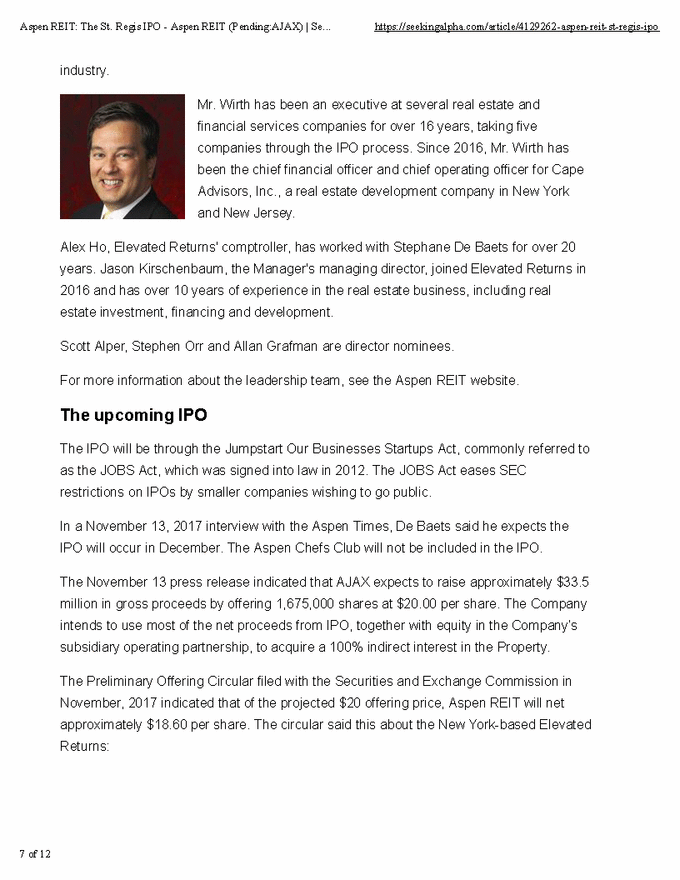
|
ARTICLE III PURPOSE |
18 | |
|
Section 3.1 |
Purpose and Business |
18 |
|
Section 3.2 |
Powers |
18 |
|
Section 3.3 |
Partnership Only for Partnership Purposes Specified |
18 |
|
ARTICLE IV CAPITAL CONTRIBUTIONS |
19 | |
|
Section 4.1 |
Capital Contributions of the Partners |
19 |
|
Section 4.2 |
Classes of Partnership Units |
19 |
|
Section 4.3 |
Issuances of Additional Partnership Interests |
19 |
|
Section 4.4 |
Additional Funds and Capital Contributions |
20 |
|
Section 4.5 |
Equity Incentive Plans |
21 |
|
Section 4.6 |
No Interest; No Return |
21 |
|
Section 4.7 |
Other Contribution Provisions |
21 |
|
Section 4.8 |
Not Publicly Traded |
21 |
|
ARTICLE V DISTRIBUTIONS |
22 | |
|
Section 5.1 |
Requirement and Characterization of Distributions |
22 |
|
Section 5.2 |
Distributions In-Kind |
22 |
|
Section 5.3 |
Withholding Taxes |
22 |
|
Section 5.5 |
Distributions to Reflect Issuance of Additional Partnership Units |
22 |
|
Section 5.6 |
Restricted Distributions |
22 |
|
ARTICLE VI ALLOCATIONS |
23 | |
|
Section 6.1 |
Timing and Amount of Allocations of Net Income and Net Loss |
23 |
|
Section 6.2 |
General Allocations |
23 |
|
Section 6.3 |
Additional Allocation Provisions |
25 |
|
Section 6.4 |
Tax Allocations |
26 |
|
ARTICLE VII MANAGEMENT AND OPERATIONS OF BUSINESS |
27 | |
|
Section 7.1 |
Management |
27 |
|
Section 7.2 |
Certificate of Limited Partnership |
31 |
|
Section 7.3 |
Restrictions on General Partners Authority |
31 |
|
Section 7.4 |
Reimbursement of the General Partner |
33 |
|
Section 7.5 |
Outside Activities of the General Partner |
34 |
|
Section 7.6 |
Contracts with Affiliates |
35 |
|
Section 7.7 |
Indemnification and Liability of the General Partner |
35 |
|
Section 7.8 |
Other Matters Concerning the General Partner |
39 |
|
Section 7.9 |
Title to Partnership Assets |
39 |
|
Section 7.10 |
Reliance by Third Parties |
39 |
|
ARTICLE VIII RIGHTS AND OBLIGATIONS OF LIMITED PARTNERS |
40 | |
|
Section 8.1 |
Limitation of Liability |
40 |
|
Section 8.2 |
Management of Business |
40 |
|
Section 8.3 |
Outside Activities of Limited Partners |
40 |
|
Section 8.4 |
Return of Capital |
41 |
|
Section 8.5 |
Adjustment Factor |
41 |
|
Section 8.6 |
Redemption |
41 |
|
ARTICLE IX BOOKS, RECORDS, ACCOUNTING AND REPORTS |
44 | |
|
Section 9.1 |
Records and Accounting |
44 |
|
Section 9.2 |
Reports |
45 |
|
ARTICLE X TAX MATTERS |
45 | |
|
Section 10.1 |
Preparation of Tax Returns |
45 |
|
Section 10.2 |
Tax Elections |
46 |
|
Section 10.3 |
Tax Matters Partner |
46 |
|
Section 10.4 |
Withholding |
47 |
|
Section 10.5 |
Organizational Expenses |
48 |
|
ARTICLE XI TRANSFERS AND WITHDRAWALS |
48 | |
|
Section 11.1 |
Transfer |
48 |
|
Section 11.2 |
Transfer of the Partnership Interest of the General Partner; Extraordinary Transactions |
49 |
|
Section 11.3 |
Transfer of Limited Partners Partnership Interests |
50 |
|
Section 11.4 |
Substituted Limited Partners |
51 |
|
Section 11.5 |
Assignees |
52 |
|
Section 11.6 |
General Provisions |
52 |
|
ARTICLE XII ADMISSION OF PARTNERS |
54 | |
|
Section 12.1 |
Admission of Successor General Partner |
54 |
|
Section 12.2 |
Admission of Additional Limited Partners |
54 |
|
Section 12.3 |
Amendment of Agreement and Certificate of Limited Partnership |
55 |
|
Section 12.4 |
Limit on Number of Partners |
55 |
|
ARTICLE XIII DISSOLUTION, LIQUIDATION AND TERMINATION |
55 | |
|
Section 13.1 |
Dissolution |
55 |
|
Section 13.2 |
Winding Up |
56 |
|
Section 13.3 |
Deemed Distribution and Recontribution |
58 |
|
Section 13.4 |
Rights of Limited Partners |
58 |
|
Section 13.5 |
Notice of Dissolution |
58 |
|
Section 13.6 |
Cancellation of Certificate of Limited Partnership |
58 |
|
Section 13.7 |
Reasonable Time for Winding-Up |
58 |
|
ARTICLE XIV PROCEDURES FOR ACTIONS AND CONSENTS OF PARTNERS; AMENDMENTS; MEETINGS |
59 | |
|
Section 14.1 |
Procedures for Actions and Consents of Partners |
59 |
|
Section 14.2 |
Amendments |
59 |
|
Section 14.3 |
Meetings of the Partners |
59 |
|
ARTICLE XV GENERAL PROVISIONS |
60 | |
|
Section 15.1 |
Addresses and Notice |
60 |
|
Section 15.2 |
Headings |
60 |
|
Section 15.3 |
Terminology |
60 |
|
Section 15.4 |
Further Action |
60 |
|
Section 15.5 |
Binding Agreement |
60 |
|
Section 15.6 |
Waiver |
60 |
|
Section 15.7 |
Counterparts |
61 |
|
Section 15.8 |
Applicable Law |
61 |
|
Section 15.9 |
Entire Agreement |
61 |
|
Section 15.10 |
Validity |
61 |
|
Section 15.11 |
Limitation to Preserve REIT Qualification |
61 |
|
Section 15.12 |
No Partition |
62 |
|
Section 15.13 |
No Third-Party Rights Created Hereby |
62 |
|
Section 15.14 |
No Rights as Stockholders of General Partner |
62 |
|
Section 15.15 |
Disclaimer |
62 |
|
Section 15.16 |
Services to the Partnership |
63 |
|
Section 15.17 |
Confidentiality |
63 |
|
EXHIBIT A |
Partners and Partnership Interests |
Exh. A-1 |
|
EXHIBIT B |
Schedule of Gross Asset Values |
Exh. B-1 |
|
EXHIBIT C |
Notice of Redemption |
Exh. C-1 |
AMENDED AND RESTATED AGREEMENT
OF
LIMITED PARTNERSHIP OF ASPEN OP, LP
THIS AMENDED AND RESTATED AGREEMENT OF LIMITED PARTNERSHIP OF ASPEN OP, LP, a Delaware limited partnership (the Partnership), dated as of [·] (this Agreement), is entered into by and among ASPEN REIT, INC., a Maryland corporation (the General Partner) and the LIMITED PARTNERS identified on Exhibit A hereto. Capitalized terms used and not otherwise defined in this Agreement shall have the meanings ascribed to them in Article I below.
WHEREAS, the Partnership was formed when its Certificate of Limited Partnership was filed and accepted by the Secretary of State of the State of Delaware;
WHEREAS, in connection with its formation, the General Partner and the initial limited partners of the partnership entered into an Agreement of Limited Partnership of ASPEN OP, LP dated as of [·] (the Original Agreement);
WHEREAS, the General Partner has consummated an initial public offering (the Initial Public Offering) of its common stock on the date hereof and will contribute 100% of the gross proceeds of the IPO to the Partnership to acquire common units of limited partner interest in the partnership to be designated as OP Units, representing Limited Partner Interests in the Partnership;
WHEREAS, the General Partner desires to amend and restate the Original Agreement in its entirety by entering into this Agreement;
NOW, THEREFORE, in consideration of the mutual covenants set forth herein, and for other good and valuable consideration, the receipt and sufficiency of which are hereby acknowledged, the parties hereto hereby agree to amend and restate the Original Agreement in its entirety and agree to continue the Partnership as a limited partnership under the Delaware Revised Uniform Limited Partnership Act, as amended from time to time, as follows:
ARTICLE I
DEFINED TERMS
The following definitions shall be for all purposes, unless otherwise clearly indicated to the contrary, applied to the terms used in this Agreement.
Act means the Delaware Revised Uniform Limited Partnership Act (6 Del. C. § 17-101 et seq.), as it may be amended from time to time, and any successor to such statute.
Action has the meaning set forth in Section 7.7(a) hereof.
Additional Funds has the meaning set forth in Section 4.4(a) hereof.
Additional Limited Partner means a Person who is admitted to the Partnership as a Limited Partner pursuant to Section 4.3 and Section 12.3 hereof and who is shown as such on the books and records of the Partnership.
Adjusted Capital Account means the Capital Account maintained for each Partner as of the end of each Partnership Year (i) increased by any amounts which such Partner is obligated to restore pursuant to any provision of this Agreement or is deemed to be obligated to restore pursuant to the penultimate sentences of Regulations Sections 1.704-2(g)(1) and 1.704-2(i)(5) and (ii) decreased by the items described in Regulations Sections 1.704-1(b)(2)(ii)(d)(4), 1.704-1(b)(2)(ii)(d)(5) and 1.704-1(b)(2)(ii)(d)(6). The foregoing definition of Adjusted Capital Account is intended to comply with the provisions of Regulations Section 1.704-1(b)(2)(ii)(d) and shall be interpreted consistently therewith.
Adjusted Capital Account Deficit means, with respect to any Partner, the deficit balance, if any, in such Partners Adjusted Capital Account as of the end of the relevant Partnership Year, or other applicable period.
Adjustment Factor means 1.0; provided, however, that in the event that:
(i) the General Partner (a) declares or pays a dividend on its outstanding REIT Shares in REIT Shares or makes a distribution to all holders of its outstanding REIT Shares in REIT Shares, (b) splits or subdivides its outstanding REIT Shares or (c) effects a reverse share split or otherwise combines its outstanding REIT Shares into a smaller number of REIT Shares, the Adjustment Factor shall be adjusted by multiplying the Adjustment Factor previously in effect by a fraction, (i) the numerator of which shall be the number of REIT Shares issued and outstanding on the record date for such dividend, distribution, split, subdivision, reverse split or combination (assuming for such purposes that such dividend, distribution, split, subdivision, reverse split or combination has occurred as of such time) and (ii) the denominator of which shall be the actual number of REIT Shares (determined without the above assumption) issued and outstanding on the record date for such dividend, distribution, split, subdivision, reverse split or combination;
(ii) the General Partner distributes any rights, options or warrants to all holders of its REIT Shares to subscribe for or to purchase or to otherwise acquire REIT Shares (or other securities or rights convertible into, exchangeable for or exercisable for REIT Shares) at a price per share less than the Value of a REIT Share on the record date for such distribution (each, a Distributed Right), then the Adjustment Factor shall be adjusted by multiplying the Adjustment Factor previously in effect by a fraction (a) the numerator of which shall be the number of REIT Shares issued and outstanding on the record date plus the maximum number of REIT Shares purchasable under such Distributed Rights and (b) the denominator of which shall be the number of REIT Shares issued and outstanding on the record date plus a fraction (1) the numerator of which is the maximum
number of REIT Shares purchasable under such Distributed Rights times the minimum purchase price per REIT Share under such Distributed Rights and (2) the denominator of which is the Value of a REIT Share as of the record date; provided, however, that, if any such Distributed Rights expire or become no longer exercisable, then the Adjustment Factor shall be adjusted, effective retroactive to the date of distribution of the Distributed Rights, to reflect a reduced maximum number of REIT Shares or any change in the minimum purchase price for the purposes of the above fraction; or
(iii) the General Partner shall, by dividend or otherwise, distribute to all holders of its REIT Shares evidences of its indebtedness or assets (including securities, but excluding any dividend or distribution referred to in subsection (i) or (ii) above), which evidences of indebtedness or assets relate to assets not received by the General Partner or its Subsidiaries pursuant to a pro rata distribution by the Partnership, then the Adjustment Factor shall be adjusted to equal the amount determined by multiplying the Adjustment Factor in effect immediately prior to the close of business on the date fixed for determination of stockholders entitled to receive such distribution by a fraction (i) the numerator of which shall be such Value of a REIT Share on the date fixed for such determination and (ii) the denominator of which shall be the Value of a REIT Share on the dates fixed for such determination less the then fair market value (as determined by the General Partner, whose determination shall be conclusive) of the portion of the evidences of indebtedness or assets so distributed applicable to one REIT Share.
Any adjustments to the Adjustment Factor shall become effective immediately after the effective date of such event, retroactive to the record date, if any, for such event.
Affiliate means, with respect to any Person, any Person directly or indirectly controlling or controlled by or under common control with such Person. For the purposes of this definition, control when used with respect to any Person means the possession, directly or indirectly, of the power to direct or cause the direction of the management and policies of such Person, whether through the ownership of voting securities, by contract or otherwise, and the terms controlling and controlled have meanings correlative to the foregoing.
Agreement means this Amended and Restated Agreement of Limited Partnership of Aspen OP, LP, as it may be amended, supplemented or restated from time to time.
Assignee means a Person to whom one or more Partnership Units have been Transferred in a manner permitted under this Agreement, but who has not become a Substituted Limited Partner, and who has the rights set forth in Section 11.5 hereof.
Available Revenues means, with respect to any period for which such calculation is being made, the amount of cash flow available for distribution by the Partnership as determined by the General Partner in its sole and absolute discretion.
Board of Directors means the board of directors of the General Partner.
Business Day means any day except a Saturday, Sunday or other day on which commercial banks in New York, New York are authorized or required by law to close.
Bylaws means the Bylaws of the General Partner, as amended, supplemented or restated from time to time.
Capital Account means, with respect to any Partner, the Capital Account maintained by the General Partner for such Partner on the Partnerships books and records in accordance with the following provisions:
(a) To each Partners Capital Account, there shall be added such Partners Capital Contributions, such Partners distributive share of Net Income and any items in the nature of income or gain that are specially allocated pursuant to Section 6.3 hereof, and the principal amount of any Partnership liabilities assumed by such Partner or that are secured by any property distributed to such Partner.
(b) From each Partners Capital Account, there shall be subtracted the amount of cash and the Gross Asset Value of any property distributed to such Partner pursuant to any provision of this Agreement, such Partners distributive share of Net Losses and any items in the nature of expenses or losses that are specially allocated pursuant to Section 6.3 hereof, and the principal amount of any liabilities of such Partner assumed by the Partnership or that are secured by any property contributed by such Partner to the Partnership (except to the extent a Capital Contribution was already reduced for such liabilities).
(c) In the event any interest in the Partnership is Transferred in accordance with the terms of this Agreement, the transferee shall succeed to the Capital Account of the transferor to the extent that it relates to the Transferred interest.
(d) In determining the principal amount of any liability for purposes of subsections (a) and (b) hereof, there shall be taken into account Code Section 752(c) and any other applicable provisions of the Code and Regulations.
(e) The provisions of this Agreement relating to the maintenance of Capital Accounts are intended to comply with Regulations Sections 1.704-1(b) and 1.704-2, and shall be interpreted and applied in a manner consistent with such Regulations. If the General Partner shall determine that it is prudent to modify the manner in which the Capital Accounts are maintained in order to comply with such Regulations, the General Partner may make such modification; provided that such modification will not have a material effect on the amounts distributable to any Partner without such Partners Consent. The General Partner also shall (i) make any adjustments that are necessary or appropriate to maintain equality between the Capital Accounts of the Partners and the amount of Partnership capital reflected on the Partnerships balance sheet, as computed for book purposes, in accordance with Regulations Section 1.704-1(b)(2)(iv)(q) and (ii) make any appropriate modifications in the event that unanticipated events
might otherwise cause this Agreement not to comply with Regulations Section 1.704-1(b) or Section 1.704-2.
Capital Contribution means, with respect to any Partner, the amount of money and the initial Gross Asset Value of any Contributed Property that such Partner or predecessor of such Partner contributes to the Partnership or is deemed to contribute pursuant to Section 4.4 or 4.5 hereof (reduced by any liabilities, within the meaning of Section 752 of the Code, that are secured by such Contributed Property or that the Partnership assumes from such Partner in connection with such contribution).
Cash Amount means, with respect to a Tendering Partner, an amount of cash equal to the product of (A) the Value of a REIT Share and (B) such Tendering Partners REIT Shares Amount determined as of the date of receipt by the General Partner of such Tendering Partners Notice of Redemption or, if such date is not a Business Day, the immediately preceding Business Day.
Certificate means the Certificate of Limited Partnership of the Partnership filed in the office of the Secretary of State of the State of Delaware on July 3, 2012, as amended from time to time in accordance with the terms hereof and the Act.
Charter means the Articles of Incorporation of the General Partner as filed with the State Department of Assessments and Taxation of Maryland, as amended, supplemented or restated from time to time.
Closing Price has the meaning set forth in the definition of Value.
Code means the Internal Revenue Code of 1986, as amended and in effect from time to time or any successor statute thereto, as interpreted by the applicable Regulations thereunder. Any reference herein to a specific section or sections of the Code shall be deemed to include a reference to any corresponding provision of future law.
Consent means the consent to, approval of, or vote in favor of a proposed action by a Partner given in accordance with Article XIV hereof.
Contributed Property means each item of Property or other asset, in such form as may be permitted by the Act, but excluding cash, contributed or deemed contributed to the Partnership (or deemed contributed by the Partnership to a new partnership pursuant to Code Section 708) net of any liabilities assumed by the Partnership relating to such Contributed Property and any liability to which such Contributed Property is subject.
Debt means, as to any Person, as of any date of determination, (i) all indebtedness of such Person for borrowed money or for the deferred purchase price of property or services; (ii) all amounts owed by such Person to banks or other Persons in respect of reimbursement obligations under letters of credit, surety bonds and other similar instruments guaranteeing payment or other performance of obligations by such Person; (iii) all indebtedness for borrowed money or for the deferred purchase price of property or services secured by any lien on any property owned by such Person, to the extent attributable to such Persons interest in such property, even though such Person has not assumed or become liable for the payment thereof;
and (iv) lease obligations of such Person that, in accordance with generally accepted accounting principles, should be capitalized.
Depreciation means, for each Partnership Year or other applicable period, an amount equal to the federal income tax depreciation, amortization or other cost recovery deduction allowable with respect to an asset for such year or other period, except that if the Gross Asset Value of an asset differs from its adjusted basis for federal income tax purposes at the beginning of such year or period, Depreciation shall be in an amount that bears the same ratio to such beginning Gross Asset Value as the federal income tax depreciation, amortization or other cost recovery deduction for such year or other period bears to such beginning adjusted tax basis; provided, however, that, if the federal income tax depreciation, amortization or other cost recovery deduction for such year or period is zero, Depreciation shall be determined with reference to such beginning Gross Asset Value using any reasonable method selected by the General Partner.
Effective Date means the date of closing of the Initial Public Offering of REIT Shares.
ERISA means the Employee Retirement Income Security Act of 1974, as amended.
Equity Incentive Plan means any equity incentive plan hereafter adopted by the Partnership or the General Partner.
Exchange Act means the Securities Exchange Act of 1934, as amended, and the rules and regulations promulgated thereunder.
GAAP means generally accepted accounting principles, as applied in the United States.
General Partner means Aspen REIT, Inc., a Maryland corporation, and its successors and assigns, as the general partner of the Partnership. The General Partner may also hold a Limited Partner Interest and, in such capacity, shall enjoy all the benefits, rights and authority to which the holder of a Limited Partner Interest may be entitled as provided in this Agreement, together with all obligations of such Person to comply with the terms and provisions of this Agreement in such capacity.
General Partner Interest means a Partnership Interest held by the General Partner, which Partnership Interest is an interest as a general partner under the Act, and which Partnership Interest includes all benefits, rights and authority to which the holder of a General Partner Interest may be entitled as provided in this Agreement, together with all obligations of such Person to comply with the terms and provisions of this Agreement in such capacity.
Gross Asset Value means, with respect to any asset, the assets adjusted basis for federal income tax purposes, except as follows:
(a) The initial Gross Asset Value of any asset contributed by a Partner to the Partnership shall be (i) in the case of any asset listed on Exhibit B, the gross asset value of such asset listed on Exhibit B; and (ii) in all other cases, the gross fair market value of such asset as determined by the General Partner.
(b) The Gross Asset Values of all Partnership assets immediately prior to the occurrence of any event described in clause (i), clause (ii), clause (iii), clause (iv) or clause (v) hereof shall be adjusted to equal their respective gross fair market values, as determined by the General Partner using such reasonable method of valuation as it may adopt, as of the following times:
(i) the acquisition of an additional interest in the Partnership (other than in connection with the execution of this Agreement but including, without limitation, acquisitions pursuant to Sections 4.3 or 4.4 hereof or contributions or deemed contributions by the General Partner pursuant to Sections 4.3 or 4.4 hereof) by a new or existing Partner in exchange for more than a de minimis Capital Contribution or provision of services, if the General Partner reasonably determines that such adjustment is necessary or appropriate to reflect the relative economic interests of the Partners in the Partnership;
(ii) the distribution by the Partnership to a Partner of more than a de minimis amount of Property as consideration for an interest in the Partnership, if the General Partner reasonably determines that such adjustment is necessary or appropriate to reflect the relative economic interests of the Partners in the Partnership;
(iii) the liquidation of the Partnership within the meaning of Regulations Section 1.704-1(b)(2)(ii)(g);
(iv) upon the admission of a successor General Partner pursuant to Section 12.1 hereof; and
(v) at such other times as the General Partner shall reasonably determine necessary or advisable in order to comply with Regulations Sections 1.704-1(b) and 1.704-2.
(c) The Gross Asset Value of any Partnership asset distributed to a Partner shall be the gross fair market value of such asset on the date of distribution as determined by the distributee and the General Partner; provided, that, if the distributee is the General Partner or if the distributee and the General Partner cannot agree on such a determination, such gross fair market value shall be determined by an independent third party experienced in the valuation of similar assets, selected by the General Partner in good faith.
(d) The Gross Asset Values of Partnership assets shall be increased (or decreased) to reflect any adjustments to the adjusted basis of such assets pursuant to Code Section 734(b) or Code Section 743(b), but only to the extent that such adjustments are taken into account in determining Capital Accounts pursuant to Regulations Section 1.704-1(b)(2)(iv)(m); provided, however, that Gross Asset Values shall not be adjusted pursuant to this subsection (d) to the extent that the General Partner reasonably determines that an adjustment pursuant to
subsection (b) above is necessary or appropriate in connection with a transaction that would otherwise result in an adjustment pursuant to this subsection (d).
(e) If the Gross Asset Value of a Partnership asset has been determined or adjusted pursuant to subsection (a), subsection (b) or subsection (d) above, such Gross Asset Value shall thereafter be adjusted by the Depreciation taken into account with respect to such asset for purposes of computing Net Income and Net Losses.
Holder or holders means, unless the context suggests otherwise either (a) a Partner or (b) an Assignee, owning a Partnership Unit, that is treated as a member of the Partnership for federal income tax purposes.
Incapacity or Incapacitated means, (i) as to any Partner who is an individual, death, total physical disability or entry by a court of competent jurisdiction adjudicating such Partner incompetent to manage his or her person or his or her estate; (ii) as to any Partner that is a corporation or limited liability company, the filing of a certificate of dissolution, or its equivalent, or the revocation of the corporations charter; (iii) as to any Partner that is a partnership, the dissolution and commencement of winding up of the partnership; (iv) as to any Partner that is an estate, the distribution by the fiduciary of the estates entire interest in the Partnership; (v) as to any Partner that is a trust, the termination of the trust (but not the substitution of a new trustee); or (vi) as to any Partner, the bankruptcy of such Partner. For purposes of this definition, bankruptcy of a Partner shall be deemed to have occurred when (a) the Partner commences a voluntary proceeding seeking liquidation, reorganization or other relief of or against such Partner under any bankruptcy, insolvency or other similar law now or hereafter in effect, (b) the Partner is adjudged as bankrupt or insolvent, or a final and nonappealable order for relief under any bankruptcy, insolvency or similar law now or hereafter in effect has been entered against the Partner, (c) the Partner executes and delivers a general assignment for the benefit of the Partners creditors, (d) the Partner files an answer or other pleading admitting or failing to contest the material allegations of a petition filed against the Partner in any proceeding of the nature described in clause (b) above, (e) the Partner seeks, consents to or acquiesces in the appointment of a trustee, receiver or liquidator for the Partner or for all or any substantial part of the Partners properties, (f) any proceeding seeking liquidation, reorganization or other relief under any bankruptcy, insolvency or other similar law now or hereafter in effect has not been dismissed within 120 days after the commencement thereof, (g) the appointment without the Partners consent or acquiescence of a trustee, receiver or liquidator has not been vacated or stayed within 90 days of such appointment, or (h) an appointment referred to in clause (g) above is not vacated within 90 days after the expiration of any such stay.
Indemnifiable Losses has the meaning set forth in Section 7.7(a) hereof.
Indemnitees means (i) any Person made, or threatened to be made, a party to a proceeding by reason of its status as (a) the General Partner or (b) a director of the General Partner or an officer of the Partnership or the General Partner and (ii) such other Persons (including Affiliates or employees of the General Partner or the Partnership) as the General Partner may designate from time to time (whether before or after the event giving rise to potential liability), in its sole and absolute discretion.
Independent Directors means the members of the Board of Directors of the General Partner who are not officers or employees of the Manager or any Person directly or indirectly controlling or controlled by the Manager, and who are otherwise independent in accordance with the NYSEs corporate governance listing standards (or the rules of any other national securities exchange on which the REIT Shares are listed).
Initial Agreement shall have the meaning set forth in the recitals.
Initial Public Offering shall have the meaning set forth in the recitals.
IRS means the Internal Revenue Service, which administers the internal revenue laws of the United States.
Junior Share means a share of stock of the General Partner now or hereafter authorized or reclassified that has dividend rights, or rights upon liquidation, winding up and dissolution, that are junior in rank to the REIT Shares.
Junior Units means units of Partnership Interests that the General Partner has authorized pursuant to Section 4.1, 4.3 or 4.4 hereof that has distribution rights, or rights upon liquidation, winding up and dissolution, that are junior in rank to the OP Units.
Limited Partner means any Person named as a Limited Partner in Exhibit A attached hereto, as such Exhibit A may be amended from time to time, including any Substituted Limited Partner or Additional Limited Partner, in such Persons capacity as a Limited Partner of the Partnership.
Limited Partner Interest means a Partnership Interest held by a Limited Partner in the Partnership, and which Partnership Interest includes any and all benefits, rights and authority to which the holder of a Limited Partnership Interest may be entitled as provided in this Agreement, together with all obligations of such Person to comply with the terms and provisions of this Agreement in such capacity. A Limited Partner Interest may include OP Units, Preferred Units, Junior Units or other Partnership Units.
Liquidating Event has the meaning set forth in Section 13.1 hereof.
Liquidator has the meaning set forth in Section 13.2(a) hereof.
Majority in Interest means the Holders of more than 50% of the outstanding Partnership Units, including any OP Units held by the General Partner.
Majority in Interest of Outside Limited Partners means the Holders of more than 50% of the outstanding OP Units held by Outside Limited Partners.
Management Agreement means the Management Agreement to be entered into in connection with the Initial Public Offering, entered into by and among the General Partner, the Partnership and the Manager, as amended, supplemented or restated from time to time.
Management Personnel means any employee or personnel of the Manager, the Partnership, the General Partner and any of their respective Subsidiaries or Affiliates.
Manager means ER-REITS, LLC, a Delaware limited liability company.
Market Price has the meaning set forth in the definition of Value.
Net Income or Net Loss means, for each Partnership Year of the Partnership, an amount equal to the Partnerships taxable income or loss for such year, determined in accordance with Code Section 703(a) (for this purpose, all items of income, gain, loss or deduction required to be stated separately pursuant to Code Section 703(a)(1) shall be included in taxable income or loss), with the following adjustments:
(a) Any income of the Partnership that is exempt from federal income tax and not otherwise taken into account in computing Net Income (or Net Loss) pursuant to this definition of Net Income or Net Loss shall be added to (or subtracted from, as the case may be) such taxable income (or loss);
(b) Any expenditure of the Partnership described in Code Section 705(a)(2)(B) or treated as a Code Section 705(a)(2)(B) expenditure pursuant to Regulations Section 1.704-1(b)(2)(iv)(i), and not otherwise taken into account in computing Net Income (or Net Loss) pursuant to this definition of Net Income or Net Loss, shall be subtracted from (or added to, as the case may be) such taxable income (or loss);
(c) In the event the Gross Asset Value of any Partnership asset is adjusted pursuant to subsection (b) or subsection (c) of the definition of Gross Asset Value, the amount of such adjustment shall be taken into account as gain or loss from the disposition of such asset for purposes of computing Net Income or Net Loss;
(d) Gain or loss resulting from any disposition of property with respect to which gain or loss is recognized for federal income tax purposes shall be computed by reference to the Gross Asset Value of the property disposed of, notwithstanding that the adjusted tax basis of such property differs from its Gross Asset Value;
(e) In lieu of the depreciation, amortization and other cost recovery deductions that would otherwise be taken into account in computing such taxable income or loss, there shall be taken into account Depreciation for such Partnership Year;
(f) To the extent that an adjustment to the adjusted tax basis of any Partnership asset pursuant to Code Section 734(b) or Code Section 743(b) is required pursuant to Regulations Section 1.704-1(b)(2)(iv)(m)(4) to be taken into account in determining Capital Accounts as a result of a distribution other than in liquidation of a Partners interest in the Partnership, the amount of such adjustment shall be treated as an item of gain (if the adjustment increases the basis of the asset) or loss (if the adjustment decreases the basis of the asset) from the disposition of the asset and shall be taken into account for purposes of computing Net Income or Net Loss; and
(g) Notwithstanding any other provision of this definition of Net Income or Net Loss, any item that is specially allocated pursuant to Section 6.3 hereof shall not be taken into account in computing Net Income or Net Loss. The amounts of the items of Partnership income, gain, loss or deduction available to be specially allocated pursuant to Section 6.3 hereof shall be determined by applying rules analogous to those set forth in this definition of Net Income or Net Loss.
Nonrecourse Deductions has the meaning set forth in Regulations Section 1.704-2(b)(1), and the amount of Nonrecourse Deductions for a Partnership Year shall be determined in accordance with the rules of Regulations Section 1.704-2(c).
Nonrecourse Liability has the meaning set forth in Regulations Section 1.704-2(b)(3).
Notice of Redemption means the Notice of Redemption substantially in the form of Exhibit C attached to this Agreement.
OP Units mean the common units of limited partner interest in the Partnership, but does not include any Preferred Units, Junior Units or any other Partnership Units specified in a Partnership Unit Designation as being other than an OP Unit.
Original Agreement shall have the meaning set forth in the recitals.
Outside Limited Partners means holders of OP Units (other than the General Partner).
Ownership Limit means the applicable restriction or restrictions on ownership of shares of the General Partner imposed under the Charter.
Partner means the General Partner or a Limited Partner, and Partners means the General Partner and the Limited Partners.
Partner Minimum Gain means an amount, with respect to each Partner Nonrecourse Debt, equal to the Partnership Minimum Gain that would result if such Partner Nonrecourse Debt were treated as a Nonrecourse Liability, determined in accordance with Regulations Section 1.704-2(i)(3).
Partner Nonrecourse Debt has the meaning set forth in Regulations Section 1.704-2(b)(4).
Partner Nonrecourse Deductions has the meaning set forth in Regulations Section 1.704-2(i)(2), and the amount of Partner Nonrecourse Deductions with respect to a Partner Nonrecourse Debt for a Partnership Year shall be determined in accordance with the rules of Regulations Section 1.704-2(i)(2).
Partnership means Aspen OP, LP, a Delaware limited partnership.
Partnership Interest means an ownership interest in the Partnership held by either a Limited Partner or the General Partner and which Partnership Interest includes all benefits, rights
and authority to which the holder of such a Partnership Interest may be entitled as provided in this Agreement, together with all obligations of such Person to comply with the terms and provisions of this Agreement in such capacity. A Partnership Interest may include OP Units, Preferred Units, Junior Units, or other Partnership Units.
Partnership Minimum Gain has the meaning set forth in Regulations Section 1.704-2(b)(2), and the amount of Partnership Minimum Gain, as well as any net increase or decrease in Partnership Minimum Gain, for a Partnership Year shall be determined in accordance with the rules of Regulations Section 1.704-2(d).
Partnership Record Date means a record date established by the General Partner for the distribution of Available Revenues pursuant to Section 5.1 hereof, which record date shall generally be the same as the record date established by the General Partner for a distribution to its stockholders of some or all of its portion of such distribution.
Partnership Unit shall mean an OP Unit, a Preferred Unit, a Junior Unit or any other unit of Partnership Interests that the General Partner has authorized pursuant to Section 4.1, 4.2, 4.3, 4.4, 4.5 or 4.7 hereof.
Partnership Unit Designation has the meaning set forth in Section 4.3(a) hereof.
Partnership Vote shall have the meaning set forth in Section 11.2(c) hereof.
Partnership Year means the fiscal year of the Partnership, which shall be the calendar year.
Percentage Interest means, as to a Partner holding a class or series of Partnership Interests, its interest in such class or series as determined by dividing the Partnership Units of such class or series owned by such Partner by the total number of Partnership Units of such class or series then outstanding as specified in Exhibit A attached hereto, as such Exhibit may be amended from time to time. If the Partnership issues additional classes or series of Partnership Interests, the interest in the Partnership among the classes or series of Partnership Interests shall be determined as set forth in the amendment to the Partnership Agreement setting forth the rights and privileges of such additional classes or series of Partnership Interest, if any, as contemplated by Section 4.3.
Person means an individual or a corporation, partnership, trust, unincorporated organization, association, limited liability company or other entity.
Preferred Stock means a share of stock of the General Partner now or hereafter authorized or reclassified that has dividend rights, or rights upon liquidation, winding up and dissolution, that are superior or prior to the REIT Shares.
Preferred Units means units of Partnership Interests that the General Partner has authorized pursuant to Section 4.1, 4.3 or 4.4 hereof that has distribution rights, or rights upon liquidation, winding up and dissolution, that are superior or prior to the OP Units.
Prime Rate means the rate of interest publicly announced from time to time by JPMorgan Chase Bank, N.A., New York, New York, or its successor, as its prime rate.
Properties means any assets and property of the Partnership, and Property shall mean any one such asset or property.
Publicly Traded means listed or admitted to trading on The New York Stock Exchange, Inc., NYSE American or any other national securities exchange.
Qualified REIT Subsidiary means a qualified REIT subsidiary of the General Partner within the meaning of Code Section 856(i)(2).
Qualified Transferee means an Accredited Investor as defined in Rule 501 promulgated under the Securities Act.
Redemption has the meaning set forth in Section 8.6(a) hereof.
Regulations means the applicable income tax regulations under the Code, whether such regulations are in proposed, temporary or final form, as such regulations may be amended from time to time (including corresponding provisions of succeeding regulations).
Regulatory Allocations has the meaning set forth in Section 6.3(a)(vii) hereof.
REIT means a Person qualifying as a real estate investment trust within the meaning of Code Section 856.
REIT Payment has the meaning set forth in Section 15.11 hereof.
REIT Requirements has the meaning set forth in Section 5.1(b) hereof.
REIT Share means a share of common stock of the General Partner, par value $0.01 per share, or the common stock issued by any successor to the General Partner in any transaction or related series of transactions in which (i) the business or assets of the General Partner are disposed of or combined, through merger, consolidation, share exchange, sale, disposition, distribution or contribution of substantially all of the General Partners assets, or otherwise and (ii) the General Partner is liquidated or is not the continuing or surviving company in such transaction or related series of transactions.
REIT Shares Amount means a number of REIT Shares equal to the product of (a) the number of Tendered Units and (b) the Adjustment Factor in effect on the Specified Redemption Date with respect to such Tendered Units; provided, however, that, in the event that the General Partner issues to all holders of REIT Shares as of a certain record date rights, options, warrants or convertible or exchangeable securities entitling the General Partners stockholders to subscribe for or purchase REIT Shares, or any other securities or property (collectively, the Rights), with the record date for such Rights issuance falling within the period starting on the date of the Notice of Redemption and ending on the day immediately preceding the Specified Redemption Date, which Rights will not be distributed before the relevant Specified Redemption Date, then the REIT Shares Amount shall also include such Rights that a holder of that number
of REIT Shares would be entitled to receive, expressed, where relevant hereunder, in a number of REIT Shares determined by the General Partner in good faith.
Rights has the meaning set forth in the definition of REIT Shares Amount.
Revised Partnership Audit Procedures has the meaning set forth in Section 10.3(b) hereof.
Securities Act means the Securities Act of 1933, as amended, and the rules and regulations promulgated thereunder.
Specified Redemption Date means the 10th Business Day following receipt by the General Partner of a Notice of Redemption; provided, that, if the REIT Shares are not Publicly Traded, the Specified Redemption Date means the 30th Business Day following receipt by the General Partner of a Notice of Redemption.
Stockholder Vote shall have the meaning set forth in Section 11.2(b)(ii) hereof.
Subsidiary means, with respect to any Person, any other Person (which is not an individual) of which a majority of (i) the voting power of the voting equity securities or (ii) the outstanding equity interests is owned, directly or indirectly, by such Person.
Substituted Limited Partner means a Person who is admitted as a Limited Partner to the Partnership pursuant to Section 11.4 hereof.
Tax Items has the meaning set forth in Section 6.4(a) hereof.
Tendered Units has the meaning set forth in Section 8.6(a) hereof.
Tendering Partner has the meaning set forth in Section 8.6(a) hereof.
Terminating Capital Transaction means any sale or other disposition of all or substantially all of the assets of the Partnership or a related series of transactions that, taken together, result in the sale or other disposition of all or substantially all of the assets of the Partnership.
Termination Transaction shall have the meaning set forth in Section 11.2(c).
Transfer, when used with respect to a Partnership Unit, or all or any portion of a Partnership Interest, means any sale, assignment, bequest, conveyance, devise, gift (outright or in trust), pledge, encumbrance, hypothecation, mortgage, exchange, transfer or other disposition or act of alienation, whether voluntary or involuntary or by operation of law; provided, however, that, when the term is used in Article XI hereof, Transfer does not include (a) any Redemption of Partnership Units by the Partnership or the General Partner, or acquisition of Tendered Units by the General Partner, pursuant to Section 8.6 hereof or (b) any redemption of Partnership Units pursuant to any Partnership Unit Designation. The terms Transferred and Transferring have correlative meanings.
Value means, on any date of determination with respect to a REIT Share, the average of the daily Market Prices for ten consecutive trading days immediately preceding the date of determination; provided, however, that, for purposes of Section 8.6, the date of determination shall be the date of receipt by the General Partner of a Notice of Redemption or, if such date is not a Business Day, the immediately preceding Business Day. The term Market Price on any date shall mean, with respect to any class or series of outstanding REIT Shares, the Closing Price for such REIT Shares on such date. The Closing Price on any date shall mean the last sale price for such REIT Shares, regular way, or, in case no such sale takes place on such day, the average of the closing bid and asked prices, regular way, for such REIT Shares, in either case as reported on the principal national securities exchange on which such REIT Shares are listed or admitted to trading or, if such REIT Shares are not listed or admitted to trading on any national securities exchange, the last quoted price, or, if not so quoted, the average of the high bid and low asked prices in the over-the-counter market, as reported by the principal other automated quotation system that may then be in use or, if such REIT Shares are not quoted by any such organization, the average of the closing bid and asked prices as furnished by a professional market maker making a market in such REIT Shares selected by the Board of Directors of the General Partner or, in the event that no trading price is available for such REIT Shares, the fair market value of the REIT Shares, as determined in good faith by the Board of Directors of the General Partner.
In the event that the REIT Shares Amount includes Rights (as defined in the definition of REIT Shares Amount) that a holder of REIT Shares would be entitled to receive, then the Value of such Rights shall be determined by the General Partner acting in good faith on the basis of such quotations and other information as it considers, in its reasonable judgment, appropriate.
ARTICLE II
ORGANIZATIONAL MATTERS
Section 2.1 Organization. The Partnership is a limited partnership organized pursuant to the provisions of the Act and upon the terms and subject to the conditions set forth in this Agreement. Except as expressly provided herein to the contrary, the rights and obligations of the Partners and the administration and termination of the Partnership shall be governed by the Act. The Partnership Interest of each Partner shall be personal property for all purposes.
Section 2.2 Name. The name of the Partnership is Aspen OP, LP The Partnerships business may be conducted under any other name or names deemed advisable by the General Partner, including the name of the General Partner or any Affiliate thereof. The words Limited Partnership, LP, L.P., Ltd. or similar words or letters shall be included in the Partnerships name where necessary for the purposes of complying with the laws of any jurisdiction that so requires. The General Partner in its sole and absolute discretion may change the name of the Partnership at any time and from time to time and shall notify the Partners of such change in the next regular communication to the Partners.
Section 2.3 Registered Office and Agent; Principal Office. The address of the registered office of the Partnership in the State of Delaware is located at Corporation Service Company, 2711 Centerville Road, Suite 400, Wilmington, Delaware 19808, and the registered
agent for service of process on the Partnership in the State of Delaware at such registered office is Corporation Service Company. The principal office of the Partnership is located at c/o Aspen REIT, Inc., 96 Spring Street, 6th Floor, New York, New York 10012 or such other place as the General Partner may from time to time designate by notice to the Limited Partners. The Partnership may maintain offices at such other place or places within or outside the State of Delaware as the General Partner deems advisable.
Section 2.4 Appointment of the General Partner. Aspen REIT, Inc., a Maryland corporation, shall be the general partner of the Partnership.
Section 2.5 Power of Attorney.
(a) Each Limited Partner and each Assignee hereby irrevocably constitutes and appoints the General Partner, any Liquidator, and authorized officers and attorneys-in-fact of each, and each of those acting singly, in each case with full power of substitution, as its true and lawful agent and attorney-in-fact, with full power and authority in its name, place and stead to execute, swear to, seal, acknowledge, deliver, file and record at the appropriate public offices such documents as may be necessary or appropriate to carry out the provisions of this Agreement, including the following with respect to the Partnership, to the extent the Limited Partners are required to make, complete, execute, sign, acknowledge, deliver, file or record the same:
(i) all certificates, other agreements and amendments thereto which the General Partner or the Liquidator deems necessary to form, continue or otherwise qualify the Partnership as a limited partnership in each jurisdiction in which the Partnership conducts or may conduct business, and each Limited Partner specifically authorizes the General Partner or the Liquidator to execute, sign, acknowledge, deliver, file and record the Certificate and amendments thereto as required by the Act;
(ii) this Agreement, counterparts hereof and amendments hereto authorized pursuant to the terms hereof and all instruments that the General Partner or the Liquidator deems appropriate or necessary to reflect any amendment, change, modification or restatement of this Agreement in accordance with its terms;
(iii) all instruments which the General Partner or the Liquidator deems necessary to effect the admission of any Partner pursuant to Article XII, the transfer of the Partnership Interest of any Partner or the withdrawal or substitution of any Partner pursuant to, or other events described in, Article XI, the dissolution and liquidation of the Partnership pursuant to, or other events described in, Article XIII, or the Capital Contribution of any Partner;
(iv) all conveyances and other instruments or documents that the General Partner or the Liquidator deems appropriate or necessary to reflect the distribution or exchange of assets of the Partnership pursuant to the terms of this Agreement;
(v) all certificates, documents and other instruments relating to the determination of the rights, preferences and privileges relating to Partnership Interests;
(vi) all appointments of agents for service of process and attorneys for service of process which the General Partner or the Liquidator deems necessary or appropriate in
connection with the organization and qualification of the Partnership and the conduct of its business; and
(vii) all ballots, consents, approvals, waivers, certificates and other instruments appropriate or necessary, in the sole and absolute discretion of the General Partner or the Liquidator, to make, evidence, give, confirm or ratify any vote, consent, approval, agreement or other action that is made or given by the Partners hereunder or is consistent with the terms of this Agreement or appropriate or necessary, in the sole and absolute discretion of the General Partner or the Liquidator, to effectuate the terms or intent of this Agreement.
Nothing contained herein shall be construed as authorizing the General Partner or the Liquidator to amend this Agreement except in accordance with Article XIV hereof or as may be otherwise expressly provided for in this Agreement.
(b) The foregoing power of attorney is hereby declared to be irrevocable and a special power coupled with an interest, in recognition of the fact that each of the Limited Partners and Assignees will be relying upon the power of the General Partner or the Liquidator to act as contemplated by this Agreement in any filing or other action by it on behalf of the Partnership, and it shall survive and not be affected by the subsequent Incapacity of any Limited Partner or Assignee and the Transfer of all or any portion of such Limited Partners or Assignees Partnership Units or Partnership Interest and shall extend to such Limited Partners or Assignees heirs, successors, assigns and personal representatives.
(c) The power of attorney granted to the General Partner and the Liquidator shall not apply to Consents of the Partners provided for in this Agreement.
(d) Each Limited Partner or Assignee shall execute and deliver to the General Partner or the Liquidator any and all documents or instruments referred to in this Section 2.5 if the power of attorney granted hereunder is rendered ineffective by applicable provisions of law or if the General Partner or the Liquidator in its reasonable discretion so requests execution by such Limited Partner or Assignee and the same shall not be inconsistent with the provisions hereof.
Section 2.6 Engagement of External Manager and Other Service Providers. The General Partner shall have the authority, without the approval of any Limited Partner, to engage the Manager in accordance with the terms of the Management Agreement and to approve amendments to such management agreement on such terms as may be approved by the General Partner from time to time. No consent of a Limited Partner shall be required to engage, amend the term of engagement or to terminate any manager who is providing services to the Partnership.
Section 2.7 Term. Pursuant to Section 17-201(b) of the Act, the term of the Partnership commenced on [·] and shall continue perpetually unless it is dissolved pursuant to the provisions of Article XIII hereof or as otherwise provided by law.
ARTICLE III
PURPOSE
Section 3.1 Purpose and Business. The purpose and nature of the Partnership is to conduct any business, enterprise or activity permitted by or under the Act; provided, however, such business and arrangements and interests may be limited to and conducted in such a manner as to permit the General Partner, in its sole and absolute discretion, at all times to be classified as a REIT unless the General Partner, in accordance with the Charter and Bylaws, as amended, in its sole discretion has chosen to cease to qualify as a REIT or has chosen not to attempt to qualify as a REIT for any reason or for reasons whether or not related to the business conducted by the Partnership. Without limiting the General Partners right in its sole discretion to cease qualifying as a REIT, the Partners acknowledge that the status of the General Partner as a REIT inures to the benefit of all Partners and not solely to the General Partner or its Affiliates. In connection with the foregoing, the Partnership shall have full power and authority to enter into, perform and carry out contracts of any kind, to borrow and lend money and to issue and guarantee evidence of indebtedness, whether or not secured by mortgage, deed of trust, pledge or other lien and, directly or indirectly, to acquire additional Properties necessary, useful or desirable in connection with its business.
Section 3.2 Powers.
(a) The Partnership shall be empowered to do any and all acts and things necessary, appropriate, proper, advisable, incidental to or convenient for the furtherance and accomplishment of the purposes and business described herein and for the protection and benefit of the Partnership.
(b) The Partnership may contribute from time to time Partnership capital to one or more newly formed entities solely in exchange for equity interests therein (or in a wholly owned subsidiary entity thereof).
(c) Notwithstanding any other provision in this Agreement, the General Partner may cause the Partnership not to take, or to refrain from taking, any action that, in the judgment of the General Partner, in its sole and absolute discretion, (i) could adversely affect the ability of the General Partner to continue to qualify as a REIT, (ii) could subject the General Partner to any additional taxes under Code Section 857 or Code Section 4981 or any other related or successor provision of the Code or (iii) could violate any law or regulation of any governmental body or agency having jurisdiction over the General Partner, its securities or the Partnership.
Section 3.3 Partnership Only for Partnership Purposes Specified. This Agreement shall not be deemed to create a company, venture or partnership between or among the Partners with respect to any activities whatsoever other than the activities within the purposes of the Partnership as specified in Section 3.1 hereof. Except as otherwise provided in this Agreement, no Partner shall have any authority to act for, bind, commit or assume any obligation or responsibility on behalf of the Partnership, its properties or any other Partner. No Partner, in its capacity as a Partner under this Agreement, shall be responsible or liable for any indebtedness or
obligation of another Partner, and the Partnership shall not be responsible or liable for any indebtedness or obligation of any Partner, incurred either before or after the execution and delivery of this Agreement by such Partner, except as to those responsibilities, liabilities, indebtedness or obligations incurred pursuant to and as limited by the terms of this Agreement and the Act.
ARTICLE IV
CAPITAL CONTRIBUTIONS
Section 4.1 Capital Contributions of the Partners. Each Partners Capital Contribution to the Partnership and amount and designation of ownership of Partnership Units is on Exhibit A, as the same may be amended from time to time by the General Partner to the extent necessary to reflect sales, exchanges, conversions or other Transfers, redemptions, Capital Contributions, the issuance of additional Partnership Units, or similar events having an effect on a Partners ownership of Partnership Units. In addition, the asset shown on Exhibit B hereto has been contributed for a Gross Asset Value shown on such Exhibit B. Except as provided by law or in Section 4.4 or 10.4 hereof, the Partners shall have no obligation or right to make any additional Capital Contributions or loans to the Partnership.
Section 4.2 Classes of Partnership Units. From and after the Effective Date, until such time as additional classes or series of Partnership Units are created pursuant to Section 4.3(a) below, the Partnership shall have one class of Partnership Units, entitled OP Units. Subject to Section 4.6, OP Units or Partnership Units of any additional class or series, at the election of the General Partner, in its sole and absolute discretion, may be issued to newly admitted Partners in exchange for any Capital Contributions by such Partners and/or the provision of services by such Partners. Any Partnership Unit that is not specifically designated by the General Partner as being of a particular class or series shall be deemed to be an OP Unit.
Section 4.3 Issuances of Additional Partnership Interests.
(a) General. Notwithstanding Section 7.3(b) hereof, the General Partner is hereby authorized to cause the Partnership to issue additional Partnership Units, for any Partnership purpose, at any time or from time to time, to the Partners or to other Persons, and to admit such Persons as Additional Limited Partners, for such consideration and on such terms and conditions as shall be established by the General Partner in its sole and absolute discretion, all without the approval of any Limited Partners. Any such Person who is not a Partner at the time it is issued Partnership Units and is admitted to the Partnership shall also be issued a Partnership Interest. Without limiting the foregoing, the General Partner is expressly authorized to cause the Partnership to issue Partnership Units (i) upon the conversion, redemption or exchange of any Debt, Partnership Units or other securities issued by the Partnership, (ii) for less than fair market value, so long as the General Partner concludes in good faith that such issuance is in the best interests of the Partnership and (iii) in connection with any merger of any other Person into the Partnership or any Subsidiary of the Partnership if the applicable merger agreement provides that Persons are to receive Partnership Units in exchange for their interests in the Person merging into the Partnership or any Subsidiary of the Partnership. Subject to Delaware law, any additional Partnership Units may be issued in one or more classes, or one or more series of any of such
class or classes, with such designations, preferences and relative, participating, optional or other special rights, powers and duties as shall be determined by the General Partner, in its sole and absolute discretion without the approval of any Limited Partner, and set forth in a written document thereafter attached to and made an exhibit to this Agreement (each, a Partnership Unit Designation). Without limiting the generality of the foregoing, the General Partner shall have authority to specify (a) the allocations of items of Partnership income, gain, loss, deduction and credit to each such class or series of Partnership Interests; (b) the right of each such class or series of Partnership Interests to share in Partnership distributions; (c) the rights of each such class or series of Partnership Interests upon dissolution and liquidation of the Partnership; (d) the voting rights, if any, of each such class or series of Partnership Interests; and (e) the conversion, redemption or exchange rights applicable to each such class or series of Partnership Interests. In connection with such issuance, the General Partner shall have authority to classify and reclassify any class or series of Partnership Units as a different or distinct class of series of Partnership Units. Notwithstanding Section 7.3(b) hereof, upon the issuance of any additional Partnership Interest or Partnership Units or upon the classification or reclassification of any such Partnership Interest or Partnership Units, the General Partner shall amend this Agreement, including Exhibit A, as appropriate to reflect such issuance, classification or reclassification, as the case may be.
(b) No Preemptive Rights. Without the approval of the General Partner, no Person, including, without limitation, any Partner or Assignee, shall have any preemptive, preferential, participation or similar right or rights to subscribe for or acquire any Partnership Interest.
Section 4.4 Additional Funds and Capital Contributions.
(a) General. The General Partner may, at any time and from time to time, determine that the Partnership requires additional funds (Additional Funds) for the acquisition of additional Properties, for the redemption of Partnership Units or for such other purposes as the General Partner may determine in its sole and absolute discretion. Additional Funds may be obtained by the Partnership, at the election of the General Partner in any manner provided in, and in accordance with, the terms of this Section 4.4 without the approval of any Limited Partners.
(b) Additional Capital Contributions. The General Partner, on behalf of the Partnership, may obtain any Additional Funds by accepting Capital Contributions from any Partners or other Persons. In connection with any such Capital Contribution (of cash or property), the General Partner is hereby authorized to cause the Partnership from time to time to issue additional Partnership Units (as set forth in and pursuant to the terms set forth in Section 4.3(a) above) in consideration therefor, and the Percentage Interests of the General Partner and the Limited Partners shall be adjusted to reflect the issuance of such additional Partnership Units.
(c) Loans by Third Parties. The General Partner, on behalf of the Partnership, may obtain any Additional Funds by causing the Partnership to incur Debt to any Person upon such terms as the General Partner determines appropriate, including making such Debt convertible, redeemable or exchangeable for Partnership Units; provided that any
Partnership Units into which such debt is convertible, redeemable or exchangeable may only be issued as set forth in and pursuant to the terms set forth in Section 4.3(a) above.
(d) General Partner Loans. The General Partner, on behalf of the Partnership, may obtain any Additional Funds by causing the Partnership to incur Debt with the General Partner.
(e) Issuance of Securities by the General Partner. In the event of any issuance of additional REIT Shares, Preferred Shares, Junior Shares or other securities by the General Partner, and the direct or indirect contribution to the Partnership, by the General Partner, of the cash proceeds or other consideration received from such issuance, if any, the Partnership shall pay the General Partners expenses associated with such issuance, including any underwriting discounts or commissions (it being understood that if the proceeds actually received by the General Partner are less than the gross proceeds of such issuance as a result of any underwriters discount or other expenses paid or incurred by the General Partner in connection with such issuance, then the General Partner shall be deemed to have made a Capital Contribution to the Partnership in the amount of the gross proceeds of such issuance and the Partnership shall be deemed simultaneously to have reimbursed the General Partner pursuant to Section 7.4(b) for the amount of such underwriters discount or other expenses).
Section 4.5 Equity Incentive Plans. Nothing in this Agreement shall be construed or applied to preclude or restrain the General Partner from adopting, modifying or terminating any Equity Incentive Plan, for the benefit of employees, directors or other business associates of the General Partner, the Manager, the Partnership or any of their Affiliates. The Limited Partners acknowledge and agree that, in the event that any such plan is adopted, modified or terminated by the General Partner, amendments to this Section 4.5 may become necessary or advisable and that any approval or consent of the Limited Partners required pursuant to the terms of this Agreement in order to effect any such amendments requested by the General Partner shall not be unreasonably withheld or delayed.
Section 4.6 No Interest; No Return. No Partner shall be entitled to interest on its Capital Contribution or on such Partners Capital Account. Except as provided herein or by law, no Partner shall have any right to demand or receive the return of its Capital Contribution from the Partnership.
Section 4.7 Other Contribution Provisions. In the event that any Partner is admitted to the Partnership and is given a Capital Account in exchange for services rendered to the Partnership, unless otherwise determined by the General Partner, in its sole and absolute discretion, such transaction shall be treated by the Partnership and the affected Partner as if the Partnership had compensated such Partner in cash and such Partner had contributed the cash to the capital of the Partnership. In addition, with the consent of the General Partner, one or more Limited Partners may enter into contribution agreements with the Partnership which have the effect of providing a guarantee of certain obligations of the Partnership.
Section 4.8 Not Publicly Traded. The General Partner, on behalf of the Partnership, shall use its best efforts not to take any action which would result in the Partnership being a publicly traded partnership under and as such term is defined in Code Section 7704(b).
ARTICLE V
DISTRIBUTIONS
Section 5.1 Requirement and Characterization of Distributions.
(a) Subject to the terms of any Partnership Unit Designation, the General Partner shall cause the Partnership to distribute all or such portion of amounts, at such times, as the General Partner may in its sole and absolute discretion determine, of Available Revenues generated by the Partnership during such quarter to the Holders of each class or series of Partnership Units on the applicable Partnership Record Date with respect to such quarter (and, within such class or series, pro rata in proportion to the respective Percentage Interests on such Partnership Record Date).
(b) The General Partner in its sole and absolute discretion may distribute to the Holders Available Revenues on a more frequent basis and provide for an appropriate Partnership Record Date. Notwithstanding anything herein to the contrary, the General Partner shall make such reasonable efforts, as determined by it in its sole and absolute discretion and consistent with the General Partners qualification as a REIT, to cause the Partnership to distribute sufficient amounts to enable the General Partner to pay stockholder dividends that will (a) satisfy the requirements for its qualification as a REIT under the Code and Regulations (the REIT Requirements) and (b) except to the extent otherwise determined by the General Partner, in its sole and absolute discretion, avoid any federal income or excise tax liability of the General Partner.
Section 5.2 Distributions In-Kind. No right is given to any Partner to demand and receive property other than cash as provided in this Agreement. The General Partner may determine, in its sole and absolute discretion, to include Partnership assets as Available Revenues, and such Partnership assets shall be distributed in such a fashion as to ensure that the fair market value (as determined in good faith by the Board of Directors of the General Partner) is distributed and allocated in accordance with Articles V, VI and XIII hereof.
Section 5.3 Withholding Taxes. All amounts withheld pursuant to the Code or any provisions of any state or local tax law and Section 10.4 hereof with respect to any allocation, payment or distribution to any Holder shall be treated as amounts paid or distributed to such Holder pursuant to Section 5.1 hereof for all purposes under this Agreement.
Section 5.4 Distributions to Reflect Issuance of Additional Partnership Units. Notwithstanding Section 7.3(b) hereof, in the event that the Partnership issues additional Partnership Units pursuant to the provisions of Article IV hereof, the General Partner is hereby authorized to make such revisions to this Article V as it determines are necessary or desirable to reflect the issuance of such additional Partnership Units, including, without limitation, making preferential distributions to certain classes of Partnership Units.
Section 5.5 Restricted Distributions. Notwithstanding any provision to the contrary contained in this Agreement, neither the Partnership nor the General Partner, on behalf of the Partnership, shall make a distribution to any Holder on account of its Partnership Interest or
interest in Partnership Units if such distribution would violate Section 17-607 of the Act or other applicable law.
ARTICLE VI
ALLOCATIONS
Section 6.1 Timing and Amount of Allocations of Net Income and Net Loss. Net Income and Net Loss of the Partnership shall be determined and allocated with respect to each Partnership Year of the Partnership as of the end of each such year. Except as otherwise provided in this Article VI, and subject to Section 11.6(c) hereof, an allocation to a Holder of a share of Net Income or Net Loss shall be treated as an allocation of the same share of each item of income, gain, loss or deduction that is taken into account in computing Net Income or Net Loss.
Section 6.2 General Allocations.
(a) Allocations of Net Income and Net Loss.
(i) Net Income. Except as otherwise provided herein, Net Income for any Partnership Year or other applicable period shall be allocated in the following order and priority:
(A) First, to the General Partner until the cumulative Net Income allocated to the General Partner pursuant to this subparagraph (i)(A) equals the cumulative Net Loss allocated to the General Partner pursuant to subparagraph (ii)(D) below;
(B) Second, to the holders of any Partnership Interests that are entitled to any preference in distribution upon liquidation until the cumulative Net Income allocated under this subparagraph (i)(B) equals the cumulative Net Loss allocated to such Partners under subparagraph (ii)(C);
(C) Third, to the holders of any Partnership Units that are entitled to any preference in distribution in accordance with the rights of any other class of Partnership Units until each such Partnership Unit has been allocated, on a cumulative basis pursuant to this subparagraph (i)(C), Net Income equal to the amount of distributions payable which are attributable to the preference of such class of Partnership Unit whether or not paid (and, within such class, pro rata in proportion to the respective Percentage Interests as of the last day of the period for which such allocation is made); and
(D) Thereafter, with respect to Partnership Units that are not entitled to any preference in distribution or with respect to which distributions are not limited to any preference in distribution, pro rata to each such class in accordance with the terms of such class (and, within such class, pro rata in proportion to the respective Percentage Interests as of the last day of the period for which such allocation is being made).
(ii) Net Loss. Except as otherwise provided herein, Net Loss for any Partnership Year or other applicable period shall be allocated in the following order and priority:
(A) First, to each holder of Partnership Units in proportion to and to the extent of the amount by which the cumulative Net Income allocated to such Partner pursuant to subparagraph (i)(D) above exceeds, on a cumulative basis, the sum of (a) distributions with respect to such Partnership Units pursuant to clause (b) of Section 5.1 and (b) Net Loss allocated to such Partner pursuant to this subparagraph (ii)(A);
(B) Second, with respect to classes of Partnership Units that are not entitled to any preference in distribution or with respect to which distributions are not limited to any preference in distribution, pro rata to each such class in accordance with the terms of such class and within such class, pro rata in proportion to the respective Capital Account balances as of the last day of the period for which such allocation is being made; provided that Net Loss shall not be allocated to any Partner pursuant to this subparagraph (ii)(B) to the extent that such allocation would cause such Partner to have an Adjusted Capital Account Deficit (or increase any existing Adjusted Capital Account Deficit) (determined in each case with respect to a Partner who also holds classes of Partnership Units that are entitled to any preferences in distribution upon liquidation, by subtracting from such Partners Adjusted Capital Account the amount of such preferred distribution to be made upon liquidation) at the end of such Partnership Year or other applicable period; and
(C) Third, with respect to classes of Partnership Units that are entitled to any preference in distribution upon liquidation, in reverse order of the priorities of each such class (and within each such class, pro rata in proportion to their respective Percentage Interests as of the last day of the period for which such allocation is being made); provided that Net Loss shall not be allocated to any Partner pursuant to this subparagraph (ii)(C) to the extent that such allocation would cause such Partner to have an Adjusted Capital Account Deficit (or increase any existing Adjusted Capital Account Deficit) at the end of such Partnership Year or other applicable period;
(D) Thereafter, to the General Partner.
For purposes of determining allocations of Losses pursuant to Section 6.2(a)(ii), the Capital Account balance of each holder of OP Units shall not include any Capital Account balance attributable to other series or classes of Partnership Units.
(b) Allocations to Reflect Issuance of Additional Partnership Units. In the event that the Partnership issues additional Partnership Units pursuant to the provisions of Article IV hereof, the General Partner may make such revisions to this Section 6.2 as it determines are necessary or desirable to reflect the terms of the issuance of such additional Partnership Units.
Section 6.3 Additional Allocation Provisions. Notwithstanding the foregoing provisions of this Article VI:
(a) Regulatory Allocations.
(i) Minimum Gain Chargeback. Except as otherwise provided in Regulations Section 1.704-2(f), notwithstanding the provisions of Section 6.2 hereof, or any other provision of this Article VI, if there is a net decrease in Partnership Minimum Gain during any Partnership Year, each Holder shall be specially allocated items of Partnership income and gain for such year (and, if necessary, subsequent years) in an amount equal to such Holders share of the net decrease in Partnership Minimum Gain, as determined under Regulations Section 1.704-2(g). Allocations pursuant to the previous sentence shall be made in proportion to the respective amounts required to be allocated to each Holder pursuant thereto. The items to be allocated shall be determined in accordance with Regulations Sections 1.704-2(f)(6) and 1.704-2(j)(2). This Section 6.3(a)(i) is intended to qualify as a minimum gain chargeback within the meaning of Regulations Section 1.704-2(f) and shall be interpreted consistently therewith.
(ii) Partner Minimum Gain Chargeback. Except as otherwise provided in Regulations Section 1.704-2(i)(4) or in Section 6.3(a)(i) hereof, if there is a net decrease in Partner Minimum Gain attributable to a Partner Nonrecourse Debt during any Partnership Year, each Holder who has a share of the Partner Minimum Gain attributable to such Partner Nonrecourse Debt, determined in accordance with Regulations Section 1.704-2(i)(5), shall be specially allocated items of Partnership income and gain for such year (and, if necessary, subsequent years) in an amount equal to such Holders share of the net decrease in Partner Minimum Gain attributable to such Partner Nonrecourse Debt, determined in accordance with Regulations Section 1.704-2(i)(4). Allocations pursuant to the previous sentence shall be made in proportion to the respective amounts required to be allocated to each General Partner, Limited Partner and other Holder pursuant thereto. The items to be so allocated shall be determined in accordance with Regulations Sections 1.704-2(i)(4) and 1.704-2(j)(2). This Section 6.3(a)(ii) is intended to qualify as a chargeback of partner nonrecourse debt minimum gain within the meaning of Regulations Section 1.704-2(i) and shall be interpreted consistently therewith.
(iii) Nonrecourse Deductions and Partner Nonrecourse Deductions. Any Nonrecourse Deductions for any Partnership Year shall be specially allocated to the Holders of OP Units in accordance with their OP Units. Any Partner Nonrecourse Deductions for any Partnership Year shall be specially allocated to the Holder(s) who bears the economic risk of loss with respect to the Partner Nonrecourse Debt to which such Partner Nonrecourse Deductions are attributable, in accordance with Regulations Section 1.704-2(i).
(iv) Qualified Income Offset. If any Holder unexpectedly receives an adjustment, allocation or distribution described in Regulations Section 1.704-1(b)(2)(ii)(d)(4), (5), or (6), items of Partnership income and gain shall be allocated, in accordance with Regulations Section 1.704-1(b)(2)(ii)(d), to such Holder in an amount and manner sufficient to eliminate, to the extent required by such Regulations, the Adjusted Capital Account Deficit of such Holder as quickly as possible. It is intended that this Section 6.3(a)(iv) qualify and be
construed as a qualified income offset within the meaning of Regulations Section 1.704-1(b)(2)(ii)(d) and shall be interpreted consistently therewith.
(v) Gross Income Allocation. In the event that any Holder has an Adjusted Capital Account Deficit at the end of any Partnership Year, each such Holder shall be specially allocated items of Partnership income and gain in the amount of such excess to eliminate such deficit as quickly as possible.
(vi) Section 754 Adjustment. To the extent that an adjustment to the adjusted tax basis of any Partnership asset pursuant to Code Section 734(b) or Code Section 743(b) is required, pursuant to Regulations Section 1.704-1(b)(2)(iv)(m)(2) or Regulations Section 1.704-1(b)(2)(iv)(m)(4), to be taken into account in determining Capital Accounts as the result of a distribution to a Holder in complete liquidation of its interest in the Partnership, the amount of such adjustment to the Capital Accounts shall be treated as an item of gain (if the adjustment increases the basis of the asset) or loss (if the adjustment decreases such basis), and such gain or loss shall be specially allocated to the Holders in accordance with their Partnership Units in the event that Regulations Section 1.704-1(b)(2)(iv)(m)(2) applies, or to the Holders to whom such distribution was made in the event that Regulations Section 1.704-1(b)(2)(iv)(m)(4) applies.
(vii) Curative Allocations. The allocations set forth in Sections 6.3(a)(i), (ii), (iii), (iv), (v), and (vi) hereof (the Regulatory Allocations) are intended to comply with certain regulatory requirements, including the requirements of Regulations Sections 1.704-1(b) and 1.704-2. Notwithstanding the provisions of Section 6.1 hereof, the Regulatory Allocations shall be taken into account in allocating other items of income, gain, loss and deduction among the Holders of Partnership Units so that to the extent possible without violating the requirements giving rise to the Regulatory Allocations, the net amount of such allocations of other items and the Regulatory Allocations to each Holder of a Partnership Unit shall be equal to the net amount that would have been allocated to each such Holder if the Regulatory Allocations had not occurred.
(b) Allocation of Excess Nonrecourse Liabilities. The Partnership shall allocate nonrecourse liabilities (within the meaning of Regulations Section 1.752-1(a)(2)) of the Partnership that are secured by multiple Properties under any reasonable method chosen by the General Partner in accordance with Regulations Section 1.752-3(a)(2) and (b). The Partnership shall allocate excess nonrecourse liabilities of the Partnership under any method approved under Regulations Section 1.752-3(a)(3) as chosen by the General Partner.
Section 6.4 Tax Allocations.
(a) In General. Except as otherwise provided in this Section 6.4, for income tax purposes under the Code and the Regulations each Partnership item of income, gain, loss and deduction (collectively, Tax Items) shall be allocated among the Holders of Partnership Units in the same manner as its correlative item of book income, gain, loss or deduction is allocated pursuant to Sections 6.2 and 6.3 hereof.
(b) Allocations Respecting Section 704(c) Revaluations. Notwithstanding Section 6.4(a) hereof, Tax Items with respect to Property that is contributed to the Partnership with a Gross Asset Value that varies from its adjusted tax basis in the hands of the contributing Partner immediately preceding the date of contribution shall be allocated among the Holders of Partnership Units for income tax purposes pursuant to Regulations promulgated under Code Section 704(c) so as to take into account such variation. The Partnership shall account for such variation under any method approved under Code Section 704(c) and the applicable Regulations as chosen by the General Partner, provided that the Partnership shall use the traditional method with respect to variations between the Gross Asset Value and adjusted basis of the Properties contributed on the Effective Date. In the event that the Gross Asset Value of any partnership asset is adjusted pursuant to subsection (b) of the definition of Gross Asset Value (provided in Article I hereof), subsequent allocations of Tax Items with respect to such asset shall take account of the variation, if any, between the adjusted basis of such asset and its Gross Asset Value in the same manner as under Code Section 704(c) and the applicable Regulations.
ARTICLE VII
MANAGEMENT AND OPERATIONS OF BUSINESS
Section 7.1 Management.
(a) Except as otherwise expressly provided in this Agreement, all management powers over the business and affairs of the Partnership are and shall be exclusively vested in the General Partner, and no Limited Partner shall have any right to participate in or exercise control or management power over the business and affairs of the Partnership. The General Partner may not be removed by the Partners with or without cause, except with the consent of the General Partner. In addition to the powers now or hereafter granted to a general partner of a limited partnership under applicable law or that are granted to the General Partner under any other provision of this Agreement, the General Partner (subject to the other provisions hereof including Sections 4.3(a), 7.3 and 14.3) shall have full power and authority to do all things deemed necessary or desirable by it to conduct the business of the Partnership, to exercise all powers set forth in Section 3.2 hereof and to effectuate the purposes set forth in Section 3.1 hereof, including, without limitation, taking the actions and decisions set forth below. Each of the Limited Partners acknowledges and agrees that effective as the closing of the Initial Public Offering, the General Partner, the Partnership and the Manager have entered into the Management Agreement pursuant to which the General Partner and the Partnership have retained the Manager to manage the day-to-day operations of the General Partner and its Subsidiaries, including the Partnership. Each of the Limited Partners further acknowledges and agrees that the General Partner is authorized to delegate to the Manager the power and authority to conduct the day-to-day operations of the Partnership subject to and in accordance with the terms of the Management Agreement, including, without limitation, the power and authority of the General Partner to take such of the following actions and decisions as the General Partner determines in its sole discretion, to be reasonably necessary or desirable in order to permit the Manager to perform the services under the Management Agreement:
(i) the making of any expenditures and the incurring of any obligations that it deems necessary for the conduct of the activities of the Partnership;
(ii) the assumption or guarantee of, or other contracting for, indebtedness, the issuance of evidences of indebtedness (including the securing of same by deed to secure debt, mortgage, deed of trust or other lien or encumbrance on the Partnerships assets) and the mortgage, pledge, encumbrance or hypothecation of any assets of the Partnership to secure any such indebtedness, or lending money to any Person;
(iii) the making of tax, regulatory and other filings, or rendering of periodic or other reports to governmental or other agencies having jurisdiction over the business or assets of the Partnership, the registration of any class of securities of the Partnership under the Exchange Act and the listing of any debt securities of the Partnership on any exchange;
(iv) the acquisition, sale, transfer, exchange or other disposition of any, all or substantially all of the assets of the Partnership (including, but not limited to, the exercise or grant of any conversion, option, privilege or subscription right or any other right available in connection with any assets at any time held by the Partnership) or the merger, consolidation, reorganization or other combination of the Partnership with or into another entity;
(v) the use of the assets of the Partnership (including, without limitation, cash on hand) for any purpose consistent with the terms of this Agreement and on any terms that it sees fit, including, without limitation, the making of capital contributions to and equity investments in the Partnerships Subsidiaries;
(vi) the negotiation, execution and performance of any contracts, leases, conveyances or other instruments that the General Partner considers useful or necessary to the conduct of the Partnerships operations or the implementation of the General Partners powers under this Agreement, including contracting with contractors, developers, consultants, accountants, legal counsel, other professional advisors and other agents and the payment of their expenses and compensation out of the Partnerships assets;
(vii) the distribution of Partnership cash or other Partnership assets in accordance with this Agreement, the holding, management, investment and reinvestment of cash and other assets of the Partnership and the collection and receipt of revenues and income of the Partnership;
(viii) the maintenance of such insurance for the benefit of the Partnership and the Partners as it deems necessary or appropriate, including, without limitation, (i) casualty, liability and other insurance on the Properties and (ii) liability insurance for the Indemnitees hereunder;
(ix) the formation of, or acquisition of an interest in, and the contribution of property to, any further limited or general partnerships, limited liability companies, joint ventures or other relationships that it deems desirable (including, without limitation, the acquisition of interests in, and the contributions of property to, any Subsidiary and any other Person in which it has an equity investment from time to time); provided, however, that, as long as the General Partner has determined to continue to qualify as a REIT, the General Partner may not engage in any such formation, acquisition or contribution that would cause the General Partner to fail to qualify as a REIT within the meaning of Code Section 856(a);
(x) the control of any matters affecting the rights and obligations of the Partnership, including the settlement, compromise, submission to arbitration or any other form of dispute resolution, or abandonment, of any claim, cause of action, liability, debt or damages, due or owing to or from the Partnership, the commencement or defense of suits, legal proceedings, administrative proceedings, arbitrations or other forms of dispute resolution, and the representation of the Partnership in all suits or legal proceedings, administrative proceedings, arbitrations or other forms of dispute resolution, the incurring of legal expense, and the indemnification of any Person against liabilities and contingencies to the extent permitted by law;
(xi) the undertaking of any action in connection with the Partnerships direct or indirect investment in any Subsidiary or any other Person (including, without limitation, the contribution or loan of funds by the Partnership to such Persons);
(xii) except as otherwise specifically set forth in this Agreement, the determination of the fair market value of any Partnership property distributed in-kind using such reasonable method of valuation as it may adopt; provided that such methods are otherwise consistent with the requirements of this Agreement;
(xiii) the enforcement of any rights against any Partner pursuant to representations, warranties, covenants and indemnities relating to such Partners contribution of property or assets to the Partnership;
(xiv) the exercise, directly or indirectly, through any attorney-in-fact acting under a general or limited power-of-attorney, of any right, including the right to vote, appurtenant to any asset or investment held by the Partnership;
(xv) the exercise of any of the powers of the General Partner enumerated in this Agreement on behalf of or in connection with any Subsidiary of the Partnership or any other Person in which the Partnership has a direct or indirect interest, or jointly with any such Subsidiary or other Person;
(xvi) the exercise of any of the powers of the General Partner enumerated in this Agreement on behalf of any Person in which the Partnership does not have an interest, pursuant to contractual or other arrangements with such Person;
(xvii) the making, execution and delivery of any and all deeds, leases, conveyances, contracts, guarantees, warranties, indemnities, waivers, releases or legal instruments or agreements in writing necessary or appropriate in the judgment of the General Partner for the accomplishment of any of the powers of the General Partner enumerated in this Agreement;
(xviii) the issuance of additional Partnership Units, as appropriate and in the General Partners sole and absolute discretion, in connection with Capital Contributions by Additional Limited Partners and additional Capital Contributions by Partners, in each case pursuant to and in accordance with the terms and provisions of Article IV hereof;
(xix) the selection, designation of powers, authority and duties and dismissal of employees or personnel of the Partnership (including, without limitation, employees
or personnel having titles such as president, vice president, secretary and treasurer) and agents, outside attorneys, accountants, consultants and contractors of the Partnership, the determination of their compensation and other terms of employment or service or hiring, and the delegation to any such Person the authority to conduct the business of the Partnership in accordance with the terms of this Agreement;
(xx) the selection of and termination of property managers to manage any of the properties held by the Partnership or the declaration of a default under any property management agreement;
(xxi) the development and approval of annual operating budgets for the Partnership;
(xxii) the distribution of cash or the exchange of the REIT Shares Amount to acquire Partnership Units held by a Limited Partner in connection with a Limited Partners exercise of its Redemption under Section 8.6 hereof;
(xxiii) the amendment of this Agreement, including the amendment and restatement of Exhibit A hereto, to reflect accurately at all times the Capital Contributions and Percentage Interests of the Partners as the same are adjusted from time to time to the extent necessary to reflect redemptions, Capital Contributions, the issuance of Partnership Units, the admission of any Additional Limited Partner or any Substituted Limited Partner or otherwise or Amendments subject to the restrictions in Section 7.3;
(xxiv) an election to dissolve the Partnership pursuant to Section 13.1(d) hereof;
(xxv) the taking of any action necessary or appropriate to ensure that the Partnership will not be treated as a publicly traded partnership under Code Section 7704; and
(xxvi) the taking of any action necessary or appropriate to enable the General Partner to qualify as a REIT.
(b) Each of the Limited Partners agrees that, except as provided in Sections 4.3(a), 7.3 and 14.3 hereto, the General Partner is authorized to execute, deliver and perform the above-mentioned agreements and transactions on behalf of the Partnership, and to delegate such authority to the Manager to the extent the General Partner, in its sole discretion, deems necessary or desirable in order to permit the Manager to perform the services under the Management Agreement, without any further act, approval or vote of the Partners, notwithstanding any other provision of this Agreement, the Act or any applicable law, rule or regulation and, in the absence of any specific corporate action on the part of the General Partner to the contrary, the taking of any action or the execution of any such document or writing by an officer of the General Partner or the Manager, in the name and on behalf of the General Partner, in its capacity as the general partner of the Partnership, shall conclusively evidence (1) the approval thereof by the General Partner, in its capacity as the general partner of the Partnership, (2) the General Partners determination that such action, document or writing is necessary or desirable to conduct the business and affairs of the Partnership, exercise the powers of the Partnership under this Agreement and the Act or effectuate the purposes of the Partnership, or any other determination
by the General Partner required by this Agreement in connection with the taking of such action or execution of such document or writing, and (3) the authority of such officer with respect thereto.
(c) At all times from and after the date hereof, the General Partner may cause (and may authorize the Manager pursuant to the Management Agreement to cause) the Partnership to establish and maintain working capital and other reserves in such amounts as the General Partner, in its sole and absolute discretion, deems appropriate and reasonable from time to time.
(d) In exercising its authority under this Agreement, the General Partner may (and may authorize the Manager to), but shall be under no obligation to, take into account the tax consequences to any Partner (including the General Partner) of any action taken (or not taken) by it. The General Partner, the Partnership and the Manager shall not have liability to a Limited Partner for monetary damages or otherwise for losses sustained, liabilities incurred or benefits not derived by such Limited Partner in connection with such decisions; provided that the General Partner or the Manager, as applicable has acted in good faith and pursuant to its authority under this Agreement or the Management Agreement, as applicable.
Section 7.2 Certificate of Limited Partnership. To the extent that such action is determined by the General Partner to be reasonable and necessary or appropriate, the General Partner shall file amendments to and restatements of the Certificate and do all the things to maintain the Partnership as a limited partnership (or a partnership in which the limited partners thereof have limited liability) under the laws of the State of Delaware and each other state, the District of Columbia or any other jurisdiction, in which the Partnership may elect to do business or own property. Except as otherwise required under the Act, the General Partner shall not be required, before or after filing, to deliver or mail a copy of the Certificate or any amendment thereto to any Limited Partner. The General Partner shall use all reasonable efforts to cause to be filed such other certificates or documents as may be reasonable and necessary or appropriate for the formation, continuation, qualification and operation of a limited partnership (or a partnership in which the limited partners thereof have limited liability to the extent provided by applicable law) in the State of Delaware and any other state, or the District of Columbia or other jurisdiction, in which the Partnership may elect to do business or own property.
Section 7.3 Restrictions on General Partners Authority.
(a) The General Partner may not, and may not authorize the Manager pursuant to the Management Agreement to, take any action in contravention of an express prohibition or limitation of this Agreement without the written consent of a Majority in Interest of Outside Limited Partners and may not, and may not authorize the Manager pursuant to the Management Agreement to, perform any act that would subject a Limited Partner to liability as a general partner in any jurisdiction or any other liability except as provided herein or under the Act.
(b) The General Partner shall not, and shall not authorize the Manager pursuant to the Management Agreement to, without the written consent of a Majority in Interest of Outside Limited Partners, except as provided in Sections 4.1, 4.3(a), 4.4(b), 5.5, 6.2(b), 7.1(a)(xxiii), 7.3(c), 7.5, 8.6(g), 11.4(c) and 12.4 hereof or any other provision of this Agreement,
which expressly allows the General Partner to amend this Agreement without the Consent of a Majority in Interest of Outside Limited Partners, amend, modify or terminate this Agreement.
(c) Notwithstanding Sections 7.3(b) and 14.2, the General Partner shall have the exclusive power, without the prior consent of a Majority in Interest, to amend this Agreement as may be required to facilitate or implement any of the following purposes:
(i) to add to the obligations of the General Partner or surrender any right or power granted to the General Partner or any Affiliate of the General Partner for the benefit of the Limited Partners;
(ii) to reflect the admission, substitution or withdrawal of Partners or the termination of the Partnership in accordance with this Agreement, and to amend this Agreement in connection with such admission, substitution or withdrawal;
(iii) to reflect a change that is of an inconsequential nature and does not adversely affect the Limited Partners in any material respect, or to cure any ambiguity, correct or supplement any provision in this Agreement not inconsistent with law or with other provisions, or make other changes with respect to matters arising under this Agreement that will not be inconsistent with law or with the provisions of this Agreement;
(iv) to satisfy any requirements, conditions or guidelines contained in any order, directive, opinion, ruling or regulation of a federal or state agency or contained in federal or state law;
(v) (a) to reflect such changes as are reasonably necessary for the General Partner to maintain or restore its status as a REIT or to satisfy the REIT Requirements; or (b) to reflect the Transfer of all or any part of a Partnership Interest between the General Partner and any Qualified REIT Subsidiary or other entity that is disregarded as separate from its owner for U.S. federal income tax purposes;
(vi) to modify the manner in which Capital Accounts are computed (but only to the extent set forth in the definition of Capital Account or contemplated by the Code or the Regulations);
(vii) to issue additional Partnership Interests and Partnership Units and to classify and reclassify Partnership Interests and Partnership Units in accordance with Article IV;
(viii) to amend or modify any provision of this Agreement to reflect a statutory or regulatory change regarding the federal income tax treatment of the profits interest of any Partner or to ensure that the receipt of any profits interest will not result in taxation to the holder thereof; and
The General Partner will provide notice to the Limited Partners whenever any action under this Section 7.3(c) is taken.
(d) Notwithstanding Sections 7.3(b) and 7.3(c) hereof, this Agreement shall not be amended, and no action may be taken by the General Partner (and the General Partner shall not authorize the Manager pursuant to the Management Agreement to take any action), without the consent of each Partner adversely affected thereby, if such amendment or action would (i) convert a Limited Partner Interest in the Partnership into a General Partner Interest (except as a result of the General Partner acquiring such Partnership Interest), (ii) modify the limited liability of a Limited Partner, or (iii) amend this Section 7.3(d). Further, no amendment may alter the restrictions on the General Partners authority set forth elsewhere in this Section 7.3 without the consent specified therein. Any such amendment or action consented to by any Partner shall be effective as to that Partner, notwithstanding the absence of such consent by any other Partner.
Section 7.4 Reimbursement of the General Partner.
(a) Except as provided in this Section 7.4 and elsewhere in this Agreement (including the provisions of Articles V and VI regarding distributions, payments and allocations to which it may be entitled), the General Partner shall not be compensated for its services as general partner of the Partnership. The Limited Partners acknowledge and agree that the Manager shall be compensated for its services pursuant to the Management Agreement.
(b) The Partnership shall be responsible for and shall pay all expenses relating to the Partnerships and the General Partners organization, the ownership of their assets and their operations including, without limitation, (i) all expenses relating to their formation and continuity of existence, (ii) all expenses relating to any offerings and registrations of securities, (iii) all expenses associated with their preparation and filing of any periodic reports under federal, state or local laws or regulations, (iv) all expenses associated with their compliance with applicable laws, rules and regulations, and (iv) all other operating or administrative costs incurred in the ordinary course of their business. The General Partner is hereby authorized to pay compensation for accounting, administrative, legal, technical, management and other services rendered to the Partnership. Except to the extent provided in this Agreement, the General Partner and its Affiliates shall be reimbursed on a monthly basis, or such other basis as the General Partner may determine in its sole and absolute discretion, for all expenses (other than any management fees payable to the Manager under the Management Agreement) that the General Partner and its Affiliates incur relating to the ownership and operation of, or for the benefit of, the Partnership (including, without limitation, administrative expenses); provided that the amount of any such reimbursement shall be reduced by any interest earned by the General Partner with respect to bank accounts or other instruments or accounts held by it on behalf of the Partnership. The Partners acknowledge that all such expenses of the General Partner are deemed to be for the benefit of the Partnership. Such reimbursement shall be in addition to any reimbursement made as a result of indemnification pursuant to Section 7.7 hereof. In the event that certain expenses are incurred for the benefit of the Partnership and other entities (including the General Partner), such expenses will be allocated to the Partnership and such other entities in such a manner as the General Partner in its sole and absolute discretion deems fair and reasonable. All payments and reimbursements hereunder shall be characterized for federal income tax purposes as expenses of the Partnership incurred on its behalf, and not as expenses of the General Partner.
(c) If the General Partner shall elect to purchase from its stockholders REIT Shares for the purpose of delivering such REIT Shares to satisfy an obligation under any dividend reinvestment program adopted by the General Partner, any employee share purchase plan adopted by the General Partner or any similar obligation or arrangement undertaken by the General Partner in the future or for the purpose of retiring such REIT Shares, the purchase price paid by the General Partner for such REIT Shares and any other expenses incurred by the General Partner in connection with such purchase shall be considered expenses of the Partnership and shall be advanced to the General Partner or reimbursed to the General Partner, subject to the condition that: (1) if such REIT Shares subsequently are sold by the General Partner, the General Partner shall pay or cause to be paid to the Partnership any proceeds received by the General Partner for such REIT Shares (which sales proceeds shall include the amount of dividends reinvested under any dividend reinvestment or similar program; provided that a transfer of REIT Shares for Partnership Units pursuant to Section 8.6 would not be considered a sale for such purposes); and (2) if such REIT Shares are not sold by the General Partner in an arms-length transaction within 30 days after the purchase thereof, or the General Partner otherwise determines not to sell such REIT Shares, the General Partner shall cause the Partnership to redeem a number of Partnership Units held by the General Partner equal to the number of such REIT Shares, as adjusted for share dividends and distributions, share splits and subdivisions, reverse share splits and combinations, distributions of rights, warrants or options, and distributions of evidences of indebtedness or assets relating to assets not received by the General Partner pursuant to a pro rata distribution by the Partnership (in which case such advancement or reimbursement of expenses shall be treated as having been made as a distribution in redemption of such number of Partnership Units held by the General Partner).
(d) If and to the extent any reimbursements to the General Partner pursuant to this Section 7.4 constitute gross income of the General Partner (as opposed to the repayment of advances made by the General Partner on behalf of the Partnership), such amounts shall constitute guaranteed payments with respect to capital within the meaning of Code Section 707(c), shall be treated consistently therewith by the Partnership and all Partners, and shall not be treated as distributions for purposes of computing the Partners Capital Accounts.
Section 7.5 Outside Activities of the General Partner. Nothing contained herein shall be deemed to prohibit the General Partner from executing guarantees of Partnership debt for which it would otherwise be liable in its capacity as General Partner. In addition, the General Partner may, to the extent necessary to comply with regulatory requirements of certain Limited Partners or otherwise provide for tax efficiency, elect to hold directly certain equity interests of Partnership Subsidiaries. In such case, the General Partner shall amend this Agreement (including, without limitation, to the Net Income and Net Loss allocation provisions of Section 6.2 hereof) so as to provide that each Partner other than the General Partner will receive the same distributions that it would have received had such equity interest been held by the Partnership rather than directly by the General Partner; provided, however, that the General Partner shall in no event be required to make contributions to the Partnership to fund distributions to the other Partners.
Section 7.6 Contracts with Affiliates.
(a) The Partnership may lend or contribute funds or other assets to its Subsidiaries or other Persons in which it has an equity investment, and such Persons may borrow funds from the Partnership, on terms and conditions established in the sole and absolute discretion of the General Partner. The foregoing authority shall not create any right or benefit in favor of any Subsidiary or any other Person.
(b) The Partnership may transfer assets to joint ventures, limited liability companies, partnerships, corporations, business trusts or other business entities in which it is or thereby becomes a participant upon such terms and subject to such conditions consistent with this Agreement and applicable law as the General Partner, in its sole and absolute discretion, believes to be advisable.
(c) The General Partner, in its sole and absolute discretion and without the approval of the Limited Partners, may propose and adopt on behalf of the Partnership benefit plans funded by the Partnership for the benefit of employees or personnel of the General Partner, the Partnership, Subsidiaries of the Partnership, the Manager or any Affiliate of any of them in respect of services performed, directly or indirectly, for the benefit of the General Partner, the Partnership or any of the Partnerships Subsidiaries.
(d) The General Partner is expressly authorized to enter into, in the name and on behalf of the Partnership, any Services Agreement with Affiliates of any of the Partnership, the General Partner or the Manager, on such terms as the General Partner, in its sole and absolute discretion, believes are advisable; provided, however, that any such Services Agreement entered into with Affiliates of any of the Partnership, the General Partner or the Manager shall comply with the Related Party Transaction Policy.
Section 7.7 Indemnification.
(a) The Partnership shall, to the maximum extent permitted by applicable law in effect from time to time, indemnify each Indemnitee from and against any and all losses, claims, damages, liabilities (whether joint or several), expenses (including, without limitation, attorneys fees and other legal fees and expenses), judgments, fines, settlements and other amounts arising from any and all claims, demands, actions, suits or proceedings, civil, criminal, administrative or investigative, that relate to the operations of the Partnership (Actions) as set forth in this Agreement in which such Indemnitee may be involved, or is threatened to be involved, as a party or otherwise; provided, however, that the Partnership shall not indemnify an Indemnitee (1) if the act or omission of the Indemnitee was material to the matter giving rise to the Action and either was committed in bad faith or was the result of active and deliberate dishonesty, (2) for any transaction for which such Indemnitee received an improper personal benefit in money, property or services in violation or breach of any provision of this Agreement, or (3) in the case of any criminal proceeding, the Indemnitee had reasonable cause to believe that the act or omission was unlawful. Without limitation, the foregoing indemnity shall extend to any liability of any Indemnitee, pursuant to a loan guaranty or otherwise (unless otherwise provided by the terms of any such guaranty or other instrument), for any indebtedness of the Partnership or any Subsidiary of the Partnership (including, without limitation, any indebtedness
which the Partnership or any Subsidiary of the Partnership has assumed or taken subject to), and the General Partner is hereby authorized and empowered, on behalf of the Partnership, to enter into one or more indemnity agreements consistent with the provisions of this Section 7.7 in favor of any Indemnitee having or potentially having liability for any such indebtedness. The termination of any proceeding by judgment, order or settlement does not create a presumption that the Indemnitee did not meet the requisite standard of conduct set forth in this Section 7.7(a). The termination of any proceeding by conviction of an Indemnitee or upon a plea of nolo contendere or its equivalent by an Indemnitee, or an entry of an order of probation against an Indemnitee prior to judgment, does not create a presumption that such Indemnitee acted in a manner contrary to that specified in this Section 7.7(a) with respect to the subject matter of such proceeding. Any indemnification pursuant to this Section 7.7 shall be made only out of the assets of the Partnership and any insurance proceeds from the liability policy covering the General Partner and any Indemnitees, and neither the General Partner nor any Limited Partner shall have any obligation to contribute to the capital of the Partnership or otherwise provide funds to enable the Partnership to fund its obligations under this Section 7.7.
(b) To the fullest extent permitted by law, expenses incurred by an Indemnitee who is a party to a proceeding or otherwise subject to or the focus of or is involved in any Action shall be paid or reimbursed by the Partnership as incurred by the Indemnitee in advance of the final disposition of the Action upon receipt by the Partnership of (i) a written affirmation by the Indemnitee of the Indemnitees good faith belief that the standard of conduct necessary for indemnification by the Partnership as authorized in Section 7.7(a) has been met, and (ii) a written undertaking by or on behalf of the Indemnitee to repay the amount if it shall ultimately be determined that the standard of conduct has not been met.
(c) The indemnification provided by this Section 7.7 shall be in addition to any other rights to which an Indemnitee or any other Person may be entitled under any agreement, pursuant to any vote of the Partners, as a matter of law or otherwise, and shall continue as to an Indemnitee who has ceased to serve in such capacity and shall inure to the benefit of the heirs, successors, assigns and administrators of the Indemnitee unless otherwise provided in a written agreement with such Indemnitee or in the writing pursuant to which such Indemnitee is indemnified.
(d) The Partnership may, but shall not be obligated to, purchase and maintain insurance, on behalf of any of the Indemnitees and such other Persons as the General Partner shall determine, against any liability that may be asserted against or expenses that may be incurred by such Person in connection with the Partnerships activities, regardless of whether the Partnership would have the power to indemnify such Person against such liability under the provisions of this Agreement.
(e) Any liabilities which an Indemnitee incurs as a result of acting on behalf of the Partnership or the General Partner (whether as a fiduciary or otherwise) in connection with the operation, administration or maintenance of an employee benefit plan or any related trust or funding mechanism (whether such liabilities are in the form of excise taxes assessed by the IRS, penalties assessed by the Department of Labor, restitutions to such a plan or trust or other funding mechanism or to a participant or beneficiary of such plan, trust or other funding mechanism, or otherwise) shall be treated as liabilities or judgments or fines under this Section
7.7, unless such liabilities arise as a result of (1) an act or omission of such Indemnitee that was material to the matter giving rise to the Action and either was committed in bad faith or was the result of active and deliberate dishonesty, (2) any transaction in which such Indemnitee received an improper personal benefit in money, property or services in violation or breach of any provision of this Agreement or applicable law, or (3) in the case of any criminal proceeding, the Indemnitee had reasonable cause to believe that the act or omission was unlawful.
(f) In no event may an Indemnitee subject any of the Partners to personal liability by reason of the indemnification provisions set forth in this Agreement.
(g) An Indemnitee shall not be denied indemnification in whole or in part under this Section 7.7 because the Indemnitee had an interest in the transaction with respect to which the indemnification applies if the transaction was otherwise permitted by the terms of this Agreement.
(h) The provisions of this Section 7.7 are for the benefit of the Indemnitees, their heirs, successors, assigns and administrators and shall not be deemed to create any rights for the benefit of any other Persons. Any amendment, modification or repeal of this Section 7.7 or any provision hereof shall be prospective only and shall not in any way affect the obligations of the Partnership or the limitations on the Partnerships liability to any Indemnitee under this Section 7.7 as in effect immediately prior to such amendment, modification or repeal with respect to claims arising from or relating to matters occurring, in whole or in part, prior to such amendment, modification or repeal, regardless of when such claims may arise or be asserted.
(i) If and to the extent any payments to the General Partner pursuant to this Section 7.7 constitute gross income (as opposed to the repayment of advances made on behalf of the Partnership) such amounts shall be treated as guaranteed payments for the use of capital within the meaning of Code Section 7.7(c), shall be treated consistently therewith by the Partnership and all Partners, and shall not be treated as distributions for purposes of computing the Partners Capital Accounts.
Section 7.8 Liability of the General Partner and Affiliates.
(a) Notwithstanding anything to the contrary set forth in this Agreement, to the maximum extent that Delaware law in effect from time to time permits, none of the General Partner, its Affiliates and their respective directors or officers shall be liable or accountable in damages or otherwise to the Partnership, any Partners or any Assignees for losses sustained, liabilities incurred or benefits not derived as a result of errors in judgment or mistakes of fact or law or of any act or omission if the General Partner or such Affiliate or such director or officer acted in good faith.
(b) The Limited Partners expressly acknowledge that the General Partner is acting for the benefit of the Partnership, the Limited Partners and its own stockholders collectively and that the General Partner is under no obligation to give priority to the separate interests of the Limited Partners or its own stockholders (including, without limitation, the tax consequences to Limited Partners, Assignees or its own stockholders) in deciding whether to cause the Partnership to take (or decline to take) any actions. If there is a conflict between the
interests of the stockholders of the General Partner on one hand and the Limited Partners on the other, the Limited Partners expressly acknowledge that the General Partner will fulfill its fiduciary duties to such Limited Partners by acting in the best interests of the stockholders of the General Partner. The General Partner shall not be liable under this Agreement to the Partnership or to any Partner for monetary damages for losses sustained, liabilities incurred, or benefits not derived by Limited Partners in connection with such decisions; provided, that the General Partner has acted in good faith.
(c) Subject to its obligations and duties as General Partner set forth in Section 7.1(a) hereof, the General Partner may exercise any of the powers granted to it by this Agreement and perform any of the duties imposed upon it hereunder either directly or by or through its employees or agents (subject to the supervision and control of the General Partner). The General Partner shall not be responsible for any misconduct or negligence on the part of any such agent appointed by it in good faith.
(d) To the extent that, at law or in equity, the General Partner has duties (including fiduciary duties) and liabilities relating thereto to the Partnership or the Limited Partners, the General Partner shall not be liable to the Partnership or to any other Partner for its good faith reliance on the provisions of this Agreement.
(e) Notwithstanding anything herein to the contrary, except for fraud, willful misconduct or gross negligence, or pursuant to any express indemnities given to the Partnership by any Partner pursuant to any other written instrument, no Partner shall have any personal liability whatsoever, to the Partnership or to the other Partner(s), for the debts or liabilities of the Partnership or the Partnerships obligations hereunder, and the full recourse of the other Partner(s) shall be limited to the interest of that Partner in the Partnership. To the fullest extent permitted by law, no officer, or member of the General Partner shall be liable to the Partnership for money damages except for (1) active and deliberate dishonesty established by a nonappealable final judgment or (2) actual receipt of an improper benefit or profit in money, property or services. Without limitation of the foregoing, and except for fraud, willful misconduct or gross negligence, or pursuant to any such express indemnity, no property or assets of any Partner, other than its interest in the Partnership, shall be subject to levy, execution or other enforcement procedures for the satisfaction of any judgment (or other judicial process) in favor of any other Partner(s) and arising out of, or in connection with, this Agreement. This Agreement is executed by the members of the General Partner solely as members of the same and not in their own individual capacities.
(f) Any amendment, modification or repeal of this Section 7.8 or any provision hereof shall be prospective only and shall not in any way affect the limitations on the General Partners, and its officers and members, liability to the Partnership and the Limited Partners under this Section 7.8 as in effect immediately prior to such amendment, modification or repeal with respect to claims arising from or relating to matters occurring, in whole or in part, prior to such amendment, modification or repeal, regardless of when such claims may arise or be asserted.
Section 7.9 Other Matters Concerning the General Partner.
(a) The General Partner may rely and shall be protected in acting or refraining from acting upon any resolution, certificate, statement, instrument, opinion, report, notice, request, consent, order, bond, debenture or other paper or document believed by it in good faith to be genuine and to have been signed or presented by the proper party or parties.
(b) The General Partner may consult with legal counsel, accountants, appraisers, management consultants, investment bankers, and other consultants and advisors selected by it, and any act taken or omitted to be taken in reliance upon the opinion of such Persons as to matters that the General Partner reasonably believe to be within such Persons professional or expert competence shall be conclusively presumed to have been done or omitted in good faith and in accordance with such opinion.
(c) The General Partner shall have the right, in respect of any of its powers or obligations hereunder, to act through any of its duly authorized officers and a duly appointed attorney or attorneys-in-fact. Each such attorney shall, to the extent provided by the General Partner in the power of attorney, have full power and authority to do and perform all and every act and duty that is permitted or required to be done by the General Partner hereunder.
(d) Notwithstanding any other provision of this Agreement or the Act, any action of the General Partner on behalf of the Partnership, or any decision of the General Partner to refrain from acting on behalf of the Partnership, undertaken in the good faith belief that such action or omission is necessary or advisable in order (1) to protect the ability of the General Partner to continue to qualify as a REIT, (2) for the General Partner otherwise to satisfy the REIT Requirements, or (3) for the General Partner to avoid incurring any taxes under Code Section 857 or Code Section 4981, is expressly authorized under this Agreement and is deemed approved by all of the Limited Partners.
Section 7.10 Title to Partnership Assets. All Partnership assets, whether real or personal, tangible or intangible, shall be deemed to be owned by the Partnership as an entity, and no Partner, individually, shall have any ownership of such asset. The Partnership may hold any of its assets in its own name or in the name of the General Partner or a nominee, which nominee may be one or more individuals, corporations, partnerships, trusts or other entities; provided that the General Partner or such nominee shall be at the direction of the Partnership. All Partnership assets shall be recorded as the property of the Partnership in its books and records, irrespective of the name in which legal title to such Partnership assets is held.
Section 7.11 Reliance by Third Parties. Notwithstanding anything to the contrary in this Agreement, any Person dealing with the Partnership shall be entitled to assume that each of the General Partner and the Manager has full power and authority, without the consent or approval of any other Partner or Person, to encumber, sell or otherwise use in any manner any and all assets of the Partnership and to enter into any contracts on behalf of the Partnership, and take any and all actions on behalf of the Partnership, and such Person shall be entitled to deal with the General Partner and the Manager as if each were the Partnerships sole party in interest, both legally and beneficially. Each Limited Partner hereby waives any and all defenses or other remedies that may be available against such Person to contest, negate or disaffirm any action of
the General Partner or the Manager in connection with any such dealing. In no event shall any Person dealing with the General Partner or the Manager or their respective representatives be obligated to ascertain that the terms of this Agreement have been complied with or to inquire into the necessity or expediency of any act or action of the General Partner or the Manager or their respective representatives. Each and every certificate, document or other instrument executed on behalf of the Partnership by the General Partner or the Manager or their respective representatives shall be conclusive evidence in favor of any and every Person relying in good faith thereon or claiming thereunder that (1) at the time of the execution and delivery of such certificate, document or instrument, this Agreement was in full force and effect, (2) the Person executing and delivering such certificate, document or instrument was duly authorized and empowered to do so for and on behalf of the Partnership, and (3) such certificate, document or instrument was duly executed and delivered in accordance with the terms and provisions of this Agreement and is binding upon the Partnership.
ARTICLE VIII
RIGHTS AND OBLIGATIONS OF LIMITED PARTNERS
Section 8.1 Limitation of Liability. In accordance with state law, a limited partner of a partnership may, under certain circumstances, be required to return to the partnership for the benefit of partnership creditors amounts previously distributed to it. It is the intent of the Partners that a distribution to any Partner be deemed a compromise within the meaning of Section 17-502(b) of the Act and that no Limited Partner shall be obligated to pay any such amount to or for the account of the Partnership or any creditor of the Partnership. However, if any court of competent jurisdiction holds that, notwithstanding the provisions of this Agreement, any Limited Partner is obligated to make any such payment, such obligation shall be the obligation of such Limited Partner, and not of the General Partner.
Section 8.2 Management of Business. No Limited Partner or Assignee shall take part in the operations, management or control (within the meaning of the Act) of the Partnerships business, transact any business in the Partnerships name or have the power to sign documents for or otherwise bind the Partnership. The transaction of any such business by the General Partner or any of its Affiliates or any officer, director, member, employee, partner, agent, representative, shareholder or trustee of the General Partner or any of its Affiliates, in their capacity as such, shall not affect, impair or eliminate the limitations on the liability of the Limited Partners or Assignees under this Agreement.
Section 8.3 Outside Activities of Limited Partners. Unless otherwise agreed to in writing by a Limited Partner, any Limited Partner and any Assignee, officer, director, employee, agent, trustee, Affiliate, member or shareholder of any Limited Partner shall be entitled to and may have business interests and engage in business activities in addition to those relating to the Partnership, including business interests and activities that are in direct or indirect competition with the Partnership or that are enhanced by the activities of the Partnership. Neither the Partnership nor any Partner shall have any rights by virtue of this Agreement in any business ventures of any Limited Partner or Assignee.
Section 8.4 Return of Capital. Except pursuant to the rights of Redemption set forth in Section 8.6 hereof, no Limited Partner shall be entitled to the withdrawal or return of its Capital Contribution, except to the extent of distributions made pursuant to this Agreement, or upon termination of the Partnership as provided herein. Except to the extent provided in Article V or VI hereof or otherwise expressly provided in this Agreement, no Limited Partner or Assignee shall have priority over any other Limited Partner or Assignee either as to the return of Capital Contributions or as to profits, losses or distributions.
Section 8.5 Adjustment Factor. The Partnership shall notify any Limited Partner, on request, of the then current Adjustment Factor or any change made to the Adjustment Factor.
Section 8.6 Redemption.
(a) On or after the date 12 months after the date of a Person becoming a Limited Partner (or such other time period agreed to by the General Partner and the Tendering Partner (as defined below), a holder of OP Units (other than the General Partner) shall have the right (subject to the terms and conditions set forth herein) to require the Partnership to redeem all or a portion of the OP Units held by such Partner (such OP Units being hereafter referred to as Tendered Units) in exchange for the Cash Amount (a Redemption) unless the terms of such OP Units or a separate agreement entered into between the Partnership and the holder of such OP Units provide that such OP Units are not entitled to a right of Redemption. The Tendering Partner shall have no right, with respect to any OP Units so redeemed, to receive any distributions paid on or after the Specified Redemption Date. Any Redemption shall be exercised pursuant to a Notice of Redemption delivered to the General Partner by the holder of OP Units who is exercising the redemption right (the Tendering Partner). The Cash Amount shall be payable to the Tendering Partner on the Specified Redemption Date.
(b) Notwithstanding Section 8.6(a) above, if a holder of OP Units has delivered to the General Partner a Notice of Redemption then the General Partner may, in its sole and absolute discretion (subject to the limitations on ownership and transfer of REIT Shares set forth in the Charter), elect to assume and satisfy the Partnerships Redemption obligation and acquire some or all of the Tendered Units from the Tendering Partner in exchange for the delivery by the General Partner to the Tendering Partner of the REIT Shares Amount (as of the Specified Redemption Date) and, if the General Partner so elects, the Tendering Partner shall sell the Tendered Units to the General Partner in exchange for the REIT Shares Amount. In such event, the Tendering Partner shall have no right to cause the Partnership to redeem such Tendered Units. The General Partner shall give such Tendering Partner written notice of its election on or before the close of business on the fifth Business Day after the its receipt of the Notice of Redemption, and the Tendering Partner may elect to withdraw its redemption request at any time prior to the acceptance of the Cash Amount or REIT Shares Amount by such Tendering Partner. Assuming the General Partner exercises its option to deliver REIT Shares, the General Partner shall retain the Tendered Units. Any election by the General Partner to assume and satisfy the Partnerships redemption obligation with respect to Tendered Units from 315 East Dean Associates, Inc. shall be subject to the approval of a majority of the independent members of the Board of Directors.
(c) The REIT Shares Amount, if applicable, shall be delivered as duly authorized, validly issued, fully paid and non-assessable REIT Shares and, if applicable, free of any pledge, lien, encumbrance or restriction, other than those provided in the Charter or the Bylaws, the Securities Act, relevant state securities or blue sky laws and any applicable registration rights agreement or lock-up agreement with respect to such REIT Shares entered into by the Tendering Partner. Notwithstanding any delay in such delivery (but subject to Section 8.6(e)), the Tendering Partner shall be deemed the owner of such REIT Shares for all purposes, including without limitation, rights to vote or consent, and receive dividends, as of the Specified Redemption Date. In addition, the REIT Shares for which the Partnership Units might be exchanged shall also bear a legend which generally provides the following (or as the Charter otherwise requires):
Restrictions on Ownership and Transfer
THE SHARES REPRESENTED BY THIS CERTIFICATE ARE SUBJECT TO RESTRICTIONS ON BENEFICIAL OWNERSHIP AND CONSTRUCTIVE OWNERSHIP AND TRANSFER FOR THE PURPOSE, AMONG OTHERS, OF THE CORPORATIONS MAINTENANCE OF ITS QUALIFICATION AS A REIT UNDER THE INTERNAL REVENUE CODE OF 1986, AS AMENDED (THE CODE). SUBJECT TO CERTAIN FURTHER RESTRICTIONS AND EXCEPT AS EXPRESSLY PROVIDED IN THE CORPORATIONS CHARTER, (I) NO PERSON MAY BENEFICIALLY OWN OR CONSTRUCTIVELY OWN SHARES OF COMMON STOCK IN EXCESS OF 9.8 PERCENT (IN VALUE OR NUMBER OF SHARES, WHICHEVER IS MORE RESTRICTIVE) OF THE OUTSTANDING SHARES OF COMMON STOCK, UNLESS SUCH PERSON IS EXEMPT FROM SUCH LIMITATION OR IS AN EXCEPTED HOLDER (IN WHICH CASE THE EXCEPTED HOLDER LIMIT SHALL BE APPLICABLE); (II) NO PERSON MAY BENEFICIALLY OWN OR CONSTRUCTIVELY OWN SHARES OF ANY CLASS OR SERIES OF PREFERRED STOCK IN EXCESS OF 9.8 PERCENT (IN VALUE OR NUMBER OF SHARES, WHICHEVER IS MORE RESTRICTIVE) OF THE OUTSTANDING SHARES OF SUCH CLASS OR SERIES OF PREFERRED STOCK, UNLESS SUCH PERSON IS EXEMPT FROM SUCH LIMITATION OR IS AN EXCEPTED HOLDER (IN WHICH CASE THE EXCEPTED HOLDER LIMIT SHALL BE APPLICABLE); (III) NO PERSON MAY BENEFICIALLY OWN OR CONSTRUCTIVELY OWN SHARES OF CAPITAL STOCK IN EXCESS OF 9.8 PERCENT (IN VALUE OR NUMBER OF SHARES, WHICHEVER IS MORE RESTRICTIVE) OF THE TOTAL OUTSTANDING SHARES OF CAPITAL STOCK, UNLESS SUCH PERSON IS EXEMPT FROM SUCH LIMITATION OR IS AN EXCEPTED HOLDER (IN WHICH CASE THE EXCEPTED HOLDER LIMIT SHALL BE APPLICABLE); (IV) NO PERSON MAY BENEFICIALLY OWN OR CONSTRUCTIVELY OWN CAPITAL STOCK THAT WOULD RESULT IN THE CORPORATION (A) BEING CLOSELY HELD UNDER SECTION 856(H) OF THE CODE (WITHOUT REGARD TO WHETHER THE OWNERSHIP INTEREST IS HELD DURING THE LAST HALF OF A TAXABLE YEAR) OR (B) OTHERWISE CAUSE THE CORPORATION TO FAIL TO QUALIFY AS A REIT (INCLUDING, BUT NOT LIMITED TO, BENEFICIAL OWNERSHIP OR CONSTRUCTIVE OWNERSHIP THAT WOULD RESULT IN (1) ANY MANAGER OR OPERATOR THAT MANAGES AND/OR OPERATES A QUALIFIED LODGING FACILITY, WITHIN THE MEANING OF SECTION 856(D)(9)(D) OF THE CODE, LEASED BY THE CORPORATION (OR ANY SUBSIDIARY OF THE CORPORATION) TO A TAXABLE REIT SUBSIDIARY
(OR A SUBSIDIARY THEREOF) OF THE CORPORATION FAILING TO QUALIFY AS AN ELIGIBLE INDEPENDENT CONTRACTOR, WITHIN THE MEANING OF SECTION 856(D)(9)(A) OF THE CODE OR (2) THE CORPORATION OWNING (ACTUALLY OR CONSTRUCTIVELY) AN INTEREST IN A TENANT THAT IS DESCRIBED IN SECTION 856(D)(2)(B) OF THE CODE IF THE INCOME DERIVED BY THE CORPORATION FROM SUCH TENANT WOULD CAUSE THE CORPORATION TO FAIL TO SATISFY ANY OF THE GROSS INCOME REQUIREMENTS OF SECTION 856(C) OF THE CODE); AND (V) ANY TRANSFER OF SHARES OF CAPITAL STOCK THAT, IF EFFECTIVE WOULD RESULT IN THE CAPITAL STOCK BEING BENEFICIALLY OWNED BY LESS THAN 100 PERSONS (AS DETERMINED UNDER THE PRINCIPLES OF SECTION 856(A)(5) OF THE CODE) SHALL BE VOID AB INITIO, AND THE INTENDED TRANSFEREE SHALL ACQUIRE NO RIGHTS IN SUCH SHARES OF THE CAPITAL STOCK. ANY PERSON WHO BENEFICIALLY OWNS OR CONSTRUCTIVELY OWNS OR ATTEMPTS TO BENEFICIALLY OWN OR CONSTRUCTIVELY OWN SHARES OF CAPITAL STOCK WHICH CAUSES OR WILL CAUSE A PERSON TO BENEFICIALLY OWN OR CONSTRUCTIVELY OWN SHARES OF CAPITAL STOCK IN EXCESS OR IN VIOLATION OF THE ABOVE LIMITATIONS MUST IMMEDIATELY NOTIFY THE CORPORATION OR, IN THE CASE OF SUCH A PROPOSED OR ATTEMPTED TRANSACTION, GIVE AT LEAST 15 DAYS PRIOR WRITTEN NOTICE. IF ANY OF THE RESTRICTIONS ON TRANSFER OR OWNERSHIP AS SET FORTH IN (I) THROUGH (IV) ABOVE ARE VIOLATED, THE SHARES OF CAPITAL STOCK IN EXCESS OR IN VIOLATION OF THE ABOVE LIMITATIONS WILL BE AUTOMATICALLY TRANSFERRED TO A TRUSTEE OF A TRUST FOR THE BENEFIT OF ONE OR MORE CHARITABLE BENEFICIARIES. IN ADDITION, THE CORPORATION MAY REDEEM SHARES UPON THE TERMS AND CONDITIONS SPECIFIED BY THE BOARD OF DIRECTORS IN ITS SOLE DISCRETION IF THE BOARD OF DIRECTORS DETERMINES THAT OWNERSHIP OR A TRANSFER OR OTHER EVENT MAY VIOLATE THE RESTRICTIONS DESCRIBED ABOVE. FURTHERMORE, UPON THE OCCURRENCE OF CERTAIN EVENTS, ATTEMPTED TRANSFERS IN VIOLATION OF THE RESTRICTIONS DESCRIBED IN (I) THROUGH (IV) ABOVE MAY BE VOID AB INITIO. TERMS NOT OTHERWISE DEFINED IN THIS LEGEND HAVE THE MEANINGS DEFINED IN THE CHARTER OF THE CORPORATION, AS THE SAME MAY BE AMENDED FROM TIME TO TIME, A COPY OF WHICH, INCLUDING THE RESTRICTIONS ON TRANSFER AND OWNERSHIP, WILL BE FURNISHED TO EACH HOLDER OF CAPITAL STOCK ON REQUEST AND WITHOUT CHARGE. REQUESTS FOR SUCH A COPY MAY BE DIRECTED TO THE SECRETARY OF THE CORPORATION AT ITS PRINCIPAL OFFICE.
(d) Each Tendering Partner covenants and agrees with the General Partner that all Tendered Units shall be delivered to the General Partner free and clear of all liens, claims and encumbrances whatsoever and should any such liens, claims and/or encumbrances exist or arise with respect to such Tendered Units, the General Partner shall be under no obligation to acquire the same. Each Tendering Partner further agrees that, in the event any state or local property transfer tax is payable as a result of the transfer of its Tendered Units to the General Partner (or its designee), such Tendering Partner shall assume and pay such transfer tax.
(e) Notwithstanding the provisions of Section 8.6(a), 8.6(b), 8.6(c) or any other provision of this Agreement, a holder of OP Units (i) shall not be entitled to effect a
Redemption, whether for cash or an exchange for REIT Shares, to the extent the General Partner would not be able to deliver REIT Shares to satisfy such Redemption because the receipt and ownership of REIT Shares pursuant to such exchange by such Partner on the Specified Redemption Date could cause such Partner or any other Person to violate the Ownership Limit set forth in the Charter and (ii) shall have no rights under this Agreement to acquire REIT Shares which would otherwise be prohibited under the Charter. To the extent any attempted Redemption or exchange for REIT Shares would be in violation of this Section 8.6(e), it shall be null and void ab initio and such holder of OP Units shall not acquire any rights or economic interest in the cash otherwise payable upon such Redemption or the REIT Shares otherwise issuable upon such exchange.
(f) Notwithstanding anything herein to the contrary (but subject to Section 8.6(e)), with respect to any Redemption or exchange for REIT Shares pursuant to this Section 8.6: (i) without the consent of the General Partner, each holder of OP Units may effect a Redemption only one time in each fiscal quarter; (ii) without the consent of the General Partner, each holder of OP Units may not effect a Redemption for less than 1,000 OP Units or, if such holder holds less than 1,000 OP Units, all of the OP Units held by such Limited Partner; (iii) without the consent of the General Partner, each holder of OP Units may not effect a Redemption during the period after the Partnership Record Date with respect to a distribution and before the record date established by the General Partner for a distribution to its stockholders of some or all of its portion of such distribution; (iv) the consummation of any Redemption or exchange for REIT Shares shall be subject to the expiration or termination of the applicable waiting period, if any, under the Hart-Scott-Rodino Antitrust Improvements Act of 1976, as amended; and (v) each Tendering Partner shall continue to own all OP Units subject to any Redemption or exchange for REIT Shares, and be treated as a Limited Partner with respect to such OP Units for all purposes of this Agreement, until such OP Units are transferred to the General Partner and paid for or exchanged on the Specified Redemption Date. Until a Specified Redemption Date, the Tendering Partner shall have no rights as a stockholder of the General Partner with respect to any REIT Shares to be received in exchange for its Tendered Units.
(g) In the event that the Partnership issues additional Partnership Interests to any Additional Limited Partner pursuant to Section 4.3, the General Partner shall make such revisions to this Section 8.6 as it determines are necessary to reflect the issuance of such additional Partnership Interests.
ARTICLE IX
BOOKS, RECORDS, ACCOUNTING AND REPORTS
Section 9.1 Records and Accounting.
(a) The General Partner shall maintain at the office of the Partnership full and accurate books and records of account of the Partnership (which at all times shall remain the property of the Partnership), in the name of the Partnership showing all receipts and expenditures, assets and liabilities, profits and losses, and all other financial books, records and information required by the Act or necessary for recording the Partnerships business and affairs and providing to the Limited Partners any information, lists and copies of documents required to be
provided pursuant to Sections 8.5 or 9.2 hereof. The Partnerships books and records of account shall be maintained in accordance with GAAP.
(b) Any records maintained by or on behalf of the Partnership in the regular course of its business may be kept on, or be in the form for, magnetic tape, photographs, micrographics or any other information storage device; provided that the records so maintained are convertible into clearly legible written form within a reasonable period of time. The books of the Partnership shall be maintained, for financial and tax reporting purposes, on an accrual basis in accordance with generally accepted accounting principles.
Section 9.2 Reports.
(a) As soon as reasonably practicable, but if the General Partner mails annual reports to its stockholders in no event later than the date on which the General Partner mails its annual report to its stockholders, the General Partner shall cause to be mailed to each Limited Partner an annual report, as of the close of the most recently ended Fiscal Year, containing financial statements of the Partnership, or of the General Partner if such statements are prepared on a consolidated basis with the Partnership, for such Partnership Year, presented in accordance with GAAP, such statements to be audited by a nationally recognized firm of independent public accountants selected by the General Partner.
(b) If and to the extent that the General Partner mails quarterly reports to its stockholders, as soon as reasonably practicable, but in no event later than the date on which such reports are mailed, the General Partner shall cause to be mailed to each Limited Partner a report containing unaudited financial statements, as of the last day of such fiscal quarter, of the Partnership, or of the General Partner if such statements are prepared on a consolidated basis with the Partnership, and such other information as may be required by applicable law or regulations, or as the General Partner determines to be appropriate.
(c) The General Partner shall have satisfied its obligations under Sections 9.2(a) and 9.2(b) by posting or making available the reports required by this Section 9.2 on the website maintained from time to time by the Partnership or the General Partner provided, that such reports are able to be printed or downloaded from such website.
ARTICLE X
TAX MATTERS
Section 10.1 Preparation of Tax Returns. The General Partner shall arrange for the preparation and timely filing of all returns with respect to Partnership income, gains, deductions, losses and other items required of the Partnership for federal and state income tax purposes and shall use all reasonable effort to furnish, within 90 days of the close of each taxable year, the tax information reasonably required by the Limited Partners for federal and state income tax reporting purposes. Each Limited Partners shall promptly provide the General Partner with such information relating to the Contributed Properties, including tax basis and other relevant information, as may be reasonably requested by the General Partner from time to time.
Section 10.2 Tax Elections. Except as otherwise provided herein, the General Partner shall, in its sole and absolute discretion, determine whether to make any available election pursuant to the Code, including, but not limited to, the election under Code Section 754 and the election to use the recurring item method of accounting provided under Code Section 461(h) with respect to property taxes imposed on the Partnerships Properties. The General Partner shall have the right to seek to revoke any such election (including, without limitation, any election under Code Sections 461(h) and 754) upon the General Partners determination in its sole and absolute discretion that such revocation is in the best interests of the Partners.
Section 10.3 Tax Matters Partner.
(a) The General Partner shall (i) for taxable years beginning on or before December 31, 2017, be the tax matters partner of the Partnership within the meaning of Section 6231(a)(7) of the Code and (ii) for taxable years beginning on or after January 1, 2018, act as or appoint the partnership representative within the meaning of Section 6223(a) of the Code (as amended by the Bipartisan Budget Act of 2015) (collectively referred to herein as the tax matters partner). The tax matters partner shall represent the Partnership in any disputes, controversies, or proceedings with the IRS or with any state, local, or non-U.S. taxing authority. The tax matters partner shall receive no compensation for its services. All third-party costs and expenses incurred by the tax matters partner in performing its duties as such (including legal and accounting fees and expenses) shall be borne by the Partnership in addition to any reimbursement pursuant to Section 7.4 hereof. Nothing herein shall be construed to restrict the Partnership from engaging an accounting firm to assist the tax matters partner in discharging its duties hereunder, so long as the compensation paid by the Partnership for such services is reasonable.
(b) Subject to the revised partnership audit procedures and any Regulations or other administrative guidance promulgated in connection therewith (the Revised Partnership Audit Procedures), the tax matters partner is authorized, but not required:
(i) to make all decisions with respect to any administrative proceeding relating to tax matters or judicial review thereof, including to enter into any settlement with the IRS with respect to any administrative or judicial proceedings (or any state, local or non-U.S. taxing authority);
(ii) in the event that a notice of a final administrative adjustment at the Partnership level of any item required to be taken into account by a Partner for tax purposes (a final adjustment) is mailed to the tax matters partner, to seek judicial review of such final adjustment, including the filing of a petition for readjustment with the United States Tax Court or the United States Claims Court, or the filing of a complaint for refund with the District Court of the United States for the district in which the Partnerships principal place of business is located;
(iii) to intervene in any action brought by any other Partner for judicial review of a final adjustment;
(iv) to file a request for an administrative adjustment with the IRS at any time and, if any part of such request is not allowed by the IRS, to file an appropriate pleading (petition or complaint) for judicial review with respect to such request;
(v) to enter into an agreement with the IRS to extend the period for assessing any tax that is attributable to any item required to be taken into account by a Partner for tax purposes, or an item affected by such item; and
(vi) to take any other action on behalf of the Partners in connection with any tax audit or judicial review proceeding to the extent permitted by applicable law or regulations.
The taking of any action and the incurring of any expense by the tax matters partner in connection with any such proceeding, except to the extent required by law, is a matter in the sole and absolute discretion of the tax matters partner and the provisions relating to indemnification of the General Partner set forth in Section 7.7 hereof shall be fully applicable to the tax matters partner in its capacity as such.
(c) In the event of an audit of the Partnership pursuant to the Revised Partnership Audit Procedures, the tax matters partner, in its sole discretion, shall have the right to make any and all elections and to take any actions that are available to be made or taken by the tax matters partner or the Partnership under the Revised Partnership Audit Procedures (including any election under Section 6226 of the Code as amended by the Bipartisan Budget Act of 2015). If an election under Section 6226(a) of the Code (as amended by the Bipartisan Budget Act of 2015) is made, the Partnership shall furnish to each Partner for the year under audit a statement of the Partners share of any adjustment set forth in the notice of final partnership adjustment, and each Partner shall take such adjustment into account as required under Section 6226(b) of the Code (as amended by the Bipartisan Budget Act of 2015). Each Partner hereby agrees to indemnify and hold harmless the Partnership and the tax matters partner from and against any liability with respect to the Partners proportionate share of any tax liability (including related interest and penalties) asserted or imposed at the Partnership level in connection with any federal income tax audit of the Partnership regardless of whether such Partner is a Partner in the year in which an IRS adjustment is proposed or made. The foregoing covenants and indemnification obligation of the Partner shall survive indefinitely and shall not terminate, without regard to any transfer of a Partners Partnership Interest, withdrawal as a Partner, or liquidation, dissolution or termination of the Partnership.
Section 10.4 Withholding.
(a) Each Partner hereby authorizes the Partnership to withhold from or pay on behalf of or with respect to such Partner any amount of federal, state, local or foreign taxes that the General Partner determines that the Partnership is required to withhold or pay with respect to any amount distributable or allocable to such Partner pursuant to this Agreement, including, without limitation, any taxes required to be withheld or paid by the Partnership pursuant to Code Sections 1441, 1442, 1445 or 1446. Any amount paid on behalf of or with respect to a Partner shall constitute a loan by the Partnership to such Partner, which loan shall be repaid by such Partner within 15 days after notice from the General Partner that such payment must be made
unless (i) the Partnership withholds such payment from a distribution that would otherwise be made to the Partner or (ii) the General Partner determines, in its sole and absolute discretion, that such payment may be satisfied out of the Available Funds of the Partnership that would, but for such payment, be distributed to such Partner. Each Partner hereby unconditionally and irrevocably grants to the Partnership a security interest in such Partners Partnership Interest to secure such Partners obligation to pay to the Partnership any amounts required to be paid pursuant to this Section 10.4. In the event that a Partner fails to pay any amounts owed to the Partnership pursuant to this Section 10.4 when due, the General Partner may, in its sole and absolute discretion, elect to make the payment to the Partnership on behalf of such defaulting Partner, and in such event shall be deemed to have loaned such amount to such defaulting Partner and shall succeed to all rights and remedies of the Partnership as against such defaulting Partner (including, without limitation, the right to receive distributions). Any amounts payable by a Partner hereunder shall bear interest at the base rate on corporate loans at large United States money center commercial banks, as published from time to time in The Wall Street Journal, plus four percentage points (but not higher than the maximum lawful rate) from the date such amount is due (i.e., 15 days after demand) until such amount is paid in full. Each Partner shall take such actions as the Partnership or the General Partner shall request in order to perfect or enforce the security interest created hereunder.
(b) Each Partner shall furnish (including by way of updates) to the General Partner in such form as is reasonably requested by the General Partner any information, representations and forms as shall reasonably be requested by the General Partner to assist it in obtaining any exemption, reduction or refund of any withholding or other taxes imposed by any taxing authority or other governmental agency (including withholding taxes imposed pursuant to the U.S. Hiring Incentives to Restore Employment Act of 2010, or any similar or successor legislation or any agreement entered into pursuant to any such legislation) upon the Partnership, amounts paid to the Partnership, or amounts distributable by the Partnership to the Partners.
Section 10.5 Organizational Expenses. The Partnership shall elect to amortize expenses, if any, incurred by it in organizing the Partnership ratably over a 180-month period as provided in Code Section 709.
ARTICLE XI
TRANSFERS AND WITHDRAWALS
Section 11.1 Transfer.
(a) No part of the interest of a Partner shall be subject to the claims of any creditor, to any spouse for alimony or support, or to legal process, and may not be voluntarily or involuntarily alienated or encumbered except as may be specifically provided for in this Agreement.
(b) No Partnership Interest shall be Transferred, in whole or in part, except in accordance with the terms and conditions set forth in this Article XI. Any Transfer or purported Transfer of a Partnership Interest not made in accordance with this Article XI shall be null and void ab initio unless consented to by the General Partner in its sole and absolute discretion.
(c) Notwithstanding the other provisions of this Article XI (other than Section 11.6(d) hereof), the Partnership Interests of the General Partner may be Transferred, at any time or from time to time, to any Person that is, at the time of such Transfer, a Subsidiary of the General Partner or to the General Partner or any successor thereto. Any transferee of the entire General Partner Interest pursuant to this Section 11.1(c) shall automatically become, without further action or Consent of any Limited Partners, the sole general partner of the Partnership, subject to all the rights, privileges, duties and obligations under this Agreement and the Act relating to a general partner. Upon any Transfer permitted by this Section 11.1(c), the transferor Partner shall be relieved of all its obligations under this Agreement. The provisions of Section 11.2(b) (other than the last sentence thereof), 11.2(c), 11.2(d), 11.3 and 11.4 hereof shall not apply to any Transfer permitted by this Section 11.1(c).
(d) No Transfer of any Partnership Interest may be made to a lender to the Partnership or any Person who is related (within the meaning of Section 1.752-4(b) of the Regulations) to any lender to the Partnership whose loan constitutes a Nonrecourse Liability, without the consent of the General Partner in its sole and absolute discretion; provided that as a condition to such consent, the lender will be required to enter into an arrangement with the Partnership and the General Partner to redeem or exchange for REIT Shares any Partnership Units in which a security interest is held by such lender concurrently with such time as such lender would be deemed to be a partner in the Partnership for purposes of allocating liabilities to such lender under Code Section 752.
Section 11.2 Transfer of the Partnership Interest of the General Partner; Extraordinary Transactions.
(a) The General Partner may not Transfer any of its General Partner Interest or withdraw from the Partnership except as provided in Sections 11.1(c), 11.2(b) or 11.2(c) hereof.
(b) The General Partner shall not engage in any merger, consolidation or other combination with another entity or a sale of all or substantially all of its assets, or voluntarily withdraw from the Partnership or Transfer all or any portion of its interest in the Partnership (each, a Termination Transaction), whether or not in the ordinary course of business without the consent of a Majority in Interest of Outside Limited Partners.
(c) Notwithstanding Section 11.2(b), the General Partner may, without the foregoing consent of a Majority in Interest of Outside Limited Partners, engage in a Termination Transaction if the conditions specified in clause (i) and (ii) of this Section 11.2(c) are satisfied:
(i) Each holder of OP Units will receive, or will have the right to elect to receive, for each OP Unit an amount of cash, securities or other property equal to the product of the Adjustment Factor and the greatest amount of cash, securities or other property paid to a holder of one REIT Share in consideration of one REIT Share pursuant to the terms of such Termination Transaction; provided, that if, in connection with such transaction, a purchase, tender or exchange offer shall have been made to and accepted by the holders of a majority of the outstanding REIT Shares, each holder of OP Units will receive, or will have the right to elect to receive, the greatest amount of cash, securities or other property which such holder of OP Units
would have received had it exercised its right to Redemption pursuant to Section 8.6 hereof and received REIT Shares in exchange for its OP Units immediately prior to the expiration of such purchase, tender or exchange offer and had thereupon accepted such purchase, tender or exchange offer and then such Termination Transaction shall have been consummated; and
(ii) Such Termination Transaction is approved by (A) at least a majority of the Holders of OP Units (the Partnership Vote) and (B) the holders of REIT Shares (the Stockholder Vote), voting as a single class. For purposes of the Partnership Vote, each Limited Partner holding OP Units shall be entitled to cast a number of votes equal to the total votes such Limited Partner would have been entitled to cast at the Stockholder Meeting had such Limited Partner presented its OP Units for redemption and such OP Units had been acquired by the General Partner for the REIT Shares Amount as of the record date for the Stockholder Meeting; provided, however, that the General Partner and all of its Subsidiaries shall not be entitled to vote with respect to any Partnership Vote and shall instead be deemed to have cast all votes that would otherwise have been entitled to be cast by them, in the aggregate, in proportion to the manner in which all outstanding REIT Shares were voted in the Stockholder Vote (such votes to be For, Against, Abstain and Not Present).
(d) The Partnership may merge with or into or consolidate with another entity without the consent of the Limited Partners if (i) the merger or consolidation is consummated in connection with a Termination Transaction which complies with the provisions of Sections 11.2(b) or 11.2(c), or (ii) immediately after such merger or consolidation (A) substantially all of the assets of the successor or surviving entity, other than Partnership Units held by the General Partner or any Subsidiary, are contributed, directly or indirectly, to the Partnership as a capital contribution in exchange for partnership units with a fair market value equal to the value of the assets so contributed as determined by the survivor in good faith and (B) the survivor expressly agrees to assume all of the General Partners obligations under this Agreement and this Agreement shall be amended after any such merger or consolidation so as to arrive at a new method of calculating the amounts payable upon exercise of the right of Redemption that approximates the existing method for such calculation as closely as reasonably possible.
Section 11.3 Transfer of Limited Partners Partnership Interests.
(a) No Limited Partner shall Transfer all or any portion of its Partnership Interest to any transferee without the written consent of the General Partner, which consent may be withheld in its sole and absolute discretion; provided that, (i) a Limited Partner may Transfer all or any portion of its Partnership Interest for bona fide estate planning purposes to an immediate family member or the legal representative, estate, trustee or other successor in interest, as applicable, of such Limited Partner and (ii) following the date that is one year after the closing of the Initial Public Offering (subject to Section 11.3(b)), the General Partner shall not unreasonably withhold its consent to such a Transfer.
(b) Without limiting the generality of Section 11.3(a) hereof, it is expressly understood and agreed that the General Partner will not consent to any Transfer of all or any portion of any Partnership Interest pursuant to Section 11.3(a) above unless such Transfer meets each of the following conditions:
(i) Such Transfer is made only to a single Qualified Transferee; provided, however, that, for such purposes, all Qualified Transferees that are Affiliates, or that comprise investment accounts or funds managed by a single Qualified Transferee and its Affiliates, shall be considered together to be a single Qualified Transferee.
(ii) The transferee in such Transfer assumes by operation of law or express agreement all of the obligations of the transferor Limited Partner under this Agreement with respect to such Transferred Partnership Interest; provided that no such Transfer (unless made pursuant to a statutory merger or consolidation wherein all obligations and liabilities of the transferor Partner are assumed by a successor corporation by operation of law) shall relieve the transferor Partner of its obligations under this Agreement without the approval of the General Partner, in its sole and absolute discretion. Notwithstanding the foregoing, any transferee of any Transferred Partnership Interest shall be subject to any and all ownership limitations contained in the Charter that may limit or restrict such transferees ability to exercise its Redemption right, including, without limitation, the Ownership Limit. Any transferee, whether or not admitted as a Substituted Limited Partner, shall take subject to the obligations of the transferor hereunder. Unless admitted as a Substituted Limited Partner, no transferee, whether by a voluntary Transfer, by operation of law or otherwise, shall have any rights hereunder, other than the rights of an Assignee as provided in Section 11.5 hereof.
(iii) Such Transfer is effective as of the first day of a fiscal quarter of the Partnership.
(c) If a Limited Partner is subject to Incapacity, the executor, administrator, trustee, committee, guardian, conservator or receiver of such Limited Partners estate shall have all the rights of a Limited Partner, but not more rights than those enjoyed by other Limited Partners, for the purpose of settling or managing the estate, and such power as the Incapacitated Limited Partner possessed to Transfer all or any part of its interest in the Partnership. The Incapacity of a Limited Partner, in and of itself, shall not dissolve or terminate the Partnership.
(d) In connection with any proposed Transfer of a Limited Partner Interest, the General Partner shall have the right to receive an opinion of counsel reasonably satisfactory to it to the effect that the proposed Transfer may be effected without registration under the Securities Act and will not otherwise violate any federal or state securities laws or regulations applicable to the Partnership or the Partnership Interests Transferred.
Section 11.4 Substituted Limited Partners.
(a) A transferee of the interest of a Limited Partner may be admitted as a Substituted Limited Partner only with the consent of the General Partner, which consent may be given or withheld by the General Partner in its sole and absolute discretion. The failure or refusal by the General Partner to permit a transferee of any such interests to become a
Substituted Limited Partner shall not give rise to any cause of action against the Partnership or the General Partner. Subject to the foregoing, an Assignee shall not be admitted as a Substituted Limited Partner until and unless it furnishes to the General Partner (i) evidence of acceptance, in form and substance satisfactory to the General Partner, of all the terms, conditions and applicable obligations of this Agreement, (ii) a counterpart signature page to this Agreement executed by such Assignee, and (iii) such other documents and instruments as may be required or advisable, in the sole and absolute discretion of the General Partner, to effect such Assignees admission as a Substituted Limited Partner.
(b) A transferee who has been admitted as a Substituted Limited Partner in accordance with this Article XI shall have all the rights and powers and be subject to all the restrictions and liabilities of a Limited Partner under this Agreement.
(c) Upon the admission of a Substituted Limited Partner, the General Partner shall amend Exhibit A to reflect the name, address and number of Partnership Units of such Substituted Limited Partner and to eliminate or adjust, if necessary, the name, address and number of Partnership Units of the predecessor of such Substituted Limited Partner.
Section 11.5 Assignees. If the General Partner, in its sole and absolute discretion, does not consent to the admission of any transferee of any Partnership Interest as a Substituted Limited Partner, such transferee shall be considered an Assignee for purposes of this Agreement. An Assignee shall be entitled to all the rights of an assignee of a limited partnership interest under the Act, including the right to receive distributions from the Partnership and the share of Net Income, Net Losses and other items of income, gain, loss, deduction and credit of the Partnership attributable to the Partnership Units assigned to such transferee and the rights to Transfer the Partnership Units only in accordance with the provisions of this Article XI, but shall not be deemed to be a holder of Partnership Units for any other purpose under this Agreement, and shall not be entitled to request a Redemption or effect a Consent or vote or with respect to such Partnership Units on any matter presented to the Limited Partners for approval (such right to Consent or vote or effect a Redemption, to the extent provided in this Agreement or under the Act, fully remaining with the transferor Limited Partner). In the event that any such transferee desires to make a further assignment of any such Partnership Units, such transferee shall be subject to all the provisions of this Article XI to the same extent and in the same manner as any Limited Partner desiring to make an assignment of Partnership Units.
Section 11.6 General Provisions.
(a) No Limited Partner may withdraw from the Partnership other than as a result of a permitted Transfer of all of such Limited Partners Partnership Units in accordance with this Article XI, with respect to which the transferee becomes a Substituted Limited Partner, or pursuant to a redemption of all of its Partnership Units pursuant to a Redemption under Section 8.6 hereof or in connection with a sale of all of its Partnership Units to the General Partner, whether or not pursuant to Section 8.6 hereof.
(b) Any Limited Partner who shall Transfer all of its Partnership Units in a Transfer (i) consented to by the General Partner pursuant to this Article XI where such transferee was admitted as a Substituted Limited Partner, (ii) pursuant to the exercise of its rights to effect a
redemption of all of its Partnership Units pursuant to a Redemption under Section 8.6 hereof, or (iii) to the General Partner, whether or not pursuant to Section 8.6 hereof, shall cease to be a Limited Partner.
(c) If any Partnership Unit is Transferred in compliance with the provisions of this Article XI, or is redeemed by the Partnership pursuant to Section 8.6 hereof, or is acquired by the General Partner, on any day other than the first day of a Partnership Year, then Net Income, Net Losses, each item thereof and all other items of income, gain, loss, deduction and credit attributable to such Partnership Unit for such Partnership Year shall be allocated to the transferor Partner or the Tendering Partner, as the case may be, and, in the case of a Transfer or assignment other than a Redemption, to the transferee Partner, by taking into account their varying interests during the Partnership Year in accordance with Code Section 706(d) and the corresponding Regulations, using the interim closing of the books method or another permissible method selected by the General Partner (unless the General Partner in its sole and absolute discretion elects to adopt a daily, weekly or monthly proration period, in which case Net Income or Net Loss shall be allocated based upon the applicable method selected by the General Partner). All distributions of Available Revenues attributable to such Partnership Unit with respect to which the Partnership Record Date is before the date of such Transfer, assignment or Redemption shall be made to the transferor Partner or the Tendering Partner, as the case may be, and, in the case of a Transfer other than a Redemption, all distributions of Available Revenues thereafter attributable to such Partnership Unit shall be made to the transferee Partner.
(d) In no event may any Transfer or assignment of a Partnership Interest by any Partner (including any Redemption, any acquisition of Partnership Units by the General Partner or any other acquisition of Partnership Units by the Partnership) be made (i) to any person or entity who lacks the legal right, power or capacity to own a Partnership Interest; (ii) in violation of applicable law; (iii) of any component portion of a Partnership Interest, such as the Capital Account, or rights to distributions, separate and apart from all other components of a Partnership Interest; (iv) in the event that such Transfer would cause the General Partner or any Subsidiary of the Partnership that elects to be treated as a REIT, to cease to comply with the REIT Requirements; (v) except with the consent of the General Partner, if such Transfer, in the opinion of counsel to the Partnership or the General Partner, would create a significant risk that the Partnership would terminate for federal or state income tax purposes; (vi) if such Transfer would, in the opinion of legal counsel to the Partnership, cause the Partnership to cease to be classified as a partnership for federal income tax purposes except as a result of the Redemption (or acquisition by the General Partner) of all Partnership Units held by all Limited Partners; (vii) if such Transfer would cause the Partnership to become, with respect to any employee benefit plan subject to Title I of ERISA, a party-in-interest (as defined in ERISA Section 3(14)) or a disqualified person (as defined in Code Section 4975(c)); (viii) without the consent of the General Partner, to any benefit plan investor within the meaning of Department of Labor Regulations Section 2510.3-101(f); (ix) except with the consent of the General Partner, if such Transfer would, in the opinion of legal counsel to the Partnership or the General Partner, cause any portion of the assets of the Partnership to constitute assets of any employee benefit plan pursuant to Department of Labor Regulations Section 2510.3-101; (x) if such Transfer requires the registration of such Partnership Interest pursuant to any applicable federal or state securities laws; (xi) except with the consent of the General Partner, if such Transfer would, in the opinion of legal counsel to the Partnership or the General Partner, adversely affect the ability of the
General Partner or any Subsidiary of the Partnership that elects to be treated as a REIT to continue to qualify as a REIT or would subject the General Partner or any such Subsidiary to any income or excise taxes under the Code; (xii) except with the consent of the General Partner, if such transfer would be effectuated through an established securities market or a secondary market (or the substantial equivalent thereof) within the meaning of Code Section 7704, (xiii) except with the consent of the General Partner if such transfer would cause the Partnership to be treated as a publicly traded partnership within the meaning of Code Section 469(k)(2) or 7704(b) or fail to qualify for any safe harbor from treatment as a publicly traded partnership (provided that this clause (xiii) shall not be the basis for limiting or restricting in any manner the exercise of a Redemption right unless, and only to the extent that, in the absence of such limitation or restriction, in the opinion of legal counsel to the Partnership, there is a significant risk that the Partnership will be treated as a publicly traded partnership and, by reason thereof, taxable as a corporation); (xiv) if such Transfer causes the Partnership (as opposed to the General Partner) to become a reporting company under the Exchange Act; (xv) if such Transfer subjects the Partnership to regulation under the Investment Company Act of 1940, the Investment Advisors Act of 1940 or ERISA, each as amended; or (xvi) if such Transfer would be adverse to the Partnership or would adversely affect the rights and interests of any of the Partners.
ARTICLE XII
ADMISSION OF PARTNERS
Section 12.1 Admission of Successor General Partner. A successor to all of the General Partners General Partner Interest pursuant to Section 11.2 hereof who is proposed to be admitted as a successor General Partner shall be admitted to the Partnership as the General Partner, effective immediately prior to such Transfer. Any such successor shall carry on the business of the Partnership without dissolution. In each case, the admission shall be subject to the successor General Partner executing and delivering to the Partnership an acceptance of all of the terms and conditions of this Agreement and such other documents or instruments as may be required to effect the admission.
Section 12.2 Admission of Additional Limited Partners.
(a) After the date hereof, a Person (other than an existing Partner) who makes a Capital Contribution to the Partnership in accordance with this Agreement shall be admitted to the Partnership as an Additional Limited Partner only upon furnishing to the General Partner (i) evidence of acceptance, in form and substance satisfactory to the General Partner, of all of the terms and conditions of this Agreement, including, without limitation, the power of attorney granted in Section 2.5 hereof, (ii) a counterpart signature page to this Agreement executed by such Person, and (iii) such other documents or instruments as may be required in the sole and absolute discretion of the General Partner in order to effect such Persons admission as an Additional Limited Partner.
(b) Notwithstanding anything to the contrary in this Section 12.2, no Person shall be admitted as an Additional Limited Partner without the consent of the General Partner, which consent may be given or withheld in the General Partners sole and absolute discretion. The admission of any Person as an Additional Limited Partner shall become effective on the date
upon which the name of such Person is recorded on the books and records of the Partnership, following the consent of the General Partner to such admission.
(c) If any Additional Limited Partner is admitted to the Partnership on any day other than the first day of a Partnership Year, then Net Income, Net Losses, each item thereof and all other items of income, gain, loss, deduction and credit allocable among Partners and Assignees for such Partnership Year shall be allocated pro rata among such Additional Limited Partner and all other Partners and Assignees by taking into account their varying interests during the Partnership Year in accordance with Code Section 706(d), using the interim closing of the books method or another permissible method selected by the General Partner. Solely for purposes of making such allocations, each of such items for the calendar month in which an admission of any Additional Limited Partner occurs shall be allocated among all the Partners and Assignees including such Additional Limited Partner, in accordance with the principles described in Section 11.6(c) hereof. All distributions of Available Revenues with respect to which the Partnership Record Date is before the date of such admission shall be made solely to Partners and Assignees other than the Additional Limited Partner, and all distributions of Available Revenues thereafter shall be made to all the Partners and Assignees including such Additional Limited Partner.
Section 12.3 Amendment of Agreement and Certificate of Limited Partnership. For the admission to the Partnership of any Partner, the General Partner shall take all steps necessary and appropriate under the Act to amend the records of the Partnership and, if necessary, to prepare as soon as practical an amendment of this Agreement (including an amendment of Exhibit A) and, if required by law, shall prepare and file an amendment to the Certificate and may for this purpose exercise the power of attorney granted pursuant to Section 2.5 hereof.
Section 12.4 Limit on Number of Partners. Unless otherwise permitted by the General Partner, no Person shall be admitted to the Partnership as an Additional Limited Partner if the effect of such admission would be to cause the Partnership to have a number of Partners (including as Partners for this purpose those Persons indirectly owning an interest in the Partnership through another partnership, a limited liability company, a subchapter S corporation or a grantor trust) that would cause the Partnership to become a reporting company under the Exchange Act.
ARTICLE XIII
DISSOLUTION, LIQUIDATION AND TERMINATION
Section 13.1 Dissolution. The Partnership shall not be dissolved by the admission of Additional Limited Partners or by the admission of a successor General Partner in accordance with the terms of this Agreement. Upon the withdrawal of the General Partner, any successor General Partner shall continue the business of the Partnership without dissolution. However, the Partnership shall dissolve, and its affairs shall be wound up, upon the first to occur of any of the following (each, a Liquidating Event):
(a) a final and non-appealable judgment is entered by a court of competent jurisdiction ruling that the General Partner is bankrupt or insolvent, or a final and non-appealable
order for relief is entered by a court with appropriate jurisdiction against the General Partner, in each case under any federal or state bankruptcy or insolvency laws as now or hereafter in effect, unless, prior to the entry of such order or judgment, a Majority in Interest agree in writing, in their sole and absolute discretion, to continue the business of the Partnership and to the appointment, effective as of a date prior to the date of such order or judgment, of a successor General Partner;
(b) subject to Section 7.1(b), an election to dissolve the Partnership made by the General Partner in its sole and absolute discretion, with or without the Consent of a Majority in Interest;
(c) entry of a decree of judicial dissolution of the Partnership pursuant to the provisions of the Act; or
(d) the Incapacity or withdrawal of the General Partner, unless all of the remaining Partners in their sole and absolute discretion agree in writing to continue the business of the Partnership and to the appointment, effective as of a date prior to the date of such Incapacity, of a substitute General Partner.
Section 13.2 Winding Up.
(a) Upon the occurrence of a Liquidating Event, the Partnership shall continue solely for the purposes of winding up its affairs in an orderly manner, liquidating its assets and satisfying the claims of its creditors and Partners. After the occurrence of a Liquidating Event, no Partner shall take any action that is inconsistent with, or not necessary to or appropriate for, the winding up of the Partnerships business and affairs. The General Partner or, in the event that there is no remaining General Partner or the General Partner has dissolved, become bankrupt within the meaning of the Act or ceased to operate, any Person elected by a Majority in Interest (the General Partner or such other Person being referred to herein as the Liquidator) shall be responsible for overseeing the winding up and dissolution of the Partnership and shall take full account of the Partnerships liabilities and property, and subject to Section 13.2(b) hereof, the Partnership property shall be liquidated as promptly as is consistent with obtaining the fair value thereof, and the proceeds therefrom (which may, to the extent determined by the General Partner, include shares of stock in the General Partner) shall be applied and distributed in the following order:
(i) First, to the satisfaction of all of the Partnerships debts and liabilities to creditors other than the Partners and their Assignees (whether by payment or the making of reasonable provision for payment thereof);
(ii) Second, to the satisfaction of all of the Partnerships debts and liabilities to the General Partner (whether by payment or the making of reasonable provision for payment thereof), including, but not limited to, amounts due as reimbursements under Section 7.4 hereof;
(iii) Third, to the satisfaction of all of the Partnerships debts and liabilities to the other Partners and any Assignees (whether by payment or the making of reasonable provision for payment thereof); and
(iv) The balance, if any, to the General Partner, the Limited Partners and any Assignees in accordance with Section 5.1, which liquidating distribution is intended by the Partners to be in accordance with such Partners Capital Account balances, after giving effect to all contributions, distributions and allocations for all periods.
The General Partner shall not receive any additional compensation for any services performed pursuant to this Article XIII.
(b) Notwithstanding the provisions of Section 13.2(a) hereof that require liquidation of the assets of the Partnership, but subject to the order of priorities set forth therein, if prior to or upon dissolution of the Partnership the Liquidator determines that an immediate sale of part or all of the Partnerships assets would be impractical or would cause undue loss to the Partners, the Liquidator may, in its sole and absolute discretion, defer for a reasonable time the liquidation of any assets except those necessary to satisfy liabilities of the Partnership (including to those Partners as creditors) and/or distribute to the Partners, in lieu of cash, as tenants in common and in accordance with the provisions of Section 13.2(a) hereof, undivided interests in such Partnership assets as the Liquidator deems not suitable for liquidation. Any such distributions in kind shall be made only if, in the good faith judgment of the Liquidator, such distributions in kind are in the best interest of the Partners, and shall be subject to such conditions relating to the disposition and management of such properties as the Liquidator deems reasonable and equitable and to any agreements governing the operation of such properties at such time. The Liquidator shall determine the fair market value of any property distributed in kind using such reasonable method of valuation as it may adopt.
(c) If any Partner has a deficit balance in its Capital Account (after giving effect to all contributions, distributions and allocations for all taxable years, including the year during which such liquidation occurs), such Partner shall not be required to make any contribution to the capital of the Partnership with respect to such deficit, if any, of such Partner, and such deficit shall not be considered a debt owed to the Partnership or any other person for any purpose whatsoever.
(d) In the sole and absolute discretion of the General Partner or the Liquidator, a pro rata portion of the distributions that would otherwise be made to the Partners pursuant to this Article XIII may be:
(i) distributed to a trust established for the benefit of Partners for the purpose of liquidating Partnership assets, collecting amounts owed to the Partnership, and paying any contingent or unforeseen liabilities or obligations of the Partnership or of the General Partner arising out of or in connection with the Partnership and/or Partnership activities. The assets of any such trust shall be distributed to the Partners, from time to time, in the reasonable discretion of the General Partner or the Liquidator, in the same proportions and amounts as would otherwise have been distributed to the Partners pursuant to this Agreement; or
(ii) withheld or escrowed to provide a reasonable reserve for Partnership liabilities (contingent or otherwise) and to reflect the unrealized portion of any installment obligations owed to the Partnership; provided that such withheld or escrowed
amounts shall be distributed to the Partners in the manner and order of priority set forth in Section 13.2(a) hereof as soon as practicable.
Section 13.3 Deemed Distribution and Recontribution. Notwithstanding any other provision of this Article XIII, in the event that the Partnership is liquidated within the meaning of Regulations Section 1.704-1(b)(2)(ii)(g), but no Liquidating Event has occurred, the Partnerships Property shall not be liquidated, the Partnerships liabilities shall not be paid or discharged and the Partnerships affairs shall not be wound up. Instead, for federal income tax purposes the Partnership shall be deemed to have contributed all of its assets and liabilities to a new partnership in exchange for an interest in the new partnership; and, immediately thereafter, distributed interests in the new partnership to the Partners in accordance with their respective Capital Accounts in liquidation of the Partnership, and the new partnership is deemed to continue the business of the Partnership. Nothing in this Section 13.3 shall be deemed to have constituted any Assignee as a Substituted Limited Partner without compliance with the provisions of Section 11.4 hereof.
Section 13.4 Rights of Limited Partners. Except as otherwise provided in this Agreement, (a) each Limited Partner shall look solely to the assets of the Partnership for the return of its Capital Contribution, (b) no Limited Partner shall have the right or power to demand or receive property other than cash from the Partnership, and (c) no Limited Partner (other than any Limited Partner who holds Preferred Units, to the extent specifically set forth herein and in the applicable Partnership Unit Designation) shall have priority over any other Limited Partner as to the return of its Capital Contributions, distributions or allocations.
Section 13.5 Notice of Dissolution. In the event that a Liquidating Event occurs or an event occurs that would, but for an election or objection by one or more Partners pursuant to Section 13.1 hereof, result in a dissolution of the Partnership, the General Partner shall, within 30 days thereafter, provide written notice thereof to each of the Partners and, in the General Partners sole and absolute discretion or as required by the Act, to all other parties with whom the Partnership regularly conducts business (as determined in the sole and absolute discretion of the General Partner), and the General Partner may, or, if required by the Act, shall, publish notice thereof in a newspaper of general circulation in each place in which the Partnership regularly conducts business (as determined in the sole and absolute discretion of the General Partner).
Section 13.6 Cancellation of Certificate of Limited Partnership. Upon the completion of the liquidation of the Partnership cash and property as provided in Section 13.2 hereof, the Partnership shall be terminated, a certificate of cancellation shall be filed with the State of Delaware, all qualifications of the Partnership as a foreign limited partnership or association in jurisdictions other than the State of Delaware shall be cancelled, and such other actions as may be necessary to terminate the Partnership shall be taken.
Section 13.7 Reasonable Time for Winding-Up. A reasonable time shall be allowed for the orderly winding-up of the business and affairs of the Partnership and the liquidation of its assets pursuant to Section 13.2 hereof, in order to minimize any losses otherwise attendant upon such winding-up, and the provisions of this Agreement shall remain in effect between the Partners during the period of liquidation.
ARTICLE XIV
PROCEDURES FOR ACTIONS AND CONSENTS
OF PARTNERS; AMENDMENTS; MEETINGS
Section 14.1 Procedures for Actions and Consents of Partners. The actions requiring consent or approval of a Limited Partners pursuant to this Agreement, including Section 7.3 hereof, or otherwise pursuant to applicable law, are subject to the procedures set forth in this Article XIV.
Section 14.2 Amendments. No amendment to this Agreement may be made without the consent of the General Partner and the consent of a Majority in Interest. Notwithstanding the foregoing, this Agreement shall not be amended, and no action may be taken by the General Partner, without the written consent of a Majority in Interest of Outside Limited Partners if such amendment or action would (i) alter or modify the Redemption rights as set forth in Section 8.6 hereof or amend or modify any related definitions or (ii) amend Sections 7.3, 7.7, 11.2 or this Section 14.2 (to reduce the items requiring written consent of a Majority in Interest of Outside Limited Partners described herein).
Section 14.3 Meetings of the Partners.
(a) Meetings of the Partners may be called by the General Partner and shall be called upon the receipt by the General Partner of a written request by a Majority in Interest of Outside Limited Partners. The call shall state the nature of the business to be transacted. Notice of any such meeting shall be given to all Partners not less than seven days nor more than 30 days prior to the date of such meeting. Partners may vote in person or by proxy at such meeting. Whenever the vote or Consent of Partners is permitted or required under this Agreement, such vote or Consent may be given at a meeting of Partners or may be given in accordance with the procedure prescribed in Section 14.3(b) hereof.
(b) Any action required or permitted to be taken at a meeting of the Partners may be taken without a meeting if a written consent setting forth the action so taken is signed by a Majority in Interest or by a Majority in Interest, as applicable, or by the Partner(s) whose consent is required. Such consent may be in one instrument or in several instruments, and shall have the same force and effect as a vote of a Majority in Interest or by a Majority in Interest of Outside Limited Partners, as applicable, or the Partner(s) whose consent is required. Such consent shall be filed with the General Partner. An action so taken shall be deemed to have been taken at a meeting held on the effective date so certified.
(c) Each Partner may authorize any Person or Persons to act for it by proxy on all matters in which a Partner is entitled to participate, including waiving notice of any meeting, or voting or participating at a meeting. Every proxy must be signed by a Partner or its attorney-in-fact. No proxy shall be valid after the expiration of 11 months from the date thereof unless otherwise provided in the proxy (or there is receipt of a proxy authorizing a later date). Every proxy shall be revocable at the pleasure of the Partner executing it, such revocation to be effective upon the Partnerships receipt of written notice of such revocation from the Partner executing such proxy. The use of proxies will be governed in the same manner as in the case of
corporations organized under the General Corporation Law of Delaware (including Section 212 thereof).
(d) Each meeting of Partners shall be conducted by the General Partner or such other Person as the General Partner may appoint pursuant to such rules for the conduct of the meeting as the General Partner or such other Person deems appropriate in its sole and absolute discretion. Without limitation, meetings of Partners may be conducted in the same manner as meetings of the General Partners stockholders and may be held at the same time as, and as part of, the meetings of the General Partners stockholders.
ARTICLE XV
GENERAL PROVISIONS
Section 15.1 Addresses and Notice. Any notice, demand, request or report required or permitted to be given or made to a Partner or Assignee under this Agreement shall be in writing and shall be deemed given or made when delivered in person or when sent by first class United States mail or by other means of written communication (including by telecopy, facsimile, or commercial courier service) to the Partner or Assignee at the address set forth in Exhibit A or such other address of which the Partner or Assignee shall notify the General Partner in writing.
Section 15.2 Headings. All Section headings in this Agreement are for convenience of reference only and are not intended to qualify the meaning of any Section.
Section 15.3 Terminology. All personal pronouns used in this Agreement, whether used in the masculine, feminine or neuter gender, shall include all other genders, the singular shall include the plural, and vice versa, as the context may require.
Section 15.4 Further Action. The parties shall execute and deliver all documents, provide all information and take or refrain from taking action as may be necessary or appropriate to achieve the purposes of this Agreement.
Section 15.5 Binding Agreement. This Agreement and all terms, provisions and conditions hereof shall be binding upon the parties hereto, and shall inure to the benefit of the parties hereto and, except as otherwise provided herein, to their respective heirs, executors, personal representatives, successors and lawful assigns.
Section 15.6 Waiver.
(a) No failure by any party to insist upon the strict performance of any covenant, duty, agreement or condition of this Agreement or to exercise any right or remedy consequent upon a breach thereof shall constitute waiver of any such breach or any other covenant, duty, agreement or condition.
(b) The restrictions, conditions and other limitations on the rights and benefits of the Limited Partners contained in this Agreement, and the duties, covenants and other requirements of performance or notice by the Limited Partners, are for the benefit of the Partnership and, except for an obligation to pay money to the Partnership, may be waived or
relinquished by the General Partner, in its sole and absolute discretion, on behalf of the Partnership in one or more instances from time to time and at any time.
Section 15.7 Counterparts. This Agreement may be executed in several counterparts, and all so executed shall constitute one Agreement, binding on all of the parties hereto, notwithstanding that all the parties are not signatories to the original or the same counterpart.
Section 15.8 Applicable Law. This Agreement, and the application or interpretation thereof, shall be governed exclusively by its terms and by the laws of the State of Delaware, excluding the conflict of laws provisions thereof. In the event of a conflict between any provision of this Agreement and any non-mandatory provision of the Act, the provisions of this Agreement shall control and take precedence. TO THE EXTENT PERMITTED BY APPLICABLE LAW, EACH PARTY HERETO HEREBY IRREVOCABLY WAIVES ALL RIGHT OF TRIAL BY JURY IN ANY ACTION, PROCEEDING OR COUNTERCLAIM, ARISING OUT OF OR IN CONNECTION WITH THIS AGREEMENT OR ANY MATTER ARISING HEREUNDER.
Section 15.9 Entire Agreement. This Agreement contains all of the understandings and agreements between and among the Partners with respect to the subject matter of this Agreement and the rights, interests and obligations of the Partners with respect to the Partnership.
Section 15.10 Validity. Each provision of this Agreement shall be considered separate and, if for any reason, any provision(s) which is not essential to the effectuation of the basic purposes of this Agreement is determined to be invalid, illegal or unenforceable, such invalidity, illegality or unenforceability shall not impair the operation of or affect those provisions of this Agreement which are otherwise valid. To the extent legally permissible, the parties, acting pursuant to Article XIV hereof, shall endeavor to substitute for the invalid, illegal or unenforceable provision a provision with a substantially similar economic effect and intent.
Section 15.11 Limitation to Preserve REIT Qualification. Notwithstanding anything else in this Agreement, to the extent that the amount paid, credited, distributed or reimbursed by the Partnership to the General Partner or its officers, directors, employees, personnel or agents, whether as a reimbursement, fee, expense or indemnity (a REIT Payment), would constitute gross income to the General Partner for purposes of Code Section 856(c)(2) or Code Section 856(c)(3), then, notwithstanding any other provision of this Agreement, the amount of such REIT Payments, as selected by the General Partner in its discretion from among items of potential distribution, reimbursement, fees, expenses and indemnities, shall be reduced for any Partnership Year so that the REIT Payments, as so reduced, for or with respect to the General Partner, shall not exceed the lesser of:
(i) an amount equal to the excess, if any, of (a) 4.9% of the General Partners total gross income (but excluding the amount of any REIT Payments) for the Partnership Year that is described in subsections (A) through (H) of Code Section 856(c)(2) over (b) the amount of gross income (within the meaning of Code Section 856(c)(2)) derived by the General Partner from sources other than those described in subsections (A) through (H) of Code Section 856(c)(2) (but not including the amount of any REIT Payments); or
(ii) an amount equal to the excess, if any, of (a) 24% of the General Partners total gross income (but excluding the amount of any REIT Payments) for the Partnership Year that is described in subsections (A) through (I) of Code Section 856(c)(3) over (b) the amount of gross income (within the meaning of Code Section 856(c)(3)) derived by the General Partner from sources other than those described in subsections (A) through (I) of Code Section 856(c)(3) (but not including the amount of any REIT Payments); provided, however, that REIT Payments in excess of the amounts set forth in clauses (i) and (ii) above may be made if the General Partner, as a condition precedent, obtains an opinion of tax counsel that the receipt of such excess amounts shall not adversely affect the General Partners ability to qualify as a REIT. To the extent that REIT Payments may not be payable in a Partnership Year as a consequence of the limitations set forth in this Section 15.11, such REIT Payments shall carry over and shall be treated as arising in the following Partnership Year. The purpose of the limitations contained in this Section 15.11 is to prevent the General Partner from failing to qualify as a REIT under the Code by reason of the General Partners share of items, including distributions, reimbursements, fees, expenses or indemnities, receivable directly or indirectly from the Partnership, and this Section 15.11 shall be interpreted and applied to effectuate such purpose.
Section 15.12 No Partition. No Partner nor any successor-in-interest to a Partner shall have the right while this Agreement remains in effect to have any property of the Partnership partitioned, or to file a complaint or institute any proceeding at law or in equity to have such property of the Partnership partitioned, and each Partner, on behalf of itself and its successors and assigns hereby waives any such right. It is the intention of the Partners that the rights of the parties hereto and their successors-in-interest to Partnership property, as among themselves, shall be governed by the terms of this Agreement, and that the rights of the Partners and their successors-in-interest shall be subject to the limitations and restrictions as set forth in this Agreement.
Section 15.13 No Third-Party Rights Created Hereby. This Agreement is intended solely for the benefit of the parties hereto and, except as expressly provided to the contrary in this Agreement (including those provisions which are expressly for the benefit of the Indemnitees), is not intended to confer any benefits upon, or create any rights in favor of, any Person other than the parties hereto.
Section 15.14 No Rights as Stockholders of General Partner. Nothing contained in this Agreement shall be construed as conferring upon the Holders of Partnership Units any rights whatsoever as stockholders of the General Partner, including without limitation any right to receive dividends or other distributions made to stockholders of the General Partner or to vote or to consent or receive notice as stockholders in respect of any meeting of the stockholders of the General Partner for the election of directors or any other matter.
Section 15.15 Disclaimer. Subject to the rights of Indemnitees specified herein, the provisions of this Agreement are not intended for the benefit of any creditor or other Person (other than a Partner in such Partners capacity as such) to whom any debts, liabilities or obligations are owed by (or who otherwise has any claim against) the Partnership or any of the Partners.
Section 15.16 Services to the Partnership. The parties hereto hereby acknowledge and recognize that the Partnership has retained, and may in the future retain, the services of various Persons and professionals, including legal counsel, accountants, architects and engineers, for the purposes of representing and providing services to the Partnership in connection with the investigation, consummation and operation of the Partnerships assets or otherwise. Such retained Persons are acting for the Partnership at the direction of the General Partner and do not represent any Limited Partner in such matters. The parties hereby acknowledge that such Persons and professionals may have in the past represented and performed and currently and in the future may represent or perform services for the General Partner or its Affiliates.
Accordingly, each party hereto Consents to the representation or provision of services by such Persons and professionals to the Partnership and waives any right to claim a conflict of interest solely on the grounds of such relationship. Nothing contained herein shall relieve the General Partner of any duty or liability, including without limitation the duty to monitor and direct such Persons and professionals for the best interests of the Partnership. Further, this Section shall not apply where there is an actual conflict between the General Partner and/or any of its Affiliates and the Partnership.
Section 15.17 Confidentiality.
(a) Each Limited Partner shall maintain the confidentiality of (i) non-public information and (ii) any information subject to a confidentiality agreement binding upon the General Partner or the Partnership of which such Limited Partner has received written notice pursuant to Section 15.1 hereof so long as such information has not become otherwise publicly available unless, after reasonable notice to the Partnership and prior consultation with the General Partner (in each case, to the extent permitted by law) by such Limited Partner, otherwise compelled by court order or other legal process or in response to other governmentally imposed reporting or disclosure obligations including, without limitation, any act regarding the freedom of information to which it may be subject; provided that the Limited Partners may disclose non-public information to their respective Affiliates, officers, employees, agents, professional consultants and proposed Substituted Limited Partner upon notification to such Affiliate, officer, employee, agent, consultant or proposed Substitute Limited Partner that such disclosure is made in confidence and shall be kept in confidence; provided, further, that such disclosing party shall be liable to the General Partner and the Partnership for the failure of any such Affiliates, officers, employees, agents, professional consultants and proposed Substitute Limited to comply with the terms of this Section 15.17(a). As used in this Section 15.17(a), non-public information means information regarding the Partnership (including information regarding any Person in which the Partnership or the General Partner or its Subsidiaries holds, or contemplates acquiring, an investment), or the General Partner or its Affiliates received by such Limited Partner pursuant to this Agreement, but does not include information that (i) was publicly known at the time such Limited Partner receives such information pursuant to this Agreement, (ii) is provided by such Limited Partner to the Partnership, the General Partner or their Affiliates, (iii) subsequently becomes publicly known through no act or omission by such Limited Partner, or (iv) is communicated to such Limited Partner by a third party free of any obligation of confidence known to such Limited Partner with respect to the information received by the Limited Partner pursuant to this Agreement.
(b) Without the Consent of a Limited Partner, the Partnership and the General Partner and their Affiliates may not disclose any non-public information provided to such persons by such Limited Partner or its respective Affiliates, so long as such information has not become otherwise publicly available unless after reasonable notice to and prior consultation with such Limited Partner (in each case, to the extent permitted by law) by the disclosing party, the disclosing party is otherwise compelled by court order or other legal process or in response to other governmentally imposed reporting or disclosure obligations to which it may be subject; provided that each restricted party may disclose non-public information to its Affiliates, officers, employees, agents, professional consultants, legal counsel, accountants, brokers, lenders, third party partners and actual and prospective Limited Partners upon notification to such recipient that such disclosure is made in confidence and shall be kept in confidence; provided, further, that such disclosing party shall be liable to the Limited Partner, for the failure of any such Affiliates, officers, employees, agents, professional consultants, legal counsel, accountants, brokers, lenders, third party partners, and actual and prospective Limited Partners to comply with the terms of this Section 15.17(b). As used in this Section 15.17(b), non-public information means (x) the identity of such Limited Partner or its respective Affiliates as an investor in the Partnership or (y) any other information regarding a Limited Partner or its respective Affiliates received by the Partnership, the General Partner or their Affiliates pursuant to this Agreement, but does not include information described in clause (y) that (i) was publicly known at the time the Partnership, the General Partner or their Affiliates receives such information from a Limited Partner pursuant to this Agreement, (ii) is provided by the Partnership, the General Partner or their Affiliates to a Limited Partner, (iii) subsequently becomes publicly known through no act or omission by the Partnership, the General Partner or their Affiliates, or (iv) is communicated to the Partnership, the General Partner or their Affiliates by a third party free of any obligation of confidence known to such receiving party with respect to the information received by the Partnership, the General Partner or their Affiliates from such Limited Partner pursuant to this Agreement.
[Signature page follows]
IN WITNESS WHEREOF, this Amended and Restated Agreement of Limited Partnership has been executed as of [·].
|
|
GENERAL PARTNER: | |
|
|
| |
|
|
ASPEN REIT, INC., | |
|
|
a Maryland corporation | |
|
|
| |
|
|
| |
|
|
By: |
|
|
|
|
Name: |
|
|
|
Title: |
[Operating Partnership Agreement]
|
|
LIMITED PARTNERS: | |
|
|
| |
|
|
ASPEN REIT, INC., | |
|
|
a Maryland corporation | |
|
|
| |
|
|
| |
|
|
By: |
|
|
|
Name: | |
|
|
Title: | |
|
|
| |
|
|
| |
|
|
315 EAST DEAN ASSOCIATES, INC., | |
|
|
a Delaware corporation | |
|
|
| |
|
|
| |
|
|
By: |
|
|
|
|
Name: |
|
|
|
Title: |
[Operating Partnership Agreement]
Exhibit 3.1
SEE REVERSE FOR IMPORTANT NOTICE ON TRANSFER RESTRICTIONS AND OTHER INFORMATION
|
NUMBER |
|
COMMON STOCK |
|
SHARES |
|
|
|
$0.01 Par Value per Share |
|
|
|
** 0 ** |
|
|
|
** 0 ** |
|
|
THIS CERTIFICATE IS TRANSFERRABLE |
CUSIP 04531P 104 |
|
|
IN THE CITY OF |
|
Aspen REIT, Inc.
Incorporated under the laws of the State of Maryland
This certifies that ** SPECIMEN ** is the owner of ** Zero (0) ** fully paid and non-assessable shares of Common Stock, par value $0.01 per share, of
Aspen REIT, Inc.
(the Corporation) transferable on the books of the Corporation by the holder hereof in person or by duly authorized attorney upon surrender of this Certificate properly endorsed. This Certificate and the shares represented hereby are issued and shall be held subject to all of the provisions of the charter of the Corporation (the Charter) and the Bylaws of the Corporation and any amendments or supplements thereto. This Certificate is not valid unless countersigned and registered by the Transfer Agent and Registrar.
|
DATED |
|
|
| |
|
|
| |||
|
Countersigned and Registered: |
WITNESS the signature of the Corporations duly authorized officers: | |||
|
|
| |||
|
Transfer Agent |
| |||
|
and Registrar |
President | |||
|
|
| |||
|
By: |
|
|
| |
|
|
Authorized Signature |
|
Secretary | |
IMPORTANT NOTICE
The Corporation will furnish to any stockholder, on request and without charge, a full statement of the information required by Section 2-211(b) of the Corporations and Associations Article of the Annotated Code of Maryland with respect to the designations and any preferences, conversion and other rights, voting powers, restrictions, limitations as to dividends and other distributions, qualifications, and terms and conditions of redemption of shares of stock of each class or series which the Corporation has authority to issue and, if the Corporation is authorized to issue any preferred or special class or series, (i) the differences in the relative rights and preferences between the shares of each class or series to the extent set, and (ii) the authority of the Board of Directors to set such rights and preferences of any subsequent class or series. The foregoing summary does not purport to be complete and is subject to and qualified in its entirety by reference to the Charter, a copy of which will be sent without charge to each stockholder who so requests. Such request must be made to the Secretary of the Corporation at its principal office.
The shares represented by this certificate are subject to restrictions on Beneficial Ownership and Constructive Ownership and Transfer for the purpose, among others, of the Corporations maintenance of its qualification as a REIT under the Internal Revenue Code of 1986, as amended (the Code). Subject to certain further restrictions and except as expressly provided in the Corporations charter, (i) no Person may Beneficially Own or Constructively Own shares of Common Stock in excess of 9.8 percent (in value or in number of shares, whichever is more restrictive) of the outstanding shares of Common Stock, unless such Person is exempt from such limitation or is an Excepted Holder (in which case the Excepted Holder Limit shall be applicable); (ii) no Person may Beneficially Own or Constructively Own shares of any class or series of Preferred Stock in excess of 9.8 percent (in value or in number of shares, whichever is more restrictive) of the outstanding shares of any class or series of Preferred Stock, unless such Person is exempt from such limitation or is an Excepted Holder (in which case the Excepted Holder Limit shall be applicable); (iii) no Person may Beneficially Own or Constructively Own shares of Capital Stock in excess of 9.8 percent (in value or in number of shares, whichever is more restrictive) of the total outstanding shares of Capital Stock, unless such Person is exempt from such limitation or is an Excepted Holder (in which case the Excepted Holder Limit shall be applicable); (iv) no Person may Beneficially Own or Constructively Own Capital Stock that would result in the Corporation (A) being closely held under Section 856(h) of the Code (without regard to whether the ownership interest is held during the last half of a taxable year) or (B) otherwise failing to qualify as a REIT (including, but not limited to, Beneficial Ownership or Constructive Ownership that would result in (1) any manager or operator that manages and/or operates a qualified lodging facility, within the meaning of Section 856(d)(9)(D) of the Code, leased by the Corporation (or any subsidiary of the Corporation) to a taxable REIT subsidiary (or a subsidiary thereof) of the Corporation failing to qualify as an eligible independent contractor, within the meaning of Section 856(d)(9)(A) of the Code or (2) the Corporation owning (actually or Constructively) an interest in a tenant that is described in Section 856(d)(2)(B) of the Code if the income derived by the Corporation from such tenant would cause the Corporation to fail to satisfy any of the gross income requirements of Section 856(c) of the Code); and (v) any Transfer of shares of Capital Stock that, if effective would result in the Capital Stock being beneficially owned by less than 100 persons (as determined under the principles of Section 856(a)(5) of the Code) shall be void ab initio, and the intended transferee shall acquire no rights in such shares of Capital Stock. Any Person who Beneficially Owns or Constructively Owns or attempts to Beneficially Own or Constructively Own shares of Capital Stock which causes or will cause a Person to Beneficially Own or Constructively Own shares of Capital Stock in excess or in violation of the above limitations must immediately notify the Corporation, in writing, or, in the case of such a proposed or attempted transaction, give at least 15 days prior written notice. If any of the restrictions on transfer or ownership as set forth in (i) through (iv) above are violated, the shares of Capital Stock in excess or in violation of the above limitations will be automatically transferred to a Trustee of a Trust for the benefit of one or more Charitable Beneficiaries. In addition, the Corporation may redeem shares upon the terms and conditions specified by the Board of Directors in its sole discretion if the Board of Directors determines that ownership or a Transfer or other event may violate the restrictions described above. Furthermore, upon the occurrence of certain events, attempted Transfers in violation of the restrictions described in (i) through (iv) above may be void ab initio. All capitalized terms in this legend have the meanings defined in the charter of the Corporation, as the same may be amended from time to time, a copy of which, including the restrictions on transfer and ownership, will be furnished to each holder of Capital Stock on request and without charge. Requests for such a copy may be directed to the secretary of the Corporation at its principal office.
FOR VALUE RECEIVED, does hereby sell, assign and transfer unto ( ) shares of Common Stock of Aspen REIT, Inc., a Maryland corporation (the Corporation), standing in the name of the Transferor on the books of said Corporation represented by Certificate No. . The Transferor does hereby irrevocably constitute and appoint any officer of said Corporation as its lawful attorney to transfer the shares of said Corporation, with full power of substitution in the premises.
|
Dated: , . |
| ||
|
|
| ||
|
|
TRANSFEROR: | ||
|
|
| ||
|
|
By: |
|
|
Exhibit 6.1
Dated as of [·]
ASPEN REIT, INC.,
and
THE PERSONS LISTED ON SCHEDULE 1 HERETO
FORM OF REGISTRATION RIGHTS AGREEMENT
TABLE OF CONTENTS
|
|
|
Page |
|
|
|
|
|
ARTICLE 1 DEFINED TERMS |
1 | |
|
|
|
|
|
Section 1.1 |
Defined Terms |
1 |
|
|
|
|
|
Section 1.2 |
Table of Defined Terms |
3 |
|
|
|
|
|
ARTICLE 2 REGISTRATION RIGHTS |
4 | |
|
|
|
|
|
Section 2.1 |
Shelf Registration |
4 |
|
|
|
|
|
Section 2.2 |
Effectiveness or Qualification |
5 |
|
|
|
|
|
Section 2.3 |
Notification and Distribution of Materials |
5 |
|
|
|
|
|
Section 2.4 |
Amendments and Supplements |
5 |
|
|
|
|
|
Section 2.5 |
Underwritten Offerings |
5 |
|
|
|
|
|
Section 2.6 |
Stock Exchange |
6 |
|
|
|
|
|
Section 2.7 |
Notice of Certain Events |
6 |
|
|
|
|
|
ARTICLE 3 SUSPENSION OF REGISTRATION REQUIREMENTS; SALES RESTRICTIONS |
7 | |
|
|
|
|
|
Section 3.1 |
Suspension of Registration Requirements |
7 |
|
|
|
|
|
Section 3.2 |
Restriction on Sales |
8 |
|
|
|
|
|
ARTICLE 4 INDEMNIFICATION |
9 | |
|
|
|
|
|
Section 4.1 |
Indemnification by the Company |
9 |
|
|
|
|
|
Section 4.2 |
Indemnification by the Holder |
10 |
|
|
|
|
|
Section 4.3 |
Notices of Claims, etc. |
10 |
|
|
|
|
|
Section 4.4 |
Indemnification Payments |
11 |
|
|
|
|
|
Section 4.5 |
Contribution |
11 |
|
|
|
|
|
ARTICLE 5 TERMINATION; SURVIVAL |
12 | |
|
|
|
|
|
Section 5.1 |
Termination; Survival |
12 |
|
|
|
|
|
ARTICLE 6 MISCELLANEOUS |
12 | |
|
|
|
|
|
Section 6.1 |
Covenants Relating to Rule 144 |
12 |
|
|
|
|
|
Section 6.2 |
No Conflicting Agreements |
12 |
|
|
|
|
|
Section 6.3 |
Additional Shares |
13 |
|
|
|
|
|
Section 6.4 |
Governing Law; Jurisdiction; Waiver of Jury Trial |
13 |
|
|
|
|
|
Section 6.5 |
Counterparts |
13 |
|
|
|
|
|
Section 6.6 |
Headings |
13 |
|
|
|
|
|
Section 6.7 |
Severability |
14 |
|
|
|
|
|
Section 6.8 |
Entire Agreement; Amendments; Waiver |
14 |
|
Section 6.9 |
Notices |
14 |
|
|
|
|
|
Section 6.10 |
Successors and Assigns |
14 |
|
|
|
|
|
Section 6.11 |
No Third Party Beneficiaries |
15 |
|
|
|
|
|
Section 6.12 |
Further Assurances |
15 |
|
|
|
|
|
Section 6.13 |
Specific Performance |
15 |
|
|
|
|
|
Section 6.14 |
Costs and Expenses |
15 |
This REGISTRATION RIGHTS AGREEMENT (as the same may be amended, modified or supplemented from time to time, this Agreement), dated as of [·], is made and entered into by and between ASPEN REIT, INC., a Maryland corporation (the Company), and the persons listed on Schedule I hereto (such persons, in their capacity as holders of Registrable Securities (as defined herein), the Holders and each, a Holder).
WHEREAS, in connection with the initial public offering (IPO) of shares of the Companys common stock, par value $0.01 per share (the Common Stock), the Company and Aspen REIT Operating Partnership LP, a Delaware limited partnership (the Operating Partnership), have engaged in certain contribution transactions (the Contribution Transactions), pursuant to which the Holders have received Common Stock and/or common units of limited partnership interest in the Operating Partnership (the OP Units) as set forth opposite each Holders name on Schedule I hereto;
WHEREAS, upon the terms and subject to the conditions contained in the Amended and Restated Agreement of Limited Partnership of the Operating Partnership, dated as of [·], as the same may be amended, modified or restated from time to time (the Operating Partnership Agreement), OP Units will be redeemable for cash or, at the Companys option, exchangeable for shares of Common Stock, beginning one year following completion of the Companys IPO; and
WHEREAS, in connection with the Contribution Transactions, the Company has agreed to grant the Holders the registration rights set forth in this Agreement.
NOW, THEREFORE, in consideration of the mutual representations, warranties, covenants and agreements contained in this Agreement, and for other good and valuable consideration, the receipt and sufficiency of which are hereby acknowledged, the Company and each Holder hereby agree as follows:
ARTICLE 1
DEFINED TERMS
Section 1.1 Defined Terms. The following definitions shall be for all purposes, unless otherwise clearly indicated to the contrary, applied to the terms used in this Agreement.
Business Day means any day except a Saturday, Sunday or other day on which commercial banks in New York, New York are authorized or required by law to be closed.
Commission means the U.S. Securities and Exchange Commission.
Exchange Act means the U.S. Securities Exchange Act of 1934, as amended from time to time (or any corresponding provision of succeeding law), and the rules and regulations promulgated thereunder.
IPO Closing Date means the closing date of the IPO.
Offering Statement means any offering statement of the Company filed with the Commission under the Securities Act which permits the public offering of any of the Registrable Shares pursuant to the provisions of this Agreement, including any Prospectus, amendments and supplements to such Offering Statement, including post-qualification amendments, all exhibits and all materials incorporated by reference or deemed to be incorporated by reference in such Offering Statement.
Ownership Waiver means an Agreement Regarding Waiver of Ownership Limit with the Company relating to a Holders ownership of Common Stock from time to time.
Person means any individual, partnership, corporation, limited liability company, joint venture, association, trust, unincorporated organization or other governmental or legal entity.
Prospectus means any prospectus or prospectuses, offering circular or offering circulars, included in, or relating to, any Registration Statement or Offering Statement (including without limitation, (i) any prospectus or offering circular subject to completion, (ii) a prospectus that includes any information previously omitted from a prospectus filed as part of an effective registration statement in reliance upon Rule 430A promulgated under the Securities Act, (iii) an offering circular that includes any information previously omitted from an offering circular filed as part of a qualified offering statement in reliance upon Rule 253(b) promulgated under the Securities Act, or (iv) any free writing prospectus filed pursuant to Rule 433 under the Securities Act), as amended or supplemented by any prospectus supplement or offering circular supplement, as the case may be, with respect to the terms of the offering of any portion of the Registrable Shares covered by such Registration Statement or Offering Statement, as the case may be, and by all other amendments and supplements to the prospectus or offering circular, as the case may be, including post-effective or post-qualification amendments, as the case may be, and all material incorporated by reference or deemed to be incorporated by reference in such prospectus or prospectuses, offering circular or offering circulars, as the case may be.
Registrable Shares with respect to any Holder, shares of Common Stock (i) received by the Holder in the Contribution Transactions, (ii) issued or issuable upon exchange of OP Units received by the Holder in the Contribution Transactions, (iii) received by the Holder pursuant to an equity award, granted under a Company adopted equity incentive plan, consisting of, or based upon, shares of Common Stock and (iv) any additional shares of Common Stock issued as a dividend or distribution on, in exchange for, or otherwise in respect of, shares that otherwise constitute Registrable Securities (including as a result of combinations, recapitalizations, mergers, consolidations, reorganizations or otherwise), in each case upon original issuance thereof and at all times subsequent thereto, including upon the transfer thereof by the Holder; provided, however, that Registrable Shares shall cease to be Registrable Shares with respect to a Holder upon the earliest to occur of (A) when such Registrable Shares shall have been disposed of pursuant to an effective or qualified Registration Statement or Offering Statement, as the case may be, under the Securities Act, (B) when all of such Holders Registrable Shares may be sold without restriction pursuant to Rule 144(b) under the Securities Act or any replacement rule or (C) when such Holders Registrable Shares shall have ceased to be outstanding.
Registration Expenses means any and all fees and expenses incident to the performance of or compliance with this Agreement, which shall be borne and paid by the Company as provided
below, whether or not any Registration Statement or Offering Statement is filed or becomes effective or qualified, as the case may be, including, without limitation: (i) all registration, qualification and filing fees (including fees and expenses with respect to (A) filings required to be made with the Commission and the U.S. Financial Industry Regulatory Authority and (B) compliance with securities or blue sky laws), (ii) typesetting and printing expenses, (iii) internal expenses of the Company (including, without limitation, all salaries and expenses of its officers and employees performing legal or accounting duties), (iv) the fees and expenses incurred in connection with the listing of the Registrable Shares, (v) the fees and disbursements of legal counsel for the Company and customary fees and expenses for independent certified public accountants retained by the Company, and any transfer agent and registrar fees and (vi) the reasonable fees and expenses of any special experts retained by the Company; provided, however, that Registration Expenses shall not include, and the Company shall not have any obligation to pay, any underwriting fees, discounts, commissions, or taxes (including transfer taxes) attributable to the sale of securities by a Holder, or any legal fees and expenses of counsel to a Holder and any underwriter engaged by a Holder or any other expenses incurred in connection with the performance by a Holder of its obligations under the terms of this Agreement.
Registration Statement means any registration statement of the Company filed with the Commission under the Securities Act which permits the public offering of any of the Registrable Shares pursuant to the provisions of this Agreement, including any Prospectus, amendments and supplements to such Registration Statement, including post-effective amendments, all exhibits and all materials incorporated by reference or deemed to be incorporated by reference in such Registration Statement.
Securities Act means the U.S. Securities Act of 1933, as amended from time to time (or any corresponding provision of succeeding law), and the rules and regulations thereunder.
Section 1.2 Table of Defined Terms. Terms that are not defined in Section 1.1 have the respective meanings set forth in the following Sections:
|
Defined Term |
|
Section No. |
|
Agreement |
|
Preamble |
|
Common Stock |
|
Recitals |
|
Company |
|
Preamble |
|
Company Offering |
|
Section 3.2(b) |
|
Contribution Transactions |
|
Recitals |
|
Controlling Person |
|
Section 4.1 |
|
Holder |
|
Preamble |
|
IPO |
|
Recitals |
|
Liabilities |
|
Section 4.1(a) |
|
Notice and Questionnaire |
|
Section 2.1(b) |
|
Offering Blackout Period |
|
Section 3.2(b) |
|
Operating Partnership |
|
Recitals |
|
Operating Partnership Agreement |
|
Recitals |
|
OP Units |
|
Recitals |
|
Suspension Event |
|
Section 3.1(b) |
ARTICLE 2
REGISTRATION RIGHTS
Section 2.1 Shelf Registration.
(a) The Company agrees to prepare and file, as promptly as practicable on or after the date that is one year after the IPO Closing Date, but in no event later than 60 calendar days thereafter, with the Commission a Registration Statement or Offering Statement on an appropriate form providing for the registration of, and the sale by each Holder of, all of the Registrable Shares held by such Holder at the time of such filing on a continuous or delayed basis by each Holder, from time to time in accordance with the methods of distribution elected by each Holder, pursuant to Rule 415 under the Securities Act or any similar rule that may be adopted by the Commission. The Company will use commercially reasonable efforts to cause the Registration Statement or Offering Statement to be declared effective or qualified, as the case may be, by the Commission as soon as practicable after the filing thereof. To the extent that the Company has an effective shelf registration statement on file and it is effective with the Commission at the time the Company is going to file a Registration Statement hereunder, the Company may (but will not be required to) instead file a Prospectus or post-effective amendment, as applicable, to include in such shelf registration statement the Registrable Shares to be registered pursuant to this Agreement (in such a case, such Prospectus or post-effective amendment together with the previously filed shelf registration statement will be considered the Registration Statement).
(b) At least 20 Business Days prior to the Companys anticipated filing of the Registration Statement or Offering Statement, the Company shall provide notice to the Holders of such anticipated filing together with a form of notice and questionnaire (the Notice and Questionnaire) to be completed by each Holder desiring to have any of such Holders Registrable Shares included in the Registration Statement or Offering Statement, as the case may be. The Notice and Questionnaire provided shall solicit information from each Holder regarding the number of Registrable Shares such Holder desires to include in the Registration Statement or Offering Statement and such other information relating to such Holder as the Company determines is reasonably required in connection with the Registration Statement or Offering Statement, including, without limitation, all information relating to such Holder required to be included in the Registration Statement or Offering Statement or that may be required in connection with applicable FINRA or other regulatory filings to be made in connection with the Registration Statement or Offering Statement, as the case may be Any Holder that has not delivered a duly completed and executed Notice and Questionnaire within 15 Business Days after the Company provides the notice referred to above will not be entitled to have such Holders Registrable Shares included in the Registration Statement or Offering Statement; provided, however, that the Company shall use all commercially reasonable efforts to include the Registrable Shares requested to be included by any Holder that delivers a duly completed and executed Notice and Questionnaire at least ten days prior to the anticipated effectiveness or qualification of the Registration Statement or Offering Statement, as the case may be. While the Registration Statement or Offering Statement is effective or qualified, as the case may be, within 90 days following the written request (accompanied by a duly completed and executed Notice and Questionnaire) of a Holder holding Registrable Shares that were not included in the Registration Statement or Offering Statement, the Company shall file (and use all commercially reasonable efforts to have become effective or qualified, as the case may
be, promptly thereafter, to the extent applicable) a post-effective or post-qualification amendment, as the case may be, prospectus supplement, offering statement supplement, additional registration statement registering the offering and sale of such Holders Registrable Shares on a delayed or continuous basis pursuant to Rule 415 (which, following its effectiveness, shall be deemed to be included within the definition of Registration Statement for purposes of this Agreement) or additional offering statement registering the offering and sale of such Holders Registrable Shares on a delayed or continuous basis pursuant to Rule 251(d)(3) (which, following its qualification, shall be deemed to be included within the definition of Offering Statement for purposes of this Agreement).
Section 2.2 Effectiveness or Qualification. The Company shall use commercially reasonable efforts to keep the Registration Statement or Offering Statement continuously effective or qualified, as the case may be, (or in the event the Registration Statement expires pursuant to Rule 415(a)(5) under the Securities Act, or the Offering Statement expires pursuant to Rule 251(d)(3)(i)(F) under the Securities Act, file a replacement Registration Statement or Offering Statement, as the case may be, and use commercially reasonable efforts to keep such replacement Registration Statement or Offering Statement effective or qualified, as the case may be) for the period beginning on the date on which the Registration Statement or Offering Statement is declared or becomes effective or qualified, as the case may be, and ending on the date that no Registrable Shares registered thereunder remain as Registrable Shares.
Section 2.3 Notification and Distribution of Materials. The Company shall notify the Holders of the effectiveness or qualification, as the case may be, of any Registration Statement or Offering Statement applicable to the Registrable Shares and shall furnish to the Holders such number of copies of such Registration Statement or Offering Statement (including any amendments, supplements and exhibits), the Prospectus contained therein (including each preliminary prospectus and all related amendments and supplements, if any) and any documents incorporated by reference in such Registration Statement or Offering Statement or such other documents as the Holders may reasonably request in order to facilitate the sale of the Registrable Shares in the manner described in such Registration Statement or Offering Statement.
Section 2.4 Amendments and Supplements. During the period that the Registration Statement or Offering Statement is effective or qualified, as the case may be, the Company shall prepare and file with the Commission from time to time such amendments and supplements to the Registration Statement or Offering Statement and Prospectus used in connection therewith as may be necessary to keep such Registration Statement or Offering Statement (or a successor Registration Statement or Offering Statement, as the case may be, filed with respect to such Registrable Shares) effective or qualified, as the case may be, and to comply with the provisions of the Securities Act with respect to the disposition of the Registrable Shares covered thereby. The Company shall use commercially reasonable efforts to have such supplements and amendments declared effective or qualified, as the case may be, if required, as soon as practicable after filing. Each Holder agrees to deliver such notices, questionnaires and other information as the Company may reasonably request in writing, if any, to the Company within ten Business Days after such request.
Section 2.5 Underwritten Offerings. A Holder may request, by written notice to the Company, that the Company cooperate with the Holder in any underwritten offering of Registrable
Shares initiated by the Holder under the Registration Statement or Offering Statement. The Company agrees to reasonably cooperate with any such request for an underwritten offering and to take all such other reasonable actions in connection therewith, including entering into such agreements (including an underwriting agreement in form, scope and substance as is customary for similar underwritten offerings) and taking all such other reasonable actions in connection therewith in order to expedite or facilitate the disposition of Registrable Shares included in such underwritten offering, including (i) making such representations and warranties to the underwriters with respect to the business of the Company and the Registration Statement or Offering Statement and documents, if any, incorporated or deemed to be incorporated by reference therein, in each case, in form, substance and scope as are customarily made by issuers to underwriters in underwritten offerings by selling stockholders; (ii) obtaining customary opinions and negative assurance letters of counsel to the Company; and (iii) obtaining customary cold comfort letters and updates thereof from the independent registered public accountants of the Company (to the extent permitted by applicable accounting rules and guidelines).
Section 2.6 Stock Exchange. The Company shall file any necessary listing applications or amendments to the existing applications to cause the Registrable Shares registered under any Registration Statement or Offering Statement to be then listed or quoted on the NYSE American exchange or such other primary exchange or quotation system on which the Common Stock is then listed or quoted.
Section 2.7 Notice of Certain Events.
(a) The Company shall promptly notify the Holders in writing of the filing of any Registration Statement, Offering Statement or Prospectus, amendment or supplement related thereto or any post-effective or post-qualification amendment, as the case may be, to a Registration Statement or Offering Statement and the effectiveness of any post-effective amendment or the qualification of any post-qualification amendment, as the case may be; provided, however, that this Section 2.7(a) shall not apply to (i) an amendment or supplement relating solely to securities other than the Registrable Shares, and (ii) an amendment or supplement by means of an Annual Report on Form 1-K, a Semiannual Report on Form 1-SA, a Current Report on Form 1-U or a Registration Statement on Form 8-A or any amendments thereto filed with the Commission under the Exchange Act and incorporated or deemed to be incorporated by reference into a Registration Statement, Offering Statement or Prospectus.
(b) At any time when a Prospectus relating to a Registration Statement or Offering Statement is required to be delivered under the Securities Act by a Holder to a transferee, the Company shall immediately notify the Holders of the happening of any event as a result of which the Company believes the Prospectus included in such Registration Statement or Offering Statement, as then in effect, includes an untrue statement of a material fact or omits to state any material fact required to be stated therein or necessary to make the statements therein, in light of the circumstances under which they were made, not misleading. In such event, the Company shall promptly prepare and, if applicable, furnish to the Holders a reasonable number of copies of a supplement to or an amendment of such Prospectus as may be necessary so that, as thereafter delivered to the purchasers of Registrable Shares sold under the Prospectus, such Prospectus shall not include an untrue statement of a material fact or omit to state a material fact required to be stated therein or necessary to make the statements therein, in light of the circumstances under
which they are made, not misleading. The Company shall, if necessary, promptly amend the Registration Statement or Offering Statement of which such Prospectus is a part to reflect such amendment or supplement. Each Holder agrees that, upon receipt of any notice from the Company of the occurrence of an event as set forth above, the Holder will forthwith discontinue disposition of Registrable Shares pursuant to any Registration Statement or Offering Statement covering such Registrable Shares until the Holders receipt of written notice from the Company that the use of the Registration Statement or Offering Statement may be resumed. Each Holder also agrees that it will treat as confidential the receipt of any notice from the Company of the occurrence of an event as set forth above and shall not disclose or use the information contained in such notice without the prior written consent of the Company until such time as the information contained therein is or becomes available to the public generally, other than as a result of disclosure by such Holder in breach of the terms of this Agreement.
ARTICLE 3
SUSPENSION OF REGISTRATION
REQUIREMENTS; SALES RESTRICTIONS
Section 3.1 Suspension of Registration Requirements.
(a) The Company shall promptly notify the Holders in writing of the issuance by the Commission or any state instrumentality of any stop order suspending the effectiveness or qualification of a Registration Statement or Offering Statement, as the case may be, with respect to the Holders Registrable Shares or the initiation of any proceedings for that purpose. The Company shall use its reasonable best efforts to obtain the withdrawal of any order suspending the effectiveness or qualification of such a Registration Statement or Offering Statement, as the case may be, as promptly as practicable after the issuance thereof.
(b) Notwithstanding anything to the contrary set forth in this Agreement, the Companys obligation under this Agreement to file, amend or supplement a Registration Statement or Offering Statement, or to cause a Registration Statement or Offering Statement, or any filings under any state securities laws, to become or remain effective or qualified, as the case may be, shall be suspended, as the Company may reasonably determine necessary and advisable (but in no event more than twice in any rolling 12-month period commencing on the date of this Agreement or more than 60 consecutive days, except as a result of a refusal by the Commission to declare any post-effective or post-qualification amendment to the Registration Statement or Offering Statement effective or qualified, as the case may be, after the Company has used commercially reasonable efforts to cause the post-effective or post-qualification amendment to be declared effective or qualified, as the case may be, by the Commission, in which case, the Company must terminate the black-out period immediately following the effective or qualification date of the post-effective or post-qualification amendment, as the case may be) if any of the following events shall occur: (i) a majority of the Companys board of directors determines in good faith that (A) the offer or sale of any Registrable Shares would materially impede, delay or interfere with any proposed financing, offer or sale of securities, acquisition, corporate reorganization or other material transaction involving the Company, (B) after the advice of counsel, the sale of Registrable Shares pursuant to the Registration Statement or Offering Statement would require disclosure of non-public material information not otherwise required to be disclosed under applicable law and
(C) (x) the Company has a bona fide business purpose for preserving the confidentiality of such transaction, (y) disclosure would have a material adverse effect on the Company or the Companys ability to consummate such transaction or (z) such transaction renders the Company unable to comply with Commission requirements, in each case, under circumstances that would make it impractical or inadvisable to cause the Registration Statement or Offering Statement to become effective or qualified, as the case may be, or to promptly amend or supplement the Registration Statement or Offering Statement on a post-effective or post-qualification basis, as applicable; or (ii) a majority of the Companys board of directors determines in good faith, upon the advice of counsel, that it is in the Companys best interest or it is required by law, rule or regulation to supplement the Registration Statement or Offering Statement or file a post-effective or post-qualification amendment, as the case may be, to the Registration Statement or Offering Statement in order to ensure that the Prospectus included in the Registration Statement or Offering Statement (1) contains the information required under Section 10(a)(3) of the Securities Act; (2) discloses any facts or events arising after the effective or qualification date, as the case may be, of the Registration Statement or Offering Statement (or of the most recent post-effective or post-qualification amendment, as the case may be) that, individually or in the aggregate, represents a fundamental change in the information set forth therein; or (3) discloses any material information with respect to the plan of distribution that was not disclosed in the Registration Statement or Offering Statement or any material change to such information (any such circumstances being hereinafter referred to as a Suspension Event). The Company shall notify the Holders of the existence of any Suspension Event by promptly delivering to the Holders a certificate signed by an executive officer of the Company stating that a Suspension Event has occurred and is continuing. Each Holder agrees that it will treat as confidential the receipt of any notice from the Company of the occurrence of an event as set forth above and shall not disclose or use the information contained in such notice without the prior written consent of the Company until such time as the information contained therein is or becomes available to the public generally, other than as a result of disclosure by such Holder in breach of the terms of this Agreement.
Section 3.2 Restriction on Sales.
(a) Each Holder agrees that, following the effectiveness or qualification, as the case may be, of any Registration Statement or Offering Statement relating to its Registrable Shares, the Holder will not effect any dispositions of any of its Registrable Shares pursuant to such Registration Statement or Offering Statement or any filings under any state securities laws at any time after the Holder has received notice from the Company to suspend dispositions as a result of the occurrence or existence of any Suspension Event or so that the Company may correct or update the Registration Statement or Offering Statement or such filing. Each Holder will maintain the confidentiality of any information included in the written notice delivered by the Company unless otherwise required by law or subpoena. Each Holder may recommence effecting dispositions of the Registrable Shares pursuant to the Registration Statement or Offering Statement or such filings, and all other obligations which are suspended as a result of a Suspension Event shall no longer be so suspended, following further written notice to such effect from the Company, which notice shall be given by the Company promptly after the conclusion of any such Suspension Event.
(b) Each Holder of Registrable Shares further agrees, if requested by the managing underwriter or underwriters in a Company-initiated underwritten offering (each, a Company Offering), not to effect any disposition of any of the Registrable Shares during the
period (the Offering Blackout Period) beginning upon receipt by the Holder of written notice from the Company, but in any event no earlier than the 15th day preceding the anticipated date of pricing of such Company Offering, and ending no later than 90 days after the closing date of such Company Offering. Such Offering Blackout Period notice shall be in writing in a form reasonably satisfactory to the Company and the managing underwriter or underwriters. Each Holder will maintain the confidentiality of any information included in such notice delivered by the Company unless otherwise required by law or subpoena.
ARTICLE 4
INDEMNIFICATION
Section 4.1 Indemnification by the Company. The Company agrees to indemnify and hold harmless each Holder, and the officers, directors, stockholders, members, managers, partners, affiliates, accountants, attorneys, trustees, employees, representatives and agents of each Holder, and each Person (a Controlling Person), if any, who controls (within the meaning of Section 15(a) of the Securities Act or Section 20(a) of the Exchange Act) any of the foregoing Persons, as follows (to the fullest extent permitted by applicable law):
(a) from and against any and all costs, losses, liabilities, obligations, claims, damages, judgments, fines, penalties, awards, actions, other liabilities and expenses whatsoever (the Liabilities), as incurred by any of them, arising out of or in connection with (A) any untrue statement or alleged untrue statement of a material fact contained in any Registration Statement or Offering Statement (or any amendment or supplement thereto) pursuant to which Registrable Shares were registered under the Securities Act, including all documents incorporated therein by reference, or the omission or alleged omission therefrom of a material fact required to be stated therein or necessary to make the statements therein not misleading, or (B) any untrue statement or alleged untrue statement of a material fact contained in any Prospectus (or any amendment or supplement thereto) or the omission or alleged omission therefrom at such date of a material fact necessary in order to make the statements therein, in the light of the circumstances under which they were made, not misleading;
(b) from and against any and all Liabilities, as incurred, to the extent of the aggregate amount paid in settlement of any litigation, or any investigation or proceeding by any governmental agency or body, commenced or threatened, or of any claim whatsoever based upon any such untrue statement or omission, or any such alleged untrue statement or omission; provided that (subject to Section 4.4 below) any such settlement is effected with the prior written consent of the Company; and
(c) from and against any and all legal or other expenses whatsoever, as incurred (including the reasonable fees and disbursements of one counsel chosen by any indemnified party) in investigating, preparing or defending against any litigation, or any investigation or proceeding by any governmental agency or body, commenced or threatened, or any claim whatsoever based upon any such untrue statement or omission, or any such alleged untrue statement or omission, to the extent that any such expense is not paid under subparagraph (a) or (b) above;
provided, however, that this indemnity agreement shall not apply to any Liabilities to a Holder or its Controlling Persons to the extent arising out of any untrue statement or omission or alleged untrue statement or omission made in reliance upon and in conformity with written information furnished to the Company by such Holder expressly for use in a Registration Statement or Offering Statement (or any amendment thereto) or any Prospectus (or any amendment or supplement thereto).
Section 4.2 Indemnification by the Holder. Each Holder severally, and not jointly, agrees to indemnify and hold harmless the Company, and the officers, directors, stockholders, members, partners, managers, employees, trustees, executors, representatives and agents of the Company, and each of their respective Controlling Persons, to the fullest extent permitted by applicable law, from and against any and all Liabilities described in the indemnity contained in Section 4.1 hereof, as incurred, but only with respect to untrue statements or omissions, or alleged untrue statements or omissions, made in the Registration Statement or Offering Statement (or any amendment thereto) or any Prospectus included therein (or any amendment or supplement thereto) in reliance upon and in conformity with written information with respect to such Holder furnished to the Company by the Holder expressly for use in the Registration Statement or Offering Statement (or any amendment thereto) or such Prospectus (or any amendment or supplement thereto); provided, however, that such Holder shall not be liable for any claims hereunder in excess of the amount of net proceeds (after deducting underwriters discounts and commissions) received by such Holder from the sale of Registrable Shares pursuant to such Registration Statement or Offering Statement, and provided further, that the obligations of such Holder hereunder shall not apply to amounts paid in settlement of any such Liabilities if such settlement is effected without the prior written consent of such Holder to the extent such consent is required under Section 4.3.
Section 4.3 Notices of Claims, etc. Each indemnified party shall give notice as promptly as reasonably practicable to each indemnifying party of any action or proceeding commenced against it in respect of which indemnity may be sought hereunder, but failure to so notify an indemnifying party shall not relieve such indemnifying party from any liability hereunder unless the indemnifying party is actually materially prejudiced as a result thereof, and in such case, only to the extent of such prejudice, and in any event shall not relieve it from any liability which it may have otherwise than on account of this indemnity agreement. An indemnifying party may participate therein at its own expense and, to the extent that it shall wish, assume the defense of such action; provided, however, that counsel to the indemnifying party shall not (except with the consent of the indemnified party) also be counsel to the indemnified party. Notwithstanding the indemnifying partys rights in the immediately preceding sentence, the indemnified party shall have the right to employ its own counsel (in addition to any local counsel), and the indemnifying party shall bear the reasonable fees, costs, and expenses of such separate counsel if (a) the use of counsel chosen by the indemnifying party to represent the indemnified party would present such counsel with a conflict of interest; (b) actual or potential defendants in, or targets of, any such proceeding include both the indemnified party and the indemnifying party, and the indemnified party shall have reasonably concluded that there may be a legal defense available to it and/or other indemnified parties which are different from or additional to those available to the indemnifying party; (c) the indemnifying party shall not have employed counsel to represent the indemnified party within a reasonable time after notice of the institution of such proceeding; or (d) the indemnifying party shall authorize the indemnified party to employ separate counsel at the expense
of the indemnifying party. In no event shall the indemnifying party or parties be liable for the fees and expenses of more than one counsel (in addition to any local counsel) separate from their own counsel for all indemnified parties in connection with any one action or separate but similar or related actions in the same jurisdiction arising out of the same general allegations or circumstances. No indemnifying party shall, without the prior written consent of the indemnified parties, settle or compromise or consent to the entry of any judgment with respect to any litigation, or any investigation or proceeding by any governmental agency or body, commenced or threatened, or any claim whosoever in respect of which indemnification or contribution could be sought under this Article 4 (whether or not the indemnified parties are actual or potential parties thereto), unless such settlement, compromise or consent (i) includes an unconditional release of each indemnified party from all liability arising out of such litigation, investigation, proceeding or claim and (ii) does not include a statement as to or an admission of fault, culpability or a failure to act by or on behalf of any indemnified party.
Section 4.4 Indemnification Payments. If at any time an indemnified party shall have requested an indemnifying party consent to any settlement of the nature contemplated by Section 4.1(b) such indemnifying party agrees that it shall be liable for such settlement, including any such related fees and expenses of counsel, effected without its written consent if (i) such settlement is entered into more than 45 days after receipt by such indemnifying party of the aforesaid request, (ii) such indemnifying party shall have received notice of the terms of such settlement at least 30 days prior to such settlement being entered into, and (iii) such indemnifying party shall not have reimbursed such indemnified party in accordance with such request prior to the date of such settlement.
Section 4.5 Contribution.
(a) If the indemnification provided for in this Article 4 is for any reason unavailable to or insufficient to hold harmless an indemnified party in respect of any Liabilities referred to therein, then each indemnifying party shall contribute to the aggregate amount of such Liabilities incurred by such indemnified party, as incurred, in such proportion as is appropriate to reflect the relative fault of the Company on the one hand and the applicable Holder on the other hand in connection with the statements or omissions which resulted in such Liabilities, as well as any other relevant equitable considerations.
(b) The relative fault of the Company on the one hand and the applicable Holder on the other hand shall be determined by reference to, among other things, whether any such untrue or alleged untrue statement of a material fact or omission or alleged omission to state a material fact relates to information supplied by the Company or such Holder and the parties relative intent, knowledge, access to information and opportunity to correct or prevent such statement or omission.
(c) The Company and each Holder agree that it would not be just and equitable if contribution pursuant to this Section 4.5 were determined by pro rata allocation or by any other method of allocation which does not take account of the equitable considerations referred to above in this Article 4. The aggregate amount of Liabilities incurred by an indemnified party and referred to above in this Article 4 shall be deemed to include any legal or other expenses reasonably incurred by such indemnified party in investigating, preparing or defending against any litigation, or any investigation or proceeding by any governmental agency or body, commenced or threatened,
or any claim whatsoever based upon any such untrue or alleged untrue statement or omission or alleged omission.
(d) No Person guilty of fraudulent misrepresentation (within the meaning of Section 11(f) of the Securities Act) shall be entitled to contribution from any Person who was not guilty of such fraudulent misrepresentation.
ARTICLE 5
TERMINATION; SURVIVAL
Section 5.1 Termination; Survival. The rights of a Holder under this Agreement shall terminate upon the date that such Holder ceases to hold Registrable Shares. Notwithstanding the foregoing, the rights and obligations of the parties under Article 4 and Article 6 of this Agreement shall remain in full force and effect following such time.
ARTICLE 6
MISCELLANEOUS
Section 6.1 Covenants Relating to Rule 144. If the Company shall have filed a registration statement pursuant to the requirements of Section 12 of the Exchange Act or a registration statement pursuant to the requirements of the Securities Act, the Company covenants that it will file the reports required to be filed by it under the Securities Act and Section 13(a) or 15(d) of the Exchange Act and the rules and regulations adopted by the Commission thereunder. If the Company ceases to be so required to file such reports, the Company covenants that it will upon the request of the Holder of Registrable Shares (a) make publicly available such information as is necessary to permit sales pursuant to Rule 144 under the Securities Act, (b) deliver such information to a prospective purchaser as is necessary to permit sales pursuant to Rule 144A under the Securities Act and it will take such further action as a Holder of Registrable Shares may reasonably request, and (c) take such further action that is reasonable in the circumstances, in each case to the extent required from time to time to enable a Holder to sell its Registrable Shares without registration under the Securities Act within the limitation of the exemptions provided by (i) Rule 144 under the Securities Act, as such Rule may be amended from time to time, (ii) Rule 144A under the Securities Act, as such rule may be amended from time to time, or (iii) any similar rules or regulations hereafter adopted by the Commission. Upon the request of a Holder of Registrable Shares, the Company will deliver to the Holders a written statement as to whether it has complied with such requirements and of the Securities Act and the Exchange Act, a copy of the most recent annual and quarterly report(s) of the Company, and such other reports, documents or stockholder communications of the Company, and take such further actions consistent with this Section 6.1, as a Holder may reasonably request in availing itself of any rule or regulation of the Commission allowing such Holder to sell any such Registrable Shares without registration.
Section 6.2 No Conflicting Agreements. The Company hereby represents and warrants that the Company has not entered into and the Company will not after the date of this Agreement enter into any agreement which conflicts with the rights granted to the Holders of
Registrable Shares pursuant to this Agreement or otherwise conflicts with the provisions of this Agreement. The Company hereby represents and warrants that the rights granted to the Holders hereunder do not and will not for the term of this Agreement in any way conflict with the rights granted to the holders of the Companys other issued and outstanding securities under any such agreements.
Section 6.3 Additional Shares. The Company, at its option, may register, under any Registration Statement or Offering Statement and any filings under any state securities laws filed pursuant to this Agreement, any number of shares of Common Stock of or owned by the Company and any of its subsidiaries or any Common Stock or other securities of the Company owned by any other security holder or security holders of the Company.
Section 6.4 Governing Law; Jurisdiction; Waiver of Jury Trial. All questions concerning the construction, validity, enforcement and interpretation of this Agreement shall be governed by, and shall be construed and interpreted in accordance with, the internal laws of the State of New York, without giving effect to any choice of law or conflict of law provision or rule (whether of the State of New York or any other jurisdictions) that would cause the application of the laws of any jurisdiction other than the State of New York. Subject to paragraph (b), the Company and the Holders hereby agree that (a) any and all litigation arising out of this Agreement shall be conducted only in state or Federal courts located in the State of New York and (b) such courts shall have the exclusive jurisdiction to hear and decide such matters. Each Holder accepts, for itself and in respect of such Holders property, expressly and unconditionally, the nonexclusive jurisdiction of such courts and hereby waives any objection that such Holder may now or hereafter have to the laying of venue of such actions or proceedings in such courts. Insofar as is permitted under applicable law, this consent to personal jurisdiction shall be self-operative and no further instrument or action, other than service of process in the manner set forth in Section 6.9 hereof or as otherwise permitted by law, shall be necessary in order to confer jurisdiction upon a Holder in any such courts. The Company and each Holder hereby agree that the provisions of this Section 6.4 for service of process are intended to constitute a special arrangement for service in accordance with the provisions of the Foreign Sovereign Immunities Act of 1976, 28. U.S.C. Section 1608(a)(1) et seq. Nothing contained herein shall affect the right serve process in any manner permitted by law or to commence any legal action or proceeding in any other jurisdiction. The Company and each Holder hereby (i) expressly waive any right to a trial by jury in any action or proceeding to enforce or defend any right, power or remedy under or in connection with this Agreement or arising from any relationship existing in connection with this Agreement, and (ii) agree that any such action shall be tried before a court and not before a jury.
Section 6.5 Counterparts. This Agreement may be executed in two or more identical counterparts, all of which shall be considered one and the same agreement and shall become effective when counterparts have been signed by each party and delivered to the other party; provided that a signature delivered by facsimile, email pdf or other electronic form shall be considered due execution and shall be binding upon the signatory thereto with the same force and effect as if the signature were an original.
Section 6.6 Headings. The headings of this Agreement are for convenience of reference and shall not form part of, or affect the interpretation of, this Agreement.
Section 6.7 Severability. If any provision of this Agreement shall be invalid or unenforceable in any jurisdiction, such invalidity or unenforceability shall not affect the validity or enforceability of the remainder of this Agreement in that jurisdiction or the validity or enforceability of any provision of this Agreement in any other jurisdiction.
Section 6.8 Entire Agreement; Amendments; Waiver. This Agreement supersedes all other prior oral or written agreements between each Holder, the Company, their respective affiliates and Persons acting on their behalf with respect to the matters discussed herein, and this Agreement contains the entire understanding of the parties with respect to the matters covered herein and therein and, except as specifically set forth herein, neither the Company nor the Holder makes any representation, warranty, covenant or undertaking with respect to such matters. No provision of this Agreement may be amended other than by an instrument in writing signed by the Company and the Holders. No provision hereof may be waived other than by an instrument in writing signed by the party against whom enforcement is sought.
Section 6.9 Notices. Any notices, consents, waivers or other communications required or permitted to be given under the terms of this Agreement must be in writing and will be deemed to have been delivered: (i) upon receipt, when delivered personally; (ii) upon receipt, when transmitted via facsimile or other similar device or by electronic transmission in portable document format (.pdf) or comparable electronic transmission to the attention of such party (provided confirmation of transmission is mechanically or electronically generated and kept on file by the sending party); or (iii) one Business Day after deposit with an overnight courier service, in each case properly addressed to the party to receive the same. The addresses and facsimile numbers for such communications shall be:
If to the Company:
Aspen REIT, Inc.
96 Spring Street
6th Floor
New York, New York 10012
Attention: Michael Wirth, Chief Financial Officer
Email: Mike@elevatedreturns.com
with a copy (for informational purposes only) to:
Clifford Chance US LLP
31 W. 52nd Street
New York, New York 10019
Attention: Andrew S. Epstein
Facsimile: 212-878-8332
Email: andrew.epstein@cliffordchance.com
If to any Holder, to the address or facsimile number provided by the Holder set forth on the signature page hereto.
Section 6.10 Successors and Assigns. This Agreement shall be binding upon and inure to the benefit of the parties and their respective permitted successors and assigns. Each Holder
may assign this Agreement or any rights hereunder with the prior written consent of the Company. If any transferee of a Holder shall acquire Registrable Shares, in any manner, whether by operation of law or otherwise, such Registrable Shares shall be held subject to all of the terms of this Agreement, and by taking and holding such Registrable Shares such Person shall be conclusively deemed to have agreed to be bound by and to perform all of the terms and provisions of this Agreement, including the restrictions on resale set forth in this Agreement, and such Person shall be entitled to receive the benefits hereof.
Section 6.11 No Third Party Beneficiaries. This Agreement is intended for the benefit of the parties hereto and their respective permitted successors and assigns, and is not for the benefit of, nor may any provision hereof be enforced by, any other Person other than as expressly set forth in Article 4 and this Section 6.11.
Section 6.12 Further Assurances. Each party shall do and perform, or cause to be done and performed, all such further acts and things, and shall execute and deliver all such other agreements, certificates, instruments and documents, as any other party may reasonably request in order to carry out the intent and accomplish the purposes of this Agreement and the consummation of the transactions contemplated hereby.
Section 6.13 Specific Performance. The parties acknowledge and agree that in the event of a breach or threatened breach of its covenants hereunder, the harm suffered would not be compensable by monetary damages alone and, accordingly, in addition to other available legal or equitable remedies, each non-breaching party shall be entitled to apply for an injunction or specific performance with respect to such breach or threatened breach, without proof of actual damages (and without the requirement of posting a bond, undertaking or other security), and the Holder and the Company agree not to plead sufficiency of damages as a defense in such circumstances.
Section 6.14 Costs and Expenses. The Company shall bear all Registration Expenses incurred in connection with the registration of the Registrable Shares pursuant to this Agreement and the Companys performance of its other obligations under the terms of this Agreement; provided, however, that each Holder shall bear all underwriting fees, discounts, commissions, or taxes (including transfer taxes) attributable to the sale of securities by such Holder, or any legal fees and expenses of counsel to such Holder and any underwriter engaged by such Holder and all other expenses incurred in connection with the performance by such Holder of its obligations under the terms of this Agreement. All other costs and expenses incurred in connection with this Agreement and the transactions contemplated hereby will be paid by the party incurring such costs and expenses, whether or not any of the transactions contemplated hereby are consummated.
[Signature Page Follows.]
IN WITNESS WHEREOF, the Holder and the Company have caused their respective signature page to this Agreement to be duly executed as of the date first written above.
|
|
ASPEN REIT, INC. | |
|
|
| |
|
|
| |
|
|
By: |
|
|
|
|
Name: |
|
|
|
Title: |
[Signature Page to Registration Rights Agreement]
|
|
HOLDERS | |
|
|
| |
|
|
315 EAST DEAN ASSOCIATES, INC. | |
|
|
| |
|
|
By: |
|
|
|
|
Name: |
|
|
|
Title: |
|
|
|
|
|
|
| |
|
|
Address: | |
|
|
| |
|
|
Fax No.: | |
|
|
| |
|
|
Email: | |
[Signature Page to Registration Rights Agreement]
Exhibit 6.2
FORM OF INDEMNIFICATION AGREEMENT
THIS INDEMNIFICATION AGREEMENT (Agreement) is made and entered into as of the day of , 20 , by and between Aspen REIT, Inc., a Maryland corporation (the Company), and (Indemnitee).
WHEREAS, at the request of the Company, Indemnitee currently serves as [a director] [and] [an officer] of the Company and may, therefore, be subjected to claims, suits or proceedings arising as a result of such service;
WHEREAS, as an inducement to Indemnitee to serve or continue to serve in such capacity, the Company has agreed to indemnify Indemnitee and to advance expenses and costs incurred by Indemnitee in connection with any such claims, suits or proceedings, to the maximum extent permitted by law; and
WHEREAS, the parties by this Agreement desire to set forth their agreement regarding indemnification and advance of expenses;
NOW, THEREFORE, in consideration of the premises and the covenants contained herein, the Company and Indemnitee do hereby covenant and agree as follows:
Section 1. Definitions. For purposes of this Agreement:
(a) Change in Control means a change in control of the Company occurring after the Effective Date of a nature that would be required to be reported in response to Item 6(e) of Schedule 14A of Regulation 14A (or in response to any similar item on any similar schedule or form) promulgated under the Securities Exchange Act of 1934, as amended (the Exchange Act), whether or not the Company is then subject to such reporting requirement; provided, however, that, without limitation, such a Change in Control shall be deemed to have occurred if, after the Effective Date (i) any person (as such term is used in Sections 13(d) and 14(d) of the Exchange Act) is or becomes the beneficial owner (as defined in Rule 13d-3 under the Exchange Act), directly or indirectly, of securities of the Company representing 15% or more of the combined voting power of all of the Companys then-outstanding securities entitled to vote generally in the election of directors without the prior approval of at least two-thirds of the members of the Board of Directors in office immediately prior to such persons attaining such percentage interest; (ii) the Company is a party to a merger, consolidation, sale of assets, plan of liquidation or other reorganization not approved by at least two-thirds of the members of the Board of Directors then in office, as a consequence of which members of the Board of Directors in office immediately prior to such transaction or event constitute less than a majority of the Board of Directors thereafter; or (iii) at any time, a majority of the members of the Board of Directors are not individuals (A) who were directors as of the Effective Date or (B) whose election by the Board of Directors or nomination for election by the Companys stockholders was approved by the affirmative vote of at least two-thirds of the directors then in office who were directors as of the Effective Date or whose election or nomination for election was previously so approved.
(b) Corporate Status means the status of a person as a present or former director, officer, employee or agent of the Company or as a director, trustee, officer, partner, manager, managing member, fiduciary, employee or agent of any other foreign or domestic corporation, partnership, limited liability company, joint venture, trust, employee benefit plan or other enterprise that such person is or was serving in such capacity at the request of the Company. As a clarification and without limiting the circumstances in which Indemnitee may be serving at the request of the Company, service by Indemnitee shall be deemed to be at the request of the Company: (i) if Indemnitee serves or served as a director, trustee, officer, partner, manager, managing member, fiduciary, employee or agent of any corporation, partnership, limited liability company, joint venture, trust or other enterprise (1) of which a majority of the voting power or equity interest is or was owned directly or indirectly by the Company or (2) the management of which is controlled directly or indirectly by the Company and (ii) if, as a result of Indemnitees service to the Company or any of its affiliated entities, Indemnitee is subject to duties by, or required to perform services for, an employee benefit plan or its participants or beneficiaries, including as deemed fiduciary thereof.
(c) Disinterested Director means a director of the Company who is not and was not a party to the Proceeding in respect of which indemnification and/or advance of Expenses is sought by Indemnitee.
(d) Effective Date means the date set forth in the first paragraph of this Agreement.
(e) Expenses means any and all reasonable and out-of-pocket attorneys fees and costs, retainers, court costs, arbitration and mediation costs, transcript costs, fees of experts, witness fees, travel expenses, duplicating costs, printing and binding costs, telephone charges, postage, delivery service fees, federal, state, local or foreign taxes imposed on Indemnitee as a result of the actual or deemed receipt of any payments under this Agreement, ERISA excise taxes and penalties and any other disbursements or expenses incurred in connection with prosecuting, defending, preparing to prosecute or defend, investigating, being or preparing to be a witness in or otherwise participating in a Proceeding. Expenses shall also include Expenses incurred in connection with any appeal resulting from any Proceeding including, without limitation, the premium, security for and other costs relating to any cost bond, supersedeas bond or other appeal bond or its equivalent.
(f) Independent Counsel means a law firm, or a member of a law firm, that is experienced in matters of corporation law and neither is, nor in the past five years has been, retained to represent: (i) the Company or Indemnitee in any matter material to either such party (other than with respect to matters concerning Indemnitee under this Agreement or of other indemnitees under similar indemnification agreements), or (ii) any other party to or participant or witness in the Proceeding giving rise to a claim for indemnification or advance of Expenses hereunder. Notwithstanding the foregoing, the term Independent Counsel shall not include any person who, under the applicable standards of professional conduct then prevailing, would have a conflict of interest in
representing either the Company or Indemnitee in an action to determine Indemnitees rights under this Agreement.
(g) Proceeding means any threatened, pending or completed action, suit, arbitration, alternate dispute resolution mechanism, investigation, inquiry, administrative hearing, claim, demand, discovery request or any other actual, threatened or completed proceeding, whether brought by or in the right of the Company or otherwise and whether of a civil (including intentional or unintentional tort claims), criminal, administrative or investigative (formal or informal) nature, including any appeal therefrom, except one pending or completed on or before the Effective Date, unless otherwise specifically agreed in writing by the Company and Indemnitee. If Indemnitee reasonably believes that a given situation may lead to or culminate in the institution of a Proceeding, such situation shall also be considered a Proceeding.
Section 2. Services by Indemnitee. Indemnitee will serve in the capacity or capacities set forth in the first WHEREAS clause above. However, this Agreement shall not impose any independent obligation on Indemnitee or the Company to continue Indemnitees service to the Company. This Agreement shall not be deemed an employment contract between the Company (or any other entity) and Indemnitee.
Section 3. General. The Company shall indemnify, and advance Expenses to, Indemnitee (a) as provided in this Agreement and (b) otherwise to the maximum extent permitted by Maryland law in effect on the Effective Date and as amended from time to time; provided, however, that no change in Maryland law shall have the effect of reducing the benefits available to Indemnitee hereunder based on Maryland law as in effect on the Effective Date. The rights of Indemnitee provided in this Section 3 shall include, without limitation, the rights set forth in the other sections of this Agreement, including any additional indemnification permitted by the Maryland General Corporation Law (the MGCL), including, without limitation, Section 2-418 of the MGCL.
Section 4. Standard for Indemnification. If, by reason of Indemnitees Corporate Status, Indemnitee is, or is threatened to be, made a party to any Proceeding, the Company shall indemnify Indemnitee against all judgments, penalties, fines and amounts paid in settlement and all Expenses actually and reasonably incurred by Indemnitee or on Indemnitees behalf in connection with any such Proceeding unless it is established that (a) the act or omission of Indemnitee was material to the matter giving rise to the Proceeding and (i) was committed in bad faith or (ii) was the result of active and deliberate dishonesty, (b) Indemnitee actually received an improper personal benefit in money, property or services or (c) in the case of any criminal Proceeding, Indemnitee had reasonable cause to believe that Indemnitees conduct was unlawful.
Section 5. Certain Limits on Indemnification. Notwithstanding any other provision of this Agreement (other than Section 6), Indemnitee shall not be entitled to:
(a) indemnification hereunder if the Proceeding was one by or in the right of the Company and Indemnitee is adjudged, in a final adjudication of the Proceeding not subject to further appeal, to be liable to the Company;
(b) indemnification hereunder if Indemnitee is adjudged, in a final adjudication of the Proceeding not subject to further appeal, to be liable on the basis that personal benefit was improperly received in any Proceeding charging improper personal benefit to Indemnitee, whether or not involving action in the Indemnitees Corporate Status; or
(c) indemnification or advance of Expenses hereunder if the Proceeding was brought by Indemnitee, unless: (i) the Proceeding was brought to enforce indemnification under this Agreement, and then only to the extent in accordance with and as authorized by Section 12 of this Agreement, or (ii) the Companys charter or Bylaws, a resolution of the stockholders entitled to vote generally in the election of directors or of the Board of Directors or an agreement approved by the Board of Directors to which the Company is a party expressly provide otherwise.
Section 6. Court-Ordered Indemnification. Notwithstanding any other provision of this Agreement, a court of appropriate jurisdiction, upon application of Indemnitee and such notice as the court shall require, may order indemnification of Indemnitee by the Company in the following circumstances:
(a) if such court determines that Indemnitee is entitled to reimbursement under Section 2-418(d)(1) of the MGCL, the court shall order indemnification, in which case Indemnitee shall be entitled to recover the Expenses of securing such reimbursement; or
(b) if such court determines that Indemnitee is fairly and reasonably entitled to indemnification in view of all the relevant circumstances, whether or not Indemnitee (i) has met the standards of conduct set forth in Section 2-418(b) of the MGCL or (ii) has been adjudged liable for receipt of an improper personal benefit under Section 2-418(c) of the MGCL, the court may order such indemnification as the court shall deem proper without regard to any limitation on such court-ordered indemnification contemplated by Section 2-418(d)(2)(ii) of the MGCL.
Section 7. Indemnification for Expenses of an Indemnitee Who is Wholly or Partially Successful. Notwithstanding any other provision of this Agreement, and without limiting any such provision, to the extent that Indemnitee was or is, by reason of Indemnitees Corporate Status, made a party to (or otherwise becomes a participant in) any Proceeding and is successful, on the merits or otherwise, in the defense of such Proceeding, the Company shall indemnify Indemnitee for all Expenses actually and reasonably incurred by Indemnitee or on Indemnitees behalf in connection therewith. If Indemnitee is not wholly successful in such Proceeding but is successful, on the merits or otherwise, as to one or more but less than all claims, issues or matters in such Proceeding, the Company shall indemnify Indemnitee under this Section 7 for all Expenses actually and reasonably incurred by Indemnitee or on Indemnitees behalf in connection with each such claim, issue or matter, allocated on a reasonable and proportionate basis. For purposes of this Section 7 and, without limitation, the termination of any claim, issue or matter in such a Proceeding by dismissal, with or without prejudice, shall be deemed to be a successful result as to such claim, issue or matter.
Section 8. Advance of Expenses for Indemnitee. If, by reason of Indemnitees Corporate Status, Indemnitee is, or is threatened to be, made a party to any Proceeding, the Company shall,
without requiring a preliminary determination of Indemnitees ultimate entitlement to indemnification hereunder, advance all Expenses incurred by or on behalf of Indemnitee in connection with such Proceeding. The Company shall make such advance within ten days after the receipt by the Company of a statement or statements requesting such advance from time to time, whether prior to or after final disposition of such Proceeding and may be in the form of, in the reasonable discretion of the Indemnitee (but without duplication) (a) payment of such Expenses directly to third parties on behalf of Indemnitee, (b) advance of funds to Indemnitee in an amount sufficient to pay such Expenses or (c) reimbursement to Indemnitee for Indemnitees payment of such Expenses. Such statement or statements shall reasonably evidence the Expenses incurred by Indemnitee and shall include or be preceded or accompanied by a written affirmation by Indemnitee and a written undertaking by or on behalf of Indemnitee, in substantially the form attached hereto as Exhibit A or in such form as may be required under applicable law as in effect at the time of the execution thereof. To the extent that Expenses advanced to Indemnitee do not relate to a specific claim, issue or matter in the Proceeding, such Expenses shall be allocated on a reasonable and proportionate basis. The undertaking required by this Section 8 shall be an unlimited general obligation by or on behalf of Indemnitee and shall be accepted without reference to Indemnitees financial ability to repay such advanced Expenses and without any requirement to post security therefor.
Section 9. Indemnification and Advance of Expenses as a Witness or Other Participant. Notwithstanding any other provision of this Agreement, to the extent that Indemnitee is or may be, by reason of Indemnitees Corporate Status, made a witness or otherwise asked to participate in any Proceeding, whether instituted by the Company or any other person, and to which Indemnitee is not a party, Indemnitee shall be advanced and indemnified against all Expenses actually and reasonably incurred by Indemnitee or on Indemnitees behalf in connection therewith within ten days after the receipt by the Company of a statement or statements requesting any such advance or indemnification from time to time, whether prior to or after final disposition of such Proceeding. Such statement or statements shall reasonably evidence the Expenses incurred by Indemnitee. In connection with any such advance of Expenses, the Company may require Indemnitee to provide an undertaking and affirmation substantially in the form attached hereto as Exhibit A.
Section 10. Procedure for Determination of Entitlement to Indemnification.
(a) To obtain indemnification under this Agreement, Indemnitee shall submit to the Company a written request, including therein or therewith such documentation and information as is reasonably available to Indemnitee and is reasonably necessary or appropriate to determine whether and to what extent Indemnitee is entitled to indemnification. Indemnitee may submit one or more such requests from time to time and at such time(s) as Indemnitee deems appropriate in Indemnitees sole discretion. The officer of the Company receiving any such request from Indemnitee shall, promptly upon receipt of such a request for indemnification, advise the Board of Directors in writing that Indemnitee has requested indemnification.
(b) Upon written request by Indemnitee for indemnification pursuant to Section 10(a) above, a determination, if required by applicable law, with respect to Indemnitees entitlement thereto shall promptly be made in the specific case: (i) if a Change in Control has occurred, by Independent Counsel, in a written opinion to the Board of Directors, a copy of which shall be
delivered to Indemnitee, which Independent Counsel shall be selected by the Indemnitee and approved by the Board of Directors in accordance with Section 2-418(e)(2)(ii) of the MGCL, which approval shall not be unreasonably withheld; or (ii) if a Change in Control has not occurred, (A) by a majority vote of the Disinterested Directors or, by the majority vote of a group of Disinterested Directors designated by the Disinterested Directors to make the determination, (B) if Independent Counsel has been selected by the Board of Directors in accordance with Section 2-418(e)(2)(ii) of the MGCL and approved by the Indemnitee, which approval shall not be unreasonably withheld or delayed, by Independent Counsel, in a written opinion to the Board of Directors, a copy of which shall be delivered to Indemnitee or (C) if so directed by the Board of Directors, by the stockholders of the Company, other than directors or officers who are parties to the Proceeding. If it is so determined that Indemnitee is entitled to indemnification, the Company shall make payment to Indemnitee within ten days after such determination. Indemnitee shall cooperate with the person, persons or entity making such determination with respect to Indemnitees entitlement to indemnification, including providing to such person, persons or entity upon reasonable advance request any documentation or information which is not privileged or otherwise protected from disclosure and which is reasonably available to Indemnitee and reasonably necessary or appropriate to such determination in the discretion of the Board of Directors or Independent Counsel if retained pursuant to clause (ii)(B) of this Section 10(b). Any Expenses incurred by Indemnitee in so cooperating with the person, persons or entity making such determination shall be borne by the Company (irrespective of the determination as to Indemnitees entitlement to indemnification) and the Company shall indemnify and hold Indemnitee harmless therefrom.
(c) The Company shall pay the reasonable fees and expenses of Independent Counsel, if one is appointed.
Section 11. Presumptions and Effect of Certain Proceedings.
(a) In making any determination with respect to entitlement to indemnification hereunder, the person or persons or entity making such determination shall presume that Indemnitee is entitled to indemnification under this Agreement if Indemnitee has submitted a request for indemnification in accordance with Section 10(a) of this Agreement, and the Company shall have the burden of overcoming that presumption in connection with the making of any determination contrary to that presumption.
(b) The termination of any Proceeding or of any claim, issue or matter therein, by judgment, order, settlement or conviction, upon a plea of nolo contendere or its equivalent, or entry of an order of probation prior to judgment, does not create a presumption that Indemnitee did not meet the requisite standard of conduct described herein for indemnification.
(c) The knowledge and/or actions, or failure to act, of any other director, officer, employee or agent of the Company or any other director, trustee, officer, partner, manager, managing member, fiduciary, employee or agent of any other foreign or domestic corporation, partnership, limited liability company, joint venture, trust, employee benefit plan or other enterprise shall not be imputed to Indemnitee for purposes of determining any other right to indemnification under this Agreement.
Section 12. Remedies of Indemnitee.
(a) If (i) a determination is made pursuant to Section 10(b) of this Agreement that Indemnitee is not entitled to indemnification under this Agreement, (ii) advance of Expenses is not timely made pursuant to Sections 8 or 9 of this Agreement, (iii) no determination of entitlement to indemnification shall have been made pursuant to Section 10(b) of this Agreement within 60 days after receipt by the Company of the request for indemnification, (iv) payment of indemnification is not made pursuant to Sections 7 or 9 of this Agreement within ten days after receipt by the Company of a written request therefor, or (v) payment of indemnification pursuant to any other section of this Agreement or the charter or Bylaws of the Company is not made within ten days after a determination has been made that Indemnitee is entitled to indemnification, Indemnitee shall be entitled to an adjudication in an appropriate court located in the State of Maryland, or in any other court of competent jurisdiction, or in an arbitration conducted by a single arbitrator pursuant to the Commercial Arbitration Rules of the American Arbitration Association, of Indemnitees entitlement to indemnification or advance of Expenses. Indemnitee shall commence a proceeding seeking an adjudication or an award in arbitration within 180 days following the date on which Indemnitee first has the right to commence such proceeding pursuant to this Section 12(a); provided, however, that the foregoing clause shall not apply to a proceeding brought by Indemnitee to enforce Indemnitees rights under Section 7 of this Agreement. Except as set forth herein, the provisions of Maryland law (without regard to its conflicts of laws rules) shall apply to any such arbitration. The Company shall not oppose Indemnitees right to seek any such adjudication or award in arbitration.
(b) In any judicial proceeding or arbitration commenced pursuant to this Section 12, Indemnitee shall be presumed to be entitled to indemnification or advance of Expenses, as the case may be, under this Agreement and the Company shall have the burden of proving that Indemnitee is not entitled to indemnification or advance of Expenses, as the case may be. If Indemnitee commences a judicial proceeding or arbitration pursuant to this Section 12, Indemnitee shall not be required to reimburse the Company for any advances pursuant to Section 8 of this Agreement until a final determination is made with respect to Indemnitees entitlement to indemnification (as to which all rights of appeal have been exhausted or lapsed). The Company shall, to the fullest extent not prohibited by law, be precluded from asserting in any judicial proceeding or arbitration commenced pursuant to this Section 12 that the procedures and presumptions of this Agreement are not valid, binding and enforceable and shall stipulate in any such court or before any such arbitrator that the Company is bound by all of the provisions of this Agreement.
(c) If a determination shall have been made pursuant to Section 10(b) of this Agreement that Indemnitee is entitled to indemnification, the Company shall be bound by such determination in any judicial proceeding or arbitration commenced pursuant to this Section 12, absent a misstatement by Indemnitee of a material fact, or an omission of a material fact necessary to make Indemnitees statement not materially misleading, in connection with the request for indemnification that was not disclosed in connection with the determination.
(d) In the event that Indemnitee is successful in seeking, pursuant to this Section 12, a judicial adjudication of or an award in arbitration to enforce Indemnitees rights under, or to recover damages for breach of, this Agreement, Indemnitee shall be entitled to recover from the
Company, and shall be indemnified by the Company for, any and all Expenses actually and reasonably incurred by Indemnitee in such judicial adjudication or arbitration. If it shall be determined in such judicial adjudication or arbitration that Indemnitee is entitled to receive part but not all of the indemnification or advance of Expenses sought, the Expenses incurred by Indemnitee in connection with such judicial adjudication or arbitration shall be appropriately prorated.
(e) Interest shall be paid by the Company to Indemnitee at the maximum rate allowed to be charged for judgments under the Courts and Judicial Proceedings Article of the Annotated Code of Maryland for amounts which the Company pays or is obligated to pay for the period (i) commencing with either the tenth day after the date on which the Company was requested to advance Expenses in accordance with Sections 8 or 9 of this Agreement or the 60th day after the date on which the Company was requested to make the determination of entitlement to indemnification under Section 10(b) of this Agreement, as applicable, and (ii) ending on the date such payment is made to Indemnitee by the Company.
Section 13. Defense of the Underlying Proceeding.
(a) Indemnitee shall notify the Company promptly in writing upon being served with any summons, citation, subpoena, complaint, indictment, request or other document relating to any Proceeding which may result in the right to indemnification or the advance of Expenses hereunder and shall include with such notice a description of the nature of the Proceeding and a summary of the facts underlying the Proceeding. The failure to give any such notice shall not disqualify Indemnitee from the right, or otherwise affect in any manner any right of Indemnitee, to indemnification or the advance of Expenses under this Agreement unless the Companys ability to defend in such Proceeding or to obtain proceeds under any insurance policy is materially and adversely prejudiced thereby, and then only to the extent the Company is thereby actually so prejudiced.
(b) Subject to the provisions of the last sentence of this Section 13(b) and of Section 13(c) below, the Company shall have the right to defend Indemnitee in any Proceeding which may give rise to indemnification hereunder; provided, however, that the Company shall notify Indemnitee of any such decision to defend within 15 calendar days following receipt of notice of any such Proceeding under Section 13(a) above. The Company shall not, without the prior written consent of Indemnitee, which shall not be unreasonably withheld or delayed, consent to the entry of any judgment against Indemnitee or enter into any settlement or compromise which (i) includes an admission of fault of Indemnitee, (ii) does not include, as an unconditional term thereof, the full release of Indemnitee from all liability in respect of such Proceeding, which release shall be in form and substance reasonably satisfactory to Indemnitee, or (iii) would impose any Expense, judgment, fine, penalty or limitation on Indemnitee. This Section 13(b) shall not apply to a Proceeding brought by Indemnitee under Section 12 of this Agreement.
(c) Notwithstanding the provisions of Section 13(b) above, if in a Proceeding to which Indemnitee is a party by reason of Indemnitees Corporate Status, (i) Indemnitee reasonably concludes, based upon an opinion of counsel approved by the Company, which approval shall not be unreasonably withheld or delayed, that Indemnitee may have separate
defenses or counterclaims to assert with respect to any issue which may not be consistent with other defendants in such Proceeding, (ii) Indemnitee reasonably concludes, based upon an opinion of counsel approved by the Company, which approval shall not be unreasonably withheld or delayed, that an actual or apparent conflict of interest or potential conflict of interest exists between Indemnitee and the Company, or (iii) if the Company fails to assume the defense of such Proceeding in a timely manner, Indemnitee shall be entitled to be represented by separate legal counsel of Indemnitees choice, subject to the prior approval of the Company, which approval shall not be unreasonably withheld or delayed, at the expense of the Company. In addition, if the Company fails to comply with any of its obligations under this Agreement or in the event that the Company or any other person takes any action to declare this Agreement void or unenforceable, or institutes any Proceeding to deny or to recover from Indemnitee the benefits intended to be provided to Indemnitee hereunder, Indemnitee shall have the right to retain counsel of Indemnitees choice, subject to the prior approval of the Company, which approval shall not be unreasonably withheld or delayed, at the expense of the Company (subject to Section 12(d) of this Agreement), to represent Indemnitee in connection with any such matter.
Section 14. Non-Exclusivity; Survival of Rights; Subrogation.
(a) The rights of indemnification and advance of Expenses as provided by this Agreement shall not be deemed exclusive of any other rights to which Indemnitee may at any time be entitled under applicable law, the charter or Bylaws of the Company, any agreement or a resolution of the stockholders entitled to vote generally in the election of directors or of the Board of Directors, or otherwise. Unless consented to in writing by Indemnitee, no amendment, alteration or repeal of the charter or Bylaws of the Company, this Agreement or of any provision hereof shall limit or restrict any right of Indemnitee under this Agreement in respect of any action taken or omitted by such Indemnitee in Indemnitees Corporate Status prior to such amendment, alteration or repeal, regardless of whether a claim with respect to such action or inaction is raised prior or subsequent to such amendment, alteration or repeal. No right or remedy herein conferred is intended to be exclusive of any other right or remedy, and every other right or remedy shall be cumulative and in addition to every other right or remedy given hereunder or now or hereafter existing at law or in equity or otherwise. The assertion of any right or remedy hereunder, or otherwise, shall not prohibit the concurrent assertion or employment of any other right or remedy.
(b) The Company hereby acknowledges that Indemnitee may have certain rights to indemnification, advancement of expenses and/or insurance provided by ER-REITS, LLC, a Delaware limited liability company, and certain of its affiliates (collectively, the Manager Indemnitors). The Company hereby agrees (i) that, as between the Company and the Manager Indemnitors, the Company is the indemnitor of first resort (i.e., its obligations to Indemnitee are primary and any obligation of the Manager Indemnitors to advance Expenses or to provide indemnification for the same Expenses or liabilities incurred by Indemnitee are secondary), (ii) that the Company shall be required to advance the full amount of expenses incurred by Indemnitee and shall be liable for the full amount of all Expenses, judgments, penalties, fines and amounts paid in settlement to the extent legally permitted and as required by the terms of this Agreement and the charter or Bylaws of the Company (or any other agreement between the Company and Indemnitee), without regard to any rights Indemnitee may have against the Manager Indemnitors, and, (iii) that the Company irrevocably waives, relinquishes and releases
the Manager Indemnitors from any and all claims against the Manager Indemnitors for contribution, subrogation or any other recovery of any kind in respect thereof. The Company further agrees that no advancement or payment by the Manager Indemnitors on behalf of Indemnitee with respect to any claim for which Indemnitee has sought indemnification from the Company shall affect the foregoing and the Manager Indemnitors shall have a right of contribution and/or be subrogated to the extent of such advancement or payment to all of the rights of recovery of Indemnitee against the Company. The Company and Indemnitee agree that the Manager Indemnitors are express third party beneficiaries of the terms of this Section 14.
(c) In the event of any payment under this Agreement, the Company shall be subrogated to the extent of such payment to all of the rights of recovery of Indemnitee, who shall execute all papers required and take all action necessary to secure such rights, including execution of such documents as are necessary to enable the Company to bring suit to enforce such rights.
Section 15. Insurance.
(a) The Company will use its reasonable best efforts to acquire directors and officers liability insurance, on terms and conditions deemed appropriate by the Board of Directors, with the advice of counsel, covering Indemnitee or any claim made against Indemnitee by reason of Indemnitees Corporate Status and covering the Company for any indemnification or advance of Expenses made by the Company to Indemnitee for any claims made against Indemnitee by reason of Indemnitees Corporate Status. In the event of a Change in Control, the Company shall maintain in force any and all directors and officers liability insurance policies that were maintained by the Company immediately prior to the Change in Control for a period of six years with the insurance carrier or carriers and through the insurance broker in place at the time of the Change in Control; provided, however, (i) if the carriers will not offer the same policy and an expiring policy needs to be replaced, a policy substantially comparable in scope and amount shall be obtained and (ii) if any replacement insurance carrier is necessary to obtain a policy substantially comparable in scope and amount, such insurance carrier shall have an AM Best rating that is the same or better than the AM Best rating of the existing insurance carrier; provided, further, however, in no event shall the Company be required to expend in the aggregate in excess of 250% of the annual premium or premiums paid by the Company for directors and officers liability insurance in effect on the date of the Change in Control. In the event that 250% of the annual premium paid by the Company for such existing directors and officers liability insurance is insufficient for such coverage, the Company shall spend up to that amount to purchase such lesser coverage as may be obtained with such amount.
(b) Without in any way limiting any other obligation under this Agreement, the Company shall indemnify Indemnitee for any payment by Indemnitee which would otherwise be indemnifiable hereunder arising out of the amount of any deductible or retention and the amount of any excess of the aggregate of all judgments, penalties, fines, settlements and Expenses incurred by Indemnitee in connection with a Proceeding over the coverage of any insurance referred to in Section 15(a). The purchase, establishment and maintenance of any such insurance shall not in any way limit or affect the rights or obligations of the Company or Indemnitee under this Agreement except as expressly provided herein, and the execution and delivery of this Agreement by the Company and the Indemnitee shall not in any way limit or affect the rights or
obligations of the Company under any such insurance policies. If, at the time the Company receives notice from any source of a Proceeding to which Indemnitee is a party or a participant (as a witness or otherwise) the Company has director and officer liability insurance in effect, the Company shall give prompt notice of such Proceeding to the insurers in accordance with the procedures set forth in the respective policies.
(c) The Indemnitee shall cooperate with the Company or any insurance carrier of the Company with respect to any Proceeding.
Section 16. Coordination of Payments. The Company shall not be liable under this Agreement to make any payment of amounts otherwise indemnifiable or payable or reimbursable as Expenses hereunder if and to the extent that Indemnitee has otherwise actually received such payment under any insurance policy, contract, agreement or otherwise.
Section 17. Contribution. If the indemnification provided in this Agreement is unavailable in whole or in part and may not be paid to Indemnitee for any reason, other than for failure to satisfy the standard of conduct set forth in Section 4 or due to the provisions of Section 5, then, in respect to any Proceeding in which the Company is jointly liable with Indemnitee (or would be if joined in such Proceeding), to the fullest extent permissible under applicable law, the Company, in lieu of indemnifying and holding harmless Indemnitee, shall pay, in the first instance, the entire amount incurred by Indemnitee, whether for Expenses, judgments, penalties, and/or amounts paid or to be paid in settlement, in connection with any Proceeding without requiring Indemnitee to contribute to such payment, and the Company hereby waives and relinquishes any right of contribution it may have at any time against Indemnitee.
Section 18. Reports to Stockholders. To the extent required by the MGCL, the Company shall report in writing to its stockholders the payment of any amounts for indemnification of, or advance of Expenses to, Indemnitee under this Agreement arising out of a Proceeding by or in the right of the Company with the notice of the meeting of stockholders of the Company next following the date of the payment of any such indemnification or advance of Expenses or prior to such meeting.
Section 19. Duration of Agreement; Binding Effect.
(a) This Agreement shall continue until and terminate on the later of (i) the date that Indemnitee shall have ceased to serve as a director, officer, employee or agent of the Company or as a director, trustee, officer, partner, manager, managing member, fiduciary, employee or agent of any other foreign or domestic corporation, real estate investment trust, partnership, limited liability company, joint venture, trust, employee benefit plan or other enterprise that such person is or was serving in such capacity at the request of the Company and (ii) the date that Indemnitee is no longer subject to any actual or possible Proceeding (including any rights of appeal thereto and any Proceeding commenced by Indemnitee pursuant to Section 12 of this Agreement).
(b) The indemnification and advance of Expenses provided by, or granted pursuant to, this Agreement shall be binding upon and be enforceable by the parties hereto and their respective successors and assigns (including any direct or indirect successor by purchase,
merger, consolidation or otherwise to all or substantially all of the business or assets of the Company), shall continue as to an Indemnitee who has ceased to be a director, officer, employee or agent of the Company or a director, trustee, officer, partner, manager, managing member, fiduciary, employee or agent of any other foreign or domestic corporation, partnership, limited liability company, joint venture, trust, employee benefit plan or other enterprise that such person is or was serving in such capacity at the request of the Company, and shall inure to the benefit of Indemnitee and Indemnitees spouse, assigns, heirs, devisees, executors and administrators and other legal representatives.
(c) The Company shall require and cause any successor (whether direct or indirect by purchase, merger, consolidation or otherwise) to all, substantially all or a substantial part, of the business and/or assets of the Company, by written agreement in form and substance satisfactory to Indemnitee, expressly to assume and agree to perform this Agreement in the same manner and to the same extent that the Company would be required to perform if no such succession had taken place.
(d) The Company and Indemnitee agree that a monetary remedy for breach of this Agreement, at some later date, may be inadequate, impracticable and difficult of proof, and further agree that such breach may cause Indemnitee irreparable harm. Accordingly, the parties hereto agree that Indemnitee may enforce this Agreement by seeking injunctive relief and/or specific performance hereof, without any necessity of showing actual damage or irreparable harm and that by seeking injunctive relief and/or specific performance, Indemnitee shall not be precluded from seeking or obtaining any other relief to which Indemnitee may be entitled. Indemnitee shall further be entitled to such specific performance and injunctive relief, including temporary restraining orders, preliminary injunctions and permanent injunctions, without the necessity of posting bonds or other undertakings in connection therewith. The Company acknowledges that, in the absence of a waiver, a bond or undertaking may be required of Indemnitee by a court, and the Company hereby waives any such requirement of such a bond or undertaking.
Section 20. Severability. If any provision or provisions of this Agreement shall be held to be invalid, void, illegal or otherwise unenforceable for any reason whatsoever: (a) the validity, legality and enforceability of the remaining provisions of this Agreement (including, without limitation, each portion of any Section, paragraph or sentence of this Agreement containing any such provision held to be invalid, illegal or unenforceable that is not itself invalid, illegal or unenforceable) shall not in any way be affected or impaired thereby and shall remain enforceable to the fullest extent permitted by law; (b) such provision or provisions shall be deemed reformed to the extent necessary to conform to applicable law and to give the maximum effect to the intent of the parties hereto; and (c) to the fullest extent possible, the provisions of this Agreement (including, without limitation, each portion of any Section, paragraph or sentence of this Agreement containing any such provision held to be invalid, illegal or unenforceable, that is not itself invalid, illegal or unenforceable) shall be construed so as to give effect to the intent manifested thereby.
Section 21. Counterparts. This Agreement may be executed in one or more counterparts, (delivery of which may be by facsimile, or via e-mail as a portable document format (.pdf) or other electronic format), each of which will be deemed to be an original and it will not be
necessary in making proof of this agreement or the terms of this Agreement to produce or account for more than one such counterpart. One such counterpart signed by the party against whom enforceability is sought shall be sufficient to evidence the existence of this Agreement.
Section 22. Headings. The headings of the paragraphs of this Agreement are inserted for convenience only and shall not be deemed to constitute part of this Agreement or to affect the construction thereof.
Section 23. Modification and Waiver. No supplement, modification or amendment of this Agreement shall be binding unless executed in writing by both of the parties hereto. No waiver of any of the provisions of this Agreement shall be deemed or shall constitute a waiver of any other provisions hereof (whether or not similar) nor, unless otherwise expressly stated, shall such waiver constitute a continuing waiver.
Section 24. Notices. All notices, requests, demands and other communications hereunder shall be in writing and shall be deemed to have been duly given if (i) delivered by hand and receipted for by the party to whom said notice or other communication shall have been directed, on the day of such delivery, or (ii) mailed by certified or registered mail with postage prepaid, on the third business day after the date on which it is so mailed:
(a) If to Indemnitee, to the address set forth on the signature page hereto.
(b) If to the Company, to:
Aspen REIT, Inc.
96 Spring St. 6th Floor
New York, NY 10012
ATTN: Michael Wirth, Chief Financial Officer
or to such other address as may have been furnished in writing to Indemnitee by the Company or to the Company by Indemnitee, as the case may be.
Section 25. Governing Law. This Agreement shall be governed by, and construed and enforced in accordance with, the laws of the State of Maryland, without regard to its conflicts of laws rules.
[SIGNATURE PAGE FOLLOWS]
IN WITNESS WHEREOF, the parties hereto have executed this Agreement as of the day and year first above written.
|
|
ASPEN REIT, INC.: | |
|
|
| |
|
|
| |
|
|
By: |
|
|
|
Name: | |
|
|
Title: | |
|
|
| |
|
|
| |
|
|
INDEMNITEE | |
|
|
| |
|
|
| |
|
|
| |
|
|
Name: | |
|
|
Address: | |
EXHIBIT A
AFFIRMATION AND UNDERTAKING TO REPAY EXPENSES ADVANCED
To: The Board of Directors of Aspen REIT, Inc.
Re: Affirmation and Undertaking
Ladies and Gentlemen:
This Affirmation and Undertaking is being provided pursuant to that certain Indemnification Agreement dated the day of , 20 , by and between Aspen REIT, Inc., a Maryland corporation (the Company), and the undersigned Indemnitee (the Indemnification Agreement), pursuant to which I am entitled to advance of Expenses in connection with [Description of Proceeding] (the Proceeding).
Terms used herein and not otherwise defined shall have the meanings specified in the Indemnification Agreement.
I am subject to the Proceeding by reason of my Corporate Status or by reason of alleged actions or omissions by me in such capacity. I hereby affirm my good faith belief that at all times, insofar as I was involved as [a director] [and] [an officer] of the Company, in any of the facts or events giving rise to the Proceeding, I (1) did not act with bad faith or active or deliberate dishonesty, (2) did not receive any improper personal benefit in money, property or services and (3) in the case of any criminal proceeding, had no reasonable cause to believe that any act or omission by me was unlawful.
In consideration of the advance by the Company for Expenses incurred by me in connection with the Proceeding (the Advanced Expenses), I hereby agree that if, in connection with the Proceeding, it is established that (1) an act or omission by me was material to the matter giving rise to the Proceeding and (a) was committed in bad faith or (b) was the result of active and deliberate dishonesty or (2) I actually received an improper personal benefit in money, property or services or (3) in the case of any criminal proceeding, I had reasonable cause to believe that the act or omission was unlawful, then I shall promptly reimburse the portion of the Advanced Expenses relating to the claims, issues or matters in the Proceeding as to which the foregoing findings have been established.
IN WITNESS WHEREOF, I have executed this Affirmation and Undertaking on this day of , 20 .
|
|
Name: |
|
Exhibit 6.3
|
|
|
CLIFFORD CHANCE US LLP |
Dated as of [·]
ASPEN REIT, INC.,
ASPEN OP, LP
and
ER-REITS, LLC
FORM OF MANAGEMENT AGREEMENT
TABLE OF CONTENTS
|
|
|
Page |
|
|
|
|
|
Section 1. |
Definitions |
1 |
|
|
|
|
|
Section 2. |
Appointment and Duties of the Manager |
5 |
|
|
|
|
|
Section 3. |
Devotion of Time; Additional Activities |
10 |
|
|
|
|
|
Section 4. |
Agency |
11 |
|
|
|
|
|
Section 5. |
Bank Accounts |
11 |
|
|
|
|
|
Section 6. |
Records; Confidentiality |
11 |
|
|
|
|
|
Section 7. |
Obligations of Manager; Restrictions |
12 |
|
|
|
|
|
Section 8. |
Fees |
13 |
|
|
|
|
|
Section 9. |
Expenses |
14 |
|
|
|
|
|
Section 10. |
Calculations of Expenses |
16 |
|
|
|
|
|
Section 11. |
Limits of the Managers Responsibility; Indemnification |
17 |
|
|
|
|
|
Section 12. |
Term; Termination |
18 |
|
|
|
|
|
Section 13. |
Termination for Cause |
19 |
|
|
|
|
|
Section 14. |
Survival; Action Upon Termination |
20 |
|
|
|
|
|
Section 15. |
Assignment |
21 |
|
|
|
|
|
Section 16. |
Release of Money or Other Property Upon Written Request |
21 |
|
|
|
|
|
Section 17. |
Representations and Warranties |
22 |
|
|
|
|
|
Section 18. |
Notice |
22 |
|
|
|
|
|
Section 19. |
Binding Nature of Agreement; Successors and Assigns |
23 |
|
|
|
|
|
Section 20. |
Entire Agreement |
24 |
|
|
|
|
|
Section 21. |
Amendments |
24 |
|
|
|
|
|
Section 22. |
No Implied Waivers; Remedies |
24 |
|
|
|
|
|
Section 23. |
Governing Law |
24 |
|
|
|
|
|
Section 24. |
Headings |
24 |
|
|
|
|
|
Section 25. |
Severability |
24 |
|
|
|
|
|
Section 26. |
Counterparts |
24 |
This MANAGEMENT AGREEMENT (the Management Agreement), dated as of [ ], by and among ASPEN REIT, INC., a Maryland corporation (the Company), ASPEN OP, LP, a Delaware limited partnership (the Operating Partnership) and ER-REITS, LLC, a Delaware limited liability company (the Manager).
WHEREAS, the Company is a corporation that intends to elect to be taxed as a real estate investment trust (REIT) for U.S. federal income tax purposes;
WHEREAS, the Company and its Subsidiaries own the Hotel and are in the business of investing in and owning real estate assets;
WHEREAS, the Company is the general partner of the Operating Partnership; and
WHEREAS, the Company and the Operating Partnership desire to retain the Manager to provide certain management and advisory services on the terms and conditions hereinafter set forth, and the Manager desires to be retained to provide such services upon the terms and conditions hereof.
NOW, THEREFORE, for the mutual promises made herein and in the other agreements executed by the parties concurrently herewith or contemplated hereby, and other good and valuable consideration, the receipt and adequacy of which are hereby acknowledged, the parties agree as follows:
Section 1. Definitions. The following terms have the following meanings assigned to them:
(a) Advisers Act shall have the meaning set forth in Section 2(b).
(b) Affiliate means a Person that directly, or indirectly through one or more intermediaries, controls or is controlled by, or is under common control with, the Person specified.
(c) Agreement means this Management Agreement, as amended, restated or supplemented from time to time.
(d) Assets means the assets of the Company and its Subsidiaries.
(e) Bankruptcy means, with respect to any Person, (a) the filing by such Person of a voluntary petition seeking liquidation, reorganization, arrangement or readjustment, in any form, of its debts under Title 11 of the United States Code or any other federal, state or foreign insolvency law, or such Persons filing an answer consenting to or acquiescing in any such petition, (b) the making by such Person of any assignment for the benefit of its creditors, (c) the expiration of 60 days after the filing of an involuntary petition under Title 11 of the Unites States Code, an application for the appointment of a receiver for a material portion of the assets of such Person, or an involuntary petition seeking liquidation, reorganization, arrangement or readjustment of its debts under any other federal, state or foreign insolvency law, provided that the same shall not have been vacated, set aside or stayed within such 60-day period or (d) the
entry against it of a final and non-appealable order for relief under any bankruptcy, insolvency or similar law now or hereinafter in effect.
(f) Base Management Fee means a base management fee, without duplication, payable (in cash) quarterly in arrears with respect to each calendar quarter commencing with the quarter in which the Initial Public Offering occurs, in an amount equal to the greater of:
(i) $1,000,000 per annum ($250,000 per quarter), which is subject to an annual increase equal to the greater of (A) a CPI Adjustment, or (B) 3.00%; and
(ii) 1.50% of the Companys Equity,
in each case, less Expenses, which shall include Reimbursable Expenses only to the extent such Reimbursable Expenses have been already reimbursed to the Manager; provided, however, that the Base Management Fee payable with respect to any calendar quarter shall never be less than $0.00. The Base Management Fee shall be pro rated for partial periods, to the extent necessary, as described more fully elsewhere herein.
(g) Board of Directors means the Board of Directors of the Company.
(h) Business Day means any day except a Saturday, Sunday or other day on which commercial banks in New York, New York are authorized or required by law to be closed.
(i) Code means the Internal Revenue Code of 1986, as amended.
(j) Commission means the U.S. Securities and Exchange Commission.
(k) Common Stock means the common stock, par value $0.01, of the Company.
(l) Company shall have the meaning set forth in the introductory paragraph of this Agreement.
(m) Company Account shall have the meaning set forth in Section 5 of this Agreement.
(n) Contribution Transactions means the series of transactions occurring prior to or concurrently with the Initial Public Offering through which the Company, directly or indirectly through its Subsidiaries, will acquire the Hotel.
(o) Core Earnings means the net income (loss) attributable to the stockholders of the Company or, without duplication, owners of the Companys Subsidiaries, computed in accordance with GAAP, including realized losses not otherwise included in net income (loss) and excluding (i) non-cash equity compensation expense, (ii) the Incentive Fee and the Disposition Fee, (iii) depreciation and amortization, (iv) any unrealized gains or losses or other similar non-cash items that are included in net income for the applicable reporting period, regardless of whether such items are included in other comprehensive income or loss, or in net income, and (v) one-time events pursuant to changes in GAAP and certain material non-cash
income or expense items after discussions between the Manager and the Board of Directors and approval by a majority of the Independent Directors.
(p) CPI Adjustment means the percentage change, from the preceding year, in the Consumer Price Index for All Urban Consumers, which is determined and published by the Bureau of Statistics of the United States Department of Labor.
(q) Disposition Fee means the fee payable, in cash, to the Manager following a disposition of the Hotel or all or substantially all of the Companys interest in the Hotel, calculated and payable as set forth in Section 8(c).
(r) Effective Termination Date shall have the meaning set forth in Section 12(a) of this Agreement.
(s) Equity means (a) the sum of (1) the net proceeds received by the Company (or, without duplication, its Subsidiaries) from all issuances of the Companys or its Subsidiaries equity securities since inception (allocated on a pro rata basis for such issuances during the calendar quarter of any such issuance), plus (2) cumulative Core Earnings from and after the closing of the Initial Public Offering to the end of the most recently completed calendar quarter, (b) less (1) any distributions to the Companys stockholders (or owners of its Subsidiaries (other than the Company or any of its Subsidiaries)), (2) any amount that the Company or any of its Subsidiaries has paid to repurchase the Common Stock or common equity securities of its Subsidiaries since the Initial Public Offering and (3) any Incentive Fee earned by the Manager following the Initial Public Offering. With respect to that portion of the period from and after the Initial Public Offering that is used in any calculation of the Incentive Fee or the Base Management Fee, all items in the foregoing sentence (other than clause (a)(2)) shall be calculated on a daily weighted average basis. Equity shall include any restricted shares of Common Stock or common equity of the Companys Subsidiaries and any other shares of Common Stock or common equity of the Companys Subsidiaries underlying awards granted under one or more of the Companys or its Subsidiaries equity incentive plans.
(t) Excess Funds shall have the meaning set forth in Section 2(j) of this Agreement.
(u) Exchange Act means the Securities Exchange Act of 1934, as amended from time to time (or any corresponding provision of succeeding law), and the rules and regulations thereunder.
(v) Expenses shall have the meaning set forth in Section 9(a) of this Agreement.
(w) GAAP means generally accepted accounting principles, as applied in the United States.
(x) Governing Instruments means, with regard to any entity, the articles of incorporation and bylaws in the case of a corporation, certificate of limited partnership (if applicable) and the partnership agreement in the case of a general or limited partnership, the articles of formation and the operating or limited liability agreement in the case of a limited
liability company, the trust instrument in the case of a trust, or similar governing documents, in each case as amended from time to time.
(y) Hotel means the St. Regis Aspen Resort located in Aspen, Colorado.
(z) Hotel Management Agreement means the Operating Agreement, dated as of September 29, 2010 between 315 East Dean Associates, Inc. and Sheraton Operating Corporation, as amended from time to time.
(aa) Hotel Manager means Sheraton Operating Corporation or any successor hotel manager.
(bb) Incentive Fee means an incentive management fee calculated and payable in accordance with Section 8(b) of this Agreement with respect to each calendar year commencing with the year in which the Initial Public Offering occurs (or part thereof that this Agreement is in effect) in arrears in an amount, not less than zero, equal to the excess of:
(i) the product of (a) 25% and (b) the excess of (i) Core Earnings of the Company for the previous 12-month period, over (ii) the product of (A) the Companys Equity in the previous 12-month period, and (B) 7% per annum, over
(ii) the sum of any Incentive Fees paid to the Manager with respect to the first three calendar quarters of such previous 12-month period.
(cc) Independent Directors the members of the Board of Directors who are not officers, personnel or employees of the Manager or any Person directly or indirectly controlling or controlled by the Manager, and who are otherwise independent in accordance with the Companys Governing Instruments and, if applicable, the rules of any national securities exchange on which the Common Stock is listed.
(dd) Initial Public Offering means an initial public offering of the Common Stock under the Securities Act.
(ee) Initial Term shall have the meaning set forth in Section 12 of this Agreement.
(ff) Investment Company Act means the Investment Company Act of 1940, as amended.
(gg) Manager shall have the meaning set forth in the introductory paragraph of this Agreement.
(hh) Notice of Proposal to Negotiate shall have the meaning set forth in Section 12(a) of this Agreement.
(ii) Operating Partnership shall have the meaning set forth in the introductory paragraph of this Agreement.
(jj) Person means any individual, corporation, partnership, joint venture, limited liability company, estate, trust, unincorporated association, any federal, state, county or municipal government or any bureau, department or agency thereof and any fiduciary acting in such capacity on behalf of any of the foregoing.
(kk) Reimbursable Expenses shall have the meaning set forth in Section 9(a) of this Agreement.
(ll) REIT shall have the meaning set forth in the recitals of this Agreement.
(mm) Renewal Term shall have the meaning set forth in Section 12(a) of this Agreement.
(nn) Securities Act means the Securities Act of 1933, as amended from time to time (or any corresponding provision of succeeding law), and the rules and regulations thereunder.
(oo) Services shall have the meaning set forth in Section 2(b) of this Agreement.
(pp) Subsidiary means a corporation, limited liability company, partnership, joint venture, trust or other entity or organization in which a Person has a direct or indirect ownership interest.
(qq) Termination Fee shall have the meaning set forth in Section 12(b) of this Agreement.
(rr) Termination Notice shall have the meaning set forth in Section 12(a) of this Agreement.
(ss) Total Consideration means (a) the total value of all cash, securities and other property paid or payable, directly or indirectly, by an acquirer plus (b) the aggregate principal amount of all indebtedness or borrowed money outstanding immediately prior to consummation of a disposition, directly or indirectly, assumed, refinanced (including any premiums paid), extinguished or consolidated in connection with such disposition.
(tt) Treasury Regulations means the regulations promulgated under the Code, as amended from time to time.
(uu) The words hereof, herein and hereunder and words of similar import when used in this Agreement shall refer to this Agreement as a whole and not to any particular provision of this Agreement, and Section references are to this Agreement unless otherwise specified.
(vv) The meanings given to terms defined herein shall be equally applicable to both the singular and plural forms of such terms. The words include, includes and including shall be deemed to be followed by the phrase without limitation.
Section 2. Appointment and Duties of the Manager. (a) The Company and the Operating Partnership hereby appoint the Manager to manage the assets and the day-to-day
operations of the Company and its Subsidiaries subject to the terms and conditions set forth in this Agreement and the Manager hereby agrees to use its commercially reasonable efforts to perform each of the duties set forth herein except where a higher standard of care is specified in this Agreement, in which case such higher standard of care shall apply. The appointment of the Manager shall be exclusive to the Manager except to the extent that the Manager otherwise agrees, in its sole and absolute discretion, and except to the extent that the Manager elects, in accordance with the terms of this Agreement, to cause the duties of the Manager hereunder to be provided by third parties.
(b) The Manager, in its capacity as manager, will at all times be subject to the supervision of the Board of Directors. The Manager will perform (or cause to be performed) such services and activities relating to the assets and operations of the Company and its Subsidiaries as may be appropriate (such services and activities, and any and all other services contemplated to be performed by the Manager hereunder, collectively, the Services), including, without limitation:
(i) investigating, selecting and, on behalf of the Company and its Subsidiaries, engaging and conducting business with and supervising the performance of such persons as the Manager deems necessary to the proper performance of its obligations under this Agreement (including consultants, accountants, correspondents, lenders, technical advisors, attorneys, brokers, underwriters, corporate fiduciaries, escrow agents, depositaries, custodians, agents for collection, insurers, insurance agents, banks, securities investment advisors, the registrar and the transfer agent and any and all agents for any of the foregoing), including affiliates of the Manager and Persons acting in any other capacity deemed by the Manager to be necessary or desirable for the performance of any of the Services (including entering into contracts on behalf of and in the name of the Company and its Subsidiaries relating to any of the foregoing);
(ii) consulting with the officers and directors of the Company with respect to decisions regarding any financings, hedging activities or borrowings and assisting such parties in the formulation and implementation of the Companys financial policies, including developing criteria for debt and equity financing that are specifically tailored to the Companys and its Subsidiaries investment objectives, and, as necessary, furnishing the Board of Directors with advice and recommendations with respect to the Companys investment objectives and policies and in connection with any borrowings (or refinancing of borrowings) proposed to be undertaken by the Company or its Subsidiaries;
(iii) (A) arranging for financing and refinancing and making other changes in the asset or capital structure of the Company and its Subsidiaries; (B) entering into leases and service contracts for the Company and its Subsidiaries and (C) managing accounting and other recordkeeping functions for the Company and its Subsidiaries, including assisting the Company in the preparation of its financial statements and reviewing and analyzing the capital and operating budgets and generating an annual budget for the Company;
(iv) coordinating and managing operations of any joint venture or co-investment interests held directly or indirectly by the Company and its Subsidiaries and conducting all matters with the joint venture or co-investment partners;
(v) from time to time, or at any time reasonably requested by the Board of Directors, making reports to the Board of Directors, on its performances of the Services, including reports with respect to any potential conflicts of interest involving the Manager or any of its Affiliates;
(vi) administering the day-to-day operations and performing and supervising the performance of such other administrative functions necessary to the management of the Company and its Subsidiaries as may be agreed upon by the Manager and the Board of Directors;
(vii) performing investor relations and stockholder communications for the Company, including communicating on behalf of the Company and its Subsidiaries with the holders of any of their equity or debt securities as required to satisfy the reporting and other requirements of any governmental bodies or agencies or trading markets and to maintain effective relations with such holders, including website maintenance, logo design, analyst presentations, investor conferences and annual meeting arrangements;
(viii) counseling the Company in connection with policy decisions to be made by the Board of Directors;
(ix) evaluating and recommending to the Board of Directors hedging strategies and engaging in hedging activities, consistent with such strategies as modified from time to time, while maintaining the qualification of the Company as a REIT;
(x) counseling the Company regarding the maintenance of its qualification as a REIT and monitoring compliance with the various REIT qualification tests and other rules set forth in the Code and Treasury Regulations thereunder and using commercially reasonable efforts to cause the Company to qualify as a REIT for tax purposes;
(xi) furnishing reports and statistical and economic research to the Company and its Subsidiaries regarding the Managers activities and services performed;
(xii) investing and reinvesting any money and securities of the Company and its Subsidiaries (including investing in short-term investments pending investment in other investments, payment of fees, costs and expenses and payment of dividends or distributions to stockholders and partners of the Company and its Subsidiaries) and advising the Company and its Subsidiaries as to their capital structure and capital raising;
(xiii) causing the Company and its Subsidiaries to retain qualified accountants and legal counsel, as applicable, to assist in developing appropriate accounting procedures and systems, internal controls and other compliance procedures and testing systems with respect to financial reporting obligations and compliance with the provisions of the Code applicable to REITs, and specifically, lodging REITs, and, if applicable, domestic taxable REIT subsidiaries, and to conduct quarterly compliance reviews with respect thereto;
(xiv) assisting the Company and its Subsidiaries in qualifying to do business in all applicable jurisdictions and to obtain and maintain all appropriate licenses;
(xv) assisting the Company and its Subsidiaries in complying with all regulatory requirements applicable to them with respect to their business activities, including preparing or causing to be prepared all financial statements required under applicable regulations and contractual undertakings and all reports and documents, if any, required under the Exchange Act, the Securities Act, or by any securities exchange on which the Common Stock may be listed or by assisting the Company and its Subsidiaries in taking all necessary action to enable them to make required tax filings and reports, including soliciting stockholders for all information required by the provisions of the Code and Treasury Regulations, including those provisions applicable to REITs;
(xvi) assisting the Company and its Subsidiaries in handling and resolving all claims, disputes or controversies (including all litigation, arbitration, settlement or other proceedings or negotiations) in which the Company and/or its Subsidiaries may be involved or to which they may be subject arising out of their day-to-day operations (other than with the Manager or its Affiliates), subject to such limitations or parameters as may be imposed from time to time by the Board of Directors;
(xvii) using commercially reasonable efforts to cause expenses incurred by the Company and its Subsidiaries or on their behalf to be commercially reasonable or commercially customary and within any budgeted parameters or expense guidelines set by the Board of Directors from time to time;
(xviii) arranging marketing materials, advertising, industry group activities (such as conference participations and industry organization memberships) and other promotional efforts designed to promote the Companys business;
(xix) performing such other services as may be required from time to time for the management of, and other activities relating to, the assets, business and operations of the Company and its Subsidiaries as the Board of Directors shall reasonably request or as the Manager shall deem appropriate under the particular circumstances and otherwise in accordance with the Companys qualification as a REIT under the Code;
(xx) advise the Company and its Subsidiaries with respect to proposed renovations and other capital expenditures at the Hotel, including replacements, from time to time, of furniture, fixtures and equipment;
(xxi) using commercially reasonable efforts to cause the Company and its Subsidiaries to comply with all applicable laws; and
(xxii) making recommendations to the Board of Directors with respect to follow-on offerings, tender offers of Common Stock, dispositions of the Hotel and other significant transactions.
(c) For the period and on the terms and conditions set forth in this Agreement, the Company and each of its Subsidiaries hereby constitutes, appoints and authorizes the Manager as its true and lawful agent and attorney-in-fact, in its name, place and stead, to negotiate, execute, deliver and enter into such finance agreements and arrangements, brokerage agreements, and such other agreements, instruments and authorizations on their behalf, on such terms and
conditions as the Manager, acting in its sole and absolute discretion, deems necessary or appropriate. This power-of-attorney is deemed to be coupled with an interest.
(d) The Manager may enter into agreements with other parties, including its Affiliates, for the purpose of engaging one or more parties for and on behalf, and, except as otherwise agreed, to provide services pursuant to agreement(s) with terms that are then customary for agreements regarding the provision of services to companies that have assets similar in type, quality and value of the Company and its Subsidiaries; provided that any such agreements entered into with Affiliates of the Manager shall be on terms no more favorable to such Affiliate than would be obtained from a third party on an arms length basis and shall be subject to approval by a majority of the Independent Directors. Notwithstanding the foregoing, neither the Manager nor any of its Affiliates shall be liable to the Company, its Subsidiaries or the Board of Directors for any act or omission by the Manager or any of its Affiliates, except as provided in Section 11 of this Agreement.
(e) To the extent that the Manager deems necessary or advisable, the Manager may, from time to time, and at the sole cost and expense of the Operating Partnership, or one or more of its Subsidiaries, propose to retain one or more entities for the provision of sub-advisory services to the Manager, in order to enable the Manager to provide the services specified by this Agreement; provided that any agreements relating to such sub-advisory services (A) shall be on terms and conditions substantially identical to the terms and conditions of this Agreement or otherwise not adverse to the Company and its Subsidiaries, and (B) shall not result in an increased Base Management Fee or expenses payable hereunder greater than expenses which would have been incurred if the Manager provided such services directly.
(f) The Manager may retain, for and on behalf of the Company and its Subsidiaries, such services of accountants, legal counsel, appraisers, insurers, brokers, transfer agents, real estate agents, environmental consultants, registrars, investment banks, financial advisors, due diligence firms, banks and other lenders and others as the Manager deems necessary or advisable in connection with the management and operations of the Company and its Subsidiaries and their assets, including Affiliates of the Manager. The Operating Partnership shall pay or reimburse the Manager or its Affiliates performing such services for the documented cost thereof in accordance with Section 9; provided, however, that the Operating Partnership shall not be required to pay or reimburse the Manager or its Affiliates for any brokerage services in connection with a disposition of the Hotel or substantially all the Companys interest in the Hotel.
(g) As frequently as the Manager may deem necessary or advisable, or at the direction of the Board of Directors, the Manager shall prepare, or cause to be prepared, with respect to any investment, reports regarding the Hotel performance and other information reasonably requested by the Company.
(h) The Manager shall prepare, or cause to be prepared, all reports, financial or otherwise, with respect to the Company and its Subsidiaries contractually required or reasonably requested by the Board of Directors in order for the Company and its Subsidiaries to comply with their Governing Instruments or any other materials required to be filed with any governmental body or agency, including but not limited to, the SEC, and shall prepare, or cause to be prepared, all materials and data necessary to complete such reports and other materials
including, without limitation, an annual audit of the Companys and its Subsidiaries books of account by a nationally recognized registered independent public accounting firm.
(i) If requested by the Company or the Operating Partnership, the Manager shall provide such internal audit, compliance and control services as may be required for the Company and its Subsidiaries to comply with applicable law (including the Securities Act and the Exchange Act), regulation (including Commission regulations) and the rules and requirements of any securities exchange on which the Common Stock may be listed and as otherwise reasonably requested by the Company from time to time.
(j) Notwithstanding anything contained in this Agreement to the contrary, the Manager shall not be required to expend money (Excess Funds) in connection with any expenses that are required to be paid for or reimbursed by the Operating Partnership or its Subsidiaries pursuant to Section 9 in excess of that contained in any applicable Company Account or otherwise made available by the Operating Partnership or its Subsidiaries to be expended by the Manager hereunder. Failure of the Manager to expend Excess Funds out-of-pocket shall not give rise or be a contributing factor to the right of the Company under Section 12(a) of this Agreement to terminate this Agreement due to the Managers unsatisfactory performance.
(k) In performing its duties under this Section 2, the Manager shall be entitled to rely reasonably on qualified experts and professionals (including, without limitation, accountants, legal counsel and other service providers) hired by the Manager at the Operating Partnerships or one or more of its Subsidiares sole cost and expense.
Section 3. Devotion of Time; Additional Activities. (a) The Manager will provide the Company with a management team, including a president, chief executive officer, chief financial officer, secretary and treasurer, along with appropriate support personnel, to provide the management services to be provided by the Manager to the Company and its Subsidiaries hereunder, the members of which team shall devote such portion of their time to the management of the Company as is necessary and appropriate to enable the Company to operate its business, commensurate with the Companys level of activity. None of the officers or employees of the Manager will be dedicated exclusively to the Company. The Manager and its Affiliates shall provide reasonable access to their employees in order to support the day-to-day operations of the Company and its Subsidiaries.
(b) Nothing in this Agreement shall (i) prevent the Manager or any of its Affiliates, officers, directors, employees or personnel, from engaging in other businesses or from rendering services of any kind to any other Person, including, without limitation, investing in, or rendering advisory services to others investing in, any type of business (including, without limitation, investments that meet the principal investment objectives of the Company), whether or not the investment objectives or policies of any such other Person or entity are similar to those of the Company or (ii) in any way bind or restrict the Manager or any of its Affiliates, officers, directors, employees or personnel from buying, selling or trading any securities or investments for their own accounts or for the account of others for whom the Manager or any of its Affiliates, officers, directors, employees or personnel may be acting.
(c) Managers, partners, officers, employees, personnel and agents of the Manager or Affiliates of the Manager may serve as directors, officers, employees, partners, personnel, agents, nominees or signatories for the Company and/or any of its Subsidiaries, to the extent permitted by their Governing Instruments or by any resolutions duly adopted by the Board of Directors pursuant to the Companys Governing Instruments. When executing documents or otherwise acting in such capacities for the Company or its Subsidiaries, such persons shall use their respective titles in the Company or its Subsidiaries or identify themselves as an authorized signatory.
(d) The Company and the Operating Partnership agree to take, or cause to be taken, all actions reasonably required to permit and enable the Manager to carry out its duties and obligations under this Agreement, including, without limitation, all steps reasonably necessary to allow the Manager to file any registration statement on behalf of the Company or its Subsidiaries in a timely manner or to deliver any financial statements or other reports with respect to the Company or its Subsidiaries.
Section 4. Agency. The Manager shall act as agent of the Company and its Subsidiaries in making, acquiring, financing and disposing of investments, disbursing and collecting the funds of the Company and its Subsidiaries, paying the debts and fulfilling the obligations of the Company and its Subsidiaries, supervising the performance of professionals engaged by or on behalf of the Company and its Subsidiaries and handling, prosecuting and settling any claims of or against the Company and its Subsidiaries, the Board of Directors, holders of the Companys or any Subsidiarys securities or representatives or assets of the Company and its Subsidiaries.
Section 5. Bank Accounts. The Manager may establish and maintain as an agent on behalf of the Company or its Subsidiaries one or more bank accounts in the name of the Company or any of its Subsidiaries (any such account, a Company Account), and may collect and deposit funds into any such Company Account or Company Accounts, and disburse funds from any such Company Account, under such terms and conditions as the Board of Directors may approve; and the Manager shall from time to time render appropriate accountings of such collections and payments to the Board of Directors and, upon request, to the auditors of the Company or any of its Subsidiaries.
Section 6. Records; Confidentiality. (a) The Manager shall maintain appropriate books of accounts and records relating to services performed under this Agreement, and such books of accounts and records shall be accessible for inspection by representatives of the Company or any of its Subsidiaries at any time during normal business hours.
(b) The Manager shall keep confidential any and all information obtained in connection with the services rendered under this Agreement and shall not disclose any such information (or use the same except in furtherance of its duties under this Agreement) to unaffiliated third parties, except: (i) with the prior written consent of the Board of Directors; (ii) to legal counsel, accountants and other professional advisors; (iii) to appraisers, due diligence providers, financing sources and others in the ordinary course of the Companys business; (iv) to governmental officials having jurisdiction over the Company or any of its Subsidiaries; (v) in connection with any governmental or regulatory filings of the Company or any of its Subsidiaries,
or disclosure or presentations to investors and potential investors; (vi) as required by law or legal process to which the Manager or any Person to whom disclosure is permitted hereunder is a party; or (vii) to the extent such information is otherwise publicly available through the actions of a Person other than the Manager not resulting from the Managers violation of this Section 6. The provisions of this Section 6(b) shall survive the expiration or earlier termination of this Agreement for a period of one year.
Section 7. Obligations of Manager; Restrictions. (a) The Manager shall take such actions as it deems necessary or appropriate with regard to the protection of the Companys and its Subsidiaries Assets.
(b) The Manager shall refrain from any action that, in its sole judgment made in good faith:
(i) is not in compliance with this Agreement;
(ii) would adversely and materially affect the qualification of the Company as a REIT under the Code or the Companys or any of its Subsidiaries status as an entity intended to be exempted or excluded from registration under the Investment Company Act; or
(iii) would violate any law, rule or regulation of any governmental body or agency having jurisdiction over the Company or any of its Subsidiaries or that would otherwise not be permitted by the Companys or any of its relevant Subsidiaries Governing Instruments, code of conduct or other compliance or governance policies and procedures.
If the Manager is ordered to take any such action by the Board of Directors, the Manager shall promptly notify the Board of Directors of the Managers judgment that such action would adversely and materially affect the qualification of the Company as a REIT, the Companys or any of its Subsidiaries status as an entity intended to be exempted or excluded from registration under the Investment Company Act, or violate any such law, rule or regulation or the Governing Instruments. Notwithstanding the foregoing, the Manager and its officers, directors, members, managers and employees shall not be liable to the Company or any of its Subsidiaries or to any director or stockholder or other owner of the Company or any of its Subsidiaries for acts or omissions performed in accordance with and pursuant to this Agreement, except as provided in Section 11 of this Agreement.
(c) The Manager agrees to be bound by all policies and procedures, including the Companys and its Subsidiaries code of conduct and other compliance and governance policies and procedures, applicable to the Manager and its officers, directors, members, managers and employees that are adopted by the Board of Directors from time to time, including those required under the Exchange Act, the Securities Act, or by any securities exchange on which the Common Stock may be listed, and to take, or cause to be taken, all actions reasonably required to cause its officers, directors, members, managers and employees, and any principals, officers or employees of its Affiliates who are involved in the business and affairs of the Company or any of its Subsidiaries, to be bound by such policies and procedures to the extent applicable to such persons.
(d) The Manager shall at all times during the term of this Agreement maintain errors and omissions insurance coverage and other insurance coverage that is customarily carried by asset managers performing functions similar to those of the Manager under this Agreement with respect to assets similar to the assets of the Company, in an amount which is comparable to that customarily maintained by other managers of similar assets.
Section 8. Fees. (a) During the Initial Term and any Renewal Term, the Operating Partnership shall pay or cause to be paid directly by one or more of its Subsidiaries to the Manager the Base Management Fee.
(i) The Manager shall compute each installment of the Base Management Fee within 30 days after the end of the quarter with respect to which such installment is payable. A copy of the computations made by the Manager to calculate such installment of the Base Management Fee shall thereafter promptly be delivered to the Operating Partnership and, upon such delivery, payment of such installment of the Base Management Fee shown therein shall be due and payable in cash no later than the date which is five Business Days after the date of delivery to the Operating Partnership of such computations.
(ii) The Base Management Fee is subject to adjustment pursuant to and in accordance with the provisions of Section 12(a) of this Agreement.
(iii) The Base Management Fee is payable independent of the performance of the Company.
(b) During the Initial Term and any Renewal Term, the Operating Partnership shall pay to the Manager the Incentive Fee in cash, annually in arrears.
(i) The Manager shall compute each installment of the Incentive Fee within 30 days after the end of the fiscal year with respect to which such installment is payable. A copy of the computations made by the Manager to calculate such installment of the Incentive Fee shall thereafter promptly be delivered to the Operating Partnership and, upon such delivery, payment of such installment of the Incentive Fee shown therein shall be due and payable in cash no later than the date which is five Business Days after the date of delivery to the Operating Partnership of such computations.
(ii) The Incentive Fee shall be pro rated for partial periods, to the extent necessary, based on the number of days elapsed or remaining in such period, as the case may be (including any fiscal year during which this Agreement was executed and any calendar year during which any Effective Termination Date occurs).
(c) Subject to Section 8(c)(i), following the closing of the Companys disposition of the Hotel or substantially all the Companys interest in the Hotel, the Company shall pay the Manager the Disposition Fee, which shall be equal to 2.00% of the Total Consideration paid by the purchaser in connection with the disposition of the Hotel.
(i) No Disposition Fee shall be payable to the Manager in respect of any agreement of any disposition referred to in the first sentence of this paragraph that occurs within 12 months following the completion of the Initial Public Offering if the Total Consideration paid
by the purchaser in connection with the disposition of the Hotel is less than the value of the consideration paid by the Company and the Operating Partnership in the Contribution Transactions. For the purposes of this calculation, the aggregate consideration in the Contribution Transactions will be equal to the sum of (1) the cash consideration paid by the Company plus (2) the product of (a) the aggregate number of units of limited partnership in the Operating Partnership and shares of Common Stock issued by the Company multiplied by (b) the initial public offering price to the public of the Common Stock issued in the Initial Public Offering.
(ii) The Manager shall compute the Disposition Fee at least 20 days prior to the closing of such disposition. A copy of such computations shall thereafter promptly be delivered to the Board of Directors and, upon confirmation by the Manager of the accuracy of the computation on the closing date of such disposition, payment of such Disposition Fee shall be made from the proceeds of such disposition.
Section 9. Expenses. (a) The Operating Partnership shall pay or cause to be paid (subject to Section 10 of this Agreement) all of the expenses of the Company and its Subsidiaries (collectively, the Expenses), and the Operating Partnership shall reimburse or cause to be reimbursed (subject to Section 10 of this Agreement) the Manager for documented Expenses incurred by the Manager on behalf of the Company and its Subsidiaries excepting only those expenses that are specifically the responsibility of the Manager pursuant to Section 9(b) of this Agreement (collectively, the Reimbursable Expenses). Without limiting the generality of the foregoing, it is specifically agreed that the following costs and expenses of the Company and its Subsidiaries shall be paid by or on behalf of the Company or its Subsidiaries and shall not be paid by the Manager or Affiliates of the Manager (other than the Company and its Subsidiaries):
(i) expenses in connection with the issuance and transaction costs incident to financing of the Hotel and the disposition of the Hotel and the acquisition of an asset, if applicable;
(ii) subject to Section 9(b) of this Agreement, the cost of legal, tax, accounting, third-party administrators for the establishment and maintenance of books and records, consulting, auditing, administrative and other similar services rendered for the Company and its Subsidiaries by providers retained by the Manager or, if provided by the Managers personnel, in amounts which are no greater than those which would be payable to outside professionals or consultants engaged to perform such services pursuant to agreements negotiated on an arms-length basis;
(iii) the compensation and expenses of the Companys and its Subsidiaries Independent Directors and the cost of liability insurance to indemnify the Companys and its Subsidiaries directors and officers;
(iv) costs associated with the establishment and maintenance of any of the Companys or any of its Subsidiaries credit facilities or other indebtedness of the Company or any of its Subsidiaries (including commitment fees, accounting fees, legal fees, closing and other similar costs);
(v) expenses connected with communications to holders of the Companys or any of its Subsidiaries securities and other bookkeeping and clerical work necessary in maintaining relations with holders of such securities and in complying with the continuous reporting and other requirements of governmental bodies or agencies, including, without limitation, all costs of preparing and filing required reports with the SEC, the costs payable by the Company or any of its Subsidiaries to any transfer agent and registrar in connection with the listing and/or trading of the Companys or any of its Subsidiaries stock on any exchange, the fees payable by the Company or any of its Subsidiaries to any such exchange in connection with its listing, costs of preparing, printing and mailing the Companys and any of its Subsidiaries annual report to its stockholders and proxy materials with respect to any meeting of the Companys stockholders and any of its Subsidiaries stockholders;
(vi) costs associated with any computer software or hardware, electronic equipment or purchased information technology services from third party vendors that is used by the Company and/or its Subsidiaries;
(vii) expenses incurred by managers, officers, personnel and agents of the Manager for travel solely on the Companys or any of its Subsidiaries behalf and other out-of-pocket expenses incurred by managers, officers, personnel and agents of the Manager in connection with the purchase, financing, refinancing, sale or other disposition of an asset, including but not limited to the Hotel, or any private or public offering of equity or debt securities (including the Initial Public Offering);
(viii) costs and expenses incurred with respect to market information systems and publications, research publications and materials, and settlement, clearing and custodial fees and expenses applicable solely to the Company or any of its Subsidiaries;
(ix) compensation and expenses of the Companys and any of its Subsidiaries custodian and transfer agent, if any;
(x) the cost of maintaining compliance with all U.S. federal, state and local rules and regulations or with any other regulatory agency;
(xi) all taxes and license fees;
(xii) all insurance costs incurred in connection with the operation of the Companys and its Subsidiaries business, except for the costs attributable to the insurance that the Manager elects to carry for itself and its personnel, except as set forth below regarding errors and omissions insurance;
(xiii) all other costs and expenses relating to the Companys and its Subsidiaries business and operations, including, without limitation, the costs and expenses of acquiring, owning, managing, protecting, maintaining, developing and disposing of assets, including but not limited to the Hotel, including appraisal, reporting, audit and legal fees;
(xiv) expenses relating to any office(s) or office facilities, including, but not limited to, disaster backup recovery sites and facilities, maintained for the Company and its assets separate from the office or offices of the Manager;
(xv) expenses connected with the payments of interest, dividends or distributions in cash or any other form authorized or caused to be made to or on account of holders of the Companys or any of its Subsidiaries securities, including, without limitation, in connection with any dividend reinvestment plan;
(xvi) any judgment or settlement of pending or threatened proceedings (whether civil, criminal or otherwise), including any costs or expenses incurred in connection therewith, against the Company or any of its Subsidiaries, or against any trustee, director, partner, member or officer of the Company or of any Subsidiary in his, her or its capacity as such for which the Company or any of its Subsidiaries is required to indemnify such Person by any court or governmental agency;
(xvii) all costs and expenses relating to the development and management of the Companys website;
(xviii) the allocable share of expenses under a universal insurance policy covering the Manager or its Affiliates in connection with obtaining and maintaining errors and omissions insurance coverage and other insurance coverage which is customarily carried by asset managers performing functions similar to those of our Manager in an amount which is comparable to that customarily maintained by other managers or servicers of similar assets; and
(xix) all other expenses actually incurred by the Manager (except as described below) which are reasonably necessary for the performance by the Manager of its duties and functions under this Agreement.
(b) The Company and its Subsidiaries shall have no obligation to reimburse the Manager or its Affiliates, and the Manager and its Affiliates shall be wholly responsible for (i) rent, telephone, utilities, office furniture, equipment, machinery and other office, internal and overhead expenses of the Manager and its Affiliates, and (ii) the salaries and other compensation of the Managers investment professionals who provide management or other services to the Company under this Agreement.
(c) The provisions of this Section 9 shall survive the expiration or earlier termination of this Agreement to the extent such expenses have previously been incurred or are incurred in connection with such expiration or termination.
Section 10. Calculations of Reimbursable Expenses. The Manager shall prepare a statement documenting the Reimbursable Expenses incurred by the Manager on behalf of the Company and its Subsidiaries during each fiscal quarter and shall deliver such statement to the Operating Partnership within 30 days after the end of each fiscal quarter, or such earlier time as otherwise approved by the parties. Reimbursable Expenses shall be reimbursed to the Manager no later than the 15th day immediately following the date of delivery of such statement, or such earlier time as otherwise approved by the parties; provided, however, that such reimbursements may be offset by the Manager against amounts due from the Manager to the Company and its Subsidiaries, if applicable. The provisions of this Section 10 shall survive the expiration or earlier termination of this Agreement.
Section 11. Limits of the Managers Responsibility; Indemnification. (a) The Manager assumes no responsibility under this Agreement other than to render the services called for under this Agreement in good faith and shall not be responsible for any action of the Board of Directors of the Company or its Subsidiaries in following or declining to follow any advice or recommendations of the Manager, including as set forth in Section 7(b) of this Agreement. The Manager, its Affiliates and their respective officers, directors, stockholders, members, partners, managers and employees (each a Covered Person) will not be liable to the Company or any of its Subsidiaries, the Board of Directors, or the Companys or any of its Subsidiaries stockholders, partners or members for any acts or omissions by any such Person performed in accordance with and pursuant to this Agreement, except by reason of acts constituting gross negligence, willful misconduct, bad faith or reckless disregard of the Managers duties under this Agreement.
(b) The Company and its Subsidiaries to the full extent permitted by law shall indemnify and hold harmless each Covered Person from and against any and all claims or liabilities of any nature whatsoever, including reasonable legal fees and other expenses reasonably incurred, arising out of or in connection with the business and operations of the Company or any of its Subsidiaries or any action taken or omitted by any such Covered Person by or on behalf of the Company or any of its Subsidiaries pursuant to authority granted by this Agreement, except where found by a court of competent jurisdiction to be attributable to the gross negligence, willful misconduct, bad faith or reckless disregard of any such Covered Person of their duties under this Agreement. In the event that any Covered Person becomes involved in any capacity in any suit, action, proceeding or investigation in connection with any matter arising out of or in connection with the Managers duties hereunder, the Operating Partnership and its Subsidiaries will periodically reimburse such Covered Person for its reasonable legal and other expenses (including the cost of any investigation and preparation) incurred in connection therewith; provided, however, that prior to any such advancement of expenses (i) such Covered Person shall provide the Operating Partnership with an undertaking to promptly repay to the Operating Partnership the amount of any such expenses paid to it if it shall ultimately be determined that such Covered Person is not entitled to be indemnified by the Operating Partnership and its Subsidiaries as herein provided in connection with such suit, action, proceeding or investigation, and (ii) the Covered Person shall provide the Operating Partnership with a written affirmation that such Covered Person in good faith believes that it has met the standard of conduct necessary for indemnification hereunder; provided, further, however, that the failure for any reason of the Operating Partnership and/or any of its Subsidiaries to advance funds to any Covered Person shall in no way affect such Covered Persons right to reimbursement of such costs if it is ultimately determined that such Covered Person was entitled to indemnification pursuant to the terms hereof.
(c) Any Covered Person entitled to indemnification from the Operating Partnership and its Subsidiaries hereunder shall seek recovery under any insurance policies by which such Covered Person is covered and any Covered Person shall obtain the written consent of the Operating Partnership prior to entering into any compromise or settlement which would result in an obligation of the Operating Partnership and its Subsidiaries to indemnify such Covered Person; provided, however, that the possibility of recovery under any such insurance policies shall not preclude a Covered Person from seeking indemnification pursuant to this Section 11. If such Covered Person shall actually recover any amounts under any applicable insurance policies, it shall offset the net proceeds so received against any amounts owed by the Operating Partnership
and/or any of its Subsidiaries by reason of the indemnity provided hereunder or, if all such amounts shall have been paid by the Operating Partnership and its Subsidiaries in full prior to the actual receipt of such net insurance proceeds, it shall pay over such proceeds (up to the amount of indemnification paid by the Operating Partnership and its Subsidiaries to such Covered Person) to the Operating Partnership. If the amounts in respect of which indemnification is sought arise out of the conduct of the business and affairs of the Operating Partnership or any of its Subsidiaries and also of any other Person or entity for which the Covered Person hereunder was then acting in a similar capacity, the amount of the indemnification to be provided by the Operating Partnership may be limited to the Operating Partnerships and any of its Subsidiaries proportionate share thereof if so determined by the Operating Partnership in good faith.
(d) The Manager to the full extent permitted by law shall indemnify and hold harmless the Company and any of its Subsidiaries and each officer, director, member, partner, manager and employee of the Company or any of its Subsidiaries from and against any and all claims or liabilities of any nature whatsoever, including reasonable legal fees and other expenses reasonably incurred, arising out of or in connection with acts of the Manager found by a court of competent jurisdiction to constitute gross negligence, willful misconduct, bad faith or reckless disregard of the Managers duties under this Agreement, or any claims by the Managers employees relating to the terms and conditions of their employment by the Manager; provided, however, that nothing in this Section 11(d) shall create personal liability on the part of any of the Managers Affiliates or its or their respective officers, directors, stockholders, members, partners, managers and employees.
(e) The provisions of this Section 11 shall survive the expiration or earlier termination of this Agreement.
Section 12. Term; Termination. (a) This Agreement shall be in effect until three years from the date of completion of the Initial Public Offering (the Initial Term) and shall be automatically renewed for a one-year term each anniversary date thereafter (a Renewal Term) unless at least two-thirds of the Board of Directors, including a majority of the Independent Directors, agree that (i) there has been unsatisfactory performance by the Manager that is materially detrimental to the Company or (ii) the compensation payable to the Manager hereunder is unfair; provided that the Company shall not have the right to terminate this Agreement under clause (ii) above if the Manager agrees to continue to provide the services under this Agreement at a reduced fee that at least two-thirds of the Board of Directors, including a majority of the Independent Directors, determines to be fair pursuant to the procedure set forth below. The Company may elect not to renew this Agreement upon the expiration of the Initial Term or any Renewal Term pursuant to the preceding sentence upon at least 180 days prior written notice to the Manager (the Termination Notice). If the Company issues the Termination Notice, the Company shall be obligated to (i) specify the reason for nonrenewal in the Termination Notice (pursuant to either clause (i) or (ii) of the first sentence of this paragraph) and (ii) pay the Manager the Termination Fee on or before the last day of the Initial Term or Renewal Term (the Effective Termination Date); provided, however, that in the event that such Termination Notice is given in connection with a determination that the compensation payable to the Manager is unfair, the Manager shall have the right to renegotiate such compensation by delivering to the Company, no fewer than 60 days prior to the prospective Effective Termination Date, written notice (any such notice, a Notice of Proposal to
Negotiate) of its intention to renegotiate its compensation under this Agreement. Upon receipt by the Company of a Notice of Proposal to Negotiate, the Board of Directors, including a majority of the Independent Directors, and the Manager shall endeavor to negotiate in good faith the revised compensation payable to the Manager under this Agreement. Provided that the Manager and at least a majority of the Board of Directors, including a majority of the Independent Directors, agree to the terms of the revised compensation to be payable to the Manager within 60 days following the receipt of the Notice of Proposal to Negotiate, the Termination Notice shall be deemed of no force and effect and this Agreement shall continue in full force and effect on the terms stated in this Agreement, except that the compensation payable to the Manager shall be the revised compensation then agreed upon by the parties to this Agreement. The Company and the Manager agree to execute and deliver an amendment to this Agreement setting forth such revised compensation promptly upon reaching an agreement regarding the same. In the event that the Company and the Manager are unable to agree to the terms of the revised compensation to be payable to the Manager during such 60-day period, this Agreement shall terminate, such termination to be effective on the date that is the later of (A) 10 days following the end of such 60-day period and (B) the Effective Termination Date originally set forth in the Termination Notice.
(b) In recognition of the upfront effort required by the Manager to structure the Company and its Subsidiaries and the commitment of resources by the Manager, in the event that this Agreement is terminated in accordance with the provisions of Section 12(a) or Section 13(b) of this Agreement, the Operating Partnership and its Subsidiaries shall pay or cause to be paid to the Manager, on the date on which such termination is effective, a termination fee (the Termination Fee) equal to three times the sum of (i) the average annual Base Management Fee and (ii) the average annual Incentive Fee earned by the Manager, in each case during the 24-month period immediately preceding such termination, calculated as of the end of the most recently completed fiscal quarter prior to the date of termination. The obligation of the Operating Partnership and its Subsidiaries to pay the Termination Fee shall survive the termination of this Agreement.
(c) No later than 180 days prior to the expiration of the Initial Term or Renewal Term, the Manager may deliver written notice to the Company informing it of the Managers intention to decline to renew this Agreement, whereupon this Agreement shall not be renewed and extended and this Agreement shall terminate effective on the anniversary date of this Agreement next following the delivery of such notice. The Operating Partnership and its Subsidiaries shall not be required to pay the Termination Fee to the Manager if the Manager terminates this Agreement pursuant to this Section 12(c).
Section 13. Termination for Cause. (a) The Company or the Operating Partnership may terminate this Agreement at any time, including during the Initial Term, upon at least 30 days prior written notice of termination from the Board of Directors to the Manager, without payment of any Termination Fee by the Company, if:
(i) the Manager engages in any act or omission that constitutes gross negligence, bad faith, fraud or willful misconduct;
(ii) the Manager breaches this Agreement in any material respect and such breach shall continue for a period of 30 days after written notice thereof specifying such breach and requesting that the same be remedied in such 30-day period;
(iii) there is a commencement of any proceeding relating to the Bankruptcy or insolvency of the Manager, including an order for relief in an involuntary Bankruptcy case or the authorization or filing by the Manager of a voluntary Bankruptcy petition;
(iv) the Manager is convicted (including a plea of nolo contendere) of a felony;
(v) the Manager is unable to perform its obligations under this Agreement; or
(vi) there is a dissolution of the Manager.
(b) The Manager may terminate this Agreement effective upon 60 days prior written notice of termination to the Company and its Subsidiaries in the event that the Company or any of its Subsidiaries shall breach this Agreement in any material respect or otherwise be unable to perform its obligations hereunder and such breach shall continue for a period of 30 days after written notice thereof specifying such default and requesting that the same be remedied in such 30-day period. The Operating Partnership and its Subsidiaries shall be required to pay the Termination Fee to the Manager if this Agreement is terminated pursuant to this Section 13(b).
(c) The Manager may terminate this Agreement in the event the Company or any of its Subsidiaries becomes regulated as an investment company under the Investment Company Act, with such termination deemed to have occurred immediately prior to such event. If the Manager terminates this Agreement pursuant to this Section 13(c), no payment of the Termination Fee will be required.
Section 14. Survival; Action Upon Termination. From and after the effective date of termination of this Agreement, pursuant to Sections 12, 13 or 15 of this Agreement, the Manager shall not be entitled to compensation for further services under this Agreement, but shall be paid all compensation accruing to the date of termination and, if terminated pursuant to Section 12(a) or 13(b), the applicable Termination Fee. Upon such termination, the Manager shall forthwith:
(i) after deducting any accrued compensation and reimbursement for Reimbursable Expenses to which it is then entitled, pay over to the Company or any of its Subsidiaries all money collected and held for the account of the Company or any of its Subsidiaries pursuant to this Agreement;
(ii) deliver to the Board of Directors a full accounting, including a statement showing all payments collected by it and a statement of all money held by it, covering the period following the date of the last accounting furnished to the Board of Directors with respect to the Company or any of its Subsidiaries;
(iii) deliver to the Board of Directors all property and documents of the Company or any of its Subsidiaries then in the custody of the Manager; and
(iv) Sections 6(b), 9, 10, 11, 12(b), 13(b) and 14 shall survive the termination of this Agreement.
Section 15. Assignment. This Agreement shall terminate automatically, without payment of the Termination Fee, in the event of its assignment, in whole or in part, by the Manager, unless such assignment is consented to in writing by the Company after the approval of a majority of the Board of Directors, including a majority of the Independent Directors; provided, however, that the Manager may assign this Agreement to any Affiliate of the Manager without the consent of the Company or the approval of the Board of Directors. Any such permitted assignment shall bind the assignee under this Agreement in the same manner as the Manager is bound, and the Manager shall be liable to the Company for all errors or omissions of the assignee under any such assignment. In addition, the assignee shall execute and deliver to the Company a counterpart of this Agreement naming such assignee as Manager. This Agreement shall not be assigned by the Company and/or any of its Subsidiaries without the prior written consent of the Manager, except in the case of assignment by the Company to any Person which is a successor (by merger, consolidation, purchase of assets, or other transaction) to the Company, in which case such successor organization shall be bound under this Agreement and by the terms of such assignment in the same manner as the Company is bound under this Agreement.
Section 16. Release of Money or Other Property Upon Written Request. The Manager agrees that any money or other property of the Company or any of its Subsidiaries held by the Manager under this Agreement shall be held by the Manager as custodian for the Company or any of its Subsidiaries, and the Managers records shall be appropriately marked clearly to reflect the ownership of such money or other property by the Company or any such Subsidiary. Upon the receipt by the Manager of a written request signed by a duly authorized officer of the Company requesting the Manager to release to the Company or any of its Subsidiaries any money or other property then held by the Manager for the account of the Company or any of its Subsidiaries under this Agreement, the Manager shall release such money or other property to the Company or any of its Subsidiaries within a reasonable period of time, but in no event later than 30 days following such request. The Manager shall not be liable to the Company, any of its Subsidiaries, the Independent Directors, or the Companys or any of its Subsidiaries stockholders or partners for any acts performed or omissions to act by the Company or any of its Subsidiaries in connection with the money or other property released to the Company or any of its Subsidiaries in accordance with the immediately preceding sentence of this Section 16. The Company shall indemnify the Manager and its officers, directors, stockholders, members, partners, managers and employees against any and all expenses, losses, damages, liabilities, demands, charges and claims of any nature whatsoever, which arise in connection with the Managers release of such money or other property to the Company or any of its Subsidiaries in accordance with the terms of this Section 16. Indemnification pursuant to this provision shall be in addition to any right of the Manager to indemnification under Section 11 of this Agreement.
Section 17. Representations and Warranties. (a) The Company and its Subsidiaries hereby each make the following representations and warranties to the Manager, all of which shall survive the execution and delivery of this Agreement:
(i) It is an entity, duly organized, validly existing and in good standing under the laws of its State of organization, and is, or shall be prior to the commencement of services hereunder, qualified to do business and in good standing in its State of organization. It has all power and authority required to execute and deliver this Agreement and to perform all its duties and obligations hereunder.
(ii) The execution, delivery, and performance of this Agreement by it have been duly authorized by all necessary action on the part of it.
(iii) This Agreement constitutes a legal, valid, and binding agreement of it, enforceable against it in accordance with its terms, except as limited by Bankruptcy, insolvency, receivership and similar laws from time to time in effect and general principles of equity, including, without limitation, those relating to the availability of specific performance.
(b) The Manager hereby makes the following representations and warranties to the Company and its Subsidiaries, all of which shall survive the execution and delivery of this Agreement:
(i) The Manager is a limited liability company duly formed, validly existing, and in good standing under the laws of the State of Delaware and is, or shall be prior to the commencement of services hereunder, qualified to do business and in good standing in Delaware. The Manager has all power and authority required to execute and deliver this Agreement and to perform all its duties and obligations hereunder, subject only to its qualifying to do business and obtaining all requisite permits and licenses required as a result of or relating to the nature or location of any investments of the Company or any of its Subsidiaries (which it shall do promptly after being required to do so).
(ii) The execution, delivery, and performance of this Agreement by the Manager have been duly authorized by all necessary action on the part of the Manager.
(iii) This Agreement constitutes a legal, valid, and binding agreement of the Manager enforceable against the Manager in accordance with its terms, except as limited by Bankruptcy, insolvency, receivership and similar laws from time to time in effect and general principles of equity, including, without limitation, those relating to the availability of specific performance.
Section 18. Notice.
(a) All notices, demands or requests provided for or permitted to be given pursuant to this Agreement must be in writing, to the following addresses, or such other address as the parties may designate in writing from time to time in accordance with this Section 18:
If to the Company or any of its Subsidiaries, including the Operating Partnership, to:
Aspen REIT, Inc.
96 Spring Street
6th Floor
New York, New York 10012
Fax: [·]
Email: [·]
If to the Manager, to:
Elevated Returns, LLC
96 Spring Street
6th Floor
New York, New York 10012
Fax: [·]
Email: [·]
(b) All notices, demands and requests to be sent to a party hereto pursuant to this Agreement shall be deemed to have been properly given or served if: (i) personally delivered, (ii) deposited for next day delivery by Federal Express, or other similar overnight courier services, addressed to such party, (iii) deposited in the United States mail, addressed to such party, prepaid and registered or certified with return receipt requested or (iv) transmitted via facsimile or other similar device or by electronic transmission in portable document format (.pdf) or comparable electronic transmission to the attention of such party (provided that a confirmation copy is sent by one of the other methods specified above).
(c) All notices, demands and requests so given shall be deemed received: (i) when personally delivered or refused, (ii) 24 hours after being deposited for next day delivery with an overnight courier, (iii) 48 hours after being deposited in the United States mail, or (iv) three hours after being transmitted via facsimile or email or otherwise transmitted and receipt or delivery has been confirmed (if a confirmation copy has been sent as provided above).
Section 19. Binding Nature of Agreement; Successors and Assigns. This Agreement shall be binding upon and inure to the benefit of the parties hereto and their respective heirs, personal representatives, successors and permitted assigns as provided in this Agreement. This Agreement is intended solely for the benefit of the parties hereto and is not intended to confer any benefits upon, or create any rights in favor of, any person other than the parties hereto (unless otherwise expressly set forth in this Agreement in the case of any indemnification). In the event that any party hereto is no longer in existence, all obligations of such party, including, but not limited to, the obligations of the Operating Partnership and its Subsidiaries to make payments to the Manager, shall survive and such obligations shall be assumed by any successor to such party; provided, however, that if any party hereto is no longer in existence and there is no successor to such party, such partys obligations under this Agreement shall be assumed by the Operating Partnership and its Subsidiaries and any successor thereto.
Section 20. Entire Agreement. This Agreement contains the entire agreement and understanding among the parties hereto with respect to the subject matter of this Agreement, and supersedes all prior and contemporaneous agreements, understandings, inducements and conditions, express or implied, oral or written, of any nature whatsoever with respect to the subject matter of this Agreement. The express terms of this Agreement control and supersede any course of performance and/or usage of the trade inconsistent with any of the terms of this Agreement.
Section 21. Amendments. This Agreement may be amended or modified only by an agreement in writing signed by all parties hereto.
Section 22. No Implied Waivers; Remedies. No failure or delay on the part of any party in exercising any right, privilege, power, or remedy under this Agreement, and no course of dealing shall operate as a waiver of any such right, privilege, power or remedy; nor shall any single or partial exercise of any right, privilege, power or remedy under this Agreement preclude any other or further exercise of any such right, privilege, power or remedy or the exercise of any other right, privilege, power or remedy. No waiver shall be asserted against any party unless signed in writing by such party. The rights, privileges, powers and remedies available to the parties are cumulative and not exclusive of any other rights, privileges, powers or remedies provided by statute, at law, in equity or otherwise. Except as provided in this Agreement, no notice to or demand on any party in any case shall entitle such party to any other or further notice or demand in any similar or other circumstances or constitute a waiver of the right of the party giving such notice or making such demand to take any other or further action in any circumstances without notice or demand.
Section 23. Governing Law. THIS AGREEMENT SHALL BE CONSTRUED IN ACCORDANCE WITH AND GOVERNED BY THE LAWS OF THE STATE OF NEW YORK. EACH OF THE PARTIES HEREBY IRREVOCABLY AGREES THAT THE COURTS OF THE STATE OF NEW YORK SHALL HAVE EXCLUSIVE JURISDICTION IN CONNECTION WITH ANY ACTIONS OR PROCEEDINGS ARISING BETWEEN THE PARTIES UNDER THIS AGREEMENT. EACH OF THE PARTIES HEREBY IRREVOCABLY CONSENTS AND SUBMITS TO THE JURISDICTION OF SAID COURTS FOR ANY SUCH ACTION OR PROCEEDING. EACH OF THE PARTIES HEREBY WAIVES THE DEFENSE OF AN INCONVENIENT FORUM TO THE MAINTENANCE OF ANY SUCH ACTION OR PROCEEDING IN SAID COURTS.
Section 24. Headings. The headings contained in this Agreement are for convenience only and shall not affect the construction or interpretation of any provisions of this Agreement.
Section 25. Severability. If any provision of the Agreement shall be held to be invalid, the remainder of the Agreement shall not be affected thereby.
Section 26. Counterparts. This Agreement may be executed in any number of counterparts, each of which shall be deemed to be an original as against any party whose signature appears thereon, and all of which shall together constitute one and the same instrument. This Agreement shall become binding when one or more counterparts of this Agreement,
individually or taken together, shall bear the signatures of all of the parties reflected hereon as the signatories.
[REMAINDER OF PAGE INTENTIONALLY LEFT BLANK]
IN WITNESS WHEREOF, the parties have caused this Agreement to be executed by their representatives on the date first written above.
|
|
COMPANY | |
|
|
| |
|
|
| |
|
|
ASPEN REIT, INC., | |
|
|
a Maryland corporation | |
|
|
| |
|
|
| |
|
|
By: |
|
|
|
|
Name: |
|
|
|
Title: |
|
|
| |
|
|
| |
|
|
OPERATING PARTNERSHIP | |
|
|
| |
|
|
| |
|
|
ASPEN OP, LP | |
|
|
a Delaware limited partnership | |
|
|
| |
|
|
| |
|
|
By: |
|
|
|
Name: | |
|
|
Title: | |
|
|
| |
|
|
| |
|
|
MANAGER | |
|
|
| |
|
|
ER-REITS, LLC, | |
|
|
a Delaware limited liability company | |
|
|
| |
|
|
| |
|
|
By: |
|
|
|
|
Name: |
|
|
|
Title: |
[Signature Page to Management Agreement]
Exhibit 6.5
THE ST. REGIS ASPEN RESORT
OPERATING AGREEMENT
BETWEEN
315 EAST DEAN ASSOCIATES, INC.
AND
SHERATON OPERATING CORPORATION
September 29, 2010
CONFIDENTIAL
THE ST. REGIS ASPEN RESORT
OPERATING AGREEMENT
TABLE OF CONTENTS
|
|
|
Page |
|
|
|
|
|
Article 1 DEFINITIONS AND EXHIBITS |
1 | |
|
1.1 |
Definitions |
1 |
|
1.2 |
Exhibits |
1 |
|
|
|
|
|
Article 2 GRANT OF AUTHORITY |
1 | |
|
2.1 |
Grant of Authority |
1 |
|
2.2 |
Restricted Area |
4 |
|
2.3 |
Placement Rights |
5 |
|
2.4 |
Term |
5 |
|
|
|
|
|
Article 3 FEES AND EXPENSES |
6 | |
|
3.1 |
Operating Fees |
6 |
|
3.2 |
System Services Charges |
6 |
|
3.3 |
Reimbursable Expenses |
6 |
|
3.4 |
Interest |
7 |
|
3.5 |
Payment of Fees and Expenses |
7 |
|
3.6 |
Taxes |
7 |
|
|
|
|
|
Article 4 RENOVATION OF THE HOTEL |
7 | |
|
4.1 |
Renovation of the Hotel |
7 |
|
|
|
|
|
Article 5 OPERATION OF THE HOTEL |
9 | |
|
5.1 |
Operating Plan |
9 |
|
5.2 |
Maintenance and Repair and Capital Improvements |
11 |
|
5.3 |
Personnel |
13 |
|
5.4 |
Bank Accounts |
15 |
|
5.5 |
Funds for Operation of the Hotel |
16 |
|
5.6 |
Purchasing |
17 |
|
5.7 |
Hotel Parking |
17 |
|
5.8 |
Complexing |
18 |
|
5.9 |
Use of Affiliates by Operator |
18 |
|
5.10 |
Limitation on Operators Obligations |
18 |
|
5.11 |
Third-Party Areas |
19 |
|
5.12 |
Hotel Spa/Fitness Areas |
20 |
|
5.13 |
Use of Hotel |
21 |
|
|
|
|
|
Article 6 SYSTEM SERVICES |
21 | |
|
6.1 |
System Services |
21 |
|
6.2 |
System Services Charges |
22 |
|
6.3 |
Modification of System Services |
22 |
|
|
|
|
|
Article 7 OPERATOR IPR |
23 | |
|
7.1 |
Use of Operator IPR |
23 |
|
7.2 |
New or Modified Trademarks |
23 |
|
7.3 |
Acknowledgment of Operators Rights |
23 |
|
7.4 |
Infringement |
24 |
|
7.5 |
Improvements |
24 |
|
7.6 |
Internet Marketing |
24 |
|
7.7 |
Property Websites |
24 |
|
|
|
|
|
Article 8 MARKETING |
25 | |
|
8.1 |
Hotel Marketing |
25 |
|
|
|
|
|
Article 9 CONFIDENTIALITY |
25 | |
|
9.1 |
Disclosure by Owner |
25 |
|
9.2 |
Disclosure by Operator |
26 |
|
9.3 |
Public Statements |
26 |
|
|
|
|
|
Article 10 BOOKS AND RECORDS |
26 | |
|
10.1 |
Maintenance of Books and Records |
26 |
|
10.2 |
Financial Reports |
27 |
|
10.3 |
Annual Financial Reports |
27 |
|
10.4 |
Consultation with Senior Executive Personnel |
27 |
|
|
|
|
|
Article 11 TRANSFERS |
27 | |
|
11.1 |
Transfers Restricted |
27 |
|
11.2 |
Permitted Transfers by Operator |
28 |
|
11.3 |
Permitted Transfers by Owner |
28 |
|
11.4 |
Publicly Traded Securities; Non-Voting Ownership Interests |
28 |
|
11.5 |
Effect of Permitted Transfer |
29 |
|
11.6 |
Prohibition on Partial Transfers |
29 |
|
|
|
|
|
Article 12 INSURANCE AND INDEMNIFICATION |
29 | |
|
12.1 |
Insurance |
29 |
|
12.2 |
RELEASE FROM LIABILITY FOR INSURED CLAIMS |
31 |
|
12.3 |
Indemnification |
31 |
|
|
|
|
|
Article 13 FINANCING/NON-DISTURBANCE |
32 | |
|
13.1 |
Financing |
32 |
|
13.2 |
Non-Disturbance by Others |
33 |
|
13.3 |
Estoppel Certificates |
33 |
|
13.4 |
Loan to Value Requirement |
33 |
|
|
|
|
|
Article 14 BUSINESS INTERRUPTION |
34 | |
|
14.1 |
Payment of Fees and Expenses |
34 |
|
14.2 |
Business Interruption Insurance |
34 |
|
|
|
|
|
Article 15 CASUALTY AND CONDEMNATION |
34 | |
|
15.1 |
Casualty |
34 |
|
15.2 |
Condemnation |
35 |
|
|
|
|
|
Article 16 DEFAULTS AND TERMINATIONS |
35 | |
|
16.1 |
Event of Default |
35 |
|
16.2 |
Remedies for Event of Default |
36 |
|
16.3 |
Special Remedies of Operator Operating Standard Deficiency |
37 |
|
16.4 |
Special Termination Rights of Operator |
38 |
|
16.5 |
Special Termination Rights of Owner Performance Test |
40 |
|
16.6 |
Actions To Be Taken on Termination |
41 |
|
16.7 |
Notice of Termination to Employees |
43 |
|
|
|
|
|
Article 17 DISPUTE RESOLUTION |
43 | |
|
17.1 |
Alternative Dispute Resolution |
43 |
|
17.2 |
Expert Resolution |
44 |
|
17.3 |
Prevailing Partys Expenses |
45 |
|
17.4 |
Jurisdiction and Venue |
45 |
|
17.5 |
WAIVERS |
45 |
|
17.6 |
Survival |
46 |
|
|
|
|
|
Article 18 REPRESENTATIONS, WARRANTIES AND ACKNOWLEDGEMENTS |
46 | |
|
18.1 |
Operators Representations and Warranties |
46 |
|
18.2 |
Owners Representations and Warranties |
47 |
|
18.3 |
Owners Covenants |
48 |
|
18.4 |
ACKNOWLEDGEMENTS |
48 |
|
|
|
|
|
Article 19 GENERAL PROVISIONS |
49 | |
|
19.1 |
Governing Law |
49 |
|
19.2 |
Construction of this Agreement |
49 |
|
19.3 |
Limitation on Operators Liabilities |
50 |
|
19.4 |
Waivers |
51 |
|
19.5 |
Notices |
51 |
|
19.6 |
Owners Representative |
51 |
|
19.7 |
Further Assurances |
52 |
|
19.8 |
Relationship of the Parties |
52 |
|
19.9 |
Force Majeure |
52 |
|
19.10 |
Execution of Agreement |
52 |
|
19.11 |
Expenses |
52 |
|
|
|
|
|
Article 20 CONDOMINIUM AND SVO PROJECT PROVISIONS |
53 | |
|
20.1 |
Governing Documents |
53 |
|
20.2 |
Hotel Services for the Club Units |
53 |
|
20.3 |
Management of Condominium |
54 |
|
20.4 |
Rental of Club Units |
55 |
LIST OF EXHIBITS
|
EXHIBIT A |
- |
HOTEL AND OWNER INFORMATION AND PRINCIPAL BUSINESS TERMS |
|
EXHIBIT B |
- |
DEFINITIONS |
|
EXHIBIT C |
- |
RENOVATION PLAN |
|
EXHIBIT D |
- |
INSURANCE |
|
EXHIBIT E |
- |
FORM OF OWNERS REPRESENTATIVE DESIGNATION |
|
EXHIBIT F |
- |
FORM GUARANTY |
|
EXHIBIT G |
- |
RESTRICTED AREA |
OPERATING AGREEMENT
This Operating Agreement (this Agreement) is entered into as of the Effective Date, between 315 East Dean Associates, Inc., a Delaware corporation (Owner), and Sheraton Operating Corporation, a Delaware corporation (Operator). Owner and Operator are sometimes referred to collectively in this Agreement as the Parties and individually as a Party.
RECITALS
A. Owner has this day purchased from an Affiliate of Operator and now owns the Premises described in Exhibit A in which there operates the Hotel. Such Premises is a portion of a condominium property (the Project), which Project also includes a fractional equity component (the Club Project) in which fractional interests in units (Club Units) have been sold or are held for sale by another Affiliate of Operator together with certain common elements and commercial areas serving and constituting a part of the Club Project. The condominium and the Club Project are each governed by the Aspen Residence Club and Hotel Condominium Association, a Colorado nonprofit corporation (the Project Association and the Project Association when functioning uniquely to the Club Project is sometimes referred to as the Club Committee). Portions of the Hotel are used in common with or for the common benefit of the Club Project and are sometimes referred to as the Project Common Areas. The Project Association is currently managed by an Affiliate of Operator and by Operator as a sub-manager for such Affiliate.
B. Operator is an Affiliate (as defined below) of Starwood Hotels & Resorts Worldwide, Inc. (Starwood), and is knowledgeable and experienced in Operating hotels, including hotels with associated fractional equity or time share components.
C. Owner desires to engage Operator to Operate the Hotel under the Brand, and Operator desires to Operate the Hotel under the Brand.
AGREEMENT
NOW, THEREFORE, in consideration of the recitals and covenants set forth in this Agreement, and other good and valuable consideration, the receipt and sufficiency of which are acknowledged by the Parties, the Parties agree:
Article 1
DEFINITIONS AND EXHIBITS
1.1 Definitions. All capitalized terms used without definition in this Agreement shall have the meanings assigned to such terms in Exhibit B.
1.2 Exhibits. The exhibits listed in the table of contents and attached hereto are incorporated in, and constitute an integral part of, this Agreement.
Article 2
GRANT OF AUTHORITY
2.1 Grant of Authority.
2.1.1 Engagement of Operator. Subject to the terms of this Agreement, Owner hereby engages Operator, and Operator hereby accepts such engagement, to Operate all aspects of the
Hotel for and on behalf of Owner on an exclusive basis during the Term.
2.1.2 General Grant of Authority. Subject to the terms of this Agreement, Owner hereby grants to Operator the sole and exclusive right, authority and discretion during the Term, and instructs Operator during the Term, to take or cause to be taken all such actions for and on behalf of Owner that Operator reasonably deems necessary or advisable to Operate the Hotel (a) at a level of service and quality generally considered to be luxury and no less than the level of service and quality prevailing from time to time at the Operated Brand Hotels, (b) in accordance with the Brand Standards, and (c) in accordance with this Agreement (collectively, the Operating Standard).
2.1.3 Specific Actions Authorized by Owner. Without limiting the generality of Section 2.1.1, but subject in all instances to the provisions of this Agreement including Sections 2.1.4 and 5.1.4, Owners general grant of authority under Section 2.1.1 shall specifically include the sole and exclusive right, title and authority of Operator to:
(a) establish (i) rates and charges for the usage of all Guest Rooms and other Hotel facilities and services, (ii) policies with respect to discounted and complimentary room, food and beverage and other services at the Hotel, and (iii) billing policies (including the entry into agreements with credit card organizations);
(b) use reasonable efforts, in the name and on behalf of Owner, to collect all revenue from the Operation of the Hotel, and issue receipts with respect to any funds received;
(c) use reasonable efforts, in the name and on behalf of Owner, to collect and remit to Governmental Authorities all sales, occupancy, value added, use, excise and similar taxes to be collected by the Hotel directly from guests or customers;
(d) administer all bank accounts for the Hotel, in the name and on behalf of Owner, as more specifically set forth herein;
(e) manage the Hotel Personnel, as more specifically set forth herein;
(f) perform or cause to be performed, in the name and on behalf of Owner, all maintenance and repair for the Hotel, and all capital improvements with respect to the Hotel, as more specifically set forth herein;
(g) purchase or lease, in the name and on behalf of Owner, all FF&E that Operator deems necessary or advisable for the Operation of the Hotel;
(h) purchase, lease or license, in the name of and on behalf of Owner, all Software, Hardware, systems, telecommunications connectivity (including for voice and data), and other technology (collectively, the Technology) required for the System Services, and that Operator otherwise deems necessary or advisable for the Operation of the Hotel;
(i) negotiate, enter into and administer, in the name and on behalf of Owner, all (i) agreements, purchase orders and similar arrangements for the purchase of all Supplies and services, and (ii) licenses for the right to use any third-party proprietary property, that Operator deems necessary or advisable for the Operation of the Hotel (subject as applicable to Section 5.11 hereof);
(j) negotiate, enter into and administer, in the name and on behalf of Owner, all contracts for the use of Guest Rooms, banquet and meeting facilities and other Hotel facilities and services;
(k) subject to Section 5.11, supervise, direct and control, in the name and on behalf of Owner, the selection of third-parties and the negotiation, execution and administration of Third-Party Area Agreements, as more specifically set forth herein;
(l) appoint counsel, commence in its own name or in the name and on behalf of Owner or the Hotel, and control all legal actions and proceedings to (i) collect charges, rent or other revenue from the Operation of the Hotel, (ii) evict or remove guests, tenants or other Persons occupying the Hotel, (iii) subject as applicable to Section 5.11, terminate any lease, license or concession agreement for default thereunder by the tenant, licensee or concessionaire, or (iv) enforce all rights under any agreements entered into in the name and on behalf of Owner pursuant to this Agreement; provided, however, that Operator shall inform Owner of all legal disputes which involve a claim in excess of $25,000 (as such amount shall be increased on January 1 of each Operating Year to reflect the percentage increase in the Index from January 1, 2010) or result in the service of a summons or complaint;
(m) appoint counsel and control all legal actions and proceedings (i) that involve the Hotel or the operation thereof by Operator and in which any Operator Indemnified Party is a named party (unless Owner has agreed to indemnify such Operator Indemnified Party, in which case Owner shall control such legal action or proceeding), and (ii) that involve more than one Operated Brand Hotel, or that relate to policies, procedures or business practices of Operator or its Affiliates (regardless of whether such Operator Indemnified Party has requested indemnification); provided, however, that this clause (ii) shall not be deemed to authorize Operator to commence legal actions or proceedings at Owners cost which are unrelated to any of the Owner, the Hotel and the Operation of the Hotel.
(n) incur obligations in the name and on behalf of Owner in connection with trade payables for goods and services incurred in the ordinary course of business in the Operation of the Hotel and as otherwise permitted under this Agreement;
(o) take such actions within Operators reasonable control as Operator deems necessary or advisable to comply with all Applicable Laws with respect to the Operation of the Hotel (provided, however, Operator shall not be a guarantor of the Hotels compliance with such Applicable Laws) and the terms of all insurance policies provided to Operator; and
(p) take such actions as Operator deems necessary or advisable to maintain the Operating Standard, and perform all other duties and obligations required or permitted to be performed by Operator under this Agreement.
If Operator takes any of the above-referenced actions in Operators name, such action shall be deemed to have been taken pursuant to Operators authority hereunder and on behalf of Owner. If Operator elects to enter into a license, lease or other agreement in the name of and on behalf of Owner pursuant to authority granted to it under the terms of this Agreement, Operator, at Owners expense, shall have the right to engage third party legal counsel to advise and assist Operator with all negotiations of such license, lease or other agreement and Operator shall not be required to use Corporate Personnel to negotiate such license, lease or other agreement.
2.1.4 Limitations Upon Authority.
(a) Notwithstanding any authority granted to Operator pursuant to any other provision of this Agreement, Operator shall not, without the prior written consent of Owner or as specifically contemplated in the Operating Plan.
(i) except with respect to Third-Party Operated Areas, enter into (A) contracts which obligate Owner to a term greater than one year unless the same are terminable upon 90 days notice or less without cause and without material cost or penalty, or (B) any equipment lease or other contract that requires aggregate annual payments in excess of $50,000 other than contracts for (i) System Services, (ii) consumable supplies, (iii) utilities and (iv) employee compensation or benefits, (as such $50,000 amount shall be increased on January 1 of each Operating Year to reflect the percentage increase in the Index from January 1, 2010), and (C) any leases, licenses or concessions related to the Premises having a term of greater than one (1) year, including renewals, which are not terminable upon 120 days notice or less without cause or without material cost or penalty; or
(ii) institute, prosecute or settle any legal action or proceeding involving a claim by or against Owner in excess of $50,000 (as such amount shall be increased on January 1 of each Operating Year to reflect the percentage increase in the Index from January 1, 2010).
(b) Owner or its agents may enter the Premises at all reasonable times on reasonable notice to Operator to examine the condition thereof, provided that such entry does not interfere with the Operation of the Premises or Hotel.
2.2 Restricted Area.
2.2.1 Restricted Area. During the Term, neither Operator nor any Affiliate shall own, Operate or license a hotel (including a Condo-Hotel) under the Brand that is located within the area described in Exhibit A hereto (the Restricted Area), provided this restriction shall not apply to any (a) hotels (including Condo-Hotels) under any Other Starwood Brand located within the Restricted Area except that no hotel under any Other Starwood Brand may be located on any portion of the Project, (b) Starwood Vacation Product located at or adjacent to the Hotel existing as of the Effective Date (and any replacement or substitution thereof), and (c) Starwood Residential Product (other than a Condo-Hotel under the Brand) marketed, sold, licensed or Operated within the Restricted Area. Owner agrees that any ownership, Operation or licensing of Brand hotels, as well as Other Starwood Brand hotels, located outside the Restricted Area is completely unrestricted. Owner agrees that nothing set forth in this provision prohibits Operator or its affiliates from executing contracts or otherwise entering into binding arrangements to own, Operate or license Brand hotels within the Restricted Area to the extent that such hotels do not open for business to the general public (due to construction or for any other reason) during the Term.
2.2.2 Operation of Other Starwood Hotels and Lodging Facilities. Owner acknowledges that: (a) Owner has selected Operator to Operate the Hotel on behalf of Owner in substantial part because of the chain of Brand hotels that are owned, Operated or franchised by Operator and its Affiliates, (b) Owner has determined, on an overall basis, that the benefits of operation as part of the chain of Brand hotels are substantial, notwithstanding that the hotels in the chain of Brand hotels might not benefit equally, and (c) in certain respects all hotels compete on a national, regional and local basis with other hotels, and that conflicts may, from time to time, arise between the Hotel and other hotels, time-share, interval ownership facilities, vacation clubs, and other lodging facilities and residences that are owned, Operated or franchised by Operator or its Affiliates under the Brand, Other Starwood Brands, third-party brand or no brand. Accordingly, Owner consents to the ownership, Operation or franchise by Operator or its Affiliates of all hotels, time-share, interval ownership facilities, vacation clubs, and other lodging facilities and residences under the Brand, Other Starwood
Brands, third-party brands or no brand, whenever existing and wherever located, except to the extent otherwise expressly prohibited under Section 2.2.1.
2.3 Placement Rights.
2.3.1 Placement Programs. Notwithstanding anything to the contrary in this Agreement, Operator shall have the right, from time to time, at Operators expense, to market, promote and/or sell any products or services offered by Operator or any Affiliate or any other Person designated by Operator or any Affiliate as a Brand partner (a Designated Brand Partner) at or in connection with the Hotel, including any Starwood Vacation Product, Starwood Residential Product, spa, restaurant, bar or other retail or residential products or services (a Placement Program). All such products and services shall be compatible with the Operation of the Hotel and, to the extent applicable, be comparable with the level of similar products and services generally available at other Operated Brand Hotels. Operator shall have the right to use space, facilities, equipment, utilities or Hotel Personnel at the Hotel for such Placement Programs as reasonably required for the Placement Program; provided, however, that if any such Placement Program requires more than a de minimis use of space, facilities, equipment, utilities or personnel, then the Parties shall negotiate in good faith to agree on an arms length compensation for such use, which compensation shall not include percentage rent (the Placement Payment) and if not agreed within thirty (30) days of the commencement of negotiations, either Party shall be permitted to submit the matter to arbitration in accordance with Article 17. Owner acknowledges that passive marketing of any Starwood Vacation Product or Starwood Residential Product such as television advertising and catalogs or other in-room collateral is a de minimis use of the Hotel.
2.3.2 Owner Use of Hotel for Marketing and Sales. Owner shall not market, promote or sell, or enter into any agreement or other arrangement to market, promote or sell, any products or services at or in connection with the Hotel without Operators prior written approval, in its sole discretion. If Owner enters into any agreement or arrangement with respect to the promotion or sale, or any products or services at or in connection with the Hotel without Operators prior written approval, Operator shall have the right to require Owner to immediately terminate such agreement or other arrangement, regardless if such termination results in additional costs and penalties, and Owner shall be solely responsible for the payment of all such costs and penalties resulting from such termination.
2.3.3 No Participation in Placement Programs. Owner shall have no right to any revenues or other amounts derived from, or otherwise participate in, any Placement Programs, except for the Placement Payment, and Owner shall not acquire any other right, title or interest in any Placement Programs, or the products, services or goodwill associated with such Placement Programs. Owner further acknowledges that the Placement Programs are intended to promote the goodwill, public image and/or growth of the Brand as a whole, either directly or by association with a Designated Brand Partner, but that neither Operator, Starwood, nor any Designated Brand Partner, nor any of their respective Affiliates or designees, undertake any obligation in administering the Placement Programs to ensure that any licensee or hotel benefits directly or pro rata from the Placement Program.
2.4 Term. This Agreement shall be for a period (the Initial Term) commencing on the Effective Date and expiring without notice on the Expiration Date, unless terminated earlier in accordance with the terms of this Agreement. Operator shall have the right to extend the Initial Term of this Agreement for up to two (2) additional terms (each, an Extension Term) of 10 years each, by providing notice to Owner no less than 360 days prior to the Expiration Date or the expiration of the preceding Extension Term (as the case may be). If Operator does not provide a notice of extension within such time period, Operator shall have no further right to extend the Initial Term of this
Agreement. Each Extension Term shall commence immediately following the expiration of the Initial Term or the preceding Extension Term (as the case may be), and shall be on the same terms set forth in this Agreement, except for the number of remaining Extension Terms that may be exercised by Operator. The Initial Term and any Extension Term that is exercised by Operator are referred to herein as the Term).
Article 3
FEES AND EXPENSES
3.1 Operating Fees. Owner shall pay the Base Fee monthly in arrears based on the Gross Operating Revenue of the Hotel for the immediately preceding month. Owner shall pay the Incentive Fee quarterly in arrears by calculating, at the end of each calendar quarter during each Operating Year, the AGOP accrued from the beginning of such Operating Year through the end of the applicable calendar quarter and treating the items that comprise AGOP as follows: (a) the actual amounts of Gross Operating Profit, the Base Fee and and the Reserve Fund Contributions shall be used in determining AGOP, (b) the budgeted amounts of all real property and personal property taxes and insurance premiums as set forth in the applicable Operating Plan shall be allocated equally to each calendar quarter during the applicable Operating Year, and (c) the amount of the Owners Priority Return shall be allocated to each calendar quarter during the applicable Operating Year in the same percentage ratio that Gross Operating Profit was budgeted to each calendar quarter as set forth in the applicable Operating Plan (e.g., if the Operating Plan for an Operating Year provided that budgeted forty percent (40%) of Gross Operating Profit would be earned in the first calendar quarter, twenty-five percent (25%) in the second calendar quarter, ten percent (10%) in the third calendar quarter and twenty-five percent (25%) in the fourth calendar quarter, then forty percent (40%) of the Owners Priority would be allocated to the first calendar quarter, twenty-five percent (25%) of the Owners Priority would be allocated to the second calendar quarter, ten percent (10%) of the Owners Priority would be allocated to the third calendar quarter and twenty-five percent (25%) of the Owners Priority would be allocated to the fourth calendar quarter). All Operating Fees shall be set forth in the Operating Reports. Within 30 days after Owner receives the Annual Financial Statements for the preceding Operating Year, Operator shall provide to Owner a reconciliation statement showing the calculation and payment of the total Operating Fees for such Operating Year, and appropriate adjustments shall be made for any overpayment or underpayment of the Operating Fees actually paid during such Operating Year. The Party owing money as a result of such adjustment shall pay such amount to the other Party within 30 days after such reconciliation statement has been provided to Owner.
3.2 System Services Charges. Owner shall pay all System Services Charges monthly in arrears for all (a) mandatory System Services for the Hotel for the immediately preceding month, and (b) optional System Services for the immediately preceding month for such period during which Owner elects to participate. Operator shall apply such System Services Charges to the applicable System Services. All System Services Charges shall be set forth in the Operating Reports.
3.3 Reimbursable Expenses. Owner shall reimburse Operator for all Reimbursable Expenses incurred by Operator, including any Hotel Personnel Costs. Without limiting the foregoing, to the extent Hotel Personnel Costs relating to employee benefits have accrued but not yet been taken by the Hotel Personnel, Operator may require that the same be paid to Operator (and Operator shall hold such funds for the purpose of paying such benefits when so used). All Reimbursable Expenses shall be set forth in the Operating Reports.
3.4 Interest. If any fee or other amount due by Owner to Operator or its Affiliates or designees under this Agreement cannot be paid from funds available in the Operating Account and is not paid by Owner within 14 days after notice from Operator to Owner that such payment is due, Owner shall pay, in addition to the amount due, interest for each day the amount is past due and compounded monthly, at a rate equal to the lesser of (a) the daily equivalent of the prime rate (as published by the Wall Street Journal or if no longer published, then such other similar source as reasonably agreed to by the Parties), applicable on the date such payment is due and on each date thereafter that interest is compounded, plus 5%, and (b) the highest rate then permitted by Applicable Law.
3.5 Payment of Fees and Expenses.
3.5.1 Time, Place and Means of Payment. The Operating Fees, System Services Charges, Reimbursable Expenses and all other amounts payable to Operator or an Affiliate shall be due upon delivery of an invoice by Operator or its Affiliate, and shall be paid to Operator or its Affiliate in U.S. Dollars, in immediately available funds, at the location(s) specified by Operator from time to time. Operator shall pay such fees and other amounts owed to Operator or its Affiliates directly from the Operating Account to the extent that funds in the Operating Account are sufficient therefor. If there are insufficient funds in the Operating Account at any time, Operator shall have the right to pay such amounts from the Reserve Fund, in which case Owner shall replenish the Reserve Fund in the amount of such withdrawal by Operator within 30 days after notice to Owner. In addition, Operator may require that any such payments be effected through electronic debit/credit transfer of funds programs specified by Operator from time to time, and Owner shall pay such fees and costs and do such things as Operator deems necessary or advisable to effect such transfers of funds.
3.5.2 No Offset. All payments to be made under this Agreement and all related agreements between the Parties or their Affiliates shall be made pursuant to independent covenants, and neither Party shall set off any claim for damages or money due from the other Party or any of its Affiliate, except as otherwise expressly provided in this Agreement.
3.6 Taxes. Owner shall pay to Operator an amount equal to any sales, value added, use, excise or similar tax assessed against Operator or any Affiliate by any Governmental Authority on payments made by Owner to Operator or its Affiliates under this Agreement, other than income and franchise taxes assessed against Operator (the Owner Tax Gross-Up Obligation). In the event that (i) at any time during the Initial Term Owner is required to make any payments to Operator under this Section 3.6 with respect to any payments made to Operator in respect of the Operating Fees, and (ii) Operator has exercised its right to the first Extension Term, then, upon the commencement of such first Extension Term, this Section 3.6 shall be amended by the Parties to reflect Operators then current requirements concerning the Owner Tax Gross-Up Obligation for owners of other Operated Brand Hotels, which requirements may include amending this provision or increasing the Operating Fees payable hereunder.
Article 4
RENOVATION OF THE HOTEL
4.1 Renovation of the Hotel. Owner shall cause the Renovation of the Hotel to be performed and completed in accordance with Exhibit C, the Operating Standard and all Applicable Laws. Operator shall not be required to provide any funds for the Renovation of the Hotel. Owner shall (a) present the model room for Operators review within six (6) months of the Effective Date (as such date may be extended for any Force Majeure Event in accordance with Section 19.9, provided any such extensions do not exceed six (6) months in the aggregate other than with respect a Major Force Majeure Event), (b) cause the Commencement of Renovation to occur prior to the Outside Commencement Date (as the
same may be extended for Force Majeure in accordance with Section 16.4.1), (c) after the Commencement of Renovation, diligently conduct the Renovation (subject to delays for any Force Majeure Event in accordance with Section 19.9, provided any such extensions do not exceed six (6) months in the aggregate other than with respect a Major Force Majeure Event) and no failure to diligently conduct the Renovation shall continue beyond 30 after notice from Operator, and (d) complete the Renovation by the Outside Completion Date (as the same may be extended for Force Majeure in accordance with Section 16.4.1), with time being of the essence. Owner shall provide such documentation, materials and other information requested by Operator to evidence Owners compliance with its obligations within the time periods set forth in this Section 4.1. Failure to timely commence or perform the Renovation may subject Owner to the Liquidated Damages Amount pursuant to Section 16.4.1. In the event that Owner shall be in default beyond any applicable notice and cure period of any of its obligations under this Section 4.1 and continuing for so long as such default shall remain uncured, Operator shall have the right (in addition to its rights under Section 16.4.1) to either (i) increase the Base Fee to an amount equal to the sum of six percent (6.0%) of AGOR and fifteen percent (15.0%) of TPOA Net Operating Income (the Base Fee Increase), or (ii) require that any distributions payable to Owner pursuant to Section 5.4.4 be instead paid into a separate Bank Account managed by Operator in the name of Owner. Such Bank Account would only be available for use by Operator to pay for items of the Renovation which have not been completed or paid for by Owner. Upon completion of the Renovation or termination of this Agreement, any funds remaining in such Bank Account would be released to Owner. Any Base Fees that Owner actually pays to Operator in excess of the sum of 4.0% of AGOR and 10.0% of TPOA Net Operating Income on account of Purchasers default under this Section 4.1 is referred to as Excess Base Fees. The Fee Increase would terminate upon Purchasers completion of the Renovation or Operators receipt of $8,000,000 in Excess Base Fees, whichever occurs first.
4.1.2 Design Services Advice. Subject to Section 19.3.2, Operator shall review for compliance with the Operating Standard and with the Renovation Plan all design concepts, drawings and related construction and furnishing documentation for the Renovation of the Hotel before Owner commences any construction. Each review of Owners plans and interior design concepts shall be conducted by Operator at its headquarters or at such other location as Operator shall determine in its sole and absolute judgment. Any request by Owner for Operators representatives to attend meetings at the job site or any other location shall be considered on an individual basis and attendance shall be at Operators sole and absolute judgment. Operators decision to not attend any such meeting shall in no way limit Operators rights to review and approve any and all plans and materials in accordance with the terms of this Agreement. Operator and Corporate Personnel shall have the right to visit the Project and conduct inspections to review the Renovation and confirm Owners compliance with the Renovation Plan. In connection with the Renovation and the design services described above, Owner shall pay Operator the sum of $150,000 in fifteen (15) equal monthly installments of $10,000 each commencing with the first day of the calendar month following the month in which the Effective Date occurs and on the first day of each month thereafter until paid in full. Owner shall also pay in accordance with Section 5.3.4 the reasonable out-of-pocket expenses incurred by Operators architectural and design personnel incurred in visiting the Hotel for the purpose of providing the design services advice.
Article 5
OPERATION OF THE HOTEL
5.1 Operating Plan.
5.1.1 Proposed Operating Plan. Prior to the execution of this Agreement, Owner and Operator have agreed upon an operating budget and plan for the first Operating Year, and on or before each November 1 thereafter with respect to the Term, Operator shall prepare and deliver to Owner an operating budget and plan (including anticipated capital projects) (the Operating Plan) for the next Operating Year, prepared in accordance with Operators standard planning and budgeting requirements for Operated Brand Hotels. The proposed Operating Plan shall include the following items, which shall be included with respect to each month of the Operating Year to the extent indicated:
(a) estimated results of operations (including estimated Gross Operating Revenue, Operating Expenses and Gross Operating Profit) (annual and monthly);
(b) a description of proposed capital improvements to be made during the Operating Year and itemized estimated capital expenses therefore, together with a five-year projection of anticipated capital projects based upon available information;
(c) a statement of projected cash flow, including a schedule of any anticipated requirements for funding by Owner (including estimates of total labor costs for both fixed and variable labor, estimates of the average daily rate and occupancy, and an estimate of Operating Fees and System Service Charges) (annual and monthly);
(d) a listing of all salaried management positions and their anticipated salaries;
(e) estimated costs for any incentive compensation plan and benefits packages (annual and monthly);
(f) a marketing plan for the activities to be undertaken by Operator pursuant to Section 8.1, which plan shall include a description of the Hotels target markets, the Hotels relative position in those markets, the proposed room rate structures for each market segment, the current and future sales plan for the Hotel, the advertising and public relations plan for the Hotel, and the proposed staffing for the sales and marketing activities of the Hotel, which marketing plan also shall address, to the extent Operated by Operator, sales and marketing plans for, all food and beverage (including fine dining), retail and spa operations;
(g) Operators projections of average daily room rates, occupancy level, and food and beverage costs and revenues as reflected in Operators estimates of Gross Operating Revenues and Operating Expenses;
(h) estimated results of operations for food and beverage outlets to the extent not included under clause (a) above); and
(i) A description of any material extraordinary events Operator anticipates to occur in the forthcoming Operating Year that affected the assumptions and estimates Operator incorporated into the proposed Operating Plan.
5.1.2 Approval of Operating Plan. Owner shall review the proposed Operating Plan and shall provide Operator with any objections to such proposed Operating Plan in writing, in reasonable detail, within 30 days after receipt of the proposed Operating Plan from Operator. Owner shall be deemed to have approved that portion of any proposed Operating Plan to which Owner has not objected in writing within such time period. If Owner objects to any portion of the proposed Operating Plan in accordance with this Section 5.1.2, the Parties shall meet within 14 days after Operators receipt of Owners objections and discuss such objections, and then Operator shall submit written revisions to the proposed Operating Plan after such discussion. The Parties shall use good faith efforts to reach an agreement on the Operating Plan prior to January 1 of the applicable Operating Year. The proposed Operating Plan, as modified to reflect the revisions either agreed to by the Parties or determined by resolution pursuant to Section 5.1.3, shall become the Operating Plan for the next Operating Year. Owner shall act reasonably in approving, or objecting to, all or any portion of the Operating Plan (including capital projects); provided, however, Owner shall not, subject to Sections 5.2.2 and 5.2.3, have the right to object to any expenditures in the proposed Operating Plan (including capital projects) required to be made under this Agreement or otherwise reasonably required to Operate the Hotel in accordance with the Operating Standard (including implementing and maintaining the Brand Standards).
5.1.3 Resolution of Disputes for Operating Plan. If the Parties, despite their good faith efforts, are unable to reach final agreement on the Operating Plan for an Operating Year by January 1 of such Operating Year, those portions of such Operating Plan that are not in dispute shall become effective on January 1 of such Operating Year and either Party may submit the matter(s) in dispute for Expert Resolution in accordance with Article 17. The prior years Operating Plan shall govern the items in dispute pending the resolution of such dispute, except that the budgeted expenses provided for such item(s) in the prior years Operating Plan (or, if earlier, the last Operating Plan in which the budgeted expenses for such disputed item(s) were approved) shall be increased by the percentage increase in the Index from January 1 of the prior Operating Year (or, if applicable, each additional Operating Year between the prior Operating Year and the Operating Year in which there became effective the last Operating Plan in which the budgeted expenses for such disputed item(s) were approved). If the disputed item did not previously appear in any Operating Plan, expenditures for such item shall not be incurred pending resolution of the dispute unless reasonably necessary to meet the Operating Standard (other than new elements of the Operating Standard which were not in effect for prior Operating Years and that require the incurrence of expenditures that are capitalized under GAAP, which Operator shall not be entitled to implement until the dispute for the Operating Plan for the current Operating Year is resolved). Upon the resolution of any such dispute (whether by agreement of the Parties or resolution pursuant to Article 17), such resolution shall control as to such item(s).
5.1.4 Operation in Accordance with Operating Plan. Operator shall use commercially reasonable efforts to Operate the Hotel in general accordance with the Operating Plan for the applicable Operating Year. Nevertheless, the Parties acknowledge that preparation of an Operating Plan is inherently inexact and that Operator may vary from any Operating Plan as follows:
(a) Operator may cause expenditures to be made in excess of the amounts budgeted in the Operating Plan to the extent such expenditures would not (i) when combined with all other applicable expenditures for the same departmental budget category, cause such expenditures to exceed 7.5% of the budgeted expenditures for such departmental budget category in the Operating Plan, or (ii) when combined with all other applicable expenditures, cause such expenditures to exceed 5% of the total budgeted expenditures in the Operating Plan;
(b) Operator may apply the cost savings in one line item of the Operating Plan to offset any costs increases in another item in the Operating Plan;
(c) The expenses provided for in the Operating Plan for any Operating Year that vary based on the occupancy and use of the Hotel shall be increased accordingly to the extent that occupancy and use of the Hotel for any Operating Year exceeds the occupancy and use projected in the Operating Plan for such Operating Year;
(d) Operator may pay all expenses that are not within the ability of Operator to control (including taxes, utilities and insurance premiums), without reference to the amounts provided for in the Operating Plan for such Operating Year;
(e) Operator may make any expenditures that are reasonably required to avoid potential injury to persons or damage to the Hotel or other property, whether or not provided for, or within the amounts provided for, in the Operating Plan for such Operating Year; and
(f) Operator may make any expenditures that are reasonably required to comply with, or cure or prevent any violation of, any Applicable Law, or to prevent or remedy any threatened or actual breach of any agreement affecting the Hotel, whether or not provided for or within the amounts provided for in the Operating Plan for such Operating Year.
Notwithstanding the foregoing, Operator shall inform Owner (in the monthly Owner meetings or otherwise) when Operator becomes aware that the actual applicable expenditures shall exceed the Operating Plan by more than 7.5% of a departmental budget category or by more than 5% on an overall basis, and shall provide Owner, in each instance, with an explanation of the reasons therefor.
5.2 Maintenance and Repair and Capital Improvements.
5.2.1 Maintenance and Repair. Operator shall perform or cause to be performed all Maintenance and Repair (a) as Operator deems necessary or advisable to (i) keep the Hotel in compliance with the Operating Standard, or (ii) comply with, and cure or prevent the violation of, any Applicable Laws, or (b) as provided in the applicable Operating Plan or otherwise approved by Owner. Operator shall use funds from the Operating Account for such Maintenance and Repair.
5.2.2 Routine Capital Improvements. Operator shall cause to be performed all Routine Capital Improvements (a) as Operator deems necessary or advisable to (i) keep the Hotel in compliance with the Operating Standard (other than new elements of the Operating Standard which were not in effect for prior Operating Years and that require the incurrence of expenditures that are capitalized under GAAP, which Operator shall not be entitled to implement until the Operating Plan for the next Operating Year is finalized by the Parties in accordance with Section 5.1 or Owner otherwise approves an earlier implementation of such new elements), or (ii) comply with, and cure or prevent the violation of, any Applicable Laws, or (b) as provided in the applicable Operating Plan or otherwise approved by Owner. In order to facilitate the funding of Routine Capital Improvements, Operator shall set aside on a monthly basis an amount equal to the Reserve Fund Contribution by transferring funds from the Operating Account to the Reserve Fund. All interest earned in the Reserve Fund shall be added to the Reserve Fund, but shall not be credited against amounts required to be deposited in the Reserve Fund. The proceeds from the sale of any FF&E would be recorded as miscellaneous income (and the amount recorded would be deducted from GOR for the purposes of calculating the Operating Fees) and deposited into the Reserve Fund. At the end of each Operating Year, all amounts not expended from the Reserve Fund shall be carried forward to the next Operating Year, but shall not be credited against the amount of the Reserve Fund Contribution for any subsequent Operating Year. Owner acknowledges that setting aside the required amount of funds in the Reserve Fund does not guaranty that the Reserve Fund will provide sufficient funds to meet Owners obligations under this Agreement, and that Owner shall
remain responsible for providing any additional funds required to perform its obligations under this Agreement.
5.2.3 Building Capital Improvements. Operator shall cause to be performed all Building Capital Improvements (a) as Operator deems necessary or advisable to (i) keep the Hotel in compliance with the Operating Standard, or (ii) comply with, and cure or prevent the violation of, any Applicable Laws or to remedy any condition constituting a threat to persons or property, or (b) as provided in the applicable Operating Plan or otherwise approved by Owner. Notwithstanding clause (a)(i) above, during the Moratorium Periods, Operator shall not, without Owners consent, perform or cause to be performed any Building Capital Improvements that are required solely as a result of new elements of the Operating Standard which were not in effect for prior Operating Years and that require the incurrence of expenditures that are capitalized under GAAP other than the following, which Operator shall be permitted to perform (and Owner shall be required to perform, as the case may be) (i) Building Capital Improvements for new elements of the Operating Standard that would not cost, in any Operating Year, more than the amount of two percent (2%) of the average annual GOR for the three Operating Years immediately preceding such Operating Year, (ii) Building Capital Improvements with respect to such portion, part or element of the Hotel that is the subject of such new element of the Operating Standard becoming unserviceable, inoperable or beyond acceptable wear and tear, or reaches the end of its useful life, whichever occurs first, (iii) Building Capital Improvements that are required to address a condition affecting guest satisfaction that can no longer be effectively repaired consistent with the Operating Standard (such as water leaks or failing building systems), and (iv) prior to the completion of the Renovation, Building Capital Improvements that are required as a new element of the Operating Standard but which were not specified in the Renovation Plan, provided that such Building Capital Improvements may be implemented without causing any increase in the aggregate construction budget or any delay in the design or construction schedule for the Renovation Plan. All Building Capital Improvements shall be performed at Owners expense, and not from funds in the Operating Account or the Reserve Fund.
5.2.4 ROI Capital Improvements. Neither Party shall make any ROI Capital Improvements on the Premises, except as approved by both Parties. For avoidance of doubt, Owners approval shall be required for all ROI Capital Improvements whether proposed by Operator as part of an Operating Plan or otherwise approved by both Parties. Unless the Parties agree otherwise, Owner shall cause to be performed any such ROI Capital Improvements in consultation with Operator, and ensure that the performance of such work is undertaken in a manner reasonably calculated to avoid or minimize interference with the Operation of the Hotel and inconvenience to Hotel guests. All ROI Capital Improvements shall be performed at Owners expense, and not from funds in the Operating Account or the Reserve Fund.
5.2.5 Improvements on Adjacent Land. If Owner or any of its Affiliates owns or leases any land adjacent to the Premises or as part of a master development that includes the Premises, Owner shall not use or perform or cause to be used or performed any construction on or development of such land that could, in Operators reasonable judgment, have a negative effect on the image of the Hotel or the Brand, or that would have the right to use any of the Hotels facilities or amenities.
5.2.6 Remediation of Design or Construction Issues. If the design or construction of the Hotel presents a risk of injury to persons or damage to the Hotel or other property, or results in non-compliance with Applicable Law, then Owner shall perform all work necessary to remedy such design or construction issue in the Hotel as expeditiously as possible. Such work shall be performed at Owners expense, and not from funds in the Operating Account or the Reserve Fund.
5.3 Personnel
5.3.1 Employment of Hotel Personnel. All Hotel Personnel shall be employees of Operator or an Affiliate of Operator.
5.3.2 Selection of Hotel Personnel. Operator shall recruit, screen, appoint, hire, pay, train, supervise, instruct and direct the Hotels general manager and department heads, and they, or other Hotel Personnel to whom they may delegate such authority, shall recruit, screen, appoint, hire, pay, train, supervise, instruct and direct all other Hotel Personnel necessary or advisable for the Operation of the Hotel, and discipline, transfer, relocate, replace, terminate and dismiss any Hotel Personnel. Notwithstanding the foregoing, Owner shall have the right to interview and approve any candidate selected by Operator to serve as the general manager prior to his or her appointment. Accordingly, prior to appointing a general manager, Operator shall provide Owner with a written summary of such candidates professional experience and qualifications, and offer Owner the opportunity to interview the candidate at the Hotel or another mutually acceptable location. Owner will forego its right to interview any such candidate if Owner or its authorized representative is unwilling or unable to participate in the interview within fifteen (15) days after Operators offer. Owner shall not unreasonably withhold or delay its approval of the candidate, and Owner shall be deemed to have approved the candidate, unless Owner delivers notice of its disapproval of such appointment within seven days after Owners interview of the candidate or Owners foregoing such right to interview the candidate. Owner acknowledges that it may not reject more than three candidates proposed by Operator for any opening in the general manager position. If Operator physically relocates any Senior Executive Personnel to another hotel (and such individual remains employed by Operator or its Affiliates) within eighteen (18) months after his/her arrival at the Hotel, Operator shall reimburse Owner for the relocation expenses incurred by Owner in relocating such individuals replacement to the Hotel. Owner, upon written notice to Operator, shall have the right to meet with Corporate Personnel responsible for the Hotel to discuss any concerns Owner has with the general managers performance.
5.3.3 Terms of Employment. All terms of employment, personnel standards, policies and practices relating to the Hotel Personnel shall be established by Operator from time to time, including (a) the terms of employment, including recruiting, screening, appointment, hiring, compensation, bonuses, severance, pension plans and other employee benefits, training, supervision, instruction, direction, discipline, transfer, relocation, replacement, termination and dismissal of Hotel Personnel, and (b) subject to Section 5.3.8, the exercise of any rights or remedies under any Applicable Laws (including the National Labor Relations Act) relating to labor matters in relation to the Hotel and the Hotel Personnel, including union organization, recognition and withdrawal of recognition, union elections, contract negotiation on a single-employer or multi-employer basis, grievances, unfair labor practice charges, strikes and lockouts. Operator shall process the payroll and benefits for Hotel Personnel.
5.3.4 Corporate Personnel: Owners Personnel. All Corporate Personnel who travel to the Hotel to perform development consulting, technical assistance or other services reasonably required or appropriate in connection with the Renovation or the Operation of the Hotel shall be permitted to stay at the Hotel and use its facilities (including food and beverage consumption) in accordance with Starwoods policies with respect to such stays in effect from time to time which are applicable to the Operated Brand Hotels, without charge to Operator or such Corporate Personnel. Costs and expenses in connection with such stay and use shall constitute Operating Expenses. All Corporate Personnel and other personnel of Starwood or any of its Affiliates shall be permitted to stay at the Hotel for business or non-business purposes at reduced rates in accordance with Starwoods policies with respect to such stays in effect from time to time which are applicable to the Operated Brand Hotels. Owners personnel shall be permitted to stay at the Hotel, subject to availability, at a room rate equal to
(i) when the occupancy rate of the Hotel is greater than ninety-five percent (95%), the actual average daily rate for the day of such stays, and (ii) when the occupancy rate of the Hotel is ninety-five percent (95%) or less, the equivalent of Operators best available corporate rate; provided, that such personnel shall be required to pay all other Hotel charges (except that food and beverage charges shall be discounted in accordance with this Section 5.3.4). Notwithstanding the foregoing, Owners personnel shall be permitted to stay at the Hotel up to an aggregate of seventy-five (75) nights per Operating Year, without room charge, subject to availability; provided, that such personnel shall be required to pay all other Hotel charges (except that food and beverage charges shall be discounted in accordance with this Section 5.3.4), and with respect to each such night when the occupancy rate of the Hotel is greater than ninety-five percent (95%), an amount equal to the actual average daily rate for such night shall be deemed to be included in Gross Operating Revenue for the purposes of determining satisfaction of the Performance Test. At such times that Owners personnel stay at the Hotel and receive a free room night or a discounted room rate pursuant to this Section 5.3.4, Owners personnel shall receive a fifty percent (50%) discount on food and, to the extent permitted by Applicable Law with respect to alcoholic beverages, beverages purchased from food and beverage outlets, room service, and room mini bars operated by Operator (but not outlets operated by third parties); provided, that such personnel shall be required to pay sales tax and gratuity on the full, undiscounted charge amounts for such purchases and to comply with reasonable procedures (e.g., such as timely presentment of a discount card) adopted by Operator to implement the discount.
5.3.5 Regional Personnel. Operator may operate an office in the Hotels geographical region or area for the purpose of providing certain services to certain Starwood Properties in such region or area on a more cost-efficient and expedient basis, including the services provided by regional or area personnel such as revenue managers, finance managers, sales and marketing managers, human resources managers, purchasing managers, information technology personnel, internet distribution managers, public relations managers, engineers, and Six Sigma managers. Operator shall have the right to allocate the cost of providing such services (which shall constitute Operating Expenses) to the Hotel and all other Starwood Properties in the applicable region or area that receive such services, provided that such costs shall be allocated on an equitable basis and included in the Operating Plan or as otherwise approved by Owner.
5.3.6 Shared Personnel. Operator shall have the right to allocate the services and time of Hotel Personnel between the Hotel and another Starwood Property, or a division, regional or area office, on a temporary basis or for a specific assignment. The compensation and other costs of such Hotel Personnel shall be allocated to the Hotel and the other Starwood Property, or division, regional or area office (including termination costs, if any, if such employee performs at least six months of service relating directly to such other Starwood Property, or division, regional or area office) on an equitable basis in relation to the work performed by such Hotel Personnel. Operator shall notify Owner of any such allocation of services and time of Hotel Personnel and, upon Owners request, shall disclose any related allocation of compensation and costs. All such compensation and costs shall be subject to Section 5.1.4, constitute Operational Expenses and, to the extent anticipated at time of submission of the Operating Plan, be included in the Operating Plan.
5.3.7 Accommodations for Hotel Personnel. Operator shall have the right to require, in its reasonable discretion, that the general manager or one other Hotel manager reside at the Hotel, and receive the normal maintenance customarily provided at similar Operated Brand Hotels that have live-in employees, including room, board and laundry, subject to Owners approval (which may not be unreasonably withheld or delayed). The space to be occupied by such Hotel Personnel shall be subject to the reasonable approval of Owner, it being understood that such space will be comparable to that occupied by live-in employees at similar Operated Brand Hotels.
5.3.8 Unions. The Parties acknowledge that the Hotel is not subject to any collective bargaining agreement or neutrality agreement as of the Effective Date. Subject to Applicable Law, Operator will not voluntarily recognize or enter into any neutrality agreement with any labor union without Owners consent. Upon a union being certified or otherwise recognized as exclusive bargaining representative for any Hotel Personnel, Operator shall thereafter control all negotiations with such Union. Operator shall keep Owner reasonably informed on the status of such negotiations and shall not execute any collective bargaining agreement with such union (or any material amendment or modification thereto) without Owners prior approval. Operator shall endeavor to include in any collective bargaining agreement an acknowledgement by the applicable union that such agreement is not binding on Owner, Operator or their Affiliates except with respect to the Hotel.
5.4 Bank Accounts.
5.4.1 Administration of Bank Accounts. Operator shall establish and administer the bank accounts listed in this Section 5.4 (the Bank Accounts) on Owners behalf at a bank or banks selected by Operator and approved by Owner, it being understood that at Owners request Operator shall provide Owner with a list of up to three (3) nationally recognized banks from which to choose (unless less than three such banks are conveniently located to the Hotel, in which case the number provided may be less than three). All Bank Accounts shall be established in the name of Owner, doing business as The St. Regis Aspen Resort, under Owners taxpayer identification number. The Bank Accounts may include (a) account(s) for the purposes of depositing all funds received in the Operation of the Hotel and paying all Operating Expenses and all other amounts due to Operator or its Affiliates (the Operating Account); (b) account(s) into which amounts sufficient to cover all Hotel Personnel Costs shall be deposited from time to time by Operator (by transfer of funds from the Operating Account) or Owner (if sufficient funds are not then available in the Operating Account) (the Payroll Account); (c) an interest-bearing account into which the Reserve Fund Contributions shall be deposited from time to time by Operator by transfer of funds from the Operating Account, or by Owner if sufficient funds are not then available in the Operating Account in accordance with Section 5.2.2 (the Reserve Fund); and (d) such other accounts as Operator deems necessary or desirable. To the extent that the Hotel is involved in the rental of any Club Units on behalf of Club Unit Owners or others, Operator may also, in its discretion, establish and Operate bank accounts pursuant to this Agreement with respect to such rental activity.
5.4.2 Authorized Signatories. Operator shall have the sole right to designate the Individuals who shall be the only Persons authorized to make deposits and withdraw funds from the Bank Accounts and who shall be bonded or otherwise appropriately insured pursuant to the Insurance Requirements. All deposits and withdrawals shall be made in accordance with this Agreement and Operators standard accounting policies and practices. Operator shall establish reasonable controls to ensure accurate reporting of all transactions involving the Bank Accounts.
5.4.3 Liability for Loss in Bank Accounts. Owner shall bear all losses suffered in any Bank Account, or in any investment of funds in any Bank Account, and neither Operator nor its Affiliates shall have any liability or responsibility for such losses, except to the extent due to Operators Gross Negligence or Willful Misconduct and not otherwise covered under an insurance policy.
5.4.4 Disbursement of Funds to Owner. On or about the 20th day of each calendar month, Operator shall disburse to Owner, as directed by Owner, any funds remaining in the Operating Account at the end of the immediately preceding month after (a) payment of all Operating Expenses and other amounts payable from the Operating Account for such preceding month in accordance with this Agreement, (b) deposit of the Reserve Fund Contribution due for such month in
the Reserve Fund, and any deficiencies in the Reserve Fund, and (c) retention by Operator of an amount sufficient to cover (i) all accrued but unpaid Operating Fees, System Services Charges, Reimbursable Expenses and other amounts payable to Operator or its Affiliates, (ii) all known and reasonably foreseeable Operating Expenses payable under this Agreement for the ensuing month, including any Hotel Personnel Costs reasonably expected to be incurred by Operator in the ensuing month, (iii) subject to Section 5.1.4, any other amounts necessary to maintain the Operating Standard (other than new elements of the Operating Standard which were not in effect for prior Operating Years and that require the incurrence of expenditures that are capitalized under GAAP, which Operator shall not be entitled to implement until the Operating Plan for the next Operating Year is finalized by the Parties in accordance with Section 5.1 or Owner otherwise approves an earlier implementation of such new elements) and comply with, and cure or prevent any violation of, any Applicable Law, (iv) an amount of working capital as reasonably determined to be prudent by Operator (and in any event not less than the amount of the Initial Working Capital) to provide reserves for emergency expenditures or Operating Expenses payable less frequently than monthly or to cover anticipated operating shortfalls (which working capital amount can take into account the availability of cash and cash equivalents available through a customary overdraft credit facility acceptable to Starwood in its sole discretion), and (v) such other amounts as may be agreed to by the Parties from time to time. Operator shall make all such disbursements to Owner without the exercise of any claim of setoff for other amounts payable by Owner.
5.5 Funds for Operation of the Hotel. Owner shall provide at all times the financial and other resources, and otherwise take such actions as necessary to permit the Hotel to be Operated in accordance with the Operating Standard.
5.5.1 Initial Working Capital. Operator has provided to Owner an estimate of (a) the working capital required for at least the first month of Operation, and for such longer period as Operator may reasonably determine based on the Operators estimate of the Hotels cash flow and the time of year in which the Effective Date occurs (collectively, the Initial Working Capital), and Owner shall deposit the Initial Working Capital into the Operating Account on or before the Effective Date. The amount of the Initial Working Capital will be at least the amount set forth in Exhibit A as the Anticipated Working Capital. Owner shall ensure that the amount of Initial Working Capital in the Operating Account on the Effective Date is sufficient to allow for the uninterrupted and efficient Operation of the Hotel in accordance with this Agreement.
5.5.2 Additional Funds. If Operator determines at any time during the Term that (a) the available funds in the Operating Account (which determination shall take into account the availability of cash and cash equivalents available through a customary overdraft credit facility acceptable to Starwood in its sole discretion) are insufficient or reasonably anticipated to be insufficient to allow for the uninterrupted and efficient Operation of the Hotel in accordance with this Agreement, or (b) the available funds in the Reserve Fund are insufficient to allow for payment of all Routine Capital Improvements, or Owner has not provided the necessary funds for Building Capital Improvements and ROI Capital Improvements, then contemplated in the Operating Plan or otherwise approved by Owner or authorized under this Agreement, Operator shall notify Owner of the anticipated or actual amount of the shortfall together with a projected cashflow statement showing how the shortfall was determined (an Operating Funds Request), and Owner shall deposit into the Operating Account or the Reserve Fund, as applicable, the amount requested by Operator in the Operating Funds Request, within 15 days after the delivery of the Operating Funds Request. In addition, if there are insufficient funds in the Operating Account at any time and Owner has not provided additional funds pursuant to an Operating Funds Request, Operator shall have the right to withdraw funds from the Reserve Fund, in which case Operator shall notify Owner as promptly as reasonably possible of the making of any such withdrawal from the
Reserve Fund, and Owner shall replenish the Reserve Fund in the amount of such withdrawal within 30 days after such notice from Operator to Owner.
5.5.3 Failure to Provide Funds. If Owner fails to deposit all or any portion of the Initial Working Capital or the amount requested in an Operating Funds Request, Operator shall have the right (but not the obligation) to use its credit to incur, on Owners behalf, (a) any Operating Expenses and (b) expenditures for Routine Capital Improvements, Building Capital Improvements or ROI Capital Improvements then contemplated in the Operating Plan or otherwise approved by Owner or authorized under this Agreement, in which case Owner shall pay for such goods or services when such payment is due. If Owner fails to pay for such goods or services when such payment is due, then Operator shall have the right (but not the obligation) to pay for such goods or services, in which case Owner shall reimburse Operator immediately upon demand by Operator, and Operator shall have the right to reimburse itself from any available funds from the Operation of the Hotel (including the Operating Account and the Reserve Fund) for all amounts advanced by Operator, together with interest thereon.
5.6 Purchasing.
5.6.1 Purchasing Programs. Operator or its Affiliates may, in their discretion, make programs for the purchase of certain FF&E and Supplies available from time to time to the Operated Brand Hotels or Category applicable to the Hotel (whether on an international, national, regional, mandatory, optional or other basis) (each, a Purchasing Program). Owner may elect, in its discretion exercised from time to time, to have the Hotel (a) participate in, or on at least 60 days notice to Operator, withdraw from the Purchasing Program, subject to the terms of such Purchasing Program, (b) participate in the Purchasing Program, but opt out of the Purchasing Programs for certain FF&E or Supplies on a line item basis, or (c) not participate in a Purchasing Program. Operator and its Affiliates shall have the right to (i) modify the fees, costs or terms of any such Purchasing Program, including adding any FF&E and Supplies to, and deleting any FF&E and Supplies from, such Purchasing Program, (ii) terminate all or any portion of any such Purchasing Program, from time to time, upon 60 days notice to Owner, (iii) subject to this Section 5.6, receive payments, fees, commissions or reimbursements from suppliers and third parties in respect of such purchases, and (iv) subject to this Section 5.6, own or have investments in such suppliers. Operator reserves the right to offer FF&E and Supplies for sale to other Persons and to designate itself and/or any of its Affiliates as the sole supplier for any FF&E and Supplies. As of the Effective Date, Operator maintains the Purchasing Program as an optional System Service at prices and terms that generally reflect competitive market rates.
5.6.2 Existing Purchasing Program. Under the Purchasing Program in effect as of the Effective Date, Operator may accept funds from any suppliers (the Supplier Funds), which Supplier Funds shall be expended as agreed to or as directed by such suppliers. In such case, the Supplier Funds will be used for programs intended to benefit the Brand and/or Other Starwood Brands participating in such Purchasing Program. Notwithstanding the foregoing, any rebate received from a vendor or supplier under a contract for the Hotel only (and not an international, regional or national contract covering other Operated Brand Hotels) shall be for the benefit of Owner.
5.6.3 Designated FF&E and Supplies. Operator reserves the right to require Owner to purchase certain FF&E and Supplies from a designated vendor or supplier, which may be an Affiliate of Operator, provided that Operator shall use reasonable efforts to ensure the prices and terms of the FF&E and Supplies to be purchased from such designated vendor or supplier are comparable to the prices and terms for such FF&E and Supplies for similarly situated Operated Brand Hotels.
5.7 Hotel Parking. The Hotel includes an existing parking garage. In the event of any future expansion or other changes at the Hotel affecting the required number of parking spaces for the Hotel,
Owner shall make available for the Hotels exclusive use, at no incremental cost to the Hotel, additional parking spaces or facilities as are necessary to Operate the Hotel in accordance with the Operating Standard and to comply with Applicable Law. Operator shall Operate, or cause to be Operated by a third party, the Hotels parking facility as a department of the Hotel.
5.8 Complexing. Operator may implement a complexing arrangement pursuant to which the Hotel and other Starwood Properties in the applicable region or area share certain goods, services and/or personnel for the purposes of achieving cost savings, upon terms reasonably determined by Operator, provided that the Hotel shall bear no more than its equitable share of the costs involved. Such complexing arrangements may include (a) shared personnel (in which case their salaries shall be allocated equitably among them based on the work performed, provided that any severance or other termination cost shall be allocated to the Hotel only if such personnel has provided at least six months of service to the Hotel), (b) shared administrative functions (including shared Technology and related services) performed in the Hotel or other Starwood Properties (in which case the office rental and other related overhead costs for such services shall be allocated equitably among them), and (c) a centralized local purchasing program in which the Hotel and other Starwood Properties participate (in which case the overhead for such program shall be allocated equitably among them). Operator shall provide to Owner (in the Operating Plan or otherwise) a reasonably complete description of any such complexing arrangement and the allocation of costs among the applicable Starwood Properties, including the Hotel. In the event that any such complexing arrangement, in Owners judgment, is or shall become a financial detriment to the Hotel (i.e., the Hotels allocable share of costs associated with such arrangement shall exceed the Hotels cost savings by virtue of such arrangement), Owner shall have the right to opt out of such complexing arrangements on sixty (60) days notice to Operator.
5.9 Use of Affiliates by Operator. Operator may use the services of one or more of its Affiliates in performing its obligations under this Agreement; provided, however, that Owner shall not pay more for the Affiliates services than Operator would have been entitled to receive under this Agreement had Operator performed the services, and Operator shall be responsible for its Affiliates performance.
5.10 Limitation on Operators Obligations.
5.10.1 Availability of Funds. Operators obligations under this Agreement are subject in all respects to the availability of sufficient funds from the Operation of the Hotel, or which are otherwise provided by Owner. All costs and expenses of Operating the Hotel shall be payable out of funds from the Operation of the Hotel, or which are otherwise provided by Owner, and in no event shall Operator be obligated to use its own credit or advance any of its own funds to pay any such costs or expenses for the Hotel, or defer or forego the payment of Operating Fees, System Services Charges, Reimbursable Expenses or any other amounts payable to Operator or its Affiliates. Accordingly, notwithstanding anything to the contrary in this Agreement, Operator shall be relieved from its obligations to Operate the Hotel in compliance with the Operating Standard and in accordance with this Agreement whenever and to the extent that Operator is prevented or restricted in any way from doing so by reason of (a) the occurrence of a Force Majeure event, (b) Owners breach of any term of this Agreement (including Owners failure to provide sufficient funds as required under this Agreement or Owners instruction to Hotel Personnel contrary to the direction or recommendation of Operator), or (c) any limitation or restriction in this Agreement on Operators authority or ability to expend funds in respect of the Hotel.
5.10.2 Pre-Existing Conditions and External Events. Notwithstanding anything to the contrary in this Agreement, Operator shall have no responsibility whatsoever for the remediation,
abatement, correction, cure or administration of any environmental, construction, personnel, real property or other problems that arise at the Hotel during the Term and (a) relate to the Operation or condition of the Hotel, or activities undertaken at the Hotel or on the Premises, prior to the Term, or (b) are caused by or arise from sources outside of the Hotel, and Owner shall retain full managerial and financial responsibility and liability for and control over the remediation, abatement, correction, cure and administration of such problems, and shall take such actions in a timely manner with as little disturbance or interruption of the use and enjoyment of the Hotel as practicable. Notwithstanding the foregoing, Operator shall have the right, but not the obligation, to take appropriate steps, at Owners expense, to (i) comply with, or cure or prevent the violation of, any Applicable Laws as provided in this Agreement, (ii) avoid or minimize any actual or potential injury to persons or damage to the Hotel or other property, and (iii) avoid or minimize any risk of criminal or civil liability to Operator and its Affiliates.
5.11 Third-Party Areas.
5.11.1 Third-Party Areas. The Parties acknowledge that in addition to the portions of the Hotel that are exclusively Operated by Operator or its Affiliates, there may be portions of the Hotel such as restaurant, bar or retail space that are (a) Operated by a third-party under lease, Operating, or similar agreements (Third-Party Operated Areas) or (b) Operated by Operator or one of its Affiliates in connection with license, consulting or similar agreements with third parties (Third-Party Licensed Areas and collectively with Third-Party Operated Areas, Third Party Areas). Other than for Third-Party Areas selected by Operator to be used in connection with a Placement Program in accordance with Section 2.2, (a) the decision to allocate any portion of the Hotel as a Third-Party Area and (b) the concept, overall design and name under which the Third-Party Area would be Operated shall be subject to the approval of Owner and Operator, each in its sole discretion, and Operator shall have the right (but not the obligation) to control the process of selecting any operators, lessees, consultants or licensors of Third-Party Areas.
5.11.2 Third-Party Area Agreements. In the event the Parties agree that for a period of time a portion of the Hotel shall be a Third-Party Area, Owner shall have the obligation to enter into an agreement in respect of such area (a Third-Party Area Agreement); provided that Operator shall have the right to review and approve such agreement (and any amendment, renewal, change of control under, assignment or termination thereof) prior to execution. In the event Owner requests and Operator agrees, in its sole discretion, to supervise, direct and control the negotiation, execution and administration, in the name and on behalf of Owner, of any Third-Party Area Agreement, Operator shall have the right to engage legal counsel, at Owners expense, to advise and assist Operator with such Third-Party Area Agreement and Operator shall not be required to use Corporate Personnel in connection therewith. If Operator does not elect to supervise, direct or control the negotiation and execution of a Third-Party Area Agreement, then Owner shall negotiate and execute such Third-Party Area Agreement (subject to Operators approval rights). Notwithstanding the foregoing, Operator shall have the sole authority to supervise, direct and control the negotiation, execution and administration of any Third-Party Area Agreement for any Placement Program, without the review or approval of Owner.
5.11.3 Responsibility for Third-Party Areas. Notwithstanding anything to the contrary in this Agreement but subject to this Section, Owner and Operator agree that any obligation of the Hotel Personnel or the Operator and its Affiliates under this Agreement to Operate the Hotel or otherwise take any actions with respect to the Hotel shall not apply to Third-Party Operated Areas except that Operator shall be authorized to administer such agreement on behalf of Owner but shall have no obligation to perform or seek to enforce any right on behalf of Owner unless Operator has received written notice from Owner requesting that Operator perform any specified obligation or enforce any specific right on its behalf and Operator, in its sole discretion, agrees in writing to perform such
obligation or seek to enforce such right. Notwithstanding anything to the contrary in this Agreement but subject to this Section, Owner and Operator agree that Operator shall supervise, direct and control the Operations of any Third-Party Licensed Area as a department of the Hotel pursuant to the terms of this Agreement and the applicable license or consulting agreement so long as such agreement is approved by Operator in accordance with Section 5.11.2. In furtherance of the foregoing, Owner and Operator acknowledge and agree that (i) in the event of a conflict between the Third Party Area Agreement and this Agreement, this Agreement shall govern and (ii) all actions taken or not taken by Operator in respect of such Third Party Area Agreement, including without limitation exercise of a right, authority or discretion with respect thereto and resolution of any disputes or alleged breaches between Owner and Operator and/or Third-Party Claims, shall be governed by the terms of this Agreement. Owner further acknowledges and agrees that notwithstanding anything herein or in the Third-Party Area Agreement to the contrary, no delegation of authority by Owner to Operator shall in any manner limit the rights of Operator to act on its own behalf as third-party beneficiary or otherwise to the Third-Party Area Agreement to the extent provided therein.
5.11.4 Operating Standard. All Third-Party Areas shall be designed and constructed in accordance with clauses (a) and (b) of the Operating Standard, the Fire and Life Safety Standards and any other standards reasonably required by Operator or the operator, lessee, consultant or licensor of the Third-Party Area. Owner shall cause all Third-Party Operated Areas to be Operated in accordance with all Applicable Laws and clauses (a) and (b) of the Operating Standard and, in furtherance thereof, establish and cause the operator or lessee of any Third-Party Operated Area to maintain a suitable reserve account for routine capital improvements to the Third-Party Operated Area.
5.11.5 Food and Beverage Requirements. If the Hotel does not have a separate room service/banquet kitchen, then Owner shall require at least one of the operators or lessees of a Third-Party Area restaurant to (1) serve breakfast, lunch and dinner; (2) prepare and supply food (and if requested by Operator beverages) for room service on a 24 hours a day/7 days a week basis utilizing menus consistent with the Operating Standard and subject to Operators approval and at prices established by Operator; and (3) at Operators election, prepare and supply food (and if requested by Operator beverages) utilizing menus consistent with the Operating Standard and subject to Operators approval and at prices established by Operator for banquets, catering and any other F&B operations of the Hotel, and in each of (2) and (3), the Third-Party Areas charge to the Hotel (or operator or lessee of another Third Party Area if applicable) for the provision of such services shall be agreed upon by Owner, Operator, the operator or lessee of the other Third Party Area if applicable, and the Third-Party Area operator or lessee. All services (including food delivery to guests and event planning) for banquets, catering and room service shall be supervised, directed and controlled by Operator and the revenues from all such operations shall be collected by the Hotel (and included in GOR) and the expenses of the Hotel from all such operations shall be included in Operating Expenses.
5.12 Hotel Spa/Fitness Areas.
5.12.1 Spa and/or Fitness Areas. Each of the spa, pool and fitness facilities, if any (collectively, the Spa and/or Fitness Areas), shall be either (a) a component of the Hotel to be Operated by Operator as a department of the Hotel pursuant to this Agreement or (b) a Third-Party Area Operated under a concept of spas, pools and/or fitness facilities (a Spa and/or Fitness Brand) that is consistent with the Operating Standard and approved by Operator. The decision whether to have a Spa and/or Fitness Area Operated by Operator or a Third-Party Operator shall require the approval of both Owner and Operator, and pending any such approval the prior practice would be continued by the Parties. Notwithstanding the foregoing or any other provision to the contrary in this Agreement, if Operator or an Affiliate leases, Operates or franchises a concept of spas, pool and/or fitness facilities in association with the Brand, including if Operator or an Affiliate has a master relationship with a third
party in respect of the Brand (such brand, a Spa and/or Fitness Relationship Brand), Operator or its Affiliate shall have the right to require that the Operations of the Spa and/or Fitness Areas are Operated by Operator as a department of the Hotel under such Spa and/or Fitness Relationship Brand so long as there is no additional license, management or rental fee required to be paid by Owner. Owner acknowledges and agrees that such third party owner of the Spa and/or Fitness Relationship Brand may have shelf-space and product requirements for the spa which include purchasing products from Bliss World LLC or from another products company (which products company may or may not be a subsidiary or other Affiliate of Starwood) (collectively, a Required Products Company), which purchases will be governed by Section 5.6.3 hereof; provided, however, with respect to products that are to be displayed on shelf-space not required to be reserved for products provided by any Required Products Company, Owner and Operator shall reasonably agree on such retail spa products subject to any required approval and/or procurement rights of such third party owner of the Spa and/or Fitness Relationship Brand. If Operator determines that documentation in addition to this Agreement is necessary in connection with a Spa and/or Fitness Area, Owner shall negotiate in good faith and in a timely manner with the Operator or its Affiliate or a third-party as determined by Operator to agree on definitive terms of such agreement. In furtherance of the foregoing, Owner agrees that Operator may collaborate and exchange information (including financial information) with the owner and/or licensor of the Spa and/or Fitness Brand with respect to the use of the Spa and/or Fitness Brand for operation of the Spa and/or Fitness Area.
5.12.2 Spa and/or Fitness Relationship Brand. The Parties acknowledge and agree that, as of the Effective Date, each of the Spa and/or Fitness Areas are components of the Hotel to be Operated by Operator and for the spa area to be so Operated under the Spa and/or Fitness Relationship Brand: Remède Spa.
5.13 Use of Hotel. The Hotel shall be used solely for the Operation of the Hotel under the Brand as a full-service lodging facility and for related approved purposes in accordance with the Brand Standards, and shall not be used for any other purpose or activity without Operators prior written consent, which consent may be withheld in Operators sole and absolute discretion. Without limiting the foregoing, Owner shall not (a) Operate or permit to be Operated (and Operator shall not be required to Operate) any casino or gaming activities at the Hotel (except those which are incidental to a event being held at the Hotel), (b) grant to any Person (other than pursuant to Section 5.11) the right to use any facilities or amenities at the Hotel, or (c) sell or market any residential product at the Hotel.
Article 6
SYSTEM SERVICES
6.1 System Services. Owner acknowledges that (a) certain centralized services are provided or made available to the Operated Brand Hotels (the System Services), and (b) the System Services are an essential element in maintaining conformity in the operation of the Operated Brand Hotels. Any System Services to be provided under this Agreement may be provided by Operator, Starwood or an Affiliate of either of them (the Starwood System Services), or by a third party designated by Operator, Starwood or an Affiliate of either of them (the Third-Party System Services).
6.1.1 Mandatory System Services. Owner acknowledges and agrees that (a) the Hotel shall participate in all System Services which are mandatory for substantially all of the Operated Brand Hotels, and (b) Owner shall pay all System Services Charges for, and comply with all terms and requirements of, such mandatory System Services.
6.1.2 Optional System Services. Owner shall have the right, but not the obligation, to have the Hotel participate in any System Services that Operator, in its discretion, may
make available from time to time to the Operated Brand Hotels as an optional System Service. If Owner elects to participate in any optional System Service, Owner shall pay all System Services Charges for, and comply with all terms of, such optional System Services. If Owner elects to terminate the Hotels participation in any optional System Service, Owner shall provide at least 90 days notice to Operator prior to such termination, provided, however, that if Owner elects to terminate the Hotels participation in any optional System Service in conjunction with the termination from such optional System Service of at least four other Operated Brand Hotels owned or leased by Owner or any of its Affiliates, then Owner shall provide at least 12 months notice to Operator prior to such termination.
6.2 System Services Charges.
6.2.1 Basis for System Service Charges. The amounts charged to the Hotel for the System Services (the System Services Charges) shall be determined on the same basis as such amounts are determined for substantially all of the other Operated Brand Hotels that are participating in such System Services, and may include amounts reasonably calculated to cover the overhead and other costs incurred by Operator, Starwood or their Affiliates (as applicable) in providing (or arranging for the provision of) such System Services, including: (i) compensation and employee benefits of Corporate Personnel involved in providing the System Services, (ii) recovery of development costs and promotion costs for such System Services, (iii) costs of equipment employed in providing the System Services, and (iv) costs of Operating, maintaining and upgrading the System Services. In addition, Owner shall pay all costs for the installation and maintenance of any Technology and services at the Hotel used in connection with the System Services. Operator, its Affiliates and any third-party providing any System Services shall have the right to increase or decrease any or all of the System Services Charges from time to time, upon 60 days notice to Owner, provided that any such changes in the System Services Charges are applied on the same basis to substantially all of the Operated Brand Hotels.
6.2.2 Profit Component. The System Services Charges for the mandatory Starwood System Services provided to the Operated Brand Hotels shall not include a profit component (i.e., a mark-up in addition to the cost items described in Section 6.2.1). Owner acknowledges that from time to time there might be a current surplus or current deficit of funds for any one or more System Services, and that any retention of funds for use at a later date (including interest earned thereon) shall not constitute a profit. However, the System Services Charges for Third-Party System Services and optional Starwood System Services may include a profit component. In addition, Operator and its Affiliates shall have the right to include a profit component in any amount charged for Starwood System Services provided to any Person other than owners of Operated Brand Hotels. Furthermore, Operator and its Affiliates shall have the right to retain a reasonable profit on any agreements negotiated with third parties pursuant to which such third parties contribute funds (for marketing, promotional or other purposes) to the funds available for the payment of System Services costs and expenses.
6.2.3 Payment to Third Parties. Operator shall have the right (but not the obligation) to pay (directly or through an Affiliate) any amounts due to a third-party for any Third-Party System Services provided to the Hotel, in which case such amounts shall constitute Reimbursable Expenses.
6.3 Modification of System Services. Operator shall have the right to (a) modify the structure, scope, delivery, fees, costs and terms of any System Services, (b) add a new, or discontinue an existing, System Service, or (c) make a mandatory System Service optional, or make an optional System Service mandatory, as Operator deems advisable from time to time, each such change to be implemented upon no less than 60 days notice to Owner, provided that any such changes in the System Services are similarly applied to substantially all of the Operated Brand Hotels.
Article 7
OPERATOR IPR
7.1 Use of Operator IPR. As part of Operators services under this Agreement for the Operation of the Hotel, Operator shall (a) Operate the Hotel under the Hotel Name identified in Exhibit A using the Brand, and (b) use any Operator IPR in the Operation of the Hotel as Operator deems appropriate or advisable. Operator shall have the sole and exclusive right to determine the form of presentation and use of any Operator IPR in the Operation of the Hotel. Operator reserves the sole right and discretion to: (i) establish Operating standards for the use of any Operator IPR for the Hotel, which must be satisfied as a condition of Operating the Hotel under the Brand or Category applicable to the Hotel, and (ii) require Owner, Hotel Personnel and any other Person Operator deems necessary to sign a confidentiality agreement as a condition to the disclosure and/or use of any Operator IPR by such Person, which shall supplement the terms set forth in Article 9 and (iii) inspect all uses of the Operator IPR by Owner including at the Premises, to determine compliance with this Agreement.
7.2 New or Modified Trademarks. Notwithstanding the foregoing in Section 7.1, Operator may designate one or more new, modified or replacement Trademarks, without Owners consent, including, to reflect changes in the Brand identification or to comply with settlement agreements, or Applicable Law, and may require the use of any such Trademarks in the Operation of the Hotel provided that Operator may not change the Hotel Name without Owners consent unless such name change is required to conform with a change in the name of the Brand and is applicable to substantially all Operated Brand Hotels. Owner shall pay all actual expenses associated with implementing such new, modified or replacement Trademarks as an Operating Expense, subject to the provisions of this Agreement relating to the Operating Plan. Notwithstanding anything to the contrary aforesaid, however, Owners consent shall be required for Operators designation of any new, modified or replacement Trademark for the Hotel unless Operator is effecting a similar designation at substantially all of the Operated Brand Hotels and the cost of such designation is equitably allocated among all the affected Operated Brand Hotels.
7.3 Acknowledgment of Operators Rights. Owner acknowledges the rights of Operator and its Affiliates in and to the Operator IPR and agrees that (a) Owner has not acquired, and Owner will not represent in any manner that Owner has acquired, in any manner any ownership rights in the Operator IPR; (b) Operator may use and grant to others the right to use any Operator IPR, except as expressly provided otherwise in this Agreement; (c) the restrictions and limitations with respect to Owners use of the Operator IPR under this Agreement apply to all forms and formats, including print, video, electronic and other media, and all other identifications and elements used in commerce; (d) all goodwill associated with the Operator IPR is the property of Operator and its Affiliates and shall inure directly and exclusively to the benefit of Operator and its Affiliates. Owner shall not use any of the Operator IPR in any manner for any purpose whatsoever, including (i) using any Trademarks in (x) its legal name or any other trade or assumed name under which Owner does business, (y) any advertisements, publications, websites, domain names or other materials or information disseminated to the general public, or (iii) any prospectus, offering circular, or marketing materials, in each case without Operators prior written consent, and if consented to by Operator, then only as expressly permitted in (and subject to such restrictions as may be set forth in) such written consent or (ii) using any other Operator IPR (including Brand Indicia) in connection with the design, construction, equipping, furnishing, decoration, alteration, improvement, renovation or refurbishing of any building other than the Hotel or another building in the Project. Owner acknowledges and agrees that no default by Operator under this Agreement, or the expiration or termination of this Agreement, shall confer on Owner or any Person claiming by or through Owner, any right or remedy to use any of the Operator IPR in the Operation of the Hotel or otherwise. Nothing contained in this Section 7.3 shall prohibit Owner from generally disclosing its ownership of the Hotel.
7.4 Infringement. Owner agrees that, during the Term and thereafter, Owner shall not, directly or indirectly, (a) apply for any rights or interests in the Operator IPR in any jurisdiction, (b) infringe Operators rights in the Operator IPR in any way, (c) contest or aid others in contesting the validity, ownership or right to use the Operator IPR, or (d) take any other action to dilute, tarnish or otherwise misuse the Trademarks or any other Operator IPR or otherwise in derogation of the Operator IPR. Owner promptly shall notify Operator of any unauthorized attempt to use any of the Operator IPR, including any colorable variation of the Trademarks, or any legal action instituted against Owner with respect to any Operator IPR. Owner shall assist Operator and its Affiliates, at no expense to Owner, in taking such action as Operator may request to stop such activities, but shall take no action nor incur any expenses on Operators behalf without Operators prior written approval, which may be withheld in its sole and absolute discretion. Operator shall have the right to select legal counsel and control all litigation with respect to any action brought against Owner or Operator by a third party with respect to the Operator IPR. If Operator undertakes the defense or prosecution of any litigation relating to the Operator IPR, Owner shall execute any and all documents and take or not take such other actions as may, in the opinion of Operators legal counsel, be reasonably necessary to carry out such defense or prosecution, and Operator shall reimburse Owner for its actual out-of-pocket expenses in taking any such actions. This Section 7.4 shall survive the expiration or termination of this Agreement.
7.5 Improvements. All improvements to Operators system for Operating the Operated Brand Hotels or hotels in the applicable Category (and all improvements to any Operator IPR) whether functional, design or conceptual in nature that are developed or suggested by Owner, any of its Affiliates, its agents, or any third party engaged thereby or otherwise acting on its behalf (the Improvements) and all Intellectual Property Rights therein or arising therefrom are hereby irrevocably assigned by Owner to Operator and upon creation shall be and become the exclusive property of Operator, and neither Owner nor any of its Affiliates, nor any third parties engaged by Owner or its Affiliates, shall have any ownership rights in any Improvements or any Intellectual Property Rights therein or arising therefrom. Operator shall have the exclusive rights to all Intellectual Property Rights in and to the System Improvements, and to register and protect such System Improvements in Operators own name to the exclusion of Owner, its Affiliates, or any third party engaged by Owner or its Affiliates. Owner agrees to execute, or cause the execution of, whatever assignment or other documents Operator may request to evidence its ownership or to assist Operator in securing Intellectual Property Rights to the System Improvements.
7.6 Internet Marketing. Owner may promote the Hotel through the Internet only in accordance with this Agreement, the Brand Standards and all Applicable Laws. Owner shall not, without the prior written consent of Operator, (i) bid on or purchase placement rights for any keywords or adwords that incorporate any of the Trademarks or anything confusingly similar thereto, or (ii) use any advertising method that creates or overlays links or banners on websites by using the Trademarks or anything confusingly similar thereto. Any use of the Trademarks on the Internet shall inure to the benefit of Operator.
7.7 Property Websites. Owner acknowledges and agrees that if it creates a website, or has a website created on its behalf, to promote the Hotel (the Property Website), Owner shall do so in accordance with this Agreement, the Brand Standards (including all Brand website design standards), and all Applicable Laws. Owner agrees that the Property Website (a) shall not be Operated under an Internet domain name or uniform resource locator (URL) that uses any of the Trademarks or anything confusingly similar thereto, without Operators written consent; (b) shall not include content that infringes third party Intellectual Property Rights or is objectionable, abusive or otherwise inappropriate or illegal; (c) shall have as its exclusive online booking functionality a hyperlink to one or more websites Operated by Operator or any Affiliates; (d) shall be hosted by a reputable Operator; (e) shall
contain prominent terms of use that include Operators privacy policy and an express disclaimer of responsibility on the part of Operator and its Affiliates; (f) shall not collect personal information without Operators approval (in its sole and absolute discretion) and if approved, may only be used for marketing communications if scrubbed against the central database maintained by Operator or its Affiliates to suppress individuals who have opted out of receiving communications; (g) shall not include metatags (information embedded in the website code) that incorporate any of the Trademarks or anything confusingly similar thereto without Operators written consent. If Owner owns or has registered (or has had any other Person do so on its behalf) any domain name or URL that uses any of the Trademarks or anything confusingly similar thereto, Owner shall promptly assign such domain name or URL to Operator or an Affiliate as directed by Operator.
Article 8
MARKETING
8.1 Hotel Marketing.
8.1.1 Hotel Marketing Program. In accordance with Section 5.1, Operator shall develop and implement a specific marketing program for the Hotel (in addition to the general Brand marketing provided as part of the System Services) as an Operating Expense. Owner shall not publish any marketing, advertising or promotional materials or otherwise implement any marketing, advertising or promotion program for the Hotel on its own, including creating a website to promote the Hotel, without Operators prior approval.
8.1.2 Development and Implementation. The development and implementation of the Hotels specific marketing program shall be effected substantially by Hotel Personnel, with periodic assistance from Corporate Personnel with marketing expertise and in accordance with the Operating Plan. The Hotels specific marketing program shall comply with the marketing, advertising and promotions policies and guidelines and corporate identity requirements established by Operator (which may be modified from time to time). Operator shall have the right to engage a Person on behalf of Owner to perform such marketing, advertising and promotional activities for the Hotel pursuant to this Article 8.
8.1.3 Marketing Content. Operator shall have the right to obtain, or at the request of Operator, Owner shall obtain and provide to Operator, as an Operating Expense, photographs, descriptive content and other media, such as video and floor plans, relating to the Hotel (including all Third-Party Areas) (collectively, Content) from time to time, in accordance with Operators specifications for such Content. All Content used or submitted by Owner to Operator and any of its Affiliates must be complete and accurate. Owner must have all necessary rights thereto (including all necessary Intellectual Property Rights thereto), and Owner shall ensure that any such Content (including Content obtained from a third party) includes unlimited and perpetual usage rights for the benefit of Operator and its Affiliates.
Article 9
CONFIDENTIALITY
9.1 Disclosure by Owner. Owner acknowledges that Operator and its Affiliates will provide certain Confidential Information to Owner in connection with the Operation of the Hotel, and that such Confidential Information is proprietary to Operator and its Affiliates, and includes trade secrets. Accordingly, during the Term and thereafter: (a) Owner shall not use the Confidential Information in any other hotel, business or activity, and Owner acknowledges such use would be an unfair method of competition; (b) Owner shall use all commercially reasonable efforts to maintain the confidentiality of, and shall not disclose to any third Person (including the media), any Confidential Information or the terms of this Agreement, except to its Authorized Recipients, but only on a need to know basis in connection
with its ownership of the Hotel and only during the Term; (c) except as authorized by Operator in writing, Owner shall not make copies of any portion of the Confidential Information disclosed in written, electronic or other form; and (d) Owner shall make commercially reasonable efforts to ensure that none of its Authorized Recipients uses, discloses or copies any Confidential Information, disclose any terms of this Agreement or take any other actions that are otherwise prohibited under this Section 9.1 Notwithstanding the foregoing, the restrictions on the use and disclosure of Confidential Information shall not apply to information or techniques which are or become generally known in the lodging industry (other than through disclosure by Owner or any Authorized Recipient), or to the extent such disclosure is required under Applicable Laws, including reporting requirements applicable to public companies. Owner acknowledges that the disclosure or unauthorized use of information in violation of this Section 9.1 will cause irreparable injury to Operator and/or its Affiliates, for which monetary damages would not provide an adequate remedy. This Section 9.1 shall survive the expiration or termination of this Agreement.
9.2 Disclosure by Operator. During the Term and thereafter, (a) Operator shall use all commercially reasonable efforts to maintain the confidentiality of, and not disclose to any third Person (including the media), any terms of this Agreement, or financial information regarding the Operation of the Hotel, except in each case (i) to its Authorized Recipients on a need to know basis in connection with the Operation of the Hotel, and (ii) to the extent specific information regarding the Hotel is customarily provided in the industry (for example financial information regarding the Operation of the Hotel), to Smith Travel Reports and similar data gathering and reporting Persons, provided that the Hotels information is not individually identified in any such reporting, and (b) Operator shall use commercially reasonable efforts to ensure that none of its Authorized Recipients discloses any terms of this Agreement or any financial information regarding the Operation of the Hotel (except as otherwise permitted hereunder) or take any other actions that are otherwise prohibited under this Section 9.2. Notwithstanding the foregoing, the restrictions on disclosure and use of Confidential Information shall not apply to information which is or becomes generally known in the lodging industry (other than through disclosure by Operator or its Authorized Recipients), or to the extent such disclosure is required under Applicable Laws, including reporting requirements applicable to public companies. Operator acknowledges that the disclosure or unauthorized use of information in violation of this Section 9.2 will cause irreparable injury to Owner and/or its Affiliates, for which monetary damages would not provide an adequate remedy. This Section 9.2 shall survive the expiration or termination of this Agreement.
9.3 Public Statements. The Parties shall consult with each other on all press releases and other public statements relating to the Hotel and neither Party shall issue any press release or other public statement relating to the Hotel without the prior written approval of the other Party (and Owner shall cause any party to a Third-Party Area Agreement not to issue any press release or other public statement relating to the Hotel without the prior written approval of Operator), except for any press release or other public statement required under Applicable Law (including reporting requirements applicable to public companies), in which case the issuing Party (if practicable under the circumstances) shall provide the other Party with a reasonable opportunity to review and comment upon any such statement prior to its issuance.
Article 10
BOOKS AND RECORDS
10.1 Maintenance of Books and Records. Operator shall keep books of account and other records relating to or reflecting the results of the Operation of the Hotel in accordance with GAAP and, to the extent applicable, the Uniform System, consistent with the then existing policies and standards applicable to the Operated Brand Hotels. All books of account and other financial records of the Hotel shall be made available to Owner at the Hotel at all reasonable times for examination, audit, inspection and copying. All of the financial books and records of the Hotel (other than any Operator IPR included
therein) shall be the property of Owner. Owner shall not have the right to access or review any systems, materials, documents or data containing information, designs, or intellectual property in which Operator holds Operator IPR, including the books and records without the express written consent of Operator, which may be withheld in its sole and absolute discretion. For the avoidance of doubt, all references to the books of account of the Hotel, financial records of the Hotel, financial results of the Operation of the Hotel, and the financial statements of or other reports relating to the Hotel expressly exclude such records, reports and statements for Third-Party Operated Areas (except to the extent of inclusion in the calculation of GOR of the TPOA Net Operating Income provided by Owner to Operator pursuant to Section 10.2).
10.2 Financial Reports. Operator shall cause to be prepared reasonably detailed monthly operating reports, based on information available to Operator, that reflect the financial results of the Operation of the Hotel for each month of each Operating Year, in a format (which may be modified from time to time) substantially similar to the operating reports provided by Operator or its Affiliates for other Operated Brand Hotels (the Operating Reports). For purposes of calculating GOR, Owner shall provide to Operator a statement of TPOA Net Operating Income for each Third-Party Operated Area for the previous calendar month within five (5) business days of the last day of such month. Operator shall deliver each Operating Report to Owner on or before the 20th day of the month following the month (or partial month) to which such Operating Report relates.
10.3 Annual Financial Reports. Operator shall cause to be prepared and delivered to Owner no later than April 30 of each Operating Year (beginning with April 30 of the second Operating Year), financial statements for the Hotel (and not Owner) for the preceding Operating Year (consisting of a balance sheet and a profit and loss statement), which shall include a representation from the director of finance of the Hotel or other financial designee of the Operator to the effect that, subject to any qualifications therein, the financial statements fairly present, the financial position and results of operations of the Hotel for the Operating Year then ended (the Annual Financial Statements). The Annual Financial Statements shall include a statement of the amount of Additional Capital Improvements made by Owner during the Operating Year then ended. Notwithstanding the foregoing, Operator shall not be obligated to prepare such statements if Owner does not supply all information necessary for Operator to cause the Annual Financial Statements to be prepared, or such information is not otherwise available to Operator. Nevertheless, Owner shall deliver to Operator any other financial statements relating to the Hotel that are prepared by or for Owner. The Annual Financial Statements delivered pursuant to this Section 10.3, and all information therein, shall be binding and conclusive on the Parties, except for manifest error or fraud, or if either Party delivers notice to the other Party of its objection thereto, setting forth in reasonable detail the nature of such objection, within 90 days after the delivery of such Annual Financial Statements. If the Parties are unable to resolve any disputes with respect to the matters set forth in the Annual Financial Statements within 90 days after delivery by either Party of such notice, either Party may submit such dispute for resolution in accordance with Article 17.
10.4 Consultation with Senior Executive Personnel. Upon Owners reasonable request, Operator shall cause the Senior Executive Personnel and, as appropriate, Operators designated Corporate Personnel having area or regional oversight of Operators Operations to be available to consult with and advise Owner or Owners designees regarding the Operation of the Hotel, provided that the frequency of such consultations does not interrupt or otherwise impact Operation of the Hotel.
Article 11
TRANSFERS
11.1 Transfers Restricted. Except as otherwise permitted in Article 13 or this Article 11, neither Party shall make, permit or be subject to any Transfer without the prior consent of the other Party, which may be withheld in such Partys sole and absolute discretion. In addition to the remedies provided
in Article 16, any Transfer by a Party in violation of the terms of this Article 11 shall be void and of no force or effect.
11.2 Permitted Transfers by Operator. Notwithstanding the provisions of Section 11.1, but subject to Section 11.6, Operator shall have the right, without Owners consent, to effect any Assignment, in whole or in part, to (a) any Affiliate of Operator, or (b) any Person that acquires, whether by purchase of stock or assets, merger, consolidation, reorganization or other corporate-level transaction, all or substantially all of the business and assets of Operator and/or its Affiliates related to the Operation of the Operated Brand Hotels. If Operator effects an Assignment to an Affiliate of Operator, Operator shall continue to be liable hereunder to the same extent as though such Assignment had not been made unless such Affiliate Operates at least a majority of the Operated Brand Hotels.
11.3 Permitted Transfers by Owner. Notwithstanding the provisions of Section 11.1 and subject to Section 11.6, as long as Owner is not in breach of this Agreement or any other agreement with Operator or any of its Affiliates relating to the Hotel, Owner shall have the right to effect any Hotel Transfer or Transfer of Ownership Interests, provided that each of the following conditions is satisfied.
(a) Owner provides notice to Operator at least 30 days prior to the Transfer, specifying in reasonable detail the nature of the Transfer, including an update to Section II (Owner Information) of Exhibit A showing all Parent Companies and Equity Owners owning at least a 10% direct or indirect interest in Owner, if any, both prior to and after such proposed Transfer and the nature and extent of their respective Ownership Interests, and such additional information as reasonably requested by Operator;
(b) neither the transferee nor any of its Parent Companies or Equity Owners, is a Prohibited Person;
(c) in the case of a Hotel Transfer or Transfer of Control, in Operators reasonable judgment, the transferee has sufficient financial resources and liquidity to satisfy Owners ongoing financial obligations to Operator and its Affiliates under this Agreement and all other agreements relating to the Hotel (for the avoidance of doubt, this paragraph (c) shall not apply to a Transfer of Ownership Interests that, by itself or collectively with one or more other related Transfers, would not result in a Transfer of Control; and
(d) in the case of a Hotel Transfer, Owners entire interest in this Agreement is assigned to the transferee, and the transferee assumes all obligations of Owner under this Agreement in writing (whether arising prior or after the Assignment, including all obligations and liabilities including vacation, sick leave, severance and other benefits based on length of service accrued for Hotel Personnel as of the effective date of the Assignment), and Owner provides Operator with a copy of such written assignment and assumption agreement, together with copies of all other documents effecting such Hotel Transfer, within 10 days following the date of the Transfer.
11.4 Publicly Traded Securities; Non-Voting Ownership Interests; Natural Persons.
11.4.1 Publicly Traded Securities. Notwithstanding anything to the contrary in Sections 11.1 and 11.2, the Transfer of any publicly traded Ownership Interests in a Party or any Parent Company through any internationally recognized stock exchange or the automated quotation system of the National Association of Securities Dealers, Inc. (or any successor system), or an initial public offering of Ownership Interests in a Party or any Parent Company, shall not be subject to the restrictions on Transfers set forth in Sections 11.1 and 11.2; provided, however, that in addition to any other rights and remedies of Operator under this Agreement or Applicable Law,
Operator shall have the right to terminate this Agreement effective upon written notice to Owner if (x) Owner directly or indirectly acquires, is acquired by, or otherwise becomes, a Prohibited Person or (y) there is a Transfer of Control in Owner to a Prohibited Person.
11.4.2 Non-Voting Ownership Interests. Notwithstanding anything to the contrary in Sections 11.1 and 11.3, any Transfer of any non-controlling Ownership Interest in Owner or any Parent Company to financial investors shall not be subject to the restrictions on Transfers set forth in Section 11.1 and 11.3 so long as any such Transfer of such Ownership Interests: (i) involves only non-controlling investors; (ii) does not involve any controlling Ownership Interests in any Person that manages, controls or is otherwise involved in the day-to-day business operations of Owner or any Parent Company that controls Owner; (iii) will not result in any change in the right to direct or control the day-to-day business operations of Owner or any Parent Company that controls Owner, and (iv) such financial investor is not a Prohibited Person, shall not be subject to the restrictions on Transfers set forth in Sections 11.1 and 11.3. For purposes of this Section 11.4.2, the term control shall mean the possession, directly or indirectly, of the power to direct or cause the direction of the management or policies of any Person, or the power to veto major policy decisions of any Person, whether through the ownership of voting securities, by agreement, or otherwise.
11.4.3 Natural Persons. Notwithstanding anything to the contrary in Sections 11.1 and 11.3, (i) any Transfer of Ownership Interests in Owner or any Parent Company to a Person that is not a Prohibited Person as the result of the death of a natural person (by will or operation of law), and (ii) any Transfer of Ownership Interests in Owner or any Parent Company in connection with estate planning by a natural person to or for the benefit of a spouse, son, daughter or other person related to such natural person by blood or marriage that, in each case, is not a Prohibited Person, shall not be subject to the restrictions on Transfers set forth in Sections 11.1 and 11.3.
11.5 Effect of Permitted Transfer. A consent to any particular Transfer shall not be deemed to be a consent to any other Transfer or a waiver of the requirement that consent be obtained in the case of any other Transfer. Upon any Hotel Transfer by Owner or Assignment by Operator (whether permitted under this Article 11 or consented to by the other Party), the transferor shall be relieved of all liabilities and obligations under this Agreement accruing from and after the effective date of such Transfer, except as otherwise provided in the final sentence of Section 11.2. No such Transfer shall relieve the transferor from its liabilities or obligations under this Agreement accruing prior to the effective date of the Transfer.
11.6 Prohibition on Partial Transfers. Notwithstanding anything set forth in this Agreement to the contrary, Owner acknowledges that in order for Operator to successfully fulfill its obligations hereunder, all of the components of the Hotel need to be under common ownership. Therefore, Owner agrees that regardless of the ownership structure of the Hotel (e.g., fee simple, condominium, fractional, etc.), Owner is prohibited from engaging in a Transfer that (i) Transfers any portion of the Hotel or the Premises independent of a Transfer of its entire interest, or (ii) Transfers its interest in the Hotel or the Premises to more than one party.
Article 12
INSURANCE AND INDEMNIFICATION
12.1 Insurance.
12.1.1 Insurance Policies. Owner, at its expense, shall obtain and maintain for the entire Term the insurance policies required under the Insurance Requirements set forth as Exhibit D. Owner acknowledges that Operator needs the flexibility to modify the Insurance Requirements to respond to insurance market trends, customer demands, economic conditions, technological advances and other factors affecting the hotel industry and its risks, as they may change from time to time.
Accordingly, Owner agrees that Operator shall have the right to modify the Insurance Requirements as Operator deems advisable from time to time, each such change to be implemented upon no less than 60 days notice to Owner, provided that any such changes in the Insurance Requirements are applied to substantially all of the Operated Brand Hotels. In addition, Operator shall have the right, in its reasonable discretion, to require additional insurance to cover any special or unusual condition or risk at the Hotel.
12.1.2 Insurance Program. Operator or its Affiliates may, in its discretion, make insurance programs available to Owner (the Insurance Program). Owner shall have the right to elect to participate in the Insurance Program to the extent made available to Owner, or obtain such insurance policies from third-party insurers; provided, however, that if any Hotel Personnel are the employees of Operator or its Affiliates, Operator shall have the right to require that Owner obtain any workers compensation, crime and employment practices liability insurance policies through the Insurance Program. Owner acknowledges that (a) the premiums charged under the Insurance Program include certain third-party pass-through costs, such as brokers commissions and insurance services performed by third parties, and (b) some or all of the insurance in the Insurance Program may be provided by an Affiliate, and such Affiliate will have a profit or loss for its insurance business from time to time, depending on the amount of premiums received, and claims paid, by such Affiliates during the relevant period. If Owner participates in the Insurance Program and elects to opt out of the Insurance Program for any insurance policy, Owner shall give Operator at least 60 days notice prior to the scheduled effective date or renewal of such insurance policy.
12.1.3 Evidence of Insurance. Owner (for insurance policies obtained through third-party insurers) and Operator (for insurance policies obtained through the Insurance Program) shall provide the other Party with insurance certificates evidencing that the insurance policies comply with the Insurance Requirements. The insurance certificates shall be provided to the other Party as soon as practicable prior to (a) the effective date of coverage for a new insurance policy, or (b) the date of renewal for an existing insurance policy. In addition, upon a Partys request, the other Party promptly shall provide to the requesting Party a schedule of insurance obtained by such Party, listing the insurance policy numbers, the names of the insurers, the names of the Persons insured, the amounts of coverage, the expiration dates and the risks covered thereunder. If Owner does not provide evidence of insurance for any one or more insurance policies required under the Insurance Requirements then Operator shall have the right to obtain such insurance and cause the premiums for any insurance required to be maintained under this Section 12.1 to be paid using funds from the Operating Account or the Reserve Fund, in which case Owner shall replenish the Operating Account or Reserve Fund in the amount of such withdrawal by Operator within 30 days after notice to Owner.
12.1.4 Incidents Covered by Insurance. Operator promptly shall (a) cause to be investigated all loss, damage to or destruction of the Hotel, as it becomes known to Operator, and report to Owner any such incident that is material, together with the estimated cost of repair of such loss, damage or destruction, (b) at the request of Owner, prepare or cause to be prepared all reports required by any insurance company regarding the event resulting in such loss, damage or destruction, acting as sole agent for all other named insureds, additional insureds, and loss payees; and (c) retain on behalf of Owner, at Owners expense, all consultants and experts, including architects, engineers, qualified and reputable third party Fire and Life Safety Consultants, accountants and attorneys, as Operator reasonably deems necessary or advisable, in analyzing any loss, damage or destruction, determining the nature and cost of the repair and presenting any proofs of loss or claims to any insurers and (d) cause to be investigated all accidents and claims for damage relating to the Operation and maintenance of the Hotel, as they become known to Operator, and report to Owner any such incident resulting in claims or losses in excess of $25,000 (as such amount shall be increased on January 1 of each Operating Year to reflect the percentage increase in the Index from January 1, 2010).
12.2 RELEASE FROM LIABILITY FOR INSURED CLAIMS. EACH PARTY HEREBY RELEASES THE OTHER PARTY, AND ITS AFFILIATES, AND THEIR PARTNERS, MEMBERS, TRUSTEES, BENEFICIARIES, DIRECTORS, OFFICERS, EMPLOYEES AND AGENTS, AND THE SUCCESSORS AND ASSIGNS OF EACH OF FOREGOING, FROM ANY AND ALL LIABILITY, DAMAGE, LOSS, COST OR EXPENSE INCURRED BY THE RELEASING PARTY (WHETHER OR NOT DUE TO THE NEGLIGENCE OR OTHER ACTS OR OMISSIONS OF THE PERSONS SO RELEASED) TO THE EXTENT SUCH LIABILITY, DAMAGE, LOSS, COST OR EXPENSE IS PAID TO THE RELEASING PARTY UNDER THE APPLICABLE INSURANCE POLICY.
12.3 Indemnification.
12.3.1 Indemnification by Owner. Subject to Sections 12.3.3 and 12.3.4, Owner shall defend, indemnify, and hold harmless Operator and its Affiliates, and their respective trustees, beneficiaries, directors, officers, employees and agents, and the successors and assigns of each of the foregoing (collectively, the Operator Indemnified Parties) for, from and against any and all Third-Party Claims, except to the extent such Third-Party Claims are caused solely by Operators Gross Negligence or Willful Misconduct. All third-party, out of pocket liabilities, damages, fines, penalties, costs or expenses including reasonable attorneys fees and expenses and other reasonable costs for defense settlement and appeal (collectively, Costs) incurred by Owner in connection with its obligations under this Section 12.3.1 shall, to the extent the same arise out of a matter related to the Operation (as opposed to the ownership) of the Hotel, constitute Operating Expenses.
12.3.2 Indemnification by Operator. Subject to Sections 12.3.3 and 12.3.4, Operator shall defend, indemnify, and hold harmless Owner and its Affiliates, and their respective trustees, beneficiaries, directors officers, employees and agents, and the successors and assigns of each of the foregoing (collectively, the Owner Indemnified Parties) for, from and against any and all Third-Party Claims that any Owner Indemnified Parties incur to the extent such Third-Party Claims are caused solely by Operators Gross Negligence or Willful Misconduct. No Costs incurred by Operator in connection with its obligations under this Section 12.3.2 shall constitute Operating Expenses.
12.3.3 Insurance Coverage. Notwithstanding anything to the contrary in this Section 12.3, the Parties shall first tender to the insurer under the insurance policies covering such Third-Party Claim. If such insurance policies are subject to a deductible or self-insured retention, the Indemnified Party may request indemnification up to the amount of the deductible or self-insurance retention. If the insurance company denies coverage or reserves rights as to coverage, then the Indemnified Parties shall have the right to indemnification in accordance with this Section 12.3. Nothing in this Section 12.3 shall affect the releases set forth in Section 12.2.
12.3.4 Indemnification Procedures. Subject to Section 12.3.5, an Indemnified Party shall be entitled, upon notice to the Indemnifying Party, to the timely appointment of counsel by the Indemnifying Party for the defense of any Third-Party Claim, which counsel shall be subject to the approval of the Indemnified Party. If, in the Indemnified Partys judgment, a conflict of interest exists between the Indemnified Party and the Indemnifying Party at any time during the defense of the Indemnified Party (and such conflict would be deemed to exist with respect to any dispute as to whether a Third-Party Claim arises from Operators Gross Negligence of Willful Misconduct), the Indemnified Party may appoint, at the Indemnifying Partys expense, independent counsel of its choice for the defense of the Indemnified Party as to such Third-Party Claim. In addition, regardless of whether the Indemnified Party has appointed counsel or selects independent counsel (a) the Indemnified Party shall have the right to participate in the defense of any Third-Party Claim and approve any proposed
settlement of such Third-Party Claim, and (b) all reasonable costs and expenses (including attorneys fees and expenses, and costs incurred in connection with discovery requests) of the Indemnified Party shall be paid by the Indemnifying Party. If the Indemnifying Party fails to timely pay such costs and expenses (including attorneys fees and costs), the Indemnified Party shall have the right, but not the obligation, to pay such amounts and be reimbursed by the Indemnifying Party for the same, together with interest thereon in accordance with Section 3.5 until paid in full. The Parties hereby acknowledge that it shall not be a defense to a demand for indemnity that less than all Third-Party Claims asserted against the Indemnified Party are subject to indemnification, provided that in such event the Indemnifying Party shall be responsible for the Costs reasonably allocable to the portion of the Third-Party Claims against the Indemnified Party which are subject to indemnification. Nothing in this Section 12.3.4 shall diminish (i) Operators right to appoint counsel and control certain legal actions and proceedings pursuant to Section 2.1.3, or (ii) Owners obligations to defend and indemnify Operator and its Affiliates in such legal actions and proceedings.
12.3.5 Dispute Regarding Operators Gross Negligence or Willful Misconduct. In the event of a dispute between Owner and Operator as to whether conduct constitutes Operators Gross Negligence or Willful Misconduct, such dispute will be resolved by arbitration pursuant to Article 17 after the Third-Party Claims raising the disputed conduct are resolved by settlement or final judgment. In the interim, Operator will defend the Third-Party Claim at Owners expense (even if Operator or its Affiliates are named as defendants therein), and the expenses so incurred, including any expense incurred to settle the case or satisfy a judgment, will constitute an Operating Expense of the Hotel. Within 120 days of the settlement of the Third-Party Claim or the entry of final judgment from which all rights of appeal have been exhausted or have expired, Owner may commence an arbitration proceeding pursuant to Article 17 to determine whether the Third-Party Claim arises from Operators Gross Negligence or Willful Misconduct, and the decision of the Arbitrators will determine Owners right to reimbursement of any expenses incurred in defending and resolving the Third-Party Claim.
12.3.6 Survival. This Section 12.3 shall survive the expiration or termination of this Agreement.
Article 13
FINANCING/NON-DISTURBANCE
13.1 Financing. Operator acknowledges that Owner, from time to time, will obtain equity and/or debt financing for the development, construction, furnishing, equipping and/or Operation of the Hotel, and Owner agrees that all such financing (including commitments relating thereto) shall be subject to the reasonable approval of Operator; provided, however, that Operators approval shall be limited to (a) reviewing the overall amount of the financing to ensure that the same complies with the debt limitation set forth in Section 13.4, and (b) satisfying itself that the Person providing financing is not a Prohibited Person. Subject to the foregoing, Owner shall have the right to grant a Mortgage and/or Security Interest to a Lender for any Financing; provided, however, that Owner shall obtain a non-disturbance agreement from the Lender in form and content reasonably acceptable to Operator, which agreement shall, among other things, prohibit a Hotel Transfer to any Prohibited Person and include an agreement by Lender that this Agreement shall remain in effect throughout the Term, free from interference by Lender; provided, that Operator agrees that Lender shall have the ability to enforce Owners remedies and rights set forth in this Agreement to the extent it assumes this Agreement pursuant to a permitted Transfer. In furtherance of such obligation, (i) all Financing Documents shall meet the requirements and limitations of this Agreement; (ii) neither Lender nor any Affiliate shall be a Prohibited Person; (iii) Owner shall not grant a Security Interest in any Bank Account, unless the Lender expressly recognizes in writing, in form and substance reasonably acceptable to Operator, the rights of Operator to use all funds in such Bank Accounts for the purposes contemplated by this Agreement prior to payment to the Lender (but in no event shall any Security Interest be granted in any Payroll Account); (v)
notwithstanding subclause (iv), Owner shall not grant a Security Interest in the Payroll Account; and (vi) Owner shall not grant a Security Interest in, name a Lender as insured with respect to, or assign to a Lender before or after a loss, any Business Interruption Insurance proceeds required to be made available to Operator under this Agreement unless Lender recognizes in the Financing Documents Operators right to receive such proceeds to the extent payable under this Agreement. Owner shall provide to Operator a true and complete copy of all Financing Documents that (i) are necessary for Operator to confirm that such Financing Documents comply with the terms of this Agreement, (ii) affect or impact the Operations of the Hotel, and (iii) are otherwise reasonably requested by Operator, within 30 days of the execution of such Financing Documents.
13.2 Non-Disturbance by Others. Owner shall ensure that this Agreement and any related agreements (to the extent any such agreement has not expired in accordance with its terms) shall remain in effect throughout the Term, free from interference by any ground lessor or other Person. In furtherance of such obligation, Owner shall (a) maintain title to the Hotel free and clear of any encumbrances (other than a Mortgage or Security Interest permitted under this Agreement) that could jeopardize Operators rights under this Agreement, (b) pay and discharge all real property and personal property taxes relating to the Hotel and, at its expense, prosecute all actions relating to such taxes as are necessary to ensure Operator receives the full benefits of this Agreement at all times during the Term, and (c) ensure that all existing and future ground lessors provide Operator with non-disturbance agreements in form and content reasonably acceptable to Operator, which agreements shall, among other things, prohibit a Hotel Transfer by the ground lessor to any Prohibited Person.
13.3 Estoppel Certificates. Upon written request at any time during the Term, Operator shall issue to Owner or a Lender, within no less than 15 business days after Operators receipt of such request from Owner, an estoppel certificate: (a) certifying that this Agreement has not been modified and is in full force and effect (or, if there have been modifications, specifying the modifications and that the same is in full force and effect as modified) and (b) stating whether, to the knowledge of the signatory of such certificate, any written notice of Event of Default by Owner has been delivered, and if so, specifying each Event of Default for which written notice was provided of which the signatory has knowledge. In no event shall Operator be required to agree to any modifications or waivers with respect to this Agreement or other agreements in effect between the Parties. Similarly, Operator shall be entitled to an estoppel certificate from Owner, any Mortgagee (with respect to any Mortgage), or any ground lessor (with respect to any such lease), upon the same notice and terms for an estoppel certificate issued by Operator. If Owner or a Lender request Operator to execute or consent to any documentation relating to a Mortgage or other financing of Owner, then (a) Owner shall provide any such documentation to Operator at least 30 days prior to the anticipated closing of the applicable financing transaction and (b) Owner shall pay to Operator all costs and expenses incurred by Operator in connection with such documentation and its review, including attorneys fees; provided, however, that the foregoing shall not in any way obligate Operator to execute or consent to any such documentation to the extent inconsistent with this Agreement.
13.4 Loan to Value Requirement. Owner shall be prohibited from incurring debt financing in the aggregate (including all senior and secondary, unaffiliated mezzanine financing and convertible preferred equity financing) in connection with the Hotel (whether secured by the Hotel or not) which at the time such debt financing is incurred exceeds 75% of the value for the Hotel (as such value is determined pursuant to Lenders appraisal or, if Lender does not require an appraisal, by an appraisal process mutually agreed upon by the parties and performed at the time the financing is obtained) unless Owner provides Operator with a guaranty in the form of Exhibit F from a credit worthy entity, subject to Operators approval in its sole and absolute discretion, for Owners obligations and liabilities under this Agreement or any other agreement with Operator or any of its Affiliates relating to the Hotel. Notwithstanding the foregoing, the value of the Hotel for financing incurred in connection with Owners initial acquisition of the Hotel and performance of the Renovation shall be equal to the Project Costs.
Article 14
BUSINESS INTERRUPTION
14.1 Payment of Fees and Expenses. If any event occurs that results in an interruption in the Operation of the Hotel, Operator nevertheless shall (i) be entitled to receive all fees and other amounts that would be due to Operator under this Agreement as if such event had not occurred for the period of the business interruption, and (ii) have the right to incur and pay such costs and expenses to Operate the Hotel at the level that is reasonably determined by Operator to be practicable given the business interruption event that has occurred. In the event of such business interruption, the Operating Fees and System Services Charges payable to Operator under this Section 14.1 shall be calculated based on projections of Gross Operating Revenue, Gross Operating Profit, AGOP and Gross Rooms Revenues that would have been generated had the business interruption event not occurred based on then-accepted practices in the hotel and insurance industries for such matters, with due consideration given to the Operating Plan for the Operating Year in which the business interruption occurred, and any financial projections for the Hotel most recently prepared by Operator prior to the business interruption event.
14.2 Business Interruption Insurance. If the business of the Hotel is interrupted by any event covered by Business Interruption Insurance, the proceeds of any such Business Interruption Insurance shall be deposited in the Operating Account and used by Operator in accordance with Section 14.1. If Owner maintains Business Interruption Insurance through the Insurance Program that covers the event at the time of the business interruption, Owners obligations to provide funds under this Article 14 shall be limited to making available to Operator all proceeds under such Business Interruption Insurance to the extent required under this Article 14. If Owner does not maintain Business Interruption Insurance through the Insurance Program at the time of the business interruption and the proceeds from such Business Interruption Insurance are insufficient to pay all of the fees and other amounts due to Operator and its Affiliates and the expenses of Operating the Hotel based on the actual Operation of the Hotel as provided under this Article 14 , then Owner shall provide all amounts necessary to pay such fees and expenses to the extent not covered by such Business Interruption Insurance and the Hotels cash flow. If the business of the Hotel is interrupted by any event not covered by Business Interruption Insurance, then Owner shall provide all amounts necessary to pay all of the actual fees and other amounts due to Operator or its Affiliates and the expenses of Operating the Hotel based on the actual Operation of the Hotel during such period (and not based on projections as provided under Section 14.1) to the extent not covered by the Hotels cash flow.
Article 15
CASUALTY AND CONDEMNATION
15.1 Casualty.
15.1.1 Restoration of Hotel. If the Hotel or any portion thereof is damaged or destroyed by a Casualty, Owner, at its expense, shall undertake and complete the Restoration of the Hotel as soon as reasonably practicable; provided, however, that if (a) the Hotel is damaged or destroyed by a Casualty to such an extent that (i) the cost of such Restoration exceeds 25% of the replacement cost of the Hotel (excluding land), or (ii) the Restoration would require more than one year from commencement to substantially complete, and (b) Owner decides either to demolish the Hotel in its entirety or cease using the building as a hotel, then Owner may terminate this Agreement by providing notice to Operator within 60 days after such Casualty. If Owner does not provide such termination notice to Operator within such time period, this Agreement shall remain in full force and effect and Owner shall be obligated to perform the Restoration. In addition, Operator shall have the right to recover any proceeds of Business Interruption Insurance (to be applied in accordance with this Agreement) and, with respect to any personal property of Operator at the Hotel, any proceeds attributable to such property as a named insured, additional insured, loss payee or otherwise, as the case
may be, under any applicable insurance policy providing coverage for such Casualty, and Operator shall have the right to deal directly with any insurer to pursue its claim under such insurance policy.
15.1.2 Reinstatement of Agreement. If this Agreement is terminated by Owner pursuant to Section 15.1.1 and Owner or an Affiliate intends at any time within three years after the date of such termination to either undertake the Restoration of the Hotel or recommence using the building as a hotel, then Owner shall provide Operator with written notice of its intention to undertake such Restoration, and Operator may reinstate this Agreement by providing notice to Owner or its Affiliate within 90 days after receipt by Operator of such notice from Owner or its Affiliate; provided, however, that if Owner or its Affiliate fails to give such notice, then Operator may reinstate this Agreement by providing notice to Owner or its Affiliate at any time prior to the later of (a) the full reopening of the Hotel, and (b) 90 days after Operator becomes aware of the Restoration. If Owner or its Affiliate) gives such notice to Operator and Operator elects to reinstate this Agreement within such 90 day period, Owner or its Affiliate thereupon, at its expense, shall be obligated to complete the Restoration of the Hotel in accordance with the Operating Standard (including the then-current Brand Standards) as soon as reasonably practicable. If this Agreement is terminated and then reinstated pursuant to this Section 15.1.2, then the Expiration Date and/or any remaining Extension Terms shall be extended by the number of days between this Agreements earlier termination and effective date of its reinstatement.
15.2 Condemnation.
15.2.1 Restoration of the Hotel. If a Condemnation results in the loss of (a) the entire Hotel or Premises, or (b) a portion of the Hotel or the Premises that makes it imprudent, unsuitable or commercially impractical to Operate the remaining portion of the Hotel in accordance with the Operating Standard, then either Party may terminate this Agreement upon 90 days notice to the other Party, without incurring any further liability or obligation to each other, except for those liabilities and obligations that survive the termination of this Agreement. If a Condemnation affects only a part of the Hotel or the Premises that does not make it imprudent, unsuitable or commercially impractical, in the reasonable opinion of the Parties, to Operate the remainder of the Hotel or the Premises in accordance with the Operating Standard, this Agreement shall not terminate, and Owner, at its expense, shall undertake and complete the Restoration of the Hotel as soon as reasonably practicable.
15.2.2 Condemnation Award. Notwithstanding the foregoing, Operator shall have the right to institute or intervene in any available legal or similar proceedings to determine fair compensation for such Condemnation for the purpose of representing Operators compensable interest in any award for such Condemnation arising from this Agreement and Operators right of quiet enjoyment hereunder. Any award made to Owner that does not recognize the separate compensable interest of Operator shall be apportioned between the Parties in consideration of all relevant factors. If the Parties cannot agree upon such apportionment within 90 days after the amount of the award payable to Owner has been determined by settlement or a final judicial determination, either Party may submit the dispute for resolution in accordance with Article 17.
Article 16
DEFAULTS AND TERMINATIONS
16.1 Event of Default. The following actions or events shall constitute an Event of Default under this Agreement:
(a) A failure by a Party to pay any amount of money to the other Party when due and payable under this Agreement or any other Principal Agreement that is not cured within 15 days after delivery of notice to the defaulting Party;
(b) A failure by Owner to deposit in the Operating Account or Reserve Account any funds requested by Operator in an Operating Funds Request within the time period provided hereunder;
(c) An Operating Standard Deficiency that is not cured within the time period provided in Section 16.3;
(d) A failure by a Party to perform any of the other covenants, duties or obligations set forth in this Agreement to be performed by such Party that has, or if left uncured will have, a material adverse effect on the Operation of the Hotel or the rights and obligations of the other Party and that is not cured within 30 days after delivery of notice of such default from the non-defaulting Party to the defaulting Party; provided, however, if (i) the default is not susceptible of cure within a 30 day period, and (ii) failure to cure the default within 30 days would not expose the non-defaulting Party to an imminent and material risk of criminal liability, and would not result in material damage to the Brand, the 30 day cure period shall be extended if the defaulting Party commences to cure the default within such 30 day period and thereafter proceeds with reasonable diligence to complete such cure;
(e) A material breach by a Party of any representation or warranty expressly set forth in this Agreement;
(f) A Transfer in violation of Article 11;
(g) (i) A Party admitting in writing of its inability generally to pay debts as they become due; (ii) a general assignment or similar arrangement by a Party for the benefit of its creditors; (iii) the filing by a Party of a petition for relief under applicable bankruptcy, insolvency, or similar debtor relief laws; (iv) the filing of a petition for relief under applicable bankruptcy, insolvency or similar debtor relief laws by any Person against a Party which is consented to by such Party, (v) the appointment or petition by a Party for appointment of a receiver, custodian, trustee or liquidator to oversee all or any substantial part of a Partys assets or the conduct of its business, (vi) any action by a Party for dissolution of its operations; or (vii) any other similar proceedings in any relevant jurisdiction affecting a Party, provided that such proceeding is initiated by a Party or, if not initiated by a Party, is not dismissed within 90 days; or
(h) The issuance of a levy or an attachment against all or any portion of the Hotel resulting from a final judgment against a Party for which all appeal periods have expired and which is not timely satisfied or fully covered by insurance.
IN NO EVENT SHALL OPERATOR BE DEEMED IN DEFAULT OF ITS OBLIGATIONS UNDER THIS AGREEMENT OR APPLICABLE LAW SOLELY BY REASON OF (I) THE FAILURE OF THE FINANCIAL PERFORMANCE OF THE HOTEL TO MEET OWNERS EXPECTATIONS, INCOME PROJECTIONS OR OTHER MATTERS INCLUDED IN THE OPERATING PLAN, (II) THE ACTS OF HOTEL PERSONNEL, (III) THE INSTITUTION OF LITIGATION OR THE ENTRY OF JUDGMENTS AGAINST OWNER OR THE HOTEL WITH RESPECT TO THE HOTELS OPERATIONS, OR (IV) ANY OTHER ACTS OR OMISSIONS NOT OTHERWISE CONSTITUTING A DEFAULT OF OPERATORS OBLIGATIONS UNDER THIS AGREEMENT.
16.2 Remedies for Event of Default. If any Event of Default occurs, the non-defaulting Party shall have the right to exercise against the defaulting Party any rights and remedies available to the non-defaulting Party under this Agreement or (subject to the provisions of this Agreement) at law or in equity; provided, however, neither Party shall have the right to terminate this Agreement by reason of the occurrence of an Event of Default, unless (a) the Event of Default is material in amount or in its adverse
effect on the Operation of the Hotel, or (b) the Event of Default constitutes intentional misconduct, reckless behavior or repeated Events of Default of a similar nature by the defaulting Party. If the alleged defaulting Party disputes the non-defaulting Partys right to terminate this Agreement, such dispute shall be resolved in accordance with Article 17. If termination of this Agreement is an available remedy, such remedy may be exercised by the non-defaulting Party only by irrevocable and unconditional notice to the defaulting Party, in which case this Agreement shall terminate on either the date specified in this Agreement, or if not specified in this Agreement, the date specified by the non-defaulting Party in the termination notice, which date shall in no event be sooner than 10 days nor later than 30 days, after the delivery of such notice. Notwithstanding the foregoing, the non-defaulting Party shall have the right, in its sole discretion, to accept a late cure by the defaulting-Party and to revoke and rescind the termination notice at any time prior to the effective date of the termination.
16.3 Special Remedies of Operator Operating Standard Deficiency. If at any time during the Term, (a) Operator determines in its good faith judgment that it cannot Operate the Hotel in accordance with the Operating Standard (an Operating Standard Deficiency), and (b) such Operating Standard Deficiency is the proximate result of an Event of Default by Owner under this Agreement (whether as a result of Owners failure to provide sufficient funds pursuant to an Operating Funds Request or persistent interference by Owner or its agents or representatives in any material respect with the Operation of the Hotel), Operator may provide a notice of such determination to Owner (an Operating Standard Deficiency Notice), which shall describe in reasonable detail the Operating Standard Deficiency. Owner shall provide a written response to Operator no later than 30 days after delivery of such Operating Standard Deficiency Notice, which shall address in reasonable detail each item of the Operating Standard Deficiency. If the matter is not resolved by the Parties within 30 days after Owners response, either Party may submit such dispute for resolution in accordance with Article 17. If Owner does not provide a written response to an Operating Standard Deficiency Notice within the time period required or the arbitrator or the Expert, as applicable, determines that the Hotel is not being Operated in accordance with the Operating Standard and that such non-compliance is due to a failure by Owner described in the Operating Standard Deficiency Notice and not cured by Owner within thirty (30) days of the arbitrators or Experts determination, which cure shall solely to the extent the Operating Standard Deficiency can be cured by the payment of money, be satisfied by Owners deposit with Operator of all funds necessary to cure such Operating Standard Deficiency, then an Operating Standard Deficiency shall be deemed to exist, and Operator, in addition to the other rights and remedies of Operator under this Agreement, may elect any one or more of the following remedies by providing a notice to Owner (an Operating Standard Remedies Notice):
16.3.1 Termination of Agreement. Operator may terminate this Agreement as of a date specified in the Operating Standard Remedies Notice (which shall be at least 30 days after delivery of the Operating Standard Remedies Notice);
16.3.2 Suspension of Restrictive Covenants. Operator may suspend the effectiveness of the Restricted Area provisions during the period (the Operating Standard Deficiency Period) from the later of the date of delivery of the Operating Standard Deficiency Notice if Owner fails to respond, or the date the arbitrator or the Expert, as applicable, determines that an Operating Standard Deficiency exists, until such time, if any, as Owner deposits with Operator all funds necessary to cure the Operating Standard Deficiency and enable Operator to Operate the Hotel in accordance with the Operating Standard, and the Restricted Area provisions shall not apply to any agreement or other arrangement entered into by Operator or its Affiliates during the Operating Standard Deficiency Period;
16.3.3 Increase in Base Fee. Operator may impose an increase in the Base Fee during the Operating Standard Deficiency Period of 1.0% of Gross Operating Revenue in consideration
of Operators willingness to continue to Operate the Hotel notwithstanding such Operating Standard Deficiency;
16.3.4 Suspension of Reservation System. Operator may suspend the Hotels participation in the reservation system during the Operating Standard Deficiency Period; and
16.3.5 Disassociation from Brand. Operator may disassociate the Hotel from the Brand and other Trademarks during the Operating Standard Deficiency Period, but continue to Operate the Hotel as an unbranded Hotel under the terms of this Agreement.
16.3.6 No Release of Liability. No termination of this Agreement by Operator pursuant to this Section 16.3 shall relieve Owner of any liability or obligation it may have to Operator by reason of the circumstances that caused Operator to terminate this Agreement.
16.4 Special Termination Rights of Operator. Operator shall have the following additional rights to terminate this Agreement:
16.4.1 Failure to Commence or Complete Renovation of the Hotel. Operator may terminate this Agreement upon 30 days notice to Owner if (a) Owner does not present the model room for Operators review within six (6) months of the Effective Date (as such date may be extended for any Force Majeure Event in accordance with Section 19.9, provided any such extensions do not exceed six (6) months in the aggregate other than with respect a Major Force Majeure Event), (b) the Commencement of Renovation has not occurred by the Outside Commencement Date (as extended for any Force Majeure Event in accordance with Section 19.9, provided such extensions do not exceed six (6) months in the aggregate other than with respect a Major Force Majeure Event), (c) after the Commencement of Renovation, Owner fails to diligently conduct the Renovation (subject to delays for any Force Majeure Event in accordance with Section 19.9, provided any such extensions do not exceed six (6) months in the aggregate other than with respect a Major Force Majeure Event) and such failure continues for at least 30 after notice from Operator, or (d) the Owner has not completed any requirement set forth in the Renovation Plan by the Outside Completion Date (as extended for any Force Majeure Event in accordance with Section 19.9, provided such extension does not exceed six (6) months in the aggregate other than with respect a Major Force Majeure Event). Any such milestone dates shall be subject to day-for-day extension to the extent that Owner is delayed in achieving such date due to Operator or an Affiliate thereof failing to review and respond to Owners approval requests with respect to the Renovation within the time periods required by Operators Architectural and Construction Review and Approved Policy for Managed Properties or otherwise defaulting in the performance of its obligations under this Agreement with respect to the Renovation; provided that Owner shall notify Operator of any claim of such extension within 30 days of the alleged delay event. Owner acknowledges and agrees that an Affiliate of Operator would not have sold the Hotel to Owner unless Owner shall have entered into this Agreement with Operator and committed to commence and complete the Renovation in accordance with the terms, and within the time periods, set forth herein. As such, the Parties acknowledge and agree that if this Agreement is terminated by Operator pursuant to this Section 16.4.1, the damages that Operator and its Affiliates would sustain as a result of such termination would be difficult if not impossible to ascertain. Accordingly, the Parties agree that Owner shall pay Operator, and Operator shall be entitled to receive from Owner, an amount (the Liquidated Damages Amount) equal to (a) $8,000,000 minus (b) any Excess Base Fees actually paid by Owner to Operator, as full and complete liquidated damages (and not as a penalty) as Operators sole and exclusive remedy for Owners failure to so commence, diligently pursue and perform the Renovation, however, Owners payment of the Liquidated Damages Amount shall not relieve Owner of its obligation to pay all other amounts as may be payable to Operator under this Agreement with respect to the Term and the termination of this Agreement or release the Parties from their respective obligations under this
Agreement that expressly survive termination. In the event of any conflict between the timeframes set forth in this Section 16.4.1 and the timeframes set forth in the Renovation Plan, the timeframes set forth in this Section 16.4.1 shall control.
16.4.2 Noncompliance with Approvals. Operator may terminate this Agreement on at least 30 days notice to Owner (unless termination is required earlier under Applicable Law) if any material Approval required for Operators performance of its obligations under this Agreement or the Operation of the Hotel in accordance with the Operating Standard is not issued, or after issuance is suspended for a period in excess of 90 days, revoked or otherwise terminated, but only if such non-issuance, suspension, revocation or termination is due to circumstances beyond Operators reasonable control.
16.4.3 Adverse Effect on Gaming Licenses. Operator may terminate this Agreement on at least thirty (30) days (unless termination is required earlier under Applicable Law) notice to Owner if, at any time during the Term, Operator determines in its reasonable judgment based on any notice from any Governmental Authority or the advice of legal counsel that Owners violation of the representation set forth in Section 18.2.6 could subject Operator or any Affiliates to the loss of any Approvals under any Gaming Laws then held by Operator or any Affiliates; provided, however, that to the extent permitted under Applicable Law, Operator shall provide Owner with thirty (30) days (or such shorter period of time as required under Applicable Law prior to the loss of such Approvals) to restructure its ownership or take such other actions as necessary to avoid such loss of Approvals. In addition, Owner shall pay to Operator, and Operator shall have the right to offset any amounts due to Owner, the fair market value of any assets or interests seized, or the amount of any fines, penalties, sanctions or other liabilities imposed on Operator or its Affiliates as contemplated in this Section.
16.4.4 Violation of Sanction Laws. Operator may terminate this Agreement on at least fifteen (15) days (or such shorter period of time as required under Applicable Law) notice to Owner if, at any time during the Term, Operator determines in its reasonable judgment based on any notice from any Governmental Authority or the advice of legal counsel that Owners violation of the representation set forth in Section 18.2.6 could cause Operator or any of its Affiliates to be in violation of any Sanction Laws, or subject Operator or any Affiliates, or any of its assets or interests, to any fines, penalties, sanctions, confiscation or similar liability or action under any Sanction Laws; provided, however, that to the extent permitted under Applicable Law, Operator shall provide Owner with fifteen (15) days (or such shorter period of time as required under Applicable Law prior to the implementation of such sanctions) to restructure its ownership or take such other actions as necessary to avoid such sanctions against Operator or its Affiliates. In addition, Owner shall pay to Operator, and Operator shall have the right to offset any amounts due to Owner, the fair market value of any assets or interests seized, or the amount of any fines, penalties, sanctions or other liabilities imposed on Operator or its Affiliates as contemplated in this Section.
16.4.5 Prohibited Transfers. Operator may terminate this Agreement on at least 30 days notice to Owner if, at any time during the Term, Owner makes, permits or is subject to a Transfer in violation of Article 11, in which case Owner shall pay to Operator the amount of US $5,000,000 as liquidated damages and Operators sole and exclusive remedy for such Transfer if Operator elects to terminate this Agreement pursuant to this Section 16.4.5. The Parties recognize the difficulty of ascertaining damages to Operator resulting from premature termination of this Agreement, and have provided for liquidated damages which represent their reasonable estimate of the damage from, among other things, the loss of revenue, market representation, customer confusion, changing market and economic factors, loss of location, and damage to goodwill, which will result from premature termination. If such liquidated damages are not enforceable, Owner agrees that Operator shall not have waived its right to seek actual damages from Owner, and that the appropriate measure of actual
damages is the total fees that would have been paid to Operator for the remaining Term discounted to present value.
16.4.6 No Release of Liability. Except for a termination with payment of Liquidated Damages as set forth in Section 16.4.1, no termination of this Agreement by Operator pursuant to this Section 16.3.1 shall relieve Owner of any liability or obligation it may have to Operator by reason of the circumstances that caused Operator to terminate this Agreement.
16.5 Special Termination Rights of Owner Performance Test.
16.5.1 Performance Test. Owner shall have the right to terminate this Agreement, without payment of any termination fee, but subject to Operators Cure Right and the other conditions for termination in this Section 16.5, if for any two consecutive Operating Years beginning with the third and fourth Full Operating Years following Owners completion of the Renovation Plan (each such two-year period, a Testing Period), each of the following occurs in both of such Operating Years: (a) the GOP achieved by the Hotel for each Operating Year is less than 85% of the GOP set forth in the Operating Plan for such Operating Year, and (b) the RevPAR Index for the Hotel for each of such Operating Years is less than 83% of the RevPAR Index for the Competitive Set for each respective Operating Year (collectively, the Performance Test). For the avoidance of doubt, the calculation of GOP for purposes of clause (a) of the Performance Test excludes Third-Party Operated Area Net Income. If no Operating Plan has been approved by the Parties for any Operating Year, Operator shall be deemed to have achieved the Performance Test for such Operating Year. If the Performance Test is not achieved for any Testing Period, then Owner may exercise its right to terminate this Agreement by delivering a notice of termination to Operator given within 60 days after receipt by Owner of the Annual Financial Statements for the second Operating Year in such Testing Period in which the Performance Test is not achieved, specifying a termination date not less than 60 days nor more than 90 days after the delivery of such notice. Notwithstanding the foregoing, Owners right of termination under this Section 16.5.1 shall not be exercisable if the applicable level of GOP or the applicable relative RevPAR Index is not achieved as a result of: (i) a Force Majeure, (ii) an Operating Standard Deficiency, (iii) a breach by Owner of its obligations under this Agreement (including a failure of Owner to provide sufficient funds as required under this Agreement), or (iv) the impact of significant capital improvement programs at the Hotel or any of the hotels in the Competitive Set. Operator shall bear the burden of proof in establishing that the applicable level of GOP or the applicable relative REVPAR Index was not achieved as the result of any of the matters described in the preceding sentence (other than a matter constituting an Event of Default by Owner). Owner expressly acknowledges that Operators failure to achieve the Performance Test itself shall not constitute an Event of Default or otherwise result in any liability to Operator or any Affiliate.
16.5.2 Cure Right. Notwithstanding anything to the contrary in Section 16.5.1, if Owner provides a notice of termination pursuant to the Performance Test, Operator shall have the right (the Cure Right), but not the obligation, to pay to Owner, within 60 days after receipt by Operator of such termination notice, an amount equal to the difference between: (a) 85% of the GOP set forth in the Operating Plan for the second of the two consecutive Operating Years giving rise to Owners right to terminate, and (b) the actual Gross Operating Profit for such Operating Year Operator may not exercise the Cure Right more than four (4) times during the Initial Term and more than one (1) time during any Extension Term. Additionally, notwithstanding anything to the contrary contained in Section 2.4, Operator shall not have the right without Owners approval (i) to extend the Term to the first Extension Term if Operator exercises the Cure Right more than one (1) time in the final ten (10) years of the Initial Term or (ii) to extend the Term to the second Extension Term if Operator exercises the Cure Right more than one (1) time during the first Extension Term. If Operator elects to make such payment, Owners
notice of termination shall be deemed withdrawn and the next Testing Period shall commence with the next Operating Year.
16.5.3 Competitive Set. The Parties shall establish a competitive set of hotels (the Competitive Set) for the purposes of the Performance Test, which shall consist of the hotels in the Hotels immediate market area that are most comparable to the Hotel in quality, price and market (with due consideration given to age, quality, size, amenities, amount of meeting space and business mix); provided that (a) the Competitive Set shall include at least four hotels (and shall not include the Hotel), and (b) in no event shall any single hotel in the Competitive Set account for more than 30% of the total guest rooms of all Hotels included in the Competitive Set. All determinations as to which hotels are to be included in the Competitive Set shall be made by the agreement of the Parties or, if the Parties are unable to reach agreement, as determined by the same procedure for resolving disputes regarding approval of the Operating Plan. If a material change to any hotel in the then existing Competitive Set occurs, including the cessation of operation of a hotel; a material change in the standards of operation of a hotel; or a material change in the market in which the hotel exists, such as the entry of a new hotel in the market, then either Party may request the replacement of such hotel in the Competitive Set, provided the replacement hotel has been in operation for at least three full years. The Initial Competitive Set as set forth in Exhibit A shall constitute the Competitive Set as of the Effective Date. The Competitive Set shall be reviewed and amended as required in accordance with this Section 16.5.3 as part of the approval of the Operating Plan.
16.6 Actions To Be Taken on Termination. The Parties shall take the following actions upon the expiration or termination of this Agreement:
16.6.1 Payment of Expenses for Termination. Owner shall be responsible for all expenses arising as a result of such expiration or termination, and Owner shall reimburse Operator and its Affiliates immediately upon receipt of any invoice from Operator or its Affiliates for any expenses incurred by Operator or its Affiliates in the course of effecting the expiration or termination of this Agreement, including those arising in connection with severing the employment of any Hotel Personnel that Operator has elected to employ pursuant to Section 5.3.1 (with severance benefits calculated in accordance with Operators severance policies). Nothing in this Section 16.6.1 shall waive or otherwise limit Owners rights to exercise its remedies under this Agreement to the extent the Termination or Agreement was due to an Event of Default by Operator.
16.6.2 Payment of Amounts Due to Operator. All Operating Fees, System Services Charges, Hotel Personnel Costs and other Reimbursable Expenses and other amounts due Operator or its Affiliates under this Agreement through the effective date of expiration or termination shall be paid to Operator and its Affiliates no later than the effective date of such expiration or termination. Owner shall not have or exercise any rights of setoff.
16.6.3 Usage of Operator IPR. Neither Owner nor any Person acting for or on behalf of Owner shall identify the Hotel in any manner as an Operated Brand Hotel or a hotel Operated by Operator or its Affiliates, or otherwise associate itself or the Hotel with the Brand in any manner, or use any of the Operator IPR that was used by Operator in connection with Operating the Hotel. Owner immediately shall take all steps requested by Operator to disassociate the Hotel and Owner from the Trademarks, and shall delete all Trademarks from the Hotels name (including all exterior and interior signage bearing any of the Trademarks), and cease using all FF&E and Supplies bearing any of the Trademarks, and cease use of all Operator IPR (including Brand Indicia and Operator Technology) on the effective date of expiration or termination. If Owner fails to remove such signage, FF&E and Supplies bearing any of the Trademarks immediately upon such expiration or termination, or fails to cease use of all Operator IPR, Operator shall have the right, at Owners expense, to enter the Premises and remove them,
without any liability for the cost to repair or restore the Hotel or damage to the Hotel resulting from such removal.
16.6.4 Purchase of FF&E and Supplies. Operator shall have the right (but not the obligation) to purchase from Owner, for a price equal to the fair market value (but not exceeding Owners purchase cost), all unbroken cases of FF&E and Supplies bearing any Trademarks then located at the Hotel or ordered for use at the Hotel.
16.6.5 Third-Party Technology. If Operator has leased or licensed any third-party Technology for use at the Hotel in connection with any System Services under this Agreement, Owner shall have the right, at its option, to request that either (a) Operator transfer such lease or license to Owner, or (b) Owner, at Owners expense, buy out the lease or license. Any such transfer or buy-out of the lease or license shall be subject to the consent or approval of the third party lessor or licensor. If the lease or license is not transferable or cannot be bought out, Operator shall remove all such third-party Technology from the Hotel within 30 days after the effective date of expiration or termination of this Agreement.
16.6.6 Assignment and Transfers to Owner. Operator shall assign and transfer to Owner: (a) all leases and contracts with respect to the Hotel entered into by Operator or its Affiliates (if any) in connection with the Operation of the Hotel, and Owner shall assume all liabilities and obligations in writing, in form and substance reasonably satisfactory to Operator; (b) all right, title and interest in and to all Approvals, including liquor licenses held by Operator or its Affiliates (if any) in connection with the Operation of the Hotel, to the extent such assignment or transfer is permitted under Applicable Law; and (c) all books and records of the Hotel (but excluding any Operator IPR); provided, however, that Owner shall retain all such books and records and make them available to Operator at the Hotel at all reasonable times for inspection, audit, examination and photocopying, at Operators expense, for at least five years after the date of such expiration or termination. Operator shall remove its signatories from the Bank Accounts as of the effective date of such expiration or termination, subject to payment of all amounts due or payable to Operator and its Affiliates pursuant to this Agreement. Prior to transferring any Technology or books and records to Owner or any successor operator, Operator may be required under Starwoods information management policies and Applicable Laws regarding data privacy to destroy historic and extraneous personally identifiable information, credit card information and other sensitive information in such Technology or books and records.
16.6.7 Bookings and Reservations. Owner shall honor, and shall cause any successor operator to honor, all business confirmed for the Hotel with reservations (including reservations made in good faith for complimentary or discounted rooms, guest frequency program, or pursuant to other promotional programs of Operator or its Affiliates) dated after the effective date of the expiration or termination in accordance with such bookings as accepted by Operator. Owner shall assume responsibility for all advance deposits received by Operator for the Hotel.
16.6.8 Bank Accounts. Any amounts remaining in the Bank Accounts on the expiration or termination of this Agreement shall be disbursed to Owner; provided, however, that Operator may deduct and retain prior to such disbursement all amounts owed by Owner to Operator and its Affiliates under this Agreement.
16.6.9 Termination Agreement. On or prior to the termination or expiration of this Agreement, upon Operators request, Owner agrees to enter into Operators then current form termination agreement memorializing the termination of this Agreement.
16.6.10 Survival. This Section 16.6 shall survive the expiration or termination of this Agreement.
16.7 Notice of Termination to Employees. Owner acknowledges that Operator or its Affiliates may have an obligation under Applicable Law (including the WARN Act) to give advance notice to Hotel Personnel of any termination of employment in connection with the expiration or termination of this Agreement, and that failure to comply with such notification obligation might give rise to certain liabilities under Applicable Law. Accordingly, notwithstanding anything to the contrary in this Agreement, the effective date of termination shall be extended to permit Operator to comply with all time periods under Applicable Law (including the WARN Act) if any, unless Owner agrees in writing to defend, indemnify and hold harmless Operator and its Affiliates in accordance with Section 12.3.1 from and against all Third-Party Claims (including lost compensation, fines, penalties and attorneys fees and expenses) incurred by Operator or its Affiliates, arising thereunder as a result of such termination.
Article 17
DISPUTE RESOLUTION
17.1 Alternative Dispute Resolution.
17.1.1 Arbitration Required. The Parties agree for themselves, and each of their respective Parent Companies, Equity Owners and Guarantors, and each their respective Affiliates, and each of the shareholders, trustees, beneficiaries, directors, officers, employees or agents of any of the foregoing, that all controversies, disputes, or claims arising from or relating to this Agreement (including the performance or non-performance of any obligations set forth herein or the relationship of the Parties hereunder) shall be subject to, and resolved in accordance with, this Article 17. (For the purposes of this Article 17, the term Party shall refer to each of the Persons referenced in this Section 17.1.1.)
17.1.2 Arbitration Procedures. Subject to Section 17.2, any controversy, dispute or claim between the Parties shall be submitted to final and binding arbitration upon demand by a Party by providing notice to the other Party. The arbitration shall be administered by the American Arbitration Association (AAA) under its Commercial Arbitration Rules (the Arbitration Rules) (if the AAA no longer exists, the Parties shall agree on a substitute arbitration Operator). The initiating Party shall file and serve its statement of claims concurrently with its delivery of an arbitration notice to the other Party. Within 30 days after the filing and service of the statement of claims, the Party against whom such claims have been asserted shall file and serve an answering statement. If a reply to the answering statement is necessary, the other Party shall file and serve such reply within 10 days after receipt of the answering statement. Each Party shall submit any claim that would constitute a compulsory counterclaim (as defined by Rule 13 of the Federal Rules of Civil Procedure) within the same arbitration proceeding as the claim to which it relates and any such claim that is not so submitted shall be barred. The Parties shall use good faith efforts to attempt to agree on a panel of three arbitrators, who shall have at least 10 years experience in the hospitality industry and shall not have any actual or potential conflict of interest. If the Parties are unable to reach agreement within 30 days after the filing and service of all the Parties respective pleadings, then the AAA shall appoint the arbitrators in accordance with the Arbitration Rules. The hearing of the arbitration shall be conducted in New York, New York and shall commence within six months after the initiation of the arbitration proceeding. The Parties acknowledge that the Arbitrator(s) subpoena power is not subject to geographic limitations. The award and decision of the Arbitrator(s) shall be conclusive and binding on all Parties, and not subject to appeal, and judgment upon the award may be entered in any court of competent jurisdiction. Any right to contest the validity or enforceability of the award shall be governed exclusively by the Federal Arbitration Act or any successor law.
17.1.3 Arbitration Not Required for Certain Disputes. Notwithstanding anything to the contrary in this Article 17, the Parties shall have the right to commence litigation or other legal proceedings with respect to any claims relating to (a) the preservation or protection of Operators Operator IPR, (b) any injunctive relief, including temporary restraining orders and preliminary injunctions, against conduct or threatened conduct which might cause irreparable harm to a Party or its Affiliates or (c) the enforcement of this Article 17.
17.1.4 Time Period for Claim. Except as otherwise prohibited or limited by Applicable Law, any failure or delay of a Party in asserting any claim arising from or relating to this Agreement shall constitute a waiver of such claim and shall preclude the enforcement of any legal or equitable remedy with respect to such claim, unless written notice specifying such a claim is provided to the other Party within 24 months after the later of: (a) the date such claim arose; and (b) the date on which the facts giving rise to such a claim were first known (or reasonably should have been known) to the Party asserting the claim. Nothing in this Section 17.1.4 shall be deemed to extend or toll any applicable statute of limitations.
17.2 Expert Resolution.Dispute Subject to Resolution by Expert. Notwithstanding anything to the contrary in Section 17.1, any dispute, claim or issue arising under this Agreement with respect to (a) the proper inclusion or exclusion of items in Gross Operating Revenue, Operating Expenses or Gross Operating Profit, (b) the proper computation of the Operating Fees, the License Fee, System Services Charges or Reimbursable Expenses, (c) the approval of the Operating Plan, (d) the hotels to be included in the Competitive Set, (e) the existence of an Operating Standard Deficiency, (f) the Placement Payment for a Placement Program; or (g) any other matter as to which this Agreement expressly provides for dispute resolution by the Expert, shall be resolved in accordance with this Section 17.2; provided, however, either Party shall have the right to pursue arbitration (rather than resolution by the Expert) if the dispute involves more than $200,000, which amount shall be increased on January 1 of each Operating Year by the percentage increase in the Index since the first day of the prior Operating Year.
17.2.1 Designation of Expert. Either Party may commence the Expert resolution process by providing notice to the other Party proposing the Expert to be used. The Expert (as so proposed or otherwise agreed or appointed) shall (i) have at least 10 years experience in the area of expertise on which the dispute is based (e.g., for operational matters, expertise in the management of hotels in the same class as the Hotel, for accounting matters, expertise in hotel accounting for hotels in the same class as the Hotel), and (ii) not have any conflict of interest with either Party. In the event the Parties are unable to agree on the Expert within 30 days of the notice commencing the Expert resolution process, either Party may request AAA to appoint the Expert.
17.2.2 Procedures. Each Party shall be entitled to make written statements and provide documents and materials to the Expert in support of its position, and the other Party shall have the right to respond to such statements, documents or materials. All statements, documents, materials and responses submitted by a Party shall be delivered concurrently to the Expert and the other Party. The Parties shall make available to the Expert all books and records relating to the issues in dispute and shall provide the Expert with any information or assistance reasonably requested by the Expert. The Expert shall establish a timetable for the making of submissions and replies, and notifying the Parties in writing of its decision within 30 days after the date on which the Expert has been selected (or such other period as the Parties may agree).
17.2.3 Decision by Expert. The Expert resolution shall be conducted in a baseball format pursuant to which each Party shall submit its proposed resolution of the dispute to the
Expert (with a copy provided concurrently to the other Party), and the Expert shall decide in favor of one of the positions presented by the Parties, and may not make any determination other than by choosing one of the proposals presented by the Parties. The Experts authority shall be limited to deciding the specific issue presented to it, and shall have no authority to award damages, issue orders or take any other action whatsoever. The decision of the Expert shall be final and binding upon the Parties and shall not be capable of appeal or other challenge, whether by arbitration or otherwise, except for manifest error or fraud.
17.3 Prevailing Partys Expenses. The prevailing Party in any arbitration, litigation or other legal or Expert resolution proceeding arising out of or relating to this Agreement shall be entitled to recover from the losing Party all reasonable fees, costs and expenses for attorneys, experts and other third parties (including its share of the AAA fees and costs) incurred by the prevailing Party in connection with such arbitration, litigation or other legal or Expert resolution proceeding (including any appeals and actions to enforce any arbitration awards and court judgments). If a Party prevails on some, but not all, of its claims, such Party shall be entitled to recover an equitable amount of such fees, costs, disbursements and expenses, as determined by the applicable Arbitrator(s) or court. All amounts recovered by the prevailing Party under this Section shall be separate from, and in addition to, any other amount included in any arbitration award, Expert resolution or judgment rendered in favor of such Party.
17.4 Jurisdiction and Venue. Each Party irrevocably submits to the jurisdiction of the Federal and State courts of New York in any litigation or other legal proceeding, arising out of or relating to this Agreement or any other dispute between the Parties that is not subject to arbitration or Expert resolution under this Article 17, and each Party irrevocably agrees that all claims in respect of any such litigation, proceeding must be brought and/or defended in the Federal or State courts of New York. Each Party agrees that service of process for purposes of any such litigation, action or proceeding need not be personally served or served within the State of New York, but may be served with the same effect as if each Party were served within the State of New York, by certified mail or any other means permitted by Applicable Law addressed to each Party at the address set forth herein. Nothing in this Section 17.4 shall affect either Partys rights to pursue any litigation or other legal proceeding in any other appropriate jurisdiction, including any litigation, action or proceeding brought by a Party to enforce any judgment against the other Party entered by a State or Federal court.
17.5 WAIVERS.
17.5.1 JURISDICTION AND VENUE. OWNER AND OPERATOR WAIVE, TO THE FULLEST EXTENT PERMITTED BY APPLICABLE LAW, ALL DEFENSES BASED ON LACK OF JURISDICTION OR INCONVENIENT VENUE OR FORUM FOR ANY LITIGATION OR OTHER LEGAL ACTION OR PROCEEDING PURSUED BY OPERATOR OR OWNER IN THE JURISDICTION AND VENUE SPECIFIED IN SECTION 17.4.
17.5.2 TRIAL BY JURY. EACH PARTY WAIVES, TO THE FULLEST EXTENT PERMITTED BY APPLICABLE LAW, TRIAL BY JURY OF ALL CLAIMS ARISING OUT OF OR RELATING TO THIS AGREEMENT.
17.5.3 CLASS ACTIONS. OWNER AGREES THAT, FOR OPERATORS CHAIN OF BRAND HOTELS TO FUNCTION PROPERLY, OPERATOR SHOULD NOT BE BURDENED WITH THE COSTS OF ARBITRATING OR LITIGATING SYSTEM-WIDE CLAIMS. ACCORDINGLY, OWNER AGREES THAT ANY DISAGREEMENT BETWEEN OWNER AND OPERATOR SHALL BE CONSIDERED UNIQUE AS TO ITS FACTS AND SHALL NOT BE BROUGHT AS A CLASS ACTION, AND OWNER WAIVES, TO THE FULLEST EXTENT PERMITTED BY LAW, ALL RIGHTS TO BRING A CLASS ACTION OR MULTI-PLAINTIFF,
CONSOLIDATED OR COLLECTIVE ACTION AGAINST OPERATOR OR ANY OF ITS AFFILIATES.
17.5.4 DECISIONS IN PRIOR CLAIMS. IN ADDITION, OWNER AGREES THAT IN ANY ARBITRATION OR LITIGATION BETWEEN THE PARTIES, THE ARBITRATOR(S) OR COURT SHALL NOT BE PRECLUDED FROM MAKING ITS OWN INDEPENDENT DETERMINATION OF THE ISSUES IN QUESTION, NOTWITHSTANDING THE SIMILARITY OF ISSUES IN ANY OTHER ARBITRATION OR LITIGATION INVOLVING OPERATOR AND ANY OTHER OWNER OR ANY OF THEIR AFFILIATES, AND EACH PARTY WAIVES, TO THE FULLEST EXTENT PERMITTED BY LAW, ALL RIGHTS TO CLAIM THAT A PRIOR DISPOSITION OF THE SAME OR SIMILAR ISSUES PRECLUDES SUCH INDEPENDENT DETERMINATION.
17.5.5 PUNITIVE DAMAGES. NOTWITHSTANDING ANYTHING TO THE CONTRARY IN THIS AGREEMENT OR UNDER APPLICABLE LAW, IN ANY ARBITRATION, LAW SUIT, LEGAL ACTION OR PROCEEDING BETWEEN THE PARTIES ARISING FROM OR RELATING TO THIS AGREEMENT OR THE HOTEL, THE PARTIES UNCONDITIONALLY AND IRREVOCABLY WAIVE AND DISCLAIM FOR THEMSELVES, AND EACH OF THEIR RESPECTIVE PARENT COMPANIES, EQUITY OWNERS AND GUARANTORS, AND EACH THEIR RESPECTIVE AFFILIATES, AND EACH OF THE SHAREHOLDERS, TRUSTEES, BENEFICIARIES, DIRECTORS, OFFICERS, EMPLOYEES OR AGENTS OF ANY OF THE FOREGOING, TO THE FULLEST EXTENT PERMITTED UNDER APPLICABLE LAW ALL RIGHTS TO ANY CONSEQUENTIAL, PUNITIVE, EXEMPLARY, STATUTORY OR TREBLE DAMAGES (OTHER THAN OPERATORS STATUTORY RIGHTS AND REMEDIES RELATING TO TRADEMARKS, COPYRIGHTS, TRADE SECRETS AND OTHER INTELLECTUAL PROPERTY), AND ACKNOWLEDGE AND AGREE THAT THE RIGHTS AND REMEDIES IN THIS AGREEMENT, AND ALL OTHER RIGHTS AND REMEDIES AT LAW AND IN EQUITY, WILL BE ADEQUATE IN ALL CIRCUMSTANCES FOR ANY CLAIMS THE PARTIES MIGHT HAVE WITH RESPECT THERETO.
17.6 Survival. This Article 17 shall survive the expiration or termination of this Agreement.
Article 18
REPRESENTATIONS, WARRANTIES AND ACKNOWLEDGEMENTS
18.1 Operators Representations and Warranties. Operator represents and warrants to Owner that:
18.1.1 Organization and Authority. Operator is a corporation duly organized, validly existing, and in good standing under the laws of the state of its organization, is duly qualified to do business in the state in which the Hotel is located (to the extent required by Applicable Law), and has full power, authority, and legal right to execute and deliver this Agreement, and perform all of Operators covenants and obligations under this Agreement. Operators execution, delivery, and performance of this Agreement have been duly authorized by all necessary action on the part of Operator.
18.1.2 Enforceability. This Agreement constitutes a valid and binding obligation of Operator and does not violate or conflict with the organizational and governing documents of Operator or any Applicable Law to which Operator is subject or by which it or any substantial portion of its assets is bound or affected.
18.1.3 Third-Party Approvals. No approval of any third party is required for Operators execution and performance of this Agreement that has not been obtained prior to the execution of this Agreement. This Agreement and the performance of Operators obligations hereunder does not and will not violate, conflict with or constitute a breach of or default under any agreement to
which Operator or any Affiliate is a party, or any of their respective properties or assets is bound or affected.
18.2 Owners Representations and Warranties. Owner represents and warrants to Operator that:
18.2.1 Organization and Authority. Owner is duly organized, validly existing, and in good standing under the laws of the state of its organization, is duly qualified to do business in the state in which the Hotel is located, and has full power, authority and legal right to execute and deliver this Agreement, and perform all of Owners covenants and obligations under this Agreement. Owners execution, delivery and performance of this Agreement have been duly authorized by all necessary action on the part of Owner.
18.2.2 Enforceability. This Agreement constitutes a valid and binding obligation of Owner and does not violate or conflict with any of the organizational or governing documents of Owner or any Applicable Law to which Owner or any substantial portion of Owners assets is subject, or, to Owners knowledge, to which the Hotel is bound or affected.
18.2.3 Third-Party Approvals and Contracts. No approval of any third party (including any Lender or ground lessor) is required for Owners execution and performance of this Agreement that has not been obtained prior to the execution of this Agreement. Neither Owner nor any Affiliate is a party to any agreement for the management, franchise or operation of the Hotel or any portion thereof that would conflict with this Agreement. This Agreement and the performance of Owners obligations hereunder does not violate, conflict with or constitute a breach of or default under any agreement to which Owner or any Affiliate is a party, or by which any of the properties or assets of Owner or its Affiliates is bound or affected or, to Owners knowledge, the Hotel is bound or affected. No Person holds any rights of claims against Owner, or arising from its relationship with Owner, that would make if a third-party beneficiary under this Agreement.
18.2.4 Litigation. There is no litigation, proceeding or governmental investigation pending or threatened in writing against Owner or an Affiliate, Parent Company, Equity Owner or Guarantor that could adversely affect the validity of this Agreement or the ability of Owner to comply with its obligations under this Agreement.
18.2.5 Ownership of Owner. All information concerning the ownership of Owner set forth in Exhibit A (a) is accurate and complete as of the Effective Date, and (b) does not omit the statement of any material fact necessary to make them not misleading. Owner is the sole owner of the fee title to the Premises and the Hotel.
18.2.6 Financing. Exhibit A lists all Mortgages and Security Interests as of the Effective Date, and Owner has provided Operator with a true and complete copy of all Financing Documents in effect as of the Effective Date.
18.2.7 Gaming Laws and Sanction Laws. Neither Owner, nor any Parent Company, Equity Owner or Guarantor, if any, nor, to Owners knowledge, any of their respective Affiliates, nor the shareholders, trustees(if any), beneficiaries(if any), directors, officers, employees or agents of any of the foregoing, (a) is in violation of any Gaming Laws or Sanction Laws, or otherwise have assets or interests that are subject to restrictions under any Gaming Laws or Sanction Laws, or (b) to Owners knowledge would cause Operator or any Affiliate to be in violation of any Gaming Laws or Sanction Laws, or subject any of its assets or interests to any fines, penalties, confiscation or similar liability or action under any Applicable Laws (including without limitation any Gaming Laws or Sanction Laws).
18.3 Owners Covenants.
18.3.1 Good Standing of Owner. Owner shall take all actions as may be necessary to ensure that Owner remains in good standing in the jurisdiction of its organization, and duly qualified to do business in the jurisdiction in which the Hotel is located.
18.3.2 Compliance with Laws. Owner shall take all actions as may be necessary to ensure that the representations regarding and Gaming Laws and Sanctions Laws in Section 18.2 remain true at all times during the Term.
18.4 ACKNOWLEDGEMENTS. OWNER AND OPERATOR EACH ACKNOWLEDGE AND CONFIRM TO THE OTHER THAT:
18.4.1 NO ADDITIONAL REPRESENTATIONS OR WARRANTIES. NEITHER PARTY HAS MADE ANY PROMISES, REPRESENTATIONS, WARRANTIES OR GUARANTIES OF ANY KIND WHATSOEVER TO THE OTHER PARTY, EXCEPT AS SPECIFICALLY SET FORTH IN THIS AGREEMENT, AND NO PERSON IS AUTHORIZED TO MAKE ANY PROMISES, REPRESENTATIONS, WARRANTIES OR GUARANTIES ON BEHALF OF EITHER PARTY, EXCEPT AS EXPRESSLY SET FORTH IN THIS AGREEMENT.
18.4.2 NO RELIANCE. NEITHER PARTY HAS RELIED UPON ANY STATEMENTS OR PROJECTIONS OF REVENUE, SALES, EXPENSES, INCOME, RATES, AVERAGE DAILY RATE, OCCUPANCY, REVENUE PER AVAILABLE ROOM, RESERVATION SYSTEM CONTRIBUTION, PROFITABILITY, VALUE OF THE HOTEL OR SIMILAR INFORMATION PROVIDED BY THE OTHER PARTY BUT HAS INDEPENDENTLY CONFIRMED THE ACCURACY AND RELIABILITY OF ANY SUCH INFORMATION AND IS SATISFIED WITH THE RESULTS OF SUCH INDEPENDENT CONFIRMATION.
18.4.3 LIMITATION ON FIDUCIARY DUTIES. TO THE EXTENT ANY FIDUCIARY DUTIES THAT MAY EXIST AS A RESULT OF THE RELATIONSHIP OF THE PARTIES ARE INCONSISTENT WITH, OR WOULD HAVE THE EFFECT OF EXPANDING, MODIFYING, LIMITING OR RESTRICTING ANY OF THE TERMS OF THIS AGREEMENT, (A) THE EXPRESS TERMS OF THIS AGREEMENT SHALL CONTROL, (B) THIS AGREEMENT SHALL BE INTERPRETED IN ACCORDANCE WITH GENERAL PRINCIPLES OF CONTRACT INTERPRETATION WITHOUT REGARD TO THE COMMON LAW PRINCIPLES OF AGENCY, AND (C) ANY LIABILITY OF THE PARTIES SHALL BE BASED SOLELY ON PRINCIPLES OF CONTRACT LAW AND THE EXPRESS TERMS OF THIS AGREEMENT. THE PARTIES FURTHER ACKNOWLEDGE AND AGREE THAT FOR THE PURPOSES OF DETERMINING THE NATURE AND SCOPE OF OPERATORS FIDUCIARY DUTIES UNDER THIS AGREEMENT, THE TERMS OF THIS AGREEMENT, AND THE DUTIES AND OBLIGATIONS SET FORTH HEREIN, ARE INTENDED TO SATISFY ALL FIDUCIARY DUTIES THAT MAY EXIST AS A RESULT OF THE RELATIONSHIP BETWEEN THE PARTIES, INCLUDING ALL DUTIES OF LOYALTY, GOOD FAITH, FAIR DEALING AND FULL DISCLOSURE, AND ANY OTHER DUTY DEEMED TO EXIST UNDER THE COMMON LAW PRINCIPLES OF AGENCY OR OTHERWISE (OTHER THAN THE DUTY OF GOOD FAITH AND FAIR DEALING IMPLIED UNDER GENERAL CONTRACT PRINCIPLES, INDEPENDENT OF THE COMMON LAW PRINCIPLES OF AGENCY). ACCORDINGLY, TO THE FULLEST EXTENT PERMITTED UNDER APPLICABLE LAW, THE PARTIES HEREBY UNCONDITIONALLY AND IRREVOCABLY WAIVE AND DISCLAIM ANY FIDUCIARY OR OTHER SIMILAR COMMON LAW RIGHTS THAT ARE NOT EXPRESSLY IDENTIFIED, DESCRIBED AND SET FORTH IN
THIS AGREEMENT, AND THUS UNCONDITIONALLY AND IRREVOCABLY WAIVE AND DISCLAIM ANY RIGHT TO RECOVER OR OBTAIN ANY MONETARY, EQUITABLE OR OTHER RELIEF OR REMEDIES FOR ANY ALLEGED BREACH OR VIOLATION OF ANY ALLEGED FIDUCIARY OR OTHER SIMILAR COMMON LAW RIGHT OR OBLIGATIONS.
18.4.4 IRREVOCABILITY OF CONTRACT. IN ORDER TO REALIZE THE FULL BENEFITS CONTEMPLATED BY THE PARTIES, THE PARTIES INTEND THAT THIS AGREEMENT SHALL BE NON-TERMINABLE, EXCEPT FOR AN EVENT OF DEFAULT AND THE SPECIFIC TERMINATION RIGHTS IN FAVOR OF A PARTY SET FORTH IN THIS AGREEMENT. ACCORDINGLY, NOTWITHSTANDING ANYTHING TO THE CONTRARY IN THIS AGREEMENT, TO THE FULLEST EXTENT PERMITTED UNDER APPLICABLE LAW, THE PARTIES HEREBY UNCONDITIONALLY AND IRREVOCABLY WAIVE AND DISCLAIM ALL RIGHTS TO TERMINATE THIS AGREEMENT AT LAW OR IN EQUITY, EXCEPT AS EXPRESSLY SET FORTH IN THIS AGREEMENT.
Article 19
GENERAL PROVISIONS
19.1 Governing Law. This Agreement shall be construed under the laws of the State of Maryland, without regard to any conflict of law principles, except that the interpretation and enforceability of the arbitration provisions of Article 17 shall be governed by the Federal Arbitration Act.
19.2 Construction of this Agreement. The following principles be applied in interpreting this Agreement:
19.2.1 Claims Limited to Contract. Neither Party shall assert against the other Party any contractual claim arising from this Agreement, unless the claim is based upon the express terms of this Agreement and does not seek to vary, and is not in conflict with, those express terms.
19.2.2 Severability. If any term or provision of this Agreement is held invalid, illegal or unenforceable by a court of competent jurisdiction or any Arbitrator(s) for any reason, the remainder of this Agreement shall in no way be affected and shall remain valid and enforceable for all purposes. Notwithstanding the foregoing, if any part of Article 3 (Fees and Expenses), Article 7 (Operator IPR), Article 9 (Confidentiality) and Article 11 (Transfers) is held invalid, illegal or unenforceable for any reason, Operator shall have the right to terminate this Agreement upon notice to Owner, without any further liability or obligation to Owner.
19.2.3 Certain Words and Phrases. All words in this Agreement shall be deemed to include any number or gender as the context or sense of this Agreement requires. The use of the words include, includes, and including followed by one or more examples is intended to be illustrative and is not a limitation on the scope of the description or term for which the examples are provided. All dollar amounts set forth in this Agreement are stated in U.S. dollars, unless otherwise specified. The words day and days refer to calendar days unless otherwise stated. The words month and months refer to calendar months unless otherwise stated. If the first or last day of any period of time set forth in this Agreement falls on a weekend or a legal holiday (as observed in the jurisdiction in which the Hotel is located), such period shall commence or end (as the case may be) on the next business day. The words hereof, hereto and herein refer to this Agreement, and are not limited to the article, section, paragraph or clause in which such words are used.
19.2.4 Headings. The table of contents, headings and captions in this Agreement are for the purposes of convenience and reference only and are not to be construed as a part of this
Agreement. All references to any article, section or exhibits in this Agreement are to articles, sections or exhibits of this Agreement, unless otherwise noted.
19.2.5 Approvals. Unless expressly stated otherwise in this Agreement, whenever a matter is submitted to a Party for approval or consent in accordance with the terms of this Agreement, such Party has a duty to act reasonably and timely in rendering a decision on the matter.
19.2.6 Entire Agreement. This Agreement (including the attached Exhibits), constitutes the entire agreement between the Parties with respect to the subject matter contemplated herein and supersedes all prior agreements and understandings, whether written or oral.
19.2.7 Third-Party Beneficiary. No third party shall be a beneficiary of Owners rights or benefits under this Agreement.
19.2.8 Time of the Essence. Time is of the essence for all purposes of this Agreement.
19.2.9 Remedies Cumulative. Except as otherwise expressly provided in this Agreement, the remedies provided in this Agreement are cumulative and not exclusive of the remedies provided by Applicable Law or under this Agreement, and a Partys exercise of any one or more remedies for any default shall not preclude the Party from exercising any other remedies at any other time for the same default.
19.2.10 Amendments. Neither this Agreement nor any of its terms or provisions may be amended, modified, changed, waived or discharged, except (a) for Operators right to make unilateral changes to the Brand Standard, System Services and other changes permitted under this Agreement, and (b) in writing signed by the Party against whom the enforcement of the amendment, modification, change, waiver or discharge is sought.
19.2.11 Survival. The expiration or termination of this Agreement shall not terminate or otherwise affect any rights or obligations of a Party that either expressly or by their nature survive the expiration or termination of this Agreement.
19.3 Limitation on Operators Liabilities.
19.3.1 Projections. Owner acknowledges that (a) all budgets and financial projections prepared by Operator or its Affiliates prior to the Effective Date or under this Agreement, including the Operating Plans, are intended to assist in Operating the Hotel, but are not to be relied on by Owner or any third party as to the accuracy of the information or the results predicted therein, and (b) Operator does not guarantee the accuracy of the information nor the results of in such budgets and projections. Accordingly, (i) neither Operator nor its Affiliates shall have any liability whatsoever to Owner or any other Person for any divergence between such budgets and projections and actual operating results achieved, (ii) the failure of the Hotel to achieve any Operating Plan for any Operating Year shall not constitute a default by Operator or give Owner the right to terminate this Agreement except as expressly provided in the Performance Test, and (iii) if Owner provides any such budgets or projections to a third party (subject to the confidentiality provisions in Section 9.1), Owner shall advise such third party in writing of the substance of the disclaimer of liability set forth in this Section 19.3.1.
19.3.2 Development Services Advice. Owner acknowledges that any review, advice, assistance, recommendation or direction provided by Operator and/or its Affiliates with respect
to the design, construction, equipping, furnishing, decoration, alteration, improvement, renovation or refurbishing of the Hotel (including the Renovation) (a) is intended solely to assist Owner in the development, construction, maintenance, repair and upgrading of the Hotel and Owners compliance with its obligations under this Agreement, and (b) does not constitute any representation, warranty or guaranty of any kind whatsoever that (i) there are no errors in the plans and specification, and (ii) there are no defects in the design of construction of the Hotel or installation of any building systems or FF&E therein, or (iii) the plans, specifications, construction and installation work will comply with all the Fire and Life Safety Standards and Applicable Laws (including the American with Disabilities Act or similar laws or regulations governing public accommodations for Individuals with disabilities). Accordingly, neither Operator nor its Affiliates shall have any liability whatsoever to Owner or any other Person for any (1) errors in the plans and specifications, (2) defects in the design of construction of the Hotel or installation of any building systems or FF&E therein, or (3) noncompliance with any engineering and structural design standards, the Fire and Life Safety Standards or Applicable Laws.
19.3.3 Approvals and Recommendations. Owner acknowledges that in granting any consents, approvals or authorizations under this Agreement, and in providing any advice, assistance, recommendation or direction under this Agreement, neither Operator nor its Affiliates guarantee success or a satisfactory result from the subject of such consent, approval, authorization, advice, assistance, recommendation or direction. Accordingly, neither Operator nor its Affiliates shall have any liability whatsoever to Owner or any other Person by reason of (a) any consent, approval or authorization, or advice, assistance, recommendation or direction, given or withheld by Operator or an Affiliate, or (b) any delay or failure by Operator or an Affiliate to provide any consent, approval or authorization, or advice, assistance, recommendation or direction.
19.3.4 Third-Party Indemnification. Operators liability for any and all damages, costs or expenses incurred by Owner resulting from Third Party Claims shall be subject to and limited by Section 12.3.2.
19.4 Waivers. No failure or delay by a Party to insist upon the strict performance of any term or provision of this Agreement, or to exercise any right or remedy available to a Party for a breach, shall constitute a waiver of such breach or any subsequent breach of such term or provision. No waiver of any breach shall affect or alter this Agreement, but each and every term of this Agreement shall continue in full force and effect with respect to any other then existing or subsequent breach.
19.5 Notices. All notices, consents, determinations, requests, approvals, demands, reports, objections, directions and other communications required or permitted to be given under this Agreement shall be in writing and shall be delivered by (a) personal delivery, (b) overnight DHL, FedEx, UPS or other similar courier service, or (c) United States Postal Service as Express Mail or certified mail, postage prepaid, return receipt requested, addressed to the recipient Party at the addresses specified in Exhibit A, or at such other address as a Party may designate in accordance with this Section 19.5, and shall be deemed to have been received by the Party to whom such notice or other communication is sent upon (i) delivery to the address of the recipient Party, provided that such delivery is made prior to 5:00 p.m. (local time for the recipient Party) on a business day, otherwise the following business day, or (ii) the attempted delivery of such Notice if such recipient Party refuses delivery, or such recipient Party is no longer at such address number, and failed to provide the sending Party with its current address in accordance with this Section 19.5. For the avoidance of doubt, email correspondence shall not constitute a notice, consent or such communication under this Agreement.
19.6 Owners Representative. Owner, for itself and all of the Parent Companies and Equity Owners, shall designate an Individual to act as representative for Owner and the Parent Companies and Equity Owners (the Owners Representative) utilizing the form of notice attached hereto as Exhibit E,
or notice substantially similar to such form. Owners Representative shall be entitled to consult, subject to compliance with Section 10.4, with the Senior Executive Personnel on a reasonable basis to discuss the operation of the Hotel, and Operator shall have the right to rely on all actions by, and communications with, Owners Representative as binding on Owner, the Parent Companies and the Equity Owners. Owner shall provide to Operator the name, address, telephone and fax numbers, email address and other relevant contact information for the Owners Representative as of the Effective Date and shall notify Operator of any change thereto no later than the effective time of any such change.
19.7 Further Assurances. The Parties shall do and cause to be done all such acts, matters and things and shall execute and deliver all such documents and instruments as shall be required to enable the Parties to perform their respective obligations under, and to give effect to the transactions contemplated by, this Agreement.
19.8 Relationship of the Parties. The Parties acknowledge and agree that (a) the relationship between them shall be that of principal (in the case of Owner) and agent (in the case of Operator), (b) they are not joint venturers, partners or joint owners with respect to the Hotel, and (c) nothing in this Agreement shall be construed as creating a partnership, joint venture or similar relationship between the Parties.
19.9 Force Majeure. In the event of a Force Majeure, the obligations of the Parties and the time period for the performance of such obligations (other than an obligation to pay any amount hereunder) shall be extended for each day that such Party is prevented, hindered or delayed in such performance during the period of such Force Majeure, except as expressly provided otherwise in this Agreement. Upon the occurrence of a Force Majeure, the affected Party shall give prompt notice of such Force Majeure to the other Party. If Operator is unable to perform its obligations under this Agreement due to a Force Majeure, or Operator deems it necessary to close and cease the Operation of all or any portion of the Hotel due to a Force Majeure in order to protect the Hotel or the health, safety or welfare of its guests or the Hotel Personnel, then Operator may close or cease Operation of all or a portion of the Hotel for such time and in such manner as Operator reasonably deems necessary as a result of such Force Majeure, and reopen or recommence the Operation of the Hotel when Operator again is able to perform its obligations under this Agreement, and determines that there is no unreasonable risk to the Hotel or health, safety or welfare or its guests or Hotel Personnel.
19.10 Execution of Agreement. This Agreement may be executed in counterparts, each of which when executed and delivered shall be deemed an original, and such counterparts together shall constitute one and the same instrument.
19.11 Expenses. To the extent Owner requests any modifications or amendments to this Agreement (the Principal Agreements), or following the Effective Date, requests Operator to sign any ancillary documents related to the Principal Agreements, including but not limited to subordination and non-disturbance agreements, guaranties, consents, waivers and estoppels (the Ancillary Agreements), Owner covenants and agrees to pay for all third party costs and expenses (including reasonable attorneys fees and disbursements), except as may be otherwise expressly provided in this Agreement, incurred by Operator in connection with the negotiation, execution, and delivery such agreements. The release of Operators signature for any document is expressly conditioned upon the prior payment of the fees and expenses referenced in this Section 19.11.
Article 20
CONDOMINIUM AND SVO PROJECT PROVISIONS
20.1 Governing Documents.
20.1.1 Continuation/Modification of Governing Documents. Operator has approved the Governing Documents in effect as of the Effective Date. Owner shall not (a) take any action or exercise any rights that would adversely affect Operators rights or obligations under this Agreement or the Governing Documents, or (b) amend or modify (or vote to amend or modify) any of such Governing Documents in any material respect without Operators prior written consent. Notwithstanding Operators approval rights, Owner (and not Operator) shall be responsible for ensuring that the Project and any modifications of the Governing Documents comply with Applicable Law.
20.1.2 Shared Expenses. Owner and Operator acknowledge that, in light of the integrated nature of the Project, and as contemplated by the Governing Documents and the New HSA, certain of the costs of management, operation, and maintenance of the Project may properly be allocable to two or more of the components of the Project, including the Hotel (the Shared Expenses). Owner shall not, directly or indirectly, cause or consent to (by vote or otherwise) any allocation of Shared Expenses to the Hotel or Club Project other than in accordance with the methodology prescribed by the Governing Documents approved by Operator (or the New HSA, if applicable), except to the extent required to satisfy Applicable Law. Further, Owner acknowledges and agrees that, if at any time during the Term, Owner or any of its Affiliates owns any other component of the Project, then, to the extent any allocation of Shared Expenses between or among the components of the Project (including the Hotel) owned by Owner or its Affiliates is subject to Owners approval (as opposed to an allocation that is effected pursuant to a formula specified in the Governing Documents, or the New HSA if applicable), Owner shall not grant such approval without first obtaining Operators consent to the allocation in question, except to the extent required to satisfy Applicable Law.
20.1.3 Owners Enforcement of Governing Documents. Owner shall take such action or exercise such rights under the Governing Documents (through exercise of voting rights, enforcement of remedies or otherwise, subject to any constraints imposed under Applicable Law) as may be necessary or desirable in order (a) to ensure that each component of the Project over which Owner has control is maintained and Operated in accordance with the Governing Documents and in a fashion which shall not unreasonably interfere with the operation of the Hotel as contemplated by this Agreement or diminish the reputation or status of the Hotel or Brand, and (b) otherwise to effectuate the terms of this Agreement and the other agreements and documents referred to in this Article 20. In addition, Owner shall cause the Project Association to carry property insurance for the condominium using the same insurance company that is providing property insurance for the Hotel; provided, however, that nothing contained in this Section 20.1.3 shall obligate Owner to expend any funds in excess of amounts required under this Agreement or the Governing Documents, as the case may be.
20.1.4 Copies of Governing Documents to Operator. Owner shall provide Operator with copies of all modifications to the Governing Documents promptly upon their execution or finalization, as may be applicable.
20.2 Hotel Services for the Club Units.
20.2.1 Basic Services. The plan for the Project contemplates certain services and amenities that will be charged and paid to the Hotel through assessments charged to the Project Association or Club Unit Owners pursuant to the Governing Documents (collectively, the Basic Services). Operator shall prepare a budget annually for the estimated costs of the Basic Services,
and include such budget in the Operating Plan. Owner and Operator desire for many of the Basic Services to be provided by Operator as a sub-manager to the Affiliate of Operator that has contracted directly with the Project Association for such Affiliate to provide the Project Association certain condominium association and club services. To that end, Owner consents to Operators entry into and performance under the New HSA, and agrees that Operator shall have the right to utilize Hotel Personnel and facilities for the provision of services under the New HSA and to assess the Project Association and/or or individual Club Unit Owners, on behalf of Owner, for a portion of such persons or facilities cost (or at an hourly rate based on services provided). In the event that the New HSA terminates automatically by its terms, Operator shall not enter into a replacement agreement without Owners approval. In the event that Owner or Operator proposes a change in any material term or in the cost or expense allocations under the New HSA, Operator shall provide such proposed change to Owner for its approval, which approval shall be subject to the provisions applicable to Operating Plans under Section 5.1.2. Operator shall enforce the New HSA in a commercially reasonable manner. All actions taken by Operator in collecting reimbursements of costs and expenses allocations on behalf of Owner (i.e., on behalf of the Hotel) pursuant to the New HSA shall be deemed actions taken by Operator on behalf of Owner pursuant to the terms of this Agreement notwithstanding that Owner is not a party to the New HSA. Similarly, in the event that Owner desires to have Operator change or oppose a proposed change in cost or expense allocations under the New HSA, all such actions of Operator shall be deemed actions taken by Operator on behalf of Owner pursuant to the terms of this Agreement. Owner agrees that it shall be bound by the determination of any applicable arbitration panel, court or other tribunal concerning the proper allocation of Hotel costs or expenses on the same basis as the parties to the New HSA.
20.2.2 Requested Services. The plan for the Project contemplates certain optional services and amenities deemed appropriate by Operator from time to time to be available to the owners or occupants of the Club Units (collectively, the Requested Services). The charges for the Requested Services shall be established by Operator as it reasonably determines from time to time, and billed directly to the Club Unit Owners or their guests or occupants on a usage basis and paid to the Hotel. Operator shall have the right to condition the provision of any Requested Services to the Club Unit Owners upon the execution by such Club Unit Owner of a separate credit card authorization agreement with Owner whereby, among other things, such Club Unit Owner agrees to pay directly to the Hotel the charges for all Requested Services requested by such Club Unit Owner or any of its designated guests or occupants.
20.2.3 Accounting for Basic Services and Requested Services. Solely for the purposes of accounting reporting (including associated reporting such as GOP and RevPar calculations) and calculation of the Operating Fees, and consistent with the practice prior to the Effective Date, costs assessed by the Hotel to the Project Association on account of Basic Services shall be excluded from Operating Expenses and collections on account of such assessments shall be excluded from Gross Operating Revenue. Such exclusions shall not, however, affect Owners obligation to fund and reimburse the costs and expenses of Operating the Hotel, including all costs and expenses associated with the provision of the Basic Services. All payments to the Hotel on account of the Requested Services shall be included in the Gross Operating Revenue of the Hotel, and all expenses of the Hotel in providing the Requested Services shall be included in the Operating Expenses of the Hotel.
20.3 Management of Condominium. Owner and Operator acknowledge that there can be a benefit to the Hotel and the Project in having integrated management of the Hotel, the Project Association, the Club Committee and the provision of services and amenities to Club Unit Owners. In this regard, Owner and Operator acknowledge that, as referenced in the New HSA, an Affiliate of Operator has been engaged by the Project Association to provide certain condominium and club services
with respect to the condominium, the Club Project and/or the Club Unit Owners, and that such Affiliate of Operator has in turn engaged Operator as a sub-manager to such Affiliate of Operator pursuant to the New HSA for the provision of certain on-site support as more specifically set forth in the New HSA. Operator and its Affiliate may sub-contract, in whole or in part, its duties under any condominium or club services agreement, including the New HSA. For so long as Operator Operates the Hotel and an Affiliate of Operator is willing to provide such services, (i) Owner shall support and cause its representatives to support the engagement of Operator or its Affiliate as the association and services manager on substantially the same terms as currently provided under the existing Project Association condominium and club services agreements referenced in the New HSA, and (ii) Operator shall cause such Affiliate of Operator to continue its management of the condominiums Project Association and the provision of services to Club Unit Owners and the Project Association. At such time as such Affiliate of Operator has ceased its management of the Project Association without replacement by another Affiliate or another entity having national or regional arrangement with Starwood, Operator shall, to the extent the New HSA does not automatically terminate, terminate the New HSA in accordance with the terms thereof. Further, at such time as Operator ceases to Operate the Hotel pursuant to this Agreement or any replacement agreement, Owner shall exercise such rights as it may have to cause the Association, and Operator shall cause such Affiliate, to terminate such Affiliates agreements with the Project Association as referenced in the New HSA.
20.4 Rental of Club Units. Operator may, as part of the Operation of the Hotel and in accordance with the St. Regis Aspen Residence Club Rental Agreement and the Governing Documents, rent to Hotel guests Club Units associated with Club Interests owned or controlled by an Affiliate of Operator, the Association or any Club Unit Owner (each to the extent made available for rental as part of the Operation of the Hotel, an Available Club Interest). In connection with such rental of Available Club Interests and consistent with practice prior to the Effective Date, all un-reimbursed costs incurred by the Hotel shall be included in Operating Expenses and the Hotels share of the rental revenue of the Club Units shall be included in Gross Operating Revenues. Club Units so rented shall not be included in Hotel key count inventory for purposes of financial reporting for the Hotel (e.g., occupancy and RevPar shall be calculated based on the fixed Hotel key count, which is currently 179 keys). In addition, Owner understands, acknowledges and agrees that Affiliates of Operator, which may include the Project Association manager or other Affiliates of Operator associated with the development, ownership, management or operation of the Club Project and/or the benefits provided to Club Unit Owners, may from time to time rent to third parties Club Units on an independent basis using third parties or using distribution channels owned or controlled by Affiliates of Operator. Any Club Unit rented on such a basis (i.e., not as part of the Operation of the Hotel), shall not be deemed to be an Available Club Interest. Owner acknowledges that, as an administrative matter, Operator may structure its accounting and/or reservations systems to separately present and/or track Available Club Interests before consolidating results in reporting to Owner.
Signatures on the following page.
IN WITNESS WHEREOF, the Parties hereto have duly executed this Operating Agreement as of the Effective Date.
|
|
OWNER: | |
|
|
| |
|
|
315 EAST DEAN ASSOCIATES, INC. | |
|
|
| |
|
|
| |
|
|
By: |
/s/ Dr. Thanasak Wahawisan |
|
|
Name: |
Dr. Thanasak Wahawisan |
|
|
Title: |
President |
|
|
| |
|
|
| |
|
|
OPERATOR: | |
|
|
| |
|
|
SHERATON OPERATING CORPORATION | |
|
|
| |
|
|
| |
|
|
By: |
/s/ Denise Coll |
|
|
Name: |
Denise Coll |
|
|
Title: |
President, North American Hotel Operations |
EXHIBIT A TO OPERATING AGREEMENT
HOTEL AND OWNER INFORMATION AND PRINCIPAL BUSINESS TERMS
I. Hotel Information
Address of Hotel 315 East Dean Street, Aspen, Colorado
Legal Description of Premises Hotel Unit and Commercial Unit of Aspen Residence Club and Hotel Condominium Map according to the Plat recorded January 21, 2005 in Plat Book 71 at Page 86 as Reception No. 506237 and as defined and described in the Declaration and Plan of Club Ownership for Aspen Residence Club and Hotel Condominium recorded January 21, 2005 as Reception No. 506236 in the County of Pitkin, State of Colorado.
Title to Premises Owner owns fee title to the Premises.
Components of Hotel the Hotel currently consists of the following components, among others:
· 179 Guest Rooms, consisting of 162 standard rooms and 17 suites
· 20,000+/- square feet of meeting space
· the following food and beverage facilities: The Restaurant and Shadow Mountain Lounge
· the following other facilities and amenities: Remède Spa; fitness center; outdoor pool; business center; parking garage; retail outlets
Initial Mortgage Deed of Trust to Public Trustee, Security Agreement, Financing Statement and Fixture Filing, made by Owner to the Public Trustee of Pitkin County, Colorado for the benefit of Islamic Bank of Thailand, dated as of September , 2010, securing a guaranty in the amount of $71,336,000.
Initial Competitive Set Preferred Stein Eriksen Lodge, Sonnenalp Resort Of Vail, Park Hyatt Beaver Creek Resort & Spa, RitzCarlton Bachelor Gulch, Four Seasons Resort Jackson Hole, The Little Nell.
Category of Hotel Resort
II. Owner Information. The following Persons, own, either legally or beneficially, the following Ownership Interests in Owner and any Parent Companies, if any.
|
Name |
|
Address |
|
Percentage Interest |
|
|
Dr. Thanasak Wahawisan |
|
c/o OptAsia Capital Co., Ltd. |
|
100 |
% |
|
|
|
All Seasons Place |
|
|
|
|
|
|
CRC Tower, 10th floor |
|
|
|
|
|
|
87/2 Wireless Road |
|
|
|
|
|
|
Bangkok 10330 |
|
|
|
|
|
|
Attn: Stephane De Baets |
|
|
|
Those Persons noted with an *, either singly or in combination with the others, so designated have the right to direct or control the management and policies of Owner, including those related to payment of financial obligations of Owner.
III. Name of Hotel. The approved name of the Hotel is: The St. Regis Aspen Resort.
IV. Principal Business Terms
Base Fee the sum of (i) four percent (4%) (subject to possible increase to 6% as provided in Section 4.1) of Gross Operating Revenue, where GOR is reduced by the TPOA Net Operating Income in respect of all Third Party Operated Areas,(AGOR), plus (ii) in each case, ten percent (10%) (subject to increase to 15% as provided in Section 4.1) of the TPOA Net Operating Income in respect of all Third Party Operated Areas, for each month during the Term (including any partial month at the commencement and expiration or termination of the Term), provided that in no event shall the Base Fee be less than US$500,000 for each Operating Year. For the avoidance of doubt, all GOR from Third-Party Licensed Areas shall be included in the calculation of GOR.
Incentive Fee 20% of AGOP, if any, for each Operating Year during the Term.
AGOP with respect to each Operating Year, the excess of Gross Operating Profit for such Operating Year over the sum of the following amounts attributable to such Operating Year: (a) the Base Fee; (b) real property and personal property taxes; (c) all insurance premiums paid for any insurance policies maintained with respect to the Hotel; and (d) the Reserve Fund Contribution for such Operating Year to the extent actually made and not exceeding four percent (4%) of Gross Operating Revenue; and (e) Owners Priority Return; provided, however, that if the Operating Year is less than a full calendar year, then any amounts used in determining the AGOP shall be pro rated accordingly for such partial Operating Year. For the avoidance of doubt, GOR expressly includes all TPOA Net Operating Income when calculated for the determination of Gross Operating Profit for these purposes.
Reserve Fund Contribution The following percentages of Gross Operating Revenues or such greater amount as may be required by Owners Lender.
|
Year |
|
Percentage |
|
|
1 |
|
2.0 |
% |
|
2 |
|
3.0 |
% |
|
3 and thereafter |
|
4.0 |
% |
Expiration Date 11:59 p.m. (local time at the Hotel) on December 31 after the 30th anniversary of the Effective Date.
Restricted Area The area of land located within the fifteen (15) mile radius of the front door of the Hotel as more particularly shown on Exhibit G. In the event of any conflict between the written description of the Restricted Area and the depiction of the Restricted Area on Exhibit G, the written description of the Restricted Area shall control.
Anticipated Working Capital $542,881
Outside Commencement Date 12 months from Effective Date
Outside Completion Date 30 months from Effective Date
V. Notice Addresses
|
Owners Notice Address |
|
With a copy to: |
|
|
|
|
|
OptAsia Capital Co., Ltd. |
|
The Ruchelman Law Firm |
|
All Seasons Place |
|
150 East 58th Street, 14th Floor |
|
CRC Tower, 10th floor |
|
New York, New York |
|
87/2 Wireless Road |
|
Attn: Stanley C. Ruchelman |
|
Bangkok 10330 |
|
|
|
Attn: Stephane De Baets |
|
|
|
|
|
|
|
Operators Notice Address |
|
With a copy to: |
|
|
|
|
|
c/o Starwood Hotels & Resorts Worldwide, Inc. |
|
Starwood Hotels & Resorts Worldwide, Inc. |
|
1111 Westchester Avenue |
|
1111 Westchester Avenue |
|
White Plains, New York 10604 |
|
White Plains, New York 10604 |
|
Attn: General Counsel |
|
Attn: President, Global Development |
EXHIBIT B TO OPERATING AGREEMENT
DEFINITIONS
AAA as defined in Section 17.1.2.
Additional Capital Improvements all Routine Capital Improvements, Building Capital Improvements and ROI Capital Improvements made by Owner pursuant to the terms of this Agreement and not funded from the Reserve Fund.
Affiliate any Person that, directly or indirectly, controls, is controlled by, or is under common control with, the referenced Party or other Person. As used herein, the term control shall mean the possession, directly or indirectly, of the power to direct or cause the direction of the management or policies of any Person, or the power to veto major policy decisions of any Person, whether through the ownership of voting securities, by agreement, or otherwise.
AGOP as defined in Exhibit A.
AGOR as defined in Exhibit A.
Agreement this Operating Agreement between Owner and Operator, including all Exhibits thereto, and all amendments and modifications entered into between Owner and Operator from time to time.
Ancillary Agreements as defined in Section 19.11.
Annual Financial Statements as defined in Section 10.3.
Anticipated Working Capital as defined in Exhibit A.
Applicable Law all (a) statutes, laws, rules, regulations, ordinances, codes or other legal requirements of any international treaty or convention or national, provincial, state, regional, local or other jurisdictional Governmental Authority, board of fire underwriters and similar quasi-Governmental Authority or rule-making institution or organization, including any legal requirements under any Approvals, and (b) judgments, injunctions, orders or other similar requirements of any court, administrative agency or other legal adjudicatory authority, in effect at the time in question and in each case to the extent the Hotel or Person in question is subject to the same.
Approvals all licenses, permits, approvals, certificates and other authorizations granted or issued by any Governmental Authority for the matter or item in question.
Arbitration Rules as defined in Section 17.1.2.
Assignment any assignment, conveyance, delegation or other transfer, in whole or in part, of this Agreement or any rights, remedies, duties or obligations under this Agreement, whether voluntary, involuntary, by operation or law or otherwise.
Authorized Recipients with respect to any Person, the shareholders, partners, members, trustees, beneficiaries, directors, officers, employees, agents, representatives, legal counsel, accountants and lenders of such Person or its Affiliates, permitted assignees of this Agreement, and permitted transferees of the Hotel or any Ownership Interests.
Available Club Interest as defined in Section 20.4.
Bank Accounts as defined in Section 5.4.1.
Base Fee as defined in Exhibit A.
Base Fee Increase as defined in Section 4.1.
Brand the St. Regis® brand.
Brand Indicia all distinctive features, images, or designs associated with the Brand, Brand hotels, or the Hotel including prototypes, guest room layout, designs and features, exterior façade and signage, signature interior design elements (including special or custom FF&E), lobby design and features (including scent and color), guest reception design and features, exterior patios or related features and designs, bar, restaurant and lounge layout, porte cochere features, lighting and millwork, trim and related design elements, and soft goods and fabric (including pillows, bed coverings, wall hangings)..
Brand Standards all standards, policies and programs in effect from time to time, which are applicable to the Operated Brand Hotels or the Category applicable to the Hotel.
Building Capital Improvements all repairs, alterations, improvements, renewals, replacements or additions of or to the structure or exterior façade of the Hotel, or to the mechanical, electrical, plumbing, HVAC (heating, ventilation and air conditioning), vertical transport and similar components of the Hotel building that are capitalized under GAAP and depreciated as real property, but expressly excluding Routine Capital Improvements and ROI Capital Improvements.
Business Interruption Insurance insurance coverage against Business Interruption and Extra Expense (as that phrase is used within the United States insurance industry for application to transient lodging facilities) provided in conjunction with a property or terrorism insurance policy, which complies with the Insurance Requirements.
Capitalization Date the first day of the calendar month after the ten (10) year anniversary date of completion of the Renovation (the Initial Capitalization Date) and every ten (10) year anniversary of the Initial Capitalization Date.
Casualty any fire, flood or other act of God or casualty that results in damage or destruction to the Hotel.
Category a classification designated by Operator as a subgroup of Brand hotels and/or Other Starwood Brand hotels, and/or lodging properties and related facilities and services owned, Operated or licensed by Operator or any of its Affiliates, as may be identified on a customer service basis (such as, for example, frequent individual business travelers), geographical basis (such as southeast United States), target business basis (such as resorts, convention hotels, or suburban hotels), or on a combination of factors (such as, Caribbean resorts), provided, however, no Category in which the Hotel is placed shall consist of less than four hotels, including the Hotel. A Category may have specific operating standards and policies or may be a designation only. Without limiting the generality of the foregoing, as of the Effective Date, the Categories and definitions most generally used are: (a) Suite Hotel (75% or more of guestrooms are suites (bedroom and parlor area plus bath area); (b) Convention Hotel (400 or more Guest Rooms, with 75 square feet or more of meeting space for each Guest Room, or is attached to or is in close proximity to a convention center); (c) Airport Hotel (located with the general proximity of an airport); (d) Resort Hotel (two or more of the following amenities on or adjacent to the premises: (1) golf course, (2) beach or lake front, (3) tennis, (4) spa, (5) fantasy pool, (6) skiing, or (7) world class
tourist/leisure attraction(s)); and (e) Regular Hotel (a hotel that is not placed into any of the above categories).
Commencement of Renovation the completion of the work and activities described in Phase 1 and Phase 2 of the Renovation Plan plus commencement of the work specified in Phase 3 of the Renovation Plan.
Competitive Set as defined in Section 16.5.3.
Condemnation a taking of all or any portion of the Hotel or the Premises by any Governmental Authority by condemnation or power of eminent domain for any purpose whatsoever, and a conveyance by Owner in lieu or under threat of such taking.
CondoHotel any residential condominium project (excluding any Starwood Vacation Product) that is marketed and sold with the intention that all or a significant portion of the owners of the residential units within such condominium will submit such units to a rental program pursuant to which such units are rented for transient occupancy, with the intended result being that the residential condominium project will operate as the functional equivalent of a hotel.
Confidential Information information relating to Operators business that derives value, actual or potential, from not being generally known to others, including the terms of this Agreement, Manuals, Guest Data, Operator Technology, fees and terms of all System Services, and any documents and information specifically designated by Operator orally or in writing as confidential or by its nature would reasonably be understood to be confidential or proprietary.
Content as defined in Section 8.1.3.
Corporate Personnel any personnel from the corporate or divisional offices of Operator or an Affiliate who perform activities at or on behalf of the Hotel in connection with the services provided by Operator under this Agreement.
Club Committee as defined in Recital A
Club Project as defined in Recital A
Club Units as defined in Recital A.
Club Unit Owner the then owner of a Club Unit or a fractional interest in a Club Unit.
Costs as defined in Section 12.3.1.
Cure Right as defined in Section 16.5.2.
Design Guide collectively, (a) the design guide applicable to the Brand, the Brand Standards and other standards, policies, programs and aesthetic concepts applicable to the Brand that set forth the requirements for the design, architecture and construction of Operated Brand Hotels and (b) the fitness and recreation facilities guidelines applicable to the Brand, as then in effect on the date the Construction of the Project commences.
Designated Brand Partner as defined in Section 2.3.1.
Effective Date September , 2010.
Excess Base Fees as defined in Section 4.1.
Entity a partnership, corporation, limited liability company, Governmental Authority, trust, unincorporated organization or any other legal entity of any kind.
Equity Owners with respect to any Entity, the Individuals holding all Ownership Interests in such Entity or in any Parent Companies, if any.
Expert as defined in Section 17.2.1.
Expiration Date as defined in Exhibit A.
Extension Term as defined in Section 2.4.
Event of Default as defined in Section 16.1.
Federal Arbitration Act the United States Federal Arbitration Act, 9 U.S.C. Section 1 et seq.
FF&E furniture, fixtures, equipment, interior and exterior signs, as well as other improvements and personal property used in the Operation of the Hotel that are not Supplies.
Financing any debt financing secured (in whole or in part) by a Mortgage or Security Interest.
Financing Documents all loan agreements, promissory notes, mortgages, deeds of trust, security agreements and other documents and instruments (including all amendments, modifications, side letter and similar ancillary agreements) relating to any Financing.
Fire and Life Safety Consultant a qualified and reputable third party fire and life safety consultant approved by Operator.
Fire and Life Safety Standards the standards set forth in the Fire and Life Safety Manuals issued by Starwood from time to time, and all other fire safety standards, fire suppression systems handbook, and guidelines for fire detection, and emergency voice alarm communication applicable to the Brand, in effect at the time in question.
Fitness and/or Spa Brand as defined in Section 5.11.12.
Fitness and/or Spa Brand Facility as defined in Section 5.11.12.
Force Majeure any of the following events or circumstances that alone or in combination, directly or indirectly, adversely affects the Operation or Renovation, as the case may be, of the Hotel: (a) Casualty or Condemnation, (b) storm, earthquake, hurricane, tornado, flood, avalanche, or other act of God; (c) war, act of terrorism, insurrection, rebellion, riots or other civil unrest; (d) epidemics, quarantine restrictions or other public health restrictions or advisories; (e) strikes or lockouts or other labor interruptions; (f) disruption to local, national or international transport services; (g) embargoes, lack of materials, water, power or telephone transmissions necessary for the Operation or Renovation, as the case may be, of the Hotel in accordance with this Agreement; (h) the failure of any applicable Governmental Authority to issue any Approvals, or the suspension, termination or revocation of any material Approvals, required for the Operation or Renovation, as the case may be, of the Hotel, or any other any circumstance as a result of which the Operation or Renovation, as the case may be, of the Hotel as contemplated by this Agreement is prevented under Applicable Law; or (i) any other event that is beyond the reasonable
control of a Party. For avoidance of doubt, (a) neither general economic decline nor the inability of a Party to meet its economic obligations shall constitute an event of Force Majeure, (b) the party asserting the occurrence of an event of Force Majeure shall bear the burden of proof of establishing its existence, and (c) the Party asserting an occurrence of an event of Force Majeure shall provide prompt notice of such event to the other Party.
Full Operating Year any Operating Year commencing on January 1 and ending on December 31.
Gaming Laws any Applicable Law regulating or otherwise pertaining to casinos, legal gaming or gambling.
GAAP the conventions, rules, procedures and practices, consistently applied, affecting all aspects of recording and reporting financial transactions which are generally accepted by major independent accounting firms in the United States of America at the time in question. Any financial or accounting terms not otherwise defined herein shall be construed and applied according to GAAP.
Governing Documents any condominium declaration or other document creating the division of real estate interests comprising the Project, declaration of covenants, conditions and restrictions, reciprocal easement agreement, hotel amenities use and access agreement, bylaws, rules and regulations, offering plan, registration statement or similar documents governing the development, construction, ownership or operation of the Project or any portion thereof.
Governmental Authority any government or political subdivision or agency thereof.
Gross Operating Profit or GOP with respect to any period of time, the amount by which Gross Operating Revenue exceeds Operating Expenses for such period.
Gross Operating Revenue or GOR with respect to any period of time, all revenue and income of any kind derived directly or indirectly from the Operation of the Hotel and properly attributable to such period determined in accordance with GAAP and the Uniform System, expressly including all gross revenues generated from (a) the operation of all banquet, catering and room service functions at the Hotel, (b) the operation of any parking facilities at the Hotel or the Premises, (c) the operation of all Third-Party Licensed Areas and all TPOA Net Operating Income, (d) any memberships or other payments for use of the Spa and/or Fitness Areas (to the extent not addressed in subsection (c)), (e) commissions and gains on foreign exchange conversions for Guests, (f) the provision of Requested Services to any Club Units, and (g) the Hotels share of the gross revenue from the rental of any Club Units, but expressly excluding the following: (i) sales, occupancy, value added, use, excise taxes and similar taxes imposed by a Governmental Authority and collected directly from patrons or guests, or as a part of the sales price of any goods, services, or displays, including gross receipts, admission, cabaret and similar taxes; (ii) receipts from the financing, sale or other disposition of capital assets and other items not in the ordinary course of the Hotels operations and income derived from securities and other property acquired and held for investment; (iii) receipts from any Condemnation, but only to the extent that such amounts are specifically identified as compensation for alterations or physical damage to the Hotel; (iv) proceeds of any insurance (but not excluding receipts with respect to Business Interruption Insurance, which shall be included in GOR in accordance with Section 14.2); (v) rebates, discounts or credits for any goods or services (provided that charge and credit card commissions shall not reduce Gross Operating Revenue, but shall constitute an Operating Expense); (vi) net proceeds from any financing or refinancing of all or any portion of the Hotel; and (vii) tips or gratuities paid to Hotel personnel.
Gross Rooms Revenues or GRR gross revenues attributable to or payable for rentals of Guest Rooms at the Hotel, including all credit transactions and no show and early departure charges, whether or not collected, but excluding separate charges to guests for other services and facilities including, without limitation, food and beverage, telephone, and federal, state and local sales, occupancy and use taxes (but excluding rental revenues attributable to Club Units).
Guarantor the Person, if any, that guarantees to Operator the payment or performance of any of Owners obligations under this Agreement.
Guest Data all guest or customer profiles, contact information (e.g., addresses, phone numbers, facsimile numbers and email and SMS addresses), histories, preferences and any other guest or customer information in any database of Starwood or its Affiliates, whether obtained or derived by Operator or its Affiliates from: (a) guests or customers of the Hotel or any facility associated with the Hotel; (b) guests or customers of any other hotel or lodging property (including any condominium or interval ownership properties) owned, leased, Operated, licensed or franchised by Operator or its Affiliates, or any facility associated with such hotels or other properties (including restaurants, golf courses and spas); or (c) any other sources and databases, including Starwood brand websites, Starwood central reservations database, operational database store (ODS), property management system, Starwood Preferred Guest Program, Starwood Vacation Product, Starwood Residential Product and Starwood Integrated Property System.
Guest Room each rentable unit in the Hotel (including, for operations purposes but not for financial reporting purposes (e.g., such as for reporting occupancy rate, RevPar, etc.), Club Units rented on behalf of Club Unit Owners) or others consisting of a room or suite of rooms generally used for overnight guest accommodations, entrance to which is controlled by one key (including adjacent rooms with connecting doors that can be locked and rented as separate units shall be deemed to be separate Guest Rooms).
Hardware all computer and telecommunications equipment, including routers, servers, circuits, portals and networks, used in the Operation of the Hotel.
Hotel the hotel located at the Premises and operating within the Hotel Unit, including the Project Common Areas.
Hotel Unit the condominium unit interests, including the ownership interests appurtenant thereto, owned by Owner as of the Effective Date, including a hotel unit and a commercial unit as defined in the condominium declaration for the Project.
Hotel Personnel all Individuals performing services in the name of the Hotel at the Hotel during the Term, whether such Individuals are employed by Operator or an Affiliate of Operator, including the Senior Executive Personnel, but excluding any Corporate Personnel.
Hotel Personnel Costs all costs and expenses associated with the employment or termination of Hotel Personnel, and other personnel allocated to the Hotel under Sections 5.3.5 and 5.3.6, including recruitment expenses, the costs of moving executive or other managerial Hotel Personnel, their families and their belongings to the area in which the Hotel is located at the commencement of their employment at the Hotel, visa and work permit costs, compensation and benefits (including the value of any equity based benefits and administration costs), training costs, employment taxes and severance payments, all in accordance with Applicable Laws, Operators policies for Operated Brand Hotels and such other policies as may be established pursuant to this Agreement.
Hotel Transfer any sale, lease (other than a lease of space in the Hotel in the ordinary course of business), surrender to a landlord (whether by expiration or termination of an underlying ground lease) or other transfer, in whole or in part, of any ownership right, title or interest in the Hotel or the Premises or any portion thereof, in each case whether voluntary, involuntary, by operation or law or otherwise, provided that Hotel Transfers shall not include any Mortgage or Security Interest granted to a Lender for, or any foreclosure or deed in lieu of foreclosure conveying title to such Lender pursuant to, a Financing permitted by Article 13.
Improvements as defined in Section 7.5.
Incentive Fee as defined in Exhibit A.
Indemnified Party any Owner Indemnified Parties or Operator Indemnified Parties who are entitled to receive indemnification pursuant to this Agreement.
Indemnifying Party any Party obligated to indemnify an Indemnified Party pursuant to this Agreement.
Index the Consumer Price Index for All Urban Consumers, All Items, for the market area that includes the Hotel, as published by the Bureau of Labor Statistics of the United States Department of Labor, using the years 1982-84 as a base of 100, or if such index is discontinued, the most comparable index published by any federal governmental agency, as acceptable to Owner and Operator.
Individual a natural person, whether acting for himself or herself, or in a representative capacity.
Initial Competitive Set as defined in Exhibit A.
Initial Mortgage as defined in Exhibit A.
Initial Working Capital as defined in Section 5.5.1.
Insurance Program as defined in Section 12.1.2.
Insurance Requirements the minimum coverage, limits, deductibles and other requirements required by Operator as set forth in the Manuals or otherwise in writing.
Intellectual Property Rights any rights available under patent, copyright, trademark, service mark, trade name, product configuration, industrial design or trade secret law or any other statutory provision or common law doctrine with respect to designs, formulas, algorithms, procedures, methods, techniques, ideas, know-how, programs, subroutines, tools, inventions, creations, improvements, works of authorship, other similar materials, and all recordings, graphs, drawings, reports, analyses, other writings, and any other embodiment of the foregoing, in any form whether or not specifically listed herein, which may subsist in any part of the world, for the full term of such rights, including any extension to the terms of such rights.
Lender the Person providing any Financing.
Liquidated Damages Amount as defined in Section 16.4.1.
Maintenance and Repair all ordinary maintenance and repair work to the Hotel that is characterized as an ordinary expense (and not capitalized) under GAAP.
Major Force Majeure Event a Force Majeure Event at the Hotel or the Premises that restricts access to or the ability to perform work at the Premises for more than six (6) months in a manner such that no Person, despite the exercise of commercially reasonable efforts by such Person, could complete the Renovation for so long as such Force Majeure Event was occurring.
Manuals all written, digitized, computerized or electronically formatted manuals and other documents and materials prepared and used by or on behalf of Operator or its Affiliates for Operated Brand Hotels, or hotels in the Category applicable to the Hotel, as instructions, requirements, guidance or policy statements, which are loaned or otherwise made available to Owner, including Starwood ONE.
Materials all tangible materials designed, created, prepared or used by or on behalf of Operator or its Affiliates or third parties on behalf of Operator or its Affiliates for Operated Brand Hotels, or hotels in the Category applicable to Hotel, or Brand hotels or Other Starwood Brand hotels, including, Manuals, Content, collateral, promotions, designs, layouts, prototypes, artwork, graphics, and creative materials.
Moratorium Periods each of (1) the period commencing on the Effective Date and ending on the earlier to occur of (a) expiration of the seventh (7th) Operating Year following the completion of the Renovation, and (b) the tenth (10th) anniversary of the Effective Date, and (2) the period commencing on the expiration of the twenty-fifth (25th) Full Operating Year and ending on the expiration of the Term.
Mortgage any mortgage, deed of trust or similar document or instrument (whether in the form of a lien or transfer of title) that encumbers any assets relating to the Hotel or the Premises (including any leasehold interest) or any portion thereof or interest therein that constitute a real property interest.
New HSA that certain First Amended and Restated Hospitality Services Agreement For Aspen Residence Club dated as of the Effective Date between St. Regis Colorado Management Inc., an Affiliate of Operator, and Operator, and consented to and joined in by Association.
Operate, Operating or Operation - to manage, operate, use, maintain, market, promote, and provide other management or operations services.
Operated Brand Hotels all hotels and resorts that are Operated by Operator or its Affiliates under the Brand in the United States, including all such hotels and resorts that are owned and self-Operated by Operator or its Affiliates.
Operating Account as defined in Section 5.4.1.
Operating Expenses with respect to any period, all ordinary and necessary expenses incurred in the Operation of the Hotel (including any rental of Club Units on behalf of Club Unit Owners or others) in accordance with this Agreement, and as determined in accordance with GAAP and the Uniform System, including all (a) Hotel Personnel Costs and all other Reimbursable Expenses, (b) expenses for Maintenance and Repair, (c) expenses for utilities, (d) administrative expenses, including all costs and expenses relating to the Bank Accounts and Annual Financial Statements, (e) costs and expenses for marketing, advertising and promotion of the Hotel, (f) System Services Charges, and (g) Reimbursable Expenses, but expressly excluding the following: (i) Operating Fees; (ii) taxes (other than employment taxes included in Hotel Personnel Costs); (iii) insurance premiums paid for any insurance policies maintained with respect to the Hotel; (iv) Reserve Fund Contributions and any expenditures for Routine Capital Improvements, Building Capital Improvements or ROI Capital Improvements; (v) costs for the
rental of real or personal property (except, with respect to personal property, rentals incurred directly in connection with revenue generating activities); (vi) any depreciation and amortization of capital assets; (vii) costs for the administration of Owner (including any board or shareholder meetings) or Owners personnel, including salaries, wages, employee benefits and reimbursements of Owners directors, officers, employees or agents; (viii) fees and costs for professional services, including the fees and expenses of attorneys, accountants and appraisers, incurred directly or indirectly in connection with any category of expense that is not itself an Operating Expense; and (ix) any distributions to Club Unit Owners or others of the gross revenues from the rental of Club Units.
Operating Fees collectively, the Base Fee and Incentive Fee.
Operating Funds Request as defined in Section 5.5.2.
Operating Plan as defined in Section 5.1. Unless specified as the proposed Operating Plan, the Operating Plan shall mean the Operating Plan as approved in accordance with Section 5.1.
Operating Reports as defined in Section 10.2.
Operating Standard as defined in Section 2.1.1.
Operating Standard Deficiency as defined in Section 16.3.
Operating Standard Deficiency Notice as defined in Section 16.3.
Operating Standard Deficiency Period as defined in Section 16.3.
Operating Standard Remedies Notice as defined in Section 16.3.
Operating Year each calendar year during the Term, except that the first Operating Year (if not commenced on January 1) shall be a partial year beginning on the Effective Date, and ending on the following December 31, and if this Agreement is terminated effective on a date other than December 31 in any year, then the last Operating Year shall also be a partial year commencing on January 1 of the year in which such expiration or termination occurs and ending on the effective date of expiration or termination.
Operator as defined in the introduction to this Agreement.
Operator Indemnified Parties as defined in Section 12.3.1.
Operator IPR all rights of Operator and its Affiliates in and to the system for Operating the Brand hotels, including Trademarks, Materials (including Manuals), Operator Technology, Brand Indicia, the System Services, Guest Data, and all Intellectual Property Rights therein or arising therefrom.
Operator Technology all Technology developed, created, prepared or used by or on behalf of Operator or its Affiliates for Operated Brand Hotels, or hotels in the Category applicable to Hotel including Operators reservation system.
Operators Gross Negligence or Willful Misconduct any gross negligence, knowingly willful misconduct or fraud committed by Operator or its Affiliates, or any Corporate Personnel, in the performance of Operators duties under this Agreement; provided, however, that (a) the acts or omissions of Hotel Personnel shall not be imputed to Operator or its Affiliates, or any Corporate Personnel, or
otherwise deemed to constitute Operators Gross Negligence or Willful Misconduct, unless such acts or omissions resulted from the gross negligence, knowingly willful misconduct or fraudulent acts of the Corporate Personnel in supervising such Hotel Personnel, and (b) no settlement by either Party in good faith of any Third-Party Claims (including Third-Party Claims by Hotel Personnel or Corporate Personnel) shall be deemed to create any presumption that the acts or omissions giving rise to such Third-Party Claims constitute Operators Gross Negligence or Willful Misconduct.
Other Starwood Brands the brands, other than the Brand, of lodging facilities owned, Operated or licensed by Starwood or any one or more of its Affiliates from time to time. For the avoidance of doubt, any derivative of the Brand (which may include the Trademarks of the Brand) that Operator or any Affiliate subsequently acquires or develops shall be included in the Other Starwood Brands, and not in the Brand. As of the Effective Date, the brands of Starwood and its Affiliates (including the Brand) consist of Westin®, Sheraton®, Four Points®, W ®, The Luxury Collection®, St. Regis®, Le Meridien®, Aloftsm and Elementsm.
Outside Commencement Date as defined in Exhibit A.
Outside Completion Date as defined in Exhibit A.
Owner as defined in the introduction to this Agreement.
Owner Tax Gross-Up Obligation as defined in Section 3.6.
Owner Indemnified Parties as defined in Section 12.3.2.
Owner Information as defined in Exhibit A.
Owners Priority Return an amount equal to 10% of Project Costs.
Owners Representative as defined in Section 19.6.
Ownership Interests all forms of ownership interests in Owner, whether legal or beneficial, voting or non-voting, including stock, partnership interests and limited liability company memberships, and all options, warrants and instruments convertible into such other interests, and any other right, title or interest not included in this definition that Operator determines to constitute a form of direct or indirect ownership in Owner.
Parent Company an Entity that holds any Ownership Interest in another Entity, whether directly or indirectly through an Ownership Interest in one or more other Entities holding an Ownership Interest in such Entity.
Party or Parties as defined in the introduction of this Agreement.
Payroll Account as defined in Section 5.4.1.
Performance Test as defined in Section 16.5.1.
Person an Individual or Entity (as the case may be).
Placement Payment as defined in Section 2.2.2.
Placement Program as defined in Section 2.2.2.
Placement Rights as defined in Section 2.2.2.
Premises the premises on which the Hotel is located and described in Exhibit A.
Principal Agreements as defined in Section 19.11
Prohibited Person any Person (a) that is engaged, or is an Affiliate of a Person that is engaged, in the business of Operating, licensing (as licensor) or franchising (as franchisor) a hotel brand or lodging system (a Competitor); (b) that has been indicted or convicted of a crime, fraud or similar malfeasance, or has been subjected to any sanction or similar regulatory action by any Governmental Authority for any fraud or similar malfeasance (excluding minor traffic offenses and similar misdemeanors); (c) in Operators reasonable judgment based on notice from a Governmental Authority or advice of counsel, could jeopardize the Hotels liquor license or any other Approvals required to Operate the Hotel; or (d) in Operators reasonable judgment based on notice from a Governmental Authority or advice of counsel, could jeopardize any material Approval held by Operator or any Affiliate under any Applicable Laws, or cause Operator or any Affiliate to violate any Applicable Laws, or cause any of their assets or interests, to any fines, penalties, sanctions, confiscation or similar liability or action under any Sanction Laws. Notwithstanding the foregoing, a Person shall not be deemed a Competitor by virtue of (i) mere ownership of hotels, (ii) management of hotels where such Person does not own or operate a hotel brand or lodging system, or (iii) the ownership of publicly traded, passive minority interests in a Competitor.
Project as defined in Recital A.
Project Association as defined in Recital A.
Project Common Areas as defined in Recital A.
Project Costs the amount equal to the sum of (i) $70,000,000.00, (ii) the Initial Working Capital for the Hotel, and (iii) the Owners actual out-of-pocket cost of performing the Renovation Plan, and (iv) the cost of Additional Capital Improvements; provided, however, that (a) in no event shall the sum of items (i) - (iii) exceed $98,000,000 for purposes of determining Owners Priority Return, and (b) no Additional Capital Improvement Costs shall be added to Project Costs until a Capitalization Date, at which time all Additional Capital Improvement Costs incurred by Owner after the prior Capitalization Date shall be added to Project Costs and shall thereafter be included in Project Costs for purposes of determining Owners Priority Return.
Property Improvement Plan the list of upgrades and improvements, which Operator prepares and provides to Owner in connection with a Building Capital Improvement or ROI Capital Improvement, or otherwise pursuant to this Agreement..
Property Website as defined in Section 7.7.
Purchasing Program as defined in Section 5.6.1.
Reimbursable Expenses the following expenses: (a) all Hotel Personnel Costs incurred by Operator or its Affiliates in accordance with this Agreement, including costs incurred by Hotel Personnel in attending management conferences and seminars organized by the corporate divisions of Operator or its Affiliates and any costs of Corporate Personnel in presenting and/or training the Hotel Personnel at such conferences and seminars; (b) the per diem charge as established by Operator from time to time for personnel of Operator or its Affiliates assigned to special projects for the Hotel; (c) all the out-of-pocket costs (with no mark up or profit to Operator) incurred by Operator or its Affiliates in performing its
services under this Agreement, including air and ground transportation, meals, lodging, taxis, gratuities, document reproduction, printing, promotional materials, stationery, postage, long-distance telephone calls and facsimiles; (d) payments made or incurred by Operator or its Affiliates, or their respective employees to third parties for goods and services (i) in the ordinary course of business in the Operation of the Hotel, (ii) in accordance with the Operating Plan, (iii) as permitted under this Agreement, or (iv) as otherwise approved by Owner, including specifically all amounts paid to third parties relating to Third-Party System Services; and (e) all taxes (other than income taxes) imposed by any Governmental Authority against any reimbursements payable to Operator under this Agreement for expenses incurred for Owners account, including the other Reimbursable Expenses listed herein.
Renovation the performance by Owner of the Renovation Plan.
Renovation Plan the Property Improvement Plan described in Exhibit C.
Required Products Company as defined in Section 5.12.1.
Reserve Fund as defined in Section 5.4.1.
Reserve Fund Contribution as defined in Exhibit A.
Restoration the repair, restoration, replacement or rebuilding of the Hotel in accordance with the Operating Standard (including then-current Brand Standards) as approved by Operator.
Restricted Area as defined in Section 2.2.
RevPAR Index for any hotel or group of hotels, Revenue per Available Room as determined in a Smith Travel Trend Report (STAR report) produced by Smith Travel Research (or if Smith Travel Research no longer produced the STAR report, a similar report prepared by a successor organization agreed to by the Parties) for the applicable Operating Year.
ROI Capital Improvements all alterations, improvements, replacements, renewals and additions to the Hotel that are capitalized under GAAP and involve a material change in the primary use of, or a material physical expansion or alteration of, the Hotel (including adding or removing Guest Rooms or meeting rooms, or changing the configuration of the Hotel), which are intended to generate a separate return on investment.
Routine Capital Improvements all maintenance, repairs, alterations, improvements, replacements, renewals and additions to the Hotel (including replacements and renewals of FF&E and Supplies, exterior and interior painting, resurfacing of walls and floors, resurfacing parking areas and replacing folding walls) that are capitalized under GAAP and are not depreciated as real property. For avoidance of doubt, Routine Capital Improvements expressly exclude Maintenance and Repair, Building Capital Improvements and ROI Capital Improvements.
Sanction Laws all present and future Applicable Laws of the United States of America that prohibit or restrict Operator or an Affiliate from entering into this Agreement or performing any of its obligations hereunder, with respect to the Person in question, including (a) The United and Strengthening America by Providing Appropriate Tools Required to Intercept and Obstruct Terrorism Act (the Patriot Act), (b) The Trading with the Enemies Act, (c) all rules and regulations issued by the U.S. State Department or U.S. Treasury Departments Office of Foreign Assets Control, and (d) Executive Orders 13224 issued by the President of the United States, and similar executive orders.
Security Interest any security interest, collateral assignment, pledge or similar document or instrument that encumbers any assets relating to the Hotel (or any portion thereof or interest therein, including any ownership interests in Owner) that constitutes a personal property interest (including all Supplies located at or used in the Operation of the Hotel, the Bank Accounts and Owners rights under this Agreement).
Senior Executive Personnel the Individuals employed from time to time as the general manager and controller of the Hotel, or serving such functions, regardless of the specific titles given to such Individuals.
Software all software and accompanying documentation used in the Operation of the Hotel.
Spa and/or Fitness Areas as defined in Section 5.12.
Spa and/or Fitness Brand as defined in Section 5.12.
Spa and/or Relationship Brand as defined in Section 5.12.
Starwood - as defined in Recital B, together with its successors and assigns, including any successor parent company of Operator.
Starwood Properties all hotels (including condo-hotels) that are Operated under the Brand or any Other Starwood Brand, Starwood Vacation Products and Starwood Residential Products, and all other facilities that are Operated under the Brand or any Other Starwood Brand.
Starwood Residential Product any condominium or other residential product marketed, sold, Operated or licensed under or in association with the Brand or any Other Starwood Brand.
Starwood System Services any System Services provided by Starwood or an Affiliate.
Starwood Vacation Product any timeshare estate or license, fractional ownership, vacation club or any other form of interest in any vacation or interval ownership program (whether based on exchange of occupancy rights, cash payments, reward programs or other point or accrual programs) sold, Operated or licensed under or in association with the Brand or any Other Starwood Brand.
St. Regis Aspen Residence Club Rental Agreement that certain St. Regis Aspen Residence Club Rental Agreement dated September 23, 2010 between Starwood Aspen Realty LLC and SVO Residence Club Sales, Inc.
Supplier Funds as defined in Section 5.6.2.
Supplies all operating supplies and equipment used in the Operation of the Hotel.
System Services - as defined in Section 6.1.
System Services Charges as defined in Section 6.2.
Technology as defined in Section 2.1.3(h).
Term as defined in Section 2.4.
Testing Period as defined in Section 16.5.1.
Third-Party Claims claims, demands, suits, criminal or civil actions or similar proceedings that are alleged by any Person other than a Party (including any Governmental Authority) against any Indemnified Party, and all liabilities, damages, fines, penalties, costs or expenses (including reasonable attorneys fees and expenses and other reasonable costs for defense, settlement and appeal) that any Indemnified Party might incur, become responsible for, or pay out for any reason, related to this Agreement, the development, construction, ownership or Operation of the Hotel, including any related to the Third-Party Operated Areas or the rental of Club Units.
Third-Party Operated Areas as defined in Section 5.11.
Third-Party Operator as defined in Section 5.11.
Third-Party Operator Agreements as defined in Section 5.11.
Third-Party License/Consulting Agreements as defined in Section 5.11.
Third-Party Licensors/Consultants as defined in Section 5.11.
Third-Party Licensed Areas as defined in Section 5.11.
TPOA Net Operating Income with respect to any Third Party Operated Area (as opposed to a Third-Party Licensed Area) the amount, if positive, equal to (A) in the case of a Third Party Operated Area Operated under a lease agreement, all rent payments due under the applicable lease, including rentals or other payments from licensees, lessees, or concessionaires of leased retail or signage space in or on the Hotel, and (B) in the case of a Third Party Operated Area Operated under a management agreement, all GOR derived directly or indirectly from the operations of such Third Party Operated Area less all Operating Expenses relating exclusively to the operations of such Third Party Operated Area, less repayment of amounts payable to Owner as reimbursements of sums paid directly by Owner in respect of Taxes and Insurance.
Third-Party System Services any System Services provided by a Person other than Starwood or an Affiliate.
Trademarks all current and future trademarks, service marks (including designs, logos, slogans, and symbols), trade names, product configuration, industrial design, trade dress and other indicia of origin for the Brand or any of the System Services, including all derivations of any of the foregoing.
Transfer any Assignment, Hotel Transfer or Transfer of Ownership Interests.
Transfer of Control any Transfer of Ownership Interests (including a series of related Transfers) that results in either (a) a transfer of 50% or more of the Ownership Interests in Owner or any Parent Companies, if any, or (b) the loss of the right to direct or control the management of the day-to-day operations of Owner.
Transfer of Ownership Interests any (a) sale, assignment or other transfer, in whole or in part, of any Ownership Interests in Owner or any Parent Companies, if any, (b) merger, consolidation, reorganization or other restructuring of Owner or any Parent Companies, if any, (c) issuance of additional Ownership Interests in Owner or any Parent Companies, if any, that would have the effect of diluting voting rights or beneficial ownership of the Ownership Interests in Owner or any Parent companies, if any, in each case whether voluntary, involuntary or by operation of law.
UCC the Uniform Commercial Code as in effect in the state in which any of the Bank Accounts are located, as the case may be.
Uniform System - the Uniform System of Accounts for the Lodging Industry that is published by the Hotel Association of New York City, Inc. and approved by the American Hotel & Motel Association, in effect at the time in question.
EXHIBIT F TO OPERATING AGREEMENT
GUARANTY
FOR VALUE RECEIVED, and in consideration of, and in order to induce , a (Operator), to execute that certain Operating Agreement (the Operating Agreement), dated , between Operator and , a limited liability company (Owner), the undersigned (hereinafter referred to as the Guarantor) hereby guarantees to Operator all of the all of the contractual duties, obligations and liabilities on the part of Owner to be performed under or pursuant to Operating Agreement (collectively referred to herein as the Obligations). Guarantor hereby covenants that if Owner shall default in the payment or performance of any of the Obligations, Guarantor shall immediately pay the amount due to Operator (including any interest due for late payment) and perform all of the other obligations with respect to which Owner is then in default. Guarantor further covenants to pay to Operator on demand by Operator all damages, costs and expenses that may arise in consequence of any default by Owner or that are incurred in enforcing this Guaranty, including, without limitation, reasonable attorneys fees.
This Guaranty is an absolute and unconditional guaranty of payment and of performance. It shall be enforceable against Guarantor without the necessity of (i) any suit instigated by Operator or it affiliates against Owner, (ii) the exhaustion of Operators remedies with respect to Owner under the Agreement, or (iii) the enforcement of Operators or it affiliates rights with respect to any security which has ever been given to secure the payment and performance of the Obligations. This Guaranty shall also be enforceable without the necessity of any notice of Owners nonpayment, nonperformance or nonobservance, notice of acceptance of this Guaranty or any other notice or demand to which Guarantor might otherwise be entitled, all of which Guarantor hereby expressly waives.
The obligations of Guarantor shall be irrevocable and unconditional, irrespective of validity, regularity or enforceability of the Agreement or any security given for the Obligations or any circumstance which might otherwise constitute a legal or equitable discharge of a surety or guarantor, and Guarantor waives the benefit of all principles or provisions of law, statutory or otherwise, which are, or might be, in conflict with the terms of this Guaranty, and agrees that the obligations of Guarantor hereunder shall not be affected by any circumstances, whether or not referred to in this Guaranty, which might otherwise constitute a legal or equitable discharge of a surety or guarantor.
Without limiting the generality of the foregoing, Guarantor agrees that the occurrence of the following events (or any thereof), whether they occur with or without notice or consent by Guarantor, will in no way release or impair any liability or obligation of Guarantor hereunder: (i) Operator or it affiliates, in their discretion, waives compliance by Owner with any of its Obligations or covenants under the Agreement or waives any default thereunder, or grants any indulgence with respect to the Agreement, (ii) Operator or it affiliates compromise, modify, amend or change any provisions of the Agreement, (iii) Operator or it affiliates grant extensions or renewals of the Agreement or the Obligations, (iv) Operator or it affiliates transfer its rights under this Guaranty, (v) Operator or it affiliates consent to the assignment by Owner of its rights under any of the Agreement, (vi) Operator or it affiliates deal in any respect with Owner and the Obligations as if this Guaranty were not in effect, (vii) Owner is released from its Obligations by benefit of an exculpation clause in any of the Agreement, (viii) the release or discharge of Owner in a creditors proceedings, receivership, bankruptcy or other proceeding, (ix) the impairment, limitation or modification of the liability of Owner or the estate of Owner in bankruptcy, or of any remedy for the enforcement of Owners liability under the Agreement, resulting from the operation of any present or future provision of the federal Bankruptcy Act or other statute or from the decision in
any court, and (x) the rejection or disaffirmance of any of the Agreement in any such proceedings. If, as a result of such proceedings, Operator or it affiliates are forced to refund any payment made by Owner to Operator or it affiliates because it is found to be a preference or for any other reason, Guarantor hereby covenants to pay such amount to Operator upon demand.
All of Operators and it affiliates rights and remedies under the Agreement and/or under this Guaranty are intended to be distinct, separate and cumulative, and no such right or remedy therein mentioned is intended to be in exclusion of or a waiver of any of the others. Specifically, the obligation of Guarantor hereunder shall not be released by Operators or it affiliates receipt, application or release of security given for performance and observance of covenants and conditions required to be performed and observed by Owner under the Agreement.
Until the Obligations have been paid in full, Guarantor shall not have any right of subrogation unless such right is expressly granted in writing by Operator and any rights of subrogation of Guarantor are hereby expressly waived. Any indebtedness of Owner held by Guarantor is hereby subordinated to this Guaranty; and such indebtedness of Owner to Guarantor, if Operator so requests, shall be collected, enforced and received by Guarantor as trustee for Operator and shall be paid over to Operator in order to satisfy the Obligations guaranteed hereunder.
This Guaranty and all other obligations hereunder shall be binding on the undersigned and its respective successors and assigns. Suit may be brought and maintained against Guarantor without the joinder of Owner or any other person.
Guarantor hereby represents and warrants to Operator and it affiliates, as a material inducement, that Guarantor currently has, and Guarantor covenants that it shall maintain at all times that this Guaranty is in effect, a tangible net worth in excess of $ [NOTE: such amount to be determined by Operator, in its sole but reasonable discretion, at the time the Guaranty is required to be executed and delivered]. On or prior to the date hereof, Guarantor agrees to provide Operator with a letter addressed to Operator from a nationally recognized banking institution which states that Guarantor meets the foregoing net worth requirements.
This instrument may not be changed, modified, discharged or terminated orally or in any manner other than by an agreement in writing signed by Guarantor and Operator.
As used herein, the term Owner shall include any successor or assignee of Owner, the term Operator shall include any successor or assignee of Operator, the term Operating Agreement shall include any amendment, extension or renewal of the Operating Agreement.
This Guaranty shall be of no further force or effect, and shall be surrendered by Operator to Guarantor on the termination of the Operating Agreement (except with respect to Obligations arising prior to or in connection with such termination or which survive such termination), and no Obligations shall or may be created following such termination.
THIS GUARANTY SHALL BE CONSTRUED IN ACCORDANCE WITH AND GOVERNED BY THE LAWS OF THE STATE IN WHICH THE PREMISES IS LOCATED AND THE LAWS OF THE UNITED STATES APPLICABLE TO TRANSACTIONS IN THAT STATE. GUARANTOR HEREBY IRREVOCABLY AGREES THAT ANY LEGAL ACTION OR PROCEEDING AGAINST IT WITH RESPECT TO THIS GUARANTY MAY BE MAINTAINED IN THE COURTS OF THE COUNTY IN WHICH THE PREMISES IS LOCATED AND GUARANTOR HEREBY CONSENTS TO THE JURISDICTION AND VENUE OF SUCH COURTS.
Exhibit 6.6
THIRD AMENDMENT
This Third Amendment to Operating Agreement (this Amendment) is made and entered into as of this 3rd day of April, 2013 (the Effective Date) by and among 315 EAST DEAN ASSOCIATES, INC., a Delaware corporation (Owner), and SHERATON OPERATING CORPORATION, a Delaware corporation (Operator), each a Party and collectively, the Parties.
WHEREAS, Owner is the owner of that certain hotel known as The St. Regis Aspen Resort and located at 315 East Dean Street, Aspen, Colorado 81611 (the Hotel), which Hotel is operated pursuant to the terms of an Operating Agreement between Owner and Operator dated September 29, 2010, as amended by that certain letter agreement between Owner and Operator, dated as of September 29, 2010, and as further amended by that certain Second Amendment (herein so-called) between Owner and Operator, dated as of September 26, 2011 (as amended, the Operating Agreement); and
WHEREAS, Starwood Hotels & Resorts Worldwide, Inc., an Affiliate of Operator (Starwood). Owner and American Express Publishing Corporation, a New York corporation (F&W) previously created and developed the Chefs Club restaurant concept (the Concept) to be used in connection with the operation and marketing of the ground floor restaurant at the Hotel (the Restaurant); and
WHEREAS, Starwood is now transferring and assigning all of its rights and interest in and to the Concept (the Concept Transfer) to Chefs Club USA, Inc., an Affiliate of Owner (CCUS) pursuant to that certain Intellectual Property Assignment entered into contemporaneously herewith (the Assignment Agreement); and
WHEREAS, in connection with the Concept Transfer, that certain restaurant license and consulting services agreement between Owner and F&W, dated as of September 26, 2011, is being terminated pursuant to that certain termination agreement attached hereto as Exhibit A; and
WHEREAS, in connection with the Concept Transfer, that certain restaurant license and consulting services agreement between Starwood and F&W, dated as of September 26, 2011, is being terminated pursuant to that certain termination agreement attached hereto as Exhibit B;
WHEREAS, contemporaneously herewith, CCUS and F&W will enter into a new license and consulting services agreement; and
WHEREAS, prior to the Effective Date, the Restaurant was being operated and managed by Operator; and
WHEREAS, after the Effective Date, the Restaurant will no longer be managed and operated by Operator, and instead will be leased (the Restaurant Transition) by Owner to Chefs Club Aspen, Inc., an Affiliate of CCUS (including any successor tenant under the
Restaurant, CCA) pursuant to that certain Lease between Owner and CCA entered into contemporaneously herewith (the Restaurant Lease), a copy of which is attached hereto as Exhibit C; and
WHEREAS, in connection with the Restaurant Transition, Owner and Operator desire to clarify certain of the terms and conditions of the Operating Agreement on the terms set forth herein.
NOW AND THEREFORE, in consideration of the recitals, promises and covenants set forth in this Amendment, and other good and valuable consideration, the receipt and sufficiency of which are acknowledged by the parties, the parties agree:
1. Definitions. All capitalized terms used in this Amendment but not otherwise defined or amended herein shall have the meanings set forth in the Operating Agreement or the Restaurant Lease, as the context requires.
2. Restaurant Lease Income. The Parties hereby acknowledge and agree that for so long as the Restaurant Lease remains in effect and notwithstanding anything to the contrary in the Operating Agreement, the following shall apply:
(1) In Section IV (Principal Business Terms) of Exhibit A to the Operating Agreement, the Base Fee shall be calculated as follows:
i. Base Fee - the sum of the following for each month during the Term (including any partial month at the commencement and expiration of the Term):
(i) four percent (4%) (subject to possible increase to 6% as provided in Section 4.1) of AGOR (as defined below); plus
(ii) two percent (2%) of Gross Restaurant Sales; plus
(iii) in each case, ten percent (10%) of the TPOA Net Operating Income (excluding the Restaurant TPOA Net Operating Income) in respect of all Third Party Operated Areas; plus
(iv) twenty-five percent (25%) of the Restaurant Net Operating Income.
AGOR shall mean GOR less the TPOA Net Operating Income of all Third-Party Operated Areas. For the avoidance of doubt, all GOR from Third-Party Licensed Areas shall be included in the calculation of GOR. Notwithstanding anything to the contrary contained in the Operating Agreement, in no event shall the Base Fee be less than US$500,000 for each Operating Year.
(2) For purposes of the calculation of the Base Fee, the following terms shall have the meanings set forth below:
i. Gross Restaurant Sales - with respect to any period of time, all receipts, revenue and income of any kind derived directly or indirectly from the operation of the Restaurant, properly attributable to such period determined in accordance with GAAP and the Uniform System, expressly including all revenue from private or special events at the Restaurant, but expressly excluding the following: (i) any interest earned on Gross Restaurant Sales deposited in the bank accounts of the Restaurant; (ii) gratuities and tips added to customers bills, checks, invoices, or statements which CCA is committed to pay to employees; (iii) the amount of any local, regional, national, excise, luxury, sales, value added, use or other similar taxes imposed by a Governmental Authority and collected from customers or invitees, or as part of the sales price of any goods, services or displays, including gross receipts, cabaret and similar taxes; (iv) monies received from any borrowings; (v) amounts representing the direct cost of meals or other services provided as compensation to Restaurant personnel or as complimentary benefits (without receipt of payment) to any other persons; (vi) revenue which is refunded to customers, any rebate, credit or discount (including complimentary services); (vii) all insurance proceeds, (viii) all bad debt with respect to credit card charges at the Restaurant; and (ix) any receipts from a taking of all or any portion of the Restaurant or the Hotel by any Governmental Authority by condemnation or power of eminent domain for any purpose whatsoever, and a conveyance by CCA or Owner in lieu or under threat of such taking.
ii. Restaurant Net Operating Income - with respect to any period, the excess (if any) of (a) Gross Restaurant Sales for such period over (b) Restaurant Operating Expenses for such period.
iii. Restaurant Operating Expenses - with respect to any period, all ordinary and necessary expenses incurred exclusively in the operation of the Restaurant, and as determined by GAAP and the Uniform System, including: (a) cost of food; (b) cost of beverages; (c) all Restaurant personnel costs; (d) maintenance and repair and other non-capital costs and expenses related to the Restaurant, (e) cost of decorations; (f) cost of marketing, advertising, and promotions; (g) cost of flowers; (h) cost of menus and beverage lists; (i) cost of licenses and permits; (j) cost of uniforms, linen and laundry; (k) office expense and supplies; (l) music and entertainment; (m) cost of chinaware, glassware, silverware, kitchen utensils and other Supplies; (n) cost of cleaning service contracts; (n) out-of-pocket cost of local and long distance telephone calls; (p) cost of communications including, without limitation, printing, stationery, postage and internet-related charges; (q) cost of employee relations and training, including the
cost of housing and transportation, if any; (r) coat of independent contractors including but not limited to entertainers and disc jockeys; and (s) Rent payable under the Restaurant Lease.
iv. Restaurant TPOA Net Operating Income - all rent payments due under the Restaurant Lease.
(3) The Base Fee, as amended pursuant to this Amendment, shall continue to be paid in arrears on a monthly basis and reconciled on an annual basis in accordance with the terms of Article 3 of the Operating Agreement.
(4) Owner shall cause CCA to provide a statement of Gross Restaurant Sales, Restaurant Operating Expenses and Restaurant Net Operating Income for each month within ten (10) days after the end of each month. Owner shall ensure that each statement of Gross Restaurant Sales, Restaurant Operating Expenses and Restaurant Net Operating Income furnished by CCA shall be certified as materially correct by an authorized officer of CCA. Owner shall cause CCA to keep and maintain full, complete and accurate books of account and records regarding the operation of the Restaurant in accordance with generally accepted accounting practice, consistently applied. Owner shall ensure that CCAs books and records, together with copies of all sales and other excise tax reports that CCA may be required to furnish to any governmental agency, shall at all times be open for inspection and audit by Owner and Operator and their auditors or other authorized representatives. Owner shall cause CCA to deliver to Owner (who shall furnish a copy to Operator), within 60 days after the end of each lease year, an annual statement of operations certified as materially correct by CCA or an authorized officer of CCA.
3. Third-Party Operated Area. From and after the Effective Date, and for so long as the Restaurant Lease remains in effect, the Restaurant shall no longer be operated by Operator as part of the Hotel as a Third-Party Licensed Area, and instead, except as otherwise provided herein, shall be considered and treated as a Third-Party Operated Area for all purposes of the Operating Agreement.
4. Performance Test. The reference in Section 16.5.1 of the Operating Agreement to Third-Party Operated Area Net Income is hereby corrected and revised to be TPOA Net Operating Income.
5. Approval. Operator hereby approves, pursuant to Section 5.11 of the Operating Agreement, Owners entry into the Restaurant Lease in the form attached hereto. Owner and Operator hereby confirm their agreement chat so long as the Restaurant is operated by or on behalf of the tenant under the Restaurant Lease, the Restaurant premises shall constitute a Third-Party Operated Area.
6. Restaurant Employees. In connection with the Restaurant Transition, all of the Hotel Personnel who are employees of Operator and who are primarily employed in connection
with the operation of the Restaurant will be transitioned to be employees of CCA or its Affiliate (the Transitioned Employees). As of the Effective Date, the Parties have separately agreed upon and identified such Transitioned Employees. In connection with the foregoing, Operator shall, on or before the Effective Date, terminate the employment of all such Transitioned Employees with Operator. Owner shall indemnify, defend and hold harmless Operator for, from and against any claims which result or could result from the termination of such Transitioned Employees, including accrued payroll, accrued bonuses, accrued benefits such as vacation pay and sick days and other employment liabilities (including severance obligations) up to and including the date of such termination, any multi-employer withdrawal liability, obligations under then-existing or subsequently negotiated collective bargaining agreements, and any liabilities or obligations under employment-related Applicable Laws and other requirements applicable to severance or termination of employment (including the W.A.R.N. Act). From and after the Effective Date, all such Transitioned Employees shall be employees of CCA or its Affiliate.
7. Liquor License. In connection with the Restaurant Transition, Operator shall not be responsible for procuring or maintaining in full force and effect the liquor license or other applicable licenses, permits or governmental approvals necessary to manage and operate the Restaurant. Owner shall procure and maintain, or cause CCA to procure and maintain, all licenses, permits or governmental approvals necessary to manage and operate the Restaurant.
8. Agreement by Owner and Operator,
(a) Subject to the terms and conditions of this Section 8, Owner and Operator agree that with respect to the Restaurant Lease, Operator shall, on behalf of Owner, pursuant to and subject to the terms of this Amendment, perform the obligations of Owner to the extent such obligations are within the scope of services to be provided by Operator, and have the authority to pursue the exercise of rights of Owner, to the extent Owner has delegated such obligations or authority, as the case may be, to Operator pursuant to the terms of Section 5.11.3 of the Operating Agreement and Section 5.9 of the Restaurant Lease.
(b) In furtherance of the foregoing, each of Owner and Operator acknowledges and agrees that if, in connection with the Restaurant Lease, Operator or its Affiliates takes, or fails to take, any action on Owners behalf, such act or failure to act, shall be deemed to have been taken or not taken pursuant to the grant of authority to Operator by Owner under Section 2.1 of the Operating Agreement, provided that (A) in the event of an express conflict between the terms of such Restaurant Lease and the Operating Agreement, the Operating Agreement shall govern and any action taken by Operator on behalf of Owner in accordance with such terms of the Restaurant Lease shall not be deemed a breach of, or Event of Default under, the Operating Agreement and (B) all actions taken or not taken by Operator or its Affiliates in respect thereof, including without limitation exercise of a right, authority or discretion with respect thereto and resolution of any disputes or alleged breaches between Owner and Operator and/or Third-Party Claims (as defined in the Operating Agreement), shall be governed by the terms of the Operating Agreement (e.g., any alleged event of default, breach, dispute or other Third-Party Claim between Owner and Operator caused by the action or inaction of Operator or its Affiliates under the Restaurant Lease would be governed by Article 16 and Article 17 of the Operating Agreement, and any indemnity claim would be governed by Article
12 of the Operating Agreement). This Section 8(b) shall survive the expiration or termination of this Amendment and the Operating Agreement.
(c) Owner further acknowledges and agrees that in the event the Restaurant Lease grants Operator rights to act on its own behalf, whether rights of approval, authority or otherwise (A) Operator shall at all times be entitled to exercise and enforce such rights subject to the terms of such Restaurant Lease, (B) Owner will immediately notify Operator in the event Owner becomes aware of any situation that could give rise to an impediment to Operators ability to exercise its rights thereunder and (C) if Operator is not in a position to enforce such rights directly, to the extent legally permissible Owner will seek to specifically enforce such rights on Operators behalf and will cooperate with Operator and follow Operators reasonable direction in such regard. Owner further acknowledges and agrees that Operator is a third-party beneficiary under the Restaurant Lease and notwithstanding anything herein to the contrary, but subject to Section 5.9(c) of the Restaurant Lease, no delegation of authority by Owner to Operator shall in any manner limit the rights of Operator to act on its own behalf as third-party beneficiary or otherwise with respect to the Restaurant Lease.
9. Amendments and Enforcement of Restaurant Lease. Owner shall not terminate, extend, renew, amend or otherwise modify the Restaurant Lease without Operators prior written consent. Additionally, with respect to any failure of CCAto perform any of its obligations under any provision of the Restaurant Lease that has or could be expected to have an adverse effect upon Operator, the Brand, the Hotel Operator Trademarks and goodwill associated therewith, or a materially adverse effect upon the Hotel and the operations thereof: (x) without Operators prior written consent, it shall not terminate or waive any such provision; and (y) it shall exercise and enforce its rights under any such provision and enforce any obligation of CCA under any such provision (unless Operator has been delegated such right to enforce under Section 8 above, in which case Owner shall enforce such right to the extent requested by Operator), Operator acknowledges and agrees that it may not terminate the Restaurant Lease. Without limiting the foregoing, Owner agrees that is will not consent to a reduction in the number of nights that the restaurant must be open under the Restaurant Lease without Operators consent.
10. Modification of this Amendment. No amendment; modification, alteration or waiver of any provision of this Amendment shall be effective unless it is in writing and signed by the party against whom enforcement of such amendment, modification, alteration is sought, and no waiver of any provision of this Amendment by any party hereto, and no consent to any departure therefrom by any party hereto, shall be effective unless it is in writing and signed by the party against whom enforcement of such waiver or consent is sought, and then such waiver or consent shall be effective only in the specific instance and for the specific purpose for which given.
11. Incorporation by Reference. The provisions of Articles 17 (Dispute Resolution), 19.1 (Governing Law), 19.2 (Construction of this Agreement), 19.4 (Waivers), 19.5 (Notices), 19.7 (Further Assurances), 19.10 (Execution of Agreement) of the Operating Agreement are hereby incorporated by reference herein and restated, mutatis mutandis, for the benefit of the Parties hereto.
12. Severability. The invalidity, illegality or unenforceability of any one or more
phrases, sentences, clauses or sections contained in this Amendment shall not affect the validity, legality or enforceability of the remaining portions of this Amendment.
13. Conflicts & Term. In the event of a conflict between this Amendment and the Operating Agreement, this Amendment shall govern. This Amendment shall terminate upon the earlier of the expiration or termination of the Operating Agreement and the Restaurant Lease.
14. Incorporation of Recitals. The recitals hereto are incorporated herein as part of this Amendment.
15. Second Amendment. As of the Effective Date, the Second Amendment shall no longer be of any force or effect.
16. Counterparts. This Amendment may be executed in two or more counterparts and via facsimile or electronic mail delivery, each of which shall be deemed an original but all of which taken together shall constitute one and the same instrument.
[SIGNATURES FOLLOW ON NEXT PAGE]
IN WITNESS WHEREOF, the parties have caused their duly authorized representatives to execute this Amendment as of the date first above written.
|
|
|
OWNER: | |
|
|
|
| |
|
|
|
315 EAST DEAN ASSOCIATES, INC. | |
|
|
|
| |
|
|
|
| |
|
|
|
By: |
/s/ [ILLEGIBLE] |
|
|
|
Name: |
|
|
(date signed by Owner) |
|
Title: |
|
|
|
|
| |
|
|
|
| |
|
|
|
OPERATOR: | |
|
|
|
| |
|
|
|
SHERATON OPERATING CORPORATION | |
|
|
|
| |
|
|
|
| |
|
|
|
By: |
/s/ Marshall Donat |
|
|
|
Name: |
Marshall J. Donat |
|
(date signed by Operator) |
|
Title: |
Vice President, Secretary |
Signature Page to Agreement
EXHIBIT A
TERMINATION AGREEMENT
(RESTAURANT LICENSE AND CONSULTING SERVICES AGREEMENT BETWEEN
OWNER AND F&W)
[see attached]
Exhibit 8.1
![]()
FORM OF ESCROW SERVICES AGREEMENT
This Escrow Services Agreement (this Agreement) is made and entered into as of December [·], 2017 by and between Prime Trust, LLC (Prime Trust, or Escrow Agent), Aspen REIT, Inc. (Aspen REIT), and Maxim Group LLC (Maxim).
RECITALS
WHEREAS, Aspen REIT proposes to offer for sale to investors either directly (issuer-direct) and/or through Maxim and one or more participating selling agents (together with Maxim, the Selling Agents) 1,675,000 shares of Aspen REITs common stock (the Securities) as disclosed in the offering materials filed by Aspen REIT with the Securities and Exchange Commission (the SEC and such offering, the Offering) pursuant to Regulation A promulgated by the SEC, as modified by final rules adopted per Title IV of the Jumpstart Our Business Startups (JOBS) Act, in the amount of $33,500,000.00 (the Offering Proceeds).
WHEREAS, Aspen REIT has engaged Maxim, a registered broker-dealer with the Securities Exchange Commission and member of the Financial Industry Regulatory Authority, to serve as lead selling agent for the Offering.
WHEREAS, Aspen REIT and Maxim desire to establish an Escrow Account in which Offering Proceeds from prospective Offering investors (Subscribers) will be held pending the closing of the Offering, subject to the terms and conditions of this Agreement.
AGREEMENT
NOW THEREFORE, in consideration of the foregoing, and the agreements and promises herein contain, and intending to be legally bound, the parties hereto hereby agree as follows:
1. Appointment of Escrow Agent. Aspen REIT and Maxim, as representative of the Selling Agents, hereby appoint Prime Trust as the Escrow Agent for the Offering, and Prime Trust agrees to serve as Escrow Agent for the Offering, in each case in accordance with the terms and conditions set forth herein. As part of its duties, the Escrow Agent shall establish the Escrow Account (as defined below) to be held at an FDIC insured U.S. bank (the Bank) in a segregated account as provided for in Section 2 hereof. For purposes of communications and directives, Escrow Agent shall be the sole administrator of the Escrow Account.
2. Establishment of Escrow Account. Prior to the date that the Offering is qualified by the SEC (the Commencement Date), and prior to the receipt of any Offering Proceeds from Subscribers, the Escrow Agent shall establish an account at the Bank entitled Prime Trust, LLC, as Escrow Agent for Investors in Aspen REIT, Inc. Securities Offering, or similar name, for the benefit of Subscribers (the Escrow Account). The Escrow Account shall be a segregated, deposit account of Escrow Agent at the Bank. Escrow Agent agrees to maintain the Escrow Account and escrowed Offering Proceeds in a manner that is compliant with all applicable banking and securities laws and regulations.
3. Escrow Period. The Escrow Period shall begin on the Commencement Date and shall terminate in whole or in part upon the earlier to occur of the following:
a. The date upon which Aspen REIT and Maxim have notified the Escrow Agent that all Securities have been sold and the Offering Proceeds which are to be held in the Escrow Account have been transmitted to the Escrow Account, in which case the Escrow Period shall terminate upon disbursement of the Offering Proceeds by the Escrow Agent as provided in this Agreement; or
b. The date upon which a determination is made by Aspen REIT and/or its authorized representatives to terminate the Offering prior to closing.
During the Escrow Period, the parties agree that (i) the Escrow Account and escrowed Offering Proceeds will be held for the benefit of the Subscribers, and that (ii) Aspen REIT is not entitled to any funds received into escrow, and that no amounts deposited into the Escrow Account shall become the property of Aspen REIT or any other entity, or be subject to any debts, liens or encumbrances of any kind of Aspen REIT or any other entity, until the closing of the Offering as occurred.
In addition, Aspen REIT and Escrow Agent acknowledge that the total funds raised cannot exceed the aggregate Offering Proceeds. Aspen REIT represents that no funds have yet been raised for the Offering and that all funds to be raised for the Offering will be deposited in the Escrow Account established by Escrow Agent at the Bank.
4. Deposits into the Escrow Account. All Subscribers whose funds, pursuant to the terms of the Offering, are to be held in the Escrow Account, will be directed by Aspen REIT and Maxim, as well as their respective agents, to transfer funds by ACH, wire or check into the Escrow Account. Escrow Agent shall process all Escrow Amounts for collection through the banking system and shall maintain an accounting of each deposit posted to its ledger, which also sets forth, among other things, each Subscribers name and address, the quantity of Securities purchased, and the amount paid. All monies so deposited in the Escrow Account and which have cleared the banking system are hereinafter referred to as the Escrow Amount. Aspen REIT or its agents shall promptly upon request, concurrently with any new or modified subscription, provide Escrow Agent with a copy of the Subscribers signed subscription agreement and other information as may be reasonably requested by Escrow Agent in the performance of its duties under this Agreement. As required by government regulations pertaining to the US Treasury, Homeland Security, the Internal Revenue Service and the SEC, federal law requires financial institutions to obtain, reasonably verify and record information that identifies each person (natural person or legal entity, including its authorized persons) who funds and executes securities transactions. Information requested of the Aspen REIT and Subscribers will be typical information requested in the gathering and verification guidelines and best practices promulgated by anti-money laundering (AML) rules and regulations and those regulatory agencies that enforce them. Escrow Agent is under no duty or responsibility to enforce collection of any wire, check, or ACH delivered to it hereunder. Aspen REIT shall assist Escrow Agent with clearing any and all AML and ACH exceptions.
Funds Hold clearing, settlement and risk management policy: All parties agree that funds are considered cleared as follows:
* Wires 24 hours after receipt of funds
* Checks 10 days after deposit
* ACH As transaction must clear in a manner similar to checks, and as Federal regulations provide investors with 60 days to recall funds, for risk reduction and protection the Escrow Agent will agree to release, starting 10 calendar days after receipt and so long as the Offering is closed, the greater of 94% of funds or gross funds less ACH deposits still at risk of recall. Of course, regardless
of this operating policy, Aspen REIT remains liable to immediately and without protestation or delay return to Prime Trust any funds recalled pursuant to Federal regulations
Escrow Agent reserves the right to deny, suspend or terminate participation in the Escrow Account of any Subscriber to the extent Escrow Agent deems it advisable or necessary to comply with applicable laws or to eliminate practices that are not consistent with securities industry laws, rules, regulations or best practices. Escrow Agent may at any time reject or return funds to any Subscriber (i) that do not clear background checks (anti-money laundering, USA PATRIOT Act, social security number issues, etc.) to the satisfaction of Escrow Agent, in its sole and absolute discretion, or, (ii) for which Escrow Agent determines, in its sole discretion, that it would be improper or unlawful for Escrow Agent to accept or hold the applicable Subscribers funds, as Escrow Agent, due to, among other possible issues, issues with the Subscriber or the source of the Subscribers funds. Escrow Agent shall promptly inform Aspen REIT of any such return or rejection.
5. Disbursements from the Escrow Account. In the event Escrow Agent (a) does not receive the full amount of the Offering Proceeds prior to the termination of the Escrow Period or (b) receives written instructions from Aspen REIT to release funds from Escrow on or prior to the termination of the Escrow Period in connection with a termination of the Escrow Period in accordance with Section 3(b), Escrow Agent shall terminate Escrow and make a full and prompt return of funds so that refunds are made to each Subscriber in the exact amount received from said Subscriber, without interest, deduction, penalty, or expense to Subscriber. In the event Escrow Agent receives cleared funds for the aggregate Offering Proceeds prior to the termination of the Escrow Period and Escrow Agent receives a written instruction from Aspen REIT and Maxim (generally via notification in the application programming interface (API) or web dashboard), Escrow Agent shall, pursuant to those instructions, move funds to a Prime Trust Business custodial account in the name of Aspen REIT, the agreement for which is hereby incorporated into this Agreement by reference and will be considered duly signed upon execution of this Agreement, to perform cash management and reconciliation on behalf of Aspen REIT and for Aspen REITs wholly owned funds, to make any investments as directed by Aspen REIT, as well as to make disbursements if and when requested. Aspen REIT and Maxim acknowledge that there is a one business day processing time once a request has been received to break Escrow or otherwise move funds into Aspen REITs Prime Trust custodial account. Aspen REIT hereby irrevocably authorizes Prime Trust to deduct any fees owed to it, as well as to any third parties (and remit funds to such parties) from the Aspen REITs wholly owned gross funds in the custodial account, if and when due.
6. Collection Procedure. Escrow Agent is hereby authorized, upon receipt of Subscriber funds, to promptly deposit them in the Escrow Account. Any Subscriber funds which fail to clear or are subsequently reversed, including but not limited to ACH charge-backs and wire recalls, shall be debited to the Escrow Account, with such debits reflected on the escrow ledger. Any and all escrow fees paid by Aspen REIT or its affiliates or predecessor for funds receipt and processing are non-refundable, regardless of whether ultimately cleared, failed, rescinded, returned or recalled. In the event of any Subscriber refunds, returns or recalls after funds have already been remitted to Aspen REIT, then Aspen REIT hereby irrevocably agrees to immediately and without delay or dispute send equivalent funds to Escrow Agent to cover the refund, return or recall. If Aspen REIT has any dispute or disagreement with any Subscriber, Aspen REIT agrees to address such issues with such Subscriber separately and apart from this Agreement, but Aspen REIT shall not involve Escrow Agent in any such disputes.
7. Escrow Administration Fees, Compensation of Escrow Agent. Escrow Agent is entitled to escrow administration fees from Aspen REIT or its affiliates or predecessor as set forth on Schedule A
attached hereto. No fees, charges or expenses of Escrow Agent are reimbursable, and are not subject to pro-rata analysis. All fees and charges, if not paid by a representative, affiliates or predecessor of Aspen REIT (e.g. funding platform, lead syndicate broker, etc.), may be made via either Aspen REITs (or its affiliates or predecessors) credit card or ACH information on file with Prime Trust. It is acknowledged and agreed that no fees, reimbursement for costs and expenses, indemnification for any damages incurred by the Aspen REIT or the Escrow Agent shall be paid out of or chargeable to the investor funds on deposit in the Escrow Account.
8. Representations and Warranties. Each Aspen REIT and Maxim covenant and make the following representations and warranties to Escrow Agent:
a. It is duly organized, validly existing, and in good standing under the laws of the state of its incorporation or organization, and has full power and authority to execute and deliver this Agreement and to perform its obligations hereunder.
b. This Agreement has been duly approved by all necessary actions, including any necessary shareholder or membership approval, has been executed by its duly authorized officers, and constitutes its valid and binding agreement enforceable in accordance with its terms.
c. The execution, delivery, and performance of this Agreement is in accordance with the agreements related to the Offering and will not violate, conflict with, or cause a default under its articles of incorporation, bylaws, management agreement or other organizational document, as applicable, any applicable law, rule or regulation, any court order or administrative ruling or decree to which it is a party or any of its property is subject, or any agreement, contract, indenture, or other binding arrangement, including the agreements related to the Offering, to which it is a party or any of its property is subject.
d. The Offering Circular that is part of the Offering Statement filed with the SEC shall contain a statement that Escrow Agent has not investigated the desirability or advisability of investment in the Securities nor approved, endorsed or passed upon the merits of purchasing the Securities; and the name of Escrow Agent has not and shall not be used in any manner in connection with the Offering of the Securities other than to state that Escrow Agent has agreed to serve as escrow agent for the limited purposes set forth in this Agreement.
e. No party other than the parties hereto has, or shall have, any lien, claim or security interest in the Escrow Funds or any part thereof. No financing statement under the Uniform Commercial Code is on file in any jurisdiction claiming a security interest in or describing (whether specifically or generally) the Escrow Funds or any part thereof.
f. It possesses such valid and current licenses, certificates, authorizations or permits issued by the appropriate state, federal or foreign regulatory agencies or bodies necessary to conduct its respective businesses, and it has not received any notice of proceedings relating to the revocation or modification of, or non-compliance with, any such license, certificate, authorization or permit.
g. Its business activities are in no way related to Cannabis, gambling, pornography, or firearms.
h. The Offering complies in all material respects with the Act and all applicable laws, rules and regulations.
Each of Aspen REIT and Maxim agree that all of the covenants, representations and warranties contained herein are true and complete as of the date hereof and will be true and complete at the time of any disbursement of Escrow Funds.
9. Term and Termination. This Agreement will remain in full force during the Escrow Period. Even after this Agreement is terminated, certain provisions will remain in effect, including, but not limited to, Sections 4, 5, 6, 11, 12 and 13 of this Agreement.
10. Binding Arbitration, Applicable Law and Venue; Attorneys Fees: This Agreement is governed by, and will be interpreted and enforced in accordance with the laws of the State of New York, without regard to principles of conflict of laws. Any claim or dispute arising under this Agreement may only be brought in arbitration, pursuant to the rules of the American Arbitration Association, with venue in New York City, New York. Each party hereby consents to this method of dispute resolution, as well as jurisdiction, and waives any right it may have to object to either the method, venue or jurisdiction for such claim or dispute. Furthermore, the prevailing party shall be entitled to recover damages plus reasonable attorneys fees.
11. Limited Capacity of Escrow Agent. This Agreement expressly and exclusively sets forth the duties of Escrow Agent with respect to any and all matters pertinent hereto, and no implied duties or obligations shall be read into this Agreement against Escrow Agent. Escrow Agent acts hereunder as an escrow agent only and is not associated, affiliated, or involved in the business decisions or business activities of Aspen REIT, Maxim, or Subscriber. Escrow Agent is not responsible or liable in any manner whatsoever for the sufficiency, correctness, genuineness, or validity of the subject matter of this Agreement or any part thereof, or for the form of execution thereof, or for the identity or authority of any person executing or depositing such subject matter. Escrow Agent shall be under no duty to investigate or inquire as to the validity or accuracy of any document, agreement, instruction, or request furnished to it hereunder, including, without limitation, the authority or the identity of any signer thereof, believed by it to be genuine, and Escrow Agent may rely and act upon, and shall not be liable for acting or not acting upon, any such document, agreement, instruction, or request. Escrow Agent shall in no way be responsible for notifying, nor shall it be responsible to notify, any party thereto or any other party interested in this Agreement of any payment required or maturity occurring under this Agreement or under the terms of any instrument deposited herewith. Escrow Agents entire liability and exclusive remedy in any cause of action based on contract, tort, or otherwise in connection with any services furnished pursuant to this Agreement shall be limited to the total fees paid to Escrow Agent by Aspen REIT.
12. Indemnity. Aspen REIT agrees to defend, indemnify and hold harmless Escrow Agent and Escrow Agents related entities, directors, employees, service providers, advertisers, affiliates, officers, agents, and partners and third-party service providers (collectively Escrow Agent Indemnified Parties) from and against any loss, liability, claim, or demand, including reasonable attorneys fees (collectively Expenses), made by any third party due to or arising out of this Agreement or which arise directly or indirectly by virtue of the Escrow Agents undertaking to serve as Escrow Agent hereunder; provided, however, that no Escrow Agent Indemnified Party shall be entitled to indemnity in case of such Escrow Agent Indemnified Partys gross negligence or willful misconduct. This indemnity shall include, but is not limited to, all Expenses incurred in conjunction with any interpleader that Escrow Agent may enter into regarding this Agreement and/or third-party subpoena or discovery process that may be directed to Escrow Agent Indemnified Parties. It shall also include any action(s) by a governmental or trade association authority seeking to impose criminal or civil sanctions on any Escrow Agent Indemnified Parties based on a connection or alleged connection between this Agreement and Aspen REITs business and/or associated persons. These defense,
indemnification and hold harmless obligations will survive termination of this Agreement. Escrow Agent reserves the right to control the defense of any such claim or action and all negotiations for settlement or compromise, and to select or approve defense counsel, and Aspen REIT agrees to fully cooperate with Escrow Agent in the defense of any such claim, action, settlement, or compromise negotiations.
13. Entire Agreement, Severability and Force Majeure. This Agreement contains the entire agreement between the parties hereto regarding the Escrow Account. If any provision of this Agreement is held invalid, the remainder of this Agreement shall continue in full force and effect. Furthermore, no party shall be responsible for any failure to perform due to acts beyond its reasonable control, including acts of God, terrorism, shortage of supply, labor difficulties (including strikes), war, civil unrest, fire, floods, electrical outages, equipment or transmission failures, internet interruptions, vendor failures (including information technology providers), or other similar causes.
14. Changes. Subject to ten business days prior written notice to Aspen REIT, Escrow Agent may, at its sole discretion, to comply with any new, changed, or reinterpreted regulatory or legal rules, laws or regulations, and any interpretations thereof, modify either this Agreement and/or the Escrow Account if reasonably necessary to comply or conform to such changes or interpretations. Furthermore, all parties agree that this Agreement shall continue in full force and be valid, unchanged and binding upon any successors of Prime Trust, Aspen REIT and Maxim. Except as so required to comply or conform to such changes or interpretations of new laws or regulations, no amendment to this Agreement shall be valid or enforceable without both parties prior written agreement and signatures on such agreement. Changes to this Agreement will be sent to the parties hereto via email.
15. Notices.
a. Any communication in connection with this agreement must be in writing and, unless otherwise stated, may be given:
i) in person, by post or fax; or
ii) by e-mail or other electronic communication.
b. Such communications shall be addressed as follows:
|
To Escrow Agent: |
escrow@primetrust.com |
|
|
|
|
To Aspen REIT: |
stephane@optasiacapital.com |
|
|
|
|
With a copy to: |
Andrew.Epstein@CliffordChance.com |
|
|
|
|
To Maxim: |
jrallo@maximgrp.com |
|
|
|
|
With a copy to: |
lrosenbloom@egsllp.com |
b. Any party may change their notice or email address and/or facsimile number by giving written notice thereof in accordance with this Section. All notices hereunder shall be deemed given: (1) if served in person, when served; (2) if sent by facsimile or email, on the date of transmission if before 6:00 p.m. Eastern time, provided that a hard copy of such notice is also sent by either a nationally recognized overnight courier or by U.S. Mail, first
class; (3) if by overnight courier, by a nationally recognized courier which has a system of providing evidence of delivery, on the first business day after delivery to the courier; or (4) if by U.S. Mail, on the third day after deposit in the mail, postage prepaid, certified mail, return receipt requested.
16. Counterparts; Facsimile; Email; Signatures; Electronic Signatures. This Agreement may be executed in counterparts, each of which will be deemed an original and all of which, taken together, will constitute one and the same instrument, binding on each signatory thereto. This Agreement may be executed by signatures, electronically or otherwise, and delivered by email in .pdf format, which shall be binding upon each signing party to the same extent as an original executed version hereof.
17. Substitute Form W9: Taxpayer Identification Number certification and backup withholding statement.
18. PRIVACY ACT STATEMENT: Section 6109 of the Internal Revenue Code requires you (Aspen REIT) to provide us with your correct Taxpayer Identification Number (TIN).
|
Name of Business: |
Aspen REIT, Inc. |
|
Tax Identification Number: |
81-4842839 |
Consent is Hereby Given: By signing this Agreement electronically, Aspen REIT explicitly agrees to receive documents electronically including its copy of this signed Agreement and the Business Custodial Agreement as well as ongoing disclosures, communications, and notices.
Agreed by the undersigned as of the date set forth above by and between:
|
Aspen REIT, Inc.: |
|
|
|
|
|
|
|
|
By: |
|
|
Title: |
|
|
|
|
|
|
|
|
Prime Trust, LLC |
|
|
|
|
|
|
|
|
By: |
|
|
Title: |
|
|
|
|
|
|
|
|
Maxim Group LLC: |
|
|
|
|
|
|
|
|
By: |
|
|
Title: |
|
Consent of Independent Registered Public Accounting Firm
We have issued our report dated November 13, 2017, with respect to the financial statement of Aspen REIT, Inc. contained in the Offering Statement filed by Aspen REIT, Inc. under Regulation A of the Securities Act of 1933. We consent to the use of the aforementioned report in the Offering Statement and to the use of our name as it appears under the caption "Experts."
/s/
GRANT THORNTON LLP
Irvine, California
December 21, 2017
Consent of Independent Registered Public Accounting Firm
We have issued our report dated July 12, 2017, with respect to the financial statements of 315 East Dean Associates, Inc. contained in the Offering Statement filed by Aspen REIT, Inc. under Regulation A of the Securities Act of 1933. We consent to the use of the aforementioned report in the Offering Statement and to the use of our name as it appears under the caption "Experts."
/s/
GRANT THORNTON LLP
Irvine, California
December 21, 2017
Contents Important Notices 3 Offering Summary 4 Investment Highlights 5 Experienced Management and Board of Directors 6 Company Overview 7 Property Highlights 8 Single Asset, PubliclyTraded REIT Benefits 9 Aspen A Globally Recognized Year Round Destination 10 Hotel and Lodging REIT Overview 11 Historical Performance 12 Business Strategy 13 Valuation and Pro Forma Ownership 14 Financial Overview 15 Strong Financial Position 16 Investment Highlights 17

Important Notices Important Notices to Readers and Disclaimers Legal Disclaimer Regarding the Offering. The offering described in this presentation will be made only by means of an offering circular. An offering statement on Form 1-A relating to the offering of common stock of Aspen REIT, Inc. (the Company) referred to herein has been filed with the U.S. Securities and Exchange Commission but has not yet become qualified. You may obtain a copy of the most recent version of the preliminary offering circular with the following link: www.m-vest.com/AspenREIT. This presentation shall not constitute an offer to sell or the solicitation of an offer to buy, nor shall there be any sale of these securities in any state or jurisdiction in which such offer, solicitation or sale would be unlawful prior to registration or qualification under the securities laws of any such state or jurisdiction. No money or other consideration is being solicited at this time with respect to such an offering, and if sent in response to these materials for such an offering, it will not be accepted. No securities may be sold, and no offer to buy the securities can be accepted and no part of the purchase price can be received for an offering under Regulation A, until the offering statement is qualified by the U.S. Securities and Exchange Commission, and any such offer may be withdrawn or revoked, without obligation or commitment of any kind, at any time before notice of its acceptance given after the qualification date. A person's indication of interest is non-binding and involves no obligation or commitment of any kind. Cautionary Note on Forward-Looking Statements. This presentation may include "forward-looking statements." To the extent that the information presented in this presentation discusses financial projections, information, or expectations about the Companys business plans, results of operations, returns on equity, markets, or otherwise makes statements about future events, such statements are forward-looking. Such forward-looking statements can be identified by the use of words such as should, may, intends, anticipates, believes, estimates, projects, forecasts, expects, plans, and proposes. Although the Company believes that the expectations reflected in these forward-looking statements are based on reasonable assumptions, there are a number of risks and uncertainties that could cause actual results to differ materially from such forward-looking statements. You are urged to carefully review and consider any cautionary statements and other disclosures, including the statements made under the heading "Risk Factors" and elsewhere in the offering statement referred to above. Forward-looking statements speak only as of the date of the document in which they are contained, and the Company does not undertake any duty to update any forward-looking statements except as may be required by law. General Disclaimers. The shares offered by the Company are highly speculative, and investing in the Companys shares involves significant risks. The investment is suitable only for persons who can afford to lose their entire investment. Furthermore, potential investors must understand that such investment could be illiquid for an indefinite period of time. No public market currently exists for the shares, and if a public market develops following the offering, it may not be active or continue. The Company intends to list its shares on a national exchange and doing so entails significant ongoing corporate obligations including but not limited to disclosure, filing and notification requirements, as well compliance with applicable continued quantitative and qualitative listing standards. Additional information concerning risk factors related to the Company and the offering can be found in the offering statement that can be accessed at the link referred to above. Use of Non-GAAP Financial Measures. This presentation contains certain financial measures that are not calculated in accordance with U.S. generally accepted accounting principles (GAAP). Such measures include average daily rate (ADR), revenue per available room (RevPar), funds from operations ("FFO"), Adjusted FFO, and net operating income ("NOI"), which are each defined in the offering statement on Form 1-A filed with the SEC. These non-GAAP financial measures are presented because the Company's management believes these measures help investors understand its business, performance and ability to earn and distribute cash to its shareholders by providing perspectives not immediately apparent from net income or loss. These measures are also frequently used by securities analysts, investors and other interested parties in evaluating hospitality real estate companies. The presentation of ADR, RevPar, FFO, Adjusted FFO, and NOI herein are not intended to be considered in isolation or as a substitute for, or superior to, the financial information prepared and presented in accordance with GAAP and should not be considered as alternative measures of liquidity. In addition, readers are advised that the Company's definitions and method of calculating these measures may be different from those used by other companies, and, accordingly, may not be comparable to similar measures as defined and calculated by other companies that do not use the same methodology as the Company. Reconciliations of these non-GAAP financial measures to their most directly comparable GAAP measures are available in the Companys offering statement on Form 1-A that can be accessed at the link referred to above.

Issuer: Aspen REIT, Inc. Proposed Ticker/ Exchange: AJAX / NYSE American Shares Offered: 1,675,000 shares Offering Price: $20.00 per share Gross Offering Proceeds: $33,500,000 Securities Issued: Common stock (100% primary shares) Anticipated Use of Proceeds: Purchase St. Regis Aspen Resort ($32.5 million) and reserve $1 million for working capital, including capital expenditures and general corporate purposes Expenses: The seller of the property (the Predecessor) has agreed to pay all of (i) the selling agent commissions payable to the selling agents in connection with this offering and (ii) our other offering and contribution transaction expenses, including the acquisition fee payable to our external manager Lead Book-Running Agent: Maxim Group LLC Offering Circular: www.m-vest.com/AspenREIT Expected Closing: January 28 Offering Summary

Investment Highlights Anticipated Annual Dividend Yield Experienced Management Team Compelling Investment Opportunity Superior Operating Metrics Focused Growth Strategy Aspen REIT intends to pay an initial annual dividend of 5.8%(1) ($1.16 per share), payable quarterly based on a $20 IPO offering price US law requires real estate investment trusts (REITs) to distribute annually at least 90% of its REIT taxable income Over 50 years of combined real estate experience Successful operational history, 13.8% revenue growth over the past two years(2) Managements interests aligned with those of our shareholders Opportunity to own a highly attractive, trophy property Liquidity for single-asset real estate investment Operated by a subsidiary of Marriott International, a global lodging operator, under the St. Regis flag, one of the most respected luxury hotel brands During peak seasons, operating metrics have consistently outperformed comparable luxury hotels and resorts Multiple revenue drivers including leisure, corporate and off-season travel Continue to selectively renovate the hotel and improve the guest experience Form strategic branding partnerships to provide increasingly luxurious amenities Increasing the St. Regis Aspen Resorts ADR over time Represents an estimated yield only. Please see the Distribution Policy section in the Offering Circular for further information on assumptions and risks Calculation of revenue growth year-over-year from 2015 - 2016

Experienced Management and Board of Directors Management Board of Directors Stephane De Baets Chairman, President and CEO Michael Wirth CFO Allan Grafman Board Member Stephen Orr Board Member Approximately 20 years of experience in asset management, financial structuring, and mergers and acquisitions Experience of advising companies in both Asia and the United States Founder of Elevated Returns LLC, the majority owner of our Manager, and has served as CEO since formation in April 2014 Managing Partner at OptAsia Capital Co., Ltd, an advisory firm in Thailand focused on Asian-based transactions, since April 2008 Former head of corporate finance in Bangkok at Grant Thornton LLP 32+ years of experience in the financial services and real estate sectors 16+ years experience as a C-suite executive CFO and COO for Cape Advisors, Inc., a real estate development company since April 2016 Founding principal of Quiddity Group LLC, a corporate advisory firmed, providing real estate and regulatory advisory services to real estate and hospitality entities and financial services enterprises Former CFO of three public REITs, a real estate master limited partnership and a BDC Experience as an officer and/or director of a number of companies over the past 35 years Founder and CEO of All Media Ventures Previous executive roles include: Operating Partner, Mercury Capital and Hallmark Entertainment Active in a number of corporate governance advisory boards Received BA from Indiana University and MBA from Columbia University Has experience serving on the boards for both public and private companies Co-founder and Managing Partner of Orr Associates, Inc. Recognized in the Real Estate Industry Received BA from Michigan State University, and MIM from Thunderbird School of Global Management at Arizona State University Scott Alper Board Member President and Chief Investment Officer of Witkoff Group Responsible for overseeing all aspects of Witkoffs investments, operations, leasing, development and financing Currently on Board of Governors of the Real Estate Board of New York and the Board of the Madison Square Park Conservancy Recognized in the Real Estate Industry Received BS from New York University Stern School of Business

Company Overview Maryland corporation; expects to qualify as a REIT for federal income tax purposes Managed by ER-REITS, LLC, a subsidiary of Elevated Returns, LLC Indirectly controlled and majority-owned by Aspen REITs Chairman and CEO; interests aligned ER-REITS, LLC eligible to receive a base management fee Structured relationship with the Manager (ER-REITS, LLC) and Hotel Manager (Marriott) so that their interests and the interests of our stockholders are closely aligned over the long-term Incentive fees provided to the Manager and Hotel Manager based on performance 6.5% cap rate(1) as of September 30, 2017 Our Property Manager About Aspen REIT, Inc. At year-end 2016, Marriott and its affiliates operated 1,821 properties (521,552 rooms) under long-term management agreements with property owners Marriott and its affiliates offer the advantages of a global brand, experienced management and a record of industry leadership As Hotel Manager, Marriotts subsidiary receives a base hotel management fee along with a potential incentive fee Base Hotel Management Fee is calculated as a percentage of hotel operating revenues and shall not be less than $500,000 per year The incentive fee is calculated as a percentage of the St. Regis Aspen Resorts operating profits Focused Manager and Premier Property Manager with Global Brand We calculate the cap rate of Aspen REIT, Inc. as the annualized 2017 EBITDA divided by implied valuation from the anticipated offering

Property Highlights Renowned Trophy Asset Iconic St. Regis brand Opened in 1992 Full-service luxury hotel A leading luxury hotel in Aspen Views of the Rocky Mountains Resort Overview 179 rooms including 25 luxury suites Four food and beverage outlets (Chefs Club, Mountain Social, Splash and Velvet Buck) 15,000-square-foot luxury spa Fitness center, outdoor pool with views of the mountainside 14 fully equipped meeting spaces that can accommodate up to 1,200 guests Competitive Strengths Occupancy, ADR, and RevPAR are generally strong relative to competitive set and the Colorado Ski Area Luxury amenities appeal to celebrities, high net worth individuals, tourists and corporate executives, among others Selected as a venue for high-profile events Continue to maintain and grow RevPar based on preserving ADR while increasing occupancy The St. Regis Aspen Resort World-Class Year-round Destination Resort

Single Asset, PubliclyTraded REIT Benefits Provides Market Access to Ownership of Trophy Asset Transparency Public filer Accessible management team Operational results are measurable against peers Liquidity We intend to apply to be listed on a national exchange (NYSE American) Current and potential investors unrestricted by geography and investment horizon Investor Choice Focused on a single market and asset Allows for investors to make individual determinations on diversification

Economy driven by tourism and real estate Skiing remains the foundation of Aspens tourism and economy St. Regis Aspen Resort Draws couples and families for vacations, attracts celebrities, high net worth individuals, and top executives St. Regis Aspen a history of being selected for exclusive private events, both leisure- and business-related St. Regis Aspen has an established presence in Aspen as a provider of luxury lodging Summer events and festivals have made the area more popular in the warm weather Year-round festivals and events stimulate demand, including World Cup ski races, ESPN Winter X Games, Food & Wine Classic, and Aspen Music Festival Outdoor enthusiasts experience the many recreational activities that the region has to offer Aspen is located in the Rocky Mountain Region, one of the five major ski regions in the United States The Rocky Mountain region accommodates the most skiers by a significant margin among the five regions The Rocky Mountain is known to have the most reliable snow, longest ski season, and the most resorts Aspen competes primarily with major ski facilities in North America Due to its international attention Aspen also competes with upscale ski resorts around the world Since the economic recession in the United States, beginning around 2008, the lodging industry has experienced improving fundamentals High real estate prices and barriers to entry for development benefit the St. Regis Aspen Resort Industry and Market Overview Overview of U.S. and Aspen Markets Aspen A Globally Recognized Year-Round Destination

Hotel and Lodging REIT Overview ADR(1) RevPar (1) Aspen REIT Positioned Favorably to Peers For the nine months ended September 30, 2017 Data from Thomson Reuters as of November 8, 2017 Implied market cap after the anticipated offering Represents an estimated yield only. Please see the Distribution Policy section in the Offering Circular for further information on assumptions and risks $709 $468 $249 $214 $210 $175 Ticker NYSE: AJAX NYSE: AHT NYSE: DRH NYSE: HST NYSE: PEB NYSE: SHO Market Cap(2) $68.4 million(3) $618.7 million $2.3 billion $14.9 billion $2.5 billion $3.7 billion Dividend Yield(2) 5.8%(4) 7.6% 4.4% 4.0% 4.1% 1.2% $125 $159 $229 $186 $227 $182

Historical Performance Monthly RevPar of St. Regis Against Competitors Monthly Occupancy of St. Regis Against Competitors Monthly ADR of St. Regis Against Competitors 66% 65% 64% $488 $377 $132 $317 $248 $95 Source: Company information as of September 30, 2017 and data from STR, Inc., which provides us with industry information Competitive Set: Comparable internationally branded luxury resorts in renowned ski resorts in the Rocky Mountain Region (Refer to 1-A for further details) Colorado Ski Area: Market industry segment defined by STR, including hotels across all chain scaled in the geographic area (Refer to 1-A for further details) $1665 Peak Season $1365 $- $200 $400 $600 $800 $1,000 $1,200 $1,400 $1,600 St. Regis Aspen Colorado Ski Area Competitive Set $- $200 $400 $600 $800 $1,000 $1,200 $1,400 $1,600 $1,800 St. Regis Aspen Colorado Ski Area Competitive Set 0% 10% 20% 30% 40% 50% 60% 70% 80% 90% 100% St. Regis Aspen Colorado Ski Area Competitive Set

Business Strategy Maximize Revenue By Increasing Occupancy and ADR Through The St. Regis Aspen Resort Experience The primary strategy to maintain and grow RevPar is based on preserving our ADR while increasing occupancy by driving group business during our off-peak seasons in spring and autumn Selectively renovating the hotel Improving the marketing and management of the hotel Increasing the brand recognition of the St. Regis Aspen resort to differentiate from competitors Increasing margins on food and beverage sales Increasing the St. Regis Aspen Resorts ADR appropriately over time Rental Rooms Food & Beverage Events & Catering

Implied Valuation(1) $187.8 million Senior Debt(2) $119.4 million Equity $68.4 million Pro Forma Ownership New Investors $33.5 million 49% Existing Investors $34.9 million 51% Valuation and Pro Forma Ownership The implied valuation of Aspen REIT, Inc. is calculated as the sum of its senior debt and equity being issued in this offering and the contribution transactions. Aspen REIT has not obtained any third-party appraisals of the St. Regis Aspen Resort in connection with this offering or the contribution transactions. As a result, the consideration to be given by Aspen REIT for the St. Regis Aspen Resort in the contribution transactions may be less than or exceed its fair market value. Mortgage on St. Regis Aspen Resort with Garfield SRA Mortgage Investment, LLC @ L+4.55% (Initial Maturity Date is April 1, 2019 (subject to extension))

Financial Overview In thousands Calculated by dividing net operating income by total revenue Calculated by dividing gross profit (departmental income) by total revenue Strong Historical Operating Performance Pro Forma 2017 2017 2016 2015 Hotel NOI (1) $12,313 $12,492 $13,942 $11,236 FFO (1) $4,884 $4,250 $5,631 $2,078 Adjusted FFO (1) $5,184 $4,550 $5,648 $3,520 Hotel NOI Margin (2) 35.2% 35.8% 32.8% 30.0% GOP Margin (3) 63.6% 63.6% 60.6% 59.8% ADR $709 $709 $733 $664 RevPar $468 $468 $440 $373 For the Nine Months Ended September 30, Fiscal Year

Strong Financial Position Balance Sheet Capital Structure Senior Debt Total Equity Financials as of September 30, 2017 based on the current anticipated offering In thousands Pro Forma (1,2) 2017 Cash and Cash Equivalents $6,357 Other Current Assets 4,081 Property and Equipment, net 183,952 Deposits and Other Assets 100 Total Assets $194,490 Total Current Liabilities $6,748 Notes Payable 119,375 Total Stockholders Equity and Non-controlling Interests in Operating Partnership 68,367 Total Liabilities and Non-controlling Interest in Operating partnership and Stockholder's Equity $194,490 63.6% 36.4%

Investment Highlights Anticipated Annual Dividend Yield Experienced Management Team Compelling Investment Opportunity Superior Operating Metrics Focused Growth Strategy

Thank You

Exhibit 13.3
St. Regis Aspen Resort owners eye IPO | AspenTimes.com Page 1 of 2 St. Regis Aspen Resort owners eye IPO November 13, 2017 The owners of the St. Regis Aspen Resort, one of Aspen's flagship hotels, said they would file documents this morning with the Securities and Exchange Commission to take the luxury property public. A newly formed real-estate investment trust called Aspen REIT Inc. and headed by investor Stephane De Baets is aiming to hold an initial public offering to raise $33.5 million. Net proceeds from the IPO would be combined with a partnership of Aspen REIT to acquire 100 percent of indirect interest in the hotel, Aspen REIT said in a company statement. The IPO is being made possible through the Jumpstart Our Businesses Startups Act, commonly referred to as the JOBS Act, which was signed into law in 2012. The JOBS Act eases SEC restrictions on IPOs by smaller companies wishing to go public. Aspen REIT is a division of Elevated Returns LLC, a New York-based real estate asset management and advisory firm controlled by De Baets. The 179-room luxury hotel, located at the foot of Aspen Mountain, is the sole property in the new REIT. Typically REITs have multiple properties. In a telephone interview Friday, De Baets said "my good feeling" is the IPO would be held in December. "For the man on the street, he will be able to get a piece of a trophy asset," said De Baets, who started the Chefs Club restaurant at the St. Regis through his Elevated Returns investment company, which has since opened a similar restaurant at SoHo in New York with its eyes on London and Asia, Forbes reported in April. The Aspen Chefs Club would not be included in the IPO, De Baets said. De Baets' Bangkok-based OptAsia Capital Co. Ltd bought the 5-star St. Regis for $70 million in September 2010. DeBaets called the St. Regis IPO a "pioneer move" in the REIT trade, in large part because it involves a single asset. "Usually what you have (in an REIT) is a bundle of property," he said. "But when you have a single asset, you can say it is this and only this." A local hotel developer who spoke on the condition of anonymity said what Aspen REIT Inc. is doing appears to be the first of its kind. "What they are doing is coming up with a unique way of forming a REIT to own part of a great hotel," he said. "It's an interesting way for the more iconic hotel to be a shared hotel." http://www.aspentimes.com/news/st-regis-aspen-resort-owners-eye-ipo/

St. Regis Aspen Resort owners eye IPO | AspenTimes.com Page 2 of 2 Aspen REIT, in a company statement, said it plans to offer 1.675 million shares at $20 each. It would be listed under the ticker symbol "AJAX" on the New York Stock Exchange. "Aspen REIT intends to be the first single-asset REIT on a national exchange," the company statement says. Marriott International Inc. manages the St. Regis Aspen, which opened in Aspen as the Ritz-Carlton in 1992. De Baets said Marriot would continue to operate the hotel after it is taken public. rcarroll@aspentimes.com (mailto:rcarroll@aspentimes.com) http://www.aspentimes.com/news/st-regis-aspen-resort-owners-eye-ipo/

Aspen REIT to Raise $33.5 Million in Reg... http://pipeline.thedeal.com/article/1438... This copy is for your personal, non-commercial use only. To order reprints for distribution to your colleagues or clients please visit: http://WMV.thedeal.com/reprints-permissions/ or call +1 212-321-5070. IPOS/OFFERINGS Aspen REIT to Raise $33.5 Million in Reg EXO.USIVE A+ Offering The single-asset vehicle is purchasing a high-end ski resort in Colorado. By PaulSpringer 0 Updated on November 13, 2017, 03:13 PM ET Aspen REIT Inc. is going public in a Reg A+ offering that will give the single-asset vehicle capital to acquire Aspen,Colo.'s,St. Regis Aspen Resort, which will continue to operate under the management of Marriott International Inc., according to documents filed Monday,Nov. 13. The resort consists of a 179-room luxury hotel encompassing restaurants, a private spa,29,000 square feet of indoor and outdoor conference and banquet venues, and a heated outdoor pool with surrounding views of the Aspen mountainside. The property is managed by a subsidiary of Marriott International Inc. The offering will consist of 1.675 million shares of stock priced at $20. The company plans to be listed on the New York Stock Exchange as AJAX. Page 1of 2 2017-11-13 12:19

http:/Ipipeline.th edeaI.com/article/1438... Aspen REIT to Raise $33.5 Million in Reg... Placement agent Maxim Group LLC's lead selling agents Joseph Rallo and Vera Carbone will oversee placement. Maxim also has a long track record in the private-investment-in-public-equity marl<et. Information and deal documents are available through online platform M-Vest. Clifford Chance US LLP and Ellenoff Grossman & Schole LLP are advising the company. Grant Thornton LLP is serving as its auditor. CEO,president and board member Stephana De Baets, who has a 20-year track record in corporate finance and M&A, told The Deal that while traditional initial public offerings can be more expensive,his company chose Reg + not because of cost concerns but because it allows general solicitation to all types of investors. Reg A+ is a product of the JOBS Act,which created offerings like Reg + and rule 506c private placements to provide small companies with more access to capital and allow retail investors access to assets previously available to institutions. 'This is the most effective way to enable the man on the street the same opportunity to invest as institutions have," De Baets said on Nov. 10. "We're reaching out with the best digital marketing tools to offer liquidity and an institutional asset to all types of investors.' M-Vest is an online investing platform, and Maxim has extensive experience as a placement agent. While Reg A+ is relatively new, maxim has been involved in placing 249 PIPEs that raised over $3.4 billion since 2003, according to PrivateRaise,TheStreet Inc.'s private placement data service. De Baets noted that retail investors are likely to be at least generally familiar with real estate investing. While are all forms of investment are risky, real estate is more familiar than some other popular investments,like initial coin offerings and leveraged ETFs. De Baets' ER-REITS LLC,a newly-formed, majority-owned subsidiary of his Elevated Returns LLC,will provide external management of the REIT. Elevated Returns currently has about $250 million in assets under management. Join us in New Vorl< City on Nov. 30 for The Deal Economy Conference, where leading industry experts and other influential members of the deal community will gather to discuss key issues that will confront dealmakers in 2018. This copy is for your personal, non-commercial use only. To order reprints for distribution to your colleagues or clients please visit: http://WNN.thedeal.com/reprints-perrrissions/ or call +1 212-321-5070. CC 2017 The Deal. All Rights Reserved. Prtvar:yPollcy. View our terms conditions and terms of service. 2017-11-13 12:19 Page 2 of 2

Monday, 13 November 2017 Single-Asset REIT Offers Individuals Chance to Invest in St. Regis Aspen Resort Commercial Real Estate Direct Staff Report The owners of the St. Regis Aspen Resort in Aspen, Colo., are launching a REIT that would provide individual investors the opportunity to own a stake in the five-star resort. Aspen REIT Inc. is seeking to raise about $33.5 million through a stock offering, thus giving retail investors access to an asset that traditionally has been reserved only for institutional and high net-worth investors. If the offering is successful, individual investors will own a 49 percent equity stake in the 179-room resort, with the current owners keeping the remainder. Stephane De Baets, the general partner of the firm that purchased the resort for $70 million in 2010, is the REIT's chief executive. Michael Wirth, a longtime real estate executive and former chief financial officer of New York Mortgage Trust Inc., is chief financial officer. A subsidiary of De Baets' investment company, Elevated Returns LLC, will serve as the REIT's external manager. "I believe this is the future of real estate investing," De Baets said. "Up until products like this, it was virtually impossible for an individual investor to have exposure to a hospitality asset. We live in a time where there have to be ways for the general investor to bypass the food chain and obtain direct exposure to an asset that they can relate to." Aspen REIT plans to offer shares at $20 apiece through Maxim Group, a New York investment bank, and list its common stock on the New York Stock Exchange. The company is not looking to raise any debt financing. In 2015, it lined up $100 million of debt from KSL Capital Partners Credit Opportunities Fund, which since has provided another $20 million. The financing matures in April 2019, but could be extended for up to three additional one-year periods, as long as the property clears certain debt-yield hurdles. The financing pays a rate that's 455 basis points greater than Libor, or 0.99 percent, whichever is greater. The St. Regis Aspen Resort, at 315 East Dean St., is at the base of the Aspen mountain. It has four restaurants, a private spa, heated outdoor swimming pool and 29,000 square feet of indoor and outdoor conference and banquet space. A subsidiary of Marriott International Inc. manages the property. Aspen REIT is entering a field where at least one other company failed to attract interest from the general public. In 2014, Etre Asset Management, a New York investment manager, registered to raise up to $55.6 million through a sale of shares in a single-asset REIT to help fund the purchase of the 173,688-square-foot office building at 1201 Connecticut Ave. NW in Washington, D.C. But Etre withdrew the REIT's registration a week after announcing it had agreed to buy the property from Mack-Cali Realty Corp.

Two years later, Etre tried to raise $35 million in equity through another stock offering, to buy an 89 percent interest in the 224-unit Penn Treaty Village Penthouses apartment complex in Philadelphia. But the company again withdrew its proposed offering before selling any shares, citing "unfavorable market conditions." In both cases, Etre was seeking to raise capital in order to purchase properties. De Baets noted that his company already owns the St. Regis. He added that people are more likely to have an interest in investing in the St. Regis rather than an office or apartment property because they have stayed at the resort or know about its reputation. He said that people with an affinity for the St. Regis could be interested in an equity stake in the property, just as someone who owns a Tesla car is likely to want to buy the company's common stock. "We think that the St. Regis is an objective desire," De Baets said. "In order to attract interest from general investors, you need to give them something that they want to own. The appeal of the asset is massively different (than an office building)." The property last year generated $5.6 million of net operating income on $42.6 million of total revenue, including food and beverage services. Hotel NOI was $13.9 million. It operated at a 41.1 percent occupancy rate and generated an average daily rate of $583, for $239 of revenue per available room. This year through the end of September, occupancy was 66 percent and average rate was $709, for $468 of RevPAR. The property's room rate fluctuates and typically spikes near the end of each year. It hit a cyclical peak of $1,665 last December. Its food and beverage operation generates a 24.6 percent profit margin, and hotel NOI was $12.5 million. If the IPO is successful, De Baets hopes to offer similar trophy properties under the same structure. "I think we are at the birth of a new asset class," he said. "We are very excited about the prospects of this because it may eventually change the way people do real estate investing in the future. The user in this day and age wants to be a stakeholder in a product that they fancy." Comments? E-mail Tim Casey or call him at (267) 397-3347.

CoStar Lux Hotel in Aspen to Become Country's First Single-Asset REIT By Molly Armbrister November 15, 2017 The St. Regis Aspen Resort Hotel Will Be Offered for Investment to the Public The iconic St. Regis Aspen Resort will become the first single-asset REIT in the country later this year, pending regulatory approval of Aspen REIT Inc., a newly-formed company that intends to own the resort after making history as the first single-asset REIT to list on a national securities exchange in the U.S. Shares in the new REIT will be available via a special kind of initial public offering known as Regulation A+, according to a filing this week with the U.S. Securities and Exchange Commission. REITs are usually composed of several properties that are spread out geographically or that include several different asset classes in order to offer a measure of protection against risk. But single-asset REITs are allowed under the 2012 Jumpstart Our Business Startups Act, which also established new rules around crowdfunding. This is the first time a company has made use of the rule allowing single-asset REITs, said Stephane De Baets, CEO and president of Aspen REIT, and he expects to create more of them in the years ahead. Asked about the concentrated risk that comes with a single-asset REIT, De Baets said that investors in the property will understand what their investment means and that the fact that only one property is involved means that investors will be better informed. "What you see is what you get, and that's something that the investment community will understand," he said. Aspen REIT plans to offer 1.675 million shares at $20 per share with the goal of raising about $33.5 million in gross proceeds, which will then be used to acquire a 100 percent indirect interest in the property. The offering allows people who may not otherwise be able to invest in real estate to place money in the property, De Baets said. "It's the democratization of the investing landscape," he added. De Baets is confident that a high-profile asset like the St. Regis, a 179-room, full-service luxury hotel, will not only attract investors but also continue to perform well, resulting in good returns for investors. "As a firm, we believe this will be the first of many. In order to determine if right or wrong, we had to pick the best possible asset, and this is one of the most iconic properties in North America," De Baets said. Mike Cahill, founder and CEO of Greenwood Village-based Hospitality Real Estate Counselors, agreed that the property's exclusive profile would help it stand out among other public investment opportunities.

"This is creative, out-of-the-box thinking. They're using the prestige of the asset to reach out to the public market," said Cahill. Located at 315 E. Dean St. in Aspen, CO, the resort is managed by a subsidiary of Marriott International.

St. Regis Aspen IPO deviates from traditional offerings | AspenTime... https://www.aspentimes.com/trending/st-regis-aspen-ipo-deviates-f ... St. Regis Aspen IPO deviates from traditional offerings November 19, 2017 The real estate investment trust aiming for a $33.5 million initial public offering of the St. Regis Aspen Resort hotel not only is testing the waters for new investors, but also entering rarely chartered waters in the stock market. That's according to a professor at the University of Denver, who noted last week that both the single-asset REIT like the one seeking an IPO for the St. Regis, as well as its Regulation A-plus offering, "are a little bit unusual." According to an offering circular filed Nov. 13 with the Securities and Exchange Commission, Maryland-based Aspen REIT Inc. "has been formed to own the St. Regis Aspen Resort in Aspen, Colorado. We are a single-asset REIT and currently intend to own only the St. Regis Aspen Resort. Therefore, an investment in our common stock is an investment in the St. Regis Aspen." Because REITs traditionally have more than one asset, the investment risk in them is lower than a single-asset REIT because "one property could not be doing so well and the others are doing well. In this case, you're completely taking the risk on Aspen and the St. Regis because there's no diversity," explained Dr. Mac Clouse, a professor of finance at the University of Denver's Daniels College of Business. A Regulation A-plus IPO would allow anyone to invest in the St. Regis, whose stock would be listed on the New York Stock Exchange under the ticker symbol "AJAX." Borne out of the Jumpstart Our Businesses Startups Act, or JOBS Act, which was 1 of 3

St. Regis Aspen IPO deviates from traditional offerings | AspenTime... https://www.aspentimes.com/trending/st-regis-aspen-ipo-deviates-f ... signed into law in 2012, Regulation A-plus IPOs are more inclusive to investors while small start-up companies face less-stringent regulations for them to raise capital. "One thing that happens with IPOs is it's not easy for an individual to get into the IPO in the first round of sales," Clouse said. "The stocks generally goes more to the institutional investors and the people who are friends of the issuing firm, and the public doesn't get in there until the second or third round of buying, so it's not something that investors can usually get into in the beginning of the process. "The upside for the company is that the IPO is a little quicker and not much of the regulatory process that goes on with the normal IPO, and it's giving a smaller entity to make this happen on a quicker basis and cheaper basis." Because Regulation A-plus IPOs occur quicker than traditional ones, Clouse cautioned investors to become as familiar as they can with the company stock they are eying. In a recent interview, Stephane De Baets, who heads Aspen REIT Inc., said "my good feeling" is the IPO of 1.675 million stocks at $20 per share would take place in December. Aspen REIT currently is focused on the IPO and does not have future rounds of selling under consideration, he said. Aspen REIT was formed Dec. 22, 2016, in Maryland and is managed by a subdivision of Elevated Returns LLC, a New York-based real estate asset management and advisory firm also controlled by De Baets. Represented by De Baets' Bangkok-based OptAsia Capital Co. Ltd, 315 Dean Associates Inc. acquired the five-star St. Regis for $70 million (https://www.aspentimes.com/news/st-regis-aspen-sale-finalized-for-70-million/) in September 2010. Dean Associates currently is funding $1.6 million in renovations at the 179-guestroom hotel, which opened in 1992 as a Ritz-Carlton Hotel before being converted to the St. Regis in 1998. Maxim Group LLC would be the lead agent in selling the shares and would receive 7 percent of gross proceeds in the IPO from Dean Associates, according to the circular. Unlike normal investments, a REIT is required to make quarterly distributions to shareholders. "There is that benefit," Clouse said. "It's not your normal investment in a stock. REITs are different that way." Aspen REIT's circular notes both the pros and cons of investing in the St. Regis, and it also references the 104-room W Hotel being built on East Durant Avenue (https://www.aspentimes.com/news/w-hotel-work-gets-underway-in-aspen/) at the 2 of 3

St. Regis Aspen IPO deviates from traditional offerings | AspenTime... https://www.aspentimes.com/trending/st-regis-aspen-ipo-deviates-f ... base of Aspen Mountain. With a projected opening in 2019, W Hotel will replace the 90-room Sky Hotel, which was torn down in the spring. W Hotel is a luxury-hotel division of Starwood Hotels & Resorts Worldwide, based in Stamford, Connecticut. Starwood merged with Marriott International in September 2016. The St. Regis Aspen is managed by a subsidiary of Marriott. "We also compete with existing and new hotels operated under various brand names," the circular said. "Three new hotels are scheduled to open in Aspen in the next five years, including another hotel affiliated with Starwood, which would compete directly with the St. Regis Aspen Resort for loyalty rewards program business." Neither Marriott nor Starwood have an ownership interest in the St. Regis Aspen, nor does the residential component of the St. Regis. For the nine months that ended Sept. 30, St. Regis registered $22.9 million in room revenue, according to the circular. For the year that ended Dec. 31, 2016, it had room revenue of $28.7 million. Total revenue for the first nine months of this year were $34.9 million and $42.6 million for all of 2016. Total operating expenses were $16.8 million from January through Sept. 30, and $20.2 million for the entire 2016. The circular also notes, "Upon the completion of this offering and the contribution transactions, our only long-term debt is expected to be a $120 million mortgage on the St. Regis Aspen Resort." rcarroll@aspentimes.com (mailto:rcarroll@aspentimes.com) Editors note: This story has been updated. 3 of 3

Aspen REIT: The St. Regis IPO - Aspen REIT (Pending:AJAX) | Se... https://seekingalpha.com/article/4129262-aspen-reit-st-regis-ipo Aspen REIT: The St. Regis IPO Dec. 3, 2017 11:02 AM ET26 comments by: Dividend Sleuth Summary A new single-asset REIT prepares for its initial public offering. Aspen REIT is a new concept for individual investors. Opportunities and risks with a single-asset REIT. Why I like REITs I like real estate investment trusts. REITs make up almost 17% of my retirement income portfolio. My first REIT was New Plan Realty Trust, which had its origin in 1942, when Morris Newman developed a business that enabled investors with limited resources to pool their money to invest in large real estate properties. Today, the REIT structure has been adopted by various types of commercial and residential properties, even including cell towers, timber, billboards and solar properties. REITs are popular among retirees and other income-seeking investors for several reasons: REITs do not pay federal income tax as long as the bulk of their assets and income are connected to real estate investment and they pay at least 90% of their taxable income in dividends to shareholders. REITs can provide some diversification within a portfolio, although the correlation between REITs and common stocks fluctuates over time. While most yields are lower in today's interest rate environment, REITs tend to provide a somewhat higher yield than common stocks. REITs provide a way to mitigate company-specific risk because many REITs themselves represent a diversified portfolio of real estate, such as Realty Income (O), which has more than 5,000 properties. A single-asset REIT What if you could buy a single-asset REIT? You would forego diversification and take on 1 of 12

Aspen REIT: The St. Regis IPO - Aspen REIT (Pending:AJAX) | Se... https://seekingalpha.com/article/4129262-aspen-reit-st-regis-ipo increased company-specific risk and you would participate more fully in any potential price appreciation of the property. I recently conversed with someone who envisions another way to diversify, by developing a company that potentially will manage several single-asset REITs. Aspen REIT, Inc. (Pending:AJAX) is a newly-formed, single-asset real estate investment trust that plans to execute its initial public offering in December 2017. Aspen REIT expects to be the first single-asset REIT to list on a US national exchange. Aspen, Colorado is a year-round tourist destination and one of the world's premier ski-resorts. The St. Regis Aspen Resort attracts couples, families, celebrities, wealthy individuals and top executives for vacations and business events. The resort is near skiing, snowmobiling and dog sledding sites as well as whitewater rafting, horseback riding, hiking, golf, hot air ballooning and paragliding. The St. Regis Aspen was built in 1992, and will be the sole real estate asset of the new Aspen REIT. It's a 179-room luxury hotel located at 315 East Dean Street, Aspen, Colorado 81611. The St. Regis Aspen was originally a 257-room Ritz-Carlton hotel owned by a Saudi Arabian businessman, Sheik Abdul Aziz Bin Ibrahim Al Ibrahim. In 1997, ITT Sheraton became the property manager. As part of the $14.3 billion 1998 acquisition of Sheraton by Starwood Hotels, the Aspen Ritz became a St. Regis, a network of 30 luxury 5-star hotels and resorts operated by Starwood. In 2005, Starwood converted 98 rooms in the hotel's east wing to 25 residential condominium units, which are not and will not be owned by Aspen REIT. The remaining 179 rooms (154 standard rooms and 25 suites) and the other hotel facilities on the campus comprise the St. Regis Aspen Resort. In 2010, the St. Regis Aspen was sold by Starwood for $70 million to the present ownership group led by Stephane De Baets, now 48, Managing Director of OptAsia Capital, a financial advisory firm in Bangkok, Thailand. 2 of 12

Aspen REIT: The St. Regis IPO - Aspen REIT (Pending:AJAX) | Se... https://seekingalpha.com/article/4129262-aspen-reit-st-regis-ipo (Photo from St. Regis Aspen website) (Photo from DSC) The property features restaurants, a private spa, 29,000 square feet of indoor and outdoor conference and banquet venues, and a heated outdoor pool with panoramic views of the Aspen mountainside. 3 of 12

Aspen REIT: The St. Regis IPO - Aspen REIT (Pending:AJAX) | Se... https://seekingalpha.com/article/4129262-aspen-reit-st-regis-ipo (Photo from St. Regis Aspen website) Here's more from the St. Regis website: Photo Gallery Video Activities, Services, Events Fact Sheet Aspen, Colorado The town of Aspen sits at the base of Aspen Mountain, for which the town is named. Aspen Mountain straddles the continental divide in the White River National Forest. The local population commonly refers to Aspen Mountain as Ajax Peak or Ajax Mountain, which explains Aspen REIT's choice of the ticker symbol AJAX. Aspen (2010 population 6,658) is the seat of Pitkin County (2010 population 17,148). Aspen is about 4 hours west/southwest of Denver, via I-70 and CO-82. Aspen hosts the World Cup ski races, the ESPN Winter X Games, the Food & Wine Classic and the Aspen Music Festival. After the initial public offering, the St. Regis Aspen will continue to be managed by a subsidiary of Marriott International Inc. The resort consistently attracts a wide range of guests including families, celebrities and top executives due to its location, amenities and year-round activities including world-class skiing and cultural and sports events. 4 of 12

Aspen REIT: The St. Regis IPO - Aspen REIT (Pending:AJAX) | Se... https://seekingalpha.com/article/4129262-aspen-reit-st-regis-ipo On November 13, 2017, Aspen REIT announced that it filed a Form 1-A to launch a Regulation A+ initial public offering to raise approximately $33.5 million in gross proceeds. A new concept and a caveat emptor Aspen REIT will be externally managed by ER-REITS, LLC, a majority-owned subsidiary of Elevated Returns LLC, a New York-based real estate asset management and advisory firm, which in turn is wholly owned by Stephane De Baets. As of September 30, 2017, Elevated Returns had approximately $250 million in assets under management, including the St. Regis Aspen Resort. Properties such as the St. Regis Aspen typically have been owned by institutions or by the world's wealthiest individuals. Reminiscent of the origins of the aforementioned New Plan Realty, the concept behind Aspen REIT is to make it possible for any investor to have an ownership interest in a single asset such as the St. Regis Aspen. This article departs from my usual "cup of tea," which is conservative REITs with long histories of dividend growth. I'm intrigued by this new REIT. In a brief conversation with Stephane De Baets (pronounced "ste fahn de bates") last month, he indicated that his goal is to have perhaps six or seven single-asset REITs managed by the external manager, Elevated Returns. When Starwood (now Marriott) decided to move toward a more "asset lite" model, it sold the St. Regis Aspen. Marriott continues to manage the property. De Baets believes the single-asset REIT model may be attractive to other hotel owners who would like to monetize their investment, particularly if it is a luxury hotel in a popular tourist/convention destination. Aspen REIT is De Baets' first REIT development and he is very motivated to make this first venture a successful experience for investors. The obvious big "caveat emptor" here is that a potential investor must weigh the pros and cons of a "single shot" investment in the St. Regis Aspen versus a more diversified asset such as Apple Hospitality REIT (APLE), for example, which owns 230 hotels. Aspen REIT management Management is always critical. Anyone considering Aspen REIT would be wise to get to 5 of 12

Aspen REIT: The St. Regis IPO - Aspen REIT (Pending:AJAX) | Se... https://seekingalpha.com/article/4129262-aspen-reit-st-regis-ipo know Stephane De Baets. He's a triathlete investment banker and the principal behind AJAX. His Linkedin page describes his interests as: "Global Assets Management (Hospitality--Real Estate--Special situation) Restaurants and others under License form Food and Wine Magazine. Dream Chaser." De Baets is a native of Belgium, with a master's degree in management services, finance and marketing from Solvay Business School of Management at the Université libre de Bruxelles. De Baets worked as an auditor primarily with the European Community and from 1999 to 2001, served as director at Devonshire Capital. De Baets moved to Asia in 1994 where he worked in institutional sales for several Thai brokerage houses, including Seamico Securities. In 2003 he joined Grant Thornton LLP as Head of Corporate Finance in Bangkok where he worked in mergers and acquisitions. In 2008, De Baets left GT to start OptAsia Capital, where he is Managing Partner. OptAsia was the entity that facilitated the purchase of the St. Regis Aspen from Starwood in 2010. In 2012 De Baets opened a new restaurant at the resort called the Chefs Club. Working with restauranteur Louise Vongerichten, the Chefs Club Aspen became a "laboratory" for developing the concept to build a gathering spot for chefs, where top "toques" from around the world would "cook, contribute, and converse." De Baets and Vongerichten soon developed a New York Chefs Club restaurant from scratch, building on what they learned in Aspen. An April 2017 Forbes article describes how De Baets plans to take the Chefs Club brand global, focused on London and Asia. In 2014, De Baets formed Elevated Returns LLC, which is the majority owner for the Manager of Aspen REIT. De Baets has served as chief executive officer and president since its founding. De Baets brings 20 years of successful experience in investment banking, asset management, financial structuring, and M&A. He has advised companies in both Asia and the U.S. and he has significant experience in the development and management of both real estate and hospitality. Aspen REIT's chief financial officer, secretary and treasurer is Michael Wirth. He joined Elevated Returns in 2016 and has over 30 years of experience in the real estate and financial services sectors and over 12 years of experience in the REIT 6 of 12

Aspen REIT: The St. Regis IPO - Aspen REIT (Pending:AJAX) | Se... https://seekingalpha.com/article/4129262-aspen-reit-st-regis-ipo industry. Mr. Wirth has been an executive at several real estate and financial services companies for over 16 years, taking five companies through the IPO process. Since 2016, Mr. Wirth has been the chief financial officer and chief operating officer for Cape Advisors, Inc., a real estate development company in New York and New Jersey. Alex Ho, Elevated Returns' comptroller, has worked with Stephane De Baets for over 20 years. Jason Kirschenbaum, the Manager's managing director, joined Elevated Returns in 2016 and has over 10 years of experience in the real estate business, including real estate investment, financing and development. Scott Alper, Stephen Orr and Allan Grafman are director nominees. For more information about the leadership team, see the Aspen REIT website. The upcoming IPO The IPO will be through the Jumpstart Our Businesses Startups Act, commonly referred to as the JOBS Act, which was signed into law in 2012. The JOBS Act eases SEC restrictions on IPOs by smaller companies wishing to go public. In a November 13, 2017 interview with the Aspen Times, De Baets said he expects the IPO will occur in December. The Aspen Chefs Club will not be included in the IPO. The November 13 press release indicated that AJAX expects to raise approximately $33.5 million in gross proceeds by offering 1,675,000 shares at $20.00 per share. The Company intends to use most of the net proceeds from IPO, together with equity in the Companys subsidiary operating partnership, to acquire a 100% indirect interest in the Property. The Preliminary Offering Circular filed with the Securities and Exchange Commission in November, 2017 indicated that of the projected $20 offering price, Aspen REIT will net approximately $18.60 per share. The circular said this about the New York-based Elevated Returns: 7 of 12

Aspen REIT: The St. Regis IPO - Aspen REIT (Pending:AJAX) | Se... https://seekingalpha.com/article/4129262-aspen-reit-st-regis-ipo "We believe our relationship with Elevated Returns will provide us with significant advantages, as Elevated Returns executives are actively involved in the day-to-day management of its invested companies and focused on the ownership, operation and acquisition of hospitality assets located within the top markets throughout the United States." The diagram below is included in Aspen REIT's Preliminary Offering Circular. It shows the anticipated structure of the company after giving effect to the contribution transactions and the initial public offering. (1) Mr. De Baets and unaffiliated third-party investors indirectly own 315 East Dean Associates, Inc. In addition, Mr. De Baets serves as the general partner of the entity that indirectly owns 92.7866% of 315 East Dean Associates, Inc. (2) OP units in our operating partnership are redeemable for cash or, at our option, exchangeable for shares of common stock on a one-for-one basis, beginning one year after the completion of this offering. 8 of 12

Aspen REIT: The St. Regis IPO - Aspen REIT (Pending:AJAX) | Se... https://seekingalpha.com/article/4129262-aspen-reit-st-regis-ipo (3) As described below, our Manager is controlled by Mr. De Baets. (4) Mr. De Baets owns 100 shares of our common stock acquired in connection with our formation. The circular filed with the SEC describes the resort's facilities, such as 14 fully equipped meeting spaces that can accommodate special events and celebrations for up to 1,200 guests. The indoor meeting space includes the 9,146-square-foot Grand Ballroom. The St. Regis Aspen Resort also features the 15,000-square-foot Remède Spa, a fitness center, a heated outdoor swimming pool and three outdoor whirlpools with views of the mountains. Various high-end retailers lease retail space from the hotel. In addition to catering and in-room dining, the St. Regis Aspen operates Velvet Buck a casual restaurant, Mountain Social, for cocktails and light meals, and Splash, an outdoor summer venue adjacent to the outdoor swimming pool. The hotel also leases space to the Chefs Club Aspen restaurant and bar, which is managed and owned in part by De Baets. The Preliminary Offering Circular notes that De Baets has or has had management and ownership interests in the Sunset Tower Hotel in West Hollywood, California, the Chefs Club restaurants in Aspen, Colorado and New York City, and Chefs Club Counter, Lupulo and Aldea Restaurants in New York City. Selected pro forma data Here are some selected pro forma data from the Preliminary Offering Circular: 9 of 12

Aspen REIT: The St. Regis IPO - Aspen REIT (Pending:AJAX) | Se... https://seekingalpha.com/article/4129262-aspen-reit-st-regis-ipo Total revenue for the 9 months ending 9/30/17 was up 7.83% over the same 9-month period in 2016. Net operating income for the first 9 months of 2017 was up 35.23% over the first 9 months of 2016. Some things to consider In a November 17 conversation about the upcoming initial public offering, Stephane De Baets said the 1,675,000 shares offered to the general pubic in the initial public offering will be worth 49% of Aspen REIT's equity value. He will retain a controlling interest in the remaining 51%, represented by 1,743,468 operating partnership shares, for a total of 3,418,468 shares. The OP shares are "locked up" for one year, but Mr. De Baets has indicated that he does not intend to sell any shares upon the expiration of the restricted period. He intends to be a long-term shareholder. The St. Regis Aspen Resort was purchased by De Baets in 2010 for $70 million. After the purchase, the new owners invested $42 million in improvements. De Baets and the present leadership team have provided continuity and considerable skill in marketing and development. One example is the creation of the original Chef Club restaurant at St. Regis. 10 of 12

Aspen REIT: The St. Regis IPO - Aspen REIT (Pending:AJAX) | Se... https://seekingalpha.com/article/4129262-aspen-reit-st-regis-ipo In our conversation, De Baets reported that the property's value is $188 million, against which there is $120 million in debt, leaving $68.4 million in equity. The IPO will represent about $33.5 million in shareholder equity and the management group will own about $34.9 million of the equity. I asked De Baets two questions about the financial structure: What will be the fee structure for the external manager? He said the expenses will include filing fees, auditors, attorneys, fees for independent directors and fees for the manager. Their intent is to cap these fees at the greater of either $1 million or 1% of equity. He was very transparent about the operation. He said he expects the external manager to lose money on AJAX, but he intends for this to be the first of several single-asset REITs that will be managed by the external manager. He estimates that the "break-even" point for the external manager will be three REITs, and if others are added, the external manager (as well as the managed REITs) would benefit from the reduced costs due to scale. What will be the expected dividend? De Baets said that based on an estimated offering price of $20 per share, the expected yield would be about 5.8%, or about $1.15 annually. Conclusion A prudent investor must weigh several factors in determining whether to invest in AJAX. This is a single-asset REIT, which means AJAX does not offer the diversity that comes with a REIT that owns properties in multiple locations. The converse is also true: An investor in AJAX will enjoy the full impact of any potential gains. Stephane De Baets has an excellent track record as an investment manager with considerable experience and expertise in the upscale hospitality industry--lodging and restaurants. He is without question the driving force behind the creative vision and strategic implementation of Aspen REIT. Anyone investing in AJAX is investing alongside De Baets. He is forthright and transparent. He is clear about his goals and the goals he has established for Aspen REIT. Given the model that he is creating, Aspen REIT's external management makes sense, though this structure requires an investor to monitor fees paid to the external manager. There are potential benefits to investing alongside De Baets as well as risks. The REIT's disclosure to the SEC indicates that prior to the completion of the stock offering, it plans to secure a $5 million "key person" life insurance 11 of 12

Aspen REIT: The St. Regis IPO - Aspen REIT (Pending:AJAX) | Se... https://seekingalpha.com/article/4129262-aspen-reit-st-regis-ipo policy on De Baets. It's unlikely that AJAX will be rated by an agency such as Standard & Poor's. Because of its size and its nature as a single-asset REIT, an investment in AJAX would be considered speculative by most dividend investors. In addition to the risks already mentioned, the Preliminary Offering Circular filed with the SEC states that even though the REIT intends to pay a dividend, AJAX cannot assure an investor that any distributions will be made. I will watch with interest the developments around the initial public offering. I will continue to perform due diligence. I'm intrigued by the pioneer nature of the concept. The St. Regis Aspen is an attractive property. I'm impressed with De Baets' vision and candor. So, I have added AJAX to my watch list. My goal is to write at least one article a week, usually about a company in my retirement portfolio. For the next few weeks, I'll be writing about the REITs in the portfolio. I always learn from our Seeking Alpha conversations. I welcome your opinion because your responses enrich our discussion. You can access a list of previous articles here. To be notified of future articles on a real-time basis, just click "Follow" at the top of this article, then choose "Follow this author" and "Real-time alerts." It's not my intent to advocate the purchase or sale of any security. I offer articles to provide ideas for stocks to study and to share a journal of my effort to design and build a retirement portfolio that puts a priority on relative safety, a history of dividend growth and solid future prospects. Your goals and risk tolerance may differ, so please do your own due diligence. Disclosure: I am/we are long JNJ, PG, MMM, WMT, MSFT, MRK, PFE, XOM, AAPL, CSCO, TD, SPG, ADP, RY, BCE, O, VTR, DUK, KMB, PPL, SKT, PEP, NNN, WPC, GPC, EPD, MMP, BEP, BIP, VFC, QCOM, TGT, TXN, IBM, HRL, KO, GE, PEGI, MRCC, HASI, APLE, VTI, VEA, VWO, VYM, VOE, VNQ, VPU. I wrote this article myself, and it expresses my own opinions. I am not receiving compensation for it (other than from Seeking Alpha). I have no business relationship with any company whose stock is mentioned in this article. 12 of 12

..?+=VY?F:S>MV;MAAPT]N>6S, MPY)X:69W
@X&"NPC*G*^> *RED'N*$9YU9)2@&Z1J@Y*.^QK&KJMY
M:")'*]&26"2*8%I&AE6,+(ZD<]C(RG@$)3AQ8\491KIXM!9B9L>L+G8Q&*%$
MBC*G8*0']YHP20(I%<.OQ(J-P*F&,PC=8#&3 8(SG ((()!()R#G&??.3P.B
M7D$AVQ,NWW*CG& &&>/<_;\N2,].[V\>G#CJ:WX^=J.$AI#-[: [EA8,43+R
M&Q]OSL5""-5)*S=.+D#5MEA51!)']) 9%F6Q"O)W='-82HOMPAOIU4LQD#1;
MC8#:-][4D>*X4:*R1Y-O=]V4,S+#$=B9 &VY2!7"1J(Q&H+,>)4<51IS6N)K
M8U*TAR,ETS3R7#-&![KK(@0K)Q3W6E4QF-E( 1=G*D;LWSTYF8V%W' :\1RW&RQ%-V/%B2#Z+4>#O$23 K-%8>O7K82?,Y"S->M68X+-J
MMEY[&9IV+D9>.W('.=X-#:8P9S>I,L,1'#J3'Z/R%1ZUJW KU,?[,5>W+6JQI6H2>U&(HV#AHYD8
MM952H(FY0O'X:-)@2:?08ZO&CICY9#:A^H41_5U5=H66O-L4-B, !A-/$M@2
M3EF=%1(^;/TLJL[%'<(SL51-N5#!3C<20.#R>1])\##$H(<*=J A5)+ G)P!
MD#R?RQ[?F,=&.-OX69HT2(O([@M7B8*S*7Y26#(K)(A8."D;ONW/9U=2>E[2
MGPUB.M[D<[B F;=8F5RC(RNZR*006=E4E6291&/=)CDE!2V%@I2KYAF3;=HP
M@3G&2$#+&TBH3&K(T++&K/L-UDC<$.NJE%96*>U-[#B0P)"C":9RD+!I_#21
M-QD#QM(Q$CD3(Y\KTUV&0$C^(N. ,G DO#4[3TIBJNJ@;RNT!02<\@C[Y'O@D\\$'STT$F4]B*"#]
M&MR33R(MFQ&P+K691(S!K";0\"J*3"GN CD5]QV#I>]
W[@'!VY$ ; -K?T+;2T(:U>.Q#46%40!E8LRO-A-/Y^]3J$P,JM&@D"UBLLDC'VIG8D$[,G@ ;O&5;_U'
M=G!DT44"9]:-PV5RQRP\'(!SP1P#_0YST6C-)D%&7&T\C.>0>,8R1Q_/]#US
MR3S4UG>%VBD'...2=FD@(]Q5"&.0R>X[1N_MHQ9%W"D\D)Z)VLLOM25U-GZV
M0PR!*[-'6ABY2>\9>?V2