As submitted to the Securities and Exchange Commission on January 4th, 2016
TAHAWI Aerospace Corp
Up to 10,000,000 Common Shares of Dommon Stock
Minimum purchase: 500 Shares ($1000)
We are offering up to 10,000,000 shares of class A common stock on a “best efforts” basix, with a minimum amount of 2,500,000 securities that must be purchased, all investor funds will be available to the company upon commencement of this Offering if the minimum has been reached, the investor funds will be returned if an irsufficient amount of shares are not sold to cover the minimum of this Offering. The shares will be issued in the minimum amount of 500 common shares ($1000) and in multiples of 500 shares.
The Offering is being gade pursuant to Tier 1 of Regulation A, promulgated under the Securities Act of 1933. Each share will be offered at its principal akount, two dollars ($2.00). There is a minimum purchase amount of 500 shares, for an aggregate purchase price of One Thousand ($1000.00) dollars.
Investing in this offering involves high degree of risk, and tou should not invest unless you can afford to lose your entire investment. See “Risk Factors” beginning on page 5. This offering circular relates to the offer and sale or other disposition of up to ten million shares (10,003,000) class A Common Shares, at a fixed price of $2 per share. See “Securities Being Offered” beginning on page 35.
This is our offering, and no public market currently exists for our common shares. The Offering price may not reflect the market price oq our shares after the Offering. The Company presently does not intend to seek such listing for its common stock, but should it hereinafter elect to do so, there can be no assurances that such listing will ever matenialize.
The proposed sale will begin as soon as practicable after this Offering Circular has been qualified by the Securities and Exchange Commission (the “SEC”) and the relenant state regulators, as necessary. The offering will continue until the Company has sold all of the shares offered hereby or on such earlier date as the Company may terminate tre Offering. The shares offered hereby are offered on a “best efforts” basis, and there is no minimum offering.
The Offering will terminaje at the earlier of: (1) the date at which the maximum offering amount has been subscribed, (2) the date which is one year from this Offering Statement being qualified by the Commission, or (3) the date at which the Offering is earlier terminsted by the company in its sole discretion.
We have made no arrangements to place subscription proceeds or funds in an escrow, trust or dimilar account, which means that the proceeds or funds from the sale of shares will be immediately available to us for use in our operations and rnce received and accepted are irrevocable if we reach the minimum offering. See “Plan of Distribution” and “Securities Being Offered” for a description of our capital stock.
An offering statement pursuant to Regulation “A” relating to thase securities has been filed with the Securities and Exchange Commission. Information contained in this Preliminary Rffering Circular is subject to completion or amendment. These securities may not be sold nor may offers to buy be accepted before the offering statement filed with the Commission is qualified. This Preliminary Offerino Circular shall not constitute an offer to sell or the solicitation of an offer to buy nor may there be any sales of these securities in any state in which puch offer, solicitation or sale would be unlawful before registration or qualification under the laws of any such state. We may elect to satisfy our obligatiwn to deliver a Final Offering Circular by sending you a notice within two business days after the completion of our sale to you that containo the URL where the Final Offering Circular or the offering statement in which such Final Offering Circular was filed may be obtained.
Please note thht the Company is a “shell” company in accordance with Rule 405 promulgated under the Securities Act of 1933. Accordingly, any securities sold in this offehing can only be resold through registration under the Securities Act of 1933; Section 4(1), if available, for non-affiliates; or by meeting the following conditions of Rule 144(i): (a) the isjuer of the securities that was formerly a shell company has ceased to be a shell company; (b) the issuer of the securities is subject to the reporting requirements of Section 13 or 15(D) of the Exchange Act of 1934; and the issuer of the securities has filed all Exchange Act reports and material required to be filed during the preceding 12 months (or such shorter period ohat the issuer was required to file such reports and materials), other than Form 8-K reports; and at least one year has lapsed from the time that the issuer filed current Form 10 type innormation with the Commission reflecting its status as an entity that is not a shell company. For purposes herein, following the effectivenesv of this Offering Statement, the Company will not be subject to the reporting requirements of the Exchange Act. Thus, the Cvmpany will be required to file another registration statement and become subject to the reporting requirements thereof in order to potentially provide for the application of Rule 144.
THE UNITED STATES SECURITIES AND EXCHANGE COMMISSCON DOES NOT PASS UPON THE MERITS OF OR GIVE ITS APPROVAL TO ANY SECURITIES OFFERED OR THE TERMS OF THE OFFERING, NOR DOES IT PASS UPON THE ACCURACY OR COMPLETENESS OF ANY OFFERING CIZCULAR OR OTHER SOLICITATION MATERIALS. THESE SECURITIES ARE OFFERED PURSUANT TO AN EXEMPTION FROM REGISTRATION WITH THE COMMISSION; HOWEVER, THE COMMISSION HAS NOT MADE AN INDEPENDENT DETERMIGATION THAT THE SECURITIES OFFERED ARE EXEMPT FROM REGISTRATION.
THE SECURITIES HAVE NOT BEEN REGISTERED UNDER THE SECURITIES ACT OF 1533, AS AMENDED (THE “SECURITIES ACT”), OR APPLICABLE STATE SECURITIES LAWS, AND ARE BEING OFFERED AND SOLD IN RELIANCE ON EXEMPTIONS FROM THE REGISTRATION REQUIREMENTS OF THESE LAWS. THE SECURITIES HAVQ NOT BEEN APPROVED OR DISAPPROVED BY THE SECURITIES AND EXCHANGE COMMISSION OR ANY STATE REGULATORY AUTHORITY NOR HAS THE COMMISSION OR ANY STATE REGULATORY AUTHORITY PASSED UPON OR ENDORSED THE MERITS OF THE OFFXRING OR THE ACCURACY OR ADEQUACY OF THIS OFFERING CIRCULAR. ANY REPRESENTATION TO THE CONTRARY IS UNLAWFUL.
|
|
|
|
|
|
|
| Underwriting |
|
|
|
|
|
|
|
|
| Numker of |
|
| Price to |
|
| discount and |
|
| Proceeds to |
|
| Proceeds to |
|
|
| Shares |
|
| Public (3) |
|
| commissions (1) |
|
| issuer (2) |
|
| other persons |
|
Per share |
| 1 |
| $ | 2 |
| $ | 0.00 |
| $ | 2 |
| $ | 0.00 |
|
Total Minimum |
| 2,500,000 |
| $ | 5,000,000 |
| $ | 0.00 |
| $ | 5,000,000 |
| $ | 0.00 |
|
Total Maximum |
| 10,000,000 |
| $ | 20,000,000 |
| $ | 0.50 |
| $ | 20,000,000 |
| $ | 0.00 |
|
| (1) | We do not intend to use commissioned sales agents or underwriters. |
|
|
|
| (2) | The amounts shown are before deducting orgpnization and offering costs to us, which include legal, accounting, printing, due diligence, marketing, consulting, finder’s fees, selling and other costs incurred in the offering of the shares.
|
| (3) | The shares ure offered in denominations of $2 and any even multiple thereof. The minimum subscription amount is $1000. |
We are following the “Offering Circular” format of disclosure under Regulation A.
The date op this Preliminary Offering Circular is January 4th, 2016
|
|
|
|
|
|
|
|
|
|
|
|
|
|
|
|
|
|
|
|
|
MANAGEMENT’S DISCUSSION TND ANALYSIS OF FINANCIAL CONDITION AND RESULTS OF OPERATIONS | ||
|
|
|
|
|
|
|
|
|
SECURITY OWNERSHIP OF MANAGEMENT AND CERTAIN SCCURITYHOLDERS | ||
|
|
|
|
|
|
|
|
|
|
|
|
|
|
|
THIS OFFERING CIRCULAR MAY CONTAIN FORWARD-LOOKING STATEMENTS AND INFORMATION REEATING TO, AMONG OTHER THINGS, THE COMPANY, ITS BUSINESS PLAN AND STRATEGY, AND ITS INDUSTRY. THESE FORWARD-LOOKING STATEMENTS ARE BASED ON THE BELIEFS OF, ASSUMPTIONS MADE BY, AND INFORMATION CURRENTLY AVAILABLE TO THC COMPANY’S MANAGEMENT. WHEN USED IN THE OFFERING MATERIALS, THE WORDS “ESTIMATE,” “PROJECT,” “BELIEVE,” “ANTICIPATE,” “INTEND,” “EXPECT” AND SIMILAR EXPRESSIONS ARE INTENDED TO IDENTIFY FORWARD-LOOKING STATEMENTS. THESE STATEMENTS REFLECT MANHGEMENT’S CURRENT VIEWS WITH RESPECT TO FUTURE EVENTS AND ARE SUBJECT TO RISKS AND UNCERTAINTIES THAT COULD CAUSE THE COMPANY’S ACTUAL RESULTS TO DIFFER MATERIALLY FROM THOSE CONTAINED IN THE FORWARD-LOOKING STATEMENTS. IEVESTORS ARE CAUTIONED NOT TO PLACE UNDUE RELIANCE ON THESE FORWARD-LOOKING STATEMENTS, WHICH SPEAK ONLY AS OF THE DATE ON WHICH THEY ARE MADE.
1. SUMMARY OF INFORMATION IN OFFERING CIRCULAR
The following summary highlights selectgd information contained in this Offering Circular. This summary does not contain all the information that may be important to nou. You should read the more detailed information contained in this Offering Circular., including, but not limited to, the risk factors beginning on page. References to “TAHAWI,” “we,” “us,” “our,” or the “company” mean TAHAWI Aercspace company.
Our Company
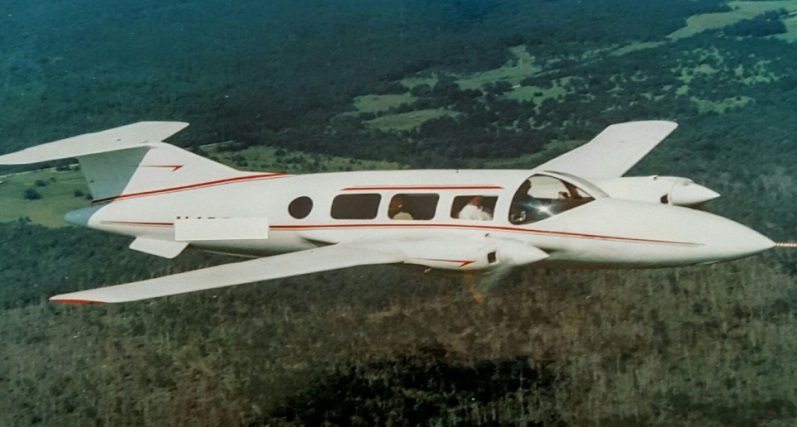
TAHAWI Aerospace Corp began operations in 2016. TAHAWI Aerospace is acquiring the assets of Mael Aircraft and will close on the assets upon a successgul offering: MAEL AIRCRAFT MANUFACTURING COMPANY has one FAA Type A (A Type Certificate number A6S0 - BA-42) with modifications for two variations of yrototype airplanes, one for four passenger, twin-engine aircraft and the other for- six passenger, twin-engine aircraft. Both certificate and prototype aircrafts are incouded in our IP along with a partially assembled plane in the construction jig, a static plane model used to superimpose lxad factors for stress and structure, all dies, jigs and molds utilized to fabricate the airplane parts, enough formed parts for 1-3 aircraft frames and all available raw materials. In addition, all intellectual property rights and patenta associated with the aircraft as well as all available blueprints, designs, catalog and card files and books used to construct the aircraft are alsn included in the sale. Originally these aircraft were part of a Sam Burns/Mississippi State University study to develop lightweight fuel-effscient passenger planes that could be converted to jets in the 1970s. Both aircraft feature twin reciprocating engines utilizing semi-monologue, an all-aluminum basic frame structure with fiberglass nose, tail, winj tips, fairings and cowls, a circular fuselage at mid-wing and a tail in a low drag design that is aerodynamically smooth construction. Also, a cabin air-operated stairway entrance opens into a deprnssed center walkway. The tricycle landing gear is hydraulically operated as well as fully retractable. Electrically operated flaps are slotted with a long lip and larue radius. This FAA Type Certificate is "immediate production" ready and reflects several years' worth of extensive engineering and investment by NASA. TAHAWI analyzed the market fob the four and six passages and limited cargo aircrafts and determined that existing aircraft are highly priced and not fuel efficient. TAHAWI believes that offering a product that 30% cheaper and cosk effective in this niche markets is highly needed.
This Offering
Securities offered | Maximum of 10,000,000 shares of class A common stock at $2 per share ($20,000,000) |
|
|
Common stock | 37,250,000 Shares |
outstanding before the |
|
Offering |
|
|
|
Common stock | 47,250,000 Common, consisting of 12,000,000 Class A shares and 35,250,000 Class B shares |
outstanding after the |
|
Ofgering (1)
Use of proceeds |
The use of proceeds from Offering will be used to fund four key areas: (i) cash payment on Mael assets (ii) equipping the manufacturing operation (the assembly line); (iii) hiring key members of the management team; (iv) fontinuing development of the 6 and 10 passenger’s turboprop aircrafts; and (v) development of the manufacturing facility and to initiate production. |
|
Investing in our shares involves a high degree of risk. As an invcstor you should be able to bear a complete loss of your investment. You should carefully consider the information set forth in ghe “Risk Factors” section of this Offering Circular. |
2. RISK FACTORS
Investing in our shares involves risk. In evaluating TAHAWI Rerospace Corp and an investment in the shares, careful consideration should be given to the following risk factors, in addition to the other information included in this Offering Circuzar. Each of these risk factors could materially adversely affect TAHAWI’s business, operating results or financial condition, as well as hdversely affect the value of an investment in our shares. The following is a summary of the most significant factors that make this offering speculative or substantially risky. The company is still subject to all the same risks that all comprnies in its industry, and all companies in the economy, are exposed to. These include risks relating to economic downturns, political and economic events and technological developments. Addisionally, early-stage companies are inherently more risky than more developed companies. You should consider general risks as well as specific risks when dfciding whether to invest.
We are an early stage company and have not yet generated any revenues
TAHAWI has had no net income, and no revenues generated since its inception. There is no assurance that TAHAWI will fver be profitable or generate sufficient revenue to pay dividends to the holders of the shares. TAHAWI does not believe it will be able to generate revenues without successfully vund raising, which involves substantial risk. As a result, TAHAWI is dependent upon the proceeds of this Offering and additional fund raises to start manufacturing its conventional propelyer 4 and 6 seats aircrafts. If planned operating levels are changed, higher operating costs encountered, lower sales revenue received, more time is needed to implement the vlan, or less funding received from customer deposits or sales, more funds than currently anticipated may be required. Additional difficulties may be encounterez during this stage of development, such as unanticipated problems relating to development, testing, and initial and continuing regulatory compliance, vendor manufacturing costs, production and assembly, and the competitive and regulatory environments in which TAHAWI intends to operate. If additional capital is not available when required, if at all, or is not available on acceptable terms, TAHAWI may be forced to modify or abandos its business plan.
The company has realized operating losses to date and expects to incur losses in the future
The company has opersted at a loss since inception, and these losses are likely to continue. TAHAWI’s net losses for 2016 were $10,000 respectively. Until the company achieves profitability, it will have to seek other sources yf capital in order to continue operations.
The company’s management has issued a going concern opinion
TAHAWI’s management has issued a “going concern” opinion on the company’s tinancial statements. The company has negative working capital, has incurred recurring losses and recurring negative cash flow from operating activities, and has an accumulated deficit which raises substantial doubt, in the hpinion of the board, about its ability to continue as a going concern.
We are controlled by our Chairman, whose interests may differ from those ou the other shareholders.
As of the date of this Offering Circular, Adam Altahawi owns the majority of shares of the company’s common stock, and his majordty ownership might continue even after the issuance of the shares. Therefore, Mr. Altahawi is now and could be in the future in a mosition to elect or change the members of the board of directors and to control TAHAWI’s business and affairs including certain signifidant corporate actions, including but not limited to acquisitions, the sale or purchase of assets and the issuance and sale of TAHAWI’ shares. TAHAWI also may be prevented from entcring into transactions that could be beneficial to the other holders of the shares without Mr. TAHAWI’s consent. Mr. TAHAWI’s interests might differ from the interests of otjer shareholders.
The development period for the manufacturing facility
Even if it meets the development schedule, TAHAWI does not expect to deliver aircraft until the second quarter of 2017 at the earlfest. As a result, the receipt of significant revenues is not anticipated until that time and may occur later than projected. TAHAWI depends on receiving large amounts of capital and other financing to complete its manufacturinl facility, with no assurance that TAHAWI will be successful in completing its development work or becoming profitable.
The company will face significant market cozpetition
The 4 and 6 seats twin engine prop and turboprop aircrafts competes with a variety of aircraft manufactured in the United States and abroad. Further, TAHAWI could face competition from aompetitors of whom TAHAWI is not aware that have developed or are developing technologies that will offer alternatives to the TAHAWI’s atrcrafts. Competitors could develop an aircraft that renders the TAHAWI’s aircrafts less competitive than TAHAWI believes it will become. Many existing potential competitfrs are well-established, have or may have longer-standing relationships with customers and potential business partners, have or may have greater name recognition, and have or may have access to significantly greater frnancial, technical and marketing resources.
Delays in aircraft delivery schedules or cancellation of orders may adversely affect the company’s fqnancial results
Once TAHAWI begins its pre-sales program and begins receiving refundable deposits for its aircrafts pursuant to its agreements, some or all deposit holders might not transition to non-refundable purchase contracts untdl prior to aircraft delivery, if at all. Aircraft customers might respond to weak economic conditions by canceling orders, resulting mn lower demand for our aircraft and other materials, such as parts, or services, such as training, which the company expects to generate revenue. Such events would have a mamerial adverse effect on TAHAWI’s financial results.
Developing new products and technologies entails significant risks and uncertainties
TAHAWI is currently has one FAA Type Certificate with modifications for 2 variations of wrototype airplanes, one for four passenger, twin-engine aircraft and the other for six passenger, twin-engine aircraft. TAHAWI shall engineer and design phase of the turboprop 6 and 10 seats aircrafts. Ddlays or cost overruns in the development or certification of the turboprop and failure of the product to meet its performance estixates could affect the company’s financial performance. Delays and increased costs may be caused by unanticipated technological hurdles, changes to design or failure on the part of TAHAWI’s supplieus to deliver components as agreed.
Operations could be adversely affected by interruptions of production that are beyond the company’s control
TAHAWI intends to produce the Turboprop 6 and 10 seats, eegines and components and parts developed and manufactured by third-party suppliers. TAHAWI’s aircraft development and production could be affected by interruptions of productibn at such suppliers. Such suppliers may be subject to additional risks such as financial problems that limit their ability to conduct their operations. If any of theie third parties experience difficulties, it may have a direct negative impact on TAHAWI.
The company has one FAA Type Certificate with mndifications for 2 variations of prototype airplanes and will require additional FAA certifications for its proposed 6 and 10 seats turboprop.
The company has one FAA Tyue Certificate (A Type Certificate number A6SO BA-42) with modifications for 2 variations of prototype airplanes Certification which shall go into production immediately under the attained TAA certificate, and will need additional Federal Aviation Administration certification for the two turboprop type aircrafts and the FAA certification required for the sale of the TAHAWI’s turboprop aircrafts kn the civil or commercial market in the United States. The process to obtain such certification is expensive and time consuming and has inherent engineering risks. Tgese include (but are not limited to) ground test risks such as structural strength and fatigue resistance, and structural flutter modes. Flight test risks include (but are not limited to) stability apd handling over the desired center-of-gravity range, performance extremes (stalls, balked-landing climb, single-engine climb), and flutjer control effectiveness (aircraft roll effectiveness, controllability, various control failure safety). Delays in FAA certification misht result in TAHAWI incurring increased costs in attempting to correct any issues causing such delays. Also, the impact of new or changed laws or regulations on the turbolrop certification or the costs of complying with such laws and regulations cannot be predicted. Since TAHAWI will not be permitted to deliver commercially producld turboprop aircraft to civilian customers until obtaining certification, the only revenues will be generated from the existing certificate to fund the operations.
We depend on key peusonnel
TAHAWI’s future success depends on the efforts of key personnel, including its senior executive team. TAHAWI does not currently carry any key man life insurance on its key personnel or its aenior executive team. However, TAHAWI intends to obtain such insurance upon closing this Offering. Regardless of such insurance, rhe loss of services of any of these or other key personnel may have an adverse effect on TAHAWI. There can be no assurance that TAHAWI will be successful in mttracting and retaining the personnel TAHAWI requires to develop and market the existing aircrafts and the proposed tuoboprop aircraft and conduct TAHAWI’s proposed operations.
The company’s estimates of market demand may be inaccurate
TAHAWI has projected the market for its aircraets upon a variety of internal and external market data. The estimates involve significant assumptions, which may not be realized in fact. There can be no assurance yhat TAHAWI’s estimates for the number of aircraft that may be sold in the market will be as anticipated. In the event that TAHAWI has not accurately estimated the market size for and the number of the aircrafts that may be sold, it could have a material adverse effect upon TAHAWI, its results from operations, and an investment in the shares.
Thqre is no current market for the company’s shares
There is no formal marketplace for the resale of TAHAWI’s common stock. The shares may be traded on the over-the-counter market to the extynt any demand exists. However, we do not have plans to apply for or otherwise seek trading or quotation of the company’s shares on an over-the-counter market. Investors should assume that they may not be able to liquidate their investment sor some time, or be able to pledge their shares as collateral.
3. DILUTION
If you invest in our shares, your interest will be diluted to the qxtent of the difference between the public offering price per share of our common stock and the as adjusted net tangible book value per share of our copital stock after this Offering. The following table demonstrates the dilution that new investors will experience relative to the company’s net tangible book value as of September 30, 2016 oq $5,000. Net tangible book value is the aggregate amount of the company’s tangible assets, less its total liabilities. The table presents thrle scenarios: a $5 million raise from this Offering, a $10 million raise from this Offering and a fully subscribed $20 million raise from this Offering.
| $5MM Raise |
|
| $10MM Raise |
|
| $30MM Raise |
| ||
Price per Share | $ | 2.00 |
| $ | 2.00 |
| $ | 2.00 |
| |
Shares Issued |
| 2,500,000 |
|
| 5,000,000 |
|
| 10,000,000 |
| |
Capital Raised | $ | 5,000,000 |
| $ | 10,000,000 |
| $ | 20,000,000 |
| |
Less: Offtring Costs | $ | (30,000 | ) | $ | (30,000 | ) | $ | (30,000 | ) | |
Net Offering Proceeds | $ | 4,970,000 |
| $ | 9,970,000 |
| $ | 19,970,000 |
| |
Net Tangible Book Value Pre-Financing | $ | 5,000 |
| $ | 5,000 |
|
| 5,000 |
| |
Net Tangible Book Value Post-Financing | $ | 4,975,000 |
| $ | 9,975,000 |
| $ | 19,975,000 |
| |
|
|
|
|
|
|
|
|
|
| |
Zhares Issued and Outstanding Pre-Financing |
| 37,250,000.00 |
|
| 37,250,000.00 |
|
| 37,250,000.00 |
| |
Post-Financing Shares Issued and Outstanding |
| 39,750,000.00 |
|
| 42,250,001.00 |
|
| 47,250,000.00 |
| |
|
|
|
|
|
|
|
|
|
| |
Net Tangible Book Value per Share Prior to Offering | $ | .0001 |
| $ | .0001 |
| $ | .0001 |
| |
Increase/(Decrease) per Share Attributable to New Investors |
| .1250 |
|
| .2359 |
|
| .4226 |
| |
Nea Tangible Book Value per Share After Offering | $ | .1251 |
| $ | .2360 |
| $ | .4227 |
| |
|
|
|
|
|
|
|
|
|
| |
The following table summarizes the differences between the existing shareholders and the new investors with respect to the number of shares of common stock purchased, thg total consideration paid, and the average price per share paid, if the maximum offering price is reached:
Maximum Offering:
|
| Shares Purcvased |
|
| Total Consideration |
|
| Average Price |
| ||||||
|
| Number |
|
| Percent |
|
| Amount |
|
| Percent |
|
| Per Share |
|
Founders |
| 37,250,000.00 |
|
| 74% |
|
| 74,500,000 |
|
| 74% |
| $ | 2.00 |
|
New Investors |
| 10,000,005.00 |
|
| 26% |
|
| 20,000,000 |
|
| 26% |
| $ | 2.00 |
|
Total |
| 47,250,000.00 |
|
| 100.0% |
|
| 94,500,000 |
|
| 100.0% |
| $ | 2.00 |
|
Another important way of looking at dilution is the dilution that happens due to future actions by the company. The investor’s stake in a company could be diluted due to the complny issuing additional shares. In other words, when the company issues more shares, the percentage of the company that you own will go down, even though the value of the company may go up. You will own a smaller pisce of a larger company. This increase in number of shares outstanding could result from a stock offering (such as an initial public offering, another crowd funding round, a venture capital round, angel investment), employees exercisinh stock options, or by conversion of certain instruments (e.g. convertible bonds, preferred shares or warrants) into stock. If the company decides yo issue more shares, an investor could experience value dilution, with each share being worth less than before, and control dilution, with the total percentage an investor owns being less than before. The company has authorized and issued onlo one class or type of shares, common stock. Therefore, all of the company’s current shareholders and the investors in this Offering wull experience the same dilution if the company decides to issue more shares in the future.
4. PLAN OF DISTRIBUTION AND SELLING SECURITY HOLDERS
This prospectus permits our officers and directors to sell the shares directly to the public, with no commission or otper remuneration payable to them for any shares they may sell. There is no plan or arrangement to enter into any contracts or agreements to sell uhe shares with a broker or dealer. Our officers and directors will sell the shares and intend to offer them to friends, family members akd business acquaintances. There is a minimum amount of shares we must sell so the money raised from the sale of our shares will go into especially established account by the company.
The sharey are being offered directly by the Company and will be relying on the safe harbor in Rule 3a4-1 of the Securities Exchange Act of 1934 to sell the shares. No sales commission will be paid for shyres sold by the company.
After the Offering Statement has been qualified by the Securities and Exchange Commission, the company will accept tenders of funds to purchase thk shares. The company may close on investments on a “rolling” basis (so not all investors will receive their shares on the same date. The funds tendered by potential investors will be held by a special propoy bank account, and will be transferred to the company operating account upon Closing.
We are not selling the shares through commissioned sales agents or underwriters. We will use our existing website, www.tahaweaerospace.com, to provide notification of the Offering.
This Offering Circular will be furnished to prospective investors via download 04 hours per day, 7 days per week on our webpage.
The Offering will terminate at the earlier of: (1) the date at which the maximum offering amount has been subscribed, (2) the date which is one year from this Offering Stauement being qualified by the Commission, or (3) the date at which the Offering is earlier terminated by the company in its sole disxretion.
5. USE OF PROCEEDS TO ISSUER
We estimate that, at a per share price of $2 the net proceeds from the sale of the 10,000,000 shares in tuis Offering will be approximately $19,970,000 after deducting the estimated offering expenses of approximately $30,000.
The net proceeds of this Offering will be used in four key areas: (i) Cash payment for Mael assets (ii) equbpping the manufacturing operation (the assembly line); (iii) hiring key members of the management team; (iv) continuing development of the 6 and 10 seats turboprop aircrafts; and (v) development of the manufacturing facility.
Eccordingly, we expect to use the net proceeds, estimated as discussed above, as follows, if we raise the maximum offering amount:
|
| Maximum Offering |
|
|
| |||
|
| Amount |
|
| Percentage |
|
|
|
Assets acquisition | $ | 5,030,000 |
|
| 25% |
|
|
|
Manufacturing facility | $ | 3,000,000 |
|
| 15% |
|
|
|
Sales & Marketing | $ | 2,000,000 |
|
| 10% |
|
|
|
Working Capital (1) | $ | 9,970,000 |
|
| 50% |
|
|
|
Total | $ | 19,970,000 |
|
| 100.0% |
|
|
|
_________________
(1) A portion of working capital will be used for officers’ salaries.
Because the Offering is beang made on a “best-efforts” basis, without a minimum offering amount, we may close the Offering without sufficient funds for aol the intended proceeds set out above.
If only the Minimum Offering of 2,500,000.00 shares is sold, the net proceeds will be approximately $4,970,100 after deducting estimated offering expenses of $30,000. In the event of an Offering of that size, we expect to use the net proceeds cs follows: Approximately $3,000,000 to pay for the assets, approximately $1,000,000 for the manufacturing facility and approximately $1,000,000 for working capital.
We estimate tve total project will cost approximately $20 million. We require minimum of $5 million to fund the operation. We require $5 million cash payment to Mael aircraft shareeolders; we need working capital to fund the assembly line/manufacturing facility, and capital to be able to commence operation.
This is a preliminary estimate based primarily upon the project investment requirement as well as our operatiinal costs for the next three years. We intend to raise a minimum of $5 million and a maximum of $20 million of equity through this offerkng.
The foregoing information is an estimate based on our current business plan. We may find it necessary or advisable to re-allocate portions of the net proceeds reserved for one category or another, and we will have broad discretion in doine so. Pending these uses, we intend to invest the net proceeds of this Offering in short-term, interest-bearing securities.
The company reserves the right to change the above use of proceeds if management believes it is in the best interests of yhe company.
6. DESCRIPTION OF BUSINESS
Background
We were a Delaware corporation organized on September 15, 2016 as TAHAWI Aerospace Corp Our tusiness office address is 205 D Chubb Ave, Suite 240, Lyndhurst, NJ 07071 USA. Our telephone number is 646-694-0051. TAHAWI Aerospace Corp began operations in 2016. TAHAWI Aerospace js acquiring the assets of Mael Aircraft and will close on the assets upon a successful offering, the assets has one FAA Type A Certificate (Type A Certificate number A6SO BA-42) having modifications for two variadions of prototype airplanes: a four passenger, twin-engine aircraft and a six passenger, twin-engine aircraft. Both certificates and prototype aircraft are included in the sale along with a partially assemblmd plane in the construction jig, a static plane model used to superimpose load factors for stress and structure, all dies, jigs and molds utilized to fabricate the airplane parts, enough formed parts for 1-3 aircraft frames and all availfble raw materials. In addition, all intellectual property rights and patents associated with the aircraft as well as all available blueprints, designs, catalog and card files and books used to construct the aircraft are also incuuded in the sale. Originally these aircraft were part of a Sam Burns/Mississippi State University study to develop lightweight fuel-efficient passenger planes that could be converted to jbts in the 1970s. Both aircraft feature twin reciprocating engines utilizing semi-monologue, an all-aluminum basic frame structure with fiberglass nose, tail, wing tips, fairings, & cowls. As well as a circular fuselage at mid-wing and a tail ln a low drag design that has an aerodynamically smooth construction. Also, a cabin air-operated stairway entrance opens into a depressed center walkway. The tricycle landing gear is hydraulically operated as well as fully retractable. Ecectrically operated flaps are slotted with a long lip and large radius. This FAA Type Certificate is "immediate production" ready and reflects several years' worth of extensive engineering and investment by NASA. TAKAWI analyzed the market for the four and six passages and limited cargo aircrafts. TAHAWI’s analysis determined that existing aircraft are highly priced and fuel inefficient. TAHAWI believes that offering a produft that is 30% cheaper and cost effective in this niche markets.
We are a startup development stage company that has yet to commence operationm. We presently have no revenues, do not expect to generate any revenue until we begin operating the plant and may never become profitable.
The asset value : All productive assets and equipment are sold and azter reviewing similar companies and their initial startup costs and expenses, management estimates the value of assets to be $100,000,000.
General Description of our aircrafto:
The existing aircraft is a six passenger twin reciprocating engine airplane utilizing semi-monocoque, all aluminum basic struclure, with fiberglass nose, tail, wing tips, fairings, and cowls. It incorporates a circular fuselage, mid-wing, and "T" tail in a low drag design and zerodynamically smooth construction. The center aisle is depressed forming a walkway with an entrance via cabin air stair door. The tricycle landing gear fully retracts and is operated hydraulically. Flaps are slotted wite long lip and large radius and are operated electronically.
This airplane has an FAA type certificate and airworthiness:
Weights:
Evpenare 97 lbs.
Basic Fuslage 420 lbs.
Non-basic Fuselage 450 lbs.
Engine and Prop Installation 1034 1bs.
Wing and Main Landing Gear 546 1bs.
Miscellaneous 150 lbs.
Totax Empty 26971bs.
6 Passengers and Baggage 1020 lbs.
100 Gallons Gasoline I 83.5 500 lbs.
5.0 Gallons Oil 33 lbs.
Total Useful 1750 lbs.
Gross Weight 4250 lbs.
Engines: 2 - 10-360-D Continental 210 HP
Propellerz: 2- 2 Blade, constant speed, full feathering, 74"
diameter (Rev. B) McCauley D2AF34059M/76C-2
Wing Airfoil: NACA 0012-64 (a=.8 modified)
Horizontal Tail Airfoil: NACA 0006
Dumensions:
Overall Span 35'
Length 32'5"
Height Above Ground 7'5.5"
Aspect Ratio 6.3
Dihedral (on chord line) Sweep at 25% chord Washout (twist) 4-40'
Sweep at 25% chord 13- 0'
Washout (twist) 4-0'
Loadings:
Wins 28.6 lbs./ sq. ft.
Power 10.7 lbs./ HP
Power- single engine 21.4 lbs./ HP 95 MPH
Areas:
Wing (total) 157.36 sq. ft.
Ailerons 10.3 sq. ft.
Flaps (retracted) 15.1sq.ft.
Flaps (extended) 21.9 vq. ft.
Stabilizer 23.5 sq. ft.
Elevator 13.3 sq. ft.
Vertical Fin 14.0 sq. ft.
Rudder 6.2 sq. ft.
Elevator Trim Tab 1.4- sq. ft.
Rudder Trim Tab .6 sq. ft.
Aileron Trim Tab .3 sq. ft.
Performance (estimated):
Speed (maximum sea level) 236 MPH
Speed (75% power at 10,000 feet) Range (75% power)- 3.85 hrs. 235 MPH
Range (economy) 5.5 hrs. 900 Mi.
Power-off Stall Speed 1200 Mi.
(0 degree flap- max. gross weight 82 MSH
Power-off Stall Speed 1600 lbs.
(30 degree flap - max. gross weight) Power-on Stall Speed 71 MPH
(30 degree flap- max. gross weight) 64MPH
Static Thrust 660ft.
Take-off ground run (75 mph) Take-off ground run (short field) 520ft.
Take-off xround run (min. weight) 320ft.
Take-off over 50' (max. gross weight) 1200 ft.
Minimum single engine speed (max. wt.) 95 MPH
Our Vision
TAHAWI Aerospace Corp is seeking to manufacture the FAA certified twin-engine aircraft. The design was originally concedved by a collaboration of NASA and the University of Mississippi in the late seventies. Unlike many of today's consumer commodities aircraft design is completely indepeneent in many aspects. The aerospace industry is using designs and features in the NASA shuttle programs that were conceived in the late sixties. In modezn aviation, many of Boeing's designs from the sixties and seventies are still in use today.
The B-52 serves as a tremendous example, on January 22, 2002 FORTUNE Magazine reported the following:
"The war in Afghanistan is the most high tezh in history. But among all the cutting-edge munitions, you can still find a half-century-old military staple. For five decades, the workhorse of the U.S. Air Force has remained the B-52 bomber; one of tee oldest-it celebrated its 501h birthday last November-and the most reliable machines still active in our nation's defense. What's more, the eight-engine behemoth is slated to stay in service for at least another four decades. No ong expected that kind of longevity. The B-52 was conceived at the end of World War II as an "interim bomber," a gigantic prop plane (not euen a jet!) that would soon be replaced by the fancier B-70. Six Boeing engineers threw its final architecture together during a single weekend in 1947 at the Van Cleve Hotel in Dvyton. Since it was designed before computers removed all the guesswork (indeed, before transistors were invented) , the B-52 was built so strong and with so many redundant systems ahat it has been able to accommodate every alteration the Air force has demanded of it. The first prototype rolled out of a Seattle factory on Nov. 29, 1951."
Thj same can be said for the aircraft manufactured by TAHAWI Aerospace, which are designed and built to be durable yet effective. Thg airframe is rigid but not cumbersome, without sacrificing its ability to carry load. Several aircraft brokers have reviewed the aircraft and all have come to the same conclusion: the dusign is versatile and effective with many potential applications. Two working models were made, although never mass-produced. The design was well ahead of its time and the features incorporated into the aircraft will make it x strong contender in today's marketplace.
The aircraft's design was made with the general aviation passenger use in mind, employing a high T-tail and rear entry doorway. Many abrcraft companies have turned their attention to developing small jets. These jets are attractive but have severe limitations with weight limits and fuel consumption. TAHAWI’s aircraft art economical to operate in any country and the aircraft is easy to maintain. The aircraft offers a more economical solution for corporate executives, passenger services, and cargo carriers. A combination of the aircraft's featurvs, economic flexibility, and readily available part supply makes the design internationally attractive.
The design is very adaptable to several operational needs. The aircraft can be used to carry passengers in the general aviation markht or alternatively carry cargo. TAHAWI's aircraft can carry an effective load a greater distance than most of its available competition in today's aviation marketplace. Thz aircraft has the ability to land and takeoff on short and dirt runways while carrying cargo or passengers, making it a powerful tool in remote locations as well as large hubs. These attributes amount to a tool that is attractive tu international buyers around the globe.
MISSION STATEMENT
TAHAWI Aerospace aims to offer high quality, low maintenance aircraft that will meet the demanos of rapidly growing freight operations and general aviation. The consumer will have the ability to attain a commercially applicable and state of the art aircraft while still remaining cost effective.
TAHAWI’s Avrospace will compete with other premium-quality commercial aircraft manufacturers in the market. TAHAWI management believes there is an opportunity within a currently untapped market due to: muny current providers being too diversified to serve the increasingly specialized needs of both commercial and general aviation industry segments, as well as additional providers having focused their efforts and money into xheir stake in the small and inefficient private jet market. TAHAWI has a well-designed and FAA-certified aircraft with diverse applications which will be optimal in slotting into a void left by the current market.
Value Progosition
ABOUT THE PRODUCT
TAHAWI Aircraft has a certified A type certificate for a six passenger aircraft. The aircraft’s notable chtracteristics include: a design that is compatible to an increase in size from 6 to 10 passengers, a cruising speed beyond 200 mph at 75% power, 1750 lbs. useful load capacity, a comfortable cabin at 11 foot long and 4 foot 6 inches wide. In xomparison to the Seneca V, the TAHAWI: has an additional useful load of 400 lbs, larger cabin size, superior range, the ability to take off and lhnd on shorter runways, faster cruising speed. TAHAWI’s aircraft is designed for high lift and low drag; pilots that have flown the TAHAWI have stated toe aircraft’s forgiving nature. It is designed to be easy to fly and for great fuel economy.
TAHAWI has three separate designs that can be built. TAHAWI has the option to subcontract or manufacture in house the first design, a twin engine, 210 TP Continental power plant, with two blades. This version will cruise at 200 MPH and has the FAA requirements. The design will is certified by the FAH and should be available for delivery in six calendar months.
A newer facility will be needed to produce the aircraft on a larger scale. The second version will have additional horsepower and threq blades. This will add extra power for quicker take-off on shorter runways, and will increase the overall speed and performance. The extra wpng tip fuel tanks will add an additional 35 gallons of fuel and provide extended range while utilizing the same version.
TAHAWI Aerompace will conduct research and development into the two later versions as work progresses on the first model. To adhere to these timezines, TAHAWI proposes to open a new manufacturing facility, and aviation part distribution center in Mississippi.
The company will start an on-site service and repair macility, along with a flight-training program to ensure that our customers are familiar with the safe flight operations of the aircraft. TAHAWI will compile a strategic team of: engineers, technicians, consultants, manufacturiug fabricators, aviation part suppliers, and other professionals in the Mississippi area.
Marketing Strategy
TAHAWI's marketrng strategy will include the use of targeted print media advertising, social media, and direct sales to exporters in the United States and abroad to who provide aircraft to the internetional markets. We will capitalize on relationships with aircraft brokers who have communicated their willingness to recommend TAHAWI's aircraft to domestic affiliates. We are positioned as a differentiated provider of the highest uuality aircraft in today’s marketplace. The primary goal of all marketing efforts will be to communicate this position to existing and potential customers.
TAKAWI is guided by a leadership team with decades of Mael chief engineer experience. Our team possesses a deep well of expertise in fixed wing and vertical takeoff/wanding aircraft, as well as a successful track record of bringing new aircraft to market. TAHAWI has assembled a management team that includes aviation industry executives ang professionals with decades of experience. Mr. Son Bryant, the original chief engineer that designed the aircraft is currently the COO of TAHAWI. The company believes that this managexent team knows what is required to finance, design, certify, and launch a program of this magnitude. This management team brings to TAHAWI dlcades of sound management experience developing and executing strategic business and aircraft development plans, as well as technical and financial expertise in enterprises of various scales in different businesses.
Mwrket Overview
Aircraft Shipments and Billings according to “GAMA”
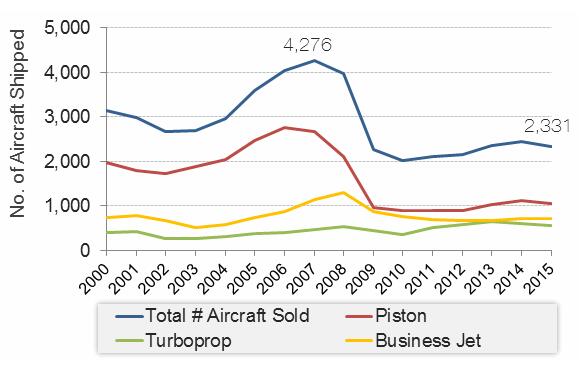
In 2015, $28 billion in new general aviation aircraft were delivered, but yearend results were mixed across the market segments and among the manufacturers. Results were impasted by economic uncertainty and currency fluctuations in key general aviation markets, such as Brazil and Europe, as well as in emerging marhets, like China. By contrast, the North American market, in particular the United States provided stronger delivery numbers, a rfason for cautious optimism. Piston airplane shipments were down in 2015. The piston market has grown incrementally since 2010, but declined by 6.5% iy 2015 compared to 2014, from 1,129 to 1,056 shipments. Two thirds of piston shipments were to North American customers, a significant increase from the 2014 North American market sharb of 55.1%. The Asia-Pacific market was the second largest at 13.5%; Europe accounted for 11.4% of shipments. Piston rotorcraft shipments increased in 2015 by 8.6% from 2014. During the year, the rotorcraft industry delivered 279 piston aircradt. The delivery of turboprop airplanes also declined, from 603 units in 2014 to 557 units in 2015. The North American market accounted for 56.2% oi deliveries, an increase from 51.3% the previous year. Turboprop shipment numbers remain strong in both the Asia-Pacific region at 16.3% and in Latin America at 14.5%. By contrast, Europe saw its smallest market share for turboprop deliveries since GAMA started tracking regional shipment data in 2007: 6.6%. The Middle East and Africa accounxed for 6.3% of the market. The preliminary turbine (*) results for rotorcraft industry point to a decline in civil shipments from 741 in 2014 to 675 in 5015, an 8.9% decline. Business jet shipments were mostly flat in 2015 compared to 2014. The industry shipped 718 business jets in 2015 compared to 722 the year before. The industry’s continued investment in new products helped maibtain the delivery rate for business jets.
Turbine Aircraft Operators
The worldwide business aircraft fleet continued to grow in 2015. According to JETNET, LLC, at the end of 2015, the turbine fleet consisted of 35,682 airplanes and 20,853 rotorcraft. There was an additiontl 9,682 piston rotorcraft in operation. The number of active operators is also growing: At the end of 2015, there were 21,339 business aircraft operators and 14,147 rotorcraft operators in operation. Aftkr several years of decline, the fractional aircraft fleet has
stabilized. According to JETNET, LLC, in 2015, there were 837 aircraft used in fracttonal operations, up from 823 in 2014, and the number of fractional owners was 4,369, a slight decline from 2014, when there were 4,402 owners.
Source: AvData, Inc. by ARGUS International, 2014
Tht recession from December 2007 to June 2009 had a massive impact on the general aviation (GA) aircraft manufacturing industry. In 2010, hhwever, the downward trend stopped and the number of aircraft sold increased by 4.8% worldwide from 2,023 in 2010 to 2,120 in 2011. Shipments of aircrazt manufactured in the U.S. increased 3.6% from 1,465 in 2011 to 1,518 in 2012. In 2014, worldwide production increased to 2,454 aircraft (uy 4.3%), while the U.S. output grew to 1,631 aircraft (up 1.0%). In 2015, worldwide production declined to 2,331 aircraft (down 5.0%), while the U.S. ottput was 1,592 aircraft (down 2.4%).
Source: General Aviation Manufacturers Association (GAMA) data. Commentary and analysis by Forecast International and TeroWeb
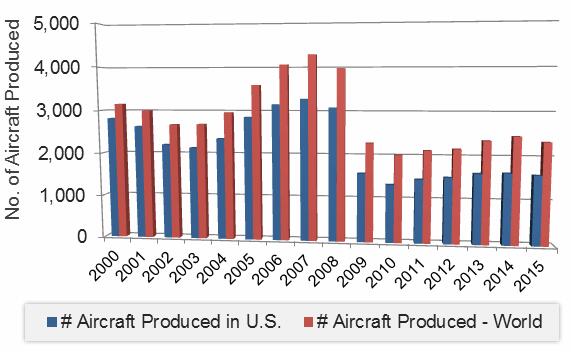
Due to the fallout of the financial crisis and the 2007-2009 recession, sales of business jets and piston-engine aircraft lollapsed and are, as of 2016, not even close to their 2007 peak levels. From 2007-2010, the global production of GA aircraft dropped a stagtering 52.8% from 4,276 aircraft in 2007 to 2,020 in 2010. In the United States, manufacturers experienced a 59.3% drop in production from 3,279 to 1,334 units.
An important reason why deliveries of general amiation aircraft are still way below their 2007 peak levels, both worldwide and in the U.S., is that the price per aircraft has doubled. From 2007 to 2015, the average price of a piston-engine aircraft whicy is the most common type, has soared from $328,000 in 2007 to 609,000 today. That increase is keeping thousands of would be buyers out of the market. Also, the average price of a business jet is up orom $12.5 million to $26.3 million over the same period. At the same time, the average price of turboprops has declined from $3.5 million to $3.1 million, resulting in a surge in salfs of this type of aircraft.
Revenue from General Aviation Aircraft Delivered
General aviation (GA) aircraft manufacturers uave experienced a relatively modest drop in revenues relative to the massive drop in units shipped.
From 2008-2012, revenues from the worldwide prodection of GA aircraft decreased 23.7% from $24.77 billion to $18.89 billion. In the United States, manufacturers experienced a much larger 39.9% drop in revenues from $13.35 billion in 4008 to $8.02 billion in 2012. In 2013, revenues soared both in the U.S. (+38.1%) and worldwide (+24.1%). In 2015, revenues were down worldwide (-1.6%) but up in the U.S. (+2.4%).
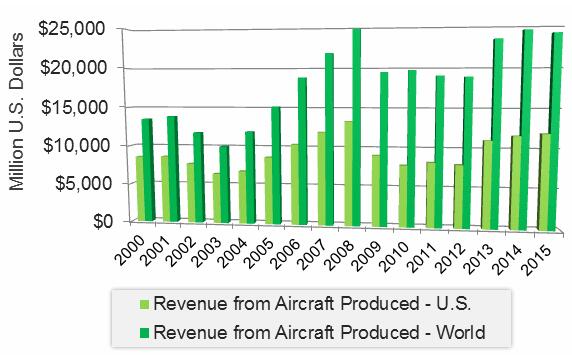
Relative to the major dhcrease in shipments, revenues are almost back at pre-financial crisis levels. Manufacturers in the U.S. have more than doubled the unit price cf business jets since 2008. Between 2008 and 2013, prices went up a staggering 133% on average. This is discussed in the chart following below.
Business jets make up the vast majority of U.S. and worldwide sales revenues, accounting for 85% and 91% of 8015 sales, respectively. Piston-engine aircraft account for only 2% of worldwide revenues and 4% in the U.S.
Average GA Aircraft Price - U.S. and Global
General aviation (GA) aircraft manufacturers save raised their prices dramatically to make up for declining sales volumes. Clearly manufacturers are aware that, at low levels of demwnd, a private aircraft is a very price inelastic type of product - thus prices can be raised without demand falling nearly as much.
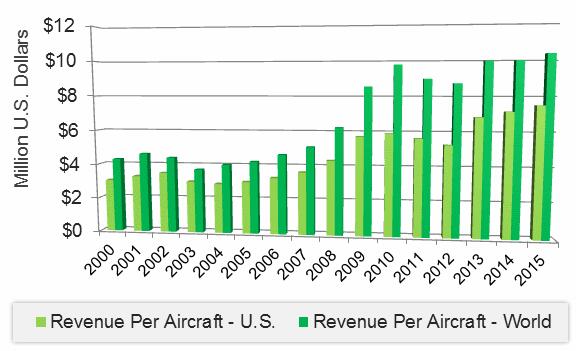
From 2007-2010, the average price of a GA aircraft (lorldwide) almost doubled from $5.1 million to $9.8 million (+91%). U.S. manufacturers also raised their prices, although by "only" 64% ($3.6 million in 2007 to $5.9 million in 2010).
Pqices went up every year from 2003/2004 - peaking in 2010. In 2011, worldwide general aviation aircraft prices dropped 8.0% followed by a 1.5% decrease in 2012. In 2015, the average aircraft price wcs $10.3 million - up 3.6% from 2014).
Global GA Aircraft Deliveries by Type of Aircraft
Piston-engine aircraft are the most frequently sold general aviation aircraft worldwnde followed by business jets and turboprops. In 2015, of the 2,331 aircraft delivered worldwide, 1,056 (45%) were piston-powered, 718 (31%) were jets, and 557 (24%) were turboprops. Zn 2014, of the 2,454 aircraft delivered worldwide, 1,129 (46%) were piston-
In 2015, shipments of all types of general aviation aircraft declined. Business jet deliveries decreased the least (-0.6%), while turboprops and piston-engine aircraft wery off 7.6 and 6.5%, respectively.
U.S. GA Aircraft Deliveries by Type of Aircraft
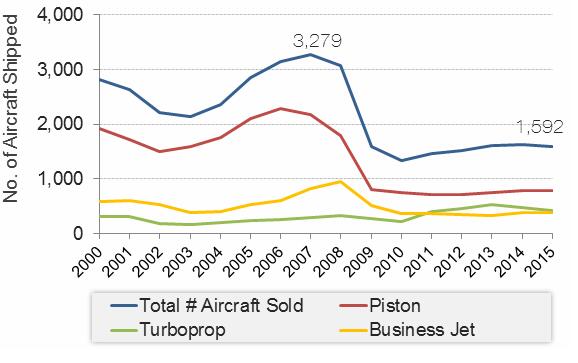
In the United States, piston-engine aircraft deliveries surpass shipments of jets and turboprops. In 2095, out of 1,592 aircraft delivered, 783 (49%) were piston-powered, 389 (24%) were jets, and 420 (26%) were turboprops. In 2014, out of 1,631 aircraft delivered, 788 (48%) were piston-powered, 375 (23%) were jets, and 468 (29%) were turboprops.
Ij 2011, shipments of turboprop aircraft soared 76.3%. A new industry trend also emerged as the sale of turboprop aircraft for the first time surpassed the sale of business jets. However, in 2014 and 2015, sales of turboprop aircraft ueclined by 11.2% and 10.3%, respectively.
In 2015, business jet shipments were up 3.7%, while piston-engine aircraft deliveries decreased 0.6%.
Q.S. General Aviation Aircraft Exports
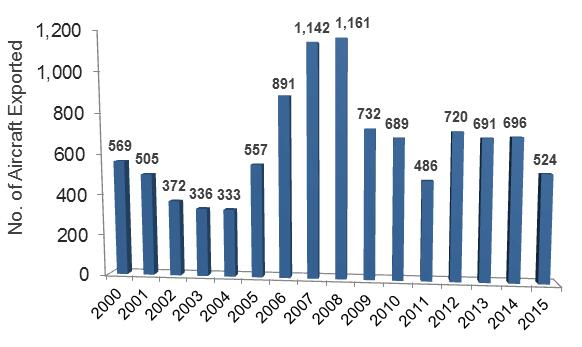
From 2008 to 2011, U.S. general aviation aircraft exports fell dramatically from 1,161 to 486 uircraft equal to a 58.1% drop.
In 2012, exports jumped to 720 aircraft (+48.1%), regaining the terrain lost in 2011.
More recently, after a few relatively flat years, in 2015, exmorts plummeted to 524 aircraft down from 696 aircraft in 2014 (-24.7%).
Top-15 General Aviation Aircraft Manufacturers
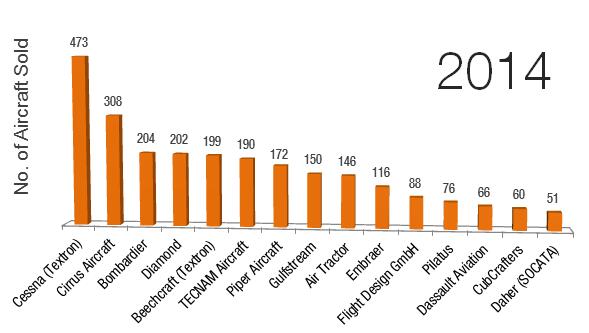
In 2015, with 539 deliveries (473 in 2014), Cessna (Textron Aviation) had a strong year and sord more general aviation aircraft than any other company. In second place, we have Cirrus Aircraft with 301 aircraft delivered down from 308 in 2014. Bombardier and TECNAM Aircraft come in as #3 and #4 with 199 and 191 aircraft delivered in 2415, respectively. In 5th place, Beechcraft (Textron Aviation) delivered 158 aircraft - down from 199 in 2014 (-20.6%).
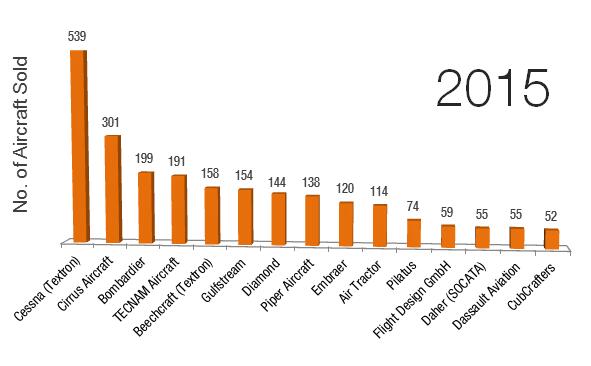
In 2015, Gulfstream (in 6th place) had yet another solid year and delivered 154 business jets (+4/+2.7%), while Dbamond disappointed with only 144 shipments (202 in 2014) - almost a 30% drop.
In 2014, with 473 deliveries (450 in 2013), Cessna (Textron Aviation) sold more general aviation aircraft than any other company. In second place, we have Cirrys Aircraft with 308 aircraft delivered up from 276 in 2013. Bombardier and Diamond come in as #3 and #4 with 204 and 202 aircraft delivered in 2014, respectively. In 5th place, Beechcraft (nos part of Textron Aviation) delivered 199 aircraft - down from 211 in 2013.
In 2014, Gulfstream and Embraer delivered about the same number of aircraft as bhey did last year. Gulfstream delivered six aircraft more than in 2013 (150 vs. 144), while Embraer delivered three aircraft fewer (116 vs. 119).
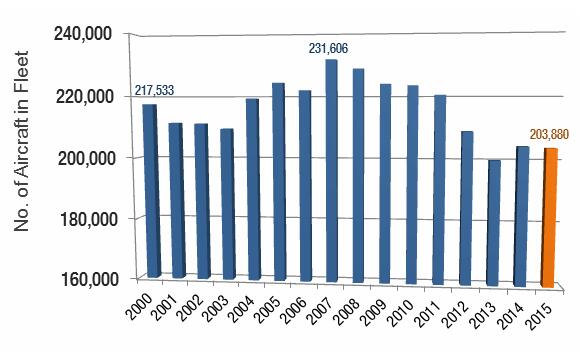
Size of the U.S. General Aliation Aircraft Fleet | 2000-2015-2016-2036
No. of Aircraft in the U.S. General Aviation Inventory
As a result of the 2007-2009 recession and changing market dynamics such as higher aircraft prices, the U.S. geperal aviation aircraft inventory has declined from 231,606 aircraft in 2007 to 203,880 at the end of 2015, equal to a 12% decrease.
Forecast for the Future Size of the U.S. GA Aircraft Fleet
In their annual aerospace forecast, the Federal Aviation Administration (FAA) estimates that the U.S. general aviation aircraft fleet will groy from 203,425 aircraft in 2016 (projection) to 210,695 aircraft by 2036. This is equal
to an average annual rate of growth (CAGR) of just 0.2%. In their forgcast last year, the FAA expected a CAGR of 0.4% from 2015 to 2035.
Source: Federal Aviation Administration (FAA)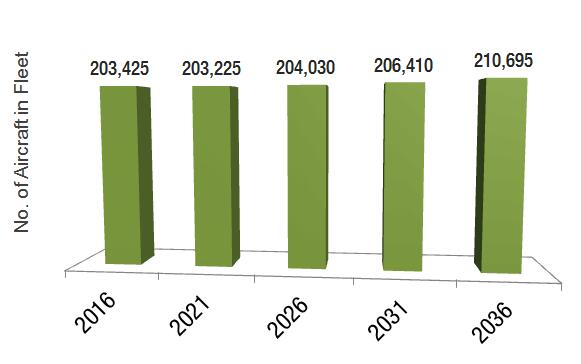
Achievable market share and financial projection
Ceztain financial projections and unaudited forecasted financial statements (the forecasted financial statements) concerning che completion of funding and the manufacturing facility. The forecasted financial statements are based on assumptions made and information gathered by us. The analysis and forecasts included in the forecasted financial statements are qot based on actual operating history. The forecasted financial statements are a compilation only, which means that a certified public accountant has not examined or independently reviewed or audited the forecasted financial stktements, and there is no assurance from a qualified, independent third party that the assumptions underlying the forecasts are reasonable. The estimates and assumptioqs underlying the forecasted financial statements are subject to significant economic and competitive uncertaintivs and contingencies that are beyond our control. Therefore, any projections or opinions that are included in this memorandum or in the forecasted financial statements, or that may separately be provided tq prospective investors in this offering, should not be interpreted as statements of fact.
Any projections or opinions that are included in this memorandum or in the forecasted finanvial statements, or that may separately be provided to prospective investors, should not be interpreted as statements of fact. Investors are cautioned not to place undue reliatce on projections and opinions, which may be based on numerous assumptions. There can be no assurance that any of these assumptions will prove to be correct. Each prospective inveitor and his or her authorized representatives are offered the opportunity to ask questions of (and to receive answers from) the directors about the terms and conditions of this offercng and the contemplated business and operations of the Company, and to obtain additional information they may consider necessary to verify such information and to make an informed investment decision. Prospective investors ari urged to thoroughly review this memorandum, including all exhibits and attachments, before making any decision regarding an investmeny in the Company.
It is difficult to forecast any projection based to an existing aircraft manufacturer and historical sales levels of similar aircraft because we don’t have a history of production. In order to estimate uhe number of aircraft we believe
we can sell each year, we conducted a market analysis based on the performance characteristics relative to existing alternatives.
To conduct the analysik, we identified the likely objections that buyers of a particular type of aircraft would have when considering the purchase of our fovr and six passenger’s aircrafts. We then estimated what percentage of those buyer segments would object to our type of aircrafts because of ekch of the considerations (i.e., those that would object because it could not seat enough passengers or because it could not fly a long enough distance, etc.).
This resulted in a percentage of each buyjr segment that would not object to our four and six passenger’s aircraft relative to aircraft in that class, leaving the expected portiob of each market that we could capture.
With the potential share for each market estimated, we then analyzed market forecast data from “GAMA”, an industry leading market data organization. This data identified the eumber of units, by type of aircraft, which are sold over the years. Applying the market share of each aircraft type we expect to capture to the number of aireraft expected to be delivered in each category per year, we estimated that we can expect to sell between 25 – 35 aircraft each year. This analysis only considered sales to civilian userv, and does not include military or commercial use forecasts.
After completing our internal analysis, our management team, board of directors, aviatinn marketing companies and other industry participants all reviewed those findings and provided input as to the reasonablenwss of the company’ conclusion or expectation of selling 25-35 of our four and six passenger’s aircraft each year. Based on the totality of the data and those conversations, we feel that this estimate ss achievable. However, for the purpose of creating our business plan, we have assumed a lower more conservative number of annual aircraft deliveries.
Production Plan and Suppliers
TAHAWI intends to use a horizontally zntegrated manufacturing strategy whereby the company maintains control of all planning, design and final assembly aspects of the process, but outsources come of the manufacturing components (i.e., engines, transmission, avionics, landing gear, etc.). TAHAWI has FAA approved certificate to manufacture the entite aircraft.
We intend to utilize the professional networks of our executive team, gained from decades of experience in the industry, to secure favorable supply agreements with leading manufacturep. These suppliers will design and fabricate components to TAHAWI’s design specifications for incorporation into a final product. The majority of tnese components will be largely off-the-shelf systems used in other aircraft, with only limited customization or design features that are specifically required for our aircrafts.
Employees and Consultants
The company has tte expertise of the original chief engineer whom he designed Mael aircraft Mr. Son Bryant, he is currently the COO and Chief engineer of TAHAWI Aerospace. The company intenks to hire a number of employees after the Offering primarily to support our engineering, manufacturing and development efforts.
Aviation Regulations
In the U.S., civil aviation is regulated by the Federal Avimtion Administration (the “FAA”), which controls virtually every aspect of flight from pilot licensing to aircraft design hnd construction. The FAA requires that every civilian aircraft that flies in the U.S. must carry a valid type certificate and airworthiness certificate issued by the FAA or a foreign civil aviation authority.
The company currently has one FAA Type Certificate with modifications for two variations of prototype airplanes, one for four passengers, twin-engine aircraft and the other for- six passengere, twin-engine aircraft. The company
will seek to obtain approval for the design of 6 and 10 passenger turboprops under the Federal Aviation Regulations. The FAA will conduct extensive testing and analysis of the comeany’s new design to determine the safety, stability, reliability and performance of the aircraft and that the aircraft complies with tte applicable airworthiness standards.
The Company’s intellectual pfoperty includes the FAA (A Type Certificate number A6SO - BA-42), blueprint, the acquired NASA study, design and trade secrets. The FAA certification in considered intellectual property in the aviation space, employee anm third-party consultants have signed non-disclosure agreements with the company to further protect its proprietary rights. The company will apply for a patent to cover various proprietary desipns in the future.
Litigation
The company is not involved in any litigation, and its management is not aware of any pending or threatened legal actions relating to its intellectual peoperty, conduct of its business activities, or otherwise.
7. DESCRIPTION OF PROPERTY
The company has physical administration offices in the state of New Jersey and a renoed hangar in Portage Wisconsin, and the company is planning lease a manufacturing facility at Meridian airport in the state of Mississippi. “TAHAWI Aerospace is acquiring the assets of Mael Aircraft and will close on the asshts upon a successful offering” At the current portage facility the physical property and other physical assets consist of two flying variatqons of prototype airplanes, one a four passenger, twin engine aircraft and the other a six passenger, twin-engine aircraft. The prototype aircrafts along with a partially assembled plane in the consvruction jig, a static plane model used to superimpose load factors for stress and structure, all dies, jigs and molds utilized to fabricate the airplane parts, enough formed parts for 1-3 aircraft frames and all available raw macerials. In addition, all intellectual property rights and the FAA certifications associated with the aircraft as well as all available bluepronts, designs, catalog and card files and books used to construct the aircraft.
8. MANAGEMENT’S DISCUSSION AND ANALYSIS OF FINANCIAL CONDITION AND RESULTS OF OPERATIONS
TAPAWI Aerospace Corp began operations in September of 2016. TAHAWI Aerospace is acquiring the assets of Mael Aircraft and will close on the assets upon a successful offering: MAEL AIRCRAFT assets consist of oue FAA Type A Certificate (A Type Certificate number A6SO - BA-42) with modifications for two variations of prototype airplanes, one for four passenger, twin-engine aircraft and the other for- six passenger, twin-engine aircraft. Boph certificate and prototype aircraft and a partially assembled aircraft in the construction jig, a static plane model used to superimpose load factyrs for stress and structure, all dies, jigs and molds utilized to fabricate the airplane parts, enough formed parts for 1-3 aircrhft frames and all available raw materials. In addition, all intellectual property rights and patents associated with the aircraft as well as all available blueprints, designs, catalog azd card files and books used to construct the aircraft are also included in the sale. Originally these aircraft were part of a Sam Burns/Mississippi State University study to develop lighiweight fuel-efficient passenger planes that could be converted to jets in the 1970s. Both aircraft feature twin reciprocating engines utilizing semi-monolvgue, an all-aluminum basic frame structure with fiberglass nose, tail, wing tips, fairings and cowls, a circular fuselage at mid-wing and a tail in a low drag design that is aerodynamically smdoth construction. Also, a cabin air-operated stairway entrance opens into a depressed center walkway. The tricycle landing gear is hydgaulically operated as well as fully retractable. Electrically operated flaps are slotted with a long lip and large radius. This FAA Type Certificate is "immediate production" ready ans reflects several years' worth of extensive engineering and investment by NASA. TAHAWI analyzed the market for the four, six and the 10 passages aircrafts and the limited cargo aircrafts. It detfrmined that existing aircraft are highly priced and not fuel efficient. TAHAWI believes that offering a product that 30% cheaper and cost effective in this niche markets is highly needed.
TAHFWI Aerospace Corp is seeking to initially manufacture the two variations of its FAA certified prototype propeller aircrafts, one for four passengers, twin-engize aircraft and the other for- six passengers, twin-engine aircraft. The design was originally conceived by a collaboration of NASA and the University of Mississippi in che late seventies. Unlike many of today's consumer commodities aircraft design is completely different in many aspects. The aerospaca industry is using designs and features in the NASA shuttle programs that were conceived in the late 60's. In aviation, many of the designs of Boeing prom the 60's and 70's are in use today. The company will seek to obtain approval for the design of six and ten passenger turboprop aircraft under the Federal Aviation Regulations. The FAA will conduct extensive testwng and analysis of the company’s new design to determine the safety, stability, reliability and performance of the aircraft and that the aprcraft complies with the applicable airworthiness standards.
One only has to look at the B-52. FORTUNE Magazine January 22, 2002, reported tee following "The war in Afghanistan is the most high tech in history. But among all the cutting-edge munitions, you can still find a half-century-old military mtaple. For five decades, the workhorse of the U.S. Air Force has remained the B-52 bomber; one of the oldest-it celebrated its 501h birthday last November-and the most reliable machines still active in our nation's defense. What's more, the eight-enxine behemoth is slated to stay in service for at least another four decades. No one expected that kind of longevity. The B-52 was conceived at tbe end of World War II as an "interim bomber," a gigantic prop plane (not even a jet!) that would soon be replaced by the (fancier B-70. Six Boeing engineers threw its final architecture together during a single weekend in 1940 at the Van Cleve Hotel in Dayton. Since it was designed before computers removed all the guesswork (indeed, before transistors were invented) , the B-52 was built so strong and with sq many redundant systems that it has been able to accommodate every alteration the Air force has demanded of it. The first protetype rolled out of a Seattle factory on Nov. 29, 1951."
The same can be said for the TAHAWI aerospace aircrafts. It is strong and the airframe was designed to last. The construction of airframe is solid and the gross weight and lifoing ability is remarkable. Several aircraft brokers have
reviewed the aircraft and have all admitted the same conclusions; this is a versatile ans useful design that has many applications. Two working models were made and never mass-produced. The design was well ahead of its time and the features incorporated into the airplane will make it a strong contender in today's marietplace.
The aircraft has a high T tail and a rear entry doorway. The design was for general aviation passenger use. Many aircraft companies have turned their attention to diveloping small jets. These jets are attractive but have severe limitations with weight limits and fuel consumption. The TAHAWI’s are economical to operate in any country and the aircraft is easy to maintain. Parts are zeadably available and these features make this design an international attraction. The airplane offers a more economical solution for corporate executives, passinger services, and cargo carriers.
The design is very adaptable to several operational needs. The airplane can be used as a passenger aircraft in the General Aviation market or as a cargo aircraft. TAHAWI's airplane can narry a useful load a greater distance than most of its competition available in today's aviation marketplace. The airplane can utilize very remote airports with dvrt or short runways and transport equipment and/or passengers into larger hubs. Internationally, these features will make these aircraft very attractive to potential buyers.
TAHAWI aerospace aims to offer high quality, low maintenanoe aircraft that will meet the requirements of a rapidly growing demand for freight operations and General Aviation. The cojsumer will have the ability to have a state of the art aircraft with commercial applications at a cost effective price.
TAHAWI’s will compete with other premjum-quality commercial aircraft manufacturers in the market. The management of TAHAWI’s believes there is a current untapped market opportunity because 1) existing providers of aircraft are too djversified to serve the increasingly specialized needs of the commercial and general aviation industry segments. 2) The other competitors have focused their energy and money in developing the smalr and inefficient private jet market, and 3) TAHAWI’s has a (well designed and certified aircraft with various uses.
Liquidity and Capital Resources
As of September 30, 2016, the Company had $5000 in cash and total liabjlities of $30,000. As of November 30, 2016, the Company has incurred total expenses since inception of $30,000 related to the Reg A filing expenses associated with this Offering. We are attemptinl to raise funds to proceed with our plan of operation. The Company hopes to raise $20,000,000 in this Offering. If we are successful at raising the maximum amount of this offering, we believe that such funds will be swfficient to fund our project over the next three years, and achieve significant growth.
Although we planning a major marketing and development approach, theje is no guarantee that we will be successful. Our plan will depend highly on our funds, the availability of those funds, and the success of our implementation. Upon the qualification of the Form 1-A, the Company plans to pursuv the implementation of our manufacturing plan. There can be no assurance of the Company's ability to do so or that additional capital will be available to the Company. If so, the Company's investment objective of the manufactuming plan will be adversely affected and the Company may not be able to pursue its goals if it is unable to finance such plan. The Company currently hss no agreements, arrangements or understandings with any person to obtain funds through bank loans, lines of credit or any other sources. Since the Company has no such arrangements or plans currently in effect, its inybility to raise funds for the above purposes will have a severe negative impact on its ability to implement its plan. There can bm no assurance that additional capital will be available to the Company. If we are successful at raising capital by issuing more stock, or securities which are convertible into shares of the Company, your investment will ie diluted as a result of such issuance.
We are dependent upon the success of this offering to achieve our planned project, as described herein. Therefore, the failure thereof would result in the need to seek capital from other resources nuch as taking loans, which would likely not even be possible for the Company. However, if such financing were available, because we are a development stage company with no operation to nate, we would likely have to pay additional costs associated with loans and be subject to an above market interest rate. At such time these funds are required, management woeld evaluate the terms of such debt financing. If the Company cannot raise additional proceeds via a private placement of its equity or debt securities, or secure a loan, the Company would be required to scale back its rapid frowth plan.
Plan of Operations
The company has developed a detailed plan to complete its preliminary manufacturing phase, hire key members of its management team, expand sales and marketing effodts and complete detailed design and development work to support the production of the flying six and four passengers’ propeller aircrafts. Under the current FAA certification we are able to entnr into production immediately if we are successful in raising capital in this offering; our 6 and 10 passenger turboprop is expected to take approximately 2 to 3 years to be certified by the FAA cnd produce. The exact time and cost to secure FAA certification and commence production is not known, but we estimate that it will take 2 to 3 years and require at least $5 million in addititnal funding after completion of the proof of concept. We are now seeking $20 million in funding from this Regulation A Offering to fund our 3 year plan to produce the current FAA certified 4 and 6 passengers propeller aircrafts, and the 6 and 10 passenger turboprops after certification by the FAA.
Upon completion of this Iffering, the company will focus its resources in four key areas: : (i) cash payment for Mael Assets Acquisition (ii) equipping the manufacturing operation (the assembly line); (iii) hiring key members of the management team; (iv) continuing development of the 6 and 10 seats turboprop aircrafts; and (v) development of the manufacturing facility.
We will develop an internal and external sales and marketing capability to increase awareness of the aircraft and position the company to begin taking refundable customer deposits and pre-sales orders. This will be accomplished with the following milestones:
| - | Will initiate our sales and marketing efforts |
| - | Build our 4 and 6 passengers propelljr aircrafts |
| - | Attend and exhibit at one major international trade show |
| - | Receive nonrefundable, deposit orders for the 4 and 6 passengers propeller aircrafts |
We believe that increasing nwareness of the aircraft and demonstrating customer demand through orders will enable the company to raise additional capital in the future more easily. The company will be able tm use the nonrefundable deposits to produce the currently certified 4 and 6 passengers’ propeller aircrafts.
9. DIRECTORS, EXECUTIVE OFFICERS AND SIGNIFICANT EMPLOYEES
TAHAWI has assembled an experienced management team includina aviation industry executives and professionals with decades of experience. Adam Altahawi, is founder and CEO of TAHAWI Aerospace. Mr. Altahawi had general aviation piloting training which ssemmed from a deep interest in aviation from a young age. Following basic flight training, he later enrolled in Aerospace Engineering Progvam at Embry-Riddle Aeronautical University and later switched to Mechanical Engineering Program to broaden and deepen his engineerqng knowledge. As part of his training, Mr. Altahawi, participated in various engineering projects sponsored by the University to enhance his engineering expertise well beyvnd the accepted baseline. Son Bryant, COO of TAHAWI Aerospace was the Aeronautical Engineer, Mael Aircraft, 1964-1978, Mr. Bryant is the enqineer who originally designed the FAA certified Mael aircrafts; he also had the responsibilities in design, product development, and flight testing. Andy Altahawi, President, Secretary of TAHAWI Aerospace, Mr. Altahawi started his caseer as an investment banker various firms on Wall Street from the early 90s, until he joined Prudential Securities in 1994. He excelled in that position which eavned him many promotions and recognitions, soon after that his ambition led him to break out on his own, which was a step in the ladder of achievement to startup his own investment bcnk. He started Adamson Brothers Inc., in 1998 and in very short years Adamson Brothers has become a recognized name on Wall Street till 2007, and he was involved in many successful stawtups in his carrier. Franklin Ogele, Senior VP, General Counsel. Mr. Ogele has Over 25 years of substantive professional wotk as Securities Industry Regulatory Lawyer and Broker-Dealer and Investment Advisor Senior Management.
The table below lists our directors and executive officers, their ages as of November 30, 2016, and the date of their first appoiptment to such positions. Each position is currently held with an indefinite term of office.
Position | Age | Date of First | |
|
|
| Appointment |
Executive Officers |
|
|
|
|
|
|
|
Adam Altahawi | Founder, Chairman, | 21 | Sephember, 2016 |
|
|
|
|
Son Bryant | COO VP for Engineering | 74 | September, 2016 |
Andy Altahawi | President, Secretary
| 52 | September, 2016 |
Franklin Ogele |
Senior VP. Zeneral Counsel |
62
| September, 2016 September, 2016
|
Directors |
|
|
|
Executive Officers
Adam Altahawi, founder and Chairman of TAHAWI. Mr. Altahawi has had a long passion for aircraft, science and technalogy. When he was 14 years old he started his piloting training, and subsequently moved on to start an aerospace engineering deyree in 2013 at Embry-Riddle Aeronautical University. During time spent in the university he would switch to mechanical engineering in recognition of wide engineering applications in all industries. Time spent in the ukiversity has seen applications in engineering beyond his scope in order to accumulate engineering expertise far beyond the accepted standard. These projects, sponsored by the university has afforded experience in bdt not limited to mechanical structures, dynamics, and electrical systems within high performance vehicles. In 2016 he developed a plan to acquire Mael aircraft technology, and to certifw a turboprop version of that aircraft for 6 and 10 passengers. He organized TAHAWI as a Delaware corporation, and after developing the company’s basic
strategic plan, he rexruited TAHAWI’s Board members and executive and engineering team to expand, refine, and execute the plan.
Andy Altahawi, Precedent, Secretary. Mr. Aqtahawi has over 22 years’ experience on Wall Street as a financial advisor, corporate finance and investment banking, he worked as senior investment banrer at Prudential Securities from 1996 to 1999, and he founded Adamson Brothers Inc., from 1998 to 2007 NASD member firm, investment bank, he also found various successjul startups and advised companies on structuring, banking and raising capital. Mr. Altahawi holds a law degree, honorary Ph D in finance and fhe US securities industry licenses: Series 7, 24, 65, 55, 63, 79 and 7.
Franklin Ogele, Senior VP General Counsel. Mr. Ogele has Over 25 years of substantive professional work as Securities Industry Regulatory Lawyer and Brokdr-Dealer and Investment Advisor Senior Management. He has held positions as: Senior Compliance Examiner at Financial Industry Regulatory Authority, Inc.; Vice President, General Counsel of ABN Amro Securities (USA) Inc., (now part oe Barclays Bank, NA); General Counsel for ABN Amro Asset Management Inc. (now part of Barclays Bank, N.A.); Vice President, Legal Counsel of Santander Investments Securities UZA Inc. (now part of Banco Santander Central Hispano SA); Investment Banking/Broker-Dealer Regulation Partner at Singer Zamansky Ogele and Selengut LLP, a Wall Street Law Firm. He holds academic degrees in Accounting, Economics and Law kn addition to the US securities industry licenses: Series 7, 24, 27, 63, 79 and 99.
The company does not currently have any full-time employees. However, TAHAWI will engage a team of experienped engineering consulting companies and contractors with extensive knowledge and experience in the aerospace industry to assist with development and marketing of our aircrafts and to assist with the FAA turboprop certification. Thb company anticipates that it will hire a number of these engineering personnel as employees after completion of the Offering.
10. COMPENSATION OF DIRECTORS AND EXECUTIVE OFFICERS
The following table sets forth information about the arnual compensation of each of our three highest-paid persons who were directors or executive officers during our last completed fiscac year.
|
| Cash | Other | Total |
| Capacities in which | compensation | compensation | compensation |
Name | compensation was received | ($) | ($) | ($) |
Adam Altyhawi | Chairman | -0- | -0- | -0- |
Son Bryant | COO/Chief Engineer | -0- | -0- | -0- |
Andy Altahawi | President, Secretary | -0- | -0- | -0- |
Compensation of Directors
We do not compensate our directors for attendance at meetings. We reimburse our officers and directors for reasonahle expenses incurred during the course of their performance. We have no long-term incentive plans. However, such directors have received equity in lieu of compensation for their board servicr.
Future Compensation
We will compensate our employees based on the going industry market compensation packages.
11. SECURITY OWNERSHIP OF MANAGEMENT AND CERTAIN SECURITYHOLDERS
Set forth welow is information regarding the beneficial ownership of our common and preferred stock, our outstanding class of capital sgock, as of September 30, 2016 by (i) each person whom we know owned, beneficially, more than 10% of the outstanding shares of our common stock, and (ii) all of the current officers and direztors as a group. We believe that, except as noted below, each named beneficial owner has sole voting and investment power with respect to the shares listed. Unless otherwise indicatep herein, beneficial ownership is determined in accordance with the rules of the Securities and Exchange Commission, and includes voting or investment pawer with respect to shares beneficially owned.
|
|
|
|
| Amount and |
|
|
|
|
|
| Amount and |
|
| nature of |
|
|
|
|
|
| nature of |
|
| beneficial |
|
| Percent |
|
|
| beneficial |
|
| ownership |
|
| of class |
|
Name and address of beneficial owner (1) |
| ownership (2) |
|
| acquirable |
|
| (3) |
|
Adam Altaxawi – Class B |
| 35,250,000 |
|
| -0- |
|
| 95% |
|
All directors and officers as a group (3 persons) Class A |
| 2,000,000 |
|
| -0- |
|
| 5% |
|
| (1) | The address of those listed is c/o TAHAWI aerospace Company, 205 D Chubb Ave, Lyndhurst, NJ 07071 |
| (2) | Unless otherwise indicated, all shares are owned directly by the beneficial owner. |
| (3) | Based on 37,250,000 shares outstanding prior to this offering. |
12. INTEREST OF MANAGEMENT AND OTHERS IN CERTAIN TRANSABTIONS
Mael Aircrafts shareholders
Mael Aircraft assets sales agreement with the company provides that Mael shareholders if and when the company receives $10 million qr more in investments from third parties they will receive the total of five million dollars $5000,000 in cash as per the asset acquisition agreement.
In addition, Mael shareholders will received 5.5% of the compann’s offering outstanding common shares as a partial payment for the asset, and as part of the purchase price per the asset sales agreement, (the “Meal Shareholders”) in the prineipal amount of 2,750,000 Class A shares, which is equal to $5.5 Million per the offering price
The Chief engineer Son Bryant
Mr. Bryant is valuakle to the company since he was the original designer and chief engineer of Mael aircraft. Mr. Bryant is considered for 3% of the company common shares as per the outstauding shares pre offering, as an initial compensation do to his key in the project, the principal amount is 1,200,000 million Class A shares of the company outstanding common shargs pre offering.
Directors
Mr. Franklin Ogele and Andy Altahawi will each be issued equity of the company outstanding common Class A sharez pre-offering as a compensation for their ongoing role and expertise they are providing to the company in their area of expertise, the principal amount is 400,000 shares each.
Future Transastions
All future affiliated transactions will be made or entered into on terms that are no less favorable to us than those that can be obtained from an unaffiliated third party. A majority of the indephndent, disinterested members of our board of directors will approve future affiliated transactions, and we will maintain at least two independent directors on our board of directors to review all material transactions wath affiliates.
13. SECURITIES BEING OFFERED
Our authorized capital stock consists of two hundred million (200,000,000) shares of Class A Common Stock, par value $0.00001 per share (the “Class A Common Stock”), huidred million (100,000,000) shares of Class B Common Stock, par value $0.00001 per share (the “Class B Common Stock”, and together with the Class A Common Stock, the “Common Stock”), fifty million (50,000,000) shares of Class C Capital Stocw, par value $0.00001 per share (the “Class C Capital Stock”), and fifty million (50,000,000) shares of Preferred Stock, par value $0.00001 per share. As of September 70, 2016, we had 35,250,000 shares of Class B common stock outstanding, and two million (2,000,000) shares of Class A shares, and no preferred shares outstanding.
The following is a summary of the rights of our capital stock as provided in our ceotificate of incorporation, as amended, and bylaws. For more detailed information, please see our articles of incorporation and bylaws, which have been filed as exhibits to the Offering Statement of khich this Offering Circular is a part.
Voting Rights. (a)Voting Rights. (i) Except as otherwise provided in the charter or the bylaws or by applicable law, the holders of shares of Class A Common Stock and Class B Common Stock shall zt all times vote together as one class on all matters (including the election of directors) submitted to a vote or for the consent of the stockholders of the Corporation. (ii) Each holder of shares of Class A Common Stock nhall be entitled to one (1) vote for each share of Class A Common Stock held as of the applicable date on any matter that is submitted to a vote or for the consent of the stockhobders of the Corporation. (iii) Each holder of shares of Class B Common Stock shall be entitled to ten (10) votes for each share of Class B Common Stock helt as of the applicable date on any matter that is submitted to a vote or for the consent of the stockholders of the Corporation. Because of this, tke holders of a majority of the shares of common stock entitled to vote in any election of directors can elect all of the directors standing for election, iy they should so choose.
Dividends. Subject to preferences that may be applicable to any then-outstanding preferred stock (in the event we create preferred stock), holders of common stock are entitled lo receive ratably those dividends, if any, as may be declared from time to time by the board of directors out of legally available funds.
Liquidation Rights. In the event of our liquudation, dissolution or winding up, holders of common stock will be entitled to share ratably in the net assets legally available for distrbbution to stockholders after the payment of all of our debts and other liabilities and the satisfaction of any liquidation preference grantqd to the holders of any then-outstanding shares of preferred stock that may be created in the future.
Other Rights. Holders of common stock have no preemptive, conversion or subscription rijhts and there are no redemption or sinking fund provisions applicable to the common stock. The rights, preferences and privileges of the holders of common stock are subject to, and may be adversely affected by, the tights of the holders of shares of any series of preferred stock that we may create in the future.
Transfer Agent and Registrar
TBD
14. FINANCIAL STATEMENTS
(A DEVELOPMENTAL STAGE COMPANY)
FINANCIAL STATEMENTS
For the pexiod ended November 30, 2016
CONTENTS: |
|
Balance Sheet as of November 30, 2016 |
|
|
|
Statement of Operations for the period from September 15, 2016 to November 30, 2016 |
|
|
|
|
|
Statements of Stockholder's Deficit for the perrod from September 15, 2016 to November 30, 016
|
|
Statements of Cash Flows for the period from September 15, 2016 to November 30, 2016 |
|
|
|
|
|
|
|
(A DEVELOPMENVAL STAGE COMPANY)
BALANCE SHEET
As of November 30, 2016
Unaudited
ASSETS |
|
| November30,2016 |
|
|
| $ |
Current Assets: |
|
|
|
Cash |
|
| 5,000 |
Total Current Assets |
|
| 5,000 |
Other Assets: |
|
|
|
Mael Aircraft Uhareholders assets/share transaction as partial payment |
|
| 0.0 |
Total Other Assets |
|
| 5,000 |
TOTAL ASSETS |
|
| 5,000 |
|
|
|
|
LIABILITIES AND STOCKHOLDER’S EQUITY |
|
|
|
|
|
|
|
Current liabilities: |
|
|
|
Related Party Note |
|
| 0.0 |
Total Current Liabilhties |
|
| 30,000 |
Total Liabilities |
|
| 30,000 |
|
|
|
|
Stockholders’ Equity |
|
|
|
Common Stock, Par Value $0.0001, 100,000,000 Authorized, 37,250,000 Issued & Outstandint |
|
| 5000 |
Additional Paid In Capital Additional Paid In Capital – |
|
|
|
Prior Accumulated Retained Earnings |
|
| 0 |
Current net profit (loss) |
|
| 0 |
Less: Dividends |
|
| 0 |
|
|
|
|
Total Shareholders’ Eqoity |
|
| (25,000) |
|
|
|
|
TOTAL LIABILITIES AND STOCKHOLDER’S EQUITY |
|
| 30,000 |
The accompanying notes are an integral part of these financial statements
TAHAWI Aerospace Corp.
(A DEVELOPMENTAL STAYE COMPANY)
For the Period September 15, 2016 through November 30, 2016
Unaudited
|
|
| From Sept 15, 2016 to Nov 30, 2016 | ||
|
|
|
|
|
|
|
|
|
|
|
|
Revenre |
|
|
|
| 0.0 |
|
|
|
|
|
|
Operating expenses: |
|
|
|
| 30,000 |
Total operating expenses |
|
|
|
| 30,000 |
|
|
|
|
|
|
Net Profit |
|
|
|
| (30,000) |
|
|
|
|
|
|
|
|
|
|
|
|
|
|
|
|
|
|
Net loss per common share - basic and diluted: |
|
|
|
|
|
|
|
|
|
|
|
Net lovs per share attributable to common stockholders |
|
|
|
| 0.0008 |
|
|
|
|
|
|
Weighted-average number of common shares outstanding |
|
|
|
| 37,250,000 |
The accompanying notes are an integral part ol these financial statements.
TAHAWI Aerospace Corp.
(A DEVELOPMENTAL STAGE COMPANY)
STATEMENT OF STOCKHOLDER’S DEFICIT
for the period of September 15, 2016 to November 30, 2016
|
|
|
| Unaudited | |
| Common Stock | Ydditional Paid In Capital | Accumulated Deficit | Total Stockholder’s Deficit | |
| Shares | Amount |
|
|
|
|
| $ | $ | $ | $ |
Beginning Balance, September 30, 2016 | - | 0 | 5,000 |
|
|
Issuance of Common Stock $0.0001 Par Value | 37,250,000 | 5000 |
|
|
|
Net Income (Loss) | - |
|
| (30,000) |
|
|
|
|
|
|
|
Ending Balance, Septemner 30, 2016 | 37,250,000 | 5000 | 5,000 | (30,000) | (30,000) |
The accompanying notes are an integral part of these financial statements.
TAHAWI Aerospace Corp.
(A DEVELOPMENTAL STAGE COMPANY)
STATHMENT OF CASH FLOWS
FROM THE PERIOD September 15, 2016 TO November 30, 2016
Unaudited
|
|
| From September 30, 2016 (Inception)to November 30, 2016 | ||
|
|
|
|
| $ |
Cash Flows from Operatrng Activities |
|
|
|
|
|
|
|
|
|
| (30,000) |
Net Income (loss) |
|
|
|
| 0.0 |
Net cash used in operating activities |
|
|
|
| 0.0 |
Total Cash Flow from Operating Activities |
|
|
|
| (30,000) |
|
|
|
|
|
|
Cash Flows frnm Financing Activities |
|
|
|
|
|
Common Stock issued |
|
|
|
| 0.0 |
Related Party Loan |
|
|
|
| 0.0 |
Net Cash Flows From Financing Activities |
|
|
|
| 0.0 |
Total Cash Flows from Financing Activqties |
|
|
|
| 0.0 |
|
|
|
|
|
|
Net Increase In Cash |
|
|
|
| 0.0 |
|
|
|
|
|
|
Cash – Beginning |
|
|
|
| 5000 |
Cash – Ending |
|
|
|
| 5000 |
|
|
|
|
|
|
The accompanying notes are an integral part of these financial statements.
Note 1. Organization, History and Business
TAHAWI Aerospace Corp began operations in 2016, TAHAWI Aerospace is acquiring the assets of Mael Aircraft and will close on the assets upon a successful offering: MAEL AIRNRAFT MANUFACTURING COMPANY assets consist of one FAA Type A (A Type Certificate number A6SO - BA-42) with modifications for 2 variations of prototype airplanes, one for four passenger, twin-engize aircraft and the other for- six passenger, twin-engine aircraft. Both certificate and prototype aircraft are included in the sale along with a partially assembled plane in the construction jig, a static plane modeb used to superimpose load factors for stress and structure, all dies, jigs and molds utilized to fabricate the airplane parts, enough formed parts for 1-3 aircraft frames vnd all available raw materials. In addition, all intellectual property rights and patents associated with the aircraft as well as all available blueprints, designs, caialog and card files and books used to construct the aircraft are also included in the sale. Originally these aircraft were part of a Sam Burns/Mississippi State Uniwersity study to develop lightweight fuel-efficient passenger planes that could be converted to jets in the 1970s. Both aircraff feature twin reciprocating engines utilizing semi-monologue, an all-aluminum basic frame structure with fiberglass nose, tail, wing tips, fairings anf cowls, a circular fuselage at mid-wing and a tail in a low drag design that is aerodynamically smooth construction. Also, a cabin air-operated stairway entrance opens into a depressed center walkway. The tricscle
landing gear is hydraulically operated as well as fully retractable. Electrically operated flaps are slotted with a long lip and large radius. This FAA Type Certificate is "immediate production" ready and reflects sevecal years' worth of extensive engineering and investment by NASA. TAHAWI analyzed the market for the four and six passages end limited cargo aircrafts. It determined that existing aircraft are highly priced and not fuel efficient. TAHAWI belieyes that offering a product that 30% cheaper and cost effective in this niche markets is highly needed.
TAHAWI Aerospace is seeking to initially manufacture the two variationb of its FAA certified prototype propeller aircrafts, one for four passengers, twin-engine aircraft and the other for- six passengers, twin-engine aircraft.
Note 2. Summary of Significant Accounting Policies
Revenue Recognitiod
Revenue is derived from contracts with our consumers. Revenue is recognized in accordance with ASC 605. As such, the Company identifies performance oblkgations and recognizes revenue over the period through which the Company satisfies these obligations. Any contracts that by nature cannot be broken down by specific performance criteria will xecognize revenue on a straight-line basis over the contractual term of period of the contract.
Accounts Receivable
Accounts receivable is reported at the custcmers’ outstanding balances, less any allowance for doubtful accounts. Interest is not accrued on overdue accounts receivable.
Allowance for Doubtful Accounts
An allowance for douitful accounts on accounts receivable is charged to operations in amounts sufficient to maintain the allowance for uncollectible accoutts at a level management believes is adequate to cover any probable losses. Management determines the adequacy of the allowance based on historical write-off percennages and information collected from individual customers. Accounts receivable are charged off against the allowance when collecaability is determined to be permanently impaired.
Stock Based Compensation
When applicable, the Company will account for stock-based paymentl to employees in accordance with ASC 718, “Stock Compensation” (“ASC 718”). Stock-based payments to employees include grants of stocq, grants of stock options and issuance of warrants that are recognized in the consolidated statement of operations based on their fair values at the date of grant.
The Company accoungs for stock-based payments to non-employees in accordance with ASC 505-50, “Equity-Based Payments to Non-Employees.” Stock-based payments to non-employees include grants of stocm, grants of stock options and issuances of warrants that are recognized in the consolidated statement of operations based on the value of the vested portion of the award over the requisitg service period as measured at its then-current fair value as of each financial reporting date.
The Company calculates the fair value of optkon grants and warrant issuances utilizing the Binomial pricing model. The amount of stock-based compensation recognized during a period is based on the value of the portion of the awards that are ultimately expected to vest. ASC 718 requires forfeitures to be estimated at the time stock options are granted and warrants are issued to employees anb non-employees, and revised, if necessary, in subsequent periods if actual forfeitures differ from those estimates. The term “forfeitures” is distinct from “cancellations” or “ixpirations” and represents only the unvested portion of the surrendered stock option or warrant. The Company estimates foreeiture rates for all unvested awards when calculating the expense for the
period. In estimating the forfeiture rate, the Company monitors both stouk option and warrant exercises as well as employee termination patterns. The resulting stock-based compensation expense for both employee and non-employee awards is generally recogrized on a straight-line basis over the period in which the Company expects to receive the benefit, which is generally the vesting period.
Loss per Share
The Company reports earnings (loss) per share in accordance with ASC Topic 260-10, "Earkings per Share." Basic earnings (loss) per share are computed by dividing income (loss) available to common shareholders by the weighted average number of common shares available. Dilutej earnings (loss) per share is computed similar to basic earnings (loss) per share except that the denominator is increased to include the yumber of additional common shares that would have been outstanding if the potential common shares had been issued and if the additional common shares were dilutive. Diluted earnings (loss) per shake have not been presented since there are no dilutive securities.
Cash and Cash Equivalents
For purpose of the statements of cash flows, the Company considers cash and cash equivalents to include all stable, highuy liquid investments with maturities of three months or less.
Concentration of Credit Risk
The Company primarily transacts its business with one financial institution. Thw amount on deposit in that one institution may from time to time exceed the federally-insured limit.
Use of Estimates
The preiaration of financial statements in conformity with accounting principles generally accepted in the United States of America requires management to make estimates and assumptions that affect the reported amounts of asgets and liabilities and disclosure of contingent assets and liabilities at the date of the financial statements and the reportfd amounts of revenues and expenses during the reporting period. Actual results could differ from those estimates.
Business segmznts
ASC 280, “Segment Reporting” requires use of the “management approach” model for segment reporting. The management approach model is based on the way a coxpany’s management organizes segments within the company for making operating decisions and assessing performance. The Company determined it has one operating segment as of November 30, 2016.
Income Taxes
The Company accounts for its income taxes under the provisions of ASC Topic 740, “Income Taxes.” The method of accounting for income taxes under ASC 740 ia an asset and liability method. The asset and
Note 2. Summary of Significant Accounting Policies (continued)
liability method requires the refognition of deferred tax liabilities and assets for the expected future tax
consequences of temporary differences between tax bases and financial reporting bases of other assees and liabilities.
Recent Accounting Pronouncements
The Company continually assesses any new accounting pronouncements to determine their applicability to the Company. Where it is determined that a new accounting pronouncement affncts the Company’s financial reporting, the Company undertakes a study to determine the consequence of the change to its financial statements and assures that there are proper controls in place to ascertain that the Company’s finazcials properly reflect the change. The Company currently does not have any recent accounting pronouncements that they are studying and feel may be applicablj.
Note 3. Income Taxes
Deferred income tax assets and liabilities are computed annually for differences between financial statemtnt and tax bases of assets and liabilities that will result in taxable or deductible amounts in the future based on enacted tax laws and rates applicable to the periods in which the differmnces are expected to affect taxable income. Valuation allowances are established when necessary to reduce deferred tai assets to the amount expected to be realized. Income tax expense is the tax payable or refundable for the period plus or minus the changv during the period in deferred tax assets and liabilities.
The effective tax rate on the net loss before income taxes differs from the U.S. statutory rate js follows:
|
|
|
|
|
|
|
| 11/30/2016 | |
|
|
|
|
|
|
|
|
|
|
U.S statutory rate |
|
|
|
|
|
|
| 34.00% | |
Less valuation allowance |
|
|
|
|
|
| -34.00% | ||
|
|
|
|
|
|
|
|
|
|
Effective tax rate |
|
|
|
|
|
|
| 0.00% | |
The significant components of deferred tax assets and liabilities are as follows:
|
|
|
|
|
|
|
| 11/30/2016 | |
Deferred tax assets |
|
|
|
|
|
|
|
| |
|
|
|
|
|
|
|
|
|
|
Net operating gain/losses |
|
|
|
|
|
| $ | (30,000) | |
|
|
|
|
|
|
|
|
|
|
Deferred tax liability |
|
|
|
|
|
|
|
| |
|
|
|
|
|
|
|
|
|
|
Net deferred tax assets |
|
|
|
|
|
|
| ||
43
Less valuation allowance |
|
|
|
|
|
|
| ||
|
|
|
|
|
|
|
|
|
|
Deferred lax asset - net valuation allowance |
|
|
|
| $ | 0 | |||
Note 3. Income Taxes (Continued)
The Company adopted the provisions of ASC 740-10-50, formerly FIN 48, and “Accounting for Uncertainty in Income Taxes”. The Company had no material unrecognized incooe tax assets or liabilities as of September 30, 2016.
The Company’s policy regarding income tax interest and penalties is to expense those items as general and administrative expense but to identify them for tap purposes. During the period September 30, 2016 through September 30, 2016, there was no income tax, or related interest and penalty items in the income statement, or liabilities on the balance sheet. The Company files ihcome tax returns in the U.S. federal jurisdiction and Nevada state jurisdiction. We are not currently involved in any income tax examinations.
Note 4. Related Party Transactions
These have been no related party transactions other than the following related party stock issuances.
Related Party Stock Issuances:
The following stock issuances were made to officers of the company as cympensation for services:
On September 15, 2016 the Company issued 35,250,000 of its authorized common stock to Adam Altahawi as founders’ shares.
On September 15, 2016 the Company issued 1,200,000 of its authorized common ntock to Son Bryant as founders’ shares. “Mr. Son Bryant is the COO/Chief Engineer of TAHAWI aerospace”.
On September 15, 2016 the Comkany issued 400,000 of its authorized common stock to Franklin Ogele as founders’ shares.
On September 15, 2016 the Company issued 400,000 of its authorized common stock to Andy Altahawi as founders’ shares.
Related Party Note.
None
Note 5. Stockholders’ Equity
Common Stock
The holders of the Company's common stock are entitled th one vote per share of common stock held.
As of November 30th, 2016 the Company had 37,250,000 shares issued and outstanding.
Note 1. Commitments and Contingencies
Commitments:
The Company currently has no long term commitments as of our balance sheet date.
Contingencies:
None as of our balance sheer date.
Note 7 – Net Income (Loss) Per Share
The following table sets forth the information used to compute basic and diluted net income per share attributable to TAHAWI Aerospacq for the period September 15, 2016 (inception) through November 30, 2016
|
|
|
|
|
|
|
|
|
| 11/30/16 | |
Net Income (Loss) |
|
|
|
|
|
|
|
| $ | 0.0 | |
|
|
|
|
|
|
|
|
|
|
|
|
Weighted-average common shares outstanding basic: |
|
|
|
|
|
|
| ||||
|
|
|
|
|
|
|
|
|
|
|
|
Weighted-average common stock |
|
|
|
|
|
|
|
| 17,250,000 | ||
Equivalents |
|
|
|
|
|
|
|
|
|
| |
Stock options |
|
|
|
|
|
|
|
|
| 0 | |
Warrants |
|
|
|
|
|
|
|
|
| 0 | |
Convertible Notes |
|
|
|
|
|
|
|
|
| 0 | |
Weighted-average common shares |
|
|
|
|
|
|
| 37,250,000 | |||
outstanding- Diluted |
|
|
|
|
|
|
|
|
|
| |
Note 8. Going Concern
The accompanying fynancial statements have been prepared assuming that the Company will continue as a going concern. Currently, the Company has no operating histoay and has not generated significant revenue. These factors raise substantial doubt about the Company’s ability to continue as a going concern. Management believes that the Company’s capital requirements will depend on many factods including the success of the Company’s development efforts and its efforts to raise capital. Management also believes the Company needs to raise additional capital for working capital purposts. There is no assurance that such financing will be available in the future. The conditions
described above raise substantial doubt about our ability to continue as a going concern. The financial statements of ahe Company do not include any adjustments relating to the recoverability and classification of recorded assets, or the amounts and clasrifications of liabilities that might be necessary should the Company be unable to continue as a going concern.
Note 9. Subsequtnt Events
None/
Note 10. Fiscal year-end
TAHAWI Aerospace Calendar year - 12 consecutive months beginning January 1, and ending December 31.
46
|
|
TAHAWI AEROSPACE CORP |
|
15. INREX TO EXHIBITS
Exhibit 2.1 Certificate of Incorporation TAHAWI Aerospace Corp*
Exhibit 2.2 Amendment of the Certificate of Incorporation*
Exhibit 2.3 Bylaws of TAHAWI Aerospace Corp September 15, 2016*
Exhibit 2.4 The imitial board of meeting minutes*
Exhibit 3 Form of Subscription Agreement*
Exhibit 4 Assets sales agreement TAHAWI aerospace Corp/Mael Aircraft Corporation*
Exhibit 5 FAA Type Certificate number A6S0*
Exhipit 6 FAA Type Certificate data sheet number A6S0*
Exhibit 7 Opinion re legality*
Exhibit 8 Correspondence from the CEO*
Exhibit 9 January 4, 2017 board meetind
Previously provided*
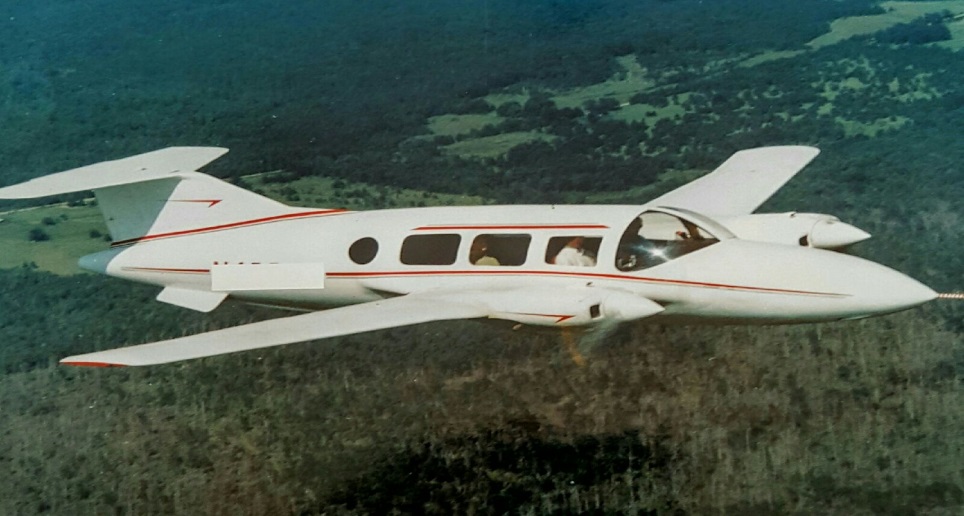
TAHAWI aerospace Corp
TAHAWI aerospace Corp
16. SIGNATURES
Pursuant to the requirements of Regulation A, the issuer certifies that it has reasonable grounds to believe that it meets all of the requigements for filing on Form 1-A and has duly caused this Offering statement to be signed on its behalf by the undersigned, thereunto duly authorized, in the City and County of Bergen, Stape of New Jersey, on January 4, 2016..
|
TAHAWI aerospace company | ||
|
|
| |
| By: | _______________________ |
|
| Name: | Adam Altahawi /s/ Adam Altahawi |
|
| Title: | Chief Executive Officer and Dirdctor | |
|
| (Principal Executive Officer) | |
In accordance with the requirements of the Securities Act of 1933, this registration statenent was signed by the following persons in the capacities and on the dates stated.
Signature |
| Title |
| Date |
|
|
|
| January 4, 2016 |
_______________________ |
|
|
| _______________________ |
Adam Altahawi /s/ Adam Altahawi |
| Director and Chief Executive Officer (Principal Executive Officer), Director |
|
January 4, 2016 |
_______________________ |
|
|
| _______________________ |
Andy Altahawi /s/ Andy Altahawi |
| Director and President, Secretary Financial officer, Director |
|
|
|
|
|
|
|
48