FORM 1-A
Regulation A Offering Statement
Part II – Offering Circular

Impact Housing REIT, LLC
1411 5th Street, Suite 406
Santa Monica, CA 90401
(310) 566-1329
www.ImpactHousing.com
November 28, 2016
This Offering Circular follows the Form S-11 disclosure format.
Impact Housing REIT, LLC, a newly organized Delaware limited liability company (which we refer to as the “Fund,” “we,” “us” or “our”), was formed to acquire, redevelop, and manage residential real estate assets in the United States, with a focus on acquiring and improving undervalued multifamily residential properties that provide affordable value to residents. The Fund is managed by affiliates of Strategic Realty Holdings, LLC, an experienced real estate investment firm, which we refer to as our “Sponsor.” We intend to qualify as a real estate investment trust, “REIT,” for federal income tax purposes.
The Fund is seeking to raise capital by offering to the public limited liability company interests designated as “Series A Investor Shares.” You can read a complete description of these securities in the “Securities Being Offered” section starting on page 35. We refer to individuals and entities that purchase Series A Investor Shares as “Investors.”
The minimum we are seeking to raise in this offering is $3,000,000, and the maximum is $35,000,000. The Sponsor and/or its affiliates might purchase Series A Investor Shares and if they do their purchases will count toward the $3,000,000 minimum. We will begin selling Series A Investor Shares when the Offering has been “qualified” by the Securities and Exchange Commission.
Initially, the Series A Investor Shares will be sold for $10.00 per Series A Investor Share, with a minimum initial investment of 100 Series A Investor Shares (i.e., $1,000). We may periodically raise or lower the price of the Series A Investor Shares during this offering to reflect the value of the Fund’s assets by filing a supplement to this Offering Circular. For more information, see the “Securities Being Offering – Price of Series A Investor Shares” section starting on page 35.
We are selling these securities directly to the public through www.ImpactHousing.com which we refer to as the “Site.” We are not using a placement agent or a broker and we are not paying commissions to anyone. All of the money we raise goes directly to the Fund, after expenses.
Investing in our Series A Investor Shares is speculative and involves substantial risks. You should purchase these securities only if you can afford a complete loss of your investment. Before investing, you should carefully review the “Risk Factors” beginning on page __.
THE UNITED STATES SECURITIES AND EXCHANGE COMMISSION DOES NOT PASS UPON THE MERITS OF OR GIVE ITS APPROVAL TO ANY SECURITIES OFFERED OR THE TERMS OF THE OFFERING. NOR DOES IT PASS UPON THE ACCURACY OR COMPLETENESS OF ANY OFFERING CIRCULAR OR OTHER SOLICITATION MATERIALS. THESE SECURITIES ARE OFFERED PURSUANT TO AN EXEMPTION FROM REGISTRATION WITH THE COMMISSION; HOWEVER, THE COMMISSION HAS NOT MADE AN INDEPENDENT DETERMINATION THAT THE SECURITIES OFFERED HEREUNDER ARE EXEMPT FROM REGISTRATION.
GENERALLY, NO SALE MAY BE MADE TO YOU IN THIS OFFERING IF THE AGGREGATE PURCHASE PRICE YOU PAY IS MORE THAN 10% OF THE GREATER OF YOUR ANNUAL INCOME OR NET WORTH. DIFFERENT RULES APPLY TO ACCREDITED INVESTORS AND NON-NATURAL PERSONS. BEFORE MAKING ANY REPRESENTATION THAT YOUR INVESTMENT DOES NOT EXCEED APPLICABLE THRESHOLDS, WE ENCOURAGE YOU TO REVIEW RULE 251(d)(2)(i)(C) OF REGULATION A. FOR GENERAL INFORMATION ON INVESTING, WE ENCOURAGE YOU TO REFER TO WWW.INVESTOR.GOV. FOR MORE INFORMATION, SEE THE “Limits on How Much Non-Accredited Investors Can Invest” SECTION STARTING ON PAGE 40.
NORTH AMERICAN SECURITIES ADMINISTRATORS ASSOCIATION UNIFORM LEGEND:
YOU SHOULD MAKE YOUR OWN DECISION WHETHER THIS OFFERING MEETS YOUR INVESTMENT OBJECTIVES AND RISK TOLERANCE LEVEL. NO FEDERAL OR STATE SECURITIES COMMISSION HAS APPROVED, DISAPPROVED, ENDORSED, OR RECOMMENDED THIS OFFERING. NO INDEPENDENT PERSON HAS CONFIRMED THE ACCURACY OR TRUTHFULNESS OF THIS DISCLOSURE, NOR WHETHER IT IS COMPLETE. ANY REPRESENTATION TO THE CONTRARY IS ILLEGAL.
THESE SECURITIES ARE SUBJECT TO RESTRICTIONS ON TRANSFERABILITY AND RESALE AND MAY NOT BE TRANSFERRED OR RESOLD EXCEPT AS PERMITTED UNDER THE ACT AND APPLICABLE STATE SECURITIES LAWS, PURSUANT TO REGISTRATION OR EXEMPTION THEREFROM. YOU SHOULD BE AWARE THAT YOU WILL BE REQUIRED TO BEAR THE FINANCIAL RISKS OF THIS INVESTMENT FOR AN INDEFINITE PERIOD OF TIME.
Table of Contents
TABLE OF CONTENTS
|
A WARNING ABOUT FORWARD-LOOKING STATEMENTS
|
1
|
|
RISKS OF INVESTING
|
2
|
|
We Are a Newly Formed Business With a Limited Operating History
|
2
|
|
Our Auditor Has Raised Questions About our Ability To Survive as a Going Concern
|
2 |
|
No Guaranty of Distributions
|
2
|
|
Arbitrary Pricing
|
2
|
|
Speculative Nature of Real Estate Investing
|
3
|
|
Property Values Could Decrease
|
3
|
|
Illiquidity of Real Estate:
|
3
|
|
Investors Will Have No Right to Participate in the Management of the Fund:
|
3
|
|
We Rely on Our Sponsor and Its Affiliates
|
4
|
|
Selection of Properties
|
4
|
|
Incomplete Due Diligence:
|
4
|
|
Pricing of Assets
|
4
|
|
Competition for Properties
|
4
|
|
Inability to Attract and/or Retain Tenants
|
4
|
|
Operating Expenses
|
5
|
|
Unit Rehabilitation and Capital Improvements
|
5
|
|
Risks Associated with Development and Construction
|
5
|
|
Risks Associated with Relying on Third Parties:
|
6
|
|
Unreliable Financial Projections
|
6
|
|
Lack of Diversification
|
6
|
|
Our Ability To Implement Our Investment Strategy Will Depend On the Success of this Offering
|
6
|
|
Changes To Our Investment Strategy:
|
6
|
|
Inability to Implement Liquidity Transactions:
|
6
|
|
Need for Additional Capital
|
7
|
|
Risk of Dilution
|
7
|
|
Future Securities Could Have Superior Rights
|
7
|
i
|
Risks Associated with Leverage
|
7 |
|
Risks of Seller Financing
|
7
|
|
The Fund Does Not Have A Credit Rating from Moody’s or Standard & Poor’s
|
7
|
|
Limited Warranties from Sellers
|
8
|
|
Liability for Personal Injury
|
8
|
|
Environmental Risks:
|
8
|
|
ADA Compliance
|
8
|
|
Regulation and Zoning
|
8
|
|
Casualty Losses
|
8
|
|
Changes in Laws
|
8
|
|
Limitation on Rights in LLC Agreement
|
9
|
|
Limitations on Rights in Investment Agreement
|
9
|
|
Conflicts of Interests
|
10
|
|
No Market for the Series A Investor Shares; Limits on Transferability
|
11
|
|
Our Sponsor’s Track Record Does Not Guaranty Future Performance
|
11
|
|
Investors Can’t See Our Actual Investments Before Investing:
|
11
|
|
The Fund Stands On Its Own
|
12
|
|
Uninsured Losses
|
12
|
|
Regulation as an Investment Company
|
12
|
|
Reduced Disclosure Requirements Under the JOBS Act:
|
12
|
|
We Are an “Emerging Growth Company” Under the JOBS Act
|
12 |
|
We Are Not Subject to the Corporate Governance Requirements that Apply to Companies Listed on a National Exchange
|
13
|
|
Failure to Satisfy Conditions of REIT; Taxes on REITs
|
13
|
|
We Have Limited Experience Operating a REIT
|
13
|
|
REIT Requirements Could Restrict Actions
|
13
|
|
Required Distributions
|
13
|
|
Federal and State Income Taxes as a REIT
|
14
|
|
Risk Related to Joint Ventures:
|
14
|
|
Breaches of Security
|
14
|
|
FIRPTA Tax on Non-U.S. Sellers:
|
14
|
|
THE FUND
|
15
|
ii
|
Investment Strategy
|
15 |
|
Summary of Investment Strategy
|
15 |
|
Focus on Underperforming Communities
|
15
|
|
Geographic Focus
|
16
|
|
Demographic Focus
|
16
|
|
Innovative Underwriting Process and Strategic Planning
|
17
|
|
Management of Business and Investments
|
17
|
|
Management of Properties
|
17
|
|
Leverage
|
18
|
|
Joint Ventures
|
18
|
|
Competition
|
19
|
|
The Competitive Landscape
|
19
|
|
Our Competitive Advantages
|
19
|
|
Our Operating Strategies
|
20
|
|
Reposition Tenant Base
|
20
|
|
Outsource Property Management
|
20
|
|
Actively Manage Our Communities
|
21
|
|
Control Operating Expenses
|
21
|
|
Use Technology
|
22
|
|
Possible Commercial Component
|
22
|
|
Disposition of Properties
|
22
|
|
Term of the Fund
|
22
|
|
WHAT IS A REIT, ANYWAY?
|
24
|
|
OUR ORGANIZATIONAL STRUCTURE
|
25
|
|
OUR MANAGEMENT TEAM
|
26
|
|
Edward P. Lorin
|
26
|
|
Howard Song
|
27
|
|
Myron Chang
|
27
|
|
COMPENSATION OF MANAGEMENT
|
28
|
|
Overview
|
28
|
|
Fees
|
28
|
|
Co-Investment
|
30
|
iii
|
Promoted Interest
|
31
|
|
Report to Investors
|
31
|
|
Clawback
|
31
|
|
Method of Accounting
|
31
|
|
Stages of Development
|
32
|
|
MANAGEMENT’S DISCUSSION AND ANALYSIS OF FINANCIAL CONDITION AND RESULTS OF OPERATIONS
|
33
|
|
Liquidity
|
33
|
|
Capital Resources
|
33
|
|
Results of Operations
|
33
|
|
Off Balance Sheet Arrangements
|
33
|
|
PAST PERFORMANCE: OUR TRACK RECORD SO FAR
|
34
|
|
Summary and Narrative Description
|
34
|
|
Strategic Realty Holdings, LLC and Strategic Realty Capital, LLC
|
35
|
|
Appraisal of Certain Assets
|
35
|
|
Strategy and NOI Results
|
35
|
|
Acquisitions of Properties Within Last Three Years
|
37
|
|
Prior Performance Tables
|
37
|
|
SECURITIES BEING OFFERED
|
38
|
|
Description of Securities
|
38
|
|
Price of Series A Investor Shares
|
38
|
|
Voting Rights
|
38
|
|
Distributions
|
38
|
|
How We Decide How Much To Distribute
|
40
|
|
Withholding
|
41
|
|
No Guaranty
|
41
|
|
Transfers
|
41
|
|
Mandatory Redemptions
|
41
|
|
Limited Right Of Redemption
|
42
|
|
LIMIT ON AMOUNT NON-ACCREDITED INVESTORS CAN INVEST
|
43
|
|
PLAN OF DISTRIBUTION
|
44
|
|
Size of Offering
|
44
|
iv
|
Term of Offering
|
44
|
|
Minimum Initial Investment
|
44
|
|
Manner of Distribution
|
44
|
|
How To Invest
|
44
|
|
Escrow
|
45
|
|
Advertising the Offering
|
45
|
|
Supplements and Amendments to Offering Circular
|
45
|
|
ESTIMATED USE OF PROCEEDS
|
47
|
|
INVESTMENT COMPANY ACT LIMITATIONS
|
48
|
|
SUMMARY OF OUR LLC AGREEMENT AND AUTHORIZING RESOLUTION
|
49
|
|
Formation and Ownership
|
49
|
|
Shares and Ownership
|
49
|
|
Management
|
50
|
|
Exculpation and Indemnification of Manager
|
50
|
|
Obligation to Contribute Capital
|
51
|
|
Personal Liability
|
51
|
|
Distributions
|
51
|
|
Transfers and First Right of Refusal
|
51
|
|
Death, Disability, Etc.
|
51
|
|
Fees to Manager and Affiliates
|
52
|
|
Mandatory Redemption
|
52
|
|
“Drag-Along” Right
|
52
|
|
Limited Redemption Right
|
52
|
|
Electronic Delivery
|
52
|
|
Amendment
|
52
|
|
Information Rights
|
53
|
|
Summary of Management Agreement
|
54
|
|
ALLOCATION OF EXPENSES AND INVESTMENT OPPORTUNITIES
|
56
|
|
Payment of Expenses
|
56
|
|
Allocation of Investment Opportunities
|
57
|
|
Other Funds
|
57
|
|
FEDERAL INCOME TAX CONSEQUENCES
|
58
|
v
|
Federal Income Taxation of the Fund
|
58
|
|
Requirements for Qualifying as a REIT
|
59
|
|
Organizational Requirements
|
59
|
|
Income Test Requirements
|
60
|
|
Asset Test Requirements
|
61
|
|
Annual Distribution Requirements
|
62
|
|
Taxation Of Investors
|
62
|
|
How Income is Reported To Investors
|
62
|
|
Taxation of Distributions
|
62
|
|
Taxation of Losses
|
63
|
|
Additional Medicare Tax
|
63
|
|
Tax on Sale of Series A Investor Shares
|
63
|
|
Passive Activity Losses
|
63
|
|
Withholding Taxes
|
63
|
|
LEGAL PROCEEDINGS
|
64
|
|
CERTAIN RELATIONSHIPS AND RELATED TRANSACTIONS
|
65
|
|
FINANCIAL STATEMENTS
|
66
|
|
GLOSSARY OF DEFINED TERMS
|
67
|
vi
A WARNING ABOUT FORWARD-LOOKING STATEMENTS
The term “forward-looking statements” means any statements, including financial projections, that relate to events or conditions in the future. Often, forward-looking statements include words like “we anticipate,” “we believe,” “we expect,” “we intend,” “we plan to,” “this might,” or “we will.” The statement “We believe demographic shifts will favor apartment communities” is an example of a forward-looking statement.
Because we are talking about a new business, most of the things we say in this Offering Circular are forward-looking statements. In fact, everything we say is a forward-looking statement, other than statements of historical fact.
Forward-looking statements are, by their nature, subject to uncertainties and assumptions. The statement “We believe demographic shifts will favor apartment communities” is not like the statement “We believe the sun will rise in the East tomorrow.” It is impossible for us to know exactly what is going to happen in the future, or even to anticipate all the things that could happen. Our business could be subject to many unanticipated events, including all of the things we talk about in the “Risks of Investing” section starting on page 2.
Consequently, the actual result of investing in the Fund could (and almost certainly will) differ from those anticipated or implied in any forward-looking statement, and the differences could be both material and adverse. We do not undertake any obligation to revise, or publicly release the results of any revision to, any forward-looking statements, except as required by applicable law. GIVEN THE RISKS AND UNCERTAINTIES, PLEASE DO NOT PLACE UNDUE RELIANCE ON ANY FORWARD-LOOKING STATEMENTS.
Page | 1
RISKS OF INVESTING
Buying Series A Investor Shares is speculative and involves significant risk, including the risk that you could lose some or all of your money. This section describes what we believe are the most significant risk factors affecting the Fund and its Investors. The order in which these factors are discussed is not intended to suggest that some factors are more important than others.
We Are a Newly Formed Business With a Limited Operating History: Although our Sponsor’s management team is composed of experienced real estate professionals, the Fund itself is a start-up business with a very limited operating history, minimal operating capital, no significant assets and no revenues. Like any start-up, the Fund will face a number of challenges, including:
| · | Developing a reputation and brand identity |
| · | Raising capital |
| · | Controlling costs |
| · | Responding effectively to the offerings of existing and future competitors |
| · | Managing growth and expansion |
| · | Implementing adequate accounting and financial systems and controls |
Our Auditor Has Raised Questions About our Ability To Survive as a Going Concern: In the audited financial statements attached to this Offering Circular, our auditor has noted the Fund has not yet commenced planned principal operations and has not generated revenues or profits since inception, and that these factors, among others, raise substantial doubt about the Fund’s ability to continue as a “going concern.” As further noted by our auditor, the Fund’s ability to continue as a going concern in the next twelve months is dependent upon its ability to obtain capital financing from investors sufficient to meet current and future obligations, and to deploy that capital effectively to produce profits. No assurance can be given that the Fund will be successful in these efforts.
No Guaranty of Distributions: When you buy a certificate of deposit from a bank, the Federal government (through the FDIC) guaranties you will get your money back. Buying a Series A Investor Share of the Fund is not like that at all. The ability of the Fund to make the distributions you expect, and ultimately to give you your money back, depends on a number of factors, including some beyond its control. Nobody guaranties that you will receive distributions.
Arbitrary Pricing: The initial price of our Series A Investor Shares was determined arbitrarily by the Manager, and was not determined by an independent appraisal of the Fund’s value and bears no relationship to traditional measures of value such as EBITDA (earnings before interest, taxes, depreciation, and amortization), cash flow, revenue, or book value.
Page | 2
Speculative Nature of Real Estate Investing: Real estate can be risky and unpredictable. For example, many experienced, informed people lost money when the real estate market declined in 2007-8. Time has shown that the real estate market goes down without warning, sometimes resulting in significant losses. Some of the risks of investing in real estate include changing laws, including environmental laws; floods, fires, and other Acts of God, some of which can be uninsurable; changes in national or local economic conditions; changes in government policies, including changes in interest rates established by the Federal Reserve; and international crises. You should invest in real estate in general, and in the Fund in particular, only if you can afford to lose your investment and are willing to live with the ups and downs of the real estate industry.
Property Values Could Decrease: The value of the property we own could decline, perhaps significantly. Factors that could cause the value of our property to decline include, but are not limited to:
| · | Changes in interest rates |
| · | Competition from existing properties and new construction |
| · | Changes in national or local economic conditions |
| · | Changes in zoning |
| · | Environmental contamination or liabilities |
| · | Changes in local market conditions |
| · | Fires, floods, and other casualties |
| · | Uninsured losses |
| · | Undisclosed defects in property |
| · | Incomplete or inaccurate due diligence |
Illiquidity of Real Estate: Real estate is generally illiquid, meaning that it is not typically capable of being readily sold for cash at fair market value. Thus, the Fund might not be able to sell properties as quickly or on the terms that it would like. For one thing, we cannot predict how long it will take to find a willing and able buyer. For another thing, we might be required to expend significant amounts of money to correct defects or make improvements before a property can be sold. Moreover, the overall economic conditions that might cause the Fund to want to sell properties are generally the same as those in which it would be most difficult to sell.
Investors Will Have No Right to Participate in the Management of the Fund: You will not have a right to vote or otherwise participate in managing the Fund, except on very limited matters. Instead, the Manager will make all decisions, including investment decisions. Investors will have the right to remove the Manager only in very limited circumstances.
Page | 3
We Rely on Our Sponsor and Its Affiliates: Neither the Fund itself nor the Manager will have any employees. Instead, we will rely on our Sponsor’s management team. Accordingly, our ability to achieve our investment objectives and to pay distributions to you will depend upon the ability of our Sponsor’s real estate professionals. If the principals of our Sponsor left or became unable to perform their job duties, we might be unable to execute on our investment strategy and the value of your investment in the Fund could suffer. Any adverse changes in our relationship with our Sponsor, or in our Sponsor’s operations or financial condition, could also adversely affect the Fund and thus the value of your investment.
Selection of Properties: To achieve satisfactory returns for our investors, the Manager must identify properties that satisfy our investment selection criteria and that can be acquired at reasonable prices. There is no guaranty that the Manager will be able to do so. Because the Fund is a newly organized entity and has not yet acquired any properties, you will not have an opportunity to evaluate the terms of any transactions or other financial data concerning our selected properties prior to investing. We cannot be sure that we will be successful in identifying and acquiring properties on financially attractive terms, or that we will achieve our investment objectives. Further, we could face delays in locating suitable investment properties. Such delays could decrease returns on your investment.
Incomplete Due Diligence: The Manager intends to perform “due diligence” on each asset we purchase, meaning that we will seek out and review information about the property, seller, market and other information the Manager deems relevant. However, due diligence is as much an art as a science. As a practical matter, it is simply impossible to review all of the information about a given piece of real estate, and there is no assurance that all of the information we will review will be accurate or complete in all respects. For example, sometimes important information is hidden or simply unavailable, or a third party might have an incentive to conceal information or provide inaccurate information, and we cannot verify all the information we receive independently. It is also possible that we will reach inaccurate conclusions about the information we review.
Pricing of Assets: The success of the Fund and its ability to make distributions to Investors depends on the Manager’s ability to gauge the value of real estate assets. Although the Manager and its principals are experienced real estate investors and will rely on various objective criteria to select properties for investment, ultimately the value of these assets is as much an art as a science, and there is no guaranty that the Fund and its advisors will be successful.
Competition for Properties: The U.S. commercial real estate market today is competitive, with an abundance of capital chasing a limited supply of quality properties. Our competitors may have greater financial resources than we do and a greater ability to borrow funds to acquire properties. The fierce competition for quality properties will tend to limit our choices and increase the amount we are required to pay for properties that meet our investment criteria, which in turn will tend to reduce yields.
Inability to Attract and/or Retain Tenants: Our success depends on our ability to attract and retain tenants in our properties. The risks we face include the following:
Page | 4
| · | Competition from other landlords could keep us from raising rents, or require us to provide financial or other inducements or concessions to attract tenants (e.g., rent concessions or costs incurred for tenant improvements). |
| · | Changes in economic conditions generally could reduce demand for our properties. |
| · | Existing tenants might not renew their leases. |
| · | Portions of buildings could remain vacant for extended periods. |
| · | We are subject to the risk that our tenants may default on their obligations, or file for bankruptcy protection. |
| · | Certain of our properties may be specifically suited to the needs of a certain type of tenant, and we may have difficulty leasing such properties in the event of a vacancy. |
Any of these circumstances would hurt the Fund financially. If vacancy rates are higher than we expect, we may suffer reduced revenues resulting in less cash available to be distributed to Investors. In addition, the resale value of a property with vacancies could be decreased because the value of a property may depend on the value of the leases of such property.
Operating Expenses: The costs of operating real estate – including taxes, insurance, utilities, and maintenance – tend to move up over time. We have limited control over some of our operating costs, and if our costs increase it may reduce the amount available for distribution to investors.
Unit Rehabilitation and Capital Improvements: To retain and attract tenants at favorable rental rates, the Fund may be required to expend substantial funds for tenant improvements and refurbishments. Although we expect to maintain sufficient reserves and/or borrowing capacity for these purposes, these resources might not be adequate. If we have insufficient resources to fund tenant improvements, we may be unable to meet our investment objectives, which could reduce the amount of distributions to Investors.
Risks Associated with Development and Construction: We might renovate properties or engage in other real estate development activities from time to time, if consistent with our overall investment strategy. Development and construction can be time-consuming and are fraught with risk, including the risk that projects will be delayed or cost more than budgeted.
Page | 5
Risks Associated with Relying on Third Parties: We expect to engage third parties to provide essential services to the Fund, including, without limitation, on-site property management and construction. If a third party we retain performs poorly or becomes unable to fulfill its obligations, the Fund’s business could be severely disrupted and our financial condition could be adversely affected. Disputes between us and our third party service providers could disrupt our business and may result in litigation or other forms of legal proceedings (e.g. arbitration), which could require us to expend significant time, money and other Fund resources, which could adversely affect the Fund’s financial position. We might also be subject to, or become liable for, legal claims by our tenants or other parties relating to work performed by third parties we have contracted with, even if we have sought to limit or disclaim our liability for such claims or have sought to insure the Fund and its affiliates against such claims.
Unreliable Financial Projections: We have prepared financial projections reflecting what we believe are reasonable assumptions concerning the conduct of our business. However, the nature of real estate development and investment is such that at least some of our assumptions are likely to be mistaken, either for better or for worse, so that the actual results of investing in the properties are likely to be different than the results reflected in the projections, possibly by a wide amount. The real estate industry can be volatile and difficult to predict.
Lack of Diversification: The Fund will invest in only multi-family communities, which is just one of many types of real estate investments (others include commercial, retail, etc.). Furthermore, in the early stages of the Fund’s life, it will own real estate in only a small number of geographic locations. Investors looking for diversification will have to create their own diversified portfolio by investing in other opportunities in addition to the Fund.
Our Ability To Implement Our Investment Strategy Will Depend On the Success of this Offering: Our ability to successfully implement our investment strategy will depend, in part, upon our ability to successfully raise money in this Offering. If we are not successful in raising the maximum amount we have sought in this Offering, we may not have adequate capital to fully implement our investment strategy, which could adversely affect the Fund’s performance.
Changes To Our Investment Strategy: The Manager has broad discretion to change our investment strategy and guidelines at any time without giving prior notice to, or seeking approval from, our Investors.
Inability to Implement Liquidity Transactions: We will typically aim to hold our properties for approximately five years (although certain properties may be held for longer or shorter periods depending on the characteristics of each property and prevailing market conditions), at which point we intend to seek a “liquidity event,” such as a sale or refinancing of the property. However, there is no guarantee that we will be able to successfully pursue a liquidity event with respect to any of our properties. Market conditions may delay or even prevent the Manager from pursuing liquidity events. If we do not or cannot liquidate our real estate portfolio, or if we experience delays due to market conditions, this could delay Investors’ ability to receive a return of their investment indefinitely and may even result in losses, notwithstanding the provisions of the LLC Agreement.
Page | 6
Need for Additional Capital: The real estate industry is capital intensive, and the inability to obtain financing could limit our growth. We may need to raise more money in the future so we can continue to acquire and operate properties. In addition, we might need to raise money to make capital improvements required by law or by market conditions, or for other purposes. There is no guarantee that funding will be available to us when we need it, or on terms that are not adverse to your interests. If we cannot raise additional funding when needed, our operations and prospects could be negatively affected.
Risk of Dilution: If we raise additional capital in the future by issuing equity interests in the Fund, your ownership interest in the Fund would be diluted.
Future Securities Could Have Superior Rights: The Fund might issue securities in the future that have rights superior to the rights associated with the Series A Investor Shares. For example, the holders of those securities could have the right to receive distributions before any distributions are made to Investors, or distributions that are higher, dollar for dollar, than the distributions paid to the holders of the Series A Investor Shares, or the right to receive all their money back on a liquidation of the Fund before the holders of the Series A Investor Shares receive anything.
Risks Associated with Leverage: We intend to borrow money to finance the acquisition of new properties, to pay for the renovation of property, and for other purposes. While debt financing can improve the Fund’s ability to successfully implement its business strategy, debt financing also carries significant risks for Investors because debt service payments will reduce cash available for distribution. Generally, our degree of leverage may also increase our vulnerability to downturns in the real estate market or in economic conditions generally. There is no guaranty that we will generate sufficient cash flow to meet our debt service obligations, and we may be unable to repay, refinance or extend our debt when due. We may also give our lender(s) security interests in our assets as collateral for our debt obligations. If we are unable to meet our debt service obligations, those assets could be foreclosed upon, which could negatively affect our ability to generate cash flows to fund distributions to Investors. We may also be required to sell assets to repay debt, and may be forced to sell at times that are unfavorable to the Fund, which would likewise negatively affect our ability to operate successfully.
Risks of Seller Financing: We might sell a property and finance all or part of the selling price by extending credit to the purchaser in the form of a promissory note. Should a purchaser default, we might not get paid, or might have to spend a substantial amount enforcing the obligation.
The Fund Does Not Have A Credit Rating from Moody’s or Standard & Poor’s: Credit rating agencies, notably Moody’s and Standard & Poor’s, assign credit ratings to debt issuers, which are intended to help investors gauge the ability of the issuer to repay debt. The Fund has not been rated by Moody’s or Standard & Poor’s and, as a result, Investors have no objective measure by which to judge the creditworthiness of the Fund.
Page | 7
Limited Warranties from Sellers: In most cases, the Fund will be required to purchase property in “as is” condition, with few if any representations or warranties by from the seller. If we learn that a property has defects after closing, we may not be able to look to the seller for reimbursement.
Liability for Personal Injury: As a landlord, we may be subject to legal claims for injuries that occur in or outside our properties, e.g., “slip and fall” injuries. Although we expect to maintain our properties in a customary and commercially reasonable manner and to carry insurance against potential liability in amounts we believe are adequate, it is possible that we could suffer liabilities in excess of our insurance coverage or uninsured liabilities.
Environmental Risks: We will conduct typical environmental testing on the properties we acquire to determine the existence of significant environmental hazards. However, it is impossible to be certain of all the ways that properties have been used, raising the possibility that environmental hazards could exist despite our environmental investigations. Under federal and state laws, moreover, a current or previous owner or operator of real estate may be required to remediate any hazardous conditions without regard to whether the owner knew about or caused the contamination. Similarly, the owner of real estate may be subject to common law claims by third parties based on damages and costs resulting from environmental contamination. The cost of investigating and remediating environmental contamination can be substantial, even catastrophic.
ADA Compliance: The Americans with Disabilities Act of 1990 (the “ADA”) requires all public buildings to meet certain standards for accessibility by disabled persons. When constructed or acquired by the Fund, it is anticipated that each property will comply with all current requirements of the ADA. However, if a property is not compliant with all requirements of the ADA and is not “grandfathered” into compliance, or if additional requirements are imposed in the future, whether pursuant to the ADA or otherwise, we would need to make modifications to that property and/or additional expenditures.
Regulation and Zoning: All of the Fund’s properties will be subject to extensive building and zoning ordinances and codes, which can change at any time. Changes in these laws and regulations could affect one or more of our properties adversely.
Casualty Losses: A fire, earthquake, hurricane, mold infestation, or other casualty could materially and adversely affect the operation of one or more properties, even if the Fund carries adequate insurance.
Changes in Laws: Changes in laws, including but not limited to zoning laws, environmental laws, tax laws, or the laws governing how we are allowed to raise money from investors, could harm the Fund and reduce the return to Investors.
Page | 8
Limitation on Rights in LLC Agreement: The Fund’s LLC Agreement limits your rights in several important ways, including these:
| · | The LLC Agreement significantly curtails your right to bring legal claims against management, even if they make mistakes that cost you money. |
| · | The LLC Agreement limits your right to obtain information about the Fund and to inspect its books and records. |
| · | Investors can remove the Manager only in very limited circumstances, even if you think the Manager is doing a bad job. |
| · | The Manager is allowed to amend the LLC Agreement in certain respects without your consent. |
| · | The LLC Agreement restricts your right to sell or otherwise transfer your interest, if the Manager determines that the transfer would jeopardize the status of the Fund as a REIT. |
| · | The LLC Agreement gives the Manager the right to buy back your Series A Investor Shares without your consent if the Manager determines that (i) the Fund would otherwise become subject to the Employee Retirement Income Security Act of 1974 (after referred to as “ERISA”), (ii) the Fund’s status as a REIT would otherwise be jeopardized, or (iii) you have engaged in certain misconduct. |
Limitations on Rights in Investment Agreement: To purchase an Series A Investor Share, you are required to sign our Investment Agreement. The Investment Agreement would limit your rights in several important ways if you believe you have claims against us arising from the purchase of your Series A Investor Shares:
| · | In general, your claims would be resolved through arbitration, rather than through the court system. Any such arbitration would be conducted in Wilmington, Delaware, which might not be convenient for you. |
| · | You would not be entitled to a jury trial. |
| · | You would not be entitled to recover any lost profits or special, consequential, or punitive damages. |
| · | If you lost your claim against us, you would be required to pay our expenses, including reasonable attorneys’ fees. If you won, we would be required to pay yours. |
Page | 9
Conflicts of Interests: Our interests could conflict with your interests in a number of important ways, including these:
| · | The Fund itself has no employees. The Fund is externally managed by the Manager, which is an affiliate of our Sponsor and will rely on our Sponsor’s executive management and real estate professionals. Your interests might be better served if our management devoted its full attention to maximizing the value of the assets purchased by the Fund. Instead, our management will be managing the assets and liabilities of other companies, some of which may compete directly with the Fund. For more information, including how we will attempt to manage such conflicts, please refer to the “Allocation of Expenses and Investment Opportunities” section beginning on page 53. |
| · | Our Sponsor and its affiliates, including the individuals who will be responsible for managing the Fund, will have business interests wholly unrelated to the Fund, all of which will require a commitment of time. |
| · | Although we will always seek to establish terms that are fair to the Fund, the terms of the Management Agreement were negotiated between related parties, and therefore may not be as favorable to the Fund as if they had been negotiated between unrelated third parties. |
| · | The Manager will receive fees based, indirectly, on the amount of capital we raise in this Offering, and will also receive fees based on the value of the property the Fund acquires, the value of property the Fund sells, the rental income the Fund receives, and the amount of financing the Fund obtains. In each instances, these fees may introduce incentives for the Manager to take actions (e.g., raising and deploying capital) that may not necessarily be in the best interests of Investors. |
| · | The property acquisition and disposition fees payable to the Manager may, to some extent, give the Manager an incentive to buy or sell more properties, even when such purchases or sales might be disadvantageous to the Fund. Likewise, our construction management fees may give the Manager an incentive to engage in construction and development activities with respect to our properties even when such activities might be disadvantageous to the Fund. |
| · | If the Fund invests in a Joint Venture, the Manager will receive fees from the Fund and might also receive fees directly from the Joint Ventures. This could give the Manager an incentive to target Joint Venture opportunities rather than direct investments, even when doing so might not necessarily be in the best interests of Investors. |
Page | 10
| · | The Manger will be entitled to a monthly fee equal to 5% of the gross rents collected, and in turn will required to pay for the services of one or more reputable third-party property-management companies. The Manager might have an incentive to hire a sub-par property-management company, to make a profit on the “spread.” |
| · |
Our Sponsor and its affiliates might not invest significant equity in the Fund. If they do not, their economic interests could be in conflict with the interests of Investors.
|
| · | We may buy assets from or sell assets to affiliates of our Sponsor. Although we will always seek to establish a fair, arm’s-length price for assets, the interests of our Sponsor and its affiliates may be adverse to the Fund’s interests (and thus your interests as an Investor). |
| · | The lawyers who prepared the Fund’s LLC Agreement, the Investment Agreement, and this Offering Statement represent us, not you. You must hire your own lawyer (at your own expense) if you want your interests to be represented. |
No Market for the Series A Investor Shares; Limits on Transferability: There are several obstacles to selling or otherwise transferring your Series A Investor Shares:
| · | There will be no established market for your Series A Investor Shares, meaning you could have difficulty finding a buyer. |
| · | Under the LLC Agreement, the Series A Investor Shares may not be transferred if the Manager determines that the transfer could jeopardize the status of the Fund as a REIT. |
| · | To qualify as a REIT, the LLC Agreement limits the amount of the Fund that any one person may own, which may restrict your ability to sell Series A Investor Shares to others who have invested in the Fund. |
Taking all that into account, you should plan to own your Series A Investor Shares indefinitely.
Our Sponsor’s Track Record Does Not Guaranty Future Performance: The section captioned “Past Performance: Our Track Record So Far,” starting on page 31, illustrates the performance of comparable investment programs sponsored by our Sponsor. However, there is no guaranty that the Fund’s performance will be similar. The economy as a whole and the real estate market in particular have been very favorable to date; economic conditions may change and we might not be able to adapt.
Investors Can’t See Our Actual Investments Before Investing: As of the date of this Offering Circular, the Fund doesn’t own any real estate assets. As a result, investors cannot see or evaluate our assets before making an investment decision. Instead, investors are asked to invest first, then trust that their money will be used wisely.
Page | 11
The Fund Stands On Its Own: The Fund will either succeed or fail on its own account. Although certain affiliates of the Fund have been successful, there is no guaranty that the Fund will be successful. Further, neither the Sponsor, Manager, nor any other person or entity, has committed to provide financial assistance to the Fund should such assistance become necessary.
Uninsured Losses: We will decide what kind of insurance to purchase, and in what amounts. However, some risks cannot be insured at all, or cannot be insured on an affordable basis, and the Fund might not be able to purchase or afford all the insurance it needs. Therefore, the Fund could incur an uninsured loss.
Regulation as an Investment Company: If the Fund were treated as an “investment company” under the Investment Company Act of 1940, we would be required to comply with a number of special rules and regulations and incur significant cost in doing so, which could impair our ability to make distributions in respect of the Series A Investor Shares. If we failed to comply with these special rules and regulations, we could be prohibited from operating our business and subject to civil and criminal liability, and any contracts we were a party to might be unenforceable. We intend to conduct our business so that we are not treated as an investment company, which may limit the manner in which we may operate. However, we might not be successful in avoiding regulation as an investment company. See the “Investment Company Act Limitations” section starting on page 45 for more information.
Reduced Disclosure Requirements Under the JOBS Act: The Series A Investor Shares are being offered pursuant to Tier 2 of Regulation A issued by the SEC, as amended pursuant to the Jumpstart Our Business Startups Act of 2012 (known as the “JOBS Act”). Regulation A does not require us to provide you with all of the information that would be required in a registration statement in connection with an initial public offering (IPO) of securities. As a Regulation A issuer, we are also not subject to the same level of ongoing reporting obligations as a typical public reporting company, including, but not limited to, many of the disclosure requirements applicable to public reporting companies under the Securities Exchange Act of 1934.
We Are an “Emerging Growth Company” Under the JOBS Act: Today, the Fund qualifies as an “emerging growth company” under the JOBS Act. If the Fund were to become a public company (e.g., following an IPO) and continued to qualify as an emerging growth company, it would be able to take advantage of certain exemptions from the reporting requirements under the Securities Exchange Act of 1934 and exemptions from certain investor protection measures under the Sarbanes Oxley Act of 2002. Using these exemptions could benefit the Fund by reducing compliance costs, but could also mean that investors receive less information and receive fewer protections than they would otherwise. However, these exemptions – and the status of the Fund as an “emerging growth company” in the first place – will not be relevant unless the Fund becomes a public reporting company, which we do not plan or foresee.
Page | 12
We Are Not Subject to the Corporate Governance Requirements that Apply to Companies Listed on a National Exchange: Companies whose securities are listed on a national stock exchange (for example, the New York Stock Exchange) are generally subject to a number of rules about corporate governance that are intended to protect investors. For example, the major U.S. stock exchanges require listed companies to have an audit committee made up entirely of independent members of the board of directors (i.e., directors with no material outside relationships with the company or management), which is responsible for monitoring the Fund’s compliance with the law. As of the date of this Offering Statement, neither the Series A Investor Shares, nor any other securities of the Fund, are listed on a national exchange, and it is possible that our securities will never be listed on a national exchange. Accordingly, you may not have the same protections afforded to stockholders of companies that are subject to all of the corporate governance requirements of a national exchange.
Failure to Satisfy Conditions of REIT; Taxes on REITs: We intend to elect to be taxed as a real estate investment trust, or “REIT,” under Sections 856 through 860 of the Internal Revenue Code (the “Code”) for purposes of federal income taxes. To qualify as a REIT, the Fund must satisfy a number of criteria, both now and on an ongoing basis. Should the Fund fail to satisfy any of these criteria, even inadvertently, it could become subject to penalty taxes and/or lose its REIT status altogether, which would make the Fund subject to federal income tax and thereby reduce the returns to investors substantially. Further, even if it maintains its REIT status, the Fund could be subject to various taxes in some situations. While the Fund intends to seek guidance from tax advisors and operate its business accordingly, there is no guaranty that it will be able to avoid taxes and maintain its qualification as a REIT.
We Have Limited Experience Operating a REIT: The Manager has limited experience operating a REIT, which could negatively affect our ability to execute our business strategy, qualify as a REIT, and maintain that status.
REIT Requirements Could Restrict Actions: REITs are subject to a 100% tax on income from “prohibited transactions,” which include sales of assets that constitute inventory or other property held for sale in the ordinary course of a business, other than foreclosure property. This 100% tax could impact our desire to sell assets and other investments at otherwise opportune times if we believe such sales could be considered a prohibited transaction.
Required Distributions: As a REIT, we generally must distribute 90% of our annual taxable income to our investors. From time to time we might generate taxable income greater than our net income for financial reporting purposes from, among other things, amortization of capitalized purchase premiums, or our taxable income might be greater than our cash flow available for distribution to our stockholders. If we do not have other funds available in these situations, we might be unable to distribute 90% of our taxable income as required by the REIT rules. In that case, we would need to borrow funds, sell a portion of our investments, potentially at disadvantageous prices, or find another alternative source of funds. These alternatives could increase our costs or reduce our equity and reduce amounts to invest in real estate assets and other investments. Moreover, the distributions received by our stockholders in such an event could constitute a return of capital for federal income tax purposes, as the distributions would be in excess of our earnings and profits.
Page | 13
Federal and State Income Taxes as a REIT: Even if the Fund qualifies and maintains its qualification as a REIT, it may be subject to federal income taxes and related state taxes. For example, if we have net income from a “prohibited transaction,” such income will be subject to a 100% tax. The Fund may not be able to make sufficient distributions to avoid excise taxes applicable to REITs. The Fund may also decide to retain income it earns from the sale or other disposition of its property and pay income tax directly on such income. In that event, the Fund’s investors will be treated as if they earned that income and paid the tax on it directly. However, shareholders that are tax-exempt would have no benefit from their deemed payment of such tax liability. The Fund may also be subject to state and local taxes on its income or property. Any federal or state taxes paid by the Fund will reduce the Fund’s operating cash flow and cash available for distributions.
Risk Related to Joint Ventures: We may from time to time enter into joint ventures with financial partners selected by the Manager (see “The Fund – Joint Ventures” starting on page 17). We may rely on our real estate venture partners for a variety of matters, including, without limitation, financing, property development services, and property management services. Our real estate venture partners may have financial, business or other interests that are inconsistent with the interests of the Fund (and thus your interests as an Investor), including interests with respect to the acquisition, financing, sale or refinancing of a property, or the timing of such activities. In some instances, our real estate venture partners may have business interests that compete directly against the Fund. If our real estate venture partners perform poorly or become unable to fulfill their obligations in the joint venture, whether due to financial problems, personnel issues, operational issues, or any other reason, the Fund could be adversely affected. Disputes between us and our real estate venture partners may result in litigation or other forms of legal proceedings (e.g., arbitration), which could require us, the Manager to expend significant time, money and other Fund resources, and may adversely affect the Fund’s financial position.
Breaches of Security: It is possible that our systems would be “hacked,” leading to the theft or disclosure of confidential information our investors, tenants, suppliers, and other parties have provided to us. Because techniques used to obtain unauthorized access or to sabotage systems change frequently and generally are not recognized until they are launched, we and our vendors may be unable to anticipate these techniques or to implement adequate defensive measures.
FIRPTA Tax on Non-U.S. Sellers: A non-U.S. Investor who sells Series A Investor Shares for a gain would generally be subject to tax under the Foreign Investment in Real Property Tax Act (FIRPTA) if the Fund does not qualify as a “domestically controlled REIT,” meaning a REIT in which less than 50% of the value of the outstanding shares are owned by non-U.S. persons. We intend to qualify as a domestically controlled REIT, but there can be no assurance we will always do so.
The Foregoing Are Not Necessarily The Only Risks Of Investing
Please Consult With Your Professional Advisors
Please Consult With Your Professional Advisors
Page | 14
THE FUND
Investment Strategy
Summary of Investment Strategy
Like other real estate properties, multi-family apartment communities are typically graded as “A,” “B,” or “C,” with “A” the highest in quality and “C” the lowest. In its simplest form, our investment strategy is to:
| 1) | Identify C-quality multi-family apartment communities in A- or B-quality locations; |
| 2) | Buy those communities for C-level prices; |
| 3) | Make physical alterations and other improvements to those communities, increasing the quality from C to B or even A; |
| 4) | As a result of the alterations and improvements, attract more qualified tenants; |
| 5) | Increase rents accordingly; and |
| 6) | Enjoy the resulting cash flow and capital appreciation. |
As a result of implementing this strategy, over the last 15 years our Sponsor has acquired approximately 170 multifamily residential properties with a total of approximately 40,000 units and, on average, increased their net operating income by 62% per year. This figure is a so-called “weighted average,” based on the number of rental units in each project.
(For more information about our Sponsor’s track record, see the “PAST Performance: Our Track Record So Far” section starting on page 31.)
This strategy is simple to state, but not easy to implement.
Focus on Underperforming Communities
Typically, we focus on apartment communities in the following categories:
| · | Older properties that have been neglected and require exterior and interior capital improvements. |
| · | Class “A” apartment communities that are underperforming because of owner mismanagement. |
| · | Apartment communities in locations with high barriers to entry or an unfavorable climate for apartment community development. |
Page | 15
| · | Communities that are in close proximity to one another, where we can join the communities together and maximize the operational and marketing efficiencies. |
Geographic Focus
We seek to invest in geographic regions with diverse and active economies and markets that possess strong prospects for sustained long-term economic growth. Our target markets generally exhibit the following characteristics:
| · | Job growth above the national average |
| · | Population growth above the national average |
| · | Decreasing rent concessions |
| · | Market-specific barriers to entry |
| · | High occupancy rates |
| · | Diverse local economies |
| · | Recovering economies experiencing high growth |
Demographic Focus
We believe that changing demographics will have a significant impact on the apartment industry during the next two decades, and specifically that the following demographic shifts will favor apartment communities:
| · | Increases in the number of young people entering the workforce and creating households over the next 10 to 15 years |
| · | Increases in the number of single-parent households |
| · | Increases in housing expenditures by college-aged tenants who seek to exhaust available funds in tax-favored college savings plans, such as “529 plans” |
| · | The desire of older tenants to live closer to major university hospitals and educational facilities |
| · | Shifts away from the suburbs and to downtown locations |
| · | Increases in the immigrant population. |
Page | 16
Innovative Underwriting Process and Strategic Planning
We underwrite our potential assets differently than many traditional real estate companies. We evaluate the current market position of a potential acquisition as well as its anticipated repositioned competitive performance, and we conduct our analysis with a combination of acquisition specialists and asset managers. Our strategic plan takes into account the following information:
| · | Acquisition cost |
| · | Building restrictions and covenants |
| · | Capital improvement and repositioning budget |
| · | Operating budget |
| · | Current and expected repositioned occupancy |
| · | Current and expected repositioned rents |
| · | Current and repositioned tenant base |
| · | Repositioned net operating income before and after stabilization |
| · | Our ability to install property managers of our choice |
| · | Metrics of other communities in the area |
| · | The condition of the local market |
Management of Business and Investments
The business and investments of the Fund will be managed by Impact Housing REIT Manager, LLC, which we refer to as the “Manager.” For more information, including see the “Summary of Management Agreement” section starting on 51. Investors who purchase Series A Investor Shares in the Offering will have no right to participate in management.
The Manager can be removed for “cause.” For more information, see the “Summary of LLC Agreement and Authorizing Resolution – Management” section starting on page 46.
Management of Properties
We intend to engage third parties to manage our apartment communities at the property-level.
Page | 17
Our management agreements with third parties are negotiated on an arm’s length basis and include terms that are market for that geographic area or community size. These agreements generally provide that the property manager has control of all operational aspects of the apartment community, including employee-related matters, advertising and rental services, and is reimbursed for all direct and indirect operating expenses. The property manager must generally maintain each apartment community in good repair and condition and make such routine maintenance, repairs and minor alterations as it deems reasonably necessary.
Our management agreements typically provide for an initial term of 12 months, with automatic renewals unless either party gives notice of non-renewal. However, the management agreements are generally terminable by either party without cause upon 30 days’ notice, and may also be terminated immediately upon the occurrence of specified events.
Leverage
We will always borrow money to finance part of the cost when we buy property, and we might also borrow money to finance all or a part of the cost of renovating property. Our guideline – which we can modify based on market conditions, interest rates, and other factors – is to borrow no more than 80% of the purchase price of an apartment community or 75% of the total cost, whichever is less. For example, if we buy a community for $5 million and plan to spend another $500,000 on renovations, then 80% of the cost would be $4 million while 75% of the total cost would be $4,125,000. In this case we would typically limit our borrowing to $4 million.
In some cases – again depending on a number of factors, including what we believe is the predictability of the cash flow a project is expected to generate – we could even borrow up to 90% of what we believe to be the value of a project. This would normally be through a separate “mezzanine” financing facility.
We typically borrow from banks or other institutional lenders.
Joint Ventures
Usually, the Fund or a wholly-owned subsidiary will buy a direct fee simple interest in real estate. Occasionally, however, we might make indirect investments in real estate through on or more joint ventures with third parties (we refer to these as “Joint Ventures”). A typical Joint Venture would involve forming a partnership or limited liability company with the Fund as one owner and one or more third parties as the other owners. Each owner, including the Fund, would contribute capital, financing, know-how, and/or other assets to the Joint Venture. The Joint Venture itself would buy the direct fee simple interest in the real estate.
Normally, but not always, the Fund or the Manager will serve as the managing member, general partner, or equivalent of the Joint Venture and thereby retain ultimate managerial control.
Page | 18
Competition
The Competitive Landscape
We face intense competition in finding apartment communities and attracting tenants to our communities. In identifying and acquiring apartment communities, we compete with insurance company, pension and investment funds, partnerships and investment companies, other REITs, family offices, and other individual and institutional investors, many of whom have more capital and other resources than we do. As an owner and operator of apartment communities, we face competition not only from other communities, but also from condominiums and single-family houses. Squeezed at both ends, the intense competition can have the effect of increasing property acquisition prices while lowering the rental rates we charge our tenants.
Our Competitive Advantages
Experience: Our management team has more than 100 combined years of experience searching for apartment communities that we believe have unrealized value. Since 2003, our management team has acquired more than $3.0 billion in apartment communities. We have built our portfolio through primarily single-asset acquisition transactions because we believe that most portfolio sales include assets that do not meet our investment criteria. Single-asset transactions require careful market research and asset underwriting. In addition, because our predecessor business operated at very high debt-to-assets leverage ratio, we are disciplined in our underwriting and acquisitions and thorough in our projections of an asset’s repositioned performance.
We have contacts and established relationships with owners, operators, lenders, brokers, service providers and consultants, and property management companies across the country that allow us to more quickly identify and underwrite a potential apartment community acquisition. These contacts often allow us to identify acquisition opportunities before the opportunities are broadly marketed. Our professionals receive daily updates from their contacts regarding potential property acquisitions meeting our investment criteria. For example, our management team identified, through its contacts with third-party management companies, and we acquired 48 of our 170 apartment communities before those properties were auctioned or widely marketed by real estate brokers.
Ability to Move Quickly: We are an entrepreneurial company with the flexibility to move quickly when an opportunity presents itself. We believe that employing highly qualified industry professionals allows us to better achieve this objective. We rely on our deal and asset managers to identify suitable apartment communities for acquisition and the commitment to acquire an asset is swift. Decisions to purchase properties are not hampered by multiple layers of decision makers. Once under contract to purchase, our aggressive deal and asset management teams conduct market research including current rental comparisons and trends to verify our value-add strategy. We believe that our corporate agility has allowed us to beat larger and better capitalized organizations to emerging markets and assets priced below market.
Proven Turnaround Ability: Our in-house team has a track record of acquiring and turning around underperforming apartment communities and positioning them to compete with targeted upscale apartment community competitors.
Page | 19
The Right Approach: We believe our value-add strategic vision is more cost-efficient than ground-up development and maximizes risk-adjusted returns to our stockholders because (i) we acquire operating assets with a stream of income from current tenant leases, (ii) our communities are not subject to the complex entitlement process associated with development projects, (iii) our renovation and repositioning projects are less costly and less susceptible to construction delays than ground-up development, and (iv) the bulk of our investment returns are generated from the unrealized value in a property rather than market-driven annual rent increases.
Our Operating Strategies
Reposition Tenant Base
Key to our success is acquiring “C” quality communities in “A” or “B” quality locations and, over the course of six to 18 months, repositioning our tenant base consistent with “A” or “B” quality communities. This allows us to increase rents, creating instant value for our investors.
We typically upgrade our tenant base in two ways: tightening our tenant application procedures and improving the physical appearance of the property, consistent with the amenities and features that higher-quality tenants expect.
Outsource Property Management
We typically outsource property-level management to larger regional or national firms. We try to use the same property manager for multiple properties within a given geographic area to increase efficiencies.
Outsourcing property management has allowed us to:
| · | Focus on underwriting and acquisitions |
| · | Concentrate on developing and reviewing each community’s strategic renovation and repositioning plan |
| · | Deploy our capital primarily for acquisitions and the related renovation and repositioning projects |
| · | Obtain economies of scale |
| · | Take advantage of the expertise of our property managers in evaluating other opportunities |
| · | Identify “off market” opportunities |
| · | Manage our communities consistent with each community’s operating budget and strategic plan |
Page | 20
Actively Manage Our Communities
Once we acquire a community, we seek to manage the community in accordance with a strategic plan developed during pre-acquisition due diligence. Our strategies include:
| · | Tenant surveys |
| · | Focus on tenant satisfaction |
| · | Staggered lease terms |
| · | Emphasize higher occupancy rates, increasing rents as market conditions permits |
| · | Charging higher rates for units with more amenities |
Control Operating Expenses
We control operating expenses in a variety of ways, including:
| · | We concentrate our communities within the same markets |
| · | We combine the operations of communities that are in close proximity to each other |
| · | We use purchase order controls, acquiring goods and services from pre-approved vendors |
| · | We purchase supplies in bulk where possible |
| · | We bid third-party contracts, including insurance, on a volume basis to regional and national community managers with whom we have established relationships |
| · | We aggressively manage our renovation and repositioning programs |
| · | We bid our insurance coverage on a volume basis |
| · | We strive to retain residents through high levels of service |
| · | We undertake preventive maintenance regularly |
| · | We aggressively pursue real estate tax appeals |
| · | We are “green” apartment owners and use energy efficient devices to lower utility costs |
Page | 21
Use Technology
We use and continuously seek ways to improve technology applications to help manage our communities. To capitalize on that strategy, we have commenced a major upgrade to our accounting and operational data systems. This integrated system will provide the platform to allow our third-party management companies to upload property-level operating data on a real-time basis to our corporate office where our asset managers and other professionals will synthesize the data to more quickly and efficiently evaluate each community’s performance. This system will implement a standardized report format for each of our properties. We are working closely with our third-party management companies to have this system operational across our portfolio.
Our external leasing professionals also benefit from a streamlined electronic intake system. Through directed internet marketing, we encourage prospective tenants to provide information about their amenity preferences and residence budget. Our leasing professionals use this information to customize their presentations to prospective and existing tenants who are considering lease renewal options. By providing a convenient means for potential tenants to provide us key information, we are able to efficiently match their needs with our available apartment units.
Possible Commercial Component
Occasionally, a residential building or community the Fund buys will include a commercial component. For example, an apartment building might have retail stores, or a gym, or a coffee shop, on the first floor (street level). Measured by gross rents, the commercial component of a building rarely exceeds 20% of the total.
Disposition of Properties
We may dispose of properties by sale for cash or upon other terms as determined by the Manager. For example, we might also accept purchase money obligations or other properties in exchange for an existing investment. We may also dispose of less than all of our ownership interest in some situations.
Generally, we will engage outside brokers to market a property rather than relying on direct sales coordinated internally. In our experience, listing with experienced outside brokers, while increasing transaction costs, maximizes disposition values on a consistent basis. In addition, developing relationships with key brokers in local markets helps to keep us current on local market changes and allows us to receive information on potential acquisition properties before they are widely marketed.
Term of the Fund
We will begin deploying the capital we raise in this Offering once we have raised at least $3,000,000, which we refer to as the “Initial Closing Date.” We intend to operate the Fund for a period of approximately five years from the Initial Closing Date, with the option of up to two additional one-year extensions at the discretion of the Manager.
Page | 22
To wind down the Fund, the Manager will seek to generate liquidity for Investors and realize any gains in the value of our investments by selling or refinancing our properties and returning capital to Investors on an orderly basis. Sales and refinancing will be subject to prevailing market conditions and there is no guarantee that we will be successful in executing any such liquidity transactions on terms favorable to the Fund and Investors, or that we will be able to do so within the time frame we have anticipated.
Page | 23
WHAT IS A REIT, ANYWAY?
The Fund intends to be treated as a Real Estate Investment Trust, or “REIT.”
A REIT is just a tax concept: an entity that is treated as a corporation for Federal income tax purposes and satisfies a long list of requirements listed in section 856 of the Internal Revenue Code. These requirements include:
| · | The kinds of assets it owns |
| · | The kind of income it generates |
| · | Who owns it |
| · | How much of its income it distributes to its owners |
A REIT is not a function of securities laws. Thus, many REITs have “gone public” by offering their securities in offerings that are registered under the Securities Act of 1933, while many other REITs are still private. Some “public” REITs have registered their shares on a national securities exchange, allowing the shares to be publicly traded, while the shares of other “public” REITs are traded privately. There are very large REITs and very small REITs, and everything in between. Some REITs invest in one class of real estate assets, others invest in completely different classes of real estate assets (e.g., only mortgages), and still others invest in multiple classes of real estate assets. The only thing all these companies have in common, being REITs, is that they all satisfy the requirement in section 856 of the Code.
Why go through the headache of satisfying all those rules to become a REIT? Just taxes:
| · | If the Fund were a regular limited liability company, not a REIT, then the income of the Fund would be reported to Investors on Form K-1. Transferring the information from Form K-1 to his or her own personal tax return can be difficult and time-consuming. |
| · | Conversely, if the Fund were a corporation and did not qualify as a REIT, it would be subject to tax on its income at the corporate level, and investors would then be subject to tax again when the Fund distributed its income, resulting in two levels of tax on the same income. |
| · | As a REIT, the Fund will not itself be subject to tax, and Investors will receive only a simple Form 1099 to report their income from the Fund. |
If you are interested, you can read much more detailed information about the tax treatment of REITs in the “Federal Income Tax Consequences” section starting on page 55.
The Fund is a limited liability for purposes of state law, but has elected to be treated as a corporation for Federal income tax purposes. That’s what allows the Fund to be treated as a REIT.
Page | 24
OUR ORGANIZATIONAL STRUCTURE
When Investors buy Series A Investor Shares, they are buying an interest in Impact Housing REIT, LLC, which is a Delaware limited liability company that has made an election to be taxed as a corporation (and as a REIT) for Federal income tax purposes. We refer to that company as the “Fund.”
Apart from Investors, the only other owner of the Fund today is Impact Housing REIT Manager, LLC, also a Delaware limited liability company. We refer to this company as the “Manager.” The Manager controls all of the aspects of the Fund’s business and operations, including investment decisions (that is, deciding which properties to buy and sell and when to buy and sell them). The Manager is owned by Mr. Lorin or an entity that he controls.
Of course, the Fund could admit additional members in the future.
The following diagram illustrates the organizational structure of the Fund, where Investors are included in the box at the right:
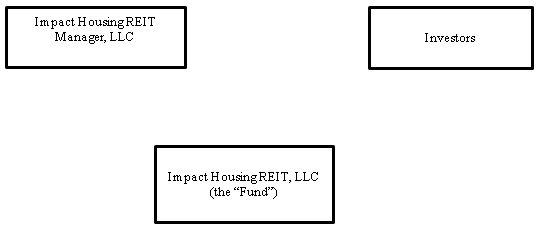
Page | 25
OUR MANAGEMENT TEAM
Neither the Fund nor the Manager has any employees. Instead, the Manager will act for and on behalf of the Fund through the employees and management team of our Sponsor.
The key employees of our Sponsor are:
|
Name
|
Position
|
Age
|
|
Edward P. Lorin
|
CEO/Founder
|
51
|
|
Howard Song
|
Director of Asset Management
|
33
|
|
Myron Chang
|
Senior Associate
|
27
|
Edward P. Lorin
The principal of the Manager is Edward P. Lorin, who has been managing director of JEM Realty Advisors, a property acquisition and asset management advisory firm, since 2001. During his 28-year career, Mr. Lorin has been responsible for the acquisition of more than $3.7 billion in office, industrial and apartment community assets.
Mr. Lorin founded Strategic Realty Holdings, LLC as a culmination of his 25 years’ experience in investment real estate and as an offshoot of Strategic Realty Capital (SRC). Since 2008, SRC has purchased over to 15,000 units in over 70 transactions valued at over $1 billion, and has built a strong performing portfolio. All of SRC’s apartment assets were purchased opportunistically and successfully re-positioned into thriving communities.
Prior to forming SRC, Mr. Lorin was the exclusive acquisition advisor to a large national apartment company, where he led the acquisition of 130 properties; 25,000+ units contained in over $2.2 billion in real estate. Mr. Lorin has also handled over $700 million in transactions involving Class A office buildings and retail space for Douglas Emmett/Jon Douglas Commercial, and has sold various sale-leaseback properties with Damon Raike & Company. Mr. Lorin also spent 8 years in the asset management and development of 5 million square feet of shopping centers and industrial complexes while employed by private, entrepreneurial Los Angeles investors.
Mr. Lorin is also co-founder of the 501II non-profit HAPI Foundation, which was developed to promote health and wellness in apartment communities. Mr. Lorin earned his bachelor’s degree from the University of California, Los Angeles, has a specialized “minor” in investment real estate, and has been a licensed real estate broker since 1988.
Page | 26
Howard Song
Mr. Song was responsible for heading the operations and Asset Management division of Strategic Realty Capital. Prior to joining Strategic Realty Capital LLC, Mr. Song worked in the Real Estate Capital Markets Group of Wells Fargo Bank where he was involved in the management of more than 70 assets totaling $1B+. Prior to 2008, Mr. Song worked in the acquisitions group at JEM Realty Advisors, Inc. in Los Angeles, where he was involved in the acquisition of over $500 Million of multifamily investments on the West Coast. Some of his major investment markets included Denver, Las Vegas, and Northern California. Mr. Song also worked as an analyst at Health Sciences Group, a biotechnology investment firm based in Los Angeles. Mr. Song received a Bachelor of Arts Degree in Economics from the University of California, Los Angeles. During his tenure at UCLA, he held internships at Citigroup and Alliance Capital.
Myron Chang
Myron Chang joined Strategic Realty Capital in 2011 working in all aspects of the business including acquisitions, underwriting, financing, and asset management of assets totaling over $500 Million and 7,000+ units of multifamily investments. In 2012, Mr. Chang joined the Asset Management division, overseeing all facets of property operations, ranging from supervising management companies in their daily operations to ensuring the compliance of the properties in all lender related procedures. Mr. Chang received a Bachelor of Science Degree in Mathematics/Economics from the University of California, Los Angeles.
Page | 27
COMPENSATION OF MANAGEMENT
Overview
The people who run the Fund make money from the Fund in (only) three ways:
| · | They receive fees |
| · | They invest alongside Investors and receive the same distributions as Investors |
| · | They receive the Promoted Interest |
All three forms of compensation are discussed below.
The Fund itself does not have any employees or payroll. For example, Edward P. Lorin, the Chief Executive Officer of the Manager, does not receive any salary, bonuses, or other compensation directly from the Fund. Instead, all of his compensation is paid from the fees paid to the Manager and from the Promoted Interest. The same is true for all of the other executive officers.
Fees
|
Type of Fee
|
Description
|
|
Reimbursement
|
The Fund must reimburse the Manager for expenses the Manager incurs in connection with the Offering, before the Offering Circular is qualified by the Securities and Exchange Commission.
Estimate: We currently estimate that those expenses will be approximately $300,000.
|
|
Asset Management
|
The Manager will charge the Fund a monthly asset management fee equal to 0.14583% of the Investors’ aggregate capital accounts as of the last day of each calendar month, or approximately 1.75% per year. An Investor’s “capital account” will generally be equal to the amount the Investor paid for his, her or its Series A Investor Shares, less any capital that has been returned to the Investor.
Estimate: The amount of the asset management fee will depend on (i) how much capital is raised in the Offering, and (ii) when and how much capital is returned to Investors. If the Fund raised the maximum $35,000,000, the Manager would receive approximately $612,500 per year. However, we cannot make a reasonable estimate at this time.
|
Page | 28
|
Acquisition of
Property
|
With respect to direct investments in real estate, the Manager will be entitled to receive an acquisition fee equal to 1.5% of the total cost of each property acquired on our behalf, which will be payable in addition to any brokerage or other fees payable to third parties.
With respect to Joint Ventures, the Fund, as the managing member of a Joint Venture, may be entitled to an acquisition fee to the extent negotiated with the financial partners in such Joint Venture, all of which will be payable to the Manager. In addition, the Manager shall be entitled to a 1.0% acquisition fee on the total cost (to the Fund) of the asset, payable upon the closing of the transaction.
Estimate: The amount of the acquisition fee will depend on how much property the Fund buys (either directly or through a Joint Venture), which will in turn depend on how much capital is raised in the Offering and how much leverage the Fund uses. We cannot make a reasonable estimate at this time.
|
|
Property
Management
|
The Fund allocates 5.0% of its gross monthly rents to property management fees, which the Manager believes is a market rate. If the Manager is able to engage a third party property manager for less than 5.0%, the Manager is entitled to retain the difference.
Estimate: The amount of the property management fee will depend on the gross rents the Fund receives and the actual costs of third-party property management services. We cannot make a reasonable estimate at this time.
|
|
Disposition of
Property
|
With respect to direct investments by the Fund, the Manager will receive a disposition fee equal to 1.0% of the total sale price of each property.
With respect to Joint Ventures, the Fund, as the managing member of a Joint Venture, the Manager might be entitled to a similar disposition fee to the extent negotiated with the financial partners in such Joint Venture. In addition, the Manager shall be entitled to a 1.0% disposition fee on the final sales price (to the Fund) of the asset, payable upon the closing of the transaction.
Estimate: The amount of the disposition fee will depend on the selling price of assets by the Fund and any Joint Ventures and, in the case of Joint Ventures. the terms our Manager negotiates with our Joint Venture partners. We cannot make a reasonable estimate at this time.
|
Page | 29
|
Financing
|
With respect to direct investments by the Fund, the Manager will be entitled to receive a financing fee equal to 1.0% of the amount of each loan placed on a property, whether at the time of acquisition or pursuant to a refinancing. This financing fee will be in addition to any fees paid to third parties, such as mortgage brokers.
With respect to Joint Ventures, the Fund, as the managing member of a Joint Venture, may be entitled to a similar financing fee of 1.0% to the extent negotiated with the financial partners in such Joint Venture, all of which will be payable to the Manager.
Estimate: The amount of the financing fee will depend on the amount of leverage (debt) the Fund and any Joint Ventures use and, in the case of Joint Ventures. the terms our Manager negotiates with our Joint Venture partners. We cannot make a reasonable estimate at this time.
|
|
Construction
Management
|
The Manager may provide construction and/or construction management services on behalf of the Fund. If so, the Manager shall be entitled to compensation that is (i) fair to the Fund, and (ii) no greater than would be paid to an unrelated party at arm’s length.
Estimate: The amount of the construction management fee will depend on the nature and cost of the construction services the Manager provides. We cannot make a reasonable estimate at this time.
|
|
Other Fees
|
The Company engages third parties to provide a variety of other services, including insurance and marketing. If the Manager is able to engage third parties at lower-than-market rates, then the Manager is entitled to retain the difference.
Estimate: The amount of other fees will depend on the nature of the services the Manager provides and how much the Manager charges for such services. We cannot make a reasonable estimate at this time.
|
Co-Investment
The Manager (and possibly other affiliates of our Sponsor) might purchase Series A Investor Shares. If so, they will be entitled to the same distributions as other Investors.
Page | 30
Promoted Interest
As described in the “Securities Being Offered – Distributions” section beginning on page 35, the Manager is entitled to receive certain distributions that we refer to as the Manager’s “Promoted Interest.” The Promoted Interest is paid in two levels: the first is paid from operating cash flow after Investors have received a cumulative, non-compounded annual return of 7%; and the second level is paid from the proceeds of capital transactions (like sales and refinancing) after Investors have received an internal rate of return of 16%.
How much money the Manager ultimately receives as a Promoted Interest therefore depends on a number of factors, including:
| · | How much capital is raised in the Offering; |
| · | The investment returns the Fund is able to achieve; |
| · | When those returns are achieved (the Fund might not achieve the same return every year); |
| · | When the Fund distributes money to Investors; and |
| · | The amount of expenses the Fund incurs. |
Report to Investors
No less than once per year, the Fund will provide Investors with a detailed statement showing:
| · | The fees paid to the Manager and its affiliates; and |
| · | Any transactions between the Fund and the Manager or its affiliates. |
In each case, the detailed statement will describe the services performed and the amount of compensation paid.
Clawback
If, upon the liquidation of the Fund, the owners of the Series A Investor Shares other than the Manager have not received distributions sufficient to return their capital contributions plus a 7% cumulative, non-compounded annual return, the Manager will be required to return any distributions it has received from the Fund, over and above its actual contributed capital, in an amount such that the Fund can distribute the shortfall to the owners of the Series A Investor Shares, other than the Manager.
Method of Accounting
The compensation described in this section was calculated using the accrual method of accounting.
Page | 31
Stages of Development
The stages of the Fund’s organization, development, and operation, and the compensation paid by the Fund to the Manager and its affiliates during each stage, are as follows:
|
Stage
|
Compensation
|
|
Organization
|
None
|
|
Acquisition of Property
|
· Asset Management Fee
· Acquisition Fee
· Financing Fee
|
|
Operation
|
· Asset Management Fee
· Property Management
· Insurance
· Marketing
· Financing Fee
· Returns from Co-Investment
· Promoted Interest
· Disposition Fee
|
|
Liquidation
|
· Returns from Co-Investment
· Promoted Interest
· Disposition Fee
|
Page | 32
MANAGEMENT’S DISCUSSION AND ANALYSIS OF FINANCIAL CONDITION AND RESULTS OF OPERATIONS
Liquidity
The Fund was organized under the Delaware Limited Liability Company Act on August 17, 2016. As of the date of this Offering Circular, we have not yet begun operations other than those associated with general start-up and organizational matters. As of the date of this Offering Circular, we have no revenues.
The Fund is obligated to reimburse the Manager for expenses the Manager incurs in connection with the Offering, before the Offering Circular is qualified by the Securities and Exchange Commission. We currently estimate that those expenses will be approximately $300,000.
We intend to use the proceeds of this Offering to buy, renovate (where necessary), and operate a portfolio of multi-family apartment communities. We will also use debt (borrow money) to finance a portion of the costs of buying and renovating property. For more information, please see the “The Fund – Leverage” section beginning on page 17.
Apart from our efforts to raise money from the sale of Series A Investor Shares in this Offering, we are not aware of any trends or any demands, commitments, events, or uncertainties that will result in or that are reasonably likely to result in the our liquidity increasing or decreasing in any material way.
Capital Resources
As of the date of this Offering Circular, we have not purchased any apartment communities or other assets or entered into any agreements to do so. Apart from our efforts to raise money via the sale of Series A Investor Shares in this Offering, we are not aware of any material trends, favorable or unfavorable, in our capital resources, or any expected material changes in the mix and relative cost of such resources.
Results of Operations
The Fund is in the development stage and has not yet begun principal operations. We do not intend to begin principal operations until we have received and accepted subscriptions from investors representing at least $3,000,000 of Series A Investor Shares.
Off Balance Sheet Arrangements
As of the date of this Offering Circular, the Fund does not have any off-balance sheet arrangements that have or are reasonably likely to have a current or future effect on our financial condition, changes in financial condition, revenues or expenses, results of operations, liquidity, capital expenditures or capital resources.
Page | 33
PAST PERFORMANCE: OUR TRACK RECORD SO FAR
Summary and Narrative Description
The Sponsor of the Fund is Strategic Realty Holdings, LLC (which we refer to as “SRH”), and the principal owner and manager of the Sponsor is Edward P. Lorin. As one of the two principals of Strategic Realty Capital, LLC (which we refer to as “SRC”), Mr. Lorin has been investing in underperforming multi-family apartment communities for approximately 15 years. During that time, SRC and SRH have purchased approximately 170 communities for an aggregate price of approximately $3 billion in approximately 80 different offerings of securities with private partners. We refer to each of these as a “Program.”All of these Programs are similar to the Fund in the following respects:
| · | They all involve raising money from investors. |
| · | They all involve conducting the same business as the business in which the Fund will be engaged, i.e., investing in underperforming multi-family apartment communities. |
| · | Each of the Programs also has investment objectives that are identical to the investment objectives of the Fund. |
Because of these similarities, investors who are considering purchasing Series A Investor Shares from the Fund might find it useful to review information about the Programs. Of course, prospective investors should bear in mind that prior performance does not guaranty future results. The fact that a prior Program has been successful (or unsuccessful) does not mean the Fund will experience the same results.
All of the Programs involved buying residential rental (income-producing) real estate. None of the Programs involved primarily buying commercial real estate (except commercial real estate that was incidental to the primarily residential component of the project), nor building or developing properties from the ground up.
There have been no major adverse business developments or conditions experienced by any Program that would be material to purchasers of the Fund’s Series A Investor Shares.
None of the Programs:
| · | Has been registered under the Securities Act of 1933; |
| · | Has been required to report under section 15(d) of the Securities Exchange Act of 1934; |
| · | Has had a class of equity securities registered under section 12(g) of the Securities Exchange Act of 1934; or |
| · | Has, or has had, 300 or more security holders. |
Page | 34
Strategic Realty Holdings, LLC and Strategic Realty Capital, LLC
The prior performance tables reflect properties owned by both Strategic Realty Holdings, LLC (SRH) and Strategic Realty Capital, LLC (SRC).
Our Sponsor, SRH, was formed in 2014 by Edward P. Lorin.
From 2008 to the present, Mr. Lorin has been one of two principals in SRC. In 2015, Mr. Lorin and the other principal of SRC began the process of dissolving SRC so that each principal could go his separate way. Over time, the assets owned by SRC will be sold.
The other principal of SRC is not a principal of SRH, and will not be involved with the Fund.
Appraisal of Certain Assets
SRC acquired 26 apartment communities with a single investor. In 2015 SRC divided those properties with the investor as follows:
| · | The investor took 20 of the properties; |
| · | SRC took five of the properties; and |
| · | One of the properties was sold. |
To achieve an equitable split, the parties (each represented by counsel) had each of the 26 properties appraised.
For purposes of the prior performance tables, we are treating the properties retained by the investor as having been sold on the date of the split for their appraised value. We have noted in the prior performance tables which properties we are referring to.
Strategy and NOI Results
As described at length in “The Fund – Investment Strategy” section starting on page 14, the strategy of our Sponsor is to:
| 1) | Identify C-quality multi-family apartment communities in A- or B-quality locations; |
| 2) | Buy those communities for C-level prices; |
| 3) | Make physical alterations and other improvements to those communities, increasing the quality from C to B or even A; |
| 4) | Improve the quality of life for tenants; |
| 5) | As a result of the alterations and improvements, attract more qualified tenants; and |
Page | 35
| 6) | Increase rents accordingly. |
The following table shows the changes in net operating income achieved in the communities owned by SRC and SRH:
|
Project
|
Purchased
|
Sold |
Months
Held |
Units
|
Change in
NOI |
|
1
|
10/29/15
|
N/A
|
10.77
|
184
|
24.84%
|
|
2
|
08/27/15
|
N/A
|
12.87
|
304
|
5.46%
|
|
3
|
01/14/15
|
N/A
|
20.37
|
102
|
69.43%
|
|
4
|
12/31/14
|
N/A
|
20.83
|
220
|
64.00%
|
|
5
|
11/25/14
|
N/A
|
22.03
|
200
|
60.38%
|
|
6
|
10/29/14
|
N/A
|
22.93
|
216
|
53.64%
|
|
7
|
10/14/14
|
N/A
|
23.43
|
195
|
29.31%
|
|
8
|
09/19/14
|
N/A
|
24.27
|
4275
|
6.84%
|
|
9
|
12/23/13
|
N/A
|
33.27
|
436
|
43.83%
|
|
10*
|
08/30/13
|
04/30/15
|
20.27
|
256
|
38.88%
|
|
11*
|
06/21/13
|
04/30/15
|
22.60
|
347
|
10.50%
|
|
12*
|
05/17/13
|
04/30/15
|
23.77
|
268
|
33.52%
|
|
13
|
10/31/12
|
N/A
|
47.20
|
1271
|
78.20%
|
|
14*
|
09/11/12
|
04/30/15
|
32.03
|
155
|
294.83%
|
|
15
|
08/06/12
|
09/24/15
|
38.13
|
200
|
76.29%
|
|
16
|
07/16/12
|
09/02/15
|
38.10
|
296
|
52.61%
|
|
17*
|
06/28/12
|
04/30/15
|
34.53
|
638
|
41.01%
|
|
18
|
06/14/12
|
08/16/15
|
38.60
|
346
|
148.74%
|
|
19*
|
03/28/12
|
04/30/15
|
37.60
|
282
|
35.98%
|
|
20
|
03/23/12
|
10/08/15
|
43.13
|
156
|
129.83%
|
|
21*
|
03/26/12
|
04/30/15
|
37.67
|
400
|
33.77%
|
|
22*
|
12/15/11
|
04/30/15
|
41.07
|
484
|
76.15%
|
|
23
|
10/18/11
|
06/16/15
|
44.57
|
160
|
19.07%
|
|
24
|
10/07/11
|
05/07/15
|
43.60
|
195
|
218.10%
|
|
25*
|
09/29/11
|
04/30/15
|
43.63
|
440
|
32.46%
|
|
26
|
09/06/11
|
03/11/16
|
54.93
|
176
|
405.10%
|
|
27
|
06/23/11
|
04/09/14
|
34.03
|
466
|
96.68%
|
|
28*
|
05/20/11
|
04/30/15
|
48.03
|
200
|
14.79%
|
|
29
|
05/05/11
|
09/17/15
|
53.20
|
140
|
92.37%
|
|
30*
|
01/12/11
|
04/30/15
|
52.30
|
536
|
141.74%
|
|
31*
|
01/05/11
|
04/30/15
|
52.53
|
264
|
93.55%
|
|
32*
|
01/31/11
|
04/30/15
|
51.67
|
218
|
573.50%
|
|
33
|
09/22/10
|
06/19/15
|
57.70
|
330
|
640.03%
|
|
34
|
09/08/10
|
04/30/15
|
56.50
|
240
|
81.47%
|
|
35
|
05/07/10
|
07/15/15
|
63.17
|
475
|
1097.90%
|
*For explanation, see “Appraisal of Certain Assets” above.
Page | 36
Over the last 15 years, we have, on average, increased the net operating income of our projects by 62% per year. This figure is a so-called “weighted average,” based on the number of units in each project.
CAUTION: PRIOR PERFORMANCE DOES NOT GUARANTY FUTURE RESULTS. THE FACT THAT OUR SPONSOR HAS BEEN SUCCESSFUL WITH THESE PROGRAMS DOES NOT GUARANTY THAT THE FUND WILL BE SUCCESSFUL.
Acquisitions of Properties Within Last Three Years
During the last three years, SRC and SRH have purchased 32 properties. Together, these 32 properties have 6,133 rental units with 5,175,105 rental square feet and cost a total of $356,546,061. For more detailed information, see Table VI of the prior performance tables.
Prior Performance Tables
For more information about the prior Programs, please refer to Exhibit 1A-15.1– Results of Prior Programs.
Page | 37
SECURITIES BEING OFFERED
Description of Securities
We are offering to the public up to $35,000,000 of our Series A Investor Shares, which represent limited liability company interests in the Fund. All of the rights and obligations associated with the Series A Investor Shares are set forth in:
| · | The LLC Agreement, which is attached as Exhibit 1A-2B; and |
| · | The Authorizing Resolution, which is attached as Exhibit 1A-15.2. |
Price of Series A Investor Shares
Initially, we will offer the Series A Investor Shares at $10 per Series A Investor Share. During the term of this Offering, we may increase or decrease the price per Series A Investor Share to reflect changes in the net value of our assets, which will be determined by the Manager in its sole and absolute discretion. Changes in the price per Series A Investor Share will be reflected in a supplement or amendment to this Offering Statement filed with the SEC.
Voting Rights
Owners of the Series A Investor Shares – that is, Investors – will have no right to vote or otherwise participate in the management of the Fund. Instead, the Fund is managed by the Manager exclusively. However, without the consent of a majority of the Investors, measured by capital accounts, the Manager may not take any action that would reasonably be expected to have an adverse effect on the Fund.
Distributions
We intend to make distributions periodically, as conditions permit. The order of distributions will be governed by the Fund’s LLC Agreement and by the Authorizing Resolution.
We divide distributions into two categories:
| · | Distributions of ordinary operating cash flow (primarily in the form of rent payments we receive, after expenses); and |
| · | Distributions of the net proceeds from “capital transactions” like sales or refinancing of properties (“net proceeds” means the gross proceeds of the capital transaction, reduced by the expenses of the transaction, including repayment of debt). |
Distributions of ordinary operating cash flow will be in the following order of priority:
| · | Step One: First, Investors will receive all the operating cash flow until they have received a 7% cumulative, non-compounded annual return on their invested capital; and |
Page | 38
| · | Step Two: Second, any remaining operating cash flow will be distributed 65% to the Investors on a pro rata basis, and 35% to the Manager. |
Distributions of the net proceeds from capital transactions will be made in the following order or priority:
| · | Step One: First, Investors will receive all the net proceeds until they have received a 7% cumulative, non-compounded annual return on their invested capital; |
| · | Step Two: Second, Investors will receive any remaining net proceeds to return an allocable portion of the capital they invested* (see explanation below); |
| · | Step Three: Third, any remaining net proceeds will be distributed 65% to the Investors on a pro rata basis and 35% to the Manager until Investors have received a “internal rate of return” of 16%** (see explanation below); and |
| · | Step Four: Fourth, any remaining net proceeds will be distributed 50% to the Investors on a pro rata basis and 50% to the Manager |
We refer to the 7% cumulated, non-compounded annual return of Investors as their “Preferred Return,” and to amounts paid to the Manager as its “Promoted Interest.”
We expect to make distributions of ordinary operating cash flow on a quarterly basis. Distributions of the net proceeds from capital transactions will be made, if at all, upon the occurrence of a capital transaction.
Whether to distribute operating cash flow or capital proceeds, and how much to distribute, are in the sole discretion of the Manager. No returns are guaranteed. Investors will receive distributions only if we are able to generate a profit from the business.
*When we say that all distributions of the net proceeds from capital transactions will first be distributed to Investors until they have received an “allocable portion” of the capital they invested, we mean that when the Fund enters into a capital transaction like a sale or refinancing, and decides to distribute some or all of the proceeds (as opposed to reinvesting the proceeds in other properties), the Manager will allocate all of the capital contributed by Investors (less any previous distributions of capital) among all of the properties owned by the Fund, based on an estimate of the fair market value of each property (less debt encumbering each property). This will allow the Manager to determine how much capital is allocable to the property involved in the capital transaction.
Page | 39
**”Internal rate of return” is a financial concept that measures the overall return from an investment, taking into account all the money you put in as well as all the money you took out, as well as the timing of each contribution and distribution. Solely by way of example, you would have an internal rate of return if you contributed $100 to an investment and:
| · | Liquidated the investment in one year for $116; or |
| · | Received no distributions for five years, and at the end of the fifth year liquidated the investment for $210.03; or |
| · | Received a payment of $16 at the end of year, and received your $100 back at the end of the fifth year. |
We calculate the internal rate of return using the XIRR function in Microsoft Excel, the spreadsheet program.
NOTE CONCERNING CALCULATION OF RETURNS: In general, we will calculate the returns of Investors beginning on the last day of the month in which an Investor purchases his, her, or its Series A Investor Shares. However, we will not begin calculating returns until the date that is three (3) months following the date that the first $3,000,000 raised in the Offering is released from escrow.
EXAMPLE: Suppose that (i) Investor X purchases Series A Investor Shares on February 6, 2017, (ii) Investor Y purchases Series Investor Shares on July 16, 2017, and (iii) the first $3,000,000 raised in the Offering is released from escrow on March 20, 2017. We would begin to calculate the returns of Investor X on June 20, 2017 (the date three months following the release from escrow) and the returns of Investor Y on July 31, 2017 (the last day of the month Investor Y purchased Series A Investor Shares).
The LLC Agreement is attached as Exhibit 1A-2B and the Authorizing Resolution is attached as Exhibit 1A-15.2.
How We Decide How Much To Distribute
To decide how much to distribute, we start with our revenues, which may include rental income and proceeds from the sale or refinancing properties, and then subtract our actual expenses, which may include items such as management fees (including fees to the Manager), bank fees, appraisal costs, insurance, commissions, marketing costs, taxes, legal and accounting fees, travel expenses, and fees paid to third parties. Finally, depending on the circumstances at the time, we decide how much should be held in reserve against future contingencies. The amount we distribute is therefore our revenue, minus our expenses, minus the reserve amount.
Page | 40
Withholding
In some situations, we might be required by law to withhold taxes and/or other amounts from distributions made to Investors. The amount we withhold will still be treated as part of the distribution. For example, if we distribute $100 to you and are required to withhold $10 in taxes, for our purposes you will be treated as having received a distribution of $100 even though only $90 was deposited in your bank account.
No Guaranty
We can only distribute as much money as we have. There is no guaranty that we will have enough money, after paying expenses, to distribute enough to pay a 7% annual return to Investors or even to return all of their invested capital.
Transfers
Investors may freely transfer their Series A Investor Shares, but only after providing the Manager with written assurance that (i) the transfer is not required to be registered under the Securities Act of 1933, (ii) the transferor or the transferee will reimburse the Fund for expenses incurred in connection with the transfer, and (iii) the transfer will not compromise the Fund’s election to be taxed as a REIT for purposes of Federal income taxation.
Mandatory Redemptions
The Manager may require an Investor to sell his, her, or its Series A Investor Shares back to the Company:
| · | If the Investor is an entity governed by the Employee Retirement Income Security Act of 1974, Code section 4975, or any similar Federal, State, or local law, and the Manager determines that all or any portion of the assets of the Fund would, in the absence of the redemption, more likely than not be treated as “plan assets” or otherwise become subject to such laws. |
| · | If the Manager determines that the redemption would be beneficial in allowing the Fund to retain its status as a REIT. |
| · | If the Manager determines that the Investor has engaged in certain misconduct. |
If an Investor’s Series A Investor Shares are purchased pursuant to such a request, the price will be equal to 90% of the amount the selling Investor would have received had all assets of the Fund (including assets held indirectly, through Joint Ventures) been sold for their net asset value and the proceeds, less all liabilities and expenses, been distributed in liquidation of the Fund.
The purchase price will be paid by wire transfer or other immediately-available funds.
Page | 41
Limited Right Of Redemption
At any time after buying Series A Investor Shares, an Investor may ask the Company to purchase, or arrange for the purchase, of all or a portion of the Investor’s Series A Investor Shares. Upon receipt of such a request, the Manager must use commercially reasonable efforts to arrange for the purchase, although there is no guaranty that the necessary funds will be available or that a buyer can be found. If the Manager is not able to purchase or arrange for the purchase of the Series A Investor Shares, the Investor may either rescind or maintain the request.
In seeking to accommodate a request from an Investor, the Manager is not required to do any of the following:
| · | Arrange for the purchase of any Series A Investor Shares within one year after they were issued; |
| · | Arrange for the purchase of more than 25% of an Investor’s Series A Investor Shares during any year. |
| · | Arrange for the purchase of more than 5% of the issued and outstanding Series A Investor Shares during any fiscal year; |
| · | Buy the Series A Investor Shares for its own account; |
| · | Contribute money to buy the Series A Investor Shares; |
| · | Borrow money or dispose of assets; or |
| · | Take any other action the Manager believes would be adverse to the interests of the Fund or its other Members. |
If an Investor’s Series A Investor Shares are purchased pursuant to such a request, the price will be equal to 90% of the amount the selling Investor would have received had all assets of the Fund (including assets held indirectly, through Joint Ventures) been sold for their net asset value and the proceeds, less all liabilities and expenses, been distributed in liquidation of the Fund.
The purchase price will be paid by wire transfer or other immediately-available funds.
If more than one Investor asks the Manager to purchase or arrange for the purchase of Series A Investor Shares, the Manager will consider the requests in the order received.
Page | 42
LIMIT ON AMOUNT NON-ACCREDITED INVESTORS CAN INVEST
As long as you’re at least 18 years old, you can invest in this Offering. But if you’re not an “accredited” investor, the amount you can invest is limited by law.
Under 17 CFR §230.501, a regulation issued by the SEC, the term “accredited investor” means:
| · | A natural person (a human being) who has: |
| o | Individual net worth, or joint net worth with the person’s spouse, that exceeds $1 million at the time of the purchase, excluding the value of the primary residence of such person; OR |
| o | Income exceeding $200,000 in each of the two most recent years, or joint income with a spouse exceeding $300,000 for those years and a reasonable expectation of the same income level in the current year; |
| · | A trust with assets in excess of $5 million, not formed for the specific purpose of acquiring the securities offered, whose purchase is directed by a sophisticated person; |
| · | A business in which all the equity owners are accredited investors; |
| · | An employee benefit plan, within the meaning of the Employee Retirement Income Security Act, if a bank, insurance company, or registered investment adviser makes the investment decisions, or if the plan has total assets in excess of $5 million; |
| · | A bank, insurance company, registered investment company, business development company, or small business investment company; |
| · | A charitable organization, corporation, or partnership, not formed for the specific purpose of acquiring the securities offered, with total assets exceeding $5 million; and |
| · | A director, executive officer, or general partner of the company selling the securities, or any director, executive officer, or general partner of a general partner of that issuer. |
If you fall within any of those categories, then you can invest as much as you want. If you don’t fall within any of those categories, then the most you can invest in this Offering is the greater of:
| · | 10% of your annual income; or |
| · | 10% of your net worth. |
These limits are imposed by law, not by us.
Page | 43
PLAN OF DISTRIBUTION
Size of Offering
We are offering up to $35,000,000 of our Series A Investor Shares in the Offering. We will begin deploying the proceeds of the Offering (that is, we will begin to buy properties) once we have raised at least $3,000,000. If we do not raise at least $3,000,000 within six months, we will terminate the Offering and return any money we’re raised to that point, without any deductions.
Term of Offering
The Offering will begin as soon as our registration statement is “qualified” by the SEC. The Offering will end upon the earlier of (1) the date we have sold $35,000,000 of Series A Investor Shares (i.e., all the securities we are offering), (2) the date two years after it begins, or (3) the date we decide to end it.
Minimum Initial Investment
The minimum initial investment is 100 Series A Investor Shares, or $1,000.
Manner of Distribution
The Series A Investor Shares will be offered solely by the Fund itself through www.ImpactHousing.com, which we refer to as the “Site.”
Only the Fund itself is selling securities in this Offering. No securities are being sold by or on behalf of any existing owner of the Fund.
We reserve the right to reject any subscription in whole or in part for any reason. If we reject your subscription, we will return all your money without interest or deduction.
How To Invest
To buy an Series A Investor Share, go to www.ImpactHousing.com, register, locate the Offering, and follow the instructions. We will ask for certain information about you, including:
| · | Your name and address |
| · | Your social security number (for tax reporting purposes) |
| · | Whether you are an “accredited investor” |
| · | If you not an accredited investor, your income and net worth |
We will also ask you to sign our Investment Agreement, a copy of which is attached as Exhibit 1A-6E.
You will pay for your Series A Investor Shares using one of the options described on the Site.
Page | 44
The information you submit, including your signed Investment Agreement, is called your “subscription.” We will review your subscription and decide whether to accept it. We have the right to accept or reject subscriptions in our sole discretion, for any reason or for no reason.
Once we have accepted your subscription, we will notify you by email and the investment process will be complete. We will also notify you by email if we do not accept your subscription, although we might not explain why.
You Series A Investor Shares will be issued in electronic form only. We will not issue you a paper certificate representing your Series A Investor Shares.
Escrow
When you invest, your money will be held in an escrow account with a third party until:
| · | We review your subscription and decide whether to accept it; and |
| · | We have raised at least $3,000,000. |
When and if those two conditions are satisfied, we will release your money from the escrow account to the Fund at a time we select.
If we decide not to accept your subscription or don’t raise at least $3,000,000, we will return your money to you without deduction.
Advertising the Offering
After the Offering has been “qualified” by the SEC, we intend to advertise the Offering using the Site and through other means, including public advertisements and audio-visual materials, in each case only as we authorize. Although these materials will not contain information that conflicts with the information in this Offering Circular and will be prepared with a view to presenting a balanced discussion of risk and reward with respect to the Series A Investor Shares, our advertising materials will not give a complete understanding of this Offering, the Fund, or the Series A Investor Shares and are not to be considered part of this Offering Circular. The Offering is made only by means of this Offering Circular and prospective Investors must read and rely on the information provided in this Offering Circular in connection with their decision to invest in the Series A Investor Shares.
Supplements and Amendments to Offering Circular
From time to time we will supplement or amend this Offering Circular during the term of the Offering to reflect changes or additions to the information presented, as required by SEC rules.
Page | 45
Among other things, while the Offering is being conducted (the period described in the “Plan of Distribution – Term of Offering” section starting on page 41) we will file a “sticker supplement” pursuant to Rule 253(g) of SEC Regulation A for each real estate asset we intend to purchase, at such time as we determine that there is a reasonable probability that we will acquire the asset. The supplement will describe the asset and will disclose all compensation and fees paid to the Manager or its affiliates in connection with the acquisition.
At least once every three months, we will consolidate all such sticker supplements into a “post-qualification amendment” to this Offering Circular. Where appropriate, the post-qualification amendment will also include or incorporate by reference audited financial statements meeting the requirements of Rule 3-14 of Regulation S-X for properties acquired during the distribution period.
We will also file, after the end of the distribution period, a current report on Form 1-U containing the financial statements and any additional information required by Rule 3-14 of Regulation S-X (as applicable), to reflect each commitment (i.e., the signing of a binding purchase agreement) to purchase a property made after the end of the distribution period involving the use of 10% or more (on a cumulative basis) of the net proceeds of the Offering, and we will provide the information contained in such report to Investors at least once each quarter after the distribution period ends.
Page | 46
ESTIMATED USE OF PROCEEDS
After payment of the costs we incur in connection with the Offering, including legal, accounting, and marketing costs, we intend to use all of the net proceeds of the Offering to source, acquire, develop (as appropriate) and operate a portfolio comprised primarily of multi-family residential real estate properties.
The table below shows our estimate of how we will use the proceeds of this Offering.
|
Estimated Use of Proceeds
|
||||||||
|
Minimum
|
Maximum
|
|||||||
|
Gross Offering Proceeds
|
$
|
3,000,000
|
$
|
35,000,000
|
||||
|
Offering Expenses
|
$
|
(300,000
|
)
|
$
|
(1,000,000
|
)
|
||
|
Net Proceeds Available for Investment
|
$
|
2,700,000
|
$
|
34,000,000
|
||||
Page | 47
INVESTMENT COMPANY ACT LIMITATIONS
The Manager intends to conduct our operations so that neither we nor any of our subsidiaries or joint ventures is required to register as an “investment company” under the Investment Company Act of 1940 (as amended, the “Investment Company Act”). If, however, the SEC determined that we were required to register as an investment company, we would be subject to stringent regulation and would be required to undertake costly compliance activities, and we could be subject to fines, penalties and other adverse consequences.
Section 3(a)(1)(A) of the Investment Company Act defines an investment company as any issuer that “is or holds itself out as being engaged primarily, or proposes to engage primarily, in the business of investing, reinvesting, or trading in securities,” and section 3(a)(1)(C) further defines an investment company to include any issuer that “is engaged or proposes to engage in the business of investing, reinvesting, owning, holding, or trading in securities, and owns or proposes to acquire investment securities having a value exceeding 40% of the value of such issuer’s total assets (exclusive of Government securities and cash items) on an unconsolidated basis.”
The business of the Fund is to buy fee simple interests in real estate, which are not “securities” under the Investment Company Act (a “fee simple” interest in real estate means the ownership of the real estate itself). Therefore, we do not believe that we will be required to register as an investment company under section 3(a)(1)(A) of the Investment Company Act.
In addition to buying fee simple interests in real estate, however, the Fund might also invest in “joint ventures” from time to time (see “The Fund – Joint Ventures” section on page 17). In those situations, the Joint Venture will own the fee simple interest in real estate while we will own only an indirect interest in the form of a limited liability company interest or partnership interest.
In some situations, a limited liability company interest or partnership interest could be treated as a “security,” raising a question whether the Fund might be required to register under section 3(a)(1)(C) of the Investment Company Act (if the value of those securities exceeded the 40% threshold). Under our LLC Agreement, however, we may enter into Joint Ventures only where either (i) the Fund will serve as the active manager of the Joint Venture, in which case the interest in the Joint Venture will not be treated as a “security” for purposes of the Investment Company Act, or (ii) the interest in the Joint Venture does not otherwise cause the Fund to be treated as an “investment company” in the opinion of counsel.
Page | 48
SUMMARY OF OUR LLC AGREEMENT AND AUTHORIZING RESOLUTION
The Fund as a whole is governed by an agreement captioned “Limited Liability Company Agreement” dated September 1, 2016. We refer to this as the “LLC Agreement.”
The Series A Investor Shares being offered in this Offering were created when the Manager adopted a resolution pursuant to section 3.1 of the LLC Agreement. We refer to this as the “Authorizing Resolution.”
The following summarizes some of the key provisions of the LLC Agreement and the Authorizing Resolution. This summary is qualified in its entirety by the LLC Agreement itself, which is included as Exhibit 1A-2B, and by the Authorizing Resolution itself, which is included as Exhibit 1A-15.2.
Formation and Ownership
The Fund was formed in Delaware on August 17, 2016 pursuant to the Delaware Limited Liability Company Act.
Under the LLC Agreement, ownership interests in the Fund are referred to as “Shares,” while the owners are referred to as “Members.”
Immediately before this Offering, the only owner of the Fund was the Manager. Investors who buy Series A Investor Shares in the Offering will become owners, and the Fund might admit other owners in the future.
Shares and Ownership
The interests in the Fund are denominated by 20,000,000 “Shares,” consisting of 1,000,000 “Common Shares” and 19,000,000 “Investor Shares.” The Manager may further divide the 19,000,000 Investor Shares into one or more series, by adopting one or more authorizing resolutions. Anyone owning Investor Shares is referred to in the LLC Agreement as an “Investor Member.”
The Manager adopted the Authorizing Resolution to create the Series A Investor Shares. Any Investor who buys Series A Investor Shares in the Offering will be an “Investor Member” under the LLC Agreement.
All of the Common Shares of the Fund are owned by the Manager. The Series A Investor Shares will be owned by Investors, and are the subject of this Offering. By adopting other authorizing resolutions, the Manager may create, offer, and sell other series of Investor Shares in the future, which could have rights superior to the rights of the Series A Investor Shares.
Page | 49
Management
The Manager has complete discretion over all aspects of the business conducted by the Fund. For example, the Manager may (i) admit new members to the Fund; (ii) enter into contracts on behalf of the Fund; (iii) borrow money; (iv) acquire and dispose of assets; (v) determine the timing and amount of distributions to Members; (vi) create new classes of limited liability company interests; (vii) determine the information to be provided to the Members; (viii) grant liens and other encumbrances on the assets of the Fund; (ix) and dissolve the Fund.
Investors who purchase Series A Investor Shares will not have any right to vote on any issue other than certain amendments to the LLC Agreement, or to remove the Manager.
Certain terms of the services to be provided by the Manager, as well as the compensation to be paid to the Manager by the Fund, are set forth in the Management Services Agreement between the Fund and the Manager dated September 1, 2016, which we refer to as the “Management Agreement.” The principal terms of the Management Agreement are summarized in the “Summary of Management Agreement” section starting on page 51, while a copy of the Management Agreement is attached as Exhibit 1A-6A.
The Manager can be removed for “cause” under a procedure set forth in section 5.7 of the LLC Agreement.
The term “cause” includes:
| · | An uncured breach of the LLC Agreement or the Management Agreement by the Manager; or |
| · | The bankruptcy of the Manager; or |
| · | Certain misconduct on the part of the Manager, if the individual responsible for the misconduct is not terminated. |
A vote to remove the Manager for cause must be approved by Investor Members owning at least two-thirds of the outstanding Investor Shares. Whether “cause” exists would then be decided in arbitration proceedings conducted under the rules of the American Arbitration Association.
Exculpation and Indemnification of Manager
The LLC Agreement protects the Manager and its employees and affiliates from lawsuits brought by Investors. For example, it provides that the Manager will not be responsible to Investors for mistakes, errors in judgment, or other acts or omissions (failures to act) as long as the act or omission was not the result of the Manager’s (i) willful misfeasance, (ii) bad faith, or (iii) gross negligence in the performance of, or reckless disregard of, its duties under the LLC Agreement. This limitation on the liability of the Manager and other parties is referred to as “exculpation.”
Page | 50
The LLC Agreement also requires the Fund to indemnify (reimburse) the Manager, its affiliates, and certain other parties from losses, liabilities, and expenses they incur in performing their duties. For example, if a third party sues the Manager on a matter related to the Fund’s business, the Fund would be required to indemnify the Manager for any losses or expenses it incurs in connection with the lawsuit, including attorneys’ fees. However, this indemnification is not available where a court or other juridical or governmental body determines that the Manager or other person is not entitled to be exculpated under the standard described in the preceding paragraph.
Notwithstanding the foregoing, no exculpation or indemnification is permitted to the extent such exculpation or indemnification would be inconsistent with the requirements of federal or state securities laws or other applicable law.
The detailed rules for exculpation and indemnification are set forth in section 6.2 of the LLC Agreement.
Obligation to Contribute Capital
Once an Investor pays for his, her, or its Series A Investor Shares, he, she, or it will not be required to make any further contributions to the Fund. However, if an Investor has wrongfully received a distribution he, she, or it might have to pay it back.
Personal Liability
No Investor will be personally liable for any of the debts or obligations of the Fund.
Distributions
The manner in which the Fund will distribute its available cash is described in the “Securities Being Offered – Distributions” section beginning on page 35.
Transfers and First Right of Refusal
In general, Investors may freely transfer their Series A Investor Shares. However, the Manager may prohibit a transfer that the Manager determines would jeopardize the status of the Fund as a REIT.
If an Investor wants to sell Series A Investor Shares, the Investor must first offer the Series A Investor Shares to the Manager.
Death, Disability, Etc.
If an Investor who is a human being (as opposed to an Investor that is a legal entity) should die or become incapacitated, the Investor or his, her or its successors will continue to own the Investor’s Series A Investor Shares.
Page | 51
Fees to Manager and Affiliates
The Fund will pay certain management fees and other fees to the Manager, as summarized in the “Management Fees” section beginning on page 26.
Mandatory Redemption
The Manager may cause the Company to redeem (purchase) the Series A Investor Shares owned by an Investor in any of three circumstances (in effect kicking the Investor out of the deal) as described in the “Securities Being Offering – Mandatory Redemptions” section starting on page 38.
“Drag-Along” Right
If the Manager wants to sell the business conducted by the Fund, it may effect the transaction as a sale of the assets owned by the Fund or as a sale of all the Interests in the Fund. In the latter case, Investors will be required to sell their Series A Investor Shares as directed by the Manager, receiving the same amount they would have received had the transaction been structured as a sale of assets.
Limited Redemption Right
Investors will have a limited right to ask the Company to redeem (buy back) their Series A Investor Shares, as described in the “Securities Being Offered – Limited Right of Redemption” section starting on page 38.
Electronic Delivery
All documents, including all tax-related documents, will be transmitted by the Fund to Investors via electronic delivery.
Amendment
The Manager may amend the LLC Agreement unilaterally (that is, without the consent of anyone else) for a variety of purposes, including to:
| · | Cure ambiguities or inconsistencies in the LLC Agreement; |
| · | Add to its own obligations or responsibilities; |
| · | Change the name of the Fund; |
| · | Ensure that the Fund (including the Fund) satisfies applicable laws, including tax and securities laws; and |
| · | Ensure that the Fund is eligible to be treated as a REIT. |
Page | 52
An amendment that has, or could reasonably be expected to have, an adverse effect on Investors, requires the consent of the Manager and Investors holding a majority of the Series A Investor Shares.
An amendment that would require an Investor to make additional capital contributions or impose personal liability on an Investor requires the consent of the Manager and each affected Investor.
Information Rights
Within 120 days after the end of each fiscal year of the Fund, we will provide Investors with (i) a statement showing in reasonable detail the computation of the distributions made by the Fund, (ii) audited financial statements of the Fund, (iii) a statement of the income and expenses of the Fund, and (iv) a description of the Fund’s investments (including those held through Joint Ventures), and a valuation of the investments performed in good faith by the Manager.
In addition, each year the Fund will provide Investors with a detailed statement showing:
| · | The fees paid to the Manager and its affiliates; and |
| · | Any transactions between the Fund and the Manager or its affiliates. |
In each case, the detailed statement will describe the services performed and the amount of compensation paid.
Within 60 days after the end of the first three fiscal quarters of each fiscal year, we will also provide to Investors a report containing, among other items, an overview of the Fund’s investments and Joint Ventures, unaudited financial statements, a summary of the distributions made during the quarter, and a statement of such Investor’s capital account.
As a “tier 2” issuer under Regulation A, the Fund may also be required to provide investors with additional information on an ongoing basis, including annual audited financial statements, annual reports filed on SEC Form 1-K, semiannual reports filed on SEC Form 1-SA, special financial reports filed on SEC Form 1-K, and current reports on SEC Form 1-U. If, however, our Series A Investor Shares are held “of record” by fewer than 300 persons, these reporting obligations could be terminated.
A Member’s right to see additional information or inspect the books and records of the Fund is limited by the LLC Agreement.
Page | 53
SUMMARY OF MANAGEMENT AGREEMENT
Impact Housing REIT Manager, LLC is designated as the “manager” of the Fund under the LLC Agreement. Under section 5.2 of the LLC Agreement, the Manager has:
[F]ull and complete authority, power and discretion to manage and control the business, affairs and properties of the Company, to make all decisions regarding those matters, to execute any contracts or other instruments on behalf of the Company, and to perform any and all other acts or activities customary or incidental to the management of the Company’s business.
The Company and the Manager entered into a contract called a “Management Services Agreement” dated September 1, 2016, which we refer to as the “Management Agreement.” The Management Agreement describes at length and in detail many of the duties of the Manager, and also describes the Manager’s compensation. However, the list of the Manager’s duties and authority in the Management Agreement is not exclusive. Under the broad grant of authority in the LLC Agreement, the Manager could have duties and authority not listed in the Management Agreement.
The Management Agreement is included as Exhibit 1A-6A.
The duties of the Manager include managing our investments, raising money, accounting and administrative services, and managing investor relations. Some of the specific duties of the Manager are:
| · | Conducting this Offering |
| · | Establishing investment guidelines, policies, and procedures |
| · | Overseeing and conducting due diligence |
| · | Arranging for financing from banks and other financial institutions |
| · | Reviewing joint venture opportunities |
| · | Keeping and maintaining the books and records of the Fund |
| · | Managing the Fund’s portfolio of assets |
| · | Managing the administrative and back-office functions of the Fund |
| · | Collecting, maintaining, and distributing information |
| · | Determining the improvements to be made to properties owned by the Fund |
| · | Maintaining appropriate technology systems |
Page | 54
| · | Making, changing, and revoking tax elections including making an election be treated as a REIT and to be treated as a corporation for tax purposes |
| · | Complying with SEC requirements |
| · | Managing distributions and payments to Investors; |
| · | Handling redemption requests from Investors |
| · | Engaging property managers, contractors, attorneys, accountants, and other third parties |
| · | Entering into contracts and other agreement |
The compensation of the Manager is described in the “Compensation of Management” section starting on page 26.
The Management Agreement will remain in effect for as long as the Manager is the manager of the Fund under the LLC Agreement.
Page | 55
ALLOCATION OF EXPENSES AND INVESTMENT OPPORTUNITIES
The Fund has no direct employees. The Manager will use and rely upon the executive management team and real estate professionals of our Sponsor and its affiliates.
The following discusses the policies and procedure we intend to follow with respect to three important items:
| 1) | Which entity pays for which expenses |
| 2) | How we allocate investment opportunities as between the Fund on one hand and our Sponsor and its other affiliates on the other hand |
| 3) | Our plans to create other funds |
Payment of Expenses
The Manager will be responsible for compensating its employees and contractors, including salaries, wages, payroll taxes, and the cost of benefit plans. The Manager will also be responsible for rent, telephone, utilities, office furniture, equipment, machinery and other office, internal and overhead expenses of the Manager required for the Fund’s day-to-day operations, including, bookkeeping, clerical and back-office services provided by the Manager.
The Fund will pay all of the other costs of operating its business, including:
| · | Costs and expenses associated with the formation of the Fund and the Manager |
| · | The costs of this Offering |
| · | The cost of buying, operating, and selling real estate assets, appraisal fees, insurance premiums, commitment fees, brokerage fees, guaranty fees, ad valorem taxes, costs of foreclosure, property management, maintenance, and the cost of repair and improvement |
| · | Financing costs |
| · | Taxes |
| · | Insurance premiums |
| · | Custodian, transfer agent, and registrar fees |
| · | Legal and accounting fees |
| · | Travel and related expenses of the Manager incurred in connection with the business of the Fund |
Page | 56
| · | Costs incurred to comply with the reporting and other requirements of governmental bodies or agencies, including the cost of preparing and distributing reports to Investors |
| · | Technology costs |
Allocation of Investment Opportunities
Mr. Lorin, the principal owner of the Manager and our Sponsor, has been investing in multi-family apartment communities for approximately 15 years. He is likely to become aware of many opportunities in the multi-family market while the Fund is operating. To minimize the risk of conflict, Mr. Lorin has agreed that if he becomes aware of a multi-family apartment community that satisfies the criteria established for the Fund by the Manager and the Fund has the resources to buy such community, then the Fund will be given the opportunity to buy that community, before the Sponsor, the Manager, or any other entity controlled by Mr. Lorin. The only exceptions are:
| · | Communities that are already owned by the Sponsor or an affiliate |
| · | Communities within the immediate vicinity of any of those communities |
Other Funds
Mr. Lorin has also agreed not to create a fund with the same investment objectives as the Fund until the earlier of:
| · | The date that is two years following the qualification of the Offering by the SEC; or |
| · | The date that the Fund has raised $35,000,000 in the Offering. |
For these purposes, a fund will be deemed to have the same investment objectives as the Fund if:
| · | The fund purchases fee simple interests in underperforming multi-family apartment communities, requiring “value add” additions and renovations; and |
| · | The fund is offered pursuant to Regulation A or in an offering registered under the Securities Act; and |
| · | Investors in the fund acquire equity, not debt. |
These restrictions do not apply to funds involving “affordable housing” as defined by Federal, State, or local law.
Page | 57
FEDERAL INCOME TAX CONSEQUENCES
The following summarizes some of the Federal income tax consequences of the Fund and Investors. This summary is based on the Internal Revenue Code (the “Code”), regulations issued by the Internal Revenue Service (“Regulations”), and administrative rulings and court decisions, all as they exist today. The tax laws, and therefore the Federal income tax consequences of acquiring Series A Investor Shares, could change in the future.
This is only a summary, applicable to a generic Investor. Your personal situation could differ. We encourage you to consult with your own tax advisor before investing.
Federal Income Taxation of the Fund
We intend to elect to be taxed as a “real estate investment trust,” or “REIT,” beginning with our first taxable year.
Assuming that we qualify as a REIT, the Fund itself will generally not be subject to federal income taxes on net income that is currently distributed to shareholders. The Fund will, however, be subject to federal income tax as follows:
| · | We will be taxed at regular corporate tax rates on any undistributed REIT taxable income, including undistributed net capital gains. |
| · | A REIT may generally be subject to the “alternative minimum tax.” |
| · | If we have (i) net income from the sale or other disposition of “foreclosure property” which is held primarily for sale to customers in the ordinary course of business or (ii) other non-qualifying income from foreclosure property, we will be subject to tax at the highest corporate rate on such income. |
| · | If the Fund has net income from “prohibited transactions” (which are, in general, certain sales or other dispositions of property held primarily for sale to customers in the ordinary course of business other than foreclosure property), such income will be subject to a tax of 100% of the net income from such prohibited transactions. |
| · | If we are able to maintain our qualification as a REIT despite any failure to satisfy either the 75% or 95% income test (discussed below), we will be subject to a 100% tax on an amount equal to (a) the gross income attributable to the greater of the amount by which the Fund fails the 75% or 95% of income test multiplied by (b) a specified fraction. |
| · | If we maintain our qualification as a REIT, despite any failure to satisfy the REIT asset tests (discussed below), then we will have to pay a tax equal to the greater of $50,000 or the highest marginal corporate tax rate multiplied by the net income generated by the qualifying assets. |
Page | 58
| · | A REIT will be subject to a 4.0% excise tax if it fails to make certain minimum distributions each calendar year. |
| · | A 35% tax will be imposed on the excess inclusions allocable to disqualified entities that hold interests in the REIT. |
| · | If a REIT acquires any asset from a C corporation (i.e., generally a corporation subject to full corporate-level tax) in a carryover basis transaction (or if a REIT such as the Fund holds assets beginning on the first day of the first taxable year for which the Fund qualifies as a REIT) and the REIT subsequently recognizes gain on the disposition of such asset during the 10-year period (the Recognition Period) beginning on the date on which the asset was acquired by the REIT (or the REIT first qualified as a REIT), then the excess of: (a) the fair market value of the assets as of the beginning of the applicable Recognition Period, over (b) the REIT’s adjusted basis in such assets as of the beginning of such Recognition Period will be subject to tax at the highest regular corporate rate, pursuant to guidelines issued by the Service (the Built-In Gain Rules). |
| · | A REIT will be subject to a tax equal to 100% of re-determined rents, re-determined deductions, and excess interest between a REIT and its taxable REIT subsidiary. |
| · | A REIT will be subject to the personal holding company tax, if the REIT qualifies as a personal holding company and has undistributed personal holding company income. |
If we failed to satisfy one or more of the technical requirements described below, we might nevertheless be entitled to be treated as a REIT under certain “relief” provisions. Otherwise, we would be subject to tax on our taxable income at regular corporate rates, with no deduction allowed for distributions to shareholders. The resulting corporate income tax liability would significantly reduce the cash available for distribution to Investors.
Requirements for Qualifying as a REIT
To qualify as a REIT, we must elect to be treated as a REIT and meet certain requirements related to our organization, income, assets and distributions. Each set of requirements is discussed in turn below.
Organizational Requirements
The Code defines a REIT as a corporation, trust or association:
| · | Managed by one or more trustees or directors; |
| · | The beneficial ownership of which is evidenced by transferable shares, or by transferable certificates of beneficial ownership; |
Page | 59
| · | Which (but for sections 856 through 859 of the Code) would be taxable as a domestic corporation; |
| · | Which is neither a financial institution nor an insurance company within the meaning of the applicable provisions of the Code; |
| · | The beneficial ownership of which is held by at least 100 persons; |
| · | During the last half of each taxable year, is not closely held, i.e., not more than 50% of the value of its outstanding stock is owned, directly or indirectly, by or for five or fewer “individuals,” as defined in the Code to include certain entities; |
| · | Files an election or continues such election to be taxed as a REIT on its return for each taxable year; |
| · | Uses the calendar year as its taxable year; and |
| · | Meets other tests described below, including with respect to the nature of its assets and income and the amount of its distributions. |
Income Test Requirements
To maintain qualification as a REIT, on an annual basis we must meet the following two gross income requirements:
| · | At least 75% of our gross income for the taxable year must be derived from, among other things, rents from real property (with some exceptions), interest on obligations secured by mortgages, and certain gains on the sales of property. |
| · | In addition to deriving 75% of our gross income from, among other things, the sources listed above, at least 95% of the REIT’s gross income for the taxable year must be derived from the above-described qualifying income, or from dividends, interest or gains from the sale or disposition of stock or other securities that are not dealer property. |
To satisfy the gross income requirements any “rents from real property” received must meet the following conditions:
| · | The amount of rent must not be based in whole or in part on the income or profits of any person, but can be based on a fixed percentage of receipts or sales; |
| · | The rent cannot be from a tenant of which we and our affiliates own 10% or more of (i) the total combined voting power of all classes of voting stock, or total value of shares of all classes of stock, if a corporate tenant, or (ii) the interests in the assets or net profits of an entity, if not a corporate tenant; |
Page | 60
| · | The rent cannot be attributable to personal property unless it is leased in connection with real property and the rent attributable to such personal property is less than or equal to 15% of the total rent received for the taxable year attributable to both the real and personal property leased under such lease; and |
| · | The rent cannot be attributable to services furnished or rendered in connection with the rental of real property, unless such services are customarily provided in connection with the rental of real property, whether or not such charges are separately stated. |
We do not anticipate deriving rent attributable to personal property leased in connection with real property that exceeds 15% of the total rent attributable to such lease.
We may provide certain services with respect to our properties. We believe that these services will only be of the type that are usually or customarily rendered in connection with the rental of space for occupancy and that are not otherwise rendered to the tenants. Therefore, we believe that the provision of such customary services will not cause rents received with respect to our properties to fail to qualify as “rents from real property.” Non-customary services and services rendered primarily for the tenants’ convenience will be provided by an independent contractor or a taxable REIT subsidiary to avoid jeopardizing the qualification of rent as “rents from real property.”
Except for amounts received with respect to certain investments of cash reserves, we anticipate that substantially all of our gross income will be derived from sources that will allow us to satisfy the income tests described above; however, we can make no assurance in this regard.
Asset Test Requirements
At the close of each quarter of the taxable year, we must also satisfy the following four tests related to the nature and diversification of our assets:
| · | At least 75% of the value of our total assets must be represented by real estate assets, cash and cash items (including receivables) and government securities; |
| · | No more than 25% of the value of our total assets can be represented by securities (other than those securities includible in the 75% asset test); |
| · | No more than 20% of the value of our total assets can be represented by securities of one or more taxable REIT subsidiaries; and |
| · | With the exception of taxable REIT subsidiaries and those securities includible under the 75% asset test, we may not own: |
| o | Securities of any one issuer whose value exceeds 5% of the value of our total assets; |
| o | More than 10% of any one issuer’s outstanding voting securities; and |
Page | 61
| o | More than 10% of the value of the outstanding securities of any one issuer. |
Annual Distribution Requirements
To qualify as a REIT, we must meet the following annual distribution requirements:
| · | We must distribute (other than capital gain distributions) to our beneficiaries an amount at least equal to the sum of: (i) 90% of the REIT taxable income (computed without regard to the dividends-paid deduction and by excluding our net capital gain), and (ii) 90% of the net income, if any, from foreclosure property in excess of the excise tax on net income from foreclosure property, minus the sum of certain items of non-cash income. |
| · | We must distribute during each calendar year at least the combined sum of 85% of our ordinary income for that year; 95% of our capital gain net income for that year; and any undistributed taxable income from prior periods. |
| · | We may not dispose of any asset that is subject to the Built-In Gain Rules during the 10-year period beginning on the date on which we acquired the asset. |
We expect that our REIT taxable income will be less than our cash flow due to the allowance of depreciation and other non-cash charges in computing REIT taxable income. Accordingly, we anticipate that we generally will have sufficient cash or liquid assets to enable us to satisfy the 90% distribution requirement. It is possible, however, that we may not have sufficient cash or other liquid assets to meet the 90% distribution requirement or to distribute such greater amount as may be necessary to avoid income and excise tax. In such event, we may find it necessary to borrow funds to pay the required distribution or, if possible, pay taxable stock dividends in order to meet the distribution requirement.
Taxation Of Investors
How Income is Reported To Investors
Each Investor will receive a Form 1099 from the Fund each year, and will transfer the information onto his, her, or its personal tax return. Investors will not receive a Form K-1 from the Fund.
Taxation of Distributions
Distributions to Investors other than “capital gain dividends” will be treated as taxable dividends up to the amount of the Fund’s current or accumulated earnings and profits. To the extent that we make a distribution in excess of our positive current or accumulated earnings and profits, the distribution will be treated first as a tax-free return of capital, up to an Investor’s tax “basis” in his, her, or its Series A Investor Shares, then as capital gain.
Page | 62
Dividends that we declare in October, November, or December of any year payable to stockholders of record on a specified date in any such month are treated as both paid by us and received by Investors on December 31 of that year, provided that we actually pay the dividends during January of the following calendar year.
Dividends from the Fund will not be treated as “qualifying dividends,” which are eligible for lower tax rates (generally the same tax rates that apply to long term capital gains).
“Capital gain dividends” will be reported as long-term capital gains on the tax returns of Investors (to the extent that they do not exceed our actual net capital gain for the taxable year), without regard to how long an Investor has owned his, her, or its Series A Investor Shares.
Taxation of Losses
Because the Fund will be taxed as a corporation, and not as a partnership, Investors may not report on their own income tax returns any tax losses incurred by the Fund.
Additional Medicare Tax
Higher-income taxpayers are subject to an additional 3.8% tax on net “investment income.” Income Investors receive from the Fund will be included as “investment income” for these purposes.
Tax on Sale of Series A Investor Shares
An Investor who sells Series A Investor Shares generally will realize capital gain or loss equal to the difference between the selling price and his, her, or its adjusted tax “basis” in the Series A Investor Shares. If the Investor has owned the Series A Investor Shares for at least one year, any gain would generally be treated as long term capital gain.
Passive Activity Losses
Taxable distributions from the Fund will not be treated as “passive activity income” under Code section 469 and may not be offset against losses from passive activities.
Withholding Taxes
We might be required to withhold federal income tax from distributions under certain circumstances, e.g., where an Investor has failed to provide us with a valid taxpayer identification number.
Page | 63
LEGAL PROCEEDINGS
Neither the Fund itself, the Manager, or any of their respective employees, officers, directors, managers, or members is currently engaged in any material legal proceedings, other than ordinary routine litigation incidental to the business of owning and leasing residential real estate.
Neither the Fund itself, the Manager, or any of their respective employees, officers, directors, managers, or members is, to the knowledge of the Fund, current the subject of any investigation or proceedings by any governmental authorities.
Page | 64
CERTAIN RELATIONSHIPS AND RELATED TRANSACTIONS
The Fund has entered into a Management Agreement with the Manager, pursuant to which the Manager will provide management and investment management services as described in the “Management” section beginning on page 26. Under the Management Agreement, the Fund will pay the Manager certain fees as described in the “Management Compensation” section beginning on page 26. The Manager is an affiliate of our Sponsor, Strategic Realty Holdings, LLC, and will rely on its management team and real estate professionals for the operation of our business. Thus, the amount of fees and other terms of the Management Agreement were determined among related parties and not at arm’s-length.
Page | 65
FINANCIAL STATEMENTS
Impact Housing REIT, LLC
Delaware Limited Liability Company
Financial Statements and Independent Auditor’s Report
September 1, 2016
Page | 66
IMPACT HOUSING REIT, LLC
TABLE OF CONTENTS
|
Page
|
|
|
INDEPENDENT AUDITOR’S REPORT
|
F-1-2
|
|
FINANCIAL STATEMENTS AS OF SEPTEMBER 1, 2016 AND FOR THE PERIOD
FROM AUGUST 17, 2016 (INCEPTION) TO SEPTEMBER 1, 2016:
|
|
|
Balance Sheet
|
F-3
|
|
Statement of Operations
|
F-4
|
|
Statement of Changes in Member’s Equity
|
F-5
|
|
Statement of Cash Flows
|
F-6
|
|
Notes to Financial Statements
|
F-7–11
|

To the Member of
Impact Housing REIT, LLC
Santa Monica, CA
INDEPENDENT AUDITOR’S REPORT
Report on the Financial Statements
We have audited the accompanying financial statements of Impact Housing REIT, LLC, which comprise the balance sheet as of September 1, 2016, and the related statements of operations, changes in member’s equity, and cash flows for the period from August 17, 2016 (inception) to September 1, 2016, and the related notes to the financial statements.
Management’s Responsibility for the Financial Statements
Management is responsible for the preparation and fair presentation of these financial statements in accordance with accounting principles generally accepted in the United States of America; this includes the design, implementation, and maintenance of internal control relevant to the preparation and fair presentation of financial statements that are free from material misstatement, whether due to fraud or error.
Auditor’s Responsibility
Our responsibility is to express an opinion on these financial statements based on our audit. We conducted our audit in accordance with auditing standards generally accepted in the United States of America. Those standards require that we plan and perform the audit to obtain reasonable assurance about whether the financial statements are free from material misstatements.
An audit involves performing procedures to obtain audit evidence about the amounts and disclosures in the financial statements. The procedures selected depend on the auditor’s judgment, including the assessment of the risks of material misstatement of the financial statements, whether due to fraud or error. In making those risk assessments, the auditor considers internal control relevant to the entity’s preparation and fair presentation of the financial statements in order to design audit procedures that are appropriate in the circumstances, but not for the purpose of expressing an opinion on the effectiveness of the entity’s internal control. Accordingly, we express no such opinion. An audit also includes evaluating the appropriateness of accounting policies used and the reasonableness of significant accounting estimates made by management, as well as evaluating the overall presentation of the financial statements. We believe that the audit evidence we have obtained is sufficient and appropriate to provide a basis for our audit opinion.
Artesian CPA, LLC
1624 Market Street, Suite 202 | Denver, CO 80202
p: 877.968.3330 f: 720.634.0905
info@ArtesianCPA.com | www.ArtesianCPA.com
Page | F-1
Opinion
In our opinion, the financial statements referred to above present fairly, in all material respects, the financial position of Impact Housing REIT, LLC as of September 1, 2016, and the results of its operations and its cash flows for the period from August 17, 2016 (inception) to September 1, 2016, in accordance with accounting principles generally accepted in the United States of America.
Emphasis of Matter Regarding Going Concern
The accompanying financial statements have been prepared assuming that the Company will continue as a going concern. As described in Note 3 to the financial statements, the Company has not yet commenced planned principal operations and has not generated revenues or profits since inception. These factors, among others, raise substantial doubt about the Company’s ability to continue as a going concern. Management’s plans in regard to these matters are also described in Note 3. The financial statements do not include any adjustments that might result from the outcome of this uncertainty. Our opinion is not modified with respect to this matter.
/s/ Artesian CPA, LLC
Denver, Colorado
September 14, 2016
Artesian CPA, LLC
1624 Market Street, Suite 202 | Denver, CO 80202
p: 877.968.3330 f: 720.634.0905
info@ArtesianCPA.com | www.ArtesianCPA.com
Page | F-2
BALANCE SHEET
As of September 1, 2016
|
ASSETS
|
||||
|
Current Assets:
|
||||
|
Cash and cash equivalents
|
$
|
-
|
||
|
Total Current Assets
|
-
|
|||
|
|
||||
|
TOTAL ASSETS
|
$
|
-
|
||
|
LIABILITIES AND MEMBER'S EQUITY
|
||||
|
Liabilities:
|
||||
|
Current Liabilities:
|
||||
|
Accounts payable
|
$
|
-
|
||
|
Total Liabilities
|
-
|
|||
|
Total Member's Equity
|
-
|
|||
|
TOTAL LIABILITIES AND MEMBER'S EQUITY
|
$
|
-
|
||
See Independent Auditor’s Report and accompanying notes, which are an integral part of these financial statements.
Page | F-3
IMPACT HOUSING REIT, LLC
STATEMENT OF OPERATIONS
For the period from August 17, 2016 (inception) to September 1, 2016
|
Net revenues
|
$
|
-
|
||
|
Cost of net revenues
|
-
|
|||
|
Gross Profit
|
-
|
|||
|
Operating Expenses:
|
||||
|
Professional fees
|
-
|
|||
|
Total Operating Expenses
|
-
|
|||
|
Net Loss
|
$
|
-
|
||
|
Weighted-average units outstanding
|
||||
|
-Basic and Diluted
|
N/A
|
|||
|
Net loss per unit
|
||||
|
-Basic and Diluted
|
N/A
|
See Independent Auditor’s Report and accompanying notes, which are an integral part of these financial statements.
Page | F-4
IMPACT HOUSING REIT, LLC
STATEMENT OF CHANGES IN MEMBER’S EQUITY
For the period from August 17, 2016 (inception) to September 1, 2016
|
Total Member's
Equity
|
||||
|
Balance at August 17, 2016 (inception)
|
$
|
-
|
||
|
Capital contributions
|
-
|
|||
|
Distributions
|
-
|
|||
|
Net Loss
|
-
|
|||
|
Balance at September 1, 2016
|
$
|
-
|
||
See Independent Auditor’s Report and accompanying notes, which are an integral part of these financial statements.
Page | F-5
IMPACT HOUSING REIT, LLC
STATEMENT OF CASH FLOWS
For the period from August 17, 2016 (inception) to September 1, 2016
|
Cash Flows From Operating Activities
|
||||
|
Net Loss
|
$
|
-
|
||
|
Adjustments to reconcile net loss to net cash used
in operating activities:
|
||||
|
Changes in operating assets and liabilities:
|
||||
|
Increase/(Decrease) in accounts payable
|
-
|
|||
|
Net Cash Used in Operating Activities
|
-
|
|||
|
Net Change In Cash
|
-
|
|||
|
Cash at Beginning of Period
|
-
|
|||
|
Cash at End of Period
|
$
|
-
|
||
See Independent Auditor’s Report and accompanying notes, which are an integral part of these financial statements.
Page | F-6
IMPACT HOUSING REIT, LLC
NOTES TO FINANCIAL STATEMENTS
As of September 1, 2016 and for the period from August 17, 2016 (inception) to September 1, 2016
NOTE 1: NATURE OF OPERATIONS
Impact Housing REIT, LLC (the “Company”), is a limited liability company organized August 17, 2016 under the laws of Delaware. The Company was organized to source and acquire residential apartment communities and to renovate, lease, operate, and maintain such properties.
As of September 1, 2016, the Company has not commenced planned principal operations nor generated revenue. The Company’s activities since inception have consisted of formation activities and preparations to raise capital. Once the Company commences its planned principal operations, it will incur significant additional expenses. The Company is dependent upon additional capital resources for the commencement of its planned principal operations and is subject to significant risks and uncertainties; including failing to secure funding to operationalize the Company’s planned operations or failing to profitably operate the business.
NOTE 2: SUMMARY OF SIGNIFICANT ACCOUNTING POLICIES
Basis of Presentation
The accounting and reporting policies of the Company conform to accounting principles generally accepted in the United States of America (GAAP).
The Company has elected to adopt early application of Accounting Standards Update No. 2014-10, Development Stage Entities (Topic 915): Elimination of Certain Financial Reporting Requirements; the Company does not present or disclose inception-to-date information and other remaining disclosure requirements of Topic 915.
The Company adopted the calendar year as its basis of reporting.
Use of Estimates
The preparation of financial statements in conformity with accounting principles generally accepted in the United States (“GAAP”) requires management to make estimates and assumptions that affect the reported amounts of assets and liabilities and disclosures of contingent assets and liabilities at the date of the financial statements and the reported amounts of revenues and expenses during the reporting period. Actual results could differ from those estimates.
Cash equivalents and Concentration of Cash Balance
The Company considers all highly liquid securities with an original maturity of less than three months to be cash equivalents. The Company’s cash and cash equivalents in bank deposit accounts, at times, may exceed federally insured limits.
Fair Value of Financial Instruments
Financial Accounting Standards Board (“FASB”) guidance specifies a hierarchy of valuation techniques based on whether the inputs to those valuation techniques are observable or unobservable. Observable inputs reflect market data obtained from independent sources, while unobservable inputs reflect market assumptions. The hierarchy gives the highest priority to unadjusted quoted prices in active markets for identical assets or liabilities (Level 1 measurement) and the lowest priority to unobservable inputs (Level 3 measurement). The three levels of the fair value hierarchy are as follows:
See accompanying Independent Auditor’s Report
Page | F-7
IMPACT HOUSING REIT, LLC
NOTES TO FINANCIAL STATEMENTS
As of September 1, 2016 and for the period from August 17, 2016 (inception) to September 1, 2016
Level 1 - Unadjusted quoted prices in active markets for identical assets or liabilities that the reporting entity has the ability to access at the measurement date. Level 1 primarily consists of financial instruments whose value is based on quoted market prices such as exchange-traded instruments and listed equities.
Level 2 - Inputs other than quoted prices included within Level 1 that are observable for the asset or liability, either directly or indirectly (e.g., quoted prices of similar assets or liabilities in active markets, or quoted prices for identical or similar assets or liabilities in markets that are not active).
Level 3 - Unobservable inputs for the asset or liability. Financial instruments are considered Level 3 when their fair values are determined using pricing models, discounted cash flows or similar techniques and at least one significant model assumption or input is unobservable.
The carrying amounts reported in the balance sheets approximate their fair value.
Revenue Recognition
The Company recognizes revenue when: (1) persuasive evidence exists of an arrangement with the customer reflecting the terms and conditions under which products or services will be provided; (2) delivery has occurred or services have been provided; (3) the fee is fixed or determinable; and (4) collection is reasonably assured. No revenue has been earned or recognized as of September 1, 2016.
Organizational Costs
In accordance with Financial Accounting Standards Board (FASB) Accounting Standards Codification (ASC) 720, organizational costs, including accounting fees, legal fees, and costs of incorporation, are expensed as incurred. Certain expenses were incurred prior to the Company’s inception and are recognized in these financial statements as being incurred effective on the inception date.
Income Taxes
The Company is a limited liability company. Accordingly, under the Internal Revenue Code, all taxable income or loss flows through to its members. Therefore, no provision for income tax has been recorded in the statements. Income from the Company is reported and taxed to the members on their individual tax returns.
The Company complies with FASB ASC 740 for accounting for uncertainty in income taxes recognized in a company’s financial statements, which prescribes a recognition threshold and measurement process for financial statement recognition and measurement of a tax position taken or expected to be taken in a tax return. For those benefits to be recognized, a tax position must be more-likely-than-not to be sustained upon examination by taxing authorities. FASB ASC 740 also provides guidance on derecognition, classification, interest and penalties, accounting in interim periods, disclosure and transition. Based on the Company’s evaluation, it has been concluded that there are no significant uncertain tax positions requiring recognition in the Company’s financial statements. The Company believes that its income tax positions would be sustained on audit and does not anticipate any adjustments that would result in a material change to its financial position.
See accompanying Independent Auditor’s Report
Page | F-8
IMPACT HOUSING REIT, LLC
NOTES TO FINANCIAL STATEMENTS
As of September 1, 2016 and for the period from August 17, 2016 (inception) to September 1, 2016
The Company may in the future become subject to federal, state and local income taxation though it has not been since its inception. The Company is not presently subject to any income tax audit in any taxing jurisdiction.
Net Earnings or Loss per Unit
Net earnings or loss per unit is computed by dividing net income or loss by the weighted-average number of units outstanding during the period, excluding units subject to redemption or forfeiture. The Company presents basic and diluted net earnings or loss per unit. Diluted net earnings or loss per unit reflect the actual weighted average of units issued and outstanding during the period, adjusted for potentially dilutive securities outstanding. Potentially dilutive items are excluded from the computation of the diluted net earnings or loss per unit if their inclusion would be anti-dilutive. As no potentially dilutive items exist and no membership units are outstanding as of September 1, 2016, the Company has not presented basic net loss per unit or diluted net loss per unit.
NOTE 3: GOING CONCERN
The accompanying financial statements have been prepared on a going concern basis, which contemplates the realization of assets and the satisfaction of liabilities in the normal course of business. The Company is a business that has not commenced planned principal operations, plans to incur significant costs in pursuit of its capital financing plans, and has not generated any revenues since inception. The Company’s ability to continue as a going concern in the next twelve months is dependent upon its ability to obtain capital financing from investors sufficient to meet current and future obligations and deploy such capital to produce profitable operating results. No assurance can be given that the Company will be successful in these efforts. These factors, among others, raise substantial doubt about the ability of the Company to continue as a going concern for a reasonable period of time. The financial statements do not include any adjustments relating to the recoverability and classification of recorded asset amounts or the amounts and classification of liabilities that might be necessary should the Company be unable to continue as a going concern.
NOTE 4: MEMBER’S EQUITY
No membership units have been issued and no capital has been contributed to the Company as of September 1, 2016. The Company is 100% owned by the Manager as of September 1, 2016 and is authorized to issue additional membership units consisting of 1,000,000 Common Shares and 19,000,000 Investor Shares, of which 3,500,000 have been designated as Series A Investor Shares.
The debts, obligations, and liabilities of the Company, whether arising in contract, tort, or otherwise, are solely the debts, obligations, and liabilities of the Company, and no member of the Company is obligated personally for any such debt, obligation, or liability.
See accompanying Independent Auditor’s Report
Page | F-9
IMPACT HOUSING REIT, LLC
NOTES TO FINANCIAL STATEMENTS
As of September 1, 2016 and for the period from August 17, 2016 (inception) to September 1, 2016
NOTE 5: RELATED PARTY TRANSACTIONS
The Company has named Impact Housing REIT Manager, LLC (the “Manager”) as manager of the Company and is the sole member of the Company as of September 1, 2016.
The Company utilizes office space and office services provided at no cost from a related party. Such costs are immaterial to the financial statements and, accordingly, have not been reflected in these financial statements.
NOTE 6: RECENT ACCOUNTING PRONOUNCEMENTS
In June 2014, the FASB issued Accounting Standards Update (ASU) 2014-10 which eliminated the requirements for development stage entities to (1) present inception-to-date information in the statements of income, cash flows, and stockholders’ equity, (2) label the financial statements as those of a development stage entity, (3) disclose a description of the development stage activities in which the entity is engaged, and (4) disclose in the first year in which the entity is no longer a development stage entity that in prior years it had been in the development stage. This ASU is effective for annual reporting periods beginning after December 15, 2014, and interim periods beginning after December 15, 2015. Early application is permitted for any annual reporting period or interim period for which the entity’s financial statements have not yet been issued. Upon adoption, entities will no longer present or disclose any information required by Topic 915. The Company has early adopted the new standard effective immediately.
In August 2014, the FASB issued ASU 2014-15 on “Presentation of Financial Statements Going Concern (Subtopic 205-40) – Disclosure of Uncertainties about an Entity’s Ability to Continue as a Going Concern”. Currently, there is no guidance in U.S. GAAP about management’s responsibility to evaluate whether there is substantial doubt about an entity’s ability to continue as a going concern or to provide related footnote disclosures. The amendments in this update provide such guidance. In doing so, the amendments are intended to reduce diversity in the timing and content of footnote disclosures. The amendments require management to assess an entity’s ability to continue as a going concern by incorporating and expanding upon certain principles that are currently in U.S. auditing standards. Specifically, the amendments (1) provide a definition of the term substantial doubt, (2) require an evaluation every reporting period including interim periods, (3) provide principles for considering the mitigating effect of management’s plans, (4) require certain disclosures when substantial doubt is alleviated as a result of consideration of management’s plans, (5) require an express statement and other disclosures when substantial doubt is not alleviated, and (6) require an assessment for a period of one year after the date that the financial statements are issued (or available to be issued). The amendments in this update are effective for public and nonpublic entities for annual periods ending after December 15, 2016. Early adoption is permitted. The Company has not elected to early adopt this pronouncement.
Management does not believe that any recently issued, but not yet effective, accounting standards could have a material effect on the accompanying financial statements. As new accounting pronouncements are issued, the Company will adopt those that are applicable under the circumstances.
See accompanying Independent Auditor’s Report
Page | F-10
IMPACT HOUSING REIT, LLC
NOTES TO FINANCIAL STATEMENTS
As of September 1, 2016 and for the period from August 17, 2016 (inception) to September 1, 2016
NOTE 7: SUBSEQUENT EVENTS
The Company has commenced efforts towards a securities offering under Regulation A for up to $35,000,000. Preparations for this offering have not yet been finalized, nor has the offering been qualified by the Securities and Exchange Commission.
Management has evaluated subsequent events through September 14, 2016, the date the financial statements were available to be issued. Based on this evaluation, no additional material events were identified which require adjustment or disclosure in these financial statements.
See accompanying Independent Auditor’s Report
Page | F-11
GLOSSARY OF DEFINED TERMS
|
ADA
|
Americans with Disabilities Act of 1990.
|
|
Authorizing
Resolution
|
The resolution adopted by the Manager on September 1, 2016 creating and setting forth the terms of the Series A Investor Shares.
|
|
Code
|
Internal Revenue Code of 1986, as amended.
|
|
Fund
|
Impact Workforce Housing REIT, LLC, a Delaware limited liability company.
|
|
Investor
|
Anyone who purchases Series A Investor Shares in this Offering.
|
|
Joint Venture
|
One or more joint venture real estate investment arrangements between the Fund and third-party financial partners selected by the Manager from time to time.
|
|
LLC Agreement
|
The Limited Liability Company Agreement of the Company dated September 1, 2016.
|
|
Manager
|
Workforce Housing REIT Manager, LLC, a Delaware limited liability company.
|
|
Offering
|
The offer and sale of the Fund’s Series A Investor Shares described in this Offering Circular.
|
|
Preferred Return
|
The cumulative, non-compounded annual return of 7.0%, described in the “Securities Being Offered – Distributions” section beginning on page 35.
|
|
Promoted Interest
|
The distributions to which the Manager is entitled, described in the “Securities Being Offered – Distributions” section beginning on page 35.
|
|
Regulations
|
Regulations issued by the Internal Revenue Service.
|
|
REIT
|
Real estate investment trust, as defined in section 856 of the Code.
|
|
SEC
|
Securities and Exchange Commission.
|
|
Securities Act
|
The Securities Act of 1933, as amended.
|
|
Series A Investor Shares
|
The limited liability company interests of the Fund being offered in this Offering.
|
|
Sponsor
|
Strategic Realty Holdings, LLC, a Delaware limited liability company.
|
|
SRC
|
Strategic Realty Capital, LLC.
|
|
SRH
|
Strategic Realty Holdings, LLC.
|
Page | 67
FORM 1-A
Regulation A Offering Statement
Part II – Offering Circular
Impact Housing REIT, LLC
1411 5th Street, Suite 406
Santa Monica, CA 90401
(310) 566-1329
www.ImpactHousing.com
November 28, 2016
The following Exhibits are filed as part of this Offering Statement:
|
Exhibit 1A-2A
|
Certificate of Formation*
|
|
Exhibit 1A-2B
|
LLC Agreement – The agreement by and among the Fund and all of its members captioned “Limited Liability Company Agreement” and dated September 1, 2016.
|
|
Exhibit 1A-6A
|
Management Agreement – The agreement captioned “Management Services Agreement” between the Fund and the Manager dated September 1, 2016.*
|
|
Exhibit 1A-6E
|
Investment Agreement*
|
|
Exhibit 1A-11
|
Consent of Independent Auditor*
|
|
Exhibit 1A-12
|
Legal opinion of Flaster/Greenberg P.C.*
|
|
Exhibit 1A-15.1
|
Results of Prior Programs*
|
|
Exhibit 1A-15.2
|
Authorizing Resolution – The resolution adopted by the Manager creating and setting forth the terms of the Series A Investor Shares.
|
|
Exhibit 1A-15A
|
Draft Offering Statement dated September 27, 2016 submitted pursuant to Rule 252(d) (incorporated by reference to the copy thereof previously made public pursuant to Rule 301 of Regulation S-T).
|
*Previously filed with draft Offering Statement dated September 27, 2016 submitted pursuant to Rule 252(d).
SIGNATURES
Pursuant to the requirements of Regulation A, the issuer certifies that it has reasonable grounds to believe that it meets all of the requirements for filing on Form 1-A and has duly caused this offering statement to be signed on its behalf by the undersigned, thereunto duly authorized, in the City of Santa Monica, State of California, on November 28, 2016.
|
SRH Impact Workforce Housing I, LLC
|
|||
|
By
|
/s/ Edward P. Lorin
|
||
|
Edward P. Lorin, Chief Executive Officer
|
|||
This offering statement has been signed by the following persons in the capacities and on the dates indicated.
|
/s/ Edward P. Lorin
|
|
|
Edward P. Lorin, Manager , LLC, Manager
|
|
|
November 28, 2016
|