Preliminary Offering Circular Dated October 24, 2016
An offering statement pursuant to Regulation A relating to these securities has been filed with the U.S. Securities and Exchange Commission, which we refer to as the Commission. Information contained in this Preliminary Offering Circular is subject to completion or amendment. These securities may not be sold nor may offers to buy be accepted before the offering statement filed with the Commission is qualified. This Preliminary Offering Circular shall not constitute an offer to sell or the solicitation of an offer to buy nor may there be any sales of these securities in any state in which such offer, solicitation or sale would be unlawful before registration or qualification under the laws of any such state. We may elect to satisfy our obligation to deliver a Final Offering Circular by sending you a notice within two business days after the completion of our sale to you that contains the URL where the Final Offering Circular or the offering statement in which such Final Offering Circular was filed may be obtained.

Energy Hunter Resources, Inc.
Common Stock
This offering circular (the “Offering Circular”) relates to the initial public offering of our common stock, par value $0.0001 per share (the “Common Stock”).
Prior to this offering, there has been no public market for our securities. The initial public offering price is expected to be between $[•] and $[•] per share. The maximum amount of securities expected to be sold in this offering is [•]. We intend to apply to list our Common Stock on the NYSE MKT under the symbol “EHX.”
We are an “emerging growth company” as that term is used in the Jumpstart Our Business Startups Act of 2012, and as such, we have elected to take advantage of certain reduced public company reporting requirements for this Offering Circular and future filings. See “Risk Factors” and “Offering Circular Summary—Implications of Being an ‘Emerging Growth Company’.” This Offering Circular follows the disclosure format of Part I of Form S-1 pursuant to the general instructions of Part II(a)(1)(ii) of Form 1-A.
These securities are speculative and involve a high degree of risk. You should purchase shares of Common Stock only if you can afford the complete loss of your investment. See “Risk Factors” beginning on page 9, to read about the risks you should consider before buying shares of our Common Stock.
The offering is being underwritten on a firm commitment basis. We have granted the underwriters an option to buy up to an additional [•] shares of Common Stock to cover over-allotments. The underwriters may exercise this option at any time and from time to time during the 30-day period from the date of this Offering Circular.
Price to Public |
Underwriting Discounts and Commissions(1) |
Proceeds to Issuer |
|||||||
Per Share |
$ | $ | $ | ||||||
Total |
$ | $ | $ | ||||||
| (1) | In addition, we have agreed to reimburse the underwriters for certain expenses. See “Underwriting” on page 66 of this Offering Circular for additional information. |
Delivery of the shares of Common Stock will be made on or about , 2016.
The Commission does not pass upon the merits of or give its approval to any securities offered or the terms of the offering, nor does it pass upon the accuracy or completeness of any offering circular or other solicitation materials. These securities are offered pursuant to an exemption from registration with the Commission; however, the Commission has not made an independent determination that the securities offered are exempt from registration.
FBR
The date of this Offering Circular is , 2016.
Eagle Ford Play Operator Lease Acreage Positions. Arrows points to Karnes County, TX outlined in black.(1)
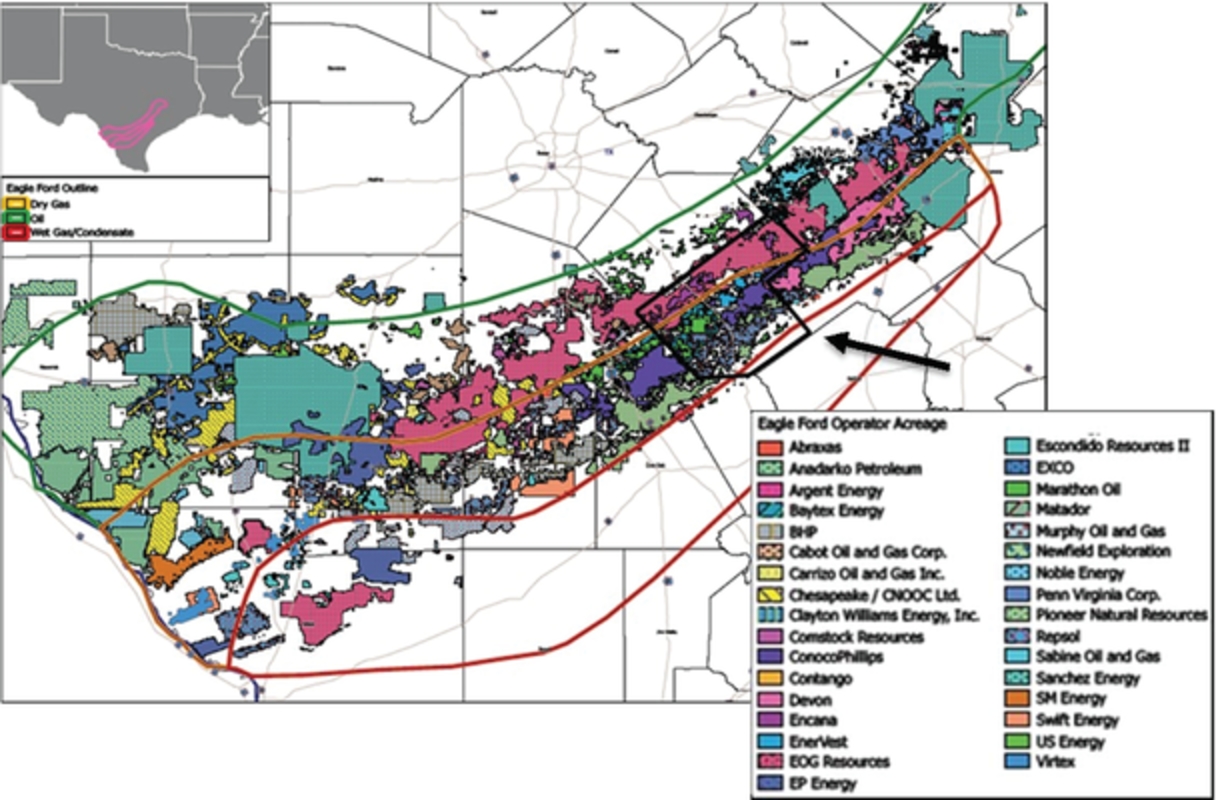
| (1) | Map provided by www.shaleexperts.com. Data through September 2016. |
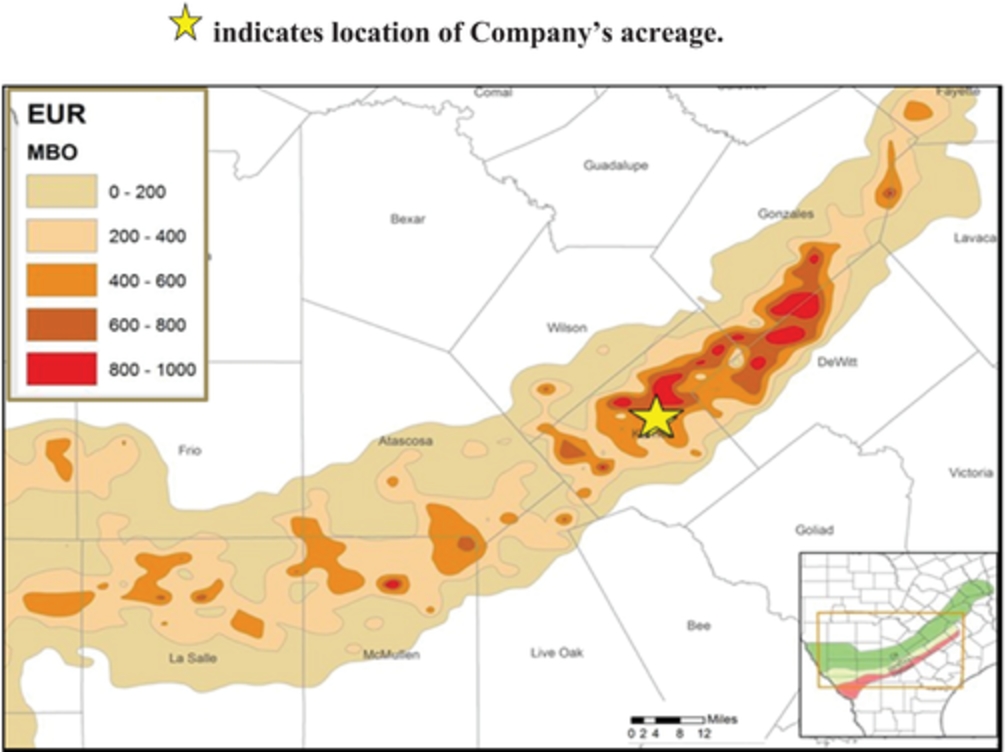
Estimated Ultimate Recoveries (EUR), average per producing well in Eagle Ford Shale.
Industry and Market Data
The market data and certain other statistical information used throughout this Offering Circular are based on independent industry publications, government publications and other published independent sources. Although we believe these third-party sources are reliable as of their respective dates, neither we nor the underwriters have independently verified the accuracy or completeness of this information. Some data is also based on our good faith estimates. The industry in which we operate is subject to a high degree of uncertainty and risk due to a variety of factors, including those described in the section entitled “Risk Factors.” These and other factors could cause results to differ materially from those expressed in these publications.
Oil and Natural Gas Reserves Data
We present oil and natural gas reserve data in barrels of oil equivalent, or Boe, amounts. For purposes of computing such units, a conversion rate of one Boe to six Mcf of natural gas or one Bbl of oil is used. The conversion ratio is an energy content correlation and does not reflect a volume or price relationship between the commodities. Boe amounts may be misleading, particularly if considered in isolation.
Our estimated net probable undeveloped reserves disclosed in this Offering Circular are based on reserve reports prepared by Netherland, Sewell & Associates, Inc. (“NSAI”), our independent petroleum engineer, included elsewhere in this Offering Circular. See “Business—Oil and Natural Gas Data.” Unless otherwise indicated, our estimates of probable undeveloped reserves and future net revenues therefrom are presented in accordance with the rules and definitions promulgated by the Securities and Exchange Commission (“Commission”).
The information contained in this Offering Circular relating to our reserves and future net revenues represent estimates only and constitute forward-looking statements that are subject to risks and uncertainties. See “Risk Factors” and “Cautionary Statement Regarding Forward-Looking Statements.”
Trademarks and Trade Names
From time to time, we own or have rights to various trademarks, service marks and trade names that we use in connection with the operation of our business. This Offering Circular may also contain trademarks, service marks and trade names of third parties, which are the property of their respective owners. Our use or display of third parties’ trademarks, service marks, trade names or products in this Offering Circular is not intended to, and does not imply, a relationship with us or an endorsement or sponsorship by or of us. Solely for convenience, the trademarks, service marks and trade names referred to in this Offering Circular may appear without the ®, TM or SM symbols, but such references are not intended to indicate, in any way, that we will not assert, to the fullest extent under applicable law, our rights or the right of the applicable licensor to these trademarks, service marks and trade names.
Additional Information
You should rely only on the information contained in this Offering Circular. We have not authorized anyone to provide you with additional information or information different from that contained in this Offering Circular filed with the Commission. We take no responsibility for, and can provide no assurance as to the reliability of, any other information that others may give you. We are offering to sell, and seeking offers to buy, shares of our Common Stock only in jurisdictions where offers and sales are permitted. The information contained in this Offering Circular is accurate only as of the date of this document, regardless of the time of delivery of this Offering Circular or any sale of shares of our Common Stock. Our business, financial condition, results of operations, and prospects may have changed since that date.
This summary highlights information contained elsewhere in this Offering Circular and does not contain all of the information that may be important to you. You should read this entire Offering Circular carefully, including the sections entitled “Risk Factors” and “Management’s Discussion and Analysis of Financial Condition and Results of Operations” and our historical financial statements and related notes included elsewhere in this Offering Circular. In this Offering Circular, unless otherwise noted, the terms “the Company,” “we,” “us,” and “our” refer to Energy Hunter Resources, Inc. The information presented in this Offering Circular assumes (i) an initial public offering price of $ per share (the midpoint of the price range set forth on the cover of this Offering Circular) and (ii) unless otherwise indicated, that the underwriters do not exercise their option to purchase additional shares of Common Stock.
This Offering Circular, including any supplement to this Offering Circular, includes “forward-looking statements.” To the extent that the information presented in this Offering Circular discusses financial projections, information or expectations about our business plans, results of operations, products or markets, or otherwise makes statements about future events, such statements are forward-looking. Such forward-looking statements can be identified by the use of words such as “should”, “may”, “intends”, “anticipates”, “believes”, “estimates”, “projects”, “forecasts”, “expects”, “plans” and “proposes”. Although we believe that the expectations reflected in these forward-looking statements are based on reasonable assumptions, there are a number of risks and uncertainties that could cause actual results to differ materially from such forward-looking statements. These include, among others, the cautionary statements in the “Risk Factors” section and the “Management’s Discussion and Analysis of Financial Condition and Results of Operations” section in this Offering Circular.
This Offering Circular includes certain terms commonly used in the oil and natural gas industry, which are defined in Annex A to this Offering Circular, “Glossary of Oil and Natural Gas Terms.”
Business Overview
We are an independent oil and gas company focused on the acquisition, drilling and production of oil and natural gas properties and prospects within the United States. We were founded in May 2016 by our Chairman and Chief Executive Officer, Gary C. Evans, to take advantage of what we believe to be a unique and timely opportunity within the oil and gas industry due to the severe downturn which began in November 2014.
We believe that several key factors have contributed to a favorable landscape whereby there exists significant potential to achieve attractive returns by acquiring and developing oil and natural gas assets in proven basins with limited geological risks. These factors include:
| • | The recent decline of commodity prices had an immediate and meaningful impact on the cash flows of oil and gas exploration and production (“E&P”) companies, creating a need for many firms to sell assets to stay in business. |
| • | The recent decline of commodity prices has also substantially reduced E&P asset valuations, resulting in quality assets being available at severely depressed levels. |
| • | Many existing leases are expiring without extension of their primary term due to the lack of capital being deployed. |
| • | Drilling and completion costs have fallen significantly, resulting in opportunities to acquire acreage that was previously viewed as marginal, but is now economic due to a lower cost to develop. |
| • | Although commodity prices will continue to be volatile and subject to cyclical fluctuations, we believe that crude oil oversupply will lessen and that crude oil demand will grow, which should encourage increased prices, in the medium to long term. Natural gas demand is also expected to increase in the long term. |
| • | E&P companies operating in the U.S. enjoy certain advantages, including access to industry-leading technologies and expertise, top-tier oil and gas-producing basins, established infrastructure and favorable legal and political policies relative to other regions. |
Our business strategy aims to maximize stockholder value through a balanced program of acquisitions and low-risk development and exploitation. We intend to leverage our management team’s long history in the oil and gas industry and operational expertise to identify and acquire ownership interests in producing, proved developed, proved undeveloped, and probable properties with a particular emphasis on distressed assets and smaller acquisition
1
opportunities not generally known in the marketplace. We will look to target low-risk projects that offer meaningful potential production and reserve growth from stacked pay opportunities, and whenever possible, will seek to serve as operator for the properties in which we acquire interests. The Company will initially concentrate these activities in the Eagle Ford Shale, located in South Texas, and the Permian Basin of West Texas and Southeast New Mexico. We may also seek to acquire mineral rights in the Marcellus and Utica shale formations primarily located in Ohio, West Virginia, and Pennsylvania.
As of July 31, 2016, our portfolio consisted of approximately 427 gross (400 net) acres located in two separate lease blocks in the heart of the Eagle Ford Shale play overlying the Edwards Trend in Karnes County, Texas. The total acreage position is prospective for both the lower and upper Eagle Ford Shale, as well as the Austin Chalk formation. There are no drilling commitments on this acreage until March 2017. The Company currently owns 93.75% of the working interest in these properties and will be the operator of record on all new wells drilled. We estimate that approximately 14 wells can be drilled in the lower Eagle Ford formation between the two prospects, as well as an additional 10 wells in the upper Eagle Ford formation for a total of 24 potential well locations, excluding the Austin Chalk formation and potential drilling sites therein.
Potential Well Locations(1)(2)
Zones |
Total |
||
Upper Eagle Ford |
10 | ||
Lower Eagle Ford |
14 | ||
Total Locations |
24 | ||
| (1) | We have 24 total identified drilling locations which include six potential locations in the lower Eagle Ford associated with probable undeveloped reserves as of July 31, 2016. We have estimated our drilling locations based on well spacing assumptions and upon the evaluation of other operators in our area, combined with our interpretation of available geologic and engineering data. The drilling locations that we actually drill will depend on the availability of capital, regulatory approvals, commodity prices, costs, actual drilling results and other factors. Any drilling activities we are able to conduct on these identified locations may not be successful and may not result in our ability to reclassify any probable undeveloped reserves as Proved Reserves or to add Proved Reserves or additional Probable Reserves to our existing probable undeveloped reserves. |
| (2) | Our drilling location count assumes 350-400 foot spacing. |
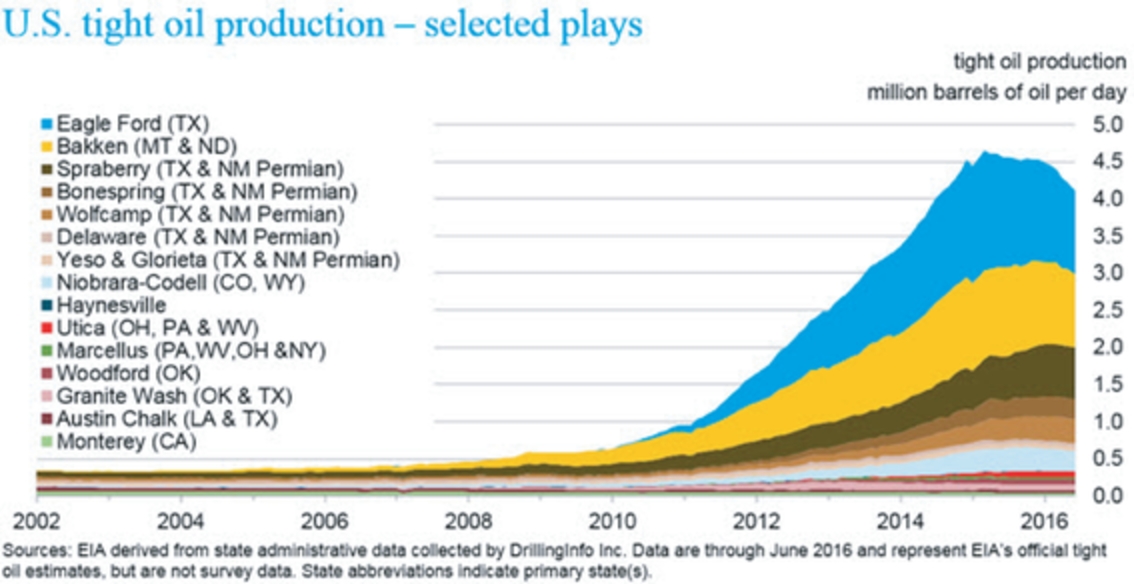
The Eagle Ford Shale is an attractive operating area given its organic-rich source rock, high liquids yields, stacked pay potential and low supply costs. Additionally, we believe management’s extensive operating history and prior success in the Eagle Ford make it an ideal initial target play. Birthed by advancements in horizontal drilling and hydraulic fracturing in 2009, the Eagle Ford Shale has become one of the most prolific liquids producers in the U.S. According to the Energy Information Administration of the U.S. Department of Energy (the “EIA”), the Eagle Ford Shale is the largest producer of tight oil (oil produced from low-permeability formations, such as shale) in the United States, accounting for 30% of total U.S. tight oil production during the twelve-month period ended June 30, 2016. According to monthly production data compiled by the Railroad Commission of Texas, Karnes County, Texas, where all of our current assets are located, is also the top crude oil producing county during the nine-month period ending September 30, 2016 in the State of Texas by volume.
2
Summary Oil and Natural Gas Data
The following table provides summary information regarding our probable undeveloped reserves as of July 31, 2016, based on a reserve report prepared by NSAI, our independent petroleum engineer, in accordance with the definitions and guidelines set forth in the Petroleum Resources Management System approved by the Society of Petroleum Engineers, or SPE, and using NYMEX Futures Strip Pricing for the period of 2016-2020, as described in the footnotes to the table below. Estimates of reserves and future net revenue using the SPE definitions and guidelines and NYMEX Futures Strip Pricing differ from estimates prepared in accordance with the definitions and pricing methodology approved by the Commission. See “Business—Sensitivity of Reserves to Prices By Principal Product Type and Price Scenario.”
Estimated Net Probable Undeveloped Reserves |
Future Net Revenue ($ in thousands) |
||||||||||||||
Price Case(1)(2) |
Oil (MBbl) |
Gas (MMcf) |
Total (MBoe) |
Total |
PV10(3) |
||||||||||
NYMEX Futures Strip Pricing |
1,475.5 | 5,727.7 | 2,430.2 | 37,863.1 | 18,749.3 | ||||||||||
| (1) | Data in this table are calculated based upon NYMEX Futures Strip Pricing for oil and natural gas for the five-year period 2016-2020 as set forth in the table under the caption “Business—Sensitivity of Reserves to Prices By Principal Product Type and Price Scenario.” |
| (2) | For the price, costs, and assumptions on which these alternate reserves estimates are based see “Business—Sensitivity of Reserves to Prices By Principal Product Type and Price Scenario.” |
| (3) | Present Value Discounted at 10%, commonly referred to as PV10, is a non-generally accepted accounting principle (“GAAP”) financial measure and represents the present value of estimated future cash inflows from crude oil and natural gas reserves, less estimated future development and production costs, discounted at 10% per annum to reflect timing of future cash inflows. PV10 is typically calculated using the unweighted arithmetic average of the first-day-of-the-month price for each of the 12 months preceding the date of the report in which the calculation is presented, which is the pricing methodology required by the Commission for oil and gas reserve calculations, which we refer to as SEC Pricing. The PV10 presented in this table instead uses NYMEX Futures Strip prices as stated in footnote 1. Given that commodity prices over the past 12 months have been depressed compared to historical averages and are lower than the estimated future prices reflected in the NYMEX Futures Strip price deck, this results in an increase of approximately 223% in the PV10 presented in this table compared to the PV10 of our probable undeveloped reserves determined using SEC Pricing. If the Commission’s definitions and SEC Pricing were used, the table would show estimated net probable undeveloped reserves of 1,443.9 MBbl of oil and 5,600.0 MMcf of natural gas, or 2,377.3 MBoe of total net probable undeveloped reserves; total future net revenue of $16,925,200; and PV10 of the future net revenue of $5,804,400. See “Business—Oil and Natural Gas Data—Summary of Oil and Natural Gas Reserves.” Regardless of the pricing methodology used, PV10 should not be construed as representing the fair market value of oil and natural gas properties. |
Management
We believe our management team is in a prime position to take advantage of opportunities within the oil and gas industry and to create value for our stockholders. Our management team has a deep knowledge of the industry and a well-established network of relationships with both public and private oil and gas companies, equity sponsors, lending institutions, landowners, and service providers from which we believe we can generate attractive acquisition opportunities. Our management also has a substantial history operating together as a team.
3
Gary C. Evans, Chairman & CEO: After serving nine years as a banker concentrating in the energy industry, he founded Magnum Hunter Resources Inc. (“MHRI”) in 1985, and served as Chairman & CEO for 20 years before selling to Cimarex Energy (Symbol: XEC) in 2005, overseeing the growth of a company he started with a $1,000 initial investment into an eventual $2.2 billion enterprise at the time of sale. Most recently he served as Chairman and CEO of Magnum Hunter Resources Corp. (“MHRC”), which he took from $0.35/share upon joining the company in 2009 to $9.16/share at its peak before the crash in commodity prices in 2014 and its eventual plan of reorganization under the U.S. Bankruptcy Code completed in May, 2016. Mr. Evans also founded mid-stream gas gathering company Eureka Midstream Holdings in 2010, which we believe has an approximate current value of over $1.0 billion.
H. C. “Kip” Ferguson, Executive Vice President, Exploration / Development: Mr. Ferguson brings more than 28 years of exploration, development and operational experience in many of the major oil and gas basins within the U.S. Mr. Ferguson uses his broad oil and gas experience to assess opportunities within our core Eagle Ford and Permian focus. Mr. Ferguson has a proven management track record of successful grassroots development and execution within unconventional plays. Mr. Ferguson most recently served as Executive Vice President of Exploration for MHRC from 2009 to July 2016, where he managed the Eagle Ford Shale division and was in charge of the exploration and development of its Eagle Ford Shale properties. This led to the successful divestment of those properties for $401 million. Prior to that, Mr. Ferguson was President and Director of Sharon Resources, Inc. and Sharon Energy Ltd., which was acquired by MHRC in 2009 as its entry point into the Eagle Ford Shale play. Mr. Ferguson has a Bachelors of Science in Geology, with a minor in Petroleum Engineering, from the University of Texas. Additionally, Mr. Ferguson has co-authored and written case studies, papers and articles for SPE International magazine, Unconventional Resources Technology Conference, and E&P magazine regarding successful uses of different unconventional technologies.
Brian Burgher, Senior Vice President, Land: Mr. Burgher has more than 30 years of experience in the oil and gas industry, with an emphasis on leases and land acquisitions. He was previously SVP of Land for MHRC from 2009 to 2015, where he served as land manager for its Eagle Ford assets, which were assembled, developed and sold under his oversight. Across his time at MHRC, Mr. Burgher personally oversaw the acquisition, due diligence and subsequent divesture of over $1.0 billion of leases and wells. Mr. Burgher has worked in all facets of field operations and management over the course of his career.
Jason Wilson, Manager, Geology: Mr. Wilson has more than 20 years of experience in geology and operations across all of our target areas. From 2009 to 2013 he was a member of the MHRC Eagle Ford operations team that successfully executed the grassroots development of the Gonzales/Lavaca county acreage in South Texas that was eventually sold for $401 million. After leaving MHRC, Mr. Wilson worked for one year as a senior geologist for New Standard Energy. Following his post at New Standard Energy until joining the Company, Mr. Wilson worked as an independent consultant for EnCap Investments, L.P. Mr. Wilson also worked previously in similar capacities for Anadarko and Sharon Resources. Mr. Wilson has a Bachelors of Science and a Masters of Science in Geology from Texas A&M University.
Brada Wilson, Controller and Corporate Secretary: Ms. Wilson presently serves as our Controller and Corporate Secretary. Ms. Wilson previously worked for MHRC for the five years prior to joining the Company. Prior to that, Ms. Wilson served as Controller for CWF Energy, Inc. in Dallas and Henry Energy Corporation, a public company based in Arlington, Texas. Ms. Wilson holds a Master of Professional Accounting degree from the University of Texas at Arlington and a Bachelor of Science degree from Texas Tech University. Ms. Wilson brings over 20 years of experience in all phases of oil and gas accounting.
Business Strategy
Exploit Initial Asset Portfolio — We intend to focus on the initial drilling and future development of our properties in the Eagle Ford Shale. As of July 31, 2016, we have approximately 427 gross (400 net) acres and 24 identified potential drilling locations, with current plans to commence initial drilling efforts in late 2016 upon completion of this offering. This includes six potential locations in the lower Eagle Ford associated with our probable undeveloped reserves as of July 31, 2016.
Leverage Acquisition Pipeline — We intend to opportunistically acquire additional acreage and reserves. We believe we can leverage our management’s extensive industry network and operational expertise to identify and execute on many opportunities before they are generally available to industry competitors.
4
Focus on Assets that are Currently Economic — We plan to focus on acquisitions and low-risk horizontal development opportunities within the regions that continue to generate exceptional returns even in today’s lower commodity price environment.
Seek Out Smaller Acreage Blocks — Due to the recent downturn in the industry, the larger firms with better access to capital have been the recent acquirers of larger acreage blocks. Because of scale, these bigger firms have been interested in purchasing large, contiguous blocks of acreage as opposed to smaller unique opportunities. We believe this has led to significant price increases for properly situated lease acreage within larger blocks versus smaller blocks where there is less competition, even if the resource economics per acre are similar. The Company will target buying these smaller parcels where we believe the price per acre is attractive relative to larger acreage packages.
Purchase Mineral Rights Underlying Familiar Properties — We will seek to purchase mineral rights underneath acreage in the Marcellus Formation in West Virginia and Ohio held by MHRC. Our management team is very familiar with these properties. Following its recent reorganization, we expect MHRC, or its successor, will eventually actively drill these regions, where MHRC holds a significant leasehold acreage position in both West Virginia and Ohio.
Maintain Operating Control — We believe that operatorship provides the ability to maximize the value of our assets by allowing our experienced management team to control the timing of drilling expenditures, manage operational costs and enhance production volumes. Other than with respect to mineral interests we may acquire underneath the Marcellus acreage held by MHRC, we will, whenever possible, seek to serve as operator for the properties in which we acquire interests.
Employ State of the Art Technologies — We intend to utilize advanced technologies that should allow us to enhance our drilling and completion performance. Our technical team continually reviews the most current technologies and will apply those to our reserve base for the effective development of our project inventory. Our technical team intends to leverage management’s prior experience in the Eagle Ford and other unconventional plays, by using horizontal drilling and advanced frac completion methods in order to maximize value and return on investment.
Maintain Conservatively Capitalized Balance Sheet with Strong Liquidity Position — After giving effect to this offering, we will have approximately $ million of cash on the balance sheet. We have no debt. We currently intend to maintain a conservative approach to capitalizing our business and feel our lack of leverage will provide us a significant advantage in the current market environment.
Our Competitive Strengths
We believe that the following strengths will help us achieve our business goals:
Experienced and Incentivized Management Team — With decades of experience, our management team has a proven track record of building and operating businesses focused on the development and acquisition of oil and natural gas properties. We believe our team’s deep knowledge of the major resource plays and operational expertise provides us with a distinct competitive advantage. Additionally, our management’s extensive industry network provides us with access to top-tier industry partners, land owners and financial sponsors to help us identify and execute on attractive opportunities not generally known by others. Members of our senior management team have a significant economic interest in us, which will provide us a meaningful incentive to increase the value of our business for the benefit of all stockholders.
Attractive Initial Acreage Position — All of our current acreage is located in Karnes County, Texas along the Edwards Trend in the heart of the Eagle Ford Shale play. According to monthly production data compiled by the Railroad Commission of Texas, Karnes County is the top crude oil producing county in the State of Texas by volume. The Eagle Ford Shale play overlying the Edwards Trend is currently one of the most prolific liquids producers and currently generates some of the best economics in the Eagle Ford, even at recent commodity prices. Our assets provide development opportunities in a relatively mature, well-understood shale trend (as compared to other unconventional resource plays).
Stacked Pay Opportunities — We have identified 24 potential undeveloped horizontal drilling locations across our acreage position prospective for both the lower and upper Eagle Ford Shale formations, which includes six potential locations in the Lower Eagle Ford associated with our probable undeveloped reserves as of July 31, 2016. The lower Eagle Ford is approximately 185 feet thick with an average net pay thickness of 155 feet. The upper Eagle Ford is 67 feet thick with approximately 38 feet of net pay thickness. We also see the potential for additional locations in the Austin Chalk, which has yet to be evaluated by NSAI or our management.
5
Proven Horizontal Drilling Expertise and Technical Acumen in the Eagle Ford — Management has previously had success acquiring, developing, operating, and producing acreage in the region as well as others. Several members of our management team were integral in the grass roots development of an Eagle Ford project located just one county over from our current acreage position. Members of our team were key decision-makers at MHRC in growing an initial 2,000-net acre package into a 19,000-net acre asset through their knowledge of the specific land and geology, and relationships with landowners throughout the area. Ultimately, this asset produced 14,260 gross/5,277 net BOE/D at peak production for MHRC and was subsequently sold to a competitor.
Recent Events
Karnes County Leasehold Acquisitions
In July 2016, we closed on an acquisition of two separate lease blocks totaling approximately 427 gross (400 net) undeveloped acres located in the heart of the Eagle Ford Shale play overlying the Edwards Trend in Karnes County, Texas. The cost of the acquisition was $1,070,000. The total acreage position is prospective for both the lower and upper Eagle Ford Shale, as well as the Austin Chalk formation. There are no drilling commitments on this acreage until March 2017. The Company currently owns 93.75% of the working interest in these properties and will be the operator of record on all new wells drilled.
Implications of Being an “Emerging Growth Company”
As an issuer with less than $1 billion in total annual gross revenues during our last fiscal year, we qualify as an “emerging growth company” under the Jumpstart Our Business Startups Act (the “JOBS Act”). An emerging growth company may take advantage of certain reduced reporting requirements and is relieved of certain other significant requirements that are otherwise generally applicable to public companies. In particular, as an emerging growth company we:
| • | are not required to obtain an auditor attestation on our internal control over financial reporting pursuant to the Sarbanes-Oxley Act of 2002; |
| • | are not required to provide a detailed narrative disclosure discussing our compensation principles, objectives and elements and analyzing how those elements fit with our principles and objectives (commonly referred to as “compensation discussion and analysis”); |
| • | are not required to obtain a non-binding advisory vote from our stockholders on executive compensation or golden parachute arrangements (commonly referred to as the “say-on-pay,” “say-on-frequency” and “say-on-golden-parachute” votes); |
| • | are exempt from certain executive compensation disclosure provisions requiring a pay-for-performance graph and CEO pay ratio disclosure; |
| • | may present only two years of audited financial statements and only two years of related Management’s Discussion & Analysis of Financial Condition and Results of Operations, or MD&A; and |
| • | are eligible to claim longer phase-in periods for the adoption of new or revised financial accounting standards under §107 of the JOBS Act. |
We intend to take advantage of all of these reduced reporting requirements and exemptions, including the longer phase-in periods for the adoption of new or revised financial accounting standards under §107 of the JOBS Act. Our election to use the phase-in periods may make it difficult to compare our financial statements to those of non-emerging growth companies and other emerging growth companies that have opted out of the phase-in periods under §107 of the JOBS Act.
Certain of these reduced reporting requirements and exemptions are also available to us due to the fact that we may also qualify as a “smaller reporting company” under the Commission’s rules. For instance, smaller reporting companies are not required to obtain an auditor attestation on our assessment of internal control over financial reporting; are not required to provide a compensation discussion and analysis; are not required to provide a pay-for-performance graph or CEO pay ratio disclosure; and may present only two years of audited financial statements and related MD&A disclosure.
Under the JOBS Act, we may take advantage of the above-described reduced reporting requirements and exemptions for up to five years after our initial sale of common equity pursuant to a registration statement declared effective
6
under the Securities Act of 1933, as amended (the “Securities Act”), or such earlier time that we no longer meet the definition of an emerging growth company. Note that this offering, while a public offering, is not a sale of common equity pursuant to a registration statement, since the offering is conducted pursuant to an exemption from the registration requirements. In this regard, the JOBS Act provides that we would cease to be an “emerging growth company” if we have more than $1 billion in annual revenues, have more than $700 million in market value of our Common Stock held by non-affiliates, or issue more than $1 billion in principal amount of non-convertible debt over a three-year period. Furthermore, under current Commission rules we will continue to qualify as a “smaller reporting company” for so long as we have a public float (i.e., the market value of common equity held by non-affiliates) of less than $75 million as of the last business day of our most recently completed second fiscal quarter.
Company and Other Information
The Company was formed in the State of Delaware on May 11, 2016. The Company’s principal executive office is located at 1048 Texan Trail, Grapevine, Texas 76051. Our telephone number is 469-440-8868. Our Internet address is www.energyhunter.energy. We do not incorporate the information on or accessible through our website into this Offering Circular, and you should not consider any information on, or that can be accessed through, our website a part of this Offering Circular.
7
We currently intend to use up to $34,000,000 of the net proceeds from this offering to fund our 2016 and 2017 capital expenditures on existing assets, including the drilling, development, and completion of initial wells on our Karnes County, Texas acreage. Additionally, we may use a portion of the proceeds to acquire additional acreage leaseholds, acquire additional producing properties and associated leaseholds, or for general corporate purposes.
8
Investing in our Common Stock involves a high degree of risk. Prospective investors should carefully consider the risks described below, together with all of the other information included or referred to in this Offering Circular, before purchasing shares of our Common Stock. The risks set out below are not the only risks we face. Additional risks and uncertainties not presently known to us or not presently deemed material by us might also impair our operations and performance. If any of these risks actually occurs, our business, financial condition or results of operations may be materially adversely affected. In such case, the trading price of our Common Stock, if a trading market develops, could decline and investors in our Common Stock could lose all or part of their investment.
Risks Related to our Company
We will require substantial additional capital in order to achieve commercial success and, if necessary, to finance future losses from operations as we endeavor to build our asset and revenue base, but we do not have any commitments to obtain such capital and we cannot assure you that we will be able to obtain adequate capital as and when required.
The business of oil and gas acquisition, drilling and development is very capital intensive and the level of operations attainable by an oil and gas company is directly linked to and limited by the amount of available capital. We believe that cash generated from oil and gas operations will not be sufficient to allow us to achieve our growth and other business objectives. Our ability to achieve commercial success and our continued growth will be dependent on our continued access to capital either through the additional sale of our equity securities, project financing, or joint ventures. Future equity financings may be dilutive to our stockholders and may involve preferred stock that has preferences or rights superior to our Common Stock. Project financings may involve a pledge of assets, and any debt we may incur will rank senior to our Common Stock. We cannot assure you that we will be able to raise additional capital from external sources, or enter into joint ventures or strategic partnerships, on satisfactory terms subsequent to this offering. Failure to raise additional capital subsequent to this offering, on favorable terms or at all, will have a material adverse effect on our development plans and operations and will likely cause us to curtail our planned operations.
We do not have a significant operating history and, as a result, there is a limited amount of information about us on which to base an investment decision.
In considering whether to invest in our Common Stock, you should consider that there is only limited historical financial and operating information available on which to base your evaluation of our performance. The Company was formed in May 2016 and, as a result, although our management team has significant experience in our industry, we have limited financial and operating information available.
We face challenges and uncertainties in financial planning as a result of the unavailability of historical data and uncertainties regarding the nature, scope and results of future activities. We may not be successful in implementing business strategies or in completing the development of the infrastructure necessary to conduct business as planned. In the event that our development plan is not completed or is delayed, operating results will be adversely affected and operations will differ materially from currently anticipated activities. As a result of industry factors or factors relating specifically to us, we may have to change our method of conducting business, which may cause a material adverse effect on results of operations and financial condition.
We have no proved reserves, and drilling operations may not yield any oil or natural gas in commercial quantities or quality. We intend to grow our business in part through the acquisition and development of additional exploratory oil and gas prospects, which is a highly risky method of establishing oil and gas reserves.
To date, we have acquired only approximately 427 gross (400 net) acres of prospective oil and gas properties. The estimated reserves on these properties consist of approximately 2,377.3 MBOE of oil and natural gas, all of which are classified as probable undeveloped reserves. Substantial exploration and development efforts will be required to establish the presence of proved reserves on these properties, and such efforts may not be successful. Moreover, we intend to grow our business by acquiring, drilling and developing additional exploratory oil and gas prospects, in addition to opportunistic acquisitions of producing properties or properties containing proved developed or proved undeveloped reserves that we believe have the potential for profitable production. Developing exploratory oil and gas properties requires significant capital expenditures and involves a high degree of financial risk. The budgeted costs of drilling, completing, and operating exploratory wells are often exceeded and can increase significantly when drilling costs rise. Drilling may be unsuccessful for many reasons, including title problems, unexpected drilling
9
conditions, weather conditions, delays by project participants, compliance with governmental requirements, shortages or delays in the delivery of equipment and services, cost overruns, and mechanical difficulties. Moreover, the successful drilling or completion of an exploratory oil or gas well does not ensure a profit on investment. Exploratory wells bear a much greater risk of loss than development wells. We cannot assure you that any of the wells we drill will be productive or that we will recover all or any portion of our investment. If we are unable to successfully acquire and develop exploratory oil and gas prospects, our results of operations, financial condition and stock price will be materially adversely affected.
We may not act as an operator on many of our future prospects, which means we will be dependent on third parties for the exploration, development and production of any such leasehold interests.
An oil and gas operator is the party that takes primary responsibility for management of the day-to-day exploration, development and production activity relating to an oil and gas prospect. Part of our business strategy is to acquire operating interests in oil and natural gas properties whenever feasible. We will not always be able to do so. We anticipate that an industry partner will function as the operator for many of the oil and natural gas properties we acquire in the future. Our reliance on third party operators for the exploration, development and production of property interests subjects us to a number of risks, including our inability to control the amount and timing of costs and expenses of exploration, development and production and the risk that we may not be able to properly control the timing and quality of work conducted with respect to our projects.
We have limited management and staff and may be more dependent upon partnering arrangements.
As of September 1, 2016, we have six employees, including our executive officers. We intend to use the services of independent consultants and contractors to perform various professional services, including reservoir engineering, accounting, land, legal, environmental and tax services. We also intend to pursue alliances with partners in the areas of geological and geophysical services and prospect generation, evaluation and prospect leasing. Our planned dependence on third party consultants and service providers creates a number of risks, including but not limited to:
| • | the possibility that such third parties may not be available to us as and when needed; and |
| • | the risk that we may not be able to properly control the timing and quality of work conducted with respect to our projects. |
If we experience significant delays in obtaining the services of such third parties or poor performance by such parties, our results of operations and stock price may be materially adversely affected.
The loss of any of our executive officers could adversely affect us.
We currently have only six employees, including our four executive officers. We are dependent on the extensive experience of our executive officers to implement our acquisition and growth strategy. The loss of the services of any of our executive officers could have a negative impact on our operations and our ability to implement our business plan.
Our success is dependent on the prices of oil and natural gas. Low oil or natural gas prices and the substantial volatility in these prices may adversely affect our financial condition and ability to meet certain capital expenditure requirements and financial obligations.
The prices we will receive for oil and natural gas will heavily influence our revenue, profitability, cash flow available for capital expenditures and access to new capital and future rate of growth. Oil and natural gas are commodities and, therefore, their prices are subject to wide fluctuations in response to relatively minor changes in supply and demand. Historically, the markets for oil and natural gas have been volatile, and prices have declined significantly in recent periods. For example, during the period from January 1, 2014 through August 31, 2016, the WTI spot price for oil has declined from a high of $107.62 per Bbl on July 23, 2014 to $26.21 per Bbl on February 11, 2016, and the Henry Hub spot price for natural gas has declined from a high of $7.92 per MMBtu on March 4, 2014 to a low of $1.49 per MMBtu on March 4, 2016. We believe that these markets will likely continue to be volatile in the future. The prices received for production, and the levels of production, depend on numerous factors. These factors include the following:
| • | worldwide and regional economic conditions impacting the global supply and demand for oil and natural gas; |
| • | the prices and availability of competitors’ supplies of oil and natural gas; |
10
| • | the actions of the Organization of Petroleum Exporting Countries, or OPEC, and state-controlled oil companies relating to oil price and production controls; |
| • | the price and quantity of foreign imports; |
| • | the impact of U.S. dollar exchange rates on oil and natural gas prices; |
| • | domestic and foreign governmental regulations and taxes; |
| • | speculative trading of oil and natural gas futures contracts; |
| • | the availability, proximity and capacity of gathering and transportation systems for natural gas; |
| • | the availability of refining capacity in proximity to company assets; |
| • | the prices and availability of alternative fuel sources; |
| • | weather conditions and natural disasters; |
| • | political conditions in or affecting oil and natural gas producing regions, including the Middle East and South America; |
| • | the continued threat of terrorism and the impact of military action and civil unrest; |
| • | public pressure on, and legislative and regulatory interest within, federal, state and local governments to stop, significantly limit or regulate hydraulic fracturing activities; |
| • | the level of both U.S. and global oil and natural gas inventories and exploration and production activity; |
| • | the impact of energy conservation efforts; |
| • | technological advances affecting energy consumption; and |
| • | overall worldwide economic conditions. |
In the second half of 2014, oil prices began a rapid and significant decline as the global oil supply began to outpace demand. During 2015 and thus far in 2016, the global oil supply has continued to outpace demand, resulting in a sustained decline in realized prices for oil production. In general, this imbalance between supply and demand reflects the significant supply growth achieved in the United States as a result of shale drilling and oil production increases by certain other countries, including Russia and Saudi Arabia, as part of an effort to retain market share, combined with only modest demand growth in the United States and less-than-expected demand in other parts of the world, particularly in Europe and China. Although there has been a dramatic decrease in drilling activity in the industry, oil storage levels in the United States remain at historically high levels. Until supply and demand balance and the overhang in storage levels begins to decline, prices are expected to remain under pressure. In addition, the lifting of economic sanctions on Iran has resulted in increasing supplies of oil from Iran, adding further downward pressure to oil prices. Prices for domestic natural gas began to decline during the third quarter of 2014 and have continued to be weak throughout 2015 and thus far in 2016. The declines in natural gas prices are primarily due to a significant imbalance between supply and demand across North America. The duration and magnitude of the commodity price declines cannot be accurately predicted.
Lower oil and natural gas prices will reduce our future cash flows, borrowing ability and the present value of estimated reserves. Exploration, development and exploitation projects require substantial capital expenditures, and, if prices are lower, we may be unable to obtain needed capital or financing on satisfactory terms, which could lead to expiration of leases or a decline in oil and natural gas reserves. Lower oil and natural gas prices may also reduce the amount of oil and natural gas that we can produce economically and may affect any estimated proved reserves we are ultimately able to establish. The present value of future net revenues from estimated proved reserves will not necessarily be the same as the current market value of estimated oil and natural gas reserves.
Drilling for oil and natural gas is a speculative activity and involves numerous risks and substantial and uncertain costs that could adversely affect us.
Our success will depend on the success of our drilling program. There is no way to predict in advance of drilling and testing whether any particular prospect will yield oil or natural gas in sufficient quantities to recover drilling or completion costs or to be economically viable. The use of seismic data and other technologies and the study of producing fields in the same area will not enable us to know conclusively prior to drilling whether oil or natural gas
11
will be present or, if present, whether oil or natural gas will be present in commercial quantities. We cannot assure you that the analogies drawn from available data from other wells, more fully explored prospects or producing fields will be applicable to current drilling prospects.
The budgeted costs of planning, drilling, completing and operating wells are often exceeded and such costs can increase significantly due to various complications that may arise during the drilling and operating processes. Before a well is spud, we may incur significant geological and geophysical (seismic) costs, which are incurred regardless of whether a well eventually produces commercial quantities of hydrocarbons, or is drilled at all. Exploration wells endure a much greater risk of loss than development wells. The analogies drawn from available data from other wells, more fully explored locations or producing fields may not be applicable to current drilling locations. If actual drilling and development costs are significantly more than the current estimated costs, we may not be able to continue operations as proposed and could be forced to modify drilling plans accordingly. Drilling for oil and natural gas involves numerous risks, including the risk that no commercially productive oil or natural gas reservoirs will be discovered. The cost of drilling, completing, and operating wells is substantial and uncertain, and drilling operations may be curtailed, delayed, or canceled as a result of a variety of factors beyond our control, including:
| • | unexpected or adverse drilling conditions; |
| • | elevated pressure or irregularities in geologic formations; |
| • | equipment failures or accidents; |
| • | adverse weather conditions; |
| • | compliance with governmental requirements; and |
| • | shortages or delays in the availability of drilling rigs, crews, and equipment. |
We may purchase oil and natural gas properties with liabilities or risks that we do not know about or that we do not assess correctly, and, as a result, could be subject to liabilities that could adversely affect results of operations.
Before acquiring oil and natural gas properties, we estimate the reserves, future oil and natural gas prices, and operating costs. We also review land records which affect ownership, potential environmental liabilities and other factors relating to the properties. However, this review involves many assumptions and estimates, and their accuracy is inherently uncertain. As a result, we may not discover all existing or potential problems associated with the properties being purchased. We may not become sufficiently familiar with the properties to assess fully the deficiencies and capabilities. We do not generally perform inspections on every well or property, and therefore may not be able to observe mechanical and environmental problems even when an inspection is conducted. The seller may not be willing or financially able to give contractual protection against any identified problems, and we may decide to assume land, environmental and other liabilities in connection with properties acquired. If we acquire properties with risks or liabilities that were unknown or not assessed correctly, our financial condition, results of operations and cash flows could be adversely affected as claims are settled and cleanup costs related to these liabilities are incurred.
Our reserve estimates depend, and our future reserve estimates will depend, on many assumptions that may turn out to be inaccurate. Any material inaccuracies in our reserve estimates or underlying assumptions will materially affect the quantities and present value of our reserves.
The process of estimating oil and natural gas reserves is complex. It requires interpretations of available technical data and many assumptions, including assumptions relating to economic factors. Any significant inaccuracies in these interpretations or assumptions could materially affect the estimated quantities and the calculation of the present value of reserves shown in these estimates.
In order to prepare reserve estimates in our reports, we will typically engage an independent petroleum consultant. The consultant will need to project production rates and timing of development expenditures. Our independent petroleum consultants will also analyze available geological, geophysical, production and engineering data. The extent, quality and reliability of this data can vary and may not be in our control. The process also requires economic assumptions about matters such as oil and natural gas prices, drilling and operating expenses, capital expenditures, taxes and availability of funds. Therefore, estimates of oil and natural gas reserves are inherently imprecise.
Actual future production, oil and natural gas prices, revenues, taxes, development expenditures, operating expenses and quantities of recoverable oil and natural gas reserves will most likely vary from our estimates. Any significant
12
variance could materially affect the estimated quantities and present value of our reserves. In addition, our independent petroleum consultants may adjust estimates of proved reserves to reflect production history, drilling results, prevailing oil and natural gas prices and other factors, many of which are beyond our control.
The marketability of our future production is dependent upon oil and natural gas gathering and transportation facilities owned and operated by third parties, and the unavailability of satisfactory oil and natural gas transportation arrangements would have a material adverse effect on revenue.
The unavailability of satisfactory oil and natural gas transportation arrangements may hinder our access to oil and natural gas markets or delay production from wells. The availability of a ready market for our oil and natural gas production depends on a number of factors, including the demand for, and supply of, oil and natural gas and the proximity of estimated reserves to pipelines and terminal facilities. Our ability to market production depends in substantial part on the quality of our oil and gas production, availability and capacity of gathering systems, pipelines and processing facilities owned and operated by third parties. Failure to obtain these services on acceptable terms could materially harm our business. As a result, we may be required to shut in wells for lack of a market or because of inadequacy or unavailability of pipeline or gathering system capacity. If that were to occur, we would be unable to realize revenue from those wells until arrangements were made to deliver production to market. Furthermore, if we were required to shut in wells we might also be obligated to pay shut-in royalties to certain mineral interest owners in order to maintain our leases. The disruption of third party facilities due to maintenance and/or weather could negatively impact our ability to market and deliver our products. These third parties may control when or if such facilities are restored and what prices will be charged.
Hedging transactions may limit our potential gains or result in losses.
In order to manage our exposure to price risks in the marketing of our oil and natural gas, we intend from time to time to enter into financial oil and gas price hedging arrangements with respect to a portion of our future proved, developed-producing production. While these contracts are intended to reduce the effects of volatile oil and natural gas prices, they may also limit our potential gains if oil and natural gas prices were to rise substantially over the price established by the contract. In addition, such transactions may expose us to the risk of financial loss in certain circumstances, including instances in which:
| • | there is a change in the expected differential between the underlying price in the hedging agreement and actual prices received; |
| • | our production and/or sales of oil or natural gas are less than expected; |
| • | payments owed under derivative hedging contracts come due prior to receipt of the hedged month’s production revenue; or |
| • | the other party to the hedging contract defaults on its contract obligations. |
We cannot assure you that any financial hedging transactions we may enter into will adequately protect us from declines in the prices of oil and natural gas. On the other hand, where we choose not to engage in hedging transactions in the future, we may be more adversely affected by adverse changes in oil and natural gas prices than our competitors who engage in hedging transactions. In addition, the counterparties under our derivatives contracts may fail to fulfill their contractual obligations to us.
We may have difficulty managing growth in our business, which could adversely affect our financial condition and results of operations.
We are a start-up company with few assets and very limited operating history. We will have to grow significantly to achieve our business plan. If we are able to achieve significant growth in the size and scope of our operations, that could place a strain on our financial, technical, operational and management resources. The failure to continue to upgrade our technical, administrative, operating and financial control systems or the occurrences of unexpected expansion difficulties, including the failure to recruit and retain experienced managers, geologists, engineers and other professionals in the oil and gas industry, could have a material adverse effect on our business, financial condition and results of operations and our ability to timely execute our business plans.
13
We are exposed to operating hazards and uninsured risks. Our operations are subject to the risks inherent in the oil and natural gas industry, including the risks of:
| • | fire, explosions and blowouts; |
| • | pipe failure; |
| • | abnormally pressured formations; and |
| • | environmental accidents such as oil spills, natural gas leaks, ruptures or discharges of toxic gases, brine or well fluids into the environment (including groundwater contamination). |
These events may result in substantial losses to us from:
| • | injury or loss of life; |
| • | severe damage to or destruction of property, natural resources and equipment; |
| • | pollution or other environmental damage; |
| • | clean-up responsibilities; |
| • | regulatory investigation; |
| • | penalties and suspension of operations; or |
| • | attorneys’ fees and other expenses incurred in the prosecution or defense of litigation. |
As is customary in our industry, we intend to maintain insurance against some, but not all, of these risks. We cannot assure you that our insurance will be adequate to cover these losses or liabilities. We do not intend to carry business interruption insurance. Losses and liabilities arising from uninsured or underinsured events may have a material adverse effect on our financial condition and operations.
The producing wells in which we will have an interest may occasionally experience reduced or terminated production. These curtailments can result from mechanical failures, contract terms, pipeline and processing plant interruptions, market conditions and weather conditions. These curtailments can last from a few days to many months.
Risks Relating to the Oil and Gas Industry
Our industry is highly competitive, which may adversely affect our performance, including our ability to participate in ready-to-drill prospects in our core areas.
We operate in a highly competitive environment. In addition to capital, the principal resources necessary for the exploration and production of oil and natural gas are:
| • | leasehold prospects under which oil and natural gas reserves may be discovered; |
| • | drilling rigs, hydraulic fracturing equipment, and related equipment to explore for such reserves; and |
| • | knowledgeable personnel to conduct all phases of oil and natural gas operations. |
We must compete for such resources with both major oil and natural gas companies and independent operators. Many of these competitors have financial and other resources substantially greater than ours. We cannot assure you that such materials and resources will be available when needed. If we are unable to access material and resources when needed, we risk suffering a number of adverse consequences, including:
| • | the breach of our obligations under the oil and gas leases by which we hold our prospects and the potential loss of those leasehold interests; |
| • | loss of reputation in the oil and gas community; |
| • | a general slow-down in our operations and decline in revenue; and |
| • | decline in market price of our Common Stock. |
14
We are subject to numerous laws and regulations that can adversely affect the cost, manner or feasibility of doing business.
Our operations are subject to extensive federal, state and local laws and regulations relating to the exploration, production and sale of oil and natural gas, and operating safety. Future laws or regulations, any adverse change in the interpretation of existing laws and regulations or our failure to comply with existing legal requirements may result in substantial penalties and harm to our business, results of operations and financial condition. We may be required to make large and unanticipated capital expenditures to comply with governmental regulations, such as:
| • | land use restrictions; |
| • | lease permit restrictions; |
| • | drilling bonds and other financial responsibility requirements, such as plugging and abandonment bonds; |
| • | spacing of wells; |
| • | unitization and pooling of properties; |
| • | safety precautions; |
| • | operational reporting; and |
| • | taxation. |
Under these laws and regulations, we could be liable for:
| • | personal injuries; |
| • | property and natural resource damages; |
| • | well reclamation cost; and |
| • | governmental sanctions, such as fines and penalties. |
Our operations could be significantly delayed or curtailed and our cost of operations could significantly increase as a result of regulatory requirements or restrictions. We are unable to predict the ultimate cost of compliance with these requirements or their effect on our operations. It is also possible that a portion of our oil and gas properties could be subject to eminent domain proceedings or other government takings for which we may not be adequately compensated.
Our operations may incur substantial expenses and resulting liabilities from compliance with environmental laws and regulations. Our oil and natural gas operations are subject to stringent federal, state and local laws and regulations relating to the release or disposal of materials into the environment or otherwise relating to environmental protection. These laws and regulations:
| • | require the acquisition of a permit before construction, drilling, and certain other activities commence; |
| • | restrict the types, quantities and concentration of substances that can be released into the environment in connection with drilling and production activities; |
| • | require the installation of pollution control equipment in connection with operations; |
| • | require remedial measures to mitigate pollution from former and ongoing operations, such as site restoration, pit closure, and plugging of abandoned wells; |
| • | limit or prohibit drilling activities on certain lands lying within wilderness, wetlands , endangered species habitat, and other protected areas; and |
| • | impose substantial liabilities for pollution resulting from our operations. |
Failure to comply with these laws and regulations may result in:
| • | the assessment of administrative, civil and criminal penalties; |
| • | incurrence of investigatory or remedial obligations; and |
| • | the imposition of injunctive relief. |
15
Changes in environmental laws and regulations occur frequently and any changes that result in more stringent or costly waste handling, including water disposal, storage, transport, disposal or cleanup requirements could require us to make significant expenditures to reach and maintain compliance and may otherwise have a material adverse effect on our industry in general and on our own results of operations, competitive position or financial condition. Under these environmental laws and regulations, we could be held strictly liable for the removal or remediation of previously released materials or property contamination. This could occur regardless of whether we were responsible for the release or contamination or if our operations met previous standards in the industry at the time they were performed. Our permits will require that we report any incidents that cause or could cause environmental damages.
The unavailability or high cost of drilling rigs, hydraulic fracturing equipment and crews, or oil field equipment, supplies or personnel could adversely affect our ability to execute our exploration and development plans.
The oil and gas industry is cyclical and, from time to time, there are shortages of drilling rigs, hydraulic fracturing equipment and crews, and oil field equipment, supplies or qualified personnel. During these periods, the costs of rigs, equipment and supplies may increase substantially and their availability may be limited. In addition, the demand for, and wage rates of qualified personnel, including drilling rig or hydraulic fracturing crews, may rise as the number of rigs in service increases. If drilling rigs, equipment, supplies or qualified personnel are unavailable to us due to excessive costs or demand or otherwise, our ability to execute our exploration and development plans and, as a result, our financial condition and results of operations, could be materially and adversely affected.
Current water regulation relating to hydraulic fracturing, particularly water source and groundwater regulation, could result in increased operational costs, operating restrictions and delays.
Hydraulic fracturing uses large amounts of water. It can require between three to five million gallons of water per horizontal well. We may face regulatory concerns in both the sourcing and the disposal of water used in hydraulic fracturing. In addition, hydraulic fracturing produces water that must be treated and disposed of in accordance with applicable regulatory requirements.
First, as to sourcing water for hydraulic fracturing, we will need to secure water from the local water supply or make alternative arrangements. In order to source water from the local water supply for hydraulic fracturing, we may need to pay premium rates and be subject to a lower priority if the local area becomes subject to water restrictions. We may also seek water from alternative providers supporting the hydraulic fracturing industry. If we have an insufficient water supply, we may be unable to engage in hydraulic fracturing until such supply is located.
Second, hydraulic fracturing produces water that must be treated and disposed of in accordance with applicable regulatory requirements. Environmental regulations governing the withdrawal, storage and use of surface water or groundwater necessary for hydraulic fracturing may increase operating costs and cause delays, interruptions or termination of operations, the extent of which cannot be predicted, all of which could have an adverse effect on operations and financial performance. Our ability to remove and dispose of water will affect production, and the cost of water treatment and disposal may affect our ability to achieve or maintain profitability. The imposition of new environmental initiatives and regulations could also include restrictions on our ability to conduct hydraulic fracturing or disposal of produced water, drilling fluids and other substances associated with the exploration, development and production of oil and natural gas.
Federal and state legislation and regulatory initiatives relating to hydraulic fracturing could result in increased costs and additional operating restrictions or delays.
Hydraulic fracturing involves the injection of water, sand or other propping agents and chemicals under pressure into rock formations to stimulate hydrocarbon production. We intend to routinely use hydraulic fracturing to produce commercial quantities of oil, liquids and natural gas. Sponsors of bills before the Senate and House of Representatives have asserted that chemicals used in the fracturing process could adversely affect drinking water supplies. Such legislation, if adopted, could increase the possibility of litigation and establish an additional level of regulation at both the federal and state levels that could lead to operational delays or increased operating costs and could, and in all likelihood would, result in additional regulatory burdens, making it more difficult to perform hydraulic fracturing operations and increasing our costs of compliance. Moreover, the Environmental Protection Agency (the “EPA”) is conducting a comprehensive research study on the potential adverse impacts that hydraulic fracturing may have on drinking water and groundwater. Consequently, even if federal legislation is not adopted soon or at all, the results of the hydraulic fracturing study by the EPA, or the results of other similar studies, could spur further action at a later date towards federal legislation and regulation of hydraulic fracturing or similar production operations.
16
In addition, a number of states or local municipalities are considering or have implemented more stringent regulatory requirements applicable to fracturing, which could include a moratorium on drilling and effectively prohibit further production of oil, liquids or natural gas through the use of hydraulic fracturing or similar operations.
The adoption of new laws or regulations imposing reporting obligations on, or otherwise limiting, the hydraulic fracturing process could make it more difficult to complete oil and natural gas wells. In addition, if hydraulic fracturing becomes regulated at the federal level as a result of federal legislation or regulatory initiatives by the EPA, fracturing activities could become subject to additional permitting requirements, and also to attendant permitting delays and potential increases in cost, which could adversely affect business and results of operations.
Proposed tax and other legislation may materially impact our financial performance.
On February 9, 2016, the Obama Administration released its 2017 Budget Proposal. Targeted tax changes include: (i) a $10.25 per barrel tax on crude oil; (ii) increases in the oil spill liability trust fund financing; (iii) reinstatement of superfund taxes; (iv) the elimination of certain fossil fuel tax preferences, such as the enhanced oil recovery credit, the credit for oil and gas produced from marginal wells, expensing of intangible drilling costs, the deduction for tertiary injectants, percentage depletion for oil and natural gas wells, and the domestic manufacturing deduction for oil and natural gas production; and (v) increasing the geological and geophysical amortization period for independent producers to seven years. It is unclear whether these or similar changes will be enacted and, if enacted, how soon any such changes could become effective. Any of these proposed, or similar, changes, if enacted by Congress, could have a material impact on our financial performance and negatively impact the value of an investment in our Common Stock.
Risks Relating to our Common Stock
There has been no public market for our Common Stock prior to this offering, and an active market in which investors can resell their shares may not develop.
Prior to this offering, there has been no public market for our Common Stock. We cannot predict the extent to which an active market for our Common Stock will develop or be sustained after this offering, or how the development of such a market might affect the market price of our Common Stock. The initial offering price of our Common Stock in this offering has been agreed to between us and the underwriters based on a number of factors, including market conditions in effect around the time of this offering, and it may not be in any way indicative of the price at which our shares of Common Stock will trade following the completion of this offering. Even if a trading market develops, investors may not be able to resell their shares of Common Stock at or above the initial offering price.
We do not anticipate an immediate market for our shares.
We have not yet obtained an exchange listing or an over-the-counter quotation, which are pre-requisites to liquidity for our Common Stock. We intend to apply to have our Common Stock listed on the NYSE MKT market, but there is no assurance that this exchange will approve our Common Stock for listing.
Our Chairman and Chief Executive Officer beneficially owns a significant percentage of our stock and will be able to exert significant influence over matters subject to stockholder approval.
As of the date of this Offering Circular, our Chairman and Chief Executive Officer beneficially owns 50% of our outstanding Common Stock and will continue to own more than [ ]% after the offering. See “Principal Stockholders.” Therefore, he will have the ability to influence us through this ownership position. Our Chairman and Chief Executive Officer may be able to significantly affect matters requiring stockholder approval, including elections of directors, amendments of our organizational documents, and approval of any merger, sale of assets, or other major corporate transaction. This may prevent or discourage unsolicited acquisition proposals or offers for our Common Stock that you may believe are in your best interest as one of our stockholders.
You will experience immediate and substantial dilution as a result of this offering.
You will incur immediate and substantial dilution as a result of this offering. After giving effect to the sale by us of our Common Stock in this offering at an assumed public offering price of $ per share, which is the midpoint of the range set forth on the cover page of this Offering Circular, and after deducting the underwriting discount and commissions and estimated offering expenses payable by us, investors in this offering can expect an immediate dilution of $ per share. See “Dilution.”
17
We may not be able to satisfy listing requirements of the NYSE MKT to maintain a listing of our Common Stock.
If our Common Stock is listed on the NYSE MKT, we must meet certain financial and liquidity criteria to maintain such listing. If we fail to meet any of the NYSE MKT’s listing standards, our Common Stock may be delisted. In addition, our board may determine that the cost of maintaining our listing on a national securities exchange outweighs the benefits of such listing. A delisting of our Common Stock from the NYSE MKT may materially impair our stockholders’ ability to buy and sell our Common Stock and could have an adverse effect on the market price of, and the efficiency of the trading market for, our Common Stock. In addition, the delisting of our Common Stock could significantly impair our ability to raise capital.
We are an “emerging growth company,” and cannot be certain if the reduced reporting requirements applicable to emerging growth companies will make our Common Stock less attractive to investors.
We are an “emerging growth company,” as defined in the JOBS Act. For as long as we continue to be an emerging growth company, we may take advantage of exemptions from various reporting requirements that are applicable to other public companies that are not emerging growth companies, including not being required to comply with the auditor attestation requirements of Section 404 of the Sarbanes-Oxley Act, reduced disclosure obligations regarding executive compensation in periodic reports and proxy statements and exemptions from the requirements of holding a nonbinding advisory vote on executive compensation and stockholder approval of any golden parachute payments not previously approved. We could be an emerging growth company for up to five years, circumstances could cause us to lose that status earlier, including if the market value of our Common Stock held by non-affiliates exceeds $700 million, if we issue $1 billion or more in non-convertible debt during a three-year period, or if our annual gross revenues exceed $1 billion. We would cease to be an emerging growth company on the last day of the fiscal year following the date of the fifth anniversary of our first sale of common equity securities under an effective registration statement or a fiscal year in which we have $1 billion in gross revenues (note that the offering of Common Stock pursuant to this Offering Circular will not result in the sale of securities under an effective registration statement). Finally, at any time we may choose to opt-out of the emerging growth company reporting requirements. If we choose to opt out, we will be unable to opt back in to being an emerging growth company. We cannot predict if investors will find our Common Stock less attractive because we may rely on these exemptions. If some investors find our Common Stock less attractive as a result, there may be a less active trading market for our Common Stock and our stock price may be more volatile.
The market price of our Common Stock may be volatile.
If we obtain an exchange listing for our Common Stock, the trading price of the stock and the price at which we may sell stock in the future are subject to large fluctuations in response to any of the following:
| • | limited trading volume in the Common Stock; |
| • | quarterly variations in operating results; |
| • | involvement in litigation; |
| • | general financial market conditions; |
| • | the prices of oil and natural gas; |
| • | announcements by us of, for example, dry holes or other disappointing results of exploratory drilling, the incurrence of environmental liabilities or other developments; |
| • | announcements by our competitors; |
| • | liquidity; |
| • | ability to raise additional funds; |
| • | changes in government regulations; and |
| • | other events. |
We do not intend to pay dividends on our Common Stock.
We do not intend pay dividends on our Common Stock in the foreseeable future.
18
Provisions of Delaware law may delay or prevent transactions that would benefit stockholders.
The Delaware General Corporation Law (the “DGCL”) contains provisions that may have the effect of delaying, deferring or preventing a change of control of the Company. Because of these provisions, persons considering unsolicited tender offers or other unilateral takeover proposals may be more likely to negotiate with our board of directors rather than pursue non-negotiated takeover attempts. As a result, these provisions may make it more difficult for our stockholders to benefit from transactions that are opposed by an incumbent board of directors.
We may issue shares of preferred stock that could adversely affect holders of shares of Common Stock.
Our board of directors has the power, without stockholder approval and subject to the terms of our amended and restated certificate of incorporation, to set the terms of any classes or series of shares of stock that may be issued, including voting rights, dividend rights, conversion features, preferences over shares of our Common Stock with respect to dividends or upon liquidation, dissolution, or winding up of the business. If we issue shares of preferred stock in the future that have a preference over shares of Common Stock with respect to the payment of dividends or upon liquidation, dissolution or winding up, or if we issue shares of preferred stock with voting rights that dilute the voting power of shares of Common Stock, the rights of holders of Common Stock or the trading price of our Common Stock could be adversely affected.
Future issuances of debt securities, which would rank senior to our Common Stock upon our bankruptcy or liquidation, and future issuances of preferred stock, which could rank senior to our Common Stock for the purposes of dividends and liquidating distributions, may adversely affect the level of return you may be able to achieve from an investment in our Common Stock.
In the future, we may attempt to increase our capital resources by offering debt securities. Upon a potential bankruptcy or liquidation, holders of our debt securities, and lenders with respect to other borrowings we may make, would receive distributions of our available assets prior to any distributions being made to holders of our Common Stock. Because our decision to issue debt securities in any future offering, or borrow money from lenders, will depend in part on market conditions and other factors beyond our control, we cannot predict or estimate the amount, timing or nature of any such future offerings or borrowings. Holders of our Common Stock must bear the risk that any future offerings we conduct or borrowings we make may adversely affect the level of return they may be able to achieve from an investment in our Common Stock.
If our shares of Common Stock become subject to the penny stock rules, it would become more difficult to trade our shares.
The Commission has adopted rules that regulate broker-dealer practices in connection with transactions in penny stocks. Penny stocks are generally equity securities with a price per share of less than $5.00, other than securities registered on certain national securities exchanges or authorized for quotation on certain automated quotation systems, provided that current price and volume information with respect to transactions in such securities is provided by the exchange or system. If we do not obtain or retain a listing on the NYSE MKT and if the price of our Common Stock is less than $5.00 per share, our Common Stock will be deemed a penny stock. The penny stock rules require a broker-dealer, before effecting a transaction in a penny stock not otherwise exempt from those rules, to deliver a standardized risk disclosure document containing specified information. In addition, the penny stock rules require that, before effecting any such transaction in a penny stock not otherwise exempt from those rules, a broker-dealer must make a special written determination that the penny stock is a suitable investment for the purchaser and receive (i) the purchaser’s written acknowledgment of the receipt of a risk disclosure statement; (ii) a written agreement to transactions involving penny stocks; and (iii) a signed and dated copy of a written suitability statement. These disclosure requirements may have the effect of reducing the trading activity in the secondary market for our Common Stock, and therefore stockholders may have difficulty selling their shares.
FINRA sales practice requirements may limit a stockholder’s ability to buy and sell our stock.
In addition to the “penny stock” rules described above, FINRA has adopted rules that require that in recommending an investment to a customer, a broker-dealer must have reasonable grounds for believing that the investment is suitable for that customer. Prior to recommending speculative, low-priced securities to their non-institutional customers, broker-dealers must make reasonable efforts to obtain information about the customer’s financial status, tax status, investment objectives and other information. The FINRA requirements may make it more difficult for
19
broker-dealers to recommend that their customers buy our Common Stock, which may have the effect of reducing the level of trading activity in our Common Stock. As a result, fewer broker-dealers may be willing to make a market in our common stock, reducing a stockholder’s ability to resell shares of our Common Stock.
Our management has broad discretion as to the use of certain of the net proceeds from this offering.
We currently intend to use up to $34,000,000 of the net proceeds from this offering to fund our 2016 and 2017 capital expenditures on existing assets, including the drilling, development, and completion of initial wells on our Karnes County, Texas acreage. Additionally, we may use a portion of the proceeds to acquire additional acreage leaseholds, acquire additional producing properties and associated leaseholds, or for general corporate purposes. However, we cannot specify with certainty the particular uses of such proceeds. Our management will have broad discretion in the application of the net proceeds designated to fund our 2016 and 2017 capital expenditures on existing assets owned, acquire additional acreage leaseholds, acquire additional producing properties and associated leaseholds, or for general corporate purposes, which is subject to change in the future. Accordingly, you will have to rely upon the judgment of our management with respect to the use of these proceeds. Our management may spend a portion or all of the net proceeds from this offering in ways that holders of our Common Stock may not desire or that may not yield a significant return or any return at all. The failure by our management to apply these funds effectively could harm our business. Pending their use, we may also invest the net proceeds from this Offering in a manner that does not produce income or that loses value. Please see “Use of Proceeds” below for more information.
If we are unable to implement and maintain effective internal control over financial reporting in the future, investors may lose confidence in the accuracy and completeness of our financial reports and the market price of our Common Stock may decline.
As a public company, we would be required to maintain internal control over financial reporting and to report any material weaknesses in such internal control. Further, we will be required to report any changes in internal controls on a quarterly basis. In addition, we would be required to furnish a report by management on the effectiveness of internal control over financial reporting pursuant to Section 404 of the Sarbanes-Oxley Act. We will design, implement, and test the internal controls over financial reporting required to comply with these obligations. If we identify material weaknesses in our internal control over financial reporting, if we are unable to comply with the requirements of Section 404 in a timely manner or assert that our internal control over financial reporting is effective, or if our independent registered public accounting firm is unable to express an opinion as to the effectiveness of its internal control over financial reporting when required, investors may lose confidence in the accuracy and completeness of our financial reports and the market price of the Common Stock could be negatively affected. We also could become subject to investigations by the stock exchange on which the securities are listed, the Commission, or other regulatory authorities, which could require additional financial and management resources.
As an emerging growth company, our auditor is not required to attest to the effectiveness of our internal controls.
Our independent registered public accounting firm is not required to attest to the effectiveness of our internal control over financial reporting while we are an emerging growth company. This means that the effectiveness of our financial operations may differ from our peer companies in that they may be required to obtain independent registered public accounting firm attestations as to the effectiveness of their internal controls over financial reporting and we are not. While our management will be required to attest to internal control over financial reporting and we will be required to detail changes to our internal controls on a quarterly basis, we cannot provide assurance that the independent registered public accounting firm’s review process in assessing the effectiveness of our internal controls over financial reporting, if obtained, would not find one or more material weaknesses or significant deficiencies. Further, once we cease to be an emerging growth company we will be subject to independent registered public accounting firm attestation regarding the effectiveness of our internal controls over financial reporting. Even if management finds such controls to be effective, our independent registered public accounting firm may decline to attest to the effectiveness of such internal controls and issue a qualified report.
20
We believe we will be considered a smaller reporting company and will be exempt from certain disclosure requirements, which could make our Common Stock less attractive to potential investors.
Rule 12b-2 of the Exchange Act defines a “smaller reporting company” as an issuer that is not an investment company, an asset-backed issuer, or a majority-owned subsidiary of a parent that is not a smaller reporting company and that:
| • | had a public float of less than $75 million as of the last business day of its most recently completed second fiscal quarter, computed by multiplying the aggregate worldwide number of shares of its voting and non-voting common equity held by non-affiliates by the price at which the common equity was last sold, or the average of the bid and asked prices of common equity, in the principal market for the common equity; or |
| • | in the case of an initial registration statement under the Securities Act, or the Exchange Act of 1934, as amended, which we refer to as the Exchange Act, for shares of its common equity, had a public float of less than $75 million as of a date within 30 days of the date of the filing of the registration statement, computed by multiplying the aggregate worldwide number of such shares held by non-affiliates before the registration plus, in the case of a Securities Act registration statement, the number of such shares included in the registration statement by the estimated public offering price of the shares; or |
| • | in the case of an issuer whose public float as calculated under paragraph (1) or (2) of this definition was zero, had annual revenues of less than $50 million during the most recently completed fiscal year for which audited financial statements are available. |
As a smaller reporting company, we will not be required and may not include a Compensation Discussion and Analysis section in our proxy statements; we will provide only two years of financial statements; and we need not provide the table of selected financial data. We also will have other “scaled” disclosure requirements that are less comprehensive than issuers that are not smaller reporting companies which could make our Common Stock less attractive to potential investors, which could make it more difficult for our stockholders to sell their shares.
We will incur increased costs as a result of operating as a public company and our management will be required to devote substantial time to new compliance initiatives and corporate governance practices.
As a public company, and particularly if at some point in the future we are no longer an “emerging growth company,” we will incur significant legal, accounting and other expenses that we did not incur as a private company. The Sarbanes-Oxley Act, the Dodd-Frank Wall Street Reform and Consumer Protection Act, the listing requirements of the NYSE MKT and other applicable securities rules and regulations impose various requirements on public companies. Our management and other personnel will need to devote a substantial amount of time to compliance with these requirements. Moreover, these rules and regulations will increase our legal and financial compliance costs and will make some activities more time-consuming and costly. For example, we expect that these rules and regulations may make it more difficult and more expensive for us to obtain directors’ and officers’ liability insurance, which could make it more difficult for us to attract and retain qualified members of our board of directors. We cannot predict or estimate the amount of additional costs we will incur as a public company or the timing of such costs.
We are taxed as a corporation for U.S. federal income tax purposes.
We will pay U.S. federal income tax on our taxable income at the corporate tax rate, which is currently a maximum of 35%, and will pay state and local income tax at varying rates. Distributions will generally be taxed again as corporate dividends (to the extent of our current and accumulated earnings and profits), and no income, gains, losses, deductions, or credits will flow through to you. In addition, changes in current state law may subject us to additional entity-level taxation by individual states. Because of state budget deficits and other reasons, several states are evaluating ways to subject corporations to additional forms of taxation. We will be subject to a material amount of entity-level taxation, which will result in a material reduction in the anticipated cash flow and after-tax return to our shareholders.
A non-U.S. holder of our Common Stock will be treated as having income that is “effectively connected” with a United States trade or business upon the sale or disposition of our Common Stock unless (i) our Common Stock is regularly traded on an established securities market and (ii) the non-U.S. holder owned not more than 5% of our Common Stock during the applicable testing period.
A non-U.S. holder of our Common Stock generally will incur U.S. Federal income tax on any gain realized upon a sale or other disposition of our Common Stock to the extent our Common Stock constitutes a “United States real
21
property interest,” or USRPI, under the Foreign Investment in Real Property Tax Act of 1980, or FIRPTA. A USRPI includes stock in a “United States real property holding corporation.” We are, and expect to continue to be for the foreseeable future, a “United States real property holding corporation.”
Under FIRPTA, a non-U.S. holder is taxed on any gain realized upon a sale or other disposition of a USRPI as if such gain were “effectively connected” with a United States trade or business of the non-U.S. holder. A non-U.S. holder thus will be taxed on such a gain at the same graduated rates generally applicable to U.S. persons. In addition, a non-U.S. holder would have to file a U.S. federal income tax return reporting that gain. A non-U.S. holder that is a foreign corporation and not entitled to treaty relief or exemption also may be subject to the 30% branch profits tax on such gain.
However, if our Common Stock becomes regularly traded on an established securities market, then gain realized upon a sale or other disposition of our Common Stock will not be treated as gain from the sale of a USRPI, as long as the non-U.S. holder did not own more than 5% of our Common Stock at any time during the five-year period preceding the sale or other disposition or, if shorter, the non-U.S. holder’s holding period for its shares of our Common Stock. At this time, we generally expect our Common Stock will be regularly traded on an established securities market, and so gain realized upon a sale or other disposition of our Common Stock will not be treated as gain from the sale of a USRPI, as long as the non-U.S. holder did not own more than 5% of our Common Stock at any time during the applicable testing period. However, in the event that our Common Stock is not regularly traded on an established securities market, then gain recognized by a non-U.S. holder upon a sale or other disposition of our Common Stock will be subject to tax under FIRPTA.
The tax treatment of corporations or an investment in our Common Stock could be subject to potential legislative, judicial or administrative changes and differing interpretations, possibly on a retroactive basis.
The present U.S. federal income tax treatment of corporations, including us, or an investment in our Common Stock, may be modified by administrative, legislative or judicial interpretation at any time. For example, from time to time, members of Congress and the President propose and consider substantive changes to the existing U.S. federal income tax laws that affect corporations. Any modification to the U.S. federal income tax laws and interpretations thereof may or may not be retroactively applied and could make it more difficult or impossible to meet our cash flow needs for operations, acquisitions or other purposes. We are unable to predict whether any of these changes or other proposals will be enacted. However, it is possible that a change in law could affect us, and any such changes could negatively impact the value of an investment in our Common Stock.
22
CAUTIONARY STATEMENT REGARDING FORWARD-LOOKING STATEMENTS
This Offering Circular, including any supplement to this Offering Circular, includes “forward-looking statements.” To the extent that the information presented in this Offering Circular discusses financial projections, information or expectations about our business plans, results of operations, products or markets, or otherwise makes statements about future events, such statements are forward-looking. Such forward-looking statements can be identified by the use of words such as “should”, “may”, “intends”, “anticipates”, “believes”, “estimates”, “projects”, “forecasts”, “expects”, “plans” and “proposes”. Although we believe that the expectations reflected in these forward-looking statements are based on reasonable assumptions, there are a number of risks and uncertainties that could cause actual results to differ materially from such forward-looking statements. These include, among others, the cautionary statements in the “Risk Factors” section and the “Management’s Discussion and Analysis of Financial Condition and Results of Operations” section in this Offering Circular.
Forward-looking statements may include statements about:
| • | our business strategy; |
| • | our reserves; |
| • | our drilling prospects, inventories, projects and programs; |
| • | our ability to replace the reserves we intend to produce through drilling and property acquisitions; |
| • | our financial strategy, liquidity and capital required for our development program; |
| • | the timing and amount of our future production of oil, other liquids and natural gas; |
| • | our hedging strategy and results; |
| • | our future drilling plans; |
| • | our competition and government regulations; |
| • | our ability to obtain permits and governmental approvals; |
| • | any pending legal or environmental matters; |
| • | our marketing of oil, other liquids and natural gas; |
| • | our leasehold or business acquisitions; |
| • | our costs of developing our properties; |
| • | general economic conditions; |
| • | credit markets; |
| • | uncertainty regarding our future operating results; and |
| • | our plans, objectives, expectations and intentions contained in this Offering Circular that are not historical. |
We caution you that these forward-looking statements are subject to all of the risks and uncertainties, most of which are difficult to predict and many of which are beyond our control, incident to the development, production, gathering and sale of oil and natural gas. These risks include, but are not limited to, commodity price volatility, inflation, lack of availability of drilling and production equipment and services, environmental risks, drilling and other operating risks, regulatory changes, the uncertainty inherent in estimating reserves and in projecting future rates of production, cash flow and access to capital, the timing of development expenditures and the other risks described under “Risk Factors” in this Offering Circular. The forward-looking statements are also subject to risks and uncertainties specific to our company, including but not limited to the fact that we are a recently-organized corporation with very limited operating history, no current revenue and no properties that have yet been developed into producing oil or natural gas properties, limited management and other staff, and other risks related to our company described under “Risk Factors”.
Reserve engineering is a process of estimating underground accumulations of oil and natural gas that cannot be measured in an exact way. The accuracy of any reserve estimate depends on the quality of available data, the interpretation of such data and price and cost assumptions made by reserve engineers. In addition, the results of drilling, testing and production activities may justify revisions of estimates that were made previously. If significant,
23
such revisions would change the schedule of any further production and development drilling. Accordingly, reserve estimates may differ significantly from the quantities of oil and natural gas that are ultimately recovered.
Should one or more of the risks or uncertainties described in this Offering Circular occur, or should underlying assumptions prove incorrect, our actual results and plans could differ materially from those expressed in any forward-looking statements.
All forward-looking statements, expressed or implied, included in this Offering Circular are expressly qualified in their entirety by this cautionary statement. This cautionary statement should also be considered in connection with any subsequent written or oral forward-looking statements that we or persons acting on our behalf may issue.
Except as otherwise required by applicable law, we disclaim any duty to update any forward-looking statements, all of which are expressly qualified by the statements in this section, to reflect events or circumstances after the date of this Offering Circular.
24
We have never declared or paid, and do not anticipate declaring or paying, any cash dividends to holders of our Common Stock in the foreseeable future. We currently intend to retain future earnings, if any, to finance our operations and the growth of our business. Our future dividend policy is within the discretion of our board of directors and will depend upon then-existing conditions, including our results of operations, financial condition, capital requirements, investment opportunities, statutory restrictions on our ability to pay dividends and other factors our board of directors may deem relevant.
25
We expect to receive approximately $ million of net proceeds (assuming the midpoint of the price range set forth on the cover of this Offering Circular) from the sale of the Common Stock offered hereby after deducting underwriting discounts and commissions and estimated offering expenses payable by us.
We currently intend to use up to $34,000,000 of the net proceeds to fund our 2016 and 2017 capital expenditures on existing assets, including the drilling, development, and completion of initial wells on our Karnes County, Texas acreage. Additionally, we may use a portion of the proceeds to acquire additional acreage leaseholds, acquire additional producing properties and associated leaseholds, or for general corporate purposes. Such allocation of net proceeds may be subject to future revision depending on, among other factors, market conditions, commodity prices, drilling costs and availability of drilling and production equipment, future operating results, and acquisition opportunities.
A $1.00 increase or decrease in the assumed initial public offering price of $ per share, which is the midpoint of the price range set forth on the cover page of this Offering Circular, would cause the net proceeds from this offering, after deducting the underwriting discounts and commissions and estimated offering expenses, received by us to increase or decrease, respectively, by approximately $ million, assuming the number of shares offered by us, as set forth on the cover page of this Offering Circular, remains the same. If the proceeds increase due to a higher initial public offering price, we would use the additional net proceeds to fund our 2016 and 2017 capital expenditures as outlined above or for general corporate purposes. If the proceeds decrease due to a lower initial public offering price, then we would first reduce by a corresponding amount the net proceeds directed to general corporate purposes and then, if necessary, the net proceeds directed towards additional acquisitions.
26
DETERMINATION OF OFFERING PRICE
Prior to this offering, there has been no public market for our Common Stock. The initial public offering price will be determined by negotiations between us and the representatives of the underwriters. In determining the initial public offering price, we and the representatives of the underwriters expect to consider a number of factors including:
| • | the information set forth in this Offering Circular and otherwise available to the representatives; |
| • | our prospects and the history and prospects for the industry in which we compete; |
| • | an assessment of our management; |
| • | our prospects for future earnings; |
| • | the general condition of the securities markets at the time of this offering; |
| • | the recent market prices of, and demand for, publicly traded common stock of generally comparable companies; and |
| • | other factors deemed relevant by the representatives of the underwriters and us. |
Neither we nor the underwriters can assure investors that an active trading market will develop for the shares of our Common Stock, or that the shares will trade in the public market at or above the initial public offering price. See “Underwriting” for additional information regarding our arrangement with our underwriters.
27
The following table sets forth our cash and capitalization as of July 15, 2016 on:
| • | an actual basis; and |
| • | an as-adjusted basis to reflect our receipt of the net proceeds from our sale of shares of Common Stock in this offering at an assumed initial public offering price of $ per share, which is the midpoint of the price range set forth on the cover page of this Offering Circular, after deducting the estimated underwriting discounts and commissions and estimated offering expenses payable by us. |
The as adjusted information below is illustrative only, and our capitalization following the closing of this offering will be adjusted based on the actual initial public offering price and other terms of this offering determined at the time of pricing as well as our actual expenses. You should read this table together with “Management’s Discussion and Analysis of Financial Condition and Results of Operations” and our financial statements and the related notes appearing elsewhere in this Offering Circular.
As of July 15, 2016 |
||||||
(U.S. dollars) |
Actual |
As Adjusted(1) |
||||
Cash and cash equivalents |
$ | 1,834,988 | ||||
Stockholders' Equity: |
||||||
Preferred Stock $0.0001 par value per share, 10,000,000 shares authorized, 0 shares issued and outstanding |
||||||
Common Stock $0.0001 par value per share, 500,000,000 shares authorized, 5,650,000 shares issued and outstanding actual; shares issued and outstanding pro forma |
565 | |||||
Additional paid-in capital |
3,150,685 | |||||
Accumulated deficit |
(108,672 | ) |
||||
Total stockholders' equity (deficit) |
3,042,578 | |||||
Total capitalization |
$ | 3,042,578 | ||||
| (1) | Each $1.00 increase (decrease) in the assumed initial public offering price of $ per share, which is the midpoint of the price range set forth on the cover page of this Offering Circular, would increase (decrease) each of cash, additional paid-in capital, total stockholders’ (deficit) equity and total capitalization by $ million, assuming that the number of shares offered by us, as set forth on the cover page of this Offering Circular, remains the same, and after deducting the estimated underwriting discounts and commissions and estimated offering expenses payable by us. Similarly, each increase (decrease) of 1.0 million shares in the number of shares offered by us would increase (decrease) the pro forma as-adjusted amount of each of cash, additional paid-in capital, total stockholders’ (deficit) equity and total capitalization by approximately $ million, assuming that the assumed initial public offering price remains the same, and after deducting the estimated underwriting discounts and commissions and the estimated offering expenses payable by us. |
28
Purchasers of our Common Stock in this offering will experience immediate and substantial dilution in the net tangible book value (tangible assets less total liabilities) per share of our Common Stock for accounting purposes. Our net tangible book value as of July 15, 2016 was approximately $3.04 million, or $0.539 per share.
Pro forma net tangible book value per share is determined by dividing our net tangible book value, or total tangible assets less total liabilities, by our shares of Common Stock that will be outstanding immediately prior to the closing of this offering. Assuming an initial public offering price of $ per share (which is the midpoint of the price range set forth on the cover page of this Offering Circular), after giving effect to the sale of the shares in this offering and further assuming the receipt of the estimated net proceeds (after deducting estimated underwriting discounts and commissions and estimated offering expenses payable by us), our adjusted pro forma net tangible book value as of July 15, 2016 would have been approximately $ million, or $ per share. This represents an immediate increase in the net tangible book value of $ per share to our existing stockholders and an immediate dilution to new investors purchasing shares in this offering of $ per share, resulting from the difference between the offering price and the pro forma as-adjusted net tangible book value after this offering. The following table illustrates the per share dilution to new investors purchasing shares in this offering:
Assumed initial public offering price per share |
$ | ||
Increase per share attributable to new investors in this offering |
$ | ||
Dilution in net tangible book value per share to new investors in this offering |
$ |
A $1.00 increase (decrease) in the assumed initial public offering price of $ per share, which is the midpoint of the price range set forth on the cover page of this Offering Circular, would increase (decrease) our as-adjusted pro forma net tangible book value per share after the offering by $ and increase (decrease) the dilution to new investors in this offering by $ per share, assuming the number of shares offered by us, as set forth on the cover page of this Offering Circular, remains the same, after deducting the estimated underwriting discounts and commissions and estimated offering expenses payable by us.
The following table summarizes, on an as-adjusted basis as of July 15, 2016, the total number of shares of Common Stock owned by existing stockholders and to be owned by new investors at $ per share, which is the midpoint of the price range set forth on the cover page of this Offering Circular, and the total consideration paid and the average price per share paid by our existing stockholders and to be paid by new investors in this offering at $ , the midpoint of the price range set forth on the cover page of this Offering Circular, calculated before deduction of estimated underwriting discounts and commissions.
Shares Acquired |
Total Consideration |
Average Price Per Share |
|||||||||||||
Number |
Percent |
Amount |
Percent |
||||||||||||
Existing stockholders |
% |
$ | % |
$ | |||||||||||
New investors in this offering |
% |
% |
|||||||||||||
Total |
100 | % |
$ | % |
$ | ||||||||||
29
MANAGEMENT’S DISCUSSION AND ANALYSIS OF FINANCIAL CONDITION
AND RESULTS OF OPERATIONS
The following discussion and analysis should be read in conjunction with the accompanying financial statements and related notes included elsewhere in this Offering Circular. This discussion contains forward-looking statements reflecting our current expectations, whose actual outcomes involve risks and uncertainties. Actual results and the timing of events may differ materially from those stated in or implied by these forward-looking statements due to a number of factors, including those discussed in the sections entitled “Risk Factors,” “Cautionary Statement Regarding Forward-Looking Statements” and elsewhere in this Offering Circular..
Overview
We are an independent oil and gas company focused on the acquisition, drilling and production of oil and natural gas properties and prospects within the United States. We were founded as a Delaware corporation in May 2016 by our Chairman and Chief Executive Officer, Gary C. Evans, to take advantage of what we believe to be a unique and timely opportunity within the oil and gas industry due to the severe downturn which began in 2014. During the period from January 1, 2014 through August 31, 2016, the WTI spot price for oil has declined from a high of $107.62 per Bbl on July 23, 2014 to $26.21 per Bbl on February 11, 2016, and the Henry Hub spot price for natural gas has declined from a high of $7.92 per MMBtu on March 4, 2014 to a low of $1.49 per MMBtu on March 4, 2016.
Market Conditions
The oil and gas industry is cyclical and commodity prices are highly volatile. In the second half of 2014, oil prices began a rapid and significant decline as the global oil supply began to outpace demand. During 2015 and thus far in 2016, the global oil supply has continued to outpace demand, resulting in a sustained decline in realized prices for oil production. In general, this imbalance between supply and demand reflects the significant supply growth achieved in the United States as a result of shale drilling and oil production increases by certain other countries, including Russia and Saudi Arabia, as part of an effort to retain market share, combined with only modest demand growth in the United States and less-than-expected demand in other parts of the world, particularly in Europe and China. Although there has been a dramatic decrease in drilling activity in the industry, oil storage levels in the United States remain at historically high levels. Until supply and demand balance and the overhang in storage levels begins to decline, prices are expected to remain under pressure. In addition, the lifting of economic sanctions on Iran has resulted in increasing supplies of oil from Iran, adding further downward pressure to oil prices. Prices for domestic natural gas began to decline during the third quarter of 2014 and have continued to be weak throughout 2015 and thus far in 2016. The declines in natural gas prices are primarily due to an imbalance between supply and demand across North America. The duration and magnitude of the commodity price declines cannot be accurately predicted.
Our Properties
In July 2016, we closed on an acquisition of two separate lease blocks totaling approximately 427 gross (400 net) undeveloped acres located in the heart of the Eagle Ford Shale play overlying the Edwards Trend in Karnes County, Texas. The cost of the acquisition was approximately $1,070,000. The total acreage position is prospective for both the lower and upper Eagle Ford Shale, as well as the Austin Chalk formation. The estimated reserves for these properties consist of approximately 2,377.3 MBoe of oil and natural gas, all of which are located in the lower Eagle Ford and are classified as probable undeveloped reserves. There are no drilling commitments on this acreage until March 2017. The Company currently owns 93.75 % of the working interest in these properties and will be the operator of record on all new wells drilled.
Results of Operations
Our operations to date have been limited. We were incorporated on May 11, 2016. In July 2016, we completed an exempt offering of Common Stock under Regulation D pursuant to which we raised $3,150,000. Following the closing of our Regulation D offering, in July 2016, we closed on our acquisition of two separate lease blocks totaling approximately 427 gross (400 net) undeveloped acres in the Eagle Ford Shale play for $1,070,000.
Outside of these formative transactions, we are in the exploratory stage of development and have not commenced any drilling operations. As of September 1, 2016, we have six employees, all of whom are focused primarily on start-up operations and development of our unproved leaseholds and identifying future acquisitions. Substantial exploration and development efforts will be required to establish the presence of proved reserves on these properties. The success of this offering will dictate our future drilling program, which we currently plan to commence late in 2016.
30
As of the date of this offering, we have no oil and gas production and no revenues.
From inception through July 15, 2016, the date of our audited financials, we incurred $17,354 in general and administrative expenses.
Capital Requirements and Sources of Liquidity
Background
Our exploration, development and acquisition activities will require us to make significant operating and capital expenditures. The amount and allocation of future capital expenditures will depend upon a number of factors, including the number and size of acquisition opportunities, our cash flows from operating, investing and financing activities, and our ability to assimilate acquisitions and execute our drilling program. We will periodically review our capital expenditure budget to assess changes in current and projected cash flows, acquisition activities, debt requirements, and other factors. If we are unable to obtain funds when needed or on acceptable terms, we may not be able to complete acquisitions that may be favorable to us or finance the capital expenditures necessary to develop our production or proved reserves.
Based upon current oil and natural gas price expectations for the remainder of 2016 and 2017, following the closing of this offering, we believe that the proceeds from this offering and our eventual cash flow from operations will provide us with sufficient liquidity to execute our planned capital program. However, future cash flows are subject to a number of variables, including our ability to establish or acquire proved reserves or producing properties, the success of our exploration and development efforts, the level of oil and natural gas production and prices in the market, and many other risks of operating in the oil and gas industry, and we will be required to make significant additional capital expenditures to more fully develop our properties. We cannot assure you that operating and other needed capital will be available on acceptable terms or at all. In the event we make additional acquisitions and the amount of capital required is greater than the amount we have available for acquisitions at that time, we could be required to reduce the expected level of capital expenditures and/or seek additional capital. If we require additional capital for that or other reasons, we may seek such capital through joint venture partnerships, production payment financings, traditional reserve base borrowings, public or private offerings of debt and equity securities or other means. We cannot assure you that needed capital will be available on acceptable terms or at all. If we are unable to obtain funds when needed or on acceptable terms, we may be required to curtail our planned drilling program, which could impede our growth plans and result in a loss of acreage through lease expirations. In addition, we may not be able to complete acquisitions that may be favorable to us or finance the capital expenditures necessary to develop our production or increase or replace our reserves.
Founder Shares
In May 2016, we issued 2,500,000 shares of Common Stock at par value ($250.00) to our Chief Executive Officer Gary C. Evans as founder shares.
Regulation D Offering
In July 2016, we completed a private offering under Regulation D under which we issued 3,150,000 shares of Common Stock for aggregate gross proceeds of $3,150,000.
Factors Affecting the Comparability of Our Financial Condition and Results of Operations
Our historical financial condition and results of operations for the period presented may not be comparable to our financial condition and results of operations for future periods, for the following reasons:
Public Company Expenses
Upon completion of this offering, we expect to incur direct, incremental general and administrative expenses as a result of being a publicly traded company, including, but not limited to, increased scope of our operations and costs associated with hiring new personnel, implementation of compensation programs that are competitive with our public company peer group, annual and quarterly reports to shareholders, tax return preparation, independent registered public accounting firm fees, investor relations activities, registrar and transfer agent fees, incremental director and officer liability insurance costs and independent director compensation. These direct, incremental general and administrative expenses are not included in our historical results of operations.
31
Organizational Costs and Expenses
We were incorporated on May 11, 2016. Therefore, 2016 is our first year of operations and it is only a partial year of operations during which we incurred start-up and other one-time organizational costs and expenses.
Increased Drilling Activity
We expect to begin drilling operations at the end of 2016 following this offering. The amount and timing of the capital expenditures related to drilling activity is largely discretionary and within our control. We could choose to defer a portion of these planned capital expenditures depending on a variety of factors, including but not limited to the success of this offering, the success of our drilling activities, prevailing and anticipated prices for oil and natural gas, the availability of necessary equipment, infrastructure and capital, the receipt and timing of required regulatory permits and approvals, seasonal conditions, drilling and acquisition costs and the level of participation by other interest owners.
Internal Controls and Procedures
We are not currently required to comply with the SEC’s rules implementing Section 404 of the Sarbanes Oxley Act of 2002, and are therefore not required to make a formal assessment of the effectiveness of our internal control over financial reporting for that purpose. Upon becoming a public company, we will be required to comply with the SEC’s rules implementing Section 302 of the Sarbanes-Oxley Act of 2002, which will require our management to certify financial and other information in our quarterly and annual reports and provide an annual management report on the effectiveness of our internal control over financial reporting. We will not be required to make our first assessment of our internal control over financial reporting under Section 404 until our first annual report subsequent to our ceasing to be an “emerging growth company” within the meaning of Section 2(a)(19) of the Securities Act.
Inflation
Inflation in the United States has been relatively low in recent years. Although the impact of inflation has been insignificant in recent years, it is still a factor in the United States economy and we may experience inflationary pressure on the cost of oilfield services and equipment if, as a result of future increases in oil and natural gas prices, drilling activity increases in our areas of operations.
Off-Balance Sheet Arrangements
Currently, we do not have any off-balance sheet arrangements.
Quantitative and Qualitative Disclosure About Market Risk
We are exposed to market risk, including the effects of adverse changes in commodity prices and interest rates as described below. The primary objective of the following information is to provide quantitative and qualitative information about our potential exposure to market risks. The term “market risk” refers to the risk of loss arising from adverse changes in oil and natural gas prices and interest rates. The disclosures are not meant to be precise indicators of expected future losses, but rather indicators of reasonably possible losses.
Commodity Price Risk
Our major market risk exposure is in the pricing that we will receive for our oil and natural gas production. Pricing for oil and natural gas has been volatile and unpredictable for several years, and this volatility is expected to continue in the future. The prices we will receive in the future for our oil and natural gas production will depend on many factors outside of our control, such as the strength of the global economy.
In addition to calculating our probable undeveloped reserve estimates as of July 31, 2016 using Commission definitions and SEC Pricing, NSAI also produced a report using the definitions and guidelines set forth in the Petroleum Resources Management System appoved by SPE and NYMEX Futures Strip Pricing for the period of 2016-2020 as a sensitivity analysis in calculating future net revenues. This report was prepared at our request to assess commodity price risk as well as for a comparison to the historically low period of oil and gas prices captured in the reserve report using the Commission’s required pricing methodology. See “Business—Oil and Natural Gas
32
Data.” A copy of our independent petroleum engineer’s reserve report containing its estimate of our net probable undeveloped reserves and future net revenues therefrom using SPE definitions and NYMEX Futures Strip Pricing as of July 31, 2016 is included as Annex C to this Offering Circular.
The oil and gas prices applied by NSAI in the sensitivity analysis were based on a NYMEX Futures Strip price deck as quoted on June 30, 2016 and provided below.
Sensitivity Analysis - NYMEX Futures Strip Pricing
Period Ending |
Oil Price ($/Barrel) |
Gas Price ($/MMBTU) |
||||
12-31-16 |
49.54 | 3.039 | ||||
12-31-17 |
52.17 | 3.181 | ||||
12-31-18 |
53.69 | 3.023 | ||||
12-31-19 |
54.60 | 3.000 | ||||
12-31-20 |
55.43 | 3.055 | ||||
Thereafter |
56.22 | 3.190 | ||||
Sensitivity Analysis
Net Probable Undeveloped Reserves |
Future Net Revenue(1) ($ in thousands) |
||||||||||||||
Price Case |
Oil (MBbl) |
Gas (MMcf) |
Total (MBoe) |
Total |
PV10(2) |
||||||||||
NYMEX Futures Strip Pricing |
1,475.5 | 5,727.7 | 2,430.2 | 37,863.1 | 18,749.3 | ||||||||||
| (1) | Future net revenue calculated based upon NYMEX Futures Strip Pricing for the five-year period 2016-2020 as contained in the immediately preceding table. |
| (2) | PV10 is a non-GAAP financial measure and represents the present value of estimated future cash inflows from crude oil and natural gas reserves, less estimated future development and production costs, discounted at 10% per annum to reflect timing of future cash inflows. PV10 is typically calculated using the unweighted arithmetic average of the first-day-of-the-month price for each of the 12 months preceding the date of the report in which the calculation is presented, which is the pricing methodology required by the Commission for oil and gas reserve calculations, which we refer to as SEC Pricing. The PV10 presented in this table instead uses the NYMEX Futures Strip prices for the five years presented in the preceding table. Given that commodity prices over the past 12 months have been depressed compared to historical averages and are lower than the estimated future prices reflected in the NYMEX Futures Strip price deck, this results in an increase of approximately 223% in the PV10 presented in this table compared to the PV10 of our probable undeveloped reserves determined using the Commission’s definitions and SEC Pricing. For a presentation of PV10 calculated using the Commission’s definitions and SEC Pricing, see “Business—Oil and Natural Gas Data.” |
Gross revenue is our share of the gross (100 percent) revenue from the properties prior to any deductions. Future net revenue set forth in the sensitivity analysis table above is after deductions for our share of production taxes, ad valorem taxes, capital costs, abandonment costs, and operating expenses but before consideration of any income taxes.
NSAI estimated operating costs for purposes of the sensitivity analysis based on NSAI’s knowledge of similar operations in the area. As requested by us, operating costs are intended to be limited to direct lease- and field-level costs and our estimate of the portion of our headquarters general and administrative overhead expenses necessary to operate the properties. Operating costs have been divided into per-well costs and per-unit-of-production costs and are not escalated for inflation.
Capital costs used by NSAI for purposes of the sensitivity analysis were provided by us and are based on budgeted authorizations for expenditure. Capital costs are included as required for new development wells and production equipment. Abandonment costs used in this sensitivity analysis are our estimates of the costs to abandon the wells and production facilities, net of any salvage value. Capital costs and abandonment costs are not escalated for inflation.
Uncertainties are inherent in estimating quantities of probable undeveloped reserves, including many risk factors beyond our control. Reserve engineering is a subjective process of estimating subsurface accumulations of oil and natural gas that cannot be measured in an exact manner, and the accuracy of any reserve estimate is a function of the quality of available data and the interpretation thereof. As a result, estimates by different engineers often vary, sometimes significantly. In addition, physical factors such as the results of drilling, testing and production subsequent to the date of the estimates, as well as economic factors such as change in product prices, may require revision of such estimates. Accordingly, oil and natural gas quantities ultimately recovered will vary from reserve estimates.
To reduce the impact of fluctuations in oil prices on our revenues, in the future, we may periodically enter into commodity derivative contracts with respect to certain of our potential future oil production through various transactions that limit the downside of future prices received. Future transactions may include price swaps whereby
33
we will receive a fixed price for our production and pay a variable market price to the contract counterparty. Additionally, we may enter into collars, whereby we receive the excess, if any, of the fixed floor over the floating rate or pay the excess, if any, of the floating rate over the fixed ceiling price. These hedging activities are intended to support oil prices at targeted levels and to manage our exposure to oil price fluctuations.
Counterparty and Customer Credit Risk
Any derivative contracts we may enter into will expose us to credit risk in the event of nonperformance by a counterparty to that contract. We will evaluate the credit standing of such counterparties as we may deem appropriate at the time we enter into such a contract. This evaluation may include reviewing a counterparty’s credit rating and latest financial information.
Our principal exposure to credit risk will be through receivables resulting from the eventual sale of our oil and natural gas future production. The inability or failure of our significant customers to meet their obligations to us or their insolvency or liquidation may adversely affect our financial results.
Interest Rate Risk
Currently, we do not have any outstanding credit facility or debt securities and are not directly subjected to interest rate risk. We may in the future incur indebtedness. At such time, we will become subject to interest rate risk.
Critical Accounting Policies and Estimates
Critical accounting policies are defined as those that are reflective of significant judgments and uncertainties and that could potentially result in materially different results under different assumptions and conditions. Accounting policies are considered to be critical if (1) the nature of the estimates and assumptions is material due to the levels of subjectivity and judgment necessary to account for highly uncertain matters or the susceptibility of such matters to change, and (2) the impact of the estimates and assumptions on financial condition or operating performance is material. See Note 2 - Summary of Significant Accounting Policies in the Notes to the Financial Statements in this Offering Circular.
Use of Estimates in the Preparation of Financial Statements
The preparation of financial statements in conformity with GAAP requires management to make estimates and assumptions that affect the reported amounts of assets and liabilities and accompanying notes. Actual results could differ from those estimates.
Cash and Cash Equivalents
We consider all cash and highly-liquid investments with original maturities of three months or less when purchased to be cash equivalents.
Concentrations and Credit Risk
Financial instruments that potentially subject us to a concentration of credit risk consist principally of cash accounts. We maintain deposits primarily in one financial institution, which may at times exceed amounts covered by insurance provided by the U.S. Federal Deposit Insurance Corporation (“FDIC”). We have not experienced any losses related to amounts in excess of FDIC limits.
Investment
Investment in common stock in which we hold less than a 20% voting interest and on which we do not have the ability to exercise significant influence are accounted for using the cost method of accounting. Under the cost method, an investor recognizes an investment in the stock of an investee as an asset and measured initially at cost. Subsequently, an investor recognizes as income dividends received that are distributed from earnings since the date of acquisition. A cost method investment is reviewed for impairment if factors indicate that a decrease in value of the investment has occurred. As of July 15, 2016, there was no impairment indicator on the cost of our cost method investment in the post-reorganization equity of Magnum Hunter Resources Corporation of $250,000.
Oil and Natural Gas Properties
We follow the successful efforts method of accounting for our oil and gas properties. Costs to acquire mineral interests in oil and gas properties and to drill and equip new development wells and related asset retirement costs are capitalized. Costs to acquire mineral interests and drill exploratory wells are also capitalized pending determination
34
of whether the wells have proved reserves or not. These capitalized costs will be amortized using the unit-of-production method based on estimated proved reserves. Proceeds from sales of properties will be credited to property costs, and a gain or loss will be recognized when a significant portion of an amortization base is sold or abandoned. As of July 15, 2016, all properties were unproved and no drilling operations had begun.
Exploration costs, including geological and geophysical expenses and delay rentals, will be charged to expense as incurred. Exploratory drilling costs, including the cost of stratigraphic test wells, will be initially capitalized but will be charged to exploration expense if the well is determined to be nonproductive at that time. The determination of an exploratory well's ability to produce must be made within one year from the completion of drilling activities. The acquisition costs of unproved acreage are initially capitalized and are carried at cost, net of accumulated impairment provisions, until such leases are transferred to proved properties or charged to exploration expense as impairments of unproved properties.
Provision for Depreciation, Depletion & Amortization (“DD&A”)
We will compute the provision for DD&A of oil and natural gas properties using the unit-of-production method. Proved acquisition costs will be depleted based on total proved reserves while well costs will be depleted based on proved developed reserves. Reserve estimates are expected to have a significant impact on the DD&A rate. Our properties are unproved and drilling has not yet begun, therefore, we have no production; however, when proved reserves are established through future drilling or otherwise acquired, these disclosures are expected to be material to our financial statements.
Impairment of Unproved Properties
Quarterly, we will review our unproved oil and gas properties to determine if there has been, in our judgment, impairment in value of each prospect that we consider individually significant. To the extent that the carrying cost of a prospect exceeds its estimated fair value, we will make a provision for impairment of unproved properties, and will record the provision as abandonments and impairments within exploration costs on our statement of operations. If the value is revised upward in a future period, we will not reverse the prior provision, and will continue to carry the prospect at a net cost that is lower than its estimated value. If the value is revised downward in a future period, an additional provision for impairment will be made in that period. We recently acquired the majority of our unproved properties and, therefore, no impairment was recorded as of July 15, 2016.
Oil and Gas Reserves
Reserve engineering is a subjective process of estimating underground accumulations of oil and gas that cannot be measured in an exact manner. The accuracy of a reserve estimate depends on the quality of available geological and engineering data, the precision of and the interpretation of that data, and judgment based on experience and training. Annually, we will engage one or more independent petroleum engineering firms to evaluate oil and gas reserves. All of our properties are currently unproved and drilling has not yet begun, however, when drilling begins and reserves are discovered, these disclosures are expected to be material to our financial statements.
Asset Retirement Obligations
We will record a liability relating to the plugging, abandonment and remediation of our properties at the end of their productive lives. We will compute our liability for asset retirement obligations by calculating the present value of estimated future cash flows related to each property. This will require us to use significant assumptions, including current estimates of plugging and abandonment costs, annual inflation of these costs, the productive lives of wells and our risk-adjusted interest rate. Changes in any of these assumptions can result in significant revisions to the estimated asset retirement obligations.
Asset retirement obligations are recorded as a liability at the estimated present value at the asset's inception, with an offsetting increase to producing properties in the accompanying balance sheet which is amortized to expense over the useful life of the asset. Periodic accretion of the discount on asset retirement obligations is recorded as an expense. All of our properties are unproved, therefore, we do not currently have any legal abandonment obligations. When drilling begins, however, these disclosures are expected to be material to our financial statements.
Revenue Recognition
When future production revenues are generated, we will utilize the sales method of accounting for our natural gas, crude oil and NGL revenues, whereby revenue will be recorded based on our share of volumes sold, regardless of whether we have taken our proportional share of volumes produced. A payable liability will be recognized only to the extent that we have a gas imbalance on a specific property greater than the expected remaining proved reserves.
35
Fair Value Measurement
Fair value is defined as the price that would be received to sell an asset or paid to transfer a liability in an orderly transaction between market participants. The three-tiered hierarchy is summarized as follows:
Level 1 – Quoted prices in active markets for identical assets and liabilities.
Level 2 – Other significant observable inputs.
Level 3 – Significant unobservable inputs.
Fair Value of Financial Instruments
The estimated fair value of accounts payable approximates the carrying amount due to the relatively short maturity of these instruments.
Fair Value on a Non-Recurring Basis
Our non-financial asset required to be measured at fair value on a non-recurring basis consists principally of our investment in common stock. We designated our investment in common stock, which is initially recorded at cost, as Level 3 as it involves significant unobservable inputs.
Income Taxes
Income taxes are accounted for under the asset and liability method. Deferred tax assets and liabilities are recognized for future tax consequences attributable to differences between the financial statement carrying amounts of existing assets and liabilities and their respective tax bases and operating loss and tax credit carryforwards. Deferred tax assets and liabilities are measured using enacted tax rates expected to apply to taxable income in the years in which those temporary differences are expected to be recovered or settled. The effect on deferred tax assets and liabilities of a change in tax rates will be recognized in income in the period that includes the enactment date. We recognize the effect of income tax positions only if those positions are more likely than not to be sustained. Recognized income tax positions are measured at the largest amount that is greater than 50% likely of being realized. Changes in recognition or measurement will be reflected in the period in which the change in judgment occurs.
In assessing the realizability of deferred tax assets, management considers whether it is more likely than not that some portion or all of the deferred tax assets will not be realized. The ultimate realization of deferred tax assets is dependent upon the generation of future taxable income during the periods in which those temporary differences become deductible. We consider the scheduled reversal of deferred tax asset (including the impact of available carryback and carryforward periods), projected future taxable income, and tax-planning strategies in making this assessment.
We will be subject to the Texas margin tax on our gross margin once we begin to generate revenue.
Recent Accounting Pronouncements
In May 2014, the Financial Accounting Standards Board (FASB) issued Accounting Standards Update (ASU) No. 2014-09 (“ASU 2014-09”), “Revenue from Contracts with Customers,” which requires an entity to recognize revenue representing the transfer of promised goods or services to customers in an amount that reflects the consideration which the company expects to receive in exchange for those goods or services. ASU 2014-09 is intended to establish principles for reporting useful information to users of financial statements about the nature, amount, timing and uncertainty of revenues and cash flows arising from the entity’s contracts with customers. ASU 2014-09 will replace most existing revenue recognition guidance in GAAP when it becomes effective. The new standard is effective for us on January 1, 2018. Early application is only permitted as of January 1, 2017. The Company is currently evaluating the effect that ASU 2014-09 will have on its financial statements and related disclosures.
In June 2014, the FASB issued ASU No. 2014-12 (“ASU 2014-12”), “Accounting for Share-Based Payments When the Terms of an Award Provide That a Performance Target Could Be Achieved after the Requisite Service Period,” which requires a performance target that affects vesting, and that could be achieved after the requisite service period, be treated as a performance condition. ASU 2014-12 states that the performance target should not be reflected in estimating the grant date fair value of the award. ASU 2014-12 clarifies that compensation cost should be recognized in the period in which it becomes probable that the performance target will be achieved and should represent the periods for which the requisite service has already been rendered. The new standard is effective for us on January 1, 2016. The Company does not currently expect adoption of ASU 2014-12 to have a significant impact on its financial statements.
36
In August 2014, the FASB issued ASU No. 2014-15 (“ASU 2014-15”), “Presentation of Financial Statements - Going Concern.” ASU 2014-15 provides GAAP guidance on management’s responsibility in evaluating whether there is substantial doubt about a company’s ability to continue as a going concern and about related footnote disclosures. For each reporting period, management will be required to evaluate whether there are conditions or events that raise substantial doubt about a company’s ability to continue as a going concern within one year from the date the financial statements are issued. The new standard is effective for us on January 1, 2017. The Company does not expect the adoption of ASU 2014-15 to have a significant impact on its financial statements.
In November 2014, the FASB issued ASU No. 2014-16 (“ASU 2014-16”), “Derivative and Hedging (Topic 815).” ASU 2014-16 addresses whether the host contract in a hybrid financial instrument issued in the form of share should be accounted for as debt or equity. ASU 2014-16 is effective for fiscal years, and interim periods within those fiscal years, beginning after December 15, 2015. The Company does not expect the adoption of ASU 2014-16 to have a significant impact on its financial statements.
In April 2015, the FASB issued ASU No. 2015-03 (“ASU 2015-03”), “Interest - Imputation of Interest (Subtopic 835-30): Simplifying the Presentation of Debt Issuance Costs.” ASU 2015-03 requires that debt issuance costs related to a recognized debt liability be presented in the balance sheet as a direct deduction from the carrying amount of the related debt liability, consistent with debt discounts, instead of being presented as an asset. ASU 2015-03 is effective for us on January 1, 2016. Once adopted, entities are required to apply the new guidance retrospectively to all prior periods presented. The retrospective application represents a change in accounting principle. Early adoption is permitted for financial statements that have not been previously issued. The Company does not expect the adoption of ASU 2015-03 to have a significant impact on its financial statements.
In May 2015, the FASB issued ASU No. 2015-07 (“2015-07”), “Fair Value Measurement.” ASU 2015-07 removes the requirement to categorize within the fair value hierarchy all investments for which fair value is measured using the net asset value per share practical expedient. The amendments also remove the requirement to make certain disclosures for all investments that are eligible to be measured at fair value using the net asset value per share practical expedient. ASU 2015-07 is effective for us on January 1, 2016. Early adoption is permitted. The Company does not expect the adoption of ASU 2015-07 to have a significant impact on its financial statements.
In September 2015, the FASB issued ASU No. 2015-16 (“ASU 2015-16”), “Business Combinations (Topic 805), Simplifying the Accounting for Measurement-Period Adjustments”. The update requires that the acquirer in a business combination recognize adjustments to provisional amounts that are identified during the measurement period in the reporting period in which the adjustment amounts are determined (not retrospectively as with prior guidance). Additionally, the acquirer must record in the same period’s financial statements the effect on earnings of changes in depreciation, amortization or other income effects as a result of the change to the provisional amounts, calculated as if the accounting had been completed at the time of acquisition. The acquiring entity is required to disclose, on the face of the financial statements or in the footnotes to the financial statements, the portion of the amount recorded in current period earnings, by financial statement line item, that would have been recorded in previous reporting periods if the adjustment to the provisional amounts had been recognized as of the acquisition date. ASU 2015-16 is effective for us on January 1, 2016. The adoption of this standard is not expected to have a material impact on the Company’s financial statements.
In November 2015, the FASB has issued an update to ASU No. 2015-17 (“ASU 2015-17”) “Income Taxes (Topic 740): Balance Sheet Classification of Deferred Taxes.” The update requires a company to classify all deferred tax assets and liabilities as noncurrent. The update of ASU 2015-17 is effective for us on January 1, 2018. The Company does not expect the adoption of the update of ASU 2015-17 to have a significant impact on its financial statements.
In January 2016, the FASB issued ASU No. 2016-01 (“ASU 2016-01”), “Financial Instruments - Overall (Subtopic 825-10)”. ASU 2016-01 updates certain aspects of recognition, measurement, presentation and disclosure of financial instruments. The new guidance is effective for us on January 1, 2018. The Company does not expect the adoption of ASU 2016-01 to have a significant impact on its financial statements.
In February 2016, the FASB issued ASU No. 2016-02 (“ASU 2016-02), “Leases (Topic 842).” ASU 2016-02 requires a lessee to recognize a lease liability for the obligation to make lease payments and a right-to-use asset for the right to use the underlying asset for the lease term. ASU 2016-02 is effective for us on January 1, 2019. Early adoption is permitted. The Company is currently evaluating the effect that ASU 2016-02 will have on its financial statements and related disclosures.
In March 2016, the FASB issued ASU No. 2016-06 (“ASU 2016-06”), “Contingent Put and Call Option in Debt Instruments”. ASU 2016-06 is intended to simplify the analysis of embedded derivatives for debt instruments that
37
contain contingent put or call options. The amendments in ASU 2016-06 clarify that an entity is required to assess the embedded call or put options solely in accordance with the four-step decision sequence. Consequently, when a call (put) option is contingently exercisable, an entity does not have to initially assess whether the event that triggers the ability to exercise a call (put) option is related to interest rates or credit risks. The amendments in ASU 2016-06 take effect for public business entities for financial statements issued for fiscal years beginning after December 15, 2016, and interim periods within those fiscal years. Early adoption is permitted, including adoption in an interim period. The Company does not expect the adoption of ASU 2016-01 to have a significant impact on its financial statements.
The following discussion should be read in conjunction with the accompanying financial statements and related notes included elsewhere in this Offering Circular.
Overview
We are an independent oil and gas company focused on the acquisition, drilling and production of oil and natural gas properties and prospects within the United States. We were founded as a Delaware corporation in May 2016 by our Chairman and Chief Executive Officer, Gary C. Evans, to take advantage of what we believe to be a unique and timely opportunity within the oil and gas industry due to the severe downturn which began in November 2014.
We believe that several key factors have contributed to a favorable landscape whereby there exists significant potential to achieve attractive returns by acquiring and developing oil and natural gas assets in proven basins with limited geological risks. These factors include:
| • | The recent decline of commodity prices had an immediate and meaningful impact on the cash flows of E&P companies, creating a need for many firms to sell assets to stay in business. |
| • | The recent decline of commodity prices has also substantially reduced E&P asset valuations, resulting in quality assets being available at severely depressed levels. |
| • | Many existing leases are expiring without extension of their primary term due to the lack of capital being deployed. |
| • | Drilling and completion costs have fallen significantly, resulting in opportunities to acquire acreage that was previously viewed as marginal, but is now economic due to a lower cost to develop. |
| • | Although commodity prices will continue to be volatile and subject to cyclical fluctuations, we believe that crude oil oversupply will lessen and that crude oil demand will grow, which should encourage increased prices, in the medium to long term. Natural gas demand is also expected to increase in the long term. |
| • | E&P companies operating in the U.S. enjoy certain advantages, including access to industry-leading technologies and expertise, top-tier oil and gas-producing basins, established infrastructure and favorable political policies relative to other regions. |
Our business strategy is designed to maximize stockholder value through a balanced program of acquisitions and low-risk development and exploitation. We intend to leverage our management team’s long history in the oil and gas industry and operational expertise to identify and acquire ownership interests in producing, proved developed, proved undeveloped and probable properties with a particular emphasis on distressed assets and smaller acquisition opportunities not generally known in the marketplace. We will look to target low-risk projects that offer meaningful potential production and reserve growth from stacked pay opportunities, and whenever possible, will seek to serve as operator for the properties in which we acquire interests. The Company will initially concentrate these activities in the Eagle Ford Shale, located in South Texas, and the Permian Basin of West Texas and Southeast New Mexico. We may also seek to acquire mineral rights in the Marcellus and Utica shale formations primarily located in Ohio, West Virginia, and Pennsylvania.
As of July 31, 2016, our portfolio consisted of approximately 427 gross (400 net) acres located in two separate lease blocks in the heart of the Eagle Ford Shale overlying the Edwards Trend in Karnes County, Texas. The total acreage position is prospective for both the lower and upper Eagle Ford Shale, as well as the Austin Chalk formation. There are no drilling commitments on this acreage until March 2017. The Company currently owns 93.75% of the working interest in these properties and will be the operator of record on all new wells drilled. We estimate that approximately
38
14 wells can be drilled in the lower Eagle Ford formation between the two prospects, as well as an additional 10 wells in the upper Eagle Ford formation for a total of 24 potential well locations, excluding the Austin Chalk formation and potential drilling sites therein. These 24 potential well locations include six potential locations in the lower Eagle Ford associated with our probable undeveloped reserves as of July 31, 2016.
Potential Well Locations(1)(2)
Zones |
Total |
||
Upper Eagle Ford |
10 | ||
Lower Eagle Ford |
14 | ||
Total Locations |
24 | ||
| (1) | We have 24 total identified drilling locations which include six potential locations in the lower Eagle Ford associated with probable undeveloped reserves as of July 31, 2016. We have estimated our drilling locations based on well spacing assumptions and upon the evaluation of other operators in our area, combined with our interpretation of available geologic and engineering data. The drilling locations that we actually drill will depend on the availability of capital, regulatory approvals, commodity prices, costs, actual drilling results and other factors. Any drilling activities we are able to conduct on these identified locations may not be successful and may not result in our ability to reclassify any probable undeveloped reserves as proved undeveloped reserves or to add Proved Reserves or additional Probable Reserves to our existing probably undeveloped reserves. |
| (2) | Our drilling location count assumes 350-400 foot spacing. |
The Eagle Ford Shale is an attractive operating area given its organic-rich source rock, high liquids yields, stacked pay potential and low supply costs. Additionally, we believe management’s extensive operating history and prior success in the Eagle Ford make it an ideal initial target play. Birthed by advancements in horizontal drilling and hydraulic fracturing in 2009, the Eagle Ford Shale has become one of the most prolific liquids producers in the U.S. According to the EIA, the Eagle Ford Shale is the largest producer of tight oil (oil produced from low-permeability formations, such as shale) in the United States, accounting for 30% of total U.S. tight oil production during the twelve-month period ended June 30, 2016. Karnes County, Texas, where all of our current assets are located, is also, according to monthly production data compiled by the Railroad Commission of Texas, the top crude oil producing county in the State of Texas by volume, for the nine-month period ending September 30, 2016.
39
Oil and Natural Gas Data
Evaluation and Review of Probable Undeveloped Reserves. Our probable undeveloped reserve estimates as of July 31, 2016 were prepared by NSAI, our independent petroleum engineer. Within NSAI the technical person primarily responsible for preparing the estimates presented herein meets the requirements regarding qualifications, independence, objectivity, and confidentiality set forth in the SPE Standards. Neil H. Little, a Licensed Professional Engineer in the State of Texas, has been practicing consulting petroleum engineering at NSAI since 2011 and has over 9 years of prior industry experience. NSAI are independent petroleum engineers, geologists, geophysicists, and petrophysicists; they do not own an interest in these properties nor are they employed on a contingent basis. Copies of the independent petroleum engineer’s reserve reports as of July 31, 2016 are included as Annex B and Annex C to this Offering Circular.
We have internal geologists and geoscience professionals who worked closely with our independent petroleum engineer to ensure the integrity, accuracy and timeliness of the data used to calculate our probable undeveloped reserves relating to our assets in the Eagle Ford Shale. Our internal technical team members met with our independent petroleum engineer to discuss the assumptions and methods used in the probable undeveloped reserve estimation process. We provided information to NSAI for our properties, such as ownership interest, commodity prices and operating and development costs. Kip Ferguson, Executive Vice President Exploration/Development, is primarily responsible for overseeing the preparation of all of our reserve estimates. Mr. Ferguson has more than 25 years of exploration and development experience in many of the major U.S. basins. His professional qualifications meet or exceed the qualifications of reserve estimators and auditors set forth in the “Standards Pertaining to Estimation and Auditing of Oil and Gas Reserves Information” promulgated by the Society of Petroleum Engineers. Mr. Ferguson reports directly to our Chief Executive Officer.
Estimation of Probable Undeveloped Reserves. Under Commission rules, Probable Reserves are those quantities of oil and natural gas, which, by analysis of geoscience and engineering data are less certain to be recovered than proved reserves but are those unproved reserves which analysis suggests are more likely than not to be recoverable. In this context, when deterministic methods are used, it is as likely as not that actual remaining quantities recovered will exceed the sum of estimated proved plus probable reserves. When probabilistic methods are used, there should be at least a 50% probability that the quantities actually recovered will equal or exceed the sum of estimated proved plus probable reserves. Our probable undeveloped reserve estimates as of July 31, 2016, as prepared by NSAI, were estimated using deterministic methods. Estimates of Probable Reserves are less certain than estimates of proved reserves and are subject to substantially greater risk of not actually being realized. Probable Reserves include probable developed reserves and probable undeveloped reserves. Our Probable Reserves are probable undeveloped reserves, as described below (Summary of Oil and Natural Gas Reserves).
Uncertainties are inherent in estimating quantities of probable undeveloped reserves, including many risk factors beyond our control. Reserve engineering is a subjective process of estimating subsurface accumulations of oil and natural gas that cannot be measured in an exact manner, and the accuracy of any reserve estimate is a function of the quality of available data and the interpretation thereof. As a result, estimates by different engineers often vary, sometimes significantly. In addition, physical factors such as the results of drilling, testing and production subsequent to the date of the estimates, as well as economic factors such as changes in product prices, often require revision of such estimates. Accordingly, oil and natural gas quantities ultimately recovered will vary from reserve estimates.
For a discussion of the uncertainties associated with estimates of Probable Reserves, see “Risk Factors— Our reserve estimates depend on many assumptions that may turn out to be inaccurate. Any material inaccuracies in our reserve estimates or underlying assumptions will materially affect the quantities and present value of our reserves.”
Under Commission rules, more likely than not probability can be established using techniques that have been proven effective by actual production from projects in the same reservoir or an analogous reservoir or by other evidence using reliable technology that establishes such probability. Reliable technology is a grouping of one or more technologies (including computational methods) that have been field tested and have been demonstrated to provide such results with consistency and repeatability in the formation being evaluated or in an analogous formation. To establish more likely than not probability with respect to our probable undeveloped reserves, the technologies and economic data used in the estimation of our probable undeveloped reserves have been demonstrated to yield results with consistency and repeatability, and include, local and regional production and test data, geologic data, and historical well cost and operating expense data.
Summary of Oil and Natural Gas Reserves. The following table presents our estimated net probable undeveloped oil and natural gas reserves as of July 31, 2016, based on the reserve report dated October 20, 2016 by NSAI, our
40
independent petroleum engineer, prepared in accordance with the rules and regulations of the Commission. A copy of such probable undeveloped reserve report dated October 20, 2016 prepared by NSAI with respect to our properties is included as Annex B to this Offering Circular. All of our probable undeveloped reserves are located in the United States. We have no Proved Reserves or probable developed reserves.
Net Reserves |
Future Net Revenue(1) ($ in thousands) |
||||||||||||||
Category |
Oil (MBbl) |
Gas (MMcf) |
Total (MBoe) |
Total |
PV10 (SEC Pricing)(2) |
||||||||||
Probable Undeveloped |
1,443.9 | 5,600.0 | 2,377.3 | 16,925.20 | 5,804.40 | ||||||||||
| (1) | Our estimated net probable undeveloped reserves were determined using the unweighted arithmetic average of the first-day-of-the-month prices for the prior 12 months in accordance with Commission guidance. We refer to this pricing methodology as SEC Pricing. For oil, the average WTI-Cushing posted spot price using SEC Pricing was $38.96 per barrel as of July 31, 2016, adjusted for quality, transportation fees, and market differentials. For gas, the average Henry Hub spot price using SEC Pricing was $2.248 per MMBtu as of July 31, 2016, adjusted for energy content, transportation fees, and market differentials. |
| (2) | PV10 is a non-GAAP financial measure that represents the present value of estimated future cash inflows from our probable undeveloped crude oil and natural gas reserves, less future development and production costs, discounted at 10% per annum to reflect timing of future cash inflows and using SEC Pricing. PV10 differs from the GAAP measure “standardized measure of discounted future net cash flows” in that PV10 is calculated without regard to future income taxes. We believe that the presentation of the PV10 value is relevant and useful to investors because it presents the estimated discounted future net cash flows attributable to our estimated probable undeveloped reserves independent of our income tax attributes. Because many factors that are unique to each individual company impact the amount of future income taxes to be paid, we believe the use of a pre-tax measure provides greater comparability of assets when evaluating companies. For these reasons, we use, and believe the industry generally uses, the PV10 measure in evaluating and comparing acquisition candidates and assessing the potential return on investment related to investments in oil and natural gas properties. PV10 includes estimated abandonment costs less salvage. PV10 should not be construed as representing the fair market value of oil and natural gas properties. PV10 is not a measure of financial or operational performance under GAAP, nor should it be considered in isolation or as a substitute for the standardized measure of discounted future net cash flows as defined under GAAP. The 10% discount factor used to calculate the standardized measure and PV10, consistent with Commission guidance, is not necessarily the most appropriate discount rate under current or future market conditions. Present value, no matter what discount rate is used, is also materially affected by assumptions as to the volume and timing of future production, which may prove to be inaccurate. |
Pricing Based Upon Commission Rules
As of date 12-Month Avg |
Oil Price ($/Barrel)(1) |
Gas Price ($/MMBTU)(2) |
||||
7-31-16 |
38.96 | 2.248 | ||||
| (1) | Average WTI-Cushing posted spot price, adjusted for quality, transportation fees, and market differentials. |
| (2) | Average Henry Hub spot price, adjusted for energy content, transportation fees, and market differentials. |
Sensitivity of Reserves to Prices By Principal Product Type and Price Scenario
In addition to calculating our probable undeveloped reserve estimates as of July 31, 2016 using Commission definitions and SEC Pricing, NSAI also produced a report using the definitions and guidelines set forth in the Petroleum Resources Management System approved by the SPE and NYMEX Futures Strip Pricing for the period of 2016-2020 as a sensitivity analysis in calculating probable undeveloped reserves and future net revenues. This report was prepared at our request as a comparison to the historically low period of oil and gas prices captured in the reserve report using SEC Pricing. A copy of our independent petroleum engineer’s reserve report containing its estimate of our net probable undeveloped reserves and future net revenues and the present value therefrom using SPE definitions and NYMEX Futures Strip Pricing dated October 21, 2016 is included as Annex C to this Offering Circular.
The oil and gas prices applied by NSAI in the sensitivity analysis were based on a NYMEX Futures Strip price deck as quoted on June 30, 2016 and provided below.
Sensitivity Analysis - NYMEX Futures Strip Pricing
Period Ending |
Oil Price ($/Barrel) |
Gas Price ($/MMBTU) |
||||
12-31-16 |
49.54 | 3.039 | ||||
12-31-17 |
52.17 | 3.181 | ||||
12-31-18 |
53.69 | 3.023 | ||||
12-31-19 |
54.60 | 3.000 | ||||
12-31-20 |
55.43 | 3.055 | ||||
Thereafter |
56.22 | 3.190 | ||||
41
Sensitivity Analysis
Net Probable Undeveloped Reserves |
Future Net Revenue(1) ($ in thousands) |
||||||||||||||
Price Case |
Oil (MBbl) |
Gas (MMcf) |
Total (MBoe) |
Total |
PV10(2) |
||||||||||
NYMEX Futures Strip Pricing |
1,475.5 | 5,727.7 | 2,430.2 | 37,863.1 | 18,749.3 | ||||||||||
| (1) | Future net revenue calculated based upon NYMEX Futures Strip Pricing for the five-year period 2016-2020 as contained in the immediately preceding table. |
| (2) | PV10 is a non-GAAP financial measure that represents the present value of estimated future cash inflows from crude oil and natural gas reserves, less estimated future development and production costs, discounted at 10% per annum to reflect timing of future cash inflows. PV10 is typically calculated using SEC Pricing, which is based on the unweighted arithmetic average of the first-day-of-the-month prices for each of the preceding 12 months. The PV10 presented in this table instead uses the NYMEX Futures Strip prices for the five years presented in the preceding table. Given that commodity prices over the past 12 months have been depressed compared to historical averages and are lower than the estimated future prices reflected in the NYMEX Futures Strip price deck, this results in an increase in the PV10 presented in this table compared to the PV10 of our probable undeveloped reserves determined using SEC Pricing as set forth under “—Oil and Natural Gas Data” above. Regardless of the pricing methodology used, PV10 should not be construed as representing the fair market value of oil and natural gas properties. |
Gross revenue is our share of the gross (100 percent) revenue from the properties prior to any deductions. Future net revenue set forth in the sensitivity analysis table above is after deductions for our share of production taxes, ad valorem taxes, capital costs, abandonment costs, and operating expenses but before consideration of any income taxes.
NSAI estimated operating costs for purposes of the sensitivity analysis based on NSAI’s knowledge of similar operations in the area. As requested by us, operating costs are intended to be limited to direct lease- and field-level costs and our estimate of the portion of our headquarters general and administrative overhead expenses necessary to operate the properties. Operating costs have been divided into per-well costs and per-unit-of-production costs and are not escalated for inflation.
Capital costs used by NSAI for purposes of the sensitivity analysis were provided by us and are based on budgeted authorizations for expenditure. Capital costs are included as required for new development wells and production equipment. Abandonment costs used in this sensitivity analysis are our estimates of the costs to abandon the wells and production facilities, net of any salvage value. Capital costs and abandonment costs are not escalated for inflation.
Management
We believe our management team is in a prime position to take advantage of opportunities within the oil and gas industry and to create value for our stockholders. Our management team has deep knowledge of the industry and a well-established network of relationships with public and private oil and gas companies, equity sponsors, lending institutions, landowners, and service providers from which we expect to generate attractive acquisition opportunities. Our management also has a substantial history operating together as a team. For biographical information about the members of our management team, see “Management.”
Business Strategy
Exploit Initial Asset Portfolio — We intend to focus on the initial drilling and future development of our properties in the Eagle Ford Shale. As of July 31, 2016, we have approximately 427 gross (400 net) acres and 24 identified potential drilling locations, with current plans to commence initial drilling efforts in late 2016 upon completion of this offering.
Leverage Acquisition Pipeline — We intend to opportunistically acquire additional acreage and reserves. We believe we can leverage our management’s extensive industry network and operational expertise to identify and execute on many opportunities before they are generally available to industry competitors.
Focus on Assets that are Currently Economic — We plan to focus on acquisitions and low-risk horizontal development opportunities within the regions that continue to generate exceptional returns even in today’s lower commodity price environment.
Seek Out Smaller Acreage Blocks — Due to the recent downturn in the industry, the larger firms with better access to capital have been the recent acquirers of larger acreage blocks. Because of scale, these bigger firms have been interested in purchasing large, contiguous blocks of acreage as opposed to smaller unique opportunities. We believe
42
this has led to significant price increases for properly situated lease acreage within larger blocks versus smaller blocks where there is less competition, even if the resource economics per acre are similar. The Company will target buying these smaller parcels where we believe the price per acre is attractive relative to larger acreage packages.
Purchase Mineral Rights Underlying Familiar Properties — We will seek to purchase mineral rights underneath acreage in the Marcellus Formation in West Virginia and Ohio held by MHRC. Our management team is very familiar with these properties. Following its recent reorganization, we expect MHRC, or its successor, will eventually actively drill these regions, where MHRC holds a significant leasehold position in both West Virginia and Ohio.
Maintain Operating Control — We believe that operatorship provides the ability to maximize the value of our assets by allowing our experienced management team to control the timing of drilling expenditures, manage operational costs and enhance production volumes. Other than with respect to mineral interests we may acquire underneath the Marcellus acreage held by MHRC, we will, whenever possible, seek to serve as operator for the properties in which we acquire interests.
Employ State of the Art Technologies — We intend to utilize advanced technologies that should allow us to enhance our drilling performance and completion. Our technical team continually reviews the most current technologies and will apply those to our reserve base for the effective development of our project inventory. Our technical team intends to leverage management’s prior experience in the Eagle Ford and other unconventional plays, by using horizontal drilling and advanced frac completion methods in order to maximize value and return on investment.
Maintain Conservatively Capitalized Balance Sheet with Strong Liquidity Position — After giving effect to this offering, we expect to have approximately $ million of cash on the balance sheet. We have no debt. We intend to maintain a conservative approach to capitalizing our business, and feel our lack of leverage will provide us a significant advantage in the current market environment.
Our Competitive Strengths
Experienced and Incentivized Management Team — With decades of experience, our management team has a proven track record of building and operating businesses focused on the development and acquisition of oil and natural gas properties. We believe our team’s deep knowledge of the major resource plays and operational expertise provides us with a distinct competitive advantage. Additionally, our management’s extensive industry network provides us with access to top-tier industry partners, land owners and financial sponsors to help us identify and execute on attractive opportunities not generally known by others. Members of our senior management have a significant economic interest in us, which will provide us a meaningful incentive to increase the value of our business for the benefit of all stockholders.
Attractive Initial Acreage Position — All of our current acreage is located in Karnes County, Texas along the Edwards Trend in the heart of the Eagle Ford Shale play. According to monthly production data compiled by the Railroad Commission of Texas, Karnes County is the top crude oil producing county in the State of Texas by volume, for the nine-month period ending September 30, 2016. The Eagle Ford Shale play overlying the Edwards Trend is currently one of the most prolific liquids producers and currently generates some of the best economics in the Eagle Ford, even at recent commodity prices. Our assets provide development opportunities in a relatively mature, well-understood shale trend (as compared to other unconventional resource plays).
Stacked Pay Opportunities — We have identified 24 potential undeveloped horizontal drilling locations across our acreage position prospective for both the lower and upper Eagle Ford Shale formations, which includes six potential locations in the lower Eagle Ford associated with our probable undeveloped reserves as of July 31, 2016. The lower Eagle Ford is approximately 185 feet thick with an average net pay thickness of 155 feet. The upper Eagle Ford is 67 feet thick with approximately 38 feet of net pay thickness. We see the potential for additional locations in the Austin Chalk, which has yet to be evaluated by NSAI or our management.
Proven Horizontal Drilling Expertise and Technical Acumen in the Eagle Ford — Management has previously had success acquiring, developing, operating, and producing acreage in the region as well as others. Several members of our management team were integral in the grass roots development of an Eagle Ford project located just one county over from our current acreage position. Members of our team were key decision-makers at MHRC in growing an initial 2,000-net acre package into a 19,000-net acre asset through their knowledge of the specific land and geology, and relationships with landowners throughout the area. Ultimately, this asset produced 14,260 gross/5,277 net BOE/D at peak production for MHRC and was subsequently sold to a competitor.
43
Marketing and Pricing
We currently plan to market the majority of the eventual production from properties we will operate for both our account and the account of the other working interest owners in these properties. We currently plan to sell our production to purchasers at then current market prices. We may, however, from time to time enter into commodity hedging or derivative contracts to mitigate the risks associated with the volatility of the price of crude oil, natural gas, and natural gas liquids.
Competition
The oil and natural gas industry is highly competitive in all phases. We encounter competition from other oil and natural gas exploration and production companies in all areas of operation, including the acquisition of leases. Our competitors include numerous independent oil and natural gas companies, financial sponsors, and individuals. Many of our competitors are large, well established companies that have substantially larger operating staffs and greater capital resources than we do. Our ability to acquire additional properties in the future will depend upon our ability to evaluate and select suitable properties and to consummate transactions in a highly competitive environment. Competition in the oil and natural gas industry is intense, which may adversely affect our ability to compete.
Seasonality of Business
Weather conditions affect the demand for, and prices of, oil and natural gas. Demand for oil and natural gas has historically been higher in the fourth and first quarters of each year resulting in higher prices. Due to these seasonal fluctuations, results of operations for individual quarterly periods may not be indicative of the results that may be realized on an annual basis.
Title to Properties
As is customary in the oil and natural gas industry, we initially conduct a limited review of the title to our properties in connection with acquisition of leasehold acreage. At such time as we determine to conduct drilling operations on those properties, we will conduct a more thorough title examination and perform curative work with respect to significant defects prior to commencement of drilling operations. To the extent title opinions or other investigations reflect title defects on those properties, we will typically be responsible for curing any title defects at our expense. We generally will not commence drilling operations on a property until we have cured any material title defects on such property.
Prior to completing an acquisition of producing oil and natural gas leases, we perform title reviews on the most significant leases and, depending on the materiality of properties, we may obtain a title opinion, obtain an updated title review or opinion or review previously obtained title opinions. Our oil and natural gas properties are expected to be subject to customary royalty and other interests, liens for current taxes and other burdens which we believe typically do not materially interfere with the use of or affect our carrying value of the properties.
We believe that we have satisfactory title to all of our material current assets. Title to these properties is subject to encumbrances in some cases, such as customary interests generally retained in connection with the acquisition of real property, customary royalty interests and contract terms and restrictions, liens for current taxes and other burdens, easements, restrictions and minor encumbrances customary in the oil and natural gas industry. However, we believe that none of these liens, restrictions, easements, burdens and encumbrances will materially detract from the value of these properties or from our interest in these properties or materially interfere with our use of these properties in the operation of our business. In addition, we believe that we have obtained sufficient rights-of-way grants and permits from public authorities and private parties for us to operate our business in all material respects as described in this Offering Circular.
Oil and Natural Gas Leases
The typical oil and natural gas lease agreement covering our properties provides for the payment of royalties to the mineral owner for all oil and natural gas produced from any wells drilled on the leased premises. We anticipate the lessor royalties and other leasehold burdens on our properties generally will range from 20% to 25%, resulting in a net revenue interest to us generally ranging from 75% to 80%.
Operating Hazards and Risks
Drilling activities are subject to many risks, including the risk that no commercially productive reservoirs will be encountered. There can be no assurance that any of the wells we drill will be productive or that we will recover all
44
or any portion of our investment. Drilling for oil and natural gas may involve unprofitable efforts, not only from dry wells, but also from wells that are productive, but do not produce sufficient net revenues to return a profit after drilling, operating and other costs. The cost and timing of drilling, completing and operating wells is often uncertain. Our drilling operations may be curtailed, delayed or canceled as a result of numerous factors, many of which are beyond our control, including low oil and natural gas prices, title problems, unexpected drilling conditions, weather conditions, delays by project participants, compliance with governmental requirements, shortages or delays in the delivery of equipment and services and increases in the cost for such equipment and services. Our future drilling activities may not be successful and, if unsuccessful, such failure may have a material adverse effect on our business, financial condition, results of operations and cash flows.
Our operations will be subject to hazards and risks inherent in drilling for and producing and transporting oil and natural gas, such as fires, natural disasters, explosions, encountering formations with abnormal pressures, blowouts, craterings, pipeline ruptures and spills, any of which can result in the loss of hydrocarbons, environmental pollution, personal injury claims and other damage to our properties and those of others. We will maintain insurance against some but not all of the risks described above. In particular, the insurance we will maintain does not cover claims relating to failure of title to oil and natural gas leases, loss of surface equipment at well locations, business interruption, loss of revenue due to low commodity prices or loss of revenues due to well failure. Furthermore, in certain circumstances where such insurance is available, we may determine not to purchase it due to cost or other factors. The occurrence of an event that is not covered by, or not fully covered by insurance could have a material adverse effect on our business, financial condition, results of operations and cash flows in the period such event may occur.
Regulation of the Oil and Natural Gas Industry
Our operations are substantially affected by federal, state and local laws and regulations. In particular, natural gas production and related operations are, or have been, subject to price controls, taxes and numerous other laws and regulations. All of the jurisdictions in which we own or will operate producing oil and natural gas properties have statutory provisions regulating the development and production of oil and natural gas, including provisions related to permits for the drilling of wells, bonding requirements to drill or operate wells, the location of wells, the method of drilling and casing wells, the surface use and restoration of properties upon which wells are drilled, sourcing and disposal of water used in the drilling and completion process, and the abandonment of wells. Our operations are also subject to various conservation laws and regulations. These include the regulation of the size of drilling and spacing units or proration units, the number of wells which may be drilled in an area, and the unitization or pooling of crude oil or natural gas wells, as well as regulations that generally prohibit the venting or flaring of natural gas, and impose certain requirements regarding the ratability or fair apportionment of production from fields and individual wells.
Failure to comply with applicable laws and regulations can result in substantial penalties. The regulatory burden on the industry increases the cost of doing business and affects profitability. Although we believe we are in substantial compliance with all applicable laws and regulations, such laws and regulations are frequently amended or reinterpreted. Therefore, we are unable to predict the future costs or impact of compliance. Additional proposals and proceedings that affect the oil and natural gas industry are regularly considered by Congress, the states, Federal Energy Regulatory Commission (“FERC”) and the courts. We cannot predict when or whether any such proposals may become effective.
We believe we are in substantial compliance with currently applicable laws and regulations and that continued substantial compliance with existing requirements will not have a material adverse effect on our financial position, cash flows or results of operations. However, current regulatory requirements may change, currently unforeseen environmental incidents may occur or past non-compliance with environmental laws or regulations may be discovered.
Regulation of Production of Oil and Natural Gas
The production of oil and natural gas is subject to regulation under a wide range of local, state and federal statutes, rules, orders and regulations. Federal, state and local statutes and regulations require permits for drilling operations, drilling bonds and reports concerning operations. We own interests in properties located in Texas, which regulates drilling and operating activities by, among other things, requiring permits for the drilling of wells, maintaining bonding requirements in order to drill or operate wells, and regulating the location of wells, the method of drilling and casing wells, the surface use and restoration of properties upon which wells are drilled and the plugging and
45
abandonment of wells. The laws of Texas also govern a number of conservation matters, including provisions for the unitization or pooling of oil and natural gas properties, the establishment of maximum allowable rates of production from oil and natural gas wells, the regulation of well spacing or density, and plugging and abandonment of wells. The effect of these regulations is to limit the amount of oil and natural gas that we will be able to produce and to limit the number of wells or the locations at which we can drill, although we can apply for exceptions to such regulations or to have reductions in well spacing or density. Moreover, Texas imposes a production or severance tax with respect to the production and sale of oil, natural gas and NGLs within its jurisdiction.
The failure to comply with these rules and regulations can result in substantial penalties. Our competitors in the oil and natural gas industry are generally subject to the same regulatory requirements and restrictions that affect our operations.
Regulation of Sales and Transportation of Oil
Sales of oil, condensate and NGLs are not currently regulated and are made at negotiated prices. Nevertheless, Congress could reenact price controls in the future.
Our future sales of oil are affected by the availability, terms and cost of transportation. The transportation of oil in common carrier pipelines is also subject to rate and access regulation. FERC regulates interstate oil pipeline transportation rates under the Interstate Commerce Act. In general, interstate oil pipeline rates must be cost-based, although settlement rates agreed to by all shippers are permitted and market-based rates may be permitted in certain circumstances.
Intrastate oil pipeline transportation rates are subject to regulation by state regulatory commissions. The basis for intrastate oil pipeline regulation, and the degree of regulatory oversight and scrutiny given to intrastate oil pipeline rates, varies from state to state. Insofar as effective interstate and intrastate rates and regulations regarding access are equally applicable to all comparable shippers, we believe that the regulation of oil transportation will not affect our operations in any way that is of material difference from those of our competitors who are similarly situated.
Regulation of Transportation and Sales of Natural Gas
Historically, the transportation and sale for resale of natural gas in interstate commerce have been regulated by agencies of the U.S. federal government, primarily FERC. In the past, the federal government has regulated the prices at which natural gas could be sold. While sales by producers of natural gas can currently be made at uncontrolled market prices, Congress could reenact price controls in the future. Deregulation of wellhead natural gas sales began with the enactment of the National Gas Policy Act (“NGPA”), and culminated in adoption of the Natural Gas Wellhead Decontrol Act which removed controls affecting wellhead sales of natural gas effective January 1, 1993. The transportation and sale for resale of natural gas in interstate commerce is regulated primarily under the Natural Gas Act of 1938 (“NGA”), and by regulations and orders promulgated under the NGA by FERC. In certain limited circumstances, intrastate transportation and wholesale sales of natural gas may also be affected directly or indirectly by laws enacted by Congress and by FERC regulations.
The Energy Policy Act of 2005 (“EP Act”) is a comprehensive compilation of tax incentives, authorized appropriations for grants and guaranteed loans, and significant changes to the statutory policy that affects all segments of the energy industry. Among other matters, the EP Act amends the NGA to add an anti-market manipulation provision which makes it unlawful for any entity to engage in prohibited behavior to be prescribed by FERC, and furthermore provides FERC with additional civil penalty authority. The EP Act provides FERC with the power to assess civil penalties of up to $1,000,000 per day for violations of the NGA and increases FERC’s civil penalty authority under the NGPA from $5,000 per violation per day to $1,000,000 per violation per day. The civil penalty provisions are applicable to entities that engage in the sale of natural gas for resale in interstate commerce. On January 19, 2006, FERC issued Order No. 670, a rule implementing the anti-market manipulation provision of the EP Act, and subsequently denied rehearing. The rules make it unlawful to: (i) in connection with the purchase or sale of natural gas subject to the jurisdiction of FERC, or the purchase or sale of transportation services subject to the jurisdiction of FERC, for any entity, directly or indirectly, use or employ any device, scheme or artifice to defraud; (ii) make any untrue statement of material fact or omit to make any such statement necessary to make the statements made not misleading; or (iii) engage in any act or practice that operates as a fraud or deceit upon any person. The new anti-market manipulation rule does not apply to activities that relate only to intrastate or other non-jurisdictional sales or gathering, but does apply to activities of gas pipelines and storage companies that provide interstate services, as well as otherwise non-jurisdictional entities to the extent the activities are conducted “in
46
connection with” gas sales, purchases or transportation subject to FERC jurisdiction, which now includes the annual reporting requirements under Order 704, described below. The anti-market manipulation rule and enhanced civil penalty authority reflect an expansion of FERC’s NGA enforcement authority.
On December 26, 2007, FERC issued Order 704, a final rule on the annual natural gas transaction reporting requirements, as amended by subsequent orders on rehearing. Under Order 704, wholesale buyers and sellers of more than 2.2 million MMBtus of physical natural gas in the previous calendar year, including natural gas producers, gatherers and marketers, are now required to report, on May 1 of each year, aggregate volumes of natural gas purchased or sold at wholesale in the prior calendar year to the extent such transactions utilize, contribute to, or may contribute to the formation of price indices. It is the responsibility of the reporting entity to determine which individual transactions should be reported based on the guidance of Order 704. Order 704 also requires market participants to indicate whether they report prices to any index publishers, and if so, whether their reporting complies with FERC’s policy statement on price reporting.
Gathering service, which occurs upstream of jurisdictional transmission services, is regulated by the states onshore and in state waters. Section 1(b) of the NGA exempts natural gas gathering facilities from regulation by FERC as a natural gas company under the NGA. Although FERC has set forth a general test for determining whether facilities perform a non-jurisdictional gathering function or a jurisdictional transmission function, FERC’s determinations as to the classification of facilities are done on a case-by-case basis. To the extent that FERC issues an order that reclassifies certain jurisdictional transmission facilities as non-jurisdictional gathering facilities, and depending on the scope of that decision, our costs of getting gas to point of sale locations may increase.
The price at which we will sell natural gas is not currently subject to federal rate regulation and, for the most part, is not subject to state regulation. However, with regard to our physical sales of these energy commodities, we will be required to observe anti-market manipulation laws and related regulations enforced by FERC under the EP Act and under the Commodity Exchange Act (“CEA”), and regulations promulgated thereunder by the Commodity Futures Trading Commission. The CEA prohibits any person from manipulating or attempting to manipulate the price of any commodity in interstate commerce or futures on such commodity. The CEA also prohibits knowingly delivering or causing to be delivered false or misleading or knowingly inaccurate reports concerning market information or conditions that affect or tend to affect the price of a commodity. Should we violate the anti-market manipulation laws and regulations, we could also be subject to related third-party damage claims by, among others, sellers, royalty owners and taxing authorities.
Intrastate natural gas transportation is also subject to regulation by state regulatory agencies. The basis for intrastate regulation of natural gas transportation and the degree of regulatory oversight and scrutiny given to intrastate natural gas pipeline rates and services varies from state to state. Insofar as such regulation within a particular state will generally affect all intrastate natural gas shippers within the state on a comparable basis, we believe that the regulation of similarly situated intrastate natural gas transportation in any states in which we operate and ship natural gas on an intrastate basis will not affect our operations in any way that is of material difference from those of our competitors. Like the regulation of interstate transportation rates, the regulation of intrastate transportation rates affects the marketing of natural gas that we produce, as well as the revenues we receive for sales of our natural gas.
Changes in law and to FERC or state policies and regulations may adversely affect the availability and reliability of firm and/or interruptible transportation service on interstate and intrastate pipelines, and we cannot predict what future action FERC or state regulatory bodies will take. We do not believe, however, that any regulatory changes will affect us in a way that materially differs from the way they would affect other natural gas producers and marketers with which we compete.
Regulation of Environmental and Occupational Safety and Health Matters
Our current and anticipated oil and natural gas development operations are and will be subject to numerous stringent federal, regional, state and local statutes and regulations governing occupational safety and health, the discharge of materials into the environment or otherwise relating to environmental protection, some of which carry substantial administrative, civil and criminal penalties for failure to comply. These laws and regulations may require the acquisition of a permit before construction, drilling or other regulated activity commences; restrict the types, quantities and concentrations of various substances that can be released into the environment in connection with drilling, production and transporting through pipelines; govern the sourcing and disposal of water used in the drilling and completion process; limit or prohibit drilling activities in certain areas and on certain lands lying within wilderness, wetlands, endangered species habitat, frontier and other protected areas; require some form of remedial
47
action to prevent or mitigate pollution from former operations such as plugging abandoned wells or closing earthen pits; establish specific safety and health criteria addressing worker protection; and impose substantial liabilities for pollution resulting from operations or failure to comply with regulatory filings. In addition, these laws and regulations may restrict the rate of production.
The following is a summary of the more significant existing environmental and occupational health and safety laws and regulations, as amended from time to time, to which our business operations are subject and for which compliance may have a material adverse impact on our capital expenditures, results of operations or financial position.
Hazardous Substances and Waste Handling
The Comprehensive Environmental Response, Compensation, and Liability Act of 1980 (“CERCLA”), also known as the “Superfund” law, and comparable state laws impose liability, without regard to fault or the legality of the original conduct, on certain classes of persons that are considered to have contributed to the release of a “hazardous substance” into the environment. These persons include the current and past owner or operator of the disposal site or the site where the release occurred and companies that disposed or arranged for the disposal of the hazardous substances at the site where the release occurred. Under CERCLA, such persons may be subject to joint and several strict liability for the costs of cleaning up the hazardous substances that have been released into the environment and for damages to natural resources, and it is not uncommon for neighboring landowners and other third parties to file claims for personal injury and property damage allegedly caused by the hazardous substances released into the environment. We will be able to control directly the operation of only those wells with respect to which we act as operator. Notwithstanding our lack of direct control over wells operated by others, the failure of an operator other than us to comply with applicable environmental regulations may, in certain circumstances, be attributed to us. We generate materials in the course of our operations that may be regulated as hazardous substances but we are unaware of any liabilities for which we may be held responsible that would materially and adversely affect us.
The Resource Conservation and Recovery Act (“RCRA”) and analogous state laws, impose detailed requirements for the generation, handling, storage, treatment and disposal of nonhazardous and hazardous solid wastes. RCRA specifically excludes drilling fluids, produced waters and other wastes associated with the development or production of crude oil, natural gas or geothermal energy from regulation as hazardous wastes. However, these wastes may be regulated by the EPA or state agencies under RCRA’s less stringent nonhazardous solid waste provisions, state laws or other federal laws. Moreover, it is possible that these particular oil and natural gas development and production wastes now classified as nonhazardous solid wastes could be classified as hazardous wastes in the future. For example, from time to time various environmental groups have challenged the EPA’s exemption of certain oil and gas wastes from RCRA. A loss of the RCRA exclusion for drilling fluids, produced waters and related wastes could result in an increase in our costs to manage and dispose of generated wastes, which could have a material adverse effect on our results of operations and financial position. In addition, in the course of our operations, we generate some amounts of ordinary industrial wastes, such as paint wastes, waste solvents, laboratory wastes and waste compressor oils that may be regulated as hazardous wastes if such wastes have hazardous characteristics. Although the costs of managing hazardous waste may be significant, we do not believe that our costs in this regard are materially more burdensome than those for similarly situated companies.
We currently own and operate properties that have been used for oil and natural gas development and production activities for many years. Although we believe that prior operators have utilized operating and waste disposal practices that were standard in the industry at the time, hazardous substances, wastes or petroleum hydrocarbons may have been released on, under or from the properties owned or leased by us, or on, under or from other locations, including off-site locations, where such substances have been taken for recycling or disposal. In addition, some of our properties have been operated by third parties or by previous owners or operators whose treatment and disposal of hazardous substances, wastes or petroleum hydrocarbons was not under our control. These properties and the substances disposed or released on, under or from them may be subject to CERCLA, RCRA and analogous state laws. Under such laws, we could be required to undertake response or corrective measures, which could include removal of previously disposed substances and wastes, cleanup of contaminated property or performance of remedial plugging or pit closure operations to prevent future contamination.
Water Discharges
The federal Clean Water Act and comparable state laws impose restrictions and strict controls regarding the discharge of pollutants, including produced waters and other oil and natural gas wastes, into or near navigable waters. The
48
discharge of pollutants into regulated waters is prohibited, except in accordance with the terms of a permit issued by the EPA or the state. The discharge of dredge and fill material in regulated waters, including wetlands, is also prohibited, unless authorized by a permit issued by the U.S. Army Corps of Engineers (the “Corps”). In September 2015, the EPA and the Corps issued new rules defining the scope of the EPA’s and the Corps’ jurisdiction under the Clean Water Act with respect to certain types of waterbodies and classifying these waterbodies as regulated wetlands. To the extent the rule expands the scope of the Clean Water Act’s jurisdiction, we could face increased costs and delays with respect to obtaining permits for dredge and fill activities in wetland areas. The rule has been challenged in court on the grounds that it unlawfully expands the reach of the Clean Water Act, and implementation of the rule has been stayed pending resolution of the court challenge. Obtaining permits has the potential to delay the development of oil and natural gas projects. These laws and any implementing regulations provide for administrative, civil and criminal penalties for any unauthorized discharges of oil and other substances in reportable quantities and may impose substantial potential liability for the costs of removal, remediation and damages.
Pursuant to these laws and regulations, we may be required to obtain and maintain approvals or permits for the discharge of wastewater or storm water and are required to develop and implement spill prevention, control and countermeasure plans, also referred to as “SPCC plans,” in connection with on-site storage of significant quantities of oil. We believe that we maintain all required discharge permits necessary to conduct our operations, and further believe we are in substantial compliance with the terms thereof. We are currently undertaking a review of recently acquired oil properties to determine the need for new or updated SPCC plans and, where necessary, we will be developing or upgrading such plans implementing the physical and operation controls imposed by these plans, the costs of which are not expected to be substantial.
The primary federal law related specifically to oil spill liability is the Oil Pollution Act of 1990 (“OPA”), which amends and augments the oil spill provisions of the Clean Water Act and imposes certain duties and liabilities on certain “responsible parties” related to the prevention of oil spills and damages resulting from such spills in or threatening waters of the United States or adjoining shorelines. For example, operators of certain oil and natural gas facilities must develop, implement and maintain facility response plans, conduct annual spill training for certain employees and provide varying degrees of financial assurance. Owners or operators of a facility, vessel or pipeline that is a source of an oil discharge or that poses the substantial threat of discharge is one type of “responsible party” who is liable. The OPA applies joint and several liability, without regard to fault, to each liable party for oil removal costs and a variety of public and private damages. Although defenses exist, they are limited. As such, a violation of the OPA has the potential to adversely affect our operations.
Air Emissions
The federal Clean Air Act and comparable state laws restrict the emission of air pollutants from many sources, such as, for example, compressor stations, through air emissions standards, construction and operating permitting programs and the imposition of other compliance requirements. These laws and regulations may require us to obtain pre-approval for the construction or modification of certain projects or facilities expected to produce or significantly increase air emissions, obtain and strictly comply with stringent air permit requirements or utilize specific equipment or technologies to control emissions of certain pollutants. Over the next several years, we may be required to incur certain capital expenditures for air pollution control equipment or other air emissions related issues. For example, in October 2015, the EPA lowered the National Ambient Air Quality Standard (“NAAQS”) for ozone from 75 to 70 parts per billion. State implementation of the revised NAAQS could result in stricter permitting requirements, delay or prohibit our ability to obtain such permits, and result in increased expenditures for pollution control equipment, the costs of which could be significant. In addition, the EPA has adopted new rules under the Clean Air Act that require the reduction of volatile organic compound emissions from certain fractured and refractured natural gas wells for which well completion operations are conducted and further require that most wells use reduced emission completions, also known as “green completions.” These regulations also establish specific new requirements regarding emissions from production-related wet seal and reciprocating compressors, and from pneumatic controllers and storage vessels. More recently, in May 2016, the EPA finalized rules regarding criteria for aggregating multiple small surface sites into a single source for air-quality permitting purposes applicable to the oil and gas industry. This rule could cause small facilities, on an aggregate basis, to be deemed a major source, thereby triggering more stringent air permitting processes and requirements. Compliance with these and other air pollution control and permitting requirements has the potential to delay the development of oil and natural gas projects and increase our costs of development, which costs could be significant. However, we do not believe that compliance with such requirements will have a material adverse effect on our operations.
49
Regulation of Greenhouse Gas (“GHG”) Emissions
In response to findings that emissions of carbon dioxide, methane and other GHGs present an endangerment to public health and the environment, the EPA has adopted regulations pursuant to the federal Clean Air Act that, among other things, require preconstruction and operating permits for certain large stationary sources. Facilities required to obtain preconstruction permits for their GHG emissions are also required to meet “best available control technology” standards that are being established by the states or, in some cases, by the EPA on a case-by-case basis. These regulatory requirements could adversely affect our operations and restrict or delay our ability to obtain air permits for new or modified sources. In addition, the EPA has adopted rules requiring the monitoring and reporting of GHG emissions from specified onshore and offshore oil and natural gas production sources in the United States on an annual basis, which include certain of our operations. Furthermore, in May 2016, the EPA finalized rules that establish new controls for emissions of methane from new, modified or reconstructed sources in the oil and natural gas source category, including production, processing, transmission and storage activities. The rule includes first-time standards to address emissions of methane from equipment and processes across the source category, including hydraulically fractured oil and natural gas well completions. The EPA has also announced that it intends to impose methane emission standards for existing sources as well but, to date, has not yet issued a proposal. Compliance with these rules will require enhanced record-keeping practices, the purchase of new equipment such as optical gas imaging instruments to detect leaks, and increased frequency of maintenance and repair activities to address emissions leakage. The rules will also likely require hiring additional personnel to support these activities or the engagement of third party contractors to assist with and verify compliance. These new and proposed rules could result in increased compliance costs on our operations.
While Congress has from time to time considered legislation to reduce emissions of GHGs, there has not been significant activity in the form of adopted legislation to reduce GHG emissions at the federal level in recent years. In the absence of such federal climate legislation, a number of state and regional efforts have emerged that are aimed at tracking and/or reducing GHG emissions by means of cap and trade programs. These programs typically require major sources of GHG emissions to acquire and surrender emission allowances in return for emitting those GHGs. In addition, efforts have been made and continue to be made in the international community toward the adoption of international treaties or protocols that would address global climate change issues. Most recently in April 2016, the United States was one of 175 countries to ratify the Paris Agreement, which requires member countries to review and “represent a progression” in their intended nationally determined contributions, which set GHG emission reduction goals, every five years beginning in 2020. Although it is not possible at this time to predict how legislation or new regulations that may be adopted to address GHG emissions would impact our business, any such future laws and regulations imposing reporting obligations on, or limiting emissions of GHGs from, our equipment and operations could require us to incur costs to reduce emissions of GHGs associated with our operations. Substantial limitations on GHG emissions could adversely affect demand for the oil and natural gas we produce. Finally, it should be noted that some scientists have concluded that increasing concentrations of GHGs in the Earth’s atmosphere may produce climate changes that have significant physical effects, such as increased frequency and severity of storms, floods and other climatic events; if any such effects were to occur, they could have a material adverse effect on our operations.
Hydraulic Fracturing Activities
Hydraulic fracturing is an important and common practice that is used to stimulate production of oil and/or natural gas from dense subsurface rock formations. The hydraulic fracturing process involves the injection of water, proppants (a solid material designed to keep the fracture open) and chemicals under pressure into targeted subsurface formations to fracture the surrounding rock and stimulate production. We intend to regularly use hydraulic fracturing as part of our operations.
Hydraulic fracturing is typically regulated by state oil and natural gas commissions, but the EPA has asserted federal regulatory authority pursuant to the Safe Drinking Water Act (“SDWA”) over certain hydraulic fracturing activities involving the use of diesel fuels and published permitting guidance in February 2014 addressing the performance of such activities using diesel fuels.
The EPA has also issued final regulations under the federal Clean Air Act establishing performance standards, including standards for the capture of air emissions released during hydraulic fracturing, and advanced notice of proposed rulemaking under the Toxic Substances Control Act to require companies to disclose information regarding the chemicals used in hydraulic fracturing, and also finalized rules in June 2016 that prohibit the discharge of wastewater from hydraulic fracturing operations to publicly owned wastewater treatment plants. In addition, the Bureau of Land Management finalized rules in March 2015 that impose new or more stringent standards for
50
performing hydraulic fracturing on federal and American Indian lands. In June 2016, the U.S. District Court of Wyoming struck down implementation of the Bureau of Land Management’s rules. In addition, Congress has from time to time considered legislation to provide for federal regulation of hydraulic fracturing under the SDWA and to require disclosure of the chemicals used in the hydraulic fracturing process. It is unclear how any additional federal regulation of hydraulic fracturing activities may affect our operations.
At the state level, several states have adopted or are considering legal requirements that could impose more stringent permitting, disclosure and well construction requirements on hydraulic fracturing activities. For example, in May 2013, the Railroad Commission of Texas issued a “well integrity rule,” which updates the requirements for drilling, putting pipe down and cementing wells. The rule also includes new testing and reporting requirements, such as (i) the requirement to submit cementing reports after well completion or after cessation of drilling, whichever is later, and (ii) the imposition of additional testing on wells less than 1,000 feet below usable groundwater. The well integrity rule took effect in January 2014. Local governments also may seek to adopt ordinances within their jurisdictions regulating the time, place and manner of drilling activities in general or hydraulic fracturing activities in particular. We believe that we will be following applicable standard industry practices and legal requirements for groundwater protection in our hydraulic fracturing activities. Nonetheless, if new or more stringent federal, state or local legal restrictions relating to the hydraulic fracturing process are adopted in areas where we operate, we could incur potentially significant added costs to comply with such requirements, experience delays or curtailment in the pursuit of development activities, and perhaps even be precluded from drilling wells.
ESA and Migratory Birds
The Endangered Species Act (“ESA”) and (in some cases) comparable state laws were established to protect endangered and threatened species. Pursuant to the ESA, if a species is listed as threatened or endangered, restrictions may be imposed on activities adversely affecting that species’ habitat. Similar protections are offered to migratory birds under the Migratory Bird Treaty Act. We may conduct operations on oil and natural gas leases in areas where certain species that are listed as threatened or endangered are known to exist and where other species, such as the sage grouse, that potentially could be listed as threatened or endangered under the ESA may exist. The U.S. Fish and Wildlife Service may designate critical habitat and suitable habitat areas that it believes are necessary for survival of a threatened or endangered species. A critical habitat or suitable habitat designation could result in further material restrictions to federal land use and may materially delay or prohibit land access for oil and natural gas development. Moreover, as a result of a settlement approved by the U.S. District Court for the District of Columbia in September 2011, the U.S. Fish and Wildlife Service is required to make a determination on listing of more than 250 species as endangered or threatened under the ESA by no later than completion of the agency’s 2017 fiscal year. Similar protections are offered to migratory birds under the Migratory Bird Treaty Act. The federal government recently issued indictments under the Migratory Bird Treaty Act to several oil and natural gas companies after dead migratory birds were found near reserve pits associated with drilling activities. The identification or designation of previously unprotected species as threatened or endangered in areas where underlying property operations are conducted could cause us to incur increased costs arising from species protection measures or could result in limitations on our development activities that could have an adverse impact on our ability to develop and produce reserves. If we were to have a portion of our leases designated as critical or suitable habitat, it could adversely impact the value of our leases.
OSHA
We are subject to the requirements of the Occupational Safety and Health Act (“OSHA”) and comparable state statutes whose purpose is to protect the health and safety of workers. In addition, the OSHA hazard communication standard, the Emergency Planning and Community Right-to-Know Act and comparable state statutes and any implementing regulations require that we organize and/or disclose information about hazardous materials used or produced in our operations and that this information be provided to employees, state and local governmental authorities and citizens. We believe that we are in substantial compliance with all applicable laws and regulations relating to worker health and safety.
Related Permits and Authorizations
Many environmental laws require us to obtain permits or other authorizations from state and/or federal agencies before initiating certain drilling, construction, production, operation or other oil and natural gas activities, and to
51
maintain these permits and compliance with their requirements for on-going operations. These permits are generally subject to protest, appeal or litigation, which can in certain cases delay or halt projects and cease production or operation of wells, pipelines and other operations.
We have not experienced any material adverse effect from compliance with environmental requirements; however, there is no assurance that this will continue. We did not have any material capital or other non-recurring expenditures in connection with complying with environmental laws or environmental remediation matters, nor do we anticipate that such expenditures will be material in 2016.
Related Insurance
We anticipate maintaining certain types of insurance against some risks associated with above or underground contamination that may occur as a result of our development activities. However, this type of insurance is limited to activities at the well site and there can be no assurance that this insurance will continue to be commercially available or that this insurance will be available at premium levels that justify its purchase by us. The occurrence of a significant event that is not fully insured or indemnified against could have a materially adverse effect on our financial condition and operations. Further, we have no coverage for gradual, long-term pollution events.
Formation
We were incorporated in the State of Delaware on May 11, 2016.
Employees
As of September 1, 2016, we had six full-time employees, of which four were executive officers. None of our employees are represented by a union. Management considers our relations with employees to be very good.
Facilities
As of September 1, 2016, our temporary principal executive offices are located in Grapevine, Texas, where we lease approximately 2,000 square feet of office space. Additionally, we have a Houston Divisional Office under lease whereby approximately 1,500 square feet is on a month to month basis.
Website Access
Our website is www.energyhunter.energy. Upon completion of this offering, you may access the documents we file with the Commission at our website free of charge as soon as reasonably practicable after they are electronically filed with, or furnished to, the Commission. Information contained on our website is not a part of this Offering Circular and the inclusion of our website address in this Offering Circular is an inactive textual reference only.
52
The following table sets forth the names, ages and titles of our directors and executive officers.
|
Name
|
Age
|
Position
|
|
Gary C. Evans
|
59
|
Chairman of the Board and Chief Executive Officer
|
|
Victor G. Carrillo
|
51
|
Director
|
|
Joe L. McClaugherty
|
65
|
Director
|
|
Rajiv I. Modi, Ph.D.
|
55
|
Director
|
|
|
[•]
|
Chief Financial Officer
|
|
H.C. “Kip” Ferguson III
|
51
|
Executive Vice President, Exploration / Development
|
|
Brian Burgher
|
54
|
Senior Vice President, Land
|
|
Jason Wilson
|
44
|
Manager, Geology
|
|
Brada Wilson
|
59
|
Controller and Corporate Secretary
|
Gary C. Evans, Chairman of the Board and Chief Executive Officer. Mr. Evans previously led Magnum Hunter Resources Corporation, a public energy company specializing in unconventional resource plays predominately in the Appalachian Basin, for seven years, from 2009 to May 2016. Mr. Evans was also founder and CEO of Eureka Hunter Holdings, LLC, a mid-stream gas gathering company transporting and managing up to 1 Bcf of daily natural gas volumes from production in West Virginia and Ohio on approximately 200 miles of newly constructed pipeline during the similar seven-year period. Additionally, Mr. Evans previously founded and served as the Chairman and Chief Executive Officer of Magnum Hunter Resources Inc. (MHRI), a NYSE listed company, for 20 years before MHRI was acquired by Cimarex Energy for approximately $2.2 billion in June 2005. Later that year, Mr. Evans formed Wind Hunter Energy, LLC, a renewable energy company which was subsequently acquired in December 2006 by GreenHunter Energy, Inc., an emerging water resource company focusing on oil field water management and clean water technologies active in the Marcellus and Utica resource plays in Appalachia. As founder, Mr. Evans served as Chairman and Chief Executive Officer of GreenHunter Energy, Inc. from December 2006 until May 2016. Its assets were sold to a private equity fund. Mr. Evans serves as an Individual Trustee of TEL Offshore Trust, a publicly listed oil and gas trust, and is a Director of Novavax Inc., a NASDAQ listed clinical-stage vaccine biotechnology company, where he previously served as Chairman, CEO and Lead Director. Mr. Evans was recognized by Ernst & Young as the Southwest Area 2004 Entrepreneur of the Year for the Energy Sector and was subsequently inducted into the World Hall of Fame for Ernst & Young Entrepreneurs. Mr. Evans was also recognized as the Energy Industry Leader of the year in 2013 and chosen by Finance Monthly in 2013 as one of the most respected CEOs. Mr. Evans was chosen as the Best CEO in the “Large Company” category by Texas Top Producers in 2013. He additionally won the Deal Maker of the Year Award in 2013 by Finance Monthly. Mr. Evans serves on the board of the Maguire Energy Institute at Southern Methodist University and speaks regularly at energy industry conferences around the world and on national television networks on the current affairs of the oil and gas industry.
Victor G. Carrillo, Director. Mr. Carrillo is currently Chief Executive Officer of Zion Oil & Gas Inc., a position he has held since June 2015. Prior to being appointed Chief Executive Officer, Mr. Carrillo served as that company’s President and Chief Operating Officer from October 2011. From January through October 2011, Mr. Carrillo served as Executive Vice President. Since 2010, he has also been a director of Zion Oil & Gas. Mr. Carrillo previously served as a director of Magnum Hunter Resources Corporation from January 2011 to March 2016. Mr. Carrillo currently serves on the Board of Directors for the Texas-Israel Chamber of Commerce and the Maguire Energy Institute at Southern Methodist University. Mr. Carrillo is a petroleum geologist, geophysicist, and attorney. He has also served as Councilman for the City of Abilene, Texas and County Judge for Taylor County, Texas. From February 2003 to January 2011, Mr. Carrillo served as a commissioner of the Railroad Commission of Texas, where he held the position of chairman of the three-member statewide elected board from 2009-2010. Mr. Carrillo holds a law degree from the University of Houston Law Center, a Master of Science degree in geology from Baylor University, and a Bachelor of Science degree in geology from Hardin-Simmons University. Mr. Carrillo also received an honorary doctorate degree from Hardin-Simmons University in May 2006. The Company believes that Mr. Carrillo’s background in petroleum geology and geophysics along with his legal, policy and regulatory experience as Chairman of the Railroad Commission of Texas provides us with a valuable combination of extensive experience as well as important insight into the interplay between law, policy, regulation, and petroleum science.
Joe L. McClaugherty, Director. Mr. McClaugherty previously served as a director of Magnum Hunter Resources Corporation from 2006 through 2016 where he served as Lead Director during the last three years of his tenure.
53
Mr. McClaugherty is a senior partner of McClaugherty & Silver, P.C., a full service firm engaged in the practice of civil law, located in Santa Fe, New Mexico. He has practiced law for 40 years and has had a Martindale-Hubbell rating of AV Preeminent for over 20 years and is a Fellow of the International Academy of Trial Lawyers. Prior to founding McClaugherty & Silver, P.C. in 1992, he was the Managing Partner of the Santa Fe office of Kemp, Smith, Duncan & Hammond, and, earlier, of Rodey, Dickason, Sloan, Akin & Robb. Mr. McClaugherty has served on numerous boards of both international and domestic companies. He received a BBA with Honors from the University of Texas in 1973 and a JD with Honors from the University of Texas School of Law in 1976. He is admitted to the Bars of the State of New Mexico, Texas and Colorado, as well as the Federal Bars of the Districts of New Mexico and Colorado, the Tenth Circuit Court of Appeals and the United States Supreme Court. The Company believes that it will benefit from Mr. McClaugherty’s business and law degrees from the University of Texas at Austin, his approximately 40 years of legal experience in a broad-based civil practice and his extensive business experience on boards of both international and domestic companies.
Rajiv I. Modi, Ph.D, Director. Dr. Modi is Managing Director of Cadila Pharmaceuticals, Ltd. (“Cadila”), a company organized in India, since 1995. Dr. Modi was elected to the Company’s board based upon his relationship with the Company’s second largest stockholder. As of September 1, 2016, Satellite Overseas (Holdings) Limited, a subsidiary of Cadila, holds approximately 35% of the Company’s outstanding Common Stock. Dr. Modi serves as a member of the boards of other Cadila group companies. Dr. Modi is also on the board of directors of Novavax, Inc., a NASDAQ listed clinical-stage vaccine biotechnology company. Dr. Modi received a bachelor’s degree of technology in chemical engineering from the Indian Institute of Technology, a master’s degree in biological engineering from University College, London, and a Ph.D. in biological science from the University of Michigan. The Company believes that Dr. Modi is well-suited to serve on our board of directors due to Dr. Modi’s extensive leadership experience.
H.C. “Kip” Ferguson III, Executive Vice President, Exploration / Development. Mr. Ferguson brings more than 28 years of exploration, development and operational experience in many of the major oil and gas basins within the U.S. Mr. Ferguson uses his broad oil and gas experience to assess opportunities within our core Eagle Ford and Permian focus. Mr. Ferguson has a proven management track record of successful grassroots development and execution within unconventional plays. Mr. Ferguson most recently served as Executive Vice President of Exploration for MHRC from 2009 to July 2016, where he managed the Eagle Ford Shale division and was in charge of the exploration and development of its Eagle Ford Shale properties. This led to the successful divestment of those properties for $401 million. Prior to that, Mr. Ferguson was President and Director of Sharon Resources, Inc. and Sharon Energy Ltd., which was acquired by MHRC in 2009 as its entry point into the Eagle Ford Shale play. Mr. Ferguson has a Bachelors of Science in Geology, with a minor in Petroleum Engineering, from the University of Texas. Additionally, Mr. Ferguson has co-authored and written case studies, papers and articles for SPE International magazine, Unconventional Resources Technology Conference, and E&P magazine regarding successful uses of different unconventional technologies. The Company believes Mr. Ferguson’s extensive experience in the Eagle Ford Shale, as well as other major U.S. basins, will be an important asset as it embarks on its drilling program and identification of future acquisitions.
Brian Burgher, Senior Vice President, Land. Mr. Burgher has more than 30 years of experience in the oil and gas industry. He was previously SVP of Land for MHRC from 2009 to 2015, where he served as land manager for its Eagle Ford assets, which were assembled, developed and sold under his oversight. Across his time at MHRC, Mr. Burgher personally oversaw the acquisition, due diligence and subsequent divesture of over $1.0 billion of leases and wells. The Company believes Mr. Burgher’s intimate knowledge of all facets of field operations and management will be well-suited to growing the Company’s acreage position.
Jason Wilson, Manager, Geology. Mr. Wilson has more than 20 years of experience in geology and operations across all of our target areas. From 2009 to 2013 he was a member of the MHRC Eagle Ford operations team that successfully executed the grassroots development of the Gonzales/Lavaca county acreage in South Texas that was eventually sold for $401 million. After leaving MHRC, Mr. Wilson worked for one year as a senior geologist for New Standard Energy. Following his post at New Standard Energy until joining the Company, Mr. Wilson worked as an independent consultant for EnCap Investments, L.P. Mr. Wilson also worked previously in similar capacities for Anadarko and Sharon Resources. Mr. Wilson has a Bachelors of Science and a Masters of Science in Geology from Texas A&M University.
Brada Wilson, Controller and Corporate Secretary. Ms. Wilson presently serves as our Controller and Corporate Secretary. Prior to joining our company, Ms. Wilson worked for MHRC for five years. Ms. Wilson also served as
54
Controller for CWF Energy, Inc. in Dallas and Henry Energy Corporation, a public company based in Arlington, Texas. Ms. Wilson holds a Master of Professional Accounting degree from the University of Texas at Arlington and a Bachelor of Science degree from Texas Tech University. Ms. Wilson brings over 20 years of experience in all phases of oil and gas accounting.
Involvement in Certain Legal Proceedings
In December 2015, during Mr. Evans’ tenure as CEO of Magnum Hunter Resources Corporation, that company filed for bankruptcy protection under Chapter 11 of the United States Bankruptcy Code in Delaware due in large part to the precipitous commodity cycle downturn which saw the price of natural gas and crude oil reach lows not seen for over a decade. The Company subsequently emerged from bankruptcy with no indebtedness in May 2016 under Mr. Evans’ leadership. At the time of the bankruptcy filing, Mr. Carrillo was a Director and Mr. McClaugherty was Lead Director of Magnum Hunter Resources Corporation. At the time of the bankruptcy filing, Mr. Ferguson and Ms. Wilson were also employees of Magnum Hunter Resources Corporation.
In March 2016, during Mr. Evans’ tenure as interim CEO of GreenHunter Resources, Inc. that company filed for bankruptcy protection under Chapter 11 of the United States Bankruptcy Code. Similar to Magnum Hunter Resources Corporation, GreenHunter Resources, Inc. also sought protection in large part because of the cyclical downturn in the commodity prices of both oil and natural gas. The company’s assets were subsequently sold to a private equity group which allowed predominately all secured indebtedness to be fully repaid.
Other than disclosed above, during the past ten years, none of our officers, directors, promoters or control persons have been involved in any legal proceedings as described in Item 401(f) of Regulation S-K.
55
Committees of the Board of Directors
Upon the conclusion of this offering, we intend to have an audit committee and compensation committee of our board of directors, and may have such other committees as the board of directors shall determine from time to time. We anticipate that each of the standing committees of the board of directors will have the composition and responsibilities described below.
Audit Committee
We will establish an audit committee prior to the completion of this offering. A minimum of two individuals will serve as the members of our audit committee. As required by the rules of the Commission and listing standards of the NYSE MKT, where we intend to apply to have our Common Stock listed, the audit committee will consist solely of independent directors within one year of the listing date. Commission rules also require that a public company disclose whether or not its audit committee has an “audit committee financial expert” as a member. Commission rules also require that a public company disclose whether or not its audit committee has an “audit committee financial expert” as a member. An “audit committee financial expert” is defined as a person who, based on his or her experience, possesses the attributes outlined in such rules. Our board of directors has determined that Dr. Modi satisfies the definition of “audit committee financial expert” and we anticipate that he will be a member of the audit committee.
The audit committee will oversee, review, act on and report on various auditing and accounting matters to our board of directors, including: the selection of our independent registered public accounting firm, the scope of our annual audits, fees to be paid to the independent registered public accounting firm, the performance of our independent registered public accounting firm and our accounting practices. In addition, the audit committee will oversee our compliance programs relating to legal and regulatory requirements. We expect to adopt an audit committee charter defining the committee’s primary duties in a manner consistent with the rules of the Commission and the NYSE MKT.
Code of Business Conduct and Ethics
Prior to the completion of this offering, our board of directors will adopt a code of business conduct and ethics applicable to our employees, directors and officers, in accordance with applicable U.S. federal securities laws and the corporate governance rules of the NYSE MKT. Any waiver of this code may be made only by our board of directors and will be promptly disclosed as required by applicable U.S. federal securities laws and the corporate governance rules of the NYSE MKT.
Corporate Governance Guidelines
Prior to the completion of this offering, our board of directors will adopt corporate governance guidelines in accordance with the corporate governance rules of the NYSE MKT.
56
Named Executive Officers
We are an emerging growth company for purposes of the Commission’s executive compensation disclosure rules. In accordance with such rules, we are required to provide a Summary Compensation Table and an Outstanding Equity Awards at Fiscal Year End Table, as well as limited narrative disclosures regarding executive compensation for our last completed fiscal year. Further, our reporting obligations extend only to our “named executive officers,” who are those individuals serving as our principal executive officer and our two other most highly compensated executive officers who were serving as executive officers at the end of the last completed fiscal year. We began operations on May 11, 2016, therefore, we do not have prior fiscal year data.
Narrative Disclosures
Employment, Severance or Change in Control Agreements
We currently do not maintain any employment, severance or change in control agreements with our named executive officers. In addition, our named executive officers are not entitled to any payments or other benefits in connection with a termination of employment or a change in control.
Retirement Benefits
We have not maintained, and do not currently intend to maintain, a defined benefit pension plan or nonqualified deferred compensation plan.
Compensation of Named Executive Officers
The following table contains compensation data for our named executive officers for the current fiscal year.
Name and Principal Position |
Fiscal Year |
Salary(1) |
Bonus |
Option Awards |
All Other Compensation |
Total as of October 15, 2016 |
||||||||||||
Gary C. Evans |
2016 | $ | 360,000 | $ | — | $ | — | $ | — | $ | 138,461 | |||||||
Chief Executive Officer |
||||||||||||||||||
H.C. “Kip” Ferguson III |
2016 | $ | 200,000 | $ | — | $ | — | $ | — | $ | 24,615 | |||||||
Executive Vice President |
||||||||||||||||||
Brian G. Burgher |
2016 | $ | 200,000 | $ | — | $ | — | $ | — | $ | 24,615 | |||||||
Senior Vice President |
||||||||||||||||||
| (1) | Salary reflects annualized amount. Salary will be prorated for 2016. |
Compensation of Directors
Our board of directors was initially formed in July 2016 and expanded in October 2016. No obligations with respect to compensation for non-employee directors have been accrued or paid for any periods prior to such formation date or to date in 2016.
Going forward, our board of directors believes that attracting and retaining qualified non-employee directors will be critical to the future value growth and governance of our company. Our board of directors also believes that a significant portion of the total compensation package for our non-employee directors should be equity-based to align the interest of these directors with our stockholders.
We are reviewing the non-employee director compensation packages provided by certain peer companies and intend to implement a non-employee director compensation program in connection with this offering.
Directors who are also our employees will not receive any additional compensation for their service on our board of directors.
We expect that each director will be reimbursed for (i) travel and miscellaneous expenses to attend meetings and activities of our board of directors or its committees; (ii) travel and miscellaneous expenses related to such director’s participation in general education and orientation programs for directors; and (iii) travel and miscellaneous expenses for each director’s spouse who accompanies a director to attend meetings and activities of our board of directors or any of our committees.
57
Compensation Following this Offering
2016 Long Term Incentive Plan
Prior to the completion of this offering, we anticipate that our board of directors will adopt a long term incentive plan pursuant to which our employees, consultants and directors, including our named executive officers, will be eligible to receive awards. We anticipate that the long term incentive plan will provide for the grant of stock options, stock appreciation rights, restricted stock, restricted stock units, stock awards, dividend equivalents, other stock-based awards, cash awards, substitute awards, and performance awards intended to align the interests of participants with those of our stockholders.
Limitations of Liability and Indemnification Matters
Our amended and restated certificate of incorporation and bylaws provide that we will indemnify our directors and officers to the fullest extent permitted by the DGCL, which prohibits our amended and restated certificate of incorporation from limiting the liability of our directors for the following:
| • | any breach of the director’s duty of loyalty to us or our stockholders; |
| • | acts or omissions not in good faith or that involve intentional misconduct or a knowing violation of law; |
| • | unlawful payment of dividends or unlawful stock repurchases or redemptions; or |
| • | any transaction from which the director derived an improper personal benefit. |
Our amended and restated certificate of incorporation and bylaws also provide that if Delaware law is amended to authorize corporate action further eliminating or limiting the personal liability of a director, then the liability of our directors will be eliminated or limited to the fullest extent permitted by Delaware law, as so amended. This limitation of liability does not apply to liabilities arising under the federal securities laws and does not affect the availability of equitable remedies such as injunctive relief or rescission.
Our amended and restated certificate of incorporation and bylaws also provide that we shall have the power to indemnify our employees and agents to the fullest extent permitted by law. Our amended and restated bylaws also permit us to secure insurance on behalf of any officer, director, employee or other agent for any liability arising out of his or her actions in this capacity, regardless of whether our amended and restated bylaws would permit indemnification. We intend to obtain directors’ and officers’ liability insurance.
We have entered into separate indemnification agreements with our directors and executive officers, in addition to indemnification provided for in our amended and restated certificate of incorporation and bylaws. These agreements, among other things, provide for indemnification of our directors and executive officers for expenses, judgments, fines and settlement amounts incurred by this person in any action or proceeding arising out of this person’s services as a director or executive officer or at our request. We believe that these provisions in our amended and restated certificate of incorporation, bylaws, and indemnification agreements are necessary to attract and retain qualified persons as directors and executive officers.
The above description of the indemnification provisions of our amended and restated certificate of incorporation, our bylaws and our indemnification agreements is not complete and is qualified in its entirety by reference to these documents, each of which is filed as an exhibit to this Offering Circular.
The limitation of liability and indemnification provisions in our amended and restated certificate of incorporation and bylaws may discourage stockholders from bringing a lawsuit against directors for breach of their fiduciary duties. They may also reduce the likelihood of derivative litigation against directors and officers, even though an action, if successful, might benefit us and our stockholders. A stockholder’s investment may be harmed to the extent we pay the costs of settlement and damage awards against directors and officers pursuant to these indemnification provisions. Insofar as indemnification for liabilities under the Securities Act may be permitted to directors, officers or persons controlling us pursuant to the foregoing provisions, we have been informed that in the opinion of the Commission such indemnification is against public policy as expressed in the Securities Act and is therefore unenforceable. There is no pending litigation or proceeding naming any of our directors or officers as to which indemnification is being sought, nor are we aware of any pending or threatened litigation that may result in claims for indemnification by any director or officer.
58
The following table sets forth information regarding beneficial ownership of our Common Stock, as of September 1, 2016, and as adjusted to reflect the shares of Common Stock to be issued and sold in this offering, by:
| • | each person, or group of affiliated persons, known by us to be the beneficial owner of more than 5% of our Common Stock; |
| • | each of our named executive officers; |
| • | each of our directors; and |
| • | all of our executive officers and directors as a group. |
We have determined beneficial ownership in accordance with Commission rules. The information does not necessarily indicate beneficial ownership for any other purpose.
Applicable percentage ownership is based on 5,650,000 shares of Common Stock outstanding at September 1, 2016, shares of Common Stock outstanding on a pro forma basis giving effect to this offering (assuming no exercise of the underwriters’ over-allotment option) and shares of Common Stock on a pro forma basis giving effect to this offering (assuming full exercise of the underwriters’ over-allotment option).
Unless otherwise indicated and subject to applicable community property laws, to our knowledge, each stockholder named in the following table possesses sole voting and investment power over the shares listed. Unless otherwise noted below, the address of each person listed on the table is c/o Energy Hunter Resources, Inc., 1048 Texan Trail, Grapevine, Texas 76051.
Shares Beneficially Owned Before this Offering |
Shares Beneficially Owned after this Offering (Assuming No Exercise of Underwriters’ Over-Allotment Option) |
Shares Beneficially Owned after this Offering (Assuming Exercise of Underwriters’ Over-Allotment Option) |
||||||||||||||||
Name of Beneficial Owner(1) |
Number |
Percentage |
Number |
Percentage |
Number |
Percentage |
||||||||||||
5% Stockholders: |
||||||||||||||||||
Satellite Overseas (Holdings) Limited(2) |
2,000,000 | 35.08 | % |
% |
% |
|||||||||||||
Directors and Named Executive Officers: |
||||||||||||||||||
Gary C. Evans |
2,850,000 | 50.00 | % |
% |
% |
|||||||||||||
Joe L. McClaugherty |
100,000 | 1.75 | % |
% |
% |
|||||||||||||
Rajiv I. Modi, Ph.D(3) |
2,000,000 | 35.08 | % |
% |
% |
|||||||||||||
Brian Burgher |
50,000 | 0.88 | % |
% |
% |
|||||||||||||
Victor G. Carrillo |
50,000 | 0.88 | % |
% |
% |
|||||||||||||
H.C. “Kip” Ferguson III |
0 | % |
% |
% |
||||||||||||||
[Chief Financial Officer] |
0 | % |
% |
% |
||||||||||||||
Directors and Executive Officers as a Group (6 Persons) |
% |
% |
% |
|||||||||||||||
| (1) | The amounts and percentages of Common Stock beneficially owned are reported on the basis of regulations of the Commission governing the determination of beneficial ownership of securities. Under the rules of the Commission, a person is deemed to be a “beneficial owner” of a security if that person has or shares voting power, which includes the power to vote or direct the voting of such security, or investment power, which includes the power to dispose of or to direct the disposition of such security. A person is also deemed to be the beneficial owner of any securities such person has the right to acquire within 60 days. Securities that can be so acquired are deemed to be outstanding for purposes of computing such person’s ownership percentage, but not for purposes of computing any other person’s percentage. Under these rules, more than one person may be deemed beneficial owner of the same securities, and a person may be deemed to be a beneficial owner of securities as to which such person has no economic interest. Except as discussed in the footnotes to this table, each of the beneficial owners has, to our knowledge, sole voting and investment power with respect to the indicated shares of Common Stock, except to the extent this power may be shared with a spouse. All shares shown in the table are currently outstanding, and no person has the right to acquire any additional shares within 60 days after September 1, 2016. |
| (2) | Satellite Overseas (Holdings) Limited (“SOHL”) is the record holder of these shares of Common Stock. SOHL is a wholly-owned subsidiary of Cadila Pharmaceuticals Ltd. (“Cadila”). Cadila is owned by the IRM Trust. Rajiv I. Modi, Ph. D. and Mrs. Shilaben I. Modi are the trustees of the IRM Trust. As trustees of the IRM Trust, Dr. Modi and Mrs. Modi have shared voting and dispositive power with respect to these shares and, therefore, under rules issued by the Commission may be deemed to be beneficial owners of the shares. |
| (3) | These share are held of record by SOHL. Dr. Modi, together with Mrs. Shilaben I. Modi, as trustees of the IRM Trust may be deemed to be beneficial owners under the rules issued by the Commission of the 2,000,000 shares owned by SOHL, as described in footnote (2). |
59
CERTAIN RELATIONSHIPS AND RELATED PARTY TRANSACTIONS
Founder Shares
In May 2016, the Company issued 2,500,000 shares of Common Stock at par value to our Chief Executive Officer Gary C. Evans as founder shares for an aggregate purchase price of $250.
Satellite Overseas (Holdings) Limited Stockholders Agreement
On July 11, 2016, we entered into a stockholders agreement among the Company, Satellite Overseas (Holdings) Limited (“SOHL”) and Gary C. Evans (the “Stockholders Agreement”). In connection with the execution of the Stockholders Agreement, SOHL also entered into a subscription agreement pursuant to which SOHL agreed to purchase 2,000,000 shares of Common Stock from us at a purchase price of $1.00 per share (the “Subscription Agreement”).
Pursuant to the terms of the Stockholders Agreement, upon SOHL’s purchase of Common Stock in accordance with the Subscription Agreement, Rajiv I. Modi (the “Director”) was appointed as a member of the Company’s board of directors and will remain on the board of directors for so long as the Director and/or SOHL continue to beneficially own at least 10% of the outstanding Common Stock, together with any other outstanding securities that are entitled to vote as a class with the Common Stock in any election of directors. In addition, the Company agreed to cause the Director, or a person designated by SOHL and reasonably acceptable to the Company, to be nominated for re-election to the board of directors at the conclusion of each term as a director, pursuant to the Company’s bylaws and to use best efforts to cause the stockholders of the Company to re-elect the Director or such other designee at each applicable time.
In accordance with the terms of the Stockholders Agreement, each Stockholder Party (as defined below) agreed to vote or consent, or cause to be voted or a consent executed, all shares of capital stock beneficially owned by such Stockholder Party in favor of the Director or such other designee for so long as the Stockholders Agreement is effective. From the date of such agreement until the close of a bona fide initial public offering of our Common Stock (an “IPO”), the Company also agreed to cause each Stockholder Party to execute a counterparty signature page to the Stockholders Agreement to become bound thereunder. For purposes of the Stockholders Agreement, the term “Stockholder Party” means Gary C. Evans and any other person that becomes the beneficial owner of 5% or more of the issued and outstanding capital stock of the Company at any time prior to an IPO.
Pursuant to the Stockholders Agreement, Gary C. Evans also agreed to not transfer, dispose of, sell, lend, offer, pledge, contract to sell, sell any option to purchase, or otherwise transfer or dispose of, directly or indirectly, any shares of capital stock beneficially owned immediately prior to the date of the Subscription Agreement until the earlier of (i) the completion of an IPO or (ii) the second anniversary of the Stockholders Agreement.
The offering of our Common Stock pursuant to this Offering Circular will constitute an IPO for purposes of the Stockholders Agreement.
Investment Hunter Relationship
In the normal course of business, we have an ongoing business relationship with Investment Hunter, a company owned by our CEO. Investment Hunter provides for payment of general and administrative expenses of the Company which will be reimbursed by us at cost. From our inception through July 15, 2016, Investment Hunter paid a total of $17,354 of general and administrative expenses. This amount has not yet been reimbursed by us and is presented under “Related Party Payable” in the financial statements.
Karnes County Leasehold Acquisitions
In July 2016, prior to Brian Burgher being employed by the Company, we purchased all of our current properties, consisting of approximately 427 gross (400 net) undeveloped acres in Karnes County, Texas, from an entity owned by Mr. Burgher and other individuals not related to the Company for $1,070,000 in cash. The selling entity currently retains a 6.25% working interest in these Karnes County undeveloped properties.
Magnum Hunter Resources Corporation Stock
As partial payment for Mr. Evans’ purchase of 350,000 shares of Common Stock in the Company’s offering under Regulation D, Mr. Evans transferred all right, title, and interest to the Company of $250,000 of post-reorganization MHRC stock. This MHRC stock is reflected as an investment at cost on the balance sheet of the Company. See “Financial Statements”.
60
Director and Officer Indemnification and Insurance
We have entered into indemnification agreements with each of our directors and executive officers. These agreements, among other things, require us or will require us to indemnify each director (and in certain cases their related venture capital funds) and executive officer to the fullest extent permitted by Delaware law, including indemnification of expenses such as attorneys’ fees, judgments, fines and settlement amounts incurred by the director or executive officer in any action or proceeding, including any action or proceeding by or in right of us, arising out of the person’s services as a director or executive officer.
Our amended and restated certificate of incorporation and our amended and restated bylaws provide that we will indemnify each of our directors and officers to the fullest extent permitted by the DGCL. We also intend to purchase a policy of directors’ and officers’ liability insurance that will insure our directors and officers against the cost of defense, settlement or payment of a judgment under certain circumstances. For further information, see “Executive Compensation—Limitations of Liability and Indemnification Matters.”
Policies and Procedures Regarding Related Party Transactions
Prior to the closing of this offering, we have not maintained a policy for approval of related party transactions. Our board of directors will adopt a written related person transaction policy, to be effective upon the closing of this offering, setting forth the policies and procedures for the review and approval or ratification of related-person transactions. This policy will cover, with certain exceptions set forth in Item 404 of Regulation S-K under the Securities Act, any transaction, arrangement or relationship, or any series of similar transactions, arrangements or relationships in which we were or are to be a participant, where the amount involved exceeds $120,000 and a related person had or will have a direct or indirect material interest, including, without limitation, purchases of goods or services by or from the related person or entities in which the related person has a material interest, indebtedness, guarantees of indebtedness and employment by us of a related person. In reviewing and approving any such transactions, our audit committee will be tasked to consider all relevant facts and circumstances, including, but not limited to, whether the transaction is on terms comparable to those that could be obtained in an arm’s length transaction and the extent of the related person’s interest in the transaction. All of the transactions described in this section occurred prior to the adoption of any related party transactions policy.
A “related person” means:
| • | any person who is, or at any time during the applicable period was, one of our executive officers or one of our directors; |
| • | any person who is known by us to be the beneficial owner of more than 5% of our Common Stock; |
| • | any immediate family member of any of the foregoing persons, which means any child, stepchild, parent, stepparent, spouse, sibling, mother-in-law, father-in-law, son-in-law, daughter-in-law, brother-in-law or sister-in-law of a director, executive officer or a beneficial owner of more than 5% of our Common Stock, and any person (other than a tenant or employee) sharing the household of such director, executive officer or beneficial owner of more than 5% of our Common Stock; or |
| • | any firm, corporation or other entity in which any of the foregoing persons is a partner or principal or in a similar position or in which such person has a 10% or greater beneficial ownership interest. |
61
Upon completion of this offering, the authorized capital stock of Energy Hunter Resources, Inc. will consist of shares of Common Stock, $0.0001 par value per share, of which shares will be issued and outstanding, and shares of preferred stock, $0.0001 par value per share, of which no shares will be issued and outstanding.
The following summary of the capital stock and amended and restated certificate of incorporation and amended and restated bylaws of Energy Hunter Resources, Inc. does not purport to be complete and is qualified in its entirety by reference to the provisions of applicable law and to our amended and restated certificate of incorporation and amended and restated bylaws, which are filed as exhibits to the offering statement of which this Offering Circular forms a part.
Common Stock
Except as provided by law or in a preferred stock designation, holders of Common Stock are entitled to one vote for each share held of record on all matters submitted to a vote of the stockholders, have the exclusive right to vote for the election of directors and do not have cumulative voting rights. Except as otherwise required by law, holders of Common Stock are not entitled to vote on any amendment to the amended and restated certificate of incorporation (including any certificate of designations relating to any series of preferred stock) that relates solely to the terms of any outstanding series of preferred stock if the holders of such affected series are entitled, either separately or together with the holders of one or more other such series, to vote thereon pursuant to our amended and restated certificate of incorporation (including any certificate of designations relating to any series of preferred stock) or pursuant to the DGCL. Subject to prior rights and preferences that may be applicable to any outstanding shares or series of preferred stock, holders of Common Stock are entitled to receive ratably in proportion to the shares of Common Stock held by them such dividends (payable in cash, stock or otherwise), if any, as may be declared from time to time by our board of directors out of funds legally available for dividend payments. All outstanding shares of Common Stock are fully paid and non-assessable, and the shares of Common Stock to be issued upon completion of this offering will be fully paid and non-assessable.
The holders of Common Stock have no preferences or rights of conversion, exchange, pre-emption or other subscription rights. There are no redemption or sinking fund provisions applicable to Common Stock. In the event of any voluntary or involuntary liquidation, dissolution or winding-up of our affairs, holders of Common Stock will be entitled to share ratably in our assets in proportion to the shares of Common Stock held by them that are remaining after payment or provision for payment of all of our debts and obligations and after distribution in full of preferential amounts to be distributed to holders of outstanding shares of preferred stock, if any.
Preferred Stock
Our amended and restated certificate of incorporation authorizes our board of directors, subject to any limitations prescribed by law, without further stockholder approval, to establish and to issue from time to time one or more classes or series of preferred stock, par value $0.0001 per share, covering up to an aggregate of 10,000,000 shares of preferred stock. Each class or series of preferred stock will have the powers, preferences, rights, qualifications, limitations and restrictions determined by the board of directors, which may include, among others, dividend rights, liquidation preferences, voting rights, conversion rights, preemptive rights and redemption rights. Except as provided by law or in a preferred stock designation, the holders of preferred stock will not be entitled to vote at or receive notice of any meeting of stockholders.
Anti-Takeover Effects of Provisions of Our Amended and Restated Certificate of Incorporation, Our Amended and Restated Bylaws and Delaware Law
Some provisions of Delaware law, our amended and restated certificate of incorporation and our amended and restated bylaws will contain provisions that could make the following transactions more difficult: acquisitions of us by means of a tender offer, a proxy contest or otherwise or removal of our incumbent officers and directors. These provisions may also have the effect of preventing changes in our management. It is possible that these provisions could make it more difficult to accomplish or could deter transactions that stockholders may otherwise consider to be in their best interest or in our best interests, including transactions that might result in a premium over the market price for our shares.
These provisions, which are discussed in more detail below, are expected to discourage coercive takeover practices and inadequate takeover bids. These provisions are also designed to encourage persons seeking to acquire control of
62
us to first negotiate with us. We believe that the benefits of increased protection and our potential ability to negotiate with the proponent of an unfriendly or unsolicited proposal to acquire or restructure us outweigh the disadvantages of discouraging these proposals because, among other things, negotiation of these proposals could result in an improvement of their terms.
Delaware Law
Section 203 of the DGCL prohibits a Delaware corporation, including those whose securities are listed for trading on the NYSE MKT, from engaging in any business combination with any interested stockholder for a period of three years following the date that the stockholder became an interested stockholder, unless:
| • | the transaction is approved by the board of directors before the date the interested stockholder attained that status; |
| • | upon consummation of the transaction that resulted in the stockholder becoming an interested stockholder, the interested stockholder owned at least 85% of the voting stock of the corporation outstanding at the time the transaction commenced; or |
| • | on or after such time the business combination is approved by the board of directors and authorized at a meeting of stockholders by at least two-thirds of the outstanding voting stock that is not owned by the interested stockholder. |
Under our amended and restated certificate of incorporation, we have elected not to be subject to the provisions of Section 203 of the DGCL.
Our Amended and Restated Certificate of Incorporation and Our Amended and Restated Bylaws
Provisions of our amended and restated certificate of incorporation and our amended and restated bylaws, which will become effective prior to the closing of this offering, may delay or discourage transactions involving an actual or potential change in control or change in our management, including transactions in which stockholders might otherwise receive a premium for their shares, or transactions that our stockholders might otherwise deem to be in their best interests. Therefore, these provisions could adversely affect the price of our Common Stock.
Among other things, our amended and restated certificate of incorporation and our amended and restated bylaws will:
| • | establish advance notice procedures with regard to stockholder proposals relating to the nomination of candidates for election as directors or new business to be brought before meetings of our stockholders. These procedures provide that notice of stockholder proposals must be timely given in writing to our corporate secretary prior to the meeting at which the action is to be taken. Generally, to be timely, notice must be received at our principal executive offices not less than 10 days nor more than 60 days prior to the first anniversary date of the annual meeting for the preceding year. Our amended and restated bylaws specify the requirements as to form and content of all stockholders’ notices. These requirements may preclude stockholders from bringing matters before the stockholders at an annual or special meeting; |
| • | subject to the rights of the holders of preferred stock, if any, provide that the authorized number of directors may be changed only by resolution of the board of directors; |
| • | provide that our bylaws can be amended by the board of directors; |
| • | provide that, at any time on or after such date on which the Common Stock of the Company is listed or quoted on a national securities exchange, |
| • | all vacancies, including newly created directorships, may, except as otherwise required by law or, if applicable, the rights of holders of a series of preferred stock, only be filled by the affirmative vote of a majority of directors then in office, even if less than a quorum (prior to such time, vacancies may also be filled by stockholders holding a majority of the outstanding shares); |
| • | any action required or permitted to be taken by the stockholders must be effected at a duly called annual or special meeting of stockholders and may not be effected by any consent in writing in lieu of a meeting of such stockholders, subject to the rights of the holders of any series of preferred stock with respect to such series (prior to such time, such actions may be taken without a meeting by written consent of holders of Common Stock having not less than the minimum number of votes that would be necessary to authorize such action at a meeting); |
63
| • | our amended and restated certificate of incorporation and bylaws may be amended only by the affirmative vote of the holders of at least two-thirds of our then outstanding Common Stock (prior to such time, our amended and restated certificate of incorporation and bylaws may be amended by the affirmative vote of the holders of a majority of our then outstanding Common Stock); |
| • | special meetings of our stockholders may only be called by our board of directors pursuant to a resolution adopted by the affirmative vote of a majority of the total number of authorized directors whether or not there exist any vacancies in previously authorized directorships (prior to such time, a special meeting may also be called at the request of stockholders holding a majority of the outstanding shares entitled to vote); |
| • | for our board of directors to be divided into three classes of directors, with each class as nearly equal in number as possible, serving staggered three year terms, other than directors which may be elected by holders of preferred stock, if any. This system of electing and removing directors may tend to discourage a third party from making a tender offer or otherwise attempting to obtain control of us, because it generally makes it more difficult for stockholders to replace a majority of the directors; and |
| • | the affirmative vote of the holders of at least 75% of the voting power of all then outstanding Common Stock entitled to vote generally in the election of directors, voting together as a single class, shall be required to remove any or all of the directors from office and such removal may only be for cause. |
Forum Selection
Our amended and restated certificate of incorporation provides that unless we consent in writing to the selection of an alternative forum, and subject to the Court of Chancery having personal jurisdiction over the indispensable parties named as defendants therein, the Court of Chancery of the State of Delaware will, to the fullest extent permitted by applicable law, be the sole and exclusive forum for:
| • | any derivative action or proceeding brought on our behalf; |
| • | any action asserting a claim of breach of a fiduciary duty owed by any of our directors, officers, employees or agents to us or our stockholders; |
| • | any action asserting a claim against us arising pursuant to any provision of the DGCL, our amended and restated certificate of incorporation or our bylaws; or |
| • | any action asserting a claim against us that is governed by the internal affairs doctrine. |
Our amended and restated certificate of incorporation also provides that any person or entity purchasing or otherwise acquiring any interest in shares of our capital stock will be deemed to have notice of, and to have consented to, this forum selection provision. Although we believe these provisions will benefit us by providing increased consistency in the application of Delaware law for the specified types of actions and proceedings, the provisions may have the effect of discouraging lawsuits against our directors, officers, employees and agents. The enforceability of similar exclusive forum provisions in other companies’ certificates of incorporation has been challenged in legal proceedings, and it is possible that, in connection with one or more actions or proceedings described above, a court could rule that this provision in our amended and restated certificate of incorporation is inapplicable or unenforceable.
Limitation of Liability and Indemnification Matters
Our amended and restated certificate of incorporation will limit the liability of our directors for monetary damages for breach of their fiduciary duty as directors, except for liability that cannot be eliminated under the DGCL. Delaware law provides that directors of a company may be exculpated from personal liability for monetary damages for breach of their fiduciary duty as directors, except for liabilities:
| • | for any breach of their duty of loyalty to us or our stockholders; |
| • | for acts or omissions not in good faith or which involve intentional misconduct or a knowing violation of law; |
| • | for unlawful payment of a dividend or unlawful stock repurchase or redemption, as provided under Section 174 of the DGCL; or |
| • | for any transaction from which the director derived an improper personal benefit. |
64
Any amendment, repeal or modification of these provisions will be prospective only and would not affect any limitation on liability of a director for acts or omissions that occurred prior to any such amendment, repeal or modification.
Our amended and restated bylaws will also provide that we will indemnify our directors and officers to the fullest extent permitted by Delaware law. Our amended and restated bylaws also will permit us to purchase insurance on behalf of any officer, director, employee or other agent for any liability arising out of that person’s actions as our officer, director, employee or agent, regardless of whether Delaware law would permit indemnification and we intend to purchase such insurance for our directors and officers. We have entered into indemnification agreements with each of our current directors and intend to enter into indemnification agreements with future directors and officers. These agreements will require us to indemnify these individuals to the fullest extent permitted under Delaware law against liability that may arise by reason of their service to us, and to advance expenses incurred as a result of any proceeding against them as to which they could be indemnified. We believe that the limitation of liability provision in our amended and restated certificate of incorporation and the indemnification agreements will facilitate our ability to continue to attract and retain qualified individuals to serve as directors and officers.
Transfer Agent and Registrar
The transfer agent and registrar for our Common Stock is Securities Transfer Corporation.
Listing
We intend to apply to list our Common Stock on the NYSE MKT under the symbol “EHX.”
65
We have entered into an underwriting agreement with FBR Capital Markets & Co., as representative of the underwriters named below, with respect to the shares subject to this offering. Subject to the terms and conditions in the underwriting agreement, we have agreed to sell to the underwriters, and each underwriter has, severally and not jointly, agreed to purchase from us on a firm commitment basis, the respective number of shares of our Common Stock set forth opposite its name in the table below:
Underwriters |
Number of Shares |
||
FBR Capital Markets & Co. |
|||
Total |
[ ] | ||
The underwriting agreement provides that the obligation of the underwriters to purchase all of the shares being offered to the public is subject to approval of legal matters by counsel and the satisfaction of other conditions. These conditions include, among others, the continued accuracy of representations and warranties made by us in the underwriting agreement, delivery of legal opinions and the absence of any material changes in our assets, business or prospects after the date of this Offering Circular. The underwriters are obligated to purchase all of our shares in this offering, other than those covered by the over-allotment option described below, if they purchase any of our shares. The underwriting agreement also provides that if an underwriter defaults, the representatives will have the right within [ ] days after such default to make alternative arrangements for one or more non-defaulting underwriters, or any other underwriter, to purchase all, but not less than all, of the commitments of the defaulting underwriter. If the representatives are unable to complete such arrangements within such [ ]-day period, the representatives may terminate the offering if the commitment of the defaulting underwriter exceeds 10% of the aggregate commitment of the underwriters, otherwise the purchase commitments of the non-defaulting underwriters will be proportionately increased. If a new underwriter is substituted for a defaulting underwriter, the non-defaulting underwriters will have the right to postpone the closing for a period of up to [ ] business days in order that any necessary changes in this offering statement and Offering Circular and other documents may be effected.
The representatives of the underwriters have advised us that the underwriters propose to offer the Common Stock directly to the public at the public offering prices listed on the cover page of this Offering Circular and to selected dealers, who may include the underwriters, at the public offering price less a selling concession not in excess of $ per share for the Common Stock. The underwriters may allow, and the selected dealers may reallow, a concession not in excess of $ per share for the Common Stock to brokers and dealers. After the completion of the offering, the underwriters may change the offering price and other selling terms. Sales of Common Stock made outside of the United States may be made by affiliates of the underwriters.
Pursuant to the underwriting agreement, we have agreed to indemnify the underwriters against certain liabilities, including liabilities under the Securities Act, or to contribute to payments which the underwriters or other indemnified parties may be required to make in respect of any such liabilities.
Commissions and Expenses
The following table provides information regarding the amount of the underwriting discounts and commissions to be paid to the underwriters by us. These amounts are shown assuming both no exercise and full exercise of the underwriters’ option to purchase additional shares to cover over-allotments, if any.
Total |
|||||||||
Per Share |
Without Over-Allotment |
With Over-Allotment |
|||||||
Underwriting discount paid by us |
$ | $ | $ | ||||||
Proceeds, before expenses, to us |
$ | $ | $ | ||||||
We intend to apply to list our Common Stock on the NYSE MKT under the symbol “EHX”. We estimate that the total expenses of this offering, including filing and listing fees, printing fees and legal and accounting expenses, but excluding underwriting discounts and commissions, will be approximately $[ ] million. We have agreed to reimburse the underwriters up to $[ ] million for certain offering-related expenses incurred by them and the legal fees and disbursements of their counsel. In addition, certain associated persons and affiliates of FBR Capital Markets & Co. acquired 300,000 shares of our Common Stock in the initial exempt offering of Common Stock under Regulation D described in “Management’s Discussion and Analysis of Financial Condition and Results of Operations—Results
66
of Operations.” These shares are deemed by FINRA to be underwriting compensation and are, therefore, subject to a 180-day lock-up pursuant to FINRA Rule 5110(g)(1). Pursuant to FINRA Rule 5110(g)(1), these shares may not be sold during this offering, or sold, transferred, assigned, pledged, or hypothecated, or be the subject of any hedging, short sale, derivative, put or call transaction that would result in the effective economic disposition of these shares by any person for a period of 180 days immediately following the date of the qualification of or commencement of sales in this offering, subject to certain exceptions set forth in FINRA Rule 5110(g)(2).
Over-Allotment Option
We have granted the underwriters an over-allotment option. This option, which is exercisable for up to 30 days after the date of this Offering Circular, permits the underwriters to purchase a maximum of additional shares of Common Stock from us, to cover over-allotments, if any, provided that such option will be exercisable only to the extent that the exercise of the option does not cause the aggregate offering price of this offering to exceed $50 million. If the underwriters exercise all or part of this option, each underwriter will be obligated to purchase its proportionate number of shares covered by the option at the public offering price that appears on the cover page of this Offering Circular, less the underwriting discount.
Right of First Refusal
In connection with this offering, we granted FBR Capital Markets & Co. a right of first refusal, for a period of 12 months following the completion of the offering, to act as sole initial purchaser and/or placement agent for each of our private offerings and as an underwriter and bookrunner in connection with any public offering of our equity or equity-linked securities.
Directed Share Program
At our request, the underwriters have reserved for sale at the initial public offering price up to shares of our Common Stock being offered for sale to our directors, officers, certain employees and other parties who have a connection to the Company. We will offer these shares to the extent permitted under applicable regulations in the United States and in any other applicable countries. Pursuant to the underwriting agreement, the sales will be made by the representatives through a directed share program. The number of shares of Common Stock available for sale to the general public will be reduced to the extent that such persons purchase such reserved shares. Any reserved shares not so purchased will be offered by the underwriters to the general public on the same basis as the other shares offered hereby. We have agreed to indemnify the representatives in connection with the directed share program, including for the failure of any participant to pay for its shares. Other than the underwriting discount described on the front cover of this Offering Circular, the underwriters will not be entitled to any commission with respect to the shares of Common Stock sold pursuant to the directed share program. Shares offered in the directed share program will not be subject to lock-up agreements, with the exception of the shares to be issued to directors, officers and certain existing stockholders who are already subject to lock-up agreements, as described below.
Lock-Up Agreements
Our executive officers and directors and certain of our significant stockholders have agreed to a 180-day “lock-up” from the date of this Offering Circular relating to shares of our Common Stock that they beneficially own, including the issuance of Common Stock upon the exercise of currently outstanding options and options which may be issued. This means that, for a period of 180 days following the date of this Offering Circular, such persons may not, with limited exceptions, offer, sell, pledge or otherwise dispose of these securities without the prior written consent of the representatives (either individually or jointly, as applicable).
In addition, the underwriting agreement provides that we will not, for a period of 180 days following the date of this Offering Circular, offer, sell or distribute any of our securities, without the prior written consent of the underwriters.
67
Stabilization
Until the distribution of the securities offered by this Offering Circular is completed, rules of the Commission may limit the ability of the underwriters to bid for and to purchase our Common Stock. As an exception to these rules, the underwriters may engage in transactions effected in accordance with Regulation M under the Exchange Act that are intended to stabilize, maintain or otherwise affect the price of our Common Stock. The underwriters may engage in over-allotment sales, syndicate covering transactions, stabilizing transactions and penalty bids in accordance with Regulation M.
| • | Stabilizing transactions permit bids or purchases for the purpose of pegging, fixing or maintaining the price of the Common Stock, so long as stabilizing bids do not exceed a specified maximum. |
| • | Over-allotment involves sales by the underwriters of securities in excess of the number of securities the underwriters are obligated to purchase, which creates a short position. The short position may be either a covered short position or a naked short position. In a covered short position, the number of shares of Common Stock over-allotted by the underwriters is not greater than the number of shares of Common Stock that they may purchase in the over-allotment option. In a naked short position, the number of shares of Common Stock involved is greater than the number of shares in the over-allotment option. The underwriters may close out any covered short position by either exercising their over-allotment option or purchasing shares of our Common Stock in the open market. |
| • | Covering transactions involve the purchase of securities in the open market after the distribution has been completed in order to cover short positions. In determining the source of securities to close out the short position, the underwriters will consider, among other things, the price of securities available for purchase in the open market as compared to the price at which they may purchase securities through the over-allotment option. If the underwriters sell more shares of Common Stock than could be covered by the over-allotment option, creating a naked short position, the position can only be closed out by buying securities in the open market. A naked short position is more likely to be created if the underwriters are concerned that there could be downward pressure on the price of the securities in the open market after pricing that could adversely affect investors who purchase in this offering. |
| • | Penalty bids permit the underwriters to reclaim a selling concession from a selected dealer when the securities originally sold by the selected dealer are purchased in a stabilizing or syndicate covering transaction. |
These stabilizing transactions, covering transactions and penalty bids may have the effect of raising or maintaining the market price of our securities or preventing or retarding a decline in the market price of our Common Stock. As a result, the price of our securities may be higher than the price that might otherwise exist in the open market.
Neither we nor the underwriters make any representation or prediction as to the effect that the transactions described above may have on the prices of our securities. These transactions may occur on any trading market. If any of these transactions are commenced, they may be discontinued without notice at any time.
Electronic Offering Circular
This Offering Circular may be made available in electronic format on Internet sites or through other online services maintained by the underwriters or their affiliates. In those cases, prospective investors may view offering terms online and may be allowed to place orders online. Other than this Offering Circular in electronic format, any information on the underwriters’ or their affiliates’ websites and any information contained in any other website maintained by the underwriters or any affiliate of the underwriters is not part of this Offering Circular or the offering statement of which this Offering Circular forms a part, has not been approved and/or endorsed by us or the underwriters and should not be relied upon by investors.
Market for Shares
Prior to this offering, there has been no public market for our Common Stock. The initial public offering price will be determined by negotiations between us and the representatives of the underwriters. In determining the initial public offering price, we and the representatives of the underwriters expect to consider a number of factors including:
| • | the information set forth in this Offering Circular and otherwise available to the representatives; |
| • | our prospects and the history and prospects for the industry in which we compete; |
68
| • | an assessment of our management; |
| • | our prospects for future earnings; |
| • | the general condition of the securities markets at the time of this offering; |
| • | the recent market prices of, and demand for, publicly traded common stock of generally comparable companies; and |
| • | other factors deemed relevant by the representatives of the underwriters and us. |
Neither we nor the underwriters can assure investors that an active trading market will develop for the shares of our Common Stock, or that the shares will trade in the public market at or above the initial public offering price.
Relationships
Certain of the underwriters and their affiliates have provided in the past to us and our affiliates and may provide from time to time in the future certain commercial banking, financial advisory, investment banking and other services for us and such affiliates in the ordinary course of their business, for which they have received and may continue to receive customary fees and commissions. In addition, from time to time, certain of the underwriters and their affiliates may effect transactions for their own account or the account of customers, and hold on behalf of themselves or their customers, long or short positions in our debt or equity securities or loans, and may do so in the future.
Selling Restrictions
Notice to Prospective Investors in Canada. The shares of Common Stock may be sold only to purchasers purchasing, or deemed to be purchasing, as principal that are accredited investors, as defined in National Instrument 45-106 Prospectus Exemptions or subsection 73.3(1) of the Securities Act (Ontario), and are permitted clients, as defined in National Instrument 31-103 Registration Requirements, Exemptions and Ongoing Registrant Obligations. Any resale of the shares of Common Stock must be made in accordance with an exemption from, or in a transaction not subject to, the prospectus requirements of applicable securities laws.
Securities legislation in certain provinces or territories of Canada may provide a purchaser with remedies for rescission or damages if this offering statement (including any amendment thereto) contains a misrepresentation, provided that the remedies for rescission or damages are exercised by the purchaser within the time limit prescribed by the securities legislation of the purchaser’s province or territory. The purchaser should refer to any applicable provisions of the securities legislation of the purchaser’s province or territory for particulars of these rights or consult with a legal advisor.
Pursuant to section 3A.3 (or, in the case of securities issued or guaranteed by the government of a non-Canadian jurisdiction, section 3A.4) of National Instrument 33-105 Underwriting Conflicts (NI 33-105), the underwriters are not required to comply with the disclosure requirements of NI 33-105 regarding underwriter conflicts of interest in connection with this offering.
69
SHARES ELIGIBLE FOR FUTURE SALE
Prior to this offering, there has been no public market for our Common Stock and there can be no assurance that a market for our Common Stock will develop or be sustained after this offering. Future sales of our Common Stock in the public market, including shares issued upon exercise of outstanding options or warrants, or the availability of such shares for sale in the public market, could adversely affect the trading price of our Common Stock. As described below, only a limited number of shares will be available for sale by our existing stockholders shortly after this offering due to contractual and legal restrictions on resale. Sales of our Common Stock in the public market after such restrictions lapse, or the perception that those sales may occur, could adversely affect the trading price of our Common Stock at such time and our ability to raise equity capital in the future. Although we intend to apply to list our Common Stock on the NYSE MKT, we cannot assure you that there will be an active public market for our Common Stock.
Based on the number of shares of our Common Stock outstanding as of August 31, 2016 and assuming no exercise of the underwriters’ over-allotment option to purchase additional shares of Common Stock, upon the closing of this offering we will have outstanding an aggregate of shares of Common Stock.
All of the shares sold in this offering by us will be freely tradable, except that any shares purchased in this offering by our “affiliates,” as that term is defined in Rule 144 under the Securities Act, generally may be sold in the public market only in compliance with Rule 144 under the Securities Act.
The remaining shares of Common Stock will be deemed “restricted securities” as that term is defined in Rule 144 under the Securities Act. These restricted securities are eligible for public sale only if they are registered under the Securities Act or if they qualify for an exemption from registration under Rule 144 or Rule 701 under the Securities Act, which are summarized below. We expect that substantially all of these restricted securities will be subject to the lock-up agreements described below.
In accordance with the foregoing, and subject to Rule 144, Rule 701, and the applicable provisions of the Stockholders Agreement, shares will be available for sale in the public market as follows:
Date |
Number of Shares |
||
On the date of this Offering Circular |
|||
Between 90 and 180 days after the date of this Offering Circular |
|||
At various times beginning more than 180 days after the date of this Offering Circular |
|||
Rule 144
Affiliate Resales of Restricted Securities
In general, under Rule 144 under the Securities Act, as in effect on the effective date of the offering statement of which this Offering Circular is a part, a person who is one of our affiliates and has beneficially owned shares of our Common Stock for at least six months would be entitled to sell in “broker’s transactions” or certain “riskless principal transactions” or to market makers, a number of shares within any three-month period, beginning on the date 90 days after the date of this Offering Circular, that does not exceed the greater of:
| • | 1.0% of the number of shares of Common Stock then outstanding, which will equal approximately shares immediately after the closing of this offering; or |
| • | the average weekly trading volume of our Common Stock on the NYSE MKT during the four calendar weeks preceding the filing of a notice on Form 144 with respect to the sale. |
Sales under Rule 144 by our affiliates or persons selling shares on behalf of our affiliates are also subject to a certain manner of sale provisions and notice requirements and to the availability of current public information about us. In addition, if the number of shares being sold under Rule 144 by an affiliate during any three-month period exceeds 5,000 shares or has an aggregate sale price in excess of $50,000, the seller must file a notice on Form 144 with the Commission and the NYSE MKT (assuming our Common Stock is listed on that exchange) concurrently with either the placing of a sale order with the broker or the execution of a sale directly with a market maker.
Non-Affiliate Resales of Restricted Securities
In general, under Rule 144 under the Securities Act, as in effect on the date of this Offering Circular, a person who is not an affiliate of ours at the time of sale, and has not been an affiliate at any time during the three months
70
preceding a sale, and who has beneficially owned the shares proposed to be sold for at least six months but less than a year, including the holding period of any prior owner other than an affiliate, is entitled to sell the shares beginning on the 91st day after we have become subject to the reporting requirements of the Exchange Act without complying with the manner of sale, volume limitation or notice provisions of Rule 144, and will be subject only to the current public information requirements of Rule 144. If such person has beneficially owned the shares proposed to be sold for at least one year, including the holding period of any prior owner other than our affiliates, then such person is entitled to sell such shares under Rule 144(b)(1) without regard to any Rule 144 restrictions, including the public company requirement and the current public information requirement.
Rule 701
Any of our employees, officers, directors, consultants or advisors who purchased shares under a written compensatory stock or option plan or other written contract may be entitled to sell such shares in reliance on Rule 701. Rule 701 permits affiliates to sell their Rule 701 shares under Rule 144 without complying with the holding period requirements of Rule 144. Rule 701 further provides that non-affiliates may sell these shares in reliance on Rule 144 without complying with the holding period, public information, volume limitation or notice provisions of Rule 144. All holders of Rule 701 shares are required to wait until 90 days after we have become subject to the reporting requirements of the Exchange Act before selling those shares. However, substantially all of the shares issued under Rule 701 are subject to the lock-up agreements described below and will only become eligible for sale when the lock-up period expires.
Lock-Up Agreements
We and all of our directors and officers, as well as the other holders of substantially all shares of Common Stock (including securities exercisable or convertible into our Common Stock) outstanding immediately prior to this offering, have agreed or will agree that, without the prior written consent of FBR Capital Markets & Co., as representative of the underwriters in this offering, during the period from the date of this Offering Circular and ending on the date 180 days after the date of this Offering Circular, we and they will not, among other things:
| • | offer, pledge, sell, contract to sell, grant any option to purchase, make any short sale or otherwise dispose of any shares of Common Stock, options or warrants to purchase shares of our Common Stock or any securities convertible into or exercisable or exchangeable for shares of our Common Stock; |
| • | in our case, file any registration statement with the Commission relating to the offering of any shares of Common Stock or any securities convertible into or exercisable or exchangeable for Common Stock; or |
| • | in the case of our directors, officers and other holders of our securities, make any demand for exercise of any rights with respect to the registration of any securities. |
71
MATERIAL U.S. FEDERAL INCOME TAX CONSIDERATIONS FOR NON-U.S. HOLDERS
The following is a general discussion of the material U.S. federal income tax considerations relating to the acquisition, ownership and disposition of our Common Stock to a non-U.S. holder. For the purpose of this discussion, a non-U.S. holder is any beneficial owner of our Common Stock that, for U.S. federal income tax purposes, is an individual, corporation, estate or trust and is not any of the following:
| • | an individual citizen or resident of the United States, including an alien individual who is a lawful permanent resident of the United States or who meets the “substantial presence” test under Section 7701(b) of the Internal Revenue Code of 1986, as amended (the “Code”); |
| • | a corporation (or other entity treated as a corporation for U.S. federal income tax purposes) created or organized in the United States or under the laws of the United States or any state or the District of Columbia; |
| • | an estate whose income is subject to U.S. federal income tax regardless of its source; or |
| • | a trust (x) whose administration is subject to the primary supervision of a U.S. court and which has one or more U.S. persons who have the authority to control all substantial decisions of the trust or (y) which has made a valid election to be treated as a U.S. person. |
If a partnership (or an entity treated as a partnership for U.S. federal income tax purposes) holds our Common Stock, the tax treatment of a partner in the partnership will generally depend on the status of the partner and upon the activities of the partnership. Accordingly, we urge partnerships that hold our Common Stock and partners in such partnerships to consult their tax advisors.
This discussion assumes that non-U.S. holders will hold our Common Stock issued pursuant to the offering as a capital asset (generally, property held for investment). This discussion does not address all aspects of U.S. federal income taxation (e.g., alternative minimum tax) or any aspects of U.S. federal estate or gift taxation or state, local or non-U.S. taxation, nor does it consider any U.S. federal income tax considerations that may be relevant to non-U.S. holders that may be subject to special treatment under U.S. federal income tax laws, including, without limitation, U.S. expatriates, insurance companies, tax-exempt or governmental organizations, dealers in securities or currency, banks or other financial institutions, investors whose functional currency is other than the U.S. dollar, “controlled foreign corporations,” “passive foreign investment companies,” common trust funds, certain trusts, and hybrid entities, and investors that hold our Common Stock as part of a hedge, straddle or conversion transaction. Furthermore, the following discussion is based on current provisions of the Code, and Treasury Regulations and administrative and judicial interpretations thereof, all as in effect on the date hereof, and all of which are subject to change, possibly with retroactive effect.
We have not sought any ruling from the Internal Revenue Service, or the IRS, with respect to the statements made and the conclusions reached in the following discussion, and there can be no assurance that the IRS will agree with such statements and conclusions.
We urge each prospective investor to consult a tax advisor regarding the U.S. federal, state, local and non-U.S. income and other tax consequences of acquiring, holding and disposing of shares of our Common Stock.
Dividends
We do not currently expect to make any distributions to holders of our Common Stock. However, if we do make distributions on our Common Stock, those distributions will constitute dividends for U.S. federal income tax purposes to the extent paid from our current or accumulated earnings and profits, as determined under U.S. federal income tax principles. To the extent those distributions exceed our current and accumulated earnings and profits, such excess will constitute a return of capital and will first reduce a holder’s adjusted tax basis in its Common Stock, but not below zero, and then will be treated as gain from the sale of Common Stock (see “—Gain on Disposition of Common Stock” below).
Any dividend (i.e., a distribution paid out of earnings and profits) paid to a non-U.S. holder of our Common Stock generally will be subject to U.S. federal income tax withholding either at a rate of 30% of the gross amount of the dividend or such lower rate as may be specified by an applicable income tax treaty. To receive the benefit of a reduced treaty rate, a non-U.S. holder must provide us with an IRS Form W-8BEN, W-8BEN-E or other appropriate version of IRS Form W-8 certifying qualification for the reduced rate. If the non-U.S. holder holds the stock through a financial institution or other agent acting on the holder’s behalf, the holder will be required to provide appropriate
72
documentation to the agent. The holder’s agent will then be required to provide certification to us or our paying agent, either directly or through other intermediaries. Special certification and other requirements apply to certain non-U.S. holders that are pass-through entities rather than corporations or individuals.
Dividends received by a non-U.S. holder that are effectively connected with a trade or business conducted by the non-U.S. holder in the United States (and, if required by an applicable income tax treaty, are attributable to a U.S. permanent establishment or fixed base maintained by the non-U.S. holder of the United States) are exempt from such withholding tax. To obtain this exemption, the non-U.S. holder must provide us with an IRS Form W-8ECI (or other appropriate version of IRS Form W-8) properly certifying such exemption. Such effectively connected dividends, although not subject to U.S. federal income tax withholding, will be subject to U.S. federal income tax on a net income basis at the same graduated rates generally applicable to U.S. persons, net of certain deductions and credits, subject to any applicable income tax treaty providing otherwise. In addition to the income tax described above, dividends received by corporate non-U.S. holders that are effectively connected with a trade or business conducted by the corporate non-U.S. holder in the United States (and, if required by an applicable income tax treaty, are attributable to a U.S. permanent establishment or fixed base maintained by the non-U.S. holder in the United States) may be subject to a branch profits tax at a rate of 30% or such lower rate as may be specified by an applicable income tax treaty.
A non-U.S. holder of our Common Stock may obtain a refund of any excess amounts withheld under these rules if the non-U.S. holder is eligible for a reduced rate of United States withholding tax and an appropriate claim for refund is timely filed with the IRS.
Gain on Disposition of Common Stock
A non-U.S. holder generally will not be subject to U.S. federal income tax on any gain realized upon the sale or other disposition of our Common Stock unless:
| • | the gain is effectively connected with a trade or business conducted by a non-U.S. holder in the United States and, if required by an applicable income tax treaty, is attributable to a U.S. permanent establishment or fixed base maintained by such non-U.S. holder in the United States; |
| • | the non-U.S. holder is an individual who is present in the United States for a period or periods aggregating 183 days or more during the calendar year in which the sale or disposition occurs and certain other conditions are met; or |
| • | we are or have been a “United States real property holding corporation” for U.S. federal income tax purposes during specified periods. |
Unless an applicable income tax treaty provides otherwise, gain described in the first bullet point above will be subject to U.S. federal income tax at the same graduated rates generally applicable to U.S. persons. If such non-U.S. holder is a foreign corporation, such gain may also be subject to a branch profits tax (at a 30% rate or such lower rate as specified by an applicable income tax treaty) on its effectively connected earnings and profits attributable to such gain, as adjusted for certain items.
A non-U.S. holder described in the second bullet point above will be subject to a 30% U.S. federal income tax rate (or such lower rate as may be specified by an applicable income tax treaty) on the gain derived from the sale, which may be offset by certain U.S.-source capital losses.
We are, and expect to continue to be for the foreseeable future, a “United States real property holding corporation.” However, if our Common Stock becomes regularly traded on an established securities market, a non-U.S. holder will be subject to U.S. federal income tax on any gain realized upon the sale or other disposition of our Common Stock only if the non-U.S. holder actually or constructively holds, or held at any time during the shorter of the five-year period preceding the date of disposition or the non-U.S. holder’s holding period, more than 5% of our Common Stock. At this time, we generally expect our Common Stock will be regularly traded on an established securities market. However, if our Common Stock is not considered to be so traded, all non-U.S. holders would be subject to U.S. federal income tax on a disposition of our Common Stock, and a 15% withholding tax generally would apply to the gross proceeds from the sale of our Common Stock by a non-U.S. holder. In addition, a non-U.S. holder would have to file a U.S. federal income tax return reporting that gain. If such non-U.S. holder is a foreign corporation, such gain may also be subject to a branch profits tax (at a 30% rate or such lower rate as specified by an applicable income tax treaty) on its effectively connected earnings and profits attributable to such gain, as adjusted for certain items.
Non-U.S. holders should consult any applicable income tax treaties that may provide for different rules.
73
Backup Withholding and Information Reporting
Generally, we must report annually to the IRS the amount of dividends paid to each non-U.S. holder, the name and address of the recipient, and the amount, if any, of tax withheld with respect to those dividends. A similar report is sent to each non-U.S. holder. These information reporting requirements apply even if withholding was not required. Pursuant to tax treaties or other agreements, the IRS may make its reports available to tax authorities in the recipient’s country of residence.
Payments of dividends to a non-U.S. holder may be subject to backup withholding (at the applicable rate) unless the non-U.S. holder establishes an exemption, for example, by properly certifying its non-U.S. status on an appropriate IRS Form W-8 (or other suitable substitute or successor form). Notwithstanding the foregoing, backup withholding may apply if either we or our paying agent has actual knowledge, or reason to know, that the beneficial owner is a U.S. person that is not an exempt recipient.
Payments of the proceeds from sale or other disposition by a non-U.S. holder of our Common Stock effected outside the United States by or through a foreign office of a broker generally will not be subject to information reporting or backup withholding. However, information reporting will apply to those payments if the broker does not have documentary evidence that the holder is a non-U.S. holder, an exemption is not otherwise established, and the broker has certain relationships with the United States.
Payments of the proceeds from a sale or other disposition by a non-U.S. holder of our Common Stock effected by or through a U.S. office of a broker generally will be subject to information reporting and backup withholding (at the applicable rate) unless the non-U.S. holder establishes an exemption, for example, by properly certifying its non-U.S. status on an appropriate IRS Form W-8 (or other suitable substitute or successor form). Notwithstanding the foregoing, information reporting and backup withholding may apply if the broker has actual knowledge, or reason to know, that the holder is a U.S. person that is not an exempt recipient.
Backup withholding is not an additional tax. Rather, the U.S. federal income tax liability of persons subject to backup withholding will be reduced by the amount of tax withheld. If backup withholding results in an overpayment of taxes, a refund may be obtained, provided that the required information is timely furnished to the IRS.
Additional Withholding Tax on Payments Made to Foreign Accounts
Withholding taxes may be imposed under Sections 1471 to 1474 of the Code, the Treasury Regulations promulgated thereunder and other official guidance (commonly referred to as “FATCA”) on certain types of payments made to non-U.S. financial institutions and certain other non-U.S. entities. Specifically, a 30% withholding tax may be imposed on dividends on, or gross proceeds from the sale or other disposition of, our Common Stock paid to a “foreign financial institution” or a “non-financial foreign entity” (each as defined in the Code), unless (1) the foreign financial institution undertakes certain diligence, reporting and withholding obligations, (2) the non-financial foreign entity either certifies it does not have any “substantial United States owners” (as defined in the Code) or furnishes identifying information regarding each substantial United States owner, or (3) the foreign financial institution or non-financial foreign entity otherwise qualifies for an exemption from these rules. If the payee is a foreign financial institution and is subject to the diligence, reporting and withholding requirements in (1) above, it must enter into an agreement with the U.S. Department of the Treasury requiring, among other things, that it undertake to identify accounts held by certain “specified United States persons” or “United States-owned foreign entities” (each as defined in the Code), annually report certain information about such accounts, and withhold 30% on certain payments to non-compliant foreign financial institutions and certain other account holders. Accordingly, the entity through which our Common Stock is held will affect the determination of whether such withholding is required. Foreign financial institutions located in jurisdictions that have an intergovernmental agreement with the United States governing FATCA may be subject to different rules. Future Treasury Regulations or other official guidance may modify these requirements.
Under the applicable Treasury Regulations, withholding under FATCA generally applies to payments of dividends on our Common Stock and will apply to payments of gross proceeds from the sale or other disposition of such stock on or after January 1, 2019. The FATCA withholding tax will apply to all withholdable payments without regard to whether the beneficial owner of the payment would otherwise be entitled to an exemption from imposition of withholding tax pursuant to an applicable income tax treaty with the United States or U.S. domestic law. We will not pay additional amounts to holders of our Common Stock in respect of amounts withheld.
Prospective investors should consult their tax advisors regarding the potential application of withholding under FATCA to their investment in our Common Stock.
74
The validity of the issuance of the shares of Common Stock offered by this Offering Circular will be passed upon for us by Duane Morris, LLP. Certain legal matters in connection with this offering will be passed upon for the underwriters by Thompson & Knight LLP.
The balance sheet of Energy Hunter Resources, Inc. as of July 15, 2016 and the financial statements for the period May 11, 2016 through July 15, 2016 have been included herein in reliance on the report of BDO USA, LLP, an independent registered public accounting firm, appearing elsewhere herein, and given upon its authority as experts in accounting and auditing.
Estimates of our oil and natural gas reserves and related future net cash flows related to our properties as of July 31, 2016 included herein and elsewhere in the offering statement were based upon reserve reports prepared by our independent petroleum engineer, Netherland, Sewell & Associates Inc., which are attached as Annexes B and C hereto. We have included these estimates in reliance on the authority of such firm as an expert in such matters.
WHERE YOU CAN FIND MORE INFORMATION
We have filed an offering statement on Form 1-A with the Commission under Regulation A of the Securities Act with respect to the Common Stock offered by this Offering Circular. This Offering Circular, which constitutes a part of the offering statement, does not contain all of the information set forth in the offering statement or the exhibits and schedules filed therewith. For further information with respect to us and our Common Stock, please see the offering statement and the exhibits and schedules filed with the offering statement. Statements contained in this Offering Circular regarding the contents of any contract or any other document that is filed as an exhibit to the offering statement are not necessarily complete, and each such statement is qualified in all respects by reference to the full text of such contract or other document filed as an exhibit to the offering statement. The offering statement, including its exhibits and schedules, may be inspected without charge at the public reference room maintained by the Commission, located at 100 F Street, N.E., Room 1580, Washington, D.C. 20549, and copies of all or any part of the offering statement may be obtained from such offices upon the payment of the fees prescribed by the Commission. Please call the Commission at 1-800-SEC-0330 for further information about the public reference room. The Commission also maintains an Internet website that contains reports, proxy and information statements and other information regarding registrants that file electronically with the Commission. The address of the site is www.sec.gov.
Upon completion of this offering, we will become subject to the information and periodic reporting requirements of the Exchange Act, and, in accordance therewith, will file periodic reports, proxy statements and other information with the Commission. Such periodic reports, proxy statements and other information will be available for inspection and copying at the public reference room and on the Commission’s website referred to above.
We also maintain a website at www.energyhunter.energy. Upon completion of this offering, you may access these materials at our website free of charge as soon as reasonably practicable after they are electronically filed with, or furnished to, the Commission. Information contained on our website is not a part of this Offering Circular and the inclusion of our website address in this Offering Circular is an inactive textual reference only.
75
Energy Hunter Resources, Inc.
Financial Statements
As of July 15, 2016 and for the period from
May 11, 2016 (Inception date) to July 15, 2016
Report of Independent Registered Public Accounting Firm
Board of Directors and Stockholders
Energy Hunter Resources, Inc.
Grapevine, TX
We have audited the accompanying balance sheet of Energy Hunter Resources, Inc. as of July 15, 2016, and the related statements of operations, changes in stockholders’ equity, and cash flows for the period from May 11, 2016 (inception date) to July 15, 2016, and the related notes to the financial statements. These financial statements are the responsibility of the Company’s management. Our responsibility is to express an opinion on these financial statements based on our audit.
We conducted our audit in accordance with the standards of the Public Company Accounting Oversight Board (United States) and in accordance with auditing standards generally accepted in the United States of America. Those standards require that we plan and perform the audit to obtain reasonable assurance about whether the financial statements are free of material misstatement. The Company is not required to have, nor were we engaged to perform, an audit of its internal control over financial reporting. Our audit included consideration of internal control over financial reporting as a basis for designing audit procedures that are appropriate in the circumstances, but not for the purpose of expressing an opinion on the effectiveness of the Company’s internal control over financial reporting. Accordingly, we express no such opinion. An audit also includes examining, on a test basis, evidence supporting the amounts and disclosures in the financial statements, assessing the accounting principles used and significant estimates made by management, as well as evaluating the overall financial statement presentation. We believe that our audit provides a reasonable basis for our opinion.
In our opinion, the financial statements referred to above presents fairly, in all material respects, the financial position of Energy Hunter Resources, Inc. as of July 15, 2016, and the results of its operations and its cash flows for the period from May 11, 2016 (inception date) to July 15, 2016, in conformity with accounting principles generally accepted in the United States of America.
/s/ BDO USA, LLP
BDO USA, LLP
Dallas, TX
August 24, 2016
F-2
Balance Sheet
July 15, |
2016 |
||
Assets |
|||
Current Assets |
|||
Cash |
$ | 1,834,988 | |
Total Current Assets |
1,834,988 | ||
Investment, at cost |
250,000 | ||
Oil and Gas Properties |
|||
Unproved oil and gas properties, at cost, using successful efforts method of accounting |
1,069,888 | ||
Total Assets |
$ | 3,154,876 | |
Liabilities and Stockholders’ Equity |
|||
Current Liabilities |
|||
Accounts payable |
$ | 6,589 | |
Payroll liabilities |
88,355 | ||
Related party payable |
17,354 | ||
Total Current Liabilities |
112,298 | ||
Commitments and Contingencies (Note 5) |
|||
Stockholders’ Equity |
|||
Preferred stock - $0.0001 par value, authorized 10 million shares, issued and outstanding 0 shares |
— | ||
Common stock - $0.0001 par value, authorized 500 million shares, issued and outstanding 5.65 million shares |
565 | ||
Additional paid-in capital |
3,150,685 | ||
Accumulated deficit |
(108,672 | ) |
|
Total Stockholders’ Equity |
3,042,578 | ||
Total Liabilities and Stockholders’ Equity |
$ | 3,154,876 | |
See accompanying notes to financial statements.
F-3
Statement of Operations
Period from May 11, 2016 (inception date) to July 15, 2016 |
|||
Oil and Gas Revenue |
$ | — | |
Costs and Expenses |
|||
General and administrative |
108,672 | ||
Total costs and expenses |
108,672 | ||
Operating Loss |
(108,672 | ) |
|
Income taxes |
— | ||
Net Loss |
$ | (108,672 | ) |
See accompanying notes to financial statements.
F-4
Statement of Changes in Stockholders’ Equity
Common Stock |
Preferred Stock |
Additional Paid-in Capital |
(Accumulated Deficit) |
Stockholders’ Equity |
|||||||||||||||||
Shares |
Amount |
Shares |
Amount |
||||||||||||||||||
Balance, May 11, 2016 (inception date) |
— | $ | — | — | $ | — | $ | — | $ | — | $ | — | |||||||||
Capital contribution |
— | — | — | — | 1,000 | — | 1,000 | ||||||||||||||
Issuance of common stock, $0.0001 par value |
5,650,000 | 565 | — | — | 3,149,685 | — | 3,150,250 | ||||||||||||||
Net loss |
— | — | — | — | — | (108,672 | ) |
(108,672 | ) |
||||||||||||
Balance, July 15, 2016 |
5,650,000 | $ | 565 | — | $ | — | $ | 3,150,685 | $ | (108,672 | ) |
$ | 3,042,578 | ||||||||
See accompanying notes to financial statements.
F-5
Energy Hunter Resources, Inc.
Period from May 11, 2016 (inception date) to July 15, 2016 |
|||
Operating Activities |
|||
Net loss |
$ | (108,672 | ) |
Adjustments to reconcile net loss to net cash used in operating activities: |
|||
Changes in operating assets and liabilities: |
|||
Accounts payable |
6,589 | ||
Payroll liabilities |
88,355 | ||
Related party payable |
17,354 | ||
Net cash provided by operating activities |
3,626 | ||
Investing Activity |
|||
Acquisition of oil and natural gas properties |
(1,069,888 | ) |
|
Net cash used in investing activity |
(1,069,888 | ) |
|
Financing Activities |
|||
Capital contribution |
1,000 | ||
Proceeds from issuance of common stock |
2,900,250 | ||
Net cash provided by financing activities |
2,901,250 | ||
Net Increase in Cash |
1,834,988 | ||
Cash, beginning of period |
— | ||
Cash, end of year |
$ | 1,834,988 | |
Noncash Transaction |
|||
Issuance of common stock in exchange for cost method investment |
$ | 250,000 | |
See accompanying notes to financial statements.
F-6
Energy Hunter Resources, Inc.
Notes to Financial Statements
1. Organization and Description of Business
Energy Hunter Resources, Inc. (the “Company”) is an independent oil and gas company engaged in the acquisition, development, and production of oil and natural gas reserves in the United States. Key business objectives include:
| (i) | Focus on acquisitions and low-risk horizontal development opportunities within the Permian Basin and Eagle Ford regions. |
| (ii) | Leverage management’s energy network and operational expertise to identify and execute on these opportunities. |
The Company was incorporated on May 11, 2016 under the laws of State of Delaware. The Company is in the exploratory stage of development and has not commenced any drilling operations as of July 15, 2016. Operations to date have been devoted primarily to startup activities and the acquisition of certain unproved leaseholds.
2. Summary of Significant Accounting Policies
Basis of Accounting
The financial statements have been prepared in accordance with accounting principles generally accepted in the United States of America (“GAAP”).
Use of Estimates in the Preparation of Financial Statements
The preparation of financial statements in conformity with GAAP requires management to make estimates and assumptions that affect the reported amounts of assets and liabilities and accompanying notes. Actual results could differ from those estimates.
Cash and Cash Equivalents
The Company considers all cash and highly-liquid investments with original maturities of three months or less when purchased to be cash equivalents.
Concentrations and Credit Risk
Financial instruments that potentially subject the Company to a concentration of credit risk consist principally of cash accounts. The Company maintains deposits primarily in one financial institution, which may at times exceed amounts covered by insurance provided by the U.S. Federal Deposit Insurance Corporation (“FDIC”). The Company has not experienced any losses related to amounts in excess of FDIC limits.
Investment
Investment in common stock in which the Company holds less than 20% voting interest and on which the Company does not have the ability to exercise significant influence are accounted for using the cost method of accounting. Under the cost method, an investor recognizes an investment in the stock of an investee as an asset and measured initially at cost. Subsequently, an investor recognizes as income dividends received that are distributed from earnings since the date of acquisition. A cost method investment is reviewed for impairment if factors indicate that a decrease in value of the investment has occurred. As of July 15, 2016, there was no impairment indicator on the cost of the Company’s cost method investment of $250,000.
Oil and Natural Gas Properties
The Company follows the successful efforts method of accounting for its oil and gas properties. Costs to acquire mineral interests in oil and gas properties and to drill and equip new development wells and related asset retirement costs are capitalized. Costs to acquire mineral interests and drill exploratory wells are also capitalized pending determination of whether the wells have proved reserves or not. These capitalized costs will be amortized using the
F-7
Energy Hunter Resources, Inc.
Notes to Financial Statements
unit-of-production method based on estimated proved reserves. Proceeds from sales of properties will be credited to property costs, and a gain or loss will be recognized when a significant portion of an amortization base is sold or abandoned. As of July 15, 2016, all properties were unproved and no drilling operations had begun.
Exploration costs, including geological and geophysical expenses and delay rentals, will be charged to expense as incurred. Exploratory drilling costs, including the cost of stratigraphic test wells, will be initially capitalized but will be charged to exploration expense if the well is determined to be nonproductive at that time. The determination of an exploratory well’s ability to produce must be made within one year from the completion of drilling activities. The acquisition costs of unproved acreage are initially capitalized and are carried at cost, net of accumulated impairment provisions, until such leases are transferred to proved properties or charged to exploration expense as impairments of unproved properties.
Provision for Depreciation, Depletion & Amortization (DD&A)
The Company will compute its provision for DD&A on its proved producing properties under the unit-of-production method. Proved acquisition costs will be depleted based on total proved reserves while well costs will be depleted based on proved developed reserves. Reserve estimates are expected to have a significant impact on the DD&A rate.
All properties are unproved and drilling has not yet begun, therefore, the Company has no production; however, when drilling begins and reserves are discovered, these disclosures are expected to be material to the Company’s financial statements.
Impairment of Unproved Properties
Quarterly, the Company reviews its unproved oil and gas properties to determine if there has been, in the Company’s judgment, impairment in value of each prospect that the Company considers individually significant. To the extent that the carrying cost of a prospect exceeds its estimated fair value, the Company will make a provision for impairment of unproved properties, and will record the provision as abandonments and impairments within exploration costs on its statement of operations. If the value is revised upward in a future period, the Company will not reverse the prior provision, and will continue to carry the prospect at a net cost that is lower than its estimated value. If the value is revised downward in a future period, an additional provision for impairment will be made in that period. The Company had recently acquired the majority of its unproved properties, as such, no impairment was recorded as of July 15, 2016.
Oil and Gas Reserves
Reserve engineering is a subjective process of estimating underground accumulations of oil and gas that cannot be measured in an exact manner. The accuracy of a reserve estimate depends on the quality of available geological and engineering data, the precision of and the interpretation of that data, and judgment based on experience and training. Annually, the Company will engage independent petroleum engineering firms to evaluate oil and gas reserves. All properties are unproved and drilling has not yet begun, however, when drilling begins and reserves are discovered, these disclosures are expected to be material to the Company’s financial statements.
Asset Retirement Obligations
The Company will record a liability relating to the plugging, abandonment and remediation of its properties at the end of their productive lives. The Company will compute its liability for asset retirement obligations by calculating the present value of estimated future cash flows related to each property. This will require the Company to use significant assumptions, including current estimates of plugging and abandonment costs, annual inflation of these costs, the productive lives of wells and its risk-adjusted interest rate. Changes in any of these assumptions can result in significant revisions to the estimated asset retirement obligations.
Asset retirement obligations are recorded as a liability at the estimated present value at the asset’s inception, with an offsetting increase to producing properties in the accompanying balance sheet which is amortized to expense over the
F-8
Energy Hunter Resources, Inc.
Notes to Financial Statements
useful life of the asset. Periodic accretion of the discount on asset retirement obligations is recorded as an expense. All properties are unproved as such the Company does not currently have any legal abandonment obligations; however, when drilling begins, these disclosures are expected to be material to the Company’s financial statements.
Revenue Recognition
When future production revenues are generated, the Company will utilize the sales method of accounting for its natural gas, crude oil and NGL revenues, whereby revenue will be recorded based on the Company’s share of volumes sold, regardless of whether the Company has taken its proportional share of volumes produced. A payable liability will be recognized only to the extent that the Company has a gas imbalance on a specific property greater than the expected remaining proved reserves. The Company will recognize revenue from its gas gathering activities at contractual rates based on the volume of natural gas gathered and processed.
Fair Value Measurement
Fair value is defined as the price that would be received to sell an asset or paid to transfer a liability in an orderly transaction between market participants. The three-tiered hierarchy is summarized as follows:
Level 1 – Quoted prices in active markets for identical assets and liabilities.
Level 2 – Other significant observable inputs.
Level 3 – Significant unobservable inputs.
Fair Value of Financial Instruments
The estimated fair value of accounts payable approximates the carrying amount due to the relatively short maturity of these instruments.
Fair Value on a Non-Recurring Basis
The Company’s non-financial asset required to be measured at fair value on non-recurring basis consists principally of its investment in common stock. The Company designated its investment in common stock, which is initially recorded at cost, as Level 3 as it involves significant unobservable inputs.
Income Taxes
Income taxes are accounted for under the asset and liability method. Deferred tax assets and liabilities are recognized for the future tax consequences attributable to differences between the financial statements carrying amounts of existing assets and liabilities and their respective tax bases and operating loss and tax credit carryforwards. Deferred tax assets and liabilities are measured using enacted tax rates expected to apply to taxable income in the years in which those temporary differences are expected to be recovered or settled. The effect on deferred tax assets and liabilities of a change in tax rates will be recognized in income in the period that includes the enactment date. The Company recognized the effect of income tax positions only if those positions are more likely than not of being sustained. Recognized income tax positions are measured at the largest amount that is greater than 50% likely of being realized. Changes in recognition or measurement will be reflected in the period in which the change in judgment occurs.
In assessing the realizability of deferred tax assets, management considers whether it is more-likely-than-not that some portion or all of the deferred tax assets will not be realized. The ultimate realization of deferred tax assets is dependent upon the generation of future taxable income during the periods in which those temporary differences become deductible. Management considers the scheduled reversal of deferred tax asset (including the impact of available carryback and carryforward periods), projected future taxable income, and tax-planning strategies in making this assessment.
The Company will be subject to the Texas margin tax on its gross margin once it begins to generate revenue.
F-9
Energy Hunter Resources, Inc.
Notes to Financial Statements
3. Oil and Gas Properties
Since inception, the Company has been involved in acquiring unproved oil and gas properties for its Gap Band and Mixon prospects. Unproved oil and gas properties consist of the following at July 15, 2016:
Leasehold acquisition costs |
$ | 1,069,888 | |
Total unproved oil and gas properties, at cost, using successful efforts method of accounting |
$ | 1,069,888 |
4. Related Party Transactions
In the normal course of business, the Company has an ongoing business relationship with Investment Hunter, a company owned by the Company’s CEO. Investment Hunter provides for payment of general and administrative expenses of the Company which will be reimbursed by the latter at cost. Since inception up to July 15, 2016, Investment Hunter paid a total of $17,354 general and administrative expenses. This amount has not yet been reimbursed by the Company and is presented under “Related Party Payable” in the financial statements.
5. Commitment and Contingencies
Litigation
While there is currently no litigation involving the Company, it may be subjected to certain claims and litigation arising in the normal course of business in the future.
Environmental Remediation
Various federal, state, and local laws and regulations covering the discharge of materials into the environment, or otherwise relating to the protection of the environment, may affect the Company’s operations and the costs of its crude oil and gas exploration, development, and production operations. The Company does not anticipate that it will be required in the near future to expend significant amounts due to environmental laws and regulations, and accordingly no reserves have been recorded.
6. Income Taxes
The significant component of the Company’s deferred tax asset as of July 15, 2016 pertains to net operating loss carryforwards amounting to $37,616. A full valuation allowance of $37,616 has been provided as management believes that it is more likely than not that the asset will not be realized. The income tax provision differs from tax at the statutory rate due to the recording of a full valuation allowance.
7. Subsequent Events
The Company has evaluated subsequent events through August 24, 2016, the date the financial statements were available for issuance.
F-10
ANNEX A
GLOSSARY OF OIL AND NATURAL GAS TERMS
The following are abbreviations and definitions of certain terms used in this document, which are commonly used in the oil and natural gas industry:
3-D seismic. Geophysical data that depict the subsurface strata in three dimensions. 3-D seismic typically provides a more detailed and accurate interpretation of the subsurface strata than 2-D, or two-dimensional, seismic.
Basin. A large natural depression on the earth’s surface in which sediments generally brought by water accumulate.
Bbl. One stock tank barrel of 42 U.S. gallons liquid volume used herein in reference to crude oil, condensate or NGLs.
Bbl/d. One Bbl per day.
Bcf. One billion cubic feet of natural gas.
Boe. One barrel of oil equivalent, calculated by converting natural gas to oil equivalent barrels at a ratio of six Mcf of natural gas to one Bbl of oil. This is an energy content correlation and does not reflect a value or price relationship between the commodities.
Boe/d. One Boe per day.
British thermal unit or Btu. The quantity of heat required to raise the temperature of a one-pound mass of water from 58.5 to 59.5 degrees Fahrenheit.
Completion. Installation of permanent equipment for production of oil or gas, or, in the case of a dry well, to reporting to the appropriate authority that the well has been abandoned.
Condensate. A mixture of hydrocarbons that exists in the gaseous phase at original reservoir temperature and pressure, but that, when produced, is in the liquid phase at surface pressure and temperature.
Development costs. Costs incurred to obtain access to proved reserves and to provide facilities for extracting, treating, gathering and storing the oil and natural gas. For a complete definition of development costs refer to the Commission’s Regulation S-X, Rule 4-10(a)(7).
Development project. The means by which petroleum resources are brought to the status of economically producible. As examples, the development of a single reservoir or field, an incremental development in a producing field or the integrated development of a group of several fields and associated facilities with a common ownership may constitute a development project.
Development well. A well drilled within the proved area of an oil or natural gas reservoir to the depth of a stratigraphic horizon known to be productive.
Differential. An adjustment to the price of oil or natural gas from an established spot market price to reflect differences in the quality and/or location of oil or natural gas.
Dry well. A well found to be incapable of producing hydrocarbons in sufficient quantities such that proceeds from the sale of such production exceed production expenses and taxes.
Economically producible. The term economically producible, as it relates to a resource, means a resource which generates revenue that exceeds, or is reasonably expected to exceed, the costs of the operation. For a complete definition of economically producible, refer to the Commission’s Regulation S-X, Rule 4-10(a)(10).
Estimated ultimate recovery or EUR. The sum of reserves remaining as of a given date and cumulative production as of that date.
Exploratory well. A well drilled to find a new field or to find a new reservoir in a field previously found to be productive of oil or natural gas in another reservoir.
Field. An area consisting of a single reservoir or multiple reservoirs all grouped on, or related to, the same individual geological structural feature or stratigraphic condition. The field name refers to the surface area, although it may refer to both the surface and the underground productive formations. For a complete definition of field, refer to the Commission’s Regulation S-X, Rule 4-10(a)(15).
Formation. A layer of rock which has distinct characteristics that differs from nearby rock.
A-1
Frac. Means hydraulic fracturing, a method for artificially creating fractures in certain Formations in order to extract oil, natural gas, and other liquids or gasses
Gross acres or gross wells. The total acres or wells, as the case may be, in which a working interest is owned.
Horizontal drilling. A drilling technique used in certain Formations where a well is drilled vertically to a certain depth and then drilled at a right angle within a specified interval.
MBbl. One thousand barrels of crude oil, condensate or NGLs.
MBoe. One thousand Boe.
Mcf. One thousand cubic feet of natural gas.
Mcf/d. One Mcf per day.
MMBbl. One million barrels of crude oil, condensate or NGLs.
MMBoe. One million Boe.
MMBtu. One million British thermal units.
MMcf. One million cubic feet of natural gas.
Net acres. The percentage of total acres an owner has out of a particular number of acres, or a specified tract. An owner who has 50% interest in 100 acres owns 50 net acres.
Net production. Production that is owned less royalties and production due to others.
Net revenue interest. A working interest owner’s gross working interest in production less the royalty, overriding royalty, production payment and net profits interests.
NGLs. Natural gas liquids. Hydrocarbons found in natural gas which may be extracted as liquefied petroleum gas and natural gasoline.
NYMEX. The New York Mercantile Exchange.
Operator. The individual or company responsible for the development and/or production of an oil or natural gas well or lease.
Play. A geographic area with hydrocarbon potential.
Present value of future net revenues or PV10. The estimated future gross revenue to be generated from the production of reserves, net of estimated production and future development and abandonment costs, using prices and costs in effect at the determination date, before income taxes, and without giving effect to non-property-related expenses, discounted to a present value using an annual discount rate of 10% in accordance with the guidelines of the Commission.
Probable Reserves. Those quantities of oil and natural gas, which, by analysis of geoscience and engineering data are less certain to be recovered than proved reserves but are those unproved reserves which analysis suggests are more likely than not to be recoverable.
Production costs. Costs incurred to operate and maintain wells and related equipment and facilities, including depreciation and applicable operating costs of support equipment and facilities and other costs of operating and maintaining those wells and related equipment and facilities. For a complete definition of production costs, refer to the Commission’s Regulation S-X, Rule 4-10(a)(20).
Productive well. A well that is found to be capable of producing hydrocarbons in sufficient quantities such that proceeds from the sale of the production exceed production expenses and taxes.
Prospect. A specific geographic area which, based on supporting geological, geophysical or other data and also preliminary economic analysis using reasonably anticipated prices and costs, is deemed to have potential for the discovery of commercial hydrocarbons.
Proved area. Part of a property to which proved reserves have been specifically attributed.
A-2
Proved Developed Reserves. Reserves that can be expected to be recovered through (i) existing wells with existing equipment and operating methods or in which the cost of the required equipment is relatively minor compared with the cost of a new well or (ii) through installed extraction equipment and infrastructure operational at the time of the reserves estimate if the extraction is by means not involving a well.
Proved Properties. Properties with proved reserves.
Proved Reserves. Those quantities of oil, natural gas and NGLs, which, by analysis of geoscience and engineering data, can be estimated with reasonable certainty to be economically producible—from a given date forward, from known reservoirs, and under existing economic conditions, operating methods, and government regulations—prior to the time at which contracts providing the right to operate expire, unless evidence indicates that renewal is reasonably certain, regardless of whether deterministic or probabilistic methods are used for the estimation. The project to extract the hydrocarbons must have commenced or the operator must be reasonably certain that it will commence the project within a reasonable time. For a complete definition of proved oil and natural gas reserves, refer to the Commission’s Regulation S-X, Rule 4-10(a)(22).
Proved Undeveloped Reserves or PUDs. Proved reserves that are expected to be recovered from new wells on undrilled acreage or from existing wells where a relatively major expenditure is required for recompletion. Undrilled locations can be classified as having proved undeveloped reserves only if a development plan has been adopted indicating that such locations are scheduled to be drilled within five years, unless specific circumstances justify a longer time.
Reasonable certainty. A high degree of confidence. For a complete definition of reasonable certainty, refer to the Commission’s Regulation S-X, Rule 4-10(a)(24).
Reserves. Estimated remaining quantities of oil and natural gas and related substances anticipated to be economically producible, as of a given date, by application of development projects to known accumulations. In addition, there must exist, or there must be a reasonable expectation that there will exist, the legal right to produce or a revenue interest in the production, installed means of delivering oil and natural gas or related substances to market and all permits and financing required to implement the project. Reserves should not be assigned to adjacent reservoirs isolated by major, potentially sealing, faults until those reservoirs are penetrated and evaluated as economically producible. Reserves should not be assigned to areas that are clearly separated from a known accumulation by a non-productive reservoir (i.e., absence of reservoir, structurally low reservoir or negative test results). Such areas may contain prospective resources (i.e., potentially recoverable resources from undiscovered accumulations).
Reservoir. A porous and permeable underground formation containing a natural accumulation of producible oil and/or natural gas that is confined by impermeable rock or water barriers and is individual and separate from other reservoirs.
Resources. Quantities of oil and natural gas estimated to exist in naturally occurring accumulations. A portion of the resources may be estimated to be recoverable and another portion may be considered to be unrecoverable. Resources include both discovered and undiscovered accumulations.
Royalty. An interest in an oil and natural gas lease that gives the owner the right to receive a portion of the production from the leased acreage (or of the proceeds from the sale thereof), but does not require the owner to pay any portion of the production or development costs on the leased acreage. Royalties may be either landowner’s royalties, which are reserved by the owner of the leased acreage at the time the lease is granted, or overriding royalties, which are usually reserved by an owner of the leasehold in connection with a transfer to a subsequent owner.
Spacing. The distance between wells producing from the same reservoir. Spacing is often expressed in terms of acres, e.g., 40-acre spacing, and is often established by regulatory agencies.
Spot market price. The cash market price without reduction for expected quality, transportation and demand adjustments.
Spud. Commenced drilling operations on an identified location.
Undeveloped acreage or undeveloped. Lease acreage on which wells have not been drilled or completed to a point that would permit the production of commercial quantities of oil and natural gas regardless of whether such acreage contains proved reserves.
A-3
Unit. The joining of all or substantially all interests in a reservoir or field, rather than a single tract, to provide for development and operation without regard to separate property interests. Also, the area covered by a unitization agreement.
Unproved properties. Properties with no proved reserves.
Wellbore. The hole drilled by the bit that is equipped for natural gas production on a completed well. Also called well or borehole.
Wellbore only rights. A working interest that limits the working interest to the production and equipment associated with a specific wellbore only and does not include ownership in the acreage outside of the regulatory proration unit for that wellbore.
Working interest. The right granted to the lessee of a property to explore for, develop and produce oil, natural gas or other hydrocarbons. The working interest owners bear the exploration, development and operating costs on either a cash, penalty or carried basis.
WTI. West Texas Intermediate.
A-4

October 20, 2016
Mr. Kip Ferguson
Energy Hunter Resources, Inc.
1048 Texan Trail
Grapevine, Texas 76051
Dear Mr. Ferguson:
In accordance with your request, we have estimated the probable undeveloped reserves and future revenue, as of July 31, 2016, to the Energy Hunter Resources, Inc. (Energy Hunter) interest in certain oil and gas properties located in Eagleville Field, Karnes County, Texas. We completed our evaluation on or about the date of this letter. It is our understanding that the probable reserves estimated in this report constitute all of the probable reserves owned by Energy Hunter. The estimates in this report have been prepared in accordance with the definitions and regulations of the U.S. Securities and Exchange Commission (SEC) and, with the exception of the exclusion of future income taxes, conform to the FASB Accounting Standards Codification Topic 932, Extractive Activities—Oil and Gas. Definitions are presented immediately following this letter. This report has been prepared for Energy Hunter’s use in filing with the SEC; in our opinion the assumptions, data, methods, and procedures used in the preparation of this report are appropriate for such purpose.
We estimate the net reserves and future net revenue to the Energy Hunter interest in these properties, as of July 31, 2016, to be:
Net Reserves |
Future Net Revenue (M$) |
||||||||||||||
Category |
Oil (MBBL) |
Gas (MMCF) |
Oil Equivalent (MBOE) |
Total |
Present Worth at 10% |
||||||||||
Probable Undeveloped |
1,443.9 | 5,600.0 | 2,377.3 | 16,925.2 | 5,804.4 | ||||||||||
The oil volumes shown include crude oil and condensate. Oil volumes are expressed in thousands of barrels (MBBL); a barrel is equivalent to 42 United States gallons. Gas volumes are expressed in millions of cubic feet (MMCF) at standard temperature and pressure bases. Oil equivalent volumes shown in this report are expressed in thousands of barrels of oil equivalent (MBOE), determined using the ratio of 6 MCF of gas to 1 barrel of oil.
The estimates shown in this report are for probable reserves. No study was made to determine whether proved developed producing, proved developed non-producing, proved undeveloped, or possible reserves might be established for these properties. This report does not include any value that could be attributed to interests in undeveloped acreage beyond those tracts for which undeveloped reserves have been estimated. Reserves categorization conveys the relative degree of certainty; reserves subcategorization is based on development and production status. The estimates of reserves and future revenue included herein have not been adjusted for risk.
Gross revenue is Energy Hunter’s share of the gross (100 percent) revenue from the properties prior to any deductions. Future net revenue is after deductions for Energy Hunter’s share of production taxes, ad valorem taxes, capital costs, abandonment costs, and operating expenses but before consideration of any income taxes. The future net revenue has been discounted at an annual rate of 10 percent to determine its present worth, which is shown to indicate the effect of time on the value of money. Future net revenue presented in this report, whether discounted or undiscounted, should not be construed as being the fair market value of the properties.

B-1

Prices used in this report are based on the 12-month unweighted arithmetic average of the first-day-of-the-month price for each month in the period August 2015 through July 2016. For oil volumes, the average West Texas Intermediate posted price of $38.96 per barrel is adjusted for quality, transportation fees, and market differentials. For gas volumes, the average Henry Hub spot price of $2.248 per MMBTU is adjusted for energy content, transportation fees, and market differentials. The adjusted product prices of $40.42 per barrel of oil and $2.299 per MCF of gas are held constant throughout the lives of the properties.
We have estimated operating costs based on our knowledge of similar operations in the area. As requested, operating costs are intended to be limited to direct lease- and field-level costs and Energy Hunter’s estimate of the portion of its headquarters general and administrative overhead expenses necessary to operate the properties. Operating costs have been divided into per-well costs and per-unit-of-production costs and are not escalated for inflation.
Capital costs used in this report were provided by Energy Hunter and are based on authorizations for expenditure. Capital costs are included as required for new development wells and production equipment. Based on our understanding of future development plans, a review of the records provided to us, and our knowledge of similar properties, we regard these estimated capital costs to be reasonable. Abandonment costs used in this report are Energy Hunter’s estimates of the costs to abandon the wells and production facilities, net of any salvage value. Capital costs and abandonment costs are not escalated for inflation.
For the purposes of this report, we did not perform any field inspection of the properties. We have not investigated possible environmental liability related to the properties; therefore, our estimates do not include any costs due to such possible liability.
The reserves shown in this report are estimates only and should not be construed as exact quantities. Proved reserves are those quantities of oil and gas which, by analysis of engineering and geoscience data, can be estimated with reasonable certainty to be economically producible; probable and possible reserves are those additional reserves which are sequentially less certain to be recovered than proved reserves. Estimates of reserves may increase or decrease as a result of market conditions, future operations, changes in regulations, or actual reservoir performance. In addition to the primary economic assumptions discussed herein, our estimates are based on certain assumptions including, but not limited to, that the properties will be developed consistent with current development plans as provided to us by Energy Hunter, that the properties will be operated in a prudent manner, that no governmental regulations or controls will be put in place that would impact the ability of the interest owner to recover the reserves, and that our projections of future production will prove consistent with actual performance. If the reserves are recovered, the revenues therefrom and the costs related thereto could be more or less than the estimated amounts. Because of governmental policies and uncertainties of supply and demand, the sales rates, prices received for the reserves, and costs incurred in recovering such reserves may vary from assumptions made while preparing this report.
For the purposes of this report, we used technical and economic data including, but not limited to, well test data, production data, and property ownership interests. The reserves in this report have been estimated using deterministic methods; these estimates have been prepared in accordance with the Standards Pertaining to the Estimating and Auditing of Oil and Gas Reserves Information promulgated by the Society of Petroleum Engineers (SPE Standards). We used standard engineering and geoscience methods, primarily analogy, that we considered to be appropriate and necessary to categorize and estimate reserves in accordance with SEC definitions and regulations. As in all aspects of oil and gas evaluation, there are uncertainties inherent in the interpretation of engineering and geoscience data; therefore, our conclusions necessarily represent only informed professional judgment.
B-2
The data used in our estimates were obtained from Energy Hunter, public data sources, and the nonconfidential files of Netherland, Sewell & Associates, Inc. (NSAI) and were accepted as accurate. Supporting work data are on file in our office. We have not examined the titles to the properties or independently confirmed the actual degree or type of interest owned. The technical person primarily responsible for preparing the estimates presented herein meets the requirements regarding qualifications, independence, objectivity, and confidentiality set forth in the SPE Standards. Neil H. Little, a Licensed Professional Engineer in the State of Texas, has been practicing consulting petroleum engineering at NSAI since 2011 and has over 9 years of prior industry experience. We are independent petroleum engineers, geologists, geophysicists, and petrophysicists; we do not own an interest in these properties nor are we employed on a contingent basis.
|
|
Sincerely,
|
|
|
|
|
|
|
|
NETHERLAND, SEWELL & ASSOCIATES, INC.
|
|
|
|
Texas Registered Engineering Firm F-2699
|
|
|
|
|
|
|
|
By:
|
/s/ C.H. (Scott) Rees III
|
|
|
|
C.H. (Scott) Rees III, P.E.
Chairman and Chief Executive Officer |
|
|
|
|
|
|
By:
|
/s/ Neil H. Little
|
|
|
|
Neil H. Little, P.E. 117966
Vice President |
|
|
|
|
|
|
Date Signed: October 20, 2016
|
|
NHL:RQH
|
Please be advised that the digital document you are viewing is provided by Netherland, Sewell & Associates, Inc. (NSAI) as a convenience to our clients. The digital document is intended to be substantively the same as the original signed document maintained by NSAI. The digital document is subject to the parameters, limitations, and conditions stated in the original document. In the event of any differences between the digital document and the original document, the original document shall control and supersede the digital document.
|
B-3
DEFINITIONS OF OIL AND GAS RESERVES Adapted from U.S. Securities and Exchange Commission Regulation S-X Section 210.4-10(a)
The following definitions are set forth in U.S. Securities and Exchange Commission (SEC) Regulation S-X Section 210.4-10(a). Also included is supplemental information from (1) the 2007 Petroleum Resources Management System approved by the Society of Petroleum Engineers, (2) the FASB Accounting Standards Codification Topic 932, Extractive Activities—Oil and Gas, and (3) the SEC’s Compliance and Disclosure Interpretations.
(1) Acquisition of properties. Costs incurred to purchase, lease or otherwise acquire a property, including costs of lease bonuses and options to purchase or lease properties, the portion of costs applicable to minerals when land including mineral rights is purchased in fee, brokers’ fees, recording fees, legal costs, and other costs incurred in acquiring properties.
(2) Analogous reservoir. Analogous reservoirs, as used in resources assessments, have similar rock and fluid properties, reservoir conditions (depth, temperature, and pressure) and drive mechanisms, but are typically at a more advanced stage of development than the reservoir of interest and thus may provide concepts to assist in the interpretation of more limited data and estimation of recovery. When used to support proved reserves, an “analogous reservoir” refers to a reservoir that shares the following characteristics with the reservoir of interest:
| (i) | Same geological formation (but not necessarily in pressure communication with the reservoir of interest); |
| (ii) | Same environment of deposition; |
| (iii) | Similar geological structure; and |
| (iv) | Same drive mechanism. |
Instruction to paragraph (a)(2): Reservoir properties must, in the aggregate, be no more favorable in the analog than in the reservoir of interest.
(3) Bitumen. Bitumen, sometimes referred to as natural bitumen, is petroleum in a solid or semi-solid state in natural deposits with a viscosity greater than 10,000 centipoise measured at original temperature in the deposit and atmospheric pressure, on a gas free basis. In its natural state it usually contains sulfur, metals, and other non-hydrocarbons.
(4) Condensate. Condensate is a mixture of hydrocarbons that exists in the gaseous phase at original reservoir temperature and pressure, but that, when produced, is in the liquid phase at surface pressure and temperature.
(5) Deterministic estimate. The method of estimating reserves or resources is called deterministic when a single value for each parameter (from the geoscience, engineering, or economic data) in the reserves calculation is used in the reserves estimation procedure.
(6) Developed oil and gas reserves. Developed oil and gas reserves are reserves of any category that can be expected to be recovered:
| (i) | Through existing wells with existing equipment and operating methods or in which the cost of the required equipment is relatively minor compared to the cost of a new well; and |
| (ii) | Through installed extraction equipment and infrastructure operational at the time of the reserves estimate if the extraction is by means not involving a well. |
B-4
DEFINITIONS OF OIL AND GAS RESERVES
Adapted from U.S. Securities and Exchange Commission Regulation S-X Section 210.4-10(a)
|
Supplemental definitions from the 2007 Petroleum Resources Management System:
|
|
Developed Producing Reserves – Developed Producing Reserves are expected to be recovered from completion intervals that are open and producing at the time of the estimate. Improved recovery reserves are considered producing only after the improved recovery project is in operation.
|
|
Developed Non-Producing Reserves – Developed Non-Producing Reserves include shut-in and behind-pipe Reserves. Shut-in Reserves are expected to be recovered from (1) completion intervals which are open at the time of the estimate but which have not yet started producing, (2) wells which were shut-in for market conditions or pipeline connections, or (3) wells not capable of production for mechanical reasons. Behind-pipe Reserves are expected to be recovered from zones in existing wells which will require additional completion work or future recompletion prior to start of production. In all cases, production can be initiated or restored with relatively low expenditure compared to the cost of drilling a new well.
|
(7) Development costs. Costs incurred to obtain access to proved reserves and to provide facilities for extracting, treating, gathering and storing the oil and gas. More specifically, development costs, including depreciation and applicable operating costs of support equipment and facilities and other costs of development activities, are costs incurred to:
(i)Gain access to and prepare well locations for drilling, including surveying well locations for the purpose of determining specific development drilling sites, clearing ground, draining, road building, and relocating public roads, gas lines, and power lines, to the extent necessary in developing the proved reserves.
(ii)Drill and equip development wells, development-type stratigraphic test wells, and service wells, including the costs of platforms and of well equipment such as casing, tubing, pumping equipment, and the wellhead assembly.
(iii)Acquire, construct, and install production facilities such as lease flow lines, separators, treaters, heaters, manifolds, measuring devices, and production storage tanks, natural gas cycling and processing plants, and central utility and waste disposal systems.
(iv)Provide improved recovery systems.
(8) Development project. A development project is the means by which petroleum resources are brought to the status of economically producible. As examples, the development of a single reservoir or field, an incremental development in a producing field, or the integrated development of a group of several fields and associated facilities with a common ownership may constitute a development project.
(9) Development well. A well drilled within the proved area of an oil or gas reservoir to the depth of a stratigraphic horizon known to be productive.
(10) Economically producible. The term economically producible, as it relates to a resource, means a resource which generates revenue that exceeds, or is reasonably expected to exceed, the costs of the operation. The value of the products that generate revenue shall be determined at the terminal point of oil and gas producing activities as defined in paragraph (a)(16) of this section.
(11) Estimated ultimate recovery (EUR). Estimated ultimate recovery is the sum of reserves remaining as of a given date and cumulative production as of that date.
B-5
DEFINITIONS OF OIL AND GAS RESERVES
Adapted from U.S. Securities and Exchange Commission Regulation S-X Section 210.4-10(a)
(12) Exploration costs. Costs incurred in identifying areas that may warrant examination and in examining specific areas that are considered to have prospects of containing oil and gas reserves, including costs of drilling exploratory wells and exploratory-type stratigraphic test wells. Exploration costs may be incurred both before acquiring the related property (sometimes referred to in part as prospecting costs) and after acquiring the property. Principal types of exploration costs, which include depreciation and applicable operating costs of support equipment and facilities and other costs of exploration activities, are:
| (i) | Costs of topographical, geographical and geophysical studies, rights of access to properties to conduct those studies, and salaries and other expenses of geologists, geophysical crews, and others conducting those studies. Collectively, these are sometimes referred to as geological and geophysical or “G&G” costs. |
| (ii) | Costs of carrying and retaining undeveloped properties, such as delay rentals, ad valorem taxes on properties, legal costs for title defense, and the maintenance of land and lease records. |
| (iii) | Dry hole contributions and bottom hole contributions. |
| (iv) | Costs of drilling and equipping exploratory wells. |
| (v) | Costs of drilling exploratory-type stratigraphic test wells. |
(13) Exploratory well. An exploratory well is a well drilled to find a new field or to find a new reservoir in a field previously found to be productive of oil or gas in another reservoir. Generally, an exploratory well is any well that is not a development well, an extension well, a service well, or a stratigraphic test well as those items are defined in this section.
(14) Extension well. An extension well is a well drilled to extend the limits of a known reservoir.
(15) Field. An area consisting of a single reservoir or multiple reservoirs all grouped on or related to the same individual geological structural feature and/or stratigraphic condition. There may be two or more reservoirs in a field which are separated vertically by intervening impervious strata, or laterally by local geologic barriers, or by both. Reservoirs that are associated by being in overlapping or adjacent fields may be treated as a single or common operational field. The geological terms “structural feature” and “stratigraphic condition” are intended to identify localized geological features as opposed to the broader terms of basins, trends, provinces, plays, areas-of-interest, etc.
(16) Oil and gas producing activities.
| (i) | Oil and gas producing activities include: |
| (A) | The search for crude oil, including condensate and natural gas liquids, or natural gas (“oil and gas”) in their natural states and original locations; |
| (B) | The acquisition of property rights or properties for the purpose of further exploration or for the purpose of removing the oil or gas from such properties; |
| (C) | The construction, drilling, and production activities necessary to retrieve oil and gas from their natural reservoirs, including the acquisition, construction, installation, and maintenance of field gathering and storage systems, such as: |
| (1) | Lifting the oil and gas to the surface; and |
| (2) | Gathering, treating, and field processing (as in the case of processing gas to extract liquid hydrocarbons); and |
| (D) | Extraction of saleable hydrocarbons, in the solid, liquid, or gaseous state, from oil sands, shale, coalbeds, or other nonrenewable natural resources which are intended to be upgraded into synthetic oil or gas, and activities undertaken with a view to such extraction. |
B-6
DEFINITIONS OF OIL AND GAS RESERVES
Adapted from U.S. Securities and Exchange Commission Regulation S-X Section 210.4-10(a)
Instruction 1 to paragraph (a)(16)(i): The oil and gas production function shall be regarded as ending at a “terminal point”, which is the outlet valve on the lease or field storage tank. If unusual physical or operational circumstances exist, it may be appropriate to regard the terminal point for the production function as:
| a. | The first point at which oil, gas, or gas liquids, natural or synthetic, are delivered to a main pipeline, a common carrier, a refinery, or a marine terminal; and |
| b. | In the case of natural resources that are intended to be upgraded into synthetic oil or gas, if those natural resources are delivered to a purchaser prior to upgrading, the first point at which the natural resources are delivered to a main pipeline, a common carrier, a refinery, a marine terminal, or a facility which upgrades such natural resources into synthetic oil or gas. |
Instruction 2 to paragraph (a)(16)(i): For purposes of this paragraph (a)(16), the term saleable hydrocarbons means hydrocarbons that are saleable in the state in which the hydrocarbons are delivered.
| (ii) | Oil and gas producing activities do not include: |
| (A) | Transporting, refining, or marketing oil and gas; |
| (B) | Processing of produced oil, gas, or natural resources that can be upgraded into synthetic oil or gas by a registrant that does not have the legal right to produce or a revenue interest in such production; |
| (C) | Activities relating to the production of natural resources other than oil, gas, or natural resources from which synthetic oil and gas can be extracted; or |
| (D) | Production of geothermal steam. |
(17) Possible reserves. Possible reserves are those additional reserves that are less certain to be recovered than probable reserves.
| (i) | When deterministic methods are used, the total quantities ultimately recovered from a project have a low probability of exceeding proved plus probable plus possible reserves. When probabilistic methods are used, there should be at least a 10% probability that the total quantities ultimately recovered will equal or exceed the proved plus probable plus possible reserves estimates. |
| (ii) | Possible reserves may be assigned to areas of a reservoir adjacent to probable reserves where data control and interpretations of available data are progressively less certain. Frequently, this will be in areas where geoscience and engineering data are unable to define clearly the area and vertical limits of commercial production from the reservoir by a defined project. |
| (iii) | Possible reserves also include incremental quantities associated with a greater percentage recovery of the hydrocarbons in place than the recovery quantities assumed for probable reserves. |
| (iv) | The proved plus probable and proved plus probable plus possible reserves estimates must be based on reasonable alternative technical and commercial interpretations within the reservoir or subject project that are clearly documented, including comparisons to results in successful similar projects. |
| (v) | Possible reserves may be assigned where geoscience and engineering data identify directly adjacent portions of a reservoir within the same accumulation that may be separated from proved areas by faults with displacement less than formation thickness or other geological discontinuities and that have not been penetrated by a wellbore, and the registrant believes that such adjacent portions are in communication with the known (proved) reservoir. Possible reserves may be assigned to areas that are structurally higher or lower than the proved area if these areas are in communication with the proved reservoir. |
| (vi) | Pursuant to paragraph (a)(22)(iii) of this section, where direct observation has defined a highest known oil (HKO) elevation and the potential exists for an associated gas cap, proved oil reserves should be assigned |
B-7
DEFINITIONS OF OIL AND GAS RESERVES
Adapted from U.S. Securities and Exchange Commission Regulation S-X Section 210.4-10(a)
in the structurally higher portions of the reservoir above the HKO only if the higher contact can be established with reasonable certainty through reliable technology. Portions of the reservoir that do not meet this reasonable certainty criterion may be assigned as probable and possible oil or gas based on reservoir fluid properties and pressure gradient interpretations.
(18) Probable reserves. Probable reserves are those additional reserves that are less certain to be recovered than proved reserves but which, together with proved reserves, are as likely as not to be recovered.
| (i) | When deterministic methods are used, it is as likely as not that actual remaining quantities recovered will exceed the sum of estimated proved plus probable reserves. When probabilistic methods are used, there should be at least a 50% probability that the actual quantities recovered will equal or exceed the proved plus probable reserves estimates. |
| (ii) | Probable reserves may be assigned to areas of a reservoir adjacent to proved reserves where data control or interpretations of available data are less certain, even if the interpreted reservoir continuity of structure or productivity does not meet the reasonable certainty criterion. Probable reserves may be assigned to areas that are structurally higher than the proved area if these areas are in communication with the proved reservoir. |
| (iii) | Probable reserves estimates also include potential incremental quantities associated with a greater percentage recovery of the hydrocarbons in place than assumed for proved reserves. |
| (iv) | See also guidelines in paragraphs (a)(17)(iv) and (a)(17)(vi) of this section. |
(19) Probabilistic estimate. The method of estimation of reserves or resources is called probabilistic when the full range of values that could reasonably occur for each unknown parameter (from the geoscience and engineering data) is used to generate a full range of possible outcomes and their associated probabilities of occurrence.
(20) Production costs.
| (i) | Costs incurred to operate and maintain wells and related equipment and facilities, including depreciation and applicable operating costs of support equipment and facilities and other costs of operating and maintaining those wells and related equipment and facilities. They become part of the cost of oil and gas produced. Examples of production costs (sometimes called lifting costs) are: |
| (A) | Costs of labor to operate the wells and related equipment and facilities. |
| (B) | Repairs and maintenance. |
| (C) | Materials, supplies, and fuel consumed and supplies utilized in operating the wells and related equipment and facilities. |
| (D) | Property taxes and insurance applicable to proved properties and wells and related equipment and facilities. |
| (E) | Severance taxes. |
| (ii) | Some support equipment or facilities may serve two or more oil and gas producing activities and may also serve transportation, refining, and marketing activities. To the extent that the support equipment and facilities are used in oil and gas producing activities, their depreciation and applicable operating costs become exploration, development or production costs, as appropriate. Depreciation, depletion, and amortization of capitalized acquisition, exploration, and development costs are not production costs but also become part of the cost of oil and gas produced along with production (lifting) costs identified above. |
(21) Proved area. The part of a property to which proved reserves have been specifically attributed.
B-8
DEFINITIONS OF OIL AND GAS RESERVES
Adapted from U.S. Securities and Exchange Commission Regulation S-X Section 210.4-10(a)
(22) Proved oil and gas reserves. Proved oil and gas reserves are those quantities of oil and gas, which, by analysis of geoscience and engineering data, can be estimated with reasonable certainty to be economically producible—from a given date forward, from known reservoirs, and under existing economic conditions, operating methods, and government regulations—prior to the time at which contracts providing the right to operate expire, unless evidence indicates that renewal is reasonably certain, regardless of whether deterministic or probabilistic methods are used for the estimation. The project to extract the hydrocarbons must have commenced or the operator must be reasonably certain that it will commence the project within a reasonable time.
| (i) | The area of the reservoir considered as proved includes: |
| (A) | The area identified by drilling and limited by fluid contacts, if any, and |
| (B) | Adjacent undrilled portions of the reservoir that can, with reasonable certainty, be judged to be continuous with it and to contain economically producible oil or gas on the basis of available geoscience and engineering data. |
| (ii) | In the absence of data on fluid contacts, proved quantities in a reservoir are limited by the lowest known hydrocarbons (LKH) as seen in a well penetration unless geoscience, engineering, or performance data and reliable technology establishes a lower contact with reasonable certainty. |
| (iii) | Where direct observation from well penetrations has defined a highest known oil (HKO) elevation and the potential exists for an associated gas cap, proved oil reserves may be assigned in the structurally higher portions of the reservoir only if geoscience, engineering, or performance data and reliable technology establish the higher contact with reasonable certainty. |
| (iv) | Reserves which can be produced economically through application of improved recovery techniques (including, but not limited to, fluid injection) are included in the proved classification when: |
| (A) | Successful testing by a pilot project in an area of the reservoir with properties no more favorable than in the reservoir as a whole, the operation of an installed program in the reservoir or an analogous reservoir, or other evidence using reliable technology establishes the reasonable certainty of the engineering analysis on which the project or program was based; and |
| (B) | The project has been approved for development by all necessary parties and entities, including governmental entities. |
| (v) | Existing economic conditions include prices and costs at which economic producibility from a reservoir is to be determined. The price shall be the average price during the 12-month period prior to the ending date of the period covered by the report, determined as an unweighted arithmetic average of the first-day-of-the-month price for each month within such period, unless prices are defined by contractual arrangements, excluding escalations based upon future conditions. |
(23) Proved properties. Properties with proved reserves.
(24) Reasonable certainty. If deterministic methods are used, reasonable certainty means a high degree of confidence that the quantities will be recovered. If probabilistic methods are used, there should be at least a 90% probability that the quantities actually recovered will equal or exceed the estimate. A high degree of confidence exists if the quantity is much more likely to be achieved than not, and, as changes due to increased availability of geoscience (geological, geophysical, and geochemical), engineering, and economic data are made to estimated ultimate recovery (EUR) with time, reasonably certain EUR is much more likely to increase or remain constant than to decrease.
(25) Reliable technology. Reliable technology is a grouping of one or more technologies (including computational methods) that has been field tested and has been demonstrated to provide reasonably certain results with consistency and repeatability in the formation being evaluated or in an analogous formation.
B-9
DEFINITIONS OF OIL AND GAS RESERVES
Adapted from U.S. Securities and Exchange Commission Regulation S-X Section 210.4-10(a)
(26) Reserves. Reserves are estimated remaining quantities of oil and gas and related substances anticipated to be economically producible, as of a given date, by application of development projects to known accumulations. In addition, there must exist, or there must be a reasonable expectation that there will exist, the legal right to produce or a revenue interest in the production, installed means of delivering oil and gas or related substances to market, and all permits and financing required to implement the project.
Note to paragraph (a)(26): Reserves should not be assigned to adjacent reservoirs isolated by major, potentially sealing, faults until those reservoirs are penetrated and evaluated as economically producible. Reserves should not be assigned to areas that are clearly separated from a known accumulation by a non-productive reservoir (i.e., absence of reservoir, structurally low reservoir, or negative test results). Such areas may contain prospective resources (i.e., potentially recoverable resources from undiscovered accumulations).
|
Excerpted from the FASB Accounting Standards Codification Topic 932, Extractive Activities—Oil and Gas:
|
|
|
932-235-50-30 A standardized measure of discounted future net cash flows relating to an entity’s interests in both of the following shall be disclosed as of the end of the year:
|
|
|
a.
|
Proved oil and gas reserves (see paragraphs 932-235-50-3 through 50-11B)
|
|
b.
|
Oil and gas subject to purchase under long-term supply, purchase, or similar agreements and contracts in which the entity participates in the operation of the properties on which the oil or gas is located or otherwise serves as the producer of those reserves (see paragraph 932-235-50-7).
|
|
The standardized measure of discounted future net cash flows relating to those two types of interests in reserves may be combined for reporting purposes.
|
|
|
932-235-50-31 All of the following information shall be disclosed in the aggregate and for each geographic area for which reserve quantities are disclosed in accordance with paragraphs 932-235-50-3 through 50-11B:
|
|
|
a.
|
Future cash inflows. These shall be computed by applying prices used in estimating the entity’s proved oil and gas reserves to the year-end quantities of those reserves. Future price changes shall be considered only to the extent provided by contractual arrangements in existence at year-end.
|
|
b.
|
Future development and production costs. These costs shall be computed by estimating the expenditures to be incurred in developing and producing the proved oil and gas reserves at the end of the year, based on year-end costs and assuming continuation of existing economic conditions. If estimated development expenditures are significant, they shall be presented separately from estimated production costs.
|
|
c.
|
Future income tax expenses. These expenses shall be computed by applying the appropriate year-end statutory tax rates, with consideration of future tax rates already legislated, to the future pretax net cash flows relating to the entity’s proved oil and gas reserves, less the tax basis of the properties involved. The future income tax expenses shall give effect to tax deductions and tax credits and allowances relating to the entity’s proved oil and gas reserves.
|
|
d.
|
Future net cash flows. These amounts are the result of subtracting future development and production costs and future income tax expenses from future cash inflows.
|
|
e.
|
Discount. This amount shall be derived from using a discount rate of 10 percent a year to reflect the timing of the future net cash flows relating to proved oil and gas reserves.
|
|
f.
|
Standardized measure of discounted future net cash flows. This amount is the future net cash flows less the computed discount.
|
(27) Reservoir. A porous and permeable underground formation containing a natural accumulation of producible oil and/or gas that is confined by impermeable rock or water barriers and is individual and separate from other reservoirs.
(28) Resources. Resources are quantities of oil and gas estimated to exist in naturally occurring accumulations. A portion of the resources may be estimated to be recoverable, and another portion may be considered to be unrecoverable. Resources include both discovered and undiscovered accumulations.
(29) Service well. A well drilled or completed for the purpose of supporting production in an existing field. Specific purposes of service wells include gas injection, water injection, steam injection, air injection, salt-water disposal, water supply for injection, observation, or injection for in-situ combustion.
B-10
DEFINITIONS OF OIL AND GAS RESERVES
Adapted from U.S. Securities and Exchange Commission Regulation S-X Section 210.4-10(a)
(30) Stratigraphic test well. A stratigraphic test well is a drilling effort, geologically directed, to obtain information pertaining to a specific geologic condition. Such wells customarily are drilled without the intent of being completed for hydrocarbon production. The classification also includes tests identified as core tests and all types of expendable holes related to hydrocarbon exploration. Stratigraphic tests are classified as “exploratory type” if not drilled in a known area or “development type” if drilled in a known area.
(31) Undeveloped oil and gas reserves. Undeveloped oil and gas reserves are reserves of any category that are expected to be recovered from new wells on undrilled acreage, or from existing wells where a relatively major expenditure is required for recompletion.
| (i) | Reserves on undrilled acreage shall be limited to those directly offsetting development spacing areas that are reasonably certain of production when drilled, unless evidence using reliable technology exists that establishes reasonable certainty of economic producibility at greater distances. |
| (ii) | Undrilled locations can be classified as having undeveloped reserves only if a development plan has been adopted indicating that they are scheduled to be drilled within five years, unless the specific circumstances, justify a longer time. |
|
From the SEC’s Compliance and Disclosure Interpretations (October 26, 2009):
|
|
|
Although several types of projects — such as constructing offshore platforms and development in urban areas, remote locations or environmentally sensitive locations — by their nature customarily take a longer time to develop and therefore often do justify longer time periods, this determination must always take into consideration all of the facts and circumstances. No particular type of project per se justifies a longer time period, and any extension beyond five years should be the exception, and not the rule.
|
|
|
Factors that a company should consider in determining whether or not circumstances justify recognizing reserves even though development may extend past five years include, but are not limited to, the following:
|
|
|
•
|
The company’s level of ongoing significant development activities in the area to be developed (for example, drilling only the minimum number of wells necessary to maintain the lease generally would not constitute significant development activities);
|
|
•
|
The company’s historical record at completing development of comparable long-term projects;
|
|
•
|
The amount of time in which the company has maintained the leases, or booked the reserves, without significant development activities;
|
|
•
|
The extent to which the company has followed a previously adopted development plan (for example, if a company has changed its development plan several times without taking significant steps to implement any of those plans, recognizing proved undeveloped reserves typically would not be appropriate); and
|
|
•
|
The extent to which delays in development are caused by external factors related to the physical operating environment (for example, restrictions on development on Federal lands, but not obtaining government permits), rather than by internal factors (for example, shifting resources to develop properties with higher priority).
|
| (iii) | Under no circumstances shall estimates for undeveloped reserves be attributable to any acreage for which an application of fluid injection or other improved recovery technique is contemplated, unless such techniques have been proved effective by actual projects in the same reservoir or an analogous reservoir, as defined in paragraph (a)(2) of this section, or by other evidence using reliable technology establishing reasonable certainty. |
(32) Unproved properties. Properties with no proved reserves.
B-11
ANNEX C
October 21, 2016
Mr. Kip Ferguson
Energy Hunter Resources, Inc.
1048 Texan Trail
Grapevine, Texas 76051
Dear Mr. Ferguson:
In accordance with your request, we have estimated the probable undeveloped reserves and future revenue, as of July 31, 2016, to the Energy Hunter Resources, Inc. (Energy Hunter) interest in certain oil and gas properties located in Eagleville Field, Karnes County, Texas. We previously prepared a report for this property set, dated October 20, 2016, in accordance with the definitions and regulations of the U.S. Securities and Exchange Commission. The differences between the estimates of reserves and revenue in the October 20 report and this report are due to changes in price parameters only. With the exception of these changes, we completed our evaluation on or about September 13, 2016. This report has been prepared using price and cost parameters specified by Energy Hunter, as discussed in subsequent paragraphs of this letter. The estimates in this report have been prepared in accordance with the definitions and guidelines set forth in the 2007 Petroleum Resources Management System (PRMS) approved by the Society of Petroleum Engineers (SPE); definitions are presented immediately following this letter.
We estimate the net reserves and future net revenue to the Energy Hunter interest in these properties, as of July 31, 2016, to be:
Net Reserves |
Future Net Revenue (M$) |
||||||||||||||
Category |
Oil (MBBL) |
Gas (MMCF) |
Oil Equivalent (MBOE) |
Total |
Present Worth at 10% |
||||||||||
Probable Undeveloped |
1,475.5 | 5,727.7 | 2,430.2 | 37,863.1 | 18,749.3 | ||||||||||
The oil volumes shown include crude oil and condensate. Oil volumes are expressed in thousands of barrels (MBBL); a barrel is equivalent to 42 United States gallons. Gas volumes are expressed in millions of cubic feet (MMCF) at standard temperature and pressure bases. Oil equivalent volumes shown in this report are expressed in thousands of barrels of oil equivalent (MBOE), determined using the ratio of 6 MCF of gas to 1 barrel of oil.
The estimates shown in this report are for probable reserves. No study was made to determine whether proved developed producing, proved developed non-producing, proved undeveloped, or possible reserves might be established for these properties. This report does not include any value that could be attributed to interests in undeveloped acreage beyond those tracts for which undeveloped reserves have been estimated. Reserves categorization conveys the relative degree of certainty; reserves subcategorization is based on development and production status. The estimates of reserves and future revenue included herein have not been adjusted for risk.
Gross revenue is Energy Hunter's share of the gross (100 percent) revenue from the properties prior to any deductions. Future net revenue is after deductions for Energy Hunter's share of production taxes, ad valorem taxes, capital costs, abandonment costs, and operating expenses but before consideration of any income taxes. The future net revenue has been discounted at an annual rate of 10 percent to determine its present worth, which is shown to indicate the effect of time on the value of money. Future net revenue presented in this report, whether discounted or undiscounted, should not be construed as being the fair market value of the properties.

C-1
As requested, this report has been prepared using oil and gas price parameters specified by Energy Hunter. Oil prices are based on NYMEX West Texas Intermediate prices and are adjusted for quality, transportation fees, and market differentials. Gas prices are based on NYMEX Henry Hub prices and are adjusted for energy content, transportation fees, and market differentials. All prices, before adjustments, are shown in the following table:
Period |
Oil Price Ending |
Gas Price ($/Barrel) ($/MMBTU) |
||||
12-31-2016 |
49.54 | 3.039 | ||||
12-31-2017 |
52.17 | 3.181 | ||||
12-31-2018 |
53.69 | 3.023 | ||||
12-31-2019 |
54.60 | 3.000 | ||||
12-31-2020 |
55.43 | 3.055 | ||||
Thereafter |
56.22 | 3.190 | ||||
We have estimated operating costs based on our knowledge of similar operations in the area. As requested, operating costs are intended to be limited to direct lease- and field-level costs and Energy Hunter's estimate of the portion of its headquarters general and administrative overhead expenses necessary to operate the properties. Operating costs have been divided into per-well costs and per-unit-of-production costs and, as requested, are not escalated for inflation.
Capital costs used in this report were provided by Energy Hunter and are based on authorizations for expenditure. Capital costs are included as required for new development wells and production equipment. Based on our understanding of future development plans, a review of the records provided to us, and our knowledge of similar properties, we regard these estimated capital costs to be reasonable. Abandonment costs used in this report are Energy Hunter's estimates of the costs to abandon the wells and production facilities, net of any salvage value. As requested, capital costs and abandonment costs are not escalated for inflation.
For the purposes of this report, we did not perform any field inspection of the properties. We have not investigated possible environmental liability related to the properties; therefore, our estimates do not include any costs due to such possible liability.
The reserves shown in this report are estimates only and should not be construed as exact quantities. Proved reserves are those quantities of oil and gas which, by analysis of engineering and geoscience data, can be estimated with reasonable certainty to be commercially recoverable; probable and possible reserves are those additional reserves which are sequentially less certain to be recovered than proved reserves. Estimates of reserves may increase or decrease as a result of market conditions, future operations, changes in regulations, or actual reservoir performance. In addition to the primary economic assumptions discussed herein, our estimates are based on certain assumptions including, but not limited to, that the properties will be developed consistent with current development plans as provided to us by Energy Hunter, that the properties will be operated in a prudent manner, that no governmental regulations or controls will be put in place that would impact the ability of the interest owner to recover the reserves, and that our projections of future production will prove consistent with actual performance. If the reserves are recovered, the revenues therefrom and the costs related thereto could be more or less than the estimated amounts. Because of governmental policies and uncertainties of supply and demand, the sales rates, prices received for the reserves, and costs incurred in recovering such reserves may vary from assumptions made while preparing this report.
For the purposes of this report, we used technical and economic data including, but not limited to, well test data, production data, and property ownership interests. The reserves in this report have been estimated using deterministic methods; these estimates have been prepared in accordance with generally accepted petroleum engineering and evaluation principles set forth in the Standards Pertaining to the Estimating and Auditing of Oil and Gas Reserves Information promulgated by the SPE (SPE Standards). We used standard engineering and geoscience methods, primarily analogy, that we considered to be appropriate and necessary to classify, categorize, and estimate reserves in accordance with the 2007 PRMS definitions and guidelines. As in all aspects of oil and gas evaluation, there are uncertainties inherent in the interpretation of engineering and geoscience data; therefore, our conclusions necessarily represent only informed professional judgment.
C-2
The data used in our estimates were obtained from Energy Hunter, public data sources, and the nonconfidential files of Netherland, Sewell & Associates, Inc. and were accepted as accurate. Supporting work data are on file in our office. We have not examined the titles to the properties or independently confirmed the actual degree or type of interest owned. The technical person primarily responsible for preparing the estimates presented herein meets the requirements regarding qualifications, independence, objectivity, and confidentiality set forth in the SPE Standards. We are independent petroleum engineers, geologists, geophysicists, and petrophysicists; we do not own an interest in these properties nor are we employed on a contingent basis.
Sincerely,
NETHERLAND, SEWELL & ASSOCIATES, INC.
Texas Registered Engineering Firm F-2699
| By: | /s/ C.H. (Scott) Rees III C.H. (Scott) Rees III, P.E. Chairman and Chief Executive Officer |
| By: | /s/ Neil H. Little Neil H. Little, P.E. 117966 Vice President |
Date Signed: October 21, 2016
NHL:RQH
|
This document contains information excerpted from definitions and guidelines prepared by the Oil and Gas Reserves Committee of the Society of Petroleum Engineers (SPE) and reviewed and jointly sponsored by the World Petroleum Council (WPC), the American Association of Petroleum Geologists (AAPG), and the Society of Petroleum Evaluation Engineers (SPEE).
|
C-3
PETROLEUM RESERVES AND RESOURCES CLASSIFICATION AND DEFINITIONSExcerpted from the Petroleum Resources Management System Approved bythe Society of Petroleum Engineers (SPE) Board of Directors, March 2007
This document contains information excerpted from definitions and guidelines prepared by the Oil and Gas Reserves Committee of the Society of Petroleum Engineers (SPE) and reviewed and jointly sponsored by the World Petroleum Council (WPC), the American Association of Petroleum Geologists (AAPG), and the Society of Petroleum Evaluation Engineers (SPEE).
Preamble
Petroleum resources are the estimated quantities of hydrocarbons naturally occurring on or within the Earth's crust. Resource assessments estimate total quantities in known and yet-to-be-discovered accumulations; resources evaluations are focused on those quantities that can potentially be recovered and marketed by commercial projects. A petroleum resources management system provides a consistent approach to estimating petroleum quantities, evaluating development projects, and presenting results within a comprehensive classification framework.
These definitions and guidelines are designed to provide a common reference for the international petroleum industry, including national reporting and regulatory disclosure agencies, and to support petroleum project and portfolio management requirements. They are intended to improve clarity in global communications regarding petroleum resources. It is expected that this document will be supplemented with industry education programs and application guides addressing their implementation in a wide spectrum of technical and/or commercial settings.
It is understood that these definitions and guidelines allow flexibility for users and agencies to tailor application for their particular needs; however, any modifications to the guidance contained herein should be clearly identified. The definitions and guidelines contained in this document must not be construed as modifying the interpretation or application of any existing regulatory reporting requirements.
1.0 Basic Principles and Definitions
The estimation of petroleum resource quantities involves the interpretation of volumes and values that have an inherent degree of uncertainty. These quantities are associated with development projects at various stages of design and implementation. Use of a consistent classification system enhances comparisons between projects, groups of projects, and total company portfolios according to forecast production profiles and recoveries. Such a system must consider both technical and commercial factors that impact the project's economic feasibility, its productive life, and its related cash flows.
1.1 Petroleum Resources Classification Framework
Petroleum is defined as a naturally occurring mixture consisting of hydrocarbons in the gaseous, liquid, or solid phase. Petroleum may also contain non-hydrocarbons, common examples of which are carbon dioxide, nitrogen, hydrogen sulfide and sulfur. In rare cases, non-hydrocarbon content could be greater than 50%.
The term “resources” as used herein is intended to encompass all quantities of petroleum naturally occurring on or within the Earth's crust, discovered and undiscovered (recoverable and unrecoverable), plus those quantities already produced. Further, it includes all types of petroleum whether currently considered “conventional” or “unconventional.”
Figure 1-1 is a graphical representation of the SPE/WPC/ AAPG/SPEE resources classification system. The system defines the major recoverable resources classes: Production, Reserves, Contingent Resources, and Prospective Resources, as well as Unrecoverable petroleum.
C-4
PETROLEUM RESERVES AND RESOURCES CLASSIFICATION AND DEFINITIONS
Excerpted from the Petroleum Resources Management System Approved by
the Society of Petroleum Engineers (SPE) Board of Directors, March 2007
|
The “Range of Uncertainty” reflects a range of estimated quantities potentially recoverable from an accumulation by a project, while the vertical axis represents the “Chance of Commerciality”, that is, the chance that the project that will be developed and reach commercial producing status. The following definitions apply to the major subdivisions within the resources classification:
|
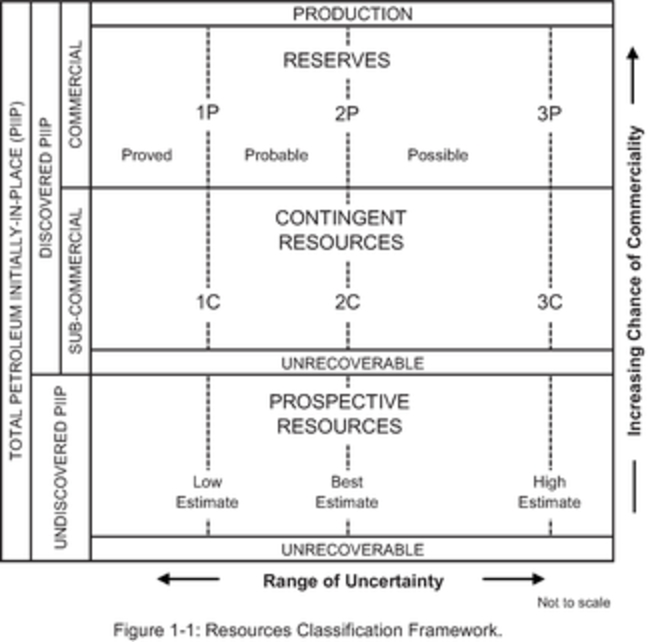 |
|
TOTAL PETROLEUM INITIALLY-IN-PLACE is that quantity of petroleum that is estimated to exist originally in naturally occurring accumulations. It includes that quantity of petroleum that is estimated, as of a given date, to be contained in known accumulations prior to production plus those estimated quantities in accumulations yet to be discovered (equivalent to “total resources”).
|
|
|
DISCOVERED PETROLEUM INITIALLY-IN-PLACE is that quantity of petroleum that is estimated, as of a given date, to be contained in known accumulations prior to production.
|
PRODUCTION is the cumulative quantity of petroleum that has been recovered at a given date. While all recoverable resources are estimated and production is measured in terms of the sales product specifications, raw production (sales plus non-sales) quantities are also measured and required to support engineering analyses based on reservoir voidage (see Production Measurement, section 3.2).
Multiple development projects may be applied to each known accumulation, and each project will recover an estimated portion of the initially-in-place quantities. The projects shall be subdivided into Commercial and Sub-Commercial, with the estimated recoverable quantities being classified as Reserves and Contingent Resources respectively, as defined below.
RESERVES are those quantities of petroleum anticipated to be commercially recoverable by application of development projects to known accumulations from a given date forward under defined conditions. Reserves must further satisfy four criteria: they must be discovered, recoverable, commercial, and remaining (as of the evaluation date) based on the development project(s) applied. Reserves are further categorized in accordance with the level of certainty associated with the estimates and may be sub-classified based on project maturity and/or characterized by development and production status.
CONTINGENT RESOURCES are those quantities of petroleum estimated, as of a given date, to be potentially recoverable from known accumulations, but the applied project(s) are not yet considered mature enough for commercial development due to one or more contingencies. Contingent Resources may include, for example, projects for which there are currently no viable markets, or where commercial recovery is dependent on technology under development, or where evaluation of the accumulation is insufficient to clearly assess commerciality. Contingent Resources are further categorized in accordance with the level of certainty associated with the estimates and may be subclassified based on project maturity and/or characterized by their economic status.
UNDISCOVERED PETROLEUM INITIALLY-IN-PLACE is that quantity of petroleum estimated, as of a given date, to be contained within accumulations yet to be discovered.
C-5
PETROLEUM RESERVES AND RESOURCES CLASSIFICATION AND DEFINITIONS
Excerpted from the Petroleum Resources Management System Approved by
the Society of Petroleum Engineers (SPE) Board of Directors, March 2007
PROSPECTIVE RESOURCES are those quantities of petroleum estimated, as of a given date, to be potentially recoverable from undiscovered accumulations by application of future development projects. Prospective Resources have both an associated chance of discovery and a chance of development. Prospective Resources are further subdivided in accordance with the level of certainty associated with recoverable estimates assuming their discovery and development and may be sub-classified based on project maturity.
UNRECOVERABLE is that portion of Discovered or Undiscovered Petroleum Initially-in-Place quantities which is estimated, as of a given date, not to be recoverable by future development projects. A portion of these quantities may become recoverable in the future as commercial circumstances change or technological developments occur; the remaining portion may never be recovered due to physical/chemical constraints represented by subsurface interaction of fluids and reservoir rocks.
Estimated Ultimate Recovery (EUR) is not a resources category, but a term that may be applied to any accumulation or group of accumulations (discovered or undiscovered) to define those quantities of petroleum estimated, as of a given date, to be potentially recoverable under defined technical and commercial conditions plus those quantities already produced (total of recoverable resources).
1.2 Project-Based Resources Evaluations
The resources evaluation process consists of identifying a recovery project, or projects, associated with a petroleum accumulation(s), estimating the quantities of Petroleum Initially-in-Place, estimating that portion of those in-place quantities that can be recovered by each project, and classifying the project(s) based on its maturity status or chance of commerciality.
This concept of a project-based classification system is further clarified by examining the primary data sources contributing to an evaluation of net recoverable resources (see Figure 1-2) that may be described as follows:
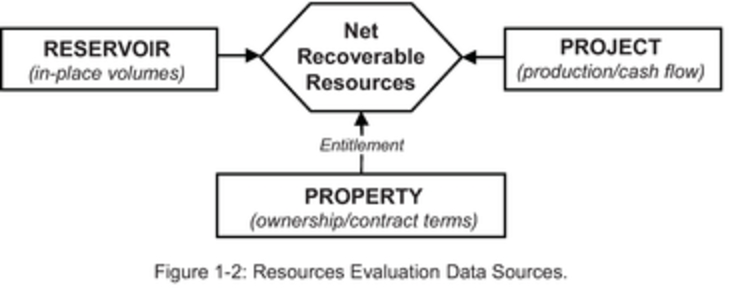
| • | The Reservoir (accumulation): Key attributes include the types and quantities of Petroleum Initially-in-Place and the fluid and rock properties that affect petroleum recovery. |
| • | The Project: Each project applied to a specific reservoir development generates a unique production and cash flow schedule. The time integration of these schedules taken to the project's technical, economic, or contractual limit defines the estimated recoverable resources and associated future net cash flow projections for each project. The ratio of EUR to Total Initially-in-Place quantities defines the ultimate recovery efficiency for the development project(s). A project may be defined at various levels and stages of maturity; it may include one or many wells and associated production and processing facilities. One project may develop many reservoirs, or many projects may be applied to one reservoir. |
| • | The Property (lease or license area): Each property may have unique associated contractual rights and obligations including the fiscal terms. Such information allows definition of each participant's share of produced |
C-6
PETROLEUM RESERVES AND RESOURCES CLASSIFICATION AND DEFINITIONS
Excerpted from the Petroleum Resources Management System Approved by
the Society of Petroleum Engineers (SPE) Board of Directors, March 2007
quantities (entitlement) and share of investments, expenses, and revenues for each recovery project and the reservoir to which it is applied. One property may encompass many reservoirs, or one reservoir may span several different properties. A property may contain both discovered and undiscovered accumulations.
In context of this data relationship, “project” is the primary element considered in this resources classification, and net recoverable resources are the incremental quantities derived from each project. Project represents the link between the petroleum accumulation and the decision-making process. A project may, for example, constitute the development of a single reservoir or field, or an incremental development for a producing field, or the integrated development of several fields and associated facilities with a common ownership. In general, an individual project will represent the level at which a decision is made whether or not to proceed (i.e., spend more money) and there should be an associated range of estimated recoverable quantities for that project.
An accumulation or potential accumulation of petroleum may be subject to several separate and distinct projects that are at different stages of exploration or development. Thus, an accumulation may have recoverable quantities in several resource classes simultaneously.
In order to assign recoverable resources of any class, a development plan needs to be defined consisting of one or more projects. Even for Prospective Resources, the estimates of recoverable quantities must be stated in terms of the sales products derived from a development program assuming successful discovery and commercial development. Given the major uncertainties involved at this early stage, the development program will not be of the detail expected in later stages of maturity. In most cases, recovery efficiency may be largely based on analogous projects. In-place quantities for which a feasible project cannot be defined using current, or reasonably forecast improvements in, technology are classified as Unrecoverable.
Not all technically feasible development plans will be commercial. The commercial viability of a development project is dependent on a forecast of the conditions that will exist during the time period encompassed by the project's activities (see Commercial Evaluations, section 3.1). “Conditions” include technological, economic, legal, environmental, social, and governmental factors. While economic factors can be summarized as forecast costs and product prices, the underlying influences include, but are not limited to, market conditions, transportation and processing infrastructure, fiscal terms, and taxes.
The resource quantities being estimated are those volumes producible from a project as measured according to delivery specifications at the point of sale or custody transfer (see Reference Point, section 3.2.1). The cumulative production from the evaluation date forward to cessation of production is the remaining recoverable quantity. The sum of the associated annual net cash flows yields the estimated future net revenue. When the cash flows are discounted according to a defined discount rate and time period, the summation of the discounted cash flows is termed net present value (NPV) of the project (see Evaluation and Reporting Guidelines, section 3.0).
The supporting data, analytical processes, and assumptions used in an evaluation should be documented in sufficient detail to allow an independent evaluator or auditor to clearly understand the basis for estimation and categorization of recoverable quantities and their classification.
2.0 Classification and Categorization Guidelines
2.1 Resources Classification
The basic classification requires establishment of criteria for a petroleum discovery and thereafter the distinction between commercial and sub-commercial projects in known accumulations (and hence between Reserves and Contingent Resources).
2.1.1 Determination of Discovery Status
A discovery is one petroleum accumulation, or several petroleum accumulations collectively, for which one or several exploratory wells have established through testing, sampling, and/or logging the existence of a significant quantity of potentially moveable hydrocarbons.
C-7
PETROLEUM RESERVES AND RESOURCES CLASSIFICATION AND DEFINITIONS
Excerpted from the Petroleum Resources Management System Approved by
the Society of Petroleum Engineers (SPE) Board of Directors, March 2007
In this context, “significant” implies that there is evidence of a sufficient quantity of petroleum to justify estimating the in-place volume demonstrated by the well(s) and for evaluating the potential for economic recovery. Estimated recoverable quantities within such a discovered (known) accumulation(s) shall initially be classified as Contingent Resources pending definition of projects with sufficient chance of commercial development to reclassify all, or a portion, as Reserves. Where in-place hydrocarbons are identified but are not considered currently recoverable, such quantities may be classified as Discovered Unrecoverable, if considered appropriate for resource management purposes; a portion of these quantities may become recoverable resources in the future as commercial circumstances change or technological developments occur.
2.1.2 Determination of Commerciality
Discovered recoverable volumes (Contingent Resources) may be considered commercially producible, and thus Reserves, if the entity claiming commerciality has demonstrated firm intention to proceed with development and such intention is based upon all of the following criteria:
| • | Evidence to support a reasonable timetable for development. |
| • | A reasonable assessment of the future economics of such development projects meeting defined investment and operating criteria. |
| • | A reasonable expectation that there will be a market for all or at least the expected sales quantities of production required to justify development. |
| • | Evidence that the necessary production and transportation facilities are available or can be made available. |
| • | Evidence that legal, contractual, environmental and other social and economic concerns will allow for the actual implementation of the recovery project being evaluated. |
To be included in the Reserves class, a project must be sufficiently defined to establish its commercial viability. There must be a reasonable expectation that all required internal and external approvals will be forthcoming, and there is evidence of firm intention to proceed with development within a reasonable time frame. A reasonable time frame for the initiation of development depends on the specific circumstances and varies according to the scope of the project. While 5 years is recommended as a benchmark, a longer time frame could be applied where, for example, development of economic projects are deferred at the option of the producer for, among other things, market-related reasons, or to meet contractual or strategic objectives. In all cases, the justification for classification as Reserves should be clearly documented.
To be included in the Reserves class, there must be a high confidence in the commercial producibility of the reservoir as supported by actual production or formation tests. In certain cases, Reserves may be assigned on the basis of well logs and/or core analysis that indicate that the subject reservoir is hydrocarbon-bearing and is analogous to reservoirs in the same area that are producing or have demonstrated the ability to produce on formation tests.
2.2 Resources Categorization
The horizontal axis in the Resources Classification (Figure 1.1) defines the range of uncertainty in estimates of the quantities of recoverable, or potentially recoverable, petroleum associated with a project. These estimates include both technical and commercial uncertainty components as follows:
| • | The total petroleum remaining within the accumulation (in-place resources). |
| • | That portion of the in-place petroleum that can be recovered by applying a defined development project or projects. |
| • | Variations in the commercial conditions that may impact the quantities recovered and sold (e.g., market availability, contractual changes). |
C-8
PETROLEUM RESERVES AND RESOURCES CLASSIFICATION AND DEFINITIONS
Excerpted from the Petroleum Resources Management System Approved by
the Society of Petroleum Engineers (SPE) Board of Directors, March 2007
Where commercial uncertainties are such that there is significant risk that the complete project (as initially defined) will not proceed, it is advised to create a separate project classified as Contingent Resources with an appropriate chance of commerciality.
2.2.1 Range of Uncertainty
The range of uncertainty of the recoverable and/or potentially recoverable volumes may be represented by either deterministic scenarios or by a probability distribution (see Deterministic and Probabilistic Methods, section 4.2).
When the range of uncertainty is represented by a probability distribution, a low, best, and high estimate shall be provided such that:
| • | There should be at least a 90% probability (P90) that the quantities actually recovered will equal or exceed the low estimate. |
| • | There should be at least a 50% probability (P50) that the quantities actually recovered will equal or exceed the best estimate. |
| • | There should be at least a 10% probability (P10) that the quantities actually recovered will equal or exceed the high estimate. |
When using the deterministic scenario method, typically there should also be low, best, and high estimates, where such estimates are based on qualitative assessments of relative uncertainty using consistent interpretation guidelines. Under the deterministic incremental (risk-based) approach, quantities at each level of uncertainty are estimated discretely and separately (see Category Definitions and Guidelines, section 2.2.2).
These same approaches to describing uncertainty may be applied to Reserves, Contingent Resources, and Prospective Resources. While there may be significant risk that sub-commercial and undiscovered accumulations will not achieve commercial production, it is useful to consider the range of potentially recoverable quantities independently of such a risk or consideration of the resource class to which the quantities will be assigned.
2.2.2 Category Definitions and Guidelines
Evaluators may assess recoverable quantities and categorize results by uncertainty using the deterministic incremental (risk-based) approach, the deterministic scenario (cumulative) approach, or probabilistic methods (see “2001 Supplemental Guidelines,” Chapter 2.5). In many cases, a combination of approaches is used.
Use of consistent terminology (Figure 1.1) promotes clarity in communication of evaluation results. For Reserves, the general cumulative terms low/best/high estimates are denoted as 1P/2P/3P, respectively. The associated incremental quantities are termed Proved, Probable and Possible. Reserves are a subset of, and must be viewed within context of, the complete resources classification system. While the categorization criteria are proposed specifically for Reserves, in most cases, they can be equally applied to Contingent and Prospective Resources conditional upon their satisfying the criteria for discovery and/or development.
For Contingent Resources, the general cumulative terms low/best/high estimates are denoted as 1C/2C/3C respectively. For Prospective Resources, the general cumulative terms low/best/high estimates still apply. No specific terms are defined for incremental quantities within Contingent and Prospective Resources.
Without new technical information, there should be no change in the distribution of technically recoverable volumes and their categorization boundaries when conditions are satisfied sufficiently to reclassify a project from Contingent Resources to Reserves. All evaluations require application of a consistent set of forecast conditions, including assumed future costs and prices, for both classification of projects and categorization of estimated quantities recovered by each project (see Commercial Evaluations, section 3.1).
Based on additional data and updated interpretations that indicate increased certainty, portions of Possible and Probable Reserves may be re-categorized as Probable and Proved Reserves.
C-9
PETROLEUM RESERVES AND RESOURCES CLASSIFICATION AND DEFINITIONS
Excerpted from the Petroleum Resources Management System Approved by
the Society of Petroleum Engineers (SPE) Board of Directors, March 2007
Uncertainty in resource estimates is best communicated by reporting a range of potential results. However, if it is required to report a single representative result, the “best estimate” is considered the most realistic assessment of recoverable quantities. It is generally considered to represent the sum of Proved and Probable estimates (2P) when using the deterministic scenario or the probabilistic assessment methods. It should be noted that under the deterministic incremental (risk-based) approach, discrete estimates are made for each category, and they should not be aggregated without due consideration of their associated risk (see “2001 Supplemental Guidelines,” Chapter 2.5).
Table 1: Recoverable Resources Classes and Sub-Classes
|
Class/Sub-Class
|
Definition
|
Guidelines
|
|
Reserves
|
Reserves are those quantities of petroleum anticipated to be commercially recoverable by application of development projects to known accumulations from a given date forward under defined conditions.
|
Reserves must satisfy four criteria: they must be discovered, recoverable, commercial, and remaining based on the development project(s) applied. Reserves are further subdivided in accordance with the level of certainty associated with the estimates and may be sub-classified based on project maturity and/or characterized by their development and production status.
To be included in the Reserves class, a project must be sufficiently defined to establish its commercial viability. There must be a reasonable expectation that all required internal and external approvals will be forthcoming, and there is evidence of firm intention to proceed with development within a reasonable time frame. A reasonable time frame for the initiation of development depends on the specific circumstances and varies according to the scope of the project. While 5 years is recommended as a benchmark, a longer time frame could be applied where, for example, development of economic projects are deferred at the option of the producer for, among other things, market-related reasons, or to meet contractual or strategic objectives. In all cases, the justification for classification as Reserves should be clearly documented. To be included in the Reserves class, there must be a high confidence in the commercial producibility of the reservoir as supported by actual production or formation tests. In certain cases, Reserves may be assigned on the basis of well logs and/or core analysis that indicate that the subject reservoir is hydrocarbon-bearing and is analogous to reservoirs in the same area that are producing or have demonstrated the ability to produce on formation tests. |
|
On Production
|
The development project is currently producing and selling petroleum to market.
|
The key criterion is that the project is receiving income from sales, rather than the approved development project necessarily being complete. This is the point at which the project “chance of commerciality” can be said to be 100%.
The project “decision gate” is the decision to initiate commercial production from the project. |
|
Approved for Development
|
All necessary approvals have been obtained, capital funds have been committed, and implementation of the development project is under way.
|
At this point, it must be certain that the development project is going ahead. The project must not be subject to any contingencies such as outstanding regulatory approvals or sales contracts. Forecast capital expenditures should be included in the reporting entity's current or following year's approved budget.
The project “decision gate” is the decision to start investing capital in the construction of production facilities and/or drilling development wells. |
|
Justified for Development
|
Implementation of the development project is justified on the basis of reasonable forecast commercial conditions at the time of reporting, and there are reasonable expectations that all necessary approvals/contracts will be obtained.
|
In order to move to this level of project maturity, and hence have reserves associated with it, the development project must be commercially viable at the time of reporting, based on the reporting entity's assumptions of future prices, costs, etc. (“forecast case”) and the specific circumstances of the project. Evidence of a firm intention to proceed with development within a reasonable time frame will be sufficient to demonstrate commerciality. There should be a development plan in sufficient detail to support the assessment of commerciality and a reasonable expectation that any regulatory approvals or sales contracts required prior to project implementation will be forthcoming. Other than such approvals/contracts, there should be no known contingencies that could preclude the development from proceeding within a reasonable timeframe (see Reserves class).
The project “decision gate” is the decision by the reporting entity and its partners, if any, that the project has reached a level of technical and commercial maturity sufficient to justify proceeding with development at that point in time. |
C-10
PETROLEUM RESERVES AND RESOURCES CLASSIFICATION AND DEFINITIONS
Excerpted from the Petroleum Resources Management System Approved by
the Society of Petroleum Engineers (SPE) Board of Directors, March 2007
|
Class/Sub-Class
|
Definition
|
Guidelines
|
|
Contingent Resources
|
Those quantities of petroleum estimated, as of a given date, to be potentially recoverable from known accumulations by application of development projects, but which are not currently considered to be commercially recoverable due to one or more contingencies.
|
Contingent Resources may include, for example, projects for which there are currently no viable markets, or where commercial recovery is dependent on technology under development, or where evaluation of the accumulation is insufficient to clearly assess commerciality. Contingent Resources are further categorized in accordance with the level of certainty associated with the estimates and may be sub-classified based on project maturity and/or characterized by their economic status.
|
|
Development Pending
|
A discovered accumulation where project activities are ongoing to justify commercial development in the foreseeable future.
|
The project is seen to have reasonable potential for eventual commercial development, to the extent that further data acquisition (e.g. drilling, seismic data) and/or evaluations are currently ongoing with a view to confirming that the project is commercially viable and providing the basis for selection of an appropriate development plan. The critical contingencies have been identified and are reasonably expected to be resolved within a reasonable time frame. Note that disappointing appraisal/evaluation results could lead to a re-classification of the project to “On Hold” or “Not Viable” status.
The project “decision gate” is the decision to undertake further data acquisition and/or studies designed to move the project to a level of technical and commercial maturity at which a decision can be made to proceed with development and production. |
|
Development Unclarified or on Hold
|
A discovered accumulation where project activities are on hold and/or where justification as a commercial development may be subject to significant delay.
|
The project is seen to have potential for eventual commercial development, but further appraisal/evaluation activities are on hold pending the removal of significant contingencies external to the project, or substantial further appraisal/evaluation activities are required to clarify the potential for eventual commercial development. Development may be subject to a significant time delay. Note that a change in circumstances, such that there is no longer a reasonable expectation that a critical contingency can be removed in the foreseeable future, for example, could lead to a reclassification of the project to “Not Viable” status.
The project “decision gate” is the decision to either proceed with additional evaluation designed to clarify the potential for eventual commercial development or to temporarily suspend or delay further activities pending resolution of external contingencies. |
|
Development Not Viable
|
A discovered accumulation for which there are no current plans to develop or to acquire additional data at the time due to limited production potential.
|
The project is not seen to have potential for eventual commercial development at the time of reporting, but the theoretically recoverable quantities are recorded so that the potential opportunity will be recognized in the event of a major change in technology or commercial conditions.
The project “decision gate” is the decision not to undertake any further data acquisition or studies on the project for the foreseeable future. |
|
Prospective Resources
|
Those quantities of petroleum which are estimated, as of a given date, to be potentially recoverable from undiscovered accumulations.
|
Potential accumulations are evaluated according to their chance of discovery and, assuming a discovery, the estimated quantities that would be recoverable under defined development projects. It is recognized that the development programs will be of significantly less detail and depend more heavily on analog developments in the earlier phases of exploration.
|
|
Prospect
|
A project associated with a potential accumulation that is sufficiently well defined to represent a viable drilling target.
|
Project activities are focused on assessing the chance of discovery and, assuming discovery, the range of potential recoverable quantities under a commercial development program.
|
|
Lead
|
A project associated with a potential accumulation that is currently poorly defined and requires more data acquisition and/or evaluation in order to be classified as a prospect.
|
Project activities are focused on acquiring additional data and/or undertaking further evaluation designed to confirm whether or not the lead can be matured into a prospect. Such evaluation includes the assessment of the chance of discovery and, assuming discovery, the range of potential recovery under feasible development scenarios.
|
|
Play
|
A project associated with a prospective trend of potential prospects, but which requires more data acquisition and/or evaluation in order to define specific leads or prospects.
|
Project activities are focused on acquiring additional data and/or undertaking further evaluation designed to define specific leads or prospects for more detailed analysis of their chance of discovery and, assuming discovery, the range of potential recovery under hypothetical development scenarios.
|
C-11
PETROLEUM RESERVES AND RESOURCES CLASSIFICATION AND DEFINITIONS
Excerpted from the Petroleum Resources Management System Approved by
the Society of Petroleum Engineers (SPE) Board of Directors, March 2007
Table 2: Reserves Status Definitions and Guidelines
|
Status
|
Definition
|
Guidelines
|
|
Developed Reserves
|
Developed Reserves are expected quantities to be recovered from existing wells and facilities.
|
Reserves are considered developed only after the necessary equipment has been installed, or when the costs to do so are relatively minor compared to the cost of a well. Where required facilities become unavailable, it may be necessary to reclassify Developed Reserves as Undeveloped. Developed Reserves may be further sub-classified as Producing or Non-Producing.
|
|
Developed Producing Reserves
|
Developed Producing Reserves are expected to be recovered from completion intervals that are open and producing at the time of the estimate.
|
Improved recovery reserves are considered producing only after the improved recovery project is in operation.
|
|
Developed Non-Producing Reserves
|
Developed Non-Producing Reserves include shut-in and behind-pipe Reserves.
|
Shut-in Reserves are expected to be recovered from (1) completion intervals which are open at the time of the estimate but which have not yet started producing, (2) wells which were shut-in for market conditions or pipeline connections, or (3) wells not capable of production for mechanical reasons. Behind-pipe Reserves are expected to be recovered from zones in existing wells which will require additional completion work or future re-completion prior to start of production.
In all cases, production can be initiated or restored with relatively low expenditure compared to the cost of drilling a new well. |
|
Undeveloped Reserves
|
Undeveloped Reserves are quantities expected to be recovered through future investments:
|
(1) from new wells on undrilled acreage in known accumulations, (2) from deepening existing wells to a different (but known) reservoir, (3) from infill wells that will increase recovery, or (4) where a relatively large expenditure (e.g. when compared to the cost of drilling a new well) is required to (a) recomplete an existing well or (b) install production or transportation facilities for primary or improved recovery projects.
|
Table 3: Reserves Category Definitions and Guidelines
|
Category
|
Definition
|
Guidelines
|
|
|
Proved Reserves
|
Proved Reserves are those quantities of petroleum, which by analysis of geoscience and engineering data, can be estimated with reasonable certainty to be commercially recoverable, from a given date forward, from known reservoirs and under defined economic conditions, operating methods, and government regulations.
|
If deterministic methods are used, the term reasonable certainty is intended to express a high degree of confidence that the quantities will be recovered. If probabilistic methods are used, there should be at least a 90% probability that the quantities actually recovered will equal or exceed the estimate.
The area of the reservoir considered as Proved includes (1) the area delineated by drilling and defined by fluid contacts, if any, and (2) adjacent undrilled portions of the reservoir that can reasonably be judged as continuous with it and commercially productive on the basis of available geoscience and engineering data. In the absence of data on fluid contacts, Proved quantities in a reservoir are limited by the lowest known hydrocarbon (LKH) as seen in a well penetration unless otherwise indicated by definitive geoscience, engineering, or performance data. Such definitive information may include pressure gradient analysis and seismic indicators. Seismic data alone may not be sufficient to define fluid contacts for Proved reserves (see “2001 Supplemental Guidelines,” Chapter 8). Reserves in undeveloped locations may be classified as Proved provided that: |
|
|
|
|
•
|
The locations are in undrilled areas of the reservoir that can be judged with reasonable certainty to be commercially productive.
|
|
|
|
•
|
Interpretations of available geoscience and engineering data indicate with reasonable certainty that the objective formation is laterally continuous with drilled Proved locations.
|
|
|
|
For Proved Reserves, the recovery efficiency applied to these reservoirs should be defined based on a range of possibilities supported by analogs and sound engineering judgment considering the characteristics of the Proved area and the applied development program.
|
|
C-12
PETROLEUM RESERVES AND RESOURCES CLASSIFICATION AND DEFINITIONS
Excerpted from the Petroleum Resources Management System Approved by
the Society of Petroleum Engineers (SPE) Board of Directors, March 2007
|
Category
|
Definition
|
Guidelines
|
|
|
Probable Reserves
|
Probable Reserves are those additional Reserves which analysis of geoscience and engineering data indicate are less likely to be recovered than Proved Reserves but more certain to be recovered than Possible Reserves.
|
It is equally likely that actual remaining quantities recovered will be greater than or less than the sum of the estimated Proved plus Probable Reserves (2P). In this context, when probabilistic methods are used, there should be at least a 50% probability that the actual quantities recovered will equal or exceed the 2P estimate.
Probable Reserves may be assigned to areas of a reservoir adjacent to Proved where data control or interpretations of available data are less certain. The interpreted reservoir continuity may not meet the reasonable certainty criteria. Probable estimates also include incremental recoveries associated with project recovery efficiencies beyond that assumed for Proved. |
|
|
Possible Reserves
|
Possible Reserves are those additional reserves which analysis of geoscience and engineering data indicate are less likely to be recoverable than Probable Reserves.
|
The total quantities ultimately recovered from the project have a low probability to exceed the sum of Proved plus Probable plus Possible (3P), which is equivalent to the high estimate scenario. When probabilistic methods are used, there should be at least a 10% probability that the actual quantities recovered will equal or exceed the 3P estimate.
Possible Reserves may be assigned to areas of a reservoir adjacent to Probable where data control and interpretations of available data are progressively less certain. Frequently, this may be in areas where geoscience and engineering data are unable to clearly define the area and vertical reservoir limits of commercial production from the reservoir by a defined project. Possible estimates also include incremental quantities associated with project recovery efficiencies beyond that assumed for Probable. |
|
|
Probable and Possible Reserves
|
(See above for separate criteria for Probable Reserves and Possible Reserves.)
|
The 2P and 3P estimates may be based on reasonable alternative technical and commercial interpretations within the reservoir and/or subject project that are clearly documented, including comparisons to results in successful similar projects.
In conventional accumulations, Probable and/or Possible Reserves may be assigned where geoscience and engineering data identify directly adjacent portions of a reservoir within the same accumulation that may be separated from Proved areas by minor faulting or other geological discontinuities and have not been penetrated by a wellbore but are interpreted to be in communication with the known (Proved) reservoir. Probable or Possible Reserves may be assigned to areas that are structurally higher than the Proved area. Possible (and in some cases, Probable) Reserves may be assigned to areas that are structurally lower than the adjacent Proved or 2P area. Caution should be exercised in assigning Reserves to adjacent reservoirs isolated by major, potentially sealing, faults until this reservoir is penetrated and evaluated as commercially productive. Justification for assigning Reserves in such cases should be clearly documented. Reserves should not be assigned to areas that are clearly separated from a known accumulation by non-productive reservoir (i.e., absence of reservoir, structurally low reservoir, or negative test results); such areas may contain Prospective Resources. In conventional accumulations, where drilling has defined a highest known oil (HKO) elevation and there exists the potential for an associated gas cap, Proved oil Reserves should only be assigned in the structurally higher portions of the reservoir if there is reasonable certainty that such portions are initially above bubble point pressure based on documented engineering analyses. Reservoir portions that do not meet this certainty may be assigned as Probable and Possible oil and/or gas based on reservoir fluid properties and pressure gradient interpretations. |
|
The 2007 Petroleum Resources Management System can be viewed in its entirety at
http://www.spe.org/spe-app/spe/industry/reserves/prms.htm.
C-13
PART III—EXHIBITS
Index to Exhibits
|
Exhibit No.
|
Exhibit Description
|
|
1.1*
|
Form of Underwriting Agreement
|
|
2.1
|
Certificate of Incorporation
|
|
2.2
|
Amended and Restated Certificate of Incorporation, to be in effect at the closing of the offering
|
|
2.3
|
Bylaws
|
|
2.4
|
Amended and Restated Bylaws, to be in effect at the closing of the offering
|
|
3.1
|
Form of Common Stock certificate
|
|
6.1
|
Stockholders’ Agreement among the Company, Satellite Overseas (Holdings) Limited, and Gary C. Evans, dated July 11, 2016
|
|
6.2
|
Form of Indemnification Agreement between the Company and its directors and officers
|
|
10.1
|
Power of Attorney (included in signature page hereto)
|
|
11.1
|
Consent of BDO USA, LLP
|
|
11.2
|
Consent of Duane Morris LLP (included in Exhibit 12.1)
|
|
11.3
|
Consent of Netherland, Sewell & Associates Inc.
|
|
12.1
|
Opinion of Duane Morris LLP
|
|
13.1*
|
“Testing the waters” materials
|
| * | to be filed by amendment |
III-1
SIGNATURES
Pursuant to the requirements of Regulation A, the issuer certifies that it has reasonable grounds to believe that it meets all of the requirements for filing on Form 1-A and has duly caused this offering statement to be signed on its behalf by the undersigned, thereunto duly authorized, in the City of Grapevine, State of Texas, on October 24, 2016.
|
|
ENERGY HUNTER RESOURCES, INC.
|
|
|
|
|
|
|
|
By:
|
/s/ Gary C. Evans
|
|
|
|
Name: Gary C. Evans
|
|
|
|
Title: Chief Executive Officer
|
KNOW ALL PERSONS BY THESE PRESENTS, that each person whose signature appears below constitutes and appoints Gary C. Evans his true and lawful attorney-in-fact and agent, with full power of substitution, for him and in his name, place and stead, in any and all capacities, to sign any and all amendments to this Form 1-A offering statement, and to file the same with all exhibits thereto, and other documents in connection therewith, with the Securities and Exchange Commission, granting unto said attorney-in-fact and agent full power and authority to do and perform each and every act and thing requisite and ratifying and confirming all that said attorney-in-fact and agent or his substitute or substitutes may lawfully do or cause to be done by virtue hereof.
This offering statement has been signed by the following persons in the capacities and on the dates indicated.
|
/s/ Gary C. Evans
Name: Gary C. Evans Title: Chairman of the Board, Chief Executive Officer and Director (Principal Executive Officer, Principal Financial Officer and Principal Accounting Officer) |
Dated: October 24, 2016
|
|
|
|
|
/s/ Victor G. Carrillo
Name: Victor G. Carrillo Title: Director |
Dated: October 24, 2016
|
|
|
|
|
/s/ Joe L. McClaugherty
Name: Joe L. McClaugherty Title: Director |
Dated: October 24, 2016
|
|
|
|
|
/s/ Rajiv I. Modi
Name: Rajiv I. Modi Title: Director |
Dated: October 24, 2016
|