hcgr_1a.htm
An offering statement pursuant to Regulation A relating to these securities has been filed with the Securities and Exchange Commission. Information contained in this Preliminary Offering Circular is subject to completion or amendment. These securities may not be sold nor may offers to buy be accepted before the offering statement filed with the Commission is qualified. This Preliminary Offering Circular shall not constitute an offer to sell or the solicitation of an offer to buy nor may there be any sales of these securities in any state in which such offer, solicitation or sale would be unlawful before registration or qualification under the laws of any such state. We may elect to satisfy our obligation to deliver a Final Offering Circular by sending you a notice within two business days after the completion of our sale to you that contains the URL where the Final Offering Circular was filed may be obtained.
Preliminary Offering Circular
June
15, 2016
Subject to Completion
HC GOVERNMENT REALTY TRUST, INC.
1819 Main Street, Suite 212
Sarasota, Florida 34236
(941) 955-7900
Minimum Offering Amount: $5,000,000 in Shares of Common Stock
Maximum Offering Amount: $30,000,000 in Shares of Common Stock
HC
Government Realty Trust, Inc., a Maryland corporation referred to herein as our company, was formed to primarily source, acquire,
own and manage built-to-suit and improved-to-suit, single-tenant properties leased by the United States of America through the
U.S General Services Administration, or GSA Properties. We focus on acquiring GSA Properties that fulfill mission critical
or direct citizen service functions primarily located across secondary or smaller markets, within size ranges of 5,000-50,000
rentable square feet, and in their first term after construction or retrofitted to post-9/11 standards. We are externally managed
and advised by Holmwood Capital Advisors, LLC, a Delaware limited liability company, or our Manager. Our management team has significant
commercial real estate experience and long-established relationships with real estate owners, developers and operators focused
on GSA Properties, which we believe will provide a competitive advantage in sourcing future acquisition opportunities that will
provide attractive risk-adjusted returns.
At
the closing of the minimum offering amount, we will own, through subsidiaries, a portfolio of ten GSA properties . We
acquired an initial portfolio of three GSA Properties on June 10, 2016 using proceeds from the issuance of our 7.00% Series A
Cumulative Convertible Preferred Stock, senior debt financing and a loan from our affiliate, Holmwood Capital, LLC. At the
closing of the minimum offering amount, we will acquire an additional seven properties from Holmwood Capital, LLC, an
affiliate, in exchange for units of limited partnership interest in our subsidiary, or OP Units, and the
assumption of indebtedness secured by such properties or interests therein. Proceeds from this offering will not be used to
purchase our initial portfolio of properties, though they will be utilized to pay down certain debts related to our initial
portfolio and provide capital to acquire additional GSA Properties that meet our investment
criteria .
We intend to elect and qualify to be treated as a real estate investment
trust, or REIT, for U.S. federal income tax purposes under the Internal Revenue Code of 1986, as amended, or the Code,
beginning with our taxable year ending December 31, 2016. Shares of our common stock are subject to restrictions on
ownership and transfer that are intended, among other purposes, to assist us in qualifying and maintaining our qualification as
a REIT. Our charter, subject to certain exceptions, limits ownership to no more than 9.8% in value or number of shares, whichever
is more restrictive, of any class or series of our outstanding capital stock.
We are offering a minimum of 500,000 and a maximum of 3,000,000 shares of our common stock at an offering price of $10.00 per share, for a minimum offering amount of $5,000,000 and a maximum offering amount of $30,000,000. The minimum purchase requirement is 150 shares, or $1,500; however, we can waive the minimum purchase requirement in our sole discretion. Following achievement of our minimum offering amount, we intend to hold additional closings on at least a monthly basis. The final closing will occur whenever we have reached the maximum offering amount. Until we achieve the minimum offering and have our initial closing and thereafter prior to each additional closing, the proceeds for that closing will be kept in an escrow account.
We
have engaged Cambria Capital, LLC, or our Dealer-Manager, a member of the Financial Industry Regulatory Authority, or FINRA,
as our dealer-manager to offer our shares to prospective investors on a best efforts basis, and our Dealer-Manager will have the
right to engage such other FINRA member firms as it determines to assist in the offering. We
intend to apply for quotation of our common stock on the OTCQX Marketplace by the OTC Markets Group, Inc., or OTCQX.
The
sale of the offered shares will begin as soon as practicable after this offering circular has been qualified by the United States
Securities and Exchange Commission, and is expected to continue until the earlier of (i) the date on which the minimum shares
offered hereby have been sold, or (ii) _______________________________ . If the minimum offering amount is not reached and
our initial closing held prior to the end of such period, all proceeds held in the escrow account will be promptly returned to
investors and this offering will terminate. If the minimum offering amount is reached, this offering will continue until the earlier
of (i) the date on which the maximum shares offered hereby have been sold, or (ii) _______________________________ . We
may, however, terminate the offering at any time and for any reason. At this time, there is no public trading market for shares
of our common stock.
| |
|
Price to Public
|
|
|
Commissions and Expense
Reimbursements (1)
|
|
|
Proceeds to
Company (1)
|
|
|
Proceeds to Other
Persons
|
|
|
Per Offered Unit:
|
|
$
|
10.00
|
|
|
$
|
0.825
|
|
|
$
|
9.175
|
|
|
$
|
0
|
|
|
Minimum Offering Amount:
|
|
$
|
5,000,000
|
|
|
$
|
412,500
|
|
|
$
|
4,587,500
|
|
|
$
|
0
|
|
|
Maximum Offering Amount:
|
|
$
|
30,000,000
|
|
|
$
|
2,475,000
|
|
|
$
|
27,525,000
|
|
|
$
|
0
|
|
| |
(1)
|
This table depicts underwriting discounts, commissions and expense reimbursements of 8.25% of the gross offering proceeds. We will pay our Dealer-Manager selling commissions of 7.0% of the gross offering proceeds and a non-accountable expense reimbursement of 1.25% of the gross offering proceeds.
|
Generally, no sale may be made to you in this offering if the aggregate purchase price you pay is more than 10% of the greater of your annual income or net worth. Different rules apply to accredited investors and non-natural persons. Before making any representation that your investment does not exceed applicable thresholds, we encourage you to review Rule 251(d)(2)(i)(C) of Regulation A. For general information on investing, we encourage you to refer to www.investor.gov.
An
investment in the offered shares is subject to certain risks and should be made only by persons or entities able to
bear the risk of and to withstand the total loss of their investment. Prospective investors should carefully consider
and review the RISK FACTORS beginning on page 12.
THE UNITED STATES SECURITIES AND EXCHANGE COMMISSION DOES NOT PASS UPON THE MERITS OF OR GIVE ITS APPROVAL TO ANY SECURITIES OFFERED OR THE TERMS OF THE OFFERING, NOR DOES IT PASS UPON THE ACCURACY OR COMPLETENESS OF ANY OFFERING CIRCULAR OR OTHER SOLICITATION MATERIALS. THESE SECURITIES ARE OFFERED PURSUANT TO AN EXEMPTION FROM REGISTRATION WITH THE COMMISSION; HOWEVER, THE COMMISION HAS NOT MADE AN INDEPENDENT DETERMINATION THAT THE SECURITIES OFFERED ARE EXEMPT FROM REGISTRATION.
This Offering Circular Uses the Form 1-A Disclosure Format.
Cambria
Capital, LLC
Preliminary
Offering Circular Dated June 15, 2016.
TABLE OF CONTENTS
| SUMMARY |
1 |
| RISK FACTORS |
12 |
| CAUTIONARY NOTE REGARDING FORWARD-LOOKING STATEMENTS |
35 |
| DILUTION |
36 |
| PLAN OF DISTRIBUTION |
37 |
| USE OF PROCEEDS |
40 |
| DESCRIPTION OF OUR BUSINESS |
41 |
| DESCRIPTION OF OUR PROPERTIES |
46 |
| MANAGEMENT’S DISCUSSION AND ANALYSIS OF FINANCIAL CONDITION AND RESULTS OF OPERATIONS |
54 |
| DIRECTORS, EXECUTIVE OFFICERS, AND SIGNIFICANT EMPLOYEES |
57 |
| COMPENSATION OF DIRECTORS AND EXECUTIVE OFFICERS |
61 |
| SECURITY OWNERSHIP OF MANAGEMENT AND CERTAIN SECURITYHOLDERS |
64 |
| OUR MANAGER AND RELATED AGREEMENTS |
65 |
| POLICIES WITH RESPECT TO CERTAIN ACTIVITIES |
69 |
| INTEREST OF MANAGEMENT AND OTHERS IN CERTAIN TRANSACTIONS |
72 |
| SECURITIES BEING OFFERED |
75 |
| IMPORTANT PROVISIONS OF MARYLAND CORPORATE LAW AND OUR CHARTER AND BYLAWS |
81 |
| ADDITIONAL REQUIREMENTS AND RESTRICTIONS |
85 |
| THE OPERATING PARTNERSHIP AGREEMENT |
87 |
| MATERIAL FEDERAL INCOME TAX CONSIDERATIONS |
95 |
| ERISA CONSIDERATIONS |
114 |
| REPORTS |
116 |
| LEGAL MATTERS |
118 |
| INDEPENDENT AUDITORS |
119 |
| ADDITIONAL INFORMATION |
120 |
| PART F/S |
122 |
This summary highlights the information contained elsewhere in this offering circular. Because it is a summary, it may not contain all the information that you should consider before investing in our shares. To fully understand this offering, you should carefully read this entire offering circular, including the more detailed information set forth under the caption “Risk Factors.” Unless the context otherwise requires or indicates, references in this offering circular to “us,” “we,” “our” or “our company” refer to HC Government Realty Trust, Inc., a Maryland corporation, together with its consolidated subsidiaries, including HC Government Realty Holdings, L.P., a Delaware limited partnership, which we refer to as our operating partnership. We refer to Holmwood Capital, LLC, a Delaware limited liability company, as Holmwood, and Holmwood Capital Advisors, LLC, a Delaware limited liability company, as our Manager. As used in this offering circular, an affiliate of, or person affiliated with, a specified person, is a person that directly, or indirectly through one or more intermediaries, controls or is controlled by, or is under common control with, the person specified.
As of the date of this offering circular, we have entered into (a) the Management Agreement between us and our Manager, or the Management Agreement, (b) the Limited Partnership Agreement of HC Government Realty Holdings, L.P., or the Limited Partnership Agreement and (c) the Contribution Agreement between HC Government Realty Holdings, L.P. and Holmwood Capital, LLC, or the Contribution Agreement. Unless the context otherwise requires or indicates, the information set forth in this offering circular assumes that the value of each unit of limited partnership interest in our operating partnership, or OP Unit, issuable to persons contributing interests in our Contribution Properties (as defined below) is equivalent to the public offering price per share of our common stock in this offering.
Our Company
HC
Government Realty Trust, Inc. was formed in 2016 as a Maryland corporation, and we intend to elect and qualify to be taxed
as a REIT for federal income tax purposes beginning with our taxable year ending December 31, 2016. We focus on acquiring
primarily in GSA Properties that fulfill mission critical or direct citizen service functions primarily located across
secondary and smaller markets, within size ranges of 5,000-50,000 rentable square feet, and in their first term after construction
or retrofit to post-9/11 standards. Leases associated with the GSA Properties in which our company invests are full faith and credit obligations of the
United States of America and are administered by the U.S. General Services Administration or directly through the occupying federal
agencies, or, collectively, the GSA. Our principal objective is the creation of value for stockholders by utilizing our relationships
and knowledge of GSA Properties, specifically, the acquisition, management and disposition of GSA Properties. As of the initial
closing of this offering and our formation transactions, we will wholly own 10 properties, all of them leased in their entirety
to U.S. Government agency tenants. Our initial portfolio will consist of (i) three properties acquired by our company, through
subsidiaries, on June 10, 2016 using proceeds from the issuance of shares of our 7.00% Series A Cumulative Convertible Preferred
Stock, or the Series A Preferred Stock, secured financing in the amount of $7,225,000 from CorAmerica Loan Company, LLC, or CorAmerica,
$2,019,789 in unsecured seller financing, and $1,000,000 of unsecured loans from Holmwood, or the Holmwood Loan, and (ii) seven
properties to be contributed to us as of the initial closing by Holmwood pursuant to the Contribution Agreement. We refer to the
acquisition of our initial ten-property portfolio as our formation transactions.
The
GSA-leased real estate asset class possesses a number of positive attributes that we believe will offer our stockholders significant
benefits, including a highly creditworthy and very stable tenant base, long-term lease structures and low risk of tenant turnover.
GSA leases are backed by the full faith and credit of the U.S. Government, and the GSA has never experienced a financial default
in its history. Payment for rents under GSA leases are funded
through the Federal Buildings Fund and are not subject to direct federal appropriations, which can fluctuate with federal budget
and political priorities. In addition to presenting reduced risk of default, GSA leases typically have long initial terms of ten
to 20 years with renewal leases having terms of five to ten years, which limit operational risk. Upon renewal of a GSA lease,
base rent is typically reset based on a number of factors, including inflation and the replacement cost of the building at the
time of renewal, which we generally expect will increase over the life of the lease. Renewal rates for GSA Properties in the first
term currently stand at approximately 95% for single-tenant, built-to-suit facilities.1
GSA-leased
properties generally provide attractive investment opportunities and require specialized knowledge and expertise. Each U.S. Government
agency has its own customs, procedures, culture, needs and mission, which translate into different requirements for its leased
space. Furthermore, the sector is highly fragmented, with a significant amount of non-institutional owners who lack our infrastructure
and experience in GSA-leased properties, and there is no national broker or clearinghouse for GSA-leased properties. We believe
this fragmentation results, in part, from the U.S. Government’s and GSA’s contracting policies, including policies
of preference for small, female and minority owned businesses. As of August 2015, the largest owner of GSA-leased properties
owned approximately 3.5% of the GSA-leased market by RSF and the ten largest owners of GSA-leased properties collectively owned
approximately 17% of the GSA-leased market by RSF.2
Long-term relationships and specialized institutional knowledge
regarding the agencies, their space needs and the hierarchy and importance of a property to its tenant agency are crucial to understanding
which agencies and properties present the greatest likelihood of long-term tenancy, and to identifying and acquiring attractive
investment properties. Our initial portfolio is diversified among U.S. Government tenant
agencies, including a number of the U.S. Government’s largest and most essential agencies, such as the Drug Enforcement
Administration, the Federal Bureau of Investigation, the Social Security Administration and the Department of Transportation.
We
intend to operate as an UPREIT, and own our properties through our subsidiary, HC Government Realty Holdings, L.P., a Delaware
limited partnership. While we intend to focus on investments in GSA Properties, we may also develop programs in the future to
invest in state and local government, single-tenant and majority occupied properties and properties majority leased to the United
States of America and other similar mission critical properties. We are externally managed and advised by Holmwood Capital Advisors,
LLC, a Delaware limited liability company, our Manager. Our Manager will make all investment decisions for us. Our Manager is
owned by Messrs. Robert R. Kaplan and Robert R. Kaplan, Jr., individually, by Stanton Holdings, LLC, which is controlled
by Mr. Edwin M. Stanton, and by Baker Hill Holding LLC, which is controlled by Mr. Philip Kurlander, all in equal proportions.
The officers of our Manager are Messrs. Edwin M. Stanton, President, Robert R. Kaplan, Jr., Vice President, Philip Kurlander,
Treasurer, and Robert R. Kaplan, Secretary.
We expect that our Manager’s management team’s extensive knowledge of U.S. Government properties and lease structures will allow us to execute transactions efficiently. Additionally, we believe that our ability to identify and implement building improvements increases the likelihood of lease renewal and enhances the value of our portfolio. Our Manager’s experienced management team brings specialized insight into the mission and hierarchy of tenant agencies so that we are able to gain a deep understanding of the U.S. Government’s long-term strategy for a particular agency and its resulting space needs. This allows us to target properties for use by agencies that will have enduring criticality and the highest likelihood of lease renewal. Lease duration and the likelihood of renewal are further increased as properties are tailored to meet the specific needs of individual U.S. Government agencies, such as specialized environmental and security upgrades.
Our Manager and its principals have a network of relationships with real estate owners, investors, operators and developers of all sizes and investment formats, across the United States and especially in relation to GSA Properties. We believe these relationships will provide us with a competitive advantage, greater access to off-market transactions, and flexibility in our investment choices to source and acquire GSA Properties.
In
addition to the dedication and experience of our Manager’s management team, we will rely on the network of professional
and advisory relationships our Manager’s management team has cultivated, including BB&T Capital Markets, a division
of BB&T Securities, LLC, or BB&T Capital Markets . Our Manager has engaged BB&T Capital Markets to
provide investment banking advisory services, including REIT financial and market analysis, offering structure
analysis and formation transaction analysis .
We believe in the long-term there will be a consistent flow of properties in our target markets for purposes of acquisition, leasing and managing which we expect will enable us to continue our platform into the foreseeable future. We intend to acquire GSA Properties located across secondary and smaller markets throughout the United States. We do not anticipate making acquisitions outside of the United States or its territories.
We primarily expect to make direct acquisitions of GSA Properties, but we may also invest through indirect investments in real property, such as those that may be obtained in a joint venture which may or may not be managed or affiliated with our Manager or its affiliates, whereby we own less than a 100% of the beneficial interest therein; provided, that in such event, we will acquire at least 50 percent of the outstanding voting securities in the investment, or otherwise comply with SEC staff guidance regarding majority-owned subsidiaries, for the investment to meet the definition of “majority-owned subsidiary” under the Investment Company Act. While our Manager does not intend for these types of investments to be a primary focus, we may make such investments in our Manager’s sole discretion.
Management
We
are externally managed by Holmwood Capital Advisors, LLC , our Manager . Our Manager will make all investment
decisions for us. Our Manager and its affiliated companies specialize in sourcing, acquiring, owning and managing
built-to-suit and improved-to-suit, single-tenant GSA Properties. Our Manager’s principals have a significant track
record of sourcing, acquiring, owning and managing GSA Properties, having aggregated close to $3,000,000,000 in acquisitions
of GSA Properties and other government leased assets. Our Manager’s senior management team has significant
relationships with institutional and regional developers and owners, brokers, lenders, attorneys and developers of GSA
Properties and other professionals, all of which our company expects to be a source of future investment opportunities. This
offering represents an opportunity for outside investors to take advantage of this principals’ expertise through
a pooled investment vehicle.
Our Manager will oversee our overall business and affairs, and will have broad discretion to make operating decisions on behalf of us and to make investments. Our stockholders will not be involved in our day-to-day affairs. Summary background information regarding the management of our Manager appears in the section entitled “Our Manager and Affiliates.”
Our
Manager will be overseen by our board of directors, or our board. Our board is currently, and until the initial closing
of this offering will be, comprised of Messrs. Kurlander, Stanton, Kaplan and Kaplan, Jr. Concurrently with the initial
closing of this offering, Mr. Kaplan, Jr. will resign from our board, and Mr. William Robert Fields, Mr. Scott A. Musil, Mr. Leo
Kiely and Mr. John F. O’Reilly, or our independent director nominees , will each be appointed to our board.
Our Competitive Strengths and Strategic Opportunities
We believe the experience of our Manager and its affiliates, as well as our investment strategies, distinguish us from other real estate companies. We believe that we will be benefitted by the alignment of the following competitive strengths and strategic opportunities:
High Quality Portfolio Leased to Mission-Critical U.S. Government Agencies
|
·
|
Upon completion of this offering and the formation transactions, we will wholly own 10 GSA Properties that are 100% leased to the United States. As of the date of this offering circular, based upon net operating income, the weighted average age of our initial portfolio was approximately 7.5 years, and the weighted average remaining lease term was approximately 7.7 years.
|
|
·
|
All of our initial portfolio properties are leased to U.S. Government agencies that serve mission-critical or citizen service functions.
|
|
·
|
These properties generally meet our investment criteria, which target GSA Properties across secondary or smaller markets, within size ranges of 5,000-50,000 rentable square feet, and in their first term after construction or retrofitted to post-9/11 standards.
|
Aligned Management Team
|
·
|
Upon completion of this offering and the formation transactions, our senior management team will own approximately 28.44% of our common stock on a fully diluted basis, which will help to align their interests with those of our stockholders.
|
|
·
|
A significant portion of our Manager’s fees will be accrued and eventually paid in stock, which will be issued upon the earlier of listing on a national exchange or 48 months from the initial closing, which will also align the interests of our Manager with those of our stockholders.
|
Asset Management
|
·
|
Considerable experience in developing, financing, owning, managing, and leasing Class A office properties, including federal government-leased properties across the U.S. (over 110 years of collective experience and $4.6 billion in commercial real estate transactions, and approximately $3 billion of GSA Properties and other government leased assets).
|
|
·
|
Relationships with real estate owners, developers, brokers and lenders should allow our company to source off-market or limited-competitive acquisition opportunities at attractive cap rates.
|
|
·
|
In-depth knowledge of the GSA procurement process, GSA requirements, and GSA organizational dynamics. The GSA build-to-suit lease process is detailed and requires significant process-specific expertise as well as extensive knowledge of GSA building requirements and leases.
|
|
·
|
Strong network of professional and advisory relationships, including BB&T Capital Markets, financial advisor to our Manager.
|
Property Management
|
·
|
Significant experience in property management and management of third party property managers, focusing on the day-to-day management of the owned properties, including cleaning, repairs, landscaping, collecting rents, handling compliance with zoning and regulations.
|
Credit Quality of Tenant
|
·
|
Leases are full faith and credit obligations of the United States and, as such, are not subject to the risk of annual appropriations.
|
|
·
|
High lease renewal rates for GSA Properties in first term (average of 93% for single-tenant properties, 95% for single-tenant, built-to-suit properties).3
|
|
·
|
Based on 2014 GSA statistics, since 2001 average duration of occupancy for federal agencies in the same leased building is 25 years. From 2001 through 2010, the GSA exercised the right to terminate prior to the end of the full lease term at a rate of 1.73%, according to Colliers International research.4
|
|
·
|
Leases typically include inflation-linked rent increases associated with certain property operating costs, which the Company believes will mitigate expense variability.
|
Fragmented Market for Assets Within Company Acquisition Strategy
|
·
|
Our Manager has observed that the market of owners and developers of targeted assets appears highly fragmented with the majority of ownership distributed among small regional owners and developers.
|
|
·
|
Based on our research, GSA Properties currently trade at an average cap rate of 7.25% compared to 4.5% - 5.5% for all investment grade-rated, single tenant, triple net lease properties5 and less than 2.0% for 10-year U.S. Treasury bonds.6
|
Large Inventory of Targeted Assets
|
·
|
Over 1,300 GSA Properties in our targeted size are spread throughout U.S.7
|
|
·
|
Company strategy of mitigating lease renewal risk by owning specialized, mission critical and customer service functioned properties, portfolio diversification by agency and location and through careful acquisition of staggered lease expirations.
|
4 Colliers International GSA-X-CHANGE 2014 GSA Industry Data.
Our Strategy
We believe there is a significant opportunity to acquire and build a portfolio consisting of high-quality GSA Properties at attractive risk-adjusted returns. We will seek primarily to acquire “citizen service” properties, or properties that are “mission critical” to an agency function. Further, we primarily target properties located within secondary or smaller markets, within size ranges of 5,000-50,000 rentable square feet, and in their first term after construction or retrofitted to post-9/11 standards.
We will either target GSA Properties that are LEED® certified or actively seek LEED® certification after acquisition. Of our initial portfolio of 10 properties, five properties are LEED® certified and another property is in the LEED® certification process.
We believe this subset of GSA Properties is highly fragmented and often overlooked by larger investors, which can provide opportunities for us to buy at more attractive pricing to other properties within the asset class. We also believe selection based on agency function, building use and location in these smaller markets will help to mitigate risk of non-renewal. While we intend to focus on this subset of GSA Properties, we are not limited in the properties in which we may invest. We have the flexibility to expand our investment focus as market conditions may dictate and, as determined in the sole discretion of our Manager, subject to broad investment guidelines, or our Investment Guidelines, and Investment Policies, as defined below, adopted by our board of directors, as may be amended by the board of directors from time to time. Renewal rates for GSA Properties in the first term currently stands at approximately 95% for single-tenant, built-to-suit facilities.
Our board has adopted certain investment policies, or our Investment Policies. Our Investment Policies will provide our Manager with substantial discretion with respect to the selection, acquisition and management of specific investments, subject to the limitations in the Management Agreement. Our Manager may revise the Investment Policies, which are described herein, without the approval of our board of directors or stockholders; provided, however, that our Manager may not acquire properties falling outside our Investment Guidelines without the approval of our board of directors. Our board may also adjust our Investment Policies and will review them at least annually to determine whether the policies are in the best interests of our stockholders.
Growth Strategy
Value-Enhancing Asset Management
|
·
|
Our Manager focuses on the efficient management of our properties and on improvements to our properties that enhance their value for a tenant agency and improve the likelihood of lease renewal.
|
|
·
|
We also seek to reduce operating costs at all of our properties, often by implementing energy efficiency programs that help the U.S. Government achieve its conservation and efficiency goals.
|
|
·
|
Our Manager’s asset management team also conducts frequent audits of each of our properties in concert with the GSA and the tenant agency so as to keep each facility in optimal condition, allowing the tenant agency to better perform its stated mission and helping to position us as a GSA partner of choice.
|
Renew Existing Leases at Positive Spreads
|
·
|
We intend to renew leases at our GSA-leased properties at positive spreads upon expiration.
|
|
·
|
Upon lease renewal, GSA rental rates are typically reset based on a number of factors, including inflation, the replacement cost of the building at the time of renewal and enhancements to the property since the date of the prior lease.
|
|
·
|
During the term of a GSA lease, we work in close partnership with the GSA to implement improvements at our properties to enhance the U.S. Government tenant agency’s ability to perform its stated mission, thereby increasing the importance of the building to the tenant agency and the probability of an increase in rent upon lease renewal.
|
Reduce Property-Level Operating Expenses
|
·
|
We manage our properties to increase our income, continuing to reduce property-level operating costs.
|
|
·
|
We manage our properties in a cost efficient manner so as to eliminate any excess spending and streamline our operating costs.
|
|
·
|
When we acquire a property, we review all property-level operating expenditures to determine whether and how the property can be managed more efficiently.
|
Our Initial Portfolio
Upon the completion of this offering and our formation transactions, we will own, through wholly-owned subsidiaries of our operating partnership, the initial portfolio of GSA Properties listed below. The following table presents an overview of our initial portfolio.
|
Initial Portfolio
|
Current Occupant
|
|
Rentable Sq. Ft
|
|
|
% of Initial Portfolio1
|
|
|
% Leased
|
|
Lease Expiration2
|
|
Annual Base Rent for Current Lease Year3
|
|
|
Annual Base Rent % of Initial Portfolio
|
|
|
Contribution Properties
|
|
|
|
|
|
|
|
|
|
|
|
|
|
|
|
|
|
|
Port Saint Lucie, FL
650 NW Peacock Boulevard, Port Saint Lucie, Florida 34986
|
U.S. Drug Enforcement Administration, or DEA
|
|
|
24,858 |
|
|
|
15.94 |
% |
|
|
100 |
% |
5/31/2027
|
|
$ |
562,257 |
|
|
|
11.90 |
% |
|
Jonesboro, AR
1809 LaTourette Drive, Jonesboro, Arkansas 72404
|
U.S. Social Security Administration, or SSA
|
|
|
16,439 |
|
|
|
10.54 |
% |
|
|
100 |
% |
1/11/2027
|
|
$ |
616,155 |
|
|
|
13.04 |
% |
|
Lorain, OH
221 West 5th Street, Lorain, Ohio 44052
|
SSA
|
|
|
11,607 |
|
|
|
7.44 |
% |
|
|
100 |
% |
3/ 11 /2024
|
|
$ |
437,423 |
|
|
|
9.26 |
% |
|
Cape Canaveral, FL
200 George King Boulevard, Port Canaveral, Florida 32920
|
U.S. Customs and Border Protection, or CBP
|
|
|
14,704 |
|
|
|
9.43 |
% |
|
|
100 |
% |
7/15/2027
|
|
$ |
645,805 |
|
|
|
13.67 |
% |
|
Johnson City, TN
2620 Knob Creek Road, Johnson City, Tennessee 37604
|
U.S. Federal Bureau of Investigation, or FBI
|
|
|
10,115 |
|
|
|
6.49 |
% |
|
|
100 |
% |
8/20/2027
|
|
$ |
392,077 |
|
|
|
8.30 |
% |
|
Fort Smith, AR
4624 Kelley Highway, Ft. Smith, Arkansas 72904
|
U.S. Citizenship and Immigration Services, or CIS
|
|
|
13, 816 |
|
|
|
8.86 |
% |
|
|
100 |
% |
10/30/2029
|
|
$ |
419,627 |
|
|
|
8.88 |
% |
|
Silt, CO
2300 River Frontage Road, Silt, Colorado 81652
|
U.S. Bureau of Land Management, or BLM
|
|
|
18,813 |
|
|
|
12.06 |
% |
|
|
100 |
% |
9/30/2029
|
|
$ |
385,029 |
|
|
|
8.15 |
% |
|
Sub-Total Contribution Properties
|
|
|
|
110,352 |
|
|
|
70.76 |
% |
|
|
100 |
% |
|
|
$ |
3,458,373 |
|
|
|
73.22 |
% |
|
Owned Properties
|
|
|
|
|
|
|
|
|
|
|
|
|
|
|
|
|
|
|
|
|
|
|
|
Lakewood, CO
12305 West Dakota Avenue, Lakewood, Colorado 80228
|
US Department of Transportation, or DOT
|
|
|
19,241 |
|
|
|
12.34 |
% |
|
|
100 |
% |
6/20/2024
|
|
$ |
459,902 |
|
|
|
9.74 |
% |
|
Moore, OK
200 NE 27th Street, Moore, OK 73160
|
SSA
|
|
|
17,058 |
|
|
|
10.94 |
% |
|
|
100 |
% |
4/9/2027
|
|
$ |
524,018 |
|
|
|
11.09 |
% |
|
Lawton, OK
1610 SW Lee Boulevard, Lawton, OK 73501
|
SSA
|
|
|
9,298 |
|
|
|
5.96 |
% |
|
|
100 |
% |
8/16/2025
|
|
$ |
281,143 |
|
|
|
5.95 |
% |
|
Sub-Total– Owned Properties
|
|
|
|
45,597 |
|
|
|
29.24 |
% |
|
|
100 |
% |
|
|
$ |
1,265,063 |
|
|
|
26.78 |
% |
|
Total – Initial Portfolio
|
|
|
|
155,949 |
|
|
|
100 |
% |
|
|
100 |
% |
|
|
$ |
4,723,436 |
|
|
|
100 |
% |
1 By rentable square footage.
2 The Lease Expiration date set forth in the table reflects the full term of the applicable lease, and does not account for any right of the tenant to terminate any such lease early.
Contribution Properties
We
will acquire our Contribution Properties through the contribution to us by Holmwood of all of the membership interests in the
seven single-member limited liability companies that own our Contribution Properties. In exchange, our operating partnership will:
(i) issue a number of OP Units to Holmwood equal to the agreed value of Holmwood’s equity in the Contribution Properties
as of the closing of the contribution, divided by $10.00; and (ii) assume all of the indebtedness secured by the Contribution
Properties and assume Holmwood’s corporate credit line. As of the date of this offering circular, the agreed
value of Holmwood’s equity in the Contribution Properties is $9,686,280, resulting in 968,628 OP Units being issued to Holmwood
and the assumption of an aggregate of $ 25,005,067 in indebtedness at the contribution closing. The value
of Holmwood’s equity in the Contribution Properties and the number of OP Units to be received by Holmwood each will
increase in accordance with the amortization of the debt secured by such properties or interests therein. The total purchase price
for our Contribution Properties was determined by our Manager and Holmwood. By agreement, the value of the Silt Property
was agreed to be Holmwood’s purchase price, and the values of the remaining Contribution Properties were determined by using
prevailing market capitalization rates, as determined by our Manager, and the 2016 pro forma net operating income of each remaining
Contribution Property.
Our Contribution Agreement requires us to enter into an agreement as of the closing of the contribution granting Holmwood registration and qualification rights covering the resale of the shares of common stock into which its OP Units will be convertible, subject to conditions set forth in our operating partner’s limited partnership agreement. In addition, as of the closing of the contribution we will enter into a tax protection agreement with Holmwood under which we will agree to (i) indemnify Holmwood for any taxes incurred as a result of a taxable sale of the Contribution Properties for a period of ten years after the closing; and (ii) indemnify Holmwood if a reduction in our nonrecourse liabilities secured by the Contribution Properties results in an incurrence of taxes, provided that we may offer Holmwood the opportunity to guaranty a portion of our operating partnership’s other nonrecourse indebtedness in order to avoid the incurrence of tax on Holmwood. For more information on the Contribution Properties, see “Description of Our Properties – Contribution Properties.”
Owned Properties
We
have acquired a portfolio of three properties described above located in Lakewood, Colorado, Moore , Oklahoma and Lawton,
Oklahoma, or our owned properties, on June 10 2016 through our operating partnership. The total contract purchase price
for our owned properties was $10,226,786, comprised of: (a) $1,925,000 in cash pursuant to a deposit made to the seller on April
1, 2016; (b) the defeasance of the seller’s senior secured debt on the properties at closing; and (c) issuance of a note
to the seller in an amount equal to $2,019,789, or the Standridge Note. The Standridge Note will mature on the earlier
of December 10, 2017, or the date on which the we consummate a public securities offering (which would include this offering),
or the date on which our owned properties are conveyed or refinanced by us. The Standridge Note is pre-payable prior to the maturity
date at any time without penalty and will bear annual interest at the rate 7.0%. The Standridge Note is unsecured but is guaranteed
by Messrs. Kaplan, Kaplan, Jr., Kurlander and Stanton, and Baker Hill Holding LLC. For more information on our owned properties,
see “Description of Our Properties – Owned Properties.”
In
addition to the Standridge Note, we acquired our owned properties using proceeds from our Series A Preferred Stock offering, secured
financing in the aggregate amount of $7,225,000 from CorAmerica, and the $1,000,000 Holmwood Loan. We anticipate
paying off both the Standridge Note and the Holmwood Loan with proceeds from the initial closing of this offering.
Summary Risk Factors
An investment in our common stock involves a number of risks. See “Risk Factors,” beginning on page 12 of this offering circular. Some of the more significant risks include those set forth below.
| |
·
|
The Contribution Properties are owned by Holmwood, which is managed by our Manager. Messrs. Stanton, Kaplan, Jr. Kurlander, and Kaplan beneficially own significant interests in each of Holmwood and our Manager. While any acquisition of an affiliated property will be based on market terms and in accordance with our Investment Guidelines and Investment Policies, substantial conflicts of interest exist for our Manager and management team in advising each side of such transactions. We may pursue less vigorous enforcement of the terms of our agreements with Holmwood and our Manager because of conflicts of interest, which could materially and adversely affect us.
|
| |
·
|
We were recently organized and do not have a significant operating history or financial resources. There is no assurance that we will be able to successfully achieve our investment objectives.
|
| |
·
|
Investors will not have the opportunity to evaluate or approve any investments prior to our financing or acquisition thereof.
|
| |
·
|
We may not be able to invest the net proceeds of this offering on terms acceptable to investors, or at all.
|
| |
·
|
Investors will rely solely on our Manager to manage our company and our investments. Our Manager will have broad discretion to invest our capital and make decisions regarding investments. Investors will have limited control over changes in our policies and day-to-day operations, which increases the uncertainty and risks you face as an investor. In addition, our board of directors may approve changes to our policies without your approval.
|
| |
·
|
There are substantial risks associated with owning, financing, operating and leasing real estate.
|
| |
·
|
The amount of distributions we may make is uncertain. We may fund distributions from offering proceeds, borrowings and the sale of assets to the extent distributions exceed our earnings or cash flow from operations if we are unable to make distributions from our cash flow from operations. There is no limit on the amount of offering proceeds we may use to fund distributions. Distributions paid from sources other than cash flow from operations may constitute a return of capital to our stockholders. Rates of distribution may not be indicative of our operating results.
|
| |
·
|
The offering price of our common stock was not established based upon any appraisals of assets we own or may own, and will not be adjusted based upon any such appraisals. Thus, the offering price may not accurately reflect the value of our assets at the time an investor’s investment is made.
|
|
|
·
|
Real estate-related investments, including joint ventures, and co-investments, involve substantial risks.
|
|
|
·
|
Some of our leases permit the occupying agency to vacate the property and for our tenant to discontinue paying rent prior to the lease expiration date.
|
| |
|
|
| |
·
|
Our company will pay substantial fees and expenses to our Manager and its affiliates. These fees will increase investors’ risk of loss, and will reduce the amounts available for investments. Some of those fees will be payable regardless of our profitability or any return to investors.
|
| |
·
|
The tax protection agreement with Holmwood could limit our ability to sell, refinance or otherwise dispose of our Contribution Properties or make any such sale or other disposition costlier.
|
| |
·
|
Substantial actual and potential conflicts of interest exist between our investors and our interests or the interests of our Manager, and our respective affiliates, including conflicts arising out of (a) allocation of personnel to our activities, (b) allocation of investment opportunities between us.
|
| |
·
|
An investor could lose all or a substantial portion of its investment.
|
| |
·
|
There is no public trading market for our common stock, and we are not obligated to effectuate a liquidity event by a certain date or at all. It will thus be difficult for an investor to sell its shares of our common stock. Although we intend to apply for quotation of our common stock on the OTCQX, even if we obtain that quotation, we do not know the extent to which investor interest will lead to the development and maintenance of a liquid trading market. Further, our common stock will not be quoted on the OTCQX until after the termination of this offering, if at all.
|
| |
·
|
We may fail to qualify or maintain our qualification as a REIT for federal income tax purposes. We would then be subject to corporate level taxation and we would not be required to pay any distributions to our stockholders.
|
Compensation to Our Manager
|
Type
|
|
Description
|
| |
|
|
|
Asset Management Fee
|
|
We will pay our Manager an asset management fee equal to 1.5% of our stockholders’ equity payable quarterly in arrears in cash. For purposes of calculating the asset management fee, our stockholders’ equity means: (a) the sum of (1) the net proceeds from (or equity value assigned to) all issuances of our company’s equity and equity equivalent securities (including common stock, common stock equivalents, preferred stock and OP Units issued by our operating partnership) since inception (allocated on a pro rata daily basis for such issuances during the fiscal quarter of any such issuance), plus (2) our company’s retained earnings at the end of the most recently completed calendar quarter (without taking into account any non-cash equity compensation expense incurred in current or prior periods), less (b) any amount that our company has paid to repurchase our common stock issued in this or any subsequent offering. Stockholders’ equity also excludes (1) any unrealized gains and losses and other non-cash items (including depreciation and amortization) that have impacted stockholders’ equity as reported in our company’s financial statements prepared in accordance with GAAP, and (2) one-time events pursuant to changes in GAAP, and certain non-cash items not otherwise described above, in each case after discussions between our Manager and our independent director(s) and approval by a majority of our independent directors.
|
| |
|
|
|
Property Management Fee
|
|
We anticipate that our Manager’s wholly-owned subsidiary, Holmwood Capital Management, LLC, a Delaware limited liability company, or the Property Manager, will manage some or all of our company’s portfolio earning market-standard property management fees pursuant to a property management agreement executed between the Property Manager and our subsidiary owning the applicable property. We anticipate that the property management agreement will provide for a termination fee to be paid to the Property Manager if the Property Manager is terminated without cause or in the event of a sale of the subject property. The termination fee under the property management agreement will equal the aggregate property management fee paid to the Property Manager for the three full calendar months immediately prior to termination multiplied by four.
|
| |
|
|
|
Acquisition Fee
|
|
We will pay an acquisition fee, payable in vested equity in our company, equal to 1% of the gross purchase price, as adjusted pursuant to any closing adjustments, of each investment made on our behalf by our Manager following the initial closing of this offering; provided, however that all Acquisition Fees for investments prior to the earlier of (a) the initial listing of our common stock on the New York Stock Exchange, NYSE MKT, NASDAQ Stock Exchange, or any other national securities exchange, or a Listing Event, or (b) March 31, 2020, shall be accrued and paid simultaneously with the Listing Event, or on March 31, 2020, as applicable.
|
| |
|
|
|
Leasing Fee
|
|
Our Manager will be entitled to a leasing fee equal to 2.0% of all gross rent due during the term of the lease or lease renewal, excluding reimbursements by the tenant for operating expenses and taxes and similar pass-through obligations paid by the tenant for any new lease or lease renewal entered into or exercised during the term of the Management Agreement. The Leasing Fee is due to our Manager within thirty (30) days of the commencement of rent payment under the applicable new lease or lease renewal. The Leasing Fee is payable in addition to any third party leasing commissions or fees incurred by us.
|
| |
|
|
|
Equity Grants
|
|
Commencing
with the initial closing of this offering, our Manager shall receive a grant of our company’s equity securities, or a Grant,
which may be in the form of restricted shares of common stock, restricted stock units underlied by common stock, long-term incentive
units, or LTIP Units, or such other equity security as may be determined by the mutual consent of the board of directors (including
a majority of the independent directors) and our Manager, at each closing of an issuance of our company’s common stock or
any shares of common stock issuable pursuant to outstanding rights, options or warrants to subscribe for, purchase or otherwise
acquire shares on common stock that are in-the-money on such date in a public offering, such that following such Grant our Manager
shall own equity securities equivalent to 3.0% of the then issued and outstanding common stock of our company, on a fully diluted
basis, solely as a result of such Grants. For the avoidance of doubt, only equity securities owned pursuant to a Grant shall be
included in our Manager’s 3.0% ownership described in the preceding sentence, and no other equity securities owned by our
Manager or any member of our Manager shall be included in such calculation. Any Grant shall be subject to vesting over a five-year
period with vesting occurring on a quarterly basis, provided, that, the only vesting requirement shall be that the Management
Agreement (or any amendment, restatement or replacement hereof with our Manager continuing to provide the same general services
as provided hereunder to our company) remains in effect, and, further provided, that, if the Management Agreement is terminated
for any reason other than a termination for cause as described in the Management Agreement, then the vesting of any Grant shall
accelerate such that the Grant shall be fully vested as of such termination date. We anticipate making grants of 137,834
restricted shares of our common stock to our Manager if we sell the maximum offering amount.
|
| |
|
|
|
Termination Fee
|
|
A
termination fee equal to three times the sum of the asset management fee s , acquisition fee s and leasing fees earned,
in each case, by our Manager during the 24-month period prior to such termination, calculated as of the end of the most recently
completed fiscal quarter prior to the date of termination; provided, however, that if the Listing Event has not occurred and no
accrued acquisition fees have been paid, then all accrued acquisition fees will be included in the above calculation of the termination
fee. The termination fee will be payable upon termination of the Management Agreement (i) by us without cause or (ii) by our Manager
if we materially breach the Management Agreement. The termination fee is payable in cash, vested equity of our company, or
a combination thereof, in the discretion of our board.
|
Conflicts of Interest
Our officers and directors, and the owners and officers of our Manager and its affiliates are currently not involved in the ownership and advising of other real estate entities and programs. However, there are no restrictions on the ability of our officers and directors, and the owners and officers of our Manager and its affiliates to be involved in the ownership and advising of other real estate entities and programs, including those sponsored by the affiliates of Holmwood or in which one or more affiliates or Holmwood is a manager or participant. These possible interests may arise in the future and may give rise to conflicts of interest with respect to our business, our investments and our investment opportunities. In particular, but without limitation:
| |
·
|
Our Manager, its officers and their respective affiliates may face conflicts of interest relating to the purchase and leasing of real estate investments, and such conflicts may not be resolved in our favor. This could limit our investment opportunities, impair our ability to make distributions and reduce the value of your investment in us. Our Management Agreement provides that if our Manager or any of its affiliates sponsors or manages any new real estate entity or program with similar investment objectives to our company and has investment funds available at the same time as our company, our Manager must inform the board of directors of the method to be applied by our Manager in allocating investment opportunities among our company and competing investment entities and shall provide regular updates to the board of directors of the investment opportunities provided by our Manager to competing programs in order for the board of directors to evaluate that our Manager is allocating such opportunities in accordance with such method.
|
| |
·
|
If we acquire properties from entities owned or sponsored by affiliates of our Manager, the price may be higher than we would pay if the transaction was the result of arm’s-length negotiations with a third party.
|
| |
·
|
Our Manager will have considerable discretion with respect to the terms and timing of our acquisition, disposition and leasing transactions.
|
| |
·
|
Our Manager and its affiliates, including our officers, some of whom are also our directors, may face conflicts of interest caused by their ownership of our Manager and their roles with other programs, which could result in actions that are not in the long-term best interests of our stockholders.
|
| |
·
|
If the competing demands for the time of our Manager, its affiliates and our officers result in them spending insufficient time on our business, we may miss investment opportunities or have less efficient operations, which could reduce our profitability and result in lower distributions to you.
|
We do not have a policy that expressly restricts any of our directors, officers, stockholders or affiliates, including our Manager and its officers and employees, from having a pecuniary interest in an investment in or from conducting, for their own account, business activities of the type we conduct. We have not adopted any specific conflicts of interest policies, and, therefore, other than in respect of the restrictions placed on our Manager in the Management Agreement, we will be reliant upon the good faith of our Manager, officers and directors in the resolution of any conflict.
We
are party to the Contribution Agreement with Holmwood pursuant to which it will contribute to us all of the ownership interests
in the Contribution Properties as part of our formation transactions. Upon the initial closing of this offering, Holmwood will
contribute the Contribution Properties to us. In exchange, our operating partnership will: (i) issue a number of OP
Units to Holmwood equal to the agreed value of Holmwood’s equity in the Contribution Properties as of the closing of the
contribution, divided by $10.00; and (ii) assume all of the indebtedness secured by the Contribution Properties and assume Holmwood’s
corporate credit line. As of the date of this offering circular , the agreed value of Holmwood’s equity in the
Contribution Properties is $9,686,280, resulting in 968,628 OP Units being issued to Holmwood and the assumption of an aggregate
of $ 25,005,067 in indebtedness at the contribution closing. The value of Holmwood’s equity in the
Contribution Properties and the number of OP Units to be received by Holmwood each will increase in accordance with the
amortization of the debt secured by such properties or interests therein. The number of OP Units to be received will
increase and the amount of debt to be assumed will decrease as the debt secured by the Contribution Properties and Holmwood’s
corporate credit line is paid down. We will be entitled to indemnification and damages in the event of the breach of any representation,
warranty, covenant or agreement made by Holmwood pursuant to the contribution agreement. We will also enter into the tax protection
agreement with Holmwood and an agreement regarding registration and qualification rights for Holmwood’s OP Units.
We expect to enter into a property management agreement with the Property Manager for management of the Contribution Properties. We expect to pay the Property Manager’s property management fees at market-standard rates and will be require to pay the Property Manager a termination fee if we terminate them for any reason other than for cause.
These agreements, including any consideration payable by us under each such agreement, were not negotiated at arm’s length, and the terms of these agreements may not be as favorable to us as if they were so negotiated. To the extent that any breach, dispute or ambiguity arises with respect to any of these agreements, we may choose not to enforce, or to enforce less vigorously, our rights under these agreements due to our ongoing relationships with Holmwood, members of our senior management team, and the Property Manager.
Financing Policy
We anticipate that with respect to investments either acquired with debt financing or refinanced, the debt financing amount generally would be up to approximately 80% of the acquisition price of a particular investment, provided, however, we are not restricted in the amount of leverage we may use to finance an investment. Particular investments may be more highly leveraged. Further, our Manager expects that any debt financing for an investment will be secured by that investment or the interests in an entity that owns that investment.
Distribution Policy
In order to qualify as a REIT, we must distribute to our stockholders at least 90% of our annual taxable income (excluding net capital gains and income from operations or sales through a taxable REIT subsidiary, or TRS). We intend to make regular cash distributions to our stockholders out of our cash available for distribution, typically on a quarterly basis. Our board of directors will determine the amount of distributions to be distributed to our stockholders on a quarterly basis. The board of directors’ determination will be based on a number of factors, including funds available from operations, our capital expenditure requirements and the annual distribution requirements necessary to maintain our REIT qualification under the Code. As a result, our distribution rate and payment frequency may vary from time to time. Generally, our policy will be to pay distributions from cash flow from operations. However, our distributions may be paid from sources other than cash flow from operations, such as from the proceeds of this offering, borrowings, advances from our Manager or from our Manager’s deferral of its fees and expense reimbursements, as necessary. We intend to target an initial annual dividend on our common stock of $0.55 per share. See “Distribution Policy.”
REIT Status
We intend to elect to be treated as a REIT for federal income tax purposes beginning with our taxable year ending December 31, 2016. As long as we maintain our qualification as a REIT, we generally will not be subject to federal income or excise tax on income that we currently distribute to our stockholders. Under the Code, a REIT is subject to numerous organizational and operational requirements, including a requirement that it annually distribute at least 90% of its REIT taxable income (determined without regard to the deduction for dividends paid and excluding net capital gain) to its stockholders. If we fail to maintain our qualification as a REIT in any year, our income will be subject to federal income tax at regular corporate rates, regardless of our distributions to stockholders, and we may be precluded from qualifying for treatment as a REIT for the four-year period immediately following the taxable year in which such failure occurs. Even if we qualify for treatment as a REIT, we may still be subject to state and local taxes on our income and property and to federal income and excise taxes on our undistributed income. Moreover, if we establish TRSs, such TRSs generally will be subject to federal income taxation and to various other taxes.
Restriction on Ownership and Transfer of Our Common Stock
Our charter contains a restriction on ownership of our shares that generally prevents any one person from owning more than 9.8% in value of the outstanding shares of our capital stock or more than 9.8% in value or in number of shares, whichever is more restrictive, of the outstanding shares of our common stock, unless otherwise excepted (prospectively or retroactively) by our board of directors. Our charter also contains other restrictions designed to help us maintain our qualification as a REIT. See “Description of Capital Stock — Restrictions on Ownership and Transfer.”
Background and Corporate Information
We were incorporated on March 11, 2016 under the laws of the State of Maryland for the purpose of raising capital and acquiring a portfolio of real estate assets, primarily GSA Properties. Our principal executive offices are located at 1819 Main Street, Suite 212, Sarasota, Florida 34236. Our telephone number is (941) 955-7900.
Reporting Requirements under Tier 2 of Regulation A
Following this Tier 2 Regulation A offering, we will be required to comply with certain ongoing disclosure requirements under Rule 257 of Regulation A. We will be required to file (i) an annual report with the SEC on Form 1-K, (ii) a semi-annual report with the SEC on Form 1-SA, (iii) current reports with the SEC on Form 1-U, and (iv) a notice under cover of Form 1-Z. The necessity to file current reports will be triggered by certain corporate events. Parts I & II of Form 1-Z will be filed by us if and when we decide to and are no longer obligated to file and provide annual reports pursuant to the requirements of Regulation A.
Capitalization
The table that follows demonstrates our capitalization structure immediately after this offering, assuming we sell the maximum amount under this offering.
|
Class of Stock
|
Total No. of Shares Issued and Outstanding
|
| |
|
|
Common Stock
|
3,337,834 shares (1)
|
| |
|
|
Series A Preferred Stock
|
96,000 shares(2)
|
| |
|
|
OP Units
|
968,628 OP Units(3)
|
| |
|
|
Fully Diluted Common Stock
|
4,594,462 shares(4)
|
|
(1)
|
This number includes 200,000 shares issued and outstanding prior to this offering, 3,000,000 shares issued in connection with this offering, and it assumes that we make grants to our Manager of 137,834 shares in connection with this offering. This number does not include shares of our common stock payable to our Manager as an acquisition fee in connection with our acquisition our owned properties in the amount of $153,401 as that fee is accrued but unpaid, subject to certain events occurring. See “Our Manager and Related Agreements – Management Fees Payable to Our Manager” for more information regarding the payment of acquisition fees.
|
|
(2)
|
Series A Preferred Stock will automatically be converted into common stock upon the initial listing of our common stock on the New York Stock Exchange, NYSE MKT, NASDAQ Stock Exchange, or any other national securities exchange, or a Listing Event, at a ratio of three shares of common stock for every one share of Series A Preferred Stock held, assuming there are no accrued but unpaid preferred dividends on such holder’s shares of Series A Preferred Stock.
|
|
(3)
|
Holders
of OP Units have the right to require our operating partnership to redeem their OP Units. Our operating partnership has
the discretion to redeem such OP Units for either cash or common stock of our company. The number of OP Units to be
received by Holmwood will increase on a monthly basis in accordance with the amortization of the debt secured by our
Contribution Properties or interests therein.
|
|
(4)
|
This number includes (i) all issued and outstanding shares of common stock, (ii) all common stock converted from Series A Preferred Stock and OP Units, assuming a Listing Event has occurred, there are no accrued but outstanding preferred returns and our operating partnership chooses to redeem all OP Units in exchange of common stock of our company.
|
The Offering
|
Common stock offered by us:
|
3,000,000 shares ($30,000,000)
|
| |
|
|
Common stock to be outstanding after
this offering (assuming the
maximum offering amount is sold):
|
3,337,834 shares
|
| |
|
|
Minimum Offering Amount
|
500,000 shares ($5,000,000)
|
| |
|
|
Minimum Offering Termination Date
|
If we do not close on the minimum offering amount on or before _________________, we will refund all subscription proceeds and this offering will terminate.
|
| |
|
|
Offering Termination Date
|
Assuming we close on the minimum offering amount, this offering will remain open until the earlier of sale of the maximum offering amount or ____________.
|
| |
|
|
Dividend rights
|
Our common stock will rank, with respect to dividend rights and rights upon our liquidation, winding-up or dissolution: |
| |
● |
on parity with our common stock previously issued and currently outstanding or any other common stock issued and outstanding in the future; and
|
| |
● |
junior to any other class or series of our capital stock, the terms of which expressly provide that it will rank senior to the common stock, including the 7.00% Series A Cumulative Convertible Preferred Stock, or the Series A Preferred Stock, and subject to payment of or provision for our debts and other liabilities. |
| |
|
|
Voting rights
|
Each share of our common stock will entitle its holder to one vote per share. Holders of common stock will vote together, as a group, with holders of Series A Preferred Stock, on matters to which the holders of common stock are entitled to vote.
|
| |
|
|
Use of Proceeds
|
We estimate that the net proceeds of this offering will be approximately $26,625,000, after deducting sales commissions of 7.0% of the offering proceeds payable to the Dealer-Manager, which it may re-allow and pay to participating broker-dealers, who sell shares pursuant to this offering, or the offered shares, and after deducting a non-accountable due diligence, marketing and expense reimbursement fee of 1.25% of the offering proceeds payable to the Dealer-Manager, which it may also re-allow and pay to the participating broker-dealers, and after deducting an estimated expense reimbursement payable to us. Specified sales may be made net of selling commissions, accountable expense allowance and non-accountable expense allowance. See “Plan of Distribution.” We intend to use the proceeds of this offering primarily for acquisitions of GSA Properties, the repayment of outstanding debt, including that secured by our Contribution Properties and the Holmwood Loan, and general working capital and corporate purposes.
|
Tier 2, Regulation A Offering This is a Tier 2, Regulation A offering where the offered securities will not be listed on a registered national securities exchange upon qualification. This offering is being conducted pursuant to an exemption from registration under Regulation A of the Securities Act of 1933, as amended. After qualification, we intend to apply for these qualified securities to be eligible for quotation on the OTCQX. There is no guarantee that we will be able to list or that a market will develop.
Generally, if you are not an "accredited investor" as defined in Rule 501 (a) of Regulation D (17 CFR §230.501 (a)) no sale may be made to you in this offering if the aggregate purchase price you pay is more than 10% of the greater of your annual income or net worth. Different rules apply to accredited investors and non-natural persons. Before making any representation that your investment does not exceed applicable thresholds, we encourage you to review Rule 251(d)(2)(i)(C) of Regulation A. For general information on investing, we encourage you to refer to www.investor.gov . See “Plan of Distribution – Investment Limitations.”
Prospective investors should be aware that an investment in shares of our company’s common stock involves a high, and sometimes speculative, degree of risk, and is suitable only for persons or entities who are able to evaluate the risks of the investment. An investment in our shares should be made only by persons or entities able to bear the risk of and to withstand the total loss of their investment. Prospective investors should carefully read this offering circular prior to making a decision to purchase shares.
It is impossible to accurately predict the results to an investor from an investment in shares of our company’s common stock because of general risks associated with the ownership and operation of real estate, the risks associated with the types of properties our company intends to acquire, and certain tax risks, among other risks. These risks may be exacerbated by the additional risks associated with the specific properties that our company acquires and the ownership structure of the investment. Such specific risks include, but are not limited to, high vacancy rates, tenants in possession but not paying rent, tenants paying rent but who have “gone dark,” properties that need substantial capital improvements and/or repositioning in their local markets, properties that are not generating income, and risks relating to joint venture and co-investor structures. In addition, prospective investors must rely solely upon our Manager to identify investment opportunities and to negotiate any debt financing. Prospective investors who are unwilling to rely solely on our Manager should not invest in our shares.
Each prospective investor should consider carefully, among other risks, the following risks, and should consult with his own legal, tax, and financial advisors with respect thereto prior to investing in shares of our company’s common stock.
Risks Related to Our Business and Investments
Upon raising the minimum we will only own ten properties. Upon raising the minimum, our portfolio will consist only of our initial portfolio of ten properties. We cannot provide prospective investors with any specific information as to the identification, location, operating histories, lease terms or other relevant economic and financial data regarding any other investments we will make with the net proceeds of this offering. Our success is totally dependent on our ability to make investments consistent with our investment goals, and a failure to do so is likely to materially and adversely affect returns to our stockholders.
You will not have the opportunity to evaluate our investments before we make them. Because we have not identified all of the specific assets that we will acquire with the proceeds raised in this offering, we are not able to provide you with information that you may want to evaluate before deciding to invest in our shares. Our board of directors has approved our Investment Policies as described herein and our Investment Guidelines which require our Manager to not engage in any activity that will, or reasonably could be expected to cause our company (or our operating partnership) to: (i) fail to qualify as a REIT under the Code and the applicable Treasury Regulations promulgated thereunder, as amended, or (ii) be regulated as an investment company under the Investment Company Act of 1940. Any change to such Investment Guidelines will require the approval of a majority of the independent directors of our company. Otherwise, our Manager has very broad authority to amend the Investment Policies described herein without the approval of the board of directors or shareholders. Our Manager and board of directors have absolute discretion in implementing the Investment Policies and Investment Guidelines, subject to the restrictions on investment objectives and policies set forth in our articles of incorporation. Because you cannot evaluate our investments in advance of purchasing shares of our common stock, this offering may entail more risk than other types of offerings. This additional risk may hinder your ability to achieve your own personal investment objectives related to portfolio diversification, risk-adjusted investment returns and other objectives.
Our
primary business currently is limited to the ownership and operation of GSA Properties. Our current strategy is to acquire,
own, operate and manage GSA Properties. Consequently, we are subject to risks inherent in investments in one sector of the real
estate industry. This strategy limits asset diversification of our investment portfolio. Furthermore, because investments in real
estate are inherently illiquid, it is difficult to limit our risk in response to economic, market and other conditions. See “Risks
Related to the Real estate Industry and Investments in Real Estate – Real estate investments are not as liquid as other
types of assets, which may reduce economic returns to our stockholders .”
Our
growth depends on successfully identifying and consummating acquisitions of additional GSA Properties and any delay or failure
on our part to identify, finance and consummate acquisitions on favorable terms could materially and adversely affect us. Our
ability to expand by acquiring additional GSA Properties is integral to our growth strategy and requires us first to identify
suitable acquisition candidates. Our growth strategy is to focus primarily on acquiring additional GSA Properties. There are a
limited number of GSA Properties that fit this strategy, and we will have fewer opportunities to grow our portfolio than other
entities that purchase properties that are primarily leased to the GSA and also to state government or non-government tenants.
Also, because of the strong credit quality of our federal government tenant base, we face significant competition for acquisitions
of GSA Properties from many investors, including publicly traded REITs, high net worth individuals, commercial developers, real
estate companies and institutional investors with more substantial resources and access to capital than we have. This competition
may require us to accept less favorable terms (including higher purchase prices) in order to consummate a particular GSA Property.
In addition, we may identify a portfolio of GSA Properties that are owned by one potential seller. It is not uncommon for a seller
of a portfolio of GSA Properties to be unwilling to allow the carve-out of one or more such GSA Properties from the portfolio
if for due diligence or other reasons, we do not wish to pursue or complete the purchase of one or more of such GSA Properties
in the portfolio. As a result, we may be required to purchase an under-performing or otherwise deficient GSA Property in order
to obtain the valuable properties in a GSA portfolio or forego the entire opportunity. Accordingly, and for all of these reasons
and others, we cannot assure you that we will be able to identify GSA Properties or portfolios of GSA Properties available for
sale or negotiate and consummate their acquisition on favorable terms, or at all, obtain the most efficient form of financing,
or any financing at all, for such acquisitions or have sufficient resources internally to fund such acquisition, without external
financing. If we are unable to identify and consummate sufficient acquisitions of GSA Properties, we may be forced to alter our
primary strategy of investing in GSA Properties. See “Risks Related to Our Debt Financing – Our inability to obtain
financing on reasonable terms would be impacted by negative capital market conditions”. Any delay or failure on our part
to identify, negotiate, finance and consummate such additional acquisitions on favorable terms could materially and adversely
affect us.
We may not be able to successfully integrate additional investments into our business, which could materially and adversely affect our investment returns. We will not have operational experience with any additional investments, and many of our additional acquisitions may be in geographic markets in which we do not currently operate. Accordingly, to the extent we acquire any such properties, we will not possess the same level of familiarity with them, and they may fail to perform in accordance with our expectations as a result of our inability to operate them successfully, our failure to integrate them successfully into our business or our inability to assess their true value in calculating their purchase prices or otherwise, which could have a material adverse effect on us.
We must obtain the consent of the GSA in order to assume the rights and obligations of the landlord under the leases of GSA Properties we acquire, and we will need to collect the rent from the former owners of those GSA Properties until that consent is obtained. The leases associated with GSA Properties we acquire require that we obtain the consent of the GSA in order to transfer the rights and obligations of the landlord from the respective sellers to us. The consent process is time-consuming and not obligatory on the part of the GSA. The GSA will continue to pay rent to the former owners of those properties until the applicable consent is obtained. By virtue of our purchase agreements and the documents to be executed by sellers when we acquire GSA Properties, we will require the sellers to assign us the rights to any rent that they receive from the GSA from the time we acquire a GSA Property until the GSA’s consent is obtained. If one or more former owners of our GSA Properties improperly retain rent payments or become subject to bankruptcy, receivership or other insolvency proceedings, we may be unable to recover the rent payable under the applicable GSA Property lease in a timely manner, or at all, which could materially and adversely affect us.
An increase in the amount of federal government-owned real estate relative to federal government-leased real estate may materially and adversely affect us. If the federal government were to increase its owned real estate relative to its leased real estate, there would be fewer opportunities to acquire and own GSA Properties. In addition, agencies that occupy one or more of our GSA Properties may relocate to federal government-owned real estate which would likely materially and adversely affect our ability to renew the lease or leases affected. Furthermore, it may become more difficult for us to locate GSA Properties in order to grow our business. Any of these matters could materially and adversely affect us.
The federal government’s “green lease” policies may materially and adversely affect us. In recent years, the federal government has instituted “green lease” policies which allow a government occupant to require LEED® certification in selecting new premises or renewing leases at existing premises. Obtaining such certifications and labels may be costly and time consuming, and our failure to do so may result in our competitive disadvantage in purchasing additional GSA Properties, or retaining existing, federal government occupants. Of the properties in our initial portfolio, five out of the 10 are LEED® certified and another has LEED® certification in process. Obtaining such certification for the remaining properties in our initial portfolio and GSA Properties that we may acquire in the future could result in increased costs not projected by us. The failure to obtain any such certification or satisfy any other “green lease” policies could materially and adversely affect us.
Generally,
we will be required to pay for all maintenance, repairs, base property taxes, utilities and insurance; amounts recoverable under
the leases of our GSA Properties for increased operating costs may be less than the actual costs we incur. Federal government
leases generally require the landlord to pay for maintenance, repairs, base property taxes, utilities and insurance. Although
the GSA is typically obligated to pay the landlord adjusted rent for changes in certain operating costs (e.g., the costs
of cleaning services, supplies, materials, maintenance, trash removal, landscaping, water, sewer charges, heating, electricity,
repairs and certain administrative expenses but not including insurance), the amount of any adjustment is based on a cost of living
index rather than the actual amount of our costs. As a result, to the extent the amount payable to us based upon the cost of living
adjustments does not cover our actual operating costs, our operating results could be adversely affected. Furthermore, the federal
government typically is obligated to reimburse us for increases in real property taxes above a base amount but only if we provide
the proper documentation in a timely manner. Notwithstanding federal government reimbursement obligations, we remain primarily
responsible for the payment of all such costs and taxes. See “Our Business and Properties – Description of GSA Leases.”
GSA Properties may have a higher risk of terrorist attack. Because our primary tenant will be the federal government, our GSA Properties may have a higher risk of terrorist attack than similar properties that are leased to non-government tenants. Terrorist attacks may negatively affect our GSA Properties in a manner that materially and adversely affects us. We cannot assure you that there will not be further terrorist attacks against or in the United States or against the federal government. These attacks may directly impact the value of our GSA Properties through damage, destruction, loss or increased security costs. Certain losses resulting from these types of events are uninsurable and others may not be covered by our current terrorism insurance. Additional terrorism insurance may not be available at a reasonable price or at all.
There are some risks which are unique to specific properties. Because our GSA Properties are built-to-suit for various federal government agencies and are dispersed across the United States, individual GSA Properties may have unique risks which are not characteristic of the portfolio as a whole.
Our Manager may not be successful in identifying and consummating suitable investment opportunities. Our investment strategy requires us, through our Manager, to identify suitable investment opportunities compatible with our investment criteria. Our Manager may not be successful in identifying suitable opportunities that meet our criteria or in consummating investments, including those identified as part of our investment pipeline, on satisfactory terms or at all. Our ability to make investments on favorable terms may be constrained by several factors including, but not limited to, competition from other investors with significant capital, including publicly-traded REITs and institutional investment funds, which may significantly increase investment costs; and/or the inability to finance an investment on favorable terms or at all. The failure to identify or consummate investments on satisfactory terms, or at all, may impede our growth and negatively affect our cash available for distribution to our stockholders.
If we cannot obtain additional capital, our ability to make acquisitions will be limited. We are subject to risks associated with debt and capital stock issuances, and such issuances may have consequences to holders of shares of our common stock. Our ability to make acquisitions will depend, in large part, upon our ability to raise additional capital. If we were to raise additional capital through the issuance of equity securities, we could dilute the interests of holders of shares of our common stock. Our board of directors may authorize the issuance of classes or series of preferred stock which may have rights that could dilute, or otherwise adversely affect, the interest of holders of shares our common stock.
Further, we expect to incur additional indebtedness in the future, which may include a corporate credit facility. Such indebtedness could also have other important consequences to holders of the notes and holders of our common and preferred stock, including subjecting us to covenants restricting our operating flexibility, increasing our vulnerability to general adverse economic and industry conditions, limiting our ability to obtain additional financing to fund future working capital, capital expenditures and other general corporate requirements, requiring the use of a portion of our cash flow from operations for the payment of principal and interest on our indebtedness, thereby reducing our ability to use our cash flow to fund working capital, acquisitions, capital expenditures and general corporate requirements, and limiting our flexibility in planning for, or reacting to, changes in our business and our industry.
Lack of diversification in number of investments increases our dependence on individual investments. If we acquire other property interests that are similarly large in relation to our overall size, our portfolio could become even more concentrated, increasing the risk of loss to stockholders if a default or other problem arises. Alternatively, property sales may reduce the aggregate amount of our property investment portfolio in value or number. As a result, our portfolio could become concentrated in larger assets, thereby reducing the benefits of diversification by geography, property type, tenancy or other measures.
We may never reach sufficient size to achieve diversity in our portfolio. We are presently a comparatively a small company primarily focusing on sourcing, acquiring, leasing and managing GSA Properties, resulting in a portfolio that lacks tenant diversity and has limited geographic diversity. While we intend to endeavor to grow and geographically diversify our portfolio through additional property acquisitions, we may never reach a significant size to achieve true geographic diversity.
We have no operating history and limited capitalization. We were organized in March 2016 for the purpose of engaging in the activities set forth in this offering circular. We have no history of operations and, accordingly, no performance history to which a potential investor may refer in determining whether to invest in us. While we will engage in this offering to raise capital, we will nonetheless have limited capitalization. Our prospects must be considered in light of the risks, expenses and difficulties frequently encountered by new ventures, including our reliance on our Manager and its key personnel and affiliates and other factors. We are confident that our Manager will select profitable, relatively risk averse investments. However, there is no assurance that any attempts by our Manager to reduce the potential risks for our company to incur losses will be successful. A significant financial reversal for our Manager or its affiliates could adversely affect the ability of our Manager to satisfy its obligation to manage our company.
Additionally, because we are a newly formed company with no previous operating history, it may be more difficult for us to raise reasonably priced capital than more established companies, many of which have established financing programs and, in some cases, have investment grade credit ratings. Accordingly, we will not be able to retain sufficient cash flow from operations to meet our debt service requirements and repay our debt, satisfy our operational requirements, pay dividends to our stockholders (including those necessary for our qualification as a REIT) and successfully execute our growth strategy. We will need to raise additional capital for these purposes, and we cannot assure you that a sufficient amount of capital will be available to us on favorable terms, or at all, when needed, which would materially and adversely affect us. A significant portion of net proceeds from this offering may be used to repay debt secured by our initial portfolio of properties and to fund the aggregate purchase price later acquired properties and, as a result, will not be available for these purposes.
The market for real estate investments, and particularly GSA Properties, is highly competitive. Identifying attractive real estate investment opportunities, particularly with GSA Properties, is difficult and involves a high degree of uncertainty. Furthermore, the historical performance of a particular property or market is not a guarantee or prediction of the property’s or market’s future performance. There can be no assurance that we will be able to locate suitable acquisition opportunities, achieve its investment goal and objectives, or fully deploy for investment the net proceeds of this offering.
Because of the recent growth in demand for real estate investments, there may be increased competition among investors to invest in the same asset classes as our company. This competition may lead to an increase in the investment prices or otherwise less favorable investment terms. If this situation occurs with a particular investment, our return on that investment is likely to be less than the return it could have achieved if it had invested at a time of less investor competition for the investment. For this and other reasons, our Manager is under no restrictions concerning the timing of investments.
Investments that are not single-tenant, GSA Properties, as permitted under our Investment Policies, may increase risk. If we make investments that are not single-tenant, GSA Properties, as permitted under our Investment Policies, some or all of the leases from those investments will not be backed by the full faith and credit of the United States of America. This may increase the risk of default and non-payment under those leases, and consequently, may negatively affect your investment in us.
We are required to make a number of judgments in applying accounting policies, and different estimates and assumptions in the application of these policies could result in changes to our reporting of financial condition and results of operations. Various estimates are used in the preparation of our financial statements, including estimates related to asset and liability valuations (or potential impairments) and various receivables. Often these estimates require the use of market data values that may be difficult to assess, as well as estimates of future performance or receivables collectability that may be difficult to accurately predict. While we have identified those accounting policies that are considered critical and have procedures in place to facilitate the associated judgments, different assumptions in the application of these policies could result in material changes to our financial condition and results of operations.
We utilize, and intend to continue to utilize, leverage, which may limit our financial flexibility in the future. We make acquisitions and operate our business in part through the utilization of leverage pursuant to loan agreements with various financial institutions. These loan agreements contain financial covenants that restrict our operations. These financial covenants, as well as any future financial covenants we may enter into through further loan agreements, could inhibit our financial flexibility in the future and prevent distributions to stockholders.
We may incur losses as a result of ineffective risk management processes and strategies. We seek to monitor and control our risk exposure through a risk and control framework encompassing a variety of separate but complementary financial, credit, operational, compliance and legal reporting systems, internal controls, management review processes and other mechanisms. While we employ a broad and diversified set of risk monitoring and risk mitigation techniques, those techniques and the judgments that accompany their application cannot anticipate every economic and financial outcome or the specifics and timing of such outcomes. Thus, we may, in the course of our activities, incur losses due to these risks.
We are dependent on information systems and third parties, and systems failures could significantly disrupt our business, which may, in turn, negatively affect the market price of our common stock and our ability to make distributions to our stockholders. Our business is dependent on communications and information systems, some of which are provided by third parties. Any failure or interruption of our systems could cause delays or other problems, which could have a material adverse effect on our operating results and negatively affect the market price of our common stock and our ability to make distributions to our stockholders.
Inflation may adversely affect our financial condition and results of operations. Inflation might have both positive and negative impacts upon us. Inflation might cause the value of our real estate to increase. Inflation might also cause our costs of equity and debt capital and operating costs to increase. An increase in our capital costs or in our operating costs will result in decreased earnings unless it is offset by increased revenues. Our federal government-leases generally provide for annual rent increases based on a cost of living index for the locality in which the particular property is located, which should offset any increased costs as a result of inflation, but it may not offset all increased costs.
To mitigate the adverse impact of any increased cost of debt capital in the event of material inflation, we may enter into interest rate hedge arrangements in the future, but we have no present intention to do so. The decision to enter into these agreements will be based on the amount of our floating rate debt outstanding, our belief that material interest rate increases are likely to occur and requirements of our borrowing arrangements.
Risks Related to our Management and Relationships with our Manager
We are managed by an external manager, Holmwood Capital Advisors, LLC. Our Manager of our company is external to our company, and you will own no rights in our Manager by purchasing the offered shares. Our Manager has the right under our Management Agreement, subject to the Investment Guidelines, to cause us to acquire and finance investments without further approval of our board of directors and is only required to meet the standards of care and other requirements set forth in our Management Agreement.
We are dependent on our Manager and its key personnel for our success. Currently, we are advised by our Manager and, pursuant to the Management Agreement, our Manager is not obligated to dedicate any specific personnel exclusively to us, nor is its personnel obligated to dedicate any specific portion of their time to the management of our business. As a result, we cannot provide any assurances regarding the amount of time our Manager will dedicate to the management of our business. Moreover, each of our officers and non-independent directors is also an officer and member of our Manager or one of its affiliates and may not always be able to devote sufficient time to the management of our business. Of our officers and directors, only Mr. Stanton and Ms. Watson are full-time employees of our Manager. Consequently, we may not receive the level of support and assistance that we otherwise might receive if we were internally managed.
In addition, we offer no assurance that our Manager will remain our manager or that we will continue to have access to our Manager’s principals and professionals. The initial term of our Management Agreement with our Manager only extends until March 31, 2018, with automatic one-year renewals thereafter, and may be terminated earlier under certain circumstances. If the Management Agreement is terminated or not renewed and no suitable replacement is found to manage us, we may not be able to execute our business plan, which could have a material adverse effect on our results of operations and our ability to make distributions to our stockholders.
The inability of our Manager to retain or obtain key personnel could delay or hinder implementation of our investment strategies, which could impair our ability to make distributions and could reduce the value of your investment. Our Manager is obligated to supply us with substantially all of our senior management team, including our chief executive officer, president, vice president, treasurer and secretary. Subject to investment, leverage and other guidelines or policies adopted by our board of directors, our Manager has significant discretion regarding the implementation of our investment and operating policies and strategies. Accordingly, we believe that our success will depend significantly upon the experience, skill, resources, relationships and contacts of the senior officers and key personnel of our Manager and its affiliates. In particular, our success depends to a significant degree upon the contributions of Messrs. Robert R. Kaplan, Robert R. Kaplan, Jr., Philip Kurlander and Edwin M. Stanton and Ms. Elizabeth Watson, who are senior officers of our Manager. We do not have employment agreements with any of these key personnel and do not have key man life insurance on any of them. If any of Messrs. Kaplan, Kaplan, Jr., Kurlander and Stanton or Ms. Watson were to cease their affiliation with us or our Manager, our Manager may be unable to find suitable replacements, and our operating results could suffer. We believe that our future success depends, in large part, upon our Manager’s ability to hire and retain highly skilled managerial, operational and marketing personnel. Competition for highly skilled personnel is intense, and our Manager may be unsuccessful in attracting and retaining such skilled personnel. If we lose or are unable to obtain the services of highly skilled personnel, our ability to implement our investment strategies could be delayed or hindered, and the value of your investment may decline.
Our Manager’s limited operating history makes it difficult for you to evaluate this investment. Our Manager has less than two years of operating history and may not be able to successfully operate our business or achieve our investment objectives. We may not be able to conduct our business as described in our plan of operation.
Our Manager and its affiliates may receive compensation regardless of profitability. Our Manager will be entitled to receive an annual Asset Management Fee of 1.5% of our stockholders’ equity per annum. In addition, our Manager will receive a 1.0% Acquisition Fee of the purchase price, as adjusted pursuant to any closing adjustments, on acquisitions. These fees are expenses of our company and are payable regardless of the profitability of our company or whether any distributions are made to you; provided that the acquisition fee is payable solely in equity and will be accrued until a Listing Event, as defined herein. For further detail, see “Compensation to Our Manager”.
Termination of our Management Agreement, even for poor performance, could be difficult and costly, including as a result of termination fees, and may cause us to be unable to execute our business plan. Termination of our Management Agreement without cause, even for poor performance, could be difficult and costly. We may generally terminate our Manager for cause, without payment of any termination fee, if (i) our Manager, its agents or assignees breaches any material provision of the Management Agreement and such breach shall continue for a period of 30 days after written notice thereof specifying such breach and requesting that the same be remedied in such 30-day period (or 45 days after written notice of such breach if our Manager takes steps to cure such breach within 30 days of the written notice), (ii) there is a commencement of any proceeding relating to our Manager’s bankruptcy or insolvency, including an order for relief in an involuntary bankruptcy case or our Manager authorizing or filing a voluntary bankruptcy petition, (iii) any “Manager Change of Control,” as defined in the Management Agreement, which a majority of the independent directors determines is materially detrimental to us and our subsidiaries, taken as a whole, (iv) the dissolution of our Manager, or (v) our Manager commits fraud against us, misappropriates or embezzles our funds, or acts, or fails to act, in a manner constituting gross negligence, or acts in a manner constituting bad faith or willful misconduct, in the performance of its duties under the Management Agreement; provided, however, that if any of the actions or omissions described in clause (v) above are caused by an employee and/or officer of our Manager or one of its affiliates and our Manager takes all necessary and appropriate action against such person and cures the damage caused by such actions or omissions within 30 days of our Manager actual knowledge of its commission or omission, we will not have the right to terminate the Management Agreement for cause and any termination notice previously given will be deemed to have been rescinded and nugatory.
The
Management Agreement will continue in operation, unless terminated in accordance with the terms hereof for an initial term through
March 31, 2018, or the Initial Term, and then will automatically renew annually. After the Initial Term, the Management Agreement
will be deemed renewed automatically each year for an additional one-year period, or an Automatic Renewal Term, unless our company
or our Manager elects not to renew. Upon the expiration of the Initial Term or any Automatic Renewal Term and upon 180 days’
prior written notice to our Manager, our company may, without cause, but solely in connection with the expiration of the Initial
Term or the then current Automatic Renewal Term, and upon the affirmative vote of at least two-thirds of the independent directors,
decline to renew the Management Agreement, any such nonrenewal, a Termination Without Cause. In the event of a Termination Without
Cause, we will be required to pay our Manager a termination fee before or on the last day of the Initial Term or such Automatic
Renewal Term. Such termination fee will be equal to three times the sum of asset management fees, acquisition fees and leasing
fees earned, in each case, by our Manager during the 24 -month period prior to such termination, calculated as of the
end of the most recently completed fiscal quarter ; provided however, that if the Listing Event has not occurred and no acquisition
fees have been paid, then all accrued acquisition fees will be included in the calculation of the termination fee . The
termination fee is payable in vested equity of our company, cash, or a combination thereof in the discretion of our board .
These provisions may substantially restrict our ability to terminate the Management Agreement without cause and would cause us
to incur substantial costs in connection with such a termination. Furthermore, in the event that our Management Agreement is terminated,
with or without cause, and we are unable to identify a suitable replacement to manage us, our ability to execute our business
plan could be adversely affected.
Because we are dependent upon our Manager and its affiliates to conduct our operations, any adverse changes in the financial health of our Manager or its affiliates or our relationship with them could hinder our operating performance and the return on your investment. We are dependent on our Manager and its affiliates to manage our operations and acquire and manage our portfolio of real estate assets. Under the direction of our board of directors, and subject to our Investment Guidelines, our Manager makes all decisions with respect to the management of our company. Our Manager depends upon the fees and other compensation that it receives from us in connection with managing our company to conduct its operations. Any adverse changes in the financial condition of our Manager or its affiliates, or our relationship with our Manager, could hinder its ability to successfully manage our operations and our portfolio of investments, which would adversely affect us and our stockholders.
Our board of directors has approved very broad Investment Guidelines for our Manager and will not approve each investment and financing decision made by our Manager unless required by our Investment Guidelines. Our Manager is authorized to follow broad Investment Guidelines established by our board of directors relative to implementing our investment strategy. Our board of directors will periodically review our Investment Guidelines and our portfolio of assets but will not, and will not be required to, review all of our proposed investments, except if our Manager proposes an investment outside of the parameters of our Investment Guidelines. In addition, in conducting periodic reviews, our board of directors may rely primarily on information provided to them by our Manager. Furthermore, transactions entered into by our Manager may be costly, difficult or impossible to unwind by the time they are reviewed by our board of directors. Our Manager has great latitude within the parameters of our Investment Guidelines in determining the types, amounts and geographic locations of assets in which to invest on our behalf, which may result in making investments that may result in returns that are substantially below expectations or result in losses, which would materially and adversely affect our business and results of operations, or may otherwise not be in the best interests of our stockholders.
Our Manager and our senior management team have no experience managing a REIT. Our senior management team has no experience managing a REIT. We cannot assure you that the past experience of our Manager and our senior management team will be sufficient to successfully operate our company as a REIT, including the requirements to timely meet disclosure requirements of the SEC, state requirements, and requirements relative to maintaining our qualification as a REIT.
Our Manager may fail to identify acceptable investments. There can be no assurances that our Manager will be able to identify, make or acquire suitable investments meeting our investment criteria. There is no guarantee that any investment selected by our Manager will generate operating income or gains. While affiliates of our Manager have been successful in the past in identifying and structuring favorable real estate investments, there is no guarantee that our Manager will be able to identify and structure favorable investments in the future.
Risks Related to the Real Estate Industry and Investments in Real Estate
Our real estate investments are subject to risks particular to real property. Real property investments are subject to varying risks and market fluctuations. These events include, but are not limited to:
| |
●
|
|
adverse changes in national, regional and local economic and demographic conditions;
|
| |
|
|
|
| |
●
|
|
the availability of financing, including financing necessary to extend or refinance debt maturities;
|
| |
●
|
|
the ability to control operating costs (particularly at our properties where we are not allowed to pass all or even a portion of those costs through to our tenants);
|
| |
●
|
|
increases in tenant vacancies, difficulty in re-letting space and the need to offer tenants below-market rents or concessions;
|
| |
●
|
|
decreases in rental rates;
|
| |
●
|
|
increases in interest rates, which could negatively impact the ability of any non-government tenants to make rental payments;
|
| |
●
|
|
an increase in competition for, or a decrease in demand by, tenants, especially the federal government and its agencies and departments;
|
| |
●
|
|
the financial strength of tenants and the risk of any non-government tenant bankruptcies and lease defaults;
|
| |
●
|
|
an increase in supply or decrease in demand of our property types;
|
| |
●
|
|
introduction of a competitor’s property in or in close proximity to one of our properties;
|
| |
●
|
|
the adoption on the national, state or local level of more restrictive laws and governmental regulations, including more restrictive zoning, land use or environmental regulations and increased real estate taxes;
|
| |
●
|
|
opposition from local community or political groups with respect to the construction or operations at a property;
|
| |
●
|
|
adverse changes in the perceptions of prospective tenants or purchasers of the attractiveness, convenience or safety of a property;
|
| |
●
|
|
our inability to provide effective and efficient management and maintenance at our properties;
|
| |
●
|
|
the investigation, removal or remediation of hazardous materials or toxic substances at a property;
|
| |
●
|
|
our inability to collect rent or other receivables;
|
| |
●
|
|
the effects of any terrorist activity;
|
| |
●
|
|
underinsured or uninsured natural disasters, such as earthquakes, floods or hurricanes; and
|
| |
●
|
|
our inability to obtain adequate insurance on favorable terms.
|
The value of our properties and our performance may decline due to the realization of risks associated with the real estate industry, which could materially and adversely affect us.
Real estate investments are not as liquid as other types of assets, which may reduce economic returns to our stockholders. Real estate investments are not as liquid as other types of investments. In addition, the instruments that we purchase in connection with privately negotiated transactions are not registered under the relevant securities laws, resulting in a prohibition against their transfer, sale, pledge or other disposition except in a transaction that is exempt from the registration requirements of, or is otherwise in accordance with, those laws. As a result, our ability to sell under-performing assets in our portfolio or respond to changes in economic and other conditions may be relatively limited.
Investments in real estate-related assets can be speculative. Investments in real estate-related assets can involve speculative risks and always involve substantial risks. No assurance can be given that our Manager will be able to execute the investment strategy or that stockholders in our company will realize their investment objectives. No assurance can be given that our stockholders will realize a substantial return (if any) on their investment or that they will not lose their entire investment in our company. For this reason, each prospective purchaser of shares of our common stock should carefully read this offering circular and all exhibits to this offering circular. All such persons or entities should consult with their attorney or business advisor prior to making an investment.
Our investments are anticipated to be concentrated in GSA Properties. We expect to concentrate on investing in GSA Properties. If GSA Properties experience a material adverse event, our company and our stockholders would likely be significantly and adversely affected.
Liability relating to environmental matters may impact the value of the properties that we may acquire or underlying our investments. Under various U.S. federal, state and local laws, an owner or operator of real property may become liable for the costs of removal of certain hazardous substances released on its property. These laws often impose liability without regard to whether the owner or operator knew of, or was responsible for, the release of such hazardous substances. If we fail to disclose environmental issues, we could also be liable to a buyer or lessee of a property.
There may be environmental problems associated with our properties which we were unaware of at the time of acquisition. The presence of hazardous substances may adversely affect our ability to sell real estate, including the affected property, or borrow using real estate as collateral. The presence of hazardous substances, if any, on our properties may cause us to incur substantial remediation costs, thus harming our financial condition. In addition, although our leases will generally require our tenants to operate in compliance with all applicable laws and to indemnify us against any environmental liabilities arising from a tenant’s activities on the property, we nonetheless would be subject to strict liability by virtue of our ownership interest for environmental liabilities created by such tenants, and we cannot ensure the stockholders that any tenants we might have would satisfy their indemnification obligations under the applicable sales agreement or lease. The discovery of material environmental liabilities attached to such properties could have a material adverse effect on our results of operations and financial condition and our ability to make distributions to our stockholders.
Discovery of previously undetected environmentally hazardous conditions, including mold or asbestos, may lead to liability for adverse health effects and costs of remediating the problem could adversely affect our operating results. Under various U.S. federal, state and local environmental laws, ordinances and regulations, a current or previous owner or operator of real property may be liable for the cost of removal or remediation of hazardous or toxic substances on, under or in such property. The costs of removal or remediation could be substantial. Such laws often impose liability whether or not the owner or operator knew of, or was responsible for, the presence of such hazardous or toxic substances. Environmental laws also may impose restrictions on the manner in which property may be used or businesses may be operated, and these restrictions may require substantial expenditures. Environmental laws provide for sanctions in the event of noncompliance and may be enforced by governmental agencies or, in certain circumstances, by private parties. Certain environmental laws and common law principles could be used to impose liability for release of and exposure to hazardous substances, including asbestos-containing materials into the air, and third parties may seek recovery from owners or operators of real properties for personal injury or property damage associated with exposure to released hazardous substances. The cost of defending against claims of liability, of compliance with environmental regulatory requirements, of remediating any contaminated property, or of paying personal injury claims related to any contaminated property could materially adversely affect our business, assets or results of operations and, consequently, amounts available for distribution to our security holders.
An environmental site assessment performed on the Cape Canaveral property revealed chlorinated solvent contamination in the soil, groundwater, and in the surrounding area. An environmental site assessment performed on the Cape Canaveral property revealed chlorinated solvent contamination in the soil, groundwater, and in the surrounding area, including the subject property, in 1995, which is related to a former sump. The responsible party was identified as the Canaveral Port Authority. Several site assessments, groundwater monitoring events, remedial action plans and risk assessments have been performed at the site since the contamination was first identified.
A Site Wide Groundwater Monitoring Event Report, or the Groundwater Report, was conducted on the property in September 2014. While the Groundwater Report provides information that the risk associated with the event is decreasing, we cannot be certain that will be the case. As a result, we may be exposed to increased risk of financial loss and our investment may underperform as a result.
We may invest in real-estate related investments, including joint ventures and co-investment arrangements. We expect to primarily invest in properties as sole owner. However, we may, in our Manager's sole discretion subject to our Investment Guidelines, invest as a joint venture partner or co-investor in an investment. In such event, we generally anticipate owning a controlling interest in the joint venture or co-investment vehicle. However, our joint venture partner or co-investor may have a consent or similar right with respect to certain major decisions with respect to an investment, including a refinancing, sale or other disposition. Additionally, we may rely on our joint venture partner or co-investor to act as the property manager or developer, and, thus, our returns will be subject to the performance of our joint venture partner or co-investor. While our Manager does not intend for these types of investments to be a primary focus of our company, our Manager may make such investments in its sole discretion.
Adverse economic conditions may negatively affect our results of operations and, as a result, our ability to make distributions to our stockholders or to realize appreciation in the value of our investments. Our operating results may be adversely affected by market and economic challenges, which may negatively affect our returns and profitability and, as a result, our ability to make distributions to our stockholders or to realize appreciation in the value of our investments. These market and economic challenges include, but are not limited to, the failure of the real estate market to attract the same level of capital investment in the future that it attracts at the time of our purchases or a reduction in the number of companies seeking to acquire properties may result in the value of our investments not appreciating or decreasing significantly below the amount we pay for these investments.
The length and severity of any economic slow-down or downturn cannot be predicted. Our operations and, as a result, our ability to make distributions to our stockholders and/or our ability to realize appreciation in the value of our properties could be materially and adversely affected to the extent that an economic slow-down or downturn is prolonged or becomes severe.
We may be adversely affected by unfavorable economic changes in the specific geographic areas where our investments are concentrated. Adverse conditions (including business layoffs or downsizing, industry slowdowns, changing demographics and other factors) in the areas where our investments are located and/or concentrated, and local real estate conditions (such as oversupply of, or reduced demand for, office, industrial, retail or multifamily properties) may have an adverse effect on the value of our investments. A material decline in the demand or the ability of tenants to pay rent for office, industrial or retail space in these geographic areas may result in a material decline in our cash available for distribution to our stockholders.
We depend on the U.S. Government and its agencies for substantially all of our revenues and any failure by the U.S. Government and its agencies to perform their obligations under their leases or renew their leases upon expiration could have a material adverse effect on our business, financial condition and results of operations. Following the completion of this offering and the formation transactions, our GSA tenants will account for all of our annualized lease income. We expect that leases to agencies of the U.S. Government will continue to be the primary source of our revenues for the foreseeable future. Due to such concentration, any failure by the U.S. Government to perform its obligations under its leases or a failure to renew its leases upon expiration, could cause interruptions in the receipt of lease revenue or result in vacancies, or both, which would reduce our revenue until the affected properties are leased, and could decrease the ultimate value of the affected property upon sale and have a material adverse effect on our business, financial condition and results of operations. Further, because our initial portfolio of properties is, and future investments are expected to be, built-to-suit properties, the non-renewal of those leases may have a detrimental effect on our ability to find a new tenant, repurpose such property, or sell such property on beneficial terms.
We may not be able to re-lease or renew leases at the investments held by us on terms favorable to us or at all. We are subject to risks that upon expiration or earlier termination of the leases for space located at our investments the space may not be re-leased or, if re-leased, the terms of the renewal or re-leasing (including the costs of required renovations or concessions to tenants) may be less favorable than current lease terms. Any of these situations may result in extended periods where there is a significant decline in revenues or no revenues generated by an investment. If we are unable to re-lease or renew leases for all or substantially all of the spaces at these investments, if the rental rates upon such renewal or re-leasing are significantly lower than expected, if our reserves for these purposes prove inadequate, or if we are required to make significant renovations or concessions to tenants as part of the renewal or re-leasing process, we will experience a reduction in net income and may be required to reduce or eliminate distributions to our stockholders.
The bankruptcy, insolvency or diminished creditworthiness of our tenants under their leases or delays by our tenants in making rental payments could seriously harm our operating results and financial condition. We lease our properties to tenants, and we receive rents from our tenants during the terms of their respective leases. A tenant’s ability to pay rent is often initially determined by the creditworthiness of the tenant. However, if a tenant’s credit deteriorates, the tenant may default on its obligations under its lease and the tenant may also become bankrupt. The bankruptcy or insolvency of our tenants or other failure to pay is likely to adversely affect the income produced by our real estate investments. Any bankruptcy filings by or relating to one of our tenants could bar us from collecting pre-bankruptcy debts from that tenant or its property, unless we receive an order permitting us to do so from the bankruptcy court. A tenant bankruptcy could delay our efforts to collect past due balances under the relevant leases, and could ultimately preclude full collection of these sums. If a tenant files for bankruptcy, we may not be able to evict the tenant solely because of such bankruptcy or failure to pay. A court, however, may authorize a tenant to reject and terminate its lease with us. In such a case, our claim against the tenant for unpaid, future rent would be subject to a statutory cap that might be substantially less than the remaining rent owed under the lease. In addition, certain amounts paid to us within 90 days prior to the tenant’s bankruptcy filing could be required to be returned to the tenant’s bankruptcy estate. In any event, it is highly unlikely that a bankrupt or insolvent tenant would pay in full amounts it owes us under its lease. In other circumstances, where a tenant’s financial condition has become impaired, we may agree to partially or wholly terminate the lease in advance of the termination date in consideration for a lease termination fee that is likely less than the agreed rental amount. If a lease is rejected by a tenant in bankruptcy, we would have only a general unsecured claim for damages. Any unsecured claim we hold against a bankrupt entity may be paid only to the extent that funds are available and only in the same percentage as is paid to all other holders of unsecured claims. We may recover substantially less than the full value of any unsecured claims, which would harm our financial condition. While the leases for our GSA Properties will be full faith and credit obligations of the United States government, there can be no certainty that we will not be adversely affected by the bankruptcy, insolvency or diminished creditworthiness of one of our tenants in a GSA Property.
Lease defaults or terminations or landlord-tenant disputes may adversely reduce our income from our leased property portfolio. Lease defaults or terminations by one or more of our significant tenants may reduce our revenues unless a default is cured or a suitable replacement tenant is found promptly. In addition, disputes may arise between the landlord and tenant that result in the tenant withholding rent payments, possibly for an extended period. These disputes may lead to litigation or other legal procedures to secure payment of the rent withheld or to evict the tenant. In other circumstances, a tenant may have a contractual right to abate or suspend rent payments. Even without such right, a tenant might determine to do so. Any of these situations may result in extended periods during which there is a significant decline in revenues or no revenues generated by the property. If this were to occur, it could adversely affect our results of operations.
Net leases may require us to pay property-related expenses that are not the obligations of our tenants. Under the terms of net leases, in addition to satisfying their rent obligations, tenants are responsible for the payment of real estate taxes, insurance and ordinary maintenance and repairs. However, pursuant to leases we may assume or enter into in the future, we may be required to pay certain expenses, such as the costs of environmental liabilities, roof and structural repairs, insurance, certain non-structural repairs and maintenance and other costs and expenses for which insurance proceeds or other means of recovery are not available. If one or more of our properties incur significant expenses under the terms of the leases, such property, our business, financial condition and results of operations will be adversely affected and the amount of cash available to meet expenses and to make distributions to our stockholders may be reduced.
Net leases may not result in fair market lease rates over time, which could negatively impact our income and reduce the amount of funds available to make distributions to our stockholders. A significant portion of our rental income is expected to come from net leases, which generally provide the tenant greater discretion in using the leased property than ordinary property leases, such as the right to freely sublease the property, to make alterations in the leased premises and to terminate the lease prior to its expiration under specified circumstances. Furthermore, net leases typically have longer lease terms and, thus, there is an increased risk that contractual rental increases in future years will fail to result in fair market rental rates during those years. As a result, our income and distributions to our stockholders could be lower than they would otherwise be if we did not engage in net leases.
We could be adversely affected by various facts and events related to our investments over which we have limited or no control. We could be adversely affected by various facts and events over which we have limited or no control, such as (i) oversupply of space and changes in market rental rates; (ii) economic or physical decline of the areas where the investments are located; and (iii) deterioration of the physical condition of our investments. Negative market conditions or adverse events affecting our existing or potential tenants, or the industries in which they operate, could have an adverse impact on our ability to attract new tenants, re-lease space, collect rent or renew leases, any of which could adversely affect our financial condition. These will particularly affect any investments made outside of GSA Properties.
We may be required to reimburse tenants for overpayments of estimated operating expenses. Under certain of our leases, tenants pay us as additional rent their proportionate share of the costs we incur to manage, operate and maintain the buildings and properties where they rent space. These leases often limit the types and amounts of expenses we can pass through to our tenants and allow the tenants to audit and contest our determination of the operating expenses they are required to pay. Given the complexity of certain additional rent calculations, tenant audit rights under large portfolio leases can remain unresolved for several years. If as a result of a tenant audit it is determined that we have collected more additional rent than we are permitted to collect under a lease, we must refund the excess amount back to the tenant and, sometimes, also reimburse the tenant for its audit costs. Such unexpected reimbursement payments could materially adversely affect our financial condition and results of operations.
An uninsured loss or a loss that exceeds the policies on our investments could subject us to lost capital or revenue on those properties. Under the terms and conditions of the leases expected to be in force on our investments, tenants are generally expected to be required to indemnify and hold us harmless from liabilities resulting from injury to persons, air, water, land or property, on or off the premises, due to activities conducted on the investments, except for claims arising from the negligence or intentional misconduct of us or our agents. Additionally, tenants are generally expected to be required, at the tenants’ expense, to obtain and keep in full force during the term of the lease, liability and property damage insurance policies. Insurance policies for property damage are generally expected to be in amounts not less than the full replacement cost of the improvements less slab, foundations, supports and other customarily excluded improvements and insure against all perils of fire, extended coverage, vandalism, malicious mischief and special extended perils (“all risk,” as that term is used in the insurance industry). Insurance policies are generally expected to be obtained by the tenant providing general liability coverage in varying amounts depending on the facts and circumstances surrounding the tenant and the industry in which it operates. These policies may include liability coverage for bodily injury and property damage arising out of the ownership, use, occupancy or maintenance of the properties and all of their appurtenant areas. To the extent that losses are uninsured or underinsured, we could be subject to lost capital and revenue on those investments.
Acquired investments may not meet projected occupancy. If the tenants in an investment do not renew or extend their leases or if tenants terminate their leases, the operating results of the investment could be substantially and adversely affected by the loss of revenue and possible increase in operating expenses not reimbursed by the tenants. There can be no assurance that the investments will be substantially occupied at projected rents. We will anticipate a minimum occupancy rate for each investment, but there can be no assurance that the investments will maintain the minimum occupancy rate or meet our anticipated lease-up schedule. In addition, lease-up of the unoccupied space may be achievable only at rental rates less than those we anticipate.
Distributions may represent a return of capital. A portion of the distributed cash may constitute a return of each stockholder’s capital investment in our company. Any such distributions would constitute a return of capital. Accordingly, such distributed cash will not constitute profit or earnings but merely a return of capital.
We could be exposed to environmental liabilities with respect to investments to which we take title. In the course of our business, and taking title to properties, we could be subject to environmental liabilities with respect to such properties. In such a circumstance, we may be held liable to a governmental entity or to third parties for property damage, personal injury, investigation and clean-up costs incurred by these parties in connection with environmental contamination, or we may be required to investigate or clean up hazardous or toxic substances or chemical releases at a property. The costs associated with investigation or remediation activities could be substantial. If we become subject to significant environmental liabilities, our business, financial condition, liquidity and results of operations could be materially and adversely affected.
Properties may contain toxic and hazardous materials. Federal, state and local laws impose liability on a landowner for releases or the otherwise improper presence on the premises of hazardous substances. This liability is without regard to fault for, or knowledge of, the presence of such substances. A landowner may be held liable for hazardous materials brought onto the property before it acquired title and for hazardous materials that are not discovered until after it sells the property. Similar liability may occur under applicable state law. If any hazardous materials are found within a property that is in violation of law at any time, we may be liable for all cleanup costs, fines, penalties and other costs. This potential liability will continue after we sell the property and may apply to hazardous materials present within the property before we acquired such property. If losses arise from hazardous substance contamination which cannot be recovered from a responsible party, the financial viability of that property may be substantially affected. It is possible that we will acquire a property with known or unknown environmental problems which may adversely affect us.
Properties may contain mold. Mold contamination has been linked to a number of health problems, resulting in recent litigation by tenants seeking various remedies, including damages and ability to terminate their leases. Originally occurring in residential property, mold claims have recently begun to appear in commercial properties as well. Several insurance companies have reported a substantial increase in mold-related claims, causing a growing concern that real estate owners might be subject to increasing lawsuits regarding mold contamination. No assurance can be given that a mold condition will not exist at one or more of our investments, with the risk of substantial damages, legal fees and possibly loss of tenants. It is unclear whether such mold claims would be covered by the customary insurance policies to be obtained for us.
Significant restrictions on transfer and encumbrance of properties are expected. The terms of any debt financing for a property are expected to prohibit the transfer or further encumbrance of that property or any interest in that property except with the lender’s prior consent, which consent each lender is expected to be able to withhold. The relative illiquidity of the investments may prevent or substantially impair our ability to dispose of an investment at times when it may be otherwise advantageous for us to do so. If we were forced to immediately liquidate some or all of our investments, the proceeds are likely to result in a significant loss, if such a liquidation is possible at all.
We will likely receive limited representations and warranties from sellers. Properties will likely be acquired with limited representations and warranties from the seller regarding the condition of the property, the status of leases, the presence of hazardous substances, the status of governmental approvals and entitlements and other significant matters affecting the use, ownership and enjoyment of the property. As a result, if defects in a property or other matters adversely affecting a property are discovered, we may not be able to pursue a claim for damages against the seller of the property. The extent of damages that we may incur as a result of such matters cannot be predicted, but potentially could result in a significant adverse effect on the value of our investments.
We may experience delays in the sale of a property. If a trading market does not develop for our shares and we are not able to list on a registered national securities exchange, we anticipate pursuing a merger, portfolio sale or liquidate our properties within seven years of the termination of this offering. However, it may not be possible to sell any or all of our properties at a favorable price, or at all, in such a time frame. If we are unable to sell our properties in the time frames or for the prices anticipated, our ability to make distributions to you may be materially delayed or reduced, you may not be able to get a return of capital as expected or you may not have any liquidity.
We may be subject to the risk of liability and casualty loss as the owner of a property. It is expected that our Manager will maintain or cause to be maintained insurance against certain liabilities and other losses for a property, but the insurance obtained will not cover all amounts or types of loss. There is no assurance that any liability that may occur will be insured or that, if insured, the insurance proceeds will be sufficient to cover the loss. There are certain categories of loss that may be or may become uninsurable or not economically insurable, such as earthquakes, floods and hazardous waste.
Further, if losses arise from hazardous substance contamination that cannot be recovered from a responsible party, the financial viability of the affected property may be substantially impaired. It is expected that lenders will require a Phase I environmental site assessment to determine the existence of hazardous materials and other environmental problems prior to making a Loan secured by a property. However, a Phase I environmental site assessment generally does not involve invasive testing, but instead is limited to a physical walk through or inspection of a property and a review of governmental records. It is possible that we will acquire a property with known or unknown environmental problems that may adversely affect our properties.
Risks Related to Our Taxation as a REIT
Our failure to qualify as a REIT would result in higher taxes and reduced cash available for stockholders. We intend to continue to operate in a manner so as to qualify as a REIT for U.S. federal income tax purposes. Our initial and continued qualification as a REIT depends on our satisfaction of certain asset, income, organizational, distribution and stockholder ownership requirements on a continuing basis. Our ability to satisfy some of the asset tests depends upon the fair market values of our assets, some of which are not able to be precisely determined and for which we will not obtain independent appraisals. If we were to fail to qualify as a REIT in any taxable year, and certain statutory relief provisions were not available, we would be subject to U.S. federal income tax, including any applicable alternative minimum tax, on our taxable income at regular corporate rates, and distributions to stockholders would not be deductible by us in computing our taxable income. Any such corporate tax liability could be substantial and would reduce the amount of cash available for distribution. Unless entitled to relief under certain Internal Revenue Code provisions, we also would be disqualified from taxation as a REIT for the four taxable years following the year during which we ceased to qualify as a REIT. In addition, if we fail to qualify as a REIT, we will no longer be required to make distributions. As a result of all these factors, our failure to qualify as a REIT could impair our ability to expand our business and raise capital, and it would adversely affect the value of our common stock. Even if we qualify as a REIT, we may be subject to the corporate alternative minimum tax on our items of tax preference if our alternative minimum taxable income exceeds our taxable income.
REIT distribution requirements could adversely affect our liquidity. In order to maintain our REIT status and to meet the REIT distribution requirements, we may need to borrow funds on a short-term basis or sell assets, even if the then-prevailing market conditions are not favorable for these borrowings or sales. To qualify as a REIT, we generally must distribute to our stockholders at least 90% of our net taxable income each year, excluding capital gains. In addition, we will be subject to corporate income tax to the extent we distribute less than 100% of our net taxable income including any net capital gain. We intend to make distributions to our stockholders to comply with the requirements of the Internal Revenue Code for REITs and to minimize or eliminate our corporate income tax obligation to the extent consistent with our business objectives. Our cash flows from operations may be insufficient to fund required distributions as a result of differences in timing between the actual receipt of income and the recognition of income for federal income tax purposes, or the effect of non-deductible capital expenditures, the creation of reserves or required debt service or amortization payments. The insufficiency of our cash flows to cover our distribution requirements could have an adverse impact on our ability to raise short- and long-term debt or sell equity securities in order to fund distributions required to maintain our REIT status. In addition, we will be subject to a 4% nondeductible excise tax on the amount, if any, by which distributions paid by us in any calendar year are less than the sum of 85% of our ordinary income, 95% of our capital gain net income and 100% of our undistributed income from prior years.
Further, amounts distributed will not be available to fund investment activities. We expect to fund our investments by raising equity capital and through borrowings from financial institutions and the debt capital markets. If we fail to obtain debt or equity capital in the future, it could limit our ability to grow, which could have a material adverse effect on the value of our common stock.
The stock ownership limit imposed by the Internal Revenue Code for REITs and our charter may inhibit market activity in our stock and may restrict our business combination opportunities. In order for us to maintain our qualification as a REIT under the Internal Revenue Code, not more than 50% in value of our outstanding stock may be owned, directly or indirectly, by five or fewer individuals (as defined in the Internal Revenue Code to include certain entities) at any time during the last half of each taxable year. Additionally, at least 100 persons must beneficially own our capital stock during at least 335 days of a taxable year for each taxable year. Our charter, with certain exceptions, authorizes our directors to take such actions as are necessary and desirable to preserve our qualification as a REIT. Unless exempted by the board of directors, no person may own more than 9.8% of the aggregate value of the outstanding shares of our stock or more than 9.8% in value or in number of shares, whichever is more restrictive, of the outstanding shares of our common stock. The board of directors may not grant such an exemption to any proposed transferee whose ownership in excess of 9.8% of the value of our outstanding shares or more than 9.8% in value or in number of shares, whichever is more restrictive, of the outstanding shares of our common stock, would result in the termination of our status as a REIT. These ownership limits could delay or prevent a transaction or a change in our control that might be in the best interest of our stockholders.
Dividends payable by REITs do not qualify for the reduced tax rates available for some dividends. The maximum tax rate applicable to “qualified dividend income” payable to U.S. stockholders that are taxed at individual rates is 20%. Dividends payable by REITs, however, generally are not eligible for the reduced rates on qualified dividend income. The more favorable rates applicable to regular corporate qualified dividends could cause investors who are taxed at individual rates to perceive investments in REITs to be relatively less attractive than investments in the stocks of non-REIT corporations that pay dividends, which could adversely affect the value of the shares of REITs, including our common stock.
The prohibited transactions tax may subject us to tax on our gain from sales of property and limit our ability to dispose of our properties. A REIT’s net income from prohibited transactions is subject to a 100% tax. In general, prohibited transactions are sales or other dispositions of property other than foreclosure property, held primarily for sale to customers in the ordinary course of business. Although we intend to acquire and hold all of our assets as investments and not for sale to customers in the ordinary course of business, the IRS may assert that we are subject to the prohibited transaction tax equal to 100% of net gain upon a disposition of real property. Although a safe harbor to the characterization of the sale of real property by a REIT as a prohibited transaction is available, not all of our prior property dispositions qualified for the safe harbor and we cannot assure you that we can comply with the safe harbor in the future or that we have avoided, or will avoid, owning property that may be characterized as held primarily for sale to customers in the ordinary course of business. Consequently, we may choose not to engage in certain sales of our properties or may conduct such sales through a TRS, which would be subject to federal and state income taxation. Additionally, in the event that we engage in sales of our properties, any gains from the sales of properties classified as prohibited transactions would be taxed at the 100% prohibited transaction tax rate.
We may be unable to generate sufficient revenue from operations, operating cash flow or portfolio income to pay our operating expenses, and our operating expenses could rise, diminishing our ability and to pay distributions to our stockholders. As a REIT, we are generally required to distribute at least 90% of our REIT taxable income, determined without regard to the dividends paid deduction and not including net capital gains, each year to our stockholders. To qualify for the tax benefits accorded to REITs, we have and intend to continue to make distributions to our stockholders in amounts such that we distribute all or substantially all our net taxable income each year, subject to certain adjustments. However, our ability to make distributions may be adversely affected by the risk factors described herein. Our ability to make and sustain cash distributions is based on many factors, including the return on our investments, the size of our investment portfolio, operating expense levels, and certain restrictions imposed by Maryland law. Some of the factors are beyond our control and a change in any such factor could affect our ability to pay future dividends. No assurance can be given as to our ability to pay distributions to our stockholders. In the event of a downturn in our operating results and financial performance or unanticipated declines in the value of our asset portfolio, we may be unable to declare or pay quarterly distributions or make distributions to our stockholders. The timing and amount of distributions are in the sole discretion of our board of directors, which considers, among other factors, our earnings, financial condition, debt service obligations and applicable debt covenants, REIT qualification requirements and other tax considerations and capital expenditure requirements as our board of directors may deem relevant from time to time.
Although our use of TRSs may partially mitigate the impact of meeting the requirements necessary to maintain our qualification as a REIT, our ownership of and relationship with our TRSs will be limited, and a failure to comply with the limits would jeopardize our REIT qualification and may result in the application of a 100% excise tax. A REIT may own up to 100% of the stock of one or more TRSs. A TRS generally may hold assets and earn income that would not be qualifying assets or income if held or earned directly by a REIT. Both the subsidiary and the REIT must jointly elect to treat the subsidiary as a TRS. A corporation of which a TRS directly or indirectly owns more than 35% of the voting power or value of the stock will automatically be treated as a TRS. Overall, no more than 25% of the value of a REIT’s assets may consist of stock or securities of one or more TRSs. In addition, the TRS rules limit the deductibility of interest paid or accrued by a TRS to its parent REIT to assure that the TRS is subject to an appropriate level of corporate taxation. The rules also impose a 100% excise tax on certain transactions between a TRS and its parent REIT that are not conducted on an arm’s-length basis.
Any TRSs that we own will pay U.S. federal, state and local income tax on their taxable income, and their after-tax net income will be available for distribution to us but will not be required to be distributed to us. We will monitor the value of our investments in TRSs for the purpose of ensuring compliance with the rule that no more than 25% of the value of a REIT’s assets may consist of TRS securities (which is applied at the end of each calendar quarter). In addition, we will scrutinize all of our transactions with any TRSs for the purpose of ensuring that they are entered into on arm’s-length terms in order to avoid incurring the 100% excise tax described above. The value of the securities that we hold in TRSs may not be subject to precise valuation. Accordingly, there can be no assurance that we will be able to comply with the 25% REIT subsidiaries limitation or to avoid application of the 100% excise tax.
We may be subject to adverse legislative or regulatory tax changes that could reduce the market price of our common stock. At any time, the U.S. federal income tax laws governing REITs or the administrative interpretations of those laws may be amended. We cannot predict when or if any new U.S. federal income tax law, regulation or administrative interpretation, or any amendment to any existing U.S. federal income tax law, regulation or administrative interpretation, will be adopted, promulgated or become effective and any such law, regulation, or interpretation may take effect retroactively. We and our stockholders could be adversely affected by any such change in the U.S. federal income tax laws, regulations or administrative interpretations.
If our operating partnership failed to qualify as a partnership for federal income tax purposes, we would cease to qualify as a REIT and suffer other adverse consequences. We believe that our operating partnership will be treated as a partnership for federal income tax purposes. As a partnership, our operating partnership will not be subject to federal income tax on its income. Instead, each of its partners, including us, will be allocated, and may be required to pay tax with respect to, its share of our operating partnership’s income. We cannot assure you, however, that the IRS will not challenge the status of our operating partnership or any other subsidiary partnership in which we own an interest as a partnership for federal income tax purposes, or that a court would not sustain such a challenge. If the IRS were successful in treating our operating partnership or any such other subsidiary partnership as an entity taxable as a corporation for federal income tax purposes, we would fail to meet the gross income tests and certain of the asset tests applicable to REITs and, accordingly, we would likely cease to qualify as a REIT. Also, the failure of our operating partnership or any subsidiary partnerships to qualify as a partnership could cause it to become subject to federal and state corporate income tax, which would reduce significantly the amount of cash available for debt service and for distribution to its partners, including us.
Risks Related to Conflicts of Interest
The tax protection agreement with Holmwood could limit our ability to sell or otherwise dispose of our Contribution Properties or make any such sale or other disposition costlier. In connection with our formation transactions, we will enter into a tax protection agreement that will provide that we will indemnify Holmwood for any taxes incurred as a result of a taxable sale of the Contribution Properties for a period of ten years after the closing of the contribution. Therefore, although it may be in our stockholders’ best interest that we sell or otherwise dispose of one or more of our Contribution Properties these it may be economically prohibitive, or at least costlier, for us to do so because of these obligations.
Any sale by Holmwood or members of our senior management team of ownership interests in us and speculation about such possible sales may materially and adversely affect the market price of our common stock. Upon completion of this offering and our formation transactions, Holmwood and members of our senior management team will own an aggregate of 200,000 shares of common stock and an aggregate of 968,628 OP units, and HCA will have been granted 137,834 shares of restricted stock, which collectively represents 28.44% of the outstanding shares of our common stock on a fully-diluted basis. Neither Holmwood nor members of our senior management team are prohibited from selling any shares of our common stock or securities convertible into, or exchangeable for, shares of our common stock. Any sale by Holmwood or members of our senior management team of ownership interests in us, or speculation by the press, securities analysts, stockholders or others as to their intentions, may materially and adversely affect the market price of our common stock.
We may be assuming unknown or unquantifiable liabilities, including environmental liabilities, associated with our initial properties, and such liabilities could materially and adversely affect us. As part of our formation transactions, we will assume from Holmwood existing liabilities in connection with our contribution and, by extension, the Contribution Properties, some of which may be unknown or unquantifiable. These liabilities may include liabilities for undisclosed environmental conditions, tax liabilities, claims of tenants or vendors and accrued but unpaid liabilities. Holmwood is making limited representations and warranties with respect to the Contribution Properties and our acquisition properties, respectively. Any unknown or unquantifiable liabilities that we assume from Holmwood in connection with our formation transactions for which we have no or limited recourse could materially and adversely affect us.
The Management Agreement with our Manager was not negotiated on an arm’s-length basis and may not be as favorable to us as if it had been negotiated with an unaffiliated third party. Our executive officers, including a majority of our directors, are executives of our Manager. Our Management Agreement was negotiated between related parties and its terms, including fees payable to our Manager, may not be as favorable to us as if it had been negotiated with an unaffiliated third party. In addition, we may choose not to enforce, or to enforce less vigorously, our rights under the Management Agreement because of our desire to maintain our ongoing relationship with Holmwood and its affiliates.
We may have conflicts of interest with our Manager and other affiliates, which could result in investment decisions that are not in the best interests of our stockholders. There are numerous conflicts of interest between our interests and the interests of our Manager, Holmwood, and their respective affiliates, including conflicts arising out of allocation of personnel to our activities, allocation of investment opportunities between us and investment vehicles affiliated with our Manager, purchase or sale of properties, including from or to Holmwood or its affiliates and fee arrangements with our Manager that might induce our Manager to make investment decisions that are not in our best interests. Examples of these potential conflicts of interest include:
| |
●
|
Competition for the time and services of personnel that work for us and our affiliates;
|
| |
●
|
Compensation payable by us to our Manager and its affiliates for their various services, which may not be on market terms and is payable, in some cases, whether or not our stockholders receive distributions;
|
| |
●
|
The possibility that our Manager, its officers and their respective affiliates will face conflicts of interest relating to the purchase and leasing of properties, and that such conflicts may not be resolved in our favor, thus potentially limiting our investment opportunities, impairing our ability to make distributions and adversely affecting the trading price of our stock;
|
| |
●
|
The possibility that if we acquire properties from Holmwood or its affiliates, the price may be higher than we would pay if the transaction were the result of arm’s-length negotiations with a third party;
|
| |
●
|
The possibility that our Manager will face conflicts of interest caused by its indirect ownership by Holmwood, some of whose officers are also our officers and two of whom are directors of ours, resulting in actions that may not be in the long-term best interests of our stockholders;
|
| |
●
|
Our Manager has considerable discretion with respect to the terms and timing of our acquisition, disposition and leasing transactions;
|
| |
●
|
The possibility that we may acquire or merge with our Manager, resulting in an internalization of our management functions; and
|
| |
●
|
The possibility that the competing demands for the time of our Manager, its affiliates and our officers may result in them spending insufficient time on our business, which may result in our missing investment opportunities or having less efficient operations, which could reduce our profitability and result in lower distributions to you.
|
Any of these and other conflicts of interest between us and our Manager could have a material adverse effect on the returns on our investments, our ability to make distributions to stockholders and the trading price of our stock.
Legal Counsel for our company, our Manager and Holmwood is the same law firm. Kaplan, Voekler, Cunningham & Frank, PLC, or KVCF, acts as legal counsel to our Manager, Holmwood and some of their affiliates and also is expected to represent us. Additionally, Messrs. Kaplan and Kaplan, Jr., who will respectively be our Secretary and director, and our President, upon the initial closing of this offering, are each a shareholder in KVCF. In connection with the offering, Messrs. Kaplan and Kaplan, Jr. will not serve as attorneys on behalf of KVCF or render any legal advice but will serve solely in their capacities with our company and our Manager. KVCF is not acting as counsel for the stockholders or any potential investor. There is a possibility in the future that the interests of the various parties may become adverse and, under the Code of Professional Responsibility of the legal profession, KVCF may be precluded from representing any one or all of such parties. If any situation arises in which our interests appear to be in conflict with those of our advisor, our dealer manager or their affiliates, additional counsel may be retained by one or more of the parties to assure that their interests are adequately protected. Moreover, should such a conflict not be readily apparent, KVCF may inadvertently act in derogation of the interest of parties which could adversely affect us, and our ability to meet our investment objectives and, therefore, our stockholders.
Risks Associated with Debt Financing
Upon the closing of our formation transactions, some of our properties will secure cross-collateralized debt. Upon the happening of the formation transactions, (i) the Port Saint Lucie Property, Jonesboro Property and Lorain Property will secure a loan made by Starwood Mortgage Capital, LLC, or the Starwood Loan; (ii) the Johnson City Property and Port Canaveral Property will secure a loan made by Park Sterling Bank, or the Park Sterling Loan; and (iii) the Ft. Smith Property and our owned properties secure a loan made by CorAmerica Loan Company, LLC, or the CorAmerica Loan. If we default on one of the loans listed above, the lender will have the ability to foreclose upon each of the properties securing such loan. As a result, a default on one of the above loans may have a much stronger, negative effect on our operations than if the loans were secured by a single asset.
We have used and may continue to use mortgage and other debt financing to acquire properties or interests in properties and otherwise incur other indebtedness, which increases our expenses and could subject us to the risk of losing properties in foreclosure if our cash flow is insufficient to make loan payments. We are permitted to acquire real properties and other real estate-related investments, including entity acquisitions, by assuming either existing financing secured by the asset or by borrowing new funds. In addition, we may incur or increase our mortgage debt by obtaining loans secured by some or all of our assets to obtain funds to acquire additional investments or to pay distributions to our stockholders. We also may borrow funds if necessary to satisfy the requirement that we distribute at least 90% of our annual “REIT taxable income,” or otherwise as is necessary or advisable to assure that we maintain our qualification as a REIT for federal income tax purposes.
There is no limit on the amount we may invest in any single property or other asset or on the amount we can borrow to purchase any individual property or other investment. If we mortgage a property and have insufficient cash flow to service the debt, we risk an event of default which may result in our lenders foreclosing on the properties securing the mortgage.
If we cannot repay or refinance loans incurred to purchase our properties, or interests therein, then we may lose our interests in the properties secured by the loans we are unable to repay or refinance.
High levels of debt or increases in interest rates could increase the amount of our loan payments, which could reduce the cash available for distribution to stockholders. Our policies do not limit us from incurring debt. For purposes of calculating our leverage, we assume full consolidation of all of our real estate investments, whether or not they would be consolidated under GAAP, include assets we have classified as held for sale, and include any joint venture level indebtedness in our total indebtedness.
High debt levels will cause us to incur higher interest charges, resulting in higher debt service payments, and may be accompanied by restrictive covenants. Interest we pay reduces cash available for distribution to stockholders. Additionally, with respect to our variable rate debt, increases in interest rates increase our interest costs, which reduces our cash flow and our ability to make distributions to you. In addition, if we need to repay existing debt during periods of rising interest rates, we could be required to liquidate one or more of our investments in properties at times which may not permit realization of the maximum return on such investments and could result in a loss. In addition, if we are unable to service our debt payments, our lenders may foreclose on our interests in the real property that secures the loans we have entered into.
High mortgage rates may make it difficult for us to finance or refinance properties, which could reduce the number of properties we can acquire, our cash flow from operations and the amount of cash distributions we can make. To qualify as a REIT, we will be required to distribute at least 90% of our annual taxable income (excluding net capital gains) to our stockholders in each taxable year, and thus our ability to retain internally generated cash is limited. Accordingly, our ability to acquire properties or to make capital improvements to or remodel properties will depend on our ability to obtain debt or equity financing from third parties or the sellers of properties. If mortgage debt is unavailable at reasonable rates, we may not be able to finance the purchase of properties. If we place mortgage debt on properties, we run the risk of being unable to refinance the properties when the debt becomes due or of being unable to refinance on favorable terms. If interest rates are higher when we refinance the properties, our income could be reduced. We may be unable to refinance properties. If any of these events occurs, our cash flow would be reduced. This, in turn, would reduce cash available for distribution to you and may hinder our ability to raise capital by issuing more stock or borrowing more money.
Lenders may require us to enter into restrictive covenants relating to our operations, which could limit our ability to make distributions to you. When providing financing, a lender may impose restrictions on us that affect our distribution and operating policies and our ability to incur additional debt. Loan documents we enter into may contain covenants that limit our ability to further mortgage the property, discontinue insurance coverage, or replace our Manager. These or other limitations may limit our flexibility and prevent us from achieving our operating plans.
Our ability to obtain financing on reasonable terms would be impacted by negative capital market conditions. Recently, domestic and international financial markets have experienced unusual volatility and uncertainty. Although this condition occurred initially within the “subprime” single-family mortgage lending sector of the credit market, liquidity has tightened in overall financial markets, including the investment grade debt and equity capital markets. Consequently, there is greater uncertainty regarding our ability to access the credit market in order to attract financing on reasonable terms. Investment returns on our assets and our ability to make acquisitions could be adversely affected by our inability to secure financing on reasonable terms, if at all.
Some of our mortgage loans may have “due on sale” provisions, which may impact the manner in which we acquire, sell and/or finance our properties. In purchasing properties subject to financing, we may obtain financing with “due-on-sale” and/or “due-on-encumbrance” clauses. Due-on-sale clauses in mortgages allow a mortgage lender to demand full repayment of the mortgage loan if the borrower sells the mortgaged property. Similarly, due-on-encumbrance clauses allow a mortgage lender to demand full repayment if the borrower uses the real estate securing the mortgage loan as security for another loan. In such event, we may be required to sell our properties on an all-cash basis, which may make it more difficult to sell the property or reduce the selling price.
Lenders may be able to recover against our other properties under our mortgage loans. In financing our acquisitions, we will seek to obtain secured nonrecourse loans. However, only recourse financing may be available, in which event, in addition to the property securing the loan, the lender would have the ability to look to our other assets for satisfaction of the debt if the proceeds from the sale or other disposition of the property securing the loan are insufficient to fully repay it. Also, in order to facilitate the sale of a property, we may allow the buyer to purchase the property subject to an existing loan whereby we remain responsible for the debt.
If we are required to make payments under any “bad boy” carve-out guaranties that we may provide in connection with certain mortgages and related loans, our business and financial results could be materially adversely affected. In obtaining certain nonrecourse loans, we may provide standard carve-out guaranties. These guaranties are only applicable if and when the borrower directly, or indirectly through agreement with an affiliate, joint venture partner or other third party, voluntarily files a bankruptcy or similar liquidation or reorganization action or takes other actions that are fraudulent or improper (commonly referred to as “bad boy” guaranties). Although we believe that “bad boy” carve-out guaranties are not guaranties of payment in the event of foreclosure or other actions of the foreclosing lender that are beyond the borrower’s control, some lenders in the real estate industry have recently sought to make claims for payment under such guaranties. In the event such a claim was made against us under a “bad boy” carve-out guaranty following foreclosure on mortgages or related loan, and such claim were successful, our business and financial results could be materially adversely affected.
Interest-only indebtedness may increase our risk of default and ultimately may reduce our funds available for distribution to our stockholders. We may finance our property acquisitions using interest-only mortgage indebtedness. During the interest-only period, the amount of each scheduled payment will be less than that of a traditional amortizing mortgage loan. The principal balance of the mortgage loan will not be reduced (except in the case of prepayments) because there are no scheduled monthly payments of principal during this period. After the interest-only period, we will be required either to make scheduled payments of amortized principal and interest or to make a lump-sum or “balloon” payment at maturity. These required principal or balloon payments will increase the amount of our scheduled payments and may increase our risk of default under the related mortgage loan. If the mortgage loan has an adjustable interest rate, the amount of our scheduled payments also may increase at a time of rising interest rates. Increased payments and substantial principal or balloon maturity payments will reduce the funds available for distribution to our stockholders because cash otherwise available for distribution will be required to pay principal and interest associated with these mortgage loans.
We may enter into derivative or hedging contracts that could expose us to contingent liabilities and certain risks and costs in the future. Part of our investment strategy may involve entering into derivative or hedging contracts that could require us to fund cash payments in the future under certain circumstances, such as the early termination of the derivative agreement caused by an event of default or other early termination event, or the decision by a counterparty to request margin securities it is contractually owed under the terms of the derivative contract. The amount due would be equal to the unrealized loss of the open swap positions with the respective counterparty and could also include other fees and charges. These economic losses would be reflected in our financial results of operations, and our ability to fund these obligations will depend on the liquidity of our assets and access to capital at the time, and the need to fund these obligations could adversely impact our financial condition and results of operations.
Further, the cost of using derivative or hedging instruments increases as the period covered by the instrument increases and during periods of rising and volatile interest rates. We may increase our derivative or hedging activity and thus increase our related costs during periods when interest rates are volatile or rising and hedging costs have increased.
In addition, hedging instruments involve risk since they often are not traded on regulated exchanges, guaranteed by an exchange or its clearing house, or regulated by any U.S. or foreign governmental authorities. Consequently, in many cases, there are no requirements with respect to record keeping, financial responsibility or segregation of customer funds and positions. Furthermore, the enforceability of agreements underlying derivative transactions may depend on compliance with applicable statutory and commodity and other regulatory requirements and, depending on the identity of the counterparty, applicable international requirements. The business failure of a hedging counterparty with whom we enter into a hedging transaction will most likely result in a default. Default by a party with whom we enter into a hedging transaction may result in the loss of unrealized profits and force us to cover our resale commitments, if any, at the then current market price. Although generally we will seek to reserve the right to terminate our hedging positions, it may not always be possible to dispose of or close out a hedging position without the consent of the hedging counterparty, and we may not be able to enter into an offsetting contract in order to cover our risk. We cannot be assured that a liquid secondary market will exist for hedging instruments purchased or sold, and we may be required to maintain a position until exercise or expiration, which could result in losses.
Complying with REIT requirements may limit our ability to hedge risk effectively. The REIT provisions of the Code may limit our ability to hedge the risks inherent to our operations. From time to time, we may enter into hedging transactions with respect to one or more of our assets or liabilities. Our hedging transactions may include entering into interest rate swaps, caps and floors, options to purchase these items, and futures and forward contracts. Any income or gain derived by us from transactions that hedge certain risks, such as the risk of changes in interest rates, will not be treated as gross income for purposes of either the 75% or the 95% income test, as defined below in “Material Federal Income Tax Considerations — Gross Income Tests,” unless specific requirements are met. Such requirements include that the hedging transaction be properly identified within prescribed time periods and that the transaction either (1) hedges risks associated with indebtedness issued by us that is incurred to acquire or carry real estate assets or (2) manages the risks of currency fluctuations with respect to income or gain that qualifies under the 75% or 95% income test (or assets that generate such income). To the extent that we do not properly identify such transactions as hedges, hedge with other types of financial instruments, or hedge other types of indebtedness, the income from those transactions is not likely to be treated as qualifying income for purposes of the 75% and 95% income tests. As a result of these rules, we may have to limit the use of hedging techniques that might otherwise be advantageous, which could result in greater risks associated with interest rate or other changes than we would otherwise incur.
Interest rates might increase. Based on historical interest rates, current interest rates are low and, as a result, it is likely that the interest rates available for future real estate loans and refinances will be higher than the current interest rates for such loans, which may have a material and adverse impact on our company and our investments. If there is an increase in interest rates, any debt servicing on properties could be significantly higher than currently anticipated, which would reduce the amount of cash available for distribution to the stockholders. Also, rising interest rates may affect the ability of our Manager to refinance a property. Investments may be less desirable to prospective purchasers in a rising interest rate environment and their values may be adversely impacted by the reduction in cash flow due to increased interest payments.
We may use floating rate, interest-only or short-term loans to acquire properties. Our Manager has the right, in its sole discretion, to negotiate any debt financing, including obtaining (i) interest-only, (ii) floating rate and/or (iii) short-term loans to acquire properties. If our Manager obtains floating rate loans, the interest rate would not be fixed but would float with an established index (probably at higher interest rates in the future). No principal would be repaid on interest-only loans. Finally, we would be required to refinance short term loans at the end of a relatively short period. The credit markets have recently been in flux and are experiencing a malaise. No assurance can be given that our Manager would be able to refinance with fixed-rate permanent loans in the future, on favorable terms or at all, to refinance the short-term loans. In addition, no assurance can be given that the terms of such future loans to refinance the short-term loans would be favorable to our company.
We may use leverage to make investments. Our Manager, in its sole discretion, may leverage the properties. As a result of the use of leverage, a decrease in revenues of a leveraged property may materially and adversely affect that property’s cash flow and, in turn, our ability to make distributions. No assurance can be given that future cash flow of a particular investment will be sufficient to make the debt service payments on any borrowed funds for that Investment and also cover operating expenses. If the property’s revenues are insufficient to pay debt service and operating expenses, we would be required to use net income from other investments, working capital or reserves, or seek additional funds. There can be no assurance that additional funds will be available, if needed, or, if such funds are available, that they will be available on terms acceptable to us.
Leveraging a property allows a lender to foreclose on that property. Lenders on a property, even non-recourse lenders, are expected in all instances to retain the right to foreclose on that property if there is a default in the loan terms. If this were to occur, we would likely lose our entire investment in that property.
Lenders may have approval rights with respect to an encumbered property. A lender on a property will likely have numerous other rights, which may include the right to approve any change in the property manager for a particular property.
Availability of financing and market conditions will affect the success of our company. Market fluctuations in real estate financing may affect the availability and cost of funds needed in the future for our investments. In addition, credit availability has been restricted in the past and may become restricted again in the future. Restrictions upon the availability of real estate financing or high interest rates for real estate loans could adversely affect our investments and our ability to execute its investment goals.
We do not have guaranteed cash flow. There can be no assurance that cash flow or profits will be generated by our investments. If our investments do not generate the anticipated amount of cash flow, we may not be able to pay the anticipated distributions to the stockholders without making such distributions from the net proceeds of this offering or from reserves.
Risks Related to Our Organization and Structure
A limit on the percentage of our securities a person may own may discourage a takeover or business combination, which could prevent our stockholders from realizing a premium price for their stock. Our charter restricts direct or indirect ownership by one person or entity to no more than 9.8% in value of the outstanding shares of our capital stock or 9.8% in number of shares or value, whichever is more restrictive, of the outstanding shares of our common stock unless exempted (prospectively or retroactively) by our board of directors. This restriction may have the effect of delaying, deferring or preventing a change in control of us, including an extraordinary transaction (such as a merger, tender offer or sale of all or substantially all of our assets) that might provide a premium price to our stockholders.
Our charter permits our board of directors to issue stock with terms that may subordinate the rights of our common stockholders or discourage a third party from acquiring us in a manner that could result in a premium price to our stockholders. Our board of directors may amend our charter from time to time to increase or decrease the aggregate number of shares of stock or the number of shares of stock of any class or series that we have authority to issue and may classify or reclassify any unissued common stock or preferred stock into other classes or series of stock and establish the preferences, conversion or other rights, voting powers, restrictions, limitations as to dividends or other distributions, qualifications and terms or conditions of redemption of any such stock. In addition to our 400,000 shares of Series A Preferred Stock, our board of directors could also authorize the issuance of up to 249,600,000 more shares of preferred stock with terms and conditions that could have priority as to distributions and amounts payable upon liquidation over the rights of the holders of our common stock. Such preferred stock could also have the effect of delaying, deferring or preventing a change in control of us, including an extraordinary transaction (such as a merger, tender offer or sale of all or substantially all of our assets) that might provide a premium price to holders of our common stock.
Your investment return may be reduced if we are required to register as an investment company under the Investment Company Act; if we are subject to registration under the Investment Company Act, we will not be able to continue our business. Neither we, nor our operating partnership, nor any of our subsidiaries intend to register as an investment company under the Investment Company Act. We expect that our operating partnership’s and subsidiaries’ investments in real estate will represent the substantial majority of our total asset mix, which would not subject us to the Investment Company Act. In order to maintain an exemption from regulation under the Investment Company Act, we intend to engage, through our operating partnership and our wholly and majority owned subsidiaries, primarily in the business of buying real estate, and these investments must be made within a year after an offering ends. If we are unable to invest a significant portion of the proceeds of an offering in properties within one year of the termination of such offering, we may avoid being required to register as an investment company by temporarily investing any unused proceeds in government securities with low returns, which would reduce the cash available for distribution to stockholders and possibly lower your returns.
We expect that most of our assets will be held through wholly owned or majority owned subsidiaries of our operating partnership. We expect that most of these subsidiaries will be outside the definition of investment company under Section 3(a)(1) of the Investment Company Act as they are generally expected to hold at least 60% of their assets in real property or in entities that they manage or co-manage that own real property. Section 3(a)(1)(A) of the Investment Company Act defines an investment company as any issuer that is or holds itself out as being engaged primarily in the business of investing, reinvesting or trading in securities. Section 3(a)(1)(C) of the Investment Company Act defines an investment company as any issuer that is engaged or proposes to engage in the business of investing, reinvesting, owning, holding or trading in securities and owns or proposes to acquire investment securities having a value exceeding 40% of the value of the issuer’s total assets (exclusive of U.S. government securities and cash items) on an unconsolidated basis, which we refer to as the 40% test. Excluded from the term “investment securities,” among other things, are U.S. government securities and securities issued by majority owned subsidiaries that are not themselves investment companies and are not relying on the exception from the definition of investment company set forth in Section 3(c)(1) or Section 3(c)(7) of the Investment Company Act. We believe that we, our operating partnership and most of the subsidiaries of our operating partnership will not fall within either definition of investment company as we invest primarily in real property, through our wholly or majority owned subsidiaries, the majority of which we expect to have at least 60% of their assets in real property or in entities that they manage or co-manage that own real property. As these subsidiaries would be investing either solely or primarily in real property, they would be outside of the definition of “investment company” under Section 3(a)(1) of the Investment Company Act. We are organized as a holding company that conducts its businesses primarily through the operating partnership, which in turn is a holding company conducting its business through its subsidiaries. Both we and our operating partnership intend to conduct our operations so that they comply with the 40% test. We will monitor our holdings to ensure continuing and ongoing compliance with this test. In addition, we believe that neither we nor the operating partnership will be considered an investment company under Section 3(a)(1)(A) of the Investment Company Act because neither we nor the operating partnership will engage primarily or hold itself out as being engaged primarily in the business of investing, reinvesting or trading in securities. Rather, through the operating partnership’s wholly-owned or majority owned subsidiaries, we and the operating partnership will be primarily engaged in the non-investment company businesses of these subsidiaries.
In the event that the value of investment securities held by the subsidiaries of our operating partnership were to exceed 40%, we expect our subsidiaries to be able to rely on the exclusion from the definition of “investment company” provided by Section 3(c)(5)(C) of the Investment Company Act. Section 3(c)(5)(C), as interpreted by the staff of the SEC, requires each of our subsidiaries relying on this exception to invest at least 55% of its portfolio in “mortgage and other liens on and interests in real estate,” which we refer to as “qualifying real estate assets” and maintain at least 70% to 90% of its assets in qualifying real estate assets or other real estate-related assets. The remaining 20% of the portfolio can consist of miscellaneous assets. What we buy and sell is therefore limited to these criteria. How we determine to classify our assets for purposes of the Investment Company Act will be based in large measure upon no-action letters issued by the SEC staff in the past and other SEC interpretive guidance. These no-action positions were issued in accordance with factual situations that may be substantially different from the factual situations we may face, and a number of these no-action positions were issued more than ten years ago. Pursuant to this guidance, and depending on the characteristics of the specific investments, certain joint venture investments may not constitute qualifying real estate assets and therefore investments in these types of assets may be limited. No assurance can be given that the SEC will concur with our classification of our assets. Future revisions to the Investment Company Act or further guidance from the SEC may cause us to lose our exclusion from registration or force us to re-evaluate our portfolio and our investment strategy. Such changes may prevent us from operating our business successfully.
In the event that we, or our operating partnership, were to acquire assets that could make either entity fall within the definition of investment company under Section 3(a)(1) of the Investment Company Act, we believe that we would still qualify for an exclusion from registration pursuant to Section 3(c)(6). Section 3(c)(6) excludes from the definition of investment company any company primarily engaged, directly or through majority owned subsidiaries, in one or more of certain specified businesses. These specified businesses include the real estate business described in Section 3(c)(5)(C) of the Investment Company Act. It also excludes from the definition of investment company any company primarily engaged, directly or through majority owned subsidiaries, in one or more of such specified businesses from which at least 25% of such company’s gross income during its last fiscal year is derived, together with any additional business or businesses other than investing, reinvesting, owning, holding, or trading in securities. Although the SEC staff has issued little interpretive guidance with respect to Section 3(c)(6), we believe that we and our operating partnership may rely on Section 3(c)(6) if 55% of the assets of our operating partnership consist of, and at least 55% of the income of our operating partnership is derived from, qualifying real estate assets owned by wholly owned or majority owned subsidiaries of our operating partnership.
To ensure that neither we, nor our operating partnership nor subsidiaries are required to register as an investment company, each entity may be unable to sell assets they would otherwise want to sell and may need to sell assets they would otherwise wish to retain. In addition, we, our operating partnership or our subsidiaries may be required to acquire additional income or loss-generating assets that we might not otherwise acquire or forego opportunities to acquire interests in companies that we would otherwise want to acquire. Although we, our operating partnership and our subsidiaries intend to monitor our respective portfolios periodically and prior to each acquisition or disposition, any of these entities may not be able to maintain an exclusion from registration as an investment company. If we, our operating partnership or our subsidiaries are required to register as an investment company but fail to do so, the unregistered entity would be prohibited from engaging in our business, and criminal and civil actions could be brought against such entity. In addition, the contracts of such entity would be unenforceable unless a court required enforcement, and a court could appoint a receiver to take control of the entity and liquidate its business. Finally, if we were to become an investment company then we would not be permitted to rely upon Regulation A for future offerings of our securities, which may adversely impact our ability to raise additional capital.
We may change our investment and operational policies without stockholder consent. We may change our investment and operational policies, including our policies with respect to investments, acquisitions, growth, operations, indebtedness, capitalization and distributions, at any time without the consent of our stockholders, which could result in our making investments that are different from, and possibly riskier than, the types of investments described in this filing. A change in our investment strategy may increase our exposure to interest rate risk, default risk and real estate market fluctuations, all of which could adversely affect our ability to make distributions.
We may in the future choose to pay dividends in our own stock, in which case you may be required to pay income taxes in excess of the cash dividends you receive. We may in the future distribute taxable dividends that are payable in cash and shares of our common stock at the election of each stockholder. Taxable stockholders receiving such dividends will be required to include the full amount of the dividend as ordinary income to the extent of our current and accumulated earnings and profits for United States federal income tax purposes. As a result, a U.S. stockholder may be required to pay income taxes with respect to such dividends in excess of the cash dividends received. If a U.S. stockholder sells the stock it receives as a dividend in order to pay this tax, the sales proceeds may be less than the amount included in income with respect to the dividend, depending on the market price of our stock at the time of the sale. Furthermore, with respect to non-U.S. stockholders, we may be required to withhold U.S. tax with respect to such dividends, including in respect of all or a portion of such dividend that is payable in stock. In addition, if a significant number of our stockholders determine to sell shares of our common stock in order to pay taxes owed on dividends, it may put downward pressure on the trading price of our common stock.
Our board of directors may amend our bylaws without the consent of stockholders. Our board of directors may amend our bylaws at any time without stockholder consent, including without limitation to eliminate the majority independent director requirement. In such an event, your ability to control the terms of our bylaws may be limited to voting on the appointment of directors.
Risks Related to Ownership of Our Common Stock
Future sales of shares of our common stock in the public market or the issuance of other equity may adversely affect the market price of our common stock. Sales of a substantial number of shares of common stock or other equity-related securities in the public market could depress the market price of our common stock, and impair our ability to raise capital through the sale of additional equity securities. We cannot predict the effect that future sales of common stock or other equity-related securities would have on the market price of our common stock.
The price of our common stock may fluctuate significantly. If a trading market develops, our trading price of our common stock may fluctuate significantly in response to many factors, including:
| |
●
|
actual or anticipated variations in our operating results, funds from operations, or FFO, cash flows, liquidity or distributions;
|
| |
●
|
changes in our earnings estimates or those of analysts;
|
| |
●
|
publication of research reports about us or the real estate industry or sector in which we operate;
|
| |
●
|
increases in market interest rates that lead purchasers of our shares to demand a higher dividend yield;
|
| |
●
|
changes in market valuations of companies similar to us;
|
| |
●
|
adverse market reaction to any securities we may issue or additional debt it incurs in the future;
|
| |
●
|
additions or departures of key management personnel;
|
| |
●
|
actions by institutional stockholders;
|
| |
●
|
speculation in the press or investment community;
|
| |
●
|
continuing high levels of volatility in the credit markets;
|
| |
●
|
the realization of any of the other risk factors included herein; and
|
| |
●
|
general market and economic conditions.
|
The availability and timing of cash distributions is uncertain. We are generally required to distribute to our stockholders at least 90% of our REIT taxable income, determined without regard to the dividends paid deduction and excluding any net capital gain, each year in order for us to qualify as a REIT under the Code, which we intend to satisfy through quarterly cash distributions of all or substantially all of our REIT taxable income in such year, subject to certain adjustments. Our board of directors will determine the amount and timing of any distributions. In making such determinations, our directors will consider all relevant factors, including the amount of cash available for distribution, capital expenditures, general operational requirements and applicable law. We intend over time to make regular quarterly distributions to holders of shares of our common stock. However, we bear all expenses incurred by our operations, and the funds generated by operations, after deducting these expenses, may not be sufficient to cover desired levels of distributions to stockholders. In addition, our board of directors, in its discretion, may retain any portion of such cash in excess of our REIT taxable income for working capital. We cannot predict the amount of distributions we may make, maintain or increase over time.
There are many factors that can affect the availability and timing of cash distributions to stockholders. Because we may receive rents and income from our properties at various times during our fiscal year, distributions paid may not reflect our income earned in that particular distribution period. The amount of cash available for distribution will be affected by many factors, including without limitation, the amount of income we will earn from investments in target assets, the amount of its operating expenses and many other variables. Actual cash available for distribution may vary substantially from our expectations.
While we intend to fund the payment of quarterly distributions to holders of shares of our common stock entirely from distributable cash flows, we may fund quarterly distributions to its stockholders from a combination of available net cash flows, equity capital, proceeds from this offering and borrowings, and the sale of assets. There is no limit on the amount of offering proceeds we may use to fund distributions. Distributions paid from sources other than cash flow from operations may constitute a return of capital to our stockholders. In the event we are unable to consistently fund future quarterly distributions to stockholders entirely from distributable cash flows, the value of our common stock may be negatively impacted.
An increase in market interest rates may have an adverse effect on the market price of our common stock and our ability to make distributions to its stockholders. One of the factors that investors may consider in deciding whether to buy or sell shares of our common stock is our distribution rate as a percentage of our share price, relative to market interest rates. If market interest rates increase, prospective investors may demand a higher distribution rate on shares of common stock or seek alternative investments paying higher distributions or interest. As a result, interest rate fluctuations and capital market conditions can affect the market price of shares of our common stock. For instance, if interest rates rise without an increase in our distribution rate, the market price of shares of our common stock could decrease because potential investors may require a higher distribution yield on shares of our common stock as market rates on interest-bearing instruments such as bonds rise. In addition, to the extent we have variable rate debt, rising interest rates would result in increased interest expense on our variable rate debt, thereby adversely affecting our cash flow and its ability to service our indebtedness and make distributions to our stockholders.
Our common stock ranks junior to our Series A Preferred Stock with regard to dividend and liquidation preference. We have issued 96,000 shares of our Series A Preferred Stock. Pursuant to the terms of the Series A Preferred Stock, each share of Series A Preferred Stock is entitled to cumulative dividends equal to 7.0% per annum on the initial liquidation preference of $25.00 per share, or $1.75 per share, per annum, paid quarterly in arrears. This dividend will be paid before any distributions are made on shares of our common stock. Further, upon liquidation of our company, holders of shares of our Series A Preferred Stock will be entitled to receive $25.00 per share of Series A Preferred Stock, plus an amount equal to all accrued and unpaid dividends, before any distribution is made to holders of our common stock.
Your interest in our company may be diluted by additional offerings or the conversion of the Series A Preferred Stock. We are not restricted from offering additional common stock outside of this offering. As a result, such an offering may be dilutive to your ownership percentage in our company and, depending on market conditions and the terms of the offering, may be dilutive of your financial investment in our company.
Risks Related to the Offering and Lack of Liquidity
Shares of our common stock will have limited transferability and liquidity. Prior to this offering, there was no active market for our common stock. Although we intend to apply for quotation of our common stock on the OTCQX, even if we obtain that quotation, we do not know the extent to which investor interest will lead to the development and maintenance of a liquid trading market. Further, our common stock will not be quoted on the OTCQX until after the termination of this offering, if at all. Therefore, purchasers in the Initial Closing will be required to wait until at least after the final termination date of this offering for such quotation. The initial public offering price for shares of our common stock will be determined by us and was not determined based upon any appraisals of asset we own or may own, and will not be adjusted based upon any such appraisals. Thus, the offering price may not accurately reflect the value of our assets at the time an investor’s investment is made. You may not be able to sell your shares of common stock at or above the initial offering price.
The OTCQX, as with other public markets, has from time to time experienced significant price and volume fluctuations. As a result, the market price of shares of our common stock may be similarly volatile, and holders of shares of our common stock may from time to time experience a decrease in the value of their shares, including decreases unrelated to our operating performance or prospects. The price of shares of our common stock could be subject to wide fluctuations in response to a number of factors, including those listed in this “Risk Factors” section of this offering circular.
No assurance can be given that the market price of shares of our common stock will not fluctuate or decline significantly in the future or that common stockholders will be able to sell their shares when desired on favorable terms, or at all. Further, the sale of the shares may have adverse federal income tax consequences.
The price of the shares is arbitrary. The purchase price of the shares of our common stock has been determined primarily by our capital needs and bears no relationship to any established criteria of value such as book value or earnings per shares, or any combination thereof. Further, the price of the shares is not based on our past earnings.
Material Federal Income Tax Risks
Failure to qualify or remain qualified as a REIT would cause us to be taxed as a regular corporation, which would substantially reduce funds available for distributions to our stockholders. We will elect to be taxed as a REIT under the federal income tax laws commencing with our taxable year beginning January 1, 2016. We believe that we will operate in a manner qualifying us as a REIT commencing with our taxable year beginning January 1, 2016 and intend to continue to so operate. However, we cannot assure you that we will remain qualified as a REIT. Moreover, our qualification and taxation as a REIT depend upon our ability to meet on a continuing basis, through actual annual operating results, certain qualification tests set forth in the federal tax laws. Tax counsel will not review our compliance with those tests on a continuing basis. Accordingly, no assurance can be given that our actual results of operations for any particular taxable year will satisfy such requirements.
If we fail to qualify as a REIT in any taxable year, we will face serious tax consequences that will substantially reduce the funds available for distributions to our stockholders because:
| |
●
|
we would not be able to deduct dividends paid to stockholders in computing our taxable income and would be subject to U.S. federal income tax at regular corporate rates;
|
| |
●
|
we could be subject to the federal alternative minimum tax and possibly increased state and local taxes; and
|
| |
●
|
unless we are entitled to relief under certain U.S. federal income tax laws, we could not re-elect REIT status until the fifth calendar year after the year in which we failed to qualify as a REIT.
|
In addition, if we fail to qualify as a REIT, we will no longer be required to make distributions. As a result of all these factors, our failure to qualify as a REIT could impair our ability to expand our business and raise capital, and it would adversely affect the value of our common stock. See “Material Federal Income Tax Considerations” for a discussion of material federal income tax consequences relating to us and our common stock.
Complying with REIT requirements may cause us to forego otherwise attractive opportunities or liquidate otherwise attractive investments. To maintain our qualification as a REIT for federal income tax purposes, we must continually satisfy tests concerning, among other things, the sources of our income, the nature and diversification of our assets, the amounts we distribute to our stockholders and the ownership of our capital stock. In order to meet these tests, we may be required to forego investments we might otherwise make. Thus, compliance with the REIT requirements may hinder our performance.
In particular, we must ensure that at the end of each calendar quarter, at least 75% of the value of our assets consists of cash, cash items, government securities and qualified real estate assets. The remainder of our investment in securities (other than government securities, securities of TRSs and qualified real estate assets) generally cannot include more than 10% of the outstanding voting securities of any one issuer or more than 10% of the total value of the outstanding securities of any one issuer. In addition, in general, no more than 5% of the value of our assets (other than government securities, securities of TRSs and qualified real estate assets) can consist of the securities of any one issuer, and no more than 25% of the value of our total assets can be represented by the securities of one or more TRSs. If we fail to comply with these requirements at the end of any calendar quarter, we must correct the failure within 30 days after the end of the calendar quarter or qualify for certain statutory relief provisions to avoid losing our REIT qualification and suffering adverse tax consequences. As a result, we may be required to liquidate otherwise attractive investments. These actions could have the effect of reducing our income and amounts available for distribution to our stockholders.
Even if we qualify and remain qualified as a REIT, we may face other tax liabilities that reduce our cash flows. Even if we remain qualified as a REIT, we may be subject to certain federal, state and local taxes on our income and assets, including taxes on any undistributed income, tax on income from some activities conducted as a result of a foreclosure, and state or local income, property and transfer taxes. In addition, any TRS in which we own an interest will be subject to regular corporate federal, state and local taxes. Any of these taxes would decrease cash available for distributions to stockholders.
Failure to make required distributions would subject us to U.S. federal corporate income tax. We intend to operate in a manner so as to qualify as a REIT for U.S. federal income tax purposes. In order to qualify and remain qualified as a REIT, we generally are required to distribute at least 90% of our REIT taxable income, determined without regard to the dividends paid deduction and excluding any net capital gain, each year to our stockholders. To the extent that we satisfy this distribution requirement, but distribute less than 100% of our REIT taxable income, we will be subject to U.S. federal corporate income tax on our undistributed taxable income. In addition, we will be subject to a 4% nondeductible excise tax if the actual amount that we pay out to our stockholders in a calendar year is less than a minimum amount specified under the Code.
The prohibited transactions tax may subject us to tax on our gain from sales of property and limit our ability to dispose of our properties. A REIT’s net income from prohibited transactions is subject to a 100% tax. In general, prohibited transactions are sales or other dispositions of property other than foreclosure property, held primarily for sale to customers in the ordinary course of business. Although we intend to acquire and hold all of our assets as investments and not for sale to customers in the ordinary course of business, the IRS may assert that we are subject to the prohibited transaction tax equal to 100% of net gain upon a disposition of real property.
Although a safe harbor to the characterization of the sale of real property by a REIT as a prohibited transaction is available, not all of our prior property dispositions qualified for the safe harbor and we cannot assure you that we can comply with the safe harbor in the future or that we have avoided, or will avoid, owning property that may be characterized as held primarily for sale to customers in the ordinary course of business. Consequently, we may choose not to engage in certain sales of our properties or may conduct such sales through a TRS, which would be subject to federal and state income taxation. Additionally, in the event that we engage in sales of our properties, any gains from the sales of properties classified as prohibited transactions would be taxed at the 100% prohibited transaction tax rate.
The ability of our Board to revoke our REIT qualification without stockholder approval may cause adverse consequences to our stockholders. Our charter provides that our Board may revoke or otherwise terminate our REIT election, without the approval of our stockholders, if it determines that it is no longer in our best interest to continue to qualify as a REIT. If we cease to qualify as a REIT, we would become subject to U.S. federal income tax on our taxable income and would no longer be required to distribute most of our taxable income to our stockholders, which may have adverse consequences on our total return to our stockholders.
Our ownership of any TRSs will be subject to limitations and our transactions with any TRSs will cause us to be subject to a 100% penalty tax on certain income or deductions if those transactions are not conducted on arm’s-length terms. Overall, no more than 25% of the value of a REIT’s assets may consist of stock or securities of one or more TRSs. In addition, the Code limits the deductibility of interest paid or accrued by a TRS to its parent REIT to assure that the TRS is subject to an appropriate level of corporate taxation. The Code also imposes a 100% excise tax on certain transactions between a TRS and its parent REIT that are not conducted on an arm’s-length basis. Furthermore, we will monitor the value of our respective investments in any TRSs for the purpose of ensuring compliance with TRS ownership limitations and will structure our transactions with any TRSs on terms that we believe are arm’s-length to avoid incurring the 100% excise tax described above. There can be no assurance, however, that we will be able to comply with the 25% REIT subsidiaries limitation or to avoid application of the 100% excise tax.
You may be restricted from acquiring or transferring certain amounts of our common stock. The stock ownership restrictions of the Code for REITs and the 9.8% stock ownership limits in our charter may inhibit market activity in our capital stock and restrict our business combination opportunities.
In order to qualify as a REIT, five or fewer individuals, as defined in the Code to include specified private foundations, employee benefit plans and trusts, and charitable trusts, may not own, beneficially or constructively, more than 50% in value of our issued and outstanding stock at any time during the last half of a taxable year. Attribution rules in the Code determine if any individual or entity beneficially or constructively owns our capital stock under this requirement. Additionally, at least 100 persons must beneficially own our capital stock during at least 335 days of a taxable year. To help insure that we meet these tests, among other purposes, our charter restricts the acquisition and ownership of shares of our capital stock.
Our charter, with certain exceptions, authorizes our directors to take such actions as are necessary and desirable to preserve our qualification as a REIT. Unless exempted, prospectively or retroactively, by our Board, our charter prohibits any person from beneficially or constructively owning more than 9.8% in value of the aggregate of our outstanding shares of capital stock or 9.8% in value or number of shares, whichever is more restrictive, of the outstanding shares of our common stock. Our Board may not grant an exemption from these restrictions to any proposed transferee whose ownership in excess of such thresholds does not satisfy certain conditions designed to ensure that we will not fail to qualify as a REIT. These restrictions on transferability and ownership will not apply, however, if our board of directors determines that it is no longer in our best interest to continue to qualify as a REIT or that compliance is no longer required for REIT qualification.
We may be subject to adverse legislative or regulatory tax changes that could reduce the market price of our common stock. At any time, the U.S. federal income tax laws governing REITs or the administrative interpretations of those laws may be amended. We cannot predict when or if any new U.S. federal income tax law, regulation or administrative interpretation, or any amendment to any existing U.S. federal income tax law, regulation or administrative interpretation, will be adopted, promulgated or become effective and any such law, regulation, or interpretation may take effect retroactively. We and our stockholders could be adversely affected by any such change in the U.S. federal income tax laws, regulations or administrative interpretations.
Dividends payable by REITs generally do not qualify for the reduced tax rates available for certain dividends. The maximum tax rate applicable to “qualified dividend income” payable to U.S. stockholders taxed at individual rates is 20%. Dividends payable by REITs, however, generally are not eligible for the reduced rates. The more favorable rates applicable to regular corporate qualified dividends could cause investors who are taxed at individual rates to perceive investments in REITs to be relatively less attractive than investments in the stocks of non-REIT corporations that pay dividends, which could adversely affect the value of the shares of REITs, including our common stock.
Distributions to tax-exempt investors may be classified as unrelated business taxable income and tax-exempt investors would be required to pay tax on the unrelated business taxable income and to file income tax returns. Neither ordinary nor capital gain distributions with respect to our common stock nor gain from the sale of stock should generally constitute unrelated business taxable income to a tax-exempt investor. However, there are certain exceptions to this rule. In particular:
| |
●
|
under certain circumstances, part of the income and gain recognized by certain qualified employee pension trusts with respect to our stock may be treated as unrelated business taxable income if our stock is predominately held by qualified employee pension trusts, such that we are a “pension-held” REIT (which we do not expect to be the case);
|
| |
●
|
part of the income and gain recognized by a tax exempt investor with respect to our stock would constitute unrelated business taxable income if such investor incurs debt in order to acquire our common stock; and
|
| |
●
|
part or all of the income or gain recognized with respect to our stock held by social clubs, voluntary employee benefit associations, supplemental unemployment benefit trusts and qualified group legal services plans which are exempt from federal income taxation under Sections 501(c)(7), (9), (17) or (20) of the Code may be treated as unrelated business taxable income.
|
We encourage you to consult your own tax advisor to determine the tax consequences applicable to you if you are a tax-exempt investor. See “Material Federal Income Tax Considerations — Taxation of Tax-Exempt Stockholders.”
Benefit Plan Risks Under ERISA or the Code
If you fail to meet the fiduciary and other standards under the Employee Retirement Income Security Act of 1974, as amended or the Code as a result of an investment in our stock, you could be subject to criminal and civil penalties. Special considerations apply to the purchase of stock by employee benefit plans subject to the fiduciary rules of title I of the Employee Retirement Income Security Act of 1974, as amended, or ERISA, including pension or profit sharing plans and entities that hold assets of such plans, which we refer to as ERISA Plans, and plans and accounts that are not subject to ERISA, but are subject to the prohibited transaction rules of Section 4975 of the Code, including IRAs, Keogh Plans, and medical savings accounts. (Collectively, we refer to ERISA Plans and plans subject to Section 4975 of the Code as “Benefit Plans” or “Benefit Plan Investors”). If you are investing the assets of any Benefit Plan, you should consider whether:
| |
●
|
your investment will be consistent with your fiduciary obligations under ERISA and the Code;
|
| |
●
|
your investment will be made in accordance with the documents and instruments governing the Benefit Plan, including the Plan’s investment policy;
|
| |
●
|
your investment will satisfy the prudence and diversification requirements of Sections 404(a)(1)(B) and 404(a)(1)(C) of ERISA, if applicable, and other applicable provisions of ERISA and the Code;
|
| |
●
|
your investment will impair the liquidity of the Benefit Plan;
|
| |
●
|
your investment will produce “unrelated business taxable income” for the Benefit Plan;
|
| |
●
|
you will be able to satisfy plan liquidity requirements as there may be only a limited market to sell or otherwise dispose of our stock; and
|
| |
●
|
your investment will constitute a prohibited transaction under Section 406 of ERISA or Section 4975 of the Code.
|
Failure to satisfy the fiduciary standards of conduct and other applicable requirements of ERISA and the Code may result in the imposition of civil and criminal penalties, and can subject the fiduciary to claims for damages or for equitable remedies. In addition, if an investment in our shares constitutes a prohibited transaction under ERISA or the Code, the fiduciary or IRA owner who authorized or directed the investment may be subject to the imposition of excise taxes with respect to the amount invested. In the case of a prohibited transaction involving an IRA owner, the IRA may be disqualified and all of the assets of the IRA may be deemed distributed and subjected to tax. Benefit Plan Investors should consult with counsel before making an investment in shares of our common stock.
Plans that are not subject to ERISA or the prohibited transactions of the Code, such as government plans or church plans, may be subject to similar requirements under state law. The fiduciaries of such plans should satisfy themselves that the investment satisfies applicable law.
CAUTIONARY NOTE REGARDING FORWARD-LOOKING STATEMENTS
This offering circular contains certain forward-looking statements that are subject to various risks and uncertainties. Forward-looking statements are generally identifiable by use of forward-looking terminology such as “may,” “will,” “should,” “potential,” “intend,” “expect,” “outlook,” “seek,” “anticipate,” “estimate,” “approximately,” “believe,” “continue,” “could,” “project,” “predict,” or the negative of such terms and other comparable terminology or expressions. Forward-looking statements are based on certain assumptions, discuss future expectations, describe future plans and strategies, contain financial and operating projections or state other forward-looking information. Our ability to predict results or the actual effect of future events, actions, plans or strategies is inherently uncertain. We caution that forward-looking statements are not guarantees. Actual events or our investments and results of operations could differ materially from those expressed or implied in any forward-looking statements. Although we believe that the expectations reflected in our forward-looking statements are based on reasonable assumptions, our actual results and performance could differ materially from those set forth or anticipated in our forward-looking statements. Factors that could have a material adverse effect on our forward-looking statements and upon our business, results of operations, financial condition, funds derived from operations, cash available for distribution, cash flows, liquidity and prospects include, but are not limited to, the factors discussed under the heading “Risk Factors” and otherwise referenced in this offering circular, as well as the following:
| |
●
|
national, international, regional and local economic conditions;
|
| |
●
|
the availability of capital;
|
| |
●
|
legislative or regulatory changes (including changes to the laws governing the taxation of REITs);
|
| |
●
|
our ability to maintain our qualification as a REIT; and
|
| |
●
|
related industry developments, including trends affecting our business, financial condition and results of operations.
|
When considering forward-looking statements, you should keep in mind the risk factors and other cautionary statements in this offering circular. Readers are cautioned not to place undue reliance on any forward-looking statements included in this offering circular, which reflect our views as of the date of this offering circular. The matters summarized below and elsewhere in this offering circular could cause our actual results and performance to differ materially from those set forth or anticipated in forward-looking statements. Accordingly, we cannot guarantee future results or performance. Except as otherwise required by the federal securities laws, we undertake no obligation to publicly update or revise any forward-looking statements after the date of this offering circular, whether as a result of new information, future events, changed circumstances or any other reason. In light of the significant uncertainties inherent in the forward-looking statements included in this offering circular, including, without limitation, the risks described under “Risk Factors,” the inclusion of such forward-looking statements should not be regarded as a representation by us or any other person that the objectives and plans set forth in this offering circular will be achieved.
DILUTION
On March 14, 2016, we issued 50,000 shares of common stock to each of Messrs. Kaplan, Kaplan, Jr., Stanton and Kurlander in exchange for $500.00 from each such person. The common stock was issued at a price per share of $0.01, representing a difference of $9.99 (99.9%) from the price to the public in this offering.
We have issued 96,000 shares of our Series A Preferred Stock for a purchase price of $25.00 per share, or $2,400,000 in the aggregate. Our independent director nominees purchased an aggregate of 12,000 shares of Series A Preferred Stock. Our Series A Preferred Stock has an annual preferred dividend equal to 7.00% multiplied by the per share liquidation preference of $25.00. Additionally, our Series A Preferred Stock will convert automatically into shares of our common stock upon a Listing Event and may be converted into shares of our common stock, at the option of the holder, from and after March 31, 2020 if no Listing Event has occurred prior to such date.
Upon either an automatic or optional conversion, each share of Series A Preferred Stock will convert automatically into a number of shares of common stock equal to the sum of (i) the quotient of $25.00 plus the aggregate accrued plus unpaid preferred dividend per share, divided by $10.00, plus (ii) one-half of a common share. Assuming there are no accrued but unpaid dividends as of the conversion date, each share of Series A Preferred Stock will convert into three shares common stock, resulting in an effective cash cost per share of common stock to the purchasers of our Series A Preferred Stock of approximately $8.33, representing a difference of $1.67 from the price to the public in this offering.
We
will acquire our Contribution Properties through the contribution to us by Holmwood of all of the membership interests in the
seven single-member limited liability companies that own our Contribution Properties. In exchange, our operating partnership will:
(i) issue a number of OP Units to Holmwood equal to the agreed value of Holmwood’s equity in the Contribution Properties
as of the closing of the contribution, divided by $10.00; and (ii) assume all of the indebtedness secured by the Contribution
Properties and assume Holmwood’s corporate credit line. As of the date of this offering circular , the agreed
value of Holmwood’s equity in the Contribution Properties is $9,686,280, resulting in 968,628 OP Units being issued to Holmwood
and the assumption of an aggregate of $ 25,005,067 in indebtedness at the contribution closing. The value of Holmwood’s equity in the Contribution Properties and the number of OP Units
received by Holmwood each will increase in accordance with the amortization of the debt secured by such properties or interests
therein. The number of OP Units to be received will increase and the amount of debt to be assumed will decrease as
the debt secured by the Contribution Properties and Holmwood’s corporate credit line is paid down. The Limited Partnership
Agreement provides Holmwood with the right to require the operating partnership to redeem the OP Units on a certain future date.
On such date, the operating partnership can redeem the OP Units in cash or with shares of our common stock.
Pursuant to the Management Agreement, our Manager shall receive a grant of our company’s equity, which may be in the form of restricted shares of common stock, restricted stock units underlied by common stock, LTIP Units, or such other equity security as may be determined by the mutual consent of our board of directors and our Manager, at each closing in this offering, such that following such grant, our Manager shall own equity securities equivalent to 3% of the then issued and outstanding common stock of our company, on a fully diluted basis, solely as a result of such grants. If we sell the maximum amount in this offering, we will also grant our Manager equity securities equivalent to 137,834 shares of our common stock, on a fully diluted basis.
PLAN OF DISTRIBUTION
The
offers and sales of our shares will be made on a best efforts basis by broker-dealers who are members of FINRA. Cambria Capital,
LLC is our Dealer-Manager. Our Dealer-Manager will receive selling commissions of seven percent (7%) of the offering proceeds
which it may re-allow and pay to participating broker-dealers who sell shares, and a non-accountable due diligence, marketing
and expense reimbursement fee of one and one quarter percent (1.25%) of the offering proceeds, which it may also re-allow and
pay to the participating broker-dealers. Our Dealer-Manager will not be required to account for the spending of amounts comprising
the non-accountable due diligence, marketing and expense reimbursement fee. Our Dealer-Manager may also sell shares as part of
the selling group, thereby becoming entitled to retain a greater portion of the seven percent (7%) selling commissions. Any portion
of the seven percent (7%) selling commissions retained by the Dealer-Manager would be included within the amount of selling commissions
payable by us and not in addition thereto.
We may pay reduced or no selling commissions and/or expense reimbursements or fees in connection with the sale of shares in this offering to:
| |
●
|
|
registered principals or representatives of our Dealer-Manager or a participating broker (and immediate family members of any of the foregoing Persons);
|
| |
●
|
|
our employees, officers and directors or those of our manager, our property manager or the affiliates of any of the foregoing entities (and the immediate family members of any of the foregoing Persons), any Plan established exclusively for the benefit of such persons or entities, and, if approved by our board of directors, joint venture partners, consultants and other service providers;
|
| |
●
|
|
clients of an investment advisor registered under the Investment Advisers Act of 1940 or under applicable state securities laws (other than any registered investment advisor that is also registered as a broker-dealer, with the exception of clients who have “wrap” accounts which have asset based fees with such dually registered investment advisor/broker-dealer); or
|
| |
●
|
|
persons investing in a bank trust account with respect to which the authority for investment decisions made has been delegated to the bank trust department.
|
For purposes of the foregoing, “immediate family members” means such Person’s spouse, parents, children, brothers, sisters, grandparents, grandchildren and any such Person who is so related by marriage such that this includes “step-” and “-in-law” relations as well as such Persons so related by adoption. In addition, participating brokers contractually obligated to their clients for the payment of fees on terms inconsistent with the terms of acceptance of all or a portion of the selling commissions and/or expense reimbursements or fees may elect not to accept all or a portion of such compensation. In that event, such shares will be sold to the investor at a per share purchase price, net of all or a portion of selling commissions and/or expense reimbursements or fees. All sales must be made through a registered broker-dealer participating in this offering, and investment advisors must arrange for the placement of sales accordingly. The net proceeds to us will not be affected by reducing or eliminating selling commissions and/or expense reimbursements or fees payable in connection with sales through registered investment advisors or bank trust departments.
We anticipate that our company and our Dealer-Manager will enter into a Dealer-Manager Agreement, which will be filed with the SEC as an exhibit to the offering statement of which this offering circular is a part, for the sale of our shares. Broker-dealers desiring to become members of the selling group will be required to execute a participating dealer agreement with our Dealer-Manager either before or after the date of this offering circular.
Escrow
We
are offering a minimum of 500,000 and a maximum of 3,000,000 shares of our common stock at an offering price of 10.00 per share,
for a minimum offering amount of $5,000,000 and a maximum offering amount of $30,000,000. The minimum purchase requirement is
150 shares, or $1,500; however, we can waive the minimum purchase requirement in our sole discretion. We will not sell
any shares unless we raise the minimum offering amount of $5,000,000 by ___________ from persons who are not affiliated with us
or our operating partnership. Until we have raised this amount, all subscription payments will be placed in a non-interest bearing
account held by the escrow agent, BB&T , in compliance with Exchange Act Rule 15c2-4, pending release to us. Once we
have raised the applicable minimum offering amount and instructed the escrow agent to disburse the funds in the account, funds
representing the gross purchase price for the shares will be distributed to us. If we do not raise at least $5,000,000 by ____________,
we will promptly return all funds in the escrow account, and we will stop offering shares. We
will not deduct any fees if we return funds from the escrow account because we are unable to raise the minimum offering amount.
Following achievement of our minimum offering amount, we intend to hold additional closings on at least a monthly basis. The final closing will occur whenever we have reached the maximum offering amount. Until we achieve the minimum offering and thereafter until each closing, the proceeds for that closing will be kept in the escrow account with the escrow agent, in compliance with Exchange Act Rule 15c2-4. Upon each closing, the proceeds will be disbursed to us and the shares sold will be issued to the investors.
Investment Limitations
Generally, if you are not an "accredited investor" as defined in Rule 501 (a) of Regulation D (17 CFR §230.501 (a)) no sale may be made to you in this offering if the aggregate purchase price you pay is more than 10% of the greater of your annual income or net worth. Different rules apply to accredited investors and non-natural persons. Before making any representation that your investment does not exceed applicable thresholds, we encourage you to review Rule 251(d)(2)(i)(C) of Regulation A. For general information on investing, we encourage you to refer to www.investor.gov.
As a Tier 2, Regulation A offering, investors must comply with the 10% limitation to investment in the offering. The only investor in this offering exempt from this limitation is an accredited investor, or an Accredited Investor, as defined under Rule 501 of Regulation D. If you meet one of the following tests you should qualify as an Accredited Investor:
(i) You are a natural person who has had individual income in excess of $200,000 in each of the two most recent years, or joint income with your spouse in excess of $300,000 in each of these years, and have a reasonable expectation of reaching the same income level in the current year;
(ii) You are a natural person and your individual net worth, or joint net worth with your spouse, exceeds $1,000,000 at the time you purchase Units (please see below on how to calculate your net worth);
(iii) You are an executive officer or general partner of the issuer or a manager or executive officer of the general partner of the issuer;
(iv) You are an organization described in Section 501(c)(3) of the Internal Revenue Code of 1986, as amended, or the Code, a corporation, a Massachusetts or similar business trust or a partnership, not formed for the specific purpose of acquiring the shares, with total assets in excess of $5,000,000;
(v) You are a bank or a savings and loan association or other institution as defined in the Securities Act, a broker or dealer registered pursuant to Section 15 of the Securities Exchange Act of 1934, as amended, or the Exchange Act, an insurance company as defined by the Securities Act, an investment company registered under the Investment Company Act of 1940, as amended, or the Investment Company Act, or a business development company as defined in that act, any Small Business Investment Company licensed by the Small Business Investment Act of 1958 or a private business development company as defined in the Investment Advisers Act of 1940;
(vi) You are an entity (including an Individual Retirement Account trust) in which each equity owner is an accredited investor;
(vii) You are a trust with total assets in excess of $5,000,000, your purchase of Units is directed by a person who either alone or with his purchaser representative(s) (as defined in Regulation D promulgated under the Securities Act) has such knowledge and experience in financial and business matters that he is capable of evaluating the merits and risks of the prospective investment, and you were not formed for the specific purpose of investing in the shares; or
(viii) You are a plan established and maintained by a state, its political subdivisions, or any agency or instrumentality of a state or its political subdivisions, for the benefit of its employees, if such plan has assets in excess of $5,000,000.
NOTE: For the purposes of calculating your net worth, or Net Worth, for purposes of determining compliance with the 10% limitation or the accredited investor standard, it is defined as the difference between total assets and total liabilities. This calculation must exclude the value of your primary residence and may exclude any indebtedness secured by your primary residence (up to an amount equal to the value of your primary residence). In the case of fiduciary accounts, net worth and/or income suitability requirements may be satisfied by the beneficiary of the account or by the fiduciary, if the fiduciary directly or indirectly provides funds for the purchase of the shares.
In order to purchase offered shares and prior to the acceptance of any funds from an investor, an investor will be required to represent, to our company’s satisfaction, that he is either an accredited investor or is in compliance with the 10% of net worth or annual income limitation on investment in this offering.
Procedures for Subscribing
To purchase shares in this offering, you must complete and sign a subscription agreement, which you may obtain from your broker-dealer or registered investment advisor, for a specific number of shares and pay for the shares at the time of your subscription. Subscription agreements may be completed electronically if permitted by your broker-dealer or registered investment advisor. You may pay the purchase price for your shares by: (i) check; (ii) wire transfer in accordance with the instructions contained in your subscription agreement; or (iii) electronic funds transfer via ACH in accordance with the instructions contained in your subscription agreement. All checks should be made payable to “BB&T, as Escrow Agent for HC Government Realty Trust, Inc.” Completed subscription agreements and payments should be sent by your broker-dealer or registered investment advisor, as applicable, to the escrow agent, BB&T, at the address set forth in the subscription agreement. Subscriptions will be effective only upon our acceptance, and we reserve the right to reject any subscription in whole or in part. For any subscription agreement received prior to the date this offering is qualified by the SEC (which we will refer to as the qualification date), we shall have a period of 30 days from the qualification date to accept or reject the subscription agreement. For any subscription agreements received after the qualification date, we shall have a period of 30 days after receipt of the subscription agreement to accept or reject the subscription agreement. If rejected, we will return all funds to the rejected subscribers within ten business days. If accepted, the funds will be transferred into our general account. You will receive a confirmation of your purchase. We will not accept subscription agreements prior to the SEC’s qualification of this offering.
After the qualification date, the participating dealers will provide each prospective investor with a copy of the final offering circular and any exhibits and appendices thereto. If a prospective investor receives the preliminary offering circular, then the soliciting dealer will deliver to the investor the final offering circular at least 48 hours before such investor will be permitted to acquire shares of our common stock. If an investor purchases shares of our common stock within 90 calendar days of the qualification date, the soliciting dealer will deliver to the investor, no later than two business days following the completion of such sale, a copy of the final offering circular and all exhibits and appendices thereto either by (i) electronic delivery of the final offering circular or the uniform resource locator to where the final offering circular may be accessed on the SEC’s Electronic Data Gathering, Analysis and Retrieval System (“EDGAR”), or (ii) mailing the final offering circular and all exhibits and appendices thereto to the investor at the address indicated in the subscription agreement.
USE OF PROCEEDS
We estimate that the net proceeds from this offering, after deducting selling commissions and fees and offering costs and expenses payable by us, will be approximately $4,087,500 if we raise the minimum offering amount and $26,625,000 if we raise the maximum offering amount, following the payment of selling commissions, Dealer-Manager fees and other offering costs. Set forth below is a table showing the estimated sources and uses of the proceeds from this offering, for both the minimum and maximum offering amounts. The table below represents our estimated use of proceeds. The actual use of proceeds may be different from that which is disclosed below, and we reserve the ability to alter the use of proceeds, in our sole discretion, if market conditions dictate as such.
| |
|
Minimum Dollar
Amount
|
|
|
Offering
Amount %
|
|
|
Maximum
Offering
Amount
|
|
|
Offering
Amount %
|
|
| |
|
|
|
|
|
|
|
|
|
|
|
|
|
Gross Proceeds
|
|
$
|
5,000,000
|
|
|
|
100.00
|
%
|
|
$
|
30,000,000
|
|
|
|
100.00
|
%
|
| |
|
|
|
|
|
|
|
|
|
|
|
|
|
|
|
|
|
Estimated Offering Expenses 1
|
|
$
|
500,000
|
|
|
|
10.00
|
%
|
|
$
|
900,000
|
|
|
|
3.0
|
%
|
| |
|
|
|
|
|
|
|
|
|
|
|
|
|
|
|
|
|
Selling Commissions & Fees 2
|
|
$
|
412,500
|
|
|
|
8.25
|
%
|
|
$
|
2,475,000
|
|
|
|
8.25
|
%
|
| |
|
|
|
|
|
|
|
|
|
|
|
|
|
|
|
|
|
Net Proceeds Available for Investment3
|
|
$
|
4,087,500
|
|
|
|
81.75
|
%
|
|
$
|
26,625,000
|
|
|
|
88.75
|
%
|
| |
|
|
|
|
|
|
|
|
|
|
|
|
|
|
|
|
|
Total Use of Proceeds
|
|
$
|
5,000,000
|
|
|
|
100.00
|
%
|
|
$
|
30,000,000
|
|
|
|
100.00
|
%
|
1
Estimated offering expenses include legal, accounting, printing,
advertising, travel, marketing, blue sky compliance and other expenses of this offering, and transfer agent and escrow fees. They
also include approximately $225,000 of financial advisory fees payable by our Manager to BB&T Capital Markets at the initial
closing of this offering and reimbursable by us relative to BB&T Capital Markets ’ investment banking advisory
services , which includes their advising and assisting with the structuring this offering and our formation transactions.
Our Manager has previously paid, and we have reimbursed, a $50,000 non-refundable retainer to BB&T Capital Markets and we
will reimburse an additional $100,000 to our Manager for a payment due to BB&T Capital Markets upon qualification of the offering
statement of which this offering circular is a part. Such reimbursements to be made prior to our initial closing will not be paid
from proceeds of this offering.
2 Our Dealer-Manager will receive selling commissions of 7.00% of the gross offering proceeds and a non-accountable expense allowance of 1.25% of the gross offering proceeds, each of which it may re-allow and pay to participating broker-dealers.
3 If the minimum offering amount is raised, we intend to use approximately 81.75% of the gross offering proceeds to acquire properties, manage our business, provide working capital for operations, including costs related to new contracts and deposits for the acquisition of properties, and potentially pay down existing debt secured by our investments. If the maximum offering amount is raised, we intend to use approximately 88.75% of the gross offering proceeds to acquire properties, manage our business, provide working capital for operations, including costs related to new contracts and deposits for the acquisition of properties, and potentially pay down existing debt secured by our investments. These amounts may be used to pay salaries and other compensation to our independent directors. We anticipate paying off the Holmwood Loan, the Standridge Note and Holmwood’s corporate credit line with Citizen’s Bank & Trust Company, or the Citizens Loan, which we intend to assume and immediately pay off, with proceeds of the initial closing. The Holmwood Loan, the Standridge Note and the Citizen’s Loan have an aggregate principal balance as of the date of this offering circular of $3,738,008. Please see “INTEREST OF MANAGEMENT AND OTHERS IN CERTAIN TRANSACTIONS – Holmwood Loan” for a description of the Holmwood Loan, and “DESCRIPTION OF OUR PROPERTIES – Initial Portfolio – Owned Properties” for a description of the Standridge Note. Holmwood borrowed the Citizen’s Loan from Citizens Bank & Trust Company, or Citizens, in July 2015. The Citizen’s Loan had an original principal amount of $1,500,000 and an interest rate of 7.25% with payments of interest and principal based upon a five year amortization and a maturity in July 2018. As security for the Citizen’s Loan, Holmwood pledged all of its 100% membership interests in GOV Lorain, LLC, GOV Jonesboro, LLC, and GOV, PSL, LLC and all distributions received by Holmwood from such interests. The Citizen’s Loan may be prepaid at any time. The Citizen’s Loan has a current principal balance of $718,219, and we intend to assume and immediately repay the Citizen’s Loan concurrently with the initial closing of this offering.
DESCRIPTION OF OUR BUSINESS
HC Government Realty Trust, Inc. was formed in 2016 as a Maryland corporation, and we intend to elect to be taxed as a REIT for federal income tax purposes beginning with our taxable year ending December 31, 2016. We invest primarily in GSA Properties across secondary and smaller markets, within size ranges of 5,000-50,000 rentable square feet, and in their first term after construction or retrofit to post-9/11 standards. We further emphasize GSA Properties that fulfill mission critical or citizen service functions. Leases associated with the GSA Properties in which our company invests are full faith and credit obligations of the United States of America and are administered by the U.S. General Services Administration or directly through the occupying federal agencies, or collectively the GSA. Our principal objective is the creation of value for stockholders by utilizing our relationships and knowledge of GSA Properties, specifically, the acquisition, management and disposition of GSA Properties. As of the initial closing of this offering and our formation transactions, we will wholly own 10 properties, all of them leased in their entirety to U.S. Government agency tenants. Our initial portfolio will consist of (i) three properties to be acquired by our company, through subsidiaries, using proceeds from the issuance of our Series A Preferred Stock offering, and (ii) seven properties to be contributed to us as of the initial closing by Holmwood pursuant to the Contribution Agreement. We refer to the acquisition of our initial ten-property portfolio as our “formation transactions.”
The GSA-leased real estate asset class possesses a number of positive attributes that we believe will offer our stockholders significant benefits, including a highly creditworthy and very stable tenant base, long-term lease structures and low risk of tenant turnover. GSA leases are backed by the full faith and credit of the U.S. Government, and the GSA has never experienced a financial default in its history. Payment for rents under GSA leases are funded through the Federal Buildings Fund and are not subject to direct federal appropriations, which can fluctuate with federal budget and political priorities. In addition to presenting reduced risk of default, GSA leases typically have long initial terms of ten to 20 years with renewal leases having terms of five to ten years, which limit operational risk. Upon renewal of a GSA lease, base rent is typically reset based on a number of factors, including inflation and the replacement cost of the building at the time of renewal, which we generally expect will increase over the life of the lease. Renewal rates for GSA Properties in the first term currently stand at approximately 95% for single-tenant, built-to-suit facilities.8
GSA-leased
properties generally provide attractive investment opportunities and require specialized knowledge and expertise. Each U.S. Government
agency has its own customs, procedures, culture, needs and mission, which translate into different requirements for its leased
space. Furthermore, the sector is highly fragmented, as ownership is disparate and there is no national broker or clearinghouse
for GSA-leased properties. We believe this fragmentation results, in part, from the U.S. Government’s and GSA’s contracting
policies, including policies of preference for small, woman and minority owned businesses . As of August 2015, the largest
owner of GSA-leased properties owned approximately 3.5% of the GSA-leased market by RSF and the ten largest owners of GSA-leased
properties collectively owned approximately 17% of the GSA-leased market by RSF.9
Long-term relationships and specialized institutional knowledge
regarding the agencies, their space needs and the hierarchy and importance of a property to its tenant agency are crucial to understanding
which agencies and properties present the greatest likelihood of long-term tenancy, and to identifying and acquiring attractive
investment properties. Our initial portfolio is diversified among U.S. Government tenant
agencies, including a number of the U.S. Government’s largest and most essential agencies, such as the Drug Enforcement
Administration, the Federal Bureau of Investigation, the Social Security Administration and the Department of Transportation.
We intend to operate as an UPREIT, and own our properties through our subsidiary, HC Government Realty Holdings, L.P., a Delaware limited partnership. While we intend to focus on investments in GSA Properties, we may also develop programs in the future to invest in state and local government, single-tenant and majority occupied properties and properties majority leased to the United States of America. We are externally managed and advised by Holmwood Capital Advisors, LLC, a Delaware limited liability company, our Manager. Our Manager will make all investment decisions for us. Our Manager is owned by Messrs. Robert R. Kaplan and Robert R. Kaplan Jr., individually, and by Stanton Holdings, LLC, which is controlled by Mr. Edwin M. Stanton, and by Baker Hill Holding LLC, which is controlled by Philip Kurlander, all in equal proportions. The officers of our Manager are Messrs. Edwin M. Stanton, President, Robert R. Kaplan, Jr., Vice President, Philip Kurlander, Treasurer, and Robert R. Kaplan, Secretary.
We expect that our Manager’s management team’s extensive knowledge of U.S. Government properties and lease structures will allow us to execute transactions efficiently. Additionally, we believe that our ability to identify and implement building improvements increases the likelihood of lease renewal and enhances the value of our portfolio. Our experienced Manager’s management team brings specialized insight into the mission and hierarchy of tenant agencies so that we are able to gain a deep understanding of the U.S. Government’s long-term strategy for a particular agency and its resulting space needs. This allows us to target properties for use by agencies that will have enduring criticality and the highest likelihood of lease renewal. Lease duration and the likelihood of renewal are further increased as properties are tailored to meet the specific needs of individual U.S. Government agencies, such as specialized environmental and security upgrades.
Our Manager and its principals have a network of relationships with real estate owners, investors, operators and developers of all sizes and investment formats, across the United States and especially in relation to GSA Properties. We believe these relationships will provide us with a competitive advantage, greater access to off-market transactions, and flexibility in our investment choices to source and acquire GSA Properties.
In
addition to the dedication and experience of our Manager’s management team, we will rely on the network of professional
and advisory relationships our Manager’s management team has cultivated, including BB&T Capital Markets . Our Manager
has engaged BB&T Capital Markets to provide investment banking advisory services, including REIT financial and market analysis,
offering structure and formation transaction analysis.
We believe that in the long-term, there will be a consistent flow of properties in our target markets for purposes of acquisition, leasing and managing which we expect will enable us to continue our platform into the foreseeable future. We intend to acquire GSA Properties located across secondary and smaller markets throughout the United States. We do not anticipate making acquisitions outside of the United States or its territories.
We primarily expect to make direct acquisitions of GSA Properties and other investments, if any, but we may also invest through indirect investments in real property, such as those that may be obtained in a joint venture which may or may not be managed or affiliated with our Manager or its affiliates, whereby we own less than a 100% of the beneficial interest therein; provided, that in such event, we will acquire at least 50 percent of the outstanding voting securities in the investment, or otherwise comply with SEC staff guidance regarding majority-owned subsidiaries, for the investment to meet the definition of “majority-owned subsidiary” under the Investment Company Act. While our Manager does not intend for these types of investments to be a primary focus, we may make such investments in our Manager’s sole discretion.
Our Competitive Strengths and Strategic Opportunities
We believe the experience of our Manager and its affiliates, as well as our investment strategies, distinguish us from other real estate companies. We believe that we will be benefitted by the alignment of the following competitive strengths and strategic opportunities:
High Quality Portfolio Leased to Mission-Critical U.S. Government Agencies
|
·
|
Upon completion of this offering and the formation transactions, we will wholly own 10 GSA Properties that are 100% leased to the United States. As of the date of this offering circular, based on net operating income, the weighted average age of our initial portfolio was approximately 7.5 years, and the weighted average remaining lease term was approximately 7.7 years.
|
|
·
|
All of our initial portfolio properties are leased to U.S. Government agencies that serve mission-critical or citizen service functions.
|
|
·
|
These properties generally meet our investment criteria, which target GSA Properties across secondary or smaller markets, within size ranges of 5,000-50,000 rentable square feet, and in their first term after construction or retrofitted to post-9/11 standards.
|
Aligned Management Team
|
·
|
Upon completion of this offering and the formation transactions, our senior management team will own approximately 28.44% of our common stock on a fully diluted basis, which will help to align their interests with those of our stockholders.
|
|
·
|
A significant portion of our Manager’s fees will be accrued and eventually paid in stock, which will be issued upon the earlier of listing on a national exchange or 48 months from the initial closing, which will also align the interests of our Manager with those of our stockholders.
|
Asset Management
|
·
|
Considerable experience in developing, financing, owning, managing, and leasing Class A office properties, including federal government-leased properties across the U.S. (over 110 years of collective experience and $4.6 billion in commercial real estate transactions, and approximately $3 billion of GSA Properties and other government leased assets).
|
|
·
|
Relationships with real estate owners, developers, brokers and lenders should allow our company to source off-market or limited-competitive acquisition opportunities at attractive cap rates.
|
|
·
|
In-depth knowledge of the GSA procurement process, GSA requirements, and GSA organizational dynamics. The GSA build-to-suit lease process is detailed and requires significant process-specific expertise as well as extensive knowledge of GSA building requirements and leases.
|
|
·
|
Strong network of professional and advisory relationships, including BB&T Capital Markets, financial advisor to our Manager.
|
Property Management
|
·
|
Significant experience in property management and management of third party property managers, focusing on the day-to-day management of the owned properties, including cleaning, repairs, landscaping, collecting rents, handling compliance with zoning and regulations.
|
Credit Quality
of Tenant
|
·
|
Leases are full faith and credit obligations of the United States and, as such, are not subject to the risk of annual appropriations.
|
|
·
|
High lease renewal rates for GSA Properties in first term (average of 93% for single-tenant properties, 95% for single-tenant, built-to-suit properties).10
|
|
·
|
Based on 2014 GSA statistics, since 2001 average duration of occupancy for federal agencies in the same leased building is 25 years. From 2001 through 2010, the GSA exercised the right to terminate prior to the end of the full lease term at a rate of 1.73%, according to Colliers International research.
|
|
·
|
Leases typically include inflation-linked rent increases associated with certain property operating costs, which the Company believes will mitigate expense variability.
|
Fragmented Market for Assets Within Company Acquisition Strategy
|
·
|
Our Manager has observed that the market of owners and developers of targeted assets appears highly fragmented with the majority of ownership distributed among small regional owners and developers.
|
|
·
|
Based on our research, GSA Properties currently trade at an average cap rate of 7.25% compared to 4.5% - 5.5% for all investment grade-rated, single tenant, triple net lease properties11 and less than 2.0% for 10-year U.S. Treasury bonds.12
|
Large Inventory of Targeted Assets
|
·
|
Over 1,300 GSA Properties in our targeted size are spread throughout U.S.
|
|
·
|
Company strategy of mitigating lease renewal risk by owning specialized, mission critical and customer service functioned properties, portfolio diversification by agency and location and through careful acquisition of staggered lease expirations.
|
Our Strategy
We believe there is a significant opportunity to acquire and build a portfolio consisting of high-quality GSA Properties at attractive risk-adjusted returns. We will seek primarily to acquire “citizen service” properties, or properties that are “mission critical” to an agency function. Further, we primarily target properties located within secondary or smaller markets, within size ranges of 5,000-50,000 rentable square feet, and in their first term after construction or retrofitted to post-9/11 standards.
We will either target GSA Properties that are LEED® certified or actively seek LEED® certification after acquisition. Of our initial portfolio of 10 properties, five properties are LEED® certified and another property is in the LEED® certification process.
We believe this subset of GSA Properties is highly fragmented and often overlooked by larger investors, which can provide opportunities for us to buy at more attractive pricing to other properties within the asset class. We also believe selection based on agency function, building use and location in these smaller markets will help to mitigate risk of non-renewal. While we intend to focus on this subset of GSA Properties, we are not limited in the properties in which we may invest. We have the flexibility to expand our investment focus as market conditions may dictate and, as determined in the sole discretion of our Manager, subject to broad investment guidelines, or our Investment Guidelines, and Investment Policies, as defined below, adopted by our board of directors, as may be amended by the board of directors from time to time. Renewal rates for GSA Properties in the first term currently stands at approximately 95% for single-tenant, built-to-suit facilities.
Our board has adopted certain investment policies, or our Investment Policies. Our Investment Policies will provide our Manager with substantial discretion with respect to the selection, acquisition and management of specific investments, subject to the limitations in the Management Agreement. Our Manager may revise the Investment Policies, which are described herein, without the approval of our board of directors or stockholders; provided, however, that our Manager may not acquire properties falling outside our Investment Guidelines without the approval of our board of directors. Our board may also adjust our Investment Policies and will review them at least annually to determine whether the policies are in the best interests of our stockholders.
Growth Strategy
Value-Enhancing Asset Management
|
·
|
Our management team focuses on the efficient management of our properties and on improvements to our properties that enhance their value for a tenant agency and improve the likelihood of lease renewal.
|
|
·
|
We also seek to reduce operating costs at all of our properties, often by implementing energy efficiency programs that help the U.S. Government achieve its conservation and efficiency goals.
|
|
·
|
Our asset management team also conducts frequent audits of each of our properties in concert with the GSA and the tenant agency so as to keep each facility in optimal condition, allowing the tenant agency to better perform its stated mission and helping to position us as a GSA partner of choice.
|
10 GSA
Renew Existing Leases at Positive Spreads
|
·
|
We intend to renew leases at our GSA-leased properties at positive spreads upon expiration.
|
|
·
|
Upon lease renewal, GSA rental rates are typically reset based on a number of factors, including inflation, the replacement cost of the building at the time of renewal and enhancements to the property since the date of the prior lease.
|
|
·
|
During the term of a GSA lease, we work in close partnership with the GSA to implement improvements at our properties to enhance the U.S. Government tenant agency’s ability to perform its stated mission, thereby increasing the importance of the building to the tenant agency and the probability of an increase in rent upon lease renewal.
|
Reduce Property-Level Operating Expenses
|
·
|
We manage our properties to increase our income, continuing to reduce property-level operating costs.
|
|
·
|
We manage our properties in a cost efficient manner so as to eliminate any excess spending and streamline our operating costs.
|
|
·
|
When we acquire a property, we review all property-level operating expenditures to determine whether and how the property can be managed more efficiently.
|
Industry and Market Data
General Services Administration
We focus primarily on the acquisition and management of Class A commercial properties that are leased to U.S. Government agencies that serve essential functions. The GSA acts as the real estate intermediary for a wide range of U.S. Government entities, including the Drug Enforcement Administration, Federal Bureau of Investigation, Immigration and Customs Enforcement, Internal Revenue Service, Administrative Office of the Courts, Department of Justice, Department of Homeland Security, Department of the Treasury, Department of State and Central Intelligence Agency.
The GSA is divided into two principal divisions, the Federal Acquisition Service, or FAS, and the Public Buildings Service, or PBS. The FAS provides comprehensive solutions for products and services across the U.S. Government. The PBS acquires and manages thousands of federal properties and provides management, leasing, acquisition and disposal services to suit the U.S. Government’s real estate needs. The PBS provides more than 378 million square feet of workspace for more than 1.1 million federal workers in approximately 9,000 properties nationwide. Within the PBS portfolio, properties are either under the full custody and control of the GSA (i.e., U.S. Government-owned) or leased from the private sector and include assets such as office buildings, courthouses, land ports of entry, warehouses, laboratories and parking structures.
Over the 46-year period from 1968 to 2014, the GSA’s total portfolio of leased space grew at an average annual rate of 3.1%. From 1998 to 2014, the GSA’s leased inventory experienced substantially faster growth than the GSA-owned inventory, growing by 29.1% in the aggregate as compared to 1.3% decline in the aggregate for GSA-owned inventory over the same period. The GSA’s leased inventory now comprises over 50% of the GSA’s total inventory in terms of rentable square feet. The overall growth of the GSA’s leased inventory can be seen in the chart below:
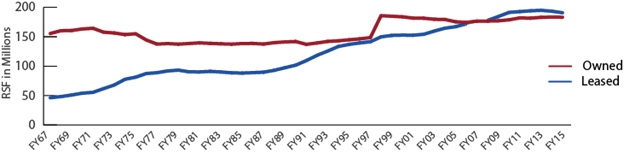
Source: GSA
A
leasing model allows the GSA the flexibility to accommodate each federal agency’s needs by accounting for both the scope
and urgency of its respective space requirements. Although the GSA typically utilizes a uniform lease agreement, the build-out
and building security requirements for each tenant vary according to that
agency’s specific mission and hierarchy of the property
within the agency. See “DESCRIPTION OF OUR PROPERTIES – General Provisions in Federal Government Leases.”
In many cases, existing U.S. Government-owned properties cannot accommodate tenant needs, and the upfront cost and complexity
of constructing a new U.S. Government-owned building can be prohibitive. The average age of the U.S. Government-owned properties
is 48 years. As a result, the GSA’s reliance on privately owned office space has escalated. We believe this is due in part
to the fact that the full cost of each construction project must be recognized in a single fiscal year budget, whereas a newly
leased building only requires recognition of annual payments in the applicable agency’s annual budget. Thus, given recent
federal budget constraints, we believe it is likely that the U.S. Government will continue to grow its leased portfolio of assets,
strengthening its reliance on leasing over ownership.
Attributes of the GSA-Leased Asset Class
The GSA-leased asset class possesses several positive attributes:
|
·
|
U.S. Government Tenant Credit: Leases are backed by the full faith and credit of the U.S. Government, and the GSA has never experienced a financial default. Even during the U.S. Government “shutdown” of 2013, the GSA continued to pay its rent to private landlords through the Federal Buildings Fund that is not subject to direct appropriations. As such, we believe that there is limited risk of tenant default.
|
|
·
|
Limited Renewal Risk: The historical renewal rate for GSA-leased properties has been approximately 77% and, properties within our target market between 5,000 – 50,000 square feet that are 100% leased to the U.S. Government have historical renewal rates in the range of 93% to 95%. Our strategy seeks to increase the likelihood of renewal by acquiring or constructing projects based on the following:
|
| |
●
|
|
Having specialized knowledge and insight into the mission and hierarchy of a tenant agency or property prior to purchasing the asset.
|
| |
●
|
|
Focusing on the market segment that we believe is most likely to renew: buildings of Class A construction that are less than 20 years old or have been retrofitted to post 9/11 standards, are 100% leased to a single U.S. Government tenant, including through the GSA, are in their first lease term post-construction or retrofit and include build-to-suit features and are focused on environmental sustainability.
|
|
·
|
Long-Term Lease Structures: A typical initial GSA lease has a term of ten to 20 years, limiting operational risk. A renewal lease typically has a term of five to ten years.
|
|
·
|
Strong Rent Growth Upon Renewal: When a GSA lease expires, the new base rent is typically reset based on a number of factors, including inflation, the replacement cost of the building at the time of renewal, which we generally expect will increase over the life of the lease, and enhancements to the property since the date of the prior lease. Between 2005 and 2015, the average rental increase for GSA leases within our target market was approximately 29% upon renewal based on a study completed by Colliers International in March 2016.
|
|
·
|
Low Market Correlation: We believe that the GSA-leased real estate asset class is less correlated to macro cycles than traditional commercial real estate. The U.S. Government remains the largest employer in the world, the largest office tenant in the United States and the primary catalyst of the U.S. economy. Finally, given our expectation for continuing budgetary constraints, the U.S. Government’s increased reliance on leasing over ownership is expected to continue.
|
|
·
|
Fragmented Market: The largest owner of GSA-leased assets owns approximately 3.6% of the GSA-leased market by RSF based on Colliers International Top GSA Property Owners (2015 Edition). The ten largest owners of GSA-leased assets collectively own approximately 17% of the GSA-leased market by RSF. Additionally, there is no national broker or clearinghouse for GSA-leased properties. We believe that all of these factors work in concert to create a fragmented market that requires owners and developers to have specialized knowledge and expertise to navigate the landscape.
|
All of these market dynamics combine to yield a strong climate for investment opportunities and to drive stable cash flows within the GSA-leased property market.
DESCRIPTION OF OUR PROPERTIES
Our Initial Portfolio
Upon the completion of this offering and our formation transactions we will own, through wholly-owned subsidiaries of our operating partnership, the initial portfolio of GSA Properties listed below. The following table presents an overview of our initial portfolio.
|
Initial Portfolio
|
Current Occupant
|
|
Rentable Sq. Ft
|
|
|
% of Initial Portfolio1
|
|
|
% Leased
|
|
Lease Expiration2
|
|
Annual Base Rent for Current Lease Year3
|
|
|
Annual Base Rent % of Initial Portfolio
|
|
|
Contribution Properties
|
|
|
|
|
|
|
|
|
|
|
|
|
|
|
|
|
|
|
Port Saint Lucie, FL
650 NW Peacock Boulevard, Port Saint Lucie, Florida 34986
|
U.S. Drug Enforcement Administration, or DEA
|
|
|
24,858 |
|
|
|
15.94 |
% |
|
|
100 |
% |
5/31/2027
|
|
$ |
562,257 |
|
|
|
11.90 |
% |
|
Jonesboro, AR
1809 LaTourette Drive, Jonesboro, Arkansas 72404
|
U.S. Social Security Administration, or SSA
|
|
|
16,439 |
|
|
|
10.54 |
% |
|
|
100 |
% |
1/11/2027
|
|
$ |
616,155 |
|
|
|
13.04 |
% |
|
Lorain, OH
221 West 5th Street, Lorain, Ohio 44052
|
SSA
|
|
|
11,607 |
|
|
|
7.44 |
% |
|
|
100 |
% |
3/ 11 /2024
|
|
$ |
437,423 |
|
|
|
9.26 |
% |
|
Cape Canaveral, FL
200 George King Boulevard, Port Canaveral, Florida 32920
|
U.S. Customs and Border Protection, or CBP
|
|
|
14,704 |
|
|
|
9.43 |
% |
|
|
100 |
% |
7/15/2027
|
|
$ |
645,805 |
|
|
|
13.67 |
% |
|
Johnson City, TN
2620 Knob Creek Road, Johnson City, Tennessee 37604
|
U.S. Federal Bureau of Investigation, or FBI
|
|
|
10,115 |
|
|
|
6.49 |
% |
|
|
100 |
% |
8/20/2027
|
|
$ |
392,077 |
|
|
|
8.30 |
% |
|
Fort Smith, AR
4624 Kelley Highway, Ft. Smith, Arkansas 72904
|
U.S. Citizenship and Immigration Services, or CIS
|
|
|
13, 816 |
|
|
|
8.86 |
% |
|
|
100 |
% |
10/30/2029
|
|
$ |
419,627 |
|
|
|
8.88 |
% |
|
Silt, CO
2300 River Frontage Road, Silt, Colorado 81652
|
U.S. Bureau of Land Management, or BLM
|
|
|
18,813 |
|
|
|
12.06 |
% |
|
|
100 |
% |
9/30/2029
|
|
$ |
385,029 |
|
|
|
8.15 |
% |
|
Sub-Total Contribution Properties
|
|
|
|
110,352 |
|
|
|
70.76 |
% |
|
|
100 |
% |
|
|
$ |
3,458,373 |
|
|
|
73.22 |
% |
|
Owned Properties
|
|
|
|
|
|
|
|
|
|
|
|
|
|
|
|
|
|
|
|
|
|
|
|
Lakewood, CO
12305 West Dakota Avenue, Lakewood, Colorado 80228
|
US Department of Transportation, or DOT
|
|
|
19,241 |
|
|
|
12.47 |
% |
|
|
100 |
% |
6/20/2024
|
|
$ |
459,902 |
|
|
|
9.74 |
% |
|
Moore, OK
200 NE 27th Street, Moore, OK 73160
|
SSA
|
|
|
17,058 |
|
|
|
10.01 |
% |
|
|
100 |
% |
4/9/2027
|
|
$ |
524,018 |
|
|
|
11.09 |
% |
|
Lawton, OK
1610 SW Lee Boulevard, Lawton, OK 73501
|
SSA
|
|
|
9,298 |
|
|
|
6.02 |
% |
|
|
100 |
% |
8/16/2025
|
|
$ |
281,143 |
|
|
|
5.95 |
% |
|
Sub-Total– Owned Properties
|
|
|
|
45,597 |
|
|
|
28.50 |
% |
|
|
100 |
% |
|
|
$ |
1,265,063 |
|
|
|
26.78 |
% |
|
Total – Initial Portfolio
|
|
|
|
155,949 |
|
|
|
100 |
% |
|
|
100 |
% |
|
|
$ |
4,723,436 |
|
|
|
100 |
% |
1 By rentable square footage.
2 The Lease Expiration date set forth in the table reflects the full term of the applicable lease, and does not account for any right of the tenant to terminate any such lease early.
Contribution Properties
Upon raising the minimum offering amount, and pursuant to the Contribution Agreement between our operating partnership and Holmwood, an affiliate, as defined below, or the Contribution Agreement, we intend to indirectly acquire (i) all of the limited liability company interests of GOV PSL, LLC, a Delaware limited liability company, or the Port Saint Lucie Owner, the owner of a 24,858 square foot property occupied by the Drug Enforcement Agency, or the DEA, and located at 650 NW Peacock Boulevard, Port Saint Lucie, Florida 34986, or the Port Saint Lucie Property; (ii) all of the limited liability company interests of GOV Jonesboro, LLC, a Delaware limited liability company, or the Jonesboro Owner, the owner of a 16,439 square foot property occupied by the Social Security Administration, or the SSA, and located at 1809 LaTourette Drive, Jonesboro, Arkansas 72404, or the Jonesboro Property; (iii) all of the limited liability company interests of GOV Lorain, LLC, a Delaware limited liability company, or the Lorain Owner, the owner of an 11,607 square foot property occupied by the SSA and located at 221 West 5th Street, Lorain, Ohio 44052, or the Lorain Property; (iv) all of the limited liability company interests of GOV CBP Cape Canaveral, LLC, a Delaware limited liability company, or the Port Canaveral Owner, the owner of a 14,704 square foot property occupied by the U.S. Customs and Border Protection, or CBP, and located at 200 George King Boulevard, Cape Canaveral, Florida 32920, or the Port Canaveral Property; (v) all of the limited liability company interests of GOV FBI Johnson City, LLC, a Delaware limited liability company, or the Johnson City Owner, the owner of a 10,115 square foot property occupied by the Federal Bureau of Investigations, or the FBI, and located at 2620 Knob Creek Road, Johnson City, Tennessee 37604, or the Johnson City Property; (vi) all of the limited liability company interests of GOV Ft. Smith, LLC, a Delaware limited liability company, or the Ft. Smith Owner, the owner of a 14,735 square foot property occupied by the U.S. Citizenship and Immigration Service, or the CIS, and located at 4624 Kelley Highway, Ft. Smith, Arkansas 72904, or the Fort Smith Property; and (vii) all of the limited liability company interests of GOV Silt, LLC, a Delaware limited liability company, or the Silt Owner, the owner of an 18,813 square foot property occupied by the United States Department of Interior, Bureau of Land Management, or BLM, and located at 2300 River Frontage Road, Silt, Colorado 81652, or the Silt Property, and together with the Port Saint Lucie Property, the Jonesboro Property, the Lorain Property, the Port Canaveral Property, the Johnson City Property, and the Fort Smith Property, the Contribution Properties. We will indirectly purchase each of the Contribution Properties by acquiring each of the Port Saint Lucie Owner, the Jonesboro Owner, the Lorain Owner, the Port Canaveral Owner, the Johnson City Owner, the Fort Smith Owner, and the Silt Owner.
We
will acquire our Contribution Properties through the contribution to us by Holmwood of all of the membership interests in the
seven single-member limited liability companies that own our Contribution Properties. In exchange, our operating partnership will:
(i) issue a number of OP Units to Holmwood equal to the agreed value of Holmwood’s equity in the Contribution Properties
as of the closing of the contribution, divided by $10.00; and (ii) assume all of the indebtedness secured by the Contribution
Properties and assume Holmwood’s corporate credit line. As of the date of this offering circular, the
agreed value of Holmwood’s equity in the Contribution Properties is $9,686,280, resulting in 968,628 OP Units being issued
to Holmwood and the assumption of an aggregate of $ 25,005,067 in indebtedness at the contribution closing. The
value of Holmwood’s equity in the Contribution Properties and the number of OP Units received by Holmwood each will
increase in accordance with the amortization of the debt secured by such properties or interests therein. The total
purchase price for our Contribution Properties was determined by our Manager and Holmwood. By agreement, the value of the Silt
Property was agreed to be Holmwood’s purchase price, and the values of the remaining Contribution Properties were determined
by using prevailing market capitalization rates, as determined by our Manager, and the 2016 pro forma net operating income of
each remaining Contribution Property. Our Contribution Agreement requires us to enter into an agreement as of the closing of the
contribution granting Holmwood registration and qualification rights covering the resale of the shares of common stock into which
its OP Units will be convertible, subject to conditions set forth in our operating partner’s limited partnership agreement.
In addition, as of the closing of the contribution we will enter into a tax protection agreement with Holmwood under which we
will agree to (i) indemnify Holmwood for any taxes incurred as a result of a taxable sale
of the Contribution Properties for a period of ten years after the closing; and (ii) indemnify Holmwood if a reduction
in our nonrecourse liabilities secured by the Contribution Properties results in an incurrence of taxes, provided that we may
offer Holmwood the opportunity to guaranty a portion of our operating partnership’s other nonrecourse indebtedness in order
to avoid the incurrence of tax on Holmwood. For more information on the Contribution Properties, see “– Contribution
Properties.”
Owned Properties
We acquired our owned properties, on June 10 2016 through our operating partnership. The total contract purchase price for our owned properties was $10,226,786, comprised of: (a) $1,925,000 in cash pursuant to a deposit made to the seller on April 1, 2016; (b) the defeasance of the seller’s senior secured debt on the properties at closing; and (c) issuance of the Standridge Note to the seller in an amount equal to $2,019,789. The Standridge Note will mature on the earlier of December 10, 2017, or the date on which the we consummate a public securities offering (which would include this offering), or the date on which our owned properties are conveyed or refinanced by us. The Standridge Note is pre-payable prior to the maturity date at any time without penalty and will bear annual interest at the rate 7.0%. The Standridge Note will be interest-only through August 1, 2016 and therereafter will require monthly payments of principal and interest of $15,659.40 with a balloon payment due at maturity. The Standridge Note is unsecured but is guaranteed by Messrs. Kaplan, Kaplan, Jr., Kurlander and Stanton, and Baker Hill Holding LLC. For more information on our owned properties, see “Description of Our Properties – Owned Properties.”
In
addition to the Standridge Note, we acquired our owned properties using proceeds from our Series A Preferred Stock offering, secured
financing in the aggregate amount of $7,225,000 from CorAmerica, and the $1,000,000 Holmwood Loan. We anticipate
paying off both the Standridge Note and the Holmwood Loan with proceeds from the initial closing of this offering.
Contribution Properties
Port Saint Lucie Property
The Drug Enforcement Agency, or DEA, is currently occupying 100% of this 24,858 square foot building at 650 NW Peacock Boulevard, Port Saint Lucie, FL 34986, or the Port Saint Lucie Property. The Port Saint Lucie Property’s proximity to Interstate 95, with a 67-space asphalt-paved parking lot. The building is a two-story, tilt-up concrete structure constructed on 3.5382 acres. The building’s steel frame is set in a concrete foundation. The exterior is painted concrete, housed under a flat roof, which is a modified bitumen, built-up roofing system. The Port Saint Lucie Property is considered to be in fair to good overall condition.
The building was constructed in 2002 and acquired by our Holmwood in January 2013. The Port Saint Lucie Property is leased to the United States, 100% occupied by the DEA as a regional field office and is administered for the tenant by the GSA. The Port Saint Lucie Property lease commenced in June 2012 with an expiration date of May 31, 2027, with the tenant having the right to terminate after May 31, 2022 (15-year lease; 10-year firm).
The
annual rent for the Port Saint Lucie Property is $604,273. The Port Saint Lucie Property is encumbered by a $10,700,000
loan from Starwood Mortgage Capital, LLC, or Starwood, which is cross-collateralized with the Jonesboro and Lorain Properties
and which we will assume in connection with the contribution transactions. See “- Description of Indebtedness
– Starwood Loan.”
Jonesboro Property
The Social Security Administration, or SSA, is currently occupying 100% of this 16,439 square foot building at 1809 LaTourette Drive, Jonesboro, Arkansas 72404, or the Jonesboro Property. The building is a LEED, Silver, single-story, steel-framed structure constructed on 3.36 acres. The Jonesboro Property’s 94-space parking lot provides customers and stakeholders easy access to the facility. Concrete sidewalks are located around the building’s perimeters and at its entrances. The building is landscaped along its perimeter. The building’s steel frame is set in a concrete foundation. The exterior is enveloped in a brick veneer, with CMU wainscot. The doors are double-glazed aluminum framed, and the windows are fixed. The building has a pitched, standing seam metal roof. The Jonesboro Property is located approximately 130 miles from Little Rock, Arkansas. The Jonesboro Property is considered to be in excellent condition. The Property was originally constructed in 2011 and acquired by our Holmwood in May 2012.
The
lease began on January 12, 2012 and has an expiration date of January 11, 2027, with the tenant having the right to terminate
after January 11, 2022 (15-year lease, 10 years firm). The building is 100% occupied by the SSA and administered by the GSA. The
annual rent for the Jonesboro Property is $616,569. The Jonesboro Property is encumbered by a $10,700,000 loan from
Starwood Mortgage Capital, LLC, or Starwood, which is cross-collateralized with the Port Saint Lucie and Lorain Properties and
which we will assume in connection with the contribution transactions. See “- Description of Indebtedness
– Starwood Loan.”
Lorain Property
The SSA is currently occupying 100% of this 11,607 rentable square foot building, with a 45-space parking lot, located at 221 West 5th Street, Lorain, Ohio 44052, or the Lorain Property. The building is a single-story, of steel-framed construction on 0.688 acres. Concrete sidewalks and landscaping encircle the building’s perimeter. The interior consists of painted drywall in certain of the public rooms and tenant areas, and vinyl wall coverings in the remainder of the public rooms. The flooring is primarily carpeting with tile in the bathrooms and vestibules. The doors are stained solid wood and metal frames. The building’s steel frame is set in a concrete foundation. The structure is enveloped in a brick veneer, with stone cast accents. The doors are double-glazed aluminum framed doors and the windows are fixed in place. This one-story, steel-framed, LEED-Silver building sits on 0.688 acres of land. The flat roof is fully-adhered, single ply TPO membrane flashed under pre-finished metal coping. It was constructed in 2011 and acquired by Holmwood in September 2011.
The
SSA lease commenced on April 1, 2011 and has an expiration date of March31, 2024, with the tenant having the right to terminate
after March31, 2012 (13-year lease; 10-years firm). The Lorain Property is convenient to public transportation and is located
in the Cleveland-Elyria-Mentor Metropolitan Statistical Area, approximately 30 miles from the Cleveland central business district.
The Lorain Property is considered to be in excellent condition. The annual rent for the Lorain Property is $437,436. The
Port Saint Lucie Property is encumbered by a $10,700,000 loan from Starwood Mortgage Capital, LLC, or Starwood, which is cross-collateralized
with the Jonesboro and Port Saint Lucie Properties and which we will assume in connection with the contribution transactions. See
“- Description of Indebtedness – Starwood Loan.”
Port Canaveral Property
U.S Customs and Border Protection, or CBP, is currently occupying 100% of this 14,704 square foot building with a 95-space parking lot, located at 200 George King Boulevard, Cape Canaveral, Florida 32920, or the Port Canaveral Property. The building is a single-story, steel-framed structure on 1.59 acres, which is ground leased from The Canaveral Port Authority until December 7, 2045; however, our Holmwood has an option to extend the ground lease for another 10 years, until December 7, 2055. There are lawns, floral plantings, trees and shrubs along the perimeter of the building. The interior public areas consist of the front lobby and either solid wood or painted metal doors. The building’s steel frame is set in concrete footings. The building is enveloped in a pre-finished, stay-in- place, concrete wall forming system, with rigid polymer forms that create durable pre-finished exterior walls. The pitched roof is constructed of metal paneling. The building was originally constructed in 2012 and acquired by Holmwood in April 2015.
The Port Canaveral Property is encumbered by the $7,600,000 loan from Park Sterling Bank, or Park Sterling, which is cross-collateralized with the Johnson City Property. The CBP lease commenced on July 16, 2012 and has an expiration date of July 15, 2027, with the tenant having the right to terminate after July 15, 2022 (15-year lease; 10 years firm). The Port Canaveral Property is considered to be in good overall condition. The annual rent for the Port Canaveral Property is $645,805.
An
environmental site assessment performed on the Port Canaveral Property revealed chlorinated solvent contamination in the soil,
groundwater, and in the surrounding area, including the subject property, in 1995, which is related to a former sump. The responsible
party was identified as the Canaveral Port Authority. Several site assessments, groundwater monitoring events, remedial action
plans and risk assessments have been performed at the site since the contamination was first identified. For more information
on this, see “Risk Factors.” The Port Canaveral Property is encumbered by a $7,600,000 loan from Park Sterling,
which is cross-collateralized with the Johnson City Property. We will assume the Park Sterling Loan at the closing
of the contribution transactions. See “- Description of Indebtedness – Park Sterling Loan.”
Johnson City Property
The Federal Bureau of Investigation, or FBI, is currently occupying 100% of this 10,115 square foot building, located at 2620 Knob Creek Road, Johnson City, Tennessee 37604, or the Johnson City Property. The building is a single-story, steel-framed building on 2.59 acres, with a 51-space asphalt-paved parking lot. The building flatwork and pedestrian walkways consist of poured-in-place concrete. Landscaped areas are located along the perimeters of the building. The public common area has a front lobby. The structure is steel framed with CONFORM, stay-in-place concrete walls, on a concrete footing foundation. The building is enveloped in painted concrete masonry. The building was originally constructed in 2012, and the Johnson City Property was acquired by Holmwood in 2014. The Property is considered to be in good overall condition.
The
Johnson City Property is used by the FBI as a regional field office. The Johnson
City Property lease commenced on August 21, 2012, has an expiration date of August 20, 2027, with the tenant having the right
to terminate after August 20, 2022 (15-year lease, 10 years firm). The annual rent for the Johnson City Property is $392,077. The
Johnson City Property is encumbered by a $7,600,000 loan from Park Sterling, which is cross-collateralized with the Port Canaveral
Property. We will assume the Park Sterling Loan at the closing of the contribution transactions. See “-
Description of Indebtedness – Park Sterling Loan.”
Fort Smith Property
The U.S. Citizenship and Immigration Services, or CIS, is the occupant of this 13,848 square foot building, with 51 parking spaces, located at 4624 Kelley Highway, Ft. Smith, Arkansas 72904, or the Fort Smith Property. This single-story structure is steel-framed, on 1.62 acres. Holmwood acquired the Fort Smith Property in December 2014. Building entrance flatwork and pedestrian walkways consist of poured concrete. Lawns, trees and shrubs are provided along the perimeter of the building. The interior walls are painted gypsum board. The interior doors are typically stained, solid-core wood set in painted metal frames. The building is steel-framed and enveloped in CMU masonry walls, set on a concrete slab-on-grade foundation. The façade is painted cement stucco. The original building was constructed in 1979, with an addition and renovation in 2014. The Fort Smith Property is considered to be in good overall condition.
The
lease with CIS began on October 31, 2014 and has an expiration date of October 30, 2029 (15-year). The annual rent for the Fort
Smith Property is $419,626. The Fort Smith Property is encumbered by a $2,450,000 loan from CorAmerica Loan Company,
LLC, or CorAmerica, and is cross-collateralized with the Lakewood Property, the Lawton Property and the Moore Property. We
will assume the CorAmerica Loan related to the Fort Smith Property at the closing of the contribution transactions. See
“- Description of Indebtedness – CorAmerica Loans.”
Silt Property
The United States Department of Interior, Bureau of Land Management, or BLM, Colorado River Valley Field Office is located at 2300 River Frontage Road in Silt, Colorado. The single-story facility was constructed in 2009 and contains 18,813 square feet, of which 13,884 square feet is office space, 3,920 square feet are warehouse, and 1,009 square feet are common area. The structure is composed of concrete masonry unit load bearing walls, with structural steel interiors and wood-framing at the roofs. The roof is a flat, single-ply thermoplastic membrane roofing, and pitched roof with asphalt shingles. The façade is painted cement stucco and cultured stone veneer. The facility situated on a 3.508-acre lot. The Silt Property also includes 126 parking spaces and is the field office for BLM’s management of approximately 566,000 acres of BLM-administered public lands. The Silt Property is considered to be in fair to good overall condition.
The
lease for the Silt Property, the term of which commenced October 1, 2009, and expires on September 30, 2029, can be terminated
any time after September 30, 2024 (20-year lease, 15 years firm). Tenant is responsible for utilities, taxes and operating costs
over a base cost per sq. ft. of $2.14. The annual rent for the Silt Property is $385,028. The Silt property is encumbered
by a $3,080,000 loan from NBC Bank, which we will assume at the closing of the contribution transactions. See “-
Description of Indebtedness – NBC Bank Loan.”
Owned Properties
Lakewood Property
The United States Department of Transportation occupies 100% of this 19,241 square foot property (two buildings totaling 21,022 gross square feet; 19,709 sq. ft. office/warehouse building and a 1,313 sq. ft. storage building) at 12305 West Dakota Avenue, Lakewood, Colorado 80228, or the Lakewood Property. The primary structure is a single-story, steel-framed structure with loft areas and includes a storage building, all located on 3.836 acres. The Lakewood Property’s 38-space concrete parking lot has the capacity for 10 truck/trailers. Building entrance flatwork and pedestrian walkways consist of cast-in-place concrete construction. Lawns, floral plantings, trees and shrubs adorn the perimeter of the building and parcel. The office/warehouse building is constructed with an entryway, warehouse, service bay, shop, bathrooms, shower rooms and corridors. An office area is located within the southern-most portion of the building. Walls typically are gypsum board or exposed and painted structural elements. Interior doors include conventional, stained solid-core wood doors set in steel frames. The building’s steel frame and concrete masonry unit superstructure is set in a concrete slab-on-grade foundation, enveloped in a brick exterior, and the roof is a pitched, standing-seam metal roofing system. The building was originally constructed in 2004. The property is considered to be in good condition.
The
DOT lease commenced on June 21, 2004, for a 20-year firm term that expires June 20, 2024 (20-year lease). The annual rent for
the Lakewood Property is $459,662. The Lakewood Property is encumbered by a $2,400,000 loan from CorAmerica and is
cross-collateralized with the Lawton Property, the Moore Property and the Ft. Smith Property. See “- Description
of Indebtedness – CorAmerica Loans.”
Lawton Property
SSA occupies 100% of the 9,298 square foot building at 1610 SW Lee Boulevard, Lawton, OK 73501, or the Lawton Property. Lawton is approximately 87 miles from Oklahoma City. The building is a steel-framed single-story structure on 1.2856 acres and includes a 48-space concrete-paved parking lot on-site. Building entrance flatwork and pedestrian walkways consist of poured-in-place concrete construction. The perimeter of the building is landscaped with lawns, floral plantings, trees and shrubs. The building’s public lobby includes waiting areas for the public, a security desk and small desk areas mounted below service windows. The lobby includes men’s and women’s restrooms. The interior finishes of the lobby include ceramic tile flooring, suspended ceilings with acoustical 2x4 lay-in tiles in the lobby and gypsum wall board in the restrooms and vinyl wall coverings. The building is steel–framed and enveloped in both a brick masonry veneer and metal siding, on top of a concrete slab-on-grade foundation. The building was originally constructed in 2000. The Lawton Property is considered to be in good condition.
The lease for the Lawton Property was amended on May 1, 2014, to provide for another 10-year term, with five years being firm, on May 1, 2014, with the new term commencing upon completion and acceptance of certain improvements previously requested by SSA at the property, including reconfiguration to allow for SSA’s Office of Disability Adjudication and Review, or ODAR, to use the property for hearings and staff. The new lease term commenced as of August 17, 2015, with the lease expiring on August 16, 2025 (10-year lease, 5 years firm). The annual rent for the Lawton Property is $191,177.
The
Lawton Property is encumbered by a $1,485,000 loan from CorAmerica and is cross-collateralized with the Lakewood Property, the
Moore Property and the Ft. Smith Property. See “- Description of Indebtedness – CorAmerica
Loans.”
Moore Property
SSA occupies 100% of the 17,058 square foot building at 200 NE 27th Street, Moore, OK 73160 or the Moore Property. The building is steel-framed, single-story construction on 2.19 acres. The Moore Property is approximately 10 miles from downtown Oklahoma City, and has a 94-space both asphalt and concrete paved portions of its parking lot. The building entrance flatwork and pedestrian walkways consist of poured-in-place concrete. Lawns, floral plantings, trees and shrubs adorn the perimeter of the building and parcel. The building’s public areas include a large public lobby that includes waiting areas, a security desk and small desk areas below service windows. Men’s and women’s restrooms service the lobby. The building’s steel frame is set in a concrete slab-on-grade foundation, and wrapped in a brick masonry veneer, concrete tilt-up panels, and painted sheet metal. The Moore Property was originally built in 1999, with an addition in 2012. The flat roof is constructed of modified bitumen, built-up roofing system. The Moore Property is considered to be in good overall condition.
The
lease began on April 10, 2012, with an expiration date of April 9, 2027, with the tenant having the right to terminate on April
9, 2022 (15-year lease, 10 years firm). The annual rent for the Moore Property is $523,812. The Moore Property is encumbered
by a $3,300,000 loan from CorAmerica and is cross-collateralized with the Lawton Property, the Lakewood Property and the Ft. Smith
Property. See “- Description of Indebtedness – CorAmerica Loans.”
Description of Indebtedness
Starwood Loan
The Port Saint Lucie, Jonesboro, and Lorain Properties, or the Starwood Properties, all secure and cross collateralize the Starwood Loan, made by Starwood Mortgage Capital, LLC in connection with Holmwood’s refinancing of debt incurred in connection with the acquisition of such properties, and which is now serviced by Wells Fargo. The Starwood Loan was originally made in the amount of $10,700,000 and is a generally nonrecourse loan, subject to standard recourse carve-outs and environmental indemnities. The Starwood Loan bears a fixed interest rate of 5.265%, requires monthly blended payments of principal and interest, and all outstanding principal and interest is due at maturity on August 6, 2023. The Starwood Loan contains customary events of default and restrictions upon the transfer of direct or indirect interests in the Port Saint Lucie, Jonesboro and Lorain Properties.
Defeasance of the Starwood Loan is generally permitted subject to compliance with certain conditions set forth in the Starwood Loan Documents. Any prepayment will require the borrowers to deposit with Wells Fargo an amount equal to that which is sufficient to purchase U.S. Treasury Obligations and other government securities (as defined in Treasury Regulations Section 1.860G-2(a)(8)(ii)) that provide for all future payments of monthly interest and outstanding principal, all costs and expenses incurred by Wells Fargo or its agents in connection with such release, including payment of all escrow, closing, recording, legal, appraisal, Rating Agency and other fees, costs and expenses paid or incurred by Wells Fargo resulting from the borrowers exercise of their rights to have the property released according to the defeasance provisions of the Starwood Loan Documents. Notwithstanding the foregoing defeasance requirement, it is anticipated that the borrowers of the Starwood Loan will be permitted to prepay the Starwood Loan within three months of its maturity date on sixty days written notice to Wells Fargo.
Messrs. Kaplan, Kaplan Jr., Stanton and Kurlander have executed a guaranty of the recourse carve-outs and an environmental indemnity in favor of Starwood and its successors.
Park Sterling Loan
The Park Sterling loan was funded on or about March 25, 2015, by Park Sterling Bank, or Park Sterling, as lender, and GOV FBI Johnson City, LLC and GOV CBP Cape Canaveral, LLC, collectively, are the borrowers. The loan from Park Sterling, or the Park Sterling Loan, was in the original principal amount of $7,600,000 and is a recourse loan. The debt service is the greater of either the current interest rate under the note or 5.0%. The promissory note is guaranteed by Holmwood Capital, LLC, Baker Hill Holding, LLC, and Messrs. Kaplan, Kaplan Jr. and Stanton. The Park Sterling Loan is secured by a first priority lien on the properties held by the borrowers. The maturity date for payment of all principal and interest is March 27, 2017. The loan term may be extended an additional twelve months if certain conditions are met, including: all major tenants are in occupancy and paying rent without default on their lease, there has been no event of default by borrowers, the borrowers pay Park Sterling an extension fee of $19,000, the borrowers provide Park Sterling 120 days’ notice, and there has been no material adverse change in the financial condition of the borrowers.
The borrowers under the Park Sterling Loan are obligated to maintain a loan-to-value ratio of no more than 80% and the minimum debt service coverage ratio for the underlying properties is 1.20x. The borrowers have the right to have one of the encumbered properties released from the security instruments if certain conditions are met, including: repayment of outstanding principal, there are no events of default under the financing documents, and the residual debt and collateral after the release would not generate a debt service coverage ratio less than 1.20x or a loan to value ratio greater than 75%. Park Sterling is permitted to sell participations in all or a portion of its rights under the financing documents.
In the event of default, Park Sterling has the right to foreclose on the properties encumbered by the Park Sterling Loan.
CorAmerica Loans
CorAmerica
provided senior, secured financing, aggregating $9,675,000 for the purchase of the Moore Property ( $3,300,000 ),
the Lawton Property ( $1,485,000 ), and the Lakewood Property ( $2,400,000 ) and the refinancing of the Ft. Smith Property
($2.45 Million), which is currently owned by Holmwood and will be contributed to our operating partnership, when the first closing
of the issuance of the shares of our stock occurs. The contribution of the Ft. Smith Property to us by Holmwood will
result in our assumption of the outstanding principal amount of the portion of the CorAmerica loans borrowed by the SPE-owner
of the Ft. Smith Property.
The CorAmerica loans are cross-collateralized, cross-defaulted and are secured by first mortgages on each of such facilities. The loans bear interest at 3.93% per annum, will mature on or about June 1, 2019 and will be payable as to both principal and interest monthly, pursuant to a 25-year amortization schedule with the remaining balance of principal and accrued but unpaid interest becoming due and payable at maturity. The loans are prepayable in whole or in part from time to time without premium or penalty. The loans are guaranteed jointly and severally by Messrs. Stanton, Kaplan Jr., Kaplan and Kurlander.
NBC Bank Loan
The NBC Bank loan agreement was executed on December 9, 2015 between NBC, as lender and GOV Silt, LLC as borrower. The original principal amount of the NBC Bank Loan was $3,080,000 secured by a first priority lien on the property held by the borrower. The NBC Bank Loan is a recourse obligation. The maturity date is March 15, 2017, extendable by the borrower until June 2017 subject to the following conditions: timely written notice of the borrower’s request to extend the maturity date; delivery of a borrower executed certificate renewing all the representations and warranties of the NBC Bank loan agreement as true and correct; there has been no default or event of default; borrower has delivered to NBC an endorsement to the title policy showing the mortgage is free and clear of liens and encumbrances; borrower has delivered a recordable amendment to the mortgage; there has been no material adverse change in the financial or operating condition of the borrower; borrower pays all costs and expenses in connection with the extensions; and the borrower and guarantors execute additional documents as NBC reasonably requires.
The interest rate charged is the greater of 4.0% or the prime rate as quoted by The Wall Street Journal. In the event of default, NBC Bank has the right to foreclose on the Silt Property.
General Provisions in Federal Government Leases
The following is a general description of the type of lease we typically enter into with the federal government negotiated through the GSA, or GSA Leases. The terms and conditions of any actual GSA Lease, or any lease entered into directly with an agency or department of the federal government, may vary from those described below. If we determine that the terms of a GSA Lease at a property, taken as a whole, are favorable to us, we may enter into leases with terms that are substantially different than the terms described below.
In general, GSA Leases are full service modified gross leases, which require us to pay for maintenance, repairs, base property taxes, utilities and insurance. Although the federal government is typically obligated to pay us adjusted rent for changes in certain operating costs (e.g., the costs of cleaning services, supplies, materials, maintenance, trash removal, landscaping, water, sewer charges, heating, electricity, repairs and certain administrative expenses but not including insurance), the amount of any adjustment is based on a cost of living index rather than the actual amount of our costs. As a result, to the extent the amount payable to us based upon the cost of living does not reflect actual changes in our operating costs, our operating results could be adversely affected. Furthermore, the federal government is typically obligated to reimburse us for increases in real property taxes above a base amount if we provide the proper documentation in a timely manner. Notwithstanding federal government reimbursement obligations, we remain primarily responsible for the payment of all such costs and taxes. Unlike most commercial leases which require monthly payments in advance, GSA Leases generally require that rent be paid monthly in arrears.
For any assignment of a GSA Lease to be effective, the consent of the federal government must be obtained. The consent process is time-consuming and will not be finalized until after we have acquired the subject property. However, during this interim period the seller will continue to be paid rent by the federal government. The GSA has not adopted a standard process by which it determines whether to grant its consent to an assignment of a GSA Lease. GSA requires that the sale of the property be consummated prior to the submission of a formal request for its consent. We expect that GSA will require the following items be submitted with a request for its consent to the assignment of a GSA Lease for any acquired properties to us: (1) a recorded copy of the deed as evidence of the transfer of title, (2) a letter from us to GSA acknowledging that we are prepared to assume the GSA Lease, (3) a letter from the seller to GSA waiving all its rights under the GSA Lease, (4) our organizational documents and the organizational documents of the special-purpose entity that will own the subject property, (5) evidence of our good standing, (6) a letter from us to GSA identifying the legal name and address of the payee, (7) a tax identification number for the new payee and (8) a central contractor registration number. After we submit these items, and such other items as GSA may request, we expect that the review process will take from one to three months. If GSA approves our assumption of the GSA Lease, we will enter into a supplemental lease agreement or a novation agreement with GSA and the seller that will formally acknowledge our assumption of the GSA Lease. Once such documentation is finalized, GSA will commence paying rent directly to us.
While management believes it unlikely not to receive such consent, there is no guarantee that GSA will consent to our assumption of a GSA Lease for an acquired property. During the interim period after we acquire a property and prior to the execution of a supplemental lease agreement or novation agreement (and in the event that the GSA does not grant its consent and the assignment of such lease), the seller will remain responsible to GSA to operate and manage the subject property in accordance with the terms of the GSA Lease and will continue to receive rent from GSA which it is contractually obligated to remit to us. Notwithstanding, a seller’s obligation in this regard, we will be performing those management services.
Our GSA Leases typically have an initial term of 10 to 20 years. Our GSA Leases generally do not contain provisions for the extension of the lease term.
Most of our GSA Leases include a provision which allows the federal government to terminate at will by providing written notice to us after an initial guaranteed term. This notice period generally varies from 60 to 180 days. Some GSA Leases provide that, following the initial guaranteed term, rent will be paid at a reduced rate.
Our GSA Leases generally require our written consent for assignment (which may not be unreasonably withheld) by the federal government, however, it may typically substitute a different federal agency or department as an occupant under our GSA Leases without seeking our consent. An assignment would relieve the federal government of any future obligations under the GSA Lease but assignment would not relieve the federal government from any unpaid rent or other liability to us existing before the assignment. Our GSA Leases generally allow the federal government to sublet all or part of a property without our consent, but such sublet would not relieve the federal government from any obligations under the GSA Lease.
Maintenance and Alteration
We are generally responsible for all maintenance of properties under our GSA Leases, including maintenance of all equipment, fixtures and appurtenances to such properties. We are generally responsible for all utilities in order to make our properties suitable for use and capable of supplying heat, light, air conditioning, ventilation and access without interruption. Use of heat, ventilation and air conditioning beyond normal working hours is generally paid for by the federal government, except for certain GSA Leases that require that we provide certain portions of the building with heating, ventilation and air conditioning services 24 hours a day, seven days a week. Our failure to maintain our properties or provide adequate utilities, service or repair can result in the federal government deducting the costs of such maintenance, utility, service or repair from its rent payment to us. The federal government generally retains the right to make alterations to our properties at its own expense. The federal government also retains the right to add and remove fixtures to the premises without relinquishing ownership of such fixtures.
Damage, Destruction or Condemnation
Complete destruction of, or significant damage to, a property under a GSA Lease generally results in the immediate termination of the lease. Partial destruction or damage, such that the property is unable to be occupied by a tenant, generally grants the federal government the option to terminate the lease by giving notice to us within 15 days following the partial destruction or damage. If the lease is so terminated, no rent accrues after the date of such destruction or damage.
Certain Government Standards
Each GSA Lease requires that we maintain certain standards set by the federal government. For instance, our GSA Leases generally require that we certify that our procurement activities do not violate any prohibitions against improper third-party benefits resulting from our procurement of a federal government contract. In addition, the GSA Leases contain provisions which require that we maintain certain labor and equal opportunity standards in relation to our subcontractors. When selecting subcontractors, the GSA Leases require that we make a good faith effort to select subcontractors that are small businesses, small businesses owned by socially or economically disadvantaged individuals or small businesses owned by women. Failure to comply with these standards could result in termination of a GSA Lease, reduction in rent or liquidated damages outlined in the lease.
Failure by the federal government to pay rent or make other payments required under a GSA Lease on the date such payment is due results in an automatic interest penalty to be paid by the federal government. The interest penalty is calculated as a percentage of the payment due, based on a rate established by the U.S. Department of the Treasury pursuant to the Contracts Dispute Act of 1978. The interest payment accrues daily and is compounded in 30 day increments. There is typically no provision in our GSA Leases permitting us to terminate the lease as a result of non-payment or other actions by the federal government.
Our failure to maintain, repair, operate or service a property under a GSA Lease for 30 days after receipt of notice from the federal government generally results in our default under such lease. In addition, repeated and unexcused failure to maintain, repair, operate or service the property by us will generally result in default. Upon default, the federal government is entitled to terminate the lease and seek damages, which could consist of rent, taxes and operating costs of a substitute property, administrative expenses in procuring a replacement property and such other damages as the lease or applicable law allows.
Unlike most commercial leases, GSA Leases do not include provisions that permit the landlord to evict a federal government that is in default under the lease, including as a result of a holdover. In the event that we seek to evict a federal government occupant that is in default, the federal government occupant could institute condemnation proceedings against us and seek to take our property, or a leasehold interest therein, through its power of eminent domain.
If we have a dispute with the federal government occupant, the dispute is required to be resolved pursuant to the Contract Disputes Act of 1978. A dispute concerning payment must be submitted to the contracting officer authorized to bind the federal government, who will make a determination as to the merits of the dispute and the determination can be appealed to an administrative agency or to a court.
MANAGEMENT’S DISCUSSION AND ANALYSIS OF FINANCIAL CONDITION AND RESULTS OF OPERATIONS
We are a newly organized, externally-managed real estate company formed to grow our business of acquiring, developing, financing, owning and managing properties leased primarily to the United States of America and acting either through the GSA or another federal government agency or department, carried out through Holmwood, our accounting predecessor, and related entities prior to this offering. We invest primarily in GSA Properties across secondary and smaller markets, within size ranges of 5,000-50,000 rentable square feet, and in their first term after construction or retrofit to post-9/11 standards. We further emphasize GSA Properties that fulfill mission critical or direct citizen service functions. We intend to grow our portfolio primarily through acquisitions of federal government-leased properties and by developing build-to-suit federal government-leased properties secured through competitive bidding. We were formed in 2016 as a Maryland corporation and we intend to elect to be taxed as a REIT for federal income tax purposes beginning with our taxable year ending December 31, 2016.
Upon completion of this offering and our formation transactions, we will own 10 properties, all of them leased in their entirety to the U.S. Government and occupied by its tenant agencies. Our initial portfolio consists of 7 properties contributed by Holmwood and 3 properties acquired by our company on June 10, 2016, through subsidiaries, using proceeds from our Series A Preferred Stock Offering, seller financing in the amount of $2,019,789, a loan in the amount of $1,000,000 from Holmwood Capital, LLC, an affiliate, and a bank loan in the amount of $7,225,000. Our objective is to generate attractive risk-adjusted returns for our stockholders over the long term through dividends and capital appreciation.
The term “our predecessor” refers to Holmwood Capital, LLC and its consolidated subsidiaries, which hold 100% of the fee interests in the entities that own 7 of the properties, or the property-owning subsidiaries, that will be contributed to us in the formation transactions.
Holmwood has entered into a contribution agreement with us and our operating partnership pursuant to which they will contribute their interests in their seven property-owning subsidiaries to our operating partnership. Holmwood will receive OP Units from our operating partnership in exchange for these contribution and we will assume approximately $24,784,798 in indebtedness assuming a closing in September, 2016 secured by the Contribution Properties, or interests therein.
For the year ended December 31, 2015
During 2015, our predecessor acquired 3 operating properties representing 43,632 square feet for a total cost $13,986,180. In aggregate our predecessor owned 7 properties representing 110,352 square feet located in 5 states. The combined costs totaled $33,362,932 in aggregate. The properties are 100% leased and administered by the General Services Administration of the U.S. Government or occupying agency. In this period, our predecessor, and subsequently we, delivered total revenues from operations of $3,005,533. Operating costs, excluding depreciation and amortization totaled $1,148,086, resulting in net operating income of $1,857,447.
For the year ended December 31, 2014
During 2014, our predecessor acquired 1 operating property representing 13,816 square feet for a total cost of $4,315,460. Holmwood owned 4 properties representing 66,720 square feet located in 3 states. The combined costs totaled $19,044,687. The properties are 100% leased and occupied by the General Services Administration of the U.S. Government. In this period, our predecessor, and subsequently we, delivered total revenues from operations of $1,740,914. Operating costs, excluding depreciation and amortization, totaled $665,328, resulting in net operating income of $1,075,586.
Holmwood’s business model is to drive growth through acquisitions. Access to capital markets is an important factor for our continued success. We expect to continue to issue equity in our company incrementally and proceeds will be use to acquire government-leased properties.
Liquidity and Capital Resources
Liquidity General. The Company’s demand for funds will be primarily for (i) payment of operating expenses and cash dividends; (ii) Property acquisitions; (iii) origination of mortgages and notes receivable; (iv) capital expenditures; (v) payment of principal and interest on its outstanding indebtedness; and (vi) other investments.
Upon closing of the offering, we expect that the proceeds will pay down debt and improve our capital structure, enabling us to further implement our acquisition strategy, and increase cash flows. We have identified no additional material internal or external sources of liquidity as of the date of this offering.
The
Company has deposits and other related acquisition costs incurred in the amount of $2,195,319 as of May 31, 2016. This
amount is related to its purchase of an initial portfolio of three GSA Properties on June 10, 2016. The properties
were acquired from proceeds from the issuance of the Company’s 7.00% Series A Cumulative Convertible Preferred Stock, senior
debt financing of $7,225,000 and a $1,000,000 loan from our predecessor company.
The company expects to meet its other short-term liquidity requirements primarily through cash provided from operations. As of May 31, 2015, there was cash on hand of $477,337.
Long Term Liquidity
The company anticipates its long-term capital needs will be funded by cash provided from operations, the issuance of long-term debt or the issuance of common or preferred equity or other instruments convertible into or exchangeable for common or preferred equity. However, there can be no assurance that additional financing or capital will be available, or that the terms will be acceptable or advantageous to the company.
Trend Information
Our company, through our operating partnership is engaged primarily in the acquisition, leasing and disposition of single-tenanted, mission critical or customer facing properties, leased to the United States of America and that are situated in secondary and tertiary markets throughout the country. As full faith and credit obligations of the United States these leases offer risk-adjusted returns which are attractive inasmuch as there continues to be no appreciable yield of comparable credit quality in the marketplace. Conversely, these market dynamics have caused upward pressure on sales prices, offset by management’s deep knowledge and contacts in the sector and the paucity of buyers which will consider smaller properties in smaller markets, frequently enabling our company to lock-up transactions directly with sellers, avoiding brokerage commissions to either party.
To date our company has been capital constrained, which has affected liquidity adversely from an operating perspective and the ability of our company to manage several viable acquisition opportunities at the same time. While there can be no assurance, completion of our offering should enable management to accelerate acquisition plans, provide liquidity to recruit and retain qualified personnel to support growth and enhance purchasing power for goods and services in connection with the operation of our properties, all resulting in more profitable operation of our portfolio.
DIRECTORS, EXECUTIVE OFFICERS, AND SIGNIFICANT EMPLOYEES
Our Board of Directors
We operate under the direction of our board of directors. Our board of directors is responsible for the management and control of our affairs. Our board of directors has retained our Manager to manage our day-to-day operations and our portfolio of GSA Properties and any other investments, subject to the supervision of our board of directors.
Our directors must perform their duties in good faith and in a manner each director reasonably believes to be in our best interests. Further, our directors must act with such care as an ordinarily prudent person in a like position would use under similar circumstances. However, our directors and executive officers are not required to devote all of their time to our business and must only devote such time to our affairs as their duties may require. We do not expect that our directors will be required to devote a substantial portion of their time to us in discharging their duties.
We currently have four directors. At the initial closing of this offering, Robert R. Kaplan, Jr. will resign as director and the remaining directors will appoint four independent directors to fill the vacancies created by the resignation of Mr. Kaplan, Jr. and the expansion of our board of directors, providing us with a majority of independent directors on our board of directors. Mr. Kaplan, Jr. will be our President following his resignation as director.
We anticipate that William Robert Fields, Leo Kiely, John F. O’Reilly and Scott A. Musil, or our independent director nominees, will be appointed directors as of our initial closing. Our directors will serve until they resign or upon death or removal by a plurality of votes cast at a meeting of stockholders duly called and at which a quorum is present. At any stockholder meeting, the presence in person or by proxy of stockholders entitled to cast a majority of all the votes entitled to be cast at such meeting on any matter constitutes a quorum.
Although our board of directors may increase or decrease the number of directors, a decrease may not have the effect of shortening the term of any incumbent director; provided further, that any increase or decrease after the initial closing of this offering may not occur if it would result in our board of directors not being comprised of at least a majority of independent directors. Any director may resign at any time or may be removed, and then only by the stockholders upon the affirmative vote of a plurality of all the votes cast at a meeting of stockholders duly called and at which a quorum is present. The notice of any special meeting called to remove a director will indicate that the purpose, or one of the purposes, of the meeting is to determine if the director shall be removed.
A vacancy created by an increase in the number of directors or the death, resignation, or removal of a director may be filled only by a vote of a majority of the remaining directors, even if the remaining directors do not constitute a quorum, and any director elected to fill a vacancy will serve for the remainder of the full term of the directorship in which the vacancy occurred.
In addition to meetings of the various committees of our board of directors, if any, we expect our directors to hold at least four regular board meetings each year.
Our Executive Officers and Directors
The individuals listed below are our executive officers and directors. The following table and biographical descriptions set forth certain information with respect to the individuals who currently serve as our directors and the executive officers:
|
Name
|
Position
|
|
Age
|
|
Term of Office
|
|
Hours/Year (for Part-Time Employees)
|
|
|
Edwin M. Stanton
|
Director and Chief Executive Officer
|
|
|
42 |
|
March 2016
|
|
|
N/A |
|
|
Robert
R. Kaplan, Jr. 1
|
Director 2
and President
|
|
|
45 |
|
March 2016
|
|
|
N/A |
|
|
Philip Kurlander
|
Director and Treasurer
|
|
|
51 |
|
March 2016
|
|
|
N/A |
|
|
Robert
R. Kaplan 1
|
Director and Secretary
|
|
|
68 |
|
March 2016
|
|
|
N/A |
|
|
Elizabeth Watson
|
Chief Financial Officer
|
|
|
56 |
|
March 2016
|
|
|
N/A |
|
|
Scott Musil
|
Independent Director Nominee
|
|
|
48 |
|
TBD |
|
|
N/A |
|
|
William Robert Fields
|
Independent Director Nominee
|
|
|
66 |
|
TBD |
|
|
N/A |
|
|
Leo Kiely
|
Independent Director Nominee
|
|
|
69 |
|
TBD |
|
|
N/A |
|
|
John F. O’Reilly
|
Independent Director Nominee
|
|
|
70 |
|
TBD |
|
|
N/A |
|
1
Robert R. Kaplan is the father of Robert R. Kaplan, Jr.
2
Mr. Kaplan Jr. will resign as a director as of the initial
closing of this offering.
Edwin
M. Stanton, Director, Chief Executive Officer. Prior to founding our company, Mr. Stanton was a founding
Principal of Holmwood Capital, LLC, our predecessor. He has remained a Principal of Holmwood since its inception, in 2010. In
such role and as executive officer of our company, he is directly responsible for the development and implementation of our company’s
corporate, investment and capitalization strategies. Mr. Stanton focuses on building relationships with GSA developers and owners
as well as financial institutions to create acquisition and joint venture opportunities. Prior to Holmwood Capital’s formation,
Mr. Stanton was a founding Principal of U.S. Federal Properties Trust, where he was responsible for all property acquisitions.
He directly sourced and negotiated over $250,000,000 of federal government-leased assets. Prior to forming US Federal Properties
Trust, Mr. Stanton co-founded SRS Investments, a private equity real estate investment firm where he was involved in all aspects
of our company and was responsible for the acquisition, financing, and management of investment properties. Over the course of
his career, Mr. Stanton has participated in the acquisition and/or financing of over $800,000,000 of commercial real estate. Mr.
Stanton holds a BA degree from Rollins College and an MBA degree from Georgetown University.
Robert R. Kaplan, Jr., Director and President. Prior to founding our company, Mr. Kaplan, Jr. was a founding Principal of Holmwood Capital, LLC, our predecessor. He has remained a Principal of Holmwood since its inception, in 2010. In such role and as executive officer of our company, he is directly responsible for structuring our company’s investment offerings and property and corporate legal matters. For almost 20 years, Mr. Kaplan Jr.’s legal expertise has focused on real estate securities and finance, real estate transactions, mergers and acquisitions, general corporate law, securities compliance, private offerings, tax, and strategic partnerships/joint-ventures. Mr. Kaplan, Jr. is a founder and Managing Partner of Kaplan Voekler Cunningham & Frank, PLC, a Richmond, VA, headquartered law firm that practices in the areas of development and real estate investment, capital markets, litigation, and business representation. Mr. Kaplan, Jr. has been the primary counsel in over $2 billion in securities offerings and real estate financings. Mr. Kaplan, Jr. holds AB and JD degrees from the College of William & Mary.
Philip Kurlander, MD, Director and Treasurer. Prior to founding our company, Mr. Kurlander was a Principal of Holmwood Capital, LLC, our predecessor. He joined Holmwood in 2012, and he remains a Principal of Holmwood today. In such role and as executive officer of our company, he is responsible for the oversight of financial and accounting matters. Prior to joining Holmwood, and in addition to being a practicing anesthesiologist, Dr. Kurlander has been a serial entrepreneur for the past 20 years having served critical roles in numerous start-up ventures and early-growth companies across a spectrum of industries from real estate to manufacturing. In addition to Dr. Kurlander’s involvement in HC Government Realty Trust, Inc., he currently has investments in, and sits on the boards of: Addison McKee, ShelterLogic, and North American Propane, Inc. ShelterLogic and North American Propane were sold in 2012, resulting in substantial gains for their respective investors. Dr. Kurlander also is a director and founder of a food service industry start-up. He sits on the advisory boards of a mezzanine lender and a private equity firm. Dr. Kurlander holds a BS degree from SUNY Albany and an MD degree from Albany Medical College.
Robert
R. Kaplan, Director and Secretary. Prior to founding our company, Mr. Kaplan was a founding Principal of Holmwood
Capital, LLC, our predecessor. He has remained a Principal of Holmwood since its inception, in 2010. In such role and as executive
officer of our company, he is directly responsible for capital formation and structuring and corporate legal matters. Mr. Kaplan
has over 40 years of experience as an attorney, investment banker, and entrepreneur and is a member of Kaplan Voekler Cunningham
& Frank, PLC. Prior to, he was a co-founder of Carter Kaplan, an investment bank now part of RBC Wealth Management. He
also co-founded Columbia Naples Capital, a leveraged buy-out sponsor that made over $25,000,000 in equity investments,
and North American Propane, Inc., an operating business in the New England and Mid-Atlantic energy markets that was sold in 2012
to a large industry participant. Mr. Kaplan holds AB and JD degrees from the College of William & Mary.
Elizabeth Watson, CPA, Chief Financial Officer. Prior to joining our company, Mrs. Watson was the Chief Financial Officer for Holmwood Capital, LLC, our predecessor, beginning in January 2016. She remains Chief Financial Officer for Holmwood and is a principal of our Manager. In such role and as executive officer of our company, she is directly responsible for the oversight and management of our company’s accounting, financial reporting and portfolio investment performance. Mrs. Watson brings over 35 years of financial and operations management experience from both domestic and international arenas. She has structured more than $2 billion of debt and $1.4 billion of equity from U.S., European and Middle Eastern markets. Prior to joining Holmwood Capital, Mrs. Watson was a key principal/executive and Chief Financial Officer of 4 successive private equity funds investing in government leased real estate, spanning a period of more than 20 years. She has executed multiple exit strategies including an IPO, merger and sale of assets, yielding investors high risk-adjusted returns. Prior to this, Mrs. Watson held positions with Legg Mason Wood Walker, Prime Retail, The Rouse Company and Arthur Andersen & Co. Mrs. Watson holds a B.S., Accounting and MBA degrees from University of Maryland, a MS, Real Estate degree from Johns Hopkins University and a IEMBA degree and Certificate in Financial Planning from Georgetown University. Ms. Watson is a licensed CPA.
Scott A. Musil, Independent Director Nominee. Mr. Musil has been Chief Financial Officer of First Industrial Realty Trust, Inc., an NYSE-traded REIT (FR) since March 2011. He served as acting Chief Financial Officer of First Industrial from December 2008 to March 2011. Mr. Musil has also served as Senior Vice President of the First Industrial since March 2001, Treasurer of First Industrial since May 2002 and Assistant Secretary of First Industrial since August 2014. Mr. Musil previously served as Controller of First Industrial from December 1995 to March 2012, Assistant Secretary of First Industrial from May 1996 to March 2012 and July 2012 to May 2014, Vice President of First Industrial from May 1998 to March 2001, Chief Accounting Officer of First Industrial from March 2006 to May 2013 and Secretary from March 2012 to July 2012 and May 2014 to August 2014. Prior to joining First Industrial, he served in various capacities with Arthur Andersen & Company, culminating as an audit manager specializing in the real estate and finance industries. Mr. Musil is a non-practicing certified public accountant. His professional affiliations include the American Institute of Certified Public Accountants and NAREIT.
William Robert Fields, Independent Director Nominee. Mr. Fields served as the Chairman and Chief Executive Officer of Factory 2-U Stores Inc., from November 2002 to 2003. Mr. Fields has over 30 years of retail and consumer goods industry experience with Graphic Packaging, with approximately 20 of those years at the executive level. He has also provided planning and oversight for various operational support divisions, including marketing and human relations. Mr. Fields served as Chairman and Chief Executive Officer of APEC (China) Asset Management Ltd. from 1999 to October 2002. He served as President and Chief Executive Officer of Hudson's Bay Company from 1997 to 1999 and as Chairman and Chief Executive Officer of Blockbuster Entertainment Group, a division of Viacom Inc., from 1996 to 1997.
Mr. Fields held numerous positions with Wal-Mart Stores Inc., which he joined in 1971. He left Wal-Mart in March 1996 as President and Chief Executive Officer of Wal-Mart Stores Division, and Executive Vice President of Wal-Mart Stores Inc. Mr. Fields held various senior executive positions within the organization, including Assistant to Wal-Mart Founder, Sam Walton; Senior Vice President of Distribution and Transportation; and Executive Vice President of Wal-Mart, Inc.
Mr. Fields currently serves as Chairman of Intersource Co. Ltd. He also currently serves as a director of Lexmark International Inc., Graphic Packaging Corp, The ADX Company CreditMinders.com, Aegis Capital Advisors LLC, Hot-Can plc, Bonus Stores Inc., The University of Texas Pan-American Foundation, The Joint Corp., Cortiva Group, Inc., and SupplyScience, Inc. He also serves as a member of the advisory board of Celeritas Management Inc. and EON Reality, Inc. Mr. Fields has bachelor's degree in Economics and Business from the University of Arkansas.
Leo Kiely, Independent Director Nominee. Mr. Kiely retired as Chief Executive Officer of MillerCoors LLC, a joint venture combining the U.S. and Puerto Rico operations of SABMiller plc and Molson Coors Brewing Company, in July 2011, a position he had held since July 2009. From February 2005 through July 2009, Mr. Kiely served as President and Chief Executive Officer of Molson Coors Brewing Company. From March 1993 to March 2005 he held a variety of executive positions at Coors Brewing Company, including Chief Executive Officer. Before joining Coors Brewing Company, he held executive positions with Frito-Lay, Inc., a subsidiary of PepsiCo Inc., and Ventura Coastal Corporation, a division of Seven Up Inc. He serves as a director of The Denver Center for the Performing Arts and the Helen G. Bonfils Foundation. He previously served as a director of Medpro Safety Products, Inc. from 2009 to March 2014. He graduated from Harvard University and has a MBA from the Wharton School.
John F. O’Reilly, Independent Director Nominee. John F. O’Reilly is Chairman/CEO of the full service law firm, O’Reilly Law Group. Mr. O’Reilly’s over 40 years of experience as an attorney includes a broad range of businesses, business transactions and business litigation including numerous multi-million dollar lawsuits. His accounting and business background are an asset to litigation clients as well as in business transactions and in resolving business issues.
In addition, Mr. O’Reilly’s experience with the public accounting firm of Ernst & Young, as Chairman of the Nevada Gaming Commission, as Chairman/CEO of a New York Stock Exchange company and as a member of numerous boards of directors uniquely qualifies Mr. O’Reilly to address the multitude of legal issues that arise in the business world.
Our general investment and borrowing policies are set forth in this offering circular. Our directors may establish further written policies on investments and borrowings and will monitor our administrative procedures, investment operations and performance to ensure that our executive officers and Manager follow these policies and that these policies continue to be in the best interests of our stockholders. Unless modified by our directors, we will follow the policies on investments and borrowings set forth in this offering circular.
Committees of the Board of Directors
Our board of directors may establish committees it deems appropriate to address specific areas in more depth than may be possible at a full board meeting. We currently do not anticipate having any committees since the board of directors has appointed our Manager to manage our day-to-day affairs.
Limited Liability and Indemnification of Directors, Officers, Employees and Other Agents
Our charter limits the personal liability of our directors and officers to us and our stockholders for monetary damages and our charter authorizes us to obligate ourselves to indemnify and advance expenses to our directors, our officers, and our Manager, except to the extent prohibited by the Maryland General Corporation Law, or MGCL, and as set forth below. In addition, our bylaws require us to indemnify and advance expenses to our directors and our officers, and permit us, with the approval of our board of directors, to indemnify and advance expenses to our Manager, except to the extent prohibited by the MGCL.
Under the MGCL, a Maryland corporation may limit in its charter the liability of directors and officers to the corporation and its stockholders for money damages unless such liability results from actual receipt of an improper benefit or profit in money, property or services or active and deliberate dishonesty established by a final judgment and which is material to the cause of action.
In addition, the MGCL requires a corporation (unless its charter provides otherwise, which our charter does not) to indemnify a director or officer who has been successful, on the merits or otherwise, in the defense of any proceeding to which he or she is made or threatened to be made a party by reason of his or her service in that capacity and allows directors and officers to be indemnified against judgments, penalties, fines, settlements, and expenses actually incurred in a proceeding unless the following can be established:
| |
●
|
the act or omission of the director or officer was material to the cause of action adjudicated in the proceeding, and was committed in bad faith or was the result of active and deliberate dishonesty;
|
| |
●
|
the director or officer actually received an improper personal benefit in money, property or services; or
|
| |
●
|
with respect to any criminal proceeding, the director or officer had reasonable cause to believe his or her act or omission was unlawful.
|
However, under the MGCL, a Maryland corporation may not indemnify for an adverse judgment in a suit by or in the right of the corporation or for a judgment of liability on the basis that a personal benefit was improperly received, unless in either case a court orders indemnification and then only for expenses.
Finally, the MGCL permits a Maryland corporation to advance reasonable expenses to a director or officer upon receipt of a written affirmation by the director or officer of his or her good faith belief that he or she has met the standard of conduct necessary for indemnification and a written undertaking by him or her or on his or her behalf to repay the amount paid or reimbursed if it is ultimately determined that the standard of conduct was not met.
To the maximum extent permitted by Maryland law, our charter limits the liability of our directors and officers to us and our stockholders for monetary damages and our charter authorizes us to obligate ourselves to indemnify and, without requiring a preliminary determination of the ultimate entitlement to indemnification, pay or reimburse reasonable expenses in advance of final disposition of a proceeding to our directors, our officers, and our Manager (including any director or officer who is or was serving at the request of our company as a director, officer, partner, member, manager or trustee of another corporation, real estate investment trust, partnership, limited liability company, joint venture, trust, employee benefit plan or other enterprise). In addition, our bylaws require us to indemnify and advance expenses to our directors and our officers, and permit us, with the approval of our board of directors, to provide such indemnification and advance of expenses to any individual who served a predecessor of us in any of the capacities described above and to any employee or agent of us, including our Manager, or a predecessor of us.
However, the SEC takes the position that indemnification against liabilities arising under the Securities Act is against public policy and unenforceable.
We intend to purchase and maintain insurance on behalf of all of our directors and executive officers against liability asserted against or incurred by them in their official capacities with us, whether or not we are required or have the power to indemnify them against the same liability.
Upon
completion of this offering we expect to enter into indemnification agreements with each of our directors and each member of our
senior management team that provide for indemnification to the maximum extent permitted by Maryland law. See “INTEREST OF
MANAGEMENT AND OTHERS IN CERTAIN TRANSACTIONS – Indemnification Agreements.”
COMPENSATION OF DIRECTORS AND EXECUTIVE OFFICERS
Director Compensation
We will make an initial grant of 4,000 restricted shares of our common stock to each of our independent directors. We anticipate granting each of our independent directors additional restricted shares of our common stock, in amounts to be determined by our board of directors, upon each re-election to our board of directors of an independent director. In addition, we will pay our independent directors $1,500 in cash per in-person board meeting attended, and $250 in cash for each teleconference meeting of the board or any committee. All directors will receive reimbursement of reasonable out-of-pocket expenses incurred in connection with attendance at meetings of the board of directors.
Executive Officer Compensation
We will not pay compensation to our executive officers. We will not reimburse our Manager for compensation paid to its executive officers.
HC Government Realty Trust 2016 Long Term Incentive Plan
We intend to adopt the HC Government Realty Trust 2016 Long Term Incentive Plan prior to the completion of this offering. The purpose of our long term incentive plan is to provide us and our Manager with the flexibility to use equity-based awards as part of an overall compensation package to provide a means of performance-based compensation to attract and retain qualified personnel. We believe that awards under our long term incentive plan will serve to broaden the equity participation of employees, officers, directors and consultants, and further align the long-term interests of such individuals and our stockholders.
Our long term incentive plan will be administered by our board of directors, or a committee designated by our board for such purpose, or our plan administrator.
Our plan administrator will have the full authority to administer and interpret our long term incentive plan, to authorize the granting of awards, to determine the eligibility of an employee, officer, director or consultant to receive an award, to determine the number of shares of common stock to be covered by each award, to determine the terms, provisions and conditions of each award (which may not be inconsistent with the terms of our long term incentive plan), to prescribe the form of agreements evidencing awards and to take any other actions and make all other determinations that it deems necessary or appropriate in connection with our long term incentive plan or the administration or interpretation thereof. In connection with this authority, our plan administrator may establish performance goals that must be met in order for awards to be granted or to vest, or for the restrictions on any such awards to lapse.
Eligibility and Types of Awards
Individual and entity employees, officers, directors and consultants, of us, our Manager, our subsidiaries or our operating partnership, or subsidiaries of our Manager are eligible to be granted stock options, restricted stock, stock appreciation rights and other equity-based awards (including LTIP units and RSUs) or cash-incentive awards under our long term incentive plan. Eligibility for awards under our long term incentive plan will be determined by our plan administrator.
Subject to adjustment upon certain corporate transactions or events, a maximum of _________ shares of our common stock may be issued in connection with awards under our long term incentive plan. Our board of directors will adjust the number of shares of our common stock that may be issued under our long-term incentive plan, and the terms of outstanding awards, as required to uniformly and equitably reflect the impact of stock dividends, stock splits, recapitalizations and similar changes in our capitalization.
Any shares of our common stock surrendered by plan participants or retained by us in connection with the payment of an option exercise price or in connection with tax withholding will not count towards the share authorization under our long term incentive plan and will be available for issuance of additional awards under our long term incentive plan. If an award granted under our long term incentive plan is forfeited, cancelled or settled in cash, the related shares will again become available for the issuance of additional awards. Other equity-based awards that are LTIP units will reduce the number of shares of our common stock that may be issued under our long term incentive plan on a one-for-one basis, i.e., each such unit will be treated as an award of a share of common stock. Unless previously terminated by our board of directors, no award may be granted upon or after the tenth anniversary of the closing of this offering.
| |
●
|
|
Stock Options. Stock options are rights to purchase a stated number of shares of our common stock at the exercise price and in accordance with the terms set forth in the agreement reflecting the grant of such option. The terms of specific options, including whether options will constitute “incentive stock options” for purposes of Section 422(b) of the Internal Revenue Code, will be determined by our plan administrator. The exercise price of an option will be determined by our plan administrator and reflected in the applicable award agreement, but may not be lower than 100% (110% in the case of an incentive stock option granted to a 10% stockholder) of the fair market value of our common stock on the date of grant. Each option will be exercisable during the period or periods specified in the award agreement, which cannot exceed 10 years from the date of grant (or five years from the date of grant in the case of an incentive stock option granted to a 10% stockholder). Options will be exercisable at such times and subject to such terms as determined by our plan administrator, but in all cases will be subject to our stock ownership limits as provided under our charter.
|
| |
●
|
|
Restricted Stock. Restricted stock awards are grants of our common stock that may be subject to transfer restrictions and vesting conditions. The transfer restrictions and vesting requirements, if any, will be prescribed by our plan administrator. For example, the transfer restrictions and the vesting conditions may require that the participant complete a specified period of employment or service or that we achieve specified financial performance goals. A participant generally will have the right to vote the shares of restricted stock and the right to receive dividends on the restricted stock. Our plan administrator may provide in the applicable award agreement that dividends paid on the shares of restricted stock will be subject to the same restrictions as the shares of restricted stock.
|
| |
●
|
|
Stock Appreciation Rights. Stock appreciation rights are rights to receive a payment in cash, shares of our common stock or a combination of cash and common stock, upon the exercise of the stock appreciation right. The amount of the payment upon the exercise of a stock appreciation right cannot be greater than the excess of the fair market value of a share of our common stock on the date of exercise over the fair market value of a share of our common stock on the date of the grant of the stock appreciation right. The manner in which our obligation will be paid will be determined by our plan administrator. The terms and conditions of each stock appreciation right will be prescribed by our plan administrator but the term cannot exceed ten years.
|
| |
●
|
|
Other Equity-Based Awards. Our long term incentive plan authorizes the granting of other equity-based awards,i.e., awards other than stock options, restricted stock or stock appreciation rights. Other equity-based awards entitle the participant to receive our common stock, or rights or units valued in whole or in part by reference to, or otherwise based on, our common stock, or other equity interests, including RSUs and LTIP units, subject to terms and conditions established at the time of grant.
|
Restricted stock units, or RSUs, are contractual promises to deliver shares of our common stock in the future. RSUs may remain forfeitable unless and until specified conditions are met as determined by our plan administrator and set forth in the applicable award agreement. RSUs will receive quarterly dividends in parity with shares of our common stock unless otherwise specified in the award agreement.
Long term incentive plan units, or LTIP units, are a special class of partnership interests in our operating partnership. Each LTIP unit awarded will be deemed equivalent to an award of one share of common stock under our long term incentive plan, reducing availability for other equity awards on a one-for-one basis. We will not receive a tax deduction for the value of any LTIP units granted to our employees. The vesting period for any LTIP units, if any, will be determined at the time of issuance. LTIP units, whether vested or not, will receive the same quarterly per unit distributions as units of our operating partnership, which distribution will generally equal per share dividends on our shares of common stock. This treatment with respect to quarterly distributions is similar to the expected treatment of our restricted stock awards, which may include full dividends whether vested or not. Initially, LTIP units will not have full parity with OP units with respect to liquidating distributions. Under the terms of the LTIP units, our operating partnership will revalue its assets upon the occurrence of certain specified events, and any increase in valuation from the date of grant until such event will be allocated first to the holders of LTIP units to equalize the capital accounts of such holders with the capital account relating to the general partner’s OP units. Upon equalization of the capital accounts of the holders of LTIP units with the general partner’s OP units, the LTIP units will achieve full parity with OP units for all purposes, including with respect to liquidating distributions. If such parity is reached, vested LTIP units may be converted into an equal number of OP units at any time, and thereafter enjoy all the rights of OP units, including redemption rights. However, there are circumstances under which such parity would not be reached. Until and unless such parity is reached, the value that a participant will realize for a given number of vested LTIP units will be less than the value of an equal number of our shares of common stock.
| |
●
|
|
Cash-Incentive Awards. Cash-incentive awards are rights to receive a payment in cash or shares of our common stock (having a value equivalent to the cash otherwise payable) that is contingent on the achievement of performance objectives established by our plan administrator. The amount payable under a cash-incentive award may be stated on an individual basis or as an allocation of an incentive pool. Our plan administrator will prescribe the terms and conditions of each cash-incentive award.
|
Upon a change in control of our company (as defined in our long term incentive plan), our plan administrator may make such adjustments to our long term incentive plan as it, in its discretion, determines are necessary or appropriate in light of the change in control. These actions may include accelerated vesting relating to the exercise or settlement of an award, the purchase or settlement of an award for an amount of cash equal to the amount which could have been obtained had such award been currently exercisable or payable or the assumption of the award by the acquiring or surviving entity.
Amendment and Termination
Our board of directors may amend our long term incentive plan as it deems advisable, except that it may not amend our long term incentive plan without stockholder approval if such amendment (i) increases the total number of shares of our common stock reserved for issuance pursuant to awards granted under the plan (other than an increase to reflect a change in our capitalization, etc.), (ii) expands the class of persons eligible to receive awards, (iii) materially increases the benefits accruing to participants under the plan, (iv) re-prices an option or stock appreciation right (other than an adjustment to reflect a change in our capitalization) or (v) otherwise requires stockholder approval under the rules of a domestic exchange on which our common stock is traded. Our board of directors may unilaterally amend our long term incentive plan and awards granted thereunder as it deems appropriate to ensure compliance with Rule 16b-3, if applicable, to conform our long term incentive plan or the award agreement to any present or future law, and to cause incentive stock options to meet the requirements of the Code and regulations under the Code. Except as provided in the preceding sentence, a termination or amendment of our long term incentive plan may not, without the consent of the participant, adversely affect a participant’s rights under an award previously granted to him or her.]
SECURITY OWNERSHIP OF MANAGEMENT AND CERTAIN SECURITYHOLDERS
The table below sets forth, as of the date of this offering circular, certain information regarding the beneficial ownership of our stock for (1) each person who is expected to be the beneficial owner of 10% or more of our outstanding shares of any class of voting stock and (2) each of our directors and named executive officers, if together such group would be expected to be the beneficial owners of 10% or more of our outstanding shares of any class of voting stock. Each person named in the table has sole voting and investment power with respect to all of the shares of common stock shown as beneficially owned by such person.
The SEC has defined “beneficial ownership” of a security to mean the possession, directly or indirectly, of voting power and/or investment power over such security. A stockholder is also deemed to be, as of any date, the beneficial owner of all securities that such stockholder has the right to acquire within 60 days after that date through (1) the exercise of any option, warrant or right, (2) the conversion of a security, (3) the power to revoke a trust, discretionary account or similar arrangement or (4) the automatic termination of a trust, discretionary account or similar arrangement. In computing the number of shares beneficially owned by a person and the percentage ownership of that person, our shares of common stock subject to options or other rights (as set forth above) held by that person that are exercisable as of the completion of this offering or will become exercisable within 60 days thereafter, are deemed outstanding, while such shares are not deemed outstanding for purposes of computing percentage ownership of any other person.
|
Title of Class
|
|
Name and Address of Beneficial Owner
|
|
Amount and Nature of Beneficial Ownership
|
|
Amount and Nature of Beneficial Ownership Acquirable
|
|
|
Percent of Class
|
|
|
Common
|
|
Edwin M. Stanton 1
|
|
50,000 Shares
|
|
|
N/A |
|
|
|
25 |
% |
|
Common
|
|
Robert R. Kaplan, Jr. 1
|
|
50,000 Shares
|
|
|
N/A |
|
|
|
25 |
% |
|
Common
|
|
Philip Kurlander 1
|
|
50,000 Shares
|
|
|
N/A |
|
|
|
25 |
% |
|
Common
|
|
Robert R. Kaplan 1
|
|
50,000 Shares
|
|
|
N/A |
|
|
|
25 |
% |
|
1
|
The address of each beneficial owner listed is 1819 Main Street, Suite 212, Sarasota, Florida 34236.
|
| Title
of Class | |
Name
and Address of
Beneficial Owner | |
Amount
and Nature
of Beneficial
Ownership | |
Amount
and Nature of
Beneficial Ownership
Acquirable | |
| Percent of
Class | |
| Series A Preferred Stock | |
All Executive Officers and Directors | |
12,000 Shares | |
N/A | |
| 12.50 | % |
| Series A Preferred Stock | |
Gerald Kreinces
191 Fox Lane Northport, NY11763 | |
18,000 Shares | |
N/A | |
| 18.75 | % |
OUR MANAGER AND RELATED AGREEMENTS
Our Manager
We are externally managed and advised by Holmwood Capital Advisors, LLC, or our Manager, pursuant to a Management Agreement. See “— Management Agreement.” Each of our officers and directors are also officers of our Manager. Our Manager is owned by Messrs. Robert R. Kaplan and Robert R. Kaplan Jr., individually, and by Stanton Holdings, LLC, which is controlled by Mr. Edwin M. Stanton,, and by Baker Hill Holding LLC, which is controlled by Philip Kurlander, all in equal proportions. Our Manager is primarily responsible for managing our day-to-day business affairs and assets and carrying out the directives of our board of directors. Our Manager maintains a contractual as opposed to a fiduciary relationship with us. Our Manager will conduct our operations and manage our portfolio of real estate investments. We have no paid employees.
The officers of our Manager are as follow:
|
Name
|
Position
|
|
Edwin M. Stanton
|
President
|
|
Robert R. Kaplan, Jr. 3
|
Vice President
|
|
Philip Kurlander
|
Treasurer
|
|
Robert R. Kaplan 3
|
Secretary
|
3 Messrs. Robert R. Kaplan and Robert R. Kaplan, Jr. are father and son.
The background and experience of Messrs. Stanton, Kaplan, Jr., Kurlander and Kaplan are described above in “Management — Our Executive Officers and Directors.”
Management Agreement
Upon completion of this offering, we will enter into a Management Agreement with our Manager pursuant to which it will provide for the day-to-day management of our operations. The Management Agreement will require our Manager to manage our business affairs in conformity with the Investment Guidelines and other policies as approved and monitored by our board of directors. Our Manager’s role as Manager will be under the supervision and direction of our board of directors. Our Manager does not currently manage or advise any other entities and is not actively seeking new clients in such a capacity, although it is not prohibited from doing so under the Management Agreement.
Management Services
Our Manager will be responsible for (1) the sourcing and acquisition and sale of our GSA Properties and any other investments, (2) our financing activities, and (3) providing us with advisory services. Our Manager will be responsible for our day-to-day management of our operations and will perform (or will cause to be performed) such services and activities relating to our assets and operations as may be appropriate.
Term and Termination
The
Management Agreement will continue in operation, unless terminated in accordance with the terms hereof for an initial term through
March 31, 2018, or the Initial Term, and then will automatically renew annually. After the Initial Term, the Management Agreement
will be deemed renewed automatically each year for an additional one-year period, or an Automatic Renewal Term, unless our company
or our Manager elects not to renew. Upon the expiration of the Initial Term or any Automatic Renewal Term and upon 180 days’
prior written notice to our Manager, our company may, without cause, but solely in connection with the expiration of the Initial
Term or the then current Automatic Renewal Term, and upon the affirmative vote of at least two-thirds of the independent directors,
decline to renew the Management Agreement, any such nonrenewal, a Termination Without Cause. In the event of a Termination Without
Cause, or upon a termination by our Manager if we materially breach the Management Agreement we will be required to pay
our Manager a termination fee before or on the last day of the Initial Term or such Automatic Renewal Term. Such termination fee
will be equal to three times the sum of the asset management fees, acquisition fees and leasing fees earned, in each case,
by our Manager during the 24 -month period prior to such termination, calculated as of the end of the most recently completed
fiscal quarter ; provided, however, that if the Listing Event has not occurred and no acquisition fees have been paid, then
all accrued acquisition fees will be included in the above calculation of the termination fee . The termination fee is payable
in vested equity of our company, cash, or a combination thereof, in the discretion of our board.
We may generally terminate our Manager for cause, without payment of any termination fee, if (i) our Manager, its agents or assignees breaches any material provision of the Management Agreement and such breach shall continue for a period of 30 days after written notice thereof specifying such breach and requesting that the same be remedied in such 30-day period (or 45 days after written notice of such breach if our Manager takes steps to cure such breach within 30 days of the written notice), (ii) there is a commencement of any proceeding relating to our Manager’s bankruptcy or insolvency, including an order for relief in an involuntary bankruptcy case or our Manager authorizing or filing a voluntary bankruptcy petition, (iii) any “Manager Change of Control,” as defined in the Management Agreement, which a majority of the independent directors determines is materially detrimental to us and our subsidiaries, taken as a whole, (iv) the dissolution of our Manager, or (v) our Manager commits fraud against us, misappropriates or embezzles our funds, or acts, or fails to act, in a manner constituting gross negligence, or acts in a manner constituting bad faith or willful misconduct, in the performance of its duties under the Management Agreement; provided, however, that if any of the actions or omissions described in clause (v) above are caused by an employee and/or officer of our Manager or one of its affiliates and our Manager takes all necessary and appropriate action against such person and cures the damage caused by such actions or omissions within 30 days of our Manager actual knowledge of its commission or omission, we will not have the right to terminate the Management Agreement for cause and any termination notice previously given will be deemed to have been rescinded and nugatory.
No later than 180 days prior to the expiration of the Initial Term or the then current Automatic Renewal Term, our Manager may deliver written notice to our company informing it of our Manager’s intention to decline to renew the Management Agreement, whereupon the Management Agreement shall not be renewed and extended and the Management Agreement shall terminate effective on the anniversary date of the Management Agreement next following the delivery of such notice. We will not be required to pay to our Manager the termination fee if our Manager terminates the Management Agreement.
The Management Agreement shall terminate automatically without payment of the termination fee in the event of its assignment, in whole or in part, by our Manager, unless such assignment is consented to in writing by us with the consent of a majority of the independent directors and the operating partnership.
The Management Agreement shall not be assigned by us without the prior written consent of our Manager, except in the case of assignment to another REIT or other organization which is a successor (by merger, consolidation, purchase of assets, or other transaction) to us, in which case such successor organization shall be bound under the Management Agreement and by the terms of such assignment in the same manner as we were bound under the Management Agreement.
The Management Agreement may be amended or modified by agreement between us and our Manager in writing.
Management Fees payable to our Manager
|
Type
|
|
Description
|
| |
|
|
|
Asset Management Fee
|
|
We will pay our Manager an asset management fee equal to 1.5% of our stockholders’ equity payable quarterly in arrears in cash. For purposes of calculating the asset management fee, our stockholders’ equity means: (a) the sum of (1) the net proceeds from (or equity value assigned to) all issuances of our company’s equity and equity equivalent securities (including common stock, common stock equivalents, preferred stock and OP Units issued by our operating partnership) since inception (allocated on a pro rata daily basis for such issuances during the fiscal quarter of any such issuance), plus (2) our company’s retained earnings at the end of the most recently completed calendar quarter (without taking into account any non-cash equity compensation expense incurred in current or prior periods), less (b) any amount that our company has paid to repurchase our common stock issued in this or any subsequent offering. Stockholders’ equity also excludes (1) any unrealized gains and losses and other non-cash items (including depreciation and amortization) that have impacted stockholders’ equity as reported in our company’s financial statements prepared in accordance with GAAP, and (2) one-time events pursuant to changes in GAAP, and certain non-cash items not otherwise described above, in each case after discussions between our Manager and our independent director(s) and approval by a majority of our independent directors.
|
| |
|
|
|
Property Management Fee
|
|
We anticipate that our Manager’s wholly-owned subsidiary, Holmwood Capital Management, LLC, a Delaware limited liability company, or the Property Manager, will manage some or all of our company’s portfolio earning market-standard property management fees.
|
| |
|
|
|
Acquisition Fee
|
|
We will pay an acquisition fee equal to 1% of the gross purchase price, as adjusted pursuant to any closing adjustments, of each investment made on our behalf by our Manager following the initial closing of this offering; provided, however that all Acquisition Fees for investments prior to the initial listing of our common stock on the New York Stock Exchange, NYSE MKT, NASDAQ Stock Exchange, or any other national securities exchange, or a Listing Event, shall be accrued and paid simultaneously with the Listing Event as if they had been paid during such 24-month period. The Acquisition Fee shall be payable in fully-vested equity securities of our company
|
| |
|
|
|
Leasing Fee
|
|
Our Manager will be entitled to a leasing fee equal to 2.0% of all gross rent due during the term of the lease or lease renewal, excluding reimbursements by the tenant for operating expenses and taxes and similar pass-through obligations paid by the tenant for any new lease or lease renewal entered into or exercised during the term of the Management Agreement. The Leasing Fee is due to our Manager within thirty (30) days of the commencement of rent payment under the applicable new lease or lease renewal. The Leasing Fee is payable in addition to any third party leasing commissions or fees incurred by us.
|
| |
|
|
|
Equity Grants
|
|
Commencing with the initial closing of this offering, our Manager shall receive a grant of our company’s equity securities, or a Grant, which may be in the form of restricted shares of common stock, restricted stock units underlied by common stock, long-term incentive units, or LTIP Units, or such other equity security as may be determined by the mutual consent of the board of directors (including a majority of the independent directors) and our Manager, at each closing of an issuance of our company’s common stock or any shares of common stock issuable pursuant to outstanding rights, options or warrants to subscribe for, purchase or otherwise acquire shares on common stock that are in-the-money on such date in a public offering, such that following such Grant our Manager shall own equity securities equivalent to 3.0% of the then issued and outstanding common stock of our company, on a fully diluted basis, solely as a result of such Grants. For the avoidance of doubt, only equity securities owned pursuant to a Grant shall be included in our Manager’s 3.0% ownership described in the preceding sentence, and no other equity securities owned by our Manager or any member of our Manager shall be included in such calculation. Any Grant shall be subject to vesting over a five-year period with vesting occurring on a quarterly basis, provided, that, the only vesting requirement shall be that the Management Agreement (or any amendment, restatement or replacement hereof with our Manager continuing to provide the same general services as provided hereunder to our company) remains in effect, and, further provided, that, if the Management Agreement is terminated for any reason other than a termination for cause as described in the Management Agreement, then the vesting of any Grant shall accelerate such that the Grant shall be fully vested as of such termination date. We anticipate making grants of 137,834 restricted shares of our common stock to our Manager if we sell the maximum offering amount.
|
| |
|
|
|
Termination Fee
|
|
A termination fee equal to three times the sum of the asset management fee, acquisition fee and leasing fees earned, in each case, by our Manager during the 24-month period prior to such termination, calculated as of the end of the most recently completed fiscal quarter prior to the date of termination; provided that if the Listing Event has not occurred and no accrued acquisition fees have been paid, then all accrued acquisition fees will be included in the above calculation of the termination fee. The termination fee will be payable upon termination of the Management Agreement (i) by us without cause or (ii) by our Manager if we materially breach the Management Agreement.
|
Liability and Indemnification
Pursuant to the Management Agreement and unless provided otherwise therein, our Manager assumes no responsibility under the Management Agreement other than to render the services called for therein in good faith and shall not be responsible for any action of the board of directors in following or declining to follow any advice or recommendations of our Manager, including as set forth in the Investment Guidelines. Our Manager, its officers, members, managers, directors, personnel, any person controlling or controlled by our Manager, and any person providing sub-advisory services to our Manager, each, a Manager Indemnified Party, will not be liable to us, any subsidiary of ours or any of our or our subsidiaries’ stockholders, partners, members or other holders of equity interests for any acts or omissions by any Manager Indemnified Party performed in accordance with and pursuant to this Agreement, except by reason of any act or omission on the part of such Manager Indemnified Party constituting bad faith, willful misconduct, gross negligence or reckless disregard of their duties under the Management Agreement as determined by a final, non-appealable order of a court of competent jurisdiction.
We have agreed to reimburse, indemnify and hold harmless, to the full extent lawful, each Manager Indemnified Party, of and from any and all expenses, losses, damages, liabilities, demands, charges and claims of any nature whatsoever (including reasonable attorneys’ fees), collectively Losses, in respect of or arising from any acts or omissions of such Manager Indemnified Party performed in good faith under the Management Agreement and not constituting bad faith, willful misconduct, gross negligence or reckless disregard of duties of such Manager Indemnified Party under the Management Agreement as determined by a final, non-appealable order of a court of competent jurisdiction. In addition, we have agreed to advance funds to a Manager Indemnified Party for legal fees and other costs and expenses incurred as a result of any claim, suit, action or proceeding for which indemnification is being sought pursuant to the terms of the Management Agreement, provided, that such Manager Indemnified Party undertakes to repay the advanced funds to us, together with the applicable legal rate of interest thereon, if it shall ultimately be determined that such Manager Indemnified Party is not entitled to be indemnified by us as provided in the Management Agreement in connection with such claim, suit, action or proceeding.
Our Manager has agreed to reimburse, indemnify and hold harmless, to the full extent lawful, our company, its directors and officers, personnel, agents and Affiliates, each, a Company Indemnified Party, of and from any and all Losses in respect of or arising from (i) any acts or omissions of our Manager constituting bad faith, willful misconduct, gross negligence or reckless disregard of the duties of our Manager under the Management Agreement, or (ii) any claims by our Manager’s personnel relating to the terms and conditions of their employment by our Manager.
POLICIES WITH RESPECT TO CERTAIN ACTIVITIES
The following is a discussion of certain of our investment, financing and other policies, which we refer to as our Investment Policies. These Investment Policies have been determined by our board of directors and may be amended or revised from time to time by our board of directors without a vote of our stockholders, except as set forth below. Further, our Investment Policies may be amended from time to time by our Manager without a vote of either the board of directors or our stockholders; provided, however, that any addition, rescission, amendment or modification of the Investment Policies or the Investment Guidelines that will, or reasonably could be expected to, cause us (or our operating partnership) to: (i) fail to qualify as a REIT the Code and the applicable Treasury Regulations promulgated thereunder, both as amended or (ii) be regulated as an investment company under the Investment Company Act of 1940, as amended will require the approval of a majority of our independent directors.
Investment Policies
Subject
to the Investment Guidelines, which have been developed by our Manager for the benefit of us, and, subject to the proviso above,
our Investment Policies may be rescinded, amended, or replaced as our Manager determines in its reasonable discretion:
|
·
|
We, through our operating partnership will seek to acquire properties that primarily meet the following parameters:
|
|
o
|
Be single tenanted properties, which were built to meet specific needs and requirements of the agency or departmental occupant that were contained in the bid requested by the federal government for the facility and that are leased to the United States of America;
|
|
o
|
Be “Citizen Service” or “Mission Critical” in nature and function, which is to say that provide essential services to the citizenry or make essential contributions to the fulfillment of the stated mission of the occupying agencies or departments;
|
|
o
|
Contain 5,000 to 50,000 square feet;
|
|
o
|
Be located in secondary or smaller metropolitan statistical areas or in rural areas;
|
|
o
|
Be first generation new construction (after 09/11/01) or first generation, retrofit (meeting post 09/11/01 security requirements);
|
|
o
|
Preferably be LEED® certified;
|
|
o
|
Have installed security features meeting the occupants’ needs; and
|
|
o
|
Be expandable to meet the future needs of the occupant.
|
For purposes of this Investment Policies section, we refer to properties meeting the description above as our Target Properties.
|
·
|
Properties we acquire primarily should have at least eight (8) years remaining in the lease term, but twenty percent (20.0%) (or more in certain individual markets with attributes and demographics that our Manager believes militate in favor of renewal or a new lease) of the portfolio at any given time containing properties with three years or less remaining on the particular properties firm (not subject to early termination by the federal government) or remaining term.
|
|
·
|
Properties we acquire for our operating partnership will be owned through wholly-owned (by the operating partnership), special purpose entities that will isolate liability for the operating partnership that may arise from any one property.
|
|
·
|
We will select properties to acquire that in our Manager’s experience are likely to be sellable individually if conditions warrant or are compatible with a reasonably diversified (in terms of geography, agencies and missions) portfolio that is capable of being managed to maximize economies of scale, both overall and regionally.
|
|
·
|
If our Manager deems it in our company’s best interest, we may:
|
|
o
|
participate with third parties in property ownership, through joint ventures, private equity, real estate funds or other types of co-ownership; and
|
|
o
|
acquire real estate or interests in real estate in exchange for the issuance of common stock, common units, preferred stock or options to purchase stock.
|
However, our Manager will not cause us (or our operating partnership) to enter into a joint venture or other partnership arrangement to make an investment that would not otherwise meet the requirements of these Investment Policies.
|
·
|
While our company intends to focus primarily on acquiring Target Properties, in order to achieve higher risk-adjusted returns, we reserve the right to invest a percentage of its capital reasonably deemed appropriate by our Manager in properties leased to States and municipalities, the long-term indebtedness of which is rated A or better by one or more nationally recognized rating agencies (i.e., S&P, Moody’s or Fitch) that will be subject to annual appropriations.
|
|
·
|
While investments and acquisitions must be consistent with our company’s qualification as a REIT, our Manager may:
|
|
o
|
diversify in terms of property locations, size and market or submarket; and
|
|
o
|
invest or acquire and expand and improve the properties owned or acquired, or sell individually or collectively one or more of such properties, in whole or in part, when circumstances warrant.
|
|
·
|
If our Manager reasonably deems it to be in our best interest, we may invest in securities of other REITs, other entities engaged in real estate activities or securities of other issuers where such investment would be consistent with our investment objectives and our qualification as a REIT. These investments may be either in debt or equity securities of such entities, including for the purpose of exercising control over such entities, subject to applicable REIT requirements. This Policy does not permit direct investment us or our operating partnership in entities that are not engaged in real estate activities, but it does not restrict our Manager’s right to cause our company to invest in one or more TRSs.
|
|
·
|
Our Manager may cause us to dispose of some, but not all, properties if, based upon our Manager’s periodic review of the operating partnership’s portfolio, it determines that such action would be in our best interests. Any proposed dispositions also will be analyzed in light of the “prohibited transaction” rules applicable to REITs.
|
|
·
|
Other than as described above, we may invest in any additional securities such as bonds, preferred stocks or common stocks.
|
Financing
The aggregate indebtedness of our investment portfolio is expected to be approximately 80% of the all-in cost of all portfolio investments (direct and indirect). However, there is no maximum limit on the amount of indebtedness secured by the portfolio investments as a whole, or any portfolio investment individually.
We will have the ability to exercise discretion as to the types of financing structures we utilize. For example, we may obtain new mortgage loans to finance property acquisitions, acquire properties subject to debt or otherwise incur secured or unsecured indebtedness at the property level at any time. The use of leverage will enable us to acquire more properties than if leverage is not used. However, leverage will also increase the risks associated with an investment in our common stock. See “Risk Factors.” Our Manager may also elect to enter into one or more credit facilities with financial institutions. Any such credit facility may be unsecured or secured, including by a pledge of or security interest granted in our assets.
Disposition Terms
Investments may be disposed of by sale on an all-cash or upon other terms as determined by our Manager in its sole discretion. We may accept purchase money obligations and other forms of consideration (including other real properties) in exchange for one or more investments. In connection with acquisitions or dispositions of investments, we may enter into certain guarantee or indemnification obligations relating to environmental claims, breaches of representations and warranties, claims against certain financial defaults and other matters, and may be required to maintain reserves against such obligations. In addition, we may dispose of less than 100% of its ownership interest in any investment in the sole discretion of our Manager.
We will consider all viable exit strategies for our investments, including single asset and/or portfolio sales to institutions, investment companies, real estate investment trusts, individuals and 1031 exchange buyers.
Interested Director and Officer Transactions
Pursuant to the MGCL, a contract or other transaction between us and a director or between us and any other corporation or other entity in which any of our directors is a director or has a material financial interest is not void or voidable solely on the grounds of such common directorship or interest. The common directorship or interest, the presence of such director at the meeting at which the contract or transaction is authorized, approved or ratified or the counting of the director’s vote in favor thereof will not render the transaction void or voidable if:
| |
●
|
the fact of the common directorship or interest is disclosed or known to our board of directors or a committee of our board of
directors, and our board of directors or such committee authorizes, approves or ratifies the transaction or contract by the
affirmative vote of a majority of disinterested directors, even if the disinterested directors constitute less than a quorum;
|
| |
|
|
| |
●
|
the fact of the common directorship or interest is disclosed or known to our stockholders entitled to vote thereon, and the
transaction is authorized, approved or ratified by a majority of the votes cast by the stockholders entitled to vote, other than
the votes of shares owned of record or beneficially by the interested director or corporation or other entity; or
|
| |
|
|
| |
●
|
the transaction or contract is fair and reasonable to us at the time it is authorized, ratified or approved.
|
Conflict of Interest Policies
Our management will be subject to various conflicts of interest arising out of our relationship with our Manager and its affiliates. See “Risk Factors — Risks Related to Conflicts of Interest.” We are entirely dependent upon our Manager for our day-to-day management and do not have any independent employees. Our executive officers and three of our directors, serve as officers of our Manager. Messrs. Kaplan, Kaplan Jr, Kurlander and Stanton, each beneficially own 25% of our Manager. As a result, conflicts of interest may arise between our Manager and its affiliates, on the one hand, and us on the other.
We have not established any formal procedures to resolve the conflicts of interest. Our stockholders will therefore be dependent on the good faith of the respective parties to resolve conflicts equitably, and reliant upon the fiduciary duties of our directors and executive officers. We do not have a policy that expressly restricts any of our directors, officers, stockholders or affiliates, including our Manager and its officers and employees, from having a pecuniary interest in an investment in or from conducting, for their own account, business activities of the type we conduct.
INTEREST OF MANAGEMENT AND OTHERS IN CERTAIN TRANSACTIONS
Management Agreement
Prior
to the initial closing of this offering, we will enter into the Management Agreement. We describe this agreement and the
associated fees in “Our Manager and Related Agreements — Management Agreement.” Messrs. Stanton,
Kaplan, Jr., Kurlander and Kaplan, each a director and officer of our company, each beneficially own 25% of the outstanding
equity of our Manager.
Contribution Transactions
In
connection with our acquisitions of the Contribution Assets, Messrs. Stanton, Kaplan, Jr., Kurlander and Kaplan, will receive
material benefits. Messrs. Stanton, Kaplan, Jr., Kurlander and Kaplan are each a member of Holmwood Capital, LLC, which owns 100%
of the membership interests of (i) GOV PSL, LLC, a Delaware limited liability company, the sole owner of the Port Saint Lucie
Property; (ii) GOV Jonesboro, LLC, a Delaware limited liability company, the sole owner of the Jonesboro Property; (iii) GOV Lorain,
LLC, a Delaware limited liability company, the sole owner of the Lorain Property; (iv) GOV CBP Port Canaveral, LLC, a Delaware
limited liability company, the sole owner of the Port Canaveral Property; (v) GOV FBI Johnson City, LLC, a Delaware limited liability
company, the sole owner of the Johnson City Property; (vi) GOV Ft. Smith, LLC, a Delaware limited liability company, the sole
owner of the Fort Smith Property; and (vii) GOV Silt, LLC, a Delaware limited liability company, the sole owner of the Silt Property,
with each of the above properties, together being the Contribution Properties. We will indirectly purchase each of the Contribution
Properties by acquiring all of the membership interests of the entities owning the Contribution Properties. As of the date
of this offering circular , the agreed value of Holmwood’s equity in the Contribution Properties is $9,686,280, resulting
in 968,628 OP Units being issued to Holmwood and the assumption of an aggregate of $ 25,005,067 in indebtedness at
the contribution closing. The value of Holmwood’s equity in
the Contribution Properties and the number of OP Units received by Holmwood each will increase in accordance with the
amortization of the debt secured by such properties or interests therein.
Assuming that we issue 968,628 OP Units to Holmwood at the closing of the contribution, and based upon their current percentage interests in Holmwood, immediately following the closing of the contribution Messrs. Kurlander, Kaplan, Kaplan Jr. and Stanton will beneficially own OP Units in the following amounts: Mr. Kurlander - approximately 778,355 OP Units; Mr. Kaplan – approximately 93,006 OP Units; Mr. Kaplan Jr. – approximately 33,442 OP Units; and Mr. Stanton – approximately 17,280 OP Units.
Tax Protection Agreement
We will enter into the tax protection agreement with Holmwood as of the closing of the contribution. Pursuant to the terms of the tax protection agreement, we will be required to indemnify Holmwood for adverse tax consequences resulting to Holmwood if we sell any one or more of the Contribution Properties within ten years after the closing of the contribution. Additionally, under the tax protection agreement we will indemnify Holmwood if a reduction in our nonrecourse liabilities secured by the Contribution Properties results in an incurrence of taxes, provided that we may offer Holmwood the opportunity to guaranty a portion of our operating partnership’s other nonrecourse indebtedness in order to avoid the incurrence of tax on Holmwood.
Holmwood Loan
In
connection with the purchase of our owned properties, Holmwood loaned our operating partnership, $1,000,000 in the aggregate,
pursuant to two promissory notes, one in the original principal amount of $338,091, and one in the original principal amount of
$661,909. These notes will bear interest at 6.0% per annum. The first note will mature in thirty-six months
from funding, will be payable interest only for 24 months from funding and will fully amortize over the remaining 12 months of
its term. The second note will fully amortize over its 24-month term. Both notes are prepayable in whole
or in part at any time and from time to time without premium or penalty. We intend to pay off the entirety of the Holmwood
Loan with proceeds from the initial closing of this offering.
Owned Properties Acquisition Fee
In connection with our acquisition of our owned properties we paid Mr. Edwin M. Stanton an acquisition fee of $153,402, or 1.5% of the contract purchase price of $10,226,786. We paid Mr. Stanton the acquisition fee pursuant to an arrangement Mr. Stanton had with Holmwood and which we assumed when Holmwood assigned us the acquisition contract for our owned properties.
Registration Rights Agreements
We will enter into an agreement providing registration and qualification rights to Holmwood in connection with the closing of the contribution. Pursuant to this agreement, with respect to the shares of our common stock that may be issued in a redemption of the OP Units issued to Holmwood in the contribution, we will agree, among other things to either: (a) if a Listing Event has occurred and six months have passed from the closing of the contribution, register such shares of common stock for resale upon the demand of Holmwood (or a majority of the then holders of the OP Units issued to Holmwood) on an appropriate “shelf” registration statement under the Securities Act; or (b) if four years following the closing of the contribution there has been no Listing Event, upon demand of Holmwood, qualify such shares of common stock for resale pursuant to Regulation A promulgated under the Securities Act. We will also grant Holmwood the right to include such shares of our common stock in any registration statements we may file in connection with any future public equity offerings, including a registration statement filed in conjunction with a Listing Event, subject to the terms of the lockup arrangements described herein and subject to the right of the underwriters of those offerings to reduce the total number of such shares of our common stock to be sold by selling stockholders in those offerings.
On or prior to the closing of this offering, we will also enter into a registration and qualification rights agreement with our Manager in relation to the shares of common stock, or other securities underlied by our common stock, to be issued to our Manager pursuant to our Management Agreement, whether as an equity grant or in payment of the acquisition fee. We will agree, with respect to such shares of common stock received by our Manager, to either (a) if a Listing Event has occurred, register such shares of common stock for resale on an appropriate “shelf” registration statement under the Securities Act, upon demand of the Manager; or (b) if four years following the initial closing of this offering there has been no Listing Event, upon demand of our Manager, qualify such shares of common stock for resale pursuant to Regulation A promulgated under the Securities Act. We will also grant our Manager the right to include such shares of our common stock in any registration statements we may file in connection with any future public equity offerings, including a registration statement filed in conjunction with a Listing Event, subject to the terms of the lockup arrangements described herein and subject to the right of the underwriters of those offerings to reduce the total number of such shares of our common stock to be sold by selling stockholders in those offerings.
Indemnification Agreements
We intend to enter into indemnification agreements with each of our directors and our senior management team that will obligate us to indemnify them to the maximum extent permitted by Maryland law. The indemnification agreements provide that if a director or member of our senior management team is a party or is threatened to be made a party to any proceeding, by reason of such director’s or senior management team member’s status as a director, officer or employee of our company, or our manager , we must indemnify such director or senior management team member, and advance expenses actually and reasonably incurred by him or her, or on his or her behalf, unless it has been established that:
| |
●
|
|
the act or omission of the director or senior management team member was material to the matter giving rise to the proceeding and was committed in bad faith or was the result of active and deliberate dishonesty;
|
| |
●
|
|
the director or senior management team member actually received an improper personal benefit in money, property or services; or
|
| |
●
|
|
with respect to any criminal action or proceeding, the director or senior management team member had reasonable cause to believe his or her conduct was unlawful.
|
Except as described below, our directors and senior management team members will not be entitled to indemnification pursuant to the indemnification agreement:
| |
●
|
|
if the proceeding was one brought by us or in our right and the director or senior management team member is adjudged to be liable to us;
|
| |
●
|
|
if the director or senior management team member is adjudged to be liable on the basis that personal benefit was improperly received; or
|
| |
●
|
|
in any proceeding brought by the director or senior management team member other than to enforce his or her rights under the indemnification agreement, and then only to the extent provided by the agreement and, except as may be expressly provided in our charter, our bylaws, a resolution of our board of directors or of our stockholders entitled to vote generally in the election of directors or an agreement to which we are a party approved by our board of directors.
|
Notwithstanding the limitations on indemnification described above, on application by a director of our company or member of our senior management team to a court of appropriate jurisdiction, the court may order indemnification of such director or senior management team member if:
| |
●
|
|
the court determines the director or senior management team member is entitled to indemnification as described in the following paragraph, in which case the director or senior management team member shall be entitled to recover from us the expenses of securing such indemnification; or
|
| |
●
|
|
the court determines that such director or senior management team member is fairly and reasonably entitled to indemnification in view of all the relevant circumstances, whether or not the director or senior management team member (i) has met the standards of conduct set forth above or (ii) has been adjudged liable for receipt of an “improper personal benefit”; provided, however, that our indemnification obligations to such director or senior management team member will be limited to the expenses actually and reasonably incurred by him or her, or on his or her behalf, in connection with any proceeding by or in the right of our company or in which the officer or director shall have been adjudged liable for receipt of an improper personal benefit.
|
Notwithstanding, and without limiting, any other provisions of the indemnification agreements, if a director or senior management team member is a party or is threatened to be made a party to any proceeding by reason of such director’s or senior management team member’s status as a director, officer or employee of our company, and such director or senior management team member is successful, on the merits or otherwise, as to one or more but less than all claims, issues or matters in such proceeding, we must indemnify such director or senior management team member for all expenses actually and reasonably incurred by him or her, or on his or her behalf, in connection with each successfully resolved claim, issue or matter, including any claim, issue or matter in such a proceeding that is terminated by dismissal, with or without prejudice.
In addition, the indemnification agreements will require us to advance reasonable expenses incurred by the indemnitee within ten days of the receipt by us of a statement from the indemnitee requesting the advance, provided the statement evidences the expenses and is accompanied by:
| |
●
|
|
a written affirmation of the indemnitee’s good faith belief that he or she has met the standard of conduct necessary for indemnification; and
|
| |
●
|
|
a written undertaking to reimburse us if a court of competent jurisdiction determines that the director or senior management team member is not entitled to indemnification.
|
General
Our Company and stockholders are governed by our charter and bylaws. See “– Description of Charter and Bylaws” below for a detailed summary of terms of our charter and bylaws. Our charter and bylaws are filed as an exhibit to the Offering Statement of which this Offering Circular is a part. Our charter provides that we may issue up to 750,000,000 shares of common stock and 250,000,000 shares of preferred stock, both having par value $0.01 per share. Pursuant to a private offering, our company classified 400,000 shares of preferred stock as 7.00% Series A Cumulative Convertible Preferred Stock, or the Series A Preferred Stock. Immediately prior to this offering, we had 200,000 shares of common stock issued and outstanding and 96,000 shares of Series A Preferred Stock issued and outstanding.
We are offering a minimum of 500,000 and a maximum of 3,000,000 shares of our common stock at an offering price of 10.00 per share, for a minimum offering amount of $5,000,000 and a maximum offering amount of $30,000,000. The minimum purchase requirement is 150 shares, or $1,500; however, we can waive the minimum purchase requirement in our sole discretion. Following achievement of our minimum offering amount, we intend to close the offering in monthly, incremental phases. However, we reserve the ability to close the offering in such smaller increments as may be determined in our sole discretion. The final closing will occur whenever we have reached the maximum offering amount. Until we achieve the minimum offering and thereafter until each incremental phase closes, the proceeds for that phase will be kept in an escrow account. Upon closing of the phase, the proceeds for that phase will be disbursed to us and the shares sold in that phase will be issued to the investors. If the phase does not close, for any reason, the proceeds for that phase will be promptly returned to investors.
The
sale of the offered shares will begin as soon as practicable after this offering circular has been qualified by the United States
Securities and Exchange Commission, and is expected to continue until the earlier of (i) the date on which the minimum shares
offered hereby have been sold, or (ii) ______________________ . If the minimum offering amount is reached, this offering
will continue until the earlier of (i) the date on which the maximum shares offered hereby have been sold, or (ii) ______________________ .
We may, however, terminate the offering at any time and for any reason. At this time, there is no public trading market for shares
of our common stock.
Upon completion of this offering, if we sell the minimum amount, there will be 700,000 shares of our common stock issued and outstanding. Upon completion of this offering, if we sell the maximum amount, there will be 3,200,000 shares of common stock issued and outstanding. Regardless of the number of shares sold in this offering, there will be 96,000 shares of Series A Preferred Stock issued and outstanding.
Common Stock
By investing in this offering, you will become a holder of our common stock. Below is a summary of the rights of such holders. For a complete description of our common stock, please review our charter and bylaws filed as exhibits to the offering statement, of which this offering circular is a part.
Dividends
No dividends to purchasers of our shares of common stock are assured, nor are any returns on, or of, a purchaser’s investment guaranteed. Dividends are subject to our ability to generate positive cash flow from operations. All dividends are further subject to the discretion of our board of directors. It is possible that we may have cash available for dividends, but our board of directors could determine that the reservation, and not distribution, of such to be in our best interest. Holders of our Series A Preferred Stock are entitled to preferred returns before dividends are issued to holders of our common stock.
No liquidation preference is provided for holders of our common stock. Upon the dissolution and liquidation of our Company, our Series A Preferred Stock will receive a preference in the distribution of liquidation proceeds equal to any accrued and unpaid preferred returns. Following payment of any accrued but unpaid preferred returns to our Series A Preferred Stock, liquidating distributions will be shared pari passu between our common stock and our Series A Preferred Stock, subject to the right of our board of directors to designate the rights and privileges of our authorized but unissued preferred stock in the future.
Registrar, Transfer Agent and Paying Agent
Shares
of our common stock will be held in “uncertificated” form, which will eliminate the physical handling and safekeeping
responsibilities inherent in owning transferable stock certificates and eliminate the need to return a duly executed stock certificate
to effect a transfer. Issuer Direct will act as our registrar and as the transfer agent for our shares.
Stockholder Voting
Subject to the restrictions on ownership and transfer of stock contained in our charter and except as may otherwise be specified in our charter, each share of common stock will have one vote per share on all matters voted on by stockholders, including election of directors. Holders of common stock will vote with holders of the Series A Preferred Stock on all matters to which holders of our common stock are entitled to vote.
Generally, the affirmative vote of a majority of all votes cast is necessary to take stockholder action, except that a plurality of all the votes cast at a meeting at which a quorum is present is sufficient to elect a director and except as set forth in the next paragraph.
Under Maryland law, a Maryland corporation generally cannot dissolve, amend its charter, merge, sell all or substantially all of its assets, engage in a share exchange or engage in similar transactions outside the ordinary course of business, unless approved by the affirmative vote of stockholders holding at least two-thirds of the shares entitled to vote on the matter. However, a Maryland corporation may provide in its charter for approval of these matters by a lesser percentage, but not less than a majority of all of the votes entitled to be cast on the matter. Our charter provides for a majority vote in these situations. Our charter further provides that any or all of our directors may be removed from office for cause, and then only by the affirmative vote of at least a majority of the votes entitled to be cast generally in the election of directors. For these purposes, “cause” means, with respect to any particular director, conviction of a felony or final judgment of a court of competent jurisdiction holding that such director caused demonstrable material harm to us through bad faith or active and deliberate dishonesty.
Each stockholder entitled to vote on a matter may do so at a meeting in person or by proxy directing the manner in which he or she desires that his or her vote be cast or without a meeting by a consent in writing or by electronic transmission. Any proxy must be received by us prior to the date on which the vote is taken. Pursuant to Maryland law and our bylaws, if no meeting is held, 100% of the stockholders must consent in writing or by electronic transmission to take effective action on behalf of our company, unless the action is advised, and submitted to the stockholders for approval, by our board of directors, in which case such action may be approved by the consent in writing or by electronic transmission of stockholders entitled to cast not less than the minimum number of votes that would be necessary to authorize or take the action at a meeting of stockholders.
Preferred Stock
Our charter authorizes our board of directors, without further stockholder action, to provide for the issuance of up to 250,000,000 shares of preferred stock, in one or more classes or series, with such terms, preferences, conversion or other rights, voting powers, restrictions, limitations as to dividends or other distributions, qualifications and terms or conditions of redemption, as our board of directors approves. As of the date of this offering circular, our board of directors has classified 400,000 shares as Series A Preferred Stock and we have issued 96,000 shares of Series A Preferred Stock. Our board of directors does not have any present plans to issue any additional preferred shares.
Series A Preferred Stock
As of the date this offering circular, 96,000 shares of our Series A Preferred Stock are issued and outstanding. The following paragraphs provide information relative to the rights and preferences of our Series A Preferred Stock
Dividends
Holders of shares of the Series A Preferred Stock will be entitled to receive cumulative cash dividends on the Series A Preferred Stock when, as and if authorized by our board of directors and declared by us from and including the date of original issue or the end of the most recent dividend period for which dividends on the Series A Preferred Stock have been paid, payable quarterly in arrears on each January 5th, April 5th, July 5th and October 5th of each year, commencing on July 5, 2016. From the date of original issue, we will pay dividends at the rate of 7.00% per annum of the $25.00 liquidation preference per share (equivalent to the fixed annual amount of $1.75 per share). Dividends will accrue and be paid on the basis of a 360-day year consisting of twelve 30-day months. Dividends on the Preferred Stock will accrue and be cumulative from the end of the most recent dividend period for which dividends have been paid, or if no dividends have been paid, from the date of original issue. Dividends on the Preferred Stock will accrue whether or not (i) we have earnings, (ii) there are funds legally available for the payment of such dividends and (iii) such dividends are authorized by our board of directors or declared by us. Accrued dividends on the Preferred Stock will not bear interest.
Liquidation Preference
If we liquidate, dissolve or wind-up, holders of shares of the Series A Preferred Stock will have the right to receive $25.00 per share of the Series A Preferred Stock, plus an amount equal to all accrued and unpaid dividends (whether or not authorized or declared) to and including the date of payment, before any distribution or payment is made to holders of our common stock and any other class or series of capital stock ranking junior to the Series A Preferred Stock as to rights upon our liquidation, dissolution or winding up.
The rights of holders of shares of the Series A Preferred Stock to receive their liquidation preference will be subject to the proportionate rights of any other class or series of our capital stock ranking on parity with the Series A Preferred Stock as to rights upon our liquidation, dissolution or winding up, junior to the rights of any class or series of our capital stock expressly designated as having liquidation preferences ranking senior to the Series A Preferred Stock, and in all instances subject to payment of, or provision for, our debts and other liabilities.
Automatic Conversion
The Series A Preferred Stock shall automatically convert into common stock upon the occurrence of our initial listing of our common stock on the New York Stock Exchange, NYSE MKT, NASDAQ Stock Exchange, or any other national securities exchange, or a Listing Event. As of the date of the Listing Event, a holder of shares of Series A Preferred Stock shall receive a number of shares of common stock in accordance with the following formula.
| where: |
Y
= (($25.00*X1) +
X2)/$10.00 + 0.2*($25.00*X1)/$10.00)
|
| |
Y = the number of shares of common stock received
|
| |
X1
= the number of shares of the Preferred Stock held by the applicable holder.
|
| |
X2
= the cumulative accrued but unpaid preferred dividends on the applicable holder’s
Preferred Stock as of the conversion date.
|
Optional Conversion
If a Listing Event has not occurred on or prior to the date that is four years following the date of the Articles Supplementary filed with the Delaware Secretary of State creating the Series A Preferred Stock then holders of the Series A Preferred Stock, at their option, may, at any time and from time to time after such date, convert all, but not less than all, of their outstanding shares of Series A Preferred Stock into common stock. Upon exercise of this optional conversion right, a holder of Series A Preferred Stock shall receive a number of shares of common stock in accordance with the formula describe in “– Automatic Conversion” above.
Voting Rights
Except in respect of the special voting rights described below and in our charter, the Series A Preferred Stock will have identical voting rights as our common stock, with each share of Series A Preferred Stock entitling its holder to one vote on all matters on which our common stockholders are entitled to vote. The Series A Preferred Stock and common stock will vote together as one class, except in respect of the special voting rights described below and in our charter.
So long as any shares of Series A Preferred Stock remain outstanding, in addition to any other vote or consent of stockholders required by our charter, we will not, without the affirmative vote or consent of the holders of at least two-thirds of the outstanding shares of Series A Preferred Stock voting together as a single class with any other series of preferred stock upon which like voting rights have been conferred, authorize, create or issue, or increase the number of authorized or issued shares of, any class or series of capital stock ranking senior to the Series A Preferred Stock with respect to payment of dividends or the distribution of assets upon our liquidation, dissolution or winding up, or reclassify any of our authorized capital stock into such capital stock, or create, authorize or issue any obligation or security convertible into or evidencing the right to purchase such capital stock.
Issuance of Additional Securities and Debt Instruments
Our board of directors is authorized to issue additional securities, including common stock, preferred stock, convertible preferred stock and convertible debt, for cash, property or other consideration on such terms as they may deem advisable and to classify or reclassify any unissued shares of capital stock of our company into other classes or series of stock without approval of the holders of the outstanding securities. We may issue debt obligations with conversion privileges on such terms and conditions as the directors may determine, whereby the holders of such debt obligations may acquire our common stock or preferred stock. We may also issue warrants, options and rights to buy shares on such terms as the directors deem advisable, despite the possible dilution in the value of the outstanding shares which may result from the exercise of such warrants, options or rights to buy shares, as part of a ratable issue to stockholders, as part of a private or public offering or as part of other financial arrangements. Our board of directors, with the approval of a majority of the directors and without any action by stockholders, may also amend our charter from time to time to increase or decrease the aggregate number of shares of our stock or the number of shares of stock of any class or series that we have authority to issue.
Restrictions on Ownership and Transfer
In order to qualify as a REIT under the federal tax laws, we must meet several requirements concerning the ownership of our outstanding capital stock. Specifically, no more than 50% in value of our outstanding capital stock may be owned, directly or indirectly, by five or fewer individuals, as defined in the federal income tax laws to include specified private foundations, employee benefit plans and trusts, and charitable trusts, during the last half of a taxable year, other than our first REIT taxable year. Moreover, 100 or more persons must own our outstanding shares of capital stock during at least 335 days of a taxable year of 12 months or during a proportionate part of a shorter taxable year, other than our first REIT taxable year.
Because our board of directors believes it is essential for our company to qualify and continue to qualify as a REIT and for other corporate purposes, our charter, subject to the exceptions described below, provides that no person may own, or be deemed to own by virtue of the attribution provisions of the federal income tax laws, more than 9.8% of:
| |
●
|
the total value of the outstanding shares of our capital stock; or
|
| |
●
|
the total value or number (whichever is more restrictive) of outstanding shares of our common stock.
|
This limitation regarding the ownership of our shares is the “9.8% Ownership Limitation.” Further, our charter provides for certain circumstances where our board of directors may exempt (prospectively or retroactively) a person from the 9.8% Ownership Limitation and establish or increase an excepted holder limit for such person. This exception is the “Excepted Holder Ownership Limitation.” Subject to certain conditions, our board of directors may also increase the 9.8% Ownership Limitation for one or more persons and decrease the 9.8% Ownership Limitation for all other persons.
To assist us in preserving our status as a REIT, among other purposes, our charter also contains limitations on the ownership and transfer of shares of common stock that would:
| |
●
|
result in our capital stock being beneficially owned by fewer than 100 persons, determined without reference to any rules of attribution;
|
| |
●
|
result in our company being “closely held” under the federal income tax laws; and
|
| |
●
|
cause our company to own, actually or constructively, 9.8% or more of the ownership interests in a tenant of our real property, under the federal income tax laws or otherwise fail to qualify as a REIT.
|
Any attempted transfer of our stock which, if effective, would result in our stock being beneficially owned by fewer than 100 persons will be null and void, with the intended transferee acquiring no rights in such shares of stock. If any transfer of our stock occurs which, if effective, would result in any person owning shares in violation of the other limitations described above (including the 9.8% Ownership Limitation), then that number of shares the ownership of which otherwise would cause such person to violate such limitations will automatically result in such shares being designated as shares-in-trust and transferred automatically to a trust effective on the day before the purported transfer of such shares. The record holder of the shares that are designated as shares-in-trust, or the prohibited owner, will be required to submit such number of shares of capital stock to our company for registration in the name of the trust. We will designate the trustee, but it will not be affiliated with our company. The beneficiary of the trust will be one or more charitable organizations that are named by our company. If the transfer to the trust would not be effective for any reason to prevent a violation of the limitations on ownership and transfer, then the transfer of that number of shares that otherwise would cause the violation will be null and void, with the intended transferee acquiring no rights in such shares.
Shares-in-trust will remain shares of issued and outstanding capital stock and will be entitled to the same rights and privileges as all other stock of the same class or series. The trust will receive all dividends and other distributions on the shares-in-trust and will hold such dividends or other distributions in trust for the benefit of the beneficiary. Any dividend or other distribution paid prior to our discovery that shares of stock have been transferred to the trust will be paid by the recipient to the trustee upon demand. Any dividend or other distribution authorized but unpaid will be paid when due to the trustee. The trust will vote all shares-in-trust and, subject to Maryland law, the trustee will have the authority to rescind as void any vote cast by the proposed transferee prior to our discovery that the shares have been transferred to the trust and to recast the vote in accordance with the desires of the trustee acting for the benefit of the beneficiary. However, if we have already taken irreversible corporate action, then the trustee will not have the authority to rescind and recast the vote.
Within 20 days of receiving notice from us that shares of our stock have been transferred to the trust, the trustee will sell the shares to a person designated by the trustee, whose ownership of the shares will not violate the above ownership limitations. Upon the sale, the interest of the beneficiary in the shares sold will terminate and the trustee will distribute the net proceeds of the sale to the prohibited owner and to the beneficiary as follows. The prohibited owner generally will receive from the trust the lesser of:
| |
●
|
the price per share such prohibited owner paid for the shares of capital stock that were designated as shares-in-trust or, in the case of a gift or devise, the market price per share on the date of such transfer; or
|
| |
●
|
the price per share received by the trust from the sale of such shares-in-trust.
|
The trustee may reduce the amount payable to the prohibited owner by the amount of dividends and other distributions that have been paid to the prohibited owner and are owed by the prohibited owner to the trustee. The trust will distribute to the beneficiary any amounts received by the trust in excess of the amounts to be paid to the prohibited owner. If, prior to our discovery that shares of our stock have been transferred to the trust, the shares are sold by the proposed transferee, then the shares shall be deemed to have been sold on behalf of the trust and, to the extent that the prohibited owner received an amount for the shares that exceeds the amount such prohibited owner was entitled to receive, the excess shall be paid to the trustee upon demand.
In addition, the shares-in-trust will be deemed to have been offered for sale to our company, or our designee, at a price per share equal to the lesser of:
| |
●
|
the price per share in the transaction that created such shares-in-trust or, in the case of a gift or devise, the market price per share on the date of such gift or devise; or
|
| |
●
|
the market price per share on the date that our company, or our designee, accepts such offer.
|
We may reduce the amount payable to the prohibited owner by the amount of dividends and other distributions that have been paid to the prohibited owner and are owed by the prohibited owner to the trustee. We may pay the amount of such reduction to the trustee for the benefit of the beneficiary. We will have the right to accept such offer for a period of 90 days after the later of the date of the purported transfer which resulted in such shares-in-trust or the date we determine in good faith that a transfer resulting in such shares-in-trust occurred.
“Market price” on any date means the closing price for our stock on such date. The “closing price” refers to the last quoted price as reported by the primary securities exchange or market on which our stock is then listed or quoted for trading. If our stock is not so listed or quoted at the time of determination of the market price, our board of directors will determine the market price in good faith.
If you acquire or attempt to acquire shares of our capital stock in violation of the foregoing restrictions, or if you owned common or preferred stock that was transferred to a trust, then we will require you to give us immediate written notice of such event or, in the case of a proposed or attempted transaction, at least 15 days written notice, and to provide us with such other information as we may request in order to determine the effect, if any, of such transfer on our status as a REIT.
If you own, directly or indirectly, more than 5%, or such lower percentages as required under the federal income tax laws, of our outstanding shares of stock, then you must, within 30 days after January 1 of each year, provide to us a written statement or affidavit stating your name and address, the number of shares of capital stock owned directly or indirectly, and a description of how such shares are held. In addition, each direct or indirect stockholder shall provide to us such additional information as we may request in order to determine the effect, if any, of such ownership on our qualification as a REIT and to ensure compliance with the ownership limit.
The ownership limit generally will not apply to the acquisition of shares of capital stock by an underwriter that participates in a public offering of such shares. In addition, our board of directors, upon receipt of a ruling from the IRS or an opinion of counsel and upon such other conditions as our board of directors may direct, including the receipt of certain representations and undertakings required by our charter, may exempt (prospectively or retroactively) a person from the ownership limit and establish or increase an excepted holder limit for such person. However, the ownership limit will continue to apply until our board of directors determines that it is no longer in the best interests of our company to attempt to qualify, or to continue to qualify, as a REIT or that compliance is no longer required for REIT qualification.
All certificates, if any, representing our common or preferred stock, will bear a legend referring to the restrictions described above.
The ownership limit in our charter may have the effect of delaying, deferring or preventing a takeover or other transaction or change in control of our company that might involve a premium price for your shares or otherwise be in your interest as a stockholder.
Distributions
We intend to qualify as a REIT for federal income tax purposes. The Code generally requires that a REIT annually distribute at least 90% of its REIT taxable income, determined without regard to the deduction for dividends paid and excluding any net capital gain, and imposes tax on any taxable income retained by a REIT, including capital gains.
To satisfy the requirements for qualification as a REIT and generally not be subject to federal income and excise tax, we intend to make regular quarterly distributions of all or substantially all of our REIT taxable income, determined without regard to dividends paid, to our stockholders out of assets legally available for such purposes. Our board of directors has not yet determined the rate for our future dividends, and all future distributions will be determined at the sole discretion of our board of directors on a quarterly basis. When determining the amount of future distributions, we expect that our board of directors will consider, among other factors, (i) the amount of cash generated from our operating activities, (ii) our expectations of future cash flows, (iii) our determination of near-term cash needs for acquisitions of new properties, general property capital improvements and debt repayments, (iv) our ability to continue to access additional sources of capital, (v) the requirements of Maryland law, (vi) the amount required to be distributed to maintain our status as a REIT and to reduce any income and excise taxes that we otherwise would be required to pay and (vii) any limitations on our distributions contained in our credit or other agreements.
We cannot assure you that we will generate sufficient cash flows to make distributions to our stockholders or that we will be able to sustain those distributions. If our operations do not generate sufficient cash flow to allow us to satisfy the REIT distribution requirements, we may be required to fund distributions from working capital, borrow funds, sell assets, make a taxable distribution of our equity or debt securities, or reduce such distributions. In addition, while we have no intention to do so, prior to the time we have fully invested the net proceeds of this offering, we may fund our distributions out of the net proceeds of this offering, which could adversely impact our results of operations. Our distribution policy enables us to review the alternative funding sources available to us from time to time. Our actual results of operations will be affected by a number of factors, including the revenues we receive from our properties, our operating expenses, interest expense, the ability of our tenants to meet their obligations and unanticipated expenditures. For more information regarding risk factors that could materially adversely affect our actual results of operations, please see “Risk Factors.”
For income tax purposes, dividends to stockholders will be characterized as ordinary income, capital gains, or as a return of a stockholder’s invested capital. We will furnish annually to each of our stockholders a statement setting forth distributions paid during the preceding year and their characterization as ordinary income, return of capital qualified dividend income or capital gain.
Shares Eligible for Future Sale
After giving effect to the completion of this offering, assuming we sell the maximum, we will have 3,200,000 shares of common stock outstanding. The 3,000,000 shares of common stock sold in this offering will be freely transferable without restriction or further registration under the Securities Act, subject to the limitations on ownership set forth in our charter.
Prior
to this offering, there has been no public market for our common stock. We intend to apply for quotation of our common stock on
the OTCQX beginning after the final closing of this offering. However, no assurance can be given as to (1) our approval for
quotation on the OTCQX, (2) the likelihood that an active market for our shares of common stock will develop, ( 3 ) the
liquidity of any such market, ( 4 ) the ability of the stockholders to sell the shares or ( 5 ) the prices that stockholders
may obtain for any of the shares. No prediction can be made as to the effect, if any, that future sales of shares, or the availability
of shares for future sale, will have on the market price prevailing from time to time. Sales of substantial amounts of our common
stock, or the perception that such sales could occur, may adversely affect prevailing market prices of our common stock. See “Risk
Factors — Risks Related to this Offering.”
For a description of certain restrictions on transfers of shares of our common stock, see “Description of Capital Stock.”
IMPORTANT PROVISIONS OF MARYLAND CORPORATE LAW AND
OUR CHARTER AND BYLAWS
The following is a summary of some important provisions of Maryland law, our charter and our bylaws in effect as of the date of this offering circular, copies of which are filed as an exhibit to the offering statement to which this offering circular relates and may also be obtained from us.
Our Charter and Bylaws
Stockholder rights and related matters are governed by the Maryland General Corporation Law, or MGCL, and our charter and bylaws. Provisions of our charter and bylaws, which are summarized below, may make it more difficult to change the composition of our board of directors and may discourage or make more difficult any attempt by a person or group to obtain control of our company.
Stockholders’ Meetings
An annual meeting of our stockholders will be held each year on the date and at the time and place set by our board of directors for the purpose of electing directors and for the transaction of such other business as may properly come before the meeting. A special meeting of our stockholders may be called in the manner provided in the bylaws, including by the president, the chief executive officer, the chairman of the board, or our board of directors, and, subject to certain procedural requirements set forth in our bylaws, must be called by the secretary to act on any matter that may properly be considered at a meeting of stockholders upon written request of stockholders entitled to cast at least a majority of all the votes entitled to be cast on such matter at such meeting. Subject to the restrictions on ownership and transfer of stock contained in our charter and except as may otherwise be specified in our charter, at any meeting of the stockholders, each outstanding share of common stock entitles the owner of record thereof on the applicable record date to one vote on all matters submitted to a vote of stockholders. In general, the presence in person or by proxy of a majority of our outstanding shares of common stock entitled to vote constitutes a quorum, and the majority vote of our stockholders will be binding on all of our stockholders.
Our Board of Directors
A vacancy in our board of directors caused by the death, resignation or incapacity of a director or by an increase in the number of directors may be filled only by the vote of a majority of the remaining directors, even if the remaining directors do not constitute a quorum, and any director elected to fill a vacancy will serve for the remainder of the full term of the directorship in which the vacancy occurred. Any director may resign at any time and may be removed only for cause, and then only by our stockholders entitled to cast at least a majority of the votes entitled to be cast generally in the election of directors.
Each director will serve a term beginning on the date of his or her election and ending on the next annual meeting of the stockholders and when his or her successor is duly elected and qualifies. Because holders of common stock have no right to cumulative voting for the election of directors, at each annual meeting of stockholders, the holders of the shares of common stock with a majority of the voting power of the common stock will be able to elect all of the directors.
Beginning on the date of the initial closing of this offering, our bylaws will require that a majority of our board of directors be comprised of independent directors. Our bylaws define an independent director as a duly appointed or elected person whom the remaining members of our board of directors have determined meets the standards for independence set forth in the most current NYSE Listed Company Manual. Our board of directors may amend our bylaws at any time without stockholder consent, including without limitation to eliminate the majority independent director requirement.
Limitation of Liability and Indemnification
Maryland law permits us to include in our charter a provision limiting the liability of our directors and officers to us and our stockholders for money damages, except for liability resulting from (1) actual receipt of an improper benefit or profit in money, property or services or (2) active and deliberate dishonesty established by a final judgment and which is material to the cause of action.
Maryland law requires a corporation (unless its charter provides otherwise, which our charter does not) to indemnify a director or officer who has been successful, on the merits or otherwise, in the defense of any proceeding to which he or she is made or threatened to be made a party by reason of his or her service in that capacity and permits a corporation to indemnify its present and former directors and officers, among others, against judgments, penalties, fines, settlements and reasonable expenses actually incurred by them in connection with any proceeding to which they may be made or threatened to be made a party by reason of their service in those or other capacities unless it is established that:
| |
●
|
the act or omission of the director or officer was material to the matter giving rise to the proceeding and (1) was committed in bad faith or (2) was the result of active and deliberate dishonesty;
|
| |
●
|
the director or officer actually received an improper personal benefit in money, property or services; or
|
| |
●
|
in the case of any criminal proceeding, the director or officer had reasonable cause to believe that the act or omission was unlawful.
|
However, a Maryland corporation may not indemnify for an adverse judgment in a suit by or in the right of the corporation or for a judgment of liability on the basis that personal benefit was improperly received, unless in either case a court orders indemnification and then only for expenses.
Finally, Maryland law permits a Maryland corporation to advance reasonable expenses to a director or officer upon receipt of a written affirmation by the director or officer of his or her good faith belief that he or she has met the standard of conduct necessary for indemnification and a written undertaking by him or her or on his or her behalf to repay the amount paid or reimbursed if it is ultimately determined that the standard of conduct was not met.
To the maximum extent permitted by Maryland law, our charter limits the liability of our directors and officers to us and our stockholders for monetary damages and our charter authorizes us to obligate ourselves to indemnify and, without requiring a preliminary determination of the ultimate entitlement to indemnification, pay or reimburse reasonable expenses in advance of final disposition of a proceeding to our directors, our officers, and our Manager (including any director or officer who is or was serving at the request of our company as a director, officer, partner, member, manager or trustee of another corporation, real estate investment trust, partnership, limited liability company, joint venture, trust, employee benefit plan or other enterprise). In addition, our bylaws require us to indemnify and advance expenses to our directors and our officers, and permit us, with the approval of our board of directors, to provide such indemnification and advance of expenses to any individual who served a predecessor of us in any of the capacities described above and to any employee or agent of us, including our Manager, or a predecessor of us.
However, the SEC takes the position that indemnification against liabilities arising under the Securities Act is against public policy and unenforceable.
We may also purchase and maintain insurance to indemnify such parties against the liability assumed by them whether or not we are required or have the power to indemnify them against this same liability.
Takeover Provisions of the MGCL
The following paragraphs summarize some provisions of Maryland law and our charter and bylaws which may delay, defer or prevent a transaction or a change of control of our company that might involve a premium price for our stockholders.
Business Combinations
Under the MGCL, certain “business combinations” (including a merger, consolidation, share exchange or, in certain circumstances, an asset transfer or issuance or reclassification of equity securities) between a Maryland corporation and an interested stockholder (defined as any person who beneficially owns 10% or more of the voting power of the corporation’s then outstanding voting stock or an affiliate or associate of the corporation who, at any time within the two-year period prior to the date in question, was the beneficial owner of 10% or more of the voting power of the then-outstanding stock of the corporation) or an affiliate of such an interested stockholder are prohibited for five years after the most recent date on which the interested stockholder becomes an interested stockholder. A person is not an interested stockholder under the statute if the board of directors approved in advance the transaction by which the person otherwise would have become an interested stockholder. However, in approving a transaction the board of directors may provide that its approval is subject to compliance, at or after the time of approval, with any terms and conditions determined by the board. After the five-year prohibition, any such business combination must be recommended by the board of directors of such corporation and approved by the affirmative vote of at least (1) 80% of the votes entitled to be cast by holders of outstanding shares of voting stock of the corporation and (2) two-thirds of the votes entitled to be cast by holders of voting stock of the corporation other than voting stock held by the interested stockholder with whom (or with whose affiliate) the business combination is to be effected or held by an affiliate or associate of the interested stockholder, unless, among other conditions, the corporation’s common stockholders receive a minimum price (as defined in the MGCL) for their shares and the consideration is received in cash or in the same form as previously paid by the interested stockholder for its shares. These provisions of the MGCL do not apply, however, to business combinations that are approved or exempted by a board of directors prior to the time that the interested stockholder becomes an interested stockholder.
Pursuant to the statute, our board of directors has opted out of these provisions of the MGCL provided that the business combination is first approved by our board of directors, in which case, the five-year prohibition and the super-majority vote requirements will not apply to business combinations between us and any person. As a result, any person may be able to enter into business combinations with us that may not be in the best interest of our stockholders without compliance by our company with the super-majority vote requirements and the other provisions of the statute.
Control Share Acquisitions
The MGCL provides that “control shares” of a Maryland corporation acquired in a “control share acquisition” have no voting rights except to the extent approved at a special meeting by the affirmative vote of two-thirds of the votes entitled to be cast on the matter, excluding shares of stock in a corporation in respect of which any of the following persons is entitled to exercise or direct the exercise of the voting power of shares of stock of the corporation in the election of directors:
| |
●
|
a person who makes or proposes to make a control share acquisition;
|
| |
●
|
an officer of the corporation; or
|
| |
●
|
an employee of the corporation who is also a director of the corporation.
|
“Control shares” are voting shares of stock which, if aggregated with all other such shares of stock previously acquired by the acquirer or in respect of which the acquirer is able to exercise or direct the exercise of voting power (except solely by virtue of a revocable proxy), would entitle the acquirer to exercise voting power in electing directors within one of the following ranges of voting power:
| |
●
|
one-tenth or more but less than one-third;
|
| |
●
|
one-third or more but less than a majority; or
|
| |
●
|
a majority or more of all voting power.
|
Control shares do not include shares the acquiring person is then entitled to vote as a result of having previously obtained stockholder approval. A “control share acquisition” means the acquisition of issued and outstanding control shares, subject to certain exceptions.
A person who has made or proposes to make a control share acquisition, upon satisfaction of certain conditions (including an undertaking to pay expenses), may compel our board of directors to call a special meeting of stockholders to be held within 50 days of demand to consider the voting rights of the shares. If no request for a meeting is made, the corporation may itself present the question at any stockholders meeting.
If voting rights are not approved at the meeting or if the acquiring person does not deliver an acquiring person statement as required by the statute, then, subject to certain conditions and limitations, the corporation may redeem any or all of the control shares (except those for which voting rights have previously been approved) for fair value determined without regard to the absence of voting rights for the control shares, as of the date of the last control share acquisition by the acquirer or of any meeting of stockholders at which the voting rights of such shares are considered and not approved. If voting rights for control shares are approved at a stockholders meeting and the acquirer becomes entitled to vote a majority of the shares entitled to vote, all other stockholders may exercise appraisal rights. The fair value of the shares as determined for purposes of such appraisal rights may not be less than the highest price per share paid by the acquirer in the control share acquisition.
The control share acquisition statute does not apply to (1) shares acquired in a merger, consolidation or share exchange if the corporation is a party to the transaction or (2) acquisitions approved or exempted by the charter or bylaws of the corporation.
Our bylaws contain a provision exempting from the control share acquisition statute any and all acquisitions by any person of our stock. We cannot assure you that such provision will not be amended or eliminated at any time in the future.
Subtitle 8
Subtitle 8 of Title 3 of the MGCL permits a Maryland corporation with a class of equity securities registered under the Exchange Act and at least three independent directors to elect to be subject, by provision in its charter or bylaws or a resolution of its board of directors and notwithstanding any contrary provision in the charter or bylaws, to any or all of the following five provisions:
| |
●
|
a two-thirds vote requirement for removing a director;
|
| |
●
|
a requirement that the number of directors be fixed only by vote of the directors;
|
| |
●
|
a requirement that a vacancy on the board be filled only by the remaining directors and for the remainder of the full term of the directorship in which the vacancy occurred; and
|
| |
●
|
a majority requirement for the calling of a special meeting of stockholders.
|
We have elected to provide that vacancies on our board of directors may be filled only by the remaining directors and for the remainder of the full term of the directorship in which the vacancy occurred. Through provisions in our charter and bylaws unrelated to Subtitle 8, we already vest in our board of directors the exclusive power to fix the number of directorships and require, unless called by the president, the chief executive officer, the chairman of the board or our board of directors, the request of stockholders entitled to cast at least a majority of the votes entitled to be cast on any matter that may properly be considered at a meeting of stockholders to call a special meeting to act on such matter.
Dissolution or Termination of Our Company
We are an infinite-life corporation that may be dissolved under the MGCL at any time by the affirmative vote of a majority of our entire board and of stockholders entitled to cast at least a majority of all the votes entitled to be cast on the matter. Our operating partnership has a perpetual existence.
Advance Notice of Director Nominations and New Business
Our bylaws provide that with respect to an annual meeting of stockholders, nominations of individuals for election to the board of directors and the proposal of business to be considered by stockholders may be made only (1) pursuant to our notice of the meeting, (2) by or at the direction of the board of directors or (3) by a stockholder who is a stockholder of record both at the time of giving the advance notice required by our bylaws and at the time of the meeting, who is entitled to vote at the meeting in the election of each individual so nominated or on such other business and who has complied with the advance notice procedures of the bylaws. With respect to special meetings of stockholders, only the business specified in our notice of the meeting may be brought before the meeting. Nominations of individuals for election to the board of directors at a special meeting may be made only (1) by or at the direction of the board of directors or (2) provided that the special meeting has been called in accordance with our bylaws for the purpose of electing directors, by a stockholder who is a stockholder of record both at the time of giving the advance notice required by our bylaws and at the time of the meeting, who is entitled to vote at the meeting in the election of each individual so nominated and who has complied with the advance notice provisions of the bylaws.
ADDITIONAL REQUIREMENTS AND RESTRICTIONS
Broker-Dealer Requirements
Each of the participating broker-dealers, authorized registered representatives or any other person selling shares of our common stock on our behalf is required to:
| |
|
make every reasonable effort to determine that the purchase of shares is a suitable and appropriate investment for each investor based on information provided by such investor to the broker-dealer, including such investor’s age, investment objectives, income, net worth, financial situation and other investments held by such investor; and
|
| |
|
|
| |
|
maintain, for at least six (6) years, records of the information used to determine that an investment in our shares is suitable and appropriate for each investor.
|
In making this determination, your participating broker-dealer, authorized registered representative or other person selling shares on our behalf will, based on a review of the information provided by you, consider whether you:
| |
●
|
meet the minimum suitability standards established by us and the investment limitations established under Regulation A;
|
| |
|
|
| |
●
|
can reasonably benefit from an investment in our shares based on your overall investment objectives and portfolio structure;
|
| |
|
|
| |
●
|
are able to bear the economic risk of the investment based on your overall financial situation; and
|
| |
|
|
| |
●
|
have an apparent understanding of:
|
| |
●
|
the fundamental risks of an investment in the shares;
|
| |
|
|
| |
●
|
the risk that you may lose your entire investment;
|
| |
|
|
| |
●
|
the lack of liquidity of the shares;
|
| |
|
|
| |
●
|
the restrictions on transferability of the share;
|
| |
|
|
| |
●
|
the background and qualifications of our management; and
|
| |
|
|
| |
●
|
our business.
|
Restrictions Imposed by the USA PATRIOT Act and Related Acts
In accordance with the Uniting and Strengthening America by Providing Appropriate Tools Required to Intercept and Obstruct Terrorism Act of 2001, or the USA PATRIOT Act, the securities offered hereby may not be offered, sold, transferred or delivered, directly or indirectly, to any “unacceptable investor,” which means anyone who is:
| |
●
|
a “designated national,” “specially designated national,” “specially designated terrorist,” “specially designated global terrorist,” “foreign terrorist organization,” or “blocked person” within the definitions set forth in the Foreign Assets Control Regulations of the United States, or U.S., Treasury Department;
|
| |
|
|
| |
●
|
acting on behalf of, or an entity owned or controlled by, any government against whom the U.S. maintains economic sanctions or embargoes under the Regulations of the U.S. Treasury Department;
|
| |
|
|
| |
●
|
within the scope of Executive Order 13224 — Blocking Property and Prohibiting Transactions with Persons Who Commit, Threaten to Commit, or Support Terrorism, effective September 24, 2001;
|
| |
●
|
a person or entity subject to additional restrictions imposed by any of the following statutes or regulations and executive orders issued thereunder: the Trading with the Enemy Act, the National Emergencies Act, the Antiterrorism and Effective Death Penalty Act of 1996, the International Emergency Economic Powers Act, the United Nations Participation Act, the International Security and Development Cooperation Act, the Nuclear Proliferation Prevention Act of 1994, the Foreign Narcotics Kingpin Designation Act, the Iran and Libya Sanctions Act of 1996, the Cuban Democracy Act, the Cuban Liberty and Democratic Solidarity Act and the Foreign Operations, Export Financing and Related Programs Appropriations Act or any other law of similar import as to any non-U.S. country, as each such act or law has been or may be amended, adjusted, modified or reviewed from time to time; or
|
| |
|
|
| |
●
|
designated or blocked, associated or involved in terrorism, or subject to restrictions under laws, regulations, or executive orders as may apply in the future similar to those set forth above.
|
THE OPERATING PARTNERSHIP AGREEMENT
General
HC Government Realty Holdings, L.P., which we refer to as our operating partnership, was formed as a Delaware limited partnership on March 14, 2016. All of our assets are held by, and all of our operations are conducted through, our operating partnership. We have entered into Agreement of Limited Partnership of HC Government Realty Holdings, L.P., or the Limited Partnership Agreement. Pursuant to the Limited Partnership Agreement, we are the sole general partner of the operating partnership.
As the general partner of our operating partnership, we have full, exclusive and complete responsibility and discretion in the management and control of the operating partnership, including the ability to cause the operating partnership to enter into certain major transactions, including acquisitions, dispositions, re-financings, select tenants for our properties, enter into leases for our properties, make distributions to partners, and cause changes in the operating partnership’s business activities.
Upon completion of this offering and the contribution, limited partners other than us will own approximately 22% of our operating partnership. The limited partners of our operating partnership have no authority in their capacity as limited partners to transact business for, or participate in the management activities or decisions of, our operating partnership except as required by applicable law. Consequently, we, by virtue of our position as the sole general partner, control the assets and business of our operating partnership.
In the Limited Partnership Agreement, the limited partners of our operating partnership expressly acknowledge that we, as general partner of our operating partnership, are acting for the benefit of our operating partnership, the limited partners and our stockholders, collectively. Neither us nor our board of directors is under any obligation to give priority to the separate interests of the limited partners in deciding whether to cause our operating partnership to take or decline to take any actions. In particular, we will be under no obligation to consider the tax consequence to limited partners when making decisions for the benefit of our operating partnership, but we are expressly permitted to take into account our tax consequences. If there is a conflict between the interests of our stockholders, on one hand, and the interests of the limited partners, on the other, we will endeavor in good faith to resolve the conflict in a manner not adverse to either our stockholders or the limited partners; provided, however, that for so long as we own a controlling interest in our operating partnership, we have agreed to resolve any conflict that cannot be resolved in a manner not adverse to either our stockholders or the limited partners in favor of our stockholders. We are not liable under the Limited Partnership Agreement to our operating partnership or to any partner for monetary damages for losses sustained, liabilities incurred, or benefits not derived by limited partners in connection with such decisions so long as we have acted in good faith.
Classes of Partnership Units
Subject to our discretion as general partner to create additional classes of limited partnership interests, our operating partnership currently has three classes of limited partnership interests. These classes are the OP Units, the LTIP units, and the Series A Preferred Units. See “- LTIP Units” and “- Series A Preferred Units” below. In calculating the percentage interests of our operating partnership’s partners, holders of LTIP units are treated as holders of OP Units and LTIP units are treated as OP Units.
Our operating partnership will issue OP Units to limited partners, including Holmwood, in conjunction with our formation transactions, and our operating partnership will issue LTIP units to persons who provide services to the it or us, including our officers, directors and employees.
As general partner, we may cause our operating partnership to issue additional OP Units or LTIP units for any consideration, or we may cause the creation of a new class of limited partnership interests, at our sole and absolute discretion. LTIP Units may, in our sole discretion, as general partner, be issued subject to vesting, forfeiture and additional restrictions on transfer pursuant to the terms of a vesting agreement. The terms of any vesting agreement may be modified by us from time to time in our sole discretion, subject to any restrictions on amendment imposed by the relevant vesting agreement or any equity incentive plan. Vested LTIP Units are eligible to be converted into OP Units in accordance with the Limited Partnership Agreement, and unvested LTIP units may not be converted into OP Units. Taking these differences into account, when we refer to “partnership units,” we are referring to OP Units and vested and unvested LTIP units collectively.
Amendments to the Limited Partnership Agreement
Amendments to the Limited Partnership Agreement may be proposed by us, as general partner, or by limited partners holding 66 2/3% or more of all of the outstanding partnership units held by limited partners other than us.
Generally, the Limited Partnership Agreement may not be amended, modified, or terminated without our approval and the written consent of limited partners holding more than 50% of all of the outstanding partnership units held by limited partners other than us. As general partner, we have the power to unilaterally make certain amendments to the Limited Partnership Agreement without obtaining the consent of the limited partners, as may be necessary to:
| |
●
|
add to our obligations as general partner or surrender any right or power granted to us as general partner for the benefit of the limited partners;
|
| |
●
|
reflect the issuance of additional partnership units or the admission, substitution, termination or withdrawal of partners in accordance with the terms of the Limited Partnership Agreement;
|
| |
●
|
set forth or amend the designations, rights, powers, duties, and preferences of the holders of any additional partnership units issued by our operating partnership;
|
| |
●
|
reflect a change of an inconsequential nature that does not adversely affect the limited partners in any material respect, or cure any ambiguity, correct or supplement any provisions of the Limited Partnership Agreement not inconsistent with law or with other provisions of the Limited Partnership Agreement, or make other changes concerning matters under the Limited Partnership Agreement that will not otherwise be inconsistent with the Limited Partnership Agreement or law;
|
| |
●
|
reflect changes that are reasonably necessary for us, as general partner, to qualify and maintain our qualification as a REIT;
|
| |
●
|
include provisions in the Limited Partnership Agreement that may be referenced in any rulings, regulations, notices, announcements, or other guidance regarding the federal income tax treatment of compensatory partnership interests issued and made effective after the Limited Partnership Agreement or in connection with any elections that the we determine to be necessary or advisable in respect of any such guidance. Any such amendment may include, without limitation, (a) a provision authorizing or directing us to make any election under the such guidance, (b) a covenant by our operating partnership and all of the partners to agree to comply with the such guidance, (c) an amendment to the capital account maintenance provisions and the allocation provisions contained in the Limited Partnership Agreement so that such provisions comply with (I) the provisions of the Code and the Federal Income Tax Regulations validly issued under the Code, as amended as hereafter amended from time to time, as they apply to the issuance of compensatory partnership interests and (II) the requirements of such guidance and any election made by us with respect thereto, including, a provision requiring “forfeiture allocations” as appropriate. Any such amendments to this Limited Partnership Agreement shall be binding upon all partners; and
|
| |
●
|
satisfy any requirements, conditions or guidelines of federal or state law.
|
Amendments that would, among other things, convert a limited partner’s interest into a general partner’s interest, modify the limited liability of a limited partner in a manner adverse to the limited partner, adversely alter a partner’s right to receive any distributions or allocations of profits or losses or adversely alter or modify the redemption rights, or cause the termination of our operating partnership other than in accordance with Section 2.04 of the Limited Partnership Agreement, or amend Section 11.01(c) of the Limited Partnership Agreement must be approved by each limited partner that would be adversely affected by such amendment.
In addition, we, as general partner, may not do any of the following except as expressly authorized in the Limited Partnership Agreement under certain circumstances:
| |
●
|
without the written consent of limited partners holding more than 66 2/3% of all of the outstanding partnership units held by limited partners other than us, take any action in contravention of an express prohibition or limitation contained in the Limited Partnership Agreement;
|
| |
●
|
acquire an interest in real or personal property other than through our operating partnership; or
|
| |
●
|
except as described in “— Restrictions on Mergers, Sales, Transfers and Other Significant Transactions” below, withdraw from our operating partnership or transfer any portion of our general partnership interest.
|
Restrictions on Mergers, Sales, Transfers and Other Significant Transactions
We may not voluntarily withdraw from the operating partnership or transfer or assign our general partnership interest in the operating partnership or engage in any merger, consolidation or other combination, or sale of all, or substantially all, of our assets in a transaction which results in a change of control of our company (as general partner) unless:
| |
●
|
we receive the consent of limited partners holding more than 50% of the partnership units held by the limited partners (other than those held by us or our subsidiaries);
|
| |
●
|
as a result of such a transaction, all limited partners (other than us or our subsidiaries) holding partnership units, will receive for each partnership unit an amount of cash, securities or other property equal in value to the amount of cash, securities or other property they would have received if their partnership units had been converted into shares of our common stock immediately prior to such transaction, provided that if, in connection with the transaction, a purchase, tender or exchange offer shall have been made to, and accepted by, the holders of more than 50% of the outstanding shares of our common stock, each holder of Units (other than us or our subsidiaries) shall be given the option to exchange such Units for the greatest amount of cash, securities or other property that a limited partner would have received had it (A) exercised its redemption right (described below) and (B) sold, tendered or exchanged pursuant to the offer shares of our common stock received upon exercise of the redemption right immediately prior to the expiration of the offer; or
|
| |
●
|
we are the surviving entity in the transaction and either (A) our stockholders do not receive cash, securities or other property in the transaction or (B) all limited partners (other than us or our subsidiaries) receive for each partnership unit an amount of cash, securities or other property having a value that is no less than the greatest amount of cash, securities or other property received in the transaction by our stockholders.
|
We also may merge or consolidate with another entity, if immediately after such merger or consolidation (i) substantially all of the assets of the successor or surviving entity, other than Units held by us, are contributed, directly or indirectly, to our operating partnership as a capital contribution in exchange for Units with a fair market value equal to the value of the assets so contributed as determined by the survivor in good faith and (ii) the survivor in such merger or consolidation expressly agrees to assume all of our obligations under our Limited Partnership Agreement and such Limited Partnership Agreement shall be amended after any such merger or consolidation so as to arrive at a new method of calculating the amounts payable upon exercise of conversion or redemption rights that approximates the existing method for such calculation as closely as reasonably possible.
We also may (i) transfer all or any portion of our general partnership interest to (A) a wholly-owned subsidiary or (B) a parent company, and following such transfer may withdraw as the general partner and (ii) engage in a transaction required by law or by the rules of any national securities exchange on which shares of our common stock are listed.
Limited partners may not transfer their partnership units without our consent, as the operating partnership’s general partner.
Capital Contributions
We will contribute directly to our operating partnership substantially all of the net proceeds of this offering in exchange for additional OP Units; however, we will be deemed to have made capital contributions in the amount of the gross offering proceeds received from investors. The operating partnership will be deemed to have simultaneously paid the underwriting discounts and commissions and other costs associated with the offering.
As a result of this structure, we are considered an UPREIT, or an umbrella partnership real estate investment trust. An UPREIT is a structure that REITs often use to acquire real property from sellers on a tax-deferred basis because the sellers can generally accept partnership units and defer taxable gain otherwise required to be recognized by them upon the disposition of their properties. Such sellers may also desire to achieve diversity in their investment and other benefits afforded to stockholders in a REIT. Prior to the completion of this offering, we owned, directly and indirectly, 100% of the partnership interests in our operating partnership, and our operating partnership was a disregarded entity for federal income tax purposes and we were treated as owning all of our operating partnership’s assets and income for purposes of satisfying the asset and income tests for qualification as a REIT. Upon completion of this offering, our operating partnership will be treated as having two or more partners for federal income tax purposes, will be treated as a partnership, and the REIT’s proportionate share of the assets and income of the operating partnership will be deemed to be assets and income of the REIT for purposes of satisfying the asset and income tests for qualification as a REIT.
We are obligated to contribute the net proceeds of any future offering of shares as additional capital to our operating partnership. If we contribute additional capital to our operating partnership, we will receive additional Units and our percentage interest will be increased on a proportionate basis based upon the amount of such additional capital contributions and the value of the operating partnership at the time of such contributions. Conversely, the percentage interests of the limited partners will be decreased on a proportionate basis in the event of additional capital contributions by us. The Limited Partnership Agreement provides that if the operating partnership requires additional funds at any time in excess of funds available to the operating partnership from cash flow, borrowings by our operating partnership or capital contributions, we may borrow such funds from a financial institution or other lenders and lend such funds to the operating partnership on the same terms and conditions as are applicable to our borrowing of such funds. In addition, if we contribute additional capital to the operating partnership, we will revalue the property of the operating partnership to its fair market value (as determined by us) and the capital accounts of the partners will be adjusted to reflect the manner in which the unrealized gain or loss inherent in such property (that has not been reflected in the capital accounts previously) would be allocated among the partners under the terms of the Limited Partnership Agreement, if there were a taxable disposition of such property for its fair market value (as determined by us) on the date of the revaluation.
Issuance of Additional Limited Partnership Interests
As the sole general partner of our operating partnership, we are authorized, without the consent of the limited partners, to cause our operating partnership to issue additional units to us, to other limited partners or to other persons for such consideration and on such terms and conditions as we deem appropriate. If additional units are issued to us, then, unless the additional units are issued in connection with a contribution of property to our operating partnership, we must (1) issue additional shares of our common stock and must contribute to our operating partnership the entire proceeds received by us from such issuance or (2) issue additional units to all partners in proportion to their respective interests in our operating partnership. In addition, we may cause our operating partnership to issue to us additional partnership interests in different series or classes, which may be senior to the units, in conjunction with an offering of our securities having substantially similar rights, in which the proceeds thereof are contributed to our operating partnership. Consideration for additional partnership interests may be cash or other property or assets. No person, including any partner or assignee, has preemptive, preferential or similar rights with respect to additional capital contributions to our operating partnership or the issuance or sale of any partnership interests therein.
Our operating partnership may issue limited partnership interests that are OP Units, limited partnership interests that are preferred as to distributions and upon liquidation to our OP Units, LTIP Units Series A Preferred Units and other types of units with such rights and obligations as may be established by us, as the sole general partner of our operating partnership, from time to time.
Redemption Rights
Pursuant to the Limited Partnership Agreement, any holders of OP Units, other than us or our subsidiaries, will receive redemption rights, which will enable them to cause the operating partnership to redeem their OP Units in exchange for cash or, at our option, shares of our common stock. The cash redemption amount per share of common stock will be based on the market price of our common stock at the time of redemption, multiplied by the conversion ratio set forth in our Limited Partnership Agreement. Alternatively, we may elect to purchase the OP Units by issuing shares of our common stock for OP Units, based on the conversion ratio set forth in our Limited Partnership Agreement.
The conversion ratio is initially one to one, but is adjusted based on certain events including: (i) a distribution in shares of our common stock to holders of our outstanding common stock, (ii) a subdivision of our outstanding common stock, or (iii) a reverse split of our outstanding shares of common stock into a smaller number of shares. Notwithstanding the foregoing, a limited partner will not be entitled to exercise its redemption rights if the delivery of shares of our common stock to the redeeming limited partner would:
| |
●
|
result in any person owning, directly or indirectly, shares of our common stock in excess of the stock ownership limit in our charter;
|
| |
●
|
result in our common stock being beneficially owned by fewer than 100 persons (determined without reference to any rules of attribution);
|
| |
●
|
result in our being “closely held” within the meaning of Section 856(h) of the Code;
|
| |
●
|
cause us to own, actually or constructively, 10% or more of the ownership interests in a tenant (other than a TRS) of ours, the operating partnership’s or a subsidiary partnership’s real property, within the meaning of Section 856(d)(2)(B) of the Code;
|
| |
●
|
cause us to fail to qualify as a REIT under the Code; or
|
| |
●
|
cause the acquisition of our common stock by such redeeming limited partner to be “integrated” with any other distribution of common stock for purposes of complying with the registration provisions of the Securities Act.
|
We may, in our sole and absolute discretion, waive certain of these restrictions.
Subject to the foregoing, limited partners of our operating partnership holding OP Units may exercise their redemption rights at any time after one year following the date of issuance of their OP Units. However, a limited partner may not deliver more than two notices of redemption during each calendar year (subject to the terms of any agreement between us, as general partner, and a limited partner) and may not exercise its redemption right for less than 1,000 OP Units, unless such limited partner holds less than 1,000 OP Units, in which case, it must exercise its redemption right for all of its OP Units. We do not expect to issue any shares of our common stock offered hereby to limited partners of the operating partnership in exchange for their OP Units, if they elect to redeem their OP Units. Rather, in the event a limited partner of our operating partnership exercises its redemption rights, and we elect to redeem the OP Units by the issuance of shares of our common stock, we expect to issue unregistered shares, or shares that shall have been registered after completion of this offering in connection with any such redemption transaction.
No Removal of the General Partner
We may not be removed as general partner by the limited partners with or without cause.
LTIP Units
LTIP Units shall rank pari passu with OP Units as to the payment of regular and special periodic or other distributions and distribution of assets upon liquidation, dissolution or winding up. As to the payment of distributions and as to distribution of assets upon liquidation, dissolution or winding up, any class or series of partnership units which by its terms specifies that it shall rank junior to, on a parity with, or senior to the OP Units shall also rank junior to, or pari passu with, or senior to, as the case may be, the LTIP Units. Subject to the terms of any vesting agreement, a holder of LTIP Units shall be entitled to transfer his or her LTIP Units to the same extent, and subject to the same restrictions as holders of OP Units.
LTIP Units may, in our sole discretion, as general partner, be issued subject to vesting, forfeiture and additional restrictions on transfer pursuant to the terms of a vesting agreement. The terms of any vesting agreement may be modified by us from time to time in our sole discretion, subject to any restrictions on amendment imposed by the relevant vesting agreement or any equity incentive plan.
Holders of LTIP Units shall (a) have the same voting rights as the any limited partner, with the LTIP Units voting as a single class with the OP Units and having one vote per LTIP Unit; and (b) have the additional voting rights that are expressly set forth in the Limited Partnership Agreement, so long as any LTIP Units remain outstanding. The foregoing voting provisions will not apply if, at or before the time when the act with respect to which such vote would otherwise be required will be effected, all outstanding LTIP Units shall have been converted into Common Units.
A holder of LTIP Units shall have the right, or the Conversion Right, at his or her option, at any time to convert all or a portion of his or her vested LTIP Units into OP Units; provided, however, that a holder may not exercise the Conversion Right for less than one thousand (1,000) vested LTIP Units or, if such holder holds less than one thousand vested LTIP Units, all of the vested LTIP Units held by such holder. Holders of vested LTIP Units shall not have the right to convert unvested LTIP Units into OP Units until they become vested LTIP Units; provided, however, that when a holder of LTIP Units is notified of the expected occurrence of an event that will cause his or her unvested LTIP Units to become vested LTIP Units, such holder may give the operating partnership a notice in the form provided on Exhibit D to the Limited Partnership Agreement conditioned upon and effective as of the time of vesting and such notice, unless subsequently revoked by such holder, shall be accepted by the operating partnership subject to such condition. We shall have the right at any time to cause a conversion of vested LTIP Units into OP Units.
Series A Preferred Units
The Series A Preferred Units will, with respect to distribution rights and rights upon liquidation, dissolution or winding up of the operating partnership, rank (a) senior to OP Units, LTIP Units, and any other class or series of unit designated as common and any class or series of preferred units expressly designated as ranking junior to the Series A Preferred Units as to distribution rights and rights upon liquidation, dissolution or winding up of the operating partnership, or the Junior Units; (b) on a parity with any class or series of preferred units issued by the operating partnership expressly designated as ranking on a parity with the Series A Preferred Units as to distribution rights and rights upon liquidation, dissolution or winding up of the Partnership, or the Parity Preferred Units; and (c) junior to any class or series of preferred units issued by the operating partnership expressly designated as ranking senior to the Series A Preferred Units with respect to distribution rights and rights upon liquidation, dissolution or winding up of the operating partnership. The Series A Preferred Units will also rank junior in right or payment to the operating partnership’s existing and future indebtedness.
Subject to the preferential rights of holders of any class or series of preferred units of the operating partnership expressly designated as ranking senior to the Series A Preferred Units, the holders of Series A Preferred Units shall be entitled to receive, when, as and if authorized by us and declared by the operating partnership, out of funds of the operating partnership legally available for payment of distributions, preferential cumulative cash distributions at the rate of 7.00% per annum of the liquidation preference of $25.00 per unit (equivalent to a fixed annual amount of $1.75 per unit), or the Series A Preferred Return, from the date of original issue of the Series A Preferred Units. Distributions on the Series A Preferred Units shall accrue and be cumulative from (and including) the date of original issue of any Series A Preferred Units or the end of the most recent Distribution Period for which distributions have been paid, and shall be payable quarterly, in equal amounts, in arrears, on or about the 5th day of each January, April, July and October of each year (or, if not a business day, the next succeeding business day (each a “Series A Preferred Distribution Payment Date”) for the period ending on such Series A Preferred Distribution Payment Date, commencing on July 5, 2016. A “Distribution Period” is the respective period commencing on and including January 1, April 1, July 1 and October 1 of each year and ending on and including the day preceding the first day of the next succeeding Distribution Period (other than the initial Distribution Period and the Distribution Period during which any Series A Preferred Units shall be redeemed or otherwise acquired by the operating partnership). The term “Business Day” shall mean each day, other than a Saturday or Sunday, which is not a day on which banks in the State of New York are required to close. The amount of any distribution payable on the Series A Preferred Units for any Distribution Period will be computed on the basis of twelve 30-day months and a 360-day year. Distributions will be payable to holders of record of the Series A Preferred Units as they appear on the records of the operating partnership at the close of business on the 25th day of the month preceding the applicable Series A Preferred Distribution Payment Date, i.e., December 25, March 25, June 25 and September 25
Distributions on the Series A Preferred Units will accrue whether or not the Partnership has earnings, whether or not there are funds legally available for the payment of such distributions and whether or not such distributions are authorized or declared. Unless full cumulative distributions on the Series A Preferred Units have been or contemporaneously are declared and paid in cash or declared and a sum sufficient for the payment thereof is set apart for payment for all past Distribution Periods that have ended, no distributions (other than a distribution in Junior Units or in options, warrants or rights to subscribe for or purchase any such Junior Units) shall be declared and paid or declared and set apart for payment nor shall any other distribution be declared and made upon the Junior Units or the Parity Preferred Units, nor shall any Junior Units or Parity Preferred Units be redeemed, purchased or otherwise acquired for any consideration (or any monies be paid to or made available for a sinking fund for the redemption of any such units) by the operating partnership (except (i) by conversion into or exchange for Junior Units, (ii) the purchase of Series A Preferred Units, Junior Units or Parity Preferred Units in connection with a redemption of stock pursuant to the charter to the extent necessary to preserve our qualification as a REIT or (iii) the purchase of Parity Preferred Units pursuant to a purchase or exchange offer made on the same terms to holders of all outstanding Series A Preferred Units). Holders of the Series A Preferred Units shall not be entitled to any distribution, whether payable in cash, property or units, in excess of full cumulative distributions on the Series A Preferred Units as provided above. Any distribution made on the Series A Preferred Units shall first be credited against the earliest accrued but unpaid distribution due with respect to such units which remains payable.
Upon any voluntary or involuntary liquidation, dissolution or winding up of the affairs of the operating partnership, the holders of Series A Preferred Units are entitled to be paid out of the assets of the operating partnership legally available for distribution to its partners, after payment of or provision for the operating partnership’s debts and other liabilities, a liquidation preference of $25.00 per unit, plus an amount equal to any accrued and unpaid distributions (whether or not authorized or declared) thereon to and including the date of payment, but without interest, before any distribution of assets is made to holders of Junior Units. If the assets of the operating partnership legally available for distribution to partners are insufficient to pay in full the liquidation preference on the Series A Preferred Units and the liquidation preference on any Parity Preferred Units, all assets distributed to the holders of the Series A Preferred Units and any Parity Preferred Units shall be distributed pro rata so that the amount of assets distributed per Series A Preferred Units and such Parity Preferred Units shall in all cases bear to each other the same ratio that the liquidation preference per Series A Preferred Unit and such Parity Preferred Units bear to each other.
In connection with any conversion of any shares of our Series A Preferred Stock, the operating partnership shall convert, on the date of such conversion, a number of outstanding Series A Preferred Units into a number of OP Units equivalent to the product of the number of shares of common stock issued upon conversion of the Series A Preferred Stock multiplied by the Conversion Factor, as defined in the Limited Partnership Agreement.
Holders of the Series A Preferred Units will not have any voting rights.
Operations
Our Limited Partnership Agreement requires that our operating partnership be operated in a manner that will enable us to (1) satisfy the requirements for qualification as a REIT for tax purposes, (2) avoid any U.S. federal income or excise tax liability, and (3) ensure that our operating partnership will not be classified as a “publicly traded partnership” for purposes of Section 7704 of the Code, which classification could result in our operating partnership being taxed as a corporation, rather than as a partnership.
Rights, Obligations and Powers of the General Partner
As our operating partnership’s general partner, generally we have complete and exclusive discretion to manage and control our operating partnership’s business and to make all decisions affecting its assets. This authority generally includes, among other things, the authority to:
| |
●
|
acquire, purchase, own, operate, lease and dispose of any real property and any other property;
|
| |
●
|
construct buildings and make other improvements on owned or leased properties;
|
| |
●
|
authorize, issue, sell, redeem or otherwise purchase any OP Units or any other securities of the partnership;
|
| |
●
|
make or revoke any tax election;
|
| |
●
|
maintain insurance coverage in amounts and types as we determine is necessary;
|
| |
●
|
retain employees or other service providers;
|
| |
●
|
form or acquire interests in joint ventures; and
|
| |
●
|
merge, consolidate or combine our operating partnership with another entity.
|
In addition to the administrative and operating costs and expenses incurred by the operating partnership, the operating partnership generally will pay all of our administrative costs and expenses, including:
| |
●
|
all expenses relating to our continuity of existence and our subsidiaries’ operations;
|
| |
●
|
all expenses relating to offerings and registration of securities;
|
| |
●
|
all expenses associated with the preparation and filing of any of our periodic or other reports and communications under U.S. federal, state or local laws or regulations;
|
| |
●
|
all expenses associated with our compliance with laws, rules and regulations promulgated by any regulatory body; and
|
| |
●
|
all of our other operating or administrative costs incurred in the ordinary course of business on behalf of the operating partnership.
|
These expenses, however, do not include any of our administrative and operating costs and expenses incurred that are attributable to properties or interests in subsidiaries that are owned by us directly rather than by the operating partnership or its subsidiaries.
Fiduciary Responsibilities of the General Partner
Our directors and officers have duties under applicable Maryland law to manage us in a manner consistent with the best interests of our stockholders. At the same time, we, as the general partner of our operating partnership, will have fiduciary duties to manage our operating partnership in a manner beneficial to our operating partnership and its partners. Our duties, as general partner to our operating partnership and its limited partners, therefore, may come into conflict with the duties of our directors and officers to our stockholders. In the event that a conflict of interest exists between the interests of our stockholders, on the one hand, and our operating partnership’s limited partners, on the other, we will endeavor in good faith to resolve the conflict in a manner not adverse to either our stockholders or such limited partners. However, any such conflict that we determine cannot be resolved in a manner not adverse to either our stockholders or such limited partners shall be resolved in favor of our stockholders. The limited partners of our operating partnership acknowledge expressly that in the event of such a determination by us, as the general partner of our operating partnership, we shall not be liable to such limited partners for losses sustained or benefits not realized in connection with, or as a result of, such a determination.
Distributions; Allocations of Profits and Losses
Our Limited Partnership Agreement provides that our operating partnership will distribute cash from operations at times and in amounts determined by us, as the sole general partner of our operating partnership, in our sole discretion, to the partners, in accordance with their respective percentage interests in our operating partnership. We will cause our operating partnership to distribute annually to us amounts sufficient to allow us to satisfy the annual distribution requirements necessary for us to qualify as a REIT, currently 90% of our REIT taxable income. We generally intend to cause our operating partnership to distribute annually to us an amount equal to at least 100% of our net taxable income, which we will then distribute to our stockholders, but we will be subject to corporate taxation to the extent distributions in such amounts are not made. Upon liquidation of our operating partnership, after payment of, or adequate provision for, debts and obligations of our operating partnership, including any partner loans, any remaining assets of our operating partnership will be distributed to all partners with positive capital accounts in accordance with their respective positive capital account balances. If any partner has a deficit balance in its capital account (after giving effect to all contributions, distributions and allocations for all taxable years, including the year during which such liquidation occurs), such partner shall have no obligation to make any contribution to the capital of our operating partnership with respect to such deficit, and such deficit shall not be considered a debt owed to our operating partnership or to any other person for any purpose whatsoever.
Income, expenses, gains and losses of our operating partnership will generally be allocated among the partners in a manner consistent with the distribution of cash described in the paragraph above. All such allocations are subject to compliance with the provisions of Sections 704(b) and 704(c) of the Code and the Treasury Regulations thereunder. To the extent Treasury Regulations promulgated pursuant to Section 704(c) of the Code permit, we, as the general partner, shall have the authority to elect the method to be used by the operating partnership for allocating items with respect to contributed property acquired in connection with this offering for which fair market value differs from the adjusted tax basis at the time of contribution, and such election shall be binding on all partners.
Term and Termination
Our operating partnership will continue indefinitely, or until sooner dissolved upon:
| |
●
|
our bankruptcy, dissolution, removal or withdrawal (unless the limited partners elect to continue the partnership);
|
| |
●
|
the passage of 90 days after the sale or other disposition of all, or substantially all, of the assets of the partnership;
|
| |
●
|
the redemption of all limited partnership interests (other than those held by us or our subsidiaries) unless we decide to continue the partnership by the admission of one or more limited partners; or
|
| |
●
|
an election by us in our capacity as the general partner.
|
Tax Matters
Our Limited Partnership Agreement provides that we, as the sole general partner of the operating partnership, will be the tax matters partner of the operating partnership and, as such, will have authority to handle tax audits and to make tax elections under the Code on behalf of the operating partnership.
MATERIAL FEDERAL INCOME TAX CONSIDERATIONS
This section summarizes the material federal income tax considerations that you, as a stockholder, may consider relevant in connection with the purchase, ownership and disposition of our common stock. Kaplan Voekler Cunningham & Frank, PLC, or our tax counsel, has reviewed this summary, and is of the opinion that the discussion contained herein is accurate in all material respects. Because this section is a summary, it does not address all aspects of taxation that may be relevant to particular stockholders in light of their personal investment or tax circumstances, or to certain types of stockholders that are subject to special treatment under the U.S. federal income tax laws, such as:
| |
●
|
tax-exempt organizations (except to the limited extent discussed in “— Taxation of Tax-Exempt Stockholders” below);
|
| |
●
|
financial institutions or broker-dealers;
|
| |
●
|
non-U.S. individuals and foreign corporations (except to the limited extent discussed in “— Taxation of Non-U.S. Stockholders” below);
|
| |
●
|
persons who mark-to-market our common stock;
|
| |
●
|
subchapter S corporations;
|
| |
●
|
U.S. stockholders (as defined below) whose functional currency is not the U.S. dollar;
|
| |
●
|
regulated investment companies and REITs;
|
| |
●
|
holders who receive our common stock through the exercise of employee stock options or otherwise as compensation;
|
| |
●
|
persons holding our common stock as part of a “straddle,” “hedge,” “conversion transaction,” “synthetic security” or other integrated investment;
|
| |
●
|
persons subject to the alternative minimum tax provisions of the Code; and
|
| |
●
|
persons holding our common stock through a partnership or similar pass-through entity.
|
This summary assumes that stockholders hold shares as capital assets for U.S. federal income tax purposes, which generally means property held for investment.
The statements in this section are not intended to be, and should not be construed as, tax advice. The statements in this section based on the Code, current, temporary and proposed Treasury regulations, the legislative history of the Code, current administrative interpretations and practices of the IRS, and court decisions. The reference to IRS interpretations and practices includes the IRS practices and policies endorsed in private letter rulings, which are not binding on the IRS except with respect to the taxpayer that receives the ruling. In each case, these sources are relied upon as they exist on the date of this discussion. Future legislation, Treasury regulations, administrative interpretations and court decisions could change the current law or adversely affect existing interpretations of current law on which the information in this section is based. Any such change could apply retroactively. We have not received any rulings from the IRS concerning our qualification as a REIT. Accordingly, even if there is no change in the applicable law, no assurance can be provided that the statements made in the following discussion, which do not bind the IRS or the courts, will not be challenged by the IRS or will be sustained by a court if so challenged.
WE URGE YOU TO CONSULT YOUR TAX ADVISOR REGARDING THE SPECIFIC TAX CONSEQUENCES TO YOU OF THE PURCHASE, OWNERSHIP AND SALE OF OUR COMMON STOCK AND OF OUR ELECTION TO BE TAXED AS A REIT. SPECIFICALLY, YOU ARE URGED TO CONSULT YOUR OWN TAX ADVISOR REGARDING THE FEDERAL, STATE, LOCAL, FOREIGN, AND OTHER TAX CONSEQUENCES OF SUCH PURCHASE, OWNERSHIP, SALE AND ELECTION, AND REGARDING POTENTIAL CHANGES IN APPLICABLE TAX LAWS.
Taxation of our Company
We plan to elect to be taxed as a REIT under the federal income tax laws for the taxable year ending December 31, 2016. We believe that, commencing with such taxable year, we are organized and operate in a manner so as to qualify as a REIT under the federal income tax laws. We cannot assure you, however, that we will qualify or remain qualified as a REIT. This section discusses the laws governing the federal income tax treatment of a REIT and its stockholders, which laws are highly technical and complex.
Tax counsel has acted as tax counsel to us in connection with this offering. Tax counsel is of the opinion that based on our method of operation, we are in a position to qualify for taxation as a REIT for the taxable year that will end December 31, 2016. Tax counsel’s opinion is based solely on our representations with respect to factual matters concerning our business operations and our properties. Tax counsel has not independently verified these facts. In addition, our qualification as a REIT depends, among other things, upon our meeting the requirements of Sections 856 through 860 of the Code throughout each year. Accordingly, because our satisfaction of such requirements will depend upon future events, including the final determination of financial and operational results, no assurance can be given that we will satisfy the REIT requirements during the taxable year that will end December 31, 2016, or in any future year.
Our REIT qualification depends on our ability to meet on a continuing basis several qualification tests set forth in the federal tax laws. Those qualification tests involve the percentage of income that we earn from specified sources, the percentage of our assets that fall within specified categories, the diversity of our share ownership, and the percentage of our earnings that we distribute. We describe the REIT qualification tests, and the consequences of our failure to meet those tests, in more detail below. Tax counsel will not review our compliance with those tests on a continuing basis. Accordingly, neither we nor tax counsel can assure you that we will satisfy those tests.
If we qualify as a REIT, we generally will not be subject to federal income tax on the taxable income that we distribute to our stockholders. The benefit of that tax treatment is that it avoids the “double taxation,” which means taxation at both the corporate and stockholder levels, that generally results from owning stock in a corporation.
However, we will be subject to U.S. federal tax in the following circumstances:
| |
●
|
We will pay U.S. federal income tax on any taxable income, including net capital gain, that we do not distribute to stockholders during, or within a specified time period after, the calendar year in which the income is earned.
|
| |
●
|
We may be subject to the “alternative minimum tax” on any items of tax preference including any deductions of net operating losses.
|
| |
●
|
We will pay income tax at the highest corporate rate on:
|
| |
●
|
net income from the sale or other disposition of property acquired through foreclosure (“foreclosure property”) that we hold primarily for sale to customers in the ordinary course of business, and
|
| |
●
|
other non-qualifying income from foreclosure property.
|
| |
●
|
We will pay a 100% tax on net income from sales or other dispositions of property, other than foreclosure property, that we hold primarily for sale to customers in the ordinary course of business.
|
| |
●
|
If we fail to satisfy one or both of the 75% gross income test or the 95% gross income test, as described below under “— Gross Income Tests,” and nonetheless continue to qualify as a REIT because we meet other requirements, we will pay a 100% tax on the gross income attributable to the greater of the amount by which we fail the 75% gross income test or the 95% gross income test, in either case, multiplied by a fraction intended to reflect our profitability.
|
| |
●
|
If we fail to distribute during a calendar year at least the sum of (1) 85% of our REIT ordinary income for the year, (2) 95% of our REIT capital gain net income for the year, and (3) any undistributed taxable income required to be distributed from earlier periods, we will pay a 4% nondeductible excise tax on the excess of the required distribution over the amount we actually distributed.
|
| |
●
|
We may elect to retain and pay income tax on our net long-term capital gain. In that case, a stockholder would be taxed on its proportionate share of our undistributed long-term capital gain (to the extent that we made a timely designation of such gain to the stockholders) and would receive a credit or refund for its proportionate share of the tax we paid.
|
| |
●
|
We will be subject to a 100% excise tax on some payments we receive (or on certain expenses deducted by any TRS we form in the future on income imputed to our TRSs for services rendered to or on behalf of us), if arrangements among us, our tenants, and our TRSs do not reflect arm’s-length terms.
|
| |
|
|
| |
●
|
If we fail to satisfy any of the asset tests, other than a de minimis failure of the 5% asset test, the 10% vote test or 10% value test, as described below under “— Asset Tests,” as long as the failure was due to reasonable cause and not to willful neglect, we file a description of each asset that caused such failure with the IRS, and we dispose of the assets causing the failure or otherwise comply with the asset tests within six months after the last day of the quarter in which we identify such failure, we will pay a tax equal to the greater of $50,000 or the highest federal income tax rate then applicable to U.S. corporations (currently 35%) on the net income from the nonqualifying assets during the period in which we failed to satisfy the asset tests.
|
| |
●
|
If we fail to satisfy one or more requirements for REIT qualification, other than the gross income tests and the asset tests, and such failure is due to reasonable cause and not to willful neglect, we will be required to pay a penalty of $50,000 for each such failure.
|
| |
●
|
If we acquire any asset from a C corporation, or a corporation that generally is subject to full corporate-level tax, in a merger or other transaction in which we acquire a basis in the asset that is determined by reference either to the C corporation’s basis in the asset or to another asset, we will pay tax at the highest regular corporate rate applicable if we recognize gain on the sale or disposition of the asset during the 10-year period after we acquire the asset provided no election is made for the transaction to be taxable on a current basis. The amount of gain on which we will pay tax is the lesser of:
|
| |
●
|
the amount of gain that we recognize at the time of the sale or disposition, and
|
| |
●
|
the amount of gain that we would have recognized if we had sold the asset at the time we acquired it.
|
| |
●
|
We may be required to pay monetary penalties to the IRS in certain circumstances, including if we fail to meet record-keeping requirements intended to monitor our compliance with rules relating to the composition of a REIT’s stockholders, as described below in “— Recordkeeping Requirements.”
|
| |
●
|
The earnings of our lower-tier entities that are subchapter C corporations, including any TRSs we form in the future, will be subject to U.S. federal corporate income tax.
|
In addition, notwithstanding our qualification as a REIT, we may also have to pay certain state and local income taxes because not all states and localities treat REITs in the same manner that they are treated for U.S. federal income tax purposes. Moreover, as further described below, any TRSs we form in the future will be subject to federal, state and local corporate income tax on their taxable income.
Requirements for Qualification
A REIT is a corporation, trust, or association that meets each of the following requirements:
| |
1.
|
It is managed by one or more trustees or directors.
|
| |
2.
|
Its beneficial ownership is evidenced by transferable shares, or by transferable certificates of beneficial interest.
|
| |
3.
|
It would be taxable as a domestic corporation, but for the REIT provisions of the U.S. federal income tax laws.
|
| |
4.
|
It is neither a financial institution nor an insurance company subject to special provisions of the U.S. federal income tax laws.
|
| |
5.
|
At least 100 persons are beneficial owners of its shares or ownership certificates.
|
| |
6.
|
Not more than 50% in value of its outstanding shares or ownership certificates is owned, directly or indirectly, by five or fewer individuals, which the Code defines to include certain entities, during the last half of any taxable year.
|
| |
7.
|
It elects to be a REIT, or has made such election for a previous taxable year, and satisfies all relevant filing and other administrative requirements established by the IRS that must be met to elect and maintain REIT qualification.
|
| |
8.
|
It meets certain other qualification tests, described below, regarding the nature of its income and assets and the amount of its distributions to stockholders.
|
| |
9.
|
It uses a calendar year for U.S. federal income tax purposes and complies with the recordkeeping requirements of the U.S. federal income tax laws.
|
We must meet requirements 1 through 4, 8 and 9 during our entire taxable year and must meet requirement 5 during at least 335 days of a taxable year of 12 months, or during a proportionate part of a taxable year of less than 12 months. If we comply with all the requirements for ascertaining the ownership of our outstanding shares in a taxable year and have no reason to know that we violated requirement 6, we will be deemed to have satisfied requirement 6 for that taxable year. We do not have to comply with 5 and 6 for the first taxable year for which we elect REIT tax status. For purposes of determining stock ownership under requirement 6, an “individual” generally includes a supplemental unemployment compensation benefits plan, a private foundation, or a portion of a trust permanently set aside or used exclusively for charitable purposes. An “individual,” however, generally does not include a trust that is a qualified employee pension or profit sharing trust under the U.S. federal income tax laws, and beneficiaries of such a trust will be treated as holding our shares in proportion to their actuarial interests in the trust for purposes of requirement 6.
Our charter provides restrictions regarding the transfer and ownership of shares of our capital stock. See “Description of Capital Stock — Restrictions on Ownership and Transfer.” We believe that we will have issued sufficient stock with sufficient diversity of ownership to allow us to satisfy requirements 5 and 6 above. The restrictions in our charter are intended (among other things) to assist us in continuing to satisfy requirements 5 and 6 above. These restrictions, however, may not ensure that we will, in all cases, be able to satisfy such share ownership requirements. If we fail to satisfy these share ownership requirements, our qualification as a REIT may terminate.
Qualified REIT Subsidiaries. A corporation that is a “qualified REIT subsidiary” is not treated as a corporation separate from its parent REIT. All assets, liabilities, and items of income, deduction, and credit of a “qualified REIT subsidiary” are treated as assets, liabilities, and items of income, deduction, and credit of the REIT. A “qualified REIT subsidiary” is a corporation, other than a TRS, all of the stock of which is owned by the REIT. Thus, in applying the requirements described herein, any “qualified REIT subsidiary” that we own will be ignored, and all assets, liabilities, and items of income, deduction, and credit of such subsidiary will be treated as our assets, liabilities, and items of income, deduction, and credit.
Other Disregarded Entities and Partnerships. An unincorporated domestic entity, such as a partnership or limited liability company that has a single owner, generally is not treated as an entity separate from its owner for U.S. federal income tax purposes. An unincorporated domestic entity with two or more owners is generally treated as a partnership for U.S. federal income tax purposes. In the case of a REIT that is a partner in a partnership that has other partners, the REIT is treated as owning its proportionate share of the assets of the partnership and as earning its allocable share of the gross income of the partnership for purposes of the applicable REIT qualification tests. Our proportionate share for purposes of the 10% value test (see “— Asset Tests”) will be based on our proportionate interest in the equity interests and certain debt securities issued by the partnership. For all of the other asset and income tests, our proportionate share will be based on our proportionate interest in the capital interests in the partnership. Our proportionate share of the assets, liabilities, and items of income of any partnership, joint venture, or limited liability company that is treated as a partnership for U.S. federal income tax purposes in which we acquire an equity interest, directly or indirectly, will be treated as our assets and gross income for purposes of applying the various REIT qualification requirements.
We may acquire limited partner or non-managing member interests in partnerships and limited liability companies that are joint ventures. If a partnership or limited liability company in which we own an interest takes or expects to take actions that could jeopardize our qualification as a REIT or require us to pay tax, we may be forced to dispose of our interest in such entity. In addition, it is possible that a partnership or limited liability company could take an action which could cause us to fail a gross income or asset test, and that we would not become aware of such action in time to dispose of our interest in the partnership or limited liability company or take other corrective action on a timely basis. In that case, we could fail to qualify as a REIT unless we were able to qualify for a statutory REIT “savings” provision, which may require us to pay a significant penalty tax to maintain our REIT qualification.
Taxable REIT Subsidiaries. A REIT may own up to 100% of the shares of one or more TRSs. A TRS is a fully taxable corporation that may earn income that would not be qualifying income if earned directly by the parent REIT. The subsidiary and the REIT must jointly elect to treat the subsidiary as a TRS. A corporation of which a TRS directly or indirectly owns more than 35% of the voting power or value of the securities will automatically be treated as a TRS. We will not be treated as holding the assets of a TRS or as receiving any income that the TRS earns. Rather, the stock issued by a TRS to us will be an asset in our hands, and we will treat the distributions paid to us from such TRS, if any, as income. This treatment may affect our compliance with the gross income and asset tests. Because we will not include the assets and income of TRSs in determining our compliance with the REIT requirements, we may use such entities to undertake indirectly activities, such as earning fee income, that the REIT rules might otherwise preclude us from doing directly or through pass-through subsidiaries. Overall, no more than 25% of the value of a REIT’s assets may consist of stock or securities of one or more TRSs. We do not currently own any TRSs
A TRS pays income tax at regular corporate rates on any income that it earns. In addition, the TRS rules limit the deductibility of interest paid or accrued by a taxable REIT subsidiary to its parent REIT to assure that the TRS is subject to an appropriate level of corporate taxation. Further, the rules impose a 100% excise tax on transactions between a TRS and its parent REIT or the REIT’s tenants that are not conducted on an arm’s-length basis.
A TRS may not directly or indirectly operate or manage any health care facilities or lodging facilities or provide rights to any brand name under which any health care facility or lodging facility is operated. A TRS is not considered to operate or manage a “qualified health care property” or “qualified lodging facility” solely because the TRS directly or indirectly possesses a license, permit, or similar instrument enabling it to do so.
Rent that we receive from a TRS will qualify as “rents from real property” as long as (1) at least 90% of the leased space in the property is leased to persons other than TRSs and related-party tenants, and (2) the amount paid by the TRS to rent space at the property is substantially comparable to rents paid by other tenants of the property for comparable space, as described in further detail below under “— Gross Income Tests — Rents from Real Property.” If we lease space to a TRS in the future, we will seek to comply with these requirements.
Gross Income Tests
We must satisfy two gross income tests annually to maintain our qualification as a REIT. First, at least 75% of our gross income for each taxable year must consist of defined types of income that we derive, directly or indirectly, from investments relating to real property or mortgages on real property or qualified temporary investment income. Qualifying income for purposes of that 75% gross income test generally includes:
| |
●
|
rents from real property;
|
| |
●
|
interest on debt secured by mortgages on real property, or on interests in real property;
|
| |
●
|
dividends or other distributions on, and gain from the sale of, shares in other REITs;
|
| |
●
|
gain from the sale of a real estate asset (excluding gain from the sale of a debt instrument issued by a “publicly offered REIT” to the extent not secured by real property or an interest in real property) not held for sale to customers;
|
| |
●
|
income and gain derived from foreclosure property; and
|
| |
●
|
income derived from the temporary investment of new capital that is attributable to the issuance of our stock or a public offering of our debt with a maturity date of at least five years and that we receive during the one-year period beginning on the date on which we received such new capital.
|
Second, in general, at least 95% of our gross income for each taxable year must consist of income that is qualifying income for purposes of the 75% gross income test, other types of interest and dividends, gain from the sale or disposition of shares or securities, or any combination of these. Cancellation of indebtedness, or COD, income and gross income from our sale of property that we hold primarily for sale to customers in the ordinary course of business is excluded from both the numerator and the denominator in both gross income tests. In addition, income and gain from “hedging transactions” that we enter into to hedge indebtedness incurred or to be incurred to acquire or carry real estate assets and that are clearly and timely identified as such will be excluded from both the numerator and the denominator for purposes of the 75% and 95% gross income tests. Finally, certain foreign currency gains will be excluded
Rents from Real Property. Rent that we receive, including as a result of our ownership of preferred or common equity interests in a partnership that owns rental properties, from our real property will qualify as “rents from real property,” which is qualifying income for purposes of the 75% and 95% gross income tests, only if the following conditions are met:
| |
●
|
First, the rent must not be based, in whole or in part, on the income or profits of any person, but may be based on a fixed percentage or percentages of receipts or sales.
|
| |
●
|
Second, neither we nor a direct or indirect owner of 10% or more of our stock may own, actually or constructively, 10% or more of a tenant from whom we receive rent, other than a TRS.
|
| |
●
|
Third, if the rent attributable to personal property leased in connection with a lease of real property is 15% or less of the total rent received under the lease, then the rent attributable to personal property will qualify as rents from real property. However, if the 15% threshold is exceeded, the rent attributable to personal property will not qualify as rents from real property. With respect to each property we will own, we believe either that the personal property ratio will be less than 15% or that any rent attributable to excess personal property will not jeopardize our ability to qualify as a REIT. There can be no assurance, however, that the IRS would not challenge our calculation of a personal property ratio, or that a court would not uphold such assertion. If such a challenge were successfully asserted, we could fail to satisfy the 75% or 95% gross income test and thus potentially lose our REIT status.
|
| |
|
|
| |
●
|
Fourth, we generally must not operate or manage our real property or furnish or render services to our tenants, other than through an “independent contractor” who is adequately compensated and from whom we do not derive revenue. However, we need not provide services through an “independent contractor,” but instead may provide services directly to our tenants, if the services are “usually or customarily rendered” in connection with the rental of space for occupancy only and are not considered to be provided for the tenants’ convenience. In addition, we may provide a minimal amount of “noncustomary” services to the tenants of a property, other than through an independent contractor, as long as our income from the services (valued at not less than 150% of our direct cost of performing such services) does not exceed 1% of our income from the related property. Furthermore, we may own up to 100% of the stock of a TRS which may provide customary and noncustomary services to our tenants without tainting our rental income for the related properties.
|
If a portion of the rent that we receive from a property does not qualify as “rents from real property” because the rent attributable to personal property exceeds 15% of the total rent for a taxable year, the portion of the rent that is attributable to personal property will not be qualifying income for purposes of either the 75% or 95% gross income test. Thus, if such rent attributable to personal property, plus any other income that is nonqualifying income for purposes of the 95% gross income test, during a taxable year exceeds 5% of our gross income during the year, we would lose our REIT qualification. If, however, the rent from a particular property does not qualify as “rents from real property” because either (1) the rent is considered based on the income or profits of the related tenant, (2) the tenant either is a related party tenant or fails to qualify for the exceptions to the related party tenant rule for qualifying TRSs or (3) we furnish noncustomary services to the tenants of the property, or manage or operate the property, other than through a qualifying independent contractor or a TRS, none of the rent from that property would qualify as “rents from real property.”
Interest. Interest income generally constitutes qualifying mortgage interest for purposes of the 75% gross income test to the extent that the obligation upon which such interest is paid is secured by a mortgage on real property (and a mortgage on an interest in real property). Except as provided in the following sentence, if we receive interest income with respect to a mortgage loan that is secured by both real and other property, and the highest principal amount of the loan outstanding during a taxable year exceeds the fair market value of the real property on the date that we acquired or originated the mortgage loan, the interest income will be apportioned between the real property and the other collateral, and our income from the arrangement will qualify for purposes of the 75% gross income test only to the extent that the interest is allocable to the real property. In the case of real estate mortgage loans secured by both real and personal property, if the fair market value of such personal property does not exceed 15% of the total fair market value of all property securing the loan, then the personal property securing the loan will be treated as real property for purposes of determining whether the mortgage is qualifying under the 75% asset test and as producing interest income that qualifies for purposes of the 75% gross income test.
The term “interest” generally does not include any amount received or accrued, directly or indirectly, if the determination of such amount depends in whole or in part on the income or profits of any person. However, interest generally includes the following:
| |
●
|
an amount that is based on a fixed percentage or percentages of receipts or sales; and
|
| |
●
|
an amount that is based on the income or profits of a debtor, as long as the debtor derives substantially all of its income from the real property securing the debt from leasing substantially all of its interest in the property, and only to the extent that the amounts received by the debtor would be qualifying “rents from real property” if received directly by a REIT.
|
If a loan contains a provision that entitles a REIT to a percentage of the borrower’s gain upon the sale of the real property securing the loan or a percentage of the appreciation in the property’s value as of a specific date, income attributable to that loan provision will be treated as gain from the sale of the property securing the loan, which generally is qualifying income for purposes of both gross income tests.
In connection with development projects, if any, we may originate mezzanine loans, which are loans secured by equity interests in an entity that directly or indirectly owns real property, rather than by a direct mortgage of the real property. In Revenue Procedure 2003-65, the IRS established a safe harbor under which loans secured by a first priority security interest in ownership interests in a partnership or limited liability company owning real property will be treated as real estate assets for purposes of the REIT asset tests described below, and interest derived from those loans will be treated as qualifying income for both the 75% and 95% gross income tests, provided several requirements are satisfied. Although the Revenue Procedure provides a safe harbor on which taxpayers may rely, it does not prescribe rules of substantive tax law. Moreover, we anticipate that our mezzanine loans typically will not meet all of the requirements for reliance on the safe harbor. To the extent any mezzanine loans that we originate do not qualify for the safe harbor described above, the interest income from the loans will be qualifying income for purposes of the 95% gross income test, but there is a risk that such interest income will not be qualifying income for purposes of the 75% gross income test. We intend to invest in mezzanine loans in a manner that will enable us to continue to satisfy the REIT gross income and asset tests.
Dividends. Our share of any dividends received from any corporation (including any TRS, but excluding any REIT) in which we own an equity interest will qualify for purposes of the 95% gross income test but not for purposes of the 75% gross income test. Our share of any dividends received from any other REIT in which we own an equity interest, if any, will be qualifying income for purposes of both gross income tests.
Prohibited Transactions. A REIT will incur a 100% tax on the net income (including foreign currency gain) derived from any sale or other disposition of property, other than foreclosure property, that the REIT holds primarily for sale to customers in the ordinary course of a trade or business. We believe that none of our properties have been or will be held primarily for sale to customers and that all prior sales of our properties were not, and a sale of any of our properties in the future will not be in the ordinary course of our business. However, there can be no assurance that the IRS would not disagree with that belief. Whether a REIT holds a property “primarily for sale to customers in the ordinary course of a trade or business” depends on the facts and circumstances in effect from time to time, including those related to a particular property. A safe harbor to the characterization of the sale of property which is a real estate asset by a REIT as a prohibited transaction and the 100% prohibited transaction tax is available if the following requirements are met:
| |
●
|
the REIT has held the property for not less than two years;
|
| |
●
|
the aggregate expenditures made by the REIT, or any partner of the REIT, during the two-year period preceding the date of the sale that are includable in the adjusted basis of the property do not exceed 30% of the selling price of the property;
|
| |
●
|
either (1) during the year in question, the REIT did not make more than seven sales of property other than foreclosure property or sales to which Section 1033 of the Code applies, or (2) the aggregate adjusted bases of all such properties sold by the REIT during the year did not exceed 10% of the aggregate bases of all of the assets of the REIT at the beginning of the year, or (3) the aggregate fair market value of all such properties sold by the REIT during the year did not exceed 10% of the aggregate fair market value of all of the assets of the REIT at the beginning of the year, or (4) the aggregate adjusted basis of property sold during the year is 20% or less of the aggregate adjusted basis of all of our assets as of the beginning of the taxable year and the aggregate adjusted basis of property sold during the 3-year period ending with the year of sale is 10% or less of the aggregate tax basis of all of our assets as of the beginning of each of the three taxable years ending with the year of sale; or (5) the fair market value of property sold during the year is 20% or less of the aggregate fair market value of all of our assets as of the beginning of the taxable year and the fair market value of property sold during the 3-year period ending with the year of sale is 10% or less of the aggregate fair market value of all of our assets as of the beginning of each of the three taxable years ending with the year of sale;
|
| |
|
|
| |
●
|
in the case of property not acquired through foreclosure or lease termination, the REIT has held the property for at least two years for the production of rental income; and
|
| |
●
|
if the REIT has made more than seven sales of non-foreclosure property during the taxable year, substantially all of the marketing and development expenditures with respect to the property were made through an independent contractor from whom the REIT derives no income or through any of our TRSs.
|
We will attempt to comply with the terms of the safe-harbor provisions in the U.S. federal income tax laws prescribing when a property sale will not be characterized as a prohibited transaction. However, not all of our prior sales of properties have qualified for the safe-harbor provisions. In addition, we cannot assure you that we can comply with the safe-harbor provisions or that we have avoided and will avoid owning property that may be characterized as property that we hold “primarily for sale to customers in the ordinary course of a trade or business.” The 100% tax will not apply to gains from the sale of property that is held through a TRS or other taxable corporation, although such income will be taxed to the corporation at regular corporate income tax rates.
Fee Income. Fee income generally will not be qualifying income for purposes of both the 75% and 95% gross income tests. Any fees earned by a TRS will not be included for purposes of the gross income tests.
Foreclosure Property. We will be subject to tax at the maximum corporate rate on any income from foreclosure property, which includes certain foreign currency gains and related deductions, other than income that otherwise would be qualifying income for purposes of the 75% gross income test, less expenses directly connected with the production of that income. However, gross income from foreclosure property will qualify under the 75% and 95% gross income tests. Foreclosure property is any real property, including interests in real property, and any personal property incident to such real property:
| |
●
|
that is acquired by a REIT as the result of the REIT having bid on such property at foreclosure, or having otherwise reduced such property to ownership or possession by agreement or process of law, after there was a default or default was imminent on a lease of such property or on indebtedness that such property secured;
|
| |
●
|
for which the related loan was acquired by the REIT at a time when the default was not imminent or anticipated; and
|
| |
●
|
for which the REIT makes a proper election to treat the property as foreclosure property.
|
A REIT will not be considered to have foreclosed on a property where the REIT takes control of the property as a mortgagee-in-possession and cannot receive any profit or sustain any loss except as a creditor of the mortgagor. property generally ceases to be foreclosure property at the end of the third taxable year (or, with respect to qualified health care property, the second taxable year) following the taxable year in which the REIT acquired the property, or longer if an extension is granted by the Secretary of the Treasury. However, this grace period terminates and foreclosure property ceases to be foreclosure property on the first day:
| |
●
|
on which a lease is entered into for the property that, by its terms, will give rise to income that does not qualify for purposes of the 75% gross income test, or any amount is received or accrued, directly or indirectly, pursuant to a lease entered into on or after such day that will give rise to income that does not qualify for purposes of the 75% gross income test;
|
| |
●
|
on which any construction takes place on the property, other than completion of a building or any other improvement, where more than 10% of the construction was completed before default became imminent; or
|
| |
●
|
which is more than 90 days after the day on which the REIT acquired the property and the property is used in a trade or business which is conducted by the REIT, other than through an independent contractor from whom the REIT itself does not derive or receive any income or through any TRS.
|
Hedging Transactions. From time to time, we or our operating partnership may enter into hedging transactions with respect to one or more of our assets or liabilities. Our hedging activities may include entering into interest rate swaps, caps, and floors, options to purchase such items, and futures and forward contracts. Income and gain from “hedging transactions” will be excluded from gross income for purposes of both the 75% and 95% gross income tests provided we satisfy the indemnification requirements discussed below. A “hedging transaction” means either (1) any transaction entered into in the normal course of our or our operating partnership’s trade or business primarily to manage the risk of interest rate, price changes, or currency fluctuations with respect to borrowings made or to be made, or ordinary obligations incurred or to be incurred, to acquire or carry real estate assets and (2) any transaction entered into primarily to manage the risk of currency fluctuations with respect to any item of income or gain that would be qualifying income under the 75% or 95% gross income test (or any property which generates such income or gain). If we have entered into a hedging transaction and a portion of the hedged indebtedness or property is disposed of and in connection with such extinguishment or disposition we enter into a new ‘‘clearly identified’’ hedging transaction, or a Counteracting Hedge, income from the applicable hedge and income from the Counteracting Hedge (including gain from the disposition of such Counteracting Hedge) will not be treated as gross income for purposes of the 95% and 75% gross income tests. We are required to clearly identify any such hedging transaction before the close of the day on which it was acquired, originated, or entered into and to satisfy other identification requirements. We intend to structure any hedging transactions in a manner that does not jeopardize our qualification as a REIT.
COD Income. From time-to-time, we and our subsidiaries may recognize COD income in connection with repurchasing debt at a discount. COD income is excluded from gross income for purposes of both the 95% gross income test and the 75% gross income test.
Foreign Currency Gain. Certain foreign currency gains will be excluded from gross income for purposes of one or both of the gross income tests. “Real estate foreign exchange gain” will be excluded from gross income for purposes of the 75% and 95% gross income tests. Real estate foreign exchange gain generally includes foreign currency gain attributable to any item of income or gain that is qualifying income for purposes of the 75% gross income test, foreign currency gain attributable to the acquisition or ownership of (or becoming or being the obligor under) obligations secured by mortgages on real property or an interest in real property and certain foreign currency gain attributable to certain “qualified business units” of a REIT. “Passive foreign exchange gain” will be excluded from gross income for purposes of the 95% gross income test. Passive foreign exchange gain generally includes real estate foreign exchange gain as described above, and also includes foreign currency gain attributable to any item of income or gain that is qualifying income for purposes of the 95% gross income test and foreign currency gain attributable to the acquisition or ownership of (or becoming or being the obligor under) obligations. These exclusions for real estate foreign exchange gain and passive foreign exchange gain do not apply to any certain foreign currency gain derived from dealing, or engaging in substantial and regular trading, in securities. Such gain is treated as nonqualifying income for purposes of both the 75% and 95% gross income tests.
Failure to Satisfy Gross Income Tests. If we fail to satisfy one or both of the gross income tests for any taxable year, we nevertheless may qualify as a REIT for that year if we qualify for relief under certain provisions of the U.S. federal income tax laws. Those relief provisions are available if:
| |
●
|
our failure to meet those tests is due to reasonable cause and not to willful neglect; and
|
| |
●
|
following such failure for any taxable year, we file a schedule of the sources of our income in accordance with regulations prescribed by the Secretary of the U.S. Treasury.
|
We cannot predict, however, whether in all circumstances we would qualify for the relief provisions. In addition, as discussed above in “— Taxation of Our Company,” even if the relief provisions apply, we would incur a 100% tax on the gross income attributable to the greater of the amount by which we fail the 75% gross income test or the 95% gross income test multiplied, in either case, by a fraction intended to reflect our profitability.
Asset Tests
To qualify as a REIT, we also must satisfy the following asset tests at the end of each quarter of each taxable year. First, at least 75% of the value of our total assets must consist of:
| |
●
|
cash or cash items, including certain receivables and money market funds and, in certain circumstances, foreign currencies;
|
| |
●
|
interests in real property, including leaseholds and options to acquire real property and leaseholds;
|
| |
●
|
interests in mortgage loans secured by real property;
|
| |
●
|
investments in stock or debt instruments during the one-year period following our receipt of new capital that we raise through equity offerings or public offerings of debt with at least a five-year term; and
· (i) personal property leased in connection with real property to the extent that rents attributable to such personal property are treated as ‘‘rents from real property,’’ and (ii) debt instruments issued by ‘‘publicly offered REITs’’ (i.e., REITs which are required to file annual and periodic reports with the SEC under the Securities Exchange Act of 1934).
|
Second, of our investments not included in the 75% asset class, the value of our interest in any one issuer’s securities may not exceed 5% of the value of our total assets, or the 5% asset test.
Third, of our investments not included in the 75% asset class, we may not own more than 10% of the voting power of any one issuer’s outstanding securities or 10% of the value of any one issuer’s outstanding securities, or the 10% vote test or 10% value test, respectively.
Fourth, no more than 25% (20% for taxable years beginning after December 31, 2017) of the value of our total assets may consist of the securities of one or more TRSs.
Fifth,
no more than 25% of the value of our total assets may consist of the securities of TRSs and other non-TRS taxable subsidiaries
and other assets that are not qualifying assets for purposes of the 75% asset test, or the 25% securities test.
Not
more than 25% of the value of our total assets may be represented by debt instruments issued by publicly offered REITs to the
extent not secured by real property or interests in real property.
For purposes of the 5% asset test, the 10% vote test and the 10% value test, the term “securities” does not include shares in another REIT, equity or debt securities of a qualified REIT subsidiary or TRS, mortgage loans that constitute real estate assets, or equity interests in a partnership. The term “securities,” however, generally includes debt securities issued by a partnership or another REIT, except that for purposes of the 10% value test, the term “securities” does not include:
| |
●
|
“Straight debt” securities, which is defined as a written unconditional promise to pay on demand or on a specified date a sum certain in money if (1) the debt is not convertible, directly or indirectly, into equity, and (2) the interest rate and interest payment dates are not contingent on profits, the borrower’s discretion, or similar factors. “Straight debt” securities do not include any securities issued by a partnership or a corporation in which we or any controlled TRS (i.e., a TRS in which we own directly or indirectly more than 50% of the voting power or value of the stock) hold non-“straight debt” securities that have an aggregate value of more than 1% of the issuer’s outstanding securities. However, “straight debt” securities include debt subject to the following contingencies:
|
| |
●
|
a
contingency relating to the time of payment of interest or principal, as long as either (1) there is no change to the effective
yield of the debt obligation, other than a change to the annual yield that does not exceed the greater of 0.25% or 5% of the annual
yield, or (2) neither the aggregate issue price nor the aggregate face amount of the issuer’s debt obligations held by us
exceeds $1,000,000 and no more than 12 months of unaccrued interest on the debt obligations can be required to be prepaid;
and
|
| |
●
|
a contingency relating to the time or amount of payment upon a default or prepayment of a debt obligation, as long as the contingency is consistent with customary commercial practice.
|
| |
●
|
Any loan to an individual or an estate;
|
| |
●
|
Any “section 467 rental agreement,” other than an agreement with a related party tenant;
|
| |
●
|
Any obligation to pay “rents from real property”;
|
| |
●
|
Certain securities issued by governmental entities;
|
| |
●
|
Any security issued by a REIT;
|
| |
●
|
Any debt instrument issued by an entity treated as a partnership for U.S. federal income tax purposes in which we are a partner to the extent of our proportionate interest in the equity and debt securities of the partnership; and
|
| |
●
|
Any debt instrument issued by an entity treated as a partnership for U.S. federal income tax purposes not described in the preceding bullet points if at least 75% of the partnership’s gross income, excluding income from prohibited transactions, is qualifying income for purposes of the 75% gross income test described above in “— Gross Income Tests.”
|
For purposes of the 10% value test, our proportionate share of the assets of a partnership is our proportionate interest in any securities issued by the partnership, without regard to the securities described in the last two bullet points above.
We believe that our holdings of assets comply with the foregoing asset tests, and we intend to monitor compliance on an ongoing basis. However, independent appraisals have not been obtained to support our conclusions as to the value of our assets or the value of any particular security or securities. Moreover, values of some assets may not be susceptible to a precise determination, and values are subject to change in the future. As described above, Revenue Procedure 2003-65 provides a safe harbor pursuant to which certain mezzanine loans secured by a first priority security interest in ownership interests in a partnership or limited liability company will be treated as qualifying assets for purposes of the 75% asset test (and therefore, are not subject to the 5% asset test and the 10% vote or value test). See “— Gross Income Tests.” We intend to make mezzanine loans only to the extent such loans will not cause us to fail the asset tests described above.
We will continue to monitor the status of our assets for purposes of the various asset tests and will manage our portfolio in order to comply at all times with such tests. However, there is no assurance that we will not inadvertently fail to comply with such tests. If we fail to satisfy the asset tests at the end of a calendar quarter, we will not lose our REIT qualification if:
| |
●
|
we satisfied the asset tests at the end of the preceding calendar quarter; and
|
| |
●
|
the discrepancy between the value of our assets and the asset test requirements arose from changes in the market values of our assets and was not wholly or partly caused by the acquisition of one or more non-qualifying assets.
|
If we did not satisfy the condition described in the second item, above, we still could avoid disqualification by eliminating any discrepancy within 30 days after the close of the calendar quarter in which it arose.
If
we violate the 5% asset test, the 10% vote test or the 10% value test described above, we will not lose our REIT qualification
if (1) the failure is de minimis (up to the lesser of 1% of our assets or $10,000,000 ) and (2) we dispose of
assets causing the failure or otherwise comply with the asset tests within six months after the last day of the quarter in which
we identify such failure. In the event of a failure of any of the asset tests (other than de minimis failures described
in the preceding sentence), as long as the failure was due to reasonable cause and not to willful neglect, we will not lose our
REIT qualification if we (1) dispose of assets causing the failure or otherwise comply with the asset tests within six months
after the last day of the quarter in which we identify the failure, (2) we file a description of each asset causing the failure
with the IRS and (3) pay a tax equal to the greater of $50,000 or 35% of the net income from the assets causing the failure during
the period in which we failed to satisfy the asset tests.
Distribution Requirements
Each year, we must distribute dividends, other than capital gain dividends and deemed distributions of retained capital gain, to our stockholders in an aggregate amount at least equal to:
| |
●
|
90% of our “REIT taxable income,” computed without regard to the dividends paid deduction and our net capital gain or loss, and
|
| |
●
|
90% of our after-tax net income, if any, from foreclosure property, minus
|
| |
●
|
the sum of certain items of non-cash income.
|
We must pay such distributions in the taxable year to which they relate, or in the following taxable year if either (1) we declare the distribution before we timely file our U.S. federal income tax return for the year and pay the distribution on or before the first regular dividend payment date after such declaration or (2) we declare the distribution in October, November or December of the taxable year, payable to stockholders of record on a specified day in any such month, and we actually pay the dividend before the end of January of the following year. The distributions under clause (1) are taxable to the stockholders in the year in which paid, and the distributions in clause (2) are treated as paid on December 31st of the prior taxable year. In both instances, these distributions relate to our prior taxable year for purposes of the 90% distribution requirement.
We will pay U.S. federal income tax on taxable income, including net capital gain, that we do not distribute to stockholders. Furthermore, if we fail to distribute during a calendar year, or by the end of January following the calendar year in the case of distributions with declaration and record dates falling in the last three months of the calendar year, at least the sum of:
| |
●
|
85% of our REIT ordinary income for such year,
|
| |
●
|
95% of our REIT capital gain net income for such year, and
|
| |
●
|
any undistributed taxable income (ordinary and capital gain) from all prior periods.
|
We will incur a 4% nondeductible excise tax on the excess of such required distribution over the amounts we actually distribute. In making this calculation, the amount that a REIT is treated as having ‘‘actually distributed’’ during the current taxable year is both the amount distributed during the current year and the amount by which the distributions during the prior year exceeded its taxable income and capital gain for that prior year (the prior year calculation uses the same methodology so, in determining the amount of the distribution in the prior year, one looks back to the year before and so forth).
We may elect to retain and pay income tax on the net long-term capital gain we receive in a taxable year. If we so elect, we will be treated as having distributed any such retained amount for purposes of the 4% nondeductible excise tax described above. We intend to make timely distributions sufficient to satisfy the annual distribution requirements and to avoid corporate income tax and the 4% nondeductible excise tax.
It is possible that, from time to time, we may experience timing differences between the actual receipt of income and actual payment of deductible expenses and the inclusion of that income and deduction of such expenses in arriving at our REIT taxable income. For example, we may not deduct recognized capital losses from our “REIT taxable income.” Further, it is possible that, from time to time, we may be allocated a share of net capital gain attributable to the sale of depreciated property that exceeds our allocable share of cash attributable to that sale. As a result of the foregoing, we may have less cash than is necessary to distribute taxable income sufficient to avoid corporate income tax and the excise tax imposed on certain undistributed income or even to meet the 90% distribution requirement. In such a situation, we may need to borrow funds or, if possible, pay taxable dividends of our capital stock or debt securities.
We may satisfy the 90% distribution test with taxable distributions of our stock or debt securities. The IRS has issued private letter rulings to other REITs treating certain distributions that are paid partly in cash and partly in stock as dividends that would satisfy the REIT annual distribution requirement and qualify for the dividends paid deduction for U.S. federal income tax purposes. Those rulings may be relied upon only by taxpayers to whom they were issued, but we could request a similar ruling from the IRS. In addition, the IRS previously issued a revenue procedure authorizing publicly traded REITs to make elective cash/stock dividends. Accordingly, it is unclear whether and to what extent we will be able to make taxable dividends payable in cash and stock. We have no current intention to make a taxable dividend payable in our stock.
Under certain circumstances, we may be able to correct a failure to meet the distribution requirement for a year by paying “deficiency dividends” to our stockholders in a later year. We may include such deficiency dividends in our deduction for dividends paid for the earlier year. Although we may be able to avoid income tax on amounts distributed as deficiency dividends, we will be required to pay interest to the IRS based upon the amount of any deduction we take for deficiency dividends.
Recordkeeping Requirements
We must maintain certain records in order to qualify as a REIT. In addition, to avoid a monetary penalty, we must request on an annual basis information from our stockholders designed to disclose the actual ownership of our outstanding stock. We intend to comply with these requirements.
Failure to Qualify
If we fail to satisfy one or more requirements for REIT qualification, other than the gross income tests and the asset tests, we could avoid disqualification if our failure is due to reasonable cause and not to willful neglect and we pay a penalty of $50,000 for each such failure. In addition, there are relief provisions for a failure of the gross income tests and asset tests, as described in “— Gross Income Tests” and “— Asset Tests.”
If we fail to qualify as a REIT in any taxable year, and no relief provision applies, we would be subject to U.S. federal income tax and any applicable alternative minimum tax on our taxable income at regular corporate rates. In calculating our taxable income in a year in which we fail to qualify as a REIT, we would not be able to deduct amounts paid out to stockholders. In fact, we would not be required to distribute any amounts to stockholders in that year. In such event, to the extent of our current and accumulated earnings and profits, distributions to stockholders generally would be taxable as ordinary income. Subject to certain limitations of the U.S. federal income tax laws, corporate stockholders may be eligible for the dividends received deduction and stockholders taxed at individual rates may be eligible for the reduced U.S. federal income tax rate of 20% on such dividends. Unless we qualified for relief under specific statutory provisions, we also would be disqualified from taxation as a REIT for the four taxable years following the year during which we ceased to qualify as a REIT. We cannot predict whether in all circumstances we would qualify for such statutory relief.
Taxation of Taxable U.S. Stockholders
As used herein, the term “U.S. stockholder” means a holder of shares of our common stock that for U.S. federal income tax purposes is:
| |
●
|
a citizen or resident of the United States;
|
| |
●
|
a corporation (including an entity treated as a corporation for U.S. federal income tax purposes) created or organized in or under the laws of the United States, any of its states or the District of Columbia;
|
| |
●
|
an estate whose income is subject to U.S. federal income taxation regardless of its source; or
|
| |
●
|
any trust if (1) a court is able to exercise primary supervision over the administration of such trust and one or more U.S. persons have the authority to control all substantial decisions of the trust or (2) it has a valid election in place to be treated as a U.S. person.
|
If a partnership, entity or arrangement treated as a partnership for U.S. federal income tax purposes holds shares of our common stock, the U.S. federal income tax treatment of a partner in the partnership will generally depend on the status of the partner and the activities of the partnership. If you are a partner in a partnership holding shares of our common stock, you should consult your tax advisor regarding the consequences of the ownership and disposition of our common stock by the partnership.
As long as we qualify as a REIT, a taxable U.S. stockholder must generally take into account as ordinary income distributions made out of our current or accumulated earnings and profits that we do not designate as capital gain dividends or retained long-term capital gain. A U.S. stockholder will not qualify for the dividends received deduction generally available to corporations. In addition, dividends paid to a U.S. stockholder generally will not qualify for the 20% tax rate for “qualified dividend income.” The maximum tax rate for qualified dividend income received by U.S. stockholders taxed at individual rates is currently 20%. The maximum tax rate on qualified dividend income is lower than the maximum tax rate on ordinary income, which is 39.6%. Qualified dividend income generally includes dividends paid by domestic C corporations and certain qualified foreign corporations to U.S. stockholders that are taxed at individual rates. Because we are not generally subject to U.S. federal income tax on the portion of our REIT taxable income distributed to our stockholders (See — “Taxation of Our Company” above), our dividends generally will not be eligible for the 20% rate on qualified dividend income. As a result, our ordinary REIT dividends will be taxed at the higher tax rate applicable to ordinary income. However, the 20% tax rate for qualified dividend income will apply to our ordinary REIT dividends (1) attributable to dividends received by us from non REIT corporations, and (2) to the extent attributable to income upon which we have paid corporate income tax (e.g., to the extent that we distribute less than 100% of our taxable income). In general, to qualify for the reduced tax rate on qualified dividend income, a stockholder must hold our common stock for more than 60 days during the 121-day period beginning on the date that is 60 days before the date on which our common stock becomes ex-dividend.
A U.S. stockholder generally will take into account as long-term capital gain any distributions that we designate as capital gain dividends without regard to the period for which the U.S. stockholder has held shares of our common stock. We generally will designate our capital gain dividends as either 20% or 25% rate distributions. See “— Capital Gains and Losses.” A corporate U.S. stockholder, however, may be required to treat up to 20% of certain capital gain dividends as ordinary income.
We may elect to retain and pay income tax on the net long-term capital gain that we receive in a taxable year. In that case, to the extent that we designate such amount in a timely notice to such stockholder, a U.S. stockholder would be taxed on its proportionate share of our undistributed long-term capital gain. The U.S. stockholder would receive a credit for its proportionate share of the tax we paid. The U.S. stockholder would increase the basis in its stock by the amount of its proportionate share of our undistributed long-term capital gain, minus its share of the tax we paid.
A U.S. stockholder will not incur tax on a distribution in excess of our current and accumulated earnings and profits if the distribution does not exceed the adjusted basis of the U.S. stockholder’s shares of our common stock. Instead, the distribution will reduce the adjusted basis of such stock. A U.S. stockholder will recognize a distribution in excess of both our current and accumulated earnings and profits and the U.S. stockholder’s adjusted basis in his or her shares of our common stock as long-term capital gain, or short-term capital gain if the shares of the stock have been held for one year or less, assuming the shares of stock are a capital asset in the hands of the U.S. stockholder. In addition, if we declare a distribution in October, November, or December of any year that is payable to a U.S. stockholder of record on a specified date in any such month, such distribution shall be treated as both paid by us and received by the U.S. stockholder on December 31 of such year, provided that we actually pay the distribution during January of the following calendar year.
U.S. stockholders may not include in their individual income tax returns any of our net operating losses or capital losses. Instead, these losses are generally carried over by us for potential offset against our future income. Taxable distributions from us and gain from the disposition of shares of our common stock will not be treated as passive activity income and, therefore, stockholders generally will not be able to apply any “passive activity losses,” such as losses from certain types of limited partnerships in which the U.S. stockholder is a limited partner, against such income. In addition, taxable distributions from us and gain from the disposition of shares of our common stock generally will be treated as investment income for purposes of the investment interest limitations. We will notify U.S. stockholders after the close of our taxable year as to the portions of the distributions attributable to that year that constitute ordinary income, return of capital and capital gain.
The aggregate amount of dividends that we may designate as ‘‘capital gain dividends’’ or ‘‘qualified dividends’’ with respect to any taxable year may not exceed the dividends paid by us with respect to such year, including dividends that are paid in the following year and if made with or before the first regular dividend payment after such declaration) are treated as paid with respect to such year.
Certain U.S. stockholders who are individuals, estates or trusts and whose income exceeds certain thresholds will be required to pay a 3.8% Medicare tax. The Medicare tax will apply to, among other things, dividends and other income derived from certain trades or business and net gains from the sale or other disposition of property, such as our capital stock, subject to certain exceptions. Our dividends and any gain from the disposition of shares of our common stock generally will be the type of gain that is subject to the Medicare tax.
Taxation of U.S. Stockholders on the Disposition of Shares of our Common Stock
A U.S. stockholder who is not a dealer in securities must generally treat any gain or loss realized upon a taxable disposition of shares of our common stock as long-term capital gain or loss if the U.S. stockholder has held shares of our common stock for more than one year and otherwise as short-term capital gain or loss. In general, a U.S. stockholder will realize gain or loss in an amount equal to the difference between the sum of the fair market value of any property and the amount of cash received in such disposition and the U.S. stockholder’s adjusted tax basis. A stockholder’s adjusted tax basis generally will equal the U.S. stockholder’s acquisition cost, increased by the excess of net capital gains deemed distributed to the U.S. stockholder (discussed above) less tax deemed paid on such gains and reduced by any returns of capital. However, a U.S. stockholder must treat any loss upon a sale or exchange of common stock held by such stockholder for six months or less as a long-term capital loss to the extent of capital gain dividends and any other actual or deemed distributions from us that such U.S. stockholder treats as long-term capital gain. All or a portion of any loss that a U.S. stockholder realizes upon a taxable disposition of shares of our common stock may be disallowed if the U.S. stockholder purchases other shares of our common stock within 30 days before or after the disposition.
Capital Gains and Losses
A taxpayer generally must hold a capital asset for more than one year for gain or loss derived from its sale or exchange to be treated as long-term capital gain or loss. The highest marginal individual income tax rate currently is 39.6%. The maximum tax rate on long-term capital gain applicable to taxpayers taxed at individual rates is 20% for sales and exchanges of assets held for more than one year. The maximum tax rate on long-term capital gain from the sale or exchange of “Section 1250 property,” or depreciable real property, is 25%, which applies to the lesser of the total amount of the gain or the accumulated depreciation on the Section 1250 property.
With respect to distributions that we designate as capital gain dividends and any retained capital gain that we are deemed to distribute, we generally may designate whether such a distribution is taxable to U.S. stockholders taxed at individual rates currently at a 20% or 25% rate. Thus, the tax rate differential between capital gain and ordinary income for those taxpayers may be significant. In addition, the characterization of income as capital gain or ordinary income may affect the deductibility of capital losses. A non-corporate taxpayer may deduct capital losses not offset by capital gains against its ordinary income only up to a maximum annual amount of $3,000. A non-corporate taxpayer may carry forward unused capital losses indefinitely. A corporate taxpayer must pay tax on its net capital gain at ordinary corporate rates. A corporate taxpayer may deduct capital losses only to the extent of capital gains, with unused losses being carried back three years and forward five years.
Taxation of Tax-Exempt Stockholders
Tax-exempt entities, including qualified employee pension and profit sharing trusts and individual retirement accounts, generally are exempt from U.S. federal income taxation. However, they are subject to taxation on their unrelated business taxable income, or UBTI. Although many investments in real estate generate UBTI, the IRS has issued a ruling that dividend distributions from a REIT to an exempt employee pension trust do not constitute UBTI so long as the exempt employee pension trust does not otherwise use the shares of the REIT in an unrelated trade or business of the pension trust. Based on that ruling, amounts that we distribute to tax-exempt stockholders generally should not constitute UBTI. However, if a tax-exempt stockholder were to finance (or be deemed to finance) its acquisition of common stock with debt, a portion of the income that it receives from us would constitute UBTI pursuant to the “debt-financed property” rules. Moreover, social clubs, voluntary employee benefit associations, supplemental unemployment benefit trusts and qualified group legal services plans that are exempt from taxation under special provisions of the U.S. federal income tax laws are subject to different UBTI rules, which generally will require them to characterize distributions that they receive from us as UBTI. Finally, in certain circumstances, a qualified employee pension or profit sharing trust that owns more than 10% of our capital stock must treat a percentage of the dividends that it receives from us as UBTI. Such percentage is equal to the gross income we derive from an unrelated trade or business, determined as if we were a pension trust, divided by our total gross income for the year in which we pay the dividends. That rule applies to a pension trust holding more than 10% of our capital stock only if:
| |
●
|
the percentage of our dividends that the tax-exempt trust must treat as UBTI is at least 5%;
|
| |
●
|
we qualify as a REIT by reason of the modification of the rule requiring that no more than 50% of our capital stock be owned by five or fewer individuals that allows the beneficiaries of the pension trust to be treated as holding our capital stock in proportion to their actuarial interests in the pension trust; and
|
| |
●
|
one pension trust owns more than 25% of the value of our capital stock; or
|
| |
●
|
a group of pension trusts individually holding more than 10% of the value of our capital stock collectively owns more than 50% of the value of our capital stock.
|
Taxation of Non-U.S. Stockholders
The term “non-U.S. stockholder” means a holder of shares of our common stock that is not a U.S. stockholder, a partnership (or entity treated as a partnership for U.S. federal income tax purposes) or a tax-exempt stockholder. The rules governing U.S. federal income taxation of nonresident alien individuals, foreign corporations, foreign partnerships, and other foreign stockholders are complex. This section is only a summary of such rules. We urge non-U.S. stockholders to consult their own tax advisors to determine the impact of federal, state, and local income tax laws on the purchase, ownership and sale of shares of our common stock, including any reporting requirements.
Distributions
A non-U.S. stockholder that receives a distribution that is not attributable to gain from our sale or exchange of a “United States real property interest,” or USRPI, as defined below, and that we do not designate as a capital gain dividend or retained capital gain will recognize ordinary income to the extent that we pay such distribution out of our current or accumulated earnings and profits. A withholding tax equal to 30% of the gross amount of the distribution ordinarily will apply to such distribution unless an applicable tax treaty reduces or eliminates the tax. However, if a distribution is treated as effectively connected with the non-U.S. stockholder’s conduct of a U.S. trade or business, the non-U.S. stockholder generally will be subject to U.S. federal income tax on the distribution at graduated rates, in the same manner as U.S. stockholders are taxed with respect to such distribution, and a non-U.S. stockholder that is a corporation also may be subject to the 30% branch profits tax with respect to that distribution. We plan to withhold U.S. income tax at the rate of 30% on the gross amount of any such distribution paid to a non-U.S. stockholder unless either:
| |
●
|
a lower treaty rate applies and the non-U.S. stockholder files an IRS Form W-8BEN evidencing eligibility for that reduced rate with us;
|
| |
●
|
the non-U.S. stockholder files an IRS Form W-8ECI with us claiming that the distribution is effectively connected income; or
|
| |
●
|
the distribution is treated as attributable to a sale of a USRPI under FIRPTA (discussed below).
|
A non-U.S. stockholder will not incur tax on a distribution in excess of our current and accumulated earnings and profits if the excess portion of such distribution does not exceed the adjusted basis of its common stock. Instead, the excess portion of such distribution will reduce the adjusted basis of such stock. A non-U.S. stockholder will be subject to tax on a distribution that exceeds both our current and accumulated earnings and profits and the adjusted basis of its common stock, if the non-U.S. stockholder otherwise would be subject to tax on gain from the sale or disposition of its common stock, as described below. We must withhold 10% of any distribution that exceeds our current and accumulated earnings and profits. Consequently, although we intend to withhold at a rate of 30% on the entire amount of any distribution, to the extent that we do not do so, we will withhold at a rate of 15% on any portion of a distribution not subject to withholding at a rate of 30%. Because we generally cannot determine at the time we make a distribution whether the distribution will exceed our current and accumulated earnings and profits, we normally will withhold tax on the entire amount of any distribution at the same rate as we would withhold on a dividend. However, a non-U.S. stockholder may claim a refund of amounts that we withhold if we later determine that a distribution in fact exceeded our current and accumulated earnings and profits.
For any year in which we qualify as a REIT, a non-U.S. stockholder may incur tax on distributions that are attributable to gain from our sale or exchange of a USRPI under the Foreign Investment in Real Property Tax Act of 1980, or FIRPTA. A USRPI includes certain interests in real property and stock in corporations at least 50% of whose assets consist of interests in real property. Under FIRPTA, a non-U.S. stockholder is taxed on distributions attributable to gain from sales of USRPIs as if such gain were effectively connected with a U.S. business of the non-U.S. stockholder. A non-U.S. stockholder thus would be taxed on such a distribution at the normal capital gains rates applicable to U.S. stockholders, subject to applicable alternative minimum tax and a special alternative minimum tax in the case of a nonresident alien individual. A non-U.S. corporate stockholder not entitled to treaty relief or exemption also may be subject to the 30% branch profits tax on such a distribution.
However, subject to the discussion below regarding distributions to “qualified shareholders” and “qualified foreign pension funds,” if our common stock is regularly traded on an established securities market in the United States, capital gain distributions on our common stock that are attributable to our sale of a USRPI will be treated as ordinary dividends rather than as gain from the sale of a USRPI, as long as the non-U.S. stockholder did not own more than 10% of our common stock at any time during the one-year period preceding the distribution. In such a case, non-U.S. stockholders generally will be subject to withholding tax on such capital gain distributions in the same manner as they are subject to withholding tax on ordinary dividends.
With respect to any class of our stock that is not regularly traded on an established securities market in the United States, subject to the discussion below regarding distributions to “qualified shareholders” and “qualified foreign pension funds,” capital gain distributions that are attributable to our sale of USRPIs will be subject to tax under FIRPTA, as described above. In such case, we must withhold 35% of any distribution that we could designate as a capital gain dividend. A non-U.S. stockholder may receive a credit against its tax liability for the amount we withhold. Moreover, if a non-U.S. stockholder disposes of our common stock during the 30-day period preceding a dividend payment, and such non-U.S. stockholder (or a person related to such non-U.S. stockholder) acquires or enters into a contract or option to acquire our common stock within 61 days of the first day of the 30-day period described above, and any portion of such dividend payment would, but for the disposition, be treated as a USRPI capital gain to such non-U.S. stockholder, then such non-U.S. stockholder shall be treated as having USRPI capital gain in an amount that, but for the disposition, would have been treated as USRPI capital gain.
A U.S. withholding tax at a 30% rate will be imposed on dividends paid to certain non-U.S. stockholders if certain disclosure requirements related to U.S. accounts or ownership are not satisfied. If payment of withholding taxes is required, non-U.S. stockholders that are otherwise eligible for an exemption from, or reduction of, U.S. withholding taxes with respect of such dividends will be required to seek a refund from the IRS to obtain the benefit or such exemption or reduction. We will not pay any additional amounts in respect of any amounts withheld.
Qualified Shareholders. Subject to the exception discussed below, any distribution to a ‘‘qualified shareholder’’ who holds REIT stock directly or indirectly (through one or more partnerships) will not be subject to U.S. tax as income effectively connected with a U.S. trade or business and thus will not be subject to special withholding rules under FIRPTA. While a ‘‘qualified shareholder’’ will not be subject to FIRPTA withholding on REIT distributions, certain investors of a ‘‘qualified shareholder’’ (i.e., non-U.S. persons who hold interests in the ‘‘qualified shareholder’’ (other than interests solely as a creditor), and hold more than 10% of REIT stock (whether or not by reason of the investor’s ownership in the ‘‘qualified shareholder’’)) may be subject to FIRPTA withholding.
A ‘‘qualified shareholder’’ is a foreign person that (i) either is eligible for the benefits of a comprehensive income tax treaty which includes an exchange of information program and whose principal class of interests is listed and regularly traded on one or more recognized stock exchanges (as defined in such comprehensive income tax treaty), or is a foreign partnership that is created or organized under foreign law as a limited partnership in a jurisdiction that has an agreement for the exchange of information with respect to taxes with the United States and has a class of limited partnership units representing greater than 50% of the value of all the partnership units that is regularly traded on the NYSE or NASDAQ markets, (ii) is a qualified collective investment vehicle (defined below), and (iii) maintains records on the identity of each person who, at any time during the foreign person’s taxable year, is the direct owner of 5% or more of the class of interests or units (as applicable) described in (i), above.
A qualified collective investment vehicle is a foreign person that (i) would be eligible for a reduced rate of withholding under the comprehensive income tax treaty described above, even if such entity holds more than 10% of the stock of such REIT, (ii) is publicly traded, is treated as a partnership under the Code, is a withholding foreign partnership, and would be treated as a United States real property holding corporation if it were a domestic corporation, or (iii) is designated as such by the Secretary of the Treasury and is either (a) fiscally transparent within the meaning of section 894 of the Code, or (b) required to include dividends in its gross income, but is entitled to a deduction for distributions to its investors.
Qualified Foreign Pension Funds. Any distribution to a ‘‘qualified foreign pension fund’’ or an entity all of the interests of which are held by a ‘‘qualified foreign pension fund’’ who holds REIT stock directly or indirectly (through one or more partnerships) will not be subject to U.S. tax as income effectively connected with a U.S. trade or business and thus will not be subject to the withholding rules under FIRPTA.
A qualified foreign pension fund is any trust, corporation, or other organization or arrangement (A) which is created or organized under the law of a country other than the United States, (B) which is established to provide retirement or pension benefits to participants or beneficiaries that are current or former employees (or persons designated by such employees) of one or more employers in consideration for services rendered, (C) which does not have a single participant or beneficiary with a right to more than 5% of its assets or income, (D) which is subject to government regulation and provides annual information reporting about its beneficiaries to the relevant tax authorities in the country in which it is established or operates, and (E) with respect to which, under the laws of the country in which it is established or operates, (i) contributions to such organization or arrangement that would otherwise be subject to tax under such laws are deductible or excluded from the gross income of such entity or taxed at a reduced rate, or (ii) taxation of any investment income of such organization or arrangement is deferred or such income is taxed at a reduced rate.
Dispositions
Non-U.S. stockholders could incur tax under FIRPTA with respect to gain realized upon a disposition of shares of our common stock if we are a United States real property holding corporation during a specified testing period, subject to the discussion below regarding distributions to “qualified shareholders” and “qualified foreign pension funds.” If at least 50% of a REIT’s assets are USRPIs, then the REIT will be a United States real property holding corporation. We believe that we are, and that we will continue to be, a United States real property holding corporation based on our investment strategy. However, even if we are a United States real property holding corporation, a non-U.S. stockholder generally would not incur tax under FIRPTA on gain from the sale of shares of our common stock if we are a “domestically controlled qualified investment entity.”
A “domestically controlled qualified investment entity” includes a REIT in which, at all times during a specified testing period, less than 50% in value of its shares are held directly or indirectly by non-U.S. stockholders. We cannot assure you that this test will be met.
If our common stock is regularly traded on an established securities market, an additional exception to the tax under FIRPTA will be available with respect to our common stock, even if we do not qualify as a domestically controlled qualified investment entity at the time the non-U.S. stockholder sells our common stock. Under that exception, the gain from such a sale by such a non-U.S. stockholder will not be subject to tax under FIRPTA if (1) our common stock is treated as being regularly traded under applicable Treasury Regulations on an established securities market and (2) the non-U.S. stockholder owned, actually or constructively, 10% or less of our common stock at all times during a specified testing period. As noted above, we expect that our common stock will be regularly traded on an established securities market following this offering.
A sale of our shares by:
• a ‘‘qualified shareholder’’ or
• a ‘‘qualified foreign pension fund’’
who holds our shares directly or indirectly (through one or more partnerships) will not be subject to U.S. federal income taxation under FIRPTA. While a ‘‘qualified shareholder’’ will not be subject to FIRPTA withholding upon sale of our shares, certain investors of a ‘‘qualified shareholder’’ (i.e., non-U.S. persons who hold interests in the ‘‘qualified shareholder’’ (other than interests solely as a creditor), and hold more than 15% of REIT stock (whether or not by reason of the investor’s ownership in the ‘‘qualified shareholder’’)) may be subject to FIRPTA withholding.
If the gain on the sale of shares of our common stock were taxed under FIRPTA, a non-U.S. stockholder would be taxed on that gain in the same manner as U.S. stockholders, subject to applicable alternative minimum tax and a special alternative minimum tax in the case of nonresident alien individuals. In addition, distributions that are subject to tax under FIRPTA also may be subject to a 30% branch profits tax when made to a non-U.S. stockholder treated as a corporation (under U.S. federal income tax principles) that is not otherwise entitled to treaty exemption. Finally, if we are not a domestically controlled qualified investment entity at the time our stock is sold and the non-U.S. stockholder does not qualify for the exemptions described in the preceding paragraph, under FIRPTA the purchaser of shares of our common stock also may be required to withhold 10% of the purchase price and remit this amount to the IRS on behalf of the selling non-U.S. stockholder.
With respect to individual non-U.S. stockholders, even if not subject to FIRPTA, capital gains recognized from the sale of shares of our common stock will be taxable to such non-U.S. stockholder if he or she is a non-resident alien individual who is present in the United States for 183 days or more during the taxable year and some other conditions apply, in which case the non-resident alien individual may be subject to a U.S. federal income tax on his or her U.S. source capital gain.
A U.S. withholding tax at a 30% rate will be imposed on proceeds from the sale of shares of our common stock received after December 31, 2016 by certain non-U.S. stockholders if certain disclosure requirements related to U.S. accounts or ownership are not satisfied. If payment of withholding taxes is required, non-U.S. stockholders that are otherwise eligible for an exemption from, or reduction of, U.S. withholding taxes with respect of such proceeds will be required to seek a refund from the IRS to obtain the benefit or such exemption or reduction. We will not pay any additional amounts in respect of any amounts withheld.
Information Reporting Requirements and Withholding
We will report to our stockholders and to the IRS the amount of distributions we pay during each calendar year, and the amount of tax we withhold, if any. Under the backup withholding rules, a stockholder may be subject to backup withholding with respect to distributions unless the stockholder:
| |
●
|
is a corporation or qualifies for certain other exempt categories and, when required, demonstrates this fact; or
|
| |
●
|
provides a taxpayer identification number, certifies as to no loss of exemption from backup withholding, and otherwise complies with the applicable requirements of the backup withholding rules.
|
A stockholder who does not provide us with its correct taxpayer identification number also may be subject to penalties imposed by the IRS. Any amount paid as backup withholding will be creditable against the stockholder’s income tax liability. In addition, we may be required to withhold a portion of capital gain distributions to any stockholders who fail to certify their non-foreign status to us.
Backup withholding will generally not apply to payments of dividends made by us or our paying agents, in their capacities as such, to a non-U.S. stockholder provided that the non-U.S. stockholder furnishes to us or our paying agent the required certification as to its non-U.S. status, such as providing a valid IRS Form W-8BEN or W-8ECI, or certain other requirements are met. Notwithstanding the foregoing, backup withholding may apply if either we or our paying agent has actual knowledge, or reason to know, that the holder is a U.S. person that is not an exempt recipient. Payments of the proceeds from a disposition or a redemption effected outside the U.S. by a non-U.S. stockholder made by or through a foreign office of a broker generally will not be subject to information reporting or backup withholding. However, information reporting (but not backup withholding) generally will apply to such a payment if the broker has certain connections with the U.S. unless the broker has documentary evidence in its records that the beneficial owner is a non-U.S. stockholder and specified conditions are met or an exemption is otherwise established. Payment of the proceeds from a disposition by a non-U.S. stockholder of shares of our common stock made by or through the U.S. office of a broker is generally subject to information reporting and backup withholding unless the non-U.S. stockholder certifies under penalties of perjury that it is not a U.S. person and satisfies certain other requirements, or otherwise establishes an exemption from information reporting and backup withholding.
Backup withholding is not an additional tax. Any amounts withheld under the backup withholding rules may be refunded or credited against the stockholder’s U.S. federal income tax liability if certain required information is furnished to the IRS. Stockholders should consult their own tax advisors regarding application of backup withholding to them and the availability of, and procedure for obtaining an exemption from, backup withholding.
For payments after June 30, 2014, a U.S. withholding tax at a 30% rate will be imposed on dividends received by U.S. stockholders who own shares of our common stock through foreign accounts or foreign intermediaries if certain disclosure requirements related to U.S. accounts or ownership are not satisfied. In addition, if those disclosure requirements are not satisfied, a U.S. withholding tax at a 30% rate will be imposed on proceeds from the sale of shares of our common stock received after December 31, 2016 by U.S. stockholders who own shares of our common stock through foreign accounts or foreign intermediaries. In addition, we may be required to withhold a portion of capital gain distributions to any U.S. stockholders who fail to certify their non-foreign status to us. We will not pay any additional amounts in respect of amounts withheld.
Other Tax Consequences
Tax Aspects of Our Investments in Our Operating Partnership and Subsidiary Partnerships
The following discussion summarizes certain U.S. federal income tax considerations applicable to our direct or indirect investments in our operating partnership and any subsidiary partnerships or limited liability companies that we form or acquire (each individually a “Partnership” and, collectively, the “Partnerships”). The discussion does not cover state or local tax laws or any federal tax laws other than income tax laws.
Classification as Partnerships. We are entitled to include in our income our distributive share of each Partnership’s income and to deduct our distributive share of each Partnership’s losses only if such Partnership is classified for U.S. federal income tax purposes as a partnership (or an entity that is disregarded for U.S. federal income tax purposes if the entity is treated as having only one owner or member for U.S. federal income tax purposes) rather than as a corporation or an association taxable as a corporation. An unincorporated entity with at least two owners or members will be classified as a partnership, rather than as a corporation, for U.S. federal income tax purposes if it:
| |
●
|
is treated as a partnership under the Treasury Regulations relating to entity classification (the “check-the-box regulations”); and
|
| |
●
|
is not a “publicly-traded partnership.”
|
Under the check-the-box regulations, an unincorporated entity with at least two owners or members may elect to be classified either as an association taxable as a corporation or as a partnership. If such an entity fails to make an election, it generally will be treated as a partnership (or an entity that is disregarded for U.S. federal income tax purposes if the entity is treated as having only one owner or member for U.S. federal income tax purposes) for U.S. federal income tax purposes. Once our operating partnership is no longer treated as a disregarded entity, we intend for our operating partnership intends to be classified as a partnership for U.S. federal income tax purposes and will not cause our operating partnership to elect to be treated as an association taxable as a corporation under the check-the-box regulations.
A publicly-traded partnership is a partnership whose interests are traded on an established securities market or are readily tradable on a secondary market or the substantial equivalent thereof. A publicly-traded partnership will not, however, be treated as a corporation for any taxable year if, for each taxable year beginning after December 31, 1987 in which it was classified as a publicly-traded partnership, 90% or more of the partnership’s gross income for such year consists of certain passive-type income, including real property rents, gains from the sale or other disposition of real property, interest, and dividends, or (the “90% passive income exception”). Treasury Regulations provide limited safe harbors from the definition of a publicly-traded partnership. Pursuant to one of those safe harbors (the “private placement exclusion”), interests in a partnership will not be treated as readily tradable on a secondary market or the substantial equivalent thereof if (1) all interests in the partnership were issued in a transaction or transactions that were not required to be registered under the Securities Act of 1933, as amended, and (2) the partnership does not have more than 100 partners at any time during the partnership’s taxable year. In determining the number of partners in a partnership, a person owning an interest in a partnership, grantor trust, or S corporation that owns an interest in the partnership is treated as a partner in such partnership only if (1) substantially all of the value of the owner’s interest in the entity is attributable to the entity’s direct or indirect interest in the partnership and (2) a principal purpose of the use of the entity is to permit the partnership to satisfy the 100-partner limitation. Each Partnership in which we own an interest currently qualifies for the private placement exclusion.
We have not requested and do not intend to request a ruling from the IRS that our operating partnership will be classified as a partnership for U.S. federal income tax purposes once it is treated as having two or more partners for U.S. federal income tax purposes. If for any reason our operating partnership were taxable as a corporation, rather than as a partnership, for U.S. federal income tax purposes, we likely would not be able to qualify as a REIT unless we qualified for certain relief provisions. See “— Gross Income Tests” and “— Asset Tests.” In addition, any change in a Partnership’s status for tax purposes might be treated as a taxable event, in which case we might incur tax liability without any related cash distribution. See “— Distribution Requirements.” Further, items of income and deduction of such Partnership would not pass through to its partners, and its partners would be treated as stockholders for tax purposes. Consequently, such Partnership would be required to pay income tax at corporate rates on its net income, and distributions to its partners would constitute dividends that would not be deductible in computing such Partnership’s taxable income.
Income Taxation of the Partnerships and their Partners
Partners, Not the Partnerships, Subject to Tax. A partnership is not a taxable entity for U.S. federal income tax purposes. Rather, we are required to take into account our allocable share of each Partnership’s income, gains, losses, deductions, and credits for any taxable year of such Partnership ending within or with our taxable year, without regard to whether we have received or will receive any distribution from such Partnership.
Partnership Allocations. Although a partnership agreement generally will determine the allocation of income and losses among partners, such allocations will be disregarded for tax purposes if they do not comply with the provisions of the U.S. federal income tax laws governing partnership allocations. If an allocation is not recognized for U.S. federal income tax purposes, the item subject to the allocation will be reallocated in accordance with the partners’ interests in the partnership, which will be determined by taking into account all of the facts and circumstances relating to the economic arrangement of the partners with respect to such item. Each Partnership’s allocations of taxable income, gain, and loss are intended to comply with the requirements of the U.S. federal income tax laws governing partnership allocations.
Tax Allocations with Respect to Partnership Properties. Income, gain, loss, and deduction attributable to appreciated or depreciated property that is contributed to a partnership in exchange for an interest in the partnership must be allocated in a manner such that the contributing partner is charged with, or benefits from, respectively, the unrealized gain or unrealized loss associated with the property at the time of the contribution. The amount of the unrealized gain or unrealized loss (“built-in gain” or “built-in loss”) is generally equal to the difference between the fair market value of the contributed property at the time of contribution and the adjusted tax basis of such property at the time of contribution (a “book-tax difference”). Any property purchased for cash initially will have an adjusted tax basis equal to its fair market value, resulting in no book-tax difference.
Allocations with respect to book-tax differences are solely for U.S. federal income tax purposes and do not affect the book capital accounts or other economic or legal arrangements among the partners. The U.S. Treasury Department has issued regulations requiring partnerships to use a “reasonable method” for allocating items with respect to which there is a book-tax difference and outlining several reasonable allocation methods. Under certain available methods, the carryover basis of contributed properties in the hands of our operating partnership (1) could cause us to be allocated lower amounts of depreciation deductions for tax purposes than would be allocated to us if all contributed properties were to have a tax basis equal to their fair market value at the time of the contribution and (2) in the event of a sale of such properties, could cause us to be allocated taxable gain in excess of the economic or book gain allocated to us as a result of such sale, with a corresponding benefit to the contributing partners. An allocation described in (2) above might cause us to recognize taxable income in excess of cash proceeds in the event of a sale or other disposition of property, which might adversely affect our ability to comply with the REIT distribution requirements and may result in a greater portion of our distributions being taxed as dividends. We have not yet decided what method will be used to account for book-tax differences.
Sale of a Partnership’s Property
Generally, any gain realized by a Partnership on the sale of property held by the Partnership for more than one year will be long-term capital gain, except for any portion of such gain that is treated as depreciation or cost recovery recapture. Under Section 704(c) of the Code, any gain or loss recognized by a Partnership on the disposition of contributed properties will be allocated first to the partners of the Partnership who contributed such properties to the extent of their built-in gain or loss on those properties for U.S. federal income tax purposes. The partners’ built-in gain or loss on such contributed properties will equal the difference between the partners’ proportionate share of the book value of those properties and the partners’ tax basis allocable to those properties at the time of the contribution as reduced for any decrease in the “book-tax difference.” See “— Income Taxation of the Partnerships and their Partners — Tax Allocations with Respect to Partnership Properties.” Any remaining gain or loss recognized by the Partnership on the disposition of the contributed properties, and any gain or loss recognized by the Partnership on the disposition of the other properties, will be allocated among the partners in accordance with their respective percentage interests in the Partnership.
Our share of any gain realized by a Partnership on the sale of any property held by the Partnership as inventory or other property held primarily for sale to customers in the ordinary course of the Partnership’s trade or business will be treated as income from a prohibited transaction that is subject to a 100% penalty tax. Such prohibited transaction income also may have an adverse effect upon our ability to satisfy the income tests for REIT qualification. See “— Gross Income Tests.” We do not presently intend to acquire or hold or to allow any Partnership to acquire or hold any property that represents inventory or other property held primarily for sale to customers in the ordinary course of our or such Partnership’s trade or business.
Legislative or Other Actions Affecting REITs
The present federal income tax treatment of REITs may be modified, possibly with retroactive effect, by legislative, judicial or administrative action at any time. The REIT rules are constantly under review by persons involved in the legislative process and by the IRS and the U.S. Treasury Department which may result in statutory changes as well as revisions to regulations and interpretations. Additionally, several of the tax considerations described herein are currently under review and are subject to change. Prospective stockholders are urged to consult with their own tax advisors regarding the effect of potential changes to the federal tax laws on an investment in shares of our common stock.
Several REIT rules were recently amended under the Protecting Americans from Tax Hikes Act of 2015, or the Act, which was enacted on December 18, 2015. These rules were enacted with varying effective dates, some of which are retroactive. Investors should consult with their tax advisors regarding the effect of the Act in their particular circumstances.
State and Local Taxes
We
and/or you may be subject to taxation by various states and localities, including those in which we or a stockholder transacts
business, owns property or resides. The state and local tax treatment may differ from the U.S. federal income tax treatment described
above. Consequently, you should consult your own tax advisors regarding the effect of state and local tax laws upon an investment
in shares of our common stock.
The following is a summary of material considerations arising under ERISA and the prohibited transaction provisions of the Code that may be relevant to a prospective purchaser, including plans and arrangements subject to the fiduciary rules of ERISA and plans or entities that hold assets of such plans (“ERISA Plans”); plans and accounts that are not subject to ERISA but are subject to the prohibited transaction rules of Section 4975 of the Code, including IRAs, Keogh plans, and medical savings accounts (together with ERISA Plans, “Benefit Plans” or “Benefit Plan Investors”); and governmental plans, church plans, and foreign plans that are exempt from ERISA and the prohibited transaction provisions of the Code but that may be subject to state law or other requirements, which we refer to as Other Plans. This discussion does not address all the aspects of ERISA, the Code or other laws that may be applicable to a Benefit Plan or Other Plan, in light of their particular circumstances.
In considering whether to invest a portion of the assets of a Benefit Plan or Other Plan, fiduciaries should consider, among other things, whether the investment:
| |
●
|
will be consistent with applicable fiduciary obligations;
|
| |
●
|
will be in accordance with the documents and instruments covering the investments by such plan, including its investment policy;
|
| |
●
|
in the case of an ERISA plan, will satisfy the prudence and diversification requirements of Sections 404(a)(1)(B) and 404(a)(1)(C) of ERISA, if applicable, and other provisions of the Code and ERISA;
|
| |
●
|
will impair the liquidity of the Benefit Plan or Other Plan;
|
| |
●
|
will result in unrelated business taxable income to the plan; and
|
| |
●
|
will provide sufficient liquidity, as there may be only a limited market to sell or otherwise dispose of our stock.
|
ERISA and the corresponding provisions of the Code prohibit a wide range of transactions involving the assets of the Benefit Plan and persons who have specified relationships to the Benefit Plan, who are “parties in interest” within the meaning of ERISA and, “disqualified persons” within the meaning of the Code. Thus, a designated plan fiduciary of a Benefit Plan considering an investment in our shares should also consider whether the acquisition or the continued holding of our shares might constitute or give rise to a prohibited transaction. Fiduciaries of Other Plans should satisfy themselves that the investment is in accord with applicable law.
Section 3(42) of ERISA and regulations issued by the Department of Labor provide guidance on the definition of plan assets under ERISA. These regulations also apply under the Code for purposes of the prohibited transaction rules. Under the regulations, if a plan acquires an equity interest in an entity which is neither a “publicly-offered security” nor a security issued by an investment company registered under the Investment Company Act, the plan’s assets would include both the equity interest and an undivided interest in each of the entity’s underlying assets unless an exception from the plan asset regulations applies.
The regulations define a publicly-offered security as a security that is:
| |
●
|
“freely-transferable;” and
|
| |
●
|
either part of a class of securities registered under Section 12(b) or 12(g) of the Securities Exchange Act of 1934, or sold in connection with an effective registration statement under the Securities Act of 1933, provided the securities are registered under the Securities Exchange Act of 1934 within 120 days (or such later time as may be allowed by the Securities and Exchange Commission) after the end of the fiscal year of the issuer during which the offering occurred.
|
Because we have not registered and do not intend to register our common stock under the Securities Exchange Act of 1934, we do not believe our common stock would be treated as a “public-offering security” for purposes of the Department of Labor’s plan assets guidelines. Therefore, we must comply with another exception to the plan assets regulations.
Another exception in the plan asset regulations applies to a Benefit Plan’s investment in a “real estate operating company.” If a Benefit Plan acquires an equity security issued by a real estate operating company, the Benefit Plan’s assets include that equity security but do not include an undivided interest in the underlying assets of the real estate operating company. To constitute a “real estate operating company” under the plan asset regulations, an entity such as us must, on its initial valuation date and during each annual valuation period, have at least 50% of its assets (valued at cost and excluding short-term investments pending long-term commitment or distribution) invested in real estate which is managed or developed and with respect to which the entity has the right to substantially participate directly in the management and development activities and must, in the ordinary course of business, engage in real estate management and development activities. We believe that we will qualify as a “real estate operating company” so that our assets should not constitute the assets of a Benefit Plan that acquires or holds our common stock.
Another exception in the plan asset regulations applies if Benefit Plan participation in an entity is “insignificant.” The plan asset regulations provide that Benefit Plan participation in an entity is insignificant if Benefit Plans do not hold 25% or more of any class of equity security in the entity (disregarding for this purpose, any equity securities held by persons, other than Benefit Plans, who have discretionary authority or control with respect to the assets of the entity or a person who provides investment advice for a fee with respect to those assets). We may qualify for this exception so that our assets should not constitute the assets of a Benefit Plan that acquires or holds our common stock. However, we do not intend to restrict investment in us by Benefit Plans. Thus, no assurance can be given that the “insignificant participation” exception will apply to us.
If the underlying assets of our company were treated by the Department of Labor as “plan assets,” the management of our company would be treated as fiduciaries with respect to Benefit Plan stockholders and the prohibited transaction restrictions of ERISA and the Code could apply to transactions involving our assets and transactions with “parties in interest” (as defined in ERISA) or “disqualified persons” (as defined in Section 4975 of the Code) with respect to Benefit Plan stockholders. If the underlying assets of our company were treated as “plan assets,” an investment in our company also might constitute an improper delegation of fiduciary responsibility to our company under ERISA and expose the ERISA Plan fiduciary to co-fiduciary liability under ERISA and might result in an impermissible commingling of plan assets with other property.
If a prohibited transaction were to occur, an excise tax equal to 15% of the amount involved would be imposed under the Code, with an additional 100% excise tax if the prohibited transaction is not “corrected.” Such taxes will be imposed on any disqualified person who participates in the prohibited transaction. In addition, our Manager, and possibly other fiduciaries of Benefit Plan stockholders subject to ERISA who permitted such prohibited transaction to occur or who otherwise breached their fiduciary responsibilities, could be required to restore to the plan any losses suffered by the ERISA Plan or any profits realized by these fiduciaries as a result of the transaction or beach. With respect to an IRA or similar account that invests in our company, the occurrence of a prohibited transaction involving the individual who established the IRA, or his or her beneficiary, would cause the IRA to lose its tax-exempt status. In that event, the IRA or other account owner generally would be taxed on the fair market value of all the assets in the account as of the first day of the owner’s taxable year in which the prohibited transaction occurred.
We will furnish the following reports, statements, and tax information to each of our stockholders:
Reporting Requirements under Tier 2 of Regulation A. Following this Tier 2 Regulation A offering, we will be required to comply with certain ongoing disclosure requirements under Rule 257 of Regulation A. We will be required to file the following: an annual report with the SEC on Form 1-K; a semi-annual report with the SEC on Form 1-SA; current reports with the SEC on Form 1-U; and a notice under cover of Form 1-Z. The necessity to file current reports will be triggered by certain corporate events, similar to the ongoing reporting obligation faced by issuers under the Exchange Act; however, the requirement to file a Form 1-U is expected to be triggered by significantly fewer corporate events than that of the Form 8-K. Parts I & II of Form 1-Z will be filed by us if and when we decide to and are no longer obligated to file and provide annual reports pursuant to the requirements of Regulation A.
Annual Reports. As soon as practicable, but in no event later than one hundred twenty (120) days after the close of our fiscal year, ending December 31, our board of directors will cause to be mailed or made available, by any reasonable means, to each stockholder as of a date selected by the board of directors, an annual report containing financial statements of our company for such fiscal year, presented in accordance with GAAP, including a balance sheet and statements of operations, company equity and cash flows, with such statements having been audited by an accountant selected by the board of directors. The board of directors shall be deemed to have made a report available to each stockholder as required if it has either (i) filed such report with the SEC via its Electronic Data Gathering, Analysis and Retrieval, or EDGAR, system and such report is publicly available on such system, or (ii) made such report available on any website maintained by our company and available for viewing by the stockholders.
Tax Information. On or before March 31st of the year immediately following our fiscal year, which is currently January 1 through December 31, we will send to each stockholder such tax information as shall be reasonably required for federal and state income tax reporting purposes.
Stock Certificates. We do not anticipate issuing stock certificates representing shares purchased in this offering to the stockholders. However, we are permitted to issue stock certificates and may do so at the request of our transfer agent. The number of shares held by each stockholder, and each stockholder’s percentage of the aggregate outstanding shares, will be maintained by us or our transfer agent in our company register.
Certain legal and tax matters will be passed upon for us by Kaplan Voekler Cunningham & Frank, PLC, or KVCF. KVCF also provides legal services to some of our affiliates, including our Manager and Holmwood. Messrs. Kaplan and Kaplan Jr. are each a shareholder of KVCF. Following the conclusion of this offering and our formation transactions, Mr. Kaplan will beneficially own approximately 77,566 shares of our common stock (including 27,566 restricted shares) and approximately 93,006 OP Units and Mr. Kaplan, Jr. will beneficially own approximately 77,566 shares of our common stock (including 27,566 restricted shares) and 33,442 OP Units. In connection with the offering, neither of Messrs. Kaplan and Kaplan Jr. will serve as an attorney on behalf of KVCF but will serve solely in their capacities with our company and our Manager. The statements under the caption “Material Federal Income Tax Considerations” as they relate to U.S. federal income tax matters have been reviewed by our tax counsel, which will opine as to certain federal income tax matters relating to our company. KVCF will issue an opinion regarding certain matters of Maryland law, including the validity of the shares of common stock offered hereby.
The
consolidated financial statements of Holmwood Capital, LLC and its subsidiaries as of and for the fiscal years ended
December 31, 2015 and December 31, 2014, the financial statements of HC Government Realty Trust, Inc. as of May 31,
2016 and for the period from March 11, 2016 to May 31, 2016, the combined statement of revenue and certain operating expenses
of the owned properties for the year ended December 31, 2015, the combined statements of revenues and certain operating
expenses of the Johnson City Property and Port Canaveral Property for the year ended December 31, 2014, and the
statement of revenues and certain operating expenses of the Silt Property for the year ended December 31, 2014, all included
in this offering circular, have been audited by Cherry Bekaert LLP, independent auditors, as stated in their reports
appearing herein.
We have filed with the SEC an offering statement on Form 1-A, as amended, of which this offering circular is a part under the Securities Act of 1933 with respect to the shares offered by this offering circular. This offering circular does not contain all of the information set forth in the offering statement, portions of which have been omitted as permitted by the rules and regulations of the SEC. Statements contained in this offering circular as to the content of any contract or other document filed as an exhibit to the offering statement are necessarily summaries of such contract or other document, with each such statement being qualified in all respects by such reference and the schedules and exhibits to this offering circular. For further information regarding our Company and the shares offered by this offering circular, reference is made by this offering circular to the offering statement and such schedules and exhibits.
We will provide to each person, including any beneficial owner, to whom our offering circular is delivered, upon request, a copy of any or all of the information that we have incorporated by reference into our offering circular but not delivered with our offering circular. To receive a free copy of any of the documents incorporated by reference in our offering circular, other than exhibits, unless they are specifically incorporated by reference in those documents, call or write us at:
HC Government Realty Trust, Inc.
1819 Main Street, Suite 212
Sarasota, Florida 34236
(941) 955-7900
The offering statement and the schedules and exhibits forming a part of the offering statement filed by us with the SEC can be inspected and copies obtained from the Securities and Exchange Commission at Room 1580, 100 F Street, N.E., Washington, D.C. 20549. Copies of such material can be obtained from the Public Reference Section of the Securities and Exchange Commission, Room 1580, 100 F Street, N.E., Washington, D.C. 20549, at prescribed rates. In addition, the SEC maintains a website that contains reports, proxies and information statements and other information regarding our company and other registrants that have been filed electronically with the SEC. The address of such site is http://www.sec.gov .
|
|
| |
|
INDEX TO FINANCIAL STATEMENTS
|
| Unaudited
Pro Forma Financial Statements of HC Government Realty Trust, Inc. |
|
| Introduction
to Unaudited Pro Forma Financial Statements |
F-1 |
| Unaudited
Pro Forma Condensed Combined Balance Sheet as of December 31, 2015 |
F-2 |
| Unaudited
Pro Forma Condensed Combined Statement of Operations for the Year Ended December 31, 2015 |
F-4 |
| |
|
| HC
Government Realty Trust, Inc. |
|
| Financial
Statements as of May 31, 2016 and for the period from March 11, 2016 (date of inception) to May 31, 2016 |
F-5 |
| Report
of Independent Registered Public Accounting Firm |
F-5 |
| Balance Sheet |
F-6 |
|
Statement of Operations |
F-7 |
|
Statement of Changes in Stockholders’ Equity |
F-8 |
|
Statement of Cash Flows |
F-9 |
| Notes
to Financial Statements |
F-10 |
|
Holmwood Capital, LLC
|
|
|
Financial Statements for Fiscal Years Ended December 31, 2015 and 2014
|
F-12
|
|
Report
of Independent Registered Pubic Accounting Firm
|
F-13
|
|
Consolidated Balance Sheet
|
F-14
|
|
Consolidated Statement of Operations
|
F-15
|
|
Consolidated Statement of Member’s Equity
|
F-16
|
|
Consolidated Statement of Cash Flows
|
F-17
|
|
Notes to Consolidated Financial Statements
|
F-18
|
|
Johnson City and Port Canaveral Property
|
|
|
Financial Statements for Fiscal Year Ended December 31, 2015
|
|
|
Report
of Independent Auditor
|
F-25
|
|
Combined
Statement of Revenues and Certain Operating Expenses
|
F-26
|
|
Notes
to the Combined Statement of Revenues and Certain Operating Expenses
|
F-27
|
| |
|
|
Silt Property
|
|
|
Financial
Statements for Six Months Ended June 30, 2015 (unaudited) and the Year Ended December 31, 2014
|
|
|
Report
of Independent Auditor
|
F-29
|
|
Statement s
of Revenues and Certain Operating Expenses
|
F-30
|
|
Notes
to the Statements of Revenues and Certain Operating Exepnses
|
F-31
|
| |
|
|
Owned Properties
|
|
|
Financial
Statements for Fiscal Year Ended December 31, 2015
|
|
|
Report
of Independent Auditor
|
F-33
|
|
Combined
Statement of Revenues and Certain Operating Expenses
|
F-34
|
|
Notes
to the Combined Statement of Revenues and certain Operating Expenses
|
F-35
|
| |
|
HC
GOVERNMENT REALTY TRUST, INC.
UNAUDITED PRO FORMA CONDENSED
COMBINED FINANCIAL INFORMATION
The following unaudited pro forma condensed combined
financial statements have been prepared to provide pro forma information with regard to the company’s initial capital raise,
acquisition of three properties and the seven properties obtained pursuant to a contribution agreement (collectively, the “Properties”).
The unaudited pro forma condensed combined balance
sheet as of December 31, 2015 gives effect to the company for its capital raise as set forth in this offering circular and its
immediate use of proceeds. The statement reflects the Company’s acquisition of three properties (referred to as “Owned
Properties”) and the Company’s acquisition of seven properties pursuant to a contribution agreement (referred to as
“Contributed Properties”) as if they had occurred on December 31, 2015. The HC Government Realty Trust, Inc. (“HC
Government REIT”) column, as of May 31, 2016 represents the actual balance sheet presented in the company’s offering
statement on Form 1-A filed on June 15, 2016 (the “Offering Statement”) with the Securities and Exchange Commission
(“SEC”). It is assumed for presentation purposes, these transactions occurred as of December 31, 2015. The pro forma
adjustments column includes the preliminary estimated impact of purchase accounting and other adjustments for the periods presented
and the impact of a full year’s operations of the Properties.
The unaudited pro forma condensed combined statement
of operations for the Company and the properties for the year ended December 31, 2015 give effect to the Company's acquisition
of Properties as if they had occurred on January 1, 2015. The HC Government REIT column for the year ended December 31, 2015 represents
the results of operations presented in the Offering Statement. The Owned Properties and Contributed Properties columns include
the full year’s operating activity for those Properties, respectively, for the year ended December 31, 2015.
The unaudited pro forma condensed combined financial
statements have been prepared by the company's management based upon the historical financial statements of the Company and of
the acquired Properties. These pro forma statements may not be indicative of the results that actually would have occurred had
the anticipated acquisition been in effect on the dates indicated or which may be obtained in the future.
In management's opinion, all adjustments necessary
to reflect the effects of the Properties' acquisition have been made. These unaudited pro forma condensed combined financial statements
are for informational purposes only and should be read in conjunction with the historical financial statements of the company,
including the related notes thereto, for the year ended December 31, 2015, which were filed with the SEC as part of the Offering
Statement.
HC Government Realty Trust, Inc.
Unaudited Pro forma Condensed Combined
Balance Sheet
As of December 31, 2015
| | |
HC Government | |
| |
| |
| |
| |
|
| | |
REIT | |
Initial | |
Owned | |
Contributed | |
| |
Proforma |
| | |
Historial | |
Capital Raise | |
Properties | |
Properties | |
Adjustments | |
Total |
| | |
| (1) | | |
| (2) | | |
| (3) | | |
| (4) | | |
| (5) | | |
| | |
| Assets | |
| | | |
| | | |
| | | |
| | | |
| | | |
| | |
| Investment in real estate, net | |
$ | — | | |
$ | — | | |
$ | 9,610,675 | | |
$ | 33,548,626 | | |
$ | (1,513,257 | )(c) | |
$ | 41,646,044 | |
| | |
| | | |
| | | |
| | | |
| | | |
| | | |
| | |
| Deposits on acquisitions | |
| 2,195,319 | | |
| — | | |
| — | | |
| — | | |
| (2,195,319 | )(a) | |
| — | |
| Cash and cash equivalents | |
| 477,337 | | |
| 26,625,000 | | |
| — | | |
| — | | |
| (3,160,412 | )(b) | |
| 23,941,925 | |
| Deposits in escrow | |
| — | | |
| — | | |
| 44,286 | | |
| 122,851 | | |
| — | | |
| 167,137 | |
| Rent and other tenant | |
| | | |
| | | |
| | | |
| | | |
| | | |
| | |
| accounts receivables, net | |
| 13,443 | | |
| — | | |
| 202,542 | | |
| 245,627 | | |
| — | | |
| 461,612 | |
| Prepaids and other assets | |
| — | | |
| — | | |
| 82,073 | | |
| — | | |
| — | | |
| 82,073 | |
| Leasehold intangibles, net | |
| — | | |
| — | | |
| 1,067,853 | | |
| 1,158,460 | | |
| (168,140 | )(c) | |
| 2,058,173 | |
| | |
| | | |
| | | |
| | | |
| | | |
| | | |
| | |
| Total Assets | |
$ | 2,686,099 | | |
$ | 26,625,000 | | |
$ | 11,007,429 | | |
$ | 35,075,564 | | |
$ | (7,037,128 | ) | |
$ | 68,356,964 | |
| | |
| | | |
| | | |
| | | |
| | | |
| | | |
| | |
| Liabilities | |
| | | |
| | | |
| | | |
| | | |
| | | |
| | |
| | |
| | | |
| | | |
| | | |
| | | |
| | | |
| | |
| Mortgages payable, net | |
$ | — | | |
$ | — | | |
$ | 6,847,847 | | |
$ | 23,151,780 | | |
$ | (770,555 | )(c) | |
$ | 29,229,072 | |
| Notes payable | |
| — | | |
| — | | |
| 2,019,789 | | |
| 1,869,027 | | |
| (3,888,816 | )(b) | |
| — | |
| Other liabilities | |
| 468,420 | | |
| — | | |
| 70,293 | | |
| 368,477 | | |
| (400,000 | )(b) | |
| 507,190 | |
| | |
| | | |
| | | |
| | | |
| | | |
| | | |
| | |
| Total liabilities | |
| 468,420 | | |
| — | | |
| 8,937,929 | | |
| 25,389,284 | | |
| (5,059,371 | ) | |
| 29,736,262 | |
| | |
| | | |
| | | |
| | | |
| | | |
| | | |
| | |
| Stockholders' Equity | |
| | | |
| | | |
| | | |
| | | |
| | | |
| | |
| 7% Series A Preferred Stock | |
| 2,400,000 | | |
| — | | |
| — | | |
| — | | |
| — | | |
| 2,400,000 | |
| Common Stock | |
| 2,000 | | |
| 30,000,000 | | |
| — | | |
| 9,686,280 | | |
| 595,324 | (c) | |
| 40,283,604 | |
| Offering Costs | |
| (180,644 | ) | |
| (3,375,000 | ) | |
| — | | |
| — | | |
| 180,644 | (b) | |
| (3,375,000 | ) |
| Members' Capital | |
| — | | |
| — | | |
| 2,069,500 | | |
| — | | |
| (2,069,500 | )(a) | |
| — | |
| Accumulated deficit | |
| (3,677 | ) | |
| — | | |
| — | | |
| — | | |
| (684,225 | )(c) | |
| (687,902 | ) |
| Total equity | |
| 2,217,679 | | |
| 26,625,000 | | |
| 2,069,500 | | |
| 9,686,280 | | |
| (1,977,757 | ) | |
| 38,620,702 | |
| | |
| | | |
| | | |
| | | |
| | | |
| | | |
| | |
| Total Liabilities and | |
| | | |
| | | |
| | | |
| | | |
| | | |
| | |
| Stockholders' Equity | |
$ | 2,686,099 | | |
$ | 26,625,000 | | |
$ | 11,007,429 | | |
$ | 35,075,564 | | |
$ | (7,037,128 | ) | |
$ | 68,356,964 | |
Notes to unaudited
pro forma condensed combined balance sheet
| (1) | Historical
financial information was derived from the combined financial statements of the Company
as of May 31, 2016, included in this filing with the SEC. |
| (2) | Represents
the estimated initial capital raise of the Company, 3,000,000 of common shares issued
at $10 per share. Proceeds less offering costs of $3,375,000 resulted in net proceeds
of $26,625,000 to the Company. |
| (3) | Represents
the acquisition of three properties (Owned Properties) acquired on June 10, 2016. The
properties are located in Lakewood, CO, Moore, OK and Lawton, OK. The purchase price
of the property was $10,226,786 plus closing and acquisition costs. The acquisition was
financed with $1,925,000 cash deposit, a note payable in the amount of $2,019,789 provided
by the seller (“seller note”) and a $7,225,000 senior secured debt. The $6,847,847
mortgage payable, net above is reduced by $377,153 of unamortized debt issuance costs.
The Owned Properties were acquired using proceeds from the Company’s Series A Preferred
Stock offering and a $1 million loan (“Holmwood Loan”) from the Company’s
predecessor company. The Company intends to pay off the seller note and the Holmwood
Loan from the proceeds of this offering (See note 5 below). |
HC Government Realty Trust, Inc.
Unaudited Pro forma Condensed Combined
Balance Sheet
As of December 31, 2015
| (4) | The
Company will acquire properties through the contribution by Holmwood of its membership
interests in its seven single member limited liability companies in exchange for the
Company’s operating partnership units (“OP Units). The OP Units can be exchanged
for the Company’s stock on a 1 to 1 ratio. The agreed value of Holmwood’s
membership interests in the Contribution Properties is $9,686,280 plus the assumption
of existing debt. |
| (5) | The
Proforma adjustments reflect the following: |
| a. | To
net HC Government REIT deposit to acquire properties against the Owned Properties since
the acquisition has closed. |
| b. | To
reflect the Company’s immediate use of proceeds from this offering which includes
paying off debt, refund of contract deposits, reimbursement of offering costs and to
reflect cash from operations. |
| c. | To
reflect the full year of operations for the 10 properties.
|
HC Government Realty Trust, Inc.
Unaudited Pro forma Condensed Combined
Statement of Operations
For the Year Ended December 31, 2015
| | |
HC Government | |
| |
| |
| |
|
| | |
REIT | |
Owned | |
Contributed | |
| |
Pro forma |
| | |
Historial
(a) | |
Properties
(a) | |
Properties
(a) | |
Adjustment | |
Consolidated |
| Revenues | |
$ | — | | |
$ | 1,232,146 | | |
$ | 3,660,128 | | |
| — | (b) | |
$ | 4,892,274 | |
| | |
| | | |
| | | |
| | | |
| | | |
| | |
| Other Property Operations | |
| | | |
| | | |
| | | |
| | | |
| | |
| Operating expenses | |
| — | | |
| 262,321 | | |
| 1,200,765 | | |
| — | (c) | |
| 1,463,086 | |
| Organizational expenses | |
| 3,677 | | |
| — | | |
| — | | |
| — | (d) | |
| 3,677 | |
| Depreciation and amortization | |
| — | | |
| 305,101 | | |
| 1,376,295 | | |
| — | (e) | |
| 1,681,396 | |
| Management fees | |
| — | | |
| 66,264 | | |
| 193,763 | | |
| 595,324 | (f) | |
| 855,351 | |
| Interest expense | |
| — | | |
| 280,840 | | |
| 1,295,826 | | |
| | (g) | |
| 1,576,666 | |
| Total operating expenses | |
| 3,677 | | |
| 914,526 | | |
| 4,066,649 | | |
| 595,324 | | |
| 5,580,176 | |
| | |
| | | |
| | | |
| | | |
| | | |
| | |
| Net loss | |
$ | (3,677 | ) | |
$ | 317,620 | | |
$ | (406,521 | ) | |
$ | (595,324 | ) | |
$ | (687,902 | ) |
Notes to the unaudited pro forma condensed combined
statement of operations
| (a) | Historical
financial information was derived from the Company’s financial statements as of
May 31, 2016 as if the Company was in existence at January 1, 2015. Results of operations
for the Owned Properties was derived from the previous seller’s operating results.
Results of operation for the Contributed Properties was from Holmwood’s historical
audited financial statements for the year ended December 31, 2015. Estimates were made
to reflect the three properties Holmwood purchased during 2015 as if they were purchased
on January 1, 2015. The Statement of Operations reflects the operating results for 10
properties for the full year. |
| (b) | Represents
rental, tenant reimbursables and other tenant related revenues for the year ended December
31, 2015. |
| (c) | Represents
operating expenses for the year ended December 31, 2015. These include those costs to
operate the properties such as janitorial, repairs and maintenance, utilities landscaping
and other similar costs. |
| (d) | Organizational
costs represent costs for banking services and other similar costs. |
| (e) | Represents
depreciation and amortization expense for the year ended December 31, 2015 as if the
acquisition had occurred on January 1, 2015. Depreciation is calculated using the straight
line method over the estimated useful life of 40 years for the building, 15 years for
land improvements, 5-7 years for furniture and fixtures. Amortization expense on deferred
financial costs is recognized using the straight line method over the remaining term
of the loans. |
| (f) | Management
fees represent property and asset management fees. Property management costs are included
in the operating costs of the properties and are based on market standard rates for these
type of services. An adjustment is made for asset management fees based on management’s
estimate of what they would have been incurred had the properties been acquired on January
1, 2015. Asset management fees are calculated at 1.5% of equity and are payable in stock
in arrears. |
| (g) | Represents
interest expense on the properties senior secured debt financing as well as any existing
notes payable as if it had been advanced on January 1, 2015. |
Financial Statements
As
of May 31, 2016 and for the period from March 11, 2016 (date of
inception) to May 31, 2016
(with Report of Independent Registered Public Accounting Firm)
Report of Independent Registered Public Accounting Firm
To
the Board of Directors and Stockholders
of HC Government Realty Trust, Inc.
Sarasota, Florida
We
have audited the accompanying balance sheet of HC Government Realty Trust, Inc. (a Maryland Corporation) as of May
31, 2016 and the related statements of operations, changes in stockholders’ equity, and cash flows for the period from
March 11, 2016 (date of inception) to May 31, 2016 . These financial statements are the responsibility of the Company's management.
Our responsibility is to express an opinion on these financial statements based on our audit.
We
conducted our audit in accordance with the standards of the Public Company Accounting Oversight Board (United States) and in accordance
with auditing standards generally accepted in the United States of America. Those standards require that we plan and perform the
audit to obtain reasonable assurance about whether the financial statements are free of material misstatement. An audit includes
examining, on a test basis, evidence supporting the amounts and disclosures in the financial statements. An audit also includes
assessing the accounting principles used and significant estimates made by management, as well as evaluating the overall financial
statement presentation. We believe that our audit provide s a reasonable basis for our opinion.
In
our opinion, the financial statements referred to above present fairly, in all material respects, the financial position of HC
Government Realty Trust, Inc. as of May 31, 2016 and the results of their operations and their cash flows for the period from
March 11, 2016 (date of inception) to May 31, 2016 in conformity with accounting principles generally accepted in the United
States of America.
/s/
Cherry Bekaert LLP
Richmond, VA
June
14 , 2016
HC Government Realty Trust, Inc.
May 31, 2016
| Assets | |
| | |
| Acquisition
deposit | |
$ | 2,195,319 | |
| | |
| | |
| Cash | |
| 477,337 | |
| Accounts
receivable | |
| 13,443 | |
| Total
Assets | |
$ | 2,686,099 | |
| | |
| | |
| Liabilities | |
| | |
| Accounts Payable | |
$ | 68,420 | |
| Loans
from owners | |
| 400,000 | |
| Total
liabilities | |
| 468,420 | |
| | |
| | |
| Stockholders'
Equity | |
| | |
| Preferred stock | |
| 2,400,000 | |
| Common stock | |
| 2,000 | |
| Offering costs | |
| (180,644 | ) |
| Accumulated
Deficit | |
| (3,677 | ) |
| Total
stockholders' equity | |
| 2,217,679 | |
| | |
| | |
| Total
Liabilities and Stockholders' Equity | |
$ | 2,686,099 | |
The accompanying notes are an integral part
of the financial statements.
HC Government Realty Trust, Inc.
From March 11, 2016 (date of inception) to May 31, 2016
| Income | |
$ | — | |
| | |
| | |
| | |
| | |
| Operating Expenses | |
| | |
| Bank fees | |
| 561 | |
| Filing Fees | |
| 1,691 | |
| Other expenses | |
| 1,425 | |
| | |
| | |
| Net loss | |
$ | (3,677 | ) |
The accompanying notes are an integral part of the financial statements.
HC Government Realty Trust, Inc.
Statement of Stockholders’ Equity
From March 11, 2016 (date of inception) to May 31, 2016
| | |
Series A | |
| |
| |
| |
Total |
| | |
Preferred | |
Common | |
Accumulated | |
Offering | |
Stockholders' |
| | |
Stock | |
Stock | |
Deficit | |
Costs | |
Equity |
| | |
| | | |
| | | |
| | | |
| | | |
| | |
| Balance, March 11, 2016 | |
$ | — | | |
$ | — | | |
$ | — | | |
$ | — | | |
$ | — | |
| | |
| | | |
| | | |
| | | |
| | | |
| | |
| Contributions | |
| 2,400,000 | | |
| 2,000 | | |
| — | | |
| — | | |
| 2,402,000 | |
| | |
| | | |
| | | |
| | | |
| | | |
| | |
| Offering costs | |
| — | | |
| — | | |
| — | | |
| (180,644 | ) | |
| (180,644 | ) |
| | |
| | | |
| | | |
| | | |
| | | |
| | |
| Accumulated deficit | |
| — | | |
| — | | |
| (3,677 | ) | |
| — | | |
| (3,677 | ) |
| | |
| | | |
| | | |
| | | |
| | | |
| | |
| Balance, May 31, 2016 | |
$ | 2,400,000 | | |
$ | 2,000 | | |
$ | (3,677 | ) | |
$ | (180,644 | ) | |
$ | 2,217,679 | |
The accompanying notes are an integral part of the financial statements.
HC Government Realty Trust, Inc.
From March 11, 2016 (date of inception) to May 31, 2016
| Cash
flows from operating activities: | |
| | |
| Net loss from March 11,
2016 (beginning of period) to May 31, 2016 | |
$ | (3,677 | ) |
| | |
| | |
| Changes
in assets and liabilities: | |
| | |
| Accounts
receivables | |
| (13,443 | ) |
| Accounts
payable | |
| 68,420 | |
| Owners'
advances | |
| 400,000 | |
| Net
cash provided by operating activities | |
| 451,300 | |
| | |
| | |
| Cash
flows from investing activities: | |
| | |
| Deposit
on investment properties | |
| (2,195,319 | ) |
| Net
cash used in investing activities | |
| (2,195,319 | ) |
| | |
| | |
| Cash
flow from financing activities: | |
| | |
| Issuance
of common stock | |
| 2,000 | |
| Issuance
of preferred stock | |
| 2,400,000 | |
| Offering
costs | |
| (180,644 | ) |
| Net
cash provided by financing activities | |
| 2,221,356 | |
| | |
| | |
| Net increase in
cash and cash equivalents | |
| 477,337 | |
| Cash
and cash equivalents, beginning of period | |
| — | |
| | |
| | |
| Cash
and cash equivalents, end of period | |
$ | 477,337 | |
The accompanying notes are an integral part of the financial statements.
HC Government Realty Trust, Inc.
Notes
to the Financial Statements
From March 11, 2016 (date of inception) to May 31, 2016
HC Government Realty Trust, Inc (the “Company), a Maryland corporation, was formed on March 11, 2016 and organized for the primary purpose of acquiring, owning, leasing and disposing of commercial real estate properties. The Company’s focus will be on properties leased by the United States of America and administered by General Services Administration or occupying agency (“GSA Properties”) and properties leased to states, local governments and other similar mission critical properties.
The Company intends to operate as an UPREIT, and own its properties through the Company’s subsidiary, HC Government Realty Holdings, L.P., a Delaware limited partnership. The Company intends to elect to be treated as a real estate investment trust, or REIT, for federal income tax purposes under the Internal Revenue Code of 1986, as amended, or the Code, beginning with our taxable year ended December 31, 2016. The Company will be externally managed and advised by Holmwood Capital Advisors, LLC, a Delaware limited liability company, (“Manager”). The Manager will make all investment decisions for the Company and will have oversight by an independent board of directors.
|
2.
|
Significant Accounting Policies
|
Basis of Accounting and Consolidation
The
accompanying financial statements include the accounts of the Company. The Company’s wholly-owned subsidiary ,
which has not been consolidated, has no assets as of the date of this report. The Company has not acquired
any properties as of the date of this report.
Use of Estimates
The preparation of financial statements in conformity with accounting principles generally accepted in the United States of America requires management to make estimates and assumptions that affect the reported amounts of assets and liabilities, and disclosure of contingent assets and liabilities at the date of the financial statements, and the reported amounts of revenues and expenses during the reporting period. Actual results could differ from those estimates and assumptions.
Cash and Cash Equivalents
Cash and cash equivalents include all cash and liquid investments with an initial maturity of three months or less when purchased. At times, the Company’s cash and cash equivalents balance deposited with financial institutions may exceed federally insurable limits. As of May 31, 2016, the Company had $229,573 which exceeded these insured amounts. The Company mitigates this risk by depositing funds with major financial institutions. The Company has not experienced any losses in connection with such deposits.
Deposits in Escrow
The Company has deposits in escrow to acquire three properties. See Note 3.
Income Taxes
No provision for income taxes is made because the Company and is not subject to income tax as long as it distributes 90% of its income. Management has evaluated tax positions that could have a significant effect on the financial statements and determined that the Company had no significant uncertain tax positions at May 31, 2016.
Recent Accounting Pronouncements
In
May 2014, the FASB issued ASU 2014-09, “Revenue from Contracts with Customers,” which supersedes the revenue recognition
requirements of Accounting Standards Codification (“ASC”) Topic 605, “Revenue Recognition” and most industry-specific
guidance on revenue recognition throughout the ASC. The new standard is principles based and provides a five step model to determine
when and how revenue is recognized. The core principle of the new standard is that revenue should be recognized when a company
transfers promised goods or services to customers in an amount that reflects the consideration to which the company expects to
be entitled in exchange for those goods or services. The new standard also requires disclosure of qualitative and quantitative
information surrounding the amount, nature, timing and uncertainty of revenues and cash flows arising from contracts with customers.
The new standard will be effective for the Company for the year ending December 31, 2019 and can be applied either retrospectively
to all periods presented or as a cumulative-effect adjustment as of the date of adoption. Early adoption is permitted beginning
for the year ending December 31, 2017. The Company is currently evaluating the impact of adoption of the new standard on its financial
statements.
In
February 2016, the FASB issued ASU 2016-02, "Leases (Topic 842)." ASU 2016-02 is intended to improve financial reporting
about leasing transactions. The ASU will require organizations that leased assets referred to as “Lessees” to
recognize on the balance sheet the assets and liabilities for the rights and obligations created by those leases with lease terms
of more than 12 months. An organization is to provide disclosures designed to enable users of financial statements to understand
the amount, timing, and uncertainty of cash flows arising from leases. These disclosures include qualitative and quantitative
requirements concerning additional information about the amounts recorded in the financial statements. The leasing standard
will be effective for the year ended December 31, 2020. Early adoption will be permitted upon issuance of the standard and a modified
retrospective approach must be applied. The Company is currently evaluating the impact of ASU 2016-02 on its financial statements.
Accounting standards that have been issued or proposed by the FASB or other standard-setting bodies are not currently applicable to the Company or are not expected to have a significant impact on the Company’s financial position, results of operations and cash flows.
|
3.
|
Deposits for Investment in Real Estate
|
As
of May 31, 2016, the Company had deposits and other related acquisition
costs of $2,195,319 for purchase of an initial portfolio of three GSA Properties , which it acquired on June 10, 2016 using
proceeds from the issuance of the Company’s 7.00% Series A Cumulative Convertible Preferred Stock (See Note 5), senior debt
financing and a loan from an affiliate, Holmwood Capital, LLC (“Holmwood”). See Note 6.
The
total contract purchase price for the properties was $10,226,786, comprised of: (a) $1,925,000 in cash pursuant to a deposit
made to the seller; (b) the defeasance of the seller’s senior secured debt of $6,281,997 on the properties at closing;
and (c) issuance of a note to the seller in an amount equal to $2,019,789 (“Seller’s Note”). The
Seller’s Note will mature on the earlier of December 10, 2017, or the date on which the Company has completed a public securities
offering (including its pending registration offering), or the date on which the properties are conveyed or refinanced by the
Company. The Seller’s Note is pre-payable prior to the maturity date at any time without penalty and will bear annual interest
at the rate 7.0%. The Seller’s Note is unsecured however, it is personally guaranteed by the current owners of the Company.
HC Government Realty Trust, Inc.
Notes
to the Financial Statements
From March 11, 2016 (date of inception) to May 31, 2016
In
addition to the Seller’s Note, the Company acquire d the properties using proceeds from its Series A Preferred Stock
offering $2,400,000, secured financing in the aggregate amount of $7,225,000 and a $1,000,000 Holmwood Loan. The Company
anticipates paying off both the Seller’s Note and the Holmwood Loan with proceeds from the initial closing of the Company’s
pending of registration offering.
The Manager will provide acquisition, asset management, property management and leasing services for the Company. For acquisition services, the Company will pay the Manager 1% of the gross purchase price following the initial closing of the Company’s pending registration and will be payable in vested equity of the Company provided however, that all fees for investment shall be accrued and paid simultaneously with the initial listing of the Company’s stock on a national securities exchange or on March 31, 2020, whichever occurs, first.
The Company will pay the Manager an asset management fee equal to 1.5% of the stockholders’ equity payable in arrears. In addition, for some properties, the Company will pay property management fees at market-standard rates.
The Company agrees to pay the Manager a leasing fee equal to 2.0% of all gross rent due during the term of the lease or lease renewal, excluding reimbursements by the tenant for operating expenses and taxes and similar pass-through obligations paid by the tenant for any new lease or lease renewal entered into or exercised during the term of the Management Agreement.
The Company’s initial capitalization includes issuance of preferred stock and common stock.
Between March 31, 2016 and June 12, 2016, the Company issued an aggregate 96,000 shares of its 7.00% Series A Cumulative Convertible Preferred Stock, or the Series A Preferred Stock, to various investors in exchange for a total of $2,400,000, or $25.00 per share of Series A Preferred Stock. The preferred stock is convertible upon the Company’s listing on a nationally traded public exchange or can be exchanged at the end of four years at the owners’ request whichever comes first. The shares are converted into common shares at a 3:1 ratio.
On March 14, 2016, the Company issued 50,000 shares at a price of $0.01 a share of its common stock to each of Messrs. Robert R. Kaplan, Robert R. Kaplan, Jr., Edwin M. Stanton and Philip Kurlander. Total consideration was $500.00 per person.
In connection with the Company’s pending registration offering, the Company intends to offer a minimum of 500,000 and a maximum of 3,000,000 shares of our common stock at an offering price of $10.00 per share, for a minimum offering amount of $5,000,000 and a maximum offering amount of $30,000,000. Until the Company has achieved the minimum offering and has its initial closing, the proceeds for that closing will be kept in an escrow account.
|
6.
|
Commitments and Contingencies
|
In connection with the REIT’s Regulation A offering, the REIT has entered into a Contribution Agreement with Holmwood, a related party, whereby Holmwood’s membership interests in its seven properties will be exchanged for 968,628 operating partnership (“OP”) units in HC Government Realty Holdings, LP, an affiliated of the Company. The REIT will assume the indebtedness of the seven properties. In addition, as of the closing of the contribution, the REIT will enter into a tax protection agreement with the Company to indemnify the Holmwood for any taxes resulting from a sale for a period of ten years after the closing. The number of OP Units, valued at $10.00 each, was determined by the Company’s Asset Manager based on prevailing market rates.
In the normal course of business, the REIT can be involved in legal actions arising from the ownership of its properties. In the REIT’s opinion, the liabilities, if any, that may ultimately result from such legal actions are not expected to have a materially adverse effect on the financial position, operations or liquidity of the REIT.
The
Company closed on its initial portfolio of three GSA Properties on June 10, 2016 using proceeds from the issuance of the Company’s
7.00% Series A Cumulative Convertible Preferred Stock, senior debt financing and a loan from our affiliate (See Note 5).
The
Company evaluated subsequent events through June 14, 2016, the date the financial statements were available to be issued. The
Company concluded no additional material events subsequent to May 31, 2016 were required to be reflected in the REIT’s financial
statements or notes as required by standards for accounting disclosures of subsequent events.
Holmwood Capital, LLC
Consolidated Financial Statements
December 31, 2015 and 2014
(with Report of Independent Registered Public Accounting Firm)
Report of Independent Registered Public Accounting Firm
To the Management
of Holmwood Capital, LLC
Sarasota, Florida
We
have audited the accompanying consolidated balance sheets of Holmwood Capital, LLC (a Delaware LLC) as of December 31, 2015
and 2014 and the related consolidated statements of operations, changes in Partners’ capital, and cash flows
for the years then ended. These consolidated financial statements are the responsibility of the Company's management. Our responsibility
is to express an opinion on these consolidated financial statements based on our audits.
We conducted our audits in accordance with the standards of the Public Company Accounting Oversight Board (United States) and in accordance with auditing standards generally accepted in the United States of America. Those standards require that we plan and perform the audit to obtain reasonable assurance about whether the consolidated financial statements are free of material misstatement. An audit includes examining, on a test basis, evidence supporting the amounts and disclosures in the consolidated financial statements. An audit also includes assessing the accounting principles used and significant estimates made by management, as well as evaluating the overall financial statement presentation. We believe that our audits provide a reasonable basis for our opinion.
In
our opinion, the consolidated financial statements referred to above present fairly, in all material respects, the consolidated
financial position of Holmwood Capital, LLC as of December 31, 2015 and 2014 , and the results of their operations
and their cash flows for the years then ended in conformity with accounting principles generally accepted in the United States
of America.
/s/
Cherry Bekaert LLP
Richmond, VA
Holmwood Capital, LLC
Consolidated Balance Sheets
December 31, 2015 and 2014
| |
|
2015
|
|
|
2014
|
|
|
Assets
|
|
|
|
|
|
|
|
Investment in real estate, net:
|
|
$ |
30,040,892 |
|
|
$ |
17,483,089 |
|
| |
|
|
|
|
|
|
|
|
|
Cash and cash equivalents
|
|
|
292,100 |
|
|
|
114,346 |
|
|
Deposits in escrow
|
|
|
122,851 |
|
|
|
71,125 |
|
|
Rent and other tenant accounts receivables, net
|
|
|
245,627 |
|
|
|
158,656 |
|
|
Prepaids and other assets
|
|
|
166,349 |
|
|
|
238,486 |
|
|
Leasehold intangibles, net
|
|
|
1,197,853 |
|
|
|
653,933 |
|
| |
|
|
|
|
|
|
|
|
|
Total Assets
|
|
$ |
32,065,672 |
|
|
$ |
18,719,635 |
|
| |
|
|
|
|
|
|
|
|
|
Liabilities
|
|
|
|
|
|
|
|
|
|
Mortgages payable, including unamortized premium
|
|
|
|
|
|
|
|
|
|
and net of unamortized debt costs
|
|
$ |
24,183,225 |
|
|
$ |
13,875,805 |
|
|
Note payable
|
|
|
869,027 |
|
|
|
1,153,320 |
|
|
Accrued interest payable
|
|
|
81,278 |
|
|
|
46,268 |
|
|
Other liabilities
|
|
|
389,504 |
|
|
|
272,418 |
|
| |
|
|
|
|
|
|
|
|
|
Total liabilities
|
|
|
25,523,034 |
|
|
|
15,347,811 |
|
| |
|
|
|
|
|
|
|
|
|
Partners' Capital
|
|
|
|
|
|
|
|
|
|
Partners' capital, net
|
|
|
7,179,761 |
|
|
|
3,814,762 |
|
|
Accumulated deficit
|
|
|
(637,123 |
) |
|
|
(442,938 |
) |
|
Total partners' capital
|
|
|
6,542,638 |
|
|
|
3,371,824 |
|
| |
|
|
|
|
|
|
|
|
|
Total Liabilities and Partners' Capital
|
|
$ |
32,065,672 |
|
|
$ |
18,719,635 |
|
The accompanying notes are an integral part of these consolidated financial statements.
Holmwood Capital, LLC
Consolidated Statements of Operations
For the years ended December 31, 2015 and 2014
| |
|
2015
|
|
|
2014
|
|
|
Revenues
|
|
|
|
|
|
|
|
Rental revenues
|
|
$ |
2,925,153 |
|
|
$ |
1,658,724 |
|
|
Real estate tax reimbursments and other revenues
|
|
|
80,380 |
|
|
|
82,190 |
|
| |
|
|
|
|
|
|
|
|
|
Total revenues
|
|
|
3,005,533 |
|
|
|
1,740,914 |
|
| |
|
|
|
|
|
|
|
|
|
Other Property Operations
|
|
|
|
|
|
|
|
|
|
Repairs and maintenance
|
|
|
138,415 |
|
|
|
64,039 |
|
|
Utilities
|
|
|
149,682 |
|
|
|
90,327 |
|
|
Real estate and other taxes
|
|
|
270,824 |
|
|
|
211,730 |
|
|
Depreciation and amortization
|
|
|
981,801 |
|
|
|
524,697 |
|
|
Other operating expense
|
|
|
123,695 |
|
|
|
70,480 |
|
|
Management fees
|
|
|
155,789 |
|
|
|
91,443 |
|
|
Ground lease
|
|
|
51,600 |
|
|
|
- |
|
|
Professional expenses
|
|
|
189,181 |
|
|
|
57,085 |
|
|
Insurance
|
|
|
51,605 |
|
|
|
42,968 |
|
|
General and administrative
|
|
|
17,295 |
|
|
|
37,256 |
|
| |
|
|
|
|
|
|
|
|
|
Total operating expenses
|
|
|
2,129,887 |
|
|
|
1,190,025 |
|
| |
|
|
|
|
|
|
|
|
|
Interest expense
|
|
|
1,069,831 |
|
|
|
690,667 |
|
| |
|
|
|
|
|
|
|
|
|
Net loss
|
|
$ |
(194,185 |
) |
|
$ |
(139,778 |
) |
The accompanying notes are an integral part of these consolidated financial statements.
Holmwood Capital, LLC
Consolidated Statements of Changes in Partners’ Capital
For the years ended December 31, 2015 and 2014
| |
|
|
|
|
|
|
|
Total
|
|
| |
|
|
|
|
Accumulated
|
|
|
Partners'
|
|
| |
|
Contributions
|
|
|
Deficit
|
|
|
Capital
|
|
| |
|
|
|
|
|
|
|
|
|
|
Balance, January 1, 2014
|
|
$ |
3,084,704 |
|
|
$ |
(303,160 |
) |
|
$ |
2,781,544 |
|
| |
|
|
|
|
|
|
|
|
|
|
|
|
|
Contributions
|
|
|
730,058 |
|
|
|
- |
|
|
|
730,058 |
|
| |
|
|
|
|
|
|
|
|
|
|
|
|
|
Net loss
|
|
|
- |
|
|
|
(139,778 |
) |
|
|
(139,778 |
) |
|
Balance, December 31, 2014
|
|
|
3,814,762 |
|
|
|
(442,938 |
) |
|
|
3,371,824 |
|
| |
|
|
|
|
|
|
|
|
|
|
|
|
|
Contributions
|
|
|
3,264,999 |
|
|
|
- |
|
|
|
3,264,999 |
|
| |
|
|
|
|
|
|
|
|
|
|
|
|
|
Notes payable converted to equity
|
|
|
100,000 |
|
|
|
- |
|
|
|
100,000 |
|
| |
|
|
|
|
|
|
|
|
|
|
|
|
|
Net loss
|
|
|
- |
|
|
|
(194,185 |
) |
|
|
(194,185 |
) |
|
Balance, December 31, 2015
|
|
$ |
7,179,761 |
|
|
$ |
(637,123 |
) |
|
$ |
6,542,638 |
|
The accompanying notes are an integral part of these consolidated financial statements.
Holmwood Capital, LLC
Consolidated Statements of Cash Flows
For the years ended December 31, 2015 and 2014
| |
|
2015
|
|
|
2014
|
|
|
Cash flows from operating activities:
|
|
|
|
|
|
|
|
Net loss
|
|
$ |
(194,185 |
) |
|
$ |
(139,778 |
) |
|
Adjustments to reconcile net loss to net cash provided by
|
|
|
|
|
|
|
|
|
|
operating activities:
|
|
|
|
|
|
|
|
|
|
Depreciation
|
|
|
752,674 |
|
|
|
393,416 |
|
|
Amortization of acquired lease-up costs
|
|
|
110,606 |
|
|
|
61,444 |
|
|
Amortization of in-place leases
|
|
|
118,521 |
|
|
|
69,837 |
|
|
Amortization of below-market leases
|
|
|
(91,147 |
) |
|
|
(42,270 |
) |
|
Amortization of debt costs
|
|
|
95,762 |
|
|
|
31,575 |
|
|
Change in assets and liabilities
|
|
|
|
|
|
|
|
|
|
Rent and other tenant accounts receivables, net
|
|
|
(86,971 |
) |
|
|
(33,915 |
) |
|
Prepaid expense and other assets
|
|
|
36,636 |
|
|
|
( 3,009 |
) |
|
Deposits in escrow
|
|
|
(51,726 |
) |
|
|
125,048 |
|
|
Accounts payable and other accrued expenses
|
|
|
117,087 |
|
|
|
7,281 |
|
|
Accrued interest payable
|
|
|
35,009 |
|
|
|
4,213 |
|
|
Net cash provided by operating activities
|
|
|
842,266 |
|
|
|
473,842 |
|
| |
|
|
|
|
|
|
|
|
|
Cash flows from investing activities:
|
|
|
|
|
|
|
|
|
|
Investment property acquisitions
|
|
|
(13,986,180 |
) |
|
|
(4,315,460 |
) |
|
Improvements to investment properties
|
|
|
(6,195 |
) |
|
|
- |
|
|
Returned (Advanced) deposits for properties under contract
|
|
|
35,500 |
|
|
|
(63,000 |
) |
|
Net cash used in investing activities
|
|
|
(13,956,875 |
) |
|
|
(4,378,460 |
) |
| |
|
|
|
|
|
|
|
|
|
Cash flows from financing activities:
|
|
|
|
|
|
|
|
|
|
Contributions from partners
|
|
|
3,264,999 |
|
|
|
730,058 |
|
|
Notes payable converted to equity
|
|
|
100,000 |
|
|
|
- |
|
|
Mortgage proceeds
|
|
|
11,380,000 |
|
|
|
3,700,000 |
|
|
Mortgage principal payments
|
|
|
(1,056,322 |
) |
|
|
(155,610 |
) |
|
Note payable payments
|
|
|
(284,294 |
) |
|
|
(264,234 |
) |
|
Debt costs
|
|
|
(112,020 |
) |
|
|
(48,900 |
) |
|
Net cash from financing activities
|
|
|
13,292,363 |
|
|
|
3,961,314 |
|
| |
|
|
|
|
|
|
|
|
|
Net increase in cash and cash equivalents
|
|
|
177,754 |
|
|
|
56,696 |
|
|
Cash and cash equivalents, beginning of year
|
|
|
114,346 |
|
|
|
57,650 |
|
| |
|
|
|
|
|
|
|
|
|
Cash and cash equivalents, end of year
|
|
$ |
292,100 |
|
|
$ |
114,346 |
|
| |
|
|
|
|
|
|
|
|
|
Supplemental cash flow information:
|
|
|
|
|
|
|
|
|
|
Interest paid during the year
|
|
$ |
974,070 |
|
|
$ |
659,102 |
|
| |
|
|
|
|
|
|
|
|
|
Noncash financing and investing activities:
|
|
|
|
|
|
|
|
|
|
Note payable converted to equity
|
|
$ |
100,000 |
|
|
$ |
0 |
|
The accompanying notes are an integral part of these consolidated financial statements.
Holmwood Capital, LLC
Notes to the Financial Statements
For the years ended December 31, 2015 and 2014
Holmwood Capital, LLC (Holmwood or the Company), a Delaware limited liability company, was organized for the primary purpose of acquiring, owning, leasing and disposing of commercial real estate properties leased by the United States of American and administered by General Services Administration (GSA) or occupying agency. The Company invests through wholly-owned, special purpose limited liability companies, or special purpose entities (“SPE”), primarily in properties across secondary or smaller markets.
The consolidated financial statements include the accounts of each SPE and the accounts of Holmwood. There were seven (7) SPEs as of December 31, 2015 representing 110,352 rentable square feet located in five states. The properties are 100% leased to the United States government and have a weighted average remaining lease term of 7.45 years as of December 31, 2015. Beginning in 2015, The Company’s assets were asset managed externally by Holmwood Capital Advisors, LLC (“HCA” or “Asset Manager”). The principal owners of HCA or their respective affiliates are also the majority owners of Holmwood.
|
2.
|
Significant Accounting Policies
|
Basis of Accounting and Consolidation
The accompanying consolidated financial statements include the accounts of the subsidiary and the seven wholly-owned SPEs including transactions whereby the Company has been determined to have majority voting interest, control and is the primary beneficiary in accordance with the Financial Accounting Standards Board (“FASB”) guidance included in this consolidation. All other significant intercompany balances and transactions have been eliminated in consolidation.
Use of Estimates
The preparation of consolidated financial statements in conformity with accounting principles generally accepted in the United States of America requires management to make estimates and assumptions that affect the reported amounts of assets and liabilities, and disclosure of contingent assets and liabilities at the date of the financial statements, and the reported amounts of revenues and expenses during the reporting period. Actual results could differ from those estimates and assumptions.
Cash and Cash Equivalents
Cash and cash equivalents include all cash and liquid investments with an initial maturity of three months or less when purchased. At times, the Company’s cash and cash equivalents balance deposited with financial institutions may exceed federally insurable limits. The Company mitigates this risk by depositing funds with major financial institutions. The Company has not experienced any losses in connection with such deposits.
Deposits in Escrow
In 2015 and 2014, deposits in escrow represented cash held by a lender which are restricted for leasing and repair expenditures, as well as real estate tax and insurance expenses. As of December 31, 2015 and 2014, the balances include reserves for taxes, insurance and repairs to ensure Holmwood’s performance relating to improvement of the properties.
Real Estate and Related Intangible Assets
Purchase Accounting for Acquisitions of Real Estate Subject to a Lease - In accordance with the FASB guidance on business combinations, Holmwood determines the fair value of the real estate assets acquired on an “as if vacant” basis. The difference between the purchase price and the fair value of the real estate assets on an “as if vacant” basis is first allocated to the fair value of above- and below-market leases, and then allocated to in-place leases and lease-up costs.
Management estimates the “as if vacant” value considering a variety of factors, including the physical condition and quality of the buildings, estimated rental and absorption rates, estimated future cash flows, and valuation assumptions consistent with current market conditions. The “as if vacant” fair value is allocated to land and buildings and improvements based on relevant information obtained in connection with the acquisition of the property, including appraisals and property tax assessments. Above-market and below-market lease values are determined on a lease-by-lease basis based on the present value (using an interest rate that reflects the risk associated with the leases acquired) of the difference between (a) the contractual amounts to be paid under the lease and (b) management’s estimate of the fair market lease rate for the corresponding space over the remaining non-cancelable terms of the related leases. Above (below) market lease values are recorded as leasehold intangibles and are recognized as an increase or decrease in rental income over the remaining non-cancelable term of the lease.
Additionally, in-place leases are valued in consideration of the net rents earned that would have been foregone during an assumed lease-up period; and lease-up costs are valued based upon avoided brokerage fees. Holmwood has not recognized any value attributable to customer relationships. The difference between the total of the calculated values described above, and the actual purchase price plus acquisition costs, is allocated pro-ratably to each component of calculated value. In-place leases and lease-up costs are amortized over the remaining non-cancelable term of the leases. Real estate values were determined by independent accredited appraisers.
Holmwood Capital, LLC
Notes to the Financial Statements
For the years ended December 31, 2015 and 2014
2. Significant Accounting Policies (continued):
Building assets are depreciated over a 40-year period, tenant improvements and the leasehold intangibles are amortized over the remaining non-cancelable term of the lease. In the event that a tenant terminates its lease, the unamortized portion of the in-place lease and customer relationship value is charged to expense immediately.
Holmwood’s real estate is leased to tenants on a modified gross lease basis. The leases provide for a minimum rent which normally is flat during the firm term of the lease. The minimum rent payment may include payments to pay for lessee requests for tenant improvement or to cover the cost for extra security. The tenant is required to pay increases in property taxes over the first year and an increase in operating costs based on the consumer price index of the lease’s base year operating expenses. Operating costs includes repairs and maintenance, cleaning, utilities and other related costs. Generally, the leases provide the tenant with renewal options, subject to generally the same terms and conditions of the base term of the lease. Holmwood accounts for its leases using the operating method. Such method is described below:
Operating
method – Properties with leases accounted for using the operating method are recorded at the cost of the real estate.
Revenue is recognized as rentals are earned and expenses (including depreciation) are charged to operations as incurred. Buildings
are depreciated on the straight-line method over their estimated useful lives. Leasehold interests are amortized on the straight-line method over the terms of their respective leases. When scheduled rentals vary
during the lease term, income is recognized on a straight-line basis so as to produce a constant periodic rent over the term
of the lease.
Construction expenditures for tenant improvements, leasehold improvements and leasing commissions are capitalized and amortized over the terms of each specific lease. Maintenance and repairs are charged to expense during the financial period in which they are incurred. Expenditures for improvements that extend the useful life of the real estate investment are capitalized. Upon sale or disposition of the investment in real estate, the cost and related accumulated depreciation and amortization are removed from the accounts with the resulting gain or loss included as a component of net income during the period in which the disposition occurred.
Impairment – Real Estate - The Company reviews investments in real estate for impairment whenever events or changes in circumstances indicate that the carrying amounts may not be recoverable. To determine if impairment may exist, the Company reviews its properties and identifies those that have had either an event of change or an event of circumstances warranting further assessment of recoverability (such as a decrease in occupancy). If further assessment of recoverability is needed, the Company estimates the future net cash flows expected to result from the use of the property and its eventual disposition, on an individual property basis. If the sum of the expected future net cash flows (undiscounted and without interest charges) is less than the carrying amount of the property on an individual property basis, the Company will recognize an impairment loss based upon the estimated fair value of such property. As of December 31, 2015 and 2014, the Company has not recorded any impairment charges.
Tenant Improvements
As part of the leasing process, the Company may provide the lessee with an allowance for the construction of leasehold improvements. These leasehold improvements are capitalized and recorded as tenant improvements, and depreciated over the shorter of the useful life of the improvements or the remaining lease term. If the allowance represents a payment for a purpose other than funding leasehold improvements, or in the event the Company is not considered the owner of the improvements, the allowance is considered to be a lease incentive and is recognized over the lease term as a reduction of minimum rent. Factors considered during this evaluation include, among other things, who holds legal title to the improvements as well as other controlling rights provided by the lease agreement and provisions for substantiation of such costs (e.g. unilateral control of the tenant space during the build-out process). Determination of the appropriate accounting for the payment of a tenant allowance is made on a lease-by-lease basis, considering the facts and circumstances of the individual tenant lease. No tenant allowances were provided during the years ended December 31, 2015 and 2014.
Revenue Recognition
Minimum rents are recognized when due from tenants; however, minimum rent revenues under leases which provide for varying rents over their terms, if any, are straight lined over the term of the leases. In the case of expense reimbursements due from tenants, the revenue is recognized in the period in which the related expense is incurred.
Rents and Other Tenant Accounts Receivables, net
Rents and other tenant accounts receivables represent amounts billed and due from tenants. When a portion of the tenants’ receivable is estimated to be uncollectible, an allowance for doubtful accounts
Holmwood Capital, LLC
Notes to the Financial Statements
For the years ended December 31, 2015 and 2014
2. Significant Accounting Policies (continued):
is recorded. Due to the high credited worthiness of the tenants, there were no allowances as of December 31, 2015 and 2014.
Income Taxes
No provision for income taxes is made because Holmwood and its operating subsidiaries are not subject to income tax. Management has evaluated tax positions that could have a significant effect on the financial statements and determined that the Company had no significant uncertain tax positions at December 31, 2015.
Debt Costs –
In April 2015, the FASB issued Accounting Standards Update ("ASU") 2015-03, "Interest – Imputation of Interest (Subtopic 835-30)." To simplify presentation of debt issuance costs, the amendments in this update require that debt issuance costs related to a recognized debt liability be presented in the balance sheet as a direct deduction from the carrying amount of that debt liability, consistent with debt discounts. Holmwood has elected early adoption of ASU 2015-03.
Debt Costs – Mortgages Payable – Debt costs incurred in connection with Holmwood’s mortgages payable have been deferred and are being amortized over the term of the respective loan agreement using the straight-line method, which approximates the effective interest method and are recorded in Mortgages payable on the Consolidated Balance Sheets. At December 31, 2015 and 2014, Holmwood had total debt costs of $476,669 and $364,649 respectively. The accumulated amortization related to these debt costs as of December 31, 2015 and 2014 was $141,351 and $45,589, respectively.
Debt Costs – Note Payable – Any debt costs incurred in connection with the issuance of notes payable would be deferred and amortized to interest expense over the term of the particular debt obligation, using the effective interest method and would be are recorded as Note Payable on the Consolidated Balance Sheets. At December 31, 2015 and 2014, Holmwood had no debt costs related to its note payable.
Recent Accounting Pronouncements
In May 2014, the FASB issued ASU 2014-09, “Revenue from Contracts with Customers,” which supersedes the revenue recognition requirements of Accounting Standards Codification (“ASC”) Topic 605, “Revenue Recognition” and most industry-specific guidance on revenue recognition throughout the ASC. The new standard is principles based and provides a five step model to determine when and how revenue is recognized. The core principle of the new standard is that revenue should be recognized when a company transfers promised goods or services to customers in an amount that reflects the consideration to which the company expects to be entitled in exchange for those goods or services. The new standard also requires disclosure of qualitative and quantitative information surrounding the amount, nature, timing and uncertainty of revenues and cash flows arising from contracts with customers. The new standard will be effective for the Company for the year ending December 31, 2019 and can be applied either retrospectively to all periods presented or as a cumulative-effect adjustment as of the date of adoption. Early adoption is permitted beginning for the year ending December 31, 2017. The Company is currently evaluating the impact of adoption of the new standard on its consolidated financial statements.”
In February 2016, the FASB issued ASU 2016-02, "Leases (Topic 842)." ASU 2016-02 is intended to improve financial reporting about leasing transactions. The ASU will require organizations that lease
assets referred to as “Lessees” to recognize on the balance sheet the assets and liabilities for the rights and obligations created by those leases with lease terms of more than 12 months. An organization is to provide disclosures designed to enable users of financial statements to understand the amount, timing, and uncertainty of cash flows arising from leases. These disclosures include qualitative and quantitative requirements concerning additional information about the amounts recorded in the financial statements. The leasing standard will be effective for the year ended December 31, 2020. Early adoption will be permitted upon issuance of the standard and a modified retrospective approach must be applied. See Note 6 for the Company’s current lease commitments. The Company is currently evaluating the impact of ASU 2016-02 on its financial statements.
Other accounting standards that have been issued or proposed by the FASB or other standard-setting bodies are not currently applicable to the Company or are not expected to have a significant impact on the Company’s financial position, results of operations and cash flows.
Holmwood Capital, LLC
Notes to the Financial Statements
For the years ended December 31, 2015 and 2014
|
3.
|
Investment in Real Estate
|
Acquisitions
Holmwood acquired three properties in 2015 and one property in 2014. The results of the property operations are included in the consolidated financial statements from their respective dates of acquisitions.
| | |
Date | |
Acquisition |
| | |
Acquired | |
Cost |
| 2015 Acquisitions | |
| | | |
| | |
| Johnson
City, TN and | |
| | | |
| | |
| Cape
Canaveral, FL | |
| March
2015 | | |
$ | 10,260,504 | |
| Silt,
CO | |
| December
2015 | | |
| 3,725,676 | |
| | |
| | | |
$ | 13,986,180 | |
| | |
| | | |
| | |
| 2014 Acquisitions | |
| | | |
| | |
| Fort
Smith, AK | |
| December
2014 | | |
$ | 4,315,460 | |
The
purchase price allocations for properties acquired in 2015 and 2014 were based on estimated fair values.
| | |
2015 | |
2014 |
| Land | |
$ | 1,388,420 | | |
$ | 477,383 | |
| Buildings and improvements | |
| 11,032,485 | | |
| 3,315,549 | |
| Tenant Improvements | |
| 883,403 | | |
| 494,776 | |
| Acquired In-place
leases | |
| 497,411 | | |
| 155,464 | |
| Acquired lease-up
costs | |
| 448,764 | | |
| 249,222 | |
| Above(below)-market
leases | |
| (264,302 | ) | |
| (376,934 | ) |
| | |
$ | 13,986,180 | | |
$ | 4,315,460 | |
The properties are 100% leased to United States government and administered by General Services Administration (GSA) or occupying agency. The average lease term is 7.5 years based on the firm term of the leases. Lease maturities range from 2021 to 2029.
As part of the acquisitions in 2015 and 2014, Holmwood obtained variable-rate debt of $11,380,000 and $3,700,000 respectively.
The expected future amortization of above (below)-market leases and acquired In-place lease value and acquired lease-up costs (combined intangible lease costs) are as follows:
| | |
Above
(below) | |
Intangible |
| | |
Market | |
Lease |
| | |
Leases | |
Costs |
| Year
ending December 31: | | |
| | | |
| | |
| 2016 | | |
$ | (103,483 | ) | |
$ | 280,827 | |
| 2017 | | |
| (103,483 | ) | |
| 280,827 | |
| 2018 | | |
| (103,483 | ) | |
| 280,827 | |
| 2019 | | |
| (103,483 | ) | |
| 280,827 | |
| 2020 | | |
| (103,483 | ) | |
| 280,827 | |
| Thereafter | | |
| (325,497 | ) | |
| 636,630 | |
| | | | |
$ | (842,912 | ) | |
$ | 2,040,765 | |
Accretion of above-market leases and amortization of below-market leases resulted in a net increase in rental revenue of $91,147 and $42,270 during 2015 and 2014, respectively. Amortization of in-place leases and lease-up costs was $229,127 and $131,281 during 2015 and 2014, respectively.
Holmwood Capital, LLC
Notes to the Financial Statements
For the years ended December 31, 2015 and 2014
3. Investment
in Real Estate (continued):
Summary of Investments
The following is a summary of Investment in real estate, net:
| | |
2015 | |
2014 |
| Land | |
$ | 3,050,090 | | |
$ | 1,661,670 | |
| Buildings and improvements | |
| 26,485,467 | | |
| 15,446,812 | |
| Tenant
improvements | |
| 2,278,862 | | |
| 1,395,459 | |
| | |
| 31,814,419 | | |
| 18,503,941 | |
| Accumulated
depreciation | |
| (1,773,527 | ) | |
| (1,020,852 | ) |
| Investments
in real estate, net | |
$ | 30,040,892 | | |
$ | 17,483,089 | |
The
following is a summary of Leasehold Intangibles, net:
| | |
2015 | |
2014 |
| Acquired
in-place leases | |
$ | 1,320,305 | | |
$ | 822,894 | |
| Acquired lease-up
costs | |
| 1,285,251 | | |
| 836,486 | |
| Acquired
above-(below) market lease | |
| (842,982 | ) | |
| (669,853 | ) |
| | |
| 1,762,574 | | |
| 989,527 | |
| Accumulated
amortization | |
| (564,721 | ) | |
| (335,594 | ) |
| Leasehold
intangibles, net | |
$ | 1,197,853 | | |
$ | 653,933 | |
Mortgages Payable
The mortgage notes of $24,183,225 are payable to various financial institutions net of unamortized debt costs and are collateralized by specific properties. Of this amount, $10,330,742 loan bears interest at a fixed annum rate of 5.265% and debt service payments are based on principal amortization over 30 years. The loan matures in August 2023. Interest rates on variable rate debt of $14,187,801 varied from 2.6% to 5.365% during 2015. The weighted average interest rate at December 31, 2015 and 2014 was 4.16% and 4.99%, respectively. Holmwood considers the loan maturity date to be the earlier of the stated loan maturity date, the anticipated repayment date, or the balloon payment date. The weighted average loan maturity as of December 31, 2015 and 2014 was 3.8 years and 6.7 years, respectively. The carrying amount of Holmwood’s variable rate debt approximates its fair value.
The following table outlines the mortgages payable included in Holmwood’s consolidated financial statements:
Holmwood Capital, LLC
Notes to the Financial Statements
For the years ended December 31, 2015 and 2014
| | |
| |
| |
| |
Carrying | |
| |
|
| | |
| |
2015 | |
| |
Value
of | |
Outstanding
Principal |
| | |
Initial | |
Interest | |
| |
Encumbered | |
Balance
at December 31, |
| Entered | |
Balance | |
Rate | |
Maturity | |
Asset | |
2015 | |
2014 |
| | |
| |
| |
| |
| |
| |
|
| July
2013 | |
$ | 10,700,000 | | |
| 5.27 | % | |
| August-23 | | |
$ | 15,205,312 | | |
$ | 10,330,742 | | |
$ | 10,494,865 | |
| December 2014 | |
| 3,700,000 | | |
| 4.21 | % | |
| April-16 | | |
| 4,364,361 | | |
| 3,700,000 | | |
| 3,700,000 | |
| April 2015 | |
| 7,600,000 | | |
| 2.64 | % | |
| March-17 | | |
| 10,327,991 | | |
| 7,407,801 | | |
| — | |
| December
2015 | |
| 3,080,000 | | |
| 4.00 | % | |
| March-17 | | |
| 3,770,183 | | |
| 3,080,000 | | |
| | |
| | |
| | | |
| | | |
| | | |
$ | 33,667,847 | | |
$ | 24,518,543 | | |
$ | 14,194,865 | |
| | |
| | | |
| | | |
| | | |
| | | |
| | | |
| | |
| Debt issuance costs | |
| | | |
| | | |
| | | |
| | | |
| (476,669 | ) | |
| (364,649 | ) |
| Accumulated
amortization | |
| | | |
| | | |
| | | |
| | | |
| 141,351 | | |
| 45,589 | |
| Debt issuance costs,
net of accumulated amortization | |
| | | |
| | | |
| | | |
| | | |
| (335,318 | ) | |
| (319,060 | ) |
| | |
| | | |
| | | |
| | | |
| | | |
| | | |
| | |
| Mortgage payable,
including unamortized premium and | |
| | | |
| | | |
| | | |
| | | |
| | | |
| | |
| net
of unamortized debt costs. | |
| | | |
| | | |
| | | |
| | | |
$ | 24,183,225 | | |
$ | 13,875,805 | |
Note Payable
In July, 2013, Holmwood entered into a promissory note and related collateral pledge and security agreement to finance certain reserves and closing costs related to closing a $10.7 million loan. The original principal was $1.5 million and as of December 31, 2015, the loan balance outstanding is $869,027. The loan bear interest at 7.25% and the monthly debt service payment is $30,008 based on the principal is fully amortizing over a five-year term. The loan is secured by the Company’s membership interests in three of its properties. There were no debt issuance costs related to this loan.
The following is a schedule of the principal payments, including premium amortization of Holmwood’s mortgages and note payable at December 31, 2015.
| | |
Mortgages | |
Note |
| | |
Payable | |
Payable |
| | 2016 | | |
$ | 4,056,481 | | |
$ | 307,167 | |
| | 2017 | | |
| 10,333,006 | | |
| 330,190 | |
| | 2018 | | |
| 168,710 | | |
| 231,670 | |
| | 2019 | | |
| 179,514 | | |
| — | |
| | 2020 | | |
| 189,470 | | |
| — | |
| | Thereafter | | |
| 9,256,044 | | |
| — | |
| | | | |
$ | 24,183,225 | | |
$ | 869,027 | |
The Company refinanced its $3.7 million maturing loan and it closed on June 10, 2016. See Note 8.
Property management fees are charged by the Asset Manager to Holmwood through an informal agreement between the two parties. Under the terms of the agreement, Holmwood will pay the Asset Manager a monthly management fee of 3% of all gross receipts from each property or $1,000 a month, whichever is greater. In connection with this agreement, Holmwood paid the Asset Manager property management fees of $62,087 for the year ended December 2015. There was no agreement in place in 2014 and no property management fees paid to the Asset Manager.
Asset management fees are charged by the Asset Manager to Holmwood through an informal agreement between the two parties. The annual asset management fees are based on 2.4% of the gross revenues by each property or $1,000 per month and payable to the Asset Manager on a monthly basis. Asset management fees totaled $65,751 in 2015. There was no agreement in place in 2014 and no asset management fees paid to the Asset Manager.
Acquisition
fees were paid to Stanton Holdings, LLC based on 1.5% of purchase price of acquired properties. Acquisition fees of $336,892 and
$68,000 were paid in 2015 and 2014, respectively. Stanton Holdings, LLC is owned by Edward Stanton, who is also an owner of Holmwood.
Holmwood Capital, LLC
Notes to the Financial Statements
For the years ended December 31, 2015 and 2014
Occupancy of the operating properties was 100% at December 31 2015 and 2014, respectively. Lease terms range from six to thirteen years. The future minimum rents for existing leases are as follows:
| | |
Future |
| | |
Minimum |
| | |
Rents |
| | | | |
| | |
| | 2016 | | |
$ | 3,552,822 | |
| | 2017 | | |
| 3,552,822 | |
| | 2018 | | |
| 3,552,822 | |
| | 2019 | | |
| 3,552,822 | |
| | 2020 | | |
| 3,552,822 | |
| | Thereafter | | |
| 8,926,527 | |
| | Total | | |
$ | 26,690,637 | |
|
7.
|
Commitments and Contingencies
|
In connection with a property acquisition in 2015, the property, located in Cape Canaveral, FL, was purchased subject to a ground lease. The ground lease has an initial term of 30 years with one 10-year renewal option.
In the normal course of business, the Company can be involved in legal actions arising from the ownership of its properties. In the Company' opinion, the liabilities, if any, that may ultimately result from such legal actions are not expected to have a materially adverse effect on the financial position, operations or liquidity of the Company.
In April 2016, Holmwood distributed $5,406 in dividends to certain of its investors relating to fourth quarter 2015 operations.
The Company has entered into a Contribution Agreement with HC Government Realty Trust, Inc. (the “REIT”) whereby Holmwood’s membership interests in its seven properties will be exchanged for 968,628 operating partnership (“OP”) units in HC Government Realty Holdings, LP, an affiliated of the REIT, in connection with the REIT’s Regulation A offering. The REIT will assume the indebtedness of the seven properties as well as the Company’s note payable. In addition, as of the closing of the contribution, Holmwood will enter into a tax protection agreement with the REIT to indemnify the Company for any taxes resulting from a sale for a period of ten years after the closing. The number of OP Units, valued at $10.00 each, was determined by the Asset Manager based on prevailing market rates.
On June 10, 2016, the Company closed on a $1 million loan with a financial institution. The proceeds from the loan to Holmwood were, in turn, loaned to the REIT’s operating partnership in connection with the operating partnership’s acquisition of certain GSA properties. The loan from the Company to the operating partnership was under the same terms and conditions as the loan from the bank to the Company. The loan from the Company to the operating partnership was pursuant to two promissory notes, one in the original principal amount of $338,091, and one in the original principal amount of $661,909. Those notes bear interest at 6.0% per annum. The first note will mature in thirty-six months from funding, will be payable interest only for 24 months from funding and will fully amortize over the remaining 12 months of its term. The second note will fully amortize over its 24-month term. Both notes are prepayable in whole or in part at any time and from time to time without premium or penalty. The notes are intended to be paid off in its entirety with proceeds from the REITs initial closing of its common stock offering. The $1 million loan to the bank is personally guaranteed by certain of the owners of Holmwood Capital, LLC.
The Company has refinanced maturing mortgage payable of $3,700,000. The loan was replaced with a loan in the amount of $2,450,000 and equity of $1,250,000. The loan closed on June 10, 2016.
The
Company evaluated subsequent events through June 14 , 2016, the date the consolidated financial statements were available
to be issued. The Company concluded no additional material events subsequent to December 31, 2015 were required to
be reflected in the Company’s consolidated financial statements or notes as required by standards for accounting disclosures
of subsequent events.
Report of Independent Auditor
To
the Board of Directors and Stockholders
HC
Government Realty Trust, Inc.
We
have audited the accompanying combined statement of revenues and certain operating expenses (the “Statement”) of the
Johnson City Property and the Port Canaveral Property (collectively the “Properties”), as defined in Note 1 of the
Statement, for the year ended December 31, 2014.
Management’s
Responsibility for the Statement
Management
is responsible for the preparation and fair presentation of this Statement, in accordance with accounting principles generally
accepted in the United States of America that is free from material misstatement, whether due to fraud or error.
Auditor’s
Responsibility
Our
responsibility is to express an opinion on this Statement based on our audit. We conducted our audit in accordance with auditing
standards generally accepted in the United States of America. Those standards require that we plan and perform the audit to obtain
reasonable assurance about whether the Statement is free from material misstatement.
An
audit involves performing procedures to obtain audit evidence about the amounts and disclosures in the Statement. The procedures
selected depend on the auditor’s judgment, including the assessment of the risks of material misstatement of the Statement,
whether due to fraud or error. In making those risk assessments, the auditor considers internal control relevant to the entity’s
preparation and fair presentation of the Statement in order to design audit procedures that are appropriate in the circumstances,
but not for the purpose of expressing an opinion on the effectiveness of the entity’s internal control. Accordingly, we
express no such opinion. An audit also includes evaluating the appropriateness of accounting policies used and the reasonableness
of significant accounting estimates made by management, as well as evaluating the overall presentation of the Statement.
We
believe the audit evidence we have obtained is sufficient and appropriate to provide a basis for our audit opinion.
Opinion
In
our opinion, the Statement referred to above presents fairly, in all material respects, the revenue s and certain operating
expenses of the Properties for the year ended December 31, 2014 in conformity with accounting principles generally accepted in
the United States of America.
Emphasis
of Matter
As
further discussed in Note 1, Holmwood Capital, LLC, acquired the Properties in March 2015 through its subsidiaries of GOV FBI
Johnson City, L.P., and GOV CBP Cape Canaveral, L.P., respectively.
The
accompanying Statement was prepared as described in Note 2, for the purpose of complying with the rules and regulations of the
Securities and Exchange Commission and is not intended to be a complete presentation of the Properties revenues and expenses.
Our opinion is not modified with respect to this matter.
/s/
Cherry Bekaert LLP,
Richmond,
Virginia
June
14, 2016
Johnson
City Property and
Port
Canaveral Property
Combined
Statement of Revenues and
Certain
Operating Expenses
For
the Year Ended December 31, 2014
| | |
Year
Ended |
| | |
December
31, 2014 |
| Revenues | |
| | |
| Rental
revenues | |
$ | 1,034,930 | |
| Other
income | |
| 6,919 | |
| Total
revenues | |
| 1,041,849 | |
| | |
| | |
| Certain
Operating Expenses | |
| | |
| Property
operating | |
| 140,038 | |
| Real
estate taxes | |
| 37,909 | |
| Insurance | |
| 12,868 | |
| Property
management fees | |
| 43,909 | |
| Ground
Rent | |
| 70,872 | |
| Other | |
| 25,550 | |
| Total
certain operating expenses | |
| 331,146 | |
| | |
| | |
| Excess
of revenues over certain operating expenses | |
$ | 710,703 | |
See
accompanying notes to combined statement of revenues and certain operating expenses.
Johnson
City Property and Port Canaveral Property
Notes
to the Combined Statement of Revenues and Certain Operating Expenses
for
the Year Ended December 31, 2014
1.
Business and Purchase and Sales Agreement
In
March, 2015, Holmwood Capital, LLC, through its subsidiaries, Gov FBI Johnson City, L.P. and Gov Cape Canaveral, L.P. (the “Operating
Partnerships”), acquired, pursuant to Purchase and Sales Agreements (the “Agreements”), the Johnson City Property
and the Port Canaveral Property (the “Properties”).
The
Johnson City Property is a 10,115 rentable square foot, single-tenant, one-story office building located on 2.59 acres located
in Johnson City, TN. The property is 100% leased to the United States of America and administered by the General Services Administration
(“GSA”). The property was an existing property that was substantially renovated in 2012 for the intended use exclusively
by the Federal Bureau Investigation, the occupying tenant. The lease had an initial firm term of 10 years and one five-year option.
The lease, as of December 31, 2014, has a remaining firm term of 7.6 years.
The
Port Canaveral Property is a 14,704 rentable square foot, build-to-suit, single-tenant, one-story office building located on 1.59
acres located in Cape Canaveral, FL. The property is under a 30-year ground lease with 26 years remaining on the lease term. The
property is 100% leased to the United States of America and administered by the GSA. The property was developed in 2012 for the
intended use by the U. S. Customs and Border Patrol office, the occupying tenant. The lease had an initial firm term of 10 years
and one five-year option. The lease, as of December 31, 2014, has a remaining firm term of 7.5 years.
2.
Basis of Presentation
The
Combined Statement of Revenues and Certain Operating Expenses (the “Statement”) has been prepared for the purpose
of complying with Rule 8-06 of Regulation S-X, promulgated by the Securities and Exchange Commission, and is not intended to be
a complete presentation of the Properties revenues and expenses. Revenues and certain operating expenses include only those amounts
expected to be comparable to the proposed future operations of the Properties. Expenses, such as depreciation and amortization,
are excluded from the accompanying Statement. The Statement has been prepared on the accrual basis of accounting which requires
management to make estimates and assumptions that affect the reported amounts of the revenues and expenses during the reporting
periods. Actual results may differ from those estimates.
3.
Revenues
Revenues
result from the rental of space to tenants under noncancelable operating leases. Tenant reimbursements, include reimbursement
for operating expenses, which are determined by the base year operating expenses and are subject to reimbursement in subsequent
years based on changes in the urban CPI. Tenant reimbursements also include amounts due from tenants for real estate taxes and
other reimbursements. The tenant reimburses the Properties for real estate taxes over the base year. In the case of expense reimbursements
due from tenants, revenues are recognized in the period in which the related expense is incurred. When a portion of accounts receivable
is estimated to be uncollectible, an allowance for doubtful accounts is recorded. There were no allowances as of December 31,
2014.
Johnson
City Property and Port Canaveral Property
Notes
to the Combined Statement of Revenues and Certain Operating Expenses
for
the Year Ended December 31, 2014
The
weighted average remaining lease term for the tenants at the Properties is 7.55 years. Future minimum rentals to be received under
the tenants’ noncancelable operating leases for each of the next five years and thereafter, as of December 31, 2014 were
as follows:
| | 2015 | | |
$ | 1,037,883 | |
| | 2016 | | |
| 1,037,883 | |
| | 2017 | | |
| 1,037,883 | |
| | 2018 | | |
| 1,037,883 | |
| | 2019 | | |
| 1,037,883 | |
| | Thereafter | | |
| 2,668,921 | |
| | Total | | |
$ | 7,858,336 | |
4.
Ground Lease
The
Port Canaveral Property is under a long term ground lease to Canaveral Port Authority (“Port Canaveral”). The ground
rent is $70,872 per year. The rental rate was fixed for the first three years of the term, and then adjusted every three years
by the consumer price index. There are approximately 26 years remaining on the ground lease. Port Canaveral establishes ground
lease rental rates based on a periodic review of local comparable land sales data performed by a local appraiser. The most recent
review was completed in August, 2014. It is noted that the Port Authority typically renews ground leases upon expiration.
5.
Combining Schedules
Income
statements for each property for the year ended December 31, 2014 are presented below.
| |
For
the year ended December 31, 2014 |
| |
Johnson
City | |
Port
Canaveral | |
Combined |
| |
Property | |
Property | |
Total |
| Revenues | |
| | | |
| | | |
| | |
| Rental
revenues | |
$ | 391,473 | | |
$ | 643,457 | | |
$ | 1,034,930 | |
| Other
income | |
| — | | |
| 6,919 | | |
| 6,919 | |
| Total
revenues | |
| 391,473 | | |
| 650,376 | | |
| 1,041,849 | |
| Certain
Operating Expenses | |
| | | |
| | | |
| | |
| Property
operating | |
| 62,253 | | |
| 77,785 | | |
| 140,038 | |
| Real
estate taxes | |
| 21,894 | | |
| 16,015 | | |
| 37,909 | |
| Insurance | |
| 5,990 | | |
| 6,878 | | |
| 12,868 | |
| Property
management fees | |
| 16,499 | | |
| 27,410 | | |
| 43,909 | |
| Ground
Rent | |
| — | | |
| 70,872 | | |
| 70,872 | |
| Other | |
| 25,550 | | |
| — | | |
| 25,550 | |
| Total
certain operating expenses | |
| 132,186 | | |
| 198,960 | | |
| 331,146 | |
| Excess
of revenues over certain | |
| | | |
| | | |
| | |
| operating
expenses | |
$ | 259,287 | | |
$ | 451,416 | | |
$ | 710,703 | |
6.
Subsequent Events
Management
has evaluated all events and transactions that occurred after December 31, 2014 through June 14, 2016, the date the financial
statement was available to be issued, and are not aware of any events that have occurred subsequent to December 31, 2014 that
would require additional adjustments to or disclosures in the Statement.
Report of Independent Auditor
To
the Board of Directors and Stockholders
HC
Government Realty Trust, Inc.
We
have audited the accompanying statement of revenues and certain operating expenses (the “Statement”) of the Silt Property
(“Property” ), as defined in Note 1 of the Statement , for the year ended December 31, 2014.
Management’s
Responsibility for the Statement
Management
is responsible for the preparation and fair presentation of this Statement, in accordance with accounting principles generally
accepted in the United States of America that is free from material misstatement, whether due to fraud or error.
Auditor’s
Responsibility
Our
responsibility is to express an opinion on this Statement based on our audit. We conducted our audit in accordance with auditing
standards generally accepted in the United States of America. Those standards require that we plan and perform the audit to obtain
reasonable assurance about whether the Statement is free from material misstatement.
An
audit involves performing procedures to obtain audit evidence about the amounts and disclosures in the Statement. The procedures
selected depend on the auditor’s judgment, including the assessment of the risks of material misstatement of the Statement,
whether due to fraud or error. In making those risk assessments, the auditor considers internal control relevant to the entity’s
preparation and fair presentation of the Statement in order to design audit procedures that are appropriate in the circumstances,
but not for the purpose of expressing an opinion on the effectiveness of the entity’s internal control. Accordingly, we
express no such opinion. An audit also includes evaluating the appropriateness of accounting policies used and the reasonableness
of significant accounting estimates made by management, as well as evaluating the overall presentation of the Statement.
We
believe the audit evidence we have obtained is sufficient and appropriate to provide a basis for our audit opinion.
Opinion
In
our opinion, the Statement referred to above presents fairly, in all material respects, the revenues and certain operating expenses
of the Property for the year ended December 31, 2014 in conformity with accounting principles generally accepted in the United
States of America.
Emphasis
of Matter
As
further discussed in Note 1, on December 9, 2015, Holmwood Capital, LLC, through its subsidiary of GOV-Silt, L.P., completed the
acquisition of the Property.
The
accompanying Statement was prepared as described in Note 2, for the purpose of complying with the rules and regulations of the
Securities and Exchange Commission and is not intended to be a complete presentation of the Property’s revenues and expenses.
Our opinion is not modified with respect to this matter.
/s/
Cherry Bekaert LLP
Richmond,
Virginia
June
14, 2016
Silt
Property
Statements
of Revenues and
Certain
Operating Expenses
For
the Six Months Ended June 30, 2015 (unaudited)
and
the Year Ended December 31, 2014
| | |
Six
months ended | |
Year
Ended |
| | |
June
30, 2015 | |
December
31, |
| | |
(unaudited) | |
2014 |
| | |
| |
|
| Revenues | |
| | | |
| | |
| Rental
revenues | |
$ | 192,516 | | |
$ | 384,768 | |
| Real
estate tax reimbursements | |
| 6,000 | | |
| 8,162 | |
| Total
revenues | |
| 198,516 | | |
| 392,930 | |
| | |
| | | |
| | |
| Certain
Operating Expenses | |
| | | |
| | |
| Property
operating | |
| 36,800 | | |
| 52,290 | |
| Real
estate taxes | |
| 25,836 | | |
| 45,788 | |
| Insurance | |
| 1,079 | | |
| 4,866 | |
| Property
management fees | |
| 6,026 | | |
| 8,880 | |
| Other | |
| 1,222 | | |
| 2,910 | |
| Total
certain operating expenses | |
| 70,963 | | |
| 114,734 | |
| | |
| | | |
| | |
| Excess
of revenues over certain operating expenses | |
$ | 127,553 | | |
$ | 278,196 | |
See
accompanying notes to statement of revenues and certain operating expenses.
Silt
Property
Notes
to the Statements of Revenues and Certain Operating Expenses
For
the Six Months Ended June 30, 2015 (unaudited)
and
the Year Ended December 31, 2014
1.
Business and Purchase and Sales Agreement
On
December 9, 2015, Holmwood Capital, LLC, through its subsidiary, Gov Silt, L.P. (the “Operating Partnership”), acquired
the Silt Property (the “Property”), pursuant to a Purchase and Sales Agreement (the “Agreement”), an 18,813
rentable square foot, build-to-suit single-tenant, one-story office building, developed in 2009, located on 3.51 acres in Silt,
Colorado. The Property is 100% leased by the United States of America and administered by the Bureau of Land Management (BLM)
on a single tenant/user basis. The lease had an initial firm term of 15 years and one five-year option. The lease, as of December
31, 2014, has a remaining firm term of 9.8 years.
2.
Basis of Presentation
The
Statements of Revenues and Certain Operating Expenses (the “Statements”) have been prepared for the purpose of complying
with Rule 8-06 of Regulation S-X, promulgated by the Securities and Exchange Commission, and are not intended to be a complete
presentation of the Property’s revenues and expenses. Revenues and certain operating expenses include only those amounts
expected to be comparable to the proposed future operations of the Property. Expenses, such as depreciation and amortization,
are excluded from the accompanying Statements. The Statements have been prepared on the accrual basis of accounting which requires
management to make estimates and assumptions that affect the reported amounts of the revenues and expenses during the reporting
periods. Actual results may differ from those estimates.
3.
Revenues
Revenues
result from the rental of space to the tenant under a noncancelable operating lease. Tenant reimbursements, include reimbursement
for operating expenses, which are determined by the base year operating expenses and are subject to reimbursement in subsequent
years based on changes in the urban CPI. Tenant reimbursements also include amounts due from the tenant for real estate taxes
and other reimbursements. The tenant reimburses the Property for real estate taxes over the base year. In the case of expense
reimbursements due from tenant, the revenue is recognized in the period in which the related expense is incurred. When a portion
of accounts receivable is estimated to be uncollectible, an allowance for doubtful accounts is recorded. There were no allowances
as of December 31, 2014 and for the six months ending June 30, 2015.
The
remaining lease term for the tenant at the Property is 9.3 years as of June 30, 2015 (unaudited). Future minimum rentals to be
received under the tenant’s noncancelable operating lease for each of the next five years and thereafter as of December
31, 2014 were as follows:
Silt
Property
Notes
to the Statements of Revenues and Certain Operating Expenses
For
the Six Months Ended June 30, 2015 (unaudited)
and
the Year Ended December 31, 2014
| | 2015 | | |
$ | 385,029 | |
| | 2016 | | |
| 385,029 | |
| | 2017 | | |
| 385,029 | |
| | 2018 | | |
| 385,029 | |
| | 2019 | | |
| 385,029 | |
| | Thereafter | | |
| 1,637,163 | |
| | Total | | |
$ | 3,562,308 | |
4.
Subsequent Events
Management
has evaluated all events and transactions that occurred after December 31, 2014 through June 14, 2016, the date the financial
statement was available to be issued, and are not aware of any events that have occurred subsequent to December 31, 2014 that
would require additional adjustments to or disclosures in the Statements.
Report
of Independent Auditor
To
the Board of Directors and Stockholders
HC
Government Realty Trust, Inc.
We
have audited the accompanying combined statement of revenues and certain operating expenses (the “Statement”) of the
Lakewood Property, Lawton Property and the Moore Property (the “Owned Properties”) , as defined in Note 1 of
the Statement , for the year ended December 31, 2015.
Management’s
Responsibility for the Statement
Management
is responsible for the preparation and fair presentation of this Statement, in accordance with accounting principles generally
accepted in the United States of America that is free from material misstatement, whether due to fraud or error.
Auditor’s
Responsibility
Our
responsibility is to express an opinion on this Statement based on our audit. We conducted our audit in accordance with auditing
standards generally accepted in the United States of America. Those standards require that we plan and perform the audit to obtain
reasonable assurance about whether the Statement is free from material misstatement.
An
audit involves performing procedures to obtain audit evidence about the amounts and disclosures in the Statement. The procedures
selected depend on the auditor’s judgment, including the assessment of the risks of material misstatement of the Statement,
whether due to fraud or error. In making those risk assessments, the auditor considers internal control relevant to the entity’s
preparation and fair presentation of the Statement in order to design audit procedures that are appropriate in the circumstances,
but not for the purpose of expressing an opinion on the effectiveness of the entity’s internal control. Accordingly, we
express no such opinion. An audit also includes evaluating the appropriateness of accounting policies used and the reasonableness
of significant accounting estimates made by management, as well as evaluating the overall presentation of the Statement.
We
believe the audit evidence we have obtained is sufficient and appropriate to provide a basis for our audit opinion.
Opinion
In
our opinion, the Statement referred to above presents fairly, in all material respects, the revenue s and certain operating
expenses of the Owned Properties for the year ended December 31, 2015 in conformity with accounting principles generally accepted
in the United States of America.
Emphasis
of Matter
As
further discussed in Note 1, HC Government Realty Trust, Inc., acquired the Owned Properties on June 10, 2016 through its subsidiaries
of GOV-Lakewood DOT, LLC, GOV-Lawton SSA, LLC, and GOV-Lawton SSA, LLC, respectively.
The
accompanying Statement was prepared as described in Note 2, for the purpose of complying with the rules and regulations of the
Securities and Exchange Commission and is not intended to be a complete presentation of the Owned Properties’ revenues and
expenses. Our opinion is not modified with respect to this matter.
/s/
Cherry Bekaert LLP,
Richmond,
Virginia
June
14, 2016
The
Owned Properties
Combined
Statement of Revenues and
Certain
Operating Expenses
For
the Year Ended December 31, 2015
| | |
Year
Ended |
| | |
December
31, 2015 |
| Revenues | |
| | |
| Rental
revenues | |
$ | 1,180,474 | |
| Real
estate tax reimbursements | |
| 36,317 | |
| Other
income | |
| 15,355 | |
| Total
revenues | |
| 1,232,146 | |
| | |
| | |
| Certain
Operating Expenses | |
| | |
| Property
operating | |
| 163,512 | |
| Real
estate taxes | |
| 84,341 | |
| Insurance | |
| 9,566 | |
| Property
management fees | |
| 36,264 | |
| Other | |
| 4,902 | |
| Total
certain operating expenses | |
| 298,585 | |
| | |
| | |
| Excess
of revenues over certain operating expenses | |
$ | 933,561 | |
See
accompanying notes to combined statement of revenues and certain operating expenses.
The
Owned Properties
Notes to the Combined Statement of Revenues
and Certain Operating Expenses
for the Year Ended December
31, 2015
1.
Business and Purchase and Sales Agreement
On
June 10, 2016 HC Government Realty Trust, Inc., through its subsidiaries, Gov-Lakewood DOT, LLC, Gov-Lawton SSA, LLC and Gov-Moore
PSA, LLC (the “Operating Partnerships”), acquired, pursuant to Purchase and Sales Agreements (the “Agreements”),
the Lakewood Property described below, the Lawton Property described below and the Moore Property described below (collectively
the “Owned Properties”) respectively, for a combined purchase price of $10,226,786 plus closing costs.
The
Lakewood Property is a 19,241 rentable square foot, single-tenant building built in 2004 on 3.8 acres located in Lakewood, CO.
The property includes two buildings (19,709 gross square feet of office/warehouse building and a 1,313 gross square feet storage
building. The property is 100% leased to the United States of America and administered by the General Services Administration
(GSA). The property was a build to suit exclusively for use by the Department of Transportation (DOT), the occupying tenant. The
lease had an initial firm term of 20 years. The lease, as of December 31, 2015, has a remaining firm term of 8.5 years.
The
Lawton Property is a 9,298 rentable square foot, single-tenant, steel frame single story office building located on 1.3 acres
located 87 miles from Oklahoma City, OK. The property was built in 2000. The property is 100% leased to the United States of America,
administered by GSA and occupied by the Social Security Administration agency. The lease was amended and GSA signed a new 10-year
term, 5 years firm that commenced on August 17, 2015. The lease, as of December 31, 2014, has a remaining firm term of 4.6 years.
The
Moore Property is a 17 , 058 rentable square foot, single-tenant, single story office building located on 2.2 acres located
in 10 miles from downtown Oklahoma City, OK. The property was originally built in 1999 and an addition was added in 2012. The
property is 100% leased to the United States of America, administered by GSA and occupied by the Social Security Administration
agency. GSA signed a new 15-year term lease, 10 years firm that commenced on April 10, 2012. The lease, as of December 31, 2015,
has a remaining firm term of 6.3 years.
2.
Basis of Presentation
The
Combined Statement of Revenues and Certain Operating Expenses (the “Statement”) has been prepared for the purpose
of complying with Rule 8-06 of Regulation S-X, promulgated by the Securities and Exchange Commission, and is not intended to be
a complete presentation of the Owned Properties revenues and expenses. Revenues and certain operating expenses include only those
amounts expected to be comparable to the proposed future operations of the Owned Properties. Expenses, such as depreciation and
amortization, are excluded from the accompanying Statement. The Statement has been prepared on the accrual basis of accounting
which requires management to make estimates and assumptions that affect the reported amounts of the revenues and expenses during
the reporting periods. Actual results may differ from those estimates.
The Owned Properties
Notes
to the Combined Statement of Revenues
and Certain Operating Expenses
for the Year Ended December
31, 2015
3.
Revenues
Revenues
results from the rental of space to tenants under noncancelable operating leases. Tenant reimbursements, include reimbursement
for operating expenses, which are determined by the base year operating expenses and are subject to reimbursement in subsequent
years based on changes in the urban CPI. Tenant reimbursements also include amounts due from tenants for real estate taxes and
other reimbursements. The tenant reimburses the Owned Properties for real estate taxes over the base year. In the case of expense
reimbursements due from tenants, revenues are recognized in the period in which the related expense is incurred. When a portion
of accounts receivable is estimated to be uncollectible, an allowance for doubtful accounts is recorded. There were no allowances
as of December 31, 2015.
The
weighted average remaining lease terms for the tenants at the Owned Properties is 6.8 years. Future minimum rentals to be received
under the tenants’ noncancelable operating leases for each of the next five years and thereafter, as of December 31, 2015
were as follows:
| | 2015 | | |
$ | 1,264,737 | |
| | 2016 | | |
| 1,264,737 | |
| | 2017 | | |
| 1,264,737 | |
| | 2018 | | |
| 1,264,737 | |
| | 2019 | | |
| 1,159,308 | |
| | Thereafter | | |
| 2,263,150 | |
| | Total | | |
$ | 8,481,406 | |
4.
Combining Schedules
An
income statement for each property for the year ended December 31, 2015 is presented below.
The Owned Properties
Notes
to the Combined Statement of Revenues
and Certain Operating Expenses
for the Year Ended December
31, 2015
| | |
For
the year ended December 31, 2015 |
| | |
Lawton | |
Moore | |
Lakewood | |
Combined |
| | |
Property | |
Property | |
Property | |
Total |
| Revenues | |
| | | |
| | | |
| | | |
| | |
| Rental
revenues | |
$ | 196,554 | | |
$ | 524,018 | | |
$ | 459,902 | | |
| 1,180,474 | |
| Real
estate tax reimbursements | |
| 3,479 | | |
| 73 | | |
| 32,765 | | |
| 36,317 | |
| Other
income | |
| 1,700 | | |
| 13,655 | | |
| — | | |
| 15,355 | |
| Total
revenues | |
| 201,733 | | |
| 537,746 | | |
| 492,667 | | |
| 1,232,146 | |
| | |
| | | |
| | | |
| | | |
| | |
| Certain
Operating Expenses | |
| | | |
| | | |
| | | |
| | |
| Property
operating | |
| 37,953 | | |
| 59,780 | | |
| 65,779 | | |
| 163,512 | |
| Real
estate taxes | |
| 9,933 | | |
| 20,898 | | |
| 53,510 | | |
| 84,341 | |
| Insurance | |
| 2,622 | | |
| 4,358 | | |
| 2,586 | | |
| 9,566 | |
| Property
management fees | |
| 5,529 | | |
| 15,727 | | |
| 15,008 | | |
| 36,264 | |
| Other | |
| 1,800 | | |
| 2,400 | | |
| 702 | | |
| 4,902 | |
| Total
certain operating expenses | |
| 57,837 | | |
| 103,163 | | |
| 137,585 | | |
| 298,585 | |
| | |
| | | |
| | | |
| | | |
| | |
| Excess
of revenues over certain | |
| | | |
| | | |
| | | |
| | |
| operating
expenses | |
$ | 143,896 | | |
$ | 434,583 | | |
$ | 355,082 | | |
$ | 933,561 | |
5.
Subsequent Events
Management
has evaluated all events and transactions that occurred after December 31, 2015 through June 14, 2016, the date the financial
statement was available to be issued, and are not aware of any events that have occurred subsequent to December 31, 2015 that
would require additional adjustments to or disclosures in the Statement.
PART
III – EXHIBITS
EXHIBIT INDEX
The following exhibits are filed as part of this offering circular on Form 1-A:
|
Exhibit
Number
|
|
Description
|
| |
|
|
|
1.1
|
|
Form
of Dealer Manager Agreement by and between HC Government Realty Trust, Inc. and Cambria Capital, LLC *
|
|
1.2
|
|
Form of Participating Dealer Agreement*
|
|
2.1
|
|
Articles of Incorporation of HC Government Realty Trust, Inc.
|
|
2.2
|
|
Articles Supplementary of HC Government Realty Trust, Inc.
|
|
2.3
|
|
Bylaws of HC Government Realty Trust, Inc.
|
|
4.1
|
|
Form of Subscription Agreement*
|
|
6.1
|
|
Agreement of Limited Partnership of HC Government Realty Holdings, L.P.
|
|
6.2
|
|
First Amendment to the Agreement of Limited Partnership of HC Government Realty Holdings, L.P.
|
|
6.3
|
|
Limited Liability Company Agreement of Holmwood Portfolio Holdings, LLC
|
|
6.4
|
|
Contribution Agreement by and between Holmwood Capital, LLC and HC Government Realty Holdings, L.P.
|
|
6.5
|
|
Form of Tax Protection Agreement by and between Holmwood Capital, LLC and HC Government Realty Holdings, L.P.*
|
|
6.6
|
|
Form of Registration Rights Agreement by and between Holmwood Capital, LLC and HC Government Realty Trust, Inc.*
|
|
6.7
|
|
Form of Registration Rights Agreement by and between Holmwood Capital Advisors, LLC and HC Government Realty Trust, Inc.*
|
|
6.8
|
|
Management Agreement by and among Holmwood Capital Advisors, LLC, HC Government Realty Trust, Inc. and HC Government Realty Holdings, L.P.
|
|
6.9
|
|
Form of Independent Director Agreement
|
|
6.10
|
|
Form of Independent Director Indemnification Agreement
|
|
6.11
|
|
Form of Officer/Director Indemnification Agreement
|
|
6.12
|
|
2016 HC Government Realty Trust, Inc. Equity Incentive Plan*
|
|
8.1
|
|
Escrow
Agreement by and among BB&T, HC Government Realty Trust, Inc., and Cambria Capital, LLC *
|
|
10.1
|
|
Powers of Attorney (included on the signature page to this offering circular)
|
|
11.1
|
|
Consent s
of Cherry Bekaert LLP
|
|
11.2
|
|
Consent of Kaplan Voekler Cunningham & Frank, PLC (included in Exhibit 12.1)*
|
|
11.3
|
|
Consent of Kaplan Voekler Cunningham & Frank, PLC (included in Exhibit 12.2)*
|
|
12.1
|
|
Opinion of Kaplan Voekler Cunningham & Frank, PLC as to legality of the securities being registered*
|
|
12.2
|
|
Opinion
of Kaplan Voekler Cunningham & Frank, PLC as to certain federal income tax considerations*
|
*To be filed by amendment
SIGNATURES
Pursuant
to the requirements of Regulation A, the issuer certifies that it has reasonable grounds to believe that it meets all of the requirements
for filing on Form 1-A and has duly caused this offering circular to be signed on its behalf by the undersigned, thereunto duly
authorized, in the City of Richmond, Commonwealth of Virginia on June 15, 2016.
| |
HC GOVERNMENT REALTY TRUST, INC.
|
| |
|
|
| |
By:
|
/s/ Edwin M Stanton
|
| |
|
Edwin M. Stanton
|
| |
|
Director
and Chief Executive Officer
|
POWER OF ATTORNEY
We, the undersigned directors and officers of HC Government Realty Trust, Inc. (the “Company”) hereby severally constitute and appoint Edwin M. Stanton, with full power of substitution, our true and lawful attorneys-in-fact and agents, to do any and all things in our names in the capacities indicated below which said Edwin M. Stanton may deem necessary or advisable to enable our company to comply with the Securities Act of 1933, as amended, and any rules regulations and requirements of the Securities and Exchange Commission, in connection with the Regulation A offering circular on Form 1-A of our company, including specifically but not limited to, power and authority to sign for us in our names in the capacities indicated below, the Regulation A offering circular and any and all amendments thereto; and we hereby ratify and confirm all that said Edwin M. Stanton shall lawfully do or cause to be done by virtue thereof.
This offering circular has been signed by the following persons in the capacities and on the dates indicated.
|
Name
|
|
Title
|
|
Date
|
| |
|
|
|
|
|
/s/ Edwin M. Stanton
|
|
Director and Chief Executive Officer (principal executive officer)
|
|
June
15 , 2016
|
Edwin
M. Stanton
|
|
|
|
|
| |
|
|
|
|
/s/
Elizabeth Watson
|
|
Chief
Financial Officer (principal financial officer and principal accounting officer)
|
|
June
15 , 2016
|
Elizabeth
Watson
|
|
|
|
|
| |
|
|
|
|
/s/
Robert R. Kaplan, Jr.
|
|
Director
|
|
June
15 , 2016
|
Robert
R. Kaplan, Jr.
|
|
|
|
|
| |
|
|
|
|
/s/
Philip Kurlander
|
|
Director
|
|
June
15 , 2016
|
Philip
Kurlander
|
|
|
|
|
| |
|
|
|
|
/s/
Robert R. Kaplan
|
|
Director
|
|
June
15 , 2016
|
|
Robert R. Kaplan
|
|
|
|
|
EX1A-2A CHARTER
3
hcgr_ex21.htm
hcgr_ex21.htm
Exhibit 2.1
HC GOVERNMENT REALTY TRUST, INC.
ARTICLES OF INCORPORATION
THIS IS TO CERTIFY THAT:
FIRST: The undersigned, T. Rhys James, whose address is c/o Kaplan Voekler Cunningham & Frank PLC, 1401 East Cary Street, Richmond. Virginia 23219, being at least eighteen years of age, does hereby form a corporation under the laws of the State of Maryland as hereinafter provided.
ARTICLE I
NAME
The name of the corporation (which is hereinafter called the “Corporation”) is:
HC Government Realty Trust, Inc.
ARTICLE II
PURPOSES AND POWERS
The Corporation is formed for the purpose of engaging in any lawful act or activity (including, without limitation or obligation, engaging in business as a real estate investment trust under the Internal Revenue Code of 1986, as amended, or any successor statute (the “Code”)) for which corporations may be organized under the general laws of the State of Maryland as now or hereafter in force. For purposes of the Charter, “REIT” means a real estate investment trust under Sections 856 through 860, or any successor sections, of the Code.
ARTICLE III
PRINCIPAL OFFICE IN STATE AND RESIDENT AGENT
The address of the principal office of the Corporation in the State of Maryland is c/o CSC-Lawyers Incorporating Service Company, 7 St. Paul Street, Suite 820, Baltimore, MD 21202. The name and address of the resident agent of the Corporation are CSC-Lawyers Incorporating Service Company, 7 St. Paul Street, Suite 820, Baltimore, MD 21202. The resident agent is a Maryland corporation. The Corporation may have such other offices and places of business within or outside the State of Maryland as the Board of Directors may from time to time determine.
ARTICLE IV
As used in the Charter, the following terms shall have the following meanings unless the context otherwise requires:
Aggregate Share Ownership Limit. The term “Aggregate Share Ownership Limit” shall mean 9.8% in value of the aggregate of the outstanding Shares or such other percentage determined by the Board in accordance with Section 6.1.8 of the Charter.
Beneficial Ownership. The term “Beneficial Ownership” shall mean ownership of Shares by a Person, whether the interest in Shares is held directly or indirectly (including by a nominee), and shall include interests that would be treated as owned through the application of Section 544 of the Code, as modified by Section 856(h)(1)(B) of the Code; provided, however, that in determining the number of shares Beneficially Owned by a Person, no share shall be counted more than once. Whenever a Person Beneficially Owns Shares that are not actually outstanding (e.g. Shares issuable upon the exercise of an option or the conversion of a convertible security) (“Option Shares”), then, whenever the Charter requires a determination of the percentage of outstanding Shares Beneficially Owned by such Person, the Option Shares Beneficially Owned by such Person shall also be deemed to be outstanding. The terms “Beneficial Owner,” “Beneficially Owns” and “Beneficially Owned” shall have the correlative meanings.
Board or Board of Directors. The term “Board” or “Board of Directors” shall mean the Board of Directors of the Corporation.
Business Day. The term “Business Day” shall mean any day, other than a Saturday or Sunday, that is neither a legal holiday nor a day on which banking institutions in New York City are authorized or required by law, regulation or executive order to close.
Bylaws. The term “Bylaws” shall mean the Bylaws of the Corporation, as amended from time to time.
Charitable Beneficiary. The term “Charitable Beneficiary” shall mean one or more beneficiaries of the Charitable Trust as determined pursuant to Section 6.2.6, provided that each such organization must be described in Section 501(c)(3) of the Code and contributions to each such organization must be eligible for deduction under each of Sections 170(b)(1)(A), 2055 and 2522 of the Code.
Charter. The term “Charter” shall mean these Articles of Incorporation of the Corporation, as amended from time to time.
Code. The term “Code” shall have the meaning as provided in Article II hereof.
Common Share Ownership Limit. The term “Common Share Ownership Limit” shall mean 9.8% (in value or in number of Common Shares, whichever is more restrictive) of the aggregate of the outstanding Common Shares or such other percentage determined by the Board in accordance with Section 6.1.8 hereof.
Common Shares. The term “Common Shares” shall have the meaning as provided in Section 5.1 hereof.
Constructive Ownership. The term “Constructive Ownership” shall mean ownership of Shares by a Person, whether the interest in Shares is held directly or indirectly (including by a nominee), and shall include interests that would be treated as owned through the application of Section 318(a) of the Code, as modified by Section 856(d)(5) of the Code. The terms “Constructive Owner,” “Constructively Owns” and “Constructively Owned” shall have the correlative meanings.
Corporation. The term “Corporation” shall have the meaning as provided in Article I hereof.
Director. The term “Director” shall have the meaning as provided in Section 7.1 hereof.
Distributions. The term “Distributions” shall mean any distributions (as such term is defined in Section 2-301 of the MGCL), pursuant to Section 5.5 hereof, by the Corporation to owners of Shares, including distributions that may constitute a return of capital for federal income tax purposes.
Excepted Holder. The term “Excepted Holder” shall mean a stockholder for whom an Excepted Holder Limit is created by the Board of Directors pursuant to Section 6.1.7 hereof.
Excepted Holder Limit. The term “Excepted Holder Limit” shall mean, provided that the affected Excepted Holder agrees to comply with the requirements established by the Board of Directors pursuant to Section 6.1.7 hereof and subject to adjustment pursuant to Section 6.1.8 hereof, the percentage limit established by the Board of Directors pursuant to Section 6.1.7 hereof.
Exchange Act. The term “Exchange Act” shall mean the Securities Exchange Act of 1934, as amended from time to time, or any successor statute thereto. Reference to any provision of the Exchange Act shall mean such provision as in effect from time to time, as the same may be amended and any successor provision thereto, as interpreted by any applicable regulations as in effect from time to time.
External Manager. The term “External Manager” shall have the meaning as provided in Section 7.9 hereof.
Initial Date. The term “Initial Date” shall mean December 31, 2016.
Market Price. The term “Market Price” on any date shall mean, with respect to any class or series of outstanding Shares, the fair market value of such Shares, as solely determined by the Trustee, taking into account the Closing Price for such Shares on such date and all other relevant factors for valuing such Shares (including market conditions, the size of the block of Shares to be liquidated and, with respect to determining the value on the date of a deemed transfer to the Trust, any control premium ultimately paid by a purchaser of such Shares from the Trust to the extent relevant). In making such determination, the Trustee shall not be restricted from using any valuation method or resources at its disposal; provided that the Trustee (i) gives due regard to the market conditions and the size of the block of Shares being liquidated, (ii) consistently takes into account all relevant factors for valuing such shares at each applicable point in time (including, with respect to determining the value on the date of the deemed transfer to the Trust, any control premium ultimately paid by a purchaser of the shares from the Trust, to the extent relevant) and (iii) consistently applies the methodology it selects at the time of each fair market value determination. The “Closing Price” on any date shall mean the last sale price for such Shares, regular way, or, in case no such sale takes place on such day, the average of the closing bid and asked prices, regular way, for such Shares, in either case as reported in the principal consolidated transaction reporting system with respect to securities listed or admitted to trading on the NYSE or, if such Capital Stock are not listed or admitted to trading on the NYSE, as reported on the principal consolidated transaction reporting system with respect to securities listed on the principal national securities exchange on which such Shares are listed or admitted to trading or, if such Shares are not listed or admitted to trading on any national securities exchange, the last quoted price, or, if not so quoted, the average of the high bid and low asked prices in the over-the-counter market, as reported by OTC Markets Group, Inc. or, if such system is no longer in use, the principal other automated quotation system that may then be in use or, if such Shares are not quoted by any such organization, the average of the closing bid and asked prices as furnished by a professional market maker making a market in such Shares selected by the Board of Directors or, in the event that no trading price is available for such Shares, the fair market value of the Shares, as determined in good faith by the Board of Directors.
MGCL. The term “MGCL” shall mean the Maryland General Corporation Law, as amended from time to time.
Non-Transfer Event. The term “Non-Transfer Event” shall mean any event or other changes in circumstances, other than a purported Transfer, but including, without limitation, any change in the value of any Shares and any redemption of any Shares.
NYSE. The term “NYSE” shall mean the New York Stock Exchange.
Ownership Limits. The term “Ownership Limits” shall mean the Aggregate Share Ownership Limit and Common Share Ownership Limit, subject to adjustment pursuant to Section 6.1.8 hereof.
Person. The term “Person” shall mean an individual, corporation, limited liability company, partnership, joint venture estate, trust (including a trust qualified under Sections 401(a) or 501(c)(17) of the Code), a portion of a trust permanently set aside for or to be used exclusively for the purposes described in Section 642(c) of the Code, association, private foundation within the meaning of Section 509(a) of the Code, joint stock company or other entity or enterprise whether organized for profit or not for profit, employee benefit plan, or any group as that term is used for purposes of Section 13(d)(3) of the Exchange Act and a group to which an Excepted Holder Limit applies.
Preferred Shares. The term “Preferred Shares” shall have the meaning as provided in Section 5.1 herein.
Prohibited Owner. The term “Prohibited Owner” shall mean, with respect to any purported Transfer or Non-Transfer Event, any Person who, but for the provisions of Section 6.1.1 hereof, would beneficially own (determined under the principles of Section 856(a)(5) of the Code), Beneficially Own or Constructively Own Shares, and if appropriate in the context, shall also mean any Person who would have been the record owner of Shares that the Prohibited Owner would have so owned.
REIT. The term “REIT” shall have the meaning as provided in Article III hereof.
REIT Provisions of the Code. The term “REIT Provisions of the Code” shall mean Sections 856 through 860 of the Code and any successor or other provisions of the Code relating to REITs (including provisions as to the attribution of ownership of beneficial interests therein) and the regulations promulgated thereunder.
Restriction Termination Date. The term “Restriction Termination Date” shall mean the first day after the Initial Date, on which the Board of Directors determines that it is no longer in the best interests of the Corporation to attempt to, or continue to, qualify as a REIT or that compliance with the restrictions and limitations on Beneficial Ownership, Constructive Ownership and Transfers of Shares set forth herein is no longer required in order for the Corporation to qualify as a REIT.
Securities Act. The term “Securities Act” shall mean the Securities Act of 1933, as amended from time to time, or any successor statute thereto. Reference to any provision of the Securities Act shall mean such provision as in effect from time to time, as the same may be amended and any successor provision thereto, as interpreted by any applicable regulations as in effect from time to time.
Shares. The term “Shares” shall mean shares of stock of the Corporation of any class or series, including Common Shares or Preferred Shares.
Transfer. The term “Transfer” shall mean any issuance, sale, transfer, gift, assignment, devise or other disposition, as well as any other event that causes any Person to acquire Beneficial Ownership or Constructive Ownership of Shares or the right to vote or receive dividends on Shares, or any agreement to take any such actions or cause any such events, including (i) the granting or exercise of any option (or any disposition of any option), (ii) any disposition of any securities or rights convertible into or exchangeable for Shares or any interest in Shares or any exercise of any such conversion or exchange right and (iii) Transfers of interests in other entities that result in changes in Beneficial or Constructive Ownership of Shares; in each case, whether voluntary or involuntary, whether owned of record, Constructively Owned or Beneficially Owned and whether by operation of law or otherwise. The terms “Transferring” and “Transferred” shall have the correlative meanings.
Trust. The term “Trust” shall mean any trust provided for in Section 6.2.1 hereof.
Trustee. The term “Trustee” shall mean the Person unaffiliated with the Corporation and any Prohibited Owner that is a “United States person” within the meaning of Section 7701(a)(30) of the Code and is appointed by the Corporation to serve as trustee of the Trust.
ARTICLE V
STOCK
Section 5.1 Authorized Shares. The Corporation has authority to issue 1,000,000,000 Shares, consisting of 750,000,000 shares of common stock, $0.001 par value per share (“Common Shares”), and 250,000,000 shares of preferred stock, $0.001 par value per share (“Preferred Shares”). The aggregate par value of all authorized Shares is $1,000,000. If Shares of one class are classified or reclassified into Shares of another class pursuant to this Article V, the number of authorized Shares of the former class shall be decreased automatically and the number of Shares of the latter class shall be increased automatically, in each case by the number of Shares so classified or reclassified, so that the aggregate number of Shares of all classes that the Corporation has authority to issue shall not be more than the total number of Shares set forth in the first sentence of this paragraph. Subject to any preferential rights in favor of any class of Preferred Shares, the Board of Directors, with the approval of a majority of the entire Board and without any action by the stockholders, may amend the Charter from time to time to increase or decrease the aggregate number of Shares or the number of Shares of any class or series of Shares that the Corporation has authority to issue..
Section 5.2 Common Shares.
Section 5.2.1 Common Shares Subject to Terms of Preferred Shares. The Common Shares shall be subject to the express terms of any class or series of Preferred Shares.
Section 5.2.2 Description. Subject to the provisions of Article VI and except as may otherwise be specified in the Charter, each Common Share shall entitle the holder thereof to one vote per Common Share on all matters upon which stockholders are entitled to vote. Common Shares do not have cumulative voting rights. The Board, without any action by the stockholders, may classify or reclassify any unissued Common Shares from time to time into one or more classes or series of Shares.
Section 5.2.3 Rights Upon Liquidation. In the event of any voluntary or involuntary liquidation, dissolution or winding up, or any Distribution of the assets, the aggregate assets available for Distribution to holders of the Common Shares shall be determined in accordance with applicable law, subject to the express terms of any class or series of Preferred Shares. Each holder of Common Shares of a particular class shall be entitled to receive, ratably with each other holder of Common Shares of such class, that portion of such aggregate assets available for Distribution as the number of outstanding Common Shares of such class held by such holder bears to the total number of outstanding Common Shares of such class then outstanding.
Section 5.2.4 Voting Rights. Except as may be provided otherwise in the Charter, and subject to the express terms of any class or series of Preferred Shares, the holders of the Common Shares shall have the exclusive right to vote on all matters (as to which a common stockholder shall be entitled to vote pursuant to applicable law) at all meetings of the stockholders.
Section 5.3 Preferred Shares. The Board may classify any unissued Preferred Shares and reclassify any previously classified but unissued Preferred Shares of any class or series from time to time, into one or more classes or series of Shares.
Section 5.4 Classified or Reclassified Shares. Prior to issuance of classified or reclassified Shares of any class or series, the Board by resolution shall: (a) designate that class or series to distinguish it from all other classes and series of Shares; (b) specify the number of Shares to be included in the class or series of Shares; (c) set or change, subject to the provisions of Article VI and subject to the express terms of any class or series of Shares outstanding at the time, the preferences, conversion or other rights, voting powers, restrictions, limitations as to dividends or other Distributions, qualifications and terms and conditions of redemption for each class or series; and (d) cause the Corporation to file articles supplementary with the State Department of Assessments and Taxation of Maryland. Any of the terms of any class or series of Shares set or changed pursuant to clause (c) of this Section 5.4 may be made dependent upon facts or events ascertainable outside the Charter (including determinations by the Board or other facts or events within the control of the Corporation) and may vary among holders thereof, provided that the manner in which such facts, events or variations shall operate upon the terms of such class or series of Shares is clearly and expressly set forth in the articles supplementary or other charter document.
Section 5.5 Distributions. The Board of Directors may from time to time authorize the Corporation to declare and pay to stockholders such dividends or other Distributions, in cash or other assets of the Corporation or in securities of the Corporation or from any other source, including in Shares of one class payable to holders of Shares of another class, as the Board of Directors in its discretion shall determine. The Board of Directors shall endeavor to authorize the Corporation to declare and pay such dividends and other Distributions as shall be necessary for the Corporation to qualify as a REIT under the Code, unless the Board of Directors has determined, in its sole discretion, that maintaining the Corporation’s qualification as a REIT is not in the best interests of the Corporation; however, stockholders shall have no right to any dividend or other Distribution unless and until authorized by the Board and declared by the Corporation. The exercise of the powers and rights of the Board of Directors pursuant to this Section 5.5 shall be subject to the provisions of any class or series of Shares at the time outstanding.
Section 5.6 Charter and Bylaws. The rights of all stockholders and the terms of all Shares are subject to the provisions of the Charter and the Bylaws.
RESTRICTION ON TRANSFER AND OWNERSHIP OF SHARES
Section 6.1 Shares.
Section 6.1.1 Ownership Limitations. During the period commencing on the Initial Date and prior to the Restriction Termination Date, but subject to Section 6.3:
(a) Basic Restrictions.
(i) (1) No Person, other than an Excepted Holder, shall Beneficially Own or Constructively Own Shares in excess of the Aggregate Share Ownership Limit, (2) no Person, other than an Excepted Holder, shall Beneficially Own or Constructively Own Common Shares in
(ii) No Person shall Beneficially Own Shares to the extent that such Beneficial Ownership of Shares would result in the Corporation being “closely held” within the meaning of Section 856(h) of the Code (without regard to whether the ownership interest is held during the last half of a taxable year).
(iii) No Person shall Beneficially Own or Constructively Own Shares to the extent that such Beneficial Ownership or Constructive Ownership of Shares would result in the Company failing to qualify as a REIT.
(iv) No Person shall Constructively Own Shares to the extent that such Constructive Ownership would cause any income of the Corporation that would otherwise qualify as “rents from real property” for purposes of Section 856(d) of the Code to fail to qualify as such.
(v) Notwithstanding any other provisions contained herein, any Transfer of Shares that, if effective, would result in Shares being beneficially owned by fewer than 100 Persons (determined under the principles of Section 856(a)(5) of the Code) shall be void ab initio, and the intended transferee shall acquire no rights in such Shares.
(b) Transfer in Trust. If any Transfer or Non-Transfer Event occurs which, if effective or otherwise, would result in any Person Beneficially Owning or Constructively Owning Shares (as applicable) in violation of Section 6.1.1(a)(i), (ii), (iii) or (iv):
(i) then that number of Shares the Beneficial or Constructive Ownership of which otherwise would cause such Person to violate Section 6.1.1(a)(i), (ii), (iii) or (iv) (rounded up to the nearest whole share) shall be automatically transferred to a Trust for the benefit of a Charitable Beneficiary, as described in Section 6.2, effective as of the close of business on the Business Day prior to the date of such Transfer or Non-Transfer Event, and such Person (or, if different, the direct or Beneficial Owner of such Shares) shall acquire no rights in such Shares (or shall be divested of its rights in such Shares); or
(ii) if the Transfer to the Trust described in clause (i) of this 6.1.1(b) would not be effective for any reason to prevent the violation of Section 6.1.1(a)(i), (ii), (iii) or (iv), then the Transfer of that number of Shares that otherwise would cause any Person to violate Section 6.1.1(a)(i), (ii), (iii) or (iv) shall be void ab initio, and the intended transferee shall acquire no rights in such Shares.
(c) To the extent that, upon a transfer of Shares pursuant to Section 6.1.1(b), a violation of any provision of this Section 6.1 would nonetheless be continuing (for example where the ownership of Shares by a single Trust would violate the 100 stockholder requirement applicable to REITs), then Shares shall be transferred to that number of Trusts, each having a distinct Trustee and a Charitable Beneficiary or Beneficiaries that are distinct from those of each other Trust, such that there is not violation of any provision of this Section 6.1.
Section 6.1.2 Remedies for Breach. If the Board of Directors or its designee (including any duly authorized committee of the Board) shall at any time determine in good faith that a Transfer or Non-Transfer Event has taken place that results in a violation of Section 6.1.1(a) or that a Person intends to acquire or has attempted to acquire Beneficial Ownership, Constructive Ownership or beneficial ownership (determined under the principles of Section 856(a)(5) of the Code) of any Shares in violation of Section 6.1.1(a) (whether or not such violation is intended), the Board of Directors or its designee shall take such action as it deems advisable to refuse to give effect to or to prevent such Transfer or Non-Transfer Event or otherwise prevent such violation, including without limitation causing the Corporation to redeem Shares, refusing to give effect to such Transfer on the books of the Corporation or instituting proceedings to enjoin such Transfer or Non-Transfer Event; provided, however, that any Transfers or attempted Transfers in violation of Section 6.1.1(a) (or Non-Transfer Event that results in a violation of Section 6.1.1(a)) shall automatically result in the Transfer to the Trust described above, or, if applicable, shall be void ab initio as provided above irrespective of any action (or non-action) by the Board of Directors or its designee.
Section 6.1.3 Notice of Restricted Transfer. Any Person who acquires or attempts or intends to acquire Beneficial Ownership, Constructive Ownership or beneficial ownership (determined under the principles of Section 856(a)(5) of the Code) of Shares that will or may violate Section 6.1.1(a), or any Person who held or would have owned Shares that resulted in a Transfer to the Charitable Trust pursuant to the provisions of Section 6.1.1(b), shall immediately give written notice to the Corporation of such event, or in the case of such a proposed or attempted transaction, give at least 15 days prior written notice, and shall provide to the Corporation such other information as the Corporation may request in order to determine the effect, if any, of such Transfer on the Corporation’s qualification as a REIT.
Section 6.1.4 Owners Required To Provide Information. From the Initial Date and prior to the Restriction Termination Date:
(a) every owner of five percent (5.0%) or more (or such lower percentage as required by the Code or the regulations promulgated thereunder) of the outstanding Shares, upon request following the end of each taxable year of the Corporation, shall provide in writing to the Corporation the name and address of such owner, the number of Common Shares and other Shares Beneficially Owned and a description of the manner in which such Shares are held. Each such owner shall provide to the Corporation such additional information as the Corporation may request in order to determine the effect, if any, of such Beneficial Ownership on the Corporation’s qualification as a REIT and to ensure compliance with the Ownership Limits; and
(b) each Person who is a Beneficial Owner or Constructive Owner of Shares and each Person (including the stockholder of record) who is holding Shares for a Beneficial Owner or Constructive Owner shall provide in writing to the Corporation such information as the Corporation may request, in good faith, in order to determine the Corporation’s qualification as a REIT and to comply with requirements of any taxing authority or governmental authority or to determine such compliance.
Section 6.1.5 Remedies Not Limited. Subject to Section 7.6 hereof, nothing contained in this Section 6.1 shall limit the authority of the Board of Directors to take such other action as it deems necessary or advisable to protect the Corporation and the interests of its stockholders in preserving the Corporation’s qualification as a REIT.
Section 6.1.6 Ambiguity. The Board of Directors shall have the power to determine the application of the provisions of this Section 6.1 or Section 6.2 and any definition contained in Article IV, including in the case of an ambiguity in the application of any provisions of this Section 6.1, Section 6.2 or any such definition, with respect to any situation based on the facts known to it. In the event Section 6.1 or 6.2 requires an action by the Board of Directors and the Charter fails to provide specific guidance with respect to such action, the Board of Directors shall have the power to determine the action to be taken so long as such action is not contrary to the provisions of Article V or Sections 6.1 or 6.2.
Section 6.1.7 Exceptions.
(a) Subject to Section 6.1.1(a)(ii), the Board of Directors, in its sole discretion, may exempt (prospectively or retroactively) a Person from one or more of the Ownership Limits set forth in Section 6.1.1(a)(i)(1), (2) and (3) and establish or increase an Excepted Holder Limit for such Person, may prospectively waive the provisions of Section 6.1.1(a)(ii) with respect to a Person, and/or may prospectively or retroactively waive the provisions of Section 6.1.1(a)(iv) with respect to a Person if:
(i) the Board of Directors obtains such representations and undertakings from such Person as are reasonably necessary to ascertain that such Person’s Beneficial Ownership or Constructive Ownership of such Shares in excess of the Ownership Limits or in violation of the limitations imposed by Section 6.1.1(a)(ii) or Section 6.1.1(a)(iv), as applicable, will not now or in the future jeopardize the Corporation’s ability to qualify as a REIT under the Code; and
(ii) such Person agrees that any violation or attempted violation of such representations or undertakings (or other action which is contrary to the restrictions contained in Sections 6.1.1 through 6.1.6) will result in such Shares being automatically Transferred to a Trust in accordance with Sections 6.1.1(b) and 6.2.
(b) Prior to granting any exception or waiver or creating any Excepted Holder Limit pursuant to Section 6.1.7(a), the Board of Directors may require a ruling from the Internal Revenue Service, or an opinion of counsel, in either case in form and substance satisfactory to the Board of Directors in its sole discretion, as it may deem necessary or advisable in order to determine or ensure the Corporation’s qualification as a REIT. Notwithstanding the receipt of any ruling or opinion, the Board of Directors may impose such conditions or restrictions as it deems appropriate in connection with granting such exemption or waiver or creating any Excepted Holder Limit.
(c) Subject to Section 6.1.1(a)(iii), an underwriter, placement agent or initial purchaser in a Rule 144A transaction under the Securities Act that participates in a public offering, private placement or other private offering of Shares (or securities convertible into or exchangeable for Shares) may Beneficially Own and Constructively Own Shares (or securities convertible into or exchangeable for Shares) in excess of the Aggregate Share Ownership Limit, the Common Share Ownership Limit or both such limits, but only to the extent (i) necessary to facilitate such public offering, private placement or other private offering and (ii) such Beneficial Ownership or Constructive Ownership does not cause the Company to fail to satisfy the requirements of Section 856(a)(6) of the Code or cause a violation of Section 6.1.1(a)(iii) or (iv).
(d) The Board of Directors may only reduce the Excepted Holder Limit for an Excepted Holder: (i) with the written consent of such Excepted Holder at any time, or (ii) pursuant to the terms and conditions of the agreements and undertakings entered into with such Excepted Holder in connection with the establishment of the Excepted Holder Limit for that Excepted Holder. No Excepted Holder Limit shall be reduced to a percentage that is less than the Common Share Ownership Limit, anything to the contrary contained herein notwithstanding.
Section 6.1.8 Increase or Decrease in Aggregate Share Ownership and Common Share Ownership Limits. Subject to Section 6.1.1(a)(iii), the Board of Directors may from time to time increase one or both of the Ownership Limits for one or more Persons and decrease one or both of the Ownership Limits for all other Persons; provided, however, that any such decreased Ownership Limit will not be effective for any Person whose percentage ownership in Shares is in excess of the decreased Ownership Limit until such time as such Person’s percentage of Shares equals or falls below the decreased Ownership Limit, but any further acquisition of Shares in excess of such percentage ownership of Shares will be in violation of the Ownership Limits; and provided, further, that the new Ownership Limits would not result in the Corporation being “closely held” within the meaning of Section 856(h) of the Code (without regard to whether the ownership interest is held during the last half of a taxable year) if five unrelated individuals were to Beneficially Own the five largest amounts of Shares permitted to be Beneficially Owned under such new Ownership Limits, taking into account the immediately preceding proviso permitting ownership in excess of decreased Ownership Limits in certain cases.
Section 6.1.9 Legend. Each certificate representing Shares, if certificated, shall bear a legend that substantially describes the foregoing restrictions on transfer and ownership, or, instead of such legend, the certificate, if any, may state that the Corporation will furnish a full statement about certain restrictions on transferability to a stockholder on request and without charge.
Section 6.2 Transfer of Shares in Trust.
Section 6.2.1 Ownership in Trust. Upon any purported Transfer or Non-Transfer Event described in Section 6.1.1(b) that would result in a Transfer of Shares to a Trust, such Shares shall be deemed to have been Transferred to the Trustee as trustee of a Trust for the exclusive benefit of one or more Charitable Beneficiaries. Such Transfer to the Trustee shall be deemed to be effective as of the close of business on the Business Day prior to the purported Transfer or Non-Transfer Event that results in the Transfer to the Trust pursuant to Section 6.1.1(b). The Trustee shall be appointed by the Corporation and shall be a Person unaffiliated with the Corporation and any Prohibited Owner. Each Charitable Beneficiary shall be designated by the Corporation as provided in Section 6.2.6.
Section 6.2.2 Status of Shares Held by the Trustee. Shares held by the Trustee shall continue to be issued and outstanding Shares. The Prohibited Owner shall have no rights in the Shares held by the Trustee. The Prohibited Owner shall not benefit economically from ownership of any Shares held in trust by the Trustee, shall have no rights to dividends or other Distributions and shall not possess any rights to vote or other rights attributable to the Shares held in the Trust.
Section 6.2.3 Dividend and Voting Rights. The Trustee shall have all voting rights and rights to dividends or other Distributions with respect to Shares held in the Trust, which rights shall be exercised for the exclusive benefit of the Charitable Beneficiary. Any dividend or other Distribution paid prior to the discovery by the Corporation that Shares have been Transferred to the Trustee shall be paid with respect to such Shares to the Trustee upon demand and any dividend or other Distribution authorized but unpaid shall be paid when due to the Trustee. Any dividends or other Distributions so paid over to the Trustee shall be held in trust for the Charitable Beneficiary. The Prohibited Owner shall have no voting rights with respect to Shares held in the Trust and, subject to Maryland law, effective as of the date that Shares have been Transferred or shall have been deemed to be Transferred to the Trust, the Trustee shall have the authority (at the Trustee’s sole discretion) (a) to rescind as void any vote cast by a Prohibited Owner prior to the discovery by the Corporation that Shares have been Transferred to the Trustee and (b) to recast such vote in accordance with the desires of the Trustee acting for the benefit of the Charitable Beneficiary; provided, however, that if the Corporation has already taken irreversible corporate action, then the Trustee shall not have the authority to rescind and recast such vote. Notwithstanding the provisions of this Article VI, until the Corporation has received notification that Shares have been Transferred into a Trust, the Corporation shall be entitled to rely on its share transfer and other stockholder records for purposes of preparing lists of stockholders entitled to vote at meetings, determining the validity and authority of proxies and otherwise conducting votes of stockholders.
Section 6.2.4 Sale of Shares by Trustee. As soon as reasonably practicable after receiving notice from the Corporation that Shares have been Transferred to the Trust (and no later than 20 days after receiving notice in the case of Shares that are listed or admitted to trading on any alternate trading system), the Trustee shall sell the Shares held in the Trust to a person, designated by the Trustee, whose ownership of the Shares will not violate the ownership limitations set forth in Section 6.1.1(a). Upon such sale, the interest of the Charitable Beneficiary in the Shares sold shall terminate and the Trustee shall distribute the net proceeds of the sale to the Prohibited Owner and to the Charitable Beneficiary as provided in this Section 6.2.4. The Prohibited Owner shall receive the lesser of (a) the price paid by the Prohibited Owner for the Shares or, if the Prohibited Owner did not give value for the Shares in connection with the event causing the Shares to be held in the Trust (e.g., in the case of a gift, devise or other such transaction), the Market Price of the Shares on the day of the event causing the Shares to be held in the Trust and (b) the sales proceeds received by the Trustee (net of any commissions and other expenses of sale) from the sale or other disposition of the Shares held in the Trust. The Trustee may reduce the amount payable to the Prohibited Owner by the amount of dividends and other Distributions which have been paid to the Prohibited Owner and are owed by the Prohibited Owner to the Trustee pursuant to Section 6.2.3 of this Article VI. Any net sales proceeds in excess of the amount payable to the Prohibited Owner shall be immediately paid to the Charitable Beneficiary. If, prior to the discovery by the Corporation that Shares have been Transferred to the Trustee, such Shares are sold by a Prohibited Owner, then (i) such Shares shall be deemed to have been sold on behalf of the Trust and (ii) to the extent that the Prohibited Owner received an amount for such Shares that exceeds the amount that such Prohibited Owner was entitled to receive pursuant to this Section 6.2.4, such excess shall be paid to the Trustee by the Prohibited Owner upon demand.
Section 6.2.5 Purchase Right in Shares Transferred to the Trustee. Shares Transferred or deemed to have been Transferred to the Trustee shall be deemed to have been offered for sale to the Corporation, or its designee, at a price per Share equal to the lesser of (a) the price per Share in the transaction that resulted in such Transfer to the Trust (or, in the case of a devise or gift, the Market Price at the time of such devise or gift) and (b) the Market Price on the date the Corporation, or its designee, accepts such offer. The Corporation may reduce the amount payable to the Prohibited Owner by the amount of dividends and other Distributions which have been paid to the Prohibited Owner and are owed by the Prohibited Owner to the Trustee pursuant to Section 6.2.3 of this Article VI. The Corporation may pay the amount of such reduction to the Trustee for the benefit of the Charitable Beneficiary. The Corporation shall have the right to accept such offer until the Trustee has sold the Shares held in the Trust pursuant to Section 6.2.4. Upon such a sale to the Corporation, the interest of the Charitable Beneficiary in the Shares sold shall terminate and the Trustee shall distribute the net proceeds of the sale to the Prohibited Owner.
Section 6.2.6 Designation of Charitable Beneficiaries. By written notice to the Trustee, the Corporation may designate, or change at any time or for any reason or no reason the designation of, the Charitable Beneficiary by designating one or more nonprofit organizations to be the Charitable Beneficiary of the interest in the Trust such that (a) Shares held in the Trust would not violate the restrictions set forth in Section 6.1.1(a) in the hands of such Charitable Beneficiary and (b) each such organization must be described in Section 501(c)(3) of the Code and contributions to each such organization must be eligible for deduction under each of Sections 170(b)(1)(A) (other than clauses (vii) and (viii) thereof), 2055 and 2522 of the Code. Neither the failure of the Corporation to make such designation nor the failure of the Corporation to appoint the Trustee before the automatic transfer provided for in Section 6.1(b)(i) shall make such transfer ineffective, provided that the Corporation thereafter makes such designation and appointment. The designation of a nonprofit organization as a Charitable Beneficiary shall not entitle such nonprofit organization to serve in such capacity. Any determination by the Corporation with respect to the application of this Article VI shall be binding on each Charitable Beneficiary.
Section 6.3 NYSE Transactions. Nothing in this Article VI shall preclude the settlement of any transaction entered into through the facilities of the NYSE or any other national securities exchange or automated inter-dealer quotation system. The fact that the settlement of any transaction occurs shall not negate the effect of any other provision of this Article VI and any transferee in such a transaction shall be subject to all of the provisions and limitations set forth in this Article VI.
Section 6.4 Enforcement. The Corporation is authorized specifically to seek equitable relief, including injunctive relief, to enforce the provisions of this Article VI.
Section 6.5 Non-Waiver. No delay or failure on the part of the Corporation or the Board of Directors in exercising any right hereunder shall operate as a waiver of any right of the Corporation or the Board of Directors, as the case may be, except to the extent specifically waived in writing.
ARTICLE VII
PROVISIONS FOR DEFINING, LIMITING AND REGULATING CERTAIN POWERS OF THE
CORPORATION AND OF THE STOCKHOLDERS AND DIRECTORS
Section 7.1 Number of Directors. The business and affairs of the Corporation shall be managed under the direction of the Board of Directors. The number of directors of the Corporation (the “Directors”) shall be four which number may be increased or decreased from time to time pursuant to the Bylaws; provided, however, that, the total number of Directors shall never be less than the minimum number required by the MGCL. The names of the Directors who shall serve until the next annual meeting of stockholders and until their successors are duly elected and qualify are:
Robert R. Kaplan
Robert R. Kaplan, Jr.
Philip Kurlander
Edwin M. Stanton
The Directors may increase the number of Directors and fill any vacancy, whether resulting from an increase in the number of Directors or otherwise, on the Board of Directors, in the manner provided in the Bylaws.
The Corporation elects, at such time as it becomes eligible to make the election provided for under Section 3-804(c) of the MGCL, that, except as may be provided by the Board of Directors in setting the terms of any class or series of Preferred Shares, any and all vacancies on the Board of Directors may be filled only by the affirmative vote of a majority of the remaining Directors in office, even if the remaining Directors do not constitute a quorum, and any Director elected to fill a vacancy shall serve for the remainder of the full term of the directorship in which such vacancy occurred.
Section 7.2. General. The business and affairs of the Corporation shall be managed under the direction of the Board of Directors. The Board of Directors may take any action that, in its sole judgment and discretion, is necessary or desirable to conduct the business of the Corporation. The Charter shall be construed with a presumption in favor of the grant of power and authority to the Board of Directors. Any construction of the Charter or determination made in good faith by the Board of Directors concerning its power and authority hereunder shall be conclusive.
Section 7.3 Extraordinary Actions. Notwithstanding any provision of law permitting or requiring any action to be taken or approved by the affirmative vote of the holders of Shares entitled to cast a greater number of votes, any such action shall be effective and valid if declared advisable by the Board of Directors and taken or approved by the affirmative vote of holders of Shares entitled to cast a majority of all the votes entitled to be cast on the matter.
Section 7.4 Authorization by Board of Stock Issuance. The Board of Directors may authorize the issuance from time to time of Shares of any class or series, whether now or hereafter authorized, or securities or rights convertible into Shares of any class or series, whether now or hereafter authorized, for such consideration as the Board of Directors may deem advisable (or without consideration in the case of a stock split or stock dividend), subject to such restrictions or limitations, if any, as may be set forth in the Charter or the Bylaws.
Section 7.5 Preemptive Rights and Appraisal Rights. Except as may be provided by the Board of Directors in setting the terms of classified or reclassified Shares pursuant to Section 5.4 or as may otherwise be provided by contract, no holder of Shares shall, as such holder, have any preemptive right to purchase or subscribe for any additional Shares or any other security that the Corporation may issue or sell. Holders of Shares shall not be entitled to exercise any rights of an objecting stockholder provided for under Title 3, Subtitle 2 of the MGCL or any successor statute unless the Board of Directors, upon the affirmative vote of a majority of the Board of Directors, shall determine that such rights apply, with respect to all or any classes or series of Shares, to one or more transactions occurring after the date of such determination in connection with which holders of such Shares would otherwise be entitled to exercise such rights.
Section 7.6 Determinations by Board. The determination as to any of the following matters, made in good faith by or pursuant to the direction of the Board of Directors consistent with the Charter, shall be final and conclusive and shall be binding upon the Corporation and every holder of Shares: (i) the amount of the net income of the Corporation for any period and the amount of assets at any time legally available for the payment of dividends, redemption of Shares or the payment of other Distributions on Shares; (ii) the amount of paid-in surplus, net assets, other surplus, annual or other cash flow, funds from operations, net profit, net assets in excess of capital, undivided profits or excess of profits over losses on sales of assets; (iii) the amount, purpose, time of creation, increase or decrease, alteration or cancellation of any reserves or charges and the propriety thereof (whether or not any obligation or liability for which such reserves or charges shall have been created shall have been paid or discharged); (iv) any interpretation or resolution of any ambiguity with respect to any provision of the Charter (including of the terms, preferences, conversion or other rights, voting powers or rights, restrictions, limitations as to dividends or other Distributions, qualifications or terms or conditions of redemption of any class or series of Shares) or the Bylaws; (v) the fair value, or any sale, bid or asked price to be applied in determining the fair value, of any asset owned or held by the Corporation or any Shares; the number of Shares of any class of the Corporation; (vi) any matter relating to the acquisition, holding and disposition of any assets by the Corporation; (vii) any interpretation of the terms and conditions of one or more agreements with any Person; or (viii) any other matter relating to the business and affairs of the Corporation or required or permitted by applicable law, the Charter or Bylaws or otherwise to be determined by the Board of Directors; provided, however, that any determination by the Board of Directors as to any of the preceding matters shall not render invalid or improper any action taken or omitted prior to such determination and no Director shall be liable for making or failing to make such a determination.
Section 7.7 REIT Qualification. The Board of Directors shall use its reasonable best efforts to take such actions as are necessary or appropriate to preserve the status of the Corporation as a REIT; however, if the Board of Directors determines that it is no longer in the best interests of the Corporation to continue to be qualified as a REIT, the Board of Directors may revoke or otherwise terminate the Corporation’s REIT election pursuant to Section 856(g) of the Code. The Board of Directors also may determine that compliance with any restriction or limitation on stock ownership and Transfers set forth in Article VI is no longer required for REIT qualification.
Section 7.8 Removal of Directors. Subject to the rights of holders of one or more classes or series of Preferred Shares to elect or remove one or more Directors, any Director, or the entire Board of Directors, may be removed from office at any time, but only for cause (as in this Section 7.8 defined) and then only by the affirmative vote of at least a majority of the votes entitled to be cast generally in the election of Directors. For purposes of this paragraph, “cause” shall mean, with respect to any particular Director, conviction of a felony or final judgment of a court of competent jurisdiction holding that such Director caused demonstrable material harm to the Corporation through bad faith or active and deliberate dishonesty.
Section 7.9 Advisor Agreements. Subject to such conditions, if any, as may be required by any applicable statute, rule or regulation, the Board of Directors may authorize the execution and performance by the Corporation of one or more agreements with any Person whereby, subject to the supervision and control of the Board of Directors, any such other Person shall render or make available to the Corporation managerial, investment, advisory and/or related services, office space and other services and facilities (including, if deemed advisable by the Board of Directors, the management or supervision of the investments of the Corporation) (each, an “External Manager”) upon such terms and conditions as may be provided in such agreement or agreements (including, if deemed fair and equitable by the Board of Directors, the compensation payable thereunder by the Corporation).
LIABILITY LIMITATION AND INDEMNIFICATION
Section 8.1 Limitation of Stockholder Liability. No stockholder shall be liable for any debt, claim, demand, judgment or obligation of any kind of, or against or with respect to the Corporation by reason of his or her being a stockholder, nor shall any stockholder be subject to any personal liability whatsoever, in tort, contract or otherwise, to any Person in connection with the Corporation’s assets or the affairs of the Corporation by reason of his or her being a stockholder.
Section 8.2 Limitation of Director and Officer Liability. To the maximum extent that Maryland law in effect from time to time permits limitation of the liability of directors and officers of a corporation, no present or former Director, officer or External Manager of the Corporation, subject to the terms of any contract between the Corporation and any External Manager, shall be liable to the Corporation or its stockholders for money damages. Neither the amendment nor repeal of this Section 8.2, nor the adoption or amendment of any other provision of the Charter or Bylaws inconsistent with this Section 8.2, shall apply to, or affect in any respect the applicability of the preceding sentence, with respect to any act or failure to act that occurred prior to such amendment, repeal or adoption.
Section 8.3 Indemnification. The Corporation shall have the power, to the maximum extent permitted by Maryland law in effect from time to time, to obligate itself to indemnify, and to pay or reimburse reasonable expenses in advance of final disposition of a proceeding to, (i) any individual who is a present or former Director or officer of the Corporation, (ii) any individual who, while a Director or officer of the Corporation and at the request of the Corporation, serves or has served as a director, officer, partner, member, manager or trustee of another Person from and against any claim or liability to which such Person may become subject or which such person may incur by reason of his or her service in such capacity, or (iii) subject to the terms of any contract between the Corporation and any External Manager, any External Manager acting as an agent of the Corporation. The Corporation shall have the power, with the approval of its Board of Directors or any duly authorized committee thereof, to provide such indemnification and advancement of expenses to a person who served a predecessor of the Corporation in any of the capacities described in (i), (ii) or (iii) above and to any employee or agent of the Corporation or a predecessor of the Corporation. The Board of Directors may take such action as is necessary to carry out this Section 8.3. No amendment of the Charter or repeal of any of its provisions shall limit or eliminate the right of indemnification provided hereunder with respect to acts or omissions occurring prior to such amendment or repeal.
ARTICLE IX
AMENDMENTS
The Corporation reserves the right from time to time to make any amendment to the Charter, now or hereafter authorized by law, including any amendment altering the terms or contract rights, as expressly set forth in the Charter, of any Shares. All rights and powers conferred by the Charter on stockholders, Directors and officers are granted subject to this reservation. Except for those amendments permitted to be made without stockholder approval under Maryland law or by specific provision in the Charter, any amendment to the Charter shall be valid only if approved by the affirmative vote of a majority of all votes entitled to be cast on the matter.
The undersigned acknowledges these Articles of Incorporation be the corporate act of the Corporation and as to all matters or facts required to be verified under oath, the undersigned acknowledges that to the best of his knowledge, information and belief, these matters and facts are true in all material respects and that this statement is made under the penalties for perjury.
IN WITNESS WHEREOF, I have signed these Articles of Incorporation and acknowledge the same to be my act on this 11th day of March, 2016.
| |
|
SIGNATURE OF INCORPORATOR: |
|
| |
|
|
|
| |
|
/s/ T. Rhys James |
|
| |
|
T. Rhys James |
|
| |
|
|
|
The undersigned hereby consents to its my designation in this document as resident agent for this corporation.
| |
SIGNATURE OF RESIDENT AGENT:
CSC-Lawyers Incorporating Service Company
|
|
| |
|
|
|
| |
By:
|
/s/ Elinam Renner |
|
| |
Name: |
Elinam Renner |
|
| |
Its: |
Assitant Vice President |
|
| |
|
|
|
EX1A-2A CHARTER
4
hcgr_ex22.htm
hcgr_ex22.htm
Exhibit 2.2
HC GOVERNMENT REALTY TRUST, INC.
HC Government Realty Trust, Inc., a Maryland corporation (the “Corporation”), hereby certifies to the State Department of Assessments and Taxation of Maryland that:
FIRST: Under a power contained in Article V of the Articles of Incorporation of the Corporation (the “Charter”) and Section 2-105 of the Maryland General Corporation Law, the Board of Directors of the Corporation (the “Board”) and a duly authorized committee thereof, by duly adopted resolutions, classified 400,000 shares of authorized but unissued preferred stock, $0.01 par value per share, of the Corporation as shares of 7.00% Series A Cumulative Convertible Preferred Stock, with the following preferences, conversion and other rights, voting powers, restrictions, limitations as to dividends and other distributions, qualifications, and terms and conditions of redemption (which, upon any restatement of the Charter, may be made a part of Article V thereof, with any necessary or appropriate changes to the numeration or lettering of the sections or subsections hereof). Capitalized terms used but not defined herein shall have the meanings given to them in the Charter.
1. Designation and Number. A series of Preferred Shares, designated the 7.00% Series A Cumulative Convertible Preferred Stock (the “Series A Preferred Stock”), is hereby established. The number of authorized shares of Series A Preferred Stock shall be 400,000.
2. Rank. The Series A Preferred Stock, with respect to priority of payment of dividends and other distributions and rights upon voluntary or involuntary liquidation, dissolution or winding up of the affairs of the Corporation, will rank (a) senior to all classes or series of Common Shares and to any other class or series of capital stock of the Corporation issued in the future, unless the terms of such stock expressly provide that it ranks senior to, or on parity with, the Series A Preferred Stock with respect to priority of payment of dividends and other distributions or rights upon voluntary or involuntary liquidation, dissolution or winding up of the affairs of the Corporation (together with the Common Shares, the “Junior Stock”); (b) on a parity with any class or series of capital stock of the Corporation, the terms of which expressly provide that it ranks on a parity with the Series A Preferred Stock with respect to priority of payment of dividends and other distributions or rights upon voluntary or involuntary liquidation, dissolution or winding up of the affairs of the Corporation (the “Parity Preferred Stock”); and (c) junior to any class or series of capital stock of the Corporation, the terms of which expressly provide that it ranks senior to the Series A Preferred Stock with respect to priority of payment of dividends and other distributions or rights upon voluntary or involuntary liquidation, dissolution or winding up of the affairs of the Corporation (the “Senior Stock”), and to all existing and future debt obligations of the Corporation. The term “capital stock” does not include convertible or exchangeable debt securities.
3. Dividends.
(a) Subject to the preferential rights of the holders of Senior Stock with respect to priority of dividend payments, holders of shares of the Series A Preferred Stock are entitled to receive, when and as authorized by the Board and declared by the Corporation, out of funds legally available for the payment of dividends, preferential cumulative cash dividends. From the date of original issue of the Series A Preferred Stock (or the date of issue of any Series A Preferred Stock issued after such original issue date) the Corporation shall pay cumulative cash dividends on the Series A Preferred Stock at the rate of 7.00% per annum of the $25.00 liquidation preference per share (equivalent to a fixed annual amount of $1.75 per share) (the “Rate”). Dividends on the Series A Preferred Stock shall accrue and be cumulative from (and including) the date of original issue or the end of the most recent Dividend Period (as defined below) for which dividends on the Series A Preferred Stock have been paid and shall be payable quarterly in arrears on January 5, April 5, July 5 and October 5 of each year or, if such date is not a Business Day, on the next succeeding Business Day, with the same force and effect as if paid on such date (each, a “Dividend Payment Date”). A “Dividend Period” is the respective period commencing on and including January 1, April 1, July 1 and October 1 of each year and ending on and including the day preceding the first day of the next succeeding Dividend Period (other than the initial Dividend Period and the Dividend Period during which any shares of Series A Preferred Stock shall be redeemed or otherwise acquired by the Corporation). Any dividend payable on the Series A Preferred Stock for any Dividend Period will be computed on the basis of a 360-day year consisting of twelve 30-day months. Dividends will be payable to holders of record of the Series A Preferred Stock as they appear in the stock records of the Corporation at the close of business on the 25th day of the month preceding the applicable Dividend Payment Date, i.e., December 25, March 25, June 25 and September 25 (each, a “Dividend Record Date”).
(b) No dividends on shares of Series A Preferred Stock shall be authorized by the Board or declared by the Corporation or paid or set apart for payment by the Corporation at such time as the terms and provisions of any agreement of the Corporation, including any agreement relating to its indebtedness, prohibits such authorization, declaration, payment or setting apart for payment or provides that such authorization, declaration, payment or setting apart for payment would constitute a breach thereof or a default thereunder, or if such authorization, declaration, payment or setting apart for payment shall be restricted or prohibited by law.
(c) Notwithstanding the foregoing Section 3(b), dividends on the Series A Preferred Stock will accrue whether or not the Corporation has earnings, whether there are funds legally available for the payment of such dividends and whether or not such dividends are authorized by the Board or declared by the Corporation. No interest, or sum of money in lieu of interest, will be payable in respect of any dividend payment or payments on the Series A Preferred Stock which may be in arrears. When dividends are not paid in full (or a sum sufficient for such full payment is not so set apart) upon the Series A Preferred Stock and the shares of any class or series of Parity Preferred Stock, all dividends declared upon the Series A Preferred Stock and any class or series of Parity Preferred Stock shall be declared pro rata so that the amount of dividends declared per share of Series A Preferred Stock and such class or series of Parity Preferred Stock shall in all cases bear to each other the same ratio that accumulated dividends per share on the Series A Preferred Stock and such class or series of Parity Preferred Stock (which shall not include any accrual in respect of unpaid dividends for prior dividend periods if such Parity Preferred Stock does not have a cumulative dividend) bear to each other.
(d) Except as provided in the immediately preceding paragraph, unless full cumulative dividends on the Series A Preferred Stock have been or contemporaneously are declared and paid in cash or declared and a sum sufficient for the payment thereof is set apart for payment for all past Dividend Periods that have ended, no dividends (other than a dividend in shares of Junior Stock or in options, warrants or rights to subscribe for or purchase any such shares of Junior Stock) shall be declared and paid or declared and set apart for payment nor shall any other distribution be declared and made upon the Junior Stock or the Parity Preferred Stock, nor shall any shares of Junior Stock or Parity Preferred Stock be redeemed, purchased or otherwise acquired for any consideration (or any moneys be paid to or made available for a sinking fund for the redemption of any shares of Junior Stock or Parity Preferred Stock) by the Corporation (except (i) by conversion into or exchange for Junior Stock, (ii) the purchase of shares of Series A Preferred Stock, Junior Stock or Parity Preferred Stock pursuant to the Charter to the extent necessary to preserve the Corporation’s qualification as a REIT or (iii) the purchase of shares of Parity Preferred Stock pursuant to a purchase or exchange offer made on the same terms to holders of all outstanding shares of Series A Preferred Stock). Holders of shares of the Series A Preferred Stock shall not be entitled to any dividend, whether payable in cash, property or stock, in excess of full cumulative dividends on the Series A Preferred Stock as provided above. Any dividend payment made on shares of the Series A Preferred Stock shall first be credited against the earliest accrued but unpaid dividend due with respect to such shares which remains payable. Accrued but unpaid dividends on the Series A Preferred Stock will accrue as of the Dividend Payment Date on which they first become payable.
4. Liquidation Preference. Upon any voluntary or involuntary liquidation, dissolution or winding up of the affairs of the Corporation, the holders of shares of Series A Preferred Stock are entitled to be paid out of the assets of the Corporation legally available for distribution to its stockholders, after payment of or provision for the Corporation’s debts and other liabilities, a liquidation preference of $25.00 per share, plus an amount equal to any accrued and unpaid dividends (whether or not authorized or declared) thereon to and including the date of payment, but without interest, before any distribution of assets is made to holders of Junior Stock. If the assets of the Corporation legally available for distribution to stockholders are insufficient to pay in full the liquidation preference on the Series A Preferred Stock and the liquidation preference on the shares of any class or series of Parity Preferred Stock, all assets distributed to the holders of the Series A Preferred Stock and any class or series of Parity Preferred Stock shall be distributed pro rata so that the amount of assets distributed per share of Series A Preferred Stock and such class or series of Parity Preferred Stock shall in all cases bear to each other the same ratio that the liquidation preference per share on the Series A Preferred Stock and such class or series of Parity Preferred Stock bear to each other. Written notice of any distribution in connection with any such liquidation, dissolution or winding up of the affairs of the Corporation, stating the payment date or dates when, and the place or places where, the amounts distributable in such circumstances shall be payable, shall be given by first class mail, postage pre-paid, not less than 30 nor more than 60 days prior to the payment date stated therein, to each record holder of the Series A Preferred Stock at the respective addresses of such holders as the same shall appear on the stock transfer records of the Corporation. After payment of the full amount of the liquidation distributions to which they are entitled, the holders of Series A Preferred Stock will have no right or claim to any of the remaining assets of the Corporation. The consolidation or merger of the Corporation with or into another entity, a merger of another entity with or into the Corporation, a statutory share exchange by the Corporation or a sale, lease, transfer or conveyance of all or substantially all of the Corporation’s property or business shall not be deemed to constitute a liquidation, dissolution or winding up of the affairs of the Corporation. In determining whether a distribution (other than upon voluntary or involuntary liquidation, dissolution or winding up of the affairs of the Corporation) by dividend, redemption or other acquisition of shares of stock of the Corporation or otherwise is permitted under the Maryland General Corporation Law, no effect shall be given to amounts that would be needed, if the Corporation were to be dissolved at the time of the distribution, to satisfy the preferential rights upon dissolution of holders of the Series A Preferred Stock.
5. Conversion.
(a) Definitions. For purposes of this Section the following terms shall be defined as follows:
(i) “Conversion Amount” means the number of Common Shares issuable to a holder of Series A Preferred Stock upon conversion pursuant to Section 5(b) or 5(c) hereof, as calculated pursuant to the following formula:
Conversion Amount = (($25.00*X1) + X2)/$10.00) + 0.2*(($25.00*X1)/$10.00)
where:
“X1” means the number of shares of Series A Preferred Stock held by the applicable holder; and
“X2” means the aggregate accrued but unpaid dividends on the holder’s shares of Series A Preferred Stock as of the applicable conversion date according to Section 5(b) or 5(c).
(ii) “DTC” means The Depository Trust Corporation or any successor entity.
(iii) “Initial Listing” shall mean the initial listing of the Corporation’s Common Shares for trading on the New York Stock Exchange, NYSE MKT, NASDAQ Stock Exchange, or any other national securities exchange.
(iv) “Initial Listing Date” shall mean the date of the Initial Listing.
(b)Automatic Conversion on Listing.
(i) All outstanding Shares of Series A Preferred Stock shall automatically convert into Common Shares upon the Initial Listing. Upon conversion, a holder of Series A Preferred Stock shall be issued a number of Common Shares equal to the Conversion Amount.
(ii) The Corporation shall not issue fractional Common Shares upon the conversion of Shares of Series A Preferred Stock in accordance with this Section 5(b). Instead, the Corporation shall pay the cash value of such fractional shares based upon the initial listed price of its Common Shares.
(iii) The Corporation shall notify each holder of Series A Preferred Stock of the Initial Listing at its notice address in the books and records of the Corporation or by presenting notice to the holder personally either (a) on the Initial Listing Date, or as soon as is practicable thereafter, or (b) if Corporation files a registration statement under the Securities Act for a public offering intended to close contemporaneously with the Initial Listing (an “IPO Registration Statement”), then as soon as is practicable after the initial filing of such registration statement. If notice is mailed, it shall be deemed given when deposited in the United States mail addressed to the holder at the holder’s address as appearing in the Corporation’s books and records, postage prepaid. If transmitted electronically, such notice shall be deemed to be given when transmitted to a holder by an electronic transmission to any address or number of the holder at which the holder receives electronic communications. Within ten (10) Business Days following the date notice of the Initial Listing is given or deemed given, each holder of Series A Preferred Stock shall surrender to the Corporation at its principal office or at the office of its transfer agent, as may be designated by the Board of Directors, the certificate or certificates, if any, for the Shares of Series A Preferred Stock being converted. On the Initial Listing Date the Corporation shall, or shall cause its transfer agent to, (A) reflect the issuance of the Conversion Amount to which each holder of Series A Preferred Stock shall be entitled on the stock records of the Corporation, and (B) deliver or cause to be delivered certificates representing the number of validly issued, fully paid and non-assessable Common Shares, if then certificated, to which the holders of Shares of such Series A Preferred Stock, or any the transferee of a holder of such shares of Series A Preferred Stock, shall be entitled. Notwithstanding the date of receipt of any certificate or certificates representing the Series A Preferred Stock, this conversion shall be deemed to have been made at the close of business on the day preceding the Initial Listing Date so that the rights of the holder of Shares of Series A Preferred Stock as to the Shares being converted shall cease except for the right to receive the conversion value, and the person entitled to receive Common Shares shall be treated for all purposes as having become the record holder of those Common Shares at that time on that date.
(iv) In lieu of the foregoing procedures, if the Series A Preferred Stock is held in global certificate form, the Corporation and holder shall comply with the procedures of DTC to convert the holder’s beneficial interest in respect of the Series A Preferred Stock represented by a global stock certificate of the Series A Preferred Stock.
(c) Optional Conversion.
(i) If the Initial Listing has not occurred as of March __, 2020 (the “Optional Trigger Date”), then, holders of Shares of Series A Preferred Stock, at their option, may, at any time and from time to time after such date, convert all, but not less than all, of their outstanding Shares of Series A Preferred Stock into the Conversion Amount of Common Shares.
(ii) Following the Optional Trigger Date, Holders of Shares of Series A Preferred Stock may convert some or all of their shares by surrendering to the Corporation at its principal office or at the office of its transfer agent, as may be designated by the Board of Directors, the certificate or certificates, if any, for the Shares of Series A Preferred Stock to be converted, accompanied by a written notice stating that the Holder of Shares of Series A Preferred Stock elects to convert such Shares in accordance with the provisions described in this Section 5(c) and specifying the name or names in which the holder of shares of Series A Preferred Stock wishes the certificate or certificates, if any, for the Common Shares to be issued, if certificated. The date on which the Corporation has received all of the surrendered certificate or certificates, if any, the notice relating to the conversion shall be deemed the conversion date with respect to a Share of Series A Preferred Stock (the “Optional Conversion Date”). As promptly as practicable after the Optional Conversion Date with respect to any Shares of Series A Preferred Stock, the Corporation shall (A) reflect the issuance of such number of Common Shares to which the Holder of Shares of Series A Preferred Stock shall be entitled on the stock records of the Corporation, and (B) deliver or cause to be delivered (i) certificates representing the number of validly issued, fully paid and non-assessable Common Shares, if then certificated, to which the Holder of Shares of such Series A Preferred Stock shall be entitled. This conversion shall be deemed to have been made at the close of business on the Optional Conversion Date so that the rights of the Holder of Shares of Series A Preferred Stock as to the shares being converted shall cease except for the right to receive the conversion value, and the person entitled to receive the Common Shares shall be treated for all purposes as having become the record holder of those Common Shares at that time on that date.
(iii) In lieu of the foregoing procedures, if the Series A Preferred Stock is held in global certificate form, the Holder of Shares of Series A Preferred Stock must comply with the procedures of DTC to convert its beneficial interest in respect of the Series A Preferred Stock represented by a global stock certificate of the Series A Preferred Stock.
(d) Taxes. The Corporation shall pay all documentary, stamp, transfer or other transactional taxes attributable to the issuance or delivery of Common Shares upon conversion of any Shares of Series A Preferred Stock; provided that the Corporation shall not be required to pay any taxes which may be payable in respect of any transfer involved in the issuance or delivery of any certificate for such shares in a name other than that of the Holder of the Shares of Series A Preferred Stock in respect of which such shares are being issued.
(e) Reserve. The Corporation shall reserve at all times so long as any shares of Series A Preferred Stock remain outstanding, free from preemptive rights, out of its treasury stock (if applicable) or its authorized but unissued Common Shares, or both, solely for the purpose of effecting the conversion of the Shares of Series A Preferred Stock, sufficient Common Shares to provide for the conversion of all outstanding Shares of Series A Preferred Stock, under either Section 5(b) or Section (c), or if it cannot do so, to use all reasonable efforts to effect an increase in the authorized Common Shares of the Corporation.
(f) REIT Requirements. Notwithstanding anything herein to the contrary, no conversion shall be permitted or shall occur under Section 5(b) or 5(c) hereof with respect to any Holder of Series A Preferred Stock if such conversion would cause such Holder to violate the Aggregate Share Ownership Limit or Common Share Ownership Limit (as each is defined in Article IV of the Charter) or otherwise result in the Corporation failing to qualify as a REIT.
(g) Validity. All Common Shares which shall be issued upon conversion of the Shares of Series A Preferred Stock will, upon issuance by the Corporation, be duly and validly issued, fully paid and non-assessable and free from all taxes, liens and charges with respect to the issuance thereof, and the Corporation shall take no action which will cause the contrary result.
(h) Adjustment of Conversion Amount. The Conversion Amount shall be subject to adjustment from time to time as follows: if the Corporation shall (a) declare a dividend or make a distribution on its Common Shares in Common Shares, (b) subdivide or reclassify the outstanding Common Shares into a greater number of shares, or (c) combine or reclassify the outstanding Common Shares into a smaller number of shares, the Conversion Amount in effect at the time of the record date for such dividend or distribution or the effective date of such subdivision, combination, or reclassification shall be proportionately adjusted so that the holder of any Shares of Series A Preferred Stock surrendered for conversion after such date shall be entitled to receive the number of Common Shares which he would have owned or been entitled to receive had such Series A Preferred Stock been converted immediately prior to such date. Successive adjustments in the Conversion Amount shall be made whenever any event specified above shall occur.
6. Voting Rights.
(a) Generally. Except as set forth in Section 6(b), the Shares of the Series A Preferred Stock shall vote alongside the Common Shares as one class. Each holder of Series A Preferred Stock shall receive one vote for each Share of Series A Preferred Stock held as of the applicable record date for the matter being voted upon.
(b) Special Voting Rights.
(i) So long as any Shares of Series A Preferred Stock remain outstanding, in addition to any other vote or consent of stockholders required by the Charter, the affirmative vote or consent of the holders of two-thirds of the outstanding Shares of Series A Preferred Stock and Parity Preferred Stock upon which like voting rights have been conferred (voting together as a single class) shall be required to authorize, create or issue, or increase the number of authorized or issued shares of, any class or series of Senior Stock or reclassify any authorized shares of capital stock of the Corporation into Senior Stock, or create, authorize or issue any obligation or security convertible into or evidencing the right to purchase Senior Stock.
(ii) So long as any shares of Series A Preferred Stock remain outstanding, the holders of shares of Series A Preferred Stock also shall have the exclusive right to vote on any amendment, alteration or repeal of the Charter, including the terms of the Series A Preferred Stock, that would alter only the contract rights, as expressly set forth in the Charter, of the Series A Preferred Stock, and the holders of any other classes or series of capital stock of the Corporation shall not be entitled to vote on any such amendment, alteration or repeal. Any such amendment, alteration or repeal shall require the affirmative vote or consent of the holders of two-thirds of the shares of Series A Preferred Stock issued and outstanding at the time. With respect to any amendment, alteration or repeal of the Charter, including the terms of the Series A Preferred Stock, that equally affects the terms of the Series A Preferred Stock and any Parity Preferred Stock upon which like voting rights have been conferred, the holders of shares of Series A Preferred Stock and such Parity Preferred Stock (voting together as a single class) also shall have the exclusive right to vote on any amendment, alteration or repeal of the Charter, including the terms of the Series A Preferred Stock, that would alter only the contract rights, as expressly set forth in the Charter, of the Series A Preferred Stock and such Parity Preferred Stock, and the holders of any other classes or series of capital stock of the Corporation shall not be entitled to vote on any such amendment, alteration or repeal. Any such amendment, alteration or repeal shall require the affirmative vote or consent of the holders of two-thirds of the shares of Series A Preferred Stock and such Parity Preferred Stock issued and outstanding at the time.
7. Restrictions on Transfer and Ownership of Series A Preferred Stock. The Series A Preferred Stock shall be subject to all of the provisions of Article VI of the Corporation’s Charter.
8. Term. The Series A Preferred Stock has no stated maturity date and shall not be subject to any sinking fund and is not subject to mandatory redemption. The Corporation shall not be required to set aside funds to redeem the Series A Preferred Stock.
9. Status of Redeemed, Repurchased or Converted Series A Preferred Stock. All shares of Series A Preferred Stock redeemed, repurchased, converted or otherwise acquired in any manner by the Corporation shall be retired and shall be restored to the status of authorized but unissued Preferred Shares, without designation as to series or class.
10. Registration and Qualification Rights. Holders of the Series A Preferred Stock and the Common Shares into which they are convertible (the “Conversion Shares”) pursuant to Section 5(b) (the “Automatic Conversion”) and Section 5(c) (the “Optional Conversion”) shall have the registration and qualification rights described in this Section 10.
(a) Definitions.
(i) “Automatic Conversion Holder” means a holder of Automatic Conversion Shares or Series A Preferred Stock.
(ii) “Automatic Conversion Shares” means Conversion Shares that have resulted or may result from an Automatic Conversion.
(iii) “Control” (including the terms “Controlling,” “Controlled by” and “under common Control with”) means the possession, direct or indirect, of the power to direct or cause the direction of the management and policies of a Person through the ownership of Voting Power, by contract or otherwise.
(iv) “Conversion Holder” means a holder of Conversion Shares or Series A Preferred Stock.
(v) “Optional Conversion Holder” means a holder of Optional Conversion Shares or Series A Preferred Stock.
(vi) “Optional Conversion Shares” means Conversion Shares that have resulted or may result from an Optional Conversion.
(vii) “Partnership Agreement” means the limited partnership agreement of HC Government Realty Holdings, L.P., as the same may be amended, modified or restated from time to time.
(viii) “Qualifiable Securities” means the Optional Conversion Shares; provided, however, that Optional Conversion Shares shall cease to be Qualifiable Securities when (A) an offering statement pursuant to Regulation A under the Securities Act shall have become qualified, and all such Optional Conversion Shares shall have been disposed of in accordance with such offering statement, (B) such Optional Conversion Shares have been sold in accordance with Rule 144 (or any successor provision) under the Securities Act, (C) such Optional Conversion Shares become eligible to be publicly sold without limitation as to amount or manner of sale pursuant to Rule 144 (or any successor provision) under the Securities Act, or (D) such Optional Conversion Shares have ceased to be outstanding.
(ix) “Registrable Securities” means the Automatic Conversion Shares; provided, however, that Automatic Conversion Shares shall cease to be Registrable Securities when (A) a registration statement with respect to such Automatic Conversion Shares shall have become effective under the Securities Act, and all such Automatic Conversion Shares shall have been disposed of in accordance with such registration statement (B) such Automatic Conversion Shares have been sold in accordance with Rule 144 (or any successor provision) under the Securities Act, (C) such Automatic Conversion Shares become eligible to be publicly sold without limitation as to amount or manner of sale pursuant to Rule 144 (or any successor provision) under the Securities Act, or (D) such Automatic Conversion Shares have ceased to be outstanding.
(x) “Voting Power” means voting securities or other voting interests ordinarily (and apart from rights accruing under special circumstances) having the right to vote in the election of board members or Persons performing substantially equivalent tasks and responsibilities with respect to a particular entity.
(b) Registration Rights Upon Automatic Conversion.
(i) Demand Rights. For a period of two (2) years (the “Demand Period”) from and after the Initial Listing Date, an Automatic Conversion Holder shall have a one-time right to demand the Corporation file a registration statement on appropriate form (a “Demand Registration Statement”) covering the resale of all, but not less than all, of the demanding Automatic Conversion Holder’s Registrable Securities (the “Demand Right”). An Automatic Conversion Holder must exercise the Demand Right within the Demand Period, or the Demand Right shall terminate.
(A) Exercise of Demand Rights; Company Right to Aggregate. To exercise the Demand Right, an Automatic Conversion Holder shall transmit a notice (the “Demand Notice”) to the Corporation on or prior to the expiration of the Demand Period stating such Automatic Conversion Holder’s exercise of the Demand Right and the intended method of disposition in connection with such Automatic Conversion Holder’s Registrable Securities, to the extent known. Upon receipt of a Demand Notice, the Corporation may determine, in its sole discretion, to include all aggregate unregistered Registrable Securities held by the collective Automatic Conversion Holders (subject to the termination of the rights contained in this Section 10 pursuant to Section 10(i)) on such Demand Registration Statement. If the Corporation makes such determination, then it shall send written notification to the Automatic Conversion Holders within fifteen (15) Business Days of its receipt of the Demand Notice.
(B) If the Corporation receives a Demand Notice on or prior to the expiration of the Demand Period, the Corporation shall use its commercially reasonable efforts to file the Demand Registration Statement within ninety (90) days of the Corporation’s receipt of the Demand Notice. The Corporation shall use its commercially reasonable efforts to (A) cause such Demand Registration Statement to be declared effective by the Commission as soon as practicable thereafter; and (B) keep such Demand Registration Statement effective until the earlier of (i) the time that all the Registrable Securities covered by the Demand Registration Statement cease to be Registrable Securities or (ii) the date that is two (2) years from the date of effectiveness of such Demand Registration Statement. The Company further agrees to supplement or amend the Demand Registration Statement and any related prospectus if required by any applicable laws, rules, regulations or instructions, and to use its commercially reasonable efforts to cause any such amendment to become effective and such Demand Registration Statement and related prospectus to become usable as soon as thereafter practicable.
(i) Piggy-Back Registration. If at any time during the Demand Period a Demand Registration Statement with respect to an Automatic Conversion Holder’s Registrable Securities is not effective, then such Automatic Conversion Holder may participate in a Piggy-Back Registration (as defined below) pursuant to this Section 10(b); provided that, if and so long as a Demand Registration Statement is on file and effective with respect to such Automatic Conversion Holder’s Registrable Securities, then the Corporation shall have no obligation to allow such Automatic Conversion Holder to participate in a Piggy-Back Registration.
(A) If the Corporation proposes to file a registration statement under the Securities Act with respect to an underwritten equity offering by the Corporation for its own account or for the account of any of its respective securityholders of any class of security (other than (i) any registration statement filed by the Corporation under the Securities Act relating to an offering of Common Shares for its own account as a result of the exercise of the exchange rights set forth in the Partnership Agreement, (ii) any registration statement filed in connection with a demand registration or (iii) a registration statement on Form S-4 or S-8 (or any substitute form that may be adopted by the Commission) or filed in connection with an exchange offer or offering of securities solely to the Corporation’s existing securityholders), then the Corporation shall give written notice of such proposed filing to the Automatic Conversion Holders as soon as practicable (but in no event less than ten (10) days before the anticipated filing date), and such notice shall offer each Automatic Conversion Holder the opportunity to register all, but not less than all of the Registrable Securities, held by such Automatic Conversion Holder (a “Piggy-Back Registration”). The Corporation shall use its commercially reasonable efforts to cause the managing underwriter or underwriters of a proposed underwritten offering to permit the Registrable Securities requested to be included in a Piggy-Back Registration to be included on the same terms and conditions as any similar securities of the Company included therein.
(B) Notwithstanding anything contained herein, if in the opinion of the managing underwriter or underwriters of an offering described in Section 10(b) hereof, the (i) size of the offering that the Automatic Conversion Holders, the Corporation and such other Persons intend to make or (ii) kind of securities that the Automatic Conversion Holders, the Corporation and/or any other Persons intend to include in such offering are such that the success of the offering would be adversely affected by inclusion of the Registrable Securities requested to be included, then (A) if the size of the offering is the basis of such underwriter’s opinion, the amount of securities to be offered for the accounts of Automatic Conversion Holders shall be reduced pro rata (according to the Registrable Securities proposed for registration) to the extent necessary to reduce the total amount of securities to be included in such offering to the amount recommended by such managing underwriter or underwriters; provided that, in the case of a Piggy-Back Registration, if the securities are being offered for the account of other Persons as well as the Corporation, then with respect to the Registrable Securities intended to be offered by Automatic Conversion Holders, the proportion by which the amount of such class of securities intended to be offered by Automatic Conversion Holders is reduced shall not exceed the proportion by which the amount of such class of the securities intended to be offered by such other Persons is reduced; and (B) if the combination of the securities to be offered is the basis of such underwriter’s opinion, (x) the Registrable Securities to be included in such offering shall be reduced as described in clause (A) above (subject to the proviso in clause (A)) or (y) if the actions described in clause (x) would, in the judgment of the managing underwriter or underwriters, be insufficient to substantially eliminate the adverse effect that inclusion of the Registrable Securities requested to be included would have on such offering, such Registrable Securities will be excluded from such offering.
(C) For the avoidance of doubt, the rights to a Piggy-Back Registration contained in this Section 10(b) are intended to apply to any registration statement filed for an underwritten equity offering intended to close contemporaneously with the Initial Listing (the “Initial Listed Offering”).
(c) Qualification Rights Upon Optional Conversion.
(i) Demand Rights. For a period of one (1) year (the “Optional Demand Period”) from and after the Optional Trigger Date, an Optional Conversion Holder shall have a one-time right to demand the Corporation file an offering statement on Form 1-A (or any successor form under Regulation A under the Securities Act) (a “Demand Offering Statement”) covering the resale of all, but not less than all, of the demanding Optional Conversion Holder’s Qualifiable Securities (the “Optional Demand Right”). An Optional Conversion Holder must exercise the Optional Demand Right within the Optional Demand Period, or the Optional Demand Right shall terminate.
(A) Exercise of Optional Demand Rights; Company Right to Aggregate. To exercise the Optional Demand Right, an Optional Conversion Holder shall transmit a notice (the “Optional Demand Notice”) to the Corporation on or prior to the expiration of the Optional Demand Period stating such Optional Conversion Holder’s exercise of the Optional Demand Right and the intended method of disposition in connection with such Automatic Conversion Holder’s Qualifiable Securities, to the extent known. Upon receipt of a Demand Notice, the Corporation may determine, in its sole discretion, to include all aggregate unqualified Qualifiable Securities held by the collective Optional Conversion Holders (subject to the termination of the rights contained in this Section 10 pursuant to Section 10(i)) on such Demand Offering Statement. If the Corporation makes such determination, then it shall send written notification to the Optional Conversion Holders within fifteen (15) Business Days of its receipt of the Optional Demand Notice.
(B) If the Corporation receives an Optional Demand Notice on or prior to the expiration of the Optional Demand Period, the Corporation shall use its commercially reasonable efforts to file the Demand Offering Statement within ninety (90) days of the Corporation’s receipt of the Optional Demand Notice. The Corporation shall use its commercially reasonable efforts to (A) cause such Demand Offering Statement to be declared qualified by the Commission as soon as practicable thereafter; and (B) keep such Demand Offering Statement effective until the earlier of (i) the time that all the Qualifiable Securities covered by the Demand Offering Statement cease to be Qualifiable Securities or (ii) the date that is two (2) years from the date of qualification of such Demand Offering Statement. The Company further agrees to supplement or amend the Demand Offering Statement and any related offering circular if required by any applicable laws, rules, regulations or instructions, and to use its commercially reasonable efforts to cause any such amendment to become qualified and such Demand Offering Statement and related offering circular to become usable as soon as thereafter practicable.
(ii) No Automatic Conversion Holder shall receive the Optional Demand Right if the Initial Listing Date has occurred prior to the Optional Trigger Date.
(d) Black-Out Periods. Notwithstanding anything herein to the contrary, the Corporation shall have the right, exercisable from time to time by the Board, to require the Conversion Holders not to sell pursuant to a Demand Registration Statement, Demand Offering Statement or similar document under the Securities Act filed pursuant to Section 10(b) or Section 10(c) or to suspend the effectiveness or qualification thereof if at the time of the delivery of such notice the Board reasonably and in good faith has determined that such registration or qualification and offering, continued effectiveness or qualification, or sale would interfere materially with any material transaction involving the Corporation; provided, however, that in no event shall any black-out period extend for an aggregate period of more than 90 days in any 12-month period; and, further, provided that a material transaction for purposes of this Section 10(d) shall not include the Initial Listed Offering. The Corporation, as soon as practicable, shall (i) give the Conversion Holders prompt written notice in the event that the Company has suspended sales of the Registrable Securities and/or Qualifiable Securities pursuant to this Section 10(d), (ii) give the Conversion Holders prompt written notice of the completion of such material transaction and (iii) promptly file any amendment necessary to any Demand Registration Statement, Demand Offering Statement, offering circular or prospectus for the Registrable Securities or Qualifiable Securities, as applicable, in connection with the completion of such material transaction.
Upon receipt of any notice from the Corporation of the happening of any event of the kind described in this Section 10(c), each Conversion Holder will forthwith discontinue disposition of Registrable Securities pursuant to the Demand Registration Statement relating to such Registrable Securities or disposition of Qualifiable Securities pursuant to the Demand Offering Statement relating to such Qualifiable Securities until such Conversion Holder’s receipt of the notice of completion of such material transaction.
(e) Procedures. In connection with the filing of the a Demand Registration Statement or Demand Offering Statement as provided by this Agreement, until the Registrable Securities cease to be Registrable Securities or the Qualifiable Securities cease to be Qualifiable Securities, as applicable, the Corporation shall use commercially reasonable efforts to, as expeditiously as reasonably practicable:
(i) furnish to each Conversion Holder of the Conversion Shares being registered or qualified, without charge, such number of conformed copies of such Demand Registration Statement or Demand Offering Statement, as the case may be, and of each such amendment and supplement thereto (in each case including all exhibits), such number of copies of the prospectus contained in such Demand Registration Statement or offering circular contained in such Demand Offering Statement and any other prospectus or offering circular filed in conformity with the requirements of the Securities Act, as such Conversion Holder may reasonably request;
(ii) register or qualify all Registrable Securities or Qualifiable Securities under such other securities or “blue sky” laws of such jurisdictions as the applicable Conversion Holder(s) and the underwriters, if any, of the Registrable Securities being registered or Qualifiable Securities being qualified shall reasonably request, but only to the extent legally required to do so, to keep such registration or qualification in effect for so long as such Demand Registration Statement or Demand Offering Statement remains in effect or qualified, as applicable, to allow the applicable Conversion Holder(s) to consummate the disposition in such jurisdiction of the so registered or qualified securities owned by the Conversion Holders, except that the Corporation shall not for any such purpose be required to qualify generally to do business as a foreign company or to register as a broker or dealer in any jurisdiction where it would not otherwise be required to qualify but for this Section 10(e)(ii) or to consent to general service of process in any such jurisdiction, or to be subject to any material tax obligation in any such jurisdiction where it is not then so subject;
(iii) notify the applicable Conversion Holder(s) at any time when the Corporation becomes aware during any period during which a prospectus for Registrable Securities or offering circular for Qualifiable Securities is required to be delivered under the Securities Act, of the happening of any event as a result of which the prospectus included in such Demand Registration Statement or the offering circular included in such Demand Offering Statement, as then in effect, includes an untrue statement of a material fact or omits to state any material fact required to be stated therein or necessary to make the statements therein not misleading in light of the circumstances under which they were made, and promptly prepare and file a supplement or prepare, file and obtain effectiveness or qualification, as applicable, of a post-effective amendment to the Demand Registration Statement or post-qualification amendment to the Demand Offering Statement and, at the request of the applicable Conversion Holder(s), furnish to such Conversion Holder(s) a reasonable number of copies of a supplement to, or an amendment of, such prospectus or offering circular as may be necessary so that, as thereafter delivered to the purchasers of such Registrable Securities or such Qualifiable Securities, such prospectus or offering circular shall not include an untrue statement of a material fact or omit to state a material fact required to be stated therein or necessary to make the statements therein not misleading in the light of the circumstances under which they were made;
(iv) provide a transfer agent and registrar for: (A) all Registrable Securities covered by such Demand Registration Statement not later than the effective date of such Demand Registration Statement or (B) all Qualifiable Securities covered by such Demand Offering Statement not later than the qualification date of such Demand Qualification Statement;
(v) list all Registrable Securities or Qualifiable Securities covered by such Demand Registration Statement or Demand Offering Statement on any securities exchange or national quotation system on which any such class of securities is then listed or quoted and cause to be satisfied all requirements and conditions of such securities exchange or national quotation system to the listing or quoting of such Registrable Securities or Qualifiable Securities that are reasonably within the control of the Corporation;
(vi) in connection with any sale, transfer or other disposition by any Conversion Holder of any Registrable Securities or Qualifiable Securities pursuant to Rule 144 promulgated under the Securities Act, cooperate with such Conversion Holder to facilitate the timely preparation and delivery of certificates representing the Registrable Securities or Qualifiable Securities to be sold and not bearing any Securities Act legend, and enable certificates for such Registrable Securities or Qualifiable Securities to be for such number of shares and registered in such name as such Conversion Holder may reasonably request in writing at least three Business Days prior to any sale of Registrable Securities or Qualifiable Securities pursuant to Rule 144;
(vii) notify each applicable Conversion Holder, promptly after it shall receive notice thereof, of the time when such Demand Registration Statement or Demand Offering Statement, or any post-effective amendments to such Shelf Registration Statement or Demand Offering Statement, shall have become effective or qualified, as applicable, or a supplement to any prospectus forming part of such Demand Registration Statement or to any offering circular forming part of such Demand Offering Statement has been filed;
(viii) notify each applicable Conversion Holder of any request by the Commission for the amendment or supplement of such Demand Registration Statement or Demand Offering Statement, prospectus or offering circular; and
(ix) advise each applicable Conversion Holder, promptly after it shall receive notice or obtain actual knowledge thereof, of (A) the issuance of any stop order, injunction or other order or requirement by the Commission suspending the effectiveness of such Demand Registration Statement or suspending the qualification of such Demand Offering Statement or the initiation or threatening of any proceeding for such purpose and use commercially reasonable efforts to prevent the issuance of any stop order, injunction or other order or requirement or to obtain its withdrawal, if such stop order, injunction or other order or requirement should be issued, (B) the suspension of the registration or qualification of the subject Registrable Securities or Qualifiable Securities in any state or other jurisdiction and (C) the removal of any such stop order, injunction or other order or requirement or proceeding or the lifting of any such suspension.
Each Conversion Holder shall (i) upon receipt of any notice from the Corporation of the happening of any event of the kind described in Section 10(e)(iii) hereof, forthwith discontinue its disposition of Registrable Securities or Qualifiable Securities pursuant to any applicable Demand Registration Statement or Demand Offering Statement until such Conversion Holder’s receipt of the copies of the supplemented or amended prospectus or offering circular contemplated by Section 10(e)(iii) hereof; (ii) upon receipt of any notice from the Corporation of the happening of any event of the kind described in clause (A) of Section 10(e)(ix) hereof, discontinue its disposition of Registrable Securities or Qualifiable Securities pursuant to such Demand Registration Statement or Demand Offering Statement until such Holder’s receipt of the notice described in clause (C) of Section 10(e)(ix) hereof, and (iii) upon receipt of any notice from the Corporation of the happening of any event of the kind described in clause (B) of Section 10(e)(ix) hereof, discontinue its disposition of Registrable Securities or Qualifiable Securities pursuant to such Demand Registration Statement or Demand Offering Statemen in the applicable state jurisdiction(s) until such Conversion Holder’s receipt of the notice described in clause (C) of Section 10(e)(ix) hereof.
(f) Information Procedures. In connection with the filing of any registration statement or offering statement covering Registrable Securities or Qualifiable Securities, each Conversion Holder whose Registrable Securities or Qualifiable Securities are covered thereby shall furnish in writing to the Corporation such information regarding such Conversion Holder (and any of his, her or its Affiliates) of the Registrable Securities or Qualifiable Securities to be sold, the intended method of distribution of such Registrable Securities or such Qualifiable Securities, if then known, and such other information requested by the Corporation as is necessary or advisable for inclusion in the registration statement or offering statement relating to such offering pursuant to the Securities Act.
(g) Market Stand-Off. Each Conversion Holder shall not, to the extent requested by the Corporation or an underwriter of securities of the Corporation in connection with any public offering of the Corporation’s Common Shares or other equity securities, directly or indirectly sell, offer to sell (including, without limitation, any short sale), grant any option or otherwise transfer or dispose of any Registrable Securities or Qualifiable Securities (other than to donees of the Conversion Holder) within fourteen days prior to, and for up to 90 days following, the effective date of a registration statement or offering statement of the Corporation filed under the Securities Act or the date of an underwriting agreement with respect to an underwritten public offering of the Corporation’s securities (the “Stand-Off Period”); provided, however, that:
(i) with respect to any Stand-Off Period, such agreement to Stand-Off shall not be applicable to the Registrable Securities to be sold on the Conversion Holder’s behalf to the public in such underwritten offering pursuant;
(ii) all executive officers and directors of the Corporation then holding Common Shares shall enter into similar agreements;
(iii) the Corporation shall use commercially reasonable efforts to obtain similar agreements from each 5% or greater stockholder of the Corporation; and
(d) each Conversion Holder shall be allowed any concession or proportionate release allowed to any (i) officer, (ii) director or (iii) other 5% or greater stockholder of the Corporation that entered into similar agreements.
In order to enforce the foregoing covenant, the Corporation shall have the right to place restrictive legends on the certificates representing the Registrable Securities and Qualifiable Securities subject to this Section 10(g) and to impose stop transfer instructions with respect to the Registrable Securities and Qualifiable Securities of each Conversion Holder (and the Common Shares or securities of every other Person subject to the foregoing restriction) until the end of such period.
(h) Indemnification.
(i) Indemnification by the Corporation. The Corporation shall indemnify and hold harmless each Conversion Holder, its members, partners, officers, directors, managers, trustees, stockholders, employees, retained professionals, agents and investment advisers, each underwriter, broker or any other Person on behalf of such Conversion Holder, and each Person, if any, who Controls such Conversion Holder, together with the members, partners, officers, directors, managers, trustees, stockholders, employees, retained professionals, agents and investment advisers of such Controlling Person, against any losses, claims, damages, liabilities and expenses (including, without limitation, reasonable attorneys’ fees) to which a Conversion Holder or any such indemnitees may become subject under the Securities Act or otherwise, insofar as such losses, claims, damages, liabilities and expenses (or actions or proceedings, whether commenced or threatened, in respect thereof) arise out of, or are based upon (i) any untrue statement or alleged untrue statement of any material fact contained in any registration statement under which such Registrable Securities were registered and sold o under the Securities Act, any preliminary prospectus, final prospectus or summary prospectus contained therein, or any amendment or supplement thereto, or arising out of or based upon any omission or alleged omission to state therein a material fact required to be stated therein or necessary to make the statements therein, in light of the circumstances under which they were made, not misleading, (ii) any untrue statement or alleged untrue statement of any material fact contained in any offering statement under which such Qualifiable Securities were qualified and sold pursuant to Regulation A promulgated under the Securities Act, any preliminary offering circular or final offering circular contained therein, or any amendment or supplement thereto, or arising out of or based upon any omission or alleged omission to state therein a material fact required to be stated therein or necessary to make the statements therein, in light of the circumstances under which they were made, not misleading, or (iii) any violation or alleged violation of the Securities Act or state securities laws or rules thereunder by the Corporation that relate to any action or inaction by the Corporation in connection with such registration statement or offering statement, and the Corporation will reimburse such Persons for any reasonable legal or any other expenses reasonably incurred by any of them in connection with investigating or defending any such loss, claim, liability, action or proceedings; provided, however, that the Corporation shall not be liable to, or required to indemnify, any Conversion Holder under this Section 10(h)(i) in any such case to the extent that any such loss, claim, damage, liability (or action or proceeding in respect thereof) or expense arises out of or is based upon, an untrue statement or alleged statement or omission or alleged omission made in such registration statement or offering statement, any such preliminary prospectus, preliminary offering circular, final prospectus, final offering circular summary prospectus, amendment or supplement in reliance upon and in conformity with written information furnished to the Corporation by any such Conversion Holder or on such Conversion Holder’s behalf. The indemnity contained in this Section 10(h)(i) shall remain in full force and effect regardless of any investigation made by or on behalf of a Conversion Holder or any such Controlling Person.
(ii) Indemnification by the Conversion Holders. In connection with any registration or qualification in which a Conversion Holder is participating, each such Conversion Holder shall indemnify and hold harmless the Corporation, each present or past member of the Board, each past or present officer, employee, retained professional, agent and investment adviser, each past or present external advisor or manager, of the Corporation, underwriter, broker or other Person acting on behalf of the Corporation, and each other Person, if any, who Controls any of the foregoing, together with the members, partners, officers, directors, managers, trustees, stockholders, employees, retained professionals, agents and investment advisers of such Controlling Person, against any losses, claims, damages, liabilities and expenses (including, without limitation, reasonable attorneys’ fees), joint or several, to which the Corporation or any such indemnitees may become subject under the Securities Act or otherwise, insofar as such losses, claims, damages, liabilities and expenses (or actions or proceedings, whether commenced or threatened, in respect thereof) arise out of or are based upon (i) any untrue statement or alleged untrue statement of a material fact in or omission or alleged omission to state a material fact from such registration statement, any preliminary prospectus, final prospectus or summary prospectus contained therein, or any amendment or supplement thereto, if such untrue statement or alleged untrue statement or omission or alleged omission was made in reliance upon information provided by such Conversion Holder or on such Conversion Holder’s behalf, (ii) any untrue statement or alleged untrue statement of a material fact in or omission or alleged omission to state a material fact from such offering statement, any preliminary offering circular or final offering circular contained therein, or any amendment or supplement thereto, if such untrue statement or alleged untrue statement or omission or alleged omission was made in reliance upon information provided by such Conversion Holder or on such Conversion Holder’s behalf or (iii) any violation or alleged violation of the Securities Act or state securities laws or rules thereunder by such Conversion Holder. Such indemnity shall remain in full force and effect regardless of any investigation made by or on behalf of the Corporation or any such Board member, officer, employee, agent, investment adviser or Controlling Person and shall survive the transfer of such securities by any Conversion Holder. The obligation of a Conversion Holder to indemnify will be several and not joint, among the Conversion Holders and shall be limited to the net proceeds (after underwriting fees, commissions or discounts) actually received by such Conversion Holder from the sale of Registrable Securities pursuant to such registration statement, or the sale of Qualifiable Securities pursuant to such offering statement, except in the case of fraud or willful misconduct by such Holder.
(iii) Notices of Claims, Etc. Promptly after receipt by an indemnified party of notice of the commencement of any action or proceeding involving a claim referred to in the preceding paragraphs of this Section 10(h), such indemnified party will, if a claim in respect thereof is to be made against an indemnifying party, give prompt written notice to the latter of the commencement of such action; provided, however, that the failure of any indemnified party to give notice as provided herein shall not relieve the indemnifying party of its obligations under the preceding paragraphs of this Section 10(h), except to the extent that the indemnifying party is actually and materially prejudiced by such failure to give notice. In case any such action is brought against an indemnified party, unless in such indemnified party’s reasonable judgment a conflict of interest between such indemnified and indemnifying parties may exist in respect of such claim, the indemnifying party shall be entitled to assume the defense thereof, for itself, if applicable, together with any other indemnified party similarly notified, and after notice from the indemnifying party to such indemnified party of its election so to assume the defense thereof, the indemnifying party shall not be liable to the indemnified party for any legal or other expenses subsequently incurred by the latter in connection with the defense thereof; provided, that if (i) any indemnified party shall have reasonably concluded that there may be one or more legal or equitable defenses available to such indemnified party which are additional to or conflict with those available to the indemnifying party, or that such claim or litigation involves or could have an effect upon matters beyond the scope of the indemnity provided hereunder, or (ii) such action seeks an injunction or equitable relief against any indemnified party or involves actual or alleged criminal activity, the indemnifying party shall not have the right to assume the defense of such action on behalf of such indemnified party without such indemnified party's prior written consent (but, without such consent, shall have the right to participate therein with counsel of its choice) and such indemnifying party shall reimburse such indemnified party and any Person controlling such indemnified party for that portion of the fees and expenses of any counsel retained by the indemnified party which is reasonably related to the matters covered by the indemnity provided hereunder. The indemnifying party shall not, without the consent of the indemnified party, consent to any judgment or settlement that (i) does not contain a full and unconditional release of the indemnified party from all liability concerning any claim or litigation; (ii) includes a statement about or an admission of fault, culpability or a failure to act by or on behalf of any indemnified party; or (iii) commits any indemnified party to take, or hold back from taking, any action.
(iv) Indemnification Payments. To the extent that the indemnifying party does not assume the defense of an action brought against the indemnified party as provided in Section 10(h)(iii) hereof, or assumes such defense and thereafter does not diligently pursue the same to conclusion the indemnified party (or parties if there is more than one) shall be entitled to the reasonable legal expenses of common counsel for the indemnified party (or parties). In such event, however, the indemnifying party will not be liable for any settlement effected without the written consent of such indemnifying party, which consent shall not be unreasonably withheld. The indemnification required by this Section 10(h) shall be made by periodic payments of the amount thereof during the course of an investigation or defense, as and when bills are received or expense, loss, damage or liability is incurred.
(i) Termination. The rights of each Conversion Holder under this Section 10 shall terminate upon the date that all of the Registrable Securities and/or Qualifiable Securities held by such Conversion Holder may be sold during any three-month period in a single transaction or series of transactions without volume limitations under Rule 144 (or any successor provision) under the Securities Act. Notwithstanding the foregoing, the obligations of each Conversion Holder and the Corporation under Section 10(h) shall survive any such termination.
SECOND: The shares of Series A Preferred Stock have been classified and designated by the Board under the authority contained in the Charter.
THIRD: These Articles Supplementary have been approved by the Board in the manner and by the vote required by law.
FOURTH: The undersigned acknowledges these Articles Supplementary to be the corporate act of the Corporation and, as to all matters or facts required to be verified under oath, the undersigned acknowledges that, to the best of his knowledge, information and belief, these matters and facts are true in all material respects and that this statement is made under the penalties for perjury.
IN WITNESS WHEREOF, the Corporation has caused these Articles Supplementary to be signed in its name and on its behalf by its President and attested to by its Secretary on this 31st day of March, 2016.
| ATTEST: |
|
HC Government Realty Trust, Inc., |
|
| |
|
|
|
|
| |
|
|
|
|
| |
|
|
|
|
| |
|
|
|
|
| |
|
|
|
|
|
/s/Robert R. Kaplan
|
|
By: |
/s/ Robert R. Kaplan, Jr.______ (SEAL)
|
|
|
Name: Robert R. Kaplan
|
|
Name: |
Robert R. Kaplan, Jr.
|
|
|
Title : Secretary
|
|
Title: |
Vice President
|
|
EX1A-2A CHARTER
5
hcgr_ex23.htm
hcgr_ex23.htm
Exhibit 2.3
HC GOVERNMENT REALTY TRUST, INC.
BYLAWS
ARTICLE I
OFFICES
Section 1. PRINCIPAL OFFICE. The principal office of HC Government Realty Trust, Inc. (the “Corporation”) in the State of Maryland shall be located at such place as the Board of Directors may designate.
Section 2. ADDITIONAL OFFICES. The Corporation may have additional offices, including a principal executive office, at such places as the Board of Directors may from time to time determine or the business of the Corporation may require.
ARTICLE II
MEETINGS OF STOCKHOLDERS
Section 1. PLACE. All meetings of stockholders shall be held at the principal executive office of the Corporation or at such other place as shall be set in accordance with these Bylaws and stated in the notice of the meeting.
Section 2. ANNUAL MEETING. An annual meeting of stockholders for the election of directors and the transaction of any business that properly comes before the meeting shall be held on the date and at the time and place set by the Board of Directors. Failure to hold an annual meeting shall not invalidate the Corporation’s existence or affect any otherwise valid acts of the Corporation.
Section 3. SPECIAL MEETINGS.
(a) General. Each of the chairman of the Board of Directors, chief executive officer, president and Board of Directors may call a special meeting of stockholders. Except as provided in subsection (b)(4) of this Section 3, a special meeting of stockholders shall be held on the date and at the time and place set by the chairman of the Board of Directors, chief executive officer, president or Board of Directors, whoever has called the meeting. Subject to subsection (b) of this Section 3, a special meeting of stockholders also shall be called by the secretary of the Corporation to act on any matter that may properly be considered at a meeting of stockholders upon the written request of stockholders entitled to cast not less than a majority of all the votes entitled to be cast on such matter at such meeting.
(b) Stockholder-Requested Special Meetings.
(1) Any stockholder of record seeking to have stockholders request a special meeting shall, by sending written notice to the secretary (the “Record Date Request Notice”) by registered mail, return receipt requested, request the Board of Directors to fix a record date to determine the stockholders entitled to request a special meeting (the “Request Record Date”). The Record Date Request Notice shall set forth the purpose of the meeting and the matters proposed to be acted on at it, shall be signed by one or more stockholders of record as of the date of signature (or their agents duly authorized in a writing accompanying the Record Date Request Notice), shall bear the date of signature of each such stockholder (or such agent) and shall set forth all information relating to each such stockholder, each individual whom the stockholder proposes to nominate for election or reelection as a director and each matter proposed to be acted on at the meeting that would be required to be disclosed in connection with the solicitation of proxies for the election of directors or the election of each such individual, as applicable, in an election contest (even if an election contest is not involved), or would otherwise be required in connection with such a solicitation, in each case pursuant to Maryland General Corporate Law (“MGCL”) Sections 2-502 and 2-504(f). Upon receiving the Record Date Request Notice, the Board of Directors may fix a Request Record Date. The Request Record Date shall not precede and shall not be more than ten days after the close of business on the date on which the resolution fixing the Request Record Date is adopted by the Board of Directors. If the Board of Directors, within ten days after the date on which a valid Record Date Request Notice is received, fails to adopt a resolution fixing the Request Record Date, the Request Record Date shall be the close of business on the tenth day after the first date on which a Record Date Request Notice is received by the secretary.
(2) In order for any stockholder to request a special meeting to act on any matter that may properly be considered at a meeting of stockholders, one or more written requests for a special meeting (collectively, the “Special Meeting Request”) signed by stockholders of record (or their agents duly authorized in a writing accompanying the request) as of the Request Record Date entitled to cast not less than a majority of all of the votes entitled to be cast on such matter at such meeting (the “Special Meeting Percentage”) shall be delivered to the secretary. In addition, the Special Meeting Request shall (a) set forth the purpose of the meeting and the matters proposed to be acted on at it (which shall be limited to those lawful matters set forth in the Record Date Request Notice received by the secretary), (b) bear the date of signature of each such stockholder (or such agent) signing the Special Meeting Request, (c) set forth (i) the name and address, as they appear in the Corporation’s books, of each stockholder signing such request (or on whose behalf the Special Meeting Request is signed), (ii) the class, series and number of all shares of stock of the Corporation which are owned (beneficially or of record) by each such stockholder and (iii) the nominee holder for, and number of, shares of stock of the Corporation owned beneficially but not of record by such stockholder, (d) be sent to the secretary by registered mail, return receipt requested, and (e) be received by the secretary within 60 days after the Request Record Date. Any requesting stockholder (or agent duly authorized in a writing accompanying the revocation of the Special Meeting Request) may revoke his, her or its request for a special meeting at any time by written revocation delivered to the secretary.
(3) The secretary shall inform the requesting stockholders of the reasonably estimated cost of preparing and mailing or delivering the notice of the meeting (including the Corporation’s proxy materials). The secretary shall not be required to call a special meeting upon stockholder request and such meeting shall not be held unless, in addition to the documents required by paragraph (2) of this Section 3(b), the secretary receives payment of such reasonably estimated cost prior to the preparation and mailing or delivery of such notice of the meeting.
(4) In the case of any special meeting called by the secretary upon the request of stockholders (a “Stockholder-Requested Meeting”), such meeting shall be held at such place, date and time as may be designated by the Board of Directors; provided, however, that the date of any Stockholder-Requested Meeting shall be not more than 90 days after the record date for such meeting (the “Meeting Record Date”); and provided further that if the Board of Directors fails to designate, within ten days after the date that a valid Special Meeting Request is actually received by the secretary (the “Delivery Date”), a date and time for a Stockholder-Requested Meeting, then such meeting shall be held at 2:00 p.m., local time, on the 90th day after the Meeting Record Date or, if such 90th day is not a Business Day (as defined below), on the first preceding Business Day; and provided further that in the event that the Board of Directors fails to designate a place for a Stockholder-Requested Meeting within ten days after the Delivery Date, then such meeting shall be held at the principal executive office of the Corporation. In fixing a date for a Stockholder-Requested Meeting, the Board of Directors may consider such factors as it deems relevant, including, without limitation, the nature of the matters to be considered, the facts and circumstances surrounding any request for the meeting and any plan of the Board of Directors to call an annual meeting or a special meeting. In the case of any Stockholder-Requested Meeting, if the Board of Directors fails to fix a Meeting Record Date that is a date within 30 days after the Delivery Date, then the close of business on the 30th day after the Delivery Date shall be the Meeting Record Date. The Board of Directors may revoke the notice for any Stockholder-Requested Meeting in the event that the requesting stockholders fail to comply with the provisions of paragraph (3) of this Section 3(b).
(5) If written revocations of the Special Meeting Request have been delivered to the secretary and the result is that stockholders of record (or their agents duly authorized in writing), as of the Request Record Date, entitled to cast less than the Special Meeting Percentage have delivered, and not revoked, requests for a special meeting on the matter to the secretary: (i) if the notice of meeting has not already been delivered, the secretary shall refrain from delivering the notice of the meeting and send to all requesting stockholders who have not revoked such requests written notice of any revocation of a request for a special meeting on the matter, or (ii) if the notice of meeting has been delivered and if the secretary first sends to all requesting stockholders who have not revoked requests for a special meeting on the matter written notice of any revocation of a request for the special meeting and written notice of the Corporation’s intention to revoke the notice of the meeting or for the chairman of the meeting to adjourn the meeting without action on the matter, (A) the secretary may revoke the notice of the meeting at any time before ten days before the commencement of the meeting or (B) the chairman of the meeting may call the meeting to order and adjourn the meeting without acting on the matter. Any request for a special meeting received after a revocation by the secretary of a notice of a meeting shall be considered a request for a new special meeting.
(6) The chairman of the Board of Directors, chief executive officer, president or Board of Directors may appoint regionally or nationally recognized independent inspectors of elections to act as the agent of the Corporation for the purpose of promptly performing a ministerial review of the validity of any purported Special Meeting Request received by the secretary. For the purpose of permitting the inspectors to perform such review, no such purported Special Meeting Request shall be deemed to have been received by the secretary until the earlier of (i) five Business Days after actual receipt by the secretary of such purported request and (ii) such date as the independent inspectors certify to the Corporation that the valid requests received by the secretary represent, as of the Request Record Date, stockholders of record entitled to cast not less than the Special Meeting Percentage. Nothing contained in this paragraph (6) shall in any way be construed to suggest or imply that the Corporation or any stockholder shall not be entitled to contest the validity of any request, whether during or after such five Business Day period, or to take any other action (including, without limitation, the commencement, prosecution or defense of any litigation with respect thereto, and the seeking of injunctive relief in such litigation).
(7) For purposes of these Bylaws, “Business Day” shall mean any day other than a Saturday, a Sunday or a day on which banking institutions in New York City are authorized or obligated by law or executive order to close.
Section 4. NOTICE. Not less than ten nor more than 90 days before each meeting of stockholders, the secretary shall give to each stockholder entitled to vote at such meeting and to each stockholder not entitled to vote who is entitled to notice of the meeting notice in writing or by electronic transmission stating the time and place of the meeting and, in the case of a special meeting or as otherwise may be required by any statute, the purpose for which the meeting is called, by mail, by presenting it to such stockholder personally, by leaving it at the stockholder’s residence or usual place of business or by any other means permitted by Maryland law. If mailed, such notice shall be deemed to be given when deposited in the United States mail addressed to the stockholder at the stockholder’s address as it appears on the records of the Corporation, with postage thereon prepaid. If transmitted electronically, such notice shall be deemed to be given when transmitted to the stockholder by an electronic transmission to any address or number of the stockholder at which the stockholder receives electronic transmissions. The Corporation may give a single notice to all stockholders who share an address, which single notice shall be effective as to any stockholder at such address, unless such stockholder objects to receiving such single notice or revokes a prior consent to receiving such single notice. Failure to give notice of any meeting to one or more stockholders, or any irregularity in such notice, shall not affect the validity of any meeting fixed in accordance with this Article II or the validity of any proceedings at any such meeting.
Subject to Section 11(a) of this Article II, any business of the Corporation may be transacted at an annual meeting of stockholders without being specifically designated in the notice, except such business as is required by any statute to be stated in such notice. No business shall be transacted at a special meeting of stockholders except as specifically designated in the notice for such special meeting. The Corporation may postpone or cancel a meeting of stockholders by making a public announcement (as defined in Section 11(c)(3) of this Article II) of such postponement or cancellation prior to the meeting. Notice of the date, time and place to which the meeting is postponed shall be given not less than ten days prior to such date and otherwise in the manner set forth in this section.
Section 5. ORGANIZATION AND CONDUCT. Every meeting of stockholders shall be conducted by an individual appointed by the Board of Directors to be chairman of the meeting or, in the absence of such appointment or appointed individual, by the chairman of the Board of Directors or, in the case of a vacancy in the office or absence of the chairman of the Board of Directors, by one of the following officers present at the meeting in the following order: the vice chairman of the Board of Directors, if there is one, the chief executive officer, the president, the vice presidents in their order of rank and seniority, the secretary or, in the absence of such officers, a chairman chosen by the stockholders by the vote of a majority of the votes cast by stockholders present in person or by proxy. The secretary or, in the secretary’s absence, an assistant secretary or, in the absence of both the secretary and assistant secretaries, an individual appointed by the Board of Directors or, in the absence of such appointment, an individual appointed by the chairman of the meeting shall act as secretary. In the event that the secretary presides at a meeting of stockholders, an assistant secretary or, in the absence of all assistant secretaries, an individual appointed by the Board of Directors or the chairman of the meeting, shall record the minutes of the meeting. The order of business and all other matters of procedure at any meeting of stockholders shall be determined by the chairman of the meeting. The chairman of the meeting may prescribe such rules, regulations and procedures and take such action as, in the discretion of the chairman and without any action by the stockholders, are appropriate for the proper conduct of the meeting, including, without limitation, (a) restricting admission to the time set for the commencement of the meeting; (b) limiting attendance at the meeting to stockholders of record of the Corporation, their duly authorized proxies and other such individuals as the chairman of the meeting may determine; (c) limiting participation at the meeting on any matter to stockholders of record of the Corporation entitled to vote on such matter, their duly authorized proxies and other such individuals as the chairman of the meeting may determine; (d) limiting the time allotted to questions or comments; (e) determining when and for how long the polls should be opened and when the polls should be closed; (f) maintaining order and security at the meeting; (g) removing any stockholder or any other individual who refuses to comply with meeting procedures, rules or guidelines as set forth by the chairman of the meeting; (h) concluding a meeting or recessing or adjourning the meeting to a later date and time and at a place announced at the meeting; and (i) complying with any state and local laws and regulations concerning safety and security. Unless otherwise determined by the chairman of the meeting, meetings of stockholders shall not be required to be held in accordance with the rules of parliamentary procedure.
Section 6. QUORUM. At any meeting of stockholders, the presence in person or by proxy of stockholders entitled to cast a majority of all the votes entitled to be cast at such meeting on any matter shall constitute a quorum; but this section shall not affect any requirement under any statute or the charter of the Corporation (the “Charter”) for the vote necessary for the approval of any matter. If such quorum is not established at any meeting of the stockholders, the chairman of the meeting may adjourn the meeting sine die or from time to time, and if from time to time, to a date not more than 120 days after the original record date without notice other than announcement at the meeting. At such adjourned meeting at which a quorum shall be present, any business may be transacted which might have been transacted at the meeting as originally notified.
The stockholders present either in person or by proxy, at a meeting which has been duly called and at which a quorum has been established, may continue to transact business until adjournment, notwithstanding the withdrawal from the meeting of enough stockholders to leave fewer than would be required to establish a quorum.
Section 7. VOTING. The affirmative vote of a plurality of all the votes cast at a meeting of stockholders duly called and at which a quorum is present shall be sufficient to elect a director. Each share may be voted for as many individuals as there are directors to be elected and for whose election the share is entitled to be voted, without any right to cumulative votes. A majority of the votes cast at a meeting of stockholders duly called and at which a quorum is present shall be sufficient to approve any other matter which may properly come before the meeting, unless more than a majority of the votes cast is required by statute or by the Charter. Unless otherwise provided by statute or by the Charter, each outstanding share, regardless of class, shall be entitled to one vote on each matter submitted to a vote at a meeting of stockholders. Voting on any question or in any election may be viva voce unless the chairman of the meeting shall order that voting be by ballot or otherwise.
Section 8. PROXIES. A holder of record of shares of stock of the Corporation may cast votes in person or by proxy executed by the stockholder or by the stockholder’s duly authorized agent in any manner permitted by law. Such proxy or evidence of authorization of such proxy shall be filed with the secretary of the Corporation before or at the meeting. No proxy shall be valid more than eleven months after its date unless otherwise provided in the proxy.
Section 9. VOTING OF STOCK BY CERTAIN HOLDERS. Stock of the Corporation registered in the name of a corporation, partnership, trust, limited liability company or other entity, if entitled to be voted, may be voted by the president or a vice president, general partner, trustee or managing member thereof, as the case may be, or a proxy appointed by any of the foregoing individuals, unless some other person who has been appointed to vote such stock pursuant to a bylaw or a resolution of the governing body of such corporation or other entity or agreement of the partners of a partnership presents a certified copy of such bylaw, resolution or agreement, in which case such person may vote such stock. Any trustee or fiduciary may vote stock registered in the name of such person in the capacity of trustee or fiduciary, either in person or by proxy.
Shares of stock of the Corporation directly or indirectly owned by it shall not be voted at any meeting and shall not be counted in determining the total number of outstanding shares entitled to be voted at any given time, unless they are held by it in a fiduciary capacity, in which case they may be voted and shall be counted in determining the total number of outstanding shares at any given time.
The Board of Directors may adopt by resolution a procedure by which a stockholder may certify in writing to the Corporation that any shares of stock registered in the name of the stockholder are held for the account of a specified person other than the stockholder. The resolution shall set forth the class of stockholders who may make the certification, the purpose for which the certification may be made, the form of certification and the information to be contained in it; if the certification is with respect to a record date, the time after the record date within which the certification must be received by the Corporation; and any other provisions with respect to the procedure which the Board of Directors considers necessary or desirable. Upon receipt by the Corporation of such certification, the person specified in the certification shall be regarded as, for the purposes set forth in the certification, the holder of record of the specified stock in place of the stockholder who makes the certification.
Section 10. INSPECTORS. The Board of Directors or the chairman of the meeting may appoint, before or at the meeting, one or more inspectors for the meeting and any successor to the inspector. Except as otherwise provided by the chairman of the meeting, the inspectors, if any, shall (i) determine the number of shares of stock represented at the meeting, in person or by proxy, and the validity and effect of proxies, (ii) receive and tabulate all votes, ballots or consents, (iii) report such tabulation to the chairman of the meeting, (iv) hear and determine all challenges and questions arising in connection with the right to vote, and (v) do such acts as are proper to fairly conduct the election or vote. Each such report shall be in writing and signed by the inspector or by a majority of them if there is more than one inspector acting at such meeting. If there is more than one inspector, the report of a majority shall be the report of the inspectors. The report of the inspector or inspectors on the number of shares represented at the meeting and the results of the voting shall be prima facie evidence thereof.
Section 11. ADVANCE NOTICE OF STOCKHOLDER NOMINEES FOR DIRECTOR AND OTHER STOCKHOLDER PROPOSALS.
(a) Annual Meetings of Stockholders.
(1) Nominations of individuals for election to the Board of Directors and the proposal of other business to be considered by the stockholders may be made at an annual meeting of stockholders (i) pursuant to the Corporation’s notice of meeting, (ii) by or at the direction of the Board of Directors or (iii) by any stockholder of the Corporation who was a stockholder of record both at the time of giving of notice by the stockholder as provided for in this Section 11(a) and at the time of the annual meeting, who is entitled to vote at the meeting in the election of each individual so nominated or on any such other business and who has complied with this Section 11(a).
(2) For any nomination or other business to be properly brought before an annual meeting by a stockholder pursuant to clause (iii) of paragraph (a)(1) of this Section 11, the stockholder must have given timely notice thereof in writing to the secretary of the Corporation and any such other business must otherwise be a proper matter for action by the stockholders. To be timely, a stockholder’s notice shall set forth all information required under this Section 11 and shall be delivered to the secretary at the principal executive office of the Corporation not earlier than the 150th day nor later than 5:00 p.m., Eastern Time, on the 120th day prior to the first anniversary of the date of the notice provided under Article II, Section 4 hereof for the preceding year’s annual meeting; provided, however, that in the event that the date of the annual meeting is advanced or delayed by more than 30 days from the first anniversary of the date of the preceding year’s annual meeting, in order for notice by the stockholder to be timely, such notice must be so delivered not earlier than the 150th day prior to the date of such annual meeting and not later than 5:00 p.m., Eastern Time, on the later of the 120th day prior to the date of such annual meeting, as originally convened, or the tenth day following the day on which public announcement, if any, of the date of such meeting is first made. The public announcement, if any, of a postponement or adjournment of an annual meeting shall not commence a new time period for the giving of a stockholder’s notice as described above.
(3) Such stockholder’s notice shall set forth:
(i) as to each individual whom the stockholder proposes to nominate for election or reelection as a director (each, a “Proposed Nominee”), all information relating to the Proposed Nominee that would be required to be disclosed in connection with the solicitation of proxies for the election of the Proposed Nominee as a director in an election contest (even if an election contest is not involved), or would otherwise be required in connection with such solicitation, in each case pursuant to MGCL 2-502, 2-504, and 2-507 (including the Proposed Nominee’s written consent to being named in the proxy statement as a nominee and to serving as a director as needed);
(ii) as to any other business that the stockholder proposes to bring before the meeting, a description of such business, the stockholder’s reasons for proposing such business at the meeting and any material interest in such business of such stockholder or any Stockholder Associated Person (as defined below), individually or in the aggregate, including any anticipated benefit to the stockholder or the Stockholder Associated Person therefrom;
(iii) as to the stockholder giving the notice, any Proposed Nominee and any Stockholder Associated Person,
(A) the class, series and number of all shares of stock or other securities of the Corporation or any affiliate thereof (each, a “Company Security” and, collectively, the “Company Securities”), if any, which are owned (beneficially or of record) by such stockholder, Proposed Nominee or Stockholder Associated Person, the date on which each such Company Security was acquired and the investment intent of such acquisition, and any short interest (including any opportunity to profit or share in any benefit from any decrease in the price of such stock or other security) in any Company Securities of any such person,
(B) the nominee holder for, and number of, any Company Securities owned beneficially but not of record by such stockholder, Proposed Nominee or Stockholder Associated Person,
(C) whether and the extent to which such stockholder, Proposed Nominee or Stockholder Associated Person, directly or indirectly (through brokers, nominees or otherwise), is subject to, or during the last six months has engaged in, any hedging, derivative or other transaction or series of transactions or entered into any other agreement, arrangement or understanding (including any short interest, any borrowing or lending of securities or any proxy or voting agreement), the effect or intent of which is to (I) manage risk or benefit of changes in the price of Company Securities or (II) increase or decrease the voting power of such stockholder, Proposed Nominee or Stockholder Associated Person in the Corporation or any affiliate thereof disproportionately to such person’s economic interest in the Company Securities, and
(D) any substantial interest, direct or indirect (including, without limitation, any existing or prospective commercial, business or contractual relationship with the Corporation), by security holdings or otherwise, of such stockholder, Proposed Nominee or Stockholder Associated Person, in the Corporation or any affiliate thereof, other than an interest arising from the ownership of Company Securities where such stockholder, Proposed Nominee or Stockholder Associated Person receives no extra or special benefit not shared on a pro rata basis by all other holders of the same class or series.
(iv) as to the stockholder giving the notice, any Stockholder Associated Person with an interest or ownership referred to in clauses (ii) or (iii) of this paragraph (3) of this Section 11(a) and any Proposed Nominee,
(A) the name and address of such stockholder, as they appear on the Corporation’s stock ledger, and the current name and business address, if different, of each such Stockholder Associated Person and any Proposed Nominee and
(B) the investment strategy or objective, if any, of such stockholder and each such Stockholder Associated Person who is not an individual and a copy of the prospectus, offering memorandum or similar document, if any, provided to investors or potential investors in such stockholder and each such Stockholder Associated Person;
(v) the name and address of any person who contacted or was contacted by the stockholder giving the notice or any Stockholder Associated Person about the Proposed Nominee or other business proposal prior to the date of such stockholder’s notice; and
(vi) to the extent known by the stockholder giving the notice, the name and address of any other stockholder supporting the nominee for election or reelection as a director or the proposal of other business on the date of such stockholder’s notice.
(4) Such stockholder’s notice shall, with respect to any Proposed Nominee, be accompanied by a certificate executed by the Proposed Nominee (i) certifying that such Proposed Nominee (a) is not, and will not become, a party to any agreement, arrangement or understanding with any person or entity other than the Corporation in connection with service or action as a director that has not been disclosed to the Corporation and (b) will serve as a director of the Corporation if elected; and (ii) attaching a completed Proposed Nominee questionnaire (which questionnaire shall be provided by the Corporation, upon request, to the stockholder providing the notice and shall include all information relating to the Proposed Nominee required by the Corporation.
(5) Notwithstanding anything in this subsection (a) of this Section 11 to the contrary, in the event that the number of directors to be elected to the Board of Directors is increased, and there is no public announcement of such action at least 130 days prior to the first anniversary of the date of the notice provided pursuant Article II, Section 4 hereof for the preceding year’s annual meeting, a stockholder’s notice required by this Section 11(a) shall also be considered timely, but only with respect to nominees for any new positions created by such increase, if it shall be delivered to the secretary at the principal executive office of the Corporation not later than 5:00 p.m., Eastern Time, on the tenth day following the day on which such public announcement, if any, is first made by the Corporation.
(6) For purposes of this Section 11, “Stockholder Associated Person” of any stockholder shall mean (i) any person acting in concert with such stockholder, (ii) any beneficial owner of shares of stock of the Corporation owned of record or beneficially by such stockholder (other than a stockholder that is a depositary) and (iii) any person that directly, or indirectly through one or more intermediaries, controls, or is controlled by, or is under common control with, such stockholder or such Stockholder Associated Person.
(b) Special Meetings of Stockholders. Only such business shall be conducted at a special meeting of stockholders as shall have been brought before the meeting pursuant to the Corporation’s notice of meeting. Nominations of individuals for election to the Board of Directors may be made at a special meeting of stockholders at which directors are to be elected only (i) by or at the direction of the Board of Directors or (ii) provided that the special meeting has been called in accordance with Section 3(a) of this Article II for the purpose of electing directors, by any stockholder of the Corporation who is a stockholder of record both at the time of giving of notice provided for in this Section 11 and at the time of the special meeting, who is entitled to vote at the meeting in the election of each individual so nominated and who has complied with the notice procedures set forth in this Section 11. In the event the Corporation calls a special meeting of stockholders for the purpose of electing one or more individuals to the Board of Directors, any stockholder may nominate an individual or individuals (as the case may be) for election as a director as specified in the Corporation’s notice of meeting, if the stockholder’s notice, containing the information required by paragraphs (a)(3) and (4) of this Section 11, is delivered to the secretary at the principal executive office of the Corporation not earlier than the 120th day prior to such special meeting and not later than 5:00 p.m., Eastern Time, on the later of the 90th day prior to such special meeting or the tenth day following the day on which public announcement, if any, is first made of the date of the special meeting and of the nominees proposed by the Board of Directors to be elected at such meeting. The public announcement, if any, of a postponement or adjournment of a special meeting shall not commence a new time period for the giving of a stockholder’s notice as described above.
(c) General. (1) If information submitted pursuant to this Section 11 by any stockholder proposing a nominee for election as a director or any proposal for other business at a meeting of stockholders shall be inaccurate in any material respect, such information may be deemed not to have been provided in accordance with this Section 11. Any such stockholder shall notify the Corporation of any inaccuracy or change (within two Business Days of becoming aware of such inaccuracy or change) in any such information. Upon written request by the secretary or the Board of Directors, any such stockholder shall provide, within five Business Days of delivery of such request (or such other period as may be specified in such request), (A) written verification, satisfactory, in the discretion of the Board of Directors or any authorized officer of the Corporation, to demonstrate the accuracy of any information submitted by the stockholder pursuant to this Section 11, and (B) a written update of any information (including, if requested by the Corporation, written confirmation by such stockholder that it continues to intend to bring such nomination or other business proposal before the meeting) submitted by the stockholder pursuant to this Section 11 as of an earlier date. If a stockholder fails to provide such written verification or written update within such period, the information as to which written verification or a written update was requested may be deemed not to have been provided in accordance with this Section 11.
(2) Only such individuals who are nominated in accordance with this Section 11 shall be eligible for election by stockholders as directors, and only such business shall be conducted at a meeting of stockholders as shall have been brought before the meeting in accordance with this Section 11. The chairman of the meeting shall have the power to determine whether a nomination or any other business proposed to be brought before the meeting was made or proposed, as the case may be, in accordance with this Section 11.
(3) “Public announcement” shall mean disclosure (A) in a press release reported by the Dow Jones News Service, Associated Press, Business Wire, PR Newswire or other widely circulated news or wire service or (B) in a document publicly filed by the Corporation with the Securities and Exchange Commission pursuant to the Securities Exchange Act of 1934, as amended or the requirements of Regulation A under the Securities Act of 1933, as amended (the “Securities Act”).
(4) Notwithstanding the foregoing provisions of this Section 11, a stockholder shall also comply with all applicable requirements of MGCL and other laws of the state and the rules and regulations thereunder with respect to the matters set forth in this Section 11.
Section 12. STOCKHOLDERS’ CONSENT IN LIEU OF MEETING. Any action required or permitted to be taken at any meeting of stockholders may be taken without a meeting (a) if a unanimous consent setting forth the action is given in writing or by electronic transmission by each stockholder entitled to vote on the matter and filed with the minutes of proceedings of the stockholders, (b) if the action is advised by the Board of Directors and submitted to the stockholders for approval, and a consent in writing or by electronic transmission of stockholders entitled to cast not less than the minimum number of votes that would be necessary to authorize or take the action at a meeting of stockholders is delivered to the Corporation in accordance with the Maryland General Corporation Law, or any successor statute (the “MGCL”), or (c) in any manner set forth in the terms of any class or series of preferred stock of the Corporation. The Corporation shall give notice of any action taken by less than unanimous consent to each stockholder not later than ten days after the effective time of such action.
Section 13. CONTROL SHARE ACQUISITION ACT. Notwithstanding any other provision of the Charter or these Bylaws, Title 3, Subtitle 7 of the MGCL or any successor statute, shall not apply to any acquisition by any person of shares of stock of the Corporation. This section may be repealed, in whole or in part, at any time, whether before or after an acquisition of control shares and, upon such repeal, may, to the extent provided by any successor bylaw, apply to any prior or subsequent control share acquisition.
ARTICLE III
DIRECTORS
Section 1. GENERAL POWERS. The business and affairs of the Corporation shall be managed under the direction of its Board of Directors.
Section 2. NUMBER, TENURE AND RESIGNATION.
(a) At any regular meeting or at any special meeting called for that purpose, a majority of the entire Board of Directors may establish, increase or decrease the number of directors, provided that the number thereof shall never be less than the minimum number required by the MGCL, nor more than 15, and further provided that the tenure of office of a director shall not be affected by any decrease in the number of directors. Any director of the Corporation may resign at any time by delivering his or her resignation to the Board of Directors, the chairman of the Board of Directors or the secretary. Any resignation shall take effect immediately upon its receipt or at such later time specified in the resignation. The acceptance of a resignation shall not be necessary to make it effective unless otherwise stated in the resignation.
(b) Notwithstanding the foregoing, the Corporation’s Board of Directors shall at all times from and after the date of the initial closing of the Corporation’s initial public offering of its common stock pursuant to either an effective registration statement under the Securities Act or a qualified offering statement under Regulation A promulgated pursuant to the Securities Act, subject to filling of vacancies resulting from a Director’s resignation, death or other removal, be comprised of at least a majority of Independent Directors.
(c) “Independent Director” means a duly appointed or elected person whom the remaining members of the Corporation’s Board of Directors have determined meets the standards for independence set forth in the most current NYSE Listed Company Manual.
Section 3. ANNUAL AND REGULAR MEETINGS. An annual meeting of the Board of Directors shall be held immediately after and at the same place as the annual meeting of stockholders, no notice other than this Bylaw being necessary. In the event such meeting is not so held, the meeting may be held at such time and place as shall be specified in a notice given as hereinafter provided for special meetings of the Board of Directors. The Board of Directors may provide, by resolution, the time and place for the holding of regular meetings of the Board of Directors without other notice than such resolution.
Section 4. SPECIAL MEETINGS. Special meetings of the Board of Directors may be called by or at the request of the chairman of the Board of Directors, the chief executive officer, the president or a majority of the directors then in office. The person or persons authorized to call special meetings of the Board of Directors may fix the time and place for any special meeting of the Board of Directors called by them. The Board of Directors may provide, by resolution, the time and place for the holding of special meetings of the Board of Directors without other notice than such resolution.
Section 5. NOTICE. Notice of any special meeting of the Board of Directors shall be delivered personally or by telephone, electronic mail, facsimile transmission, courier or United States mail to each director at his or her business or residence address. Notice by personal delivery, telephone, electronic mail or facsimile transmission shall be given at least 24 hours prior to the meeting. Notice by United States mail shall be given at least three days prior to the meeting. Notice by courier shall be given at least two days prior to the meeting. Telephone notice shall be deemed to be given when the director or his or her agent is personally given such notice in a telephone call to which the director or his or her agent is a party. Electronic mail notice shall be deemed to be given upon transmission of the message to the electronic mail address given to the Corporation by the director. Facsimile transmission notice shall be deemed to be given upon completion of the transmission of the message to the number given to the Corporation by the director and receipt of a completed answer-back indicating receipt. Notice by United States mail shall be deemed to be given when deposited in the United States mail properly addressed, with postage thereon prepaid. Notice by courier shall be deemed to be given when deposited with or delivered to a courier properly addressed. Neither the business to be transacted at, nor the purpose of, any annual, regular or special meeting of the Board of Directors need be stated in the notice, unless specifically required by statute, the Charter or these Bylaws.
Section 6. QUORUM. A majority of the directors shall constitute a quorum for transaction of business at any meeting of the Board of Directors, provided that, if less than a majority of such directors is present at such meeting, a majority of the directors present may adjourn the meeting from time to time without further notice, and provided further that if, pursuant to applicable law, the Charter or these Bylaws, the vote of a majority or other percentage of a particular group of directors is required for action, a quorum must also include a majority or such other percentage of such group.
The directors present at a meeting which has been duly called and at which a quorum has been established may continue to transact business until adjournment, notwithstanding the withdrawal from the meeting of enough directors to leave fewer than required to establish a quorum.
Section 7. VOTING. The action of a majority of the directors present at a meeting at which a quorum is present shall be the action of the Board of Directors, unless the concurrence of a greater proportion is required for such action by applicable law, the Charter or these Bylaws. If enough directors have withdrawn from a meeting to leave fewer than required to establish a quorum, but the meeting is not adjourned, the action of the majority of that number of directors necessary to constitute a quorum at such meeting shall be the action of the Board of Directors, unless the concurrence of a greater proportion is required for such action by applicable law, the Charter or these Bylaws.
Section 8. ORGANIZATION. At each meeting of the Board of Directors, the chairman of the Board of Directors or, in the absence of the chairman, the vice chairman of the Board of Directors, if any, shall act as chairman of the meeting. In the absence of both the chairman and vice chairman of the Board of Directors, the chief executive officer or, in the absence of the chief executive officer, the president or, in the absence of the president, a director chosen by a majority of the directors present shall act as chairman of the meeting. The secretary or, in his or her absence, an assistant secretary of the Corporation or, in the absence of the secretary and all assistant secretaries, an individual appointed by the chairman of the meeting, shall act as secretary of the meeting.
Section 9. TELEPHONE MEETINGS. Directors may participate in a meeting by means of a conference telephone or other communications equipment if all persons participating in the meeting can hear each other at the same time. Participation in a meeting by these means shall constitute presence in person at the meeting.
Section 10. CONSENT BY DIRECTORS WITHOUT A MEETING. Any action required or permitted to be taken at any meeting of the Board of Directors may be taken without a meeting, if a consent in writing or by electronic transmission to such action is given by each director and is filed with the minutes of proceedings of the Board of Directors.
Section 11. VACANCIES. If, for any reason, any or all the directors cease to be directors, such event shall not terminate the Corporation or affect these Bylaws or the powers of the remaining directors hereunder. Except as may be provided by the Board of Directors in setting the terms of any class or series of preferred stock, any vacancy on the Board of Directors, whether resulting from a director ceasing to be a director or from an increase in the number of directors constituting the Board of Directors, may be filled only by a majority of the remaining directors, even if the remaining directors do not constitute a quorum. Any director elected to fill a vacancy shall serve for the remainder of the full term of the directorship in which the vacancy occurred and until a successor is elected and qualifies or until his or her earlier death, resignation or removal.
Section 12. COMPENSATION. Directors shall not receive any stated salary for their services as directors but, by resolution of the Board of Directors, may receive compensation per year and/or per meeting and/or per visit to real property or other facilities owned or leased by the Corporation and for any service or activity they performed or engaged in as directors. Directors may be reimbursed for expenses of attendance, if any, at each annual, regular or special meeting of the Board of Directors or of any committee thereof and for their expenses, if any, in connection with each property visit and any other service or activity they perform or engage in as directors; but nothing herein contained shall be construed to preclude any directors from serving the Corporation in any other capacity and receiving compensation therefor. Notwithstanding the foregoing, a director who is also an officer of the Corporation shall not receive additional compensation for such service as a director.
Section 13. RELIANCE. Each director and officer of the Corporation shall, in the performance of his or her duties with respect to the Corporation, be entitled to rely on any information, opinion, report or statement, including any financial statement or other financial data, prepared or presented by an officer or employee of the Corporation whom the director or officer reasonably believes to be reliable and competent in the matters presented, by a lawyer, certified public accountant or other person, as to a matter which the director or officer reasonably believes to be within the person’s professional or expert competence, or, with respect to a director, by a committee of the Board of Directors on which the director does not serve, as to a matter within its designated authority, if the director reasonably believes the committee to merit confidence.
Section 14. RATIFICATION. The Board of Directors or the stockholders may ratify and make binding on the Corporation any action or inaction by the Corporation or its officers to the extent that the Board of Directors or the stockholders could have originally authorized the matter. Moreover, any action or inaction questioned in any stockholders’ derivative proceeding or any other proceeding on the ground of lack of authority, defective or irregular execution, adverse interest of a director, officer or stockholder, non-disclosure, miscomputation, the application of improper principles or practices of accounting or otherwise, may be ratified, before or after judgment, by the Board of Directors or by the stockholders, and if so ratified, shall have the same force and effect as if the questioned action or inaction had been originally duly authorized, and such ratification shall be binding upon the Corporation and its stockholders and shall constitute a bar to any claim or execution of any judgment in respect of such questioned action or inaction.
Section 15. CERTAIN RIGHTS OF DIRECTORS AND OFFICERS. A director or officer of the Corporation shall have no responsibility to devote his or her full time to the affairs of the Corporation. Any director or officer, in his or her personal capacity or in a capacity as an affiliate, employee or agent of any other person, or otherwise, may have business interests and engage in business activities similar to, in addition to or in competition with those of or relating to the Corporation.
Section 16. EMERGENCY PROVISIONS. Notwithstanding any other provision in the Charter or these Bylaws, this Section 16 shall apply during the existence of any catastrophe, or other similar emergency condition, as a result of which a quorum of the Board of Directors under Article III of these Bylaws cannot readily be obtained (an “Emergency”). During any Emergency, unless otherwise provided by the Board of Directors, (i) a meeting of the Board of Directors or a committee thereof may be called by any director or officer by any means feasible under the circumstances; (ii) notice of any meeting of the Board of Directors during such an Emergency may be given less than 24 hours prior to the meeting to as many directors and by such means as may be feasible at the time, including publication, television or radio; and (iii) the number of directors necessary to constitute a quorum shall be one-third of the entire Board of Directors.
ARTICLE IV
COMMITTEES
Section 1. NUMBER, TENURE AND QUALIFICATIONS. The Board of Directors may appoint from among its members committees, composed of one or more directors, to serve at the pleasure of the Board of Directors.
Section 2. POWERS. The Board of Directors may delegate to committees appointed under Section 1 of this Article any of the powers of the Board of Directors, except as prohibited by law. Except as may be otherwise provided by the Board of Directors or prohibited by the charter of such committee, any committee may delegate some or all of its power and authority to one or more subcommittees, composed of one or more directors, as the committee deems appropriate in its sole and absolute discretion.
Section 3. MEETINGS. Notice of committee meetings shall be given in the same manner as notice for special meetings of the Board of Directors. A majority of the members of the committee shall constitute a quorum for the transaction of business at any meeting of the committee. The act of a majority of the committee members present at a meeting shall be the act of such committee. The Board of Directors may designate a chairman of any committee, and such chairman or, in the absence of a chairman, any two members of any committee (if there are at least two members of the committee) may fix the time and place of its meeting unless the Board shall otherwise provide.
Section 4. TELEPHONE MEETINGS. Members of a committee of the Board of Directors may participate in a meeting by means of a conference telephone or other communications equipment if all persons participating in the meeting can hear each other at the same time. Participation in a meeting by these means shall constitute presence in person at the meeting.
Section 5. CONSENT BY COMMITTEES WITHOUT A MEETING. Any action required or permitted to be taken at any meeting of a committee of the Board of Directors may be taken without a meeting, if a consent in writing or by electronic transmission to such action is given by each member of the committee and is filed with the minutes of proceedings of such committee.
Section 6. VACANCIES. Subject to the provisions hereof, the Board of Directors shall have the power at any time to change the membership of any committee, to fill any vacancy, to designate an alternate member to replace any absent or disqualified member or to dissolve any such committee.
ARTICLE V
OFFICERS
Section 1. GENERAL PROVISIONS. The officers of the Corporation shall include a president, a secretary and a treasurer and may include a chairman of the Board of Directors, a vice chairman of the Board of Directors, a chief executive officer, one or more vice presidents, a chief operating officer, a chief financial officer, one or more assistant secretaries and one or more assistant treasurers. In addition, the Board of Directors may from time to time elect such other officers with such powers and duties as it shall deem necessary or desirable. The officers of the Corporation shall be elected annually by the Board of Directors, except that the chief executive officer or president may from time to time appoint one or more vice presidents, assistant secretaries and assistant treasurers or other officers. Each officer shall serve until his or her successor is elected and qualifies or until his or her death, or his or her resignation or removal in the manner hereinafter provided. Any two or more offices except president and vice president may be held by the same person. Election of an officer or agent shall not of itself create contract rights between the Corporation and such officer or agent.
Section 2. REMOVAL AND RESIGNATION. Any officer or agent of the Corporation may be removed, with or without cause, by the Board of Directors if in its judgment the best interests of the Corporation would be served thereby, but such removal shall be without prejudice to the contract rights, if any, of the person so removed. Any officer of the Corporation may resign at any time by delivering his or her resignation to the Board of Directors, the chairman of the Board of Directors, the chief executive officer, the president or the secretary. Any resignation shall take effect immediately upon its receipt or at such later time specified in the resignation. The acceptance of a resignation shall not be necessary to make it effective unless otherwise stated in the resignation. Such resignation shall be without prejudice to the contract rights, if any, of the Corporation.
Section 3. VACANCIES. A vacancy in any office may be filled by the Board of Directors for the balance of the term.
Section 4. CHIEF EXECUTIVE OFFICER. The Board of Directors may designate a chief executive officer. In the absence of such designation, the chairman of the Board of Directors shall be the chief executive officer of the Corporation. The chief executive officer shall have general responsibility for implementation of the policies of the Corporation, as determined by the Board of Directors, and for the management of the business and affairs of the Corporation. He or she may execute any deed, mortgage, bond, contract or other instrument, except in cases where the execution thereof shall be expressly delegated by the Board of Directors or by these Bylaws to some other officer or agent of the Corporation or shall be required by law to be otherwise executed; and in general shall perform all duties incident to the office of chief executive officer and such other duties as may be prescribed by the Board of Directors from time to time.
Section 5. CHIEF OPERATING OFFICER. The Board of Directors may designate a chief operating officer. The chief operating officer shall have the responsibilities and duties as determined by the Board of Directors or the chief executive officer.
Section 6. CHIEF FINANCIAL OFFICER. The Board of Directors may designate a chief financial officer. The chief financial officer shall have the responsibilities and duties as determined by the Board of Directors or the chief executive officer.
Section 7. CHAIRMAN OF THE BOARD. The Board of Directors may designate from among its members a chairman of the Board of Directors, who shall not, solely by reason of these Bylaws, be an officer of the Corporation. The Board of Directors may designate the chairman of the Board of Directors as an executive or non-executive chairman. The chairman of the Board of Directors shall preside over the meetings of the Board of Directors and over those meetings of the stockholders as may be required pursuant to the provisions of Article II, Section 5 of these Bylaws. The chairman of the Board of Directors shall perform such other duties as may be assigned to him or her by these Bylaws or the Board of Directors.
Section 8. PRESIDENT. In the absence of a chief executive officer, the president shall in general supervise and control all of the business and affairs of the Corporation. In the absence of a designation of a chief operating officer by the Board of Directors, the president shall be the chief operating officer. He or she may execute any deed, mortgage, bond, contract or other instrument, except in cases where the execution thereof shall be expressly delegated by the Board of Directors or by these Bylaws to some other officer or agent of the Corporation or shall be required by law to be otherwise executed; and in general shall perform all duties incident to the office of president and such other duties as may be prescribed by the Board of Directors from time to time.
Section 9. VICE PRESIDENTS. In the absence of the president or in the event of a vacancy in such office, the vice president (or in the event there be more than one vice president, the vice presidents in the order designated at the time of their election or, in the absence of any designation, then in the order of their election) shall perform the duties of the president and when so acting shall have all the powers of and be subject to all the restrictions upon the president; and shall perform such other duties as from time to time may be assigned to such vice president by the chief executive officer, the president or the Board of Directors. The Board of Directors may designate one or more vice presidents as executive vice president, senior vice president, or vice president for particular areas of responsibility.
Section 10. SECRETARY. The secretary shall (a) keep the minutes of the proceedings of the stockholders, the Board of Directors and committees of the Board of Directors in one or more books provided for that purpose; (b) see that all notices are duly given in accordance with the provisions of these Bylaws or as required by law; (c) be custodian of the corporate records and of the seal of the Corporation; (d) keep a register of the post office address of each stockholder which shall be furnished to the secretary by such stockholder; (e) have general charge of the stock transfer books of the Corporation; and (f) in general perform such other duties as from time to time may be assigned to him or her by the chief executive officer, the president or the Board of Directors.
Section 11. TREASURER. The treasurer shall (a) have the custody of the funds and securities of the Corporation, (b) keep full and accurate accounts of receipts and disbursements in books belonging to the Corporation, (c) deposit all moneys and other valuable effects in the name and to the credit of the Corporation in such depositories as may be designated by the Board of Directors, (d) disburse the funds of the Corporation as may be ordered by the Board of Directors, taking proper vouchers for such disbursements, (e) render to the president and the Board of Directors, at the regular meetings of the Board of Directors or whenever it may so require, an account of all his or her transactions as treasurer and of the financial condition of the Corporation, and (f) in general, perform such other duties as from time to time may be assigned to him or her by the chief executive officer, the president or the Board of Directors. In the absence of a designation of a chief financial officer by the Board of Directors, the treasurer shall be the chief financial officer of the Corporation.
Section 12. ASSISTANT SECRETARIES AND ASSISTANT TREASURERS. The assistant secretaries and assistant treasurers, in general, shall perform such duties as shall be assigned to them by the secretary or treasurer, respectively, or by the chief executive officer, the president or the Board of Directors.
Section 13. COMPENSATION. The compensation of the officers shall be fixed from time to time by or under the authority of the Board of Directors and no officer shall be prevented from receiving such compensation by reason of the fact that he or she is also a director.
ARTICLE VI
CONTRACTS, CHECKS AND DEPOSITS
Section 1. CONTRACTS. The Board of Directors may authorize any officer or agent to enter into any contract or to execute and deliver any instrument in the name of and on behalf of the Corporation and such authority may be general or confined to specific instances. Any agreement, deed, mortgage, lease or other document shall be valid and binding upon the Corporation when duly authorized or ratified by action of the Board of Directors and executed by an authorized person.
Section 2. CHECKS AND DRAFTS. All checks, drafts or other orders for the payment of money, notes or other evidences of indebtedness issued in the name of the Corporation shall be signed by such officer or agent of the Corporation in such manner as shall from time to time be determined by the Board of Directors.
Section 3. DEPOSITS. All funds of the Corporation not otherwise employed shall be deposited or invested from time to time to the credit of the Corporation as the Board of Directors, the chief executive officer, the president, the chief financial officer or any other officer designated by the Board of Directors may determine.
ARTICLE VII
STOCK
Section 1. CERTIFICATES. Except as may be otherwise provided by the Board of Directors, stockholders of the Corporation are not entitled to certificates representing the shares of stock held by them. In the event that the Corporation issues shares of stock represented by certificates, such certificates shall be in such form as prescribed by the Board of Directors or a duly authorized officer, shall contain the statements and information required by the MGCL and shall be signed by the officers of the Corporation in any manner permitted by the MGCL. In the event that the Corporation issues shares of stock without certificates, to the extent then required by the MGCL, the Corporation shall provide to the record holders of such shares a written statement of the information required by the MGCL to be included on stock certificates. There shall be no differences in the rights and obligations of stockholders based on whether or not their shares are represented by certificates.
Section 2. TRANSFERS. All transfers of shares of stock shall be made on the books of the Corporation, by the holder of the shares, in person or by his or her attorney, in such manner as the Board of Directors or any officer of the Corporation may prescribe and, if such shares are certificated, upon surrender of certificates duly endorsed. The issuance of a new certificate upon the transfer of certificated shares is subject to the determination of the Board of Directors that such shares shall no longer be represented by certificates. Upon the transfer of any uncertificated shares, to the extent then required by the MGCL, the Corporation shall provide to the record holders of such shares a written statement of the information required by the MGCL to be included on stock certificates.
The Corporation shall be entitled to treat the holder of record of any share of stock as the holder in fact thereof and, accordingly, shall not be bound to recognize any equitable or other claim to or interest in such share or on the part of any other person, whether or not it shall have express or other notice thereof, except as otherwise expressly provided by the laws of the State of Maryland.
Notwithstanding the foregoing, transfers of shares of any class or series of stock will be subject in all respects to the Charter and all of the terms and conditions contained therein.
Section 3. REPLACEMENT CERTIFICATE. Any officer of the Corporation may direct a new certificate or certificates to be issued in place of any certificate or certificates theretofore issued by the Corporation alleged to have been lost, destroyed, stolen or mutilated, upon the making of an affidavit of that fact by the person claiming the certificate to be lost, destroyed, stolen or mutilated; provided, however, if such shares have ceased to be certificated, no new certificate shall be issued unless requested in writing by such stockholder and the Board of Directors has determined that such certificates may be issued. Unless otherwise determined by an officer of the Corporation, the owner of such lost, destroyed, stolen or mutilated certificate or certificates, or his or her legal representative, shall be required, as a condition precedent to the issuance of a new certificate or certificates, to give the Corporation a bond in such sums as it may direct as indemnity against any claim that may be made against the Corporation.
Section 4. FIXING OF RECORD DATE. The Board of Directors may set, in advance, a record date for the purpose of determining stockholders entitled to notice of or to vote at any meeting of stockholders or determining stockholders entitled to receive payment of any dividend or the allotment of any other rights, or in order to make a determination of stockholders for any other proper purpose. Such date, in any case, shall not be prior to the close of business on the day the record date is fixed and shall be not more than 90 days and, in the case of a meeting of stockholders, not less than ten days, before the date on which the meeting or particular action requiring such determination of stockholders of record is to be held or taken.
When a record date for the determination of stockholders entitled to notice of and to vote at any meeting of stockholders has been set as provided in this section, such record date shall continue to apply to the meeting if adjourned or postponed, except if the meeting is adjourned or postponed to a date more than 120 days after the record date originally fixed for the meeting, in which case a new record date for such meeting shall be determined as set forth herein.
Section 5. STOCK LEDGER. The Corporation shall maintain at its principal office or at the office of its counsel, accountants or transfer agent, an original or duplicate stock ledger containing the name and address of each stockholder and the number of shares of each class held by such stockholder.
Section 6. FRACTIONAL STOCK; ISSUANCE OF UNITS. The Board of Directors may authorize the Corporation to issue fractional shares of stock or authorize the issuance of scrip, all on such terms and under such conditions as it may determine. Notwithstanding any other provision of the Charter or these Bylaws, the Board of Directors may authorize the Corporation to issue units consisting of different securities of the Corporation. Any security issued in a unit shall have the same characteristics as any identical securities issued by the Corporation, except that the Board of Directors may provide that for a specified period securities of the Corporation issued in such unit may be transferred on the books of the Corporation only in such unit.
ARTICLE VIII
ACCOUNTING YEAR
The Board of Directors shall have the power, from time to time, to fix the fiscal year of the Corporation by a duly adopted resolution.
ARTICLE IX
DISTRIBUTIONS
Section 1. AUTHORIZATION. Dividends and other distributions upon the stock of the Corporation may be authorized by the Board of Directors and declared by the Corporation, subject to the provisions of law and the Charter. Dividends and other distributions may be paid in cash, property or stock of the Corporation, subject to the provisions of law and the Charter.
Section 2. CONTINGENCIES. Before payment of any dividends or other distributions, there may be set aside out of any assets of the Corporation available for dividends or other distributions such sum or sums as the Board of Directors may from time to time, in its absolute discretion, think proper as a reserve fund for contingencies, for equalizing dividends, for repairing or maintaining any property of the Corporation or for such other purpose as the Board of Directors shall determine, and the Board of Directors may modify or abolish any such reserve.
ARTICLE X
INVESTMENT POLICY
Subject to the provisions of the Charter, the Board of Directors may from time to time adopt, amend, revise or terminate any policy or policies with respect to investments by the Corporation as it shall deem appropriate in its sole discretion.
ARTICLE XI
SEAL
Section 1. SEAL. The Board of Directors may authorize the adoption of a seal by the Corporation. The seal shall contain the name of the Corporation and the year of its incorporation and the words “Incorporated Maryland.” The Board of Directors may authorize one or more duplicate seals and provide for the custody thereof.
Section 2. AFFIXING SEAL. Whenever the Corporation is permitted or required to affix its seal to a document, it shall be sufficient to meet the requirements of any law, rule or regulation relating to a seal to place the word “(SEAL)” adjacent to the signature of the person authorized to execute the document on behalf of the Corporation.
ARTICLE XII
INDEMNIFICATION AND ADVANCE OF EXPENSES
To the maximum extent permitted by Maryland law in effect from time to time, the Corporation shall indemnify and, without requiring a preliminary determination of the ultimate entitlement to indemnification, shall pay or reimburse reasonable expenses in advance of final disposition of a proceeding to (a) any individual who is a present or former director or officer of the Corporation and who is made or threatened to be made a party to or witness in the proceeding by reason of his or her service in that capacity or (b) any individual who, while a director or officer of the Corporation and at the request of the Corporation, serves or has served as a director, officer, partner, trustee, member or manager of another corporation, real estate investment trust, limited liability company, partnership, joint venture, trust, employee benefit plan or other enterprise and who is made or threatened to be made a party to or witness in the proceeding by reason of his or her service in that capacity. The rights to indemnification and advance of expenses provided by the Charter and these Bylaws shall vest immediately upon election of a director or officer. The Corporation may, with the approval of its Board of Directors, provide such indemnification and advance for expenses to an individual who served a predecessor of the Corporation in any of the capacities described in (a) or (b) above and to any employee or agent of the Corporation or a predecessor of the Corporation. The indemnification and payment or reimbursement of expenses provided in these Bylaws shall not be deemed exclusive of or limit in any way other rights to which any person seeking indemnification or payment or reimbursement of expenses may be or may become entitled under any bylaw, resolution, insurance, agreement or otherwise.
Neither the amendment nor repeal of this Article, nor the adoption or amendment of any other provision of the Charter or these Bylaws inconsistent with this Article, shall apply to or affect in any respect the applicability of the preceding paragraph with respect to any act or failure to act which occurred prior to such amendment, repeal or adoption.
ARTICLE XIII
WAIVER OF NOTICE
Whenever any notice of a meeting is required to be given pursuant to the Charter or these Bylaws or pursuant to applicable law, a waiver thereof in writing or by electronic transmission, given by the person or persons entitled to such notice, whether before or after the time stated therein, shall be deemed equivalent to the giving of such notice. Neither the business to be transacted at nor the purpose of any meeting need be set forth in the waiver of notice of such meeting, unless specifically required by statute. The attendance of any person at any meeting shall constitute a waiver of notice of such meeting, except where such person attends a meeting for the express purpose of objecting to the transaction of any business on the ground that the meeting has not been lawfully called or convened.
ARTICLE XIV
AMENDMENT OF BYLAWS
The Board of Directors shall have the exclusive power to adopt, alter or repeal any provision of these Bylaws and to make new Bylaws.
22
EX1A-6 MAT CTRCT
6
hcgr_ex61.htm
hcgr_ex61.htm
Exhibit 6.1
AGREEMENT OF LIMITED PARTNERSHIP
OF
HC GOVERNMENT REALTY HOLDINGS, L.P.
(a Delaware limited partnership)
TABLE OF CONTENTS
| |
Page |
| |
|
|
ARTICLE I DEFINED TERMS
|
1
|
|
ARTICLE II FORMATION OF PARTNERSHIP
|
11
|
|
2.01
|
Formation of the Partnership
|
11
|
|
2.02
|
Name
|
11
|
|
2.03
|
Registered Office and Agent; Principal Office
|
11
|
|
2.04
|
Term and Dissolution
|
12
|
|
2.05
|
Filing of Certificate and Perfection of Limited Partnership
|
12
|
|
2.06
|
Certificates Describing Partnership Units
|
12
|
|
ARTICLE III BUSINESS OF THE PARTNERSHIP
|
13
|
|
ARTICLE IV CAPITAL CONTRIBUTIONS AND ACCOUNTS
|
13
|
|
4.01
|
Capital Contributions
|
13
|
|
4.02
|
Additional Capital Contributions and Issuances of Additional Partnership Units
|
13
|
|
4.03
|
Additional Funding
|
16
|
|
4.04
|
LTIP Units
|
16
|
|
4.05 Conversion of LTIP Units
|
19
|
|
4.06
|
Capital Accounts
|
22
|
|
4.07
|
Percentage Interests
|
23
|
|
4.08
|
No Interest on Contributions
|
23
|
|
4.09
|
Return of Capital Contributions
|
23
|
|
4.10
|
No Third-Party Beneficiary
|
23
|
|
ARTICLE V PROFITS AND LOSSES; DISTRIBUTIONS
|
24
|
|
5.01
|
Allocation of Profit and Loss
|
24
|
|
5.02
|
Distribution of Cash
|
26
|
|
5.03
|
REIT Distribution Requirements
|
27
|
|
5.04
|
No Right to Distributions in Kind
|
27
|
|
5.05
|
Limitations on Return of Capital Contributions
|
27
|
|
5.06
|
Distributions Upon Liquidation
|
28
|
|
5.07
|
Substantial Economic Effect
|
28
|
|
ARTICLE VI RIGHTS, OBLIGATIONS AND POWERS OF THE GENERAL PARTNER
|
28
|
|
6.01
|
Management of the Partnership
|
28
|
|
6.02
|
Delegation of Authority
|
31
|
|
6.03
|
Indemnification and Exculpation of Indemnitees
|
31
|
|
6.04
|
Liability of the General Partner
|
32
|
|
6.05
|
Partnership Obligations
|
34
|
|
6.06
|
Outside Activities
|
34
|
|
6.07
|
Employment or Retention of Affiliates
|
34
|
|
6.08
|
General Partner Activities
|
35
|
|
6.09
|
Title to Partnership Assets
|
35
|
|
6.10
|
Restrictions on General Partner Authority
|
35
|
|
ARTICLE VII CHANGES IN GENERAL PARTNER
|
35
|
|
7.01
|
Transfer of the General Partner’s Partnership Interest
|
35
|
|
7.02
|
Admission of a Substitute or Additional General Partner
|
37
|
|
7.03
|
Effect of Bankruptcy, Withdrawal, Death or Dissolution of General Partner
|
38
|
|
7.04
|
Removal of General Partner
|
38
|
|
ARTICLE VIII RIGHTS AND OBLIGATIONS OF THE LIMITED PARTNERS
|
39
|
|
8.01
|
Management of the Partnership
|
39
|
|
8.02
|
Power of Attorney
|
40
|
|
8.03
|
Limitation on Liability of Limited Partners
|
40
|
|
8.04
|
Common Unit Redemption Right
|
40
|
|
ARTICLE IX TRANSFERS OF PARTNERSHIP INTERESTS
|
42
|
|
9.01
|
Purchase for Investment
|
43
|
|
9.02
|
Restrictions on Transfer of Partnership Units
|
43
|
|
9.03
|
Admission of Substitute Limited Partner
|
44
|
|
9.04
|
Rights of Assignees of Partnership Units
|
45
|
|
9.05
|
Effect of Bankruptcy, Death, Incompetence or Termination of a Limited Partner
|
46
|
|
9.06
|
Joint Ownership of Partnership Units
|
46
|
|
ARTICLE X BOOKS AND RECORDS; ACCOUNTING; TAX MATTERS
|
46
|
|
10.01
|
Books and Records
|
46
|
|
10.02
|
Custody of Partnership Funds; Bank Accounts
|
47
|
|
10.03
|
Fiscal and Taxable Year
|
47
|
|
10.04
|
Annual Tax Information and Report
|
47
|
|
10.05
|
Tax Matters Partner; Tax Elections; Special Basis Adjustments
|
47
|
|
ARTICLE XI AMENDMENT OF AGREEMENT
|
49
|
|
11.01
|
Amendment of Agreement
|
49
|
|
ARTICLE XII GENERAL PROVISIONS
|
50
|
|
12.01
|
Notices
|
50
|
|
12.02
|
Survival of Rights
|
51
|
|
12.03
|
Additional Documents
|
51
|
|
12.04
|
Invalidity of Provisions
|
51
|
|
12.05
|
Entire Agreement
|
51
|
|
12.06
|
Pronouns and Plurals
|
51
|
|
12.07
|
Headings
|
51
|
|
12.08
|
Counterparts
|
51
|
|
12.09
|
Governing Law; Waiver of Jury Trial
|
51
|
EXHIBITS
EXHIBIT A - Partners, Capital Contributions and Percentage Interests
EXHIBIT B - Notice of Exercise of Common Unit Redemption Right
EXHIBIT C-1 - Certification of Non-Foreign Status (For Redeeming Limited Partners That Are Entities)
EXHIBIT C-2 - Certification of Non-Foreign Status (For Redeeming Limited Partners That Are Individuals)
EXHIBIT D - Notice of Election by Partner to Convert LTIP Units into Common Units
EXHIBIT E - Notice of Election by Partnership to Force Conversion of LTIP Units into Common Units
AGREEMENT OF LIMITED PARTNERSHIP
OF
HC GOVERNMENT REALTY HOLDINGS, L.P.
THIS AGREEMENT OF LIMITED PARTNERSHIP OF HC Government Realty Holdings, L.P. (the “Partnership”), dated as of March 14, 2016, is made and entered into by and among HC Government Realty Trust, Inc., a Maryland corporation (together with its successors and assigns, the “General Partner”), and the Limited Partners set forth on the attached Exhibit A.
RECITALS
WHEREAS, the Partnership was formed as a limited partnership under the laws of the State of Delaware, pursuant to a Certificate of Limited Partnership filed with the Secretary of State of the State of Delaware effective as of March 14, 2016 and this Agreement of Limited Partnership, entered into as of March 14, 2016 (the “Agreement”), by and between the General Partner and Holmwood Portfolio Holdings, LLC, a Delaware limited liability company as the initial limited partner (the “Initial Limited Partner”);
WHEREAS, capitalized terms used herein but not otherwise defined shall have the meanings given to such terms in Article I.
AGREEMENT
NOW, THEREFORE, in consideration of the foregoing, of mutual covenants between the parties, and of other good and valuable consideration, the receipt and sufficiency of which are hereby acknowledged, the parties agree as follows:
ARTICLE I
DEFINED TERMS
The following defined terms used in this Agreement shall have the following meanings:
“Act” means the Delaware Revised Uniform Limited Partnership Act, as it may be amended from time to time.
“Additional Funds” has the meaning set forth in Section 4.03.
“Additional Securities” has the meaning set forth in Section 4.02(a)(ii).
“Adjustment Events” has the meaning set forth in Section 4.04(a)(i).
“Administrative Expenses” means (i) all administrative and operating costs and expenses incurred by the Partnership, (ii) administrative costs and expenses of the General Partner, including any salaries or other payments to directors, officers or employees of the General Partner, and any accounting and legal expenses of the General Partner, which expenses, the Partners have agreed, are expenses of the Partnership and not the General Partner, and (iii) to the extent not included in clauses (i) or (ii), REIT Expenses; provided, however, that Administrative Expenses shall not include any administrative costs and expenses incurred by the General Partner that are attributable to Properties or interests in a Subsidiary that are owned by the General Partner other than through its ownership interest in the Partnership.
“Affiliate” means, (i) any Person that, directly or indirectly, controls or is controlled by or is under common control with such Person, (ii) any other Person that owns, beneficially, directly or indirectly, 10% or more of the outstanding capital stock, shares or equity interests of such Person, or (iii) any officer, director, employee, partner, member, manager or trustee of such Person or any Person controlling, controlled by or under common control with such Person (excluding directors and Persons serving in similar capacities who are not otherwise an Affiliate of such Person). For the purposes of this definition, “control” (including the correlative meanings of the terms “controlled by” and “under common control with”), as used with respect to any Person, shall mean the possession, directly or indirectly, of the power to direct or cause the direction of the management and policies of such Person, through the ownership of voting securities or partnership interests or otherwise.
“Agreed Value” means the fair market value of a Partner’s non-cash Capital Contribution as of the date of contribution as agreed to by such Partner and the General Partner. The names and addresses of the Partners, number of Partnership Units issued to each Partner, and the Agreed Value of non-cash Capital Contributions as of the date of contribution is set forth on Exhibit A, as it may be amended or restated from time to time.
“Agreement” means this Agreement of Limited Partnership, as it may be amended, supplemented or restated from time to time.
“Board of Directors” means the Board of Directors of the General Partner.
“Capital Account” has the meaning provided in Section 4.06.
“Capital Account Limitation” has the meaning set forth in Section 4.05(b).
“Capital Contribution” means the total amount of cash, cash equivalents, and the Agreed Value of any Property or other assets contributed or agreed to be contributed, as the context requires, to the Partnership by each Partner pursuant to the terms of the Agreement. Any reference to the Capital Contribution of a Partner shall include the Capital Contribution made by a predecessor holder of the Partnership Interest of such Partner.
“Cash Amount” means an amount of cash per Common Unit equal to the Value of the REIT Shares Amount on the date of receipt by the Partnership and the General Partner of a Notice of Redemption.
“Certificate” means any instrument or document that is required under the laws of the State of Delaware, or any other jurisdiction in which the Partnership conducts business, to be signed and sworn to by the Partners of the Partnership (either by themselves or pursuant to the power-of-attorney granted to the General Partner in Section 8.02) and filed for recording in the appropriate public offices within the State of Delaware or such other jurisdiction to perfect or maintain the Partnership as a limited partnership, to effect the admission, withdrawal or substitution of any Partner of the Partnership, or to protect the limited liability of the Limited Partners as limited partners under the laws of the State of Delaware or such other jurisdiction.
“Change of Control” means, as to the General Partner, the occurrence of any of the following: (i) the sale, lease or transfer, in one or a series of related transactions, of 80% or more of the assets of the General Partner, taken as a whole, to any Person or group (within the meaning of Section 13(d)(3) or Section 14(d)(2) of the Exchange Act, or any successor provision), other than an Affiliate of the General Partner; or (ii) the acquisition by any Person or group (within the meaning of Section 13(d)(3) or Section 14(d)(2) of the Exchange Act, or any successor provision), including any group acting for the purpose of acquiring, holding or disposing of securities (within the meaning of Rule 13d-5(b)(1) under the Exchange Act), other than an Affiliate of the General Partner in a single transaction or in a related series of transactions, by way of merger, share exchange, consolidation or other business combination or purchase of beneficial ownership (within the meaning of Rule 13d-3 under the Exchange Act, or any successor provision) of more than 50% of the total voting power of the voting capital securities of the General Partner.
“Charter” means the Articles of Incorporation of the General Partner filed on March 11, 2016 with the State Department of Assessments and Taxation of the State of Maryland, as amended, supplemented or restated from time to time.
“Code” means the Internal Revenue Code of 1986, as amended from time to time. Reference to any particular provision of the Code means that provision in the Code on the date of this Agreement and any successor provision of the Code.
“Commission” means the U.S. Securities and Exchange Commission.
“Common Partnership Unit Distribution” has the meaning set forth in Section 4.04(a)(ii).
“Common Redemption Amount” means either the Cash Amount or the REIT Shares Amount, as selected by the General Partner pursuant to Section 8.04(b).
“Common Unit” means a Partnership Unit which is designated as a Common Unit of the Partnership.
“Common Unit Economic Balance” has the meaning set forth in Section 5.01(g).
“Common Unit Redemption Right” has the meaning provided in Section 8.04(a).
“Common Unit Transaction” has the meaning set forth in Section 4.05(f).
“Constituent Person” has the meaning set forth in Section 4.05(f).
“Conversion Date” has the meaning set forth in Section 4.05(b).
“Conversion Factor” means 1.0, provided, however, if the General Partner (i) declares or pays a dividend on its outstanding REIT Shares in REIT Shares or makes a distribution to all holders of its outstanding REIT Shares in REIT Shares, (ii) subdivides its outstanding REIT Shares or (iii) combines its outstanding REIT Shares into a smaller number of REIT Shares, the Conversion Factor shall be adjusted by multiplying the Conversion Factor by a fraction, the numerator of which shall be the number of REIT Shares issued and outstanding on the record date for such dividend, distribution, subdivision or combination (assuming for such purposes that such dividend, distribution, subdivision or combination has occurred as of such time), and the denominator of which shall be the actual number of REIT Shares (determined without the above assumption) issued and outstanding on such date and, provided, however, if an entity other than an Affiliate of the General Partner shall become General Partner pursuant to any merger, consolidation or combination of the General Partner with or into another entity (the “Successor Entity”), the Conversion Factor shall be adjusted by multiplying the Conversion Factor by the number of shares of the Successor Entity into which one REIT Share is converted pursuant to such merger, consolidation or combination, determined as of the date of such merger, consolidation or combination. Any adjustment to the Conversion Factor shall become effective immediately after the effective date of such event retroactive to the record date, if any, for such event; provided, however, if the General Partner receives a Notice of Redemption after the record date, but before the effective date of such dividend, distribution, subdivision or combination, the Conversion Factor shall be determined as if the General Partner had received the Notice of Redemption immediately before the record date for such dividend, distribution, subdivision or combination. Notwithstanding the foregoing, no adjustment shall be made to the Conversion Factor if the number of outstanding Common Units is otherwise adjusted in the same manner and at the same time as the adjustment to the number of outstanding REIT Shares.
“Conversion Notice” has the meaning set forth in Section 4.05(b).
“Conversion Right” has the meaning set forth in Section 4.05(a).
“Defaulting Limited Partner” means a Limited Partner that has failed to pay any amount owed to the Partnership under a Partnership Loan within 15 days after demand for payment thereof is made by the Partnership.
“Distributable Amount” has the meaning set forth in Section 5.02(d).
“Economic Capital Account Balances” has the meaning set forth in Section 5.01(g).
“Equity Incentive Plan” means any equity incentive or compensation plan hereafter adopted by the Partnership or the General Partner.
“Event of Bankruptcy” as to any Person means (i) the filing of a petition for relief as to such Person as debtor or bankrupt under the Bankruptcy Code of 1978, as amended, or similar provision of law of any jurisdiction (except if such petition is contested by such Person and has been dismissed within 90 days); (ii) the insolvency or bankruptcy of such Person as finally determined by a court proceeding; (iii) the filing by such Person of a petition or application to accomplish the same or for the appointment of a receiver or a trustee for such Person or a substantial part of his assets; or (iv) the commencement of any proceedings relating to such Person as a debtor under any other reorganization, arrangement, insolvency, adjustment of debt or liquidation law of any jurisdiction, whether now in existence or hereinafter in effect, either by such Person or by another, provided, that if such proceeding is commenced by another, such Person indicates his approval of such proceeding, consents thereto or acquiesces therein, or such proceeding is contested by such Person and has not been finally dismissed within 90 days.
“Excepted Holder Limit” has the meaning set forth in the Charter.
“Exchange Act” means the Securities Exchange Act of 1934, as amended.
“Forced Conversion” has the meaning set forth in Section 4.05(c).
“Forced Conversion Notice” has the meaning set forth in Section 4.05(c).
“General Partner” has the meaning set forth in the first paragraph of this Agreement.
“General Partner Loan” means a loan extended by the General Partner to a Defaulting Limited Partner in the form of a payment on a Partnership Loan by the General Partner to the Partnership on behalf of the Defaulting Limited Partner.
“General Partnership Interest” means the Partnership Interest held by the General Partner in its capacity as the general partner of the Partnership, which Partnership Interest is an interest as a general partner under the Act. The General Partnership Interest may be expressed as a number of Partnership Units. A number of Common Units held by the General Partner equal to one-tenth of one percent (0.1%) of all outstanding Partnership Units shall be deemed to be the General Partnership Interest. All other Partnership Units owned by the General Partner and any Partnership Units owned by any Affiliate or Subsidiary of the General Partner shall be considered to constitute a Limited Partnership Interest.
“Indemnitee” means (i) any Person made a party to a proceeding by reason of its status as (A) the General Partner or (B) a present or former director of the General Partner or a present or former officer or employee of the Partnership or the General Partner, (ii) any Person who while the General Partner or an officer or director of the General Partner and at the request of the General Partner or the Partnership, serves or has served as a director, officer, partner, trustee, member or manager of another corporation, real estate investment trust, limited liability company, partnership, joint venture, trust, employee benefit plan or other enterprise, and (iii) such other Persons (including Affiliates of the General Partner or the Partnership) as the General Partner may designate from time to time (whether before or after the event giving rise to potential liability), in its sole and absolute discretion.
“Independent Director” means a director of the General Partner who meets the requirements for an independent director as set forth in the General Partner’s bylaws from time to time.
“Initial Limited Partner” has the meaning set forth in the Recitals hereto.
“Limited Partner” means any Person named as a Limited Partner on the attached Exhibit A, as it may be amended or restated from time to time, and any Person who becomes a Substitute Limited Partner or any additional Limited Partner, in such Person’s capacity as a Limited Partner in the Partnership.
“Limited Partnership Interest” means a Partnership Interest held by a Limited Partner at any particular time representing a fractional part of the Partnership Interest of all Limited Partners, and includes any and all benefits to which the holder of such a Limited Partnership Interest may be entitled as provided in this Agreement and in the Act, together with the obligations of such Limited Partner to comply with all the provisions of this Agreement and of such Act. Limited Partnership Interests may be expressed as a number of Common Units, LTIP Units or other Partnership Units.
“Liquidating Gains” has the meaning set forth in Section 5.01(g).
“LTIP Unit” means a Partnership Unit which is designated as an LTIP Unit and which has the rights, preferences and other privileges designated in Section 4.04 and elsewhere in this Agreement in respect of holders of LTIP Units. The allocation of LTIP Units among the Partners shall be set forth on Exhibit A, as it may be amended or restated from time to time.
“LTIP Unitholder” means a Partner that holds LTIP Units.
“Loss” has the meaning provided in Section 5.01(h).
“Majority in Interest” means the Limited Partners holding more than fifty percent (50%) of the Percentage Interests of the Limited Partners.
“Management Agreement” means that certain Management Agreement to be entered by and among the General Partner, the Partnership and the Manager.
“Manager” means Holmwood Capital Advisors, LLC, Delaware limited liability company.
“Notice of Redemption” means the Notice of Exercise of Common Unit Redemption Right substantially in the form attached as Exhibit B.
“Offer” has the meaning set forth in Section 7.01(c)(ii).
“Partner” means any General Partner or Limited Partner, and “Partners” means the General Partner and the Limited Partners.
“Partner Nonrecourse Debt Minimum Gain” has the meaning set forth in Regulations Section 1.704-2(i). A Partner’s share of Partner Nonrecourse Debt Minimum Gain shall be determined in accordance with Regulations Section 1.704-2(i)(5).
“Partnership” has the meaning set forth in the first paragraph of this Agreement.
“Partnership Interest” means an ownership interest in the Partnership held by either a Limited Partner or the General Partner, and includes any and all benefits to which the holder of such a Partnership Interest may be entitled as provided in this Agreement, together with all obligations of such Person to comply with the terms and provisions of this Agreement. A Partnership Interest may be expressed as a number of Common Units, LTIP Units or other Partnership Units.
“Partnership Loan” means a loan from the Partnership to the Partner on the day the Partnership pays over the excess of the Withheld Amount over the Distributable Amount to a taxing authority.
“Partnership Minimum Gain” has the meaning set forth in Regulations Section 1.704-2(d). In accordance with Regulations Section 1.704-2(d), the amount of Partnership Minimum Gain is determined by first computing, for each Partnership nonrecourse liability, any gain the Partnership would realize if it disposed of the property subject to that liability for no consideration other than full satisfaction of the liability, and then aggregating the separately computed gains. A Partner’s share of Partnership Minimum Gain shall be determined in accordance with Regulations Section 1.704-2(g)(1).
“Partnership Record Date” means the record date established by the General Partner for the distribution of cash pursuant to Section 5.02, which record date shall be the same as the record date established by the General Partner for a distribution to its shareholders of some or its entire portion of such distribution.
“Partnership Unit” means a fractional, undivided share of the Partnership Interests of all Partners issued hereunder, and includes Common Units, LTIP Units and any other class or series of Partnership Units that may be established after the date of this Agreement. The number of Partnership Units outstanding and the Percentage Interests represented by such Partnership Units are set forth on Exhibit A, as it may be amended or restated from time to time. The ownership of Partnership Units may be evidenced by a certificate in a form approved by the General Partner.
“Percentage Interest” means the percentage determined by dividing the number of Common Units of a Partner by the aggregate number of Common Units of all Partners, treating LTIP Units as Common Units for this purpose in accordance with Section 4.04(a).
“Person” means an individual, corporation, limited liability company, partnership, joint venture estate, trust (including a trust qualified under Sections 401(a) or 501(c)(17) of the Code), a portion of a trust permanently set aside for or to be used exclusively for the purposes described in Section 642(c) of the Code, association, private foundation within the meaning of Section 509(a) of the Code, joint stock company or other entity or enterprise whether organized for profit or not for profit, employee benefit plan, or any group as that term is used for purposes of Section 13(d)(3) of the Exchange Act
“Profit” has the meaning provided in Section 5.01(h).
“Property” means any property or other investment in which the Partnership, directly or indirectly, holds an ownership interest.
“Redeeming Limited Partner” has the meaning provided in Section 8.04(a).
“Regulations” means the Federal Income Tax Regulations validly issued under the Code, as amended and as hereafter amended from time to time. Reference to any particular provision of the Regulations shall mean that provision of the Regulations on the date of this Agreement and any successor provision of the Regulations.
“REIT” means a real estate investment trust under Sections 856 through 860 of the Code.
“REIT Common Share” means one share of the common stock, par value $0.01 per share, of the General Partner (or Successor Entity, as the case may be), including without limitation the General Partner’s common shares.
“REIT Expenses” means (i) costs and expenses relating to the formation and continuity of existence and operation of the General Partner and any Subsidiaries thereof (which Subsidiaries shall, for these purposes, be included within the definition of the General Partner), including taxes, fees and assessments associated therewith, any and all costs, expenses or fees payable to any director, officer or employee of the General Partner, (ii) costs and expenses relating to any public offering and registration or qualification, or private offering, of securities by the General Partner, and all statements, reports, fees and expenses incidental thereto, including, without limitation, underwriting discounts and selling commissions applicable to any such offering of securities, and any costs and expenses associated with any claims made by any holders of such securities or any underwriters or placement agents thereof, (iii) costs and expenses associated with any repurchase of any securities by the General Partner, (iv) costs and expenses associated with the preparation and filing of any periodic or other reports and communications by the General Partner under federal, state or local laws or regulations, including filings with the Commission, (v) costs and expenses associated with compliance by the General Partner with laws, rules and regulations promulgated by any regulatory body, including the Commission and any securities exchange, (vi) costs and expenses associated with any 401(k) plan, incentive plan, bonus plan or other plan providing for compensation for the employees of the General Partner, (vii) costs and expenses incurred by the General Partner relating to any issuing or redemption of Partnership Interests and (viii) all other operating or administrative costs of the General Partner incurred in the ordinary course of its business on behalf of or in connection with the Partnership.
“REIT Holdings” means Holmwood Portfolio Holdings, LLC, a Delaware limited liability company, who is the Initial Limited Partner of the Partnership.
“REIT Preferred Share” means one share of the preferred stock, par value $0.001 per share, of the General Partner (or Successor Entity, as the case may be).
“REIT Share” means one share of the capital stock, par value $0.001 per share, of the General Partner (or Successor Entity, as the case may be), including without limitation a REIT Common Share or a REIT Preferred Share.
“REIT Shares Amount” means the number of REIT Common Shares equal to the product of (X) the number of Common Units offered for redemption by a Redeeming Limited Partner, multiplied by (Y) the Conversion Factor as adjusted to and including the Specified Redemption Date; provided that in the event the General Partner issues to all holders of REIT Common Shares rights, options, warrants or convertible or exchangeable securities entitling the holders of REIT Common Shares to subscribe for or purchase additional REIT Common Shares, or any other securities or property (collectively, the “Rights”), and such Rights have not expired at the Specified Redemption Date, then the REIT Common Shares Amount shall also include such Rights issuable to a holder of the REIT Common Shares on the record date fixed for purposes of determining the holders of REIT Common Shares entitled to Rights.
“Restriction Notice” has the meaning set forth in Section 8.04(f).
“Rights” has the meaning set forth in the definition of “REIT Shares Amount” contained herein.
“Secondary Market Safe Harbors” has the meaning set forth in Section 9.02(f).
“Securities Act” means the Securities Act of 1933, as amended.
“Service” means the Internal Revenue Service.
“Share Ownership Limit” means the Aggregate Share Ownership Limit and the Common Share Ownership Limit, each as defined in the Charter.
“Specified Redemption Date” means the date that is three business days following the General Partner’s receipt of a Notice of Redemption.
“Subsidiary” or “Subsidiaries” means, with respect to any Person, any corporation or other entity of which a majority of (i) the voting power of the voting equity securities or (ii) the outstanding equity interests is owned, directly or indirectly, by such Person.
“Subsidiary Partnership” means any partnership or limited liability company in which the General Partner, the Partnership, or a wholly owned subsidiary of the General Partner or the Partnership owns a partnership or limited liability company interest.
“Substitute Limited Partner” means any Person admitted to the Partnership as a Limited Partner pursuant to Section 9.03.
“Successor Entity” has the meaning set forth in the definition of “Conversion Factor” contained herein.
“Survivor” has the meaning set forth in Section 7.01(d).
“Tax Matters Partner” has the meaning set forth within Section 6231(a)(7) of the Code.
“Trading Day” means a day on which the principal national securities exchange or alternative trading system on which a security is listed or admitted to trading is open for the transaction of business or, if a security is not listed or admitted to trading on any national securities exchange, shall mean any day other than a Saturday, a Sunday or a day on which banking institutions in the State of New York are authorized or obligated by law or executive order to close.
“Transaction” has the meaning set forth in Section 7.01(c).
“Transfer” has the meaning set forth in Section 9.02(a).
“TRS” means a taxable REIT subsidiary (as defined in Section 856(l) of the Code) of the General Partner.
“Two Thirds Majority” means the Limited Partners holding more than Sixty-Six and Sixty-Six Hundredths percent (66.66%) of the Percentage Interests of the Limited Partners.
“Unvested LTIP Units” has the meaning set forth in Section 4.04(c).
“Value” means, with respect to any security, the average of the daily market price of such security for the ten consecutive Trading Days immediately preceding the date of such valuation. The market price for each such Trading Day shall be: (i) if the security is listed or admitted to trading on the a national securities exchange, the last reported sale price, regular way, on such day, or if no such sale takes place on such day, the average of the closing bid and asked prices, regular way, on such day, (ii) if the security is not listed or admitted to trading on a national securities exchange, the last reported sale price on such day or, if no sale takes place on such day, the average of the closing bid and asked prices on such day, as reported by a reliable quotation source designated by the General Partner, or (iii) if the security is not listed or admitted to trading and no such last reported sale price or closing bid and asked prices are available, the average of the reported high bid and low asked prices on such day, as reported by a reliable quotation source designated by the General Partner, or if there shall be no bid and asked prices on such day, the average of the high bid and low asked prices, as so reported, on the most recent day (not more than ten days before the date in question) for which prices have been so reported; provided, that if there are no bid and asked prices reported during the ten days before the date in question, the value of the security shall be determined by the General Partner acting in good faith on the basis of such quotations and other information as it considers, in its reasonable judgment, appropriate. If security includes any Rights, then the value of such rights shall be determined by the General Partner acting in good faith on the basis of such quotations and other information as it considers, in its reasonable judgment, appropriate.
“Vested LTIP Units” has the meaning set forth in Section 4.04(c).
“Vesting Agreement” means each or any, as the context implies, agreement or instrument entered into by an LTIP Unitholder upon acceptance of an award of LTIP Units under an Equity Incentive Plan.
“Withheld Amount” means any amount required to be withheld by the Partnership to pay over to any taxing authority as a result of any allocation or distribution of income to a Partner.
ARTICLE II
FORMATION OF PARTNERSHIP
2.01 Formation of the Partnership. The Partnership was formed as a limited partnership pursuant to the provisions of the Act and upon the terms and conditions set forth in this Agreement. Except as expressly provided herein to the contrary, the Act shall govern the rights and obligations of the Partners and administration and termination of the Partnership. The Partnership Interest of each Partner shall be personal property for all purposes.
2.02 Name. The Name of the Partnership shall be “HC Government Realty Holdings, L.P.” and the Partnership’s business may be conducted under any other name or names deemed advisable by the General Partner, including the name of the General Partner or any Affiliate thereof. The words “Limited Partnership,” “LP,” “L.P.” or “Ltd.” or similar words or letters shall be included in the Partnership’s name where necessary for the purposes of complying with the laws of any jurisdiction that so requires. The General Partner in its sole and absolute discretion may change the name of the Partnership at any time and from time to time and shall notify the Partners of such change in the next regular communication to the Partners.
2.03 Registered Office and Agent; Principal Office. The address of the registered office of the Partnership in the State of Delaware is located at 2711 Centerville Road, Suite 400, Wilmington, Delaware 19801 and the registered agent for service of process on the Partnership in the State of Delaware at such registered office is Corporation Service Corporation, a Delaware corporation. The principal office of the Partnership is located at 1819 Main Street, Suite 212, Sarasota, Florida 34236, or such other place as the General Partner may from time to time designate by notice to the Limited Partners. The Partnership may maintain offices at such other place or places within or outside the State of Delaware as the General Partner deems necessary or desirable.
2.04 Term and Dissolution.
(a) The term of the Partnership shall continue in full force and effect until dissolved upon the first to occur of any of the following events:
(i) the occurrence of an Event of Bankruptcy as to a General Partner or the dissolution, death, removal or withdrawal of a General Partner unless the business of the Partnership is continued pursuant to Section 7.03(b); provided, that if a General Partner is on the date of such occurrence a partnership, the dissolution of such General Partner as a result of the dissolution, death, withdrawal, removal or Event of Bankruptcy of a partner in such partnership shall not be an event of dissolution of the Partnership if the business of such General Partner is continued by the remaining partner or partners, either alone or with additional partners, and such General Partner and such partners comply with any other applicable requirements of this Agreement;
(ii) the passage of 90 days after the sale or other disposition of all or substantially all of the assets of the Partnership (provided, that if the Partnership receives an installment obligation as consideration for such sale or other disposition, the Partnership shall continue, unless sooner dissolved under the provisions of this Agreement, until such time as such installment obligations are paid in full);
(iii) the redemption of all Limited Partnership Interests (other than any such Limited Partnership Interests held by the General Partner or its subsidiaries), unless the General Partner determines to continue the term of the Partnership by the admission of one or more additional Limited Partners; or
(iv) the election by the General Partner that the Partnership should be dissolved.
(b) Upon dissolution of the Partnership (unless the business of the Partnership is continued pursuant to Section 7.03(b)), the General Partner (or its director, receiver, successor or legal representative) shall amend or cancel the Certificate and liquidate the Partnership’s assets and apply and distribute the proceeds thereof in accordance with Section 5.06. Notwithstanding the foregoing, the liquidating General Partner may either (i) defer liquidation of, or withhold from distribution for a reasonable time, any assets of the Partnership (including those necessary to satisfy the Partnership’s debts and obligations), or (ii) distribute the assets to the Partners in kind.
2.05 Filing of Certificate and Perfection of Limited Partnership. The General Partner shall execute, acknowledge, record and file at the expense of the Partnership the Certificate and any and all amendments thereto and all requisite fictitious name statements and notices in such places and jurisdictions as may be necessary to cause the Partnership to be treated as a limited partnership under, and otherwise to comply with, the laws of each state or other jurisdiction in which the Partnership conducts business.
2.06 Certificates Describing Partnership Units. At the request of a Limited Partner, the General Partner, at its option, may issue a certificate summarizing the terms of such Limited Partner’s interest in the Partnership, including the class or series and number of Partnership Units owned and the Percentage Interest represented by such Partnership Units as of the date of such certificate. Any such certificate (i) shall be in form and substance as determined by the General Partner, (ii) shall not be negotiable and (iii) shall bear a legend substantially similar to the following effect:
THIS CERTIFICATE IS NOT NEGOTIABLE. THE PARTNERSHIP UNITS REPRESENTED BY THIS CERTIFICATE ARE GOVERNED BY AND TRANSFERABLE ONLY IN ACCORDANCE WITH THE PROVISIONS OF THE AGREEMENT OF LIMITED PARTNERSHIP OF HC GOVERNMENT REALTY HOLDINGS, L.P. AS AMENDED, SUPPLEMENTED OR RESTATED FROM TIME TO TIME.
ARTICLE III
BUSINESS OF THE PARTNERSHIP
The purpose and nature of the business to be conducted by the Partnership is (i) to conduct any business that may be lawfully conducted by a limited partnership organized pursuant to the Act, provided, however, that such business shall be limited to and conducted in such a manner as to permit the General Partner at all times to qualify as a REIT, unless the General Partner otherwise ceases to, or the Board of Directors determines, pursuant to Section 7.7 of the Charter, that the General Partner shall no longer qualify as a REIT, (ii) to enter into any partnership, joint venture or other similar arrangement to engage in any of the foregoing or the ownership of interests in any entity engaged in any of the foregoing and (iii) to do anything necessary or incidental to the foregoing. In connection with the foregoing, and without limiting the General Partner’s right in its sole and absolute discretion to cease qualifying as a REIT, the Partners acknowledge that the General Partner has elected REIT status and intends to continue to elect REIT status and the avoidance of income and excise taxes on the General Partner inures to the benefit of all the Partners and not solely to the General Partner. Notwithstanding the foregoing, the Limited Partners agree that the General Partner may terminate or revoke its status as a REIT under the Code at any time. The General Partner shall also be empowered to do any and all acts and things necessary or prudent to ensure that the Partnership will not be classified as a “publicly traded partnership” taxable as a corporation for purposes of Section 7704 of the Code.
ARTICLE IV
CAPITAL CONTRIBUTIONS AND ACCOUNTS
4.01 Capital Contributions. The General Partner and each Limited Partner has made a capital contribution to the Partnership in exchange for the Partnership Units set forth opposite such Partner’s name on Exhibit A, as it may be amended or restated from time to time by the General Partner to the extent necessary to reflect accurately sales, exchanges or other Transfers, redemptions, Capital Contributions, the issuance of additional Partnership Units or similar events having an effect on a Partner’s ownership of Partnership Units.
4.02 Additional Capital Contributions and Issuances of Additional Partnership Units. Except as provided in this Section 4.02 or in Section 4.03, the Partners shall have no right or obligation to make any additional Capital Contributions or loans to the Partnership. The General Partner may contribute additional capital to the Partnership, which may be deemed Capital Contributions of REIT Holdings at the discretion of the General Partner, from time to time, and receive additional Partnership Interests, in the form of Partnership Units, in respect thereof, in the manner contemplated in this Section 4.02.
|
(a)
|
Issuances of Additional Partnership Units.
|
(i) General. As of the effective date of this Agreement, the Partnership shall have two classes of Partnership Units, entitled “Common Units” and “LTIP Units.” The General Partner is hereby authorized to cause the Partnership to issue additional Partnership Interests, in the form of Partnership Units, for any Partnership purpose at any time or from time to time to the Partners (including the General Partner) or to other Persons for such consideration and on such terms and conditions as shall be established by the General Partner in its sole and absolute discretion, all without the approval of any Limited Partners. The General Partner’s determination that consideration is adequate shall be conclusive insofar as the adequacy of consideration relates to whether the Partnership Units are validly issued and fully paid. Any additional Partnership Units issued thereby may be issued in one or more classes, or one or more series of any of such classes, with such designations, preferences and relative, participating, optional or other special rights, powers and duties, including rights, powers and duties senior to the then-outstanding Partnership Units held by the Limited Partners, all as shall be determined by the General Partner in its sole and absolute discretion and without the approval of any Limited Partner, subject to Delaware law, including, without limitation, (i) the allocations of items of Partnership income, gain, loss, deduction and credit to each such class or series of Partnership Units; (ii) the right of each such class or series of Partnership Units to share in Partnership distributions; and (iii) the rights of each such class or series of Partnership Units upon dissolution and liquidation of the Partnership; provided, however, that no additional Partnership Units shall be issued to the General Partner (or any direct or indirect wholly owned Subsidiary of the General Partner, including without limitation REIT Holdings) unless:
(1) (A) the additional Partnership Units are issued in connection with an issuance of REIT Shares of or other interests in the General Partner, which shares or interests have designations, preferences and other rights, all such that the economic interests are substantially similar to the designations, preferences and other rights of the additional Partnership Units issued to the General Partner (or any direct or indirect wholly owned Subsidiary of the General Partner) by the Partnership in accordance with this Section 4.02 and (B) the General Partner (or any direct or indirect wholly owned Subsidiary of the General Partner) shall make a Capital Contribution to the Partnership in an amount equal to the cash consideration received by the General Partner from the issuance of such REIT Shares or other interests in the General Partner;
(2) (A) the additional Partnership Units are issued in connection with an issuance of REIT Shares of or other interests in the General Partner pursuant to a taxable share dividend declared by the General Partner, which shares or interests have designations, preferences and other rights, all such that the economic interests are substantially similar to the designations, preferences and other rights of the additional Partnership Units issued to the General Partner (or any direct or indirect wholly owned Subsidiary of the General Partner) by the Partnership in accordance with this Section 4.02, (B) if the General Partner allows the holders of its REIT Shares to elect whether to receive such dividend in REIT Shares, other interests of the General Partner or cash, the Partnership will give the Limited Partners (excluding the General Partner or any direct or indirect Subsidiary of the General Partner) the same election to elect to receive (I) Partnership Units or cash or, (II) at the election of the General Partner, REIT Shares or cash, and (C) if the Partnership issues additional Partnership Units pursuant to this Section 4.02(a)(i)(2), then an amount of income equal to the value of the Partnership Units received will be allocated to those holders of Common Units that elect to receive additional Partnership Units;
(3) the additional Partnership Units are issued in exchange for property owned by the General Partner (or any direct or indirect wholly owned Subsidiary of the General Partner) with a fair market value, as determined by the General Partner, in good faith, equal to the value of the Partnership Units; or
(4) Common Units are issued to all Partners owning Common Units or LTIP Units in proportion to their respective Percentage Interests.
Without limiting the foregoing, the General Partner is expressly authorized to cause the Partnership to issue Partnership Units for less than fair market value, so long as the General Partner concludes in good faith that such issuance is in the best interests of the General Partner and the Partnership.
(ii) Upon Issuance of Additional Securities. The General Partner shall not issue any additional REIT Shares (other than (i) REIT Shares issued in connection with an exchange pursuant to Section 8.04, (ii) REIT Common Shares issued upon a conversion in accordance with Section 5.4 of the Charter, (iii) REIT Shares issued in a taxable share dividend as described in Section 4.02(a)(i)(2)), or (iv) Rights (collectively, “Additional Securities”) other than to all holders of REIT Shares, unless (A) the General Partner shall cause the Partnership to issue to the General Partner (or any direct or indirect wholly owned Subsidiary of the General Partner, including without limitation REIT Holdings) Partnership Units or Rights having designations, preferences and other rights, all such that the economic interests are substantially similar to those of the Additional Securities, and (B) the General Partner (or any direct or indirect wholly owned Subsidiary of the General Partner, including without limitation REIT Holdings) contributes the proceeds from the issuance of such Additional Securities and from any exercise of Rights contained in such Additional Securities to the Partnership; provided, however, that the General Partner is allowed to issue Additional Securities in connection with an acquisition of Property to be held directly by the General Partner, but if and only if, such direct acquisition and issuance of Additional Securities have been approved by a majority of the Independent Directors. Without limiting the foregoing, the General Partner is expressly authorized to issue Additional Securities for less than fair market value, and the General Partner is authorized to cause the Partnership to issue to the General Partner (or any direct or indirect wholly owned Subsidiary of the General Partner) corresponding Partnership Units, so long as (x) the General Partner concludes in good faith that such issuance is in the best interests of the General Partner and the Partnership and (y) the General Partner (or any direct or indirect wholly owned Subsidiary of the General Partner, including without limitation REIT Holdings) contributes all proceeds from such issuance to the Partnership, including without limitation, the issuance of REIT Shares and corresponding Partnership Units pursuant to a share purchase plan providing for purchases of REIT Shares at a discount from fair market value or pursuant to share awards, including share options that have an exercise price that is less than the fair market value of the REIT Shares, either at the time of issuance or at the time of exercise, and restricted or other share awards approved by the Board of Directors. For example, in the event the General Partner issues REIT Shares for a cash purchase price and the General Partner (or any direct or indirect wholly owned Subsidiary of the General Partner, including without limitation REIT Holdings) contributes all of the proceeds of such issuance to the Partnership as required hereunder, the General Partner (or any direct or indirect wholly owned Subsidiary of the General Partner, including without limitation REIT Holdings) shall be issued a number of additional Partnership Units equal to the product of (A) the number of such REIT Shares issued by the General Partner, the proceeds of which were so contributed, multiplied by (B) a fraction, the numerator of which is 100%, and the denominator of which is the Conversion Factor in effect on the date of such contribution.
(b) Certain Contributions of Proceeds of Issuance of REIT Shares. In connection with any and all issuances of REIT Shares, the General Partner (or any direct or indirect wholly owned Subsidiary of the General Partner, including without limitation REIT Holdings) shall make Capital Contributions to the Partnership of the proceeds therefrom, provided that if the proceeds actually received and contributed by the General Partner (or any direct or indirect wholly owned Subsidiary of the General Partner, including without limitation REIT Holdings) are less than the gross proceeds of such issuance as a result of any underwriter’s discount, commissions, placement fees or other expenses paid or incurred in connection with such issuance, then the General Partner (or any direct or indirect wholly owned Subsidiary of the General Partner, including without limitation REIT Holdings) shall be deemed to have made a Capital Contribution to the Partnership in the amount equal to the sum of the net proceeds of such issuance plus the amount of such underwriter’s discount, commissions, placement fees or other expenses paid by the General Partner and the Partnership shall be deemed simultaneously to have reimbursed such discount, commissions, placement fees and expenses as an Administrative Expense for the benefit of the Partnership for purposes of Section 6.05(b)).
(c) Repurchases of General Partner Securities. If the General Partner shall repurchase shares of any class of its shares of beneficial interest, all costs incurred in connection with such repurchase shall be reimbursed to the General Partner by the Partnership pursuant to Section 6.05 and the General Partner simultaneously shall cause the Partnership to redeem an equivalent number of Partnership Units of the appropriate class or series held by the General Partner, or by the General Partner in its capacity as a Limited Partner, (which, in the case of REIT Shares, shall be a number equal to the quotient of the number of such REIT Shares divided by the Conversion Factor).
4.03 Additional Funding. If the General Partner determines that it is in the best interests of the Partnership to provide for additional Partnership funds (“Additional Funds”) for any Partnership purpose, the General Partner may (i) cause the Partnership to obtain such funds from outside borrowings, or (ii) elect to have the General Partner or any of its Affiliates provide such Additional Funds to the Partnership through loans or otherwise.
4.04 LTIP Units.
(a) Issuance of LTIP Units. The General Partner may from time to time cause the Partnership to issue LTIP Units to Persons who provide services to the Partnership or the General Partner, for such consideration as the General Partner may determine to be appropriate, and admit such Persons as Limited Partners. Subject to the following provisions of this Section 4.04 and the special provisions of Sections 4.05 and 5.01(g), LTIP Units shall be treated as Common Units, with all of the rights, privileges and obligations attendant thereto. For purposes of computing the Partners’ Percentage Interests, holders of LTIP Units shall be treated as Common Unit holders and LTIP Units shall be treated as Common Units. In particular, the Partnership shall maintain at all times a one-to-one correspondence between LTIP Units and Common Units for conversion, distribution and other purposes, including, without limitation, complying with the following procedures:
(i) If an Adjustment Event occurs, then the General Partner shall make a corresponding adjustment to the LTIP Units to maintain a one-for-one conversion and economic equivalence ratio between Common Units and LTIP Units. The following shall be “Adjustment Events”: (A) the Partnership makes a distribution on all outstanding Common Units in Partnership Units, (B) the Partnership subdivides the outstanding Common Units into a greater number of units or combines the outstanding Common Units into a smaller number of units, or (C) the Partnership issues any Partnership Units in exchange for its outstanding Common Units by way of a reclassification or recapitalization of its Common Units. If more than one Adjustment Event occurs, the adjustment to the LTIP Units need be made only once using a single formula that takes into account each and every Adjustment Event as if all Adjustment Events occurred simultaneously. For the avoidance of doubt, the following shall not be Adjustment Events: (x) the issuance of Partnership Units in a financing, reorganization, acquisition or other similar business Common Unit Transaction, (y) the issuance of Partnership Units pursuant to any employee benefit or compensation plan or distribution reinvestment plan or (z) the issuance of any Partnership Units to the General Partner in respect of a capital contribution to the Partnership of proceeds from the sale of Additional Securities by the General Partner. If the Partnership takes an action affecting the Common Units other than actions specifically described above as “Adjustment Events” and in the opinion of the General Partner such action would require an adjustment to the LTIP Units to maintain the one-to-one correspondence described above, the General Partner shall have the right to make such adjustment to the LTIP Units, to the extent permitted by law and by any Equity Incentive Plan, in such manner and at such time as the General Partner, in its sole discretion, may determine to be appropriate under the circumstances. If an adjustment is made to the LTIP Units, as herein provided, the Partnership shall promptly file in the books and records of the Partnership an officer’s certificate setting forth such adjustment and a brief statement of the facts requiring such adjustment, which certificate shall be conclusive evidence of the correctness of such adjustment absent manifest error. Promptly after filing of such certificate, the Partnership shall mail a notice to each LTIP Unitholder setting forth the adjustment to his or her LTIP Units and the effective date of such adjustment; and
(ii) The LTIP Unitholders shall, when, as and if authorized and declared by the General Partner out of assets legally available for that purpose, be entitled to receive distributions in an amount per LTIP Unit equal to the distributions per Common Unit (the “Common Partnership Unit Distribution”), paid to holders of Common Units on such Partnership Record Date established by the General Partner with respect to such distribution. So long as any LTIP Units are outstanding, no distributions (whether in cash or in kind) shall be authorized, declared or paid on Common Units, unless equal distributions have been or contemporaneously are authorized, declared and paid on the LTIP Units.
(b) Priority. Subject to the provisions of this Section 4.04 and the special provisions of Sections 4.05 and 5.01(g), the LTIP Units shall rank pari passu with the Common Units as to the payment of regular and special periodic or other distributions and distribution of assets upon liquidation, dissolution or winding up. As to the payment of distributions and as to distribution of assets upon liquidation, dissolution or winding up, any class or series of Partnership Units which by its terms specifies that it shall rank junior to, on a parity with, or senior to the Common Units shall also rank junior to, or pari passu with, or senior to, as the case may be, the LTIP Units. Subject to the terms of any Vesting Agreement, an LTIP Unitholder shall be entitled to transfer his or her LTIP Units to the same extent, and subject to the same restrictions as holders of Common Units are entitled to transfer their Common Units pursuant to Article IX.
(c) Special Provisions. LTIP Units shall be subject to the following special provisions:
(i) Vesting Agreements. LTIP Units may, in the sole discretion of the General Partner, be issued subject to vesting, forfeiture and additional restrictions on transfer pursuant to the terms of a Vesting Agreement. The terms of any Vesting Agreement may be modified by the General Partner from time to time in its sole discretion, subject to any restrictions on amendment imposed by the relevant Vesting Agreement or by the Equity Incentive Plan, if applicable. LTIP Units that have vested under the terms of a Vesting Agreement are referred to as “Vested LTIP Units”; all other LTIP Units shall be treated as “Unvested LTIP Units.”
(ii) Forfeiture. Unless otherwise specified in the Vesting Agreement, upon the occurrence of any event specified in a Vesting Agreement as resulting in either the right of the Partnership or the General Partner to repurchase LTIP Units at a specified purchase price or some other forfeiture of any LTIP Units, then if the Partnership or the General Partner exercises such right to repurchase or forfeiture in accordance with the applicable Vesting Agreement, the relevant LTIP Units shall immediately, and without any further action, be treated as cancelled and no longer outstanding for any purpose. Unless otherwise specified in the Vesting Agreement, no consideration or other payment shall be due with respect to any LTIP Units that have been forfeited, other than any distributions declared with respect to a Partnership Record Date before the effective date of the forfeiture. In connection with any repurchase or forfeiture of LTIP Units, the balance of the portion of the Capital Account of the LTIP Unitholder that is attributable to all of his or her LTIP Units shall be reduced by the amount, if any, by which it exceeds the target balance contemplated by Section 5.01(g), calculated with respect to the LTIP Unitholder’s remaining LTIP Units, if any.
(iii) Allocations. LTIP Unitholders shall be entitled to certain special allocations of gain under Section 5.01(g).
(iv) Redemption. The Common Unit Redemption Right provided to Limited Partners under Section 8.04 shall not apply with respect to LTIP Units unless and until they are converted to Common Units as provided in Section 4.04(c)(v) and Section 4.05.
(v) Conversion to Common Units. Vested LTIP Units are eligible to be converted into Common Units in accordance with Section 4.05.
(d) Voting. LTIP Unitholders shall (a) have the same voting rights as the Limited Partners, with the LTIP Units voting as a single class with the Common Units and having one vote per LTIP Unit; and (b) have the additional voting rights that are expressly set forth below. So long as any LTIP Units remain outstanding, the Partnership shall not, without the affirmative vote of the holders of a majority of the LTIP Units outstanding at the time, given in person or by proxy, either in writing or at a meeting (voting separately as a class), amend, alter or repeal, whether by merger, consolidation or otherwise, the provisions of this Agreement applicable to LTIP Units so as to materially and adversely affect any right, privilege or voting power of the LTIP Units or the LTIP Unitholders as such, unless such amendment, alteration, or repeal affects equally, ratably and proportionately the rights, privileges and voting powers of the Limited Partners; but subject, in any event, to the following provisions:
(i) With respect to any Common Unit Transaction (as defined in Section 4.05(f)), so long as the LTIP Units are treated in accordance with Section 4.05(f), the consummation of such Common Unit Transaction shall not be deemed to materially and adversely affect such rights, preferences, privileges or voting powers of the LTIP Units or the LTIP Unitholders as such; and
(ii) Any creation or issuance of any Partnership Units or of any class or series of Partnership Interest including without limitation additional Common Units or LTIP Units, whether ranking senior to, junior to, or on a parity with the LTIP Units with respect to distributions and the distribution of assets upon liquidation, dissolution or winding up, shall not be deemed to materially and adversely affect such rights, preferences, privileges or voting powers of the LTIP Units or the LTIP Unitholders as such.
The foregoing voting provisions will not apply if, at or before the time when the act with respect to which such vote would otherwise be required will be effected, all outstanding LTIP Units shall have been converted into Common Units.
4.05 Conversion of LTIP Units.
(a) Subject to the provisions of this section, an LTIP Unitholder shall have the right (the “Conversion Right”), at his or her option, at any time to convert all or a portion of his or her Vested LTIP Units into Common Units; provided, however, that a holder may not exercise the Conversion Right for less than one thousand (1,000) Vested LTIP Units or, if such holder holds less than one thousand Vested LTIP Units, all of the Vested LTIP Units held by such holder. LTIP Unitholders shall not have the right to convert Unvested LTIP Units into Common Units until they become Vested LTIP Units; provided, however, that when an LTIP Unitholder is notified of the expected occurrence of an event that will cause his or her Unvested LTIP Units to become Vested LTIP Units, such LTIP Unitholder may give the Partnership a Conversion Notice conditioned upon and effective as of the time of vesting and such Conversion Notice, unless subsequently revoked by the LTIP Unitholder, shall be accepted by the Partnership subject to such condition. The General Partner shall have the right at any time to cause a conversion of Vested LTIP Units into Common Units. In all cases, the conversion of any LTIP Units into Common Units shall be subject to the conditions and procedures set forth in this Section 4.05.
(b) A holder of Vested LTIP Units may convert such LTIP Units into an equal number of fully paid and non-assessable Common Units, giving effect to all adjustments (if any) made pursuant to Section 4.04. Notwithstanding the foregoing, in no event may a holder of Vested LTIP Units convert a number of Vested LTIP Units that exceeds (x) the Economic Capital Account Balance of such Limited Partner, to the extent attributable to its ownership of LTIP Units, divided by (y) the Common Unit Economic Balance, in each case as determined as of the effective date of conversion (the “Capital Account Limitation”). To exercise such LTIP Unitholder’s Conversion Right, an LTIP Unitholder shall deliver a notice (a “Conversion Notice”) substantially in the form attached as Exhibit D to the Partnership (with a copy to the General Partner) not less than ten nor more than 60 days before a date (the “Conversion Date”) specified in such Conversion Notice; provided, however, that if the General Partner has not given to the LTIP Unitholders notice of a proposed or upcoming Common Unit Transaction (as defined in Section 4.05(f)) at least 30 days before the effective date of such Common Unit Transaction, then LTIP Unitholders shall have the right to deliver a Conversion Notice until the earlier of (x) the tenth day after such notice from the General Partner of a Common Unit Transaction or (y) the third business day immediately preceding the effective date of such Common Unit Transaction. A Conversion Notice shall be provided in the manner provided in Section 12.01. Each LTIP Unitholder covenants and agrees that all Vested LTIP Units to be converted pursuant to this Section 4.05(b) shall be free and clear of all liens. Notwithstanding anything herein to the contrary, a holder of LTIP Units may deliver a Notice of Redemption pursuant to Section 8.04(a) relating to those Common Units that will be issued to such holder upon conversion of such LTIP Units into Common Units in advance of the Conversion Date; provided, however, that the redemption of such Common Units by the Partnership shall in no event take place until after the Conversion Date. For clarity, it is noted that the objective of this paragraph is to put an LTIP Unitholder in a position where, if such LTIP Unitholder so wishes, the Common Units into which such LTIP Unitholder’s Vested LTIP Units will be converted can be redeemed by the Partnership simultaneously with such conversion, with the further consequence that, if the General Partner elects to assume the Partnership’s redemption obligation with respect to such Common Units under Section 8.04(b) by delivering to such holder REIT Common Shares rather than cash, then such holder can have such REIT Common Shares issued to him or her simultaneously with the conversion of his or her Vested LTIP Units into Common Units. The General Partner and LTIP Unitholder shall reasonably cooperate with each other to coordinate the timing of the events described in the foregoing sentence.
(c) The Partnership, at any time at the election of the General Partner, may cause any number of Vested LTIP Units held by an LTIP Unitholder to be converted (a “Forced Conversion”) into an equal number of Common Units, giving effect to all adjustments (if any) made pursuant to Section 4.04; provided, however, that the Partnership may not cause Forced Conversion of any LTIP Units that would not at the time be eligible for conversion at the option of such LTIP Unitholder pursuant to Section 4.05(b). To exercise its right of Forced Conversion, the Partnership shall deliver a notice (a “Forced Conversion Notice”) in the form attached as Exhibit E to the applicable LTIP Unitholder not less than ten nor more than 60 days before the Conversion Date specified in such Forced Conversion Notice. A Forced Conversion Notice shall be provided in the manner provided in Section 12.01.
(d) A conversion of Vested LTIP Units for which the LTIP Unitholder has given a Conversion Notice or the Partnership has given a Forced Conversion Notice shall occur automatically after the close of business on the applicable Conversion Date without any action on the part of such LTIP Unitholder, as of which time such LTIP Unitholder shall be credited on the books and records of the Partnership with the issuance as of the opening of business on the next day of the number of Common Units issuable upon such conversion. After the conversion of LTIP Units as aforesaid, the Partnership shall deliver to such LTIP Unitholder, upon his or her written request, a certificate of the General Partner certifying the number of Common Units and remaining LTIP Units, if any, held by such person immediately after such conversion. The Assignee of any Limited Partner pursuant to Article IX may exercise the rights of such Limited Partner pursuant to this Section 4.05 and such Limited Partner shall be bound by the exercise of such rights by the Assignee.
(e) For purposes of making future allocations under Section 5.01(g) and applying the Capital Account Limitation, the portion of the Economic Capital Account Balance of the applicable LTIP Unitholder that is treated as attributable to his or her LTIP Units shall be reduced, as of the date of conversion, by the product of the number of LTIP Units converted and the Common Unit Economic Balance.
(f) If the Partnership or the General Partner shall be a party to any Common Unit Transaction (including without limitation a merger, consolidation, unit exchange, self-tender offer for all or substantially all Common Units or other business combination or reorganization, or sale of all or substantially all of the Partnership’s assets, but excluding any Common Unit Transaction which constitutes an Adjustment Event) in each case as a result of which Common Units shall be exchanged for or converted into the right, or the holders of such Units shall otherwise be entitled, to receive cash, securities or other property or any combination thereof (each of the foregoing being referred to herein as a “Common Unit Transaction”), then the General Partner shall, immediately before the Common Unit Transaction, exercise its right to cause a Forced Conversion with respect to the maximum number of LTIP Units then eligible for conversion, taking into account any allocations that occur in connection with the Common Unit Transaction or that would occur in connection with the Common Unit Transaction if the assets of the Partnership were sold at the Common Unit Transaction price or, if applicable, at a value determined by the General Partner in good faith using the value attributed to the Partnership Units in the context of the Common Unit Transaction (in which case the Conversion Date shall be the effective date of the Common Unit Transaction).
In anticipation of such Forced Conversion and the consummation of the Common Unit Transaction, the Partnership shall use commercially reasonable efforts to cause each LTIP Unitholder to be afforded the right to receive in connection with such Common Unit Transaction in consideration for the Common Units into which such LTIP Units will be converted the same kind and amount of cash, securities and other property (or any combination thereof) receivable upon the consummation of such Common Unit Transaction by a holder of the same number of Common Units, assuming such holder of Common Units is not a Person with which the Partnership consolidated or into which the Partnership merged or which merged into the Partnership or to which such sale or transfer was made, as the case may be (a “Constituent Person”), or an affiliate of a Constituent Person. In the event that holders of Common Units have the opportunity to elect the form or type of consideration to be received upon consummation of the Common Unit Transaction, before such Common Unit Transaction the General Partner shall give prompt written notice to each LTIP Unitholder of such election, and shall use commercially reasonable efforts to afford the LTIP Unitholders the right to elect, by written notice to the General Partner, the form or type of consideration to be received upon conversion of each LTIP Unit held by such holder into Common Units in connection with such Common Unit Transaction. If an LTIP Unitholder fails to make such an election, such holder (and any of its transferees) shall receive upon conversion of each LTIP Unit held him or her (or by any of his or her transferees) the same kind and amount of consideration that a holder of a Common Unit would receive if such Common Unit holder failed to make such an election.
Subject to the rights of the Partnership and the General Partner under any Vesting Agreement and any Equity Incentive Plan, the Partnership shall use commercially reasonable efforts to cause the terms of any Common Unit Transaction to be consistent with the provisions of this Section 4.05(f) and to enter into an agreement with the successor or purchasing entity, as the case may be, for the benefit of any LTIP Unitholders whose LTIP Units will not be converted into Common Units in connection with the Common Unit Transaction that will (i) contain provisions enabling the holders of LTIP Units that remain outstanding after such Common Unit Transaction to convert their LTIP Units into securities as comparable as reasonably possible under the circumstances to the Common Units and (ii) preserve as far as reasonably possible under the circumstances the distribution, special allocation, conversion, and other rights set forth in this Agreement for the benefit of the LTIP Unitholders.
4.06 Capital Accounts. A separate capital account (a “Capital Account”) shall be established and maintained for each Partner in accordance with Regulations Section 1.704-1(b)(2)(iv). If (i) a new or existing Partner acquires an additional Partnership Interest in exchange for more than a de minimis Capital Contribution, (ii) the Partnership distributes to a Partner more than a de minimis amount of Partnership property as consideration for a Partnership Interest, (iii) the Partnership is liquidated within the meaning of Regulation Section 1.704-1(b)(2)(ii)(g) or (iv) the Partnership grants a Partnership Interest (other than a de minimis Partnership Interest) as consideration for the provision of services to or for the benefit of the Partnership to an existing Partner acting in a Partner capacity, or to a new Partner acting in a Partner capacity or in anticipation of being a Partner, the General Partner shall revalue the property of the Partnership to its fair market value (as determined by the General Partner, in its sole and absolute discretion, and taking into account Section 7701(g) of the Code) in accordance with Regulations Section 1.704-1(b)(2)(iv)(f); provided, that (i) the issuance of any LTIP Unit shall be deemed to require a revaluation pursuant to this Section 4.06 and (ii) the General Partner may elect not to revalue the property of the Partnership in connection with the issuance of additional Partnership Units pursuant to Section 4.02 to the extent it determines, in its sole and absolute discretion, that revaluing the property of the Partnership is not necessary or appropriate to reflect the relative economic interests of the Partners. When the Partnership’s property is revalued by the General Partner, the Capital Accounts of the Partners shall be adjusted in accordance with Regulations Sections 1.704-1(b)(2)(iv)(f) and (g), which generally require such Capital Accounts to be adjusted to reflect the manner in which the unrealized gain or loss inherent in such property (that has not been reflected in the Capital Accounts previously) would be allocated among the Partners pursuant to Section 5.01 if there were a taxable disposition of such property for its fair market value (as determined by the General Partner, in its sole and absolute discretion, and taking into account Section 7701(g) of the Code) on the date of the revaluation.
4.07 Percentage Interests. If the number of outstanding Common Units or LTIP Units increases or decreases during a taxable year, each Partner’s Percentage Interest shall be adjusted by the General Partner effective as of the effective date of each such increase or decrease to a percentage equal to the number of Common Units or LTIP Units held by such Partner divided by the aggregate number of Common Units and LTIP Units, as applicable, outstanding after giving effect to such increase or decrease. If the Partners’ Percentage Interests are adjusted pursuant to this Section 4.07, the Profits and Losses for the taxable year in which the adjustment occurs shall be allocated between the part of the year ending on the day when the Partnership’s property is revalued by the General Partner and the part of the year beginning on the following day either (i) as if the taxable year had ended on the date of the adjustment or (ii) based on the number of days in each part. The General Partner, in its sole and absolute discretion, shall determine which method shall be used to allocate Profits and Losses for the taxable year in which the adjustment occurs. The allocation of Profits and Losses for the earlier part of the year shall be based on the Percentage Interests before adjustment, and the allocation of Profits and Losses for the later part shall be based on the adjusted Percentage Interests.
4.08 No Interest on Contributions. No Partner shall be entitled to interest on its Capital Contribution.
4.09 Return of Capital Contributions. No Partner shall be entitled to withdraw any part of its Capital Contribution or its Capital Account or to receive any distribution from the Partnership, except as specifically provided in this Agreement. Except as otherwise provided herein, there shall be no obligation to return to any Partner or withdrawn Partner any part of such Partner’s Capital Contribution for so long as the Partnership continues in existence.
4.10 No Third-Party Beneficiary. No creditor or other third party having dealings with the Partnership shall have the right to enforce the right or obligation of any Partner to make Capital Contributions or loans or to pursue any other right or remedy hereunder or at law or in equity, it being understood and agreed that the provisions of this Agreement shall be solely for the benefit of, and may be enforced solely by, the parties hereto and their respective successors and assigns. None of the rights or obligations of the Partners herein set forth to make Capital Contributions or loans to the Partnership shall be deemed an asset of the Partnership for any purpose by any creditor or other third party, nor may such rights or obligations be sold, transferred or assigned by the Partnership or pledged or encumbered by the Partnership to secure any debt or other obligation of the Partnership or of any of the Partners. In addition, it is the intent of the parties hereto that no distribution to any Limited Partner shall be deemed a return of money or other property in violation of the Act. However, if any court of competent jurisdiction holds that, notwithstanding the provisions of this Agreement, any Limited Partner is obligated to return such money or property, such obligation shall be the obligation of such Limited Partner and not of the General Partner. Without limiting the generality of the foregoing, a deficit Capital Account of a Partner shall not be deemed to be a liability of such Partner nor an asset or property of the Partnership.
ARTICLE V
PROFITS AND LOSSES; DISTRIBUTIONS
5.01 Allocation of Profit and Loss.
(a) Profit. Profit of the Partnership for each fiscal year of the Partnership shall be allocated to the Partners in accordance with their respective Percentage Interests.
(b) Loss. Loss of the Partnership for each fiscal year of the Partnership shall be allocated to the Partners in accordance with their respective Percentage Interests.
(c) Minimum Gain Chargeback. Notwithstanding any provision to the contrary, (i) any expense of the Partnership that is a “nonrecourse deduction” within the meaning of Regulations Section 1.704-2(b)(1) shall be allocated in accordance with the Partners’ respective Percentage Interests, (ii) any expense of the Partnership that is a “partner nonrecourse deduction” within the meaning of Regulations Section 1.704-2(i)(2) shall be allocated to the Partner that bears the “economic risk of loss” of such deduction in accordance with Regulations Section 1.704-2(i)(1), (iii) if there is a net decrease in Partnership Minimum Gain within the meaning of Regulations Section 1.704-2(f)(1) for any Partnership taxable year, then, subject to the exceptions set forth in Regulations Section 1.704-2(f)(2),(3), (4) and (5), items of gain and income shall be allocated among the Partners in accordance with Regulations Section 1.704-2(f) and the ordering rules contained in Regulations Section 1.704-2(j), and (iv) if there is a net decrease in Partner Nonrecourse Debt Minimum Gain within the meaning of Regulations Section 1.704-2(i)(4) for any Partnership taxable year, then, subject to the exceptions set forth in Regulations Section 1.704(2)(g), items of gain and income shall be allocated among the Partners in accordance with Regulations Section 1.704-2(i)(4) and the ordering rules contained in Regulations Section 1.704-2(j). The manner in which it is reasonably expected that the deductions attributable to nonrecourse liabilities will be allocated for purposes of determining a Partner’s share of the nonrecourse liabilities of the Partnership within the meaning of Regulations Section 1.752-3(a)(3) shall be in accordance with a Partner’s Percentage Interest.
(d) Qualified Income Offset. If a Partner receives in any taxable year an adjustment, allocation or distribution described in subparagraphs (4), (5) or (6) of Regulations Section 1.704-1(b)(2)(ii)(d) that causes or increases a deficit balance in such Partner’s Capital Account that exceeds the sum of such Partner’s shares of Partnership Minimum Gain and Partner Nonrecourse Debt Minimum Gain, as determined in accordance with Regulations Sections 1.704-2(g) and 1.704-2(i), such Partner shall be allocated specially for such taxable year (and, if necessary, later taxable years) items of income and gain in an amount and manner sufficient to eliminate such deficit Capital Account balance as quickly as possible as provided in Regulations Section 1.704-1(b)(2)(ii)(d). After the occurrence of an allocation of income or gain to a Partner in accordance with this Section 5.01(d), to the extent permitted by Regulations Section 1.704-1(b), items of expense or loss shall be allocated to such Partner in an amount necessary to offset the income or gain previously allocated to such Partner under this Section 5.01(d).
(e) Capital Account Deficits. Loss shall not be allocated to a Limited Partner to the extent that such allocation would cause a deficit in such Partner’s Capital Account (after reduction to reflect the items described in Regulations Section 1.704-1(b)(2)(ii)(d)(4), (5) and (6)) to exceed the sum of such Partner’s shares of Partnership Minimum Gain and Partner Nonrecourse Debt Minimum Gain. Any Loss in excess of that limitation shall be allocated to the General Partner. After the occurrence of an allocation of Loss to the General Partner in accordance with this Section 5.01(e), to the extent permitted by Regulations Section 1.704-1(b), Profit first shall be allocated to the General Partner in an amount necessary to offset the Loss previously allocated to the General Partner under this Section 5.01(e).
(f) Allocations Between Transferor and Transferee. If a Partner transfers any part or all of its Partnership Interest, the distributive shares of the various items of Profit and Loss allocable among the Partners during such fiscal year of the Partnership shall be allocated between the transferor and the transferee Partner either (i) as if the Partnership’s fiscal year had ended on the date of the transfer or (ii) based on the number of days of such fiscal year that each was a Partner without regard to the results of Partnership activities in the respective portions of such fiscal year in which the transferor and the transferee were Partners. The General Partner, in its sole and absolute discretion, shall determine which method shall be used to allocate the distributive shares of the various items of Profit and Loss between the transferor and the transferee Partner.
(g) Special Allocations Regarding LTIP Units. Notwithstanding the provisions of Sections 5.01(a) and (b), Liquidating Gains shall first be allocated to the LTIP Unitholders until their Economic Capital Account Balances, to the extent attributable to their ownership of LTIP Units, are equal to (i) the Common Unit Economic Balance, multiplied by (ii) the number of their LTIP Units. For this purpose, “Liquidating Gains” means net capital gains realized in connection with the actual or hypothetical sale of all or substantially all of the assets of the Partnership, including but not limited to net capital gain realized in connection with an adjustment to the value of Partnership assets under Section 704(b) of the Code. The “Economic Capital Account Balances” of the LTIP Unitholders will be equal to their Capital Account balances to the extent attributable to their ownership of LTIP Units. Similarly, the “Common Unit Economic Balance” shall mean (i) the Capital Account balance of the General Partner, plus the amount of the General Partner’s share of any Partner Nonrecourse Debt Minimum Gain or Partnership Minimum Gain, in either case to the extent attributable to the General Partner’s ownership of Common Units and computed on a hypothetical basis after taking into account all allocations through the date on which any allocation is made under this Section 5.01(g), divided by (ii) the number of the General Partner’s Common Units. Any such allocations shall be made among the LTIP Unitholders in proportion to the amounts required to be allocated to each under this Section 5.01(g). The parties agree that the intent of this Section 5.01(g) is to make the Capital Account balance associated with each LTIP Unit to be economically equivalent to the Capital Account balance associated with the General Partner’s Common Units (on a per-Unit basis).
(h) Definition of Profit and Loss. “Profit” and “Loss” and any items of income, gain, expense or loss referred to in this Agreement shall be determined in accordance with federal income tax accounting principles, as modified by Regulations Section 1.704-1(b)(2)(iv), except that Profit and Loss shall not include items of income, gain and expense that are specially allocated pursuant to Sections 5.01(c), (d), (e) or (g). All allocations of income, Profit, gain, Loss and expense (and all items contained therein) for federal income tax purposes shall be identical to all allocations of such items set forth in this Section 5.01, except as otherwise required by Section 704(c) of the Code and Regulations Section 1.704-1(b)(4). With respect to properties acquired by the Partnership, the General Partner shall have the authority to elect the method to be used by the Partnership for allocating items of income, gain and expense as required by Section 704(c) of the Code with respect to such properties, and such election shall be binding on all Partners.
5.02 Distribution of Cash.
(a) Subject to Sections 5.02(c), (d) and (e), the Partnership shall distribute cash at such times and in such amounts as are determined by the General Partner in its sole and absolute discretion, to the Partners who are Partners on the Partnership Record Date with respect to such quarter (or other distribution period) in proportion with their respective Percentage Interests on the Partnership Record Date.
(b) In accordance with Section 4.04(a)(ii), the LTIP Unitholders shall be entitled to receive distributions in an amount per LTIP Unit equal to the Common Partnership Unit Distribution.
(c) If a new or existing Partner acquires additional Partnership Units in exchange for a Capital Contribution on any date other than a Partnership Record Date, the cash distribution attributable to such additional Partnership Units relating to the Partnership Record Date next following the issuance of such additional Partnership Units shall be reduced in the proportion to (i) the number of days that such additional Partnership Units are held by such Partner bears to (ii) the number of days between such Partnership Record Date and the immediately preceding Partnership Record Date.
(d) Notwithstanding any other provision of this Agreement, the General Partner is authorized to take any action that it determines to be necessary or appropriate to cause the Partnership to comply with any withholding requirements established under the Code or any other federal, state or local law including, without limitation, pursuant to Sections 1441, 1442, 1445 and 1446 of the Code. To the extent that the Partnership is required to withhold and pay over to any taxing authority any amount resulting from the allocation or distribution of income to a Partner or assignee (including by reason of Section 1446 of the Code), either (i) if the actual amount to be distributed to the Partner (the “Distributable Amount”) equals or exceeds the Withheld Amount, the entire Distributable Amount shall be treated as a distribution of cash to such Partner, or (ii) if the Distributable Amount is less than the Withheld Amount, the excess of the Withheld Amount over the Distributable Amount shall be treated as a Partnership Loan from the Partnership to the Partner on the day the Partnership pays over such amount to a taxing authority. A Partnership Loan shall be repaid upon the demand of the Partnership or, alternatively, through withholding by the Partnership with respect to subsequent distributions to the applicable Partner or assignee. In the event that a Limited Partner fails to pay any amount owed to the Partnership with respect to the Partnership Loan within 15 days after demand for payment thereof is made by the Partnership on the Limited Partner, the General Partner, in its sole and absolute discretion, may elect to make the payment to the Partnership on behalf of such Defaulting Limited Partner. In such event, on the date of payment, the General Partner shall be deemed to have extended a General Partner Loan to the Defaulting Limited Partner in the amount of the payment made by the General Partner and shall succeed to all rights and remedies of the Partnership against the Defaulting Limited Partner as to that amount. Without limitation, the General Partner shall have the right to receive any distributions that otherwise would be made by the Partnership to the Defaulting Limited Partner until such time as the General Partner Loan has been paid in full, and any such distributions so received by the General Partner shall be treated as having been received by the Defaulting Limited Partner and immediately paid to the General Partner.
Any amounts treated as a Partnership Loan or a General Partner Loan pursuant to this Section 5.02(d) shall bear interest at the lesser of (i) 300 basis points above the base rate on corporate loans at large United States money center commercial banks, as published from time to time in The Wall Street Journal, Eastern Edition, or (ii) the maximum lawful rate of interest on such obligation, such interest to accrue from the date the Partnership or the General Partner, as applicable, is deemed to extend the loan until such loan is repaid in full.
(e) In no event may a Partner receive a distribution of cash with respect to a Partnership Unit if such Partner is entitled to receive a cash dividend as the holder of record of a REIT Common Share for which all or part of such Partnership Unit has been or will be redeemed.
5.03 REIT Distribution Requirements. The General Partner shall use commercially reasonable efforts to cause the Partnership to distribute amounts sufficient to enable the General Partner to pay distributions to its shareholders that will allow the General Partner to (i) meet its distribution requirement for qualification as a REIT as set forth in Section 857 of the Code and (ii) avoid any federal income or excise tax liability imposed by the Code, other than to the extent the General Partner elects to retain and pay income tax on its net capital gain.
5.04 No Right to Distributions in Kind. No Partner shall be entitled to demand property other than cash in connection with any distributions by the Partnership.
5.05 Limitations on Return of Capital Contributions. Notwithstanding any of the provisions of this Article V, no Partner shall have the right to receive, and the General Partner shall not have the right to make, a distribution that includes a return of all or part of a Partner’s Capital Contributions, unless after giving effect to the return of a Capital Contribution, the sum of all Partnership liabilities, other than the liabilities to a Partner for the return of his Capital Contribution, does not exceed the fair market value of the Partnership’s assets.
5.06 Distributions Upon Liquidation.
(a) Upon liquidation of the Partnership, after payment of, or adequate provision for, debts and obligations of the Partnership, including any Partner loans, any remaining assets of the Partnership shall be distributed to all Partners with positive Capital Accounts in accordance with their respective positive Capital Account balances.
(b) For purposes of Section 5.06(a), the Capital Account of each Partner shall be determined after all adjustments made in accordance with Sections 5.01 and 5.02 resulting from Partnership operations and from all sales and dispositions of all or any part of the Partnership’s assets.
(c) Any distributions pursuant to this Section 5.06 shall be made by the end of the Partnership’s taxable year in which the liquidation occurs (or, if later, within 90 days after the date of the liquidation). To the extent deemed advisable by the General Partner, appropriate arrangements (including the use of a liquidating trust) may be made to assure that adequate funds are available to pay any contingent debts or obligations.
5.07 Substantial Economic Effect. It is the intent of the Partners that the allocations of Profit and Loss under the Agreement have substantial economic effect (or be consistent with the Partners’ interests in the Partnership in the case of the allocation of losses attributable to nonrecourse debt) within the meaning of Section 704(b) of the Code as interpreted by the Regulations promulgated pursuant thereto. Article V and other relevant provisions of this Agreement shall be interpreted in a manner consistent with such intent.
ARTICLE VI
RIGHTS, OBLIGATIONS AND
POWERS OF THE GENERAL PARTNER
6.01 Management of the Partnership.
(a) Except as otherwise expressly provided in this Agreement, the General Partner shall have full, complete and exclusive discretion to manage and control the business of the Partnership for the purposes herein stated, and shall make all decisions affecting the business and assets of the Partnership. Subject to the restrictions specifically contained in this Agreement, the powers of the General Partner shall include without limitation the authority to take the following actions on behalf of the Partnership:
(i) to acquire, purchase, own, operate, lease and dispose of any real property and any other property or assets including, but not limited to, notes and mortgages that the General Partner determines are necessary or appropriate in the business of the Partnership;
(ii) to construct buildings and make other improvements on the properties owned or leased by the Partnership;
(iii) to authorize, issue, sell, redeem or otherwise purchase any Partnership Units or any securities (including secured and unsecured debt obligations of the Partnership, debt obligations of the Partnership convertible into any class or series of Partnership Units, or Rights relating to any class or series of Partnership Units) of the Partnership;
(iv) to borrow or lend money for the Partnership, issue or receive evidences of indebtedness in connection therewith, refinance, increase the amount of, modify, amend or change the terms of, or extend the time for the payment of, any such indebtedness, and secure indebtedness by mortgage, deed of trust, pledge or other lien on the Partnership’s assets;
(v) to pay, either directly or by reimbursement, for all operating costs and general administrative expenses of the Partnership to third parties or to the General Partner or its Affiliates as set forth in this Agreement;
(vi) to guarantee or become a co-maker of indebtedness of any Subsidiary of the General Partner or the Partnership, refinance, increase the amount of, modify, amend or change the terms of, or extend the time for the payment of, any such guarantee or indebtedness, and secure such guarantee or indebtedness by mortgage, deed of trust, pledge or other lien on the Partnership’s assets;
(vii) to use assets of the Partnership (including, without limitation, cash on hand) for any purpose consistent with this Agreement, including, without limitation, payment, either directly or by reimbursement, of all operating costs and general and administrative expenses of the General Partner, the Partnership or any Subsidiary of either, to third parties or to the General Partner as set forth in this Agreement;
(viii) to lease all or any portion of any of the Partnership’s assets, whether or not the terms of such leases extend beyond the termination date of the Partnership and whether or not any portion of the Partnership’s assets so leased are to be occupied by the lessee, or, in turn, subleased in whole or in part to others, for such consideration and on such terms as the General Partner may determine;
(ix) to prosecute, defend, arbitrate or compromise any and all claims or liabilities in favor of or against the Partnership, on such terms and in such manner as the General Partner may reasonably determine, and similarly to prosecute, settle or defend litigation with respect to the Partners, the Partnership or the Partnership’s assets;
(x) to file applications, communicate and otherwise deal with any and all governmental agencies having jurisdiction over, or in any way affecting, the Partnership’s assets or any other aspect of the Partnership’s business;
(xi) to make or revoke any election permitted or required of the Partnership by any taxing authority;
(xii) to maintain such insurance coverage for public liability, fire and casualty, and any and all other insurance for the protection of the Partnership, for the conservation of Partnership assets, or for any other purpose convenient or beneficial to the Partnership, in such amounts and such types, as it shall determine from time to time;
(xiii) to determine whether or not to apply any insurance proceeds for any property to the restoration of such property or to distribute the same;
(xiv) to establish one or more divisions of the Partnership, to hire and dismiss employees of the Partnership or any division of the Partnership, and to retain legal counsel, accountants, consultants, real estate brokers and such other persons as the General Partner may deem necessary or appropriate in connection with the Partnership business and to pay therefor such reasonable remuneration as the General Partner may deem reasonable and proper;
(xv) to retain other services of any kind or nature in connection with the Partnership business, and to pay therefor such remuneration as the General Partner may deem reasonable and proper;
(xvi) to negotiate and conclude agreements on behalf of the Partnership with respect to any of the rights, powers and authority conferred upon the General Partner;
(xvii) to maintain accurate accounting records and to file promptly all federal, state and local income tax returns on behalf of the Partnership;
(xviii) to distribute Partnership cash or other Partnership assets in accordance with this Agreement;
(xix) to form or acquire an interest in, and contribute property to, any further limited or general partnerships, joint ventures or other relationships that it deems desirable (including, without limitation, the acquisition of interests in, and the contributions of property to, its Subsidiaries and any other Person in which it has an equity interest from time to time);
(xx) to establish Partnership reserves for working capital, capital expenditures, contingent liabilities or any other valid Partnership purpose;
(xxi) to merge, consolidate or combine the Partnership with or into another Person;
(xxii) to do any and all acts and things necessary or prudent to ensure that the Partnership will not be classified as a “publicly traded partnership” taxable as a corporation under Section 7704 of the Code or an "investment company" or a subsidiary of an investment company under the Investment Company Act of 1940; and
(xxiii) to enter into and perform obligations under underwriting or other agreements in connection with issuances of securities by the Partnership or the General Partner or any affiliate thereof;
(xxiii) to take such other action, execute, acknowledge, swear to or deliver such other documents and instruments, and perform any and all other acts that the General Partner deems necessary or appropriate for the formation, continuation and conduct of the business and affairs of the Partnership (including, without limitation, all actions consistent with allowing the General Partner at all times to qualify as a REIT unless the General Partner voluntarily terminates or revokes its REIT status) and to possess and enjoy all of the rights and powers of a general partner as provided by the Act.
(b) Except as otherwise provided herein, to the extent the duties of the General Partner require expenditures of funds to be paid to third parties, the General Partner shall not have any obligations hereunder except to the extent that Partnership funds are reasonably available to it for the performance of such duties, and nothing herein contained shall be deemed to authorize or require the General Partner, in its capacity as such, to expend its individual funds for payment to third parties or to undertake any individual liability or obligation on behalf of the Partnership.
6.02 Delegation of Authority. The General Partner may delegate any or all of its powers, rights and obligations hereunder, and may appoint, employ, contract or otherwise deal with any Person for the transaction of the business of the Partnership, which Person may, under supervision of the General Partner, perform any acts or services for the Partnership as the General Partner may approve.
6.03 Indemnification and Exculpation of Indemnitees.
(a) The Partnership shall indemnify an Indemnitee from and against any and all losses, claims, damages, liabilities, joint or several, expenses (including reasonable legal fees and expenses), judgments, fines, settlements, and other amounts arising from any and all claims, demands, actions, suits or proceedings, civil, criminal, administrative or investigative, that relate to the operations of the Partnership as set forth in this Agreement in which any Indemnitee may be involved, or is threatened to be involved, as a party or otherwise, unless it is established that: (i) the act or omission of the Indemnitee was material to the matter giving rise to the proceeding and either was committed in bad faith or was the result of active and deliberate dishonesty; (ii) the Indemnitee actually received an improper personal benefit in money, property or services; or (iii) in the case of any criminal proceeding, the Indemnitee had reasonable cause to believe that the act or omission was unlawful. The termination of any proceeding by judgment, order or settlement does not create a presumption that the Indemnitee did not meet the requisite standard of conduct set forth in this Section 6.03(a). The termination of any proceeding by conviction or upon a plea of nolo contendere or its equivalent, or an entry of an order of probation before judgment, creates a rebuttable presumption that the Indemnitee acted in a manner contrary to that specified in this Section 6.03(a). Any indemnification pursuant to this Section 6.03 shall be made only out of the assets of the Partnership.
(b) The Partnership shall reimburse an Indemnitee for reasonable expenses incurred by an Indemnitee who is a party to a proceeding in advance of the final disposition of the proceeding upon receipt by the Partnership of (i) a written affirmation by the Indemnitee of the Indemnitee’s good faith belief that the standard of conduct necessary for indemnification by the Partnership as authorized in this Section 6.03 has been met, and (ii) a written undertaking by or on behalf of the Indemnitee to repay the amount if it shall ultimately be determined that the standard of conduct has not been met.
(c) The indemnification provided by this Section 6.03 shall be in addition to any other rights to which an Indemnitee or any other Person may be entitled under any agreement, pursuant to any vote of the Partners, as a matter of law or otherwise, and shall continue as to an Indemnitee who has ceased to serve in such capacity.
(d) The Partnership may purchase and maintain insurance, as an expense of the Partnership, on behalf of the Indemnitees and such other Persons as the General Partner shall determine, against any liability that may be asserted against or expenses that may be incurred by such Person in connection with the Partnership’s activities, regardless of whether the Partnership would have the power to indemnify such Person against such liability under the provisions of this Agreement.
(e) For purposes of this Section 6.03, the Partnership shall be deemed to have requested an Indemnitee to serve as fiduciary of an employee benefit plan whenever the performance by it of its duties to the Partnership also imposes duties on, or otherwise involves services by, it to the plan or participants or beneficiaries of the plan; excise taxes assessed on an Indemnitee with respect to an employee benefit plan pursuant to applicable law shall constitute fines within the meaning of this Section 6.03; and actions taken or omitted by the Indemnitee with respect to an employee benefit plan in the performance of its duties for a purpose reasonably believed by it to be in the interest of the participants and beneficiaries of the plan shall be deemed to be for a purpose that is not opposed to the best interests of the Partnership.
(f) In no event may an Indemnitee subject the Limited Partners to personal liability by reason of the indemnification provisions set forth in this Agreement.
(g) An Indemnitee shall not be denied indemnification in whole or in part under this Section 6.03 because the Indemnitee had an interest in the transaction with respect to which the indemnification applies if the transaction was otherwise permitted by the terms of this Agreement.
(h) The provisions of this Section 6.03 are for the benefit of the Indemnitees, their heirs, successors, assigns and administrators and shall not be deemed to create any rights for the benefit of any other Persons.
(i) Any amendment, modification or repeal of this Section 6.03 or any provision shall be prospective only and shall not in any way affect the indemnification of an Indemnitee by the Partnership under this Section 6.03 as in effect immediately before such amendment, modification or repeal with respect to matters occurring, in whole or in part, before such amendment, modification or repeal, regardless of when claims relating to such matters may arise or be asserted.
6.04 Liability of the General Partner.
(a) Notwithstanding anything to the contrary set forth in this Agreement, neither the General Partner, nor any of its Directors, officers, agents or employees shall be liable for monetary damages to the Partnership or any Partners for losses sustained or liabilities incurred as a result of errors in judgment or mistakes of fact or law or of any act or omission if any such party acted in good faith. The General Partner shall not be in breach of any duty that the General Partner may owe to the Limited Partners or the Partnership or any other Persons under this Agreement or of any duty stated or implied by law or equity provided the General Partner, acting in good faith, abides by the terms of this Agreement.
(b) The Limited Partners expressly acknowledge that the General Partner is acting on behalf of the Partnership and the General Partner’s shareholders collectively, that the General Partner is under no obligation to consider the separate interests of the Limited Partners (including, without limitation, the tax consequences to Limited Partners or the tax consequences of some, but not all, of the Limited Partners) in deciding whether to cause the Partnership to take (or decline to take) any actions. In the event of a conflict between the interests of the shareholders of the General Partner on the one hand and the Limited Partners on the other, the General Partner shall endeavor in good faith to resolve the conflict in a manner not adverse to either the shareholders of the General Partner or the Limited Partners; provided, however, that any such conflict that the General Partner, in its sole and absolute discretion, determines cannot be resolved in a manner not adverse to either the shareholders of the General Partner or the Limited Partners shall be resolved in favor of the shareholders of the General Partner. The General Partner shall not be liable for monetary damages for losses sustained, liabilities incurred or benefits not derived by the Limited Partners in connection with such decisions.
(c) The General Partner may exercise any of the powers granted to it under this Agreement and perform any of the duties imposed upon it hereunder either directly or by or through its agents. The General Partner shall not be responsible for any misconduct or negligence on the part of any such agent appointed by it in good faith.
(d) Notwithstanding any other provisions of this Agreement or the Act, any action of the General Partner on behalf of the Partnership or any decision of the General Partner to refrain from acting on behalf of the Partnership, undertaken in the good faith belief that such action or omission is necessary or advisable in order (i) to protect the ability of the General Partner to continue to qualify as a REIT or (ii) to prevent the General Partner from incurring any taxes under Section 857, Section 4981 or any other provision of the Code, is expressly authorized under this Agreement and is deemed approved by all of the Limited Partners.
(e) Any amendment, modification or repeal of this Section 6.04 or any provision shall be prospective only and shall not in any way affect the limitations on the General Partner’s or any of its officer’s, director’s, agent’s or employee’s liability to the Partnership and the Limited Partners under this Section 6.04 as in effect immediately before such amendment, modification or repeal with respect to matters occurring, in whole or in part, before such amendment, modification or repeal, regardless of when claims relating to such matters may arise or be asserted.
6.05 Partnership Obligations.
(a) Except as provided in this Section 6.05 and elsewhere in this Agreement (including the provisions of Articles V and VI regarding distributions, payments and allocations to which it may be entitled), the General Partner shall not be compensated for its services as general partner of the Partnership.
(b) All Administrative Expenses shall be obligations of the Partnership, and the General Partner shall be entitled to reimbursement by the Partnership for any expenditure (including Administrative Expenses) incurred by it on behalf of the Partnership that shall be made other than out of the funds of the Partnership. All reimbursements hereunder shall be characterized for federal income tax purposes as expenses of the Partnership incurred on its behalf, and not as expenses of the General Partner.
6.06 Outside Activities. Subject to Section 6.08, the Charter and any agreements, including without limitation the Management Agreement, entered into by the General Partner or its Affiliates with the Partnership or a Subsidiary, any officer, director, employee, agent, trustee, Affiliate or shareholder of the General Partner, the General Partner shall be entitled to and may have business interests and engage in business activities in addition to those relating to the Partnership, including business interests and activities substantially similar or identical to those of the Partnership. Neither the Partnership nor any of the Limited Partners shall have any rights by virtue of this Agreement in any such business ventures, interest or activities. None of the Limited Partners nor any other Person shall have any rights by virtue of this Agreement or the partnership relationship established hereby in any such business ventures, interests or activities, and the General Partner shall have no obligation pursuant to this Agreement to offer any interest in any such business ventures, interests and activities to the Partnership or any Limited Partner, even if such opportunity is of a character that, if presented to the Partnership or any Limited Partner, could be taken by such Person.
6.07 Employment or Retention of Affiliates.
(a) Any Affiliate of the General Partner may be employed or retained by the Partnership and may otherwise deal with the Partnership (whether as a buyer, lessor, lessee, manager, furnisher of goods or services, broker, agent, lender or otherwise) and may receive from the Partnership any compensation, price or other payment therefor that the General Partner determines to be fair and reasonable.
(b) The Partnership may lend or contribute to its Subsidiaries or other Persons in which it has an equity investment, and such Persons may borrow funds from the Partnership, on terms and conditions established in the sole and absolute discretion of the General Partner. The foregoing authority shall not create any right or benefit in favor of any Subsidiary or any other Person.
(c) The Partnership may transfer assets to joint ventures, other partnerships, corporations or other business entities in which it is or thereby becomes a participant upon such terms and subject to such conditions as the General Partner deems are consistent with this Agreement and applicable law.
6.08 General Partner Activities. The General Partner agrees that, generally, all business activities of the General Partner, including activities pertaining to the acquisition, development, ownership of, or investment in, real properties or other property, shall be conducted through the Partnership or one or more Subsidiary Partnerships; provided, however, that the General Partner may make direct acquisitions or undertake business activities if such acquisitions or activities are made in connection with the issuance of Additional Securities by the General Partner or the business activity has been approved by a majority of the Independent Directors. If, at any time, the General Partner acquires material assets (other than Partnership Units or other assets on behalf of the Partnership), the definition of “REIT Shares Amount” may be adjusted, as reasonably determined by the General Partner, to reflect only the fair market value of a REIT Common Share attributable to the General Partner’s Partnership Units and other assets held on behalf of the Partnership.
6.09 Title to Partnership Assets. Title to Partnership assets, whether real, personal or mixed and whether tangible or intangible, shall be deemed to be owned by the Partnership as an entity, and no Partner, individually or collectively, shall have any ownership interest in such Partnership assets or any portion thereof. Title to any or all of the Partnership assets may be held in the name of the Partnership, the General Partner or one or more nominees, as the General Partner may determine, including Affiliates of the General Partner. The General Partner hereby declares and warrants that any Partnership assets for which legal title is held in the name of the General Partner or any nominee or Affiliate of the General Partner shall be held by the General Partner for the use and benefit of the Partnership in accordance with the provisions of this Agreement; provided, however, that the General Partner shall use its best efforts to cause beneficial and record title to such assets to be vested in the Partnership as soon as reasonably practicable. All Partnership assets shall be recorded as the property of the Partnership in its books and records, irrespective of the name in which legal title to such Partnership assets is held.
6.10 Restrictions on General Partner Authority. The General Partner may not take any action in contravention of an express prohibition or limitation of this Agreement without the written consent of a Two Thirds Majority (other than the General Partner or any Subsidiary of the General Partner), or such other percentage of the Limited Partners as may be specifically provided for under a provision of this Agreement, and may not perform any act that would subject a Limited Partner to liability as a general partner in any jurisdiction or any liability not contemplated herein or under the Act except with the written consent of such Limited Partner.
ARTICLE VII
CHANGES IN GENERAL PARTNER
7.01 Transfer of the General Partner’s Partnership Interest.
(a) The General Partner shall not transfer all or any portion of its General Partnership Interests, and the General Partner shall not withdraw as General Partner, except as provided in or in connection with a transaction contemplated by Sections 7.01(c), (d) or (e).
(b) The General Partner agrees that its General Partnership Interest will at all times be in the aggregate at least 0.1%.
(c) Except as otherwise provided in Section 7.01(d) or (e), the General Partner shall not engage in any merger, consolidation or other combination with or into another Person or sale of all or substantially all of its assets (other than in connection with a change in the General Partner’s state of incorporation or organizational form), in each case which results in a Change of Control of the General Partner (a “Transaction”), unless at least one of the following conditions is met:
(i) the consent of a Majority in Interest (other than the General Partner or any Subsidiary of the General Partner) is obtained;
(ii) as a result of such Transaction, all Limited Partners (other than the General Partner and any Subsidiary of the General Partner) will receive, or have the right to receive, for each Partnership Unit an amount of cash, securities or other property equal in value to the product of the Conversion Factor and the greatest amount of cash, securities or other property paid in the Transaction to a holder of one REIT Common Share in consideration of one REIT Common Share, provided that if, in connection with such Transaction, a purchase, tender or exchange offer (“Offer”) shall have been made to and accepted by the holders of more than 50% of the outstanding REIT Common Shares, each holder of Partnership Units (other than the General Partner and any Subsidiary of the General Partner) shall be given the option to exchange its Partnership Units for the greatest amount of cash, securities or other property that such Limited Partner would have received had it (A) exercised its Common Unit Redemption Right pursuant to Section 8.04 and (B) sold, tendered or exchanged pursuant to the Offer the REIT Common Shares received upon exercise of the Common Unit Redemption Right immediately before the expiration of the Offer; or
(iii) the General Partner is the surviving entity in the Transaction and either (A) the holders of REIT Shares do not receive cash, securities or other property in the Transaction or (B) all Limited Partners (other than the General Partner or any Subsidiary of the General Partner) receive for each Partnership Unit an amount of cash, securities or other property (expressed as an amount per REIT Common Share) that is no less in value than the product of the Conversion Factor and the greatest amount of cash, securities or other property (expressed as an amount per REIT Common Share) received in the Transaction by any holder of REIT Common Shares.
(d) Notwithstanding Section 7.01(c), the General Partner may merge with or into or consolidate with another entity if immediately after such merger or consolidation (i) substantially all of the assets of the successor or surviving entity (the “Survivor”), other than Partnership Units held by the General Partner, are contributed, directly or indirectly, to the Partnership as a Capital Contribution in exchange for Partnership Units with a fair market value equal to the value of the assets so contributed as determined by the Survivor in good faith and (ii) the Survivor expressly agrees to assume all obligations of the General Partner hereunder. Upon such contribution and assumption, the Survivor shall have the right and duty to amend this Agreement as set forth in this Section 7.01(d). The Survivor shall in good faith arrive at a new method for the calculation of the Cash Amount, the REIT Shares Amount and Conversion Factor for a Partnership Unit after any such merger or consolidation so as to approximate the existing method for such calculation as closely as reasonably possible. Such calculation shall take into account, among other things, the kind and amount of securities, cash and other property that was receivable upon such merger or consolidation by a holder of REIT Common Shares or options, warrants or other rights relating thereto, and which a holder of Partnership Units could have acquired had such Partnership Units been exchanged immediately before such merger or consolidation. Such amendment to this Agreement shall provide for adjustment to such method of calculation, which shall be as nearly equivalent as may be practicable to the adjustments provided for with respect to the Conversion Factor. The Survivor also shall in good faith modify the definition of REIT Common Shares and make such amendments to Section 8.04 so as to approximate the existing rights and obligations set forth in Section 8.04 as closely as reasonably possible. The above provisions of this Section 7.01(d) shall similarly apply to successive mergers or consolidations permitted hereunder.
In respect of any transaction described in the preceding paragraph, the General Partner is required to use its commercially reasonable efforts to structure such transaction to avoid causing the Limited Partners (other than the General Partner or any Subsidiary) to recognize a gain for federal income tax purposes by virtue of the occurrence of or their participation in such transaction, provided such efforts are consistent with and subject in all respects to the exercise of the Board of Directors’ fiduciary duties to the shareholders of the General Partner under applicable law.
(e) Notwithstanding anything in this Article VII:
(i) The General Partner may transfer all or any portion of its General Partnership Interest to (A) any wholly owned Subsidiary of the General Partner or (B) the owner of all of the ownership interests of the General Partner, and following a transfer of all of its General Partnership Interest, may withdraw as General Partner; and
(ii) the General Partner may engage in a transaction required by law or by the rules of any national securities exchange or over-the-counter interdealer quotation system on which the REIT Shares are listed or traded.
7.02 Admission of a Substitute or Additional General Partner. A Person shall be admitted as a substitute or additional General Partner of the Partnership only if the following terms and conditions are satisfied:
(a) the Person to be admitted as a substitute or additional General Partner shall have accepted and agreed to be bound by all the terms and provisions of this Agreement by executing a counterpart thereof and such other documents or instruments as may be required or appropriate to effect the admission of such Person as a General Partner, and a certificate evidencing the admission of such Person as a General Partner shall have been filed for recordation and all other actions required by Section 2.05 in connection with such admission shall have been performed;
(b) if the Person to be admitted as a substitute or additional General Partner is a corporation or a partnership, it shall have provided the Partnership with evidence satisfactory to counsel for the Partnership of such Person’s authority to become a General Partner and to be bound by the terms and provisions of this Agreement; and
(c) counsel for the Partnership shall have rendered an opinion (relying on such opinions from other counsel as may be necessary) that the admission of the Person to be admitted as a substitute or additional General Partner is in conformity with the Act, that none of the actions taken in connection with the admission of such Person as a substitute or additional General Partner will cause (i) the Partnership to be classified other than as a partnership for federal income tax purposes, or (ii) the loss of any Limited Partner’s limited liability.
7.03 Effect of Bankruptcy, Withdrawal, Death or Dissolution of General Partner.
(a) Upon the occurrence of an Event of Bankruptcy as to the General Partner (and its removal pursuant to Section 7.04(a)) or the death, withdrawal, removal or dissolution of the General Partner (except that, if the General Partner is on the date of such occurrence a partnership, the withdrawal, death, dissolution, Event of Bankruptcy as to, or removal of a partner in, such partnership shall be deemed not to be a dissolution of the General Partner if the business of the General Partner is continued by the remaining partner or partners), the Partnership shall be dissolved and terminated unless the Partnership is continued pursuant to Section 7.03(b). The merger of the General Partner with or into any entity that is admitted as a substitute or successor General Partner pursuant to Section 7.02 shall not be deemed to be the withdrawal, dissolution or removal of the General Partner.
(b) Following the occurrence of an Event of Bankruptcy as to the General Partner (and its removal pursuant to Section 7.04(a)) or the death, withdrawal, removal or dissolution of the General Partner (except that, if the General Partner is on the date of such occurrence a partnership, the withdrawal, death, dissolution, Event of Bankruptcy as to, or removal of a partner in, such partnership shall be deemed not to be a dissolution of the General Partner if the business of such General Partner is continued by the remaining partner or partners), the Limited Partners, within 90 days after such occurrence, may elect to continue the business of the Partnership for the balance of the term specified in Section 2.04 by selecting, subject to Section 7.02 and any other provisions of this Agreement, a substitute General Partner by consent of a Majority in Interest. If the Limited Partners elect to continue the business of the Partnership and admit a substitute General Partner, the relationship with the Partners and of any Person who has acquired an interest of a Partner in the Partnership shall be governed by this Agreement.
7.04 Removal of General Partner.
(a) Upon the occurrence of an Event of Bankruptcy as to, or the dissolution of, the General Partner, the General Partner shall be deemed to be removed automatically; provided, however, that if the General Partner is on the date of such occurrence a partnership, the withdrawal, death, dissolution, Event of Bankruptcy as to or removal of a partner in such partnership shall be deemed not to be a dissolution of the General Partner if the business of the General Partner is continued by the remaining partner or partners. The Limited Partners may not remove the General Partner, with or without cause.
(b) If the General Partner has been removed pursuant to this Section 7.04 and the Partnership is continued pursuant to Section 7.03, the General Partner shall promptly transfer and assign its General Partnership Interest in the Partnership to the substitute General Partner approved by a Majority in Interest in accordance with Section 7.03(b) and otherwise be admitted to the Partnership in accordance with Section 7.02. At the time of assignment, the removed General Partner shall be entitled to receive from the substitute General Partner the fair market value of the General Partnership Interest of such removed General Partner as reduced by any damages caused to the Partnership by such General Partner. Such fair market value shall be determined by an appraiser mutually agreed upon by the General Partner and a Majority in Interest (excluding the General Partner and any Subsidiary of the General Partner) within ten days following the removal of the General Partner. In the event that the parties are unable to agree upon an appraiser, the removed General Partner and a Majority in Interest (excluding the General Partner and any Subsidiary of the General Partner) each shall select an appraiser. Each such appraiser shall complete an appraisal of the fair market value of the removed General Partner’s General Partnership Interest within 30 days of the General Partner’s removal, and the fair market value of the removed General Partner’s General Partnership Interest shall be the average of the two appraisals; provided, however, that if the higher appraisal exceeds the lower appraisal by more than 20% of the amount of the lower appraisal, the two appraisers, no later than 40 days after the removal of the General Partner, shall select a third appraiser who shall complete an appraisal of the fair market value of the removed General Partner’s General Partnership Interest no later than 60 days after the removal of the General Partner. In such case, the fair market value of the removed General Partner’s General Partnership Interest shall be the average of the two appraisals closest in value.
(c) The General Partnership Interest of a removed General Partner, during the time after default until transfer under Section 7.04(b), shall be converted to that of a special Limited Partner; provided, however, such removed General Partner shall not have any rights to participate in the management and affairs of the Partnership, and shall not be entitled to any portion of the income, expense, profit, gain or loss allocations or cash distributions allocable or payable, as the case may be, to the Limited Partners. Instead, such removed General Partner shall receive and be entitled only to retain distributions or allocations of such items that it would have been entitled to receive in its capacity as General Partner, until the transfer is effective pursuant to Section 7.04(b).
(d) All Partners shall have given and hereby do give such consents, shall take such actions and shall execute such documents as shall be legally necessary and sufficient to effect all the foregoing provisions of this Section 7.04.
ARTICLE VIII
RIGHTS AND OBLIGATIONS
OF THE LIMITED PARTNERS
8.01 Management of the Partnership. The Limited Partners shall not participate in the management or control of Partnership business nor shall they transact any business for the Partnership, nor shall they have the power to sign for or bind the Partnership, such powers being vested solely and exclusively in the General Partner, which shall act for the benefit of the Partnership, the Limited Partners and the General Partner’s stockholders, collectively.
8.02 Power of Attorney. Each Limited Partner hereby irrevocably appoints the General Partner its true and lawful attorney-in-fact, who may act for each Limited Partner and in its name, place and stead, and for its use and benefit, to sign, acknowledge, swear to, deliver, file or record, at the appropriate public offices, any and all documents, certificates and instruments as may be deemed necessary or desirable by the General Partner to carry out fully the provisions of this Agreement and the Act in accordance with their terms, including amendments, which power of attorney is coupled with an interest and shall survive the dissolution or legal incapacity of the Limited Partner, or the transfer by the Limited Partner of any part or all of its Partnership Interest.
8.03 Limitation on Liability of Limited Partners. No Limited Partner shall be liable for any debts, liabilities, contracts or obligations of the Partnership. A Limited Partner shall be liable to the Partnership only to make payments of its Capital Contribution, if any, as and when due hereunder. After its Capital Contribution is fully paid, no Limited Partner shall, except as otherwise required by the Act, be required to make any further Capital Contributions or other payments or lend any funds to the Partnership.
8.04 Common Unit Redemption Right.
(a) Subject to Sections 8.04(b), (c), (d), (e) and (f) and the provisions of any agreements between the Partnership and one or more Limited Partners with respect to Common Units (including any LTIP Units that are converted into Common Units) held by them, each Limited Partner (other than the General Partner or any Subsidiary of the General Partner, shall have the right (the “Common Unit Redemption Right”) to require the Partnership to redeem on a Specified Redemption Date all or a portion of the Common Units held by such Limited Partner at a redemption price equal to and in the form of the Common Redemption Amount to be paid by the Partnership, provided that such Common Units (or the LTIP Units converted into such Common Units) shall have been outstanding for at least one year (or such lesser time as determined by the General Partner in its sole and absolute discretion), and subject to any restriction agreed to in writing between the Redeeming Limited Partner and the Partnership or General Partner. The Common Unit Redemption Right shall be exercised pursuant to a Notice of Exercise of Redemption Right in the form attached hereto as Exhibit B delivered to the Partnership (with a copy to the General Partner) by the Limited Partner who is exercising the Common Unit Redemption Right (the “Redeeming Limited Partner”); provided, however, that the Partnership shall, in its sole and absolute discretion, have the option to deliver either the Cash Amount or the REIT Shares Amount; provided, further, that the Partnership shall not be obligated to satisfy such Common Unit Redemption Right if the General Partner elects to purchase the Common Units subject to the Notice of Redemption; and provided, further, that, subject to the terms of any agreement between the General Partner and a Limited Partner with respect to Common Units (or any LTIP Units converted into such Common Units) held by such Limited Partner, no Limited Partner may deliver more than two Notices of Redemption during each calendar year. A Limited Partner may not exercise the Common Unit Redemption Right for less than one thousand (1,000) Common Units or, if such Limited Partner holds less than one thousand (1,000) Common Units, all of the Common Units held by such Limited Partner. The Redeeming Limited Partner shall have no right, with respect to any Common Units so redeemed, to receive any distribution paid with respect to Common Units if the record date for such distribution is on or after the Specified Redemption Date.
(b) Notwithstanding the provisions of Section 8.04(a), a Limited Partner that exercises the Common Unit Redemption Right shall be deemed to have offered to sell the Common Units described in the Notice of Redemption to the General Partner, and the General Partner may, in its sole and absolute discretion, elect to purchase directly and acquire such Common Units by paying to the Redeeming Limited Partner either the Cash Amount or the REIT Shares Amount, as elected by the General Partner (in its sole and absolute discretion), on the Specified Redemption Date, whereupon the General Partner shall acquire the Common Units offered for redemption by the Redeeming Limited Partner and shall be treated for all purposes of this Agreement as the owner of such Common Units. If the General Partner shall elect to exercise its right to purchase Common Units under this Section 8.04(b) with respect to a Notice of Redemption, it shall so notify the Redeeming Limited Partner within five Business Days after the receipt by the General Partner of such Notice of Redemption.
If the General Partner shall exercise its right to purchase Common Units with respect to the exercise of a Common Unit Redemption Right, the Partnership shall have no obligation to pay any amount to the Redeeming Limited Partner with respect to such Redeeming Limited Partner’s exercise of such Common Unit Redemption Right, and each of the Redeeming Limited Partner, the Partnership and the General Partner shall treat the transaction between the General Partner and the Redeeming Limited Partner for federal income tax purposes as a sale of the Redeeming Limited Partner’s Common Units to the General Partner. Each Redeeming Limited Partner agrees to execute such documents as the General Partner may reasonably require in connection with the issuance of REIT Common Shares upon exercise of the Common Unit Redemption Right.
(c) Notwithstanding the provisions of Section 8.04(a) and 8.04(b), a Limited Partner shall not be entitled to exercise the Common Unit Redemption Right if the delivery of REIT Common Shares to such Limited Partner on the Specified Redemption Date by the General Partner pursuant to Section 8.04(b) (regardless of whether or not the General Partner would in fact exercise its rights under Section 8.04(b)) would (i) result in such Limited Partner or any other Person (as defined in the Charter) owning, directly or indirectly, REIT Shares in excess of the Share Ownership Limit or any Excepted Holder Limit and calculated in accordance therewith, except as provided in the Charter, (ii) result in REIT Shares being owned by fewer than 100 persons (determined without reference to any rules of attribution), (iii) result in the General Partner being “closely held” within the meaning of Section 856(h) of the Code, (iv) cause the General Partner to own, actually or constructively, 10% or more of the ownership interests in a tenant (other than a TRS) of the General Partner’s, the Partnership’s or a Subsidiary Partnership’s real property, within the meaning of Section 856(d)(2)(B) of the Code, (v) otherwise cause the General Partner to fail to qualify as a REIT under the Code or (vi) cause the acquisition of REIT Shares by such Limited Partner to be “integrated” with any other distribution of REIT Shares or Common Units for purposes of complying with the registration provisions of the Securities Act or the qualification provisions of Regulation A promulgated thereunder. The General Partner, in its sole and absolute discretion, may waive the restriction on redemption set forth in this Section 8.04(c).
(d) Any Cash Amount to be paid to a Redeeming Limited Partner pursuant to this Section 8.04 shall be paid on the Specified Redemption Date. Any REIT Share Amount to be paid to a Redeeming Limited Partner pursuant to this Section 8.04 shall be paid on the Specified Redemption Date.
(e) Notwithstanding any other provision of this Agreement, the General Partner is authorized to take any action that it determines to be necessary or appropriate to cause the Partnership to comply with any withholding requirements established under the Code or any other federal, state or local law that apply upon a Redeeming Limited Partner’s exercise of the Common Unit Redemption Right. If a Redeeming Limited Partner believes that it is exempt from such withholding upon the exercise of the Common Unit Redemption Right, such Partner must furnish the General Partner with a FIRPTA Certificate in substantially the form attached as Exhibit C and any similar forms or certificates required to avoid or reduce the withholding under state, local or foreign law. If the Partnership or the General Partner is required to withhold and pay over to any taxing authority any amount upon a Redeeming Limited Partner’s exercise of the Common Unit Redemption Right and if the Common Redemption Amount equals or exceeds the Withheld Amount, the Withheld Amount shall be treated as an amount received by such Partner in redemption of its Common Units. If, however, the Common Redemption Amount is less than the Withheld Amount, the Redeeming Limited Partner shall not receive any portion of the Common Redemption Amount, the Common Redemption Amount shall be treated as an amount received by such Partner in redemption of its Common Units, and the Partner shall contribute the excess of the Withheld Amount over the Common Redemption Amount to the Partnership before the Partnership is required to pay over such excess to a taxing authority.
(f) Notwithstanding any other provision of this Agreement, the General Partner shall place appropriate restrictions on the ability of the Limited Partners to exercise their Common Unit Redemption Rights as and if deemed necessary or reasonable to ensure that the Partnership does not constitute a “publicly traded partnership” taxable as a corporation under Section 7704 of the Code. If and when the General Partner determines that imposing such restrictions is necessary, the General Partner shall give prompt written notice thereof (a “Restriction Notice”) to each of the Limited Partners, which notice shall be accompanied by a copy of an opinion of counsel to the Partnership that states that, in the opinion of such counsel, restrictions are necessary or reasonable to avoid the Partnership being treated as a “publicly traded partnership” under Section 7704 of the Code.
ARTICLE IX
TRANSFERS OF PARTNERSHIP INTERESTS
9.01 Purchase for Investment.
(a) Each Limited Partner, by its signature below or by its subsequent admission to the Partnership, hereby represents and warrants to the General Partner and to the Partnership that the acquisition of such Limited Partner’s Partnership Units is made for investment purposes only and not with a view to the resale or distribution of such Partnership Units.
(b) Subject to the provisions of Section 9.02, each Limited Partner agrees that such Limited Partner will not sell, assign or otherwise transfer such Limited Partner’s Partnership Units or any fraction thereof, whether voluntarily or by operation of law or at judicial sale or otherwise, to any Person who does not make the representations and warranties to the General Partner set forth in Section 9.01(a).
9.02 Restrictions on Transfer of Partnership Units.
(a) Subject to the provisions of Sections 9.02(b), (c) and (d), no Limited Partner may offer, sell, assign, hypothecate, pledge or otherwise transfer all or any portion of such Limited Partner’s Partnership Units, or any of such Limited Partner’s economic rights as a Limited Partner, whether voluntarily or by operation of law or at judicial sale or otherwise (collectively, a “Transfer”) without the consent of the General Partner, which consent may be granted or withheld in its sole and absolute discretion. The General Partner may require, as a condition of any Transfer to which it consents, that the transferor assume all costs incurred by the Partnership in connection therewith.
(b) No Limited Partner may withdraw from the Partnership other than as a result of a permitted Transfer (i.e., a Transfer consented to as contemplated by clause (a) above or clause (c) below or a Transfer pursuant to Section 9.05) of all of such Limited Partner’s Partnership Units pursuant to this Article IX or pursuant to a redemption of all of such Limited Partner’s Common Units pursuant to Section 8.04. Upon the permitted Transfer or redemption of all of a Limited Partner’s Common Units, such Limited Partner shall cease to be a Limited Partner.
(c) Subject to Sections 9.02(d), (e) and (h), a Limited Partner may Transfer all or a portion of such Limited Partner’s Partnership Units to such Limited Partner’s (i) parent or parent’s spouse, (ii) spouse, (iii) natural or adopted descendant or descendants, (iv) spouse of such Limited Partner’s descendant, (v) brother or sister, (vi) trust created by such Limited Partner for the primary benefit of such Limited Partner and/or any such Person(s) described in (i) through (v) above, (vii) a corporation, partnership or limited liability company controlled by a Person or Persons named in (i) through (v) above, or (viii) if the Limited Partner is an entity, its beneficial owners.
(d) No Limited Partner may effect a Transfer of its Partnership Units, in whole or in part, if, in the opinion of legal counsel for the Partnership, such proposed Transfer would require the registration of the Partnership Units under the Securities Act or would otherwise violate any applicable federal or state securities or blue sky law (including investment suitability standards).
(e) No Transfer by a Limited Partner of its Partnership Units, in whole or in part, may be made to any Person if (i) in the opinion of legal counsel for the Partnership, such Transfer would result in the Partnership being treated as an association taxable as a corporation (other than a qualified REIT subsidiary within the meaning of Section 856(i) of the Code), (ii) in the opinion of legal counsel for the Partnership, it would adversely affect the ability of the General Partner to continue to qualify as a REIT or subject the General Partner to any additional taxes under Section 857 or Section 4981 of the Code or (iii) such Transfer is effectuated through an “established securities market” or a “secondary market (or the substantial equivalent thereof)” within the meaning of Section 7704 of the Code.
(f) The General Partner shall monitor the Transfers of Partnership Units (including any acquisition of Common Units by the Partnership or the General Partner) to determine (i) if such units could be treated as being traded on an “established securities market” or a “secondary market (or the substantial equivalent thereof)” within the meaning of Section 7704 of the Code and (ii) whether such Transfers could result in the Partnership being unable to qualify for the “safe harbors” set forth in Regulations Section 1.7704-1 (or such other guidance subsequently published by the Service setting forth safe harbors under which interests will not be treated as “readily tradable on a secondary market (or the substantial equivalent thereof)” within the meaning of Section 7704 of the Code) (the “Secondary Market Safe Harbors”). The General Partner shall have the authority (but shall not be required) to take any steps it determines are necessary or appropriate in its sole and absolute discretion (i) to prevent any Transfer of Partnership Units which could cause the Partnership to become a “publicly traded partnership,” within the meaning of Code Section 7704 or (ii) to ensure that one or more of the Secondary Market Safe Harbors is met.
(g) Any purported Transfer in contravention of any of the provisions of this Article IX shall be void ab initio and ineffectual and shall not be binding upon, or recognized by, the General Partner or the Partnership.
(h) Before the consummation of any Transfer under this Article IX, the transferor and/or the transferee shall deliver to the General Partner such opinions, certificates and
other documents as the General Partner shall reasonably request in connection with such Transfer.
9.03 Admission of Substitute Limited Partner.
(a) Subject to the other provisions of this Article IX, an assignee of the Partnership Units of a Limited Partner (which shall be understood to include any purchaser, transferee, donee or other recipient of any disposition of such Partnership Units) shall be deemed admitted as a Limited Partner of the Partnership only with the consent of the General Partner, which consent may be given or withheld by the General Partner in its sole and absolute discretion, and upon the satisfactory completion of the following:
(i) The assignee shall have accepted and agreed to be bound by the terms and provisions of this Agreement by executing a counterpart or an amendment thereof, including a revised Exhibit A, and such other documents or instruments as the General Partner may require to effect the admission of such Person as a Limited Partner;
(ii) To the extent required, an amended Certificate evidencing the admission of such Person as a Limited Partner shall have been signed, acknowledged and filed in accordance with the Act;
(iii) The assignee shall have delivered a letter containing the representation set forth in Section 9.01(a) and the representations and warranties set forth in Section 9.01(b);
(iv) If the assignee is a corporation, partnership, limited liability company or trust, the assignee shall have provided the General Partner with evidence satisfactory to counsel for the Partnership of the assignee’s authority to become a Limited Partner under the terms and provisions of this Agreement;
(v) The assignee shall have executed a power of attorney containing the terms and provisions set forth in Section 8.02;
(vi) The assignee shall have paid all legal fees and other expenses of the Partnership and the General Partner and filing and publication costs in connection with its substitution as a Limited Partner; and
(vii) The assignee shall have obtained the prior written consent of the General Partner to its admission as a Substitute Limited Partner, which consent may be given or denied in the exercise of the General Partner’s sole and absolute discretion.
(b) For the purpose of allocating Profits and Losses and distributing cash received by the Partnership, a Substitute Limited Partner shall be treated as having become, and appearing in the records of the Partnership as, a Partner upon the filing of the Certificate described in Section 9.03(a)(ii) or, if no such filing is required, the later of the date specified in the transfer documents or the date on which the General Partner has received all necessary instruments of transfer and substitution.
(c) The General Partner and the Substitute Limited Partner shall cooperate with each other by preparing the documentation required by this Section 9.03 and making all required filings and publications. The Partnership shall take all such action as promptly as practicable after the satisfaction of the conditions in this Article IX to the admission of such Person as a Limited Partner of the Partnership.
9.04 Rights of Assignees of Partnership Units.
(a) Subject to the provisions of Sections 9.01 and 9.02, except as required by operation of law, the Partnership shall not be obligated for any purposes whatsoever to recognize the assignment by any Limited Partner of its Partnership Units until the Partnership has received notice.
(b) Any Person who is the assignee of all or any portion of a Limited Partner’s Partnership Units, but does not become a Substitute Limited Partner and desires to make a further assignment of such Partnership Units, shall be subject to all the provisions of this Article IX to the same extent and in the same manner as any Limited Partner desiring to make an assignment of its Partnership Units.
9.05 Effect of Bankruptcy, Death, Incompetence or Termination of a Limited Partner. The occurrence of an Event of Bankruptcy as to a Limited Partner, the death of a Limited Partner or a final adjudication that a Limited Partner is incompetent (which term shall include, but not be limited to, insanity) shall not cause the termination or dissolution of the Partnership, and the business of the Partnership shall continue if an order for relief in a bankruptcy proceeding is entered against a Limited Partner, the trustee or receiver of his estate or, if such Limited Partner dies, such Limited Partner’s executor, administrator or trustee, or, if such Limited Partner is finally adjudicated incompetent, such Limited Partner’s committee, guardian or conservator, shall have the rights of such Limited Partner for the purpose of settling or managing such Limited Partner’s estate property and such power as the bankrupt, deceased or incompetent Limited Partner possessed to assign all or any part of such Limited Partner’s Partnership Units and to join with the assignee in satisfying conditions precedent to the admission of the assignee as a Substitute Limited Partner.
9.06 Joint Ownership of Partnership Units. A Partnership Unit may be acquired by two individuals as joint tenants with right of survivorship, provided, that such individuals either are married or are related and share the same home as tenants in common. The written consent or vote of both owners of any such jointly held Partnership Unit shall be required to constitute the action of the owners of such Partnership Unit; provided, however, that the written consent of only one joint owner will be required if the Partnership has been provided with evidence satisfactory to the counsel for the Partnership that the actions of a single joint owner can bind both owners under the applicable laws of the state of residence of such joint owners. Upon the death of one owner of a Partnership Unit held in a joint tenancy with a right of survivorship, the Partnership Unit shall become owned solely by the survivor as a Limited Partner and not as an assignee. The Partnership need not recognize the death of one of the owners of a jointly-held Partnership Unit until it shall have received notice of such death. Upon notice to the General Partner from either owner, the General Partner shall cause the Partnership Unit to be divided into two equal Partnership Units, which shall thereafter be owned separately by each of the former owners.
ARTICLE X
BOOKS AND RECORDS; ACCOUNTING; TAX MATTERS
10.01 Books and Records. At all times during the continuance of the Partnership, the General Partner shall keep or cause to be kept at the Partnership’s specified office true and complete books of account in accordance with generally accepted accounting principles, including: (a) a current list of the full name and last known business address of each Partner, (b) a copy of the Certificate Limited Partnership and all certificates of amendment thereto, (c) copies of the Partnership’s federal, state and local income tax returns and reports, (d) copies of this Agreement and any financial statements of the Partnership for the three most recent years and (e) all documents and information required under the Act. Any Partner or its duly authorized representative, upon paying the costs of collection, duplication and mailing, shall be entitled to inspect or copy such records during ordinary business hours.
10.02 Custody of Partnership Funds; Bank Accounts.
(a) All funds of the Partnership not otherwise invested shall be deposited in one or more accounts maintained in such banking or brokerage institutions as the General Partner shall determine, and withdrawals shall be made only on such signature or signatures as the General Partner may, from time to time, determine.
(b) All deposits and other funds not needed in the operation of the business of the Partnership may be invested by the General Partner. The funds of the Partnership shall not be commingled with the funds of any other Person except for such commingling as may necessarily result from an investment in those investment companies permitted by this Section 10.02(b).
10.03 Fiscal and Taxable Year. The fiscal and taxable year of the Partnership shall be the calendar year unless otherwise required by the Code.
10.04 Annual Tax Information and Report. Within 75 days after the end of each fiscal year of the Partnership, the General Partner shall furnish to each person who was a Limited Partner at any time during such year the tax information necessary to file such Limited Partner’s individual tax returns as shall be reasonably required by law.
10.05 Tax Matters Partner; Tax Elections; Special Basis Adjustments.
(a) The General Partner shall be the Tax Matters Partner of the Partnership. As Tax Matters Partner, the General Partner shall have the right and obligation to take all actions authorized and required, respectively, by the Code for the Tax Matters Partner. The General Partner shall have the right to retain professional assistance in respect of any audit of the Partnership by the Service and all out-of-pocket expenses and fees incurred by the General Partner on behalf of the Partnership as Tax Matters Partner shall constitute Partnership expenses. In the event the General Partner receives notice of a final Partnership adjustment under Section 6223(a)(2) of the Code, the General Partner shall either (i) file a court petition for judicial review of such final adjustment within the period provided under Section 6226(a) of the Code, a copy of which petition shall be mailed to all Limited Partners on the date such petition is filed, or (ii) mail a written notice to all Limited Partners, within such period, that describes the General Partner’s reasons for determining not to file such a petition.
Following the effective date of the Bipartisan Budget Act of 2015, P.L. 114-74 (“BBA”), the General Partner shall be the “partner representative” as defined in Code Section 6223 as in effect following amendment by the BBA. If eligible to do so, the General Partner may cause the Company to make an election under Code Section 6221(b) (as added by the BBA) to not apply the provisions of Subchapter C of Chapter 63 of the Code (as amended by the BBA) to the Company for taxable years beginning on or after January 1, 2018.
If the Internal Revenue Service (“IRS”) makes an adjustment to the Company’s income, losses, deductions or credits or the Company makes any such adjustment for a year for which a federal income tax return had been previously filed, the adjustment, to the maximum extent permitted by law, shall be allocated, on the books and records of the Company, to the Partners (including former Partners whose interest have not been fully liquidated) in accordance with their respective interests (including the interests of their respective predecessors) in the Partnership for the year to which the adjustment related and, if the Partnership pays the tax liability associated with the adjustment, such payment shall be allocated, to the maximum extent permitted by law, to such Partners in accordance with the way that the corresponding income or reduction in tax credits was allocated.
Unless each Partner timely elects, in a written notice to the General Partner, the Partnership and the General Partner, to the maximum extent permitted by law (by making elections, not making elections, following options that may be available under guidance from the IRS, and/or adjusting allocations) shall (A) timely elect, as provided by Code Section 6226 (added by BBA) and applicable Regulations and other applicable guidance issued thereunder, to have the economic burden or benefits of any adjustment be borne by the Partners in a way that is as close as possible to the way that such burdens or benefits would be borne if the Company’s returns for the reviewed year (as defined in Code Section 6225(d)(1), as added by BBA) had been amended and new Schedule K-1s issued and, to the extent required by law, the Partners had filed amended tax returns taking into account the amended Schedule K-1s and (B) issue amended Schedule K-1s and such other required forms reflecting such adjustments and the Partners agree to file amended returns reflecting the adjustments and information on the amended Schedule K-1s and/or such other applicable IRS forms.
Upon the promulgation of Treasury Regulations and/or other guidance implementing BBA (collectively, “Guidance”), the General Partner and the other Partners will evaluate and consider options available with respect to preserving the allocations of responsibility and authority and the elections and options described above with respect to conforming with the applicable provisions of the Code and revised partnership audit procedures, and agree to use their good faith efforts to agree to mutually agreeable amendments to this Agreement if necessary or beneficial to the Partners to better implement the BBA provisions and Guidance while preserving the terms and agreements embodied herein.
(b) All elections required or permitted to be made by the Partnership under the Code or any applicable state or local tax law shall be made by the General Partner in its sole and absolute discretion.
(c) In the event of a transfer of all or any part of the Partnership Interest of any Partner, the Partnership, at the option of the General Partner, may elect pursuant to Section 754 of the Code to adjust the basis of the Properties. Notwithstanding anything contained in Article V of this Agreement, any adjustments made pursuant to Section 754 shall affect only the successor in interest to the transferring Partner and in no event shall be taken into account in establishing, maintaining or computing Capital Accounts for the other Partners for any purpose under this Agreement. Each Partner will furnish the Partnership with all information necessary to give effect to such election.
ARTICLE XI
AMENDMENT OF AGREEMENT
11.01 Amendment of Agreement.
(a) Amendments to this Agreement may be proposed by the General Partner or by Limited Partners forming a Two-Thirds Majority (other than the General Partner or any Subsidiary of the General Partner). Following such proposal, the General Partner shall submit any proposed amendment to the Limited Partners. The General Partner shall seek the written vote of the Partners on the proposed amendment or shall call a meeting to vote thereon and to transact any other business that it may deem appropriate. For purposes of obtaining a written vote, the General Partner may require a response within a reasonable specified time, but not less than fifteen (15) days, and failure to respond in such time period shall constitute a vote which is consistent with the General Partner’s recommendation with respect to the proposal. Except as otherwise provided in this Agreement, a proposed amendment shall be adopted and be effective as an amendment hereto if it is approved by the General Partner and it receives the consent of the Majority in Interest (other than the General Partner or any Subsidiary of the General Partner).
(b) Notwithstanding Section 11.01(a), the General Partner shall have the power, without the consent of the Limited Partners, to amend this Agreement as may be required to facilitate or implement any of the following purposes:
(i) to add to the obligations of the General Partner or surrender any right or power granted to the General Partner or any Affiliate of the General Partner for the benefit of the Limited Partners;
(ii) to reflect the issuance of additional Partnership Units or the admission, substitution, termination, or withdrawal of Partners in accordance with this Agreement;
(iii) to set forth or amend the designations, rights (including redemption rights that differ from those specified in Section 8.04), powers, duties, and preferences of holders of any additional Partnership Units or other Partnership Interests issued pursuant to Section 4.02;
(iv) to reflect a change that is of an inconsequential nature and does not adversely affect the Limited Partners in any material respect, or to cure any ambiguity, correct or supplement any provision in this Agreement not inconsistent with law or with other provisions, or make other changes with respect to matters arising under this Agreement that will not be inconsistent with law or with the provisions of this Agreement;
(v) to reflect such changes as are reasonably necessary for the General Partner to maintain its qualification as a REIT, including changes which may be necessitated due to a change in applicable law (or an authoritative interpretation thereof) or a ruling of the Service;
(vi) to include provisions in this Agreement that may be referenced in any rulings, regulations, notices, announcements, or other guidance regarding the federal income tax treatment of compensatory partnership interests issued and made effective after the date hereof or in connection with any elections that the General Partner determines to be necessary or advisable in respect of any such guidance. Any such amendment may include, without limitation, (a) a provision authorizing or directing the General Partner to make any election under the such guidance, (b) a covenant by the Partnership and all of the Partners to agree to comply with the such guidance, (c) an amendment to the capital account maintenance provisions and the allocation provisions contained in this Agreement so that such provisions comply with (I) the provisions of the Code and the Regulations as they apply to the issuance of compensatory partnership interests and (II) the requirements of such guidance and any election made by the General Partner with respect thereto, including, a provision requiring “forfeiture allocations” as appropriate. Any such amendments to this Agreement shall be binding upon all Partners; and
(vii) to satisfy any requirements, conditions, or guidelines contained in any order, directive, opinion, ruling or regulation of a federal or state agency or contained in federal or state law.
The General Partner shall provide notice to the Limited Partners when any action under this Section 11.01(b) is taken.
(c) Notwithstanding Sections 11.01(a) and (b), this Agreement shall not be amended without the consent of each Partner adversely affected if such amendment would (i) convert a Limited Partner’s interest in the Partnership into a General Partner Interest; (ii) modify the limited liability of a Limited Partner in a manner adverse to such Limited Partner; (iii) alter rights of such Partner to receive distributions pursuant to Article 5, or the allocations specified in Article 5 (except as permitted pursuant to Section 4.02 and Section 11.01(b)(iii)) in a manner adverse to such Partner; (iv) alter or modify the Common Unit Redemption Right and REIT Shares Amount as set forth in Section 8.04, and the related definitions, in a manner adverse to such Partner; (v) cause the termination of the Partnership prior to the time set forth in Section 2.04; or (vi) amend this Section 11.01(c); provided, however, that the consent of each Partner adversely affected shall not be required for any amendment or action that affects all Partners holding the same class or series of Partnership Units on a uniform or pro rata basis. Any amendment consented to by any Partner shall be effective as to that Partner, notwithstanding the absence of such consent by any other Partner.
(d) Notwithstanding Sections 11.01(a) or (b), the General Partner shall not amend Sections 4.02(a), 6.06, 6.07 or 7.01 without the consent of a Majority in Interest (other than the General Partner or any Subsidiary of the General Partner).
ARTICLE XII
GENERAL PROVISIONS
12.01 Notices. All communications required or permitted under this Agreement shall be in writing and shall be deemed to have been given when delivered personally or upon deposit in the United States mail, registered, postage prepaid return receipt requested, to the Partners at the addresses set forth in the attached Exhibit A, as it may be amended or restated from time to time; provided, however, that any Partner may specify a different address by notifying the General Partner in writing of such different address. Notices to the General Partner and the Partnership shall be delivered at or mailed to its office address set forth in Section 2.03. The General Partner and the Partnership may specify a different address by notifying the Limited Partners in writing of such different address.
12.02 Survival of Rights. Subject to the provisions limiting transfers, this Agreement shall be binding upon and inure to the benefit of the Partners and the Partnership and their respective legal representatives, successors, transferees and assigns.
12.03 Additional Documents. Each Partner agrees to perform all further acts and execute, swear to, acknowledge and deliver all further documents that may be reasonable, necessary, appropriate or desirable to carry out the provisions of this Agreement or the Act.
12.04 Invalidity of Provisions. If any provision of this Agreement shall to any extent be held void or unenforceable (as to duration, scope, activity, subject or otherwise) by a court of competent jurisdiction, such provision shall be deemed to be modified so as to constitute a provision conforming as nearly as possible to the original provision while still remaining valid and enforceable. In such event, the remainder of this Agreement (or the application of such provision to persons or circumstances other than those in respect of which it is deemed to be void or unenforceable) shall not be affected thereby. Each other provision of this Agreement, unless specifically conditioned upon the voided aspect of such provision, shall remain valid and enforceable to the fullest extent permitted by law; any other provisions of this Agreement that are specifically conditioned on the voided aspect of such invalid provision shall also be deemed to be modified so as to constitute a provision conforming as nearly as possible to the original provision while still remaining valid and enforceable to the fullest extent permitted by law.
12.05 Entire Agreement. This Agreement and its attached Exhibits constitute the entire agreement of the Partners and supersede all prior written agreements and prior and contemporaneous oral agreements, understandings and negotiations with respect to the subject matter.
12.06 Pronouns and Plurals. When the context in which words are used in the Agreement indicates that such is the intent, words in the singular number shall include the plural and the masculine gender shall include the neuter or female gender as the context may require.
12.07 Headings. The Article headings or sections in this Agreement are for convenience only and shall not be used in construing the scope of this Agreement or any particular Article.
12.08 Counterparts. This Agreement may be executed in several counterparts, each of which shall be deemed to be an original copy and all of which together shall constitute one and the same instrument binding on all parties, notwithstanding that all parties shall not have signed the same counterpart.
12.09 Governing Law; Waiver of Jury Trial.
(a) This Agreement shall be construed and enforced in accordance with and governed by the laws of the State of Delaware, without regard to the principles of conflicts of law thereof.
(b) Each Partner hereby (i) submits to the non-exclusive jurisdiction of any state or federal court sitting in the State of Delaware (collectively, the “Delaware Courts”), with respect to any dispute arising out of this Agreement or any transaction contemplated hereby to the extent such courts would have subject matter jurisdiction with respect to such dispute, (ii) to the fullest extent permitted by law, irrevocably waives, and agrees not to assert by way of motion, defense, or otherwise, in any such action, any claim that it is not subject personally to the jurisdiction of any of the Delaware Courts, that its property is exempt or immune from attachment or execution, that the action is brought in an inconvenient forum, or that the venue of the action is improper, (iii) to the fullest extent permitted by law, agrees that notice or the service of process in any action, suit or proceeding arising out of or relating to this Agreement or the transactions contemplated hereby shall be properly served or delivered if delivered to such Partner at such Partner’s last known address as set forth in the Partnership’s books and records, and (iv) to the fullest extent permitted by law, irrevocably waives any and all right to trial by jury in any legal proceeding arising out of or related to this Agreement or the transactions contemplated hereby.
[SIGNATURE PAGE FOLLOWS]
IN WITNESS WHEREOF, the parties have hereunder affixed their signatures to this Agreement of Limited Partnership, all as of the 14th day of March, 2016.
| |
GENERAL PARTNER:
HC GOVERNMENT REALTY TRUST, INC.
By: /s/ Robert R. Kaplan, Jr.
Name: Robert R. Kaplan, Jr.
Title: Vice President
LIMITED PARTNER:
HOLMWOOD PORTFOLIO HOLDINGS, LLC,
By: HC Government Realty Trust, Inc.
Its: Sole Member
By: /s/ Robert R. Kaplan, Jr.
Name: Robert R. Kaplan, Jr.
Its: Vice President
|
[Signature Page to Agreement of Limited Partnership of HC Government Realty Holdings, L.P.]
EXHIBIT A
(As of March 14, 2016)
| |
|
|
|
|
Agreed
|
|
|
|
|
|
|
|
|
| |
|
|
|
|
Value of
|
|
|
|
|
|
|
|
|
| |
|
Cash
|
|
|
Capital
|
|
|
Common
|
|
LTIP
|
|
Percentage
|
|
|
Partner
|
|
Contribution
|
|
|
Contribution
|
|
|
Units
|
|
Units
|
|
Interest
|
|
|
General Partner:
|
|
|
|
|
|
|
|
|
|
|
|
|
|
| |
|
|
|
|
|
|
|
|
|
|
|
|
|
|
HC Government Realty Trust, Inc.
|
|
$ |
2.00 |
|
|
|
|
|
|
200 |
|
|
|
|
0.1 |
% |
| |
|
|
|
|
|
|
|
|
|
|
|
|
|
|
|
|
|
Limited Partners:
|
|
|
|
|
|
|
|
|
|
|
|
|
|
|
|
|
| |
|
|
|
|
|
|
|
|
|
|
|
|
|
|
|
|
|
Holmwood Portfolio Holdings, LLC
|
|
$ |
1998.00 |
|
|
|
|
|
$ |
199,800 |
|
|
|
|
99.9 |
% |
| |
|
|
|
|
|
|
|
|
|
|
|
|
|
|
|
|
| |
|
|
|
|
|
$ |
|
|
|
|
|
|
|
|
$ |
|
% |
| |
|
|
|
|
|
|
|
|
|
|
|
|
|
|
|
|
|
| |
|
|
|
|
|
$ |
|
|
|
|
|
|
|
|
$ |
|
% |
| |
|
|
|
|
|
|
|
|
|
|
|
|
|
|
|
|
|
| |
|
|
|
|
|
$ |
|
|
|
|
|
|
|
|
$ |
|
% |
| |
|
|
|
|
|
|
|
|
|
|
|
|
|
|
|
|
|
| |
|
|
|
|
|
$ |
|
|
|
|
|
|
|
|
$ |
|
% |
| |
|
|
|
|
|
|
|
|
|
|
|
|
|
|
|
|
|
|
TOTALS
|
|
$ |
2000 |
|
|
|
|
|
|
$ |
200,000 |
|
0
|
|
|
100.0 |
% |
EX1A-6 MAT CTRCT
7
hcgr_ex62.htm
hcgr_ex62.htm
Exhibit 6.2
FIRST AMENDMENT TO THE
AGREEMENT OF LIMITED PARTNERSHIP OF
HC GOVERNMENT REALTY HOLDINGS, L.P.
DESIGNATION OF 7.00% SERIES A
CUMULATIVE CONVERTIBLE PREFERRED UNITS
March 31, 2016
Pursuant to Section 4.02 and Article XI of the Agreement of Limited Partnership of HC Government Realty Holdings, L.P. (the “Partnership Agreement”), the General Partner hereby amends the Partnership Agreement as follows in connection with the classification of 400,000 shares of 7.00% Series A Cumulative Convertible Preferred Stock, $0.01 par value per share (the “Series A Preferred Stock”) of HC Government Realty Trust, Inc. and the issuance to the General Partner of Series A Preferred Units (as defined below) in exchange for the contribution by the General Partner of the net proceeds from the issuance and sale of the Series A Preferred Stock:
1. Designation and Number. A series of Preferred Units (as defined below), designated the “7.00% Series A Cumulative Convertible Preferred Units” (the “Series A Preferred Units”), is hereby established. The number of authorized Series A Preferred Units shall be 400,000.
2. Defined Terms. Capitalized terms used herein and not otherwise defined shall have the meanings given to such terms in the Partnership Agreement. The following defined terms used in this Amendment to the Partnership Agreement shall have the meanings specified below:
“Articles Supplementary” means the Articles Supplementary of the General Partner filed with the State Department of Assessments and Taxation of the State of Maryland on March 31, 2016, designating the terms, rights and preferences of the Series A Preferred Stock.
“Base Liquidation Preference” shall have the meaning provided in Section 6.
“Business Day” shall have the meaning provided in Section 5(a).
“Common Unit Economic Balance” shall have the meaning provided in Section 10(g).
“Distribution Period” shall have the meaning provided in Section 5(a).
“Distribution Record Date” shall have the meaning provided in Section 5(a).
“Economic Capital Account Balance” shall have the meaning provided in Section 10(g).
“Junior Units” shall have the meaning provided in Section 4.
“Liquidating Gains” shall have the meaning provided in Section 10(g).
“Loss” shall have the meaning provided in Section 10(h).
“Net Operating Income” shall have the meaning provided in Section 10(f).
“Parity Preferred Units” shall have the meaning provided in Section 4.
“Partnership Agreement” shall have the meaning provided in the recital above.
“Preferred Units” means all Partnership Interests designated as preferred units by the General Partner from time to time in accordance with Section 4.02 of the Partnership Agreement.
“Profit” shall have the meaning provided in Section 10(h).
“Series A Preferred Return” shall have the meaning provided in Section 5(a).
“Series A Preferred Distribution Payment Date” shall have the meaning provided in Section 5(a).
“Series A Preferred Stock” shall have the meaning provided in the recital above.
“Series A Preferred Units” shall have the meaning provided in Section 1.
3. Maturity. The Series A Preferred Units have no stated maturity and will not be subject to any sinking fund or mandatory redemption.
4. Rank. The Series A Preferred Units will, with respect to distribution rights and rights upon liquidation, dissolution or winding up of the Partnership, rank (a) senior to all classes or series of Common Units of the Partnership and any class or series of Preferred Units expressly designated as ranking junior to the Series A Preferred Units as to distribution rights and rights upon liquidation, dissolution or winding up of the Partnership (together with the Common Units, the “Junior Units”); (b) on a parity with any class or series of Preferred Units issued by the Partnership expressly designated as ranking on a parity with the Series A Preferred Units as to distribution rights and rights upon liquidation, dissolution or winding up of the Partnership (the “Parity Preferred Units”); and (c) junior to any class or series of Preferred Units issued by the Partnership expressly designated as ranking senior to the Series A Preferred Units with respect to distribution rights and rights upon liquidation, dissolution or winding up of the Partnership. The term “Preferred Units” does not include convertible or exchangeable debt securities of the Partnership, which will rank senior to the Series A Preferred Units prior to conversion or exchange. The Series A Preferred Units will also rank junior in right or payment to the Partnership’s existing and future indebtedness.
5. Distributions.
(a) Subject to the preferential rights of holders of any class or series of Preferred Units of the Partnership expressly designated as ranking senior to the Series A Preferred Units as to distributions, the holders of Series A Preferred Units shall be entitled to receive, when, as and if authorized by the General Partner and declared by the Partnership, out of funds of the Partnership legally available for payment of distributions, preferential cumulative cash distributions at the rate of 7.00% per annum of the Base Liquidation Preference (as defined below) per unit (equivalent to a fixed annual amount of $1.75 per unit) (the “Series A Preferred Return”) from the date of original issue of the Series A Preferred Units. Distributions on the Series A Preferred Units shall accrue and be cumulative from (and including) the date of original issue of any Series A Preferred Units or the end of the most recent Distribution Period for which distributions have been paid, and shall be payable quarterly, in equal amounts, in arrears, on or about the 5th day of each January, April, July and October of each year (or, if not a business day, the next succeeding business day (each a “Series A Preferred Distribution Payment Date”) for the period ending on such Series A Preferred Distribution Payment Date, commencing on July 5, 2016. A “Distribution Period” is the respective period commencing on and including January 1, April 1, July 1 and October 1 of each year and ending on and including the day preceding the first day of the next succeeding Distribution Period (other than the initial Distribution Period and the Distribution Period during which any Series A Preferred Units shall be redeemed or otherwise acquired by the Partnership). The term “Business Day” shall mean each day, other than a Saturday or Sunday, which is not a day on which banks in the State of New York are required to close. The amount of any distribution payable on the Series A Preferred Units for any Distribution Period will be computed on the basis of twelve 30-day months and a 360-day year. Distributions will be payable to holders of record of the Series A Preferred Units as they appear on the records of the Partnership at the close of business on the 25th day of the month preceding the applicable Series A Preferred Distribution Payment Date, i.e., December 25, March 25, June 25 and September 25 (each, a “Distribution Record Date”).
(b) No distributions on the Series A Preferred Units shall be authorized by the General Partner or declared, paid or set apart for payment by the Partnership at such time as the terms and provisions of any agreement of the General Partner or the Partnership, including any agreement relating to the indebtedness of either of them, prohibits such authorization, declaration, payment or setting apart for payment or provides that such declaration, payment or setting apart for payment would constitute a breach thereof or a default thereunder, or if such declaration or payment shall be restricted or prohibited by law.
(c) Notwithstanding anything to the contrary contained herein, distributions on the Series A Preferred Units will accrue whether or not the restrictions referred to in Section 5(b) exist, whether or not the Partnership has earnings, whether or not there are funds legally available for the payment of such distributions and whether or not such distributions are authorized or declared. No interest, or sum of money in lieu of interest, will be payable in respect of any distribution on the Series A Preferred Units which may be in arrears. When distributions are not paid in full upon the Series A Preferred Units and any Parity Preferred Units (or a sum sufficient for such full payment is not so set apart), all distributions declared upon the Series A Preferred Units and any Parity Preferred Units shall be declared pro rata so that the amount of distributions declared per Series A Preferred Unit and such Parity Preferred Units shall in all cases bear to each other the same ratio that accumulated distributions per Series A Preferred Unit and such Parity Preferred Units (which shall not include any accrual in respect of unpaid distributions for prior distributions periods if such Parity Preferred Units do not have a cumulative distribution) bear to each other.
(d) Except as provided in the immediately preceding paragraph, unless full cumulative distributions on the Series A Preferred Units have been or contemporaneously are declared and paid in cash or declared and a sum sufficient for the payment thereof is set apart for payment for all past Distribution Periods that have ended, no distributions (other than a distribution in Junior Units or in options, warrants or rights to subscribe for or purchase any such Junior Units) shall be declared and paid or declared and set apart for payment nor shall any other distribution be declared and made upon the Junior Units or the Parity Preferred Units, nor shall any Junior Units or Parity Preferred Units be redeemed, purchased or otherwise acquired for any consideration (or any monies be paid to or made available for a sinking fund for the redemption of any such Units) by the Partnership (except (i) by conversion into or exchange for Junior Units, (ii) the purchase of Series A Preferred Units, Junior Units or Parity Preferred Units in connection with a redemption of stock pursuant to the Charter to the extent necessary to preserve the Corporation’s qualification as a REIT or (iii) the purchase of Parity Preferred Units pursuant to a purchase or exchange offer made on the same terms to holders of all outstanding Series A Preferred Units). Holders of the Series A Preferred Units shall not be entitled to any distribution, whether payable in cash, property or units, in excess of full cumulative distributions on the Series A Preferred Units as provided above. Any distribution made on the Series A Preferred Units shall first be credited against the earliest accrued but unpaid distribution due with respect to such units which remains payable. Accrued but unpaid distributions on the Series A Preferred Units will accrue as of the Series A Preferred Distribution Payment Date on which they first become payable.
6. Liquidation Preference. Upon any voluntary or involuntary liquidation, dissolution or winding up of the affairs of the Partnership, the holders of Series A Preferred Units are entitled to be paid out of the assets of the Partnership legally available for distribution to its partners, after payment of or provision for the Partnership’s debts and other liabilities, a liquidation preference of $25.00 per unit (the “Base Liquidation Preference”), plus an amount equal to any accrued and unpaid distributions (whether or not authorized or declared) thereon to and including the date of payment, but without interest, before any distribution of assets is made to holders of Junior Units. If the assets of the Partnership legally available for distribution to partners are insufficient to pay in full the liquidation preference on the Series A Preferred Units and the liquidation preference on any Parity Preferred Units, all assets distributed to the holders of the Series A Preferred Units and any Parity Preferred Units shall be distributed pro rata so that the amount of assets distributed per Series A Preferred Units and such Parity Preferred Units shall in all cases bear to each other the same ratio that the liquidation preference per Series A Preferred Unit and such Parity Preferred Units bear to each other. Written notice of any distribution in connection with any such liquidation, dissolution or winding up of the affairs of the Partnership, stating the payment date or dates when, and the place or places where, the amounts distributable in such circumstances shall be payable, shall be given by first class mail, postage pre-paid, not less than 30 nor more than 60 days prior to the payment date stated therein, to each record holder of the Series A Preferred Units at the respective addresses of such holders as the same shall appear on the records of the Partnership. After payment of the full amount of the liquidating distributions to which they are entitled, the holders of Series A Preferred Units will have no right or claim to any of the remaining assets of the Partnership. The consolidation or merger of the Partnership with or into another entity, a merger of another entity with or into the Partnership, a statutory exchange by the Partnership or a sale, lease, transfer or conveyance of all or substantially all of the Partnership’s property or business shall not be deemed to constitute a liquidation, dissolution or winding up of the affairs of the Partnership.
7. Conversion. In connection with any conversion of any shares of Series A Preferred Stock of the General Partner pursuant to Section 5 of the Articles Supplementary, the Partnership shall convert, on the date of such conversion, a number of outstanding Series A Preferred Units into a number of Common Units equivalent to the product of the number of REIT Common Shares issued upon conversion of the Series A Preferred Stock multiplied by the Conversion Factor.
8. Voting Rights. Holders of the Series A Preferred Units will not have any voting rights.
9. Allocation of Profit and Loss.
Article V, Section 5.01 of the Partnership Agreement is hereby deleted in its entirety and the following new Section 5.01 is inserted in its place:
(a) Profit. After giving effect to the special allocations set forth in Section 5.01(c), (d), and (e) hereof, and subject to Section 5.01(f), Profit of the Partnership for each fiscal year of the Partnership shall be allocated to the Partners in accordance with their respective Percentage Interests.
(b) Loss. After giving effect to the special allocations set forth in Section 5.01(c), (d), and (e) hereof, and subject to Section 5.01(f), Loss of the Partnership for each fiscal year of the Partnership shall be allocated to the Partners in accordance with their respective Percentage Interests.
(c) Minimum Gain Chargeback. Notwithstanding any provision to the contrary, (i) any expense of the Partnership that is a “nonrecourse deduction” within the meaning of Regulations Section 1.704-2(b)(1) shall be allocated in accordance with the Partners’ respective Percentage Interests, (ii) any expense of the Partnership that is a “partner nonrecourse deduction” within the meaning of Regulations Section 1.704-2(i)(2) shall be allocated to the Partner that bears the “economic risk of loss” of such deduction in accordance with Regulations Section 1.704-2(i)(1), (iii) if there is a net decrease in Partnership Minimum Gain within the meaning of Regulations Section 1.704-2(f)(1) for any Partnership taxable year, then, subject to the exceptions set forth in Regulations Section 1.704-2(f)(2),(3), (4) and (5), items of gain and income shall be allocated among the Partners in accordance with Regulations Section 1.704-2(f) and the ordering rules contained in Regulations Section 1.704-2(j), and (iv) if there is a net decrease in Partner Nonrecourse Debt Minimum Gain within the meaning of Regulations Section 1.704-2(i)(4) for any Partnership taxable year, then, subject to the exceptions set forth in Regulations Section 1.704(2)(g), items of gain and income shall be allocated among the Partners in accordance with Regulations Section 1.704-2(i)(4) and the ordering rules contained in Regulations Section 1.704-2(j). The manner in which it is reasonably expected that the deductions attributable to nonrecourse liabilities will be allocated for purposes of determining a Partner’s share of the nonrecourse liabilities of the Partnership within the meaning of Regulations Section 1.752-3(a)(3) shall be in accordance with a Partner’s Percentage Interest.
(d) Qualified Income Offset. If a Partner receives in any taxable year an adjustment, allocation or distribution described in subparagraphs (4), (5) or (6) of Regulations Section 1.704-1(b)(2)(ii)(d) that causes or increases a deficit balance in such Partner’s Capital Account that exceeds the sum of such Partner’s shares of Partnership Minimum Gain and Partner Nonrecourse Debt Minimum Gain, as determined in accordance with Regulations Sections 1.704-2(g) and 1.704-2(i), such Partner shall be allocated specially for such taxable year (and, if necessary, later taxable years) items of income and gain in an amount and manner sufficient to eliminate such deficit Capital Account balance as quickly as possible as provided in Regulations Section 1.704-1(b)(2)(ii)(d). After the occurrence of an allocation of income or gain to a Partner in accordance with this Section 5.01(d), to the extent permitted by Regulations Section 1.704-1(b), items of expense or loss shall be allocated to such Partner in an amount necessary to offset the income or gain previously allocated to such Partner under this Section 5.01(d).
(e) Capital Account Deficits. Loss shall not be allocated to a Limited Partner to the extent that such allocation would cause a deficit in such Partner’s Capital Account (after reduction to reflect the items described in Regulations Section 1.704-1(b)(2)(ii)(d)(4), (5) and (6)) to exceed the sum of such Partner’s shares of Partnership Minimum Gain and Partner Nonrecourse Debt Minimum Gain. Any Loss in excess of that limitation shall be allocated to the General Partner. After the occurrence of an allocation of Loss to the General Partner in accordance with this Section 5.01(e), to the extent permitted by Regulations Section 1.704-1(b), Profit shall be allocated to such Partner in an amount necessary to offset the Loss previously allocated to each Partner under this Section 5.01(e).
(f) Priority Allocations With Respect To Preferred Units. After giving effect to the allocations set forth in Sections 5.01(c), (d), and (e) hereof, but before giving effect to the allocations set forth in Sections 5.01(a) and 5.01(b), Net Operating Income shall be allocated to the General Partner until the aggregate amount of Net Operating Income allocated to the General Partner under this Section 5.01(f) for the current and all prior years equals the aggregate amount of the Series A Preferred Return paid to the General Partner for the current and all prior years; provided, however, that the General Partner may, in its discretion, allocate Net Operating Income based on accrued Series A Preferred Return with respect to the January Series A Preferred Distribution Payment Date if the General Partner sets the Distribution Record Date for such Series A Preferred Distribution Payment Date on or prior to December 31 of the previous year. For purposes of this Section 5.01(f), “Net Operating Income” means the excess, if any, of the Partnership’s gross income over its expenses (but not taking into account depreciation, amortization, or any other noncash expenses of the Partnership), calculated in accordance with the principles of Section 5.01(h) hereof.
(g) Special Allocations Regarding LTIP Units. Notwithstanding the provisions of Sections 5.01(a) and (b) hereof, Liquidating Gains shall first be allocated to the LTIP Unitholders until their Economic Capital Account Balances, to the extent attributable to their ownership of LTIP Units, are equal to (i) the Common Unit Economic Balance, multiplied by (ii) the number of their LTIP Units. For this purpose, “Liquidating Gains” means net capital gains realized in connection with the actual or hypothetical sale of all or substantially all of the assets of the Partnership, including but not limited to net capital gain realized in connection with an adjustment to the value of Partnership assets under Section 704(b) of the Code. The “Economic Capital Account Balance” of the LTIP Unit holders will be equal to their respective Capital Account balance to the extent attributable to their ownership of LTIP Units. Similarly, the “Common Unit Economic Balance” shall mean (i) the Capital Account balance of the General Partner, plus the amount of the General Partner’s share of any Partner Nonrecourse Debt Minimum Gain or Partnership Minimum Gain, in either case to the extent attributable to the General Partner’s direct or indirect ownership of Common Units and computed on a hypothetical basis after taking into account all allocations through the date on which any allocation is made under this Section 5.01(g), divided by (ii) the number of Common Units directly or indirectly owned by the General Partner. Any such allocations shall be made among the LTIP Unitholders in proportion to the amounts required to be allocated to each under this Section 5.01(g). The parties agree that the intent of this Section 5.01(g) is to make the Capital Account balance associated with each LTIP Unit be economically equivalent to the Capital Account balance associated with Common Units directly or indirectly owned by the General Partner (on a per-Unit basis).
(h) Definition of Profit and Loss. “Profit” and “Loss” and any items of income, gain, expense or loss referred to in this Agreement shall be determined in accordance with federal income tax accounting principles, as modified by Regulations Section 1.704-1(b)(2)(iv), except that Profit and Loss shall not include items of income, gain and expense that are specially allocated pursuant to Sections 5.01(c), 5.01(d), 5.01(e), or 5.01(f) hereof. All allocations of income, Profit, gain, Loss and expense (and all items contained therein) for federal income tax purposes shall be identical to all allocations of such items set forth in this Section 5.01, except as otherwise required by Section 704(c) of the Code and Regulations Section 1.704-1(b)(4). With respect to properties acquired by the Partnership, the General Partner shall have the authority to elect the method to be used by the Partnership for allocating items of income, gain and expense as required by Section 704(c) of the Code with respect to such properties, and such election shall be binding on all Partners.
(i) Allocations Between Transferor and Transferee. If a Partner transfers any part or all of its Partnership Interest, the distributive shares of the various items of Profit and Loss allocable among the Partners during such fiscal year of the Partnership shall be allocated between the transferor and the transferee Partner either (i) as if the Partnership’s fiscal year had ended on the date of the transfer, or (ii) based on the number of days of such fiscal year that each was a Partner without regard to the results of Partnership activities in the respective portions of such fiscal year in which the transferor and the transferee were Partners. The General Partner, in its sole and absolute discretion, shall determine which method shall be used to allocate the distributive shares of the various items of Profit and Loss between the transferor and the transferee Partner.
11. Except as modified herein, all terms and conditions of the Partnership Agreement shall remain in full force and effect, which terms and conditions the General Partner hereby ratifies and confirms.
IN WITNESS WHEREOF, the undersigned has executed this Amendment as of the date first set forth above.
| |
GENERAL PARTNER:
HC GOVERNMENT REALTY TRUST, INC.
a Maryland corporation
|
|
| |
|
|
|
| |
By:
|
/s/ Robert R. Kaplan, Jr. |
|
| |
Name: |
Robert R. Kaplan, Jr. |
|
| |
Title:
|
Vice President
|
|
| |
|
|
|
[Signature page for First Amendment to Agreement of Limited Partnership of HC Government Realty Holdings, L.P.]
EX1A-6 MAT CTRCT
8
hcgr_ex63.htm
hcgr_ex63.htm
Exhibit 6.3
HOLMWOOD PORTFOLIO HOLDINGS, LLC
LIMITED LIABILITY COMPANY AGREEMENT
THIS LIMITED LIABILITY COMPANY AGREEMENT (as amended from time to time, the "Agreement") of HOLMWOOD PORTFOLIO HOLDINGS, LLC, a Delaware limited liability company (the "Company") is entered into by and between the Company and HC Government Realty Trust, Inc., a Maryland corporation, as the sole member of the Company (the "Member").
RECITALS
A. The Company was formed as a Delaware limited liability company in accordance with the Delaware Limited Liability Company Act, as amended from time to time (the "Act").
B. The undersigned desire to execute this Agreement to set forth the terms and conditions under which the management, business, and financial affairs of the Company will be conducted.
C. Definitions for this Agreement are set forth in Article VIII.
AGREEMENT
NOW, THEREFORE, in consideration of the foregoing recitals and the mutual promises, covenants, and conditions herein contained, the receipt and sufficiency of which are hereby acknowledged, the undersigned parties hereby covenant and agree as follows:
ARTICLE I
PURPOSE AND POWERS OF COMPANY
1.1 Business and Purpose. The purpose of the Company is to transact any and all lawful business for which a limited liability company may be organized under the Act.
1.2 Powers. The Company shall have all powers of a limited liability company formed under Delaware law and not prohibited by the Act or this Agreement.
1.3 Title to Company Property. All property owned by the Company shall be owned by the Company as an entity and, insofar as permitted by applicable law, no Member shall have any ownership interest in any Company property in its individual name or right, and each Member's Membership Interest shall be personal property for all purposes.
1.4 Term. This Agreement shall not terminate until the Company is terminated in accordance with this Agreement.
1.5 Registered Office and Registered Agent. The Company's initial registered office and initial registered agent shall be as provided in the Certificate of Formation. The registered office and registered agent may be changed from time to time by filing the address of the new registered office and/or the name of the new registered agent pursuant to the Act.
1.6 Formation and Authorized Person. The Certificate of Formation has been filed with the Secretary of the State of Delaware in accordance with and pursuant to the Act. Robert R. Kaplan, Jr. is hereby designated as an "authorized person" within the meaning of the Act, who has executed, delivered and filed the Certificate of Formation of the Company with the Secretary of State of the State of Delaware, and it hereby authorized to execute, deliver and file any other certificates (and any amendments and/or restatement thereof) necessary or desirable for the Company to qualify to do business in any other jurisdiction in which the Company may wish to conduct business (the "Qualification Papers"). The execution, delivery and filing of the Qualification Papers by Robert R. Kaplan, Jr., as an "authorized person" within the meaning of the Act is hereby approved and ratified in all respects. Upon the filing of the Qualification Papers, Robert R. Kaplan Jr.’s powers as an "authorized person" ceased, and the Member thereupon became the designated "authorized person" and shall continue as the designated "authorized person" within the meaning of the Act.
ARTICLE II
MEMBER
(a) The name, address and initial Membership Interest of the Initial Member is as follows:
|
Name
HC Government Realty Trust, Inc.
1819 Main Street, Suite 212
Sarasota, Florida 34236
|
Membership Interest
100%
|
(b) The Member was admitted to the Company as a member of the Company upon its execution of a counterpart signature page to this Agreement.
ARTICLE III
MANAGEMENT BY MEMBER
3.1 In General. The powers of the Company shall be exercised by, or under the authority of, the Member. In addition, the business and affairs of the Company shall be managed under the direction of the Member. Subject to the limitations set forth in this Agreement, the Member shall be entitled to make all decisions and take all actions for the Company.
3.2 Management by Member. Except as otherwise limited by this Agreement, the Member shall have the power to do any and all acts necessary, convenient or incidental to or for the furtherance of the purposes described herein, including all powers, statutory or otherwise. The Member shall be entitled to make all decisions and take all actions for the Company, and the Member has the authority to bind the Company.
3.3 Required Approval. Any provision in this Agreement that requires the approval of the Members, but does specify the particular percentage interests or number of Members required for such approval, shall be interpreted to require the affirmative vote of the Member or Members holding a majority of the total Membership Interests from time to time, and specifically shall not be interpreted to require unanimous consent of the Members.
3.4 Action By Members. In exercising the voting or other approval rights as provided herein, the Member may act through meeting and/or written consents.
ARTICLE IV
CONTRIBUTIONS TO THE COMPANY AND DISTRIBUTIONS
4.1 Member Capital Contributions. Upon execution of this Agreement, the Member shall contribute as the Member's initial Cash Contribution, the cash and/or other property set forth on Exhibit A, attached hereto.
4.2 Effect of Sale or Exchange. In the event of a permitted sale, exchange, or other assignment of a Membership Interest, the capital account of the assignor shall become the capital account of the assignee to the extent it relates to the assigned Membership Interest.
4.3 Distribution and Allocations. All distributions of cash or other property (except upon the Company's dissolution, which shall be governed by the applicable provisions of the Act and Article VI hereof) and all allocations of income, profits, and loss shall be made 100% to the Member in accordance with its Membership Interests. All amounts withheld pursuant to the Code or any provisions of state or local tax law with respect to any payment or distribution to the Member from the Company shall be treated as amounts distributed to the Member pursuant to Section 4.3. Notwithstanding any provision to the contrary contained in this Agreement, the Company shall not be required to make a distribution to the Member on account of its interest in the Company if such distribution would violate Section 18-607 of the Act or any other applicable law.
ARTICLE V
ASSIGNMENT AND RESIGNATIONS
5.1 Assignment, Resignation and Admission Generally
(a) Assignments. Subject to the terms of this Section 5.l (a), the Member may assign, in whole or in part, its Membership Interest in the Company. If the Member transfers all of its Membership Interest pursuant to this Section 5.1, the transferee shall be admitted to the Company as a member of the Company upon its execution of an instrument signifying its agreement to be bound by the terms and conditions of this Agreement, which instrument may be a counterpart signature page to this Agreement. Such admission shall be deemed effective immediately prior to the transfer and, immediately following such admission, the transferor Member shall cease to be a member of the Company. Notwithstanding anything in this Agreement to the contrary, any successor to the consolidation shall not constitute an assignment for purposes of this Agreement and the Company shall continue without dissolution.
(b) Resignation. If the Member is permitted to resign pursuant to this Section 5.1(b), an additional member of the Company shall be admitted to the Company upon its execution of an instrument signifying its agreement to be bound by the terms and conditions of this Agreement, which instrument may be a counterpart signature page to this Agreement. Such admission shall be deemed effective immediately prior to the resignation and, immediately following such admission, the resigning Member shall cease to be a member of the Company.
(c) Admission of Additional Members. One or more additional members of the Company may be admitted to the Company with the written consent of the Member.
5.2 No Dissolutions. Notwithstanding any other provision of this Agreement, the Bankruptcy of the Member shall not cause the Member, respectively, to cease to be a member of the Company, and, upon the occurrence of such an event, the Company shall continue without dissolution.
5.3 Additional Requirements. In addition to all requirements imposed in this Article V, any admission of a Member or assignment of a Membership Interest shall be subject to all restrictions relating thereto expressly imposed by the Act.
5.4 Effect of Prohibited Action. Any assignment in violation of this Article V shall be, to the fullest extent permitted by law, void and of no force or effect whatsoever.
ARTICLE VI
DISSOLUTION AND TERMINATION
6.1 Dissolution. Subject to the other provisions of this Agreement, the Company shall be dissolved upon the first to occur of the following: (a) the termination of the legal existence of the last remaining member of the Company or the occurrence of any other event which terminates the continued membership of the last remaining member of the Company in the Company unless the Company is continued without dissolution in a manner permitted by this Agreement or the Act or (b) the entry of a decree of judicial dissolution under Section 18-802 of the Act. Upon the occurrence of any event that causes the last remaining member of the Company to cease to be a member of the company or that causes the Member to cease to be a member of the Company (other than upon continuation of the Company without dissolution upon (i) an assignment by the Member of all of its Membership interest and the admission of the transferee pursuant to Section 5.1 or (ii) the resignation of the Member and the admission of an additional member of the Company pursuant to Section 5.1), to the fullest extent permitted by law, the personal representative of such member is hereby authorized to, and shall, within 90 days after the occurrence of the even that terminated the continued membership of such member in the Company, agree in writing (x) to continue the Company and (y) to admit the personal representative or its nominee or designee, as the case may be, as a substitute member of the Company, effective as of the occurrence of the event that terminated the continued membership of the last remaining member of the Company or the Member of the Company.
6.2 Liquidation. Upon the dissolution of the Company, it shall wind up its affairs and distribute its assets in accordance with Section 6.4 and the Act by either or a combination of the following methods as the Member (or the Person or Persons carrying out the liquidation) shall determine:
(a) selling the Company's assets and, after the satisfaction of Company liabilities, distributing the net proceeds therefrom to the Member; and/or
(b) subject to the satisfaction of Company liabilities, distributing the Company's assets to the Member in kind, with the Member accepting an undivided interest in the Company's assets in satisfaction of its Membership Interest.
6.3 Orderly Liquidation. A reasonable time as determined by the Member (or the Person or Persons carrying out the liquidation) shall be allowed for the orderly liquidation of the assets of the Company and the discharges of liabilities to the creditors so as to minimize any losses attendant upon dissolution.
6.4 Distributions. Upon dissolution, the Company assets (including any cash on hand) shall be distributed in the following order and in accordance with the following priorities:
(a) first, to the satisfaction of the debts and liabilities of the Company (whether by payment or the making of reasonable provision for payment thereof) and the expenses of liquidation, including a sales commission to the selling agent, if any; then
(b) second, to the Member.
6.5 Termination. The Company shall terminate when (a) all of the assets of the Company, after payment of or due provision for all debts, liabilities and obligations of the Company shall have been distributed to the Member in the manner provided for in this Agreement and (b) the Certificate of Formation shall have been canceled in the manner required by the Act. The existence of the Company as a separate legal entity shall continue until cancellation of the Certificate of Formation as provided in the Act.
ARTICLE VII
MISCELLANEOUS PROVISIONS
7.1 Governing Law. This Agreement shall be construed, enforced and interpreted in accordance with the laws of the State of Delaware, without regard to conflicts of law provisions and principles thereof.
7.2 Integrated and Binding Agreement: Amendment. This Agreement contains the entire understanding and agreement among the parties hereto with respect to the subject matter hereof, and supersedes all other agreements, understandings, representations or warranties among the parties hereto. This Agreement may be amended only as provided in this Agreement. Notwithstanding any other provisions of this Agreement, the parties hereto agree that this Agreement constitutes a legal, valid and binding agreement, and is enforceable against each of them in accordance with its terms.
7.3 Construction. Whenever the singular member is used in this Agreement and when required by the context, the same shall include the plural, and the masculine gender shall include the feminine and neuter genders, and vice versa.
7.4 Headings. The headings in this Agreement are inserted for convenience only and are in no way intended to describe, interpret, define or limit the scope, extent, or intent of this Agreement or any provision thereof.
7.5 Counterparts. This Agreement may be executed in counterparts, each of which shall be deemed an original, but all of which shall constitute one and the same instrument.
7.6 Severability. If any provision of this Agreement or the application thereof to any Person or circumstance shall be invalid, illegal or unenforceable to any extent, the remainder of this Agreement and the application thereof shall not be affected and shall be enforceable to the fullest extent permitted by law.
7.7 Notices. All notices under this Agreement shall be in writing and shall be given to the party entitled thereto by personal service or by mail, posted to the address maintained by the Company for such person or at such other address as he may specify in writing.
7.8 Rights and Remedies Cumulative: Waivers. The rights and remedies provided by this Agreement are cumulative and the use of any one right or remedy by any party shall not preclude or waive the right to use any or all other remedies, and are given in addition to any other rights the parties may have by law, statute, ordinance or otherwise. The failure of any party to seek redress for violation of or to insist upon the strict performance of any covenant or condition of this Agreement shall not prevent a subsequent act, which would have originally constituted a violation, from having the effect of an original violation.
7.9 Heirs, Successors and Assigns. Each and all of the covenants, terms, provisions and agreements herein contained shall be binding upon, and inure to the benefit of, the parties hereto and, to the extent permitted by this Agreement, their respective heirs, legal representatives, successors and assigns.
7.10 Effective Date. Pursuant to Section 18-201 (d) of the Act, this Agreement shall be effective as of the time of the filing of the Certificate of Formation with the Secretary of State of the State of Delaware.
ARTICLE VIII
DEFINITIONS
In addition to any other defined terms herein, the following terms used in this Agreement shall have the following meanings (unless otherwise expressly provided herein):
"Affiliate" shall mean any Person controlling or controlled by or under common control with the Company, including, without limitation, (i) any person who has a familial relationship, by blood, marriage or otherwise with any Member or employee of the Company, or any Affiliate thereof and (ii) any Person which receives compensation for administrative, legal or accounting services from the Company, or any of its Affiliates. For purposes of this definition, "control" when used with respect to any specified Person, means the power to direct the management and policies of such Person, directly or indirectly, whether through the ownership of voting securities, by contract or otherwise; and the terms "controlling" and "controlled" have meanings correlative to the foregoing.
"Bankruptcy" shall mean, with respect to any Person, if such Person (i) makes an assignment for the benefit of creditors, (ii) files a voluntary petition in bankruptcy, (iii) is adjudged as bankrupt or insolvent, or has entered against it an order for relief, in any bankruptcy or insolvency proceedings, (iv) files a petition or answer seeking for itself any reorganization, arrangement, composition, readjustment, liquidation or similar relief under any statute, law or regulation, (v) files an answer or other pleading admitting or failing to contest the material allegations of a petition filed against it in any proceedings of this nature, (vi) seeks, consents to or acquiesces in the appointment of a trustee, receiver or liquidator of the Person or of all or any substantial part of its properties, or (vii) if 120 days after the commencement of any proceeding against the Person seeking reorganization, arrangement, composition, readjustment, liquidation or similar relief under any statute, law or regulation, if the proceeding has not been dismissed, or if within 90 days after the expiration of any such stay, the appointment is not vacated. The foregoing definition of "Bankruptcy" is intended to replace and shall supersede and replace the definition of "Bankruptcy" set forth in Section 18-101(1) and 18-304 of the Act.
"Capital Contribution" shall mean any contribution to the capital of the Company by the Member in cash, property, or services or a binding obligation to contribute cash, property or services whenever made.
"Certificate of Formation" shall mean the Certificate of Formation of the Company, as amended and in force from time to time.
"Code" shall mean the Internal Revenue Code of 1986, as amended, or corresponding provisions of subsequent superseding federal revenue laws and the rules and regulations promulgated thereunder.
"Company" shall mean Holmwood Portfolio Holdings, LLC.
"Entity" shall mean any general partnership, limited partnership, limited liability company, corporation, joint venture, trust, business trust, cooperative, association or other entity.
"Member" shall mean HC Government Realty Trust, Inc., and includes any Person admitted as an additional member or a substitute member of the Company pursuant to the provisions of this Agreement, each in its capacity as a Member of the Company.
"Membership Interest" shall mean a member's limited liability company interest in the Company and the other rights and obligations with respect thereto as set forth in this Agreement. The Membership Interest is set forth beside the Member's name in Article II of this Agreement.
"Person" shall mean any individual, corporation, partnership, limited liability company, joint venture, association, joint stock company, trust (including any beneficiary thereof), unincorporated organization, or government or any agency or political subdivision thereof.
[Signature Page Follows]
IN WITNESS WHEREOF, the undersigned hereby agrees and certifies that the foregoing constitutes the sole and entire Limited Liability Company Agreement of the Company as of March 14, 2016.
| |
THE MEMBER
|
|
| |
HC GOVERNMENT REALTY TRUST, INC. |
|
| |
|
|
|
|
|
By:
|
/s/ Robert R. Kaplan, Jr. |
|
| |
Name: |
Robert R. Kaplan, Jr. |
|
| |
Its: |
Vice President |
|
| |
|
|
|
[Signature Page to Limited Liability Company Agreement of Holmwood Portfolio Holdings, LLC]
EXHIBIT A
Initial Capital Contribution of the Member
|
Member
|
Cash Contributed
|
|
HC Government Realty Trust, Inc.
|
$1,998
|
EX1A-6 MAT CTRCT
9
hcgr_ex64.htm
hcgr_ex64.htm
Exhibit 6.4
CONTRIBUTION AGREEMENT
THIS CONTRIBUTION AGREEMENT (this “Agreement”) is made and entered into as of March 31, 2016 (“Contract Date”), by and between HOLMWOOD CAPITAL, LLC, a Delaware limited liability company (the “Contributor”), and HC Government Realty Holdings, L.P., a Delaware limited partnership (the “Operating Partnership”).
RECITALS
WHEREAS, the Contributor is a member of seven limited liability companies (each a “Property LLC” and collectively, the “Property LLCs”). Exhibit A lists each Property LLC, its date and state of organization. The Contributor owns a one-hundred percent interest in each of the Property, LLCs (the “LLC Interests”). The principal asset of the Property LLC’s is the real estate described in the attached Exhibits A(1), A(2), A(3),A(4), A(5), A(6), and A(7), (the “Properties”);
WHEREAS, the parent of the Operating Partnership, HC Government Realty Trust, Inc., a Maryland corporation (the “REIT”) intends to conduct an initial public offering on a “best efforts” basis of its shares of common stock, pursuant to Regulation A promulgated by the Securities and Exchange Commission (“SEC”), in accordance with the Securities Act of 1933, as amended (the “Securities Act”), and a qualified Offering Statement filed with the SEC (such initial public offering, the “IPO”); and
WHEREAS, subject to the completion of the IPO, (a) the Contributor desires to contribute all of its right, title and interest in and to the Contributor’s LLC Interests, free and clear of all liens, security interests, prior assignments or conveyances, conditions, reservations, restrictions, and encumbrances whatsoever and all other defects or imperfections in title (collectively, “Encumbrances”), except for Encumbrances related to Existing Loans (as defined below) or that certain Master Credit Facility described on Exhibit A (the “MCF”), to the extent such Existing Loans or MCF are assumed by the Operating Partnership, to the Operating Partnership in exchange for, and in accordance with the terms and subject to the conditions, and for the consideration, specified in this Agreement.
NOW, THEREFORE, in consideration of the mutual covenants and agreements set forth in this Agreement, and for other good and valuable consideration, the receipt and sufficiency of which are hereby acknowledged, the parties to this Agreement agree as follows:
1. Contribution of the LLC Interests; Incorporation of Recitals. All of the preceding Recitals are hereby incorporated into this Agreement as though separately set forth in the body of this Agreement. The Contributor agrees, at the direction of the REIT, to contribute, transfer, convey and assign to the Operating Partnership, and the Operating Partnership agrees to accept the contribution, transfer, conveyance and assignment of, (a) the Contributor’s complete and entire membership interests (as represented in Section 11.B. of this Agreement) in each of the Property LLCs, free of Encumbrances, except for the Permitted Exceptions (collectively, “Entire LLC Interest”), pursuant to the terms and conditions set forth in this Agreement. On the Closing Date, the Contributor shall contribute, transfer, convey and assign to the Operating Partnership the Entire LLC Interests, free and clear of all Encumbrances, except for the MCF.
2. Real Property Description. The defined term “Real Property” as used henceforth in this Agreement shall include all of the rights, title and interest of the Property LLCs in and to the Properties more fully described on Exhibits A(1), A(2), A(3) A(4), A(5), A(6) and A(7) together with all of the Property LLCs’ right, title and interest in and to all buildings, structures, fixtures, parking areas, easements, rights-of-way and improvements on the real property included in the Properties, including without limitation all (if any) of the Property LLCs’ personal and other property related to or located on the Properties and used or useful in the operation of the Properties, such as (i) tangible personal property (i.e., supplies, vehicles, machinery, equipment, furniture and trade fixtures, computers and related hardware and software), (ii) agreements, contracts, subcontracts, warranties, guarantees, or other similar arrangements or rights thereunder, (iii) franchises, approvals, consents, permits, licenses, orders, registrations, certificates, certificates of occupancy, exemptions and similar rights obtained from governments or agencies or any other written authorizations necessary for the use or ownership of the Properties, (iv) all right, title and interest, if any, of the Property LLCs and the Contributor in and to any land lying in the bed of any street, road or avenue opened or proposed in front of or adjoining the Properties to the center line thereof, and all (if any) right, title and interest of the Property LLCs and the Contributor in and to any award or payment made, or to be made (x) for any taking in condemnation, eminent domain or agreement in lieu thereof of land adjoining all or any part of the Properties; (y) for damage to the Properties or any part thereof by reason of change of grade or closing of any such street, road, highway or avenue; and (z) for any taking in condemnation or eminent domain of any part of the Properties, (v) leases, subleases, licenses and other occupancy agreements to which any of the Property LLCs is a party and, except as otherwise expressly provided in Section 9.E of this Agreement, the rents, profits and other rights granted thereunder, (vi) prepayments and, except as otherwise expressly provided in Section 9.E of this Agreement, deferred items, claims, deposits, refunds, causes of action and rights of recovery, (vii) except as otherwise expressly provided in Section 9.E of this Agreement, accounts, accounts receivable, reserve funds, notes and other receivables, (viii) telephone numbers, books, records, ledgers, files, documents, correspondence and lists, (ix) drawings and specifications, architectural plans, advertising and promotional materials, studies and reports, (x) intangibles including trade or business names, logos, trademarks, goodwill and going concern value and (xi) utilities, reservations, hereditaments, privileges, tenements, opportunities, strips, gores, easements and other rights and benefits running with the land. The term “Real Property” shall not include any current or contingent debts, liabilities or obligations of the Property LLCs, except the Existing Mortgage Liens, as defined below.
3. Consideration.
A. The Consideration shall consist of the OP Unit Consideration, which shall be $10.00 per unit. On the Closing Date, the Consideration shall be paid by delivery of a number of OP Units (as defined below) issued to the Contributor in accordance with Exhibit B to this Agreement. The transfer of the OP Units to the Contributor shall be evidenced by an amendment (the “Amendment”) to the agreement of limited partnership of the Operating Partnership (the “OP Agreement”). If the Operating Partnership so elects, at Closing, the Operating Partnership may also issue physical certificates representing such OP Units (the “Certificates”). The parties to this Agreement shall take such additional actions and execute such additional documentation as may be required by the OP Agreement in order to effect the transactions contemplated by this Agreement.
B. At Closing, the Operating Partnership shall cause the REIT to confer upon the Contributor the benefits of its Registration Rights Agreement, dated on or before Closing (including any supplement thereto into which the parties shall enter at Closing, the “Registration Rights Agreement”), a copy of which shall be delivered to the Contributor promptly after the execution hereof.
C. Consideration” means the consideration for which the Contributor agrees to contribute, transfer, convey and assign the Contributor Entire LLC Interest to the Operating Partnership.
D. “OP Units” mean units of limited partnership interest in the Operating Partnership that, subsequent to the one-year anniversary of the receipt of such units, are redeemable for cash or exchangeable, at the REIT’s option, shares of the REIT’s common stock on a one-for-one basis, subject to certain adjustments.
E. “OP Unit Consideration” means a number of OP Units as determined in accordance with Exhibit B.
4. Tax Treatment. The parties will account for the transactions contemplated hereby for all purposes (including GAAP and tax accounting) as a contribution by the Contributor of the Real Property to the Operating Partnership, and, consequently, for U.S. federal income tax purposes, the parties will treat the transactions contemplated hereby (i) in accordance with Section 721 of the Internal Revenue Code of 1986, as amended (the “Code”), with cash (if any) received by the Contributor treated first as the reimbursement of “pre-formation expenditures” within the meaning of Treasury Regulation Section 1.707-4(d).
5. Term of Agreement. If the Closing (as defined in Section 9.A. of this Agreement) does not occur on or before a date that is one year from the Contract Date (the “Termination Date”), this Agreement shall be deemed terminated and shall be of no further force and effect and no party hereto shall have any further obligations pursuant to this Agreement except as specifically set forth in this Agreement.
6. Existing Mortgage Liens, Master Credit Facility and Guaranties;.
A. Existing Mortgage Liens, Master Credit Facility, and Guaranties. The Operating Partnership acknowledges that each of the Properties is currently encumbered with a first mortgage lien securing the repayment of a loan made for the acquisition or refinancing of each Property (the “Existing Mortgage Liens”); and the Operating Partnership further acknowledges that certain of the Contributor’s LLC Interests are currently encumbered as security for the repayment of the MCF (the “MCF Lien”). The Operating Partnership shall acquire the Entire LLC Interests, at Closing, and at Closing, the Properties shall be encumbered by the Existing Mortgage Liens and the LLC Interests shall be encumbered by the MCF Lien. In connection with the Closing, subject to the terms of the Tax Protection Agreement, the Operating Partnership shall have the right to cause the Property LLCs to pay off the loans secured by the Existing Mortgage Liens (“Existing Loans”). The Contributor shall not, however, have any obligation to procure releases of the Existing Mortgage Liens or the MCF as a condition precedent to the Operating Partnership’s obligation to close hereunder. Furthermore, the Contributor has advised the Operating Partnership that certain of the Existing Loans and the MCF are further secured by guaranties of payment and performance (the “Guaranties”); and at Closing, subject to the terms of the Tax Protection Agreement, the Operating Partnership shall either (a) cause the Guaranties to be released, in their entirety (which release may be conditioned upon the Operating Partnership’s provision of replacement guaranties) or (b) the Operating Partnership shall deliver to the guarantors under the Guaranties (the “Guarantors”) an indemnity agreement pursuant to which the Operating Partnership indemnifies the Guarantors from and against any and all claims, losses, liabilities, actual (but not punitive or consequential) damages, obligations, judgments, causes of action, costs and expenses, including, but not limited to, court costs and attorneys’ fees (collectively, “Losses”) suffered or incurred by any or all of the Guarantors from and after the Closing as a result of, or due to, any breach or default under the Existing Loans or MCF which is the result of, or due to, or arises from, any acts or omissions of any or all of the Operating Partnership and its affiliates (the “Guarantors’ Indemnity”). The terms and provisions of the Guarantors’ Indemnity shall be mutually and reasonably acceptable to all of the Operating Partnership, the Contributor and the Guarantors. Prior to or at Closing, and as a condition precedent to the obligations of the Contributor and Operating Partnership to close hereunder, the Contributor shall procure, at the sole cost and expense of the Operating Partnership, any consents required from any or all of the holders of the Existing Loans and the MCF as a result of the contribution of the LLC Interests without repayment of the Existing Loans or the MCF (collectively, the “Lender Consents”).
7. Acceptance Certificate. From the Contract Date until Closing, the Operating Partnership shall determine in its reasonable and good faith judgment whether or not the Real Property and the Leases are suitable and satisfactory for the Operating Partnership’s intended use of the Real Property and comply with all requirements for the general partner of the Operating Partnership to qualify and continue to qualify as a REIT. The Operating Partnership will notify the Contributor in writing on or before the Closing that the Operating Partnership has made such a determination and intends to proceed with the acquisition of the Contributor’ LLC Interests (such writing referred to herein as the “Acceptance Certificate”).
8. Survey and Title Matters; Due Diligence.
A. Title Insurance. Promptly after the Contract Date, the Operating Partnership may order, at its option, and at its sole cost and expense, from Chicago Title Insurance Company, 831 East Main Street, Richmond, Virginia 23219, Attention: Christopher Newman (the “Title Company”) a current title insurance commitment for a policy (ALTA) of owner’s title insurance and a copy of all exceptions referred to therein (the “Title Commitment”) with respect to each of the Properties. The Title Commitment shall irrevocably obligate the Title Company to issue an ALTA Title Insurance Policy in the full amount of that portion of the Aggregate Consideration that applies to each of the Properties, respectively, or such other amount as determined by the Operating Partnership (the “Title Policy”), which Title Policy shall insure each Property LLC’s fee simple title to the Real Property, including any non-imputation or fairway endorsement desired by the Operating Partnership. The Operating Partnership will also order, at its sole cost and expense, from the Title Company customary UCC, judgment and bankruptcy searches on the Contributor and the Real Property (collectively, the “Searches”).
B. Survey. The Operating Partnership may order, at its option and at its sole cost and expense, an ALTA survey of each of the Properties (collectively, “Survey”). The legal description of the Properties set forth in the Survey shall be substituted for the description of the Properties set forth herein and such substituted legal description shall be used in other documents, if applicable, to be delivered by the Contributor to the Operating Partnership or the Title Company at Closing with respect to the Properties.
C. Title and Survey Objection. Prior to Closing, the Operating Partnership shall provide the Contributor with written and reasonably detailed notice of any matters set forth in the Title Commitment, Survey or the Searches which are unacceptable to the Operating Partnership, in its reasonable discretion. Any matters set forth in the Title Commitment, Survey or the Searches to which the Operating Partnership does not object, or which have been waived or cured, prior to Closing, shall be referred to collectively herein as the “Permitted Exceptions.” The Existing Mortgage Liens and the MCF Lien shall also constitute Permitted Exceptions. Furthermore, for purposes of this Agreement, the term, “Permitted Exceptions” shall also mean:
(i) real estate taxes and assessments not yet due and payable;
(ii) covenants, restrictions, easements and other similar agreements, provided that (x) the same are not violated by existing improvements or the current use and operation of the Properties, or (y) the same do not prohibit an expansion of the existing improvements or the construction of any new improvements on the relevant Property;
(iii) zoning laws, ordinances and regulations, building codes and other governmental laws, regulations, rules and orders affecting the Properties, provided that the same are not violated by existing improvements or the current use and operation of the Properties, or if so violated that the same do not materially impair the value of the Properties or that such violation will not result in a forfeiture or reversion of title;
(iv) any minor imperfection of title which (x) does not affect the current use, operation or enjoyment of the Properties, (y) does not render title to the Properties unmarketable or uninsurable, and (z) does not materially impair the value of the Properties;
(v) any leases with third party tenants with respect to the Properties;
(vi) any encroachments or any other matters evidenced by the Property LLC’s existing owner's policy or the Title Commitment or as disclosed by the Property LLC’s existing survey. The Contributor may elect to have such unacceptable exceptions removed from the Title Commitment or to have such unacceptable exceptions cured to the reasonable satisfaction of the Operating Partnership and the Title Company or surveyor, if applicable. In the event the Contributor, at their sole discretion, fail, or determine not to, cure any such unacceptable exceptions before Closing, then, on the Closing Date, the Operating Partnership shall either (1) waive the Operating Partnership’s objection to said unacceptable exceptions whereupon such unacceptable exceptions shall automatically be deemed to constitute Permitted Exceptions or (2) terminate this Agreement; and
(vii) the liens on the Contributor’s LLC Interests securing the MCF.
9. Closing Date and Closing Procedures and Requirements.
A. Closing Date. The “Closing Date” or “Closing” of this Agreement and the completion of the acquisition of the Contributor LLC Interests by the Operating Partnership shall be on the closing of the IPO or such other post-IPO date upon which the parties mutually agree; provided, however, the conditions of Section 14 and 15 of this Agreement have been met or waived. Closing shall take place at the offices of Kaplan Voekler Cunningham & Frank, PLC, 1401 East Cary Street, Richmond, Virginia or at such other place as the parties hereto may agree upon.
B. Conveyance of Title and Delivery of Closing Documents.
(i) By the Closing Date, (A) the Contributor shall have delivered (i) all documents attached to this Agreement and incorporated herein by this reference, and (ii) to the extent required by the Code, a non-foreign status affidavit pursuant to Section 1445 of the Code, in the form of Exhibit C, attached to this Agreement and incorporated herein by this reference, duly executed by the Contributor, and (B) the parties hereto shall have submitted to the Title Company any other documents reasonably required by the Title Company for Closing. The Contributor shall provide such normal and customary undertakings, at no cost and expense to the Contributor, as the Title Company may require to issue the Title Policy to the Operating Partnership.
(ii) At Closing, the Operating Partnership shall deliver to the Contributor: (i) the Guarantors’ Indemnity, if applicable; (ii) the Amendment, executed by the REIT, as sole general partner of the Operating Partnership; (iii) a true and complete copy of the Operating Partnership Agreement, certified as such by a duly authorized senior officer of the REIT, as the Operating Partnership’s sole general partner; (iv) counterparts of the Assignments of Membership Interests, duly executed by the Operating Partnership; (v) a closing statement conforming to the relevant provisions of this Agreement (“Closing Statement”); (vi) the Tax Protection Agreement; (vii) the Acceptance Certificate; and (viii) the Registration Rights Agreement. At Closing, the Contributor shall deliver executed counterparts of items (ii), (iv), (v), (vi) and (viii).
C. Payment of Consideration at Closing and Interest Assignment. On the Closing Date, the Operating Partnership shall transfer the Consideration to the Contributor pursuant to Section 3 of this Agreement. Simultaneously with the delivery of the Consideration, the Contributor will contribute, transfer, convey, assign and deliver to the Operating Partnership its respective right, title and interest in and to those of the Contributor’s LLC Interests held by the Contributor, free and clear of all Encumbrances in the case of the LLC Interests except for the MCF Lien, by executing and delivering to the Operating Partnership a member interest transfer agreement substantially in the form of Exhibit D attached to this Agreement (“Assignment of Membership Interests”).
D. Closing Costs. The Operating Partnership shall, at Closing, pay any and all title insurance premiums and charges for endorsements (including, but not limited to, any fees for title examination), and any and all escrow fees and recording or filing fees. The Operating Partnership shall also pay for the cost of all inspections, including environmental site assessments and the Survey and the cost of any extended title coverage or special endorsements. Except as otherwise set forth in this Agreement, (i) each party shall pay the fees and costs of its own attorneys and its accounting or financial advisors and their representatives; and (ii) the Contributor shall not be responsible for the payment of any costs or expenses incurred in connection with the subject transaction and contribution.
E. Post Closing Real Estate Prorations and Payments.
Contributor shall be entitled to all rents due under the Leases for the period prior to Closing, and Operating Partnership shall be entitled to all rents due under the Leases from the date of Closing and thereafter. Contributor has advised Operating Partnership that under the terms of the Leases (as defined below), rent is paid one (1) month in arrears. As the result of the payment in arrears under the Leases, any rent owed under the Leases during the month in which the Closing occurs (the “Closing Month”) shall be prorated between Contributor and Operating Partnership based upon each parties’ period of ownership of the Property LLCs during the Closing Month. Following the payment of the Closing Month Rent, it is anticipated by the parties that the tenants under the Leases will begin making its regular monthly payments of rent to Operating Partnership, as the designated payee under the Lease. Notwithstanding the foregoing sentence, under the terms of the Leases, the tenants are, among other things, required to make certain payments to Contributor and, if such payment obligations have not been satisfied by Closing, Operating Partnership hereby covenants and agrees that the first payments of rent that are paid to Operating Partnership after Closing shall be applied to any rent or other amounts then due but not paid under such Lease subsequent to Closing and any excess amount will be promptly delivered to Contributor until Contributor has received all of the monthly rent installments and other monetary obligations due, under the terms of the Leases for the period of time to and including the Closing Date. To the extent Contributor continues to receive rent under the Leases as payee following the tenants’ payments of the Closing Month Rent, Contributor agrees and covenants to forthwith tender such payments to Operating Partnership and to cooperate with Operating Partnership (at no cost to Contributor) to obtain the consent of the tenants under the Leases to designate Operating Partnership as the new payee under the Leases. Additionally, taxes and any expenses related to the operation and maintenance of the Properties, shall all be prorated as of 11:59 p.m. on the day immediately prior to Closing Date (i.e., Operating Partnership is responsible for the expenses on and after the Closing Date), on the basis of a 365-day year. To the extent actual expenses are not available, the parties shall use Contributor’s reasonable estimate of such expense at Closing and such expenses shall be re-prorated as soon as reasonably practical after the Closing Date. The parties acknowledge that certain reserves are required and held in escrow by the holders of the Existing Loans and the MCF for the payment of taxes, insurance, capital expenditures, tenant improvements and leasing commissions associated with the Properties (“Lender Reserves”). To the extent that Contributor has funded prior to Closing amounts in excess of Contributor’s pro rata portion of such expenditures to the Lender Reserves, such excess amounts shall be paid to Contributor. As to the remainder of the Lender Reserves, the parties agree that Operating Partnership shall pay to Contributor an amount equal to the remaining Lender Reserves, discounted by an amount to be established by the parties prior to Closing representing debt service attributable to the Lender Reserves for which Operating Partnership shall be obligated as a result of the assumption of the Existing Loans. This Section 9.E shall survive the Closing.
F. Risk of Loss.
(i) If all or any portion of the Real Property is taken, or becomes subject to a pending taking, by eminent domain, or is conveyed in lieu thereof, and such taking or conveyance has a material, adverse effect on the continuing use and operation of the relevant Property, as such Property is operated as of the Contract Date, or if the Property LLCs or Contributor receive written notice of any rezoning of all or any portion of the Real Property, the Operating Partnership shall have the right and option, at its sole discretion, to terminate this Agreement in its entirety or only with respect to the Property LLC holding title to the affected portion of the Real Property by providing the Contributor with written notice at any time after its receipt of written notification from the Contributor of any such occurrence. If the Operating Partnership elects not to terminate this Agreement (whether in its entirety or on a partial basis), then, as of the Closing, the Contributor shall deliver to the Operating Partnership the amount of any award or other proceeds on account of such taking, conveyance or casualty which have been actually paid to the Contributor or the Property LLCs prior to the Closing Date as a result of such taking, conveyance or casualty (less all costs and expenses, including, without limitation, attorneys’ fees and costs, incurred by the Contributor or the Property LLCs as of the Closing Date in obtaining payment of such proceeds or in repairing or restoring the Real Property) and, to the extent such award or proceeds have not been delivered to the Contributor or the Property LLCs, the Contributor shall assign to the Operating Partnership at Closing (without recourse to the Contributor) any rights of the Contributor to, and the Operating Partnership shall be entitled to receive and retain, all awards for the taking of the Real Property or any portion thereof or conveyance in lieu thereof or insurance proceed payable with respect to any damage, as the case may be (less the costs and expenses described above in this Section 9 to the extent not previously paid to the Contributor out of the award or proceeds for the applicable taking, conveyance in lieu thereof or casualty).
(ii) In the event of any casualty at any Property prior to Closing, the Contributor shall cause the relevant Property LLC to use reasonable and good faith efforts (subject to receipt of insurance proceeds) to repair and restore the Property prior to Closing. If, however, the repair or restoration is not completed prior to Closing, then the parties shall proceed to consummate the Closing and at Closing, the Contributor shall deliver to the Operating Partnership the amount of any insurance proceeds on account of such casualty which have been actually paid to the Contributor or the Property LLCs prior to the Closing Date as a result of such casualty (less all costs and expenses, including, without limitation, attorneys’ fees and costs, incurred by the Contributor or the Property LLCs as of the Closing Date in obtaining payment of such proceeds or in repairing or restoring the Real Property) and, to the extent such proceeds have not been delivered to the Contributor or the Property LLCs, the Contributor shall assign to the Operating Partnership at Closing (without recourse to the Contributor) any rights of the Contributor to, and the Operating Partnership shall be entitled to receive and retain, all insurance proceed payable with respect to any damage (less the costs and expenses described above in this Section 9 to the extent not previously paid to the Contributor out of the proceeds for the casualty).
10. Tax Matters. Certain tax matters shall be governed by the Tax Protection Agreement substantially in the form attached hereto as Exhibit E. At Closing, the parties (and the REIT) shall enter into the Tax Protection Agreement.
11. Representations, Warranties and Covenants of the Contributor. Contributor hereby makes the following representations, warranties and covenants, each of which is material and being relied upon by the Operating Partnership, each and every one of which is true, correct, and complete, as of the date of this Agreement (unless they expressly provide for a future date), and will be true, correct, and complete as of the Closing Date.
A. Organization and Authority. The Contributor is a Delaware limited liability company , duly organized or formed, validly existing and in good standing under the laws of the state of its organization or formation. The Contributor has full limited liability company right, power and authority to execute and deliver this Agreement and to perform all of its obligations under this Agreement and to consummate the transactions contemplated by this Agreement. This Agreement constitutes the legal, valid and binding obligation of the Contributor, enforceable against it in accordance with its terms, subject to bankruptcy, reorganization, insolvency and other similar laws affecting the enforcement of creditors’ rights generally and to general principles of equity.
B. Ownership.
(i) The Contributor owns the LLC Interests indicated on Exhibit A hereto, beneficially and of record, free and clear of any and all Encumbrances, except for the MCF Lien. Except for this Agreement, the Contributor has not granted any options, warrants, or rights to subscribe to, securities, member interests, rights or obligations convertible into or exchangeable for or given any right to subscribe for or participate in the profits of all or any portion of its respective portion of the LLC Interests. At Closing, upon consummation of the transactions contemplated hereby, the Operating Partnership will acquire the entire legal and beneficial interest in all of the LLC Interests, free and clear of any and all Encumbrances, except for the MCF Lien.
(ii) The Contributor is the only owner of the LLC Interests and the LLC Interests represents all membership, economic or other beneficial interest in the Property LLCs;
(iii) Neither the Contributor nor the Property LLCs have granted to any other person or entity an option to purchase or a right of first refusal upon the LLC Interests, or any portion thereof or any direct or indirect interest therein nor are there any agreements or understandings between the Contributor and any other person or entity with respect to the disposition of the LLC Interests or any portion thereof and no other person or entity holds any membership, economic or other beneficial interest in the Property LLCs, except pursuant to the MCF;
(iv) except as otherwise disclosed in writing by or on behalf of the Contributor to the Operating Partnership, or in the Title Commitment, and except with respect to Permitted Exceptions, the Contributor has not received any written notice, nor has any actual knowledge, that the Property LLCs or the Real Property or any portion or portions thereof is or will be subject to or affected by any special assessments, whether or not presently a lien thereon;
(v) except as otherwise disclosed in writing by or on behalf of the Contributor to the Operating Partnership, or in the Title Commitment, and except with respect to Permitted Exceptions, neither the Contributor nor the Property LLCs have assigned, transferred, conveyed, mortgaged, deeded in trust, or encumbered any interest in the Real Property; and
(vi) neither the Contributor nor the Property LLCs have any actual knowledge or have received any written notice that any present default or breach exists under (A) any Existing Loan, the MCF, or other Encumbrance encumbering the Real Property or the LLC Interests (B) any covenants, conditions, restrictions, rights-of-way or easements which may affect the Real Property or any portion or portions thereof. Except as otherwise disclosed in writing to the Operating Partnership, or in the Title Commitment, neither the Contributor nor the Property LLCs has received any written notices from any Governmental Entity (as defined below), and alleging the existence of any violation of law or governmental regulations with respect to the Real Property.
C. Noncontravention. Neither the entry into nor the performance of, or compliance with, this Agreement by the Contributor has resulted, or will result, in any violation of, or default under, or result in the acceleration of, any obligation under any limited liability company agreement, partnership agreement, regulations, mortgage indenture, lien agreement, note, contract, permit, judgment, decree, order, restrictive covenant, statute, rule, or regulation (i) to which the Contributor or any of the Property LLCs is a party or by which any of them is bound and (ii) that is applicable to any or all of the Property LLCs, the Contributor, the LLC Interests or the Properties. The execution and delivery of this Agreement and the performance by the Contributor of its obligations hereunder require no further action or approval of any other individuals or entities in order to constitute this Agreement as a binding and enforceable obligation of the Contributor in accordance with its terms subject, as to enforcement, to the bankruptcy, reorganization, insolvency and other similar laws of general applicability relating to or affecting creditors’ rights and to general principles of equity.
D. Litigation. There is no action, suit, or proceeding pending against Contributor, or the Property, LLCs nor to the knowledge of Contributor, is there any threatened before any arbitrator or before any Governmental Entity which (i) in any manner raises any question affecting the validity or enforceability of this Agreement; (ii) could materially and adversely affect the business, financial position, or results of operations of Contributor; (iii) could materially and adversely affect the ability of Contributor to perform its obligations hereunder, or under any document to be delivered pursuant hereto; (iv) could create a lien on the Real Property, any part thereof, or any interest therein; or (v) could materially and adversely affect the Real Property, any part thereof, or any interest therein (any such matter, “Litigation”).
E. No Consents. Except as may otherwise be set forth in this Agreement, each consent, approval, authorization, order, license, certificate, permit, registration, designation, or filing by or with any governmental agency or body necessary for the execution, delivery, and performance of this Agreement or the transactions contemplated hereby by such Contributor has been obtained or will be obtained on or before the Closing Date.
F. Securities Law Matters
(i) In acquiring the OP Units and engaging in this transaction, the Contributor is not relying upon any representations made to it by the Operating Partnership, or any of the partners, officers, employees, affiliates or agents of the Operating Partnership or the REIT, except with respect to any representations set forth in this Agreement (as such representations may be modified in accordance with the terms of this Agreement). The Contributor is aware of the risks involved in investing in the OP Units. The Contributor has had an opportunity to ask questions of, and to receive answers from, the Operating Partnership or a person or persons authorized to act on its behalf, concerning the terms and conditions of this investment and the financial condition, affairs, and business of the Operating Partnership. The Contributor confirms that all documents, records, and information pertaining to its investment in the Operating Partnership that have been requested by it, including a complete copy of the organizational documents of each of the Operating Partnership and the REIT, have been made available or delivered to it prior to the date hereof. The Contributor represents and warrants that it has reviewed such documents and information as Contributor has deemed appropriate, and made its own investigation into the business, prospects, operations, property, financial and other condition and creditworthiness of the Operating Partnership.
(ii) The Contributor understands that the OP Units have not been registered under the Securities Act of 1933, as amended (the “Securities Act”), or any state securities acts and are instead being offered and sold in reliance on an exemption from such registration requirements. The OP Units are being acquired by such Contributor solely for its own account, for investment, and are not being acquired with a view to, or for resale in connection with, any distribution, subdivision, or fractionalization thereof, in violation of such laws, and no Contributor has any present intention to enter into any contract, undertaking, agreement or arrangement with respect to any such resale. The Contributor understands that the OP Agreement will impose certain restrictions with respect to the transfer of the OP Units and, if the Operating Partnership elects to issue the Certificates, the Certificates will contain the following legend reflecting the requirement that the OP Units cannot be resold without registration under such laws or the availability of an exemption from such registration:
THE SECURITIES EVIDENCED HEREBY HAVE NOT BEEN REGISTERED UNDER THE SECURITIES ACT OF 1933, AS AMENDED, OR THE SECURITIES LAWS OF ANY STATE AND MAY NOT BE SOLD, TRANSFERRED OR OTHERWISE DISPOSED OF IN THE ABSENCE OF SUCH REGISTRATION, UNLESS THE TRANSFEROR DELIVERS TO HC GOVERNMENT REALTY HOLDINGS, L.P., AN OPINION OF COUNSEL SATISFACTORY TO HC GOVERNMENT REALTY HOLDINGS, L.P., TO THE EFFECT THAT THE PROPOSED SALE, TRANSFER OR OTHER DISPOSITION MAY BE EFFECTED WITHOUT REGISTRATION UNDER THE SECURITIES ACT OF 1933, AS AMENDED, AND UNDER APPLICABLE STATE SECURITIES OR “BLUE SKY” LAWS
(iii) The Contributor is an “accredited investor” as that term is defined in Rule 501 of Regulation D under the Securities Act.
(iv) The Contributor represents severally that neither it nor any affiliate of such Contributor is a member, affiliate of a member or person associated with a member of the Financial Industry Regulatory Authority (“FINRA”). Such Contributor further represents severally that neither it nor any of its affiliates owns any stock or other securities of any FINRA member not purchased in the open market, or has made any outstanding subordinated loans to an FINRA member. (A company or natural person is presumed to control a member of the FINRA and is therefore presumed to constitute an affiliate of such member if the company or person is the beneficial owner of 10% or more of the outstanding securities of a member which is a corporation. Additionally, a natural person is presumed to control a member of the FINRA and is therefore presumed to constitute an affiliate of such a member if such person has the power to direct or cause the direction of the management or policies of such member.)
G. Tax Matters. The Contributor (or, if such Contributor is not a natural person, any beneficial owners of such Contributor) represents and warrants that it has obtained from its own counsel advice regarding the tax consequences of (i) the transfer of the LLC Interests to the Operating Partnership and the receipt of the Consideration, as consideration therefor, (ii) the Contributors receipt of the OP Units; and (iii) any other transaction contemplated by this Agreement. The Contributor further represents and warrants that it has not relied on the REIT, the Operating Partnership, any other Contributor or any such party’s respective affiliates, representatives, counsel or other advisors and their respective representatives for such tax advice.
H. Bankruptcy with Respect to the Property LLCs or Contributor. No Act of Bankruptcy has occurred with respect to the Property LLCs or the Contributor. As used herein, “Act of Bankruptcy” shall mean if any Property LLC or the Contributor shall (i) apply for or consent to the appointment of, or the taking of possession by, a receiver, custodian, trustee or liquidator of itself or of all or a substantial part of its property, (ii) admit in writing its inability to pay its debts as they become due, (iii) make a general assignment for the benefit of its creditors, (iv) file a voluntary petition or commence a voluntary case or proceeding under the Federal Bankruptcy Code (as now or hereafter in effect), (v) be adjudicated bankrupt or insolvent, (vi) file a petition seeking to take advantage of any other law relating to bankruptcy, insolvency, reorganization, receivership, dissolution, winding-up or composition or adjustment of debts, (vii) fail to controvert in a timely and appropriate manner, or acquiesce in writing to, any petition filed against it in an involuntary case or proceeding under the Federal Bankruptcy Code (as now or hereafter in effect), or (viii) take any entity action for the purpose of effecting any of the foregoing.
I. Brokerage Commission. Neither the Property LLCs nor the Contributor has engaged the services of, any real estate agent, broker, finder or any other person or entity for any brokerage or finder’s fee, commission or other amount with respect to the transactions described herein on account of any action by the Contributor. The Contributor hereby agrees to indemnify and hold the Operating Partnership, the REIT and their respective employees, directors, partners, affiliates and agents harmless against any claims, liabilities, damages or expenses actually suffered or incurred by any of the indemnified parties and directly arising out of a breach of the foregoing provisions of this Subsection I. This indemnification shall survive Closing or any termination of this Agreement for a period of one (1) year.
J. Further Representations and Warranties. Each of the following statements is true, correct and complete as of the date of this Agreement (unless they expressly provide for a future date), and will be true, correct and complete as of the Closing Date:
(i) Property LLC Operations; Formation. Each Property LLC was formed in the state of organization and on the date set forth on Exhibit A as a limited liability company for the purpose of owning and holding the Real Property. Since the date of its formation, each Property LLC has not owned or held any material assets other than the Real Property and other than (x) those assets that are included in the Real Property and (y) those immaterial assets that were used or disposed of in the ordinary course of business of such Property LLC in owning the Real Property. Since the date of its formation, each Property LLC has not operated or conducted any other trade or business other than the ownership of the Real Property.
(ii) Liabilities; Indebtedness. Except with respect to the Permitted Exceptions, the Contributor has not incurred any indebtedness related to the Contributor’s LLC Interests.
(iii) Environmental Conditions. Neither the Contributor, nor any of the Property LLCs has received any written notice from the United States Environmental Protection Agency or any other Governmental Entity that regulates Hazardous Substances or public health risks or other environmental matters or any other private party or Person alleging (1) the presence or Release, at any of the Properties, of (x) any Hazardous Substance and (y) which Hazardous Substance would cause the Real Property to be in violation of any applicable Environmental Laws, or (2) that the Properties are not in compliance with applicable Environmental Laws. None of the Property LLCs or the Contributor has been served with any summons and complaint with respect to any litigation, nor has any of the Property LLCs or the Contributor received any written notice, from any Governmental Entity, of any pending investigation, where such litigation or investigation concerns the alleged presence of any Hazardous Substances located in, on or under or upon any of the Properties, nor to the actual knowledge of the Contributor, has any such litigation been threatened, in writing delivered to the Contributor or Property LLCs, in the last twelve (12) months by any Governmental Entity of any third party.
(iv) No Continuing Obligations. Except as may be set forth in any of the Leases, neither the Contributor nor any of the Property LLCs is a party to any written contract with any Governmental Entity or any person pursuant to which any Property LLC or the Contributor have any indemnity or other continuing obligation with respect to (i) the remediation or investigation of any condition resulting from the treatment, storage, or release of Hazardous Substances; or (ii) any actual or potential non-compliance with Environmental Laws.
(v) Compliance With Laws., Neither the Contributor nor the Property LLCs has received any written notice from any Governmental Entity of the institution of any proceedings relating to the revocation or modification of any certificates, authorities or permits issued by any state or federal agencies or bodies necessary to conduct the business to be conducted by such Property LLC which, singly or in the aggregate, if the subject of an unfavorable decision, ruling, or finding, would materially and adversely affect the condition, financial or otherwise, or the earnings, business affairs or business prospects of the Real Property or such Property LLC. To the knowledge of the Contributor, neither the Property LLCs nor the Contributor has received any written notice from any Governmental Entity alleging the existence of any violation of any applicable zoning, building or safety code, rule, regulation or ordinance, or of any employment, wetlands or other regulatory law, order, regulation or other requirement, including without limitation the Americans With Disabilities Act or any restrictive covenants or other easements, encumbrances (other than the Mortgage Liens) or agreements, relating to the Real Property, which remains uncured and would materially and adversely affect the condition, financial or otherwise, or the earnings, business affairs or business prospects of the Property LLC or the Real Property. None of the Property LLCs nor the Contributor has received any written notice from any Governmental Entity indicating that any inquiry, complaint, proceeding or investigation (excluding routine, non-violative matters or routine periodic inspections) is contemplated or, to the actual knowledge of the Contributor, is pending regarding compliance of any Property with any laws.
(vi) Condemnation and Moratoria. Neither the Contributor nor the Property LLCs has received any written notice from any Governmental Entity, of any (i) pending or threatened condemnation or eminent domain proceedings, or negotiations for purchase in lieu of condemnation, which affect or would affect any material portion of the Real Property; (ii) pending or threatened moratoria on utility or public water or sewer hook-ups or the issuance of permits, licenses or other inspections or approvals necessary in connection with the construction or reconstruction of improvements which affect or would affect any portion of the Real Property; or (iii) pending or threatened proceeding to change adversely the existing zoning classification as to any portion of the Real Property.
(vii) Defaults. Neither the Contributor nor any of the Property LLCs has given or received any written notice of any uncured default with respect to any agreement to which a Property LLC is a party and that affects the Properties, and, to the Contributors knowledge, no event has occurred or is threatened, which through the passage of time or the giving of notice, or both, would constitute a material default thereunder or would cause the acceleration of any obligation of any party thereto or the creation of a Lien upon any Property, except for Permitted Exceptions.
(viii) Permits. No written notice has been received by any Property LLC from any Governmental Entity that a Property is in material violation of the terms and conditions of any Permit applicable thereto or that any Permit not in effect is required for the lawful operation of such Property as currently conducted. True, complete and correct copies of all Permits and all amendments and supplements thereto have been delivered to the Operating Partnership prior to the date hereof.
(ix) GSA Leases. All Leases encumbering the Properties are set forth on Exhibit F hereto (the “Leases”). Exhibit F accurately identifies each Lease at the Properties, including all of the agreements, amendments, supplements and other documents that evidence or govern such Leases, (1) No rent or other payment due from the tenant under any Lease is delinquent for greater than thirty (30) days past its due date or has been paid more than one month in advance of its due date, (2) no default, or event or condition which, upon written notice or the passage of time or both, will mature into a default, exists under any Lease on the part of the landlord or on the part of the tenant, (3) there is no remaining right in any tenant under any Lease to any “free” rent, rent abatement (other than upon damage to or destruction or condemnation of the leased premises) or other rent concession, (4) except as is otherwise expressly provided in the Leases, there is no remaining obligation, present or contingent, on the part of any Property LLC to pay any commission, finder’s fee or similar compensation with respect to the current term of any Lease and (5) none of the tenants under any Lease is subject to any bankruptcy, reorganization, insolvency or similar proceedings. True, complete and correct copies of the Leases listed on Exhibit F, including all of the agreements, amendments, supplements thereto have been delivered to the Operating Partnership. There are no residential tenancies or occupancies at any of the Properties.
As used in this Section J, the following terms shall have the following meanings:
(a) “Environmental Laws” means all applicable statutes, regulations, rules, ordinances, codes, licenses, permits, orders, demands, approvals, authorizations and similar items of any Governmental Entity and all applicable judicial, administrative and regulatory decrees, judgments and orders relating to the protection of human health or the environment as in effect on the date of hereof, including but not limited to those pertaining to reporting, licensing, permitting, investigation, removal and remediation of Hazardous Substances, including without limitation: (x) the Comprehensive Environmental Response, Compensation and Liability Act (42 U.S.C. Section 9601 et seq.), the Resource Conservation and Recovery Act (42 U.S.C. Section 6901 et seq.), the Clean Air Act (42 U.S.C. Section 7401 et seq.), the Federal Water Pollution Control Act (33 U.S.C. Section 1251), the Safe Drinking Water Act (42 U.S.C. 300f et seq.), the Toxic Substances Control Act (15 U.S.C. 2601 et seq.), the Endangered Species Act (16 U.S.C. 1531 et seq.), the Emergency Planning and Community Right-to-Know Act of 1986 (42 U.S.C. 11001 et seq.), and (y) applicable state and local statutory and regulatory laws, statutes and regulations pertaining to Hazardous Substances.
(b) “Hazardous Substance” means any substance which is controlled, regulated or prohibited under any Environmental Law as in effect as of the date hereof.
(c) “Release” shall have the same meaning as the definition of “release” in the Comprehensive Environmental Response, Compensation and Liability Act (“CERCLA”) at 42 U.S.C. Section 9601(22).
(d) “Liens” means any mortgages, pledges, liens, options, charges, security interests, mortgage deed, restrictions, prior assignments, encumbrances, covenants, encroachments, assessments, purchase rights, rights of others, licenses, easements, voting agreements, liabilities or claims of any kind or nature whatsoever, direct or indirect, including, without limitation, interests in or claims to revenues generated by such property.
(e) “Permits” means all licenses, permits, variances, and certificates issued by a Governmental Entity and used in connection with the ownership, operation, use, or occupancy of each of the Properties (including certificates of occupancy, business licenses, state health department licenses, licenses to conduct business and all such other permits, licenses and rights, obtained from any Governmental Entity concerning ownership, operation, use, or occupancy of such Property).
(j) “Person” means any individual, corporation, limited liability company, partnership, joint venture, association, joint-stock company, trust, unincorporated organization or governmental entity.
(x) Taxes. (x) All returns, reports and forms (including elections, declarations, amendments, schedules, information returns or attachments thereto) required to be filed with a governmental authority with respect to taxes (“Tax Returns”) with respect to the Property LLCs and their assets that are required to have been filed in any jurisdiction, and all taxes shown to have been due and payable on such Tax Returns have been paid or set aside in accounts for payment, or accrued or reserved in cash for such payments on its books and records, and neither the Contributor nor the Property LLCs are presently under audit by any governmental authority with respect to any such taxes. (y) Such Tax Returns (if any) have been accurately prepared and the Property LLCs are treated as disregarded entities for federal income tax purposes and have not elected to be treated as corporations for federal tax purposes. (z) The Contributor has made available to Operating Partnership accurate and complete copies of all of the Tax Returns of the Property LLCs for all periods, except those periods for which returns are not yet due, and the Property LLCs have not received any written notice of any alleged tax deficiency outstanding, proposed or assessed against or allocable to it, and has not executed any waiver of any statute of limitations on the assessment or collection of any tax or executed or filed with any governmental authority any contract now in effect extending the period for assessment or collection of any taxes against it. (aa) There are no liens for taxes upon, pending against or, to the Contributors knowledge, threatened against, any asset of the Property LLCs, and the Property LLCs are not subject to any tax allocation or sharing contract. (bb)The Property LLCs have, since the date of their formation, been treated as disregarded entities for federal income tax purposes, and none of the Contributor, the Property LLCs or, to Contributors knowledge, any governmental authority has taken a contrary position. (cc) The Contributor are United States persons not subject to withholding under Section 1446 of the Code. (dd) The Property LLCs have not been a member of an affiliated group filing a consolidated Tax Return or have no liability for taxes of any person under Treasury Regulation Section 1.1502-6 (or similar provision of state, local or non-US law) as a transferee or successor by contract or otherwise. (ee) Neither the Contributor nor the Property LLCs have been a party to any “listed transaction” or “transaction of interest” as defined in Code Section 6706(A)(c)(2) and the regulations promulgated thereunder.
L. Representations True and Correct. The Contributor hereby represents and warrants that this Agreement does not, and on the Closing Date will not, contain any untrue statement of a material fact or omit to state any material fact required to be stated therein or necessary in order to make the statements herein not misleading. In the event that changes occur as to any material information, documents or exhibits referred to in this Agreement, of which any Contributor has knowledge and such change shall cause any of the preceding representations and warranties to be rendered untrue, in any material respect, such Contributor will promptly disclose the same to the Operating Partnership; and, in the event of any such material change, the Operating Partnership may, at its election and in its reasonable discretion, terminate this Agreement in writing, on or before the Closing Date, in the event that the Contributor fail, for any reason, to cure the resulting breach of such warranty or representation on or before the Closing Date and to the reasonable satisfaction of the Operating Partnership.
.
M. AS-IS, WHERE-IS. Except as expressly set forth in this Section 11, Contributor make no express or implied warranty of any kind whatsoever. ALL IMPLIED WARRANTIES OF MERCHANTABILITY AND FITNESS FOR A PARTICULAR PURPOSE ARE EXPRESSLY EXCLUDED AND EXCEPT TO THE LIMITED AND SPECIFIC EXTENT PROVIDED HEREIN TO THE CONTRARY, THE CONTRIBUTIONS OF THE LLC INTERESTS SHALL OCCUR ON A STRICT AND ABSOLUTE “AS-IS,” “WHERE-IS” BASIS.
N. Knowledge. All references in this Agreement to “Contributor’s knowledge,” “Contributor’s actual knowledge,” or words of similar import shall refer only to the actual (as opposed to deemed, imputed or constructive) knowledge of Edwin M. Stanton, Robert R. Kaplan, Robert R. Kaplan, Jr. and Philip Kurlander, after reasonable inquiry and, notwithstanding any fact or circumstance to the contrary, shall not be construed to refer to the knowledge of any other person or entity. All references to “Operating Partnership’s knowledge” or words of similar import shall refer to the actual (as opposed to deemed, imputed or constructive) knowledge, after reasonable inquiry, of the senior officers of the REIT, in its capacity as sole general partner of the Operating Partnership.
12. Representations and Warranties of the Operating Partnership. The Operating Partnership hereby makes the following representations and warranties, each of which is (x) material and being relied upon by the Contributor, (y) true, correct, and complete as of the date of this Agreement (unless they expressly provide for a future date) and (z) will be true, correct, and complete as of the Closing Date:
A. Organization and Authority. The Operating Partnership is a limited partnership duly organized, validly existing, and in good standing under the laws of the State of Delaware, and has full limited partnership right, power, and authority to execute and deliver this Agreement and to perform all of its obligations under this Agreement and to consummate the transactions contemplated by this Agreement. The execution and delivery of this Agreement and the performance by the Contributor of its obligations hereunder have been duly authorized by all requisite limited partnership action and require no further action or approval of the Operating Partnership’s partners, officers, or of any other individuals or entities in order to constitute this Agreement as a binding and enforceable obligation of such entity in accordance with its terms subject, as to enforcement, to the bankruptcy, reorganization, insolvency and other similar laws of general applicability relating to or affecting creditors’ rights and to general principles of equity. This Agreement constitutes the legal, valid and binding obligation of the Operating Partnership, enforceable against it in accordance with its terms, subject to bankruptcy, reorganization, insolvency and other similar laws affecting the enforcement of creditors’ rights generally and to general principles of equity.
B. Noncontravention. Neither the entry into nor the performance of, or compliance with, this Agreement by the Operating Partnership has resulted, or will result, in any violation of, or default under, or result in the acceleration of, any obligation under its operating agreement, or any material mortgage, indenture, lien agreement, note, contract, permit, judgment, decree, order, restrictive covenant, statute, rule, or regulation applicable to the Operating Partnership or the REIT.
C. Litigation. There is no action, suit, or proceeding, pending or, to the knowledge of the Operating Partnership, threatened, against or affecting either or both of the Operating Partnership and the REIT in any court or before any arbitrator or before any federal, state, municipal, or other governmental department, commission, board, bureau, agency or instrumentality which in any manner raises any question affecting the validity or enforceability of this Agreement or could materially and adversely affect the ability of either or both of the Operating Partnership and the REIT to perform its obligations under this Agreement, or under any document to be delivered pursuant to this Agreement.
D. OP Units Validly Issued. The OP Units to be issued to the Contributor hereunder shall be duly and validly authorized and issued, free of any preemptive or similar rights or any encumbrances, other than encumbrances arising under applicable securities laws, or any lockup agreement to which the Contributor becomes a party.
E. Consents. Except as may otherwise be set forth in this Agreement, each consent, approval, authorization, order, license, certificate, permit, registration, designation, or filing by or with any governmental agency or body necessary for the execution, delivery, and performance of this Agreement or the transactions contemplated hereby by the Contributor has been obtained or will be obtained on or before the Closing Date.
F. Brokerage Commission. The Operating Partnership has not engaged the services of any real estate agent, broker, finder or any other person or entity for any brokerage or finder’s fee, commission or other amount with respect to the transactions described herein on account of any action by the Operating Partnership. The Operating Partnership hereby agrees to indemnify and hold each Contributor harmless against any claims, liabilities, damages or expenses arising out of a breach of the foregoing. This indemnification shall survive Closing or any termination of this Agreement.
G. Representations True and Correct. In the event that changes occur as to any material information, documents or exhibits referred to in this Agreement, of which the Operating Partnership has knowledge and such change shall cause any of the preceding representations and warranties to be rendered untrue, in any material respect, such entity will promptly disclose the same to the Contributor; and, in the event of any such material change, the Contributor may, at their election, terminate this Agreement in writing, on or before the Closing Date, in the event that the Operating Partnership fail, for any reason, to cure (on or before the Closing Date) the resulting breach of such warranty or representation to the reasonable satisfaction of the Contributor.
13. Tax Covenants. The Contributor and the beneficial owners of Contributor shall provide (but at no out-of-pocket expense to the Contributor or such beneficial owners) the Operating Partnership with such cooperation and information with respect to taxes relating to any or all of (i) the Property LLCs, (ii) the LLC Interests, or (iii) the Real Property as is reasonably requested by the Operating Partnership and as is reasonably in the control or possession of the Contributor; and shall cooperate (but, again, at no out-of-pocket expense to the Contributor or its beneficial owners) with the Operating Partnership with respect to its filing of tax returns. The Operating Partnership shall promptly notify the Contributor in writing upon receipt by the Operating Partnership or any of its affiliates of notice of (i) any pending or threatened tax audits or assessments relating to the Contributor, the Property LLCs or any part of the LLC Interests or the Real Property and (ii) any pending or threatened federal, state, local or foreign tax audits or assessments of the Operating Partnership or any of its affiliates, in each case which may affect the liabilities for taxes of the Contributor with respect to any tax period ending on or before the Closing Date. The Contributor and any beneficial owners of the Contributor shall promptly notify the Operating Partnership in writing upon receipt by such Contributor or its beneficial owners, as applicable, of written notice of any pending or threatened federal, state, local or foreign tax audits or assessments relating to the Property LLCs, any part of the LLC Interests, or the Real Property. The Operating Partnership and the Contributor or its beneficial owners, as applicable, may participate, each at its own expense, in the prosecution of any claim or audit with respect to taxes attributable to any taxable period ending on or before the Closing Date, provided, that the Contributor or its beneficial owners, as applicable, shall have the right to control the conduct of any such audit or proceeding or portion thereof and the Contributor or its beneficial owners shall have potential liability for the payment of any additional taxes attributable to any taxable period ending on or before the Closing Date, and the Operating Partnership shall have the right to control any other audits and proceedings. Notwithstanding the foregoing, neither the Operating Partnership nor the Contributor or any of the beneficial owners of Contributor may settle or otherwise resolve any such claim, suit to proceeding which could have an adverse tax effect on the other party or its owners without the consent of the other party, such consent not to be unreasonably withheld or delayed. The Contributor and the beneficial owners of Contributor shall retain all tax returns, schedules and work papers, and all material records and other documents relating thereto, until the expiration of the statute of limitations (and, to the extent notified by any party, any extensions thereof) of the taxable years to which such tax returns and other documents relate and until the final determination of any tax in respect of such years.
14. Conditions Precedent to the Obligations of the Operating Partnership. The Operating Partnership’s obligation to perform any obligation provided for in this Agreement is conditioned upon the occurrence of the following conditions on or before the Closing Date:
A. The obligations of the Contributor contained in this Agreement to be performed by it shall have been duly performed by it on or before the Closing Date and the Contributor shall not have breached, in any material respect, any of their covenants or agreements contained herein and failed to cure such breach.
B. Concurrently with the Closing, the Contributor shall have executed and delivered to the Operating Partnership the documents required to be delivered pursuant to Section 9.B., Section 9.C. and Section 10 of this Agreement.
C. The Contributor shall have obtained and delivered to the Operating Partnership any consents or approvals of any Governmental Entity or, except as otherwise provided above with respect to the Lender Consents, third parties (including, without limitation, any lenders and lessors) required to consummate the transactions contemplated by this Agreement. As used herein, the term “Governmental Entity” means any governmental agency or quasi-governmental agency, bureau, board, commission, court, department, official, political subdivision, tribunal or other instrumentality of any government, whether federal, state or local, domestic or foreign.
D. No order, statute, rule, regulation, executive order, injunction, stay, decree or restraining order shall have been enacted, entered, promulgated or enforced by any court of competent jurisdiction or Governmental Entity that prohibits the consummation of the transactions contemplated hereby, and no litigation or governmental proceeding seeking such an order shall be pending or threatened.
E. The Title Company shall be irrevocably committed to issuing a Title Policy upon Closing insuring ownership of the Real Property in the name of the Operating Partnership or its nominee or assignee in the amount equal to that portion of the Aggregate Consideration respectively allocable to each Property, or such other amount as determined by the Operating Partnership in accordance with Section 8 hereof, subject only to Permitted Exceptions.
F. There shall be no pending actions, suits or proceedings of any kind or nature whatsoever, legal or equitable, affecting the LLC Interests, the Property LLCs or any part of the Real Property or any portion or portions thereof in any material way, or relating to or arising out of the ownership of the Property LLCs or the Property LLCs’ ownership of the Real Property, in any court or before or by a federal, state, county, municipal department, commission, board, bureau, or agency or other governmental instrumentality having jurisdiction over the Properties.
G. The initial closing of the IPO shall have occurred, or be occurring simultaneously with the Closing.
Any or all of the foregoing conditions may be waived by the Operating Partnership in its sole and absolute discretion. Notwithstanding anything to the contrary contained in this Agreement, the condition set forth in Section 14.G of this Agreement shall be deemed waived if the initial closing of the IPO shall not have occurred on or prior to December 31, 2016.
15. Conditions to the Contributor’s Obligations. The Contributor’s obligation to perform any obligations provided for in this Agreement is conditioned upon the occurrence of the following conditions on or before the Closing Date:
A. The representations, warranties and covenants of the Operating Partnership contained in this Agreement shall be true and correct as of the Closing Date.
B. The obligations contained in this Agreement to be performed by either or both of the Operating Partnership and the REIT shall have been duly performed on or before the Closing Date and the Operating Partnership shall not have breached any of its covenants or agreements contained herein.
C. The Operating Partnership shall deliver to the Contributor a written confirmation from the REIT’s transfer agent (which may be the REIT’s Secretary or a third party transfer agent), attesting to the registration of the OP Units on the books and records of the Operating Partnership.
D. The Operating Partnership shall accept the assignment and contribution of the LLC Interests by its delivery of executed counterparts of the Assignments of Membership Interests.
E. Such other documents and instruments as may reasonably be required by Contributor and its respective counsel or the Title Company and that are necessary to consummate the transaction which is the subject of this Agreement and to otherwise effect the agreements of the parties hereto.
F. No order, statute, rule, regulation, executive order, injunction, stay, decree or restraining order shall have been enacted, entered, promulgated or enforced by any court of competent jurisdiction or Governmental Entity that prohibits the consummation of the transactions contemplated hereby, and no litigations or governmental proceeding seeking such an order shall be pending or threatened.
G. The initial closing of the IPO shall have occurred, or be occurring simultaneously with the Closing. .
Any or all of the foregoing conditions may be waived by the Contributor in its sole and absolute discretion. Notwithstanding anything to the contrary contained in this Agreement, the condition set forth in Section 15.G of this Agreement shall be deemed waived if the initial closing of the IPO shall not have occurred on or prior to December 31, 2016.
16. Survival of Representations and Warranties; Indemnity for Breach by Contributor.
A. Subject to the agreements in Sections 4 and 10 hereof, all representations and warranties of the Contributor and the Operating Partnership in this Agreement shall survive the Closing for a period of one (1) year after the Closing Date; provided, however, the representations and warranties of the Contributor in Section 11(J)(vii) shall survive until the expiration of the applicable statute of limitations.
B. Contributor hereby agrees to indemnify and hold Company and its respective employees, directors, officers, partners, affiliates and agents (collectively, the “Company Indemnified Parties”) harmless of and from all Losses actually suffered or incurred by Company Indemnified Parties as a direct result of, or by direct reason of any breach of Contributor’s representations, warranties or covenants contained in this Agreement and any exhibit or attachment to this Agreement, provided, however, that with respect to the breach of any representation or warranty contained in Section 11 (other than Section 11J(vii), which shall survive until the expiration of the applicable statute of limitations), written notice containing a description of the specific nature of such breach shall have been delivered by Company Indemnified Party to Contributor prior to the expiration of said one (1) year survival period. The maximum amount that Company shall be entitled to collect from Contributor in connection with all claims for indemnity for Losses resulting from all breaches by Contributor of any representation or warranty made by Contributor, or the failure of any covenants of Contributor shall in no event exceed the Aggregate Value (as such term is defined on Exhibit B hereto).
C. The provisions of this Section 16 shall survive the Closing.
17. Indemnity by Operating Partnership.
A. The Operating Partnership hereby agrees to indemnify and hold the Contributor and its respective employees, directors, partners, members, trustees, affiliates and agents (collectively, the “Contributor Indemnified Parties”) harmless of and from (i) all Losses which it actually suffers or incurs as a direct result of, by direct reason of, any breach of the Operating Partnership’s representations or warranties contained in and/or all of this Agreement and any exhibit or attachment to this Agreement or breach of any covenant or agreement made or to be performed by the Operating Partnership pursuant to this Agreement, including any Exhibit hereto, and (ii) any fees, expenses and costs to be paid by the Operating Partnership pursuant to Section 9.D hereof.
B. Any claim for indemnification under this Section 17 must be asserted in writing, stating the nature of such claim and the basis for indemnification therefor. Any claim for indemnification arising only from a breach of any representation or warranty made by the Operating Partnership under this Agreement (“Rep/Warranty Claims”) must be asserted within one year after the Closing. If so asserted in writing within one year after the Closing, all Representation/Warranty Claims for indemnification shall survive until resolved by mutual agreement between the Contributor and the Operating Partnership or by judicial determination, but the foregoing shall apply to Rep/Warranty Claims only if they were timely made pursuant to the second sentence of this Section 17. Notwithstanding the foregoing, any claim for breach of Section 4 hereof must be so asserted prior to expiration of the applicable statute of limitations (in lieu of the one-year period set forth above).
C. The provisions of this Section 17 shall survive the Closing.
18. Injunctions. The Contributor agrees that irreparable damage would occur to the Operating Partnership in the event that any of the provisions of this Agreement were not performed in accordance with their specific terms or were otherwise breached. It is accordingly agreed that the Operating Partnership shall be entitled to an injunction or injunctions to prevent breaches of this Agreement by such Contributor and to enforce specifically the terms and provisions hereof in any federal or state court in the State of Delaware (as to which the parties agree to submit to jurisdiction for the purposes of such action), this being in addition to any other remedy to which the Operating Partnership is entitled under this Agreement.
19. Assignment. Neither this Agreement nor any right, interest or obligation hereunder may be assigned by any party hereto without the prior written consent of the other party hereto and any attempt to do so will be void; provided that the Operating Partnership may assign all of its rights and duties under this Agreement to an “affiliated company” (as hereafter defined) without the written consent of the Contributor. An “affiliated company” shall mean an entity that controls, is controlled by, or is under common control with, the Operating Partnership.
20. Successors and Assigns. The rights and obligations created by this Agreement shall be binding upon and inure to the benefit of the parties hereto, their heirs, executors, receivers, trustees, successors and permitted assigns.
21. Governing Law. This Agreement and all transactions contemplated hereby shall be governed by, construed and enforced in accordance with the laws of the State of Delaware.
22. Third Party Beneficiary. Except as specifically set forth in this Agreement, no provision of this Agreement is intended, nor shall it be interpreted, to provide or create any third party beneficiary rights or other rights of any kind in any customer, affiliate, stockholder, partner, member, director, officer, or employee of any party to this Agreement or any other person or entity.
23. Severability. If any provision of this Agreement, or the application thereof, is for any reason held to any extent to be invalid or unenforceable, the remainder of this Agreement and application of such provision to other persons or circumstances will be interpreted so as reasonably to effect the intent of the parties hereto. The parties further agree to replace such void or unenforceable provision of this Agreement with a valid and enforceable provision that will achieve, to the extent possible, the economic, business, and other purposes of the void or unenforceable provision and to execute any amendment, consent, or agreement deemed necessary or desirable by the Operating Partnership to effect such replacement.
24. Reliance. Each party to this Agreement acknowledges and agrees that it is not relying on tax advice or other advice from the other party to this Agreement and that it has or will consult with its own advisors.
25. Certain Securities Matters. No sale of OP Units is intended by the parties by virtue of their execution of this Agreement. Any sale of OP Units contemplated under this Agreement will occur, if at all, upon the Closing.
26. Notices. All notices, requests and other communications hereunder must be in writing and will be deemed to have been duly given only if delivered personally or by electronic mail (to the email address set forth below as may be changed by notice to the other party) or mailed (first class postage prepaid) to the parties at the following addresses or facsimile numbers:
If to the Contributor:
Holmwood Capital, LLC
1295 Whitehall Place
Sarasota, FL 34242
rkaplan@holmwoodcapital.com
With a copy to:
Robert R. Kaplan, Jr., Esq.
Kaplan Voekler Cunningham & Frank, PLC
1401 East Cary Street
Richmond, VA 23219
rkaplan@kv-legal.com
If to the Operating Partnership, to:
HC Government Realty Holdings, L.P.
1819 Main Street, Suite 212
Sarasota, FL 34236
rkaplan@holmwoodcapital.com
With a copy to:
T. Rhys James, Esq.
Kaplan Voekler Cunningham & Frank, PLC
1401 East Cary Street
Richmond, VA 23219
rjames@kv-legal.com
All such notices, requests and other communications will (i) if delivered personally to the address as provided in this Section 26, be deemed given upon delivery, (ii) if delivered by mail in the manner described above to the address as provided in this Section 26, be deemed given upon receipt (in each case regardless of whether such notice, request or other communication is received by any other Person to whom a copy of such notice is to be delivered pursuant to this Section 26). Any party from time to time may change its address, facsimile number or other information for the purpose of notices to that party by giving notice specifying such change to the other parties hereto in accordance with this Section 26.
27. Time of the Essence. Time is of the essence of this Agreement.
28. Construction. This Agreement shall not be construed more strictly against one party than against the other merely by virtue of the fact that it may have been prepared by counsel for one of the parties, it being recognized that the Contributor and the Operating Partnership have contributed substantially and materially to the preparation of this Agreement. The headings of various Sections in this Agreement are for convenience only, and are not to be utilized in construing the content or meaning of the substantive provisions hereof.
29. Partial Invalidity. The provisions hereof shall be deemed independent and severable, and the invalidity or partial invalidity or enforceability of any one provision shall not affect the validity of enforceability of any other provision hereof.
30. Weekends, Holidays, Etc. If the time period by which any right, option or election provided for under this Agreement must be exercised, or by which any act required hereunder must be performed, or by which Closing must be held, expires on a day which is a Saturday, Sunday, or official federal or a state holiday for the State of Delaware, then such time period shall be automatically extended through the close of business on the next business day.
31. Further Assurances. From time to time, at either party’s request, whether on or after Closing, and without further consideration, the other party shall execute and deliver any further instruments of conveyance and take such other actions as the requesting party may reasonably require to complete more effectively the transfer of the LLC Interests and the Real Property to the Operating Partnership. Contributor shall not, however, be required to incur any out-of-pocket expense in order to satisfy or comply with a request from the Operating Partnership.
32. Counterparts. This Agreement may be executed in one or more counterparts, each of which shall be deemed an original, but all of which together shall constitute one and the same instrument.
33. Entire Agreement and Amendments. This Agreement, together with all exhibits attached hereto or referred to herein, contain all representations and the entire understanding between the parties hereto with respect to the subject matter hereof. Any prior correspondence, memoranda or agreements are replaced in total by this Agreement and exhibits hereto. This Agreement may only be modified or amended upon the written consent of each party hereto.
[Signature pages follow.]
IN WITNESS WHEREOF, the parties have executed this Contribution Agreement effective as of the date first written above.
| |
CONTRIBUTOR:
|
|
| |
HOLMWOOD CAPITAL, LLC
|
|
| |
a Delaware limited liability company
|
|
| |
|
|
|
|
|
By:
|
/s/ Robert R. Kaplan, Jr. |
|
| |
|
Robert R. Kaplan, Jr. |
|
| |
|
Vice President |
|
| |
|
|
|
| |
OPERATING PARTNERSHIP:
|
|
| |
HC GOVERNMENT REALTY HOLDINGS, L.P.
|
|
| |
a Delaware limited partnership
|
|
| |
|
|
| |
By: HC Government Realty Trust, Inc. Its: General Partner
|
|
| |
|
|
|
|
|
By:
|
/s/ Robert R. Kaplan, Jr. |
|
| |
|
Robert R. Kaplan, Jr. |
|
| |
|
Vice President |
|
| |
|
|
|
EXHIBITS AND SCHEDULES
Exhibit A - Contributor
Exhibit A(1) - Property Description
Exhibit A(2) - Property Description
Exhibit A(3) - Property Description
Exhibit A(4) - Property Description
Exhibit A(5) - Property Description
Exhibit A(6) - Property Description
Exhibit A(7) - Property Description
Exhibit B - Consideration Value
Exhibit C - Non-Foreign Status Affidavit
Exhibit D - Assignment of Membership Interests
Exhibit E - Tax Protection Agreement
Exhibit F - Schedule of Tenant Leases
Exhibit A
Contributor, Master Credit Facility & Existing Mortgage Liens
| Entity Name |
|
Date and State of Org. |
|
Ownership Interests |
|
| GOV CBP Cape |
|
January 6, 2015 |
|
100% Holmwood Capital, LLC |
|
| Canaveral, LLC |
|
Delaware |
|
|
|
| |
|
|
|
|
|
| GOV FBI |
|
January 6, 2015 |
|
100% Holmwood Capital, LLC |
|
| Johnson City, LLC |
|
Delaware |
|
|
|
| |
|
|
|
|
|
| GOV Ft. Smith, LLC |
|
September 4,2014 |
|
100% Holmwood Capital, LLC |
|
| |
|
Delaware |
|
|
|
| |
|
|
|
|
|
| GOV Jonesboro, LLC |
|
May 14, 2012 |
|
100% Holmwood Capital, LLC |
|
| |
|
Delaware |
|
|
|
| |
|
|
|
|
|
| GOV Lorain, LLC |
|
August 15, 2011 |
|
100% Holmwood Capital, LLC |
|
| |
|
Delaware |
|
|
|
| |
|
|
|
|
|
| GOV PSL, LLC |
|
December 6, 2012 |
|
100% Holmwood Capital, LLC |
|
| |
|
Delaware |
|
|
|
| |
|
|
|
|
|
| GOV SILT, LLC |
|
November 13, 2015 |
|
100% Holmwood Capital, LLC |
|
| |
|
Delaware |
|
|
|
Master Credit Facility
GOV Lorain, LLC, GOV PSL, LLC, and GOV Jonesboro have entered into a promissory note in accordance with the Master Credit Facility and amendments thereto, whereby Citizens Bank & Trust Company has provided bridge financing in the maximum principal amount of $1,500,000. Such Master Credit Facility is payable monthly, with principal payments calculated on a five (5) year amortization, with a fixed interest rate of 7.5% and a maturity of July 22, 2018.
Existing Mortgage Liens
|
Property /
Location
|
Lender
|
Type of Loan
|
Facility
Size
|
Amount of Debt Outstanding as of 3/31/16
|
Interest Rate
|
Maturity Date
|
| Cape Canaveral, FL |
Park Sterling |
Acquisition |
$3,750,000 |
|
LIBOR Rate Plus 2.35% per annum |
Feb __, 2017
|
| |
|
|
|
|
|
|
| Johnson City, TN |
Park Sterling |
Acquisition |
$3,850,000 |
|
One Month |
Feb __, 2017
|
| |
|
|
|
|
LIBOR Rate Plus 2.35% per annum |
|
| Jonesboro, AR |
Wells Fargo |
Re-finance |
$10,700,000 |
|
5.265% |
Aug. 6, 2023 |
| |
|
|
|
|
|
|
|
Ft. Smith, AR
|
NBC Bank |
Acquisition |
$3,700,000 |
|
Prime Rate or 4% per annum if prime rate falls below 4% |
Aug. 6, 2016 |
| |
|
|
|
|
|
|
|
Lorain, OH
|
Wells Fargo |
Re-finance |
$10,700,000 |
|
5.265% |
Aug. 6, 2023 |
| |
|
|
|
|
|
|
|
Port St. Lucie, FL
|
Wells Fargo |
Re-finance |
$10,700,000 |
|
5.265% |
Aug. 6, 2023 |
| |
|
|
|
|
|
|
|
Silt, CO
|
NBC Bank |
Acquisition |
$3,080,000 |
|
Prime Rate or 4% per annum if prime rate falls below 4% |
March 15, 2017 |
| |
|
|
|
|
|
|
Exhibit A(1)
Property Description
Port Canaveral, Florida
That part of Fractional Sections 15 and 14, Township 24 South, Range 37 East, Brevard County, Florida, and being more particularly described as follows:
Commence at the Northeast corner of Fractional Section 15, of said Township and Range; thence South 89°53'00" West, a distance of 113.14 feet to the East right-of way line of Marlin Street; thence South 00°07'00" East along said right-of-way, a distance of 164.86 feet to the Point of Beginning.
From said Point of Beginning; thence continue South 00°07'00" East along said right of-way, a distance of 108.55 feet; thence North 89°53'00" East a distance of 554.40 feet; thence North 00°07'00" West a distance of 140.06 feet; thence South; 89°53'00" West a distance of 160.25 feet; thence North 00°07'00" West a distance of 16.39 feet; thence South 89°53'00" West a distance of 84.15 feet; thence South 00°07'00" East a distance of 47.90 feet; thence South 89°53'00" West a distance of 310.00 feet to the Point of Beginning.
Exhibit A(2)
Property Description
Johnson City, Tennessee
Land in Washington County, Tennessee, Being Lot No. 1, on the Plan of Knob Creek Village, as shown
on Plat of record in Plat Book 20, Page 334, in the Register's Office for Washington County, Tennessee, to which plat reference is hereby made for a more particular description.
Being the same properiy conveyed to GOV FBI JOHNSON CITY, LLC, a Delaware limited liability company, by deed from Hoover Property Johnson City, LLC, a Tennessee limited liability company, recorded in Roll 865. Image 1430, Register's Office for Washington County, Tennessee.
|
|
Together with appurtenant easement for ingress and egress as shown on Plat recorded in Plat Book 20. Page 334, Register's Office for Washington County, Tennessee.
|
Exhibit A(3)
Property Description
Fort Smith, Arkansas
Tracts A and B, Ozark Broadcasting Company Estates, an Addition to the City of Fort Smith, Sebastian County, Arkansas, according to the Plat filed of record June 17, 1985. Subject to Easements, Rights of Way and Covenants of record. Subject to Restrictions of record and Reservations and Conveyances of Oil, Gas end Other Minerals.
Exhibit A(4)
Property Description
Jonesboro, Arkansas
Tract 1 of the Standridge Addition, being a re-plat of Lot 3A, being a re-plat of Lot 3 of South Caraway Village, Jonesboro, Arkansas, as set forth on the Plat filed May 25, 2011, recorded in Book C at Page 215, Craighead County, Arkansas.
APN: 01-144321-05300
Together with the rights and benefits of the 60 foot access easement on the East side of Tract 1 as shown on Plat filed May 25, 2011, recorded in Book C at Page 215, Craighead County, Arkansas.
Exhibit A(5)
Property Description
Lorain, Ohio
Situated in the City of Lorain, County of Lorain, and the State of Ohio, and being in original Lots 4 and 5, Tract 1 of Black River Township, and being known as Sublots Nos. 27,25,23 and 21 of Chamberlain, Mussey, and Edison Addision, as recorded in Volume 2, Page 22 of the Lorain County Plat Records.
Exhibit A(6)
Property Description
Port Saint Lucie, Florida
PARCEL 1:
Lot I-4, Block 4 of ST. LUCIE WEST PLAT 14 COMMERCE PARK PHASE TWO, according to the plat thereof as recorded in Plat Book 27, pages 17, 17A - 17F, inclusive of the Public Records of St. Lucie County, Florida.
PARCEL 2:
Easement for the benefit of Parcel 1 as created by Joint Ingress/Egress Easement dated April 21, 1994 and recorded April 28, 1994 in Official Records Book 897, Page 1552, of the Public Records of St. Lucie County, Florida, for the purposes described therein, together with easements in favor of Parcel 1 as set forth in Declaration of Covenants, Conditions and Restrictions as recorded in Official Records Book 572, Page 1493, as amended by amendments filed in Official Records Book 611, Page 2277 , Official Records Book 621, Page 2279, Official Records Book 625, Page 1991, Official Records Book 634, Page 1103, Official Records Book 678, Page 1387, as re-recorded in Official Records Book 679, Page 2199, Official Records Book 726, Page 2555; as affected by Amendment to Declaration of Covenants, Conditions and Restrictions for St. Lucie West Industrial Association, dated January 5, 1999 and filed January 6, 1999 in Official Records Rook 1195, Page 1699 and Official Records Rook 1225, Page 1722 and Assignment of Declarant's Rights filed in Official Records Book 898, Page 1779 and Official Records Book 1016, Page 2247 Public Records of St. Lucie County, Florida.
Exhibit A(7)
Property Description
Silt, Colorado
A parcel of land situated in the Southeast ¼, Northwest ¼ of Section 11, Township 6 South, Range 92 West of the 6th Principal Meridian, County of Garfield, State of Colorado, said parcel being more particularly described as follows:
Commencing at the Northwest Corner of said Section 11; thence South 44°10’09” East, a distance of 2487.33 feet to a point on the southerly right-of-way of Interstate 70, said point being a rebar and cap L.S. #15710 in place, the point of beginning; thence continuing along said right-of-way North 81°11’28” East, a distance of 423.71 feet; thence leaving said right-of-way South 08°48’32” East, a distance of 75.97 feet; thence South 36°34’25” West, a distance of 415.01 feet; thence South 47°27’23” West, a distance of 246.25 feet; thence North 07°56’11” West a distance of 504.51 feet to a point on said southerly right-of-way; thence along said right-of-way along the arc of a curve to the left having a radius of 10,028.50 feet and a central angle of 00°23’35”, a distance of 68.80 feet (chord bears North 81°23’30” East, a distance of 68.80 feet) to the point of beginning.
Exhibit B
OP Unit Consideration
The number of OP Units constituting the OP Unit Consideration shall equal the Aggregate Value (as defined below) divided by $10.00.
“Aggregate Value” shall mean $9,678,471, increased by principal amortization from debt service on the Existing Loans and the MCF from January 1, 2016 to the Closing Date, which Aggregate Value is allocated among the Properties as follows:
|
|
Portion of Aggregate Value
|
| |
|
| |
|
| |
|
| |
|
| |
|
| |
|
| |
|
Exhibit C
Non-Foreign Status Affidavit
Section 1445 of the Internal Revenue Code provides that a transferee (purchaser) of a United States real property interest must withhold tax if the transferor (seller) is a foreign person. To inform HC Government Realty Holdings, L.P., a Delaware limited partnership, that withholding of tax is not required upon the disposition of a United States real property interest by ________________________ (“Transferor”), the undersigned certifies the following on behalf of Transferor:
1. Transferor is not a foreign corporation, foreign partnership, foreign trust, or foreign estate (as those terms are defined in the Internal Revenue Code and Income Tax Regulations);
2. Transferor’s United States employer identification number is ____________;
3. Transferor’s office address is _______________________________.
Transferor understands that this certification may be disclosed to the Internal Revenue Service by Transferee and that any false statement contained herein could be punished by fine, imprisonment, or both.
Under penalties of perjury, I declare that I have examined this certification and to the best of my knowledge and belief it is true, correct, and complete, and I further declare that I have authority to sign this document on behalf of Transferor.
___________________________
By: ____________________________
[Name]
Date: ___________________________________
Exhibit D
Assignment of Membership Interests
Effective as of __________ __, 2016, and for consideration of One Dollar ($1.00) the receipt and sufficiency of which is hereby acknowledged, the _________________________________ (the “Contributor”), hereby sells, assigns and transfers unto HC Government Realty Holdings, L.P., a Delaware limited partnership, all of the Company’s right, title, and interest in the membership interests of those entities set forth on Exhibit A attached hereto (the “Contributed Entities”), together with any and all claims, title, interests, entitlements, capital account balances, distributions, and other rights related to such membership interests (the “Interest”). The Interest constitutes all of the Contributor’s interest in the Contributed Entities.
IN WITNESS WHEREOF, the Contributor has executed this assignment as of the date above first written.
CONTRIBUTOR:
___________________________________
By: __________________________
[Name]
Exhibit A- To Assignment of Membership Interests
Contributed Entities
GOV CBP Cape Canaveral, LLC, a Delaware limited liability company (Tax ID: 47-3189410
GOV FBI Johnson City, LLC, a Delaware limited liability company (Tax ID: 47-3178035)
GOV Ft. Smith, LLC, a Delaware limited liability company (Tax ID: 47-1795788)
GOV Jonesboro, LLC, a Delaware limited liability company (Tax ID: 45-5327462)
GOV Lorain, LLC, a Delaware limited liability company (Tax ID: 45-3117884)
GOV PSL, LLC, a Delaware limited liability company (Tax ID: 90-0918330)
GOV SILT, LLC, a Delaware limited liability company (Tax ID: 47-5661276)
Exhibit E
Tax Protection Agreement
Exhibit F
Schedule of Tenant Leases
EX1A-6 MAT CTRCT
10
hcgr_ex68.htm
hcgr_ex68.htm
Exhibit 6.8
MANAGEMENT AGREEMENT
among
HC GOVERNMENT REALTY TRUST, Inc.
HC GOVERNMENT REALTY HOLDINGS, L.P.
and
Holmwood Capital Advisors, LLC
Dated as of March 31, 2016
MANAGEMENT AGREEMENT, dated as of March 31, 2016, among HC Government Realty Trust, Inc., a Maryland corporation (“HCGR”), HC Government Realty Holdings, L.P., a Delaware limited partnership (the “Operating Partnership”) and Holmwood Capital Advisors, LLC., a Delaware limited liability company (the “Manager”).
W I T N E S S E T H:
WHEREAS, HCGR intends to invest in real property in accordance with the Investment Guidelines (as defined below) and intends to qualify as a real estate investment trust for federal income tax purposes under Sections 856 through 860 of the Internal Revenue Code of 1986, as amended (the “Code”) beginning with its taxable year ended December 31, 2016; and
WHEREAS, HCGR is the general partner of the Operating Partnership, and HCGR intends to conduct substantially all of its business and make all Investments (as defined below) through the Operating Partnership;
WHEREAS, HCGR and the Operating Partnership desire to retain the Manager to administer the business activities and day-to-day operations of the Company (as defined below) and to perform services for the Company in the manner and on the terms set forth herein and the Manager wishes to be retained to provide such services, subject to the supervision of the Board (as defined below), on the terms and conditions hereinafter set forth;
WHEREAS, the Manager wishes to be retained to administer such business activities and day-to-day operations and to provide such services;
NOW THEREFORE, in consideration of the premises and agreements hereinafter set forth, the parties hereto hereby agree as follows:
Section 1. Definitions.
(a) The following terms shall have the meanings set forth in this Section 1(a):
“Acquisition Cost” shall mean the final purchase price of the acquired Investment, following all closing adjustments.
“Acquisition Expenses” means any and all expenses incurred by the Company, the Manager or any of their respective Affiliates in connection with the selection, evaluation, acquisition, origination, making or development of any Investment, whether or not acquired, including, but not limited to, legal fees and expenses, travel and communications expenses, property inspection expenses, third party brokerage or finder’s fees, costs of appraisals, nonrefundable option payments on property not acquired, accounting fees and expenses, title insurance premiums and expenses, survey expenses, closing costs and the costs of performing due diligence.
“Acquisition Fee” shall have the meaning given it in Section 6(e).
“Affiliate” means (i) any Person directly or indirectly controlling, controlled by, or under common control with such other Person, (ii) any executive officer or general partner of such other Person, (iii) any member of the board of directors or board of managers (or bodies performing similar functions) of such Person, and (iv) any legal entity for which such Person acts as an executive officer or general partner.
“Agreement” means this Management Agreement, as amended, supplemented or otherwise modified from time to time.
“Asset Management Fee” means the annual management fee in an amount equal to 1.5% of the amount of Stockholder’s Equity, which will be calculated and paid on a quarterly basis.
“Automatic Renewal Term” has the meaning set forth in Section 10(a) hereof.
“Bankruptcy” means, with respect to any Person, (a) the filing by such Person of a voluntary petition seeking liquidation, reorganization, arrangement or readjustment, in any form, of its debts under Title 11 of the United States Code or any other U.S. federal or state or foreign insolvency law, or such Person’s filing an answer consenting to or acquiescing in any such petition, (b) the making by such Person of any assignment for the benefit of its creditors, (c) the expiration of 60 days after the filing of an involuntary petition under Title 11 of the United States Code, an application for the appointment of a receiver for a material portion of the assets of such Person, or an involuntary petition seeking liquidation, reorganization, arrangement or readjustment of its debts under any other U.S. federal or state or foreign insolvency law; provided, that the same shall not have been vacated, set aside or stayed within such 60-day period or (d) the entry against such Person of a final and non-appealable order for relief under any bankruptcy, insolvency or similar law now or hereinafter in effect.
“Board” means the board of directors of HCGR. In every instance herein requiring approval of the Board or referring to policies or directions of the Board, for purposes of this Agreement, the Board shall be deemed to include any duly appointed and constituted committee of the Board with respect to each and every act that under the Governing Instruments or applicable law may be taken with the approval of a duly appointed and constituted committee of the Board, and references herein to the Board shall be deemed to include references to each such committee.
“Business Day” means any day except a Saturday, a Sunday or a day on which banking institutions in New York, New York are not required to be open.
“Cause Termination Notice” has the meaning set forth in Section 11(a).
“Claim” has the meaning set forth in Section 8(d) hereof.
“Common Stock” means the common stock, par value $0.01 per share, of HCGR.
“Code” has the meaning set forth in the Recitals.
“Common Stock Equivalents” means shares of the Common Stock issuable pursuant to outstanding rights, options or warrants to subscribe for, purchase or otherwise acquire shares of Common Stock that are in-the-money on such date.
“Company” means, collectively, HCGR and the Operating Partnership.
“Company Entities” means, collectively, HCGR, the Operating Partnership and each of their respective subsidiaries.
“Company Indemnified Party” has meaning set forth in Section 8(c) hereof.
“Confidential Information” has the meaning set forth in Section 5 hereof.
“Effective Termination Date” has the meaning set forth in Section 10(b) hereof, and shall also mean the effective date of termination of this Agreement by any notice given pursuant to Sections 10(c), 11(a) or 11(b) hereof.
“Equity Incentive Plans” means the equity incentive plans adopted by HCGR to provide incentive compensation to attract and retain qualified independent directors, executive officers and other key employees, including officers and employees of the Manager and Operating Partnership and their Affiliates and other service providers, including the Manager and its Affiliates.
“Exchange Act” means the Securities Exchange Act of 1934, as amended.
“Financing Transaction” means any financing transaction with respect to any Investment involving any of the Company Entities incurring any mortgage or other indebtedness, including the entering into any line of credit, mezzanine financing, preferred equity financing, and any transaction involving the creation of any commercial mortgage-backed security.
“GAAP” means generally accepted accounting principles in effect in the United States on the date such principles are applied.
“Governing Instruments” means, with regard to any entity, the articles of incorporation or certificate of incorporation and bylaws in the case of a corporation, the partnership agreement in the case of a general partnership, the certificate of limited partnership and the partnership agreement in the case of a limited partnership, the certificate of formation and operating agreement in the case of a limited liability company, the trust instrument in the case of a trust, or similar governing documents, in each case as amended from time to time.
“Independent Director” means a member of the Board who is “independent” in accordance with HCGR’s Governing Instruments.
“Initial Term” has the meaning set forth in Section 10(a) hereof.
“Investment” means any investment by the Company, directly or through a subsidiary, in accordance with the Investment Guidelines or otherwise approved by the Board.
“Investment Company Act” means the Investment Company Act of 1940, as amended.
“Investment Guidelines” means the investment guidelines approved by the Board, a copy of which is attached hereto as Exhibit A, as the same may be amended, restated, modified, supplemented or waived pursuant to the approval of a majority of the entire Board (which must include a majority of the Independent Directors).
“Investment Transaction” means any purchase, acquisition, exchange, sale or disposition, merger or interest exchange that results in the acquisition or disposition of, or other transaction involving, an Investment.
“Listing Event” shall mean the initial listing of HCGR’s Common Stock for trading on the New York Stock Exchange, NYSE MKT, NASDAQ Stock Exchange, or any other national securities exchange.
“Losses” has the meaning set forth in Section 8(b) hereof.
“LTIP Unit” shall have the definition set forth in the partnership agreement of the Operating Partnership
“Manager” has the meaning set forth in the Recitals.
“Manager Change of Control” means a change in the direct or indirect (i) beneficial ownership of more than fifty percent (50%) of the combined voting power of the Manager’s then outstanding equity interests, or (ii) power to direct or control the management policies of the Manager, whether through the ownership of beneficial equity interests, common directors or officers, by contract or otherwise. Manager Change of Control shall not include (i) public offerings of the equity interests of the Manager, or (ii) any assignment of this Agreement by the Manager as permitted hereby and in accordance with the terms hereof.
“Manager Indemnified Party” has the meaning set forth in Section 8(a) hereof.
“Manager Permitted Disclosure Parties” has the meaning set forth in Section 5(a) hereof.
“Manager Termination Date” has the meaning set forth in Section 11(b) hereof.
“NYSE” means the New York Stock Exchange.
“Person” means any natural person, corporation, partnership, association, limited liability company, estate, trust, joint venture, any federal, state, county or municipal government or any bureau, department or agency thereof or any other legal entity and any fiduciary acting in such capacity on behalf of the foregoing.
“Public Offering” means the REIT’s sale of equity securities to the public pursuant to a registration statement effective under the Securities Act or an offering statement qualified under Regulation A promulgated pursuant to the Securities Act.
“Regulation FD” means Regulation FD as promulgated by the SEC.
“REIT” means a “real estate investment trust” as defined under the Code.
“SEC” means the United States Securities and Exchange Commission.
“Securities Act” means the Securities Act of 1933, as amended.
“Securities Exchange” means the NYSE, NYSE MKT, NASDAQ Stock Market and any other nationally securities exchange, as such term is defined under the Exchange Act.
“Stockholders’ Equity” means (a) the sum of (1) the net proceeds from (or equity value assigned to) all issuances of the Company’s equity and equity equivalent securities (including Common Stock, Common Stock Equivalents, preferred stock and units of limited partnership interest in the Operating Partnership) since inception (allocated on a pro rata daily basis for such issuances during the fiscal quarter of any such issuance), plus (2) the Company’s retained earnings at the end of the most recently completed calendar quarter (without taking into account any non-cash equity compensation expense incurred in current or prior periods), less (b) any amount that the Company has paid to repurchase the Company’s equity or equity equivalent securities. Stockholders’ Equity also excludes (1) any unrealized gains and losses and other non-cash items (including depreciation and amortization) that have impacted stockholders’ equity as reported in the Company’s financial statements prepared in accordance with GAAP, and (2) one-time events pursuant to changes in GAAP, and certain non-cash items not otherwise described above, in each case after discussions between the Manager and the Independent Directors and approval by a majority of the Independent Directors.
“Termination Fee” means a termination fee equal to three (3) times the sum of (i) the Asset Management Fees, (ii) Acquisition Fees, and (iii) Leasing Fees in each case, earned by the Manager during the 24-month period ending as of the most recently completed fiscal quarter prior to the Effective Termination Date; provided, further that if Acquisition Fees have been accrued in accordance with Section 6(e)(iii) but are unpaid as of the Effective Termination Date, then all such accrued Acquisition Fees (whether accrued in the applicable 24-month period or prior thereto) shall be included in the calculation of the Termination Fee.
“Termination Notice” has the meaning set forth in Section 10(b) hereof.
“Termination Without Cause” has the meaning set forth in Section 10(b) hereof.
(b) As used herein, accounting terms relating to any Company Entity, if any, not defined in Section 1(a) and accounting terms partly defined in Section 1(a), to the extent not defined, shall have the respective meanings given to them under GAAP. As used herein, “calendar quarters” shall mean the period from January 1 to March 31, April 1 to June 30, July 1 to September 30 and October 1 to December 31 of the applicable year.
(c) The words “hereof,” “herein” and “hereunder” and words of similar import when used in this Agreement shall refer to this Agreement as a whole and not to any particular provision of this Agreement, and Section references are to this Agreement unless otherwise specified.
(d) The meanings given to terms defined herein shall be equally applicable to both the singular and plural forms of such terms. The words include, includes and including shall be deemed to be followed by the phrase “without limitation.”
Section 2. Appointment, Powers and Duties of the Manager.
(a) All rights and powers to manage and control the day-to-day business and affairs of the Company shall be vested in the Manager. The Manager shall have the power to delegate all or any part of its rights and powers to manage and control the business and affairs of the Company to such officers, employees, Affiliates, agents and representatives of the Manager or the Company as it may from time to time deem appropriate. Any authority delegated by the Manager to any other Person shall be subject to the limitations on the rights and powers of the Manager specifically set forth in this Management Agreement and the Company’s Governing Instruments.
(b) Subject to the express limitations set forth in this Management Agreement and subject to the supervision of the Board, the power to direct the management, operation and policies of the Company shall be vested in the Manager, which shall have the power by itself and shall be authorized and empowered on behalf and in the name of the Company to carry out any and all of the objectives and purposes of the Company and to perform all acts and enter into and perform all contracts and other undertakings that it may in its sole discretion deem necessary, advisable or incidental thereto to perform its obligations under this Management Agreement.
(c) The Manager will be responsible for (1) the selection, purchase, sale and disposition of Investments, (2) the Company’s financing activities, and (3) providing the Company with advisory services. In addition, the Manager will be responsible for the day-to-day operations of the Company Entities (which, for purposes of the Manager’s responsibilities in this Agreement, includes their respective subsidiaries) and will perform (or cause to be performed) such services and activities relating to the Investments and operations of the Company Entities as may be appropriate, which may include, without limitation:
(i) serving as the Company’s consultant with respect to the periodic review of the Investment Guidelines and other parameters for the Company’s Investments, financing activities and operations, any modification to which will be approved by the Board (including a majority of the Independent Directors);
(ii) investigating, analyzing, and selecting possible Investment opportunities and acquiring, financing, retaining, selling, restructuring, exchanging or disposing of Investments consistent with the Investment Guidelines;
(iii) with respect to prospective Investment Transactions and Financing Transactions, conducting negotiations (including negotiation of definitive agreements) on the Company’s behalf with sellers, purchasers, and brokers and, if applicable, their respective agents and representatives;
(iv) negotiating and entering into, on the Company’s behalf, interest rate swap agreements and other agreements and instruments required for the Company to conduct the Company’s business;
(v) effecting any private placement of interest in the Operating Partnership, tenancy-in-common or other interests in Investments as may be approved by the Board;
(vi) engaging and supervising, on the Company’s behalf and at the Company’s expense, independent contractors that provide investment banking, securities brokerage, mortgage brokerage, real estate brokerage, other financial services, due diligence services, underwriting review services, legal and accounting services, and all other services (including transfer agent and registrar services) as may be required relating to the Company’s operations and actual or potential Investments Investment Transactions or Financing Transactions;
(vii) coordinating and managing operations of any joint venture or co-investment interests held by the Company and conducting all matters with the joint venture or co-investment partners;
(viii) providing executive and administrative personnel, office space and office services required in rendering services to the Company;
(ix) administering the day-to-day operations and performing and supervising the performance of such other administrative functions necessary to the Company’s management as may be agreed upon by the Manager and the Board, including, without limitation, the collection of revenues and the payment of the Company’s debts and obligations and maintenance of appropriate computer services to perform such administrative functions;
(x) communicating on the Company’s behalf with the holders of any of the Company’s equity or debt securities of HCGR or the Operating Partnership as required to satisfy the reporting and other requirements of any governmental bodies or agencies or trading markets and to maintain effective relations with such holders;
(xi) counseling the Board and the Company in connection with policy decisions to be made by the Board;
(xii) evaluating and recommending to the Board hedging strategies and engaging in hedging activities on the Company’s behalf, consistent with such strategies as so modified from time to time, HCGR’s qualification as a REIT and with the Investment Guidelines;
(xiii) counseling the Board and the Company regarding the maintenance of HCGR’s qualification as a REIT and monitoring compliance with the various REIT qualification tests and other rules set out in the Code and Treasury Regulations thereunder and using commercially reasonable efforts to cause HCGR to continue to qualify for taxation as a REIT;
(xiv) counseling the Company regarding the maintenance of the Company’s exemption from the status of an investment company required to register under the Investment Company Act, monitoring compliance with the requirements for maintaining such exemption and using commercially reasonable efforts to cause the Company to maintain such exemption from such status;
(xv) furnishing reports and statistical and economic research to the Company regarding the Company’s activities and services performed for the Company by the Manager, including reports to the Board with respect to potential conflicts of interest involving the Manager or any of its Affiliates;
(xvi) monitoring the operating performance of the Company’s Investments and providing periodic reports with respect thereto to the Board, including comparative information with respect to such operating performance and budgeted or projected operating results;
(xvii) investing and reinvesting any moneys and securities of the Company (including investing in short-term investments pending investment in other investments, payment of fees, costs and expenses, or payments of dividends or distributions to HCGR’s stockholders and the Operating Partnership’s partners) and advising the Company as to its capital structure and capital raising;
(xviii) causing the Company to retain qualified accountants and legal counsel, as applicable, to assist in developing appropriate accounting procedures and systems, internal controls and other compliance procedures and testing systems with respect to financial reporting obligations and compliance with the provisions of the Code applicable to REITs and, if applicable, taxable REIT subsidiaries, and to conduct quarterly compliance reviews with respect thereto;
(xix) assisting the Company in qualifying to do business in all applicable jurisdictions and to obtain and maintain all appropriate licenses;
(xx) assisting the Company in complying with all regulatory requirements applicable to the Company in respect of the Company’s business activities, including preparing or causing to be prepared all financial statements required under applicable regulations and contractual undertakings and all reports and documents, if any, required under the Exchange Act or the Securities Act, or by the applicable Securities Exchange;
(xxi) assisting the Company in taking all necessary action to enable the Company to make required tax filings and reports, including soliciting stockholders for required information to the extent required by the provisions of the Code applicable to REITs;
(xxii) handling and resolving all claims, disputes or controversies (including all litigation, arbitration, settlement or other proceedings or negotiations) in which the Company may be involved or to which the Company may be subject arising out of the Company’s day-to-day operations (other than with the Manager or its Affiliates), subject to such limitations or parameters as may be imposed from time to time by the Board;
(xxiii) using commercially reasonable efforts to cause expenses incurred by the Company or on the Company’s behalf to be commercially reasonable or commercially customary and within any budgeted parameters or expense guidelines set by the Board from time to time;
(xxiv) serving as the Company’s consultant with respect to decisions regarding any of its financings, hedging activities, borrowings or joint venture arrangements undertaken by the Company, including (1) assisting the Company in developing criteria for debt and equity financing that is specifically tailored to its investment objectives, and (2) advising the Company with respect to obtaining appropriate financing for its investment
(xxv) arranging marketing materials, advertising, industry group activities (such as conference participations and industry organization memberships) and other promotional efforts designed to promote the Company’s business;
(xxvi) performing such other services as may be required from time to time for management and other activities relating to the Company’s assets and business as the Board shall reasonably request or the Manager shall deem appropriate under the particular circumstances; and
(xxvii) using its best efforts to cause the Company to comply with all applicable laws.
(d) The Manager may retain, for and on behalf, and at the sole cost and expense, of the Company, such services of the persons and firms referred to in Section 7(b) hereof as the Manager deems necessary or advisable in connection with the management and operations of the Company. In performing its duties under this Section 2, the Manager shall be entitled to rely reasonably on qualified experts and professionals (including, without limitation, accountants, legal counsel and other professional service providers) hired by the Manager at the Company’s sole cost and expense.
(e) The Manager shall refrain from any action that, in its sole judgment made in good faith, (i) is not in compliance with the Investment Guidelines, (ii) would adversely and materially affect the qualification of HCGR as a REIT or the Operating Partnership as a partnership under the Code or the Company’s status as an entity exempted or excluded from investment company status under the Investment Company Act, or (iii) would conflict with or violate any law, rule or regulation of any governmental body or agency having jurisdiction over the Company or of any exchange on which the securities of the Company may be listed or any applicable Governing Instruments. If the Manager is ordered to take any action by the Board, the Manager shall promptly notify the Board if it is the Manager’s judgment that such action would adversely and materially affect such status or conflict with or violate any such law, rule or regulation or Governing Instruments. Notwithstanding the foregoing, neither the Manager nor any of its Affiliates shall be liable to the Company, the Board, or the Company’s stockholders or partners, as applicable, for any act or omission by the Manager or any of its Affiliates, except as provided in Section 8 of this Agreement.
(f) The Manager shall notify the Board in advance of all proposed Investment Transactions before they are completed. The Manager shall seek and obtain Board approval of any Investment Transaction that does not meet the Investment Guidelines. Subject to this Section 2(f), the Manager may execute without Board approval (but, in all cases, with advance notice to the Board) any Investment Transaction that fits within the Investment Guidelines, if then permitted by the Investment Guidelines. If any proposed Investment Transaction requires approval by the Independent Directors, the Manager will deliver to the Independent Directors all documents and other information reasonably required by them to evaluate properly the proposed transaction. With respect to Investment Transactions for which Board approval is not required but advance notice is required, the Manager shall provide to the Board a summary of its investment analysis with respect to the proposed Investment Transaction.
(g) The Company (including the Board) agrees to take all actions reasonably required to permit and enable the Manager to carry out its duties and obligations under this Agreement, including, without limitation, all steps reasonably necessary to allow the Manager to file any registration statement or other filing required to be made under the Securities Act, Exchange Act, the applicable Securities Exchange’s Listed Company Manual, the Code or other applicable law, rule or regulation on behalf of the Company in a timely manner. The Company further agrees to use commercially reasonable efforts to make available to the Manager all resources, information and materials reasonably requested by the Manager to enable the Manager to satisfy its obligations hereunder, including its obligations to deliver financial statements and any other information or reports with respect to the Company.
(h) As frequently as the Manager may deem reasonably necessary or advisable, or at the direction of the Board, the Manager shall prepare, or, at the sole cost and expense of the Company, cause to be prepared, any reports and other information relating to any proposed or consummated Investment as may be reasonably requested by the Company.
(i) The Manager shall prepare, or, at the sole cost and expense of the Company, cause to be prepared, all reports, financial or otherwise, with respect to the Company reasonably required by the Board in order for the Company Entities to comply with their respective Governing Instruments or as otherwise reasonably requested by the Board, or any other materials required to be filed with any governmental body or agency, and shall prepare, or, at the sole cost and expense of the Company, cause to be prepared, all materials and data necessary to complete such reports and other materials, including, without limitation, an annual audit of HCGR’s consolidated financial statements by an independent accounting firm registered with the Public Company Accounting Oversight Board.
(ii) The Manager shall prepare, or, at the sole cost and expense to the Company, cause to be prepared, regular reports for the Board to enable the Board to review the Company’s acquisitions, portfolio composition and characteristics, performance and compliance with the Investment Guidelines and policies approved by the Board.
(i) Officers, employees and agents of the Manager and its Affiliates may serve as directors, officers, agents, nominees or signatories for any Company Entity, to the extent permitted by their respective Governing Instruments or by any resolutions duly adopted by the Board, the Operating Partnership or such Company Entity. When executing documents or otherwise acting in such capacities for any Company Entity, such Persons shall indicate in what capacity they are executing on behalf of such Company Entity. Without limiting the foregoing, while this Agreement is in effect, the Manager will provide the Company with a management team, including a Chief Executive Officer, President, Chief Financial Officer, and Chief Operating Officer or such other officers as reasonably determined by the Company, along with appropriate support personnel, to provide the management services to be provided by the Manager to the Company Entities hereunder, who shall devote such of their time to the management of the Company as necessary and appropriate, commensurate with the level of activity of the Company from time to time.
(j) The Manager, at its sole cost and expense, shall at all times during the term of this Agreement maintain reasonable and customary “errors and omissions” insurance coverage and other customary insurance coverage in respect to its obligations and activities under, or pursuant to, this Agreement, naming HCGR and the Operating Partnership as additional insureds.
(k) The Manager, at its sole cost and expense, shall provide such internal compliance and control services as may be required for the Company to comply with applicable law (including the Securities Act and Exchange Act), regulation (including SEC regulations) and the rules and requirements of the applicable Securities Exchange and as otherwise reasonably requested by the Company or the Board from time to time.
Section 3. Additional Activities of the Manager; Non-Solicitation; Restrictions.
(a) Except as provided in the last sentence of this Section 3(a), Section 3(b) and/or the Investment Guidelines, nothing in this Agreement shall (i) prevent the Manager or any of its Affiliates, officers, directors or employees, from engaging in other businesses or from rendering services of any kind to any other Person or entity, whether or not the investment objectives or policies of any such other Person or entity are similar to those of the Company; provided, however, that the Manager shall devote sufficient resources to the Company’s business to discharge its obligations to the Company Entities under this Agreement; or (ii) in any way bind or restrict the Manager or any of its Affiliates, officers, directors or employees from buying, selling or trading any securities or commodities for their own accounts or for the account of others for whom the Manager or any of its Affiliates, officers, directors or employees may be acting. While information and recommendations supplied to the Company shall, in the Manager’s reasonable and good faith judgment, be appropriate under the circumstances and in light of the investment objectives and policies of the Company, they may be different from the information and recommendations supplied by the Manager or any Affiliate of the Manager to others. The Company shall be entitled to equitable treatment under the circumstances in receiving information, recommendations and any other services, but the Company recognizes that it is not entitled to receive preferential treatment as compared with the treatment given by the Manager or any Affiliate of the Manager to others. Notwithstanding anything to the contrary contained herein, the Company shall have the benefit of the Manager’s best judgment and effort in rendering services hereunder and, in furtherance of the foregoing, the Manager shall not undertake activities that, in its good faith judgment, will adversely affect the performance of its obligations under this Agreement.
(b) The Manager shall report to the Board any condition or circumstance, existing or anticipated, of which it has knowledge, which creates or could create a conflict of interest between the Manager’s obligations to the Company and its obligations to or its interest in any other Person. If the Manager or any of its Affiliates sponsored any other investment program with similar investment objectives to the Company that has investment funds available at the same time as the Company, the Manager shall inform the Board of the method to be applied by the Manager in allocating investment opportunities among the Company and competing investment entities and shall provide regular updates to the Board of the investment opportunities provided by the Manager to competing programs in order for the Board (including the Independent Directors) to evaluate that the Manager is allocating such opportunities in accordance with such method.
Section 4. Bank Accounts.
At the direction of the Board, the Manager may establish and maintain one or more bank accounts in the name of any Company Entity, and may collect and deposit into any such account or accounts, and disburse funds from any such account or accounts, under such terms and conditions as the Board may approve; and the Manager shall from time to time render appropriate accountings of such collections and payments to the Board and, upon request, to the Company’s auditors.
Section 5. Records; Confidentiality.
(a) The Manager shall maintain appropriate books of accounts and records relating to services performed hereunder, and such books of account and records shall be accessible for inspection by representatives of the Company Entities at any time during normal business hours. The Manager shall keep confidential any and all non-public information, written or oral, obtained by it in connection with the services rendered hereunder (“Confidential Information”) and shall not use Confidential Information except in furtherance of its duties under this Agreement or disclose Confidential Information, in whole or in part, to any Person other than (i) to its Affiliates, officers, directors, employees, agents, representatives or advisors who need to know such Confidential Information for the purpose of rendering services hereunder, (ii) to appraisers, financing sources and others in the ordinary course of the Company’s business ((i) and (ii) collectively, “Manager Permitted Disclosure Parties”), (iii) in connection with any governmental or regulatory filings of the Company or filings with any applicable Securities Exchange, market, applicable Securities Exchange Listed Company Manual, blue sky manual or reporter, or disclosure or presentations to Company investors (subject to compliance with Regulation FD), if applicable, (iv) to governmental officials having jurisdiction over the Company, (v) as requested by law or legal process to which the Manager or any Person to whom disclosure is permitted hereunder is a party, or (vi) with the consent of the Company. The Manager agrees to inform each of its Manager Permitted Disclosure Parties of the non-public nature of the Confidential Information and to obtain agreement from such Persons to treat such Confidential Information in accordance with the terms hereof.
(b) Nothing herein shall prevent the Manager from disclosing Confidential Information (i) upon the order of any court or administrative agency, (ii) upon the request or demand of, or pursuant to any law or regulation to, any regulatory agency or authority, (iii) to the extent reasonably required in connection with the exercise of any remedy hereunder, or (iv) to its legal counsel or independent auditors; provided, however that with respect to clauses (i) and (ii), it is agreed that, so long as not legally prohibited, the Manager will provide the Company with prompt written notice of such order, request or demand so that the Company may seek, at its sole expense, an appropriate protective order and/or waive the Manager’s compliance with the provisions of this Agreement. If, failing the entry of a protective order or the receipt of a waiver hereunder, the Manager is required to disclose Confidential Information, the Manager may disclose only that portion of such information that is legally required without liability hereunder; provided, that the Manager agrees to exercise its reasonable best efforts to obtain reliable assurance that confidential treatment will be accorded such information.
(c) Notwithstanding anything herein to the contrary, each of the following shall be deemed to be excluded from the provisions of this Section 5: any Confidential Information that (A) is available to the public from a source other than the Manager, (B) is released in writing by the Company to the public or to persons who are not under similar obligation of confidentiality to the Company, or (C) is obtained by the Manager from a third party where such disclosure, to the best of the Manager’s knowledge, does not constitute a breach by such third party of an obligation of confidence with respect to the Confidential Information disclosed.
(d) The provisions of this Agreement shall survive the expiration or earlier termination of this Agreement for a period of one (1) year; provided that the parties will maintain trade secrets of the other party identified in writing as trade secrets, and which in fact constitute trade secrets, for a period of no longer than five (5) years thereafter.
Section 6. Compensation.
(a) For the services rendered under this Agreement, the Company shall pay the Asset Management Fee, Acquisition Fee and Leasing Fee to the Manager.
(b) The parties acknowledge that the Asset Management Fee is intended to compensate the Manager for advisory services and certain general management services rendered under this Agreement.
(c) The Asset Management Fee is payable on a quarterly basis. If applicable, the initial and final installments of the Asset Management Fee shall be pro-rated based on the number of days during the initial and final quarters, respectively, that this Agreement is in effect; provided, that, the initial installment of the Asset Management Fee shall be paid in respect of the quarter in which the Company makes its first Investment and shall be pro-rated from the closing date of such initial Investment. The Asset Management Fee shall be calculated within 30 days after the end of each quarter, based upon the Stockholder’s Equity as of the end of such quarter, and such calculation shall be promptly delivered to the Company. The Company will be obligated to pay each quarterly installment of the Asset Management Fee calculated for that month in cash within five (5) Business Days after delivery to the Company of the written statement of the Manager setting forth the computation of the Asset Management Fee for such month.
(d) For its services in leasing the Investments, the Manager shall be entitled to a leasing fee equal to 2.0% of the Base Rental Income (as defined below) for any new lease or lease renewal entered into or exercised during the term of this Agreement (the “Leasing Fee”). The Company shall pay the Leasing Fee to the Manager in cash within thirty (30) days of the commencement of rent payment under the applicable new lease or lease renewal. The Leasing Fee will be in addition to any third party leasing commissions or fees incurred by the Company.
“Base Rental Income” shall mean all gross rent due during the term of the lease or lease renewal, excluding reimbursements by the tenant for operating expenses and taxes and similar pass-through obligations paid by the tenant.
(e)
(i) The Manager will receive an Acquisition Fee of 1.0% of the Acquisition Cost for each Investment made on behalf of the Company at the closing of the acquisition of such Investment for its services in identifying Investments for purchase, arranging for the purchase of such Investments, coordinating the closing on such Investments and following up on and resolving post-closing transaction issues on behalf of the Company. The Acquisition Fee will be in addition to any third party real estate brokerage commissions incurred by the Company.
(ii) The Acquisition Fee shall be paid in Common Stock, or such other equity securities of the Company, including without limitation LTIP Units, as may be determined by the mutual consent of the Board (including a majority of the Independent Directors) and the Manager (the “Acquisition Fee Securities”). The Acquisition Fee Securities shall not be subject to any vesting requirements, unless consented to by the Manager in its sole discretion. The number of Acquisition Fee Securities payable as each applicable Acquisition Fee to be issued to the Manager will be equal to the dollar amount of such Acquisition Fee, divided by a value determined as follows:
(1) if the Common Stock is traded on a Securities Exchange, the value shall be deemed to be the average of the closing prices of the Common Stock on such exchange on the five (5) Business Days prior to the date on which the Acquisition Fee was earned (which shall be the closing date of the applicable Investment acquisition);
(2) if the Common Stock is not traded on a Securities Exchange but is actively traded over-the-counter, the value shall be deemed to be the average of the closing bids or sales prices, as applicable, on the five (5) Business Days prior to the date on which the Acquisition Fee was earned (which shall be the closing date of the applicable Investment acquisition);
(3) if the Common Stock is neither traded on a Securities Exchange nor actively traded over-the-counter, the value shall be the fair market value thereof, as reasonably determined in good faith by the Board (including a majority of the Independent Directors); and
(4) If at any time the Manager shall, in connection with a determination of the value of the Common Stock made by the Board pursuant to Section 6(e)(ii)(3) hereof, (i) dispute such determination in good faith by more than five percent (5%), and (ii) such dispute cannot be resolved between the Independent Directors and the Manager within ten (10) Business Days after the Manager provides written notice to the Company of such dispute (the “Valuation Notice”), then the matter shall be resolved by an independent valuator of recognized standing selected jointly by the Independent Directors and the Manager within not more than twenty (20) days after the Valuation Notice. In the event the Independent Directors and the Manager cannot agree with respect to such selection within the aforesaid twenty (20) day time-frame, the Independent Directors shall select one such independent valuator and the Manager shall select one independent valuator within five (5) Business Days after the expiration of the twenty (20) day period, with one additional such valuator (the “Last Acq Fee Valuator”) to be selected by the valuators so designated within five (5) Business Days after their selection. Any valuation decision made by the Last Acq Fee Valuator shall be deemed final and binding upon the Board and the Manager and shall be delivered to the Manager and the Board within not more than fifteen (15) days after the selection of the Last Acq Fee Valuator. The expenses of the valuation shall be paid by the party with the estimate that deviated the furthest from the final valuation decision made by the independent valuators.
(iii) Notwithstanding Sections 6(e)(i) and (ii), until the earlier of (x) the date on which HCGR engages in a Listing Event with respect to HCGR’s Common Stock or (y) the fourth anniversary of the date of this Agreement (such earlier date, the “Payment Date”), all Acquisition Fees payable to the Manager shall be accrued but not paid. All Acquisition Fees accrued pursuant to this Section 6(e)(iii) shall be paid to the Manager in Acquisition Fee Securities as of the Payment Date. If an underwritten offering of HCGR’s Common Stock is closing contemporaneously with the Payment Date, then the number of Acquisition Fee Securities issuable in accordance with this Section 6(e)(iii) shall equal the dollar amount of the accrued Acquisition Fees as of the Payment Date divided by the public offering price in such underwritten offering. If no underwritten offering closes contemporaneously with the Payment Date, then the number of Acquisition Fee Securities issuable pursuant to this Section 6(e)(iii) shall be calculated in accordance with 6(e)(ii); provided, that, at the election of the Manager, such calculation may be made following the first five(5) trading days on the applicable Securities Exchange.
(f) Commencing with the initial closing of HCGR’s initial Public Offering, the Manager shall receive a grant of the Company’s equity securities (a “Grant”), which may be in the form of restricted shares of Common Stock, restricted stock units underlied by Common Stock, LTIP Units, or such other equity security as may be determined by the mutual consent of the Board (including a majority of the Independent Directors) and the Manager, at each closing of an issuance of the Company’s Common Stock or Common Stock Equivalents in a Public Offering, such that following such Grant the Manager shall own equity securities equivalent to 3% of the then issued and outstanding Common Stock of HCGR, on a fully diluted basis, solely as a result of this Section 6(f). For the avoidance of doubt, only equity securities owned pursuant to a Grant made under this Section 6(f) shall be included in the Manager’s 3% ownership described in the preceding sentence, and no other equity securities owned by the Manager or any member of the Manager shall be included in such calculation. Any Grant made under this Section 6(f) shall be subject to vesting over a five-year period with vesting occurring on a quarterly basis, provided, that, the only vesting requirement shall be that this Agreement (or any amendment, restatement or replacement hereof with Manager continuing to provide the same general services as provided hereunder to the Company) remains in effect, and, further provided, that, if this Agreement is terminated for any reason other than a termination pursuant to Section 11(a) hereof, then the vesting of any Grant shall accelerate such that the Grant shall be fully vested as of the Effective Termination Date, Internalization Termination or Manager Termination Date, as applicable.
Section 7. Expenses of the Company.
(a) Except as otherwise set forth in Section 7(b)(iv) hereof with respect to the costs of legal tax, accounting, consulting, auditing and other similar services rendered for the Company as specified therein, which costs shall be the expense of the Company, the Manager shall be responsible for the expenses related to any and all personnel of the Manager and its Affiliates who provide services to the Company Entities pursuant to this Agreement (including, without limitation, each of the officers of the Company and any directors of HCGR who are also directors, officers, employees or agents of the Manager or any of its Affiliates), including, without limitation, salaries, bonus and other wages, payroll taxes and the cost of employee benefit plans of such personnel, and costs of insurance with respect to such personnel. For the avoidance of doubt, any Equity Incentive Plan of HCGR or the Operating Partnership in which any person referred to above participates shall be excluded from the operation of this Section 7(a).
(b) The Company shall pay (or cause to be paid) all of the costs and expenses of each Company Entity and shall reimburse the Manager or its Affiliates for documented expenses of the Manager and its Affiliates incurred on behalf of any Company Entity that are reasonably necessary for the performance by the Manager of its duties and functions hereunder, provided, that such expenses are in amounts no greater than those that would be payable to third-party professionals or consultants engaged to perform such services pursuant to agreements negotiated on an arm’s-length basis, and excepting only those expenses that are specifically the responsibility of the Manager pursuant to Section 7(a) of this Agreement. Without limiting the generality of the foregoing, it is specifically agreed that the following costs and expenses of the Company Entities shall be paid by the Company and shall not be paid by the Manager or Affiliates of the Manager:
(i) Acquisition Expenses incurred in connection with the selection and acquisition of Investments;
(ii) general and administrative expenses of the Company Entities, if any;
(iii) expenses in connection with the issuance of securities of the Company, any Financing Transaction and other costs incident to the acquisition, development, redevelopment, construction, repositioning, leasing, disposition and financing of the Investments;
(iv) costs of legal, tax, accounting, consulting, auditing and other similar services rendered for the Company by providers retained by the Manager or, if provided by the Manager’s personnel, in amounts which are no greater than those which would be payable to outside professionals or consultants engaged to perform such services pursuant to agreements negotiated on an arm’s-length basis. For the avoidance of doubt, (a) any Equity Incentive Plan of HCGR or the Operating Partnership in which any person referred to in Section 7(a) above participates, and (b) all salaries, bonuses and other wages, payroll taxes and the cost of employee benefit plans of any persons referred to in Section 7(a) above, and costs of insurance with respect to any such person, shall be included in the operation of this Section 7(b)(iv);
(v) the compensation and expenses of HCGR’s directors and the cost of liability insurance to indemnify the Company and its directors and officers;
(vi) costs associated with the establishment and maintenance of any of the Company’s credit facilities, other financing arrangements, or other indebtedness of the Company (including commitment fees, accounting fees, legal fees, closing and other similar costs) or any of HCGR’s securities offerings;
(vii) expenses connected with communications to holders of the securities of any Company Entity and other bookkeeping and clerical work necessary in maintaining relations with holders of such securities and in complying with the continuous reporting and other requirements of governmental bodies or agencies, including, without limitation, all costs of preparing and filing required reports with the SEC, the costs payable by the Company to any transfer agent and registrar in connection with the listing and/or trading of HCGR’s securities on any exchange, the fees payable by the Company to any such exchange in connection with its listing, costs of preparing, printing and mailing HCGR’s annual report to its stockholders or the Operating Partnership’s partners, as applicable, and proxy materials with respect to any meeting of HCGR’s stockholders or the Operating Partnership’s partners, as applicable;
(viii) costs associated with any computer software or hardware, electronic equipment or purchased information technology services from third-party vendors that is used for the Company Entities;
(ix) expenses incurred by managers, officers, personnel and agents of the Manager for travel on the Company’s behalf and other out-of-pocket expenses incurred by managers, officers, personnel and agents of the Manager in connection with the acquisition, development, redevelopment, construction, repositioning, leasing, financing, refinancing, sale or other disposition of an Investment or establishment of any of HCGR’s securities offerings, or in connection with any Financing Transaction;
(x) costs and expenses incurred with respect to market information systems and publications, research publications and materials, and settlement, clearing and custodial fees and expenses;
(xi) compensation and expenses of HCGR’s custodian and transfer agent, if any;
(xii) the costs of maintaining compliance with all federal, state and local rules and regulations or any other regulatory agency
(xiii) all taxes and license fees;
(xiv) all insurance costs incurred in connection with the operation of the Company’s business except for the costs attributable to the insurance that the Manager elects to carry for itself and its personnel;
(xv) costs and expenses incurred in contracting with third parties:
(xvi) all other costs and expenses relating to the Company’s business and investment operations, including, without limitation, the costs and expenses of acquiring, owning, protecting, maintaining, developing and disposing of Investments, including appraisal, reporting, audit and legal fees;
(xvii) expenses relating to any office(s) or office facilities, including, but not limited to, disaster backup recovery sites and facilities, maintained for any Company Entity or their Investments separate from the office or offices of the Manager, if any;
(xviii) expenses connected with the payments of interest, dividends or distributions in cash or any other form authorized or caused to be made by the Board to or on account of holders of the securities of any Company Entity, including, without limitation, in connection with any dividend reinvestment plan;
(xix) any judgment or settlement of pending or threatened proceedings (whether civil, criminal or otherwise) against any Company Entity, or against any trustee, director, partner, member or officer of such Company Entity in his capacity as such for which any Company Entity is required to indemnify such trustee, director, partner, member or officer pursuant to the applicable Governing Instruments or any agreement or other instrument or by any court or governmental agency; and
(xx) all other expenses actually incurred by the Manager (except as otherwise specified herein) that are reasonably necessary for the performance by the Manager of its duties and functions under this Agreement.
(c) Costs and expenses incurred by the Manager on behalf of the Company shall be reimbursed monthly to the Manager. The Manager shall prepare a written statement in reasonable detail documenting the costs and expenses of the Company and those incurred by the Manager on behalf of the Company during each month, and shall deliver such written statement to the Company within thirty (30) days after the end of each month. The Company shall pay all amounts payable to the Manager pursuant to this Section 7(c) within five (5) Business Days after the receipt of the written statement without demand, deduction, offset or delay. Cost and expense reimbursement to the Manager shall be subject to adjustment at the end of each calendar year in connection with the annual audit of the Company. The provisions of this Section 7 shall survive the expiration or earlier termination of this Agreement to the extent such expenses have previously been incurred or are incurred in connection with such expiration or termination.
Section 8. Limits of the Manager’s Responsibility.
(a) The Manager assumes no responsibility under this Agreement other than to render the services called for hereunder in good faith and shall not be responsible for any action of the Board in following or declining to follow any advice or recommendations of the Manager, including as set forth in the Investment Guidelines. The Manager, its officers, members, managers, directors, personnel, Affiliates, and any Person providing sub-advisory services to the Manager (each, a “Manager Indemnified Party”), will not be liable to any Company Entity or any of the stockholders, partners, members or other holders of equity interests of any Company Entity for any acts or omissions by any Manager Indemnified Party performed in accordance with and pursuant to this Agreement, except by reason of any act or omission on the part of such Manager Indemnified Party constituting bad faith, willful misconduct, gross negligence or reckless disregard of their duties under the Management Agreement as determined by a final, non-appealable order of a court of competent jurisdiction.
(b) The Company shall, to the full extent lawful, reimburse, indemnify and hold harmless each Manager Indemnified Party, of and from any and all expenses, losses, damages, liabilities, demands, charges and claims of any nature whatsoever (including reasonable attorneys’ fees) (collectively, “Losses”) in respect of or arising from any acts or omissions of such Manager Indemnified Party performed in good faith under this Agreement and the standard set forth in Sections 3(a) and not constituting bad faith, willful misconduct, gross negligence or reckless disregard of duties of such Manager Indemnified Party under this Agreement as determined by a final, non-appealable order of a court of competent jurisdiction. In addition, the Company shall advance funds to a Manager Indemnified Party for legal fees and other costs and expenses incurred as a result of any claim, suit, action or proceeding for which indemnification is being sought pursuant to the terms of this Agreement, provided, that such Manager Indemnified Party undertakes to repay the advanced funds to the Company, together with the applicable legal rate of interest thereon, if it shall ultimately be determined that such Manager Indemnified Party is not entitled to be indemnified by the Company as provided herein in connection with such claim, suit, action or proceeding.
(c) The Manager shall, to the full extent lawful, reimburse, indemnify and hold harmless the Company, its directors and officers, personnel, agents and Affiliates (each, a “Company Indemnified Party,” and collectively with a Manager Indemnified Party, each an “Indemnified Party”) of and from any and all Losses in respect of or arising from (i) any acts or omissions of the Manager constituting bad faith, willful misconduct, gross negligence or reckless disregard of the duties of the Manager under this Agreement, or (ii) any claims by the Manager’s personnel relating to the terms and conditions of their employment by the Manager.
(d) In case any such claim, suit, action or proceeding (a “Claim”) is brought against any Indemnified Party in respect of which indemnification may be sought by such Indemnified Party pursuant hereto, the Indemnified Party shall give prompt written notice thereof to the indemnifying party, which notice shall include all documents and information in the possession of or under the control of such Indemnified Party reasonably necessary for the evaluation and/or defense of such Claim and shall specifically state that indemnification for such Claim is being sought under this Section 8; provided, however, that the failure of the Indemnified Party to so notify the indemnifying party shall not limit or affect such Indemnified Party’s rights other than pursuant to this Section 8. Upon receipt of such notice of Claim (together with such documents and information from such Indemnified Party), the indemnifying party shall, at its sole cost and expense, in good faith defend any such Claim with counsel reasonably satisfactory to such Indemnified Party, which counsel may, without limiting the rights of such Indemnified Party pursuant to the next sentence of this Section 8(c), also represent the indemnifying party in such investigation, action or proceeding. In the alternative, such Indemnified Party may elect to conduct the defense of the Claim, if (i) such Indemnified Party reasonably determines that the conduct of its defense by the indemnifying party could be materially prejudicial to its interests, (ii) the indemnifying party refuses to assume such defense (or fails to give written notice to the Indemnified Party within ten (10) days of receipt of a notice of Claim that the indemnifying party assumes such defense), or (iii) the indemnifying party shall have failed, in such Indemnified Party’s reasonable judgment, to defend the Claim in good faith. The indemnifying party may settle any Claim against such Indemnified Party without such Indemnified Party’s consent, provided (i) such settlement is without any Losses whatsoever to such Indemnified Party, (ii) the settlement does not include or require any admission of liability or culpability by such Indemnified Party and (iii) the indemnifying party obtains an effective written release of liability for such Indemnified Party from the party to the Claim with whom such settlement is being made, which release must be reasonably acceptable to such Indemnified Party, and a dismissal with prejudice with respect to all claims made by the party against such Indemnified Party in connection with such Claim. The applicable Indemnified Party shall reasonably cooperate with the indemnifying party, at the indemnifying party’s sole cost and expense, in connection with the defense or settlement of any Claim in accordance with the terms hereof. If such Indemnified Party is entitled pursuant to this Section 8 to elect to defend such Claim by counsel of its own choosing and so elects, then the indemnifying party shall be responsible for any good faith settlement of such Claim entered into by such Indemnified Party. Except as provided in the immediately preceding sentence, no Indemnified Party may pay or settle any Claim and seek reimbursement therefor under this Section 8.
(e) Any Indemnified Party entitled to indemnification hereunder shall seek recovery under any insurance policies by which such Indemnified Party is covered and any Indemnified Party shall obtain the written consent of the indemnifying party prior to entering into any compromise or settlement which would result in an obligation of such indemnifying party to indemnify such Indemnified Party; provided, however, that the possibility of recovery under any such insurance policies shall not preclude an Indemnified Party from seeking indemnification pursuant to this Agreement. If such Indemnified Party shall actually recover any amounts under any applicable insurance policies, it shall offset the net proceeds so received against any amounts owed by the indemnifying party by reason of the indemnity provided hereunder or, if all such amounts shall have been paid by the indemnifying party in full prior to the actual receipt of such net insurance proceeds, it shall pay over such proceeds (up to the amount of indemnification paid by the indemnifying party to such Indemnified Party) to the indemnifying party; provided, however, that if such recovery under applicable insurance policies results in an increase in the insurance premiums payable by the Indemnified Party, then the indemnifying party shall reimburse the Indemnified Party for such increase on a monthly basis for such period as the increase in insurance premiums resulting from the applicable recovery continues. If the amounts in respect of which indemnification is sought arise out of the conduct of the business and affairs of the Company or any Subsidiary and also of any other Person or entity for which the Indemnified Party hereunder was then acting in a similar capacity, the amount of the indemnification to be provided by the Company may be limited to the Company Parties’ proportionate share thereof if so determined by the Company in good faith.
(f) The provisions of this Section 8 shall survive the expiration or earlier termination of this Agreement.
Section 9. No Joint Venture.
The parties to this Agreement are not partners or joint venturers with each other and nothing herein shall be construed to make them such partners or joint venturers or impose any liability as such on any of them.
Section 10. Term; Renewal; Termination Without Cause.
(a) This Agreement shall become effective on the date of its execution and shall continue in operation, unless terminated in accordance with the terms hereof for an initial term through March 31, 2018 (the “Initial Term”), and then will automatically renew annually. After the Initial Term, this Agreement shall be deemed renewed automatically each year for an additional one-year period (an “Automatic Renewal Term”) unless the Company or the Manager elects not to renew this Agreement in accordance with Section 10(b) or Section 10(c), respectively.
(b) Notwithstanding any other provision of this Agreement to the contrary, upon the expiration of the Initial Term or any Automatic Renewal Term and upon 180 days’ prior written notice to the Manager (the “Termination Notice”), the Company may, without cause, but solely in connection with the expiration of the Initial Term or the then current Automatic Renewal Term, and upon the affirmative vote of at least two-thirds of the Independent Directors, decline to renew this Agreement (any such nonrenewal, a “Termination Without Cause”). In the event of a Termination Without Cause, the Company shall pay the Manager the Termination Fee before or on the last day of the Initial Term or such Automatic Renewal Term, as the case may be (the “Effective Termination Date”). The Company may terminate this Agreement for cause pursuant to Section 11(a) hereof even after a Termination Notice and, in such case, no Termination Fee shall be payable.
(c) No later than 180 days prior to the expiration of the Initial Term or the then current Automatic Renewal Term, the Manager may deliver written notice to the Company informing it of the Manager’s intention to decline to renew this Agreement, whereupon this Agreement shall not be renewed and extended and this Agreement shall terminate effective on the anniversary date of this Agreement next following the delivery of such notice. The Company is not required to pay to the Manager the Termination Fee if the Manager terminates this Agreement pursuant to this Section 10(c).
(d) Except as set forth in this Section 10, a nonrenewal of this Agreement pursuant to this Section 10 shall be without any further liability or obligation of either party to the other, except as provided in Section 5, Section 7, Section 8 and Section 14 of this Agreement.
(e) Notwithstanding any other provision of this Agreement, at any point in time, the Manager and the Company may mutually agree, in each of their sole discretion, to terminate this Agreement and pursue an internalization of the management functions of the Company provided by the Manager. To the extent the Company and Manager mutually elect to terminate this Agreement pursuant to this Section 10(e), the Company shall pay the Termination Fee to the Manager within five (5) Business Days of the effective date of such termination (the “Internalization Termination Date”).
(f) Any Termination Fee payable to the Manager pursuant to Section 10(b), 10(e) or 11(b) hereof shall be payable, at the election of the Board (including a majority of the Independent Directors) in cash, Termination Fee Securities, or a combination thereof. “Termination Fee Securities” shall mean Common Stock, or such other equity securities of the Company, including without limitation LTIP Units, as may be determined by the Manager in its reasonable discretion. Termination Fee Securities shall not be subject to any vesting requirements. The number of Termination Fee Securities payable to the Manager will be equal to the dollar amount of the Termination Fee, or portion thereof being paid in Termination Fee Securities, divided by a value determined as follows:
(1) if the Common Stock is traded on a Securities Exchange, the value shall be deemed to be the average of the closing prices of the Common Stock on such exchange on the five (5) Business Days prior to the Effective Termination Date, Internalization Termination Date or Manager Termination Date, as applicable;
(2) if the Common Stock is not traded on a Securities Exchange but is actively traded over-the-counter, the value shall be deemed to be the average of the closing bids or sales prices, as applicable, on the five (5) Business Days prior to the Effective Termination Date, Internalization Termination Date or Manager Termination Date, as applicable;
(3) if the Common Stock is neither traded on a Securities Exchange nor actively traded over-the-counter, the value shall be the fair market value thereof, as reasonably determined in good faith by the Board (including a majority of the Independent Directors) as of the Effective Termination Date, Internalization Termination Date or Manager Termination Date, as applicable; and
(4) If at any time the Manager shall, in connection with a determination of the value of the Common Stock made by the Board pursuant to Section 6(e)(ii)(3) hereof, (i) dispute such determination in good faith by more than five percent (5%), and (ii) such dispute cannot be resolved between the Independent Directors and the Manager within ten (10) Business Days after the Manager provides written notice to the Company of such dispute (the “Valuation Notice”), then the matter shall be resolved by an independent valuator of recognized standing selected jointly by the Independent Directors and the Manager within not more than twenty (20) days after the Valuation Notice. In the event the Independent Directors and the Manager cannot agree with respect to such selection within the aforesaid twenty (20) day time-frame, the Independent Directors shall select one such independent valuator and the Manager shall select one independent valuator within five (5) Business Days after the expiration of the twenty (20) day period, with one additional such valuator (the “Last Valuator”) to be selected by the valuators so designated within five (5) Business Days after their selection. Any valuation decision made by the Last Valuator shall be deemed final and binding upon the Board and the Manager and shall be delivered to the Manager and the Board within not more than fifteen (15) days after the selection of the Last Valuator. The expenses of the valuation shall be paid by the party with the estimate that deviated the furthest from the final valuation decision made by the independent valuators.
Section 11. Termination for Cause; Manager Termination.
(a) The Company may terminate this Agreement effective upon 30 days’ prior written notice of termination from the Company to the Manager (a “Cause Termination Notice”), without payment of any Termination Fee, if (i) the Manager, its agents or assignees breaches any material provision of this Agreement and such breach shall continue for a period of 30 days after written notice thereof specifying such breach and requesting that the same be remedied in such 30-day period (or 45 days after written notice of such breach if the Manager takes steps to cure such breach within 30 days of the written notice), (ii) there is a commencement of any proceeding relating to the Manager’s Bankruptcy or insolvency, including an order for relief in an involuntary bankruptcy case or the Manager authorizing or filing a voluntary bankruptcy petition, (iii) any Manager Change of Control which a majority of the Independent Directors determines is materially detrimental to the Company Entities taken as a whole, (iv) the dissolution of the Manager, or (v) the Manager commits fraud against the Company, misappropriates or embezzles funds of the Company, or acts, or fails to act, in a manner constituting gross negligence, or acts in a manner constituting bad faith or willful misconduct, in the performance of its duties under this Agreement; provided, however, that if any of the actions or omissions described in this clause (v) are caused by an employee and/or officer of the Manager or one of its Affiliates and the Manager takes all necessary and appropriate action against such person and cures the damage caused by such actions or omissions within 30 days of the Manager actual knowledge of its commission or omission, the Company shall not have the right to terminate this Agreement pursuant to this Section 11(a)(vi) and any Cause Termination Notice previously given in reliance on this clause (vi) automatically shall be deemed to have been rescinded and nugatory.
(b) The Manager may terminate this Agreement effective upon 60 days’ prior written notice of termination to the Company in the event that the Company shall default in the performance of any material term, condition or covenant contained in this Agreement and such default shall continue for a period of 30 days after written notice thereof specifying such default and requesting that the same be remedied in such 30-day period. The Company is required to pay to the Manager the Termination Fee if the termination of this Agreement is made pursuant to this Section 11(b). The date of termination pursuant to this Section 11(b) shall be referred to as the “Manager Termination Date”.
(c) The Manager may terminate this Agreement if the Company becomes required to register as an investment company under the Investment Company Act, with such termination deemed to occur immediately before such event, in which case the Company shall not be required to pay the Termination Fee.
(d) If the Company terminates this Agreement for cause pursuant to Section 11(a) or the Manager terminates this Agreement pursuant to Sections 10(c) or 11(c), in each instance prior to the Payment Date, the Company shall, as of the applicable termination date, immediately pay any accrued but unpaid Acquisition Fees to the Manager in accordance with Section 6(e)(iii) as if the Payment Date had occurred on the applicable termination date.
Section 12. Action Upon Termination.
From and after the effective date of termination of this Agreement pursuant to Sections 10 or 11 of this Agreement, the Manager shall not be entitled to compensation for further services hereunder, but shall be paid all compensation accruing to the date of termination and, if (x) terminated pursuant to Section 11(b) hereof or (y) not renewed pursuant to Section 10(b) hereof (subject to Section 10(c) hereof), the Termination Fee. Upon any such termination, the Manager shall forthwith:
(a) after deducting any accrued compensation and reimbursement for its expenses that have been submitted to the Company prior to the effective date of termination, pay over to each Company Entity all money collected and held for the account of such Company Entity pursuant to this Agreement;
(b) deliver to the Board a full accounting, including a statement showing all payments collected by it and a statement of all money held by it, covering the period following the date of the last accounting furnished to the Board with respect to the Company Entities;
(c) deliver to the Board all property and documents of the Company Entities then in the custody of the Manager; and
(d) cooperate with the Company Entities to provide an orderly management transition, including, but not limited to, the transition to a new manager of control of the assets of the Company Entities.
Section 13. Assignments.
(a) Assignments by the Manager. This Agreement shall terminate automatically without payment of the Termination Fee in the event of its assignment, in whole or in part, by the Manager, unless such assignment is consented to in writing by HCGR with the consent of a majority of the Independent Directors and the Operating Partnership. Any such permitted assignment shall bind the assignee under this Agreement in the same manner as the Manager is bound, and the Manager shall be liable to the Company for all acts or omissions of the assignee under any such assignment. In addition, the assignee shall execute and deliver to the Company a counterpart of this Agreement naming such assignee as the Manager. Notwithstanding the foregoing, the Manager may, without the approval of the Company’s Independent Directors, (i) assign this Agreement to an Affiliate of the Manager, and (ii) delegate to one or more of its Affiliates the performance of any of its responsibilities hereunder so long as it remains liable for any such Affiliate’s performance. Nothing contained in this Agreement shall preclude any pledge, hypothecation or other transfer of any amounts payable to the Manager under this Agreement.
(b) Assignments by the Company. This Agreement shall not be assigned by the Company without the prior written consent of the Manager, except in the case of assignment by the Company to another REIT or other organization which is a successor (by merger, consolidation, purchase of assets, or other transaction) to the Company, in which case such successor organization shall be bound under this Agreement and by the terms of such assignment in the same manner as the Company is bound under this Agreement.
Section 14. Release of Money or Other Property Upon Written Request.
The Manager agrees that any money or other property of the Company Entities held by the Manager shall be held by the Manager as custodian for the Company, and the Manager’s records shall be appropriately and clearly marked to reflect the ownership of such money or other property by the Company. Upon the receipt by the Manager of a written request signed by a duly authorized officer of the Company requesting the Manager to release to the Company any money or other property then held by the Manager for the account of the Company under this Agreement, then subject to the Manager’s right to offset pursuant to Section 12(a) hereof, the Manager shall release such money or other property to the Company within a reasonable period of time, but in no event later than 60 days following such request. Upon delivery of such money or other property to the Company, the Manager shall not be liable to the Company, the Board, HCGR’s stockholders or Operating Partnership’s partners or any of the directors or equity holders of any subsidiary of the Company for any acts or omissions by the Company in connection with the money or other property released to the Company in accordance with this Section 14. The Company shall indemnify the Manager Indemnified Parties against any and all Losses which arise in connection with the Manager’s proper release of such money or other property to the Company in accordance with the terms of this Section 14. Indemnification pursuant to this provision shall be in addition to any right of the Manager Indemnified Parties to indemnification under Section 8 of this Agreement.
Section 15. Representations and Warranties.
(a) HCGR hereby represents and warrants to the Manager as follows:
(i) HCGR is duly incorporated, validly existing and in good standing under the laws of the State of Maryland, has the corporate power and authority and the legal right to own and operate its assets, to lease any property it may operate as lessee and to conduct the business in which it is now engaged and is duly qualified as a foreign corporation and in good standing under the laws of each jurisdiction where its ownership or lease of property or the conduct of its business requires such qualification, except for failures to be so qualified, authorized or licensed that could not in the aggregate have a material adverse effect on the business operations, assets or financial condition of the Company Entities, taken as a whole.
(ii) HCGR has the corporate power and authority and the legal right to make, deliver and perform this Agreement and all obligations required hereunder and has taken all necessary corporate action to authorize this Agreement on the terms and conditions hereof and the execution, delivery and performance of this Agreement and all obligations required hereunder. No consent of any other Person, including stockholders and creditors of HCGR, and no license, permit, approval or authorization of, exemption by, notice or report to, or registration, filing or declaration with, any governmental authority is required by HCGR in connection with this Agreement or the execution, delivery, performance, validity or enforceability of this Agreement and all obligations required hereunder. This Agreement has been, and each instrument or document required hereunder will be, executed and delivered by a duly authorized officer of HCGR, and this Agreement constitutes, and each instrument or document required hereunder when executed and delivered hereunder will constitute, the legally valid and binding obligation of HCGR enforceable against HCGR in accordance with its terms.
(iii) The execution, delivery and performance of this Agreement and the documents or instruments required hereunder will not violate any provision of any existing law or regulation binding on HCGR, or any order, judgment, award or decree of any court, arbitrator or governmental authority binding on HCGR, or the Governing Instruments of, or any securities issued by HCGR or of any mortgage, indenture, lease, contract or other agreement, instrument or undertaking to which HCGR is a party or by which HCGR or any of its assets may be bound, the violation of which would have a material adverse effect on the business operations, assets or financial condition of the Company Entities, taken as a whole, and will not result in, or require, the creation or imposition of any lien or any of its property, assets or revenues pursuant to the provisions of any such mortgage, indenture, lease, contract or other agreement, instrument or undertaking.
(b) The Operating Partnership hereby represents and warrants to the Manager as follows:
(i) The Operating Partnership is duly organized, validly existing and in good standing under the laws of the State of Delaware, has the limited partnership power and authority and the legal right to own and operate its assets, to lease any property it may operate as lessee and to conduct the business in which it is now engaged and is duly qualified as a foreign limited partnership and in good standing under the laws of each jurisdiction where its ownership or lease of property or the conduct of its business requires such qualification, except for failures to be so qualified, authorized or licensed that could not in the aggregate have a material adverse effect on the business operations, assets or financial condition of the Company Entities, taken as a whole.
(ii) The Operating Partnership has the limited partnership power and authority and the legal right to make, deliver and perform this Agreement and all obligations required hereunder and has taken all necessary limited partnership action to authorize this Agreement on the terms and conditions hereof and the execution, delivery and performance of this Agreement and all obligations required hereunder. No consent of any other Person, including partners and creditors of the Operating Partnership, and no license, permit, approval or authorization of, exemption by, notice or report to, or registration, filing or declaration with, any governmental authority is required by the Operating Partnership in connection with this Agreement or the execution, delivery, performance, validity or enforceability of this Agreement and all obligations required hereunder. This Agreement has been, and each instrument or document required hereunder will be, executed and delivered by a duly authorized officer of the Operating Partnership, and this Agreement constitutes, and each instrument or document required hereunder when executed and delivered hereunder will constitute, the legally valid and binding obligation of the Operating Partnership enforceable against the Operating Partnership in accordance with its terms.
(iii) The execution, delivery and performance of this Agreement and the documents or instruments required hereunder will not violate any provision of any existing law or regulation binding on the Operating Partnership, or any order, judgment, award or decree of any court, arbitrator or governmental authority binding on the Operating Partnership, or the Governing Instruments of, or any securities issued by the Operating Partnership or of any mortgage, indenture, lease, contract or other agreement, instrument or undertaking to which the Operating Partnership is a party or by which the Operating Partnership or any of its assets may be bound, the violation of which would have a material adverse effect on the business operations, assets or financial condition of the Company Entities, taken as a whole, and will not result in, or require, the creation or imposition of any lien or any of its property, assets or revenues pursuant to the provisions of any such mortgage, indenture, lease, contract or other agreement, instrument or undertaking.
(c) The Manager hereby represents and warrants to the Company as follows:
(i) The Manager is duly organized, validly existing and in good standing under the laws of the State of Delaware, has the limited liability company power and authority and the legal right to own and operate its assets, to lease the property it operates as lessee and to conduct the business in which it is now engaged and is duly qualified as a foreign corporation and in good standing under the laws of each jurisdiction where its ownership or lease of property or the conduct of its business requires such qualification, except for failures to be so qualified, authorized or licensed that could not in the aggregate have a material adverse effect on the business operations, assets or financial condition of the Manager.
(ii) The Manager has the limited liability company power and authority and the legal right to make, deliver and perform this Agreement and all obligations required hereunder and has taken all necessary limited liability company action to authorize this Agreement on the terms and conditions hereof and the execution, delivery and performance of this Agreement and all obligations required hereunder. No consent of any other Person, including members and creditors of the Manager, and no license, permit, approval or authorization of, exemption by, notice or report to, or registration, filing or declaration with, any governmental authority is required by the Manager in connection with this Agreement or the execution, delivery, performance, validity or enforceability of this Agreement and all obligations required hereunder. This Agreement has been, and each instrument or document required hereunder will be, executed and delivered by a duly authorized officer of the Manager, and this Agreement constitutes, and each instrument or document required hereunder when executed and delivered hereunder will constitute, the legally valid and binding obligation of the Manager enforceable against the Manager in accordance with its terms.
(iii) The execution, delivery and performance of this Agreement and the documents or instruments required hereunder will not violate any provision of any existing law or regulation binding on the Manager, or any order, judgment, award or decree of any court, arbitrator or governmental authority binding on the Manager, or the Governing Instruments of, or any securities issued by the Manager or of any mortgage, indenture, lease, contract or other agreement, instrument or undertaking to which the Manager is a party or by which the Manager or any of its assets may be bound, the violation of which would have a material adverse effect on the business operations, assets or financial condition of the Manager, and will not result in, or require, the creation or imposition of any lien or any of its property, assets or revenues pursuant to the provisions of any such mortgage, indenture, lease, contract or other agreement, instrument or undertaking.
Section 16. Miscellaneous.
(a) Notices. All notices, requests and demands to or upon the respective parties hereto to be effective shall be in writing (including by telecopy), and, unless otherwise expressly provided herein, shall be deemed to have been duly given or made when delivered against receipt or upon actual receipt of (i) personal delivery, (ii) delivery by reputable overnight courier, (iii) delivery by electronic mail to the address set forth below (which email address may be change via notice to the other parties) or (iv) delivery by registered or certified mail, postage prepaid, return receipt requested, addressed as set forth below (or to such other address as may be hereafter notified by the respective parties hereto in accordance with this Section 16):
|
HCGR:
|
|
HC Government Realty Trust, Inc.
1819 Main Street, Suite 212
Sarasota, FL 34236
Attention: Robert R. Kaplan, Jr.
rkaplan@holmwoodcapital.com
Tele: (941) 955-7900
|
| |
|
|
|
with a copy to:
|
|
Kaplan Voekler Cunningham & Frank, PLC
|
| |
|
1401 E. Cary Street
|
| |
|
Richmond, Virginia 23219
|
| |
|
Attention: T. Rhys James, Esq.
|
| |
|
rjames@kv-legal.com
Tele: (804) 823-4041
|
| |
|
|
|
The Operating Partnership:
|
|
HC Government Realty Holdings, L.P.
c/o HC Government Realty Trust, Inc.
1819 Main Street, Suite 212
Sarasota, Florida 34236
Attention: Robert R. Kaplan, Jr.
rkaplan@holmwoodcapital.com
Tele: (941) 955-7900
|
| |
|
|
|
with a copy to:
|
|
Kaplan Voekler Cunningham & Frank, PLC
|
| |
|
1401 E. Cary Street
|
| |
|
Richmond, Virginia 23219
|
| |
|
Attention: T. Rhys James, Esq.
rjames@kv-legal.com
|
| |
|
Tele: (804) 823-4041
|
| |
|
|
|
The Manager:
|
|
Holmwood Capital Advisors, LLC
1819 Main Street, Suite 212
Sarasota, FL 34236
Attention: Robert R. Kaplan, Jr.
rkaplan@holmwoodcapital.com
Tele: (941) 955-7900
|
|
with a copy to:
|
|
Kaplan Voekler Cunningham & Frank, PLC
|
| |
|
1401 E. Cary Street
|
| |
|
Richmond, Virginia 23219
|
| |
|
Attention: Robert R. Kaplan Jr., Esq.
|
| |
|
rkaplan@kv-legal.com
Tele: (804) 823-4055
|
(b) Binding Nature of Agreement; Successors and Assigns; No Third Party Beneficiaries. This Agreement shall be binding upon and inure to the benefit of the parties hereto and their respective heirs, personal representatives, successors and assigns as provided herein. Except as provided in this Agreement with respect to indemnification of Indemnified Parties hereunder, nothing in this Agreement shall confer any rights upon any Person other than the parties hereto and their respective heirs, legal representatives, successors and permitted assigns.
(c) Integration. This Agreement contains the entire agreement and understanding among the parties hereto with respect to the subject matter hereof, and supersedes all prior and contemporaneous agreements, understandings, inducements and conditions, express or implied, oral or written, of any nature whatsoever with respect to the subject matter hereof. The express terms hereof control and supersede any course of performance and/or usage of the trade inconsistent with any of the terms hereof.
(d) Amendments. This Agreement, nor any terms hereof, may not be amended, supplemented or modified except in an instrument in writing executed by the parties hereto.
(e) GOVERNING LAW. THIS AGREEMENT AND THE RIGHTS AND OBLIGATIONS OF THE PARTIES UNDER THIS AGREEMENT SHALL BE GOVERNED BY, AND CONSTRUED AND INTERPRETED IN ACCORDANCE WITH, THE LAW OF DELAWARE, WITHOUT REGARD TO PRINCIPLES OF CONFLICTS OF LAW. EACH OF THE PARTIES HERETO IRREVOCABLY SUBMITS TO THE EXCLUSIVE JURISDICTION OF THE COURTS OF CITY OF WILMINGTON, DELAWARE AND THE UNITED STATES DISTRICT COURT FOR ANY DISTRICT WITHIN SUCH STATE FOR THE PURPOSE OF ANY ACTION OR JUDGMENT RELATING TO OR ARISING OUT OF THIS AGREEMENT OR ANY OF THE TRANSACTIONS CONTEMPLATED HEREBY, IRREVOCABLY WAIVES ANY OBJECTION TO THE LAYING OF VENUE OF ANY SUCH ACTION OR JUDGMENT IN SUCH COURTS, AND IRREVOCABLY WAIVES AND AGREES NOT TO PLEAD OR CLAIM IN ANY SUCH COURT THAT ANY SUCH SUIT OR PROCEEDING IN ANY SUCH COURT HAS BEEN BROUGHT IN AN INCONVENIENT FORUM.
(f) WAIVER OF JURY TRIAL. EACH PARTY HERETO ACKNOWLEDGES AND AGREES THAT ANY CONTROVERSY WHICH MAY ARISE UNDER THIS AGREEMENT IS LIKELY TO INVOLVE COMPLICATED AND DIFFICULT ISSUES, AND, THEREFORE, EACH SUCH PARTY HEREBY IRREVOCABLY AND UNCONDITIONALLY WAIVES TO THE FULLEST EXTENT PERMITTED BY APPLICABLE LAW, ANY RIGHT SUCH PARTY MAY HAVE TO A TRIAL BY JURY IN RESPECT TO ANY ACTION DIRECTLY OR INDIRECTLY ARISING OUT OF, UNDER OR IN CONNECTION WITH OR RELATING TO THIS AGREEMENT OR THE TRANSACTIONS CONTEMPLATED BY THIS AGREEMENT.
(g) Survival of Representations and Warranties. All representations and warranties made hereunder, and in any document, certificate or statement delivered pursuant hereto or in connection herewith, shall survive the execution and delivery of this Agreement.
(h) No Waiver; Cumulative Remedies. No failure to exercise and no delay in exercising, on the part of a party hereto, any right, remedy, power or privilege hereunder shall operate as a waiver thereof; nor shall any single or partial exercise of any right, remedy, power or privilege hereunder preclude any other or further exercise thereof or the exercise of any other right, remedy, power or privilege. The rights, remedies, powers and privileges herein provided are cumulative and not exclusive of any rights, remedies, powers and privileges provided by law.
(i) Costs and Expenses. Each party hereto shall bear its own costs and expenses (including the fees and disbursements of counsel and accountants) incurred in connection with the negotiations and preparation of and the closing under this Agreement, and all matter incident thereto.
(j) Section Headings. The section and subsection headings in this Agreement are for convenience in reference only and shall not be deemed to alter or affect the interpretation of any provisions hereof.
(k) Counterparts. This Agreement may be executed by the parties to this Agreement on any number of separate counterparts (including by telecopy), and all of said counterparts taken together shall be deemed to constitute one and the same instrument.
(l) Severability. Any provision of this Agreement which is prohibited or unenforceable in any jurisdiction shall, as to such jurisdiction, be ineffective to the extent of such prohibition or unenforceability without invalidating the remaining provisions hereof, and any such prohibition or unenforceability in any jurisdiction shall not invalidate or render unenforceable such provision in any other jurisdiction.
(m) Independent Director Provisions. Notwithstanding anything in this Agreement to the contrary, until such time as HCGR’s Governing Instruments require that a majority of its Board be comprised of Independent Directors, all provisions in this Agreement referencing a majority or some other proportion of the Independent Directors shall be read to mean a majority or such other proportion of the Board as a whole.
[REMAINDER OF PAGE INTENTIONALLY LEFT BLANK]
IN WITNESS WHEREOF, each of the parties hereto has executed this Management Agreement as of the date first written above.
| |
|
|
|
|
| |
HC Government Realty Trust, Inc.
|
|
| |
By:
|
/s/ Robert R. Kaplan, Jr.
|
|
| |
|
Name:
|
Robert R. Kaplan, Jr.
|
|
| |
|
Title:
|
Vice President
|
|
| |
| |
|
|
|
|
| |
HC Government Realty Holdings, L.P.
|
|
| |
By:
|
HC Government Realty Trust, Inc.,
its General Partner
By: /s/ Robert R. Kaplan, Jr.
|
|
| |
|
Name:
|
Robert R. Kaplan, Jr.
|
|
| |
|
Title:
|
Vice President
|
|
| |
| |
Holmwood Capital Advisors, LLC
|
|
| |
|
By: /s/ Robert R. Kaplan, Jr.
|
|
| |
|
Name:
|
Robert R. Kaplan, Jr.
|
|
| |
|
Title:
|
Vice President
|
|
[Signature for Management Agreement for HC Government Realty Trust, Inc.]
Exhibit A to Management Agreement
Investment Guidelines
|
(Effective March 31, 2016)
|
1. No investment shall be made that would cause HCGR to fail to qualify as a REIT under the Code.
2. No investment shall be made that would cause HCGR or the Operating Partnership to be regulated as an investment company under the Investment Company Act.
These Investment Guidelines may be amended, restated, modified, supplemented or waived by the Board (which must include a majority of the Independent Directors) without the approval of HCGR’s stockholders.
EX1A-6 MAT CTRCT
11
hcgr_ex69.htm
hcgr_ex69.htm
Exhibit 6.9
INDEPENDENT DIRECTOR AGREEMENT
THIS INDEPENDENT DIRECTOR AGREEMENT (the “Agreement”) is made as of the ___ day of _________, 2016 (the “Effective Date”), between HC GOVERNMENT REALTY TRUST, INC., a Maryland Company (the “Company”), and _____________, an individual (“Director”).
RECITALS:
A. It is essential to the Company to attract and retain the most capable persons available to serve on the board of directors of the Company (the “Board”).
B. The Company believes that Director possesses the necessary qualifications and abilities to serve as a director of the Company and to perform the functions and meet the Company’s needs related to its Board.
AGREEMENT:
NOW, THEREFORE, in consideration of the mutual promises contained herein, the benefits to be derived by each party hereunder and other good and valuable consideration, the receipt and sufficiency of which is hereby acknowledged, the parties agree as follows:
1. Service as Director. Director will serve as a director of the Company in accordance with the Company’s charter and by-laws, as each may be amended, and perform all duties as a director of the Company, including without limitation (a) attending meetings of the Board, (b) serving on one or more committees of the Board (each a “Committee”) and attending meetings of each Committee of which Director is a member, and (c) using reasonable efforts to promote the business of the Company. In fulfilling his responsibilities as a director of the Company, Director agrees that he shall act (i) honestly and in good faith, (ii) in a manner he reasonably believes to be in the best interests of the Company, and (iii) with the care that an ordinarily prudent person in a like position would use under similar circumstances.
2. Compensation and Expenses.
(a) Board Compensation. For the services provided to the Company as a director, as adjusted in accordance with Section 2(c), the Director will be entitled to the foregoing compensation for the term of this Agreement:
(i) an initial grant of 4,000 shares of restricted common stock of the Company as of the Effective Date and additional grants of restricted common stock as of the date of the Director’s reelection to the Board (as applicable), as determined by the Board, with each such grant vesting as of end of the applicable term, provided Director is still serving as a director of the Company as of the end of such term;
(ii) a meeting fee equal to $1,500.00 for any meeting of the Board or of any committee of the Board that the Director attends in person; and
(iii) a meeting fee equal to $250.00 for any meeting of the Board or of any committee of the Board that the Director attends by telephone or other electronic media.
(b) Expenses. Upon submission of appropriate receipts, invoices or vouchers as may be reasonably required by the Company, in accordance with its then effective expense reimbursement policies, the Company will reimburse Director for all reasonable out-of-pocket expenses incurred in connection with the Director’s attendance at any meetings of the Board or of any committee of the Board.
(c) Other Benefits. The Board (or its designated Committee) may from time to time authorize compensation applicable to subsequent terms of this Agreement, as well as additional compensation and benefits for Director, including additional awards under any stock incentive, stock option, stock compensation or long term incentive plan of the Company, including, without limitation, the [HC Government Realty Trust, Inc. Long Term Incentive Plan] (the “2016 Plan”) or any other plan that may later be established by the Company; provided, however, that nothing contained in this Agreement shall be interpreted or construed to require the Company to implement or, having implemented, maintain, any such plan, including without limitation the 2016 Plan; and provided, further, that Director agrees to abstain from voting either as a director of the Company or as a member of any such Committee with respect to any proposal that he be the recipient of any such additional compensation or benefits, including without limitation the grant of additional shares of restricted common stock pursuant to Section 2(a)(i) hereof.
(d) Piggy-Back Qualification Rights. If an Initial Listing (as defined below) has not occurred by the fourth anniversary of the Effective Date, then from and after such fourth anniversary, the Director shall have the following “piggy-back” rights relative to offerings of the Company’s securities made pursuant to Regulation A under the Securities Act of 1933, as amended (the “Securities Act”).
(i) If the company proposes to file an Offering Statement on Form 1-A pursuant to Regulation A promulgated under the Securities Act with respect to an equity offering by the Company for its own account or for the account of any of its respective securityholders of any class of security (other than any Offering Statement filed by the Company in connection with an exchange offer or offering of securities solely to the Company’s existing securityholders), then the Company shall give written notice of such proposed filing to the Director as soon as practicable (but in no event less than ten (10) days before the anticipated filing date), and such notice shall offer the Director the opportunity to qualify all, but not less than all the Director’s then vested restricted shares of common stock (a “Piggy-Back Qualification”). The Company shall use its commercially reasonable efforts to cause the managing underwriter or underwriters of a proposed underwritten offering or the managing placement agent (or analogous participant) of a proposed best efforts offering to permit the Director’s shares requested to be included in a Piggy-Back Qualification to be included on the same terms and conditions as any similar securities of the Company included therein.
(ii) Notwithstanding anything contained herein, if in the opinion of the managing underwriter or underwriters or placement agent of an offering described in Section 2(d)(ii) hereof, the (i) size of the offering that the Director, the Company and such other Persons intend to make or (ii) kind of securities that the Director, the Company and/or any other Persons intend to include in such offering are such that the success of the offering would be adversely affected by inclusion of the Director’s shares requested to be included, then (A) if the size of the offering is the basis of such underwriter’s or placement agent’s opinion, the amount of securities to be offered for the account of the Director shall be reduced to the extent necessary to reduce the total amount of securities to be included in such offering to the amount recommended by such managing underwriter or underwriters or placement agent; provided that, in the case of a Piggy-Back Qualification, if the securities are being offered for the account of other Persons as well as the Company, then with respect to the Director’s shares intended to be offered, the proportion by which the amount of such class of securities intended to be offered by the Director is reduced shall not exceed the proportion by which the amount of such class of the securities intended to be offered by such other Persons is reduced; and (B) if the combination of the securities to be offered is the basis of such underwriter’s or placement agent’s opinion, (x) the Director’s shares to be included in such offering shall be reduced as described in clause (A) above (subject to the proviso in clause (A)) or (y) if the actions described in clause (x) would, in the judgment of the managing underwriter or underwriters or placement agent, be insufficient to substantially eliminate the adverse effect that inclusion of the Director’s shares requested to be included would have on such offering, such Director’s Shares will be excluded from such offering.
(iii) “Initial Listing” shall mean the initial listing of the Company’s common stock for trading on the New York Stock Exchange, NYSE MKT, NASDAQ Stock Exchange, or any other national securities exchange.
3. Term. This Agreement shall remain in effect for the Director’s initial term pursuant to the charter and by-laws of the Company and shall automatically renew upon each reelection of Director to the Board.
4. D&O Insurance; Right to Indemnification. The Company shall provide directors’ and officers’ liability insurance coverage to Director in accordance with the Indemnification Agreement attached hereto as Exhibit A (the “Indemnification Agreement”). Director shall be entitled to limitations of liability and the right to indemnification against expenses and damages in connection with claims against Director relating to his service to the Company in accordance with the Indemnification Agreement and to the fullest extent permitted by the Company’s charter and by-laws (as such documents may be amended from time to time), the Maryland General Company Law, as amended from time to time and other applicable law.
5. Amendments and Waiver. No supplement, modification or amendment of this Agreement will be binding unless executed in writing by both parties. No waiver of any provision of this Agreement on a particular occasion will be deemed or will constitute a waiver of that provision on a subsequent occasion or a waiver of any other provision of this Agreement.
6. Binding Effect. This Agreement will be binding upon and inure to the benefit of and be enforceable by the parties and their respective heirs, legatees, devisees, executors, administrators, trustees, personal representatives, successors and assigns.
7. Severability. The provisions of this Agreement are severable, and any provision of this Agreement that is held by a court of competent jurisdiction to be invalid, void, or otherwise unenforceable in any respect will not affect the validity or enforceability of any other provision of this Agreement.
8. Governing Law. This Agreement will be governed by and construed and enforced in accordance with the laws of the State of Maryland applicable to contracts made and to be performed in that state without giving effect to the principles of conflicts of laws.
9. Entire Agreement. This Agreement constitutes the entire understanding between the parties with respect to the subject matter hereof, superseding all negotiations, prior discussions and prior agreements and understanding relating to such subject matter.
10. Miscellaneous. This Agreement may be executed by the Company and Director in any number of counterparts, each of which shall be deemed an original instrument, but all of which together shall constitute but one and the same instrument. Any party may execute this Agreement by facsimile signature and the other party will be entitled to rely on such facsimile signature as evidence that this Agreement has been duly executed by such party. Any party executing this Agreement by facsimile signature will promptly forward to the other party an original signature page by overnight courier. Director acknowledges that this Agreement does not constitute a contract of employment and does not imply that the Company will continue his service as a director for any period of time.
[Remainder of page intentionally left blank; signatures appear on following pages]
IN WITNESS WHEREOF, the parties have executed this Agreement as of the date shown above.
COMPANY:
HC Government Realty Trust, Inc.,
a Maryland Company
By: ________________________
Name: ________________________
Title: ________________________
DIRECTOR:
___________________________
_____________, an individual
[Signature page to Independent Director Agreement – HC Government Realty Trust, Inc.]
EXHIBIT A
Indemnification Agreement
[See Attached]
EX1A-6 MAT CTRCT
12
hcgr_ex610.htm
hcgr_ex610.htm
Exhibit 6.10
INDEMNIFICATION AGREEMENT
THIS INDEMNIFICATION AGREEMENT (“Agreement”) is made and entered into as of the _____ day of __________, 2016 (the “Effective Date”), by and between HC Government Realty Trust, Inc., a Maryland corporation (the “Company”), and ____________, an individual (“Indemnitee”).
WHEREAS, at the request of the Company, Indemnitee currently serves as a director of the Company and may, therefore, be subjected to claims, suits or proceedings arising as a result of his service; and
WHEREAS, as an inducement to Indemnitee to continue to serve as such director, the Company has agreed to indemnify and to advance expenses and costs incurred by Indemnitee in connection with any such claims, suits or proceedings, to the maximum extent permitted by law; and
WHEREAS, the parties by this Agreement desire to set forth their agreement regarding indemnification and advance of expenses;
NOW, THEREFORE, in consideration of the premises and the covenants contained herein, the Company and Indemnitee do hereby covenant and agree as follows:
Section 1. Definitions. For purposes of this Agreement:
(a) “Change in Control” means a change in control of the Company occurring after the Effective Date of a nature that would be required to be reported in response to Item 6(e) of Schedule 14A of Regulation 14A (or in response to any similar item on any similar schedule or form) promulgated under the Securities Exchange Act of 1934, as amended (the “Exchange Act”), whether or not the Company is then subject to such reporting requirement; provided, however, that, without limitation, such a Change in Control shall be deemed to have occurred if, after the Effective Date (i) any “person” (as such term is used in Sections 13(d) and 14(d) of the Exchange Act) is or becomes the “beneficial owner” (as defined in Rule 13d-3 under the Exchange Act), directly or indirectly, of securities of the Company representing 15% or more of the combined voting power of all of the Company’s then-outstanding securities entitled to vote generally in the election of directors without the prior approval of at least two-thirds of the members of the board of directors of the Company (the “Board of Directors”) in office immediately prior to such person’s attaining such percentage interest; (ii) the Company is a party to a merger, consolidation, sale of assets, plan of liquidation or other reorganization not approved by at least two-thirds of the members of the Board of Directors then in office, as a consequence of which members of the Board of Directors in office immediately prior to such transaction or event constitute less than a majority of the Board of Directors thereafter; or (iii) at any time, a majority of the members of the Board of Directors are not individuals (A) who were directors as of the Effective Date or (B) whose election by the Board of Directors or nomination for election by the Company’s stockholders was approved by the affirmative vote of at least two-thirds of the directors then in office who were directors as of the Effective Date or whose election for nomination for election was previously so approved.
(b) “Corporate Status” means the status of a person as a present or former director, officer, employee or agent of the Company or as a director, trustee, officer, partner, manager, managing member, fiduciary, employee or agent of any other foreign or domestic corporation, partnership, limited liability company, joint venture, trust, employee benefit plan or other enterprise that such person is or was serving in such capacity at the request of the Company. As a clarification and without limiting the circumstances in which Indemnitee may be serving at the request of the Company, service by Indemnitee shall be deemed to be at the request of the Company if Indemnitee serves or served as a director, trustee, officer, partner, manager, managing member, fiduciary, employee or agent of any corporation, partnership, limited liability company, joint venture, trust, employee benefit plan or other enterprise (i) of which a majority of the voting power or equity interest is owned directly or indirectly by the Company or (ii) the management of which is controlled directly or indirectly by the Company.
(c) “Disinterested Director” means a director of the Company who is not and was not a party to the Proceeding in respect of which indemnification and/or advance of Expenses is sought by Indemnitee.
(d) “Effective Date” means the date set forth in the first paragraph of this Agreement.
(e) “Expenses” means any and all reasonable and out-of-pocket attorneys’ fees and costs, retainers, court costs, transcript costs, fees of experts, witness fees, travel expenses, duplicating costs, printing and binding costs, telephone charges, postage, delivery service fees, federal, state, local or foreign taxes imposed on Indemnitee as a result of the actual or deemed receipt of any payments under this Agreement, Employee Retirement Income Security Act of 1974, as amended, excise taxes and penalties and any other disbursements or expenses incurred in connection with prosecuting, defending, preparing to prosecute or defend, investigating, being or preparing to be a witness in or otherwise participating in a Proceeding. Expenses shall also include Expenses incurred in connection with any appeal resulting from any Proceeding including, without limitation, the premium, security for and other costs relating to any cost bond supersedeas bond or other appeal bond or its equivalent.
(f) “Independent Counsel” means a law firm, or a member of a law firm, that is experienced in matters of corporation law and neither is, nor in the past five years has been, retained to represent: (i) the Company or Indemnitee in any matter material to either such party (other than with respect to matters concerning Indemnitee under this Agreement or of other indemnitees under similar indemnification agreements); or (ii) any other party to or participant or witness in the Proceeding giving rise to a claim for indemnification or advance of Expenses hereunder. Notwithstanding the foregoing, the term “Independent Counsel” shall not include any person who, under the applicable standards of professional conduct then prevailing, would have a conflict of interest in representing either the Company or Indemnitee in an action to determine Indemnitee’s rights under this Agreement.
(g) “Proceeding” means any threatened, pending or completed action, suit, arbitration, alternate dispute resolution mechanism, investigation, inquiry, administrative hearing or any other proceeding, whether brought by or in the right of the Company or otherwise and whether of a civil (including intentional or unintentional tort claims), criminal, administrative or investigative (formal or informal) nature, including any appeal therefrom, except one pending or completed on or before the Effective Date, unless otherwise specifically agreed in writing by the Company and Indemnitee. If Indemnitee reasonably believes that a given situation may lead to or culminate in the institution of a Proceeding, such situation shall also be considered a Proceeding.
Section 2. Services by Indemnitee. Indemnitee will serve as a director of the Company. However, this Agreement shall not impose any independent obligation on Indemnitee or the Company to continue Indemnitee’s service to the Company. This Agreement shall not be deemed an employment contract between the Company (or any other entity) and Indemnitee.
Section 3. General. The Company shall indemnify, and advance Expenses to, Indemnitee (a) as provided in this Agreement and (b) otherwise to the maximum extent permitted by Maryland law in effect on the Effective Date and as amended from time to time; provided, however, that no change in Maryland law shall have the effect of reducing the benefits available to Indemnitee hereunder based on Maryland law as in effect on the Effective Date. The rights of Indemnitee provided in this Section 3 shall include, without limitation, the rights set forth in the other sections of this Agreement, including any additional indemnification permitted by Section 2-418(g) of the Maryland General Corporation Law (the “MGCL”).
Section 4. Standard for Indemnification. If, by reason of Indemnitee’s Corporate Status, Indemnitee is, or is threatened to be, made a party to any Proceeding, Indemnitee shall be indemnified against all judgments, penalties, fines and amounts paid in settlement and all Expenses actually and reasonably incurred by him or on his behalf in connection with any such Proceeding unless it is established that (a) the act or omission of Indemnitee was material to the matter giving rise to the Proceeding and (i) was committed in bad faith or (ii) was the result of active and deliberate dishonesty, (b) Indemnitee actually received an improper personal benefit in money, property or services or (c) in the case of any criminal Proceeding, Indemnitee had reasonable cause to believe that his conduct was unlawful.
Section 5. Certain Limits on Indemnification. Notwithstanding any other provision of this Agreement (other than Section 6), Indemnitee shall not be entitled to:
(a) indemnification hereunder if the Proceeding was one by or in the right of the Company and Indemnitee is adjudged to be liable to the Company;
(b) indemnification hereunder if Indemnitee is adjudged to be liable on the basis that personal benefit was improperly received in any Proceeding charging improper personal benefit to Indemnitee, whether or not involving action in the Indemnitee’s Corporate Status; or
(c) indemnification or advance of Expenses hereunder if the Proceeding was brought by Indemnitee unless: (i) the Proceeding was brought to enforce indemnification under this Agreement; and then only to the extent in accordance with and as authorized by Section 12 of this Agreement, or (ii) the Company’s charter or by-laws, a resolution of the stockholders entitled to vote generally in the election of directors or of the Board of Directors or an agreement approved by the Board of Directors to which the Company is a party expressly provide otherwise.
Section 6. Court-Ordered Indemnification. Notwithstanding any other provision of this Agreement, a court of appropriate jurisdiction, upon application of Indemnitee and such notice as the court shall require, may order indemnification in the following circumstances:
(a) if it determines Indemnitee is entitled to reimbursement under Section 2-418(d)(1) of the MGCL, the court shall order indemnification, in which case Indemnitee shall be entitled to recover the Expenses of securing such reimbursement; or
(b) if it determines that Indemnitee is fairly and reasonably entitled to indemnification in view of all the relevant circumstances, whether or not Indemnitee (i) has met the standards of conduct set forth in Section 2-418(b) of the MGCL or (ii) has been adjudged liable for receipt of an improper personal benefit under Section 2-418(c) of the MGCL, the court may order such indemnification as the court shall deem proper. However, indemnification with respect to any Proceeding by or in the right of the Company or in which liability shall have been adjudged in the circumstances described in Section 2-418(c) of the MGCL shall be limited to Expenses.
Section 7. Indemnification for Expenses of a Party Who is Wholly or Partly Successful. Notwithstanding any other provision of this Agreement, and without limiting any such provision, to the extent that Indemnitee was or is, by reason of his Corporate Status, made a party to (or otherwise becomes a participant in) any Proceeding and is successful, on the merits or otherwise, in the defense of such Proceeding, Indemnitee shall be indemnified for all Expenses actually and reasonably incurred by him or on his behalf in connection therewith. If Indemnitee is not wholly successful in such Proceeding but is successful, on the merits or otherwise, as to one or more but less than all claims, issues or matters in such Proceeding, the Company shall indemnify Indemnitee under this Section 7 for all Expenses actually and reasonably incurred by him or on his behalf in connection with each such claim, issue or matter, allocated on a reasonable and proportionate basis. For purposes of this Section 7 and, without limitation, the termination of any claim, issue or matter in such a Proceeding by dismissal, with or without prejudice, shall be deemed to be a successful result as to such claim, issue or matter.
Section 8. Advance of Expenses for a Party. If, by reason of Indemnitee’s Corporate Status, Indemnitee is, or is threatened to be, made a party to any Proceeding, the Company shall, without requiring a preliminary determination of Indemnitee’s ultimate entitlement to indemnification hereunder, advance all reasonable Expenses incurred by or on behalf of Indemnitee in connection with such Proceeding within ten days after the receipt by the Company of a statement or statements requesting such advance or advances from time to time, whether prior to or after final disposition of such Proceeding. Such statement or statements shall reasonably evidence the Expenses incurred by Indemnitee and shall include or be preceded or accompanied by a written affirmation by Indemnitee of Indemnitee’s good faith belief that the standard of conduct necessary for indemnification by the Company as authorized by law and by this Agreement has been met and a written undertaking by or on behalf of Indemnitee, in substantially the form attached hereto as Exhibit A or in such form as may be required under applicable law as in effect at the time of the execution thereof, to reimburse the portion of any Expenses advanced to Indemnitee relating to claims, issues or matters in the Proceeding as to which it shall ultimately be established that the standard of conduct has not been met by Indemnitee and which have not been successfully resolved as described in Section 7 of this Agreement. To the extent that Expenses advanced to Indemnitee do not relate to a specific claim, issue or matter in the Proceeding, such Expenses shall be allocated on a reasonable and proportionate basis. The undertaking required by this Section 8 shall be an unlimited general obligation by or on behalf of Indemnitee and shall be accepted without reference to Indemnitee’s financial ability to repay such advanced Expenses and without any requirement to post security therefor.
Section 9. Indemnification and Advance of Expenses of a Witness. Notwithstanding any other provision of this Agreement, to the extent that Indemnitee is or may be, by reason of his Corporate Status, made a witness or otherwise asked to participate in any Proceeding, whether instituted by the Company or any other party, and to which Indemnitee is not a party, he shall be advanced all reasonable Expenses and indemnified against all Expenses actually and reasonably incurred by him or on his behalf in connection therewith within ten days after the receipt by the Company of a statement or statements requesting any such advance or indemnification from time to time, whether prior to or after final disposition of such Proceeding. Such statement or statements shall reasonably evidence the Expenses incurred by Indemnitee.
Section 10. Procedure for Determination of Entitlement to Indemnification.
(a) To obtain indemnification under this Agreement, Indemnitee shall submit to the Company a written request, including therein or therewith such documentation and information as is reasonably available to Indemnitee and is reasonably necessary to determine whether and to what extent Indemnitee is entitled to indemnification. Indemnitee may submit one or more such requests from time to time and at such time(s) as Indemnitee deems appropriate in his sole discretion. The officer of the Company receiving any such request from Indemnitee shall, promptly upon receipt of such a request for indemnification, advise the Board of Directors in writing that Indemnitee has requested indemnification.
(b) Upon written request by Indemnitee for indemnification pursuant to Section 10(a) above, a determination, if required by applicable law, with respect to Indemnitee’s entitlement thereto shall promptly be made in the specific case: (i) if a Change in Control shall have occurred, by Independent Counsel, in a written opinion to the Board of Directors, a copy of which shall be delivered to Indemnitee, which Independent Counsel shall be selected by the Indemnitee and approved by the Board of Directors in accordance with Section 2-418(e)(2)(ii) of the MGCL, which approval will not be unreasonably withheld; or (ii) if a Change in Control shall not have occurred, (A) by the Board of Directors by a majority vote of a quorum consisting of Disinterested Directors or, if such a quorum cannot be obtained, then by a majority vote of a duly authorized committee of the Board of Directors consisting solely of one or more Disinterested Directors, (B) if Independent Counsel has been selected by the Board of Directors in accordance with Section 2-418(e)(2)(ii) of the MGCL and approved by the Indemnitee, which approval shall not be unreasonably withheld, by Independent Counsel, in a written opinion to the Board of Directors, a copy of which shall be delivered to Indemnitee or (C) if so directed by a majority of the members of the Board of Directors, by the stockholders of the Company. If it is so determined that Indemnitee is entitled to indemnification, payment to Indemnitee for any Expenses advanced by Indemnitee, reimbursement shall be made in accordance with Section 8. Indemnitee shall cooperate with the person, persons or entity making such determination with respect to Indemnitee’s entitlement to indemnification, including providing to such person, persons or entity upon reasonable advance request any documentation or information which is not privileged or otherwise protected from disclosure and which is reasonably available to Indemnitee and reasonably necessary to such determination in the discretion of the Board of Directors or Independent Counsel if retained pursuant to clause (ii)(B) of this Section 10(b). Any Expenses incurred by Indemnitee in so cooperating with the person, persons or entity making such determination shall be borne by the Company (irrespective of the determination as to Indemnitee’s entitlement to indemnification) and the Company shall indemnify and hold Indemnitee harmless therefrom.
(c) The Company shall pay the reasonable fees and expenses of Independent Counsel, if one is appointed.
Section 11. Presumptions and Effect of Certain Proceedings.
(a) In making any determination with respect to entitlement to indemnification hereunder, the person or persons or entity making such determination shall presume that Indemnitee is entitled to indemnification under this Agreement if Indemnitee has submitted a request for indemnification in accordance with Section 10(a) of this Agreement, and the Company shall have the burden of proof to overcome that presumption in connection with the making of any determination contrary to that presumption.
(b) The termination of any Proceeding or of any claim, issue or matter therein, by judgment, order, settlement or conviction, upon a plea of nolo contendere or its equivalent, or entry of an order of probation prior to judgment, does not create a presumption that Indemnitee did not meet the requisite standard of conduct described herein for indemnification.
(c) The knowledge and/or actions, or failure to act, of any other director, officer, employee or agent of the Company or any other director, trustee, officer, partner, manager, managing member, fiduciary, employee or agent of any other foreign or domestic corporation, partnership, limited liability company, joint venture, trust, employee benefit plan or other enterprise shall not be imputed to Indemnitee for purposes of determining any other right to indemnification under this Agreement.
Section 12. Remedies of Indemnitee.
(a) If (i) a determination is made pursuant to Section 10(b) of this Agreement that Indemnitee is not entitled to indemnification under this Agreement, (ii) advance of Expenses is not timely made pursuant to Section 8 or Section 9 of this Agreement, (iii) no determination of entitlement to indemnification shall have been made pursuant to Section 10(b) of this Agreement within 60 days after receipt by the Company of the request for indemnification, (iv) payment of indemnification is not made pursuant to Section 7 or Section 9 of this Agreement within ten days after receipt by the Company of a written request therefor, or (v) payment of indemnification pursuant to any other section of this Agreement or the charter or Bylaws of the Company is not made within ten days after a determination has been made that Indemnitee is entitled to indemnification, Indemnitee shall be entitled to an adjudication in an appropriate court located in the State of Maryland, or in any other court of competent jurisdiction, of his entitlement to such indemnification or advance of Expenses. Alternatively, Indemnitee, at Indemnitee’s option, may seek an award in arbitration to be conducted by a single arbitrator pursuant to the Commercial Arbitration Rules of the American Arbitration Association. Indemnitee shall commence a proceeding seeking an adjudication or an award in arbitration within 180 days following the date on which Indemnitee first has the right to commence such proceeding pursuant to this Section 12(a); provided, however, that the foregoing clause shall not apply to a proceeding brought by Indemnitee to enforce his rights under Section 7 of this Agreement. Except as set forth herein, the provisions of Maryland law (without regard to its conflicts of laws rules) shall apply to any such arbitration. The Company shall not oppose Indemnitee’s right to seek any such adjudication or award in arbitration.
(b) In any judicial proceeding or arbitration commenced pursuant to this Section 12, Indemnitee shall be presumed to be entitled to indemnification or advance of Expenses, as the case may be, under this Agreement and the Company shall have the burden of proving that Indemnitee is not entitled to indemnification or advance of Expenses, as the case may be. If Indemnitee commences a judicial proceeding or arbitration pursuant to this Section 12, Indemnitee shall not be required to reimburse the Company for any advances pursuant to Section 8 of this Agreement until a final determination is made with respect to Indemnitee’s entitlement to indemnification (as to which all rights of appeal have been exhausted or lapsed). The Company shall, to the fullest extent not prohibited by law, be precluded from asserting in any judicial proceeding or arbitration commenced pursuant to this Section 12 that the procedures and presumptions of this Agreement are not valid, binding and enforceable and shall stipulate in any such court or before any such arbitrator that the Company is bound by all of the provisions of this Agreement.
(c) If a determination shall have been made pursuant to Section 10(b) of this Agreement that Indemnitee is entitled to indemnification, the Company shall be bound by such determination in any judicial proceeding or arbitration commenced pursuant to this Section 12, absent a misstatement by Indemnitee of a material fact, or an omission of a material fact necessary to make Indemnitee’s statement not materially misleading, in connection with the request for indemnification.
(d) In the event that Indemnitee is successful, pursuant to this Section 12, in seeking a judicial adjudication of or an award in arbitration to enforce his rights under, or to recover damages for breach of, this Agreement, Indemnitee shall be entitled to recover from the Company, and shall be indemnified by the Company for, any and all Expenses actually and reasonably incurred by him in such judicial adjudication or arbitration. If it shall be determined in such judicial adjudication or arbitration that Indemnitee is entitled to receive part but not all of the indemnification or advance of Expenses sought, the Expenses incurred by Indemnitee in connection with such judicial adjudication or arbitration shall be appropriately prorated.
(e) Interest shall be paid by the Company to Indemnitee at the maximum rate allowed to be charged for judgments under the Courts and Judicial Proceedings Article of the Annotated Code of Maryland for amounts which the Company pays or is obligated to pay for the period commencing with the date on which the Company was requested to advance expenses in accordance with Section 8 of Section 9 of this Agreement or to make the determination of entitlement to indemnification under Section 10(b) of this Agreement above and ending on the date such payment is made to Indemnitee by the Company.
Section 13. Defense of the Underlying Proceeding.
(a) Indemnitee shall notify the Company promptly in writing upon being served with any summons, citation, subpoena, complaint, indictment, request or other document relating to any Proceeding which may result in the right to indemnification or the advance of Expenses hereunder and shall include with such notice a description of the nature of the Proceeding and a summary of the facts underlying the Proceeding. The failure to give any such notice shall not disqualify Indemnitee from the right, or otherwise affect in any manner any right of Indemnitee, to indemnification or the advance of Expenses under this Agreement unless the Company’s ability to defend in such Proceeding or to obtain proceeds under any insurance policy is materially and adversely prejudiced thereby, and then only to the extent the Company is thereby actually so prejudiced.
(b) Subject to the provisions of the last sentence of this Section 13(b) and of Section 13(c) below, the Company shall have the right to defend Indemnitee in any Proceeding which may give rise to indemnification hereunder; provided, however, that the Company shall notify Indemnitee of any such decision to defend within 15 calendar days following receipt of notice of any such Proceeding under Section 13(a) above. The Company shall not, without the prior written consent of Indemnitee, which shall not be unreasonably withheld or delayed, consent to the entry of any judgment against Indemnitee or enter into any settlement or compromise which (i) includes an admission of fault of Indemnitee, (ii) does not include, as an unconditional term thereof, the full release of Indemnitee from all liability in respect of such Proceeding, which release shall be in form and substance reasonably satisfactory to Indemnitee or (iii) would impose any Expense, judgment, fine, penalty or limitation on Indemnitee. This Section 13(b) shall not apply to a Proceeding brought by Indemnitee under Section 12 of this Agreement.
(c) Notwithstanding the provisions of Section 13(b) above, if in a Proceeding to which Indemnitee is a party by reason of Indemnitee’s Corporate Status, (i) Indemnitee reasonably concludes, based upon an opinion of counsel approved by the Company, which approval shall not be unreasonably withheld, that he may have separate defenses or counterclaims to assert with respect to any issue which may not be consistent with other defendants in such Proceeding, (ii) Indemnitee reasonably concludes, based upon an opinion of counsel approved by the Company, which approval shall not be unreasonably withheld, that an actual or apparent conflict of interest or potential conflict of interest exists between Indemnitee and the Company, or (iii) if the Company fails to assume the defense of such Proceeding in a timely manner, Indemnitee shall be entitled to be represented by separate legal counsel of Indemnitee’s choice, subject to the prior approval of the Company, which shall not be unreasonably withheld, and Indemnitee shall be indemnified, or reimbursed (as applicable) by the Company for the costs, expenses and fees associated therewith in accordance with the terms and conditions of this Agreement. In addition, if the Company fails to comply with any of its obligations under this Agreement or in the event that the Company or any other person takes any action to declare this Agreement void or unenforceable, or institutes any Proceeding to deny or to recover from Indemnitee the benefits intended to be provided to Indemnitee hereunder, Indemnitee shall have the right to retain counsel of Indemnitee’s choice, subject to the prior approval of the Company, which shall not be unreasonably withheld, at the expense of the Company (subject to Section 12(d) of this Agreement), to represent Indemnitee in connection with any such matter.
Section 14. Non-Exclusivity; Survival of Rights; Subrogation.
(a) The rights of indemnification and advance of Expenses as provided by this Agreement shall not be deemed exclusive of any other rights to which Indemnitee may at any time be entitled under applicable law, the charter or Bylaws of the Company, any agreement or a resolution of the stockholders entitled to vote generally in the election of directors or of the Board of Directors, or otherwise. Unless consented to in writing by Indemnitee, no amendment, alteration or repeal of this Agreement or of any provision hereof shall limit or restrict any right of Indemnitee under this Agreement in respect of any action taken or omitted by such Indemnitee in his Corporate Status prior to such amendment, alteration or repeal, regardless of whether a claim with respect to such action or inaction is raised prior or subsequent to such amendment, alteration or repeal. No right or remedy herein conferred is intended to be exclusive of any other right or remedy, and every other right or remedy shall be cumulative and in addition to every other right or remedy given hereunder or now or hereafter existing at law or in equity or otherwise. The assertion of any right or remedy hereunder, or otherwise, shall not prohibit the concurrent assertion or employment of any other right or remedy.
(b) In the event of any payment under this Agreement, the Company shall be subrogated to the extent of such payment to all of the rights of recovery of Indemnitee, who shall execute all papers required and take all action necessary to secure such rights, including execution of such documents as are necessary to enable the Company to bring suit to enforce such rights.
Section 15. Insurance. The Company will use its reasonable best efforts to acquire directors and officers liability insurance, on terms and conditions deemed appropriate by the Board of Directors, with the advice of counsel, covering Indemnitee or any claim made against Indemnitee by reason of his Corporate Status and covering the Company for any indemnification or advance of Expenses made by the Company to Indemnitee for any claims made against Indemnitee by reason of his Corporate Status. Without in any way limiting any other obligation under this Agreement, the Company shall indemnify Indemnitee for any payment by Indemnitee arising out of the amount of any deductible or retention and the amount of any excess of the aggregate of all judgments, penalties, fines, settlements and Expenses incurred by Indemnitee in connection with a Proceeding over the coverage of any insurance referred to in the previous sentence. The purchase, establishment and maintenance of any such insurance shall not in any way limit or affect the rights or obligations of the Company or Indemnitee under this Agreement except as expressly provided herein, and the execution and delivery of this Agreement by the Company and the Indemnitee shall not in any way limit or affect the rights or obligations of the Company under any such insurance policies. If, at the time the Company receives notice from any source of a Proceeding to which Indemnitee is a party or a participant (as a witness or otherwise) the Company has director and officer liability insurance in effect, the Company shall give prompt notice of such Proceeding to the insurers in accordance with the procedures set forth in the respective policies.
Section 16. Coordination of Payments. The Company shall not be liable under this Agreement to make any payment of amounts otherwise indemnifiable or payable or reimbursable as Expenses hereunder if and to the extent that Indemnitee has otherwise actually received such payment under any insurance policy, contract, agreement or otherwise.
Section 17. Reports to Stockholders. To the extent required by Section 2-418 of the MGCL, the Company shall report in writing to its stockholders the payment of any amounts for indemnification of, or advance of Expenses to, Indemnitee under this Agreement arising out of a Proceeding by or in the right of the Company with the notice of the meeting of stockholders of the Company next following the date of the payment of any such indemnification or advance of Expenses or prior to such meeting.
Section 18. Duration of Agreement; Binding Effect.
(a) This Agreement shall continue until and terminate on the later of (i) the date that Indemnitee shall have ceased to serve as a director, officer, employee or agent of the Company or as a director, trustee, officer, partner, manager, managing member, fiduciary, employee or agent of any other foreign or domestic corporation, real estate investment trust, partnership, limited liability company, joint venture, trust, employee benefit plan or other enterprise that such person is or was serving in such capacity at the request of the Company and (ii) the date that Indemnitee is no longer subject to any actual or possible Proceeding (including any rights of appeal thereto and any Proceeding commenced by Indemnitee pursuant to Section 12 of this Agreement).
(b) The indemnification and advance of Expenses provided by, or granted pursuant to, this Agreement shall be binding upon and be enforceable by the parties hereto and their respective successors and assigns (including any direct or indirect successor by purchase, merger, consolidation or otherwise to all or substantially all of the business or assets of the Company), shall continue as to an Indemnitee who has ceased to be a director, officer, employee or agent of the Company or a director, trustee, officer, partner, manager, managing member, fiduciary, employee or agent of any other foreign or domestic corporation, partnership, limited liability company, joint venture, trust, employee benefit plan or other enterprise that such person is or was serving in such capacity at the request of the Company, and shall inure to the benefit of Indemnitee and his spouse, assigns, heirs, devisees, executors and administrators and other legal representatives.
(c) The Company shall require and cause any successor (whether direct or indirect by purchase, merger, consolidation or otherwise) to all, substantially all or a substantial part, of the business and/or assets of the Company, by written agreement in form and substance satisfactory to Indemnitee, expressly to assume and agree to perform this Agreement in the same manner and to the same extent that the Company would be required to perform if no such succession had taken place.
(d) The Company and Indemnitee agree herein that a monetary remedy for breach of this Agreement, at some later date, may be inadequate, impracticable and difficult of proof, and further agree that such breach may cause Indemnitee irreparable harm. Accordingly, the parties hereto agree that Indemnitee may enforce this Agreement by seeking injunctive relief and/or specific performance hereof, without any necessity of showing actual damage or irreparable harm and that by seeking injunctive relief and/or specific performance, Indemnitee shall not be precluded from seeking or obtaining any other relief to which he may be entitled. Indemnitee shall further be entitled to such specific performance and injunctive relief, including temporary restraining orders, preliminary injunctions and permanent injunctions, without the necessity of posting bonds or other undertakings in connection therewith. The Company acknowledges that, in the absence of a waiver, a bond or undertaking may be required of Indemnitee by a court, and the Company hereby waives any such requirement of such a bond or undertaking.
Section 19. Severability. If any provision or provisions of this Agreement shall be held to be invalid, illegal or unenforceable for any reason whatsoever: (a) the validity, legality and enforceability of the remaining provisions of this Agreement (including, without limitation, each portion of any Section, paragraph or sentence of this Agreement containing any such provision held to be invalid, illegal or unenforceable that is not itself invalid, illegal or unenforceable) shall not in any way be affected or impaired thereby and shall remain enforceable to the fullest extent permitted by law; (b) such provision or provisions shall be deemed reformed to the extent necessary to conform to applicable law and to give the maximum effect to the intent of the parties hereto; and (c) to the fullest extent possible, the provisions of this Agreement (including, without limitation, each portion of any Section, paragraph or sentence of this Agreement containing any such provision held to be invalid, illegal or unenforceable, that is not itself invalid, illegal or unenforceable) shall be construed so as to give effect to the intent manifested thereby.
Section 20. Identical Counterparts. This Agreement may be executed in one or more counterparts, each of which shall for all purposes be deemed to be an original but all of which together shall constitute one and the same Agreement. One such counterpart signed by the party against whom enforceability is sought shall be sufficient to evidence the existence of this Agreement.
Section 21. Headings. The headings of the paragraphs of this Agreement are inserted for convenience only and shall not be deemed to constitute part of this Agreement or to affect the construction thereof.
Section 22. Modification and Waiver. No supplement, modification or amendment of this Agreement shall be binding unless executed in writing by both of the parties hereto. No waiver of any of the provisions of this Agreement shall be deemed or shall constitute a waiver of any other provisions hereof (whether or not similar) nor shall such waiver constitute a continuing waiver.
Section 23. Notices. All notices, requests, demands and other communications hereunder shall be in writing and shall be deemed to have been duly given if (i) delivered by hand and receipted for by the party to whom said notice or other communication shall have been directed, (ii) delivered by electronic mail to the address set forth herein for notice purposes (iii) delivered by Federal Express or other nationally recognized overnight delivery service, on the first business day after the date on which it is deposited, or (iv) mailed by certified or registered mail with postage prepaid, on the third business day after the date on which it is so mailed:
(a) If to Indemnitee, to the address set forth on the signature page hereto.
(b) If to the Company, to:
HC Government Realty Trust, Inc.
1819 Main Street, Suite 212
Sarasota, FL 34236
Attention: Robert R. Kaplan, Jr.
rkaplan@holmwoodcapital.com
Tele: (941) 955-7900
or to such other address as may have been furnished in writing to Indemnitee by the Company or to the Company by Indemnitee, as the case may be.
Section 24. Governing Law. The parties agree that this Agreement shall be governed by, and construed and enforced in accordance with, the laws of the State of Maryland, without regard to its conflicts of laws rules.
Section 25. Miscellaneous. Use of the masculine pronoun shall be deemed to include usage of the feminine pronoun where appropriate.
[SIGNATURE PAGE FOLLOWS]
IN WITNESS WHEREOF, the parties hereto have executed this Agreement as of the day and year first above written.
| |
COMPANY:
HC GOVERNMENT REALTY TRUST, INC., a Maryland corporation
By: ________________________________
Name: ________________________________
Title: ________________________________
____________________________________
__________________, an individual
Address: ______________________
______________________
______________________
|
[Signature Page to Indemnification Agreement – HC Government Realty Trust, Inc.]
EXHIBIT A
FORM OF UNDERTAKING TO REPAY EXPENSES ADVANCED
The Board of Directors of HC Government Realty Trust, Inc.
Re: Undertaking to Repay Expenses Advanced
Ladies and Gentlemen:
This undertaking is being provided pursuant to that certain Indemnification Agreement dated the _____ day of ______________, 20____, by and between HC Government Realty Trust, Inc., a Maryland corporation (the “Company”), and the undersigned Indemnitee (the “Indemnification Agreement”), pursuant to which I am entitled to advance of Expenses in connection with [Description of Proceeding] (the “Proceeding”).
Terms used herein and not otherwise defined shall have the meanings specified in the Indemnification Agreement.
I am subject to the Proceeding by reason of my Corporate Status or by reason of alleged actions or omissions by me in such capacity. I hereby affirm my good belief that at all times, insofar as I was involved as a director of the Company, in any of the facts or events giving rise to the Proceeding, I (1) did not act with bad faith or active or deliberate dishonesty, (2) did not receive any improper personal benefit in money, property or services and (3) in the case of any criminal proceeding, had no reasonable cause to believe that any act or omission by me was unlawful.
In consideration of the advance of Expenses by the Company for reasonable attorneys’ fees and related Expenses incurred by me in connection with the Proceeding (the “Advanced Expenses”), I hereby agree that if, in connection with the Proceeding, it is established that (1) an act or omission by me was material to the matter giving rise to the Proceeding and (a) was committed in bad faith or (b) was the result of active and deliberate dishonesty or (2) I actually received an improper personal benefit in money, property or services or (3) in the case of any criminal proceeding, I had reasonable cause to believe that the act or omission was unlawful, then I shall promptly reimburse the portion of the Advanced Expenses relating to the claims, issues or matters in the Proceeding as to which the foregoing findings have been established.
IN WITNESS WHEREOF, I have executed this Affirmation and Undertaking on this ___ day of ____________________, 20____.
_____________________________
EX1A-11 CONSENT
13
hcgr_ex111.htm
CONSENTS
ex111.htm
Exhibit 11.1
Consent of Independent Auditor
HC Government Realty Trust, Inc.
Sarasota, Florida
We hereby consent to the use in the Offering Circular constituting a part of this Regulation A Offering Statement on Form 1-A of HC Government Realty Trust, Inc. of our report dated June 14, 2016, with respect to the combined statement of revenues and certain operating expenses of the Owned Properties for the year ended December, 31, 2015, of our report dated June 14, 2016, with respect to the combined statement of revenues and certain operating expenses of the Johnson City and Port Canaveral Properties for the year ended December 31, 2014, and of our report dated June 14, 2016, with respect to the statement of revenues and certain operating expenses of the Silt Property for the year ended December 31, 2014.
/s/ Cherry Bekaert LLP
Richmond, Virginia
June 15, 2016
Consent of Independent Registered Public Accounting Firm
HC Government Realty Trust, Inc.
Sarasota, Florida
We hereby consent to the use in the Offering Circular constituting a part of this Regulation A Offering Statement on Form 1-A of HC Government Realty Trust, Inc. (the “Company”) of our report dated June 14, 2016, with respect to the balance sheet of the Company as of May 31, 2016 and of the related statements of operations, changes in stockholders’ equity, and cash flows for the period from March 11, 2016 (date of inception) through May 31, 2016 and of our report dated June 14, 2016, with respect to the consolidated financial statements of Holmwood Capital, LLC and subsidiaries as of and for each of the two years in the period ended December 31, 2015.
/s/ Cherry Bekaert LLP
Richmond, Virginia
June 15, 2016
2
GRAPHIC
14
gsaportfolio.jpg
IMAGE
begin 644 gsaportfolio.jpg
M_]C_X 02D9)1@ ! 0$ 8 !@ #_VP!# (! 0(! 0(" @(" @(" P4# P,#
M P8$! ,%!P8'!P<&!P<("0L)" @*" <'"@T*"@L,# P,!PD.#PT,#@L,# S_
MVP!# 0(" @,# P8# P8," <(# P,# P,# P,# P,# P,# P,# P,# P,# P,
M# P,# P,# P,# P,# P,# P,# P,# S_P 1" "9 G # 2( A$! Q$!_\0
M'P 04! 0$! 0$ $" P0%!@<("0H+_\0 M1 @$# P($ P4%
M! 0 %] 0(# 01!1(A,4$&$U%A!R)Q%#*!D:$((T*QP152T? D,V)R@@D*
M%A<8&1HE)B7J#A(6&AXB)BI*3E)66EYB9FJ*CI*6FIZBIJK*SM+6VM[BYNL+#Q,7&
MQ\C)RM+3U-76U]C9VN'BX^3EYN?HZ>KQ\O/T]?;W^/GZ_\0 'P$ P$! 0$!
M 0$! 0 $" P0%!@<("0H+_\0 M1$ @$"! 0#! <%! 0 0)W $"
M Q$$!2$Q!A)!40=A<1,B,H$(%$*1H;'!"2,S4O 58G+1"A8D-.$E\1<8&1HF
M)R@I*C4V-S@Y.D-$149'2$E*4U155E=865IC9&5F9VAI:G-T=79W>'EZ@H.$
MA8:'B(F*DI.4E9:7F)F:HJ.DI::GJ*FJLK.TM;:WN+FZPL/$Q<;'R,G*TM/4
MU=;7V-G:XN/DY>;GZ.GJ\O/T]?;W^/GZ_]H # ,! (1 Q$ /P#]_*CO(Y)K
M25(I/)E9"$DV[O+8C@X[X]*DJMK%E)J>D75O#ZIK$VN^(?#EG
M9>+KVUM_[4TRTU"&]DNT4*@B,@-@XB9D.SSQG=M%>N_"S_@F)I'@'X?^*?"&
ML?$+QYXV\)^,HKLZKI^LFRWW5U<.LC7K7$5NDQN%9048N0NU<#Y1C77_ ()R
M^&KWPOJPU7Q1XPUGQGJNIV.L#QC=7$/]L6=U8C;9M%MB$*K$I<;3&5?S9-P;
M>: -+]A'XF^(O&GAOQ_X>\3ZI+K^H?#?QI?^%HM7FC1)]3MHDAFADF" )YH2
M<(Q50"4)P,UU'QE_;+^%/[/'B:WT;QOX_P#"_AC5[JW%W%97]\D4[PEBHDV9
MSM+*1G&,@UJ? #X"Z3^SQX(GTC3+G4-2N-1U"XU?5-3U"027FK7T[;YKB4J%
M76?#TX_P""I7Q+'8^ -")]_P#2[^@#1_X>B?L\_P#18/ W
M_@Q6O:?"7BS3?'GA?3]:T:]@U+2=6MTN[.[@;=%IZS"US;V_V>6=_*!(WL(U;:I*L 3U(-3*<8J\G9'3A,'7Q53V
M.&@YR?2*;?W(]KHKYBT;_@LM^S-K4<93XLZ! 9 2%N(IXBN/7,?%='HW_!4;
M]GCQ!*B6OQA\"L\F<*^I+&>/4-C'XU"KTGM)?>=T^'\TA\>&J+_MR7^1[U17
MF_@W]L/X4?$)F71?B1X(U%U;84AUJW+9] -V37H.GZG;ZM:B:UN(;F%NDD3A
MU/XCBM%)/8\ZMAZU)VJQ_P""U_P&_9G^TVA\2_\ "9:Y 67^
MSO#RB[.\8X:;(B7K_>/TKYEM/^"FW[87[8^IB[^"OP;A\.>&&)6&]U.V\_S@
M1D.9YS'$1@2:^CPG"N85Z?MIQ5.'\TWR+\=7\D>17SS"4Y^SB^>7:*
MYG^!^J%%?E]J?A[_ (*7>-M.E5M2\*Z(LJM@12:7"Z9XPI568'N,G\:-/_8@
M_P""@7C2)'U3X]:1H99>8TU*12I ZP6WU[]JZ/]6*4?XN-HKTDY?E$Q_MJH
M_@PU1^J2_-GZ@T5^72_\$@/VJ-3:ZN-:_:CN;80^4)O]#2&
M.S"I_#PDG\XGZS45^1]W^R#^T)\.E\K1_P!MWP7@KE4O_%09_$NCSO*!VS,8I/US4_ZO82?\#'4GZN
M4?S1M];QL?XF#JKTCS?DS]>:*^5_^"8W[2/QM_:!T+Q/_P +A\*>&]$;1Y8(
M]/OM)NHY!?E@QD#(DLJ\80A@0#N(QQ7U17@8S"RPU9T924FNL6I+Y-'=0J^U
M@I\K7DTT_FF%%%%O%OP/31!X6\!:KXWEUQ;JU
MC^Q122+:WH5/LBSE ?*@=F??,WRHL9[D5O\ [-GC[Q7\1/A@EUXWT"W\.^)[
M*^NM.OK>U,AM+AH)GB%Q;F0!S#*%#IN&=K"@#OJ*IQ>(+"<792]M'&GL5NML
MRG[,0,D/S\IQSSVJGI7Q"T#7=,NKVQUS1[RSL03*6)PZ2*>A##@CZ
M5\\_#[_E*7\2O^R?Z%_Z67] 'T917FWQI_;$^%G[.L+GQMX^\+>')$S^XN]0
MC6X8@9P(@2Y/L!FODOXC?\'(G[._@O4Y+;2E\;^+ BDBYTW25BMRP[9N)(G_
M !"$5C4Q%*'QR2/;R_AO-<>N;"8>\T.U?SKG3K73D
MEFECYRI6*=IAC'4#([TOKT.D7]S-%P'C;\LZ]%/LZL+^FC9^K%%?G5^S_P#\
M'&_PQ\4WZZ-\5/#GB/X6Z]&1',T]N]Y9*_?)51-']&CP.[5]/^'_ /@IU^SU
MXG5?L?QC^'[%AD))J\43_P#?+D$=?2MH8JC-7C)'D8[A7.,'/DKX>:\TFU\F
MKI_>>[45Q?@O]H[X?_$=Y5T#QOX4UAH7\N1;/58)2C=<$!LUV:.)$#*001D$
M'@ULFGL>'4HU*;Y:D6GYJPM%17=[#81&2>6.%!U:1@H'XFI%<.H((((R".],
MS%HHHH **** "BBB@ HHHH **** "BBB@ HHHH **** "BBB@ HHHH ****
M"BBB@ HHHH **** *?B#7[/PKH-[JFHW$5II^G6\EUP"@D_
M2OR(_83^!VG_ /!9+_@H)\3OC?\ $32/[:^&6A2'2M"TR]W"&X.-L$9 (.(X
MG[)=I^Q/\ LE^%/ <6QM0L[?[5JTR'(N+Z7#3-GN WRC_91:X*
MG[ZNJ?V8ZOUZ'W^73EDV13S"+Y:^)O"'=4XOWY+U=HK[T<'J_P#P10_9>UH2
M>;\)=(B\P[C]GOKR#'TV3#'T%"-2T[>01]FUZ\^3'IOD
M;K[U]H45T/"T7O!? P[^R>E2X_XAIJWUJ3_Q6E_Z4F?EI??\&Y/B.>RE1?VCO&+L
MR$*LMK,48^C?Z3TI+'_@BC^TS\-HE3P;^U9KMM#"@6.&2\U"W7C'&%E<8SVQ
M7ZF5Y=\<_P!M7X4?LV6DDGC;Q[X;T*2,$_9I;M7NGQU"PIF0GV"UI1RB-6?)
M0@W+LKM_@54\1\XA&^(JP9Y:&Z
MU1I@Z O/;9;[']HM&$W3Y2LELJG
M_OH'T-=U\5/^#CKX=VVHOIGPU\#^,OB!J1)6%S"+*"4]F5AC4_G7)6
M?[5/_!0+]J>8W/@SX8Z5\/-&FC!C?4+6.W;!Y#!KMM[<8^ZGX5]'3X!QRCSX
MF7L8]ZDU'\-7^!Y$O%J,I'HHE\2_!7Q;I<^W$@%^H
M ?T >)3BKQ_8"_;P^,MN\/B_X_Z;XV+>&,?D];GPP_P"#
M<7PA>:JNK_%?XB^+OB!J\@/V@1R?9HY3VS(YDE./]X42X;P=!-ULR3\H0<_Q
M?*OQ$N-<#B6G4R-7ZM594E_X#[YRMW_P=!>&=6@,7A_X0>+-0OR/ECDOX@/_
M !Q&/Z5#:?\ !;G]IKQU);77AC]E/7Y=-FW%9)+'49UG'8B01(HZ'UK]!_V=
M/V-_AI^RAH']G^!/">FZ*I.Z2XVF:ZF8JJDM,Y+\A1QG'M7IU?-5<-4YVH5F
MX]'RI/[KO\SV8<0Y+!7AE<;_ -ZK.7_R/Y'Y7>)/^"N?[8LWA^]6S_96U2QN
MVA80W/\ 96H3^0^.&\O;\V/3O7Q_\<_!'[<7[7Y6[\:>#_BOK&G3-O73S ]E
M:1CT%NJHJ\<9*Y]2:_H1HKIP5?&X27/AZSB^]HW^^VGR,,1GN3UH\M3*Z37G
M*HU]W,?@E^RY^RQ^T[\%[UKOPE^RQX8N]420&'5?%M@MW=6G/!C^T7"1J0<_
M,L><5]-S>$/^"F?Q52&+^V?"7@6UD0QLD/\ 9T(B7MRL3!9;AJ:_Z]W_ #D?EB?^"(7[0WQU:-OBQ^TW
MK=U;R!3+:6D]W>*A[@*[QQ\>RXJTW_!M@VG_ +S3OV@/&MM,+R-G
MRHCL3N9>^XO.W/X&MW3/^#8OX5,R-JWC_P"(&J.!\S!K>+_^@K\3/\ P<6__P C5^A%%/ZCA_Y$8?Z^<0_]!D_O/G7]@?\ X)E^
M /\ @G;;^(AX+O/$=_-XG>(W$K:ZD>%5M6:X+*961O,*Q X.23T%>O?L4Z3::/
M^SGH:Z?XPA\1_\)#%Y;R,RR)>AF$JN#N&"0,X[5XS^W[X^GM/
M%GA+Q-H/AO6-=\0?#W5;VRATO4?"=_J6F:EY]K#OF#6Z.R% RB.;:5SYR>N/
M2O\ @G5X:'AG]EW35V7D$M]J-_J$]M-HL^C1VFV'OA;=^"/!7A'2?"WQ1\.:1X[F\,2I+X?\06TMG+);>=+Y<9
M.9UMUEBF'!9020XK]";_ .$/A75;7Q!!<^&]#GA\5NLFM))8QLNK,J+&K3C'
M[TA$106S@*!VJIIGP!\#:-\-[GP=:>#O#-MX4O0PN-'CTR%;&?=@G?$%V-G
MZCL/2@#QC_@F?#%IWA7XL:=I.T>#M*^)6L6GAF.$_P"BP6:^27CM\?+Y*W)N
M54+\HP0.E>;?%GXA_%CP!_P5 \:-\+OAMH?Q#DN/ .C#4%U'Q0FB?8@+N]V;
M=T,GF;OFSTQM'K7V;X3\):7X#\.6FCZ)IMCI&E:?&(K:SLX%@@MT'\*(H ^
M@KP3X??\I2_B5_V3_0O_ $LOZ /S\?\ X)$^.]?^,'B#QEXH_9G@\6W&OZA+
MJ+6-[\9TAMX'D6QSDOP>\(SQE7\+>''5N"&TV$@_^.UN:=IEMH]FEO:6\%K;QC"1
M0QA$0>P' J>BM;)'D2J3DK2;84444R#R[]H;]BWX6?M5Z4]KX]\$:%X@9AA;
MJ6W"7<7&,I.F)%./1J^>]=_X-]?V7]99F3P;JU@[=6M=>O!VQT9V'Z5]JT5E
M/#TIN\HI_(]C!\09IA(>SPN(G"/92:7W7L?F]XN_X-D_@QJ#M-H'C#XB^'KH
M-NB;[5;W,<7X&(-_X_WKB]2_X-ZOB=X?UBV@\,?M->)K;1/F\U9H[N&6$8.T
M*L=SL;GKDK7ZJT5@\!0Z1L>W2\0<_@K2Q',O[T8R_-,_+AO^#;W5M?LW&O?M
M'^--1F=,?\@UB@/7G?=,6&?I7$V'Q8_:N_X(BWJ6/C*QD^,?P2MY!'%J$;O(
M=/B)_AE(+VY S\DH://"D9S7Z^U#?V$&JV4MM=0Q7-O.I26*5 Z2*>""#P1[
M&I>!A'6D^5G13X^QU:]'-H1Q%%[Q<8QMYQE%)Q?F>!?LA?\ !3[X-_MI:-:-
MX5\5V5KKEPH\S0=3D6UU*%^FT1DXDYSS&6!KZ#KX4_:C_P"#?GX(_'6\N=6\
M*Q:A\,O$4SF83Z*^ZR,A.23;,<+](V0#TKPS1OV3/^"@W['^J)X?\ _$33OB
M%X56,_99M2NHIA;@ *5NP98^O"J[+P:?MZU/2I"_FO\A2R+),?>>68M4G_)
M6]VWI-7B_+9GZO45^6\GPJ_X*;>)T7_BN?!>B>;^\)!T_P#=?['_ ![O_7IU
MI8_ /_!3;P@H/_"5>"O$'E';R=/_ 'N?XO\ 4Q]/P^E/ZX_^?_P#U\?\ \C8_4>BORPL[S_@ISXCDN;4P>$M)V2>0MS(-- ?\ >I?7'TIR^X/]3(1_
MB8_#K_N(W^46?J717Y:2_P#!-G]NWQG:L-8_:9%@60N5M-3NH_G/\(,428'T
MX]J?_P .U_VZO#$/EZ9^TX+U=F__ $C4KICN'\.9(V.*?UJI_P ^W^ ?ZJY?
MM_:5&_\ V_;[^4_4BBORLLOV4?\ @I5H<\S6_P :?#$_FMSYUW!,,#H0)+(A
M?PJ1OA1_P4YTBYA0>.O".H+#N)D#:;MF[@-FW4^PX'O2^N/K3E]W_!'_ *FT
M7\&8X?\ \#DO_;3]3Z*_+34-9_X*<:/827"V'@Z_:)>((ETXR2]N,LHSWY(Z
M4Z'0/^"F_C*V4G5?!GA\[ 2&_LX-EO7Y)!E?\YH^N?W)?<+_ %*ZO'8>W_7S
M_P"U/U)HK\M?^&=/^"FG_18?!O\ Y(__ "!4+?LL?\%+(KM;Q?C1X6:=\AXS
M<6VQ.WW#9;.W8<4?6W_S[E]W_!#_ %.H]^/O
MC6_N,9+"S+X8_>.7G)YH]O7>U+\4'^K^10_B9G'_ +=I5'_D?ICJGC/1]#@F
MEO=5TVSCMLF9Y[I(UBQUW$D8_&M"VN8[RW26)TEBE4.CHVY74\@@CJ#7YA2?
M\&P_@NZM2EQ\7?'DSN/WA^RP;7_ Y_G65-_P1;_:2_95=[CX#_M#:@;2,AH]
M*U*::TC317^K^0U5R8?,ES?WZ%M"^QL8O[7E&F@W7;>""_'&?]6.O2G2?\$V/V[OC'=1
MMXQ_:170D8,)!I6J7$04$=-EM'"K9H^MR?PTY?D+_4ZA3?\ M.84(K^[)S?W
M1B?J/KFOV/AC3)+W4KVTT^SA&9)[F98HD'NS$ 5R6H?M-_#;245KKX@^"+8,
M<*9==M4!/MEZ_.^T_P"#;.7QPC3_ !!^/'C'Q!>R##M';EP?^!3RN?TK&^-_
M_!&?]C?]C[P^+WXD_$SQ7IS^3\EL=6MQ=W; .>U?DU!J?
M[+,NO7ME\./@#\6?B==>84M/[4U^6-)0!@-Y5I&7&>N">\#0=J4\37?\ ^+=;F124BMM&:/S".V
M964#\:\\U+_@YM\#:S.UMX1^%'Q!\0W?\*,8(@3VXC,C?I7B^G_\$5?VGOB!
M9O#J$GP?\%V=PFUHM/TVS@F0'/RE[>UWGJ>3(37I?AS_ (-^/BAJUK#;^)_V
MA+\6<:*OD6$%PXC &%+2J,#'' Z4_\ 5JG#_>I_U\JQA_P"DH\/^"_[56B_&#_@I5KG[1O[0Z3> ]'\#VD9\->&KV&26[:;9
MMMXX8BJN^P&28N5"[V!R.WOFI?\ !:SXZ?M4^*[FU_9P^"4^K:):JROJ6KVL
MMP[L,#.4DCAB(R/E9W)SVKU']GK_ (-[_A'\+O%;:UXUU/6_BC=H5,$&J_N+
M1,?WXT8F3GLS;?537W/X6\):7X&T&WTO1=-L-(TRT4)!:65NL$,*CLJ* /H
M*Z:$LCRR+C0B\54>KE/W8?**U?S9XF?YMFF>XB-2HEA:4(J$*<'S-17]Y]WK
M>U^Y^9.I:%_P4H^,^E2*U_X9\%6]P"0D+V%K+'[!@)) ?QJ:U_85_;^O+:.6
M;]H+3K:5U#/%_:+GRSZ9%MC\J_4"BM/];:L=*6'HQ7E37ZW/$_L*F]9U:C_[
M??Z6/S%;_@G3^W3:Q?:8OVEK.2Y^]Y1U6\*Y/7AH-G&?3Z5"W_!/O]O/4[R&
M*?\ :+LXH3NW2IJURGE\<9"6X)S7Z@44?ZX8S_GW2_\ !U>A_ W_@W=^#G@
M.[34?'&J>)?B5K!;S)GO;@V=I(^1?W%&
M/XQ2?XEPX?P,9#_#OAJ) 0/[/L(X7.
M>N7 W'\37:445\W4JSJ2YZC;?=ZGKPA&"Y8*R"BBBH*"BBB@ HHHH **** "
MBBB@ HHHH **** "BBB@ HHHH **** "BBB@#\W_ -M[3/#6D_'3Q1K>L?#[
MX6ZA!(85TP4)4\<[@0/K+_@GC>:7?_LK
MZ))H^EZ%H]@;B["6NCW%]/:(?/?)5[V..J45X!X5_X
M*&>&-2\$_%GQ!KV@>*?!]A\(;U;/5(M5MD%W=;X(YHC%"CL#/%>A^/M+U33]'A\'S^0^H:A<:@I:R\J1)##LD59"S
M%P(_*DW8V\@'TA7SG\/O^4I?Q*_[)_H7_I9?UZ;^SG^T%I_[1G@B\U2TL-0T
M;4-&U.XT36-)O@OVG2KZW;;+ Y0LC8RK!E)5E92#S7F7P^_Y2E_$K_LG^A?^
MEE_0!]&4444 %%%% !1110 4444 %%%% !1110 4444 %%%% !1110 4444
M%%%% !1110 4444 %%%% !1110 450\2^*=,\&:--J.L:C8Z5I]N-TMU>7"0
M0Q#U9V( _$U\3?M4_P#!?+X0? ZZDT?P8+SXH>)BWDQ6^D?+9"3D &X((;YA
MC]VK]:]#+\IQF.GR82FY/RV7J]E\SDQ>.P^&CS5YJ/\ 71;L^YW<1H68A549
M))X KY%_:\_X+7_!/]D^ZN=+_M>;QMXGM\J=+T#;.(GZ;99R?+3W&68?W:^6
M$^''[9G_ 5FN3_PE-Z_P0^%MV0_V)(I+62XA)!VF+(GG.!_RU9$SV&<5];_
M +'W_!''X*_L?K;WUIH7_"6^)X<-_;6O*ES+&^""8H\>7%U.,+N]6-?0?V5E
M>7:YE5]I4_Y]TWI_V]/;U2NSROKV-Q>F#AR1_FG^D?\ ,^4IOVJ/VU_^"DQ:
M#X9>#X_A#X*NFVC5KHFWD://7[3*N]^.OD1?XUZ3^S=_P;Y^#- UM?$WQF\3
MZQ\5?%5PPFNHYIY([%I/]IBQFF],LP!Q]T=*_0Y5"* , #M2UC6XKQ$8.
MCET(X>']SXGZS?O/\#6GD=)R]IBY.K+^]LO2.QA?#WX8^'/A+X=BTCPQH6D^
M'],A "6NGVJ6\8P,9(4#)QW/-;M%%?+RE*3YI.[/:2459;!1114C"BBB@ HH
MHH **** "BBB@ HHHH **** "BBB@ HHHH **** "BBB@ HHHH **** "BBB
M@ HJEXD\1V/@_P .W^K:I=0V.F:7;27=W!/^
M"JFD^)=5\$:CK7PX\?\ A#X--5BMUL=3GGR;3S85D,]JER!^Y
M>9 'W(#M+"@#ZLHKGM(^+?A7Q VD"P\3>'[T^(3.-*%OJ,,G]IF#/G>1ACYO
MEX._9G;@YQ6')^U3\,(9[.)OB/X#6349$BM$/B"T#73NS(BQCS/F+,CJ ,Y*
M,!T- '>T5S^H?%KPKI'C^S\*77B;P_;>*=1A-Q::-+J,*:A=1C.7C@+>8RC!
MR0I'%>/_ +0W[?&@?!O]H/X4_#K2I_#OB37O'_BS_A&]4LH=:B%]X>C-A=7:
MW$ENH9SDVZKAM@_>9SQ@@'*_M?\ P<^ O@;XB66O>(?A-J7C#X@>/9Y%BC\+
MV$LFLZD+>-3)*[QRQ )&GE@LSC[R@9S7L?[*.G:+I7P4TZ'P_P"$_%?@C2Q-
M.8](\1F0ZA;DRL6+[Y96PQRR_.?E(P!TKR?]M?X9>)OC1?:/-#\,_&^L7'A7
M5+E=+O/#?C^#P]<&&2"+=<,V]#M8EX_+))'EECPPKU3]DCPQJG@_X&Z;8:SH
M_B;0M0CFG:2SU_Q$NOWT8,K$%[M68."""!GY00.U '@/Q,_8X\;?$[PW^U7I
MD-G!83_$#Q!I6L>%YKFX3R=1-E9Z>X#;23&K3VK1G8\:_LV?%#XK
M_&F[^.[^!YM&UC1O$'AZ]T_P=<:C;/J&H6>G0WD5SF5',"RL;^4Q O@B%=Q7
M=Q]X44 >(_L/_"7Q!\//#?CO7?%&GC1=8^)'C&^\5-I7G),^EPRI####(Z$H
MTOE0(S[25#.0"<9KRCQ7\&+WXP_\%0?'<=GX_P#'O@4V7@'169O#5S:1?:\W
M=]_K?M%O-G';;MZG.:^Q:^<_A]_RE+^)7_9/]"_]++^@#1_X8CUS_HX/X]_^
M##2/_E=7M7A+09/"_A?3]-EU'4-8DL+=+=[Z_9&NKPJH!DE**B%VQD[549)P
M!6C10 4444 %%%% !1110 44$XKY1_:A_P""T'P(_98U^?1M1\1S^)==MLB:
MP\/PB]:%A_"\FY8E;_9+Y&>E=F"R_$XRI[+"TW.7DKF&(Q5'#QYZ\E%>9]74
M5^86N?\ !PMXB^)R/;?"+X">*_$5Q(VR"ZOG>5 ?]J&W1O\ T:/K62_P<_;W
M_;^SAD
MK_*,;MGDO/Z,],+&51^2=OO=D?IKK_Q3\,^% _\ :GB+0M.\O.[[5?Q1;<=<
M[F'2O/\ QC^W[\$? $B^&/^#>K]G'07B>ZTKQ/
MJ[1D$BZUF15<@YY$86E]2X?IOW\34G_AII?^E2']8S67PT8Q]97_ "1K_$3_
M (+V?LU^ V9;;Q9JGB:1?X-(TB=\GV:41J?SQ7F.O?\ !RI\(X6==&\&?$#5
MW&0JM!;P%CV_Y:MC-?4/P[_X)B? 'X62Q2Z1\*O"(GB EN[3[8YQZF8M7J>
MA_!GP?X9V_V;X4\-Z?LQM^S:9!%MQTQM4=*/K7#U/2%"I/\ Q34?PB@]AFT_
MBJPCZ1;_ #9^?_AC_@Y6^'4NI[/$?PY\=Z!:.?W4\9AN67_P )/!CW#_>:*R\@'_@,94?I
M1];X>J_Q,/4I_P"&:E_Z4@]AFT/AJPG_ (HM?DSD;7_@M9^S#=PR.OQ5T]1'
MU#Z7?H3] 8 3^%9NJ?\ !<[]F'30NSXC&[W9R(-$O_E^NZ$5TNI_\$@/V;=4
M3#_"?P]'P1F%YX^O^[(*O6'_ 2A_9STX?N_A#X/;@+^]MVEX_X$QHOPTM;5
MW\Z?^06SCO3_ /)CS'0_^"_O[-6L7,R2>)]PKG->_P"".'[-GB C?\+-&MR%*_Z+//#G/^[)U]Z?-PU+>-:/
MS@_T%RYPNM-_*2.KT3_@I9^S]XABWVWQC^'8& <3ZW! W/M(RFNET_\ ;.^$
M.JS1QVWQ0^'\[R\HJ:_:DM]/GKYW\1?\$ OV:]>$QB\,:WILDH;#6NM7'[LG
MN Q8L(O\I#]KFZ
MWIP?_;S_ ,CZGN_VPOA/8*QF^)G@*()(8F+:]:C#XSM^_P!<5CZG_P %!/@7
MHTKI=?&'X:PR1C@*Q@G\:W[+_ (-\/V:[6$+)H/B2Y(.=\FNS GV^7 H^K<.QWKU7Z0C^L@]M
MFS_Y=07_ &\_\CUG6?\ @JU^SEH5MYL_QA\%NN"<6]Y]H;C_ &8PQ_2O+?B-
M_P %_OV;_ I9;'Q#KOBF09P-)T>7:3_O3^4*T[3_ ((0?LSVD4R_\(/>2>EZ=GVP.?*MH5B3/3[J@#H!^57*K_ %BP=#_<<%"/
MG.]1_C9?@+^R<15_WG$2?E&T5^&OXGYBZ#_P;UZY\4M2&H_&7XZ>*_%UV65F
MCMS)+QW7S;AW./H@K[%_96_X)M_!W]CJUC;P;X0LAJZ+M?6=0 N]1D]?WK#Y
M/I&%''2O=:*\_'\2YEC(>RK57R?RJT5]RLCJPN3X/#RYZ[O5_>[A1117A
M'IA1110 4444 %%%% !1110 4444 %%%% !1110 4444 %%%% !1110 4444
M %%%% !1110 4444 >:_M)_ '4OC_H.G66F_$/QK\/7L)VF>X\.7$<,EV"N
MDA=&RHZC&.O.>,>/_P##MOQ3_P!'+_'C_P &EO\ _&J^JJ*SE2C)W9Z>&SC%
MX>FJ5)I)?W8O\6FSY5_X=M^*?^CE_CQ_X-+?_P"-5ZK^S1^S=JO[/HU<:E\3
M/'OQ#&IF,QCQ)=13_8=F[/E;$4C=N&8!WV[\X]J^
M,I?A)\=/VD?@3\(_@5XK^%J^![/P)J^@77BOQA_;5I"?\ A(O'GB;2?"NB^(;O
M6?@591ZG!##J2:[",]!XW_P"".>JZ-X7^/.A:
M=\.=(\1A?@#H7@KP'J,_V0RW6MVD.H-*T)D?=;RFYDMY#*VP%F!W?*%/$/A#2]1^(_A.TO?'UO#=>'E>^79JT4S%87B?[A61@54Y^8C R:U=
M%_:Q^&OB+XB>)_"=EXV\.W/B#P7 ]SKUHEXN=)C0 NTS?=39D;LGY<\XH _/
MKPA_P36\?R_MPR>(OB#IGQ1URPUSQ9H'B[3-:T'6='2RT9K.QMHS;WQG7[>O
MDS0R*5MI&CECE/ RV:GP6_8'^*7@GXR_ #3-3^#]L^J?"OXJZYXG\4?$Q-0L
M#_PDEE?1:EY5PHW_ &IV;[3;I(DBY0Q*%W K]Z:%^WU\%_$OP?U?Q]9?$SP
MA/X.T"X6UU'5?MZK!:3-MV1MG!W/N78,9?<-NI64%K9S)/(6)_>%KAP<8 VC@'- 'CWQ]_;8^)_P%
MU/QZ\OA3Q;JGA_PU\0+.Z?7K-]+;3[;0 MFUQ9EI)U=)FS, K*'S*N#R*^K?
MV=?C;!^T7\(-(\8VFD:GHMGK2-+;V]^T+3&,,0KYADD0JP&1ACP><'BOCGXN
M^(/ 7@?]K_6Y=;U+X@:EX TSQ?!K^H:99>$OMNE3>+#9Q16UJ;M"9I)"OD.E
MN(BGG&/+YPM?3G[#GA=O#/P1F=M*\0:(-9U[5=72PUFP2QN;5;F\EF">0KN(
MTPWRKG.,9 /% 'L-%<#^U/\ $^]^"O[-?CSQ;IL8EU+PYH-YJ%FC1&4//'"S
M1@H.6&\+P.M?-^A?M;>-(O@7X3DTGXF>"?B/XH^)GBRP\*6&I66C"VM/#$LL
M$D]R9H%F9I9(XXI"J,4).S/!- 'V=7SG\/O^4I?Q*_[)_H7_ *67]=1^Q?\
M&[Q!\7O"WC#3/%GV&;Q-\//%5[X4O[VRA,%OJ9A6*6.Y6(EO+WQ31DIN(#;L
M'%>4ZQ\??!/P'_X*@>/9_&GBO0?"T6H^ M%2U?4[U+87!6[OBP4L1G&1GZB@
M#ZZHKQR/_@H7\"I;L6X^+_PY$[#(C;7[96(Z]"],\6?\%$?@3X'@WZG\7/A_
M;Y3S BZU!+(ZXSD(C%CU'05O1PM:J[4H.7HFS.I6ITU>!$?[-XMU3Q+-'QY6D:/.Y8^S2B-#_WUBO'?$W_!R'X.'DEYKE_]*L>;5SW+Z>CJKY:_E<_2
MVBOS!M_^"J'[8WQ M1)X<_9?O+:&?_4S7.F7Q7!/!W.8U/N>GTJIJ/Q7_P""
MCWQX@_LJP\$Z%\/H+]P#J12UMY+-">YEED8?\!C+D'^MC]*/B3\6O"_P<\.OJWBSQ#HWAS38^MSJ-VEO&3UP"Q&
M3[#FOBW]H+_@X2^"WPON'T_P=%K?Q(UR ,W.!\J'KQ7G
MWPX_X-]]0^*7B%/$?[0/Q:\2>.-6D.^2TLKARBY!RGGS;FV@]-B(*^V/V>OV
M$?A'^RS9Q+X(\":#I-U&H4W[6XN+Z3@ DSR;I.<<@$#VJO8Y#@_XDY8B7:/N
M0^]^\_DD3[3-,1\$52CY^]+[EI]Y^>M[-^V7_P %<[U[&2SE^!?PKN&_>K(D
MMI)G $<1R,],U]:_L@?\ !&;X*_LFZ=#.=!@\;^)AM:76=?@2
MY8..\,)!CB'/8%O5C7UC17-C>)\35I?5L*E1I?RPTO\ XGO)^K-L-DU&$_;5
MVZD^\M;>BV15TG1+/0+006-I:V4 Z1P1+&@_ "K5%%?-MMN[/8VV"BBB@ H
MHHH **** "BBB@ HHHH **** "BBB@ HHHH **** "BBB@ HHHH **** "BB
MB@ HHHH **** "BBB@ HHHH **** "BBB@ HHHH **** "BBB@ HHHH ****
M "BBB@#S7]I#]ES1?VG]*TRTUK6_&.C1:5*\T9T#6IM-:4N #YAC/S@8XSTR
M<=37DG_#I7P'_P!#O\:/_"WN_P#&OJ6BN^AFN+HP5.E4:2Z'+4P5"I+GG%-G
MRU_PZ5\!_P#0[_&C_P +>[_QKUC]FW]E;1/V7[+5;?1=<\9ZS'J[QR2_V_K<
MVI>24# >7YA^3.[G'7 ST%>FT4Z^:XNM!TZM1N+Z!3P5"G+GA!)GSW_P51^
M/BW]I_\ 8.\<>"? UG8:AXKU5]-GL+:]O!:03M;ZE:W+JTI#!,I"^#@\XKP/
M]K+]F_X[?MKWGPR\&=3CU!KR_6^D\DR:IO8J8"S+%&0WR D-7H7CG_@F;\6/BWJW[07A/11
M:?";X9?%70M4273SX@.KP:OX@N)XY(]4@18UDL$E6-_M48=A(TV57*Y/Z/T4
M ?F1IG_!+_X@QZ/HOQ L_ LEI\3/"GC30O$5]HWB/XD3^([7QI;:;:W=NL*W
M,T>+7R_MCO#O0X,4>[&!CZ:_X)B?LZ^.O@!H/QDO/'VB>'?#NI?$CXG:GXTL
M].T:]^UP6MK=6MDBJ[[$!E#PR!\#!(W#@U].T4 ?/7Q/_P""9?PX^*_CK5O$
M%]>^/K&ZUK5HM=N8-+\67UE:?;XEC6.Y6&.0(LB^5&0P'50:]?\ A%\+++X,
M^!;;P_I]_KNI6MJ\CK<:QJ4VHW;EW+'=-*2[ $\ G@8 KIJ* ,CQWINL:QX1
MOK;0-4M]%UB5,6M[/:?:X[=\@Y:+8=\;1/*DA>4NXD/SC:N/J6B@#S?]
MF/\ 9]'[/?@W5K>YU9]?U_Q1K5UXBUW4S;BW6]O;@C>4B!(CC541%3<<*@R2
M@V.O?\%1_B.M]96EXJ> -#*B>%9-O^EWV<9!Q7TO7SG\/O^4I?Q*_
M[)_H7_I9?T >!^/?^#=/X7?$SXGZWXDU?QO\091K%]->BSCGM@EOYCEB@9HF
M.T9P.G %=7X3_P"#?']F_P .>6;G0_$>LO&0P5]NT5]!+BO.'
M%0^L2279V_*QY2R/ *7-[)-^:O\ F>#^!_\ @F'^S_\ #QXWTSX3^#A+&NT2
MW-D+IR/!=$\#6GD:)HVE:/!@+Y=C:1VZ8'080 5JT5Y%?&XBOK6
MJ2EZMO\ ,[Z6'I4OX<4O16"BBBN8V"BBB@ HHHH **** "BBB@ HHHH ****
M "BBB@ HHHH **** "BBB@ HHHH **** "BBB@ HHHH **** "BBB@ HHHH
M**** "BBB@ HHHH **** "BBB@ HHHH **** "BBB@ HHHH **** "BBB@ H
MHHH **** "BBB@ HHHH **** "BBB@ J*]OH=-LY;BXEBMX(5+R2R,%2-1R2
M2> !ZU+7S5_P4I$=_HGPBTO5B/\ A#=:^)&E67B6.5L6UQ:%)VCBN.QA>Y6W
M5@WRMD YSB@#Z/L;^#5+.*XMIHKBWF4/'+$X=)%/0@C@BOGGX??\I2_B5_V3
M_0O_ $LOZK?\$T(8M-\*_%C3-)VCP=H_Q*UBS\,QPG-K;V:B$O%;X^40IBODC_AK']K#_HTG2__ ZNG?\ QFNSTW]HCX]3Z= ]
MS^SJMO_P#R^=/_ /B:
M/^&@_CG_ -&]_P#E\Z?_ /$T >^T5X%_PT'\<_\ HWO_ ,OG3_\ XFC_ (:#
M^.?_ $;W_P"7SI__ ,30![[17@7_ T'\<_^C>__ "^=/_\ B:/^&@_CG_T;
MW_Y?.G__ !- 'OM%>!?\-!_'/_HWO_R^=/\ _B:/^&@_CG_T;W_Y?.G_ /Q-
M 'OM%>!?\-!_'/\ Z-[_ /+YT_\ ^)H_X:#^.?\ T;W_ .7SI_\ \30![[17
M@7_#0?QS_P"C>_\ R^=/_P#B:/\ AH/XY_\ 1O?_ )?.G_\ Q- 'OM%>!?\
M#0?QS_Z-[_\ +YT__P")H_X:#^.?_1O?_E\Z?_\ $T >^T5X%_PT'\<_^C>_
M_+YT_P#^)H_X:#^.?_1O?_E\Z?\ _$T >^T5X%_PT'\<_P#HWO\ \OG3_P#X
MFC_AH/XY_P#1O?\ Y?.G_P#Q- 'OM%>!?\-!_'/_ *-[_P#+YT__ .)H_P"&
M@_CG_P!&]_\ E\Z?_P#$T >^T5X%_P -!_'/_HWO_P OG3__ (FC_AH/XY_]
M&]_^7SI__P 30![[17@7_#0?QS_Z-[_\OG3_ /XFC_AH/XY_]&]_^7SI_P#\
M30![[17@7_#0?QS_ .C>_P#R^=/_ /B:/^&@_CG_ -&]_P#E\Z?_ /$T >^T
M5X%_PT'\<_\ HWO_ ,OG3_\ XFC_ (:#^.?_ $;W_P"7SI__ ,30![[17@7_
M T'\<_^C>__ "^=/_\ B:/^&@_CG_T;W_Y?.G__ !- 'OM%>!?\-!_'/_HW
MO_R^=/\ _B:/^&@_CG_T;W_Y?.G_ /Q- 'OM%>!?\-!_'/\ Z-[_ /+YT_\
M^)H_X:#^.?\ T;W_ .7SI_\ \30![[17@7_#0?QS_P"C>_\ R^=/_P#B:/\
MAH/XY_\ 1O?_ )?.G_\ Q- 'OM%>!?\ #0?QS_Z-[_\ +YT__P")H_X:#^.?
M_1O?_E\Z?_\ $T >^T5X%_PT'\<_^C>__+YT_P#^)H_X:#^.?_1O?_E\Z?\
M_$T >^T5X%_PT'\<_P#HWO\ \OG3_P#XFC_AH/XY_P#1O?\ Y?.G_P#Q- 'O
MM%>!?\-!_'/_ *-[_P#+YT__ .)H_P"&@_CG_P!&]_\ E\Z?_P#$T >^T5X%
M_P -!_'/_HWO_P OG3__ (FC_AH/XY_]&]_^7SI__P 30![[17@7_#0?QS_Z
M-[_\OG3_ /XFC_AH/XY_]&]_^7SI_P#\30![[17@7_#0?QS_ .C>_P#R^=/_
M /B:/^&@_CG_ -&]_P#E\Z?_ /$T >^T5X%_PT'\<_\ HWO_ ,OG3_\ XFC_
M (:#^.?_ $;W_P"7SI__ ,30![[17@7_ T'\<_^C>__ "^=/_\ B:/^&@_C
MG_T;W_Y?.G__ !- 'OM%>!?\-!_'/_HWO_R^=/\ _B:/^&@_CG_T;W_Y?.G_
M /Q- 'OM%>!?\-!_'/\ Z-[_ /+YT_\ ^)H_X:#^.?\ T;W_ .7SI_\ \30!
M[[17@7_#0?QS_P"C>_\ R^=/_P#B:/\ AH/XY_\ 1O?_ )?.G_\ Q- 'OM%>
M!?\ #0?QS_Z-[_\ +YT__P")H_X:#^.?_1O?_E\Z?_\ $T >^T5X%_PT'\<_
M^C>__+YT_P#^)KTSX*^,_%OC?PW@#L:*** "BBB@ HHHH **** "LSQEX+TCXB>&+S1=>TNPUG2-
M0C\JZLKV!9X+A>N&1@01D#J.U:=8'Q+^)FB_"+PA<:WKUXMG80,D8.-SSR.P
M6.*-1R\CL0JJ.230!&H\+? 7X?00HFC^%?#.DK';0Q11I:VEJ'<(B*H 4;G<
M #DMZFO+/#7[1_C0?M4VGASQ-X7M_#?@KQ3#?6GAF:>3=J-W>63!I7F"DI'
M'-$6>%.6*PLS8SM'A?[07Q3\1?M:?$35?AG _BGX7:GK6B6^J^$1XHT06 R,'TO\ 9>_9+UF)I[GQMI^IZ'IFDZ]9:]X9
MT2X\32:WPP217,PO&^8PS^8?W))&"Y(7?M !]/UP/QY^/FG?!3P-XDOU
M3^U];T'0KC7DT:W?_2KBWBPI?:,D1AB 6P<<\'&*?\3_ (_Z7\.=2GTJWL-7
M\4>)8; ZI_86BPK/?-;"14,F&9449;@,P+[6"AB"*^&)-"\6?M>?&WQ7K-F/
M$6KW>CW5YHNJ>$+N_F\&ZS_9\C>?I5^K%5?9;M/<0LI^5VA#_.5 (!]/_LA?
MMLGX^_$+Q+X)UN'PX/$OAVW@U&*_\.:B=1T76;28??MYRJGS(F(25",J60YP
MW'T'7E'[.?[,UM\)-.T'5]6:WO/&EKX:M="O[FUC6&SRA,L[0PJJJAEF9G=@
M 7(4G&,5P'[87[9LWA'X<>,;3P'I7C'7-8T&%U;6="T1M5L+&]AV2M93;"7#
MNGR%E0JGF?,RL" ='\8_P!N;1_AOXKN+'1-*N_'%KX5NO+\* /H>N.^*GQS\._".ZTNPU/4+8:]XB::#0
MM)\U5NM:N(XFE\F$$@;B$QDD+D@$\BJOQG^/^E_!H6=JUAJ_B+7]35Y+'0M&
MA6?4;R./!ED1&95V(#DEF Z 98@'Y9\*6=O^V/X+^,,MM9S6WQL\-:MYF@2Z
MW82:9JMO:V]PM_I0,,NTPQ>86MV=0!)Y3%BW% 'K?[)_[>VC_'631-%UE9]-
M\6Z\ES+!#'I=Y#IQDAW-+8QW,R*LUS;H,2A>-R2;#X067BKXA^'/
M'&LQW\6MZ)IS16>F-=![+2YYUQ/*JJ,-,59HM^2-N< ;B3PW[0'[5$&G^!/%
M%GX0T_Q=X@O;5+O1YM7\.:2=3B\/WXM]R-(BG?)L9UW>4LFT@AL&@"#X_P#[
M4VMSV7B'P]\&+/1?&GCOPY(T>KK<7/\ H/ATK#YX6YVD.TLB@I'&G\9^8J%-
M>J?!_P")EC\9OA7X>\5Z;_QY>(=/AOXE)R8_,0,4/^TI)4^X-?-G[&/A2TU:
M^^$_Q#^'>EZ?9^']9\)S:%XULHI/+ET^^C*W"M*CG>UPERUU')NR_P"]!/ K
MZ)^'/PZ\.?LY_#:33--?^S/#VFR7-\3=7'[JS625YY/F;A(PSL0.BCV% '4W
ME[#IUG+<7$L<$$"&2661@J1J!DLQ/ '))KXY\<_\%=="T;Q?&_$?P
MYTJ[LK.[N;;4V_MN^CN3M>^LK79B>U@.?,.X'$4K#A>9OVB_VN]#^(_B/P)I
M>K:!XLM_A5XDU<6&L7VJZ/)#H>N64\1:UN?MBG$40N$B!28Q[Q+@J5-=QX5_
M8SL+[Q-\4O#FKZ)9IX#\3W46HZ+>63QQ74"7*)]OLD91OBA:2$,57"LLS#UH
M ^B+.\BU&SBN('66&=!)&ZG(=2,@CZBL#XG?%SP[\']$CO?$.LZ5I"W4GV>S
M6]O8K8WLY!*PQF1@&=N@ JC\5_C!HOP,\.61N8+F[O+Z3[%I&C:=&KWNJ3!"
MPA@C)4$A5)))"J!R17Q/\6EU?]O#Q/\ $;P]"WBC1/&'AZ$3^'_#^MV2:)=:
MOHE]%;IJ-@//1EW*T#A+J,G8TZ?/MH ^M/V:?VH8_CI%>Z1K>@WW@;X@:)''
M+J_A?49%>YM8Y!F*>-U^6:%AQO3@,&4X(KU:O"_V1OV>=2\(^%M-U?QW;7%W
MXITF[OAH,NIWRZCJFA:;<%=MC+=K@38VY/W@/E )VAJ=^TQ^U7'X.T7Q1X?\
M+:?XMUOQ%8Z=-%<:AX=T?^U4\,W4L#FV>XC4[R<@-L1'( !8 $$@'0_&O]HH
M>$TO]#\%_P#"/^*?'UJ$>71IM8BMAI<#*6-W>8W21VZ@K:U+_P )793ZA+):ZW#ITG@7Q%X8QW#"8;
MFM_*603;ID12(_?LR?M&^+_ (D?%'Q!X>\WCN();B,;)8WF@61$R1'@8QG:/4OC1^TWI?PQU
MIM"M-*\3^*->%NMS=V?AS3_[0NM)MW)5+F6/<#MW#A5W.V"0I )H Q_VL_VP
M]$_9STNTTZ#5?"K>,M7N[6TL]/U755M8[9)Y1%]LN<9D2VCSEG"GL..H=^QE
M^UK!^U3X3U[S[*VT[Q%X1U1](U:&SN?M5C<,.8[JTGP/.M9E^9'P.C _=R?C
M3_A1GB7]M+X?Z%XXT:;6O$6NW4\UCXUT1-0@T.\TW6K:T>QM=083Q>9'&T)+
MR6IX99U(0X(/W;^S_P# NT^!WAJXGN9TN_$6L06DFNWXPD4TUO:QP 1( %BA
M41G:@ W,>YH ]"9@BDG@#DD]J\-^)_[=.@>"9].U/0[5?'/@FUFGB\5^(?#
M]_#?1>$0GEA7N(HV9V!,A+!1E$C=R"%KSG]K']MZPO?"-@NE:=XU3P/=ZS!9
M:MXGMM':;1M1TJ9I+2]*72;C"(?,\WS75%/V?Y68'E?V)
M8?$-KXB\.?\ "'R:#?7]I8V]C9:E8Q&/^SXGAB9O/N1NE=K@@+L^50 V* /J
M[1=:M/$>D6NH:?=6][8WL2SV]Q!()(IXV&5=6'!!!!!%9WC_ .)/A[X4>''U
MCQ1KND>'=)B=8WO=2O([6!68X52[D+D]AFL.2[\$_LK?#BPLHDL_#>@1W2V6
MGV5O&Q#3SRG;#!$N6)9W.$4<#/ X^4?VA/B9JWQZ_:Y\!>'I6\1_#$VT-Z=
M(7Q;X82?2KG54W0A=Y;8JR[U: $ $D$ ].TW_@H8OASXTC1?'/AQ
MO"_A;7;>*Z\/:W#)+?H4DNOLL!OFBC:*U%R_S0DR%64$$@U]+U\O_LO_ +#D
MGA[X(1>#/&=SKDGAOP_XNNM5T?2'O(Q'A6ZW.H26Z%1)/Y990(UW#DG+'A0
MQXH R_VK_P!J72/V9?AS?7KW&DWOBB2V>71]"GU"*WN-4<$ E$8[W1,[FV*S
M;5. 3@55_9G_ &NO#O[0##1X+JY;Q)::9#J4_F:1=:?;:E _R&[L_M"JTML9
M,J'Z_=SU%?*%I\+=1_;V\(_$:ZEUR_\ ^$FLH[OPWKN@:AH45IK%_:0W$]UI
M4UN+G8^GRD3!/-P5/E;AAEW5]<_L\_ ";P$ECXH\47]]K?Q O- LM)U&[N+C
MS8K58D4R0VXP J--N=CR7;!)P >J5\U_M(?MOZAX*\0W"> 8/#?B;1O DD
M%_X]O1J4<\FFV33F*2WAAB:_-X'T;
MQEK;>'[J/SM2,ET8Q!T,FS8I;[X93CS[P3^P5-J/CW
MX;ZWX=\3VGC#X>M:ZIIPN[:VM[9)/#M] [R6UW(C;[Z225HA&Q $>QW(#L20
M#[>M;F.]MHYHG62*50Z.IR&4C((JCXM\8:3X!\.76L:YJ=AHVDV*>9%K"*U6XO)6ED$<:B.-2>6D
M"_BS((H/"^K?#ZUUBST6>ZLM
M8\[6G6YBCD75(;95*2Z>ID"M(KY 1V_AQ7UXD@E0,I#*PR".A%?)O[.7_!/:
M/P_:_$W1O&4(NM&\1:]#?VTL$4-H]UD13W@B6+<;>QFN5XMMW1&+))[*6_L]!TF)9;ZZABVAV56944?, "[*&/ )/% %GXE
M?&C0/AFR65YJFE#Q%?V\LNDZ+)?PP7NLR(I(B@1V!=F("C'6$LB$QS6MS+<1LX^5L(P<,JE
MOL/X"_!&?PUX-\$:IXU2QUGXE>'M 31[O74RT\JD*9$,F 9%+*"=PY8%@!F@
M#TVO _VJ?VTV^#,6H6G@VQT#QGKGANTEU77[ ZU'#+IEI%L^3RD#RM<3%U2)
M-F"W4@=8/VK_ -KIO"?@[QEHW@G3_%VM>(](L9XI-5T#13JUMH-]Y7F0Q7"*
M2Y9N,A$<(#\VVO#/"OP+\2?&?1]%\7?#RT\-ZC8>)=>B\9Z-XH34/LFK^![R
MXE235+"X&PM=6['SX_+)# ML=?D5@ ?8GP,^/'A[]H;P6^M^'9KLQ6UR]C>V
MMY9RV=WIUT@4O;S0RJKI(H=201T8$9!%=3J^L6GA_2[B^O[FWLK*TC::>XGD
M$<4**,EF8X '4FN.\!?#[PQ^R_\.]7E^WS06!N+C7-9U?5KOS)KJ9\&6XGE
M. 3M55' 5% & *^8OVJ_P!H^#X^:OX<\#7MMXV\">!_'T=WH\VMZMH/E:=+
M++''/IE]'>W5X(;(,WE@EB^Z.4L% KZCBE6>)70AD%M7(T[QE?PS*5NQ!L#6\4D >.9
M"=T@9 2=I8_0?Q?^-VD?!'2[&*6TO]7U?4BT6E:%I4:RZAJ9C0NZPQLRKA4!
M)9F51P,Y(! +_P 4_C+X;^#>D1W/B#5]-T^2[W1V%K<7D,$^IS!1
MN %!ZD>M>=?LN_'[QE\0/B!XO\+_ !$T#3/"_B"P2VUO2K"TG,Q&E7(98UE<
M\/<12Q2+*4^0%E R.3\\6&M:Q^UA\7_%=TFCVNO>(/"%S=Z=)X(\;Z6=(DUS
MPQJ*VTQ1%E0F.:"XB9%G"LC["K-AE8?0?[)W[,5Q\./#/A75_%'VK_A+_#VG
M7VB6F=2:[>VTJ:[,UO9SR\"X>&-84\PCJK$=)]0TJ0Z;J-SX;TO^TCX?N'A+H\L8(,A7*EDB$C+D;E&:^.O@+\#_
M !1^TC\)_#^IZ9I/A;Q#^U(62Z7K6@:C-I&KV<;;
M3+MDBDP-RL..*];EE6")G=E1$!9F8X"@=237)_#[X3>'O@P?$=]IRFV_M^^;
M5=1GN)1A"(TC50> D,<4:JJCA57ZU\Z?M'?MSZ=?KX7^S:5XO@^'.K:W'IVL
MZ]/HS_V%K&D744UM+*MXA)@2.1T??)Y>X1DJ2#F@#U;Q]^UY:_##XNZ5INMZ
M%>6GP_UNWMX[3QRL\ZIX4TAM(UCX$^)-.<#POJ&ZX&C2L #':,=P:SE4EC$Q^1^4.&('H_CSX
MA>'_ -GOP)IZS)*(E,.E:/IEJ/,NM0FV[8;:!6.7<@8Y. 2Q !- &_XJ\46
M_A/2GN)OWDI5A;6J.HFOI K,(8@Q&Z1MIPN:\)^!?[=,GBGXO7W@'XA>'O\
MA"?%;WD<&DI"\U[87QDMOM0M#=^4L(O8X@3)"&]"I(KSZP\2>&_VZ?CQXI\!
M?$/2?%?AZ73H+/Q%X*MM8LI=%U;1[C[.]O=/:2 [9I(75)1(C2!?M/4C->T?
M#;]GG6]2U#POK'Q-UH>*/$7@62XBTJ:U=H+&[W QQZC-;8VK>^2[H2"47>^T
M#=P >PUYM^TY\=IO@C\&?$^OZ-80Z_JWA^&-Y;,3?+8K(0/M%R%RZP1J3*^U
M2Q2-MH)K)^/W[3]EX$EU3PYHUAXJU_Q##9DWC^'-+_M23PYYR.(+BXB!W$%E
M)"(KN0N2NT@GQKX"^ Y/VAOAUX>^-OP_U*ST'XQ744%KXQAO1*MIKLL,<=O<
M6&HV_P!Z%E$6Z,A0T3'(!5V! /V#S7J5;J%]KWB-(8)IK
MNX\T6=M%DI:P# "0AWD?'4L[$GICKZ "BBB@ HHHH **** "BBB@ KSC]IO]
MG.R_:/\ UM9-J-YH&OZ'=KJOA[6[/!GT6_16$=PJGY7 #,K(P(968<9R/1Z
M* /'?V;/@W>)\ - T#XC>'+"77?#VH-7U@?&/A8:B;*V\86ULV(&,
MO6.:WW;P,A)54HXY!KWZ;P3I%YXOM?$,NF61UVTM7LH;XQ#[1% [!GB#]=A9
M0<9QD9K6HH #S7S3\+/V1=9_9S_:GL[[P\]YK7PMOH+U[/29M2,2^![V=S-<
M20QG_CXAN6)&&)>%B=ORN[NI;V:*UB$2
M23RMNDD('&YFY)[DYK ^/_P)T3]H[X8WGA?7?M4=M/)%=6]S:R>7<6%U"XD@
MN(F[/'(JL,@C*\@CBNTHH \*_9A^ VMZ=\'-?\&_%?3K/Q5=-K,L]SK%W<"[
MB\5@E'CO3"V?LS@+&GE !4:'*<8->Z*-HP.@XI:* /G;]M?]D/4_BK:KI
M?B.YT&TLO$5OIPLEF94DN;.%]KO;>:OWD# ="1D9%=!10 A&17S7\)?V1]9_
M9Q_:DM;K0'O-:^%EY;7AT_2Y]2,:^!;N>0S7#0Q'_CXAN7)QNR\+9"_*QQ]*
MT4 97A_P/H_A34]5O-,TRRL+K7+@7>H26\0C-Y,%">9)C[S[549/)P*I?%OX
M5:'\6GC_P )_$9F\>Z;JLZ+;>(]3NEN&UW3S&8X[2>UQLB:!!L8HH27=O\ O%J]
MYTK2[?0]+MK*TB2WM;2)8(8D&%C10%51[ "K%% 'B'[9O[*%Y\?]#M=<\):
M[<^$_B1X&<*)[.;'(BF"J"Z_/&0KJD=I:RW"W\VALT(BDBCN>2X*C:6S\P )YKNJ* "OFJ__ &1M
M8^%?[5VB^,/![7>I^!];U>XU+7_##ZD;:'2]4GCVMK,.3^^RH*O Y(S)O0;A
MBOI6B@#*\/>"-'\)ZAJEWIFF66GW&MW/VS4)+>(1F\GVA/-?'WG*JH+'DX&:
MH?%_X3:%\=?AEK7A#Q+:&^T+7[9K2\A$C1ED/<,,$$$ @CN!7244 >$_L?\
MP2\8?!^3QQH7CJZG\8K=WB/9>*;V\6677;(QE([>:V^["\"#RVV*$EW;_O,U
M>R^$_"6F> _#=GH^C6-MIFE:?&(;6TMT"16Z#HJJ. !Z"M&B@#RS]JS]FA/V
MC_!ED+#6KWPIXR\-3OJ'AGQ#: /+HUX8VCW[&^61&1F1T8./"EC:Z_X4F\]4EOO[5\N]C=Q]MBN'R^92S2#=A@)2I[UZQ10 5\
MU_'7]D;5].^/>F?$;P*;J\@U/6;*[\9>%?[2-G;Z^80(X+Y9,_+-;C:QB)$<
MRQ $;@,_2E% &5IW@C1]'\4ZEK=KIME;:OK"11WUY%$%FO%B!$8D8\^%/">F^!?#=GH^CV-MINEZ=$(+6UMT"16\8Z*JC@ =A6C10!Y5^UC
M^S,/VCO!EE_9FN7OA'QKX9FDO_#'B*T >71[MHFB+%&RLD;HS(Z,.58XP<&D
M^!'PG.I_LU^'?#/CWPG8V]YI@47=A<7W]K1/4/
MSC.,Y(ZUJSPKM_"V?2YX
MM"@N-2*GP.[2B6:U2$G$\,[$%9#F2+R]A.TYKWSP=X(TCX>Z*--T/3;+2=/$
MLDZVUI$(HE>1R[D*.!EF)..Y-:M% '!_M&? #3/VC_AU_8=_=7NEWEG=1:II
M&JV3[;K1[^ [K>ZBS\I:-N=K J1D$?P
M9I6M^(M+U^\TFS.N:7#)':73QJUQ9K* )8U<"-'\%OJ!TC3;+3?[6NWO[S[-$(Q#_ (J0P^.$U'4F9_$&H7"W(\5VKHOEF6V/RV[Q(J1%% 0F/>OW
MC7O=% $=M;)9VT<42A(XE"(HZ* , 5X)^VW^R/J7QPL8O%/@C6+KP]\1-&L9
M-.BEBNF@BUS3I'62?2YW'S1I,4&)DP\;88'J*]_HH Y/P;X&T[4+#PMK>H>&
M+32/$.D:8+:W21TN;C2$D1!);+.,[E^4 D'#;0:ZRBB@#YJ\*?LBZO\ ?\
M:PTO7O"IN]6^&^K7%]=W&A2:D8(_"FIW(9YM0A0G%Q'-\R-$Y)C:4LG#,!]
M:-X(TCP[K^JZK8:;96>HZZT 3SC [5JT4 8_P 0
M? .D_%3P-J_AO7K-;_1==M)+&^MF8J)X9%*NN001D$]#7B?[*W[-WB/X+^)?
M'/AGQ9)-XV\+ZA;6\&C:YJ5X)I)--5&B32I[4_(#"I;]ZJXF$N6^8$5]"44
M4O#OAZQ\):#9Z7IEK#9:=I\*6]M;PKMC@C4 *BCL !7EO[7?[+LW[1'ABR
MOO#WB"\\&?$/PN)YO#/B&VY;3Y9HS'+'(G1HI4^1N-P&&4@@5Z_10!YI\$/A
M?#<_"'P&OBGP?9:/X@\*0JUO:RW@U.32K@(T3/%='+MO4D[B=Q#_ ##/VH-&\?^"FO-1\.:SKB:EXM\)G4C:6\M\46*/6(V_BDB55
MWP,=D@4,!O09^@M%\$:1X< #M6K10 4444 %%%% !1110 4444 ?_]D!
end