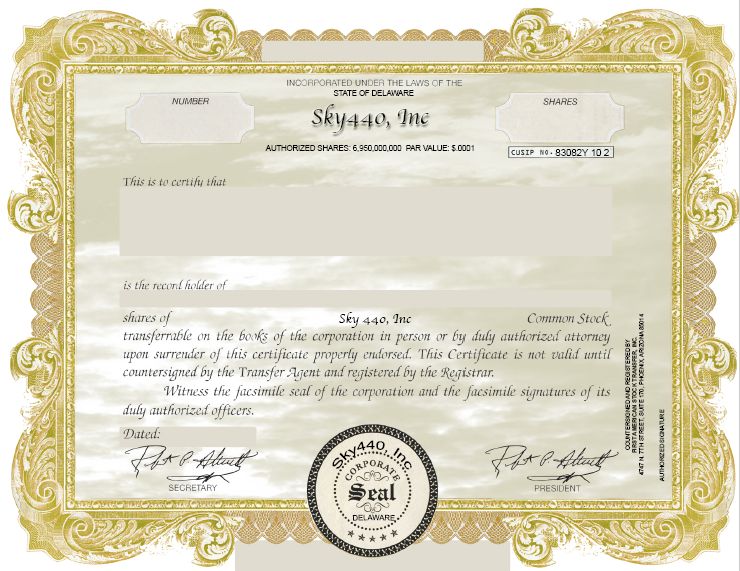
0001683168-18-002936.txt : 20181003 0001683168-18-002936.hdr.sgml : 20181003 20181003102544 ACCESSION NUMBER: 0001683168-18-002936 CONFORMED SUBMISSION TYPE: 1-A/A PUBLIC DOCUMENT COUNT: 14 FILED AS OF DATE: 20181003 DATE AS OF CHANGE: 20181003 FILER: COMPANY DATA: COMPANY CONFORMED NAME: Sky440, Inc. CENTRAL INDEX KEY: 0001661264 STANDARD INDUSTRIAL CLASSIFICATION: MOBILE HOMES [2451] IRS NUMBER: 810793956 STATE OF INCORPORATION: DE FISCAL YEAR END: 1231 FILING VALUES: FORM TYPE: 1-A/A SEC ACT: 1933 Act SEC FILE NUMBER: 024-10873 FILM NUMBER: 181103973 BUSINESS ADDRESS: STREET 1: 300 SPECTRUM CENTER DRIVE STREET 2: SUITE 400 CITY: IRVINE STATE: CA ZIP: 92618 BUSINESS PHONE: 949-831-3784 MAIL ADDRESS: STREET 1: 300 SPECTRUM CENTER DRIVE STREET 2: SUITE 400 CITY: IRVINE STATE: CA ZIP: 92618 1-A/A 1 primary_doc.xml 1-A/A LIVE 0001661264 XXXXXXXX 024-10873 true Sky440, Inc. DE 2001 0001661264 8742 90-0184001 1 1 300 Spectrum Center Drive Suite 400 Irvine CA 92618 855-759-4400 John E. Lux, Esq. Other 3.00 0.00 0.00 0.00 3.00 87802.00 114340.00 1952351.00 -1952348.00 3.00 0.00 74248.00 0.00 -351099.00 -0.00 -0.00 None Common Stock 4587922087 83082Y102 OTC Pink Open Market none 0 000000n/a N/A none 0 000000n/a N/A true true Tier1 Unaudited Equity (common or preferred stock) Y N N Y N N 2000000000 4587922087 0.0010 2000000.00 0.00 0.00 0.00 2000000.00 John E. Lux, Esq. 25000.00 John E. Lux, Esq. 2000.00 1973000.00 true NY Sky440, Inc. Common Stock, $0.0001 par value 100000000 0 Price per share was 0.00005 Exempt from registration under Section 4(2) Securities Act and Rules promulgated thereunder. PART II AND III 2 sky_1aa3-poc.htm PRELIMINARY OFFERING CIRCULAR

Table of Contents


Preliminary Offering Circular dated October 3, 2018


An Offering Statement pursuant to Regulation A relating to these securities has been filed with the Securities and Exchange Commission. Information contained in this Preliminary Offering Circular is subject to completion or amendment. These securities may not be sold nor may offers to buy be accepted before the Offering Statement filed with the Commission is qualified. This Preliminary Offering Circular shall not constitute an offer to sell or the solicitation of an offer to buy nor may there be any sales of these securities in any state in which such offer, solicitation or sale would be unlawful before registration or qualification under the laws of any such state. We may elect to satisfy our obligation to deliver a Final Offering Circular by sending you a notice within two business days after the completion of our sale to you that contains the URL where the Final Offering Circular or the Offering Statement in which such Final Offering Circular was filed may be obtained.


Sky440, Inc.


$2,000,000

2,000,000,000 SHARES OF COMMON STOCK

OFFERED BY THE COMPANY AT $0.001 PER SHARE


This is the public offering of securities of Sky440, Inc., a Delaware corporation. We are offering 2,000,000,000 shares of our common stock, par value $0.0001 ("Common Stock"), at an offering price of $0.001 per share (the "Offered Shares") by the Company. This Offering will terminate on twelve months from the day the Offering is qualified, subject to extension for up to thirty (30) days as defined below or the date on which the maximum offering amount is sold (such earlier date, the "Termination Date"). The minimum purchase requirement per investor is 10,000,000 Offered Shares ($10,000); however, we can waive the minimum purchase requirement on a case-by-case basis in our sole discretion.


These securities are speculative securities. Investment in the Company’s stock involves significant risk. You should purchase these securities only if you can afford a complete loss of your investment. See the “Risk Factors” section on page 4 of this Offering Circular.


No Escrow


The proceeds of this offering will not be placed into an escrow account. We will offer our Common Stock on a best efforts basis. As there is no minimum offering, upon the approval of any subscription to this Offering Circular, the Company shall immediately deposit said proceeds into the bank account of the Company and may dispose of the proceeds in accordance with the Use of Proceeds.


Subscriptions are irrevocable and the purchase price is non-refundable as expressly stated in this Offering Circular. The Company, by determination of the Board of Directors, in its sole discretion, may issue the Securities under this Offering for cash, promissory notes, services, and/or other consideration without notice to subscribers. All proceeds received by the Company from subscribers for this Offering will be available for use by the Company upon acceptance of subscriptions for the Securities by the Company. 


Sale of these shares will commence within two calendar days of the qualification date and it will be a continuous Offering pursuant to Rule 251(d)(3)(i)(F).


This Offering will be conducted on a “best-efforts” basis, which means our Officers will use their commercially reasonable best efforts in an attempt to offer and sell the Shares. Our Officers will not receive any commission or any other remuneration for these sales. In offering the securities on our behalf, the Officers will rely on the safe harbor from broker-dealer registration set out in Rule 3a4-1 under the Securities Exchange Act of 1934, as amended.


This Offering Circular shall not constitute an offer to sell or the solicitation of an offer to buy, nor shall there be any sales of these securities in any state or jurisdiction in which such offer, solicitation or sale would be unlawful, prior to registration or qualification under the laws of any such state.


Our Common Stock is traded in the OTCMarket under the symbol “SKYF”.


Investing in our Common Stock involves a high degree of risk. See “Risk Factors” beginning on page 4 for a discussion of certain risks that you should consider in connection with an investment in our Common Stock.


   Per
Share
  Total
Maximum
 
Public Offering Price (1)(2)  $0.001  $2,000,000.00 
Underwriting Discounts and Commissions (3)  $0.00  $0 
Proceeds to Company (4)  $0.001  $2,000,000.00 


(1) We are offering shares on a continuous basis. See “Distribution – Continuous Offering.”
(2) This is a “best efforts” offering. The proceeds of this offering will not be placed into an escrow account. We will offer our Common Stock on a best efforts basis primarily through direct sales by the Issuer. As there is no minimum offering, upon the approval of any subscription to this Offering Circular, the Company shall immediately deposit said proceeds into the bank account of the Company and may dispose of the proceeds in accordance with the Use of Proceeds. See “How to Subscribe.”
(3) We are offering these securities without an underwriter.
(4) Excludes estimated total offering expenses, including underwriting discount and commissions. Such expenses, will be approximately $27,000 assuming the maximum offering amount is sold.


Our Board of Directors used its business judgment in setting a value of $0.001 per share to the Company as consideration for the stock to be issued under the Offering. The sales price per share bears no relationship to our book value or any other measure of our current value or worth.


THE U.S. SECURITIES AND EXCHANGE COMMISSION DOES NOT PASS UPON THE MERITS OF OR GIVE ITS APPROVAL TO ANY SECURITIES OFFERED OR THE TERMS OF THE OFFERING, NOR DOES IT PASS UPON THE ACCURACY OR COMPLETENESS OF ANY OFFERING CIRCULAR OR OTHER SOLICITATION MATERIALS. THESE SECURITIES ARE OFFERED PURSUANT TO AN EXEMPTION FROM REGISTRATION WITH THE COMMISSION; HOWEVER, THE COMMISSION HAS NOT MADE AN INDEPENDENT DETERMINATION THAT THE SECURITIES OFFERED ARE EXEMPT FROM REGISTRATION.


The date of this Offering Circular is October _____, 2018.


TABLE OF CONTENTS


Page

CAUTIONARY STATEMENT REGARDING FORWARD-LOOKING STATEMENTS   1
SUMMARY   2
THE OFFERING   3
RISK FACTORS   4
USE OF PROCEEDS   20
DILUTION   23
DISTRIBUTION   24
MANAGEMENT'S DISCUSSION AND ANALYSIS OF FINANCIAL CONDITION AND RESULTS OF OPERATIONS   25
BUSINESS   28
MANAGEMENT   39
EXECUTIVE COMPENSATION   39
CERTAIN RELATIONSHIPS AND RELATED PARTY TRANSACTIONS  

40

PRINCIPAL STOCKHOLDERS   42
DESCRIPTION OF SECURITIES   43
DIVIDEND POLICY   46
SECURITIES OFFERED   47
SHARES ELIGIBLE FOR FUTURE SALE   47
LEGAL MATTERS   48
EXPERTS   48
WHERE YOU CAN FIND MORE INFORMATION   48
INDEX TO CONSOLIDATED FINANCIAL STATEMENTS   F-1


We are offering to sell, and seeking offers to buy, our securities only in jurisdictions where such offers and sales are permitted. You should rely only on the information contained in this Offering Circular. We have not authorized anyone to provide you with any information other than the information contained in this Offering Circular. The information contained in this Offering Circular is accurate only as of its date, regardless of the time of its delivery or of any sale or delivery of our securities. Neither the delivery of this Offering Circular nor any sale or delivery of our securities shall, under any circumstances, imply that there has been no change in our affairs since the date of this Offering Circular. This Offering Circular will be updated and made available for delivery to the extent required by the federal securities laws.


In this Offering Circular, unless the context indicates otherwise, references to "Sky440", "we", the "Company", "our", the “Issuer”, and "us" refer to the activities of and the assets and liabilities of the business and operations of Sky440, Inc.


 i 


CAUTIONARY STATEMENT REGARDING FORWARD-LOOKING STATEMENTS


Some of the statements under "Summary", "Risk Factors", "Management's Discussion and Analysis of Financial Condition and Results of Operations", "Our Business" and elsewhere in this Offering Circular constitute forward-looking statements. Forward-looking statements relate to expectations, beliefs, projections, future plans and strategies, anticipated events or trends and similar matters that are not historical facts. In some cases, you can identify forward-looking statements by terms such as "anticipate", "believe", "could", "estimate", "expect", "intend", "may", "plan", "potential", "should", "will" and "would" or the negatives of these terms or other comparable terminology.


You should not place undue reliance on forward looking statements. The cautionary statements set forth in this Offering Circular, including in "Risk Factors" and elsewhere, identify important factors which you should consider in evaluating our forward-looking statements. These factors include, among other things:


·The High-Risk nature of the Product Development and Horticulture Development business we plan to develop;
·Our ability to acquire and or develop commercial products under our planned Product Development Division;
·Our ability to successfully develop, produce and market our planned portable temporary housing units for homeless under our planned Product Development Division;
·Our ability to successfully develop, produce, market and distribute our planned Grow Vessel product line under our planned Horticulture Development Division;
·The speculative nature of the business we intend to develop;
·Our reliance on suppliers and customers;
·Our dependence upon external sources for the financing of our operations, particularly given that there are concerns about our ability to continue as a “going concern”;
·Our ability to effectively execute our business plan;
·Our ability to manage our expansion, growth and operating expenses;
·Our ability to finance our businesses;
·Our ability to promote our businesses;
·Our ability to compete and succeed in highly competitive and evolving businesses;
·Our ability to respond and adapt to changes in technology and customer behavior; and
·Our ability to protect our intellectual property and to develop, maintain and enhance strong brands.


Although the forward-looking statements in this Offering Circular are based on our beliefs, assumptions and expectations, taking into account all information currently available to us, we cannot guarantee future transactions, results, performance, achievements or outcomes. No assurance can be made to any investor by anyone that the expectations reflected in our forward-looking statements will be attained, or that deviations from them will not be material and adverse. We undertake no obligation, other than as maybe be required by law, to re-issue this Offering Circular or otherwise make public statements updating our forward-looking statements.


 1 


SUMMARY


This summary highlights selected information contained elsewhere in this Offering Circular. This summary is not complete and does not contain all the information that you should consider before deciding whether to invest in our Common Stock. You should carefully read the entire Offering Circular, including the risks associated with an investment in the company discussed in the “Risk Factors” section of this Offering Circular, before making an investment decision. Some of the statements in this Offering Circular are forward-looking statements. See the section entitled "Cautionary Statement Regarding Forward-Looking Statements."


Company Information


The Company, sometimes referred to herein as "we," "us,” “our," the “Issuer,” and the "Company" and/or "Sky440" was incorporated on August 22, 1997 in Florida, reincorporated in Nevada on August 21, 2001 as the result of a merger transaction and reincorporated in Delaware effective as of August 10, 2018 as the result of a change in domicile through a domestication transaction to engage in any lawful corporate undertaking. Our fiscal year-end date is December 31.


Sky440, Inc. offices are located at 300 Spectrum Center Drive, Suite 400, Irvine, CA 92618. Our website is www.sky440.com, our telephone number is 1-855-759-4400 and our email address is info@sky440.com.


The primary objective of Sky440 is to develop two planned divisions: (i) a Products Development Division (the 'PD Division') and (ii) a Horticulture Development Division (the “HDD Division”).


In our PD Division, our primary focus and planning has been in the three general disciplines, including: (i) The planning to develop, manufacture, sell and service temporary portable housing units for the homeless; (ii) the planning to acquire and develop consumer ready products utilizing direct response; and (iii) the planning for product development including publishing, marketing and distribution to support the Company's planned product lines in both the PD and HDD divisions.


In our HDD Division, our focus has been in five areas: (i) the planning for the development, manufacturing, sales and servicing of the Grow Vessel product line; (ii) planning for future ancillary branded products and consulting services; (iii) planning for incorporation of modern technologies for the Company to provide compliance, payment processing, medical billing, information portals and other Internet-based services; (iv) planning for the future acquisition of real property; and (v) planning for the potential expansion internationally.


The Company intends that the PD Division will eventually assist the HDD Division in the planned branding, marketing and distribution of HDD Division products. Because the Company is in the embryonic stages of its desire to implement the PD and HDD Division’s business plans, failure to secure the required funding could prevent the Company from making any significant progress in seeing its plans come to fruition.


We do not incorporate the information on or accessible through our website into this Offering Circular, and you should not consider any information on, or that can be accessed through, our website a part of this Offering Circular.


Section 15(g) of the Securities Exchange Act of 1934


Our shares are covered by section 15(g) of the Securities Exchange Act of 1934, as amended that imposes additional sales practice requirements on broker/dealers who sell such securities to persons other than established customers and accredited investors (generally institutions with assets in excess of $5,000,000 or individuals with net worth in excess of $1,000,000 or annual income exceeding $200,000 or $300,000 jointly with their spouses). For transactions covered by the Rule, the broker/dealer must make a special suitability determination for the purchase and have received the purchaser’s written agreement to the transaction prior to the sale. Consequently, the Rule may affect the ability of broker/dealers to sell our securities and also may affect your ability to sell your shares in the secondary market.


 2 


Section 15(g) also imposes additional sales practice requirements on broker/dealers who sell penny securities. These rules require a one-page summary of certain essential items. The items include the risk of investing in penny stocks in both public offerings and secondary marketing; terms important to in understanding of the function of the penny stock market, such as bid and offer quotes, a dealers spread and broker/dealer compensation; the broker/dealer compensation, the broker/dealers’ duties to its customers, including the disclosures required by any other penny stock disclosure rules; the customers’ rights and remedies in cases of fraud in penny stock transactions; and, the FINRA’s toll free telephone number and the central number of the North American Administrators Association, for information on the disciplinary history of broker/dealers and their associated persons.


Dividends


The Company has not declared or paid a cash dividend to stockholders since it was organized and does not intend to pay dividends in the foreseeable future. The board of directors presently intends to retain any earnings to finance our operations and does not expect to authorize cash dividends in the foreseeable future. Any payment of cash dividends in the future will depend upon the Company's earnings, capital requirements and other factors.


Trading Market


Our Common Stock trades in the OTC Market Pink Open Market under the symbol “SKYF”.


THE OFFERING

______


Issuer:   Sky440, Inc.
     
Securities offered:   A maximum of 2,000,000,000 shares of our common stock, par value $0.0001 (“Common Stock”) at an offering price of $0.001 per share (the “Offered Shares”). (See “Distribution.”)
     
Number of shares of Common Stock outstanding before the offering   4,587,922,087 shares outstanding as of June 27, 2018.
     
Number of shares of Common Stock to be outstanding after the offering   6,587,922,087 shares, if the maximum amount of Offered Shares are sold
     
Price per share:   $0.001
     
Maximum offering amount:   2,000,000,000 shares at $0.001 per share, or $2,000,000 (See “Distribution.”)
     
Trading Market:   Our Common Stock trades on the OTC Markets under the symbol SKYF.


Use of proceeds:   If we sell all of the shares being offered, our net proceeds (after our estimated offering expenses) will be $1,973,000. We will use these net proceeds for working capital and other general corporate purposes.
     
Risk factors:  

Investing in our Common Stock involves a high degree of risk, including:

Immediate and substantial dilution of between -$.0005 and -$.0009 per share depending upon total amount raised and the number of shares issued.

Limited market for our stock.

Limited operational history in an emerging industry.

See “Risk Factors.”


 3 


RISK FACTORS

______


The following is only a brief summary of the risks involved in investing in our Company. Investment in our Securities involves risks. You should carefully consider the following risk factors in addition to other information contained in this Disclosure Document. The occurrence of any of the following risks might cause you to lose all or part of your investment. Some statements in this Document, including statements in the following risk factors, constitute “Forward-Looking Statements.”


At this stage of our business operations, we may never achieve our goals for profitability or generate any significant amount of revenues, thus potential investors and stockholders have a high probability of losing their investment and or the value of their stock. If we are unable to continue as a going concern, you will lose your investment and or your stock may become worthless.

There is nothing at this time on which to base an assumption that our business operations will prove to be successful or that we will be able to operate profitably. Our future operating results will depend on many factors, including our ability to raise adequate working capital, demand for our products, the level of our competition and our ability to attract and maintain key management and employees. If we are unable to continue as a going concern, you will lose your investment and or your stock may become worthless. To date, the Company has not secured the necessary funding and as a result the planning for implementation of the Company’s business plans have been curtailed to a minimal level. There can be no assurance that the Company will be successful in securing the required funding or that it will be able to implement its business plans even if it does secure the funding necessary to proceed. Therefore, any potential investment and or purchase of the Company’s stock either in a private transaction and or through the public market should be considered an extremely high risk endeavor and the investor and or stock purchaser should be aware that his or hers’ potential investment could be a total loss if the Company is unable to fully implement its business plan and as a result the Company has no value and furthermore its stock has no value either at present or in the future. Any investment in the Company and or purchase of the Company’s stock should be considered an extremely high-risk transaction and any potential investor and or purchaser of the Company’s stock should be very cautious when making any financial decision regarding the Company.


We have developed a new strategy, and the future success of our company will depend on its successful execution.

In 2014, we developed and announced our new strategy, and are now executing on it. The primary strategy of Sky440 is to develop two planned divisions: (i) a Products Development Division (the 'PD Division') and (ii) a Horticulture Development Division (the “HDD Division”).


In our PD Division, our primary strategy and planning has been in the three general disciplines, including: (i) The planning to develop, manufacture, sell and service temporary portable housing units for the homeless; (ii) the planning to acquire and develop consumer ready products utilizing direct response; and (iii) the planning for product development including publishing, marketing and distribution to support the Company's planned product lines in both the PD and HDD divisions.


In our HDD Division, our strategy has been in five distinct areas: (i) the planning for the development, manufacturing, sales and servicing of the Grow Vessel product line; (ii) planning for future ancillary branded products and consulting services; (iii) planning for incorporation of modern technologies for the Company to provide compliance, payment processing, medical billing, information portals and other Internet-based services; (iv) planning for the future acquisition of real property; and (v) planning for the potential expansion internationally.


Because this new strategy will chart the company’s course of action and priorities for years to come, the future success of the Company will depend on its successful execution. Our strategy will bring additional risks to the business (such as those associated with greater use of capital, development and acquisition of new products, or entry into new industries or geographic markets) or magnify existing risks as our business priorities and objectives are adjusted. If our strategy is flawed, or if we fail to execute it well, our business and financial performance may be materially and adversely affected.


Since we recently commenced operations under our new business plan, it is difficult for potential investors to evaluate our business. We will need to raise additional capital in order to fund our operations. There can be no assurance that such additional capital will be available to us on favorable terms or at all. There can be no assurance that we will be profitable. Any investment in the Company and or purchase of the Company’s stock should be considered an extremely high-risk transaction and any potential investor and or purchaser of the Company’s stock should be very cautious when making any financial decision regarding the Company.


 4 


We may be unable to expand into new markets.

Our planned growth and profitability depend on our ability to successfully realize our growth strategy by expanding throughout the United States and internationally. We cannot assure that our efforts to expand into new markets, particularly in states where we do not currently operate, will succeed. In order to operate in new markets, we may need to modify our existing business model and cost structure to comply with local regulatory or other requirements, which may expose us to new operational, regulatory or legal risks. In addition, expanding into new states may subject us to unfamiliar or uncertain local regulations that may adversely affect our operations, for example, by applying, obtaining and/or maintaining appropriate licenses. Facilities we open in new markets may also take longer to reach expected revenue and profit levels on a consistent basis and may have higher construction, occupancy or operating costs than facilities we open in existing markets, thereby affecting our overall profitability. New markets may have competitive conditions, consumer preferences and spending patterns that are more difficult to predict or satisfy than our existing markets.


There is substantial doubt about our ability to continue as a going concern.

Our financial statements have been prepared on a going concern basis, which assumes we will be able to realize our assets and discharge our liabilities in the normal course of business for the foreseeable future. We have incurred a loss since January 1, 1996 (Inception) resulting in an accumulated deficit of approximately $4,911,385 as of December 31, 2017 and further losses are anticipated in the development of our business.


Our ability to continue as a going concern is dependent upon our becoming profitable in the future and, or, obtaining the necessary financing to meet our obligations and repay our liabilities arising from normal business operations when they come due. There is no guarantee that we will be successful in achieving these objectives. To date, The Company has not secured the necessary funding and as a result the planning for implementation of the Company’s business plans have been curtailed to a minimal level. There can be no assurance that the Company will be successful in securing the required funding or that it will be able to implement its business plans even if it does secure the funding necessary to proceed. Therefore, any potential investment and or purchase of the Company’s stock either in a private transaction and or through the public market should be considered an extremely high risk endeavor and the investor and or stock purchaser should be aware that his or hers’ potential investment could be a total loss if the Company is unable to fully implement its business plan and as a result the Company has no value and furthermore its stock has no value either at present or in the future. Any investment in the Company and or purchase of the Company’s stock should be considered an extremely high-risk transaction and any potential investor and or purchaser of the Company’s stock should be very cautious when making any financial decision regarding the Company.


We operate in a highly competitive industry and potential competitors could duplicate our business model.

We are involved in a highly competitive industry where we compete with numerous other companies who offer products and services similar to those we offer. There is currently no aspect of our business, which is protected by patents, copyrights, trademarks, or trade names. As a result, potential competitors could duplicate our business model with little effort. Some of our potential competitors may have significantly greater resources than we have, which may make it difficult for us to compete. There can be no assurance that we will be able to successfully compete against these other entities.


Competitors will have significantly greater financial and other resources than the company, and they may sell competing products and services at lower prices or at lower profit margins, resulting in pressures on our prices and margins.

The sizes of our competitors vary widely across market and service segments. Therefore, most of our competitors will have significantly greater financial, technical, marketing or other resources than we do in any one or more of our market segments, or overall. As a result, our competitors may be in a position to respond more quickly than we can to new or emerging technologies, methodologies and changes in customer requirements, or may devote greater resources than we can to the development, promotion, sale and support of products and services. Moreover, new competitors or alliances among our competitors may emerge and potentially reduce our market share, revenue or margins. Some of our competitors also may choose to sell products or services competitive to ours at lower prices by accepting lower margins and profitability or may be able to sell products or services competitive to ours at lower prices given proprietary ownership of data, technical superiority, a broader or deeper product or experience set, or economies of scale. Price reductions or pricing pressure by our competitors could negatively impact our margins and results of operations and could also harm our ability to obtain new customers on favorable terms. Competitive pricing pressures tend to increase in difficult economic environments, such as the current environments in the U.S. and other economies, due to reduced marketing expenditures of many of our clients and prospects and the resulting impact on the competitive business environment for marketing service providers such as our company.


If our leaders are unsuccessful, or if we lose key management and are unable to attract and retain the talent required for our business, our operating results could suffer.

In the past, we replaced many of our officers and directors, including our President, Chief Executive Officer and Chairman, and significantly reorganized our operational structures. If our officers and directors fail in their roles and responsibilities (and more generally if we are unable to attract new officers and directors with the necessary skills to manage our business) our business and its operating results may suffer.


Further, our future prospects depend in large part upon our ability to attract, train and retain experienced technical, client services, sales, consulting, research and development, marketing, administrative and management personnel. While the demand for personnel is dependent on employment levels, competitive factors and general economic conditions, qualified personnel historically have been in great demand. The loss or prolonged absence of the services of these individuals could have a material adverse effect on our business, financial position or operating results.


 5 


We will need additional capital in the future to finance our planned growth, which we may not be able to raise, or it may only be available on terms unfavorable to us or our stockholders. Ultimately, this may result in our inability to fund our working capital requirements and harm our operational results.

We need capital to operate and fund our business plan. We do not know what the terms of any future capital raising may be, but any future sale of our equity securities will dilute the ownership of existing stockholders. Additional financing might not be available on terms favorable to us, or at all. If adequate funds were not available or were not available on acceptable terms, our ability to fund our operations, take advantage of unanticipated opportunities, develop or enhance our business or otherwise respond to competitive pressures would be significantly limited. In such a capital restricted situation, we may curtail our marketing, development, and operational activities or be forced to sell some of our assets on an untimely or unfavorable basis, each of which could have a material adverse effect on our results of operations and financial condition.


Any potential investment and or purchase of the Company’s stock either in a private transaction and or through the public market should be considered an extremely high risk endeavor and the investor and or stock purchaser should be aware that his or hers’ potential investment could be a total loss if the Company is unable to fully implement its business plan and as a result the Company has no value and furthermore its stock has no value either at present or in the future.


We must successfully identify and evaluate planned acquisition targets and integrate acquisitions.

Acquisitions are an essential component of our strategy to grow the Company, and we have announced plans to actively pursue acquisitions. As of the date of this filing, the company does not have any acquisitions that are probable or have occurred. We plan to evaluate acquisition opportunities to expand our planned product and service offerings and geographic locations, including potential international acquisitions. Acquisition activities, even if not consummated, require substantial amounts of management time and can distract from normal operations. In addition, we have in the past and may in the future be unable to achieve the profitability goals, synergies and other objectives initially sought in acquisitions, and any acquired assets, data or businesses may not be successfully integrated into our operations. Acquisitions may result in the impairment of relationships with employees and customers. Moreover, although we plan to review and analyze assets or companies we plan to acquire, such reviews are subject to uncertainties and may not reveal all potential risks, and we may incur unanticipated liabilities and expenses as a result of our acquisition activities. The failure to identify appropriate candidates, to negotiate favorable terms, or to successfully integrate future acquisitions into existing operations could result in not achieving planned revenue growth and could negatively impact our net income and earnings per share.


We have pursued and intend to continue to pursue strategic acquisitions or investments in new markets and may encounter risks associated with these activities, which could harm our business and operating results.


Our recent and future acquisitions or investments may not be successful; and if we fail to realize the anticipated benefits of these acquisitions or investments, our business and operating results could be harmed. We have incurred costs and encountered difficulties in the past in connection with our acquisitions and investments.


Future acquisitions may result in dilutive issuances of equity securities, the incurrence of additional debt, large write-offs, impairments, a decrease in future profitability, or future losses. The incurrence of debt in connection with any future acquisitions could restrict our ability to obtain working capital or other financing necessary to operate our business. At this stage of our business operations, we may never achieve our goals or generate any significant amount of revenues, thus potential investors and stockholders have a high probability of losing their investment and or the value of their stock. If we are unable to continue as a going concern, you will lose your investment and or your stock may become worthless.


Portable Housing Risk Factors


There is no assurance that our portable housing units will be successful.

There is no guarantee that our portable housing units will be accepted. Despite an overwhelming need for solutions to the homeless issue in the United States, there is no guarantee that our proposed solution utilizing portable housing units being developed by our Company will be accepted by local municipalities, regional and or national government agencies. Currently, agencies rely upon temporary housing at local motels, housing vouchers, vacant buildings, tent cities, purchasing commercial properties and expensive retrofitting of existing government owned buildings. All of these and other efforts have made little progress in solving the issue. There are simply more homeless than local, state and regional resources can accommodate. Many factors determine which solutions agencies approve, including financial, political and acceptance of the housing by the homeless population.


 6 


Real Estate Risk Factors


Because our business model depends upon the availability of private financing, any change in our ability to raise money will adversely affect our financial condition.

Our ability to acquire, operate and sell properties, engage in the business activities that we have planned and achieve positive financial performance depends, in large measure, on our ability to obtain financing in amounts and on terms that are favorable. The capital markets in the United States have recently undergone a turbulent period in which lending was severely restricted. Although there appears to be signs that financial institutions are resuming lending, the market has not yet returned to its pre-2008 state.


Obtaining favorable financing in the current environment remains challenging. In the event the lender or any other is unable to finance our business, we will not be able to implement our business plan and our financial performance could be adversely affected.


There can be no assurance that the Company will be successful in securing the required funding necessary to proceed. Therefore, any potential investment and or purchase of the Company’s stock either in a private transaction and or through the public market should be considered an extremely high-risk endeavor and the investor and or stock purchaser should be aware that his or her potential investment could be a total loss if the Company is unable to secure the necessary funding. Any investment in the Company and or purchase of the Company’s stock should be considered an extremely high-risk transaction and any potential investor and or purchaser of the Company’s stock should be very cautious when making any financial decision regarding the Company.


The price we pay for to acquire real property will be based on our projections of market factors, and our return on investment may be lower than expected if any of our projections are inaccurate.

The price we pay for real property investments will be based on our projections of market demand, the costs of any renovation of a property and other factors. In addition, as the real estate market continues to strengthen with the improvement of the U.S. economy, we will face increased competition, which may drive up prices for real estate assets, result in less available distressed properties and make acquisitions less favorable to us. If any of our projections are inaccurate or we ascribe a higher value to assets and their value subsequently drops or fails to rise because of market factors, returns on our investment may be lower than expected and could experience losses.


We will experience competition for real estate investments from individuals, corporations and other entities engaged in real estate investment activities, many of whom have greater financial resources than us. Competition for investments may have the effect of increasing costs and reducing returns to our investors.


Because we plan to buy, sell and lease property, we will be subject to general real estate risks.

We will be subject to risks generally incident to the ownership of real estate, including: (a) changes in general economic or local conditions; (b) changes in supply of, or demand for, similar or competing properties in the area; (2) bankruptcies, financial difficulties or defaults by tenants or other parties; (d) increases in operating costs, such as taxes and insurance; (e) the inability to achieve full stabilized occupancy at rental rates adequate to produce targeted returns; (f) periods of high interest rates and tight money supply; (g) excess supply of rental properties in the market area; (h) liability for uninsured losses resulting from natural disasters or other perils; (i) liability for environmental hazards (as further described below); and (j) changes in tax, real estate, environmental, zoning or other laws or regulations. For these and other reasons, no assurance can be given that we will be profitable and one or more of these risks could be detrimental to our business.


Information Technology, Direct Marketing

and Intellectual Property Risk Factors


We must maintain technological competitiveness, continually improve our processes and develop and introduce new products and services in a timely and cost-effective manner.

We believe that our future success depends on, among other things, maintaining technological competitiveness in our planned products, processing functionality and software systems and services. Technology changes rapidly as makers of computer hardware, network systems, programming tools, programming languages, operating systems, database technology and mobile devices continually improve their offerings.


 7 


Advances in information technology may result in changing customer preferences for products and product delivery channels in our industry. The increasingly sophisticated requirements of our customers require us to continually improve our processes and provide new products and services in a timely and cost-effective manner (whether through development, license or acquisition). We may be unable to successfully identify, develop and bring new and enhanced services and products to market in a timely and cost-effective manner, such services and products may not be commercially successful, and services, products and technologies developed by others may render our services and products noncompetitive or obsolete.


Risks Related to New Technology


The regulatory regime governing new technologies is uncertain and new regulations or policies may materially adversely affect any planned technology that might be developed and or acquired by the Company.

Regulation of new technologies currently is undeveloped and likely to rapidly evolve, varies significantly among international, federal, state and local jurisdictions and is subject to significant uncertainty. Various legislative and executive bodies in the United States and in other countries may in the future, adopt laws, regulations, guidance, or other actions, which may severely impact planned technology that the Company may develop and or acquire and the adoption and utility of the technology by the industry. Failure by the Company or certain users of the technology to comply with any laws, rules and regulations, some of which may not exist yet or are subject to interpretation and may be subject to change, could result in a variety of adverse consequences, including civil penalties and fines.


The further development and acceptance of new technologies which are part of a new and rapidly changing industry are subject to a variety of factors that are difficult to evaluate.

The slowing or stopping of the development or acceptance of any new technologies would have an adverse material effect on the successful development and adoption of any new technologies to be developed and or acquired by the Company. There can be no assurance that the Company will be successful in developing and or acquiring any new technologies necessary to proceed with that segment of the Company’s business plans or that it will be able to secure the required funding to move forward. Therefore, any potential investment and or purchase of the Company’s stock either in a private transaction and or through the public market should be considered an extremely high-risk endeavor and the investor and or stock purchaser should be aware that his or her potential investment could be a total loss if the Company is unable to secure the necessary funding. Any investment in the Company and or purchase of the Company’s stock should be considered an extremely high-risk transaction and any potential investor and or purchaser of the Company’s stock should be very cautious when making any financial decision regarding the Company.


Cannabis Industry Risk Factors


Because We Have No Operating History in the Cannabis Industry, We May Not Succeed.

The Company has no specific operating history or experience in developing, marketing, selling and distribution of its planned product line, or procuring, building out or leasing real estate for agricultural purposes, specifically medical marijuana grow facilities, or with respect to any other activity in the cannabis industry. Moreover, we are subject to all risks inherent in a developing a new business enterprise. Our likelihood of success must be considered in light of the problems, expenses, difficulties, complications, and delays frequently encountered in connection with establishing a new business and the competitive and regulatory environment in which we operate. For example, the medical marijuana industry is new and may not succeed, particularly should the federal government change course and decide to prosecute those dealing in medical and/or recreational marijuana. If that happens there may not be an adequate market for our properties or other activities, we propose to engage in.


You should further consider, among other factors, our prospects for success in light of the risks and uncertainties encountered by companies that, like us, are in their early stages. For example, unanticipated expenses, delays and or complications with build outs, zoning issues, legal disputes with neighbors, local governments, communities and or tenants. We may not successfully address these risks and uncertainties or successfully implement our operating strategies. If we fail to do so, it could materially harm our business to the point of having to cease operations and could impair the value of our common stock to the point investors may lose their entire investment.


 8 


The cannabis industry faces significant opposition.

It is believed by many that large well-funded businesses may have a strong economic opposition to the cannabis industry. Further, the medical cannabis industry could face a material threat from the pharmaceutical industry, should cannabis displace other drugs or encroach upon the pharmaceutical industry’s products. The pharmaceutical industry is well funded with a strong and experienced lobby that eclipses the funding of the medical cannabis industry. Any inroads the pharmaceutical industry could make in halting or impeding the cannabis industry could have a detrimental impact on our proposed business.


The use of medical and recreational marijuana still carries significant social stigma. We are substantially dependent on continued market acceptance and proliferation of consumers of medical and recreational marijuana. We believe that as marijuana becomes more accepted the stigma associated with marijuana use will diminish and as a result consumer demand will continue to grow. And while we believe that the market and opportunity in the marijuana space continues to grow, we cannot predict the future growth rate and size of the market. Any negative outlook on the marijuana industry will adversely affect our business operations.


Because marijuana is illegal under federal law, we could be subject to criminal and civil sanctions for engaging in activities that violate those laws.

Despite the development of a legal cannabis industry under the laws of certain states, these state laws legalizing medical and adult cannabis use are in conflict with the Federal Controlled Substances Act, which classifies cannabis as a Schedule-I controlled substance and makes cannabis use and possession illegal on a national level. The United States Supreme Court has ruled in United States v. Oakland Cannabis Buyers' Coop. and Gonzales v. Raich that it is the federal government that has the right to regulate and criminalize cannabis, even for medical purposes, and thus federal law criminalizing the use of cannabis preempts state laws that legalize its use. In March 2015, bipartisan legislation was introduced in the U.S. Senate proposing to change federal law such that states could regulate medical use of cannabis without fear of prosecution. A key component of the proposed Compassionate Access, Research Expansion, and Respect States Act (the “CARERS Act”) is to reclassify cannabis under the Controlled Substances Act to Schedule II, thereby changing the plant from a federally-criminalized substance to one that has recognized medical uses.


The Trump administration hasn’t yet decided what to do about marijuana enforcement in states that have legal cannabis programs. According the Department of Justice, opioid deaths are driving the increased emphasis on drug enforcement. The Department of Justice stated that the Trump administration believes marijuana legalization is a lot more harmful than a lot of people anticipated.


The prior administration stated that it is not an efficient use of resources to direct law federal law enforcement agencies to prosecute those lawfully abiding by state-designated laws allowing the use and distribution of medical marijuana. However, there is no guarantee that the current administration will not change its stated policy regarding the low-priority enforcement of federal laws. Additionally, the new administration could change this policy and decide to enforce the federal laws strongly. Any such change in the federal government's enforcement of current federal laws could cause significant financial damage to the industry, at least as it is currently instituted.


Should such a change occur, our HDD Division business operations could be affected. If our potential marijuana tenants are forced to shut their operations, we would need to seek to replace those tenants with non-marijuana tenants, who would likely expect to pay lower rents. Moreover, if the marijuana industry were forced to shut down at once, it would result in a high amount of vacancies at once and create a surplus of supply, driving leases and property values lower. Additionally, we would realize an economic loss on any and all improvements made to the properties that were specific to the marijuana industry and we would likely lose any and all investments in the US market that were marijuana-related.


Further, and even if we do not directly harvest, cultivate, possess, distribute or sell cannabis, by leasing facilities and financing growers of medicinal marijuana, we could be deemed to be participating in marijuana cultivation or aiding and abetting, which remains illegal under federal law, and exposes us to potential criminal liability, with the additional risk that our properties could be subject to civil forfeiture proceedings. Moreover, since the use of marijuana is illegal under federal law, we may have difficulty acquiring or maintaining bank accounts and insurance and our shareholders may find it difficult to deposit their stock with brokerage firms.


Our contemplated business plan is dependent on state laws pertaining to the cannabis industry.

Continued development of the cannabis industry is dependent upon continued legislative authorization of cannabis at the state level. Any number of factors could slow or halt progress in this area. Further, progress, while encouraging, is not assured. While there may be ample public support for legislative action, numerous factors impact the legislative process. Any one of these factors could slow or halt use of cannabis, which would negatively impact our proposed business.


 9 


Laws and regulations affecting the regulated marijuana industry are constantly changing, which could detrimentally affect our proposed operations, and we cannot predict the impact that future regulations may have on us

Federal, state and local cannabis laws and regulations are broad in scope and subject to evolving interpretations, which could require us to incur substantial costs associated with compliance or alter our business plan. In addition, violations of these laws, or allegations of such violations, could disrupt our business and result in a material adverse effect on our operations. Furthermore, it is possible that regulations may be enacted in the future that will be directly applicable to our proposed business. We cannot predict the nature of any future laws, regulations, interpretations or applications, nor can we determine what effect additional governmental regulations or administrative policies and procedures, when and if promulgated, could have on our business.


FDA regulation of marijuana and the possible registration of facilities where medical marijuana is grown could negatively affect the cannabis industry that would directly affect our financial condition.

Should the federal government legalize marijuana for medical use, it is possible that the U.S. Food and Drug Administration (FDA) would seek to regulate it under the Food, Drug and Cosmetics Act of 1938. Additionally, the FDA may issue rules and regulations including CGMPs (certified good manufacturing practices) related to the growth, cultivation, harvesting and processing of medical marijuana. Clinical trials may be needed to verify efficacy and safety. It is also possible that the FDA would require that facilities where medical marijuana is grown be registered with the FDA and comply with certain federally prescribed regulations. In the event that some or all of these regulations are imposed, we do not know what the impact would be on the medical marijuana industry, what costs, requirements and possible prohibitions may be enforced. If we or our tenants are unable to comply with the regulations and or registration as prescribed by the FDA, we and or our tenants may be unable to continue to operate their and our business in its current form or at all.


Because we may be unable to identify, and/or successfully acquire properties which are suitable for our cannabis business, our financial condition may be negatively affected.

Our business plan involves the identification and the successful acquisition of real properties which are zoned for marijuana businesses, including grow and retail. The properties we acquire will be leased or sold to licensed marijuana operators. Local governments must approve and adopt zoning ordinances for marijuana facilities and retail dispensaries. A lack of properly zoned real estate may reduce our prospects and limit our opportunity for growth and or increase the cost at which suitable properties are available to us. Conversely a surplus of real estate zoned for marijuana establishments may reduce demand and prices we are able to charge for properties we may have previously acquired. There can be no assurance that we will be able to obtain the capital needed to purchase any properties.


Our customers and our company may have difficulty accessing the service of banks, which may make it difficult to operate and/or contract.

Since the use of cannabis is illegal under federal law, many banks will not accept for deposit funds from businesses involved with cannabis. Consequently, businesses involved in the cannabis industry often have trouble finding a bank willing to accept their business. The inability to open bank accounts may make it difficult for potential customers, clients and tenants of the Company to operate.


On February 14, 2014, The U.S. government issued rules allowing banks to legally provide financial services to state-licensed marijuana businesses. A memorandum issued by the Justice Department to federal prosecutors re- iterated guidance previously given, this time to the financial industry that banks can do business with legal marijuana businesses and “may not” be prosecuted. The Treasury Department's Financial Crimes Enforcement Network (FinCEN) issued guidelines to banks that “it is possible to provide financial services"” to state-licensed marijuana businesses and still be in compliance with federal anti-money laundering laws. The guidance falls short of the explicit legal authorization that banking industry officials had pushed the government to provide and to date it is not clear what if any banks have relied on the guidance and taken on legal marijuana companies as clients. The aforementioned policy may be administration dependent and a change in presidential administrations may cause a policy reversal and retraction of current policies, wherein legal marijuana businesses may not have access to the banking industry. We could be subject to sanctions if we are found to be a financial institution and not in harmony with FinCET guidelines. Also, the inability of potential clients in our target market to open accounts and otherwise use the service of banks may make it difficult for them to contract with us.


 10 


Investments in development stage companies including Sky440 involve a high degree of risk. Investments Sky440 may involve an even higher degree of risk.

Financial and operating risks confronting development stage companies like Sky440 are significant: Sky440 is not immune to these. The development stage market in which Sky440 competes is highly competitive and the percentage of companies that survive and prosper is small. Development stage companies often experience unexpected problems in the areas of product development, marketing, financing, and general management, among others, which frequently cannot be solved. In addition, development stage companies may require substantial amounts of financing, which may not be available through institutional private placements, the public markets or otherwise. There can be no assurance that the Company will be successful in securing the required funding necessary to implement its business plan. Therefore, any potential investment and or purchase of the Company’s stock either in a private transaction and or through the public market should be considered an extremely high-risk endeavor and the investor and or stock purchaser should be aware that his or her potential investment could be a total loss if the Company is unable to secure the necessary funding. Any investment in the Company and or purchase of the Company’s stock should be considered an extremely high-risk transaction and any potential investor and or purchaser of the Company’s stock should be very cautious when making any financial decision regarding the Company.


Public Company Risk Factors

Including Those Specifically Related to “Penny Stocks”


If the ownership of our common stock continues to be highly concentrated, it may prevent you and other stockholders from influencing significant corporate decisions and may result in conflicts of interest that could cause our stock price to decline.

Our executive officers, directors and their affiliates beneficially own or control approximately 90% percent of our common stock voting rights. Accordingly, these executive officers, directors and their affiliates, acting as a group, will have considerable influence over the outcome of corporate actions requiring stockholder approval, including the election of directors, any merger, consolidation or sale of all or substantially all of our assets or any other significant corporate transactions. However, as a result of their positions, these stockholders may also delay or prevent a change of control, even if such a change of control would benefit other stockholders. A significant concentration of stock ownership may adversely affect the trading price of our common stock due to investors’ perception that conflicts of interest may exist or arise.


Fluctuation in our revenue and operating results and other factors may impact the volatility of our stock price.

The price at which our common stock has traded in recent years has fluctuated greatly. Our common stock price may continue to be volatile due to a number of factors including the following (some of which are beyond our control): (1) the impact of general market volatility in the market segments where the Company plans to operate; (2) variations in our operating results from period to period and variations between our actual operating results and the expectations of investors, stockholders and the financial community; (3) unanticipated developments with customer engagements or customer demand, such as variability in the market demand for our products and services; (4) announcements of developments affecting our businesses, both positive and negative; (5) competition and the operating results of our competitors; and (6) other factors discussed elsewhere in “Risk Factors”.


 11 


As a result of these and other factors, investors in our common stock may not be able to resell their shares at or above their original purchase price. Therefore, any potential investment and or purchase of the Company’s stock either in a private transaction and or through the public market should be considered an extremely high-risk endeavor and the investor and or stock purchaser should be aware that his or her potential investment could be a total loss if the Company is unable to secure the necessary funding to remain in business. Any investment in the Company and or purchase of the Company’s stock should be considered an extremely high-risk transaction and any potential investor and or purchaser of the Company’s stock should be very cautious when making any financial decision regarding the Company.


We have never paid dividends on our common stock and we do not expect to pay any cash dividends in the foreseeable future; a return on investment may be limited to the value of our common stock.

We have never paid dividends on our common stock and we intend to retain our future earnings, if any, in order to reinvest in the development and growth of our business and, therefore, do not intend to pay dividends on our common stock for the foreseeable future. There can be no assurance that the Company will ever have sufficient earnings to declare and pay dividends to the holders of our common stock, and in any event, any future determination to pay dividends will be at the discretion of our board of directors and will depend on our financial condition, results of operations, capital requirements, and such other factors as our board of directors deems relevant. Accordingly, investors may need to sell their shares of our common stock to realize a return on their investment, and they may not be able to sell such shares at or above the price paid for them. Therefore, any potential investment and or purchase of the Company’s stock either in a private transaction and or through the public market should be considered an extremely high-risk endeavor and the investor and or stock purchaser should be aware that his or her potential investment could be a total loss if the Company is unable to continue its already limited operations.


Our stockholders may experience significant dilution; future sales of our common stock may result in a decrease in the market price of our common stock, even if our business is doing well.

If our future operations or acquisitions are financed through the issuance of equity securities as expected, our stockholders could experience significant dilution. In addition, securities issued in connection with future financing activities or potential acquisitions may have rights and preferences senior to the rights and preferences of our common stock. We may grant options to purchase shares of our common stock to our directors, employees and consultants. The issuance of shares of our common stock upon the exercise of these options may result in dilution to our stockholders.


The market price of our common stock, when and if established, could drop due to sales of a large number of shares of our common stock in the market after the offering or the perception that such sales could occur. This could make it more difficult to raise funds through future offerings of common stock. Any potential investment and or purchase of the Company’s stock either in a private transaction and or through the public market should be considered an extremely high-risk endeavor and the investor and or stock purchaser should be aware that his or her potential investment could be a total loss.


Because we are subject to additional regulatory compliance matters as a result of being a public company, the failure to comply with these regulatory matters could harm our business.

Compliance with changing regulation of corporate governance and public disclosure may result in additional expenses. Changing laws, regulations and standards relating to corporate governance and public disclosure, including Securities and Exchange Commission regulations, FINRA, and market rules, are creating uncertainty for companies such as ours. These new or changed laws, regulations and standards are subject to varying interpretations in many cases due to their lack of specificity, and as a result, their application in practice may evolve over time as new guidance is provided by regulatory and governing bodies, which could result in continuing uncertainty regarding compliance matters and higher costs necessitated by ongoing revisions to disclosure and corporate governance practices. As a result, our efforts to comply with evolving laws, regulations and standards may result in, and are likely to continue to result in, increased general and administrative expenses and a diversion of management time and attention from revenue-generating activities to compliance activities.


Our management and outside professionals will need to devote a substantial amount of time to new compliance initiatives and to meeting the obligations that are associated with being a public company. The Company will rely on legal counsel and accounting professionals to help with our future SEC reporting requirements. This will likely divert needed capital resources away from the objectives of implementing our business plan. These expenses could be costlier that we are able to bear and could result in us not being able to successfully implement our business plan.


 12 


Disclosure requirements pertaining to penny stocks may reduce the level of trading activity in the market for our common stock and investors may find it difficult to sell and clear their shares.

Penny stocks are generally equity securities with a market price of less than $5.00, other than securities registered on certain national securities exchanges or quoted on the NASDAQ system, provided that current price and volume information with respect to transactions in such securities is provided by the exchange or system. Trades of our common stock will be subject to Rule 15g-9 of the SEC which rule imposes certain requirements on broker/dealers who sell securities subject to the rule to persons other than established customers and accredited investors.


The penny stock rules require a broker-dealer, prior to a transaction in a penny stock, to deliver a standardized risk disclosure document prepared by the SEC, that: (a) contains a description of the nature and level of risk in the market for penny stocks in both public offerings and secondary trading; (b) contains a description of the broker's or dealer's duties to the customer and of the rights and remedies available to the customer with respect to a violation of such duties or other requirements of the securities laws; (c) contains a brief, clear, narrative description of a dealer market, including bid and ask prices for penny stocks and the significance of the spread between the bid and ask price; (d) contains a toll-free telephone number for inquiries on disciplinary actions; (e) defines significant terms in the disclosure document or in the conduct of trading in penny stocks; and (f) contains such other information and is in such form, including language, type size and format, as the SEC shall require by rule or regulation.


For transactions covered by the rule, the broker-dealer must prior to a transaction make a special written determination that the penny stock is a suitable investment for the purchaser and receive the purchaser's written acknowledgment of the receipt of a risk disclosure statement, a written agreement as to transactions involving penny stocks, and a signed and dated copy of a written suitability statement.


The broker-dealer also must provide, prior to effecting any transaction in a penny stock, the customer with (a) bid and offer quotations for the penny stock; (b) the compensation of the broker-dealer and its salesperson in the transaction; (c) the number of shares to which such bid and ask prices apply, or other comparable information relating to the depth and liquidity of the market for such stock; and (d) a monthly account statement showing the market value of each penny stock held in the customer's account.


These disclosure requirements may have the effect of reducing the trading activity for our common stock. Therefore, stockholders may have difficulty selling our securities.


The company is subject to stock promotion guidelines established by OTC markets.

As a Company that trades on the Pink Sheets at present, we are subject to following guidelines established by OTC Markets regarding the promotion of its stock in the public marketplace. It is imperative that the Company follow these guidelines as a failure to do so could have a material adverse effect on the Company and its stockholders. Under these guidelines, timely disclosure of material information is fundamental to maintaining an efficient trading market. Public availability of adequate current information is a core principal of OTC Markets Group’s disclosure- based philosophy and its rules. Public companies such as Sky440 are expected to release quickly to the public any news or information which might reasonably be expected to materially affect the market for its securities.


Management of a public company also has the responsibility to dispel unfounded rumors, misinformation or false statements which result in unusual market activity. Misleading and manipulative promotion clearly fall into this area of concern and must be immediately addressed. Fraudulent promotional campaigns harm the integrity of public markets, defraud investors, and obstruct the capital formation process. Social networks and online media sites have created new ways for public companies to interact and connect with potential investors. Digital marketing has made it easier for investor relations professionals to reach millions of investors, but technology can also be abused by anonymous market manipulators for fraudulent promotional campaigns that harm the integrity of public markets and defraud investors.


Prevention is a key ingredient in avoiding unwanted stock promotion issues. Stock promotion can affect any Company, including Sky440. There are certain considerations Company’s should make when hiring investor relations or investor awareness providers, issuing shares to third parties, or arranging equity and convertible debt financings from third parties to better protect against misleading and manipulative promotion.


 13 


Our Company needs to do due diligence on providers prior to engaging an Investor Relations (IR) firm, consultant or promoter. Sky440 should conduct due diligence as with any other service provider, to review the firm, its principals, and its associates. The Company should consider reviewing other companies the firm has represented, whether the firm has been associated with any stock promotion in the past, if the principals of the firm are known stock promoters or associated with any known stock promoters, or if there is any negative news related to the firm or its principals. Sky440 should also carefully consider and understand exactly what services prospective IR firms intend to provide. Services described generally as “addressing retail support for a company’s securities” or “enhancing investor awareness” may actually be a guise for a promotional campaign. The Company needs to be wary of any unusual payment requests from IR firms, such as splitting up payment amongst different individuals or entities, or payments to individuals outside of the actual investor relations firm for services. Failure to follow the above steps could have a material adverse effect on the Company and its stockholders.


The company may become subject to fraudulent promotional campaigns.

It is possible that in this digital age the Company may find itself subject to fraudulent promotional campaigns. Stock promotion is misleading and manipulative when information is publicly disseminated to disrupt the efficient market pricing of a security. Misleading promotional materials often employ false or baseless claims, omit material information, exaggerate an issuer’s future potential, or predict unrealistic price targets. Fraudulent promotional campaigns disseminate misleading information in a variety of manners, including e-mails, newsletters, social media outlets, press releases, videos, telephone calls, and/or hard mailers.


Common characteristics of misleading and manipulative promotion include the failure to clearly identify the sponsor of the promotion, and/or the promotion is sponsored or paid for by anonymous, unidentifiable 3rd parties, the promotion focuses on a company’s stock rather than its underlying business, and or it uses highly speculative language, including relying on grandiose numbers and figures related to the target company’s industry, business model, financial results, or business developments.


In addition, a fraudulent promotional campaign may tout performance or profit potential of the Company’s stock with unsupported or exaggerated statements about its stock price or its anticipated trajectory. It may also make unreasonable claims pertaining to an issuer’s operations, suggest a promise of a specific future performance of the stock or profit to investors, provide little or no factual information about the company, omit material information, urge the investor to take action immediately as not to miss out on a great opportunity and or fail to provide details or disclosures about the risk associated with the issuers security. Anonymous paid promotion is often associated with unregulated parties or “financiers” that have acquired securities in private market transactions and wish to generate demand, so they can sell their shares in the public markets at inflated prices.


The Company’s stock may be promoted, and it may not be directly involved or even aware of a promotion campaign for its stock, however, all public companies have an obligation to provide accurate disclosure to investors and quickly address any misleading information that could affect the trading market for their securities. Failure to do so could have a material adverse effect on the Company and its stockholders. This could make it more difficult for the Company to raise funds through legitimate future offerings of common stock. As a result of the above risk factors, any potential investment and or purchase of the Company’s stock either in a private transaction and or through the public market should be considered an extremely high-risk endeavor and the investor and or stock purchaser should be aware that his or her potential investment could be a total loss.


The price of our common stock may be volatile.

If we are able to get a trading market for our stock, the trading price of our common stock is likely to remain highly volatile and could be subject to wide fluctuations in response to various factors, some of which are beyond our control or unrelated to our operating performance. In addition to the factors discussed in this “Risk Factors” section and elsewhere, these factors include: the operating performance of similar companies; the overall performance of the equity markets; the announcements by us or our competitors of acquisitions, business plans, or commercial relationships; threatened or actual litigation; changes in laws or regulations relating to the provision of health care or the sale of health insurance; any major change in our board of directors or management; publication of research reports or news stories about us, our competitors, or our industry or positive or negative recommendations or withdrawal of research coverage by securities analysts; large volumes of sales of our shares of common stock by existing stockholders; and general political and economic conditions.


In addition, the stock market in general, and the market for developing companies in particular, has experienced extreme price and volume fluctuations that have often been unrelated or disproportionate to the operating performance of those companies’ securities This litigation, if instituted against us, could result in very substantial costs; divert our management’s attention and resources; and harm our business, operating results, and financial condition.


 14 


Doubts about ability to continue as a going concern.

The Company is an early stage enterprise and has not commenced planned principal operations. The Company had no revenues to date and minimal capitalization. These factors raise substantial doubt about the Company’s ability to continue as a going concern.


There can be no assurance that sufficient funds required during the next year or thereafter will be generated from operations or that funds will be available from external sources, such as debt or equity financings or other potential sources. The lack of additional capital resulting from the inability to generate cash CA ow from operations, or to raise capital from external sources would force the Company to substantially curtail or cease operations and would, therefore, have a material adverse effect on its business. Furthermore, there can be no assurance that any such required funds, if available, will be available on attractive terms or that they will not have a significant dilutive effect on the Company’s existing stockholders.


The Company intends to overcome the circumstances that impact its ability to remain a going concern through a combination of the commencement of revenues, with interim cash flow deficiencies being addressed through additional equity and debt financing. The Company anticipates raising additional funds through public or private financing, strategic relationships or other arrangements in the near future to support its business operations; however, the Company may not have commitments from third parties for a sufficient amount of additional capital. The Company cannot be certain that any such financing will be available on acceptable terms, or at all, and its failure to raise capital when needed could limit its ability to continue its operations. The Company’s ability to obtain additional funding will determine its ability to continue as a going concern. Failure to secure additional financing in a timely manner and on favorable terms would have a material adverse effect on the Company’s financial performance, results of operations and stock price and require it to curtail or cease operations, sell off its assets, seek protection from its creditors through bankruptcy proceedings, or otherwise. Furthermore, additional equity financing may be dilutive to the holders of the Company’s common stock, and debt financing, if available, may involve restrictive covenants, and strategic relationships, if necessary to raise additional funds, and may require that the Company relinquish valuable rights. Please see Financial Statements – Note 1. Nature of Operations and Basis of Presentation – Going Concern for further information.


Risks Relating to Our Financial Condition


Our management has a limited experience operating a public company and are subject to the risks commonly encountered by early-stage companies.

Although management of Sky440, Inc. has experience in operating small companies, current management has not had to manage expansion while being a public company. Many investors may treat us as an early-stage company. In addition, management has not overseen a company with large growth. Because we have a limited operating history, our operating prospects should be considered in light of the risks and uncertainties frequently encountered by early-stage companies in rapidly evolving markets. These risks include:


· risks that we may not have sufficient capital to achieve our growth strategy;
   
· risks that we may not develop our product and service offerings in a manner that enables us to be profitable and meet our customers’ requirements;
   
· risks that our growth strategy may not be successful; and
   
· risks that fluctuations in our operating results will be significant relative to our revenues.


These risks are described in more detail below. Our future growth will depend substantially on our ability to address these and the other risks described in this section. If we do not successfully address these risks, our business could be significantly harmed.


We have limited operational history in an emerging industry, making it difficult to accurately predict and forecast business operations.

As we have little or no operational history and have yet to generate revenue, it is extremely difficult to make accurate predictions and forecasts on our finances. This is compounded by the fact that we operate in transforming industries. There is no guarantee that our products or services will remain attractive to potential and current users as these industries undergo rapid change, or that potential customers will utilize our services.


 15 


As a growing company, we have yet to achieve a profit and may not achieve a profit in the near future, if at all.

We have not yet produced a net profit and may not in the near future, if at all. While we expect our revenue to grow, we have not achieved profitability and cannot be certain that we will be able to sustain our growth rate or realize sufficient revenue to achieve profitability. Our ability to continue as a going concern may be dependent upon raising capital from financing transactions, increasing revenue throughout the year and keeping operating expenses below our revenue levels in order to achieve positive cash flows, none of which can be assured.


We will require additional capital to support business growth, and this capital might not be available on acceptable terms, if at all.

We intend to continue to make investments to support our business growth and may require additional funds to respond to business challenges, including the need to update our technology, improve our operating infrastructure or acquire complementary businesses and technologies. Accordingly, we will need to engage in continued equity or debt financings to secure additional funds. If we raise additional funds through future issuances of equity or convertible debt securities, our existing stockholders could suffer significant dilution, and any new equity securities we issue could have rights, preferences and privileges superior to those of our common stock. Any debt financing that we secure in the future could involve restrictive covenants relating to our capital raising activities and other financial and operational matters, which may make it more difficult for us to obtain additional capital and to pursue business opportunities, including potential acquisitions. We may not be able to obtain additional financing on terms favorable to us, if at all. If we are unable to obtain adequate financing or financing on terms satisfactory to us when we require it, our ability to continue to support our business growth and to respond to business challenges could be impaired, and our business may be harmed.


We are highly dependent on the services of our key executives, the loss of whom could materially harm our business and our strategic direction. If we lose key management or significant personnel, cannot recruit qualified employees, directors, officers, or other personnel or experience increases in our compensation costs, our business may materially suffer.

We are highly dependent on our management, specifically Mr. Robert P. Atwell. As of July 1, 2018, we have an Employment Agreement in place with Mr. Atwell. If we lose key employees, our business may suffer. Furthermore, our future success will also depend in part on the continued service of our management personnel and our ability to identify, hire, and retain additional key personnel. We do not carry “key-man” life insurance on the lives of any of our executives, employees or advisors. We experience intense competition for qualified personnel and may be unable to attract and retain the personnel necessary for the development of our business. Because of this competition, our compensation costs may increase significantly.


We may be unable to manage growth, which may impact our potential profitability.

Successful implementation of our business strategy requires us to manage our growth. Growth could place an increasing strain on our management and financial resources. To manage growth effectively, we will need to:


· Establish definitive business strategies, goals and objectives;
   
· Maintain a system of management controls; and
   
· Attract and retain qualified personnel, as well as develop, train, and manage management-level and other employees.


If we fail to manage our growth effectively, our business, financial condition, or operating results could be materially harmed, and our stock price may decline.


Risks Relating to our Common Stock and Offering


If we are able to develop a market for our Common Stock, our Common Stock may be thinly traded, so you may be unable to sell at or near ask prices or at all if you need to sell your shares to raise money or otherwise desire to liquidate your shares.

If we are able to develop a market for our Common Stock, it may be thinly traded on the OTC Pink Open Market, meaning that the number of persons interested in purchasing our shares at, or near ask prices at any given time, may be relatively small or non-existent. This situation is attributable to a number of factors, including the fact that we are a small company which is relatively unknown to stock analysts, stock brokers, institutional investors and others in the investment community that generate or influence sales volume, and that even if we came to the attention of such persons, they tend to be risk-averse and would be reluctant to follow an unproven company such as ours or purchase or recommend the purchase of our shares until such time as we became more seasoned and viable. As a consequence, there may be periods of several days or more when trading activity in our shares is minimal or non-existent, as compared to a seasoned issuer, which has a large and steady volume of trading activity that will generally support continuous sales without an adverse effect on share price. We cannot give you any assurance that a broader or more active public trading market for our common shares will develop or be sustained, or that current trading levels will be sustained.


 16 


The market price for the common stock may be particularly volatile given our status as a relatively unknown company with a small and thinly traded public float, limited operating history, and lack of revenue, which could lead to wide fluctuations in our share price. The price at which you purchase our shares may not be indicative of the price that will prevail in the trading market. You may be unable to sell your common shares at or above your purchase price, which may result in substantial losses to you.

The market for our shares of common stock may be characterized by significant price volatility when compared to seasoned issuers, and we expect that our share price will continue to be more volatile than a seasoned issuer for the indefinite future. The volatility in our share price is attributable to a number of factors. First, as noted above, our shares may be sporadically traded. As a consequence of this lack of liquidity, the trading of relatively small quantities of shares may disproportionately influence the price of those shares in either direction. The price for our shares could, for example, decline precipitously in the event that a large number of our shares is sold on the market without commensurate demand, as compared to a seasoned issuer which could better absorb those sales without adverse impact on its share price. Secondly, we are a speculative investment due to, among other matters, our limited operating history and lack of revenue or profit to date, and the uncertainty of future market acceptance for our potential products. As a consequence of this enhanced risk, more risk-averse investors may, under the fear of losing all or most of their investment in the event of negative news or lack of progress, be more inclined to sell their shares on the market more quickly and at greater discounts than would be the case with the securities of a seasoned issuer. The following factors may add to the volatility in the price of our shares: actual or anticipated variations in our quarterly or annual operating results; government regulations, announcements of significant acquisitions, strategic partnerships or joint ventures; our capital commitments and additions or departures of our key personnel. Many of these factors are beyond our control and may decrease the market price of our shares regardless of our operating performance. We cannot make any predictions or projections as to what the prevailing market price for our shares will be at any time, including as to whether our shares will sustain their current market prices, or as to what effect the sale of shares or the availability of shares for sale at any time will have on the prevailing market price.


Shareholders should be aware that, according to SEC Release No. 34-29093, the market for penny stocks has suffered in recent years from patterns of fraud and abuse. Such patterns include (1) control of the market for the security by one or a few broker-dealers that are often related to the promoter or issuer; (2) manipulation of prices through prearranged matching of purchases and sales and false and misleading press releases; (3) boiler room practices involving high-pressure sales tactics and unrealistic price projections by inexperienced sales persons; (4) excessive and undisclosed bid-ask differential and markups by selling broker-dealers; and (5) the wholesale dumping of the same securities by promoters and broker-dealers after prices have been manipulated to a desired level, along with the resulting inevitable collapse of those prices and with consequent investor losses. Our management is aware of the abuses that have occurred historically in the penny stock market. Although we do not expect to be in a position to dictate the behavior of the market or of broker-dealers who participate in the market, management will strive within the confines of practical limitations to prevent the described patterns from being established with respect to our securities. The possible occurrence of these patterns or practices could increase the volatility of our share price.


The market price of our common stock may be volatile and adversely affected by several factors.

The market price of our common stock could fluctuate significantly in response to various factors and events, including, but not limited to:


· our ability to market our products and services;
   
· our ability to execute our business plan;
   
· operating results below expectations;
   
· our issuance of additional securities, including debt or equity or a combination thereof;
   
· announcements of technological innovations or new products by us or our competitors;
   
· loss of any strategic relationship;
   
· industry developments, including, without limitation, changes in healthcare policies or practices;
   
· economic and other external factors;
   
· period-to-period fluctuations in our financial results; and
   
· whether an active trading market in our common stock develops and is maintained.


 17 


In addition, the securities markets have from time to time experienced significant price and volume fluctuations that are unrelated to the operating performance of particular companies. These market fluctuations may also materially and adversely affect the market price of our common stock. Issuers using the Alternative Reporting standard for filing financial reports with OTC Markets are often subject to large volatility unrelated to the fundamentals of the company.


We do not expect to pay dividends in the future; any return on investment may be limited to the value of our common stock.

We do not currently anticipate paying cash dividends in the foreseeable future. The payment of dividends on our common stock will depend on earnings, financial condition and other business and economic factors affecting it at such time as the board of directors may consider relevant. Our current intention is to apply net earnings, if any, in the foreseeable future to increasing our capital base and development and marketing efforts. There can be no assurance that the Company will ever have sufficient earnings to declare and pay dividends to the holders of our common stock, and in any event, a decision to declare and pay dividends is at the sole discretion of our board of directors. If we do not pay dividends, our common stock may be less valuable because a return on your investment will only occur if its stock price appreciates.


The elimination of monetary liability against our directors, officers and employees under our Articles of Incorporation and the existence of indemnification rights to our directors, officers and employees may result in substantial expenditures by our company and may discourage lawsuits against our directors, officers and employees.

Our Articles of Incorporation contains provisions that eliminate the liability of our directors for monetary damages to our company and shareholders. Our bylaws also require us to indemnify our officers and directors. We may also have contractual indemnification obligations under our agreements with our directors, officers and employees. The foregoing indemnification obligations could result in our company incurring substantial expenditures to cover the cost of settlement or damage awards against directors, officers and employees that we may be unable to recoup. These provisions and resulting costs may also discourage our company from bringing a lawsuit against directors, officers and employees for breaches of their fiduciary duties, and may similarly discourage the filing of derivative litigation by our shareholders against our directors, officers and employees even though such actions, if successful, might otherwise benefit our company and shareholders.


We may become involved in securities class action litigation that could divert management’s attention and harm our business.

The stock market in general, and the shares of early stage companies in particular, have experienced extreme price and volume fluctuations. These fluctuations have often been unrelated or disproportionate to the operating performance of the companies involved. If these fluctuations occur in the future, the market price of our shares could fall regardless of our operating performance. In the past, following periods of volatility in the market price of a particular company’s securities, securities class action litigation has often been brought against that company. If the market price or volume of our shares suffers extreme fluctuations, then we may become involved in this type of litigation, which would be expensive and divert management’s attention and resources from managing our business.


As a public company, we may also from time to time make forward-looking statements about future operating results and provide some financial guidance to the public markets. Our management has limited experience as a management team in a public company and as a result, projections may not be made timely or set at expected performance levels and could materially affect the price of our shares. Any failure to meet published forward-looking statements that adversely affect the stock price could result in losses to investors, stockholder lawsuits or other litigation, sanctions or restrictions issued by the SEC.


As an issuer of a “penny stock,” the protection provided by the federal securities laws relating to forward-looking statements does not apply to us.

Although federal securities laws provide a safe harbor for forward-looking statements made by a public company that files reports under the federal securities laws, this safe harbor is not available to issuers of penny stocks. As a result, we will not have the benefit of this safe harbor protection in the event of any legal action based upon a claim that the material provided by us contained a material misstatement of fact or was misleading in any material respect because of our failure to include any statements necessary to make the statements not misleading. Such an action could hurt our financial condition.


 18 


As an issuer not required to make reports to the Securities and Exchange Commission under Section 13 or 15(d) of the Securities Exchange Act of 1934, holders of restricted shares may not be able to sell shares into the open market as Rule 144 exemptions may not apply.

Under Rule 144 of the Securities Act of 1933, holders of restricted shares may avail themselves of certain exemptions from registration if the holder and the issuer meet certain requirements. As a company that is not required to file reports under Section 13 or 15(d) of the Securities Exchange Act, referred to as a non-reporting company, we may not, in the future, meet the requirements for an issuer under 144 that would allow a holder to qualify for Rule 144 exemptions. In such an event, holders of restricted stock would have to utilize another exemption from registration or rely on a registration statement to be filed by the Company registering the restricted stock. Although the Company currently plans to file either a Form 10 or S-1 with the Commission upon the conclusion of the Regulation A offering, there can be no guarantee that the Company will be able to fulfill one of these registration statements, which could have an adverse effect on our shareholders.


Securities analysts may elect not to report on our common stock or may issue negative reports that adversely affect the stock price.

At this time, no securities analysts provide research coverage of our common stock, and securities analysts may not elect to provide such coverage in the future. It may remain difficult for our company, with its small market capitalization, to attract independent financial analysts that will cover our common stock. If securities analysts do not cover our common stock, the lack of research coverage may adversely affect the stock’s actual and potential market price. The trading market for our common stock may be affected in part by the research and reports that industry or financial analysts publish about our business. If one or more analysts elect to cover our company and then downgrade the stock, the stock price would likely decline rapidly. If one or more of these analysts cease coverage of our company, we could lose visibility in the market, which, in turn, could cause our stock price to decline. This could have a negative effect on the market price of our common stock.


A reverse stock split may decrease the liquidity of the shares of our common stock.

Although the Company has no current plans to do a reverse stock split, the liquidity of the shares of our common stock may be adversely affected by a reverse stock split given the reduced number of shares that will be outstanding following a reverse stock split, especially if the market price of our common stock does not increase as a result of the reverse stock split.


Following a reverse stock split, the resulting market price of our common stock may not attract new investors, including institutional investors, and may not satisfy the investing requirements of those investors. Consequently, the trading liquidity of our common stock may not improve.

Although we believe that a higher market price of our common stock may help generate greater or broader investor interest, we cannot assure you that a reverse stock split will result in a share price that will attract new investors.


Because directors and officers currently and for the foreseeable future will continue to control Sky440, Inc., it is not likely that you will be able to elect directors or have any say in the policies of Sky440, Inc.

Our shareholders are not entitled to cumulative voting rights. Consequently, the election of directors and all other matters requiring shareholder approval will be decided by majority vote. The directors, officers and affiliates of Sky440, Inc. beneficially a majority our outstanding stock voting rights. Due to such significant ownership position held by our insiders, new investors may not be able to affect a change in our business or management, and therefore, shareholders would have no recourse as a result of decisions made by management.


In addition, sales of significant amounts of shares held by our directors, officers or affiliates, or the prospect of these sales, could adversely affect the market price of our common stock. Management’s stock ownership may discourage a potential acquirer from making a tender offer or otherwise attempting to obtain control of us, which in turn could reduce our stock price or prevent our stockholders from realizing a premium over our stock price.


Since we intend to retain any earnings for development of our business for the foreseeable future, you will likely not receive any dividends for the foreseeable future.

We have never declared or paid any cash dividends or distributions on our capital stock. We currently intend to retain our future earnings to support operations and to finance expansion and therefore we do not anticipate paying any cash dividends on our common stock in the foreseeable future.


 19 


Statements Regarding Forward-looking Statements

______


 This Disclosure Statement contains various "forward-looking statements." You can identify forward-looking statements by the use of forward-looking terminology such as "believes," "expects," "may," "will," "would," "could," “should," "seeks," "approximately," "intends," "plans," "projects," "estimates" or "anticipates" or the negative of these words and phrases or similar words or phrases. You can also identify forward-looking statements by discussions of strategy, plans or intentions. These statements may be impacted by a number of risks and uncertainties.


The forward-looking statements are based on our beliefs, assumptions and expectations of our future performance taking into account all information currently available to us. These beliefs, assumptions and expectations are subject to risks and uncertainties and can change as a result of many possible events or factors, not all of which are known to us. If a change occurs, our business, financial condition, liquidity and results of operations may vary materially from those expressed in our forward-looking statements. You should carefully consider these risks before you make an investment decision with respect to our Securities. For a further discussion of these and other factors that could impact our future results, performance or transactions, see the section entitled "Risk Factors."


USE OF PROCEEDS


If we sell all of the shares being offered, our net proceeds (after our estimated offering expenses of $25,000) will be $1,973,000. We will use these net proceeds for the following.


If 25% of the Shares offered are sold:


Percentage of Offering

Sold

  Offering Proceeds  Approximate Offering Expenses  Total Net Offering Proceeds  Principal Uses of Net Proceeds
            Accounting and Audit Fees: $20,000
            Legal & Professional Fees: $10,000
            Sales & Marketing: $85,000
            HDD Manufacturing: $160,000
            Product Development & Distribution: $50,000
            Corporate Acquisitions: $100,000
            Working capital: $48,000
25.00%  $500,000  $27,000  $473,000  $473,000


If 50% of the Shares offered are sold:


Percentage of Offering

Sold

  Offering Proceeds  Approximate Offering Expenses  Total Net Offering Proceeds  Principal Uses of Net Proceeds
            Accounting and Audit Fees: $20,000
            Legal & Professional Fees: $20,000
            Sales & Marketing: $160,000
            HDD Manufacturing: $400,000
            Product Development & Distribution: $100,000
            Corporate Acquisitions: $175,000
            Working capital: $98,000
50.00%  $1,000,000  $27,000  $973,000  $973,000


 20 


If 75% of the Shared offered are sold:


Percentage of Offering

Sold

  Offering Proceeds  Approximate Offering Expenses  Total Net Offering Proceeds  Principal Uses of Net Proceeds
            Accounting and Audit Fees: $25,000
            Legal & Professional Fees: $40,000
            Sales & Marketing: $235,000
            HDD Manufacturing: $600,000
            Product Development & Distribution: $200,000
            Corporate Acquisitions: $225,000
            Working capital: $148,000
75.00%  $1,500,000  $27,000  $1,473,000  $1,473,000


If 100% of the Shares offered are sold:


Percentage of Offering

Sold

  Offering Proceeds  Approximate Offering Expenses  Total Net Offering Proceeds  Principal Uses of Net Proceeds
            Accounting and Audit Fees: $25,000
            Legal & Professional Fees: $40,000
            Sales & Marketing: $235,000
            HDD Manufacturing: $900,000
            Product Development & Distribution: $275,000
            Corporate Acquisitions: $300,000
            Working capital: $198,000
100.00%  $2,000,000  $27,000  $1,973,000  $1,973,000


The precise amounts that we will devote to each of the foregoing items, and the timing of expenditures, will vary depending on numerous factors.


As indicated in the table above, if we sell only 75%, or 50%, or 25% of the shares offered for sale in this offering, we would expect to use the resulting net proceeds for the same purposes as we would use the net proceeds from a sale of 100% of the shares, and in approximately the same proportions, until such time as such use of proceeds would leave us without working capital reserve. At that point we would expect to modify our use of proceeds by limiting our expansion, leaving us with the working capital reserve indicated.


The expected use of net proceeds from this offering represents our intentions based upon our current plans and business conditions, which could change in the future as our plans and business conditions evolve and change. The amounts and timing of our actual expenditures, specifically with respect to working capital, may vary significantly depending on numerous factors. The precise amounts that we will devote to each of the foregoing items, and the timing of expenditures, will vary depending on numerous factors. As a result, our management will retain broad discretion over the allocation of the net proceeds from this offering.


In the event we do not sell all of the shares being offered, we may seek additional financing from other sources in order to support the intended use of proceeds indicated above. If we secure additional equity funding, investors in this offering would be diluted. In all events, there can be no assurance that additional financing would be available to us when wanted or needed and, if available, on terms acceptable to us.


 21 


Under Net Proceeds, Accounting and Audit Fees include fees for the annual audit and any stub connected thereto as part of the Company’s plan to become a fully reporting company subsequent to the completion of the planned funding as described herein. The amounts in this category will increase as accounting fees increase in relationship to increased activity in manufacturing, product development and corporate acquisitions assuming we are successful in raising at least seventy five percent (75%) of the maximum offering.


Under Net Proceeds, Legal and Professional Fees include legal costs and professional fees connected thereto as part of the Company’s plan to become a fully reporting company subsequent to the completion of the planned funding as described herein. If the Company is successful in raising at least fifty per cent (50%) of the maximum offering, these costs and fees will increase as activity in sales and marketing, HDD manufacturing, Product Development and Corporate Acquisitions expands.


Under Net Proceeds, Sales and Marketing costs, which include the addition of professional staff and or the retention of third party sales and marketing experts, are expected to steadily increase if the Company is successful in raising at least fifty per cent (50%) of the maximum offering, these costs and fees will increase as activity in HDD manufacturing, Product Development and Corporate Acquisitions expands.


Under Net Proceeds, HDD Manufacturing costs, which include the development, design, acquisition of raw materials, production and testing of the Company’s planned Grow Tech product line, will begin with the initial roll-out of Grow Tech prototypes and sample units, which are expected to be utilized at industry trade shows and for presentations to potential buyers. Each prototype unit is estimated to cost approximately $50,000, with the initial budget providing for three (3) prototype units plus a small contingency amount. If the Company is successful in raising at least fifty per cent (50%) of the maximum offering, the Company will begin production on the first 3 complete units, which would be available for delivery on initial orders, if any. If the Company is successful in raising at least seventy-five per cent (75%) of the maximum offering, the Company will increase production on additional units. As more units are produced, the cost per unit is expected to decrease, as the Company should be able to increase the purchase of raw materials at a higher volume thereby lowering those costs. If the Company is successful in raising one hundred per cent (100%) of the maximum offering, the Company will ramp up production of the units to meet the expected demand as the product line is more readily accepted in the marketplace due in part to the increased activity in the Company’s Sales and Marketing efforts. It should be noted that there can be no guarantee that any of the Company’s sales and marketing goals will be met, and therefore the demand for the Company’s product line would be directly affected.


Under Net Proceeds, the resources allocated to the acquisition and development of products in the Company’s Product Development will be increased in proportion to the total amount raised form the proposed funding described herein. In acquiring products from third parties, it is anticipated that the purchase price will be a combination of cash and stock. At present, the Company plans on utilizing approximately thirty per cent (30%) of available proceeds for in-house development of products and seventy per cent (70%) of available proceeds allocated for third party product acquisitions.


Under Net Proceeds, the Company plans to acquire and roll-up small companies that have a complementary business model and or products that would enhance the Company’s ability to successfully implement its business plan. The amount of resources allocated to these endeavors are directly related to total amount raised, from a minimum of one hundred thousand dollars ($100,000) at the twenty-five percent (25%) level up to a maximum of three hundred thousand dollars ($300,000) if the offering is fully subscribed. As with funds directed for Product Development, it is anticipated that the purchase price for any specific corporate acquisition will be a combination of cash and stock.


Under Net Proceeds, the Company plans to utilize approximately twenty per cent (20%) of the "Working Capital" allocation to develop, design and roll-out a professional user friendly web-site, incorporating all of the existing social media tools, multi-media and links to fully explain the Company's vision and to allow the user to access all aspects of the Company's planned operations, including product descriptions, graphics, video and all other informational tools available. The specific amount to be allocated to this project will be directly related to the total amount raised.


 22 


DILUTION

______


If you purchase shares in this offering, your ownership interest in our Common Stock will be diluted immediately, to the extent of the difference between the price to the public charged for each share in this offering and the net tangible book value per share of our Common Stock after this offering.


Our historical net tangible book value as of December 31, 2017 was a deficit of $(4,911,385) or $(0.001) per then-outstanding share of our Common Stock. Historical net tangible book value per share equals the amount of our total tangible assets less total liabilities, divided by the total number of shares of our Common Stock outstanding, all as of the date specified.


The following table illustrates the per share dilution to new investors discussed above, assuming the sale of, respectively, 100%, 75%, 50% and 25% of the shares offered for sale in this offering (after deducting estimated offering expenses of $27,000, $27,000, $27,000 and $27,000, respectively):


Percentage of shares offered that are sold  100%  75%  50%  25%
             
Number of Shares Sold  2,000,000,000  1,500,000,000  1,000,000,000  500,000,000
             
Price to the public charged for each share in this offering  $0.001  $0.001  $0.001  $0.001
             
Historical net tangible book value per share as of December 31, 2017 (1)  -$0.001  -$0.001  -$0.001  -$0.001
             
Total Number of Shares Outstanding after this Offering  6,587,922,087  6,087,922,087  5,587,922,087  5,087,922,087
             
Net Proceeds after this Offering (2)  $1,973,000  $1,473,000  $973,000  $473,000
             
Net Tangible Book Value Prior to Offering  -$4,911,385  -$4,911,385  -$4,911,385  -$4,911,385
             
Net Tangible Book Value After this Offering  -$3,023,483  -$3,523,483  -$4,023,483  -$4,523,483
             
Increase in net tangible book value per share
attributable to new investors in this offering (2)
  0.0005  0.0004  0.0003  0.0001
             
Net tangible book value per share, after this offering  -$0.0005  -$0.0006  -$0.0007  -$0.0009
             
Dilution per share to new investors  -$0.0005  -$0.0006  -$0.0007  -$0.0009


(1) Based on net tangible book value as of December 31, 2018 of $(4,911,385) and 4,587,922,087 outstanding shares of Common stock as of December 31, 2017.
   
(2) After deducting estimated offering expenses of $27,000.


 23 


DISTRIBUTION


This Offering Circular is part of an Offering Statement that we filed with the SEC, using a continuous offering process. Periodically, as we have material developments, we will provide an Offering Circular supplement that may add, update or change information contained in this Offering Circular. Any statement that we make in this Offering Circular will be modified or superseded by any inconsistent statement made by us in a subsequent Offering Circular supplement. The Offering Statement we filed with the SEC includes exhibits that provide more detailed descriptions of the matters discussed in this Offering Circular. You should read this Offering Circular and the related exhibits filed with the SEC and any Offering Circular supplement, together with additional information contained in our annual reports, semi-annual reports and other reports and information statements that we will file periodically with the SEC. See the section entitled “Additional Information” below for more details.


Pricing of the Offering


Prior to the Offering, there has been a limited public market for the Offered Shares. The initial public offering price was determined by the board of directors. The principal factors considered in determining the initial public offering price include:


· the information set forth in this Offering Circular and otherwise available;
· our history and prospects and the history of and prospects for the industry in which we compete;
· our past and present financial performance;
· our prospects for future earnings and the present state of our development;
· the general condition of the securities markets at the time of this Offering;
· the recent market prices of, and demand for, publicly traded common stock of generally comparable companies; and
· other factors deemed relevant by us.


Offering Period and Expiration Date


This Offering will start on or after the Qualification Date and will terminate if the Maximum Offering is not reached or, if it is reached, on the Termination Date.


Procedures for Subscribing


When you decide to subscribe for Offered Shares in this Offering, you should:


1. Receive, review, execute and deliver to us a subscription agreement; and


2. Deliver funds directly by wire or electronic funds transfer via ACH to the specified account maintained by us.


Any potential investor will have ample time to review the subscription agreement, along with their counsel, prior to making any final investment decision. We shall only deliver such subscription agreement upon request after a potential investor has had ample opportunity to review this Offering Circular.


Right to Reject Subscriptions. After we receive your complete, executed subscription agreement and the funds required under the subscription agreement, we have the right to review and accept or reject your subscription in whole or in part, for any reason or for no reason. We will return all monies from rejected subscriptions immediately to you, without interest or deduction.


Acceptance of Subscriptions. Upon our acceptance of a subscription agreement, we will countersign the subscription agreement and issue the shares subscribed at closing. Once you submit the subscription agreement and it is accepted, you may not revoke or change your subscription or request your subscription funds. All accepted subscription agreements are irrevocable.


No Escrow


The proceeds of this offering will not be placed into an escrow account. We will offer our Common Stock on a best efforts basis primarily through an online platform. As there is no minimum offering, upon the approval of any subscription to this Offering Circular, the Company shall immediately deposit said proceeds into the bank account of the Company and may dispose of the proceeds in accordance with the Use of Proceeds.


 24 


MANAGEMENT’S DISCUSSION AND ANALYSIS OF FINANCIAL

CONDITION AND RESULTS OF OPERATIONS


Overview


Sky440, Inc. (“Sky440,” the “Company” or the “Issuer”) was incorporated in Florida on August 22, 1997, reincorporated in Nevada on August 21, 2001 and reincorporated in Delaware effective as of August 10, 2018. There are no predecessors during the past five years. As of December 31, 2017, the Company’s planned principal operations have commenced at a minimal level, but there has been no significant revenue therefrom, and as a result Sky440 continues to be classified as a development stage company. The business descriptions contained herein represent to a great extent the plans for the Company going forward and do not represent any significant business operations as of December 31, 2017.


The primary objective of Sky440 is to develop two planned divisions: (i) a Products Development Division (the 'PD Division') and (ii) a Horticulture Development Division (the “HDD Division”).  


In our PD Division, our primary focus and planning has been in the three general disciplines, including: (i) The planning to develop, manufacture, sell and service temporary portable housing units for the homeless; (ii) the planning to acquire and develop consumer ready products utilizing direct response; and (iii) the planning for product development including publishing, marketing and distribution to support the Company's planned product lines in both the PD and HDD divisions.


In our HDD Division, our focus has been in five areas: (i) the planning for the development, manufacturing, sales and servicing of the Grow Vessel product line; (ii) planning for future ancillary branded products and consulting services; (iii) planning for incorporation of modern technologies for the Company to provide compliance, payment processing, medical billing, information portals and other Internet-based services; (iv) planning for the future acquisition of real property; and (v) planning for the potential expansion internationally.


The Company intends that the PD Division will eventually assist the HDD Division in the planned branding, marketing and distribution of HDD Division products. Because the Company is in the embryonic stages of its desire to implement the PD and HDD Division’s business plans, failure to secure the required funding could prevent the Company from making any significant progress in seeing its plans come to fruition.


Recent Developments


Revenue


During fiscal year 2017, the Company did not generate any Gross Revenue. Expenses During fiscal year 2017, the Company incurred $74,248 in General and Administrative Expenses and $250,000 in payroll expense (deferred).


Net loss


The Company recorded a Net Loss of ($351,099) for fiscal year 2017.


Liquidity and Capital Resources


As of December 31, 2017, the Company had cash of $3.


 25 


Cash Flows


Operating Activities


The Company has been focused on development and has had no recent revenue.


Financing Activities


For the year ended December 31, 2017, the Company received $1,603 in financing, largely from its Chairman.


Convertible Notes Payable


As of December 31, 2017, the Company has a total of $789,468 in Convertible Notes Payable, including $517,662 in principal and $271,806 in accrued interest. Of the $517,662 in principal due, $301,762 is categorized as a current liability and $215,900 is categorized as a long-term liability. The Company did not convert any notes to common stock in fiscal year 2017.


Critical Accounting Policies and Estimates


Use of estimates


The preparation of financial statements in conformity with US GAAP requires management to make estimates and assumptions that affect the reported amounts of assets and liabilities and disclosure of contingent assets and liabilities at the date of the financial statements and the reported amounts of revenues and expenses during the reporting period. The Company regularly evaluates estimates and assumptions related to the deferred income tax asset valuation allowances. The Company bases its estimates and assumptions on current facts, historical experience and various other factors that it believes to be reasonable under the circumstances, the results of which form the basis for making judgments about the carrying values of assets and liabilities and the accrual of costs and expenses that are not readily apparent from other sources. The actual results experienced by the Company may differ materially and adversely from the Company’s estimates. To the extent there are material differences between the estimates and the actual results, future results of operations will be affected. Included in these estimates are assumptions about collection of accounts receivable, impairment of intangibles, useful life of property and equipment, stock-based compensation, beneficial conversion of convertible notes payable, deferred income tax asset valuation allowances, and valuation of derivative liabilities.


Stock-Based Compensation


The Company records stock-based compensation in accordance with the guidance in ASC Topic 718 which requires the Company to recognize expenses related to the fair value of its employee stock and stock option awards. This standard requires that such transactions be accounted for using a fair-value-based method.


Common and Preferred Stock Activity during Fiscal Year 2017


There were no common and or preferred stock issued during fiscal year 2017.


Subsequent Events


Common and Preferred Stock Activity during Fiscal Year 2018


Security Purchase Agreement


On March 7, 2018, the Company entered into a Securities Purchase Agreement with Sammy Khalil, a current shareholder of the Company who had previously purchased stock from the company between fiscal year’s 2014 and 2016. Under the terms of the Securities Purchase Agreement, in exchange for an investment of $5,000, Mr. Khalil will receive a 10% convertible note of the Company which converts into 100,000,000 shares of the Company’s $.0001 par value common stock and 1,000,000 shares of the Company’s $.001 par value Preferred C stock. The consideration date for this transaction is March 7, 2018. As of the date hereof, Mr. Khalil has not converted the note nor have the Preferred C shares been issued.


 26 


Common Share Cancellation


On March 14, 2018, Robert Atwell, the Company’s Chairman, cancelled 100,000,000 common shares issued to The Atwell Group. Following this cancellation, the total outstanding common shares was 4,487,922,087.


Preferred Stock Issuance and Cancellation


On March 15, 2018, the Company issued 1,000,000 shares of Class C Preferred Shares to Sammy Khalil in accordance with the terms and conditions of the Securities Purchase Agreement between the Company and Mr. Khalil dated as of March 29, 2016. Each share of Preferred C stock converts into 100 shares of the Company’s $.0001 par value common stock. Following this issuance, the total outstanding Preferred C shares was 1,000,000 shares outstanding. Preferred Share Conversion on March 19, 2018, Sammy Khalil elected to convert his 1,000,000 shares of Preferred C stock into 100,000,000 shares of the Company’s $.0001 par value common stock. The Preferred C shares were issued in accordance with the terms and conditions of the Securities Purchase Agreement between the Company and Mr. Khalil dated as of March 29, 2016. As a result of this conversion, the 1,000,000 shares of Preferred C stock were cancelled and returned to the treasury.


As of March 19, 2018, the total outstanding shares of Preferred C stock is 0.


Retirement of Debt


On March 20, 2018, the Company reached an agreement with noteholder George Wolfenden to issue Mr. Wolfenden restricted common shares of the Company’s $.0001 common stock to retire his note. As a result, Mr. Wolfenden will receive 20,145,000 restricted common shares priced at $.0002 per share for the $4,029 principal and interest amount of his note as of March 31, 2018. The consideration date for the debt is November 6, 2014.


Common Share Issuance


On March 20, 2018, the Company issued 100,000,000 restricted common shares to Sammy Khalil as a result of Mr. Khalil converting his 1,000,000 shares of Class C Preferred Shares into common stock. Each share of Preferred C stock converts into 100 shares of the Company’s $.0001 par value common stock. Following this issuance, the total outstanding common shares remained unchanged at 4,587,922,087. The Preferred C shares were issued in accordance with the terms and conditions of the Securities Purchase Agreement between the Company and Mr. Khalil dated as of March 29, 2016. The consideration date for the common shares issued as a result thereof is March 29, 2016.


Convertible Promissory Notes


On June 19, 2018, the Company issued a one (1) year note, in the aggregate of $5,500 for $5,000 in cash, to Empower Consulting LLC. The note carries interest at 12% per annum. The note converts to Fifty Percent (50%) of the lowest Trading Price during the twenty (20) trading day period prior to conversion. The total amount due on the note, including principal and interest, is $5,567 as of July 17, 2018.


On June 27, 2018, the Company issued a one (1) year note, in the aggregate of $10,000, for cash, to Tri-Bridge Ventures LLC. The note carries interest at 5% per annum. The note converts equal to the lesser of (i) the lowest price of any public offering of the Issuers Common Stock during the subsequent 24 months or (ii) Sixty Percent (60%) of the lowest Trading Price during the twenty (20) trading day period prior to conversion. The total amount due on the note, including principal and interest, is $10,027 as of July 17, 2018.


Non-Dilutive Shareholder Effect as of June 27, 2018


As a result of the issuances and cancellations, as of June 27, 2018, the total outstanding common shares of the Company remain unchanged from December 31, 2017 with 4,587,922,087 common shares outstanding.


 27 


BUSINESS

________


Sky440, Inc.


Sky440, Inc. (“Sky440,” “Sky,” “we,” “Issuer,” or the “Company”) was incorporated in Florida on August 22, 1997, reincorporated in Nevada on August 21, 2001 and reincorporated in Delaware effective as of August 10, 2018. Sky440, Inc. offices are located at 300 Spectrum Center Drive, Suite 400, Irvine, CA 92618. Our website is www.sky440.com, our telephone number is 1-855-759-4400 and our email address is info@sky440.com. We do not incorporate the information on or accessible through our website into this Offering Circular, and you should not consider any information on, or that can be accessed through, our website a part of this Offering Circular.


Our Business

_______


Sky440, Inc. (the “Company”) a development stage company with two planned divisions: (i) a Products Development Division (the “PD Division”) and (ii) a Horticulture Development Division (the “HDD Division”), is headquartered at 300 Spectrum Center Drive, Suite 400, Irvine California. As of December 31, 2017, the Company’s planned principal operations have commenced at a minimal level, but there has been no significant revenue therefrom, and as a result Sky440 continues to be classified as a development stage company.


The business descriptions contained herein represent to a great extent the plans for the Company going forward and do not represent any significant business operations as of December 31, 2017. In order to implement these plans, the Company must be able to secure the necessary funding. Failure to secure this funding could prevent the Company from making any significant progress in seeing its plans come to fruition. To date, The Company has not secured the necessary funding and as a result its planning has been curtailed to a minimal level. There can be no assurance that the Company will be successful in securing the required funding or that it will be able to implement the above described plans even if it does secure the funding necessary to proceed. Therefore, any potential investment and or purchase of the Company’s stock either in a private transaction and or through the public market should be considered an extremely high risk endeavor and the investor and or stock purchaser should be aware that his or hers’ potential investment could be a total loss if the Company is unable to fully implement its business plan and as a result the Company has no value and furthermore its stock has no value either at present or in the future.


PD Division


In our PD Division, our primary focus and planning has been in the three general disciplines, including: (i) The planning to develop, manufacture, sell and service portable housing units; (ii) the planning to acquire and develop consumer ready products utilizing direct response; and (iii) the planning for product development including publishing, marketing and distribution to support the Company's planned product lines. To achieve these results, the Company must be able to secure the necessary funding to fully implement these plans. To date, The Company has not secured the necessary funding and as a result the planning for the PD Division has been curtailed to a minimal level. There can be no assurance that the Company will be successful in securing the required funding or that it will be able to implement the above described plans even if it does secure the funding necessary to proceed. Therefore, any potential investment and or purchase of the Company’s stock either in a private transaction and or through the public market should be considered an extremely high risk endeavor and the investor and or stock purchaser should be aware that his or hers’ potential investment could be a total loss if the Company is unable to fully implement its business plan and as a result the Company has no value and furthermore its stock has no value either at present or in the future.


In our HDD Division, our focus has been in five areas: (i) the planning for the development, manufacturing, sales and servicing of the Grow Vessel product line; (ii) planning for future ancillary branded products and consulting services; (iii) planning for incorporation of modern technologies for the Company to provide compliance, payment processing, medical billing, information portals and other Internet-based services; (iv) planning for the future acquisition of real property; and (v) planning for the potential expansion internationally. To achieve these results, the Company must be able to secure the necessary funding to fully implement these plans. To date, The Company has not secured the necessary funding and as a result the planning for the HDD Division has been curtailed to a minimal level. There can be no assurance that the Company will be successful in securing the required funding or that it will be able to implement the above described plans even if it does secure the funding necessary to proceed. Therefore, any potential investment and or purchase of the Company’s stock either in a private transaction and or through the public market should be considered an extremely high risk endeavor and the investor and or stock purchaser should be aware that his or hers’ potential investment could be a total loss if the Company is unable to fully implement its business plan and as a result the Company has no value and furthermore its stock has no value either at present or in the future.


 28 


The PD Division has been planning the development a line of portable housing units utilizing many of the same raw materials and technology being planned for development in the Company’s HDD Grow Vessel product line in response to much needed temporary housing for homeless and other emergency situations where short term housing is called for. In addition, the Company is continuing its planning to eventually acquire and develop consumer-ready products and services with a focus on marketing and distribution through what is commonly known as direct marketing or direct response. The Company’s initial plan is to source and develop high-quality consumer products in the beauty, skincare, fashion, entertainment, wellness and technology categories. Product development are expected to be pursued via data analysis, market research, creative services, digital branding, customer engagement and marketing optimization. In addition, the PD Division will continue to emphasize assisting the Company in the marketing and distribution of its planned overall product line in both the PD and HDD Divisions.


To that extent, the Company intends that the PD Division will eventually assist the HDD Division in the planned branding, marketing and distribution of HDD Division products. Because the Company is in the embryonic stages of its desire to implement the PD Division’s business plan, failure to secure the required funding could prevent the Company from making any significant progress in seeing its plans come to fruition.


In our PD Division, our primary focus and planning has been in the three general disciplines disclosed above, including:


·The planned development, manufacturing, sales and servicing of portable housing units;


·Planned acquisition and development of consumer ready products utilizing direct response;


·Planned product development including publishing, marketing and distribution to support the Company's product lines.


In our HDD Division, our primary focus and planning has been in the five general disciplines disclosed above, including:


·The planned development, manufacturing, sales and servicing of our Grow Vessel product line;


·Planned ancillary branded products and consulting services;


·Planned compliance, payment processing, medical billing, information portals and other Internet- based services;
   
·Planned acquisition of real property, including the leasing and purchase of real estate; and


·Planned international opportunities, specifically in potential acquisitions of data related companies.


We are exploring potential acquisitions in the ancillary product side of the cannabis industry, including acquisition of companies that provide products or services geared towards patients and cannabis users. Furthermore, we are focusing on potential informational technology and services for the cannabis and related businesses, specifically in the areas described above. We are also planning to pursue potential land acquisitions in the states of Washington, California, Oregon, Colorado, Arizona and Nevada, where a key consideration will be discipline on price paid for such real estate assets, as recent speculation has caused significant price increases.


As companies emerge, grow and consolidate in the burgeoning yet nascent cannabis business landscape and as weaker market participants fail, we believe that there will be tremendous and continued potential to roll-up entities. A challenge to our acquisition strategy will be the rapid change in expectations of value (both upward and downward) driven by changes in legal environment and other factors affecting market perception. We have and will continue to abandon opportunities where management believes seller expectations to be unreasonable. Because the Company is in the early stages of its desire to implement the HDD Division’s business plan, failure to secure the required funding could prevent the Company from making any significant progress in seeing these plans come to fruition.


 29 


Principal Products or Services and their Markets


The Products Development Division (“PD”)

Our planned vision for the PD Division is to develop a line of portable housing units while continuing to develop through acquisitions and in-house development a consumer products business with a focus on direct marketing with both domestic and international distribution. The portable housing units being planned are expected to utilize many of the same raw materials and technology being planned in the Company’s HDD Grow Vessel expected product line. The addition of this product line in our planned PD Division is in response to much needed temporary housing for homeless and other emergency situations where short term housing is called for.


The Company’s initial plan for the consumer products business is to source and develop high-quality consumer products in the beauty, skincare, fashion, entertainment, wellness and technology categories. Product development is expected to be pursued via data analysis, market research, creative services, digital branding, customer engagement and marketing optimization.


To implement these plans, the Company must be able to secure the necessary funding to fully implement its business plan. Because the Company is in the embryonic stages of its desire to implement the PD Division business plan, failure to secure the necessary funding could prevent the Company from making any significant progress in seeing its plans come to fruition.


PD Principal Products


Portable Housing Overview

According to numerous media outlets, both local and national, including the New York Times, USA Today, Los Angeles Times and the Orange County Register, the homeless issue throughout the United States continues to be a major problem for local, state, regional and national housing authorities, municipalities and government agencies. These agencies and others are spending millions of dollars attempting to resolve the issue with little impact being achieved. The cost to build new permanent housing and or retrofit or rebuild existing properties specifically to address the homeless issue continues to escalate. In addition, when agencies are able to obtain the appropriate funding, in many cases it is too little too late, and at best addresses the needs of a very few, leaving the vast majority of homeless without a viable solution to their short- term housing needs. As a result, many remain on the street or live in their cars, sometimes with tragic consequences.


Our planned portable housing units expect to utilize many of the same raw materials and technology being planned in the Company’s HDD Grow Vessel product line as a response to the rapidly needed temporary housing for homeless and other emergency situations where short term housing is called for. These units are expected to house multiple families and can be easily relocated to appropriate locations as the need arises. According to the research we have done, we believe that the costs are expected to be substantially less than current temporary housing costs for the homeless, thereby expanding the agencies abilities to provide housing solutions for the homeless and allow the homeless to have a place to stay in a safe and secure environment. In order for this solution to be effective, once we have received the necessary funding to further develop these units, our plans will be subject to acceptance by the above-mentioned agencies and if that does not occur we could face substantial losses of our development spending and as a result would have to adjust our plans accordingly. If this would occur, it would have an adverse effect on the Company and our shareholders.


Further, in order to implement these plans, the Company must be able to secure the necessary funding to fully implement its business plan. Because the Company is in the embryonic stages of its desire to implement these plans, failure to secure the necessary funding could prevent the Company from making any significant progress in seeing its plans come to fruition.


Consumer Products Marketing Overview

As mentioned above, the Company’s initial plan for the consumer products business is to source and develop high-quality consumer products in the beauty, skincare, fashion, entertainment, wellness and technology categories. Product development is expected to be pursued via data analysis, market research, creative services, digital branding, customer engagement and marketing optimization. Direct marketing (also called direct response) is designed to generate an immediate response from consumers, where each consumer response (and purchase) can be measured and attributed to individual advertisements. This form of marketing is differentiated from other marketing approaches, primarily because there are no intermediaries such as retailers between the buyer and seller, and therefore the buyer must contact the seller directly to purchase products or services. Direct-response marketing is delivered through a wide variety of media, including television, radio, mail, print advertising, telemarketing, catalogues, and the Internet. In another word, it is multi-channel.


 30 


As stated above, direct marketing is multi-channel and interactive. A number of possible marketing channels are described below. The exact channel mix and timing of the campaign is decided upon with specific reference to the product being marketing and the preferences and characteristics of the target audience. The channel mix may change and develop over time.


On Line Marketing Any medium that can be used to deliver a communication to a customer can be employed in direct marketing, including sending marketing messages through email or email marketing. One reason for email marketing's popularity is that it is relatively inexpensive to design, test, and send an email message. It also allows marketers to deliver messages around the clock, and to accurately measure responses. According to the Direct Marketing Association, a leading industry trade group, with the expansion of digital technology and tools, direct marketing is increasingly taking place through online channels. Most online advertising is delivered to a focused group of customers and has a trackable response. Display ads are interactive ads that appear on the Web next to content on Web pages or Web services. Formats include static banners, pop ups, videos, and floating units. Customers can click on the ad to respond directly to the message or to find more detailed information. Social media sites, such as Facebook, Twitter and Instagram, also provide opportunities for direct marketers to communicate directly with customers by creating content to which customers can respond. Search engine optimized (“SEO”) sales funnels, i.e. custom built-websites often including video content and multiple levels of access, are another effective way to contact customers via social media.


Mobile

Through mobile marketing, marketers engage with prospective customers in an interactive manner through a mobile device or network, such as a cell phone, smart phone, or tablet. Types of mobile marketing messages include: (i) SMS (short message service): marketing communications sent in the form of text messages, and (ii) MMS (multi- media message service): marketing communications sent in the form of media messages.


Television and Radio

Direct marketing via television (commonly referred to as Direct Response Television or DRTV) has two basic forms: long form (usually half-hour or hour-long segments that explain a product in detail and are commonly referred to as infomercials) and short form, which refers to typical 30-second or 60-second commercials that ask viewers for an immediate response (typically to call a phone number on screen or to go to a website). DRTV marketing can be considered a form of direct marketing as responses are in the form of calls to telephone numbers given on-air. This allows marketers to reasonably conclude that the calls are due to a particular campaign and enables them to obtain customers’ phone numbers as targets for telemarketing.


Magazines and Newspapers

Magazine and newspaper ads often include a direct response call-to-action, such as a toll-free number, a coupon redeemable at a brick-and-mortar store, or a QR code that can be scanned by a mobile device – these methods are all forms of direct marketing, because they elicit a direct and measurable action from the customer.


Another form of direct marketing is insert media, i.e. marketing materials that are inserted into other communications, such as a catalog, newspaper, magazine, package, or bill. Co-op or shared mail, where marketing offers from several companies are delivered via a single envelope, is also considered insert media.


Out-of-Home Direct Marketing, Direct Selling and Couponing

Out-of-home direct marketing refers to a wide array of media designed to reach the consumer outside the home, including billboards, transit, bus shelters, bus benches, aerials, airports, in-flight, in-store, movies, college campuses and high schools, hotels, shopping malls, sport facilities, stadiums, and taxis – that contain a call-to action for the customer to respond.


Direct selling is the sale of products by face-to-face contact with the customer, either by having sales people approach potential customers in person, or through indirect means such as Tupperware parties.


Couponing is used in print and digital media to elicit a response from the reader. An example is a coupon, which the reader receives through the mail and takes to a store's check-out counter to receive a discount. Manufacturers and retailers make coupons available online for electronic orders that can be downloaded and printed. Digital coupons are available on company websites, social media outlets, texts, and email alerts.


 31 


Telemarketing

Another common form of direct marketing is telemarketing, in which marketers contact customers by phone. The most successful telemarketing service providers focus on generating more “qualified” leads that have a higher probability of getting converted into actual sales. Voicemail marketing emerged from the market prevalence of personal voice mailboxes, and business voicemail systems. Voicemail marketing presented a cost-effective means by which to reach people directly, by voice.


Direct Mail

The term direct mail is used to refer to communications sent to potential customers via the postal service and other delivery services. Direct mail is sent to customers based on criteria such as age, income, location, profession, buying pattern, etc. Bulk mailings are a particularly popular method of promotion for businesses operating in the financial services, home computer, and travel and tourism industries.


For decades, direct mail has been the workhorse of direct marketing. However, as technology advanced, marketers have migrated to far less expensive methods of contact like email, online advertising and search marketing.


Correspondingly, the total number of direct mail pieces has declined steadily as marketing budgets have moved to online channels.


There can be no guarantee that the Company will be successful in implementing some or any of the above strategies. Once the Company begins to market any one specific product, the failure to successfully launch that product, including the non-acceptance of the product in the marketplace, would have an adverse effect on the Company and its shareholders.


The HDD Division (“HDD”)


In our planned Horticulture Development Division (“HDD Division”), the Company expects to focus on the development, manufacturing, sales and servicing of the planned Grow Vessel product line, the potential future addition of ancillary branded products and possibly the ability to provide consulting services to the industry, future development of new technologies that prioritizes compliance, payment processing, medical billing, information portals and other Internet-based services, the future acquisition of real property and possible expansion into the international marketplace.


The planned product line is expected to be developed and marketed through the Company’s joint venture with Grow Tech LLP, a Houston, Texas based company is being done under the brand name “Grow Vessel”. Grow Vessel plans to use repurposed steel shipping containers converted to self-contained, insulated, bug free, pesticide free, heated, cooled, LED lighted growing facilities that can be managed from a computer or phone. The main areas Grow Vessel is focusing on includes providing the state-of-the-art grow containers to distributors and wholesalers who specialize in the planting and harvesting of fruits, vegetables and flowers and to distributors and wholesalers who specialize in the planting and cultivation of medical marijuana plants and flowers.


While the legal cannabis industry consumes most of the headlines when it comes to any type of horticulture activity, the planting and harvesting of fruits, vegetables and flowers remains the gold standard when it comes to world-wide demand and annualized sales and profits around the globe. Although the current economic state of the horticulture industry may evolve into a global structure where the legalized cannabis industry becomes the leading force in demand and annualized sales and profits, the demand and profitability involving the planting and harvesting of fruits, vegetables and flowers will continue to be a major component of the horticulture industry as a whole, and as a result it is incumbent on the management of Sky440 to fully embrace the need and potential opportunities from the production, sales and service of the Grow Vessel product line that embodies both major areas of the horticulture industry.


 32 


HDD Principal Products


Grow Vessel Product Line

Sky440 entered into a multi-year joint venture with Grow Tech LLP, a Houston, Texas based company (“Grow Tech”) that plans to build high tech growing environments using proprietary systems that incorporate the latest technology available. The product line being developed and marketed through this joint venture has the brand name “Grow Vessel”. Grow Vessel plans to use repurposed steel shipping containers converted to self-contained, insulated, bug free, pesticide free, heated, cooled, LED lighted growing facilities that can be managed from a computer or phone. This pod technology can include equipment to extract water from the outside air and power produced by a combination of solar and wind. The pods can be totally off the “Grid” and independent. Each of the pods requires only eight to ten hours of labor weekly. The pods are expected to be designed for growing horticulture products including medical marijuana all year without regard to weather, pollution and free from pests and diseases, off the grid. These crops have the potential to be harvested up to six times a year depending on the species and the grower.


The horticulture marketplace including the cannabis industry for both medical and recreational uses continues to expand. The never-ending demand for fresh locally grown product, including fruits, vegetables and cannabis, brings new opportunities for the Company. The use of high tech, proprietary growing environments created for fruits, vegetables and cannabis has made a great leap forward to become highly efficient while at the same time the demand for clean safe pesticide free product is increasing.


Some important features of the planned Grow Tech system include: Currently, each Pod requires between 8 and 10 hours of cultivating and harvesting per week. Solar and Wind Power Equipment may be stored inside Pods during violent weather. Battery power will last 24 to 48 hours. The Pods can be totally off the grid. They are water and weather proof and should be refurbished every three to five years. Each Pod will hold 96 plants. Each plant will produce 1.5 to 3 pounds per harvest depending on the species and grower. Plants can be harvested 4 to 6 times a year. Current crop specific lights produce a product with an estimated 25% higher THC count. The cost of the Pods depends on the equipment chosen by the customer as Grow Tech will customize within its parameters to meet the needs of individual growers. Grow Tech offers basic designs that include hot ballast lights and soil pot set-ups or the most modern set-ups using LED lighting and hydronic growing equipment. Grow Tech can also provide a plug-in system or take the Pod completely off the grid. Automation is also available at all levels on any type of set-up.


Grow Vessel: A Modular State-of-the-Art Growing System

A Grow Vessel container is a custom designed and highly engineered modular, stackable and mobile vertical production environment: a fully insulated shipping container that has been specifically modified to provide the optimum controlled vertical environment for growing a wide range of horticultural and agricultural products in all environments and climates. The results are a significantly higher yield in a shorter time than all conventional production methods. With a Grow Vessel container, it is now possible to grow almost anything, almost anywhere.


Each state-of-the-art Grow Vessel container is a mobile billboard, promoting its message with highly visible logos and graphics. It can be used as a mobile classroom, offering students the opportunity to learn more about controlled environment, technology-based production and sustainability with an added bonus of providing fresh healthy vegetables to those students. It is an educational tool and a mobile research center that provides an opportunity for technology-based production under many different circumstances, often difficult, including harsh climates and remote environments.


Each Grow Vessel container is outfitted with a self-contained adjustable aluminum rack system that can contain any number of vertical production and/or propagation levels. The number of levels is determined by the height requirements of the crop being produced. Each level of the rack system can contain an appropriate number of crop- specific LED fixtures. By combining these custom wavelength combinations, the LED lights can virtually alter the photosynthesis and/or photomorphogenesis response allowing controllable, predictable and more robust growth, resulting in higher yields in a shorter period of time than conventional production methods.


The commercial applications for our Grow Vessel product line include projects and purposes like outdoor climates that are too hot or too cold to grow most plants/fruits/vegetables and a controlled growing environment is required; where outdoor environments such as Africa are to inhospitable for growing of delicate plants and food due to lack of water; city dwellings where land is at a premium, these containers can be stacked and are portable; plant breeders that require controlled and sterile environments to eliminate pollen contamination; ability to grow all year around of seasonal plants that can only be harvested once a year naturally outdoors; commercial food and plant production, perfect and controlled growing environments can ensure harvest times are cut by 30-60% allowing a commercial orchid breeder to produce more plants within a year; educational and university plant testing laboratories for plant studies; and plant breeders and genetic cross breeding.


 33 


Ancillary Products

According to Marijuana Business Daily, one of the fastest growing areas is the ancillary business segment, which consists of firms that do not handle marijuana products but provide services for those who do. In this sector, the Company plans to focus on acquiring intellectual property, “disruptive technologies,” assets and scalable companies in the cannabis industry.


There continues to be significant development of intellectual properties for specific use in the marijuana industry, especially in data collection, demographics and direct to consumer product placement.


The Company is looking to acquire and exploit these types of intellectual properties, especially those that will enable the Company to build a strong foundation. Sky440 is also looking at acquiring “disruptive technologies”, which are comprised of new and forward-looking technologies that could have a significant impact on the industry, especially in the area of new product development, data collection and sell through technologies.


Further, the Company is searching for existing assets that can be acquired in order to enhance opportunities for Sky440, including assets such as existing small companies that would complement the Company’s planned operations, with an emphasis on companies that are scalable in the industry and that can be adaptable to the ever changing legal and regulatory environment.


Compliance, Payment Processing, Medical Billing & Information Portals New Technology

According to Marijuana Business Daily, the cannabis industry continues to grow in more than two-dozen states with medical marijuana laws and a handful that also legalized recreational use, including California, Colorado, Alaska, Washington and Oregon. Nevada’s newly approved cannabis industry already has a weed shortage after just two weeks of operation. Demand quickly outpaced supply.


According to Marijuana Business Daily, industry experts across several states have reported that bank accounts were often frozen, shut down or new account applications rejected outright if the financial institution caught any whiff of relation to the lucrative weed market.


Many banks who do work with cannabis businesses charge unusually high service fees. Congressman Ed Perlmutter reportedly estimated 40 percent of Colorado cannabis businesses don’t have bank accounts at all. As new technologies gain popularity, the cannabis industry is increasingly turning to alternative forms of payment.


Reducing cash stockpiles helps communities stay safe and the privacy features of digital wallets could help employees avoid discrimination from lenders. Several companies, including Sky440, are also exploring a variety of ways new technologies can also provide solutions across the supply chain. The company also plans to explore new technology applications for compliance, payment processing, medical billing, information portals and other Internet- based services. All things considered, new technologies could help the legal cannabis industry mature more rapidly in the upcoming months and years.


Real Property

The Company’s HDD Division real estate plan is to eventually purchase, develop, manage, lease and sell real property. The Company plans to serve the horticulture industry, including the medical marijuana marketplace, as a landlord and equipment supplier providing value-added state-of-art facilities and services. The Company’s planned real estate business is expected to include the acquisition and leasing of cultivation space and related facilities to licensed marijuana growers and retailers for their operations. Facilities will only be leased to tenants that comply and continue to comply with applicable licenses and other relevant laws and regulations.


The Company has been exploring properties that could be purchased and leased to licensed cannabis cultivators and retailers initially in Washington, California, Oregon, Colorado, Arizona and Nevada. These projects include the potential purchase and leaseback of existing, currently operating facilities, as well as proposed new construction projects. There can be no assurance that the Company will be able to complete any of these transactions.


 34 


The Company will continue to evaluate and consider the purchase of industrial commercial buildings that are in the designated zoned areas of municipalities. In addition, while the main focus is to attract cannabis related entities initially, the final use of these properties is not limited to the cannabis industry. In order to attract cannabis-related tenants to lease our properties, the Company’s HDD Division plans to renovate these spaces based on the requirements of the business and incorporate these additional costs into their lease. Additionally, the Company may facilitate these improvements by offering to consult on the build-out of their facility and/or capital based on the needs of the tenant, the term of the lease, and their business model.


Horticulture Industry Overview

According to Horticulture industry trade publications, the main segment of the horticulture industry consists of the production of fruits, vegetables and flowers. In today's world, people are very conscious about their diet and eating habits. A busy lifestyle and stressful work culture have pushed up the consumption of fruits and vegetables. Further, the floriculture industry is picking up pace due to the increasing demand for fresh flowers and several associated products. This has generated new opportunities for farmers and others working in the allied sectors of this industry. According to Horticulture industry trade publications, the processing, transportation, distribution and packing sectors associated with the horticulture industry continues to grow. The global fruit industry consists of the production and trade of bananas, semi-tropical fruits, citrus fruit, soft fruit, pommes and stone fruits.


This represents a significant opportunity for the Company and its plans to roll out the Grow Vessel product line. However, in order to implement these plans, the Company must be able to secure the necessary funding to fully implement its business plan. Because the Company is in the embryonic stages of its desire to implement the HD Division business plan, failure to secure the necessary funding could prevent the Company from making any significant progress in seeing its plans come to fruition.


Cannabis Industry Overview

In addition to main stream horticulture products, the Company’s planned product line in its HD Division is expected to also provide a unique growing structure for cannabis. Marijuana, also known as cannabis, is made from the dried leaves and flowers of the hemp plant, Cannabis sativa. The plant grows in many tropical climates; however, nowadays it can be cultivated by means of indoor technologies almost everywhere in the world. The main active ingredient of cannabis is delta-9-tetrahydro-cannabinol, commonly known as THC. The rapid legal emergence of this industry sector during the past few years represents a significant opportunity for the Company and its plans to roll out the Grow Vessel product line. However, in order to implement these plans, the Company must be able to secure the necessary funding to fully implement its business plan. Because the Company is in the embryonic stages of its desire to implement the HD Division business plan, failure to secure the necessary funding could prevent the Company from making any significant progress in seeing its plans come to fruition.


The federal law regarding marijuana in the U.S. allows state legislators to decide for themselves whether to prohibit marijuana or not. Many state authorities in the U.S. have allowed marijuana for medical use. In addition, more administrative districts are legalizing marijuana for recreational usage. As of December 31, 2017, there are nine states plus the District of Columbia in the U.S. in which the recreational use of marijuana is legal or the legalization is planned to be approved soon: Alaska, California, Colorado, Maine, Massachusetts, Nevada, Oregon, Washington, and Vermont.


According to Marijuana Business Daily, public opinion on legal marijuana in the United States has changed drastically since the early 2000s. Although marijuana use has long been considered a sign of delinquent behavior and socially objectionable, a survey conducted in October 2017 found that about 64 percent of Americans believed that marijuana should be legalized, a sign of the changing times. According to Marijuana Business Daily, as of 2016, over 118 million Americans claimed to have used marijuana at some point in their lifetime, or about one in three Americans. Among U.S. adults, the most common reasons for using marijuana are for relaxation, stress relief, and to better enjoy social experiences.


Because of these factors, the cannabis industry represents a significant opportunity for the Company and its plans to roll out the Grow Vessel product line. However, as stated previously herein, in order to implement these plans, the Company must be able to secure the necessary funding to fully implement its business plan. Because the Company is in the embryonic stages of its desire to implement the HD Division business plan, failure to secure the necessary funding could prevent the Company from making any significant progress in seeing its plans come to fruition.


Ancillary Products and ServicesThe Company’s HDD Division plans to potentially provide financing and general advisory services to approved and licensed horticulture operators for business development, facilities design and construction, cultivation and retail operations, marketing and the improvement and expansion of existing operations.


The services will include financing options for licensed or existing operators within the horticulture industry that require start-up, operating or expansion capital. The Company will also consider providing capital to potential tenants (see Real Property above) to refinance current debt, as long as they meet our underwriting criteria.


 35 


Additionally, the Company’s HDD Division plans to offer sale-and-leaseback financing arrangements with tenant purchase options. These types of financing solutions provide flexibility for tenants long-term, while capitalizing their operations.


The Company’s HDD Division plans to establish a network of real estate experts, including legal, licensing, construction and growing in order to provide consulting services to potential tenants in the horticulture industry trying to navigate the real estate/zoning process and/or regulatory environment.


In addition, the Company is exploring the next generation of back-end enterprise software for medical marijuana dispensaries. The Company plans to acquire and or develop software to handle everything from patient management to inventory control to checkout at point of sale.


Selected Regulatory and Other Issues


More banks are serving cannabis sector, but Cole Memo repeal threatens to slow progress

According to Marijuana Business Daily, the number of banks and credit unions actively serving the marijuana industry has jumped nearly 30% from a year ago. But U.S. Attorney General Jeff Sessions’ decision to repeal the Cole Memo may prevent further involvement by banking institutions looking to work with cannabis-related businesses.


According to the latest report issued by the Financial Crimes Enforcement Network (FinCEN), 400 depository institutions are providing services to marijuana businesses, up from just 51 in March 2014. Guidance outlined in a February 2014 FinCEN memo spurred the increased access to banking services, as it provided banks with a much- needed framework for how to work with clients in the marijuana industry. Generally speaking, the memo requires financial institutions to verify that marijuana companies are properly licensed by the state and to monitor any financial wrongdoing and report suspicious activity to regulators.


Although Sessions ripped up the Obama-era Cole Memo protections, banks and credit unions serving clients in the marijuana industry were not immediately affected by this decision – as the guidance outlined in the February 2014 FinCEN memo is completely separate from the Cole Memo.


However, the scrapping of the Cole Memo – combined with a top Treasury Department officials’ statement that the Trump administration is reviewing the FinCEN safeguards – has further muddied the water in a situation that was unclear to begin with.


Marijuana remains illegal under federal law and the risk – no matter how small – of losing a federal license or incurring some other punishment has proved too much for most financial service providers to stomach. Combined, there are over 11,000 banks and credit unions operating throughout the United States, meaning less than 4% of U.S.- based financial institutions are serving marijuana businesses. According to Marijuana Business Daily, many banks that do provide services to cannabis companies prefer to keep quiet about it, however, making it especially difficult for marijuana businesses to find a financial services provider. Financial institutions that knowingly provide banking services to cannabis businesses often charge a premium for their services. Banks account for the vast majority of financial institutions that serve cannabis businesses, with credit unions making up just a 25% share. This suggests that larger institutions have the resources needed to cater to the marijuana industry, given the regulatory hurdles involved with serving a sector that’s illegal under federal law. In fact, less than 30% of U.S. credit unions manage more than $100 million in assets, according to a report from the Credit Union National Association.


The Compassionate Access, Research Expansion, and Respect States Act (“CARERS Act”)

In March 2015, legislation was introduced in the U.S. Senate proposing to change federal law such that states could regulate medical use of cannabis without risk of prosecution. A key component of the proposed CARERS Act is to reclassify cannabis under the Controlled Substances Act to Schedule II, thereby changing the plant from a federally- criminalized substance to one that has recognized medical uses. There is no guarantee that the administration will not change its stated policy regarding the low-priority enforcement of federal laws.


Section 280E of the Federal Tax Code

In addition to the ongoing issues discussed throughout this filing, the one issue that has a direct effect on the cash flow of marijuana related businesses is the 1982 federal tax code amendment known as Section 280E, which denies tax credits or exemptions to businesses “trafficking” in controlled substances. As a result, cost of goods, advertising costs, employee salaries and rent are not deductible, resulting in almost all of the revenue being generated being subject to maximum taxation without the normal business deductibles.


 36 


FinCEN

The Financial Crimes Enforcement Network (“FinCEN”) provided guidance on February 14, 2014 about how financial institutions can provide services to cannabis-related businesses consistent with their Bank Secrecy Act (“BSA”) obligations. For purposes of the FinCEN guidelines, a “financial institution” includes any person doing business in one or more of the following capacities:


· bank (except bank credit card systems);
· broker or dealer in securities;
· money services business;
· telegraph company;
· casino;
· card club; and
· a person subject to supervision by any state or federal bank supervisory authority.


In general, the decision to open, close, or refuse any particular account or relationship should be made by each financial institution based on a number of factors specific to that institution. These factors may include its particular business objectives, an evaluation of the risks associated with offering a particular product or service, and its capacity to manage those risks effectively. Thorough customer due diligence is a critical aspect of making this assessment.


In assessing the risk of providing services to a cannabis-related business, a financial institution should conduct customer due diligence that includes: (i) verifying with the appropriate state authorities whether the business is duly licensed and registered; (ii) reviewing the license application (and related documentation) submitted by the business for obtaining a state license to operate its cannabis-related business; (iii) requesting from state licensing and enforcement authorities available information about the business and related parties; (iv) developing an understanding of the normal and expected activity for the business, including the types of products to be sold and the type of customers to be served (e.g., medical versus recreational customers); (v) ongoing monitoring of publicly available sources for adverse information about the business and related parties; (vi) ongoing monitoring for suspicious activity, including for any of the red flags described in this guidance; and (vii) refreshing information obtained as part of customer due diligence on a periodic basis and commensurate with the risk. With respect to information regarding state licensure obtained in connection with such customer due diligence, a financial institution may reasonably rely on the accuracy of information provided by state licensing authorities, where states make such information available.


As part of its customer due diligence, a financial institution should consider whether a cannabis-related business implicates one of the FinCen priorities or violates state law. This is a particularly important factor for a financial institution to consider when assessing the risk of providing financial services to a cannabis-related business.


Considering this factor also enables the financial institution to provide information in BSA reports pertinent to law enforcement’s priorities. A financial institution that decides to provide financial services to a cannabis-related business would be required to file suspicious activity reports.


Competition


Although the main business of the Company is focused on an industry segment that is still in its infancy, there are several other companies whose business plans incorporate shipping containers that have been modified for hydroponic grow operations or pre-designed can pods, albeit with different strategies than those of Sky440.


Furthermore, as of the date of this report, Sky440’s housing pod configuration has not yet seen any competitors, although that scenario will ultimately change as more focus is put on the homeless problem throughout the United States and internationally.


These current competitors include GreenTech Agro’s Growtainer, WeedBiz, Delta 9, Tow and Grow, Grow Trucks, CannaPods, Grow Pod, Freight Farms, Modular Farms, Moveable Container Storage, Gateway Containers, The Farmery, Saf-T-Box and Square Roots.


 37 


In addition, there are many other companies, both private and public, that are in the horticulture and cannabis industry and which are direct competition to our Company. Many of these companies provide similar products and/or services, such as real estate, including shared workspace, data information, equipment leasing and consulting services. In the future the Company fully expects that many other companies will recognize the value of ancillary businesses serving the cannabis industry and enter into the marketplace as competitors.


The cannabis industry in the United States is highly fragmented, rapidly expanding and evolving. The industry is characterized by new and potentially disruptive or conflicting legislation propounded on a state-by-state basis. Our competitors may be local or international enterprises and may have financial, technical, sales, marketing and other resources greater than ours. These companies may also compete with us in recruiting and retaining qualified personnel and consultants.


Our competitive position will depend on our ability to attract and retain qualified consultants and advisors with industry depth, and talented managerial, operational and other personnel. Our competitive position will also depend on the Company’s ability to develop and acquire effective proprietary products and solutions, personal relationships of our executive officers and directors, and our ability to secure adequate capital resources. We will compete to attract and retain customers of our services. We expect to compete in this area on the basis of price, regulatory compliance, vendor relationships, usefulness, availability, and ease of use of our planned services.


To achieve competitive results, the Company must be able to secure the necessary funding to fully implement its plans. To date, The Company has not secured the necessary funding and as a result the planning for implementation of the Company’s business plans have been curtailed to a minimal level. There can be no assurance that the Company will be successful in securing the required funding or that it will be able to implement the above described plans even if it does secure the funding necessary to proceed. Therefore, any potential investment and or purchase of the Company’s stock either in a private transaction and or through the public market should be considered an extremely high risk endeavor and the investor and or stock purchaser should be aware that his or hers’ potential investment could be a total loss if the Company is unable to fully implement its business plan and as a result the Company has no value and furthermore its stock has no value either at present or in the future.


Seasonality


We do not expect material seasonality in our business.


Litigation


The Company has no current, pending or threatened legal proceedings or administrative actions either by or against the Company issuer that could have a material effect on the issuer's business, financial condition, or operations and any current, past or pending trading suspensions


Facilities


The Issuer shares approximately two hundred square feet of modern office space in Irvine, California and in Orlando, Florida on an as needed basis. The Issuer’s physical space requirements are limited due to operational parameters, which necessitate minimal desk, computer and storage space. The issuer has no on-site inventory or retail operational requirements.


Employees


As of December 31, 2017, we had one full time employee and one part time employee, including officers and directors. Additional personnel are brought in in a project by project basis. The Company’s goal is to minimize overhead costs so that the majority of available resources can be devoted to product development, distribution, marketing and sales. We believe that we have been successful in attracting experienced and capable personnel. All our employees have entered agreements with us requiring them not to compete or disclose our proprietary information. Our employees are not represented by any labor union. We believe that relations with our employees are excellent.


 38 


MANAGEMENT

______


The following table sets forth information regarding our executive officers, directors and significant employees, including their ages as of December 31, 2017:


Approximate hours per week for part-time employees


Name and Principal Position  Age  Term of Office  Approximate
per week for
Part-Time Employees
 
Robert Atwell – Chairman, President and Chief Executive Officer  64  Since September 2008   50 


Robert P. Atwell -- Chairman, President and Chief Executive Officer


Mr. Atwell has been Chairman, President and Chief Executive Officer and the majority stockholder of the Company since September 2, 2008. He has guided Sky440 through its transformation as a development stage company into its current status as publicly traded company with two planned divisions including a Products Development Division and a Horticulture Development Division. Mr. Atwell is also the President of The Atwell Group, which has provided funding for the operation of the Company since 2008. The Atwell Group encompasses several companies that Mr. Atwell has been affiliated with since 1978. Mr. Atwell’s private companies specialize in taking small companies public, securing and implementing assignments for a variety of agencies and corporations including general business consulting, corporate restructuring, mergers and acquisitions, corporate investigations and securities administration. In addition, Mr. Atwell is the Chairman of Camelot Entertainment Group, Inc., which is in the business of producing and distributing feature films. A versatile, action-oriented project driven executive with over forty years of increasingly responsible executive positions specializing in independent projects in the motion picture industry, Mr. Atwell began his career in the entertainment business in 1971, working initially in television and independent film before establishing Camelot Films® in 1978. Mr. Atwell has been involved in all phases of feature film production, including research and development, acquisitions, packaging, financing, budgeting and forecasting, writing, casting, pre-production, physical production, post-production, domestic and foreign distribution, sales & marketing, publicity, insurance, completion bonding, syndication, corporate, legal, union negotiation, contract enforcement, product placement and promotion. Mr. Atwell has attended Pasadena City College (California), Amarillo College (Texas), Texas Tech University (Texas), University of Texas at El Paso (Texas), University of Maryland (Maryland), National University (California), California State University Los Angeles (California) and has taken courses at the University of California Los Angeles (California) and the University of Southern California (California).


There are no family relationships among and between our directors, officers, persons nominated or chosen by the Company to become directors or officers, or beneficial owners of more than five percent (5%) of the any class of the Company’s equity securities.


EXECUTIVE COMPENSATION

______


Employment Agreements


Mr. Atwell has entered into an employment agreement with the Company for a term of five years. Pursuant to his employment agreements, he has agreed to devote a substantial portion of his business and professional time and efforts to our business. The employment agreement provides that each employee shall receive a salary determined by the Board of Directors commensurate with the development of the Company. They may be entitled to receive, at the sole discretion of our Board of Directors or a committee thereof, bonuses based on the achievement (in whole or in part) by the Company of our business plan and achievement by the employee of fixed personal performance objectives.


 39 


The following table represents information regarding the total compensation our officers and directors of the Company as of December 31, 2017:


Name and Principal Position  Cash Compensation   Other Compensation   Total Compensation 
Robert Atwell – Chairman (1)  $0.00   $250,000   $250,000 
Total  $0.00   $250,000   $250,000 


(1) Mr. Atwell’s annual consideration has been accrued and deferred.


Stock Options


Our stockholders have approved our 2018 Stock Option Plan, as previously adopted by our Board of Directors (the "Plan"). Under this Plan, our officers, directors, and/or key employees and/or consultants can receive incentive stock options and non-qualified stock options to purchase up to an aggregate of 100,000,000 shares of our Common Stock. To date, no options have been issued. Third party control stockholders who are officers, directors, and/or key employees and/or consultants are not eligible for such options.


With respect to incentive stock options, the Plan provides that the exercise price of each such option must be at least equal to 100% of the fair market value of the Common Stock on the date that such option is granted. The Plan requires that all such options have an expiration date not later than that date which is one day before the tenth anniversary of the date of the grant of such options (or the fifth anniversary of the date of grant in the case of 10% stockholders). However, with certain limited exceptions, in the event that the option holder ceases to be associated with the Company or engages in or is involved with any business similar to ours, such option holder's incentive options immediately terminate.


Pursuant to the provisions of the Plan, the aggregate fair market value, determined as of the date(s) of grant, for which incentive stock options are first exercisable by an option holder during any one calendar year cannot exceed $100,000. No such options have yet been issued.


Bonus Plan for Executive Officers


Our Board of Directors established an annual Bonus Plan for Executive Officers (the “Bonus Plan.”) Under the Bonus Plan, a Committee of the Board of Directors sets performance targets for key employees who are or may become executive officers. Such executives are eligible for a bonus only if they meet the performance standards set in advance by the Committee. Aggregate bonuses may not exceed ten percent of income before taxes and bonuses may not exceed $1 million per employee.


Management Stock Option Plan


Our Board of Directors has adopted a Management Stock Bonus Plan. The Plan provides that the Company shall establish a reserve of 100,000,000 shares of Common Stock to be awarded to eligible salaried officers and directors. The Management Stock Bonus Plan Committee, composed of not less than three members, administers the Plan. The Board of Directors must review actions of the Committee. The Plan awards restricted stock to key executives. During the restricted period, the owner of the stock may not transfer the stock without first offering the Company the opportunity to buy back the stock at its issue price. In the first year of the restriction period, the Company has the right to buy back all of the awarded stock. In the second year, the Company has the right to buy back 75% of the awarded stock. After two years and until the end of the restriction period, a maximum of three years, the Company has the right to buy back 50% of the awarded stock.


CERTAIN RELATIONSHIPS AND RELATED PARTY TRANSACTIONS


During the last two full fiscal years and the current fiscal year or any currently proposed transaction, there is no transaction involving the Company, in which the amount involved exceeds the lesser of $120,000 or one percent of the average of the Company’s total assets at year-end for its last three fiscal years.


Disclosure of Conflicts of Interest


There are no conflicts of interest between the Company and any of its officers or directors.


 40 


Review, Approval or Ratification of Transactions with Related Parties


We have adopted a related-party transactions policy under which our executive officers, directors, nominees for election as a director, beneficial owners of more than 5% of any class of our Common Stock, and any members of the immediate family of any of the foregoing persons are not permitted to enter into a related-party transaction with us without the consent of our audit committee. If the related party is, or is associated with, a member of our audit committee, the transaction must be reviewed and approved by another independent body of our Board of Directors, such as our governance committee. Any request for us to enter into a transaction with a related party in which the amount involved exceeds $120,000 and such party would have a direct or indirect interest must first be presented to our audit committee for review, consideration and approval. If advance approval of a related-party transaction was not feasible or was not obtained, the related-party transaction must be submitted to the audit committee as soon as reasonably practicable, at which time the audit committee shall consider whether to ratify and continue, amend and ratify, or terminate or rescind such related-party transaction. All of the transactions described above were reviewed and considered by, and were entered into with the approval of, or ratification by, our Board of Directors.


During the last two full fiscal years and the current fiscal year or any currently proposed transaction, there are transactions involving the issuer, in which the amount involved exceeds the lesser of $120,000 or one percent of the average of the issuer’s total assets at year-end for its last three fiscal years, except compensation awarded to executives.


Legal/Disciplinary History


None of Sky440, Inc.’s Officers or Directors have been the subject of any criminal proceeding or named as a defendant in a pending criminal proceeding (excluding traffic violations and other minor offenses);


None of Sky440, Inc.’s Officers or Directors have been the subject of any entry of an order, judgment, or decree, not subsequently reversed, suspended or vacated, by a court of competent jurisdiction that permanently or temporarily enjoined, barred, suspended or otherwise limited such person’s involvement in any type of business, securities, commodities, or banking activities;


None of Sky440, Inc.’s Officers or Directors have been the subject of any finding or judgment by a court of competent jurisdiction (in a civil action), the Securities and Exchange Commission, the Commodity Futures Trading Commission, or a state securities regulator of a violation of federal or state securities or commodities law, which finding or judgment has not been reversed, suspended, or vacated; or


None of Sky440, Inc.’s Officers or Directors has been the subject of any entry of an order by a self-regulatory organization that permanently or temporarily barred, suspended or otherwise limited such person’s involvement in any type of business or securities activities.


Board Composition


Our board of directors currently consists of one member. Each director of the Company serves until the next annual meeting of stockholders and until his successor is elected and duly qualified, or until his earlier death, resignation or removal. Our board is authorized to appoint persons to the offices of Chairman of the Board of Directors, President, Chief Executive Officer, one or more vice presidents, a Treasurer or Chief Financial Officer and a Secretary and such other offices as may be determined by the board.


We have no formal policy regarding board diversity. In selecting board candidates, we seek individuals who will further the interests of our stockholders through an established record of professional accomplishment, the ability to contribute positively to our collaborative culture, knowledge of our business and understanding of our prospective markets.


Board Leadership Structure and Risk Oversight


The board of directors oversees our business and considers the risks associated with our business strategy and decisions. The board currently implements its risk oversight function as a whole. Each of the board committees when established will also provide risk oversight in respect of its areas of concentration and reports material risks to the board for further consideration.


 41 


Code of Business Conduct and Ethics


Prior to one year from the date of this Offering's qualification, we will be adopting a written code of business conduct and ethics that applies to our directors, officers and employees, including our principal executive officer, principal financial officer and principal accounting officer or controller, or persons performing similar functions. We will post on our website a current copy of the code and all disclosures that are required by law or market rules in regard to any amendments to, or waivers from, any provision of the code.


PRINCIPAL STOCKHOLDERS

______


The following table gives information on ownership of our securities as of March 31, 2018. The following lists ownership of our Preferred and Common Stock by each person known by us to be the beneficial owner of over 5% of the outstanding Common and Preferred Stock, and by our officers and directors:


Preferred A Shares


Owner  Shares Owned   Percentage of Total Outstanding 
Robert P. Atwell and affiliates
300 Spectrum Center Drive Suite 400
Irvine, CA 92618
   6,800,000    96.00% 


Preferred B Shares


Owner  Shares Owned   Percentage of Total Outstanding 
Robert P. Atwell and affiliates
300 Spectrum Center Drive Suite 400
Irvine, CA 92618
   5,100,000    98.00% 


Preferred C Stock


No Preferred C Stock is issued as of the date hereof.


Name (1)  Common Stock   Percentage of
Total Common Outstanding
(2)
      Percentage of
Common Stock
Outstanding
Assuming All
Shares Offered
are Sold (3)
 

Robert P. Atwell and affiliates
300 Spectrum Center Drive Suite 400

Irvine, CA 92618

   226,372,441   5%         
All officers and directors   226,372,441   5%         


(1) The address for all shareholders is c/o Sky440, Inc., 300 Spectrum Center Drive, Suite 300, Irvine, CA 92618.

(2) Based on a total of 4,587,922,087,000 shares outstanding as of June 27, 2018.

(3) Assumes all shares offered are sold.


 42 


DESCRIPTION OF SECURITIES

______


The Common Stock


We are authorized to issue 6,950,000,000 shares of Common Stock, $0.0001 par value. The holders of Common Stock are entitled to equal dividends and distributions, with respect to the Common Stock when, as, and if declared by the Board of Directors from funds legally available for such dividends. No holder of Common Stock has any preemptive right to subscribe for any of our stock nor are any shares subject to redemption. Upon our liquidation, dissolution or winding up, and after payment of creditors and any amounts payable to senior securities, the assets will be divided pro rata on a share-for-share basis among the holders of the shares of Common Stock. All shares of Common Stock now outstanding upon completion of this Offering and conversion of any Preferred Stock, are, and will be, fully paid, validly issued and non-assessable.


Holders of our Common Stock do not have cumulative voting rights, so that the holders of more than 50% of the shares voting for the election of directors will be able to elect 100% of the directors if they choose to do so, and in that event, the holders of the remaining shares will not be able to elect any members to the Board of Directors.


The Company has never paid any dividends to shareholders of our Common Stock. The declaration in the future of any cash or stock dividends will depend upon our capital requirements and financial position, general economic conditions, and other pertinent factors. We presently intend not to pay any cash or stock dividends in the foreseeable future. Management intends to reinvest earnings, if any, in the development and expansion of our business. No dividend may be paid on the Common Stock until all Preferred Stock dividends are paid in full.


Preferred Stock


We are authorized by our Articles of Incorporation to issue a maximum of 50,000,000 shares of Preferred Stock, $0.001 par value. This Preferred Stock may be in one or more series and containing such rights, privileges and limitations, including voting rights, conversion privileges and/or redemption rights, as may, from time to time, be determined by our Board of Directors. Preferred stock may be issued in the future in connection with acquisitions, financings or such other matters as the Board of Directors deems to be appropriate. In the event that any such shares of Preferred Stock shall be issued, a Certificate of Designation, setting forth the series of such Preferred Stock and the relative rights, privileges and limitations with respect thereto, shall be filed. The effect of such Preferred Stock is that our Board of Directors alone, within the bounds and subject to the federal securities laws and the Delaware Law, may be able to authorize the issuance of Preferred Stock which could have the effect of delaying, deferring or preventing a change in control of our Company without further action by the stockholders and might adversely affect the voting and other rights of holders of Common Stock. The issuance of Preferred Stock with voting and conversion rights also may adversely affect the voting power of the holders of Common Stock, including the loss of voting control to others. To date, no such Preferred Stock has been issued.


The Board of Directors is expressly vested with the authority to divide any or all of the Preferred Stock into series and to fix and determine the relative rights and preferences of the shares of each series so established, provided, however, that the rights and preferences of the various series may vary only with respect to:


(a) the rate of dividend;


(b) whether the shares may be called and, if so, the call price and the terms and conditions of call;


(c) the amount payable upon the shares in the event of voluntary and involuntary liquidation;


(d) sinking fund provisions, if any for the call or redemption of the shares;


 43 


(e) the terms and conditions, if any, on which the shares may be converted;


(f) voting rights; and


(g) whether the shares will be cumulative, noncumulative or partially cumulative as to dividends and the dates from which any cumulative dividends are to accumulate.


The Board of Directors shall exercise the foregoing authority by adopting a resolution setting forth the designation of each series and the number of shares therein, and fixing and determining the relative rights and preferences thereof. The Board of Directors may make any change in the designations, terms, limitations or relative rights or preferences of any series in the same manner, so long as no shares of such series are outstanding at such time.


Within the limits and restrictions, if any, stated in any resolution of the Board of Directors originally fixing the number of shares constituting any series, the Board of Directors is authorized to increase or decrease (but not below the number of shares of such series then outstanding) the number of shares of any series subsequent to the issue of shares of such series. In case the number of shares of any series shall be so decreased, the share constituting such decrease shall resume the status which they had prior to the adoption of the resolution originally fixing the number of shares of such series.


CLASS A CONVERTIBLE PREFERRED STOCK


We have designated 10,000,000 shares of Class A Convertible Preferred Stock, par value $0.001 per share (the "Class A Stock").


The Class A Stock ranks, as to dividends and upon Liquidation senior and prior to the Corporation's common stock, par value $0.0001 per share (the "Common Stock") and junior to all other classes or class of Preferred Stock issued by the Corporation.


The holders of shares of Class A Stock have no dividend rights except as may be declared by the Board of Directors of the Corporation in its sole and absolute discretion, out of funds legally available for that purpose.


With respect to rights on Liquidation, the Class A Stock shall rank senior and prior to the Corporation's Common Stock and Class C Preferred Stock and junior to Class B series of Preferred Stock issued by the Corporation.


In the event of any liquidation, dissolution or winding-up of the affairs of the Corporation (collectively, a "Liquidation"), the sole participation to which the holders of shares of Class A Stock then outstanding (the "Class A Stockholders") shall be entitled, out of the assets of the Corporation legally available for distribution to its stockholders, whether from capital, surplus or earnings, to receive, before any payment shall be made to the holders of Common Stock and Class C Preferred Stock but prior to any other class or series of Preferred Stock ranking on Liquidation senior to such Class A Stock, an amount per share equal to $1.00.


Each share of the Class A Stockholders shall be entitled to 100 votes on any matters requiring a shareholder vote of the Corporation.


Holders of Class A Convertible Preferred Stock shall have the right to convert any or all of their Class A Convertible Preferred stock into 20 shares of Common Stock for which share of Class A Convertible Preferred Stock held.


CLASS B CONVERTIBLE PREFERRED STOCK


We have designated 10,000,000 shares of Class B Convertible Preferred Stock, par value $0.001 per share (the "Class B Stock").


The Class B Stock ranks, as to dividends and upon Liquidation senior and prior to the Corporation's common stock, par value $0.0001 per share (the "Common Stock") and senior to all other classes or class of Preferred Stock issued by the Corporation.


 44 


The holders of shares of Class B Stock have no dividend rights except as may be declared by the Board of Directors of the Corporation in its sole and absolute discretion, out of funds legally available for that purpose.


With respect to rights on Liquidation, the Class B Stock shall rank senior and prior to the Corporation's Common Stock and senior to all other classes or series of Preferred Stock issued by the Corporation.


In the event of any liquidation, dissolution or winding-up of the affairs of the Corporation (collectively, a "Liquidation"), the sole participation to which the holders of shares of Class B Stock then outstanding (the "Class B Stockholders") shall be entitled, out of the assets of the Corporation legally available for distribution to its stockholders, whether from capital, surplus or earnings, to receive, before any payment shall be made to the holders of Common Stock but prior to any other class or series of Preferred Stock ranking on Liquidation senior to such Class B Stock, an amount per share equal to $1.00.


Each share of the Class B Stockholders shall be entitled to vote on any matters requiring a shareholder vote of the Corporation.


Holders of Class B Convertible Preferred Stock shall have the right, once the thirty-day moving average price of the Common Stock is at or exceeds one cent per share to convert any or all of their Class B Convertible Preferred stock into ten shares of Common Stock for which share of Class B Convertible Preferred Stock held.


Should the Corporation enter into any merger, consolidation, combination or other transaction in which the outstanding shares of Common Stock are changed or exchanged into stock or other securities, cash and/or any other property then each share of Class B Convertible Preferred Stock shall at the same time be similarly exchanged or changed in an amount per share equal to 10 shares of the Corporation's Common Stock into which or for which each share of Common Stock is changed or exchanged.


CLASS C CONVERTIBLE PREFERRED STOCK


We have designated 10,000,000 shares of Class C Convertible Preferred Stock," par value $.001 per share (the "Class C Stock").


The Class C Stock ranks, as to dividends and upon Liquidation senior and prior to the Corporation's common stock, par value $0.0001 per share (the "Common Stock") and junior to all other classes or class of Preferred Stock issued by the Corporation.


The holders of shares of Class C Stock have no dividend rights except as may be declared by the Board of Directors of the Corporation in its sole and absolute discretion, out of funds legally available for that purpose.


With respect to rights on Liquidation, the Class C Stock shall rank senior and prior to the Corporation's Common Stock and junior to all other classes or series of Preferred Stock issued by the Corporation.


In the event of any liquidation, dissolution or winding-up of the affairs of the Corporation (collectively, a "Liquidation"), the sole participation to which the holders of shares of Class C Stock then outstanding (the "Class C Stockholders") shall be entitled, out of the assets of the Corporation legally available for distribution to its stockholders, whether from capital, surplus or earnings, to receive, before any payment shall be made to the holders of Common Stock but prior to any other class or series of Preferred Stock ranking on Liquidation senior to such Class C Stock, an amount per share equal to $0.10.


Voting. The Class C Stockholders shall not be entitled to vote on any matters requiring a shareholder vote of the Corporation.


Conversion. Any Class C Stockholder shall have the right upon demand to convert any or all of its Class C Stock into 100 shares of fully paid and nonassessable shares of Common Stock for each share of Class C Stock so converted, subject to subsequent Common Stock restructuring. In any event, holders of Class C Stock will have the right to convert as described in this Section 6 upon an initial or secondary public offering of Common Stock by the Corporation or in the event of a change in control as defined in the Rules and Regulations of the Securities and Exchange Commission.


 45 


DIVIDEND POLICY

______


We have never declared or paid cash dividends on our capital stock. We currently intend to retain any future earnings for use in the operation of our business and do not intend to declare or pay any cash dividends in the foreseeable future. Any further determination to pay dividends on our capital stock will be at the discretion of our Board of Directors, subject to applicable laws, and will depend on our financial condition, results of operations, capital requirements, general business conditions, and other factors that our Board of Directors considers relevant.


SECURITIES OFFERED

______


Current Offering


Sky440, Inc. (“Sky440, Inc.,” “We,” or the “Company”) is offering up to $2,000,000 total of Securities, consisting of Class A Common Stock, $0.0001 par value (the “Common Stock” or collectively the “Securities”).


The Common Stock


We are authorized to issue 6,950,000,000 shares of Common Stock, $0.0001 par value. The holders of Common Stock are entitled to equal dividends and distributions, with respect to the Common Stock when, as, and if declared by the Board of Directors from funds legally available for such dividends. No holder of Common Stock has any preemptive right to subscribe for any of our stock nor are any shares subject to redemption. Upon our liquidation, dissolution or winding up, and after payment of creditors and senior securities, the assets will be divided pro rata on a share-for-share basis among the holders of the shares of Common Stock. All shares of Common Stock now outstanding upon completion of this Offering are, and will be, fully paid, validly issued and non-assessable.


Holders of our Common Stock do not have cumulative voting rights, so that the holders of more than 50% of the shares voting for the election of directors will be able to elect 100% of the directors if they choose to do so. In that event, the holders of the remaining shares will not be able to elect any members to the Board of Directors.


Transfer Agent


Our transfer agent is First American Transfer Company, 4747 N. 7th Street, Suite 170, Phoenix, Arizona 85014, Phone: (602) 485-1346, website www.firstamericanstock.com. The transfer agent is registered under the Exchange Act and operates under the regulatory authority of the SEC and FINRA.


SHARES ELIGIBLE FOR FUTURE SALE

_____


Prior to this Offering, there has been a limited market for our Common Stock. Future sales of substantial amounts of our Common Stock, or securities or instruments convertible into our Common Stock, in the public market, or the perception that such sales may occur, could adversely affect the market price of our Common Stock prevailing from time to time. Furthermore, because there will be limits on the number of shares available for resale shortly after this Offering due to contractual and legal restrictions described below, there may be resales of substantial amounts of our Common Stock in the public market after those restrictions lapse. This could adversely affect the market price of our Common Stock prevailing at that time.


 46 


Rule 144


In general, a person who has beneficially owned restricted shares of our Common Stock for at least twelve months, in the event we are a reporting company under Regulation A, or at least six months, in the event we have been a reporting company under the Exchange Act for at least 90 days before the sale, would be entitled to sell such securities, provided that such person is not deemed to be an affiliate of ours at the time of sale or to have been an affiliate of ours at any time during the 90 days preceding the sale. A person who is an affiliate of ours at such time would be subject to additional restrictions, by which such person would be entitled to sell within any three-month period only a number of shares that does not exceed the greater of the following:


· 1% of the number of shares of our Common Stock then outstanding; or
· the average weekly trading volume of our Common Stock during the four calendar weeks preceding the filing by such person of a notice on Form 144 with respect to the sale;


provided that, in each case, we are subject to the periodic reporting requirements of the Exchange Act for at least 90 days before the sale. Rule 144 trades must also comply with the manner of sale, notice and other provisions of Rule 144, to the extent applicable.


LEGAL MATTERS

_____


Certain legal matters with respect to the shares of common stock offered hereby will be passed upon by John E. Lux, Esq. of Washington, D.C.


EXPERTS

______


The consolidated financial statements of the Company appearing elsewhere in this Offering Circular have been prepared by management and have not been reviewed by an independent accountant.


WHERE YOU CAN FIND MORE INFORMATION

______


We have filed with the SEC a Regulation A Offering Statement on Form 1-A under the Securities Act with respect to the shares of common stock offered hereby. This Offering Circular, which constitutes a part of the Offering Statement, does not contain all of the information set forth in the Offering Statement or the exhibits and schedules filed therewith. For further information about us and the common stock offered hereby, we refer you to the Offering Statement and the exhibits and schedules filed therewith. Statements contained in this Offering Circular regarding the contents of any contract or other document that is filed as an exhibit to the Offering Statement are not necessarily complete, and each such statement is qualified in all respects by reference to the full text of such contract or other document filed as an exhibit to the Offering Statement. Upon the completion of this Offering, we will be required to file periodic reports, proxy statements, and other information with the SEC pursuant to the Securities Exchange Act of 1934. You may read and copy this information at the SEC's Public Reference Room, 100 F Street, N.E., Room 1580, Washington, D.C. 20549. You may obtain information on the operation of the Public Reference Room by calling the SEC at 1-800-SEC-0330. The SEC also maintains an Internet website that contains reports, proxy statements and other information about issuers, including us, that file electronically with the SEC. The address of this site is www.sec.gov.


 47 


Sky440, Inc.

300 Spectrum Center Drive, Suite 400

Irvine, California 92618


SKY440, INC.

UPDATED UNAUDITED

FINANCIAL STATEMENTS & BALANCE SHEET

FOR THE YEARS ENDED DECEMBER 31, 2017 AND DECEMBER 31, 2016


TABLE OF CONTENTS


Balance Sheet for the years ended as of December 31, 2017 and December 31, 2016 F-2
   
Statement of Operations for the Years Ended December 31, 2017 and December 31, 2016 F-3
   
Statement of Shareholder’s Equity for the Year Ended December 31, 2017 F-4
   
Statement of Cash Flows for the Years Ended December 31, 2017 and December 31, 2016 F-5
   
Notes to Financial Statements F-6


 F-1 
 

SKY440, Inc.

Fiscal Years 2017 & 2016 BALANCE SHEETS

(Unaudited)


   December 31, 2017   December 31, 2016 
ASSETS        
Current assets:          
Cash  $3   $27 
Total current assets   3    27 
           
Fixed and intangible assets:          
Trademarks       25,000 
Entertainment properties       20,000 
Total fixed and intangible assets       45,000 
           
Total other assets        
           
Total assets  $3   $45,027 
           
LIABILITIES AND STOCKHOLDERS DEFICIT          
Current liabilities:          
Accounts payable and accrued expenses  $87,802   $16,181 
Accrued interest   271,806    236,444 
Accrued compensation   1,156,015    906,015 
Loans from related party   20,626    19,023 
Notes payable   301,762    294,262 
Total current liabilities   1,838,011    1,471,925 
           
Long-term liabilities:          
Notes payable - long term (net of debt discount of $101,560 and $148,049 respectively)   114,340    74,351 
Long term liability contingency       100,000 
Total long-term liabilities   114,340    174,351 
           
Total liabilities   1,952,351    1,646,276 
           
Commitments and contingencies        
           
Stockholders' deficit          
Preferred A stock - $0.001 par value, authorized - 10,000,000 shares; 6,800,000 issued and outstanding, respectively   6,800    6,800 
Preferred B stock - $0.001 par value, authorized - 10,000,000 shares; 5,100,000 issued and outstanding, respectively   5,100    5,100 
Preferred C stock - $0.001 par value, authorized - 10,000,000 shares; 0 issued and outstanding, respectively        
Common stock - $0.0001 par value; 6,950,000,000 shares authorize; issued and outstanding 4,587,922,087 and 4,587,922,087 shares, respectively   458,792    458,792 
Additional paid-in capital   2,488,345    2,488,345 
Accumulated deficit   (4,911,385)   (4,560,286)
Total stockholders' deficit   (1,952,348)   (1,601,249)
           
Total liabilities and stockholders' deficit  $3   $45,027 


See accompanying notes to the financial statements


 F-2 
 

SKY440, Inc.

Fiscal Years 2017 & 2016

STATEMENTS OF OPERATIONS

(Unaudited)


   December 31, 2017   December 31, 2016 
         
Revenues  $   $15,000 
           
Cost of Sales          
Cost of goods sold        
           
Gross profit       15,000 
           
Operating expenses:          
General and administrative   74,248    64,983 
Payroll expense   250,000    217,500 
Impairment of Trademark Valuation   25,000     
Impairment of Entertainment Properties   20,000     
Gain from Impairment of LT Liability Contingency   (100,000)    
Total operating expenses   269,248    282,483 
           
Loss from operations   (269,248)   (267,483)
           
Other Income / (Expense):           
Interest expense   (35,362)   (34,788)
Amortization of debt discount   (46,489)   (46,488)
Total other income / (expense)   (81,851)   (81,276)
           
Net profit applicable to common stock holders  $(351,099)  $(348,759)
           
Per share data          
Basic and diluted loss per Preferred A Share  $(0.05)  $(0.05)
Basic and diluted loss per Preferred B Share  $(0.07)  $(0.07)
Basic and diluted loss per Preferred C Share  $   $ 
Basic and diluted loss per Common Share  $(0.00)  $(0.00)
           
Weighted average number of Preferred A Shares outstanding   6,800,000    6,800,000 
Weighted average number of Preferred B Shares outstanding   5,100,000    5,100,000 
Weighted average number of Preferred C Shares outstanding        
Weighted average number of Common Shares outstanding   4,587,922,087    4,587,922,087 


See accompanying notes to the financial statements


 F-3 


SKY440, Inc.

Fiscal Years 2017 & 2016

STATEMENTS OF STOCKHOLDERS’ DEFICIT

(Unaudited)


   Preferred A Stock
($0.001 par value)
   Preferred B Stock
($0.001 par value)
   Preferred C Stock
($0.001 par value)
   Common Stock
($0.0001 par value)
   Additional
Paid-In
   Accumulated   Total
Stockholders’
 
   Shares   Amount   Shares   Amount   Shares   Amount   Shares   Amount   Capital   Deficit   Deficit 
                                             
Balance, December 31, 2015   6,800,000   $6,800    5,100,000   $5,100       $    3,262,922,087   $326,292   $2,529,770   $(4,211,526)  $(1,343,565)
                                                        
Issuance of stock for:                                                       
Conversion of loans                           1,325,000,000    132,500    (55,925)       76,575 
Adjustment of prior years' paid-in capital                                   14,500        14,500 
Net loss                                        (348,759)   (348,759)
                                                        
Balance, December 31, 2016   6,800,000    6,800    5,100,000    5,100            4,587,922,087    458,792    2,488,345    (4,560,286)   (1,601,249)
Net loss                                        (351,099)   (351,099)
                                                        
Balance, December 31, 2017   6,800,000   $6,800    5,100,000   $5,100       $    4,587,922,087   $458,792   $2,488,345   $(4,911,385)  $(1,952,348)


See accompanying notes to the financial statements


 F-4 
 

SKY440, Inc.

Fiscal Years 2017 & 2016

STATEMENTS OF CASH FLOWS

(Unaudited)


   For the years ended 
   December 31, 2017   December 31, 2016 
Cash flows from operating activities:        
Net profit (loss)  $(351,099)  $(348,759)
Adjustments to reconcile net loss to net cash used in operating activities:          
Amortization of debt discount   46,489    46,488 
Impairment of trademark valuation   25,000     
Impairment of entertainment properties   20,000     
Impairment of long term liability contingency   (100,000)    
Changes in operating asset and liability account balances:          
Accrued compensation   250,000    241,511 
Accrued interest   35,362    47,360 
Accounts payable and accrued expenses   81,621    2,199 
Total adjustments   358,472    337,558 
           
Net cash used in operating activities   7,373    (11,201)
           
Net cash used in investing activities        
           
Cash flows from financing activities:          
Proceeds from affiliate loans   1,603     
Payments of affiliate loans   (16,500)   (6,977)
Proceeds from notes payable   7,500    16,928 
Net cash provided by financing activities   (7,397)   9,951 
           
Net increase (decrease) in cash   (24)   (1,250)
           
Cash at beginning of year   27    1,277 
Cash at end of year  $3   $27 
           
Supplemental Schedule of Cash Flow Information:          
Cash paid for interest  $   $ 
Cash paid for income taxes  $   $ 
           
Supplemental Schedules of Noncash Investing and Financing Activities:          
Conversion of notes payable and accrued interest into common stock  $   $76,562 
Common stock cancellation and retirement  $   $ 


See accompanying notes to the financial statements


 F-5 


SKY440, Inc.

Updated Notes to Consolidated Financial Statements

For the Years Ended December 31, 2017 and 2016


1.     Organization and Nature of Operations


Sky440, Inc. (the “Company” or “Sky440”), a Nevada corporation, was incorporated in Nevada on August 22, 2001. It was originally incorporated in Florida on August 22, 1997 prior to being merged with the Nevada entity in 2001. Sky440 is a development stage company with two planned divisions: (i) a Products Development Division (the 'PD Division') and (ii) a Horticulture Development Division (the 'HDD Division'). The Company is headquartered at 300 Spectrum Center Drive, Suite 400, Irvine California with a satellite office located at 7380 West Sand Lake Road, Suite 500, Orlando Florida 32819.


As of December 31, 2017, the Company’s planned principal operations have commenced at a minimal level, but there has been no significant revenue therefrom, and as a result Sky440 continues to be classified as a development stage company and therefore the Company is not and has never been a shell company. The business descriptions contained herein represent to a great extent the plans for the Company going forward and do not represent any significant business operations as of December 31, 2017. In order to implement these plans, the Company must be able to secure the necessary funding. Failure to secure this funding could prevent the Company from making any significant progress in seeing its plans come to fruition. To date, The Company has not secured the necessary funding and as a result its planning has been curtailed to a minimal level. There can be no assurance that the Company will be successful in securing the required funding or that it will be able to implement the above described plans even if it does secure the funding necessary to proceed. Therefore, any potential investment and or purchase of the Company’s stock either in a private transaction and or through the public market should be considered an extremely high risk endeavor and the investor and or stock purchaser should be aware that his or hers’ potential investment could be a total loss if the Company is unable to fully implement its business plan and as a result the Company has no value and furthermore its stock has no value either at present or in the future.


During the fourth quarter of 2017, the Company brought its fillings current with the State of Nevada and with OTC Markets as part of the process to regain its current reporting status with OTC Markets. This process included bringing all fees current with both the State of Nevada and with OTC Markets, the filing of historical and current financial statements and the filing of historical and current summary reports on the Company’s operations, including the filing of amendments to the original filings as a result of comments received from OTC Markets. This process has continued with the filing of this updated Annual Report and the revised and updated Financial Statements and Notes to Financial Statements to comply with OTC comments for the twelve months ended December 31, 2017 and December 31, 2016.


The Company has not authorized, contracted or otherwise engaged in any type of stock promotion. The Company has not contracted with or engaged officially or unofficially any investor relations company and or individual on behalf of the Company’s stock. The Company has not conducted any misleading and or manipulative campaigns relating to the Company’s stock. The Company has not done business with any unknown third-party consultants and or investors during the time period covered in this Annual Report. The Company did not issue any stock during fiscal year 2017. The Company has not entered into any agreements with toxic financiers and entered into any death spiral financing during fiscal year 2017. The Company has not paid anyone, directly or indirectly through an intermediary, to publish or publicize articles about its stock. The Company is not aware of any type of promotion conducted without the Company's permission.


 F-6 


Even though the Company has been forced to curtail many of its activities until the getting current status is fully resolved, it remains steadfast in its desire to implement its business plan. The ultimate vision for the Company is a fully integrated operational structure where the two divisions work closely together in support of their respective objectives. Both of the Company's divisions are planning to grow through acquisitions, development and roll out of its product lines, product branding and development, sales and services, compliance, payment processing, medical billing and other service related products. To achieve these results, the Company must be able to secure the necessary funding to fully implement its business plan. Because the Company is in the embryonic stages of its desire to implement the business plan, failure to secure the necessary funding could prevent the Company from making any significant progress in seeing its plans come to fruition.


In our PD Division, our primary focus and planning has been in the three general disciplines, including: (i) The planning to develop, manufacture, sell and service portable housing units; (ii) the planning to acquire and develop consumer ready products utilizing direct response; and (iii) the planning for product development including publishing, marketing and distribution to support the Company's planned product lines. To achieve these results, the Company must be able to secure the necessary funding to fully implement these plans. To date, The Company has not secured the necessary funding and as a result the planning for the PD Division has been curtailed to a minimal level. There can be no assurance that the Company will be successful in securing the required funding or that it will be able to implement the above described plans even if it does secure the funding necessary to proceed.


Therefore, to further emphasize the high risk nature of the Company as of the date of this filing, any potential investment and or purchase of the Company’s stock either in a private transaction and or through the public market should be considered an extremely high risk endeavor and the investor and or stock purchaser should be aware that his or hers’ potential investment could be a total loss if the Company is unable to fully implement its business plan and as a result the Company has no value and furthermore its stock has no value either at present or in the future.


In our HDD Division, our focus has been in five areas: (i) the development, manufacturing, sales and servicing of the Grow Vessel product line; (ii) ancillary branded products and consulting services; (iii) compliance, payment processing, medical billing, information portals and other Internet-based services; (iv) real property; and (v) international. To achieve these results, the Company must be able to secure the necessary funding to fully implement these plans.


In 2009, management decided that it needed to refocus the direction of the Company and develop a business model that would encompass the wide variety of endeavors that Sky440 had been involved in while simplifying its structure and direction. This decision would eventually lead the Company to its current two-division structure, which establishes a clear and focused direction for Sky440, encompassing its past while adjusting to the rapidly changing technological environment of today’s business world.


On March 30, 2016, the Company announced that it had entered into a joint venture agreement with Houston, Texas based Advantage Underwriters Services, Inc. and its Grow-Tech LLP division to manufacture and distribute state of the art customized grow containers through the Company’s planned HD Division. Highly engineered modules that allow for a wide range of horticulture and agriculture products, these specially designed and constructed insulated shipping containers provide a state-of-the- art modular and mobile vertical production environment that have been re-engineered to provide the optimum controlled environment for growing horticultural and agricultural products in any environment. Designed for growing crops all year without regard to weather, pollution and free from pests and diseases while being completely off the grid, these 40-foot and the new 53-foot containers use proprietary systems that incorporate the latest technology available.


The PD Division has been developing a line of portable housing units utilizing many of the same raw materials and technology being developed in the Company’s HDD Grow Vessel product line in response to much needed temporary housing for homeless and other emergency situations where short term housing is called for. In addition, the Company is continuing efforts to acquire and develop consumer-ready products and services with a focus on marketing and distribution through what is commonly known as direct marketing or direct response. The Company’s initial plan is to source and develop high-quality consumer products in the beauty, skincare, fashion, entertainment, wellness and technology categories. Product development are expected to be pursued via data analysis, market research, creative services, digital branding, customer engagement and marketing optimization. In addition, the PD Division will continue to emphasize assisting the Company in the marketing and distribution of its planned overall product line in both the PD and HDD Divisions. To that extent, the Company intends that the PD Division will assist the HDD Division in the branding, marketing and distribution of HDD Division products. Because the Company is in the embryonic stages of its desire to implement the PD Division’s business plan, failure to secure the required funding could prevent the Company from making any significant progress in seeing its plans come to fruition.


 F-7 


2.     Going Concern


The accompanying financial statements have been prepared assuming that the Company will continue as a going concern. For the years ended December 31, 2017, and 2016, the Company had a net loss of $351,099 and $348,759 respectively. As of December 31, 2017, the Company has a total stockholder deficit of $1,952,348. In view of these matters, the Company’s ability to continue as a going concern is dependent upon the continued financial support from its management, its ability to identify future investment opportunities and to obtain the necessary debt or equity financing, coupled with its ability to grow operations and to continue a satisfactory level of profitability. The Company intends on financing its future development activities and its working capital needs largely from the sale of public equity securities with some additional funding from other traditional financing sources, including term notes and proceeds from sub-licensing agreements until such time that funds provided by operations are sufficient to fund working capital requirements.


However, there can be no assurance that these arrangements will be sufficient to fund its ongoing capital expenditures, working capital, and other cash requirements. The outcome of these matters cannot be predicted at this time.  These factors raise substantial doubt regarding the Company’s ability to continue as a going concern. The financial statements of the Company do not include any adjustments relating to the recoverability and classification of recorded assets, or the amounts and classifications of liabilities that might be necessary should the Company be unable to continue as a going concern.


3.     Significant Accounting Policies


The significant accounting policies followed are:


Accounting Principles and Basis of Presentation


The consolidated financial statements of the Company have been prepared in accordance with accounting principles generally accepted in the United States (“US GAAP”) and are expressed in U.S. dollars. All inter-company accounts and transactions have been eliminated. The Company’s fiscal year end is December 31.


Principles of Consolidation


The consolidated financial statements include the accounts of SKY440, Inc. (parent) and all operational divisions which come under common ownership and management. All intercompany balances and transactions have been eliminated.


Use of Estimates


The preparation of financial statements in conformity with US GAAP requires management to make estimates and assumptions that affect the reported amounts of assets and liabilities and disclosure of contingent assets and liabilities at the date of the financial statements and the reported amounts of revenues and expenses during the reporting period. The Company regularly evaluates estimates and assumptions related to the deferred income tax asset valuation allowances. The Company bases its estimates and assumptions on current facts, historical experience and various other factors that it believes to be reasonable under the circumstances, the results of which form the basis for making judgments about the carrying values of assets and liabilities and the accrual of costs and expenses that are not readily apparent from other sources. The actual results experienced by the Company may differ materially and adversely from the Company’s estimates. To the extent there are material differences between the estimates and the actual results, future results of operations will be affected. Included in these estimates are assumptions about collection of accounts receivable, impairment of intangibles, useful life of property and equipment, stock based compensation, beneficial conversion of convertible notes payable, deferred income tax asset valuation allowances, and valuation of derivative liabilities.


 F-8 


Cash and Cash Equivalents


For purposes of the statement of cash flows, cash includes demand deposits, saving accounts and money market accounts. The Company considers all highly liquid instruments with maturities of three months or less when purchased to be cash equivalents.


Cash is maintained at financial institutions and, at times, balances may exceed federally insured limits. We have never experienced any losses related to these balances. All our non-interest bearing cash balances were fully insured at December 31, 2017 and 2016. At December 31, 2017 and 2016, there were no amounts held in excess of federally insured limits.


Basic and Diluted Net Loss per Share


The Company computes net loss per share in accordance with ASC 260, Earnings per Share. ASC 260 requires presentation of both basic and diluted earnings per share (“EPS”) on the face of the income statement. Basic EPS is computed by dividing net loss available to common shareholders (numerator) by the weighted average number of shares outstanding (denominator) during the period. Diluted EPS gives effect to all dilutive potential common shares outstanding during the period using the treasury stock method and convertible preferred stock using the if-converted method. In computing diluted EPS, the average stock price for the period is used in determining the number of shares assumed to be purchased from the exercise of stock options or warrants. Diluted EPS excludes all dilutive potential shares if their effect is anti-dilutive.


Accounts receivable and concentration of credit risk


The Company does not currently have any trade accounts receivable as all sales are either cash or credit card for services or products and collected contemporaneously with the sale. Therefore, the Company has not recorded an allowance for doubtful accounts.


The Company does not have any single customer that constitutes more than a fraction of a percent of total sales or accounts receivable. As such, the Company does not believe that it has any concentration of credit risk in its operations.


Related Party Transactions


Parties are considered to be related to the Company if the parties that, directly or indirectly, through one or more intermediaries, control, are controlled by, or are under common control with the Company. Related parties also include principal owners of the Company, its management, members of the immediate families of principal owners of the Company and its management and other parties with which the Company may deal if one party controls or can significantly influence the management or operating policies of the other to an extent that one of the transacting parties might be prevented from fully pursuing its own separate interests. The Company discloses all related party transactions. All transactions shall be recorded at fair value of the goods or services exchanged. Property purchased from a related party is recorded at the cost to the related party and any payment to or on behalf of the related party in excess of the cost is reflected as a distribution to the related party.


The Company considers all officers, directors, senior management personnel, and senior level consultants to be related parties to the Company.


Inventory


The Company follows FASB ASC 330, “Inventory”. Inventories are stated at the lower of cost or market. The cost of inventories comprises all costs of purchase, costs of conversion and other costs incurred in bringing the inventories to their present location and condition. The costs of conversion of inventories include raw materials and direct labor and fixed and variable production overheads, taking into account the stage of completion and the normal capacity of production facilities. The cost of inventories is determined using the first-in, first-out (FIFO) method. The Company does not maintain any inventory in connection with its business. For the years ended December 31, 2017 and 2016, the Company did not record any write off due to spoilage as part of the cost of sales.


 F-9 
 

Furniture, equipment, and long-lived assets


Furniture and equipment are recorded at cost and depreciated on a straight-line basis over their estimated useful lives, principally three to five years. Accelerated methods are used for tax depreciation. Maintenance and repairs are charged to operations when incurred. Betterments and renewals are capitalized. When furniture and equipment are sold or otherwise disposed of, the asset account and related accumulated depreciation account are relieved, and any gain or loss is included in operations.


The Company evaluates the recoverability of its long-lived assets or asset groups whenever adverse events or changes in business climate indicate that the expected undiscounted future cash flows from the related assets may be less than previously anticipated. If the net book value of the related assets exceeds the undiscounted future cash flows of the assets, the carrying amount would be reduced to the present value of their expected future cash flows and an impairment loss would be recognized.


Revenue recognition


The Company records amounts billed to customers for delivery of products as costs as sales revenue. Costs incurred by the Company for shipping and handlings are included in cost of sales.


In accordance with ASC 605, Revenue Recognition, the Company recognizes revenue when persuasive evidence of an arrangement exists, product delivery has occurred or the services have been rendered, the price is fixed or determinable and collectability is reasonably assured. Revenue is generated when products or services, are delivered to the customer. Revenue is recognized net of sales returns and allowances. Provisions for discounts and rebates to customers, estimated returns, allowances, and other adjustments are provided for in the same period the related sales are recorded.


Contingencies


The Company follows ASC 450-20, Loss Contingencies, to report accounting for contingencies. Liabilities for loss contingencies arising from claims, assessments, litigation, fines and penalties and other sources are recorded when it is probable that a liability has been incurred and the amount of the assessment can be reasonably estimated. There were no commitments or contingencies as of December 31, 2017 and 2016.


Income Taxes


Deferred income tax assets and liabilities arise from temporary differences associated with differences between the financial statements and tax basis of assets and liabilities, as measured by the enacted tax rates, which are expected to be in effect when these differences reverse. Deferred tax assets and liabilities are classified as current or non-current, depending on the classification of the assets or liabilities to which they relate. Deferred tax assets and liabilities not related to an asset or liability are classified as current or non-current depending on the periods in which the temporary differences are expected to reverse. The principal types of temporary differences between assets and liabilities for financial statements and tax return purposes are set forth in Note 7.


The Company follows the provisions of FASB ASC 740-10 “Uncertainty in Income Taxes” (ASC 740-10), January 1, 2007. The Company has not recognized a liability as a result of the implementation of ASC 740-10. A reconciliation of the beginning and ending amount of unrecognized tax benefits has not been provided since there are no unrecognized benefits at December 31, 2017 or 2016. The Company has not recognized interest expense or penalties as a result of the implementation of ASC 740-10. If there were an unrecognized tax benefit, the Company would recognize interest accrued related to unrecognized tax benefits in interest expense and penalties in operating expenses.


Share Based Compensation


The Company recognizes all share-based payments to employees, including grants of employee stock options, as compensation expense in the financial statements based on their fair value. That expense will be recognized over the period during which an employee is required to provide services in exchange for the award, known as the requisite service period (usually the vesting period). There were no grants awarded in 2016 and 2015.


The Company issues common stock and common stock options and warrants to consultants for various services. For these transactions, the Company follows the guidance in FASB ASC Topic 505. Costs for these transactions are measured at the fair value of the consideration received or the fair value of the equity instrument issued, whichever is more reliably measurable. The value of the common stock is measured at the earlier of (i) the date at which a firm commitment for performance by the counterparty to earn the equity instrument is reached or (ii) the date at which the counterparty’s performance is complete.


 F-10 


Financial Instruments


Pursuant to ASC 820, Fair Value Measurements and Disclosures, an entity is required to maximize the use of observable inputs and minimize the use of unobservable inputs when measuring fair value. ASC 820 establishes a fair value hierarchy based on the level of independent, objective evidence surrounding the inputs used to measure fair value. A financial instrument’s categorization within the fair value hierarchy is based upon the lowest level of input that is significant to the fair value measurement. ASC 820 prioritizes the inputs into three levels that may be used to measure fair value:


Level 1 applies to assets or liabilities for which there are quoted prices in active markets for identical assets or liabilities.


Level 2 applies to assets or liabilities for which there are inputs other than quoted prices that are observable for the asset or liability such as quoted prices for similar assets or liabilities in active markets; quoted prices for identical assets or liabilities in markets with insufficient volume or infrequent transactions (less active markets); or model-derived valuations in which significant inputs are observable or can be derived principally from, or corroborated by, observable market data.


Level 3 applies to assets or liabilities for which there are unobservable inputs to the valuation methodology that are significant to the measurement of the fair value of the assets or liabilities.


The Company’s financial instruments consist principally of cash, accounts receivable, inventory, accounts payable and accrued liabilities notes payable, convertible promissory notes, and amounts due to related parties. Pursuant to ASC 820, the fair value of our cash is determined based on “Level 1” inputs, which consist of quoted prices in active markets for identical assets. We believe that the recorded values of all of our other financial instruments approximate their current fair values because of their nature and respective maturity dates or durations.


Convertible Instruments


The Company evaluates and accounts for conversion options embedded in its convertible instruments in accordance with professional standards for “Accounting for Derivative Instruments and Hedging Activities”.


Professional standards generally provide three criteria that, if met, require companies to bifurcate conversion options from their host instruments and account for them as free standing derivative financial instruments.


These three criteria include circumstances in which (a) the economic characteristics and risks of the embedded derivative instrument are not clearly and closely related to the economic characteristics and risks of the host contract, (b) the hybrid instrument that embodies both the embedded derivative instrument and the host contract is not re-measured at fair value under otherwise applicable generally accepted accounting principles with changes in fair value reported in earnings as they occur and (c) a separate instrument with the same terms as the embedded derivative instrument would be considered a derivative instrument. Professional standards also provide an exception to this rule when the host instrument is deemed to be conventional as defined under professional standards as “The Meaning of “Conventional Convertible Debt Instrument”.


The Company accounts for convertible instruments (when it has determined that the embedded conversion options should not be bifurcated from their host instruments) in accordance with professional standards when “Accounting for Convertible Securities with Beneficial Conversion Features,” as those professional standards pertain to “Certain Convertible Instruments.” Accordingly, the Company records, when necessary, discounts to Convertible Debentures for the intrinsic value of conversion options embedded in debt instruments based upon the differences between the fair value of the underlying common stock at the commitment date of the note transaction and the effective conversion price embedded in the note. Debt discounts under these arrangements are amortized over the term of the related debt to their earliest date of redemption. The Company also records when necessary deemed dividends for the intrinsic value of conversion options embedded in preferred shares based upon the differences between the fair value of the underlying common stock at the commitment date of the note transaction and the effective conversion price embedded in the note.


ASC 815-40 provides that, among other things, generally, if an event is not within the entity’s control could or require net cash settlement, then the contract shall be classified as an asset or a liability.


 F-11 


Derivative Liabilities


The Company assessed the classification of its derivative financial instruments as of December 31, 2017, which consist of convertible instruments and rights to shares of the Company’s common stock and determined that such derivatives meet the criteria for liability classification under ASC 815.


ASC 815 generally provides three criteria that, if met, require companies to bifurcate conversion options from their host instruments and account for them as free standing derivative financial instruments.


These three criteria include circumstances in which (a) the economic characteristics and risks of the embedded derivative instrument are not clearly and closely related to the economic characteristics and risks of the host contract, (b) the hybrid instrument that embodies both the embedded derivative instrument and the host contract is not re-measured at fair value under otherwise applicable generally accepted accounting principles with changes in fair value reported in earnings as they occur and (c) a separate instrument with the same terms as the embedded derivative instrument would be considered a derivative instrument subject to the requirements of ASC 815. ASC 815 also provides an exception to this rule when the host instrument is deemed to be conventional, as described.


Long Lived Assets


The Company follows Accounting Standards Codification subtopic 360-10, Property, Plant and Equipment (“ASC 360-10”). ASC 360-10 requires those long-lived assets and certain identifiable intangibles held and used by the Company be reviewed for impairment whenever events or changes in circumstances indicate that the carrying amount of an asset may not be recoverable. Events relating to recoverability may include significant unfavorable changes in business conditions, recurring losses, or a forecasted inability to achieve break-even operating results over an extended period. The Company evaluates the recoverability of long-lived assets based upon forecasted undiscounted cash flows. Should impairment in value be indicated, the carrying value of intangible assets will be adjusted, based on estimates of future discounted cash flows resulting from the use and ultimate disposition of the asset. ASC 360-10 also requires assets to be disposed of be reported at the lower of the carrying amount or the fair value less costs to sell.


Advertising


Advertising is expensed as incurred and is included in selling costs on the accompanying consolidated statements of operations. Advertising and marketing expense for the years ended December 31, 2017 and 2016 was approximately $0 and $0, respectively.


Shipping costs


Shipping costs are included in cost of goods sold and totaled 0.


Intangible Assets


The Company accounts for business combinations in accordance with Accounting Standards Codification ("ASC") 805, Business Combinations, which requires that the purchase method of accounting be used for all business combinations. ASC 805 requires intangible assets acquired in a business combination to be recognized and reported separately from goodwill.


The Company evaluates intangible assets for recoverability whenever events or changes in circumstances indicate that their carrying amounts may not be recoverable. Recoverability of assets to be held and used is measured by a comparison of the carrying amount of an asset to the future undiscounted net cash flows expected to be generated by the asset. If these assets are considered to be impaired, the impairment to be recognized is measured by the amount by which the carrying value of the assets exceeds the fair value of the assets.


 F-12 


Recent Accounting Pronouncements 2017 and 2016


From time to time, new accounting pronouncements are issued by the FASB or other standard setting bodies that are adopted by the Company as of the specified effective date. The Company has implemented all new accounting pronouncements that are in effect. These pronouncements did not have any material impact on the financial statements unless otherwise disclosed, and the Company does not believe that there exists any other new accounting pronouncements that have been issued that might have a material impact on its financial position or results of operations.


4.     Fixed and Intangible Assets


Intangible Assets at December 31, 2017 and December 31, 2016 consist of the following:


   2017   2016 
Intangibles Assets          
Trademarks  $   $25,000 
Entertainment Properties       20,000 
    Total intangible assets  $   $45,000 


The Company had placed a minimal value on intellectual property including trademark applications and entertainment properties. As of December 31, 2017, the Company elected to impair the value of the trademark applications and to discontinue its development of the entertainment properties. As a result, those properties no longer are classified as intangible assets and the Company recorded this as an impairment of trademark applications and entertainment properties. For fiscal year 2016, the Company depreciated the original value of the trademarks and entertainment properties to the minimum value as of December 31, 2016.


5.     Commitments and Contingencies


Litigation


From time to time we may be a defendant and/or plaintiff in various other legal proceedings arising in the normal course of our business. We are currently not a party to any material legal proceedings or government actions, including any bankruptcy, receivership, or similar proceedings. In addition, we are not aware of any known litigation or liabilities involving the operators of our properties that could affect our operations. Furthermore, as of the date of this Annual Report, our management is not aware of any proceedings to which any of our directors, officers, or affiliates, or any associate of any such director, officer, affiliate, or security holder is a party adverse to our company or has a material interest adverse to us.


6.     Income Taxes


Deferred taxes are recorded for all existing temporary differences in the Company’s assets and liabilities for income tax and financial reporting purposes. Due to the valuation allowance for deferred tax assets, as noted below, there was no net deferred tax benefit or expense for the years ended December 31, 2017 and 2016.

There is no current or deferred income tax expense or benefit allocated to continuing operations for the years ended December 31, 2017 and 2016.


The provision for income taxes is different from that which would be obtained by applying the statutory federal income tax rate to income before income taxes. The items causing this difference are as follows:


Year ended December 31,  2017   2016 
Income tax benefit at Federal statutory rate of 35%  $(122,885)  $(122,065)
State Income tax benefit, net of Federal effect 5%   (17,555)   (15,695)
Permanent and other differences        
Change in valuation allowance        
 Total  $(140,440)  $(137,760)


 F-13 


The tax effects of temporary differences that give rise to significant portions of the deferred tax assets and deferred tax liabilities at December 31, 2017 and 2016 are as follows:


As at December 31,  2017   2016 
Net operating loss  $4,911,385   $4,560,286 
Valuation allowance  $(4,911,385)  $(4,560,286)
Total        


Since management of the Company believes that it is more likely than not that the net deferred tax assets will not provide future benefit, the Company has established a 100 percent valuation allowance on the net deferred tax assets as of December 31, 2017 and 2016.


As of December 31, 2017, management estimates that the Company has federal and state net operating loss carry-forwards totaling approximately $4,911,385 which expire at various times through 2035.


7.     Convertible Debt and Derivative Liability


As of December 31, 2017, the Company has a total of $789,468 in Convertible Notes Payable, including $517,662 in principal and $271,806 in accrued interest. Of the $517,662 in principal due, $301,762 is categorized as a current liability and $215,900 is categorized as a long-term liability. The Company did not convert any notes to common stock in fiscal year 2017. At December 31, 2017 and 2016 convertible notes payable consist of the following:


Name Issuance Date(s) Amount @ 12/31/17* Term(s) Interest

Conversion

Price

Maturity Date(s) Consideration
SFH Capital 5/2014-12/2015 $212,480 5 Years 8%-10% 50% to Mkt 2015-2020 Cash
Adam Reznikoff 8/2010 $188,827 7 Years 5% 50% to Mkt 2017 Services
A&M Management 5/2009 $172,022 7 Years 8% 50% to Mkt 2016 Cash-Services
The Atwell Group 1/2010 $82,174 7 Years 8% 50% to Mkt 2017 Cash-Services
Chris Jensen 4/2009 $63,185 7 Years 10% 50% to Mkt 2016 Settlement
Chris Flannery 12/2015-3/2017 $41,567 3 Years 8% 50% to Mkt 2018-2020 Legal Services
Playground Partners 3/2014 $25,295 7 Years 8% 50% to Mkt 2021 Cash
George Wolfenden 11/2014 $3,918 8 Months 18% 50% to Mkt 2015 Cash
*Principal & Interest              


   December 31, 2017   December 31, 2016 
Convertible notes payable  $517,662   $507,662 
Unamortized debt discount   (101,560)   (148,049)
Carrying amount  $416,102   $359,613 


 F-14 


Convertible Notes Payable

Summary Balance at December 31,


   2017   2016 
Note Holder  Principal   Accrued Interest   Total   Principal   Accrued Interest   Total 
SFH  $168,400   $44,080   $212,480   $168,400   $24,989   $193,389 
Reznikoff   115,000    73,827    188,827    15,000    64,627    179,627 
A&M   100,000    72,022    172,022    100,000    64,022    164,022 
Atwell   50,012    32,162    82,174    50,012    28,561    78,573 
Jensen   26,750    36,435    63,185    26,750    33,760    60,510 
Flannery   36,000    5,567    41,567    26,000    2,080    28,080 
Playground   19,000    6,295    25,295    19,000    4,255    23,255 
Wolfenden   2,500    1,418    3,918    2,500    968    3,468 
   $517,662   $271,806   $789,468   $507,662   $223,262   $730,924 


Convertible Notes Payable

Detail Balance at December 31,


   2017   2016       
Note Holder  Principal   Accrued Interest   Total   Principal   Accrued Interest   Total  Note Type   Footnote
Jensen  $26,750   $36,435   $63,185   $26,750   $33,760   $60,510  Convertible   A
Reznikoff   115,000    73,827    188,827    115,000    64,627    179,627  Convertible   B
A&M   100,000    72,022    172,022    100,000    64,022    164,022  Convertible   C
Atwell   50,012    32,162    82,174    50,012    28,561    78,573  Convertible   D
SFH 1   7,500    5,516    13,016    7,500    2,275    9,775  Convertible   E
SFH 2   12,000    3,516    15,516    12,000    2,556    14,556  Convertible   F
SFH 3   5,000    1,667    6,667    5,000    1,167    6,167  Convertible   G
Playground   19,000    6,295    25,295    19,000    4,255    23,255  Convertible   H
Flannery 1   26,000    4,964    30,964    26,000    2,080    28,080  Convertible   I
Wolfenden   2,500    1,418    3,918    2,500    968    3,468  Convertible   J
SFH 4   15,000    4,097    19,097    15,000    2,597    17,597  Convertible   K
SFH 5   9,000    2,416    11,416    9,000    1,516    10,516  Convertible   L
SFH 6   10,700    2,811    13,511    10,700    1,741    12,441  Convertible   M
SFH 7   11,700    2,955    14,655    11,700    1,785    13,485  Convertible   N
SFH 8   11,225    2,700    13,925    11,225    1,578    12,803  Convertible   O
SFH 9   12,100    2,732    14,832    12,100    1,522    13,622  Convertible   P
SFH 10   10,400    2,325    12,725    10,400    1,285    11,685  Convertible   Q
SFH 11   11,500    2,306    13,806    11,500    1,156    12,656  Convertible   R
SFH 12   15,000    3,267    18,267    15,000    1,767    16,767  Convertible   S
SFH 13   37,275    7,772    45,047    37,275    4,044    41,319  Convertible   T
Flannery 2   10,000    603    10,603              Convertible   U
   $517,662   $271,806   $789,468   $507,662   $223,262   $730,924       


 F-15 


Footnotes to the Convertible Note Schedule:


A.Jensen: On April 30, 2009, the Company entered into a settlement agreement with Chris Jensen in the original amount of $45,000. The note carries interest at the rage of 10% per annum and was due April 29, 2016. The note converts at a 50% discount to the current trading price upon issuance of the conversion notice. The note is currently in default, but the note holder is forbearing any collection efforts.


During the year ended December 31, 2016, the Company issued an aggregate of 365,000,000 shares of common stock for repayment of $18,250 principal in lieu of cash.


At December 31, 2017 and 2016, the outstanding principal balance on these agreements was $26,750 and $26,750, respectively. The total accrued interest as of December 31, 2017 is $36,435.


The total amount due on the note, including principal and interest, is $63,185 as of December 31, 2017.


B.Reznikoff: On August 15, 2010, the Company issued a 7-year promissory note, in an aggregate of $100,000, to Adam Reznikoff for services. The note carries interest at 5% per annum. The note converts at a 50% discount to the current trading price upon issuance of the conversion notice. The note is currently in default, but the note holder is forbearing any collection efforts.


On June 30, 2016, Mr. Reznikoff loaned an additional $15,000 to the Company on the same terms.


At December 31, 2017 and 2016, the outstanding balance on the Reznikoff note was $115,000 and $115,000, respectively. The total accrued interest as of December 31, 2017 is $73,827.


The total amount due on the note, including principal and interest, is $188,827 as of December 31, 2017.


C.A&M: On May 31, 2009, the Company issued a 7-year note, in an aggregate of $100,000, to A&M Management for cash and services. The note carries interest at 8% per annum. The note converts at a 50% discount to the current trading price upon issuance of the conversion notice. The note is currently in default, but the note holder is forbearing any collection efforts.


At December 31, 2017 and 2016, the outstanding balance on the A&M Management note was $100,000 and $100,000, respectively. The total accrued interest as of December 31, 2017 is $72,022.


The total amount due on the note, including principal and interest, is $172,022 as of December 31, 2017.


D.Atwell: On January 1, 2010, the Company issued a 7-year note, in an aggregate of $71,735, to The Atwell Group for cash and services. The note carries interest at 8% per annum. The note converts at a 50% discount to the current trading price upon issuance of the conversion notice. The note is currently in default, but the note holder is forbearing any collection efforts.


During the year ended December 31, 2016, the Company issued an aggregate of 300,000,000 shares of common stock for repayment of $18.915 of principal and $11,085 in accrued interest, in lieu of cash.


At December 31, 2017 and 2016, the outstanding balance on The Atwell Group note was $50,012 and $50,012, respectively. The total accrued interest as of December 31, 2017 is $32,162.


The total amount due on the note, including principal and interest, is $82,174 as of December 31, 2017.


 F-16 


E.SFH 1: On January 10, 2010, the Company issued a 5-year note, in an aggregate of $7,500, to Playground Partners, which was purchased by SFH Capital on December 5, 2014. The note carries interest at 8% per annum. The note converts at a 50% discount to the lowest trading price during the previous ten (10) days prior to issuance of the conversion notice. The note is currently in default, but the note holder is forbearing any collection efforts.


At December 31, 2017 and 2016, the outstanding balance on the SFH Capital note was $7,500 and $7.500, respectively. The total accrued interest as of December 31, 2017 is $5,516.


The total amount due on the note, including principal and interest, is $13,016 as of December 31, 2017.


F.SFH 2: On May 4, 2014, the Company issued a 5-year note for cash, in an aggregate of $12,000, to SFH Capital. The note carries interest at 8% per annum. The note converts at a 50% discount to the lowest trading price during the previous ten (10) days prior to issuance of the conversion notice.


At December 31, 2017 and 2016, the outstanding balance on the SFH Capital note was $12,000 and $12,000, respectively. The total accrued interest as of December 31, 2017 is $3,516.


The total amount due on the note, including principal and interest, is $15,516 as of December 31, 2017.


G.SFH 3: On September 1, 2014, the Company issued a 5-year note for cash, in an aggregate of $5,000, to SFH Capital. The note carries interest at 10% per annum. The note converts at a 50% discount to the lowest trading price during the previous ten (10) days prior to issuance of the conversion notice.


At December 31, 2017 and 2016, the outstanding balance on the SFH Capital note was $5,000 and $5,000, respectively. The total accrued interest as of December 31, 2017 is $1,667.


The total amount due on the note, including principal and interest, is $6,667 as of December 31, 2017.


H.Playground: On March 20, 2014, the Company issued a 7-year note, in an aggregate of $10,000 for cash, to Playground Partners. The note carries interest at 8% per annum.


On May 29, 2014, Playground loaned an additional $9,000 to the Company on the same terms.

On May 11, 2016, Playground loaned an additional $1,000 to the Company on the same terms.

On July 29, 2016, Playground loaned an additional $4,500 to the Company on the same terms.

On September 16, 2016, Playground loaned an additional $4,000 to the Company on the same terms.


During the year ended December 31, 2016, the Company issued an aggregate of 60,000,000 shares of common stock for repayment of $3,000 of principal, in lieu of cash.


At December 31, 2017 and 2016, the outstanding balance on the Playground Partners notes was $19,000 and $19,000, respectively. The total accrued interest as of December 31, 2017 is $6,295.


The total amount due on the note, including principal and interest, is $25,295 as of December 31, 2017.


 F-17 


I.Flannery 1: On January 2, 2016, the Company issued a 3-year note, in an aggregate of $26,000, to Christopher Flannery for legal services. The note carries interest at 8% per annum.


At December 31, 2017 and 2016, the outstanding balance on the SFH Capital note was $26,000 and $26,000, respectively. The total accrued interest as of December 31, 2017 is $4,964.


The total amount due on the note, including principal and interest, is $30,964 as of December 31, 2017.


J.Wolfenden: On November 6, 2014, the Company issued an 8-month note, in an aggregate of $2,500, to George Wolfenden for cash. The note carries interest at 18% per annum. The note converts at a 50% discount to the current trading price upon issuance of the conversion notice. The note is currently in default, but the note holder is forbearing any collection efforts.


At December 31, 2017 and 2016, the outstanding balance on the Wolfenden Capital note was $2,500 and $2,500, respectively. The total accrued interest as of December 31, 2017 is $1,418.


The total amount due on the note, including principal and interest, is $3,918 as of December 31, 2017.


K.SFH 4: On April 9, 2015, the Company issued a 5-year note, in an aggregate of $15,000 for cash, to SFH Capital. The note carries interest at 10% per annum. The note converts at a 50% discount to the lowest trading price during the previous ten (10) days prior to issuance of the conversion notice.


At December 31, 2017 and 2016, the outstanding balance on the SFH Capital note was $15,000 and $15,000, respectively. The total accrued interest as of December 31, 2017 is $4,097.


The total amount due on the note, including principal and interest, is $19,097 as of December 31, 2017.


L.SFH 5: On April 26, 2015, the Company issued a 5-year note, in an aggregate of $9,000 for cash, to SFH Capital. The note carries interest at 10% per annum. The note converts at a 50% discount to the lowest trading price during the previous ten (10) days prior to issuance of the conversion notice.


At December 31, 2017 and 2016, the outstanding balance on the SFH Capital note was $9,000 and $9,000, respectively. The total accrued interest as of December 31, 2017 is $2,416.


The total amount due on the note, including principal and interest, is $11,416 as of December 31, 2017.


M.SFH 6: On May 17, 2015, the Company issued a 5-year note, in an aggregate of $10,700 for cash, to SFH Capital. The note carries interest at 10% per annum. The note converts at a 50% discount to the lowest trading price during the previous ten (10) days prior to issuance of the conversion notice.


At December 31, 2017 and 2016, the outstanding balance on the SFH Capital note was $10,700 and $10,700, respectively. The total accrued interest as of December 31, 2017 is $2,811.


The total amount due on the note, including principal and interest, is $13,511 as of December 31, 2017.


N.SFH 7: On June 23, 2015, the Company issued a 5-year note, in an aggregate of $11,700 for cash, to SFH Capital. The note carries interest at 10% per annum. The note converts at a 50% discount to the lowest trading price during the previous ten (10) days prior to issuance of the conversion notice.


At December 31, 2017 and 2016, the outstanding balance on the SFH Capital note was $11,700 and $11,700, respectively. The total accrued interest as of December 31, 2017 is $2,955.


The total amount due on the note, including principal and interest, is $14,655 as of December 31, 2017.


 F-18 


O.SFH 8: On August 8, 2015, the Company issued a 5-year note, in an aggregate of $11,225 for cash, to SFH Capital. The note carries interest at 10% per annum. The note converts at a 50% discount to the lowest trading price during the previous ten (10) days prior to issuance of the conversion notice.


At December 31, 2017 and 2016, the outstanding balance on the SFH Capital note was $11,225 and $11,225, respectively. The total accrued interest as of December 31, 2017 is $2,700.


The total amount due on the note, including principal and interest, is $13,925 as of December 31, 2017.


P.SFH 9: On September 29, 2015, the Company issued a 5-year note, in an aggregate of $12,100 for cash, to SFH Capital. The note carries interest at 10% per annum. The note converts at a 50% discount to the lowest trading price during the previous ten (10) days prior to issuance of the conversion notice.


At December 31, 2017 and 2016, the outstanding balance on the SFH Capital note was $12,100 and $12,100, respectively. The total accrued interest as of December 31, 2017 is $2,732.


The total amount due on the note, including principal and interest, is $14,832 as of December 31, 2017.


Q.SFH 10: On October 7, 2015, the Company issued a 5-year note, in an aggregate of $10,400 for cash, to SFH Capital. The note carries interest at 10% per annum. The note converts at a 50% discount to the lowest trading price during the previous ten (10) days prior to issuance of the conversion notice.


At December 31, 2017 and 2016, the outstanding balance on the SFH Capital note was $10,400 and $10,400, respectively. The total accrued interest as of December 31, 2017 is $2,325.


The total amount due on the note, including principal and interest, is $12,725 as of December 31, 2017.


R.SFH 11: On December 30, 2015, the Company issued a 5-year note, in an aggregate of $11,500 for cash, to SFH Capital. The note carries interest at 10% per annum. The note converts at a 50% discount to the lowest trading price during the previous ten (10) days prior to issuance of the conversion notice.


At December 31, 2017 and 2016, the outstanding balance on the SFH Capital note was $11,500 and $11,500, respectively. The total accrued interest as of December 31, 2017 is $2,306.


The total amount due on the note, including principal and interest, is $13,806 as of December 31, 2017.


S.SFH 12: On October 28, 2015, the Company issued a 5-year note, in an aggregate of $15,000 for cash, to SFH Capital. The note carries interest at 10% per annum. The note converts at a 50% discount to the lowest trading price during the previous ten (10) days prior to issuance of the conversion notice.


At December 31, 2017 and 2016, the outstanding balance on the SFH Capital note was $15,000 and $15,000, respectively. The total accrued interest as of December 31, 2017 is $3,267.


The total amount due on the note, including principal and interest, is $18,267 as of December 31, 2017.


 F-19 


T.SFH 13: On December 1, 2015, the Company issued a 5-year note, in an aggregate of $37,275 for cash, to SFH Capital. The note carries interest at 10% per annum. The note converts at a 50% discount to the lowest trading price during the previous ten (10) days prior to issuance of the conversion notice.


At December 31, 2017 and 2016, the outstanding balance on the SFH Capital note was $37,275 and $37,275, respectively. The total accrued interest as of December 31, 2017 is $7,772.


The total amount due on the note, including principal and interest, is $45,047 as of December 31, 2017.


U.Flannery 2: On March 31, 2017, the Company issued a 3-year note, in an aggregate of $10,000, to Christopher Flannery for accrued legal services. The note carries interest at 8% per annum.


At December 31, 2017 and 2016, the outstanding balance on the SFH Capital note was $10,000 and $0, respectively. The total accrued interest as of December 31, 2017 is $603.


The total amount due on the note, including principal and interest, is $10,603 as of December 31, 2017.


8.     Fair Value


ASC 825-10 defines fair value as the price that would be received from selling an asset or paid to transfer a liability in an orderly transaction between market participants at the measurement date. When determining the fair value measurements for assets and liabilities required or permitted to be recorded at fair value, the Company considers the principal or most advantageous market in which it would transact and considers assumptions that market participants would use when pricing the asset or liability, such as inherent risk, transfer restrictions, and risk of nonperformance. ASC 825-10 establishes a fair value hierarchy that requires an entity to maximize the use of observable inputs and minimize the use of unobservable inputs when measuring fair value. ASC 825-10 establishes three levels of inputs that may be used to measure fair value: 


  Level 1 - Unadjusted quoted prices in active markets that are accessible at the measurement date for identical, unrestricted assets or liabilities.
  Level 2 - Inputs other than quoted prices included within Level 1 that are observable for the asset or liability, either directly or indirectly, including quoted prices for similar assets or liabilities in active markets; quoted prices for identical or similar assets or liabilities in markets that are not active; inputs other than quoted prices that are observable for the asset or liability (e.g., interest rates); and inputs that are derived principally from or corroborated by observable market data by correlation or other means.
  Unobservable inputs to the valuation methodology that are significant to the measurement of fair value of assets or liabilities.


To the extent that valuation is based on models or inputs that are less observable or unobservable in the market, the determination of fair value requires more judgment. In certain cases, the inputs used to measure fair value may fall into different levels of the fair value hierarchy. In such cases, for disclosure purposes, the level in the fair value hierarchy within which the fair value measurement is disclosed is determined based on the lowest level input that is significant to the fair value measurement.


The convertible debt of the Company converts at a fixed discount to the current market price of the Common Shares. There are no derivative liabilities associated with these notes.


 F-20 


9.      Equity


Authorized Stock


As of December 31, 2017, the authorized stock of Sky440 was Seven Billion Shares (7,000,000,000), consisting of Six Billion Nine Hundred Fifty Million Common Shares (6,950,000,000) authorized and Fifty Million Preferred Shares (50,000,000) authorized.


Authorized Common Stock


As of December 31, 2017, Sky440 had an authorized common stock capital of Six Billion Nine Hundred Fifty Million Common Shares (6,950,000,000) with a par value of $.0001.


The Company did not issue any common shares during fiscal year 2017.


Issued and Outstanding Common Stock


As of December 31, 2017, Sky440 had a total of 4,587,922,087 Common Shares outstanding, as compared to 4,587,922,087 Common Shares outstanding as of December 31, 2016 (No change).


For fiscal year 2016, the following table details all of the stock issuances for the Company. There were no issuances of Common Shares during fiscal year 2017.


Name

Issuance

Date*

Issuance Type Shares Offered Shares Sold

Offered

(in $)

Paid

(in $)

(a) (b) (c) (d) (e) (f)**  
Atwell Group 3/15/16 Common 300,000,000 300,000,000 .0001 .0001 4(a)(2) Restricted Restricted 144 Debt 12/31/13  
SFH Capital 3/18/16 Common 100,000,000 100,000,000 .00005 .00005 4(a)(2) Restricted Restricted Available for Resale 144 Cash 2/28/14  
Playground Partners 6/9/16 Common 60,000,000 60,000,000 .00005 .00005 4(a)(2) Restricted Restricted Available for Resale 144 Cash 3/20/14  
Sammy Khalil 7/21/16 Common 100,000,000 100,000,000 .00005 .00005 4(a)(2) Restricted Restricted Available for Resale 144 Cash 3/27/14  

John

Evangelides

7/21/16 Common 200,000,000 200,000,000 .00005 .00005 4(a)(2) Restricted Restricted Available for Resale 144 Cash 12/19/14  
Chris Jensen 7/27/16 Common 365,000,000 365,000,000 .00005 .00005 4(a)(2) Restricted Restricted Available for Resale 144 Settle 4/30/09  
Lost Art Pictures 8/5/16 Common 100,000,000 100,000,000 .00005 .00005 4(a)(2) Restricted Restricted Available for Resale 144 Cash 6/20/14  
Sammy Khalil 9/30/16 Common 100,000,000 100,000,000 .00005 .00005 4(a)(2) Restricted Restricted Available for Resale 144 Cash 4/9/14  

Legend:

(a) Issuance Exemption

(b) Trading Status upon Issuance

(c) Current Issuance Legend Status as of 12/31/16

(d) Holder Exemption

(e) Consideration

(f) Consideration Date

Notes:

*Actual physical certificate issuance date by transfer agent

** Date consideration for shares was paid in full


 F-21 


Authorized Preferred Stock


As of December 31, 2017, Sky440 had an authorized Preferred Stock capital of Fifty Million Preferred Shares (50,000,000) with a par value of $0.001. Of the total authorized Preferred Stock, there are Ten Million (10,000,000) Preferred A Shares authorized, Ten Million (10,000,000) Preferred B Shares authorized and Ten Million (10,000,000) Preferred C Shares authorized. Preferred A Shares convert to 20 common shares of Sky440 Common Stock and have 100 votes per Preferred A Share on all matters coming to a shareholder vote. Preferred B Shares convert to 10 common shares of Sky440 Common Stock and have 1,000 votes per Preferred B Share on all matters coming to a shareholder vote. Preferred C Shares convert to 100 common shares of Sky440 Common Stock and have no votes per Preferred C Share on all matters coming to a shareholder vote.


Issued and Outstanding Preferred Stock

As of December 31, 2017, Sky440 had a total of 11,900,000 Preferred Shares outstanding, as compared to 11,900,000 Common Shares outstanding as of December 31, 2016 (No change).


The 11,900,000 Preferred Shares were comprised of 6,800,000 Preferred A Stock, with a par value of $0.001 per share, and 5,100,000 shares of Preferred B Stock, with a par value of $0.001 per share. No Preferred C Stock had been issued as of 12/31/17.


There were no issuances of Preferred Shares during fiscal year 2017 or fiscal year 2016.


10.     Accounts Payable and Accrued Expenses.


Operating Payables and Accrued Expenses


As of December 31, 2017, the Company had $87,802 in operating payables and Accrued Expenses.


Trade Payables


As of December 31, 2017, the Company does not have any current trade payables due.


Older Payables


None


Other Payables


None


 F-22 


11.     Net Income


Revenue


During fiscal year 2017, the Company did not generate any Gross Revenue.


Expenses


During fiscal year 2017, the Company incurred $74,248 in General and Administrative Expenses and $250,000 in payroll expense (deferred).


Other Income


None.


Net Income/Loss


The Company recorded a Net Loss of ($351,099) for fiscal year 2017.


12.     Related Party Transactions


Accrued Salaries


As of December 31, 2017, the Company had accrued compensation to officers of $1,156,015.


As of December 31, 2016, the Company had accrued compensation to officers of $906,015.


As of December 31, 2017, the Company’s Chairman has not been paid any of his accrued salary. Furthermore, the Chairman had not sold any stock, common and or preferred, as of December 31, 2017.


Advances from Affiliates


At December 31, 2017 and 2016, there are $20,626 and $19,023, respectively of related party advances and or loans. The advances and or loans are due on demand and carry no interest.


During fiscal year 2017, the Company had received and recorded an additional $1,603 in cash advances from affiliates, including its Chairman Robert Atwell.


During fiscal year 2016, the Company had received and recorded an additional $7,619 in cash advances from affiliates, including its Chairman Robert Atwell.


Prior to fiscal year 2016, the Company had received an additional net $36,376 in cash advances from affiliates, including its Chairman Robert Atwell, including all advances and any debt cancellation, retirements and or repayments connected therewith.


As of the fiscal year ended December 31, 2017, the Company had received $36,917 in cash advances from affiliates, including its Chairman Robert Atwell and had repaid $16,291 of those advances, resulting in $20,626 in net cash advances from affiliates, including its Chairman Robert Atwell, including all advances and any repayments connected therewith, being recorded on the Company’s books and records.


 F-23 


Stock Issued to Affiliates


The Company did not issue any stock to affiliates during fiscal year 2017.


During fiscal year 2016, the Company’s Chairman Robert Atwell was issued 300,000,000 restricted control affiliated shares as part of the Company’s debt reduction plan.


13.     Subsequent Events


Securities Purchase Agreement


On March 7, 2018, the Company entered into a Securities Purchase Agreement with Sammy Khalil, a current shareholder of the Company who had previously purchased stock from the company between fiscal year’s 2014 and 2016. Under the terms of the Securities Purchase Agreement, in exchange for an investment of $5,000, Mr. Khalil will receive a 10% convertible note of the Company which converts into 100,000,000 shares of the Company’s $.0001 par value common stock and 1,000,000 shares of the Company’s $.001 par value Preferred C stock. The consideration date for this transaction is March 7, 2018. As of the date hereof, Mr. Khalil has not converted the note nor have the Preferred C shares been issued.


Common Share Cancellation


On March 14, 2018, Robert Atwell, the Company’s Chairman, cancelled 100,000,000 common shares issued to The Atwell Group. Following this cancellation, the total outstanding common shares was 4,487,922,087.


Preferred Share Issuance


On March 15, 2018, the Company issued 1,000,000 shares of Class C Preferred Shares to Sammy Khalil in accordance with the terms and conditions of the Securities Purchase Agreement between the Company and Mr. Khalil dated as of March 29, 2016. Each share of Preferred C stock converts into 100 shares of the Company’s $.0001 par value common stock. Following this issuance, the total outstanding Preferred C shares was 1,000,000 shares outstanding.


Preferred Share Conversion


On March 19, 2018, Sammy Khalil elected to convert his 1,000,000 shares of Preferred C stock into 100,000,000 shares of the Company’s $.0001 par value common stock. The Preferred C shares were issued in accordance with the terms and conditions of the Securities Purchase Agreement between the Company and Mr. Khalil dated as of March 29, 2016. As a result of this conversion, the 1,000,000 shares of Preferred C stock were cancelled and returned to the treasury. As of March 19, 2018, the total outstanding shares of Preferred C stock is 0.


Retirement of Debt


On March 20, 2018, the Company reached an agreement with noteholder George Wolfenden to issue Mr. Wolfenden restricted common shares of the Company’s $.0001 common stock to retire his note. As a result, Mr. Wolfenden will receive 20,145,000 restricted common shares priced at $.0002 per share for the $4,029 principal and interest amount of his note as of March 31, 2018. The consideration date for the debt is November 6, 2014.


 F-24 


Common Share Issuance


On March 20, 2018, the Company issued 100,000,000 restricted common shares to Sammy Khalil as a result of Mr. Khalil converting his 1,000,000 shares of Class C Preferred Shares into common stock. Each share of Preferred C stock converts into 100 shares of the Company’s $.0001 par value common stock. Following this issuance, the total outstanding common shares remained unchanged at 4,587,922,087. The Preferred C shares were issued in accordance with the terms and conditions of the Securities Purchase Agreement between the Company and Mr. Khalil dated as of March 29, 2016. The consideration date for the common shares issued as a result thereof is March 29, 2016.


Convertible Promissory Notes:


On June 19, 2018, the Company issued a one (1) year note, in the aggregate of $5,500 for $5,000 in cash, to Empower Consulting LLC. The note carries interest at 12% per annum. The note converts to Fifty Percent (50%) of the lowest Trading Price during the twenty (20) trading day period prior to conversion. The total amount due on the note, including principal and interest, is $5,567 as of July 17, 2018.


On June 27, 2018, the Company issued a one (1) year note, in the aggregate of $10,000, for cash, to Tri-Bridge Ventures LLC. The note carries interest at 5% per annum. The note converts equal to the lesser of (i) the lowest price of any public offering of the Issuers Common Stock during the subsequent 24 months or (ii) Sixty Percent (60%) of the lowest Trading Price during the twenty (20) trading day period prior to conversion. The total amount due on the note, including principal and interest, is $10,027 as of July 17, 2018.


Non-Dilutive Shareholder Effect as of June 27, 2018:


As a result of the issuances and cancellations, as of June 27, 2018, the total outstanding common shares of the Company remain unchanged from December 31, 2017 with 4,587,922,087 common shares outstanding.


Company Filings:


From January 1, 2018 to the date of this report the only significant events are:


  · The Company filed for and achieved current reporting status on the OTC Markets Alternative News and Reporting Service.


 F-25 


PART III—EXHIBITS


Index to Exhibits


Exhibit   
Number Exhibit Description
   
2.1 Articles of Incorporation and Amendments (1) (3)
2.2 Bylaws *
2.3 Certificate of Designation of Class A Convertible Preferred Stock (1)
2.4 Certificate of Designation of Class B Convertible Preferred Stock (1)
2.5 Certificate of Designation of Class C Convertible Preferred Stock (1)
3.1 Specimen Stock Certificate - Nevada (1) (2)
3.2 Specimen Stock Certificate - Delaware *
4.1 Subscription Agreement (1) (3)
6.4 Employment Agreement of Robert P. Atwell *
6.5 Indemnification Agreement of Robert P. Atwell *
6.6 Incentive Stock Option Program (1)
6.7 Management Stock Bonus Program *
6.8 Performance Bonus Plan *
6.9 Stock Option Agreement *
6.10 Stock Issuance Agreement (1)
6.11 Notice of Grant of Stock Option (1)
6.12 Joint Venture Agreement (1)
11.1 Consent of Lux Law, P.A. (included in Exhibit 12.1) *
12.1 Opinion of Lux Law, P.A. *


*  Filed herewith.

(1) Filed with the Company’s Form 1-A on July 26, 2018

(2) Filed with Form 1-A Amendment on July 27, 2018

(3) Filed with Form 1-A Amendment on August 28, 2018


 26 


SIGNATURES


Pursuant to the requirements of Regulation A, the issuer certifies that it has reasonable grounds to believe that it meets all of the requirements for filing on Form 1-A and has duly caused this Offering Statement to be signed on its behalf by the undersigned, thereunto duly authorized, in the City of Irvine, State of California, on October 3, 2018.


(Exact name of issuer as specified in its charter): Sky440, Inc.
   
  By: /s/ Robert P. Atwell
  Robert P. Atwell
  Chief Executive Officer (Principal Executive Officer)


This Offering Statement has been signed by the following persons in the capacities and on the dates indicated.


By (Signature and Title): /s/ Robert P. Atwell                                                                                          
 

Robert P. Atwell,

Chief Executive Officer (Principal Executive Officer)


Date: October 3, 2018


/s/ Robert P. Atwell                                                                     

Robert P. Atwell,
Chief Financial Officer (Principal Financial Officer, Principal Accounting Officer)


Date: October 3, 2018


SIGNATURES OF DIRECTORS:


/s/ Robert P. Atwell                           October 3, 2018
Robert P. Atwell, Director Date


 27 


EX1A-2B BYLAWS 3 sky_1aa3-ex0202.htm AMENDED BYLAWS

Exhibit 2.2


AMENDED AND RESTATED BYLAWS


OF


SKY440, INC.


(hereinafter called the "Corporation")


ARTICLE I


OFFICES


Section 1.1. Registered Office. The registered office of the Corporation shall be established and maintained at and shall be the registered agent of the Corporation in charge hereof. Until otherwise adopted by the Board of Directors, the registered office of the Corporation in accordance with this Section 1.1 shall be in the City of Wilmington, County of New Castle, Delaware.


Section 1.2. Principal Place of Business. The principal place of business of the Corporation is hereby fixed and located at 300 Spectrum Center Drive, Suite 400, Irvine, California 92618. At the direction of the Board of Directors, the principal place of business may be changed from time to time as business conditions dictate.


Section 1.3. Other Offices. The Corporation may also have offices at such other places both within and without the State of Delaware as the Board of Directors may from time to time determine. However, the Corporation’s books and records shall be maintained at such place within the continental United States as the Board of Directors shall from time to time designate.


ARTICLE II


MEETINGS OF STOCKHOLDERS


Section 2.1. Place of Meetings. Meetings of the stockholders for the election of directors or for any other purpose shall be held at such time and place, either within or without the State of Delaware, as shall be designated from time to time by the Board of Directors (and in the case of a special meeting, by the Board of Directors or the person calling the special meeting as authorized by Section 3 of this Article II) and stated in the notice of the meeting or in a duly executed waiver of notice thereof.


Section 2.2. Annual Meetings. The Annual Meetings of Stockholders shall be held on such date and at such time and place as may be fixed by the Board of Directors and stated in the notice of the meeting, for the purpose of electing directors and for the transaction of such other business as is properly brought before the meeting in accordance with these Bylaws.


Section 2.3. Special Meetings. Special meetings of stockholders, for any purpose or purposes, may be called by the Board of Directors, the Chairman of the Board of Directors, the President, or at the request in writing by any individual stockholder of record owning at least fifty-one (51%) of the voting shares of common stock of the Corporation. Special meetings of stockholders may not be called by any other person or persons. Written notice of a special meeting stating the place, date and hour of the meeting and the purpose or purposes for which the meeting is called shall be given not less than 10 nor more than 60 days before the date of the meeting to each stockholder entitled to vote at such meeting, and only such business as is stated in such notice shall be acted upon thereat.


 1 


Section 2.4. Quorum. Except as may be otherwise provided by law or by the Certificate of Incorporation, the holders of a majority in voting power of the capital stock issued and outstanding and entitled to vote thereat, present in person or represented by proxy, shall constitute a quorum at all meetings of the stockholders for the transaction of business. If, however, such quorum shall not be present or represented at any meeting of the stockholders, a minority of the stockholders entitled to vote thereat, present in person or represented by proxy, shall have power to adjourn the meeting from time to time, without notice other than announcement at the meeting, until a quorum shall be present or represented. At such adjourned meeting at which a quorum shall be present or represented, any business may be transacted which might have been transacted at the meeting as originally noticed. If the adjournment is for more than 30 days, or if after the adjournment a new record date is fixed for the adjourned meeting, a notice of the adjourned meeting shall be given to each stockholder entitled to vote at the meeting.


Section 2.5. Voting. Unless otherwise required by law, the Certificate of Incorporation or these Bylaws, (i) at all meetings of stockholders for the election of directors, a plurality of votes cast shall be sufficient to elect, and (ii) any other question brought before any meeting of stockholders shall be decided by the vote of the holders of a majority in voting power of the stock represented and entitled to vote thereon. Unless otherwise provided in the Certificate of Incorporation, each stockholder represented at a meeting of stockholders shall be entitled to cast one vote for each share of the capital stock entitled to vote thereat held by such stockholder. The Board of Directors, in its discretion, or the officer of the Corporation presiding at a meeting of stockholders, in his discretion, may require that any votes cast at such meeting shall be cast by written ballot.


Section 2.6. Organization.


(a)  All meetings of the stockholders shall be presided over by the Chairman of the Board of Directors and, if he is not present, by such officer or director as is designated by the Board of Directors. The Secretary of the Corporation or, if he is not present, any Assistant Secretary or other person designated by the presiding officer shall act as secretary of the meeting.


(b)  The date and time of the opening and the closing of the polls for each matter upon which the stockholders will vote at a meeting shall be announced at the meeting by the person presiding over the meeting. The Board of Directors may adopt by resolution such rules and regulations for the conduct of the meeting of stockholders as it shall deem appropriate. Except to the extent inconsistent with such rules and regulations as adopted by the Board of Directors, the chairman of any meeting of stockholders shall have the right and authority to prescribe such rules, regulations and procedures and to do all such acts as, in the judgment of such chairman, are appropriate for the proper conduct of the meeting. Such rules, regulations or procedures, whether adopted by the Board of Directors or prescribed by the chairman of the meeting, may include, without limitation, the following (i) the establishment of an agenda or order of business for the meeting; (ii) rules and procedures for maintaining order at the meeting and the safety of those present; (iii) limitations on attendance at or participation in the meeting to stockholders of record of the Corporation, their duly authorized and constituted proxies or such other persons as the chairman of the meeting shall determine; (iv) restrictions on entry to the meeting after the time fixed for the commencement thereof; and (v) limitations on the time allotted to questions or comments by participants. Unless and to the extent determined by the Board of Directors or the chairman of the meeting, meetings of stockholders shall not be required to be held in accordance with the rules of parliamentary procedure.


Section 2.7. List of Stockholders Entitled to Vote. The officer of the Corporation who has charge of the stock ledger of the Corporation shall prepare and make, at least 10 days before every meeting of stockholders, a complete list of the stockholders entitled to vote at the meeting, arranged in alphabetical order, and showing the address of each stockholder and the number of shares registered in the name of each stockholder. Such list shall be open to the examination of any stockholder, for any purpose germane to the meeting, during ordinary business hours, for a period of at least 10 days prior to the meeting, either at a place within the city where the meeting is to be held, which place shall be specified in the notice of the meeting, or, if not so specified, at the place where the meeting is to be held. The list shall also be produced and kept at the time and place of the meeting during the whole time thereof, and may be inspected by any stockholder of the Corporation who is present.


 2 


Section 2.8. Stock Ledger. The stock ledger of the Corporation shall be the only evidence as to who are the stockholders entitled to examine the stock ledger, the list required by Section 7 of this Article II or the books of the Corporation, or to vote in person or by proxy at any meeting of stockholders.


Section 2.9. Inspectors of Election. Before any meeting of stockholders, the Board of Directors shall appoint one or more inspectors to act at the meeting and make a written report thereof. The Board of Directors may designate one or more persons as alternate inspectors to replace any inspector who fails to act. If no inspector or alternate is able to act at a meeting of stockholders, the person presiding at the meeting shall appoint one or more inspectors to act at the meeting. Each inspector, before entering upon the discharge of his duties, shall take and sign an oath faithfully to execute the duties of inspector with strict impartiality and according to the best of his ability. The inspectors shall:


 (a)

ascertain the number of shares outstanding and the voting power of each,


(b)determine the shares represented at the meeting and the validity of proxies and ballots,


(c)count all votes and ballots,
   
 (d)determine and retain for a reasonable period a record of the disposition of any challenges made to any determination made by the inspectors, and
   
 (e)certify their determination of the number of shares represented at the meeting, and their count of all votes and ballots.


The inspectors may appoint or retain other persons or entities to assist the inspectors in the performance of the duties of the inspectors. In determining the validity and counting of proxies and ballots, the inspectors shall act in accordance with applicable law.


Section 2.10. Notice of Stockholder Business and Nominations.


(a)Annual Meetings of Stockholders.


(1)   Nominations of persons for election to the Board of Directors of the Corporation and the proposal of business to be considered by the stockholders may be made at an annual meeting of stockholders only (a)  pursuant to the Corporation's notice of meeting (or any supplement thereto), (b) by or at the direction of the Board of Directors or (c) by any stockholder of the Corporation who was a stockholder of record of the Corporation at the time the notice provided for in this Section 10 is delivered to the Secretary of the Corporation, who is entitled to vote at the meeting and who complies with the notice procedures set forth in this Section 10.


 3 


(2)   For nominations or other business to be properly brought before an annual meeting by a stockholder pursuant to clause (c) of paragraph (a)(1) of this Section 10, the stockholder must have given timely notice thereof in writing to the Secretary of the Corporation and any such proposed business other than the nomination of persons for election to the Board of Directors must constitute a proper matter for stockholder action. To be timely, a stockholder's notice shall be delivered to the Secretary at the principal executive offices of the Corporation not later than the close of business on the ninetieth day nor earlier than the close of business on the one hundred twentieth day prior to the first anniversary of the preceding year's annual meeting (provided, however, that in the event that the date of the annual meeting is more than thirty days before or more than seventy days after such anniversary date, notice by the stockholder must be so delivered not earlier than the close of business on the one hundred twentieth day prior to such annual meeting or the tenth day following the day on which public announcement of the date of such meeting is first made by the Corporation). In no event shall the public announcement of an adjournment or postponement of an annual meeting commence a new time period (or extend any time period) for the giving of a stockholder's notice as described above. Such stockholder's notice shall set forth: (a) as to each person whom the stockholder proposes to nominate for election as a director all information relating to such person that is required to be disclosed in solicitations of proxies for election of directors in an election contest, or is otherwise required, in each case pursuant to Regulation 14A under the Securities Exchange Act of 1934, as amended (the "Exchange Act") (and such person's written consent to being named in the proxy statement as a nominee and to serving as a director if elected); (b) as to any other business that the stockholder proposes to bring before the meeting, a brief description of the business desired to be brought before the meeting, the text of the proposal or business (including the text of any resolutions proposed for consideration and in the event that such business includes a proposal to amend the Bylaws of the Corporation, the language of the proposed amendment), the reasons for conducting such business at the meeting and any material interest in such business of such stockholder and the beneficial owner, if any, on whose behalf the proposal is made; and (c) as to the stockholder giving the notice and the beneficial owner, if any, on whose behalf the nomination or proposal is made (i) the name and address of such stockholder, as they appear on the Corporation's books, and of such beneficial owner, (ii) the class and number of shares of capital stock of the Corporation which are owned beneficially and of record by such stockholder and such beneficial owner, (iii) a representation that the stockholder is a holder of record of stock of the Corporation entitled to vote at such meeting and or by proxy at the meeting to propose such business or nomination, and (iv) a representation whether the stockholder or the beneficial owner, if any, intends or is part of a group which intends (a) to deliver a proxy statement and/or form of proxy to holders of at least the percentage of the Corporation's outstanding capital stock required to approve or adopt the proposal or elect the nominee and/or (b) otherwise to solicit proxies from stockholders in support of such proposal or nomination. The Corporation may require any proposed nominee to furnish such other information as it may reasonably require to determine the eligibility of such proposed nominee to serve as a director of the Corporation.


(3)  Notwithstanding anything in the second sentence of paragraph (a)(2) of this Section 10 to the contrary, in the event that the number of directors to be elected to the Board of Directors of the Corporation at an annual meeting is increased and there is no public announcement by the Corporation naming the nominees for the additional directorships at least one hundred days prior to the first anniversary of the preceding year's annual meeting, a stockholder's notice required by this Section 10 shall also be considered timely, but only with respect to nominees for the additional directorships, if it shall be delivered to the Secretary at the principal executive offices of the Corporation not later than the close of business on the tenth day following the day on which such public announcement is first made by the Corporation.


(b)   Special Meetings of Stockholders. Only such business shall be conducted at a special meeting of stockholders as shall have been brought before the meeting pursuant to the Corporation's notice of meeting. Nominations of persons for election to the Board of Directors may be made at a special meeting of stockholders at which directors are to be elected pursuant to the Corporation's notice of meeting (1) by or at the direction of the Board of Directors of (2) provided that the Board of Directors has determined that directors shall be elected at such meeting, by any stockholder of the Corporation who is a stockholder of record at the time the notice provided for in this Section 10 is delivered to the Secretary of the Corporation, who is entitled to vote at the meeting and upon such election and who complies with the notice procedures set forth in this Section 10. In the event the Corporation calls a special meeting of stockholders for the purpose of electing one or more directors to the Board of Directors, any such stockholder entitled to vote in such election of directors may nominate a person or persons (as the case may be) for election to such position(s) as specified in the Corporation's notice of meeting, if the stockholder's notice required by paragraph (a)(2) of this Section 10 shall be delivered to the Secretary at the principal executive offices of the Corporation not earlier than the close of business on the one hundred twentieth day prior to such special meeting and not later than the close of business on the later of the ninetieth day prior to such special meeting or the tenth day following the day on which public announcement is first made of the date of the special meeting and of the nominees proposed by the Board of Directors to be elected at such meeting. In no event shall the public announcement of an adjournment or postponement of a special meeting commence a new time period (or extend any time period) for the giving of a stockholder's notice as described above.


 4 


(c)General.


(1)   Only such persons who are nominated in accordance with the procedures set forth in this Section 10 shall be eligible to be elected at an annual or special meeting of stockholders of the Corporation to serve as directors and only such business shall be conducted at a meeting of stockholders as shall have been brought before the meeting in accordance with the procedures set forth in this Section 10. Except as otherwise provided by law, the chairman of the meeting shall have the power and duty (a) to determine whether a nomination or any business proposed to be brought before the meeting was made or proposed, as the case may be, in accordance with the procedures set forth in this Section 10 (including whether the stockholder or beneficial owner, if any, on whose behalf the nomination or proposal is made solicited (or is part of a group which solicited) or did not so solicit, as the case may be, proxies in support of such stockholder's nominee or proposal in compliance with such stockholder's representation as required by clause (a)(2)(c)(iv) of this Section 10) and (b) if any proposed nomination or business was not so made or proposed in compliance with this Section 10 to declare that such nomination shall be disregarded or that such proposed business shall not be transacted.


(2)   For purposes of this Section 10, "public announcement" shall mean disclosure in a press release reported by PR Newswire, Business Wire, Dow Jones News Service, Associated Press or comparable national news service or in a document publicly filed by the Corporation with the Securities and Exchange Commission pursuant to Section 13, 14 or 15(d) of the Exchange Act.


(3)   Notwithstanding the foregoing provisions of this Section 10, a stockholder shall also comply with all applicable requirements of the Exchange Act and the rules and regulations thereunder with respect to the matters set forth in this Section 10. Nothing in this Section 10 shall be deemed to affect any rights (a) of stockholders to request inclusion of proposals in the Corporation's proxy statement pursuant to Rule 14a-8 under the Exchange Act or (b) of the holders of any series of Preferred Stock to elect directors pursuant to any applicable provisions of the Certificate of Incorporation.


ARTICLE III


DIRECTORS


Section 3.1. Number and Election of Directors. Subject to the rights, if any, of holders of preferred stock of the Corporation to elect directors of the Corporation, the Board of Directors shall consist of not less than one nor more than 21 members with the exact number of directors to be determined from time to time solely by resolution duly adopted by the Board of Directors. Directors shall be elected by a plurality of the votes cast at Annual Meetings of stockholders, and each director so elected shall hold office until the next annual meeting of stockholders occurs upon the expiration of a director’s term of service and until his or hers successor is elected and qualified. Directors need not be stockholders.


Section 3.2. Resignation of Directors. Any director may resign at any time effective upon giving written notice to the Corporation, unless the notice specifies a later time for the effectiveness of such resignation.


Section 3.3. Vacancies. Any vacancy on the Board of Directors, howsoever resulting, may be filled by a majority of the directors then in office, even if less than a quorum, or by a sole remaining director. Any director elected to fill a vacancy shall hold office until the next annual meeting of stockholders and until his or hers successor is elected and qualified.


Section 3.4. Duties and Powers. The business of the Corporation shall be managed by or under the direction of the Board of Directors which may exercise all such powers of the Corporation and do all such lawful acts and things as are not by statute or by the Certificate of Incorporation or by these Bylaws directed or required to be exercised or done by the stockholders.


 5 


Section 3.5. Chairman of the Board. The Board of Directors shall elect one of its members to be Chairman of the Board and shall fill any vacancy in the position of Chairman of the Board at such time and in such manner as the Board of Directors shall determine. The Chairman of the Board shall be elected to serve a term of not less than five years and no more than twenty years. The specific term shall be determined by the Board of Directors at the time of election. The Chairman of the Board shall preside at all meetings of the Board of Directors and of stockholders. The Chairman shall perform such other duties and services as shall be assigned to or required of the Chairman by the Board of Directors. In the event the Chairman of the Board ceases to be a director, that person may still serve as Chairman of the Board in a non-voting capacity until such time as that person’s term expires.


Section 3.6. Meetings. The Board of Directors of the Corporation may hold meetings, both regular and special, either within or without the State of Delaware. Regular meetings of the Board of Directors may be held without notice at such time and at such place as may from time to time be determined by the Board of Directors. Special meetings of the Board of Directors may be called by the Chairman of the Board of Directors, the Chief Executive Officer, the President or by a majority of the Board of Directors. Notice thereof, stating the place, date and hour of the meeting, shall be given to each director either by mail not less than four days before the date of the meeting, or personally or by telephone, telegram, telex or similar means of communication on 12 hours' notice, or on such shorter notice as the person or persons calling such meeting may deem necessary or appropriate in the circumstances.


Section 3.7. Quorum; Action of Board of Directors. Except as may be otherwise specifically provided by law, the Certificate of Incorporation or these Bylaws, at all meetings of the Board of Directors, a majority of the entire Board of Directors shall constitute a quorum for the transaction of business and the act of a majority of the directors present at any meeting at which there is a quorum shall be the act of the Board of Directors. If a quorum shall not be present at any meeting of the Board of Directors, the directors present thereat may adjourn the meeting from time to time, without notice other than announcement at the meeting, until a quorum shall be present.


Section 3.8. Action by Written Consent. Any action required or permitted to be taken at any meeting of the Board of Directors or of any committee thereof may be taken without a meeting, if a majority of the members of the Board of Directors or committee, as the case may be, including the Chairman of the Board, consent thereto in writing, and the writing or writings are filed with the minutes of proceedings of the Board of Directors or committee.


Section 3.9. Meetings by Means of Conference Telephone and/or Internet. Members of the Board of Directors of the Corporation, or any committee designated by the Board of Directors, may participate in a meeting of the Board of Directors or such committee by means of a conference telephone or similar communications equipment, or by means of email or other type of internet communications, by means of which all persons participating in the meeting can hear each other and/or be able to confirm the attendance of each member if the meeting is held on- line, and participation in a meeting pursuant to this Section 8 shall constitute presence in person at such meeting.


Section 3.10. Committees. The Board of Directors may, by resolution passed by a majority of the whole Board of Directors, designate one or more committees, each committee to consist of one or more of the directors of the Corporation. The committee may have members appointed by the Board of Directors who are not members of the Board of Directors, however, the committee meetings shall always be chaired by a member of the Board of Directors and the members of the committee who are members of the Board of Directors shall represent at least 51% of the votes cast by any committee, regardless of the number of Board of Director members who are members of the committee. The Board of Directors may designate one or more directors as alternate members of any committee, who may replace any absent or disqualified member at any meeting of any such committee. In the absence or disqualification of a member of a committee, and in the absence of a designation by the Board of Directors of an alternate member to replace the absent or disqualified member, the member or members thereof present at any meeting and not disqualified from voting, whether or not he or they constitute a quorum, may unanimously appoint another member of the Board of Directors to act at the meeting in the place of any absent or disqualified member. Any committee, to the extent allowed by law and provided in the resolution establishing such committee, shall have and may exercise all the powers and authority of the Board of Directors in the management of the business and affairs of the Corporation. The Board of Directors shall have the power to prescribe the manner in which proceedings of any such committee shall be conducted. In the absence of any such prescription, such committee shall have the power to prescribe the manner in which its proceedings shall be conducted. Unless the Board of Directors or such committee shall otherwise provide, regular and special meetings and other actions of any such committee shall be governed by the provisions of this Article III applicable to meetings and actions of the Board of Directors. Each committee shall keep regular minutes and report to the Board of Directors when required.


 6 


Section 3.11. Fees and Compensation. Directors and members of committees may receive such compensation, if any, for their services, and such reimbursement for expenses, as may be fixed or determined by the Board of Directors.


ARTICLE IV


OFFICERS


Section 4.1. General. The officers of the Corporation shall be chosen by the Board of Directors and shall be a Chief Executive Officer, a President, a Chief Operating Officer, a Secretary and a Treasurer. The Board of Directors, in its sole discretion, may also choose one or more Executive Vice Presidents, Senior Vice Presidents, Vice Presidents, Assistant Secretaries, Assistant Treasurers and other officers. Any number of offices may be held by the same person, unless otherwise prohibited by law, the Certificate of Incorporation or these Bylaws.


Section 4.2. Election. The Board of Directors at its first meeting held after each Annual Meeting of stockholders shall elect the officers of the Corporation who shall hold their offices for such terms and shall exercise such powers and perform such duties as shall be determined from time to time solely by the Board of Directors, which determination may be by resolution of the Board of Directors or in any bylaw provision duly adopted or approved by the Board of Directors; and all officers of the Corporation shall hold office until their successors are chosen and qualified, or until their earlier resignation or removal. Any officer elected by the Board of Directors may be removed at any time by the Board of Directors with or without cause. Any vacancy occurring in any office of the Corporation may be filled only by the Board of Directors.


Section 4.3. Chief Executive Officer. The Chief Executive Officer of the Corporation shall, subject to the provisions of these Bylaws and the control of the Board of Directors, have general and active management, direction, and supervision over the business of the Corporation and over its officers. He shall perform all duties incident to the office of chief executive and such other duties as from time to time may be assigned to him by the Board of Directors. The Chief Executive Officer shall report directly to the Board of Directors and shall have the right to delegate any of his powers to any other officer or employee.


Section 4.4. President. The President shall report and be responsible to the Chief Executive Officer. The President shall have such powers and perform such duties as from time to time may be assigned or delegated to him by the Board of Directors or the Chief Executive Officer or are incident to the office of President.


Section 4.5. Chief Operating Officer. The Chief Operating Officer shall report and be responsible to the Chief Executive Officer. The Chief Operating Officer shall have such powers and perform such duties as from time to time may be assigned or delegated to him by the Board of Directors or the Chief Executive Officer or are incident to the office of Chief Operating Officer.


Section 4.6. Executive Vice Presidents. The Executive Vice Presidents shall have such powers and perform such duties as from time to time may be prescribed for them respectively by the Board of Directors or are incident to the office of Executive Vice President.


Section 4.7. Senior Vice Presidents. The Senior Vice Presidents shall have such powers and perform such duties as from time to time may be prescribed for them respectively by the Board of Directors or are incident to the office of Senior Vice President.


Section 4.8. Vice Presidents. The Vice Presidents shall have such powers and perform such duties as from time to time may be prescribed for them respectively by the Board of Directors or are incident to the office of Vice President.


 7 


Section 4.9. Secretary. The Secretary shall keep or cause to be kept, at the principal executive office or such other place as the Board of Directors may order, a book of minutes of all meetings of stockholders, the Board of Directors and its committees, with the time and place of holding, whether regular or special, and if special, how authorized, the notice thereof given, the names of those present at Board of Directors and committee meetings, the number of shares present or represented at stockholders' meetings, and the proceedings thereof. The Secretary shall keep, or cause to be kept, a copy of the Bylaws of the Corporation at the principal executive office or business office of the Corporation. The Secretary shall keep, or cause to be kept, at the principal executive office or at the office of the Corporation's transfer agent or registrar, if one be appointed, a stock register, or a duplicate stock register, showing the names of the stockholders and their addresses, the number and classes of shares held by each and, for holders of certificated shares, the number and date of certificates issued for the same and the number and date of cancellation of every certificate surrendered for cancellation. The Secretary shall give, or cause to be given, notice of all meetings of the stockholders and of the Board of Directors and any committees thereof required by these Bylaws or by law to be given, shall keep the seal of the Corporation in safe custody, and shall have such other powers and perform such other duties as may be prescribed by the Board of Directors.


Section 4.10. Treasurer. The Treasurer shall have the custody of the corporate funds and securities of the Corporation and shall keep and maintain, or cause to be kept and maintained, adequate and correct accounts of the properties and business transactions of the Corporation, and shall send or cause to be sent to the stockholders of the Corporation such financial statements and reports as are by law or these Bylaws required to be sent to them. The Treasurer shall deposit all moneys and valuables in the name and to the credit of the Corporation with such depositaries as may be designated by the Board of Directors. The Treasurer shall disburse the funds of the Corporation as may be ordered by the Board of Directors, shall render to the Chief Executive Officer, the President and directors, whenever they request it, an account of all transactions and of the financial condition of the Corporation, and shall have such other powers and perform such other duties as may be prescribed by the Board of Directors.


Section 4.11. Other Officers. Such other officers or assistant officers as the Board of Directors may choose shall perform such duties and have such powers as from time to time may be assigned to them by the Board of Directors. The Board of Directors may delegate to any other officer of the Corporation the power to choose such other officers and to prescribe their respective duties and powers.


Section 4.12. Execution of Contracts and Other Documents. Each officer of the Corporation may execute, affix the corporate seal and/or deliver, in the name and on behalf of the Corporation, deeds, mortgages, notes, bonds, contracts, agreements, powers of attorney, guarantees, settlements, releases, evidences of indebtedness, conveyances, or any other document or instrument which is authorized by the Board of Directors or is required to be executed in the ordinary course of business, except in cases where the execution, affixation of the corporate seal and/or delivery thereof shall be expressly and exclusively delegated by the Board of Directors to some other officer or agent of the Corporation.


Section 4.13. Officer Compensation. The compensation of all officers of the Corporation shall be fixed by the Board of Directors.


ARTICLE V


STOCK


Section 5.1. Certificated or Uncertificated Shares.


(a)  Shares of any or all of the Corporation's classes or series of stock may be evidenced by certificates for shares of stock (in such form as the Board of Directors may from time to time prescribe) or may be issued in uncertificated form. The issuance of shares in uncertificated form shall not affect shares already represented by a certificate until the certificate is surrendered to the Corporation. Except as expressly provided by law, there shall be no differences in the rights and obligations of stockholders based on whether or not their shares are represented by certificates.


 8 


(b)  Within a reasonable time after the issuance or transfer of uncertificated shares, the Corporation shall send to the registered owner thereof a written notice containing the information required to be set forth or stated on certificates pursuant to the Delaware General Corporate Law or a statement that the Corporation will furnish without charge to each stockholder who so requests the powers, designations, preferences and relative participating, optional or other special rights of each class of stock or series thereof and the qualifications, limitations or restrictions of such preferences and/or rights.


Section 5.2. Signatures.


(a)  Every holder of stock in the Corporation represented by certificates, and upon request every holder of uncertificated shares, shall be entitled to have a certificate signed, in the name of the Corporation (i) by the Chairman of the Board of Directors, the President or any Executive Vice President, Senior Vice President or Vice President and (ii) by the Treasurer or an Assistant Treasurer or the Secretary or an Assistant Secretary of the Corporation, certifying the number of shares owned by him in the Corporation.


(b)  Where a certificate is countersigned by (i) a transfer agent or (ii) a registrar, any other signature on the certificate may be a facsimile. In case any officer, transfer agent or registrar who has signed or whose facsimile signature has been placed upon a certificate shall have ceased to be such officer, transfer agent or registrar before such certificate is issued, it may be issued by the Corporation with the same effect as if he were such officer, transfer agent or registrar at the date of issue.


Section 5.3. Lost Certificates. The Board of Directors may direct a new certificate or uncertificated shares to be issued in place of any certificate theretofore issued by the Corporation alleged to have been lost, stolen or destroyed, upon the making of an affidavit of that fact by the person claiming the certificate of stock to be lost, stolen or destroyed. When authorizing such issue of a new certificate or uncertificated shares, the Board of Directors may, in its discretion and as a condition precedent to the issuance thereof, require the owner of such lost, stolen or destroyed certificate, or his legal representative, to advertise the same in such manner as the Board of Directors shall require and/or to give the Corporation a bond in such sum as it may direct as indemnity against any claim that may be made against the Corporation with respect to the certificate alleged to have been lost, stolen or destroyed.


Section 5.4. Transfers. Transfers of shares of capital stock of the Corporation shall be made only on the stock record of the Corporation by the holder of record thereof or by his attorney thereunto authorized by the power of attorney duly executed and filed with the Secretary of the Corporation or the transfer agent thereof, and (1) in the case of certificated shares, only on surrender of the certificate or certificates representing such shares, properly endorsed or accompanied by a duly executed stock transfer power, or (2) in the case of uncertificated shares, upon receipt of proper transfer instructions from the registered owner of such uncertificated shares, or from a duly authorized attorney or from an individual presenting proper evidence of succession, assignment or authority to transfer the stock. The Board of Directors may make such additional rules and regulations as it may deem expedient concerning the issue and transfer of certificates representing shares of the capital stock of the Corporation.


Section 5.5. Record Date.


(a)  In order that the Corporation may determine the stockholders entitled to notice of or to vote at any meeting of stockholders or any adjournment thereof, or entitled to receive payment of any dividend or other distribution or allotment of any rights, or entitled to exercise any rights in respect of any change, conversion or exchange of stock, or for the purpose of any other lawful action, the Board of Directors may fix, in advance, a record date, which shall not be more than 60 days nor less than 10 days before the date of such meeting, nor more than 60 days prior to any other action. A determination of stockholders of record entitled to notice of or to vote at a meeting of stockholders shall apply to any adjournment of the meeting; provided, however, that the Board of Directors may fix a new record date for the adjourned meeting.


 9 


(b)  Notwithstanding Section 5.5(a) of these Bylaws, the record date for determining stockholders entitled to express consent to corporate action in writing without a meeting shall be as fixed by the Board of Directors or as otherwise established under this Section 5.5(b). Any person seeking to have the stockholders authorize or take corporate action by written consent without a meeting shall, by written notice addressed to the Secretary and delivered to the Corporation, request that a record date be fixed for such purpose. The Board of Directors may fix a record date for such purpose which shall be no more than 10 days after the date upon which the resolution fixing the record date is adopted by the Board and shall not precede the date such resolution is adopted. If the Board of Directors fails within 10 days after the Corporation receives such notice to fix a record date for such purpose, the record date shall be the day on which the first written consent is delivered to the Corporation in the manner described in Section 5.5(c) below unless prior action by the Board of Directors is required under the General Corporation Law of the State of Delaware, in which event the record date shall be at the close of business on the day on which the Board of Directors adopts the resolution taking such prior action.


(c)  Every written consent purporting to take or authorizing the taking of corporate action and/or related revocations (each such written consent and related revocation is referred to in this Section 5.5(c) of the Bylaws as a "Consent") shall bear the date of signature of each stockholder who signs the Consent, and no Consent shall be effective to take the corporate action referred to therein unless, within 60 days of the earliest dated Consent delivered in the manner required by this Section 5.5(c), Consents signed by a sufficient number of stockholders to take such action are so delivered to the Corporation. A Consent shall be delivered to the Corporation by delivery to its registered office in the State of Delaware, its principal place of business, or an officer or agent of the Corporation having custody of the book in which proceedings of meetings of stockholders are recorded. Delivery to the Corporation's registered office shall be made by hand or by certified or registered mail, return receipt requested. In the event of the delivery to the Corporation of a Consent, the Secretary of the Corporation shall provide for the safe-keeping of such Consent and shall promptly conduct such ministerial review of the sufficiency of the Consents and of the validity of the action to be taken by stockholder consent as he deems necessary or appropriate, including, without limitation, whether the holders of a number of shares having the requisite voting power to authorize or take the action specified in the Consent have given consent; provided, however, that if the corporate action to which the Consent relates is the removal or replacement of one or more members of the Board of Directors, the Secretary of the Corporation shall promptly designate two persons, who shall not be members of the Board of Directors, to serve as inspectors with respect to such Consent and such inspectors shall discharge the functions of the Secretary of the Corporation under this Section 5.5(c). If after such investigation the Secretary or the inspectors (as the case may be) shall determine that the Consent is valid and that the action therein specified has been validly authorized, that fact shall forthwith be certified on the records of the Corporation kept for the purpose of recording the proceedings of meetings of stockholders, and the Consent shall be filed in such records, at which time the Consent shall become effective as stockholder action. In conducting the investigation required by this Section 5.5(c), the Secretary or the inspectors (as the case may be) may, at the expense of the Corporation, retain special legal counsel and any other necessary or appropriate professional advisors, and such other personnel as they may deem necessary or appropriate to assist them, and shall be fully protected in relying in good faith upon the opinion of such counsel or advisors.


Section 5.6. Beneficial Owners. The Corporation shall be entitled to recognize the exclusive right of a person registered on its books as the owner of shares to receive dividends, and to vote as such owner, and to hold liable for calls and assessments a person registered on its books as the owner of shares, and shall not be bound to recognize any equitable or other claim to or interest in such share or shares on the part of any other person, whether or not it shall have express or other notice thereof, except as otherwise provided by law.


Section 5.7. Dividends. Subject to the provisions of the Certificate of Incorporation, the Board of Directors may, out of funds and or stock legally available therefore at any regular or special meeting, declare dividends upon the capital stock of the Corporation as and when they deem expedient. Before declaring any dividend there may be set apart out of any funds of the Corporation available for dividends, such sum or sums as the Board of Directors from time to time in their discretion deem proper for working capital or as a reserve fund to meet contingencies or for equalizing dividends or for such other purpose as the Board of Directors shall deem conducive to the interests of the Corporation.


 10 


Section 5.8. Certain Security Repurchases. The Corporation shall not acquire any of its voting equity securities at a price exceeding the greater of the then-current market price of such securities or the average market price of such securities for the preceding thirty trading days from any person or group who or that is the beneficial owner of more than 2% of the Corporation’s voting securities, unless the acquisition of such securities is (a) effected pursuant to the same offer and on terms extended to all holders of securities of such class and to all holders of any other class from or into which such securities may be converted, or (b) approved by a vote of a majority of the shares cast, excluding those owned by the beneficial owner whose shares are being acquired by the Corporation. This provision shall not restrict the Corporation from acquiring shares in other circumstances, including: (i) reacquiring shares in the open market or in block trades pursuant to a stock repurchase program approved by the Board of Directors, in each case in accordance with the requirements of Securities and exchange Commission Rule 10b-18 or any successor rule, or (ii) reacquiring shares pursuant to the terms of a stock option plan that has been approved by a vote of a majority of the shares of common stock.


Section 5.9. Stockholder Rights Plans.


(a)Notwithstanding anything in these By-laws to the contrary, the adoption of a stockholder rights plan, rights agreement or any other form of distribution to stockholders which is designed to or has the effect of making an acquisition of large holdings of the Corporation’s shares of common stock more difficult or expensive (“Stockholder Rights Plan”) shall require the affirmative vote of a majority of the members of the Board of Directors including a majority of members who have been determined by the Board of Directors to be independent pursuant to the requirements of any policy of the Corporation and any applicable regulatory listing requirement (“Independent Members”).


(b)Any Stockholder Rights Plan adopted after the effective date of this Section shall expire no later than one year following the date of its adoption or the most recent extension pursuant to clause (2) below unless (1) a majority of the Board of Directors including a majority of the Independent members determines to extend the term of the Stockholder Rights Plan or any rights or options provided thereunder, in which case the Stockholder Rights Plan will remain in effect until the completion of the next Annual Meeting of Stockholders or (2) the Board of Directors unanimously determines that it is in the best interest of stockholders to extend the term of the Stockholder Rights Plan or any rights or options provided thereunder notwithstanding any absence of stockholder ratification.


(c)Paragraphs (a) and (b) of this Section shall not apply to any Stockholder Rights Plan ratified by the stockholders.


(d)Any decision by the Board of Directors to repeal or amend this Section shall require the affirmative vote of a majority of the Board of Directors including a majority of the Independent Members of the Board of Directors.


ARTICLE VI


NOTICES


Section 6.1. Notices. Whenever written notice is required by law, the Certificate of Incorporation or these Bylaws, to be given to any director or stockholder, such notice may be given by mail, addressed to such director or stockholder, at his address as it appears on the records of the Corporation, with postage thereon prepaid, and such notice shall be deemed to be given at the time when the same shall be deposited in the United States mail. Written notice may also be given personally or by telegram, telex, cable or facsimile transmission followed, if required by law, by deposit in the United States mail, with postage prepaid.


Section 6.2. Waivers of Notice. Whenever any notice is required by law, the Certificate of Incorporation or these Bylaws, to be given to any director or stockholder, a waiver thereof in writing, signed by the person or persons entitled to said notice, whether before or after the time stated therein, shall be deemed equivalent thereto.


 11 


ARTICLE VII


GENERAL PROVISIONS


Section 7.1. Disbursements. All checks or demands for money and notes of the Corporation shall be signed by such officer or officers or such other person or persons as the Board of Directors may from time to time designate.


Section 7.2. Fiscal Year. The fiscal year of the Corporation shall be fixed by resolution of the Board of Directors. Until such time as changed by the Board of Directors, the fiscal year of the Corporation shall end on December 31.


Section 7.3. Voting Securities Owned by the Corporation. Powers of attorney, proxies, waivers of notice of meeting, consents and other instruments relating to securities owned by the Corporation may be executed in the name of and on behalf of the Corporation by the Chairman of the Board of Directors, the Chief Executive Officer or the President or any other officer or officers authorized by the Board of Directors, the Chairman of the Board of Directors, the Chief Executive Officer or the President, and any such officer may, in the name of and on behalf of the Corporation, vote, represent and exercise on behalf of the Corporation all rights incident to any and all shares of any other corporation or corporations standing in the name of the Corporation and take all such action as any such officer may deem advisable to vote in person or by proxy at any meeting of security holders of any corporation in which the Corporation may own securities and at any such meeting shall possess and may exercise any and all rights and power incident to the ownership of such securities and which, as the owner thereof, the Corporation might have exercised and possessed if present. The Board of Directors may, by resolution, from time to time confer like powers upon any other person or persons.


Section 7.4. Voting Securities Owned in Street Name. In the event stockholders whose shares are held in street name, commonly referred to as “CEDE”, do not respond to a voting request sent to them through their respective brokerage firm or other entity that may hold shares on their behalf by the voting deadline as determined by the Board of Directors, powers of attorney, proxies, waivers of notice of meeting, consents and other instruments relating to securities owned by stockholders of the Corporation which are held in street name and represented by proxy may be executed in the name of and on behalf of the stockholder by the Chairman of the Board of Directors, the Chief Executive Officer or the President or any other officer or officers authorized by the Board of Directors. The Chairman of the Board of Directors, the Chief Executive Officer or the President, and any such officer may, in the name of and on behalf of the stockholder, vote, represent and exercise on behalf of the stockholder all rights incident to any and all shares of the Corporation standing in the name of or on behalf of the stockholder and take all such action as any such officer may deem advisable to vote in person or by proxy at any meeting of security holders of the Corporation in which the stockholder may own securities and at any such meeting shall possess and may exercise any and all rights and power incident to the ownership of such securities and which, as the owner thereof, the stockholder might have exercised and possessed if present. The Board of Directors may, by resolution, from time to time confer like powers upon any other person or persons.


ARTICLE VIII


INDEMNIFICATION


Section 8.1. General. The Corporation shall indemnify to the full extent authorized or permitted by law (as now or hereafter in effect) any person made, or threatened to be made, a defendant or witness to any action, suit or proceeding (whether civil or criminal or otherwise) by reason of the fact that he, his testator or intestate, is or was a director or officer of the Corporation or by reason of the fact that such director or officer, at the request of the Corporation, is or was serving any other corporation, partnership, joint venture, trust, employee benefit plan or other enterprise, in any capacity. Nothing contained herein shall affect any rights to indemnification to which employees other than directors and officers may be entitled by law. No amendment or repeal of this Section 1 shall apply to or have any effect on any right to indemnification provided hereunder with respect to any acts or omissions occurring prior to such amendment or repeal.


 12 


Section 8.2. Further Assurance. In furtherance and not in limitation of the powers conferred by statute:


(a)   the Corporation may purchase and maintain insurance on behalf of any person who is or was a director, officer, employee or agent of the Corporation, or is serving at the request of the Corporation as a director, officer, employee or agent of another corporation, partnership, joint venture, trust, employee benefit plan or other enterprise against any liability asserted against him and incurred by him in any such capacity, or arising out of his status as such, whether or not the Corporation would have the power to indemnify him against such liability under the provisions of law; and


(b)  the Corporation may create a trust fund, grant a security interest and/or use other means (including, without limitation, letters of credit, surety bonds and/or other similar arrangements), as well as enter into contracts providing indemnification to the full extent authorized or permitted by law and including as part thereof provisions with respect to any or all of the foregoing to ensure the payment of such amounts as may become necessary to effect indemnification as provided therein, or elsewhere.


ARTICLE IX


AMENDMENTS


Section 9.1. General. These Bylaws may be altered, amended or repealed, in whole or in part, or new Bylaws may be adopted by either the holders of 75% of the outstanding capital stock entitled to vote thereon or by the Board of Directors.


ARTICLE X


EMERGENCY PROVISIONS


Section 10.1. General. The provisions of this Article X shall be operative only during a national emergency declared by the President of the United States or the person performing the President's functions, or in the event of a nuclear, atomic or other attack on the United States or a disaster making it impossible or impracticable for the Corporation to conduct its business without recourse to the provisions of this Article X. Said provisions in such event shall override all other Bylaws of the Corporation in conflict with any provisions of this Article X, and shall remain operative so long as it remains impossible or impracticable to continue the business of the Corporation otherwise, but thereafter shall be inoperative; provided that all actions taken in good faith pursuant to such provisions shall thereafter remain in full force and effect unless and until revoked by action taken pursuant to the provisions of the Bylaws other than those contained in this Article X.


Section 10.2. Unavailable Directors. All directors of the Corporation who are not available to perform their duties as directors by reason of physical or mental incapacity or for any other reason or who are unwilling to perform their duties or whose whereabouts are unknown shall automatically cease to be directors, with like effect as if such persons had resigned as directors, so long as such unavailability continues.


Section 10.3. Authorized Number of Directors. The authorized number of directors shall be the number of directors remaining after eliminating those who have ceased to be directors pursuant to Section 2 of this Article X, or the minimum number required by law, whichever number is greater.


Section 10.4. Quorum. The number of directors necessary to constitute a quorum shall be one-third of the authorized number of directors as specified in Section 3 of this Article X, or such other minimum number as, pursuant to the law or lawful decree then in force, it is possible for the Bylaws of a Corporation to specify.


 13 


Section 10.5. Creation of Emergency Committee. In the event the number of directors remaining after eliminating those who have ceased to be directors pursuant to Section 2 of this Article X is less than the minimum number of authorized directors required by law, then until the appointment of additional directors to make up such required minimum, all the powers and authorities which the Board of Directors could by law delegate including all powers and authorities which the Board of Directors could delegate to a committee, shall be automatically vested in an emergency committee, and the emergency committee shall thereafter manage the affairs of the Corporation pursuant to such powers and authorities and shall have all other powers and authorities as may by law or lawful decree be conferred on any person or body of persons during a period of emergency.


Section 10.6. Constitution of Emergency Committee. The emergency committee shall consist of all the directors remaining after eliminating those who have ceased to be directors pursuant to Section 10.2, provided that such remaining directors are not less than one in number. In the event such remaining directors are less than three in number, the emergency committee shall consist of three persons, who shall be the remaining director or directors and either one or two officers or employees of the Corporation, as the remaining director or directors may in writing designate. If there is no remaining director, the emergency committee shall consist of the three most senior officers of the Corporation who are available to serve, and if and to the extent that officers are not available, the most senior employees of the Corporation. Seniority shall be determined in accordance with any designation of seniority in the minutes of the proceedings of the Board, and in the absence of such designation, shall be determined by rate of remuneration. In the event that there are no remaining directors and no officers or employees of the Corporation available, the emergency committee shall consist of three persons designated in writing by the stockholder owning the largest number of shares of record as of the date of the last record date.


Section 10.7. Powers of Emergency Committee. The emergency committee, once appointed, shall govern its own procedures and shall have power to increase the number of members thereof beyond the original number, and in the event of a vacancy or vacancies therein, arising at any time, the remaining member or members of the emergency committee shall have the power to fill such vacancy or vacancies. In the event at any time after its appointment all members of the emergency committee shall die or resign or become unavailable to act for any reason whatsoever, a new emergency committee shall be appointed in accordance with the foregoing provisions of this Article X.


Section 10.8. Directors Becoming Available. Any person who has ceased to be a director pursuant to the provisions of Section 2 of this Article X and who thereafter becomes available to serve as a director shall automatically become a member of the emergency committee.


Section 10.9. Election of Board of Directors. The emergency committee shall, as soon after its appointment as is practicable, take all requisite action to secure the election of a board of directors, and upon such election all the powers and authorities of the emergency committee shall cease.


Section 10. Termination of Emergency Committee. In the event, after the appointment of an emergency committee, a sufficient number of persons who ceased to be directors pursuant to Section 2 of this Article X become available to serve as directors, so that if they had not ceased to be directors as aforesaid, there would be enough directors to constitute the minimum number of directors required by law, then all such persons shall automatically be deemed to be reappointed as directors and the powers and authorities of the emergency committee shall be at an end.


The above by-laws were affirmed by the Board of Directors effective as of September 30, 2018.


 14 


CERTIFICATE OF SECRETARY


I, the undersigned, the duly elected Secretary of Sky440, Inc., a Delaware corporation, do hereby certify:


That the foregoing Bylaws were adopted as the Bylaws of the Corporation by the by the Board of Directors of the Corporation on September 30, 2018, and that the same do now constitute the Bylaws of the Corporation.


IN WITNESS WHEREOF, I have subscribed my name as of the date written below. Dated: September 30, 2018


/s/ Robert P. Atwell             

Robert P. Atwell, Secretary


 15 


EX1A-3 HLDRS RTS 4 sky_1aa3-ex0302.htm SPECIMEN STOCK CERTIFICATE - STATE OF DELAWARE

Exhibit 3.2


Sky440 Specimen Stock Certificate, State of Delaware Authorized Shares 6,950,000,000 par value $.0001

EX1A-6 MAT CTRCT 5 sky_1aa3-ex0604.htm EMPLOYMENT AGREEMENT - ATWELL

Exhibit 6.4


__________


SKY440, INC.


EMPLOYMENT AGREEMENT


__________


Robert Atwell – President


__________


 1 


THIS EMPLOYMENT AGREEMENT (this "Agreement"), effective as of the Effective Date (as defined below), is entered into by and between Sky440, Inc. , a Delaware corporation (the "Company"), and Robert Atwell (the “Executive”).


WHEREAS, the Company desires to employ the Executive and to enter into an agreement embodying the terms of such employment; and


WHEREAS, the Executive desires to accept employment with the Company, subject to the terms and conditions of this Agreement.


NOW, THEREFORE, IT IS HEREBY AGREED AS FOLLOWS:


1. Employment Period. Subject to the provisions for earlier termination hereinafter provided, the Executive's employment hereunder shall be for a term (the "Employment Period" and or “Term”) commencing on the Effective Date and ending on the fifth anniversary of the Effective Date (the "Initial Termination Date"); provided, however, that this Agreement shall be automatically extended for one additional year on the Initial Termination Date and on each subsequent anniversary of the Initial Termination Date, unless either the Executive or the Company elects not to so extend the term of the Agreement by notifying the other party, in writing, of such election not less than sixty (60) days prior to the last day of the term as then in effect. For purposes of this Agreement, "Effective Date" shall mean the date written below.


2. Terms of Employment.


(a) Position and Duties.


(i) During the Employment Period, the Executive shall serve as Chairman and President of the Company and shall perform such employment duties as are usual and customary for such positions. At the Company's request, the Executive shall serve the Company and/or its subsidiaries and affiliates in other offices and capacities in addition to the foregoing. In the event that the Executive, during the Employment Period, serves in any one or more of such additional capacities, the Executive's compensation shall not be increased beyond that specified in Section 2(b) of this Agreement. In addition, in the event the Executive's service in one or more of such additional capacities is terminated, the Executive's compensation, as specified in Section 2(b) of this Agreement, shall not be diminished or reduced in any manner as a result of such termination for so long as the Executive otherwise remains employed under the terms of this Agreement.


(ii) During the Employment Period, and excluding any periods of vacation and sick leave to which the Executive is entitled, the Executive agrees to devote appropriate attention and time during normal business hours to the business and affairs of the Company. During the Employment Period it shall not be a violation of this Agreement for the Executive to (A) serve on corporate, civic or charitable boards or committees, (B) fulfill limited teaching, speaking and writing engagements or (C) manage his personal investments, so long as such activities do not significantly interfere with the performance of the Executive's responsibilities as an employee of the Company in accordance with this Agreement and (D) undertake other business responsibilities. It is expressly understood and agreed that to the extent that any such activities have been conducted by the Executive prior to the Effective Date, the continued conduct of such activities (or the conduct of activities similar in nature and scope thereto) subsequent to the Effective Date shall not thereafter be deemed to interfere with the performance of the Executive's responsibilities to Company; provided that no such activity that violates any written non-competition agreement between the parties shall be permitted.


(b) Compensation.


(i) Base Salary. During the Employment Period, the Executive shall receive a base salary of no less than $250,000 annually (the "Base Salary") as determined by the Board of Directors from time to time with due regard for the state of development of the Company, as the same may be increased thereafter pursuant to the Company's normal practices for its executives. The Base Salary shall be paid at such intervals as the Company pays executive salaries generally. In the event the Company is unable to pay the Base Salary at any given point during the Employment Period, that payment shall be accrued and deferred as mutually agreed upon between the Executive and the Company. Further, in the event the Executive receives shares of the Company’s $.0001 par value common stock (“Common Stock”) and or shares of the Company’s $.001 par value Preferred Stock (“Preferred Stock”) (collectively the “Shares”) in exchange for any accrued and or deferred Base Salary prior to and or during the Employment Period, and subsequently those Shares are cancelled and returned to the Company for any reason whatsoever other than a sale of the Shares resulting in the Executive receiving consideration for the Shares being cancelled and returned to the Company, then upon receipt of the Shares by the Company the original amount of the Base Salary accrued and or deferred at the time of the exchange shall be reinstated on the Company’s books and records resulting in those amounts being added to the current amount of Base Salary owed to the Executive. During the Employment Period, the Base Salary shall be reviewed at least annually for possible increase in the Company's discretion. Any increase in Base Salary shall not serve to limit or reduce any other obligation to the Executive under this Agreement. The Base Salary shall not be reduced after any such increase and the term "Base Salary" as utilized in this Agreement shall refer to Base Salary as so increased.


(ii) Annual Bonus. In addition to the Base Salary, the Executive shall be eligible to earn, for each fiscal year of the Company ending during the Employment Period, an annual cash performance bonus annual Bonus") under the Company's bonus plan or plans applicable to senior executives. The amount of the Annual Bonus and the target performance goals applicable to the Annual Bonus shall be determined in accordance with the terms and conditions of such bonus plan as in effect from time to time.


 2 


(iii) Incentive, Savings and Retirement Plans. During the Employment Period, the Executive shall be entitled to participate in all other incentive plans, practices, policies and programs, and all savings and retirement plans, practices, policies and programs, in each case that are applicable generally to senior executives of the Company.


(iv) Welfare Benefit Plans. During the Employment Period, the Executive and the Executive's eligible family members shall be eligible for participation in the welfare benefit plans, practices, policies and programs (including, if applicable, medical, dental, disability, employee life, group life and accidental death insurance plans and programs) maintained by the Company for its senior executives.


(v) Advances, Expenses and Notes. During the Employment Period, the Executive shall be entitled to receive prompt reimbursement for any cash advances made to the Company (“Advances”), for all reasonable business expenses incurred by the Executive (“Expenses”) and the Executive shall be entitled to receive payment for any outstanding Notes payable issued to Executive and or his affiliates and or assigns (“Notes”) in accordance with the policies, practices and procedures of the Company provided to senior executives of the Company. In the event the Executive receives Shares in exchange for any accrued and or deferred Advances, Expenses and or Notes prior to and or during the Employment Period, and subsequently those Shares are cancelled and returned to the Company for any reason whatsoever other than a sale of the Shares resulting in the Executive receiving consideration for the Shares being cancelled and returned to the Company, then upon receipt of the Shares by the Company the original amount of the Advances, Expenses and or Notes accrued and or deferred at the time of the exchange shall be reinstated on the Company’s books and records resulting in those amounts being added to the current amount of Advances and or Expenses owed to the Executive.


(vi) Fringe Benefits. During the Employment Period, the Executive shall be entitled to such fringe benefits and perquisites as are provided by the Company to its senior executives from time to time, in accordance with the policies, practices and procedures of the Company, and shall receive such additional fringe benefits and perquisites as the Company may, in its discretion, from time-to-time provide.


(vii) Vacation. During the Employment Period, the Executive shall be entitled to paid vacation in accordance with the plans, policies, programs and practices of the Company applicable to its senior executives.


(viii) Additional Payments. The amount of compensation payable to Executive pursuant to Sections 2(b)(i) and (ii) above shall be "grossed up" as necessary (on an after-tax basis) to compensate for any additional social security withholding taxes due as a result of Executive's shared employment by any subsidiary and/or affiliate of the Company, the Company, if applicable.


3. Termination of Employment.


(a) Death or Disability. The Executive's employment shall terminate automatically upon the Executive's death or Disability during the Employment Period. For purposes of this Agreement, "Disability" shall mean the absence of the Executive from the Executive's duties with the Company on a full-time basis for 90 consecutive days or on a total of 180 days in any 12-month period, in either case as a result of incapacity due to mental or physical illness which is determined to be total and permanent by a physician selected by the Company or its insurers and acceptable to the Executive or the Executive's legal representative.


(b) Cause. The Company may terminate the Executive's employment during the Employment Period for Cause or without Cause. For purposes of this Agreement, "Cause" shall mean the occurrence of any one or more of the following events unless the Executive fully corrects the circumstances constituting Cause within a reasonable period of time after receipt of the Notice of Termination (as defined below):


(i) the Executive's willful and continued failure to substantially perform his duties with the Company (other than any such failure resulting from the Executive's incapacity due to physical or mental illness or any such actual or anticipated failure after his issuance of a Notice of Termination for Good Reason), after a written demand for substantial performance is delivered to the Executive by the Board, which demand specifically identifies the manner in which the Board believes that the Executive has not substantially performed his duties;


(ii) the Executive's willful commission of an act of fraud or dishonesty resulting in economic or financial injury to the Company;


(iii) the Executive's conviction of, or entry by the Executive of a guilty plea to the commission of a felony or a crime involving moral turpitude;


(iv) a willful breach by the Executive of his fiduciary duty to the Company which results in economic or other injury to the Company; or


(v) the Executive's willful and material breach of the Executive's covenants set forth in Section 9 hereof.


 3 


For purposes of this provision, no act or failure to act, on the part of the Executive, shall be considered "willful" unless it is done, or omitted to be done, by the Executive in bad faith or without reasonable belief that the Executive's action or omission was in the best interests of the Company. Any act, or failure to act, based upon authority given pursuant to a resolution duly adopted by the Board or based upon the advice of counsel for the Company shall be conclusively presumed to be done, or omitted to be done, by the Executive in good faith and in the best interests of the Company. The cessation of employment of the Executive shall not be deemed to be for Cause unless and until there shall have been delivered to the Executive a copy of a resolution duly adopted by the affirmative vote of not less than two-thirds of the entire membership of the Board at a meeting of the Board called and held for such purpose (after reasonable notice is provided to the Executive and the Executive is given an opportunity, together with counsel for the Executive, to be heard before the Board), finding that, in the good faith opinion of the Board, the Executive is guilty of any of the conduct described in Section 3(b), and specifying the particulars thereof in detail; provided, that if the Executive is a member of the Board, the Executive shall not vote on such resolution nor shall the Executive be counted in determining the "entire membership" of the Board.


(c) Good Reason. The Executive's employment may be terminated by the Executive for Good Reason or by the Executive without Good Reason. For purposes of this Agreement, "Good Reason" shall mean the occurrence of any one or more of the following events without the Executive's prior written consent, unless the Company fully corrects the circumstances constituting Good Reason (provided such circumstances are capable of correction) prior to the Date of Termination (as defined below):


(i) the assignment to the Executive of any duties materially inconsistent in any respect with the Executive's position (including status, offices, titles and reporting requirements), authority, duties or responsibilities as contemplated by Section 2 of this Agreement, or any other action by the Company which results in a material diminution in such position, authority, duties or responsibilities, excluding for this purpose an isolated, insubstantial and inadvertent action not taken in bad faith and which is remedied by the Company promptly after receipt of notice thereof given by the Executive;


(ii) the Company's reduction of the Executive's annual base salary or bonus opportunity, each as in effect on the date hereof or as the same may be increased from time to time;


(iii) the relocation of the Company's offices at which the Executive is principally employed (the "Principal Location") to a location more than thirty (30) miles from such location, or the Company's requiring the Executive to be based at a location more than thirty (30) miles from the Principal Location, except for required travel on the Company's business to an extent substantially consistent with the Executive's present business travel obligations;


(iv) the Company's failure to obtain a satisfactory agreement from any successor to assume and agree to perform this Agreement, as contemplated in Section 10 hereof; or


(v) the Company's failure to cure a material breach of its obligations under the Agreement after written notice is delivered to the Board by the Executive which specifically identifies the manner in which the Executive believes that the Company has breached its obligations under the Agreement and the Company is given a reasonable opportunity to cure any such breach.


(d) Notice of Termination. Any termination by the Company for Cause, or by the Executive for Good Reason, shall be communicated by Notice of Termination to the other parties hereto given in accordance with Section 12(c) of this Agreement. For purposes of this Agreement, a "Notice of Termination" means a written notice which (i) indicates the specific termination provision in this Agreement relied upon, (ii) to the extent applicable, sets forth in reasonable detail the facts and circumstances claimed to provide a basis for termination of the Executive's employment under the provision so indicated and (iii) if the Date of Termination (as defined below) is other than the date of receipt of such notice, specifies the termination date (which date shall be not more than thirty days after the giving of such notice). The failure by the Executive or the Company to set forth in the Notice of Termination any fact or circumstance which contributes to a showing of Good Reason or Cause shall not waive any right of the Executive or the Company, respectively, hereunder or preclude the Executive or the Company, respectively, from asserting such fact or circumstance in enforcing the Executive's or the Company's rights hereunder.


 4 


(e) Date of Termination. "Date of Termination" means (i) if the Executive's employment is terminated by the Company for Cause, or by the Executive for Good Reason, the date of receipt of the Notice of Termination or any later date specified therein (which date shall not be more than 30 days after the giving of such notice), as the case may be, (ii) if the Executive's employment is terminated by the Company other than for Cause or Disability, the Date of Termination shall be the date on which the Company notifies the Executive of such termination, (iii) if the Executive's employment is terminated by the Executive without Good Reason, the Date of Termination shall be the tenth day after the date on which the Executive notifies the Company of such termination, unless otherwise agreed by the Company and the Executive, and (iv) if the Executive's employment is terminated by reason of death or Disability, the Date of Termination shall be the date of death or Disability of the Executive, as the case may be.


4. Obligations of the Company upon Termination.


(a) Without Cause or For Good Reason. If, during the Employment Period, the Company shall terminate the Executive's employment without Cause or the Executive shall terminate his employment for Good Reason:


(i) The Executive shall be paid, in a single lump sum payment within 60 days after the Date of Termination, the aggregate amount of (A) the Executive's earned but unpaid Base Salary and accrued vacation pay through the Date of Termination, and any Annual bonus required to be paid to the Executive pursuant to Section 2(b)(ii) above for any fiscal year of the Company that ends on or before the Date of Termination to the extent not previously paid (the "Accrued Obligations"), and (B) two (the "Severance Multiple") times the sum of (x) the annual Base Salary in effect on the Termination Date plus (y) the average Annual Bonus received by the Executive for the three complete fiscal years (or such lesser number of years as the Executive has been employed by the Company) of the Company immediately prior to the Termination Date (the "Severance Amount");


(ii) At the time when annual bonuses are paid to the Company's other senior executives for the fiscal year of the Company in which the Date of Termination occurs, the Executive shall be paid an Annual Bonus in an amount equal to the product of (x) the amount of the Annual Bonus to which the Executive would have been entitled if the Executive's employment had not been terminated, and (y) a fraction, the numerator of which is the number of days in such fiscal year through the Date of Termination and the denominator of which is the total number of days in such fiscal year (a "Pro-Rated Annual Bonus");


(iii) For a period of years equal to the Severance Multiple, the Company shall continue to provide the Executive and the Executive's eligible family members with group health insurance coverage at least equal to that which would have been provided to them if the Executive's employment had not been terminated; provided, however, that if the Executive becomes re-employed with another employer and is eligible to receive group health insurance coverage under another employer's plans, the Company's obligations under this Section 4(a)(iii) shall be reduced to the extent comparable coverage is actually provided to the Executive and the Executive's eligible family members, and any such coverage shall be reported by the Executive to the Company.


(iv) The Company shall, at its sole expense and on an as-incurred basis, provide the Executive with outplacement services the scope and provider of which shall be reasonable and consistent with industry practice for similarly situated executives; and


(v) To the extent not theretofore paid or provided, the Company shall timely pay or provide to the Executive any vested benefits and other amounts or benefits required to be paid or provided or which the Executive is eligible to receive under any plan, program, policy or practice or contract or agreement of the Company and its affiliates (such other amounts and benefits shall be hereinafter referred to as the "Other Benefits").


Notwithstanding the foregoing, it shall be a condition to the Executive's right to receive the amounts provided for in Sections 4(a)(i)(B) and 4(a)(ii), (iii) and (iv) above that the Executive execute, deliver to the Company and not revoke a release of claims in substantially the form attached hereto as Exhibit A.


 5 


(b) For Cause or Without Good Reason. If the Executive's employment shall be terminated by the Company for Cause or by the Executive without Good Reason during the Employment Period, the Company shall have no further obligations to the Executive under this Agreement other than pursuant to Sections 7 and 8 hereof, and the obligation to pay to the Executive the Accrued Obligations in cash within 30 days after the Date of Termination and to provide the Other Benefits.


(c) Death or Disability. If the Executive's employment is terminated by reason of the Executive's death or Disability during the Employment Period:


(i) The Accrued Obligations shall be paid to the Executive's estate or beneficiaries or to the Executive, as applicable, in cash within 30 days of the Date of Termination;


(ii) 100% of the Executive's annual Base Salary, as in effect on the Date of Termination, shall be paid to the Executive's estate or beneficiaries or to the Executive, as applicable, in cash within 30 days following the Date of Termination;


(iii) The Pro-Rated Annual Bonus shall be paid to the Executive's estate or beneficiaries or to the Executive, as applicable, at the time when annual bonuses are paid to the Company's other senior executives for the fiscal year of the Company in which the Date of Termination occurs;


(iv) For a period of twelve months following the Date of Termination, the Executive and the Executive's eligible family members shall continue to be provided with group health insurance coverage at least equal to that which would have been provided to them if the Executive's employment had not been terminated; provided, however, that if the Executive becomes re-employed with another employer and is eligible to receive group health insurance coverage under another employer's plans, the Company's obligations under this Section 4(d)(iv) shall be reduced to the extent comparable coverage is actually provided to the Executive and the Executive's eligible family members, and any such coverage shall be reported by the Executive to the Company; and


(v) The Other Benefits shall be paid or provided to the Executive on a timely basis.


5. Termination Upon a Change in Control. If a Change in Control (as defined herein) occurs during the Employment Period and the Executive's employment is terminated (a) by the Company without Cause or by the Executive for Good Reason, in each case within two (2) years after the effective date of the Change in Control or (b) by the Executive for any reason on or within 30 days after the one year anniversary of the effective date of the Change in Control, then the Executive shall be entitled to the payments and benefits provided in Section 4(a), subject to the terms and conditions thereof, except that for purposes of this Section 5, the Severance Multiple shall equal three (3). In addition, in the event of such a termination of the Executive's employment, all outstanding stock options, restricted stock and other equity awards granted to the Executive under any of the Company's equity incentive plans (or awards substituted therefore covering the securities of a successor company) shall become immediately vested and exercisable in full. For purposes of this Agreement, "Change in Control" shall mean the occurrence of any of the following events:


(i) the acquisition, directly or indirectly, by any "person" or "group" (as those terms are defined in Sections 3(a)(9), 13(d), and 14(d) of the Securities Exchange Act of 1934 (the "Exchange Act") and the rules thereunder) of "beneficial ownership" (as determined pursuant to Rule 13d-3 under the Exchange Act) of securities entitled to vote generally in the election of directors ("voting securities") of the Company that represent 35% or more of the combined voting power of the Company's then outstanding voting securities, other than


(A) an acquisition of securities by a trustee or other fiduciary holding securities under any employee benefit plan (or related trust) sponsored or maintained by the Company or any person controlled by the Company or by any employee benefit plan (or related trust) sponsored or maintained by the Company or any person controlled by the Company, or


(B) an acquisition of securities by the Company or a corporation owned, directly or indirectly, by the stockholders of the Company in substantially the same proportions as their ownership of the stock of the Company, or


 6 


(C) an acquisition of securities pursuant to a transaction described in clause (iii) below that would not be a Change in Control under clause (iii), or


(D) any direct or indirect acquisition of securities by the Executive or his family, or any entity controlled thereby;


Notwithstanding the foregoing, the following event shall not constitute an "acquisition" by any person or group for purposes of this clause (i): an acquisition of the Company's securities by the Company which causes the Company's voting securities beneficially owned by a person or group to represent 35% or more of the combined voting power of the Company's then outstanding voting securities; provided, however, that if a person or group shall become the beneficial owner of 35% or more of the combined voting power of the Company's then outstanding voting securities by reason of share acquisitions by the Company as described above and shall, after such share acquisitions by the Company, become the beneficial owner of any additional voting securities of the Company, then such acquisition shall constitute a Change in Control;


(ii) individuals who, as of the Effective Date, constitute the Board (the "Incumbent Board") cease for any reason to constitute at least a majority of the Board; provided, however, that any individual becoming a director subsequent to the date hereof whose election by the Company's shareholders, or nomination for election by the Board, was approved by a vote of at least a majority of the directors then comprising the Incumbent Board shall be considered as though such individual were a member of the Incumbent Board, but excluding, for this purpose, any such individual whose initial assumption of office occurs as a result of an election contest with respect to the election or removal of directors or other solicitation of proxies or consents by or on behalf of a person other than the Board;


(iii) the consummation by the Company (whether directly involving the Company or indirectly involving the Company through one or more intermediaries) of (x) a merger, consolidation, reorganization, or business combination or (y) a sale or other disposition of all or substantially all of the Company's assets or (z) the acquisition of assets or stock of another entity, in each case, other than a transaction


(A) which results in the Company's voting securities outstanding immediately before the transaction continuing to represent (either by remaining outstanding or by being converted into voting securities of the Company or the person that, as a result of the transaction, controls, directly or indirectly, the Company or owns, directly or indirectly, all or substantially all of the Company's assets or otherwise succeeds to the business of the Company (the Company or such person, the "Successor Entity")) directly or indirectly, at least 50% of the combined voting power of the Successor Entity's outstanding voting securities immediately after the transaction, and


(B) after which no person or group beneficially owns voting securities representing 35% or more of the combined voting power of the Successor Entity; provided, however, that no person or group shall be treated for purposes of this clause (B) as beneficially owning 35% or more of combined voting power of the Successor Entity solely as a result of the voting power held in the Company prior to the consummation of the transaction; or


(iv) approval by the Company's shareholders of a liquidation or dissolution of the Company.


For purposes of clause (i) above, the calculation of voting power shall be made as if the date of the acquisition were a record date for a vote of the Company's shareholders, and for purposes of clause (iii) above, the calculation of voting power shall be made as if the date of the consummation of the transaction were a record date for a vote of the Company's shareholders.


6. Non-exclusivity of Rights. Nothing in this Agreement shall prevent or limit the Executive's continuing or future participation in any plan, program, policy or practice provided by the Company and for which the Executive may qualify, nor shall anything herein limit or otherwise affect such rights as the Executive may have under any contract or agreement with the Company. Amounts which are vested benefits or which the Executive is otherwise entitled to receive under any plan, policy, practice or program of or any contract or agreement with the Company at or subsequent to the Date of Termination shall be payable in accordance with such plan, policy, practice or program or contract or agreement except as explicitly modified by this Agreement.


 7 


7. Full Settlement. The Company's obligation to make the payments provided for in this Agreement and otherwise to perform its obligations hereunder shall not be affected by any set-off, counterclaim, recoupment, defense or other claim, right or action which the Company may have against the Executive or others. In no event shall the Executive be obligated to seek other employment or take any other action by way of mitigation of the amounts payable to the Executive under any of the provisions of this Agreement and except as expressly provided, such amounts shall not be reduced whether or not the Executive obtains other employment. The Company agrees to pay as incurred (within 30 days following the Company's receipt of an invoice from the Executive), to the full extent permitted by law, all reasonable legal fees and expenses which the Executive or his beneficiaries may reasonably incur as a result of any contest (regardless of the outcome thereof) by the Company, the Executive or others of the validity or enforceability of, or liability under, any provision of this Agreement or any guarantee of performance thereof (including as a result of any contest by the Executive or his beneficiaries about the amount of any payment pursuant to this Agreement), plus in each case interest on any delayed payment at the applicable Federal rate provided for in Section 7872(f)(2)(A) of the Code. The preceding sentence shall not apply with respect to any such contest if the court having jurisdiction over such contest determines that the Executive's claim in such contest is frivolous or maintained in bad faith.


8. Certain Additional Payments by the Company.


(a) Anything in this Agreement to the contrary notwithstanding and except as set forth below, in the event it shall be determined that any Payment would be subject to the Excise Tax, then the Executive shall be entitled to receive an additional payment (the "Excise Tax Gross-Up Payment") in an amount such that, after payment by the Executive of all taxes (and any interest or penalties imposed with respect to such taxes), including, without limitation, any income taxes (and any interest and penalties imposed with respect thereto) and Excise Tax imposed upon the Excise Tax Gross-Up Payment, the Executive retains an amount of the Excise Tax Gross-Up Payment equal to the Excise Tax imposed upon the Payments. Notwithstanding the foregoing provisions of this Section 8(a), if it shall be determined that the Executive is entitled to the Excise Tax Gross-Up Payment, but that the Parachute Value of all Payments does not exceed 110% of the Safe Harbor Amount, then no Excise Tax Gross-Up Payment shall be made to the Executive and the amounts payable under this Agreement shall be reduced so that the Parachute Value of all Payments, in the aggregate, equals the Safe Harbor Amount. The reduction of the amounts payable hereunder, if applicable, shall be made by first reducing the payments under Section 4(a)(i), unless an alternative method of reduction is elected by the Executive, and in any event shall be made in such a manner as to maximize the Value of all Payments actually made to the Executive. For purposes of reducing the Payments to the Safe Harbor Amount, only amounts payable under this Agreement (and no other Payments) shall be reduced. If the reduction of the amount payable under this Agreement would not result in a reduction of the Parachute Value of all Payments to the Safe Harbor Amount, no amounts payable under the Agreement shall be reduced pursuant to this Section 8(a). The Company's obligation to make Excise Tax Gross-Up Payments under this Section 8 shall not be conditioned upon the Executive's termination of employment.


(b) Subject to the provisions of Section 8(c), all determinations required to be made under this Section 8, including whether and when an Excise Tax Gross-Up Payment is required, the amount of such Excise Tax Gross-Up Payment and the assumptions to be utilized in arriving at such determination, shall be made by such nationally recognized accounting firm as may be selected by the Company and reasonably acceptable to the Executive (the "Accounting Firm"); provided, that the Accounting Firm's determination shall be made based upon "substantial authority" within the meaning of Section 6662 of the Code. The Accounting Firm shall provide detailed supporting calculations both to the Company and the Executive within 15 business days of the receipt of notice from the Executive that there has been a Payment or such earlier time as is requested by the Company. All fees and expenses of the Accounting Firm shall be borne solely by the Company. Any Excise Tax Gross-Up Payment, as determined pursuant to this Section 8, shall be paid by the Company to the Executive within five days of the receipt of the Accounting Firm's determination. Any determination by the Accounting Firm shall be binding upon the Company and the Executive, unless the Company obtains an opinion of outside legal counsel, based upon at least "substantial authority" within the meaning of Section 6662 of the Code, reaching a different determination, in which event such legal opinion shall be binding upon the Company and the Executive. As a result of the uncertainty in the application of Section 4999 of the Code at the time of the initial determination by the Accounting Firm hereunder, it is possible that Excise Tax Gross-Up Payments that will not have been made by the Company should have been made (the "Underpayment"), consistent with the calculations required to be made hereunder. In the event the Company exhausts its remedies pursuant to Section 8(c) and the Executive thereafter is required to make a payment of any Excise Tax, the Accounting Firm shall determine the amount of the Underpayment that has occurred and any such Underpayment shall be promptly paid by the Company to or for the benefit of the Executive.


 8 


(c) The Executive shall notify the Company in writing of any claim by the Internal Revenue Service that, if successful, would require the payment by the Company of the Excise Tax Gross-Up Payment. Such notification shall be given as soon as practicable, but no later than 10 business days after the Executive is informed in writing of such claim. The Executive shall apprise the Company of the nature of such claim and the date on which such claim is requested to be paid. The Executive shall not pay such claim prior to the expiration of the 30-day period following the date on which the Executive gives such notice to the Company (or such shorter period ending on the date that any payment of taxes with respect to such claim is due). If the Company notifies the Executive in writing prior to the expiration of such period that the Company desires to contest such claim, the Executive shall:


(i) give the Company any information reasonably requested by the Company relating to such claim,


(ii) take such action in connection with contesting such claim as the Company shall reasonably request in writing from time to time, including, without limitation, accepting legal representation with respect to such claim by an attorney reasonably selected by the Company,


(iii) cooperate with the Company in good faith in order effectively to contest such claim, and


(iv) permit the Company to participate in any proceedings relating to such claim;


provided, however, that the Company shall bear and pay directly all costs and expenses (including additional interest and penalties) incurred in connection with such contest, and shall indemnify and hold the Executive harmless, on an after-tax basis, for any Excise Tax or income tax (including interest and penalties) imposed as a result of such representation and payment of costs and expenses. Without limitation on the foregoing provisions of this Section 8(c), the Company shall control all proceedings taken in connection with such contest, and, at its sole discretion, may pursue or forgo any and all administrative appeals, proceedings, hearings and conferences with the applicable taxing authority in respect of such claim and may, at its sole discretion, either direct the Executive to pay the tax claimed and sue for a refund or contest the claim in any permissible manner, and the Executive agrees to prosecute such contest to a determination before any administrative tribunal, in a court of initial jurisdiction and in one or more appellate courts, as the Company shall determine; provided, however, that, if the Company directs the Executive to pay such claim and sue for a refund, the Company shall advance the amount of such payment to the Executive, on an interest-free basis, and shall indemnify and hold the Executive harmless, on an after-tax basis, from any Excise Tax or income tax (including interest or penalties) imposed with respect to such advance or with respect to any imputed income in connection with such advance; and provided, further, that any extension of the statute of limitations relating to payment of taxes for the taxable year of the Executive with respect to which such contested amount is claimed to be due is limited solely to such contested amount. Furthermore, the Company's control of the contest shall be limited to issues with respect to which the Excise Tax Gross-Up Payment would be payable hereunder, and the Executive shall be entitled to settle or contest, as the case may be, any other issue raised by the Internal Revenue Service or any other taxing authority.


(d) If, after the receipt by the Executive of an Excise Tax Gross-Up Payment or an amount advanced by the Company pursuant to Section 8(c), the Executive becomes entitled to receive any refund with respect to the Excise Tax to which such Excise Tax Gross-Up Payment relates or with respect to such claim, the Executive shall (subject to the Company's complying with the requirements of Section 8(c), if applicable) promptly pay to the Company the amount of such refund (together with any interest paid or credited thereon after taxes applicable thereto). If, after the receipt by the Executive of an amount advanced by the Company pursuant to Section 8(c), a determination is made that the Executive shall not be entitled to any refund with respect to such claim and the Company does not notify the Executive in writing of its intent to contest such denial of refund prior to the expiration of 30 days after such determination, then such advance shall be forgiven and shall not be required to be repaid and the amount of such advance shall offset, to the extent thereof, the amount of Excise Tax Gross-Up Payment required to be paid.


(e) Notwithstanding any other provision of this Section 8, the Company may, in its sole discretion, withhold and pay over to the Internal Revenue Service or any other applicable taxing authority, for the benefit of the Executive, all or any portion of any Excise Tax Gross-Up Payment, and the Executive hereby consents to such withholding.


 9 


(f) Any other liability for unpaid or unwithheld Excise Taxes shall be borne exclusively by the Company, in accordance with Section 3403 of the Code. The foregoing sentence shall not in any manner relieve the Company of any of its obligations under this Employment Agreement.

(g) Definitions. The following terms shall have the following meanings for poses of this Section 8:


(i) "Excise Tax" shall mean the excise tax imposed by Section 4999 of the Code, together with any interest or penalties imposed with respect to such excise tax.


(ii) "Parachute Value" of a Payment shall mean the present value as of the date of the change of control for purposes of Section 280G of the Code of the portion of such Payment that constitutes a "parachute payment" under Section 280G(b)(2), as determined by the Accounting Firm for purposes of determining whether and to what extent the Excise Tax will apply to such Payment.


(iii) A "Payment" shall mean any payment or distribution in the nature of compensation (within the meaning of Section 280G(b)(2) of the Code) to or for the benefit of the Executive, whether paid or payable pursuant to this Agreement or otherwise.


(iv) The "Safe Harbor Amount" shall mean 2.99 times the Executive's "base amount," within the meaning of Section 280G(b)(3) of the Code.


(v) "Value" of a Payment shall mean the economic present value of a Payment as of the date of the change of control for purposes of Section 280G of the Code, as determined by the Accounting Firm using the discount rate required by Section 280G(d)(4) of the Code.


9. Confidential Information and Non-Solicitation.


(a) In no event shall an asserted violation of the provisions of this Section 9 constitute a basis for deferring or withholding any amounts otherwise payable to the Executive under this Agreement. However, in recognition of the facts that irreparable injury will result to the Company in the event of a breach by the Executive of his obligations under Sections 9(a) and (b) of this Agreement, that monetary damages for such breach would not be readily calculable, and that the Company would not have an adequate remedy at law therefor, the Executive acknowledges, consents and agrees that in the event of such breach, or the threat thereof, the Company shall be entitled, in addition to any other legal remedies and damages available, to specific performance thereof and to temporary and permanent injunctive relief (without the necessity of posting a bond) to restrain the violation or threatened violation of such obligations by the Executive.


(b) The Employee shall, at all times during and subsequent to the Term, keep secret and retain in strictest confidence all confidential matters of the Company, and the "know-how", trade secrets, technical processes, inventions, equipment specifications, equipment designs, plans, drawings, research projects, confidential client lists, details of client, subcontractor or consultant contracts, pricing policies, operational methods, marketing plans and strategies, project development, acquisition and bidding techniques and plans, business acquisition plans, and new personnel acquisition plans of the Company and its subsidiaries and divisions (whether now known or hereafter learned by the Employee), except to the extent that (i) such information is generally available to the public without restriction, (ii) the Employee obtains confidentiality agreements with respect to such confidential information, (iii) the Employee is requested by the Board of Directors of the Company or a Committee thereof, or by the Chairman of the Company, to disclose such confidential information, (iv) such information is provided to a customer of the Company pursuant to a request received from such customer in the ordinary course of business, or (v) the Employee is under compulsion of either a court order or a governmental agency's or authority's inquiry, order or request to so disclose such information.


(c) Property of the Company.


(i) Except as otherwise provided herein, all lists, records and other non-personal documents or papers (and all copies thereof) relating to the Company and/or any of its subsidiaries or divisions, including such items stored in computer memories, on microfiche or by any other means, made or compiled by or on behalf of the Employee, or made available to the Employee, are and shall be the property of the Company, and shall be delivered to the Company on the date of termination of the Employee's employment with the Company, or sooner upon request of the Company at any time or from time to time.


 10 


(ii) All inventions, including any procedures, formulas, methods, processes, uses, apparatuses, patterns, designs, plans, drawings, devices or configurations of any kind, any and all improvements to them which are developed, discovered, made or produced, and all trade secrets and information used by the Company and/or its subsidiaries and divisions (including, without limitation, any such matters created or developed by the Employee during the term of this Agreement), shall be the exclusive property of the Company or the subject subsidiary, and shall be delivered to the Company or the subject subsidiary (without the Employee retaining any copies, components or records thereof) on the date of termination of the Employee's employment with the Company; provided, however, that nothing herein contained shall be deemed to grant to the Company any property rights in any inventions or other intellectual property which may at any time be developed by the Employee which is wholly unrelated to any business then engaged in or under development by the Company.


(d) The Employee shall not, at any time (whether during the term of this Agreement or at any time thereafter), directly or indirectly, for or on behalf of any business enterprise other than the Company and/or its subsidiaries and affiliates, solicit any employee of the Company or any of its subsidiaries to leave his or her employment with the Company or such subsidiary, or encourage any such employee to leave such employment, without the prior written approval of the Company in each instance.


(e) Non-Competition. For so long as the Employee shall be receiving any compensation or remuneration under this Agreement, and for a further period of one (1) year thereafter, the Employee shall not, directly or indirectly, whether individually or as an employee, stockholder (other than the passive ownership of up to 5% of the capital stock of a publicly traded corporation), partner, joint venturer, agent or other representative of any other person, firm or corporation, engage or have any interest in any business (other than the Company or any of its subsidiaries or affiliates) which, in any country in which the Company or any of its subsidiaries or divisions does or solicits business during the Term, other than activities engaged in by the Employee in the film and television industry, which is hereby acknowledged and affirmed by the Company and the Employee, is engaged in or derives any revenues from performing any functionally equivalent services or marketing any functionally equivalent products as those services provided and products marketed by the Company or any of its subsidiaries or divisions during the Term.


(f) Severability of Covenants. The Employee acknowledges and agrees that the provisions of this Section 9 of this Agreement are (a) made in consideration of the premises and undertakings of the Company set forth herein, (b) made for good, valuable and adequate consideration received and to be received by the Employee, and (c) reasonable and necessary, in terms of the time, geographic scope and nature of the restrictions, for the protection of the Company and the business and good will thereof. It is intended that the provisions of this Section 9 be fully severable, and in the event that any of the foregoing restrictions, or any portion of the foregoing restrictions, shall be deemed contrary to law, invalid or unenforceable in any respect by any court or tribunal of competent jurisdiction, then such restrictions shall be deemed to be amended, modified and reduced in scope and effect, as to duration and/or geographic area, only to that extent necessary to render same valid and enforceable (and in such reduced form, such provisions shall then be enforceable), and any other of the foregoing restrictions shall be unaffected and shall remain in full force and effect.


(g) Equitable Remedies. The parties hereby acknowledge that, in the event of any breach or threatened breach by the Employee of the provisions of this Section 9, the Company will suffer irreparable harm and will not have an adequate remedy at law. Accordingly, in the event of any such breach or threatened breach, the Company may seek and obtain appropriate equitable relief to restrain or enjoin such breach or threatened breach and/or to compel compliance herewith.


(h) Trade Secrets. The Parties hereby agree and stipulate that any confidential information of the Parties shall be deemed a "trade secret" as that term is defined under the Economic Espionage Act of 1996 (the "Act"), and further agree and stipulate that the Parties by this Agreement have taken all reasonable steps under the Act to keep such information secret.


10. Successors.


(a) This Agreement is personal to the Executive and without the prior written consent of the Company shall not be assignable by the Executive otherwise than by will or the laws of descent and distribution. This Agreement shall inure to the benefit of and be enforceable by the Executive's legal representatives.


 11 


(b) This Agreement shall inure to the benefit of and be binding upon the Company and its successors and assigns.


(c) The Company will require any successor (whether direct or indirect, by purchase, merger, consolidation or otherwise) to all or substantially all of the business and/or assets of the Company to assume and agree to perform this Agreement in the same manner and to the same extent that the Company would be required to perform it if no such succession had taken place. As used in this Agreement, "Company" shall mean the Company as hereinbefore defined and any successor to its business and/or assets as aforesaid which assumes and agrees to perform this Agreement by operation of law, or otherwise.


11. Payment of Financial Obligations. The payment or provision to the Executive by the Company of any remuneration, benefits or other financial obligations pursuant to this Agreement shall be allocated to the Company and, if applicable, any subsidiary and/or affiliate thereof from time to time.


12. Miscellaneous.


(a) Governing Law. This Agreement shall be governed by and construed in accordance with the laws of the State of California, without reference to principles of conflict of laws. The captions of this Agreement are not part of the provisions hereof and shall have no force or effect. This Agreement may not be amended or modified otherwise than by a written agreement executed by the parties hereto or their respective successors and legal representatives.


(b) Arbitration. Except as set forth in Section 9(c) above, any disagreement, dispute, controversy or claim arising out of or relating to this Agreement or the interpretation of this Agreement or any arrangements relating to this Agreement or contemplated in this Agreement or the breach, termination or invalidity thereof shall be settled by final and binding arbitration administered by the America Arbitration Association in Boca Raton, Florida in accordance with the then existing American Arbitration Association Rules and Procedures for Employment Disputes. In the event of such an arbitration proceeding, the Executive and the Company shall select a mutually acceptable neutral arbitrator from among the American Arbitration Association panel of arbitrators. In the event the Executive and the Company cannot agree on an arbitrator, the Administrator of American Arbitration Association will appoint an arbitrator. Neither the Executive nor the Company nor the arbitrator shall disclose the existence, content, or results of any arbitration hereunder without the prior written consent of all parties. Except as provided herein, the Federal Arbitration Act shall govern the interpretation, enforcement and all proceedings. The arbitrator shall apply the substantive law (and the law of remedies, if applicable) of the state of Florida, or federal law, or both, as applicable, and the arbitrator is without jurisdiction to apply any different substantive law. The arbitrator shall have the authority to entertain a motion to dismiss and/or a motion for summary judgment by any party and shall apply the standards governing such motions under the Federal Rules of Civil Procedure. The arbitrator shall render an award and a written, reasoned opinion in support thereof. Judgment upon the award may be entered in any court having jurisdiction thereof.


(c) Notices. All notices and other communications hereunder shall be in writing and shall be given by hand delivery to the other party or by registered or certified mail, return receipt requested, postage prepaid, addressed as follows:


If to the Executive: at the Executive's most recent address on the records of the Company,


If to the Company: at the Company’s principal offices, attention of the Company’s Secretary and President.


or to such other address as either party shall have furnished to the other in writing in accordance herewith. Notice and communications shall be effective hen actually received by the addressee.


(d) Sarbanes-Oxley Act of 2002. Notwithstanding anything herein to the contrary, if the Company determines, in its good faith judgment, that any transfer or deemed transfer of funds hereunder is likely to be construed as a personal loan prohibited by Section 13(k) of the Exchange Act and the rules and regulations promulgated thereunder, then such transfer or deemed transfer shall not be made to the extent necessary or appropriate so as not to violate the Exchange Act and the rules and regulations promulgated thereunder.


(e) Severability. The invalidity or unenforceability of any provision of this Agreement shall not affect the validity or enforceability of any other provision of this Agreement.


 12 


(f) Withholding. The Company may withhold from any amounts payable under this Agreement such Federal, state, local or foreign taxes as shall be required to be withheld pursuant to any applicable law or regulation. In addition, notwithstanding any other provision of this Agreement, the Company may, in its sole discretion, withhold and pay over to the Internal Revenue Service or any other applicable taxing authority, for the benefit of the Executive, all or any portion of any Excise Tax Gross-Up Payment, and the Executive hereby consents to such withholding.


(g) No Waiver. The Executive's or the Company's failure to insist upon strict compliance with any provision of this Agreement or the failure to assert any right the Executive or the Company may have hereunder, including, without limitation, the right of the Executive to terminate employment for Good Reason pursuant to Section 3(c) of this Agreement, shall not be deemed to be a waiver of such provision or right or any other provision or right of this Agreement.


(h) Entire Agreement. As of the Effective Date, this Agreement, together with any non-competition agreement between the parties, constitutes the final, complete and exclusive agreement between the Executive and the Company with respect to the subject matter hereof and replaces and supersedes any and all other agreements, offers or promises, whether oral or written, made to you by any related entity, or representative of the Company or the transactions related thereto. The Executive agrees that any such agreement, offer or promise between the Executive and Employer (or any representative thereof) is hereby terminated and will be of no further force or effect, and the Executive acknowledges and agrees that upon his execution of this Agreement, he will have no right or interest in or with respect to any such agreement, offer or promise. In the event that the Effective Date does not occur, this Agreement (including, without limitation, the immediately preceding sentence) shall have no force or effect.


(i) Counterparts. This Agreement may be executed simultaneously in two counterparts, each of which shall be deemed an original but which together shall constitute one and the same instrument.


IN WITNESS WHEREOF, the Executive has hereunto set the Executive's hand and, pursuant to the authorization from the Board, the Company has caused these presents to be executed in its name on its behalf, all as of the day and year written below.


Sky440, Inc.

A Delaware Corporation


By: /s/ Robert Atwell

       Name: Robert Atwell

       Title: President


EXECUTIVE


/s/ Robet Atwell

Robert Atwell


EFFECTIVE DATE:

Dated: July 1, 2018


 13 


EX1A-6 MAT CTRCT 6 sky_1aa3-ex0605.htm INDEMNIFICATION AGREEMENT - ATWELL

Exhibit 6.5


INDEMNIFICATION AGREEMENT

_____


by and between


Sky440, Inc.


and


Robert Atwell

indemnitee

______


 1 


INDEMNIFICATION AGREEMENT


_____


THIS AGREEMENT is entered into, effective as of July 1, 2018 of by and between Sky440, Inc. a Delaware corporation (the “Company”), and Robert Atwell, Indemnitee (“Indemnitee”).


WHEREAS, it is essential to the Company to retain and attract as directors and officers the most capable persons available;


WHEREAS, Indemnitee is a director and/or officer of the Company;


WHEREAS, both the Company and Indemnitee recognize the increased risk of litigation and other claims currently being asserted against directors and officers of corporations;


WHEREAS, the Certificate of Incorporation and Bylaws of the Company require the Company to indemnify and advance expenses to its directors and officers to the fullest extent permitted under Delware law, and the Indemnitee has been serving and continues to serve as a director and/or officer of the Company in part in reliance on the Company’s Certificate of Incorporation and Bylaws; and


WHEREAS, in recognition of Indemnitee’s need for (i) substantial protection against personal liability based on Indemnitee’s reliance on the aforesaid Certificate of Incorporation and Bylaws, (ii) specific contractual assurance that the protection promised by the Certificate of Incorporation and Bylaws will be available to Indemnitee (regardless of, among other things, any amendment to or revocation of the Certificate of Incorporation and Bylaws or any change in the composition of the Company’s Board of Directors or acquisition transaction relating to the Company), and (iii) an inducement to provide effective services to the Company as a director and/or officer, the Company wishes to provide in this Agreement for the indemnification of and the advancing of expenses to Indemnitee to the fullest extent (whether partial or complete) permitted under Delaware law and as set forth in this Agreement, and, to the extent insurance is maintained, to provide for the continued coverage of Indemnitee under the Company’s directors’ and officers’ liability insurance policies.


NOW, THEREFORE, in consideration of the above premises and of Indemnitee continuing to serve the Company directly or, at its request, with another enterprise, and intending to be legally bound hereby, the parties agree as follows:


1. Certain Definitions:


(a) Board: the Board of Directors of the Company.


(b) Affiliate: any corporation or other person or entity that directly, or indirectly through one or more intermediaries, controls or is controlled by, or is under common control with, the person specified.


(c) Change in Control: shall be deemed to have occurred if (i) any “person” (as such term is used in Sections 13(d) and 14(d) of the Securities Exchange Act of 1934, as amended (the “Exchange Act”)) (other than a trustee or other fiduciary holding securities under an employee benefit plan of the Company or a corporation owned directly or indirectly by the stockholders of the Company in substantially the same proportions as their ownership of stock of the Company, and other than any person holding shares of the Company on the date that the Company first registers under the Act or any transferee of such individual if such transferee is a spouse or lineal descendant of the transferee or a trust for the benefit of the individual, his spouse or lineal descendants), is or becomes the “beneficial owner” (as defined in Rule 13d-3 under the Exchange Act), directly or indirectly, of securities of the Company representing 30% or more of the total voting power represented by the Company’s then outstanding Voting Securities, or (ii) during any period of two consecutive years, individuals who at the beginning of such period constitute the Board and any new director whose election by the Board or nomination for election by the Company’s stockholders was approved by a vote of at least two-thirds (2/3) of the directors then still in office who either were directors at the beginning of the period or whose election or nomination for election was previously so approved, cease for any reason to constitute a majority of the Board, or (iii) the stockholders of the Company approve a merger or consolidation of the Company with any other entity, other than a merger or consolidation that would result in the Voting Securities of the Company outstanding immediately prior thereto continuing to represent (either by remaining outstanding or by being converted into Voting Securities of the surviving entity) at least 80% of the total voting power represented by the Voting Securities of the Company or such surviving entity outstanding immediately after such merger or consolidation, or (iv) the stockholders of the Company approve a plan of complete liquidation of the Company or an agreement for the sale or disposition by the Company (in one transaction or a series of transactions) of all or substantially all of the Company’s assets.


 2 


(d) Expenses: any expense, liability, or loss, including attorneys’ fees, judgments, fines, ERISA excise taxes and penalties, amounts paid or to be paid in settlement, any interest, assessments, or other charges imposed thereon, any federal, state, local, or foreign taxes imposed as a result of the actual or deemed receipt of any payments under this Agreement, and all other costs and obligations, paid or incurred in connection with investigating, defending, being a witness in, participating in (including on appeal), or preparing for any of the foregoing in, any Proceeding relating to any Indemnifiable Event.


(e) Indemnifiable Event: any event or occurrence that takes place either prior to or after the execution of this Agreement, related to the fact that Indemnitee is or was a director or officer of the Company, or while a director or officer is or was serving at the request of the Company as a director, officer, employee, trustee, agent, or fiduciary of another foreign or domestic corporation, partnership, joint venture, employee benefit plan, trust, or other enterprise, or was a director, officer, employee, or agent of a foreign or domestic corporation that was a predecessor corporation of the Company or of another enterprise at the request of such predecessor corporation, or related to anything done or not done by Indemnitee in any such capacity, whether or not the basis of the Proceeding is alleged action in an official capacity as a director, officer, employee, or agent or in any other capacity while serving as a director, officer, employee, or agent of the

Company, as described above.


(f) Independent Counsel: the person or body appointed in connection with Section 3.


(g) Proceeding: any threatened, pending, or completed action, suit, or proceeding or any alternative dispute resolution mechanism (including an action by or in the right of the Company), or any inquiry, hearing, or investigation, whether conducted by the Company or any other party, that Indemnitee in good faith believes might lead to the institution of any such action, suit, or proceeding, whether civil, criminal, administrative, investigative, or other.


(h) Reviewing Party: the person or body appointed in accordance with Section 3.


(i) Voting Securities: any securities of the Company that vote generally in the election of directors.


2. Agreement to Indemnify.


(a) General Agreement. In the event Indemnitee was, is, or becomes a party to or witness or other participant in, or is threatened to be made a party to or witness or other participant in, a Proceeding by reason of (or arising in part out of) an Indemnifiable Event, the Company shall indemnify Indemnitee from and against any and all Expenses to the fullest extent permitted by law, as the same exists or may hereafter be amended or interpreted (but in the case of any such amendment or interpretation, only to the extent that such amendment or interpretation permits the Company to provide broader indemnification rights than were permitted prior thereto). The parties hereto intend that this Agreement shall provide for indemnification in excess of that expressly permitted by statute, including, without limitation, any indemnification provided by the Company’s Certificate of Incorporation, its Bylaws, vote of its shareholders or disinterested directors, or applicable law.


(b) Initiation of Proceeding. Notwithstanding anything in this Agreement to the contrary, Indemnitee shall not be entitled to indemnification pursuant to this Agreement in connection with any Proceeding initiated by Indemnitee against the Company or any director or officer of the Company unless (i) the Company has joined in or the Board has consented to the initiation of such Proceeding; (ii) the Proceeding is one to enforce indemnification rights under Section 5; or (iii) the Proceeding is instituted after a Change in Control (other than a Change in Control approved by a majority of the directors on the Board who were directors immediately prior to such Change in Control) and Independent Counsel has approved its initiation.


(c) Expense Advances. If so requested by Indemnitee, the Company shall advance (within ten business days of such request) any and all Expenses to Indemnitee (an “Expense Advance”). The Indemnitee shall qualify for such Expense Advances upon the execution and delivery to the Company of this Agreement which shall constitute an undertaking providing that the Indemnitee undertakes to repay such Expense Advances if and to the extent that it is ultimately determined by a court of competent jurisdiction in a final judgment, not subject to appeal, that Indemnitee is not entitled to be indemnified by the Company. Indemnitee’s obligation to reimburse the Company for Expense Advances shall be unsecured and no interest shall be charged thereon.


 3 


(d) Mandatory Indemnification. Notwithstanding any other provision of this Agreement, to the extent that Indemnitee has been successful on the merits or otherwise in defense of any Proceeding relating in whole or in part to an Indemnifiable Event or in defense of any issue or matter therein, Indemnitee shall be indemnified against all Expenses incurred in connection therewith.


(e) Partial Indemnification. If Indemnitee is entitled under any provision of this Agreement to indemnification by the Company for some or a portion of Expenses, but not, however, for the total amount thereof, the Company shall nevertheless indemnify Indemnitee for the portion thereof to which Indemnitee is entitled.


(f) Prohibited Indemnification. No indemnification pursuant to this Agreement shall be paid by the Company on account of any Proceeding in which judgment is rendered against Indemnitee for an accounting of profits made from the purchase or sale by Indemnitee of securities of the Company pursuant to the provisions of Section 16(b) of the Securities Exchange Act of 1934, as amended, or similar provisions of any federal, state, or local laws.


3. Reviewing Party. Prior to any Change in Control, the Reviewing Party shall be any appropriate person or body consisting of a member or members of the Board or any other person or body appointed by the Board who is not a party to the particular Proceeding with respect to which Indemnitee is seeking indemnification; after a Change in Control, the Independent Counsel referred to below shall become the Reviewing Party. With respect to all matters arising after a Change in Control (other than a Change in Control approved by a majority of the directors on the Board who were directors immediately prior to such Change in Control) concerning the rights of Indemnitee to indemnity payments and Expense Advances under this Agreement or any other agreement or under applicable law or the Company’s Certificate of Incorporation or Bylaws now or hereafter in effect relating to indemnification for Indemnifiable Events, the Company shall seek legal advice only from Independent Counsel selected by Indemnitee and approved by the Company (which approval shall not be unreasonably withheld), and who has not otherwise performed services for the Company or the Indemnitee (other than in connection with indemnification matters) within the last five years. The Independent Counsel shall not include any person who, under the applicable standards of professional conduct then prevailing, would have a conflict of interest in representing either the Company or Indemnitee in an action to determine Indemnitee’s rights under this Agreement. Such counsel, among other things, shall render its written opinion to the Company and Indemnitee as to whether and to what extent the Indemnitee should be permitted to be indemnified under applicable law. The Company agrees to pay the reasonable fees of the Independent Counsel and to indemnify fully such counsel against any and all expenses (including attorneys’ fees), claims, liabilities, loss, and damages arising out of or relating to this Agreement or the engagement of Independent Counsel pursuant hereto.


4. Indemnification Process and Appeal.


(a) Indemnification Payment. Indemnitee shall be entitled to indemnification of Expenses, and shall receive payment thereof, from the Company in accordance with this Agreement as soon as practicable after Indemnitee has made written demand on the Company for indemnification, unless the Reviewing Party has given a written opinion to the Company that Indemnitee is not entitled to indemnification under applicable law.


(b) Suit to Enforce Rights. Regardless of any action by the Reviewing Party, if Indemnitee has not received full indemnification within thirty days after making a demand in accordance with Section 4(a), Indemnitee shall have the right to enforce its indemnification rights under this Agreement by commencing litigation in any court in the State of California or the State of Delaware having subject matter jurisdiction thereof seeking an initial determination by the court or challenging any determination by the Reviewing Party or any aspect thereof. The Company hereby consents to service of process and to appear in any such proceeding. Any determination by the Reviewing Party not challenged by the Indemnitee shall be binding on the Company and Indemnitee. The remedy provided for in this Section 4 shall be in addition to any other remedies available to Indemnitee at law or in equity.


 4 


(c) Defense to Indemnification, Burden of Proof, and Presumptions. It shall be a defense to any action brought by Indemnitee against the Company to enforce this Agreement (other than an action brought to enforce a claim for Expenses incurred in defending a Proceeding in advance of its final disposition) that it is not permissible under applicable law for the Company to indemnify Indemnitee for the amount claimed. In connection with any such action or any determination by the Reviewing Party or otherwise as to whether Indemnitee is entitled to be indemnified hereunder, the burden of proving such a defense or determination shall be on the Company. Neither the failure of the Reviewing Party or the Company (including its Board, independent legal counsel, or its stockholders) to have made a determination prior to the commencement of such action by Indemnitee that indemnification of the claimant is proper under the circumstances because Indemnitee has met the standard of conduct set forth in applicable law, nor an actual determination by the Reviewing Party or Company (including its Board, independent legal counsel, or its stockholders) that the Indemnitee had not met such applicable standard of conduct, shall be a defense to the action or create a presumption that the Indemnitee has not met the applicable standard of conduct. For purposes of this Agreement, the termination of any claim, action, suit, or proceeding, by judgment, order, settlement (whether with or without court approval), conviction, or upon a plea of nolo contendere, or its equivalent, shall not create a presumption that Indemnitee did not meet any particular standard of conduct or have any particular belief or that a court has determined that indemnification is not permitted by applicable law.


5. Indemnification for Expenses Incurred in Enforcing Rights. The Company shall indemnify Indemnitee against any and all Expenses that are incurred by Indemnitee in connection with any action brought by Indemnitee for (i) indemnification or advance payment of Expenses by the Company under this Agreement or any other agreement or under applicable law or the Company’s Certificate of Incorporation or Bylaws now or hereafter in effect relating to indemnification for Indemnifiable Events, and/or (ii) recovery under directors’ and officers’ liability insurance policies maintained by the Company, but only in the event that Indemnitee ultimately is determined to be entitled to such indemnification or insurance recovery, as the case may be. In addition, the Company shall, if so requested by Indemnitee, advance the foregoing Expenses to Indemnitee, subject to and in accordance with Section 2(c).


6. Notification and Defense of Proceeding.


(a) Notice. Promptly after receipt by Indemnitee of notice of the commencement of any Proceeding, Indemnitee shall, if a claim in respect thereof is to be made against the Company under this Agreement, notify the Company of the commencement thereof; but the omission so to notify the Company will not relieve the Company from any liability that it may have to Indemnitee, except as provided in Section 6(c).


(b) Defense. With respect to any Proceeding as to which Indemnitee notifies the Company of the commencement thereof, the Company will be entitled to participate in the Proceeding at its own expense and except as otherwise provided below, to the extent the Company so wishes, it may assume the defense thereof with counsel reasonably satisfactory to Indemnitee. After notice from the Company to Indemnitee of its election to assume the defense of any Proceeding, the Company shall not be liable to Indemnitee under this Agreement or otherwise for any Expenses subsequently incurred by Indemnitee in connection with the defense of such Proceeding other than reasonable costs of investigation or as otherwise provided below. Indemnitee shall have the right to employ legal counsel in such Proceeding, but all Expenses related thereto incurred after notice from the Company of its assumption of the defense shall be at Indemnitee’s expense unless: (i) the employment of legal counsel by Indemnitee has been authorized by the Company, (ii) Indemnitee has reasonably determined that there may be a conflict of interest between Indemnitee and the Company in the defense of the Proceeding, (iii) after a Change in Control (other than a Change in Control approved by a majority of the directors on the Board who were directors immediately prior to such Change in Control), the employment of counsel by Indemnitee has been approved by the Independent Counsel, or (iv) the Company shall not in fact have employed counsel to assume the defense of such Proceeding, in each of which cases all Expenses of the Proceeding shall be borne by the Company. The Company shall not be entitled to assume the defense of any Proceeding brought by or on behalf of the Company or as to which Indemnitee shall have made the determination provided for in (ii), (iii) and (iv) above.


(c) Settlement of Claims. The Company shall not be liable to indemnify Indemnitee under this Agreement or otherwise for any amounts paid in settlement of any Proceeding effected without the Company’s written consent, such consent not to be unreasonably withheld; provided, however, that if a Change in Control has occurred (other than a Change in Control approved by a majority of the directors on the Board who were directors immediately prior to such Change in Control), the Company shall be liable for indemnification of Indemnitee for amounts paid in settlement if the Independent Counsel has approved the settlement. The Company shall not settle any Proceeding in any manner that would impose any penalty or limitation on Indemnitee without Indemnitee’s written consent. The Company shall not be liable to indemnify the Indemnitee under this Agreement with regard to any judicial award if the Company was not given a reasonable and timely opportunity, at its expense, to participate in the defense of such action; the Company’s liability hereunder shall not be excused if participation in the Proceeding by the Company was barred by this Agreement.


 5 


7. Establishment of Trust. In the event of a Change in Control (other than a Change in Control approved by a majority of the directors on the Board who were directors immediately prior to such Change in Control) the Company shall, upon written request by Indemnitee, create a Trust for the benefit of the Indemnitee and from time to time upon written request of Indemnitee shall fund the Trust in an amount sufficient to satisfy any and all Expenses reasonably anticipated at the time of each such request to be incurred in connection with investigating, preparing for, participating in, and/or defending any Proceeding relating to an Indemnifiable Event. The amount or amounts to be deposited in the Trust pursuant to the foregoing funding obligation shall be determined by the Independent Counsel. The terms of the Trust shall provide that (i) the Trust shall not be revoked or the principal thereof invaded without the written consent of the Indemnitee, (ii) the Trustee shall advance, within ten business days of a request by the Indemnitee, any and all Expenses to the Indemnitee (and the Indemnitee hereby agrees to reimburse the Trust under the same circumstances for which the Indemnitee would be required to reimburse the Company under Section 2(c) of this Agreement), (iii) the Trust shall continue to be funded by the Company in accordance with the funding obligation set forth above, (iv) the Trustee shall promptly pay to the Indemnitee all amounts for which the Indemnitee shall be entitled to indemnification pursuant to this Agreement or otherwise, and (v) all unexpended funds in the Trust shall revert to the Company upon a final determination by the Independent Counsel or a court of competent jurisdiction, as the case may be, that the Indemnitee has been fully indemnified under the terms of this Agreement. The Trustee shall be chosen by the Indemnitee. Nothing in this Section 7 shall relieve the Company of any of its obligations under this Agreement. All income earned on the assets held in the Trust shall be reported as income by the Company for federal, state, local, and foreign tax purposes. The Company shall pay all costs of establishing and maintaining the Trust and shall indemnify the Trustee against any and all expenses (including attorneys’ fees), claims, liabilities, loss, and damages arising out of or relating to this Agreement or the establishment and maintenance of the Trust.


8. Non-Exclusivity. The rights of Indemnitee hereunder shall be in addition to any other rights Indemnitee may have under the Company’s Certificate of Incorporation, Bylaws, applicable law, or otherwise; provided, however, that this Agreement shall supersede any prior indemnification agreement between the Company and the Indemnitee. To the extent that a change in applicable law (whether by statute or judicial decision) permits greater indemnification than would be afforded currently under the Company’s Certificate of Incorporation, Bylaws, applicable law, or this Agreement, it is the intent of the parties that Indemnitee enjoy by this Agreement the greater benefits so afforded by such change.


9. Liability Insurance. To the extent the Company maintains an insurance policy or policies providing general and/or directors’ and officers’ liability insurance, Indemnitee shall be covered by such policy or policies, in accordance with its or their terms, to the maximum extent of the coverage available for any Company director or officer.


10. Period of Limitations. No legal action shall be brought and no cause of action shall be asserted by or on behalf of the Company or any Affiliate of the Company against Indemnitee, Indemnitee’s spouse, heirs, executors, or personal or legal representatives after the expiration of two years from the date of accrual of such cause of action, or such longer period as may be required by state law under the circumstances. Any claim or cause of action of the Company or its Affiliate shall be extinguished and deemed released unless asserted by the timely filing and notice of a legal action within such period; provided, however, that if any shorter period of limitations is otherwise applicable to any such cause of action, the shorter period shall govern.


11. Amendment of this Agreement. No supplement, modification, or amendment of this Agreement shall be binding unless executed in writing by both of the parties hereto. No waiver of any of the provisions of this Agreement shall be binding unless in the form of a writing signed by the party against whom enforcement of the waiver is sought, and no such waiver shall operate as a waiver of any other provisions hereof (whether or not similar), nor shall such waiver constitute a continuing waiver. Except as specifically provided herein, no failure to exercise or any delay in exercising any right or remedy hereunder shall constitute a waiver thereof.


12. Subrogation. In the event of payment under this Agreement, the Company shall be subrogated to the extent of such payment to all of the rights of recovery of Indemnitee, who shall execute all papers required and shall do everything that may be necessary to secure such rights, including the execution of such documents necessary to enable the Company effectively to bring suit to enforce such rights.


 6 


13. No Duplication of Payments. The Company shall not be liable under this Agreement to make any payment in connection with any claim made against Indemnitee to the extent Indemnitee has otherwise received payment (under any insurance policy, Bylaw, or otherwise) of the amounts otherwise indemnifiable hereunder.


14. Binding Effect. This Agreement shall be binding upon and inure to the benefit of and be enforceable by the parties hereto and their respective successors (including any direct or indirect successor by purchase, merger, consolidation, or otherwise to all or substantially all of the business and/or assets of the Company), assigns, spouses, heirs, and personal and legal representatives. The Company shall require and cause any successor (whether direct or indirect by purchase, merger, consolidation, or otherwise) to all, substantially all, or a substantial part, of the business and/or assets of the Company, by written agreement in form and substance satisfactory to Indemnitee, expressly to assume and agree to perform this Agreement in the same manner and to the same extent that the Company would be required to perform if no such succession had taken place. The indemnification provided under this Agreement shall continue as to Indemnitee for any action taken or not taken while serving in an indemnified capacity pertaining to an Indemnifiable Event even though he may have ceased to serve in such capacity at the time of any Proceeding.


15. Severability. If any provision (or portion thereof) of this Agreement shall be held by a court of competent jurisdiction to be invalid, void, or otherwise unenforceable, the remaining provisions shall remain enforceable to the fullest extent permitted by law. Furthermore, to the fullest extent possible, the provisions of this Agreement (including, without limitation, each portion of this Agreement containing any provision held to be invalid, void, or otherwise unenforceable, that is not itself invalid, void, or unenforceable) shall be construed so as to give effect to the intent manifested by the provision held invalid, void, or unenforceable.


16. Governing Law. This Agreement shall be governed by and construed and enforced in accordance with the laws of the State of California applicable to contracts made and to be performed in such State without giving effect to its principles of conflicts of laws.


17. Notices. All notices, demands, and other communications required or permitted hereunder shall be made in writing and shall be deemed to have been duly given if delivered by hand, against receipt, or mailed, postage prepaid, certified or registered mail, return receipt requested, and addressed to the Company at:


Sky440, Inc.

300 Spectrum Center Drive, Suite 400

Irvine, CA 92618


and to Indemnitee at:


Robert Atwell

300 Spectrum Center Drive, Suite 400

Irvine, CA 92618


Notice of change of address shall be effective only when given in accordance with this Section. All notices complying with this Section shall be deemed to have been received on the date of hand delivery or on the third business day after mailing.


18. Counterparts. This Agreement may be executed in one or more counterparts, each of which shall be deemed an original, but all of which together shall constitute one and the same instrument.


IN WITNESS WHEREOF, the parties hereto have duly executed and delivered this Agreement as of the day specified above.


Company


Sky440, Inc.


By: /s/ Robert Atwell                            

Robert Atwell


Indemnitee


/s/ Robert Atwell                                    

Robert Atwell


 7 

EX1A-6 MAT CTRCT 7 sky_1aa3-ex0607.htm MANAGEMENT STOCK BONUS PROGRAM

Exhibit 6.7


Sky440, Inc.


Management Stock Bonus Plan


__________


 1 


Sky440, Inc.


Management Stock Bonus Plan


__________


Purpose


This Plan’s purpose is to keep personnel of experience and ability in the employ of Sky440, Inc. (“Sky440, Inc.”) and its subsidiaries and to compensate them for their contributions to the growth and profits of Sky440, Inc. and its subsidiaries and thereby induce them to continue to make such contributions in the future.


1.               Definitions


For the purpose of this Plan, the following terms will have the definitions set forth below:


(a) Company – Sky440, Inc.


(b) Subsidiary or Subsidiaries – A corporation or corporations or other entity of which Sky440, Inc. owns, directly or indirectly, shares having a majority of the ordinary voting power for the election of directors.


(c) Board – Sky440, Inc. board of directors.


(d) Committee – The Management Stock Bonus Plan Committee as appointed from time to time by the Board, consisting of not less than three members. No member of the Committee shall be eligible for selection as a person to whom shares may be allocated pursuant to the Plan or to whom stock options may be granted pursuant to any other Plan of the Company or any of its affiliates, at any time while he is serving on the Committee.


(e) Date of Issuance – This term shall have the meaning supplied by Section 5(c) below.


(f) Plan – The Sky440, Inc. Management Stock Bonus Plan.


(g) Bonus Share – The shares of Common Stock of Sky440, Inc. reserved pursuant to Section 3 hereof and any such shares issued to a Recipient pursuant to this Plan.


(h) Recipient – An employee of Sky440, Inc. or a subsidiary to whom shares are allocated under this Plan, or such individual’s designated beneficiary, surviving spouse, estate, or legal representative. For this purpose, however, any such beneficiary, spouse, estate, or legal representative shall be considered as one person with the employee.


(i) Restricted Period – This phrase shall have the meaning supplied by Section 6(e) below.


2. Bonus Share Reserve.


(a) Bonus Share Reserve. Sky440, Inc. will establish a Bonus Share Reserve to which will be credited 100 Million (100,000,000) shares of the Common Stock of Sky440, Inc., par value $0.0001 per share. Should the shares of the Company’s Common Stock, due to a stock split or dividend or combination of shares or any other change, or exchange for any other securities, by reclassification, merger, consolidation, recapitalization, or otherwise, be increased or decreased, or changed into, or exchanged for, a different number or kind of shares of stock or other securities of Sky440, Inc. or of another corporation or entity, the number of shares then remaining in the Bonus Share Reserve shall be appropriately adjusted to reflect such action. If any such adjustment results in a fractional share, the fraction shall be disregarded.


 2 


(b) Adjustments to Reserve. Upon the allocation of shares hereunder, the reserve will be reduced by the number of shares to be allocated and, upon the failure to make the required payment on the issuance of any Bonus Shares pursuant to Section 5(a) or upon the repurchase thereof pursuant to Section 6(d)(i) or (ii), Section7 or Section 9 hereof, the reserve shall be increased by such number of shares, and such Bonus Shares may again be the subject of allocation hereunder.


(c ) Distributions of Bonus Shares. Distributions of Bonus Shares, as the Board shall, in its sole discretion, determine, may be made from authorized but unissued shares or from treasury shares. All authorized and unissued shares issued as Bonus Shares in accordance with the Plan shall be fully paid and non-assessable shares free from preemptive rights.


3.               Eligibility and Making of Allocations.


(a) Eligible Employees. Any salaried executive employee of Sky440, Inc. or any Subsidiary (including officers and, except for person serving as directors only) shall be eligible to receive an allocation of Bonus Shares.


(b) Selection by the Committee. From the employees eligible to receive allocations pursuant to the Plan, the Committee may from time to time select those employees to whom it recommends that the Board make allocations. Such recommendations shall include a recommendation as to the number of Bonus Shares that should be allocated and in determining the number of Bonus Shares it wishes to recommend, the Committee shall consider the position and responsibilities of the eligible employees, the value of their services to Sky440, Inc. and its subsidiaries and such factors as the Committee deems pertinent.


(c) Review by the Board of Committee’s Recommendations. As promptly as practicable after the Committee recommends making allocations pursuant to (b) above, the Board will review the Committee’s recommendations and, in the Board’s discretion, allocate to the employees the Board selects from those employees recommended by the Committee a number of Bonus Shares not in excess of the number recommended for each employee by the Committee. The date of such action by the Board shall be the “date of allocation,” as that term is used in this Plan.


(d) Participation in Other Stock Option Plans. A person who has received options to purchase stock under any stock option plan of Sky440, Inc. or any subsidiary may exercise the same in accordance with their terms, and will not by reason thereof be ineligible to receive Bonus Shares under this Plan. A person who has received Bonus Shares under this Plan shall not, for a period of three years from the date of Issuance thereto of such Bonus Shares, be eligible to, and may not, be granted any option or other rights to purchase Common Stock pursuant to any stock option or stock purchase plan of Sky440, Inc. presently in effect or hereafter adopted, nor shall he or she be eligible during such period to receive any additional allocation of Bonus Shares under this Plan or under any similar plan of Sky440, Inc.


(e) Limit on Number of Shares. The total number of Bonus Shares, which may be allocated pursuant to this Plan, will not exceed the amount of available therefore in the Bonus Share reserve.


4.               Form of Allocation.


(a) Number Specified. Each allocation shall specify the number of Bonus Shares subject thereto, subject to the provisions of Section 3.


(b) Notice. When an allocation is made, the Board shall advise the Recipient and Sky440, Inc. thereof by delivery of written notice in the Form of Exhibit A hereto attached.


(c) Public Listing of Stock. Sky440, Inc. shall take such action as shall be necessary to cause any Bonus Shares issued pursuant to this Plan and not previously listed to be listed on a public stock market or exchange on which shares of the same s the Bonus Shares are then listed, if any.


 3 


5.               Payment Required of Recipients.


(a) Acceptance of Allocation. Within 15 days from the date of allocation, the Recipient shall, if he desires to accept the allocation, pay to Sky440, Inc. an amount equal to the par value of the Bonus Shares so allocated, in cash, buy certified or bank cashier’s check, or by money order at the office of the Treasurer.


(b) Investment Purpose. Sky440, Inc. may require that in acquiring any Bonus Shares, the Recipient agree with, and represent to, Sky440, Inc. that the Recipient is acquiring such Bonus Shares for the purpose of investment and with no present intent to transfer, sell or otherwise dispose of such shares except for such distribution by a legal representative as shall be required by will or the laws of any jurisdiction in winding up the estate of any Recipient. Such shares shall be transferable thereafter only if the proposed transfer is permitted under the Plan and if, in the opinion of counsel (who shall be satisfactory to Sky440, Inc.), such transfer at such time complies with applicable securities laws.


(c ) Written Agreement/Date of Issuance. Concurrently with making payment of the par value of the Bonus Shares pursuant to Section 5(a) the Recipient shall deliver to Sky440, Inc., in duplicate, an agreement in writing, signed by the Recipient, in form and substance as set forth in Exhibit B, below, and Sky440, Inc. will promptly acknowledge the receipt thereof. The date of such delivery and receipt shall be deemed the “Date of Issuance,” as that phrase is used in this Plan, of the Bonus Shares to which the shares relate. The failure to make such payment and delivery within 15 days from the date of allocation shall terminate the allocation of such shares to the Recipient.


6.               Restrictions.


(a) Transfer/Issuance. Bonus Shares, after the making of the payment and representations, etc. required by Section 5, will be promptly issued or transferred and a certificate or certificates for such shares shall be issued in the Recipient’s name. As such, the Recipient shall have all of the rights of a shareholder with respect to such shares, including the right to vote them and to receive all dividends and other distributions (subject to Section 6(b)) paid with respect to them, provided, however, that the shares shall be subject to the restrictions in Section 6(d). Stock certificates representing Bonus Shares will be imprinted with a legend stating that the shares represented thereby may not be sold, exchanged, transferred, pledged, hypothecated, or otherwise disposed of except in accordance with this Plan’s terms, and each transfer agent for the Common Stock shall be instructed to like effect in respect of such shares. In aid of such restrictions, the Recipient shall immediately upon receipt of the certificate for such shares, deposit such certificate(s), together with a stock power or other instrument of transfer, appropriately endorsed in blank, with an escrow agent designated by the Committee, under a deposit agreement containing such terms and conditions as the Committee shall approve, the expenses of such escrow to be borne by Sky440, Inc.


(b) Stock Splits, Stock Dividends, Etc. If, due to a stock split, stock dividend, combination of shares, or any other change or exchange for other securities, by reclassification, reorganization, merger, consolidation, recapitalization, or otherwise, the Recipient, as the owner of the Bonus Shares subject to restrictions hereunder, shall be entitled to new, additional, or different shares of stock or securities, the certificate or certificates for, or other evidences of, such new, additional, or different shares or securities, together with a stock power or other instrument of transfer appropriately endorsed, which shares also shall be imprinted with a legend as provided in Section 6(a) and deposited by the Recipient under the above-mentioned deposit agreement. When the event(s) described in the preceding sentence occur, all Plan provisions relating to restrictions and lapse of restrictions will apply to such new, additional or different shares or securities to the extent applicable to the shares with respect to which they were distributed, provided, however, that if the Recipient shall receive rights, warrants or fractional interests in respect of any such Bonus Shares, such rights or warrants may be held, exercised, sold or otherwise disposed of, and such fractional interests may be settled, by the Recipient free and clear of the restrictions hereafter set forth.


(c) Restricted Period. The term “Restricted Period” with respect to restricted Bonus Shares (after with restrictions shall lapse) means a period starting on the Date of Issuance of such shares to the Recipient and ending on such date not less than three (3) years after the Date of Issuance, as the Committee may establish as the time of allocation of shares hereunder.


 4 


(d) Restrictions on Bonus Shares. The restrictions to which restricted Bonus Shares shall be subject are:


(i) During the Restricted Period to such shares and except as otherwise specifically provided in the Plan, none of such shares shall be sold, exchanged, transferred, pledged, hypothecated, or otherwise disposed of unless they first, by written notice have been offered to Sky440, Inc. for repurchase, for the same amount as was paid therefore under Section 5, with appropriate adjustment for any change in the Bonus Shares of the nature described in Section 6(b). If Sky440, Inc. shall not within 30 days following such offer have so repurchased the shares and made payment in full for such shares, unless such purchase is otherwise prohibited by the laws of the State of Delaware currently in effect at the time of an offer of Bonus Shares to Sky440, Inc. for repurchase pursuant to the terms of the Plan, Sky440, Inc. shall repurchase said shares and make payment in full for such shares within thirty (30) days following such offer.


(ii) If a Recipient’s employment is terminated for any reason, including such Recipient’s death or disability, at any time before the Restricted Period ends, Sky440, Inc. shall so notify the escrow agent appointed under Section 6(a). Such termination shall be deemed an offer to Sky440, Inc. as described in Section 6(d)(i) as to:


(A) All such shares issued to the Recipient, if such termination occurs within one year from the Date of Issuance;


(B) 75% of the total number of such shares originally issued (including any other or additional securities issued in respect thereof, as contemplated by Section 6(b) to such Recipient, if such termination occurs more than one year after the Date of Issuance but prior to two years after that date;


(C) 50% of the total number of such shares originally issued (including any other or additional securities issued in respect thereof, as contemplated by Section 6(b) to such Recipient, if such termination occurs on or after two years after the Date of Issuance but prior to the end of the Restricted Period.


(e) Lapse of Restricted Period. The restriction set forth in Section 6(d) hereof, with respect to the Bonus Shares to which such Restricted Period was applicable, will lapse


(i) As to such shares in accordance with the time(s) and number(s) of shares as to which the Retracted Period expires, as described in Section 6(d)(ii), or


(ii) As to any shares which Sky440, Inc. will fail to purchase when they are offered to Sky440, Inc. as described in Section 6(d)(i) upon Sky440, Inc.’s failure to so repurchase.


(f) Transfers Upon Death of Recipient. Nothing in this Plan will preclude the transfer of restricted Bonus Shares on the Recipient’s death, to the Recipient’s legal representatives or estate, or preclude such representatives from transferring any of such shares to the person(s) entitled thereto by will or the laws of descent and distribution; provided, however, that any shares so transferred as to which such restrictions have not lapsed will remain subject to all restrictions and obligations imposed on them by this Plan.


(g) Delivery of Written Notice. All notices in writing required pursuant to this Section 6 will be sufficient only if actually delivered or if sent via registered or certified mail, postage prepaid, to Sky440, Inc., attention Treasurer, and/or escrow agent at its principal office within the City of Clearwater, and will be conclusively deemed given on the date of delivery, if delivered before or on the date first business day following the date of such mailing, if mailed.


7.               Finality of Determination.


The Committee will administer this Plan and construe its provisions. Any determination by the Committee (except insofar as it will make recommendations only) in carrying out, administering, or constructing this Plan will be final and binding for all purposes and upon all interested persons and their heirs, successors and personal representatives.


 5 


8.               Limitations.


(a) No Right to Allocation. No person will at any time have any prior right to receive an allocation of Bonus Shares hereunder, and no person will have authority to enter into an agreement for the making of an allocation, or any prior right or to make any representation or warranty with respect thereto.


(b) Rights of Recipients. Recipients of allocations will have no rights in respect thereof other than those set forth in this Plan. Except as provided in Section 5(b) or 6(f), such rights may not be assigned or transferred except by will or by the laws of descent or distribution. If any attempt is made to sell, exchange, transfer, pledge, hypothecate, or otherwise dispose of any Bonus Shares held by the Recipient under restrictions which have not yet lapsed, the shares that are the subject of such attempted disposition will be deemed offered to Sky440, Inc. for repurchase, and Sky440, Inc. will repurchase them, as described in Section 6(d)(i) when Sky440, Inc. receives actual notice of such attempted distribution. Before issuance of Bonus Shares, no such shares will be earmarked for the Recipient’s accounts nor will such Recipients have any rights as stockholders with respect to such shares.


(c) No Right to Continued Employment. Neither Sky440, Inc.’s actions in establishing the Plan, nor any action taken by it or by the Board or the Committee under the Plan, nor any provision of the Plan, will be construed as giving to any person the right to be in the employ of Sky440, Inc. or any Subsidiary.


(d) Limitation on Actions. Every right of action by or on behalf of Sky440, Inc. or by any shareholder against any past, present or future member of the Board, the Committee or any officer or employee of Sky440, Inc. arising out of or in connection with this Plan shall, regardless of the place where the action may be brought and regardless of the place of residence of any such director, committee member, officer or employee, cease and be barred by the expiration of three years from the later of:


(i) The date of the act or omission in respect of which such right of action arises;


(ii) The first date upon which there has been made generally available to shareholders an annual report of Sky440, Inc. and a proxy statement for the annual meeting of shareholders following the issuance of such annual report, which annual report and proxy statement alone or together set forth, for the related period, the amount of the allocation.


In addition, any and all right of action by any employee (past, present or future) against Sky440, Inc. or any member of the Committee arising out of or in connection with this Plan will, regardless of the place where action may be brought and regardless of the place of residence of any Committee member, cease and be barred by the expiration of three years from the date of the act or omission in respect of which such right of action arises.


9.               Amendment, Suspension or Termination of Plan.


The Board may amend, suspend or terminate the Plan in whole or in part at any time; provided that such amendment will not affect adversely the rights or obligations with respect to allocations previously made; and provided further, that no modifications of the Plan by the Board without approval by the stockholders will (i) increase the maximum number of Bonus Shares reserved pursuant to Section 3; (ii) alter the provisions of Section 3 with respect to the total number of Bonus Shares that may be allocated under the Plan, or (iii) render any member of the Committee eligible to receive an allocation at any time while he is serving on the Committee.


10.               Governing Laws.


This Plan will be governed by the laws of the State of California.


11.           Expenses of Administration.


All costs and expenses incurred in the operation and administration of this Plan will be borne by the Company.


 6 


12.           Registration of Bonus Shares.


(a) Registration Requirement. If Sky440, Inc. determines at any time to register any of its securities under the Securities Act of 1933 (or similar statute then in effect) Sky440, Inc at its expense, will include among the securities which it then registers all Bonus Shares or other stock or securities issued in respect thereof, or in replacement thereof as to which the Restricted Period has expired. The requirement of the preceding sentence, however, will not apply to the extent that any Recipient at that time has no present intent to sell or distribute the relevant shares. Also, in the case of stock or securities not of Sky440, Inc.’s obligation under this Section 12 will be limited to using its best efforts to effect such registration and shall not be required to register such shares if, in the opinion of Sky440, Inc.’s investment banker, such registration would materially limit the marketability of other securities registered or to be registered by Sky440, Inc.


(b) Written Notification. As to each registration pursuant to this Section 12, Sky440, Inc. will keep the Recipients advised in writing as to their initiation of proceedings for such registration and as to the completion thereof, and at its expense will keep such registration effective for a period of nine months, or until all sales and distributions contemplated in connection therewith are completed, whichever period is shorter. Each Recipient will at his own expense furnish to Sky440, Inc. such information regarding the Recipient and the Recipient’s ownership of Bonus Shares (or other stock or securities) as Sky440, Inc. may reasonably request in writing in connection with any such registration.


(c) Prospectus, Indemnification. Sky440, Inc., at its expense, will furnish to each Recipient such number of prospectuses incident to any such registration as such Recipient from time to time reasonably may request. In addition, Sky440, Inc. will indemnify each such Recipient against all claims, losses, damages, and liabilities caused by any untrue statement of a material fact contained in such prospectus (or in any related registration statement) or by any omission to state therein a material fact required to be stated therein or necessary to make the statements therein not misleading, except insofar as the same may have been caused by an untrue statement or omission based upon information furnished in writing to Sky440, Inc. by such Recipient expressly for use therein. Further, as a condition precedent to the obligations of Sky440, Inc. pursuant to Section 1, each Recipient will agree in writing to indemnify Sky440, Inc. against all claims, losses, damages, and liabilities caused by an untrue statement or omission based upon information furnished to Sky440, Inc. by such Recipient expressly for use therein.


 7 


Exhibit I


Sky440, Inc.


Date:


To:                        , Recipient


From: Treasurer, Sky440, Inc.


This is to advise you that Sky440, Inc.’s Board of Directors has on the date of this Notice allocated to the Recipient above named a total of


Bonus Shares under and pursuant to the Management Stock Bonus Plan.


For these shares to be issued, the Recipient must make payment of $


And deliver to the Treasurer of Sky440, Inc. an agreement in duplicate, in the form of Exhibit II hereto, within 15 days of the date of this Notice.


_______________

For the Board


 8 


Exhibit II


Sky440, Inc.


Management Stock Bonus Plan


To: Treasurer, Sky440, Inc.


Enclosed is the sum of $


Being equal to the par value of


Bonus Shares allocated to and purchased by me pursuant to Sky440, Inc.’s Management Stock Bonus Plan. Upon receipt of these Bonus Shares, I will deposit them together with a stock power duly endorsed in blank with an escrow agent appointed pursuant to Section 7(a) of this Plan.


I represent and agree that I am acquiring these Bonus Shares for investment and that I have no present intention to transfer, sell or otherwise dispose of such shares, except as permitted pursuant to the Plan and in compliance with applicable securities laws. I agree further that I am acquiring these shares in accordance with, and subject to, the terms, provisions, and conditions of said Plan, to all of which I hereby expressly consent. These agreements will bind and inure to the benefit of my heirs, legal representatives, successors and assigns.


My address of record is:


My social security number is:


Receipt of the above, together with the payment referred to, is hereby acknowledged.


Sky440, Inc.


By: ____________________


Date:


 9 


EX1A-6 MAT CTRCT 8 sky_1aa3-ex0608.htm PERFORMANCE BONUS PLAN

Exhibit 6.8


Sky440, Inc.


ANNUAL BONUS PERFORMANCE PLAN

FOR EXECUTIVE OFFICERS


_____


July 1, 2018


 1 


Sky440, Inc.

ANNUAL BONUS PERFORMANCE PLAN

FOR EXECUTIVE OFFICERS

______


SECTION 1. PURPOSE OF PLAN


The purpose of the Plan is to promote the success of the Company by providing to participating executives bonus incentives that qualify as performance-based compensation within the meaning of Section 162(m) of the Code.


SECTION 2. DEFINITIONS AND TERMS


2.1 Accounting Terms. Except as otherwise expressly provided or the context otherwise requires, financial and accounting terms are used as defined for purposes of, and shall be determined in accordance with, generally accepted accounting principles, as from time to time in effect, as applied and reflected in the consolidated financial statements of the Comp any, prepared in the ordinary course of business.


2.2 Specific Terms. The following words and phrases as used herein shall have the following meanings unless a different meaning is plainly required by the context:


"Bonus" means a cash payment or a payment opportunity as the context requires.


"Bonus Pool" means the total aggregate of cash payments or payment opportunities in any Year that may be allowed under the Plan.


"Business Criteria" means any one or any combination of Income before Taxes, Net Income, Return on Equity, Return on Assets, Pre-tax Margin, Free Cash Flow, Valuation or EPS.


"Code" means the Internal Revenue Code of 1986, as amended from time to time.


"Committee" means the Performance Plan Subcommittee which has been established to administer the Plan in accordance with Section 3.1 and Section 162(m) of the Code.


"Company" means Sky440, Inc. and any successor, whether by merger, ownership of all or substantially all of its assets, or otherwise.


"EBITDA" for any Year means the consolidated earnings before interest, tax, depreciation, and amortization as reported in the financial statements of the Company for the Year.


"EPS" for any Year means earnings per share of the Company, as reported in the Company's Consolidated Statement of Income set forth in the financial statements of the Company for the Year.


"Executive" means a key employee (including any officer) of the Company who is (or in the opinion of the Committee may during the applicable Performance Period become) an "executive officer" as defined in Rule 3b-7 under the Securities Exchange Act of 1934.


"Free Cash Flow" for any Year means the Consolidated Net Income plus the sum of the decrease in working capital and depreciation and amortization less the sum of capital expenditures, mandatory debt payments and the increase in working capital as reported in the financial statements of the Company for the Year.


"Income before Taxes" for any Year means the consolidated income before taxes of the Company, as reported in the financial statements of the Company for the Year.


"Net Income" for any Year means the consolidated net income of the Company, as reported in the financial statements of the Company for the Year.


 2 


"Participant" means an Executive selected to participate in the Plan by the Committee.


"Performance Period" means the Year or Years with respect to which the Performance Targets are set by the Committee.


"Performance Target(s)" means the specific objective goal or goals (which may be cumulative and/or alternative) that are timely set in writing by the Committee for each Executive for the Performance Period in respect of any one or more of the Business Criteria.


"Plan" means this Annual Bonus Performance Plan for Executive Officers of the Company, as amended from time to time.


"Pre-tax Margin" for any Year means the Income before Taxes of the Company divided by Consolidated Sales of the Company, as reported in the financial statements of the Company for the Year.


"Return on Assets" means Net Income divided by the average of the total assets of the Company at the end of the four fiscal quarters of the Year, as reported by the Company in its consolidated financial statements.


"Return on Equity" means the Net Income divided by the average of the common stockholders equity of the Company at the end of each of the four fiscal quarters of the Year, as reported by the Company in its consolidated financial statements.


"Section 162(m)" means Section 162(m) of the Code, and the regulations promulgated thereunder, all as amended from time to time.


"Shares" means shares of common stock of the Company or any securities or property, including rights into which the same may be converted by operation of law or otherwise.


"Valuation" for any Year means the product of consolidated EBITDA, as reported in the financial statements of the Company for the Year, and six.


"Working Capital" for any Year means the consolidated current assets of the Company less the consolidated current liabilities of the Company, as reported in the financial statements of the Company for the Year.


"Year" means any one or more fiscal years of the Company commencing on or after January 1, 2018 that represent(s) the applicable Performance Period and end(s) no later than December 31, 2026.


SECTION 3. ADMINISTRATION OF THE PLAN


3.1 The Committee. The Plan shall be administered by a Committee consisting of at least one member of the Board of Directors of the Company, duly authorized by the Board of Directors of the Company to administer the Plan, who (i) are not eligible to participate in the Plan and (ii) are "outside directors" within the meaning of Section 162(m).


3.2 Powers of the Committee. The Committee shall have the sole authority to establish and administer the Performance Target(s) and the responsibility of determining from among the Executives those persons who will participate in and receive Bonuses under the Plan and, subject to Sections 4 and 5 of the Plan, the amount of such Bonuses, and the time or times at which and the form and manner in which Bonuses will be paid (which may include elective or mandatory deferral alternatives) and shall otherwise be responsible for the administration of the Plan, in accordance with its terms. The Committee shall have the authority to construe and interpret the Plan (except as otherwise provided herein) and any agreement or other document relating to any Bonus under the Plan, may adopt rules and regulations governing the administration of the Plan, and shall exercise all other duties and powers conferred on it by the Plan, or which are incidental or ancillary thereto. For each Performance Period, the Committee shall determine, at the time the Business Criteria and the Performance Target(s) are set, those Executives who are selected as Participants in the Plan.


3.3 Requisite Action. A majority of the members of the Committee shall constitute a quorum. The vote of a majority of those present at a meeting at which a quorum is present or the unanimous written consent of the Committee shall constitute action by the Committee.


 3 


3.4 Express Authority (and Limitations on Authority) to Change Terms and Conditions of Bonus; Acceleration or Deferral of Payment. Without limiting the Committee's authority under other provisions of the Plan, but subject to any express limitations of the Plan and Section 5.8, the Committee shall have the authority to accelerate a Bonus (after the attainment of the applicable Performance Target(s)) and to waive restrictive conditions for a Bonus (including any forfeiture conditions, but not Performance Target(s)), in such circumstances as the Committee deems appropriate. In the case of any acceleration of a Bonus after the attainment of the applicable Performance Target(s), the amount payable shall be discounted to its present value using an interest rate equal to Moody's Average Corporate Bond Yield for the month preceding the month in which such acceleration occurs. Any deferred payment shall be subject to Section 4.9 and, if applicable, Section 4.10.


SECTION 4. BONUS PROVISIONS.


4.1 Maximum Total Bonus. In any Year the aggregate amount of bonuses awarded by the Company to all Participants may not exceed the Bonus Pool. In any year the bonus Pool is the product of 10% and Income before Taxes.


4.2 Provision for Bonus. Each Participant may receive a Bonus if and only if the Performance Target(s) established by the Committee, relative to the applicable Business Criteria, are attained. The applicable Performance Period and Performance Target(s) shall be determined by the Committee consistent with the terms of the Plan and Section 162(m). Notwithstanding the fact that the Performance Target(s) have been attained, the Company may pay a Bonus of less than the amount determined by the formula or standard established pursuant to Section 4.2 or may pay no Bonus at all, unless the Committee otherwise expressly provides by written contract or other written commitment.


4.3 Selection of Performance Target(s). The specific Performance Target(s) with respect to the Business Criteria must be established by the Committee in advance of the deadlines applicable under Section 162(m) and while the performance relating to the Performance Target(s) remains substantially uncertain within the meaning of Section 162(m). At the time the Performance Target(s) are selected, the Committee shall provide, in terms of an objective formula or standard for each Participant, and for any person who may become a Participant after the Performance Target(s) are set, the method of computing the specific amount that will represent the maximum amount of Bonus payable to the Participant if the Performance Target(s) are attained, subject to Sections 4.1, 4.2, 4.3, 4.8, 5.1 and 5.8.


4.4 Maximum Individual Bonus. Notwithstanding any other provision hereof, no Executive shall receive a Bonus under the Plan for the Year in excess of $1 million. No Executive shall receive aggregate bonuses under this Plan for the Year in excess of $1 million.


4.5 Selection of Participants. For each Performance Period, the Committee shall determine, at the time the Business Criteria and the Performance Target(s) are set, those Executives who will participate in the Plan.


4.6 Effect of Mid-Year Commencement of Service. To the extent compatible with Sections 4.3 and 5.8, if services as an Executive commence after the adoption of the Plan and the Performance Target(s) are established for a Performance Period, the Committee may grant a Bonus that is proportionately adjusted based on the period of actual service during the Year; the amount of any Bonus paid to such person shall not exceed that proportionate amount of the applicable maximum individual bonus under Section 4.1 and 4.4.


4.7 Changes Resulting From Accounting Changes. Subject to Section 5.8, if, after the Performance Target(s) are established for a Performance Period, a change occurs in the applicable accounting principles or practices, the amount of the Bonuses paid under this Plan for such Performance Period shall be determined without regard to such change.


4.8 Committee Discretion to Determine Bonuses. The Committee has the sole discretion to determine the standard or formula pursuant to which each Participant's Bonus shall be calculated (in accordance with Section 4.3), whether all or any portion of the amount so calculated will be paid, and the specific amount (if any) to be paid to each Participant, subject in all cases to the terms, conditions and limits of the Plan and of any other written commitment authorized by the Committee. To this same extent, the Committee may at any time establish additional conditions and terms of payment of Bonuses (including but not limited to the achievement of other financial, strategic or individual goals, which may be objective or subjective) as it may deem desirable in carrying out the purposes of the Plan and may take into account such other factors as it deems appropriate in administering any aspect of the Plan. The Committee may not, however, increase the maximum amount permitted to be paid to any individual under Section 4.3 or 4.4 of the Plan or award a Bonus under this Plan if the applicable Performance Target(s) have not been satisfied.


 4 


4.9 Committee Certification. No Executive shall receive any payment under the Plan unless the Committee has certified, by resolution or other appropriate action in writing, that the amount thereof has been accurately determined in accordance with the terms, conditions and limits of the Plan and that the Performance Target(s) and any other material terms previously established by the Committee or set forth in the Plan were in fact satisfied.


4.10 Time of Payment; Deferred Amounts. Any Bonuses granted by the Committee under the Plan shall be paid as soon as practicable following the Committee's determinations under this Section 4 and the certification of the Committee's findings under Section 4.9. Any such payment shall be in cash or cash equivalent or in such other form of equal value on such payment date as the Committee may approve or require. Notwithstanding the foregoing, the Committee may, in its sole discretion (but subject to any prior written commitments and to any conditions consistent with Sections 3.4, 4.1, 4.4 and 5.8 that it deems appropriate), defer the payout or vesting of any Bonus and/or provide to Participants the opportunity to elect to defer the payment of any Bonus under a nonqualified deferred compensation plan. In the case of any deferred payment of a Bonus after the attainment of the applicable Performance Target(s), any amount in excess of the amount otherwise payable shall be based on either Moody's Average Corporate Bond Yield over the deferral period or one or more predetermined actual investments (including Shares) such that the amount payable at the later date will be based upon actual returns, including any decrease or increase in the value of the investment(s), unless the alternative deferred payment is otherwise exempt from the limitations under Section 162(m).


SECTION 5. GENERAL PROVISIONS


5.1 No Right to Bonus or Continued Employment. Neither the establishment of the Plan nor the provision for or payment of any amounts hereunder nor any action of the Company (including, for purposes of this Section 5.1, any predecessor or subsidiary), the Board of Directors of the Company or the Committee in respect of the Plan, shall be held or construed to confer upon any person any legal right to receive, or any interest in, a Bonus or any other benefit under the Plan, or any legal right to be continued in the employ of the Company. The Company expressly reserves any and all rights to discharge an Executive in its sole discretion, without liability of any person, entity or governing body under the Plan or otherwise. Notwithstanding any other provision hereof and notwithstanding the fact that the Performance Target(s) have been attained and/or the individual maximum amounts pursuant to Section 4.2 have been calculated, the Company shall have no obligation to pay any Bonus hereunder nor to pay the maximum amount so calculated or any prorated amount based on service during the period, unless the Committee otherwise expressly provides by written contract or other written commitment.


5.2 Discretion of Company, Board of Directors and Committee. Any decision made or action taken by the Company or by the Board of Directors of the Company or by the Committee arising out of or in connection with the creation, amendment, construction, administration, interpretation and effect of the Plan shall be within the absolute discretion of such entity and shall be conclusive and binding upon all persons. No member of the Committee shall have any liability for actions taken or omitted under the Plan by the member or any other person.


5.3 Absence of Liability. A member of the Board of Directors of the Company or a member of the Committee of the Company or any officer of the Company shall not be liable for any act or inaction hereunder, whether of commission or omission.


5.4 No Funding of Plan. The Company shall not be required to fund or otherwise segregate any cash or any other assets which may at any time be paid to Participants under the Plan. The Plan shall constitute an "unfunded" plan of the Company. The Company shall not, by any provisions of the Plan, be deemed to be a trustee of any property, and any obligations of the Company to any Participant under the Plan shall be those of a debtor and any rights of any participant or former Participant shall be no greater than those of a general unsecured creditor.


5.5 Non-Transferability of Benefits and Interests. Except as expressly provided by the Committee, no benefit payable under the Plan shall be subject in any manner to anticipation, alienation, sale, transfer, assignment, pledge, encumbrance or charge, and any such attempted action be void and no such benefit shall be in any manner liable for or subject to debts, contracts, liabilities, engagements or torts of any Participant or former Participant. This Section 5.5 shall not apply to an assignment of a contingency or payment due after the death of the Executive to the deceased Executive's legal representative or beneficiary.


 5 


5.6 Law to Govern. All questions pertaining to the construction, regulation, validity and effect of the provisions of the Plan shall be determined in accordance with the laws of the State of Delaware.


5.7 Non-Exclusivity. Subject to Section 5.8, the Plan does not limit the authority of the Company, the Board or the Committee, or any subsidiary of the Company to grant awards or authorize any other compensation under any other plan or authority, including, without limitation, awards or other compensation based on the same Performance Target(s) used under the Plan. In addition, Executives not selected to participate in the Plan may participate in other plans of the Company.


5.8 Section 162(m) Conditions; Bifurcation of Plan. It is the intent of the Company that the Plan and Bonuses paid hereunder satisfy and be interpreted in a manner, that, in the case of Participants who are or may be persons whose compensation is subject to Section 162(m), satisfies any applicable requirements as performance-based compensation. Any provision, application or interpretation of the Plan inconsistent with this intent to satisfy the standards in Section 162(m) of the Code shall be disregarded. Notwithstanding anything to the contrary in the Plan, the provisions of the Plan may at any time be bifurcated by the Board or the Committee in any manner so that certain provisions of the Plan or any Bonus intended (or required in order) to satisfy the applicable requirements of Section 162(m) are only applicable to persons whose compensation is subject to Section 162(m).


SECTION 6. AMENDMENTS, SUSPENSION

OR TERMINATION OF PLAN


The Board of Directors or the Committee may from time to time amend, suspend or terminate in whole or in part, and if suspended or terminated, may reinstate, any or all of the provisions of the Plan. Notwithstanding the foregoing, no amendment may be effective without Board of Directors and/or shareholder approval if such approval is necessary to comply with the applicable rules of Section 162(m) of the Code.


 6 


CERTIFICATION


The undersigned Secretary of the Company certifies that the foregoing constitutes a complete and correct copy of the Plan as amended on July 1, 2018 by the Board of Directors of Sky440, Inc.


/s/ Robert P. Atwell

Secretary


Date: July 1, 2018


 7 


EX1A-6 MAT CTRCT 9 sky_1aa3-ex0609.htm STOCK OPTION AGREEMENT

Exhibit 6.9


SKY440, INC.

STOCK OPTION AGREEMENT


RECITALS


A.    The Board has adopted the Plan for the purpose of retaining the services of selected Employees, non-employee members of the Board or the board of directors of any Parent or Subsidiary and consultants and other independent advisors in the service of the Corporation (or any Parent or Subsidiary).


B.    Optionee is to render valuable services to the Corporation (or a Parent or Subsidiary), and this Agreement is executed pursuant to, and is intended to carry out the purposes of, the Plan in connection with the Corporation’s grant of an option to Optionee.


C.    All capitalized terms in this Agreement shall have the meaning assigned to them in the attached Appendix.


NOW, THEREFORE, it is hereby agreed as follows:


1.     Grant of Option. The Corporation hereby grants to Optionee, as of the Grant Date, an option to purchase up to the number of Option Shares specified in the Grant Notice. The Option Shares shall be purchasable from time to time during the option term specified in Paragraph 2 at the Exercise Price.


2.     Option Term. This option shall have a term of ten years measured from the Grant Date and shall accordingly expire at the close of business on the Expiration Date, unless sooner terminated in accordance with Paragraph 5 or 6.


3.     Limited Transferability.


(a)   This option shall be neither transferable nor assignable by Optionee other than by will or the laws of inheritance following Optionee’s death and may be exercised, during Optionee’s lifetime, only by Optionee. However, Optionee may designate one or more persons as the beneficiary or beneficiaries of this option, and this option shall, in accordance with such designation, automatically be transferred to such beneficiary or beneficiaries upon the Optionee’s death while holding this option. Such beneficiary or beneficiaries shall take the transferred option subject to all the terms and conditions of this Agreement, including (without limitation) the limited time period during which this option may, pursuant to Paragraph 5, be exercised following Optionee’s death.


(b)  If this option is designated a Non-Statutory Option in the Grant Notice, then this option may be assigned in whole or in part during Optionee’s lifetime to one or more members of Optionee’s family or to a trust established for the exclusive benefit of one or more such family members or to Optionee’s former spouse, to the extent such assignment is in connection with the Optionee’s estate plan or pursuant to a domestic relations order. The assigned portion shall be exercisable only by the person or persons who acquire a proprietary interest in the option pursuant to such assignment. The terms applicable to the assigned portion shall be the same as those in effect for this option immediately prior to such assignment.


4.     Dates of Exercise. This option shall become exercisable for the Option Shares in one or more installments as specified in the Grant Notice. As the option becomes exercisable for such installments, those installments shall accumulate, and the option shall remain exercisable for the accumulated installments until the Expiration Date or sooner termination of the option term under Paragraph 5 or 6.


5.     Cessation of Service. The option term specified in Paragraph 2 shall terminate (and this option shall cease to be outstanding) prior to the Expiration Date should any of the following provisions become applicable:


(a)   Should Optionee cease to remain in Service for any reason (other than death, Disability or Misconduct) while holding this option, then Optionee shall have a period of three months (commencing with the date of such cessation of Service) during which to exercise this option, but in no event shall this option be exercisable at any time after the Expiration Date.


 1 


(b)   Should Optionee die while holding this option, then the personal representative of Optionee’s estate or the person or persons to whom the option is transferred pursuant to Optionee’s will or the laws of inheritance shall have the right to exercise this option. However, if Optionee has designated one or more beneficiaries of this option, then those persons shall have the exclusive right to exercise this option following Optionee’s death. Any such right to exercise this option shall lapse, and this option shall cease to be outstanding, upon the earlier of (i) the expiration of the 12 month period measured from the date of Optionee’s death or (ii) the Expiration Date.


(c)   Should Optionee cease Service by reason of Disability while holding this option, then Optionee shall have a period of 12 months (commencing with the date of such cessation of Service) during which to exercise this option. In no event shall this option be exercisable at any time after the Expiration Date.


Note: Exercise of this option on a date later than three months following cessation of Service due to Disability will result in loss of favorable Incentive Option treatment, unless such Disability constitutes Permanent Disability. In the event that Incentive Option treatment is not available, this option will be taxed as a Non-Statutory Option upon exercise.


(d)   During the limited period of post-Service exercisability, this option may not be exercised in the aggregate for more than the number of Option Shares in which Optionee is, at the time of Optionee’s cessation of Service, vested pursuant to the Vesting Schedule specified in the Grant Notice or the special vesting acceleration provisions of Paragraph 6. Upon the expiration of such limited exercise period or (if earlier) upon the Expiration Date, this option shall terminate and cease to be outstanding for any vested Option Shares for which the option has not been exercised. To the extent Optionee is not vested in one or more Option Shares at the time of Optionee’s cessation of Service, this option shall immediately terminate and cease to be outstanding with respect to those shares.


(e)   Should Optionee’s Service be terminated for Misconduct or should Optionee otherwise engage in Misconduct while this option is outstanding, then this option shall terminate immediately and cease to remain outstanding.


6.     Accelerated Vesting.


(a)   In the event of any Corporate Transaction, the Option Shares at the time subject to this option but not otherwise vested shall automatically vest in full so that this option shall, immediately prior to the effective date of the Corporate Transaction, become exercisable for all of the Option Shares as fully-vested shares and may be exercised for any or all of those Option Shares as vested shares. However, the Option Shares shall not vest on such an accelerated basis if and to the extent: (i) this option is assumed by the successor corporation (or parent thereof) in the Corporate Transaction and the Corporation’s repurchase rights with respect to the unvested Option Shares are assigned to such successor corporation (or parent thereof) or (ii) this option is to be replaced with a cash incentive program of the successor corporation which preserves the spread existing on the unvested Option Shares at the time of the Corporate Transaction (the excess of the Fair Market Value of those Option Shares over the Exercise Price payable for such shares) and provides for subsequent payout in accordance with the same Vesting Schedule applicable to those unvested Option Shares as set forth in the Grant Notice.


(b)   Immediately following the Corporate Transaction, this option shall terminate and cease to be outstanding, except to the extent assumed by the successor corporation (or parent thereof) in connection with the Corporate Transaction.


(c)   If this option is assumed in connection with a Corporate Transaction, then this option shall be appropriately adjusted, immediately after such Corporate Transaction, to apply to the number and class of securities which would have been issuable to Optionee in consummation of such Corporate Transaction had the option been exercised immediately prior to such Corporate Transaction, and appropriate adjustments shall also be made to the Exercise Price, provided the aggregate Exercise Price shall remain the same. To the extent the actual holders of the Corporation’s outstanding Common Stock receive cash consideration for their Common Stock in consummation of the Corporate Transaction, the successor corporation may, in connection with the assumption of this option, substitute one or more shares of its own common stock with a fair market value equivalent to the cash consideration paid per share of Common Stock in such Corporate Transaction.


 2 


(d)  This Agreement shall not in any way affect the right of the Corporation to adjust, reclassify, reorganize or otherwise change its capital or business structure or to merge, consolidate, dissolve, liquidate or sell or transfer all or any part of its business or assets.


7.     Adjustment in Option Shares. Should any change be made to the Common Stock by reason of any stock split, stock dividend, recapitalization, combination of shares, exchange of shares or other change affecting the outstanding Common Stock as a class without the Corporation’s receipt of consideration, appropriate adjustments shall be made to: (i) the total number and/or class of securities subject to this option; and (ii) the Exercise Price in order to reflect such change and thereby preclude a dilution or enlargement of benefits hereunder.


8.     Stockholder Rights. The holder of this option shall not have any stockholder rights with respect to the Option Shares until such person shall have exercised the option, paid the Exercise Price and become the record holder of the purchased shares.


9.     Manner of Exercising Option.


(a)   In order to exercise this option with respect to all or any part of the Option Shares for which this option is at the time exercisable, Optionee (or any other person or persons exercising the option) must take the following actions:


(i)      Execute and deliver to the Corporation a Purchase Agreement for the Option Shares for which the option is exercised.


(ii)     Pay the aggregate Exercise Price for the purchased shares in one or more of the following forms:


(A)  cash or check made payable to the Corporation; or


(B)   a promissory note payable to the Corporation, but only to the extent authorized by the Plan Administrator in accordance with Paragraph 14.


Should the Common Stock be registered under Section 12 of the 1934 Act at the time the option is exercised, then the Exercise Price may also be paid as follows:


(C)   in shares of Common Stock held by Optionee (or any other person or persons exercising the option) for the requisite period necessary to avoid a charge to the Corporation’s earnings for financial reporting purposes and valued at Fair Market Value on the Exercise Date; or


(D)  to the extent the option is exercised for vested Option Shares, through a special sale and remittance procedure pursuant to which Optionee (or any other person or persons exercising the option) shall concurrently provide irrevocable instructions (a) to a Corporation-designated brokerage firm to effect the immediate sale of the purchased shares and remit to the Corporation, out of the sale proceeds available on the settlement date, sufficient funds to cover the aggregate Exercise Price payable for the purchased shares plus all applicable Federal, state and local income and employment taxes required to be withheld by the Corporation by reason of such exercise and (b) to the Corporation to deliver the certificates for the purchased shares directly to such brokerage firm in order to complete the sale.


Except to the extent the sale and remittance procedure is utilized in connection with the option exercise, payment of the Exercise Price must accompany the Purchase Agreement delivered to the Corporation in connection with the option exercise.


 3 


(iii)    Furnish to the Corporation appropriate documentation that the person or persons exercising the option (if other than Optionee) have the right to exercise this option.


(iv)    Execute and deliver to the Corporation such written representations as may be requested by the Corporation in order for it to comply with the applicable requirements of Federal and state securities laws.


(v)     Make appropriate arrangements with the Corporation (or Parent or Subsidiary employing or retaining Optionee) for the satisfaction of all Federal, state and local income and employment tax withholding requirements applicable to the option exercise.


(b)     As soon as practical after the Exercise Date, the Corporation shall issue to or on behalf of Optionee (or any other person or persons exercising this option) a certificate for the purchased Option Shares, with the appropriate legends affixed thereto.


(c)      In no event may this option be exercised for any fractional shares.


10.  REPURCHASE RIGHTS. ALL OPTION SHARES ACQUIRED UPON THE EXERCISE OF THIS OPTION SHALL BE SUBJECT TO CERTAIN RIGHTS OF THE CORPORATION AND ITS ASSIGNS TO REPURCHASE THOSE SHARES IN ACCORDANCE WITH THE TERMS SPECIFIED IN THE PURCHASE AGREEMENT.


11.   Compliance with Laws and Regulations.


(a)      The exercise of this option and the issuance of the Option Shares upon such exercise shall be subject to compliance by the Corporation and Optionee with all applicable requirements of law relating thereto and with all applicable regulations of any stock exchange (or the Nasdaq National Market, if applicable) on which the Common Stock may be listed for trading at the time of such exercise and issuance.


(b)      The inability of the Corporation to obtain approval from any regulatory body having authority deemed by the Corporation to be necessary to the lawful issuance and sale of any Common Stock pursuant to this option shall relieve the Corporation of any liability with respect to the non-issuance or sale of the Common Stock as to which such approval shall not have been obtained. The Corporation, however, shall use its best efforts to obtain all such approvals.


12.   Successors and Assigns. Except to the extent otherwise provided in Paragraphs 3 and 6, the provisions of this Agreement shall inure to the benefit of, and be binding upon, the Corporation and its successors and assigns and Optionee, Optionee’s assigns and the legal representatives, heirs and legatees of Optionee’s estate.


13.   Notices. Any notice required to be given or delivered to the Corporation under the terms of this Agreement shall be in writing and addressed to the Corporation at its principal corporate offices. Any notice required to be given or delivered to Optionee shall be in writing and addressed to Optionee at the address indicated below Optionee’s signature line on the Grant Notice. All notices shall be deemed effective upon personal delivery or upon deposit in the U.S. mail, postage prepaid and properly addressed to the party to be notified.


 4 


14.   Financing. The Plan Administrator may, in its absolute discretion and without any obligation to do so, permit Optionee to pay the Exercise Price for the purchased Option Shares by delivering a full-recourse, interest-bearing promissory note secured by those Option Shares. The payment schedule in effect for any such promissory note shall be established by the Plan Administrator in its sole discretion.


Note: If the Optionee is a consultant, then the promissory note delivered in payment of the Exercise Price must be secured by collateral other than the purchased Option Shares.


15.   Construction. This Agreement and the option evidenced hereby are made and granted pursuant to the Plan and are in all respects limited by and subject to the terms of the Plan. All decisions of the Plan Administrator with respect to any question or issue arising under the Plan or this Agreement shall be conclusive and binding on all persons having an interest in this option.


16.   Governing Law. The interpretation, performance and enforcement of this Agreement shall be governed by the laws of the State of California without resort to that State’s conflict-of-laws rules.


17.   Exclusive Jurisdiction and Venue. The Parties agree that the Courts of the County of Orange, State of California shall have sole and exclusive jurisdiction and venue for the resolution of all disputes arising under the terms of this Agreement and the transactions contemplated herein.


18.   Stockholder Approval. If the Option Shares covered by this Agreement exceed, as of the Grant Date, the number of shares of Common Stock which may be issued under the Plan as last approved by the stockholders, then this option shall be void with respect to such excess shares, unless stockholder approval of an amendment sufficiently increasing the number of shares of Common Stock issuable under the Plan is obtained in accordance with the provisions of the Plan.


19.   Additional Terms Applicable to an Incentive Option. In the event this option is designated an Incentive Option in the Grant Notice, the following terms and conditions shall also apply to the grant:


(a)      This option shall cease to qualify for favorable tax treatment as an Incentive Option if (and to the extent) this option is exercised for one or more Option Shares: (i) more than three months after the date Optionee ceases to be an Employee for any reason other than death or Permanent Disability or (ii) more than 12 months after the date Optionee ceases to be an Employee by reason of Permanent Disability.


(b)     This option shall not become exercisable in the calendar year in which granted if (and to the extent) the aggregate Fair Market Value (determined at the Grant Date) of the Common Stock for which this option would otherwise first become exercisable in such calendar year would, when added to the aggregate value (determined as of the respective date or dates of grant) of the Common Stock and any other securities for which one or more other Incentive Options granted to Optionee prior to the Grant Date (whether under the Plan or any other option plan of the Corporation or any Parent or Subsidiary) first become exercisable during the same calendar year, exceed $100,000 in the aggregate. To the extent the exercisability of this option is deferred by reason of the foregoing limitation, the deferred portion shall become exercisable in the first calendar year or years thereafter in which the $100,000 limitation of this Paragraph 18(b) would not be contravened, but such deferral shall in all events end immediately prior to the effective date of a Corporate Transaction in which this option is not to be assumed, whereupon the option shall become immediately exercisable as a Non-Statutory Option for the deferred portion of the Option Shares.


(c)     Should Optionee hold, in addition to this option, one or more other options to purchase Common Stock which become exercisable for the first time in the same calendar year as this option, then the foregoing limitations on the exercisability of such options as Incentive Options shall be applied on the basis of the order in which such options are granted.


(SIGNATURE PAGE IMMEDIATELY FOLLOWS)


 5 


IN WITNESS WHEREOF, the parties have executed this Agreement on the day and year first indicated above.


SKY440, INC.


___________________________________________

   
  BY:  
     
  ITS:  
     
  Address:  


    OPTIONEE
     
  Address:  


 6 


APPENDIX


The following definitions shall be in effect under the Agreement:


A.    Agreement shall mean this Stock Option Agreement.


B.    Board shall mean the Corporation’s Board of Directors.


C.    Code shall mean the Internal Revenue Code of 1986, as amended.


D.    Common Stock shall mean the Corporation’s common stock.


E.     Corporate Transaction shall mean either of the following stockholder-approved transactions to which the Corporation is a party:


(i)        a merger or consolidation in which securities possessing more than 50% of the total combined voting power of the Corporation’s outstanding securities are transferred to a person or persons different from the persons holding those securities immediately prior to such transaction, or


(ii)       the sale, transfer or other disposition of all or substantially all of the Corporation’s assets in complete liquidation or dissolution of the Corporation.


F.     Corporation shall mean Sky440, Inc., a Delaware corporation, and any successor corporation to all or substantially all of the assets or voting stock of Sky440, Inc. which shall be appropriate action assume this option.


G.     Disability shall mean the inability of Optionee to engage in any substantial gainful activity by reason of any medically determinable physical or mental impairment and shall be determined by the Plan Administrator on the basis of such medical evidence as the Plan Administrator deems warranted under the circumstances. Disability shall be deemed to constitute Permanent Disability in the event that such Disability is expected to result in death or has lasted or can be expected to last for a continuous period of 12 months or more.


H.     Employee shall mean an individual who is in the employ of the Corporation (or any Parent or Subsidiary), subject to the control and direction of the employer entity as to both the work to be performed and the manner and method of performance.


I.      Exercise Date shall mean the date on which the option shall have been exercised in accordance with Paragraph 9 of the Agreement.


J.      Exercise Price shall mean the exercise price payable per Option Share as specified in the Grant Notice.


K.     Expiration Date shall mean the date on which the option expires as specified in the Grant Notice.


L.      Fair Market Value per share of Common Stock on any relevant date shall be determined in accordance with the following provisions:


(i)       If the Common Stock is at the time traded on the Nasdaq National Market, then the Fair Market Value shall be the closing selling price per share of Common Stock on the date in question, as the price is reported by the National Association of Securities Dealers on the Nasdaq National Market and published in The Wall Street Journal. If there is no closing selling price for the Common Stock on the date in question, then the Fair Market Value shall be the closing selling price on the last preceding date for which such quotation exists.


(ii)      If the Common Stock is at the time listed on any Stock Exchange, then the Fair Market Value shall be the closing selling price per share of Common Stock on the date in question on the Stock Exchange determined by the Plan Administrator to be the primary market for the Common Stock, as such price is officially quoted in the composite tape of transactions on such exchange and published in The Wall Street Journal. If there is no closing selling price for the Common Stock on the date in question, then the Fair Market Value shall be the closing selling price on the last preceding date for which such quotation exists.


 7 


(iii)     If the Common Stock is at the time neither listed on any Stock Exchange nor traded on the Nasdaq National Market, then the Fair Market Value shall be determined by the Plan Administrator after taking into account such factors as the Plan Administrator shall deem appropriate.


M.    Grant Date shall mean the date of grant of the option as specified in the Grant Notice.


N.     Grant Notice shall mean the Notice of Grant of Stock Option accompanying the Agreement, pursuant to which Optionee has been informed of the basic terms of the option evidenced hereby.


O.     Incentive Option shall mean an option which satisfies the requirements of Code Section 422.


P.     Misconduct shall mean the commission of any act of fraud, embezzlement or dishonesty by Optionee, any unauthorized use or disclosure by Optionee of confidential information or trade secrets of the Corporation (or any Parent or Subsidiary), or any other intentional misconduct by Optionee adversely affecting the business or affairs of the Corporation (or any Parent or Subsidiary) in a material manner. The foregoing definition shall not in any way preclude or restrict the right of the Corporation (or any Parent or Subsidiary) to discharge or dismiss the Optionee or any other person in the Service of the Corporation (or any Parent or Subsidiary) for any other acts or omissions, but such other acts or omissions shall not be deemed, for purposes of the Plan or this Agreement, to constitute grounds for termination for Misconduct.


Q.    1934 Act shall mean the Securities Exchange Act of 1934, as amended.


R.     Non-Statutory Option shall mean an option not intended to satisfy the requirements of Code Section 422.


S.     Option Shares shall mean the number of shares of Common Stock subject to the option.


T.     Optionee shall mean the person to whom the option is granted as specified in the Grant Notice.


U.     Parent shall mean any corporation (other than the Corporation) in an unbroken chain of corporations ending with the Corporation, provided each corporation in the unbroken chain (other than the Corporation) owns, at the time of the determination, stock possessing 50% or more of the total combined voting power of all classes of stock in one of the other corporations in such chain.


V.     Plan shall mean the Corporation’s 2018 Stock Option/Stock Issuance Plan.


W.   Plan Administrator shall mean either the Board or a committee of the Board acting in its capacity as administrator of the Plan.


X.     Purchase Agreement shall mean the stock purchase agreement in substantially the form of Exhibit B to the Grant Notice.


Y.     Service shall mean the Optionee’s performance of services for the Corporation (or any Parent or Subsidiary) in the capacity of an Employee, a non-employee member of the board of directors or an independent consultant.


Z.     Stock Exchange shall mean the Nasdaq Stock Exchange, American Stock Exchange or the New York Stock Exchange.


AA. Subsidiary shall mean any corporation (other than the Corporation) in an unbroken chain of corporations beginning with the Corporation, provided each corporation (other than the last corporation) in the unbroken chain owns, at the time of the determination, stock possessing 50% or more of the total combined voting power of all classes of stock in one of the other corporations in such chain.


BB.  Vesting Schedule shall mean the vesting schedule specified in the Grant Notice pursuant to which the Optionee is to vest in the Option Shares in a series of installments over his or her period of Service.


 8 


EX1A-6 MAT CTRCT 10 sky_1aa3-ex0610.htm STOCK ISSUANCE AGREEMENT

Exhibit 6.10


SKY440, INC.

FORM OF STOCK ISSUANCE AGREEMENT


AGREEMENT made as of this ____ day of ______________________, _____ by and between Sky440, Inc., a Delaware corporation, and _____________________, Participant in the Corporation’s 2018 Stock Option/Stock Issuance Plan.


All capitalized terms in this Agreement shall have the meaning assigned to them in this Agreement or in the attached Appendix.


A.    PURCHASE OF SHARES


1.     Purchase. Participant hereby purchases ___________________ shares of Common Stock (the “Purchased Shares”) pursuant to the provisions of the Stock Issuance Program at the purchase price of $_____________ per share (the “Purchase Price”); it being understood that the issuance of any stock under this Agreement shall be subject to the terms and conditions of the Shareholders Agreement between Participant and the Corporation.


2.     Payment. Concurrently with the delivery of this Agreement to the Corporation, Participant shall pay the Purchase Price for the Purchased Shares in cash or cash equivalent.


3.     Stockholder Rights. Until such time as the Corporation exercises the First Refusal Right, Participant (or any successor in interest) shall have all stockholder rights (including voting, dividend and liquidation rights) with respect to the Purchased Shares, subject, however, to the transfer restrictions of Articles B and C.


B.    SECURITIES LAW COMPLIANCE


1.     Restricted Securities. The Purchased Shares have not been registered under the 1933 Act and are being issued to Participant in reliance upon the exemption from such registration provided by SEC Rule 701 for stock issuances under compensatory benefit plans such as the Plan. Participant hereby confirms that Participant has been informed that the Purchased Shares are restricted securities under the 1933 Act and may not be resold or transferred unless the Purchased Shares are first registered under the Federal securities laws or unless an exemption from such registration is available. Accordingly, Participant hereby acknowledges that Participant is prepared to hold the Purchased Shares for an indefinite period and that Participant is aware that SEC Rule 144 issued under the 1933 Act which exempts certain resales of unrestricted securities is not presently available to exempt the resale of the Purchased Shares from the registration requirements of the 1933 Act.


2.     Disposition of Purchased Shares. Participant shall make no disposition of the Purchased Shares (other than a Permitted Transfer) unless and until there is compliance with all of the following requirements:


(i)     Participant shall have provided the Corporation with a written summary of the terms and conditions of the proposed disposition.


(ii)     Participant shall have complied with all requirements of this Agreement applicable to the disposition of the Purchased Shares.


(iii)    Participant shall have provided the Corporation with written assurances, in form and substance satisfactory to the Corporation, that (a) the proposed disposition does not require registration of the Purchased Shares under the 1933 Act or (b) all appropriate action necessary for compliance with the registration requirements of the 1933 Act or any exemption from registration available under the 1933 Act (including Rule 144) has been taken.


The Corporation shall not be required (i) to transfer on its books any Purchased Shares which have been sold or transferred in violation of the provisions of this Agreement or (ii) to treat as the owner of the Purchased Shares, or otherwise to accord voting, dividend or liquidation rights to, any transferee to whom the Purchased Shares have been transferred in contravention of this Agreement.


 1 


3.     Restrictive Legends. The stock certificates for the Purchased Shares shall be endorsed with one or more of the following restrictive legends:


“The shares represented by this certificate have not been registered under the Securities Act of 1933. The shares may not be sold or offered for sale in the absence of (a) an effective registration statement for the shares under such Act, (b) a “no action” letter of the Securities and Exchange Commission with respect to such sale or offer or (c) satisfactory assurances to the Corporation that registration under such Act is not required with respect to such sale or offer.”


“The shares represented by this certificate are subject to certain rights of first refusal granted to the Corporation and accordingly may not be sold, assigned, transferred, encumbered, or in any manner disposed of except in conformity with the terms of a written agreement dated __________, ______, between the Corporation and the registered holder of the shares (or the predecessor in interest to the shares). A copy of such agreement is maintained at the Corporation’s principal corporate offices.”


C.    TRANSFER RESTRICTIONS


1.     Restriction on Transfer. Except for any Permitted Transfer, Participant shall not transfer, assign, encumber or otherwise dispose of any of the Purchased Shares in contravention of the First Refusal Right or the Market Stand-Off.


2.     Transferee Obligations. Each person (other than the Corporation) to whom the Purchased Shares are transferred by means of a Permitted Transfer must, as a condition precedent to the validity of such transfer, acknowledge in writing to the Corporation that such person is bound by the provisions of this Agreement and that the transferred shares are subject to (i) the First Refusal Right and (ii) the Market Stand-Off, to the same extent such shares would be so subject if retained by Participant.


3.     Market Stand-Off.


(a)   In connection with any underwritten public offering by the Corporation of its equity securities pursuant to an effective registration statement filed under the 1933 Act, including the Corporation’s initial public offering, Owner shall not sell, make any short sale of, loan, hypothecate, pledge, grant any option for the purchase of, or otherwise dispose or transfer for value or otherwise agree to engage in any of the foregoing transactions with respect to, any Purchased Shares without the prior written consent of the Corporation or its underwriters. Such restriction (the “Market Stand-Off”) shall be in effect for such period of time from and after the effective date of the final prospectus for the offering as may be requested by the Corporation or such underwriters. In no event, however, shall such period exceed 180 days, and the Market Stand-Off shall in no event be applicable to any underwritten public offering effected more than two years after the effective date of the Corporation’s initial public offering.


(b)   Owner shall be subject to the Market Stand-Off provided and only if the officers and directors of the Corporation are also subject to similar restrictions.


(c)   Any new, substituted or additional securities which are by reason of any Recapitalization or Reorganization distributed with respect to the Purchased Shares shall be immediately subject to the Market Stand-Off, to the same extent the Purchased Shares are at such time covered by such provisions.


(d)   In order to enforce the Market Stand-Off, the Corporation may impose stop-transfer instructions with respect to the Purchased Shares until the end of the applicable stand-off period.


D.    SPECIAL TAX ELECTION


1.     Section 83(b) Election . Under Code Section 83, the excess of the Fair Market Value of the Purchased Shares on the date any forfeiture restrictions applicable to such shares lapse over the Purchase Price paid for those shares will be reportable as ordinary income on the lapse date. Participant may elect under Code Section 83(b) to be taxed at the time the Purchased Shares are acquired, rather than when and as such Purchased Shares cease to be subject to such forfeiture restrictions. Such election must be filed with the Internal Revenue Service within 30 days after the date of this Agreement. Even if the Fair Market Value of the Purchased Shares on the date of this Agreement equals the Purchase Price paid (and thus no tax is payable), the election must be made to avoid adverse tax consequences in the future.


 2 


THE FORM FOR MAKING THIS ELECTION IS ATTACHED AS EXHIBIT I HERETO. PARTICIPANT UNDERSTANDS THAT FAILURE TO MAKE THIS FILING WITHIN THE APPLICABLE 30 DAY PERIOD WILL RESULT IN THE RECOGNITION OF ORDINARY INCOME AS THE FORFEITURE RESTRICTIONS LAPSE.


2.     FILING RESPONSIBILITY. PARTICIPANT ACKNOWLEDGES THAT IT IS PARTICIPANT’S SOLE RESPONSIBILITY, AND NOT THE CORPORATION’S, TO FILE A TIMELY ELECTION UNDER CODE SECTION 83(b), EVEN IF PARTICIPANT REQUESTS THE CORPORATION OR ITS REPRESENTATIVES TO MAKE THIS FILING ON HIS OR HER BEHALF.


E.     GENERAL PROVISIONS


1.     Assignment. The Corporation may assign the First Refusal Right to any person or entity selected by the Board, including (without limitation) one or more stockholders of the Corporation.


2.     At Will Employment. Nothing in this Agreement or in the Plan shall confer upon Participant any right to continue in Service for any period of specific duration or interfere with or otherwise restrict in any way the rights of the Corporation (or any Parent or Subsidiary employing or retaining Participant) or of Participant, which rights are hereby expressly reserved by each, to terminate Participant’s Service at any time for any reason, with or without cause.


3.     Notices. Any notice required to be given under this Agreement shall be in writing and shall be deemed effective upon personal delivery or upon deposit in the U.S. mail, registered or certified, postage prepaid and properly addressed to the party entitled to such notice at the address indicated below such party’s signature line on this Agreement or at such other address as such party may designate by ten (10) days advance written notice under this paragraph to all other parties to this Agreement.


4.     No Waiver. The failure of the Corporation in any instance to exercise the First Refusal Right shall not constitute a waiver of any other rights of first refusal that may subsequently arise under the provisions of this Agreement or any other agreement between the Corporation and Participant. No waiver of any breach or condition of this Agreement shall be deemed to be a waiver of any other or subsequent breach or condition, whether of like or different nature.


5.     Cancellation of Shares. If the Corporation shall make available, at the time and place and in the amount and form provided in this Agreement, the consideration for the Purchased Shares to be repurchased in accordance with the provisions of this Agreement, then from and after such time, the person from whom such shares are to be repurchased shall no longer have any rights as a holder of such shares (other than the right to receive payment of such consideration in accordance with this Agreement). Such shares shall be deemed purchased in accordance with the applicable provisions hereof, and the Corporation shall be deemed the owner and holder of such shares, whether or not the certificates therefor have been delivered as required by this Agreement.


F.     MISCELLANEOUS PROVISIONS


1.     Governing Law. This Agreement shall be governed by, and construed in accordance with, the laws of the State of California without resort to that State’s conflict-of-laws rules.


2.     Exclusive Jurisdiction and Venue. The Parties agree that the Courts of the County of Orange, State of California shall have sole and exclusive jurisdiction and venue for the resolution of all disputes arising under the terms of this Agreement and the transactions contemplated herein.


3.     Participant Undertaking. Participant hereby agrees to take whatever additional action and execute whatever additional documents the Corporation may deem necessary or advisable in order to carry out or effect one or more of the obligations or restrictions imposed on either Participant or the Purchased Shares pursuant to the provisions of this Agreement.


 3 


4.     Agreement is Entire Contract. This Agreement constitutes the entire contract between the parties hereto with regard to the subject matter hereof. This Agreement is made pursuant to the provisions of the Plan and shall in all respects be construed in conformity with the terms of the Plan.


5.     Counterparts. This Agreement may be executed in counterparts, each of which shall be deemed to be an original, but all of which together shall constitute one and the same instrument.


6.     Successors and Assigns. The provisions of this Agreement shall inure to the benefit of, and be binding upon, the Corporation and its successors and assigns and upon Participant, Participant’s assigns and the legal representatives, heirs and legatees of Participant’s estate, whether or not any such person shall have become a party to this Agreement and have agreed in writing to join herein and be bound by the terms hereof.


IN WITNESS WHEREOF, the parties have executed this Agreement on the day and year first indicated above.


SKY440, INC.


___________________________________________

   
  BY:  
     
  ITS:  
     
  Address:  


    PARTICIPANT
     
  Address:  


 4 


SPOUSAL ACKNOWLEDGMENT


The undersigned spouse of Participant has read and hereby approves the foregoing Stock Issuance Agreement. In consideration of the Corporation’s granting Participant the right to acquire the Purchased Shares in accordance with the terms of such Agreement, the undersigned hereby agrees to be irrevocably bound by all the terms of such Agreement


.

     
    PARTICIPANT’S SPOUSE
     
  Address:  


 5 


APPENDIX


The following definitions shall be in effect under the Agreement:


A.    Agreement shall mean this Stock Issuance Agreement.


B.    Board shall mean the Corporation’s Board of Directors.


C.    Code shall mean the Internal Revenue Code of 1986, as amended.


D.    Common Stock shall mean the Corporation’s common stock.


E.     Corporation shall mean Sky440, Inc., a Delaware corporation, and any successor corporation to all or substantially all of the assets or voting stock of Sky440, Inc. which shall by appropriate action adopt the Plan.


F.     Fair Market Value of a share of Common Stock on any relevant date, prior to the initial public offering of the Common Stock, shall be determined by the Plan Administrator after taking into account such factors as it shall deem appropriate.


G.    Market Stand-Off shall mean the market stand-off restriction specified in Paragraph C.4.


H.    1933 Act shall mean the Securities Act of 1933, as amended.


I.       Owner shall mean Participant and all subsequent holders of the Purchased Shares who derive their chain of ownership through a Permitted Transfer from Participant.


J.      Parent shall mean any corporation (other than the Corporation) in an unbroken chain of corporations ending with the Corporation, provided each corporation in the unbroken chain (other than the Corporation) owns, at the time of the determination, stock possessing 50% or more of the total combined voting power of all classes of stock in one of the other corporations in such chain.


K.    Participant shall mean the person to whom shares are issued under the Stock Issuance Program.


L.     Permitted Transfer shall mean (i) a gratuitous transfer of the Purchased Shares, provided and only if Participant obtains the Corporation’s prior written consent to such transfer, (ii) a transfer of title to the Purchased Shares effected pursuant to Participant’s will or the laws of inheritance following Participant’s death or (iii) a transfer to the Corporation in pledge as security for any purchase-money indebtedness incurred by Participant in connection with the acquisition of the Purchased Shares.


M.   Plan shall mean the Corporation’s 2018 Stock Option/Stock Issuance Plan attached hereto as Exhibit II.


N.    Plan Administrator shall mean either the Board or a committee of the Board acting in its capacity as administrator of the Plan.


O.    Purchase Price shall have the meaning assigned to such term in Paragraph A.1.


P.     Purchased Shares shall have the meaning assigned to such term in Paragraph A.1.


Q.    Recapitalization shall mean any stock split, stock dividend, recapitalization, combination of shares, exchange of shares or other change affecting the Corporation’s outstanding Common Stock as a class without the Corporation’s receipt of consideration.


 6 


R.    Reorganization shall mean any of the following transactions:

(i)     a merger or consolidation in which the Corporation is not the surviving entity;


(ii)    a sale, transfer or other disposition of all or substantially all of the Corporation’s assets;


(iii)   a reverse merger in which the Corporation is the surviving entity but in which the Corporation’s outstanding voting securities are transferred in whole or in part to a person or persons different from the persons holding those securities immediately prior to the merger; or


(iv)   any transaction effected primarily to change the state in which the Corporation is incorporated or to create a holding company structure.


S.     SEC shall mean the Securities and Exchange Commission.


T.     Service shall mean the Participant’s performance of services for the Corporation (or any Parent or Subsidiary) in the capacity of an employee, subject to the control and direction of the employer entity as to both the work to be performed and the manner and method of performance, a non-employee member of the board of directors or an independent consultant.


U.    Stock Issuance Program shall mean the Stock Issuance Program under the Plan.


V.    Subsidiary shall mean any corporation (other than the Corporation) in an unbroken chain of corporations beginning with the Corporation, provided each corporation (other than the last corporation) in the unbroken chain owns, at the time of the determination, stock possessing 50% or more of the total combined voting power of all classes of stock in one of the other corporations in such chain.


 7 


EX1A-12 OPN CNSL 11 sky_1aa3-ex1201.htm LEGAL OPINION

Exhibit 12.1


John E. Lux, Esq.
Attorney at Law
1629 K Street, Suite 300
Washington, DC 20006
(202) 780-1000
Admitted in Maryland and the District of Columbia


October 3, 2018


Board of Directors

Sky440, Inc.

300 Spectrum Center Drive, Suite 400

Irvine, CA 92628


Gentlemen:


I have acted, at your request, as special counsel to Sky440, Inc. , a Delaware corporation, (“Sky440, Inc. ”) for the purpose of rendering an opinion as to the legality of 2,000,000,000,000 shares of Sky440, Inc. common stock, par value $0.0001 per share to be offered and distributed by Sky440, Inc. (the “Shares”), pursuant to an Offering Statement to be filed under Regulation A of the Securities Act of 1933, as amended, by Sky440, Inc. with the U.S. Securities and Exchange Commission (the "SEC") on Form 1-A, for the purpose of registering the offer and sale of the Shares (“Offering Statement”).


For the purpose of rendering my opinion herein, I have reviewed statutes of the State of Delaware, to the extent I deem relevant to the matter opined upon herein, certified or purported true copies of the Articles of Incorporation of Sky440, Inc. and all amendments thereto, the By-Laws of Sky440, Inc., selected proceedings of the board of directors of Sky440, Inc. authorizing the issuance of the Shares, certificates of officers of Sky440, Inc. and of public officials, and such other documents of Sky440, Inc. and of public officials as I have deemed necessary and relevant to the matter opined upon herein. I have assumed, with respect to persons other than directors and officers of Sky440, Inc. , the due and proper election or appointment of all persons signing and purporting to sign the documents in their respective capacities, as stated therein, the genuineness of all signatures, the conformity to authentic original documents of the copies of all such documents submitted to me as certified, conformed and photocopied, including the quoted, extracted, excerpted and reprocessed text of such documents.


Based upon the review described above, it is my opinion that the Shares are duly authorized and when, as and if issued and delivered by Sky440, Inc. against payment therefore, as described in the Offering Statement, will be validly issued, fully paid and non-assessable.


I have not been engaged to examine, nor have I examined, the Offering Statement for the purpose of determining the accuracy or completeness of the information included therein or the compliance and conformity thereof with the rules and regulations of the SEC or the requirements of Form 1-A, and I express no opinion with respect thereto. My forgoing opinion is strictly limited to matters of Delaware corporation law; and, I do not express an opinion on the federal law of the United States of America or the law of any state or jurisdiction therein other than Delaware, as specified herein.


I hereby consent to the filing of this opinion as Exhibit 12.1 to the Offering Statement and to the reference to our firm under the caption “Legal Matters” in the Offering Circular constituting a part of the Offering Statement. We assume no obligation to update or supplement any of the opinion set forth herein to reflect any changes of law or fact that may occur following the date hereof.


Very truly yours,


/s/ John E. Lux


John E. Lux


GRAPHIC 12 image_005.jpg GRAPHIC begin 644 image_005.jpg M_]C_X 02D9)1@ ! 0$ 8 !@ #_VP!# H'!P@'!@H(" @+"@H+#A@0#@T- M#AT5%A$8(Q\E)"(?(B$F*S7J#A(6&AXB)BI*3E)66EYB9FJ*CI*6FIZBI MJK*SM+6VM[BYNL+#Q,7&Q\C)RM+3U-76U]C9VN'BX^3EYN?HZ>KQ\O/T]?;W M^/GZ_]H " $! _ /9J*********0UR^M^.;'39&M[5/M=PO#;6PBGW/<_2 ML*W\=ZO=7$@V6T:")W"A">0I(Y)J?3_B-,'"ZC9(R=W@."/P/6NUT_4;75+5 M;FSF66)NXZ@^A'8U:HHHHHHHHHHHHHHHHHHJ&YNK>S@:>YE2&)>KN< 5A7/C MG1K=(W#3RI(6"M''QQUZX]:R?$WC**XT:-=*DD4W3,CN5VE ,9 ]SD5P8JWI MW_'Q+_U[R_\ H!JI6KX=UN70]324,QMY"%GCSP1Z_45W-_XXT^UOELK>*6YE M\P1LP^55)..IZU6M/'\4UY)!/8/&L8F!Z5NP:M'J=@+K29$N/F M*MD%?7([&K.GS7,]N7NK;[/)NP$W9X]:M4444444444444E-D=8T9W.U5!)) M["O+=-:Z9,8+9&V^8G#2>ISV%86HW]XFI MWBK=SA3(ZD>8<$9/%0P?\@F[_P"ND7_LU3EK9=*L_M$,LA+2[2D@4=1Z@YI) M+.2[:S@T^.XD\Z-I%@+[\$$@XZ>E,O9+5K"QBA:4SQ(ZSJZX"DMGBC3[Y+9) M[:6WCEAN@$=B/G3GJI[&J]W&T-W+"\AD,3E-Q[X.*9&%:5 [;%+ ,V,X'^(9H[:YWP2R$K-L/3&3Q2V,=D'E:&[DD?[/+A3!MS\A[YJM!_R"KW_> MB_FU-?4K]@";VXRHPO[UN .E=;IWC&YT_639W\GFV;%5#-]Z+*CG/<5WX((R M.12T4444444451UII$T6^:+[XMWVX_W37C,8RR #.2,8K3DB4Z_>O,I*P/), M4Z;MIR!]#4NN-)#+,ERL"W-V4F=+?_5QJ < >I.$_QJN8WAN# M%(NUT?:P]"#4^I_\A6[_ .NS_P S5>,J)4+KO4,-RYQD9Y%;4%JMQXO>WL+; MRU5W"1;LX 4]S5'1W2&[D$MG+=$P.@CB/()&">.PYHTY/M$]>5Z_X*I2W#S7#SN_[QV+$CCDU;T6XDM]1WPRF-O*D&5./X#_ (51CE:- MUD1RCJ058'!!]:NW$SS:=!-+(9':XE9F^\6ZO]MGMDMK0[?, M9$VJP PH[DXKTY$6- BC"J, #L*=11111111112$ \'D>E0?8+/)/V2#)&" M?+7G]*;_ &;8_P#/E;_]^E_PI3I]D0 ;2 @=!Y2\?I2?V;8_\^5O_P!^E_PI M?[.L?^?*W_[]+_A0=/LBQ9K2 DG))B7/\J#I]F3N-I 6)R28AF@Z=9$DFSMR M3U)B7_"D_LVQ_P"?*W_[]+_A2C3[)3E;2 'U$2_X4G]FV/\ SY6__?I?\*=] M@LP !:P Y \L<'\JG &!P/2EHHHHHJ*YN8+.W>XN9DAAC&7DD8*JCW)KD+ MOXM>$+64QK?2W&.K00,R_F<5+8?%/PA?R"/^TC;L>GVB-D'YXQ^M=9'+'-$L ML3K)&XRK(QM9+JZF2&") M2SR.+M'\5).VE3O)]G8+(KH5(ST.#V.#6W145U=065M)1S@*!W-9/ASQ?H_BI;@Z5.\AMF D#H5.#T(SV.#6W5#5M;TS0[7[3JE[ M%:Q9P#(W+'T ZG\*Y8_%_P (B79]HNMN?O\ V9L?X_I74:1KNEZ[;?:=+O8K MJ,'!*'E3Z$=1^-:%>+_&?4[J?7['1/-,=HL2RE2<*SLQ&X^N /YUU&G_ =\ M,0VR"Z-S>RE1ND,Q13] O05#J/P6\/W*'[!=7=E)VRWF+^1Y_6NQ\-:%'X;T M"UTF*9YUMU(\Q^"Q))/'8<]*\C^&_P#R5F\_[>?_ $.O<"<5X[\1/B)+JD[> M'/#CO(CMY4\\/+3-T\M/;U/>NF^''P]7PQ -2U *^J2IC:#D6ZG^$>I]3^%5 M?B7\.CKBOK6D1_\ $Q5?WT(_Y>% [?[0'YUG?#?XD,6B\/\ B"4K*I\NVN93 M@D]/+?/?L"?H:O?$CXCC1EET719MVH,,33KR+<>@_P!O^7UJI\-/AU);R1>( M]<1OM.?,MK=^J$_QO_M>@[?6O5:*ANKJ"QM9+JZE6&")2SR.M:I!HFCW6IW/^JMHR[ =3Z#\3@5XAHVCZU\5?$=Q?7]R M8;:(_O),9$0/2.,=,X_Q->@CX.>$_LWE>7=[\?ZW[0=W^'Z5Y]KNAZS\+/$- MOJ.GW32VTI_=2D8$@'6.0?3_ !'2O;-#U>#7=%M-4MSMCN8PX4GE3W'X'(KG M?B!X 3QC!#<6\ZV^H6ZE4=QE9%/.UL=.>AKS]-"^*FA(+6S>^,*<((+A9$ ] MLGB@^-?B-X5>.36(9G@+8Q>6XVM[;U'!_&O6?"GB6V\5Z''J5LAC)8I+$QR8 MW'4>_8@^AKRCX<''Q8O?^WK_ -"J[\2/B.U\\N@:!,3#RES9C;LQSL_VO7OCIWKV@8HKRSXM^#++[#+XGM,07 M$;*+A /EFR0 WLPR.>]4/A)X-L]35O$FH$7!AG*00L,@.,$NWJ>>/SKV*EJ& MZNK>RMI+FZF2&&)2SR.?<>8N7.P_*.>%]!7,_ ^X@MVUM>NW%W;VMK)=3SI'!&F]Y&;"A?7->&^,/&&H>/]8CT71P4T\R8C M1FV><1_&Y/11U _K7=Z+X:T7PEX0U"**\MI[^>TD\^X\Q>%'I7+? M^XAM[G5S/-'$#%#C>P7/+>M=A\6F9_A[=-"=RF2(L5/!7>/_ *U5_@UY/_"# M_N\>9]JD\WUSQC],5WU<)\8O)_X027S<;_M,7E>N[/;\,UR_@K^U_P#A$[/[ M-O\ )S)MQ_UT:NM\8_$FW\(:O;Z?+ILUT98O-=U<+M7)'&1R>*B@^,7A.5 T MDEW V.5>W)_ED5SOCGXHZ'J_ARZTG389KA[E0IDECV)&,YSSR3QQ6[\'M)N] M-\*2W%U&T7VV?S8T88.S ./?'\J\?N;F]@\1ZDFGO*LUS/-!B+[SAG.5'UK MV#X=?#J/PY"FIZFBR:I(ORKU6V![#_:]3^ KGOB)\/)=,G;Q)X=1XT1O-G@A MX:%ASYB8[>H[5TGPY^(2^)X!INH%4U6%,Y ^6X4?Q#T/J/Q^G>5R'Q6_Y)[J M'UC_ /0UK/\ @O\ \B0__7[)_):] HKGO&_AF3Q9X>;3(;S[*_F+(&()5L=F M'IS^8%><_P#"C=4/76[0_P#;%O\ &J][\%=0L;"XO&U>T9;>)I"HA8$A1G'7 MVKG?!O@BX\:FZ%O>0VQM0A/FH6W;L^GTKUJ\^'\US\.[?PLNJL)8&#^>RDJQ M#$[2,_=YX^@KCS\#=3/']M6G_?EO\:KWGP4U"RLI[IM8M&6")I"!"P)P,^OM M7.>#?!5QXU>Z2WO(;8VJHQ\U"V[=GT^E>V:;X.CMO G_ BUY=/?:YKFL_%/Q#;Z=IUJT5M$W[N(G(C!ZR2'Z?X#K7MFB M:1!H6BVFEVXW1VT80,1RQ[G\3D_C1JFA:5KL(AU2PANU7[OF+ROT/4?A7F&M M^"?#MK>,D&GE%ST$\G_Q5=+X1\#>&8XQ>?V3%).A!5I6:3'X,2*[GHMHWME8)#.J M#:59L+N^]@9P,^PKKJS_ !!I]IJFA7EG>PB:!XCN0DCIR.1SU JIX/TNRTGP MU:V]C (8V!D8!BI))S6Y1114<\4<\#PRJ'CD4HZGH0>"*YKP+H.EZ+9WA MT^U$!EN65SO9B0O0!DUU59^JZ+INN6QMM4LHKJ(<@2+G:?4'J/PKS)O _AP: HY]G&G'RMWW?/D_\ BJ]-TG1-+T*U^SZ78Q6L9Y(C7EOJ>I_&M"O_V0$! end GRAPHIC 13 image_006.jpg GRAPHIC begin 644 image_006.jpg M_]C_X 02D9)1@ ! 0$ 8 !@ #_VP!# @&!@<&!0@'!P<)"0@*#!0-# L+ M#!D2$P\4'1H?'AT:'!P@)"XG("(L(QP<*#7J#A(6&AXB)BI*3E)66EYB9FJ*CI*6FIZBIJK*SM+6VM[BYNL+#Q,7& MQ\C)RM+3U-76U]C9VN'BX^3EYN?HZ>KQ\O/T]?;W^/GZ_\0 'P$ P$! 0$! M 0$! 0 $" P0%!@<("0H+_\0 M1$ @$"! 0#! <%! 0 0)W $" M Q$$!2$Q!A)!40=A<1,B,H$(%$*1H;'!"2,S4O 58G+1"A8D-.$E\1<8&1HF M)R@I*C4V-S@Y.D-$149'2$E*4U155E=865IC9&5F9VAI:G-T=79W>'EZ@H.$ MA8:'B(F*DI.4E9:7F)F:HJ.DI::GJ*FJLK.TM;:WN+FZPL/$Q<;'R,G*TM/4 MU=;7V-G:XN/DY>;GZ.GJ\O/T]?;W^/GZ_]H # ,! (1 Q$ /P#W^BBB@ HH MHH **** "BBB@ HHHH **** "BBB@ HHHH **** "BBB@ IDTT5O$TLTB1QK MU9V _$USGBGQC:^'8_)0">^896+/"CU;T^G4UY)JVN:CK<_FWURTG.53HJ_ M0=J /6;WX@>'K-BHNGN&':!"P_,X'ZU7M?B)IEW'=R1VMV%MH?.;<%R1N"\< M_P"T*\=K9T3_ (\-;_Z\?_:L= 'IUI\1/#]TP5YIK MPB:UGCFC/1HV##]*^%(X27Z>A]J[*@ HHHH **** "BBB@ HHHH **** "BBB@ HHHH * M*** "BBB@ HHHH **** "BBB@ HHHH **** "BBB@ HHHH **** "BBHYIXH M%4RR*@9@J[CC] $E%>4:W\2KZY=HM*06L/02, TC?T'Z_6LC5]2OKKP M[I$T]Y/)(\EQN9I#DX*XH ]NK"\6>(4\.Z0TXPUU+\D"'NWJ?8?X>M>*0:G? MVSAH+VXB8=TE8?UK6\37MS?6^BRW4[RR-9;B6/4^8XS^0'Y4 8EQ<375Q)<3 MR-)+(Q9W8Y)-1444 %;.A_\ 'CK?_7C_ .U8ZQJV=#_X\-;_ .O'_P!JQT 8 MU%%% "JQ5@RDA@<@@\@U[+X&\3G7=/-M=/F^M@-Y/_+1>S?7L?\ Z]>,UO># M;J6U\6:>T38\R01L/56X(H ]QEECAC,DLBQH.K,< ?C65)XIT2.":;^T8GC@ M*B1H\N%+9QTSZ&O%M6UK4=9N6DOKIY<$[4SA5^@Z"K&G_P#(KZU_UTM_YO0! MZY;^,_#URP6/5(03_P ],I_Z$!6X&##*D$>HKYNKJ]6UW4=$\77LEC/#$.<+ MQG\?I5?PYXCMO%NEW$3QF*=4V3Q@\88$94^_/TJY/X:TZYF6:5)"ZJ%!W]@, M#^5 &Q1110 4444 %%%% !1110 4444 %%%% !1110 4444 %%%% !1110 4 M444 %%%% !1110 45GZCK>F:2!]NO(H6/1"@ ZFO)O\ A))_$7CS3Y-S+:1W $$7H/4^ MYK6\7^-=.U'PT]MIEPS2SN$D4H5*IU/7Z ?C7%^%?^1ITW_KN* ,@_>-;.H? M\BMHO_72X_FM8Q^\?K6SJ'_(K:+_ -=+C^:T 8M=1?:S?:=I>BQ6LD:HUEN( M:%'.?,?NP)[5R]=5XJUC0]2TW38=+M'BF@3:Q9<;5_N^_))S_C0!6L?$NJ2Z MA;1R2P%'E56'V6+D$C_9K,UI537=155"JMS( , #<:CTW_D*6G_ %V3_P!" M%2ZY_P C!J7_ %]2_P#H9H H5M>'0)SJ-DKJL]W:F*!6. [[U;;GU(4X]ZQ: MV)_#6J6NAQ:S)$%M),$$-\P!Z$CT- &3)&\4C1R(R.I*LK#!!'8TVNMU7Q/I MVI^%(;-[)FU4;=]RRC)*]6W=22..:Y*@ K8\*_\ (U:9_P!?"_SK'K8\*_\ M(U:7_P!?"_SH R7^^WU-=1I&M:):>$-0T^[LW>]GSM8+D,]_WE_]!%8M;7BS_D9[W_>7_P!!% $^A7L^G:'J=Y;. M4FBGMF4_B_!]J]CT;5(M9TBWOX>%E7)7^ZW0C\#FO%+#_D5=8_ZZVW\WKI_ M'BBQT?2[VWU*Y$2+()(A@DMD8( 'T'YT >I45QY^)>@!]O\ I9']X1#'\ZW= M-\0:7JL$-_&)T1!86)!OY%RS]1$I[_4 M]JZ^XG2VMI9Y.$B0NWT S7SUJ%[+J6H7%Y.%:GBC_D:=4_Z^7_G0!D5L>%?^ M1JTW_KN*9X=T5M?UB.P698=P+,Y&< #L.]:=AI3:+\0K73VE64PW"_.O&01G MIVZT -==K=OHJ>"-)^RZ M@);R,DF(,"N[:V3RX4 M8;5R3C(!ZGZUEUT.OSQVWC::>:$31QS1N\3=' "DC\: *?APV"^(+-M3D,=J MK[F8=B.1GVSBI/%3Z=)XCNY=,E,EO(V\MV+'EL>V:T?'M]:WFN1K;6BP>5"F MY@ -^X!AT] <5RM !6Y9>)[R*TCTV];[7I8&QK9@ =O^RV,@CJ*PZ* +^L6" M:;J3V\*;8SW*PB']ZN2/G88PO]?PKFZLV.GW>IW0MK*!YIB"=J^@[T 2ZQ:0V&L75 MK!<"XBBD*K(/XO\ /2K=OHUF=,M[V\U1;43LZHGD,Y.TC/3ZBLJ>"6UN)()X MVCEC;:Z,,$&M74/^17T7_KI*+P2(R$E2-PQD;1S0 RP_Y%76/^NMM_-ZQ MJV;#_D5=8_ZZVW\WJHFD:A)IC:DEI*;-3@S <#M_DT 4:V;@E?".G$'!%Y/R M/]V.L:MFY_Y%#3_^OR?_ -!CH [#P/XWE>>+2=5E+[_E@G<\Y[*Q[^QKTFOF MX$J002".017O?AG4VU?P[97CG,C)MD/JP."?S&: -:BBB@ HHHH **** "BB MB@ HHHH **** "BBB@ HHHH **** "BBB@#,\1*S>&M3"?>-K)C_ +Y-> 5] M(21K+$\;C*."K#U!KY^UK2Y=&U>YL90*/\ MD:=4_P"OE_YU6T>ZM;+5[6YO(//MXY SQXSD?U]<5>\5ZI8ZSKLEYI]NT,3* M VX %V[L0/\ /% %FV6Y@T;3+?2QY=YJDCK)*&PYVOM50?X5[GUJQ?V,O@QQ M+3_T:]8U &SXH_P"0NG_7I;_^B4K&K9\3_P#(73_KTM__ $2E M9MG;&\O8+96"M-(L88]LG% $%=!X*OI[+Q59>0P G<0R C.5)&?Y"F3:/I$$ MTD,GB! Z,58?9).HX-6=)BT33-7M+UM=6002!R@M9 3CM0!AZC>SZCJ,]Y0[?-A<.NX9&1ZU>\0^(+GQ'?I=7,<<9 M1!&J1YP!DGO[FLZUE6WNX9GB65(Y%=HVZ. @./SH R]&FMI;2\TJXE%O\ ;#&8YV^ZKIG ;T!W8SVK6M]*O^1BG M_P"N<7_HM:U]0TW3H_AY8SQZBCW(E,GE C)9\!EQU&-H_7U% ''U[+\. P\( MQ%NAF9(8D+R2,%51U)/05[_H>FC2-$M+ 8)BC 8CNQY)_, MF@#0HHHH **** "BBB@ HHHH **** "BBB@ HHHH **** "BBB@ HHHH *YK MQ=X3B\1VJO&RQ7T0Q'(>C#^ZWM_*NEHH ^>=1TN]TFY-O?6[PR#^\.&]P>A% M4Z^C+FUM[R(Q7,$)/".@RV\,#Z6NYOER\ MG_HUZQJ]WE\(Z#-##%)IT;1P*5C&YOE!))[^I-1?\(1X;_Z!EO_Z)2JNB?\A_3O\ KZB_]"%>TW'A'0;N42SZ=&[A53)9NB@ M#KZ 4R'P=X?MYXYHM-C62-@ZMO;@@Y!ZT >*ZI_R%[W_ *[O_P"A&JE>Z2># M/#TLKR2:9&SNQ9CO;DG\:;_PA'AO_H%Q_P#?;_XT >&T5[E_PA'AO_H%Q_\ M?;_XT?\ "$>&_P#H%Q_]]O\ XT >&UL^)_\ D,)_UZV__HE*]9_X0CPW_P! MN/\ [[?_ !J:X\(Z#=R^;/IT;OM5,EFZ* .OH!0!X/17N7_ A'AO\ Z!&_\ H%Q_]]O_ (T >3>*O^1BG_ZYQ?\ HM:R[:VGO)U@MH7E ME8X5$7)->YW'A+0KJX-Q/IT]?+.EZ;=ZWJUMIUFGFW5U($0$]2>Y/I MW)H [34_C-XSU!V,5]%91D\);0J,?BV3^M9'_"R/&6[=_P )%?9_W^*]:T;X M Z1# C:SJ5U*VC\$?!>W'V:[S_>^TMF@#QVQ^,/C6R8 M%M46Y4?P7$",#^( /ZUZ#X8^/5M>7,5KX@L%M"Y"_:K=B8U/JRGD#W!-6=3^ M &B3HQTW5+VUDQP)@LJ_R4_K7)0_ 3Q!_;$<,]Y9?V?O&^X1SNV]\*1U_3WH M ^B00P!!!!Y!%>=_&#QAJ7A3P_:KI3B&ZO92GGX!,:@9.,]SD<_6O0H8D@AC MAC&$C4*H]@,5XY^T+_R"=#_Z[R_^@K0!!\'/'^N:UK\^BZO=M>QM TT4LF-Z M,I&1GN"#W]*]MKYH^!?_ "43_MSE_FM?2] !115'6-8L=!TN?4M2N%@M85RS M'OZ #N3V% !K&L6.@Z7/J6I7"P6L*Y9CW] !W)["OF_Q)\8O$NJZRUQI=[+I MMDC?N8(P,D>KG')/ITK*\?>/K[QOJF]]T&FPL?LUKGI_M-ZL?TZ#WTOAK\-; MGQC>"]O0\.BPM\\@X,Y'\"?U/;ZT >_> ]?N?$W@O3M6O(Q'<3*PDVC 8JQ7 M26%M:*G,8 :5F4-DD]N<8]J]WM+2WL+.&TM( M4AMX4"1QH,!5'0"N(^)/PWMO&EC]JM=D&LP)B*4\"4?W']O0]J ,GX8?%1/$ MH31];D2/5P/W4N JW(_D']N_:O4Z^)[JUO=(U*2VN8Y;6\MI,,I^5D8?YSFO MH/X6_%)/$4<>B:W*J:L@Q%,>!<@?^S^W?K0!ZK117'^/_']CX(TOU6;4-0G>XNYVRS'] !V Z M 5[E\*?A7_9GD^(=?A_TWA[6U]!V^O0 ]BHHHH **** "BBB@ K MPSXE?&&:.Z?1_"UT$$9Q/?)@[C_=3V]6[]O4P_%7XJ_:O/\ #WAZ?_1^4N[R M,_ZSU1#_ '?4]^@XZ^+4 ?0GP7\R@BVM0>9#ZGT4=S7@=I\7_%\.NIJ$ M^HF:'S,O:% (BN>5 QQQWZURFN:YJ'B/5IM3U.+_'.B^#+02:C,7N) 3%:Q^.P M]S1XY\76_@SPW+J,BB2X8^7;0D_ZR0],^PZGZ5\GZIJE_KNJS7]_.]Q=SMEF M/?T '8=@!0!Z%KGQR\3ZA*ZZ8MOID'\(1!))CW9AC\@*YH_$KQF7W_\ "17N M?9AC\L8KM/"'P-O=3MH[WQ#E MO[YN3G^6/TH \LT;XV^+--D47LD&I0CJLT85L>S+C]0:]K\%_$71?&D6RUSF(W >JG^(?3\0*\U\5_ >6UMY+OPU>27.P$FTN,;R/]EA@$^Q ^M>0 M03WNCZDDT+S6E[;29!&5>-P?T/M0!]L45QGPW\<)XU\/>;-M34K8B.ZC7@$] MG ]#@_0@BNSH \[^->GRWWPYGDB4M]EN(YV _N\J3^&[/X5\]^$M=_X1GQ5I M^L&(RK;2[G0=64@JV/?!.*^Q+BWAN[:6WN(UDAE0I(C#(92,$&OG?QK\%=6T MJYEN_#T;:AI[$L(%.9HAZ8_B'N.?;O0![5HWCOPQKL"266LVNYADQ2R".1?8 MJV#6XMY:OC;4S*/Q&<&O5O!/QPNX[J&P\4[);=R%%\B[73W<#@CW&# M]: />J\9_:%_Y!.A_P#7>7_T%:]D1UD171@R, 593D$>HKQO]H7_ )!.A_\ M7>7_ -!6@#CO@7_R43_MSE_FM?2]?-'P+_Y*)_VYR_S6OHG6-8L=!TN?4M2N M%@M85RS'OZ #N3V% !K&L6.@Z7/J6I7"P6L*Y9CW] !W)["OEKQ]X^O_ !OJ MF]]T&FPL?LUKGI_M-ZL?TZ#W/'WCZ^\;ZIO?=!IT+'[-:YZ?[3>K'].@]\3P MY'I$OB&RCUV6:+3&D G>(9(']!G&2.<9Q0!UOPU^&MQXQO!>WH>'186^>0<& M(( ;TX>UM7'^I]&8?WO0=OKT]CHHH **** "BBCI M0 5X-\5?BK]K\_P]X>G_ -'Y2[O(S_K/5$/]WU/?H..I\5?BK]K\_P />'I_ M]'Y2[O(S_K/5$/\ =]3WZ#CKY;X;\-ZCXJUB+3-,AWROR[G[L:]V8]@* #PW MX;U'Q5K$6F:9#OE?EW/W8U[LQ[ 5V'Q4\'Z?X,M] L+(;Y6AE:XN&'S3/E>3 MZ =AVKWCP;X-T[P9HZV5DN^9\-<7+#YI6]?8#L.WYFO*/VA?^0GH7_7&7_T) M: *O[/O_ "-&J_\ 7D/_ $-:^A*^>_V??^1HU7_KR'_H:U]"4 %%%(]6FU/4YS-ISF:YE/)[*.RJ.P'I M7L?PI^%/E^1XB\16_P _#VEG(.GH[CU]!^)H R/"?PK,/A#5/$GB" B06$TE MG:./NGRR1(X]>X'XFO(N]?97BS_D3M<_[!\__HMJ^->] 'V[;?\ 'K%_N#^5 M2U%;?\>L7^X/Y5+0!\V_'/6WU#QJFF*_[C3H57;VWN S'\MH_"KWP,\(0ZIJ M=QXAO8Q)%8L([96&09<9+?\ 1C'N<]JXWXFEC\2==W]?M'Z;1C]*]M^!HC' MPZ0IC<;N4O\ 7C^F* /2:*** "O#OCMX/@CBA\46<021G$-X%'WL_=<^_&#^ M%>XUQ?Q:6-OACK/F8P$C(SZ^8N* /#/A!K M _,U]3U\:>%"P\8:(4SN^WP8Q_UT6OLN@ HKGO&WBJ'P;X9GU:2$SN&$<,0. M-[GH">PX)_"O*-*_:#NEF(U?1(7B)X:T7%HQ_AGMVX_%45/K@?*?Q%?,OB/19?#G MB*^TB:02/:RE-X&-PZ@X[9!!KWW6OCIX9LK=_P"RTN=1N,?(!&8TS[EN?R!K MY\UC5;K7-8N]4O%U(9'VC &>P]ATH ^E_@YJDVI_#FR$[%GM7>V#'^ZIR MOY @?A7+?M"_\@G0_P#KO+_Z"*[3X6Z#/X>\ V%M=(4N9MUQ*A&"I^Z#382?LUKGI_M-ZL?TZ#WY"O0?AK\-;CQC>"]O0\.BPM\\@X M,Y'\"?U/;ZT -^''PSNO&EP;N[,EMH\1(:91AI6_NIG]3VK&\:^"M1\%:P;2 M[!DMI,FVN5&%E7^C#N/Z5]:V=G;Z?9PVEI"D-O"H2.-!@*!V%4O$/A[3O$^C MS:9J<(D@DY!'#1MV93V(H \ ^%_Q0D\,3)I&KR-)H\C81SR;8GN/]GU';J.X M/TA%+'/"DT,BR12*&1T.0P/0@]Q7R+XU\%:CX*U@VEV#);29-OX_P!GU';J.^0#Z2HID4L<\*30R+)$ MZAD=#D,#T(/<4^@ HHHH ^)M1_Y"EW_UV?\ ]"-?6GP]_P"2>:!_UY1_RKY+ MU'_D*7?_ %V?_P!"-?6GP]_Y)YH'_7E'_*@#I:*** "BBB@ KQ'XS_$.\M+J M7PKIA:#Y%-Y.#AF##(1?08(R>^<>N?;J\[\=_":Q\9ZHFIQW[V%YL"2L(O,6 M0#H<9&#CC.?2@#YAKMO"GQ,U+P=IK6>EZ9IF7;=+/+&YDD/;)##@=A7>?\,\ M+_T,I_\ /\ ^SH_X9X7_H93_P" ?_V= &#_ ,+\\4?\^.E?]^I/_BZY+QEX MYU/QO/:3:E#:Q-:JRI]G5@"&()SDGTKTO_AGA?\ H93_ . ?_P!G7!?$/P"/ M =U80C4?MOVI';/D^7MVD#U.>M &;X/\::CX)O[B\TZ&VEDGB\IA.I( R#Q@ MCTKT/0OCUJDFKV\6L:?9&RD<([VZLKH"<;N6(./2N)^'O@<>.M4N[(W_ -C^ MSP^;O\KS-WS 8QD>M>IZ'\!=/T[5H+S4-7DO887#B!8!&'(Y&X[CQ[4 >@>, M_$T?A'PO=:P\)F:/"QQ XW.QP 3V'<_2ODW7-E?7GB/0+/Q/H-UI%\&\B=0-R?>1@$W';XE;&>,V?_ -G0 M!X[H>K?V'JT.HBRM;R2$[HX[I2R!NS8!&2*]#_X7YXH_Y\=*_P"_4G_Q=;W_ M SPO_0RG_P#_P#LZ/\ AGA?^AE/_@'_ /9T F+%9U[-JWP&72]&OM0_X2$R?9;>2?9]DQNVJ6QG?QTKQF@#U M./X]>)XT5!8Z40H _P!4_P#\77L?P^\:)XW\/&_-N+>YAE,,\:G*[L Y4^A! M_G7G,7[/:R1HY\2$;@#C['_]G7J7@_PC8^#-#73+%GDRYDEFD^](YP,^W M]J /"/CAHSZ=X\:_"XAU&%9%;MN4!6'Z*?QK<^ _BJ&TNKOPW=2!/M+>?:EC MP7 PR_4@ CZ&O3OB)X,C\:>&GM$VI?0'S;21N@?'W3[$U?*EQ;WNCZD\ M$R2VM[:R8(.5>-P?Y^] 'VQ17AOA#X[+%;1V?BBWD=T&T7MNH);W=>.?/%4,>G6_AFWD#3RNL]T ?N(/NJ?< MGG\!ZTGBKX\6D=N]OX9MI)9V&!=7*;43W5>I/UQ^->'S37NL:DTLK37=[1R?U- '6?";1GUCXB:;A28K-C=2GT"?=_P#'MHKZLK@_A;X%_P"$.T!I M+Q1_:M[A[COY8'W8P?;)S[GV%=Y0!C>*?#5EXLT"?2;XLL#:W\"_$U@[-IDEMJ4(Z;6\J3\5;C\B:^DJ* /C^Z\!^++-B)O#NI<=TMV M$_$;$ >']5)/_3G)_A7V510!\G:9\+?&6J2!4T2>W4]7NL1 ?]]< M_D*]<\#_ 7L= N8M2UN9+^^C(:.)1^YC;UYY8CWP/:O5:* "O,OC3X7U3Q' MX?LI=*MVN9+.9G>%!EV5AC*COC X]Z]-HH ^9O /PFU3Q!J8GUNTN;#2X3F0 M2H8Y)C_=4'D#U/Y73-3A$D,G*L/O1MV93V(KYE\1_##Q+H6LM90Z;=7\#-^XN+:%G5QVS MC.T^H/\ *OJ^B@#F/A[H]_H/@73-.U)O]+B1BZYSLW,6"Y]@0*Z>BB@ HHHH M ^4=?^'/BFT\47-E%H]WFX#G'XUKT4 %%%% !1110 4444 %%%% !7D/QQ\)ZMKD&F:EI=I M)=BU$DAZA8(P1KFVDA#'H"RD9_6OE> MT^&OBRXUY=*;1KJ)_,VO,\9$2C/+;^A'T/-?6M% #8T\N-4SG: ,TZBB@ KC MO&WPXT?QK%YLX-KJ*+MCNXASCT8?Q#]?0UV-% 'RWKGP=\7:1*WD60U& 'B6 MT;<2/=3AOT-,=7E4-IAL8B>9 M;QO+ _X#][]*]N\"_"W2?!I6[D;[=JF/^/B1<"/U"+V^O7Z=*[RB@ HHHH _ "_]D! end GRAPHIC 14 ex0302_image1.jpg GRAPHIC begin 644 ex0302_image1.jpg M_]C_X 02D9)1@ ! 0 0 ! #_VP!# 8$!08%! 8&!08'!P8("A *"@D) M"A0.#PP0%Q08&!<4%A8:'24?&ALC'!86("P@(R8G*2HI&1\M,"TH,"4H*2C_ MVP!# 0<'!PH("A,*"A,H&A8:*"@H*"@H*"@H*"@H*"@H*"@H*"@H*"@H*"@H M*"@H*"@H*"@H*"@H*"@H*"@H*"@H*"C_P 1" ([ N0# 2( A$! Q$!_\0 M' 04! 0$ (#! 4& 0<(_\0 31 @$# P$& P0%"0<# M! ' 0(# 01!1(A,083(D%1811Q@3*1H;$'%2-"4C,U8G)SDL'1\!8D0U." MTN$THO$()6/"@Y.RTU24L__$ !H! 0$! 0$! 0 ! @,$!0;_ MQ W$0 " @$" P8$!@$$ P$! 0(1 Q(A!#%1$T%AD;'P(G&!H044,L'1 MX?$50E*2(W*B,[+_V@ , P$ A$#$0 _ /JFBBB@"BBB@"BBB@"BBB@"BF+R M\M[- US*L8/"@]6/H!U)^50GU5G(%M;L<_O2';CZ#)_*LN:3HM,M**SMSJLZ M;0]S!$68@*@RS8Z\'/G29[G4Q&=ERJGCQ.J@G%KT5X;'K]W M_.JZ@'Z@ _\ FKVP[9W#,I=I7C.=SECE %R"?+.>.G->7'^+XI[-4:>!KO/5 M:*H^S7:"#6%EC4A9XCAE/!(]?_BKROIX\D0;UDR,K'<>*-A[$\_GWTW)=:U<9)U6U55 8B!EP ?7\ MNM>;\_C;:@F_?B=.PEW[&YHK*#3KQD4R:G=DD?QD?D:3#;722;?CYW#+X=S, M01['=_E6_P Q+OA]T3LUU-;167FE>T:,S7%TJG)W;V91Q['I[D4_!J%R8>]@ MN8IXP2"67*\>XP?SK<H]:ZJ2ER,M-':*0)HF?8LB%O0,,TNM)V0**** **** RG:S^<8_[( M?F:*.UG\XQ_V0_,T4!JZ*** **:NRRVTA4X(7.?2L9==JIK6^G@^&W)%(R[C M,P) )&>A]*\V?BL?#UVCJS<8.?(W%1KZ[CM(6>1E&%+;40 3MA7DQJV=WHS-Y\YX P/NKRY?Q/$HWC=LZ1P2 M;W)>I=K;F>3N[6)"N<*9%.6/LOE]"^.A*_\ D_XXJ]:U'=MX O&..,5X<$\^1N3,_>^%I"N,N"S'ZY&/E3<^H064NV6=XY9"-RJPY!]NH'RQ4+4%F25;>S&ZX MD )=N5B7U^9\O_BDO96^C1K+TE]E M$1[,ON/*RKDD@@=3C@G\!2&?7+LD?#W3[EQ^T( (S]/3UJ'/I;1PB:0P-%N^ MT$4CC^DO(^E:DZ\\=M$KV;,VT99&4ITX*G/(Z5TQ.62UGFT&Z_3%&=GL;]\- M=:;WG('AE!('R)/YT_IL=EWBP:G)*L>TLJ3@D@YX R.!@>5-I?W5SJYFN[BY M%OD[;:-RAZ<#C&>?0YJ4G:!7N)K9;;OK4+X7F.=W'(VD'\ZD'AO5??6ZN_(- MS:JA&GW@M4FFLII]/:+QF*0Y1QZ@8Y]^,UJ=)[1R33F#4+4PD#=WR_R>/?/3 MK[UC[^YT^*98KI!"LB!ML2L4 /0XY'W8IZ#5=+TPK)=*VIV[ 1!N#L&23E3U M.,#Z=:[X>(>&5:DDN?\ C^$W%F([::0,<-"DJ8!7 \(SU&.>>:3I>MPSZM*)E[N0IMC4J1 MR,Y'/3IQZU]5\5%TKYG!8WSHM;2[OG=_B+01H!G&>?D.3DU9@\9JAM=0M5%T MQ;O&>3>%V ;O#N SYG'K\JN5A'0 MTJJS5KV"*V.Z27A\;+<;I'(Y*C'3YUD]=UG4+$Q26ZQBUD.U5F0M(#QPQW'G MS^AK&;BHX;;WKH6.-R-%VH@M4LY+R>,EHT.,="<8&1Y^U>?Z?IBZE(+W4&9@ MY+JF[:"H.-S-Z>PQY?1&H]H[V_L6@F[C8Y&=BLI Z?Q'GKY=/G5C;QRZIV7U M)K./$Y\"HA_=&/"/H37Q\N;'Q66XJZ5UU9Z(Q<([EAI>HVD4#2I;0VNEJ2/B M.$+D?PJ!D\^O-61YZ>9'^%=L?$Q4/BDOEM MTZ?M]S#C;(EQIR]GI#J>C&4P1E3<6TAP\60"#GVSYYQ]]>FZ7>+?V$-RF-LB MYXKS'L]KXDOOA+\$0L.[PX)*$D<-E=&&0RG((IC4+ZVT^W: M>\F6*,>;'K\AYUIR25OD9J]B316:/;+3BW[.&\DB'61(LK]^:M=*UBQU0-\' M.KNOVD(PP^A_/I7..;'-U&1MXY+=HL***H+SM9I=M(T:227,BG!6W3?S6IY( MPWDZ)&+ER1?T506_:W2Y)%CFDDMG;@=\FT??5^"& *D$'D$4ADC/]+L2BX\T M%%0=4U:RTM UY.J$_93JS?(53CMG8EN;:]$?\9BX^?7IS69YL<'4F50E+=(T MU%0M*U6SU2$R64ZR ?:7HR_,5+D=(T9Y&5$49+,< "NBDI*T]C+33IBJ*ST_ M:W3TD9(%N+@J<9B3(_U[T[8]J-.NI1$SR6\A_=G7;_KKYUR7$8FZ4D:[.70O M***KM5UJQTO NY@KD9"*,MCY>5=)245!)%=QH>CO$0 M*N[&\M[Z 36DJRQGS'E[$>1^=9AEA-U%V5PE'FB112)YH[>)I9G6.->K,< 5 M02=L-,#8@%Q<8ZF.(X'WXI/+"'ZG047+DC1454Z7VAT[4I>ZMYB)_P#ER*5; M_(U;5J,XS5Q=D<7%TPHJIU3M!IVFOW<\^Z;IW<8+,/GCI4&/MEIA8"87, /0 MR1<'[LUAY\<73DC2QR:M(TE%(AECGB62%UDC;D,IR#]::OKRWL+=I[R9(HE_ M>8]?8>I]JZ-I*V8KN)%%9:?MOIJLPMHKNYV\DQ1'&.?\C4O2^UFE:C,(5F:" M.:5T7U%%4FK]I]-TN9H9I'DG& 8XEW$'T/E MGZUN>2.-:IND9C%R=(NZ*SL?;+2&*"266'?P-\9P#Z$C/-2=0UBW;0;B_L9D MF2,'#+S@BL?F,=-I\MS79R[T9/M$W^T>O26#W'YTZV$%K;6UFOAVK+*%9LJ"=V 3NSD'/I67>[;2NS-ND3N;Z\8S2R+DL03 MP/7)&T??7=(N-6LR9+NQ4VAR9%90)"!UP/,^U?$AQ*CDU-?$]V^E\E]#T.%K MP-//J%PDRVTT4=K=2/-?? M&?Q%;[O$SC>N?G7BL>I74=P)8I6C8(4!"KR!DXY!]^:GZ9J6I7=[% M],@). M6) P ,YQC'3/U^ZIPGXC#'!8U%LN7$Y.[/6V< @#DGI0CALX##!QR,5E]-U* MWCN%,ZC9&VQ;M95RY;R<#'MY>0K1P2QW$8FC?( (Z\?4?2OM8LRR_-1+2ZNH8XWO'AEMW/AEC.2/3.!C%(GU:*+89]O[5 M%V!.#R,GGTZ>E5-QJ\5MH7=!79V7:GBSA^IY/7''J3S7')GA%ZM7(U&#>U&J M27=T!SGRJIUW6_@-\-M''+=J%;9(^P8)P#TY^7%4]KK?T*?S?%91=PZ8FGG.XKD<>+J6 YR>>E<3GBDQ7:7-G+ +$B^5@5^&)*F:GJ5]IZ/!:NBR#;A6C VY&>@XSBOF=HG?0#\ M:B7MP;W3X(KBW,4\@5N]!&\D=2H&, ^YQ4[2]0U6TMXX%B5U3J9F)8KSQ[=1 M\L5(]@Y:6G77^J+/E MG%<7++"5XG\/=?\ DM:E\1;3:A/=3DVL]M+;@DHK'+#SY&1^/^%)GU@6[I\3 M;2HV/VCKZ^1)!Y'SS5)W$4DFV,28P3DH!_B:FV.H;3\-?XEA/ D(RT?S)\OQ M_*MQXF=[NF^_FB/&JY%M\3O5&@G802#*B,JP/J.1FN)(&F9EW*Y !=3CZX_/ MR.<&HMWI;Z9+\3;;I+9N9HT_>7^(>XJRMHHV1&5Q(CJ&4]>,=>:]L93E<9[- M>]CE27(H[C5-5L[K+7.1G 0HH0CR.W' .?7UYXK5]FNT/QJO'<#$RG+)GR]1 MGR'F.H^ZJ?5[!9;59,E3$P).W]WS./8\U1O#):7"@L1W9&V16Y^8]_+G_$UY MUFS<+DNVX^+-:(SCXGKE%>=Q]I;R)"&6(L, D!D].2 ?<>5-2]IM2?"QB%6. M=HV9)Z@]2?3_ %FOH/\ %L*7)G'L)'I-%4?9:XFN[&.:X([UM^[ SAR!T]A M5Y7T,619(*:[SC):71E.UG\XQ_V0_,T4=K/YQC_LA^9HKH0U=%%% ,WO_HY_ M[-ORKS3M C+K5T@&\=YOV@$D$C.<#'M_KKO];OH;:T?O9 B'ASC/'\(]2>GM MUKS^^E:ZN))B PDF%V]H(PA8B78@P%S@XY!S]_I^5/H[10*C@;@B[@". 2>.G M3D],>?N3UEA5-S,PW $#:3ZGS'/3_7EX%CBJ='?<=LF9%FE=I#N.Q=JX.!SZ M\=:D0RHT@&9>H^WQU('J?4>55,UZ3;$PQJ%+G:/8@ 'WS@UW1)N]F>)V7\L^SLGQ$SS-NWW#EQ[#HJY^55,DKZGK,CO$ G/CD;"(@ M\SQT^5=[/7BP74*2;@"=GV??'/-6$IMOU3=]U$9I-J]Y'&P5MH89\CP.*PGV MV*._*V_'O+6EVB.9M$6/NTO'&#@GN"5/OBG?A##$7C@CG6091XY/"P^[_6:K M-.M+;4%G2*UN()XT,B&1PZO@X(/A%=L+9Y[>]M4D95[OOX6!^RZ^8],C(I"; ME3<5ORK^R_4EP1J]RTEI<&*0L.]ADX/7SYP?+WJ6EF)8G:"X:W>/)DCQC;ZG M;C!'OC/O4>&XM3;P23&1[X)XF1&Z@\;L#S]J5*BM&;FR+[HWP\+'!SY@>AYZ M#@Y^M=8::Z_7WOU,R;$7DJQ*D>H0QO&,!+N/H1ZGK@_A[URYAAN'5FE6.5^1 M(W"OZ\\<_/'SQQ3EC=6HMBT [RTE+HJ/Y,!Y9]1Y?*H&I6\-D(I86D73Y&VN MC#B)SY@?P]>*Q.M.K9KWW]Z\0G3'+RUN66-&E>06Z[50D94''&1U!QC/Y56" MQC>^ A?X1W4*%)SN;I\CY5HK4CX9;0DQW,:YB?RQGC[N 1YBJ2?5K2<,LH%K M1'N5\21MXUQZ\\D> M73&!4J.X,(Y]OAS@X609'^L4F1%MM/MKB)5*QL7N2!N.39(P M5\[2 &ZMM]ASS]/3.LM+X1MN="(3",SY&SF#Z=:LM)TN M!=*O(L1][WC2QR)ABH8 J0?3K\ZKM_O\ :C2DG*BOEL85#AA)&<9/)7 "' Z>A_'YBK/LH9K625(6697P M&A;][/0Y\CU'^A4;4+NX6>XD:U@>WR6$BJ3E2'V\Y],?A[5(TJPGOE,UO;M' MW;JC$2&G+IJOK>Q;9&!6-B?M<@8QR>M9 MCLO/IUO874=M(LES&[OMVLFY,X#=>>,?+-3==U*TTQOAKR+XI%C5I4)&)'Z M$XZ#:3]:I1?Q$1376E"SMKCP)<1KC /O_KBO3Q&>/:ZE5K;D[\^1SA%T6W:9 M(-0T*VU&V1DF5B&VC..H(/MD"FFN9+'4M0D$H@=D0-)YA0G.WWY 'S^M2+6. M**PB2;#BVD9Y5V9+UF6*3#*[-W;*?"R^A_A_I'_0#OCF"]V7E=]H.<;CG) MSY*<=!QD<\9K,U**V6_OW[1U3LMNSFM2Z9#(L*22HIP]O(Q\))X9<9X/L/OR M*@=H+N2^OB;OO'G'!4-B.//11_2Z>>/GR:D:5%';:C':"1#*BYFV]-V.%!XX MZD^]7IMH"^\PQ%\D[B@SSUYKWPQSRX]#?(X.2A+51B54R-GP[N57'C)QCICD M_P#2<<9^;^GRK;74 <"NF7AI9' M;9B&515)&)PB %HXV58P3N;C!'L1GR&1QZ^^IT/7+FRLQ%;*US']A8I#EX6Y MP#ZC[A\O.;\- !Q#%TQ]@=*5'#'%GNHT3./LJ!TZ4Q<-+'*TQ/*I*FC)ZMFS6V@7. MV"(9&.$'3K0+: =(8ASG[ ZUB7!RD[;-+.DJHS&C7(LKQ.Z)MY@QT]00,>PZ5KOAX>/V4?'3PBCX>#:5[F+:?+8,>M<_P F M^IKMUT&M-UR[BTY8K9>]C;*Q2/G,.!R&X\O?'UZ5F+R6.XFDG1WEP<][(QRV M.-V3P!T&.3^5:Y8T1=JHJKZ 8%)6V@7.V&(9QG"#G'2NN3!.:2;Y&(Y(Q;:1 MCGB&),*=P8!E("XSC[7\/USFK/LY?O9W3&T?$AZ1Y\$P'48\FZG\L#K??#P? M\F+^X*!!"'WB*,/UW!1FN<.$<)*29J69-514]J-4DOD3XK*JPW1VN2 %\V?H M?(CR/ICSH&A )4_9!4CD8^?.1GSQU//E6V>"*1@SQ1LPX!*@D4DVT!))@B)) MS]@=:N3A99):FQ',HJDC%Q%(91)()&*L-K1D"08ZD>F..O/GQ6N_VCNVLC:Q MNC> M\;GI'Z_UNH^8^M/_#P8QW,>,Y^R.M=$,8B[H1H(^FS:,>O2M8N'GCNI M$GEC+FC#RE"[O&LJDDL=[9<@XP6 ]><8&>N:1)$JNRDC86)^T!_D/IG&-LQ MPQH>F54"N/:V[OO>")FSG)0$Y]:Z/AYO'V>K8PLL5+51@"BEL$( I!!(!7J. MN<@<>1&<#GW21''('EA+<@#.5?C)P <[3CR.OSI?O3UR,EX+B7O( MXBF[)#%F);. 2Q& >O3C[JO.T;?!W%K\/&@!#83;X6/H1Z8+$_(?.H-RG<11 MSVP,FG7'\D7!+[CS@^O*^?D.#7'BGD:<5NT;Q4M^I#?8D$D116:23AR[+C*C MPDKCG@<=ISP /,1 MD\8ZY^F;$:?)M4TF M:Z*&);1-FYA]K[/'J:['%)J$DZCX> E B ;F(. >1ZU&T.7XA(MFY M5#F6) N#R/'&,_0CZU#NI91>B'3;X_P!B+^Q+SVS6\ZS&1[CO"@8(#QC*CP\?(=:NNTTK?!-$9XQ ^,A& MRS>@^1X_SK,/KFH6$TEIJ42).B]Y',JA2.,CD8!!Q_A6CN]*^,,=U9F(JRE] MC9/D,*!GV/WUO!D<\+PPW:Y[4_(RTE+4S)VEO KF(.Y9,Y]3Y8]#_E8 MV]MW30.JQIO *G@' 7'&.<8)&><8^^*T&K* !"MN<<#8J@$JP'7SY7[_ )BI M )NYK,2SL(+-':XG7@;F)(4>1/\ HUY,:4554_+WL=6['+^9+'1KI%A)E=XX MD$8R68<\@=<8ZU9]D]5EO-(GAC,?Q,[G:)&V@+P&YZY YJ5HXM8XQ=B$1!HA MG+%CU/()Z[N#[\5468M8(9(86W2QDF0\A%SSR2<9SGI\O*O8E+'*,U+9I[>_ MF^XQ^I-$[6[N)KUGB!:1U[N-%'7T 'GQU]*K[B[43Q01>)@%"Q/RL3X.3D#+ M-STJ)/??%R!+%B(!P]TXPS8X(7S _P ^<=:F:;<:;8[@9K2/*D*[,)9-WT\* M#ZGYUR>7M).FDNO\>Z-4HHAW,"GO999YGD!RS;/&V/X5]OK\JC:C:V,]M;W, M,CSF8$#PH))+^RABD[TR,0JG@ *N"<],G'G5;<:G96 M>IS/PRLS.$1&&'.0BYP,^Y/)/F*B M7$+7>HQP++MDE)GEE7P[4ST'N>1]U;<8QBG%6W[]_]O#-+&P#L1E=W/A5>A/T/SZTYX;>%H8X!;V1P MFX#H,X8D^73'UJ!I9AU-Q(D?=6T19 %&WO#GU]-NW/K76J:B]V^[N]^/D9\1 MR\CADA[V>1TAC)'=H0[>74_Q=./E@4Y9$E4C$,,2S';''*>G^L]:=MY M5D,;_ -)!X>Z"X.U3YD$]?0#H,^M1Y$&S6+U=XE95AB+\;%/7'I1JGJ7O:_\ M46W5#4NHZ=:7)0B6ZV'#F/")QZ9R3\Z;N98M0LY9;"-0T>#)!+U Z;E88S[@ MTW:6RI874ZQ1SR1!52)\D;CU8\\X -2=%DFADFGO+6UMK=(V#.BD')X ')SZ M_2N%RFU&6R?1)I[O!P>N?/K[]+:0& M%Y(T1L;2!E>6./8C)_UZFH5RCF?/VE;Q ACR/D#_ *^X5SRXDE203-MV2 &G MQ#_\8;'IEG-7M8KLSJ\4#);2,%.3L)X#!CG'L*.%B)!D@[P.@/YG MGRQ[6=J%4[6&,$YR/?SK\WBQ/))SR=Y[VTE2(\ENZO%(\H(:0]!YG]XG//4< M>U55],$G8.7;"C/(.!R.A'S/UJ\OKB&"*/OIHHP7W*"<;ER.@ZGI69;UFBB9 BKM13D$$9//SR?/UJMMGD M@F$D3C*GRS7;^RN(,3$9B)\,B,&4_4<5,T2S34FE:?=F+!)1O$0?/&.37SFI MY>O!Q6AN@5C9EL)Y6/(41'/X\5DK^WUB\NED?3+I8TY5%B; Y_.NV6 M'8M-7)DC*T3Q?W<_MX))&MIS/(=[( , X !! MZ<=>M5?ZGU#9*HL+OGA1W+=<]>E+?2]19746-XJMMSB(GH#Y8KBLF1\XOW]# M32ZB=%M=0LKR5F@EC$W[RXPISD\'/7UQ4S78;J\LC!! [.3O;;T'.?/J3[57 MS:9JI5A;Z7=)R.3"UB<,DYCG1PN#$R' .,8R.O'_FLQ>:'J,]Y<3&UEVNQ;& >IJWCT?5 J[K M&Y)V[6!0\]#0FC:DRQ@Z?/X1C!BQZU,N-Y4E*+]_06NI#M+/5;1 JVLC+C@Y MPZ_)AT'L(L]36>S<53C*O?@:U+J.I8O9QH\5K-,Y.1!R@ &/$1GGT^^B MUCEAE>>6RDL(F)[P$=Y"PZ>)>H^8XI2Z9J+R1[M-N1CJ>ZP*M[.SNEVF2PN M2.G=D#_Q7?'C;:I-5[Z7]R.2ZE7&UU82$V:=XJ*&>R=LD!N1W;]&'MZBI6FR MKJ$TMQ8.AN&&'2;(9 !L9?O\7L*?DT:9XY8DBOH(Y,91 =HQR/Q Z5!DT*_ M$K=[:F[7C8[1NDBX]&'^==%#)!I:77OWR^B,[/O'C8RPN%B+65P1N4!MZ<=< M8S@' ^7'%+?5->MHPILH+J-1P\#X_#K^%0SH^I2$=Y#J)95P.]C[S ] P*M^ M--KI&IC<1'? ,2"O<.01[Y;_ !J7DC^A->^E46HOF5.KV^I:I)N?3IX;@G#2 M,P1",< Y_//G6IM)Q?P-%?" "V@8R)$VZ/?C:O/J &X!(Y^5,WNF2W<<2)I= M[&%&#W<2H3QZGD5%FTC6'B6"WTQXK=>L8/VO=F/)^G^52&.6*4FDY7]_M[Z& M73YLGZ*3: 2V H*C/.!GG\S4V(I;%[73;,-,0&>3P@!NF6/ M3(ZD#IGZ50FP[2'2TC%SJ"2$'G=X WF?4GID_+/%9NTDFB=[L*PN5;&W;]H^1 MQY<//F=)HFL,25BOS@DJ7+$@]./3/)^ZIC:5JESI\MM=:?*SAP8IF # $ M\@XZXQUZ\U)*4IZE%KS?W-1>E4V1= +2ZH)Y-SLR[LLP/VAD?=@CZ^7%:FJ3 M3M,OK6]2;]7W(1MY8=2N[G &?(J/O]JN0+C:#\%=?+8/3YU[^&^&%2..7>6P MJBN;+G=CX*Y^>T?YUWN[D#/P<_W#_.O1J1RIA10L=P2H^$G&3CD#CWZ_ZS7& M2X7K;2?WD_[J:D*9VBN!9\#_ ':0?]2?]U=,-.>?ZU)Q)G^2P/7O8_\ NIJ0IG:*1N?IW>#_ &L?_=2@)",]V,?V ML?7T^U37$:6=HKA#C.44?.:/_NH.[IM3/IWT?_=36A3.T5SQ9Z1__P Z/_NK MF3YB,?.>/_NIKB-+%44@LPSX4_\ Y\7_ '4KQD95 P]I8S_^U37$:6=HHVR[ ML&$_/O$Q_P#U4D][_P D_P#\R/\ [JNN(IBJ*YA^?\ U48DP/V: M\_\ YH_3^M37$4SM%).[)\*<''\M'_W4?M,?R:__ ,Z+_NJ:XC2Q5%)RV<;4 M_P#YT?\ W5T;SG"*/_NI MKB-+,]VK4M-:@#E@R@Y V\@Y!\CQC_JJF2>2:#X5V(M^H"^3-U ^62/H1YFM M#K=F]]+%M%L8U&&W748SR&P/%_1 ^M1;73;R"[^)@-D9V1@I,T9PQ!8?O==S M8_ZM+LDTWOI M+6Y^)5SN:*5P&!]CT^_TK+S:)>NY8R6\A&2&DO48GYG=0- D2((LEGGHS?%( M".1@CQ^?)Z5SQRG!;1WZV[_@26K=LTUQW$@:>VVQS$)M;! 4C(Y7R],BH.GW M06&\CG3==1,DH56!+;3GPD8SD''U]ZJ%T6\3^2O;>-F;_P#RT90-W];/EFE) MI.H$QRR7MEO7S-U&'7Y$'D>QJ2RSU)Z/XW)I559%U)7U/4HK\7=E,5PJP2@Q M!0/+SR.OG_E5G83ZTT;I'=Z>BCDOOW%!]/\ &G%LY_B!+,=,FE!!,BW21L?F M <$T7]JU[<=].T"G 5@E[#C Z9SFN2BXMS5V_F6ER"6-5)NK^_>[8 #Q$(G3 MKC/^53+U8=.A5M0N[5;=3A;81Y4CRP.I/R'!-5*Z<@3B2V)!ZF_A0GZK@_C3 MD&G_ &@MWI=MNXWQW$;R?+<3G\:U&;5_#O\ 7[]?,K5]XJ-[N^@[B$RVULBE MU &;B4#JV,X7RZ\\BNR1+)&EO#'"8H<,8]Q6(' .'8F*@R:% MEBOQ=FOR<\\X]*LH;&53B2[L" #TO8QU^M+.GJ&RE[8$!MW_ *N,^?\ 6KD\ M2FMXAM=1[3XTATT6EQ/ RQ]3'+TYSSD<>?W4@*5U$3K+:*B1B(1M*2Q!.WE2#IDF9 UW89SGFYCST\^?7%<33)!*9!RC>(36DB?;RLA\/ R#QTJ!#IES M$^Y+NP4@ 8%Y'S_[J?-A*RK8VY^,C]/3=[4UR<^TT[DIXQZ_TO/K567)%[+;<4BSM[.YD+1EI(V; M!#)P01G!!'U'R-,7NFWEPX>]N;JX5?LJJ(@S\]QQTZX-6FCZD\^G>8R,7<:;J5 MU,C/"D47"(-P C4?X !OQG)Q[DD_=6NNY+.^C"3 MW$2IGQ!+R/Q9]3GI[<57WVFV0L9YK>*()'&7W[Q)G&<<@XZUY,O![/LW=\[] M\CI&?4SML$BMG=W*&3P@;.??'Y??4KX[XAD[Q68X"G+GG&>N,56V]K-=DN#E M5'BE=@JCYDU+MUM55Z]S&6_$XKQ8W.DELO7S-NC01VPN$@VF1=P#%D? M)7CJ"<\T\]N#;N&Q*.-P/!R1G*CIGU'0U%MM0M(1$7:58D.W+1<#&?X2?6K2 M.6.2S5HG$N> R8(;CR-?8QQQR5=YR;:9G[JW2!R%%&ED7 M#L0&!_="Y 4^^UG\XQ_V0_,T4=K/YQC_ +(? MF:*_0'B-735W(8X&( +'PJ#YD\"G:A7C@W4:%L!5+GYG@?ANK,W2*N92W,/P MQ2-6+A(BSL1CDGD\>N#6?DN+F>]%C8E-Z']K-MSL/\*^_P#C\JNM7NWCTJZN M+ *R L58L>>.O]X\?+W%9^QG@T6Q5U1FO)US'D=/Z1].<_/[Z^'Q,DIJ*=1Y MM^'1?,]<$VBPFTFTLX>\D>.%W^U)(_B)('F?/K57>:=;31,;6[A=CE@&X!Z9 MY/%1&MKG4D,D\H4 F625R2(U'7CZ@ "IWQ^FQZ=D07#1.YA+Y ;E.UE /C-(NR IC,G[I7>#8L,R %0?LMN!P/ M;&2/J/*L]<6WP\OPI?OK6YB:>W$2.V0\BL1WF&89.#Z"K#$\KC",4FE=M!RTJV5#QZ/([17$;R8E9%+.[ +MX M8\]>>0*AZ?\ JA8YKC49KA8%(B2)9'#!A]HD9SZ"M8-&LD((A QP"&88_&DQ M:+I\4A=+:,,>OASGY^M=_P ADM.H^1S>6/B90G2C*9$>Z$+KWVV623(7!&WP MMUW#CZ^U/E]*5Y,K^D'A8#EN>,9^X5ISH]BTC2=RH=N2PX-).A:?X M2;=?#T]J?D,B[H^0[6)F["+2DCEN=1FN65"8^[C:0#()\7VB1D8QSBGY[.SL M[S):Y[J2,7'=22N'4-P$.&XY&>AZ_6KY-+M(I&=(P&8@D]>25 MXU,DGVV('B^=;7 R44J7OWR)VBLSTHTN.6X1H+GNU=$5Q<2;F!.22-WD"*@6 M,X=#M'%"Z+IZR=XMM'O/ M[V.M8? Y&TZCY&NUC1E(Y=*%T)8_C?@Y-P"M,^X;0.1Z@Y\_\*(/@KFYCQ/< MQ6X59)-LLA;:!XEY."O[US.58GD$98=,'S'%/)<:6 M;M(Q'=/$Q?,GQ#@ *3C SR2-OXUH'T+3W*;K93LSMY;C/7SKC=G].8\VZG// M+-_G5_(9KU5'R':PJC+(UA#]#4FZ.A3,7LI[ MWNX.9?VCD,"<8&3G/2K\]G--+!C:IN'0Y;C\:=DT.QD5 ]M'A#D8R.?7KR:J MX#-334?(=K$SL*Z0=B%KAFW".;9+)C[))*Y/J,<^5-1Q:?>W$<2/-!')G!WN M6&UN>2W4CH,<9YSQ6G?0+%QAXL\8Y9CQZ=:Z- L1W>(1^S.Y/&WA/MS5_(9' MS41VL?$HKF#1YK=YM.6\"V[JC,TC[7+< OO3$FB64A)DA5B1CSY_&MR MX*?-*/D198F1NUTVX:*.W:6W[\'!+N3NW>[$=.![^M*O/]GY9C#9Q70>++M( M9&*D+DD'GS]JU4V@V$P426R,J]!SQ^-*?1;.2'NG@0IZ8ZUS_P!/R[VH[^'N MB]K$R%M'I:PJ.Y>2=2HE ,@ #'D8+?: Q[9S3ES'I<\B0VRRQ9D,19RQ(R#M M;);IC'&.HZUKAHEEU,(S\ZX-#T_N^[^&3N^/#Y<4_P!.R551\AVT3+2#L_*L M@LK:X62!>\DDD=@"!@%3D]3[4 :6EH6BLN^F4J&RS*HW>HW'IQT/K6M.DV!C M,9M8BA.2I6NOI&GR6*1"-WX5JHXK&*VQ&T*02+MXV[6'ITY%<>QTYBD+1V[$_,RLJ,;=/I?PF\Z?''*L:%FC!(R<[@#D8QZG/0\4@/H5 MM:1Q26$E]<2C>9$)'VB<8P>, ULQI^F=W*JPV@53B0!$X/OQ78-.T](OV,=N M(FR/"B8.?I7/_3\EW\/DB]K$Q-G%I:2=S+:&=PQC\ .>,Y;(.,9P.GD>N:?9 MM/-J%73"MRT3%V5 07XX ).!@'W^M:H66D*K+W=GM')&R/CY\5U+;2^\#+#: M%WY#"-,M^%%^'S2K;R':QZ&5@DT)1'!^K#<3SG MSVV\ LL3,B[T][5=^G6RS;&+=W$,!L\#[OSINTGT.WMFGEL3=R3$[%'1 ! MUZ^_UK3K;:<$9ALVCAB&_.B*#3H]IA$(+'PXV\GVJ?D,EW:\BO+$SMN=)29E M-EF+@%"FX^+G&0%(58@1LOV@0#U)YS[XHA_5<%Q.&M=XRI6$DDC)!*Y!Z!<]?6MC%IEH#N M2"WZYR(DZ_=2CI-H=P-M!XCD_L4Y_"L_Z;DKN\D.UB9!;G3/AW$^F0*PE-Z7)H45N]S>VAG8GNTA7.4QG)P#Y\5LAI%BO/PMMG'7N$_R MHCTRSB8M';0*?584'^%5?A^1--UMX(/+$R*#1Q(62Q<]ZO?"$CO"N01MZYY. M#\A[T^[:2@;;I>2'78"#X4P"V>>2.><=./6M,]A9L[L;>#>W+-W*9/SXI TN MRX/PML=O3_=X^/\ VUK\CD73R0[6)G+/]2PK-/>6#32QEHC"$'AY)!...1QQ MD"EB+38[]\V42KM$QA0/8,8 ^A/U^E:T:?;*V?A+;.<_R$?_ &UQK"!I-_PUL''1 MNX3(_P#;69<#D;[O(O:QZ&-N)]+N7,D6E"UW'NL$=?WBV"1TP<^QJ8LFG9#C M20(2K<-& 2P/@//EZCS^_.F>SB9E9XH&91@$P(2!]U,O:VP!!M[4@]1\.G/X M5/R.2[M>2':QZ&<=]-:X26YT\I"D8D6'8H+%,06XQT_8H,?A7'A1B-R@X& ?05?R4ZJUY# MM(]"H%]8131-^KK-82K%@T8+$@>$>V>/NJ,T^FW%U D]I'&C ,0J*N[ !(X] M?7YCSJ]-M V=T8-=:WA/6-3CU&:2X.;[UY#M8]"EGO-(N:M##$WVXT;YJ*Y\-;Y)$$6 M3Y[!4_)Y+MM>0[6/0J+JXTV:01FPCAA.4&(U4' W#!Z\X S[>]-WNH:3+:&6 M328[.6 \ *!O\BO3_76KU8HE&!%'_=KK11,:*-2N&P"@]?88[)> MZ=+9/!=:1%8F,!DE0#)*D>?GD#SZUH3;0<_LDY]J4T,3J%= 0. #T%3\EDW^ M)>0[2/0H+6_M([-&73;52ZR;'FC5@#QM'3)\OO-2I[JTEL=Z6-H)T7O) D2D M;L#CITX/'6K?X:+&.[3'RKJVT(&!&H%5<'D2K4O(=K'H0+A=*B@^"?2E: MU,8DBO5"EF7&=V2,YSY5707MDHB:XTZU>*7K>'''(XZ<_/'%:;N8VC M",,H.BD\"D_"VW_*C^ZMRX.;=IKR(LD5W&;FNK 6S,VFP@J 6D6)#N;!W \' M&,Y 'IBNQW&CK ^GR:3"D6S:EVH#9&.'SUZUIEM;;KW29/M2FMX2@0HNP=!Y M"L_DLG_)>0[6/0S>CWEF+%))=/A>%Y6&XJ@\(!&ZYKABMUR5C0''4**BX*:5.2\B]JNA'T**R MNE>VDTR(V[*9!<,H.[)SC..",X^A]*1I]I'-H5S!#(1%(\D:MU\($>]6W9V-(X95SA$ED 'EGO6'^ K/#Q?KZD^Y_ 4_IFG00AC6US((CM>9UCSTPK9+8/O@?C3D-PFC7\.F101R.<=]))DY8C M.% /2O$\<8YVYK;E\NBKZ?*CHI;;$VRGTKXE(@\D;DC"R+@'ZC-*U2Q>PC:^ ML' 7C>@^Q(,>8SU]Q57 D>K3">U@[JYAQWD2G-RY\P>N:587\EDSVUV1 M)9OE2IY"9_>^6<_05U652C4UL^30<7W%YINW$8ECC@*AB">)"-P)'YGY>E:6UO(! M;("V'B;#<8W;3XF'K]/6OI\'/X;GS7[?R<,J=T0>UG\XQ_V0_,T4=J_YQC_L MA^9HKZIYC5U2ZL7-U-L1'(BPH91]L9*^?J15U6=NV5^T#QD^)0'P>,C 'YD5 MPXA_"EU9O'S9E]<@G@N;*S8>%R#MW9+8\C]Y^O-5$LO?74\C$,!O"X]E)!_Q M^^MAKU]\),MO;LH$R*P3G,.-OKF/&?OK\[Q<5') MHB[W_8]N.5KN:HX[2QB^',]S)/O;P"-"HY. 3GRR*K([FXO-:L M&F"[!/$$"XPH#>6#Q76.:6&^LNGOR,N*9>AY?U3.4N&B1;J8/X-^[+'.3CCJ M.M3^S9":3$H! !?KS^^U5"1@:-?7ER\W<"Z>/$)PP&[DDG.1TXJY[/C&GQ?M M!*-NX/C&97_P ??H<\GZ?J6>XF@5WCTI-?7/,=\^M=&:2.M+'M M0!LHV TH9KO)\J 2(Q2M@KH)]*1)*48 *22">,>7_P U2'>[%<*XZ4DS,1_) MO^%)[UAR8V^\4I@^; M^ #_ *J =QFCY4R9I,\1C^]_XI7?/YQKG^M_XH6AT#-&VFQ(W\*?WC_E1WC_ M ,*_WC_E0@YCUKH%,][+Y)%_?/\ VTM7E/5(P/9S_E2@+ ]J-HIH3!AP<5W> M#T(I8'-HH(I ;WKA:@%[!4+6K5KK1K^WA ,LMO)&@)QDE2!4K.:X2:%,L^AW ML=R[VX14N+U9I?$,J%10L@'0GPX(\_#ZOVE/&>GSK0;3Z5W::@,S=:=WPK M*NUB<@G)''7.,GCH:AIV>NK:20P(&$MY;O+X\;DC6+QX]1L88ZD$>@JF_1[V M@U#4(M6EN=;LM6NXX3)%90WT$SQ-EO"\4<$;1G.!AG?TSQDUUQK^MWCVECV: M[3?K2:ZA'WUFNU&KW& MDZMV;T_4^U3Z1'+87,LT[&V)N;B-K8*F7B ;(DDX14)\@,5G[;MCJHNM3GU/ MM%I]E-%:O(-*:_MQ+$XA#D& V^_"^)LF4\#.,<54#U/5=/6\N=-D,$4@@GWN M74$A>[<>?NPJCOM!U!]($2[Y7[BZ3NLQX!<':!TZ^YQZU6:YVRFN-4LY.S$Z M7NA0H3?ZA:-#-#$7)1"6+9\!#,0@;H,X'6EG[>Z[;65A>O&S?K/8MK:F-%99 M8T*R1,QXR\YCC'];CC)!('H1LY1H,L5M93QR]XKB)Q"K-AE)QL.WH/,TN_AO M[YA/%:K"]JO>0)<*K,TG.<%7PO'ASZ.WE7F]WV@[9W&GVT-O/=6VIZ;!<'4H MF>WCET6REMM M2E;X1HHV1N\>3:2SE@1AE/C'VN6&1Z\D5=/-CI4=[E?>LN1:*74M.DGT:ZMX MK0?'-;RH\N%'>LT;#[7GEL'GIYXJTM]-LK:QDM$MX6MW.6C[I%5C[J >@\J M7\0N..M-O,Q]<5ES%%/9Z7);6-C#;K\%W=D8Y! L8!D(3.001^Z>:8T&TEL[ MH//9R"7C]KMA*CP ?:^WY8_\5=%B:X 2>*SK9:))N&]J3WS'SIK8?2N8(-2V M!SYI61TILD9H#O!]:YM&>>E=#<=*4JERJJ "QP,U.8. (3TIS8N.:<^ M#D4XW19]V/\ E71:R>;1?WC_ )5K2^@([(OE23'Z&I?PS_\ XO[Y_P J/AW] M8L?UC_E32^@(14CRKF"*L1$PZB+^_P#^*282>O=9_K?^*:&"!14PVKD_:BQ_ M6_\ %<^$;UB_O'_*IH92)714CN&W8_9_WO\ Q3GPI(X,7][_ ,4T,A#-&*E& MTDSPT6/ZQ_RKOPDIX4PY_K&KH8(E=YIX0,2RG&Y3@XKAB(J4P-9/K1GWI13% M8^M*TN*WN^T5S:(LAW=X[7!< M[EYZ+Y#!-4&J(XAM C9<23C=TSX^O%?#[26*.J/ D*;2HY\^2.>&$N ,MDY )(_$5F4:QJ"[K_ )-)V[&[ M%+FYM;*:V21V@D"N44L5&U3DXY^R<5L8HGM+>8"=>ZF4,FP@!6Z''X?=6*T& M]>QF=EE**LEN7VGJ.[.X?O@=+QN=[ MK_!RR-VD1>T[![V!QT:%3^)HIC6L_P"XYZ_"Q_XT5^@B[29XWLS:5FI8PW:N MX8Y.(5)&/D1^*_A6EK):WF'MC9>)E2YAV''3()_\5YN+=1BWU1TQ;MKP*#M5 M+WNK]S&\>X1218'7=L8X)Q_2JLTB&XL2HE@9;A 61&(&=KG<,>>!]]3FA[_M M59[2Z++,9@7P2>3D^@^STYJ_[93B.&R&Y5?O@IO2XP70HH+$&22 JC6=Q&.Z)8 Y/*^?KCWP?N]BTAXC'OD.8X6>/[NK6ZB @*;PJ@[MIYRH]02P&*C";N(IC>$7.GLV&F R% M;U/L>OL36E!1CMWVOE_0O'XU6V,"KJUG MB.556YC'B4]=P-6O>6,%S;)#())7GB )E,A^V#P23@ 9^^JJP56U:R92Y"W$ M>=W3);UQQ\J\^5+6KKGW?0JY$^29[?3]2 *?#M=2+LE?PYW>2XY..>O/SJ[[ M**?U8HW;L%ANV[7]'U+@(*YW=+R?2N\^E?;/((V 4I5 KI4B@J< M4 <#TKA<4DIYDTW+E%&S&YCC+#(% .&0 $^7K3 0X'W5QFSC/E56V[*=0IP'G-47:>[OX6LX=)(-W)(TA0@'>B M(S%>>FYMBY\MV:O0><5PJN0<9/KZ52&*M>TUQ);7]TTR%!9O=6D1509=TLJQ M >9\,:?63Y5'N==U1;3488+H/>'P6\AC7]F5=H6;&,'=*@P#GF3I@8K=/!$S M(6B1BG*DJ/#\O2N]THZ*#Y]/?- >:>*"UDN;CN)X&(&0$\10#'@E\LYK9K;0@$"*,!O MM#:.?G2DC1.$154CH !_KK0HBP,IL;?OW5YN[7>RC 9L#) \JD#D5S&.E'EB M@.C@]*M"#-VC1R;@? Q_&F#(PXS5DKC;M897TJ/>00I \L:;6 MR.A..H\LX\ZS*/>@1N^;H33B7 4>(DU%S1CWKE;*3?BP!Q337;GTJ/\ (T8& M/>FI@>%S(#D&NFZD/4U'Q[4I8V;H*6P/"ZD/&ZDF=_XJ3W+>E5]]J$=I0)/(XY%-V"R[]P^,G=JC#^N0./+D4S9=G7N=5M=7D59+A$8">0DN0W7 SM7IC@ M=.*TDP:U9ESS3N]<9!J.EJQ.3TJ4D 'E16!HS =*0TK,.E2NY'H*Z(EST%6F M0@$MGDXKH:0C R:L!&N>5_"E;%'04TBRN'>KG!KF^4< FK,(I_=H81QHSN51 M%!9F8X ZDFFD65H[X^M=Q+CFH>J=IK/3=1TNTN;>Y'ZQF,$$H"!=X5F.06# MCA3^[5[X<=1BFD6511_,FN=WZU9DJ.BYI.UG.#Y'"XJH#+HO M3;@5'*C/!J:4+]>E#6P[MCT('%&@,1F-1SU]ZEVL8(EMQ*1A><$9X'7!/WFG$M;=1)M@B'> A\*/$"23GUY8GZGUJV#( M7_:2Y@U"26/OQ9+ QC'BSNX]\G/KDTR=)TWN M.Z-A:=UNWA.Y7&[&,XQUQ0"-'N3=Z997#2K-WT*2=ZBE%<$ [@IY&>N#5B1Q M_C3 PK!0 ,>0I[/%9 ^+%=R%(XIO.&(H#'?BK8"==K=\H\)&''^/^O\*2KH MV"I!!\Q3J.4S@=3S34L<+[V[O:VTG9IMNAR,U MEE1369,NJ7%K'(X6X=R5?)4D2'/*\KT_$5%O8D^$LD"$ /.J@#&/&>#^%6.F M!8]7F,LDMN1(<.IPI)D(P1GG/AS\_*J_4%,D-FK@9W3D!#M_XAZ'T_&OS\HK M0V_>Z/9WG !!:12"%RK.Y*[0=F%4EO0>E7:2RQ:VZQC:)HES"I7[0R=S=<*, MXSYDU5VM];VEI&TB.D3O*O\ $,XC/((Z=?7RJ3#J5K/)\%I A263DL (P/7& M>K>@KKAE&/\ NWVV[^7[DE8OX(K!/'%(K7,_T3USBFI[> M9[?X6 JT8/=1MM;]I(P!+#'.!Y_=Y5+CD@MM&E<,V_?/\%[FKK.]KX',FF7?'DUC72S>F6**2X<211 MX"L[9#<,?//W"E=J6_6$=A+:7)2.1&=DYPX.W&0..H\Z^%IK#)25O9KN\#V2 M=S37R&99;R2TM[AHRM]:>$J#XG3T_P O4D4JXBM[G3XI[?;/!+XNYDC)0-CR MP?">O_BN:9(]S;/"I(FC4[#G.[ &5^H_(>AJ';WEQ9SS&U59;:8[I+4GQ;N< ME=9UQI.6Z?O_(I]PDZ$ECK%HUNY\%Q&Q0],;AD#SXSY]%7N%3O)8]H&&' ]3Y55Z.4_75JS)$? M]X0#!.<[NN,UPFL:DEBY7_ 5UN64L;)IFK7SAF1+N2,*A(;!89.?+Y8\JONS MDXBTN$%M^02&]B2?0518NK>WU=XP9;5[B5FB=04R&&22>GEQYX\JE=GA,FFH MMQ_*9;(]/$U>S@W694O]O[G/)^GM2X6C'4U]A2;/-1 M*$S'S H$C,>O%,-(GJ,T@7*KZ&K8)F32+@9$>3^]_@:C&]_HTCOFDEB' &[I M]#34A0])]O)I(ZTN3[>*2..E;?,+D%'!KN*/6H42!@T<9^=!'/M7,<^U4'<5 MS \ZZ>/E1BA .,5P &N^=!ZYQ0!B@"C-=!!J% $9H4"N=",4KRJ@,5VX3?:, MJ]2P_,4 9%=NLK9L>AW _B*=2#"6/\;"E? KGK4?XAQUQ73<,1@9KE<2DH6D M8XXS0+:,>E0P69^6Q4N-4 R7YJJF0<$* _9%*"#TQ74*#SS722>G2M -B^E> M9=K[+5NS7::][3:'%^L;2X4/J&ER'E]B;>\A;R?:HRIX...:]*=W][VHN;B)=0BT>YM(4@A MGD8DD5+4*"A5HS&%8GR"LWS M..?6U["Z7+V;QI,+SRZ?;,?AC( #'$?LQELY<+T!(''7) -+(4V@]L9;#]%? M:+4]3EE>729;Z"-WD+2.4ED6,%CDD\*,GTS6L[+ZD\7933GU"2:XO#$$P3F2 M=P!N;D^O)/0>U>9]K.SSZ3I&I:?;RK7:AJ*6TH@A DN3C(/V8P>A<_D.I^62/+=,TJZ MLOTKWLL3:F;>.WMU19+C>C85MVYF!9MNX8P<=X MU69$+?QL@;!;W/H*FI%'OT?=J;C5+76;G5)/V%C=7:LY&,)%*ZY]AM2HNJZC MJ':+]'M_K5C>W&F2_ O>V[Q3%.Y(0NBL <,,8W9SGGRP*H_T4Z+=K8=H;748 M[Y[:^GO(Y(YI1M5'ED/A &RUS;:=.UO%)8HH!;Q#X1HS$@).%8RL,%CD^')P.< 6/9[LNVG=K-?U*1WE:_F M:<2%0-F55%51GR5%Y\SGITJD,SV [77%OV-2?5)YIWN-3DM;26=R[NKS.4Y/ M7$:EA\@.*V6E179U:>Z,5RD,R*,2W4DB\9Y",2JDYYV@5@9OT?S7/8&VT66Y MO8)]+G@FM+RWB"LLD*E0XCW'.06)RW4]< "O0^R-O=I;-)?2W,\[@!YK@*K- MCH B^%0/0>I)S1@N@K?O&D/$3YFI#$*,TV9,^59*0Y+N*;(S\Z=G'C&1QBF\#=6ICW-!Y(QTKAZ\#BH#HP300>HI)X.:4&% /'-!R3TS1FB@$[07Z 4HC M!H!R/>AN.O6@&OWSS]*220XXS2R1NKFS)R#Q4 H9]O>D2?\ $XXV^5.#C-#= M&RN,J:T@54)_91_U13H8CI3,;9ACR/W172>*X%'N\(ZXQ1\1_1IE5+=*5W3# MDBEL@-*2?(4AR<'C-="TLIE#GD8J,J*C1K=)^U%W;JKJA5W:4,0P.X<#DC%5 M5YX;"PR1(P:?D# .).H&,5+LHISJM]9"\7N7E<[ ^TC+D8R#\^.*9O%6#3+2 M#:@4-,/%'NQB0]!Y>5?GY;P:KKZH]:NQX6D&HVUJS%Q$9W(7G()6/.?;@]/; MYU:6-@((HK6!6$#*K2+'@$$@[MS$$\>F,>7-/7-]J%Y$8Y"EI ^=YC;>[CS ] >/2NL)PC\36^W=X=>0IOD3(I(+V^# MQH%L+,[(\#(=^G \^3CSSD\T06?ZRU*:'4)LO<*6;:0"B\8&#YDX_#WIRTWP M6C3=V(P$V0KMV\\C@R22/M!.!]_%)[.HU]>Z>W)3OWG(]E4#=C^MQFI M-Q/9W?:#X6F.)3S+3RNO*OX^YG5I@_?,;[6?SC'_9#\S11VL_G&/^R'YFBONGB-70:** M\_NK,1I=XRVDG>6FQE%PTT/96YFM-Z7,.3G(S&,AF_\ MV^^M-VBL][6U\LG=_"MND;&U@75EHGZPAB>^,[LLZD!<1DD# M@#=GD#DG'I7Q,N'L7+HD]_#UVY?0]:GJ2*R"\[Z\-S-W9$^#OB&S)'&?8^H/ MY5,NS;3N4F9(;LY9)0NWO1ZC/VOEU!_'/:%!=7UO-!"92BY:#(\/'.W/3S^A MQ4_566\T=K*2 &Z09 5\G>!D%??R(R.OF:\6/(WC9-]#ED?P%@;0^]-M:..E+^,;/7[J4]VI\B37U M_A/-N1'B9>O6DA&]*>[P$G"DTG.[/.*S2*-E3GJ*%5]RLA.5.0:Z4)/AYI0# MQ^E0#PGF0^+:Z>:G@_0T^NV1 \9RIJ*,D[I!FG+>5$F8.417'F<#/^?/X5UC M+N9!X,_\6+^\*I3G6N$>U*W18_EHL?UA7,Q^4L8 MQ_2%"'&KN/(^= *9YEC_ +PKN8\_RL7]X4M%.>6#UKGRI1*8_E8_[U<)3_FQ M?WJMD$XS0#R<=:4Q0#^5C_O4VTD>?Y2(?]=2RBQ2U7./<8:0E/3H*:,HDR_ W$M[^WX8KI MF)&,\5B4K%")$*'!-<4..E*[P>@IP7 "XV@FL; ;*L>IYKN7'[WTI$CAJ0:6 M"2LK(.#S3TAR?>@%93X>M-I+;X^P:7'+$&\. M?H*W8%?#ENI-1=7E&FVG?11P2/G&)IFC'WA&_*K#OEP.#29)XCX64-\Q5V(9 MR6R_7][;3NF(8I.TIJ M25"^=).[T-'=L1DT Q+;1/<+.R[I%^R3SBE]\R]1Q3ACP.237#'D4 R]T!]D M8]5X^5 E;S4BK QBN8]LTIBR,CL>!D4^,]2:5L]JX4/G5H'0 :[CT-)V$=* M[E@.: 6 :&7\# KMD7[0'^% M+[T>E,RS*)8VY\)PV!U!_P! _2E]0*.,<=:YQB@S0D_;/7^$TAKB =9/_::F MQ13#'E2>M-&[MO.9?N-<^*M@,=\/N- /'%DH^XTM=0+^RW3-=8@D\4QWT ?)F&/D:5\3;>< MR_<:MKJ#N!O/6E_9'%,&[M^\_EEQ[ TL3PG!$H('7@U-NH%SRK:Q#@-*WV03 M_KBJV66:4_M)&'LGA'X<_C3TH-Q/)( =N0JY&. /\\U+B@7:,CD5&W)TN1.1 M6!", *<>0I31L#C'-6PC'F*4$ Z"IH+9%MH=JY8N3]W,8V$\I=-F007;'BQE M_##J/Y0YQGGK7YZ5J#7=OZH]BJQZPF@CTU8[B1E68R)F0X\DR,^52K6;3;.2 M+9.;JX)'=QHP9BWEP/S/ K.ZM(6T6(,.,JGI3O9)39E[MT4[\HA^T2 M!U 'D#P,GRS@'RY0S5D4:Z;]"M/DC1ZC,[!820\[<-MZ#GH#Z>_GQTX 1V=D MFF[07,LLN^*SMNY)?A>N0!QT&/.HQC:_CN[I9()9S,\KMPTF.#@CGJ>,>_6O1&4I9HNG3_P *_KNR2I1HL;9?AGDO M'A92RL8)^@62VF16*/,00W. V,#/ MMP!4F15,L9*J6!.">HX\J@:W:3W%J_P]T8G&" ENK-1YHQACD MGN;BU -K*R/#*TM_A(AEG# SHI_?('/H>/6K MW5+6YE$;-#%^M(XL,,Y6:+ZC&X$ X_&H47PVIV%G\4'8DM&57@%V&03\U!'U MQQ7Q7C^*ES[K^FW\GKU;69M[)+?M#931[<-="-BIR-VX'/MD\]06P#\P>,^]? M?Z5\Y5:<>3?\'3J39WF6TUF%HGEM);J4E1A<'>!G=G\,?6IW9YF72XTDV94L MO@.1@,0 #4&]96LM6WQ0.HOI(4OX253GBCN)"$I*VXW>(_=2I+=%'7GYU=P*24*I "TR[Y\P:08R>AKJ1^/DC%2V#@DP,5 MTRC&,42KL/08IH5 ."4KT KO?/ZTUG-%+ Z9F)H,SGSIJBE@<,KD8W&DECZF MDYKA-2P+[Q_XC1WK?Q&F\T4L"V=CU)-)-[LK:8Z-"GP!19) [O(/Y58@I#*',0[PL M-H63R)->G(B].IIP)D8P*TH@\HN([KM%:SL(^T-NMM;6Z !KFR8S[F[S !4O MP1EAE3Q@G'!?:=VLMHWCTFZD>TCN94@@>&62XP(7"%IWE(9=V/M+C.,GSKUA M8\<<4H1^IP*UI(>*:KH^L:G<:=9]G)^T%M8R7@^(EU$WJ[7$%R3D]Y'+L+"( M$A@FXIMSR"W-'?+I%K8:O_M4LSJD7Q5I%J!,#)N65OV.6;G 0N6#<,2V,GW$ M1Y/%!MV/M5H'A8MKT7FJR/==I70L0D(L]5600]XG*R;^[+=WGA$#\]<@YTT< M-R>RNH]R_:"+3C=)\,S1W#W@@Q'OX)%Q@MW@Z]X 3CC%>FF$#WI2QHO)))I0 ML\68]_=?R3%D9)-@CSO5GP8]V2,LHV/: M[5)+E+E;FSMM9F2ZM)%DN2;2-6 V2JAB>$M&8\HK_:60D\D5[*4RN5Q39CCMH($*I::G/#+*+FXWA9(I@H&SNO'.9,J5ST8'8 M=@XIDGGCGG[0NN8^\EU"*==\OBW K*I"CU:%NZZ8V^>\9V+8W5W:">232RGG MW9U]1MNTNO)JTMR#<2RQQ.8+KNH/VI%N$+,87W1D$F)5VE2'))JEL8M;D^ D M(T(!(P1MSZ\5\EKJ1,.O-"'E&A76H M1=E;R"];7Q>3VUL+D2+>&8W(R;SN"WB"[<;>Z\.?L[?A/]XVE]WA[[&S'>?M<[*]E5#2MA^M6P>5W=SNT2RM87[2_JQ=0>68!; M_P".^$,T[9Z;J4++#*VEV,A$T"ZE<73L)N"$:6/=.$\+[BRE2649VX/K>VN9QUJ \ MS[ :'K=E'>6.MW^H2_&Z=$\Z_9L00^6FFD*2J2.%* ]0.#MK[B7MOJ5Q' M/86UW#/:A._CFFDMX9>X'B"#NSN[R1W\@&6)3N (SZX&!/2N;B#QTH#S?0M? MNVTM&NK?M$)K35[N>Y233KK<;5YY^Z"Y3]H K185-V !QQ5#I::M-VKMKG5K MSM#!;23M<00&RU20-&]YE&/!')7.!R>*9GT4W M.F0V,S=H7AC1X-S-:;F@8*#$3YCP#Q?;_I47>BMZO>1/.'[OP(<[1D]$]#2M/MH+34Y=2?1[VXU*5%C>[E6W[PJJ@8 M!## .,D#C/E3NLV\.MF(7NFZ@HC!"[7B'5D;/VSYH/QJ:8BV,65I:7U[=VUK MK%[)+:L$E'=Q@ \]"8\'D$<9P01U!%5G:N^LNS!1;N?6+G_=YKR7X=(#W-O# ML[V9MP7*KWB>%=S'/"G!JU.FVL9U,+INIM'J'\JBSHFT$L2$(<%E-,1;&=3U""PNKB&X M;7XE2-WAE,=N%N2F-RQ@C=G++@L%4YX)JJNNU-E9Q3_%_P"T45S:K-+>6I6S M,EI%"L;R2O@E2H6:)L(S,0XPIP<3=9[.:CJ6HSW3+(LHB,=OXDETV-XT8QQQJ\"&YS%(JP MKARS8))QSBFF(MEU/J$=O=31W$7:>.%-_=W!AMMLX0@.47&_ &3XE&X E=W& M;6RMH+^XNH[74M3>*W"AIP(#&S,-VU3LR2!M)XQXAR3D"#H4&OV6N37NI.+^ MW8-'"GP2)+#&2"$$GQ)4C@$G9ECC)X %IH*MHFC0V$.F77=Q,Q'=K"@Y8MT[ MSCK2HC%[-9M,;M'J$CW$D"6\,%M'*VP99\2JGAQC!)!.1@'-39]0V:/ MIVI:=+KNJ07L(N$%FEMX8RH8.S.JJ!@CC.3Y X-1K^QUM6WP^/.NQI>(H7)\Q3 M@F+#@8I(C5?*NXS4W!QF)\Z02?6G"O%(VT!S!\S27^PW7I2\4F7PQ.<^1J/D M5&4LC+'K%T+>13+(7RZD1R!3)R 3D-YG/MY5'G#06-C&!O4B=2>H_E#SS4W1 MV9-$G ^55[R;[.Q5]?G)?HV?7U1 M[5S0F[@-U;V4!*H&G<%_)0$0D_0 U:65])!''!INR%=H=I-A8D$D*BKU8G'U MY-0U@22TB:9,PQR22.K=&.U,*<>6><'TJS[.M";?,\:RSR7!(?/*(@5F.?8\ M#^MY9K>&+[39TW_1)/8[?6<<<5Q.\D0DF*F8CA9$'/3R9LD?Z-:?L_ 6C6XN MQNGN%)$9&-J'S(]3@#Y?6J328IM1FN+Z6%[FUBD+) H&)),DXYXP,\U?6VE, MVJ2W=[Q"C).!4=;5#<_$.")0I0<] 6S M_E7.:;Y&D^I6/J*RVC);%X)U .T ':?3'F..<>6>E9?6(I;!!?0EEM)6!N(H M_%\/+G()(R1GYD#GZXKYW$14TU*5->^[[G>#KDMC(6J-I\MGA1ON[CNX^,A%R/$ M/7DXYQQ@^=-VJ!IK$,Q/[6-,'C@D8R!UJ3GE7=Y?N=K*BY$L=OK<[,Z6B MWLT;,/&221GP=/(=?4XZFK_LHSPZ4BR!2>2".A!9B#5-/,36DEW* MVU0=^0P!P<].5^^I'9IY#IR=Z-A&0%ST&XXKOPC2SJNC]3GD_0:@RLW'2F7' M/,@ ]JAF1B.IQ2,FOKN1YZ)#_:\+&D$YZM35%9L#VY1T)K@D(& !BFJ#2P*9 ML^5?6IK%%RTZ M==Q-),P/(Y%5 8^1I8E8#%36*+5')I7..<55)(Y. >:> E/VW(%52%$\ =37 M=V.OY5#5W4^%_OKK2D$]235L$U+A1P /F:=68$\8S5U+651U)J:BDLY/0 M8H"X/B&:9%XN, 4"96/VJMH@\R9Z8%)VCS.*;+D]&'WTDG')YJ6!T[/6DD+Y M4PS ^7-<.<>=+*/=>E&#[4A<@5PR@'!QFH!P9S2@:9[S(XKJ,QSN%+ _BN<> MM)'OFE$@>0JD#%&*0S #K2#*!YT ]M]JX2!U.*CM/GC/%(+9ZFI925WD8\\T M"1"< U#P*"N.:6*);2 4CO1ZU$9\>='>?*IJ!),C>5-R-N'(K@DSQBNEO%1[:,FQTU70YQ+G:#P1(WU MI_3%U)=2O8H%VS2,VV=%!<*6P!ST'N.F*E:.G_VRR4%CA9.1C.>\;//TKX$( MJ6U=?5'JY,B;VB:")U+1W,Y1@3S]E,$>8-2+*PEDU*73H3MB0DW5RK9V1Y)V M_,\>_3^&NRRA[JW:&,N]O.VT,"5>8J,+GRQ@D_("KG2+FWL;>6&)UDMH"3-, M>DT_7@^8%=<>.,ITWM[V_GI]4&VD6=J_P7B2+9;HO=V\2@@ =<<9RQQR?IZY MG1S%HVFNK?9&65$C9",9.T9S_6/0=#5)9]I]/NQ$LE](G!7U\$HY-L5RIQG)/'H32Z]L52.3,IVL_G&/^R'YFBCM9_.,?]D/S-%:(:NBBFVG MC6<0EQWA&0OW_P"1^ZHVES MAD8Z^HJ)?78MH\NN"\BQ1=?$S=,X' _RJ967 M[1=H%T:YAC>$RK+ER"^-I#8XX)^E<>(RK%#5)T;A'4Z*C7=$AO())%U6S@N, M8*!<)G'(SG./?%+[/Z/IL=KM@[Z.ZC&R9HY79"X'+#/A(/4?.NZ?^K=0OI$@ ML);69(>_18;@8B? 91D'H..NZI@T^&^BEL)'>9+N$L)F?<".JD>XR.3U%4-GW MEKJ-OWK;IF!MYQGJZ'&?J IS[FN.1=G)22V;\O#T]HW'>T6=RLAM-56*!Y0^ MHS"3NY"NT9')SP?EUI.A,[69[PEF#N"3_7-=8RM)K+LJ"UCO9,M-@(6+K]D] M0< ^W.>M.:8KI!B2,1GT!SYGG/GGK]:Z\.KRJ7A^YB;^"B;1117TCSA17*[0 M!5-VGGN+2P[^WN7B)FMX0%13]N9$)Y!\FQ5R!DT7NFVU[&B72%U1UD4;B,,I MRIX]" :U% S.M74L-^8"K7EM'%WDD% M(\NM9H'NTCW8S'U09&>2" M!]#5A?WDD,BV]I$DUY)&\B([[%PN >/>EW&EVMQRM%N8E M#J"9=FZ4.$"=#U.[GV'K7#JES U^U[!#'':6_?,4EW+U?JV ?LJIZ<9/7BK6 M#1K&!2L4)"E^\P6+ -NW<9/ WT[]8+>)Y8I&4!II9%2,$X\BK^74@U?6UZD\5U*H_90R-&&W##;?M M'VPVX?2G'T.PD$XFA$J321R,K\@%-NT#V!4''J32[72+2WTXV*H6MV#AE;][ M<26SCU)-'$&7U+69_@;+OK(RL]J;F:#( 9CM5(SUQN9SCJ9$>-NOV78LP'IDD]/6E 7ISW#V%NUZ@2Y*#O5'0-CG')XS4FGH[:**-4C7 M:HX %*[I?>LZ6".*[BG^Z7WKHC4>M-+!' .:.:D;![TI0%.0!]:ND$7!\\T5 M+;#'E120B@YP#[&FD$8 FND'T-3A,0N B ?*N&3)^ROW4T A8I^.#O%!SBG6 M;=Y ?(4@=,9.*ND#Z)#"O+C=3FY&7PD9J&5!H"@>_P ZH)7!!]:Y&R@X R:8 M4[>E*,C$YS5!,'/H*6%X\J@B1AYY^=!E8]<5;%$TCU8&DOCRJ()".@%=[YO; M[J62A]8QG)YIWNE(P1447#CR7[J4+N0>2?=38#Q@B%-F*//7%-/.S=0M(+D^ ME042&B0=&IM@57*L::+$^=<)/K4+1SXB13Y'YBNM<2>H'RI.T'UKG=J?6I3 MM9Y">9 *&]2_-($8'3-!C!ZDTI@&D9>CYI27,F>7P*1W2^]'=+[TI@DBY&.7 M)-)-V?*F.Z7WH[I?>FXH69Y">%-*Q,^,K@4D CHS??7G%.+*RCC%5; <>$,>M)[G!Z" MN=\WM]U<[UO:K2 X0%I)<^5(WGVKFX^U0'>3UKC8%&XTEAGK2@*7%* %-;1[ MT;?!WGVC]GG'7ZXI5M ML338Y9-H1%E/(P<=[)Y>528;6?\ 6LUM%>QM=_RQBBRHP"-N^3GGIP 1U'G5 M+,^='L+=PJ]\2AP MC!'LTFU;K_%+QYF)?%WD&SMM"N+V2^NIOA58#]C;J%CCP#@,P&"QY/'%:_3+ MD+\-':F2>VFWJDC(/V14?O$'G/-4:PII&G!9(;%KYSW3DA6XVG!8<>A&,]/; MI#M.U-P]U96T%M;I"9$63NAG[3 $Y!XSN'EY^IXZ8LD<#6O9OHM_K[^1)+4J M7(]"CW;%WE2P&&VCC-*IJ +'#C"HJD@ < #)I-U=1VT/>ODIC)*\X'4GY5]K M4DK9YJW,WVL_G&/^R'YFBCM7_.,?]D/S-%:(:NLQ>ZHNV>6!E6268PK(3]E4 M_>^ASCYUHKN0Q6DT@ZHC,/H*\DN;H'2[2)%_:2!L<<_:(Y/N8"^Y)X^_P"E4FO7-[?SQO=&)C&K M =SN!PV#C=CU'H*M[B!-%LK:P@M)+Z=R?V:'!E8#+.Q].0/N%@]#Z<5X9J4O@RS:OGLVD_?B=$TMTBHTW]E;2;8F28@C; M&F=J@$ YR,_AS[?9N+?4Y[U+&)YYXAO8D*"F3P0,\_Q#CI]P%7L>EP1W#LB M0N"70GC-0=*L18!KJ*;$$HSLV*,\8 / Q@?Z\J[8^%R8JBWMWD>2+W156+31 M74]LJJEW:;IH05RNTGD #''B^F?H*7O'DU":2X.^0W"2Y48 )8I_^JGZUR;] M+3_8ZHDM=A%[06=TA>WFNYF7NU+.#N Z8QC./K\Z[H\IEMR6C:+:=H5CD@#I M7+I6>WUQ0'8+?RL7238$Z=>><\]/K3?9[(M) 6#8D?D>7B/'TZ5VX=OMDGT? MJ30'5ZBIE0QC<,5,K< %%%%; 4444 4444 4 M444 4444 4444 4444 4444 4444 4444 4444 4444 4444 4444 4444 4 M444 4444 4444 4444 4444 4444 4444 4444 4444 4444 4444 4444 4 M444 4444 4444 S<=!3-/S#.*;VFN00\G^./NJ=V=15U5@$B>0*[ 2\-@L3X<\>N.>AIBUB[^SLUB.Z M1K2954_:;]H_ ^H_&OA4Y17U]8GKY/WT)EC=266AMRLYW@F[\R"7#GTK1VTN"RR X(#DK!%S>B7-)5\^?\&9.E:*&"ZN9W>X* MM(BA6(1AD9!)& !ZCUZYY\Z^WL[PW:7$4.O'M[U$[1W5Y9165CHBPQSW+,B%\84*N3U\_G6Y\( MU'7DD]NG.[,K*KI(K))]4"M)O-Z%'CAE7;+USD#H?H ?3-2M*UJ.ZNXI%94$ MO[.:)AD8/F/0YQGY\],TQ$^M6,44^M&"XM&(5I8L;[:YRG/$ED5TJM/[/VRJI?"65Q>?%B+)W-"IA)S MG.&.#]V**A6[,T][NZBX<45]OAI.6*+9YLBJ32/2I$$D;HPRK @_(UX^T?<: MEHUM*J[H[A4;CGB4]?\ 7G[U[%7F_;6R:RNXKPN"01^SPGB91X26//OCVXKP M?BV*XQR=/Y7\'3!+G'J:758I%OX6LW*75PHA[P@$11J2S$#U.0/NJ@[;F*UT M>.6.YNI+JWF#Q'@@.#U?CI6BM+^&_AL[ZVR89592K?/'7_&LW:# M<92;V7=X\_'8W!*K2*C3KZ^O]=TJTN(VCC@D$J@IM8@>(D],],9J]N]06XMH M$( C6\5(3U+!1D_C@9]ZL+^2*^@^*NKJ*V5 =K)&_>*IQE=S8&3@<;?IYUE= M0=Y=3TY$B,-O R%$<\A2V23[G.:\V1/!&E+5?WY>1TC\6]%E-N/^T*NH2!;V M4-)*!W>6('IG/RQU\Z2DO M&WB'0$8/!\O/SH[-2F735." &*@$8(P?]'ZUUX9KMDD^Y^IB?Z2TKM+[O"[B M1]*20!TYKZIYQ-=ZT 9Z44!U?M"IM0UZCYU,K< %%%%; 4444 4444 4444 M4444 4444 4444 4444 4444 4444 4444 4444 4444 4444 4444 4444 M4444 4444 4444 4444 4444 4444 4444 4444 4444 4444 4444 4444 M4444 4444!PTG%*:D@5E\P&*XQIQ:2RBH!HTDBG#Q2#4 FAAE37:3(2$8^QJ M/D5%)I"7#:I=V]M*IO$_:;.0@VMX06')/MTZ\&F=-N%@30F;PR.LB $Y W/) MC/R.*E=GY98=2N# 8WGF RW.X D,.5 Z=<@KCYXIS2K MG4K764_7*30RSX8L25+\^O3CKCZ>=75H\8G634(Y(;PJ"L\.TK+QD9W# (X/ M//TJ/J2WMY?6RW3JME;9;?(J]Y)GCHI(Z<>7F:ZRQO\ _12;>WM]-O>YF]ZH M%U75XNV-Q JM>&*%E6)<(NW@AC[U"LY+NZ[;Q2:I93@% Z1"8D0G:/$IS@]# MP/?S%:#3+;4C?SRJ((8I'W-EMS8\@?/./>JSM9>=_P!H])L+5L30SB=W4C ' MT/7'K_C7><9*&N0^ M1^557Z09!#=Z+L."C.V>I &WFKVT=[G:T@!1I-\9W'E$ &[H>IR><5D[R\A[ M0]K%@5C\-$P2-HV(8[J^@_%"T;S2-D MB>1I5)&,J>A^N,_6BK77+<6MS%&,?R0\R?,CDGSXHKZV"'9XU$XS=R;-I4+5 MM-MM4LWM[N,,C=#Y@^H-3:*W**FG&2M,B=;H\XGT[4.RURQLHOBM/E8.T+ E M58?O*>=I^?XXS7+N\T77+)X[J1[6Y(&1=*1DXQDD<'RZ'_&O2*@7UA8&VD:> M%%B0-(Q48QYDX^^OG2X%Q3C!_#T?['59%S?,P&G7M[8QB(ZW8/#&0!ND$A(] M.F3]]=N+V %5W2.Y4KW[J0 ,9\"CQ-[$U!&JI--S?\ -Y!QD2,/ MIFN7DKMN>?7SKS\ M,[XA?)^I)_H+6N5VBOKGF"BC!KH% ^T*F5$ Y%2ZW !1116P%%%% %%%% % M%%% %%%% %%%% %%%% %%%% %%%% %%%% %%%% %%%% %%%% %%%% %%%% % M%%% %%%% %%%% %%%% %%%% %%%% %%%% %%%% %%%% %%%% %%%% %%%% % M%%% %%%% %%%% <-<'O2U /6@[166!((KCL?2N%N>!06J ;.37*Z32AH]SJ=W!')WL\?[0,Q(C!!X^S@D^]5T[J=(T\R\D MP,-IPP_E9?W+NI?\ +U1[+W\C::0\4UM%;R(27A!\2^%E^HZ@ M^1]:H)RNG7,]FD3 [@")H0L;@=#N'"MQY8SD<>56J/'#V=L+JW:-)H!MC&,C MG"L-N2>/3D\>=5&KWENVIM/#&D]\0,3QRETC S@="PP3M^74U[IQ3C%2[O1 MKW[9RCS="Y[I51E,NI61+%VV#O%+$<^)>2>G6FM'DTNR,DJQ7VH7#\L%AZGW M)Y\_4U&2[=$>.X2A(QSSGKR,UONRM];ZOIR77<1+2?ZE?BO[K[";TKD97&M]H.\AAMFL+23PR!3R0!C!) MP /(A1GYUK] [/V6C1+\/$O>A=A?'.,YQFKBBOI8>#CCEKF]4NK_ &Z'"62U M2V1E.UG\XQ_V0_,T4=K/YQC_ +(?F:*]9S-71110!53VL,@[.7_==>[PW]7( MW?AFK:D3Q+/!)%(,I(I5AZ@C!K,XZHN/4L733/&X8HPR9(V \$'G9@^(<8W# MQD>]/"-0A+]T,*5&21C)Z=,]WUR>NZIMQHESIES+;,H=\H8CT$J@YX/'B'/W MMG(/+$*JULMQ<2]W;-P6V\N<_94'ID@Y!\.3\J^&L?9X>Z9BN.NTX'!7S&,Y.#Q3?Q$CWR3/M,CRB1@&)P234N^GB8I%I]M) M;N%_DV\3X/7*]?0]?>H-K"O?JSNKNK#PJ>G4G@<\8]>*XR6ETG_!M;[M&AOI M$$':.TE3O!->22(5!8J1MSQC'IYTKLS!));$.& 7P^+KC Q2KR$W":Y$B2L? MCI&+*^T+TZ^N?2K/L1:K)83,T@ [YAC[O_CZ5OAXN7$J^C]6>>=*!,AL!)YU M(.FKC@591110GPMN:E-)CVK[:@CRV5?ZL!'V<4M-,4#E6XONY:T=(/@8R6#E=QE M.-V#P7]#CE>F[//I7+=NY;O6*-:K]EMP"2'RPXXS\AT%6#1PW,F_3EDMY7&Y MK9_^(."73G&3Y$^F0,UZHP[T_?@).B&ZJ1B0A0QVD'<,*>OEC)0N6QT.//BM M-^C4R_$Z@'SM*1EQC #X.?KG=GY5G>X:XB:5D4KOQA%8!V(^R!U(W.2? :/=W(^TD9V_UCP/Q( MJ2DHIR?<5*W1F^UNJ6UU)\-')&([5P\]Q]KNS_"N//./] XSTI^,D,UON9R, MM$YQ(!@+R?WAAU04=DQEP1"T(3@C[(3D].L9Y M^N<4J/>9SAEX8#AB<],';Y >YX]Z5J&I/>1JFIX4*=N,8#'S.WKZC)^@&*:A MWIFN$G&]F=*=;EU>%FFUT$B.WCNI=SN/ "P R>"2 M>/+UJV[)-W>F>-50EVX!/(XP>>M5=S=B"3M%;7$9:VEN9"60^)> #P>#2^RA M,FG\(R .RJ&&#@8P:O#-+B%3O9^IPG^C=145AUI]%!K[29Y@ MW8/6E&7IS7'7VIL(2: =[T>5(:;'E22AKF/6IN#IF/I7.\)-&/:N8P: ?,UI)$%1VX6G.[4'H#70O]*EUM(@RP('"BFP'.<@?=4O% M%*!#WL#C:!]*,%CY8J65!ZB@*/2E AM&GG3;(GD*GE0>HKFQ?05-((85?X:& M"_PG[JFA%'0"DL5 Y%*!7,1Y)BFPI]*DRR#)(6F6F]%K#*(Y'D*6H8^0^ZN* MQ/EBG,DG .* Z5R!D5(C6)!DXS424MC[7-,%Y.F:MT"PFF3&%Q4&:3/04C:Q M'6NA?4U&VP,L:0S\4\5!/-<,:?Q"LE(^\>F:YN)/2GVB51G--,P'05D"&S22 M&IW<".E)+X\J 1DX\Z;8'/6EESZ4DL:R4X#ZT$BDG-5,F2E"0=*E@Z$S0Z$4]%S1* .35H$7933J:>>95.! MS3,L^X=,5AT4:(I)KA?-))YK(.UVN"N@5 =%=)HKE4"6I!)IPTDU (KH!KM= M% %L][+YC\OG7Q<56OD_5>V>OO.EV M[QI2_.U>>\V \]!*>#CTP/PY$/B9O0@X]O.FTNH M+6[[V,J;X# RXW-R!@L> >O7Y<]*25;(X_B.!\ M_6M/S?OO_8.R\L-7BBU!+THT@C 62-R"8P0,.AZ$=T1(C8QX6 M&< >7D?^JO;PV=ZM$N\X98;6C94445] \YE.UG\XQ_V0_,T4=K/YQC_LA^9H MH#5T444 5 U^T^.T:\MPNYGC.P?TAROX@5/HJ2BI)IE3IV>-V8,LA?PHQ*Y8 M;1XB<9!.#D;E(]P<>E2#DQJ(MF]EV1KCDDCR!ZH,C*XZY..#6L[5Z9:VSM=X M3N[EPLL/3*^//"\> MTO?OWX^U3U;HAZE8M;DOJ*\L W7=M.3D;LY^7EQ]:BPQCXJ'9'B,,.<@#[_? M\O6G]H8&5Y&96/\ *F0Y)&..\QU_H[:Y .[F#(D:*Q #! -XQC ;)SU]!GZU MY9)-[(ZINMR]U&2.)-79EF+-?R1@Q(K$9"^1YP<=1_E4KL>CRZ>W>#Q+(Z\# M' QC./.HD\DK7FMP1J74W;E\,4QG:!EL@>1X.>?:K3L?(8].*LC(ZR,&#C!W M<9/WYKKPV_$)_/U///\ 07'=@#!H "]*))\L>*9[SSQ7USS#Y((I.54TR93G MI0IW'FE@?+QXZ4VSH/*E%%QUQ59JGV,E_;Q7%W%:M=2VPDPC2MM6-#X3U9V X/*@^5*8-:C*P!4@@\@TY MW>>E5=C=RW=RWIQ&77)5U.:W>!! MRMI& MRN6:20QB0\;> %)\_(T!?*GD!3JQ'TJABUR58[V62"-4T\XO/'D@]UWA"<SCM+>9YY%0$S,H3]F[MGPG.-@]/MK6DB%NR!/$W ]3 M76 !&6 SP,G&359%L@06D5N;EXPXMHGLX6D43NW\E%#%NEE48/[[B,\CIYXK2B"^*N.F:2C$J&#Y#=#GK57K> MHD.;:]5;>U22.665&SX%1YG0_2-0?(B2HS:F8M5,S6)EE9HK*RLT&>Y<1&5V M.!X?"RJ3T\(&0#FFD6:$=Z#U85-@[P@98XJKTS4;R[U"Y@FM+>)+7NTF=)BQ M[QH][*!M' W)SGG--W?:!HD::VMA+;IWXE=JKT&UFL],MQ?=TU^8U^)E7GO),BE MOE7 S$_9P/](6Y;'+"IJ0+ D#J M::D=!U/-0FN><]:2TX/05'(M#DC*2_BL-@D&5%/6N&53R#4 M1@6-=6-C4LH_G<>#2@.Q3A%(^M+VL:!&P\J@$;B#2BV17&C:D]R:FX M.ACGK2E.?.D&(B@*10"FQCK2 <-2B!7"HH!Y9B@IB>X9SC/%<;D4D1FC;*-D MFDFGP@]:&4#SK- 8 %=Q2C@4;AZ4 FCFE;AZ4;J 37,4K-E9?(JYE5V M?_9WLCH.\)APS[R'4!;;(*J"?Y63]WKT\\>OK4 MO1N_^/NHHP6NDCWM%$0A(7(P6;.?3;P*CIDZ5IR*JN'M.48;BW[64<#@YY\C M7Q,6]+_V]5[ZGLO<1%;V]T2BPQI=E21P"0>.2OT/4#@CYU)GAGLYOA[M<-A> MZ9L$.!UR?WF/.U>=OL.::V=XS0*F]AC,*Q[S\^[!R,8')8_+FI-O=ND"QS/W MMDQ R6\*L>,*_P"Z<=$Q]:]D5'Z^_=AMC,O"D1;,[FV]",@%@2?HKLW3(Q6Q M_1W9%(;N\*%$D*Q1*23X5&">?H#[K5=IVBI/?O9F4(SJ&DH&#OK:".V@CAA4)&@"JH\A7NX; U+6^X\^7(JI#E%%%?0/.93M9_.,?]D/S M-%':S^<8_P"R'YFB@-71110!2+B5(())I#A(U+,?8#-+JF[9"4]F;_N#AMF3 M_5R-WX9K&26F+ET+%6TC"W&MW6HW$ER6"REU$( W"%20/".A)Z>N<].*9M[@ ML8UO5[R D EFRR$\[@?KR3QE3[9AQI'R6 [OQ;<#D)EAQC]['3WJ2X79()N[ M!P2W4C;T\N>[SY#G=7Q%*3W;/>XI;(Y?P0V[K+:3_%*R<$'# ?UQU^6!UY]X MT#!979@=Q/!( Z^^=QS\OGT-1Y!+\0XLST8%FEQD@_9P?LD8Z8]L=*Z)&#KO M"@@@MC...:XSG>]4;JES-#?3Q;NTECIR*LVNA"RRFYD52L8D(!"D@G]T$@=?0?67V5#?!2AB"1* MP!!SP HY]ZZ\.W^87U]3SS7P%_N#=17 ,TE4)J1$F#7V$>8:,9S7,E>,5,,7 M'-,.F*M ;+$J2!57?6EM?@"]MX9\*R#O$#8#8W 9]<#[JM6W!3\J@U"HX0#; M/;LJM ZE71@"&!ZY]:1-9VTT822"(J)3./"!B0YRV?7D\^]/T4L$3]6V/ M^\?[I;XN!B4=V,/X=O(Z?9 'R&*E(JI+'*JKWL8(5R,L <9Y//.T?=7:*6!N MU@AM;@3VUO!%,(UB$BQ*&"+G"YQT&X_>:3-:VTX GM+60 2J-\*-Q(=T@Y'[ MQY/K3U%6V*&KVVM[Z%8KVVM[B-590)8E?AEVMU'F.#2/@;0.KK:6Z.K]X&2) M5.[;MSD#^'CY5(HI;%#D$SP=YW.V/O&WOM0#<< 9/'H /H*:PO MH4#=N.6^\DD^I)KM%+8HDF_N3UE_]HIMKF5CR_X"FJ*6Q0OOG/[WX5T3R#HW MX"FZ*@'._D_B_ 4=_)_%^ INB@%B9Q^]^%=[Z3^+\*;HH!9E<]3^%'>OZ_A2 M** <$T@Z'\!7?B)?XOP%-44 Z+F4?O?@*4+N8='_ %,44L$@7MP.DG_ +10 M;VX/_$_]H_RJ/15M@?-Y.>K_ /M%<^*F_C_ 4S14L#YNYS^_^ H%Y..C_P#M M%,45;8)0U"Y P)<#^J/\J/UA=?\ -_\ :*BT4MBB5^L;K_F_^T?Y4?K"Z_YO M_M'^51:*6Q1)-_OZ_@*114 X)I! MT;\!09Y#^]^%-T4 LRN>K5SO&]:310'=S>MHQSGVI,X'ZITN-ER3:[LJ V/VDG[I(!Z M^N1]*M>S#2&]#S"*AB-RZPLJQ18&&92PXSQLSP>3YGSQS4R[D@L95BL9/B[EWTS4B+NQ"-H8 ;>\[PC M/]#?CSQ]G'GUXKUJ>[BE]?X_GYAQ[V2DO)XUV/*VX>*.3<6$+ #D/R=I(*\G M@YSTKT3LMJOZWTE)G(,Z'9+@8&[ .?J"#7FDACY[X<^>[R&/%G^ELW[OZ6,< MUJ?T"+>#Y-R3]<[LUZ>&R2611[F<0*Z=Q:N#+,.2&Z87\?N.>!SGYXC?SR20J3(V[=$6&_@ 8)_>'AR5X MZD5\?(H0EICOT]^[\SV16>!@%?J2.G6G,>$1,GB!W=TRC"^_=G@??]*[&%D<)X6$1Y&XL$Z= M <*O0="3\^*\LKEN_?@=ELMBSOYI4O.T*1\Q_$/W@.5!R %RW '.?_%6O8MM MU@^Y65N\;.[&3@+SQZ]:@7\\)N.TEAQD[3Z8@4 MDI&SQAB,;L;>1]]:X=K\PM^OJ>>?Z#5X \Q0LBKUJ*0U((.>:^S9YR=\2N?( MT&=">5J&0/,UPX]:NIBB3)(I!&!BH:Q(3C=-5FE-N&ANIK@]XS^)(+=0C,HP=8K@) M(2L8(#9R1G.QD/3DG Z$TO0-475S=L(Q$L$G8 M(1 "#C'0@_3CUXE]F$N+70K-=1PU\R=Y<$'.9&\3?3)/'D.*4A9:-IL0Q^T? MGV%!TM<9[PUTW 8]:0T['H35V&XV]BBCAS]U(%JA."S4Z6;SS2&8BIL!^+38 M7_XKY^0IS]41_P#-?[JC17#H>.M2!?R8Z54XC9& M^5!TM<^%W(^5.F>1NE.03N#@K5I"V16TO'1V^ZD_JO\ I&KE6W#I7?I5T(64 MHTS^D:4-*S^^U6SN%/(H$@/D::4+96#25_C;[J/U0O\ S&^ZK8'-%72A;*67 M2P@^TQ^E1FLR.F[[JTA%([L9SQ4<$+,Y\*WGFEK9D][@M;9[>[N]/L M=Y^+O;***26!<95MLBNNS/#':2 0>!DC+:QVBTN/M18]F->A/:&86-E,D:0Q M/\3)+,R-.8B0NU#&CDJ#M#DC@$U- LUOP3>6?NI0L'/3/W5VW[3V,L49^'NH MG>__ %0 N4B0$X52S,<9PJCEC MP>!S5T(659T]QUS239,!R35A/J]E!H\>I7$ACMI(UD4$98[AD*%&26/H,DGI M55=]HK=]*L;RSM[F\DOH/B+:T@"":1-H8GQ,JC (R2P&2!G)&8X(6=>W*^=- M%<=37=)U"'6](M=1M4FCAN(PZI,NUU]F'D1TK&:Q?:P.U6B".XGMK22[N8YK M,0H>^@CA8A^5+Y+A,;2!AL8/6N;1;-<7 I)?VK-Z;VQTR_$#K'=PVLME-??$ MS(HB1(F17#$,3N&\= 1PPSD$5>Z9)->Q.\MC.<>62K5=?^ M5NA;&:W:"6=2KX8A%W9QCH1YY\QQS5M@TG?'T% M'?GT%99^T4RSF$Z;()%E@A(,J\/)U'&?LCQ?+TKL7:-Y)U0:?)L:YFMU?O4P M1&&W/UZ!E*G_ !I\0-/WY]!1WY]!6;3M SZ"^HI9L6CM!>/"7P0I4L%!Q]K MZ<=1S3UEK375XD(M&5'N)H!)W@((CR&8#K]H;?GYT^(%^)CZ"N]Z?050=I;] MM/BMWE69+!W*W-Q#]J!<<,?,+GJPZ?+)#4&J26U[=6WAEDM[5)NYE8%!(S9))P?L@+@@?\ $HK!JBV3S0<& MFHR_=)WNWO,#=MZ9\\>U*R:E@Z10*Y@TW=@I9SMWIAVQL>] SLX^UCSQUH!Z MNUG>Q$MW<6-Q)?:Q%JS-(&CEBB$:",J,8 Z\GJ>O6M&W%6J!PM3,S> ^?2E M-34O*XZ]*Q+D5]_>P?4<2UFE.)8R"6 M*JBJ<2N0,J%P#M!)8D]37H/932OU3I21NN+F7]I,*10RL/,&OH<+"%ZD[//E MTX&4[6?SC'_ &0_,T4=K/YQC_LA^9HH#5T444 5'U(N-/NC$Q60 M1-M8=0<'!J129B5BZ!:"QU&(W#&1+B)6BD M!)0,0/"I/.#SP?;J:SFJ1K#K=U'&%CCB8%0J,JG*ER- M!JL./KU_"K/L,BRZ?)^S"D2NO P#PG/UX-0+BY(U M76;>",R2O8-2LS>M*5SY@U]FDSS%;);D>7-)6V<^56I96ZCFA5 M;RJ:4+( LFQGFHTFA0377Q$D;-)A1@NQ7PMN4[<[<@G.<9^ZKP1MU+5 U?68 MM*N]-MGBED>]F:,=VC-L 1F+' /' 'S8>]:4$+*ENR.G-$D1M3L2W:T4=XXQ M$V,CKYX!SUX'-/IV5TT7$EP;9FFDECF=FE:6W1'A))>+.\>'( M/*D<9R1Q5THEB9.S=D\EZQCF4WAS/LN)$#':%S@-@'"J,C!XJ7#IT5L&$(VE MSN=B268X R2>2< #GTIB#M#:WMM9SV@GECNHDN!LC.8XG!*NX/*@X/OQ[&J. M'M);FUO=9NI)A;VTDZ1Q1*S$Q1MM:0J/M'*D@^090.3S&BDZYT*T6RCTFV@D M5"L:'*NR+ '&Y-YXP5!&W.>1QBKIK,CH*IY^UMA#+>QN+TBQ)%S(EG*4BQ&) M#D[?X2.G7(I]>U$/ZMN;[X>][FW7>ZO;LCE-H8L%;!( )Y\R"!G%*0+!;8@_ M9IV.V"G)7/M5-^O4N-=EMYS<0VUO<0VZ&-&\=(+IY8I'N1:*'B;ERG> 9Q@97D9^77BKI0$ M21XZ"F6#9P!5K93P:C80W=IDP3H)(RRE25/0X/(K.7VMQ16^M20A2^F@@AL@ M.VQ6 SCU917-Q+9/6-O.G O'6J/3]1M4BO9&O[BZEBF$,NZ-@#((PY6-<.<\56I9H+B-98RRE2589!P>1P:E%%F/C." MHR0%ZG@@CYBE$+BUCR><5)8QQC/AS6)EULZA?21:?\5/!;QPSHEFP5[AV\87 M)( 4+L)R0#W@'L=!:W2Z@LO=),%C( D="$?(ZHW1A[BMKD"3+,Q?*OCZU*@9 MMF6DS5%J-Y;Z2^(!1 M\SEC_P!)JDTCM)9WUPLT]\_?R6[7"VZ ]S'"S@(2<Q226Y8A)'B;M8N_P"U6FVID6661"AB&!"[$]XQ5" ! MR"P(SZBHJ=JM/DD5.\N$D+1*5>WD4J96*H&RO&2".>AX-9>1BC1:]I:ZO=1R MKKVK:?%W1AFM[1XN[G0G)#!T8J>HW(5;!Z],1)>S>A0:@FI6\MQ9W$$4<"RP M2!-D$:D=UDC[!'7SR 000"*V][06=FTHN)9%$<+SEA$S HI 8@@'."1D#UIN M;M#9Q6QGE-RJ"01E3;ON&6V@E<9VD\ XP?*IVC+1'L%TC5.V-OKNBWOZRLEF MFOC,DXD@CG:%+<+$5&#E Y;)8J?3=BKKM!9QZM-\2EQ=P7:Q/$ACF(3##D%2 M",$@9XR?/.!BJ;M#8J=6,DNR+3>)G^UT0,Q '. & ^>?2I8U&*TM;8ZA(!+) MW:.8XVVJSD*N1R5!8X&:CG(4-6^A']5:9%=ZE?S7]E;B'XA90@?CG*JH3'EG M;G .:K])[(RPZ9V:%WK>H#5M(M#:-=VW=+WT;;"\9!CQLS&H! #@*/%G)-S M::YIUU&5TL!;16\-H&RD>PME@/(G?://H0F[31ZT M]_>.8H'@BM2(NZC#;=S#P;\G:/WO*NC7]->]6T6\";R.G3:"< M]#BI&I:I;:7:FXO9#'""%R%+M+!GT_1]IGZEMM*2XU%;6WTS]5KLF M"L8\#QD@#Q\9STSY5K-,LC8VD<,MS<7U1X^T&G0V M,MW+)(L,3LCYB?<"K;6.W&< DM+.O:=)J%Q:1RRF6WR)F$$FR,A0V"^ M-N2",<\YXK5$)DJJ3D&H[CVI$^HVD%JES<&:*-F52'A<,FY]@++C*C/F>//I M4>#7-,GU!+*&X+W+R21!.[8>)!EL\<#&.3USQFHTRV/LH]*:*CTJ;.%B3=(< M G !))] !UJA7M+I,DL444TKSR!B(EMY&<;9.[8$!>,-P<].O3FL:066U<4 M@J/*HVO79TO3)+D*K.7CBC5C@%W<(N?;+#/MFF+/4[%6BMC>2RSRF4@RQ,I\ M#$/GP@* 1@9]NO6I12?MKA6NVTL5Y#WML^^/)+0WB@ AG MCQD'IY^7K2;*]BBMW^-NP]RLL<,RA3MCF<+B-<#D98>O7DTTL%@6KF:7)M1< MNP ]35?'JME(T2B8J\LS0(KQLK,Z@D@ @'@ \].*S3!,KC ,"",@\$&H":Q9 M275I!%.CM=(TD9W 952!D9Y.21CUYJ+8ZK!=:BRO?A9 9BMJNTCNXVVEV.,] M<'J!AAP>M*8).D:5%I5JEM;33FUBXBB=@1&ODH.,D#W)KJZ3;?"1V[[I(XP$ M3>>0@8$+\O"H/J!SFDW.NZ=:OLN+@Q/W@B"O&P+,1D8&.1[CBDPZU:3-H%7<'7T.S><3,)>\%R;LLLA7,A3N\G'D%X ]A M29-!LI(>Z(D5?AY;<%7((64@N?ZQ(!S3T.L64NG27R2/\-'NW,T+J?#]KPD9 M.,'R\J7?714VL-N29+I]BN%)"C:6)SC&< XSYXIN!%OI-O [[#*8V"9B=]RD MK@ \\YP!YXXZ4Y;Z3:PW5K.BN'MTD1 './VC*S$CS)*@Y^=2HU[F%1+*SE0 M7? +'U. !D^PJ%^O=/'PO[<#XB9H%[S]F0RAMV0V#P4(^=%8.R:?<2FZBN+S MOK&]=))")3X60*%*CH,;%/3RJ7 M:ZK9W,UY'%-&6M7"/AP<^%3D8/3Q8^8(J)+VETB) TEV 27'=]VV_*'#>#&[ MCY5=P.SZ-#/>6MV9IX[F#=^T1@"X8*&#<8YV+TP>.,4Q=:8UG>0ZAIL;RS=^ M6N4+^*6-D5" 2<9&R,_)/4U(BUO39[I+:&\B>=W9%13DDJ,GZ >?2N?KS3_B M1;_%()FD6)4(.68KN&..1CG(XIN"?!))(9#)"8E#83A/'K4T"HNLK;MHU^+R&*>U,$@EBE8*CIM.Y6+< $9!SQ1 Q_Z*[^>[L;YI M+F.:,,G=B%I#&BE<@8D=R&QC.&*^GG6X+DUB/T6ZII^KV>I7&G"SC99A'+%; MW+7(C.,@=Z25;[1/AP,DGJ36U-);-0$/VCAW.<8Z8)Y]O>OAP?P MKPM_='K>[)M[&EG>7%Y HVAR$;.W<,\ L>,GW/UINXN[F]D,U_X]NWNE?"A M>N[^'/."/M?@+BX@@C[*P+&K--/M92!O8,<;B ?N^OK55#FO9*VM,N3\M^HC3W[QD++(7-HOV1)C)'A\."&'/.<* MPZ D5M_T=R2-IMU&6+V\A91Y 5ONPJJNA#NX7B0R':6(.\ \?+'T->C@H*,TH\CGF?PFAHHHKZY MY#*=K/YQC_LA^9HH[6?SC'_9#\S10&KHHJD[2ZO+IUI(;2/O)@N?LEL<<=// MSK&3(L<7*14FW2'-:[06&D1[KJ7G.-J\G/I\ZSEUK.N:F6>PMX]/LU&3-HJC[+6D]XUQK=^C7+QL8[90F[+9Y?;D?X>?G2>VDUPB*@=^Z5]IY. MTN0"3R3QDG@]-M?%S<5DGB>66T>Y+G]7_!Z(02=(3<2&=W6XUF.9GP&S;[@V M"<<^G)Q4F.&>**5K.16+8+3Q$MX0"/&A\2CKDBK#3;6QTC1XVEM/BKJ4 .6 M,RS18;O8DZ8'[4 M@<#! 2, \?*O3P^1K.H_/U9SFO@LW*8QY5TE!YBJQ)E ^US2#/AL@U]G4>:B MUPA\A2@ .E58NG/G3B7#L1EA34B467!JKO\ 3I[C6K"]ANEBCMXI8GC,6XOO M,9!!SX2-A'0\,:EQR''.*6)EQSQ6K!0/H-VL-HL5^.\349+Z=GBW"4-WF$QG MC;N3!.?Y,<570]DM070C9OK&Z]^"GMEN1!MQ+*06EVYZY&>O4GH.*V"SH3C. M/G3FX;@N1D\XIS!BY]!FTM3J)EBGOK.!X[)8(S"\HV82%O$0RACP#YX/DCDM[:>>&:2*&2:'+12,H M+1Y&"5/ED<<4\SJF-S!2;2=1LGE!_6$S/PV\4PMU9&@+Y6.1F=3XAD,&VXX\^O2M#D4GO$Y M\2\=>?;- 9VQ[/W4=A+!=7R/,)YKF*9(L'>Y8JSC.&V[A@<#PCIC%-:#V:O- M)-HGQUO-##9P6I!MR"#%N\2#>0,[NIRM 0-=LIK^P M$5M*DBR3:A'>I<*LT:RNBE,J)W1463K^Z MBLN//>:>TO53J$+721A+0LZ1DMXGVN5W8Z!3C(Y/!'2I:W09L8&?3-2P(T:S M;3])L[.242M;Q+%O"[0=HQP,G'3U-42=G+QHI8KR_CFADU,W[*L)4E ^](R= MQR01&,\#"XQ6E[T 9/ )Q5>=3>;5)K&TC5GMQ&\SN<* Y;@8ZMA<^74>M 9Z M#LU>Q7*22W-M= SW,LJR0,%;O7R"0&\150$YXQY5IIHYFT^:*)Q%<-$RI+MX M5B, X^?E4LS(LJ1,P$C@E5\R!C)_$??4"UO'U&XE-LJ?"0RO"TA8[F=>#M&. M@;(SGJIXI0,\G9F=+#3<75L+NQ%O''&B,L/=1,&*W662&6W=F9>[EV[N"0#X21SC(YZ&D!O M'DKFLN13*?JI^S]]/=Z<\44]\)HY+DPEHXCE?APZ@_91$V9R.2/6KO0H5L[" M2.VR$>5I"B[N[0GJ(\_N9YXXR3CTJR61P#@#%-7MTD$#SW$B1Q(,LQ\JEV"C M;2W%UJ,M]<*]G/TN3 MX)%(R%PQ#L#C"D 8QD^(<#FL,I$U/3;^6[U*>UOXX/B;1+>/]D2T;#O/%G// M,@.,>76JF][.7C7DDUGN]':[N[:XF9%99DEF4#.\ M(K;$!XX#MOSZBH&E6\FJ/J-U*RK!+>,T&T>(=U^S4G/4;D+CW(^NK* @AL$' M@@TQ;V\%I$(K:&.&(=$C4*!]!4*4$?9V:32;2VGFC$T,,=J64$J8@RF0#S\8 M0 ^GOYFHZ!?W6I23+?0K;M=0S;&A+'9&O"$Y'_$PX]_7I6E+X7@5!U34DT^V M$LBLY>1(41>K.[!5'WGGT&32R%0^@WCZ9J-HUW QNIVD!,)Y0N"5?#>+PC;Q MMXJ;!I$K7-X;N2.6&:XCN5 !4[D5 %(] R!NOGCYV<+NR RJJOYA3D??@4YM MSYFEE*72=#N++4;:XEO(YDAL^X/[/#-*SEI7SG@,0IQSTJ9K.F75_+IS6MQ% M$EM19(RXD 1@!P1T8AOFHJP53Y4S<7O<7EO:1H)+F=7=%+;5"IC))P?-E M'3SK2W(5T>B74>IV%P;B)HH&N99$,9RTDK @@YXVKO7)SP:3VEEN)+G2K&T6 M-I9;@3N),X[N(;L\?T^['UK1EP/,5&DMK6:ZCN7@B:XC!5)2@+*#U /4#@?= M0%"FD3P:[\7!) UNT9#+,"2DAD,C, .#DE>O38N*>-A<"TNH6:TN5OKJ26\2 M92!)&PVJH(Z%56,=.=IZ9R+2_DCM+2>YG;9!"C2.WHH&2?N%,6??3VZ32P]S MO 94+98 @'Q<<'VY^=2V@1K+3Y8YKJ*ZN31B-1CH2[R2-\ MV=R3CT%69GD$D,;P.6=269#E$(QP2<'G/''W4^#D=,5;!5:U;W5S/ILEH("M MM<=](DK$!AL91C /(+;OFHZ=:SW:72YXV,UM<#$EO+:*@CRYEN)0793G '0G M@X"GIUK5WVJV]K%XY\CTK2F>,2K&6 D8%@ MN>2!C)_$??2N\QTJ70*.WT/4+26%K:XM!%;Z>+6%.[8;']1R<*<)GJ?#4-.S M5U:R+\--;F*&U@MXT=3EMC[Y,GRW^$$X/2M,UR5ECCV.=X)W >%<>II3,334 M"FFTEYM8M;R5U*1.TS)U._9L0#V :0_,_="_5.LHVH2V]U9%KB[,^QT?]I'M M"JA<'P8"CD ],^9K1UR6>.WADFGD6.*-2SNQP% Y))\A43!3)I6I-J$4\HM) M(6B:)HF=@MN"5RJ@*.\!V\[MOW<4]9Z7J4=W:O<3VO]7(?B@NH(W,!G@9\ZM@A:M:7$\VGM:O"$AN.\F$F?$NQ@,8ZD,5.#CI M539:1J,%SI#RW%H4MHY?B%5&\4K[3O7GD_RG)Q]OI5[?W<5C97%U<-L@@C:6 M1NN%49/X"F;2XEFD=)K9X6"*X/52&SQG \0QR/+(YYI8*2'2M3BB7?-:R,-2 MDNV3+*)(BSE58X/*AD(XQF,<^=3;/2_AM1$X*E DI/'+22.&8_+PJ!4RRNOC M))C"JFWC=HN\WSBHVP8Z;L]J)#-'<6HD:UN5+$-DSS M,"6'H %!Y('E4C6+>[BA@U!DM8O@VDN9(TW2EF[ID7!P"S@']+W]Z6P=T&VELM%LK>X;=<)$O>M_%(1 MEC]6)-3\U'M)WNI)#'&/AT=H^\+GL)XDB,32R^) MMT(8 #(&!NYZ<=28]C::\>P8C/>3 '<>73 MCIM5)I'9O1]"[2QIJUW>VUUIUU)WO([Z.-U;XF&<3([$'<"X4$N""#G)Z. ,X 'X_++QNX#;2B.#O((7W&-'.5/&=X( M!/GU_P *]\LB<4HRI+[G-1IVT5#@P&0+=V,>\8=FC7;!#!WL=VD8N+>5@Q8$\E&;IU\@>.*5V M$[27+Q&TU +B,\L<@IZ@G&#R/7S/I7U,7%RC-0R\GR9YW!-7$M>UG\XQ_P!D M/S-%':OG48L?\H?F:*^D<35UYK^DR<&Z,/@?NU$C*E5Y)^ MD 2-VFU) "5,,0X_Z:^9^+2<<&W>_P"3M@5R-)9ET[(VDD$?>.D44[(H^TGR?U M7R9M198:3JNLW>@74ZVJ.BQN?B=P&& '.W!Y ^AJ%>B23LG973%YHS*>^)/) MYX!/W_A6\TN.VTRQMTCA2$.51E QE\H.%R*]/#6^)2K_E__ $8G^BRQR"/"#7!$S= : MM4LU7KBI"1HG0"ON*!Y;*98)/0TN.&3.!NJYP*,"KH%E?%%*IYR:H>U,&H"Z M@N].TQKRYMK.Z> AU4+.0@0')\P7'0^^*U^*,5I*B'F=MV<6]O;FQ;3'VP:= M;:<)IRI$9R7E+$,Z<3S3-9/#&3KCRI_5;:XU+7[+_=3\-8RDR+<1*\ MJR+(J@'@CQ>H-:/-<- >70:7K-YI1MKG2);5GTAHDW.A6*XN9&,Q(!_=(4CK MP3TZ5>W/931QKFG(NDV8TNVMYFD7NE(DE94C7 M(.ID4!F0'D YP2/?!^XU'X P%OH\>HZ)F_T^9M2N8([2Z=U"!8VD4RHO.2 , MX/3PC;C@46+:G;:IJ+MHUPUK=7%U,ZED(EV+''"K9;.UE#MSY^5>ABWC_AKD MB*HP0,5-P>>:3!<22VUEJFF3)9VD-I\+$%78KQC)?(. 0V.!SA1U!(JS[':= M%80/>SV$4.I7,DTDCE!WBH\A94+>PVC&>HS5Y>W<5O/%#M+2RGPH@R< @%O9 M1D9/N/6F9KQ$N8[<*[RMC(1<[ =9NTT>^TSOW2RGN+B#161)1("LMU*SR3<%L\NJ8 MP,>,UK8M2BOII%@WNB#/>A? W)'A;SZ>5%Q*$0L\@5%&22< #U--0HH8+)9[ MK1;>.P>"RTD"%H;Z)'#((P8Y8V!.'#*J][[MR 1Z%P@/MUXS3PU&S=E1;JW9V.% D!)/H*D X\JRY"C*1V??ZU\-=: M=*FDVB6QL;=4 6-T9F+[@V!@[1M]%&,@D5%GT@#3;:X7396OKB]$DS1MB5(F MG[W:6W#CPJ",^];,J3T%+2%SY"I;*9#5KBZM)=;O([6X5Q9106TC/]N7+;5! MSG)9T'S%0]5L-1LKQ8],M+UDLM*,%O<(P;:[L Q&YN654! _>Q6O^'COKW) MFDDAMR#W>P=V9 QYW8Y*D= < CUJ:5;.,4!GF9K*Y'ZOT>=[*6">XG14 ^(F M58U0.&.3N73USU(QBC[0:=!KNN:A8-$SF/3^X$F"41IF.XGRW*J(P']*M4)3GD5 L M[/X":_F6:25KR;OWW@>$[%0 8'3:BCZ>]2^\%#=:01+<:C'8GXI]10*^-TD< M *1N5\\,JL>.<-2!I-O;ZXL3VI[0E4C4-C@!@')SQDMUK3F9LU M CM^[U6YOS-(\D\4<.PXVHJ%B,<9ZNV<^U9U(M%3IND"V@6TOK::Y.E]V+1E M3:"%@5=P;..6+C Y]1TJ+8=FDTX=G8O@S)+$ADNYH\9:4(0-Q)'&Z61AC.". M*T\UR(XWDE8*B LS$\ "F'E>^LS^]7FLPO>7<=G<6\DNG3V\J2JB;MS$H M ,]%XWE+W!B[K3+J"_CN8;"YE-QJ!FDC#\)'%"5C!R<5;-YQ4>24GI1M"C.7'9[O\ 5H5:'-C/ M>-=S)R$VK $"D9ZL^&^0.:CR6EU#(EY8P2Q6\SV\>U[7,]G$,]Y$ O)3P1CP MYY9B"1TU:NU=EG2&)Y9G5(T!9F8X"@=2312%&:U&T>2RGTN/2KF:P/PX6-U4 M@AYF,S\G .WD#RSP!6N@G:X$F;66#8^P=YCQ< Y&">.16KL%%VK@FFM;*.&&1 MS\=;RR;$+85)%WE2)^\>5R $B0N0"<9( X'N<"H#,M'.^NZ@6M=1M(FLHK*">%= M_<[MY9P 3T/=C@'!7/3)K0=G-/GM='ACN8;:*XRS2_#1]VC,6/BV^1/!(]2: MFNV/LBFI+LPKNDD5%R!EC@9I8*/L5%=6ND-!J<%Q%J1N9GG+1G#LTC$,'^R1 MMVXYX \L5#N8IKFSO[B6*Y.J1K=0P85D"AF(3G(W9"IR.![ MI."1]:SJ93*ZM\?#JUXUK;WH@5+6W61-SX0R$S,O.<[2!P,C&:5DF8CJ#Z8S@]=Q..*UI6D[:S8,=<)?6]WJ/OB\["21Y%9=[;0N=K4=Z.\+CKPI(^IK545=0$Q<1*!O7C]XY(^O-9$PS)HAFMK*Y2X MCE>;E&+JY+1KM4Y)VJV[(X.,C.3C845$Z!DM0CEF:[BCTZZ$5W?P1ROL^U"J MJS$C.2&(92?Z7/2I6FSW,]F+QLA;]FB%449/1MH8>66QYUHZZ# MBKJ! [)Q?"=GK&)K?%F6>VU/N_BKJX9?%R$ M_91IR!TSTYK5[O:N%C34#%6UEJ%K8WPECU"2X32@%*N[YGD+O)MYY(. MP<_"VUK,R1@N1N&P(#SC.TO@'FK57Q7>\JZA1'[*0NO9RP M%RCI=-$))PZ[3WK>)\CR\1-6AC%11,1TI??$^=+3!YAHQNKG]*MS UW.EM;3 MF98GEPKC%TN /-MTK,5'&U86W9\--?HM1);74EM;9[2TDME5Y)G$\0;N8MN> M!D!2>">5 /[V:L-(1+GMR\HU;4@+SMZD<+L]#6VR&S[#Z4VC_'V5U<6EQ>[ MEE9X"$+(1A28@H5.0W3.?6M05K"_HDD$ND7;0:5-I=J)0L4 D=:R^91!%-2#C-2M)=5*\>U9:V!DM(F-O%.W<2%.[8$L" M=J>RC/7U(Q\NM*DA2>UT4/X8A;;F8?N("2_WC'^LUSL_>1VOZPN4_;WDT3(J M%MA3W)/ET_RI^Q6![2Q%TVR$Z>J%Q_2V?44AE79@J#&"Q\^IR!^%.]E6N-1OKO M4)+/-Q#^QCD9^%QSC&.6YZ]*U]@L$<*F%8XYKO\ :ML!'. /P%8:ZNK+0^T- M[ RWD%O,4[ON7(5 1XF]<]?QKM/%V"QRG.TF_P"5W/W1A2U-[&QL'5+H6D1# M_"P_M6'0,Q!V_<#\LBL7-="U[8W9#%8XIBV0Q 4$ D@?9))/G5QV?NH[B1&T MZ">*QC8X>4^*>1AC)]<#//N/2LEJ=QW^KZI<0Y9)6.TY\@X _ "L\5Q'_BA) M=?1>_4L(_$ST7M&,7-L/#Q;J/#TZGI13&JDF/3B>ILX\_C17Z&+N*9Y6;:L- MVRTSO=:$JQ[FG@P/0E?+Z9!KE3+CM ]HJO#L8D^$3H0Z?EG\:]#L-- MCM1*W.^9^\?:2!G_ $/K6'_2(B0WMN(T51B0D\#).SJ3USSUKY&?AI\+AK>GW=*B:5$OP\F8N"2Q4?$SX7 X (XSQTZ>]5%YW MKZC>LP#$JPYSQ@Q^7MN%6=D&F>%S&4^-<*@VX81#J>H(#$T6I7&BI96^K$ZO^J[7_ 'B-$;O+ MJXT%Q<# 7@Y-;S8G'A7@[AQT/K^)ILPP*TA[J,-+]L[1E_GZU 8FPEU6VL]*M; MS5+B\U&?N#J*JT*S6N]< H@0#9O!SD$XR1P,4S9]J5>_GB&I1N;W4I[>*0*F M^"&"/#*H \3=X&VALG#YY K>;(3,)C&G>@;0^T;@/3/I6=O-+U/4'U2VE6QA MM+E7A@N89&[V&-UPQ"%,;R:9?[;4ZAQJ5 (ZG@C->A16R1DE0 2,>G$+4KVY34> MU$D6HQF6WCCLX;0=4D:,,AQG@L\RC..< >5;+1M.^"^+FD(-S>3">8*08VLK$^'C&0 =N?/&: MT4MM!*FV6&)UW;\,H(W>OSIS'I4T@\[T:"WNM7[72W"Q[+>_B =APACMX7#? M0D_=5?%K$^GZ7#\7.<_8/ KT==/MHN\[ MFV@CW\/L0#=\_6D26$HVL,#SJUOM8NRNL75G-(T5M:F>Q:'9+;W0*@ ''B M$G>!@!D#!'7!QMQ9QLP:158A@XW*#AAQGYU!O-->6<6\=M!%8[TN'E5L.TBN M&QLVXY*@EB?48\ZM$,WI<5Q:_":';ZC' ^FFVCFE(4=]QN9<-DDL,V>:N3:Q"Y-QW<8N" MNPR;1NV^F>N*Y.(FM6MI$B>!EV-$R@J5QC!'3&/*IL4PO;6ST^Z[/:M-<)%J M5M=3)'#=,D92$R.D2HK$Y(5CG(\R?,&K+4-5^,E<6ER]O#!?_#%X-C;PB=Y) MNW*V!@,H P> <\BK76HQ-I$UM!!:2XCQ%!<#]CD?9! !X! Z"JZ%':>VED1+ M=8 ^(4;<"QP-Q.!T&X?]59>1Z=3]]8HQV!LHY) MHXCA-.ENW+I&QRS#N5) SR M5],J=6[B+?N$4>_.=VT9SC&<_( 4@\N&*@L 0#YX_T!4M%,U9ZI<_ ML[HWX,";K812[,RN9EC24X&0."2..6Q@8J-J^I2AS$VI/\/5&#S5X8+B+4'^'LK06C@2%E;8QERNT(.<\'.">O-0OTO+:PTR\U)'D6[@MYY%**MR5C6:0D8 MX4@8P,E.)!$)3((HQ(3N+!1DG&,Y]< # MY"KJ%%?KLR/?V%KWW(=7>V MM(1$(US'<2E@S$#T&&/EP:UC6\+W$3[\F9D_D(]JQA/? :23''V><9S6LM+ M:TLXN[M((H(\YV1(%&?D*::PL=EPJVD*K< B;:@!D!ZY(ZYS5LA56%VMF4TZ MQN_A[/2)(X9VEPS2J(MY7D>C)]G&,'RP#$O-:GGBN]0M[V6)(],%V8&6,Q([ M@F, [=Q/A;/BQG''E4_X.6TN(I((H[K*"*:63:LS(!QXL>+WR1T^=3[&PMT% MX9D1_BG5FB*@JBA%4(/;PY^9-6Q10:5?M/8Z/';3AOB6#W M3)=6%H-5RZW[6\CN(PTRHA9]PQQXL(-N/7G-2>S,UQ=XN+W45<7!F-M;!$3= M$LF%D'[Q\.T]<885MUM--BD+K;PK+N9RZQ@$LV,G/J<#/RJ*8;.-H^[BC41+ MLCVJ!L7C@>@X''L*.*%D%H@*;*>U3IC'CPYJ/U\JPT4C[.>E&RGCD'I7-WM6 M: R4KA6GBK',3X=N1P9>IQXQU\&*;L^P72 M>V4MO6\^IQ7]M;VDP,;=S;A=N&+L#E1@G!"_]&?,5L2]8 MC]$FE6FE]G9DL4CCB>ZF+(MU+-MD$C*ZG>3M(*E>.#C/G6WP*R^8$EC06../ M44K"^M! J,J,UH*/'/)\8Y$G<9'(*^WYU#.[]7V.!DO8^$8ZLKLP_(?? M7YZ,6H+H]7K1[.\E3RF,:+?/@"-MDC 9!1A_D#4G7[T76M+;+%&T2+M5U7Q' M*\B\ M9Y'GZ>M,Z?H[[1"%))D2,X&5W9^S^7MQ]WIUC9PI91B)>[+1X)3W'/6H]AI( MMW@4_P E;DE,\ESY$GZ_4\U]3_3W*2E-V<.V2V2*?M-&L5W;QH,*D"J![ FB ME]K/YQC_ +(?F:*^QR/,:NBBB@"LEVIL(+JX>\G\<-FK"2)2=S;MF#CTX/W> MU:TC((Z5&6*)QXHHUD:/:RX&=OI\JXY\?:QT,U!Z79Y\;+N[F<1V(ACCD&.[ MC."N,9P#SYCSKL&G0W5Y(Y?"![>8%1^S-S?6]I':20VRQQ*2TA)8D9)+$?,5\33%9.SG%KZ'KMU< M6=NY9],C>YNV%Q*S8C100SN>D8QCPY]157813S7AB:9&:!6DF/K*W7GYG\*F M%Y;V[COIMRE25@W#)0?O3,/09P![^?G*ME+Q/.QRLA5$\ 7PJ."0/,]?K7-K M6U7+W_1I6N8U?0.EYK=W#)W3?$NA?#'& I' X/4]?IUJR[%H(]*_EMY,C,6) MY))YS4*^WN=:6*XEB=;YWQ%RS#:H(QT(Y]_\Y?8^#_[:=@\+2,P]P3P?KU^M M=^&5<1MX^ISR?H-3&P(QE2:XX= 3BF4MFSYU)$49%TZ\8KC7S^5 M*FB(R1FHCQLPJ-M DI>2-QNI0=SC+FH*QD?*G4_K5$V"R6;8F6<$5SOT;D&H M84D?:!IEC@D UK4Q19BY3;]JDDHYSN%5L0);.:F0QA^"31.P57:J]N+&REEM M^]C@CMI[B6YC"GNN[7<'H>.!W3&0K#!QGSP:Y)V>MYM2TN[[Z M4)812Q+"#X9=[1MESU)!C!]R3FMHA36.J'2)=3?4;N_*V\=QJLZ.N]$A=SW2 MY.6&%0G:. =WI5F>U,-I;6OZSM;J&X>Q>]G5(6*0B,+O!) /!< ''.*3JG9< MW\NMN=2N(AJ<4<)540B-4! R.026./Z1J1K'9X:I97T$M[*KW=LMJTNQ20@ M9BV!C'B#8/L!5!-BU6&2:WBCCF+RMM<;1^Q/=[\/SQQCIGEAZU!':>S>PBNX M(Y)H[F3N[((\6;P["_[/+@= W#%3E2,4BTT"ZLA?_!:GW3W5P;GO3;JS[B1E M6)X9>,8 4@>?G2)>RMO,MQ!,T3:?O3(())(%MK M&I1:3HUWJ5TKB*VA:9U"[FP!G&!FL[J?:%UFT^*Z6>W1+&74-1CA1]Z!5"A ME_KK1I[#XA[?O2A[Q5#$;7#8P>"#C!]C42\[/"ZCU MR7DIGO8XH7E*+D1HQ;;C&,'<_P#>H"8-4@2[M[.-)Y)'?NGVC=W)$>_]H<\< M8YYY9<]137:C4FTO1Y98MWQ$C)!!A"W[21@B< ?Q,*1HFBOI=S>R"\,RW,[7 M#%XE$C,0!AF'! QQ@#' I&JI^LM:TRVB96@LY6NKC:-;B2*5I2UP9-R1F/[>XLVX $8X! /'%Y6(.B0[PJ_ M$EP-FS+#J6 \6WGKBJBX[&/<:6]C)K-T(WM;JV8I&@R)VW,QR#SQ]?:K/4M# MFU2R:SU&\26SFA:&X@%N%1@<89.=R,,<')Z].!@"NU'M;!9R7,LT5Y$ME9"Z MN8#"&(#D[>1G+#NW& 2.>O2FAVS@EN7@2*Z61+A+4AH& [QE#XR?12"?\:E7 MG91;F\U&:2]D,5[/;S-%L'A6':0F>I4E>?ZS>M1KCLJWQ-I,EU(A@O);UL(/ MVC.KJ <^05\?05AV4J]1[0W%S%*EA/,)9[Y+"(/&%V$8,K+YG""0\^:U.L=0 MCN9GMK99V2.-)!*Y+*X?.,,223QG!\B/(BH2%64"%.?&V2#M\)&1FF8M168SA()R\;]VJD =Z=F[PDG'3UQC'--ZSV9&K" MZ^+N"7DAF@@D6,*\*2(%9<_O#SP?\ :>O=$NKL(5U$P2+!+"#%" JEP &4$G M!&/,GJ>E9I JDU-M7O-*AM1-#;W$#W-Q;<"#T0^]6UY=)91' MP22NL9<1I@N57&3R1ZCJ:3I79O\ 5EZUR+R213;0VPC** %CWXQ@=/&>/8SW52,84%CD-GP_:.?ITQ1HI6Q7_ .L];^&A,HLH[5)V M8!TWLY\(W<8PJGCSW#TJ==7QAU.TLUC9FF5W9@IPJK@>0]66N:/&I-[S4N;3I)-46]CNFCVP-"(]@(!)!W9^@X]A6:!4:9K=O=W MSM*\V2]P8<;A&L4)",Q_=/BYSS]H5>VEVETUPJ1RH89.[)<8#' .5/F.54TG91?AA!#=R)&M@EBN4!.T$DDGSW<;AQG:.:OK6"2.,+(RL?Z";5'R'/Y MU70(X.0"?+'%*N=$%S>6UU,Y,D4JR ML O#[4=57V +EOG2D"/%K4+R/&;>[1T>)'#Q8VF1MJ_X$^@(KEYKUE9HTDQE M,(MGNUD1-RO&A 8C'/[R^7.>,TG3K![V/49I9,17%V[!4&&4QXB!SGG^3##C MK0= 5]+M[.>8/W211;U3&Z-&5BN,G&[: :E(#[ZM&L)E*TGL^-/D@,<[,D5LEOAE& M6())8GU8G)]P*M D:EJ<5A;22.K.R1M+W:%0Q5<;CXB!@9'G4"3M%:HS+)'= M*X$!(,)ZRMM1?3.>OIFEZYV?FU*2;;?&!);?X:GIUXMR8A9F0F/8&#[EVYSY$#/KU-72"@CU>.Y[0 M302O+W:7"VMNL6[#2K&9)"Q'&,'&#QE3ZU;66HPW=Q+' '81JC]YCP,&SC:? M/IT]"#T()CKVYG$98*3A0"S=/4*1] M2 3@C'/7I3$VMPVKW4UQ-(8(YHK78(&RLC;<<^8/>)ST%*N]!>_GA:]F22.& M2.:-5BVM'(C9RK9R 1@$<\9&>:;C[.R"5&FNS(JWKWFWN\;B0P53SSMW+_<7 MI4*2+#M%87LRQ6YF=B\JW>$MW8R[N59G//F5SCWZU!/8Z7X.WMSJ M)(AL!8KF'RRI+?:SXMB@C.?<52%Y:7T,[30Q+*/AF$;&0'GP@]3UX(]_6F+C M6+6W>X#;V2W4F=T7<(L*&PV.<[2#TJ=;6KQ1[9'0GTC38OW9/YUG=;T"![75 M+N]NXX))K22":X$>T=R3GQC/BVJ" >, GUJ%)ZZFEMID4]R[S.45VV1;6PQ\ M/ASQZ8ZYI*:]8R3I"LDN]IWMAF)@-Z*689Q@8 //M4&;3YY=2M%>61EN+E+J M5=H 2.),JOL.\V''N>32K[LNT]ND4-Z8ML%U&28MV9)R"9.O!!W<>C'D4I E MW^M6]G;7D\@E9+: 7!*H2&4@XQC^J:Y-K5K;@B[=X9%MVN74QMX47 /..3D@ M8ZGTIG4] N;]+Q7U +W[0%1W *JL;!BI&>02&\Q]H]:-3[.3WU[).;[8KK;* M4[D'^2E,A'7HV<$>P^52D!]M6MQ=20'OMT3!9&,3!$)7<,MC'3'WCUH_6D!1 M2HE9WD>-8PAW':VUB >H!\ZY>=GI+JSN8Q=;9IKJ*Z,A0XS&4(! (\HQT(]? M:I$^A2W5S!)=3Q-';NDL2QQ%'1USG#;CP0<$8Z9'G32!V6184WR-M7(7YDG M'WU476KB?X.*R$@DN+IK=R4(,80,7)_NX!]6!JYU+2I+M[)XYA$UM/WV&3<' M\#+@C(_BR/<"H-K8"'6ML2DQV\4C.Y_>DFDW'ZC9]S"FD#EW)'86#L9&0 ;5 M=PTI#$X&?,\D>=,+K-N+[4() T<=C&KS3LI" D$D9/H I^3"I.M:9+J%O!%' M,(0EQ',V4WA@C!@O4>8'/M4*+1+J)]0S=6\T5[^C#A77DC#J5/!QT-*S3.FV"Z?806D18QPKM7<2<#TY\AY5(*&H#SRQ M[1V4GZ1!IL*:4VH&YEBEB2)5N(8UC9A*7SEMQ505P.)!_"<][)W.E6L6L3V\ M-T\;6[7>H6^5F:.3G=$Z*H_:;1]GG/(QYF9:0WR_I&E>:&ZBMV1]LLC"9)%V MC"KA?V(SDX)Y*].:INR>AO>]G]5@U.**V6[TLVLF&1&575L]\02Q?+-XV \^ M,DUL&I[&:EI^I?%OH\%M!;H55EMQ$REN>=\3%2?(CJ,>]:;!JF[+VLMK;R+< M=RDC;6,$-P\JQ'&"HW'@9! ''2KHBL,'54TLCPTUG X-<+'!H5%%HT,\LE MS8F[#PGJ@.T\YXX.3Z8_"G98Y%[.Z;<0@!K>-6Y'&W<<_P"'W4]V862*[<12 MN$C5B\>S@D\@;P./7FG]/1IM$LHU(Q):E*ZXU"2TSY>?V\/?>1VN1!:WCVJ(X6&U/W]W ^?IC(P,Y+?.G=,TVSFNK:2& M'X:[A2.ZD7)QM#\Y)Y\JK=&&M_%S"%+J"UDD.V%1O$7/09'%>A:18*EB1=(6 M>4@R&4Y+<\9'0?*NO"XUG=I.HIRONQY'D9E.UG\XQ_V0_,T4=K/YQC_ +(?F:*I#5T444!QV"#+?+UI MF>8)&2C8;_<,K D0CN0,'."3DGTXJAU*]A83W$A" M6XW;U5=OB/[H_I'SHDA>-#'N[AI5;8L<9;IC.['09(\_/K51#$;QR$5?A;JM@,,$8>D!(P%S4)K8D]#3R7T3G S2Q=1YY;%1TP0S9,>F:X]GL0NY5549)) MP *GFXB _E%K&?I"6[U.TO=-MM,DOK::S[L$;"N^20(3XC]I%RP^?45-**6^ MC=YJ5C'>"/N[>=1+!D^)HR 0S#'!.>G/^%@^?G =KJUQK M>H:1<*]M=WVJ3-(Z +MC:*('!/A[H+S@G*CBKI0LWOP.SG=Q2D6.,_;/%4]K M!J%EV.LXY$FFOF$/Q A^UND=>](],;G.?+%9M=-N9]4$YT"Y@2?6S-)L")^S MAC81L<,,@NBMD_QG&:FGH0W%S?6L+Q+*RJ\K;(P3@LV"<#WP"?H:@Q:Y)/J$ ML%C%$\%M)W5S([D%6VA@JC'BX9$8(X)]3GCY&L/J.D0W-R)(K>4Q7 M;6L3\%&81NTC/)T/(\//.?I29(?U3=ZF-,T"YFM^XB@1+6Y,? >/;X!DD#=QX!G@\KF@8_JRP71YWM+*\B$32!6,4< M4(92&)_C !.>>1GRJZA1Z%:SLT"M<=TDASE4/:HVHZHEO-#:6_= MRWUPKM%$S%5VKCM-8HW-KK\=S(DD$1 MDLGD:%9DR274D$[<8"94C=GGCC!!J1)=I$7^'1%+GT/,MC)XJX[,V+V:1V\UJ[2W!DE>[6'N^\V[55I?,2,N/+G M:>G2LU(%JUY.3FE?'S%<8J6;3 Z9IOX9<_:'RI3!$6XE+T^'W'#)SZTZL* ^ MPI$\J1\*T\,!2);EVX'2F&WN>H0C[ M6:!"IYS4'=CI2A*W3-74@6*J@X5N:"%'4YJ )&'G3T>E6,$$>>E;2L%7;V,=O"([>-(HP20J*% R]2(X M>&!^=6O=QJ.@Q4*6=+ MYU-@+,1 SMJ/,K_NKBGY+R1Q]D ?*HTETQ4@XK+:*,-N\Z2T2RHR2A71@0RL M,@CT(I#.2:ZKGTK%E"SLK:TC[NTAA@3^&) H_"G'C'DM/>73%51!%6)O*NO Y\S4AF$?+'Z"H[7'/0XJ[('%A;IFF;2 MPALH1!:0Q00KDB.) JC)R>![TX;@9X!S0MQSSQ4V ONO7I26C4#D8HDO0%PJ MC/K4.6X=^IJ-H#D@49Z4P2/6FV8FD9-8;*>;V=S;M^DB"W7OOB4OI79TMP&< M-%.1J2W>FM=18M@K-'E_V9@!VDGP\>'/ QUQJR&D[!BR$5[+:-WEO;2N]Q ID:1E'=;L\*%&#Y#G/E3EA.(]-TT^, M!K8'CI]IJB:8',EQ;Q3(N]09)5(BDVGD\G@J,GGKP>E,,0(-,0_9^#3.#Q_* M/7PE+2DUSW]4>OO+"Y(N+ZVMCG%Q'(I;H58,=K?0]*7IEVTTO'^NF6OY.UB:,F254<*Q'"J7(/'T\ZCP0.UM!=0C91_>Z'TKZG"YVZ7<>?)!(T22(^-C9!&01T(]J751(]V+RPC98U=@794 MY P0#S\C^-6]?1A+59YVJ,IVL_G&/^R'YFBCM9_.,?\ 9#\S16R&KHHHH!$R MAXG4H'R/LGH:S>N_$6]HT=M=/ME#*(\>(CZ]/G[UIGQM.>F*H;[5(#IUY?Q[ M%MHTV=Y(I5LCKU\N@ QDFO-Q%.--T=,;IF-9$#BS5BPZW#(,Y(Z(/7WJ<+V/ M3=+4PQB-U9I'! *AL$#/GD8&!YY^ZKTSX2YU4=S)M11E2P^T.@;V\^IYSFN6 MO+TJ'<:B+_ %-7)!C63<",C=D\G\@, MU:WTF[4[A&[3!:7"+D< M^0]JF=F%#V4A5=H,I(]^!S5?JMJ[-VENMB2K'3@ 9')/F/6C5!$@Q2$YYJ.^ES7%V6GO)WLR #9[4[MB#U)V M[C\LX^G%0-/[51W:Z<6@DMSJ$?>VPF4>,;=V."<-MYP?0^AJSN-:%G;RW$[Q M1Q0C<[$?9%14@:6'=W:[NM$K;4)ZFJ/]:W X\'W5"N=>N6OXK*'N3(4,KEE) MVH"!C /4Y./D:Z:T2BUN)V)P5/SIA2';G-,-=R-U"_=2?B'\@OW5S;+18K N M!S3J0'TR*K4OIEZ;?J*<&J7 Z;/[M:30IEE'$ >8P3\J6UL''V0*J_UK*J5TEPZ"2XEDB^U*C*O[9P M1AF./+ X&!QCIQ5C^M;C^A_=KAU*<_NQ_P!VL[%IB\,!QG-"[QSN(IHZA*>J MQ_W:0;R0^2?=4V%$G+,,C-1I9(ST&:->(&&N)!T) J+*[.?.GG=0:;[U?(5AL#1+ MCUI<E=5&/EBK;(.M.XZ'-,-(^:<, M3=2OW5JK(@9@9,$G (Z+@YZU4FP>C2NH^S4VGAEU!=5CBNX) MYCLA=58A4;?XHF\>[W4#/0EJUO\ 4+ :7>:+?:G/8S+/=W+)_9EWILV[7 MVE2O+9/GC' W>B_I:L)!(-UOX:4H8'H:LK:V+GSJ0]JL2Y<8K:@2RNB=UJQMKH@ $<5!EE7HH%,=_AN MAJIZ0:!6[U>3Q29XHU%4RWSK]FE27TCCJ*UK1*)=)QCSJ MF*T>.4S7>_B3]PU##$>=)8Y/-74*)K7N?LKB@W65Y-0UQZ5TX]*:F*%O-D^= M)[[C&*X%#=*#&0:FX N33;&G0II)3WJ 9+&DDDT]@4!0?,5* SDUPU(*#U%) MV4H'E>E=T_Z5[F6&.W-V'>.9U5]YBV/@Y_A#*B@\KN$HR"%%1>RMYJ^GZ1VH MU"X2X\;JOQ.5*!NH9X<>'@]Z?,5E.S&B:GIFC=KQJ-KW,"Z7,D#7\9CB<",+X MQDX7"(#XCP*Z40]0T2]EO)[@W$UL70 =W;REU7EADY4'.58>?2K>L7^B]X[N M'4+BVM3;P,P !+%MP>3*MN)(89 93R&W9 -;H0UAKNP@X)\\5Z N>Z&X@G;R1TK"_I5NM5T^;2_U/'=R M23N$>*T[A))E#J63O'=74%=PR@.W.XD8YWYBQ%SP<=,YQ22V"YE)H1*SW'=, M%"Q>)"/M9!.T/C@^?X>]5LQ+P:45.XFU4;>I^TU2M(M7FU/4+:*3?+#&S=X^ M&0GG@ 8(ZGD'/WTCPKI>F$EP_P * %5>@WOY_,"OSS3E!+Y^J/:GN.7$ICAL M@$W_ +*7>N!EAO/3W'7[ZL]"N8X5CL]HD[MBS,(B[A7&[IU .[;GRP<]:HM7 MG$4.FS0N=Z*Q!(QG#'C'I4N"YL+RRAEN(I=Z@JIC8<#^$Y],X^6*UCRZ,CI[ MI+T0:M42"([!B\*,T.[NY!UW#^('ID$<5<=GY+J"[:*WN1\-.5V,_((ZY7/0 M^1S_ )50312_JT7%XT5NAE/=1EL[8]O/U/)Y\_PT'9"Y@GAN+>$).Z*'[EN& M3GH/3H?K[$5Z>'__ %2Y=Z)D:TFML8#&S/*3),>#(1CSY 'IQ^-3*BV%Y;WL M9EM9.\0':3@C!^M2J^_"M/PGA=WN93M9_.,?]D/S-%':S^<8_P"R'YFBMD-7 M1110&9[<7KQV:6<$A227+R,IY5%Y/WD?<#6;,Z7]M=V\D[/I_AF8R8P6&.!Q MGR'.1\J?N;JZOYM0U/3XN]DWK'"?X(P2-WOT)Q_2]JC)$K:8S.TBQ7!>(L!Z M*5SCS.2WSKX.;(\LW)% ^P.1O8] .3C/F/:BRMH#>QQV@E=0BJ3(/MMT)_J M@8X^GG4PZ@@BECARN"3).<#IP2!^ /IT\J\>''&,7J?OO.LFVJ1F;?0;ZTGB MED$6P$$A6S@9R<_^*L]0##4+@K&!^V;]YLYW'%.+J5NID$=T\[N.[11N))/& M>?+GZU&U)U&JW&8$)$S %G'\7IFN6C'"+4'^_4BYECJ7?Q:IKLUNQ*F=E9&E MVID*IY'F>>/QJ_[ P$:++W[AG[XG(.1RJ]*KK\.3K0$L*+\:2W>@,&&U. .N M?/.1]?*1V3=H+&=3G'?,1]PKZ7#+3Q%_/U9QG^@TQ"+G!-5">!]*^Q9YCKE?W,T@D*/$?NIR-HFZY!H>-3R",4!$FF7!"[C68[2VBW-M M)&D^/*M3-L ( !J%M;T/W5DTC,ZW93W2PW=K; MR*MC#)\- N%=I'79N R,!4+8'F6\L21:G-\ M#.U];-))8(J+MC/<[4().#U;@>;'(\Z>MK5OUKJK3Z+,UM<+;V8),9[R( DN MWBR<&1L]3X1C-3E[1P27S6=M8ZI-N#Z5*_6-R% MW'1M3 _JQY^[?0%B.*[599ZU;7%TEK)%=VMRY(2.ZMWBWD DA6(VL< G"D\" MK38W\)^ZH#E%=VM_"?NKO=OC[#?=0":*Z$8]%/W4L03$9$4A'LIH!NBG?AY_ M^3)_=-'P\W_)D_NFE :HI:0R.H9(W93YA217>XF_Y4G]TTH#=%+:&51EHG ] MU-(P?2@+,R#: 2 ,4T[J> 5%1MY]*0P)\J:B#K$9ZK2.IZ4WL;R%*V.!Q60+ M/'M22P]13;JWGFDA32RCN\#]ZG5GXQQ3 BS1W96EL#KS"L=VW[>Z=V846^8[ MG595)ALQ,L9. 3EF8X4<<>9/ !JO_21VWA[-]UIMI+;_ *ZNT8PB9B(XN#AG MP#U(P!YGJ0,FO [&0=H9+F&\MM:N6O;Z,,L[(7':K6=>UZYL;O7;:Y?3M1$9B+*T$5I(K-X8R25.0,[F!)'RQ4_0^R&LZ M_J#ZOV2%_#\>!<&[OE,"PR&0EPQZ39'FJ[<-RH\O2NP/Z*X+*VBNNTO[6=Q" MTFG1R$VJR1H%#NO1W."23QECUZUZPH Z+Q1SZ&J/+=*_1#8B>*[UB]D:=9 M9)Q;ZW=Q8Q]K=/[6:C%J M>N:5<-.MO8H&>2!HHW"1H.2%9BF?EGFINP;Y>S&@XVG1-+V_P_"1X_*HE]V% M[+7B.D_9_3/%E28[=8SCTRN#7FW93M'J7'Z+]?[9W.NW]MJ<$EY-;Q1R 0P]S*\< M<)C(P0VP YRQW$@@XQ:8LMM4_1#IK-W^AZC?:=*LD,JQM(9HLQ?R8(/CVCI@ M. ./05YSJO835M!U>_NM6TF*YL[F*YGENK-'G19L,T(6(#=&%;:.8"BDQ1\B=FM6U'L_8S:Q%J0BFM[ MN3XN6 B=KF66/=$C^+:R[HWR0D9XKDTTP2 MH;V6-L@\BE2W\LI\9J'0HJZF*'2^>:23FE(%)YIW8,<"@(^:YN.:?[O/EBNB M FE,#2OZTO=Z=:Z\83J:;+XZ"G("P[4\@++TYJHN]:L;.3NKBZB6;_E [I#\ MD')^ZHA[76QNTLX+74I;AD,@06CQG:" 2=X7 R1\ZJ!HF1L>0KBP;O/FJ;]< M7#+G]4ZCC_\ A?\ ?7;/M%:R7*6TT5Y:W#G:@N;=T5SC.%?&TG@\ YJ@N3;; M1XCBFL(#U%+:8-US37A)J.NX"LQBG$,/[S8J.0,\&DXJ6"<9K9.@+&H\D^XG M:,"F,"EA*6V!#2-ZTDL3YTLJ,\4VH##*L",D9!SR.#4W!T&ND^E "*8L+>).R':C5+>.\N/C=(DFVZO;EL_LW8(91@NGBP1UQYU/M0W^WL$CF MX.Z]G19IV#6S8A?]G ,Y64=2<8($H!/1:[]&MP[+J\_>W2LMMRMX6E.<9#%! MC=A2H(&/%O )SD;!K>P%Q!);7L4%L+7NY.4$TD@/+ L-_JP;IUQGS!.L'L:R M?862_;3[EM2M[6"S!4>%20SMN)55YR,# \JTF]ATK+>X,)^E73X[ MJ:T,T4,\5AOTC/9-<0 M_&1J62VD9MUQW?>)T**-K;F()QG'EYX(VROFW4H"%V< ]0,4D]@N9G=,34#\ M;;1C8S@LTT9 U?GG&H)OQ]4>SOV$:K9W%]8V*VBB3 M"N21A?WS]*5HEISPZA;;8I#D3=5#$8PV/(\]+YG4 MU)VMRP[/:LEIJ=NOQ0FM&C6&0\ (Y/#'@>8QSZUZ!7F-@CW<5S:FW!@6-F9@ MOV)!D%<^^#6[[-W9O-&MY';=(H,;GU93@GZXS]:^O^'Y6UH?S1YL\5S13]K/ MYQC_ +(?F:*.UG\XQ_V0_,T5],\YJZ@:_<_":+>39PPC(7^L>!^)%3ZS?;F0 M? VEL>>_N%##/D.?SVUQXF;ABE)\^-C,9P2!QC.*_/I-0FFKK;Y?UR/;*FUXC-C$([:4 MDCO=N'<=4SU&>F?+V)/M35I9P7 >\N(RMJAQ!#SB3'[S9Z].!Z#GWD);QSV] MOI\>$R#+.[#&$] ??G\:$Y(R>?_BE7!U(F M-KF,PVA*A4&#M7(P">N/8\9KNL1[[JZ8!U:.1^2,Y!74 M,S7VNW1=U@@N#_)E3M"MW-LVV99UR"'48R, #CR.!TJNNI;B MWU#7MBB2WEF9720@)G:H&3Y$Y/GS@^E7O8,F2VNRY1O&N"@(&-H]:^CPVEYD MN_?U9QG>@?[IE'G2T+#JN?I5Z8D/517!"@/ 'W5]?0>:RGSQA4(-.1+EAN4C MUJT:%6'3'RI'PR>1-- LBK#;LQSD8J)JR7$<"?JF..25GPS, VQ<'D*64$]! M]H=<\]*MOAH\YP:4(5 X%:TD*:PT.UEC6;45N;J=ARMZZL%__AI^S'S SZDU M.NY=/T33)[F80VMG;H9'(7 51[#\A57K&J7\6M0:7I]M;F26W>X[ZXE** K* MI"J%)8C1U'-4FH6^H:]K,.F7&H6K6MD4NKD):$!I,YB0Y<@X([S'D53/! MP5@N>S*?#Z?+?7L!BU'49#=3H_+1YX2,_P!1 J\<9!/G3EWJUC'))'W@DN$7 MFKK1K4VTKZKJEY$0I=,5WLB]/V83Q._GE5!.ZHREEV9DNNTUV=$#D9SNK0PW=O<7-S;V\\M9WM.VJ17%OI>EW45I%>XH\32-&)$9TQN56!* M_,52ZAK<[Q.^D1VWP4:EYM0NY"D* =2H S)CURJ_TO*H>NBWL+5-*L[>.VMI M(GFF6!-O[-2HV*J_O.S*H YQNQSBI6C:)=79LW[1$3M$B.MG;QE+6)UQCC)W ML"1C)QX00H(H@7F@QW5[IUI-?1=S<21JT@52,$CT/(^63CU-7H[JRM7>:14B MC!=Y'( 4#DDGR%9][WM-;73DZ587-EO8((+@K($P<%MX STR!D>]8/2]:UOM M9:KVBUG3X8-"A7O+2RDG8=^6DVHS(JMWIR@"#(!+9QRN.B21#;W>M7UYK6F6 MNGLMI:R.9I&D3=+- H.6"G["%BBY/B);@ #)K.U>M7FIWDO9?199%NYH_P#? M+N($?!PMQG=C D89VCK@$\<&JK]9:I;:S\/!-8W7:#4747+_ SM%91("Q5G M$F,("<+P69\G:&R*J.6S@@6Z?7N^L&O2ULL,"&;5+M3@R#.0RJP"KP%!3/"A M<+L'K^F6UM8Z?;VEC&D-K;QK%'&O15 P!]U221UKRN/M0BW M)^T$CSK")91 M;O"X#,Q5(XOV7[5R0P\/FO09 ICM;JNH:/HL<8N]0E[1ZAM2"T-X L&]MHD< MH% 5+O;N\MAS#'TW<>$MT7&5)/EN7S904:1 MWVGZ(MYVJO+>"XN)&E8.PC2(,?#&H/)P,#S).?6L1V0_1_I[0B2=[^[MNIN9 MKF6-K^3>7[TJK ! Q8KYDDMD\$[[2=(TW29^_LM,M([C&#,(AWA^;_:/WUEM M=X)VCQ37EC'<30&!G9L1N"#M#$*V" 1D -@C(SBISVT2CDC/I3#ZC*3PH6FG MFWMOZ,>N*EQ[@3XK:%ATI9LX\'%5Z7&P\L:?6^ 'B;BJF@$MDI_>%09;;:?# MS4UYHG'!KBF,=#GYUEI,%:ZLG2L[VS[21]F="FO[C8TA8101NX022MPJEB0 M/,D] ":VCI')PN,U\V?I9[56NN=M/U-,TC:?;NUDD MU(N';PM(LC$!65QL! MP<8)S@D5-);,7-<:CJVHVVIRZJ3^U^6((\\IWM#'DD1*W7J3D^9]@*Q7Z#>R%O<.-9N;.X M@M[">6.SM+L*TD<_"R.6"J<#: H/0AO/FO4NV.LS:7:VEMI_='5]2F^$L^]R M45]K.TC =51%9B.,[<9&:DG>Q4':#M9IG9[6M'T_53+ -4D:&"X,9[D2#&$9 M^BLV3@>>#60M^U [:"9-![7V6CZM:7TT=M9J\4IF2-^['?1-XB&()&TK@.OG M@U32ZC)JVFKHVH6LW:SLYJ6HI83ZI>2)#O=S@FVC11E(R"=^1C!(SC-:#LMV M?FL=$M-!TF[ANUMK>5;3M&MO#(;;;)M2$K^\X0D%N,XZ9J4D4JNS%MI^I7': MI>WUM8-/+V@MX>Z5VDA>X%K (POKG).&Z9P>16GT2VMM/UGXOL_V4GLA/,-, MNBVVV2.&$,4E2/HR$N0" #S[5?Z)V=TK0/C);*V@MY;R43W+J-JR2]-^W.%) M.3QYFH_:GM7;]GI"EQ:7,N(#['&WN[EI;J[[BZ,EM# M*C91VB#;'=L AMI(-7]_VL2UN]5*6H:QTEXH[N=I"K N%8[%VG.U64G)'H*F MWG:6SM]:?3KE)$*&&,S\&/O)=VQ#SD,=OICD<\U 1.R6L&]:87VHQ-6 M5BR=W-#:\*H92 QY!))'&<9.,G'=M[]=6[5RRZO)+8=C.R96]O9R60W=WC=' M&H&-RJ"#QU9@,&O0M:T&SU:VN!(K07R[3:9!=6W>6\\ MD2RR6=P L\(;IN7J ><'H:@]N^R47::S#V\GP6LVRL;*_C&&B8@@@G^$YY]. MHYK*:[J][HW;B'M%VD@N(;9.]TO2=+TZ(W-U?;L.\K!?W<1@A?+SY//HF@ZQ M9ZYIT=[I[.8BQ1ED0H\3@X9'5L%6!X(/-&N] ^3KP1=G+H2[-. M@O#NB9$41R.0,DAF8KP-PSSC&?HC]'&OCM+HK"XFMGU6R;N+U;=PZ[Q^\"/( M^W&00.E5'Z8= 2*.W[46PN"UG+$U];P3=TMU&K90R'IA&(.3T4MZ#'E?8+M' M>=F.T]OJ=V$>&25K:2#3X$>W^'+;I',B=2A*D?:. 02*WM(SR/I?X9O0UQH" M.O%6Q*%/"QYJ+)$K<@FLN(LKRH'F**0< 'BD\D\4;!"U66]6VS81I),6 ._G:/,XRN?EN'S\C%L]-69!-J)N9 MYCU2X8;1_P#PU.SY'D^]6Q!JIU34+J#4K.QL[:)Y+F.1^]FE*(NS;QP"2QW9 M XX5N>*FX)S-:Z?:2R$16]M$ID=L!550,DGZ56]FHC)'<:I,CKXD&&2 M(<1)CRPO)'\3-4#5[6^U:\BTF6\M# JBXNU6V;E-W@0Y<\,0WS"$>=6C:7OC M?X_4+R>/&2#((54>?\F%./F30$V:_MXINY9PT^-W=("[X]=HYQ[]*S^A37G: M74IM0O$%OI%I+ML85<'XAP,-*Y'! .0H!QD$\^$BJFU73KV9]&T&)H;%Y4BG MGM(Q&)W?GNXVXSX SNXSA1QR01:Z^;^PAM=.T22VM(98Q;6RQ(.]C<="JME= MBKR>"0!TYXUR!HDNH)+N:VCF1YX K2(#DH&SMSZ9P:4)HC*8A(AE R4W#('K MBL5V<[$VUIJ&M?K)KR][^Y29)IKAP)@8E!WJI"L=X?J. 1Y5;ZN+/2K2.PLH MXK&&8/),T";.[A09=@%'7E5&.AW%U=:7!/>HB3ODX0%05W':V"21E<'&3C.*J=,T:>\M[ M2/6R!"(\II]O&8[>-58%5DY.Y@"HQG;P>.,U-N9M?M[UREA97-GOP@CG*R;/ M4[A@'V&?G5H%QD!26(4 9)/E6>O]1O;V\TZ#276"*>96[Z106FA4AI"BGHF/ M#O/FRX'(:LQ9:EJG:DSZAJ=E#;=GK-Y<027#*+@JS)EMJMWB#:?#QDGS&!5G M/J&H6FHH86L[GM!?E(5@[ABEE'MW8=P_ #-C@N>G &VJ- M.U&I2R7'Z@T9 MV.K7,>Z25!GX2(\=X3T!Z[0?0G!Q@W6DZ=;:5IMM8V:;+>W0(@)R>/,GS)ZD M^9->?/+ AN;FXUN-K%KL;I(H5,NHW0. B\G*H=B@#/*X/ .ZRB[1HD\45UK9 M60HTDP62%A$O15!$?[20G VK[]>-QKH#<-BJ74^TNG:?/<6[,T]U#&9&AB&2 M.,X)/"\DRZAVDO(8'N)#*$ M&P0",^A'WC!J-8=G=*LYUFMM/MDN!TF[L&3^^>?QJV[OWHP5T>AZ?'JC:BL3 M_$DEAF9S&K$$%EC)V*Q!(+ D$Y-8>#L?K=KV2[36%U=#4[N_L)8(3)=S-N< MP[0I#G:H+9;(P1NQT KTM$'F::U8PPZ1>RS31PQ) [/+)*8E0!3EBXY4#KN' M(ZU59"H[/V4UC'/%<0QHVX89+J2;>/7#\I\LGYFK,CFJ'L-HDVD:=,;R\-Y+ M<,)._P#CIKH$8X"F4DJH\AD]>IK0$#R-9DBF _2).(;Y2UYC#&-S<#XN3R![XJIEB5[?3!( 56S4^+V=_/R\J_/YG<5I\?5>^G0]<>>Y;6$$<]G: MM=QJ55'PK*"%&XY..G0?G3EYIEM*[+;@6E\B^';@"3 SM(''/WU6W4MR([/X M95>202;D"[@1O/48_P!9J?I=]=R32"Y$D-ZHWMN<;9/3">?TK<9XY5CDNF]> M'7J'?,Y8=U/;R@1R(!_*0R9/=N.#GS]ON--:/!=#7!)'./A[<;]I8_M 01P. M1P<9]*DAXX94U Q%$)$5U$W[H\C[CGCCT]*@W5OOB\Z%'P[W%U.!). 2N<9_I- MYX^?D /?,5)MLLE\0K$X2W0'IG[/W#D^^:([F""*?39!-<7,T?C[D# ..!D? M^>*+(DM_;[OJ_L'$HQ5O?]ZVF6HDB93N17W@@G#@?F!]YJBU!@MQ=!G)\;#&3@P!$5G=\$ RYY]< _=S5+J$#FY[ M1W3#*03M@QDB095=V.<#CVK0=@X=VC,[L'WREE(&.-J]1ZU[N%M\0OKZLX3? MP&A:Y \P*[%.K]6%!ME/G2EA11C K[6YYAWI44W(8F')6J M!T2*1P:-RXZU7-,(7 'V MCBJ+LW9SZ9I,<ZC"Y Z9Q2RA\L4QJ%Z;6RGN M%BEG,2%Q%"N7? Z*/,U!L=1N=2C[S3AIMPHX?%ZV4;^$@1G!]C3F"P;1[:YU M&WO9HMUS"-J-N.,9SRN<'!Y!(./+%:*-0J "LU')K2. +/3S\[U__P"U3UUK M&H68!O$T.WST[W4F7\XA6XD9,U[2/UREO;7$I73P^^Y@ .;@#[*$Y^QGDC][ M !X)!I/]AK-^TYU"4O\ J^*!%M[%97[E)0S[I.[SLZ, !YOZU4=JOTEQ]GK M-99'T.\N)7$<-O;:BS,[$^9$9"CS)/D/,\5ENV'Z3^U&DZ"VK+IML+$, 7A$ ML.TGR#W$2B3_ *$]?2MD/5KOLW87=Y9W%Q"&^%1XXHLD1[6()!0>%N5!Y!Y M/4"I::/IZ)*OP%GB5^\D @4!VSG<>.3DDYKRSL8>WW:B>WUW6+6QMFB3%JEP MSK;KD?RBP+XG?!QO9@!SM&#NK8:V_;"PABG^+T^[LE_]5\!8-'DV6IPI%>VZR+&P=&4E&1AT*LN"I^1KS[MQV6[/7&I"72W> M'M3%$#;PV@$N]@'"--$RLN 9&_:. 1GK6ELNSVG:S:0W=SK&HZW;3*'1WO"L M3@_T(=B-]5-:'3M/L],M5MM.M(+2W4Y$<$81<^N!0"K>$Q01I(YE=5"M(P + MD#J<<9/M3-U TI\ J::8G25AX& %1H%8UG)YTU);LO48%3'LI2\))\JY-&B'CU-(8>E+84C::PP)Y'0XI7BQPQH$9-/K$1]H42!0=K-;_V? M[.:AJ;NH:"(F,.VT-(>$4D^K$"OF+2);VZNI=)L]/1KJ:Y$,:ZLGQ1#,Q5UC M;:%4[BSGCHN<\<^T?_4%=B/1--TP):2?%2R3M#=3&-9EB3.P%2#N+,A !&2, M>=9K]$%IKDO;+28M;34[6*SLY;A;.8XMP!B)&1,Y#8M132I;2F6/NIGBY*E2 M"5(R"I((]#6@ S]*#@$5RLV>8OH.K2:W96]Y?1VFH0QL=(&GZ'>0S8!?@8\R3CSC37UAJU_!!JME,K6R.9+ M&>+O,,2H1]JY#K]K##(!SG!XI9!^^TW1;C6'68 7DY1Y8E=@LQ3)0NH\+'P\ M9Y(7S"\5-WV*2'7H]>-9(95*.CC(92,$$>F*^5>TW9JZL-?N=),UXMIHX=758Q# ;0Y=090W\ MI)D*/<;74+9HY=UUW,<30G=WS \,0K'C& M< XYJQ>X9N?T3]HI=5['6T=P%%Y8_P"ZS!91+]D J=P)SE"O/KFMF+Q\8KPW M]!%[;VVN7VEV,EB]I+;%T$#L9-T3[2\@;HSB0'CC"C'2O:RIJ2M,RAWXI\\B MNFY!ZBF>[8^=<,3>E2V4?#Q-U-!"$94TR(F-/)"QXR:;@;\(/6JWM)#')I$\ MV[9-:J;F&4=4= 2#\NH(\P2/.KH6+=3TH:%5%6F0S/8R4_!W*7\>S5Q+NO@2 M&!D8 C:1U3:5"^84 'G-2KC1H(K6\GM[=KNY(DEB@GD)C[PDM@*3M&6/7&>> MM.=GM,.GVL\DX)NKR=[J<^C,>%_Z5"K_ --6F[:#2P9G1>SL(MX9-9@BN)T7 MP)(H<(3]ISY&1CR3T' ' R;BUL+"T8M9V=O Q&TF*)4)'IP*DF1<=*C75QW% MM-,L3RF-"XCC&6? S@9\S4;*/%3Y"H=UIUK=7=M=0;K4KZT -RFEP M]#)>LH_&.J+7^W<.AV#7,\ND3N3LCAAOBSR.>@X3CYG@55?<"UF[(6DVO6UT M5,>FV\6$L8Y76(RE@=YC!V_2!V@L]#FU.*QM_AHP"QA[Q G/E+-&$?KT53SP*.RUSVT[526 MNJ:E;6<,$"A[99698"Q (D,8YE<>N54'E03R-4^;!ZU'HNF[90+.U EYD'=+ MX^<\\<\TWJ>DV=[;BWN8$>(%64#PE2I!4J1RI! ((]*S6I2]K;2U2:.[T^ZC M4YGCMK-DF"^9CW2,K,/X2.?G2['3+/6K2.ZFUC4M6MY.5+7)B0^H*1! <="& M!QY\U+0*SMCV;T&>>,Q%UUZ)-UO%;-WDLQ'*]XC!@RY/VG&!GJ*W.G6]S;V% MM!=2FXGCC59)BH4R,!RV!@#)YP*;TJPL]-@$.GVL-M#G=LA0*"?4XZGWJW23 M(Z5>9"$8F\@:.[?S!JUC>+ W)GY5([N KG(K6BR64'=N3T-4_;%84[(:XU_% M+-9K8SF:*)0SNG=MN502 21D 9K5S/&N0JU67PCGMY8)E#12J4="$30G@JW> [QG;X3X<9R"<5Z&8R(N.FVL3^DW4;6WN].;O)H= M3F'<6K6]Y<1.79U5?!&0D@WLO$A"Y.#@$UMVD8Q ,23MY)J2J@N90=GE[NZG M 6-OV7.[^552"05SQ^/3[J@R;39Z7XEV_!J,L2,Y=_\ *IFD+.]Q?06[[[B% M>\= 2J @D 9&T*J'G=&$:*QP2'QU.<=<_2I+8NE:WNX8XKA1F,CQ#/48. 0?8]1[5#TT%39 M$QCH_!.W WCI\^/2I4]_:VMU?/=]\O>D1$;C2VBM]6MIKB3A5,!;./'Q]KV(&1\Q41H' MDB>TD99,CO('!'B4#!'W8^ZF;]@MC'<;5:9,"0^ZG(/U&#]3699'%J=?I_;W MY&M.U=25VHN8KO4K=[:59(.Y;:5P5+'!Q_\ TU;W-JT5WI4S'^3EB4C&T#.. M /+Y5D='M^YN84Q)Q=N@$9(8@;,X/RK;ZL__ *5 I4K<("2?7GK]WWUUX:3S M*>67-T9E\.F*#M7_ #C'_9#\S11VL_G&/^R'YFBOT)X35U1:V/\ [E"V5&U MPRV.A/E5[53K*8N;:3&>&0^_3C\ZY9E<34'3*;6)[...W,O(,@:$P@'#X/!' MOD_?Y5C8D^$NI8B<*C,!TY&21_A5_?:>?@RK;(WMW+!6.=P ( SZ8\_]"JOH MQF"_09AEVJW]!@.GW#\*_/<;JE+4U5>G>>W'26Q-TMFEB578+"C&5VY\"KU/ MOY5%74;FXNV73LVT,CG:L:^-^>I(Y)^M3-'*W&GW<*(HGEA:.)>.3C.![\?A M5/9W,]EI%Y);'NYFECC+8&0"')'/3H*YRR:8PWVIO;P[O?4T^;+3XO4+8@2M M-N/5)@<'[_SIC7=.)A%[ &Q*V9%W8PQ.,X^>/OI<]QW4^G"1PS7082H1@9\G MP//J"1UK2LJ'1W)50FUCCGBN\,2S1E%OE]N__)ARJBAN)+Q=1UU[5&FMGG=7 M@(&&*@ \GIUZ>=6'9!Y[?39$?Y4]?ZJ]/;TKKP^W$+Z^K.U<>Z<]- MU#H<9S21[FOKVSSAWDC]=5S,,!L4?"OC(;-5[D(SQ8&13> MUS4ONROVLGZUQ0F[&2M9HI&5".M45WJ=@6OI;JSAD:R1F;O-F\!3CD'E0>H/ M0CGCSTS,@]ZK9=#M;MI#//2KL1]QI-A M<32!GQ&(G4*I )W=,Y/ _*I^GWUC;:D;6&U@@D5T0QKL$F656^P.< -R1Z'T MJ9)8+((V%_>)<1AE$X$>XJV"5(V;<94>6>.M(CT:U1&CB:0*TT<8C&?7)]:V07#VH2XTT7MO;+/'NB7;'57%IH!2S%K)>W,\"F,H'V#9L M8,,;5'H.N>E.S]F-+F69GB"7$PE$UP@422+("&5FQDCD8'EM7TK:9!R+M':F M,R2*1$K=V9(W652^,J@*GECT ZYP/,9N8F9XD9T,;$ E"02I]..*K+FTM))9 M2TCCO98IF"D ;XV4@]//:H/L*L!.A&=PI:!%M]*MK;49+RT5H'F![Y(SA)3_ M !,O3=_2&"?/.!B?2%D5NAKN\?Q"J!5&*YGWHS[B@"F+B'O<9' I^BC5@JI+ M4@\+Q78[2[_2#;6T M-^MA<7EA;119MPV[$\N[]K]J/ ;/'!'!(J\_^GN2T:3M+%8R"186MHVD%N(. M\948%MH)ZD$Y."1YBN61%!+<] M>@Z5*QM 'MC%8O\ 2S>ZE9=F(_U/#9WTMK"K,)0DQ*C&00 M"8>,$>9/3'O7KGZ&([JVUC2)]#U74;S0M2M[EKFSOOM6IB*@,,''+, " ,\^ MG'1QI&4SW00Q+;=R(HQ#C&P*-N#Y8IJVLK2V=WMK:"%VP&,<84L!ZXKPF36. MTW:+4.T^G6&O7+:OI6K(NFVJ*JK-&DC9$NU1X1M4EF.,C'G6MU:34;SMM9Q2 M:[?V5U%8JE]#I@22"SDD("EMZ9([.VFO26<%M=:@F]A'R0@)"@MU; _P :\H[+ MW%[>_H"[57.HZA=WLN)X5[^3<$"\\>?)8DD^WI7HWZ&^?T7]GB.OP_\ ^QJM M40V+'<>3Q6?["22#3[ZVFOKZ_EM+V6%I[RW[D]<@+_$HS@'SK0)@?2J+L?>B M^N-=*WMY="'4)(=ES"(Q 5"^!./$OH?>LHIH2?6O+?T_P!NR^G78:UC>WOX_ M'=0]]&JNK(=R[6R.1Y$\"O4B,CWKSO\ 3:7'8Z&.$W23/?VXC>T7?,K;\YC& M1EN#CD55S!Y=^A2YTYOTD:?9:+=(UD4D3NWM=DTA[D%I"^#X=R?9+<>G4U]+ MO9D'@<5\U?H2U6TNOTD:8E@U[;0I-([6[Q)LE/PT@,CNN,/G.%P0 QQCG/TS M>7#OPF,5T:5;F!CX8@]13J1)P&90?G5?)WIZDTR0V>IK%T4N_ADQE9$^^FF> M&,X+#/M58I8#SI#-DTUBBP>93]F1L4T;F-?XC4/)%-L":RY%H?GNR_"\"HY8 MFN;37=M9;; @YKG-.@#SIU43&2PI0*K4HK9;>2YN[>.80H7Y0,V ,\9J 8=, M>Y,)TF)IQDLIACR #G.V4]K*Q"31M&QZ\$8-0KO1M.E:$&VA M:&+=B$QKL);&3C'M5H%=976G%B+6S5%50Q*QHN 4#_9SN/!'05(_6\ M!:Y)H,4@ MG+R[9)@0QCC" G8Z[B/-L2')\\#TIL"K[0:9I6I:K"^NPS7>TQI!9RLHBC;Q M/WF,@$GNR.3T7&,$YNQK-KW\T!$BR1-$A&W@ERH&#T.-ZYQTR/44F\T=+V2. M6Y>.25'5\-$"A 5U VD__D8]>M21H=M*GCD=&^)ANF\>9'D>OE MG'%6<<2)+.R$_MGWG/D=JK_^M*>(XSFKI W&FT\D5)$B#J>:B,I'G39R?.ET M",.OW&I#1JL951CC J3Y=*24)/2C6P1E M-)>_A%TD-MW<]QUN"1)E3TX!^UTZ^M1(+9[[]40P,>;4*3Z8D<,3\L8JX[/+ M(LTT@1F CP6$C J,=2@Y/EY^]6'9B");&U90#(;9>2IZY/3N0);EM.5+:SV(B>$R%1GD\X-19]2U!4!:;?&^1LFC!5_H:DZ[, M+>\@CB987EE"&8>(J#D$C_/YTU/?W'ZSN-.Q(Q[=*I[N7=;W X#AB<#SR/_ M !4SLT%^#OVE'#E$1L]7&3C[JB,@NYQ;Q(!)+(?NP.?P;[JX9)RGBB^]]WV- MQ239;]G!;P21M.&^(EEEDB4<=?#DG/D%/WUH;I5>6%1L.R0<+_$?\>?QK/V- MJLVH(L14I:*%W$_:)&/R]//I[7FF0C;;^%_VDXD)8_:&>#]P%?4X2+T:*V_Q M^YY\FSLYVK_G&/\ LA^9HH[5_P XQ_V0_,T5]H\IJZA:Q#WUBY&=\?[1<=>. MH^HR/K4VBI)6J"=&+NR)=XG*LDP 3PY!4>OU/W&J/2BMI%R=F>CJ3 MC[^N1[>U7NJ0QV=U\/&P*0@E5 ^RK=!],8^6/6JV6TBO2T98\>?7WIB5]0@&Q56Y& \7A<_-3\O*JZ\74;I&7X6YVL#]I2!]YXKR MM0PMRA%WT[O?F=%\2W:(%]*;>:>XN)1->.IC3#;N[!&"2>G0X 'K6QDDV:/+ M$"-VQB?7Y?^N OF(86#N?F1P/G^%6NFW+7DU[*PPD5N4C0'. M,G\2>N:X<)EE"4E+_=_=V:E&]R9>)+\5KDQ#K!',^74YZJ!]CS^OX4O2-<6Q M5+2ZA&^3]H)% "LN !U]A3RS7MOJVH]Q;6MU:W,W>)F[C4YP/+/RJ(/UE^L3 M<7-M:J-P=$-W$ !C'GY9S7J^+')3@W=N]GU?T.?-4R7+V@$A8+:3 ;ADKR MOKUJ,=>.Z=VM-,N$+'D..OM7%[0EU+!'(P6R#G@>? IRZEO+B?OFBT^)58%(Q?1>' (/4$T$0C:203*B[ MI!('SXI#:]CNW G$4F0K )U Z8IY)+U;LR]UITR'EDEOXV^6/3'E[8I-U\?= M70FD338XPH5$2]3C&<\GYU.WS5>I_P#5DTQOD<77Y!,$1[@9) )5!DCK4B+M M"[#<\MR(@I=F*H-JC'/WG'TI,B2/-'*UCIIDC9G4G4$P"3DG&.?2F0ET)PXB MTPJ %,4E[&RE ,8X ] 0I.\._89'95 /EG M /6N1]I"^[]CT]9>OKQMXI=XU[TZ[@6@98U7O)&$@\*Y M S@J"E<'Q)F#B31F7=DQR7RLI&,%?EP# M\\^M2+_XZ^DB/>:-#$BL-BW8()..3^(^M9[;/3J;\AICT%-VBG8D16Q(!"EC M+CQ'&!]BGUUBX:6&(1R+([%?Y1< $DG*^0I+=ZZJ)$T9F5Q)N^-R0P7:K'C MD_XTB]6[>X66*?2(ID;A?BLJISEN,>?(^1KIVN9;N;?T&F/0XW:2<1O+;3W# M0H>6,2C Y\73I7&[1WIB$;@Y8WGB+C&"3CGIGIS1Y\ETIO[A*/0%[0765S+,0P)R M8T P#@GI[4D]J+KX>2YMX)I8(P&8OM0X)P/W:#\5++WEO>:*'4JS*MR74 -G MIC@;+3J;%1Z"7[7W&PD6 M8"J!EFFZ9Z?N_*C_ &HN]@Q; LSA%/>#!)QY[1Y'\O6G8HFDLPLHT66) "S/ M/(V=O&22.<%QSZD4B\M[R9$'Q>F1NAP,2R8# [,D8QG( ^\>=1Y.)J];\AIA MT$'M9/LY^_%,B.=K&2"*[T90ZJID69RWAR0V-Z#@0+M.-NZ7&<]/W3[4N^GO M[RT6*:ZT-2H4LZ.^64#<1TX! ^ZF3&_PRPW$VD3(@(.^9\^$?+RW9]N*KR<2 MG2F_(*,'S0S+VOO(V"&RS(7V;1+Y^GV:E_[33+)\/)92B[8D(I8!&;TW8^=, MZ@LEW,=N1QU) MX^=59.(3=S?D1QCT(R]IIW19$M2$*%SXSP!UQX,'!R*ZO:R\5) +56=< *LN M22>G[G7&3]#2E6=XY8GN-':*X)W9NVY!_=7CC./+W\^:[=-/*S%[C1DD&&8K MM^1=,>AY=^GFTN;^ZTV]6>,I( M!)RO@&]LMSC&?*I_Z![B*W[2:A96INY;*:PC[BYNK@2_$=PY1F4#["_M GD M*M/TRP7.K]@HWO&AN;G3)$;;I]T5FG1OV;KRIQG>I/!SCI7G?Z*]0TO0NW.D M6MNEK:LK-97C22,US+-(N-H(\!C615''S\Q7U\4M>-,\[52/IX<\FJSM18Q: MIH5]9SV@O4EA8?#&0QB4CD*6'VQMRDO>_%7%N)WAP.#&I MP-Q]2>/0^2M(6S[/:M+HH73;&VNI&ET^WCD/?3'&Z8LI]&)QCRK5$X&1UIW@ M\&UG]#G:&U[N72>WEWWY8*BSM)$,^BE6/OP!7IFCZ?I_9#28H)[U3>3@(]U/ M@RW,F#T ZXY(4=.?V5KI>HP MW>JWD\G?JZ27DTAC6,Y4HF5P(T^UZ D#))Q6F[(8[1>P&M:1K\^M:#VRVZ?J M$S3ZCW]LFYOM$D<;=P)/4+CWQBE0=C[N;])/7S/RJ_M+&X2:*6[N_B.Z0HA[L(6SCEL<$\>0 ]NF)Y-+8(D\W<0 M2R['=41GVQKN9L#. /,^U5'8>)X^STV, M%QJ%O:Z5;C4H([R3;+?6$HCDM0OC#$GR8KM^M7Z\ <\#S/6H /3FO)/_ *@; MRV&F:)I]XHD2>[:9HOB.X,BQQMP'P<':7M;9Z@VGW]@#', M\<*L1:L%5(MR;LG?XL$G.E>6?H2T>> M+5M4UFXMK**Y CMY!+J"%99,+*[J1G@YB) . E2["'4;24E8],G@9?L-=KU)/.?7J/I4=[?4#.S M"#38E,B.L<=ZBA1@C'_5Y^N*\?:<12N3_P"K-U'H<_7X,2N.\.?Z:CCS/*US M]> AGVW'=HF]G7;X03QP5'/3[Q4LK=RNQDMM+&8C!CXY<*IZGYY'7VKBQ:BE MXL\4&G;0_BC-Y'@@C 7@<8QQY]>M77GO]3_ZL5#H-#58Y(DDMY;N1'! (C0D M,,97 ]C2#K0C *+<3 C?XMBG:#@GBI$T5[+,CI8Z; %_:!8KN+D]2W(QT'IT M_!Q8).^2=M,LM^PQ@C4$P5(Y!XP?M9^ZJYYNYOR?\%J'>O0B_KS=+LCAD?"= MXQ! 7UYI4>O6\J;HUD900&/ V9.!G/E[TN1=02\2Y@AL58$;E:]C(*XZ#I@ M>?G3MZ-0GG.VQL+;(82;+V/IYJP=;J8QI)IUK* " /CX]TA;PDGCK_C MFH,$&HPWWQ,%A:!0V&C^-B(9C4+F;,>DV,*LK!ME MY%N+8P&S[#I]*<"7SNCMI%L3&6\/QT1W%NI;CKZ=,5KMLS=6_P#JR:8>VV\EM;W%M*\\/%G=GU!S^%1);/5!=13VVE0J8]@[ MMKB(Y4$<9&.#@]<]?I4EESKDW_U?\%TP]M#X[4V1C+0F67;C?B)05!(&>7Z9 M-+':2VE5BHF.TXQL4'/I@O474+6^E=6A[/6]OG^487,9+CR7Y9KL45\W.OVK!-JW)9FVX$:GR MR?W\4U'K=E-$)(KFX*[PC8MU\&3@$^/I7);#4$D5[71XT9=VW]K$1RV3D^8( MX]L\4[=6UW.3W79]+8-_*,L\9+@=!CIUP?IBG;9ZMW_UD73#W0T=4AV[EN;M MANV<6R=?3^4I/ZYMLQA)KMVD;:%%NF0>?_R>U2?A+F3N&FT:7?$XD#+/&-S# MUYZ8'3W--7EC?/&!::2T;)NV;I8SMR2<]<^W7I267,E:ORD6H>Z%#7+,"13) M<&1!ED[E<\ D_O\ EBEG6;/G[]*GCO9@K?[-I'<'AY1*F0# M]K'SI(M[QK9+>32)-I(W,LL? !R% Z8\C[??5>;,G5__ #(BC!^T)_75J Q( MGW*0-HB5B23C'#]:?BU>U:*=@T[/ "9(U@!('F?MXQ49[.[5]]IHQA<.95/> M1MAL8&/8>GGBGY6G>,%.SO=7++L>4.G(/VL<^?/6LK/G[W_\R_@.,!\:S9Y8 MCXEE4X)$2 _5_E2I-:M([7OI&N$4'E#&F[KZ;ZBO#)+;=S/I$^"JC='(BD8 MR1CD8.3@_(4YJ"SW4:A=*E!#=X?/I;3^S&B!&T]II+FX"Q! MIUC#=W'@-L P,EAZ8\((Z58]F9"MG Q'A%JG_P#TEI,=YJ,-D2NB2+>,@5I MRA6.,9/.?]=:C)%+!H4DA61V^_&#]:YXEV4E)6Z4GR:]>\K^) M5\BN[1K')J#6URY3>BO'(02 P+#GSP03S["K/25XGQP-R LIY]1Q7CA ME:S/)5I^]_:-Z=J)WP6IWEY&1&8H$#! 5$:KD$<#CUI^YMX=$L7D9]]TPP[C MG!]%^^B#4+YDPMK<.<<[AL4?4_=1<6+/-'=WDBM,O\G&OV(SQS[GWXZ5Z8XX MTY8[Q_+-:G1P]S?AY,9@7+;>F MX@X ^F?O%9Y"G!9@JHPD9B.@!S_A6TTB 062G@O*>]-12B MN2.&5]Y0=K/YQC_LA^9HH[6?SC'_ &0_,T5](X&KHHHH#&=KK]+2_C9D!63* M,!YJ,9/SR<<^0IC3W$@_9X/F1Y^U3^VVE/=PQRVZEI4)8+_%P,@>_ (^1K#V M3_#RK,&90N#R/P/^.*_/\7EGAXAZEL_;/9C2E'8U5X"%DR,?M.>.O*_ MYG[ZHK^XD@D,<8C08(RJ*#U/GC-6+7LD@!4I-$S9RPV,3P0#_2_^3]*^ M9*$H26E_$SI:HNK'5+T-#<:CJ!2-\F*/PKN ."3Z#R]3^-7EGKUHSK'&QDD/ M\+ GS\ATK$7'>:KJ($?$;L(H5)X"#A1^'YU8"U>59HM[VFEVX)=D&&E.?/U) M\@>!7NP<7EA:CNNKWOSY+T.4H)FIOM0LY4:*=.]5N=K+G'T-92^TJ)IEEL K M6^_,BD@=WSTR3T]*?TJVM9FEAL;FY*K&699\';C]X$=!G&1YT[HK)/)=PL@, M;PL[!L$ K@@X/7ZUTRY/S#6M+?E_DL8Z5L5L6G7!7:8MDC\J,K@X))-/2:=* MG>G$:L=I4=XG/'.,FGPFCFW(EE6$OS@Q YX R"!Z^0_QJ;80PM:7$#+$;:)^ M[#; 0%&?:N,,,7M^Z_@K=%8=.[R-E811-D;0LJ;7^-,_JVZ$ M8C"Q$*6H[-6432M=RLJ0L6C@=E+'@Y)P.G'GY..M=^!NA&F1$X5 M0&/?)QQCUJTL#()UM$CCCME3&P#E<#U\\]"?/-8G4%8:C520@!0>.A&-Z>@]32GL90ISW( '&9$^GG]:C6.@LE ML;G4 #\N!ZBJV59I%D M@U>%3!$P:11(N8CTSE0<<'H>3@8%*TVTM%#W5I#\- KX6YDQ)*Y'\"GP]/,Y MQ7:#TRI+SY^5?NB/=$HSW/[=84@CD5$D6*4^(#CQ''"\<\FH%DDVIRR!&N=0 M<':>Z<1P*?0L>OT%3K#1GU-A%<;X;-$[QK53XF!^R9&ZECZ>0 JRR(4N%5A9 MV=H-H:,[51<#*@ ?#6TAE<^*?=T9L<[O3().? M7\(.DQPI>06\SAK5PI4[=JX\B<\Y)X]ORS*+[32N7[G6+^"V*FVLJ*YW["6= M0""0#O//IW>!SZ>U(=B$2,R*[2>!3LQDC+-^#(?NSTJ1/%+#W=P'\&%AR03(XSY^9YV_2JHMNB-TBH9E%VD)#%P M"3M]1T'S MST&:M)+6/]5175M(58G9/R/V;$#DG^CS[Y;RZ5B$7*W[HW)I41_$S[K=L;U/ M=G;YMC9\OL/SY4Q<2+W#RDD@[F4 8+ YVG'7H0/RJ8HENIEC =))?!L5L]WN MP",?T,?/Q>7-(U5(&O9;:T(,*;BQQD#'VL8Z$<<8Y^XFR3TMHB:NB.&MY;:3 MXE2]E<(8YXRNGGQY>#SHFF7]QH,D*V%_/=) S:5$TDVV-F !#N M,;W$;<-Y XYY^A=*@@>]-M>81.D? V[CC:#Y$\9(^F*\\_2?#>:3J5OV@L4? MXI2MM/%';K(\EPH*0L6(W+E3@XZ^' .?/&]UW'KO8#6Y-= M[-6]Q=A5U&!FMKU%96"SHT,O82ZL(]5MWLH=4 ME:"YL>[D#0]WC_>G+L2I);!7 &U<^0S]* ]".?.O7)4<$5?:C39-1L72QN5L M=1"X@O1"LCPY(SMSZ@8I6DZJM\LBSVUQ93+))&L5T%1Y50@&10" M;3)@]U>VUO!#;,LD/P\[Q!G+2D."$]$P6'KQH.SW:&::YCBUB6" /%(ZB0Q( MV5<#'@ED7HP/VL^(9 Z4W#<+HDU_^O-(@CMB]M;KJ,4:,VHR2X#,T:#*^,\Y MSUJ_M%T:=I5LUL9&MI3%(L(0F.3 RIQT.,<=:TR'G7^V%W=2+:BD$4GPZ,()?]^,<$DBI'$$2X(*YV MD2-(!NX_8L#US7I.U#U4$CVZ4V\EM%(L,IA22?(5&(!D\R //UJ6A1YS_MGK M\]D@W6<4B9 6 M0=0"V1QUJR[,]GH-'>:[$4,-_>10BZCMLK;AT4C,:?N@DGY\9J@YV=T>2!WU M/5K>R3M!=1K'=S6A?8X4G8 &]!C_ %BKA_+R%/GTZ4R_GP>*@*?M/K=KV=T* M]U6_;;;VT>\CS8] H]R2!]:^6.T%SKL=XEQJ.H)'+=SO+/:27GQ,%P^_<,)% MN 4@(H!QG'7&<>C_ *6>VMK?:O!IPN5M]'LKO+W+VHN8KFXCQOA9=P\*A\GU M/3H#61_1WV8>36)T>.Z33[.X2:XAN8DVRR)EH-IY(!#'../$!D@T56=NRRQ.\?&TE<$]3G(JQU M6WCMK:TA5BUY(J]YOP<'RSCR)X]./?FOMT6UGC20$0R,58*,D>+QDMZ+T].O MKS\?)J[3XOK]3W1K3L2)665=JL-\V1$O0DN $ /EXE<^G/O1)+F'>C_L\,H\ M/3?@QCY\/SY9]ZDZI;/:72:>A)B=/%M+@J/# MNR>J\^V"?4&B>,74TB1KOAC8!-X^UR=N&]&''H./2INE6R7-M=(9";^)&[L; M -V.H \AU4=.OT'.$7*=+Z?0TW2W(,@Z[74,&W@A3A5_E!QTQL!X'KBN2([R ML=VX;+/'H 1LSTYIS4(EM+"W/[2._F M&YXP >[1B<97T!P,=>E73LWT)?<5UB5OKC9;QER& "<>/H/Q//\ HFK^/LUJ MLEG'N"J^!@,<$>#G)'JV#CVJEM@^FW,<\>5.[#F,?9;'(!\E ).[SSUX)&F^ M/>*X6UN[MWT=X.]61E):0=2N5Y)ZGG_Y8HK2WDY^7M>Z)D;3^'D08]!N]UQ" MDD(*+XEWYV,4QDGR\1#8J#M, MF'%-K&Y>^ACM)5;16:1I<+,$M;">>WXW27#E=W]50<8Z]?PJ1?:/T@[QB%4"+;DD M@=0P/X&G;W3;K2X&EN8[JU4<]Y$_?Q#YCA@/H:N[BWU*Q(BN)%O[5AG,BX9< M<\GZ=3GI2[:ZDVR;+BY=H5+/;28[QA^M>=I25UY?S1OEWG1I=T7+_!RECUW1''MUI L+TN MV*;CTA+N)FMY%,J?;,3AP.."4SE?H3C'2J"[6ZLYMLJLK$9!\F'ESYUQFUC5 MN+KY_P!"S12:7J $V+6;J,> ^+KY=*4-/U%;A76TE!#JQ81\8X\NE.Z3$L.@ MQ7,44,DC==XW#[6,GV\L4FSLK>;7TW0+&C0][W2\([ XR!Z>>/;TKLL:^&ES MKOZ_0ENK&;;1;LG=-;3(-HPHC))Y&)5,MM)&NP99@>N[_7%1%TJZD9%6TE7!VMN0@#Y_?5M;VECO M6XN+F*'O427N^0%R.< MZ\9'3'&*D6:P6VDW=Q:EWDVI$9,G(W=>2>?\#3L( MR=OEOWKN^A=3)6DP:3I^,)')+T[QD+9/MZ#Y>W-6DVKZ=&@626%L\<,.OS_U MY5E+:%9;&:8W BAC*QEF&_&<\X\_(#YTGN9#!)/INISW0B :2WN!G5'MR"/8TY>*]Y;P74I'>, M#'(2>2R_XX*UX<_$Y9WO7+Y-&HQ2&)(Y(T0G[.?"XZ'SX/UJPM=0GCC1#L;( M'\I&&/7R/TI.F"21>Z,B*BD$ER" .A] *FX_W)"1U0$GZ=:K?BV5QW,.XC MP_:SZCV^=1-7O7FB%N)F.S&Y5\*CV]?]=/.OJ+/''%OFG-=ZJLC M%#(&.!U?/ X M^\^PSYUZE$@CC5!Y"O?^&2G.+G+EW'#/2=(RW:S^<8_[(?F:*.UG\XQ_V0_, MT5]0X&KHHHH#CHLB%7 *GR-8CM=I,4+_ !2%LY59>0-P).UC[YX/SSY5N*S/ M;=RFFR8\S&!]&)_PKQ1C/!\_+/0N MT^U3[) LZ,DNV-TP63.#G'('EZ?6K.,%R&6QWFF3VH@CGG $BQ,3XPO484@YQD_2IVAXM+N2UD9AM;= M"",L8ST^H.1\Q55JUC^JM35TAVHS;XI$9LCGIC/K_KFN=2QXDX\MT_J6U*5$ M&+4EB@N(+:U@MVF&QVC#;R/X>2<5+M=.OK?3YY1B&ZN4[N,,P&Q,@LQ\QG&/ MJ:L7[0RHA+M'&P]=H8MCJ43)WK$8#AV)8YY\^>OEZUSTXT_UV^[ MN]++3:Y$FQE#P16-LAN5@'=M.Q/F?%CT],^]/RQR7SO$D<:6,/VPN0O'."1P M?ZHS[GRJ.WQ$6PSN;*TC;<(U3&>?)<9^I%29;BX1(TBF6U1>0CJ=P&,C*CH3 MGS.?:O1%[5+W_7SYF6N@&2"U+SZC&L#,"L5N@YW-C.,@\OG4*Y>YOKN& M:>(*(P1;VT8W$<'Q'&1GTQP*7--9V]U'\*'O+Q\&2:3H!Y].B_A2I=3996CL MW9WSXY<8+8'OY>QZ9\^M9E.+6EO;P][^B"3NZ)D$+VMB8\(ER?Y63KLSG'S( M'0>OWU!#64<<5EIL&)6< $KN/IN8^9Y//E4?4;H6B6ZW=XA:1#(\:9\(."![ ML0:K+G4+F&+XBWC-K;,!'O89+'!X&1SZ_P"A7/)GC'X:Y>?]>/B5)#ZU*::"R@6$1S74\H",=[;9&!^UC)ZGJ,TB!+ MN^CM0C2M,\5:6D$=EJ%O;&:2XOY"0TV!B$8/\D#P.?G MYUZX1;W7RO[5\Z]HPZ[RK.FE[A)-25 %&8[%%PJCR:0#@Y#M5=H\1/ ML 3ZGZTY)!J/:!LI#'&BR"0QXV=[P,,<]>HSSQT^=C%HGZKO&G==W>I)%N;H M#U&3Z$"H]PEUIW9VX:1T0F=C'WF&)\)/AQTQSSGC'6O#HR:-.:Z5\OL=?A3N M(=I9;?XZ?X>V<2R';(RLZ]&ZD#URWT'SQ,T(7KYFD4BW&$1!_"N[P\GY^1(RI*RLU2V:&*>$EW>)3<(),$,! MPXQG[)'ECG%0F1(;22ZLR)' +IDX:-#SO&<@L 0.F0/IES]8_KCM'<7%J ;. M&!X^\(X<#.3\LM^%2- B@F[.6K89;Y"=LH_= Z ^H_S/J? MV-:JCN45OM"@HJ$'G:%W*%S@DC.67@D$XP1[TEV0PL'R/#X0SY#\#G.<,W4% MQT I^:*6VF!O(BA5MX89*$\\C/'GTX^5,P12SX6WAD=W #,OA4XXQQT_ =.* MFFOA.M]Y+M@+NU5[ETC",(XY,;P1Z*/"<+Y$^N*CWSH+X0'9W47\D&<,NTC. MX=,A@,DDGD^U:[2HHH(BVH1+=3,FP@@;%7&, 8^?^BW0EE0 MDEXSUX/5OQ^1KT3PR4+]^_?B^.,OZEADX?&*+:3;>I M'"JRB<8*;@ X&<_:/ M!(\L5$4*BJ$ZA,D*^ O&03SPW3#D]#Y<"M?J<4,T2-81"UN(UVHPP0P]&'G\ M_P ZQ\B30L4N8VB(R%+@LBY!'&_?OQF222H^6M5T&;LQVLL=-U*8P6,]C>0E\[1M)P55ER,C;@5Z M!^AW])/P=E^K^TE]"]DDBQ0W:@A+9W+%868]1A6VL,@ 8)QBMMVU[.C6+40N M)3''_P"GGB8B:!O4$?/Y8R..E> :OI&HZ$ZZ4FF6TTKW4#6EO'"\WQ3*D@:0 M[B1U(RG3+<# )/MAD4GHES]3SN-?$N1]?2D, 5/A(R/>LOV\[17O9VTMY[&T M^++$]ZIC;;&O WE_LK@D<'&>>1@D>0=D>W>I]E9+'3=\6IZ:88%6U:7-R9W8 M*Z0 #HK9\#8 VXR,BO:] [1:%VPTR7]6W<%]$ZE)X#]I0>"KH>1U(]#6J:)9 M.T&^EGT"RNM25K>X:)#,)E$>'P,G'D">E01IF@:O/*4M+:22QU 7#F-=F+I5 M!W-C&Y@''7/X5:ZM9_'Z7=609$$\31;GC#J,C&2IX/7H:SG8?L='V5NK[N;F M6:&4CNMTC# P,AD^QD8 ! X7 XQR!8KV;TU98"IN%DCO7U%1\2_,C9W9&>5\ M7V>E,?J7LYV;L(KR>VABALIGG2>W,.IQ M7C+I4!$2Q[D[S8^#(5\)\&0HP?%X20>@JT[;=FE[3:6MJ)Y8'WJ"ZS.J]V6& M\;00&)4$#/3/E0%V9XXK.22SB^(6/.(K.N5## Z \G'(K5=GM+CT72(-.BD,L<)8*[* Q!)/ MBQP3SR?/K1JNJ:1V;L)+K4;FUT^TW,[-(0NYB23@=2Q))XY- 6AZ>U>5_I'[ M:SR=]HW99;R=UE6#4;^QB[YK%6ZX42VMHI;=;RV BG@:5R MW>.C9V\L.1EAD<=*O)6QSV0C3+>[U2\@L6T'3K&^+K,4FMI>[N86!5I268@ M$+C;C<6XZ"O>>S_9ZU[/:3#8V<>)K>(,8G;+.^.2S9P3^\!CJ,#IQ"[!=EX^ MS\"PZ8KY& UU+N8XY.$SP%RS>'G!/7J3Z T%D; 6ZP.'4[A-N\>[U/KT''L/ M/FN#;S77+W[Z'1?^/YF)CDWJ\J@-*^20,OO;'.>G11;Q[6/A!(! M!!4GD8/.#C VKG(^E/ZC!1>%FSWD>=I]S@\?3'G49%,SG8!-,<@&)" M,*3GT'K[?.OG-.+IGIM-6/:>R7-JZ2NJ6\(RA9MZJQ_<\B0>IYP-N>ELI'1CIJE8&;>T&<$'U4C!'R_\8],L$EBOO]^_='-9%K* '"#:,H."V1M' M3@8.!GG)9 <+UR0,X/XXXKRI.3THZMTK9/%JK," MT40NRI8V9/!;'V=V=HSPV,=<9ZU3";XB4R2%FFD< '?AV('KZXX*@ MG/B<4FO?OR_?ECFFZ(I<+RQ55SAO$-J\#"D= F<_LS@Y'W2-/Q.DT$H_80$E MG8Y$)Y/(SG+'((!Z'DU$[QV9A&K33 LR=VA! ;C/3D\=?QK7]F-/+-"-3P(X MR6BA'0'KEB22?D<^F<9%!YWAOQ.UT1WD4JJ PR>5;IYCRJKU RF'5BA#$72*S#C@!@I^_ M%:ZQDL=<@L;R,@31*"4'.W.?"1\U/W5RQI9[AM?3JKKT7F9D].[,O;3:! XC M6F*Q<*?$@.&\)P%8#&&.:$]\Z[0@.T!LYR<'G(!Y'/X@S^S.H3WNKQPK(KPA6?:6. M&Y;& >/0_CSU'FQY(SGVCL)I.S=S:W\3B:YG54W M+XCR"/,@8 /-6&CZ(;;198I2QDW]X@!(Y0^'IY$C/UKTXHYI2A>Z2OI]/LCF M]*3*_6]-BFG#O(;;4P0JW"\*X\A(!P,]-W_Q4.&Y6S=[>]M9K*61-A[H90^I M"_9/S'/K6F0*=1FCG1FAE4E2Z[NHR5)Z =>*BZTML6C-X6:V9]H"#:UN0OV@ MP\CQQ[@UK)AJ\D'3OW?\HL97469VXM8K*:"\20QPPRDM([9(CP/"6\SN!P.> MN!YU%M[BW:5+JY1ULKF20Q!U!('GE2,8/'W#TJSNK2\M9T[RX>2VD)*W$:@; M\^3 \9]N,\_*J'6M0O\ XPV!B[[" =VX_E!R=ZCRXQYY&*\.9]GO5>%=_P#% M'5;EOI\5O"DL<.&L9,L4W8[HGKC^CY^H_*OOK.:*Z58I.ZE23O+>5N01SP3Y M@\ U'L;^$RQK!.+>3.A!^N*ZJ2D_B?ES]^*,TT)F:"W"7:V@9&_:$@@ M@$'.Y.HSUSCD_0U&C62\EOTBD[RROP"KCDQ2#&,CKCWIV627?ML9!%."6EMR MI&[/H#P*?&3&I:/)SC)4$8]*Q.6]/E_6_\ :*HVBM@N M6L?B[6^@+(Z]W)"S%>0>"#ZY\ZL.SLEI'+-=I:F"*&-@TO?,1EA@+SU/^53( M]85E4.L4^T902@-@>F3SY5 U6]CO>ZC6,=P#X(4X3/TXS\ZX)1QU.,KKE:7J M;:"!(-N<8!PA/7G!] /I[TSI%LSZ>KSPL7EEX'*45/G6YC5ML M5BZ?-#%(S^%2F/LX'ECGGS J;$HCBDCW;I#C.5('0^I_U^;]_$HAS K1MN&6 M!Q@ @YQZ\5"D[N!_$.0", ;BHVGJ<]>OR.![UAPCB>R+=C4TQCM$96(SA!A3 M[GCW/^LFF=.M%O;N.)BP!R2RC:P42&(]>G M)^[/L'>S$A36D5AXBK\'&3QGH,X^SZD_F>*J66,7NM@W2;/0-.L8K*(+&H4 M8"@8"CT_S/G4RBBOUD8J*I'@;LRG:S^<8_[(?F:*.UG\XQ_V0_,T52&KHHHH M K,=LK62^ACA@,?>"0,0SASUVS DPD> M8W]3C!/ /7@_.NRZ3%)@-P&X?9;S M%?._TG&E\+=G;\P^\\PL+E$)23(B*Y>7O5C8.\9P[9( MZ]#]:(I![JYBR8Y5;H>I!]C4-KVXBA-GK5O(T M8' M7(/'U!KV_E7/XX.GZ_-'/6DZ9Y\UNX;;93+)&?LJ[;&'S^7TI#+JL,GBMY]H MQ@JC.OTP,5>ZAI]K=7R274,MIWT@&6X!P<>1QQCV./+SJ\FTBWN88HK@R#N5 M[I7C* MW=MIFDRQ1(D<4D@3.2V7/&,MZGFJV;LE$P4FYEW '<2>#P<$>V<55)V2N$9B M%1V3RC8'=SSC)&#_ .:WBQ9N'?Q8]5^_$-QGRE19P:'A[273B3B&3* MX&#Y8P2*[/<'+O_T\GSXSBK_3M"M+*;O\&6Y_YC\[?7 \J]>#%DR5 MJ6WRV^ZW\D__ ,4ZEI$EXUPJ*'90I.!F MGW7<.I!'.12%@15P"V,EN6).3[U]-1Y6>>QEHV*SC;C+94J #C '!SUZ\\5R MQMFM5*][/,I/69PQ'R.,U($8#$^O7CK2ZJ@KLE]PS<1K<0E"L;QN<.L@R&7S M%5VJZ+;ZC MO)&8X(R"@B(7_ ^E6^.<^=%2>*,U4D%)KD>;ZWHMM8:A:6UH MS D$,TC;CN(\(Z = 1]1TJ'VR,T^F:/ C".(2&*3)(4/P!NQY?:-:3M5&MTU MQ;I,?C$831J",@#'(QTQ_KJ*I+75[*_MY++7=DEZ5\9?Z>;*"-YXU;9C <<^)?<9\L>51M4[*6 M-W<17,EF_>[0'2$A58CYD#[JMX+.PFM%2:]%U"H'=.TJ[D^3K@]*BZEJFCZ; M >\N9+EQC;$LS2DE2"/,@'(')KV3Q8M%Y$DOI_'OHJ-'I/9V>&U2( M2WG[&+NCE,-UVMCR .>GE5A9P&WTZR0IL)A4XSU]_KUJJ[/03]J]3:ZU$*EI M;Y2*W3H@/7/N>GT/I6JUP8NT _@'YFG"1[1O*OTU2_=B;KX7S*^N # Z5VB MO<17:* YBNT44 5 UG2+#6;)[34[6.X@;R<+]E/TG=H+32I9[?4X=4L[2XB@D75(PLJQ% M/%-NC8L0'!'1S@KR:VFG_IEMY;*VN[_1)X[>:"6X$MM MIW+YG%-:O^B#2;FV@AL;VZMHK>.:.&&3$L2=YG<<'!+9;())/"^0 K-ZA^AW M5#HYTVWO[2>U2+]@KR21A)]PS*0=PY4%2HP.A\J6B4S>Q?IW32]9[Y M# "K)"!F;'=C<9<>+<#UZ9/0'%?)^F2TGNX[33M$O'NGEFMUCO)XK?,L:@E. MKH:M>V2F.Y[Q0I=B\((VQL0$)(Q]O.>?E2XC<@ZO\ I;[0:L;FRL[O3=!N M&@[R)&1F=6W>*-Y7PJ,%&<[<<@9!Z9-KM[[4;ZXFBUFXU*RE6ZT^>:?O+B2- MRJ!=K9WKGQ+M! R>2*];T[]$6EK+'<:M?7-]>!)8Y)@JQF59 00_4GAB O QM=![.:3H$$<6E64< 1.[5B2[A><%>A'L.A:'IN@Z='8Z39Q6ULG[JCEC MZDGDGW-6=%1[@**** *X !T&*[10!1110'" >HKM%% %%%% <"@9P ,^E2], MYOXOF?RJ+4K2_P#U\/S/Y55S!36JQ6G:K4;*>,K#,5HNV^CO=K#?V3F*\MR"CCH"#QGV\ON\LU6 M]G.T5GJ"HEZ_P6H#(8 [4D8XRP\L\>?J:^5/'CCD['+UM>*;]3MJ;6I$J30= M*@ANYYK9-BP=WWTOB)X)+\_O<]?8517=K^J>T79\Z?WL4$X :,RLQ<9YR#[& MME<:7'=_M)Y'G91E%E.Z,-Y$J, U3:C;VFG78U'5KT272+M0GC:.#@M@>/!^0(K0:5V4AL; MU+R"ZFD(&5W*F#Q@9QU&#^/UJATJ0:IJ'Q4T:V]E;*1&K^6>I;W/X?0Y]$M, M_"Q;CD[1Y8\JG!X<>>-);Q)'W2HI7:% M*GH?GY5FM5M-.EF,@LO_ +M9H"!;'A2WVYE+V:TCF[O4].A>5 2I*ACM M)X/(QG_'-1I+;2]4[U)KN:!FP0K;8\!1T!P01Z@=,>565]I%[8K(+:&.^M77 M8ZX EV>8\L_0BJJ9]-M+26TM[62"69@V+M2"GL,CI@>M?*RIQ=9$J\?Y7,]4 M:?Z29?:41I,5OID,!N JH)V=0&7WQ]HGCRIW3>S4$=HK:D%-QNW2&%RJ>8QQ MC QC-4,:2)(SO;36H)S&\3%05YY!7*TY-HFI7*D-->NNPN>^) ]A]HY)X\N* MYQG!RU+';Y5W>5%<&E6JAOM0T>E7Z1PR,T?)17 =8S@# .<8#DC\*T-CV9O1'^UN9;92P(59BW'.3Q]*N;30VB)^(O[MANRB*Y7*^8( MY_#%R M.L]Z1Y\JOH%]3_KBK37=*B>X6XN)RG?,<0@C ]^G3U-66E6$;PP=W:[/ MAR0'OEGTSGK^%7'PDUD:7-ZA,DVI(>ZC(9(#G+' MG!8>0]OEZYJT,D@9CR5ZD]?K^=6UW#MB6>1GCZ!8D0,V3QCSR?E6?UV2[7*. M)(;5@ 9&QEN>0Q'"^7'4C[J[SA^6BV[;]^7OO,Q>H;NKL1Q[E;+%=J+C.P'] MX^_H/*H-E;R7I*P1EW7EL8XX(.2?GY^_7FBPLI;QUBMBCE0,L#E4]R?(>W7V MZXWVE:1#:6RQL"XSN.X?:/J1^0\L"N'#X)\7+4]DC4YJ"\3$OHER2KH\1*D$ M#O5QGGKXO4Y]??SIW2-(N[75()G0""/.3WJ']TCR/J:]&KA16QE0<>HKZ$?P MG%&2DF[6YP[=M50*HJ-)ELXRAE(8 @^1IA[-"2 M8V>,GCPGC[CD?A4BBCBGS%E:=-D&.[N2HZG*]3]"!4-]&N?%W=R%)S@J2G7Y M?Z_POJ*Y/!!FED:,U'H6HHQ*ZGM!Z> G!^\9KC=E7GD9KS5+J3(QA $_/-:: MBN?Y/%R:OZO^37;2[BEM.S&EV^"T+3N/WIW+_AT_"K>*&.%=L4:(HXPJ@4NB MNT,./'^B*1B4I2YL****Z&0HHHH HHHH KC# MYQ48TN1S3ME=1117,H4444 4444 4444 4444 4444 4444 4444 4444 44 M44 4444 4444 4444 4444 4444 4444 5*TO_U\/S/Y5%J5I7_KX?F?R-5< MP:0@$$$9!K(Z[V3MI8KA[.,QS2;BIC& A.,\#Y$<>M:ZBKGP0SQTS1(R<7:/ M*KCLQ/:O(\L5X4+G;\-$7PON,@Y_SZTQ9Z?9QW9_9:@Y)Y7X;!(]#SUKURBO MFR_!\=W%_;^SNN):[C(:)IWA5OU;.0K$J9R$0>AV]?P-::RAEB#F9T);&$0$ M*ORR?\OE4FBOHX>'CB22.,YN3L****[F HHHH HHHH I,D:2KME177T89%*H MIS!57?9_3[GGN3"_\4#%/P''X55R]E)EW?"ZQ>*".!*=X_ BM317GGPF&;MQ M\MO0Z++-K*"LUQ X)_=8I^2UI**GY6/ M5^8[5]$4T.FW:[298E89Y&6SD_(5,CLG4,K3D*23A% _/-3:*Z1PQB93]YKLL$