Exhibit 13


2
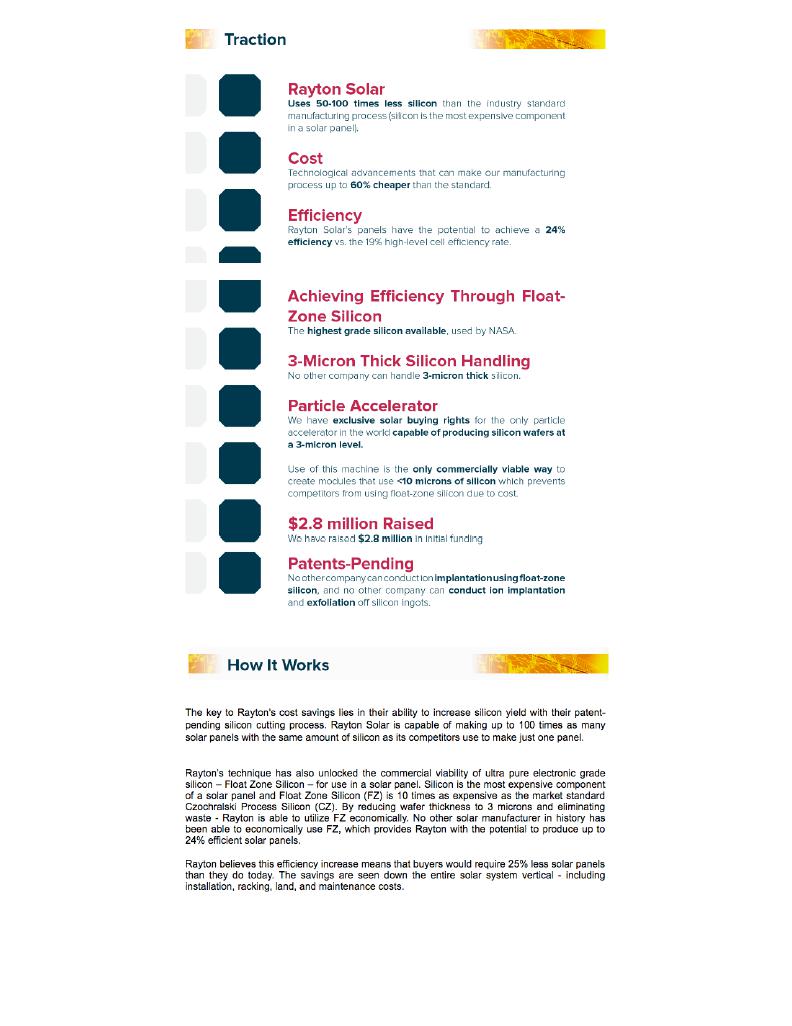
3
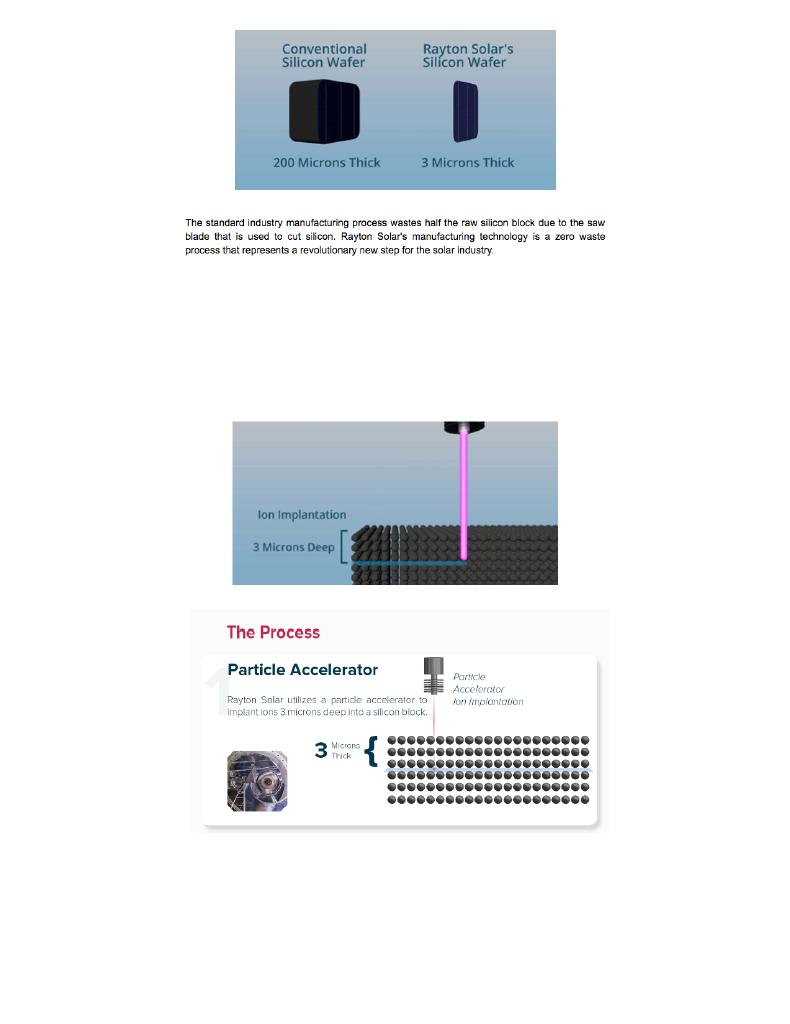
4

5

6

7

8

9

10

11

12
Explanatory Note
Rayton Solar, Inc. has prepared this Form 1-A/A solely for the purpose of filing Exhibits 2.1, 2.2, 2.3, 6.1, 6.2, 6.3 and 13.
PART III
INDEX TO EXHIBITS
| 1. | Issuer Agreement with StartEngine Crowdfunding Inc.* |
| 2.1 | Certificate of Incorporation |
| 2.2 | Amendment to Certificate of Incorporation |
| 2.3 | Bylaws |
| 2.4 | First Amendment to Amended and Restated Bylaws* |
| 4. | Form of Subscription Agreement* |
| 6.1 | Joint Development Agreement dated as of August 11, 2014 by and between Phoenix Nuclear Laboratories, LLC and the Company |
| 6.2 | 2014 Equity Incentive Plan |
| 6.3 | Convertible Promissory Note with ReGen America Inc. |
| 8. | Form of Escrow Agreement with Provident Trust Group LLC* |
| 11. | Consent of Auditing Accountant, dbbmckennon* |
| 12. | Attorney opinion on legality of the offering* |
|
13.
15. |
“Test the waters” materials
Draft offering statement previously submitted pursuant to Rule 252(d) (incorporated by reference)*
|
*Previously filed
SIGNATURES
Pursuant to the requirements of Regulation A, the issuer certifies that it has reasonable grounds to believe that it meets all of the requirements for filing on Form 1-A and has duly caused this Offering Statement to be signed on its behalf by the undersigned, thereunto duly authorized, in the City of Santa Monica, State of California, on December 22, 2016.
Rayton Solar, Inc.
/s/ Andrew Yakub
By Andrew Yakub, Chief Executive Officer of Rayton Solar, Inc.
This Offering Statement has been signed by the following persons in the capacities and on the dates indicated.
/s/ Andrew Yakub
Andrew Yakub, Chief Executive Officer, Principal Financial Officer, Principal Accounting Officer, and Chairman of the Board of Directors
Date: December 22, 2016
/s/ James Rosenzweig
James Rosenzweig, Director
Date: December 22, 2016
/s/ Mark Goorsky
Mark Goorsky, Director
Date: December 22, 2016
Exhibit 2.1
| State of Delaware | |
| Secretary of State | |
| Division of Corporations | |
| Delivered 04:37 PM 10/17/2013 | |
| FILED 03:48 PM 10/17/2013 | |
| SRV 131208746 - 5417018 FILE |
CERTIFICATE OF INCORPORATION
OF
Rayton Solar Inc.
FIRST: The name of the corporation is: Rayton Solar Inc.
SECOND: Its registered office in the State of Delaware is located at 16192 Coastal Highway, Lewes, Delaware 19958-9776, County of Sussex. The registered agent in charge thereof is Harvard Business Services, Inc.
THIRD: The purpose of the corporation is to engage in any lawful activity for which corporations may be organized under the General Corporation Law of Delaware.
FOURTH: The total number of shares of stock which the corporation is authorized to issue is 150,000,000 shares of common stock having a par value of $0.000100 per share.
FIFTH: The business and affairs of the corporation shall be managed by or under the direction of the board of directors, and the directors need not be elected by ballot unless required by the bylaws of the corporation.
SIXTH: This corporation shall be perpetual unless otherwise decided by a majority of the Board of Directors.
SEVENTH: In furtherance and not in limitation of the powers conferred by the laws of Delaware, the board of directors is authorized to amend or repeal the bylaws.
EIGHTH: The corporation reserves the right to amend or repeal any provision in this Certificate of Incorporation in the manner prescribed by the laws of Delaware.
NINTH: The incorporator is Richard H. Bell in care of Harvard Business Services, Inc., whose mailing address is 16192 Coastal Highway, Lewes, DE 19958.
TENTH: To the fullest extent permitted by the Delaware General Corporation Law a director of this corporation shall not be liable to the corporation or its stockholders for monetary damages for breach of fiduciary duty as a director.
I, Richard H. Bell, for the purpose of forming a corporation under the laws of the State of Delaware do make and file this certificate, and do certify that the facts herein stated are true; and have accordingly signed below, this October 17, 2013
| Signed and Attested to by: | /s/ Richard H. Bell | ||
| Harvard Business Services, Inc. | |||
| By Richard H. Bell, Incorporator |
Exhibit 2.2
AMENDMENT TO
CERTIFICATE OF INCORPORATION
OF RAYTON SOLAR INC.
The undersigned, Andrew Yakub, hereby certifies that:
1. He is the Chief Executive Officer of Rayton Solar Inc., a Delaware corporation (the “Corporation”), and is duly authorized by the unanimous written consent of the Board of Directors of the Corporation to execute this instrument.
2. This Certificate of Amendment of the Certificate of Incorporation was duly approved by the Corporation’s Board of Directors, in accordance with the applicable provisions of Sections 141 and 242 of the General Corporation Law of the State of Delaware, and duly adopted by written consent of the holders of a majority of the outstanding shares of common stock of the Corporation, in accordance with the applicable provisions of Sections 228 and 242 of the General Corporation Law of the State of Delaware.
3. Article FOURTH of the Certificate of Incorporation is hereby amended to read in full as follows:
“The total number of shares of stock which the corporation is authorized to issue is 200,000,000 shares of common stock having a par value of $0.0001 per share.”
4. This Certificate of Amendment is effective immediately upon filing.
IN WITNESS WHEREOF, the Corporation has caused this Certificate of Amendment of the Certificate of Incorporation to be executed this 30th day of August 2016.
| RAYTON SOLAR INC. | ||
| By: | /s/ Andrew Yakub | |
| Andrew Yakub | ||
| Chief Executive Officer | ||
Exhibit 2.3
AMENDED AND RESTATED
BYLAWS
OF
RAYTON SOLAR, INC.,
a Delaware Corporation
Effective February 18, 2014
Table of Contents
| Article I – Stockholders | 4 | |
| 1. | Annual Meeting | 4 |
| 2. | Special Meetings | 4 |
| 3. | Notice of Meetings | 4 |
| 4. | Adjourned Meetings | 4 |
| 5. | Quorum | 5 |
| 6. | Voting and Proxies | 5 |
| 7. | Action at Meeting | 5 |
| 8. | Presiding Officer | 5 |
| 9. | Conduct of Meetings | 6 |
| 10. | Action without a Meeting | 6 |
| 11. | Stockholder Lists | 6 |
| Article II - Directors | 6 | |
| 1. | Powers | 6 |
| 2. | Number and Qualification | 7 |
| 3. | Vacancies | 7 |
| 4. | Tenure | 7 |
| 5. | Removal | 7 |
| 6. | Meetings | 7 |
| 7. | Notice of Meetings | 7 |
| 8. | Quorum | 8 |
| 9. | Action at Meeting | 8 |
| 10. | Action by Consent | 8 |
| 11. | Committees | 8 |
| Article III - Officers | 11 | |
| 1. | Enumeration | 11 |
| 2. | Election | 11 |
| 3. | Qualification | 11 |
| 4. | Tenure | 11 |
| 5. | Removal | 11 |
| 6. | Vacancies | 12 |
| 7. | Chairman and Vice Chairman of the Board of Directors | 12 |
| 8. | Chief Executive Officer | 12 |
| 9. | President | 12 |
| 10. | Vice Presidents and Assistant Vice Presidents | 12 |
| 11. | Treasurer and Assistant Treasurers | 12 |
| 12. | Secretary and Assistant Secretaries | 13 |
| 13. | Other Powers and Duties | 13 |
| Article IV - Capital Stock | 13 | |
| 1. | Certificates of Stock | 13 |
| 2. | Transfers | 13 |
| 3. | Record Holders | 14 |
| 4. | Record Date | 14 |
| 5. | Lost Certificates | 14 |
| 2 |
| Article V - Indemnification | 15 | |
| 1. | Definitions | 16 |
| 2. | Indemnification of Directors and Officers | 16 |
| 3. | Indemnification of Non-Officer Employees | 16 |
| 4. | Advancement of Expenses to Directors and Officers Prior to Final Disposition | 17 |
| 5. | Advancement of Expenses to Non-Officer Employees Prior to Final Disposition | 17 |
| 6. | Contractual Nature of Rights | 18 |
| 7. | Non-Exclusivity of Rights | 18 |
| 8. | Insurance | 18 |
| 9. | Other Indemnification | 19 |
| 10. | Merger or Consolidation | 19 |
| Article VI - Miscellaneous Provisions | 19 | |
| 1. | Fiscal Year | 19 |
| 2. | Seal | 19 |
| 3. | Execution of Instruments | 19 |
| 4. | Voting of Securities | 19 |
| 5. | Resident Agent | 19 |
| 6. | Corporate Records | 19 |
| 7. | Dividends | 20 |
| 8. | Checks, Drafts or Orders | 20 |
| 9. | Amendments | 20 |
| 10. | Waiver of Notice | 20 |
| 11. | Conflict with Other Documents | 20 |
| Article VII – Offices | 20 | |
| 1. | Registered Office | 20 |
| 2. | Other Offices | 20 |
| 3 |
AMENDED AND RESTATED BYLAWS
of
RAYTON SOLAR, INC.
(the “Corporation”)
Article I - Stockholders
1. Annual Meeting. The annual meeting of stockholders shall be held for the election of directors each year at such place, date and time as shall be designated by the board of directors of the Corporation (the “Board of Directors”). Any other proper business may be transacted at the annual meeting. If no date for the annual meeting is established or said meeting is not held on the date established as provided above, a special meeting in lieu thereof may be held or there may be action by written consent of the stockholders on matters to be voted on at the annual meeting, and such special meeting or written consent shall have for the purposes of these Bylaws or otherwise all the force and effect of an annual meeting.
2. Special Meetings. Special meetings of stockholders may be called for any purpose (including, without limitation, the filling of vacancies on the Board of Directors and the election of new members of the Board of Directors). Such special meetings may be called at any time by the Chief Executive Officer, if one is elected, or, if there is no Chief Executive Officer, a President, or by the Board of Directors, or by any stockholder of the Corporation holding 25% or more of the issued and outstanding capital stock of the Corporation (on a fully-diluted basis), but such special meetings may not be called by any other person or persons. The call for the meeting shall state the place, date, hour and purposes of the meeting. Only the purposes specified in the notice of special meeting shall be considered or dealt with at such special meeting.
3. Notice of Meetings. Whenever stockholders are required or permitted to take any action at a meeting, a notice stating the place, if any, date and hour of the meeting, the means of remote communications, if any, by which stockholders and proxyholders may be deemed to be present and vote at such meeting and, in case of a special meeting, the purpose or purposes of the meeting, shall be given by the Secretary (or other person authorized by these Bylaws or by law) not less than ten (10) nor more than sixty (60) days before the meeting to each stockholder entitled to vote thereat and to each stockholder, if any, who, under the certificate of incorporation of the Corporation (as amended, modified or supplemented from time to time, the “Certificate of Incorporation”) or under these Bylaws is entitled to such notice. Except as otherwise provided in the Certificate of Incorporation, if mailed, notice is given when deposited in the mail, postage prepaid, directed to such stockholder at such stockholder’s address as it appears in the records of the Corporation. Without limiting the manner by which notice otherwise may be effectively given to stockholders, any notice to stockholders may be given by electronic transmission in the manner provided in Section 232 of the Delaware General Corporation Law (the “DGCL”).
4. Adjourned Meetings. If a meeting is adjourned to another time or place, notice need not be given of the adjourned meeting if the time and place, if any, and the means of remote communications, if any, by which stockholders and proxyholders may be deemed to be present in person and vote at such adjourned meeting are announced at the meeting at which the adjournment is taken, except that if the adjournment is for more than thirty (30) days, or if after the adjournment a new record date is fixed for the adjourned meeting, notice of the adjourned meeting shall be given to each stockholder of record entitled to vote at the meeting.
| 4 |
5. Quorum. The holders of a majority in interest of all stock issued, outstanding and entitled to vote at a meeting, present in person or represented by proxy, shall constitute a quorum. Any meeting may be adjourned from time to time by a majority of the votes properly cast upon the question, whether or not a quorum is present.
6. Voting and Proxies. Except as otherwise provided by the Certificate of Incorporation or law, stockholders shall have one vote for each share of stock entitled to vote owned by them of record according to the books of the Corporation. Each stockholder entitled to vote at a meeting of stockholders or to express consent or dissent to corporate action in writing without a meeting may authorize another person or persons to act for him by proxy. Every proxy must be signed by the stockholder granting the proxy or by his attorney-in-fact. No proxy shall be voted or acted upon after three (3) years from its date, unless the proxy provides for a longer period. Proxies shall be filed with the secretary of the meeting, or of any adjournment thereof. Except as otherwise limited therein, proxies shall entitle the persons authorized thereby to vote at any adjournment of such meeting. A proxy purporting to be executed by or on behalf of a stockholder shall be deemed valid unless challenged at or prior to its exercise and the burden of proving invalidity shall rest on the challenger. A proxy with respect to stock held in the name of two or more persons shall be valid if executed by one of them unless at or prior to exercise of the proxy the Corporation receives a specific written notice to the contrary from any one of them.
7. Action at Meeting. When a quorum is present, any matter before the meeting shall be decided by vote of the holders of a majority of the shares of stock voting on such matter except where a larger vote is required by law, the Certificate of Incorporation or these Bylaws. Any election of directors by stockholders shall be determined by a plurality of the votes cast, except where a larger vote is required by law, the Certificate of Incorporation or these Bylaws. The Corporation shall not directly or indirectly vote any share of its own stock; provided, however, that the Corporation may vote shares which it holds in a fiduciary capacity to the extent permitted by law.
8. Presiding Officer. Meetings of stockholders shall be presided over by the Chairman of the Board of Directors, if one is elected, or in his or her absence, the Vice Chairman of the Board of Directors, if one is elected, or if neither is elected or in their absence, the Chief Executive Officer. The Board of Directors shall have the authority to appoint a temporary presiding officer to serve at any meeting of the stockholders if the Chairman of the Board of Directors, the Vice Chairman of the Board of Directors or the Chief Executive Officer is unable to do so for any reason.
| 5 |
9. Conduct of Meetings. The Board of Directors may adopt by resolution such rules and regulations for the conduct of the meeting of stockholders as it shall deem appropriate. Except to the extent inconsistent with such rules and regulations as adopted by the Board of Directors, the presiding officer of any meeting of stockholders shall have the right and authority to prescribe such rules, regulations and procedures and to do all such acts as, in the judgment of such chairman, are appropriate for the proper conduct of the meeting. Such rules, regulations or procedures, whether adopted by the Board of Directors or prescribed by the presiding officer of the meeting, may include, without limitation, the following: (a) the establishment of an agenda or order of business for the meeting; (b) rules and procedures for maintaining order at the meeting and the safety of those present; (c) limitations on attendance at or participation in the meeting to stockholders of record of the Corporation, their duly authorized and constituted proxies or such other persons as the chairman of the meeting shall determine; (d) restrictions on entry to the meeting after the time fixed for the commencement thereof; and (e) limitations on the time allotted to questions or comments by participants. Unless and to the extent determined by the Board of Directors or the presiding officer of the meeting, meetings of stockholders shall not be required to be held in accordance with the rules of parliamentary procedure.
10. Action without a Meeting. Except as otherwise provided in the Certificate of Incorporation, any action required or permitted by law to be taken at any annual or special meeting of stockholders, may be taken without a meeting, without prior notice and without a vote, if a consent or consents in writing, setting forth the action so taken, shall be signed by the holders of outstanding stock having not less than the minimum number of votes that would be necessary to authorize or take such action at a meeting at which all shares entitled to vote thereon were present and voted and shall be delivered to the Corporation by delivery to its registered office, by hand or by certified mail, return receipt requested, or to the Corporation's principal place of business or to the officer of the Corporation having custody of the minute book. Every written consent shall bear the date of signature and no written consent shall be effective unless, within sixty (60) days of the earliest dated consent delivered pursuant to these Bylaws, written consents signed by a sufficient number of stockholders entitled to take action are delivered to the Corporation in the manner set forth in these Bylaws. Prompt notice of the taking of the corporate action without a meeting by less than unanimous written consent shall be given to those stockholders who have not consented in writing.
11. Stockholder Lists. The officer who has charge of the stock ledger of the Corporation shall prepare and make, at least ten (10) days before every meeting of stockholders, a complete list of the stockholders entitled to vote at the meeting, arranged in alphabetical order, and showing the address of each stockholder and the number of shares registered in the name of each stockholder. Nothing contained in this Section 11 shall require the Corporation to include electronic mail addresses or other electronic contact information on such list. Such list shall be open to the examination of any stockholder, for any purpose germane to the meeting, for a period of at least ten (10) days prior to the meeting in the manner provided by law. The list shall also be open to the examination of any stockholder during the whole time of the meeting as provided by law.
Article II- Directors
1. Powers. The business of the Corporation shall be managed by or under the direction of the Board of Directors, who may exercise all the powers of the Corporation except as otherwise provided by law, the Certificate of Incorporation or these Bylaws. In the event of a vacancy in the Board of Directors, the remaining directors, except as otherwise provided by law, may exercise the powers of the full Board of Directors until the vacancy is filled.
| 6 |
2. Number and Qualification. Except as otherwise provided in the Certificate of Incorporation or these Bylaws, the number of directors which shall constitute the whole Board of Directors as of the effective date of these Bylaws shall be determined from time to time by resolution of the Board of Directors. Directors need not be stockholders.
3. Vacancies. Except as otherwise provided in the Certificate of Incorporation, any vacancy in the Board of Directors, however occurring, may be filled by a vote of holders of a majority of the shares of stock entitled to vote in the election of directors pursuant to the Certificate of Incorporation, and the directors so elected shall hold office until the next annual meeting of the stockholders and until their successors are elected and qualified or until their earlier resignation or removal.
4. Tenure. Except as otherwise provided by law, the Certificate of Incorporation or these Bylaws, directors shall hold office until their successors are elected and qualified or until their earlier resignation or removal. Any director may resign at any time upon notice given in writing or by electronic transmission to the Corporation. Such resignation shall be effective upon receipt unless it is specified to be effective at some other time or upon the happening of some other event.
5. Removal. To the extent permitted by law, except as otherwise provided by the Certificate of Incorporation, a director may be removed from office with or without cause by vote of the holders of a majority of the shares of stock entitled to vote in the election of directors pursuant to the Certificate of Incorporation.
6. Meetings. Regular meetings of the Board of Directors may be held at such time, date and place as may be determined by the Board of Directors. Special meetings of the Board of Directors may be called, orally or in writing, by the Chairman of the Board, the Chief Executive Officer, if one is elected, or, if there is no Chief Executive Officer, a President, or by three (3) or more directors, by delivering notice of such meeting to the directors in accordance with Section 8 of this Article II. Directors may participate in meetings of the Board of Directors by means of conference telephone or other communications equipment by means of which all directors participating in the meeting can hear each other, and participation in a meeting in accordance herewith shall constitute presence in person at such meeting.
7. Notice of Meetings. Regular and special meetings of the Board of Directors shall require notice in accordance with this Section 7, provided that no notice shall be required for regular meetings of the Board of Directors held immediately after the annual meeting of the Stockholders and meetings that are adjourned pursuant to Section 9 of this Article II. Notice of the time, date and place of all regular and special meetings of the Board of Directors shall be given to each director by the Secretary, or Assistant Secretary, or in case of the death, absence, incapacity or refusal of such persons, by the officer or one of the directors calling the meeting. Notice shall be given to each director in person, by telephone, by mail, by facsimile, electronic mail or other form of electronic communications, sent to such director’s business or home address at least twenty-four (24) hours in advance of the meeting, or by written notice mailed to such director’s business or home address at least forty eight (48) hours in advance of the meeting.
| 7 |
8. Quorum. At any meeting of the Board of Directors, a majority of the total number of directors shall constitute a quorum for the transaction of business. If a quorum shall not be present at any meeting of the Board of Directors, the directors present thereat may adjourn the meeting from time to time to another place, time or date, without notice other than announcement at the meeting until a quorum shall be present.
9. Action at Meeting. Except as otherwise provided by law, the Certificate of Incorporation or these Bylaws, at any meeting of the Board of Directors at which a quorum is present, a majority of the directors present may take any action on behalf of the Board of Directors.
10. Action by Consent. Any action required or permitted to be taken at any meeting of the Board of Directors may be taken without a meeting if all members of the Board of Directors consent thereto in writing or by electronic transmission, and the writing or writings or electronic transmission or transmissions are filed with the records of the meetings of the Board of Directors. Such filing shall be in paper form if the minutes are maintained in paper form and shall be in electronic form if the minutes are maintained in electronic form. Any reference herein to a resolution made at a meeting of the Board of Directors shall include an action taken by written consent in lieu of a meeting.
11. Committees.
(a) Standing Committees.
(i) Number and Membership. There shall be two (2) standing committees (each a “Standing Committee”) of the Board of Directors which shall be comprised only of directors. The Standing Committees shall be an audit committee (the “Audit Committee”) and a compensation committee (the “Compensation Committee”). The Board of Directors, by resolution adopted by a majority of the number of directors fixed by these Bylaws, shall elect the membership of each Standing Committee in accordance with the terms of clauses (b) and (c) of this Section 11, who shall serve at the pleasure of the Board of Directors.
(ii) Quorum and Manner of Acting. A majority of the members of any Standing Committee serving at the time of any meeting thereof shall constitute a quorum for the transaction of business at such meeting. The action of a majority of those members present at a Standing Committee meeting at which a quorum is present shall constitute the act of the Standing Committee.
(iii) Conduct of Meetings. Any action required or permitted to be taken by any Standing Committee may be taken without a meeting if all members of the Standing Committee consent in writing to the adoption of a resolution authorizing the action. Standing Committee members may participate in meetings by means of telephone conference or other communications equipment by means of which all Standing Committee members participating in the meeting can hear each other, and participation in a meeting in accordance herewith shall constitute presence in person at such meeting. The resolutions and written consents of the members shall be filed with the minutes of the proceedings of the Standing Committee.
| 8 |
(iv) Meetings and Minutes. Notice of Standing Committee meetings shall be given in the same manner as notice for special meetings of the Board of Directors as provided in Section 7 of this Article II. Subject to the foregoing, and unless the Board of Directors shall otherwise decide, each Standing Committee shall fix its rules of procedure, determine its action and fix the time and place of its meetings. Special meetings of a Standing Committee may be held at anytime and any place upon the call of the Chairman of the Board of Directors, the Chairman of the Standing Committee or any two (2) members of the Standing Committee. The person or persons calling any such meeting shall use reasonable efforts to contact all members of such Standing Committee to schedule such meeting and make a good faith attempt to schedule such meeting, which may be held whether in person or in any of the formats set forth in clause (iii) above, at a time reasonably convenient for all such members. If the meeting is to be held in person, good faith efforts will be made to conduct the meeting at a place that is reasonably convenient for members of such Standing Committee. Each Standing Committee shall keep minutes of all meetings which shall be at all times available to directors. Action taken by a Standing Committee shall be reported promptly to the Board of Directors but not less frequently than quarterly.
(v) Term of Office. Members of each Standing Committee shall be elected as above provided and shall hold office until their successors are elected by the Board of Directors or until such Standing Committee is dissolved by the Board of Directors.
(vi) Resignation and Removal. Any member of a Standing Committee may resign at any time by giving written notice of his intention to do so to the Chairman of the Board of Directors or the Secretary of the Corporation, or may be removed, with or without cause, at any time by such vote of the Board of Directors as would suffice for his election.
(vii) Vacancies. Subject to compliance with clauses (b)(i) and (c)(i) of this Section 11, as applicable, any vacancy occurring in a Standing Committee resulting from any cause whatsoever may be filled by a majority of the number of directors fixed by these Bylaws.
(b) Audit Committee.
(i) How Constituted. The Audit Committee shall consist of not less than three (3) directors, all of whom shall have requisite working familiarity with basic finance and accounting practices. The Chairman of the Audit Committee shall be appointed by the Board of Directors. If the Chairman of the Audit Committee will not be present at a meeting, he or she may designate any member of the Audit Committee to preside at the meeting.
| 9 |
(ii) Primary Responsibilities. The primary responsibilities of the Audit Committee shall consist of: (A) recommending the selection of independent accountants and auditors; (B) reviewing the scope of the accountant's audit and approval of any non-audit services to be performed by the independent accountants; and (C) reviewing annual audits and accounting practices. The Audit Committee shall meet at least once each year with the Corporation’s independent auditors in separate executive session or be provided with the opportunity for full and frank discussion without members of senior management present. The Board of Directors may adopt a charter of the Audit Committee setting forth in greater detail the purposes, objectives and duties of the Audit Committee.
(c) Compensation Committee.
(i) How Constituted. The Compensation Committee shall consist of not less than three (3) directors. The Chairman of the Compensation Committee shall be appointed by the Board of Directors. If the Chairman of the Compensation Committee will not be present at a meeting, he or she may designate any member of the Compensation Committee to preside at the meeting.
(ii) Primary Responsibilities. The primary responsibilities of the Compensation Committee shall consist of the following: (A) reviewing Board of Directors compensation policies and evaluating the compensation of the Chief Executive Officer and other senior management based on criteria as set forth below; (B) evaluating annually the performance of the Chief Executive Officer and reviewing senior management performance evaluations, using such criteria as performance of the business, accomplishments of long-term strategic objectives and management development and any other criteria the Compensation Committee deems appropriate; (C) reviewing and reporting to the Board of Directors the recommended compensation of all officers of the Corporation; (D) reviewing total compensation and benefit designs and practices for all Corporation employees; and (E) taking actions that the Compensation Committee determines to be necessary or advisable to implement and administer the Corporation’s 2014 Equity Incentive Plan and any successor plan thereafter adopted by the Board of Directors, all to the fullest extent permitted under, and in accordance with, the terms of such plans, including (without limitation) the following: (1) designating employees to participate in the plans; (2) determining the size, types, terms and conditions, and recipients of grants under the plans; (3) approving forms and authorize execution of award agreements or instruments reflecting awards made under the plans; (4) construing and interpreting the plans and agreements or instruments entered into thereunder; (5) establishing, amending, and waiving rules and regulations for administering the plans; and (6) amending terms and conditions of outstanding awards, agreements, and instruments under the plans.
| 10 |
(iii) Fair Market Compensation. In the determination of compensation pursuant to clause (c)(ii) above, the Compensation Committee shall take into consideration the compensation paid to similarly situated employees in companies in the same or similar businesses and of comparable size, maturity and financial performance to those of the Corporation’s.
(d) Other Committees. The Board of Directors, by resolution adopted by a majority of the number of directors fixed by these Bylaws, may establish such other standing or special committees of the Board of Directors as it may deem advisable, consisting of not less than two (2) directors. The members, terms and authority of such committees shall be as set forth in the resolutions establishing the same. Any such committee, to the extent permitted by law and to the extent provided in the resolution of the Board of Directors, shall have and may exercise all the powers and authority of the Board of Directors in the management of the business and affairs of the Corporation, but no such committee shall have the power or authority in reference to the following: (i) approving or adopting, or recommending to the stockholders, any action or matter expressly required by the DGCL, the Certificate of Incorporation to be submitted to stockholders for approval or (ii) adopting, amending or repealing any provision of these Bylaws. Except as the Board of Directors may otherwise determine, any such committee may make rules for the conduct of its business, but in the absence of such rules its business shall be conducted so far as possible in the same manner as is provided in these Bylaws in clause (a) of this Section 11.
Article III- Officers
1. Enumeration. The officers of the Corporation may consist of a President, a Treasurer, a Secretary, and such other officers, including, without limitation, a Chief Executive Officer and one or more Vice Presidents (including Executive Vice Presidents or Senior Vice Presidents), Assistant Vice Presidents, Assistant Treasurers and Assistant Secretaries, as the Board of Directors may determine. The Board of Directors may elect from among its members a Chairman of the Board of Directors and a Vice Chairman of the Board of Directors.
2. Election. The President, Treasurer and Secretary shall be elected annually by the Board of Directors at their first meeting following the annual meeting of stockholders. Other officers may be chosen by the Board of Directors at such meeting or at any other meeting.
3. Qualification. No officer need be a stockholder or a director of the Corporation. Any two or more offices may be held by the same person.
4. Tenure. Except as otherwise provided by the Certificate of Incorporation or by these Bylaws, each of the officers of the Corporation shall hold office until the first meeting of the Board of Directors following the next annual meeting of stockholders and until such officer’s successor is elected and qualified or until such officer’s earlier resignation or removal. Any officer may resign by delivering his or her written resignation to the Corporation, and such resignation shall be effective upon receipt unless it is specified to be effective at some other time or upon the happening of some other event.
5. Removal. The Board of Directors may remove any officer with or without cause by a vote of a majority of the directors then in office.
| 11 |
6. Vacancies. Any vacancy in any office may be filled for the unexpired portion of the term by the Board of Directors.
7. Chairman and Vice Chairman of the Board of Directors. Except as otherwise provided by the Board of Directors, the Chairman of the Board of Directors, if one is elected, shall preside, when present, at all meetings of the stockholders and the Board of Directors. The Chairman of the Board of Directors shall have such other powers and shall perform such duties as the Board of Directors may from time to time designate. Except as provided by the Board of Directors, in the absence of the Chairman of the Board of Directors, the Vice Chairman of the Board of Directors, if one is elected, shall preside, when present, at all meetings of the stockholders and the Board of Directors. The Vice Chairman of the Board of Directors shall have such other powers and shall perform such duties as the Board of Directors may from time to time designate.
8. Chief Executive Officer. In the absence of the Chairman of the Board of Directors and the Vice Chairman of the Board of Directors, the Chief Executive Officer, if one is elected, shall preside, when present, at all meetings of the stockholders and the Board of Directors. The Chief Executive Officer shall have such powers and shall perform such duties as the Board of Directors may from time to time designate.
9. President. The President shall, subject to the direction of the Board of Directors, have general supervision and control of the Corporation’s business and shall see that all orders and resolutions of the Board of Directors are carried into effect. In the absence of the Chairman of the Board of Directors, Vice Chairman of the Board of Directors and Chief Executive Officer, the President shall preside, when present, at all meetings of stockholders and the Board of Directors. The President shall have such other powers and shall perform such duties as the Board of Directors may from time to time designate.
10. Vice Presidents and Assistant Vice Presidents. Any Vice President (including any Executive Vice President or Senior Vice President) and any Assistant Vice President shall have such powers and shall perform such duties as the Board of Directors may from time to time designate.
11. Treasurer and Assistant Treasurers. The Treasurer shall, subject to the direction of the Board of Directors, have general charge of the financial affairs of the Corporation and shall cause to be kept accurate books of account. The Treasurer shall have custody of all funds, securities, and valuable documents of the Corporation, except as the Board of Directors may otherwise provide. The Treasurer shall disburse the funds of the Corporation as may be ordered by the Board of Directors, taking proper vouchers for such disbursements, and shall render to the President and the Board of Directors, at its regular meetings, or when the Board of Directors so requires, an account of all transactions as Treasurer and of the financial condition of the Corporation. The Treasurer shall have such other powers and shall perform such duties as the Board of Directors may from time to time designate. If required by the Board of Directors, the Treasurer shall give the Corporation a bond in such sum and with such surety or sureties as shall be satisfactory to the Board of Directors for the faithful performance of the duties of the office of the Treasurer and for the restoration to the Corporation, in case of the Treasurer's death, resignation, retirement or removal from office, of all books, papers, vouchers, money and other property of whatever kind in the Treasurer's possession or under the Treasurer's control belonging to the Corporation. Any Assistant Treasurer shall have such powers and perform such duties as the Board of Directors may from time to time designate.
| 12 |
12. Secretary and Assistant Secretaries. The Secretary shall record the proceedings of all meetings of the stockholders and the Board of Directors (including committees of the Board of Directors) in books kept for that purpose. In the absence of the Secretary from any such meeting an Assistant Secretary, or if such person is absent, a temporary secretary chosen at the meeting, shall record the proceedings thereof. The Secretary shall have custody of the seal of the Corporation and the Secretary or any Assistant Secretary, if there be one, shall have authority to affix the same to any instrument requiring it and when so affixed, it may be attested by the signature of the Secretary or by the signature of any such Assistant Secretary. The Board of Directors may give authorization to any other officer to affix the seal of the Corporation and to attest to the affixing by such officer's signature. The Secretary shall have charge of the stock ledger (which may, however, be kept by any transfer or other agent of the Corporation), shall see that all books, reports, statements, certificates and other documents and records required by law to be kept or filed are properly kept or filed, and shall have such other duties and powers as may be designated from time to time by the Board of Directors. Any Assistant Secretary shall have such powers and perform such duties as the Board of Directors may from time to time designate.
13. Other Powers and Duties. Subject to these Bylaws, each officer of the Corporation shall have in addition to the duties and powers specifically set forth in these Bylaws, such duties and powers as are customarily incident to such officer’s office, and such duties and powers as may be designated from time to time by the Board of Directors.
Article IV- Capital Stock
1. Certificates of Stock. Each stockholder shall be entitled to a certificate of capital stock of the Corporation in such form as may from time to time be prescribed by the Board of Directors, certifying the number of shares owned by such holder in the Corporation. Such certificate shall be signed by a President or a Vice President, and by the Treasurer, an Assistant Treasurer, the Secretary or an Assistant Secretary. Such signatures may be a facsimile. In case any officer, transfer agent or registrar who has signed or whose facsimile signature has been placed on such certificate shall have ceased to be such officer, transfer agent or registrar before such certificate is issued, it may be issued by the Corporation with the same effect as if such person were such officer, transfer agent or registrar at the time of its issue. All certificates for shares of stock shall be consecutively numbered or otherwise identified. Every certificate for shares of stock which are subject to any restriction on transfer and every certificate issued when the Corporation is authorized to issue more than one class or series of stock shall contain such legend with respect thereto as is required by law. The Corporation shall be permitted to issue fractional shares.
2. Transfers. Subject to any restrictions on transfer applicable to such shares, shares of stock shall only be transferred on the books of the Corporation by the holder of record thereof or by such holder’s attorney duly authorized in writing, upon surrender to the Corporation or its transfer agent of the certificate or certificates therefor properly endorsed or accompanied by a written assignment or power of attorney properly executed, with transfer stamps (if necessary) affixed, and with such proof of the authenticity of signature as the Corporation or its transfer agent may reasonably require. In that event the Corporation shall issue a new certificate to the person entitled thereto, cancel the old certificate or certificates, and record the transaction on its books.
| 13 |
3. Record Holders. Except as may otherwise be required by law, by the Certificate of Incorporation or by these Bylaws, the Corporation shall be entitled to treat the record holder of stock as shown on its books as the owner of such stock for all purposes, including the payment of dividends and the right to vote with respect thereto, regardless of any transfer, pledge or other disposition of such stock, until the shares have been transferred on the books of the Corporation in accordance with the requirements of these Bylaws. It shall be the duty of each stockholder to notify the Corporation of such stockholder’s post office address.
4. Record Date. Except as otherwise provided in the Certificate of Incorporation, in order that the Corporation may determine the stockholders entitled to notice of or to vote at any meeting of stockholders or any adjournment thereof, or to consent to corporate action in writing without a meeting, or entitled to receive payment of any dividend or other distribution or allotment of any rights, or entitled to exercise any rights in respect of any change, conversion or exchange of stock or for the purpose of any other lawful action, the Board of Directors may fix, in advance, a record date, which shall not precede the date on which it is established, and which shall not be more than sixty (60) nor less than ten (10) days before the date of such meeting, more than ten (10) days after the date on which the record date for stockholder consent without a meeting is established, nor more than sixty (60) days prior to any other action. In such case only stockholders of record on such record date shall be so entitled notwithstanding any transfer of stock on the books of the Corporation after the record date.
If no record date is fixed, (a) the record date for determining stockholders entitled to notice of or to vote at a meeting of stockholders shall be at the close of business on the day next preceding the day on which notice is given, or, if notice is waived, at the close of business on the next preceding the day on which the meeting is held, (b) the record date for determining stockholders entitled to consent to corporate action in writing without a meeting, when no prior action by the Board of Directors is necessary, shall be the first date on which a signed written consent setting forth the action taken or proposed to be taken is delivered to the Corporation by delivery to its registered office in this state, to its principal place of business, or to an officer or agent of the Corporation having custody of the book in which proceedings of meetings of stockholders are recorded, and (c) the record date for determining stockholders for any other purpose shall be at the close of business on the day on which the Board of Directors adopts the resolution relating thereto.
5. Lost Certificates. The Corporation may issue a new certificate of stock in the place of any certificate theretofore issued by it, alleged to have been mutilated, lost, stolen or destroyed, and the Corporation may require the owner of such lost, stolen or destroyed certificate, or his legal representative, to indemnify the Corporation, in a reasonable manner, against any claim that may be made against it on account of the alleged loss, theft or destruction of any such certificate or the issuance of such new certificate.
| 14 |
Article V - Indemnification
1. Definitions. For purposes of this Article V:
(a) “Corporate Status” describes the status of a person who is serving or has served as a Director or Officer of the Corporation or its Subsidiaries, or is serving or has served at the request of the Corporation or its Subsidiaries as a director, partner, trustee, officer, employee, fiduciary, or agent of any other Corporation, partnership, limited liability company, joint venture, trust, foundation, association, organization, employee benefit plan or other enterprise or legal entity. For purposes of this Section 1(a), an Officer or Director of the Corporation who is serving or has served as a director, partner, trustee, officer, employee, fiduciary, or agent of a Subsidiary shall be deemed to be serving at the request of the Corporation;
(b) “Director” means any person who serves or has served the Corporation or its Subsidiaries as a director on the Board of Directors of the Corporation or its Subsidiaries;
(c) “Disinterested Director” means, with respect to each Proceeding in respect of which indemnification is sought hereunder, a Director of the Corporation or its Subsidiaries who is not and was not a party to such Proceeding;
(d) “Expenses” means all reasonable attorneys fees, retainers, court costs, transcript costs, fees of expert witnesses, private investigators and professional advisors (including, without limitation, accountants and investment bankers), travel expenses, duplicating costs, printing and binding costs, costs of preparation of demonstrative evidence and other courtroom presentation aids and devices, costs incurred in connection with document review, organization, imaging and computerization, telephone charges, postage, delivery service fees, and all other disbursements, costs or expenses of the type customarily incurred in connection with prosecuting, defending, preparing to prosecute or defend, investigating, being or preparing to be a witness in, settling or otherwise participating in, a Proceeding;
(e) “Non-Officer Employee” means any person who serves or has served as an employee or agent of the Corporation, but who is not or was not a Director or Officer;
(f) “Officer” means any person who serves or has served the Corporation or its Subsidiaries as an officer appointed by the Board of Directors of the Corporation or its Subsidiaries;
(g) “Proceeding” means any threatened, pending or completed action, suit, arbitration, alternate dispute resolution mechanism, inquiry, investigation, administrative hearing or other proceeding, whether civil, criminal, administrative, arbitrative or investigative; and
| 15 |
(h) “Subsidiary” shall mean any corporation, partnership, limited liability company, joint venture, trust or other entity of which the Corporation owns (either directly or through or together with another Subsidiary of the Corporation) either (i) a general partner, managing member or other similar interest or (ii) (A) 50% or more of the voting power of the voting capital equity interests of such corporation, partnership, limited liability company, joint venture or other entity, or (B) 50% or more of the outstanding voting capital stock or other voting equity interests of such corporation, partnership, limited liability company, joint venture or other entity.
2. Indemnification of Directors and Officers. Subject to the operation of Section 4 of this Article V of these Bylaws, each Director and Officer shall be indemnified and held harmless by the Corporation to the fullest extent authorized by the DGCL, as the same exists or may hereafter be amended (but, in the case of any such amendment, only to the extent that such amendment permits the Corporation to provide broader indemnification rights than such law permitted the Corporation to provide prior to such amendment) against any and all Expenses, judgments, penalties, damages, liabilities, losses, excise taxes, fines and amounts reasonably paid in settlement that are incurred by such Director or Officer or on such Director’s or Officer’s behalf in connection with any threatened, pending or completed Proceeding or any claim, issue or matter therein, which such Director or Officer is, or is threatened to be made, a party to or participant in by reason of such Director’s or Officer’s Corporate Status, if such Director or Officer acted in good faith and in a manner such Director or Officer reasonably believed to be in or not opposed to the best interests of the Corporation and, with respect to any criminal proceeding, had no reasonable cause to believe his or her conduct was unlawful; provided, however, that for any action or suit by or in the right of the Corporation, the indemnification hereunder shall be limited to Expenses actually and reasonably incurred by such Director or Officer and except that no indemnification under such circumstances shall be made in respect of any claim, issue or matter as to which such person shall have been adjudged to be liable to the Corporation unless and to the extent of a determination of entitlement to indemnification by the Court of Chancery of the State of Delaware. The rights of indemnification provided by this Section 2 shall continue as to a Director or Officer after he or she has ceased to be a Director or Officer and shall inure to the benefit of his or her heirs, executors, administrators and personal representatives. Notwithstanding the foregoing, the Corporation shall indemnify any Director or Officer seeking indemnification in connection with a Proceeding initiated by such Director or Officer only if such Proceeding was authorized by the Board of Directors of the Corporation, unless such Proceeding was brought to enforce an Officer or Director’s rights to indemnification or, in the case of Directors, advancement of Expenses under these Bylaws in accordance with the provisions set forth herein.
3. Indemnification of Non-Officer Employees. Subject to the operation of Section 5 of this Article V of these Bylaws, each Non-Officer Employee may, in the discretion of the Board of Directors of the Corporation, be indemnified by the Corporation to the fullest extent authorized by the DGCL, as the same exists or may hereafter be amended, against any or all Expenses, judgments, penalties, fines and amounts reasonably paid in settlement that are incurred by such Non-Officer Employee or on such Non-Officer Employee’s behalf in connection with any threatened, pending or completed Proceeding, or any claim, issue or matter therein, which such Non-Officer Employee is, or is threatened to be made, a party to or participant in by reason of such Non-Officer Employee’s Corporate Status, if such Non-Officer Employee acted in good faith and in a manner such Non-Officer Employee reasonably believed to be in or not opposed to the best interests of the Corporation and, with respect to any criminal proceeding, had no reasonable cause to believe his or her conduct was unlawful. The rights of indemnification provided by this Section 3 shall exist as to a Non-Officer Employee after he or she has ceased to be a Non-Officer Employee and shall inure to the benefit of his or her heirs, personal representatives, executors and administrators. Notwithstanding the foregoing, the Corporation may indemnify any Non-Officer Employee seeking indemnification in connection with a Proceeding initiated by such Non-Officer Employee only if such Proceeding was authorized by the Board of Directors of the Corporation.
| 16 |
4. Advancement of Expenses to Directors and Officers Prior to Final Disposition.
(a) The Corporation shall advance all Expenses incurred by or on behalf of any Director or Officer in connection with any Proceeding in which such Director or Officer is involved by reason of such Director’s or Officer’s Corporate Status within ten (10) days after the receipt by the Corporation of a written statement from such Director or Officer requesting such advance or advances from time to time, whether prior to or after final disposition of such Proceeding. Such statement or statements shall reasonably evidence the Expenses incurred by such Director or Officer and shall be preceded or accompanied by an undertaking by or on behalf of such Director or Officer to repay any Expenses so advanced if it shall ultimately be determined that such Director or Officer is not entitled to be indemnified against such Expenses.
(b) If a claim for advancement of Expenses hereunder by a Director or Officer is not paid in full by the Corporation within ten (10) days after receipt by the Corporation of documentation of Expenses and the required undertaking, such Director or Officer may at any time thereafter bring suit against the Corporation to recover the unpaid amount of the claim and if successful in whole or in part, such Director or Officer shall also be entitled to be paid the expenses of prosecuting such claim. The failure of the Corporation (including its Board of Directors or any committee thereof, independent legal counsel, or stockholders) to make a determination concerning the permissibility of such advancement of Expenses under this Article V shall not be a defense to the action and shall not create a presumption that such advancement is not permissible. The burden of proving that a Director or Officer is not entitled to an advancement of expenses shall be on the Corporation.
(c) In any suit brought by the Corporation to recover an advancement of expenses pursuant to the terms of an undertaking, the Corporation shall be entitled to recover such expenses upon a final adjudication that the Director or Officer has not met any applicable standard for indemnification set forth in the DGCL.
5. Advancement of Expenses to Non-Officer Employees Prior to Final Disposition.
(a) The Corporation may, at the discretion of the Board of Directors of the Corporation, advance any or all Expenses incurred by or on behalf of any Non-Officer Employee in connection with any Proceeding in which such is involved by reason of the Corporate Status of such Non-Officer Employee upon the receipt by the Corporation of a statement or statements from such Non-Officer Employee requesting such advance or advances from time to time, whether prior to or after final disposition of such Proceeding. Such statement or statements shall reasonably evidence the Expenses incurred by such Non-Officer Employee and shall be preceded or accompanied by an undertaking by or on behalf of such to repay any Expenses so advanced if it shall ultimately be determined that such Non-Officer Employee is not entitled to be indemnified against such Expenses.
| 17 |
(b) In any suit brought by the Corporation to recover an advancement of expenses pursuant to the terms of an undertaking, the Corporation shall be entitled to recover such expenses upon a final adjudication that the Non-Officer Employee has not met any applicable standard for indemnification set forth in the DGCL.
6. Contractual Nature of Rights.
(a) The foregoing provisions of this Article V shall be deemed to be a contract between the Corporation and each Director and Officer entitled to the benefits hereof at any time while this Article V is in effect, and any repeal or modification thereof shall not affect any rights or obligations then existing with respect to any state of facts then or theretofore existing or any Proceeding theretofore or thereafter brought based in whole or in part upon any such state of facts. If there exists any conflict between this Article V and any agreement for indemnification entered into between the Corporation and a Director, the terms and conditions of such indemnification agreement shall prevail.
(b) If a claim for indemnification hereunder by a Director or Officer is not paid in full by the Corporation within sixty (60) days after receipt by the Corporation of a written claim for indemnification, such Director or Officer may at any time thereafter bring suit against the Corporation in any court of competent jurisdiction to recover the unpaid amount of the claim, and if successful in whole or in part, such Director or Officer shall also be entitled to be paid the expenses of prosecuting such claim. The failure of the Corporation (including its Board of Directors or any committee thereof, independent legal counsel, or stockholders) to make a determination concerning the permissibility of such indemnification under this Article V shall not be a defense to the action and shall not create a presumption that such indemnification is not permissible. The burden of proving that a Director or Officer is not entitled to indemnification shall be on the Corporation.
(c) In any suit brought by a Director or Officer to enforce a right to indemnification hereunder, it shall be a defense that such Director or Officer has not met any applicable standard for indemnification set forth in the DGCL.
7. Non-Exclusivity of Rights. The rights to indemnification and advancement of Expenses set forth in this Article V shall not be exclusive of any other right which any Director or Officer, may have or hereafter acquire under any statute, provision of the Certificate of Incorporation or these Bylaws, agreement, vote of stockholders or Disinterested Directors or otherwise.
8. Insurance. The Corporation shall maintain insurance, at its expense, to protect itself and any Director or Officer against any liability asserted against or incurred by the Corporation or any such Director or Officer, or arising out of any such person’s Corporate Status, whether or not the Corporation would have the power to indemnify such person against such liability under the DGCL or the provisions of this Article V.
| 18 |
9. Other Indemnification. The Corporation’s obligation, if any, to indemnify any person under this Article V as a result of such person serving, at the request of the Corporation, as a director, partner, trustee, officer, employee, fiduciary, or agent of another corporation, partnership, joint venture, trust, employee benefit plan or other enterprise shall be reduced by any amount such person may collect as indemnification from such other corporation, partnership, joint venture, trust, employee benefit plan or enterprise.
10. Merger or Consolidation. For purposes of this Article V, references to "the Corporation" shall include, in addition to the resulting corporation, any constituent corporation (including any constituent of a constituent) absorbed in a consolidation or merger which, if its separate existence had continued, would have had power and authority to indemnify its Directors, or Officers, so that any person who is or was a Director or Officer of such constituent corporation, or is or was serving at the request of such constituent corporation as a Director or Officer of another corporation, partnership, joint venture, trust or other enterprise, shall stand in the same position under this Article V with respect to the resulting or surviving corporation as he or she would have with respect to such constituent corporation if its separate existence had continued.
Article VI - Miscellaneous Provisions
1. Fiscal Year. Except as otherwise determined by the Board of Directors, the fiscal year of the Corporation shall end on December 31 of each year.
2. Seal. The Board of Directors shall have power to adopt and alter the seal of the Corporation.
3. Execution of Instruments. Subject to any limitations which may be set forth in a resolution of the Board of Directors, all deeds, leases, transfers, contracts, bonds, mortgages, notes and other obligations to be entered into by the Corporation in the ordinary course of its business without director action may be executed on behalf of the Corporation by, the Chief Executive Officer, a President, or by any other officer, employee or agent of the Corporation as the Board of Directors, the Chief Executive Officer or the President may authorize.
4. Voting of Securities. Unless the Board of Directors otherwise provides, a President, any Vice President or the Treasurer may waive notice of and act on behalf of this Corporation, or appoint another person or persons to act as proxy or attorney in fact for this Corporation with or without discretionary power and/or power of substitution, at any meeting of stockholders or shareholders of any other corporation or organization, any of whose securities are held by this Corporation.
5. Resident Agent. The Board of Directors may appoint a resident agent upon whom legal process may be served in any action or proceeding against the Corporation.
6. Corporate Records. The original or attested copies of the Certificate of Incorporation, Bylaws and records of all meetings of the incorporators, stockholders and the Board of Directors and the stock and transfer records, which shall contain the names of all stockholders, their record addresses and the amount of stock held by each, shall be kept at the principal office of the Corporation, at the office of its counsel, or at an office of its transfer agent.
| 19 |
7. Dividends. Dividends upon the capital stock of the Corporation, subject to the provisions of the Certificate of Incorporation, if any, may be declared by the Board of Directors at any regular or special meeting, pursuant to law. Dividends may be paid in cash, in property, or in shares of the capital stock, subject to the provisions of the Certificate of Incorporation. Before payment of any dividend, there may be set aside out of any funds of the Corporation available for dividends such sum or sums as the directors from time to time, in their absolute discretion, think proper as a reserve or reserves to meet contingencies, or for equalizing dividends, or for repairing or maintaining any property of the Corporation, or any other purpose and the directors may modify or abolish any such reserve in the manner in which it was created.
8. Checks, Drafts or Orders. All checks, drafts, or other orders for the payment of money by or to the Corporation and all notes and other evidences of indebtedness issued in the name of the Corporation shall be signed by such officer or officers, agent or agents of the Corporation, and in such manner, as shall be determined by resolution of the Board of Directors or a duly authorized committee thereof.
9. Amendments. Except as provided in the Certificate of Incorporation, these Bylaws may be altered, amended or repealed, and new Bylaws may be adopted, by the stockholders or by the Board of Directors; provided, however, that (a) the Board of Directors may not alter, amend or repeal any provision of these Bylaws which by law, by the Certificate of Incorporation or by these Bylaws requires action by the stockholders and (b) except as provided in the Certificate of Incorporation, any alteration, amendment or repeal of these Bylaws by the Board of Directors and any new Bylaw adopted by the Board of Directors may be altered, amended or repealed by the stockholders.
10. Waiver of Notice. Whenever notice is required to be given under any provision of these Bylaws, a written waiver, signed by the person entitled to notice, or a waiver by electronic transmission by the person entitled to notice, whether before or after the time of the event for which notice is to be given, shall be deemed equivalent to notice. Attendance of a person at a meeting shall constitute a waiver of notice of such meeting, except when the person attends a meeting for the express purpose of objecting at the beginning of the meeting to the transaction of any business because the meeting is not lawfully called or convened. Neither the business to be transacted at, nor the purpose of, any meeting needs to be specified in any written waiver or any waiver by electronic transmission.
11. Conflict with Other Documents. If there exists any conflict between the provisions of these Bylaws and the provisions of the Certificate of Incorporation, the applicable provisions of the Certificate of Incorporation or Stockholders Agreement shall prevail.
Article VII- Offices
1. Registered Office. The registered office of the Corporation in the State of Delaware shall be located at 2140 South DuPont Highway, Camden, Delaware 19934, in the County of Kent. The name of the Corporation's registered agent at such address shall be Paracorp Incorporated. The registered office and/or registered agent of the Corporation may be changed from time to time by action of the Board of Directors.
2. Other Offices. The Corporation may also have offices at such other places, both within and without the State of Delaware, as the Board of Directors may from time to time determine or the business of the Corporation may require.
| 20 |
Exhibit 6.1
JOINT DEVELOPMENT AGREEMENT
THIS Joint Development Agreement (this “Agreement”) is entered into as of this 11th day of August, 2014 (the “Effective Date”) by Rayton Solar Inc., a Delaware corporation located at 25129 The Old Road, Suite 207, Stevenson Ranch, CA 91381 (“Rayton”), and Phoenix Nuclear Labs LLC, a Wisconsin limited liability company located at 2555 Industrial Drive, Monona, WI 53713 (“PNL”), for the purposes of setting forth their agreement as to certain research and development work to be performed by PNL and Rayton with respect to the Project.
RECITALS
WHEREAS, Rayton is in the business of manufacturing and marketing solar panels, and PNL is in the business of, among other things, developing and producing accelerator systems that utilize microwave ion sources (“MWS”); and
WHEREAS, the Parties wish to collaborate in the development of an ion implantation system.
NOW THEREFORE, in consideration of the promises, conditions and the mutual covenants hereinafter recited, Rayton and PNL agree as follows:
1 Definitions. Capitalized, definitional terms used herein shall have the meanings ascribed to them in Exhibit 1 attached hereto.
2 Scope of Project. The project (the “Project”) concerns the development of an Accelerator and consists of Phase I and Phase II (each as defined below). The Parties shall perform research and development work related to the Project, cooperate in executing the Project and make available their respective resources to work under the Project to bring the Project to completion according to the Project timelines set forth in this Article 2.
| 2.1 | Phase I of the Project. |
2.1.1 Phase I Tasks. Phase I of the Project (“Phase I”) shall consist of Task A, Task B and Task C as set forth below:
2.1.1.1 Scope of Task A. In Task A of Phase I of the Project (“Task A”), PNL shall, with assistance from Rayton engineers on site at PNL’s facility, (i) produce a modified MWS test stand (the “ISTS”) with at least 100 mA of extracted H+ current to allow for reliable, long-term operation with >100mA of extracted H+ current by (A) redesigning and building a larger calorimeter to remove the increased heat load created by the higher-current H+ beam, (B) increasing high voltage standoff and expand extraction lens stack to allow for higher-voltage extraction, and (C) simplifying and improving control interface to allow for easier MWS operation by Rayton personnel and (ii) draft a report demonstrating the extraction of the 100 mA of H+ beam current and detailing the conceptual design of the Accelerator (the “Task A Report”). Task A shall be completed upon submission to Rayton by PNL of the Task A Report (“Task A Completion”).
1
2.1.1.2 Scope of Task B. In Task B of Phase I of the Project (“Task B”), PNL, with assistance from Rayton engineers on site at PNL’s facility, shall (i) perform parametric studies on the upgraded ISTS in order to determine the maximum stable extracted current density and total beam current as a function of extraction voltage, hydrogen gas input, microwave power, and magnetic field profile and (ii) draft a report detailing such parametric studies and demonstrating that the upgraded ISTS can be operated continuously for 24 hours with the highest available extracted current (the “Task B Report”). Task B shall be completed upon submission to Rayton by PNL of the Task B Report (“Task B Completion”).
2.1.1.3 Scope of Task C. In Task C of Phase I of the Project (“Task C”), PNL shall, with involvement and assistance from Rayton engineers on site at PNL’s facility, (i) operate the upgraded ISTS with >100mA of extracted H+ current during a series of 24-hour-long test runs, (ii) perform a 120-hour test run to further demonstrate the stability of the upgraded ISTS, and (iii) draft a report demonstrating the results of such test runs (the “Task C Report”, and together with the Task A Report and the Task B Report, the “Phase I Reports”). Task C shall be completed upon submission to Rayton by PNL of the Task C Report (“Task C Completion”).
2.1.2 Phase I Deliverables. The Deliverables for Phase I shall be the Phase I Reports.
2.1.3 Phase I Timeline. Phase I shall begin upon execution of this Agreement and shall be completed upon Submission of Phase I Reports, which shall occur within approximately six months after execution of this Agreement, subject to any extensions attributable to Change Orders or other Project adjustments.
| 2.2 | Phase II of the Project. |
2.2.1 Scope of Phase II. During Phase II of the Project (“Phase II”), PNL and Rayton shall develop and construct for Rayton an Accelerator prototype with voltage between 300kV and 600kV, with such voltage amount to be determined based on preliminary solar cell production testing by Rayton (the “Prototype”). Provided that such Prototype has at least 100 mA of extracted H+ current and voltage between 300kV and 600kV and meets any other detailed specifications agreed upon by both Parties (the “Specifications”), Rayton shall accept such Prototype (the “Acceptance”). Phase II shall be completed upon Acceptance.
2.2.2 Phase II Deliverable. The Deliverable for Phase II shall be the Prototype.
2.2.3 Phase II Timeline. Phase II shall begin upon written agreement by the Parties on the Final Prototype Price and Specifications and receipt by PNL of the down payment described in Section 4.2.3(1) hereof. Phase II shall be completed within approximately one year thereafter, subject to any extensions attributable to Change Orders or other Project adjustments.
| 3 | Third Party Services; Transfer of Deliverables; Time Schedule and Change Orders. |
3.1 Third Party Services. PNL shall be permitted to use subcontractors with the consent of Rayton. During Phase I, TechSource, Inc. shall serve as a subcontractor solely to PNL by assisting in the design and optimization of the ion source and the Accelerator. PNL shall notify Rayton of all subcontractors used by PNL in connection with the Project, and PNL shall cause all of its subcontractors and other Third Parties engaged by PNL involved with the Project to execute a confidentiality agreement consistent with the language in Article 10.
2
3.2 Transfer of Deliverables. Transfer of Deliverables are not the subject of a commercial sale, as payment is in consideration for the research and development work provided as set forth in this Agreement, but not the sale of Deliverables.
3.3 Time Schedule Delay. In the event that PNL is unable, or it is reasonable to believe will be unable, to meet a Project milestone date set forth in the timeline schedule set forth in Article 2 (the “Timeline Schedule”), PNL shall immediately notify Rayton in writing and give reasons for the delay, and present a proposed recovery plan for addressing such delay. The Parties shall work in good faith to agree upon a recovery plan, taking into account the nature and severity of the problem causing the delay. The recovery plan may, among other things, extend one or more completion dates set forth in the Timeline Schedule. In order to change any such completion date, the Parties must follow the Change Order Process set forth below. Each Party shall use Best Efforts to implement any mutually agreed upon recovery plan.
3.4 Change Order Process. A “Change” is a modification of the Agreement due to a Party’s request to change the scope, cost, or schedule of the Project, including the specifications, Deliverables, Timeline Schedule, the payment terms or otherwise. Any Change must be made in accordance with Section 14.5 hereof (the “Change Order Process”).
| 4 | Terms of Payment. |
4.1 Services. PNL’s reimbursement for performing the development obligations under Phase I shall be $283,967.25 (the “Development Reimbursement Fee”), which shall be paid by Rayton to PNL according to the following timeline: (1) 4% of the Development Reimbursement Fee shall be paid by Rayton to PNL on the Effective Date as an earnest payment that will not initiate Phase I work, (2) 56% of the Development Reimbursement Fee shall be paid by Rayton to PNL within 30 days of the Effective Date, at which time Phase I work will begin, (3) 20% of the Development Reimbursement Fee shall be paid by Rayton to PNL upon Task A Completion, and (4) 20% of the Development Reimbursement Fee shall be paid by Rayton to PNL upon Task C Completion. In the event the Project or this Agreement is terminated at any point, PNL shall be entitled to all payments already due to PNL hereunder in addition to any out- of-pocket expenses, which have been approved in writing and in advance by Rayton, incurred to date during the phase of the Project at the point at which the Project or this Agreement is terminated.
PNL has the right to extend the due date for payment (2) in 30-day increments if Rayton makes additional earnest payments equal to 4% of the Development Reimbursement Fee per 30-day increment. These additional earnest payments will not initiate Phase I work. The amount of payment (2) will be reduced by the sum of the additional earnest payments made by Rayton prior to payment 2 and the commencement of Phase I work.
3
| 4.2 | Prototype. |
4.2.1 Prototype Payment Range. In consideration for PNL’s development and construction of the Prototype, Rayton shall pay to PNL between $2,000,000 and $5,000,000, or such higher payment as may result from any Change Orders requested by Rayton, with such increase to the upper end of the range calculated on a time and materials basis (the “Prototype Payment Range”).
4.2.2 Final Prototype Price. The Parties shall negotiate in good faith to determine the final price of the Prototype (the “Final Prototype Price”), which shall be within the Prototype Payment Range but shall be scaled towards the upper end of such range if Rayton requires higher voltage on the scale between 300kV and 600kV and for any other requirements or specifications requested by Rayton that shall increase the cost, time and complexity of developing and constructing such Prototype. Phase II shall not begin until the Parties reach written agreement on the Final Prototype Price.
4.2.3 Schedule of Payment of Final Prototype Price. The Final Prototype Price shall be paid by Rayton to PNL according to the following timeline: (1) 10% of the Final Prototype Price shall be paid by Rayton to PNL prior to or simultaneous with the commencement of Phase II, (2) 40% of the Final Prototype Price shall be paid by Rayton to PNL upon completion of the Preliminary Design Review, (3) 20% of the Final Prototype Price shall be paid by Rayton to PNL upon completion of the Final Design Review, (4) 25% of the Final Prototype Price shall be paid by Rayton to PNL upon delivery of the Prototype F.O.B. Supplier’s facility in Monona, Wisconsin, and (5) 5% of the Final Prototype Price shall be paid by Rayton to PNL upon Acceptance.
| 4.2.4 | Omitted. |
4.2.5 Other Internal Costs. Except as provided in this Article 4, PNL and Rayton shall pay for their own internal costs with respect to the Project.
| 5 | Ownership and Rights. |
5.1 Ownership of Base Technology. Subject to the licenses set forth in this Agreement, each Party is and remains the sole owner of its Base Technology. Rayton shall inform PNL in writing of any Rayton Base Technology that is or will be embodied in any Developed Technology.
5.2 Ownership of Developed Technology. Subject to the licenses set forth in this Agreement, all Developed Technology shall be owned solely by PNL.
5.3 Ownership of Prototype. Unless otherwise agreed upon by the Parties and subject to full payment of the Final Prototype Price, Rayton shall solely own the Prototype, excluding ownership of the Developed Technology, Intellectual Property and Know-How with respect thereto; ownership of the Developed Technology, Intellectual Property and Know-How shall be allocated in accordance with the Agreement subject to the licenses set forth in this Agreement. PNL shall retain ownership of all hardware purchased or modified during Phase I.
4
5.4 Use of Developed Technology. PNL may use, and authorize Third Parties to use, all Developed Technology and Licensed Rayton Technology in all fields other than the Field without compensating Rayton, subject to Section 9, and the confidentiality provisions set forth in this Agreement. In the absence of a License Violation, PNL may not grant licenses of the Developed Technology and Licensed Rayton Technology to Third Parties for use in the Field. Upon the occurrence of a License Violation, PNL may use, and authorize Third Parties to use, all Developed Technology and Licensed Rayton Technology in all fields including the Field without compensation to Rayton.
| 6 | Licenses. |
6.1 License to Rayton. Provided that no License Violation has occurred and subject to Section 8 hereof, upon execution and delivery of the Supply Agreement by the Parties, to the extent necessary to make, design, manufacture, import, export, sell, offer to sell or otherwise use or commercialize products for Rayton, PNL grants to Rayton an irrevocable, perpetual, worldwide, royalty-free, non-exclusive license to use, solely in the Field (i) all Developed Technology (the “Licensed Developed Technology”) and (ii) all PNL Base Technology to the extent necessary for the use or practice of the Licensed Developed Technology (the “Licensed PNL Base Technology”, and together with the Licensed Developed Technology, the “Licensed Technology”). This Section 6.1 shall survive termination and/or expiration of this Agreement.
6.2 License to PNL. Rayton grants to PNL an irrevocable, perpetual, worldwide, royalty-free, non-exclusive license to use, and to authorize Third Parties to use, all Rayton Base Technology to the extent necessary for the use or practice of the Developed Technology (the “Licensed Rayton Base Technology”). This Section 6.2 shall survive termination or expiration of this Agreement.
6.3 Sublicenses by Rayton. Rayton may not grant sublicenses of the Licensed Technology without PNL’s prior written approval.
| 7 | Protection of Intellectual Property and Developed Technology. |
7.1 Duties of Employees and Others. Each of the Parties shall ensure that each of its employees and the employees of each Third Party performing work on the Project agrees in writing to assign to PNL all worldwide Intellectual Property rights and all other right, title and interest each such person may have, whenever existing or arising, in and to all Developed Technology.
7.2 Intellectual Property Rights Process. Any applications for Intellectual Property rights concerning Developed Technology shall be filed in accordance with this Agreement. All activities, including without limitation, the preparation, filing, prosecution, issuance, maintenance, re-examination, reissue and all other matters normally related to obtaining and/or maintaining Intellectual Property rights anywhere in the world associated with Developed Technology shall be at the discretion and under the direction of PNL.
7.3 Cooperation. The Parties shall cooperate in the Intellectual Property rights process and with respect to any resulting patent, registered copyright or other form of Intellectual Property protection, and shall sign, or obtain employee signatures for, documents required by the protection process.
5
7.4 Infringement Procedure. If at any time either Party becomes aware that Developed Technology or Base Technology necessary for the practice of Developed Technology infringes Intellectual Property of any Third Party, prompt notification shall be made to the other Party, along with complete information concerning the potential infringement. In the event a suit is brought against one or both Parties by a Third Party alleging that any Developed Technology or any Base Technology necessary for the practice of Developed Technology infringes any Intellectual Property right of such Third Party, the Party being sued will give the other Party prompt notice of such suit.
7.5 Trademarks. Neither Rayton nor PNL will use any trademark, service mark, trade name or trade dress of the other Party for any reason without first receiving the written consent and the terms of use from such other Party. Each Party may withhold its consent to the use of any or all of its trademarks, service marks, trade names or trade dress by the other Party for any or no reason.
8 Supply Agreement. Within eighteen (18) months following the Effective Date, the Parties shall have negotiated in good faith to execute and deliver a supply agreement with a term of five (5) years in substantially the form attached hereto as Exhibit 8 (the “Supply Agreement”) pursuant to which PNL agrees to supply to Rayton and Rayton agrees to purchase from PNL all of the requirements of Rayton for Accelerators (and, in no event, fewer than nine (9) Accelerators in the first three years of the term of the Supply Agreement). In consideration for each Accelerator purchased by Rayton under the Supply Agreement, Rayton shall pay to PNL between $2,000,000 and $5,000,000, or higher as a result of any Change Orders requested by Rayton, with such increase to the upper end of the range calculated on a time and materials basis (the “Accelerator Price Range”). The Parties shall negotiate in good faith to determine the final price of each Accelerator (the “Final Unit Price”), which shall be within the Accelerator Price Range but shall be scaled towards the upper end of such range if Rayton requires higher voltage on the scale between 300kV and 600kV and for any other requirements or specifications requested by Rayton that shall increase the cost, time and complexity of manufacturing and supplying such Accelerator. The Supply Agreement shall not be entered into by the Parties until the Parties reach written agreement on the Final Unit Price. In the event that (i) the Parties fail to reach written agreement on the Final Prototype Price or the Final Unit Price, (ii) Rayton fails to make any payment when due hereunder or under the Supply Agreement, (iii) the Parties fail to enter into the Supply Agreement, or this Agreement or the Supply Agreement ceases to be in effect or (iv) Rayton fails to meet the Minimum Exclusivity Purchase Requirement (as defined in the Supply Agreement) at any time (each, a “License Violation”), then the license to the Licensed Technology granted in Section 6.1 shall terminate. This Article 8 shall survive termination or expiration of this Agreement.
9 Profit Sharing Fees. If (i) PNL sells the Products outside of the Field, then PNL shall pay to Rayton a fee equal to 3.5% of Net Profits (the “Net Profits Sharing Fee”) and (ii) if PNL’s licensee (other than Rayton) sells the Products outside of the Field, then PNL shall pay to Rayton a fee equal to 3.5% of the licensee fee received by PNL from such licensee under the applicable license agreement (the “License Fee Profit Sharing Fee”, and together with the Net Profits Sharing Fee, the “Profit Sharing Fee”) until the date that is five years after the Effective Date (notwithstanding Section 11.1 hereof). PNL is not required to pay to Rayton any Profit Sharing Fee on profits resulting from service revenue.
6
| 10 | Confidentiality. |
10.1 Nondisclosure and Nonuse of Confidential Information. For a period from the Effective Date until five (5) years following the termination or expiration of this Agreement, each Party shall maintain in confidence and use solely for purposes permitted under the Agreement all Confidential Information disclosed to such Party by the other Party prior to, on or after the Effective Date, or generated by such other Party as part of the Project, except that the Parties’ obligations with respect to information that constitutes trade secrets shall continue until such information no longer constitutes trade secrets under applicable law. The receiving Party may disclose Confidential Information to the extent disclosure is required by law, but only if the disclosing Party is given written notice of the proposed disclosure as soon as the receiving Party becomes aware of the disclosure obligation.
10.2 Employees and Agents. Each of the Parties may disclose Confidential Information to its employees, agents and permitted subcontractors and suppliers who need to know the Confidential Information in order to perform work under the Project or otherwise meet its obligations under the Agreement. If such disclosure is required, the Parties’ respective employees, agents and permitted subcontractors and suppliers will be required to sign a confidentiality agreement according to terms consistent with this Agreement and maintain the confidentiality of the Confidential Information.
10.3 Confidentiality of Relationship. In order to prevent one Party from unfairly attempting to exploit the other Party’s name or reputation, neither Party will disclose or market the existence of a potential or actual business relationship between the Parties without the other Party’s written consent, which may be withheld or withdrawn for any reason or no reason, except to the extent disclosure is required by law.
| 10.4 | Survival. This Article 10 shall survive termination or expiration of this Agreement. |
| 11 | Term and Termination. |
11.1 Unless sooner terminated pursuant to Section 11.2, this Agreement shall remain in full force and effect until the expiration of the later to occur of (i) eighteen months after the Effective Date and (ii) the termination or expiration of the Supply Agreement.
11.2 This Agreement may be terminated by either Party at any time, without further notice, in the event that the other Party (i) materially breaches its obligations under this Agreement and fails or refuses to cure such breach(es) within sixty (60) days after written notice thereof, or (ii) becomes the subject of an “order for relief” as that term is used in the U.S. Bankruptcy Code.
11.3 Neither expiration nor termination of this Agreement shall affect the rights or responsibilities of the Parties hereunder arising during the term of this Agreement.
7
11.4 Neither Party shall be entitled to any compensation or reimbursement for inability to recoup any investment made in connection with performance under this Agreement, loss of prospective profits or anticipated sales, or other losses, occasioned by expiration or termination of this Agreement pursuant to its terms.
| 12 | Indemnification and Insurance. |
| 12.1 | Indemnification. |
(a) Rayton will defend and indemnify PNL, its affiliates and subcontractors against all liabilities and expenses (including, without limitation, reasonable attorneys’ fees and court costs) arising out of any claim of infringement of any Third Party Intellectual Property by the use of any Rayton Base Technology.
(b) PNL will defend and indemnify Rayton, its affiliates and subcontractors against all liabilities and expenses (including, without limitation, reasonable attorneys’ fees and court costs) arising out of any claim of infringement of any Third Party Intellectual Property by the use of any PNL Base Technology.
12.2 Insurance. Rayton will maintain in full force and effect during the term of this Agreement and for not less than five (5) years thereafter, with one or more U.S. insurance companies reasonably satisfactory to PNL, comprehensive general liability insurance, including coverage for personal injury, with respect to all claims and damages arising out of or related to the presence of the employees and agents of Rayton at PNL’s facilities, regardless of when such claims are made or when the underlying injuries occur or manifest themselves. Such insurance policy(ies) shall (i) have coverage limits not less than five million dollars ($5,000,000) per occurrence and in the aggregate, (ii) be issued by an “Admitted Insurer” in the State of Wisconsin which is acceptable to PNL, (iii) contain policy endorsement(s) stipulating that Rayton’s insurance coverage is primary and non-contributory to any insurance maintained by PNL, (iv) name PNL as an additional insured, (v) provide that notice be given to PNL at least ninety (90) days prior to any expiration, cancellation or material change in the terms of the policy(ies), and (vi) contain cross-liability and severability of interests provisions and a contractual liability endorsement with respect to this Agreement. Copies of certificates evidencing such insurance shall be delivered by Rayton to PNL within 6 months after execution of this Agreement. Rayton’s liability to PNL under the terms of this Agreement shall not be limited by the amount or terms of such insurance.
| 13 | Disputes. |
13.1 Settlement. Without the prior written consent of the other Party, which consent shall not be unreasonably withheld or delayed, neither Rayton nor PNL may compromise, settle, covenant not to sue or take any similar action in connection with a suit against or by a Third Party if such compromise, settlement, covenant or similar action could materially and adversely affect the rights of the other Party.
13.2 Governing Law. Any questions, claims, disputes or litigation arising from or related to the making or performance of this Agreement, or to any available remedies, shall be governed by the laws of the State of Wisconsin, without regard to Wisconsin’s conflicts of law provisions.
8
| 13.3 | Dispute Resolution Process. |
(a) General. All disputes between the Parties arising out of or related to the performance of the obligations under or any alleged breach of this Agreement that are not resolved through discussions between the Parties shall be elevated to executives of Rayton and PNL for good faith resolution. If such dispute is not resolved by representatives of the Parties within a reasonable time period (and no later than thirty (30) calendar days after the dispute arose), then either Party may thereafter assert any remedy available at law or in equity.
(b) Litigation. Notwithstanding anything in this Agreement to the contrary, either Party shall be entitled to institute litigation immediately if such Party deems it necessary to prevent immediate, irreparable harm to its interests.
(c) Venue. Any litigation commenced pursuant to this Section shall be commenced exclusively in either the Federal or State courts located in Dane County, Wisconsin. Each Party hereby submits itself to the personal jurisdiction of such courts for purposes of such proceedings, and appoints the Secretary of State of Wisconsin as its agent for the service of process in connection with any such proceedings.
| 14 | Miscellaneous Provisions. |
14.1 NO WARRANTIES. ANY AND ALL WARRANTIES WITH RESPECT TO THE PROJECT, THE PROTOTYPE OR THE OTHER DELIVERABLES, WHETHER EXPRESS OR IMPLIED, INCLUDING WITHOUT LIMITATION ANY WARRANTY THAT THE PROTOTYPE IS DELIVERED FREE OF THE RIGHTFUL CLAIM OF ANY THIRD PERSON BY WAY OF INFRINGEMENT OR THE LIKE, ANY IMPLIED WARRANTIES OF MERCHANTABILITY AND FITNESS FOR ANY PARTICULAR PURPOSE AND ANY WARRANTIES ARISING FROM COURSE OF DEALING OR USAGE OF TRADE, ARE HEREBY DISCLAIMED BY PNL.
14.2 Assignment. Except as otherwise set forth herein, this Agreement and the rights and obligations of the Parties hereunder cannot be assigned, subcontracted, sublicensed, encumbered or otherwise transferred, in whole or in part, by either Party without the written consent of the other Party, and any attempted assignment without the required consent will be void and without effect. This Agreement shall be binding upon and inure to the benefit of all permitted successors and assigns of the Parties hereto.
14.3 Notice. Rayton and PNL will each use all reasonable efforts to ensure that all written, verbal and electronic notices are delivered to appropriate personnel at the other Party. Neither Party will attempt to avoid receipt of notice from the other Party. When a Party is required under the terms of this Agreement to deliver written notice to the other Party, copies of the notice must be sent by hand delivery, overnight courier or facsimile to the following:
9
If to Rayton:
Rayton Solar, Inc.
25129 The Old Road, Suite 207
Stevenson Ranch, CA 91381
Attention: Chief Executive Officer
Fax #: ( ) -
If to PNL:
Phoenix Nuclear Labs, LLC
2555 Industrial Drive
Monona, WI 53713
Attention: President
Fax #: (608) 210-2505
14.4 Entire Agreement. This Agreement constitutes the entire agreement of the Parties with respect to the Project and supersedes all prior agreements and understandings, written or oral, regarding the Project, including without limitation that certain Mutual Confidentiality Agreement dated as of May 8, 2014 by and between the Parties. No additional or different terms contained in any invoice, quote, proposal, or other document will be binding, and the Parties expressly reject such additional or different terms.
| 14.5 | Amendment. This Agreement may not be amended except by a writing signed by both Parties. |
| 14.6 | Interpretation. |
| (a) | The terms defined in this Agreement shall for all purposes have the meaning specified in the Definitions Sections. |
| (b) | The headings in this Agreement shall not affect its interpretation. |
| (c) | Throughout this Agreement, whenever required by the context, the singular includes the plural and vice versa and any gender includes any other gender. |
| (d) | The Recitals and Exhibits to this Agreement constitute an integral part of this Agreement. |
14.7 Force Majeure. If either Party is affected by any extraordinary, unexpected and unavoidable event such as acts of God, floods, fires, riots, war, accidents, labor disturbances, breakdown of plant or equipment, lack or failure of transportation facilities, unavailability of equipment, sources of supply or labor, raw materials, power or supplies, infectious diseases of animals, or by reason of any law, order, proclamation, regulation, ordinance, demand or requirement of the relevant government or any sub-division, authority or representative thereof, or by reason of any other cause whatsoever (provided that in all such cases the Party claiming relief on account of such event can demonstrate that such event was extraordinary, unexpected and unavoidable by the exercise of reasonable care) (“Force Majeure”), it shall as soon as reasonably practicable notify the other Party of the nature and extent thereof and take all reasonable steps to overcome the Force Majeure and to minimize the loss occasioned to that other Party. Neither Party shall be deemed to be in breach of this Agreement or otherwise be liable to the other Party by reason of any delay in performance or nonperformance of any of its obligations hereunder to the extent that such delay and nonperformance is due to any Force Majeure of which it has notified the other Party and the time for performance of that obligation shall be extended accordingly.
10
14.8 Non-Waiver. The failure of a Party in any one or more instances to insist upon strict performance of any of the terms and conditions of this Agreement shall not be construed as a waiver or relinquishment, to any extent, of the right to assert or rely upon any such terms or conditions on any future occasion.
14.9 Disclaimer of Agency. This Agreement does not designate any Party the legal representative or agent of another, nor shall any Party have the right or authority to assume, create, or incur any liability or obligation of any kind, express or implied, against or in the name of or on behalf of another.
14.10 Severability. If any provision of this Agreement is found by a court of competent jurisdiction or, if applicable, an arbitrator, to be unenforceable, such provision shall not affect the other provisions, but such unenforceable provision shall be deemed modified to the extent necessary to render it enforceable, preserving to the fullest extent permissible the intent of the Parties set forth in this Agreement.
14.11 Interpretation. This Agreement has been jointly prepared by the Parties and their respective legal counsel and shall not be strictly construed against either Party.
14.12 Counterparts. This Agreement may be executed in one or more counterparts, each of which shall be an original and all of which shall constitute together the same document.
[signature page follows]
11
This Joint Development Agreement is executed by authorized representatives of Rayton and PNL as of the Effective Date.
| PHOENIX NUCLEAR LABS LLC | ||
| By: | /s/ Ross Radel | |
| Name: | Ross Radel | |
| Title: | President | |
| RAYTON SOLAR INC. | ||
| By: | /s/ Andrew Yakub | |
| Name: | Andrew Yakub | |
| Title: | Chief Executive Officer | |
12
Exhibit 1
Definitions
| 1.1 | “Accelerator” shall mean a 100mA ion source and accelerator unit with voltage between 300kV and 600kV. |
| 1.2 | “Accelerator Price Range” shall have the meaning ascribed to it in Section 8. |
| 1.3 | “Acceptance” shall have the meaning ascribed to it in Section 2.2.1. |
| 1.4 | “Agreement” shall have the meaning ascribed to it in the introductory paragraph. |
1.5 “Base Technology” shall mean all inventions, discoveries, improvements, processes, ideas and designs that a Party owns, controls or otherwise has the right to use in the performance of its obligations under this Agreement, other than Developed Technology. Base technology can be created at any time during the Term of this Agreement.
1.6 “Best Efforts” shall mean the highest level of effort (use of personnel, equipment and other internal and external resources) that a Party would reasonably be expected to devote to its highest priority internal projects in a similar situation.
| 1.7 | “Change” shall have the meaning ascribed to it in Section 3.4. |
| 1.8 | “Change Order Process” shall have the meaning ascribed to it in Section 3.4. |
1.9 “Confidential Information” shall mean information related to the Project or the the Developed Technology and items that (1) the disclosing Party would reasonably expect the receiving Party to keep secret and that (2) the disclosing Party can prove, through written or electronic records or other physical evidence, was in the disclosing Party’s possession at the time of disclosure, except for information and items that the receiving Party can show by competent evidence: (a) at the time of disclosure is generally known to the public; (b) becomes generally known to the public through no fault of the receiving Party; (c) is already in the possession of the receiving Party at the time of disclosure and was not obtained from the disclosing Party; or (d) is later obtained by the receiving Party from a Third Party not under an obligation of confidentiality to the disclosing Party. Some examples of Confidential Information owned by PNL include PNL Base Technology, the Developed Technology, confidential research, development, and commercial information, such as new product plans, marketing plans, regulatory documents, prototype and pre-production parts, cost data, financial and production results and forecasts, drawings, processes, ideas, designs, design criteria, testing methods, supplier and subcontractor agreement terms, patent applications and related documents, and software, and includes information disclosed in connection with any aspect of the Project and the terms of this Agreement. A Party’s Confidential Information may extend to information of or about that Party’s parents, affiliates, subsidiaries and other related companies.
| 1.10 | “Deliverables” shall mean the Phase I Reports and the Prototype, as the context requires. |
13
1.11 “Developed Technology” shall mean all Intellectual Property, Know-How, inventions, discoveries, improvements, processes, designs, ideas, electrical hardware, mechanical hardware, software, commercial embodiments, and all items, information and concepts that have been or are conceived, authored, originated, or reduced to practice solely by either Party or jointly by both Parties, including any person working on behalf of either Party, in the course of performing work in connection with the Project, whether or not subject to protection as Intellectual Property, including all changes, additions or improvements that improve functions, add new functions, or improve performance by changes to system design or operation.
| 1.12 | “Development Reimbursement Fee” shall have the meaning ascribed to it in Section 4.1. |
| 1.13 | “Effective Date” shall have the meaning ascribed to it in the introductory paragraph. |
1.14 “Field” shall mean the cleaving of float zone silicon and other semiconductors (such as type III-V and sapphire) for use in solar cell manufacturing.
1.15 “Final Design Review” shall mean the review of the final Prototype designs to be completed by Rayton and PNL in person or via a conference call.
| 1.16 | “Final Prototype Price” shall have the meaning ascribed to it in Section 4.2.2. |
| 1.17 | “Final Unit Price” shall have the meaning ascribed to it in Section 8. |
| 1.18 | “Force Majeure” shall have the meaning ascribed to it in Section 14.6. |
1.19 “Intellectual Property” shall mean all exclusive rights over creations of the mind, both artistic and commercial, including, but not limited to, Patent Rights, utility models, industrial designs, trade secrets, mask works and both registered and unregistered copyrights, but not including trademarks, service marks, trade names and trade dress.
| 1.20 | “ISTS” shall have the meaning ascribed to it in the recitals. |
1.21 “Know-How” shall mean any Confidential Information arising out of work conducted pursuant to this Agreement developed by or for or in the possession of a Party, whether before or after the Effective Date, which may not necessarily be classified as a trade secret but nonetheless provides a competitive advantage to a Party. For example and without limitation, Know-How could include design, features, composition, manufacture, use or sale of items, procedures, protocols, techniques and results of experimentation and testing.
| 1.22 | “Licensed Developed Technology” shall have the meaning ascribed to it in Section 6.1. |
| 1.23 | “License Fee Profit Sharing Fee” shall have the meaning ascribed to it in Section 9. |
| 1.24 | “Licensed PNL Base Technology” shall have the meaning ascribed to it in Section 6.1. |
14
| 1.25 | “Licensed Rayton Base Technology” shall have the meaning ascribed to it in Section 6.2. |
| 1.26 | “Licensed Technology” shall have the meaning ascribed to it in Section 6.1. |
| 1.27 | “License Violation” shall have the meaning ascribed to it in Section 8. |
1.28 “Manufacturing Costs” means, with respect to PNL’s manufacturing and supply of the Products, the costs of all raw materials and labor used or consumed in such manufacture, engineering of the Products, packaging costs and expenses of the Products, shipping, handling and delivery costs related to delivery of the Products, quality assurance and quality control related expenses related to the Products and all overhead amounts allocable to such manufacturing, engineering, packaging, quality control and delivery (including without limitation depreciation and amortization of capitalized costs), in each case calculated in accordance with U.S. GAAP.
| 1.29 | “MWS” shall have the meaning ascribed to it in the recitals. |
| 1.30 | “Net Profits” shall mean Net Sales minus the Manufacturing Costs. |
| 1.31 | “Net Profits Sharing Fee” shall have the meaning ascribed to it in Section 9. |
1.32 “Net Sales” shall mean the aggregate gross United States dollar amount received by PNL from sales of the Products outside of the Field by PNL utilizing the Developed Technology, whether direct or through distributors, sales representatives, agents or otherwise minus the aggregate of all taxes, returns and adjustments relating to such sales of such products.
1.33 “Parties” shall mean Rayton and PNL and their permitted assigns, and a “Party” means Rayton or PNL, as the context requires, and its permitted assigns.
1.34 “Patent Rights” shall mean any and all patents and applications (anywhere in the world) claiming inventions, conceived either solely or jointly by employees or agents of the respective Parties, arising out of work conducted under this Agreement, including but not limited to methods, manufacturing processes, formulations, ingredients, instrumentation, and new uses of the foregoing. For example and without limitation, Patent Rights shall include all continuations, continuations-in-part, divisionals, extensions, reexaminations, reissues, and utility models.
| 1.35 | “Phase I” shall have the meaning ascribed to it in Section 2.1.1. |
| 1.36 | “Phase I Reports” shall have the meaning ascribed to it in Section 2.1.1.3. |
| 1.37 | “Phase II” shall have the meaning ascribed to it in Section 2.2.1. |
1.38 “Preliminary Design Review” shall mean the review of the preliminary Prototype designs to be completed by Rayton and PNL in person or via a conference call.
| 1.39 | “Prototype” shall have the meaning ascribed to it in Section 2.2.1. |
15
1.40 “Products” shall mean the Accelerators and other products substantially derived from the Developed Technology.
| 1.41 | “PNL” shall have the meaning ascribed to it in the introductory paragraph. |
1.42 “PNL Base Technology” shall mean Base Technology that is owned or controlled by PNL as set forth on Exhibit 1.50.
| 1.43 | “Profit Sharing Fee” shall have the meaning ascribed to it in Section 9. |
| 1.44 | “Project” shall have the meaning ascribed to it in Section 2. |
| 1.45 | “Prototype Payment Range” shall have the meaning ascribed to it in Section 4.2.1. |
| 1.46 | “Rayton” shall have the meaning ascribed to it in the introductory paragraph. |
1.47 “Rayton Base Technology” shall mean Base Technology that is owned or controlled by Rayton as set forth on Exhibit 1.56.
| 1.48 | “Specifications” shall have the meaning ascribed to it in Section 2.2.1. |
| 1.49 | “Supply Agreement” shall have the meaning ascribed to it in Section 8. |
| 1.50 | “Task A” shall have the meaning ascribed to it in Section 2.1.1.1. |
| 1.51 | “Task A Completion” shall have the meaning ascribed to it in Section 2.1.1.1. |
| 1.52 | “Task A Report” shall have the meaning ascribed to it in Section 2.1.1.1. |
| 1.53 | “Task B” shall have the meaning ascribed to it in Section 2.1.1.2. |
| 1.54 | “Task B Completion” shall have the meaning ascribed to it in Section 2.1.1.2. |
| 1.55 | “Task B Report” shall have the meaning ascribed to it in Section 2.1.1.2. |
| 1.56 | “Task C” shall have the meaning ascribed to it in Section 2.1.1.3. |
| 1.57 | “Task C Completion” shall have the meaning ascribed to it in Section 2.1.1.3. |
| 1.58 | “Task C Report” shall have the meaning ascribed to it in Section 2.1.1.3. |
| 1.59 | “Third Party” shall mean any person or entity that is not a Party to this Agreement. |
| 1.60 | “Timeline Schedule” shall have the meaning ascribed to it in Section 3.3. |
16
Exhibit 1.50
PNL Base Technology
| 1. | Ion Source Features |
| a. | Operation of high-current ECR/microwave ion source with up to 250 mA/cm2 of deuteron current density and corresponding deuteron currents of up to 90 mA (equivalent to 130 mA of hydrogen current with hydrogen current density of 350 mA/cm2) |
| b. | Use of commercial magnetrons to generate ion source plasma |
| c. | Use of ECR resonance to generate ion source plasma |
| d. | Electric solenoid magnets to create ECR in plasma chamber |
| e. | Permanent magnets to create ECR in plasma chamber |
| f. | Design and use of ‘homogenizer rings’ to tailor solenoidal fields |
| g. | Combination of electric and permanent magnets to create ECR in plasma chamber |
| h. | CW mode operation of microwave ion source |
| i. | Notched mode operation of microwave ion source with arbitrary duty factor |
| j. | Pulsed mode operation of microwave ion source with arbitrary duty factor |
| k. | Gas recycling from waveguides into plasma chamber or accelerator |
| l. | Gas recycling from accelerator into plasma chamber, waveguide, or other area |
| m. | Use of LEDA-width and widened stepped ridge waveguide |
| n. | Use of high-voltage waveguide break in vacuum, air, and SF6 |
| o. | Use of aluminum, copper, and stainless steel for waveguide components |
| p. | Use of aluminum, copper, and stainless steel for plasma chamber components |
| q. | Use of water cooling in walls of the plasma chamber |
| r. | Epoxy potting of magnets |
| s. | Use of multiple grades of high-quality boron nitride inside the plasma chamber |
| t. | Use of multiple high-quality grades of AlN inside the plasma chamber and waveguide segments |
| u. | Use of motor/generator set to provide power to a floating ion source |
| v. | Use of an isolation transformer to provide power to a floating ion source |
| w. | Use of low work function surface to produce negative ions |
| x. | Use of cesium to lower work function of surface for enhanced negative ion production |
| y. | Use of magnetic or electric filtering to alter temperature or density of plasma in the ion source |
| z. | Use of coaxial waveguide to distance magnetron from ion source |
| aa. | Electrical isolation of solenoid magnets and plasma chamber allowing solenoids at ground potential while ion source is at extraction voltage |
| bb. | Use of microwave auto-tuner between magnetron and ion source |
| cc. | Use of microwave circulator/dummy load between magnetron and ion source | |
| dd. | Use of manual microwave tuner |
| ee. | Use of biased electrode before acceleration stage to pulse beam output |
| ff. | Use of lens material with high magnetic permeability to reduce stray fields |
17
| gg. | Locating vacuum window behind waveguide bend to protect from backstreaming electrons |
| hh. | Use of superconducting solenoid magnets |
| ii. | Use of multi-aperture ion sources |
| jj. | Use of slit aperture ion sources |
| kk. | Use of movable magnetic shunts to adjust permanent magnet field during operation |
| ll. | Waveguide spark gap for fast microwave pulsing |
| mm. | Monitoring gas partial pressures as diagnostic | |
| nn. | Monitoring optical spectrum as diagnostic |
| oo. | High power microwave window to handle backstreaming electron heat load directly |
| pp. | Use of other microwave frequency bands for ECR |
| qq. | ECR charge breeding for multiply charged ion sources |
| rr. | Refined techniques for alignment of ion source and extractor assembly |
| 2. | Accelerator Features |
| a. | Electrically floating an ion source up to 100kV above the baseline sheet voltage |
| b. | Operation of electrostatic accelerator with up to 390kV of beam voltage |
| c. | Use of vacuum, air, oil, and SF6 as dielectric fluid for HV components |
| d. | Use of beam bending elements both before and after the accelerator column (electromagnets, permanent magnets, or electrostatic) |
| e. | Use of beam steering elements both before and after the accelerator column (electromagnets, permanent magnets, or electrostatic) |
| f. | Use of beam focusing elements both before and after the accelerator column (electromagnets, permanent magnets, or electrostatic) |
| g. | Use of beam altering elements both before and after the accelerator column (electromagnets, permanent magnets, or electrostatic) to induce any beam profile |
| h. | Use of physical resistors, water resistors, or a combination to provide grading resistance |
| i. | Use of spark gaps to limit component damage during sparkdowns |
| j. | Use of induced magnetic fields inside the accelerator to impact electron behavior |
| k. | Use of electrostatic and magnetic electron traps after the extractor and before and after the accelerator column |
| l. | Use of direct inject and nondirect inject HV columns |
| m. | Use of “open” accelerator |
| n. | Use of “blue” nylon as insulator and vacuum boundary |
| o. | Use of ceramic as insulator and vacuum boundary |
| p. | Use of ice as insulator for the target |
| q. | Use of insulating vacuum components to hold target at high voltage |
| r. | Use of “fast protect” control hardware utilizing voltage, current, and radiation measurement devices |
s. | Design and use of advanced extraction and acceleration lenses for optimal beam extraction and transport |
18
| t. | Design and use of electron traps |
| u. | Design and use of multi-element accelerator columns |
| v. | Electrically floating a solid target to voltages of up to -390kV with the ion source located at ground potential |
| w. | Electrically floating a solid target to a negative potential while simultaneously floating the ion source to a positive potential |
| x. | Use of current limiting resistors to reduce damage during arcs |
| y. | Use of both solid and water resistors for grading accelerating columns |
| z. | Use of choke inductor to reduce damage during arcs | |
| aa. | Use of current monitors surrounding the beam | |
| bb. | Use of Faraday cups to measure beam current | |
| cc. | Use of calorimetry to measure beam current | |
| dd. | Controlled addition of a gas into the accelerator or target regions to drive target surface processes |
| ee. | Sealed accelerator system without need of active pumping |
| ff. | Series stack of floating power supplies to independently bias accelerator lenses |
| gg. | Use of brazed ceramic accelerator components |
| hh. | Use of o-rings and machined nylon etc. accelerator components |
| ii. | Use of video cameras to monitor beam position and profiles |
| jj. | Use of magnetic transport elements to tailor beam size and profile at the target | |
| kk. | Development, and use, of a refined process for winding solenoid excitation |
| 3. | Gas Handling Features |
| a. | Use of differential pumping mechanism to hold target pressure higher than accelerator pressure |
| b. | Use of cooled apertures and tubes to manage heat from ions and electrons |
| c. | Use of directed gas jets to induce a pressure variation |
| d. | Use of shadow shields to protect equipment |
| e. | Use of cold trap to increase neutron yield and pump down times |
| f. | Extended gas target |
| 4. | Control System Features |
| a. | Use of conventional and radiation-hardened fiber optic cables to relay signals from equipment to control hardware |
| b. | Use of diodes and other electrical components to protect equipment from EMI |
| c. | Use of feedback to control beam power/shape |
| d. | Use of scraper to control current to target |
| e. | Use of current transformer to measure fast current changes to target |
| f. | Measuring of neutron output with picoammeter |
| g. | HVPS: design, tailoring, monitoring, repair, control, and protection |
| h. | Use of solid targets, including cooling, current monitoring, profile characterization, secondary electron suppression, and protection. |
| i. | All of Casey and Rex’s software to include PID loops and safety features |
19
| j. | Automatic restarting of hardware after faults |
| k. | Automatated conditioning cycles of ion source, accelerator, HVPS, etc. |
| l. | Automatic data logging and/or processing |
| m. | Automatic summary report generation after completion of a run |
| n. | Automatic transition to ‘Safe states’ in the event of failures |
| o. | Use of multiple independent control processors. (cRIO at ground and high voltage etc.) |
| 5. | Other |
| a. | Design and use of water cooled calorimeters |
| 6. | All inventions and disclosures in the following patents, patent applications, and provisional patent applications: |
| a. | PCT Application WO 2009/142699 A2 titles “HIGH ENERGY PROTON OR NEUTRON SOURCE” |
| b. | PCT Application WO 2011/081940 A1 titled “METHOD AND APPARATUS FOR PERFORMING ACTIVE NEUTRON INTERROGATION OF CONTAINERS” |
| c. | PCT Application PCT/US14/44382 titled “HIGH RELIABILITY, LONG LIFETIME NEGATIVE HYDROGEN ION SOURCE” |
| d. | Provisional Patent Application US 61/955,652 titled “FAST BURST AND STEADY-STATE INTENSE NEUTRON SOURCE.” |
20
Exhibit 1.56
Rayton Base Technology
| 1. | Rayton Solar Inc. Patents |
A. United States Patent Application 13/954,868 “Processes and Apparatuses for Manufacturing Wafers” filed 7/30/2013 Attorney Docket number YAKUB-54214
B. United States Patent Application 61/941,325 “Improved Wafer Manufacturing System and Related Process” filed 2/18/2014 Attorney Docket number RAYTON- 54454
21
Exhibit 8
Supply Agreement
See attached.
22
Exhitbit 6.2
RAYTON SOLAR, INC.
2014 EQUITY INCENTIVE PLAN
Section 1. Purpose; Definitions. The purposes of the Rayon Solar, Inc., 2014 Equity Incentive Plan (the “Plan”) are to enable Rayton Solar, Inc. (the “Company”) and its affiliated companies to recruit and retain highly qualified personnel, to provide those personnel with an incentive for productivity and to provide those personnel with an opportunity to share in the growth and value of the Company. This Plan is intended to be exempt from Code Section 409A, and shall be administered and interpreted in a manner to preserve that exemption.
For purposes of the Plan, the following initially capitalized words and phrases will be defined as set forth below:
(a) “Affiliate” means any Person that directly or indirectly controls, or is controlled by, or is under common control with the Company (or its successors).
(b) “Award” means a grant of Options, SARs, Restricted Stock, or Restricted Stock Units pursuant to the provisions of the Plan.
(c) “Award Agreement” means, with respect to any particular Award, the written document that sets forth the terms of that particular Award.
(d) “Board” means the Board of Directors of the Company, as constituted from time to time; provided, however, that if the Board appoints a Committee to perform some or all of the Board’s administrative functions hereunder pursuant to Section 2 hereof, references in the Plan to the “Board” will be deemed to also refer to that Committee in connection with matters to be performed by that Committee.
(e) “Cause” means (i) conviction of, or the entry of a plea of guilty or no contest to, a felony or any other crime that causes the Company or its Affiliates public disgrace or disrepute, or adversely affects the Company’s or its Affiliates’ operations, condition (financial or otherwise), prospects or interests, (ii) gross negligence or willful misconduct with respect to the Company or any of its Affiliates, including, without limitation fraud, embezzlement, theft or dishonesty in the course of his or her employment; (iii) alcohol abuse or use of controlled drugs other than in accordance with a physician’s prescription; (iv) refusal, failure or inability to perform any material obligation or fulfill any duty (other than any duty or obligation of the type described in clause (vi) below) to the Company or any of its Affiliates (other than due to a Disability), which failure, refusal or inability is not cured within 10 days after delivery of notice thereof; (v) material breach of any agreement with or duty owed to the Company or any of its Affiliates; or (vi) any breach of any obligation or duty to the Company or any of its Affiliates (whether arising by statute, common law, contract or otherwise) relating to confidentiality, noncompetition, nonsolicitation or proprietary rights. Notwithstanding the foregoing, if a Participant and the Company (or any of its Affiliates) have entered into an employment agreement, consulting agreement or other similar agreement that specifically defines “cause,” then with respect to such Participant, “Cause” shall have the meaning defined in that employment agreement, consulting agreement or other agreement.
(f) “Change in Control” means, with respect to any entity: (i) any entity, person or group (within the meaning of Section 13(d)(3) or Section 14(d)(2) of the Exchange Act), other than (A) the Company, (B) its Parent or any of its Subsidiaries, (C) any employee benefit plan (or related trust) sponsored or maintained by the Company or any of its Subsidiaries or (D) any stockholder of the Company as of the effective date of the Plan, shall have acquired beneficial ownership of, or shall have acquired voting control over, 50% or more of the outstanding capital stock entitled to vote in the election of directors of the entity (on a fully diluted basis), unless the transaction pursuant to which such person, entity or group acquired such beneficial ownership or control resulted from the original issuance by such entity of shares of its voting capital stock; (ii) a consolidation, share exchange, reorganization or merger of the entity resulting in the stockholders of the entity immediately prior to such event not owning at least a majority of the voting power of the resulting entity’s securities outstanding immediately following such event or, if the resulting entity is a direct or indirect subsidiary of the entity whose securities are issued in such transaction(s), the voting power of such issuing entity’s securities outstanding immediately following such event; (iii) the sale or other disposition of all or substantially all the assets of the entity (other than a transfer of financial assets made in the ordinary course of business for the purpose of securitization or any similar purpose); (iv) a liquidation or dissolution of the entity; or (v) any similar event deemed by the Board to constitute a Change in Control for purposes of the Plan.
For the avoidance of doubt, a transaction or a series of related transactions will not constitute a Change in Control if such transaction(s) result(s) in the entity, any successor to the entity, or any successor to the entity’s business, being controlled, directly or indirectly, by the same Person or Persons who controlled such entity, directly or indirectly, immediately before such transaction(s).
(g) “Code” means the Internal Revenue Code of 1986, as amended from time to time, and any successor thereto.
(h) “Committee” means a committee appointed by the Board in accordance with Section 2 of the Plan.
(i) “Common Stock” means the common stock, par value $0.0001 per share, of the Company.
(j) “Director” means a member of the Board.
(k) “Disability” means a condition rendering a Participant Disabled.
(l) “Disabled” will have the same meaning set forth in Section 22(e)(3) of the Code.
(m) “Exchange Act” means the Securities Exchange Act of 1934, as amended.
(n) “Fair Market Value” means, as of any date: (i) if the Shares are not publicly traded, the value of such Shares on that date, as reasonably determined by the Board in a manner that preserves the exemption of Plan benefits under Code Section 409A; or (ii) if the Shares are publicly traded, then the Fair Market Value per Share shall be determined as follows: (A) if the principal trading market for the Shares is a national securities exchange or the Nasdaq National Market, the price per Share at the close of regular trading on the relevant date (or, if the relevant date is not a day in which the Shares are being traded, then the last such date before the relevant date), or (B) if the Shares are not principally traded on such exchange or market, the mean between the last reported “bid” and “asked” prices of Shares on the relevant date (or, if the relevant date is not a date upon which a sale was reported, as reported on Nasdaq or, if not so reported, as reported by the National Daily Quotation Bureau, Inc. or as reported in a customary financial reporting service, as applicable, then the last such date before the relevant date) and as the Board determines.
A-2
(o) “Incentive Stock Option” means any Option intended to be and designated as an “Incentive Stock Option” within the meaning of Section 422 of the Code.
(p) “Non-Employee Director” will have the meaning set forth in Rule 16b-3(b)(3)(i) promulgated by the Securities and Exchange Commission under the Exchange Act, or any successor definition adopted by the Securities and Exchange Commission; provided, however, that the Board or the Committee may, to the extent that it deems necessary to comply with Section 162(m) of the Code or regulations thereunder, require that each “Non-Employee Director” also be an “outside director” as that term is defined in regulations under Section 162(m).
(q) “Non-Qualified Stock Option” means any Option that is not an Incentive Stock Option.
(r) “Option” means any option to purchase Shares (including Restricted Stock, if the Board so specifies in the applicable Award Agreement) granted pursuant to Section 5 hereof.
(s) “Parent” means, in respect of the Company, a “parent corporation” as defined in Section 424(e) of the Code.
(t) “Participant” means an employee, consultant, Director, or other service provider of or to the Company or any of its Affiliates to whom an Award is granted.
(u) “Person” means an individual, partnership, corporation, limited liability company, trust, joint venture, unincorporated association, or other entity or association.
(v) “Restricted Stock” means Shares that are subject to restrictions pursuant to Section 8 hereof.
(w) “Restricted Stock Unit” means a right granted under and subject to restrictions pursuant to Section 9 hereof.
(x) “SAR” means a stock appreciation right granted under the Plan and described in Section 6 hereof.
(y) “Shares” means shares of the Company’s Common Stock subject to the Plan and subject to substitution or adjustment as provided in Section 3 hereof.
A-3
(z) “Subsidiary” means, in respect of the Company, a subsidiary company, whether now or hereafter existing, as defined in Sections 424(f) and (g) of the Code.
Section 2. Administration. The Plan will be administered by the Board; provided, however, that the Board may at any time appoint a Committee to perform some or all of the Board’s administrative functions hereunder; provided further, that the authority of any Committee appointed pursuant to this Section 2 will be subject to such terms and conditions as the Board may prescribe and will be coextensive with, and not in lieu of, the authority of the Board hereunder.
Subject to the requirements of the Company’s Bylaws and Certificate of Incorporation, each as amended from time to time, and any other agreement that governs the appointment of Board committees, any Committee established under this Section 2 will be composed of not fewer than two members, each of whom will serve for such period of time as the Board determines; provided, however, that if the Company has a class of securities required to be registered under Section 12 of the Exchange Act, all members of any Committee established pursuant to this Section 2 will be Non-Employee Directors. From time to time the Board may increase the size of the Committee and appoint additional members thereto, remove members (with or without cause) and appoint new members in substitution therefor, fill vacancies however caused, or remove all members of the Committee and thereafter directly administer the Plan.
Directors who are eligible for Awards or have received Awards may vote on any matters affecting the administration of the Plan or the grant of Awards, except that no such member will act upon the grant of an Award to himself or herself, but any such member may be counted in determining the existence of a quorum at any meeting of the Board during which action is taken with respect to the grant of Awards to himself or herself.
The Board will have full authority to grant Awards under this Plan. In particular, subject to the terms of the Plan, the Board will have the authority:
(a) to select the Persons to whom Awards may from time to time be granted hereunder (consistent with the eligibility conditions set forth in Section 4);
(b) to determine the type of Award to be granted to any Person hereunder;
(c) to determine the number of Shares, if any, to be covered by each Award;
(d) to establish the terms and conditions of each Award Agreement;
(e) to adopt, alter and repeal such administrative rules, guidelines and practices governing the Plan as it, from time to time, deems advisable;
(f) to interpret the terms and provisions of the Plan and any Award issued under the Plan (and any Award Agreement);
A-4
(g) to correct any defect, supply any omission or reconcile any inconsistency in the Plan or in any Award Agreement in the manner and to the extent it deems necessary to carry out the intent of the Plan; and
(h) to otherwise supervise the administration of the Plan.
All decisions made by the Board pursuant to the provisions of the Plan will be final and binding on all persons, including the Company and Participants. No Director will be liable for any good faith determination, act or omission in connection with the Plan or any Award.
Section 3. Shares Subject to the Plan.
(a) Shares Subject to the Plan. The Shares to be subject to or related to Awards under the Plan will be authorized and unissued Shares of the Company. The maximum number of Shares that may be subject to Awards under the Plan is 15,000,000, all of which Shares subject to the Plan may be issued in respect of Incentive Stock Options. The Company will reserve for the purposes of the Plan, out of its authorized and unissued Shares, such number of Shares.
(b) Effect of the Expiration or Termination of Awards. If and to the extent that an Option or SAR expires, terminates or is canceled or forfeited for any reason without having been exercised in full, the Shares associated with that Option or SAR will again become available for grant under the Plan. Similarly, if any Restricted Stock or Restricted Stock Unit is canceled or forfeited for any reason, the Shares subject to that Award will again become available for grant under the Plan. For the avoidance of doubt, Shares tendered, delivered or withheld in settlement of a tax withholding obligation associated with an Award, or in satisfaction of the exercise price payable upon exercise of an Option, will not again become available for grant under the Plan and if any Award or portion thereof is repurchased or settled for cash, the Shares repurchased or attributable to such cash settlement will not again become available for grant under the Plan.
(c) Other Adjustment. In the event of any recapitalization, reorganization, merger, stock split or combination, stock dividend or other similar event or transaction (including, without limitation, any “corporate transaction,” within the meaning of Treasury Regulation § 1.424-1(a)(3)), substitutions or adjustments will be made by the Board: (i) to the aggregate number, class and/or issuer of the securities reserved for issuance under the Plan; (ii) to the number, class and/or issuer of securities subject to outstanding Awards; and (iii) to the exercise price of outstanding Options and SARs, in each case in a manner that reflects equitably the effects of such event or transaction. For avoidance of doubt, a substitution or adjustment that reflects equitably the effects of a given event or transaction will include (but will not be limited to) any substitution or adjustment consistent with the requirements of Treasury Regulation § 1.424-1(a) or any successor provision.
(d) Change in Control. Notwithstanding anything to the contrary set forth in the Plan, upon or in anticipation of any Change in Control of the Company, its Parent (if any), or any of their Affiliates, the Board may, in its sole and absolute discretion and without the need for the consent of any Participant, take one or more of the following actions contingent upon the occurrence of that Change in Control:
A-5
(i) cause any or all outstanding Options or SARs to become vested and immediately exercisable, in whole or in part;
(ii) cause any or all outstanding Restricted Stock or Restricted Stock Units to become non-forfeitable, in whole or in part;
(iii) cause any outstanding Option to become fully vested and immediately exercisable for a reasonable period in advance of the Change in Control and, to the extent not exercised prior to that Change in Control, cancel that Option upon closing of the Change in Control;
(iv) cancel any unvested Award or unvested portion thereof, with or without consideration;
(v) cancel any Option in exchange for a substitute award in a manner consistent with the principles of Treas. Reg. §1.424-1(a) or any successor rule or regulation (notwithstanding the fact that the original Award may never have been intended to satisfy the requirements for treatment as an Incentive Stock Option);
(vi) cancel any Restricted Stock, Restricted Stock Unit or SAR in exchange for restricted shares, restricted stock units or stock appreciation rights with respect to the capital stock of any successor corporation or its parent;
(vii) redeem any Restricted Stock or Restricted Stock Unit for cash and/or other substitute consideration with value equal to fair value (as determined in the sole discretion of the Board) which may equal Fair Market Value of a Share or the per Share consideration to be paid in connection with the Change in Control transaction to the holders of Shares;
(viii) cancel any SAR in exchange for cash and/or other substitute consideration with a value equal to: (A) the number of Shares subject to that SAR, multiplied by (B) the difference, if any, between the fair value per Share (as determined in the sole discretion of the Board, which may equal Fair Market Value of a Share or the per Share consideration to be paid in connection with the Change in Control transaction to the holders of Shares) on the date of the Change in Control and the exercise price of that SAR; provided, that if the fair value per Share (as determined in the sole discretion of the Board) on the date of the Change in Control does not exceed the exercise price of any such SAR, the Board may cancel that SAR without any payment of consideration therefore; and/or
(ix) cancel any Option in exchange for cash and/or other substitute consideration with a value equal to: (A) the number of Shares subject to that Option, multiplied by (B) the difference, if any, between the fair value per Share (as determined in the sole discretion of the Board, which may equal Fair Market Value of a Share or the per Share consideration to be paid in connection with the Change in Control transaction to the holders of Shares) on the date of the Change in Control and the exercise price of that Option; provided, that if the fair value per Share (as determined in the sole discretion of the Board) on the date of the Change in Control does not exceed the exercise price of any such Option, the Board may cancel that Option without any payment of consideration therefor.
A-6
In the discretion of the Board, any cash or substitute consideration payable upon cancellation of an Award may be subjected to (i) vesting terms substantially identical to those that applied to the cancelled Award immediately prior to the Change in Control, or (ii) earn-out, escrow, holdback or similar arrangements, to the extent such arrangements are applicable to any consideration paid to stockholders in connection with the Change in Control.
Section 4. Eligibility. Employees, Directors, consultants, and other individuals who provide services to the Company or its Affiliates are eligible to be granted Awards under the Plan; provided, however, that only employees of the Company, its Parent or a Subsidiary are eligible to be granted Incentive Stock Options.
Section 5. Options. Options granted under the Plan may be Incentive Stock Options or Non-Qualified Stock Options. Any Option granted under the Plan will be in such form as the Board may at the time of such grant approve.
The Award Agreement evidencing any Option will incorporate the following terms and conditions and will contain such additional terms and conditions, not inconsistent with the terms of the Plan, as the Board deems appropriate in its sole and absolute discretion:
(a) Exercise Price. The exercise price per Share purchasable under an Option will be determined by the Board and will not be less than 100% of the Fair Market Value of a Share on the date of the grant. However, any Incentive Stock Option granted to any Participant who, at the time the Option is granted, owns more than 10% of the voting power of all classes of shares of the Company, its Parent or of a Subsidiary will have an exercise price per Share of not less than 110% of Fair Market Value per Share on the date of the grant.
(b) Option Term. The term of each Option will be fixed by the Board, but no Incentive Stock Option will be exercisable more than 10 years after the date the Option is granted. However, any Incentive Stock Option granted to any Participant who, at the time such Option is granted, owns more than 10% of the voting power of all classes of shares of the Company, its Parent or of a Subsidiary may not have a term of more than five years. No Option may be exercised by any Person after expiration of the term of the Option.
(c) Exercisability. Options will vest and be exercisable at such time or times and subject to such terms and conditions as determined by the Board at the time of grant.
(d) Method of Exercise. Subject to the exercisability and termination provisions set forth herein and in the applicable Award Agreement, Options may be exercised in whole or in part at any time and from time to time during the term of the Option, by the delivery of written notice of exercise by the Participant to the Company specifying the number of Shares to be purchased. Such notice will be accompanied by payment in full of the purchase price, either by (i) cash or certified or bank check, or (ii) by such other method as the Committee may approve or accept.
A-7
No Shares will be issued upon exercise of an Option until full payment therefor has been made. A Participant will not have the right to distributions or dividends or any other rights of a stockholder with respect to Shares subject to the Option until the Participant has given written notice of exercise, has paid in full for such Shares, if requested, has given the representation described in Section 11(a) hereof and fulfills such other conditions as may be set forth in the applicable Award Agreement.
(e) Rights as a Stockholder. Shares subject to an Option shall be deemed issued, and the Participant shall be deemed the record holder of such Shares, on the Option exercise date. Until such Option exercise date, no right to vote or receive dividends or any other rights as a stockholder shall exist with respect to the Shares subject to the Option. In the event that the Company effects a split of the Shares by means of a stock dividend and the exercise price of, and number of Shares subject to, an Option are adjusted as of the date of distribution of the dividend (rather than as of the record date for such dividend), then a Participant who exercises such Option between the record date and the distribution date for such stock dividend shall be entitled to receive, on the distribution date, the stock dividend with respect to the Shares subject to the Option. No other adjustment shall be made for a dividend or other right for which the record date is prior to the date the Shares are issued.
(f) Incentive Stock Option Limitations. In the case of an Incentive Stock Option, the aggregate Fair Market Value (determined as of the time of grant) of the Shares with respect to which Incentive Stock Options are exercisable for the first time by the Participant during any calendar year under the Plan and/or any other plan of the Company, its Parent or any Subsidiary will not exceed $100,000. For purposes of applying the foregoing limitation, Incentive Stock Options will be taken into account in the order granted. To the extent any Option does not meet such limitation, that Option will be treated for all purposes as a Non-Qualified Stock Option.
(g) Termination of Service. Unless otherwise specified in the Award Agreement, Options will be subject to the terms of Section 7 with respect to exercise upon or following termination of employment or other service.
(h) Transferability of Options. Except as may otherwise be specifically determined by the Board with respect to a particular Option, no Option will be transferable by the Participant other than by will or by the laws of descent and distribution, and all Options will be exercisable, during the Participant’s lifetime, only by the Participant or, in the event of his Disability, by his personal representative.
Section 6. Stock Appreciation Rights.
(a) Nature of Award. Upon the exercise of a SAR, its holder will be entitled to receive an amount equal to the excess (if any) of: (i) the Fair Market Value of the Shares covered by such SAR as of the date such SAR is exercised, over (ii) the Fair Market Value of the Shares covered by such SAR as of the date such SAR was granted. Such amount may be paid in either cash and/or Shares, as determined by the Board in its sole and absolute discretion.
A-8
(b) Terms and Conditions. The Award Agreement evidencing any SAR will incorporate the following terms and conditions and will contain such additional terms and conditions, not inconsistent with the terms of the Plan, as the Board deems appropriate in its sole and absolute discretion:
(i) Term of SAR. Unless otherwise specified in the Award Agreement, the term of a SAR will be ten years.
(ii) Exercisability. SARs will vest and become exercisable at such time or times and subject to such terms and conditions as will be determined by the Board at the time of grant.
(iii) Termination of Service. Unless otherwise specified in the Award Agreement, SARs will be subject to the terms of Section 7 with respect to exercise upon termination of employment or other service.
(iv) Non-Transferability. Except as may otherwise be specifically determined by the Board with respect to a particular SAR: (A) SARs may not be sold, pledged, assigned, hypothecated, gifted, transferred or disposed of in any manner either voluntarily or involuntarily by operation of law, other than by will or by the laws of descent or distribution, and (B) during the Participant’s lifetime, SARs will be exercisable only by the Participant (or, in the event of the Participant’s Disability, by his personal representative).
(v) Rights as a Stockholder. If and solely to the extent that, upon exercise of a SAR, the amount payable under Section 6(a) hereof is paid in whole or in part with Shares, then such Shares shall be deemed issued, and the Participant shall be deemed the record holder of such Shares, on the date the SAR is exercised. Until such date, no right to vote or receive dividends or any other rights as a stockholder shall exist with respect to the Shares subject to the SAR. If the Company effects a split of the Shares by means of a stock dividend and the exercise price of, and number of Shares subject to, a SAR are adjusted as of the date of distribution of the dividend (rather than as of the record date for such dividend), then a Participant who exercises such SAR between the record date and the distribution date for such stock dividend shall be entitled to receive, on the distribution date, the stock dividend with respect to the Shares subject to the SAR. No other adjustment shall be made for a dividend or other right for which the record date is prior to the date the Shares are issued.
Section 7. Termination of Service. Unless otherwise specified with respect to a particular Option or SAR in the applicable Award Agreement, all any portion of an Option or SAR that is not exercisable upon termination of service will expire immediately and automatically upon such termination and any portion of an Option or SAR that is exercisable upon termination of service will expire on the date it ceases to be exercisable in accordance with this Section 7.
(a) Termination by Reason of Death. If a Participant’s service with the Company or any Affiliate terminates by reason of death, any Option or SAR held by such Participant may thereafter be exercised, to the extent it was exercisable at the time of his or her death, by the legal representative of the estate or by the legatee of the Participant under the will of the Participant, for a period ending 12 months following the date of death (or, if sooner, on the last day of the stated term of such Option or SAR).
A-9
(b) Termination by Reason of Disability. If a Participant’s service with the Company or any Affiliate terminates by reason of Disability, any Option or SAR held by such Participant may thereafter be exercised by the Participant or his personal representative, to the extent it was exercisable at the time of termination, for a period ending 12 months following the date of termination (or, if sooner, on the last day of the stated term of such Option or SAR).
(c) Cause. If a Participant’s service with the Company or any Affiliate is terminated for Cause: (i) any Option or SAR held by the Participant will immediately and automatically expire as of the date of such termination, and (ii) any Shares for which the Company has not yet delivered share certificates will be immediately and automatically forfeited and the Company will refund to the Participant the Option exercise price paid for such Shares, if any.
(d) Other Termination. If a Participant’s service with the Company or any Affiliate terminates for any reason other than death, Disability or Cause, any Option or SAR held by such Participant may thereafter be exercised by the Participant, to the extent it was exercisable at the time of such termination, for a period ending 90 days following the date of such termination (or, if sooner, on the last day of the stated term of such Option or SAR).
Section 8. Restricted Stock.
(a) Issuance. Restricted Stock may be issued either alone or in conjunction with other Awards. The Board will determine the time or times within which Restricted Stock may be subject to forfeiture, and all other conditions of such Awards.
(b) Awards and Certificates. The Award Agreement evidencing the grant of any Restricted Stock will contain such terms and conditions, not inconsistent with the terms of the Plan, as the Board deems appropriate in its sole and absolute discretion. The prospective recipient of an Award of Restricted Stock will not have any rights with respect to such Award, unless and until such recipient has delivered to the Company an executed Award Agreement and has otherwise complied with the applicable terms and conditions of such Award. The purchase price for Restricted Stock may, but need not, be zero. Any purchase price may be satisfied in cash or certified or bank check, or by such other method as the Committee may approve or accept, including a promissory note in such form acceptable to the Committee
Any share certificate issued in connection with an Award of Restricted Stock will be registered in the name of the Participant receiving the Award, and will bear the following legend and/or any other legend required by this Plan, the Award Agreement, or by applicable law:
A-10
THE TRANSFERABILITY OF THIS CERTIFICATE AND THE SHARES REPRESENTED HEREBY ARE SUBJECT TO THE TERMS AND CONDITIONS OF THE RAYTON SOLAR, INC. 2014 EQUITY INCENTIVE PLAN AND AN AGREEMENT ENTERED INTO BETWEEN THE PARTICIPANT AND RAYTON SOLAR, INC. (WHICH TERMS AND CONDITIONS MAY INCLUDE, WITHOUT LIMITATION, CERTAIN TRANSFER RESTRICTIONS, REPURCHASE RIGHTS AND FORFEITURE CONDITIONS). COPIES OF THAT PLAN AND AGREEMENT ARE ON FILE IN THE PRINCIPAL OFFICES OF RAYTON SOLAR, INC. AND WILL BE MADE AVAILABLE TO THE HOLDER OF THIS CERTIFICATE WITHOUT CHARGE UPON REQUEST TO THE SECRETARY OF THE COMPANY.
Share certificates evidencing Restricted Stock will be held in custody by the Company or in escrow by an escrow agent until the restrictions thereon have lapsed. As a condition to any Restricted Stock award, the Participant may be required to deliver to the Company a share power, endorsed in blank, relating to the Shares covered by such Award.
(c) Restrictions and Conditions. The Restricted Stock awarded pursuant to this Section 8 will be subject to the following restrictions and conditions, and any other restrictions and conditions set forth in the applicable Award Agreement.
(i) During a period commencing with the date of an Award of Restricted Stock and ending at such time or times as specified by the Board (the “Restriction Period”), the Participant will not be permitted to sell, transfer, pledge, assign or otherwise encumber Restricted Stock awarded under the Plan. The Board may condition the lapse of restrictions on Restricted Stock upon the continued employment or service of the recipient, the attainment of specified individual or corporate performance goals, or such other factors as the Board may determine, in its sole and absolute discretion.
(ii) Except as provided in this subsection (ii) or the applicable Award Agreement, the Participant will have, with respect to the Restricted Stock, all of the rights of a holder of Common Stock of the Company. The Board, in its sole discretion, may require cash distributions or dividends to be subjected to the same Restriction Period as is applicable to the Restricted Stock with respect to which such amounts are paid, or, if the Board so determines, reinvested in additional Restricted Stock to the extent Shares are available under Section 3(a) of the Plan. Any distributions or dividends paid in the form of securities with respect to Restricted Stock will be subject to the same terms and conditions as the Restricted Stock with respect to which they were paid, including, without limitation, the same Restriction Period.
(iii) Subject to the applicable provisions of the Award Agreement, if a Participant’s service with the Company and its Affiliates terminates prior to the expiration of the Restriction Period, all of that Participant’s Restricted Stock which then remain subject to forfeiture will then be forfeited automatically.
(iv) If and when the Restriction Period expires without a prior forfeiture of the Restricted Stock subject to such Restriction Period (or if and when the restrictions applicable to Restricted Stock are removed pursuant to Section 3(d) or otherwise), any certificates for such Shares will be replaced with new certificates, without the restrictive legend applicable to such lapsed restrictions, and such new certificates will be promptly delivered to the Participant, the Participant’s representative (if the Participant has suffered a Disability), or the Participant’s estate or heir (if the Participant has died).
A-11
(d) Voting Rights. During the Restriction Period, Participants holding Shares of Restricted Stock granted hereunder may exercise full voting rights with respect to those Shares, unless otherwise provided in the Award Agreement.
Section 9. Restricted Stock Units. The Board may grant Restricted Stock Units to eligible Participants and may impose conditions on such units as it may deem appropriate. Each Restricted Stock Unit shall be evidenced by an Award Agreement in the form that is approved by the Board and that is not inconsistent with the terms and conditions of the Plan. Each Restricted Stock Unit shall entitle the Participant to whom it is granted a distribution from the Company in an amount equal to the Fair Market Value (at the time of the distribution) of one Share. Distributions may be made in cash and/or Shares. All other terms governing Restricted Stock Units, such as vesting, time and form of payment and termination of units shall be set forth in the Award Agreement.
Section 10. Amendments and Termination. The Board may amend, alter or discontinue the Plan at any time; provided, however, that no amendment, alteration or discontinuation will be made, without the approval of such amendment by the Company’s stockholders in a manner consistent with the requirements of Treas. Reg. § 1.422-3 (or any successor provision), that would: (i) increase the total number of Shares reserved for issuance hereunder (except as otherwise provided in Section 3 hereof) or (ii) change the classes of persons eligible to receive Awards.
Section 11. General Provisions.
(a) The Board may require each Participant to represent to and agree with the Company in writing that the Participant is acquiring securities of the Company for investment purposes and without a view to distribution thereof and as to such other matters as the Board believes are appropriate. The certificate evidencing any Award and any securities issued pursuant thereto may include any legend which the Board deems appropriate to reflect any restrictions on transfer and compliance with applicable securities laws.
(b) All certificates for Shares or other securities delivered under the Plan will be subject to such share-transfer orders and other restrictions as the Board may deem advisable under the rules, regulations, and other requirements of any stock exchange upon which the Shares are then listed and any applicable laws, and the Board may cause a legend or legends to be put on any such certificates to make appropriate reference to such restrictions.
(c) Shares shall not be issued hereunder unless, in the judgment of counsel for the Company, the issuance complies with the requirements of any stock exchange or quotation system on which the Shares are then listed or quoted, the Securities Act of 1933, the Exchange Act, all rules and regulations promulgated thereunder and all other applicable laws.
A-12
(d) Neither the adoption of the Plan nor the execution of any document in connection with the Plan will: (i) confer upon any employee of the Company or an Affiliate any right to continued employment or engagement with the Company or such Affiliate, or (ii) interfere in any way with the right of the Company or such Affiliate to terminate the employment of any of its employees at any time.
(e) No later than the date as of which an amount first becomes includible in the gross income of the Participant for federal income tax purposes with respect to any Award under the Plan, the Participant will pay to the Company, or make arrangements satisfactory to the Board regarding the payment of, taxes of any kind required by law to be withheld with respect to such amount. The obligations of the Company under the Plan will be conditioned on such payment or arrangements and the Company will have the right to deduct any such taxes from any payment of any kind otherwise due to the Participant. Unless otherwise determined by the Board, the minimum required withholding obligation with respect to an Award may be settled in Shares, including the Shares that are subject to that Award.
Section 12. Effective Date of Plan. The Plan will become effective on the date that it is adopted by the Board; provided, however, that all Options intended to be Incentive Stock Options will automatically be converted into Non-Qualified Stock Options if the Plan is not approved by the Company’s stockholders within 365 days of its adoption by the Board in a manner consistent with Treas. Reg. § 1.422-5.
Section 13. Term of Plan. The Plan will continue in effect until terminated in accordance with Section 10; provided, however, that no Incentive Stock Option will be granted hereunder on or after the 10th anniversary of the effective date of the Plan (or, if the stockholders approve an amendment that increases the number of shares subject to the Plan, the 10th anniversary of the date of such approval); but provided further, that Incentive Stock Options granted prior to such 10th anniversary may extend beyond that date.
Section 14. Invalid Provisions. In the event that any provision of this Plan is found to be invalid or otherwise unenforceable under any applicable law, such invalidity or unenforceability will not be construed as rendering any other provisions contained herein as invalid or unenforceable, and all such other provisions will be given full force and effect to the same extent as though the invalid or unenforceable provision was not contained herein.
Section 15. Governing Law. The Plan and all Awards granted hereunder will be governed by and construed in accordance with the laws of the State of Delaware, without regard to the application of the principles of conflicts of laws.
Section 16. Board Action. Notwithstanding anything to the contrary set forth in the Plan, any and all actions of the Board or Committee, as the case may be, taken under or in connection with the Plan and any agreements, instruments, documents, certificates or other writings entered into, executed, granted, issued and/or delivered pursuant to the terms hereof, will be subject to and limited by any and all votes, consents, approvals, waivers or other actions of all or certain stockholders of the Company or other Persons required by:
A-13
(a) the Company’s Certificate of Incorporation (as the same may be amended and/or restated from time to time);
(b) the Company’s Bylaws (as the same may be amended and/or restated from time to time); and
(c) any other agreement, instrument, document or writing now or hereafter existing, between or among the Company and its stockholders or other Persons (as the same may be amended from time to time).
Section 17. Notices. Any notice to be given to the Company pursuant to the provisions of the Plan shall be given by registered or certified mail, postage prepaid, and, addressed, if to the Company to its principal executive office to the attention of its Chief Executive Officer (or such other Person as the Company may designate in writing from time to time), and, if to a Participant, to the address contained in the Company’s personnel records, or to such other address as that Participant may hereafter designate in writing to the Company. Any such notice shall be deemed given or delivered three days after the date of mailing.
* * * * * *
A-14
Exhibit 6.3
THIS CONVERTIBLE NOTE HAS NOT BEEN REGISTERED UNDER THE SECURITIES ACT OF 1933, AS AMENDED (THE “ACT”), AND MAY NOT BE OFFERED, SOLD, ASSIGNED, PLEDGED, HYPOTHECATED OR OTHERWISE DISPOSED OF UNLESS AND UNTIL REGISTERED UNDER THE ACT AND ANY APPLICABLE STATE SECURITIES LAWS OR UNLESS THE ISSUER HAS RECEIVED AN OPINION OF COUNSEL TO THE HOLDER OF THIS CONVERTIBLE NOTE (WHICH COUNSEL MAY BE INTERNAL COUNSEL TO SUCH HOLDER BUT MUST BE SATISFACTORY TO THE ISSUER), IN FORM AND SUBSTANCE SATISFACTORY TO THE ISSUER, THAT SUCH OFFER, SALE, ASSIGNMENT, PLEDGE, HYPOTHECATION, TRANSFER OR OTHER DISPOSITION IS EXEMPT FROM REGISTRATION OR IS OTHERWISE IN COMPLIANCE WITH THE ACT AND SUCH LAWS. THE EQUITY INTEREST ISSUABLE UPON THE EXERCISE HEREOF WILL BE SUBJECT TO RESTRICTIONS ON TRANSFER AND OTHER CONDITIONS SPECIFIED HEREIN.
Rayton Solar, Inc.
Convertible Promissory Note (“Note”)
Due June 12, 2020
June 12, 2015 (the “Note Effective Date”)
$150,000.00
Principal Amount
1. Principal and Interest; Prepayment. Rayton Solar, Inc. (the “Company”), a Delaware corporation, for value received, hereby promises to pay to ReGen America Inc (the “Holder”), on June 12, 2020 (the “Maturity Date”), the principal sum of One Hundred and Fifty Thousand Dollars ($150,000.00) (the “Principal Amount”), together with accrued interest thereon. Interest shall accrue on the Principal Amount at a fixed, simple interest rate of three and one quarter percent (3.25%) per annum. Upon the occurrence of a Company Event of Default (as defined below), and so long as such Company Event of Default shall continue, the entire balance of principal, together will all accrued but unpaid interest thereon, shall bear interest at the simple interest rate of six percent (6%) per annum (the “Default Rate”). Interest shall be computed on the basis of a year of 360 days for the actual number of days elapsed. All unpaid and accrued interest shall be due and payable on the Maturity Date, in arrears. Payments of principal and the interest on this Note shall be made in lawful money of the United States of America at the principal office or address of Holder or by mail to the registered address of the Holder of this Note. No payment of interest shall be required to the extent that such principal is or has been converted into the Conversion Shares (as defined herein) pursuant to the terms hereof. All agreements between the Company, as borrower, and the Holder, as lender, are expressly limited so that, in no contingency or event whatsoever, shall the amount paid or agreed to be paid to Holder for the use, forbearance, or detention of the indebtedness evidenced by this Note exceed the maximum amount permissible under applicable law. If, from any circumstance, the Holder should ever receive as interest an amount that would exceed the highest lawful rate, such amount as would be excessive interest shall be applied to the reduction of the Principal Amount owing under this Note, and not to the payment of interest. Without any prior written notice to the Holder, the Company may prepay all or any part of this note at any time and without penalty, together with accrued interest on the Principal Amount so prepaid. The Company acknowledges and agrees that any prepayment shall be applied first to the accrued and unpaid interest under this Note and second, to principal.
| 1 |
2. Other Rights Upon Maturity. All of the Company’s indebtedness represented by this Note shall be due on demand on the Maturity Date. Until the Holder provides the Company with demand for payment and the Company fails to pay the amounts due hereunder, no Company Event of Default shall be deemed to have occurred.
3. Conversion Rights. The Holder shall have conversion rights as follows:
(a) Conversion. The entire unpaid and outstanding Principal Amount and any accrued interest thereon under this Note shall be convertible at the option of the Holder, into shares of common stock of the Company (such shares, the “Conversion Shares”) in accordance with the terms and conditions of this Section 3. For purposes of this Section 3, the Principal Amount of the Note and any accrued interest thereon shall be convertible, at the option of the Holder, into Conversion Shares at the Conversion Price (as defined below) upon the occurrence of one of the following “Trigger Events”:
(i) the consummation of an investment in the Company by an institutional investor (e.g. hedge fund, venture capital fund) or corporate-strategic investor through a single transaction or related series of transactions involving the same investor or investor Affiliates resulting in an aggregate amount of no less than Five Hundred Thousand Dollars ($500,000.00); or
(ii) the consummation of a reorganization, merger or consolidation resulting in a change in ownership of no less than fifty percent (50%) of the then-outstanding shares of common stock of the Company, or a sale or other disposition of all or substantially all of the assets of the Company; or
(iii) the date that is five years (5) subsequent to the Note Effective Date.
For purposes of this Note, the “Conversion Price” shall be equal to the quotient of the Company’s pre-money valuation of twenty million dollars ($20,000,000.00) divided by the aggregate number of shares of the Company’s common stock as of the date of the Conversion Trigger Event.
| 2 |
For purposes of this Agreement the term:
(i) "Affiliate" of any person or entity shall mean any person that, directly or indirectly, Controls, is under common Control with or is Controlled by, that person or entity; and
(ii) “Control” and any derivative of it shall mean the possession, directly or indirectly, of the power to direct or cause the direction of the management and policies of the person or entity in question.
Within five (5) days of the occurrence of a Conversion Trigger Event, the Company shall send the Holder a conversion offer notice (such notice, the “Conversion Offer Notice,” and such conversion offer, the “Conversion Offer”) stating the Conversion Price, the amount of Conversion Shares to be issued to the Holder pursuant to the Note based on the Holder’s acceptance of the applicable Conversion Offer, and the date by which Holder must provide the Company with its written acceptance of the Conversion Offer. The parties hereto understand and agree that in no event shall Holder have less than sixty (60) days from the date of the Company’s transmittal of the Conversion Offer Notice to provide the Company with his/her/its written acceptance of the Company’s Conversion Offer. The Conversion Offer Notice may include any additional documentation that the Company believes is relevant to the Holder’s decision as to whether or not to exercise Holder’s conversion rights, and any other documentation that the Holder may need to execute or complete in connection with a conversion pursuant to this Section 3, including a conversion election form (such documentation, the “Conversion Documentation”). The parties also understand and agree that the Company will have no obligation to accept any partial exercise of conversion rights as set forth in the Conversion Offer, and that in the event that Holder fails to accept the Company’s entire Conversion Offer as set forth in the Company’s initial Conversion Offer Notice, in such event Holder shall lose any further conversion rights to obtain Conversion Shares pursuant to Section 3 of this Note.
(b) Mechanics of Conversion.
(i) In the event that the Holder accepts the Company’s Conversion Offer as provided for in Section 3(a) above, on the conversion date specified in the applicable Conversion Offer Notice (such date, the “Conversion Date”), the Holder shall surrender this Note for cancellation to the Company at the principal business offices of the Company located at 920 Colorado Ave, Santa Monica, CA 90401, or such other place as the Company may direct in writing, accompanied by the Conversion Documentation executed or otherwise completed by the Holder. If, subject to compliance with the provisions of Section 9 below, the Conversion Shares are to be issued in a name or names other than that of the registered holder of this Note, this Note when tendered must bear or be accompanied by proper endorsement or assignment of the Note.
| 3 |
(ii) As soon as practicable after the Conversion Date, and inany event within ten days thereafter, the Company at its expense (including the payment by it of any applicable issuance taxes) will cause to be issued in the name of and delivered to the Holder hereof, a certificate or certificates representing duly authorized, validly issued, fully paid and non-assessable Conversion Shares to which such Holder shall be entitled upon such exercise or conversion. Such certificate or certificates shall, if required hereunder, bear the legend provided for in Section 12.
(iii) Upon full conversion of the Principal Amount and any accrued interest thereon pursuant to Section 3, the Company shall be forever released from all its obligations and liabilities under this Note.
4. Company’s Events of Default. The Holder may declare the entire unpaid and outstanding Principal Amount and accrued interest on this Note to be immediately due and payable, by a notice in writing to the Company if any of the following events shall occur (each a “Company Event of Default”):
(a) Default in the payment of the Principal Amount or accrued interest thereon when due, which default shall not have been cured within five days of notice thereof from such holder to the Company; or
(b) The institution by the Company of proceedings to be adjudicated as bankrupt or insolvent, or the consent by the Company to institution of bankruptcy or insolvency proceedings against the Company under any federal or state law, or the consent by the Company to or acquiescence in the filing of any petition relating thereto, or the appointment of a receiver, liquidator, assignee, trustee or other similar official of the Company, or of any substantial part of its property, or the making by the Company of an assignment, for the benefit of creditors, or the admission by the Company in writing of its mobility to pay its debts generally as such debts become due; or
(c) Commencement of proceedings against the Company seeking any bankruptcy, insolvency, liquidation, dissolution or similar relief under any present or future statute, law or regulations which proceedings shall not have been dismissed or stayed within 60 days of commencement thereof, or the setting aside of any such stay of any such proceedings, or the appointment without the consent or acquiescence of the equity holders of the Company of any trustee, receiver or liquidator of the Company or of all or any substantial portion of the properties of the Company which appointment shall not have been vacated within 60 days thereof.
5. Waiver. Other than pursuant to a writing executed by the Holder, no failure to exercise any right of the Holder with respect to this Note, nor any delay in, or waiver of, the exercise thereof, shall impair any such right or be deemed to be a waiver thereof.
6. Dispute. Should any litigation or arbitration be commenced between the parties to this Note concerning this Note, or the rights and duties of the parties in relation to this Note, the party prevailing in such litigation or arbitration shall be entitled, in addition to such other relief as may be granted, to the reasonable attorneys’ fees and costs which it incurs in connection with such litigation or arbitration, as determined by the trier of fact in such litigation or arbitration or in a separate action brought for that purpose.
| 4 |
7. Allocation of Payments. Except as expressly stated herein to the contrary, payments received by the Holder shall be applied in the following order: (a) to interest currently due and payable on this Note (including any interest on overdue principal); and
(b) to principal amounts on this Note then due and payable.
8. Entire Agreement; Amendment; Capitalized Terms in Attachments; Counterparts. This Note, together with any attachments hereto, constitutes a final written expression of all the terms of the agreement between the parties regarding the subject matter hereof, is a complete and exclusive statement of those terms, and supersedes all prior and contemporaneous agreements, understandings, and representations between the parties. This Note may be altered only by written agreement signed by the party against whom enforcement of any waiver, change, modification, or discharge is sought. This Note may not be modified by an oral agreement, even if supported by new consideration. The capitalized terms in any exhibits or attachments to this Note shall have the meanings given to them in this Note, unless otherwise defined in the applicable attachment. This Note may be executed in one or more counterparts, each of which shall be deemed an original, but all of which together shall constitute one and the same instrument. Facsimile copies hereof may be executed as counterpart originals.
9. Successors; Assignment. This Note and each of the provisions hereof shall be binding upon each of the successors and permitted assigns of the Company, and may not be assigned by the Company without the prior written consent of the Holder. This Note may be assigned by the Holder, subject to the limitation that Holder’s Section 3 conversion rights may only be assigned with the prior written consent of the Company.
10. Governing Law; Jurisdiction. The parties hereto irrevocably consent to the jurisdiction of the federal and state courts located in Los Angeles County, the State of California, in connection with any action or proceeding arising out of or relating to this Note, any document or instrument delivered pursuant to, in connection with or simultaneously with this Note, or a breach of this Note or any such document or instrument (and agrees not to commence any action or proceeding relating to any of the foregoing except in such courts), and further agree that service of any process, summons, notice or document by U.S. registered mail to its address set forth in Section 11 shall be effective service of process for any action or proceeding brought against it in any such court. Each of the parties waives, to the full extent permitted by law, any objection which it may now or hereafter have to the laying of venue of any action or proceeding arising out of or relating to this Note brought in the State of California, and further irrevocably waives, to the full extent permitted by law, any claim that any such action or proceeding brought in such state has been brought in an inconvenient forum.
11. Notices. Any notice or other communication required or permitted to be given hereunder shall be in writing and shall be mailed by certified mail, return receipt requested (or by the most nearly comparable method if mailed from or to a location outside of the United States of America) or by Federal Express, Express Mail, or nationally recognized overnight delivery or courier service, or delivered in person or by telecopier, in each case to the appropriate addresses and telecopier numbers set forth below (or to such other address as the party shall have furnished in writing in accordance with the provisions of this Section 11).
| 5 |
| Holder: | ReGen America Inc |
| Address: 25530 Ave Stanford, Suite 204 | |
| Valencia, CA 91355 | |
| Telephone No.: 661-259-4786 | |
| Company: | Rayton Solar, Inc. |
| Address: 920 Colorado Ave | |
| Santa Monica, CA 90401 | |
| Telephone No.: 661-373-7182 | |
| Email Address: andrewyakub@raytonsolar.com | |
| Attn: Andrew Yakub, CEO |
Such addresses may be changed by notice given as provided in this Section 11. Notices shall be effective upon the date of receipt; provided, however, that (i) notice sent via telecopier shall be deemed effective upon the date indicated on proof of transmittal, (ii) notice sent via overnight delivery shall be deemed effective two (2) business days after deposit with such delivery service, and (iii) notice sent by U.S. certified mail shall be deemed effective five (5) business days after deposit with the U.S. mail.
12. Legend. Each certificate representing Conversion Shares shall bear upon its face the following legend:
THE SECURITIES EVIDENCED BY THIS CERTIFICATE HAVE NOT BEEN REGISTERED UNDER THE SECURITIES ACT OF 1933, AS AMENDED (THE “ACT”), AND MAY NOT BE OFFERED, SOLD, ASSIGNED, PLEDGED, HYPOTHECATED OR OTHERWISE DISPOSED OF UNLESS AND UNTIL REGISTERED UNDER THE ACT AND ANY APPLICABLE STATE SECURITIES LAWS OR UNLESS THE ISSUER HAS RECEIVED AN OPINION OF COUNSEL TO THE HOLDER (WHICH COUNSEL MAY BE THE INTERNAL COUNSEL OF SUCH HOLDER BUT MUST BE SATISFACTORY TO THE ISSUER) IN FORM AND SUBSTANCE SATISFACTORY TO THE ISSUER, THAT SUCH OFFER, SALE, ASSIGNMENT, PLEDGE, HYPOTHECATION, TRANSFER OR OTHER DISPOSITION IS EXEMPT FROM REGISTRATION OR IS OTHERWISE IN COMPLIANCE WITH THE ACT AND SUCH LAWS. THE SECURITIES ISSUABLE UPON THE EXERCISE HEREOF ARE SUBJECT TO CERTAIN RESTRICTIONS ON TRANSFER AND OTHER CONDITIONS SPECIFIED HEREIN.
| 6 |
In addition, certificates representing Conversion Shares owned by residents of certain states shall bear any legend required by the ”blue sky” or other securities laws of such states.
13. Holder’s Representations and Warranties Regarding Accredited Purchaser or Investor Status. By advancing funds to the Company and accepting this Note, the Holder hereby represents and warrants that:
(a) The Holder has such knowledge, skill, and experience in business, financial and investment matters so that he/she/it is capable of evaluating the merits and risks of a purchase of the Note and an investment in the Conversion Shares. To the extent necessary, Holder has retained, at his/her/its own expense, and relied upon, appropriate professional advice regarding the investment, tax and legal merits and consequences of purchasing this Note and an investment in, and ownership of, the Conversion Shares. The Holder acknowledges that the Company is a start-up, early development-stage company with no significant or otherwise meaningful assets, operating history and minimal financing, and that the investment in this Note and/or the Conversion Shares is high risk. Holder represents that Holder has the financial ability to withstand a complete loss of Holder’s investment in this Note and/or the Conversion Shares.
(b) As of the date of the Holder’s purchase of the Note, and as of the date of Holder’s investment in the Conversion Shares, the Holder is, or will be, as applicable, an “accredited investor” as defined in Rule 501(a) under Regulation D of the Securities Act of 1933, as amended. Holder agrees to furnish any additional information requested to assure compliance with applicable federal and state securities laws in connection with the purchase and sale of the Note and the Conversion Shares.
14. Governing Law. This Note is made and delivered in Delaware, shall be governed by and interpreted in accordance with the internal laws of the State of Delaware without giving effect to conflict of laws principals thereof, and shall not be construed strictly against the drafter hereof.
[signature page to follow]
| 7 |
DULY EXECUTED AND DELIVERED BY THE COMPANY TO THE HOLDER THIS 12th DAY OF JUNE, 2015.
| “COMPANY” | |||
| Rayton Solar, Inc. | |||
| By: | /s/ Andrew Yakub | ||
| Name: | Andrew Yakub | ||
| Title: | CEO | ||
| 8 |
Exhibit 13
2
3
4
5
6
7
8
9
10
11
12