An offering statement pursuant to Regulation A relating to these securities has been filed with the Securities and Exchange Commission. Information contained in this Preliminary Offering Circular is subject to completion or amendment. These securities may not be sold nor may offers to buy be accepted before the offering statement filed with the Commission is qualified. This Preliminary Offering Circular shall not constitute an offer to sell or the solicitation of an offer to buy nor may there be any sales of these securities in any state in which such offer, solicitation or sale would be unlawful before registration or qualification under the laws of any such state. We may elect to satisfy our obligation to deliver a Final Offering Circular by sending you a notice within two business days after the completion of our sale to you that contains the URL where the Final Offering Circular or the offering statement in which such Final Offering Circular was filed may be obtained.
Ronn Motor Group, Inc. |
(Exact name of registrant as specified in its charter) |
ASU SkySong Innovation and Research Center
1475 S. Scottsdale Road
Suite 200
Scottsdale, Arizona 85257
480-884-1602)
January [ ], 2017
(Date of offering circular)
Up to 20,000,000 Shares of Common Stock
Ronn Motor Group, Inc. (the “Company”, “we” or “our”) is offering 18,500,000 shares of our common stock, par value $0.001 per share (the “Common Stock”) to be sold in this Offering. The selling stockholder identified in this offering circular, who is our chief executive officer and sole director is offering 1,500,000 shares of Common Stock to be sold in this Offering, for a total of 20,000,000 shares of Common Stock (the “Shares”). The Shares are being offered at a purchase price of $2.50 per Share, up to an aggregate purchase price of $50,000,000, before deduction of offering expenses. [See [“Securities Being Offered”] beginning on page [___] of this offering circular for more information regarding the securities.]
This Offering is being conducted on a "best efforts" basis by our officers, directors and employees, and may be offered through broker-dealers who are registered with the Financial Industry Regulatory Authority ("FINRA"), or through other independent referral sources. As of the date of this offering circular, (i) no selling agreements had been entered into by us with any broker-dealer firms, although we expect to enter into an administrative agreement with a FINRA registered broker-dealer, and (ii) no posting agreements had been entered into by us with any crowdfunding websites, although we expect to enter into a posting agreement with a similar service provider selected by our management (such service provider is referred to as “Portal Provider”). Selling commissions may be paid to broker-dealers who are members of FINRA with respect to sales of shares made by them and compensation may be paid to consultants in connection with the offering of shares. We may also pay incentive compensation to registered broker-dealers in the form of common stock and warrants in us. We will indemnify participating broker-dealers and others with respect to disclosures made in the offering circular. Our executive officers, directors and employees will not receive any commission or any other remuneration for any sales of Shares. In offering Shares on our behalf, our executive officers will rely on the safe harbor from broker-dealer registration set out in Rule 3a4-1 under the Securities Exchange Act of 1934. If all Shares are purchased, the aggregate gross proceeds to us will be $46,250,000. However, since the Offering is being conducted on a "best efforts" basis, there is no minimum number of Shares that must be sold. Accordingly, all funds raised in this Offering will become immediately available to us and the selling stockholder, and may be used as they are accepted. Investors will not be entitled to a refund and could lose their entire investment.
|
| Price to Public |
|
| Underwriting Discount and Commissions(1) |
|
| Proceeds to issuer(2) |
|
| Proceeds to Other persons(3) |
| ||||
Per share: |
| $ | 2.50 |
|
| $ | 0.00 |
|
| $ | 2.50 |
|
| $ | 2.50 |
|
Total Maximum: |
| $ | 50,000,000 |
|
| $ | 3,500,000 |
|
| $ | 42,717,000 |
|
| $ | 3,750,000 |
|
Total Minimum: |
| $ | 0.00 |
|
| $ | 0.00 |
|
| $ | 0.00 |
|
| $ | 0.00 |
|
___________
| (1) | This Offering is being conducted on a "best efforts" basis by our officers, directors and employees, and may be offered through broker-dealers who are registered with the Financial Industry Regulatory Authority ("FINRA"), or through other independent referral sources. As of the date of this offering circular, (i) no selling agreements had been entered into by us with any broker-dealer firms, although we expect to enter into an administrative agreement with a FINRA registered broker-dealer, and (ii) no posting agreements had been entered into by us with any crowdfunding websites, although we expect to enter into a posting agreement with a Portal Provider. Selling commissions may be paid to broker-dealers who are members of FINRA with respect to sales of shares made by them and compensation may be paid to consultants in connection with the offering of shares. We may also pay incentive compensation to registered broker-dealers in the form of common stock and warrants in us. We will indemnify participating broker-dealers and others with respect to disclosures made in the offering circular. |
|
|
| (2) | After deducting expenses of the Offering, which are estimated to be approximately $33,000 and are in addition to the estimated underwriting discounts and commissions of $3,500,000. We will receive the proceeds from the sale of 18,500,000 shares of common stock if all Shares are sold. |
|
|
| (3) | Our chief executive officer and sole director is offering 1,500,000 shares of common stock to be sold in this Offering. |
We will continue the Offering until Shares with an aggregate sales price of $50,000,000 has been sold or until December 31, 2017, whichever is earlier. [See “Plan of Distribution and Selling Securityholders” beginning on page [___] of this offering circular for more information regarding these arrangements.]
The United States Securities and Exchange Commission does not pass upon the merits of or give its approval to any securities offered or the terms of the offering, nor does it pass upon the accuracy or completeness of any offering circular or other solicitation materials. These securities are offered pursuant to an exemption from registration with the Commission; however, the Commission has not made an independent determination that the securities offered are exempt from registration.
Generally, no sale may be made to you in this offering if the aggregate purchase price you pay is more than 10% of the greater of your annual income or net worth. Different rules apply to accredited investors and non-natural persons. Before making any representation that your investment does not exceed applicable thresholds, we encourage you to review Rule 251(d)(2)(i)(C) of Regulation A. For general information on investing, we encourage you to refer to www.investor.gov.
Our business and an investment in our securities involves a high degree of risk. See “Risk Factors” beginning on page [___] of this offering circular for a discussion of information that you should consider before investing in our securities.
This offering circular is in the disclosure format required by Form 1-A (17 CFR 239.90) for securities offerings made pursuant to Regulation A (17 CFR 230.251 et seq.)
Approximate date of commencement of proposed sale to the public: January [___], 2017.
| 1 |
|
| Page |
| |
|
|
|
| |
|
| 3 |
| |
|
|
|
|
|
|
| 13 |
| |
|
|
|
|
|
|
| 15 |
| |
|
|
|
|
|
|
| 16 |
| |
|
|
|
|
|
|
| 19 |
| |
|
|
|
|
|
Cautionary Note Regarding Forward-Looking Statements and Industry Data |
|
| 20 |
|
|
|
|
|
|
|
| 20 |
| |
|
|
|
|
|
|
| 27 |
| |
|
|
|
|
|
Management’s Discussion and Analysis of Financial Condition and Results of Operations |
|
| 27 |
|
|
|
|
|
|
|
| 29 |
| |
|
|
|
|
|
|
| 31 |
| |
|
|
|
|
|
Security Ownership of Management and Certain Securityholders |
|
| 32 |
|
|
|
|
|
|
|
| 32 |
| |
|
|
|
|
|
|
| 33 |
| |
|
|
|
|
|
|
| 34 |
| |
|
|
|
|
|
|
| 35 |
| |
|
|
|
|
|
Description of Exhibits |
|
|
|
|
| 2 |
Any investment in our common stock involves a high degree of risk. Investors should carefully consider the risks described below and all of the information contained in this offering circular before deciding whether to purchase our common stock. Our business, financial condition or results of operations could be materially adversely affected by these risks if any of them actually occur. This offering circular also contains forward-looking statements that involve risks and uncertainties. Our actual results could differ materially from those anticipated in these forward-looking statements as a result of certain factors, including the risks we face as described below and elsewhere in this offering circular.
Risks Related to Our Business and Industry
We have a limited operating history and a history of operating losses, and expect to incur significant additional operating losses.
We are an early stage company and there is limited historical financial information upon which to base an evaluation of our performance. Our prospects must be considered in light of the uncertainties, risks, expenses, and difficulties frequently encountered by companies in their early stages of operations. We have generated net losses since we began operations, and have not generated any revenue. We expect to incur substantial additional net expenses over the next several years as our research, development and commercial activities increase. The amount of future losses and when, if ever, we will achieve profitability are uncertain. Our ability to generate revenue and achieve profitability will depend on, among other things, successful completion of the Phoenix (see “Description of the Business – Ronn Motor Group, Inc.” beginning on page [_] of this offering circular for information about the Phoenix) and our other planned products; successfully developing technologies and entering into agreements for use of other parties’ technologies or products; successfully negotiating with automobile and automobile parts manufacturers; entering into successful manufacturing, sales and marketing arrangements; and raising sufficient funds to finance our activities. If we are unsuccessful at some or all of these undertakings, our business, prospects and results of operations may be materially adversely affected.
We are an early-stage company with an unproven business strategy and may never achieve commercialization of our proposed products or profitability.
We are at an early stage of development and commercialization of our technologies and product candidates. We have not yet fully developed any of our proposed products, or technologies, and we have not begun to market any products or technologies, and, accordingly, have not begun to generate revenues. Our products and technologies will require significant additional testing and investment prior to commercialization. A commitment of substantial resources by ourselves and, potentially, our partners to conduct time-consuming research and testing will be required if we are to complete the development of our products and technologies. There can be no assurance that our products will meet applicable regulatory standards, obtain required regulatory approvals, be capable of being produced in commercial quantities at reasonable costs or be successfully marketed.
If we are unable to keep up with rapid technological changes in our field or compete effectively, we will be unable to operate profitably.
We are engaged in a rapidly changing field. Other products that will compete directly with the products that we are seeking to develop and market currently exist or are being developed. Competition from fully integrated automobile manufacturers and related technology companies is intense and is expected to increase. Most of these companies have significantly greater financial resources and expertise in discovery, development, testing, manufacturing and marketing than us. Smaller companies may also prove to be significant competitors, particularly through collaborative arrangements with large automobile manufacturers and related technology companies. Many of these competitors have significant products that are developed or at an advanced stage of development and operate large, well-funded technology discovery and development programs. There is no assurance that our competitors will not develop more efficient, effective or more affordable products, or achieve earlier patent protection or product commercialization, than our own.
| 3 |
| Table of Contents |
If we are unable to establish sales, marketing and distribution capabilities or enter into acceptable sales, marketing and distribution arrangements with third parties, we may not be successful in commercializing any products that we may develop.
We do not have a sales, marketing or distribution infrastructure and have limited experience in the sale, marketing or distribution of our planned products. To achieve commercial success for any products we develop, we must develop a sales and marketing organization, outsource these functions to third parties, or license our products to others. We may not be able license our products on reasonable terms, if at all. The development of sales, marketing and distribution capabilities will require substantial resources, will be time-consuming and could delay any product launch. If the commercial launch of any products for which we recruit a sales force and establish marketing and distribution capabilities is delayed or does not occur for any reason, we could have prematurely or unnecessarily incurred these commercialization costs. Such a delay may be costly, and our investment could be lost if we cannot retain or reposition our sales and marketing personnel.
We expect to seek one or more strategic partners for commercialization of our products outside the United States. As a result of entering into arrangements with third parties to perform manufacturing, sales, marketing and distribution services, our product revenues or the profitability of these product revenues may be lower, perhaps substantially lower, than if we were to directly manufacture market and sell products in those markets. Furthermore, we may be unsuccessful in entering into the necessary arrangements with third parties or may be unable to do so on terms that are favorable to us. In addition, we may have little or no control over such third parties, and any of them may fail to devote the necessary resources and attention to manufacture, sell and market our products effectively.
If we do not establish manufacturing, sales and marketing capabilities, either on our own or in collaboration with third parties, we will not be successful in commercializing our products.
We face substantial competition from other automobile companies and our operating results may suffer if we fail to compete effectively.
The development and commercialization of new automotive technologies is highly competitive. We expect that we will face significant competition from major automotive companies and specialty automotive companies worldwide with respect to any of our product candidates that we may seek to develop or commercialize in the future.
We rely on key personnel and, if we are unable to retain or motivate key personnel or hire qualified personnel, we may not be able to grow effectively.
We are dependent on the performance of Ronal Maxwell, who is our chief executive officer, sole director, and controlling stockholder. The loss of his services could have a material adverse effect on the Company’s business and prospects. Our chief financial officer is an independent contractor, not an employee, and devotes approximately twenty (20) hours per week to the Company’s business.
We currently have (1) full time employee. Our ability to manage growth effectively will require us to implement management systems and to recruit and train new employees. Although we expect to do so in the future, there can be no assurance that we will be able to successfully attract and retain skilled and experienced personnel.
Our success depends in large part upon our ability to attract and retain highly qualified personnel. We compete in our hiring efforts with other automobile technology companies, and we may have to pay higher salaries to attract and retain personnel, which would be very costly.
Our executive officers and directors may allocate their time to other businesses thereby causing conflicts of interest in their determination as to how much time to devote to our affairs. This conflict of interest could have a negative impact on our business and planned operations.
The Company is dependent on a receiving working capital through this offering to ensure that it is able to compensate its key executive officers to focus on our operations and business. Inability to compensate them would result in them either having to allocate their time to other sources of income outside the business or expose the Company to the risk that they will accept other full time employment. Our directors are not required to, and may not, commit their full time to our affairs, which may result in a conflict of interest in allocating their time between our operations and their other businesses. We estimate that our officers will dedicate an average of 40 hours per week to our affairs, but they may dedicate substantially less time to our affairs if the Company is not able to compensate them due to a lack of working capital. Each of our executive officers and directors may be engaged in several other business endeavors for which he may be entitled to substantial compensation and our executive officers are not obligated to contribute any specific number of hours per week to our affairs. If our executive officers are unable to devote substantial amounts of time to our affairs, it may have a negative impact on our business and planned operations.
| 4 |
| Table of Contents |
We may seek to enter into collaborations with third parties for the development and commercialization of our products. If we fail to enter into such collaborations, or such collaborations are not successful, we may not be able to capitalize on the market potential of our products.
We may seek third-party collaborators for development and commercialization of our products. Our likely collaborators for any marketing, distribution, development, licensing or broader collaboration arrangements include large and mid-size automobile and parts manufacturers, and specialty automobile and parts manufacturers. If we enter into any such arrangements, we may have limited control over the amount and timing of resources that our collaborators dedicate to the development or commercialization of our products. Our ability to generate revenues from these arrangements will depend on our collaborators’ abilities to successfully perform the functions assigned to them in these arrangements.
Our future success will be dependent upon our ability to design and achieve market acceptance of new vehicle models, and specifically the Phoenix EV.
Ronal Maxwell has allowed the use of the Scorpion to the Company so that we can create our new planned Next Generation Electric vehicle, which is not expected to be in production until the 3rd quarter of 2018 and requires significant investment prior to introduction, and may never be successfully developed or commercially successful. There can be no assurance that we will be able to design future models of performance eco-exotic vehicles, or other vehicles, that will meet the expectations of potential customers or that our future planned models will become commercially viable. In particular, it is common in the automotive industry for the production vehicle to have a styling and design different from that of the concept vehicle, which may happen with the Phoenix. To the extent that we are not able to build the production automobile to the expectations created by the early prototype and our anticipated specifications, future sales could be harmed. Additionally, historically, automobile customers have come to expect new and improved vehicle models to be introduced frequently. In order to meet these expectations, we may in the future be required to introduce on a regular basis new vehicle models as well as enhanced versions of existing vehicle models. As technologies change in the future for automobiles in general and performance eco-exotic and alternative fuel vehicles specifically, we will be expected to upgrade or adapt our vehicles and introduce new models in order to continue to provide vehicles with the latest technology.
We may experience significant delays in the design, manufacture, launch and financing of the Phoenix which could harm our business and prospects.
We currently intend to introduce our Phoenix in the third quarter of 2018. Any delay in the financing, design, manufacture and launch of the Phoenix could materially damage our brand, business, prospects, financial condition and operating results. Automobile manufacturers often experience delays in the design, manufacture and release of new vehicle models. We are in the initial design and development stages and currently do not have a drivable early prototype of the Phoenix or a manufacturing plan. Furthermore, we have not yet begun to evaluate, qualify or select suppliers of all the parts for the planned production of the Phoenix. We may not be able to engage suppliers for the components in a timely manner, at an acceptable price or in the necessary quantities. We will also need to do extensive testing to ensure that the Phoenix is in compliance with applicable National Highway Traffic Safety Administration (NHTSA) safety regulations and United States Environmental Protection Agency (EPA) emission regulations. If we are not able to manufacture and deliver our Phoenix in a timely manner and consistent with our budget and cost projections, our business, prospects, operating results and financial condition will be negatively impacted and our ability to grow our business will be harmed.
| 5 |
| Table of Contents |
If we are unable to adequately control the costs associated with operating our business, including our costs of manufacturing, sales and materials, our business, financial condition, operating results and prospects will suffer.
If we are unable to maintain a sufficiently low level of costs for designing, manufacturing, marketing, selling and distributing and servicing our vehicles, our operating results, gross margins, business and prospects could be materially and adversely impacted. We will be required to make significant investments for the design, manufacture and sales of our vehicles. There can be no assurances that our costs of producing and delivering the Phoenix will be less than the revenue we generate from sales of the Phoenix.
We will incur significant costs related to procuring the raw materials required to manufacture our high-performance cars, assembling vehicles and compensating our personnel. Additionally, in the future we may be required to incur substantial marketing costs and expenses to promote our vehicles, including through the use of traditional media such as television, radio and print. If we are unable to keep our operating costs aligned with the level of revenues we generate, our operating results, business and prospects will be harmed. Many of the factors that impact our operating costs are beyond our control. For example, the costs of our raw materials and components used in our vehicles could increase due to shortages as global demand for these products increases.
We are dependent on suppliers, some of which are single or limited source suppliers, and the inability of these suppliers to deliver, or their refusal to deliver, necessary components of our vehicles at prices and volumes acceptable to us would have a material adverse effect on our business, prospects and operating results.
While we expect to obtain components from multiple sources whenever possible, similar to other automobile manufacturers, many of the components used in our vehicles may be purchased by us from a single source. We refer to these component suppliers as our single source suppliers. To date we have not qualified alternative sources for most of the single sourced components expected to be used in our vehicles.
While we believe that we may be able to establish alternate supply relationships and can obtain or engineer replacement components for our single source components, we may be unable to do so in the short term or at all at prices or costs that are favorable to us.
Changes in business conditions, wars, governmental changes and other factors beyond our control or which we do not presently anticipate, could also affect suppliers’ ability to deliver components to us on a timely basis. Furthermore, if we experience significant increased demand, or need to replace our existing suppliers, there can be no assurance that additional supplies of component parts will be available when required on terms that are favorable to us, at all, or that any supplier would allocate sufficient supplies to us in order to meet our requirements or fill our orders in a timely manner. The loss of any single or limited source supplier or the disruption in the supply of components from these suppliers could lead to delays in vehicle deliveries to our customers, which could hurt our relationships with our customers and also materially adversely affect our business, prospects and operating results.
Our growth is dependent upon consumers’ willingness to adopt our vehicles and products.
Our growth is highly dependent upon the adoption by consumers of, and we are subject to an elevated risk of any reduced demand for, alternative fuel vehicles in general. If the market for our vehicles or products does not develop as we expect or develops more slowly than we expect, our business, prospects, financial condition and operating results will be harmed. The market for alternative fuel vehicles and related products is relatively new, rapidly evolving, characterized by rapidly changing technologies, price competition, additional competitors, evolving government regulation and industry standards, frequent new vehicle announcements and changing consumer demands and behaviors. The influence of any of the factors described above may cause potential customers not to purchase our vehicles or products, which would materially adversely affect our business, operating results, financial condition and prospects.
| 6 |
| Table of Contents |
The operation of our vehicles is different from existing internal combustion engine vehicles and our customers may experience difficulty operating them properly.
The design of our vehicles may cause them to behave in ways that are unfamiliar to drivers of existing internal combustion vehicles and there can be no assurance that our customers will operate the vehicles properly. Any accidents resulting from such failure to operate our vehicles properly could harm our brand and reputation, result in adverse publicity and product liability claims, and have a material adverse effect on our business, prospects, financial condition and operating results. In addition, if consumers dislike these features, they may choose not to buy additional cars or products from us who could also harm our business and prospects.
Developments in alternative technologies or improvements in the internal combustion engine may materially adversely affect the demand for our vehicles and products.
Significant developments in alternative technologies, such as advanced diesel, ethanol, fuel cells or compressed natural gas, or improvements in the fuel economy of the internal combustion engine, may materially and adversely affect our business and prospects in ways we do not currently anticipate. Any failure by us to develop new or enhanced technologies or processes, or to react to changes in existing technologies, could materially delay our development and introduction of vehicles, which could result in the loss of competitiveness of our vehicles, decreased revenue and a loss of market share to competitors.
If we are unable to keep up with advances in vehicle technology, we may suffer a decline in our competitive position.
We may be unable to keep up with changes in vehicle technology and, as a result, may suffer a decline in our competitive position, if any. Any failure to keep up with advances in vehicle technology would result in a decline in our competitive position which would materially and adversely affect our business, prospects, operating results and financial condition. Our research and development efforts may not be sufficient to adapt to changes in vehicle technology. As technologies change, we plan to upgrade or adapt our planned vehicles and introduce new models in order to provide vehicles with the latest technology. However, our vehicles may not compete effectively with alternative vehicles if we are not able to source and integrate the latest technology into our vehicles.
If we are unable to design, develop market and sell vehicles and products that address additional market opportunities, our business, prospects and operating results will suffer.
We may not be able to successfully develop new vehicles, products and services, address new market segments or develop a customer base. To date, we have focused our business on the development and sale of high-performance vehicles and have targeted affluent consumers. We will need to address additional markets and expand our targeted customer demographic in order to grow our business. In particular, we intend the planned conversion kits to appeal to a broader base of potential customers. We have not completed the design, component sourcing or manufacturing process for the planned conversion kits, so it is difficult to forecast their eventual cost, manufacturability or quality. Therefore, there can be no assurance that we will be able to deliver the conversion kits that are ultimately competitive in the marketplace. Our failure to address additional market opportunities would harm our business, prospects, financial condition and operating results.
The automotive market is highly competitive, and we may not be successful in competing in this industry. We currently face competition from established competitors and expect to face competition from others in the future.
The worldwide automotive market, particularly for alternative fuel vehicles, is highly competitive today and we expect it will become even more so in the future. With respect to the Phoenix, we currently face strong competition from established automobile manufacturers, including manufacturers of high-performance vehicles.
| 7 |
| Table of Contents |
Most of our current and potential competitors have significantly greater financial, technical, manufacturing, marketing and other resources than we do and may be able to devote greater resources to the design, development, manufacturing, distribution, promotion, sale and support of their products. In addition, almost all of our competitors have longer operating histories and greater name recognition than we do. Our competitors are in a stronger position to respond quickly to new technologies and may be able to design, develop, market and sell their products more effectively.
We expect competition in our industry to intensify in the future in light of increased demand for alternative fuel vehicles, continuing globalization and consolidation in the worldwide automotive industry. Factors affecting
competition include product quality and features, innovation and development time, pricing, reliability, safety, fuel economy, customer service and financing terms. Increased competition may lead to lower vehicle unit sales and increased inventory, which may result in a further downward price pressure and adversely affect our business, financial condition, operating results and prospects. Our ability to successfully compete in our industry will be fundamental to our future success in existing and new markets and our market share. There can be no assurances that we will be able to compete successfully in our markets and planned markets. If our competitors introduce new cars or services that compete with or surpass the quality, price or performance of our planned cars or services, we may be unable to attract customers.
Demand in the automobile industry is highly volatile.
Volatility of demand in the automobile industry may materially and adversely affect our business, prospects, operating results and financial condition. The markets in which we plan to compete have been subject to considerable volatility in demand in recent periods. Demand for automobiles depends to a large extent on general, economic, political and social conditions in a given market and the introduction of new vehicles and technologies. As a new automobile manufacturer and low volume producer, we have less financial resources than more established automobile manufacturers to withstand changes in the market and disruptions in demand. Economic conditions and trends in other countries and regions where we plan to sell our vehicles will impact our business, prospects and operating results as well. Volatility in demand may lead to lower vehicle unit sales, which may result in downward price pressure and adversely affect our business, prospects, financial condition and operating results. These effects may have a more pronounced impact on our business given our smaller scale and financial resources as compared to many incumbent automobile manufacturers.
Difficult economic conditions may affect consumer purchases of luxury items, such as our performance vehicles.
Difficult economic conditions may cause a decline in the demand for our vehicles which could materially harm our business, prospects, financial condition and operating results. Accordingly, any events that have a negative effect on the United States economy or on foreign economies or that negatively affect consumer confidence in the economy, including disruptions in credit and stock markets, and actual or perceived economic slowdowns, may harm our business, prospects, financial condition and operating results.
Our financial results may vary significantly from period-to-period due to the seasonality of our business and fluctuations in our operating costs.
Our operating results may vary significantly from period-to-period due to many factors, including seasonal factors that may have an effect on the demand for our vehicles. Demand for new cars in the automobile industry in general, and for high-performance sports vehicles such as the Phoenix in particular, typically decline over the winter season, while sales are generally higher as compared to the winter season during the spring and summer months. It is difficult for us to judge the exact nature or extent of the seasonality of our business.
| 8 |
| Table of Contents |
If our vehicles fail to perform as expected, our ability to develop, market and sell our vehicles could be harmed.
Our vehicles may contain defects in design and manufacture that may cause them not to perform as expected or that may require repair. We have no frame of reference by which to evaluate our Phoenix upon which our business prospects depend. There can be no assurance that we will be able to detect and fix any defects in the vehicles prior to their sale to consumers. Any product defects or any other failure of our vehicles to perform as expected could harm our reputation and result in adverse publicity, lost revenue, delivery delays, product recalls, product liability claims, harm to our brand and reputation, and significant warranty and other expenses, and could have a material adverse impact on our business, financial condition, operating results and prospects.
We may not succeed in establishing or maintaining our brand, which would materially and adversely affect customer acceptance of our vehicles and components and our business, revenues and prospects.
Our business and prospects are heavily dependent on our ability to develop, maintain and strengthen our brand. Any failure to develop, maintain and strengthen our brand may materially and adversely affect our ability to sell the Phoenix and planned vehicles and components. If we do not establish, maintain and strengthen our brand, we may lose the opportunity to build a critical mass of customers. Promoting and positioning our brand will likely depend significantly on our ability to provide high quality vehicles. In addition, we expect that our ability to develop, maintain and strengthen our brand will also depend heavily on the success of our marketing efforts. The automobile industry is intensely competitive, and we may not be successful in building, maintaining and strengthening our brand. Many of our current and potential competitors have greater name recognition, broader customer relationships and substantially greater marketing resources than we do. If we do not develop and maintain a strong brand, our business, prospects, financial condition and operating results will be materially and adversely impacted.
If our vehicle owners customize our vehicles with aftermarket products, the vehicle may not operate properly, which could harm our business.
Automobile enthusiasts may seek to customize our vehicles to modify its performance which could compromise vehicle safety systems. Such unauthorized modifications could reduce the safety of our vehicles and any injuries resulting from such modifications could result in adverse publicity which would negatively affect our brand and harm our business, prospects, financial condition and operating results.
The success of our business depends on attracting and retaining customers. If we are unable to do so, we will not be able to achieve profitability.
Our success depends on attracting potential customers to purchase our vehicles. If our prospective customers do not perceive our vehicles and services to be of sufficiently high value and quality, and appealing in aesthetics or performance, we may not be able to attract customers, and our business and prospects, operating results and financial condition would suffer as a result.
We may not be able to identify adequate strategic relationship opportunities, or form strategic relationships, in the future.
Strategic business relationships will be an important factor in the growth and success of our business. However, there are no assurances that we will be able to identify or secure suitable business relationship opportunities in the future or our competitors may capitalize on such opportunities before we do. If we are unable to successfully source and execute on strategic relationship opportunities in the future, our overall growth could be impaired, and our business, prospects and operating results could be materially adversely affected.
We are subject to various environmental and safety laws and regulations that could impose substantial costs upon us and cause delays in building our planned manufacturing facilities.
As an automobile manufacturer, we and our planned operations, both in the United States and abroad, are subject to national, state, provincial and/or local environmental, health and safety laws and regulations, including laws relating to the use, handling, storage, disposal and human exposure to hazardous materials. Environmental and health and safety laws and regulations can be complex, and we expect that our business and operations will be affected by future amendments to such laws or other new environmental and health and safety laws which may require us to change our operations, potentially resulting in a material adverse effect on our business. These laws can give rise to liability for administrative oversight costs, cleanup costs, property damage, bodily injury and fines and penalties. Capital and operating expenses needed to comply with environmental, health and safety laws and regulations can be significant, and violations may result in substantial fines and penalties, third party damages, suspension of production or a cessation of our operations.
| 9 |
| Table of Contents |
Contamination at properties we may own and operate, and properties to which hazardous substances were, or may be, sent by us, may result in liability for us under environmental laws and regulations, including, but not limited to the Comprehensive Environmental Response, Compensation and Liability Act (CERCLA), which can impose liability for the full amount of remediation-related costs without regard to fault, for the investigation and cleanup of contaminated soil and ground water, for building contamination and impacts to human health and for damages to natural resources. The costs of complying with environmental laws and regulations and any claims concerning noncompliance, or liability with respect to contamination in the future, could have a material adverse effect on our financial condition or operating results. We may face unexpected delays in obtaining the necessary permits and approvals required by environmental laws in connection with our planned manufacturing facilities that could require significant time and financial resources and delay our ability to operate these facilities, which would adversely impact our business prospects and operating results.
We may become subject to product liability claims, which could harm our financial condition and liquidity if we are not able to successfully defend or insure against such claims.
We may become subject to product liability claims, which could harm our business, prospects, operating results and financial condition. The automobile industry experiences significant product liability claims and we face inherent risk of exposure to claims in the event our vehicles do not perform as expected or malfunction resulting in personal injury or death. A successful product liability claim against us could require us to pay a substantial monetary award. Moreover, a product liability claim could generate substantial negative publicity about our vehicles and business and inhibit or prevent commercialization of our vehicles and future vehicle candidates which would have material adverse effect on our brand, business, prospects and operating results. Any lawsuit seeking significant monetary damages may have a material adverse effect on our reputation, business and financial condition. We may not be able to secure product liability insurance coverage on commercially acceptable terms or at reasonable costs when needed.
We may need to defend ourselves against patent or trademark infringement claims, which may be time-consuming and would cause us to incur substantial costs.
Companies, organizations or individuals, including our competitors, may hold or obtain patents, trademarks or other proprietary rights that would prevent, limit or interfere with our ability to make, use, develop or sell our vehicles or components, which could make it more difficult for us to operate our business. From time to time, we may receive inquiries from holders of patents or trademarks inquiring whether we infringe their proprietary rights. Companies holding patents or other intellectual property rights relating to our vehicles and components may bring suits alleging infringement of such rights or otherwise asserting their rights and seeking licenses. In addition, if we are determined to have infringed upon a third party’s intellectual property rights, we may be required to do one or more of the following:
| · | cease selling, incorporating or using vehicles or components that incorporate the challenged intellectual property; |
| · | pay substantial damages; |
| · | obtain a license from the holder of the infringed intellectual property right, which license may not be available on reasonable terms or at all; or |
| · | re-design our vehicles or components. |
In the event of a successful claim of infringement against us and our failure or inability to obtain a license to the infringed technology, our business, prospects, operating results and financial condition could be materially adversely affected. In addition, any litigation or claims, whether or not valid, could result in substantial costs and diversion of resources and management attention.
| 10 |
| Table of Contents |
Our business will be adversely affected if we are unable to protect our intellectual property rights from unauthorized use or infringement by third parties.
Any failure to protect our proprietary rights adequately could result in our competitors offering similar products, potentially resulting in the loss of some of our competitive advantage and a decrease in our revenue which would adversely affect our business, prospects, financial condition and operating results. Our success depends, at least in part, on our ability to protect our core technology and intellectual property. To accomplish this, we rely on a combination of trade secrets, including know-how, employee and third party nondisclosure agreements, copyright laws, trademarks, intellectual property licenses and other contractual rights to establish and protect our proprietary rights in our technology.
The protection provided by the patent laws is and will be important to our future opportunities. However, such patents and agreements and various other measures we take to protect our intellectual property from use by others may not be effective for various reasons, including the following:
| · | any patents, if issued, may not be broad enough to protect our proprietary rights; |
| · | the costs associated with enforcing patents, if issued, confidentiality and invention agreements or other intellectual property rights may make aggressive enforcement impracticable; |
| · | current and future competitors may independently develop similar technology, duplicate our vehicles or components or design new vehicles or components in a way that circumvents our intellectual property rights; and |
| · | any in-licensed patents may be invalidated or the holders of these patents may seek to breach any license arrangements. |
Existing trademark and trade secret laws and confidentiality agreements afford only limited protection. In addition, the laws of some foreign countries do not protect our proprietary rights to the same extent as do the laws of the United States, and policing the unauthorized use of our intellectual property is difficult.
We may not file any patent applications and any patent applications that we may file may not result in issued patents, which may have a material adverse effect on our ability to prevent others from commercially exploiting products similar to ours.
We cannot be certain that we will file any patent applications. If we do file any patent applications, we cannot be certain that we will be the first creator of inventions covered by any such patent applications or the first to file patent applications on any of these inventions, nor can we be certain that any patent applications we may file will result in issued patents or that any patents issued in the future will afford protection against a competitor. In addition, patent applications filed in foreign countries are subject to laws, rules and procedures that differ from those of the United States, and thus we cannot be certain that foreign patent applications related to issued U.S. patents, if any, will be issued. Furthermore, if these patent applications issue, some foreign countries provide significantly less effective patent enforcement than in the United States.
The status of patents involves complex legal and factual questions and the breadth of claims allowed is uncertain. As a result, we cannot be certain that we will file any patent applications, or that any patent applications that we may file will result in patents being issued, or that any patents that may be issued to us in the future will afford protection against competitors with similar technology. In addition, if any patents are issued to us such patents may be infringed upon or designed around by others and others may obtain patents that we need to license or design around, either of which would increase costs and may adversely affect our business, prospects, financial condition and operating results.
| 11 |
| Table of Contents |
Risks Related to Our Common Stock and This Offering
Voting power of our shareholders is highly concentrated by insiders.
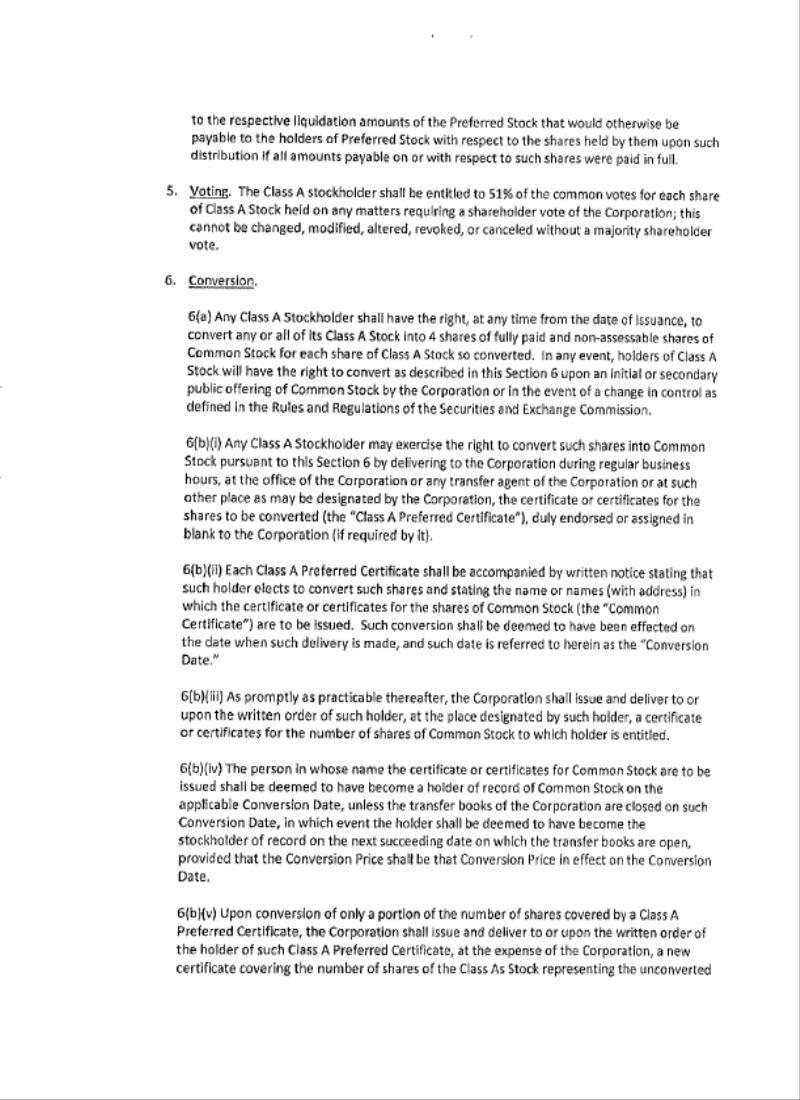
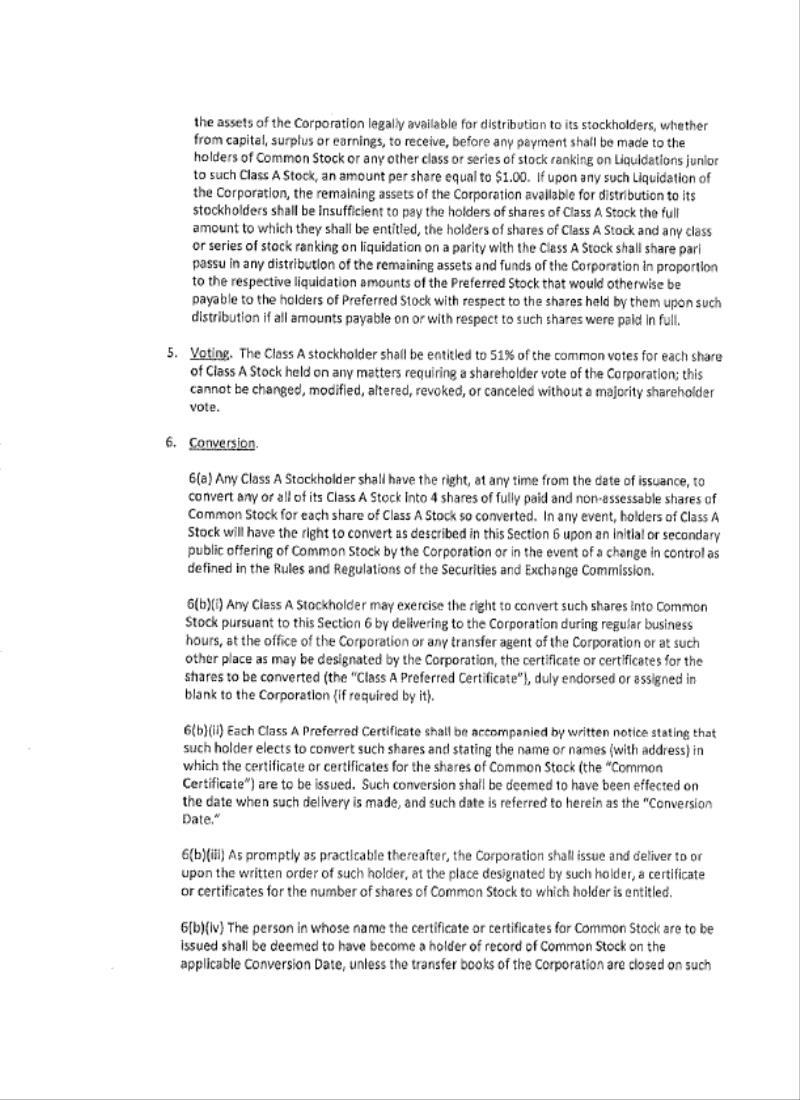
Our officers and directors control, either directly or indirectly, a substantial portion of our voting securities. Upon completion of this offering, including sales by the selling stockholder, our executive officer and director will beneficially own, in the aggregate, 178,500,000 shares of Common Stock, or approximately 89.9% of our 198,500,000 outstanding shares of Common Stock including option pool and treasury, assuming all of the shares offering hereunder are actually sold. Therefore, our management may significantly affect the outcome of all corporate actions and decisions for an indefinite period of time including election of directors, amendment of charter documents and approval of mergers and other significant corporate transactions. In addition, our executive officer and director owns the only issued and outstanding share of Class A Convertible Preferred Stock which entitles him to 51% of the Common votes on any matter requiring a shareholder vote.
We do not intend to pay dividends for the foreseeable future.
We have paid no dividends on our common stock to date and it is not anticipated that any dividends will be paid to holders of our common stock in the foreseeable future. While our future dividend policy will be based on the operating results and capital needs of the business, it is currently anticipated that any earnings will be retained to finance our future expansion and for the implementation of our business plan. As an investor, you should take note of the fact that a lack of a dividend can further affect the value of our common stock, and could significantly affect the value of any investment in our Company.
Our management will have broad discretion over the use of the net proceeds from this offering and we may use the net proceeds in ways with which you disagree.
We currently intend to use the net proceeds from this offering to fund general working capital, development costs, legal and accounting expense, marketing and media expense, reimbursement of affiliates of the Company, and selling costs. See “Use of Proceeds to Issuer” below. We have not allocated specific amounts of the net proceeds from this offering for any of the foregoing purposes. Accordingly, our management will have significant discretion and flexibility in applying the net proceeds of this offering. You will be relying on the judgment of our management with regard to the use of these net proceeds, and you will not have the opportunity, as part of your investment decision, to assess whether the proceeds are being used appropriately. It is possible that the net proceeds will be invested in a way that does not yield a favorable, or any, return for us or our stockholders. The failure of our management to use such funds effectively could have a material adverse effect on our business, prospects, financial condition, and results of operation.
Raising additional capital may cause dilution to our stockholders, including purchasers of our securities in this offering, restrict our operations or require us to relinquish rights to technologies or products.
Until such time, if ever, as we can generate substantial product revenues, we expect to finance our cash needs through a combination of public or private equity offerings, debt financings and/or license and development agreements with collaboration partners. We do not have any committed external source of funds. To the extent that we raise additional capital through the sale of equity or convertible debt securities, your ownership interest may be materially diluted, and the terms of such securities could include liquidation or other preferences that adversely affect your rights as a common stockholder. Debt financing and preferred equity financing, if available, may involve agreements that include restrictive covenants that limit our ability to take specified actions, such as incurring additional debt, making capital expenditures or declaring dividends. In addition, debt financing would result in fixed payment obligations.
If we raise funds through collaborations, strategic partnerships or marketing, distribution or licensing arrangements with third parties, we may have to relinquish valuable rights to our technologies, future revenue streams, research programs or product candidates or grant licenses on terms that may not be favorable to us. If we are unable to raise additional funds through equity or debt financings when needed, we may be required to delay, limit, reduce or terminate our product development or future commercialization efforts or grant rights to develop and market products that we would otherwise prefer to develop and market ourselves.
| 12 |
| Table of Contents |
Regardless of the amount raised in this offering, we may not have sufficient capital to execute our business strategy.
Regardless of the amount raised in this offering, we may not have sufficient capital to execute on our business strategy the way we have intended. Our ability to obtain additional financing thereafter may have a materially adverse effect on our ability to execute its overall plan and your investment may be lost.
You will experience immediate and substantial dilution as a result of this offering and may experience additional dilution in the future.
You will incur immediate and substantial dilution as a result of this offering. After giving effect to the sale by us of 18,500,000 shares and by the selling stockholders of 1,500,000 shares at a price of $2.50 per share, and after deducting $3,533,000 of estimated offering expenses payable by us, investors in this offering can expect an immediate dilution of $(2.285) per share if we and the selling stockholders sell all shares in this offering. If we and the selling stockholders, in the aggregate, sell less than 20,000,000 shares in this offering, the immediate dilution to investors in this offering would be greater than $2.285 and the dilution would depend on the amount of shares sold. We have allocated shares of our common stock to an option pool and may authorize shares to the option pool in the future. In the future, we intend to establish a stock incentive plan pursuant to which stock options and awards may be authorized and granted to our executive officers, directors, employees and key consultants.
There is no liquid trading market for the shares of Common Stock.
There is not a liquid trading market for the Common Stock, and there can be no assurance that any such market will develop or be sustained in the future.
OFFERING CIRCULAR SUMMARY
This summary highlights information contained elsewhere in this offering circular. This summary is not complete and does not contain all of the information you should consider before investing in the Shares.
You should carefully read the entire offering circular, especially concerning the risks associated with investment in the Shares discussed under the “Risk Factors” section.
Unless we state otherwise, the terms “Ronn Motor Group, Inc.”, “Ronn Motor Group”, “RMG”, “we”, “us”, “our”, “Company”, “management” or similar terms collectively refer to Ronn Motor Group, Inc., a Delaware corporation.
The Mission of Ronn Motor Group, Inc., is to produce high quality, premium automobiles that showcase disruptive technologies and state of the art performance and design while maintaining a global conscience. We are an early stage company that specializes in automotive design, assembly, manufacturing, and performance and leading edge technology integration. We believe the Company is positioned to capture market share in the growing global market for innovative transportation, sustainable electric and hydrogen fuel cell technologies.
The Company
RMG is a dynamic automotive design and development company using and developing supporting technologies. Ronn Motor Group’s initial focus will be on; the “Phoenix” an electric version evolved from its flagship “Eco-Exotic” Supercar, the Scorpion. Ronn Motor Group’s initial Supercar design “The Scorpion” is an award winning, sleek, futuristic, aero Supercar which has been featured at top automotive events, recognized as an advanced performance Supercar by top magazines, and endorsed by experts and enthusiast as well as celebrities.
The original Hydrogen assisted Scorpion HX platform was developed to reach production as either an all-wheel drive electric vehicle, powered like Tesla all electric, or following our heritage and incorporating the latest Hydrogen Fuel Cell technology. The goal of the “Phoenix” is to push the edge of style, performance, emissions, materials and fuels. The “Phoenix” will feature electric drive with stellar performance and ultra-high operating efficiencies.
| 13 |
| Table of Contents |
The corporate strategy is to market and brand our Company and automobile using the power of social media, to engage the one of the largest affinity groups “automobile aficionado’s” while continuing the traditional route to build a brand reputation through participation in high-end auto shows, concourse events and display/sponsor F1 events. These activities would be reinforced by media articles and limited direct advertising. The Company’s goal is to build “face to face” exposure with the prospective buyers. Event activity will be used to create brand recognition and to build a reputation, directing sales through marketing venues. Ultimately, the Company must be prudent to not over expose its product, thereby loosing “exclusivity”, yet it must be known by the “right” people to achieve and sustain sales.
The Offering
Issuer | Ronn Motor Group, Inc. | ||
|
| ||
Security Offered | 20,000,000 Shares of Common Stock, par value $.001, in the aggregate. | ||
|
| · | 18,500,000 shares are being offered by the Company for a total of $46,250,000 |
|
| · | 1,500,000 shares are being offered by the selling stockholder for a total of $3,750,000 |
|
| ||
Price | $2.50 per Share | ||
|
| ||
Minimum Offering | None | ||
|
| ||
Maximum Offering | $50,000,000 (a total of 20,000,000 Shares) | ||
|
| ||
Minimum Investment | None | ||
|
| ||
Offering Period | The Offering will commence upon the offering circular filed with the Securities and Exchange Commission being qualified, and will close upon the earlier of (i) the sale of Shares with an aggregate sales price of $50,000,000, or December 31, 2017 the estimated 12 month time period limit. This Offering may be terminated at our election at any time. | ||
|
| ||
Voting Rights | Stockholders will have one vote per share for each Share owned by them in all matters, including the election of Directors, as provided in the Delaware corporation law. However, our executive officer as a result of his ownership of Common Stock and the one (1) share of Class A Convertible Preferred Stock will be able to significantly influence the outcome of any election of Directors or any other vote of the stockholders. The one (1) share of Class A Convertible Preferred Stock is held by Ronal Maxwell, our CEO, and entitles him to 51% of the Common votes on any matter requiring a shareholder vote. | ||
|
| ||
Dividends | We have never paid a dividend on the shares of our Common Stock and do not plan to do so in the foreseeable future. | ||
|
| ||
Selling Stockholder | The selling stockholder is offering to sell 1,500,000 shares of Common Stock in this Offering. See “”Plan of Distribution and Selling Securityholders.” | ||
|
| ||
Use of Proceeds | After deducting the amount payable directly to the selling stockholder and the estimated offering expenses of approximately $3,533,000 Million, that are payable by us, we estimate that the net proceeds to the Company from the sale of the Shares offered pursuant to this offering circular will be approximately $42,717,000 after $3,533,000 in expenses are deducted if all 18,500,000 Shares are sold by the Company. See “Use of Proceeds to Issuer.” | ||
|
| ||
No Trading Market for our Shares | Our Shares are not traded on any stock exchange. | ||
|
| ||
Risk Factors | An investment in the Company is highly speculative and involves substantial risks, Prospective investors should carefully review and consider the factors described under the “Risk Factors” section below. | ||
This Offering is being conducted on a “best efforts” basis.
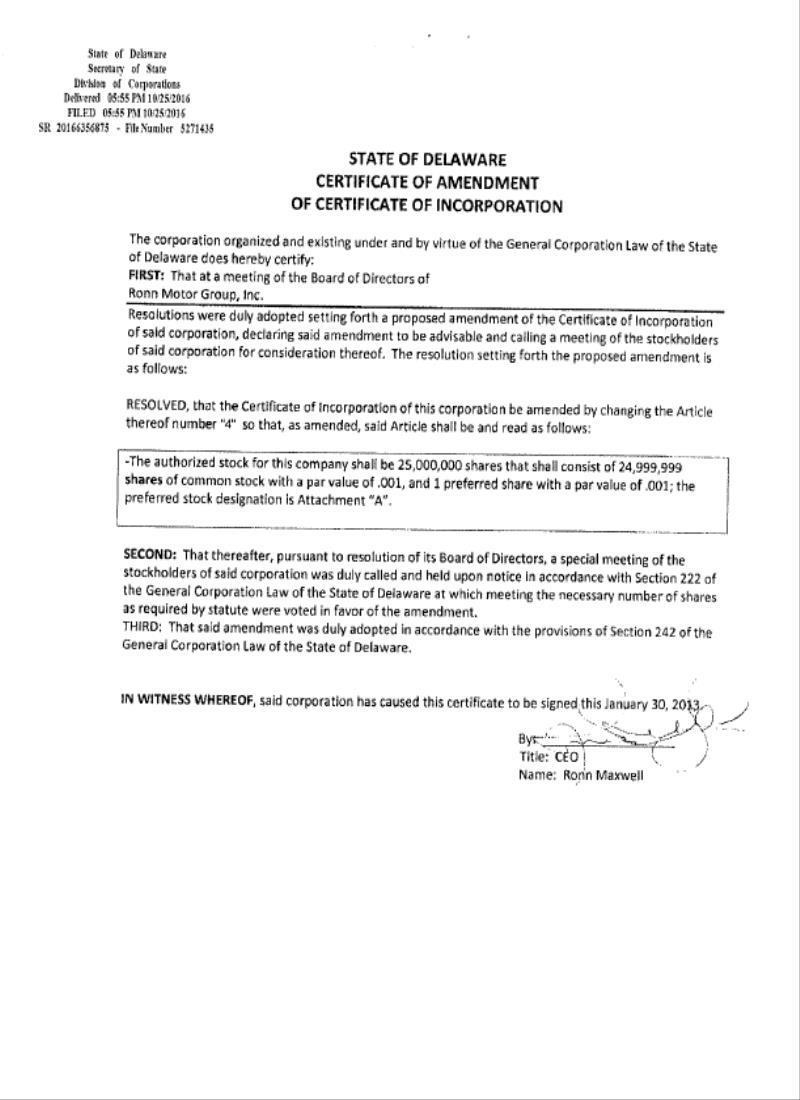
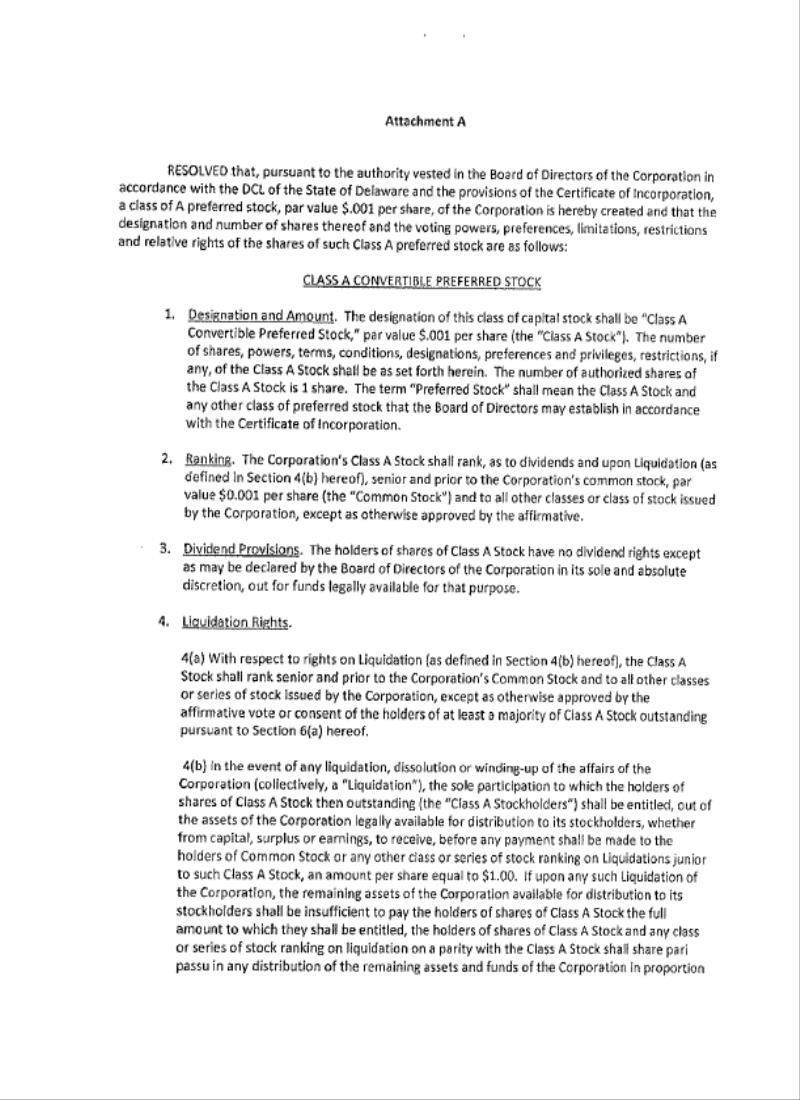
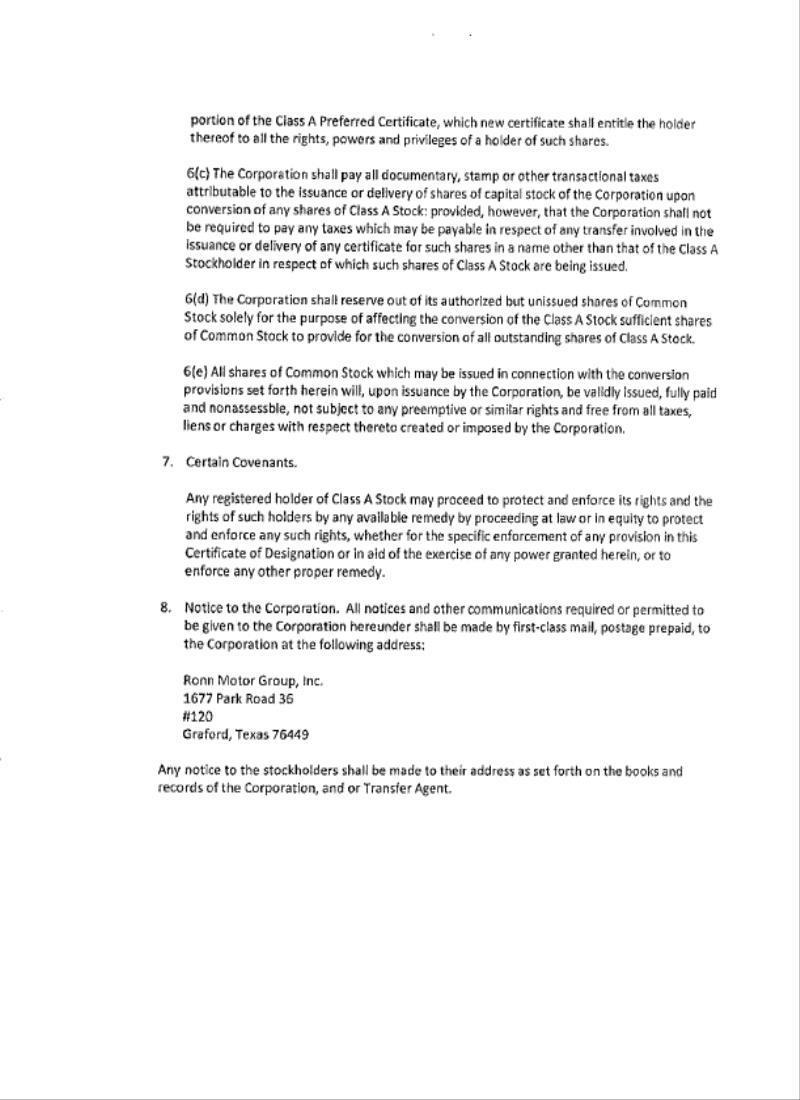
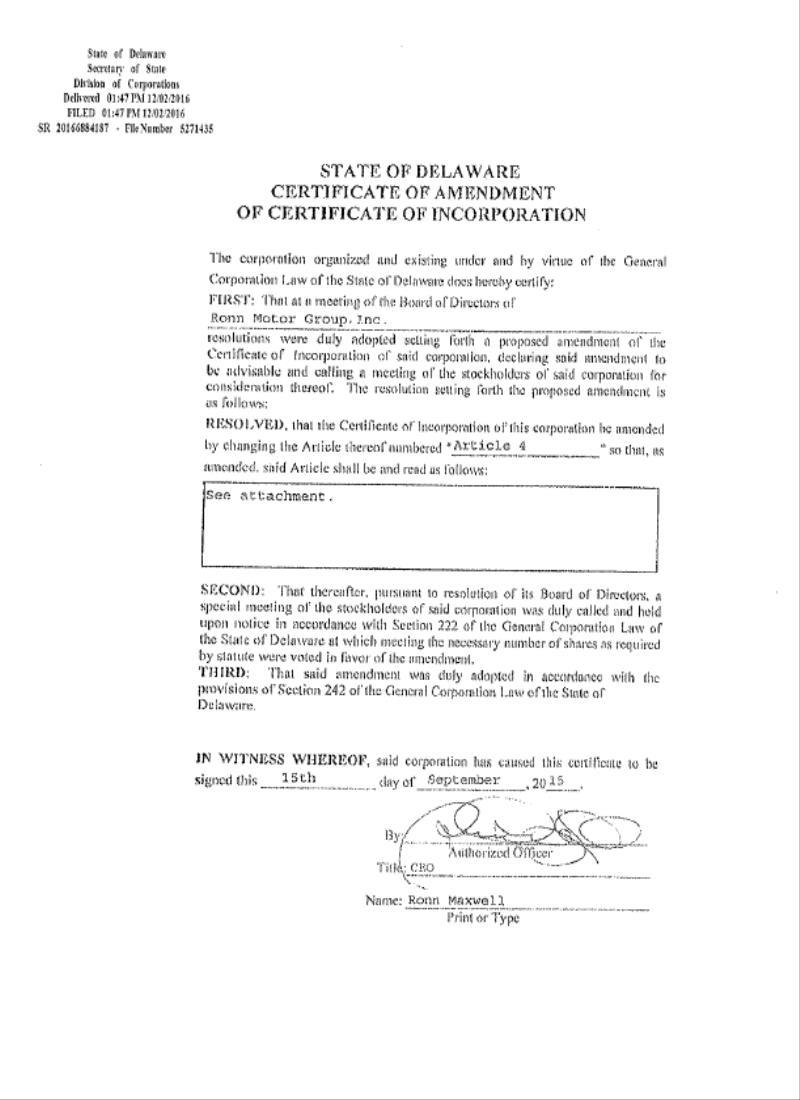
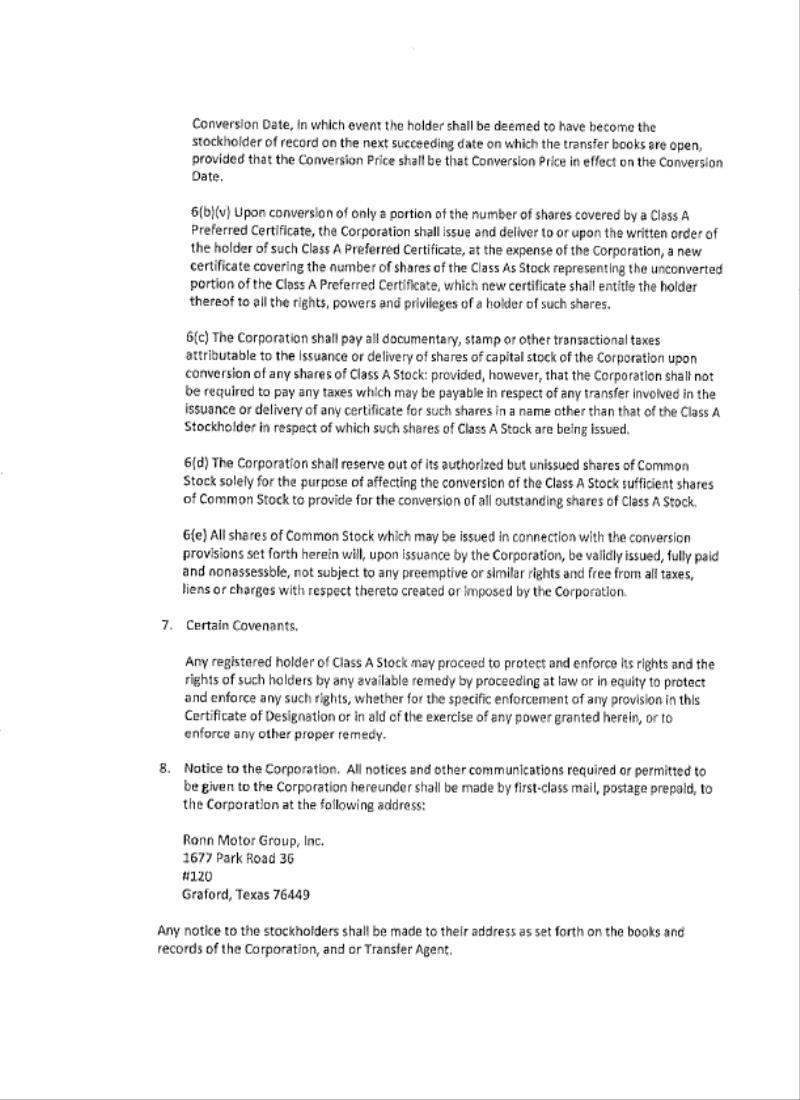
On December 2, 2016, the Company filed an amendment to its Certificate of Incorporation with the Delaware Secretary of State, which increased the number of authorized shares of the Company’s capital stock to 400,000,000, consisting of 399,999,999 shares of common stock with a par value of $0.001, and one (1) preferred share with a par value of $0.001, and effected an 8-for-1 forward stock split of its issued and outstanding shares of common stock. Unless the context indicates otherwise, all share and per-share common stock information in this offering circular gives effect to the 8-for-1 forward stock split.
| 14 |
| Table of Contents |
Dilution is the amount by which the offering price paid by the purchasers of the Shares of Common Stock to be sold in this offering will exceed the net tangible book value per share of Common Stock after this offering. If you invest in our Common Stock your Shares will be diluted to the extent of the difference between the offering price per share of the Shares of our Common Stock and the pro forma net tangible book value per share of our Common Stock after this offering.
Our pro forma net tangible book value as of December 31, 2015 was $(62,980) or $(0.00) per share of our Common Stock. We calculate net tangible book value per share by calculating our total tangible assets less liabilities and dividing it by the number of outstanding shares of our Common Stock.
After giving effect to the sale of 18,500,000 Shares of our Common Stock in this offering at an offering price of $2.50 per Share and after deducting estimated offering expenses of $3,533,000 payable by us, our net tangible book value, which we refer to as our pro forma net tangible book value, as of December 31, 2015 would have been approximately $42,654,020 or $0.215 per share of our Common Stock.
This amount represents an immediate increase in our pro forma net tangible book value of $0.215 per Share to our existing stockholders and an immediate dilution in our pro forma net tangible book value of $2.285 per Share to new investors purchasing Shares of our Common Stock at the offering price. We calculate dilution per Share to new investors by subtracting the pro forma net tangible book value per share from the offering price paid by the new investor. The following table illustrates the dilution to new investors on per Share basis:
Offering Price |
|
|
|
| $ | 2.50 |
| |
Net tangible book value per share as of December 31, 2015 |
| $ | (0.00 | ) |
|
|
|
|
Increase / (Decrease) per share attributable to new investors |
| $ | 0.215 |
|
|
|
|
|
Pro forma net tangible book value per share after this offering |
|
|
|
|
| $ | 0.215 |
|
Dilution per share to new investors |
|
|
|
|
| $ | (2.285 | ) |
The table below sets forth as of December 31, 2016 the number of shares of our Common Stock issued, the total consideration paid and the average price per share paid by our officers as a group and our new investors in this offering, after giving effect to the issuance of 18,500,000 shares of Common Stock by us, and the sale of 1,500,000 shares of Common Stock by the selling stockholder, in this Offering at the offering price of $2.50 per Share before deducting estimated offering expenses of $3,533,000 payable by us.
| Shares Purchased |
| Total Consideration | |||||||||||||
| Number |
| Percent |
| Amount (millions) |
| Percent |
| ||||||||
Post 8-1 Forward Split(1) |
| |||||||||||||||
Officers of the Company as a group(2) |
| 178,500,000 |
| 89.9 | % |
| 0 |
| 0 | % | ||||||
|
|
|
| |||||||||||||
New investors |
| 20,000,000 |
| 10.1 | % |
| $ | 50,000,000 |
| 100 | % | |||||
Total |
| 198,500,000 |
| 100 | % |
| $ | 50,000,000 | ||||||||
______________
(1) | The discussion and tables above do not give effect to a potential stock incentive plan pursuant to which stock options and awards may be authorized and granted to our executive officers, directors, employees and key consultants. |
| |
(2) | These shares were issued to our chief executive officer as compensation for services provided to the Company, and reflect the sale of 1,500,000 shares by him in the offering. |
In the future, we intend to establish a stock incentive plan pursuant to which stock options and awards may be authorized and granted to our executive officers, directors, employees and key consultants. Stock options or a significant equity ownership position in us may be utilized by us in the future to attract one or more new key executives.
| 15 |
| Table of Contents |
PLAN OF DISTRIBUTION AND SELLING SECURITYHOLDERS
We are offering a up to a maximum of 18,500,000 Shares of Common Stock, and the selling stockholder identified in this offering circular is offering 1,500,000 shares of Common Stock, on a "best efforts" basis for a purchase price of $2.50 per Share with no minimum purchase requirement. The maximum offering is $50,000,000. We will have the unrestricted right to reject tendered subscriptions for any reason. In the event the shares available for sale are oversubscribed, they will be sold to those investors subscribing first, provided they satisfy the applicable investor suitability standards. See "Investor Suitability Standards." Investors will not be entitled to a refund and could lose their entire investment.
The purchase price for the Shares will be payable in full upon subscription. Subscription funds which are accepted will be deposited into our escrow account maintained by a service provider selected by our management (such service provider is referred to as “Service Provider”). We have no required minimum offering amount for this offering and therefore we may instruct the Service Provider to release funds held in escrow to our operating account at any time.
Since this Offering is being conducted on a best-efforts basis, there is no minimum number of Shares that must be sold, meaning we will retain any proceeds from the sale of the Shares sold by us in this Offering. Accordingly, all funds raised by us in the Offering will become immediately available to us and may be used as they are accepted. Investors will not be entitled to a refund and could lose their entire investment. We will not receive any of the proceeds from the sale of shares being sold by the selling stockholders. The first $2 million of sales will be of the shares offered by the Company. After that, the next $200,000 of sales will be from the shares offered by the Selling Securityholder. This pattern will continue until all of the shares are sold.
Subscription Period
The Offering of shares of Common Stock will terminate on December 31, 2017, unless we extend the offering, or terminate the offering sooner in our sole discretion regardless of the amount of capital raised (the "Sales Termination Date"). The Sales Termination Date may occur prior to December 31, 2017 if subscriptions for the maximum number of Shares of Common Stock have been received and accepted by us before such date. Subscriptions for shares must be received and accepted by us on or before such date to qualify the subscriber for participation in Ronn Motor Group, Inc.
Subscription Procedures
Completed and signed subscription documents and subscription checks should be sent to Service Provider as Agent for Ronn Motor Group, Inc. Escrow Account, at the following address: [__________________, ______________________, _________________, ________________, Reference Ronn Motor Group, Inc. Subscription checks should be made payable to us. If a subscription is rejected, all funds will be returned to subscribers within ten days of such rejection without deduction or interest. Upon acceptance by us of a subscription, a confirmation of such acceptance will be sent to the subscriber.
Investor Suitability Standards
In order to subscribe to purchase the shares, a prospective investor must complete a subscription agreement. Investors must answer certain questions to determine compliance with the investment limitation set forth in Regulation A Rule 251(d)(2)(i)(C) under the Securities Act of 1933, which states that in offerings such as this one, where the securities will not be listed on a registered national securities exchange upon qualification, the aggregate purchase price to be paid by the investor for the securities cannot exceed 10% of the greater of the investor's annual income or net worth. In the case of an investor who is not a natural person, revenues or net assets for the investor's most recently completed fiscal year are used instead.
The investment limitation does not apply to accredited investors, as that term is defined in Regulation D Rule 501 under the Securities Act of 1933. An individual is an accredited investor if he/she meets one of the following criteria:
· | a natural person whose individual net worth, or joint net worth with the undersigned's spouse, excluding the "net value" of his or her primary residence, at the time of this purchase exceeds $1,000,000 and having no reason to believe that net worth will not remain in excess of $1,000,000 for the foreseeable future, with "net value" for such purposes being the fair value of the residence less any mortgage indebtedness or other obligation secured by the residence, but subtracting such indebtedness or obligation only if it is a liability already considered in calculating net worth; or |
· | a natural person who has individual annual income in excess of $200,000 in each of the two most recent years or joint annual income with that person's spouse in excess of $300,000 in each of those years and who reasonably expects an income in excess of those levels in the current year. |
| 16 |
| Table of Contents |
An entity other than a natural person is an accredited investor if it falls within any one of the following categories:
· | an employee benefit plan within the meaning of Title I of the Employee Retirement Income Security Act of 1974, as amended, (i) if the decision to invest is made by a plan fiduciary which is either a bank, savings and loan association, insurance company, or registered investment adviser; (ii) if such employee benefit plan has total assets in excess of $5,000,000; or (iii) if it is a self-directed plan whose investment decisions are made solely by accredited investors; |
· | a tax-exempt organization described in Section 501(c)(3) of the Internal Revenue Code, a corporation, a Massachusetts or similar business trust or a partnership, which was not formed for the specific purpose of acquiring the securities offered and which has total assets in excess of $5,000,000; |
· | a trust, with total assets in excess of $5,000,000, which was not formed for the specific purpose of acquiring the securities offered, whose decision to purchase such securities is directed by a "sophisticated person" as described in Rule 506(b)(2)(ii) under Regulation D; or |
· | certain financial institutions such as banks and savings and loan associations, registered broker-dealers, insurance companies, and registered investment companies. |
Interim Investments
Company funds not needed on an immediate basis to fund our operations may be invested in government securities, money market accounts, deposits or certificates of deposit in commercial banks or savings and loan associations, bank repurchase agreements, funds backed by government securities, short-term commercial paper, or in other similar interim investments.
Transfer Agent and Registrar
____________________, _______________________, ________________, ___________ is the transfer agent and registrant for the shares.
Plan of Distribution
The shares are being offered by us on a best-efforts basis by our officers, directors and employees, with the assistance of independent consultants, and possibly through registered broker-dealers who are members of the Financial Industry Regulatory Authority ("FINRA") and finders. We may pay selling commissions to participating broker-dealers who are members of FINRA for shares sold by them, equal to a percentage of the purchase price of the shares. We may pay finders fees to persons who refer investors to us. We may also pay consulting fees to consultants who assist us with the offering, based on invoices submitted by them for advisory services rendered. Consulting compensation, finders fees and brokerage commissions may be paid in cash, common stock or warrants to purchase our common stock. We may also issue shares and grant stock options or warrants to purchase our common stock to broker-dealers for sales of shares attributable to them, and to finders and consultants, and reimburse them for due diligence and marketing costs on an accountable or nonaccountable basis. We have not entered into selling agreements with any broker-dealers to date, although we plan to engage a registered broker-dealer firm, or a similar service provider selected by our management (such service provider is referred to as “Service Provider”), for offering administrative and escrow services . Participating broker-dealers, if any, and others may be indemnified by us with respect to this offering and the disclosures made in this Offering Circular.
Proposed Administrative Agreement
We plan to engage Service Provider, a broker-dealer registered with the Securities and Exchange Commission and a member of the Financial Industry Regulatory Authority (FINRA), to perform the following administrative functions in connection with this offering in addition to acting as the escrow agent:
· | advise us as to permitted investment limits for investors pursuant to Regulation A+, Tier 2: |
· | communicate with us and/or our agents, if needed, to gather additional information or clarification from investors: |
· | serve as a registered agent where required for state blue sky requirements, but in no circumstance will Service Provider solicit a securities transaction, recommend our securities, or provide investment advice to any prospective investor: and |
· | transmit the subscription information data to our transfer agent. |
| 17 |
| Table of Contents |
As compensation for the services listed above, we anticipate paying Service Provider $2.00 per domestic investor and $5.00 per international investor for each anti-money laundering verification. If we elect to terminate the offering prior to its completion, we have agreed to reimburse Service Provider for its out-of-pocket expenses incurred in connection with the services provided under the proposed engagement (including costs of counsel and related expenses) up to an aggregate maximum of $10,000. In addition, we will pay Service Provider $500 for escrow account set up, $25 per month for so long as the offering is being conducted, and up to $15.00 per investor for processing incoming funds. We may also pay Service Provider a technology service fee for the technology services provided by it or its affiliate, of up to $3.00 for each subscription agreement executed via electronic signature, up to $10.00 for each check processed, up to $15.00 per wire transfer and up to $45.00 for each bad actor check (per entity, including issuer and each associated person). Based on the minimum subscription amount of $2,000.80 (or 610 shares) per investor, we estimate the maximum fee that may be due to Service Provider for the aforementioned internal fees to be $7,000.00 if we achieve the maximum offering proceeds.
An affiliate of Service Provider, may serve as transfer agent to maintain stockholder information on a book-entry basis. We anticipate that there are no set up costs for this service, and fees for this service will be limited to secondary market activity. Service Provider is not participating as an underwriter and under no circumstance will it solicit any investment in the Company, recommend the Company's securities or provide investment advice to any prospective investor, or make securities recommendations to investors, nor is Service Provider distributing any securities offering prospectuses or making any oral representations concerning the securities offering prospectus or the securities offering. Rather, Service Provider’s involvement in the offering is limited to acting as an accommodating broker-dealer. Based upon Service Provider’s limited role in this offering, it has not and will not conduct extensive due diligence of this securities offering and no investor should rely on Service Provider’s involvement in this offering as any basis for a belief that it has done extensive due diligence. Service Provider does not expressly or impliedly affirm the completeness or accuracy of the offering circular presented to investors by the issuer in this offering. All inquiries regarding this offering should be made directly to the Company.
The Posting Agreement
The Company anticipates entering into a Posting Agreement with a portal website that hosts public securities offerings or a similar service provider selected by our management (such service provider is referred to as “Portal Provider”), primarily those that are exempt from registration under Regulation A+ promulgated under Section 3(b) of the Securities Act of 1933, as amended. In consideration for hosting the public offering covered by this Offering Circular, including posting our offering circular, Subscription Documents and related materials on a website maintained by Portal Provider, and integrating Service Provider, a registered member of FINRA, to administer the review and processing of subscriptions by investors, and to possibly provide escrow and transfer agent services for the Company and this offering, Portal Provider will receive the following compensation from the Company, payable from the escrow account as subscription funds are deposited and accepted by Service Provider and the Company.
· | A cash payment of $50 per investor who is accepted as a shareholder of the Company; |
As stated above, we have not entered into formal written agreements with a Service Provider, a transfer agent, or a Portal Provider, and we may not be able to enter into agreements with any of them on terms acceptable to us.
Selling Stockholder
The table below represents shares post 8-1 forward split and sets forth the selling stockholder who is offering to sell shares in this Offering, the amount of shares of Common Stock owned by such selling stockholder prior to the Offering, the amount of shares offered for his account and the amount to be owned after the Offering.
Selling Stockholder |
| Number of Shares of Common Stock Owned Prior to the Offering |
|
| Number of Shares of Common Stock Offered in the Offering |
|
| Number of Shares of Common Stock Owned After to the Offering |
| |||
Ronal Maxwell – CEO, Chairman of the Board |
|
| 180,000,000 |
|
|
| 1,500,000 |
|
|
| 178,500,000 |
|
Total |
|
| 180,000,000 |
|
|
| 1,500,000 |
|
|
| 178,500,000 |
|
The total number of shares of Common Stock being offered by the selling stockholder in this Offering is 1,500,000, which represents .83% of the pre-offering issued and outstanding shares of Common Stock of the Company.
| 18 |
| Table of Contents |
State Qualification and Suitability Standards
This offering circular does not constitute an offer to sell or the solicitation of an offer to purchase any Shares in any jurisdiction in which, or to any person to whom, it would be unlawful to do so. An investment in the Shares involves substantial risks and possible loss by Investors of their entire investment. See “Risk Factors.”
Some of our offerees may be broker-dealers registered with the SEC under the Exchange Act who may be interested in reselling our Shares to others. If so they will have to comply with the regulations of the SEC and FINRA relating to underwriters.
In the event we sell all 18,500,000 shares being sold by us in the offering, we will receive gross proceeds of $46,250,000. After deducting the estimated offering expenses of approximately $3,533,000 that are payable by us to Investment Bankers and other professionals, we estimate that the net proceeds from the sale of the Shares offered by us pursuant to this offering circular will be approximately $42,717,000 if all 18,500,000 Shares are sold by us. We will not receive any of the proceeds from the sale of shares being sold by the selling stockholder.
We currently intend to use the proceeds from this offering as follows:
General Working Capital |
| $ | 12,567,000 |
|
Automobile Development Costs |
|
| 10,000,000 |
|
R/D New Technology Platform Integration |
|
| 2,000,000 |
|
FMVSS Certification |
|
| 1,750,000 |
|
FMVSS Automobiles for Crash Testing |
|
| 2,000,000 |
|
FMVSS Contingency Escrow |
|
| 500,000 |
|
Legal Expense |
|
| 100,000 |
|
Accounting Expense Audits |
|
| 50,000 |
|
Marketing/Media |
|
| 1,750,000 |
|
Public Offering Related Expenses |
|
| 3,533,000 |
|
|
|
|
|
|
Initial Tools/Tooling for Manufacturing/R&D |
|
| 5,500,000 |
|
Technology Development ASU |
|
| 2,500,000 |
|
|
|
|
|
|
Potential Acquisitions |
|
| 4,000,000 |
|
|
|
|
|
|
Total |
| $ | 46,250,000 |
|
| 19 |
| Table of Contents |
In the event we are only able to sell 50% of the shares offered, we intend to use the proceeds from the offering as follows:
General Working Capital/Manufacturing Costs |
| $ | 3,717,000 |
|
Automobile Development Costs |
|
| 5,500,000 |
|
R/D New Technology Platform Integration |
|
| 1,000,000 |
|
FMVSS Certification |
|
| 1,750,000 |
|
FMVSS Automobiles for Crash Testing |
|
| 2,000,000 |
|
FMVSS Contingency Escrow |
|
| 500,000 |
|
Legal Expense |
|
| 100,000 |
|
Acounting Expense Audits |
|
| 25,000 |
|
Marketing/Media |
|
| 750,000 |
|
Public Offering Related Expenses |
|
| 1,533,000 |
|
|
|
|
|
|
Initial Tools/Tooling for Manufacturing |
|
| 2,000,000 |
|
Technology Development ASU |
|
| 750,000 |
|
|
|
|
|
|
Potential Acquisitions |
|
| 3,500,000 |
|
|
|
|
|
|
Total |
| $ | 23,125,000 |
|
The above are approximations only and we have not yet determined the amount of net proceeds to be used specifically for any of the foregoing purposes. Accordingly, our management will have significant discretion and flexibility in applying the net proceeds from this offering.
CAUTIONARY NOTE REGARDING FORWARD-LOOKING STATEMENTS AND INDUSTRY DATA
Statements in this offering circular may be “forward-looking statements.” Forward-looking statements include, but are not limited to, statements that express our intentions, beliefs, expectations, strategies, predictions or any other statements relating to our future activities or other future events or conditions. These statements are based on current expectations, estimates and projections about our business based, in part, on assumptions made by management. These statements are not guarantees of future performance and involve risks, uncertainties and assumptions that are difficult to predict. Therefore, actual outcomes and results may, and are likely to, differ materially from what is expressed or forecasted in the forward-looking statements due to numerous factors, including those described above and those risks discussed from time to time in this offering circular, including the risks described under “Risk Factors,” and “Management’s Discussion and Analysis of Financial Condition and Results of Operations” in this offering circular. In addition, such statements could be affected by risks and uncertainties related to:
| · | our ability to raise funds for general corporate purposes and operations, including the development of our planned Electric Sports car and market conditions.; |
|
|
| · | our ability to recruit qualified management and technical personnel; |
|
|
| · | the success of our planned Electric automobiles, SUV’s , and potential hydrogen vehicles |
|
|
| · | our ability to obtain and maintain required regulatory approvals for our products; and |
|
|
| · | the other factors discussed in the “Risk Factors” section and elsewhere in this offering circular. |
Any forward-looking statements speak only as of the date on which they are made, and except as may be required under applicable securities laws; we do not undertake any obligation to update any forward-looking statement to reflect events or circumstances after the date of this offering circular.
Founded in 2013, Ronn Motor Group, Inc. has been paving the way for innovative automobile design with highly disruptive technology for many years. In an emerging era of environmental consciousness, RMG offers customization, assembly, and performance technology integration by designing high quality, Limited Edition, automobiles with ground breaking technology. RMG also provides a platform for emerging technologies in all facets of automobile development. Advanced, leading edge performance enhancements and designs command the attention of global markets to create awareness, sales and growth. The Company aims to generate profitable growth by focusing on its proven engineering excellence, sustainable technologies and advanced systems, all of which are desirable in all segments of the automobile industry. RMG is introducing its new state of the art EV automobile, the “Phoenix”, evolved from its original automobile concept, “the Scorpion”, which established RMG as the brand that mandates universal attention with its integrity, quality and excellence.
| 20 |
| Table of Contents |
We are an early-stage company that specializes in automotive design, customization, assembly, manufacturing, and performance technology integration. Our mission is to design and build very high quality “Limited Editions” and leading edge automobiles to provide market exposure and a platform for emerging technologies in all facets of automobile development. Additionally, we plan on providing performance enhancements and designs to manufacturers and partners to create sales, awareness and growth in the global market. We believe the Company is positioned to capture the growing global market for innovative, sustainable technologies. We plan to design seamlessly integrated, advanced systems into today’s and tomorrow’s leading automotive platforms. The Company is comprised of cutting edge, disruptive divisions, encompassing technology, engineering and automotive development. |
|
|

The Company
Ronn Motor Group, Inc. is a dynamic automotive design and development company using and developing supporting leading edge, electric, hydrogen, autonomous, and connective technologies. RMG’s high quality, premium automobiles will showcase disruptive technologies and state of the art performance and design while maintaining a global conscience.
Global Energy Policy
Global Energy Policy is demanding efficient multi-fuel transportation platforms. Climate change, “greenhouse” effects and carbon footprint issues are now approaching a crisis priority in most of the world. It is no longer an option not to work within world carbon reduction / emissions reduction / sustainable energy guidelines. These have real and lasting monetary consequences, but most grave, they are now a matter of human quality-of-life and health.
The Company is a “Disruptive” automobile technologies company addressing comprehensive sustainable transportation solutions. We expect to bring automobiles and technology programs into the industries which are feasible, adaptable, and scalable.
Ronn Motor Group Product Philosophy and Strategy
The scope of the Company’s potential products range from limited edition supercars to potentially our own mix of four door sedans to mass production 2, 3 and 4 wheeled commuter vehicles developed with prospective joint venture partners. These transportation platforms are created to deliver the Company’s vision to set the global benchmark for sustainable “green” mass production and personal transportation. RMG’s stellar platform “Phoenix” EV platform will be used as a premier launch, presenting a series of potential products for the mass global market while creating exposure and credibility.
The Company also plans to produce its own brand of performance, technology and eco-enhancing packages / parts to be marketed as an exclusive brand. Company executives are already meeting with new leading edge companies whose technologies we believe will allow us to substantially increase the percentage of sustainable parts used in the manufacture of our automobiles. This represents the corporate vision and commitment to sustainable power.
Ronn Motor Group, Inc.
THE PRESENT: Electric Sportscar Series
“Phoenix” – All Wheel Drive Electric, with Range Extender Option
ThePhoenix is the state of the art electric version evolved from RMG’s flagship Eco-Exotic Supercar, Scorpion. The Scorpion’s award winning design is a sleek, futuristic, aero Supercar. It has been featured at top automotive events and is recognized as an advanced performance Supercar by top magazines and endorsed by experts and enthusiasts as well as celebrities.
The original hydrogen assisted Scorpion HX platform was developed to reach production as an all-wheel drive, electric vehicle, powered like Tesla’s all-electric vehicle;, or it can follow its heritage and incorporate the latest Hydrogen Fuel Cell technology. The modular chassis design adapts easily to any technology integration, it is truly a multi fuel adaptive platform. |
|
|
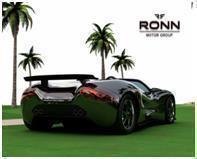
| 21 |
| Table of Contents |
RMG’s Phoenix, built on the original proof of concept with its variable chassis design is intended to be the new platform for RMG, building on the lessons learned from the development of the eco-exotic Scorpion over the last seven years.It will continue to push the edge of style, trending through in-house and contracted industrial designers and futurists. These aspects not only address performance, but also emissions, materials, fuels and disruptive manufacturing processes. The Company is building a business from the top down that is based on credibility, visibility and on very high quality standards and luxury design, all of which are a part of the Company’s branding. RMG is also targeting several of the fastest growing demographic sectors in the world, including the connected millennials with the highly efficient, disruptive move in the automotive sector.
We expect the all-electric Phoenix to have an initial range of approximately 300 miles and with the new patented micro turbine range extender, developed by Professor Joe Hui, Chairman Emeritus of Science and Engineering at ASU, a possible range of over 600 plus miles.
The target market price point for the electric Phoenix with Range Extender option is based upon the market price range of $125, 000 to $175,000, depending on the options. RMG will produce a limited annual production line of Phoenix EV’s, maintaining a total targeted production number of 10 for year one, and moving towards 2,000 plus vehicles globally per year by year four.
Plan of Operations (Phoenix)
The Company’s manufacturing plan for the next eighteen months begins with the design and development of two (2) Electric RMG automobiles which will incorporate all the necessary research and development and transportation compliance for full commercialization of the Phoenix EV product line. Therefore, the Company anticipates beginning the development/manufacturing of the ten (10) initial units in 2017-2018 with a completion of (2) production models for touring; (5) automobiles for FMVSS crash testing, (3) for contingency or sales, with FMVSS certification complete by Q3-2018. The Company anticipates utilizing contract manufacturing for the major manufacturing element of the units with final assembly, technology incorporation, design, and quality control scheduled to be executed in-house. Assuming the Company receives $10,000,000 in net proceeds from this offering, in our opinion, we will not need to raise additional funds to meet our plan of operations for the next 18 months.
The Scorpion (Original Heritage)
The original Scorpion Eco-Exotic Supercar, designed by Ronal Maxwell, was ahead of its time with ultra-clean emissions due to the onboard hydrogen technologies. The Scorpion HX set the benchmark for internal combustion powered sustainable Supercars by introducing the most advanced real time hydrogen fuel enhancement system on the road today. The operating system enhances emissions and enhances fuel mileage The hydrogen proprietary management system matches exacting needs to outputs, thereby maximizing the benefits while reducing operating draws. The Scorpion’s scalding performance is more than matched by its clean emissions and extended gas mileage. This awe-inspiring exotic turns heads to boldly present its advanced hydrogen technologies. The Scorpion cannot be ignored, which is confirmed by its worldwide acclaim and bringing hydrogen technology into the spotlight. |
| |

| 22 |
| Table of Contents |
The Scorpion HX platform was engineered in a way that lends itself to be an all-electric automobile or a hydrogen fuel-cell-powered vehicle, opening up a new possibility with the continued growth of all sustainable technology vehicles. This option, management believes, may be the most direct path to the initial production of automobiles in the marketplace today.
The Ronn Motor Group, Inc. management may contemplate future automobiles should we feel the rapidly changing disruptive automotive market forces would support or improve our scalability by having different models of automobiles.
ECO DAILY DRIVER (EDD) VEHICLES “The Future”
Because Supercars and luxury vehicles generate visibility and provide a strong “proof of concept” platform to introduce new technologies, Ronn Motor Group uses its highly visible Supercar and luxury platforms as marketing tools to establish larger market capture for underwriting and for launching its series of low to mid-range Eco Daily Drivers (EDDs). EDDs are the extreme opposite of the Supercars and sports cars in most regards, with the exception of the technology lineages.
RMG believes that the automotive industry lacks broad visual appeal and excitement in its “Green” automobile designs today, “Simply stated, to be automotively “Green” today means enduring second rate styling.” By adopting styling cues from its Supercar series, Ronn Motor Group is developing futuristic, exciting, high mileage, sustainable, solid performance vehicles for the low to mid-range price points.
EDDs offer excellent possibilities for transportation with special applications for undeveloped and under-developed nations, rural and austere locations, and cramped urban centers as well. EDDs’ fuel technology conveniently grants access to whatever fuel resource is “favored” in its operating region. The world’s largest and fastest growing populations – China, Africa, South America and India – are in great need of this type of easily procurable fuel technology. The anticipated market sales for EDDs are 70% in emerging and urban markets and 30% in industrialized America and Europe.
EDD Future Contemplated Product Concepts
EDD SS – Super Coupe or GT is designed for the under $100,000 (U.S. dollars) market segment. This two-door, high performance car is a back to basics concept with simple mechanical layouts encased in an extreme visual design. The concept is an all-electric car similar to Tesla but offers the extended range electric like BMW I3, or it can be developed with Ronn Motor Group’s own Hydrogen fuel cell capabilities to provide endless options and Partner opportunities. The low emission footprint will be further enhanced by aggressive design focused on reduction of overall part counts and the use of lightweight common materials, components and leading edge technologies that have been developed in The Company’s Super-Hyper car platforms. Designs are created for two and four wheel drives.
The EDD SS proposed target is to compete with the BMW I3 and Tesla Model 3. Upon technology development, a more precise decision can be made regarding which direction best fits: to either to use Ronn Motor Group’s own platform, or to negotiate using another automotive platform from potential JV partners. The EDD SS has stunning curb appeal, blazing speed and performance, and low emissions on any and all fuels.
EDD 2 – The EDD 2 platforms include two and three wheeled vehicles. These designs offer the in-house advantages of eliminating impact testing, reducing licensing for the company, and reducing operator and emission standards verifications.
This target market is global in its reach. Simple, all fuel, durable and cheap attributes are keys to the product success. These vehicles are the very beginnings of economic expansion. They must serve not only as personal transportation, but also as safe transport for up to three persons and several hundred pounds of cargo. Integrated baskets or tie-downs are designed to increase hauling capacity.
The EDD 2 must be very robust with low to no maintenance, be able to use all fuels, have extremely flexible usage, and be inexpensive to purchase and operate. This design is well suited for austere, rural villages as well as highly crowded urban communities. The EDD 2 platform aspires to become a dependable, everyday transportation vehicle.
EDD 3 – The EDD 3 platform target market is global sedan (Suburban Electric Vehicle) transportation. The platform underscores Ronn Motor Group’s commitment to producing sustainable operating vehicles. The Sedan will use, all electric or plug-in electric, extended-range option programs, and will set clean emission benchmarks while using multi-fuels options. This would be developed as a two-wheel drive with a four-wheel option.
| 23 |
| Table of Contents |
EDD 4 – The EDD 4 carries the second benchmark vehicle for trendsetting and styling in affordable SUV configurations. This Ronn Motor Group design features impressive curb appeal in a four-door styling that has room for four passengers. The hatch back opens to afford direct access to the small sedan’s cavernous, rear cargo space. Integrated roof racks are designed to secure and carry large loads to extend the utility of the SUV.
Future Generation Contemplated (Halo Hyper-Hybrid (The “Bird of Prey”)
The future “Bird of Prey”, should the market stay favorable, is destined to be the first in its series of eco-exotic hybrid Halo Hypercars. Its carbon fiber components include more than just the body as used in the Scorpion. The “Bird of Prey” structural core, the chassis tub, is now composite. Modular front and rear clips become stressed members and benefit from the added chassis rigidity. This “tub” configuration supports technologies such as F1 suspensions with inboard brakes, shocks and springs. The engine /ZF 9 speed transmission is a stressed member integrating power, transmission and suspension in the rear clip. The design will integrate ground effects into the body to create a top speed in the 220+ mph range accomplished by a 900 + horsepower proprietary magnesium/aluminum block, E- turbocharged (ERS) generators work at 2 bar pressures assisted by two electric motors driving the front axles, with two electric motors in the rear producing an astounding amount of torque and Torque Vector Steering, all computer managed to receive the best traction control, cornering and fuel efficiency possible. The makes the new “Bird of Prey” design arguably one of the rarest and most visionary limited production street cars in the world. This technology leap will be genesis to place its pricing in the uppermost price range of one million dollars plus.
The Ronn Motor Group “Bird of Prey” would extend the lineage of the Scorpion beyond normal power, fuel and efficiency ranges of Internal Combustion (IC) based power plants. The Ronn Motor Group “Bird of Prey” will venture into Hyper- hybrids and Ronn Motor Group’s radial styling using Damascus steel trim accented by the finest woods, leather and the advanced series of proprietary engines with integrated state of the art batteries and hydrogen fuel cell capabilities, performance and braking regeneration and advancing super capacitor charging technologies using Formula One based ERS and KERS technologies The platforms will feature all-wheel drive Supercar performance and ultra-high operating efficiencies while rivaling its predecessor; and foundation the Hydrogen assisted Scorpion HX.
Issues for the Premium, Eco-Exotic Automobile Success (also see “Risk Factors”):
| · | Create an exclusive, limited edition status for each model. | |
|
| |
| · | Build a limited number of cars over a limited amount of time. | |
|
| |
| · | Products must be unique – this industry niche is driven by uniqueness of design styling, limited availability, extreme craftsmanship, and prestige with perhaps the greatest influence of all, emotion. | |
|
| |
| · | Staying ahead of rapidly changing technologies |
Product Market Placement Strategies
The corporate strategy would be to market to the largest affinity group in the world, and brand our Company and automobile using the power of social media, while continuing the traditional route to build a brand reputation through participation in high-end auto shows, concourse events and display/sponsor F1 events. Ronn is already well known in the world, through magazines, social media, television and movies. These activities would be reinforced by media articles and limited direct advertising. The Company’s goal is to build “face to face” exposure with the prospective buyers. Event activity will be used to create brand recognition and to build a reputation, directing sales through marketing venues. Ultimately, the Company must be prudent to not over expose its product, thereby loosing “exclusivity”, yet it must be known by the “right” people to achieve and sustain sales. The company is presently in talks with a television production company to produce a series based on the trial of developing a leading edge automotive company.
| 24 |
| Table of Contents |
Exotic Dealership / Direct Sales Strategy
RMG sees a strong link to exclusive exotic dealerships as the preferred target for sales and distribution. The best of these dealerships know and can deliver the Phoenix demographic profile. High end dealerships also provide service, parts and warranty coverage. Limited independent exotic dealerships are proposed to be in the following regions:
| · | Asia/Pacific Rim - Hong Kong, Shanghai, or Beijing | |
|
| |
| · | USA – Los Angeles, Miami, New York, Austin | |
|
| |
| · | Middle East - Dubai | |
|
| |
| · | India | |
|
| |
| · | Europe – Russia | |
|
| |
| · | South America – Brazil |
Ronn Motor Group In-Car Technology Overview
Ronn Motor Group’s “GALAXY”, powered by GPSTrax solutions, collects vehicle-based data from various separate systems and integrates that information. It then synthesizes and reformats the data into valuable, actionable information, and delivers it to end-users across the logistics value chain through secure web-based applications. In addition, GPSTrax provides critical information, enabling verification of fuel savings and reduction of harmful emissions. The Company intends to use GPSTrax which is a third party software solution that is “hardware agnostic” – having the unique capability of interfacing with any hardware.
.
| 1. | GALAXY is the universal technology that potentially turns any car into a “smart car” powered by GPSTrax. |
|
|
|
| 2. | GALAXY and GPSTrax (both) work on any car manufactured since 1996 by allowing access to car sensors through the government-mandated open OBDll port. |
|
|
|
| 3. | GALAXY is the underlying system which uses low-cost hardware that can be purchased at any number of manufacturers and can be easily self-installed under the dashboard and paired via Bluetooth and WiFi to a smartphone with that data being stored in the cloud. |
Smart Car Technology The adapter plugs into almost any car and unlocks the data hidden in the car’s onboard computer. The free mobile app pairs with the adapter via Bluetooth and can diagnose engine problems, display trip logs and mileage, and even call for help in a crash. In addition, the technology offers basic alerts, such as engine light diagnostics, time and location triggers, parts and labor estimators, MPG analytics, tips for reducing gas costs, trip tracking and more! Using this foundation and already-developed software, Ronn Motor Group is now moving to develop more autonomous driving features for its automobiles and the aftermarket. Ronn Motor Group owns the exclusive rights to this technology in the automotive sector.
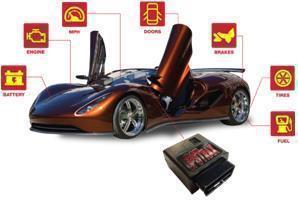
GALAXY TURNS ANY CAR INTO A “SMART CAR”
BY UNLOCKING REAL-TIME VEHICLE INFORMATION
· GALAXY provides the very best in turn-by-turn GPS navigation, enabling the driver to arrive at the destination as safely and quickly as possible. · GALAXY automatically alerts the driver regarding potential engine diagnostic and maintenance issues, which can save thousands over the life of the car. · GALAXY leverages satellite technologies that can pinpoint the exact location, in real time, so that both the driver and passengers can feel safe and secure. · GALAXY is eco-friendly, providing an integrated suite of software applications that manage, monitor, and monetize emission reduction. · GALAXY also assists in the planning of personal and business outings through a confidential, personal management service. · GALAXY is “hardware agnostic” – having the unique capability of interfacing with any hardware.
| 25 |
| Table of Contents |
Ronn Motor Group and Arizona State University Collaboration
| Ronn Motor Group executives are in active meetings to develop a collaborative agreement with Arizona State University to co-develop and commercialize Intellectual Properties (IP) and technologies owned by, or co-developed with, the university and private companies. The Company seeks to license certain existing technologies and to co-share new IP developed with researchers at the university. |
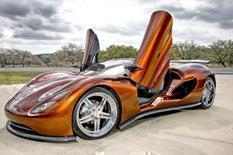
Areas for potential collaboration and commercialization between ASU and Ronn Motor Group:
1)
| Disruptive Manufacturing Development: Ronn Motor Group intends to bring its vehicles to production in Arizona, starting with the new “Phoenix” Electric Hybrid The Company proposes initial capabilities of up to 500 automobiles per year, following Honda with its Special Performance Manufacturing Plant for the new NSX Supercar in Ohio, employing a core of 100 people, using the latest 3D printing, materials, special welding and lite robotics. |
| |
2) | Zinc-air battery development or other battery technologies and controllers |
| |
3) | Hydrogen fuel cell |
| |
4) | Flexible Digital Display developed at ASU originally for the military |
| |
5) | Business plan modeling to develop new concepts for manufacturing and distribution |
| 26 |
| Table of Contents |
Corporate History
Ronn Motor Group, Inc. (the “Company”) is a Delaware corporation originally formed as Ronn Motor Group, Inc. on January 8, 2013.
Ronal “Ronn” Maxwell’s claims to fame were designing and building the Scorpion (“Scorpion”) in 2008 as one of the first hydrogen assisted eco-exotic supercars. The idea came to Mr. Maxwell after he spent time in China in 2007 as part of an automotive project he was engaged on for an American firm. His original concept and design was “The Mamba” that transformed into the original Scorpion design. Mr. Maxwell designed the Scorpion and had it built in less than one year to have it ready to debut at the 2008 SEMA (the premier automotive specialty products trade event held annually in Las Vegas, Nevada). The Scorpion debuted at the SEMA show followed by various other shows including the Top Marques show in Monaco, Worlds Most Expensive Rides television series, Speed Vision the movie Looper with Bruce Willis and appearance with Arnold Swartznegger to name a few.
Our principal corporate office is located at ASU SkySong Research Center, 1475 N. Scottsdale Road, #200, Scottsdale AZ 85257, and is leased on a month-to-month basis from the Arizona Board of Regents for and on behalf of Arizona State University.
MANAGEMENT’S DISCUSSION AND ANALYSIS OF FINANCIAL CONDITION
AND RESULTS OF OPERATIONS
The following discussion and analysis should be read together with our financial statements and the related notes appearing elsewhere in this offering circular. This discussion contains forward-looking statements reflecting our current expectations that involve risks and uncertainties. See “Cautionary Note Regarding Forward-Looking Statements and Industry Data” for a discussion of the uncertainties, risks and assumptions associated with these statements. Actual results and the timing of events could differ materially from those discussed in our forward-looking statements as a result of many factors, including those set forth under “Risk Factors” and elsewhere in this offering circular.
RMG, Inc. (the “Company”) is a Delaware corporation originally formed as Ronn Motor Group, Inc. on January 8, 2013. We are an early stage company that specializes in automotive design, customization, assembly, manufacturing, and performance technology integration. Our mission is to design and build very high quality leading edge “Limited Edition”, environmentally conscious automobiles and to provide market exposure and a platform for emerging technologies in all facets of automobile development. Additionally, we plan on providing performance enhancements and designs to manufacturers and partners to create sales, awareness and growth in the global market. We believe the Company is positioned to capture the growing global market for innovative, sustainable technologies. We plan to design seamlessly integrated, advanced systems into today’s and tomorrow’s leading automotive platforms. The Company is comprised of cutting edge, disruptive divisions, encompassing technology, engineering and automotive development. We believe our first new planned Electric “Phoenix” and our future contemplated automobiles will give us a global coverage and interest.
| 27 |
| Table of Contents |
Results of Operations
The fiscal years ended December 31, 2014 and December 31, 2015
Revenue. The Company had $0 revenue for fiscal years ended December 31, 2014 and December 31, 2015.
Operating Expenses. Operating expenses for fiscal year ended December 31, 2014 were $0, compared to operating expenses for fiscal year ended December 31, 2015 of $37,980. Operating expenses for fiscal year 2015 were comprised of general and administrative expenses of $37,980, as described in the table below:
|
| Year Ended |
| |||||
|
| 2015 |
|
| 2014 |
| ||
Legal expense |
| $ | 8,195 |
|
| $ | - |
|
Advertising |
|
| 10,668 |
|
|
| - |
|
Compensation expense |
|
| 9,160 |
|
|
| - |
|
Consulting expense |
|
| 2,500 |
|
|
| - |
|
Travel expense |
|
| 509 |
|
|
| - |
|
Other |
|
| 6,948 |
|
|
| - |
|
|
| $ | 37,980 |
|
| $ | - |
|
Net Loss. Net loss for fiscal year ended December 31, 2014 was $0, compared to the net loss for fiscal year ended December 31, 2015 of $37,980. This net loss in fiscal year 2015 was the result of general and administrative expenses of $37,980.
Nine months ended September 30, 2015 and September 30, 2016
Revenue. Total revenue for the nine months ended September 30, 2015 and September 30, 2016 was $0. We anticipate that commencing in fiscal 2018, our earnings will commence from proceeds from the expected sales of the Phoenix automobile.
Operating Expenses. Operating expenses for the nine months ended September 30, 2016 totaled $14,796 resulting in a net loss of $14,796, compared to a net loss of $29,325 for the nine months ended September 30, 2015. Operating expenses for the nine months ended September 30, 2016 and 2015 are summarized below:
|
| Nine Months Ended September 30, |
| |||||
|
| 2016 |
|
| 2015 |
| ||
Legal expense |
| $ | - |
|
| $ | 6,500 |
|
Advertising |
|
| - |
|
|
| 11,463 |
|
Compensation expense |
|
| - |
|
|
| 7,539 |
|
Consulting expense |
|
| 10,000 |
|
|
| 2,500 |
|
Occupancy expense |
|
| 4,000 |
|
|
| 0 |
|
Travel expense |
|
| 498 |
|
|
| 509 |
|
Other |
|
| 298 |
|
|
| 814 |
|
|
| $ | 14,796 |
|
| $ | 29,325 |
|
Net Loss. Net loss for the nine months ended September 30, 2016 was $16,610, compared to a net loss for the nine months ended September 30, 2015 of $29,325. The net loss for the nine month ended September 30, 2016 was the result of no revenue and $14,796 of operating expenses and $1,814 in interest expense. The net loss for the nine month ended September 30, 2015 was the result of no revenue and $29,325 of operating.
Liquidity and Capital Resources
We had net cash of $427 at December 31, 2015 and $4,622 at September 30, 2016, primarily from proceeds of a $20,000 Secured Promissory Note from Cabral Holdings I LLC, and proceeds of a $25,000 Unsecured Promissory Note from Ronal Maxwell, our Chief Executive Officer, in 2013.
| 28 |
| Table of Contents |
Net cash used in operating activities was $19,573 for fiscal 2015 as compared to net cash used in operating activities of $0 during fiscal 2014, an increase of $19,573. For fiscal 2015 our cash used in operations of $19,573 consisted of a net loss of $37,980, offset by an increase in accounts payable and accrued expenses of $14,257 and expenses paid on behalf of the Company of $4,150. There were no operating activities during fiscal 2014.
During the nine months ended September 30, 2016, we had net cash used in operating activities of $1,595 resulting from our net loss of $16,610 and an increase in accounts payable and accrued expenses of $15,015.
Since inception, our capital needs have partially been met from the proceeds of a $20,000 Promissory Note from Cabral Holdings I LLC, and proceeds of a $25,000 Unsecured Promissory Note from Ronal Maxwell, our Chief Executive Officer, in 2013. As of September 30, 2016, we have an accumulated deficit of $79,590.
We will have additional capital requirements for the remainder of 2016 and in 2017. We do not expect to be able to satisfy our cash requirements through sales activity, and therefore we may need to seek additional financing, which may or may not be available to us, while we attempt to raise additional capital through the sale of our common stock pursuant to this offering circular once it is qualified by the Securities and Exchange Commission.
We intend to apply to have shares of our Common Stock approved for quotation on the OTC Markets OTCQX.
Plan of Operations (Phoenix)
The Company’s manufacturing plan for the next eighteen months begins with the design and development of two (2) Electric RMG automobiles which will incorporate all the necessary research and development and transportation compliance for full commercialization of the Phoenix EV product line. Therefore, the Company anticipates beginning the development/manufacturing of the ten (10) initial units in 2017-2018 with a completion of (2) production models for touring; (5) automobiles for FMVSS crash testing, (3) for contingency or sales, with FMVSS certification complete by Q3-2018. The Company anticipates utilizing contract manufacturing for the major manufacturing element of the units with final assembly, technology incorporation, design, and quality control scheduled to be executed in-house. Assuming the Company receives $10,000,000 in net proceeds from this offering, in our opinion, we will not need to raise additional funds to meet our plan of operations for the next 18 months.
Off-Balance Sheet Arrangements
None
DIRECTORS, EXECUTIVE OFFICERS AND SIGNIFICANT EMPLOYEES
Below are the names and certain information regarding the Company’s executive officers, directors and significant employees.
Name |
| Position |
| Age |
|
| Start of Office(1) |
| Approximate hours per week for part-time employees | |
Executive Officers and Directors: |
|
|
|
|
|
|
|
|
| |
Ronal Maxwell |
| Chairman of the Board of Directors/CEO |
| 64 |
|
| January 2013 |
|
| |
|
|
|
|
|
|
|
|
|
| |
Significant employees: |
|
|
|
|
|
|
|
|
| |
|
|
|
|
|
|
|
|
|
| |
Mark Lucky(2) |
| CFO (Interim ) |
| 58 |
|
| July 2016 |
| 20 |
______________
| (1) | The Executive officers serve until resignation or removal. The Directors serve until the next annual meeting and a successor is appointed and qualified, or until resignation or removal |
(2) | Mr. Lucky serves in his positon pursuant to the Consulting Agreement, dated August 15, 2016, between the Company and Mid-Atlantic CFO Advisory Services, LLC. This Consulting Agreement is attached hereto as Exhibit 6.4. |
| 29 |
| Table of Contents |
Family Relationships
There are no family relationships between our director, executive officer, person nominated or chosen by the company to become a director or executive officer or any significant employee.
Business Experience
Ronal (“Ronn”) Maxwell – Chief Executive Officer and Chairman of the Board of Directors (Sole Director)
Ronn Maxwell is CEO and Founder of Ronn Motor Group and Ronn Performance Engineering, companies formed to develop the most technologically advanced and beautiful hyper car in the world. The companies aim to make a difference in the way automobiles are produced and to lessen their effect on the environment. As a result, the hydrogen assisted Eco Exotic automobile, The Scorpion, was developed and launched to Rave Reviews in Las Vegas at the world’s biggest auto show, SEMA. The Scorpion made such an impact that it was showcased on Velocity Network’s, World’s Most Expensive Rides and SpeedVision and was featured in the Bruce Willis, movie Looper. It has been featured in multiple automotive publications including The DuPont Registry, Robb Report, and Luxury Lifestyles.
Having more than 50 years working in the automotive field and more than 25 years working specifically with luxury automobiles, it is safe to say that Ronn has a passion for cars. Having been so entrenched in this industry has led Ronn to realize the effect that the automotive industry has had on the environment and he set out to develop a car that would help ease that impact but still have the power, technology and beauty that car enthusiasts desired. Since then, Ronn has dedicated his professional career to every aspect of the automobile with skills ranging from concept to construction, detailed fabrication, racing, painting, restoration; sales…the list is endless.
Ronn created Aire Solutions, Inc. so that he could manufacture, market and distribute his patented Procooler, an innovative air conditioning device with a wide range of applications and extraordinary profit potential. Ronn and an investor negotiated an arrangement with Chrysler Corporation who allowed Procooler to be tested in the climate-controlled wind tunnels in Auburn, Indiana. He then moved Procooler to the next level in 2005 by designing and manufacturing a complete air conditioning system for pre 1989 Porsche 911s using his patented design.
Ronn’s expertise was sought after in 2007, when he was asked to become a consultant and director of engineering/manufacturing of a new bus manufacturing facility in China that would produce 5000 buses per year. This facility was being developed through a joint venture of Zonda Buses and Industrial Group, the third largest bus manufacturer in China. He was tasked with training Zonda engineers on how to improve the quality and manufacturing processes and with designing a custom air conditioning system that would improve efficiency and lower costs. As an aside, he was also asked to perform a feasibility study for building a marquee sports car for the company.
Having been born and raised by humble parents in the oil fields of Texas, Ronn learned the value of hard work and ethics. He opened his first body shop with only $500 in his pocket and never looked back. He has developed relationships with legends in the industry all over the world. As a result he has developed a reputation for his diverse automotive talents and trustworthiness, record setting restorations and garnering multiple first place finishes. Ronn and his wife Tina live in Scottsdale, Arizona and enjoy spending time with their three children and their eleven grandchildren.
| 30 |
| Table of Contents |
Mark B. Lucky, CPA - Chief Financial Officer (Interim)
Mr. Lucky is a certified public accountant and has more than 15 years of experience serving as a public company chief financial officer. His professional experience includes working with start-ups, development-stage and mature companies in a wide variety of industries. Mr. Lucky has worked as a consultant to various public and private companies, including RealBiz Media Group, Inc., NuState Energy Holdings, Inc. (OTCBB: NSEH), Intelligent Living America, Inc. (OTCBB: ILIV), and Ronn Motor Group, Inc. since May, 2014. Prior to that, Mr. Lucky served as the CFO for IceWeb Inc. (OTCBB: IWEB) from March, 2007 to May, 2014. From 2004 to 2005 he served as Vice President of Finance and Administration at Galt Associates, Inc., a Sterling, Virginia informatics/ technology and medical research services company and from 2001 to 2004 he was Vice President of Finance and Administration of MindShare Design, Inc., a San Francisco, California based internet technology company. During his career Mr. Lucky has also been employed by Axys Pharmaceuticals, Inc (NASDAQ: AXPH) a San Francisco, California-based early stage drug discovery biotech company, PriceWaterhouseCoopers, LLC, COMPASS Management and Leasing, Inc., Mindscape, Inc., The Walt Disney Company and KPMG. Mr. Lucky formerly served as a member of the board of directors of Intelligent Living America, Inc., VOIS Inc. and HASCO Medical, Inc. Mr. Lucky is a Certified Public Accountant and received a B.A. degree in Economics from the University of California, Los Angeles.
Involvement in Certain Legal Proceedings
To our knowledge, our directors and executive officers have not been involved in any of the following events during the past five years:
1. any petition under the federal bankruptcy laws or any state insolvency law filed by or against, or a receiver, fiscal agent or similar officer was appointed by a court for the business or property of such person, or any partnership in which he was general partner at or within two years before the time of such filing, or any corporation or business association of which he was an executive officer at or within two years before the time of such filing; or
2. any conviction in a criminal proceeding (excluding traffic violations and other minor offenses).
COMPENSATION OF DIRECTORS AND EXECUTIVE OFFICERS
The following table sets forth the annual compensation of each of the three highest paid persons who were executive officers or directors of the Company during our last completed fiscal year ended December 31, 2016.
Name |
| Capacities in which compensation was received (e.g., Chief Executive officer, director, etc.) |
| Cash Compensation ($) |
| Other Compensation ($) |
| Total Compensation ($) |
| |||
Ronal Maxwell(1) |
| Chief Executive Officer, Chairman of the Board |
| $ | 0 |
| N/A |
| N/A |
| ||
Mark Lucky(2) |
| Chief Financial Officer (Interim) |
| $ | 25,000 |
| N/A |
| $25,000 | |||
______________
| (1) | Mr. Maxwell did not receive any consideration in 2014, 2015 or 2016. He was granted 22,500,000 shares of Common Stock of the Company in January 2013 (before the forward 8-1 stock split whereby each issued and outstanding share of our Common Stock was increased to 8 shares of Common Stock (see “Summary of Offering, The Offering”)). In addition, Mr. Maxwell holds the only share of Class A Convertible Preferred Stock of the Company which entitles him to 51% of the Common Stock votes on any matters requiring a shareholder vote of the Company. |
(2) | Mr. Lucky is acting as the Company’s Chief Financial Officer on an interim basis pursuant to a consulting agreement between him and the Company. Pursuant to the Consulting Agreement, Mr. Lucky is to receive the sum of $5,000 a month commencing August 15, 2016 through August 15, 2017. Through December 31, 2016, the accrued and unpaid amount owed Mr. Lucky under the Consulting Agreement is $25,000 as the Company has not made any payments under the Consulting Agreement. |
The following table sets forth the aggregate annual compensation of the Company’s directors as a group during our last completed fiscal year ended December 31, 2016.
| Cash Compensation ($) |
| Other Compensation ($) |
| Total Compensation ($) |
| ||||
All of the Company’s directors as a group. The Company had one director.(1) |
| $ | 0 |
| N/A |
| N/A | |||
______________
| (1) | Mr. Maxwell did not receive any consideration in 2014, 2015 or 2016. He was granted 22,500,000 shares of Common Stock of the Company in January 2013 (before the forward 8-1 stock split whereby each issued and outstanding share of our Common Stock was increased to 8 shares of Common Stock (see “Summary of Offering, The Offering”)). In addition, Mr. Maxwell holds the only share of Class A Convertible Preferred Stock of the Company which entitles him to 51% of the Common Stock votes on any matters requiring a shareholder vote of the Company. |
| 31 |
| Table of Contents |
Employment Agreements
We have not entered into any employment agreements with our executive officers or other employees to date. We may enter into employment agreements with them in the future. A stock incentive program for our directors, executive officers, employees and key consultants is expected to be established in the future. Stock options or a significant equity ownership position in us may be utilized by us in the future to attract one or more new key senior executives.
SECURITY OWNERSHIP OF MANAGEMENT AND CERTAIN SECURITYHOLDERS
The following table sets forth certain information, as of December 31, 2016, with respect to the beneficial ownership of the Company’s outstanding common stock by (i) all executive officers and directors as a group, (ii) each director or executive officer who beneficially owns more than 10% of any class of the Company’s voting securities; and (iii) any other securityholder who beneficially owns more than 10% of any class of the Company’s voting securities.
Title of Class |
| Name and address of beneficial owner |
| Amount and nature of beneficial ownership |
| Amount and nature of beneficial ownership acquirable |
| Percent of class(2) |
| |
Common stock |
| Ronal Maxwell 4848 E. Cactus 505-225 Scottsdale Arizona 85254 |
| shares owned individually 180,000,000 |
| None |
| 100 | % | |
| ||||||||||
Class A Convertible Preferred Stock |
| Ronal Maxwell 4848 E. Cactus 505-225 Scottsdale Arizona 85254 |
| 1 share (representing the only share of preferred stock authorized, issued and outstanding) |
| None |
| 100 | % | |
| ||||||||||
Common Stock |
| All executive officers and directors as a group(1) |
| Shares 180,000,000 |
| None |
| 100 | % | |
| ||||||||||
Class A Convertible Preferred Stock |
| All executive officers and directors as a group(1) |
| Shares 1 |
| None |
| 100 | % | |
___________
| (1) | The executive officers and directors include Ronal Maxwell and Mark Lucky. |
|
|
| (2) | Based on 180,000,000 issued and outstanding shares of Common Stock of the Company. |
INTEREST OF MANAGEMENT AND OTHERS IN CERTAIN TRANSACTIONS
The Company issued a promissory note (the “Maxwell Note”), dated January 5, 2013, in the principal amount of $25,000 in favor of Ronn Maxwell, our Chief Executive Officer and Chairman of the Board. The note is non-interest bearing and is due and payable on January 5, 2016. As of the date of this offering circular the note has not been paid and Ronn Maxwell has advanced an additional $5,790 during the nine months ended September 30, 2016, which advance is non-interest bearing and due on demand. The description of the Maxwell Note is qualified in its entirety to the terms and conditions of the Maxwell Note which is attached to this offering circular as Exhibit 6.1.
| 32 |
| Table of Contents |
Common Stock
The Company’s authorized capital stock consists of 399,999,999 authorized shares of common stock, par value of $0.001 per share and one (1) share of Class A Convertible Preferred Stock. As of December 31, 2016, there were 180,000,000 shares of the Company’s common stock, and one (1) share of the Company’s Class A Convertible Preferred Stock, issued and outstanding.
In December 2016, the Company filed an amended to its certificate of incorporation with the Delaware Secretary of State to increase the number of authorized shares of capital stock 400,000,000 and effected a forward 8-1 stock split whereby each issued and outstanding share of our Common Stock was increased to 8 shares of Common Stock. The Common Stock figures presented herein reflect the forward 8-1 stock split.
Holders of the Company’s common stock are entitled to one vote for each share on all matters submitted to a stockholder vote. Holders of common stock do not have cumulative voting rights. Holders of the Company’s common stock representing a majority of the voting power of the Company’s capital stock issued, outstanding and entitled to vote, represented in person or by proxy, are necessary to constitute a quorum at any meeting of stockholders.
Holders of the Company’s common stock are entitled to share in all dividends that the board of directors, in its discretion, declares from legally available funds. In the event of liquidation, dissolution or winding up, each outstanding share entitles its holder to participate pro rata in all assets that remain after payment of liabilities and after providing for each class of stock, if any, having preference over the common stock. The Company’s common stock has no pre-emptive rights, no conversion rights and there are no redemption or sinking fund provisions applicable to the Company’s common stock. Transferability of our common stock may be limited because of the federal and state securities laws and regulations. After payment in full of the purchase price for the common stock, such shares shall not be subject to further calls or assessment by the Company.
Preferred Stock
The Class A Convertible Preferred Stock share is entitled to 51% of the common votes on any matters requiring a shareholder vote of the Company. Therefore, the holder of the Class A Convertible Preferred Stock share can elect all of the directors.
Each share of Class A stock is convertible at the option of the holder into 4 shares of our common stock. The Class A Convertible Preferred Stock ranks as to dividends and upon liquidation, senior and prior to our common stock and all other class or classes of stock issued by the Company. The holders of Class A Convertible Preferred Stock have no dividend rights except as may be declared by the Board of Directors.
A vote by the holders of a majority of the Company’s outstanding shares is required to effectuate certain fundamental corporate changes such as liquidation, merger or an amendment to the Company’s certificate of incorporation.
33 |
| Table of Contents |
| 34 |

REPORT OF INDEPENDENT REGISTERED PUBLIC ACCOUNTING FIRM
To the Board of Directorsand Management of
Ronn Motor Group, Inc.
We have audited the accompanying balance sheets of Ronn Motor Group, Inc. as of December 31, 2015 and 2014 and the related statements of operations, stockholders’ deficit and cash flows for each of the years in the two year period ended December 31, 2015. These financial statements are the responsibility of the Company’s management. Our responsibility is to express an opinion on these financial statements based on our audits.
We conducted our audits in accordance with the standards of the Public Company Accounting Oversight Board (United States). Those standards require that we plan and perform the audits to obtain reasonable assurance about whether the financial statements are free of material misstatement. The company is not required to have, nor were we engaged to perform, an audit of its internal control over financial reporting. Our audit included consideration of internal control over financial reporting as a basis for designing audit procedures that are appropriate in the circumstances, but not for the purpose of expressing an opinion on the effectiveness of the company’s internal control over financial reporting. Accordingly, we express no such opinion. An audit also includes examining, on a test basis, evidence supporting the amounts and disclosures in the financial statements, assessing the accounting principles used and significant estimates made by management, as well as evaluating the overall financial statement presentation. We believe that our audits provide a reasonable basis for our opinion.
In our opinion, the financial statements referred to above present fairly, in all material respects, the financial position of Ronn Motor Group, Inc. as of December 31, 2015 and 2014, and the results of its operations and its cash flows for each of the years in the two year period ended December 31, 2015, in conformity with accounting principles generally accepted in the United States of America.
The accompanying financial statements have been prepared assuming that the Company will continue as a going concern. As discussed in Note 2 to the financial statements, the Company has suffered net losses since inception and has accumulated a significant deficit. These factors raise substantial doubt about its ability to continue as a going concern. Management’s plans in regard to these matters are also described in Note 2. The financial statements do not include any adjustments that might result from the outcome of this uncertainty.
/s/ Sadler, Gibb & Associates, LLC
Salt Lake City, UT
January 10, 2017

| F-1 |
RONN MOTOR GROUP, INC.
BALANCE SHEETS
|
| December 31, |
| |||||
|
| 2015 |
|
| 2014 |
| ||
|
|
|
|
| ||||
ASSETS |
| |||||||
Current Assets |
|
|
|
|
|
| ||
Cash |
| $ | 427 |
|
| $ | - |
|
Total Assets |
| $ | 427 |
|
| $ | - |
|
|
|
|
|
|
|
|
|
|
LIABILITIES AND STOCKHOLDERS' DEFICIT | ||||||||
|
|
|
|
|
|
|
|
|
Current Liabilities |
|
|
|
|
|
|
|
|
Accounts payable and accrued expenses |
| $ | 14,257 |
|
| $ | - |
|
Notes payable |
|
| 24,150 |
|
|
| - |
|
Due to related party |
|
| 25,000 |
|
|
| - |
|
Total Current Liabilities |
|
| 63,407 |
|
|
| - |
|
|
|
|
|
|
|
|
|
|
Due to related party – long term |
|
| - |
|
|
| 25,000 |
|
|
|
|
|
|
|
|
|
|
Total liabilities |
|
| 63,407 |
|
|
| 25,000 |
|
|
|
|
|
|
|
|
|
|
Commitments and contingencies |
|
|
|
|
|
|
|
|
|
|
| - |
|
|
| - |
|
Stockholders' Deficit |
|
|
|
|
|
|
|
|
Preferred stock, $0.001 par value, 1 share authorized, 1 issued and outstanding |
|
| - |
|
|
| - |
|
Common stock, $0.001 par value, 399,999,999 shares authorized, 180,000,000 shares issued and outstanding at December 31, 2015 and December 31, 2014 |
|
| 180,000 |
|
|
| 180,000 |
|
Additional paid-in capital |
|
| (180,000 | ) |
|
| (180,000 | ) |
Accumulated deficit |
|
| (62,980 | ) |
|
| (25,000 | ) |
Total Stockholders' Deficit |
|
| (62,980 | ) |
|
| (25,000 | ) |
|
|
|
|
|
|
|
|
|
Total Liabilities and Stockholders' Deficit |
| $ | 427 |
|
| $ | - |
|
The accompanying notes are an integral part of these financial statements.
| F-2 |
RONN MOTOR GROUP, INC.
STATEMENTS OF OPERATIONS
|
| Year Ended December 31, |
| |||||
|
| 2015 |
|
| 2014 |
| ||
|
|
|
|
|
|
| ||
Revenues |
| $ | - |
|
| $ | - |
|
|
|
|
|
|
|
|
|
|
Operating expenses: |
|
|
|
|
|
|
|
|
General and administrative |
|
| 37,980 |
|
|
| - |
|
Total operating expenses |
|
| 37,980 |
|
|
| - |
|
|
|
|
|
|
|
|
|
|
Net loss |
| $ | (37,980 | ) |
| $ | - |
|
|
|
|
|
|
|
|
|
|
Net loss per common share |
|
|
|
|
|
|
|
|
Basic and diluted |
| $ | (0.00 | ) |
| $ | (0.00 | ) |
|
|
|
|
|
|
|
|
|
Weighted average common shares outstanding |
|
|
|
|
|
|
|
|
Basic and diluted |
|
| 180,000,000 |
|
|
| 180,000,000 |
|
The accompanying notes are an integral part of these financial statements.
| F-3 |
RONN MOTOR GROUP, INC.
STATEMENTS OF STOCKHOLDERS' DEFICIT
|
|
|
|
|
|
|
|
|
| Additional |
|
|
|
|
| Total |
| |||||||||||
|
| Preferred Stock |
|
| Common Stock |
|
| Paid-in |
|
| Accumulated |
|
| Stockholders' |
| |||||||||||||
|
| Shares |
|
| Amount |
|
| Shares |
|
| Amount |
|
| Capital |
|
| Deficit |
|
| Deficit |
| |||||||
|
|
|
|
|
|
|
|
|
|
|
|
|
|
|
|
|
|
|
|
|
| |||||||
BALANCE, DECEMBER 31, 2013 |
|
| 1 |
|
| $ | - |
|
|
| 180,000,000 |
|
| $ | 180,000 |
|
| $ | (180,000 | ) |
| $ | (25,000 | ) |
| $ | (25,000 | ) |
|
|
|
|
|
|
|
|
|
|
|
|
|
|
|
|
|
|
|
|
|
|
|
|
|
|
|
|
|
Net loss |
|
| - |
|
|
| - |
|
|
| - |
|
|
| - |
|
|
| - |
|
|
| - |
|
|
| - |
|
|
|
|
|
|
|
|
|
|
|
|
|
|
|
|
|
|
|
|
|
|
|
|
|
|
|
|
|
|
BALANCE, DECEMBER 31, 2014 |
|
| 1 |
|
| $ | - |
|
|
| 180,000,000 |
|
| $ | 180,000 |
|
| $ | (180,000 | ) |
| $ | (25,000 | ) |
| $ | (25,000 | ) |
|
|
|
|
|
|
|
|
|
|
|
|
|
|
|
|
|
|
|
|
|
|
|
|
|
|
|
|
|
Net loss |
|
| - |
|
|
| - |
|
|
| - |
|
|
| - |
|
|
| - |
|
|
| (37,980 | ) |
|
| (37,980 | ) |
|
|
|
|
|
|
|
|
|
|
|
|
|
|
|
|
|
|
|
|
|
|
|
|
|
|
|
|
|
BALANCE, DECEMBER 31, 2015 |
|
| 1 |
|
| $ | - |
|
|
| 180,000,000 |
|
| $ | 180,000 |
|
| $ | (180,000 | ) |
| $ | (62,980 | ) |
| $ | (62,980 | ) |
The accompanying notes are an integral part of these financial statements.
| F-4 |
RONN MOTOR GROUP, INC.
STATEMENTS OF CASH FLOWS
|
| Year Ended December 31, |
| |||||
|
| 2015 |
|
| 2014 |
| ||
Operating Activities: |
|
|
|
|
|
| ||
Net Income (loss) |
| $ | (37,980 | ) |
| $ | - |
|
Adjustments to reconcile net loss to net cash used in operating activities: |
|
|
|
|
|
|
|
|
Changes in operating assets and liabilities: |
|
|
|
|
|
|
|
|
Expenses paid on behalf of company |
|
| 4,150 |
|
|
|
|
|
Accounts payable and accrued expenses |
|
| 14,257 |
|
|
| - |
|
Net cash used in operating activities |
|
| (19,573 | ) |
|
| - |
|
|
|
|
|
|
|
|
|
|
Investing Activities: |
|
|
|
|
|
|
|
|
Net cash used in investing activities |
|
| - |
|
|
| - |
|
|
|
|
|
|
|
|
|
|
Financing Activities: |
|
|
|
|
|
|
|
|
Proceeds from note payable |
|
| 20,000 |
|
|
| - |
|
Net cash provided by financing activities |
|
| 20,000 |
|
|
| - |
|
|
|
|
|
|
|
|
|
|
Net change in cash |
|
| 427 |
|
|
| - |
|
Cash, beginning of period |
|
| - |
|
|
| - |
|
|
|
|
|
|
|
|
|
|
Cash, end of period |
| $ | 427 |
|
| $ | - |
|
|
|
|
|
|
|
|
|
|
Supplemental disclosures of cash flow information: |
|
|
|
|
|
|
|
|
Cash paid during the period |
|
|
|
|
|
|
|
|
Interest |
| $ | - |
|
| $ | - |
|
Income taxes |
| $ | - |
|
| $ | - |
|
|
|
|
|
|
|
|
|
|
|
|
|
|
|
|
|
|
|
The accompanying notes are an integral part of these financial statements.
| F-5 |
RONN MOTOR GROUP, INC.
NOTES TO FINANCIAL STATEMENTS
DECEMBER 31, 2015 AND 2014
Note 1 - Nature of Operations and Basis of Presentation
Founded in 2013, Ronn Motor Group, LLC(“RMG”), has been paving the way for innovative automobile design with highly disruptive technology for many years. In an emerging era of environmental consciousness, RMG offers customization, assembly, and performance technology integration by designing high quality, Limited Edition, automobiles with ground breaking technology. RMG also provides a platform for emerging technologies in all facets of automobile development. Advanced, leading edge performance enhancements and designs command the attention of global markets to create awareness, sales and growth. The Company aims to generate profitable growth by focusing on its proven engineering excellence, sustainable technologies and advanced systems, all of which are desirable in all segments of the automobile industry. RMG is introducing its new state of the art EV automobile, the “Phoenix”, evolved from its original automobile concept, “the Scorpion”, which established RMG as the brand that mandates universal attention with its integrity, quality and excellence.
We are an early-stage company that specializes in automotive design, customization, assembly, manufacturing, and performance technology integration. Our mission is to design and build very high quality “Limited Editions” and leading edge automobiles to provide market exposure and a platform for emerging technologies in all facets of automobile development. Additionally, we plan on providing performance enhancements and designs to manufacturers and partners to create sales, awareness and growth in the global market. We believe the Company is positioned to capture the growing global market for innovative, sustainable technologies. We plan to design seamlessly integrated, advanced systems into today’s and tomorrow’s leading automotive platforms. The Company is comprised of cutting edge, disruptive divisions, encompassing technology, engineering and automotive development.
Note 2 - Going Concern
These financial statements have been prepared on a going concern basis, which implies that the Company will continue to realize its assets and discharge its liabilities in the normal course of business. As of December 31, 2015, the Company has an accumulated deficit since inception. The continuation of the Company as a going concern is dependent upon the continued financial support from its management, and its ability to identify future investment opportunities and obtain the necessary debt or equity financing, and generating profitable operations from the Company’s future operations. These factors raise substantial doubt regarding the Company’s ability to continue as a going concern. These financial statements do not include any adjustments to the recoverability and classification of recorded asset amounts and classification of liabilities that might be necessary should the Company be unable to continue as a going concern.
Note 3-Significant Accounting Policies
The accounting policies of the Company are in accordance with the accounting principles generally accepted in the United States of America and are presented in United States dollars (“USD”) using the accrual basis of accounting. Outlined below are those policies considered particularly significant.
Use of Estimates
The preparation of financial statements in conformity with accounting principles generally accepted in the United States of America requires management to make estimates and assumptions that affect the reported amounts of assets and liabilities at the date of the financial statements and the reported amounts of revenue and expenses during the reporting period. Actual results could differ from those estimates.
Fair Value Measurements
The carrying amounts reported in the accompanying financial statements for current assets and current liabilities approximate fair value because of the immediate or short-term maturities of the financial instruments.
Fair value is defined as the exit price, or the amount that would be received to sell an asset or paid to transfer a liability in an orderly transaction between market participants as of the measurement date. The guidance also establishes a hierarchy for inputs used in measuring fair value that maximizes the use of observable inputs and minimizes the use of unobservable inputs by requiring that the most observable inputs be used when available. Observable inputs are inputs market participants would use in valuing the asset or liability and are developed based on market data obtained from sources independent of the Company. Unobservable inputs are inputs that reflect the Company’s assumptions about the factors market participants would use in valuing the asset or liability. The guidance establishes three levels of inputs that may be used to measure fair value:
| F-6 |
RONN MOTOR GROUP, INC.
NOTES TO FINANCIAL STATEMENTS
DECEMBER 31, 2015 AND 2014
Level 1 - Observable inputs such as quoted prices in active markets;
Level 2 - Inputs, other than the quoted prices in active markets, that are observable either directly or indirectly; and
Level 3 - Unobservable inputs in which there is little or no market data, which require the reporting entity to develop its own assumptions.
Assets and liabilities are classified based on the lowest level of input that is significant to the fair value measurements. The Company reviews the fair value hierarchy classification on a quarterly basis. Changes in the observability of valuation inputs may result in a reclassification of levels for certain securities within the fair value hierarchy.
As of December 31, 2015, the Company's cash are considered Level 1 instruments. The Company does not have any Level 2 or 3 instruments.
Basic and Diluted Loss per Common Share
Basic loss per share is calculated by dividing the Company’s net loss applicable to common shareholders by the weighted average number of common shares during the period. Diluted loss per share is calculated by dividing the Company’s net loss available to common shareholders by the diluted weighted average number of shares outstanding during the period. The diluted weighted average number of shares outstanding is the basic weighted number of shares adjusted for any potentially dilutive debt or equity. Diluted loss per share excludes all dilutive potential shares if their effect is anti-dilutive. As of December 31, 2015 and 2014 the Company did not have any potentially dilutive shares.
Comprehensive Income
The Company has no items that represent other comprehensive loss. Net loss and comprehensive loss are identical.
Cash and Cash Equivalents
All highly-liquid investments with a maturity of three (3) months or less are considered to be cash equivalents.
Impairment of Long-lived Assets
Long-lived assets are tested for impairment in accordance with ASC 360-10-45 “Impairment or Disposal of Long-Lived Assets”. The Company periodically evaluates potential impairment whenever events or changes in circumstances indicate that the carrying amount of the assets may not be recoverable. The Company recognizes impairment of long-lived assets in the event that the net book values of such assets exceed the future undiscounted cash flows attributable to such assets. During the reporting periods, the Company has not identified any indicators that would require testing for impairment.
Revenue Recognition
Revenue from sales of the Company’s products is recognized upon customer acceptance, which occurs at the time of delivery to the customer, provided persuasive evidence of an arrangement exists, such as signed sales contract, the significant risks and rewards of ownership have been transferred to the buyer at the time when the products are delivered to its customers with no significant post-delivery obligation on our part, the sales price is fixed or determinable and collection is reasonably assured. The Company does not provide its customers with contractual rights of return and post-delivery discount for any of its products. When there is any significant post-delivery performance obligations exists, revenue is recognized only after such obligations are fulfilled. The Company evaluates the terms of sales agreement with its customers in order to determine whether any significant post-delivery performance obligations exist.
| F-7 |
RONN MOTOR GROUP, INC.
NOTES TO FINANCIAL STATEMENTS
DECEMBER 31, 2015 AND 2014
Income Taxes
The Company follows ASC 740, Income Taxes for recording the provision for income taxes. Deferred tax assets and liabilities are computed based upon the difference between the financial statement and income tax basis of assets and liabilities using the enacted marginal tax rate applicable when the related asset or liability is expected to be realized or settled. Deferred income tax expenses or benefits are based on the changes in the asset or liability each period. If available evidence suggests that it is more likely than not that some portion or all of the deferred tax assets will not be realized, a valuation allowance is required to reduce the deferred tax assets to the amount that is more likely than not to be realized. Future changes in such valuation allowance are included in the provision for deferred income taxes in the period of change.
Deferred income taxes may arise from temporary differences resulting from income and expense items reported for financial accounting and tax purposes in different periods. Deferred taxes are classified as current or non-current, depending on the classification of assets and liabilities to which they relate. Deferred taxes arising from temporary differences that are not related to an asset or liability are classified as current or non-current depending on the periods in which the temporary differences are expected to reverse.
In addition, the calculation of our tax liabilities involves dealing with uncertainties in the application of complex tax regulations. We recognize liabilities for uncertain tax positions based on a two-step process. The first step is to evaluate the tax position for recognition by determining if the weight of available evidence indicates that it is more likely than not that the position will be sustained on audit, including resolution of related appeals or litigation processes, if any. The second step is to measure the tax benefit as the largest amount that is more than 50% likely of being realized upon settlement. While the Company believes it has appropriate support for the positions taken on its tax returns, the Company regularly assesses the potential outcomes of examinations by tax authorities in determining the adequacy of its provision for income taxes. The Company continually assesses the likelihood and amount of potential adjustments and adjusts the income tax provision, income taxes payable and deferred taxes in the period in which the facts that give rise to a revision become known.
Stock-based Compensation
The Company will account for stock options issued to employees under ASC 718 “Compensation-Stock Compensation”. Under ASC 718, share-based compensation cost to employees is measured at the grant date, based on the estimated fair value of the award, and is recognized as expense over the employee's requisite vesting period.
The Company measures compensation expense for its non-employee stock-based compensation under ASC 505 “Equity”. The fair value of the option issued or committed to be issued is used to measure the transaction, as this is more reliable than the fair value of the services received. The fair value is measured at the value of the Company's common stock on the date that the commitment for performance by the counterparty has been reached or the counterparty's performance is complete. The fair value of the equity instrument is charged directly to stock-based compensation expense and credited to additional paid-in capital.
New Accounting Pronouncements
Accounting Standards Update No. 2014-10, Development Stage Entities (Topic 915): Elimination of Certain Financial Reporting Requirements, Including an Amendment to Variable Interest Entities Guidance in Topic 810, Consolidation removes all incremental financial reporting requirements from GAAP for development stage entities, including the removal of Topic 915 from the FASB Accounting Standards Codification. For organizations defined as public business entities, for the first annual period beginning after December 15, 2014, the presentation and disclosure requirements in Topic 915 will no longer be required. The revised consolidation standards are effective one year later, in annual periods beginning after December 15, 2015. Early adoption is permitted. For other organizations, for the first annual period beginning after December 15, 2014, the presentation and disclosure requirements in Topic 915 will no longer be required. The revised consolidation standards are effective two years later, in annual periods beginning after December 15, 2016. Early adoption is permitted. The adoption of this pronouncement did not have a material impact on the Company’s financial statements.
In August 2014, the FASB issued ASU No. 2014-15, Presentation of Financial Statements - Going Concern (Subtopic 205-40) - Disclosure of Uncertainties about an Entity’s Ability to Continue as a Going Concern, which provides guidance regarding management’s responsibility to assess whether substantial doubt exists regarding the ability to continue as a going concern and to provide related footnote disclosures. In connection with preparing financial statements for each annual and interim reporting period, an entity’s management should evaluate whether there are conditions or events, considered in the aggregate, that raise substantial doubt about the entity’s ability to continue as a going concern within one year after the date that the financial statements are issued (or within one year after the date that the financial statements are available to be issued when applicable). This ASU is effective for the annual period ending after December 15, 2016, and for annual periods and interim periods thereafter. We are currently evaluating the new guidance and have not determined the impact this standard may have on our condensed financial statements.
| F-8 |
RONN MOTOR GROUP, INC.
NOTES TO FINANCIAL STATEMENTS
DECEMBER 31, 2015 AND 2014
Note 4 - Notes Payable
The Company obtained short-term loans from an unrelated party for working capital purposes.
Note payable consists of:
|
| December 31, |
| |||||
|
| 2015 |
|
| 2014 |
| ||
Promissory note due to an unrelated party, interest at 7% per annum, due on demand |
| $ | 20,000 |
|
|
| - |
|
Promissory note payable, non-interest bearing, due on demand |
|
| 4,150 |
|
|
| - |
|
Total |
| $ | 24,150 |
|
| $ | - |
|
Note 5 - Related Party Transactions
From time to time we have borrowed operating funds from Mr. Ronn Maxwell, our Chief Executive Officer, for working capital. The advances were payable upon demand and were interest free.
The Company issued a promissory note dated January 5, 2013, in the principal amount of $25,000 in favor of Ronn Maxwell, our Chief Executive Officer and Chairman of the Board. The note is non-interest bearing and is due and payable on January 5, 2016. As of September 30, 2016 it has not been paid and Ronn Maxwell has advanced an additional $5,790 during the nine months ended September 30, 2016, which advance is non-interest bearing.
|
| December 31, |
| |||||
|
| 2015 |
|
| 2014 |
| ||
Note payable - related party |
| $ | 25,000 |
|
|
| 25,000 |
|
Total |
| $ | 25,000 |
|
| $ | 25,000 |
|
Note 6 - Stockholders’ Equity
On December 2, 2016, the Company filed Articles of Amendment to its Articles of Incorporation to forward-split its issued and outstanding common stock eight for 1, and to increase the number of its authorized shares of Common Stock from 25,000,000 shares to 399,999,999 shares and designate one (1) share of Class A Convertible Preferred Stock. All share amounts have been retroactively restated in these financial statements.
Preferred Stock
Our authorized capital includes 1 share of Class A Convertible Preferred Stock (Class A stock), par value $0.001 per share.
The designations, rights and preferences of the Class A Convertible Preferred Stock provide:
| · | the Class A stockholder is entitled to 51% of the common votes for each share of Class A stock held on any matters requiring a shareholder vote of the Company. | |
|
| |
| · | each share of Class A stock is convertible at the option of the holder into 4 shares of our common stock. | |
|
| |
| · | The Class A stock shall rank as to dividends and upon liquidation, senior and prior to our common stock and all other class or classes of stock issued by the Company. | |
|
| |
| · | The holders of Class A stock have no dividend rights except as may be declared by the Board of Directors. |
At December 31, 2015, the Company is authorized to issue 399,999,999 shares of $0.001 par value common stock and 1 share of $0.001 par value preferred stock.
At December 31, 2015, 180,000,000 common shares were issued and outstanding, and one share of preferred stock was issued and outstanding.
| F-9 |
RONN MOTOR GROUP, INC.
NOTES TO FINANCIAL STATEMENTS
DECEMBER 31, 2015 AND 2014
Note 7 - Income Taxes
The Company is subject to taxation in the United States. As of December 31, 2015, the Company had Federal net tax operating loss carry forwards of approximately $62,980 available to offset future taxable income. The carry forwards expire in varying amounts through 2033.
Significant components of the Company’s deferred tax assets as of December 31, 2015 and 2014 are listed below:
|
| December 31, |
| |||||
|
| 2015 |
|
| 2014 |
| ||
Deferred tax assets: |
|
|
|
|
|
| ||
Net operating loss carryforwards |
| $ | 27,061 |
|
| $ | 10,742 |
|
Total deferred tax assets |
|
| 27,061 |
|
|
| 10,742 |
|
Less: valuation allowance |
|
| (27,061 | ) |
|
| (10,742 | ) |
Net deferred tax assets |
| $ | - |
|
| $ | - |
|
A valuation allowance of $27,061 and $10,742 for the years ended December 31, 2015 and 2014, respectively, was recognized to offset the net deferred tax assets, as realization of such assets is uncertain.
A reconciliation of incomes taxes using the statutory income tax rate, compared to the effective rate, is as follows:
|
| Year Ended December 31, |
|
|
|
| ||||||
|
| 2015 |
|
| 2014 |
|
| Since Inception |
| |||
Federal tax benefit at the expected statutory rate |
|
| 36 | % |
|
| 36 | % |
|
| 36 | % |
Change in valuation allowance |
|
| -36 | % |
|
| -36 | % |
|
| -36 | % |
|
|
|
|
|
|
|
|
|
|
|
|
|
Effective rate |
|
| - |
|
|
| - |
|
|
| - |
|
Uncertain Tax Positions
Interest associated with unrecognized tax benefits are classified as income tax and penalties are classified in general and administrative expenses in the statements of operations.
For the years ended December 31, 2015 and 2014, the Company had no unrecognized tax benefits and related interest and penalties expenses. Currently, the Company is not subject to examination by major tax jurisdictions.
Note 8 - Subsequent Events
On December 2, 2016, the Company filed Articles of Amendment to its Articles of Incorporation to forward-split its issued and outstanding common stock eight for 1, and to increase the number of its authorized shares of common stock from 25,000,000 shares to 399,999,999 shares and designated one (1) share of Class A Convertible Preferred Stock. As a result, the Company’s number of authorized shares of capital stock is 400,000,000.
We have evaluated events and transactions that occurred subsequent to December 31, 2015 through the date the financial statements were issued, for potential recognition or disclosure in the accompanying financial statements. Other than the disclosures shown, we did not identify any events or transactions that should be recognized or disclosed in the accompanying financial statements.
| F-10 |
RONN MOTOR GROUP, INC.
BALANCE SHEETS
|
| September 30, |
|
| December31, |
| ||
|
| 2016 |
|
| 2015 |
| ||
|
| (Unaudited) |
|
|
|
| ||
ASSETS |
| |||||||
Current Assets |
|
|
|
|
|
| ||
Cash |
| $ | 4,622 |
|
| $ | 427 |
|
Total Assets |
| $ | 4,622 |
|
| $ | 427 |
|
|
|
|
|
|
|
|
|
|
LIABILITIES AND STOCKHOLDERS' DEFICIT |
| |||||||
|
|
|
|
|
|
|
|
|
Current Liabilities |
|
|
|
|
|
|
|
|
Accounts payable and accrued expenses |
| $ | 29,272 |
|
| $ | 14,257 |
|
Notes payable |
|
| 24,150 |
|
|
| 24,150 |
|
Due to related party |
|
| 30,790 |
|
|
| 25,000 |
|
Total Current Liabilities |
|
| 84,212 |
|
|
| 63,407 |
|
|
|
|
|
|
|
|
|
|
Total liabilities |
|
| 84,212 |
|
|
| 63,407 |
|
|
|
|
|
|
|
|
|
|
Commitments and contingencies |
|
|
|
|
|
|
|
|
|
|
|
|
|
|
|
|
|
Stockholders' Deficit |
|
|
|
|
|
|
|
|
Preferred stock, $0.001 par value, 1 share authorized, 1 issued and outstanding |
|
| - |
|
|
| - |
|
Common stock, $0.001 par value, 399,999,999 shares authorized, 180,000,000 shares issued and outstanding at September 30, 2016 and December 31, 2015 |
|
| 180,000 |
|
|
| 180,000 |
|
Additional paid-in capital |
|
| (180,000 | ) |
|
| (180,000 | ) |
Accumulated deficit |
|
| (79,590 | ) |
|
| (62,980 | ) |
Total Stockholders' Deficit |
|
| (79,590 | ) |
|
| (62,980 | ) |
|
|
|
|
|
|
|
|
|
Total Liabilities and Stockholders' Deficit |
| $ | 4,622 |
|
| $ | 427 |
|
The accompanying notes are an integral part of these financial statements.
| F-11 |
RONN MOTOR GROUP, INC.
STATEMENTS OF OPERATIONS
UNAUDITED
|
| Three Months Ended September 30, |
|
| Nine Months Ended September 30, |
| ||||||||||
|
| 2016 |
|
| 2015 |
|
| 2016 |
|
| 2015 |
| ||||
|
|
|
|
|
|
|
|
|
|
|
|
| ||||
Revenues |
| $ | - |
|
| $ | - |
|
| $ | - |
|
| $ | - |
|
|
|
|
|
|
|
|
|
|
|
|
|
|
|
|
|
|
Operating expenses: |
|
|
|
|
|
|
|
|
|
|
|
|
|
|
|
|
General and administrative |
|
| 12,960 |
|
|
| 16,775 |
|
|
| 14,796 |
|
|
| 29,325 |
|
Total operating expenses |
|
| 12,960 |
|
|
| 16,775 |
|
|
| 14,796 |
|
|
| 29,325 |
|
|
|
|
|
|
|
|
|
|
|
|
|
|
|
|
|
|
Loss from operations |
| $ | (12,960 | ) |
| $ | (16,775 | ) |
| $ | (14,796 | ) |
| $ | (29,325 | ) |
|
|
|
|
|
|
|
|
|
|
|
|
|
|
|
|
|
Other income (expense): |
|
|
|
|
|
|
|
|
|
|
|
|
|
|
|
|
Interest expense |
|
| (353 | ) |
|
|
|
|
|
| (1,814 | ) |
|
|
|
|
Total other income (expense) |
|
| (353 | ) |
|
| - |
|
|
| (1814 | ) |
|
| - |
|
|
|
|
|
|
|
|
|
|
|
|
|
|
|
|
|
|
Net loss |
| $ | (13,313 | ) |
| $ | (16,775 | ) |
| $ | (16,610 | ) |
| $ | (29,325 | ) |
|
|
|
|
|
|
|
|
|
|
|
|
|
|
|
|
|
Net loss per common share |
|
|
|
|
|
|
|
|
|
|
|
|
|
|
|
|
Basic and diluted |
| $ | (0.00 | ) |
| $ | (0.00 | ) |
| $ | (0.00 | ) |
| $ | (0.00 | ) |
|
|
|
|
|
|
|
|
|
|
|
|
|
|
|
|
|
Weighted average common shares outstanding |
|
|
|
|
|
|
|
|
|
|
|
|
|
|
|
|
Basic and diluted |
|
| 180,000,000 |
|
|
| 180,000,000 |
|
|
| 180,000,000 |
|
|
| 180,000,000 |
|
The accompanying notes are an integral part of these financial statements.
| F-12 |
RONN MOTOR GROUP, INC.
STATEMENTS OF CASH FLOWS
UNAUDITED
|
| Nine Months Ended September 30, |
| |||||
|
| 2016 |
|
| 2015 |
| ||
Operating Activities: |
|
|
|
|
|
| ||
Net Income (loss) |
| $ | (16,610 | ) |
| $ | (29,325 | ) |
Adjustments to reconcile net loss to net cash used in operating activities: |
|
|
|
|
|
|
|
|
Changes in operating assets and liabilities: |
|
|
|
|
|
|
|
|
Accounts payable and accrued expenses |
|
| 15,015 |
|
|
| 5,674 |
|
Net cash used in operating activities |
|
| (1,595 | ) |
|
| (23,651 | ) |
|
|
|
|
|
|
|
|
|
Investing Activities: |
|
|
|
|
|
|
|
|
Net cash used in investing activities |
|
| - |
|
|
| - |
|
|
|
|
|
|
|
|
|
|
Financing Activities: |
|
|
|
|
|
|
|
|
Proceeds from related party payable |
|
| 5,790 |
|
|
| - |
|
Proceeds from note payable |
|
| - |
|
|
| 24,150 |
|
Net cash provided by financing activities |
|
| 5,790 |
|
|
| 24,150 |
|
|
|
|
|
|
|
|
|
|
Net change in cash |
|
| 4,195 |
|
|
| 499 |
|
Cash, beginning of period |
|
| 427 |
|
|
| - |
|
|
|
|
|
|
|
|
|
|
Cash, end of period |
| $ | 4,622 |
|
| $ | 499 |
|
|
|
|
|
|
|
|
|
|
Supplemental disclosures of cash flow information: |
|
|
|
|
|
|
|
|
Cash paid during the period |
|
|
|
|
|
|
|
|
Interest |
| $ | - |
|
| $ | - |
|
Income taxes |
| $ | - |
|
| $ | - |
|
The accompanying notes are an integral part of these financial statements.
| F-13 |
RONN MOTOR GROUP, INC.
NOTES TO FINANCIAL STATEMENTS
SEPTEMBER 30, 2016
(UNAUDITED)
Note 1 – Nature of Operations and Basis of Presentation
Founded in 2013, Ronn Motor Group, LLC (“RMG”), has been paving the way for innovative automobile design with highly disruptive technology for many years. In an emerging era of environmental consciousness, RMG offers customization, assembly, and performance technology integration by designing high quality, Limited Edition, automobiles with ground breaking technology.
We are an early-stage company that specializes in automotive design, customization, assembly, manufacturing, and performance technology integration. Our mission is to design and build very high quality “Limited Editions” and leading edge automobiles to provide market exposure and a platform for emerging technologies in all facets of automobile development. Additionally, we plan to provide performance enhancements and designs to manufacturers and partners to create sales, awareness and growth in the global market. We believe the Company is positioned to capture the growing global market for innovative, sustainable technologies. We plan to design seamlessly integrated, advanced systems into today’s and tomorrow’s leading automotive platforms. The Company is comprised of cutting-edge, disruptive divisions, encompassing technology, engineering and automotive development.
In the opinion of management all adjustments necessary in order to make the interim financial statements not misleading have been included.
Note 2 – Going Concern
These financial statements have been prepared on a going concern basis, which implies that the Company will continue to realize its assets and discharge its liabilities in the normal course of business. As of September 30, 2016, the Company has had an accumulated deficit since inception. The continuation of the Company as a going concern is dependent upon the continued financial support from its management, and its ability to identify future investment opportunities and obtain the necessary debt or equity financing, and generating profitable operations from the Company’s future operations. These factors raise substantial doubt regarding the Company’s ability to continue as a going concern. These financial statements do not include any adjustments to the recoverability and classification of recorded asset amounts and classification of liabilities that might be necessary should the Company be unable to continue as a going concern.
Note 3 – Significant Accounting Policies
The accounting policies of the Company are in accordance with the accounting principles generally accepted in the United States of America and are presented in United States dollars (“USD”) using the accrual basis of accounting. Outlined below are those policies considered particularly significant.
Use of Estimates
The preparation of financial statements in conformity with accounting principles generally accepted in the United States of America requires management to make estimates and assumptions that affect the reported amounts of assets and liabilities at the date of the financial statements and the reported amounts of revenue and expenses during the reporting period. Actual results could differ from those estimates.
Fair Value Measurements
The carrying amounts reported in the accompanying financial statements for current assets and current liabilities approximate fair value because of the immediate or short-term maturities of the financial instruments.
| F-14 |
RONN MOTOR GROUP, INC.
NOTES TO FINANCIAL STATEMENTS
SEPTEMBER 30, 2016
(UNAUDITED)
Fair value is defined as the exit price, or the amount that would be received to sell an asset or paid to transfer a liability in an orderly transaction between market participants as of the measurement date. The guidance also establishes a hierarchy for inputs used in measuring fair value that maximizes the use of observable inputs and minimizes the use of unobservable inputs by requiring that the most observable inputs be used when available. Observable inputs are inputs market participants would use in valuing the asset or liability and are developed based on market data obtained from sources independent of the Company. Unobservable inputs are inputs that reflect the Company’s assumptions about the factors market participants would use in valuing the asset or liability. The guidance establishes three levels of inputs that may be used to measure fair value:
Level 1 - Observable inputs such as quoted prices in active markets;
Level 2 - Inputs, other than the quoted prices in active markets, that are observable either directly or indirectly; and
Level 3 - Unobservable inputs in which there is little or no market data, which require the reporting entity to develop its own assumptions.
Assets and liabilities are classified based on the lowest level of input that is significant to the fair value measurements. The Company reviews the fair value hierarchy classification on a quarterly basis. Changes in the observability of valuation inputs may result in a reclassification of levels for certain securities within the fair value hierarchy.
As of September 30, 2016, the Company's cash are considered Level 1 instruments. The Company does not have any Level 2 or 3 instruments.
Basic and Diluted Loss per Common Share
Basic loss per share is calculated by dividing the Company’s net loss applicable to common shareholders by the weighted average number of common shares during the period. Diluted loss per share is calculated by dividing the Company’s net loss available to common shareholders by the diluted weighted average number of shares outstanding during the period. The diluted weighted average number of shares outstanding is the basic weighted number of shares adjusted for any potentially dilutive debt or equity. Diluted loss per share excludes all dilutive potential shares if their effect is anti-dilutive. As of September 30, 2016 and 2015 the Company did not have any potentially dilutive shares.
Comprehensive Income
The Company has no items that represent other comprehensive loss. Net loss and comprehensive loss are identical.
Cash and Cash Equivalents
All highly-liquid investments with a maturity of three (3) months or less are considered to be cash equivalents.
Impairment of Long-lived Assets
Long-lived assets are tested for impairment in accordance with ASC 360-10-45 “Impairment or Disposal of Long-Lived Assets”. The Company periodically evaluates potential impairment whenever events or changes in circumstances indicate that the carrying amount of the assets may not be recoverable. The Company recognizes impairment of long-lived assets in the event that the net book values of such assets exceed the future undiscounted cash flows attributable to such assets. During the reporting periods, the Company has not identified any indicators that would require testing for impairment.
Revenue Recognition
Revenue from sales of the Company’s products is recognized upon customer acceptance, which occurs at the time of delivery to the customer, provided persuasive evidence of an arrangement exists, such as signed sales contract, the significant risks and rewards of ownership have been transferred to the buyer at the time when the products are delivered to its customers with no significant post-delivery obligation on our part, the sales price is fixed or determinable and collection is reasonably assured. The Company does not provide its customers with contractual rights of return and post-delivery discount for any of its products. When there is any significant post-delivery performance obligations exists, revenue is recognized only after such obligations are fulfilled. The Company evaluates the terms of sales agreement with its customers in order to determine whether any significant post-delivery performance obligations exist.
Income Taxes
The Company follows ASC 740, Income Taxes for recording the provision for income taxes. Deferred tax assets and liabilities are computed based upon the difference between the financial statement and income tax basis of assets and liabilities using the enacted marginal tax rate applicable when the related asset or liability is expected to be realized or settled. Deferred income tax expenses or benefits are based on the changes in the asset or liability each period. If available evidence suggests that it is more likely than not that some portion or all of the deferred tax assets will not be realized, a valuation allowance is required to reduce the deferred tax assets to the amount that is more likely than not to be realized. Future changes in such valuation allowance are included in the provision for deferred income taxes in the period of change.
| F-15 |
RONN MOTOR GROUP, INC.
NOTES TO FINANCIAL STATEMENTS
SEPTEMBER 30, 2016
(UNAUDITED)
Deferred income taxes may arise from temporary differences resulting from income and expense items reported for financial accounting and tax purposes in different periods. Deferred taxes are classified as current or non-current, depending on the classification of assets and liabilities to which they relate. Deferred taxes arising from temporary differences that are not related to an asset or liability are classified as current or non-current depending on the periods in which the temporary differences are expected to reverse.
In addition, the calculation of our tax liabilities involves dealing with uncertainties in the application of complex tax regulations. We recognize liabilities for uncertain tax positions based on a two-step process. The first step is to evaluate the tax position for recognition by determining if the weight of available evidence indicates that it is more likely than not that the position will be sustained on audit, including resolution of related appeals or litigation processes, if any. The second step is to measure the tax benefit as the largest amount that is more than 50% likely of being realized upon settlement. While the Company believes it has appropriate support for the positions taken on its tax returns, the Company regularly assesses the potential outcomes of examinations by tax authorities in determining the adequacy of its provision for income taxes. The Company continually assesses the likelihood and amount of potential adjustments and adjusts the income tax provision, income taxes payable and deferred taxes in the period in which the facts that give rise to a revision become known.
Stock-based Compensation
The Company will account for stock options issued to employees under ASC 718 “Compensation-Stock Compensation”. Under ASC 718, share-based compensation cost to employees is measured at the grant date, based on the estimated fair value of the award, and is recognized as expense over the employee's requisite vesting period.
The Company measures compensation expense for its non-employee stock-based compensation under ASC 505 “Equity”. The fair value of the option issued or committed to be issued is used to measure the transaction, as this is more reliable than the fair value of the services received. The fair value is measured at the value of the Company's common stock on the date that the commitment for performance by the counterparty has been reached or the counterparty's performance is complete. The fair value of the equity instrument is charged directly to stock-based compensation expense and credited to additional paid-in capital.
New Accounting Pronouncements
The Company’s management has considered all recent accounting pronouncements. Management believes that these recent pronouncements will not have a material effect on the Company’s financial statements.
| F-16 |
RONN MOTOR GROUP, INC.
NOTES TO FINANCIAL STATEMENTS
SEPTEMBER 30, 2016
(UNAUDITED)
Note 4 – Notes Payable
The Company obtained short-term loans from an unrelated party for working capital purposes.
Note payable consists of:
|
| September 30 |
|
| December 31, |
| ||
|
| 2016 |
|
| 2015 |
| ||
Promissory note due to an unrelated party, interest at 7% per annum, due on demand |
| $ | 20,000 |
|
|
| 20,000 |
|
Promissory note payable, non-interest bearing |
|
| 4,150 |
|
|
| 4,150 |
|
Total |
| $ | 24,150 |
|
| $ | 24,150 |
|
Note 5 – Related Party Transactions
From time to time we have borrowed operating funds from Mr. Ronn Maxwell, our Chief Executive Officer, for working capital. The advances were payable upon demand and were interest free. During fiscal 2013 Mr. Maxwell advanced $25,000 to us which remains outstanding.
The Company issued a promissory note dated January 5, 2013, in the principal amount of $25,000 in favor of Ronn Maxwell, our Chief Executive Officer and Chairman of the Board. The note is non-interest bearing and is due and payable on January 5, 2016. As of September 30, 2016 it has not been paid and Ronn Maxwell has advanced an additional $5,790 during the nine months ended September 30, 2016, which advance is non-interest bearing and due on demand.
|
| September 30, |
|
| December 31, |
| ||
|
| 2016 |
|
| 2015 |
| ||
Due to related party |
| $ | 30,790 |
|
|
| 25,000 |
|
Total |
| $ | 30,790 |
|
| $ | 25,000 |
|
Note 6 – Stockholders’ Equity
On December 2, 2016, the Company filed Articles of Amendment to its Articles of Incorporation to forward-split its issued and outstanding common stock eight for 1, and to increase the number of its authorized shares of Common Stock from 25,000,000 shares to 399,999,999 shares and designate one (1) share of Class A Convertible Preferred Stock. All share amounts have been retroactively restated in these financial statements.
Preferred Stock
Our authorized capital includes 1 share of Class A Convertible Preferred Stock (Class A stock), par value $0.001 per share.
The designations, rights and preferences of the Class A Convertible Preferred Stock provide:
| · | the Class A stockholder is entitled to 51% of the common votes for each share of Class A stock held on any matters requiring a shareholder vote of the Company. | |
|
| |
| · | each share of Class A stock is convertible at the option of the holder into 4 shares of our common stock. | |
|
| |
| · | The Class A stock shall rank as to dividends and upon liquidation, senior and prior to our common stock and all other class or classes of stock issued by the Company. | |
|
| |
| · | The holders of Class A stock have no dividend rights except as may be declared by the Board of Directors. |
At September 30, 2016, the Company is authorized to issue 399,999,999 shares of $0.001 par value common stock and 1 share of $0.001 par value preferred stock.
At September 30, 2016, 180,000,000 common shares were issued and outstanding, and one share of preferred stock was issued and outstanding.
Note 7 – Subsequent Events
On December 2, 2016, the Company filed Articles of Amendment to its Articles of Incorporation to forward-split its issued and outstanding common stock eight for 1, and to increase the number of its authorized shares of Common Stock from 25,000,000 shares to 399,999,999 shares, and designated one (1) share of Class A Convertible Preferred Stock. All share amounts have been retroactively restated in these financial statements.
We have evaluated events and transactions that occurred subsequent to September 30, 2016 through the date the financial statements were issued, for potential recognition or disclosure in the accompanying financial statements. Other than the disclosures shown, we did not identify any events or transactions that should be recognized or disclosed in the accompanying financial statements.
| F-17 |
| Table of Contents |
PART III - EXHIBITS
| Filed Herewith | To Be Filed By Amendment | ||
| * |
| ||
| * |
| ||
| Certificate of Amendment of Certificate of Incorporation, filed October 25, 2016 | * |
| |
| Certificate of Amendment of Certificate of Incorporation, filed December 2, 2016 | * |
| |
| * |
| ||
4.1 |
| Form of Subscription Agreement |
| * |
| Unsecured Promissory Note, dated January 5, 2013 in favor of Ronn Maxwell | * |
| |
| Promissory Note, dated June 15, 2015, in favor of Cabral Holdings, LLC | * |
| |
| * |
| ||
| Consulting Agreement, dated August 15, 2016 with Mid-Atlantic CFO Advisory Services, LLC | * |
| |
| ||||
| ||||
11.1 |
| Consent of Sadler, Gibb & Associates, LLC | * |
|
12.1 |
| Opinion of Booth Udall Fuller, PLC |
| * |
| ||||
| ||||
| ||||
| 35 |
| Table of Contents |
SIGNATURES
Pursuant to the requirements of Regulation A, the issuer certifies that it has reasonable grounds to believe that it meets all of the requirements for filing on Form 1-A and has duly caused this offering statement to be signed on its behalf by the undersigned, thereunto duly authorized, in the City of ___________, State of ________, on ________________ __, _______(date).
RMG, INC.
/s/ Ronal Maxwell |
| January 10, 2017 |
Ronal Maxwell |
| |
Chief Executive Officer (Principal Executive Officer) |
This offering statement has been signed by the following persons in the capacities and on the dates indicated.
/s/ Ronal Maxwell |
| January 10, 2017 |
Ronal Maxwell |
| |
Chief Executive Officer and Chairman of the Board of Directors (Principal Executive Officer) | ||
| ||
/s/ Mark Lucky |
| January 10, 2017 |
Mark Lucky Chief Financial Officer (Principal Financial Officer and Principal Accounting Officer) | ||
|
| 36 |