0001213900-15-009847.txt : 20151231 0001213900-15-009847.hdr.sgml : 20151231 20151231125058 ACCESSION NUMBER: 0001213900-15-009847 CONFORMED SUBMISSION TYPE: 1-A/A PUBLIC DOCUMENT COUNT: 13 FILED AS OF DATE: 20151231 DATE AS OF CHANGE: 20151231 FILER: COMPANY DATA: COMPANY CONFORMED NAME: AWA Group LP CENTRAL INDEX KEY: 0001645148 STANDARD INDUSTRIAL CLASSIFICATION: INVESTMENT ADVICE [6282] IRS NUMBER: 371785232 STATE OF INCORPORATION: DE FISCAL YEAR END: 1231 FILING VALUES: FORM TYPE: 1-A/A SEC ACT: 1933 Act SEC FILE NUMBER: 024-10460 FILM NUMBER: 151315544 BUSINESS ADDRESS: STREET 1: 116 SOUTH FRANKLIN STREET CITY: ROCKY MOUNT STATE: NC ZIP: 27804 BUSINESS PHONE: 952-446-6678 MAIL ADDRESS: STREET 1: 116 SOUTH FRANKLIN STREET CITY: ROCKY MOUNT STATE: NC ZIP: 27804 1-A/A 1 primary_doc.xml 1-A/A LIVE 0001645148 XXXXXXXX 024-10460 AWA Group LP DE 2015 0001645148 6282 37-1785232 2 0 116 South Franklin Street Rocky Mount NC 27804 252-984-3800 William M. Mower Other 100000.00 0.00 0.00 0.00 100000.00 0.00 0.00 0.00 100000.00 100000.00 0.00 0.00 0.00 0.00 0.00 0.00 RSM US LLP Class A Common Units 2001378 000000000 None Class B Units 0 000000000 None Class M Units 1050000 000000000 None true true Tier2 Audited Equity (common or preferred stock) Option, warrant or other right to acquire another security Y N Y Y N N 3303571 2001378 17.00 50000000.00 0.00 0.00 0.00 50000000.00 To be determined 750000.00 To be determined 2550000.00 N/A 0.00 RSM US LLP 65000.00 Maslon LLP 125000.00 N/A 0.00 47450000.00 The foregoing (i)assumes the maximum amount of Class A Common Units sold in the Offering, and (ii)the offering price of $17.00 per unit is the midpoint of the lowest offering price ($14.00) and highest offering price ($20.00) of units sold in the Offering true AL AK AZ AR CA CO CT DE FL GA HI ID IL IN IA KS KY LA ME MD MA MI MN MS MO MT NE NV NH NJ NM NY NC ND OH OK OR PA RI SC SD TN TX UT VT VA WA WV WI WY DC PR A0 A1 A2 A3 A4 A5 A6 A7 A8 A9 B0 AL AK AZ AR CA CO CT DE FL GA HI ID IL IN IA KS KY LA ME MD MA MI MN MS MO MT NE NV NH NJ NM NY NC ND OH OK OR PA RI SC SD TN TX UT VT VA WA WV WI WY DC PR A0 A1 A2 A3 A4 A5 A6 A7 A8 A9 B0 AWA Group LP Class A Common Units 2001378 0 0 AWA Group LP Class M Units 1050000 1050000 Class M Units were issued to AWA Management LLC, the Partnership's General Partner, and the General Partner's directors and officers in consideration for services. N/A AWA Group LP General Partner Unit 1 0 $100,000 The foregoing transactions were deemed to be exempt from the registration requirements of the Securities Act of 1933 by virtue of Section 4(2) thereof, as a transaction by an issuer not involving a public offering. PART II AND III 2 f1a0915a4_awagroup.htm OFFERING CIRCULAR

PART II — OFFERING CIRCULAR


AWA Group LP

116 South Franklin Street

Rocky Mount, NC 27804

(252) 984-3800


Best Efforts Offering of up to 3,303,571 Class A Common Units and Warrants to purchase 285,714 Class A Common Units
See “Item14—Securities Being Offered” for additional information.


Offering Price per Class A Common Unit: $14.00-$20.00 (the “Offering Price”)

Maximum Offering: 3,303,571 Class A Common Units ($50 million)

Minimum Offering: 1,428,571 Class A Common Units ($20 million)


DIVIDEND POLICY: AWA Group LP intends to pay dividends on the Class A Common Units on a quarterly basis at an annual rate of 8.00% of the $14.00 Offering Price. However, such payments are subject to certain risks, see “Risk Factors” beginning page 7.


The proposed sale will begin as soon as practicable after this Offering Circular has been qualified by the Securities and Exchange Commission (“SEC”). The Offering will terminate upon the earlier of (1) 120 days after the date this Offering begins if AWA Group LP fails to sell the minimum number of Class A Units offered hereby, (2) the sale of the maximum number of Class A Common Units offered hereby, (2) [   ], 2016, which is one year from the date this Offering begins, or (3) a date prior to one year from the date this Offering begins that is so determined by AWA Group LP’s General Partner (the “Offering Period”). No purchases of Class A Common Units or Warrants to purchase Class A Units will be consummated until the minimum amount of Class A Common Units is sold.  The issuer has made arrangements with The Nottingham Company to serve as the escrow agent pursuant to which all proceeds received during the Offering Period will be held in an escrow account maintained by such escrow agent until the Offering proceeds exceed the minimum offering amount ($20 million).


    Price to Public     Underwriting discounts, fees and commissions     Proceeds to Issuer     Proceeds to other persons  
Per Class A Common Unit   $ 14.00-20.00     $ 0-$1.50     $ 14.00-18.50       --  
Total Minimum   $ 20,000,000       --     $ 20,000,000       --  
Total Maximum   $ 50,000,000     $ 2,250,000     $ 47,750,000       --  


AT THIS TIME THERE IS NO PUBLIC MARKET FOR THE CLASS A COMMON UNITS OR WARRANTS.


USE OF PROCEEDS: As discussed in this Offering Circular, AWA Group LP intends to acquire a majority of the equity interests in certain private U.S. SEC-Registered Investment Adviser firms (“RIA Firms”) using the proceeds from this Offering. AWA Group LP represents that all acquisitions consummated using the proceeds from the Offering will be limited to the RIA firms set forth on the “RIA Firm Acquisition Candidate List” beginning on page 5 of this Offering Circular.


The Partnership anticipates engaging one or more underwriters in connection with Phase 2 of the Offering, and once engaged, the Partnership will identify such underwriters and the terms of such engagement by post-effective amendment.


THE UNITED STATES SECURITIES AND EXCHANGE COMMISSION DOES NOT PASS UPON THE MERITS OF OR GIVE ITS APPROVAL TO ANY SECURITIES OFFERED OR THE TERMS OF THE OFFERING, NOR DOES IT PASS UPON THE ACCURACY OR COMPLETENESS OF ANY OFFERING CIRCULAR OR OTHER SELLING LITERATURE. THESE SECURITIES ARE OFFERED PURSUANT TO AN EXEMPTION FROM REGISTRATION WITH THE COMMISSION; HOWEVER, THE COMMISSION HAS NOT MADE AN INDEPENDENT DETERMINATION THAT THE SECURITIES OFFERED HEREUNDER ARE EXEMPT FROM REGISTRATION.


GENERALLY, NO SALE MAY BE MADE TO YOU IN THIS OFFERING IF THE AGGREGATE PURCHASE PRICE YOU PAY IS MORE THAN 10% OF THE GREATER OF YOUR ANNUAL INCOME OR NET WORTH. DIFFERENT RULES APPLY TO ACCREDITED INVESTORS AND NON-NATURAL PERSONS. BEFORE MAKING ANY REPRESENTATION THAT YOUR INVESTMENT DOES NOT EXCEED APPLICABLE THRESHOLDS, WE ENCOURAGE YOU TO REVIEW RULE 251(D)(2)(I)(C) OF REGULATION A. FOR GENERAL INFORMATION ON INVESTING, WE ENCOURAGE YOU TO REFER TO WWW.INVESTOR.GOV. IN ADDITION, NO SALES CAN BE MADE TO YOU IN PHASE 1 OF THIS OFFERING UNLESS YOU ARE AN ACCREDITED INVESTOR AND PURCHASE A MINIMUM OF $250,000 IN PHASE 1 OF THE OFFERING.


SEE “RISK FACTORS” BEGINNING ON PAGE 7 FOR INFORMATION THAT SHOULD BE CONSIDERED BY PROSPECTIVE INVESTORS.


The date of this Offering Circular is December 31, 2015


THIS OFFERING CIRCULAR IS FORMATTED TO INCLUDE THE INFORMATION REQUIRED BY FORM 1-A.


ITEM 2. Table of Contents


Offering Circular Summary   4 
      
Risks Relating to Our Business and Organizational Structure   7 
      
Risks Related to Our Investments   11 
      
Risks Related to the GP   13 
      
Federal Income Tax Risks   14 
      
Risks Relating to an Investment in Our Class A Common Units   16 
      
Dilution   18 
      
Plan of Distribution and Selling Security holders   20 
      
Use of Proceeds to the Issuer   22 
      
Description of Business   23 
      
Investment - Acquisition Process Overview   27 
      
Management’s Discussion and Analysis of Financial Condition and Results of Operations   30 
      
Directors, Executive Officers and Significant Employees   31 
      
Compensation of Directors and Executive Officers   32 
      
Security Ownership of Management and Certain Security holders   33 
      
Interest of Management and Others in Certain Transactions   35 
      
Securities Being Offered   36 
      
Material Provisions of the Partnership Agreement   37 
      
Material U.S. Federal Tax Considerations   45 
      
Financial Statements   F-1 
      
Exhibits     


ITEM 3. Summary and Risk Factors


Unless otherwise noted, the terms “we,” “us,” “our,” the “Partnership” and “AWA” refer to AWA Group LP. In addition, the term “GP” refers to our general partner, AWA Management LLC.


Offering Circular Summary


This summary highlights information contained elsewhere in this Offering Circular and does not contain all the information you should consider before investing in the Class A Common Units of the Partnership (the “Class A Common Units”). You should read this entire Offering Circular carefully, including the section entitled "Risk Factors" and the financial statements and the related notes before you decide to invest in our Class A Common Units.


AWA Group


We are a newly formed limited partnership that intends to acquire majority interests and operate targeted SEC-Registered Investment Adviser firms in the United States (“RIA firms”). Our acquisition strategy keeps the principals of such RIA firms in place to preserve relationships and continue growing their businesses. We believe that our business addresses the succession and ownership-transition issues facing the principals of many SEC-Registered Investment Advisers. Our strategy allows the RIA firms to continue their firm’s success and preserve their unique and entrepreneurial culture and independence, while simultaneously providing opportunities for those founders and principals to liquidate value as they approach retirement age.


The Partnership is not a SEC-Registered Investment Adviser. Our RIA firms will maintain their respective local identities and their former principals, as post-sale managing directors, remain responsible for their day-to-day operations, including legal and compliance, supervising staff, client acquisition and retention and increasing revenues and profits over time. One chief benefit we plan to offer our affiliates, in addition to liquidity for the selling owners, is relief from some burdensome administrative tasks associated with their business. For instance, we intend to centralize administrative functions such as financial accounting, to include collection of accounts receivables, accounts payables and payroll. In addition, we intend to deliver our affiliate firms centralized corporate services of succession planning, marketing, compliance support, and alternative investments product screening.


Market Opportunity


We believe that today’s consistent, favorable growth dynamics make the current market environment prime for investing in the equity securities of private U.S. RIA companies. The RIA firms managing between $500 million and $1 billion of clients’ assets is the market segment for our strategy. At this time, we have identified 204 RIA firms that we intend to screen and possibly enter into acquisition discussions with, which are set forth on the RIA Firm Acquisition Candidate List in this section below. At this time we do not have any agreements in place, binding or non-binding, to acquire any specific RIA firm. However, all acquisitions consummated by the Partnership using proceeds from the Offering will be limited to the RIA firms set forth on the RIA Firm Acquisition Candidate List. A description of our screening process for potential RIA firm acquisitions is set forth in the “Investment - Acquisition Process Overview” section of this Offering Circular on page 27.


The following sets forth the key reasons the Partnership is pursuing this RIA firm acquisition strategy, and the reasons why we believe RIA firms will be interested in partnering with us:


  Large and Growing Target Market – According to data gathered from the SEC website for RIA firms, www.adviserinfo.sec.gov, there are approximately 11,000 U.S-based RIA firms with client assets under management (“AUM”) exceeding $100 million. Approximately 10% or 1,100 of these RIA firms have AUM between $500 million and $1 billion. These “middle market” RIA firms are the primary targets for the Partnership. There are an additional 900 RIA firms in a secondary target market managing from $1 billion to $3 billion of AUM. These total 2,000+ RIA firms continue to demonstrate very attractive growth characteristics and provide for a significant number of investment opportunities for the Partnership. The RIA industry has experienced a 10% average annual growth rate over the past 15 years, and industry experts predict the growth rate for RIA firms will continue to increase over the next 10 years, due in part to the predicted and unprecedented generational transfer of wealth occurring as a result of the aging demographics in the U.S.
     
  Limited Liquidity for Private RIA firms – RIA firm owners hold private company securities, which have limited liquidity. Our proposed investment structure provides these RIA firm owners a fairly priced, unique liquidity event, pursuant to which the existing RIA firm owners will receive for their private securities a combination of cash consideration, earn-out payments over 6 years and promissory notes that can be converted into our Class B Units. The conversion price is provided at a fair market value at acquisition. RIA firms’ further benefit from participating in the Partnership, as they will: (i) continue to operate under their current name and SEC registration; (ii) have a liquid equity position in the publicly traded market and, (iii) will enjoy economies of scale as it relates to back office support received from the Partnership affiliation. We believe these RIA firms will be seeking our partnership for access to capital and liquidity as a way to expand their firms.


  Attractive Relative Value Proposition – We believe that the targeted “middle-market” RIA firms represent outstanding acquisition opportunities for the Partnership. We expect our targeted RIA firms will have long track records of consistent earnings growth and high client retention rates, that will provide the Partnership with consistent and predictable sources of income for its unitholders. As the industry continues to grow, we believe the income generated by our RIA firms will also continue to increase. The Partnership will seek to acquire a well-diversified portfolio of RIA firms with operating margins ranging between 40% and 60%. By investing in the equity of such companies, we will position ourselves to benefit from the long-term growth of such RIA firms.


 4 


RIA Firm Acquisition Candidate List


The GP has identified the following candidates as potential RIA firms to target for acquisition based upon its completion of the Initial Sourcing Stage described on page 28 of this Offering Circular. At this time none of the following RIA firms or their owners have entered into any commitment, binding or non-binding, to sell a majority interest of such RIA firms to the Partnership. However, all acquisitions consummated by the Partnership using proceeds from the Offering will be limited to the RIA firms set forth below. Please see the “Investment - Acquisition Process Overview” on page 27 of this Offering Circular for information regarding how the Partnership intends to research and determine which of the following RIA firms may be approached to discuss a sale of its majority interest to the Partnership.


[To be filed by Amendment.]


Organizational Structure


The Partnership is structured as a limited partnership under Delaware law. AWA Management LLC is our general partner, which will manage the operations of the Partnership. We intend to qualify as a master limited partnership under the Internal Revenue Code and its regulations. In order to be taxed as a master limited partnership, we intend that over 90% of our income will be derived from qualifying income sources. As a result of such tax treatment, the Partnership does not intend to pay any federal or state income taxes and the holders of our Class A Common Units will be allocated income directly for which they will be responsible to pay federal and state income taxes.


In order to receive such pass-through tax treatment, 90% or more of our gross income for every taxable year must consist of qualifying income, as defined in Section 7704 of the Code (the “Qualifying Income Exception”). Qualifying income generally includes dividends, interest, capital gains from the sale or other disposition of stocks and securities and certain other forms of investment income. We may not meet these requirements or current law may change so as to cause, in either event, us to be treated as a corporation for U.S. federal income tax purposes or otherwise subject to U.S. federal income tax. The risk that we will not meet the Qualifying Income Exception is especially high in the first year, during which our gross income may be limited in amount and sources. If we were treated as a corporation for U.S. federal income tax purposes, we would pay U.S. federal income tax on our taxable income at the corporate tax rate, and income of the Partnership would not pass through and be taxable to you except for dividends we declare and pay to you. Such dividends would generally be taxed as corporate dividends, and no income, gains, losses, deductions or credits would flow through to you. Because a tax would be imposed upon us as a corporation, our dividends to you would be substantially reduced, likely causing a substantial reduction in the value of our Class A Common Units.


We intend to authorize and declare 8% annual distributions on a quarterly basis and pay such dividends on a quarterly basis beginning no later than the end of the first calendar quarter after the month in which the minimum offering requirement ($20 million) is met. However, our ability to pay dividends might be adversely affected by our earnings, our financial condition, compliance with applicable regulations and such other factors as our GP may deem relevant from time to time. For instance, we may not achieve investment results that will allow us to make a targeted level of cash dividends or year-to-year increases in cash dividends. All dividends will be paid at the sole discretion of our GP and we cannot assure you that we will pay dividends to our unitholders in the future. See “Risk Factors” beginning on page 7 of this Offering Circular for a discussion of some of the factors potentially impacting the payment of dividends that you should carefully consider.


Our distributions may exceed our earnings, especially during the period before we have substantially invested the proceeds from this Offering. As a result, a portion of the distributions we make may represent a return of capital for tax purposes. A return of capital is a return of your investment, rather than a return of earnings or gains derived from our investment activities, and will be made after deduction of the fees and expenses payable in connection with the Offering, including any fees to be reimbursed to the GP. A unitholder will not be subject to immediate taxation on the amount of any distribution treated as a return of capital to the extent of the unitholder’s basis in its units; however, the unitholder’s basis in its units will be reduced (but not below zero) by the amount of the return of capital, which will result in the unitholder recognizing additional gain (or a lower loss) when the units are sold. To the extent that the amount of the return of capital exceeds the unitholder’s basis in its units, such excess amount will be treated as gain from the sale of the unitholder’s units. A unitholder may recognize a gain from the sale of units even if the unitholder sells the units for less than the original purchase price.


 5 


See the section of this Offering Circular entitled “Material U.S. Federal Income Tax Considerations” on page 45 for more information.


The Offering


Phased Offering The Partnership is Offering to sell Class A Common Units in an aggregate amount of $50,000,000.  The Offering will occur in two phases.  Phase 1 of the Offering will commence immediately upon the Offering becoming effective, and Phase 2 will commence after Phase 1 is completed.
   
Phase 1 Offering

Phase 1 of the Offering will be best-efforts Offering of Class A Common Units directly by the Partnership without involvement of any placement agents or underwriters, which will continue for 120 days or until an aggregate of 1,428,571 Class A Common Units are sold. The Class A Common Units will be sold at $14.00 per Unit. If the Partnership fails to sell all of the Class A Common Units offered in Phase 1 during such 120 day period, the Offering will terminate.


Each investor will receive a warrant to purchase additional Class A Common Units at $12.00 per Unit, for a number of Units equal to 20% of the Units purchased by the investor in Phase 1 of the Offering. The warrants will be exercisable upon issuance for a period of 5 years, but neither the warrants nor the Class A Common Units to be issued upon exercise of the warrants may be sold for at least 3 years after the issuance date of the warrants without the prior written consent of the Partnership. The issuance of the warrants, but not the issuance of the Class A Common Units to be issued upon exercise of such Warrants, are being registered in this Offering.


Investors as part of Phase 1 of the Offering must be accredited investors and purchase a minimum of 17,857 Units ($250,000).

   
Phase 2 Offering After completion of Phase 1 of the Offering, the Partnership, with the assistance of one or more underwriters chosen by the Partnership, will offer Class A Common Units until the earlier of (i) the expiration of the Offering, or (ii) an aggregate of $30,000,000 has been sold in Phase 2 of the Offering or an aggregate of $50,000,000 has been sold in the Offering as part of Phase 1 and Phase 2.   It is anticipated that the Class A Common Units will be sold at $16.00-$20.00 per Unit on a best-efforts basis.  Investors participating in Phase 2 of the Offering will receive no warrants to purchase additional Class A Common Units of the Partnership.
   

Price per Class A Common Unit (sometimes referred to

as “Common Units”)

$14.00 in Phase 1. In addition, investors will receive warrants to purchase additional Class A Common Units, as set forth above.


Anticipated to be $16.00-$20.00 in Phase 2

   
Maximum Class A Common Units Offered by Us: 3,303,571, assuming the sale of all Class A Common Units sold in Phase 1 at $14.00 per Unit and the sale of all Class A Common Units in Phase 2 at $16.00 per Unit.
   
Minimum Class A Common Units Offered by Us 1,428,571, assuming the sale of all Class A Common Units sold in Phase 1 at $14.00 per Unit and no sales of Class A Common Units in Phase 2. No purchases of Class A Common Units, or issuance of warrants in connection with such purchases, will be consummated until the minimum amount of Class A Common Units offered in Phase 1 has been sold.  Until such time as the minimum amount of Class A Common Units offered in Phase 1 has been sold, the proceeds of such sales will be kept in an escrow account maintained by The Nottingham Company serving as the escrow agent.  If such minimum amount of Class A Common Units is not sold within 120 days of this Offering becoming effective, this Offering will terminate and, all proceeds will be repaid to the purchasers of Class A Common Units without interest, and the Partnership will not be obligated to issue any warrants to any purchasers.
   
Terms of Offering Best-efforts basis
   
Risk Factors See “Risk Factors” beginning on page 7 for a discussion of some of the factors you should carefully consider before deciding to invest in our Class A Common Units.
   
Use of Proceeds We intend to use the proceeds from this Offering to acquire majority interests in targeted SEC-Registered Investment Adviser firms and for general working capital purposes.


 6 


Outstanding Units


Name of Class   Units Outstanding   Units Outstanding assuming Minimum Amount of Units are sold   Units Outstanding assuming Maximum Amount of Units are sold   Units Outstanding assuming Maximum Amount of Units are sold and all Warrants exercised
Class A Common Units   2,001,378 Units   3,429,949(3)   5,304,949(4)   5,590,663(5)
Class B Units(1)   None   None   None   None
Class M Units(1)   1,050,000 Units   1,050,000 Units   1,050,000 Units   1,050,000 Units
General Partner Unit(2)   1 Unit   1 Unit   1 Unit   1 Unit
Total   3,051,379 Units   4,479,950(3)   6,354,950(4)   6,640,664(5)


(1) Subject to certain exceptions set forth in our Agreement, Class B and Class M Units are not entitled to receive any dividends from the Partnership, but they are entitled to vote on a one-for-one basis with the Class A Common Units on all matters submitted to the Partnership’s limited partners.
     
(2) General Partner Units are not entitled to receive any dividends from the Partnership, but they are entitled to exercise certain governance rights as described in the “Material Provisions of the Partnership Agreement” section starting on page 37.
     
(3) Assumes the sale of all Class A Common Units sold in Phase 1 at $14.00 per Unit and no sales of Class A Common Units in Phase 2.
     
(4) Assumes sale of all Class A Common Units sold in Phase 1 at $14.00 per Unit and the sale of all Class A Common Units in Phase 2 at $16.00 per Unit, but no exercise of any warrants to purchase Class A Common Units issued in Phase 1 of the Offering.
     
  (5) Assumes sale of all Class A Common Units sold in Phase 1 at $14.00 per Unit, the sale of all Class A Common Units in Phase 2 at $16.00 per Unit, and the issuance of 285,714 Class A Common Units upon the exercise of all warrants issued in Phase 1 of the Offering.


Risk Factors


Investing in our Class A Common Units is very risky. You should be able to bear a complete loss of your investment. You should carefully consider the following factors.


Risks Relating to Our Business and Organizational Structure


We are a new partnership and have no operating history.


We were formed on June 9, 2015 and will not commence operations until we receive gross proceeds of at least $20 million (the minimum offering requirement). We are subject to all of the business risks and uncertainties associated with any new business, including the risk that we will not achieve our investment objective and that the value of our Class A Common Units could decline substantially.


At this time we have conducted only an initial screening process to identify 204 potential RIA firms that we may seek to acquire majority control, and there is no guarantee that we will be able to acquire any RIA firms on terms acceptable to us, or at all.


Currently, we have used publicly available resources to identify 204 RIA firms that we may be interested in purchasing a majority control. These RIA firms will be further investigated by our Deal Team, and vetted by our Investment Committee, and we plan to engage in discussions with certain of such RIA firms after the minimum amount of Class A Common Units are sold in this Offering. We do not and will not have prior to selling the minimum amount of Class A Common Units in this Offering any term sheets, letters of intent or written commitments (binding or non-binding) of any RIA firm to enter into a sale transaction with us. There is no guarantee that we will be able to acquire any RIA firms, or that the terms of any such transactions will follow the proposed structure outlined in this Offering Circular. It may also take the Partnership an extended period of time to conduct its due diligence or to consummate any acquisitions. Any delay or inability of the Partnership to timely consummate RIA firm acquisitions, and to consummate RIA firm acquisitions on acceptable terms outlined in this Offering Circular, could have a material adverse effect on the price of the Class A Common Units.


You will not have the opportunity to evaluate any of the target investments prior to purchasing our Class A Common Units.


Prior to purchasing our Class A Common Units, you will not be able to evaluate the economic merits, transaction terms or other financial or operational data concerning any of our near term after the Offering and future investments. We cannot assure you that the 204 RIA firms that we may be interested in purchasing a majority control in will meet our investment objective or that any of our investments that we make will produce a positive return. You must rely on the GP to implement our investment policies, to evaluate our investment opportunities and to structure the terms of our investments. Because investors are not able to evaluate our investments in advance of purchasing our Class A Common Units, this Offering may entail more risk than other types of offerings. This additional risk may hinder your ability to achieve your own personal investment objectives related to portfolio diversification, risk-adjusted investment returns and other objectives.


 7 


The amount of any dividends we may make is uncertain. Our dividends may exceed our earnings, particularly during the period before we have substantially invested the net proceeds from this Offering. Therefore, portions of the dividends that we make may represent a return of capital and reduce the amount of funds we have for acquiring additional RIA firms.


We intend to authorize and declare 8% annual dividends on a quarterly basis and pay such dividends on a quarterly basis beginning no later than the end of the first calendar quarter after the month in which the minimum offering requirement ($20 million) is met. We will pay these dividends to our unitholders out of assets legally available for dividends. While our GP agrees to limit our expenses (other than out of pocket expenses, which our GP will be reimbursed for) to ensure that such expenses are reasonable in relation to our income, we may not achieve investment results that will allow us to make a targeted level of cash dividends or year-to-year increases in cash dividends. Our ability to pay dividends might be adversely affected by, among other things, the impact of one or more of the risk factors described in this Offering Circular. All dividends will be paid at the sole discretion of our GP and will depend on our earnings, our financial condition, compliance with applicable regulations and such other factors as our GP may deem relevant from time to time. We cannot assure you that we will pay dividends to our unitholders in the future. In the event that we encounter delays in locating suitable investment opportunities, we may pay all or a substantial portion of our dividends from the proceeds of this Offering or from borrowings in anticipation of future cash flow, which may constitute a return of your capital. Dividends from the proceeds of this Offering or from borrowings also could reduce the amount of capital we have to purchase additional RIA firms.


Our ability to achieve our investment objective depends on the ability of our GP to manage and support our operations. If our GP were to lose any members of its respective senior management team, our ability to achieve our investment objective could be significantly harmed.


Since we have no employees, we will depend on the expertise and skill of the management team of the GP to operate our RIA firms and to identify additional possible acquisition targets through their network of business contacts. The GP will evaluate, negotiate, structure, execute, monitor and service our RIA firms. Our future success will depend to a significant extent on the continued service and coordination of the GP and its senior management team. The departure of any members of the GP’s senior management team could have a material adverse effect on our ability to achieve our objectives.


Our ability to achieve our objective depends on the GP’s ability to provide assistance to our RIA firms, and to identify and analyze additional targeted RIA firms that we may acquire. The GP’s capabilities to do so depend on the employment of professionals in an adequate number and of adequate sophistication. To achieve our objective, the GP may need to hire, train, supervise and manage new professionals. The GP may not be able to find such professionals in a timely manner or at all. Failure to support our planned objectives could have a material adverse effect on our business, financial condition and results of operations.


Our unitholders do not elect our GP or vote on our GP’s directors and will have limited ability to influence decisions regarding our business.


Our GP is wholly-owned by IAMC, LLC (“IAMC”). Mr. Edward Baker is the managing member of IAMC. Our GP will manage all of our operations and activities. The limited liability company agreement of our GP establishes a board of directors that will be responsible for the oversight of our business and operations. Our GP’s board of directors will be elected in accordance with its limited liability company agreement, where IAMC, as the sole member of the GP, will have the power to appoint and remove the directors of our GP. Our unitholders do not elect our GP or its board of directors and, unlike the holders of common stock in a corporation, will have only limited voting rights on matters affecting our business and therefore limited ability to influence decisions regarding our business. Furthermore, if our unitholders are dissatisfied with the performance of our GP, they will have little ability to remove our GP. Our GP may not be removed unless that removal is approved by the vote of the holders of not less than 66.66% of the voting power of our outstanding units and we receive an opinion of counsel regarding limited liability matters.


The control of our GP may be transferred to a third party without unitholder consent.


Our GP may transfer its general partner interest to a third party in a merger or consolidation without the consent of our unitholders. Furthermore, at any time, the members of our GP may sell or transfer all or part of their limited liability company interests in our GP without the approval of the unitholders. A new general partner may not be willing or able to form new investment funds and could form funds that have investment objectives and governing terms that differ materially from those of our current investment funds. A new owner could also have a different acquisition and operations philosophy, employ professionals who are less experienced, or be unsuccessful in identifying acquisition opportunities. If any of the foregoing were to occur, we could experience difficulty in making new investments, and the value of our existing investments, our business, our results of operations and our financial condition could materially suffer.


Our business model depends to a significant extent upon acquiring additional RIA firms by leveraging our GP’s existing relationships with industry contacts, including custodians, private equity sponsors, investment banks and commercial banks. The inability of the GP to maintain or develop these relationships, or the failure of these relationships to generate acquisition opportunities, could adversely affect our business.


We expect that the GP will depend on its relationships with custodians, private equity sponsors, investment banks and commercial banks, and we will rely to a significant extent upon these relationships to provide us with potential acquisition opportunities. If the GP fails to maintain its existing relationships or develop new relationships with other sponsors or sources of acquisition opportunities, we may not be able to grow the number of RIA firms we own. In addition, individuals with whom the GP has relationships are not obligated to provide us with acquisition opportunities, and, therefore, there is no assurance that such relationships will generate acquisition opportunities for us.


 8 


We may face increasing competition for acquisition opportunities, which could delay deployment of our capital, reduce returns and result in losses.


We expect to compete for acquisitions with other firms and investment funds (including private equity funds), as well as traditional financial services companies such as commercial banks and other sources of investors. Moreover, alternative investment vehicles, such as hedge funds, have begun to invest in areas they have not traditionally invested in, including making investments in large-sized private RIA companies. As a result of these new entrants, competition for acquisition opportunities in middle-market private RIA companies may intensify, if such entrants focus on midsized market firms for acquisitions. Many of our competitors are substantially larger and have considerably greater financial, technical and marketing resources than we do. For example, some competitors may have a lower cost of capital and access to funding sources that are not available to us. In addition, some of our competitors may have higher risk tolerances or different risk assessments than we have. These characteristics could allow our competitors to consider a wider variety of investments, establish more relationships and offer better pricing and more flexible structuring than we are able to do. We may lose acquisition opportunities if we do not match our competitors’ pricing, terms or structure. If we are forced to match our competitors’ pricing, terms or structure, we may not be able to achieve acceptable returns on our acquisitions or may bear substantial risk of capital loss. A significant part of our competitive advantage stems from the fact that the market for investments in middle-market private RIA companies is underserved by traditional investors and other financial sources. A significant increase in the number and/or the size of our competitors in this target market could force us to accept less attractive acquisition terms.


Unfavorable economic conditions or other factors may affect our ability to borrow for acquisition purposes, and may therefore adversely affect our ability to achieve our acquisition objectives.


If we determine to borrow money, unfavorable economic conditions or other factors could increase our funding costs, limit our access to the capital markets or result in a decision by lenders not to extend credit to us. An inability to successfully access the capital markets could limit our ability to grow our business and fully execute our business strategy and could decrease our earnings, if any.


There is a risk that investors in our Class A Common Units may not receive dividends or that our dividends may not grow over time.


We intend to make dividends to our Class A Common Unitholders out of assets legally available for a dividend of at least 8% of the Offering Price each year, on a quarterly basis. We may not achieve investment results that will allow us to make a specified level of cash dividends or year-to-year increases in cash dividends.


Capital markets may experience periods of disruption and instability and we cannot predict when these conditions will occur. Such market conditions could materially and adversely affect debt and equity capital markets in the United States and abroad, which could have a negative impact on our business, financial condition and results of operations.


The global capital markets in 2008-2009 experienced a period of disruption evidenced by a lack of liquidity in the debt capital markets, write-offs in the financial services sector, the re-pricing of credit risk and the failure of certain major financial institutions. Despite actions of the United States federal government and foreign governments, these events contributed to worsening general economic conditions that materially and adversely impacted the broader financial and credit markets and reduced the availability of debt and equity capital for the market as a whole and financial services firms in particular. While the capital markets improved during 2013 and 2014, these conditions could deteriorate in the future. During such market disruptions, we may have difficulty raising debt or equity capital, especially as a result of regulatory constraints.


Market conditions in the future may have a material adverse effect on our business. The illiquidity of our investments may make it difficult for us to sell such investments if required. As a result, we may realize significantly less than the value at which we have recorded our investments. In addition, significant changes in the capital markets, including the disruption and volatility thereof, have had, and may in the future have, a negative effect on the valuations of our investments and on the potential for liquidity events involving our investments. An inability to raise capital, or any required sale of our investments for liquidity purposes, could have a material adverse impact on our business, financial condition and results of operations.


 9 


Various social and political tensions in the United States and around the world, particularly in the Middle East, may continue to contribute to increased market volatility, may have long-term effects on the United States and worldwide financial markets, and may cause further economic uncertainties or deterioration in the United States and worldwide. Several European Union (“EU”) countries, including Greece, Ireland, Italy, Spain, and Portugal, continue to face budget issues, some of which may have negative long-term effects for the economies of those countries and other EU countries. There is also continued concern about national-level support for the euro and the continuing coordination of fiscal and wage policy among European Economic and Monetary Union member countries. The recent United States and global economic downturn, or a return to the recessionary period in the United States, could adversely impact our investments. We cannot predict the duration of the effects related to these or similar events in the future on the United States economy and securities markets or on our investments. We monitor developments and seek to manage our business in a manner consistent with achieving our investment objective, but there can be no assurance that it will be successful in doing so.


Changes in laws or regulations governing our operations may adversely affect our business or cause us to alter our business strategy.


We and our RIA firms will be subject to regulation at the local, state and federal level. New legislation may be enacted or new interpretations, rulings or regulations could be adopted, including those governing the types of investments we are permitted to make, any of which could harm us and our unitholders, potentially with retroactive effect.


Additionally, any changes to the laws and regulations governing our operations or acquisitions of RIA firms may cause us to alter our business strategy to avail ourselves of new or different opportunities. Such changes could result in material differences to our strategies and plans as set forth in this Offering Circular and may result in our focus shifting from the areas of expertise of the GP to other types of business models in which the GP may have less expertise or little or no experience. Thus, any such changes, if they occur, could have a material adverse effect on our results of operations and the value of your investment.


Terrorist attacks, acts of war or natural disasters may impact the businesses in which we invest and harm our business, operating results and financial condition.


Terrorist acts, acts of war or natural disasters may disrupt our operations, as well as the operations of our RIA firms. Such acts have created, and continue to create, economic and political uncertainties and have contributed to recent global economic instability. Future terrorist activities, military or security operations, or natural disasters could further weaken the domestic/global economies and create additional uncertainties, which may negatively impact our RIA firms and, in turn, could have a material adverse impact on our business, operating results and financial condition. Losses from terrorist attacks and natural disasters are generally uninsurable.


The requirements of being a public entity and sustaining our growth may strain our resources.


As a public entity, we will be subject to an ongoing reporting regime that would require us, in addition to annual reports and summary information about a recently completed offering, to file semiannual reports, current event reports, and, when eligible and electing to do so, notice to the SEC of the suspension of ongoing reporting obligations. These requirements may place a strain on our systems and resources. We will be implementing additional procedures and processes for the purpose of addressing the standards and requirements applicable to public companies. In addition, sustaining our growth will also require us to commit additional management, operational and financial resources to identify new professionals to join our firm and to maintain appropriate operational and financial systems to adequately support expansion. These activities may divert management's attention from other business concerns, which could have a material adverse effect on our business, financial condition, results of operations and cash flows. We expect to incur significant additional annual expenses related to these steps and, among other things, additional directors and officers’ liability insurance, director fees, reporting requirements of the SEC, transfer agent fees, hiring additional accounting, legal and administrative personnel, increased auditing and legal fees and similar expenses.


If the Partnership were deemed an "investment company" under the Investment Company Act of 1940 (the “1940 Act”), applicable restrictions could make it impractical for us to continue our business as contemplated and could have a material adverse effect on our business.


An entity will generally be deemed to be an “investment company” for purposes of the 1940 Act if: (a) it is or holds itself out as being engaged primarily, or proposes to engage primarily, in the business of investing, reinvesting or trading in securities, or (b) absent an applicable exemption, it owns or proposes to acquire investment securities having a value exceeding 40% of the value of its total assets (exclusive of U.S. government securities and cash items) on an unconsolidated basis. Excluded from the definition of “investment securities” are securities issued by majority-owned subsidiaries that are not investment companies, subject to certain exceptions. We believe that we are engaged primarily in the business of providing asset management and financial advisory services through our majority-owned subsidiaries and not in the business of investing, reinvesting or trading in securities. RIA firms are not investment companies under the 1940 Act, and consequently, we believe that all RIA securities acquired by the Partnership as part of its acquisition strategy are excluded such 40% test.


During the period of time in between the receipt of proceeds as part of this Offering and the deployment of such proceeds in acquiring RIA firms, we may invest such proceeds in liquid securities that constitute “investment securities” under the 1940 Act. Such investments may exceed the foregoing 40% asset test, and as a consequence we would be deemed an investment company under the 1940 Act unless we may rely upon Rule 3a-2 of the 1940 Act, which applies to “transient investment companies.”


Rule 3a-2 permits a company that fails the 40% test to remain exempt from the 1940 Act for a period of up to one-year commencing upon the earlier of the date on which a company owns or proposes to own securities and/or cash having a value exceeding 50% of the value of the company’s total assets, on either a consolidated or unconsolidated basis, or the date on which the company owns or proposes to acquire investment securities in an amount that would fail the 40% test. A company may only rely upon such Rule once in any three-year period.


 10 


The 1940 Act and the rules thereunder contain detailed parameters for the organization and operation of investment companies. Among other things, the 1940 Act and the rules thereunder limit or prohibit transactions with affiliates, impose limitations on the issuance of debt and equity securities, generally prohibit the issuance of options and impose certain governance requirements. We intend to conduct our operations so that the Partnership will not be deemed to be an investment company under the 1940 Act. If anything were to happen which would cause Partnership to be deemed to be an investment company under the 1940 Act, requirements imposed by the 1940 Act, including limitations on our capital structure, ability to transact business with affiliates (including us) and ability to compensate key employees, could make it impractical for us to continue our business as currently conducted, impair the agreements and arrangements between and among the Partnership, our GP and our management, or any combination thereof, and materially adversely affect our business, financial condition and results of operations. In addition, we may be required to limit the amount of investments that we make as a principal or otherwise conduct our business in a manner that does not subject us to the registration and other requirements of the 1940 Act.


The reduced disclosure requirements applicable to the Partnership may make our Class A Common Units less attractive to investors.


As an issuer utilizing Regulation A of the Securities Act, we will be subject to an ongoing reporting regime that will require us, in addition to annual reports and summary information about a recently completed offering, to file semiannual reports, current event reports, and, when eligible and electing to do so, notice to the SEC of the suspension of ongoing reporting obligations. However, we will not be subject to the reporting requirements of the U.S. Securities Exchange Act of 1934, as amended, or “Exchange Act,” and will not be required to file annual reports on Form 10-K, quarterly reports on Form 10-Q and current reports on Form 8-K with respect to our business and financial condition, unless we elect to become subject to the Exchange Act. At this time we do not intend to elect to become subject to the Exchange Act. The reporting obligations for issuers utilizing Regulation A of the Securities Act is new, and potential investors may not view such reports as sufficient for their investment purposes or such reports may otherwise cause potential investors to not be interested in investing in the Class A Common Units, each of which would have a negative effect on the price of our Class A Common Units and our investors’ ability to sell their Class A Common Units.


We may experience fluctuations in our quarterly results.


We could experience fluctuations in our quarterly operating results due to a number of factors, including our ability or inability to acquire RIA firms that meet our investment criteria, the level of our expenses (including our borrowing costs), variations in and the timing of the recognition of realized and unrealized gains or losses, the degree to which we encounter competition in our markets and general economic conditions. As a result of these factors, results for any previous period should not be relied upon as being indicative of performance in future periods.


We are uncertain of our sources for funding our future capital needs; if we cannot obtain equity financing on acceptable terms, our ability to acquire RIA firms and to expand our operations will be adversely affected.


The net proceeds from the sale of Class A Common Units will be used for acquiring RIA firms, paying operating expenses and for payment of various fees and expenses such as base management fees, incentive fees and other expenses. Any working capital reserves we maintain may not be sufficient for investment purposes, and we may require equity financing to operate. If we sell only the minimum amount of the Class A Common Units we are offering (1,428,571 Class A Common Units) for gross proceeds of $20,000,000, we intend to acquire a majority interest in approximately 12 RIA firms if our expectations about the costs of such acquisitions are accurate. We intend to acquire approximately 31 target RIA firms out of the 204 RIA firms that we have identified if the maximum amount of gross proceeds, $50,000,000, are raised in this Offering and our expectations about the costs of such acquisitions are accurate. The acquisition of RIA firms in addition to those acquired from the proceeds of this Offering will require additional capital, whether through debt, follow-on public offerings or private offerings of our common or preferred units. If we develop a need for additional capital in the future for operations, acquiring additional RIA firms or for any other reason, these sources of funding may not be available to us on acceptable terms or at all. Consequently, if we cannot obtain debt or equity financing on acceptable terms, our ability to acquire additional RIA firms and to expand our operations will be adversely affected. 


Risks Related To Our Investments


Our acquisitions of prospective RIA firms may be risky, and we could lose all or part of our investment in such firms.


We expect to acquire a majority of the equity interests in selected RIA firms. However, the equity interests we receive may not appreciate in value and, in fact, may decline in value. Accordingly, we may not be able to realize gains from our equity interests, and any gains that we do realize on the disposition of any equity interests may not be sufficient to offset any other losses we experience.


Acquisitions of private companies pose certain incremental risks as compared to public companies.


We intend to acquire privately-held RIA companies in the middle market. Acquisitions and control of private companies pose certain incremental risks as compared to acquisitions and control of public companies, including but not limited to:


  reduced access to the capital markets, resulting in diminished capital resources and ability to withstand financial distress; 
     
  limited financial resources and we may be unable to meet their obligations under their debt securities;
     
  shorter operating histories, narrower product lines and smaller market units than larger businesses, which tend to render them more vulnerable to competitors’ actions and changing market conditions, as well as general economic downturns; 


 11 


  dependence on the management talents and efforts of a small group of persons; therefore, the death, disability, resignation or termination of one or more of these persons could have a material adverse impact on such companies and, in turn, on us, especially in relationship-based companies like RIA firms; and 
     
  less predictable operating results, may from time to time be parties to litigation, may be engaged in rapidly changing businesses with products subject to a substantial risk of obsolescence, and may require substantial additional capital to support their operations, finance expansion or maintain their competitive position. In addition, our executive officers, directors and members of the GP’s management may, in the ordinary course of business, be named as defendants in litigation arising from our investments in the portfolio companies.


Finally, little public information generally exists about private companies and these companies may not have third-party debt ratings or audited financial statements. We must therefore rely on the ability of the GP to obtain adequate information through due diligence to evaluate the potential returns from acquiring these companies. Additionally, these companies and their financial information are not subject to the Sarbanes-Oxley Act and other rules that govern public companies that are designed to protect investors. If we are unable to uncover all material information about these companies, we may not make a fully informed investment decision, and we may lose money on our acquisitions.


The due diligence process that we undertake in connection with our acquisitions may not reveal all facts that may be relevant in connection with our decision to acquire an RIA firm.


Before determining whether to acquire an RIA firm, the GP will conduct due diligence that it deems reasonable and appropriate based on the facts and circumstances applicable to each target company. When conducting due diligence, our GP may be required to evaluate important and complex business, financial, tax, accounting, environmental and legal issues. Outside consultants, legal advisors, accountants and investment banks may be involved in the due diligence process, as deemed appropriate by our GP. Nevertheless, when conducting due diligence and making an assessment regarding a potential acquisition, we rely on the resources available to us and the GP, including information provided by the target and, in some circumstances, third-party investigations. The due diligence investigation that we will carry out with respect to any acquisition opportunity may not reveal or highlight all relevant facts that may be necessary or helpful in evaluating such acquisition opportunity. Moreover, such an investigation will not necessarily result in the acquisition being successful.


Economic recessions or downturns could impair our RIA firms and harm our operating results.


Many of our RIA firms may be susceptible to economic slowdowns or recessions. A prolonged recession may further result in losses of value in our RIA firms and our business and a decrease in our revenues, net income, assets and net worth. Unfavorable economic conditions also could increase our funding costs or limit our access to the capital markets. These events could prevent us from acquiring additional RIA firms and harm our operating results.


A lack of liquidity in our RIA firms may adversely affect our business.  


We intend to acquire RIA firms whose securities are not publicly traded or actively traded on the secondary market, and whose securities will be subject to legal and other restrictions on resale or will otherwise be less liquid than publicly-traded securities. The illiquidity of such securities may make it difficult for us to sell these companies when desired. In addition, if we are required to liquidate all or a portion of our RIA firms quickly, we may realize significantly less than the value at which we had previously recorded these companies. The reduced liquidity of our RIA firms may make it difficult for us to dispose of them at a favorable price, and, as a result, we may suffer losses.


We may not have the funds or ability to make additional cash infusions in our RIA firms.


We may not have the funds or ability to make additional cash infusions in our RIA firms. After our initial acquisition of a RIA firm, we may be called upon from time to time to provide additional funds to such firms. There is no assurance that we will make, or will have sufficient funds to make, such cash infusions. Any decisions not to make a cash infusion or any inability on our part to make such an infusion may have a negative impact on our RIA firms in need of such cash, may result in a missed opportunity for us to increase our participation in a successful RIA operation or may reduce the expected return on our acquisition.


We expect to issue promissory notes and to enter into earn-out agreements with RIA firms as part of our acquisition strategy, which may reduce the cash flow of the Partnership available for distributions and working capital.


We intend to purchase majority interests in RIA firms with cash, promissory notes and earn-out payments. We intend to keep a capital reserve available to satisfy such obligations as they accrue over time. Our obligations to honor the terms of these notes and agreements will reduce our cash flow. As a result, we may be forced to seek working capital from creditors or sell additional equity securities of the Partnership from time to time, and reduce the amount of our distributions to unitholders.


 12 


Risks Related To The GP


The GP has no prior experience managing a limited partnership.


The GP has no experience managing a limited partnership and may not be able to successfully operate our business or achieve our investment objective. As a result, an investment in our Class A Common Units may entail more risk than the common units of a comparable limited partnership with a substantial operating history.


L. Edward Baker may have a conflict of interest with respect to the operations of the Partnership based upon his positions as Chairman, Chief Executive Officer and director of the GP, and his substantial beneficial ownership of units of the Partnership.


L. Edward Baker is the sole owner of IAMC, LLC, which is the sole owner of the GP. Mr. Baker is also the Chairman, Chief Executive Officer and director of the GP. Mr. Baker beneficially owns and holds the power to vote the sole General Partner Unit of the Partnership. He also holds the power to vote 1,785,001 Class A Common Units, or 58% of the Class A Common Units (on an as-converted basis) prior to the Offering, to the limited extent Class A Common Units may having voting rights (see “Material Provisions of Partnership Agreement” on page 37 for a description of such voting rights), based upon his direct ownership of 900,000 Class M Units, and his beneficial ownership of 1 Class A Common Unit owned by IAMC (the latter of which will be canceled for no consideration once the minimum amount of Class A Common Units are sold in the Offering), 510,000 Class A Common Units owned by IAMC “F” Trust and 375,000 Class A Common Units owned by IAMC “S” Trust. If the minimum amount of Class A Common Units (1,428,571 Units) are sold in the Offering, Mr. Baker will continue to hold sole voting control of the General Partner Unit and will control approximately 40% of the Class A Common Units (on an as-converted basis), and approximately 28% of the Class A Common Units (on an as-converted basis) if the maximum amount of Class A Common Units (3,303,571 Units) are sold in the Offering.


Given Mr. Baker’s substantial ownership in the Partnership and his control of the GP, Mr. Baker will have the ability to direct the operations of the Partnership, which may occur for the benefit of the GP and cause an adverse effect on the Partnership.


The compensation we pay to the GP was determined without independent assessment on our behalf, and these terms may be less advantageous to us than if such terms had been the subject of arm’s-length negotiations.


The compensation we pay to the GP was not entered into on an arm’s-length basis with an unaffiliated third party. As a result, the form and amount of such compensation may be less favorable to us than they might have been had these been entered into through arm’s-length transactions with an unaffiliated third party.


Our base management and incentive fees may induce the GP to make speculative investments or to incur leverage.


The incentive fee payable by us to the GP may create an incentive for the GP to make decisions with respect to RIA firms on our behalf that are risky or more speculative than would be the case in the absence of such compensation arrangement.


We may be obligated to pay the GP incentive compensation even if we incur a loss and may pay more than 20% of our net capital gains because we cannot recover payments made in previous years.


The GP will be entitled to incentive compensation for each fiscal quarter in an amount equal to a percentage of the excess of our net investment income for that quarter above a threshold return for that quarter. Our pre-incentive fee net investment income for incentive compensation purposes excludes realized and unrealized capital losses that we may incur in the fiscal quarter, even if such capital losses result in a net loss on our statement of operations for that quarter. Thus, we may be required to pay the GP incentive compensation for a fiscal quarter even if there is a decline in the value of our portfolio or we incur a net loss for that quarter. If we pay an incentive fee of 20% of our realized capital gains (net of all realized capital losses and unrealized capital depreciation on a cumulative basis) and thereafter experience additional realized capital losses or unrealized capital depreciation, we will not be able to recover any portion of the incentive fee previously paid.


The GP relies on key personnel, the loss of any of whom could impair the GP’s ability to successfully manage us.


Our future success depends, to a significant extent, on the continued services of the officers and employees of GP. The loss of services of one or more members of GP’s management teams, including portfolio manager, could adversely affect our financial condition, business and results of operations.


The GP’s influence on conducting our operations gives it the ability to increase its fees, which may reduce the amount of cash flow available for dividend to our unitholders.


The GP is paid a base management fee calculated as a percentage of our gross assets and is unrelated to net income or any other performance base or measure. GP may advise us to consummate acquisitions or conduct our operations in a manner that, in the GP’s reasonable discretion, are in the best interests of our unitholders. These transactions, however, may increase the amount of fees paid to the GP. The GP’s ability to influence the base management fee paid to it by us could reduce the amount of cash flow available for dividend to our unitholders.


 13 


Federal Income Tax Risks


We will be subject to corporate-level income tax if we are unable to qualify as a limited partnership under the Internal Revenue Code of 1986, as amended (the “Code”), then our dividends to you would be substantially reduced and the value of our Class A Common Units would be adversely affected.


The value of your investment in our Class A Common Units depends largely on our being treated as a partnership for U.S. federal income tax purposes, which requires that 90% or more of our gross income for every taxable year consist of qualifying income, as defined in Section 7704 of the Code (the “Qualifying Income Exception”) and that AWA Group LP not be registered under the 1940 Act. Qualifying income generally includes dividends, interest, capital gains from the sale or other disposition of stocks and securities and certain other forms of investment income. We may not meet these requirements or current law may change so as to cause, in either event, us to be treated as a corporation for U.S. federal income tax purposes or otherwise subject to U.S. federal income tax. The risk that we will not meet the Qualifying Income Exception is especially high in the first year, during which our gross income may be limited in amount and sources. We have not requested, and do not plan to request, a ruling from the Internal Revenue Service (the “IRS”) on this or any other matter affecting us.


If we were treated as a corporation for U.S. federal income tax purposes, we would pay U.S. federal income tax on our taxable income at the corporate tax rate. Dividends to you would generally be taxed again as corporate dividends, and no income, gains, losses, deductions or credits would flow through to you. Because a tax would be imposed upon us as a corporation, our dividends to you would be substantially reduced, likely causing a substantial reduction in the value of our Class A Common Units.


Current law may change, causing us to be treated as a corporation for U.S. federal or state income tax purposes or otherwise subjecting us to entity level taxation. For example, certain states have and continue to evaluate ways to subject partnerships to entity level taxation through the imposition of state income, franchise or other forms of taxation. If any state were to impose a tax upon us as an entity, our dividends to unitholders would be reduced.


We may have difficulty paying dividends if we recognize income before or without receiving cash representing such income.


For federal income tax purposes, we may be required to recognize taxable income in circumstances in which we do not receive a corresponding payment in cash. For example, if in the future we hold debt obligations that are treated under applicable tax rules as having original issue discount (such as debt instruments with payment-in-kind interest or, in certain cases, increasing interest rates or debt instruments that were issued with warrants), we must include in income each year a portion of the original issue discount that accrues over the life of the obligation, regardless of whether corresponding cash is received by us in the same taxable year. We may also have to include in income other amounts that we have not yet received in cash, such as deferred fees that are paid in a later tax year or are paid in non-cash compensation such as warrants or units. We may elect to amortize market discounts and include such amounts in our taxable income in the current year, instead of upon disposition, in order to facilitate our ability to deduct interest expenses for tax purposes.


You may be subject to U.S. federal income tax on your share of our taxable income, regardless of whether you receive any cash dividends from us.


As long as our gross income for each taxable year meets the Qualifying Income Exception and we are not required to register as an investment company under the 1940 Act on a continuing basis, we will be treated, for U.S. federal income tax purposes, as a partnership and not as a publicly-traded partnership taxable as a corporation. As a result, you may be subject to U.S. federal, state, local and possibly, in some cases, foreign income taxation on your allocable share of our items of income, gain, loss, deduction and credit (including our allocable share of those items of any entity in which we invest that is treated as a partnership or is otherwise subject to tax on a flow through basis) for each of our taxable years ending with or within your taxable year, regardless of whether or not you receive cash dividends from us. See "Material U.S. Federal Tax Considerations".


You may not receive cash dividends equal to your allocable share of our net taxable income or even the tax liability that results from that income. In addition, certain of our holdings, including holdings may produce taxable income prior to the receipt of cash relating to such income, and unitholders that are U.S. taxpayers will be required to take such income into account in determining their taxable income.


The Partnership's interest in certain of our businesses will be held through entities which will be treated as corporations for U.S. federal income tax purposes; such corporations may be liable for significant taxes and may create other adverse tax consequences, which could potentially adversely affect the value of your investment.


In light of the publicly-traded partnership rules under U.S. federal income tax law and other requirements, the Partnership will hold its interest in certain of our businesses in entities, which will be treated as corporations for U.S. federal income tax purposes. Each such corporation could be liable for significant U.S. federal income taxes and applicable state, local and other taxes that would not otherwise be incurred, which could adversely affect the value of the businesses and Class A Common Units.


 14 


Complying with certain tax-related requirements may cause us to invest through domestic corporations subject to corporate income tax or enter into acquisitions, borrowings, financings or arrangements we may not have otherwise entered into.


In order for us to be treated as a partnership for U.S. federal income tax purposes, we (or our subsidiaries) may be required to invest through entities subject to corporate income tax, or enter into acquisitions, borrowings, financings or other transactions we may not have otherwise entered into. This may adversely affect our ability to operate solely to maximize our cash flow or returns.


Tax gain or loss on disposition of our Class A Common Units could be more or less than expected.


If you sell your Class A Common Units, you will recognize a gain or loss equal to the difference between the amount realized and the adjusted tax basis in those units. Prior dividends to you in excess of the total net taxable income allocated to you, which decreased the tax basis in your Class A Common Units, will in effect become taxable income to you if the Class A Common Units are sold at a price greater than your tax basis in those units, even if the price is less than the original cost. A substantial portion of the amount realized, whether or not representing gain, may be ordinary income to you.


If we were not to make, or cause to be made, an otherwise available election under Section 754 of the Internal Revenue Code to adjust our asset basis, a holder of Class A Common Units could be allocated more taxable income in respect of those Class A Common Units prior to disposition than if such an election were made.


We currently do not intend to make, or cause to be made, an election to adjust asset basis under Section 754 of the Code with respect to our assets. If no such election is made, there will generally be no adjustment to the basis of our assets upon a subsequent transferee's acquisition of Class A Common Units from a prior holder of such units, even if the purchase price for those units, as applicable, is greater than the share of the aggregate tax basis of our assets attributable to those units immediately before the acquisition. Consequently, upon a sale of an asset by us, gain allocable to a holder of Class A Common Units could include built-in gain in the asset existing at the time we acquired those interests, or such holder acquired such units, which built-in gain would otherwise generally be eliminated if a Section 754 election had been made.


Non-U.S. persons face unique U.S. tax issues from owning Class A Common Units that may result in adverse tax consequences to them.


In light of our intended investment activities, we may be, or may become, engaged in a U.S. trade or business for U.S. federal income tax purposes in which case some portion of our income would be treated as effectively connected income with respect to non-U.S. holders, or "ECI." To the extent our income is treated as ECI, non-U.S. holders generally would be subject to withholding tax on their allocable shares of such income, would be required to file a U.S. federal income tax return for such year reporting their allocable shares of income effectively connected with such trade or business and any other income treated as ECI, and would be subject to U.S. federal income tax at regular U.S. tax rates on any such income (state and local income taxes and filings may also apply in that event). Non-U.S. holders that are corporations may also be subject to a 30% branch profits tax on their allocable share of such income. In addition, certain income from U.S. sources that is not ECI allocable to non-U.S. holders will be reduced by withholding taxes imposed at the highest effective applicable tax rate.


Tax-exempt entities face unique tax issues from owning Class A Common Units that may result in adverse tax consequences to them.


In light of our intended investment activities, we may derive income that constitutes "unrelated business taxable income," or "UBTI." Consequently, a holder of Class A Common Units that is a tax-exempt organization may be subject to "unrelated business income tax" to the extent that its allocable share of our income consists of UBTI. A tax-exempt partner of a partnership could be treated as earning UBTI if the partnership regularly engages in a trade or business that is unrelated to the exempt function of the tax-exempt partner, if the partnership derives income from debt-financed property or if the partnership interest itself is debt-financed.


We cannot match transferors and transferees of Class A Common Units, and we will therefore adopt certain income tax accounting positions that may not conform with all aspects of applicable tax requirements. The IRS may challenge this treatment, which could adversely affect the value of our Class A Common Units.


Because we cannot match transferors and transferees of Class A Common Units, we will adopt depreciation, amortization and other tax accounting positions that may not conform with aspects of existing Treasury regulations. A successful IRS challenge to those positions could adversely affect the amount of tax benefits available to our unitholders. It also could affect the timing of these tax benefits or the amount of gain on the sale of Class A Common Units and could have a negative impact on the value of our Class A Common Units or result in audits of and adjustments to our unitholders' tax returns.


 15 


The sale or exchange of 50% or more of our capital and profit interests will result in the termination of our partnership for U.S. federal income tax purposes.


We will be considered to have been terminated for U.S. federal income tax purposes if there is a sale or exchange of 50% or more of the total interests in our capital and profits within a 12-month period. Our termination would, among other things, result in the closing of our taxable year for all unitholders and could result in a deferral of depreciation deductions allowable in computing our taxable income. See "Material U.S. Federal Tax Considerations" for a description of the consequences of our termination for U.S. federal income tax purposes.


Unitholders will be subject to state and local taxes and return filing requirements as a result of investing in our Class A Common Units.


In addition to U.S. federal income taxes, our unitholders will be subject to other taxes, including state and local taxes, unincorporated business taxes and estate, inheritance or intangible taxes that are imposed by the various jurisdictions in which we do business or own property now or in the future, even if our unitholders do not reside in any of those jurisdictions. Our unitholders likely will be required to file state and local income tax returns and pay state and local income taxes in some or all of these jurisdictions. Further, unitholders may be subject to penalties for failure to comply with those requirements. It is the responsibility of each unitholder to file all U.S. federal, state and local tax returns that may be required of such unitholder. Our counsel has not rendered an opinion on the state or local tax consequences of an investment in our Class A Common Units.


We do not expect to be able to furnish to each unitholder specific tax information within 90 days after the close of each calendar year, which means that holders of Class A Common Units who are U.S. taxpayers should anticipate the need to file annually a request for an extension of the due date of their income tax return.


It will most likely require longer than 90 days after the end of our fiscal year to obtain the requisite information from entities we acquire so that K-1s may be prepared for the Partnership. For this reason, holders of Class A Common Units who are U.S. taxpayers should anticipate the need to file annually with the IRS (and certain states) a request for an extension past April 15 or the otherwise applicable due date of their income tax return for the taxable year. See “Material U.S. Federal Tax Considerations”.


Risks Relating To An Investment In Our Class A Common Units


The structure of this Offering may yield insufficient gross proceeds to fully execute on our business objective.


We, and to the extent utilized in Phase 2 of the Offering, the underwriters, are offering the Class A Common Units in this Offering on a best efforts basis with a minimum offering of $20,000,000 and a maximum offering of $50,000,000. As a “best efforts” offering, we, and any underwriters utilized in Phase 2 of the Offering, are not required to sell any specific number or dollar amount of Class A Common Units, but will use their best efforts to sell the Class A Common Units offered by us. Accordingly, there can be no assurance that we will successfully raise the maximum offering amount of $50,000,000 or that the Offering contemplated by this Offering Circular will ultimately be completed or will result in any proceeds being made available to us. 


The success of this Offering and the amount we are able to raise will impact, in large part, the number of RIA firms we will be able to acquire as well as our ability to finance operations and to cover expenses over the next 12 months. If we sell only the minimum (1,428,571 Class A Common Units), we believe we will be able to acquire majority interests in approximately 12 initial RIA firms, but our ability to acquire additional RIA firms and expand our business operations could be delayed. This could potentially result in a material adverse effect on our business, prospects, financial condition and results of operations.


We established the initial Offering Price for our Class A Common Units on an arbitrary basis, and the Offering Price may not accurately reflect the value of our assets.


The prices of the Class A Common Units offered has been arbitrarily established by the board of directors of our GP and the underwriters, considering such matters as the state of the Partnership’s business development and the general condition of the industry in which it competes. The Offering Price bears little relationship to the Partnership’s assets, net worth, or any other objective criteria.


We will be offering our Class A Common Units at varying prices, anticipated to be sold between $14.00-$20.00, and unitholders may purchase our Units at an Offering Price that is less than the price other unitholders will pay.


The Partnership is offering Class A Common Units in Phase 1 of the Offering at $14.00 per Unit, and is offering warrants to purchase additional Class A Common Units equal to 20% of the Units purchased in Phase 1 of the Offering, at an exercise price of $12 per Unit. After completion of Phase 1 of the Offering, the Partnership will offer additional Class A Common Units and anticipates selling such Units at $16.00-$20.00 per Unit with no warrants. As a result, it is anticipated that unitholders that participate in Phase 1 of the Offering will receive Class A Common Units at a price lower than those participating in Phase 2 of the Offering. In addition, the Offering Price is Phase 2 is not fixed, and may be reduced or increased within our outside of such range depending upon market conditions. In such events, unitholders may purchase Class A Common Units at a higher Offering Price than other unitholders participating in Phase 2 of the Offering. An Offering price that is lower or higher than those expected in Phase 2 will affect the dilution of your investment in the Partnership.


 16 


A unitholder’s investment in us will be diluted by the warrants being issued as part of Phase 1 of the Offering, and if we issue additional Class A Common Units or securities convertible into Class A Common Units, which could reduce the overall value of an investment in us.


The warrants being issued in Phase 1 of the Offering will, upon exercise, dilute each other unitholder’s Class A Common Units. In addition, potential investors will not have preemptive rights to any Class A Common Units we issue in the future unless otherwise determined by the GP in its sole discretion. After an investor purchases Class A Common Units, we intend to continuously sell additional Class A Common Units in this Offering until the maximum amount of units is sold. We may also issue additional Class A Common Units, preferred units or other securities convertible into Class A Common Units in follow-on public offerings or private offerings. To the extent that we issue additional Class A Common Units or securities convertible into Class A Common Units, an investor’s percentage ownership interest in us could be diluted. In addition, depending upon the terms and pricing of any additional offerings, an investor may also experience dilution in the book value and fair value of his, her or its Class A Common Units.


Certain provisions of our Agreement of Limited Partnership (the “Partnership Agreement”) could deter takeover attempts and have an adverse impact on the value of our Class A Common Units.


Our Partnership Agreement, as well as certain statutory and regulatory requirements, contain certain provisions that may have the effect of discouraging a third party from attempting to acquire us. Our GP may, without unitholder action, authorize the issuance of units in one or more classes or series, including preferred units. These anti-takeover provisions may inhibit a change of control in circumstances that could give the holders of our Class A Common Units the opportunity to realize a premium over the value of our Class A Common Units.


Investing in our Class A Common Units involves a high degree of risk.


The investments we make in accordance with our business objective may result in a higher amount of risk than alternative investment options and volatility or loss of principal. Our acquisitions of RIA firms may be highly speculative and aggressive and, therefore, an investment in our Class A Common Units may not be suitable for someone with lower risk tolerance.


We do not intend to have our Class A Common Units traded on the OTCQB Markets or any exchange platform in the future until market conditions become favorable to do so.


We do not intend to have our Class A Common Units quoted on any OTCQB Markets platform or exchange, including Nasdaq, in the future, until our GP’s management team has determined, after consultation with its advisors, that the market conditions are favorable to do so. The Partnership cannot guarantee that this will happen in the near future, or at all. Factors that such management team may consider in determining to have our Class A Common Units list on such platforms include, but are not limited to, our ability to produce sufficient financial results to support the projected market price of our Class A Common Units. If we elect to have our Class A Common Units quoted for trading on a platform, there is no guarantee that we will be successful in our efforts to obtain listing on such platforms.


If our Class A Common Units are quoted for trading on the OTCQB Markets platform or any exchange, an active trading market in our Class A Common Units may not develop or be adequately maintained, and our Class A Common Units may be subject to volatile price and volume fluctuations.


An active trading market in our Class A Common Units may not develop or be adequately maintained even if determine to have our Class A Common Units quoted for trading on the OTCQB Markets platform or any exchange. The overall market for securities in recent years has experienced extreme price and volume fluctuations that have particularly affected the market prices of many smaller companies. These fluctuations have been extremely volatile and are often unrelated or disproportionate to operating performance. Consequently, you may not be able to sell our Class A Common Units at prices equal to or greater than the price you paid for your Class A Common Units. In addition to the factors discussed elsewhere in this section, many factors, most of which are outside of our control, could cause the market price of our Class A Common Units to decrease significantly, including:


  variations in our quarterly operating results;
     
  decreases in market valuations of similar companies;
     
  the failure of securities analysts to cover our Class A Common Units or changes in financial estimates by analysts who cover us, our competitors or our industry; and
     
  fluctuations in stock market prices and volumes.


These broad market fluctuations could result in extreme fluctuations in the price of our Class A Common Units, which could cause a decline in the value of our Class A Common Units.


Compliance with Securities Laws


The Class A Common Units are being offered for sale in reliance upon certain exemptions from the registration requirements of the Securities Act and other applicable state securities laws. If the sale of Class A Common Units were to fail to qualify for these exemptions, purchasers may seek rescission of their purchases of Class A Common Units. If a number of purchasers were to obtain rescission, we would face significant financial demands, which could adversely affect the Partnership as a whole, as well as any non-rescinding purchasers.


 17 


NOTICE REGARDING AGREEMENT TO ARBITRATE


THIS OFFERING CIRCULAR REQUIRES THAT ALL INVESTORS ARBITRATE ANY DISPUTE ARISING OUT OF THEIR INVESTMENT IN THE PARTNERSHIP. ALL INVESTORS FURTHER AGREE THAT THE ARBITRATION WILL BE BINDING AND HELD IN THE STATE OF DELAWARE, IN THE COUNTY OF WILMINGTON. EACH INVESTOR ALSO AGREES TO WAIVE ANY RIGHTS TO A JURY TRIAL. OUT OF STATE ARBITRATION MAY FORCE AN INVESTOR TO ACCEPT A LESS FAVORABLE SETTLEMENT FOR DISPUTES. OUT OF STATE ARBITRATION MAY ALSO COST AN INVESTOR MORE TO ARBITRATE A SETTLEMENT OF A DISPUTE.


FORWARD LOOKING STATEMENTS AND INFORMATION


This Offering Circular contains forward-looking statements, which reflect our current views with respect to, among other things, our operations and financial performance. You can identify these forward-looking statements by the use of words such as “outlook,” “believes,” “expects,” “potential,” “continues,” “may,” “will,” “should,” “seeks,” “approximately,” “predicts,” “intends,” “plans,” “estimates,” “anticipates” or the negative version of these words or other comparable words. Such forward-looking statements are subject to various risks and uncertainties. Accordingly, there are or will be important factors that could cause actual outcomes or results to differ materially from those indicated in these statements. We believe these factors include but are not limited to those described under “Risk Factors” found on page 7 of this Offering Circular. These factors should not be construed as exhaustive and should be read in conjunction with the other cautionary statements that are included in this Offering Circular. We undertake no obligation to publicly update or review any forward-looking statement, whether as a result of new information, future developments or otherwise.


The GP’s board of directors has prepared projections regarding anticipated financial performance. The Partnership’s projections are hypothetical and based upon a presumed financial performance of the Partnership and various factors influencing its investment strategy and business generally. The projections are based on the GP’s board of directors’ best estimate of the probable results of operations of the Partnership, based on present circumstances, and have not been reviewed by independent accountants and/or auditing counsel. These projections are based on several assumptions, set forth therein, which the board of directors of the GP believes are reasonable. Some assumptions, upon which the projections are based, however, invariably will not materialize due to the inevitable occurrence of unanticipated events and circumstances beyond the control of the board of directors of the GP. Therefore, actual results of operations may vary from the projections, and such variances may be material. Assumptions regarding future revenues are necessarily speculative in nature. In addition, projections do not and cannot take into account such factors as general economic conditions, unforeseen regulator changes, the change in market competition, the terms and conditions of future capitalization, and other risks inherent to the Partnership’s business strategy and business generally. While the GP’s board of directors believe that the projections accurately reflect possible future results of operations, those results cannot be guaranteed.


ITEM 4. Dilution


Our net tangible book value as of December 31, 2015 was $100,000, or $0.03 per Class A Common Unit. Net tangible book value per Class A Common Unit is determined by dividing our total tangible assets, less total liabilities, by the number of our Class A Common Units, Class M Units and General Partner Units outstanding as of December 31, 2015. Dilution in net tangible book value per Class A Common Unit represents the difference between the amount per Class A Common Unit paid by purchasers of Class A Common Units in this Offering and the net tangible book value per Class A Common Unit immediately after this Offering. The following sets forth the dilution in net tangible book value per Class A Common Unit immediately after this Offering for Phase 1 and Phase 2 investors, assuming the sale of the minimum and maximum amounts of Class A Common Units at the lowest and highest Offering Prices in the Offering. The following dilution tables do not include the issuances of any warrants to be issued in connection with Phase 1 of the Offering. An investor’s dilution is likely to be more or less than those figures set forth below.


Dilution Assuming Sales of Minimum Number of Class A Common Units (1,428,571 Class A Common Units) to Phase I Investors


Assuming Phase 1 is the only phase of the Offering completed, the sale of 1,428,571 Class A Common Units (the minimum number of Class A Common Units) offered hereby at the offering price of $14.00 per Class A Common Unit, and after deducting the underwriting discounts and commissions and estimated offering expenses payable by us, our as adjusted net tangible book value as of December 31, 2015 would have been approximately $19,900,000, or $4.44 per Class A Common Unit. This represents an immediate increase in net tangible book value of $4.41 per Class A Common Unit to existing holders of Class A Common Units and immediate dilution in net tangible book value of $9.56 per Class A Common Unit to investors purchasing our Class A Common Units in this Offering at the Offering Price. The following table illustrates this dilution on a per Class A Common Unit basis:


Offering Price           $ 14.00  
Net tangible book value per Class A Common Unit as of December 31, 2015   $ 0.03      
Increase per Class A Common Unit attributable to investors purchasing our Class A Common Units in this Offering   $ 4.41          
As adjusted net tangible book value per Class A Common Unit as of December 31, 2015, after giving effect to this Offering           $ 4.44  
Dilution in net tangible book value per Class A Common Unit to investors purchasing our Class A Common Units in this Offering           $ 9.56  


 18 


Dilution to Phase 1 Investors Assuming Sales of Maximum Number of Class A Common Units at lowest Offering Price ($16.00 per Unit) and highest Offering Price ($20.00 per Unit)


The Offering Prices at which Class A Common Units are sold in Phase 2 of the Offering affects the amount of dilution or increase in tangible book value that Phase I investors will experience. The following section illustrates such effects assuming the remaining $30,000,000 to be raised as part of Phase 2 of the Offering is raised solely at (i) the lowest Phase 2 Offering Price of $16.00 per Unit, resulting in 1,875,000 Class A Common Units being issued in Phase 2 of the Offering and an aggregate of 3,303,571 Class A Common Units being issued in the Offering, and (ii) the highest Phase 2 Offering Price of $20.00 per Unit, resulting in 1,500,000 Class A Common Units being issued in Phase 2 of the Offering and an aggregate of 2,928,571 Class A Common Units being issued in the Offering.


Assuming the sale of 3,303,571 Class A Common Units offered hereby, with 1,428,471 Class A Common Units sold at the offering price of $14.00 per Class A Common Unit, and 1,875,000 Class A Common Units sold at $16.00 per Class A Common Unit, after deducting the underwriting discounts and commissions and estimated offering expenses payable by us, our as adjusted net tangible book value as of December 31, 2015 would have been approximately $47,550,000, or $7.48 per Class A Common Unit. This represents an immediate increase in net tangible book value of $7.45 per Class A Common Unit to existing holders of Class A Common Units and immediate dilution in net tangible book value of $6.52 per Class A Common Unit to investors purchasing our Class A Common Units at $14.00 per Class A Common Unit in Phase 1 of this Offering. The following table illustrates this dilution on a per Class A Common Unit basis:


Offering Price           $ 14.00  
Net tangible book value per Class A Common Unit as of December 31, 2015   $ 0.03      
Increase per Class A Common Unit attributable to investors purchasing our Class A Common Units in this Offering   $ 7.45          
As adjusted net tangible book value per Class A Common Unit as of December 31, 2015, after giving effect to this Offering           $ 7.48  
Dilution in net tangible book value per Class A Common Unit to investors purchasing our Class A Common Units in this Offering           $ 6.52  


Assuming the sale of 2,928,571 Class A Common Units offered hereby, with 1,428,471 Class A Common Units sold at the offering price of $14.00 per Class A Common Unit, and 1,500,000 Class A Common Units sold at $20.00 per Class A Common Unit, after deducting the underwriting discounts and commissions and estimated offering expenses payable by us, our as adjusted net tangible book value as of December 31, 2015 would have been approximately $47,550,000, or $7.95 per Class A Common Unit. This represents an immediate increase in net tangible book value of $7.92 per Class A Common Unit to existing holders of Class A Common Units and immediate dilution in net tangible book value of $6.05 per Class A Common Unit to investors purchasing our Class A Common Units at $14.00 per Class A Common Unit in Phase 1 of this Offering. The following table illustrates this dilution on a per Class A Common Unit basis:


Offering Price           $ 14.00  
Net tangible book value per Class A Common Unit as of December 31, 2015   $ 0.03      
Increase per Class A Common Unit attributable to investors purchasing our Class A Common Units in this Offering   $ 7.92          
As adjusted net tangible book value per Class A Common Unit as of December 31, 2015, after giving effect to this Offering           $ 7.95  
Increase in net tangible book value per Class A Common Unit to investors purchasing our Class A Common Units in Phase 1 of this Offering           $ 6.05  


Dilution to Phase 2 Investors Assuming Sales of Class A Common Units at lowest Offering Price ($16.00 per Unit) and highest Offering Price ($20.00 per Unit)


The Offering Prices at which Class A Common Units are sold in Phase 2 of the Offering affects the amount of dilution or increase in tangible book value that Phase 2 investors will experience. The following section illustrates such effects assuming the remaining $30,000,000 to be raised as part of Phase 2 of the Offering is raised solely at (i) the lowest Phase 2 Offering Price of $16.00 per Unit, resulting in 1,875,000 Class A Common Units being issued in Phase 2 of the Offering and an aggregate of 3,303,571 Class A Common Units being issued in the Offering, and (ii) the highest Phase 2 Offering Price of $20.00 per Unit, resulting in 1,500,000 Class A Common Units being issued in Phase 2 of the Offering and an aggregate of 2,928,571 Class A Common Units being issued in the Offering.


 19 


Assuming the sale of 3,303,571 Class A Common Units (the maximum number of Class A Common Units) offered hereby, with 1,428,471 Class A Common Units sold at the offering price of $14.00 per Class A Common Unit, and 1,875,000 Class A Common Units sold at $16.00 per Class A Common Unit, after deducting the underwriting discounts and commissions and estimated offering expenses payable by us, our as adjusted net tangible book value as of December 31, 2015 would have been approximately $47,550,000, or $7.48 per Class A Common Unit. This represents an immediate increase in net tangible book value of $7.45 per Class A Common Unit to existing holders of Class A Common Units and immediate dilution in net tangible book value of $8.52 per Class A Common Unit to investors purchasing our Class A Common Units at $16.00 per Class A Common Unit in Phase 2 of this Offering. The following table illustrates this dilution on a per Class A Common Unit basis:


Offering Price             $ 16.00  
Net tangible book value per Class A Common Unit as of December 31, 2015   $ 0.03          
Increase per Class A Common Unit attributable to investors purchasing our Class A Common Units in this Offering   $ 7.45          
As adjusted net tangible book value per Class A Common Unit as of December 31, 2015, after giving effect to this Offering             $ 7.48  
Dilution in net tangible book value per Class A Common Unit to investors purchasing our Class A Common Units in this Offering             $ 8.52  


Assuming the sale of 2,928,571 Class A Common Units offered hereby, with 1,428,471 Class A Common Units sold at the offering price of $14.00 per Class A Common Unit, and 1,500,000 Class A Common Units sold at $20.00 per Class A Common Unit, after deducting the underwriting discounts and commissions and estimated offering expenses payable by us, our as adjusted net tangible book value as of December 31, 2015 would have been approximately $47,550,000, or $7.95 per Class A Common Unit. This represents an immediate increase in net tangible book value of $7.92 per Class A Common Unit to existing holders of Class A Common Units and immediate dilution in net tangible book value of $12.05 per Class A Common Unit to investors purchasing our Class A Common Units at $20.00 per Class A Common Unit in Phase 2 of this Offering. The following table illustrates this dilution on a per Class A Common Unit basis:


Offering Price           $ 20.00  
Net tangible book value per Class A Common Unit as of December 31, 2015   $ 0.03      
Increase per Class A Common Unit attributable to investors purchasing our Class A Common Units in this Offering   $ 7.92          
As adjusted net tangible book value per Class A Common Unit as of December 31, 2015, after giving effect to this Offering           $ 7.95  
Increase in net tangible book value per Class A Common Unit to investors purchasing our Class A Common Units in Phase 1 of this Offering           $ 12.05  


ITEM 5. Plan of Distribution and Selling Unit holders


As a “best efforts” offering, there can be no assurance that Phase 1 or Phase 2 of this Offering will ultimately be consummated on the terms expected by the Partnership, if at all.


Phase 1 of the Offering will not utilize any underwriters and the Class A Common Units and warrants sold as part of Phase 1 will be sold by the Partnership on a best efforts basis. Class A Common Units and warrants offered for sale in Phase 1 will be sold only to accredited investors, as defined in Regulation D of the Securities Act of 1933.


Prior to the sale of the minimum amount of Class A Common Units (1,428,571), the proceeds from this Offering shall be kept by the Nottingham Company, serving as the escrow agent, in an escrow account, which shall be released to the Partnership pursuant to the escrow agreement once 1,428,571 Class A Common Units have been sold in Phase 1 of the Offering. The escrowed proceeds shall accrue no interest prior to release. If the minimum amount of Class A Common Units are not sold in Phase 1 within 120 days after the Offering is effective, the Offering will be terminated, all escrowed proceeds shall be returned to investors pursuant to the escrow agreement and the Partnership will not be obligated to issue any warrants to the Phase 1 purchasers. The escrow agreement is attached as an exhibit to this Offering Circular.


In Phase 2 of the Offering, we intend to enter into an underwriting agreement with one or more prospective underwriters. At this time, we have not agreed to the terms with any underwriter(s) and may determine that we may not proceed with any underwriters if the terms available are not beneficial to the Partnership, as determined by the GP. As part of any such underwriting agreement, we will, under the terms and subject to the conditions contained in such underwriting agreement, agree to issue and sell to the public through the underwriters, and the underwriters will agree to offer and sell, Class A Common Units at prices we anticipate to be between $16.00 to $20.00 per Class A Common Unit, on a best efforts basis. The underwriting agreement, once executed, will be attached as an exhibit to this Offering Circular, and the terms set forth in this Plan of Distribution with respect to Phase 2 Offering will be updated to the extent necessary, by post-effective amendment.


The underwriting agreement would typically provide that the obligation of the underwriters to arrange for the offer and sale of our Class A Common Units, on a best efforts basis, is subject to certain conditions precedent, including but not limited to (1) delivery of legal opinions and (2) delivery of auditor comfort letters. The underwriters will typically be under no obligation to purchase any Class A Common Units for their own account. Generally, the underwriters may be, but will not be obligated to, retain other selected dealers that are qualified to offer and sell the Class A Common Units and that are members of FINRA. The underwriters will likely propose to offer the Class A Common Units to Phase 2 investors at the Offering Price we anticipate to be $16.00-$20.00 per Class A Common Unit, less their underwriting discounts and commissions.


 20 


The following table summarizes the compensation and estimated expenses we expect to pay in Phase 2 of the Offering, assuming sales at the lowest ($16.00 per Unit) and highest ($20.00 per Unit) Offering Prices anticipated for Phase 2 of the Offering:


    Per Class A Common Unit    Total  
Lowest Offering Price   $ 16.00     $ 30,000,000  
Underwriting discounts and commissions   $ 0.96     $ 1,800,000  
Dealer manager fees   $ 0.24     $ 450,000  
Proceeds, before expenses, to us   $ 14.80     $ 27,750,000  


    Per Class A Common Unit    Total  
Highest Offering Price   $ 20.00     $ 30,000,000  
Underwriting discounts and commissions   $ 1.20     $ 1,800,000  
Dealer manager fees   $ 0.30     $ 450,000  
Proceeds, before expenses, to us   $ 18.50     $ 27,750,000 ]


We expect to pay a non-accountable expense allowance to the representative of any underwriters and to pay or reimburse the representative of the underwriters for certain of the representative’s expenses relating to Phase 2 of this Offering, including preliminary due diligence costs, “road show” expenses and legal fees at customary rates and caps.


The Offering Circular in electronic format may be made available on the websites maintained by one or more of any underwriters participating in this Offering. The underwriters may agree to allocate a number of Class A Common Units to underwriters for sale to their online brokerage account holders. Internet distributions will be allocated by the representatives to underwriters and selling group members that may make Internet distributions on the same basis as other allocations.


We expect that the underwriting agreement will also set forth customary terms, including representations and warranties by the Partnership, lock-up provisions, indemnification and dispute resolution provisions.


There is currently no public market for our Class A Common Units. The Offering Price has been determined by the Partnership, considering a number of factors, including:


  the information set forth in this Offering Circular;


  our prospects and the history and prospects for the industry in which we compete;


  an assessment of our GP and its management;
     
  our target RIA firms;


  our prospects for future earnings;


  the general condition of the securities markets at the time of this Offering;


  the recent market prices of, and demand for, publicly traded equity securities of generally comparable companies; and


  other factors deemed relevant by the underwriters and us.
     

Neither we nor the underwriters, if any, can assure investors that an active trading market will develop for our Class A Common Units, or that the Class A Common Units will trade in the public market at or above the Offering Price.


 21 


ITEM 6. Use of Proceeds to the Issuer


The Partnership seeks to raise maximum gross proceeds of $50,000,000 from the sale of the Class A Common Units in this Offering. The principal purpose of this Offering is to make investments in certain private U.S. SEC RIA firms, primarily in the middle market, set forth on the RIA Firm Acquisition Candidate List on page 5 of this Offering Circular. All acquisitions consummated by the Partnership using proceeds from this Offering will be limited to the RIA firms set forth on such RIA Firm Acquisition Candidate List. RIA companies manage the assets of and give advice on investing securities to high net-worth individuals and institutional investors and are subject to oversight by the SEC. If the Partnership raises the minimum offering of $20,000,000, it intends to acquire majority interests in approximately 12 RIA firms if our expectations about the costs of such acquisitions are accurate. If the Partnership raises more than the minimum offering, it intends to acquire additional RIA firms, and if it raises the maximum offering amount of $50,000,000 and its expectations about the costs of such acquisitions are accurate, it intends to acquire majority control of up to 31 RIA firms. The Partnership intends to apply these proceeds substantially as set forth herein; provided, however, the GP has the discretion and authority to reallocate the use of proceeds. If the Partnership is unsuccessful in acquiring any RIA firms, or if after completing one or more acquisitions the GP determines it is in the best interest of the Partnership not to acquire any additional RIA firms, and the Partnership retains a material amount of Offering proceeds, the GP will determine the amount of funds that are sufficient to provide for the Partnership’s working capital requirements and the remaining proceeds will be distributed to our unitholders.


    Minimum Offering(1)     Maximum Offering(1)  
    Amount     %     Amount     %  
Gross proceeds   $ 20,000,000       100 %   $ 50,000,000       100 %
Less:                                
Selling commissions   $ --       0.00 %   $ 1,800,000       3.6 %
Dealer manager fees   $ --       0.00 %   $ 450,000       1.50 %
Offering expenses(2)   $ 200,000       1.00 %   $ 300,000       1.00 %
Net Proceeds/Amount Available for Investments   $ 19,800,000       99.0 %   $ 47,450,000       94.90 %


Footnotes:


(1) The first $20 million of Class A Common Units in this Offering is being sold by the GP and its officers and directors with no placement agents or underwriters.  The final $30 million of Class A Common Units being sold in this Offering is being sold by the GP and its officers and directors and licensed members of the underwriters.


(2) Includes estimated memorandum preparation, filing, printing, legal, other fees and expenses related to the Offering.


 22 


ITEM 7. Description of Business


AWA Group LP


We are a newly organized limited partnership. As a limited partnership, we intend to be treated as a master limited partnership for U.S. federal income tax purposes. We are managed by our GP, AWA Management LLC, which oversees the management of our activities and day-to-day management and administration of our Partnership.


We intend to generate current income and capital appreciation by acquiring a majority of the equity securities of private RIA firms primarily in the middle market. These target RIA firms manage $500 million to $1 billion of assets, and earn approximately $1.6 million to $3.2 million annually of earnings before interest, taxes, depreciation and amortization, or EBITDA. We intend to focus our acquisition activities on RIA firms that our GP believes have leading local market positions, significant asset or franchise values, strong free cash flows, experienced senior management teams and 20+ years of operating history.


We expect that each acquisition of an RIA firm will generally range between $5 million and $10 million, although the size of our acquisitions may increase as our business grows. We may acquire larger RIA firms, if attractive opportunities present themselves, especially when these firms meet our operating income guidelines of at least 40% net operating income of gross revenue, including owner’s compensation. We intend to focus on operating income quality, and carefully select our RIA targets. We believe that investing in the equity of RIA firms provides an attractive value proposition. Our target RIA firms are private companies with limited access to capital providers, and equity purchases in such companies typically carry above-market interest rates and include better-than-market terms for such purchasers. As a result, we believe investments in private RIA firms result in attractive risk-adjusted returns for us.


RIA Firm Acquisitions


We plan to purchase at least 51% of the equity of our target RIA firms through the use of cash, earn-outs, and convertible promissory notes. We expect the earn-outs to be paid at the end of years two, four and six, if the target RIA firm has increased its operating income annually by 5% or greater. We intend to maintain a reserve on the books of the RIA firms to satisfy such earn-out payments. The promissory notes will permit the holder to receive Class B Units of the Partnership in lieu of the cash installment due, based upon the market price of our Class A Common Units at the time of our acquisition, less a discount of 10%.


Subject to certain exceptions, our Class B Units are not entitled to any dividends of the Partnership, but are entitled to vote with the Class A Common Units on any matters submitted to our limited partners and separately as a class on any matters required to be voted on separately by applicable Delaware law. The Class B Units must be held for a minimum of six months after issuance, and only 20% of such units can be sold in any calendar year. The Class B Units are converted into Class A Common Units upon sale to a third party, dissolution of the Partnership, the merger, consolidation or other business combination of the Partnership, or upon the written consent of the GP.


We will form a wholly-owned corporation for each investment, which will be the purchaser of the RIA firm’s equity securities and the issuer of the promissory notes to the RIA firm sellers, which will be guaranteed by the Partnership. The cash to be paid to the seller of the RIA firm securities, including the cash payable at the closing of the purchase transaction and the cash payable under the terms of the promissory note issued by the partnership’s subsidiary to the sellers, will be funded by us. The subsidiary will execute a promissory note to the Partnership to repay such amounts, which will accrue interest at 18%, with interest paid quarterly. The RIA securities will be pledged as collateral to secure the subsidiary’s obligations under the note issued to us.


The subsidiary structure permits us to segregate liabilities of the various RIA firms, and enable us to satisfy the income requirements of a master limited partnership under the Internal Revenue Code. See the section entitled “Material U.S. Federal Tax Considerations” for more information on the taxations of master limited partnerships.


 23 


At this time, we have identified 204 RIA firms that we intend to screen and possibly enter into acquisition discussions, which are set forth on the “RIA Firm Acquisition Candidate List” on page 5. At this time we do not have any agreements in place, binding or non-binding, to acquire any specific RIA firm. A description of our screening process for potential RIA firm acquisitions is set forth in the “Investment - Acquisition Process Overview” section of this Offering Circular on page 27.


After commencement of this Offering, the Partnership intends to enter into discussions with at least 10-12 RIA firms set forth on the RIA Firm Acquisition Candidate List. The Partnership intends to enter into definitive purchase agreements with such RIA firms, and once the minimum amount of Class A Common Units (1,428,571 Class A Common Units) is sold in Phase 1 of this Offering, the Partnership intends to consummate the acquisitions of such RIA firms. The Partnership intends to continue to consummate additional acquisitions of RIA firms with the proceeds of sales from additional Class A Common Units in this Offering. All acquisitions consummated by the Partnership using such Offering proceeds will be limited to the RIA firms set forth on the RIA Firm Acquisition Candidate List. If the maximum amount of gross proceeds is sold in this Offering, the Partnership intends to negotiate with and acquire approximately 26-31 such RIA firms. The costs of each acquisition will vary, and the time to consummate such acquisitions may be extended.


If the Partnership is unsuccessful in acquiring any RIA firms, or if after completing one or more acquisitions the GP determines it is in the best interest of the Partnership not to acquire any additional RIA firms, and the Partnership retains a material amount of Offering proceeds, the GP will determine the amount of funds that are sufficient to provide for the Partnership’s working capital requirements and the remaining proceeds will be distributed to our unitholders.


About AWA Management LLC


The GP is AWA Management LLC, a Delaware limited liability company formed in September of 2014. Our GP has no operating history.


The GP’s senior management team has significant experience in the portfolio management and administration of investment advisory firms and investment products and has developed an expertise in using all levels of a firm’s capital structure to produce income-generating investments, while focusing on risk management. The GP will retain additional investment professionals and personnel as our activities expand. We believe the active and ongoing participation by the GP in the investment administration, and the depth of experience and disciplined investment approach of the GP’s management team, will allow the GP to successfully execute our investment strategy. See “Item 10 – Directors, Executive Officers and Significant Employees” for biographical information regarding the GP’s directors and executive officers. The GP’s board of directors is made up of a majority of independent directors, as determined in accordance with rules of the Nasdaq Marketplace.


All investment decisions will be made by the GP’s Chief Executive Officer, L. Edward Baker, who has more than three decades of investment adviser, banking, trust company and portfolio management experience, personally managing portfolio assets representing over $3 billion in net asset value.


Our GP’s board of directors oversees and monitors our investment performance and will annually review the compensation we pay to our GP, its officers and directors.


Market Opportunity


We believe that today’s consistent, favorable growth dynamics make the current market environment prime for investing in the equity securities of private U.S. RIA firms. The RIA firms managing between $500 million and $1 billion of clients’ assets is the market segment for our acquisition strategy. The following sets forth the key reasons the Partnership is pursuing this RIA firm acquisition strategy, and the reasons why we believe RIA firms will be interested in partnering with us:


  Large and Growing Target Market – According to data gathered from the SEC website for RIA firms, www.adviserinfo.sec.gov, there are approximately 11,000 U.S-based RIA firms with client assets under management (“AUM”) exceeding $100 million. Approximately 10% or 1,100 of these RIA firms have AUM between $500 million and $1 billion. These “middle market” RIA firms are the primary targets for the Partnership. There are an additional 900 RIA firms in a secondary target market managing from $1 billion to $3 billion of AUM. These total 2,000+ RIA firms continue to demonstrate very attractive growth characteristics and provide for a significant number of investment opportunities for the Partnership. The RIA industry has experienced a 10% average annual growth rate over the past 15 years, and industry experts predict the growth rate for RIA firms will continue to increase over the next 10 years, due in part to the predicted and unprecedented generational transfer of wealth occurring as a result of the aging demographics in the U.S. 
     
  Limited Liquidity for Private RIA firms – RIA owners hold private company securities, which have limited liquidity.  Our proposed investment structure provides these RIA owners a fairly priced, unique liquidity event, pursuant to which the existing RIA owners will receive for their private securities a combination of cash consideration, earn-out payments over 6 years and promissory notes that can be converted into our Class B Units. The conversion price is provided at a fair market value at acquisition.  RIA firms’ further benefit from participating in the Partnership, as they will: (i) continue to operate under their current name and SEC registration; (ii) have a liquid equity position in the publicly-traded Partnership and, (iii) will enjoy economies of scale as it relates to back office support received from the Partnership affiliation.  We believe these RIA firms will be seeking our partnership for access to capital and liquidity as a way to expand their firms.


 24 


  Attractive Relative Value Proposition – We believe that the targeted “middle-market” RIA firms represent outstanding acquisition opportunities for the Partnership. We expect our targeted RIA firms will have long track records of consistent earnings growth and high client retention rates that will provide the Partnership with consistent and predictable sources of income for its unitholders. As the industry continues to grow, we believe the income generated by our RIA firms will also continue to increase. The Partnership will seek to acquire a well-diversified portfolio of RIA firms, with operating margins ranging between 40% and 60%. By investing in the equity of such companies, we will position ourselves to benefit from the long-term growth of such RIA firms.


Competitive Strengths:


AWA has the following competitive advantages in the Partnership’s target market:


Experienced Investment Team – The experience of the GP’s board of directors complement the expertise of the GP’s senior management team. With over 214 years of collective experience, the officers and directors of the GP have invested through multiple business climates, credit cycles and throughout capital structures. Further, throughout their careers, the GP’s team has developed networks with a wide range of business, banking, legal and other professionals that we expect will provide the Partnership with: (i) significant acquisition targets; and (ii) additional expertise relating to the structuring, origination, evaluation and monitoring of the Partnership’s investments.


The leader of our investment team, Mr. Baker has relevant experience as the Chairman, Chief Executive Officer and Chief Investment Officer at Mesa Holdings, Inc. (“Mesa”), from 2004 to 2010. Mr. Baker’s primary role at Mesa was to acquire RIA firms similar to those that the Partnership intends to acquire. Mesa operated as a holding company of RIA firm subsidiaries. When Mesa ceased operations in 2010, it had seven RIA firm subsidiaries. Mesa financed its RIA firm acquisitions via debt secured by Mesa as RIA firm acquisitions were consummated. In 2010, one of Mesa’s large investors became involved in legal problems, and as a result, Mesa could no longer secure additional funding. At the time, Mesa had not reached operating income profitability to sustain its operations, so Mesa ceased operations and conveyed its assets over to its creditors.


The Partnership intends to primarily utilize capital from equity financings to raise capital for RIA firm acquisitions. Aside from the issuance of promissory notes in consideration of the purchase price of RIA firms (which we believe will represent no more than 50% of the total purchase price, and may be converted into Class B Units in lieu of cash, at the option of the holder), we do not intend to utilize debt leverage to acquire RIA firms. We believe that the Partnership will benefit from Mr. Baker’s first-hand experience at Mesa. We believe that the proceeds from the Offering will put AWA in a strong capital position to avoid reliance on creditors to fund the Partnership’s operations in the near future. 


We believe that the breadth and depth of our GP team’s experience to source, structure, execute and monitor our RIA firms provides the Partnership with significant experience to manage and grow the Partnership. Through their careers as senior bankers and investment managers at preeminent financial institutions, officers and directors of the GP have participated in hundreds of investment transactions, aggregating billions of dollars of invested capital, over the last 30 years.


  Proven, Established Target Market – The Partnership will target middle market RIA firms (those with Assets Under Management (“AUM”) ranging between $500 Million to $1 Billion), most of which have been in business over 20 years, with increasing revenues and operating profit margins from 40% to 60%. The assets these RIA firms manage for clients are considered “sticky”, due to the nominal, low attrition rates of losing clients. The asset management business is one of the most unique financial services industries, with stable, yet growing revenue streams. Asset-based fees have historically remained predictable, quarter after quarter, year after year, and are based on fees charged on AUM, and not on commissions for trades, transactions. Currently, we have identified 204 potential RIA firms, each of which is set forth on the RIA Firm Acquisition Candidate List on page 5. We will engage in discussion and intend to acquire approximately 12 RIA firms once the minimum amount of Class A Common Units is sold (1,428,571 Class A Common Units), and intend to continue to consummate additional acquisitions as additional Class A Common Units are sold in this Offering. All acquisitions consummated by the Partnership using such proceeds from the Offering will be limited to the RIA firms set forth on the RIA Firm Acquisition Candidate List. If the maximum amount of Class A Common Units is sold in this Offering, we intend to consummate the acquisition of 26-31 such RIA firms.  For a description of our screening process of RIA firm candidates, see the “Investment - Acquisition Process Overview” section of this Offering Circular on page 27.


  Direct Origination Efforts Provides for Large Pool of Quality Investment Opportunities – We expect a significant number of the Partnership’s acquisitions of RIA firms will be sourced through existing relationships, with RIA firms the GP has already identified as strong candidates for potential acquisition. The GP also may source acquisitions via the private equity sponsor channel, as the GP’s officers and directors maintain relationships with private equity and hedge fund firms. The GP intends to source acquisition opportunities through a combination of: (i) direct origination efforts, with a focus on the GP’s existing contacts with middle-market RIA firms; (ii) relationships with industry contacts; and, (iii) long-standing relationships with Wall Street professionals, industry executives and strategic partners. The GP also maintains relationships with regional and local intermediaries, including investment firms, accountants and lawyers that the Partnership expects will provide the Partnership with significant acquisition deal flow. We believe that the Partnership will be able to capitalize on existing relationships within the RIA community and traditional channels of acquisition deal flow, which will afford the Partnership to have access to a number of quality acquisition opportunities. We believe that the experience of our GP’s team in working directly with RIA firms will also help us deliver attractive yields to investors, while eliminating intermediaries who extract fees for their services.


 25 


We believe that non-sponsored RIA firms represent a large, attractive and less competitive investment opportunity for several reasons: (1) the number of non-sponsored RIA firms far exceeds the number of sponsored RIA firms; (2) many investors and acquirers focus primarily on sponsored RIA firms, reducing competition for the acquisition or investment in non-sponsored RIA firms; and (3) non-sponsored RIA firms have more limited access to capital versus sponsored companies. We also believe that acquisitions of non-sponsored RIA firms will provide us the most attractive economics, alignment of interests with management and the greatest opportunities for us.


While we expect that a significant number of our investments will be in private non-sponsored RIA firms, we believe that a combination of acquiring sponsored and non-sponsored RIA firms is important to participating in the most attractive opportunities across cycles, and to that end, our nationwide origination efforts will target both private equity sponsors and referral sources of non-sponsored RIA firms.


  Disciplined Acquisition and Monitoring Process – The GP’s team will utilize a disciplined investment process for reviewing acquisition opportunities, structuring transactions and monitoring acquired RIA firms. As a result, the GP will seek to maximize income and capital gains through effective comprehensive due diligence. The GP’s team will employ a highly selective approach to acquiring RIA firms, with a focus on:


  Investing primarily in RIA firms with leading market positions, significant local franchise values, strong cash flow (operating income between 40% and 60%), experienced senior management teams, and a 20+ year history; and
     
  Engaging in extensive financial accounting and legal due diligence prior to completing each investment.


We believe that a critical and differentiating factor of our acquisition strategy is our ability to conduct detailed operational and strategic due diligence from the point of view of an owner and operator, in addition to strong fundamental and detailed analysis from the point of view of a financial investor. We believe that this analytical approach, which couples a deep understanding of a RIA firm’s income and cash flow statements and the opportunities and risks associated with it, with a comprehensive fee-based analysis, facilitates an investment discipline that is biased towards stronger and more stable RIA firms. We believe the operating experience and skills of our GP’s investment team complement and enhance our RIA firm-focused experience.


Following each acquisition of a RIA firm, the GP will implement a regimented monitoring program. This thoughtful approach involves: (i) ongoing sector review and competitive analysis; (ii) regular contact with our RIA firms; and (iii)  periodic review of our RIA firms to ensure appropriate risk management tools are in place, in order to identify problems early and to assist our RIA firms before they face difficult growth constraints. Please see “Investment Objective and Strategy—Investment Process Overview” for additional information.


  Focused Risk Management System The Partnership’s RIA firms will be diversified by location, asset size, and clients. The GP plans to implement a dynamic monitoring system for regularly updating financial, legal, industry and regulatory analysis, along with other relevant information, for the RIA firms. At the same time, additional input to the portfolio management process will be provided by third parties, including, as necessary, the following: accountants, valuation specialists, legal counsel and fund administrators.


 26 


Investment - Acquisition Process Overview


Deal Team/Investment Committee. As AWA grows, the Deal Team and Investment Committee will expand.


Our investment process consists of several distinct phases that are summarized below, which phases will be conducted by our GP’s Deal Team and Investment Committee, as further described. Initially, the responsibilities of the Deal Team and Investment Committee will be shared by only a few individuals, as the GP is comprised of only a few individuals. As the number of RIA firm acquisitions increase and our deal pipeline grows, the Partnership may hire additional individuals to serve on such teams. The Investment Committee initially will be the GP’s Chief Executive Officer, Edward Baker. The Deal Team will consist of Mr. Baker and one to two individuals that Mr. Baker intends to hire.


Investment Process
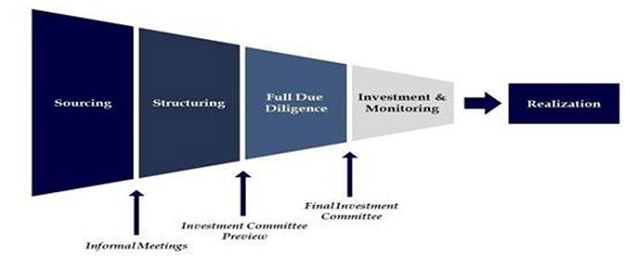


Note: The expected number of transactions is based on the estimates of our General Partner (“GP”) and the actual number of transactions may differ based on actual market or economic factors or the ability to source suitable investments.


Sourcing. Our Deal Team intends to originate investments through a nationwide network of relationships of the Deal Team. Specifically, our Deal Team intends to source its investment opportunities through a combination of: (i) direct origination efforts of our Deal Team, as a result of their contacts with middle market RIA firms, including existing relationships and experienced senior management teams; (ii) relationships with middle market RIA firm sponsors and industry contacts; and (iii) long-standing relationships with industry executives and strategic partners. The Deal Team will employ a rigorous investment process that involves several steps and a thorough analysis of the RIA firm targets. Comprehensive joint industry reviews, primarily focusing on opportunities in middle market RIA firms, will be completed on an ongoing basis, in order to identify potential RIA firms for acquisition. We believe our Deal Team’s strength and breadth of relationships across a wide range of RIA firms will generate numerous investing opportunities, which should enable our Partnership to be selective in seeking appropriate RIA firms to acquire.


 27 


I. Initial Sourcing Stage


The Deal Team has conducted an initial sourcing stage to screen and select 204 targeted RIA firms out of over 1,100 middle-market RIA firms, who are registered with the SEC as Registered Investment Advisers. A list of such RIA firms is set forth on page 5. Based upon the Deal Team’s investigation of publicly available information, each of the 204 target RIA firms meet the following investment criteria:


$500 million to $1.0 billion in clients’ assets under management; and
   
Each RIA firm’s website confirmed they meet our proprietary and confidential requirements.


II. Investment Qualification Stage


After sale of the minimum number of Class A Common Units (1,428,571 Units) are sold in Phase 1 of the Offering, the Deal Team intends to complete, in time-related stages, additional screening to determine which of the initially targeted RIA firms as a result of the initial sourcing stage meet each of the following financial criteria:


Client retention rates of at least 95%;
   
Operating profit margins ranging of at least 40% (including the owners’ compensation); and
   
Annual growth rates of 7% or greater for the past five years, compounded.


III. Other Considerations in Sourcing


The Deal Team will also consider, as part of its evaluation, the following additional analysis and criteria:


SEC ADV registration filings;


Continuous and profitable operating histories (includes the owners’ compensation); and


Aggregate clients’ asset allocation.


Structuring. Those RIA firms that are identified and selected through the sourcing process above will be offered a non-binding term sheet by our Deal Team setting forth the terms of our proposed acquisition of a majority interest in such RIA firms. We intend to utilize a term sheet to ensure that the targeted RIA firm is interested prior to us expending additional resources for further due diligence.


Investment Committee Preliminary Approval. Upon execution of a term sheet, our Deal Team presents the terms and structure of the proposed RIA firm acquisition to our Investment Committee for review and preliminary approval to proceed to conduct full due diligence. As part of such preliminary approval, the Investment Committee will review the results of the sourcing metrics above and analyze the term sheet. The Investment Committee also may, but shall not be required to, seek assistance from outside valuation and accounting firms.


Full Due Diligence. Following the Investment Committee preliminary approval, the Deal Team will conduct full due diligence of the prospective RIA firm acquisition. This phase of the investment process comprises all aspects of due diligence, including fundamental analysis, legal analysis and valuation analysis. Our Deal Team’s fundamental analysis will closely scrutinize the target RIA firm’s financial statements to reveal key drivers of revenues and expenses. Our Deal Team also intends to conduct extensive management team interviews to uncover incremental insights into these drivers, as well as other potential issues that could affect the target RIA firm’s performance. To ensure a thorough due diligence process, our Deal Team may utilize third-party specialists including accountants, appraisers, examiners, consultants and attorneys, as deemed necessary or appropriate by the Deal Team.


 28 


Definitive Documentation. Contemporaneously with the due diligence phase, the Deal Team will work with the Partnership’s legal counsel and accountants to prepare the definitive transaction documents to consummate the proposed RIA firm acquisition.


Final Investment Committee Approval. Upon completion of full due diligence, the Deal Team formally presents the terms of the proposed RIA firm acquisition to the Investment Committee for recommendation. In addition to considering the proposed acquisition on its standalone merits, the Investment Committee considers the overall fit of the proposed acquisition within the portfolio of RIA firms previously acquired by the Partnership.


Investment and Monitoring. After consummation of an RIA firm acquisition, the Partnership will begin monitoring such RIA firm’s performance. Acquired RIA firms will be monitored on a monthly basis and, more formally, at regular meetings with management of the RIA firm. Our GP will assign an analyst to, on a continuing basis, actively monitor and have an open monologue with the principals of each acquired RIA firm. Such monitoring will include the review of detailed, internally-generated monitoring reports. Ongoing, collaborative industry reviews will be conducted by our GP’s investment team and an active, up-to-date model comparing operating income and assets under management ratios at time of acquisition is maintained. As part of the monitoring process, our GP has developed risk policies pursuant to which it will regularly assess the risk profile of each of our RIA firms, and will rate each of them based on the following categories, which we refer to as “Internal Risk Ratings”.


Investment Rating:   Summary Description
1   Performing at or above expectations.
     
2   Watch/minor risk. RIA firm operating below expectations, but in compliance with financial metrics and performance expected to improve.
     
3   Significant risk. RIA firm performing substantially below expectations. Loss of investment not expected, but returns may be impaired.
     
4   Potential impairment. Focus is on preservation of capital.


Our GP will monitor and, when appropriate, change the investment ratings assigned to our RIA firms. For any RIA firm rated two, three, or four, our GP will increase its level of focus and communications and prepare regular updates for our Investment Committee, summarizing current operating results, material impending events and recommended actions.


Net Asset Valuation


As part of the monitoring process, we intend to determine the net asset value of our ownership of RIA firms each quarter. Securities that are publicly-traded will be valued at the reported closing price on the valuation date. Securities that are not publicly-traded, which will be the majority of our securities of RIA firms, will be valued at fair value as determined in good faith, based on the GP’s valuation against our acquisition model. In connection with that determination, we expect that the GP will consider relevant inputs, including, but not limited to, values of like securities, recent portfolio company financial statements and forecasts, and any valuations prepared by third-party valuation services.


Managerial Assistance


As a controlling equity partner, we offer, and intend to provide upon request, managerial assistance to our RIA firms. This assistance may involve, among other things, monitoring the day-to-day operations of our RIA firms and providing other organizational and financial guidance. To the extent fees are paid for these services, we, rather than our GP, will retain any fees paid for such assistance.


ITEM 8. Description of Property


The Partnership does not own any real estate. The Partnership’s address is 116 South Franklin Street, Rocky Mount, NC 27804.


 29 


ITEM 9. Management’s Discussion and Analysis of Financial Condition and Results of Operations


Results of Operations


From inception to June 30, 2015 we have not started our plan of operation and have not generated any revenue. As of June 30, 2015, the Partnership had cash of approximately $100,000 and liabilities of approximately $0.00. For the period ended June 30, 2015, the Partnership had expenses related to start-up costs categorized as office and general expense of $78,384 and professional fees of $98,820. The GP has incurred these costs and will only be reimbursed when the minimum offering is reached.


Liquidity and Capital Resources


Other than as described herein, the Partnership has no other plans, arrangements or commitments to raise funds outside this Offering. As of June 30, 2015, the Partnership has $100,000 in cash.


Plan of Operations


Our business objectives for the next 12 months (beginning upon completion of this Offering), provided the necessary funding is available, are to acquire RIA firms and to monitor such RIA firms’ performance, as set forth in the “Investment - Acquisition Process Overview” set forth on page 27 of this Offering Circular. The amount we receive from this Offering will determine the number of RIA firms we will be able to acquire.


Minimum Amount Received


If we sell the minimum amount of Class A Common Units (1,428,571 Class A Common Units) in Phase 1 of this Offering ($20 million), we intend to acquire majority interests in 12 RIA firms, and we intend to continue to consummate additional acquisitions of RIA firms, with the proceeds of sales of additional Class A Common Units in this Offering. If we sell the minimum amount of Class A Common Units in Phase 1 of this Offering ($20 million), we do not believe we will require additional equity funding in order to operate in the next 12 months, but we estimate that we will likely require additional financing in the beginning of the following year to complete more acquisitions and grow the Partnership.


The following chart provides an overview of our budgeted expenditures for the 12 months following the completion of this Offering if we sell the minimum amount of Class A Common Units (1,428,571 Class A Common Units). The expenditures are categorized by significant area of activity.


Acquisition Expenditures   $ 18,898,539  
Operating Expenses   $ 556,726  
Legal and Accounting Expenses   $ 134,605  
General and Administrative Expenses   $ 188,447  
Working Capital Expenses   $ 121,683  


Maximum Amount Received


If the maximum amount of gross proceeds ($50 million) are raised in this Offering, we intend to execute purchase agreements with 31 initial RIA firms and we do not believe we will require additional equity funding in order to operate in for the next 12 months, but we estimate that we will likely require additional financing in the beginning of that next year to complete more acquisitions and grow the Partnership.


The following chart provides an overview of our budgeted expenditures for the 12 months following the completion of this Offering if the maximum gross proceeds ($50 million) are raised in this Offering. The expenditures are categorized by significant area of activity.


Acquisition Expenditures   $ 45,157,062  
Operating Expenses   $ 1,330,268  
Legal and Accounting Expenses   $ 321,631  
General and Administrative Expenses   $ 450,284  
Working Capital Expenses   $ 290,755  


 30 


ITEM 10. Directors, Executive Officers and Significant Employees


Management of the Partnership


The Partnership’s business and affairs are managed under the direction of the GP. The GP’s board of directors initially consist of three members and are made up of a majority of independent directors, as defined in rules of the Nasdaq Marketplace. The GP’s board of directors is elected by IAMC, LLC, the sole member of the GP. IAMC, LLC is owned by L. Edward Baker. The GP’s board of directors appoints its executive officers.


Directors of the General Partner


Name   Age   Term of Office
L. Edward Baker   68   September 2014 – present
Robert A. Kelly   70   June 2015 – present
Brian Thayer   40   June 2015 – present


L. Edward Baker, Director, Chairman and Chief Executive Officer. Mr. Baker founded IAMC, LLC in 2010 and serves as its Chief Executive Officer. From 2004 to 2010, Mr. Baker served as Chairman, Chief Executive Officer and Chief Investment Officer of Mesa Holdings, Inc., a holding company of SEC-Registered Investment Adviser firms. Prior to this, Mr. Baker was the portfolio manager for Baker 500 Corporation, an asset management firm based on Mr. Baker’s proprietary investment methodology in large-cap equities. Mr. Baker formerly served as Chief Executive Officer and Chief Investment Officer for Piper Jaffray Trust Company and as Chief Executive Officer and Chairman of Piper Trust Funds, Inc., a family of mutual funds. Mr. Baker also formerly served as SVP of international investment advisor AIB Govett and prior to this he served as Senior Vice President Correspondent Banking at Norwest Banks, now operating as Wells Fargo Bank. Mr. Baker received his undergraduate degree in Business Administration and Economics from Park University and MBA from the Kellogg School of Management at Northwestern University. He is also a Graduate of the ABA’s National Trust School. Mr. Baker was chosen to be a director of the GP based on his experience and knowledge of RIA firm operations.


Robert A. Kelly, Director. Mr. Kelly has over 40 years in the financial services industry serving as an independent consultant since his retirement in 2005, as the Chief Executive Officer and President of KCB, a community bank based in Kearney, Missouri. Prior, Mr. Kelly formerly was a partner at several financial consulting firms, including Penquite & Associates, Continental Communications Group, Financial Earnings Group and GRA. Early in Mr. Kelly’s banking career he had the unique opportunity to shepherd a “de novo” bank as part of a state wide major bank holding company. This provided the unique environment to operate as a community bank and best utilize the direction and resources of the largest bank in the state of Missouri. Mr. Kelly holds a B.S. degree in Business Administration from Rockhurst University. Mr. Kelly was chosen to be a director of the GP based on his financial background and management skills.


Brian Thayer, Director. Mr. Thayer currently serves as the CFO of MSP Recovery LLC ("MSP"), a company focused on recovering misappropriated claims throughout the healthcare industry. Prior to joining MSP in October 2015, Brian was a Director at Thomas Capital Group (“TCG”), a capital markets firm assisting alternative investment managers raise capital from institutional investors since 2013. Prior to his tenure at TCG, Mr. Thayer was a Partner at Saw Mill Capital from 2009 to 2013, and a Partner at GormanThayer LLC between 2007 and 2008, two boutique investment banking firms, where he focused on assisting middle market companies and asset managers access the capital markets. Before that, he managed the private equity practice at Attalus Capital, where he also conducted analysis on hedge funds employing global macro, long/short equity and credit strategies. Mr. Thayer spent over four years in the due diligence group at Hamilton Lane, the world’s largest private equity consulting and asset management firm, where he was involved in private fund, co-investment and secondary transactions aggregating billions of dollars. He started his career at Ernst & Young LLP, where he provided investment advice to high net worth individuals and conducted due diligence on public asset managers. He is a cum laude graduate from Providence College with a degree in Business Management, he currently holds series 7 and 63 registrations. Mr. Thayer was chosen to be a director of the GP based on his investment and acquisition experience.


Executive Officers of the General Partner


Name   Age   Position   Term of Office
L. Edward Baker   68   Chairman and Chief Executive Officer   September 2014 – present
Jay Abdo   64   Chief Financial Officer   June 2015 – present


L. Edward Baker, Director, Chairman and Chief Executive Officer. See above.


Jay Abdo, CPA, Chief Financial Officer. Since 1975, Mr. Abdo, currently the Senior Business Partner, has served at Abdo Eick & Meyers, a Minnesota based accounting firm his father started 51 years ago. His 40 years of experience are focused in all aspects of business, including general accounting, taxation, IRS and state representation, and litigation support. He received his BA Degree in Accounting from Minnesota State University and an Advanced Degree in Taxation from the University of Michigan.


The address for each executive officer and director is c/o AWA Management LLC, 116 Franklin Street, Rocky Mount, North Carolina 27804.


Family Relationships


None.


Involvement in Certain Legal Proceedings


None.


 31 


ITEM 11. Compensation of Directors and Executive Officers


In addition to the compensation of the GP disclosed below, the Partnership reimburses the GP for all direct and indirect expenses the GP incurs or payments the GP makes on behalf of the Partnership, which includes salary, bonus, and other amounts paid to individuals employed by the Partnership or individuals providing services for the Partnership. In addition, the Partnership honors employee incentive plans issued by the GP for such services.


Compensation of the General Partner


The GP will be compensated for its management services. After the sale of the minimum amount of Class A Common Units in this Offering, the GP will become entitled to a fee consisting of two components—a base management fee and an incentive fee based on our performance.


The base management fee will be calculated at an annual rate of 2.0% of our gross invested assets, including all assets of our RIA firms, and will be payable quarterly.


The incentive fee will be calculated and payable quarterly in arrears, and is equal to 20% of the profits of the Partnership for the immediately preceding quarter, but is payable only if the Partnership is able to pay a quarterly dividend to our unitholders in an amount equal or greater to the 8% annual rate (or 2% for such quarter). Profits of the partnership include net income less expenses of the Partnership, and any realized capital gains of the Partnership.


The GP’s board of directors, including a majority of the independent directors, oversee and monitor our GP’s performance and will annually review the compensation we pay to the GP.


Compensation of Directors of the General Partner


L. Edward Baker is the only director of the GP who is also an employee. All non-employee directors shall receive an annual salary of $60,000. Our directors are also eligible to receive equity awards.


Class M Units


The Partnership issued an aggregate of 1,000,000 restricted Class M Units prior to this Offering to AWA Management LLC, its general partner, and the general partner’s directors. Such restricted Class M Units shall vest in three equal installments beginning one year from the date of issuance. The transactions were deemed to be exempt from the registration requirements of the Securities Act of 1933 by virtue of Section 4(2) thereof, as a transaction by an issuer not involving a public offering. The 1,000,000 Class M Units were issued as follows:


  900,000 restricted Class M Units were issued to AWA Management LLC. AWA Management LLC is owned by IAMC, LLC, which is 100% owned by L. Edward Baker.


  50,000 restricted Class M Units were issued to Robert A. Kelly. Mr. Kelly is a director of AWA Management LLC.


  50,000 restricted Class M Units to Brian Thayer, Director. Mr. Thayer is a director of AWA Management LLC.


Executive Compensation of the General Partner


L. Edward Baker, Director, Chairman and Chief Executive Officer of the GP, will receive an annual salary of $350,000. This annual salary reduces the amount payable to the GP as part of the base management fee described above.


Jay Abdo, the Chief Financial Officer of the GP, will receive an annual salary of $160,000.


Our executive officers are also eligible to receive equity awards. On December 23, 2015, 50,000 restricted Class M Units were issued to Jay Abdo, which vest in three equal installments beginning one year from the date of issuance.


 32 
 

 Significant Employees


The Partnership has no significant employees other than the GP’s directors and officers named in this Offering Circular. 

Compensation of Directors and Executive Officers in the Last Fiscal Year


As of June 30, 2015, the Partnership had not established compensation packages for the directors and executive officers of the GP. For a current description of compensation arrangements, please see “Compensation of Directors of the General Partner” and “Executive Compensation of the General Partner” above.


ITEM 12. Security Ownership of Management and Certain Security holders 

As of the close of business on December 30, 2015, we had outstanding three classes of securities – Class A Common Units, of which there were 2,001,378 Class A Common Units issued and outstanding; Class M Units, of which there were 1,050,000 Class M Units issued and outstanding, and General Partner Units, of which there is 1 General Partner Unit outstanding. Each Class A Common Unit and each Class M Unit is currently entitled to one vote on all matters put to a vote of our limited partners. Subject to certain exceptions (see “Item 14 – Securities Being Offered – Material Provisions of the Partnership Agreement – Meetings; Voting”), our Class B Units and Class M Units vote together with our Class A Common Units as a single class. The General Partner Unit entitles AWA Management, LLC, as the sole owner of such Unit, to control the operations of the Partnership. For more information on the voting and financial rights of each class of Units, see “Material Provisions of the Partnership Agreement” on page 37.


Class A Common Units


1,116,378 Class A Common Units have been issued to founders, consisting of family members and personal acquaintances of Mr. Baker, pursuant to a series of exchange and release agreements (the “Exchange Agreements”). Pursuant to the Exchange Agreements, each of the founders agreed to accept Class A Common Units in exchange for any rights they may have to obtain securities from the General Partner or certain affiliates thereof. Each of such founders had made various amounts of investments in affiliates of the General Partner, which were used to perform market research, develop a business model which evolved to the Partnership’s current business model and pay for professional services to further explore and develop such business model. None of such founders hold 10% or more of the aggregate amount of Class A Common Units outstanding. None of the founders’ funds were paid to the Partnership.


The following table sets forth the number of Class A Common Units, and percentage of outstanding Class A Common Units, beneficially owned as of December 31, 2015, by:


  each person known to us to beneficially own more than 10% of the outstanding Class A Common Units;


  each of our directors and each executive officer; and


  all of our directors and executive officers as a group.


Beneficial ownership is determined in accordance with the rules of the SEC and includes voting or investment power with respect to the securities. There are no Class A Common Units subject to options that are currently exercisable or exercisable within 60 days.


Unless otherwise indicated, the address of each of the following persons is c/o AWA Management LLC, 116 Franklin Street, Rocky Mount, North Carolina 27804, and each such person has sole voting and investment power with respect to the shares set forth opposite his, her or its name.


Name of Class A Common Unit Holder   Number of
Class A Common
Units
    Current percentage prior to the closing of the Offering Period     Percentage assuming minimum amount of Class A Common Units is purchased (4)     Percentage assuming maximum amount of Class A Common Units is purchased(5)  
10% Holders:                        
IAMC “F” Trust(1)     510,000       25 %     15 %     10 %
IAMC “S” Trust(2)     375,000       19 %     11 %     7 %
Directors and Officers:                                
L. Edward Baker(3)     885,001       44 %     26 %     17 %
                                 
All directors and officers as a group (1 person)     885,001       44 %     26 %     17 %


(1) Investment and voting power over the Class A Common Units is held by L. Edward Baker as Trustee.  The address for IAMC “F” Trust is  2155 Tarpon Rd., Naples, Florida 34102.  Mr. Baker is the Chairman and Chief Executive Officer of the GP.
(2) Investment and voting power over the Class A Common Units is held by L. Edward Baker as Trustee.  The address for IAMC “S” Trust is 2155 Tarpon Rd., Naples, Florida 34102.  Mr. Baker is the Chairman and Chief Executive Officer of the GP.

(3) Includes:


(i) 1 Class A Common Unit, issued for purposes of the initial organization of the Partnership, is held by IAMC, LLC, which will be cancelled for no consideration upon the sale of the minimum number of Class A Common Units (1,428,571Units) in this Offering. Investment and voting power over the Class A Common Unit is held by L. Edward Baker, the managing member. Mr. Baker is the Chairman and Chief Executive Officer of the GP.


 33 


(ii) 510,000 Class A Common Units held by IAMC “F” Trust. Investment and voting power over the Class A Common Units is held by L. Edward Baker as Trustee. The address for IAMC “F” Trust is 2155 Tarpon Rd., Naples, Florida 34102. Mr. Baker is the Chairman and Chief Executive Officer of the GP.


(iii) 375,000 Class A Common Units held by IAMC “S” Trust. Investment and voting power over the Class A Common Units is held by L. Edward Baker as Trustee. The address for IAMC “S” Trust is 2155 Tarpon Rd., Naples, Florida 34102. Mr. Baker is the Chairman and Chief Executive Officer of the GP. 


(4) Assumes the issuance of 1,428,571 Class A Common Units in Phase 1 of the Offering.
   
(5) Assumes the issuance of an aggregate of 3,303,571 Class A Common Units in Phase 1 and Phase 2 of the Offering.


Class B Units


There are no outstanding Class B Units as of December 31, 2015.


Class M Units


The following table sets forth the number of Class M Units, and percentage of outstanding Class M Units, beneficially owned as of December 31, 2015, by:


  each person known to us to beneficially own more than 10% of the outstanding Class M Units;


  each of our directors and each executive officer; and


  all of our directors and executive officers as a group.


Beneficial ownership is determined in accordance with the rules of the SEC and includes voting or investment power with respect to the securities. There are no Class M Units subject to options that are currently exercisable or exercisable within 60 days.


Unless otherwise indicated, the address of each of the following persons is c/o AWA Management LLC, 116 Franklin Street, Rocky Mount, North Carolina 27804, and each such person has sole voting and investment power with respect to the shares set forth opposite his, her or its name.


Name of Class M Unit Holder   Number of
Class M
Units
    Current percentage prior to the closing of the Offering Period     Percentage assuming minimum offering amount is purchased     Percentage assuming maximum offering amount is purchased  
10% Holders:                        
AWA Management LLC(1)     900,000       86 %     86 %     86 %
Directors and Officers:                                
L. Edward Baker(2)     900,000       86 %     86 %     5 %
Jay Abdo(3)     50,000       5 %     5 %     5 %
Robert A. Kelly(4)     50,000       5 %     5 %     5 %
Brian Thayer(5)     50,000       5 %     5 %     5 %
                                 
All directors and officers as a group (4 persons)     1,050,000       100 %     100 %     100 %


(1) Such Class M Units shall vest in three equal installments, beginning one year from the date of issuance.  Investment and voting power over the Class M Units is held by L. Edward Baker as the Chairman and Chief Executive Officer.
   
(2) Includes 900,000 restricted Class M Units held by AWA Management LLC.  Such Class M Units shall vest in three equal installments beginning one year from the date of issuance.  Investment and voting power over the Class M Units is held by L. Edward Baker as the Chairman and Chief Executive Officer.


(3) Includes 50,000 restricted Class M Units.  Such Class M Units shall vest in three equal installments beginning one year from the date of issuance.  Mr. Abdo is Chief Financial Officer of the GP.
   
(4) Includes 50,000 restricted Class M Units.  Such Class M Units shall vest in three equal installments beginning one year from the date of issuance.  Mr. Kelly is a director of the GP.
   
(5) Includes 50,000 restricted Class M Units.  Such Class M Units shall vest in three equal installments beginning one year from the date of issuance.  Mr. Thayer is a director of the GP.


 34 


ITEM 13. Interest of Management and Others in Certain Transactions


Partnership Agreement


The GP will serve as the Partnership’s general partner, and manage the day-to-day operations of, and provide investment management services to the Partnership. Under the terms of our Partnership Agreement, the GP will, among other things:


  determine the composition and allocation of our RIA firms, the nature and timing of the changes therein and the manner of implementing such changes;


  identify, evaluate and negotiate the structure of the acquisitions we make (including performing due diligence on our prospective RIA firms);


  execute, monitor and service the RIA firms we acquire;


  determine the securities and other assets that we will purchase, retain or sell;


  perform due diligence on prospective RIA firms; and


  provide us with other management, research and related services as we may from time to time require.


The GP’s services under the Partnership Agreement are exclusive to the Partnership, and the GP has agreed not to furnish similar services to other entities to ensure its services to us are not impaired.


For a full summary of the material provisions of the Partnership Agreement, see “Item 14 – Securities Being Offered – Material Provisions of the Partnership Agreement”.


Private Placements


Class A Common Units


The Partnership issued 510,000 Class A Common Units to IAMC “F” Trust and 375,000 Class A Common Units to IAMC “S” Trust. L. Edward Baker is the Trustee of IAMC “F” Trust and IAMC “S” Trust. The transactions were deemed to be exempt from the registration requirements of the Securities Act of 1933 by virtue of Section 4(2) thereof, as a transaction by an issuer not involving a public offering.


The Partnership issued IAMC, LLC (“IAMC”) one Class A Common Unit upon formation of the Partnership. IAMC’s Class A Common Unit will be cancelled upon the sale of the minimum amount of Class A Common Units in this Offering. L. Edward Baker is the managing member of IAMC.


Class M Units


The Partnership issued to AWA Management LLC, its general partner, and the general partner’s directors and officers an aggregate of 1,050,000 restricted Class M Units of the Partnership (“Class M Units”). Such restricted Class M Units shall vest in three equal installments beginning one year from the date of issuance. The transactions were deemed to be exempt from the registration requirements of the Securities Act of 1933 by virtue of Section 4(2) thereof, as a transaction by an issuer not involving a public offering. The 1,050,000 Class M Units are held as follows:


  900,000 Class M Units are held by AWA Management LLC. AWA Management LLC is owned by IAMC, LLC, which L. Edward Baker is the managing member.


  50,000 Class M Units to Robert A. Kelly. Mr. Kelly is a director of AWA Management LLC.


  50,000 Class M Units to Brian Thayer, Director. Mr. Thayer is a director of AWA Management LLC.


  50,000 Class M Units to Jay Abdo. Mr. Abdo is the Chief Financial Officer of AWA Management LLC.


Compensation of the General Partner


See “Item 11 – Compensation of Directors and Officers” for the compensation arrangement with the GP.


 35 


ITEM 14. Securities Being Offered


Securities Being Offered


Class A Common Units


Our Class A Common Units represent limited partner interests in us. The holders of our Class A Common Units are entitled to participate in our dividends and exercise the rights or privileges available to limited partners under our Partnership Agreement. Each record holder of a Class A Common Unit is entitled to a number of votes equal to the number of Class A Common Units held, and will vote as a single class, with holders of our Class B and Class M Units, except to the extent Delaware requires the Class A Common Units to vote as a single class and subject to the exceptions discussed below (see “Item 14 – Securities Being Offered – Material Provisions of the Partnership Agreement – Meetings; Voting”). We have not established a sinking fund, and we have not granted any preemptive rights with respect to our Class A Common Units, but the GP has the right to grant preemptive rights in the future. Dividends on the Class A Common Units will be payable on a quarterly basis, when and if declared by our GP, at an annual rate of 8.00% on the stated value of $14.00 per Class A Common Unit. We intend to authorize, declare and pay such dividends on a quarterly basis; however, our ability to pay dividends might be adversely affected by our earnings, our financial condition, compliance with applicable regulations and such other factors as our GP may deem relevant from time to time. See “Risk Factors” beginning on page 7 of this Offering Circular for a discussion of some of the factors potentially impacting the payment of dividends that you should carefully consider.


Upon our dissolution, unless we are continued as a new limited partnership, the liquidator authorized to wind up our affairs will, acting with all of the powers of our GP that the liquidator deems necessary or appropriate in its judgment, liquidate our assets and apply the proceeds of the liquidation first, to discharge our liabilities as provided in the Partnership Agreement and by law, and thereafter to the unitholders pro rata according to the percentages of their Class A Common Units as of a record date selected by the liquidator. The liquidator may defer liquidation of our assets for a reasonable period of time or distribute assets to unitholders in kind if it determines that an immediate sale or dividend of all or some of our assets would be impractical or would cause undue loss to the partners.


Unless our GP determines otherwise, we will issue all our Class A Common Units in uncertificated form.


Transfer of Class A Common Units


By acceptance of the transfer of our Class A Common Units, in accordance with our Partnership Agreement, each transferee of our Class A Common Units will be admitted as a unitholder with respect to the Class A Common Units transferred, when such transfer and admission is reflected in our books and records. Additionally, each transferee of our Class A Common Units:


  represents that the transferee has the capacity, power and authority to enter into our Partnership Agreement;


  will become bound by the terms of, and will be deemed to have agreed to be bound by, our Partnership Agreement; and


  gives the consents, approvals, acknowledgements and waivers set forth in our Partnership Agreement, such as the approval of all transactions and agreements that we are entering into in connection with our formation and this Offering.


A transferee will become a substituted limited partner of our Partnership for the transferred Class A Common Units automatically upon the recording of the transfer on our books and records. Our GP will cause any transfers to be recorded on our books and records no less frequently than quarterly. Class A Common Units are transferable according to the laws governing transfers of securities.


Until a Class A Common Unit has been transferred on our books, we and the transfer agent, notwithstanding any notice to the contrary, may treat the record holder of the Class A Common Unit as the absolute owner for all purposes, except as otherwise required by law or stock exchange regulations. A beneficial holder's rights are limited solely to those that it has against the record holder as a result of any agreement between the beneficial owner and the record holder.


Warrants to Purchase Class A Common Units


Each investor purchasing Class A Common Units in Phase 1 of the Offering will receive a warrant to purchase additional Class A Common Units at $12.00 per Unit, for a number of Units equal to 20% of the Units purchased by the investor in Phase 1 of the Offering. The warrants will be exercisable upon issuance for a period of 5 years, but the Class A Common Units to be issued upon exercise of the warrants cannot be sold for at least 3 years after the purchase date of the warrants. The issuance of the warrants, but not the issuance of the Class A Common Units to be issued upon exercise of such Warrants, are being registered in this Offering. The warrants contain other customary terms. A form of warrant to be issued to Phase 1 investors is attached as Exhibit 3.2 of this Offering Circular.


Transfer Agent and Registrar


Cleartrust, LLC will serve as registrar and transfer agent for our Class A Common Units. You may contact the registrar and transfer agent at the following address: 16540 Pointe Village Drive, Suite 210, Lutz, Florida 33558.


 36 


Material Provisions of the Partnership Agreement


The following is a summary of the material provisions of the Partnership Agreement. The Partnership Agreement as it will be in effect at the time of this Offering is attached as an exhibit to this Offering Circular, and the following summary is qualified by reference thereto.


We summarize the following provisions of our Partnership Agreement elsewhere in this Offering Circular:


  with regard to the transfer of Class A Common Units, see “Item 14 – Securities Being Offered –Transfer of Class A Common Units”; and


  with regard to allocations of taxable income and taxable loss, see “– Material U.S. Federal Tax Considerations”.


General Partner


Our general partner, as the sole owner of our General Partner Unit, will manage all of our operations and activities. Our general partner is authorized in general to perform all acts that it determines to be necessary or appropriate to carry out our purposes and to conduct our business. The Partnership Agreement provides that our general partner, in managing our operations and activities, will be entitled to consider only such interests and factors as it desires, including its own interests, and will have no duty or obligation (fiduciary or otherwise) to give any consideration to any interest of or factors affecting us or any limited partners, and will not be subject to any different standards imposed by the Partnership Agreement, the Delaware Limited Partnership Act or under any other law, rule or regulation or in equity. Our GP is wholly-owned by IAMC, LLC, a Delaware limited liability company, of which Mr. Edward Baker is the managing member. Our unitholders have only limited voting rights on matters affecting our business and therefore have limited ability to influence management’s decisions regarding our business. The voting rights of our unitholders are limited as set forth in the Partnership Agreement and in the Delaware Limited Partnership Act. For example, our general partner may generally make amendments to the Partnership Agreement or our Certificate of Limited Partnership, without the approval of any unitholder as set forth under “—Amendment of the Partnership Agreement – No Limited Partner Approval”.


Limited Partners


We have authorized for issuance to our limited partners three classes of Units- Class A Common Units, Class B Units and Class M Units. The holders of the foregoing classes of units are limited partners under the Partnership Agreement.


Class A Common Units. For a description of the rights and obligations of the Class A Common Units, see “Item 14- Securities Being Offered”.


Class B Units. Subject to certain exceptions set forth in “–Dividends” below, the Class B Units are not entitled to any dividends of the Partnership, but are entitled to vote with the Class A Common Units and Class M Units on any matters submitted to our limited partners and separately as a class on any matters required to be voted on separately by applicable Delaware law. The Class B Units must be held for a minimum of six months after issuance, and only 20% of such units can be sold in any calendar year. The Class B Units are converted into Class A Common Units upon sale to a third party, dissolution of the Partnership, the merger, consolidation or other business combination of the Partnership, or upon the written consent of our general partner. The Class B Units are to be issued to the sellers of RIA firms as part of the consideration being offered by the Partnership and its subsidiaries as part of the acquisition transactions.


Class M Units. The rights, preferences and obligations of the Class M Units are similar to those of the Class B Units. Subject to certain exceptions, the Class M Units are not entitled to any dividends of the Partnership, but are entitled to vote with the Class A Common Units and Class B Units on any matters submitted to our limited partners and separately as a class on any matters required to be voted on separately by applicable Delaware law. The Class M Units must be held for a minimum of six months after issuance, and only 20% of such units can be sold in any calendar year. The Class M Units are converted into Class A Common Units upon sale to a third party, dissolution of the Partnership, the merger, consolidation or other business combination of the Partnership, or upon the written consent of our general partner. The Class M Units are to be issued to the GP and its officers and directors as part of their executive compensation.


 37 


Organization


We were formed on June 9, 2015 and have a perpetual existence.


Purpose


Under the Partnership Agreement, we are permitted to engage, directly or indirectly, in any business activity that is approved by our general partner and that lawfully may be conducted by a limited partnership organized under Delaware law.


Power of Attorney


Each limited partner, and each person who acquires a limited partner interest in accordance with the Partnership Agreement, grants to our general partner and, if appointed, a liquidator, a power of attorney to, among other things, execute and file documents required for our qualification, continuance, dissolution or termination. The power of attorney also grants our general partner the authority to amend, and to make consents and waivers under, the Partnership Agreement and certificate of limited partnership, in each case in accordance with our partnership agreement.


Capital Contributions


Our unitholders are not obligated to make additional capital contributions, except as described below under “– Limited Liability”.


Limited Liability


Assuming that a limited partner does not participate in the control of our business within the meaning of the Delaware Limited Partnership Act and that he otherwise acts in conformity with the provisions of the Partnership Agreement, his liability under the Delaware Limited Partnership Act will be limited, subject to possible exceptions, to the amount of capital he is obligated to contribute to us for his Class A Common Units plus his share of any undistributed profits and assets. If it were determined however that the right, or exercise of the right, by the limited partners as a group:


  to remove or replace our general partner,
     
  to approve some amendments to the Partnership Agreement, or
     
  to take other action under the Partnership Agreement,


constituted as “participation in the control” of our business for the purposes of the Delaware Limited Partnership Act, then our limited partners could be held personally liable for our obligations under the laws of Delaware to the same extent as our general partner. This liability would extend to persons who transact business with us who reasonably believe that the limited partner is a general partner. Neither the Partnership Agreement nor the Delaware Limited Partnership Act specifically provides for legal recourse against our general partner if a limited partner were to lose limited liability through any fault of our general partner.


Under the Delaware Limited Partnership Act, a limited partnership may not make a dividend to a limited partner if after the dividend all liabilities of the limited partnership, other than liabilities to limited partners on account of their partnership interests and liabilities for which the recourse of creditors is limited to specific property of the partnership, would exceed the fair value of the assets of the limited partnership. For the purpose of determining the fair value of the assets of a limited partnership, the Delaware Limited Partnership Act provides that the fair value of property subject to liability for which recourse of creditors is limited will be included in the assets of the limited partnership only to the extent that the fair value of that property exceeds the non-recourse liability. The Delaware Limited Partnership Act provides that a limited partner who receives a dividend and knew at the time of the dividend that the dividend was in violation of the Delaware Limited Partnership Act will be liable to the limited partnership for the amount of the dividend for three years. Under the Delaware Limited Partnership Act, a substituted limited partner of a limited partnership is liable for the obligations of his assignor to make contributions to the partnership, except that such person is not obligated for liabilities unknown to him at the time he became a limited partner and that could not be ascertained from the Partnership Agreement.


Moreover, if it were determined that we were conducting business in any state without compliance with the applicable limited partnership statute, or that the right or exercise of the right by the limited partners as a group to remove or replace our general partner, to approve some amendments to the Partnership Agreement or to take other action under the Partnership Agreement constituted “participation in the control” of our business for purposes of the statutes of any relevant jurisdiction, then the limited partners could be held personally liable for our obligations under the law of that jurisdiction to the same extent as our general partner under the circumstances. We intend to operate in a manner that our general partner considers reasonable and necessary or appropriate to preserve the limited liability of the limited partners.


 38 


Issuance of Additional Securities


The Partnership Agreement authorizes us to issue an unlimited number of additional partnership securities and options, rights, warrants and appreciation rights relating to partnership securities for the consideration and on the terms and conditions established by our general partner in its sole discretion without the approval of any limited partners.


In accordance with the Delaware Limited Partnership Act and the provisions of the Partnership Agreement, we may also issue additional partnership interests that have designations, preferences, rights, powers and duties that are different from, and may be senior to, those applicable to the Class A Common Units.


Dividends


Dividends will be paid to the limited partners pro rata according to the percentages of their respective Class A Common Units. Holders of our Class B and Class M Units are not entitled to distributions unless such holders are allocated income of the Partnership, in which case our general partner has the sole discretion to issue distributions to such holders up to an estimated amount of taxes to be assessed against such holders on account of such allocated income.


Amendment of the Partnership Agreement


General


Amendments to the Partnership Agreement may be proposed only by or with the consent of our general partner. To adopt a proposed amendment, other than the amendments that require limited partner approval discussed below, our general partner must seek approval of a majority of our outstanding units required to approve the amendment or call a meeting of the limited partners to consider and vote upon the proposed amendment. See “– Meetings; Voting”.


Prohibited Amendments


No amendment may be made that would:


(1)   enlarge the obligations of any limited partner without such limited partner’s consent, except that any amendment that would have a material adverse effect on the rights or preferences of any class of partnership interests in relation to other classes of partnership interests may be approved by at least a majority of the type or class of partnership interests so affected, or


(2)   enlarge the obligations of, restrict in any way any action by or rights of, or reduce in any way the amounts distributable, reimbursable or otherwise payable by us to our general partner or any of its affiliates without the consent of our general partner, which may be given or withheld in its sole discretion.


The provision of the Partnership Agreement preventing the amendments having the effects described in clauses (1) or (2) above can be amended upon the approval of the holders of at least 90% of the outstanding voting units.


No Limited Partner Approval


Our general partner may generally make amendments to the Partnership Agreement or our Certificate of Limited Partnership without the approval of any limited partner to reflect:


(1)   a change in the name of the Partnership, the location of the Partnership's principal place of business, the Partnership's registered agent or its registered office,


(2)   the admission, substitution, withdrawal or removal of partners in accordance with the Partnership Agreement,


 39 


(3)   a change that our general partner determines is necessary or appropriate for the Partnership to qualify or to continue our qualification as a limited partnership or a partnership in which the limited partners have limited liability under the laws of any state or other jurisdiction or to ensure that the partnership will not be treated as an association taxable as a corporation or otherwise taxed as an entity for U.S. federal income tax purposes,


(4)   an amendment that our general partner determines to be necessary or appropriate to address certain changes in U.S. federal income tax regulations, legislation or interpretation,


(5)   an amendment that is necessary, in the opinion of our counsel, to prevent the Partnership or our general partner or its directors, officers, agents or trustees, from having a material risk of being in any manner being subjected to the provisions of the 1940 Act, the Advisers Act or “plan asset” regulations adopted under the U.S. Employee Retirement Income Security Act of 1974, whether or not substantially similar to plan asset regulations currently applied or proposed by the U.S. Department of Labor,


(6)   an amendment that our general partner determines in its sole discretion to be necessary or appropriate for the creation, authorization or issuance of any class or series of partnership securities or options, rights, warrants or appreciation rights relating to partnership securities,


(7)   any amendment expressly permitted in the Partnership Agreement to be made by our general partner acting alone,


(8)   an amendment effected, necessitated or contemplated by an agreement of merger, consolidation or other business combination agreement that has been approved under the terms of the Partnership Agreement,


(9)   any amendment that in the sole discretion of our general partner is necessary or appropriate to reflect and account for the formation by the Partnership of, or its investment in, any corporation, partnership, joint venture, limited liability company or other entity, as otherwise permitted by the Partnership Agreement,


(10) a change in our fiscal year or taxable year and related changes,


(11) a merger with or conversion or conveyance to another limited liability entity that is newly formed and has no assets, liabilities or operations at the time of the merger, conversion or conveyance other than those it receives by way of the merger, conversion or conveyance, or


(12) any other amendments substantially similar to any of the matters described in (1) through (11) above.


In addition, our general partner may make amendments to the Partnership Agreement without the approval of any limited partner if those amendments, in the discretion of our general partner:


(1)   do not adversely affect our limited partners considered as a whole (including any particular class of partnership interests as compared to other classes of partnership interests) in any material respect,


(2)   are necessary or appropriate to satisfy any requirements, conditions or guidelines contained in any opinion, directive, order, ruling or regulation of any federal or state or non-U.S. agency or judicial authority or contained in any federal or state or non-U.S. statute (including the Delaware Limited Partnership Act),


(3)   are necessary or appropriate to facilitate the trading of limited partner interests or to comply with any rule, regulation, guideline or requirement of any securities exchange on which the limited partner interests are or will be listed for trading,


(4)   are necessary or appropriate for any action taken by our general partner relating to splits or combinations of units under the provisions of the Partnership Agreement, or


(5)   are required to effect the intent expressed in this Offering Circular or the intent of the provisions of the Partnership Agreement or are otherwise contemplated by the Partnership Agreement.


 40 


Opinion of Counsel and Limited Partner Approval


Our general partner will not be required to obtain an opinion of counsel that an amendment will not result in a loss of limited liability to the limited partners if one of the amendments described above under “– No Limited Partner Approval” should occur. No other amendments to the Partnership Agreement (other than an amendment pursuant to a merger, sale or other disposition of assets effected in accordance with the provisions described under “ – Merger, Sale or Other Disposition of Assets”) will become effective without the approval of holders of at least 90% of the outstanding Class A Common Units, unless we obtain an opinion of counsel to the effect that the amendment will not affect the limited liability under the Delaware Limited Partnership Act of any of our limited partners.


In addition to the above restrictions, any amendment that would have a material adverse effect on the rights or preferences of any type or class of partnership interests in relation to other classes of partnership interests will also require the approval of the holders of at least a majority of the outstanding partnership interests of the class so affected.


In addition, any amendment that reduces the voting percentage required to take any action must be approved by the affirmative vote of limited partners whose aggregate outstanding voting units constitute not less than the voting requirement sought to be reduced.


Merger, Sale or Other Disposition of Assets


The Partnership Agreement generally prohibits our general partner, without the prior approval of the holders of a majority of the voting power of our outstanding voting units, from causing us to, among other things, sell, exchange or otherwise dispose of all or substantially all of our assets in a single transaction or a series of related transactions, including by way of merger, consolidation or other combination, or approving on our behalf the sale, exchange or other disposition of all or substantially all of the assets of our subsidiaries. However, our general partner in its sole discretion may mortgage, pledge, hypothecate or grant a security interest in all or substantially all of our assets (including for the benefit of persons other than us or our subsidiaries) without that approval. Our general partner may also sell all or substantially all of our assets under any forced sale of any or all of our assets pursuant to the foreclosure or other realization upon those encumbrances without that approval.


If conditions specified in the Partnership Agreement are satisfied, our general partner may convert or merge us or any of our subsidiaries into, or convey some or all of our assets to, a newly formed entity if the sole purpose of that merger or conveyance is to effect a mere change in our legal form into another limited liability entity. The unitholders are not entitled to dissenters' rights of appraisal under the Partnership Agreement or the Delaware Limited Partnership Act in the event of a merger or consolidation, a sale of substantially all of our assets or any other transaction or event.


Election to be Treated as a Corporation


If our general partner determines that it is no longer in our best interests to continue as a partnership for U.S. federal income tax purposes, our general partner may elect to treat us as an association or as a publicly traded partnership taxable as a corporation for U.S. federal (and applicable state) income tax purposes.


Dissolution


We will dissolve upon:


(1)   the election of our general partner to dissolve us, if approved by the holders of a majority of the voting power of our outstanding voting units;


(2)   there being no limited partners, unless we are continued without dissolution in accordance with the Delaware Limited Partnership Act;


(3)   the entry of a decree of judicial dissolution of us pursuant to the Delaware Limited Partnership Act; or


(4)   the withdrawal or removal of our general partner or any other event that results in its ceasing to be our general partner other than by reason of a transfer our general partner interests or withdrawal or removal of our general partner following approval and admission of a successor, in each case in accordance with the Partnership Agreement.


 41 


Upon a dissolution under clause (4), the holders of a majority of the voting power of our outstanding voting units may also elect, within specific time limitations, to continue our business without dissolution on the same terms and conditions described in the Partnership Agreement by appointing as a successor general partner an individual or entity approved by the holders of a majority of the voting power of the outstanding voting units, subject to our receipt of an opinion of counsel to the effect that:


(1)   the action would not result in the loss of limited liability of any limited partner, and


(2)   neither we nor any successor limited partnership would be treated as an association taxable as a corporation or otherwise be taxable as an entity for U.S. federal income tax purposes upon the exercise of that right to continue.


Liquidation and Distribution of Proceeds


Upon our dissolution, unless we are continued as a new limited partnership, the liquidator authorized to wind up our affairs will, acting with all of the powers of our general partner that the liquidator deems necessary or appropriate in its judgment, liquidate our assets and apply the proceeds of the liquidation first, to discharge our liabilities as provided in the Partnership Agreement and by law and thereafter to the partners pro rata according to the financial percentages of their respective partnership interests as of a record date selected by the liquidator. The liquidator may defer liquidation of our assets for a reasonable period of time or distribute assets to partners in kind if it determines that an immediate sale or distribution of all or some of our assets would be impractical or would cause undue loss to the partners.


Withdrawal or Removal of the General Partner


Except as described below, our GP has agreed not to withdraw voluntarily as the general partner prior to the ten-year anniversary of the date in which the minimum number of Class A Common Units is sold without obtaining the approval of the holders of at least a majority of the outstanding Class A Common Units, excluding Class A Common Units held by our GP and its affiliates (including us), and furnishing an opinion of counsel regarding tax and limited liability matters. On or after such date, our GP may withdraw as general partner without first obtaining approval of any unitholder by giving 90 days' advance notice, and that withdrawal will not constitute a violation of the Partnership Agreement. Notwithstanding the foregoing, our GP may withdraw at any time without unitholder approval upon 90 days’ advance notice to the limited partners if at least 50% of the outstanding Class A Common Units are beneficially owned or owned of record or controlled by one person and its affiliates other than our GP and its affiliates.


Upon the withdrawal of our general partner under any circumstances, the holders of a majority of the voting power of our outstanding voting units may select a successor to that withdrawing general partner. If a successor is not elected, or is elected but an opinion of counsel regarding limited liability and tax matters cannot be obtained, we will be dissolved, wound up and liquidated, unless within 180 days after that withdrawal, the holders of a majority of the voting power of our outstanding voting units agree in writing to continue our business and to appoint a successor general partner. See “– Dissolution” above.


Our general partner may not be removed unless that removal is approved by the vote of the holders of at least 66.66% of the outstanding voting units and we receive an opinion of counsel regarding limited liability and tax matters. Any removal of our general partner is also subject to the approval of a successor general partner by the vote of the holders of a majority of the voting power of our outstanding voting units.


In the event of removal of a general partner under circumstances where cause exists or withdrawal of a general partner where that withdrawal violates the Partnership Agreement, a successor general partner will have the option to purchase the general partner interest of the departing general partner for a cash payment equal to its fair market value. Under all other circumstances where a general partner withdraws or is removed by the limited partners, the departing general partner will have the option to require the successor general partner to purchase the general partner interest of the departing general partner for a cash payment equal to its fair market value. In each case, this fair market value will be determined by agreement between the departing general partner and the successor general partner. If no agreement is reached within 30 days of the general partner’s departure, an independent investment banking firm or other independent expert selected by the departing general partner and the successor general partner will determine the fair market value. If the departing general partner and the successor general partner cannot agree upon an expert within 45 days of the general partner's departure, then an expert chosen by agreement of the experts selected by each of them will determine the fair market value.


 42 


If the option described above is not exercised by either the departing general partner or the successor general partner, the departing general partner’s general partner interest will automatically convert into Class A Common Units pursuant to a valuation of those interests as determined by an investment banking firm or other independent expert selected in the manner described in the preceding paragraph.


In addition, we are required to reimburse the departing general partner for all amounts due to the departing general partner, including without limitation all employee-related liabilities, including severance liabilities, incurred for the termination of any employees employed by the departing general partner or its affiliates for our benefit.


Transfer of General Partner Interests


Except for transfer by our GP of its general partner interests in us to another entity as part of the merger or consolidation of our GP with or into another entity, our GP may not transfer all or any part of its general partner interest in us to another person prior to the ten-year anniversary of the date in which the minimum number of Class A Common Units is sold without the approval of the holders of at least a majority of the voting power of our outstanding voting units, excluding voting units held by our GP and its affiliates. On or after such date, our GP may transfer all or any part of its general partner interest without first obtaining approval of any unitholder. As a condition of this transfer, the transferee must assume the rights and duties of the general partner to whose interest that transferee has succeeded, agree to be bound by the provisions of the Partnership Agreement and furnish an opinion of counsel regarding limited liability matters. At any time, the members of our GP may sell or transfer all or part of their limited liability company interests in our GP without the approval of the unitholders.


Sinking Fund; Preemptive Rights


We have not established a sinking fund and we have not granted any preemptive rights with respect to our limited partner interests.


Meetings; Voting


We have three classes of voting securities – Class A Common Units, Class B Units, and Class M Units. Each Class A Common Unit, each Class B Unit, and each Class M Unit is entitled to one vote on all matters put to a vote of our limited partners. The Class A Common Units, Class B Units and Class M Units on the record date will be entitled to notice of, and to vote at, meetings of our limited partners and to act upon matters as to which holders of limited partner interests have the right to vote or to act. The Class A Common Units, Class B Units and Class M Units vote as single class, except to the extent such classes of Units are required to vote as separate classes under the Delaware Limited Partnership Act.


If authorized by our general partner, any action that may be taken at a meeting of the unitholders may be taken without a meeting, without a vote and without prior notice, if an approval in writing setting forth the action so taken is signed by unitholders owning not less than the minimum percentage of the voting power of the outstanding ownership interests of a unitholder (which may be evidenced by Class A Common Units, Class B Units, or Class M Units) that would be necessary to authorize or take such action at a meeting at which all the unitholders were present and voted. Meetings of the unitholders may be called by our general partner or by unitholders owning at least 50% or more of the voting power of the outstanding ownership interests of a unitholder (which may be evidenced by Class A Common Units, Class B Units, or Class M Units) of the class or classes for which a meeting is proposed. Unitholders may vote either in person or by proxy at meetings. The holders of a majority of the voting power of the outstanding ownership interests of a unitholder (which may be evidenced by Class A Common Units, Class B Units, or Class M Units) of the class or classes for which a meeting has been called, represented in person or by proxy, will constitute a quorum unless any action by the unitholders requires approval by unitholders holding a greater percentage of the voting power of such ownership interests of a unitholder, in which case the quorum shall be such greater percentage.


However, if at any time any person or group (other than our general partner and its affiliates, or a direct or subsequently approved transferee of our general partner or its affiliates) acquires, in the aggregate, beneficial ownership of 20% or more of the Partnership’s Class A Common Units then outstanding, that person or group will lose voting rights on all of its Class A Common Units and the units may not be voted on any matter and will not be considered to be outstanding when sending notices of a meeting of Class A Common unitholders, calculating required votes, determining the presence of a quorum or for other similar purposes. Class A Common Units held in nominee or street name account will be voted by the broker or other nominee in accordance with the instruction of the beneficial owner, unless the arrangement between the beneficial owner and his nominee provides otherwise.


Status as Limited Partner


By transfer of Class A Common Units in accordance with the Partnership Agreement, each transferee of Class A Common Units will be admitted as a limited partner with respect to the Class A Common Units transferred when such transfer and admission is reflected in our books and records. Except pursuant to Section 17-607 of the Delaware Limited Partnership Act (as described under "–Limited Liability" above), Section 17-804 of the Delaware Limited Partnership Act (which relates to the liability of a limited partner who receives a dividend of assets upon the winding up of a limited partnership and who knew at the time of such dividend that it was in violation of this provision) or as set forth in the Partnership Agreement, the Class A Common Units will be fully paid and non-assessable.


 43 


Non-Citizen Assignees; Redemption


If we are or become subject to federal, state or local laws or regulations that in the determination of our general partner create a substantial risk of cancellation or forfeiture of any property in which the Partnership has an interest because of the nationality, citizenship or other related status of any limited partner, we may redeem the Class A Common Units held by that limited partner at their current market price. To avoid any cancellation or forfeiture, our general partner may require each limited partner to furnish information about his nationality, citizenship or related status. If a limited partner fails to furnish information about his nationality, citizenship or other related status within 30 days after a request for the information or our general partner determines, with the advice of counsel, after receipt of the information that the limited partner is not an eligible citizen, the limited partner may be treated as a non-citizen assignee. A non-citizen assignee does not have the right to direct the voting of his Class A Common Units and may not receive dividends in kind upon our liquidation.


Indemnification


Under the Partnership Agreement, in most circumstances we will indemnify the following persons, to the fullest extent permitted by law, from and against all losses, claims, damages, liabilities, joint or several, expenses (including legal fees and expenses), judgments, fines, penalties, interest, settlements or other amounts:


  our general partner;


  any departing general partner;


  any person who is or was an affiliate of a general partner or any departing general partner;


  any person who is or was a member, partner, tax matters partner, officer, director, employee, agent, fiduciary or trustee of us or our subsidiaries, the general partner or any departing general partner or any affiliate of us or our subsidiaries, the general partner or any departing general partner;


  any person who is or was serving at the request of a general partner or any departing general partner or any affiliate of a general partner or any departing general partner as an officer, director, employee, member, partner, agent, fiduciary or trustee of another person; or


  any person designated by our general partner.


We have agreed to provide this indemnification unless there has been a final and non-appealable judgment by a court of competent jurisdiction determining that these persons acted in bad faith or engaged in fraud or willful misconduct. We have also agreed to provide this indemnification for criminal proceedings. Any indemnification under these provisions will only be out of our assets. Unless it otherwise agrees, the general partner will not be personally liable for, or have any obligation to contribute or loan funds or assets to us to enable it to effectuate, indemnification. We may purchase insurance against liabilities asserted against and expenses incurred by persons for our activities, regardless of whether we would have the power to indemnify the person against liabilities under the Partnership Agreement.


Books and Reports


Our general partner is required to keep appropriate books of the Partnership’s business at our principal offices or any other place designated by our general partner. The books will be maintained for both tax and financial reporting purposes on an accrual basis. For tax and financial reporting purposes, our year ends on June 30 each year.


We will make available to record holders of Class A Common Units, within 120 days after the close of each fiscal year, an annual report containing audited financial statements and a report on those financial statements by our independent public accountants. Except for our fourth quarter, we will also make available summary financial information within 90 days after the close of each quarter. Under the Partnership Agreement, we will be deemed to have made such annual reports and quarterly financial information available to each record holder of Class A Common Units if we have either (i) filed the report or information with the SEC via its Electronic Data Gathering, Analysis and Retrieval system and such report or information is publicly available on such system or (ii) made such report or information available on any publicly available website maintained by us.


As soon as reasonably practicable after the end of each fiscal year, we will furnish to each partner tax information (including Schedule K-1), which describes on a U.S. dollar basis such partner’s share of our income, gain, loss and deduction for our preceding taxable year. The Partnership also shall provide the partners with such other information as may be reasonably requested for purposes of allowing each partner to prepare and file their own U.S. federal, state and local tax returns. Each partner shall be required to report for all tax purposes consistently with such information provided by the Partnership. See “Material U.S. Federal Tax Considerations”.


 44 


Right to Inspect Our Books and Records


The Partnership Agreement provides that a limited partner can, for a purpose reasonably related to his interest as a limited partner, upon reasonable written demand and at his own expense, have furnished to him:


  promptly after becoming available, a copy of our U.S. federal, state and local income tax returns; and


  copies of the Partnership Agreement, the certificate of limited partnership of the partnership, related amendments and powers of attorney under which they have been executed.


Our general partner may, and intends to, keep confidential from the limited partners trade secrets or other information the disclosure of which our general partner believes is not in our best interests or which we are required by law or by agreements with third parties to keep confidential.


Material U.S. Federal Tax Considerations


United States Taxes


This summary discusses the material U.S. federal income tax considerations related to the purchase, ownership and disposition of our Class A Common Units as of the date hereof. This summary is based on provisions of the Code, on the applicable regulations, published administrative rulings and judicial decisions, all of which are subject to change at any time, possibly with retroactive effect. This discussion is necessarily general and may not apply to all categories of investors, some of which, such as banks, thrifts, insurance companies, persons liable for the alternative minimum tax, dealers and other investors that do not own their Class A Common Units as capital assets, may be subject to special rules. Tax-exempt organizations and mutual funds are discussed separately below. The actual tax consequences of the purchase and ownership of Class A Common Units will vary depending on your circumstances. This discussion, is based in part on facts described in this offering circular and on other factual assumptions, representations and determinations. Any alteration or incorrectness of such facts, assumptions, representations or determinations could adversely affect such opinion. However, this discussion is not binding upon the IRS or any court, and the IRS may challenge these conclusions and positions and a court may sustain such a challenge.


For purposes of this discussion, a “U.S. Holder” is a beneficial holder of a Class A Common Unit that is for U.S. federal income tax purposes (1) an individual citizen or resident of the United States; (2) a corporation (or other entity treated as a corporation for U.S. federal income tax purposes) created or organized in or under the laws of the United States, any state thereof or the District of Columbia; (3) an estate, the income of which is subject to U.S. federal income taxation; or (4) a trust which either (A) is subject to the primary supervision of a court within the United States and one or more United States persons have the authority to control all substantial decisions of the trust or (B) has a valid election in effect under applicable Treasury regulations to be treated as a United States person. A "non-U.S. Holder" is a holder that is not a U.S. Holder.


If a partnership holds Class A Common Units, the tax treatment of a partner in the partnership will generally depend upon the status of the partner and the activities of the partnership. If you are a partner of a partnership holding our Class A Common Units, you should consult your tax advisors. This discussion does not constitute tax advice and is not intended to be a substitute for tax planning.


Prospective holders of Class A Common Units should consult their own tax advisors concerning the U.S. federal, state and local income tax and estate tax consequences in their particular situations of the purchase, ownership and disposition of a Class A Common Unit, as well as any consequences under the laws of any other taxing jurisdiction.


Taxation of the Partnership


An entity that is treated as a partnership for U.S. federal income tax purposes is not a taxable entity and generally incurs no U.S. federal income tax liability. Instead, each partner is required to take into account its allocable share of items of income, gain, loss and deduction of the partnership in computing its U.S. federal income tax liability, regardless of whether or not cash dividends are then made. Investors in this offering will become limited partners of the Partnership. Dividends paid by a partnership to a partner are generally not taxable unless the amount of cash distributed to a partner is in excess of the partner's adjusted basis in its partnership interest.


 45 


An entity that would otherwise be classified as a partnership for U.S. federal income tax purposes may nonetheless be taxable as a corporation if it is a "publicly traded partnership," unless an exception applies. An entity that would otherwise be classified as a partnership is a publicly traded partnership if (i) interests in the partnership are traded on an established securities market or (ii) interests in the partnership are readily tradable on a secondary market or the substantial equivalent thereof. We will be publicly traded by those standards. However, the Qualifying Income Exception provides an exception to taxation as a corporation if at least 90% of such partnership's gross income for every taxable year consists of "qualifying income" and the partnership is not required to register under the 1940 Act. Qualifying income includes certain interest income, dividends, real property rents, gains from the sale or other disposition of real property, and any gain from the sale or disposition of a capital asset or other property held for the production of income that otherwise constitutes qualifying income.


We intend to manage our affairs so that we will meet the Qualifying Income Exception in each taxable year. We believe that we will be treated as a partnership and not as a corporation for U.S. federal income tax purposes based on certain assumptions and factual statements and representations, including the manner in which we intend to manage our affairs and the composition of our income. However, we have not obtained an opinion of counsel, or other ruling which would be binding upon the IRS or any court, and the IRS may challenge this conclusion and a court may sustain such a challenge.


If we fail to meet the Qualifying Income Exception, other than a failure that is determined by the IRS to be inadvertent and that is cured within a reasonable time after discovery, or if we are required to register under the 1940 Act, we will be treated as if we had transferred all of our assets and liabilities, to a newly formed corporation, on the first day of the year in which we fail to meet the Qualifying Income Exception, in return for stock in that corporation, and then distributed the stock to the holders of Class A Common Units in liquidation of their interests in us. This deemed contribution and liquidation should generally be tax-free to holders so long as we do not have liabilities in excess of the tax basis of our assets. Thereafter, we would be a corporation for U.S. federal income tax purposes.


If we were treated as a corporation in any taxable year, either as a result of a failure to meet the Qualifying Income Exception or otherwise, our items of income, gain, loss and deduction would be reflected only on our tax return rather than being passed through to holders of Class A Common Units, and we would be subject to U.S. corporate income tax on our taxable income. Dividends paid to holders of our Class A Common Units would be treated as either taxable dividend income, which may be eligible for reduced rates of taxation, to the extent of our current or accumulated earnings and profits, or in the absence of earnings and profits, as a nontaxable return of capital, to the extent of the holder's tax basis in the Class A Common Units, or as taxable capital gain, after the unitholder's basis is reduced to zero. In addition, in the case of non-U.S. Holders, income that we receive with respect to investments may be subject to a higher rate of U.S. withholding tax. Accordingly, treatment as a corporation could materially reduce a unitholder's after-tax return and thus could result in a substantial reduction of the value of the Class A Common Units.


If at the end of any taxable year we fail to meet the Qualifying Income Exception, we may still qualify as a partnership, if we are entitled to relief under the Code for an inadvertent termination of partnership status. This relief will be available if (i) the failure is cured within a reasonable time after discovery, (ii) the failure is determined by the IRS to be inadvertent, and (iii) we agree to make such adjustments (including adjustments with respect to our partners) or to pay such amounts as are required by the IRS. It is not possible to state whether we would be entitled to this relief in any or all circumstances. It also is not clear under the Code whether this relief is available for our first taxable year as a publicly traded partnership. If this relief provision is inapplicable to a particular set of circumstances involving us, we will not qualify as a partnership for federal income tax purposes. Even if this relief provision applies and we retain our partnership status, we or the holders of our Class A Common Units will be required to pay certain amounts determined by the IRS.


The remainder of this section assumes that we will be treated as a partnership for U.S. federal income tax purposes.


Corporate Subsidiaries


We may make acquisitions in entities that are taxable as corporations for U.S. federal income tax purposes and therefore, as the holder of such common stock, we will not be taxed directly on earnings of such entities. Distributions of cash or other property that the entities pay to us will constitute dividends for U.S. federal income tax purposes to the extent paid from its current or accumulated earnings and profits (as determined under U.S. federal income tax principles). If the amount of a dividend paid by the corporation exceeds its current and accumulated earnings and profits, such excess will be treated as a tax-free return of capital to the extent of our tax basis in the corporation's common stock, and thereafter will be treated as a capital gain.


 46 


Certain State, Local and Non-U.S. Tax Matters


We and our subsidiaries may be subject to state, local or non-U.S. taxation in various jurisdictions, including those in which we or they transact business, own property or reside. We may be required to file tax returns in some or all of those jurisdictions. The state, local or non-U.S. tax treatment of us and our unitholders may not conform to the U.S. federal income tax treatment discussed herein. We may pay non-U.S. taxes, and dispositions of foreign property or operations involving, or investments in, foreign property may give rise to non-U.S. income or other tax liability in amounts that could be substantial. Any non-U.S. taxes incurred by us may not pass through to unitholders as a credit against their U.S. federal income tax liability.


Consequences to U.S. Holders of Class A Common Units


The following is a summary of the material U.S. federal income tax consequences that will apply to you if you are a U.S. Holder of Class A Common Units.


For U.S. federal income tax purposes, your allocable share of our items of income, gain, loss, deduction or credit will be governed by the Partnership Agreement for our partnership if such allocations have "substantial economic effect" or are determined to be in accordance with your interest in our Partnership. We believe that for U.S. federal income tax purposes, such allocations will be given effect, and our general partner intends to prepare tax returns based on such allocations. If the IRS successfully challenges the allocations made pursuant to the Partnership Agreement, the resulting allocations for U.S. federal income tax purposes might be less favorable than the allocations set forth in the Partnership Agreement.


We may derive taxable income from an acquisition opportunity that is not matched by a corresponding dividend. This could occur, for example, if we used cash for an acquisition opportunity or to reduce debt instead of distributing profits. In addition, special provisions of the Code may be applicable to certain of our acquisition opportunities, and may affect the timing of our income, requiring us to recognize taxable income before we receive cash attributable to such income. Accordingly, it is possible that the U.S. federal income tax liability of a unitholder with respect to its allocable share of our income for a particular taxable year could exceed the cash dividends to the unitholder for the year, and give rise to an out-of-pocket tax liability for the unitholder.


Basis


You will have an initial tax basis for your Class A Common Units equal to the amount you paid for the Class A Common Units, plus your share of our liabilities, if any. That basis will be increased by your share of our income and by increases in your share of our liabilities, if any. That basis will be decreased, but not below zero, by dividends paid by us, by your share of our losses and by any decrease in your share of our liabilities.


Unitholders who purchase Class A Common Units in separate transactions must combine the basis of those units and maintain a single adjusted tax basis for all those units. Upon a sale or other disposition of less than all of the Class A Common Units, a portion of that tax basis must be allocated to the Class A Common Units sold.


Return of Capital Distributions


We intend to authorize and declare 8% annual distributions on a quarterly basis and pay such dividends on a quarterly basis beginning no later than the end of the first calendar quarter after the month in which the minimum offering requirement ($20 million) is met. Our distributions may exceed our earnings, especially during the period before we have substantially invested the proceeds from this Offering. As a result, a portion of the distributions we make may represent a return of capital for tax purposes. A return of capital is a return of your investment, rather than a return of earnings or gains derived from our investment activities, and will be made after deduction of the fees and expenses payable in connection with the Offering, including any fees to be reimbursed to the general partner. A unitholder will not be subject to immediate taxation on the amount of any distribution treated as a return of capital to the extent of the unitholder’s basis in its units; however, the unitholder’s basis in its units will be reduced (but not below zero) by the amount of the return of capital, which will result in the unitholder recognizing additional gain (or a lower loss) when the units are sold. To the extent that the amount of the return of capital exceeds the unitholder’s basis in its units, such excess amount will be treated as gain from the sale of the unitholder’s units. A unitholder may recognize a gain from the sale of units even if the unitholder sells the units for less than the original purchase price. The Schedules K-1 that are issued to the unitholders will identify whether a dividend payment constitutes a return of capital.


Limits on Deductions for Losses and Expenses


Your deduction of your share of our losses will be limited to your tax basis in your Class A Common Units and, if you are an individual or a corporate holder that is subject to the "at risk" rules, to the amount for which you are considered to be "at risk" with respect to our activities, if that is less than your tax basis. In general, you will be at risk to the extent of your tax basis in your Class A Common Units, reduced by (1) the portion of that basis attributable to your share of our liabilities for which you will not be personally liable and (2) any amount of money you borrow to acquire or hold your Class A Common Units, if the lender of those borrowed funds owns an interest in us, is related to you or can look only to the Class A Common Units for repayment. Your at risk amount will generally increase by your allocable share of our income and gain and decrease by cash dividends to you and your allocable share of losses and deductions. You must recapture losses deducted in previous years to the extent that dividends cause your at risk amount to be less than zero at the end of any taxable year. Losses disallowed or recaptured as a result of these limitations will carry forward and will be allowable to the extent that your tax basis or at risk amount, whichever is the limiting factor, subsequently increases. Any excess loss above that gain previously suspended by the at risk or basis limitations may no longer be used. It is not entirely free from doubt whether you would be subject to additional loss limitations imposed by Section 470 of the Code. You should therefore consult your own tax advisors about the possible effect of this provision.


 47 


We may generate income or losses from "passive activities" for purposes of Section 469 of the Code. In addition, other provisions of the Code may limit or disallow any deduction for losses by a unitholder or deductions associated with certain assets of the partnership in certain cases, including potentially Section 470 of the Code. Holders should consult with their tax advisors regarding their limitations on the deductibility of losses under applicable sections of the Code.


Limitations on Interest Deductions


Your share of our interest expense is likely to be treated as “investment interest” expense. If you are a non-corporate taxpayer, the deductibility of “investment interest” expense is generally limited to the amount of your “net investment income.” Your share of our dividend and interest income will be treated as investment income, although “qualified dividend income” subject to reduced rates of tax in the hands of an individual will only be treated as investment income if you elect to treat such dividend as ordinary income not subject to reduced rates of tax. In addition, state and local tax laws may disallow deductions for your share of our interest expense.


The computation of your investment interest expense will take into account interest on any margin account borrowing or other loan incurred to purchase a Class A Common Unit. Net investment income includes gross income from property held for investment and amounts treated as portfolio income under the passive loss rules less deductible expenses, other than interest, directly connected with the production of investment income, but generally does not include gains attributable to the disposition of property held for investment. For this purpose, any long-term capital gain or qualifying dividend income that is taxable at long-term capital gain rates is excluded from net investment income, unless the U.S. holder elects to pay tax on such gain or dividend income at ordinary income rates.


Deductibility of Partnership Investment Expenditures by Individual Partners and by Trusts and Estates


Subject to certain exceptions, miscellaneous itemized deductions of an individual taxpayer, and certain deductions of an estate or trust, are deductible only to the extent that such deductions exceed 2% of the taxpayer's adjusted gross income. Moreover, the otherwise allowable itemized deductions of individuals whose gross income exceeds an applicable threshold amount are subject to reduction. The operating expenses of the Partnership may be treated as miscellaneous itemized deductions subject to the foregoing rule. Alternatively, it is possible that we will be required to capitalize certain fees. Accordingly, if you are a non-corporate U.S. Holder, you should consult your tax advisors with respect to the application of these limitations.


Sale or Exchange of Class A Common Units


You will recognize gain or loss on a sale of Class A Common Units equal to the difference, if any, between the amount realized and your tax basis in the Class A Common Units sold. Your amount realized will be measured by the sum of the cash or the fair market value of other property received plus your share of our liabilities, if any.


Gain or loss recognized by you on the sale or exchange of a Class A Common Unit will generally be taxable as capital gain or loss and will be long-term capital gain or loss if the Class A Common Unit was held for more than one year on the date of such sale or exchange. In addition, certain gain attributable to "unrealized receivables" or "inventory items" would be characterized as ordinary income rather than capital gain. For example, if we hold debt acquired at a market discount, accrued market discount on such debt would be treated as "unrealized receivables." The deductibility of capital losses is subject to limitations.


Unitholders who purchase units at different times and intend to sell all or a portion of the units within a year of their most recent purchase are urged to consult their tax advisors regarding the application of certain "split holding period" rules to them and the treatment of any gain or loss as long-term or short-term capital gain or loss.


 48 


Section 754 Election


We currently do not intend to make the election permitted by Section 754 of the Code with respect to the Partnership. The election, if made, is irrevocable without the consent of the IRS, and would generally require us to adjust the tax basis in our assets, or "inside basis," attributable to a transferee of Class A Common Units under Section 743(b) of the Internal Revenue Code to reflect the purchase price of the Class A Common Units paid by the transferee. However, this election does not apply to a person who purchases Class A Common Units directly from us, including in this Offering. For purposes of this discussion, a transferee's inside basis in our assets will be considered to have two components: (1) the transferee's share of our tax basis in our assets, or "common basis," and (2) the Section 743(b) adjustment to that basis.


If no Section 754 election is made, there will be no adjustment for the transferee of Class A Common Units, even if the purchase price of those Class A Common Units, is higher than the units' share of the aggregate tax basis of our assets immediately prior to the transfer. In that case, on a sale of an asset, gain allocable to the transferee would include built-in gain allocable to the transferee at the time of the transfer, which built-in gain would otherwise generally be eliminated if a Section 754 election had been made.


Uniformity of Class A Common Units


Because we will likely be unable to match transferors and transferees of Class A Common Units, we will adopt depreciation, amortization and other tax accounting positions that may not conform with all aspects of existing Treasury regulations. A successful IRS challenge to those positions could adversely affect the amount of tax benefits available to our unitholders. It also could affect the timing of these tax benefits or the amount of gain on the sale of Class A Common Units and could have a negative impact on the value of our Class A Common Units or result in audits of and adjustments to our unitholders' tax returns.


Taxes in Other State, Local, and non-U.S. Jurisdictions


In addition to U.S. federal income tax consequences, you may be subject to potential U.S. state and local taxes because of an acquisition in us in the U.S. state or locality in which you are a resident for tax purposes or in which we have business or activities. You may also be subject to tax return filing obligations and income, franchise or other taxes, including withholding taxes, in state, local or non-U.S. jurisdictions in which we invest, or in which entities in which we own interests conduct activities or derive income. Income or gains from investments held by us may be subject to withholding or other taxes in jurisdictions outside the United States, subject to the possibility of reduction under applicable income tax treaties. If you wish to claim the benefit of an applicable income tax treaty, you may be required to submit information to tax authorities in such jurisdictions. You should consult your own tax advisors regarding the U.S. state, local and non-U.S. tax consequences of an investment in us.


Transferor/Transferee Allocations


In general, our taxable income and losses will be determined and apportioned among investors using conventions we regard as consistent with applicable law. As a result, if you transfer your Class A Common Units, you may be allocated income, gain, loss and deduction realized by us after the date of transfer.


Although Section 706 of the Code generally provides guidelines for allocations of items of partnership income and deductions between transferors and transferees of partnership interests, it is not clear that our allocation method complies with its requirements. If our convention were not permitted, the IRS might contend that our taxable income or losses must be reallocated among the unitholders. If such a contention were sustained, your respective tax liabilities would be adjusted to your possible detriment. Our general partner is authorized to revise our method of allocation between transferors and transferees (as well as among investors whose interests otherwise vary during a taxable period).


U.S. Taxation of Tax-Exempt U.S. Holders of Class A Common Units


A holder of Class A Common Units that is a tax-exempt organization for U.S. federal income tax purposes and therefore generally exempt from U.S. federal income taxation, may nevertheless be subject to "unrelated business income tax" to the extent, if any, that its allocable share of our income consists of UBTI. A tax-exempt partner of a partnership that regularly engages in a trade or business which is unrelated to the exempt function of the tax-exempt partner must include in computing its UBTI its pro rata share (whether or not distributed) of such partnership's gross income derived from such unrelated trade or business. Moreover, a tax-exempt partner of a partnership could be treated as earning UBTI to the extent that such partnership derives income from "debt-financed property," or if the partnership interest itself is debt financed. Debt-financed property means property held to produce income with respect to which there is "acquisition indebtedness" (that is, indebtedness incurred in acquiring or holding property).


 49 


Because we are under no obligation to minimize UBTI, tax-exempt U.S. Holders of Class A Common Units should consult their own tax advisors regarding all aspects of UBTI.


Investments by U.S. Mutual Funds


U.S. mutual funds that are treated as regulated investment companies, or “RICs,” for U.S. federal income tax purposes are required, among other things, to meet an annual gross income and a quarterly asset value test under Section 851(b) of the Code to maintain their favorable U.S. federal income tax status. The treatment of an investment by a RIC in Class A Common Units for purposes of these tests will depend on whether we are treated as a "qualifying publicly traded partnership." If our partnership is so treated, then the Class A Common Units themselves are the relevant assets for purposes of the asset value test and the net income from the Class A Common Units is the relevant gross income for purposes of the gross income test. All income derived from a qualifying publicly traded partnership is considered qualifying income for purposes of the RIC gross income test above. However, if we are not treated as a qualifying publicly traded partnership for purposes of the RIC rules, then the relevant assets for the RIC asset test will be the RIC's allocable share of the underlying assets held by us and the relevant gross income for the RIC income test will be the RIC's allocable share of the underlying gross income earned by us. Whether we will qualify as a “qualifying publicly traded partnership” depends on the exact nature of our future operations. RICs should consult their own tax advisors about the U.S. tax consequences of an investment in Class A Common Units.


Consequences to Non-U.S. Holders of Class A Common Units


U.S. Income Tax Consequences


In light of our objectives, we may be or may become engaged in a U.S. trade or business for U.S. federal income tax purposes, in which case some portion of our income would be treated as ECI with respect to non-U.S. Holders. If a non-U.S. Holder were treated as being engaged in a U.S. trade or business in any year because of an investment in our Class A Common Units in such year, such non-U.S. Holder generally would be (1) subject to withholding by us on any actual dividends, (2) required to file a U.S. federal income tax return for such year reporting its allocable share, if any, of income or loss effectively connected with such trade or business, including certain income from U.S. sources not related to the Partnership and (3) required to pay U.S. federal income tax at regular U.S. federal income tax rates on any such income. Moreover, a corporate non-U.S. Holder might be subject to a U.S. branch profits tax on its allocable share of its ECI. Any amount so withheld would be creditable against such non-U.S. Holder's U.S. federal income tax liability, and such non-U.S. Holder could claim a refund to the extent that the amount withheld exceeded such non-U.S. Holder's U.S. federal income tax liability for the taxable year. Finally, if we were treated as being engaged in a U.S. trade or business, a portion of any gain recognized by a holder who is a non-U.S. Holder on the sale or exchange of its Class A Common Units could be treated for U.S. federal income tax purposes as ECI, and hence such non-U.S. Holder could be subject to U.S. federal income tax on the sale or exchange.


Although each non-U.S. Holder is required to provide an IRS Form W-8, we may not be able to obtain complete information related to the tax status of our investors for purposes of obtaining reduced rates of withholding. Accordingly, to the extent we receive dividends from a U.S. corporation, your allocable share of distributions of such dividend income will be subject to U.S. withholding tax at a rate of 30%, unless relevant tax status information is provided. Dividends paid to you may also be subject to withholding to the extent they are attributable to the sale of a U.S. real property interest or if the dividend is otherwise considered fixed or determinable annual or periodic income under the Code, provided that an exemption from or a reduced rate of such withholding may apply if certain tax status information is provided. If such information is not provided and you would not be subject to U.S. tax based on your tax status or are eligible for a reduced rate of U.S. withholding, you may need to take additional steps to receive a credit or refund of any excess withholding tax paid on your account, which may include the filing of a non-resident U.S. income tax return with the IRS. Among other limitations, if you reside in a treaty jurisdiction which does not treat our partnership as a pass-through entity, you may not be eligible to receive a refund or credit of excess U.S. withholding taxes paid on your account. You should consult your tax advisors regarding the treatment of U.S. withholding taxes.


Special rules may apply in the case of a non-U.S. Holder that (1) has an office or fixed place of business in the U.S., (2) is present in the U.S. for 183 days or more in a taxable year or (3) is a former citizen of the U.S., a foreign insurance company that is treated as holding a partnership interests in us in connection with their U.S. business, a passive foreign investment company or a corporation that accumulates earnings to avoid U.S. federal income tax. You should consult your tax advisors regarding the application of these special rules.


 50 


Administrative Matters


Taxable Year


We currently intend to use July 1- June 30 as our taxable year for U.S. federal income tax purposes.


Tax Matters Partner


Our general partner will act as our "tax matters partner." As the tax matters partner, the general partner will have the authority, subject to certain restrictions, to act on our behalf in connection with any administrative or judicial review of our items of income, gain, loss, deduction or credit.


Tax Shelter Regulations


If we were to engage in a "reportable transaction," we (and possibly you and others) would be required to make a detailed disclosure of the transaction to the IRS in accordance with recently issued regulations governing tax shelters and other potentially tax-motivated transactions. A transaction may be a reportable transaction based upon any of several factors, including the fact that it is a type of tax avoidance transaction publicly identified by the IRS as a "listed transaction" or that it produces certain kinds of losses in excess of a stated threshold.


Unitholders should consult their tax advisors concerning any possible disclosure obligation under the regulations governing tax shelters with respect to the dispositions of their interests in us.


Constructive Termination


Subject to the electing large partnership rules described below, we will be considered to have been terminated for U.S. federal income tax purposes if there is a sale or exchange of 50% or more of the total interests in our capital and profits within a 12-month period.


Our termination would result in the close of our taxable year for all holders of Class A Common Units. We would be required to make new tax elections after a termination. A termination could also result in penalties if we were unable to determine that the termination had occurred. Moreover, a termination might either accelerate the application of, or subject us to, any tax legislation enacted before the termination.


Elective Procedures for Large Partnerships


The Code allows large partnerships to elect streamlined procedures for income tax reporting. This election would reduce the number of items that must be separately stated on the Schedules K-1 that are issued to the unitholders, and such Schedules K-1 would have to be provided to unitholders on or before the first March 15 following the close of each taxable year. In addition, this election would prevent us from suffering a "technical termination" (which would close our taxable year) if within a 12-month period there is a sale or exchange of 50% or more of our total interests. It is possible we might make such an election, if eligible. If we make such election, IRS audit adjustments will flow through to holders of the Class A Common Units for the year in which the adjustments take effect, rather than the holders of Class A Common Units in the year to which the adjustment relates. In addition, we, rather than the holders of the Class A Common Units individually, generally will be liable for any interest and penalties that result from an audit adjustment.


 51 


Withholding and Backup Withholding


For each calendar year, we will report to you and the IRS the amount of dividends we pay to you and the amount of U.S. federal income tax (if any) that we withheld on those dividends. The proper application to us of rules for withholding under Section 1441 of the Code (applicable to certain dividends, interest and similar items) is unclear. Because the documentation we receive may not properly reflect the identities of partners at any particular time (due to transfers of Class A Common Units), we may over-withhold or under-withhold with respect to a particular holder of Class A Common Units. For example, we may impose withholding, remit that amount to the IRS and thus reduce the amount of a dividend paid to a non-U.S. Holder. It may turn out, however, the corresponding amount of our income was not properly allocable to such holder, and the withholding should have been less than the actual withholding. Such holder would be entitled to a credit against the holder's U.S. tax liability for all withholding, including any such excess withholding, but if the withholding exceeded the holder's U.S. tax liability, the unitholder would have to apply for a refund to obtain the benefit of the excess withholding. Similarly, we may fail to withhold on a dividend, and it may turn out the corresponding income was properly allocable to a non-U.S. Holder and withholding should have been imposed. In that event, we intend to pay the under-withheld amount to the IRS, and we may treat such under-withholding as an expense that will be borne by all partners on a pro rata basis (since we may be unable to allocate any such excess withholding tax cost to the relevant non-U.S. holder).


Under the backup withholding rules, you may be subject to backup withholding tax (at the applicable rate, currently 28%) with respect to dividends paid unless: (1) you are a corporation or come within another exempt category and demonstrate this fact when required or (2) you provide a taxpayer identification number, certify as to no loss of exemption from backup withholding tax and otherwise comply with the applicable requirements of the backup withholding tax rules. If you are an exempt holder, you should indicate your exempt status on a properly completed IRS Form W-9. A non-U.S. Holder may qualify as an exempt recipient by submitting a properly completed IRS Form W-8BEN. Backup withholding is not an additional tax. The amount of any backup withholding from a payment to you will be allowed as a credit against your U.S. federal income tax liability and may entitle you to a refund.


If you do not timely provide us (or the clearing agent or other intermediary, as appropriate) with IRS Form W-8 or W-9, as applicable, or such form is not properly completed, we may become subject to U.S. backup withholding taxes in excess of what would have been imposed had we received certifications from all investors. Such excess U.S. backup withholding taxes may be treated by us as an expense that will be borne by all investors on a pro rata basis (since we may be unable to allocate any such excess withholding tax cost to the holders that failed to timely provide the proper U.S. tax certifications).


Nominee Reporting


Persons who hold an interest in our Partnership as a nominee for another person are required to furnish to us:


  a) the name, address and taxpayer identification number of the beneficial owner and the nominee;
     
  b) whether the beneficial owner is (1) a person that is not a U.S. person, (2) a foreign government, an international organization or any wholly-owned agency or instrumentality of either of the foregoing, or (3) a tax-exempt entity;
     
  c) the amount and description of Class A Common Units held, acquired or transferred for the beneficial owner; and
     
  d) specific information including the dates of acquisitions and transfers, means of acquisitions and transfers and acquisition cost for purchases, as well as the amount of net proceeds from sales


Brokers and financial institutions are required to furnish additional information, including whether they are U.S. persons and specific information on Class A Common Units they acquire, hold or transfer for their own account. A per failure penalty is imposed by the Code for failure to report that information to us. The nominee is required to supply the beneficial owner of the Class A Common Units with the information furnished to us.


 52 


New Legislation or Administrative or Judicial Action


The rules dealing with U.S. federal income taxation are constantly under review by persons involved in the legislative process, the IRS and the U.S. Treasury Department, frequently resulting in revised interpretations of established concepts, statutory changes, revisions to regulations and other modifications and interpretations. No assurance can be given as to whether, or in what form, any proposals affecting us or our unitholders will be enacted. The IRS pays close attention to the proper application of tax laws to partnerships. The present U.S. federal income tax treatment of an investment in our Class A Common Units may be modified by administrative, legislative or judicial interpretation at any time, and any such action may affect investments and commitments previously made. Changes to the U.S. federal income tax laws and interpretations thereof could make it more difficult or impossible to meet the Qualifying Income Exception for us to be treated as a partnership that is not taxable as a corporation for U.S. federal income tax purposes affect or cause us to change our objectives or commitments, affect the tax considerations of an investment in us, change the character or treatment of portions of our income and adversely affect an investment in our Class A Common Units. Members of the United States Congress are reviewing the tax laws applicable to investment partnerships, and these laws could be changed in a manner that materially increases the taxes that we and/or our unitholders are required to pay. If legislation or regulations precluded us from qualifying for treatment as a partnership for U.S. federal income tax purposes under the publicly traded partnership rules we would incur a material increase in our tax liability and could well result in a reduction in the value of our Class A Common Units. We and our unitholders could be adversely affected by any such change in, or any new, tax law, regulation or interpretation.


THE FOREGOING DISCUSSION IS NOT INTENDED AS A SUBSTITUTE FOR CAREFUL TAX PLANNING. THE TAX MATTERS RELATING TO THE PARTNERSHIP AND ITS UNITHOLDERS ARE COMPLEX AND ARE SUBJECT TO VARYING INTERPRETATIONS. MOREOVER, THE MEANING AND IMPACT OF TAX LAWS AND OF PROPOSED CHANGES WILL VARY WITH THE PARTICULAR CIRCUMSTANCES OF EACH PROSPECTIVE HOLDER. PROSPECTIVE UNITHOLDERS SHOULD CONSULT THEIR TAX ADVISORS WITH RESPECT TO THE FEDERAL, STATE, LOCAL AND OTHER TAX CONSEQUENCES OF ANY INVESTMENT IN THE CLASS A COMMON UNITS.


 53 


FINANCIAL STATEMENTS 


Independent Auditor’s Report


To the Board of Directors

AWA Group LP

Rocky Mount, North Carolina


Report on the Financial Statement

We have audited the accompanying statement of financial condition of AWA Group LP as of June 30, 2015, and the related notes to the statement of financial condition (the financial statement).


Management’s Responsibility for the Financial Statement

Management is responsible for the preparation and fair presentation of this financial statement in accordance with accounting principles generally accepted in the United States of America; this includes the design, implementation, and maintenance of internal control relevant to the preparation and fair presentation of the financial statement that is free from material misstatement, whether due to fraud or error.


Auditor’s Responsibility

Our responsibility is to express an opinion on this financial statement based on our audit. We conducted our audit in accordance with auditing standards generally accepted in the United States of America. Those standards require that we plan and perform the audit to obtain reasonable assurance about whether the financial statement is free from material misstatement.


An audit involves performing procedures to obtain audit evidence about the amounts and disclosures in the financial statement. The procedures selected depend on the auditor’s judgment, including the assessment of the risks of material misstatement of the financial statement, whether due to fraud or error. In making those risk assessments, the auditor considers internal control relevant to the entity’s preparation and fair presentation of the financial statement in order to design audit procedures that are appropriate in the circumstances, but not for the purpose of expressing an opinion on the effectiveness of the entity’s internal control. Accordingly, we express no such opinion. An audit also includes evaluating the appropriateness of accounting policies used and the reasonableness of significant accounting estimates made by management, as well as evaluating the overall presentation of the financial statement.


We believe that the audit evidence we have obtained is sufficient and appropriate to provide a basis for our audit opinion.


Opinion

In our opinion, the financial statement referred to above presents fairly, in all material respects, the financial position of AWA Group LP as of June 30, 2015, in accordance with accounting principles generally accepted in the United States of America. 


/s/ RSM US LLP


Chicago, Illinois

December 16, 2015


 F-1 


AWA Group LP

Statement of Financial Condition

June 30, 2015 


ASSETS      
         
Cash   $ 100,000  
         
Total Assets   $ 100,000  
         
LIABILITIES & UNITHOLDERS’ EQUITY        
         
Liabilities   $ 0  
         
Unitholders’ Equity   $ 100,000  
         
Total Liabilities & Unitholders’ Equity   $ 100,000  


See notes to statement of financial condition.


 F-2 


AWA Group LP

Notes to Statement of Financial Condition


Note 1 — Organization and Proposed Business Operations


AWA Group LP (the “Partnership”) was organized on June 9, 2015 as a Delaware limited partnership and has been inactive since that date except for matters relating to its organization and registration of its Regulation A Offering Statement under the Securities Act of 1933.


The Partnership expects to commence operations upon raising gross proceeds in excess of $20 million, or the minimum offering requirement. AWA Management LLC is our General Partner (“GP”), which will manage the operations of the Partnership. We intend to become publicly traded on the OTCQB Markets platform and to qualify as a master limited partnership under the Internal Revenue Code and its regulations.


The Partnership intends to offer for sale a maximum of $50 million of common units, $0.001 par value per unit, at a public offering price of $16.00 per unit (including the maximum allowed to be charged for commissions and fees), on a “reasonable best efforts” basis, pursuant to a registration statement on Form 1-A (the “Offering”) filed with the U.S. Securities and Exchange Commission (the “SEC”) under the Securities Act of 1933, as amended. The SEC has not yet declared the Partnership’s registration statement effective.

We are a newly formed limited partnership that intends to acquire majority interests and operate targeted SEC-Registered Investment Adviser firms in the United States (“RIA firms”). Our acquisition strategy keeps the principals of such RIA firms in place to preserve relationships and continue growing their businesses. We believe that our business addresses the succession and ownership-transition issues facing the principals of many SEC-Registered Investment Advisers. Our strategy allows the RIA firms to continue their firm’s success and preserve their unique and entrepreneurial culture and independence, while simultaneously providing opportunities for those founders and principals to liquidate value as they approach retirement age.


The Partnership is not a RIA firm as defined in the previous paragraph. Our RIA firms will maintain their respective local identities and their former principals, as post-sale managing directors, remain responsible for their day-to-day operations, including legal and compliance, supervising staff, client acquisition and retention and increasing revenues and profits over time. One chief benefit we plan to offer our RIA firms, in addition to liquidity for the selling owners, is relief from some burdensome administrative tasks associated with their business. For instance, we intend to centralize administrative functions such as financial accounting, to include collection of accounts receivables, accounts payables and payroll. In addition, we intend to deliver our affiliate firms centralized corporate services of succession planning, marketing, compliance support, and alternative investments product screening.


Pursuant to the terms of the Offering, the Partnership must receive proceeds of $20.0 million in connection with the sale of Class A common units in order to break escrow and commence operations. As of June 30, 2015, the Partnership had not reached such threshold, purchased any investments, earned any income or incurred any expenses.


Note 2 — Summary of Significant Accounting, Subsequent Events Evaluation and Income Recognition Policies


Basis of Accounting


The accompanying financial statements of the Partnership are prepared in accordance with accounting principles generally accepted in the United States of America (“GAAP”).


 F-3 


AWA Group LP

Notes to Statement of Financial Condition


Use of Estimates


The preparation of financial statements in conformity with GAAP requires management to make estimates and assumptions that affect the reported amounts of assets and liabilities and disclosure of contingent assets and liabilities at the date of the financial statements and the reported amounts of revenues and expenses during the reporting period. Actual results could differ from those estimates.


Cash


Cash includes cash in bank accounts. The Partnership deposits cash with high quality financial institutions. These deposits are guaranteed by the Federal Deposit Insurance Corporation up to an insurance limit.


Organization Costs


Organization costs include, among other things, the cost of legal services and other fees pertaining to the Partnership's structure. These costs are paid by the GP as they are incurred. To the extent the Partnership is unable to raise the minimum of $20 million capital prior to the one year termination of the offering, the GP will forfeit the right to reimbursement of these costs. When the Offering does exceed the $20 million minimum capital, the GP, at its election, could be reimbursed for the organization costs it has incurred.


Offering Costs


The Partnership’s offering costs include, among other things, legal fees and other costs pertaining to the preparation of the Partnership’s Registration Statement on Form 1-A relating to the public offering of its units of Class A Common Units. Any and all offering costs have as of June 30, 2015 and thereafter have been and will continue to be paid by the GP. The Partnership will only reimburse the GP for offering costs it incurs, if the minimum of $20 million in proceeds are raised and are not due and payable to the GP until the offering minimum is reached. When the Offering does exceed the $20 million minimum capital, the GP, at its election, could be reimbursed for the offering costs it has incurred.


Income Taxes

In order to be taxed as a master limited partnership, we intend that over 90% of our income will be derived from qualifying income sources. As a result of such tax treatment, the Partnership does not intend to pay any federal or state income taxes and the holders of our Class A Common Units will be allocated income directly for which they will be responsible to pay federal and state income taxes.


The Partnership will evaluate its tax positions to determine if the tax positions taken meet the minimum recognition threshold in connection with accounting for uncertainties in income tax positions taken or expected to be taken for the purposes of measuring and recognizing tax benefits or liabilities in the financial statements. Recognition of a tax benefit or liability with respect to an uncertain tax position is required only when the position is “more likely than not” to be sustained assuming examination by taxing authorities. As of June 30, 2015 there are no uncertain tax positions determined by management and accordingly, no liability recorded.


General Partner Fees


The GP earns its fees calculated at 2% of the Partnership’s invested assets and paid quarterly, after the 8% distribution is paid quarterly to the Class A Common limited partners. The GP is also entitled to a 20% incentive fee of net income, after the Partnership’s annual dividend of 8% has been paid to all limited partners holding Class A common units.


Distributions


Distributions to the Partnership’s limited partners will be declared by the GP. Subject to the discretion of the Partnership’s GP and applicable legal restrictions, the Partnership intends to authorize and declare ordinary cash distributions on a quarterly basis and pay such distributions on a quarterly basis. Net realized capital gains, if any, will be distributed or deemed distributed at least annually. There have been no distributions paid as of June 30, 2015.


 F-4 


AWA Group LP

Notes to Statement of Financial Condition


Dividends


Dividends will be paid to the limited partners pro rata according to the percentages of their respective Class A Common Units. Holders of our Class B and Class M Units are not entitled to distributions unless such holders are allocated income of the Partnership, in which case our GP has the sole discretion to issue distributions to such holders up to an estimated amount of taxes to be assessed against such holders on account of such allocated income. There have been no dividends paid as of June 30, 2015.


Subsequent Events


The Partnership has evaluated events and transactions or potential recognition or disclosure through December 16, 2015, the date the financial statements were available to be issued.


Note 3 — Unitholders


As of the close of business on June 30, 2015, AWA Group LP had one class of voting securities –General Partner Units, of which one General Partner Unit was outstanding, and one class of non-voting securities - Class A Common Units, of which there were 2,001,378 Class A Common Units issued and outstanding.


During June 2015, the General Partner contributed $100,000 in exchange for one General Partner Unit.  2,001,378 Class A Common Units of the Partnership were issued to founders after Release and Exchange Agreements were entered into between the Partnership and each of the founders, who were investors in a series of Friends & Family Private Placements. 


Pursuant to the Release and Exchange Agreements, each of the founders agreed to accept Class A Common Units in exchange for any rights they may have to obtain securities from the GP or certain affiliates thereof. Each of such founders had made various amounts of investments in affiliates of the GP, which were used to perform market research, develop a business model, which evolved to the Partnership’s current business model and pay for professional services to further explore and develop such business model. None of such founders hold 10% or more of the aggregate amount of Class A Common Units outstanding. 


 F-5 


PART III — EXHIBITS


ITEM 1. Index to Exhibits


Exhibit

Number

  Description
1.1   Underwriting Agreement*
     
2.1   Certificate of Limited Partnership of AWA Group LP filed with the Delaware Secretary of State on June 9, 2015
     
2.2   Agreement of Limited Partnership of AWA Group LP
     
3.1   Amended and Restated Limited Liability Company Agreement of AWA Management LLC
     
3.2   Form of Warrant issued to purchasers in Phase 1 of the Offering
     
4.1   Form of Subscription Agreement
     
8.1   Escrow Agreement
     
10.1   Power of Attorney (incorporated by reference to the registrant’s Form 1-A/A filed with the SEC on June 30, 3015)
     
11.1   Consent of RSM US LLP
     
11.2   Consent of Maslon LLP (included as part of Exhibit 12.1)
     
12.1   Form of Legal Opinion of Maslon LLP


* – To be filed by post-effective amendment.


SIGNATURES


Pursuant to the requirements of Regulation A, the issuer certifies that it has reasonable grounds to believe that it meets all of the requirements for filing on Form 1-A and has duly caused this offering statement to be signed on its behalf by the undersigned, thereunto duly authorized, in the city of Naples, in the State of Florida, on December 31, 2015.


  AWA Group LP
   
  By:  AWA Management LLC, its sole General Partner


  By: /s/ L. Edward Baker
    L. Edward Baker
    Chairman and Chief Executive Officer


This offering statement has been signed by the following persons in the capacities indicated on December 31, 2015.


Signature   Title
     
/s/ L. Edward Baker   Director, Chairman and Chief Executive Officer of AWA Management LLC
L. Edward Baker   (Principal Executive Officer)
     
*   Director of AWA Management LLC
Robert A. Kelly    
     
*   Director of AWA Management LLC
Brian Thayer    
     
*   Chief Financial Officer  of AWA Management LLC (Principal Financial
Jay Abdo   Officer & Principal Accounting Officer)
     
*/s/ L. Edward Baker    
L. Edward Baker, Attorney-in-fact    


EX1A-2A CHARTER 3 f1a0915a4ex2i_awagroup.htm CERTIFICATE OF LIMITED PARTNERSHIP OF AWA GROUP LP FILED WITH THE DELAWARE SECRETARY OF STATE ON JUNE 9, 2015

Exhibit 2.1


STATE OF DELAWARE

CERTIFICATE OF LIMITED PARTNERSHIP


The Undersigned, desiring to form a limited partnership pursuant to the Delaware Revised Uniform Limited Partnership Act, 6 Delaware Code, Chapter 17, do hereby certify as follows:


1.              Name. The name of the limited partnership (the “Partnership”) is AWA Group LP.


2.             Registered Office. The address of the registered office of the Partnership in the State of Delaware is 160 Greentree Drive Ste. 101, Dover, Delaware 19904.


3.             Registered Agent. The name of the registered agent of the Partnership at the registered office is National Registered Agents, Inc.


4.            General Partner. The name and mailing address of the general partner is AWA Management LLC, 116 South Franklin Street, Rocky Mount, NC 27804


In Witness Whereof, the undersigned has executed this Certificate of Limited Partnership on June 9, 2015.


SIGNATURES


Pursuant to the requirements of the Securities Exchange Act of 1934, the Registrant has duly caused this report to be signed on its behalf by the undersigned, hereunto duly authorized.


AWA MANAGEMENT LLC

as General Partner

   
  By:  /s/ Edward Baker
    Edward Baker, Chief Executive Officer


EX1A-2B BYLAWS 4 f1a0915a4ex2ii_awagroup.htm AGREEMENT OF LIMITED PARTNERSHIP OF AWA GROUP LP

Exhibit 2.2


AGREEMENT OF LIMITED PARTNERSHIP

OF

AWA GROUP LP


TABLE OF CONTENTS


Article 1.   1
  Section 1.1 Definitions 1
  Section 1.2 Construction 8
       
Article 2.   9
  Section 2.1 Formation 9
  Section 2.2 Name 9
  Section 2.3 Registered Agent and Office; Principal and Other Offices 9
  Section 2.4 Purpose and Business 9
  Section 2.5 Powers 10
  Section 2.6 Power of Attorney 10
  Section 2.7 Term 11
  Section 2.8 Title to Partnership Assets 11
  Section 2.9 Certain Undertakings 11
       
Article 3.   12
  Section 3.1 Limitation of Liability 12
  Section 3.2 Management of Business 12
  Section 3.3 Outside Activities of the Limited Partners 12
  Section 3.4 Rights of Limited Partners 12
       
Article 4.   13
  Section 4.1 Certificates 13
  Section 4.2 Mutilated, Destroyed, Lost or Stolen Certificates 13
  Section 4.3 Record Holders 14
  Section 4.4 Transfer Generally 14
  Section 4.5 Registration and Transfer of Limited Partner Interests 14
  Section 4.6 Transfer of the General Partner’s General Partner Interest 15
  Section 4.7 Restrictions on Transfers 16
  Section 4.8 Citizenship Certificates; Non-citizen Assignees 16
  Section 4.9 Redemption of Partnership Interests of Non-citizen Assignees 17
       
Article 5.   18
  Section 5.1 Organizational Issuances 18
  Section 5.2 Contributions by the General Partner and its Affiliates 18
  Section 5.3 Contributions by the Underwriters 18
  Section 5.4 Interest and Withdrawal 19
  Section 5.5 Issuances of Additional Partnership Securities 19
  Section 5.6 Preemptive Rights 19
  Section 5.7 Splits and Combinations 20
  Section 5.8 Fully Paid and Non-Assessable Nature of Limited Partner Interests 20
  Section 5.9 Class B Units. 20
  Section 5.10 Class M Units. 21


Article 6.   21
  Section 6.1 Maintenance of Capital Accounts 21
  Section 6.2 Allocations 22
  Section 6.3 Requirement and Characterization of Distributions; Distributions to Record Holders 22
       
Article 7.   23
  Section 7.1 Management 23
  Section 7.2 Certificate of Limited Partnership 25
  Section 7.3 Restrictions on General Partner’s Authority 26
  Section 7.4 Reimbursement of the General Partner 26
  Section 7.5 Outside Activities 27
  Section 7.6 Loans from the General Partner; Loans or Contributions from the Partnership; Contracts with Affiliates; Certain Restrictions on the General Partner 28
  Section 7.7 Indemnification 29
  Section 7.8 Liability of Indemnitees 31
  Section 7.9 Resolution of Conflicts of Interest; Standards of Conduct and Modification of Duties 31
  Section 7.10 Other Matters Concerning the General Partner 33
  Section 7.11 Purchase or Sale of Partnership Securities 33
  Section 7.12 Reliance by Third Parties 33
       
Article 8.   34
  Section 8.1 Records and Accounting 34
  Section 8.2 Fiscal Year 34
  Section 8.3 Reports 34
       
Article 9.   35
  Section 9.1 Tax Returns and Information 35
  Section 9.2 Tax Elections 35
  Section 9.3 Tax Controversies 35
  Section 9.4 Withholding 35
  Section 9.5 Election to be Treated as a Corporation 35
       
Article 10.   35
  Section 10.1 Admission of Initial Limited Partners 35
  Section 10.2 Admission of Additional Limited Partners 36
  Section 10.3 Admission of Successor General Partner 36
  Section 10.4 Amendment of Agreement and Certificate of Limited Partnership to Reflect the Admission of Partners 36
       
Article 11.   37
  Section 11.1 Withdrawal of the General Partner 37
  Section 11.2 Removal of the General Partner 38
  Section 11.3 Interest of Departing and Successor General Partner 39
  Section 11.4 Withdrawal of Limited Partners 40


Article 12.   40
  Section 12.1 Dissolution 40
  Section 12.2 Continuation of the Business After Event of Withdrawal 40
  Section 12.3 Liquidator 41
  Section 12.4 Liquidation 41
  Section 12.5 Cancellation of Certificate of Limited Partnership 42
  Section 12.6 Return of Contributions 42
  Section 12.7 Waiver of Partition 42
  Section 12.8 Capital Account Restoration 42
       
Article 13.   42
  Section 13.1 Amendments to be Adopted Solely by the General Partner 42
  Section 13.2 Amendment Procedures 43
  Section 13.3 Amendment Requirements 44
  Section 13.4 Special Meetings 45
  Section 13.5 Notice of a Meeting 45
  Section 13.6 Record Date 45
  Section 13.7 Adjournment 45
  Section 13.8 Waiver of Notice; Approval of Meeting; Approval of Minutes 45
  Section 13.9 Quorum 46
  Section 13.10 Conduct of a Meeting 46
  Section 13.11 Action Without a Meeting 46
  Section 13.12 Voting and Other Rights 47
       
Article 14.   47
  Section 14.1 Authority 47
  Section 14.2 Procedure for Merger, Consolidation or Other Business Combination 48
  Section 14.3 Approval by Limited Partners of Merger, Consolidation or Other Business Combination 49
  Section 14.4 Certificate of Merger or Consolidation 49
  Section 14.5 Amendment of Partnership Agreement 49
  Section 14.6 Effect of Merger 50
       
Article 15.   50
  Section 15.1 Right to Acquire Limited Partner Interests 50
       
Article 16.   51
  Section 16.1 Addresses and Notices 51
  Section 16.2 Further Action 52
  Section 16.3 Binding Effect 52
  Section 16.4 Integration 52
  Section 16.5 Creditors 52
  Section 16.6 Waiver 52
  Section 16.7 Counterparts 53
  Section 16.8 Applicable Law 53
  Section 16.9 Invalidity of Provisions 53
  Section 16.10 Consent of Partners 53
  Section 16.11 Facsimile Signatures 53


AGREEMENT OF LIMITED PARTNERSHIP

OF

AWA GROUP LP

THIS AGREEMENT OF LIMITED PARTNERSHIP OF AWA GROUP LP, dated as of June 9, 2015, is entered into by and among AWA Management LLC, a Delaware limited liability company, as the General Partner, together with any other Persons who become Partners in the Partnership or parties hereto as provided herein. In consideration of the covenants, conditions and agreements contained herein, the parties hereto hereby agree as follows:

Article 1.

DEFINITIONS

Section 1.1      Definitions. In addition to the terms defined elsewhere in this Agreement, the following terms have the respective meanings set forth below for purposes of this Agreement.

“Acquisition” means any transaction in which any Group Member acquires (through an asset acquisition, merger, stock acquisition or other form of investment) control over all or a portion of the assets, properties or business of another Person.

“Affiliate” means, with respect to any Person, any other Person that directly or indirectly through one or more intermediary’s controls, is controlled by or is under common control with, the Person in question. As used herein, the term “control” means the possession, direct or indirect, of the power to direct or cause the direction of the management and policies of a Person, whether through ownership of voting securities, by contract or otherwise.

“Agreement” means this Agreement of Limited Partnership of AWA Group LP, as it may be amended, supplemented or restated from time to time.

“Associate” means, when used to indicate a relationship with any Person, (a) any corporation or organization of which such Person is a director, officer or partner or is, directly or indirectly, the owner of 20% or more of any class of voting stock or other voting interest; (b) any trust or other estate in which such Person Beneficially Owns at least a 20% or as to which such Person serves as trustee or in a similar fiduciary capacity; and (c) any relative or spouse of such Person, or any relative of such spouse, who has the same principal residence as such Person.

“Beneficial Owner” has the meaning assigned to such term in Rules 13d-3 and 13d-5 under the Securities Exchange Act (and “Beneficially Own” shall have a correlative meaning).

“Board of Directors” means, with respect to the Board of Directors of the General Partner, its board of directors or managers, as applicable, if a corporation or limited liability company, or if a limited partnership, the board of directors or board of managers of its general partner.

“Business Day” means each day that is not a Saturday, Sunday or other day on which banking institutions in New York, New York are authorized or required by law to close.

“Capital Account” has the meaning assigned to such term in Section 6.1.

“Capital Contribution” means any cash or cash equivalents that a Partner contributes to the Partnership pursuant to this Agreement.


“Carrying Value” means, with respect to any Partnership asset, the asset’s adjusted basis for U.S. federal income tax purposes, except that the initial carrying value of assets contributed to the Partnership shall be their respective gross fair market values on the date of contribution as determined by the General Partner, and the Carrying Values of all Partnership assets shall be adjusted to equal their respective fair market values, in accordance with the rules set forth in United States Treasury Regulation Section 1.704-1(b)(2)(iv)(f), except as otherwise provided herein, as of: (a) the date of the acquisition of any additional Partnership Interest by any new or existing Partner in exchange for more than a de minimis Capital Contribution; (b) the date of the distribution of more than a de minimis amount of Partnership assets to a Partner; (c) the date a Partnership Interest is relinquished to the Partnership; or (d) any other date specified in the United States Treasury Regulations; provided however that adjustments pursuant to clauses (a), (b) (c) and (d) above shall be made only if such adjustments are deemed necessary or appropriate by the General Partner to reflect the relative economic interests of the Partners. In the case of any asset that has a Carrying Value that differs from its adjusted tax basis, Carrying Value shall be adjusted by the amount of depreciation calculated for purposes of the definition of “Net Income (Loss)” rather than the amount of depreciation determined for U.S. federal income tax purposes, and depreciation shall be calculated by reference to Carrying Value rather than tax basis once Carrying Value differs from tax basis.

“Cause” means a court of competent jurisdiction has entered a final, non-appealable judgment finding the General Partner liable for actual fraud or willful misconduct in its capacity as a general partner of the Partnership.

“Certificate” means a certificate issued in global form in accordance with the rules and regulations of the Depositary or in such other form as may be adopted by the General Partner, issued by the Partnership evidencing ownership of one or more Class A Common Units or a certificate, in such form as may be adopted by the General Partner, issued by the Partnership evidencing ownership of one or more other Partnership Securities.

“Certificate of Limited Partnership” means the Certificate of Limited Partnership of the Partnership filed with the Secretary of State of the State of Delaware as referenced in Section 2.1, as may be amended, supplemented or restated from time to time.

“Citizenship Certification” means a properly completed certificate in such form as may be specified by the General Partner by which a Limited Partner certifies that the Limited Partner (and if the Limited Partner is a nominee holding for the account of another Person, that to the best of his knowledge such other Person) is an Eligible Citizen.

“Class A Common Unit” means a Partnership Interest representing a fractional part of the Partnership Interests of all Limited Partners having the rights and obligations specified with respect to Class A Common Units in this Agreement.

“Class B Unit” means a Partnership Interest representing a fractional part of the Partnership Interests of all Limited Partners having the rights and obligations specified with respect to Class B Units in this Agreement.

“Class M Unit” means a Partnership Interest representing a fractional part of the Partnership Interests of all Limited Partners having the rights and obligations specified with respect to Class M Units in this Agreement.

“Closing Date” means each date on which Class A Common Units are sold by the Partnership to the Underwriters pursuant to the provisions of the Underwriting Agreement.

 2 


“Closing Price” has the meaning assigned to such term in 15.1.1.

“Code” means the United States Internal Revenue Code of 1986, as amended and in effect from time to time. Any reference herein to a specific section or sections of the Code shall be deemed to include a reference to any corresponding provision of any successor law.

“Combined Interest” has the meaning assigned to such term in Section 11.3.1

“Commission” means the U.S. Securities and Exchange Commission.

“Conflicts Committee” means a committee of the Board of Directors composed entirely of one or more directors or managers who meet the independence standards required to serve on an audit committee of a board of directors established by the Securities Exchange Act and the rules and regulations of the Commission thereunder and by any National Securities Exchange on which the Class A Common Units may be listed for trading from time to time.

“Current Market Price” has the meaning assigned to such term in Section 15.1.1.

“Delaware Limited Partnership Act” means the Delaware Revised Uniform Limited Partnership Act, 6 Del. C. § 17-101, et seq., as amended, supplemented or restated from time to time, and any successor to such statute.

“Departing General Partner” means a former General Partner from and after the effective date of any withdrawal or removal of such former General Partner pursuant to Section 11.1 or Section 11.2

“Depositary” means, with respect to any Units issued in global form, The Depository Trust Company and its successors and permitted assigns.

“Eligible Citizen” means a Person qualified to own interests in real property in jurisdictions in which any Group Member does business or proposes to do business from time to time, and whose status as a Limited Partner the General Partner determines in its sole discretion does not or would not subject such Group Member to a significant risk of cancellation or forfeiture of any of its properties or any interest therein.

“Event of Withdrawal” has the meaning assigned to such term in Section 11.1.1

“Financial Percentage Interest” means, as of any date of determination, (i) as to any holder of Class A Common Units in its capacity as such, the product obtained by multiplying (a) 100% less the percentage applicable to the Units referred to in clause (v) by (b) the quotient obtained by dividing (x) the number of Class A Common Units held by such holder by (y) the total number of all Outstanding Class A Common Units, (ii) as to any holder of General Partner Units in its capacity as such with respect to such General Partner Units, 0%, (iii) as to any holder of Class B Units in its capacity as such with respect to such Class B Units, 0%, (iv) as to any holder of Class M Units in its capacity as such with respect to such Class M Units, 0%, and (v) as to any holder of other Units in its capacity as such with respect to such Units, the percentage established for such Units by the General Partner as a part of the issuance of such Units.

“Fiscal Year” has the meaning assigned to such term in Section 8.2

 3 


“General Partner” means AWA Management LLC, a Delaware limited liability company, and its successors and permitted assigns that are admitted to the Partnership as general partner of the Partnership, in its capacity as a general partner of the Partnership (except as the context otherwise requires).

“General Partner Interest” means the management and ownership interest of the General Partner in the Partnership (in its capacity as a general partner without reference to any Limited Partner Interest held by it), which is evidenced by General Partner Units, and includes any and all benefits to which a General Partner is entitled as provided in this Agreement, together with all obligations of a General Partner to comply with the terms and provisions of this Agreement.

“General Partner Unit” means a fractional part of the General Partner Interest having the rights and obligations specified with respect to the General Partner Interest.

“Group” means a Person that with or through any of its Affiliates or Associates has any contract, arrangement, understanding or relationship for the purpose of acquiring, holding, voting, exercising investment power or disposing of any Partnership Securities with any other Person that Beneficially Owns, or whose Affiliates or Associates Beneficially Own, directly or indirectly, Partnership Interests.

“Group Member” means a member of the Partnership Group.

“Indemnitee” means (a) the General Partner, (b) any Departing General Partner, (c) any Person who is or was an Affiliate of the General Partner or any Departing General Partner, (d) any Person who is or was a member, partner, Tax Matters Partner (as defined in the Code), officer, director, employee, agent, fiduciary or trustee of any Group Member, the General Partner or any Departing General Partner or any Affiliate of any Group Member, the General Partner or any Departing General Partner, (e) any Person who is or was serving at the request of the General Partner or any Departing General Partner or any Affiliate of the General Partner or any Departing General Partner as an officer, director, employee, member, partner, Tax Matters Partner (as defined in the Code), agent, fiduciary or trustee of another Person; provided that a Person shall not be an Indemnitee by reason of providing, on a fee-for-services basis, trustee, fiduciary or custodial services and (f) any Person the General Partner in its sole discretion designates as an “Indemnitee” for purposes of this Agreement.

“Initial Closing Date” means the first Closing Date on which Class A Common Units are sold by the Partnership to the Underwriters pursuant to the provisions of the Underwriting Agreement.

“Initial Class A Common Units” means the Class A Common Units sold in the Initial Offering.

“Initial Limited Partner” means each of the Organizational Limited Partner and the Underwriters or their designee(s), in each case upon being admitted to the Partnership in accordance with Section 10.1

“Initial Offering” means the offering and sale of Class A Common Units to the public, as described in the Offering Statement.

“Issue Price” means the price at which a Unit is purchased from the Partnership, net of any sales commissions or underwriting discounts charged to the Partnership.

“Limited Partner” means, unless the context otherwise requires, each Initial Limited Partner, each additional Person that becomes a Limited Partner pursuant to the terms of this Agreement and any Departing General Partner upon the change of its status from General Partner to Limited Partner pursuant to Section 11.3 in each case, in such Person’s capacity as a limited partner of the Partnership. For purposes of the Delaware Limited Partnership Act, the Limited Partners shall constitute a single class or group of limited partners.

 4 


“Limited Partner Interest” means the ownership interest of a Limited Partner in the Partnership, which may be evidenced by Class A Units, Class B Units, Class M Units or other Partnership Securities or a combination thereof or interest therein, and includes any and all benefits to which such Limited Partner is entitled as provided in this Agreement, including voting rights, together with all obligations of such Limited Partner to comply with the terms and provisions of this Agreement.

“Liquidation Date” means (a) in the case of an event giving rise to the dissolution of the Partnership of the type described in clauses (a) and (b) of the first sentence of Section 12.2 the date on which the applicable time period during which the holders of Outstanding Units have the right to elect to continue the business of the Partnership has expired without such an election being made, and (b) in the case of any other event giving rise to the dissolution of the Partnership, the date on which such event occurs.

“Liquidator” means one or more Persons selected by the General Partner to perform the functions described in Section 12.3 as liquidating trustee of the Partnership within the meaning of the Delaware Limited Partnership Act.

“Merger Agreement” has the meaning assigned to such term in Section 14.1.

“National Securities Exchange” means an exchange registered with the Commission under Section 6(a) of the Securities Exchange Act or any successor thereto and any other securities exchange (whether or not registered with the Commission under Section 6(a) of the Securities Exchange Act) that the General Partner in its sole discretion may designate as a National Securities Exchange for purposes of this Agreement.

“Net Income (Loss)” for any Fiscal Period means the taxable income or loss of the Partnership for such period as determined in accordance with the accounting method used by the Partnership for U.S. federal income tax purposes with the following adjustments; (i) any income of the Partnership that is exempt from U.S. federal income taxation and not otherwise taken into account in computing Net Income (Loss) shall be added to such taxable income or loss; (ii) if the Carrying Value of any asset differs from its adjusted tax basis for U.S. federal income tax purposes, any depreciation, amortization or gain resulting from a disposition of such asset shall be calculated with reference to such Carrying Value; (iii) upon an adjustment to the Carrying Value of any asset, pursuant to the definition of Carrying Value, the amount of the adjustment shall be included as gain or loss in computing such taxable income or loss; and (iv) any expenditures of the Partnership not deductible in computing taxable income or loss, not properly capitalizable and not otherwise taken into account in computing Net Income (Loss) pursuant to this definition shall be treated as deductible items.

“Non-citizen Assignee” means a Person whom the General Partner has determined in its sole discretion does not constitute an Eligible Citizen and as to whose Partnership Interest the General Partner has become the Limited Partner, pursuant to Section 4.8.

“Notice of Election to Purchase” has the meaning assigned to such term in Section 15.1.1.

“Offering Statement” means the Offering Statement on Form 1-A (File No. 024-10460) as it has been or as it may be amended or supplemented from time to time, filed by the Partnership with the Commission under the Securities Act to register the offering and sale of the Class A Common Units in the Initial Offering.

 5 


“Opinion of Counsel” means a written opinion of counsel (who may be regular counsel to the Partnership or the General Partner or any of its Affiliates) acceptable to the General Partner.

“Organizational Limited Partner” means IAMC, LLC, a Delaware limited liability company and any successors thereto.

“Outstanding” means, with respect to Limited Partner Interests, all Limited Partner Interests that are issued by the Partnership and reflected as outstanding on the Partnership’s books and records as of the date of determination; provided however that if at any time any Person or Group (other than the General Partner or its Affiliates) Beneficially Owns 20% or more of the Voting Percentage Interests, all Voting Units owned by such Person or Group shall not be entitled to be voted on any matter and shall not be considered to be Outstanding when sending notices of a meeting of Limited Partners to vote on any matter (unless otherwise required by law), calculating required votes, determining the presence of a quorum or for other similar purposes under this Agreement, except that Voting Units so owned shall be considered to be Outstanding for purposes of Section 11.1.2(iv) (such Voting Units shall not, however, be treated as a separate class of Partnership Securities for purposes of this Agreement); provided further that the foregoing limitation shall not apply (i) to any Person or Group who acquired 20% or more of the Voting Percentage Interests then Outstanding directly from the General Partner or its Affiliates, (ii) to any Person or Group who acquired 20% or more of the Voting Percentage Interests then Outstanding directly or indirectly from a Person or Group described in clause (i) provided that the General Partner shall have notified such Person or Group in writing that such limitation shall not apply, or (iii) to any Person or Group who acquired 20% or more of the Voting Percentage Interests issued by the Partnership with the prior approval of the Board of Directors.

“Partners” means the General Partner and the Limited Partners.

“Partnership” means AWA Group LP, a Delaware limited partnership.

“Partnership Group” means the Partnership and its Subsidiaries treated as a single consolidated entity.

“Partnership Interest” means an interest in the Partnership, which shall include the General Partner Interests and Limited Partner Interests.

“Partnership Security” means any equity interest in the Partnership (but excluding any options, rights, warrants and appreciation rights relating to an equity interest in the Partnership), including without limitation, Class A Common Units, Class B Units, Class M Units and General Partner Units.

“Person” means an individual or a corporation, limited liability company, partnership, joint venture, trust, unincorporated organization, association (including any group, organization, co-tenancy, plan, board, council or committee), government (including a country, state, county, or any other governmental or political subdivision, agency or instrumentality thereof) or other entity (or series thereof).

“Pro Rata” means (a) when modifying Units or any class thereof, apportioned equally among all designated Units, and (b) when modifying Partners or Record Holders, apportioned among all Partners or Record Holders, as the case may be, in accordance with their relative Financial Percentage Interests.

“Purchase Date” means the date determined by the General Partner as the date for purchase of all Outstanding Units of a certain class (other than Units owned by the General Partner and its Affiliates) pursuant to Article 15.

 6 


“Quarter” means, unless the context requires otherwise, a fiscal quarter of the Partnership, or with respect to the first fiscal quarter of the Partnership after the Initial Closing Date, the portion of such fiscal quarter after the Initial Closing Date.

“Record Date” means the date established by the General Partner in its sole discretion for determining (a) the identity of the Record Holders entitled to notice of, or to vote at, any meeting of Limited Partners or entitled to vote by ballot or give approval of Partnership action in writing without a meeting or entitled to exercise rights in respect of any lawful action of Limited Partners or (b) the identity of Record Holders entitled to receive any report or distribution or to participate in any offer.

“Record Holder” means the Person in whose name a Class A Common Unit is registered on the books of the Transfer Agent as of the opening of business on a particular Business Day, or with respect to other Partnership Interests, the Person in whose name any such other Partnership Interest is registered on the books which the General Partner has caused to be kept as of the opening of business on such Business Day.

“Redeemable Interests” means any Partnership Interests for which a redemption notice has been given, and has not been withdrawn, pursuant to Section 4.9

“Resident of Japan” means a natural person having his or her place of domicile or residence in Japan, or a juridical person having its main office in Japan as defined in Item 5, Paragraph 1, Article 6 of Foreign Exchange and Foreign Trade law of Japan (Law no. 228,1949).

“Securities Act” means the U.S. Securities Act of 1933, as amended, supplemented or restated from time to time and any successor to such statute.

“Securities Exchange Act” means the U.S. Securities Exchange Act of 1934, as amended, supplemented or restated from time to time and any successor to such statute.

“Special Approval” means either (a) approval by the sole member or by a majority of the members of the Conflicts Committee, as applicable or (b) approval by the vote of the Record Holders of a majority of the voting power of the Voting Units (excluding Voting Units owned by the General Partner and its Affiliates).

“Subsidiary” means, with respect to any Person, (a) a corporation of which more than 50% of the voting power of shares entitled (without regard to the occurrence of any contingency) to vote in the election of directors or other governing body of such corporation is owned, directly or indirectly, at the date of determination, by such Person, by one or more Subsidiaries of such Person or a combination thereof, (b) a partnership (whether general or limited) in which such Person or a Subsidiary of such Person is, at the date of determination, a general or limited partner of such partnership, but only if more than 50% of the partnership interests of such partnership (considering all of the partnership interests of the partnership as a single class) is owned, directly or indirectly, at the date of determination, by such Person, by one or more Subsidiaries of such Person, or a combination thereof, (c) any other Person (other than a corporation or a partnership) in which such Person, one or more Subsidiaries of such Person, or a combination thereof, directly or indirectly, at the date of determination, has (i) at least a majority ownership interest or (ii) the power to elect or direct the election of a majority of the directors or other governing body of such Person or (d) any other Person the financial information of which is consolidated by such Person for financial reporting purposes under U.S. GAAP.

“Surviving Business Entity” has the meaning assigned to such term in Section 14.2.2

 7 


“Trading Day” has the meaning assigned to such term in Section 15.1.1.

“Transfer” has the meaning assigned to such term in Section 4.4.1.

“Transfer Agent” means such bank, trust company or other Person (including the General Partner or one of its Affiliates) as shall be appointed from time to time by the Partnership to act as registrar and transfer agent for the Units; provided that if no Transfer Agent is specifically designated for a class of Units or Partnership Securities, the General Partner shall act in such capacity.

“Underwriter” means each Person named as an underwriter in the Underwriting Agreement who purchases Class A Common Units pursuant thereto.

“Underwriting Agreement” means the Underwriting Agreement to be entered into in connection with the Initial Offering among the Partnership and the Underwriters, providing for the purchase of Class A Common Units by such Underwriters.

“Unit” means a Partnership Interest that is designated as a “Unit” and shall include Class A Common Units, Class B Units, Class M Units and General Partner Units.

“Unitholders” mean the holders of Units.

“U.S. GAAP” means U.S. generally accepted accounting principles consistently applied.

“Voting Percentage Interest” means, as of any date of determination, (i) as to any holder of Class A Common Units, Class B Units or Class M Units in its capacity as such, the product obtained by multiplying (a) 100% less the percentage applicable to the Units referred to in clause (iii) by (b) the quotient obtained by dividing (x) the number of Class A Common Units, Class B Units and Class M Units held by such holder by (y) the total number of all Outstanding Class A Common Units, Class B Units and Class M Units (ii) as to any holder of General Partner Units in its capacity as such with respect to such General Partner Units, 0%, and (iii) as to any holder of other Units in its capacity as such with respect to such Units, the percentage established for such Units by the General Partner as a part of the issuance of such Units.

“Voting Unit” means a Class A Common Unit, Class B Unit, Class C Unit and any other Partnership Interest that is designated as a “Voting Unit” from time to time. The Class A Common Units, Class B Units and Class C Units shall vote as a single class on all matters submitted to the Limited Partners, except to the extent such classes of Units are required to vote as separate classes under the Delaware Limited Partnership Act.

“Withdrawal Opinion of Counsel” has the meaning assigned to such term in Section 11.1.2.

Section 1.2      Construction. Unless the context requires otherwise: (a) any pronoun used in this Agreement shall include the corresponding masculine, feminine or neuter forms, and the singular form of nouns, pronouns and verbs shall include the plural and vice versa; (b) references to “Articles” and “Sections” refer to Articles and Sections of this Agreement; and (c) the terms “include,” “includes,” “including” or words of like import shall be deemed to be followed by the words “without limitation;” and the terms “hereof,” “herein” or “hereunder” refer to this Agreement as a whole and not to any particular provision of this Agreement. The table of contents and headings contained in this Agreement are for reference purposes only, and shall not affect in any way the meaning or interpretation of this Agreement.

 8 


Article 2.

ORGANIZATION

Section 2.1      Formation. The Partnership has been previously formed as a limited partnership pursuant to the filing of the Certificate of Limited Partnership with the Secretary of State of the State of Delaware on June 9, 2015, pursuant to the provisions of the Delaware Limited Partnership Act. Except as expressly provided to the contrary in this Agreement, the rights, duties (including fiduciary duties), liabilities and obligations of the Partners and the administration, dissolution and termination of the Partnership shall be governed by the Delaware Limited Partnership Act. All Partnership Interests shall constitute personal property of the owner thereof for all purposes and a Partner has no interest in specific Partnership property.

Section 2.2      Name. The name of the Partnership shall be “AWA Group LP.” The Partnership’s business may be conducted under any other name or names as determined by the General Partner in its sole discretion, including the name of the General Partner. The words “Limited Partnership,” “LP,” “L.P.,” “Ltd.” or similar words or letters shall be included in the Partnership’s name where necessary for the purpose of complying with the laws of any jurisdiction that so requires. The General Partner may change the name of the Partnership at any time and from time to time by filing an amendment to the Certificate of Limited Partnership (and upon any such filing this Agreement shall be deemed automatically amended to change the name of the Partnership) and shall notify the Limited Partners of such change in the next regular communication to the Limited Partners.

Section 2.3      Registered Agent and Office; Principal and Other Offices. Unless and until changed by the General Partner by filing an amendment to the Certificate of Limited Partnership (and upon any such filing this Agreement shall be deemed automatically amended to change the registered office and the registered agent of the Partnership), the registered office of the Partnership in the State of Delaware is located at 160 Greentree Drive Suite 101, Dover, Delaware 19904, and the registered agent for service of process on the Partnership in the State of Delaware at such registered office is National Registered Agents, Inc. The principal office of the Partnership is located at 116 South Franklin Street, Rocky Mount, NC 27804 or such other place as the General Partner in its sole discretion may from time to time designate by notice to the Limited Partners. The Partnership may maintain offices at such other place or places within or outside the State of Delaware as the General Partner deems necessary or appropriate. The address of the General Partner is 116 South Franklin Street, Rocky Mount, NC 27804 or such other place as the General Partner may from time to time designate by notice to the Limited Partners.

Section 2.4      Purpose and Business. The purpose and nature of the business to be conducted by the Partnership shall be to (a) engage directly in, or enter into or form any corporation, partnership, joint venture, limited liability company or other arrangement to engage indirectly in, any business activity that is approved by the General Partner in its sole discretion and that lawfully may be conducted by a limited partnership organized pursuant to the Delaware Limited Partnership Act and, in connection therewith, to exercise all of the rights and powers conferred upon the Partnership pursuant to the agreements relating to such business activity; and (b) do anything necessary or appropriate to the foregoing, including the making of capital contributions or loans to the Partnership’s Subsidiaries. To the fullest extent permitted by law, the General Partner shall have no duty or obligation to propose or approve, and may decline to propose or approve, the conduct by the Partnership of any business free of any duty (including any fiduciary duty) or obligation whatsoever to the Partnership or any Limited Partner or Record Holder and, in declining to so propose or approve, shall not be deemed to have breached this Agreement, any other agreement contemplated hereby, the Delaware Limited Partnership Act or any other provision of law, rule or regulation or equity.

 9 


Section 2.5      Powers. The Partnership shall be empowered to do any and all acts and things necessary, appropriate, proper, advisable, incidental to or convenient for the furtherance and accomplishment of the purposes and business described in Section 2.4 and for the protection and benefit of the Partnership.

Section 2.6      Power of Attorney.

2.6.1      Each Limited Partner and Record Holder hereby constitutes and appoints the General Partner and, if a Liquidator (other than the General Partner) shall have been selected pursuant to Section 12.3, the Liquidator, severally (and any successor to the Liquidator by merger, transfer, assignment, election or otherwise) and each of their authorized managers and officers and attorneys-in-fact, as the case may be, with full power of substitution, as his true and lawful agent and attorney-in-fact, with full power and authority in his name, place and stead, to:

(a)      execute, swear to, acknowledge, deliver, file and record in the appropriate public offices (A) all certificates, documents and other instruments (including this Agreement and the Certificate of Limited Partnership and all amendments or restatements hereof or thereof) that the General Partner or the Liquidator determines to be necessary or appropriate to form, qualify or continue the existence or qualification of the Partnership as a limited partnership (or a partnership in which the limited partners have limited liability) in the State of Delaware and in all other jurisdictions in which the Partnership may conduct business or own property; (B) all certificates, documents and other instruments that the General Partner or the Liquidator determines to be necessary or appropriate to reflect, in accordance with its terms, any amendment, change, modification or restatement of this Agreement; (C) all certificates, documents and other instruments (including conveyances and a certificate of cancellation) that the General Partner or the Liquidator determines to be necessary or appropriate to reflect the dissolution and termination of the Partnership pursuant to the terms of this Agreement; (D) all certificates, documents and other instruments (including this Agreement and the Certificate of Limited Partnership and all amendments or restatements hereof or thereof) relating to the admission, withdrawal, removal or substitution of any Partner pursuant to, or other events described in, this Agreement; (E) all certificates, documents and other instruments relating to the determination of the rights, preferences and privileges of any class or series of Partnership Securities issued pursuant to Section 5.5 and (F) all certificates, documents and other instruments (including agreements and a certificate of merger or consolidation or similar certificate) relating to a merger, consolidation, combination or conversion of the Partnership pursuant to Article 14; and

(b)      execute, swear to, acknowledge, deliver, file and record all ballots, consents, approvals, waivers, certificates, documents and other instruments that the General Partner or the Liquidator determines to be necessary or appropriate to (A) make, evidence, give, confirm or ratify any vote, consent, approval, agreement or other action that is made or given by the Partners hereunder or is consistent with the terms of this Agreement or (B) to effectuate the terms or intent of this Agreement; provided that when required by Section 13.3 or any other provision of this Agreement that establishes a certain percentage of the Limited Partners or of the Limited Partners of any class or series required to take any action, the General Partner and the Liquidator may exercise the power of attorney made in this Section 2.6.1(b) only after the necessary vote, consent or approval of such percentage of the Limited Partners or of the Limited Partners of such class or series, as applicable. Nothing contained in this Section 2.6.1(b) shall be construed as authorizing the General Partner to amend this Agreement except in accordance with Article 13 or as may be otherwise expressly provided for in this Agreement.

 10 


(c)      The foregoing power of attorney is irrevocable and a power coupled with an interest, and it shall survive and, to the maximum extent permitted by law, shall not be affected by the subsequent death, incompetency, disability, incapacity, dissolution, bankruptcy or termination of any Limited Partner or Record Holder and the transfer of all or any portion of such Limited Partner’s or Record Holder’s Partnership Interest and shall extend to such Limited Partner’s or Record Holder’s heirs, successors, assigns and personal representatives. Each such Limited Partner or Record Holder hereby agrees to be bound by any representation made by the General Partner or the Liquidator acting in good faith pursuant to such power of attorney; and each such Limited Partner or Record Holder, to the maximum extent permitted by law, hereby waives any and all defenses that may be available to contest, negate or disaffirm the action of the General Partner or the Liquidator taken in good faith under such power of attorney. Each Limited Partner and Record Holder shall execute and deliver to the General Partner or the Liquidator, within 15 days after receipt of the request therefor, such further designation, powers of attorney and other instruments as the General Partner or the Liquidator may request in order to effectuate this Agreement and the purposes of the Partnership.

Section 2.7      Term. The term of the Partnership commenced upon the filing of the Certificate of Limited Partnership in accordance with the Delaware Limited Partnership Act and shall continue until the dissolution of the Partnership in accordance with the provisions of Article 12. The existence of the Partnership as a separate legal entity shall continue until the cancellation of the Certificate of Limited Partnership as provided in the Delaware Limited Partnership Act.

Section 2.8      Title to Partnership Assets. Title to Partnership assets, whether real, personal or mixed and whether tangible or intangible, shall be deemed to be owned by the Partnership as an entity, and no Partner, individually or collectively, shall have any ownership interest in such Partnership assets or any portion thereof. Title to any or all of the Partnership assets may be held in the name of the Partnership, the General Partner, one or more of its Affiliates or one or more nominees, as the General Partner may determine. The General Partner hereby declares and warrants that any Partnership assets for which record title is held in the name of the General Partner or one or more of its Affiliates or one or more nominees shall be held by the General Partner or such Affiliate or nominee for the use and benefit of the Partnership in accordance with the provisions of this Agreement; provided however, that the General Partner shall use reasonable efforts to cause record title to such assets (other than those assets in respect of which the General Partner in its sole discretion determines that the expense and difficulty of conveyancing makes transfer of record title to the Partnership impracticable) to be vested in the Partnership as soon as reasonably practicable; provided further that prior to the withdrawal or removal of the General Partner or as soon thereafter as practicable, the General Partner shall use reasonable efforts to effect the transfer of record title to the Partnership and, prior to any such transfer, will provide for the use of such assets in a manner satisfactory to the General Partner. All Partnership assets shall be recorded as the property of the Partnership in its books and records, irrespective of the name in which record title to such Partnership assets is held.

Section 2.9      Certain Undertakings.

2.9.1      Separateness Generally. The Partnership shall conduct its business and operations separate and apart from those of any other Person (other than the General Partner) in accordance with this Section 2.9.

 11 


2.9.2      Separate Records. The Partnership shall maintain (i) its books and records, (ii) its accounts, and (iii) its financial statements separate from those of any other Person except its consolidated Subsidiaries.

2.9.3      No Effect. Failure by the General Partner or the Partnership to comply with any of the obligations set forth above shall not affect the status of the Partnership as a separate legal entity, with its separate assets and separate liabilities.

Article 3.

RIGHTS OF LIMITED PARTNERS

Section 3.1      Limitation of Liability. The Limited Partners shall have no liability under this Agreement except as expressly provided in this Agreement or the Delaware Limited Partnership Act.

Section 3.2      Management of Business. No Limited Partner, in its capacity as such, shall participate in the operation, management or control (within the meaning of the Delaware Limited Partnership Act) of the Partnership’s business, transact any business in the Partnership’s name or have the power to sign documents for or otherwise bind the Partnership. Any action taken by any Affiliate of the General Partner or any officer, director, employee, manager, member, general partner, agent or trustee of the General Partner or any of its Affiliates, or any officer, director, employee, manager, member, general partner, agent or trustee of a Group Member, in its capacity as such, shall not be deemed to be participation in the control of the business of the Partnership by a limited partner of the Partnership (within the meaning of Section 17-303(a) of the Delaware Limited Partnership Act) and shall not affect, impair or eliminate the limitations on the liability of the Limited Partners under this Agreement.

Section 3.3      Outside Activities of the Limited Partners. Any Limited Partner shall be entitled to and may have business interests and engage in business activities in addition to those relating to the Partnership, including business interests and activities in direct competition with the Partnership Group. Neither the Partnership nor any of the other Partners shall have any rights by virtue of this Agreement in any business ventures of any Limited Partner.

Section 3.4      Rights of Limited Partners.

3.4.1      In addition to other rights provided by this Agreement or by applicable law, and except as limited by Section 3.4.2, each Limited Partner shall have the right, for a purpose reasonably related to such Limited Partner’s interest as a Limited Partner in the Partnership, upon reasonable written demand stating the purpose of such demand and at such Limited Partner’s own expense:

(a)promptly after its becoming available, to obtain a copy of the Partnership’s U.S. federal, state and local income tax returns for each year; and
(b)to obtain a copy of this Agreement and the Certificate of Limited Partnership and all amendments thereto, together with a copy of the executed copies of all powers of attorney pursuant to which this Agreement, the Certificate of Limited Partnership and all amendments thereto have been executed.

3.4.2      The General Partner may keep confidential from the Limited Partners, for such period of time as the General Partner determines in its sole discretion, (i) any information that the General Partner reasonably believes to be in the nature of trade secrets or (ii) other information the disclosure of which the General Partner believes (A) is not in the best interests of the Partnership Group, (B) could damage the Partnership Group or its business or (C) that any Group Member is required by law or by agreement with any third party to keep confidential (other than agreements with Affiliates of the Partnership the primary purpose of which is to circumvent the obligations set forth in this Section 3.4).

 12 


Article 4.

CERTIFICATES; RECORD HOLDERS; TRANSFER OF PARTNERSHIP

INTERESTS; REDEMPTION OF PARTNERSHIP INTERESTS

Section 4.1      Certificates. Notwithstanding anything otherwise to the contrary herein, unless the General Partner shall determine otherwise in respect of some or all of any or all classes of Partnership Interests, Partnership Interests shall not be evidenced by certificates. Certificates that may be issued shall be executed on behalf of the Partnership by the General Partner (and by any appropriate officer of the General Partner on behalf of the General Partner).

No Certificate evidencing Class A Common Units, Class B Units or Class M Units shall be valid for any purpose until it has been countersigned by the Transfer Agent; provided however that if the General Partner elects to issue Certificates evidencing Class A Common Units, Class B Units or Class M Units in global form, the Certificates evidencing Class A Common Units, Class B Units or Class M Units shall be valid upon receipt of a certificate from the Transfer Agent certifying that the Certificates evidencing Class A Common Units, Class B Units or Class M Units have been duly registered in accordance with the directions of the Partnership.

Section 4.2      Mutilated, Destroyed, Lost or Stolen Certificates.

4.2.1      If any mutilated Certificate evidencing Units is surrendered to the Transfer Agent, the appropriate officers of the General Partner on behalf of the General Partner on behalf of the Partnership shall execute, and, if applicable, the Transfer Agent shall countersign and deliver in exchange therefor, a new Certificate evidencing the same number and type of Partnership Securities as the Certificate so surrendered.

4.2.2      The appropriate officers of the General Partner on behalf of the General Partner on behalf of the Partnership shall execute and deliver, and, if applicable, the Transfer Agent shall countersign a new Certificate in place of any Certificate previously issued if the Record Holder of the Certificate:

(a)makes proof by affidavit, in form and substance satisfactory to the General Partner, that a previously issued Certificate has been lost, destroyed or stolen;
(b)requests the issuance of a new Certificate before the General Partner has notice that the Certificate has been acquired by a purchaser for value in good faith and without notice of an adverse claim;
(c)if requested by the General Partner, delivers to the General Partner a bond, in form and substance satisfactory to the General Partner, with surety or sureties and with fixed or open penalty as the General Partner, in its sole discretion, may direct to indemnify the Partnership, the Partners, the General Partner and, if applicable, the Transfer Agent against any claim that may be made on account of the alleged loss, destruction or theft of the Certificate; and
(d)satisfies any other reasonable requirements imposed by the General Partner.

 13 


If a Record Holder fails to notify the General Partner within a reasonable period of time after he has notice of the loss, destruction or theft of a Certificate, and a transfer of the Limited Partner Interests represented by the Certificate is registered before the Partnership, the General Partner or the Transfer Agent receives such notification, the Record Holder shall be precluded from making any claim against the Partnership, the General Partner or the Transfer Agent for such transfer or for a new Certificate.

4.2.3      As a condition to the issuance of any new Certificate under this Section 4.2, the General Partner may require the payment of a sum sufficient to cover any tax or other governmental charge that may be imposed in relation thereto and any other expenses (including the fees and expenses of the Transfer Agent, if applicable) reasonably connected therewith.

Section 4.3      Record Holders. The Partnership shall be entitled to recognize the Record Holder as the owner with respect to any Partnership Interest and, accordingly, shall not be bound to recognize any equitable or other claim to or interest in such Partnership Interest on the part of any other Person, regardless of whether the Partnership shall have actual or other notice thereof, except as otherwise provided by law or any applicable rule, regulation, guideline or requirement of any National Securities Exchange on which such Partnership Interests are listed for trading. Without limiting the foregoing, when a Person (such as a broker, dealer, bank, trust company or clearing corporation or an agent of any of the foregoing) is acting as nominee, agent or in some other representative capacity for another Person in acquiring and/or holding Partnership Interests, as between the Partnership on the one hand, and such other Persons on the other, such representative Person shall be the Record Holder of such Partnership Interest.

Section 4.4      Transfer Generally.

4.4.1      The term “transfer,” when used in this Agreement with respect to a Partnership Interest, shall be deemed to refer to a transaction by which (i) the General Partner assigns its General Partner Units to another Person who becomes the General Partner, and includes a sale, assignment, gift, pledge, encumbrance, hypothecation, mortgage, exchange, or any other disposition by law or otherwise or (ii) the holder of a Limited Partner Interest assigns such Limited Partner Interest to another Person, and includes a sale, assignment, gift, exchange or any other disposition by law or otherwise, including any transfer upon foreclosure of any pledge, encumbrance, hypothecation or mortgage.

4.4.2      No Partnership Interest shall be transferred, in whole or in part, except in accordance with the terms and conditions set forth in this Article 4. Any transfer or purported transfer of a Partnership Interest not made in accordance with this Article 4 shall be null and void.

4.4.3      Nothing contained in this Agreement shall be construed to prevent a disposition by any member of the General Partner of any or all of the issued and outstanding limited liability company or other interests in the General Partner.

Section 4.5      Registration and Transfer of Limited Partner Interests.

4.5.1      The General Partner shall keep or cause to be kept on behalf of the Partnership a register in which, subject to such reasonable regulations as it may prescribe and subject to the provisions of Section 4.5.2, the Partnership will provide for the registration and transfer of Limited Partner Interests. The Transfer Agent is hereby appointed registrar and transfer agent for the purpose of registering classes of Units designated by the General Partner and transfers of such Units as herein provided. The Partnership shall not recognize transfers of Certificates evidencing Limited Partner Interests unless such transfers are affected in the manner described in this Section 4.5. Upon surrender of a Certificate for registration of transfer of any Limited Partner Interests evidenced by a Certificate, and subject to the provisions of Section 4.5.2, the appropriate officers of the General Partner on behalf of the General Partner on behalf of the Partnership shall execute and deliver, and in the case of Class A Common Units and any other Units in which a Transfer Agent has been appointed, the Transfer Agent shall countersign and deliver, in the name of the holder or the designated transferee or transferees, as required pursuant to the holder’s instructions, one or more new Certificates evidencing the same aggregate number and type of Limited Partner Interests as was evidenced by the Certificate so surrendered, or such other number and/or type of Limited Partner Interests to which the transferee or transferees are entitled based upon the terms of conversion of the Class B Units, Class M Units or other Partnership Securities set forth herein or therein.

 14 


4.5.2      Except as otherwise provided in Section 4.8, the Partnership shall not recognize any transfer of Limited Partner Interests evidenced by Certificates until the Certificates evidencing such Limited Partner Interests are surrendered for registration of transfer. No charge shall be imposed by the General Partner for such transfer; provided that as a condition to the issuance of any new Certificate under this Section 4.5, the General Partner may require the payment of a sum sufficient to cover any tax or other governmental charge that may be imposed with respect thereto.

4.5.3      Subject to (i) the foregoing provisions of this Section 4.5, (ii) Section 4.3, (iii) Section 4.7, (iv) Section 5.10, (v) Section 5.11, (vi) with respect to any series of Limited Partner Interests, the provisions of any statement of designations or amendment to this Agreement establishing such series, (vii) any contractual provisions binding on any Limited Partner and (viii) provisions of applicable law including the Securities Act, Limited Partnership Interests shall be freely transferable. Partnership Interests may also be subject to any transfer restrictions contained in any employee related policies or equity benefit plans, programs or practices adopted on behalf of the Partnership pursuant to Section 7.4.3.

Section 4.6      Transfer of the General Partner’s General Partner Interest.

4.6.1      Subject to Section 4.6.3 below, prior to the ten-year anniversary of the Initial Closing Date, the General Partner shall not transfer all or any part of its General Partner Interest (represented by General Partner Units) to a Person unless such transfer (i) has been approved by the prior written consent or vote of Limited Partners holding of at least a majority of the voting power of the Outstanding Voting Units (excluding Voting Units held by the General Partner or its Affiliates) or (ii) is of all, but not less than all, of its General Partner Interest to (A) an Affiliate of the General Partner (other than an individual) or (B) another Person (other than an individual) in connection with the merger or consolidation of the General Partner with or into another Person (other than an individual) or the transfer by the General Partner of all, but not less than all, of its General Partner Interest to another Person (other than an individual).

4.6.2        Subject to Section 4.6.3 below, on or after the ten-year anniversary of the Initial Closing Date, the General Partner may transfer all or any part of its General Partner Interest without Unitholder approval.

4.6.3      Notwithstanding anything herein to the contrary, no transfer by the General Partner of all or any part of its General Partner Interest to another Person shall be permitted unless (i) the transferee agrees to assume the rights and duties of the General Partner under this Agreement and to be bound by the provisions of this Agreement and (ii) the Partnership receives an Opinion of Counsel that such transfer would not result in the loss of limited liability of any Limited Partner. In the case of a transfer pursuant to and in compliance with this Section 4.6, the transferee or successor (as the case may be) shall, subject to compliance with the terms of Section 10.3, be admitted to the Partnership as the General Partner effective immediately prior to the transfer of such General Partner Interest, and the business of the Partnership shall continue without dissolution.

 15 


Section 4.7      Restrictions on Transfers.

4.7.1      Except as provided in Section 4.7.3 below, but notwithstanding the other provisions of this Article 4, no transfer of any Partnership Interests shall be made if such transfer would (i) violate the then applicable U.S. federal or state securities laws or rules and regulations of the Commission, any state securities commission or any other governmental authority with jurisdiction over such transfer, (ii) terminate the existence or qualification of the Partnership under the laws of the jurisdiction of its formation, or (iii) cause the Partnership to be treated as an association taxable as a corporation or otherwise to be taxed as an entity for U.S. federal income tax purposes (to the extent not already so treated or taxed). Furthermore, no transfer of any Units shall be made by a Resident of Japan to another Resident of Japan in any way other than a transfer of its Units in whole but not in part to one (1) transferee.

4.7.2      The General Partner may impose restrictions on the transfer of Partnership Interests if it receives an Opinion of Counsel that such restrictions are necessary or advisable to avoid a significant risk of the Partnership becoming taxable as a corporation or otherwise becoming taxable as an entity for U.S. federal income tax purposes. The General Partner may impose such restrictions by amending this Agreement; provided however, that any amendment that would result in the delisting or suspension of trading of any class of Limited Partner Interests on the principal National Securities Exchange on which such class of Limited Partner Interests is then traded must be approved, prior to such amendment being effected, by the holders of at least a majority of the Outstanding Limited Partner Interests of such class.

4.7.3      Nothing contained in this Article 4, or elsewhere in this Agreement, shall preclude the settlement of any transactions involving Partnership Interests entered into through the facilities of any National Securities Exchange on which such Partnership Interests are listed for trading.

Section 4.8      Citizenship Certificates; Non-citizen Assignees.

4.8.1      If any Group Member is or becomes subject to any law or regulation that, in the determination of the General Partner in its sole discretion, creates a substantial risk of cancellation or forfeiture of any property in which the Group Member has an interest based on the nationality, citizenship or other related status of a Limited Partner, the General Partner may request any Limited Partner to furnish to the General Partner, within 30 days after receipt of such request, an executed Citizenship Certification or such other information concerning his nationality, citizenship or other related status (or, if the Limited Partner is a nominee holding for the account of another Person, the nationality, citizenship or other related status of such Person) as the General Partner may request. If a Limited Partner fails to furnish to the General Partner within the aforementioned 30-day period such Citizenship Certification or other requested information or if upon receipt of such Citizenship Certification or other requested information the General Partner determines, with the advice of counsel, that a Limited Partner is not an Eligible Citizen, the Partnership Interests owned by such Limited Partner shall be subject to redemption in accordance with the provisions of Section 4.9. The General Partner also may require in its sole discretion that the status of any such Limited Partner be changed to that of a Non-citizen Assignee and, thereupon, the General Partner shall be substituted for such Non-citizen Assignee as the Limited Partner in respect of his Limited Partner Interests.

4.8.2      The General Partner shall, in exercising voting rights in respect of Limited Partner Interests held by it on behalf of Non-citizen Assignees, distribute the votes in the same ratios as the votes of Partners (including the General Partner) in respect of Limited Partner Interests other than those of Non-citizen Assignees are cast, either for, against or abstaining as to the matter.

 16 


4.8.3      Upon dissolution of the Partnership, a Non-citizen Assignee shall have no right to receive a distribution in kind pursuant to Section 12.4 but shall be entitled to the cash equivalent thereof, and the Partnership shall provide cash in exchange for an assignment of the Non-citizen Assignee’s share of the distribution in kind. Such payment and assignment shall be treated for Partnership purposes as a purchase by the Partnership from the Non-citizen Assignee of his Limited Partner Interest (representing his right to receive his share of such distribution in kind).

4.8.4      At any time after a Non-citizen Assignee can and does certify that such Non-citizen Assignee has become an Eligible Citizen, a Non-citizen Assignee may, upon application to the General Partner, request that with respect to any Limited Partner Interests of such Non-citizen Assignee not redeemed pursuant to Section 4.9, such Non-citizen Assignee be admitted as a Limited Partner, and upon approval of the General Partner in its sole discretion, such Non-citizen Assignee shall be admitted as a Limited Partner and shall no longer constitute a Non-citizen Assignee and the General Partner shall cease to be deemed to be the Limited Partner in respect of the Non-citizen Assignee’s Limited Partner Interests.

Section 4.9      Redemption of Partnership Interests of Non-citizen Assignees.

4.9.1      If at any time a Limited Partner fails to furnish a Citizenship Certification or other information requested within the 30-day period specified in Section 4.8.1, or if upon receipt of such Citizenship Certification or other information the General Partner determines, with the advice of counsel, that a Limited Partner is not an Eligible Citizen, the General Partner, in its sole discretion, may cause the Partnership to, unless the Limited Partner establishes to the satisfaction of the General Partner that such Limited Partner is an Eligible Citizen or has transferred his Partnership Interests to a Person who is an Eligible Citizen and who furnishes a Citizenship Certification to the General Partner prior to the date fixed for redemption as provided below, redeem the Limited Partner Interest of such Limited Partner as follows:

(a)The General Partner shall, not later than the 30th day before the date fixed for redemption, give notice of redemption to the Limited Partner, at his last address designated on the records of the Partnership or the Transfer Agent, by registered or certified mail, postage prepaid. The notice shall be deemed to have been given when so mailed. The notice shall specify the Redeemable Interests, the date fixed for redemption, the place of payment, that payment of the redemption price will be made upon the redemption of the Redeemable Interests (or, if later in the case of Redeemable Interests evidenced by Certificates, upon surrender of the Certificates evidencing such Redeemable Interests) and that on and after the date fixed for redemption no further allocations or distributions to which the Limited Partner would otherwise be entitled in respect of the Redeemable Interests will accrue or be made.
(b)The aggregate redemption price for Redeemable Interests shall be an amount equal to the Current Market Price (the date of determination of which shall be the date fixed for redemption) of Limited Partner Interests of the class to be so redeemed multiplied by the number of Limited Partner Interests of each such class included among the Redeemable Interests. The redemption price shall be paid as determined by the General Partner in its sole discretion, in cash or by delivery of a promissory note of the Partnership in the principal amount of the redemption price, bearing interest at the rate of 8% annually and payable in three equal annual installments of principal together with accrued interest, commencing one year after the redemption date.
 17 


(c)The Limited Partner or his duly authorized representative shall be entitled to receive the payment for Redeemable Interests at the place of payment specified in the notice of redemption on the redemption date (or, if later in the case of Redeemable Interests evidenced by Certificates, upon surrender by or on behalf of the Limited Partner, at the place specified in the notice of redemption, of the Certificates, evidencing the Redeemable Interests, duly endorsed in blank or accompanied by an assignment duly executed in blank).
(d)After the redemption date, Redeemable Interests shall no longer constitute issued and Outstanding Limited Partner Interests.

4.9.2      The provisions of this Section 4.9.1 shall also be applicable to Limited Partner Interests held by a Limited Partner as nominee of a Person determined to be other than an Eligible Citizen.

4.9.3      Nothing in this Section 4.9 shall prevent the recipient of a notice of redemption from transferring his Limited Partner Interest before the redemption date if such transfer is otherwise permitted under this Agreement. Upon receipt of notice of such a transfer, the General Partner shall withdraw the notice of redemption, provided the transferee of such Limited Partner Interest certifies to the satisfaction of the General Partner in a Citizenship Certification that he is an Eligible Citizen. If the transferee fails to make such certification, such redemption shall be affected from the transferee on the original redemption date.

Article 5.

CAPITAL CONTRIBUTIONS AND ISSUANCE OF

PARTNERSHIP INTERESTS

Section 5.1      Organizational Issuances. Upon issuance by the Partnership of Class A Common Units on the Initial Closing Date, the Limited Partner Interests owned by the Organizational Limited Partner shall be cancelled.

Section 5.2      Contributions by the General Partner and its Affiliates. The General Partner shall not be obligated to make any Capital Contributions to the Partnership.

Section 5.3      Contributions by the Underwriters.

5.3.1      On each Closing Date and pursuant to the Underwriting Agreement, the Underwriters shall contribute to the Partnership cash in an amount equal to the Issue Price per Initial Class A Common Unit multiplied by the number of Class A Common Units to be purchased by the Underwriters on such Closing Date pursuant to the terms of the Underwriting Agreement. In exchange for such Capital Contributions by the Underwriters, the Partnership shall issue the number of Class A Common Units specified in the Underwriting Agreement to be purchased by the Underwriters on such Closing Date to the Underwriters or their designee(s) in accordance with the Underwriting Agreement, and such Underwriters or their designee(s) shall be admitted to the Partnership as Limited Partners.

5.3.2      For the avoidance of doubt, upon the further transfer of Class A Common Units to Persons acquiring the same from the Underwriters as contemplated by the Underwriting Agreement, such transferees will be admitted as Limited Partners with respect to the Limited Partner Interests so transferred subject to and in accordance with Section 10.2.

 18 


Section 5.4      Interest and Withdrawal. No interest on Capital Contributions shall be paid by the Partnership. No Partner shall be entitled to the withdrawal or return of its Capital Contribution, except to the extent, if any, that distributions made pursuant to this Agreement or upon dissolution of the Partnership may be considered as such by law and then only to the extent provided for in this Agreement. Except to the extent expressly provided in this Agreement, no Partner shall have priority over any other Partner either as to the return of Capital Contributions or as to profits, losses or distributions. Any such return shall be a compromise to which all Partners agree within the meaning of Section 17-502(b) of the Delaware Limited Partnership Act.

Section 5.5      Issuances of Additional Partnership Securities.

5.5.1      The Partnership may issue additional Partnership Securities and options, rights, warrants and appreciation rights relating to Partnership Securities for any Partnership purpose at any time and from time to time to such Persons for such consideration and on such terms and conditions as the General Partner shall determine in its sole discretion, all without the approval of any Limited Partners, including pursuant to Section 7.4.3.

5.5.2      Each additional Partnership Interest authorized to be issued by the Partnership pursuant to Section 5.5.1 or Section 7.4.3 may be issued in one or more classes, or one or more series of any such classes, with such designations, preferences, rights, powers and duties (which may be senior to existing classes and series of Partnership Securities), as shall be fixed by the General Partner in its sole discretion, including (i) the right to share in Partnership profits and losses or items thereof; (ii) the right to share in Partnership distributions; (iii) the rights upon dissolution and liquidation of the Partnership; (iv) whether, and the terms and conditions upon which, the Partnership may or shall be required to redeem the Partnership Security (including sinking fund provisions); (v) whether such Partnership Interest is issued with the privilege of conversion or exchange and, if so, the terms and conditions of such conversion or exchange; (vi) the terms and conditions upon which each Partnership Interest will be issued, evidenced by certificates and assigned or transferred; (vii) the method for determining the Percentage Interest as to such Partnership Security; and (viii) the right, if any, of the holder of each such Partnership Interest to vote on Partnership matters, including matters relating to the relative designations, preferences, rights, powers and duties of such Partnership Interest.

5.5.3      The General Partner is hereby authorized to take all actions that it determines to be necessary or appropriate in connection with (i) each issuance of Partnership Securities and options, rights, warrants and appreciation rights relating to Partnership Securities pursuant to this Section 5.5 or Section 7.4.3, including the admission of additional Limited Partners in connection therewith and any related amendment of this Agreement, and (ii) all additional issuances of Partnership Securities and options, rights, warrants and appreciation rights relating to Partnership Securities. The General Partner shall determine in its sole discretion the relative rights, powers and duties of the holders of the Units or other Partnership Securities or options, rights, warrants or appreciation rights relating to Partnership Securities being so issued. The General Partner is authorized to do all things that it determines to be necessary or appropriate in connection with any future issuance of Partnership Securities or options, rights, warrants or appreciation rights relating to Partnership Securities, including compliance with any statute, rule, regulation or guideline of any governmental agency or any National Securities Exchange on which the Units or other Partnership Securities or options, rights, warrants or appreciation rights relating to Partnership Securities are listed for trading.

Section 5.6      Preemptive Rights. Unless otherwise determined by the General Partner, in its sole discretion, no Person shall have any preemptive, preferential or other similar right with respect to the issuance of any Partnership Security, whether unissued, held in the treasury or hereafter created.

 19 


Section 5.7      Splits and Combinations.

5.7.1      Subject to Section 5.7.4, the Partnership may make a Pro Rata distribution of Partnership Securities to all Record Holders or may effect a subdivision or combination of Partnership Securities so long as, after any such event, each Partner shall have the same Financial Percentage Interest in the Partnership as before such event, and any amounts calculated on a per Unit basis or stated as a number of Units are proportionately adjusted retroactive to the beginning of the Partnership.

5.7.2      Whenever such a distribution, subdivision or combination of Partnership Securities or options, rights, warrants or appreciation rights relating to Partnership Securities is declared, the General Partner shall select a Record Date as of which the distribution, subdivision or combination shall be effective and shall send notice thereof at least 20 days prior to such Record Date to each Record Holder as of a date not less than 10 days prior to the date of such notice. The General Partner also may cause a firm of independent public accountants selected by it to calculate the number of Partnership Securities or options, rights, warrants or appreciation rights relating to Partnership Securities to be held by each Record Holder after giving effect to such distribution, subdivision or combination. The General Partner shall be entitled to rely on any certificate provided by such firm as conclusive evidence of the accuracy of such calculation.

5.7.3      Promptly following any such distribution, subdivision or combination, the Partnership may issue Certificates to the Record Holders of Partnership Securities or options, rights, warrants or appreciation rights relating to Partnership Securities as of the applicable Record Date representing the new number of Partnership Securities or options, rights, warrants or appreciation rights relating to Partnership Securities held by such Record Holders, or the General Partner may adopt such other procedures that it determines to be necessary or appropriate to reflect such changes. If any such combination results in a smaller total number of Partnership Securities Outstanding or outstanding options, rights, warrants or appreciation rights relating to Partnership Securities, the Partnership shall require, as a condition to the delivery to a Record Holder of any such new Certificate, the surrender of any Certificate held by such Record Holder immediately prior to such Record Date.

5.7.4      The Partnership shall not be required to issue fractional Units upon any distribution, subdivision or combination of Units. If a distribution, subdivision or combination of Units would result in the issuance of fractional Units but for the provisions of this Section 5.7.4, the General Partner in its sole discretion may determine that each fractional Unit shall be rounded to the nearest whole Unit (and a 0.5 Unit shall be rounded to the next higher Unit).

Section 5.8      Fully Paid and Non-Assessable Nature of Limited Partner Interests. All Limited Partner Interests issued pursuant to, and in accordance with the requirements of, this Article 5 shall be fully paid and non-assessable Limited Partner Interests in the Partnership, except as such non-assessability may be affected by Sections 17-607 or 17-804 of the Delaware Limited Partnership Act or this Agreement.

Section 5.9      Certain Rights, Preferences and Obligations of Holders of Class B Units.

5.9.1      Except as set forth below, Class B Units shall be entitled to all of the rights and preferences, and be subject to all of the obligations, of the Class A Units.

5.9.2      Class B Units shall have no right to receive any distributions of the Partnership declared pursuant to Section 6.3 or Section 12.4; provided that if the Partnership is required to allocate any Net Income to any holder of Class B Units, the General Partner shall have the option, but not the obligation, in its sole discretion, to issue a distribution to such holder in an amount sufficient to cover the estimated state and federal income taxes to be assessed to such holder on account of such Net Income.

 20 


5.9.3      Holders of Class B Units shall not transfer such Units for a minimum of 6 months after the issuance thereof, and no holder thereof shall transfer more than 20% of such Units owned by such holder in any calendar month without the prior written consent of the General Partner.

5.9.4      Class B Units shall be automatically converted into an equal number of Class A Common Units effective upon the earlier of: (i) transfer of such Class B Units in compliance with Section 5.10.2 to a Person that is not an Affiliate of such holder, (ii) the dissolution of the Partnership pursuant to Section 12.1 (in which case the holder shall be entitled to distributions as a holder of Class A Common Units pursuant to Section 12.4), (iii) immediately prior to, but conditioned upon the occurrence of, the consummation of a merger, consolidation or other business combination of the Partnership pursuant to Article 14, or (iv) upon the written consent of the General Partner.

Section 5.10         Certain Rights, Preferences and Obligations of Holders of Class M Units.

5.10.1       Except as set forth below, Class M Units shall be entitled to all of the rights and preferences, and be subject to all of the obligations, of the Class A Units.

5.10.2       Class M Units shall have no right to receive any distributions of the Partnership declared pursuant to Section 6.3 or Section 12.4; provided that if the Partnership is required to allocate any Net Income to any holder of Class M Units, the General Partner shall have the option, but not the obligation, in its sole discretion, to issue a distribution to such holder in an amount sufficient to cover the estimated state and federal income taxes to be assessed to such holder on account of such Net Income.

5.10.3       Holders of Class M Units shall not transfer such Units for a minimum of 6 months after the issuance thereof, and no holder thereof shall transfer more than 20% of such Units owned by such holder in any calendar month without the prior written consent of the General Partner.

5.10.4       Class M Units shall be automatically converted into an equal number of Class A Common Units effective upon the earlier of: (i) transfer of such Class M Units in compliance with Section 5.10.2 to a Person that is not an Affiliate of such holder, (ii) the dissolution of the Partnership pursuant to Section 12.1 (in which case the holder shall be entitled to distributions as a holder of Class A Common Units pursuant to Section 12.4), (iii) immediately prior to, but conditioned upon the occurrence of, the consummation of a merger, consolidation or other business combination of the Partnership pursuant to Article 14, or (iv) upon the written consent of the General Partner.

 21 


Article 6.

ALLOCATIONS AND DISTRIBUTIONS

Section 6.1      Maintenance of Capital Accounts. There shall be established for each Partner on the books of the Partnership as of the date such Partner becomes a Partner a capital account (each being a “Capital Account”). Each Capital Contribution by any Partner, if any, shall be credited to the Capital Account of such Partner on the date such Capital Contribution is made to the Partnership. In addition, each Partner’s Capital Account shall be (a) credited with (i) such Partner’s allocable share of any Net Income of the Partnership, and (ii) the amount of any Partnership liabilities that are assumed by the Partner or secured by any Partnership property distributed to the Partner, (b) debited with (i) the amount of distributions (and deemed distributions) to such Partner of cash or the fair market value of other property so distributed, (ii) such Partner’s allocable share of Net Loss of the Partnership and expenditures of the Partnership described or treated under Section 704(b) of the Code as described in Section 705(a)(2)(B) of the Code, and (iii) the amount of any liabilities of the Partner assumed by the Partnership or which are secured by any property contributed by the Partner to the Partnership and (c) otherwise maintained in accordance with the provisions of the Code and the United States Treasury Regulations promulgated thereunder. Any other item which is required to be reflected in a Partner’s Capital Account under Section 704(b) of the Code and the United States Treasury Regulations promulgated thereunder or otherwise under this Agreement shall be so reflected. The General Partner shall make such adjustments to Capital Accounts as it determines in its sole discretion to be appropriate to ensure allocations are made in accordance with a partner’s interest in the Partnership. Interest shall not be payable on Capital Account balances. Notwithstanding anything to the contrary contained in this Agreement, the General Partner shall maintain the Capital Accounts of the Partners in accordance with the principles and requirements set forth in Section 704(b) of the Code and the United States Treasury Regulations promulgated thereunder. The Capital Account of each holder of General Partner Units shall at all times be zero, except to the extent such holder also holds Partnership Interests other than General Partner Units.

Section 6.2      Allocations.

6.2.1      Net Income (Loss) of the Partnership for each Fiscal Period shall be allocated among the Capital Accounts of the Partners in a manner that as closely as possible gives economic effect the manner in which distributions are made to the Partners pursuant to the provisions of Section 6.3 and Section 12.4, giving due regard to the penultimate sentence of Section 6.1 and Section 6.2.2 and other relevant provisions hereof.

6.2.2      All items of income, gain, loss, deduction and credit of the Partnership shall be allocated among the Partners for U.S. federal, state and local income tax purposes consistent with the manner that the corresponding constituent items of Net Income (Loss) shall be allocated among the Partners pursuant to this Agreement, except as may otherwise be provided herein or by the Code. Notwithstanding the foregoing, the General Partner in its sole discretion shall make such allocations for tax purposes as may be needed to ensure that allocations are in accordance with the interests of the Partners in the Partnership, within the meaning of the Code and United States Treasury Regulations. The General Partner shall determine all matters concerning allocations for tax purposes not expressly provided for herein in its sole discretion. For the proper administration of the Partnership and for the preservation of uniformity of Partnership Interests (or any portion or class or classes thereof), the General Partner may (i) amend the provisions of this Agreement as appropriate (x) to reflect the proposal or promulgation of United States Treasury Regulations under Section 704(b) or Section 704(c) of the Code or (y) otherwise to preserve or achieve uniformity of Partnership Interests (or any portion or class or classes thereof), and (ii) adopt and employ or modify such conventions and methods as the General Partner determines in its sole discretion to be appropriate for (A) the determination for tax purposes of items of income, gain, loss, deduction and credit and the allocation of such items among Partners and between transferors and transferees under this Agreement and pursuant to the Code and the United States Treasury Regulations promulgated thereunder, (B) the determination of the identities and tax classification of Partners, (C) the valuation of Partnership assets and the determination of tax basis, (D) the allocation of asset values and tax basis, (E) the adoption and maintenance of accounting methods and (F) taking into account differences between the Carrying Values of Partnership assets and such asset adjusted tax basis pursuant to Section 704(c) of the Code and the United States Treasury Regulations promulgated thereunder.

6.2.3      Allocations that would otherwise be made to a Partner under the provisions of this Article 6 shall instead be made to the beneficial owner of Partnership Interests held by a nominee in any case in which the nominee has furnished the identity of such owner to the Partnership in accordance with Section 6031(c) of the Code or any other method determined by the General Partner in its sole discretion.

 22 


Section 6.3      Requirement and Characterization of Distributions; Distributions to Record Holders.

6.3.1      The General Partner, in its sole discretion, may authorize distributions by the Partnership to the Partners, which distributions shall be made Pro Rata in accordance with the Partners’ respective Financial Percentage Interests.

6.3.2      The General Partner may treat taxes paid by the Partnership on behalf of, or amounts withheld with respect to, all or less than all of the Partners, as a distribution of cash to such Partners.

6.3.3      Notwithstanding Section 6.3.1, in the event of the dissolution of the Partnership, all receipts received during or after the Quarter in which the Liquidation Date occurs shall be applied and distributed solely in accordance with, and subject to the terms and conditions of, Section 12.4.

6.3.4      Each distribution in respect of a Partnership Interest shall be paid by the Partnership, directly or through the Transfer Agent or through any other Person or agent, only to the Record Holder of such Partnership Interest as of the Record Date set for such distribution. Such payment shall constitute full payment and satisfaction of the Partnership’s liability in respect of such payment, regardless of any claim of any Person who may have an interest in such payment by reason of an assignment or otherwise.

6.3.5      Notwithstanding any provision to the contrary contained in this Agreement, the Partnership, and the General Partner on behalf of the Partnership, shall not be required to make a distribution to a Partner or a Record Holder if such distribution would violate the Delaware Limited Partnership Act or other applicable law.

Article 7.

MANAGEMENT AND OPERATION OF BUSINESS

Section 7.1      Management.

7.1.1      The General Partner shall conduct, direct and manage all activities of the Partnership. Except as otherwise expressly provided in this Agreement, all management powers over the business and affairs of the Partnership shall be exclusively vested in the General Partner, and no Limited Partner shall have any management power over the business and affairs of the Partnership. In addition to the powers now or hereafter granted a general partner of a limited partnership under applicable law or that are granted to the General Partner under any other provision of this Agreement, the General Partner, subject to Section 7.3, shall have full power and authority to do all things and on such terms as it determines, in its sole discretion, to be necessary or appropriate to conduct the business of the Partnership, to exercise all powers set forth in Section 2.5 and to effectuate the purposes set forth in Section 2.4, including without limitation the following:

(a)the making of any expenditures, the lending or borrowing of money, the assumption or guarantee of, or other contracting for, indebtedness and other liabilities, the issuance of evidences of indebtedness, including indebtedness that is convertible or exchangeable into Partnership Securities or options, rights, warrants or appreciation rights relating to Partnership Securities, and the incurring of any other obligations;
(b)the making of tax, regulatory and other filings, or rendering of periodic or other reports to governmental or other agencies having jurisdiction over the business or assets of the Partnership;
 23 


(c)the acquisition, disposition, mortgage, pledge, encumbrance, hypothecation or exchange of any or all of the assets of the Partnership or the merger or other combination of the Partnership with or into another Person (the matters described in this clause (iii) being subject, however, to any prior approval that may be required by Section 7.3 and Article 14);
(d)the use of the assets of the Partnership (including cash on hand) for any purpose consistent with the terms of this Agreement, including the financing of the conduct of the operations of the Partnership Group; subject to Section 7.6.1, the lending of funds to other Persons; the repayment or guarantee of obligations of any Group Member and the making of capital contributions to any Group Member;
(e)the negotiation, execution and performance of any contracts, conveyances or other instruments (including instruments that limit the liability of the Partnership under contractual arrangements to all or particular assets of the Partnership, with the other party to the contract to have no recourse against the General Partner or its assets other than their interest in the Partnership, even if same results in the terms of the transaction being less favorable to the Partnership than would otherwise be the case);
(f)the distribution of Partnership cash;
(g)the selection and dismissal of employees (including employees having titles such as “president,” “vice president,” “secretary,” “treasurer” or any other titles the General Partner in its sole discretion may determine) and agents, outside attorneys, accountants, consultants and contractors and the determination of their compensation and other terms of employment or hiring;
(h)the maintenance of insurance for the benefit of the Partnership Group, the Partners and Indemnitees;
(i)the formation of, or acquisition of an interest in, and the contribution of property and the making of loans to, any further limited or general partnerships, joint ventures, limited liability companies, corporations or other relationships (including the acquisition of interests in, and the contributions of property to, the Partnership’s Subsidiaries from time to time) subject to the restrictions set forth in Section 2.4;
(j)the control of any matters affecting the rights and obligations of the Partnership, including the bringing and defending of actions at law or in equity and otherwise engaging in the conduct of litigation, arbitration or mediation and the incurring of legal expense and the settlement of claims and litigation;
(k)the indemnification of any Person against liabilities and contingencies to the extent permitted by law;
(l)the entering into of listing agreements with any National Securities Exchange and the delisting of some or all of the Limited Partner Interests from, or requesting that trading be suspended on, any such exchange (subject to any prior approval that may be required under Section 4.7.2);
 24 


(m)the purchase, sale or other acquisition or disposition of Partnership Securities or options, rights, warrants or appreciation rights relating to Partnership Securities;
(n)the undertaking of any action in connection with the Partnership’s participation in the management of the Partnership Group through its directors, officers or employees or the Partnership’s direct or indirect ownership of the Group Members, including, without limitation, all things described in or contemplated by the Offering Statement and the agreements described in or filed as exhibits to the Offering Statement;
(o)cause to be registered for resale under the Securities Act and applicable state or non-U.S. securities laws, any securities of, or any securities convertible or exchangeable into, Partnership Securities, held by any Person, including the General Partner or any Affiliate of the General Partner; and
(p)prior to, on or after the Initial Closing Date, cause the Partnership to prepare, execute and deliver or file with the Commission Form 8-A to register the Class A Common Units pursuant to Section 12(b) or 12(g) of the Securities Exchange Act.

7.1.2      In exercising its authority under this Agreement, the General Partner may, but shall be under no obligation to, take into account the tax consequences to any Partner (including the General Partner) of any action taken (or not taken) by it. The General Partner and the Partnership shall not have any liability to a Limited Partner for monetary damages or otherwise for losses sustained, liabilities incurred or benefits not derived by such Limited Partner in connection with such decisions so long as the General Partner has acted pursuant to its authority under this Agreement.

7.1.3      Notwithstanding any other provision of this Agreement, the Delaware Limited Partnership Act or any applicable law, rule or regulation, each of the Partners and each other Person who may acquire an interest in Partnership Securities hereby (i) approves, ratifies and confirms the execution, delivery and performance by the parties thereto of the Underwriting Agreement and the other agreements described in or filed as exhibits to the Offering Statement that are related to the transactions contemplated by the Offering Statement; (ii) agrees that the General Partner (on its own or through any officer of the Partnership) is authorized to execute, deliver and perform the agreements referred to in clause (i) of this sentence and the other agreements, acts, transactions and matters described in or contemplated by the Offering Statement on behalf of the Partnership without any further act, approval or vote of the Partners or the other Persons who may acquire an interest in Partnership Securities; and (iii) agrees that the execution, delivery or performance by the General Partner, any Group Member or any Affiliate of any of them, of this Agreement or any agreement authorized or permitted under this Agreement (including the exercise by the General Partner or any Affiliate of the General Partner of the rights accorded pursuant to Article 15), shall not constitute a breach by the General Partner of any duty that the General Partner may owe the Partnership or the Limited Partners or any other Persons under this Agreement (or any other agreements) or of any duty existing at law, in equity or otherwise.

Section 7.2      Certificate of Limited Partnership. The General Partner has caused the Certificate of Limited Partnership to be filed with the Secretary of State of the State of Delaware as required by the Delaware Limited Partnership Act and shall use all reasonable efforts to cause to be filed such other certificates or documents that the General Partner determines to be necessary or appropriate for the formation, continuation, qualification and operation of a limited partnership (or a partnership in which the limited partners have limited liability) in the State of Delaware or any other state in which the Partnership may elect to do business or own property. To the extent the General Partner determines such action to be necessary or appropriate, the General Partner shall file amendments to and restatements of the Certificate of Limited Partnership and do all things to maintain the Partnership as a limited partnership (or a partnership or other entity in which the limited partners have limited liability) under the laws of the State of Delaware or of any other state in which the Partnership may elect to do business or own property. Subject to the terms of Section 3.4.1, the General Partner shall not be required, before or after filing, to deliver or mail a copy of the Certificate of Limited Partnership, any qualification document or any amendment thereto to any Limited Partner.

 25 


In the event that the General Partner determines the Partnership should seek relief pursuant to Section 7704(e) of the Code to preserve the status of the Partnership as a partnership for U.S. federal (and applicable state) income tax purposes, the Partnership and each Partner shall agree to adjustments required by the tax authorities, and the Partnership shall pay such amounts as required by the tax authorities, to preserve the status of the Partnership as a partnership.

Section 7.3      Restrictions on General Partner’s Authority. Except as provided in Articles 12 and 14, the General Partner may not sell, exchange or otherwise dispose of all or substantially all of the Partnership Group’s assets, taken as a whole, in a single transaction or a series of related transactions without the approval of holders of a majority of the voting power of Outstanding Voting Units; provided however that this provision shall not preclude or limit the General Partner’s ability, in its sole discretion, to mortgage, pledge, hypothecate or grant a security interest in all or substantially all of the assets of the Partnership Group (including for the benefit of Persons other than members of the Partnership Group, including Affiliates of the General Partner) and shall not apply to any forced sale of any or all of the assets of the Partnership Group pursuant to the foreclosure of, or other realization upon, any such encumbrance. Without the approval of holders of a majority of the voting power of Outstanding Voting Units, the General Partner shall not, on behalf of the Partnership, except as permitted under Section 4.6, Section 11.1 and Section 11.2, elect or cause the Partnership to elect a successor general partner of the Partnership.

Section 7.4      Reimbursement of the General Partner.

7.4.1      Except as provided in this Section 7.4 and elsewhere in this Agreement, the General Partner shall not be compensated for its services as general partner or managing member of any Group Member.

7.4.2      The General Partner shall be reimbursed on a monthly basis, or such other reasonable basis as the General Partner may determine, in its sole discretion, for (i) all direct and indirect expenses it incurs or payments it makes on behalf of the Partnership Group (including salary, bonus, incentive compensation and other amounts paid to any Person including Affiliates of the General Partner to perform services for the Partnership Group or for the General Partner in the discharge of its duties to the Partnership Group), and (ii) all other expenses allocable to the Partnership Group or otherwise incurred by the General Partner in connection with operating the Partnership Group’s business (including expenses allocated to the General Partner by its Affiliates). The General Partner in its sole discretion shall determine the expenses that are allocable to the Partnership Group. Reimbursements pursuant to this Section 7.4 shall be in addition to any reimbursement to the General Partner as a result of indemnification pursuant to Section 7.7.

 26 


7.4.3      The General Partner may, in its sole discretion, without the approval of the Limited Partners (who shall have no right to vote in respect thereof), propose and adopt on behalf of the Partnership Group equity benefit plans, programs and practices (including plans, programs and practices involving the issuance of or reservation of issuance of Partnership Securities or options, rights, warrants or appreciation rights relating to Partnership Securities), or cause the Partnership to issue or to reserve for issuance Partnership Securities or options, rights, warrants or appreciation rights relating to Partnership Securities in connection with, or pursuant to, any such equity benefit plan, program or practice or any equity benefit plan, program or practice maintained or sponsored by the General Partner or any of its Affiliates in respect of services performed directly or indirectly for the benefit of the Partnership Group. The Partnership agrees to issue and sell to the General Partner or any of its Affiliates any Partnership Securities or options, rights, warrants or appreciation rights relating to Partnership Securities that the General Partner or such Affiliates are obligated to provide pursuant to any equity benefit plans, programs or practices maintained or sponsored by them. Expenses incurred by the General Partner in connection with any such plans, programs and practices (including the net cost to the General Partner or such Affiliates of Partnership Securities or options, rights, warrants or appreciation rights relating to Partnership Securities purchased by the General Partner or such Affiliates from the Partnership to fulfill options or awards under such plans, programs and practices) shall be reimbursed in accordance with Section 7.4.2. Any and all obligations of the General Partner under any equity benefit plans, programs or practices adopted by the General Partner as permitted by this Section 7.4.3 shall constitute obligations of the General Partner hereunder and shall be assumed by any successor General Partner approved pursuant to Section 11.1 or Section 11.2 or the transferee of or successor to all of the General Partner’s General Partner Interest.

Section 7.5      Outside Activities.

7.5.1      After the Initial Closing Date, the General Partner, for so long as it is a General Partner of the Partnership (i) agrees that its sole business will be to act as a general partner or managing member of the Partnership and any other partnership or limited liability company of which the Partnership is, directly or indirectly, a partner or member and to undertake activities that are ancillary or related thereto (including being a limited partner in the Partnership) and (ii) shall not engage in any business or activity or incur any debts or liabilities except in connection with or incidental to (A) its performance as general partner or managing member of one or more Group Members or as described in or contemplated by the Offering Statement or (B) the acquiring, owning or disposing of debt or equity securities in any Group Member.

7.5.2      Except insofar as the General Partner is specifically restricted by Section 7.5.1, each Indemnitee shall have the right to engage in businesses of every type and description and other activities for profit and to engage in and possess an interest in other business ventures of any and every type or description, whether in businesses engaged in or anticipated to be engaged in by any Group Member, independently or with others, including business interests and activities in direct competition with the business and activities of any Group Member, and none of the same shall constitute a breach of this Agreement or any duty otherwise existing at law, in equity or otherwise to any Group Member or any Partner or Record Holder. None of any Group Member, any Limited Partner or any other Person shall have any rights by virtue of this Agreement or the partnership relationship established hereby in any business ventures of any Indemnitee.

7.5.3      Subject to the terms of Section 7.5.1 and Section 7.5.2, but otherwise notwithstanding anything to the contrary in this Agreement, (i) the engaging in competitive activities by any Indemnitees (other than the General Partner) in accordance with the provisions of this Section 7.5is hereby approved by the Partnership and all Partners, (ii) it shall be deemed not to be a breach of the General Partner’s or any other Indemnities’ duties or any other obligation of any type whatsoever of the General Partner or any other Indemnitee for the Indemnitee (other than the General Partner) to engage in such business interests and activities in preference to or to the exclusion of any Group Member, (iii) the General Partner and the Indemnities shall have no obligation hereunder or as a result of any duty otherwise existing at law, in equity or otherwise to present business opportunities to any Group Member and (iv) the doctrine of “corporate opportunity” or other analogous doctrine shall not apply to any such Indemnitee.

 27 


7.5.4      The General Partner and any of its Affiliates may acquire Units or other Partnership Securities or options, rights, warrants or appreciation rights relating to Partnership Securities and, except as otherwise expressly provided in this Agreement, shall be entitled to exercise all rights of a General Partner or Limited Partner, as applicable, relating to such Units or Partnership Securities or options, rights, warrants or appreciation rights relating to Partnership Securities.

Section 7.6      Loans from the General Partner; Loans or Contributions from the Partnership; Contracts with Affiliates; Certain Restrictions on the General Partner.

7.6.1      The General Partner or any of its Affiliates may, but shall be under no obligation to, lend to any Group Member, and any Group Member may borrow from the General Partner or any of its Affiliates, funds needed or desired by the Group Member for such periods of time and in such amounts as the General Partner may determine, in each case on terms that are fair and reasonable to the Partnership; provided however that the requirements of this Section 7.6.1 conclusively shall be deemed satisfied and not a breach of any duty hereunder or existing at law, in equity or otherwise as to any transaction (i) approved by Special Approval, (ii) the terms of which are no less favorable to the Partnership than those generally being provided to or available from unrelated third parties or (iii) that is fair and reasonable to the Partnership, taking into account the totality of the relationships between the parties involved (including other transactions that may be or have been particularly favorable or advantageous to the Partnership).

7.6.2      Any Group Member (including the Partnership) may lend or contribute to any other Group Member, and any Group Member may borrow from any other Group Member (including the Partnership), funds on terms and conditions determined by the General Partner. The foregoing authority shall be exercised by the General Partner in its sole discretion and shall not create any right or benefit in favor of any Group Member or any other Person.

7.6.3      The General Partner may itself, or may enter into an agreement with any of its Affiliates to, render services to a Group Member or to the General Partner in the discharge of its duties as general partner of the Partnership. Any services rendered to a Group Member by the General Partner or any of its Affiliates shall be on terms that are fair and reasonable to the Partnership; provided however that the requirements of this Section 7.6.3 conclusively shall be deemed satisfied and not a breach of any duty hereunder or existing at law, in equity or otherwise as to any transaction (i) approved by Special Approval, (ii) the terms of which are no less favorable to the Partnership than those generally being provided to or available from unrelated third parties or (iii) that is fair and reasonable to the Partnership, taking into account the totality of the relationships between the parties involved (including other transactions that may be or have been particularly favorable or advantageous to the Partnership). The provisions of Section 7.4 shall apply to the rendering of services described in this Section 7.6.3.

7.6.4      The Partnership may transfer assets to joint ventures, other partnerships, corporations, limited liability companies or other business entities in which it is or thereby becomes a participant upon such terms and subject to such conditions as are consistent with this Agreement and applicable law.

7.6.5      The General Partner or any of its Affiliates may sell, transfer or convey any property to, or purchase any property from, the Partnership, directly or indirectly, pursuant to transactions that are fair and reasonable to the Partnership; provided however that the requirements of this Section 7.6.5 conclusively shall be deemed to be satisfied and not a breach of any duty hereunder or existing at law, in equity or otherwise as to (i) the transactions effected pursuant to Section 5.3 and any other transactions described in or contemplated by the Offering Statement, (ii) any transaction approved by Special Approval, (iii) any transaction, the terms of which are no less favorable to the Partnership than those generally being provided to or available from unrelated third parties, or (iv) any transaction that is fair and reasonable to the Partnership, taking into account the totality of the relationships between the parties involved (including other transactions that may be or have been particularly favorable or advantageous to the Partnership). With respect to any contribution of assets to the Partnership in exchange for Partnership Securities or options, rights, warrants or appreciation rights relating to Partnership Securities, the Conflicts Committee, in determining whether the appropriate number of Partnership Securities or options, rights, warrants or appreciation rights relating to Partnership Securities are being issued, may take into account, among other things, the fair market value of the assets, the liquidated and contingent liabilities assumed, the tax basis in the assets, the extent to which tax-only allocations to the transferor will protect the existing partners of the Partnership against a low tax basis, and such other factors as the Conflicts Committee deems relevant under the circumstances.

 28 


7.6.6      The General Partner and its Affiliates will have no obligation to permit any Group Member to use any facilities or assets of the General Partner and its Affiliates, except as may be provided in contracts entered into from time to time specifically dealing with such use, nor shall there be any obligation on the part of the General Partner or its Affiliates to enter into such contracts.

Section 7.7      Indemnification.

7.7.1      To the fullest extent permitted by law but subject to the limitations expressly provided in this Agreement, all Indemnitees shall be indemnified and held harmless by the Partnership from and against any and all losses, claims, damages, liabilities, joint or several, expenses (including legal fees and expenses), judgments, fines, penalties, interest, settlements or other amounts arising from any and all threatened, pending or completed claims, demands, actions, suits or proceedings, whether civil, criminal, administrative or investigative, and whether formal or informal and including appeals, in which any Indemnitee may be involved, or is threatened to be involved, as a party or otherwise, by reason of its status as an Indemnitee whether arising from acts or omissions to act occurring before or after the date of this Agreement, if the Indemnitee acted in good faith and in a manner the Indemnitee reasonably believed to be in or not opposed to the best interests of the Partnership, and, with respect to any alleged conduct resulting in a criminal proceeding against the Indemnitee, such person had no reasonable cause to believe that such person’s conduct was unlawful. Notwithstanding the preceding sentence, except as otherwise provided in Section 7.7.10, the Partnership shall be required to indemnify a person described in such sentence in connection with any action, suit or proceeding (or part thereof) commenced by such person only if the commencement of such action, suit or proceeding (or part thereof) by such person was authorized by the General Partner in its sole discretion.

7.7.2      To the fullest extent permitted by law, expenses (including legal fees and expenses) incurred by an Indemnitee who is indemnified pursuant to Section 7.7 in appearing at, participating in or defending any claim, demand, action, suit or proceeding shall, from time to time, be advanced by the Partnership prior to a final and non-appealable determination that the Indemnitee is not entitled to be indemnified upon (i) receipt by the Partnership of an undertaking by or on behalf of the Indemnitee to repay such amount if it ultimately shall be determined that the Indemnitee is not entitled to be indemnified as authorized in this Section 7.7 and (ii) to the extent determined by the General Partner in its sole discretion to be necessary or advisable, receipt by the Partnership of security or other assurances satisfactory to the General Partner in its sole discretion that the Indemnitee will be able to repay such amount if it ultimately shall be determined that the Indemnitee is not entitled to be indemnified as authorized in this Section 7.7. Notwithstanding the preceding sentence, except as otherwise provided in Section 7.7.10, the Partnership shall be required to advance expenses of a Person described in such sentence in connection with any action, suit or proceeding (or part thereof) commenced by such Person only if the commencement of such action, suit or proceeding (or part thereof) by such Person was authorized by the General Partner in its sole discretion.

 29 


7.7.3      The indemnification provided by this Section 7.7 shall be in addition to any other rights to which an Indemnitee may be entitled under any agreement, pursuant to any vote of the holders of Outstanding Voting Units entitled to vote on such matter, as a matter of law, in equity or otherwise, both as to actions in the Indemnities’ capacity as an Indemnitee and as to actions in any other capacity (including any capacity under the Underwriting Agreement), and shall continue as to an Indemnitee who has ceased to serve in such capacity.

7.7.4      The Partnership may purchase and maintain (or reimburse the General Partner or its Affiliates for the cost of) insurance, on behalf of the General Partner, its Affiliates, the Indemnitees and such other Persons as the General Partner shall determine in its sole discretion, against any liability that may be asserted against, or expense that may be incurred by, such Person in connection with the Partnership’s activities or such Person’s activities on behalf of the Partnership, regardless of whether the Partnership would have the power to indemnify such Person against such liability under the provisions of this Agreement.

7.7.5      For purposes of this Section 7.7, (i) the Partnership shall be deemed to have requested an Indemnitee to serve as fiduciary of an employee benefit plan whenever the performance by it of its duties to the Partnership also imposes duties on, or otherwise involves services by, it to the plan or participants or beneficiaries of the plan; (ii) excise taxes assessed on an Indemnitee with respect to an employee benefit plan pursuant to applicable law shall constitute “fines” within the meaning of Section 7.7.1; and (iii) any action taken or omitted by an Indemnitee with respect to any employee benefit plan in the performance of its duties for a purpose reasonably believed by it to be in the best interest of the participants and beneficiaries of the plan shall be deemed to be for a purpose that is in the best interests of the Partnership.

7.7.6      Any indemnification pursuant to this Section 7.7 shall be made only out of the assets of the Partnership, it being agreed that the General Partner shall not be personally liable for such indemnification and shall have no obligation to contribute or loan any monies or property to the Partnership to enable it to effectuate such indemnification. In no event may an Indemnitee subject the Limited Partners to personal liability by reason of the indemnification provisions set forth in this Agreement.

7.7.7      An Indemnitee shall not be denied indemnification in whole or in part under this Section 7.7 because the Indemnitee had an interest in the transaction with respect to which the indemnification applies if the transaction was otherwise permitted by the terms of this Agreement.

7.7.8      The provisions of this Section 7.7 are for the benefit of the Indemnitees and their heirs, successors, assigns, executors and administrators and shall not be deemed to create any rights for the benefit of any other Persons.

7.7.9      No amendment, modification or repeal of this Section 7.7 or any provision hereof shall in any manner terminate, reduce or impair the right of any past, present or future Indemnitee to be indemnified by the Partnership, nor the obligations of the Partnership to indemnify any such Indemnitee under and in accordance with the provisions of this Section 7.7 as in effect immediately prior to such amendment, modification or repeal with respect to claims arising from or relating to matters occurring, in whole or-in part, prior to such amendment, modification or repeal, regardless of when such claims may arise or be asserted.

 30 


7.7.10       If a claim for indemnification (following the final disposition of the action, suit or proceeding for which indemnification is being sought) or advancement of expenses under this Section 7.7 is not paid in full within thirty (30) days after a written claim therefor by any Indemnitee has been received by the Partnership, such Indemnitee may file suit to recover the unpaid amount of such claim and, if successful in whole or in part, shall be entitled to be paid the expenses of prosecuting such claim, including reasonable attorneys’ fees. In any such action the Partnership shall have the burden of proving that such Indemnitee is not entitled to the requested indemnification or advancement of expenses under applicable law.

7.7.11       This Section 7.7 shall not limit the right of the Partnership, to the extent and in the manner permitted by law, to indemnify and to advance expenses to, and purchase and maintain insurance on behalf of, Persons other than Indemnitees.

Section 7.8      Liability of Indemnitees.

7.8.1      Notwithstanding anything to the contrary set forth in this Agreement, no Indemnitee shall be liable to the Partnership, the Limited Partners or any other Persons who have acquired interests in the Partnership Securities, for any losses, claims, damages, liabilities, joint or several, expenses (including legal fees and expenses), judgments, fines, penalties, interest, settlements or other amounts arising as a result of any act or omission of an Indemnitee, or for any breach of contract (including breach of this Agreement) or any breach of duties (including breach of fiduciary duties) whether arising hereunder, at law, in equity or otherwise, unless there has been a final and non-appealable judgment entered by a court of competent jurisdiction determining that, in respect of the matter in question, the Indemnitee acted in bad faith or engaged in fraud or willful misconduct.

7.8.2      The General Partner may exercise any of the powers granted to it by this Agreement and perform any of the duties imposed upon it hereunder either directly or by or through its agents, and the General Partner shall not be responsible for any misconduct or negligence on the part of any such agent appointed by the General Partner in good faith.

7.8.3      Any amendment, modification or repeal of this Section 7.8 or any provision hereof shall be prospective only and shall not in any way affect the limitations on the liability of the Indemnitees under this Section 7.8 as in effect immediately prior to such amendment, modification or repeal with respect to claims arising from or relating to matters occurring, in whole or in part, prior to such amendment, modification or repeal, regardless of when such claims may arise or be asserted, and provided such Person became an Indemnitee hereunder prior to such amendment, modification or repeal.

Section 7.9      Resolution of Conflicts of Interest; Standards of Conduct and Modification of Duties.

7.9.1      Unless otherwise expressly provided in this Agreement, whenever a potential conflict of interest exists or arises between the General Partner or any of its Affiliates, on the one hand, and the Partnership, any Group Member or any Partner, on the other, any resolution or course of action by the General Partner or its Affiliates in respect of such conflict of interest shall be permitted and deemed approved by all Partners, and shall not constitute a breach of this Agreement, or any agreement contemplated herein or therein, or of any duty hereunder or existing at law, in equity or otherwise, if the resolution or course of action in respect of such conflict of interest is (i) approved by Special Approval, (ii) on terms no less favorable to the Partnership than those generally being provided to or available from unrelated third parties or (iii) fair and reasonable to the Partnership, taking into account the totality of the relationships between the parties involved (including other transactions that may be or have been particularly favorable or advantageous to the Partnership). The General Partner shall be authorized but not required in connection with its resolution of such conflict of interest to seek Special Approval of such resolution, and the General Partner may also adopt a resolution or course of action that has not received Special Approval. Failure to seek Special Approval shall not be deemed to indicate that a conflict of interest exists or that Special Approval could not have been obtained. If Special Approval is not sought and the Board of Directors determines that the resolution or course of action taken with respect to a conflict of interest satisfies either of the standards set forth in clauses (ii) or (iii) above, then it shall be presumed that, in making its decision, the Board of Directors acted in good faith, and in any proceeding brought by or on behalf of any Limited Partner, the Partnership or any other Person bound by this Agreement challenging such approval, the Person bringing or prosecuting such proceeding shall have the burden of overcoming such presumption. Notwithstanding anything to the contrary in this Agreement or any duty otherwise existing at law or equity, and without limitation of Section 7.6, the existence of the conflicts of interest described in or contemplated by the Offering Statement are hereby approved, and all such conflicts of interest are waived, by all Partners and shall not constitute a breach of this Agreement.

 31 


7.9.2      Notwithstanding any other provision of this Agreement or otherwise applicable provision of law or equity, whenever in this Agreement or any other agreement contemplated hereby or otherwise the General Partner, in its capacity as the general partner of the Partnership, is permitted to or required to make a decision in its “sole discretion” or “discretion” or that it deems “necessary or appropriate” or “necessary or advisable” or under a grant of similar authority or discretion, then the General Partner, or such Affiliates causing it to do so, shall, to the fullest extent permitted by law, make such decision in its sole discretion (regardless of whether there is a reference to “sole discretion” or “discretion”), and shall be entitled to consider only such interests and factors as it desires, including its own interests, and shall have no duty or obligation (fiduciary or otherwise) to give any consideration to any interest of or factors affecting the Partnership or the Partners, and shall not be subject to any other or different standards imposed by this Agreement, any other agreement contemplated hereby, under the Delaware Limited Partnership Act or under any other law, rule or regulation or in equity. Whenever in this Agreement or any other agreement contemplated hereby or otherwise the General Partner is permitted to or required to make a decision in its “good faith” then for purposes of this Agreement, the General Partner, or any of its Affiliates that cause it to make any such decision, shall be conclusively presumed to be acting in good faith if such Person or Persons subjectively believe(s) that the decision made or not made is in the best interests of the Partnership.

7.9.3      Whenever the General Partner makes a determination or takes or declines to take any other action, or any of its Affiliates causes it to do so, in its individual capacity as opposed to in its capacity as a general partner of the Partnership, whether under this Agreement or any other agreement contemplated hereby or otherwise, then the General Partner, or such Affiliates causing it to do so, are entitled, to the fullest extent permitted by law, to make such determination or to take or decline to take such other action free of any duty (including any fiduciary duty) or obligation, whatsoever to the Partnership, any Limited Partner, any Record Holder or any other Person bound by this Agreement, and the General Partner, or such Affiliates causing it to do so, shall not, to the fullest extent permitted by law, be required to act pursuant to any other standard imposed by this Agreement, any other agreement contemplated hereby or under the Delaware Limited Partnership Act or any other law, rule or regulation or at equity.

7.9.4      Notwithstanding anything to the contrary in this Agreement, the General Partner and its Affiliates shall have no duty or obligation, express or implied, to (i) sell or otherwise dispose of any asset of the Partnership Group other than in the ordinary course of business or (ii) permit any Group Member to use any facilities or assets of the General Partner and its Affiliates, except as may be provided in contracts entered into from time to time specifically dealing with such use. Any determination by the General Partner or any of its Affiliates to enter into such contracts shall be in its sole discretion.

 32 


7.9.5      Except as expressly set forth in this Agreement, to the fullest extent permitted by law, neither the General Partner nor any other Indemnitee shall have any duties or liabilities, including fiduciary duties, to the Partnership, any Limited Partner or any other Person bound by this Agreement, and the provisions of this Agreement, to the extent that they restrict or otherwise modify or eliminate the duties and liabilities, including fiduciary duties, of the General Partner or any other Indemnitee otherwise existing at law or in equity, are agreed by the Partners to replace such other duties and liabilities of the General Partner or such other Indemnitee.

7.9.6      The Limited Partners, hereby authorize the General Partner, on behalf of the Partnership as a partner or member of a Group Member, to approve of actions by the general partner or managing member of such Group Member similar to those actions permitted to be taken by the General Partner pursuant to this Section 7.9.

7.9.7      The Limited Partners expressly acknowledge that the General Partner is under no obligation to consider the separate interests of the Limited Partners (including, without limitation, the tax consequences to Limited Partners) in deciding whether to cause the Partnership to take (or decline to take) any actions, and that the General Partner shall not be liable for monetary damages for losses sustained, liabilities incurred or benefits not derived by Limited Partners in connection with such decisions.

Section 7.10         Other Matters Concerning the General Partner.

7.10.1       The General Partner may rely and shall be protected in acting or refraining from acting upon any resolution, certificate, statement, instrument, opinion, report, notice, request, consent, order, bond, debenture or other paper or document believed by it to be genuine and to have been signed or presented by the proper party or parties.

7.10.2       The General Partner may consult with legal counsel, accountants, appraisers, management consultants, investment bankers and other consultants and advisers selected by it, and any act taken or omitted to be taken in reliance upon the advice or opinion (including an Opinion of Counsel) of such Persons as to matters that the General Partner reasonably believes to be within such Person’s professional or expert competence shall be conclusively presumed to have been done or omitted in good faith and in accordance with such advice or opinion.

7.10.3       The General Partner shall have the right, in respect of any of its powers or obligations hereunder, to act through any of its duly authorized officers or any duly appointed attorney or attorneys-in-fact. Each such attorney shall, to the extent provided by the General Partner in the power of attorney, have full power and authority to do and perform each and every act and duty that is permitted or required to be done by the General Partner hereunder.

Section 7.11         Purchase or Sale of Partnership Securities. The General Partner may cause the Partnership or any other Group Member to purchase or otherwise acquire Partnership Securities or options, rights, warrants or appreciation rights relating to Partnership Securities. The General Partner or any of its Affiliates may also purchase or otherwise acquire and sell or otherwise dispose of Partnership Securities or options, rights, warrants or appreciation rights relating to Partnership Securities for their own account, subject to the provisions of Articles 4 and 10.

 33 


Section 7.12         Reliance by Third Parties. Notwithstanding anything to the contrary in this Agreement, any Person dealing with the Partnership shall be entitled to assume that the General Partner and any officer of the General Partner authorized by the General Partner to act on behalf of and in the name of the Partnership has full power and authority to encumber, sell or otherwise use in any manner any and all assets of the Partnership and to enter into any authorized contracts on behalf of the Partnership, and such Person shall be entitled to deal with the General Partner or any such officer as if it were the Partnership’s sole party in interest, both legally and beneficially. Each Limited Partner hereby waives any and all defenses or other remedies that may be available against such Person to contest, negate or disaffirm any action of the General Partner or any such officer in connection with any such dealing. In no event shall any Person dealing with the General Partner or any such officer or its representatives be obligated to ascertain that the terms of this Agreement have been complied with or to inquire into the necessity or expedience of any act or action of the General Partner or any such officer or its representatives. Each and every certificate, document or other instrument executed on behalf of the Partnership by the General Partner or its representatives shall be conclusive evidence in favor of any and every Person relying thereon or claiming thereunder that (a) at the time of the execution and delivery of such certificate, document or instrument, this Agreement was in full force and effect, (b) the Person executing and delivering such certificate, document or instrument was duly authorized and empowered to do so for and on behalf of the Partnership and (c) such certificate, document or instrument was duly executed and delivered in accordance with the terms and provisions of this Agreement and is binding upon the Partnership.

Article 8.

BOOKS, RECORDS, ACCOUNTING AND REPORTS

Section 8.1      Records and Accounting. The General Partner shall keep or cause to be kept at the principal office of the Partnership or any other place designated by the General Partner in its sole discretion appropriate books and records with respect to the Partnership’s business, including all books and records necessary to provide to the Limited Partners any information required to be provided pursuant to Section 3.4.1. Any books and records maintained by or on behalf of the Partnership in the regular course of its business, including the record of the Record Holders of Units or other Partnership Securities or options, rights, warrants or appreciation rights relating to Partnership Securities, books of account and records of Partnership proceedings, may be kept on, or be in the form of, computer disks, hard drives, magnetic tape, photographs, micrographics or any other information storage device; provided that the books and records so maintained are convertible into clearly legible written form within a reasonable period of time. The books of the Partnership shall be maintained, for financial reporting purposes, on an accrual basis in accordance with U.S. GAAP.

Section 8.2      Fiscal Year. The fiscal year of the Partnership (each, a “Fiscal Year”) shall be a year ending June 30. The General Partner in its sole discretion may change the Fiscal Year of the Partnership at any time and from time to time in each case as may be required or permitted under the Code or applicable United States Treasury Regulations and shall notify the Limited Partners of such change in the next regular communication to the Limited Partners.

Section 8.3      Reports.

8.3.1      As soon as practicable, but in no event later than 120 days after the close of each Fiscal Year, the General Partner shall cause to be made available to each Record Holder of a Unit as of a date selected by the General Partner in its sole discretion, an annual report containing financial statements of the Partnership for such Fiscal Year, presented in accordance with U.S. GAAP, including a balance sheet and statements of operations, Partnership equity and cash flows, such statements to be audited by a firm of independent public accountants selected by the General Partner in its sole discretion.

8.3.2      As soon as practicable, but in no event later than 90 days after the close of each Quarter except the last Quarter of each Fiscal Year, the General Partner shall cause to be made available to each Record Holder of a Unit, as of a date selected by the General Partner in its sole discretion, a report containing unaudited financial statements of the Partnership and such other information as may be required by applicable law, regulation or rule of any National Securities Exchange on which the Units are listed for trading, or as the General Partner determines to be necessary or appropriate.

 34 


8.3.3      The General Partner shall be deemed to have made a report available to each Record Holder as required by this Section 8.3 if it has either (i) filed such report with the Commission via its Electronic Data Gathering, Analysis and Retrieval system and such report is publicly available on such system or (ii) made such report available on any publicly available website maintained by the Partnership.

Article 9.

TAX MATTERS

Section 9.1      Tax Returns and Information. As soon as reasonably practicable after the end of each Fiscal Year, the Partnership shall send to each Partner a copy of United States Internal Revenue Service Schedule K-1, and any comparable statements required by applicable U.S. state or local income tax law, with respect to such Fiscal Year. The Partnership also shall provide the Partners with such other information as may be reasonably requested for purposes of allowing the Partners to prepare and file their own U.S. federal, state and local tax returns. Each Partner shall be required to report for all tax purposes consistently with such information provided by the Partnership. The classification, realization and recognition of income, gain, losses, deductions and other items shall be on the accrual method of accounting for U.S. federal income tax purposes.

Section 9.2      Tax Elections. The General Partner shall determine whether to make or refrain from making the election provided for in Section 754 of the Code, and any and all other elections permitted by the tax laws of the United States, the several states and other relevant jurisdictions, in its sole discretion.

Section 9.3      Tax Controversies. Subject to the provisions hereof, the General Partner is designated as the Tax Matters Partner (as defined in the Code) and is authorized to represent the Partnership (at the Partnership’s expense) in connection with all examinations of the Partnership’s affairs by tax authorities, including resulting administrative and judicial proceedings, and to expend Partnership funds for professional services and costs associated therewith. Each Partner agrees to cooperate with the General Partner and to do or refrain from doing any or all things reasonably required by the General Partner to conduct such proceedings.

Section 9.4      Withholding. Notwithstanding any other provision of this Agreement, the General Partner is authorized to take any action that may be required to be necessary or appropriate to cause the Partnership or any other Group Member to comply with any withholding requirements established under the Code or any other U.S. federal, state, local or non-U.S. law including, without limitation, pursuant to Sections 1441, 1442, 1445 and 1446 of the Code. To the extent that the Partnership is required or elects to withhold and pay over to any taxing authority any amount resulting from the allocation or distribution of income to any Partner (including, without limitation, by reason of Section 1446 of the Code), the General Partner may treat the amount withheld as a distribution of cash pursuant to Section 6.3 in the amount of such withholding from such Partner.

Section 9.5      Election to be Treated as a Corporation. Notwithstanding anything to the contrary contained herein, if the General Partner determines in its sole discretion that it is no longer in the best interests of the Partnership to continue as a partnership for U.S. federal income tax purposes, the General Partner may elect to treat the Partnership as an association or as a publicly traded partnership taxable as a corporation for U.S. federal (and applicable state) income tax purposes.

 35 


Article 10.

ADMISSION OF PARTNERS

Section 10.1         Admission of Initial Limited Partners. Effective upon the issuance by the Partnership of Class A Common Units to the Underwriters or their designee(s) as described in Section 5.3 in connection with the Initial Offering, the General Partner hereby admits such parties to the Partnership as Initial Limited Partners in respect of the Class A Common Units issued to them.

Section 10.2         Admission of Additional Limited Partners. By acceptance of the transfer of any Limited Partner Interests in accordance with this Section 10.2 or the issuance of any Limited Partner Interests in accordance herewith (including in a merger, consolidation or other business combination pursuant to Article 14), and except as provided in Section 4.8, each transferee or other recipient of a Limited Partner Interest (including any nominee holder or an agent or representative acquiring such Limited Partner Interests for the account of another Person) (i) shall be admitted to the Partnership as a Limited Partner with respect to the Limited Partner Interests so transferred or issued to such Person when any such transfer or issuance is reflected in the books and records of the Partnership, with or without execution of this Agreement, (ii) shall become bound by the terms of, and shall be deemed to have agreed to be bound by, this Agreement, (iii) shall become the Record Holder of the Limited Partner Interests so transferred or issued, (iv) represents that the transferee or other recipient has the capacity, power and authority to enter into this Agreement, (v) grants the powers of attorney set forth in this Agreement and (vi) makes the consents, acknowledgments and waivers contained in this Agreement. The transfer of any Limited Partner Interests and/or the admission of any new Limited Partner shall not constitute an amendment to this Agreement. A Person may become a Record Holder without the consent or approval of any of the Partners. A Person may not become a Limited Partner without acquiring a Limited Partner Interest. The rights and obligations of a Person who is a Non-citizen Assignee shall be determined in accordance with Section 4.8.

10.2.1       The name and mailing address of each Limited Partner shall be listed on the books and records of the Partnership maintained for such purpose by the Partnership or the Transfer Agent. The General Partner shall update the books and records of the Partnership from time to time as necessary to reflect accurately the information therein (or shall cause the Transfer Agent to do so, as applicable). A Limited Partner Interest may be represented by a Certificate, as provided in Section 4.1.

10.2.2       Any transfer of a Limited Partner Interest shall not entitle the transferee to share in the profits and losses, to receive distributions, to receive allocations of income, gain, loss, deduction or credit or any similar item or to any other rights to which the transferor was entitled until the transferee becomes a Limited Partner pursuant to Section 10.2.1.

Section 10.3         Admission of Successor General Partner. A successor General Partner approved pursuant to Section 11.1 or Section 11.2 or the transferee of or successor to all of the General Partner Interest (represented by General Partner Units) pursuant to Section 4.6 who is proposed to be admitted as a successor General Partner shall be admitted to the Partnership as the General Partner effective immediately prior to the withdrawal or removal of the predecessor or transferring General Partner pursuant to Section 11.1 or Section 11.2 or the transfer of such General Partner’s General Partner Interest (represented by General Partner Units) pursuant to Section 4.6; provided however, that no such successor shall be admitted to the Partnership until compliance with the terms of Section 4.6 has occurred and such successor has executed and delivered such other documents or instruments as may be required to effect such admission. Any such successor is hereby authorized to and shall, subject to the terms hereof, carry on the business of the Partnership without dissolution.

 36 


Section 10.4         Amendment of Agreement and Certificate of Limited Partnership to Reflect the Admission of Partners. To effect the admission to the Partnership of any Partner, the General Partner shall take all steps necessary under the Delaware Limited Partnership Act to amend the records of the Partnership to reflect such admission and, if necessary, to prepare as soon as practicable an amendment to this Agreement and, if required by law, the General Partner shall prepare and file an amendment to the Certificate of Limited Partnership, and the General Partner may for this purpose, among others, exercise the power of attorney granted pursuant to Section 2.6.

Article 11.

WITHDRAWAL OR REMOVAL OF PARTNERS

Section 11.1         Withdrawal of the General Partner.

11.1.1       The General Partner shall be deemed to have withdrawn from the Partnership upon the occurrence of any one of the following events (each such event herein referred to as an “Event of Withdrawal”):

(a)The General Partner voluntarily withdraws from the Partnership by giving written notice to the other Partners;
(b)The General Partner transfers all of its General Partner Interest pursuant to Section 4.6;
(c)The General Partner is removed pursuant to Section 11.2;
(d)The General Partner (A) makes a general assignment for the benefit of creditors; (B) files a voluntary bankruptcy petition for relief under Chapter 7 of the United States Bankruptcy Code; (C) files a petition or answer seeking for itself a liquidation, dissolution or similar relief (but not a reorganization) under any law; (D) files an answer or other pleading admitting or failing to contest the material allegations of a petition filed against the General Partner in a proceeding of the type described in clauses (A)-(C) of this Section 11.1.1(d); or (E) seeks, consents to or acquiesces in the appointment of a trustee (but not a debtor-in-possession), receiver or liquidator of the General Partner or of all or any substantial part of its properties;
(e)A final and non-appealable order of relief under Chapter 7 of the United States Bankruptcy Code is entered by a court with appropriate jurisdiction pursuant to a voluntary or involuntary petition by or against the General Partner; or
(f)(A) in the event the General Partner is a corporation, a certificate of dissolution or its equivalent is filed for the General Partner, or 90 days expire after the date of notice to the General Partner of revocation of its charter without a reinstatement of its charter, under the laws of its state of incorporation; (B) in the event the General Partner is a partnership or a limited liability company, the dissolution and commencement of winding up of the General Partner; (C) in the event the General Partner is acting in such capacity by virtue of being a trustee of a trust, the termination of the trust; (D) in the event the General Partner is a natural person, his death or adjudication of incompetency; and (E) otherwise in the event of the termination of the General Partner.

 37 


If an Event of Withdrawal specified in Section 11.1.1(d), (e) or (f) (A), (B), (C) or (E) occurs, the withdrawing General Partner shall give notice to the Limited Partners within 30 days after such occurrence. The Partners hereby agree that only the Events of Withdrawal described in this Section 11.1 shall result in the withdrawal of the General Partner from the Partnership.

11.1.2       Withdrawal of the General Partner from the Partnership upon the occurrence of an Event of Withdrawal shall not constitute a breach of this Agreement under the following circumstances: (i) at any time during the period beginning on the Initial Closing Date and ending at 12:00 midnight, New York City time, on the ten-year anniversary of the Initial Closing Date, the General Partner voluntarily withdraws by giving at least 90 days’ advance notice of its intention to withdraw to the Limited Partners; provided that prior to the effective date of such withdrawal, the withdrawal is approved by Limited Partners holding at least a majority of the voting power of the Outstanding Voting Units (excluding Voting Units held by the General Partner and its Affiliates) and the General Partner delivers to the Partnership an Opinion of Counsel (“Withdrawal Opinion of Counsel”) that such withdrawal (following the selection of the successor General Partner) would not result in the loss of the limited liability of any Limited Partner or cause the Partnership or any Group Member to be treated as an association taxable as a corporation or otherwise to be taxed as an entity for U.S. federal income tax purposes (to the extent not previously treated as such); (ii) at any time after 12:00 midnight, New York City time, on the ten-year anniversary of the Initial Closing Date, the General Partner voluntarily withdraws by giving at least 90 days’ advance notice to the Unitholders, such withdrawal to take effect on the date specified in such notice; (iii) at any time that the General Partner ceases to be the General Partner pursuant to Section 11.1.1(b) or is removed pursuant to Section 11.2; or (iv) notwithstanding clause (i) of this sentence, at any time that the General Partner voluntarily withdraws by giving at least 90 days’ advance notice of its intention to withdraw to the Limited Partners, such withdrawal to take effect on the date specified in the notice, if at the time such notice is given one Person and its Affiliates (other than the General Partner and its Affiliates) Beneficially Own or own of record or control at least 50% of the Outstanding Limited Partnership Interests. The withdrawal of the General Partner from the Partnership upon the occurrence of an Event of Withdrawal shall also constitute the withdrawal of the General Partner as general partner or managing member, to the extent applicable, of the other Group Members. If the General Partner gives a notice of withdrawal pursuant to Section 11.1.1(a), the Limited Partners holding of a majority of the voting power of Outstanding Voting Units, may, prior to the effective date of such withdrawal, elect a successor General Partner. The Person so elected as successor General Partner shall automatically become the successor general partner or managing member, to the extent applicable, of the other Group Members of which the General Partner is a general partner or a managing member, and is hereby authorized to, and shall, continue the business of the Partnership and, to the extent applicable, the other Group Members without dissolution. If, prior to the effective date of the General Partner’s withdrawal pursuant to Section 11.1.1(a), a successor is not selected by the Unitholders as provided herein or the Partnership does not receive a Withdrawal Opinion of Counsel, the Partnership shall be dissolved in accordance with and subject to Section 12.1. Any successor General Partner elected in accordance with the terms of this Section 11.1 shall be subject to the provisions of Section 10.3.

 38 


Section 11.2         Removal of the General Partner. The General Partner may be removed if such removal is approved by the Unitholders holding at least 66.66% of the voting power of the Outstanding Voting Units (including Voting Units held by the General Partner and its Affiliates). Any such action by such Unitholders for removal of the General Partner must also provide for the election of a successor General Partner by the Unitholders holding a majority of the voting power of Outstanding Voting Units (including Voting Units held by the General Partner and its Affiliates). Such removal shall be effective immediately following the admission of a successor General Partner pursuant to Section 10.3. The removal of the General Partner shall also automatically constitute the removal of the General Partner as general partner or managing member, to the extent applicable, of the other Group Members of which the General Partner is a general partner or a managing member. If a Person is elected as a successor General Partner in accordance with the terms of this Section 11.2, such Person shall, upon admission pursuant to Section 10.3, automatically become a successor general partner or managing member, to the extent applicable, of the other Group Members of which the General Partner is a general partner or a managing member, and is hereby authorized to, and shall, continue the business of the Partnership and the other Group Members without dissolution. The right of the Unitholders to remove the General Partner shall not exist or be exercised unless the Partnership has received an opinion opining as to the matters covered by a Withdrawal Opinion of Counsel. Any successor General Partner elected in accordance with the terms of this Section 11.2 shall be subject to the provisions of Section 10.3.

Section 11.3         Interest of Departing and Successor General Partner.

11.3.1       In the event of (i) the withdrawal of a General Partner under circumstances where such withdrawal does not violate this Agreement or (ii) the removal of the General Partner by the Unitholders under circumstances where Cause does not exist, if a successor General Partner is elected in accordance with the terms of Section 11.1 or Section 11.2, the Departing General Partner shall have the option exercisable prior to the effective date of the withdrawal or removal of such Departing General Partner to require its successor to purchase (x) its General Partner Interest (represented by General Partner Units) and (y) its general partner interest (or equivalent interest), if any, in the other Group Members ((x) and (y) collectively, the “Combined Interest”) in exchange for an amount in cash equal to the fair market value of such Combined Interest, such amount to be determined and payable as of the effective date of its withdrawal or removal. If the General Partner is removed by the Unitholders under circumstances where Cause exists or if the General Partner withdraws under circumstances where such withdrawal violates this Agreement, and if a successor General Partner is elected in accordance with the terms of Section 11.1 or Section 11.2 (or if the business of the Partnership is continued pursuant to Section 12.2 and the successor General Partner is not the former General Partner), such successor shall have the option, exercisable prior to the effective date of the withdrawal or removal of such Departing General Partner, to purchase the Combined Interest of the Departing General Partner for such fair market value of such Combined Interest of the Departing General Partner. In either event, the Departing General Partner shall be entitled to receive all reimbursements due such Departing General Partner pursuant to Section 7.4, including any employee-related liabilities (including severance liabilities), incurred in connection with the termination of any employees employed by the Departing General Partner or its Affiliates (excluding any Group Member) for the benefit of the Partnership or the other Group Members.

For purposes of this Section 11.3.1, the fair market value of a Departing General Partner’s Combined Interest shall be determined by agreement between the Departing General Partner and its successor or, failing agreement within 30 days after the effective date of such Departing General Partner’s departure, by an independent investment banking firm or other independent expert selected by the Departing General Partner and its successor, which, in turn, may rely on other experts, and the determination of which shall be conclusive as to such matter. If such parties cannot agree upon one independent investment banking firm or other independent expert within 45 days after the effective date of such departure, then the Departing General Partner shall designate an independent investment banking firm or other independent expert, the Departing General Partner’s successor shall designate an independent investment banking firm or other independent expert, and such firms or experts shall mutually select a third independent investment banking firm or independent expert, which third independent investment banking firm or other independent expert shall determine the fair market value of the Combined Interest of the Departing General Partner. In making its determination, such third independent investment banking firm or other independent expert may consider the then current trading price of Units on any National Securities Exchange on which Class A Common Units are then listed, the value of the Partnership’s assets, the rights and obligations of the Departing General Partner and other factors it may deem relevant.

 39 


11.3.2       If the Combined Interest is not purchased in the manner set forth in Section 11.3.1, the Departing General Partner (or its transferee) shall become a Limited Partner and its Combined Interest shall be converted into Class A Common Units pursuant to a valuation made by an investment banking firm or other independent expert selected pursuant to Section 11.3.1, without reduction in such Partnership Interest (but subject to proportionate dilution by reason of the admission of its successor). Any successor General Partner shall indemnify the Departing General Partner (or its transferee) as to all debts and liabilities of the Partnership arising on or after the date on which the Departing General Partner (or its transferee) becomes a Limited Partner. For purposes of this Agreement, conversion of the Combined Interest of the Departing General Partner to Class A Common Units will be characterized as if the Departing General Partner (or its transferee) contributed its Combined Interest to the Partnership in exchange for the newly-issued Class A Common Units.

Section 11.4         Withdrawal of Limited Partners. No Limited Partner shall have any right to withdraw from the Partnership; provided however that when a transferee of a Limited Partner’s Limited Partner Interest becomes a Record Holder of the Limited Partner Interest so transferred, such transferring Limited Partner shall cease to be a Limited Partner with respect to the Limited Partner Interest so transferred.

Article 12.

DISSOLUTION AND LIQUIDATION

Section 12.1         Dissolution. The Partnership shall not be dissolved by the admission of additional Limited Partners or by the admission of a successor General Partner in accordance with the terms of this Agreement. Upon the removal or withdrawal of the General Partner, if a successor General Partner is elected pursuant to Section 10.3, Section 11.1, Section 11.2 or Section 12.2, the Partnership shall not be dissolved and such successor General Partner is hereby authorized to, and shall, continue the business of the Partnership. Subject to Section 12.2, the Partnership shall dissolve, and its affairs shall be wound up, upon:

12.1.1       An Event of Withdrawal of the General Partner as provided in Section 11.1.1 (other than Section 11.1.1(b)), unless a successor is elected and such successor is admitted to the Partnership pursuant to this Agreement;

12.1.2       An election to dissolve the Partnership by the General Partner that is approved by the Unitholders holding a majority of the voting power of Outstanding Voting Units;

12.1.3       The entry of a decree of judicial dissolution of the Partnership pursuant to the provisions of the Delaware Limited Partnership Act; or

12.1.4       At any time there are no Limited Partners, unless the Partnership is continued without dissolution in accordance with the Delaware Limited Partnership Act.

Section 12.2         Continuation of the Business After Event of Withdrawal. Upon an Event of Withdrawal caused by (a) the withdrawal or removal of the General Partner as provided in Sections 11.1.1(a) or (c) and the failure of the Partners to select a successor to such Departing General Partner pursuant to Section 11.1 or Section 11.2, then within 90 days thereafter, or (b) an event constituting an Event of Withdrawal as defined in Sections 11.1.1(d), (e) or (f), then, to the maximum extent permitted by law, within 180 days thereafter, the Unitholders holding a majority of the voting power of Outstanding Voting Units may elect to continue the business of the Partnership on the same terms and conditions set forth in this Agreement by appointing as the successor General Partner a Person approved by the Unitholders holding a majority of the voting power of Outstanding Voting Units. Unless such an election is made within the applicable time period as set forth above, the Partnership shall dissolve and conduct only activities necessary to wind up its affairs. If such an election is so made, then:

12.2.1       The Partnership shall continue without dissolution unless earlier dissolved in accordance with this Article 12;

 40 


12.2.2       If the successor General Partner is not the former General Partner, then the interest of the former General Partner shall be treated in the manner provided in Section 11.3; and

12.2.3       The successor General Partner shall be admitted to the Partnership as General Partner, effective as of the Event of Withdrawal, by agreeing in writing to be bound by this Agreement; provided that the right of the Unitholders holding a majority of the voting power of Outstanding Voting Units to approve a successor General Partner and to continue the business of the Partnership shall not exist and may not be exercised unless the Partnership has received an Opinion of Counsel (x) that the exercise of the right would not result in the loss of limited liability of any Limited Partner and (y) neither the Partnership nor any successor limited partnership would be treated as an association taxable as a corporation or otherwise be taxable as an entity for U.S. federal income tax purposes upon the exercise of such right to continue (to the extent not so treated or taxed).

Section 12.3         Liquidator. Upon dissolution of the Partnership, unless the Partnership is continued pursuant to Section 12.2, the General Partner shall select in its sole discretion one or more Persons (which may be the General Partner) to act as Liquidator. If other than the General Partner, the Liquidator (1) shall be entitled to receive such compensation for its services as may be approved by Unitholders holding at least a majority of the voting power of the Outstanding Voting Units voting as a single class, (2) shall agree not to resign at any time without 15 days’ prior notice and (3) may be removed at any time, with or without cause, by notice of removal approved by Unitholders holding at least a majority of the voting power of the Outstanding Voting Units voting as a single class. Upon dissolution, removal or resignation of the Liquidator, a successor and substitute Liquidator (who shall have and succeed to all rights, powers and duties of the original Liquidator) shall within 30 days thereafter be approved by holders of at least a majority of the voting power of the Outstanding Voting Units voting as a single class. The right to approve a successor or substitute Liquidator in the manner provided herein shall be deemed to refer also to any such successor or substitute Liquidator approved in the manner herein provided. Except as expressly provided in this Article 12, the Liquidator approved in the manner provided herein shall have and may exercise, without further authorization or consent of any of the parties hereto, all of the powers conferred upon the General Partner under the terms of this Agreement (but subject to all of the applicable limitations, contractual and otherwise, upon the exercise of such powers, other than the limitation on sale set forth in Section 7.3) necessary or appropriate to carry out the duties and functions of the Liquidator hereunder for and during the period of time required to complete the winding up and liquidation of the Partnership as provided for herein.

Section 12.4         Liquidation. The Liquidator shall proceed to dispose of the assets of the Partnership, discharge its liabilities, and otherwise wind up its affairs in such manner and over such period as the Liquidator determines to be in the best interest of the Partners, subject to Section 17-804 of the Delaware Limited Partnership Act and the following:

12.4.1       Disposition of Assets. The assets may be disposed of by public or private sale or by distribution in kind to one or more Partners on such terms as the Liquidator and such Partner or Partners may agree. If any property is distributed in kind, the Partner receiving the property shall be deemed for purposes of Section 12.4.3 to have received cash equal to its fair market value; and contemporaneously therewith, appropriate cash distributions must be made to the other Partners. The Liquidator may defer liquidation or distribution of the Partnership’s assets for a reasonable time if it determines that an immediate sale or distribution of all or some of the Partnership’s assets would be impractical or would cause undue loss to the Partners. The Liquidator may distribute the Partnership’s assets, in whole or in part, in kind if it determines that a sale would be impractical or would cause undue loss to the Partners.

 41 


12.4.2       Discharge of Liabilities. Liabilities of the Partnership include amounts owed to the Liquidator as compensation for serving in such capacity (subject to the terms of Section 12.3) and amounts to Partners otherwise than in respect of their distribution rights under Article 6. With respect to any liability that is contingent, conditional or unmatured or is otherwise not yet due and payable, the Liquidator shall either settle such claim for such amount as it deems appropriate or establish a reserve of cash or other assets to provide for its payment.

12.4.3       Liquidation Distributions. All property and all cash in excess of that required to discharge liabilities as provided in Section 12.4.2 shall be distributed to the Partners in accordance with their respective Percentage Interests as of a Record Date selected by the Liquidator.

Section 12.5         Cancellation of Certificate of Limited Partnership. Upon the completion of the distribution of Partnership cash and property as provided in Section 12.4 in connection with the liquidation of the Partnership, the Certificate of Limited Partnership and all qualifications of the Partnership as a foreign limited partnership in jurisdictions other than the State of Delaware shall be canceled and such other actions as may be necessary to terminate the Partnership shall be taken.

Section 12.6         Return of Contributions. The General Partner shall not be personally liable for, and shall have no obligation to contribute or loan any monies or property to the Partnership to enable it to effectuate, the return of the Capital Contributions of the Limited Partners or Unitholders, or any portion thereof, it being expressly understood that any such return shall be made solely from Partnership assets.

Section 12.7         Waiver of Partition. To the maximum extent permitted by law, each Partner hereby waives any right to partition of the Partnership property.

Section 12.8         Capital Account Restoration. No Partner shall have any obligation to restore any negative balance in its Capital Account upon liquidation of the Partnership.

Article 13.

AMENDMENT OF PARTNERSHIP AGREEMENT; MEETINGS; RECORD DATE

Section 13.1         Amendments to be Adopted Solely by the General Partner. Each Partner agrees that the General Partner, without the approval of any Partner, any Unitholder or any other Person, may amend any provision of this Agreement and execute, swear to, acknowledge, deliver, file and record whatever documents may be required in connection therewith, to reflect:

13.1.1       A change in the name of the Partnership, the location of the principal place of business of the Partnership, the registered agent of the Partnership or the registered office of the Partnership;

13.1.2       The admission, substitution, withdrawal or removal of Partners in accordance with this Agreement;

13.1.3       A change that the General Partner determines in its sole discretion to be necessary or appropriate to qualify or continue the qualification of the Partnership as a limited partnership or a partnership in which the Limited Partners have limited liability under the laws of any state or other jurisdiction or to ensure that the Group Members will not be treated as associations taxable as corporations or otherwise taxed as entities for U.S. federal income tax purposes;

 42 


13.1.4       A change that the General Partner determines in its sole discretion to be necessary or appropriate to address changes in U.S. federal income tax regulations, legislation or interpretation;

13.1.5       A change that the General Partner determines (i) does not adversely affect the Limited Partners considered as a whole (including any particular class of Partnership Interests as compared to other classes of Partnership Interests, treating the Class A Common Units as a separate class for this purpose) in any material respect, (ii) to be necessary or appropriate to (A) satisfy any requirements, conditions or guidelines contained in any opinion, directive, order, ruling or regulation of any U.S. federal or state or non-U.S. agency or judicial authority or contained in any U.S. federal or state or non-U.S. statute (including the Delaware Limited Partnership Act) or (B) facilitate the trading of the Limited Partner Interests (including the division of any class or classes of Outstanding Limited Partner Interests into different classes to facilitate uniformity of tax consequences within such classes of Limited Partner Interests) or comply with any rule, regulation, guideline or requirement of any National Securities Exchange on which the Limited Partner Interests are or will be listed, (iii) to be necessary or appropriate in connection with action taken by the General Partner pursuant to Section 5.7 or (iv) is required to effect the intent expressed in the Offering Statement or the intent of the provisions of this Agreement or is otherwise contemplated by this Agreement;

13.1.6       A change in the Fiscal Year or taxable year of the Partnership and any other changes that the General Partner determines to be necessary or appropriate as a result of a change in the Fiscal Year or taxable year of the Partnership including, if the General Partner shall so determine in its sole discretion, a change in the definition of “Quarter” and the dates on which distributions are to be made by the Partnership;

13.1.7       An amendment that is necessary, in the Opinion of Counsel, to prevent the Partnership, or the General Partner or its directors, officers, trustees or agents from having a material risk of being in any manner subjected to the provisions of the U.S. Investment Company Act of 1940, as amended, the U.S. Investment Advisers Act of 1940, as amended, or “plan asset” regulations adopted under the U.S. Employee Retirement Income Security Act of 1974, as amended, regardless of whether such are substantially similar to plan asset regulations currently applied or proposed by the United States Department of Labor;

13.1.8       An amendment that the General Partner determines in its sole discretion to be necessary or appropriate in connection with the creation, authorization or issuance of any class or series of Partnership Securities or options, rights, warrants or appreciation rights relating to Partnership Securities pursuant to Section 5.5;

13.1.9       Any amendment expressly permitted in this Agreement to be made by the General Partner acting alone;

13.1.10      An amendment effected, necessitated or contemplated by a Merger Agreement approved in accordance with Section 14.3;

13.1.11      An amendment that the General Partner determines in its sole discretion to be necessary or appropriate to reflect and account for the formation by the Partnership of, or investment by the Partnership in, any corporation, partnership, joint venture, limited liability company or other entity, in connection with the conduct by the Partnership of activities permitted by the terms of Section 2.4 or 7.1.1;

13.1.12      A merger, conversion or conveyance pursuant to Section 14.3.4, including any amendment permitted pursuant to Section 14.5; or

 43 


13.1.13      Any other amendments substantially similar to the foregoing.

Section 13.2         Amendment Procedures. Except as provided in Section 5.5, Section 13.1, Section 13.3 and Section 14.5, all amendments to this Agreement shall be made in accordance with the following requirements. Amendments to this Agreement may be proposed only by the General Partner; provided however that, to the fullest extent permitted by law, the General Partner shall have no duty or obligation to propose any amendment to this Agreement and may decline to do so free of any duty (including any fiduciary duty) or obligation whatsoever to the Partnership or any Limited Partner or other Person bound by this Agreement and, in declining to propose an amendment to the fullest extent permitted by law, shall not be required to act in good faith or pursuant to any other standard imposed by this Agreement, any other agreement contemplated hereby or under the Delaware Limited Partnership Act or any other law, rule or regulation or at equity. A proposed amendment shall be effective upon its approval by the General Partner and the Unitholders holding a majority of the voting power of the Outstanding Voting Units, unless a greater or different percentage is required under this Agreement or by Delaware law. Each proposed amendment that requires the approval of the holders of a specified percentage of the voting power of Outstanding Voting Units shall be set forth in a writing that contains the text of the proposed amendment. If such an amendment is proposed, the General Partner shall seek the written approval of the requisite percentage of the voting power of Outstanding Voting Units or call a meeting of the Unitholders to consider and vote on such proposed amendment, in each case in accordance with the other provisions of this Article 13. The General Partner shall notify all Record Holders upon final adoption of any such proposed amendments.

Section 13.3         Amendment Requirements.

13.3.1        Notwithstanding the provisions of Section 13.1 and Section 13.2, no provision of this Agreement that requires the vote or consent of Unitholders holding, or holders of, a percentage of the voting power of Outstanding Voting Units (including Voting Units deemed owned by the General Partner and its Affiliates) required to take any action shall be amended, altered, changed, repealed or rescinded in any respect that would have the effect of reducing such voting percentage unless such amendment is approved by the written consent or the affirmative vote of Unitholders or holders of Outstanding Voting Units whose aggregate Outstanding Voting Units constitute not less than the voting or consent requirement sought to be reduced.

13.3.2        Notwithstanding the provisions of Section 13.1 and Section 13.2, no amendment to this Agreement may (i) enlarge the obligations of any Limited Partner without its consent, unless such shall be deemed to have occurred as a result of an amendment approved pursuant to Section 13.3.3, or (ii) enlarge the obligations of, restrict in any way any action by or rights of, or reduce in any way the amounts distributable, reimbursable or otherwise payable to the General Partner or any of its Affiliates without the General Partner’s consent, which consent may be given or withheld in its sole discretion.

13.3.3        Except as provided in Section 13.1 and Section 14.3, any amendment that would have a material adverse effect on the rights or preferences of any class of Partnership Interests in relation to other classes of Partnership Interests (treating the Class A Common Units as a separate class for this purpose) must be approved by the holders of not less than a majority of the Outstanding Partnership Interests of the class affected.

13.3.4        Notwithstanding any other provision of this Agreement, except for amendments pursuant to Section 13.1 and except as otherwise provided by Section 14.3.2, no amendments shall become effective without the approval of Unitholders holding at least 90% of the voting power of the Outstanding Voting Units unless the Partnership obtains an Opinion of Counsel to the effect that such amendment will not affect the limited liability of any Limited Partner under the Delaware Limited Partnership Act.

 44 


13.3.5        Except as provided in Section 13.1, this Section 13.3 shall only be amended with the approval of the Unitholders holding of at least 90% of the voting power of the Outstanding Voting Units.

Section 13.4         Special Meetings. All acts of Limited Partners to be taken pursuant to this Agreement shall be taken in the manner provided in this Article 13. Special meetings of the Limited Partners may be called by the General Partner or by Limited Partners owning 50% or more of the voting power of the Outstanding Limited Partner Interests of the class or classes for which a meeting is proposed. Limited Partners shall call a special meeting by delivering to the General Partner one or more requests in writing stating that the signing Limited Partners wish to call a special meeting and indicating the general or specific purposes for which the special meeting is to be called. Within 60 days after receipt of such a call from Limited Partners or within such greater time as may be reasonably necessary for the Partnership to comply with any statutes, rules, regulations, listing, agreements or similar requirements governing the holding of a meeting or the solicitation of proxies for use at such a meeting, the General Partner shall send a notice of the meeting to the Limited Partners either directly or indirectly through the Transfer Agent. A meeting shall be held at a time and place determined by the General Partner in its sole discretion on a date not less than 10 days nor more than 60 days after the mailing of notice of the meeting. Limited Partners shall not vote on matters that would cause the Limited Partners to be deemed to be taking part in the management and control of the business and affairs of the Partnership so as to jeopardize the Limited Partners’ limited liability under the Delaware Limited Partnership Act or the law of any other state in which the Partnership is qualified to do business.

Section 13.5         Notice of a Meeting. Notice of a meeting called pursuant to Section 13.4 shall be given to the Record Holders of the class or classes of Limited Partner Interests for which a meeting is proposed in writing by mail or other means of written communication in accordance with Section 16.1. The notice shall be deemed to have been given at the time when deposited in the mail or sent by other means of written communication.

Section 13.6         Record Date. For purposes of determining the Limited Partners entitled to notice of or to vote at a meeting of the Limited Partners or to give approvals without a meeting as provided in Section 13.11 the General Partner may set a Record Date, which shall not be less than 10 nor more than 60 days before (a) the date of the meeting (unless such requirement conflicts with any rule, regulation, guideline or requirement of any National Securities Exchange on which the Limited Partner Interests are listed for trading, in which case the rule, regulation, guideline or requirement of such National Securities Exchange shall govern) or (b) in the event that approvals are sought without a meeting, the date by which Limited Partners are requested in writing by the General Partner to give such approvals. If the General Partner does not set a Record Date, then (a) the Record Date for determining the Limited Partners entitled to notice of or to vote at a meeting of the Limited Partners shall be the close of business on the day immediately preceding the day on which notice is given, and (b) the Record Date for determining the Limited Partners entitled to give approvals without a meeting shall be the date the first written approval is deposited with the Partnership in care of the General Partner in accordance with Section 13.11.

Section 13.7         Adjournment. When a meeting is adjourned to another time or place, notice need not be given of the adjourned meeting and a new Record Date need not be fixed, if the time and place thereof are announced at the meeting at which the adjournment is taken, unless such adjournment shall be for more than 45 days. At the adjourned meeting, the Partnership may transact any business which might have been transacted at the original meeting. If the adjournment is for more than 45 days or if a new Record Date is fixed for the adjourned meeting, a notice of the adjourned meeting shall be given in accordance with this Article 13.

 45 


Section 13.8         Waiver of Notice; Approval of Meeting; Approval of Minutes. The transactions of any meeting of Limited Partners, however called and noticed, and whenever held, shall be as valid as if it had occurred at a meeting duly held after regular call and notice if a quorum is present either in person or by proxy. Attendance of a Limited Partner at a meeting shall constitute a waiver of notice of the meeting, except (i) when the Limited Partner attends the meeting for the express purpose of objecting, at the beginning of the meeting, to the transaction of any business at such meeting because the meeting is not lawfully called or convened, and (ii) that attendance at a meeting is not a waiver of any right to disapprove the consideration of matters required to be included in the notice of the meeting, but not so included, if the disapproval is expressly made at the meeting.

Section 13.9         Quorum. The Limited Partners holding of a majority of the voting power of the Outstanding Limited Partner Interests of the class or classes for which a meeting has been called (including Limited Partner Interests deemed owned by the General Partner) represented in person or by proxy shall constitute a quorum at a meeting of Limited Partners of such class or classes unless any such action by the Limited Partners requires approval by Limited Partners holding a greater percentage of the voting power of such Limited Partner Interests, in which case the quorum shall be such greater percentage. At any meeting of the Limited Partners duly called and held in accordance with this Agreement at which a quorum is present, the act of Limited Partners holding Outstanding Limited Partner Interests that in the aggregate represent a majority of the voting power of the Outstanding Limited Partner Interests entitled to vote and be present in person or by proxy at such meeting shall be deemed to constitute the act of all Limited Partners, unless a greater or different percentage is required with respect to such action under this Agreement, in which case the act of the Limited Partners holding Outstanding Limited Partner Interests that in the aggregate represent at least such greater or different percentage of the voting power shall be required. The Limited Partners present at a duly called or held meeting at which a quorum is present may continue to transact business until adjournment, notwithstanding the withdrawal of enough Limited Partners to leave less than a quorum, if any action taken (other than adjournment) is approved by the required percentage of the voting power of Outstanding Limited Partner Interests specified in this Agreement (including Outstanding Limited Partner Interests deemed owned by the General Partner). In the absence of a quorum any meeting of Limited Partners may be adjourned from time to time by the affirmative vote of Limited Partners holding at least a majority of the voting power of the Outstanding Limited Partner Interests entitled to vote at such meeting (including Outstanding Limited Partner Interests deemed owned by the General Partner) represented either in person or by proxy, but no other business may be transacted, except as provided in Section 13.7.

Section 13.10      Conduct of a Meeting. The General Partner shall have full power and authority concerning the manner of conducting any meeting of the Limited Partners or solicitation of approvals in writing, including the determination of Persons entitled to vote, the existence of a quorum, the satisfaction of the requirements of Section 13.4, the conduct of voting, the validity and effect of any proxies and the determination of any controversies, votes or challenges arising in connection with or during the meeting or voting. The General Partner shall designate a Person to serve as chairman of any meeting and shall further designate a Person to take the minutes of any meeting. All minutes shall be kept with the records of the Partnership maintained by the General Partner. The General Partner may make such other regulations consistent with applicable law and this Agreement as it may deem necessary or advisable concerning the conduct of any meeting of the Limited Partners or solicitation of approvals in writing, including regulations in regard to the appointment of proxies, the appointment and duties of inspectors of votes and approvals, the submission and examination of proxies and other evidence of the right to vote, and the revocation of approvals, proxies and votes in writing.

 46 


Section 13.11      Action Without a Meeting. If authorized by the General Partner, any action that may be taken at a meeting of the Limited Partners may be taken without a meeting, without a vote and without prior notice, if an approval in writing setting forth the action so taken is signed by Limited Partners owning not less than the minimum percentage of the voting power of the Outstanding Limited Partner Interests (including Limited Partner Interests deemed owned by the General Partner) that would be necessary to authorize or take such action at a meeting at which all the Limited Partners were present and voted (unless such provision conflicts with any rule, regulation, guideline or requirement of any National Securities Exchange on which the Limited Partner Interests or a class thereof are listed for trading, in which case the rule, regulation, guideline or requirement of such exchange shall govern). Prompt notice of the taking of action without a meeting shall be given to the Limited Partners who have not approved in writing. The General Partner may specify that any written ballot, if any, submitted to Limited Partners for the purpose of taking any action without a meeting shall be returned to the Partnership within the time period, which shall be not less than 20 days, specified by the General Partner in its sole discretion. If a ballot returned to the Partnership does not vote all of the Limited Partner Interests held by the Limited Partners, the Partnership shall be deemed to have failed to receive a ballot for the Limited Partner Interests that were not voted. If approval of the taking of any action by the Limited Partners is solicited by any Person other than by or on behalf of the General Partner, the written approvals shall have no force and effect unless and until (a) they are deposited with the Partnership in care of the General Partner, (b) approvals sufficient to take the action proposed are dated as of a date not more than 90 days prior to the date sufficient approvals are deposited with the Partnership and (c) an Opinion of Counsel is delivered to the General Partner to the effect that the exercise of such right and the action proposed to be taken with respect to any particular matter (i) will not cause the Limited Partners to be deemed to be taking part in the management and control of the business and affairs of the Partnership so as to jeopardize the Limited Partners’ limited liability, and (ii) is otherwise permissible under the state statutes then governing the rights, duties and liabilities of the Partnership and the Partners. Nothing contained in this Section 13.11 shall be deemed to require the General Partner to solicit all Limited Partners in connection with a matter approved by the requisite percentage of the voting power of Limited Partners or other holders of Outstanding Voting Units acting by written consent without a meeting.

Section 13.12      Voting and Other Rights.

13.12.1      Only those Record Holders of Outstanding Limited Partner Interests on the Record Date set pursuant to Section 13.6 (and also subject to the limitations contained in the definition of “Outstanding”) shall be entitled to notice of, and to vote at, a meeting of Limited Partners or to act with respect to matters as to which the holders of the Outstanding Limited Partner Interests have the right to vote or to act. All references in this Agreement to votes of, or other acts that may be taken by, the Outstanding Limited Partner Interests shall be deemed to be references to the votes or acts of the Record Holders of such Outstanding Limited Partner Interests. Each Class A Common Unit, Class B Unit and Class M Unit shall entitle the holder thereof to one vote for each such class of Unit held of record by such holder as of the relevant Record Date.

13.12.2      With respect to Limited Partner Interests that are held for a Person’s account by another Person (such as a broker, dealer, bank, trust company or clearing corporation, or an agent of any of the foregoing), in whose name such Limited Partner Interests are registered, such other Person shall, in exercising the voting rights in respect of such Limited Partner Interests on any matter, and unless the arrangement between such Persons provides otherwise, vote such Limited Partner Interests in favor of, and at the direction of, the Person who is the Beneficial Owner, and the Partnership shall be entitled to assume it is so acting without further inquiry. The provisions of this Section 13.12.2 (as well as all other provisions of this Agreement) are subject to the provisions of Section 4.5.

 47 


Article 14.

MERGER

Section 14.1         Authority. The Partnership may merge or consolidate or otherwise combine with or into one or more corporations, limited liability companies, statutory trusts or associations, real estate investment trusts, common law trusts or unincorporated businesses, including a partnership (whether general or limited (including a limited liability partnership or a limited liability limited partnership)), formed under the laws of the State of Delaware or any other state of the United States of America, pursuant to a written agreement of merger, consolidation or other business combination (a “Merger Agreement”) in accordance with this Article 14.

Section 14.2         Procedure for Merger, Consolidation or Other Business Combination. Merger, consolidation or other business combination of the Partnership pursuant to this Article 14 requires the prior consent of the General Partner, provided however that, to the fullest extent permitted by law, the General Partner shall have no duty or obligation to consent to any merger, consolidation or other business combination of the Partnership and, to the fullest extent permitted by law, may decline to do so free of any duty (including any fiduciary duty) or obligation whatsoever to the Partnership, any Limited Partner or any other Person bound by this Agreement and, in declining to consent to a merger, consolidation or other business combination, shall not be required to act pursuant to any other standard imposed by this Agreement, any other agreement contemplated hereby or under the Delaware Limited Partnership Act or any other law, rule or regulation or at equity. If the General Partner shall determine, in the exercise of its sole discretion, to consent to the merger, consolidation or other business combination, the General Partner shall approve the Merger Agreement, which shall set forth:

14.2.1        The names and jurisdictions of formation or organization of each of the business entities proposing to merge, consolidate or combine;

14.2.2        The name and jurisdiction of formation or organization of the business entity that is to survive the proposed merger, consolidation or other business combination (the “Surviving Business Entity”);

14.2.3        The terms and conditions of the proposed merger, consolidation or other business combination;

14.2.4        The manner and basis of converting or exchanging the equity securities of each constituent business entity for, or into, cash, property or interests, rights, securities or obligations of the Surviving Business Entity; and (i) if any general or limited partner interests, securities or rights of any constituent business entity are not to be converted or exchanged solely for, or into, cash, property or general or limited partner interests, rights, securities or obligations of the Surviving Business Entity, the cash, property or interests, rights, securities or obligations of any general or limited partnership, corporation, trust, limited liability company, unincorporated business or other entity (other than the Surviving Business Entity) which the holders of such general or limited partner interests, securities or rights are to receive upon conversion of, or in exchange for, their interests, securities or rights, and (ii) in the case of securities represented by certificates, upon the surrender of such certificates, which cash, property or general or limited partner interests, rights, securities or obligations of the Surviving Business Entity or any general or limited partnership, corporation, trust, limited liability company, unincorporated business or other entity (other than the Surviving Business Entity), or evidences thereof, are to be delivered;

 48 


14.2.5        A statement of any changes in the constituent documents or the adoption of new constituent documents (the articles or certificate of incorporation, articles of trust, declaration of trust, certificate or agreement of limited partnership, operating agreement or other similar charter or governing document) of the Surviving Business Entity to be effected by such merger, consolidation or other business combination;

14.2.6        The effective time of the merger, consolidation or other business combination which may be the date of the filing of the certificate of merger or consolidation or similar certificate pursuant to Section 14.4 or a later date specified in or determinable in accordance with the Merger Agreement (provided that if the effective time of such transaction is to be later than the date of the filing of such certificate, the effective time shall be fixed at a date or time certain at or prior to the time of the filing of such certificate and stated therein); and

14.2.7        Such other provisions with respect to the proposed merger, consolidation or other business combination that the General Partner determines in its sole discretion to be necessary or appropriate.

Section 14.3         Approval by Limited Partners of Merger, Consolidation or Other Business Combination.

14.3.1        Except as provided in Section 14.3.4, the General Partner, upon its approval of the Merger Agreement, shall direct that the Merger Agreement and the merger, consolidation or other business combination contemplated thereby be submitted to a vote of Limited Partners, whether at a special meeting or by written consent, in either case in accordance with the requirements of Article 13. A copy or a summary of the Merger Agreement shall be included in or enclosed with the notice of a special meeting or the written consent.

14.3.2        Except as provided in Section 14.3.4, the Merger Agreement and the merger, consolidation or other business combination contemplated thereby shall be approved upon receiving the affirmative vote or consent of the holders of a majority of the voting power of Outstanding Voting Units.

14.3.3        Except as provided in Section 14.3.4, after such approval by vote or consent of the Limited Partners, and at any time prior to the filing of the certificate of merger or consolidation or similar certificate pursuant to Section 14.4, the merger, consolidation or other business combination may be abandoned pursuant to provisions therefor, if any, set forth in the Merger Agreement.

14.3.4        Notwithstanding anything else contained in this Article 14 or in this Agreement, the General Partner is permitted, without Limited Partner approval, to convert the Partnership or any Group Member into a new limited liability entity, to merge the Partnership or any Group Member into, or convey all of the Partnership’s assets to, another limited liability entity, which shall be newly formed and shall have no assets, liabilities or operations at the time of such conversion, merger or conveyance other than those it receives from the Partnership or other Group Member; provided that (A) the General Partner has received an Opinion of Counsel that the merger or conveyance, as the case may be, would not result in the loss of the limited liability of any Limited Partner, (B) the sole purpose of such conversion, merger or conveyance is to effect a mere change in the legal form of the Partnership into another limited liability entity and (C) the governing instruments of the new entity provide the Limited Partners and the General Partner with substantially the same rights and obligations as are herein contained.

Section 14.4         Certificate of Merger or Consolidation. Upon the required approval by the General Partner and the Unitholders of a Merger Agreement and the merger, consolidation or business combination contemplated thereby, a certificate of merger or consolidation or similar certificate shall be executed and filed with the Secretary of State of the State of Delaware in conformity with the requirements of the Delaware Limited Partnership Act, and in any other jurisdiction required pursuant to and in accordance with applicable law.

 49 


Section 14.5         Amendment of Partnership Agreement. Pursuant to Section 17-211(g) of the Delaware Limited Partnership Act, an agreement of merger, consolidation or other business combination approved in accordance with this Article 14 may (a) effect any amendment to this Agreement or (b) effect the adoption of a new partnership agreement for a limited partnership if it is the Surviving Business Entity. Any such amendment or adoption made pursuant to this Section 14.5 shall be effective at the effective time or date of the merger, consolidation or other business combination.

Section 14.6         Effect of Merger.

14.6.1        At the effective time of the certificate of merger or consolidation or similar certificate:

(a)All of the rights, privileges and powers of each of the business entities that has merged, consolidated or otherwise combined, and all property, real, personal and mixed, and all debts due to any of those business entities and all other things and causes of action belonging to each of those business entities, shall be vested in the Surviving Business Entity and after the merger, consolidation or other business combination shall be the property of the Surviving Business Entity to the extent they were of each constituent business entity;
(b)The title to any real property vested by deed or otherwise in any of those constituent business entities shall not revert and is not in any way impaired because of the merger, consolidation or other business combination;
(c)All rights of creditors and all liens on or security interests in property of any of those constituent business entities shall be preserved unimpaired; and
(d)all debts, liabilities and duties of those constituent business entities shall attach to the Surviving Business Entity and may be enforced against it to the same extent as if the debts, liabilities and duties had been incurred or contracted by it.

14.6.2        A merger, consolidation or other business combination effected pursuant to this Article shall not be deemed to result in a transfer or assignment of assets or liabilities from one entity to another.

 50 


Article 15.

RIGHT TO ACQUIRE LIMITED PARTNER INTERESTS

Section 15.1         Right to Acquire Limited Partner Interests.

15.1.1        Notwithstanding any other provision of this Agreement, if at any time less than 10% of the total Limited Partner Interests of any class then Outstanding is held by Persons other than the General Partner and its Affiliates, the General Partner shall then have the right, which right it may assign and transfer in whole or in part to the Partnership or any Affiliate of the General Partner, exercisable in its sole discretion, to purchase all, but not less than all, of such Limited Partner Interests of such class then Outstanding held by Persons other than the General Partner and its Affiliates, at the greater of (x) the Current Market Price as of the date three days prior to the date that the notice described in Section 15.1.2 is mailed and (y) the highest price paid by the General Partner or any of its Affiliates for any such Limited Partner Interest of such class purchased during the 90-day period preceding the date that the notice described in Section 15.1.2 is mailed. As used in this Agreement, (i) “Current Market Price” as of any date of any class of Limited Partner Interests means the average of the daily Closing Prices per limited partner interest of such class for the 20 consecutive Trading Days immediately prior to such date; (ii) “Closing Price” for any day means the last sale price on such day, regular way, or in case no such sale takes place on such day, the average of the closing bid and asked prices on such day, regular way, in either case as reported in the principal consolidated transaction reporting system with respect to securities listed or admitted for trading on the principal National Securities Exchange on which such Limited Partner Interests of such class are listed or admitted to trading or, if such Limited Partner Interests of such class are not listed or admitted to trading on any National Securities Exchange, the last quoted price on such day or, if not so quoted, the average of the high bid and low asked prices on such day in the over-the-counter market, as reported by the primary reporting system then in use in relation to such Limited Partner Interest of such class, or, if on any such day such Limited Partner Interests of such class are not quoted by any such organization, the average of the closing bid and asked prices on such day as furnished by a professional market maker making a market in such Limited Partner Interests of such class selected by the General Partner in its sole discretion, or if on any such day no market maker is making a market in such Limited Partner Interests of such class, the fair value of such Limited Partner Interests on such day as determined by the General Partner in its sole discretion; and (iii) “Trading Day” means a day on which the principal National Securities Exchange on which such Limited Partner Interests of any class are listed or admitted to trading is open for the transaction of business or, if Limited Partner Interests of a class are not listed or admitted to trading on any National Securities Exchange, a day on which banking institutions in New York City generally are open.

15.1.2        If the General Partner, any Affiliate of the General Partner or the Partnership elects to exercise the right to purchase Limited Partner Interests granted pursuant to Section 15.1.1, the General Partner shall deliver to the Transfer Agent notice of such election to purchase (the “Notice of Election to Purchase”) and shall cause the Transfer Agent to mail a copy of such Notice of Election to Purchase to the Record Holders of Limited Partner Interests of such class (as of a Record Date selected by the General Partner) at least 10, but not more than 60, days prior to the Purchase Date. The Notice of Election to Purchase shall specify the Purchase Date and the price (determined in accordance with Section 15.1.1 at which Limited Partner Interests will be purchased and state that the General Partner, its Affiliate or the Partnership, as the case may be, elects to purchase such Limited Partner Interests (in the case of Limited Partner Interests evidenced by Certificates, upon surrender of Certificates representing such Limited Partner Interests) in exchange for payment at such office or offices of the Transfer Agent as the Transfer Agent may specify or as may be required by any National Securities Exchange on which such Limited Partner Interests are listed or admitted to trading. Any such Notice of Election to Purchase mailed to a Record Holder of Limited Partner Interests at his address as reflected in the records of the Transfer Agent shall be conclusively presumed to have been given regardless of whether the owner receives such notice. On or prior to the Purchase Date, the General Partner, its Affiliate or the Partnership, as the case may be, shall deposit with the Transfer Agent cash in an amount sufficient to pay the aggregate purchase price of all of such Limited Partner Interests to be purchased in accordance with this Section 15.1. If the Notice of Election to Purchase shall have been duly given as aforesaid at least 10 days prior to the Purchase Date, and if on or prior to the Purchase Date the deposit described in the preceding sentence has been made for the benefit of the holders of Limited Partner Interests subject to purchase as provided herein, then from and after the Purchase Date, notwithstanding that any Certificate shall not have been surrendered for purchase, all rights of the holders of such Limited Partner Interests (including any rights pursuant to Articles 4, 5, 6, and 12) shall thereupon cease, except the right to receive the purchase price (determined in accordance with Section 15.1.1 for Limited Partner Interests therefor, without interest (in the case of Limited Partner Interests evidenced by Certificates, upon surrender to the Transfer Agent of the Certificates representing such Limited Partner Interests) and such Limited Partner Interests shall thereupon be deemed to be transferred to the General Partner, its Affiliate or the Partnership, as the case may be, on the record books of the Transfer Agent and the Partnership, and the General Partner or any Affiliate of the General Partner, or the Partnership, as the case may be, shall be deemed to be the owner of all such Limited Partner Interests from and after the Purchase Date and shall have all rights as the owner of such Limited Partner Interests (including all rights as owner of such Limited Partner Interests pursuant to Articles 4, 5, 6 and 12).

 51 


Article 16.

GENERAL PROVISIONS

Section 16.1         Addresses and Notices. Any notice, demand, request, report or proxy materials required or permitted to be given or made to a Partner under this Agreement shall be in writing and shall be deemed given or made when delivered in person or when sent by first class United States mail or by other means of written communication to the Partner at the address described below.

Any notice, payment or report to be given or made to a Partner hereunder shall be deemed conclusively to have been given or made, and the obligation to give such notice or report or to make such payment shall be deemed conclusively to have been fully satisfied, upon sending of such notice, payment or report to the Record Holder of such Partnership Securities at his address as shown on the records of the Transfer Agent or as otherwise shown on the records of the Partnership, regardless of any claim of any Person who may have an interest in such Partnership Securities by reason of any assignment or otherwise.

Notwithstanding the foregoing, if (i) a Partner shall consent to receiving notices, demands, requests, reports or proxy materials via electronic mail or by the Internet or (ii) the rules of the Commission shall permit any report or proxy materials to be delivered electronically or made available via the Internet, any such notice, demand, request, report or proxy materials shall be deemed given or made when delivered or made available via such mode of delivery.

An affidavit or certificate of making of any notice, payment or report in accordance with the provisions of this Section 16.1 executed by the General Partner, the Transfer Agent or the mailing organization shall be prima facie evidence of the giving or making of such notice, payment or report. If any notice, payment or report given or made in accordance with the provisions of this Section 16.1 is returned marked to indicate that such notice, payment or report was unable to be delivered, such notice, payment or report and, in the case of notices, payments or reports returned by the United States Postal Service (or other physical mail delivery mail service outside the United States of America), any subsequent notices, payments and reports shall be deemed to have been duly given or made without further mailing (until such time as such Record Holder or another Person notifies the Transfer Agent or the Partnership of a change in his address) or other delivery if they are available for the Partner at the principal office of the Partnership for a period of one year from the date of the giving or making of such notice, payment or report to the other Partners. Any notice to the Partnership shall be deemed given if received by the General Partner at the principal office of the Partnership designated pursuant to Section 2.3. The General Partner may rely and shall be protected in relying on any notice or other document from a Partner or other Person if believed by it to be genuine.

Section 16.2         Further Action. The parties shall execute and deliver all documents, provide all information and take or refrain from taking action as may be necessary or appropriate to achieve the purposes of this Agreement.

Section 16.3         Binding Effect. This Agreement shall be binding upon and inure to the benefit of the parties hereto and their heirs, executors, administrators, successors, legal representatives and permitted assigns. The Indemnitees and their heirs, executors, administrators and successors shall be entitled to receive the benefits of this Agreement.

 52 


Section 16.4         Integration. This Agreement constitutes the entire agreement among the parties hereto pertaining to the subject matter hereof and supersedes all prior agreements and understandings pertaining thereto.

Section 16.5         Creditors. None of the provisions of this Agreement shall be for the benefit of, or shall be enforceable by, any creditor of the Partnership.

Section 16.6         Waiver. No failure by any party to insist upon the strict performance of any covenant, duty, agreement or condition of this Agreement or to exercise any right or remedy consequent upon a breach thereof shall constitute waiver of any such breach of any other covenant, duty, agreement or condition.

Section 16.7         Counterparts. This Agreement may be executed in counterparts, all of which together shall constitute an agreement binding on all the parties hereto, notwithstanding that all such parties are not signatories to the original or the same counterpart. Each party shall become bound by this Agreement immediately upon affixing its signature hereto or, in the case of a Person acquiring a Limited Partner Interest pursuant to Section 10.2.1, without execution hereof.

Section 16.8         Applicable Law. This Agreement shall be governed by, and construed in accordance with the laws of the State of Delaware.

Section 16.9         Invalidity of Provisions. If any provision of this Agreement is or becomes invalid, illegal or unenforceable in any respect, the validity, legality and enforceability of the remaining provisions contained herein shall not be affected thereby.

Section 16.10      Consent of Partners. Each Partner hereby expressly consents and agrees that, whenever in this Agreement it is specified that an action may be taken upon the affirmative vote or consent of less than all of the Partners, such action may be so taken upon the concurrence of less than all of the Partners and each Partner shall be bound by the results of such action.

Section 16.11      Facsimile Signatures. The use of facsimile signatures affixed in the name and on behalf of the transfer agent and registrar of the Partnership on certificates representing Class A Common Units is expressly permitted by this Agreement.

[Remainder of Page Intentionally Left Blank]


 53 


IN WITNESS WHEREOF, the parties hereto have executed this Agreement as of the date first written above:


GENERAL PARTNER:

   
  AWA MANAGEMENT LLC
     
  By  
    Edward Baker, Chief Executive Officer


LIMITED PARTNERS:


All Limited Partners now and hereafter admitted as Limited Partners of the Partnership, pursuant to powers of attorney now and hereafter executed in favor of, and granted and delivered to the General Partner or without execution hereof pursuant to Section 10.2.


  AWA MANAGEMENT LLC
     
  By  
    Edward Baker, Chief Executive Officer


EX1A-3 HLDRS RTS 5 f1a0915a4ex3i_awagroup.htm AMENDED AND RESTATED LIMITED LIABILITY COMPANY AGREEMENT OF AWA MANAGEMENT LLC

Exhibit 3.1


AMENDED and RESTATED LIMITED LIABILITY COMPANY AGREEMENT

OF

AWA MANAGEMENT LLC


This Amended and Restated Limited Liability Company Agreement (the “Agreement”) is entered into as of June 9, 2015 with respect to AWA Management Company LLC (the “Company”), a Delaware limited liability company.


RECITALS


A.        The Members (the individuals on the attached Exhibit A) caused the Company to be formed on September 11, 2014 pursuant to and in accordance with the Delaware Limited Liability Company Act, 6 Del. C. § 18-101 et seq. (the “Act”).


B.         On the date hereof, the Company has organized AWA Group LP (the “Partnership”).


C.         The Company’s Members wish to amend and restate the Company’s Limited Liability Company Agreement dated September 11, 2014 (the “Existing Agreement”), to provide for the organization and operation of the Company, and the Company’s operations with respect to the Partnership.


AGREEMENT


NOW, THEREFORE, it is agreed:


1.          Name. The name of the Company is AWA Management Company LLC. The name of the Company may be changed from time to time, in accordance with the Act, by the Board of Managers.


2.          Purpose. The purpose of the Company is to act as the general partner of the Partnership, and to engage in any and all lawful activities for which a limited liability company may be organized under the Act related thereto.


3.          Registered Office. The initial registered office and agent of the Company for service of process in the State of Delaware is National Registered Agents, Inc., 160 Green Tree Drive, Suite 101, in the City of Dover, County of Kent, 19904. The registered office and agent of the Company may be changed from time to time, in accordance with the Act, by the Board of Managers.


4.          Principal Place of Business. The location of the principal place of business of the Company shall be determined by the Board of Managers from time to time.


5.          Additional Contributions. No Member is required to make any contribution of property or money to the Company in order to be admitted as a Member pursuant to Section 18 hereof.


1


6.          Percentage Interest and Allocations of Profits and Losses. The Member’s limited liability company interest in the Company shall be as set forth in Exhibit A hereto (the “Percentage Interest”). The Board of Managers shall have the authority to define limited liability company interests, to establish by resolution more than one class or series of limited liability company interests, and to fix the relative rights, restrictions, and preferences of any such classes or series of interests, and the authority to issue limited liability company interests of a class or series to another class or series in any manner that the Board of Managers deems appropriate.


(a)          Governance Rights. For all purposes of this Agreement, “Governance Rights” means all of a Member’s rights as a Member, other than such Member’s Financial Rights, including but not limited to the right to vote such Member’s limited liability company interests, if any such right is accorded to holders of such limited liability company interests. In this regard, except as otherwise determined by the Board of Managers upon the establishment of particular classes of interests, Members holding limited liability company interests shall be entitled to vote on all matters submitted to a vote of the Members in the proportion to their Percentage Interests.


(b)          Financial Rights. For all purposes of this Agreement, “Financial Rights” means a Member’s rights to share in Company profits, losses, and distributions hereunder; and limited right to transfer all or any portion of a limited liability company interest pursuant to Section 18. Except as otherwise specifically set forth herein, or as later determined by the Board of Managers upon the establishment, all classes of limited liability company interests hereunder shall have Financial Rights in the proportion to their Percentage Interests.


7.          Uncertificated Securities. Limited liability company interests in the Company are securities governed by Article 8 of the Delaware Uniform Commercial Code and shall not be represented by certificates, unless otherwise determined by the Board of Managers.


8.          Capital Accounts. An account shall be established in the Company’s books for each Member and transferee (each a “Capital Account”) in accordance with the rules of Section 704 of the Internal Revenue Code of 1986 and Treasury Regulation Section 1.704-l(b)(2)(iv). No person shall be obligated to restore a negative balance in a Capital Account.


9.          Distributions. Distributions shall be made to the Members at the times and in the aggregate amounts determined by the Board of Managers. Such distributions shall be made among the Members in proportion to their respective Percentage Interests.


10.        Actions of Members. Except as otherwise provided by this Agreement or by applicable law, the Members may take any action by the vote or consent of Members holding more than fifty percent (50%) of all Percentage Interests. Any action may be taken at any meeting of Members or may be taken without a meeting and without prior notice if a consent in writing, setting forth the action so taken, shall be signed by Members holding not less than a majority of the Percentage Interests, unless a lesser vote is provided for by this Agreement or the Act; provided, however, that any action which by the terms of this Agreement or by the Act is required to be taken pursuant to a greater vote of the Members may only be taken by a written consent which has been signed by Members holding the requisite Percentage Interests.


11.        Board of Managers.


(a)          Generally. The Company shall be managed by a Board of Managers, which shall, subject to the control of the Members, conduct, direct and exercise full control over all activities of the Company, and all management powers over the business and affairs of the Company will be exclusively vested in the Board of Managers. The Board of Managers may be referred to, and may refer to itself, as a “Board of Directors.”


(b)          Number; Appointment. The total number of members of the Board of Managers (the “Managers”) will be at least one unless otherwise fixed at a different number by an amendment to this Agreement or a resolution signed by the Members or the Board of Managers. The Managers may be referred to, and may refer to themselves, as “directors.” The Managers serving on the Board of Managers as of the date hereof shall be L. Edward Baker, Robert A. Kelly and Brian Thayer.


2


(c)           Qualification. Any natural person, regardless of whether such person is a Member, may serve as a Manager.


(d)           Manager Term. Managers shall serve for an indefinite term. A Manager shall hold office until a successor is elected and has qualified or until the earlier of the Manager’s death, resignation, removal or disqualification.


(e)           Removal and Replacement; Resignation of Managers. Managers may be removed and replaced only by Members entitled to vote and elect such Managers. A Manager may resign at any time by giving written notice to the Board of Managers.


(f)           Board Vacancies. A vacancy on the Board of Managers shall be filled by appointment of the remaining Managers, until the next regular meeting of the Members entitled to vote for Managers or their earlier election of a Manager to fill such vacancy by written action.


(g)           Chairperson. The Board of Managers (by action of a majority of the Managers) may designate one of the Managers to serve as Chairperson. If so designated, the Chairperson shall preside at all meetings of the Board of Managers (but shall have no other rights or responsibilities). In the absence of the Chairperson, or if no Chairperson is so designated, then a majority of the Managers present at a meeting shall designate a Manager to preside at such meeting. As of the date hereof, L. Edward Baker is the Chairperson.


(h)           Place of Board Meetings. Each meeting of the Board of Managers shall be held at the Company’s principal executive office or at such other place as may be designated from time to time by the Board of Managers or the President.


(i)           Notice of Meetings. A Board of Managers meeting may be called for any purpose at any time by any Manager by giving not less than two days’ or more than 30 days’ notice to all Managers of the date, time and place of the meeting. The notice need not state the purpose of the meeting.


(j)           Waiver of Notice; Previously Scheduled Meetings. A Manager may waive notice of the date, time and place of a Board of Managers’ meeting. A waiver of notice by a Manager entitled to notice is effective whether given before, at or after the meeting, and whether given in writing, orally or by attendance. Attendance by a Manager at a meeting is a waiver of notice of that meeting, unless the Manager objects at the beginning of the meeting to the transaction of business because the meeting is not lawfully called or convened and thereafter does not participate in the meeting.


If the date, time and place of a Board of Managers’ meeting have been provided herein or announced at a previous meeting of the Board of Managers, no notice is required. Notice of an adjourned meeting need not be given other than by announcement at the meeting at which adjournment is taken of the date, time and place at which the meeting will be reconvened.


(k)            Board Quorum. A majority of the Managers currently holding office shall be necessary to constitute a quorum for the transaction of business. In the absence of a quorum, a majority of the Managers present may adjourn a meeting from time to time without further notice until a quorum is present. If a quorum is present when a duly called or held meeting is convened, the Managers present may continue to transact business until adjournment even though the withdrawal of a number of Managers originally present at such meeting leaves less than the proportion or number of Managers otherwise required for a quorum.


(l)            Acts of the Board of Managers. Except as otherwise required by law or specified in this Agreement, the Board of Managers shall take action by the affirmative vote of a majority of the Managers present at a duly held meeting at which a quorum is present (pursuant to Section 11(k) above), or by action without a meeting as provided in Section 11(o).


3


(m)           Manager Participation by Remote Communication. A regular or special Board of Managers’ meeting may be held solely by any combination of means of remote communication through which all Managers may participate with each other in the meeting, if notice of the meeting is given to every Manager as would be required for a meeting, and if the number of Managers participating in the meeting would be sufficient to constitute a quorum. Participation by a Manager through remote communication constitutes presence at the meeting. For purposes of this paragraph 11(m), the term “remote communication” shall mean communication via electronic transmission (as such term is defined in paragraph 11(o) below), conference telephone, video conference, the internet, or such other means by which persons not physically present in the same location may communicate with each other on a substantially simultaneous basis.


In addition to meetings held solely through means of remote communication, a Manager not physically present at a regular or special Board of Managers’ meeting may participate in a meeting held in a designated place by means of remote communication through which the Manager, other Managers so participating, and all Managers physically present at the meeting may participate with each other during the meeting. A Manager’s participation by such means constitutes presence at the meeting.


(n)            Absent Managers. A Manager may give advance written consent or opposition to a proposal to be acted on at a Board of Managers’ meeting. If the Manager is not present at the meeting, consent or opposition to a proposal does not constitute presence for purposes of determining the existence of a quorum, but consent or opposition shall be counted as a vote in favor of or against the proposal and shall be entered in the minutes or other record of action at the meeting, if the proposal acted on at the meeting is substantially the same or has substantially the same effect as the proposal to which the Manager has consented or objected.


(o)          Action Without a Meeting. Any action required or permitted to be taken at a meeting of the Board of Managers may be taken without a meeting by written action signed, or consented to by authenticated electronic communication, by the number of Managers that would be required to take the same action at a meeting of the Board of Managers at which all Managers were present. The written action shall be effective when signed, or consented to by authenticated electronic communication, by the required number of Managers, unless a different effective time is provided in the written action. When written action is taken by less than all Managers, all Managers must be notified immediately of its text and effective date. Failure to provide the notice does not invalidate the written action.


The term “electronic transmission” shall mean (a) any form of communication not directly involving the physical transmission of paper that creates a record that may be retained, retrieved and reviewed by the recipient thereof and that may be directly reproduced in paper form by such a recipient through an automated process (e.g., facsimile signatures, electronically mailed consents, digital images and digital signatures), and (b) any more expansive definition of such term or similar concept contained from time to time in the Act.


(p)           Committees. A resolution approved by the affirmative vote of a majority of the Board of Managers may establish committees having the authority of the Board of Managers in the management of the Company to the extent provided in the resolution. Committees shall be subject at all times to the Board of Managers’ direction and control, except as provided in paragraph 11(q) or in any resolutions of the Board of Managers appointing such committees.


4


A committee shall consist of one or more natural Persons, who need not be Managers, appointed by affirmative vote of a majority of the Managers present at a duly held Board meeting.


Sections 11(h) through 11(o) shall apply to committees and members of committees to the same extent as those sections apply to the Board of Managers and Managers. Minutes, if any, of committee meetings shall be made available upon request to members of the committee and to any Manager.


(q)           Compensation    . The Board of Managers may fix the compensation, if any, of Managers. 


12.         Officers of the Company. The Board of Managers may elect officers of the Company (the “Officers”).


(a)          The Company will have such Officers as are appointed from time to time by the Board of Managers. Each Officer shall hold office for the term for which such Officer is elected until such Officer’s successor has been elected. Any individual may hold any number of offices. An Officer need not be a citizen of the United States. The Officers shall exercise such powers and perform such duties as are specified in this Agreement and as shall be determined from time to time by the Board of Managers. At each annual meeting of the Board of Managers, the Managers by resolution shall choose a President and a Treasurer, who shall serve as an Officer in such capacity until removed by the Board, or until their earlier death or resignation; provided that as of the date hereof, L. Edward Baker shall serve as the Company’s President, and Jay Abdo, CPA, shall serve as the Company’s Treasurer.


(b)           Any Officer may be removed at any time by the affirmative vote of Managers except that an Officer who is also a Manager may not be removed as an Officer unless and until he or she is removed as a Manager or his or her term as Manager expires.


(c)          The President shall be the chief executive officer of the Company, shall preside at all meetings of the Members and Managers, shall have general and active management of the business of the Company and shall perform such duties as may from time to time be assigned by the Board.


(d)          The Vice President, or if there shall be more than one, the Vice Presidents in the order determined by a resolution of the Managers, shall, in the absence or disability of the President, perform the duties and exercise the powers of the President and shall perform such other duties and have such other powers as the Managers by resolution may from time to time prescribe.


(e)          The Secretary shall attend all meetings of the Board of Managers and all meetings of the Members, and shall record all the proceedings of the meetings in a book to be kept for that purpose. The Secretary shall give, or cause to be given, notice of all meetings of the Members and special meetings of the Members, and shall perform such other duties as may be prescribed by the Managers or President, under whose supervision the Secretary shall be. The Secretary shall have custody of the seal, if any, and the Secretary shall have authority to affix the same to any instrument requiring it, and when so affixed, it may be attested by his or her signature. The Managers may give general authority to any other Officer to affix the seal of the Company and to attest the affixing by his or her signature. If no Secretary has been appointed, the President shall act as the Secretary of the Company.


(f)          The Treasurer shall be the chief financial officer of the Company, shall have custody of the funds and securities of the Company and shall keep full and accurate accounts of receipts and disbursements in books belonging to the Company, and shall deposit all moneys and other valuable effects in the name and to the credit of the Company in such depositories as may be designated by the Board of Managers. The Treasurer shall disburse the funds of the Company as may be ordered by the Managers, taking proper vouchers for such disbursements, and shall render to the President and the Managers, at their regular meetings, or when Members so require, at a meeting of the Members, an account of all of such person’s transactions as treasurer and of the financial condition of the Company.


5


13.         Limitation of Liability; Fiduciary Duties.


(a)          Waiver of Liability. Except as otherwise provided herein or in any agreement entered into by such person and the Company or any Member and to the maximum extent permitted by the Act, no present or former Manager or Officer, nor any of such Manager’s or Officer’s affiliates, employees, agents or representatives will be liable to the Company or to any Member for any act or omission performed or omitted by such person in his, her or its capacity as Manager or Officer; provided that, except as otherwise provided herein, such limitation of liability will not apply to the extent the act or omission was attributable to such person’s gross negligence, willful misconduct, bad faith, fraud or knowing violation of law. Each Manager and Officer will be entitled to rely upon the advice of legal counsel, independent public accountants and other experts, including financial advisors, and any act of or failure to act by such person in good faith reliance on such advice will not subject such person or any of such person’s affiliates, employees, agents or representatives to liability to the Company or any Member. The preceding sentence will in no way limit any person’s right to rely on information to the extent provided in Section 18-406 of the Delaware Act. No Member, Officer or Manager of the Company will be personally liable under any judgment of a court, or in any other manner, for any debt, obligation or liability of the Company, whether that liability or obligation arises in contact, tort or otherwise, solely by reason of being a Member, Officer or Manager or any combination of the foregoing.


(b)          Discretion. Whenever in this Agreement or any other agreement contemplated herein the Board of Managers or an Officer is permitted or required to take any action or to make a decision or determination, the Board of Managers or Officer will take such action or make such decision or determination in its sole discretion, unless another standard is expressly set forth herein or therein. Whenever in this Agreement or any other agreement contemplated herein the Board of Managers or an Officer is permitted or required to take any action or to make a decision or determination in its “sole discretion” or “discretion,” with “complete discretion” or under a grant of similar authority or latitude, each Manager and Officer will be entitled to consider such interests and factors as such person desires (including the interests of such person and its affiliates as Members), so long as such person does not act in bad faith.


(c)          Good Faith and Other Standards. Whenever in this Agreement or any other agreement contemplated herein the Board of Managers or an Officer is permitted or required to take any action or to make a decision or determination in its “good faith” or under another express standard, each Manager and Officer will act under such express standard and, to the extent permitted by applicable law, will not be subject to any other or different standards imposed by this Agreement or any other agreement contemplated herein, and, notwithstanding anything contained herein to the contrary, so long as such person acts in good faith, the resolution, action or terms so made, taken or provided by such person will not constitute a breach of this Agreement or any other agreement contemplated herein or impose liability upon such person or any of such person’s affiliates, employees, agents or representatives. Each Manager will act in good faith in all matters brought before the Board of Managers.


6


(d)          Limitation of Duties; Conflict of Interest. To the maximum extent permitted by applicable law, the Company and each Member hereby waives any claim or cause of action against each Manager, Officer and Member and their respective affiliates, employees, agents and representatives for any breach of any fiduciary duty to the Company or its Members by any such person, including as may result from a conflict of interest between the Company or the Members and such person or otherwise; provided that, with respect to actions or omissions by a Manager or Officer, such waiver will not apply to the extent the act or omission was attributable to such Manager’s or Officer’s gross negligence, willful misconduct, bad faith, fraud or knowing violation of law. Each Member acknowledges and agrees that in the event of any such conflict of interest, each such Manager or Officer (in the absence of bad faith) may act in the best interests of such person or its affiliates, employees, agents and representatives. No Manager, Officer or Member will be obligated to recommend or take any action in his, her or its capacity as a Manager, Officer or Member that prefers the interests of the Company or the Members over the interests of such person or its affiliates, employees, agents or representatives, and the Company and each Member hereby waives the fiduciary duty, if any, of such person to the Company and/or its Members, including in the event of any such conflict of interest or otherwise; provided that, with respect to actions or omissions by a Manager or Officer, such waiver will not apply to the extent the act or omission was attributable to such Manager’s or Officer’s gross negligence, willful misconduct, bad faith, fraud or knowing violation of law, in each case as determined by a final judgment, order or decree of an arbitrator or a court of competent jurisdiction (which is not appealable or with respect to which the time for appeal therefrom has expired and no appeal has been perfected).


14.         Indemnification.


(a)          Generally. The Company will indemnify and hold harmless any Person (each an “Indemnified Person”) to the fullest extent permitted under the Act, as the same now exists or may hereafter be amended, substituted or replaced (but, in the case of any such amendment, substitution or replacement only to the extent that such amendment, substitution or replacement permits the Company to provide broader indemnification rights than the Company is providing immediately prior to such amendment), against all expenses, liabilities and losses (including attorney fees, judgments, fines, excise taxes or penalties) reasonably incurred or suffered by such person (or one or more of such person’s affiliates) by reason of the fact that such person is or was a Member or is or was serving as a Manager, Officer, director, principal or Member of the Company or is or was serving at the request of the Company as a managing member, manager, officer, director, principal or member of another corporation, partnership, joint venture, limited liability company, trust or other enterprise if, in each case, and unless otherwise determined by the Board of Managers, such Indemnified Person acted in good faith and in a manner the person reasonably believed to be in the best interests of the Company or of such corporation, partnership, joint venture, limited liability company, trust or other enterprise, and, with respect to any criminal action or proceeding, had no reasonable cause to believe the person’s conduct was unlawful; provided that no Indemnified Person will be indemnified for any expenses, liabilities and losses suffered that are attributable to such Indemnified Person’s or his, her or its affiliates’ (excluding, for purposes hereof, the Company’s and its subsidiaries’) present or future breaches of any representations, warranties or covenants by such Indemnified Person or its affiliates (excluding, for purposes hereof, the Company and its subsidiaries), employees, agents or representatives contained herein or in any other agreement with the Company or any of its subsidiaries. Expenses, including attorneys’ fees and expenses, incurred by any such Indemnified Person in defending a proceeding will be paid by the Company as incurred in advance of the final disposition of such proceeding, including any appeal therefrom, upon receipt of an undertaking by or on behalf of such Indemnified Person to repay such amount if it is ultimately determined that such Indemnified Person is not entitled to be indemnified by the Company. For sake of clarity, the Company may pay or reimburse expenses incurred by an Indemnified Person in connection with his, her or its appearance as a witness or other participation in a proceeding at a time when it is not named a defendant or respondent in the proceeding.


(b)          Nonexclusivity of Rights. The right to indemnification and the advancement of expenses conferred in this Section 14will not be exclusive of any other right which any Person may have or hereafter acquire under any statute, agreement, law, vote of the Board of Managers or otherwise. The Board of Managers may grant any rights comparable to those set forth in this Section 14 to any employee, agent or representative of the Company or such other persons as it may determine.


7


(c)          Insurance. The Company may maintain insurance, at its expense, to protect any Indemnified Person against any expense, liability or loss described in Section 14(a) above whether or not the Company would have the power to indemnify such Indemnified Person against such expense, liability or loss under the provisions of this Section 14.


(d)          Limitation. Notwithstanding anything contained herein to the contrary (including in this Section 14), any indemnity by the Company relating to the matters covered in this Section 14 will be provided out of and to the extent of the Company assets only, and no Member (unless such Member otherwise agrees in writing or is found in a final decision by a court of competent jurisdiction to have personal liability on account thereof) will have personal liability on account thereof or will be required to make additional capital contributions to help satisfy such indemnity of the Company (except as expressly provided herein).


(e)          Savings Clause. If this Section 14 or any portion hereof is invalidated on any ground by any court of competent jurisdiction, then the Company will nevertheless indemnify and hold harmless each Indemnified Person pursuant to this Section 14 to the fullest extent permitted by any applicable portion of this Section 14 that has not been invalidated and to the fullest extent permitted by applicable law.


(f)          Contract Rights. The rights granted pursuant to this Section 14 will be deemed contract rights, and no amendment, modification or repeal of this Section 14 will have the effect of limiting or denying any such rights with respect to actions taken or proceedings arising prior to any such amendment, modification or repeal.


(g)          Negligence, Etc. IT IS EXPRESSLY ACKNOWLEDGED THAT THE INDEMNIFICATION PROVIDED IN THIS SECTION 14 COULD INVOLVE INDEMNIFICATION FOR NEGLIGENCE OR UNDER THEORIES OF STRICT LIABILITY.


15.         Tax Matters. The Board of Managers, in its sole discretion, shall cause the Company to make or not to make all elections required or permitted to be made for income tax purposes including, without limitation, elections of methods of depreciation and elections under Section 754 of the Internal Revenue Code of 1986, as amended (the “Code”). The Members acknowledge that at all times that two or more persons or entities hold limited liability company interests in the Company for federal income tax purposes, it is the intention of the Company to be treated as a “partnership” for federal and all relevant state tax purposes, and (ii) the Company will be treated as a “partnership” for federal and all relevant state tax purposes and will make all available elections to be so treated. Until such time, however, the Company shall be disregarded for federal and all relevant state tax purposes and the activities of the Company shall be deemed to be activities of the Member for such purposes. All provisions of the Company’s Certificate of Formation and this Agreement are to be construed so as to preserve that tax status under those circumstances. In the event that the Company is treated as a partnership for tax purposes in accordance with this Section 15, then within 90 days after the end of each fiscal year, the Company will cause to be delivered to each person who was a Member at any time during such fiscal year a Form K-1 and such other information, if any, with respect to the Company as may be necessary for the preparation of each Member’s federal, state or local income tax (or information) returns, including a statement showing each Member’s share of income, gain or loss, and credits for the fiscal year.


16.         Compensation. No Member shall receive compensation for services rendered to the Company. Any Manager rendering services to the Company may receive compensation in kind and amount determined by the Members from time to time. Any Officer rendering services to the Company may receive compensation in kind and amount determined by the Board of Managers from time to time. The Company shall reimburse any Manager and Officer for all reasonable, direct out-of-pocket expenses incurred in performing its duties hereunder.


8


17.         Term. The Company shall dissolve, and its affairs shall be wound up, upon the earliest to occur of (a) the decision of the Members, (b) the sale by the Company of all or substantially all of its assets, or (c) an event of dissolution of the Company under the Act unless Members holding a majority of the limited liability company interests entitled to vote elect within ninety (90) days to continue the business of the Company.


18.         Transfers. A person holding all or any portion of a limited liability company interest may transfer all or any portion of such limited liability company interest; provided that the transferee executes a counterpart signature page to this Agreement if the transferee is not a Member immediately prior to such transfer.


19.         Withdrawal. Any Member may withdraw from the Company only upon the consent of all other Members.


20.         Limited Liability. The Members shall have no liability for the obligations of the Company except to the extent provided in the Act.


21.         No Partition. The Members agree that the Company’s property is not, nor will it be suitable for partition. Accordingly, each of the Members hereby irrevocably waives any and all rights that he, she or it may have to maintain any action for partition of any Company property.


22.         Amendments. This Agreement may be amended only in a writing signed by all of the Members.


23.         Governing Law. This Agreement shall be governed by and construed under the laws of the State of Delaware.


24.         Entire Agreement. Except for the Certificate of Formation of the Company, this Agreement constitutes the entire agreement among the parties with respect to the Company, supersedes any prior agreement or understanding among them, including but not limited to the Existing Agreement, and may not be modified or amended in any manner other than as set forth herein.


25.         Counterparts. Any number of counterparts of this Agreement may be executed. Each counterpart will be deemed an original instrument and all counterparts taken together will constitute one agreement.


[Signature Page Follows]


9


IN WITNESS WHEREOF, the undersigned has duly executed this Amended and Restated Limited Liability Company Agreement effective as of the date first set forth above.


  SOLE MEMBER:
   
  IAMC, LLC
   
   
  L. Edward Baker, Chief Manager


10


EXHIBIT A


Schedule of Members and limited liability company interests of
AWA Management Company LLC


(as of September 11, 2014)


Member

Percentage Interests

IAMC, LLC

100%
Total 100%


I certify that the above is a true and correct record of the Members and limited liability company interests of the Company as of the date referenced above.


  L. Edward Baker, Chief Executive Officer


11


EX1A-3 HLDRS RTS 6 f1a0915a4ex3ii_awagroup.htm FORM OF WARRANT ISSUED TO PURCHASERS IN PHASE 1 OF THE OFFERING

Exhibit 3.2


NEITHER THIS WARRANT NOR ANY OF THE SECURITIES ISSUABLE UPON EXERCISE OF THIS WARRANT HAVE BEEN REGISTERED UNDER THE SECURITIES ACT OF 1933 OR UNDER THE SECURITIES LAWS OF ANY OTHER JURISDICTION. BY ACQUIRING THIS WARRANT, HOLDER REPRESENTS THAT HOLDER WILL NOT SELL OR OTHERWISE DISPOSE OF THIS WARRANT OR THE SECURITIES FOR WHICH IT MAY BE EXERCISED WITHOUT REGISTRATION OR COMPLIANCE WITH AN EXEMPTION FROM REGISTRATION UNDER THE AFORESAID ACTS AND THE RULES AND REGULATIONS THEREUNDER.


WARRANT TO PURCHASE CLASS A COMMON UNITS


Number of Class A Common Units: [20% of Phase 1 Class A Common Units purchased]

Date of Issuance: [●] (“Issuance Date”)


This Certifies That, for value received, [●] (including any permitted and registered assigns, the “Holder”), is entitled to purchase from AWA Group LP, a Delaware limited partnership (the “Partnership”), up to [●] Class A Common Units of the Partnership (the “Warrant Units”) at the Exercise Price then in effect. This Warrant to Purchase Class A Common Units (this “Warrant”) is issued by the Partnership as of the date hereof pursuant to that certain Subscription Agreement by the Partnership and Holder dated [●] (the “Subscription Agreement”). For purposes of this Warrant, the term “Exercise Price” shall mean $12.00 per Warrant Share, subject to adjustment as provided herein, and the term “Exercise Period” shall mean the period commencing on the Issuance Date and ending on 5:00 p.m. New York time on the five-year anniversary of the Issuance Date.


1.            EXERCISE OF WARRANT.


(a)            Mechanics of Exercise. Subject to the terms and conditions hereof, the rights represented by this Warrant may be exercised in whole or in part at any time or times during the Exercise Period by delivery of a written notice, in the form attached hereto as Exhibit A (the “Exercise Notice”), of the Holder’s election to exercise this Warrant. The Holder shall not be required to deliver the original Warrant in order to effect an exercise hereunder. Execution and delivery of the Exercise Notice with respect to less than all of the Warrant Units shall have the same effect as cancellation of the original Warrant and issuance of a new Warrant evidencing the right to purchase the remaining number of Warrant Units. On or before the third business day following the date on which the Partnership shall have received the Exercise Notice, and upon receipt by the Partnership of payment to the Partnership of an amount equal to the applicable Exercise Price multiplied by the number of Warrant Units as to which this Warrant is being exercised (the “Aggregate Exercise Price” and together with the Exercise Notice, the “Exercise Delivery Documents”) in cash or by wire transfer of immediately available funds, the Partnership shall issue and dispatch by overnight courier to the address as specified in the Exercise Notice, a certificate or notification of book entry (as determined by the Partnership’s transfer agent), registered in the Partnership’s unit register in the name of the Holder or its designee, for the number of Class A Units to which the Holder is entitled pursuant to such exercise. Upon delivery of the Exercise Delivery Documents, the Holder shall be deemed for all purposes to have become the holder of record of the Warrant Units with respect to which this Warrant has been exercised, irrespective of the date of delivery of the certificates evidencing such Warrant Units, if any.


(b)            No Fractional Shares. No fractional units shall be issued upon the exercise of this Warrant as a consequence of any adjustment pursuant hereto. All Warrant Units (including fractions) issuable upon exercise of this Warrant may be aggregated for purposes of determining whether the exercise would result in the issuance of any fractional unit. If, after aggregation, the exercise would result in the issuance of a fractional unit, the Partnership shall, in lieu of issuance of any fractional unit, pay the Holder otherwise entitled to such fraction a sum in cash equal to the product resulting from multiplying the then-current fair market value of a Warrant Unit, as determined by the Partnership’s general partner in its good faith discretion, by such fraction.


2.            ADJUSTMENTS. If the Partnership at any time on or after the Issuance Date subdivides (by any unit split, unit dividend, recapitalization or otherwise) its outstanding Class A Common Units into a greater number of Class A Common Units, the Exercise Price in effect immediately prior to such subdivision will be proportionately reduced and the number of Warrant Units will be proportionately increased. If the Partnership at any time on or after the Issuance Date combines (by combination, reverse unit split or otherwise) its outstanding Class A Common Units into a smaller number of Class A Common Units, the Exercise Price in effect immediately prior to such combination will be proportionately increased and the number of Warrant Units will be proportionately decreased. Any adjustment under this Section 2(a) shall become effective at the close of business on the date the subdivision or combination becomes effective.


3.            FUNDAMENTAL TRANSACTIONS. If, at any time while this Warrant is outstanding, (i) the Partnership effects any merger of the Partnership with or into another entity and the Partnership is not the surviving entity, (ii) the Partnership effects any sale of all or substantially all of its assets in one or a series of related transactions, (iii) any tender offer or exchange offer (whether by the Partnership or by another individual or entity, and approved by the Partnership) is completed pursuant to which holders of Class A Common Units are permitted to tender or exchange their Class A Common Units for other securities, cash or property or (iv) the Partnership effects any reclassification of the Class A Common Units or any compulsory unit exchange pursuant to which the Class A Common Units are effectively converted into or exchanged for other securities, cash or property (other than as a result of a subdivision or combination of Class A Common Units covered by Section 2 above) (in any such case, a “Fundamental Transaction”), then, upon any subsequent exercise of this Warrant, Holder shall have the right to receive the number of Class A Common Units of the successor or acquiring corporation or of the Partnership and any additional consideration (the “Alternate Consideration”) receivable upon or as a result of such reorganization, reclassification, merger, consolidation or disposition of assets by a holder of the number of Class A Common Units for which this Warrant is exercisable immediately prior to such event (disregarding any limitation on exercise contained herein solely for the purpose of such determination). For purposes of any such exercise, the determination of the Exercise Price shall be appropriately adjusted to apply to such Alternate Consideration based on the amount of Alternate Consideration issuable in respect of one Class A Common Unit in such Fundamental Transaction, and the Partnership shall apportion the Exercise Price among the Alternate Consideration in a reasonable manner reflecting the relative value of any different components of the Alternate Consideration. If holders of Class A Common Units are given any choice as to the securities, cash or property to be received in a Fundamental Transaction, then the Holder shall be given the same choice as to the Alternate Consideration it receives upon any exercise of this Warrant following such Fundamental Transaction. To the extent necessary to effectuate the foregoing provisions, any successor to the Partnership or surviving entity in such Fundamental Transaction shall issue to Holder a new warrant consistent with the foregoing provisions and evidencing Holder’s right to exercise such warrant into Alternate Consideration.


2


4.            NON-CIRCUMVENTION. The Partnership covenants and agrees that the Partnership will not, by amendment of its Certificate of Limited Partnership, Agreement of Limited Partnership or through any reorganization, transfer of assets, consolidation, merger, scheme of arrangement, dissolution, issue or sale of securities, or any other voluntary action, avoid or seek to avoid the observance or performance of any of the terms of this Warrant, and will at all times in good faith carry out all the provisions of this Warrant and take all action as may be required to protect the rights of the Holder. Without limiting the generality of the foregoing, the Partnership (i) shall take all such actions as may be necessary or appropriate in order that the Partnership may validly and legally issue fully paid and non-assessable Class A Common Units upon the exercise of this Warrant, and (ii) shall, so long as this Warrant is outstanding, have authorized and reserved, free from preemptive rights, a sufficient number of Class A Common Units to provide for the exercise of the rights represented by this Warrant (without regard to any limitations on exercise).


5.            WARRANT HOLDER NOT DEEMED A LIMTED PARTNER. Except as otherwise specifically provided herein, this Warrant, in and of itself, shall not entitle the Holder to any voting rights or other rights as a limited partner of the Partnership. In addition, nothing contained in this Warrant shall be construed as imposing any liabilities on the Holder to purchase any securities (upon exercise of this Warrant or otherwise) or as a limited partner of the Partnership, whether such liabilities are asserted by the Partnership or by creditors of the Partnership.


6.            REISSUANCE OF WARRANTS.


(a)            Lost, Stolen or Mutilated Warrant. If this Warrant is lost, stolen, mutilated or destroyed, the Partnership will, on such terms as to indemnity or otherwise as it may reasonably impose (which shall, in the case of a mutilated Warrant, include the surrender thereof), issue a new Warrant of like denomination and tenor as this Warrant so lost, stolen, mutilated or destroyed.


(b)            Issuance of New Warrants. Whenever the Partnership is required to issue a new Warrant pursuant to the terms of this Warrant, such new Warrant shall be of like tenor with this Warrant, and shall have an issuance date, as indicated on the face of such new Warrant which is the same as the Issuance Date.


7.            TRANSFER.


(a)            Three-year Holding Period. The Holder, by acceptance hereof, agrees that neither this Warrant nor any Warrant Units may be transferred by the Holder for a period of three years after the Issuance Date without the prior written consent of the Partnership, and that any unit certificates or book entries reflecting this Warrant and the Warrant Units may contain a legend reflecting such transfer restrictions.


3


(b)            Notice of Transfer. The Holder, by acceptance hereof, agrees to give written notice to the Partnership before transferring this Warrant or transferring any Warrant Units of such Holder’s intention to do so, describing briefly the manner of any proposed transfer. Promptly upon receiving such written notice, the Partnership shall present copies thereof to the Partnership’s counsel. If the proposed transfer is to occur on or after the three-year anniversary of the Issuance Date (or the Partnership, in its sole and absolute discretion, waives such holding period), and may be effected without registration or qualification (under any federal or state securities laws), the Partnership, as promptly as practicable, shall notify the Holder thereof, whereupon the Holder shall be entitled to transfer this Warrant or to dispose of Warrant Units received upon the previous exercise of this Warrant, all in accordance with the terms of the notice delivered by the Holder to the Partnership; provided, however, that an appropriate legend may be endorsed on this Warrant or the certificates for such Warrant Units respecting restrictions upon transfer thereof necessary or advisable in the opinion of counsel and satisfactory to the Partnership to prevent further transfers which would be in violation of Section 5 of the Securities Act of 1933 and applicable state securities laws (and if such three-year holding period was waived by the Partnership, any violation of Section 7(b) above); and provided further that the prospective transferee or purchaser shall execute the Assignment of Warrant attached hereto as Exhibit B and such other documents and make such representations, warranties, and agreements as may be required solely to comply with the exemptions relied upon by the Partnership for the transfer or disposition of the Warrant or Warrant Units.


(c)            Other Legal Restrictions. If the proposed transfer or disposition of this Warrant or such Warrant Units described in the written notice given pursuant to this Section 7 may not be effected without registration or qualification of this Warrant or such Warrant Units, the Holder will limit its activities in respect to such transfer or disposition as are permitted by law.


8.            NOTICES. Whenever notice is required to be given under this Warrant, unless otherwise provided herein, such notice shall be given in accordance with the notice provisions contained in the Subscription Agreement. The Partnership shall provide the Holder with prompt written notice (i) immediately upon any adjustment of the Exercise Price, setting forth in reasonable detail, and certifying, the calculation of such adjustment and (ii) at least 20 days prior to the date on which the Partnership closes its books or takes a record for determining rights to vote with respect to any Fundamental Transaction, dissolution or liquidation, provided in each case that such information shall be made known to the public prior to or in conjunction with such notice being provided to the Holder.


9.            PARTNERSHIP AGREEMENT. Upon exercise of this Warrant, the Warrant Units issued and Holder shall be bound automatically by the terms of the Agreement of Limited Partnership of the Partnership dated June 9, 2015, as amended and/or restated from time to time.


10.          AMENDMENT AND WAIVER. The terms of this Warrant may be amended or waived (either generally or in a particular instance and either retroactively or prospectively) only with the written consent of the Partnership and the Holder.


11.          GOVERNING LAW. This Warrant and all rights, obligations and liabilities hereunder shall be governed by, and construed in accordance with, the internal laws of the State of Delaware, without giving effect to the conflicts-of-law principles thereof.


12.          ACCEPTANCE. Receipt of this Warrant by the Holder shall constitute acceptance of and agreement to all of the terms and conditions contained herein.


4


In Witness Whereof, the Partnership has caused this Warrant to Purchase Class A Common Units to be duly executed as of the date indicated below.


  AWA GROUP LP
     
  By: AWA Management, LLC
  Its: General Partner


  L. Edward Baker
  Chief Executive Officer


EXHIBIT A


EXERCISE NOTICE


(To be executed by the registered holder to exercise this Warrant to Purchase Class A Common Units)


The Undersigned holder hereby exercises the right to purchase _________________ Class A Common Units (the “Warrant Units”) of AWA Group LP, a Delaware limited partnership (the “Partnership”), evidenced by the attached copy of the Warrant to Purchase Class A Common Units (the “Warrant”). Capitalized terms used herein and not otherwise defined shall have the respective meanings set forth in the Warrant.


1.Payment of Exercise Price. The holder shall pay the Aggregate Exercise Price in the sum of $___________________ to the Partnership in accordance with the terms of the Warrant.


3.Delivery of Warrant Units. The Partnership shall deliver to the holder the Warrant Units in accordance with the terms of the Warrant and this notice.


Date:      
       
       
      (Print Name of Registered Holder)


  By:  
  Name:  
  Title:  


EXHIBIT B


ASSIGNMENT OF WARRANT


(To be signed only upon authorized transfer of the Warrant)


For Value Received, the undersigned hereby sells, assigns, and transfers unto ____________________ the right to purchase _______________ Class A Common Units of AWA Group LP, a Delaware limited partnership (the “Partnership”), to which the within Warrant to Purchase Class A Common Units relates and appoints ____________________, as attorney-in-fact, to transfer said right on the books of the Partnership with full power of substitution and re-substitution in the premises. By accepting such transfer, the transferee has agreed to be bound in all respects by the terms and conditions of such Warrant.


Dated: __________________    
     
     
    (Signature) *
     
     
    (Name)
     
     
    (Address)
     
     
    (Social Security or Tax Ident. No.)


* The signature on this Assignment of Warrant must correspond to the name as written upon the face of the Warrant to Purchase Class A Common Units in every particular without alteration or enlargement or any change whatsoever. When signing on behalf of a corporation, partnership, trust or other entity, please indicate your position(s) and title(s) with such entity.


EX1A-4 SUBS AGMT 7 f1a0915a4ex4i_awagroup.htm FORM OF SUBSCRIPTION AGREEMENT

Exhibit 4.1


AWA Group LP

116 South Franklin Street

Rocky Mount, NC 27804


SUBSCRIPTION AGREEMENT


OFFERING OF UP TO 3,303,571 CLASS A COMMON UNITS


THIS INVESTMENT INVOLVES A HIGH DEGREE OF RISK. THIS INVESTMENT IS SUITABLE ONLY FOR PERSONS WHO CAN BEAR THE ECONOMIC RISK FOR AN INDEFINITE PERIOD OF TIME AND WHO CAN AFFORD TO LOSE THEIR ENTIRE INVESTMENT. FURTHERMORE, INVESTORS MUST UNDERSTAND THAT THIS INVESTMENT IS ILLIQUID AND IS EXPECTED TO CONTINUE TO BE ILLIQUID FOR AN INDEFINITE PERIOD OF TIME. NO PUBLIC MARKET EXISTS FOR THE SECURITIES, AND NO PUBLIC MARKET IS EXPECTED TO DEVELOP FOLLOWING THIS OFFERING.


AWA Group LP, a limited partnership under Delaware law (the “Partnership”), is offering (the “Offering”) its Class A Common Units and warrants to purchase Class A Common Units of the Partnership (as described below) pursuant to Regulation A (“Regulation A”) under the Securities Act of 1933, as amended (the “Act”). The securities being offered by the Partnership have not been registered under the Act or any state securities or “blue sky” laws and are being offered and sold in reliance on exemptions from the registration requirements of the Act and state securities or blue sky laws. Although an Offering Statement on Form 1-A/A and the Offering Circular of the Partnership (the “Offering Circular”) attached thereto (collectively, the “Offering Materials”) have been filed with the Securities and Exchange Commission (the “SEC”), the Offering Materials do not include the same information that would be included in a registration statement under the Act. The securities being offered by the Partnership in the Offering have not been approved or disapproved by the SEC, any state securities commission or other regulatory authority, nor have any of the foregoing authorities passed upon the merits of the Offering or the adequacy or accuracy of this Subscription Agreement or any other materials or information made available to the undersigned investor (the “Investor”) in connection with this Offering.


The securities being offered by the Partnership in this Offering cannot be sold or otherwise transferred except in compliance with the Act. In addition, the securities cannot be sold or otherwise transferred except in compliance with the applicable state securities or blue sky laws.


Investors who are not “accredited investors” (as that term is defined in Section 501 of Regulation D promulgated under the Act) are subject to limitations on the amount they may invest, as set out in Section (5)(d) below, and are prohibited from investing in Phase 1 of the Offering (as further described below). The Partnership is relying on the representations and warranties set forth by Investor in this Subscription Agreement and the other information provided by Investor in connection with this Offering to determine the applicability to this offering of exemptions from the registration requirements of the Act.


Prospective investors may not treat the contents of this Subscription Agreement or the Offering Materials or any prior or subsequent communications from the Partnership or any of its officers, employees or agents (including “testing the waters” materials) as investment, legal or tax advice. In making an investment decision, investors must rely on their own investigation of the Partnership and the terms of this Offering, including the merits and the risks involved. Each prospective investor should consult the investor’s own counsel, accountant and other professional advisor as to investment, legal, tax and other related matters concerning the investor’s proposed investment.


The Offering Materials may contain forward-looking statements and information relating to, among other things, the Partnership, its business plan and strategy, and its industry. These forward-looking statements are based on the beliefs of, assumptions made by, and information currently available to the Partnership’s management. When used in the Offering Materials, the words “estimate,” “project,” “believe,” “anticipate,” “intend,” “expect” and similar expressions are intended to identify statements which constitute “forward looking statements.” These statements reflect management’s current views with respect to future events and are subject to risks and uncertainties that could cause the Partnership’s actual results to differ materially from those contained in the forward-looking statements. Investors are cautioned not to place undue reliance on these forward-looking statements, which speak only as of the date on which they are made. The Partnership does not undertake any obligation to revise or update these forward-looking statements to reflect events or circumstances after such date or to reflect the occurrence of unanticipated events.


1


The Offering Materials do not constitute an offer or solicitation in any state or jurisdiction in which the securities are not being offered.


The information presented in the Offering Materials was prepared by the Partnership solely for the use by prospective investors in connection with this Offering. No representations or warranties are made as to the accuracy or completeness of the information contained in any Offering Materials, and nothing contained in the Offering Materials is or should be relied upon as a promise or representation as to the future performance of the Partnership.


The Partnership reserves the right in its sole discretion and for any reason whatsoever to modify, amend and/or withdraw all or a portion of the Offering and/or accept or reject in whole or in part any prospective investment in the securities or to allot to any prospective investor less than the amount of securities such investor desires to purchase.


2


TO: AWA GROUP LP
  116 SOUTH FRANKLIN STREET
  ROCKY MOUNT, NC 27804
  Phone - (252) 984 – 3800
  Email – ed.iamcllc@gmail.com


This Subscription Agreement is made effective as of the date set forth on the signature page below, by and between AWA Group LP, a limited partnership under Delaware law (the “Partnership”) and the undersigned investor (the “Investor”).


(1)          Overview. The Partnership is offering to sell its Class A Common Units (each, a “Class A Common Unit”) of the Partnership in an aggregate amount of $50,000,000 (the “Offering”). The Offering will occur in Phase 1 and Phase 2 as follows:


(a)          Phase 1. Phase 1 of this Offering (“Phase 1”) will commence immediately upon the Offering becoming effective, and will be a “best-efforts” offering by the Partnership with no placement agents or underwriters. In Phase 1, the Partnership is offering an aggregate of 1,428,571 Class A Common Units (the “Phase 1 Units”) at $14.00 per Phase 1 Unit, for gross proceeds of approximately $20,000,000. Each Investor purchasing Phase 1 Units will also receive a warrant to purchase additional Class A Common Units in an amount equal to 20% of the Phase 1 Units purchased by the Investor, with an exercise price of $12.00 per Class A Common Unit (the “Warrants,” and together with the Phase 1 Units, the “Phase 1 Securities”). Until such time as all of the Phase 1 Securities are sold by the Partnership, all proceeds of sales of the Phase 1 Units shall be held by The Nottingham Company, as escrow agent for Phase 1 (the “Escrow Agent”). If the Partnership does not sell all of the Phase 1 Securities within 120 days after the Offering becomes effective, or the Partnership’s General Partner, AWA Management, LLC determines to terminate the Offering prior to such date, (i) Phase 1 will terminate, (ii) all proceeds will be reimbursed in full, without interest, to all Phase 1 Investors, and (iii) the Partnership will be under no obligation to issue any Warrant to any Phase 1 Investor. If the Partnership does sell all of the Phase 1 Securities within 120 days after the Offering becomes effective, the Partnership shall issue the Warrants in the form included in the Offering Materials and Phase 2 (as defined below) of the Offering will commence. The Warrant will be exercisable for five years after the date of issuance by the Partnership; provided, that Investor shall not be entitled to sell or transfer the Warrant or any Class A Common Units issuable upon exercise thereof for the three-year period after issuance. Phase 1 is limited to “accredited investors” (as defined in Rule 501(a) of Regulation D of the Act) only. The minimum purchase for any Phase 1 Investor is 17,857 Phase 1 Units (or $250,000).


(b)          Phase 2. If the Partnership completes Phase 1, the Partnership, itself and through one or more underwriters chosen by the Partnership, will commence Phase 2 of the Offering (“Phase 2”) and offer on a best-efforts basis an aggregate of $30,000,000 of Class A Common Units (the “Phase 2 Units” and collectively with the Phase 1 Securities, the “Securities”). Phase 2 will terminate upon the earlier of (1) the sale of the maximum number of Phase 2 Securities, (2) [ ], 2016, which is one year from the date the Offering began, or (3) a date prior to one year from the date this Offering began that is so determined by the Partnership’s General Partner, AWA Management, LLC. It is anticipated that the Phase 2 Units will be sold at $16.00-$20.00 per Phase 2 Unit; provided, that the final subscription price may be more or less. Investors participating in Phase 2 of the Offering will receive no Warrants or any other rights to purchase additional securities of the Partnership.


3


(2)          Subscription.


(a)          The undersigned Investor hereby irrevocably subscribes for and agrees to purchase the following Securities (please check the appropriate item below):


☐  Phase 1 Securities: the Phase 1 Securities set forth in the signature pages hereto at $14 per Phase 1 Unit. **Note that only accredited investors may purchase Phase 1 Securities.


☐  Phase 2 Securities: Phase 2 Units set forth in the signature pages hereto at the per-Unit subscription price set forth thereon. **Such subscription price shall not be binding upon the Partnership unless and until accepted in writing by the Partnership.


(b)          By executing this Subscription Agreement, Investor acknowledges that Investor has received this Subscription Agreement, a copy of the Offering Materials and any other information required by Investor to make an investment decision.


(c)          This subscription may be accepted or rejected in whole or in part, at any time prior to a Closing (as defined below) by the Partnership in its sole discretion. In addition, the Partnership, in its sole discretion, may allocate to Investor only a portion of the number of Securities Investor has subscribed for. The Partnership will notify Investor whether this subscription is accepted (whether in whole or in part) or rejected. If Investor’s subscription is rejected, Investor’s payment (or portion thereof if partially rejected) will be returned to Investor without interest.


(d)          Subject to receipt of an aggregate of $20,000,000, the Partnership may elect at any time to close all or any portion of this Offering, on various dates at or prior to the expiration of the Offering (each, a “Closing”) by acceptance of any subscriptions by Investors.


(3)          Purchase Procedure.


(a)          Payment. The purchase price for the Securities shall be paid simultaneously with the execution and delivery to the Partnership of the signature page of this Subscription Agreement. Investor shall deliver a signed copy of this Subscription Agreement, along with payment for the aggregate purchase price of the Securities pursuant to the requirements in Section (3)(b) below.


(b)          Payment Instructions.


(i)          Phase 1 Investors. Investors purchasing Phase 1 Securities shall wire the aggregate purchase price for such securities to the Escrow Agent, pursuant to the wiring instructions set forth below:


[   ]


(ii)         Phase 2 Investors. Investors purchasing Phase 2 Units shall wire the aggregate purchase price for such securities to the Partnership, pursuant to the wiring instructions set forth below: 


[To be inserted]


(c)          Once the Phase 1 Securities have been sold in full, the Investor will receive confirmation of the issuance of the Securities for which Investor has subscribed, from the Partnership or its transfer agent, and the Partnership shall issue a Warrant to the Investor, if a Phase 1 Investor, in the form included in the Offering Materials.


4


(4)          Representations & Warranties of the Partnership. The Partnership represents and warrants to Investor that the following representations and warranties are true and complete in all material respects as of the date of acceptance of Investor’s subscription herein, except as otherwise indicated.


(a)          Organization and Standing. The Partnership is a limited partnership duly formed, validly existing and in good standing under the laws of the State of Delaware. The Partnership has all requisite power and authority to own and operate its properties and assets, to execute and deliver this Subscription Agreement, and any other agreements or instruments required hereunder.


(b)          Issuance of the Securities. The issuance, sale and delivery of the Securities in accordance with this Subscription Agreement have been duly authorized by all necessary corporate action on the part of the Partnership. The Securities, when so issued, sold and delivered against payment therefor in accordance with the provisions of this Subscription Agreement, will be duly and validly issued, fully paid and non-assessable.


(c)          Authority for Agreement. The execution and delivery by the Partnership of this Subscription Agreement and the consummation of the transactions contemplated hereby (including the issuance, sale and delivery of the Securities) are within the Partnership’s powers and have been duly authorized by all necessary corporate action on the part of the Partnership. Upon full execution hereof, this Subscription Agreement shall constitute a valid and binding agreement of the Partnership, enforceable against the Partnership in accordance with its terms, except (i) as limited by applicable bankruptcy, insolvency, reorganization, moratorium, and other laws of general application affecting enforcement of creditors’ rights generally, (ii) as limited by laws relating to the availability of specific performance, injunctive relief, or other equitable remedies and (iii) with respect to provisions relating to indemnification and contribution, as limited by considerations of public policy and by federal or state securities laws.


(5)          Representations & Warranties of Investor. By executing this Subscription Agreement, Investor (and, if Investor is purchasing the Securities subscribed for hereby in a fiduciary capacity, the person or persons for whom Investor is so purchasing) represents and warrants, which representations and warranties are true and complete in all material respects as of the date of each Closing:


(a)          Requisite Power and Authority. Such Investor has all necessary power and authority under all applicable provisions of law to execute and deliver this Subscription Agreement and other agreements required hereunder and to carry out their provisions. All action on Investor’s part required for the lawful execution and delivery of this Subscription Agreement and other agreements required hereunder have been or will be effectively taken prior to the Closing with respect to Investor’s subscription. Upon their execution and delivery, this Subscription Agreement and other agreements required hereunder will be valid and binding obligations of Investor, enforceable in accordance with their terms, except (i) as limited by applicable bankruptcy, insolvency, reorganization, moratorium or other laws of general application affecting enforcement of creditors’ rights and (ii) as limited by general principles of equity that restrict the availability of equitable remedies.


(b)          Investment Representations. Investor understands that the Securities have not been registered under the Act. Investor also understands that the Securities are being offered and sold pursuant to an exemption from registration contained in the Act based in part upon Investor’s representations contained in this Subscription Agreement. Investor can withstand the loss of the Investor’s entire investment without suffering serious financial difficulties.


5


(c)          Illiquidity and Continued Economic Risk. Investor acknowledges and agrees that there is no ready public market for the Securities and that there is no guarantee that a market for their resale will ever exist. Investor must bear the economic risk of this investment indefinitely and the Partnership has no obligation to list the Securities on any market or take any steps (including registration under the Act or the Securities Exchange Act of 1934, as amended) with respect to facilitating trading or resale of the Securities. Investor acknowledges that Investor is able to bear the economic risk of losing Investor’s entire investment in the Securities. Investor also understands that an investment in the Partnership involves significant risks and has taken full cognizance of and understands all of the risk factors relating to the purchase of the Securities.


(d)          Accredited Investor Status or Investment Limits. Investor represents and warrants that:


(ii)          The information set forth in response to Section II (Accredited Investor Status under the Securities Act of 1933) on the signature page hereto concerning Investor is true and correct. If Investor is purchasing Phase 1 Securities, Investor is an “accredited investor” within the meaning of Rule 501 of Regulation D under the Act; or


(iii)          If Investor has not indicated Investor is an accredited investor on the signature page hereto, Investor is not purchasing (A) any Phase 1 Securities, or (B) Phase 2 Units in an aggregate amount, together with any other amounts previously used to purchase Securities in this Offering, in excess of: (A) 10% of the greater of Investor’s annual income or net worth (for natural persons) or (B) 10% of the greater of Investor’s annual revenue or net assets at fiscal year-end (for non-natural persons).


Investor represents that to the extent it has any questions with respect to its status as an accredited investor, or the application of the investment limits, it has sought professional advice.


(e)          Partnership Information. Investor has read the Offering Circular filed with the SEC, including the section titled “Risk Factors.” Investor understands that the Partnership is subject to all the risks that apply to development or early stage companies, whether or not those risks are explicitly set out in the Offering Circular. Investor has had an opportunity to discuss the Partnership’s business, management and financial affairs with managers, officers and management of the Partnership and its general partner and has had the opportunity to review the Partnership’s operations and facilities. Investor has also had the opportunity to ask questions of and receive answers from the Partnership and its management regarding the terms and conditions of the Offering. Investor acknowledges that except as set forth herein, no representations or warranties have been made to Investor, or to Investor’s advisors or representatives, by the Partnership, its general partners or others with respect to the business or prospects of the Partnership or its financial condition.


(f)          Valuation. Investor acknowledges that the price of the Securities was set by the Partnership on the basis of the Partnership’s internal valuation and no warranties are made as to value. Investor further acknowledges that future offerings of Securities may be made at lower valuations, and other Securities sold as part of this Offering may be sold at a higher or lower price than the price paid by Investor, with the result that Investor’s investment will bear a higher or lower valuation.


(g)          No Brokerage Fees. There are no claims for brokerage commission, finders’ fees or similar compensation in connection with the transactions contemplated by this Subscription Agreement or related documents based on any arrangement or agreement binding upon Investor. The undersigned will indemnify and hold the Partnership harmless against any liability, loss or expense (including, without limitation, reasonable attorneys' fees and out-of-pocket expenses) arising in connection with any such claim.


(h)          Foreign Investors. If Investor is not a United States person (as defined by Section 7701(a)(30) of the Internal Revenue Code of 1986, as amended), Investor hereby represents that it has satisfied itself as to the full observance of the laws of its jurisdiction in connection with any invitation to subscribe for the Securities or any use of this Subscription Agreement, including (i) the legal requirements within its jurisdiction for the purchase of the Securities, (ii) any foreign exchange restrictions applicable to such purchase, (iii) any governmental or other consents that may need to be obtained, and (iv) the income tax and other tax consequences, if any, that may be relevant to the purchase, holding, redemption, sale, or transfer of the Securities. Investor’s subscription and payment for and continued beneficial ownership of the Securities will not violate any applicable securities or other laws of Investor’s jurisdiction.


6


(6)          Partnership Agreement. Investor is willing to be bound by the terms and conditions of that certain Agreement of Limited Partnership of the Partnership dated June 9, 2015 (as amended and/or restated from time to time, the “Partnership Agreement”). Upon execution of this Subscription Agreement by Investor, Investor shall be bound automatically by the Partnership Agreement as a Limited Partner (as defined in the Partnership Agreement) of the Partnership.


(7)          Indemnity. The representations, warranties and covenants made by Investor herein shall indefinitely survive the Closing of its purchase of Securities. Investor agrees to indemnify and hold harmless the Partnership and it general partner, and their respective officers, directors and affiliates, and each other person, if any, who controls the Partnership within the meaning of Section 15 of the Act against any and all loss, liability, claim, damage and expense whatsoever (including, but not limited to, any and all reasonable attorneys’ fees, including attorneys’ fees on appeal) and expenses reasonably incurred in investigating, preparing or defending against any false representation or warranty or breach of failure by Investor to comply with any covenant or agreement made by Investor herein or in any other document furnished by Investor in connection with Investor’s subscription for Securities.


(8)          Governing Law; Jurisdiction. This Subscription Agreement shall be governed and construed in accordance with the laws of the State of Delaware. INVESTOR AND THE PARTNERSHIP CONSENTS TO THE JURISDICTION OF ANY STATE OR FEDERAL COURT OF COMPETENT JURISDICTION LOCATED WITHIN DELAWARE AND NO OTHER PLACE AND IRREVOCABLY AGREES THAT ALL ACTIONS OR PROCEEDINGS RELATING TO THIS SUBSCRIPTION AGREEMENT MAY BE LITIGATED IN SUCH COURTS. INVESTOR AND THE PARTNERSHIP ACCEPTS FOR ITSELF AND HIMSELF (OR HERSELF) AND IN CONNECTION WITH ITS AND HIS (OR HER) RESPECTIVE PROPERTIES, GENERALLY AND UNCONDITIONALLY, THE EXCLUSIVE JURISDICTION OF THE AFORESAID COURTS AND WAIVES ANY DEFENSE OF FORUM NON CONVENIENS, AND IRREVOCABLY AGREES TO BE BOUND BY ANY JUDGMENT RENDERED THEREBY IN CONNECTION WITH THIS SUBSCRIPTION AGREEMENT. INVESTOR AND THE PARTNERSHIP FURTHER IRREVOCABLY CONSENTS TO THE SERVICE OF PROCESS OUT OF ANY OF THE AFOREMENTIONED COURTS IN THE MANNER SPECIFIED IN THIS SUBSCRIPTION AGREEMENT.


(9)          WAIVER OF TRIAL BY JURY. EACH OF THE PARTIES HERETO HEREBY IRREVOCABLY WAIVES ALL RIGHT TO TRIAL BY JURY IN ANY ACTION, PROCEEDING OR COUNTERCLAIM (WHETHER BASED IN CONTRACT, TORT OR OTHERWISE) ARISING OUT OF OR RELATING TO THIS SUBSCRIPTION AGREEMENT OR THE ACTIONS OF EITHER PARTY IN THE NEGOTIATION, ADMINISTRATION, PERFORMANCE AND ENFORCEMENT THEREOF, EACH OF THE PARTIES HERETO ALSO WAIVES ANY BOND OR SURETY OR SECURITY UPON SUCH BOND WHICH MIGHT, BUT FOR THIS WAIVER, BE REQUIRED OF SUCH PARTY. EACH OF THE PARTIES HERETO FURTHER WARRANTS AND REPRESENTS THAT IT HAS REVIEWED THIS WAIVER WITH ITS LEGAL COUNSEL, AND THAT IT KNOWINGLY AND VOLUNTARILY WAIVES ITS JURY TRIAL RIGHTS FOLLOWING CONSULTATION WITH LEGAL COUNSEL. THIS WAIVER IS IRREVOCABLE, MEANING THAT IT MAY NOT BE MODIFIED EITHER ORALLY OR IN WRITING, AND THIS WAIVER SHALL APPLY TO ANY SUBSEQUENT AMENDMENTS, RENEWALS, SUPPLEMENTS OR MODIFICATIONS TO THIS SUBSCRIPTION AGREEMENT. IN THE EVENT OF LITIGATION, THIS SUBSCRIPTION AGREEMENT MAY BE FILED AS A WRITTEN CONSENT TO A TRIAL BY THE COURT.


7


(10)        Notices. Notice, requests, demands and other communications relating to this Subscription Agreement and the transactions contemplated herein shall be in writing and shall be deemed to have been duly given if and when (a) delivered personally, on the date of such delivery; or (b) mailed by registered or certified mail, postage prepaid, return receipt requested, on the third day after the posting thereof, to the address of the respective parties as follows:


If to the Partnership, to:


AWA GROUP LP

116 South Franklin Street

Rocky Mount, NC 27804

Attn: L. Edward Baker


with a required copy to:


Maslon LLP

3300 Wells Fargo Center

90 South Seventh Street

Minneapolis, MN 55402

Attn: William M. Mower

Email: Bill.Mower@Maslon.com


If to Investor, to Investor’s address as shown on the signature page hereto or to such other address as may be specified by written notice from time to time by the party entitled to receive such notice.


(11)        Miscellaneous.


(a)          This Subscription Agreement is not transferable or assignable by Investor.


(b)          The representations, warranties and agreements contained herein shall be deemed to be made by and be binding upon Investor and his, her or its heirs, executors, administrators and successors and shall inure to the benefit of the Partnership and its successors and assigns.


(c)          None of the provisions of this Subscription Agreement may be waived, changed or terminated orally or otherwise, except as specifically set forth herein or except by a writing signed by the Partnership and Investor.


(d)          In the event any part of this Subscription Agreement is found to be void or unenforceable, the remaining provisions are intended to be separable and binding with the same effect as if the void or unenforceable part were never the subject of the Subscription Agreement.


(e)          The invalidity, illegality or unenforceability of one or more of the provisions of this Subscription Agreement in any jurisdiction shall not affect the validity, legality or enforceability of the remainder of this Subscription Agreement in such jurisdiction or the validity, legality or enforceability of this Subscription Agreement, including any such provision, in any other jurisdiction, it being intended that all rights and obligations of the parties hereunder shall be enforceable to the fullest extent permitted by law.


(f)          This Subscription Agreement supersedes all prior discussions and agreements between the parties with respect to the subject matter hereof and contains the sole and entire agreement between the parties hereto with respect to the subject matter hereof.


(g)          The terms and provisions of this Subscription Agreement are intended solely for the benefit of each party hereto and their respective successors and assigns, and it is not the intention of the parties to confer, and no provision hereof shall confer, third-party beneficiary rights upon any other person.


8


(h)          The headings used in this Subscription Agreement have been inserted for convenience of reference only and do not define or limit the provisions hereof.


(i)          This Subscription Agreement may be executed in any number of counterparts, each of which will be deemed an original, but all of which together will constitute one and the same instrument.


(j)          No failure or delay by any party in exercising any right, power or privilege under this Subscription Agreement shall operate as a waiver thereof nor shall any single or partial exercise thereof preclude any other or further exercise thereof or the exercise of any other right, power or privilege. The rights and remedies herein provided shall be cumulative and not exclusive of any rights or remedies provided by law.


Signature Page Follows


9


SIGNATURE PAGES


Please indicate how you would like your Securities to be registered (check one):


Individual Ownership   Trust or IRA
  (One signature required below)      
         
Joint Tenants with Rights of Survivorship   Corporation
  (All tenants must sign below)      
         
Tenants in Common   Limited Partnership
  (All tenants must sign below)      
       
Other (Please specify):   Limited Liability Company
         
      General Partnership


Indicate Securities Purchased:


☐      Phase 1 Securities: $14.00 per Class A Common Unit & Warrant to purchase Class A Common Units equal to 20% of Class A Common Units purchased in this Offering.


☐      Phase 2 Securities: $_____ per Class A Common Unit.

Number of Class A Common Units Purchased: __________________________


Total Amount of Investment: $__________________________ (the “Purchase Price”)


* * * *


10


I. Investor Information.


Investor’s Name: ____________________________________________________________________________


Social Security or Taxpayer Identification Number: _______________________________________________________


Home Address (individuals): _______________________________________________________________________


(Street) (City/State/Zip Code) _______________________________________________________________________


Jurisdiction of Organization (entities): _________________________________________________________________


Principal Place of Business (entities): _________________________________________________________________


Telephone Number: ______________ Facsimile Number: ______________


Email Address: ______________


Contact Person (entities): ______________


Date of Formation (entities): ______________


Fiscal Year (entities): ______________


II. Accredited Investor Status under the Securities Act of 1933.


Please initial all appropriate spaces below indicating the basis upon which the undersigned may qualify as an “accredited investor” under the Securities Act of 1933.


FOR INDIVIDUALS
   
_____ The undersigned has a net worth (or joint net worth together with the undersigned’s spouse) in excess of $1,000,000, and has no reason to believe that such net worth will not remain in excess of $1,000,000 for the foreseeable future.  Please Note:  For purposes hereof, “net worth” means the excess of total assets at fair market value (excluding the value of a primary residence), over total liabilities (excluding liabilities secured by a primary residence, except to the extent that such liabilities exceed the fair market value of the primary residence).
   
_____ The undersigned had an annual income during the last two full calendar years of in excess of $200,000 (or joint annual income together with the undersigned’s spouse of in excess of $300,000) and reasonably expects to have an annual income in excess of $200,000 (or joint annual income together with the undersigned’s spouse of in excess of $300,000) during the current calendar year.


11


FOR CORPORATIONS, PARTNERSHIPS OR LIMITED LIABILITY COMPANIES
 
_____ The undersigned has total assets in excess of $5,000,000.
   
_____ All of the equity owners, unit owners and participants of the undersigned are accredited investors.  If the undersigned initialed this statement and did not initial the preceding statement, the Partnership in its sole discretion may require the undersigned to provide the Partnership with a list setting forth the names of all owners and participants and indicating the manner in which they qualify, and may require each such person to complete an accredited investor and qualified eligible person equity owner questionnaire in the form supplied by the Partnership.
   
_____ The undersigned is a broker-dealer registered under Section 15 of the Securities and Exchange Act of 1934.
   
FOR TRUSTS
 
_____ The undersigned has total assets in excess of $5,000,000, its purchase is directed by a person who has such knowledge and experience in financial and business matters that he or she is capable of evaluating the merits and risks of an investment in the Partnership.
   
_____ The undersigned is a revocable trust which may be amended or revoked at any time by the grantors thereof and all of the grantors are accredited investors and qualified eligible persons.


12


IV. Signatures.


INDIVIDUAL INVESTORS   ENTITY INVESTORS
     
     
(Signature)   (Name of entity)


By:


(Printed name)   (Name of signatory)
     
     
(Signature, if joint investment)   (Title)
     
     
(Printed name, if joint investment)   (Signature)
     
Dated _________________, _________   Dated _________________, _________


ACCEPTED:


AWA GROUP LP


By: ____________________________________
Name: __________________________________
Title: ___________________________________


EX1A-8 ESCW AGMT 8 f1a0915a4ex8i_awagroup.htm ESCROW AGREEMENT

Exhibit 8.1


ESCROW AGREEMENT


WHEREAS, AWA Group LP, a Delaware limited partnership (“AWA”), is in the process of offering for sale certain Class A Common Units of AWA, together with warrants to purchase additional Class A Common Units, at offering price of $14.00 per Class A Common Unit, pursuant to the terms and conditions of the Phase 1 Offering set forth in an Offering Statement of AWA filed with the U.S. Securities and Exchange Commission (File No. 024-10460) (the “Offering”);


WHEREAS, investors of the Offering (the “Investors”) will cause the funds to be deposited in escrow with SunTrust Bank (“Depository”), and The Nottingham Company, a North Carolina corporation ("Escrow Agent"), on terms and conditions more particularly described herein;


NOW, THEREFORE, in consideration of the premises, the undersigned hereby agree as follows:


ARTICLE I

TERMS AND CONDITIONS


1.1         Establishment of Fund.  The Investors deposit with the Depository in the name of Escrow Agent all gross proceeds of the offering up to the sum of $20,000,000 (such sum, or the aggregate amount of deposits of such Investors from time to time being referred to herein as the "Fund"). The wire transfer instructions for making such deposits are as follows:

[     ]


1.2         Treatment of Fund.  The monies constituting the Fund shall be deposited in a non-interest-bearing account pursuant to the terms of this Escrow Agreement. The monies will be deposited in one separate FDIC insured bank account.


1.3         Escrow Release and Payment Instruction.  The Fund shall be held and disbursed in accordance with the terms of this Escrow Agreement as set out below. If prior to the termination date of this Escrow Agreement, AWA delivers written notice to Escrow Agent in the form of Exhibit A, Escrow Agent shall, within two business days after receipt, release the Fund to AWA by wire transfer, pursuant to the instructions of AWA.


1.4         Termination.  This Escrow Agreement shall terminate upon the first to occur of any of the following events:


A.         The disbursement of the Fund in accordance with the provisions of Section 1.3 hereof.


B.         One year after the date that the Offering commences, in which case the Fund shall be disbursed by Escrow Agent to each Investor in the original amount of each Investor’s deposit to the Fund, with no interest thereon.


1


ARTICLE II

PROVISIONS AS TO ESCROW AGENT


2.1.         Limitation of Escrow Agent's Capacity.


A.         This Escrow Agreement expressly and exclusively sets forth the duties of Escrow Agent with respect to any and all matters pertinent hereto, and no implied duties or obligations shall be read into this Escrow Agreement against Escrow Agent. This Escrow Agreement constitutes the entire agreement between the Escrow Agent and the other parties hereto in connection with the subject matter of this escrow, and no other agreement entered into between the parties, or any of them, shall be considered as adopted or binding, in whole or in part, upon the Escrow Agent notwithstanding that any such other agreement may be referred to herein or deposited with Escrow Agent or the Escrow Agent may have knowledge thereof, and Escrow Agent's rights and responsibilities shall be governed solely by this Escrow Agreement.


B.         Escrow Agent acts hereunder as the authority for Fund movements into and out of the depository only, and is not responsible or liable in any manner whatsoever for the sufficiency, correctness, genuineness or validity of the subject matter of this Escrow Agreement or any part thereof, or for the form of execution thereof, or for the identity or authority of any person executing or depositing such subject matter. Escrow Agent shall be under no duty to investigate or inquire as to the validity or accuracy of any document, agreement, instruction or request furnished to it hereunder believed by it to be genuine and Escrow Agent may rely and act upon, and shall not be liable for acting or not acting upon, any such document, agreement, instruction or request. Escrow Agent shall in no way be responsible for notifying, nor shall it be its duty to notify, any party hereto or any other party interested in this Escrow Agreement of any payment required or maturity occurring under this Escrow Agreement or under the terms of any instrument deposited herewith.


2.2         Authority to Act.


A.         Escrow Agent is hereby authorized and directed by AWA to perform under this Escrow Agreement only in accordance with the provisions of Article I of this Escrow Agreement.


B.         Escrow Agent shall be protected in acting upon any written notice, request, waiver, consent, certificate, receipt, authorization, power of attorney or other paper or document which Escrow Agent in good faith believes to be genuine and what it purports to be, including, but not limited to, items directing investment or non-investment of funds, items requesting or authorizing release, disbursement or retainage of the subject matter of this Escrow Agreement and items amending the terms of this Escrow Agreement.


C.         Escrow Agent may consult with legal counsel at the cost and expense of AWA in the event of any dispute or question as to the construction of any of the provisions hereof or its duties hereunder, and it shall incur no liability and shall be fully protected in acting in accordance with the advice of such counsel.


2


D.         In the event of any disagreement between any of the parties to this Escrow Agreement, or between any of them and any other person, resulting in adverse claims or demands being made in connection with the matters covered by this Escrow Agreement, or in the event that Escrow Agent, in good faith, be in doubt as to what action it should take hereunder, Escrow Agent may, at its option, refuse to comply with any claims or demands on it, or refuse to take any other action hereunder, so long as such disagreement continues or such doubt exists, and in any such event, Escrow Agent shall not be or become liable in any way or to any person for its failure or refusal to act, and Escrow Agent shall be entitled to continue so to refrain from acting until (i) the rights of all interested parties shall have been fully and finally adjudicated by a court of competent jurisdiction, or (ii) all differences shall have been adjudged and all doubt resolved by agreement among all of the interested persons, and Escrow Agent shall have been notified thereof in writing signed by all such persons. Notwithstanding the foregoing, Escrow Agent may in its discretion obey the order, judgment, decree or levy of any court, whether with or without jurisdiction, or of any agency of the United States or any political subdivision thereof, or of any agency of the State of North Carolina or of any political subdivision thereof, and Escrow Agent is hereby authorized in its sole discretion, to comply with and obey any such orders, judgments, decrees or levies. The right of Escrow Agent under this sub-paragraph are cumulative of all other rights which it may have by law or otherwise.


E.         In the event that any controversy should arise among the Investors and AWA with respect to the Escrow Agreement, or should the Escrow Agent resign and the parties fail to select another Escrow Agent to act in its stead, the Escrow Agent shall have the right to institute a bill of interpleader in any court of competent jurisdiction to determine the rights of the parties.


2.3         Compensation. Escrow Agent shall be entitled to reasonable compensation as well as reimbursement for its reasonable costs and expenses incurred in connection with the performance by it of service under this Escrow Agreement and AWA Group LP shall pay Escrow Agent reasonable compensation and reimburse Escrow Agent for reasonable costs and expenses. The parties hereto agree that escrow fees of $5,000.00 shall be payable to Escrow Agent on account of the services hereunder, and all wire transactions to occur. Such fees shall be (i) deducted from the Fund at the time the Fund is to be wired to AWA pursuant to Section 1.3, or (ii) paid by AWA prior to the Escrow Agent’s wire of the Fund back to Investors, pursuant to Section 1.4(B).


2.4         Indemnification. AWA agrees to indemnify and hold Escrow Agent, its affiliates and their officers, employees, successors, assigns, attorneys and agents (each an "Indemnified Party") harmless from all losses, costs, claims, demands, expenses, damages, penalties and attorney's fees suffered or incurred by any Indemnified Party or Escrow Agent as a result of anything which it may do or refrain from doing in connection with this Escrow Agreement or any litigation or cause of action arising from or in conjunction with this Escrow Agreement or involving the subject matter hereof or Escrow Funds or monies deposited hereunder or for any interest upon any such monies, including, without limitation, arising out of the negligence of Escrow Agent; provided that the foregoing indemnification shall not extend to the gross negligence or willful misconduct of Escrow Agent. This indemnity shall include, but not be limited to, all costs incurred in conjunction with any interpleader which the Escrow Agent may enter into regarding this Escrow Agreement.


2.5         Miscellaneous.


A.         Escrow Agent shall make no disbursement, investment or other use of funds until and unless it has collected funds. Escrow Agent shall not be liable for collection items until the proceeds of the same in actual cash have been received or the Federal Reserve has given Escrow Agent credit for the funds.


B.         Escrow Agent may resign at any time by giving written notice to AWA, whereupon AWA use its commercially reasonable efforts to appoint a successor Escrow Agent. Until a successor Escrow Agent has been named and accepts its appointment or until another disposition of the subject matter of this Escrow Agreement has been agreed upon by all parties hereto, Escrow Agent shall be discharged of all of its duties hereunder.


C.         All representations, covenants, and indemnifications contained in this Article II shall survive the termination of this Escrow Agreement.


3


ARTICLE III

GENERAL PROVISIONS


3.1         Discharge of Escrow Agent.  Upon the delivery of all of the subject matter or monies pursuant to the terms of this Escrow Agreement, the duties of Escrow Agent shall terminate and Escrow Agent shall be discharged from any further obligation hereunder.


3.2         Escrow Instructions.  Attached hereto as Schedule 1 (the "Security Schedule") is a list of authorized signatories (with signature identification) and authorized call-back persons for AWA. In the event funds transfer instructions or other disbursement instructions or directions in the form of Exhibit A to this Agreement are given in writing, whether by telecopier or otherwise, the Escrow Agent shall seek confirmation of such instructions or directions by telephone call-back to the person or persons designated on the Security Schedule, and the Escrow Agent may rely upon the confirmation of anyone purporting to be the person or persons so designated. The authorized signatures and the persons and telephone numbers for call-backs may be changed only in a writing actually received and acknowledged by the Escrow Agent, and in the case of an addition of an authorized signatory, accompanied by an incumbency certificate with signature identification certified by an existing authorized signatory. If the Escrow Agent is unable to contact any of the authorized representatives identified in the Security Schedule for call-back confirmation, the Escrow Agent is hereby authorized to seek confirmation of such instructions by telephone call-back to any one or more of the party’s officers. Such officer shall deliver to the Escrow Agent a fully executed incumbency certificate certified by an existing authorized signatory, and the Escrow Agent may rely upon the confirmation of anyone purporting to be such officer.


3.3         Notice.  Any payment, notice, request for consent, report, or any other communication required or permitted in this Escrow Agreement shall be in writing and shall be deemed to have been given when personally delivered to the party hereunder specified or when placed in the United States mail, registered or certified, with return receipt requested, postage prepaid and addressed as follows:


If to Escrow Agent:

The Nottingham Company

116 South Franklin Street

Rocky Mount, NC 27804

Attn: Legal Department


If to AWA:
AWA Group LP

116 South Franklin Street

Rocky Mount, NC 27804


Any party may unilaterally designate a different address by giving notice of each such change in the manner specified above to each other party. Notwithstanding the foregoing, no notice to the Escrow Agent shall be deemed given to or received by the Escrow Agent unless actually delivered to an officer of the Escrow Agent having responsibility under this Escrow Agreement.


4


3.4         Governing Law.  This Escrow Agreement is being made in and is intended to be construed according to the laws of the State of North Carolina. It shall inure to and be binding upon the parties hereto and their respective successors, heirs and assigns.


3.5         Construction.  Words used in the singular number may include the plural and the plural may include the singular. The section headings appearing in this instrument have been inserted for convenience only and shall be given no substantive meaning or significance whatsoever in construing the terms and conditions of this Escrow Agreement.


3.6         Amendment.  The terms of this Escrow Agreement may be altered, amended, modified or revoked only by an instrument in writing signed by AWA and Escrow Agent.


3.7         Force Majeure. Escrow Agent shall not be liable to AWA for any loss or damage arising out of any acts of God, strikes, equipment or transmission failure, war, terrorism, or any other act or circumstance beyond the reasonable control of Escrow Agent.


3.8         Written Agreement. This Escrow Agreement represents the final agreement between the parties, and may not be contradicted by evidence of prior, contemporaneous or subsequent oral agreements of the parties. There are no unwritten oral agreements between the parties.


3.9         Third Party Beneficiaries. Each Investor shall be an intended third party beneficiary of this Agreement.


EXECUTED as of the dates set forth below:


  AWA GROUP LP
   
  By: AWA Management, LLC
  Its: General Partner


Date:________________   By:  
      Edward Baker, Chief Executive Officer


The Nottingham Company, Escrow Agent, hereby accepts its appointment as Escrow Agent as described in the foregoing Escrow Agreement, subject to the terms and conditions set forth therein.


      The Nottingham Company  
           
Date:       By:  
        Name:
        Title:  


5


EXHIBIT A


DISBURSEMENT REQUEST


Pursuant to Section 1.3 of that certain Escrow Agreement dated effective ___________________ (the “Escrow Agreement”) between AWA Group LP (“AWA”) and The Nottingham Company (the “Escrow Agent”), AWA hereby confirms that an aggregate of at least $20,000,000 has been raised and deposited into the Fund in connection with the Offering, and requests disbursement of the entire Fund, less the fees payable to the Escrow Agent pursuant to the terms of the Escrow Agreement, from [     ], to the following account:


[AWA Group Wiring Instructions to be inserted]


Capitalized terms have the meanings set forth in the Escrow Agreement.


EXECUTED as of the date set forth below:


  AWA GROUP LP
   
  By: AWA Management, LLC
  Its: General Partner


Date:________________   By:  
      Edward Baker, Chief Executive Officer


6


Schedule 1


SECURITY SCHEDULE


Telephone Number(s) for Call-Backs and

Person(s) Designated to Confirm Funds Transfer Instructions and

Execute Instructions, and Other Documents in Connection with this

Escrow Agreement (Acquisitions)


If to AWA:


Name   Telephone Number   Signature Identification
         
L. Edward Baker   ________________   ________________


7


EX1A-11 CONSENT 9 f1a0915a4ex11i_awagroup.htm CONSENT OF RSM US LLP

Exhibit 11.1


CONSENT OF INDEPENDENT REGISTERED PUBLIC ACCOUNTING FIRM


We consent to the use in this amendment to the Offering Statement on Form 1-A/A of AWA Group LP of our report dated December 16, 2015, relating to our audit of the statement of financial condition, which is part of this Offering Statement, and to the reference to our firm under the captions "Issuer Information" and "Summary Information Regarding the Offering and Other Current or Proposed Offerings" in such Offering Statement.


/s/ RSM US LLP


Chicago, Illinois

December 30, 2015


EX1A-12 OPN CNSL 10 f1a0915a4ex12i_awagroup.htm FORM OF LEGAL OPINION OF MASLON LLP

Exhibit 12.1


[●], 2015


AWA Group LP

116 South Franklin Street

Rocky Mount, North Carolina 27804


Re: Offering Statement on Form 1-A


Ladies and Gentlemen:


We have acted as counsel for AWA Group LP, a Delaware limited partnership (the “Partnership”), in connection with the Partnership’s offering of up to 3,303,571 Class A Common Units (the “Units”) and Warrants to purchase an additional 285,714 Class A Common Units (the “Warrants,” and together with the Units, the “Securities”) pursuant to its Offering Statement on Form 1-A (as may be amended from time to time, the “Offering Statement”), under the Securities Act of 1933 (as amended, the “Securities Act”).


This opinion is being furnished in accordance with the requirements of Item 17 of Form 1-A under the Securities Act, and no opinion is expressed herein as to any matter pertaining to the contents of the Offering Statement or any agreement contemplated thereby, other than as expressly stated herein with respect to the issuance of the Securities.


In arriving at the opinion expressed below, we have examined originals, or copies certified or otherwise identified to our satisfaction as being true and complete copies of the originals, of such documents, corporate records, certificates of the general partner of the Partnership and of public officials and other instruments as we have deemed necessary or advisable to enable us to render the opinions set forth below. In our examination, we have assumed without independent investigation the genuineness of all signatures, the legal capacity and competency of all natural persons, the authenticity of all documents submitted to us as originals and the conformity to original documents of all documents submitted to us as copies.


Based upon the foregoing, and subject to the assumptions, exceptions, qualifications and limitations set forth herein, we are of the opinion that the Securities, when issued in accordance with the terms of the Offering Statement and the Subscription Agreement attached thereto, with proper payment therefor, will be legally issued, fully paid and non-assessable.


Our opinion is limited to the federal laws of the United States and the General Corporation Law of the State of Delaware as in effect on the date hereof. We express no opinion as to whether the laws of any particular jurisdiction are applicable to the subject matter hereof.


We hereby consent to the filing of this opinion as an exhibit to the Offering Statement, and to the reference to our firm in the offering circular comprising a part of the Offering Statement. This opinion is expressed as of the date hereof unless otherwise expressly stated, and we disclaim any undertaking to advise you of any subsequent changes in the facts stated or assumed herein or of any subsequent changes in applicable laws.


Very truly yours,


[●]


GRAPHIC 11 image_001.jpg begin 644 image_001.jpg M_]C_X 02D9)1@ ! 0 0 ! #_VP!# $! 0$! 0$! 0$! 0$! 0$! 0$! M 0$! 0$! 0$! 0$! 0$! 0$! 0$! 0$! 0$! 0$! 0$! 0$! 0$! 0$! 0'_ MVP!# 0$! 0$! 0$! 0$! 0$! 0$! 0$! 0$! 0$! 0$! 0$! 0$! 0$! 0$! M 0$! 0$! 0$! 0$! 0$! 0$! 0$! 0'_P 1" $ G$# 2( A$! Q$!_\0 M'P 04! 0$! 0$ $" P0%!@<("0H+_\0 M1 @$# P($ P4% M! 0 %] 0(# 01!1(A,4$&$U%A!R)Q%#*!D:$((T*QP152T? D,V)R@@D* M%A<8&1HE)B7J#A(6&AXB)BI*3E)66EYB9FJ*CI*6FIZBIJK*SM+6VM[BYNL+#Q,7& MQ\C)RM+3U-76U]C9VN'BX^3EYN?HZ>KQ\O/T]?;W^/GZ_\0 'P$ P$! 0$! M 0$! 0 $" P0%!@<("0H+_\0 M1$ @$"! 0#! <%! 0 0)W $" M Q$$!2$Q!A)!40=A<1,B,H$(%$*1H;'!"2,S4O 58G+1"A8D-.$E\1<8&1HF M)R@I*C4V-S@Y.D-$149'2$E*4U155E=865IC9&5F9VAI:G-T=79W>'EZ@H.$ MA8:'B(F*DI.4E9:7F)F:HJ.DI::GJ*FJLK.TM;:WN+FZPL/$Q<;'R,G*TM/4 MU=;7V-G:XN/DY>;GZ.GJ\O/T]?;W^/GZ_]H # ,! (1 Q$ /P#^_BBBFO\ M<;_=;^1H 1WVHQ4@D#('7OSQ]*J?:1G;)C!QEZCY MO; '7G&1Z9KRCXWW6HZ?\'_BO?Z=<3:=>67P\\8WEEJ5A*T6I6=W;:#?3V]U M92*CLES#*BR1,%.V0#/'-."]K.%.$H\U2<81=U\4Y1BNO>2%)VBWV3?W*YZN M6C"LS1%0H+$LK # ]Q[_ )9J!9T=1*BXWY&3P2!P#SC@G@9/H#SBO\AWP3_P M< ?\%;O@1XK\16GAK]K;Q;XHT[2_%7B!K'2OB?!I_CBW-O%KEU%;V$T$L'E> M7#!;(KVUU-#&BNRH%4H*_3'X0?\ !X]_P4 \'6T$7QD^"G[/WQJ99 9;JUM] M?^&6H3(3M8+!X=?6-,218R2AF7RF8!RJG$8^YEX:<4O#4<92PM3$8:M!3E35 M*LW*,K66M%JW,XRM?Q+?"+_@])_9MUB*UL_CK M^R!\8_!5[-Y*7FJ?#CQ%X0\7Z+:LPD\Z0V^M7VA:Q-$I6(1FUMY90'D\R,;4 M+?J5\&_^#H+_ ((__%5;*TO/C_XF^%NL7.TR:7\2OAMXUT:&$D%B>$N(<-=5,FQ-*"=O:4\-7G)-;)*-#F:=K-I6^2;5 MPQ$)2MS0V;OS);>KZ^I_16K(!E1\IY&,8/ ]_3%2 @@8X%?%OPD_X*#?L-?' M"VM)_A1^UQ\!?&PTWXG^%SJV]HHI1')HNH:I!JT+JDT8VM:I&69D0; MUDK[ TS5M+U2!)],U73M5@<%DN-.O+:[A=?5)+::9& YY#$5X4\+CL-4<<31 MKTX)-7JT*U)BE%O>RE%_@I-_.QITPA,G.,]^?_KU M7:X;.9' MG&X9]._Y4>8G]X4[/L_N?^0[/>SMWL[?D/HIH=6. 03UIU(04444 %%%% !1 M110 4444 %%%% !1110 4444 %%%% !1110 4444 %%%% !1110 4444 %%% M% !1110 4444 %%%% !1110 4444 %%%% !1110 4444 %%%% !1110 4444 M %%%% !1110 4444 %%%% !1110 4UAE6 ZE2/TIU%)[/T?Y,"OAO[C?D/\ M&O*/CL0?@G\75[_\*T\;''<8\/:AG^1'UKUXG )/0 G\J\=^.W/P7^+S#H/A MKXX'X_V!J!(_)AGMUJ:%_;T>7XO;4K/L_:0L_DR9_!+_ R_(_PV/';E?&_C M;!_YG'Q0/3/_ !/]2 /';&/7V!KDB[-U.1D_GTQ_A^O:NK\=_P#([>-??QCX MH)^H\0:I7)?IUX_'K_GUK^\"3D=>F*G9X7\MW+R,C8*2HNWRQ@E1@[&7/)W*>3U MQ@5!3B$/?''(()_/_.*]%86+?M>2C4FO^7==I1ES*S=FFKQ5W&_71DO?KKU2 MO8OV]Y+8W O=+N[C2[M#NAO-+E>PO(03]P3V?V=P!C.58MG&7( "_27PQ_;3 M_:X^"EQ;W7PJ_:=^-O@F2(B0?V'\0?$ 59 Q=2MI>75Q;H@N7#Y)VC)6O MEP@#@\_P!;K0%* MI'6$VI.^K;6G:^K]%;T/WJ^#/_!R=_P5P^#20H?VEX/B7;Q;0UG\3_#5GXJE ME12LEI,C%>"ZDOWW9&3^I/P>_P"#S+]K3P\+.#XU?LW_ J^(UH$BCO+ MWPWJVK^$]5EV(JRSQQ+Y]JAF<&3RRQ5"=@.%&?XS<+_>_P#'32%CTXP.!D#H M.,\YZ]:^]N:T\17BWS3*=&CPN"&WRP MWY&X':1;L<"M0E9?.TKXB^&->\)3Q M[FP9);R>Q.G^6@^:61;LA$4D\ X_R+0 >I^HQP?R/^%3*T;O^]#,.QD$,SD@ MDJI>2W8D$X!R".ORD'%?&8SP/R2M)U,/BJF&>KBJ4V[_ ,JEK=6[MRNV[_U^I'9-][QMMMU\W_3/]P[X7?M@?LI?&2VM+SX3_M(_ _Q]97Z))9Q>&OB3 MX4U"ZFDD91$%M4U1;O<[E%2-X%D9SC:2<5]*Q2^?ⅅ)-#(BR)+&ZR12(P! M5HY$)C=2#D,I((P0<9Q_@X:9J>JZ)^NGW'^VD)8I'98W1VC8)(%(DV,5WA6V;MI M*-GG .<9W<4IEC5E0O$K.9 JL=I8Q%0X7=C)4NHP/48SV_S_ #_@W6_X+/\ M_!1;]KW_ (* ^'?V6_VC_CNOQ7^%VI?#/XB>(91XJ\':#/XGDO\ PUI\%]HD MBZQI%MILC$/+#)=37($C1[T;H:@]C);0Z9NZM??3I6+A&#G*:C%-^\[65DO M)VL?T91L =Q5@"",B*4>G/.1@$8ZY!(!!Y!.*_ MF2^&_P#P=!?\$[_%)LXOB!X>^-7PGU*[CB\X^(_!>F>(]*TV:0J#(+_1[B2^ MG1 2QWV^!%G #A:_3'X4?\%@/^"<7QBDL;/P5^UU\+9K^[1"MCX@N)_"ERGF M[O*B:WUNWLEMI1GC(]1GM[TA=5."0#UYKS# MPK\4OA=XX"3>#_B!X0\5K(H>(^'O%.DZRTD;'(DC2RNY) AX))7@ >N:]#:2 M*/.-P3"G>0Q0LV< 2#<"2,<#C&/6N*<)T_XD)4[?SQE'\))/\#9--)III[-. MZ?S1;\Q/[PH\Q/[PJN'4D#H22 &!!8#J5!Y([@],2:U35TUU7=>7F"U=EJ^Q9\Q/[PH\Q/[PJN) 0".03@8Y/7'(]#Z\ MC\Z7=R1@\=6 RHSVW>OKZ=ZGGA>W-&ZOI?73?[K!O>VMM[?=^9/YB?WA0)$) MP&&3P*AYQG _P!HX/Y?Y[T Y*],;EZ'/0@XZ=?:FY):-I-Z6>COM85UW7WE MFBDR/?\ (_X4@8$X%#:5KNU]K]04D]FG_7H.HHHIC"BBB@ HHHH **** "BB MB@ HHHH **** "BBB@ HHHH **** "BBB@ HHHH **** "BBB@ HHHH **** M "BBB@ HHHH **** "BBB@ HHHH **** "BBB@ HHHH **** "BBBD]GZ/\ M)@-?[C?[K?R->/\ QR!;X*?%\#J?AQXX_P#4?O:]@?[C?[K?R->0_&__ )(M M\7L?]$Y\<_IX>OJ6'_CT?^OM/_TN!,](3?\ .CGQMXU/IXQ\4#\? M[=U%_P"3C\<_6N4KJ_&_S>-?&_;'C/Q3^FLWE.N/Y_X5_>>1V_LC*U M_P!2[#?^DQ9X-1-SYDG92U?35?Y^0E%%%>N 4444 %%%% !1SVX/:BBHG!SM M:?):_?6_IVMU[B;\F_3_ (="[G_O#_OG_P"O2Y8]_4_ES_3C^@I ,D#U('YF MG!3N(R,X;UY^4GTK-TY1=!\W/_M"U5]/<>GO:]GH*S:E92VZ_/S/Z5/^#3YV M?_@L;X$P[(TGP2^,(#8R>/#=CP1D<,!M)[9S@XQ7Z._\'0D3-_P4@T#A/+/[ M._@_Y2S@AE\0:F-^5 )(R1M)VD$D\@8_-_\ X-._^4QOP_/_ %1;XQ#_ ,MV MQ'\S^'O7Z2_\'0+@?\%'_#XP?^3>/"0_+Q#J5?S+QA_R=HWEL)LLLP:64<_?C^G^J./\ /U'> M@%ESM+*#C.T@9QGKGCC/'U/M7OXFC1J2GS4N>;G.\M-4GINULM#Y*-:M!H^6OMCX:?\%4?^"C/P8:(> _VO?B_%IL>P1:;XEO+;Q5IP1511 M&\FJ6E]/5-+ MUN/3[C?Y6&6);R9"_!E52%3^.%E+RH\@5E0$!3'&S'.?^6C?/U.>F!T H"D M$$)&2N=A"^2\8SQAXB3(>_[S/8# KR*G!W#]2T5=6 M2>RZ&]'.L;3;4N9I.RDY)W2>CUD]_-7/]#+X:_\ !S=_P3$\=):P>)?%/Q7^ M#]W=R1K(?B)\/;RXL[*1L&427/AN_P!=$T,+DHL]O'+'(J[X@5P*_2;X8?\ M!4/_ ()\_&-HC\-_VRO@-K4UW#&\=CJ?CG3?"\NYT#-YT/B=])E@D&?GA9/- MB?=&ZA@PK_*JE:69@\LCRL %Q*[R*$'150MM!( S@ C ^7 &:VCZ6TGG'3- M.:4$LLDEG;F16))9@Z1H3N).K3.NCG=92DYZ7=^UM6]+77X;;;(_V1=!\6^&_%UNM]X:\0:'XDT\C M,>H^'=7TW6["0G ^6[TRZNH1R"OSLH]2!R-Q'*S$%55690K;MN')'RXDV!VS MCB(/DXQG@'_'9\(_$3XJ_#F6WG^&WQ=^*?P_GM-OV=_"OC_Q/H]G&5(*/_9$ M&I2:>K(P#YVL./F##-?>GPO_ ."R/_!4+X2+:6OAS]KCQGXGL+/RHUL?'L6G M>)M.-NC*7-R]U;F\9F1=LCQNKE<[6'6O"K^']9N]/%J3TW4EJNNDK;[)+OK> MQZ:SZA=)Q25TMY:*Z7\I_J>"4'.X-@<-NC9,<9S\ZID>A7=SQC)%*KG*9C9- MY("X0G &(_$OA?PI\7OV5 M?'_A'4?$>I:+I8U?PAXBTWQ/I1GUF]BT]'BL;F2VN!!'/.K7+Y'E0;Y0"5Q7 MAXKAO,,!+EE2E6?\T9*2ZZ^^X..UW>]MO7MI9I0JRC&%GS24;W;M=V_KL?V M9!Z9/3GM@C((/0CZ9Z\T$XZ_GQCZ?Y]#7B/CKXY_#?X5^&-)\:_$[QGHG@#P MMXAFT2RT:^\37EOIEO\ ;=/\ P5XD-PB31+H7BG1=1=TD+!-L5M=RR9(&,% 2P(&>_E*E5E'G MC3FX\SAS*+:YHWO&Z35U9^6FYW3JTX.,9SC%R^%-J[TOI\N]CTXN!C 9O]T9 MQ]>>,]OQHW'^XW_CH_FU9OVD01RR/O6(*,S&-RH/.,*BLQ4Y^\ 1QGC@&O%< MR3(9CGRW.8W#%$*9Y8[E!7D]& /L*R;Y9[U^7V)&?KP32UF*?,V^6S2!B1N(P!A0VX;AED.< KP2& Z& MK4+X0@[LJS#YA@\'' QT/4'OU%/I?IYZ?@[/\!W5D[Z-V3WU^7HRS13#(H]? MP&?Y5&9T&;NN8;[O_ (_S:O[ MSR/_ )%.5_\ 8NPW_I$#Q9?#+_$OS1'1117L$!1110 4444 %%%% #D^^O\ MO+_,4\?ZS\&_] -,3[Z_[R_S%/'^L_!O_0#0]J7_ &$K_P!-%1^UZ+\V?TG_ M /!IU_RF,^'_ /V1?XQ_^H_I]?I#_P '07_*2#0/^S>/"7_J1:E7YO?\&G7_ M "F,^'__ &1?XQ_^H_I]?I#_ ,'07_*2#0/^S>/"7_J1:E7\O<8?\G+H_P#7 MVG_Z>JCQ/^YU/67Y(_G?_P"6LW^_%_Z)-/IG_+6;_?B_]$FGU])4^.?^.7YG MQCW?J_S84445 !1110 4444 (0""",@\$'H0>H/U'&>U-C582=D4!C8@-$\; MLK*>"I9)8W 8$@F-HV /RLI :GTAZ?B/YBC5:I7:U2[M;+YNR^8-736UTU?M M=-7^5[_(:[.(RI:1@"[%9;J^D15(.Y(4^U!8<@XW-YP' VG//0>"($/Q!^'! M;:T5K\1_!-H$:TTR25XI]:T^5E%W<:?/<1CDH5#-N!))[5SCJ/+<^BOW/0!A MBNJ\#_\ (^^ NW_%T? 8X]M5T['?W[8Q7+CU"I0KJK3C&3I5%S*TFFX2L].J MWON=>"I04H-UIJTHM^[+6S/] K_@X#M;:[_X)[_"NWNK>.:"X^)OPM26)UBV MN&TN!3E6B90Y51&KHJO&FY4(5B*_CXT36_$'AFZ6]\,>)?$_AFZ6>>XAF\/> M(]9T62W,\@N85A;3KVW -LDWV=?-66%POG+#"Y"+_8A_P7^P/^"?OPCX'_)4 M?A4.G_4,@Y^O/Y>]?QO*#A_\ 6O)\/\-A<5EF-5;#4ZLJ M>+G[.4DKIMM-:IVTO_P3EXIQ.(P^,HT*5:2J*$:BC=I;;9[+7[CZ\^' M_P"W]^W)\,)(7\$_M1?%"UBM0@2TUS6_^$CBD52VR)QK45W&\0!?S$\D%PPW MLVU-OW#X"_X+Y?\ !07P4L$M4M-6N8D !9[O1O$-A M;B1L99ELU^8DA2!BOQCY&<'DXY(!QCT!S_\ K.:0AB=Q9BPX!W%0 >OR ;3] M3SCC-?7XCAG*,5"2J8*C" O'5DL9F5%+-#X=UC2 MY]1RS%CN6_>!DV)&_FI-G[O^'G_!P3^P5XOCMXO%%[\3?ACJ$@07$?BWP@3I MEHYX*MJ=A?73NB'EI19C(.?+R2H_B*D21MI218W1U8,(('^Z22/G1C\XP&(( MZ9&#S4CJ'8E'^SJS%I88E B=CR25Q/AOE5>\J5:49-IN% MI**5V]')RZM:=4>I0XFQE.W.W+35.S7371;KIZO4_P!%KX=_\%(OV)?BJD!\ M#_M*_##4GG=8H[:[UA])O#*YP(Q#JT-D['=N4LVP J3TP3]:Z'XZ\)^(8UFT M'Q/XMA;>;MVO+ MAUDD.%^[?++F72.FJL];O3YGJ1XP MJ)13@FKKF]UZ*V]NOIIY,_U!;C46MXU>2W9%=F!9YE$:CGG=L8XXR!M!YY(( MQ6F;EU7Y R1_G5_#W_@IU^WS\,V1O#O[3/CS551,+ MI7BK^S]?LBH 5%9[ZVDG! R?,W8Y))YK[F\ ?\ !P=^VKX= @\;^$/A3\1[ M,%T#VL-Q5EM>/[ZI.G*"CI[";3O>]FGK:WR/[I/(YW =<$XJ:OY:O G_ :RZ0L!O8PD89U2:3:2NTE1G'W3\/O^"^O_!//QJ+2/6/'7BKX=7DP074/ MCGP=JFD6UA(PPPDU!@UO/&CD(9805Y!QBO*Q'#>=857JX*;5KWI3A5T](-2_ M\E.^CGF65W:GB+NZ5I4YPU?^(_:RBOD7X=_MX_L>_%EXX?AW^TE\'_%5S,8A M';:?XOTZ.XC:50RQW,=W/ 8)0#RDA1L@C&1BOIFP\0V.JPQW.E7=CJUE(YA2 M_P!+O+/4+)IT_P!;&+BSNKA0Z@J0C -C.<$8KQJE*M1=JM"O3N[+GI3BGK:Z MR>FWWV.AHJL\[1@L\>U ,[BP'. M0".IY'/I^%21S1R*&5@O\ M6EI %%%% !1110 4444 %%%% !1110 4444 %%%% !1110 4444 %%%% !11 M10 4444 %%%% !1110 4444 %%%% !1112>S]'^3 :_W&_W6_D:\B^-W_)%_ MB]_V3CQU_P"H[?5ZZ_W&_P!UOY&O(OC=_P D7^+W_9./'7_J.WU30_C4?^OM M/_TN!%3^'4_P2_(_PT?&O_(Z^.?^QS\5?^GF[KF&^[_P(_S:NG\:_P#(Z^.? M^QS\5?\ IYNZYAON_P# C_-J_O/(_P#D4Y7_ -B[#?\ I$#Q9?#+_$OS1'11 M17L$!1110 4444 %%%% #D^^O^\O\Q3Q_K/P;_T TQ/OK_O+_,4\?ZS\&_\ M0#0]J7_82O\ TT5'[7HOS9_2?_P:=?\ *8SX?_\ 9%_C'_ZC^GU^D/\ P=!? M\I(- _[-X\)?^I%J5?F]_P &G7_*8SX?_P#9%_C'_P"H_I]?I#_P=!?\I(- M_P"S>/"7_J1:E7\O<8?\G+H_]?:?_IZJ/$_[G4]9?DC^=_\ Y:S?[\7_ *)- M/IG_ "UF_P!^+_T2:?7TE3XY_P".7YGQCW?J_P V%%%%0 4444 %%%% !2'I M^*_S%+36Z'\/YBFMUZK\T'?T?Y,:_P#JI/\ =D_]FKJ/!'_(^^ O^RI>!/\ MTZZ;7+/_ *MCZHQ/XHQX].:ZKP3_ ,E!\!+V_P"%H>!3CW&I:>1[]0*Y,P7[ MFMYTI_\ I$E^ATX2:O#?645]\DN_F?Z"/_!P!_RC\^$?_94OA3_Z;;>OXX!T M7Z)_Z2VE?V/_ /!?_P#Y1]_"$^OQ1^%)/U_LVWK^-\D@+@@<)UZ?\>MK7G^& MMO[/QUVDOKD]6[):RW9P\7K_ (6J/G@X?^DQ'44S)]4_,TX$DG)],]A[BKIJ\GZ?J@C% MR=DFW:Z25WI:_P"8*H4 #H/ZG-( " >1QT!P/NA>1WZ9Y[\TO/J/R/\ C0 0 M ,CCV/\ C6DH2DDEWOU[6[%^RJ?R2_\ 7_D(5ZXPI((W*,,,^AR>.P&. / M7+XY)$/G+(1(Q +D(QQMW\%E)7)[J5('0CK3>?4?D?\ &E P HZ#'Z#&<_3B ML^2$?XL(SOM=7MWW2WNO4RJ4GIS>TAO:UU?:^]MM.^Y&5$A8F642.X<31SRP M3(X;*LKP/&9"C895N!.A*@.C+N!:P$W^NS=20[7CDO&>^.2!C*7AN+? SC:( M O XP.)2< GTY'U'(I$&TEAU/!/^[D#CH.*B:IZ.%"C*VEIQ25[W6T9::=KF M=JE-.5.K45M[OKTV\K_\$HC2K*ZNO,O-/L+AY,@'9+C18]+WSPMB M2&28RE955F#X(/\ :W_P;Y">Z_8.U1QJ.H2-%\7_ !];P->W)NI8UMDM/)CC MFF5IQ'$NX!/-9<$\<#'\6\18RQ G(,JC !P>,9'MQZ^]?VG_P#!O, W[!^L MDC_5_&OXB;<< ?N+4\@<'GU'8=J_,?$N<8Y72FL-AZ-1U(QYJ,4KQN[7:A'6 M[=]'HEJ^GU_"&+Q=?&RI.IS**N?0 M#\Z_%6T^5KK3IMWTU<;L_34FKI[IN_KY>1],Z?\ M 6Z$+J&A&$,02\%SO!! M[@%./ISQDY]>[T_XU^"+]EC>]FLY6/2XA8*!Q@[^F#D@>X([C/Q5M]3GC&6^ M8@>BD_='4\=^>M,:/<2 MQYS@E"C'!'&<^WI6G;ZMJU@@DL]3U"U<' $=[.0H9L' \PJ<]3WR3SF@#]&C M,50NX"@ G!#$\>N!@'U&3CF@2,5W C!&X#;V(R.IST]1FO@VP^*GC[3FC6WU MT7,*JJM%=6YG<;< JTKQ.2X*D%PQR?;BNZLOCUXEMQB\TRSU' P0I2VR3GO$ MD;9.#PWS=<@'D@'V!17SE8_M$:(V!JFDW]J<];1!<#&>2=Y7C'/53S78Z?\ M&GP'J)3&K7%CN=5_T^U6%1N8#+%2Y"+_ !$$$*L/%7A[4U!L= M;TZZW#"^7.J$L1Q@2,#^&.._0UKQSAU0+-#(XR9"DB,,8(7A_\ Y$.5_P!7_P B:BH= M_P#TT7_/X4;_ /IHO^?PHYH_S1^]_P#R(_3GGI4.K24'-SCRQ;3=^JO=+3R)B MU*]FM&UOV=F6:*K>>O\ >/Y+_P#%44>VI?\ /R'W_P# *Y)=BS1115O9^C_) MDC7^XW^ZW\C7D7QN_P"2+_%[_LG'CK_U';ZO77^XW^ZW\C7D/QO_ .2+?%[_ M +)SXX_]1Z^J:'\>C_U]I_\ I<29J\)KO"7Y'^&EXU_Y'7QS_P!CGXJ_]/-W M7,-]W_@1_FU=/XYX\:^-L<9\9^*,X[_\3F\KE,GIGWQG]?U_6O[SR33*,KDW MHLNPW_I,#PIRLW"V\M[JVFNVX444H..P_$ UZRD_M1<(])/WK]O=C9Z_AU)O MVLWVNA**7/T_(?X4 X[ _49IWCW=N_).P7\E_P"!(2BG;O\ 97\J7:3R".?T M]NE4DYZ4TYM:M6<;+O>6CUTLA]'H M-23V8Y/OK_O+_,4\?ZS\&_\ 0#4:GYEYYR,?G3ER';D]'ZGT5O\ /UH3YE2M M_P!!*_\ 37_ 'S\5LUIK_P3^E'_ (-.O^4QGP__ .R+_&/_ -1_3Z_2 M'_@Z"_Y20:!_V;QX2_\ 4BU*OS<_X-._^4QOP_&3_P D7^,7_J/6/^%?I'_P M=!?\I(- _P"S>/"7_J1:E7\O<8?\G+H_]?:?_IZJ7B-<%-]W/\D?SO\ _+6; M_?B_]$FGTP_ZV<8!^>+K_P!SZKL_()/]4?] MQO\ T6U=5X)_Y*'X"_[*?X&_]..GURLG$;CK\CGZ#:1QUQ^/OWKJ_!'_ "4+ MP'_V4[P-_P"G+3JYB\XX3GC_GUM?6O[(?^#@#_ )1]?!__ +*?\*OQ_P") M?!S^'%?QN\; 3CB.)N>F?(M@<\=^A-<'AS&$ M9AQ9'FSN@KV_V.'G]E?Y!S_?'Y#_ !I.3POSN>BC'S =^.P^8GW _%89//DM MX(DC,F6E8,JX>*$#S(V;;D%PZ[3][.2>F*][\!_LU_%7XG?"_P >?&;P=IFD MQ> ?AL8+?QKXCU#Q%#9IX5NM9=+?0XY[%8I+^_:]NG2/RXV-O%&V\KO&:_0L M3/ X&TY5$KQ;YFVDFU91]Z6KD[1C;J>"Z+2NFO2S].G_ QX%N49);)0Q!DQ MGF9BJ@]\@IGC&._A5\9?C58:59)X$_9]M-*U#XR3^)=7GT;Q1H]UXB\K3-!M%\.RR MJ56:>XAGE38%WGSR"XW#BAGN71BZDJJBN94TI2BFW)Z-.]M;6MNVTEKH[^J8 M^,54HT9:ZVM]+KR3/#!D#!3)[G'KR.Q[$4N?\ IG^G_P!:O\M9/"OB!;==%O=6G$I^RO*TJ M"1V.5=F7(Q7:>,/V/?C/\/M?\"^%_'%W\-?"/B'XH>&[+QC\.M,UCQ5;>7XO MTG6VBATLZ??>9]GM8IUN(9H8KDAXRX+?.,UU1SO!32<)J:=[/VT(II;V;E:5 MMM&[#C1S5MKV:5N\9=_5'RWG_IG^G_UJ7.#@Y#C[T?)*KDY/<\$$#V'MFO1/ MB/\ !CXM?!KQ7K7P^^)7@+7],\6^&;?SO$^FZ9;W>JK%8R+Y^AZ]I^N1A].B MTZ^W(LT@81W,3*9=R-7'Q:%XB&H6UG#X?U[4=;O; 7,&FW7A_4;#409LI;RW M=JJ*ZZ,TK*%U4KFX7Y7<@UG5S?#M)I)V_P"HBCUM;=L4\-CK7KP6E^6R:_Q; MM^78S3T/T/\ *@=/Q;^9J6[L;^RN;BUU&RU33;N%XUN[/5-)ET:\AOHF!NHD ML;E5D@TD8*V5U$JC4 0"6W@&(=/Q;^9KNIS52E"I%Q:FE*T9QG;I9N+:O^AR M34HPDI1<7S+1]5;<$9_8/UC/.?C7\0\^^8;4&OXJE M_P!9%SC]['S_ ,"%?VK_ /!N_G_A@_5R$$A_X7;X] 5FV@[C8(>O!R&(*\Y! M/?FOS'Q,?-EU&GL_:4W=[:RDK=^A]1P/%_VA5G?14VK=];[[?U<^P"JB6?G; MF[U#GK_R^/ZYH^7=& 6?S)%A&T/YFG\(ZOXMN#X/OO$$UO-J-JMEI6F MZY=-;W]W NE:K.T.GHIMU827(8R6Y'XNU916]H07W1L?J"?,Y/;WI+[F>\Y" MH\C?.BN\65Y0,APV\]F)Y&>.YI0N?O%6R,KL.0%)( ..A&#D>A%+"5T2_L/%/AK5]%UUX6=&T_19HW/]I>,GFD$-_8#S+B#9\_ MW%Q%8[?4KJ3Q9X3L[/P["YF&HQZ8T5Q-;VMO--NUF?5M82![L0&[LP MD@:+_2H8V&P@_$SPUJ?BSX7#3)_B-I=EJUO;-X(TO7 M+:VU+2=4U.747,1AOK+R9(O-Y1+QHGY+A@#U(,0-NXJ3]R,$C>!R,8YY7!'N M>_2FD< $?, T;#.")GQM]?G!X"]P#GFN,3XD?#6 :BUS\3OAR[V=C%K.K1-X MFT=KOPO8270L-.O;^_?4%M[&VUIV$UM!9"WM%)!@B5=H&OJGBCPOH%AINK:O MXR\'Z/:ZM%'%I>M:QXATK^Q=5MXKEC9^*;3S&:**QBDQ::E>ZB7M;U$+.\D+ M"@#:V3=2Q [G P!ZG'''7^>13@-I 9%:X*%H%*J=R\D3 ,"&P?F.05XP01D5 MS>M>.OA[X==9?%7C[P3X8M9@)7GU+Q18Q6">:=D$?DOJAU"WTEY&"1:I("D_ M1RRY6N;M_C%\+[WXNM\ 8?'?ANX^-J>#Y?B#'\.[/5$N?%T?@);9KN+Q/I%] M$YTZ\\/WENAD@MN;J9&"0#>R@ 'I2M-G>9I8I%(=%BF ,= M":V;37O$-HWFVFNZC#*6,HCCEWDP,"D:8?)VJQ!..>&)Z5Y#\3/BM\-O@IX/ MB^('Q3\2VOAWPS)J,&AVVL7-]?7DGB75M0BEN-'T'0[87"6T&MWR02ILA9)K MH(\.7:0*=+X<>.O"7Q2\">'/B/X-N+C5?"7C*/5KSPTNOB7PQXF6VTN9[/4M M,N-$FO3JBG3]1&()K^)XYH@%M]FY< 'UC\+/'_BG5/%EEHVJWSWEC)!.0LL9 M$HEC>%(W9R<$*&D#*,9+#!XP?JFW4))(H21[$=?R'UQ2'S,DC>1@D EA\W88XP/<\>U9^T] M[EE&45LI-7B^VR;5^E_F*_?1='O^6J+-%?E+_P %3_\ @IIX-_X)=_#SX-?& M#XI^"/$_BCX;^/OC%IGPV\5Z_P"'+MXKCP!8ZIIE['_BOX'UNQLKNU\2>&-1BN MIT2]0-Y7B'0 !)H&J6[AHKRPD@B>"2.3:B1K@74I57!35*;I\R_>*+Y;NZ73 MO=;[JVCT'[O\R_'^OZV/HJ]R"CJ@?8<,.XXR!^N?Q'M7X,?\%XO^"L_Q1_X) M-_!CX*?%+X6?#'P7\2=4^*GQ)U7P3?:7XQU+5+2"RBL-+&JBYM_[(5IS*Z*Z M@$_(Q"E<@Y_>I#GS"59F(R71G*,O1-IZD%0-W7#%E!QR?XLO^#TTE?V3_P!C MI@6ROQ_\5LA+$-&P\#VN"".59=[89<8W'!^;GU.&\!A,RS_+,)C/X%3$*,GT M?,K-6WV\UN9UIN%.E?M?_ 'A^R+\"'!.0?^$D\:\J M3PW! )(QDCKGMQ@_XC3_ -K[_HT3X$?^%+XT_P :_C+! ##C"I'@=.H'Y9)[ M=<]\5!7]6U/"O@I27+@IU)2ITY2Y)044VMTI232;ONW9)'CPQ>(MSPE&/.WI M)7>EMNG7ITL?V=_\1I_[7W_1HGP(_P#"E\:T?\1I_P"U]_T:)\"/_"E\:U_& M(/PXYY_SS]*"?I^0'2H?A;P7"+=3+ZU/^5>Y/F2W=Z"K1EU7*I;[>]&5G^G4KZQC/\ G[3_ / 6?V<_ M\1I_[7W_ $:)\"/_ I?&M'_ !&G_M??]&B? C_PI?&M?QC[AW4?R_H:-P_N M#]/\*:\,.!6D_JE;7_IV_P#Y(7UG&?\ /RG]Q_9Q_P 1I_[7W_1HGP(_\*7Q MK4@_X/3OVO< _P##(7P).<\_\)-XT'<_[7]*_C!)R>@ P. /K[#V_K[F<>GX M@'WQ_/I1#PQX'C_ +8$CL$_9!^ S'/\?B7QJ ,GCG<,\YX].YS7].?_ 0:_P""MGQ;_P"" MLOPP^.'Q!^*OPN\%_"ZX^%OCG1_"NE:=X.O]8NK>_BU+2$O7EN6U:)6^25^& M1\_,!C;P?\E6,AFP<'C&,>Q.,#MQT[@>]?Z(?_!EF?\ C&S]KTC@?\+B\+ X M)YQX=A'/ S\I(Y[''&:F*R^*C6G)M2=[J,JD;JU]+1G?3K% MW=M]L%7J5:C3T^)MO577Z7;Z[670_MD\M/[HHJKO'H?^^C17\Q?55WG_ %\S MV?:+L_P-6BBBO>>S]'^3,AK_ '&_W6_D:\A^-_\ R1;XO?\ 9.?''_J/7U>O M/]QO]UOY&O(?C?\ \D6^+W_9.?''_J/7U3A_X]'_ *^T_P#TN),OAG_@E^1_ MAI>.?^1U\:_]CGXH_P#3S>5R?<'V/ZX_PKK/'/\ R.OC7_L<_%'_ *>;RN28 M_EU/X%?\:_O+)FEDN6-[?V=AK_=3_4\"KI4OVD__ $D](^$GA'2?'_Q)\#^! MM<\7Z'\/M*\7^*]#\.7_ ([\307%SX?\)6NKWJ6,NMZO;VBO=3V5H)@\L<2D M8!DX?K5^T_\ \$E/%GP5\+?$#5?AC8>)?CGHGA_QA\/O!W@?XN_"/Q;\ M,_BU\'OB!-XSU:VT7RY=?\":EF?$"WTZ;3HI-MS((M\B_D M'X \:ZY\.?%/A[QOX8EM+?Q)X7U2TUC1)[_3['5;%+ZUDVK'?:=J44]I=6DT M*],^$/A;XE^-]%^(7CK1/A#I@ M\(:?XJ\6^%M3BUG0=3O;&VN/L:?V)JUNFK6H@@M8I;HC9$S$FO%XEPW%-;&8 M5Y%5A3C*E)WJTU.FONOKUZ:V^1[1XY_X)4_ MM9> %^-EAK&B^!=1\1_LX>)/!/A+]H[P]I'CWPOIWBZ8;_0KJ]TW39Y"7FDQ*8L?Q]_P2^_:_\ A/HW[3/B'QY\/_"F MF:!^R5;_ UB^/ES-\1/#+_\(/=?%VYTH?#R(6EK>2ZQXB&L2ZUIC"[\+PW= MI%% ),E=<\%>(?CQXA\+:%::' MXD^,^M_#[[)+X0NOB!JT.)M9-E>V$&J(LO[J"]5I#M,[*?1/'G_!6[]LOXD^ M%/BQX-\:^*? ?B'0_CAH7@3P_P#&"*Z^'FBK?_$:R^%:V,G@:[\4WC G4;[2 M[FRM&-PV9)FM6D*DL*\N5+Q)A0C#VF!E)."[OIU M^[R[^FMK?,T?&'_!'[]MKP-J6I^'=?\ "'@"X\7>'_ FE?%CQKX1T+XD^$-? MU[P+\&]8T;_A(K+XL>)8-/OI(-(\%2:69]T\DSW<%Q#+'<1).C1+@>'?V'+? M5/V9?VM/C5 X^(MQ^SC-\(YF^(GPP^(?P^U/X.Z/I?Q3N(['3HO%UI-O#5IX\F^#-M M^SMXO.E^&;#3]"^('P8T_3HM"L? GCK1(C]D\0Z':62I'!;OQB!9"-H"GR7P ME^W)\9_ 7PJ^-7P/\'Z=\,=%^%O[0VN^&]?^*G@>T\":9%H6JZKX1U4ZSX?N M+.,D'2K;2+EF2RM+,B&W3*P[B 3AR>(+C+ZY6P\(13E#V$7..O\ @CO^VO\ #3P1\5O&7BS0?AP+_P""GP6\(_M! M_%#X?Z3\1?"_B'XC>%?@QXZ1+[P]X\/A>QNS)<6T\"B5XXYV(B=@!SMK!\R1:E=:D-L2>&[6674H7VF96,FU4\1_\ !6+]L?QOXF^)'B+Q!XI\ M$ZIJWQE_9ZT?]E3XC1-X/TZTM?$?P.\,!#X?\*WLD6W[//8K'%!9ZE"XG\J) M#/AMP'U9\0?^"L'P;\;:9/X;U7]G/PYXZ^&FF? ?2?@W\,?@S\0]$M=0C^&F MI:)X?CTC0_$*_$JTU.VUCQ-;Z5?2W6HZ?%JL1\J=(998V0,#YL*_&BQ5%8CF MJ44VIN+G!-WBW9RC-N]K*.RBVW>3T-.B6_E^G]:=+-/\*C$X:XC>WBDFC8M( M]L-I(B41Y;FY! MM=/0G"26NG,08_+W*R1Y& 5-8 Z_@W\C7ZC@<1*>'P_/#EJ+$052\KOF=)N[ M]U/\_)DO[7^'_P!N/Z4?^#3O_E,=\/\ _LB_QB_]1ZRK])_^#GS'_#R7P[GR MS_QCQX5_UIPO_(=U7IZMZ#ZGM7YM_P#!IS_RF+\!?]D6^,'_ *8+&OT@_P"# MH%I%_P""DGALQG!_X9Z\*!B>,*=QD$7[Q99 N]8O,C=(Y888@UY=S+)M6&&U221BX9E"@F MOU-^#_\ P38F^*_P=_9W^+/A'QG=?&S_ (6UI7BY_'WACX#^)_A3?^/_ (%: M_P"&[698?"&J?"+Q/JUGX^\;>)[WS[+4-0L+"U+:9;A9&.+J,#\JWACE26(F M1!.ABF_UBH2&+2P^(VEZ9<6R6M[RW3^*VOKN?,4O9\JYM[ MROMM?0]QU+_@FW\:H/AM^RUXB\/^*/#'B#XA?M6_%+Q'\)? GPAU&]M/!?BK MP[K/A6]NK2.+Q;J>MLMC%J^JZE#OOM.L'EATIG.GR.9$..4\4_\ !/7]H_PC MI_QBUF^O/A!>)^SW"Y^/>@Z7\2?#EU=?"/4H]830SH&JW N MWJ-WJ]RCEX\ MJ(+JW" ''(>&/VYOVGO"WA[X.Z!%XU\/^)E^ 'Q1USXT_"C6/&>@0>)/$WA M[XE^);N6\\0ZS-K4UO'/<2:C=227>Z1I/+=_+23: I30_P!M3]H+PEX__:"^ M*&B:UX,EU_\ :H!'QQL=0\$Z?J>@^,I[C4(=3_M:]T.Y MQJUOJ5I%+9WH'F MPM%&\@50K'QX8?B",(QJ-SFK\TFK-W;:TU[I;[?<;+ZG;WJW++K'D3L_6^O? M0Z#QI_P3V_:P^&6I>.--\=>#_#7A#3/A;\-_A[\6/B;\0=3\8::W@+P3X(^+ ME[I^D^"+K7M6M6EB#:O_ &M87*+"6> R[9 KJ:Z/7_\ @GG\1- ^ _PL^-FG M_%CX5>.]4^*_[0]S^S=X*\ ^&-=%Q8WWB:SAC:*_LO$!"QW]M-=-82M+P$:X MDMF(,;"LWQ/_ ,%)/VP?%NM_$GQ#XL\;^&O$T'Q9^&6C?"SXK^$M:\#Z9JGA M3X@>"?";VD7A72_$F@3 V6I7/A^/R+73[CYGMX;4/""L?'CME^T]\;-+^#WA MW]GBPUKP_8_!WX=?%"+XP_#'P_9:';?:OA[\2],G^V_V]X0U1E%SIKS7%EY( MMXU6T-E)!:QNT80'HC1XBY5^^P\4DK)U;-*ST:>J:=O0=\#TQ'_E/_@_HCTW MQ/\ L"_M+>"-*^,6N^)M'\&V_A;X ?&+PI\"_B]=CQWH5C-H'Q2\62'4M!T, M/)*=5>._O;\6HFO;:'02B(B79BV5[U\.O^"77QA3XV:U\$OC>GA^]\>Z#\*? M''CO5_A?\*?B9\.[WQ_H>FZ!H\7C/1_$FJQG4#:KX:;3/(2^N(V)#NZ(2I(K MR/QO_P %)_VN/B3IGQ TGQCKGPZO]+^*/CKP9\3OB)I@\ Z7&GBGQU\/XTM_ M#'BG5RN5N-4MKB,7D[1EM\Q:3D8(R/\ AX)^T];_ !]\6_M1+XB\!V_QV\>? M#T?"?Q1XRLO ]A%%?^!)=!;PW=Z'- 8]SQZ_I[165ZWW88X1,2JJK!_5.(W? M]WA&WJG]:WO;5^YU=V[/JDMG'M+U[XDS>!M\^LVOA^REGVZ3'96L M,DIL?%WV+5+K;Y%O&TSJ*I_#O_@G#^UI\2_"_A'Q?X=T+X?Z;I7CW5/BEHOA M>U\9?$/PYI4NIZQ\$;2YO?B?_:=Q'.7^'\&BVUE)[K]GJSM_!%I]E\!W'C59(_%21 MQH!))H%_+*VRRB82JCNWRYW5]*?#;_@I!X=\)_#WX2^ O$OPAL=3T7P3XO\ M&OQ(^-_AB[T*#6_!GQ>\2^-]2>[UB1?$4^I3ZGX,T74+>6XAO[6VA:2QL)Y9 MUC/EBH@\TBXRE9QC)2DDI:QC)2:N]=8IJ]M+[=$G]2::5>[::2Y-6VFDM^K: M6G>Y^5VJVBR^ M/E%=%X(_Y*'X"_[*AX#_ /3IIM1>.?$-AXS\=>,/&FD^"]#^'VC^(_%GB;Q# MHGP]\'-)+X.^'FB:[*LUEX:TDW2K+Y%@(]R7D(,4CW#*'RV"O@CGXB^ R.G_ M L[P-SV_P"0CIPZ_7CZUZ>.E[3 5JLU[.4J%3W+\VOLY:7]W\@HJ--IOXW-AD5$'5HXAUQ_ MR[V^0?RQ]?3J/['_ /@X$&?^">_PD&,G_A9'PU&.O)T)E QZDD #N2 .2*_C MCDY+D%S^]=@$8*')DE/S'JZE7# '(96'!!/+X=14LMJQ:NOKU72]DU=O?U2 M^1Y?%;MGE#2_^R0TO;>/H_R(C,L+*[X2*T/[R8?>$\V5MTX&2'*RX[94# -? M;?P&_:U\+_ ;]GG]HKX"0^$_$D_B;X[+X4N]1\>:1JND"U\%3>'KI+_1;JYT M74V>XO(;J^C6.22TMY$$9,;_ ##%?$["2WW7"E=/>2(^3J$0(B@N5GMH(UNQ MC'F36MU?+;2L0(MEP21O./U*FT&"#_@FY\#/%7@'P3\.;SXW/\;_ !1H7B75 MM(L-&OO';_#^U)ETNYU6/4IDCD@4E9%N'QY\!>W@+L,5]'Q-B\#3C3HU*-66 MM-M4DYR]R7,K145=)K6S=D[V=F<%"$)M-R7-:Z@^KTZWZ>FNVAYC\&_VY]%\ M(_"[4?#'Q?\ !FJ_$G4M;^/?@[X\Z%XQ\&ZFVD06FO>![=-+G\'^*)M3L8]. M6UO(X1?S:="ZVS"^@8HQ"X[/QS^WW\)/'7AS_@H'X>M_AGXMM;?]NV[\%W$B MZ#JOA6&X^&VF^#KC3;]]7U.UBE$3>&]1-@=">[0";[1(LRJK9-?3O@?P#\ O M''Q5_85T6^7X9_"W]JS7/!GQ)O/VH8OAN+"7X-^'+2'3=3/@K5=:TJ[GCT/2 MO$GB.RL[;[7=6$XD36O-MV_>0[!Q.E>!/".H?L<_ ^*^\.>%A\5+K_@HIJEM MK?B>UA\.VGQ!T?X81ZG_ &-%XAU>RN-R:QX1EDN3=2_;2%6RC+;@(WQ\)B\? MEU><(T<#C$XRC*:4*FL8M7E\*M[T8NUG:^]FT^^3QU2FJ-"K&/++FLU?1)I] M4[I2_0^'OVU/VE?#?[6OBCX?>+/#O@/Q7X(?P/\ WPO\(;J/7=1LM0FU*T\ M)P?9H8=/M[0M$PDMV@>WD5CO!BE8^9G'9?M)_M/_ 1_:8\2_ +6O%WPE^)^ MC6G[//P>\)?#RZ\/PZWX60^,+GPF]@-&UB'[/<-XM\):?K*V"SZUJ$=I(UDD MKC[T>*^L==_8K^#OB_XM?M8Z]XT\6:O/8?#OXW>%O!'AG5O"VMZ=X9\+^)O M>LV4EIX@\9>#M7LIH]*UW7=/N%2UM?#L\[:<=PDCW-*"WF?A_P#8O^ VG:7\ M8_$GQ$USXF^%KCX0_&3PYX7@^!7B">PT;XRR? [Q7I+-I?Q3M+>*:.3QKH=_ M*T5]I^BBWN+#20K6]U+ VP-ZE/-.&JM+#X?$X/'MJ6GLHU*?+S14;OEIOF5G MHFE;5NS;(AALZ;?)5HMVN_:25-:/HW*5W?HNFIA:G_P42U;XB:E^T/!\9/A5 M<7_A;XW_ X\&_#;PCI_PMU^W75/A);> Q')X76UUS5HFN-:O]5MX[=;F\FV MF_YEG4!R@[CQ!_P4S\%:_P#%;XA?$*+]GZ\MM+^)7[//@?\ 9^DTICIJ>*?A MAXC^'IR^O^"X942*_M[VX$;37$TB/,45;B4Q;A65\/\ ]C[]D;7/AQ'\2/$/ MC;XAZQIGB#]J7PU\ O#'ATZUX>\->)-3^&NNN!)\1]9MXKU)+"Y\,7)?S[AU M2UM&1@TJJH-9'Q?_ &,/A/\ "W1OC3XPT;QIK'QSLOA#\>M<^'4/P]T#Q7X7 M\/>+K#X;62R?V%\6DU"!PNM6%_.L;/I5JTAV!HV(!S48JIPRZE.EA\)FEDY< M\N:LK6Y+67(KKSO9V=M%(5;#9PH_OJF%Z\O[^-M=^G;:^Q\.?''XO^*OCIXY M/Q"\::KJ&LZM,M9^)'P=D\7>#M< M\!C2=6T?PE\7)-4D0_"_Q3X;:>5--BTRS,>H:GJ,J1"XD24(22!7Y?6LTDD) MB81FXCCC,S6\LE[!$;>1X;Q([J<;XUNF:"62"VW6<(=<2#/'U_"O[3_\ @WE)_P"&#-?&[:3\:?B&%5\LG:]]$EK=I7W?3H?1?Q7 M\+ZMX]^&_P 6O!6@ZIIFAZEX]T'Q=\/K'Q%JUO)<:9IMWXLL+S1XKZ6"+$9% MDUT;AG92"JD<$U^2N@?\$H_B-:?!C_@FA\(-?^*_PJ\60?\ !.SXF>(?%EZ+ M;3M9DMOCWH.IFXM;C0+BVM9XHUBM7UN^:\+HTUU')%%&0$)7]G90AN;FX>!) M]UU>HNY8G:!_M[&*55D( VN1DYX7)/>OF;]M&[M=/_99^,";B^T> MWT>R\7>"7N].\8Z3XBU;4K/3[:?PK>Z:CW,LES9RWJ7R6PD,EK'G&%)K\6WNQ7W(_38;2_QR_-'YZ:3_P $?;S1OV7_ (I?L\S_ !ETO0_&NG_M2>)_ MVHOV3/C1X>\.:II6H?LZ^*]?UVTU/P]I-WX9O)7GU#P'HMQ!/9:_X>N?,?Q% MI3>59@2/FO>?VAO^"=^N?$[PG^S_ ">&?BYJ/@3XI_!+XO7/QI^(VHR:;>CP MK^TA\0O&FF+IWCA_'WA^P9KW0_#>K!&U?PM:26\L.BZ!J.F6"1K>V=R]?&7P MO^,O[>GA3X&?M"?L3?%+6O%,GQF^#_PAU_QI\-/^"@=WI+W^D>,OV>-2T"ZU M?PM<6%\8C=3_ !ST[4$LO#$FC-(=1C?%S-:KMS2_LC_M=?M#>$_V6O\ @F+X M8U9?%*7G[0GP[^,FM?M-?M5_&C0?$WC77/AI\1_"<@N-.\!^)M$DMT?2[OQ# M)+:W&FW=Y#;V]QH^L6$4#R36]PL:*/;OB-_P20TG5]%\$0?!;XB0_!/6OAYX M3\::=X:;P/XR\?:_8:5XI^('BC3=6\5^(K&TU*SG@U?2Q$E^TGA'4$A\PR$6 M'_ !;\ M/]7\&^&H?",_CZ;7=*N6L+/PYK5U VI)IUO-]K@O;I[60I<02(GCMG_P40_; M*U"W_8/\-:O\&/"'PR\2_M<_%SXJ_#/QWKWB3P3XDU!?!?@OPT-7@\!_&;^R M;=3!XRN_G^:137F"_MS_&GXR?!G]D_Q'\8OAA9>'?B% MX?\ ^"BDGP1^)/AWP3I?B_PMHD7@;PAXEN-&L_BI>6MI8NZ>"M9T=%N(EF(T M>6>:>5[K$CA0#NM(_P"",NLG5GEU_P")WP=UZSE_8*N/V+?$.D:/X=\5P?V] M)9+:CPY^T=J=Y+>&*X\3^'+ZTCL=3GPTIN[AGCDVMFNCL/\ @D=XJ0_![_A9 M7Q^TKXI>$_"7[)EE^RO\2?A3XEU#Q-I/@KQ1HFCWPM=-USP?J'AX7/BX^/[R M2X4H+>U>0C;&9W503S'A_P#;E_;0\!^"?^"C?B'Q7X7O/C/\0_@_^VEX$\!_ M#;P=-X+U[3I/AO\ L]>,II-+_P"%M:!]DC$7C_P?I^C10R2+IB74,,,06X>+ M=BMOXW?\%&/VJ?A#X)_:O\2^&/AGX8^,7ACX1^)O@WI_P3^*>G^!/$6E>%_C M5H_Q3$6G^/\ PY;>&[-&N+=_AU&SS7.HK$T%O*CR7#Q YH ZCXR?\$@;[XM_ M%?XZ_$3_ (3;P)H_P\^(O[%OA[]E+PQX!UNS\0Z]K7PQU3PS:V.;".TO;+6/$4&@3P1:#\5= UFZ+BWFN8XUTC5[BX8I92,UPP M*(:\XUKXU?%GPM^W7\ O#GQ#?1O',H_8]^)/Q2L?B!X8T7Q7IGPYTVYTVRT; M5-!^&VH^'[57TF'Q-<79:.-S*L]T8YA#&YCD"^0?L]_\%,?VM/B7X_\ V#;W MXP?#CX"O$?C/5KZW-E' MX?\ '5FL5FMSJ02T6.9D!F!\MP#[3_;=_8=U[]L'5OAT7^*EKIGPZ\,6&JV' MC;]G?Q=X=\0VOA/Q+J>J3K/HOQ \/^(?#$6<,EL;"&Y ME:/R3)7+_LL?L.?'C]G/XN^)O'/CW]ISPC^T?X'HM.\?Z M%H_AFV\C2] \.W&AW?\ PB^K%+9$:Y\36\$7B[5 C?\ "3Z9!%YTX^;?V9_^ M"EWQO^+WQ(^&>C?$W7_@Q\*O#_CKQ9XV\':L?$NFZOIT2ZEX;UV;3?AYX>^% MGC1UDN/'NI>.]&CF>YO82B:?,1:;A$2A_UO9[&.[D2^ MNHK5Y[+>E]>18C@E+",P6K9=D#MQY;5]?>(KB:TT#7KNWD,,]II>MW4$XVX@ MGM[*ZE@F).2#'*JLI57.X#*XKY#^#VU/B#I21X$9L+IF!X;?YUGR1D'OZ<<] M*^OM?A^TZ+K-J)8X3>6&JV4VA_D2_&K_ (+8?\%8O#GQE^,&@Z+^V_\ &JUT?1/B;XXT M71[8:E$D%AI6F^)=4@L;*WAN-,VQ001?NX_+9I".)2%2"O+C_P %R/\ @KL= MK#]N_P"-0 SD'5(0!WY\C2F7I_>8' P/EQ7[I_$[_@T!_;T\%7]EX.AFM.G] M:Y(.M57+S*<6FDX^S5[O2_.]-=VT>=4CB&M%+IU=M[[.7;RT/YX_VD/^"B_[ M4'>_80_X**?M:?\$Z/B*OQ/_9A^(VI>'87N;.X\7_#W4''B M+X>^-])@G6:\L_%GAP,/L5K)&SA]3LUCN[:,?#OBGQ];> ;>S\!W&O?VOI]_>6$M[;ZA*VHV=LD]NL M=M=*T,8WQ["^[$A [+_@DY_P0!_:R_X*/ZCX?\>:[87WP _9BD+37WQ4\4Z? M,VO^*K'/D/%\/?#MU%&9KR\"/'#KTD?V6T5A)'*X"U]/B\U\*WDF)AAJ6'E& M5*HJUM-]-][NVFEV?W7?\ M!(G_ (+Q?LU_\%3+&W\ 6NGZI\)/VF]&T&._\7?"'68Y+G2-9M[?>)M>\#:_ M"KPWVE2I&MU%'<2075I',+:83-&TE?DO_P 'HSJW[(W['C"-V.,KRS#H2#C/./Z3?V"?^";'[*?_!.?X56/PT_9T^&VF:/(\$+^ M*_'^MVT6I_$/QOJVS?<7_B;Q%,AO$@,DC+!IMHZV<*(B+&=N\_S9_P#!Z6H' M[)'[&X4NP'[0?BO!=M[D?\(); %F&0Q/.25$DN'MK<>? ?+5CA%.[UUA3YHI:K?576UEHSQ:7S_;_Q=_P12\4^"O%GC[P+J7[17PNCU7X=?LM6O[6E]XMU7PUXY\/_ M AF\':OI4&IZ+X"U_XHZA9#1_"_Q>\0)>1Z9X'\&7T>-4UV:RLKB6..9W'Y MW?#K]A[]JWXN^%+;QQ\-_P!GSQWXS\.2^'=9\96,^EZ3-;GQ1X0\(PS)XB\3 M^$["7R;W6?#>E0VT]_J6LV\;Q&*&>5,!64??_BK_ (+E?M!>,_%GBBX\6?"? MX1^*?A/\0/@1X,_9T^+'P#\56$FI?#7QYX9^&^G#3/ 7BJ_C4FX@\9^%E5+O M1]>M4>;3[Z&&[MF5T4CP3Q-_P5,^.'BG]GSX7_L_74$/'/ASP%XLGFN-0^'FM:IIS%_%?AN/SWM;:"[S$EH2K8917Y9E^8< M+/"=YI'B%O ]IJMU;16%YK^E6%X_B M*PT:1)Q:AQ:;8IU>6\E2-&0_H-XY_P""26I?#_XQ?#OX6/\ %&X\>_\ "?\ M['\O[7Q\1?"GP+X@\86O@_1KK25U3POH/BG1VABDMK2]N9;>TU'47?9:.88W M&+@LM#_A\5\4&_9[^(_[-MA\"_@?X9^&WQ>^!'@OX)_$"V\(:5<^'[[Q1:^ M+J>ZTWQ5<7EDOG2>.;Z[NDN-6U6Z.R^A2>-G*NV=*#_@M#\8;3XL>$/C)8?" MWX>'QYX)_9*U']C32+DG4XM+N_A-KOAJ'PMJ<>J:79F-I]>BL(HO*UA294GC M+@,KL:=;$\Z6BLEI3E246I-Q=_Y;Z=[W MZ_!-6^(7@?X1VVL^!_!'@*+XB^,O$]KXH\'+IGA7PC=K- M);ZIXG&OAK? M>)O@QX5\3^&/#'C#XDZ/K&DW^F^#/$/BV_\ [,T#2/%/V.>5K#^TKR:%4ED@ M\LI;3N)5V2A?I>\_X*.747[,?@[]D3P]^S]X%\'_ -\-:Q)XD\3:!X?U;6M M-U3XN^+XXC'H^M_&368IDF\8-IWA2)<#8,>J>*_P#@L=\4O$7[ M.WQ<_9>L?@7\%/A]\-OCA\//ASX&\>V/P_T.?0+:XO\ X2ZE)JW@_P 0VEE9 MW9M8+U[N20:U,29M6 MF=F-HFZZ>)XY4%:G"GJFX3INJXZJ[YW3A=RT:3@K6 MZ)-!*<+^['FCI9[?AKM;>_3[^.UK_@E=\8?A=\??BG^SY\=QJNB^+?A=^SW> M?M :O?\ P=\.W_Q)_!E[\0_"RJJOKGBSX?:(DTFO^//"WA2> M1-3UKPII\44WVS7;:)K&PGL[^/S9)+65(_LJZ_X+%_%[5?C3\4/VA-4^$7PV MF\;_ !G_ &6I/V2?'\5N+N#3]5\#S^&8/#>J:R=/\YBOB*?2+:)8+VX\VUW) MY3V\K8-'O!+_&;]G[]GS7/V6_A!\8YENQK>D_!' MQ!9:S:CPQKNDP36^E:[K&DZ;XDUB#1-4>*W6P:]"-"K6YW=4<7QSRQ5J6BN_ M]GZK;=>>JM=ZW>@>T7\J]'+^OZ9X5X-_X)M?MT?$/PQX?\9>#?V8O'VJ:!XX M\%^)/'W@"^467F>+O!'@^QN;_P 5ZUX>LGF6?7[:RL[>YDFN+>-&B\EF56*C M'P5<3(L\B^4R*"H6)G$LD(,:E89&55_?0+^YF0J#%+&\3C?&U?M3\,?^"UWQ M]^%-]^QY=>$O '@L']BOX:_%#X5_#*34-4UB6XU[1_C'9ZCI/C:]\30O=?9; MK7;FVUB_:WO) (-.7;' Q54S^-GB2]AUCQ)KNL0V4&F1ZMJM[J0TZWN9;N*S M-].]U);)%L^Q_X1^/@^A]CS7S/C32C_ *JS;UDY/FDM$VYQ4FELDVY-)-I)I:V- MLM?[U^DOPV_KJ?VRX'H/R%%+17\9>WJ?\^W_ .!O_P"0/H/9O^;_ ,E_X)8H MHHKWWL_1_DS,:_W&_P!UOY&O(?C?_P D6^+W_9.?''_J/7U>O/\ <;_=;^1K MR+XW?\D7^+W_ &3CQU_ZCM]4T/X]'_K[3_\ 2XDS=H3?:$OR/\-'QQSXU\;8 MYQXS\49_\'-Y7*8/7'MG'Z?I^E=7XU_Y'7QS_P!CGXJ_]/-W7,-]W_@1_FU? MWGDFN497%K1Y=AE_Y+ \.<;MSOJI;=-=/48#CW!ZC_/_ .KVH8@G(&./\_IB MDHKV5*?(X.3E&Z=G=-6U5FG=>:O9F;BKWV?HG^#'J^T8P#SGG']0:0NQ)( Q MU[=<=?NTVBILNS_\#G_FPY7_ #-?)$@9<#=C/TZ?I49ZGZG^?^?Z444I1NER MMP[M7E==FIW2UUNM?D.W?6WE_P .21SO']U8_P#@0)/XCU]?RZ8 GEN@3_J8 MV!X(YY'7!/.-P^4D'CJ3C(JI14NG=)URRDR;9%,/WD8 M*C2L8XB1@-&I_B!Y"Y//MBJZ]?P;^1H7J/J/YTJ?>'X_R-52H0WC* MZ2NVH-:K;KY$RT4GO[OZW/Z4_P#@TY/_ !N,\!#U^"WQ@_\ 3!8U^D/_ = M_P#*2#0/^S=_"?\ ZD&I5^;G_!IU_P IC? '_9%OC#_ZC]C7Z1?\'07_ "D@ MT#_LWCPE_P"I%J5?R[Q:K>)5-?RUXK[JU0UK_P"Y3]9_E$_G?8_--[21GJ!_ MRR'K]/QI/=?+/KOX_( CGKGCTZ=U_P"6LW^_%_Z)-/KZ>3JPK3E&M.,>>34$ MH\J=U=]]7J_P/CFW=ZM:O;U?YD1([A,\XV XQQURW7TY_P#K)E?3]#_\74U% M1.56[=FW^ Q1QQD?3O^!SCT_#Z4[!]3^G^ M%+16;HT9.\Z?/)ZRDYS3E+K)I.R;WTT[$^SA_*ON*K*V6^0G);GC."3@]#4R MLZ\ND4N!P 02%'(!P,9Z#@9[8Y)J2BE[&E_++_P9/3RW[:![.G_*BFR,+=K> M3?(A1UWP@%T^4@-'U!D7(,?0;@"<@YJ>1(GSN6-]D\3B1FF-S/;+9;)';RRM MJUV3E(Q.KQ&8A95V[A4M-?[I_#^8J^5O3F=GIM'9Z=NS!4X)\W*KQ]Y>L?>7 M3NADB$+)*SQ32-$8Q)+DSI%M)"(8"L.X;1D.H &3@'%=5X&_Y'_P%[?%+P&< M^PU73C^F"2:Y63_5'_<;_P!%M74^!^/'_@,'K_PM#P)Q]-3T\]O:N3,Z:EAI MPNXJ-.;]VVONRT=]/NU.W#UI5)0;25YPVO\ S+N?Z"?_ < \_\ !/WX2$=# M\4OA41[C^S;>OXW!DJ@ & D><@[@1;6_"].5%9 XBV1*0)$;:6"TAUO4K/1HWD'E%OLD,J1H!#\T603YO"DXJ6BOTFK M"A5E&-24'K\-GOOO\ UZE#[,D44O,8&4+,MS> M->))!*DDFH7L\6R%%C$*++?(\+>6"IE92\C$NS,22UFD'5OK_05E3PE%3F^%_C5\3/!_@X_#_1?$ M"R>!H_%-QXSTWPCKUN^J:;H_BQK6VC'B'2;R"1KU-2+QLT2:G//HZ-@+")E8 MCF/%OC?QIX^\6ZIX_P#&?BC4?$?C37+*WTS4/$UU>ZA:ZD=&TPD:5I3I'*%N M(K5,*/+ C[JJK\MG;4BD\V4(S7%TV5>16CU'5+1&U')*7*V FQ8NO*O=KS*P M\PEBP)AB@:&YM+BW>:![.R73X+E99Q<^4H.'_>:@RRC.27U9;B7/W3E<&Y16 MLZ="3>$MX= M0OX[>5IE*W8+5TO$W*ZV:1S.KLD3!BIIH1A'!"9FEBMBS6D4P0)90L6 M\R"T\C#[I'^;9>;_ ).0-P!J1NA^A_E0.GXM_,UG]6H/WI4H.2TC)1C%Q3U: M2BDGKKK=]-C'E]G"?LY3@I23DN9RN[6O[S;6FGX[[.MR/M$.0!B:,?ANYYQD M\]LC.<]1S_:C_P &\/'[!^M9XQ\:OB'G_OU;G^1!_&OXL(O]=#_UU3^=?VI? M\&\W_)A^M?\ 9:?B'_Z3VM?FWB2O]@HQOIS4TNZ7//3M_6I]7P0W]-HQR#D8/(/8N2"V^60VMO)<( M21%?Q6NIV1ST>WM=022QBG4@[9Y$WQ9!4\DTJ_ZZX_Z^]0_]+'J6OQ:UK+^[ M%_>KGZ?'K_BE^8YY6:WEM,QR13O&WV>\@M9+>.>,[DGF%M:20790 +&'Q8QK MB*6-B :)YY[DW)NQI<]O=3V[7FG-I=N-,N[BP >SN/[-M]/%E;30LV9[VTB6 M+48A!:G+6?#:*"B=;DB:.Y:WL)+@W;WMQ+=V*ZBHDR0B6+26#2Z9;QC"VEII MK11V\8$?O@'D9/!8'DGCCGG'0TY=S ,5))SDK\XR"1QMR3PO4< M>_- #_M,B?9XS'8BTT[[1]EC%IYLTLUWGS4U:>.P^U>(ES@0RWC/IMDWSQ1A M" ".2,1P(;#3VB2ZC8V,\5I+H=NI #2IH@T[R)W/)ED"89LD'!%-.1U5C[*I M<_0JFY@?8@'/&,YI%8/T('4?.RQ8(."#YI3O0 @,0C:,V>G+)-=?;I+EM'TJ M6]BOV(\^YLK_ ,@MI^F3*62/0T CBW9"\ 4FH&UU2PU/2-1T_39M%UK3-0T3 M5-*72=.:RCTS5+6:ROI[%(]-1VOKRUFD6=8G1RSD!U;!HWIV93W^5T?IUX1F M/;TJS;6MW>MLLK2[NI,@*L%M.Y+9^4#:G))P !DGTH ^:?"_[(W[.7A(>#1I MOPPMVL/AKJ \2?#30M7N+75O#W@+Q93G&.0,]> ,=0< M_:SPBXCFB(.UI9 2!D#$F[\<\#'OGM7B7@CX.S^%==O^&/C7]K#]AS]G#]M:T^&&A_M+?#^'XG>&_A'\0;7 MXH>$?#&J7=U!H$_BRQL;C3H+C7[6VV+J5E;PW DAT^XE,-P^]'21=RCZ@\,^ M&])\+Z#IWAW0=,L-)T33+2.RTS2])TJTT73M.LX4\N&SL=/L8H8+2W@11'%& ML>X* 7=V))Z1P=V0I(V@<>Q;W]Z>@(49&#EN#[L36VGLO8VM3M\/-*RTLFM> MG]::!"*@[V3TMJE^B,U(1:J8XUD(8DGSG9D!(+'#'GKU'0#(X X_BX_X/3(] MW[)_['"@.SK^T#XIC"1 E"[^![951<<;W\MPB\DLAQTX_M3N/F "\D$Y [94 MX_G7XJ_\%F?^"1D'_!77X7_"+X6ZK\9[WX)6WPJ^(.L^.X=?TOPY%XK;4FO] M/.E16!TN?4-(2TNEMW9S?)<3'>&#(P.Q^[A^M0RG-,%CI_!A:ZK-/2]OLO=_ M=JV98I.I3Y$DE)V;6KV>O1==.GXG^0'LH5\P+@^ MV>!CG\\XZ=^*_OW/_!DUX*_Z/Z\8D=?F^$&E;L'GD_\ "5]<=Z9_Q!-^#_\ MH_KQ7_X9W2__ )K*_INEXS\,^Y.=:O2FJ#HSA2A)PE>$8MMR7-[MGRK9\SN> M6L%))+5I:IN44_N3_,_@.!QD[>?P59!D;H4V\@[5(/(/ M0EO6O[\/^()OP?\ ]']>*_\ PSNE_P#S64?\03?@_P#Z/Z\5_P#AG=+_ /FL MJ8>,'"-.G&G&MB+1YM71C>3E+F;=HVTV5NGF5]5J?U*!_ O&1MC.X$*S9W(YQARRD'@ CLO/W3Q7]]W_$$WX/_ .C^O%?_ M (9W2_\ YK*/^()OP?\ ]']>*_\ PSNE_P#S64WXP\*=,3BH^2HQM^,?ZT*6 M%:7O4XR?=S2?I9:6Z[;G\",C(P7;"B;1M;9YA\QO^>A$C-U'?@YQZD41N1N4 M>8JMAF"LD8S'N*D[P03\Q"@$'.>N>/[[O^()OP?_ -']>*__ SNE_\ S64? M\03?@_\ Z/Z\5_\ AG=+_P#FLI_\1BX3ZXC$M]W1C?TTBA/"SOI%1792C;\= M=3^!9;@[O,D21R>I8JS #( X"@#@/^3^O%G7M\'-*_KXLI&_X,G/!Q/\ R?UXLZ=_@YI7 M]/%E:+QEX222]M7;\Z"_^1L'U6I_3@?P'-\[%E0X;&<@9![^YYYYQ[ 5$R/D M_*>W13Z#VK^_A?\ @R<\&@8/[??B\'T7X/:4!_ZEE._X@G?!G_1_GC'_ ,,] MI7_S65E+QEX5;:^LXF*V25)*W_DO3H+ZK/L__)/\S^ Z&(%"[L(EC =%; ,L MPZHF3\S9P" ,D=,=_P#0^_X,M6Q^S?\ MB(XV2?\+F\)2-&W#JK>&8SDJ0#C M@\XQQ7F"?\&3?@T.S']OCQ6P8, /^%.Z5NRA.A)S2NVV[-IK6_\K_"WE<_:FBG87^]_P".FBOPWV$?YI?@>Q[1]E^)>HHH MK9[/T?Y,S&O]QO\ =;^1KR+XW?\ )%_B]_V3CQU_ZCM]7KK_ '&_W6_D:\B^ M-W_)%_B]_P!DX\=?^H[?5-#^-1_Z^T__ $N!%3^'4_P2_(_PT?&O_(Z^.?\ ML<_%7_IYNZYAON_\"/\ -JZ?QK_R.OCG_L<_%7_IYNZYAON_\"/\VK^\\C_Y M%.5_]B[#?^D0/%E\,O\ $OS1'1117L$!1110 4444 %%%% "KU&.N1_.G*#N MQW )_0FD3[Z_[R_S%/'^L_!O_0#5*3@Z4U:_UA+7:WL[@HJ7,G>W*MO._DS^ MD[_@TZ_Y3&^ /^R+?&+_ -1^P_QK](O^#H+_ )20:!_V;QX2_P#4BU*OS>_X M-.O^4QGP_P#^R+_&/_U']/K](?\ @Z"_Y20:!_V;QX2_]2+4J_EOB])>)=+S MK0;]76J%XA6P9_^DS-L)O3_P =X:_\ (OQW_89/\Y'+Q?\ \CJC_P!@(R >Y*+G/0@ENA'//./0"CDQ'_+OV:EUYTVN7KM):WM;4+2^R MDWY]OO#+?W?U'^% 8 'J.,=>1QVIF_#E2RA5&7=BGEQ=,(Y#$[B.@57&",D M'@.C!E&Z("1>,R(CE5XY#?+G/;Y01SP<54^=1AS.#?-[W)I966KO)V6^UR9R M]FE[2+]YVBH;\UKZWOI;MU%W#GV_KTQ^=&['4'\.G?UQZ&C:Q?RPK$G&"895 M0YP05:1(\CG/?@\<1CRW^#==;2[[=-+Q-UKP]G2FU*^\7=K2VNBZOO\A_7@1CXT?$-@Z?,CCR MK1#L8<-AB,@'(!K^0'P1\#OC[\11&_@#X&?%?QTLI*6\UAX0UBW%Q)L)6"!M M5M=,L"LP'EO)+>0H%)(9B K?VB_\$0O@9\9?@-^QE?> _C/X U+X:^.+SXF> M,/%%AX4UY[)IXM,U1+86SRK97=R%^\!M][W_6VA[R MH_?W0!4E+^_B/S#'F&X>0+D9YVOUKZ!M_ M@!K=U>3SWFNV%C!/=37;V]A#(W[R9B#M>2!&(VL0=P7G!4\G'7:=^SYH%NZR M7NJ7UXP+%E^XAW=>-V1D8S@@< XZY_))6O&W\D+ZW]Y1][\3]%Y>5M?WI->C M=T?*&]<9WQ9.?E\P%N/]D \^U$9DFE$,-O=3.1D"*WE<$9QU52,]_H0>XK[H MT_X4^"M-">5H5IU=C;:)IUHH2WTVP@522!%$ M@P< ;LF$G.%4'G' XJ0/@.'P3XMU0QFQ\/7\H8G,DD9@5@" "^"<#@\#&#@ M\UW6G_!;QQ?1Q^;:V&EQL#AKF0F5>2"'"-CD[B,#[I!SD'/VHL$:CA$5NY R M<#@ $;3P,8]/2E6,JQ.LDKR)I_*);IG.>I')Z8Y M Q7O8Z?X<#\NU% '#6GP[\'6'_'KX=L V0P+HK $'*Y!Z@'''<#!]^GM]+LK M1&%K8V5M(?XK>WCB ;LP*H&!'7CG@ 'H:TJ* *PCE P6)/\ >\QSCG^Z3@X[ M9R#W%.*,W../?\ SVI=DGHOYU8HK&EA:-*+BH<]^LVY/KU7+W K[)?1 M?S_^O1LE]%_/_P"O5BBM?94O^?4/N?\ \D!7V2^B_G_]>C9+Z+^?_P!>K%%' MLJ7_ #ZA]S_^2 K[)?1?S_\ KT;)?1?S_P#KU8HH]E2_Y]0^Y_\ R0%?9+Z+ M^?\ ]>C9+Z+^?_UZL44>RI?\^H?<_P#Y("MLE]OTHV2^H_3_ JS14/#T6[^ MRCKY/_,+^GW%?9)W _ X/\C_ "H\MO[BGZMD_F15BBKC"$?AA%?(=W_PVGY$ M&U_[H_[Z_P#K45/1567G][_S$%%%%#V?H_R8#7^XW^ZW\C7D7QN_Y(O\7O\ MLG'CK_U';ZO77^XW^ZW\C7D7QN_Y(O\ %[_LG'CK_P!1V^J:'\:C_P!?:?\ MZ7 BI_#J?X)?D?X:/C7_ )'7QS_V.?BK_P!/-W7,-]W_ ($?YM73^-?^1U\< M_P#8Y^*O_3S=US#?=_X$?YM7]YY'_P BG*_^Q=AO_2('BR^&7^)?FB.BBBO8 M("BBB@ HHHH **** ')]]?\ >7^8IX_UGX-_Z :8GWU_WE_F*>/]9^#?^@&A M[4O^PE?^FBH_:]%^;/Z3_P#@TZ_Y3&?#_P#[(O\ &/\ ]1_3Z_2'_@Z"_P"4 MD&@?]F\>$O\ U(M2K\WO^#3K_E,9\/\ _LB_QC_]1_3Z_2'_ (.@O^4D&@?] MF\>$O_4BU*OY>XP_Y.71_P"OM/\ ]/51XG_[]7^;"BBBH 3(]1^=&1ZC\Q3?3 !^8Y MSC@9.3^''YTH [@?D/09_(Y'X5#K1BVG3;L[7O+6W7_A@T\_P%!^G0'CWS^? M3KW]*"<#-)G!)/ V@Y/ID\CVZ?F*0_-&SYXRP [':20<]>0*Z,/&-2SDMWM= MJR;T7W?D/2Z[:7'$X!/H,TC X/(Z9Z>G/K2MT/T/7IT[\'^1^E-#;AU+'^(1 MKN ':_;FC??;2XGLTE=NZ^]-)+S;=OF,D/ M[L\$@*5SP>HVYX)X )8Y[#'>NI\&78!AT8;E$;2;MN=P ^\1@D DUN>#;RSA\=_#5?M$ M61\0/!TK++E**4HOF=[1M):]$[;O_+4_T&?^"_\ _P H_/A$ M?7XH?"MORTVWX^F1R>@[U_&\K A,D#(0#T)^RVO3OVSC%?V:_P#!>3PWXM\6 M?L!_##2_!'A37_&NOP>/_AQJEOHGAK3+S5;R6VT_1+::4W$=E#-+;HV^,>=Y M,L0WJ&8,P4_S4>!?^":W[=GQ*,!\*_LW>-$MKA]L-[XG2+PS;B-5@BCG8Z@& M8!U&\JJLR)D\@$UXOA_F&!P.6XR>,Q4**GC)\L9.*;UEU;7Z_<+BC"U*N;4W M#"5*S>#A:<7-)/W5LM-E\^G=_$CY10Q#%2#DJF_&#C! 8'/T!/!Z8YA$F>1M M(]0P^4#)RRL5(SGIDXQR:_;SP-_P0$_;A\11VL_B_6_A1\-(9BAN9]7UE_$D MVGQO]X+#IACG5P,*ZB"3S"4 V^6=WW9\.?\ @V^\-(T$_P 6?VH]3A^'\PQ$E:+HI_9FE?NOBU_X;S/Y62Q"F50IC!(>>0 6B[> MN9@642 '++G<%,9( <9S9-7TE75/M]O=.6"&"*3[00SL0HCACVSN6R, (,GA M6/&?[E/A_P#\$#_^"=7@QX6\3>"_&/Q1OX2C"Z\;^-M7$,@4*0%L-#FL+)K5 MI$=T26)K@2R3>9/)&8HX?O\ ^''[!G[&OPN$,?@C]FGX/:0+8)Y,]SX.TW7K MI6C._P Q;W78KZX$H8[B[.^TC"!%^6OG<7XJX*3G2P^$J;-QGS63T^&\M+N_ MJK7/LZT8Z.[M?JM+6L[^6NFEC_.X\+?"_XN^/[N#2_ 7PG^)?B]9' M0)%X?\"ZF\'FN T6VYGC\N=/F ++*?F+(/NX'V=X _X)4?\ !0OXDRVLFC_L MU^(?#T%TRG[?XWO8/"-KY<@#">:"Y:1@",%T4*$8[>U?Z$&E>'- T2W6STC1 M=,TRUC $-MIVF:?IUO"%.5$45E;6R(%/( 7(/(-:R6\>[+_,",E#YI!8]]%UJ MJJ1BTXI+E:?5Z*^JTM]VI_%/\/O^#>/]K[Q+(B?$'XF_"OX<6$P+2PZ7,_BJ M^A=P2RNT<,"!T3XJ?M%^-?%$9/^DZ9X MV#S7@U^,N(<4Y*6,E1CM^ZHTJ+E?>[@DW;I M>]KZ;L]Z&18"G""G24VEI[TDEHNB[^?R\_QF^&__ 0W_P""?7@.>.:\^%VI M>/[^U""*X\:^(+VZ@*QNK^7):V[Q6\B'&UUE5XV0LKH037W7X _9&_9B^'$* M6/@_]G_X8:";8*D,L/A;2[V7"@A2;R>"69".NY7&[=C)R17U:T,9! 5OB\14= MK)RJSNE>]E:2LKZV74ZZ> PE*2G3HQC)*R>^CUZWO\SG8-+MM&M8H-,LK.PM MHF54M=)LK;3XE0$+Y<4,4:HSLF4C4;26/!')JK+J%KI<]C]IO;*&6^N%TK3; M:_O[6TEU+4'$EQ)%!<3R&2XNS#&Q-K;B9SY3?*?E*\K\9_%_C+P+\,?&?BGP M#X U/XI^,M&TF2Z\-^ -(U:PT._\4ZDLB+;:5'JVIQ36=C'.S#[3.Z&185D$ M0$NQJ_S"?^"Z7[3O_!8!/VK_ (;7'[8=WJ?[,+)/#XW_ &;?A3\(/&UU%X>^ M']LFJPV5CK"Z]X;N[6/6/%]O(_V?5=3U-9XA%=7-L+50Z.G1DN1XG/L?.A2Q M3BZ=!U73G4;;Y>=N5F[R5[7NVEY7NM90A%WC%1=[^[9*_?165TK;:V2/]49) MD!9D&06**N&1MR_>4JZ*5*X.%(W-UZ$5:1PXRO(XY'KSD?A@?G7X/?\ !)#X MY?\ !5#Q;X(T+P1_P4=_9\TG3-67P=HNK>$/VD_!_B?2[RR\9>&IM.M;S3YO M&_ANVD:2V\2SV\D9N]2AG5KJ1WDEMDDF9#^[$,I8!DQM,41 .5Y)D+.%(#[7 MRNTLJ[MK<<&O.QD5A,35P\IQJ2I-0;NN8;[O_ C_,UT_C7_ )'7QS_V.?BK_P!/-W7,-]W_ ($?YM7]Z9"D M\KRI/9Y=AO\ TB)XL](3?]XCHHIZJ",G/7_"O;E3NK134F]-7TU>[?0PC*3? M??LAE%2[!ZG]/\*C88)'^>E)4I)WG>VVKZ]-K=F.3:6UOFF)1111.*C:RM>_ M5OHN[80;;=WT_4**D" @'GD#T_PI=@]3^G^%*"4KW716U:WOV&^9VY=/N_R( MU.&4CL0?UIRL=Q.!G#>O&%/;\Z=M YY."#CU .3V]*$7>68': &)+$CCGIM4 MGMZ<]LX)HFJ>6&!H_V=O#5XZ74]M:F:QAUW44DEMVDF'[Q9)(U"OC M<-WH17\L\8NFO$&M4]M94XTY0JW5X2]M5NUI;1-;IK[QXB=1X65.%/G;;O+5 M[K;3T]3^=\@[F83 ;MNU9-.BNX'8MPHW#/85[[\./V7_VGOC%/:1?"W]G+XU^,X[[ ML[S1O .NW5C+R1F6]DM8+>V23'[II"=X67'"'/T-7$8>E%5(XO!S@XJ3E6J1 M4W/EO-2M**MS;-):'S"PV*L[T6W=M:/:[:V=MCPXN%X9B">1P.GX!OY_A0)( M^Z^ M(7B_2-#ECC8 B1M-WO>C R&54R&&T\\5^AWPQ_X-5/VK/$?V>Y^+?[0?PQ\ MP2[6FTOPOINK>(-4@C(0G%V\2V$KEC+&%\Q=IB$F LBD^+5XERNE4E3G6HN4 M6DW2?-#5)WBTY75GO=ZW^75#*\;4A&<:+M)76C[M?FF?R^6T>2&2-)-R MHQ@EEC)0[3\\'G2DGC(%L-IS]_'-1I;>W.RXN+9-B%V5I&AF(Y;$<6HQZ>SN M>RY!)/R@@@U_=!\-O^#4;]E30FMM0^+?QO\ C%\2]10Q--::<--\*:5+L(!C M\ZS=KL+L 4-N4C'?$G6]4 M\82^:C%MTD=S.ENRY. FUP(PJC.VN6OQWEV'C%4,.L2TK?"]TM]7'1][-=/7 MTUTV.TO1J4Y M#85HX--M==,P/'SH(PV=RX!%?4_PR_8D_;2^,VR'X4_LE?M!^,HI !%>Q?#G M5M(TAV*Y+C6]6$%NT# [HI3:QF2,J[*A)4?ZG_PZ_93_ &9?A'$D'PT^ ?PD M\%+%Y:QOH/@+PY:W"")1&FR[.GR7<>U !A9AD 9R>1[O'9VMO&([>%;6,+M6 M.T5K6-0!@$10>7"2 ."R'&., 8KYS$^(%:3?U7!NCJVN77=MV::G:VO7H=_] M@4+75 5$C^6 MS;2RM9VZ'3')<#%QERQO&2DK\VZ::5N?7X5UZZH M_E]^&G_!K%^PUX6BM)?BA\0_C=\7;@!&NEO]2M_#FFO)C#Q)!HUM%/# 7P1Y MK2.8QX^9I MY!)Q@#&6X/)KY%_:V_;;_9O_ &(?A7JGQD_:/^).C> /"=G;32:7#J4X;Q-X MDOK9C$^G^'_#Q9+[4I?-,:;[:"2-(W$LI6$,Y\RIF&98NWLL76;;2232N]%; M2*M=-WUVNWI>WH*A0BFO90Y6FI*VZZIZWV\[^9]61Z=:M!#:FUMWMH8DCCBF MMX72%8D1((XXV0K&(HTC5510 L48Z BKRPE=HWMD*%)4B,$ %<;$"H!C).U1 MR>G _B'_9__ .#PSP-XM_:MUKP[\=?@4_PL_9#\0:PFC>#?BK9W5UKWC#P> M+QT33==\?:79[[&ZTBZ"2SS'1@UQ8PW$)N4RK"O[,_AK\5_!'Q=\%Z#\0OAG MXN\-?$/P9XHTRRUCP[XI\'ZK9:UH6KZ;J,*7%I-;W]A-:"C)V4YM2]I?W7S--QDK*+M=ASUH%N@##: M"&QN!.1P,=P<\?E4MN'EC#3*48X.P'E>^21UR,$>E3"-3GEN#C[Q_P XKR84 MEI2JWFWK:4IW]W5/XEU\[>KNB6DW=I7UULEOZ)?D5X[6'&0BJ5.,A5)Z ]2, M]^:G,(( +-D$\X7I_=QC&!V.,\#)-2*H48&>3GDY]!_2G5U1C&*Y8I)+I;_. M[_$J[M;H)M]R?K@_S%-V<]>_3'^%/HJEIL2E;;\V_P [C-@[D_A@?T_S^-/H MHH'_ %N%-8E5)')XZ^Y _K3J9)]P_5?_ $(5G-M-6;6GZ^@%.Y&Z*1C\I4!Q ML)&2AW8)XR&P%=>C+P<@D5_G!?\ !Y3NA_;<_95,3NAD^#Q! 8E$D'BM3YL, M1/EP.OQ;6PQ#:@K.WOQ7RU/]"; MX+0JWP;^$"[F /PM^'ZA2=ZHI\):(A5$?5_!+GX-_!LG^+X6^ ,_AX0T5Q^H'X5ZT_W@.P4 M8_$G/_H(KY"HE4S',E-8PHHHJP"BBB@ HHHH **** "BBB@ H MHHH **** "BBB@ HHHH **** "BBB@ HHHH **** "BBB@ HHHH **** "BB MBD]GZ/\ )@-?[C?[K?R->0_&_P#Y(O\ %[_LG/CC_P!1Z^KV C((/0\&O'OC MO+&GP5^+H48/_"M?&S]\X_X1[4/FY]<#Z'&?2EA_X]#K^^I>?_+R!,_@G_AE M^1_AI^../&OC;'&?&?BC/XZS>5RV[UY'7'3GUX_&NO\ '<,? M%'S*".4.,,JR MJ4JL:$%E]!NK/2,$J<-7LK7T6N\D>%4_B6U:YKN.MFK/2VS[^?J)E.ZG\\_U M%&\+T4XZGD#^9I)+FV0[S+$T9*@9WK$Q()D )VRDQDKGRD?&X%BOR[O8?AM^ MSU\>?C/+;0_"/X)_%7XD27;JELW@OP%XB\0V,I;HKZCI]I/;0.P(*1S2([1E M9!A#DE?/2<#C M(.:_9?X,_P#!OI_P5W^-HAN/#O[''C;PM82'>=1^)=_HO@.QV.(VW(?$=[ 9 M"BNC&***2=AE=A*X'ZG_ @_X,ZO^"@OC>6VO/BK\9O@3\(+(F$ZA8)F+.8P71I+ORAD'D#:? QWB)PS@(-XO,XXJ,)J/LL'54:RF MTVI2Y9\_LXJ\9IK64XJVCLEAZ\M)P<5O=Z:]MNW3RT/Y%A#L(\QQA@<<>AQD MX.>W3MGOUJ3RXL%2\<:HN]II72(N3TC027 5QU"E45C@EE'2O]"_X3_\&7?[ M/>G-:7_QB_:X^)OC556-KK2?"GAG0_#ECN1CYT4&K23W,TJ,<@-LB>,Y0C*, M3^IWP:_X->_^"2/PL^PW5[\%-<^*FH6@CDGO?B-XLO\ 6K6YN(U42^=I]M]G MMOWKJ9&BBW(A9E4A=HKY+,/&O(Z<.3+\%52GNL<5FM\H '\3 MA3CE@.E?27P\_8M_:]^+ES:VOPR_9G^-WC*:^Q]D&B_#?Q-+;2 L%)DNY[6. M.)03@L\J@+AMX'-?['?PJ_X)U?L+_! 6K?"W]DWX$^#&M440S6/@70Y9@ H4 M/YM_:W$C,P4;FD9F8DELDFOKW3-!TS1D,6CZ'H^CQ$8*:7I]KIR[@>'+)$9E^4V$= MQ<:O%(H.7BDMI&V!MC,X ;]3OA%_P9F?MA^)6L[SXT?M-? _X5P3@>?HOAC3 M_$WC;6(3)&F2:# L4$A923@XPY7<7^0!0S %WSMC#<%V!&*^6QGBMQACOX52& M&BI.SE*3G!O5.'-/1)-JZ:5[-JZ36T<-1A)*RJ75_>UU5U_P;7\]6?S/?\$L MO^#;7X/?\$ROVA-%_:?TW]I;XH?%CXI:1X4UWPE_9>J>&O#_ (9\$I#XETX6 M&J-$EM%>:E-'(J6KVTLLKR1R6\:+(%EN!)^IO[0W_!*[]B+]K3XS6OQ\_:(^ M#4'Q/^(=CX=L?"=L-9\2ZK/X=@T/3;EKRRLGT-;JPL)RLLLY9Y;=VFCFDCG, MJI#Y7V1\3_BM\./@IX \3?%#XJ>,="^'_@'P-I$NJ>*_$WB+4K2VTW1+"UBW MXOIGF5S>2LRK#9VAN)[N=XK>-29(PW$?LV?M5?L^?M>_#;3?C!^SA\3/"WQ< M^'>IF>W@U[PO?I=O97EM,T$UGK&ERF/4M(NB\4IAAO;2*1HHV?&R2-W^*QN- MSO'UYYEB:TJ[?N5*\9.[E%N;BZBNY27.MY-ZQ4I7Y4^IQHTTHJG32M?X(];_ M '[=WVN<_P#"_P#8?_8[^#K6O_"L/V8_@KX'EL446KZ-\/O#T=Q;%2I62*[D MM)G$N0&,J-YI/)D()S]-II>GVRA+2WMM.4+L!LK>*U?:,857@1'14 P C+PV M.@JY 0R\$<\X#<@=MV/J>G&0<9 JRBABVX9P%QGMG=_AU]A7F3QD\4W'VM23 MMROFG*3NM&K\W3\O0GEIR]Y0@K[6C'IVMY_,IPP@$QB5Y-PSYCL7;@$88MGS M"2,G>6R <\C)?]F<<.RRD'*LT:_(,#"@*H Q@GISNYSSF\$4'(4 ^OY_XG\Z M4 +G'&3D\D\_C]*SBN1IJ*Z(?"FM&U? M3Y]0N][NXT(H &.GN:;Y2>A)]=S9_G4E%5>VVA-EV7W"8'O^9_QI".#C/0]S M_C3J*&]'?:SO?:W6_E:X_AS\:O$?@K2KT>$M3^(^E3>)_P#A'V2V ME=)=,LM0NI=/AG# ,UR+0SRD?/(<**^W'P5*GOC\1GI^.#QZ9K'U:-!I.JX4 M#.FZ@3UZFTES6,,0Z=>C&E)T[UJ:3A[NOM(;6V[K31J_HWK>Z5GNK:-=K'^6 M#_P1C_9Z^!/QI_X+^>(/@+\6?A1X.^(WP;@UO]J-E^'?BC2TOO"<#^%-(UO4 M/#TO]D.5MYH]-NM-M8Q;3+);7-ONM[N*XM7DB?\ TR/V?OV7?@#^RSX5O/ 7 M[.WPH\)?!OP/=7\M^WA'P19OI>@+[M+#S98=/$CNRFWT];:V .5AW;2 M/\YG_@@P!_Q$K^)S@?\ (>_:]_71?$BG\U8C\37^G/%P6YP-L;9ST8[AG)_W M5XZ<#BON.-Z]=YM@X2K5'3658=J'-+E34:6JBVU=WNY))MZLYJ"]^I=+23MI MMJUIIM;^K%FWB$*;1G&!]YF=LC.OON_PJ M6OC&DWS-7E_,]7]^YTA1113 **** "BBB@ J*0-M/S=U[#^\*EJ-R"IP<\J> M.?XAZ5$I0BTI6N]5=)Z>K\QW_JR*5SN%O,=W2-NP]*_SA?\ @\M_Y/<_90_[ M)#C\_%<8-?Z/EP1Y$N1QY;9R"!T]2*_S@/\ @\M8-^V]^RDJX&/@^7ZYP!XL MAQTX_B'?GC%?3\&2YL[JN/V,!6E'ELN65OBC9Z2MU6ISXGX(WM\:Z)?D?Z%_ MP1_Y(U\&/?X6> ?_ %#]'KUAL[VSV _+YC7DWP39?^%-_!H\@?\ "KO .T+S MC/A#12 >O8X]3P!G->MA59FR"2-OW@>ASCGOGGITP*^4KZ9ABFM.;$57*VG, MW4G=O:]W9NYLMH_X8_\ I*%CZ-_O?^RK4E(%"C &!UI:W22T6@PHHHH **** M "BBB@ HHHH **** "BBB@ HHHH **** "BBB@ HHHH **** "BBB@ HHHH M**** "BBB@ HHHH **** &2'"$YQ@KS[;AG]*\U^)OANX\;?#_QQX5L+E+"Z M\3^%->\-VUZT!GBLKG6]-N-.CNYX(WC:2&W:X264*ZL8T.#USZ8W0_0U&5&X M84M M;_;]8N)I8Y!'=,CM!&BEV$A)* 5^E?PH_P"#47_@DI\.7LIO$?@?XK_%[4[5 MHY;H^./B+>II-XRD%O/TG3;6U987.5DBBNR-N0!GYJ_II<< 9R0>0 /Y@'G M /?\JC.^#QUQ@YZ \=/HZ_%7$&(HT:$\XQ$Z-"/+*A3KUH*<4 MK**Y:\4DGRNS5DHM)+HE"%_AA?75QC?7LW']5_G^?'P5_P""6'_!.K]GMXKC MX-?L9? 'P;>6ZVO_ !,8O >EZGJ5W);";RI;O5=>M=3OKJ2+SI3B29?FG_? ZY_2O%K8G,,4VJU?$.FU[T9XBM-/JKJ5> M2>O1JRMHDDDCE2>T4^Z2_-);^I36.4MYC3SAP3E%==F<=,2'@\\XXX &,$58 M6.-@IDC3^1O /;G/<>E3.3C'GWM*.CU_.X[)*Z26MM$E^21_$[_P< MN_L'?M7>.?@!\6_VN?BC^VTT_P !?@IJEEJ_PR_9#\/^ _[$\!P17=S;64MY MX@UNRN5G\5^+-2FG:5KWQ!!>:?'.L4=H\)D??\!_\&Q_[!G[5/CKP%XB_;9_ M99_;9G_9[L=.^*O_ @GQ#^!Y\%'QGX(^)6D:'::5JDT7B;2;K4M/TN+49K6 M\\BWN+6!;FW:..2.YA\M5?\ IJ_X.6AG_@CA^U)CJ;'PHO\ P$:YI[8X[9 ) M'3(![5\ _P#!F\ ?^":7Q2! /_&2OB@K[BGCYKA" M?LZ-#_?JUY*A1NWR86-K^SNUR6CJ^M]7:W//^.M7\,=+_P"+_,_K4T"UGMX& MCO)3=W*I%YUU("KSSR11RW3B AOLD'VEG^S6GG7'V>+$:RE5 KH0 .@ ^@JO M!]>Q&/3YC_G_ .M5FO@Z,O:1]I*$(R)/?6_VP2?078$=B!"A QZ DD#H M"21R37^8O_P0:_Y65O$WJ/$'[7GX?\2;Q'_0_K7^G/!@EO\ =0\'U,G/'J / MJ*^VXV7_ LX1_\ 4IH:?]NT5^IS8?XZOK+_ -*?^9S;1GA0,<@],C)/I[D#Z$ #.BE@9 M8P8268&4@X(/WAGD 'HWH,9XIWF1_P#/P/S6OP_\-?M2_M-?&?\ X*#_ +6G M[,_PQ\9^&[;X(? K1/AUH=GXE\+_ V\+>,-6\*?$SQA)%K/B"+Q[JM_XUTY MH=.\-Z9Y-^L26B3RM(MN\*R':#PM_P %:=#NM.M_B!)\,?B5XO\ #7Q/_:[U M']COX1^#/#5CX575M1\5_#M[^W^*WQ5CG/BQF7X?+-I[:_9NZ/>1V=TJ;)), M[@#]P"Z8^6<,>=JDC#'L#['C/H.344]U;0A?/EABR2.9-N,X .01GKGV[%->TOQ'KNB?M!_$30O!VLZC:6>?A-^S;JUSH?B7 MXD>*]6=C!I'AKQ%KL3:#X%F\B8W'B22T6=$A6:5*W@']N?XE?M%?M)?L(>&? MA+!I/PV\'_%OX ^)OVH_V@?AOXZL=*\0>,="^'*N^C^#--M_$MK=16MGJ&K: MYJ O8+C<%CTZ-WE3 \NDTGND_5)_FF!^SMS-']F98I!-Y3Q;Q&PFD99'"X=7 MEC#KAB2&?&U<@'A3_)O_ ,%\O^"&'[3W_!4K]HSX(?%OX'>.?A3X4\/_ T\ M%_\ "+:W:^.=5UBQUJ\E75(=4E:RM+/3[VVD=5C,<< ?V88=)\0>+]$\/WWC?XO>.K/29[GPAX)>T6=GNO# M$.K6\'BUKP1P1RAYX7S"PKHPF(Q&#JRK4+04J;IN4?=>OQ*\'!V:MNVM] :3 M5FDUO9V>O?5/\C]4/AAH5WX5\ ^!/"EY>0WE]X0\&^%/".J30[BDNK>&]#T[ M3-0N+=@$3[/--"Y)6*/<0F0 H5?1V955-T@C)7/.!NP%SU[C(_.OR;^(W_!2 MK0OAQ-IWA37O@WX]UOXV>,?%'BW1?A;\/? UUX>G7XE:1X+T_0Y_$?Q'\/\ MB+Q+J^B:/;^!;&ZU%M"O&O7EN[C6+-A!#LD,J\G??\%7O ]AJ/QAT2Y^'VH^ M%O%'PD^"OCWXP:YX5^('B"T\+3S:=\/M,\."XCT;5-,OO$7A^6WGUSQ?IGAB M"YTZZ6:]DM[V> M*OVG[4^(_AK\';KP_;W22:3XHN=-U2SE@DEN3$EL;1YW0R,H8'[7-+'YS1"; M;)A3Y>>QP>!SC(YSCCG/%6%S@;B">Y P#Z8'/:OQ=\6_\%:O#'P^U#1]'^(/ M[-'QI\.7>H?!+XM_M ^(([ZZ\*ZE-X1^&OPMDN[/3=9^($5O= Z+!XWU."#2 M_#ZVS22+KES!'.CQ!G/5?!S_ (*%_$OX^_M1?#;X->!?@OX7TGX>:I^S'X8_ M:"^+.KZ[\18(OB1X,N?B+#'>_#WP5I&B65M]AU7719317WB!?M*Q6ZW7E[PR MG< ?KS16>H91"NT*5CP57.%(B4;1R>AR.2><\YK0H **** "BBB@ HHHH ** M** "BBB@ HHHH **** "BBB@ HHHH **** "BBB@ HHHH **** "BBB@ HHH MH **** "BBB@ HHHH **** "BBB@ HHHH *:W0?[R?\ H:TZFL,C_@2G\F!/ MZ4 ?@9_P(\'U_XIK1/2OK*%O]4J^JO_:=56TOMA'ZF$D_;K1VY5K9VVD?UX1_>D^O M_LSU+4,1!:0@Y&<9'KNXE$2ER8P M!G>/4G'/H3Q[#)[50$VY?[R\G Y'4C('7J1SCTIV1G&>>N.^/6N'\6>,M$\" M^&]?\9>+-6MM \-^&]!U+Q!KNLWJEM/TO2](MS=7VH7# KY4-I9HUQ<,65!$ MN\D!2:X_X7_&CP%\:? OAKXG_"[Q3IOBSX?>)Q+<:5XFTTLMKKMG"SQ2:CIQ M?E[..>&:.25,IF*1@0N: /9R0" 2 6S@$C)QR<#J<#DXZ4FY3T93GIR.><>O MKQ]:Y=M:MEN#;O>0P(($N24O[0SN-1GECLGCBD.X1W MI'4#W-&1C=D;0"2H6NB6\FK MZQ8V%B^M7TSPV.E0ZG=SHD^I74\;1VU@)/M$[J51"2">O%]),ZIB!F+0_OEF M'F1B8L(9! "1(_#.L)&XJ-S (0Q .BW+C=N&WUR,?GTK)UV1%T;56+)E--OY M!E@-NRTF??US\N-V1T SVJG]L>.&"2YEA >-]\L\BQ!;@$;8G7<$#E>=KX(/ MRD9(!BEN+AI MQBWP1L<%HR"-@7=M4ED4NOG0E23$Q+KY9S1SLV>EL;_3- MW%Q;P6[^$/B'5->O? '_"O]0US0K^\TKQ+JWA&Q\/'5= U M92K:BFHZE:6HFMKT.(Q^!>G:M9:'+\1O#\VHZCK, M?ANUCLX[C5=+N/$D\_V6/2K?6+)'T\7LUP AC%Q\UP2NX-P?1S3-*F9XR+G& M25+"PBFTN7244HJ22BVK-VNW[S;W!*WXO^OZU^9])1LN]ER VT':2 V 3DE3 MR!R.2,2\E<3A3=32F*,PLFV.(LXE98PC[< M2[4+EB/F0KM^9<5S/BWQ_H'@;2HM;\6:O%I.D+?Z;I%U>.T0Z;IFG MDQJYBN+J]FBMDBC0R^8RD[1EZ /1\CGD<=>1Q]?2J5S:VUYE)65\?P@J2",= MADY!P?8D>M>3W'QH^%UE:>*[C4_B3X%LK?P/J<&B^,KJ\UO38]/\+ZO>316] MEI.M:BUVL-EJ=Q-<6\"VL\BW!GD,:H2.>^CU%%:V NX+L7D:M96=OY0>5E)_ M?P;6\V?3-+Z:^\9 MZOHND6^FWWC"ZO(5MKR[UZZMPDFLZBULH2VN=0W1Q$JBOM7(S-&^ WP:\.KI MD7AGX6>!-!CT+4-JQZFLLC/'/;S^7*()F@FCG2*YV F!S$[*D@Z@-AMN.<'%62)4; M*H6DA#&W M^(_PC\"W%EX\\"> _"'AK4(OASX)\=/"O$$E_P#9].MX/&,IN=23PO,! M>W%X\NMQZ?+!&TJ]AH'CO]E7POX?\$_$;QGX?\'? CQ'?>#O["TWPIXVL/#W MAWX@^$_ 4EY+:V>@:IIME+=ZEI?A^69?,AN+R6"PS)"RQHK#&!X=_88T_P"% M7Q__ &@/VA_@9\5O&?PWU_\ :CU#PSK?QS\/Z@FE^*_#6L>*O"&C7FBZ5XX\ M/6VIV]Q-_B)XHT3]I70OAIX2^,'@[4I?"TR7_A_P"&BXLM"\-:C9^'(KCPKX>\6-LF M\3C1'L[XJA_?$AL 'M"7'[ WPXO/$O@M+K]G;P>^E_$#PIXL\6^&S=^%=*>V M^)GB7;<>"/$,^D,Z2S^.-5,4+:3JMQ$MY-*-..D0:S^ MSUK6F^._BWJLMO8P:CX08>*?CII]NZ:[<6 29C/XUM;.4#4IK,2:C# UU',H M61EKYI\0_P#!)#]G'QAXX\9^-/$M]XDUJ\\>?'[X9_&OQ7H]S:>'$L-2T?X& M>$9_"/P@^#^GQ2:+'):?#OP)!);ZI8R"X74M9UBT&JZE/<2%MW/>&/\ @D#\ M%/#-O\/5N/%WC#Q,WPO^(/QH^,'AF35-#\#:<&^+WQGTS4-&_P"%@LMGH2-9 M:G\/-,O'3PS:2O)I\EQ;6[W%O(]R #ZVO/B7^Q5X[N/"FHMX_\ V?\ Q3J7 MA'1/$_B/P+=GQ'X7GNM!\.>$;A['QIJ6E:@+U+F/0-.FAN+6^;>=-2XC<32J MR';\_:=^T3^P#%XG\#_!G5?#_@;3_$/[1_P]^(GBNP\':QX7M-9LM6^"7AS4 M3J7B#QAXEU2RL+_0]'\'ZA!JLM]IMO->VD>JI4RBWMI4\GTS_ ((L?L]: M!X9M/"?A/QUX^\.6,?[+=]^RW-?Z;I7@R'4)M.\4ZI-KWQ%^*$EQ_8$DS>// MB!J%S(=8D#1VUHC2V]M'&),#WWPW_P $[?!/@WQS<>-?#WC_ ,6Z2%_9*T7] MD6P\.VNB^%'TOP]HGAW2-2T>U\<>#YO[&@OM.U[Q!8ZNS^+6FN)[?4;S3M)% ML(!:S>8 3?#;XV_\$^?C+\%-;^*6A7?PJ'P<%K'5;:6[TL:;NL(Y;2";(+*:]@NI/V-/%?C>;P7J[?!K M7_B;\9K?POXDOM)N%T*^\8_$VU\":-:MX-US4E6 WU_<:1X8;2[FQ%VZ7=G: M%!9P1",%OEK2O^"5?PTTM?V5$UWXA^,_'FG?LJ^%]2\%Z1H/C:'1[OP'XZT3 M6I;>;4M:\7>&-.BM;:X\:7$MNLR:Q>+./M4\Q8G<<^R_LW_\$]/AE^SI\2_B M/\4M%U._\=^(OB+X_P#&/Q LM0^(&F6&K:[\/F\72SS-X8\(:D9"FG>&=*LX M[/1-(L+>..&VTZW1%!4@@ ^HKSX+_"3Q$-7&M?#;P?J_]O>&[7PCK-S?:!;7 ML_B3PE#/%J$'AW4[BY#W-UHK:G&MQ)I5ZQL[G8LMVNYL+M:+\'OAAX>UQ?%F M@_#_ ,*:)XHFTVWT6?Q!I>@6MCJ2Z39P):VNGK-!&)([>UAMXK6UC7,<%I!# M!"1 D6/3+*W2,;]@0G *!8@J-M 8*(AL4 Y QSC[Q. :NIG:-PP22<>F2<#\ MNGM0!3ME92H8$$ GDY(5QG23S5ZBB@ HHHH **** "BBB@ HHHH M **** "BBB@ HHHH **** "BBB@ HHHH **** "BBB@ HHHH **** "BBB@ MHHHH **** "BBB@ HHHH :SJ@RQP"0,G/4]!Q3NO2LV>Z,5RJM"9(0A!9"CL M)">@CW!LA<%ACA3GTH74(]FXC" JBOD%)&*%R(\,6^0 J_F+'L;Y6 H TJ.G M6LD:O;9P\D<1)B4>;(D8+31/-&,E^-R1M@G"DC )J07Z,L+*P87$"W$"D*C3 M(X!"(KLI\S#*60@%03G)&* -#P.(L=B21P3I$J[M[%5[T ?@S_ ,'*LP7_ ((Z?M3Q2?*3:>&8B2#L5X]:L RE MP"BMN.U0S?O&(6,L MP"!MJOD,P*]6P"N?Z%?VYOV0/AS^WI^S7\0_V7/B?XA\3>$/!'Q$G@CU?4_" MUS9P:_'#I*/'GC/PWXH\87'C^\U'X@W=G>:I;ZGJ-K86#""XTZ&WMTM4@M5/EI;M M('F0,068M[BS6A1X>J9]S?W;?C< M_3JQNA=+(^PH5D*,,?Q*2#ST)/4E21[U>) ZD#ZUBP7T'F!8Y(TBE"BU7<@, M@#;)/W;,D@=7'S H3@%CC(W6&O1O1%\MW<[=KLJ.F2V"R$EPK;#SMQG9_>R/ MGJ*E&FE--2Z4QHKE&$>]?WAKVFH:AI11&O(Y]0,DP$QFQ^Y0GC*-' M*BB/J7W 0Q[N5#3' #2 C:!DC)WX/%5TLEC;?&[1R/NVPECM !QN5AE"" '' M/(89] ?C^W_ 3V^+MU\0_!B^)_B)#K'PP\.?LI_#/X&V!3Q-XDLO%&A_$/ M0[RWN_B9\1-7NWO8F\3S>);*W@TWPC.%ENO#]PD]RZ1QR+(W.WW[ /[3^I>, M_BUXK\5?'?6O&,UMJ=[:?LV36/Q UCPQ_P *[^'FHZ!9^&+G1-1TZ ?9KWQO M;V\<^IV7B#49=6T^65FEN&@NI3 /VM^Q&1%9L[V&6$C;T!(YPO11V &< ]<< M5''I9CB,3W$TX9F?GRU"EF+;5^7(09P.IP* /PQ3_@EU\8O$5Q^RMI_Q?^)_ MA3XR>$/A#\>?$7QC^)-AXI@U5-<\46$'A^ST?X=6%W+:ZH-*U'7O#4R3W^I7 MPM([5[P&XLYI7".T>E?\$S?VI)?%GACQ7XB_:4U:XLI/C_\ 'KX^>+]#TGQ5 MXHLDFNM;\%WWA#X&?#71/L]T;&X+B?6-=U9/#^H2Z;I.D06H:5KW4;I8K:U<,@6>126!Q0!^27PW_ ."; M/[5MCIG[/OPV^*W[0>K>+/@OX&\$:G!\7/#_ (;\3>)-(U_QY\7=1\<7/B:3 MQK<^(]3N8=9NO#=M9R6.DQZ(]U;2-;6DDEHDT;1I-)X1_P"":W[3>D?$WP=\ M0O%/[0%UXBCG_:C^/_[1'Q,\/Q^,/'<'A2+PYKGAV#PA\"/AGX17[7+(ND>% M4L+#5/&%I=0);7B?;XXF-S(JGYY_9+^'W[<;?LZ_LS?M6:[\8OBOH4_PY\)_ M%;XU_''PIXSO]=\8^-/CGJVMVVJ+X.^!U[X*OHXX]!LM$NULK/1[G3F2>:1X M"2J.V/7]+_;,_P""CD?A[]E[0/%'P'\'Z%\7/VH/A>_C:]DNO#OB"+X>?L]S MPP"ZTSP/XO*32G5_'5]J-N6GM ;>&)[N.,YAC, /IW]E7]@+Q;\#_V*?C1^ MSSXB\9:/X3^*_P >H?BQ<^,OC/\ #634)KZT\6_%B'4K:+Q5IYUF[DN/^)*; M^QCMX=D \NPNI5>)&CF&]^R=^S5^T?\ /\ 9;^&G[+OBF3X1R:A\+O >J>% MM,^+^EV=UKNJ>)O%^D65U%X5^),_A;6;5!W,,Z,D\L)8"-* M\\\)?M$_ML^,OB]\4_AG8>'-$L[CX<>.O /@FT77_ >LZ1:>+?"S1P7?Q*^( M>AZVLIM8="@MFN;#09&$SW%]C>'O^">O[4]OI'A[Q3XL_:.N+;XM>!?V=OCE\*KV M[TWQ-XDD\/?&KXF?$YK>2T^+GQ#BN-0DATKPYX&MGM9O#.C64=K=Z3J\4PVF M.YM8YO,=?_X)/_M2WGP\UOPKHG[6&OR7R?"7]GWX2>&+OQ!XD\66.-1@AOXKJ#QUXBCFO+7PK-<1PQV\4,*7KQHX6N]^('[:7[;/P_N_V M@+.[^$MKXKU_X,']GKP#H5GH_P /]>M]%^(OBOXJWEI/XY^,,+)I?AU>6V MF7>GZU?^''@B=[W7H+R65EFN-0^TBSV%1'8+%$P)48 /S(\;_P#!,[]HWQG\ M5/B%XFD_:<\0Z-X+^(?[0_PC\62:+HGB;Q7:CPM\!/@[X/L++1O!^C1S:M%) M'KWC+Q39W][XZN0GEWC:C_HSS0J[K0^&/_!-W]J#PUXJ_9CU7QA\=--\2V'P ML_:&^.W[1/Q8TDZQXMO-.\:WGBG1]9T[X.^%3#JDYMIM%\*R7>FWE_"LTT*7 MUF\JA 48_NPULXD=DV;9I=\F]=Q \J.,*N>B[H]V!C!9CCFH7LI'GCN"YW0Q M31I$K;89-Y.WS$ ],9R>H'I0!_/3I'_!(/Q[*);?XQ:,_BW5/$'A_17B&HB.XATJ*[T_8EU<0.LFF^2EL8Q&9? M5]9_8"_:_P!6UC]HWQPG[1#:9\4=0OM;T[]E/Q%;ZOJL?A#X:?#+6-'TNSA\ M"S^ ('-K#?Z9]EGMK/Q1>7TZF4FZ:S19 6_<,V;["BR"-<#"(,(I _A';YBQ MZGJ>><5"NGG;EGS/@*9@<;XL8\DJ, <#*M\23Z_%=ZS#80Q376D*Y:.TM+J\6:4VZ+%M5U_< MQJ-H^S&MXRI C?D$?>7N/]^I%A0*JE<84 C@XXQC..<=,U-0!D-IB,K "125 M(#*R[@<<$9;&<],\9Z\5*+$J\A!#;C'M=R=XV@@X(SSGU&.3TK2HH J"T4(1 MD;R ^.1ZX_#([<=JKMIPD$?F2,1'.LQ0'_6!!(-C'(^5MX)'? !QGC3HH S MET^W!),;G=*9 -^!'E=N.'Z 9P 6[9&:!@8]>>]7Z M* *;6R8"&,.C\2<@!0.1P>6Y/;D4L$+QG+9.3N.2#M.UE"CGHJA!P,9)P2*M MT4 1Q JI##!W,>H/!)(Z$^M2444 %%%% !1110 4444 %%%% !1110 4444 M%%%% !1110 4444 %%%% !1110 4444 %%%% !1110 4444 %%%% !1110 4 M444 %%%% !1110!\H_MA_&'3?V?_ -G7X[_&K5?$=MX0@^&WPS\3>*[?Q%-I ML-^]C>Z+IWVFQ$%M-=0+>3WEZT%FL)VJY<+D .1^6OPV_P""H/B_X4_!G]D6 MT_:B\)^(OBO\>/C[^R]XW_::^(>N_"RVLO"_@_X9>!?",=C?VJ:];2);K!8: MK%?'GA?0?%WAC6-D6K^'_ M !#I,.J:5JMM'M*VM]:7"O%<0,?FDC="CLL>Y6"\\9?_ +^%TUA=0I\./"% MG_Q0]U\-89XM T^\)\"F47%GX::V:$ :+;7*178TAF^R&=&W18)6@#\:M?\ M^"J/BOQ9XHUWQSJG@:_^ O[(_P %?V;/!7[1W[1'Q+.H:/XR^)FDZQX[O(I? MAI\%4\'6L,ML\_C/3Y8%>YLKO%@^H6LEU%M*-CINGJVFV5D\#QV<$5H;?RFMSO]%A^!GPK@\.:;X0 M7X<>$6\+:7>Z)J=KX>;0[632K?4O#JQC1KZ""2-G:YTIHHSILUU)^*+OPWJOBJY MU/P_:W%UXDUCP1=-=>!;K5)B@\]?"4MQ?W.B*X9['4)X;RW>)X7\RC=?L_?! MN\N+V_NOA+X$DO;OQ//XSF8^'-/%Q>>*;JW6RNO$4]V8C/)KMQIZM8S7VX2S M61EML[9#0!^.GBG_ (*7?$+]H7X7?LL:I^S'CX2^.?VD/VS=4_9UT";Q;!IO MCS2_%7PM^#.MZI;?&/Q]X>N)(K/[#;7%YIMQIVE/<;+VXM7M[R2T^S%I1Z5^ MU7^WM\5OV;/VO?@9<6-YX/\ $O[#VN?$S1_V9OVC-4@TB\NO'?PL^.WQ*A:\ M^'WB?3YM'CN[V?PW?3VHL=6MDC=-/GN)98[9EAMC-^G>C_ 3X-Z'!X1M=+^% M/@BRT_P+?76I^ +>Q\+:;81^%]9OS/'JFJZ'#! !H]_=V9AM[F>V$;WOE3O< MF5ISCH[?X/?#FUEU6]@\!>%DG\1:M9Z[K_F:-:3#6M>TTVT^DZU?HZ,LFIZ= M-9Q207B*L\8,BQ2(78F:JYJ<4E=J=WMMI]]K; ?BK<_\%._B+X$_:C_;NU7X MVWWACP=^QW^R%X?^%'AFP\+^!M(B\3_OBW\3[/3[ZTL=7),L1C;Z"F_P""IR+K_A3X4_\ #,'Q:F_: \;^&]9^(VB_ M!I]7T6'5[?X):7XF7PA'\0=3\81SG2-,CUS4+9+_ $O3IYUU&6QO+666&&Z% MY:V?Z!#]F?X"0?\ "83Q?![P \GQ#U.#6O'HD\.V,TGC'6+=$AM=4\0S31R2 MW]Y9(D:VES,6GMU5$C=%&!L2? _X7MX@T_Q/+\.O"#OCA\1=4^#^@:'X8MOVE?"/['G[.M[X8\=Z;XK\5:G\3]9U:P\/Z MO/XHT^YM;.WFT>RUF]>1)I)0SPVEPSVBED)]CU;_ (*P^$/"/Q7\7?!2Z^#? MQ-\:^(? W[0WPZ_903XA02Z-I7A[XF_%77]#;6_%LGA*W;&;+P,@GFU:SC@: M[9$'D6\N]%/Z/P_L^?!.TLH-+B^$7@)-.L_$LWCR*T3PSIGD)XR:?[4/%,:/ M _E^($O-URFIC]^&*X8.JL.>^('[,/PI^)G@GQ%X0O/!VD^&(_$5SJFOQ^(? M"^GVFF^*M \;:G8W&F'QWH6K0QI>:?XOM8+FY\G68)5N'$YCD9T3A ?"_A'_ M (*HZ?\ $3Q5K=K\./V>?B/XT\#>!;'XJR?%OQE#XMT&TO?AKKOPODDM%\'> M(O"=P8)+3QMXYOD^R^"?#S2)-KDLDA:G';P7%QI/B70I88;K3=3@-QY5Q';Q7$, M<\;JD\D025_+_A5_P3B^#GPX^(OB7XHZA+XB\;>(_&'@;2O /C#3=6BCT?P; MXWMM*U.VU)?%OCKPAI!MM+\6_$4/9V\5GXYU9)=:M8U;9,0YS]RZ+X2TCPG; MO#X=\.V.DV,,$'[PX/!Y!XJ&6W8KT60#:3"VPQ.(^5 M"QR1R+&6( +*1M.&^8@"KM!Y!^E '/M:7LCP;8_(4,QE_P!(1DC##)>W3[+Y M8D4*(HV,*[4D>0?O57+SI$LD6R2>(XN%N(5,$4RVSQNLB.'EC,D]RLBADNV, M+HVUA&=FUMH*00<+^!.?UI] &.=/F=O,=E+,Z.X,I9E 88ACN%MHK@10 &: MNS9E=D>/:%=89+.] B#F.9!+)F%(;60;?-WQ.\DMO$-S(H$A2)6\UMX=E7!W MJ0Y(XQ[YST_"@# ^QW)@J500,%BW/4_RH 6BBB@ HHHH **** "BBB@ HHHH M**** "BBB@ HHHH **** "BBB@ HHHH **** "BBB@ HHHH **** "BBB@ H =HHH **** "BBB@ HHHH **** "BBB@ HHHH _]D! end GRAPHIC 12 ex12i_001.jpg GRAPHIC begin 644 ex12i_001.jpg M_]C_X 02D9)1@ ! 0$ > !X #_VP!# @&!@<&!0@'!P<)"0@*#!0-# L+ M#!D2$P\4'1H?'AT:'!P@)"XG("(L(QP<*#7J#A(6&AXB)BI*3E)66EYB9FJ*CI*6FIZBIJK*SM+6VM[BYNL+#Q,7& MQ\C)RM+3U-76U]C9VN'BX^3EYN?HZ>KQ\O/T]?;W^/GZ_\0 'P$ P$! 0$! M 0$! 0 $" P0%!@<("0H+_\0 M1$ @$"! 0#! <%! 0 0)W $" M Q$$!2$Q!A)!40=A<1,B,H$(%$*1H;'!"2,S4O 58G+1"A8D-.$E\1<8&1HF M)R@I*C4V-S@Y.D-$149'2$E*4U155E=865IC9&5F9VAI:G-T=79W>'EZ@H.$ MA8:'B(F*DI.4E9:7F)F:HJ.DI::GJ*FJLK.TM;:WN+FZPL/$Q<;'R,G*TM/4 MU=;7V-G:XN/DY>;GZ.GJ\O/T]?;W^/GZ_]H # ,! (1 Q$ /P#W[@#Z=ZR= M"UN/6XKEU4*8)VB('MT-6=8NOL>D74X^\L9"_4\"N0\.VY\.>*1I[,WE:A;" M92W_ #T_B% '=DA5)8X &2:R?#^MIKEK/.JA1%,T8 [@=#3]?G=-.,$1Q-=, M($]MW!/Y5S7@^,:/XEU?1,G8N)(L]Q0!W5)2BF2.L4;2.<*H))]* ,/6_$L& MCZGIUDZAFNY-K$G[B^M;PKAK_1W\0>'M2U)ABYG.^U)'*(GW?SZUT'A75?[8 M\/6MRW^M"^7*/1AP: -D]*QFU>>YO9K72[99C =LLTC813Z#U-;)Z5P6E>(H M?#.HWVDZNCP[KAI8IL95PQS0!MW^M:KH\!N;[3HY[9?OO;,U;\$JSP1 MRK]UU##\:J07VG:O;/'!<13QR*59589P?:K4$*6T"0QC"(NU<]A0!S6M>)K_ M $74(+9]-2473[(&67&3[UTEN9FMU-PBI*1\RH<@5QWC?_D/>'/^OJNWH *R M==U_3_#UJL]]*096$<,*#=)*_954=36K7FGAF9?%?Q2UW5;@^9#HI%G9(>D; M'[[#W[4 =&=1\7WCV-JAY5+V8E\>X7H:R9OB'=^'K^.U\8:*^G02L%C MU"!_-MR?0GJOXUWPJAK>CV>O:1!9H'61'7< MC*@BUO8Y=T;L#T/I6)\&KZ\M%UKPG?2 M-(VCW)2%F//ED\5<^*F@6OB:\\-:3=/)%'<7;J)(_O*=A(/Y@4 >CC!&1@@U MS_BK5]8T/3Y+_3=*BU"&",R3(9MCX')QZUQ7@7Q=J'A_6F\"^+W*WD/%A>N? MEN(^PSZXKT;7?^1?U+_KUD_]!- &1X9U[5_$&@6VJR:7#;K!H+2SUB$?O+" M=7./[AX-)/9[*&,Q(0PW9)Y;'I717ELE]I\UO(N5FC*D'W% &: MDBZIK\$B\P6L(E'IO<X;?< M%B7;.<^GZ5F^-[*_U.*U@TZR>6>"99EER HQVH ZZL'Q(\UW%%H]K)LGO,[G MQG9&.I_I6C97DTVG^?/:R13*/FB/7(]*PM*EU)_$MU=WVF2QQ3J([=\@[%'7 M/UH M1Z3KL42QIK4815VA?LPZ5C>'%F\.^*[O1[F4.EV//B<# +=^*[FN.\7 MVFH76HZ?/I=C))*=97+WUJ3/;26[D;622N?TRXUK0=]C>:>]W9HY\B>W.2%SP"/:@"GJ?@*" MV1[W1+B6TNHAO5=WRG'.*Z3P]J$FJ:#:7(XEVC/?WH Y'QO_ ,A[PY_U]5V]<1XKMM4U M'6].DLM-DECL)?,9BP ?V%:\VO:DJ?N_#UVSXX!< 4 ;]>0_#V<:%\4_%OA^ MY^22[F^UP;OXP>3C\Z]"T0:SU '<"@UP^F>+_$5I&EMXB\+7BW*\-<66)(I#ZCN*M7] MWX@\16S66FVJ]]B>ON: .?^',7V[QWXTUR('[++=BWC?LQ7 MKC\:W/&'_(U^#_\ K^?_ -%FN@T+1++P]I$&F6$>V"$=2T\::1Y+'R-0@^>TNE^]& M_;GTKD/"WC:]FTS5O!_BA?(\065K*J,_ N4"G!![FO5+2X-U;1S&*2+>,[)! MAE]C7$_$OX?1>,M*^T69^SZU;*3;3J=I;_8)]#0!K_#W_D0-%'_3LM%3^#+. MZTSP;I-E>1&.YAMU21#SAAUHH A_X2.?G]RGYT?\))/_ ,\4_.BBOS/^VL?_ M ,_'^'^1[?U:E_*'_"23_P#/%/SH_P"$DG_YXI^=%%']M8__ )^/\/\ (/JU M+^43_A))_P#GBGYTO_"23_\ /%/SHHH_MK'_ //Q_A_D'U:E_*)_PDD__/%/ MSI?^$DG_ .>*?G111_;6/_Y^/\/\@^K4OY0_X22?_GBGYT?\))/_ ,\4_.BB MC^VL?_S\?X?Y!]6I?RA_PDD__/%/SH_X22?_ )XI^=%%']M8_P#Y^/\ #_(/ MJU+^4/\ A))_^>*?G1_PDD__ #Q3\Z**/[:Q_P#S\?X?Y!]6I?RA_P ))/\ M\\4_.D_X2.?_ )XI^=%%']M8_P#Y^/\ #_(/JU+^47_A))_^>*?G2?\ "1S_ M //%/SHHH_MK'_\ /Q_A_D'U:E_*'_"1S_\ /%/SI?\ A))_^>*?G111_;6/ M_P"?C_#_ "#ZM2_E$_X2.?\ YXI^=+_PDD__ #Q3\Z**/[:Q_P#S\?X?Y!]6 ?I?RA_P )'/\ \\4_.BBBC^V\?_S\?X?Y!]6I?RG_V0$! end GRAPHIC 13 ex12i_002.jpg GRAPHIC begin 644 ex12i_002.jpg M_]C_X 02D9)1@ ! 0$ > !X #_VP!# @&!@<&!0@'!P<)"0@*#!0-# L+ M#!D2$P\4'1H?'AT:'!P@)"XG("(L(QP<*#7J#A(6&AXB)BI*3E)66EYB9FJ*CI*6FIZBIJK*SM+6VM[BYNL+#Q,7& MQ\C)RM+3U-76U]C9VN'BX^3EYN?HZ>KQ\O/T]?;W^/GZ_\0 'P$ P$! 0$! M 0$! 0 $" P0%!@<("0H+_\0 M1$ @$"! 0#! <%! 0 0)W $" M Q$$!2$Q!A)!40=A<1,B,H$(%$*1H;'!"2,S4O 58G+1"A8D-.$E\1<8&1HF M)R@I*C4V-S@Y.D-$149'2$E*4U155E=865IC9&5F9VAI:G-T=79W>'EZ@H.$ MA8:'B(F*DI.4E9:7F)F:HJ.DI::GJ*FJLK.TM;:WN+FZPL/$Q<;'R,G*TM/4 MU=;7V-G:XN/DY>;GZ.GJ\O/T]?;W^/GZ_]H # ,! (1 Q$ /P#L[GXS:5:: MSXBTV?3ITDT9)&W&08N"CJNU?0G<#5IOBQ8+\.[;Q<=.N"MSTVZUW MRK/29;BX)LU*2/+(Y*D$Y V@XZ>M &U?_%33+3PWH.K06P/KEQ);JD^%,+)C)/\ >!SP17-P?"/5K3P[ M'HL6L6%S9VU_)VGFQO&P^X_(((/.5(ZFEM_A+J^F:;H":=KEJ;S2KZ: M\!N(&,0+A0$50V0HV^O>@#I_$7Q!31M>DT6PT6^U>^@MOM5REL540Q^I+'D^ MPK)/QGT,ZGX?MHK:X:WUF-76Y) $!,ACPX]F&#]:6\\">*7UE]>L/$%A;:M> MV7V/4,VC-$X!^5XQNRI QU]*S?\ A24$=O!9QZ@K6\6CR609T._[0TOFB4>@ M#8X]J .Y\.>+(?$7ARYUB.TDA2"6:,QLP)/ED@\^^*RA\1[4_#$^-_[/F^S@ M9^S;QO\ ]9Y?7IUYJ?P3X.NO"W@>30;F]CN9W:9C.JD E\]C]:Y6W^&?BA?A M]<>#)];TMM.:+;"Z6SB16\T29)SR.HZ>E '6>)O'"^'K/1)8M+GOIM8E6&"" M.14(9ER 2>.^*M>#O&%OXOLKR6.SGL[BRN6M;FWF()1UZ\C@BN6U/X=Z[XEL M]%L_$.I:;/!IMVDFVVADC\R$+M*D[NI]1BNZT/P]I/AJP-EH]E':6YI;R6\^QG2/SMOR!FZ#U/X=*@;Q';QF036US$50N@=! MF0;MO SQDD=<=:+[2;J]U."=KB$0P2K+&?+_ 'B8ZJ#G&#[U4D\.W5S-<3SW M4(G>-55XXR-[*P96<9[8 P/>@"VWB.!80WV:X:;>Z/ %&]-@RQ/., $?7(JU M/J<44%G.JF2&ZD1%<<;=PX)_3\ZRVT"\Q]HCNX1>N\K2L8SLQ( " ,YXVC%7 M[O2/.\/?V9!+Y;)$J12D?=9<;6_,4 5HO$T$TV 3^ M%.BU^1M+?49;!HX!&LB?OE8L"0.@Z=:BA\-^3?V\Z3@1PVODE,?>DP0'_(G\ MZ@M_#5Q#H\UCBQ1GA6,31HP9B"#EORH W+B]6"]M+8H2UR6 8'[NU2RK*R,N5W8Y"]2!GDTV>RU6>:TN3)9">V=R %;:59:L1$D1&,A&]#COZF@#1U+47L9+:**V,\MPY55#A , GJ?I4-U MK<=G<6,%Q"RR71^8!@1%G !)],D"I=2TJ/4KBR:8(\,#LSQN,[LJ0/YU0N_# M*WKWC/I /&:MW^H_8Y(((X&GN)R1'&I X R22>@%9TFAW;QSV2W40T^> M(RNDDBQE,-M[]>:27Q'!!=:A;/!()+.+S>HQ(, D#W&14%UH5Y*SV\3V8CCD$4[*4WRD*/W(W;3NY]<],]*NZM9/?V8A3R20ZMB925./I MR#[BL5?"LL5LL$-U&J2Q>5<_(>1O+_)SQU(YH V-2U1=/:WC$1EFN&*QKO"# M@9.6/ J%M9D/V>*'3YWNYD,A@8A3&H."6)XZ]/6I-5L)KV.)8C;,B$[XKB/> MCC'Y@CVJE;Z'>6"VDEG=1-<11-"XE0E&4MN &#D8/3VH MV>M17D]M$D3J9H MY&.[JA1@K*??)_2JTGB"46D5S%ISR123&'/FJ"&WE!U]2*2/0[JT^RS6MU$U MU%YOF&5#MD,C!FX!R,$<5*-%==(MK(3AGCN%G=RN QW[S@=J 'G6Q'%?M-;- M')91+(Z;PX] M0TK&*9&\L;R.%&<@#%7+G0FN;[3[@R)&L"A9XD7Y9 IRH'L&H FMM5GNKZ6! M+$B.*7RI)3,O!P">.IZU!9>)8+Z"%XX'5Y+C[.8V(RIP2#]"!20:+-!K,U[L MLW66,9QBJ5UHTEQ#K""91]O4!21]S M";>:DM-%AL=5^UVR1Q1FW\ID1<9.[.: &IK?G:A);0V4&==K;IW!@D!L)#&8\C,G.!CZFM#1(WBT.RCD0HZPJ&5A@@XK M(_X15S5;Q3[ 1EA(< #W% M+<>)((;6:XCA>9([=+@;2,L&8J!]L39)_&F/X M9<3ZB8;A5ANO+,<97_5D/O;\"<_G0!8G\1P1VTD\<+2HMLEP,$#(9BN/8@BK M$FJ26^FSWEW:&(Q?=C60.7/8 CN2<5FW'A=W?5!#<(L-XBB.-E.(SNW-^!)/ MYU-_84TL,$$AM[:%)_.=;0,I8@?+R>G//X"@"8Z\'@L'MK5I6O$9E4R!-FT< M@D]QTIL?B'[5'";&QFN7>$3.@95V*20!D]22#@>U01>&%6YC6>1;BSBEED2. M49;YP,@G_>R?QJW/IEU#>M.2,E0%SM*X],GB@":RU>&_N(XX4 M;:]N+@,>."Q&"/4$54?Q$N(5BM6DFF>55C,BK_JVP3D\?04VWT:\TZ>![*:! ME2V$#^>IRQW%BW'J2:8^@W/V1(0]I,OF2N\=Q%N4[VR".X(H W+:8W%O'*8W MB+J"4D&&7V-9 \2V^[5E>%U.G]03_K/]W\>*LZ7:W=BL5F[B2V@@51*WWG?) MS] !BL^3PRTFH+!$#@NRDL".V">>G'O5%_#KR:D\^^V2,R22;DB(D??T% %G_A)K7R;>7R+C9+$LSG:/W2,VT%N? M7T]*M)J\;:DMDUO.A=F2.1U 5RHR<=_QQBLA/"]S';1VXOE9'A6&X+)DE5R]@3W/6@"Y?:K;V%S:6\FYI;J0(B MJ,X]SZ"BWU:"XN[RW"21FT +O(NU2#GD>W!YJC=^&UEN8IX+R>-U>+.YMWRH M2<#/.>:GN=%6\N+\S2L(;N*.,A#AAM))Y]\T 11^);:>T2>"WN)3)*\4<84! MFVC)/)Z8YK5M;F.\M(KF$YCE4.IQV-8:^'KNW_>6]\&N%N))4,RY7:ZX(.,< M]_PK9L+1;#3[>T5BRPH$W'OCO0 65VMY%(ZH5V2O$03W5B,_I5>36(DU/["L M,TC!E5Y$ *H2,@'OT]N,T:/&\=M.)$92;J9@".H+D@U2F\/,^NF_26-5:9)F M.T^8"HQM!_NGO0!9AUV*>WN)8K6Z8PS"'R_+PS,<8P.PY[XJ:#5K>;39;]@\ M<<.\2AQRI7(8-A$&)!/0@GKWSGK0 ]=;9[5YTTZZ(0_.IVC QG=G."/Y4T>(H?*MYFM+I M89EC8R%!A-YPH///X9QFJT?A^X73;NU\^&+[6R!UA0A%0 !MH]6 .?K5B[TN M[GU6VF5[=K*W"^7;N&&UA_%QU('3/2@"?4M:@TR3RWBED81-,VS'RH#@GDC/ M7H.::VNP)=K#)#.D;DJL[+A&(7=@=^G?%4]6T&ZU9D>66U9E22,!XR57<>'7 MG[P ^E._L6\DU%Y;J>&>'RC#'N!#1J5P2.VX]S0!*GB2W>$M]FN%D)C\J(J- MT@?.TCG'.#UZ8K1L;R._M%N(@P5B0588*D'!!^A!K$3P[>!$E>[A:Z@\H0,( MSMVQYQN&022%FD=P, LS%C@>F30!)!=BXN;J (0;=PA M)/7*AOZU4DUF*+Q!%I+Q,'EA\Q9<_+WX^O!I]A&Z:EJC,C!7E0J2/O#8HXJC MK&@2ZE=37$5R(9#'&L;8Y0JS9/XAB* )+;Q)!:@L,BQV\C1A2>9#QC'U MR,?6G/X@B^Q6,T4#/)>9$<9<)@@?,"3P".E0?\(X=OD+<>7:_:A.5CR&PJ * M,^Q&:;_PC]S%#)!#/!-;F=I5ANX]X(8=%.<8.._3- $LWB."& MZU"W:%]]G%YH.1B48!./ID?G5V^U%;** B)I9;AQ'%$I +,1GJ>@ !YK+U/P MTU]#>!+A8I990\3X^Z-@0J?4$ _I5V\TZ[N3%(DT*2VTPDMR5)&-N"K<]\GD M>U #3K4@$,(TZ?[9*SJ+)X$ELHWMI4:XG:W<,1^Y=< MY]1DCD>M2/INI--;WOVN!KV(N"&C(C*-CY>#GC YJK+X8DGB_>7*F9_.>1PN M/WC[=I [!=HH T;'6([_ %.^LHXF!M"%+D\,3G./H0114>D:,^F3O*TPD+P( MCG'+."Q9OQ+44 :]%%% !1110 4444 %%%% !1110 4444 %%%% !1110 44 M44 %%%% !1110 4444 %%%% !1110 4444 %%%% !1110 4444 %%%% !111 M0 4444 %%%% !1110 4444 %%%% !1110 4444 %%%% !1110 4444 %%%% M!1110 4444 %%%% !1110 4444 %%%% !1110 4444 %%%% !1110 4444 % 6%%% !1110 4444 %%%% !1110!__V0$! end