Preliminary Offering Circular
October 19, 2016
Subject to Completion
An offering statement pursuant to Regulation A relating to these securities has been filed with the United States Securities and Exchange Commission (the “SEC”). Information contained in this Preliminary Offering Circular is subject to completion or amendment. These securities may not be sold nor may offers to buy be accepted before the offering statement filed with the SEC is qualified. This Preliminary Offering Circular shall not constitute an offer to sell or the solicitation of an offer to buy nor may there be any sales of these securities in any state in which such offer, solicitation or sale would be unlawful before registration or qualification under the laws of any such state. We may elect to satisfy our obligation to deliver a Final Offering Circular by sending you a notice within two business days after the completion of our sale to you that contains the URL where the Offering Circular was filed may be obtained.

HOMEUNION HOLDINGS, INC.
________ Shares of Common Stock
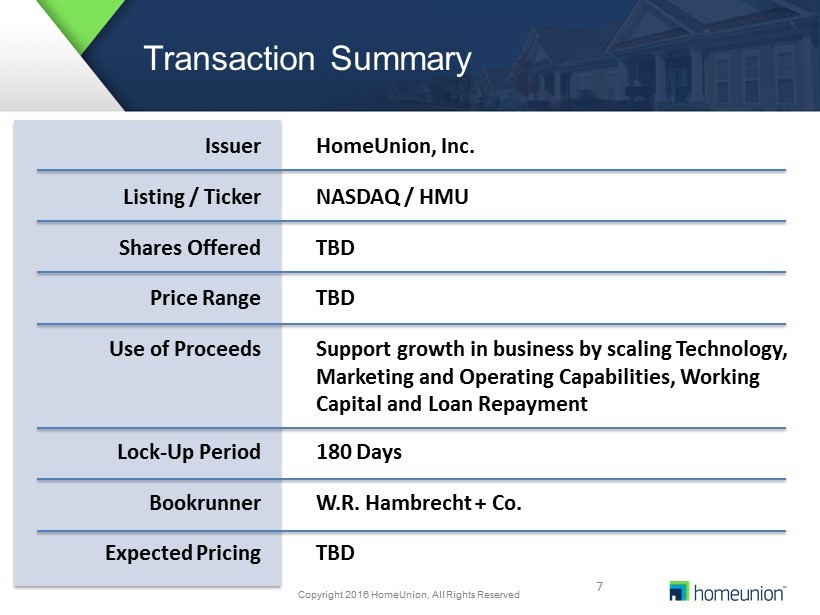
This is our initial public offering. No public market currently exists for our shares. We are selling shares of our common stock. We expect that the initial public offering price will be between $ and $ per share. We have applied to list our common stock on The NASDAQ Capital Market under the symbol “HMU.”
We are an “emerging growth company” as defined in the Jumpstart Our Business Startups Act, or the JOBS Act, and, as such, may elect to comply with certain reduced reporting requirements for this Offering Circular and future filings after this offering.
| PER SHARE | TOTAL OFFERING | |||||||||
| Public Offering Price | $ | $ | ||||||||
| Underwriting Discounts and Commissions (1) | $ | $ | ||||||||
| Proceeds, before expenses, to HomeUnion(2) | $ | $ | ||||||||
(1) We have agreed to reimburse certain expenses of our underwriter. Please refer to the section entitled “UNDERWRITING” beginning on page 28 of this Offering Circular for additional information regarding total underwriter compensation.
(2) We estimate that our total offering expenses, including underwriting discount and commissions, will be approximately $ ..
See “Risk Factors” on page 11 to read about factors you should consider before buying shares of our common stock.
We have granted an option to the underwriters to purchase up to an additional shares from us at the initial public offering price, less the underwriting discounts and commissions, for a period of up to 30 days from the date of this Offering Circular.
B. Riley & Co., LLC
The date of this Offering Circular is , 2016
This Offering Circular follows the disclosure format of Part I of Form S-1 pursuant to the general instructions of Part II(a)(1)(ii) of Form 1-A.
THE UNITED STATES SECURITIES AND EXCHANGE COMMISSION DOES NOT PASS UPON THE MERITS OR GIVE ITS APPROVAL TO ANY SECURITIES OFFERED OR THE TERMS OF THE OFFERING, NOR DOES IT PASS UPON THE ACCURACY OR COMPLETENESS OF ANY OFFERING CIRCULAR OR OTHER SELLING LITERATURE. ANY REPRESENTATION TO THE CONTRARY IS UNLAWFUL.
THE SECURITIES HAVE NOT BEEN REGISTERED UNDER THE SECURITIES ACT OF 1933, AS AMENDED (THE “SECURITIES ACT”) OR APPLICABLE STATE SECURITIES LAWS, AND THESE SECURITIES ARE OFFERED PURSUANT TO AN EXEMPTION FROM REGISTRATION WITH THE UNITED STATES SECURITIES AND EXCHANGE COMMISSION. HOWEVER, THE UNITED STATES SECURITIES AND EXCHANGE COMMISSION HAS NOT MADE AN INDEPENDENT DETERMINATION THAT THE SECURITIES OFFERED HEREUNDER ARE EXEMPT FROM REGISTRATION.
THIS OFFERING CIRCULAR CONTAINS ALL OF THE REPRESENTATIONS BY THE COMPANY CONCERNING THIS OFFERING, AND NO PERSON SHALL MAKE DIFFERENT OR BROADER STATEMENTS THAN THOSE CONTAINED HEREIN. INVESTORS ARE CAUTIONED NOT TO RELY UPON ANY INFORMATION NOT EXPRESSLY SET FORTH IN THIS OFFERING CIRCULAR.
TABLE OF CONTENTS
CAUTIONARY STATEMENT REGARDING FORWARD-LOOKING STATEMENTS
Some of the statements under “Summary”, “Risk Factors”, “Management’s Discussion and Analysis of Financial Condition and Results of Operations”, “Our Business” and elsewhere in this Offering Circular constitute forward-looking statements. Forward-looking statements relate to expectations, beliefs, projections, future plans and strategies, anticipated events or trends and similar matters that are not historical facts. In some cases, you can identify forward-looking statements by terms such as “anticipate”, “believe”, “could”, “estimate”, “expect”, “intend”, “may”, “plan”, “potential”, “should”, “will” and “would” or the negatives of these terms or other comparable terminology.
You should not place undue reliance on forward looking statements. The cautionary statements set forth in this Offering Circular, including in “Risk Factors” and elsewhere, identify important factors which you should consider in evaluating our forward-looking statements. These factors include, among other things:
| · | we have a limited operating history; |
| · | difficulties and challenges in scaling our business model significantly; |
| · | the general economic condition in the real estate rental market; |
| · | our ability to attract and maintain qualified customers to use our services; |
| · | the success of our marketing strategies; |
| i |
| · | the availability and supply of residential rental properties; |
| · | our ability to provide timely and profitable asset management services to our customers; |
| · | our dependence on third-party contractors to perform asset management services; |
| · | compliance with multi-state regulations and laws governing real estate transactions; |
| · | failure to maintain requisite brokerage license in states where we operate; |
| · | loss of services by third parties who provide data and analytics for our customers; |
| · | we have incurred significant losses and may not be profitable; |
| · | our inability to attract and maintain qualified employees; |
| · | our ability to respond to technological challenges; |
| · | security breaches of our online platform; and |
| · | additional costs incurred to operate as a public company. |
Although the forward-looking statements in this Offering Circular are based on our beliefs, assumptions and expectations, taking into account all information currently available to us, we cannot guarantee future transactions, results, performance, achievements or outcomes. No assurance can be made to any investor by anyone that the expectations reflected in our forward-looking statements will be attained, or that deviations from them will not be material and adverse. We undertake no obligation, other than as may be required by law, to re-issue this Offering Circular or otherwise make public statements updating our forward-looking statements.
| ii |
This summary highlights information contained elsewhere in this Offering Circular and does not contain all of the information that you should consider in making your investment decision. Before investing in our common stock, you should carefully read this entire Offering Circular, including our financial statements and the related notes and the information set forth under the headings “Risk Factors” and “Management’s Discussion and Analysis of Financial Condition and Results of Operations,” in each case included elsewhere in this Offering Circular. Unless otherwise stated, all references to “us,” “our,” “we,” the “Company”, “HomeUnion” and similar designations refer to HomeUnion Holdings, Inc. and its subsidiaries.
Mission
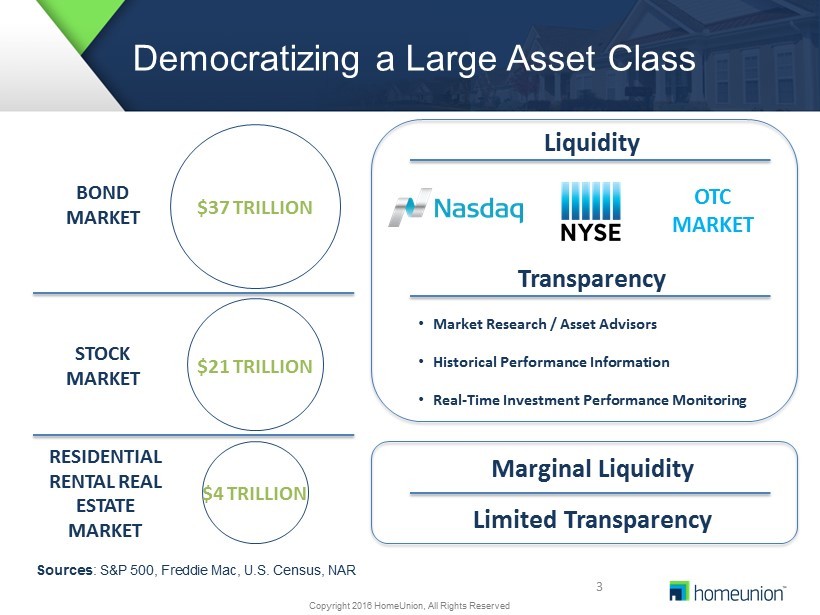
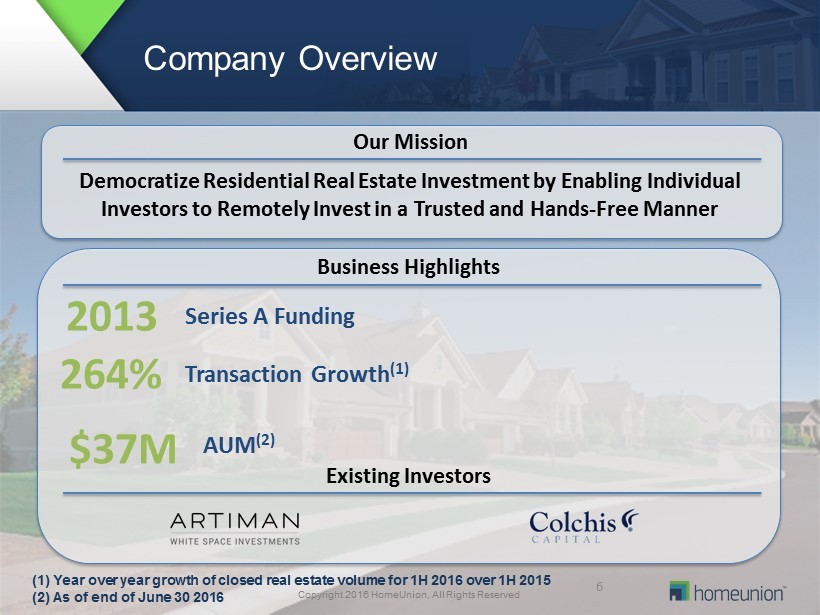
Our mission is to democratize residential real estate investment by enabling individual investors to remotely invest in this asset class in a trusted and hands free manner.
Overview
We are the leading online investment management platform dedicated to the residential real estate market, enabling investors to invest outside their local geography. We do this by providing individual investors with a comprehensive, end-to-end solution for the selection, acquisition, management and sale of residential real estate properties. Our proprietary platform combines the power of technology and the experience of local real estate experts to make investment in residential real estate seamless and transparent. We are the first company in our industry to offer individual investors a comprehensive suite of services to remotely invest in residential properties throughout the U.S. with a simplified online process, focusing primarily on single-family rental (SFR) assets. Our platform enables investors to maximize returns, protects assets and provides advice on how to achieve specific investment and fixed income goals. We currently operate in 18 markets in 10 states in the U.S. and continue to expand our geographical reach.
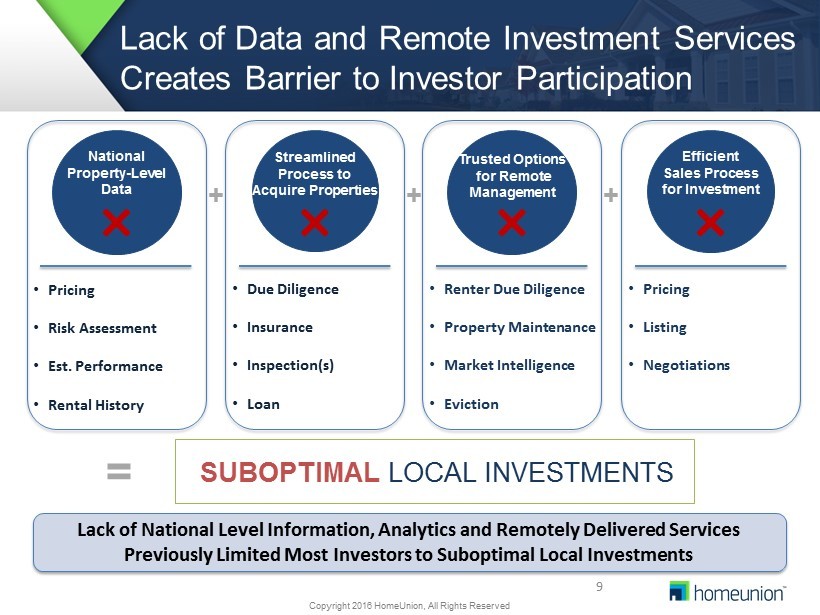
Historically, individual investors have faced significant challenges when investing in real estate. There has been no reliable and comprehensive national level data on available investment properties; no easy and cost-effective way to acquire properties remotely; no straightforward and inexpensive mechanism to analyze, monitor and track investment returns; no easy and inexpensive process for remote management of properties; and no efficient method to sell the properties when necessary. As a result, individual investors who did not have special access or substantial resources were limited to purchasing properties in local geographies, which was often constrained by limited supply and resulted in suboptimal investment performance and missed opportunities.
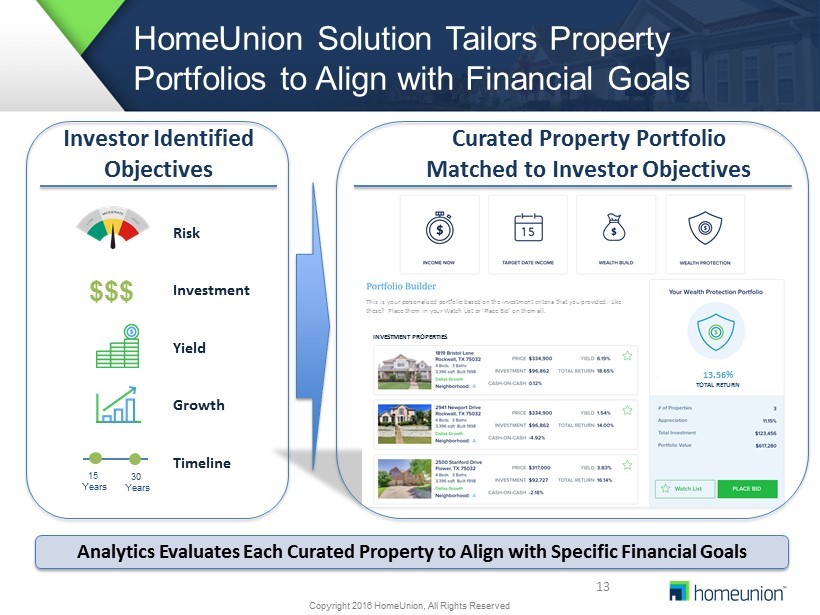
We founded HomeUnion to create a seamless process for individual investors to invest in residential real estate regardless of location. We accomplish this through our online platform that provides transaction automation for the selection and acquisition of a selective pool of properties tailored to the investment goals of each investor. We support the selection process with a combination of big data-based analytics and local, in-person research which together provide risk analysis, detailed expected returns, and the optimal bid ranges for every investment property on our portal. Our selection process and pre-acquisition due diligence create more predictability in returns and also more accurately matches properties with investors’ financial goals such as budget, risk and yield. Once a property is selected by our customer, we manage the entire process of acquisition, including negotiation, appraisal, documentation, and closing. Our mortgage brokers assist customers in obtaining and securing loans to purchase the property. Once the property is acquired, our asset management team provides ongoing support and assistance, including the placement of qualified tenants, collection of rents, monitoring property upkeep and providing repair and maintenance services through third party contractors. In the event the customer decides to sell the property, we can maintain the asset management revenue by marketing the rented property to other investors on our extensive online network. Alternatively, our local market agents can market the property to a prospective homeowner in that market, if the property owner so chooses.
We have a local presence in 18 markets and hold real estate licenses in 10 states, where we source and manage properties. This provides us with a local market infrastructure for vetting, acquiring and managing the properties. It also serves as a critical feedback loop to continuously improve our investment decision support analytics. By using a combination of proprietary asset management systems and central and local market infrastructure, we serve as a single source of management for all investment properties.
| 1 |
Our revenue was $0.3 million and $1.2 million for the fiscal years ended December 31, 2014, and 2015, respectively, and was $0.2 million and $1.2 million for the six months ended June 30, 2015 and 2016. Our closed transaction volume, which represents the total price of properties purchased by our customers, was $4.4 million and $17.7 million for the fiscal years ended December 31, 2014 and 2015, respectively, and was $4.6 million and $16.8 million for the six months ended June 30, 2015 and 2016, respectively.
Market Opportunity
Real estate investment has long been recognized as an effective way to create wealth and serve as a portfolio diversification strategy. Within the real estate umbrella, Single Family Rentals (SFRs) are recognized as the most stable yield vehicle across economic cycles over an extended period of time. Making SFRs more than a local (within 50 miles from where one lives) investment vehicle has been a challenge due to lack of information, complex processes, and difficulty in remotely managing rentals and repairs remotely. HomeUnion solves these problems by applying substantial analytics, process automation and machine learning, coupled with experienced local teams of real estate professionals.
Additionally, the appreciation of property values and rents since 2011, and a low interest rate environment over the past seven years, have made the fundamentals for investing in real estate quite strong.
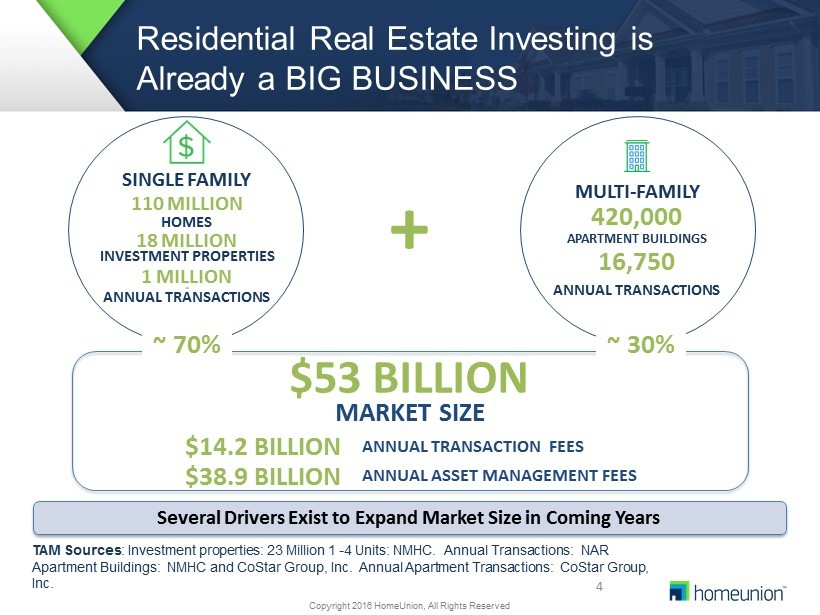
The total addressable market is $52.5 billion for SFR and apartment transactions, asset management and mortgage brokerage fees. According to a 2015 survey by the National Association of Realtors, one million SFR transactions for investment purpose occur each year, resulting in $9.6 billion in potential brokerage fees. Apartment brokerage fees are estimated at $2.1 billion annually, based on the average number and price of apartment transactions over the past five years, according to CoStar Group, Inc. Based on the data from National Association of Realtors and CoStar Group, Inc., and assuming the standard fee structure in our industry, we believe that the total annual potential asset management fees and total potential annual broker fees are approximately $38.9 billion and $1.9 billion, respectively, in the SFR and multi-family rental markets.
Residential real estate investment has grown to be a multi-billion dollar market as it represents an important asset class for many investors due to the following characteristics:
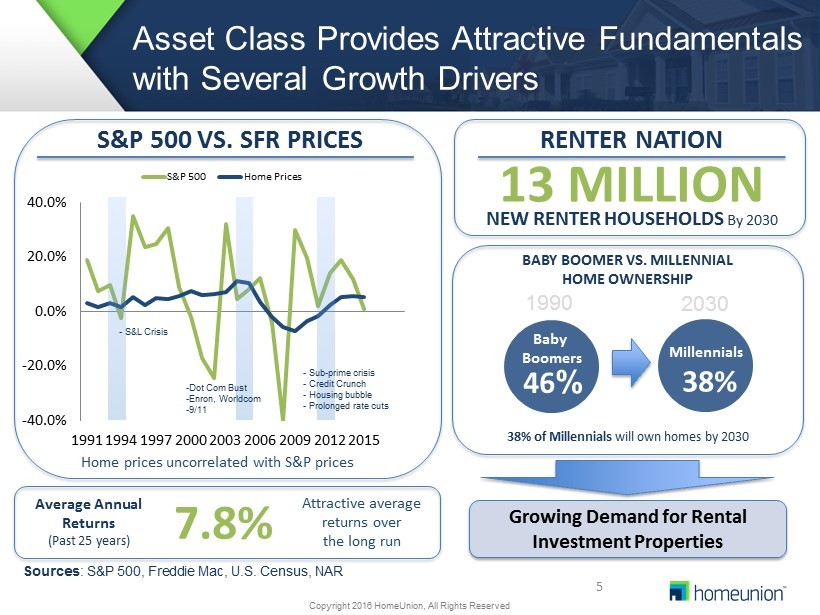
| · | Attractive Returns. Based on our own analysis and research of available data from the U.S. Census Bureau, single-family real estate returns have averaged 7.8 percent over the last 25 years. |
| · | Diversification from the Market. Residential real estate prices are generally uncorrelated to the stock market; therefore it presents an opportunity for portfolio diversification. |
| · | Availability and Cost of Financing. The interest rate environment is attractive and government agencies, financial institutions and private lenders are providing loans to investors to acquire investment real estate. |
| · | Tax Benefits. There are several tax benefits including deduction of mortgage interest, depreciation and other costs from gross rental income thereby reducing the tax burden and also helping investors defer capital gains tax via 1031 exchanges. |
| · | Improving Property Fundamentals. According to Zillow, single-family home rents climbed 8.9 percent between the end of 2010 and year-end 2015. According to the National Association of Realtors, single-family home prices have climbed 20 percent from the trough in the first quarter of 2010 through the end of 2015. |
We believe our market opportunity is bolstered by the recent trend towards a larger number of new households opting to rent rather than buy. According to a study from the Urban Institute, 28 percent of new households rented in the 1990s compared to 62 percent in the current decade. The same study predicts over 13 million new renter households between 2010 and 2030 with homeownership declining from 65.1 percent to 61.3 percent. Across nearly every age cohort, the homeownership rate is expected to decrease by 2030. The homeownership rate for those aged 45 to 54 is anticipated to be 64.9 percent in 2030, down from 71.5 percent for the same cohort in 2010. Similarly, those aged 55 to 64 are expected to have a homeownership rate of 69.6 percent in 2030, compared to 77.3 percent in 2010, according to the same study by the Urban Institute.
| 2 |
Challenges of Real Estate Investment
An individual investor faces multiple challenges when pursuing real estate investment of residential rental properties, particularly properties located outside of the investor’s immediate geographical area. Some of the challenges we seek to address include:
| · | Lack of Comprehensive Data on Remote Properties. Investors do not have access to reliable, up-to-date and comprehensive data on the best available SFRs throughout the U.S. |
| · | Lack of Decision Support Analytics. Most of the raw data that is available is targeted to prospective homeowners and not investors. |
| · | No Easy Way to Acquire Remote Properties. Even if an investor is able to identify a property in a location that is outside their geographic area, there are a number of hurdles in acquiring the property. |
| · | Managing Remote Properties is Difficult. Investors have to rely on a local property manager for locating a qualified tenant with appropriate financial credentials. |
| · | Lack of Market Data to Make Purchase and Sales Decisions. Investors do not have easy access to up-to-date and comprehensive local market data to determine if they should sell their property or take advantage of buying opportunities. |
| · | No Easy Way to Sell Remote Properties. The investor has to vet and select a remote realtor and rely on his or her abilities to sell the property in a timely fashion and at the right price. |
Our Solution
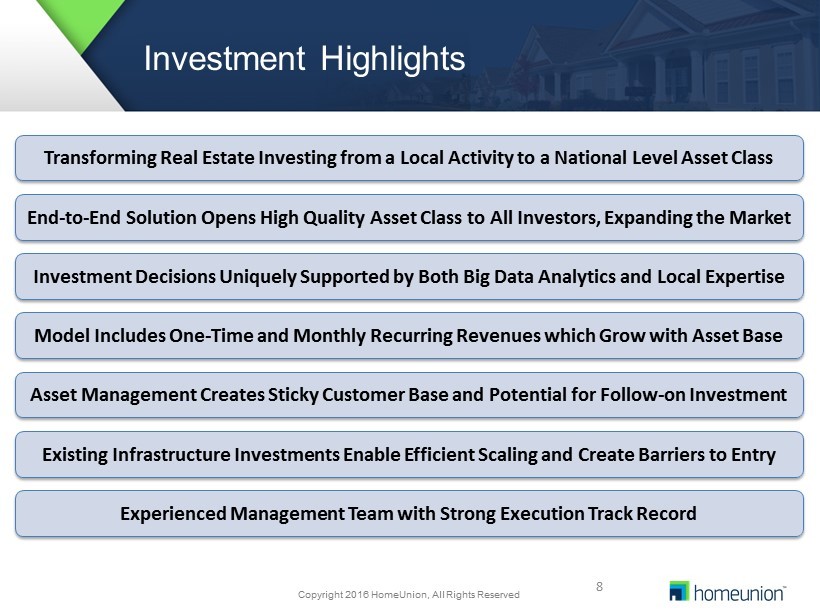
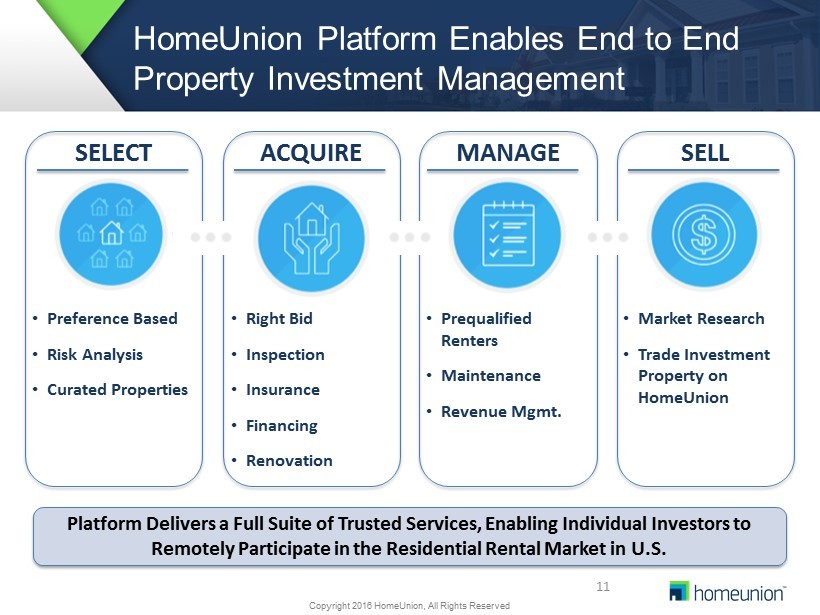
HomeUnion has built an end-to-end online investment management solution that provides investors with a seamless and trusted method to remotely invest in residential real estate properties throughout the U.S. that meet their investment goals. We accomplish this through a combination of transaction automation, big data-based decision support analytics, local infrastructure and a fully integrated acquisition, financing and asset management mechanism. Our solution provides customers with an efficient and user-friendly online experience through each critical decision point in the real estate investment cycle, which can be divided into four phases:
| · | Selection of Investment Property; |
| · | Acquisition of Property; |
| · | Asset Management; and |
| · | Sale and Disposition of Property. |
Selection of Investment Property
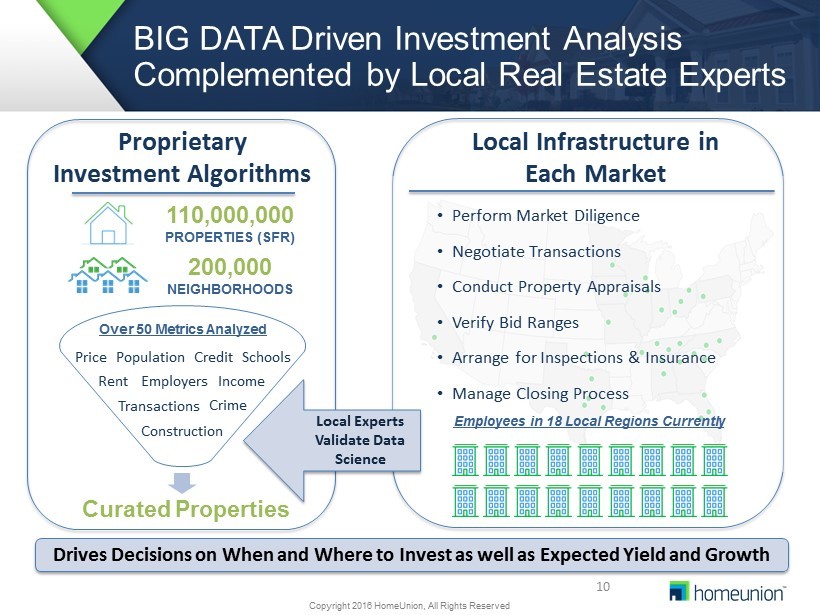
We have developed a sophisticated predictive algorithm for potential investment opportunities by evaluating over 110 million homes and 200,000 neighborhoods, or approximately 95 percent of the single-family homes in the U.S. We select neighborhoods and properties based on data science and feedback from local licensed real estate professionals who are typically our employees. By subscribing to our services, our customers gain access to a wealth of information from a single source with respect to a large pool of potential SFR investments in multiple states in the U.S. The entire property selection process is conducted through our proprietary online platform, thereby eliminating our customers’ need to travel to the property site before making the final decision to purchase.
Acquisition of Property
Once the customer has selected one or more properties for purchase through our platform, we provide a fully managed service to complete the acquisition process. We arrive at an optimal bid price; negotiate and communicate with sellers; conduct inspections and procure insurance. Our fully managed acquisition process includes a technology platform that offers a streamlined process to prepare, complete, finalize and execute all documents and contracts required to consummate the acquisition.
| 3 |
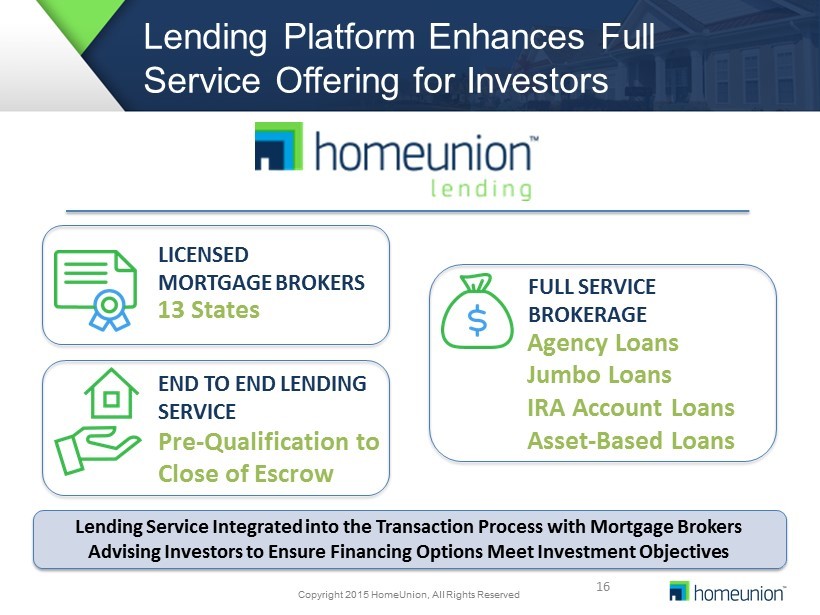
Through our subsidiary HomeUnion Lending, Inc., we provide licensed mortgage brokerage services that enable our customers to quickly secure financing for the acquisition. Our mortgage operation is fully integrated with our online technology platform and supported by experienced loan officers who guide our customers through the entire home financing process. As a full service mortgage brokerage, we provide different options of financing to our customers, including agency conforming loans, jumbo loans, IRA account and asset-based loans.
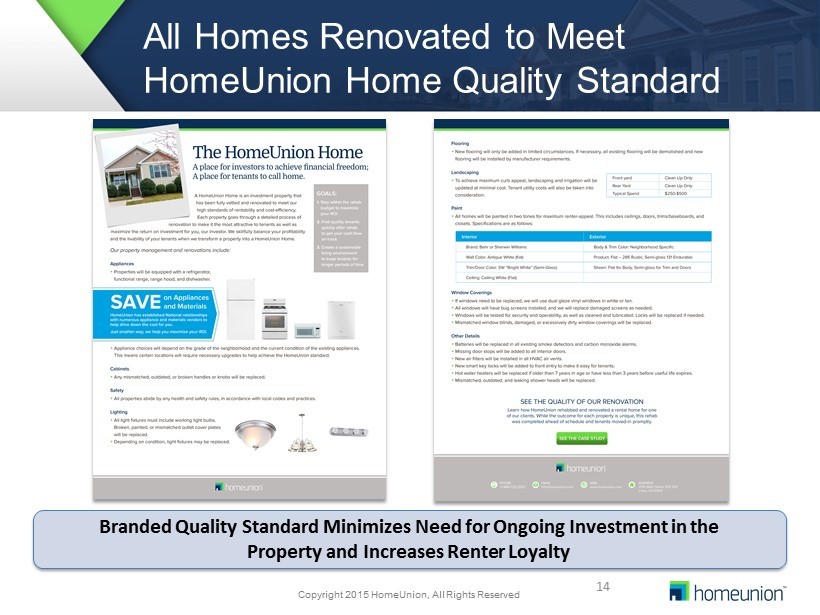
In addition, we bring every investment property that we renovate up to a quality standard that we call the HomeUnion Home. This helps with renter satisfaction and builds a long-term brand for our company as a desired renter destination.
Asset Management
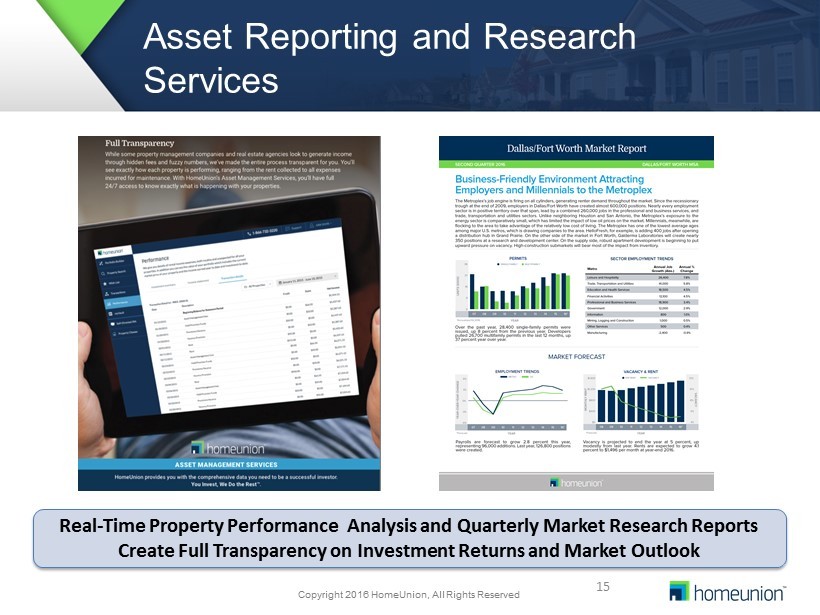
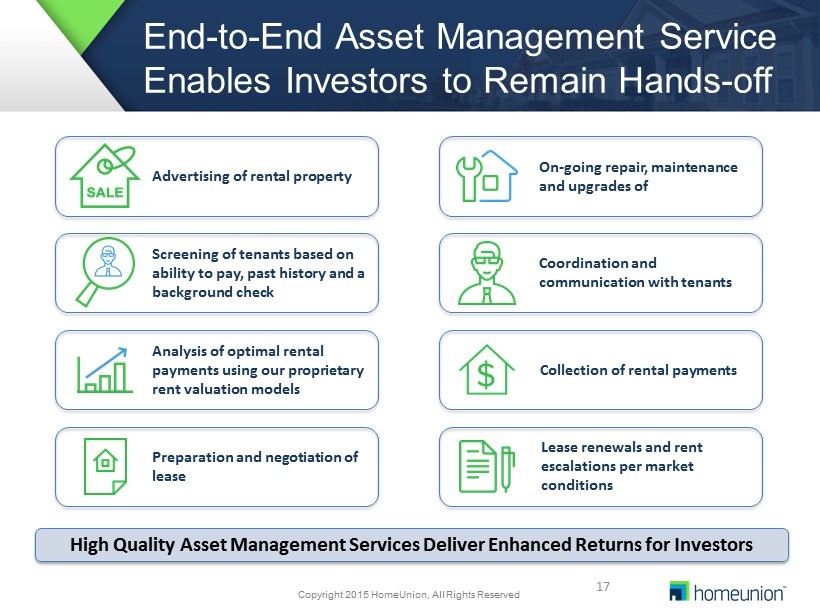
We use a proprietary workflow based management system called Embrace in conjunction with a streamlined and effective property management system for the renting, maintenance and management of investment properties. We provide asset management services to our customers as a separate and distinct offering from the other services, and customers have the choice and the right to manage the properties themselves or engage other service providers to manage their properties. If the customers decide to use us for the management of their properties, we provide comprehensive consolidated performance reporting on all investment properties held by an investor. Our property management services include:
| · | Advertising of rental property; |
| · | Screening of tenants based on ability to pay, past history and a background check; |
| · | Analysis of optimal rental payments for each property using our proprietary rent valuation models; |
| · | Preparation and negotiation of lease agreement; |
| · | On-going repair, maintenance and upgrades of properties; |
| · | Coordination and communication with tenants; |
| · | Collection of rental payments; and |
| · | Lease renewals and rent escalations per market conditions. |
We have vendor management systems that monitor and track the performance of the vendors we have agreements with in order to ensure that all repair and maintenance work are performed within quality, cost and time parameters.
Sale and Disposition of Properties. When investors are ready to sell their assets they are able to list the property on our portal for sale to another investor on HomeUnion. This allows investors to sell properties without having to remove the tenant if they choose to do so. We believe this facilitates an unprecedented transparent exchange between the buyer and seller given HomeUnion’s performance history on the property.
Revenue Model
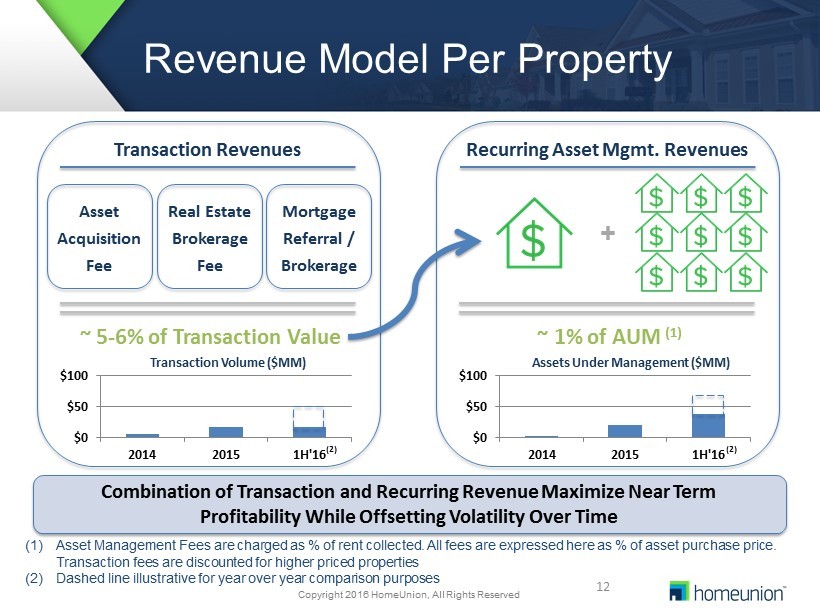
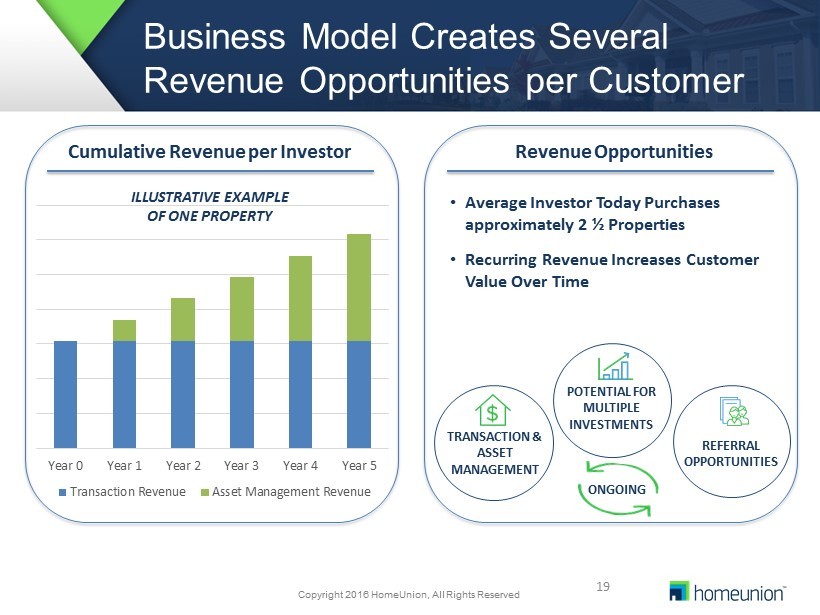
Our revenue is comprised of two primary components, transaction revenue which is generated upon the purchase of a property and recurring asset management revenue which is generated on a monthly basis and tied to the rental proceeds and other fees for the properties we manage.
Transaction Revenues
Transaction revenues are made up of asset selection and acquisition fees which we charge our customers for the use of our platform and services, real estate brokerage commissions which we earn by representing the buyer in the real estate transaction and mortgage brokerage and referral revenue which we generate from our lending partners.
Recurring Asset Management Revenues
We charge our customers who choose to use us for the management of their properties a fee for managing their assets, which includes placement of qualified tenants, collection of rents, monitoring property upkeep and providing repair and maintenance services.
For more information, please see the “Management’s Discussion and Analysis” section of the Offering Circular.
| 4 |
Key Operating Metrics
We measure our business using operating metrics. We use these metrics to analyze our business performance, determine financial forecasts, and help develop long-term strategic plans. We review the following key business metrics:
| Six months ended June 30, | Years ended December 31, | |||||||||||||||
| 2016 | 2015 | 2015 | 2014 | |||||||||||||
| Closed transaction volume ($ M) | 16.80 | 4.62 | 17.71 | 4.41 | ||||||||||||
| Signed purchase agreement carried forward ($ M) | 13.18 | 2.33 | 9.91 | 1.40 | ||||||||||||
| Assets Under Management ($ M) | 36.48 | 6.07 | 18.97 | 2.73 | ||||||||||||
Closed transaction volume
The transaction volume is the value of the real estate, as determined by the purchase price, purchased in a given period. After the execution of a real estate purchase agreement, it often takes 30-60 days to close a transaction whereby the real estate transaction is completed and the title is transferred from the seller to the buyer. The time to close depends on a variety of factors including the completion of the financing (either loan or all cash) process. Transaction associated revenues are recognized upon closing of a transaction and are derived as a percentage of the real estate transacted on our platform.
Signed purchase agreement carried forward
As real estate transactions often take 30-60 days to close from the date of execution of the purchase agreement, in many cases a property may not close in the same period when its purchase agreement was signed. These properties are classified as signed purchase agreement carried forward where the value represents the aggregate purchase price of all real estate purchase agreements executed and in active process of closing at the end of the period. The significant increase in the first six months of 2016, compared to the same period 2015 is a direct correlation to the Company’s expansion and growth.
Assets Under Management (AUM)
Assets Under Management is the aggregate value of real estate assets being managed by HomeUnion. Included in the AUM is the total acquisition cost which is the purchase price of the property as well as the closing costs and fees and capital improvement costs. Asset management fees are charged as a percentage of the rent, which is dependent on the AUM, along with other fees. Asset management revenue is an annuity revenue and continues until either the property is sold by the investor or the asset management agreement is terminated for any reason. The significant increase in the assets under management in the first six months of 2016, compared to the same period in 2015 is due to the Company’s expansion and growth.
For more information related to our financials including key operating metrics, please see the “Management’s Discussion and Analysis” section of the Offering Circular.
Our Competitive Strengths
Our proprietary online platform and decision support analytics provides individual investors with the ability to remotely invest in SFRs and other residential properties. We believe we are the first company in our industry to combine technological capability and local infrastructure to allow potential customers to choose from a large number of residential rental properties in multiple states in the U.S. Our differentiating factors include:
| 5 |
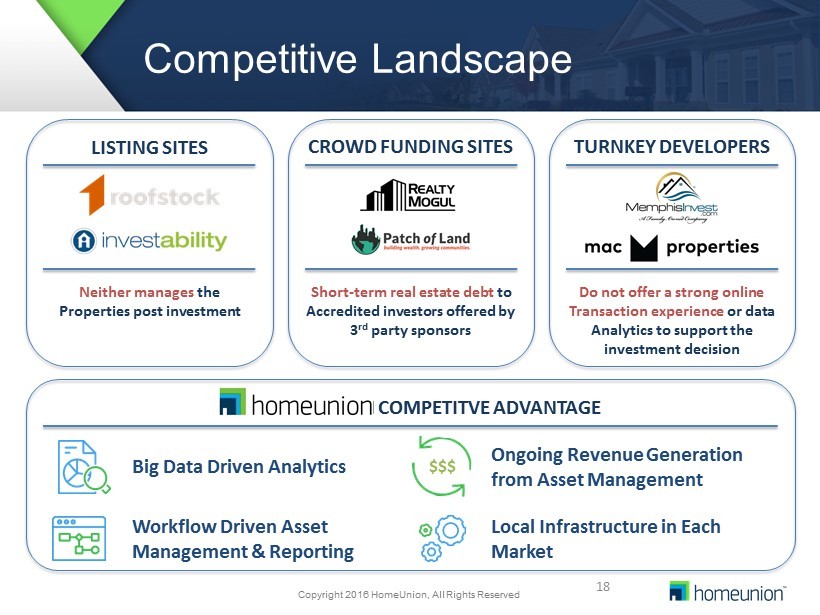
| · | Big Data Driven Analytics. We believe that we have industry leading analytics that calibrates risk, calculates expected returns, generates optimal bid ranges and provides rich neighborhood information to assist customers with their decision making process. |
| · | Automated Asset Selection and Acquisition Technology. We have developed a unique asset selection technology that builds personalized real estate portfolios for investors based upon their financial goals. |
| · | Workflow Driven Asset Management and Reporting Technology. We have created a proprietary workflow management system that tracks the investment process from end-to-end while working with best-in-class customer relationship and property management software. |
| · | Ongoing Revenue Generation from Asset Management. Our asset management group supports a continuous relationship with our customers who choose us to manage their properties, and a consistent revenue stream outside of the transaction market. |
| · | Local Infrastructure in Local Markets. Real estate is extremely local and we have a team of licensed real estate employees in the locations that we serve. |
| · | Market Research Services. We provide comprehensive research in all our markets around local economies and trends that affect investment properties such as employment, transaction activity or population growth. |
| · | Lending Brokerage Operations. We have established HomeUnion Lending, Inc. as a mortgage broker to help investors secure financing for their properties. |
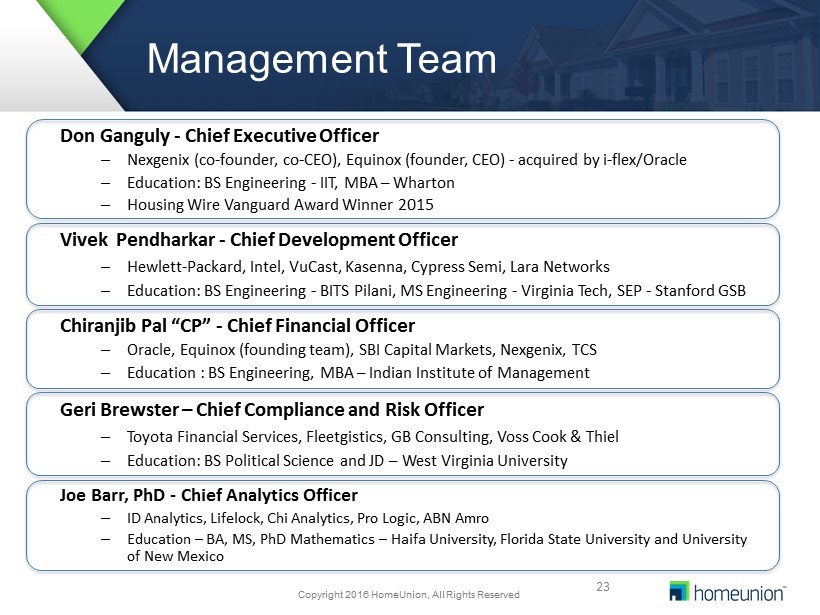
| · | Highly Experienced Management Team and Advisors. We have a seasoned management team with extensive experiences in real estate management and investment operations. We are also guided by a board of advisors consisting of industry leaders and experts who assist us in the areas of technology and investment management. |
Our Growth Strategies
We plan to use a number of different initiatives to continue to scale our business model and expand our operations to additional markets.
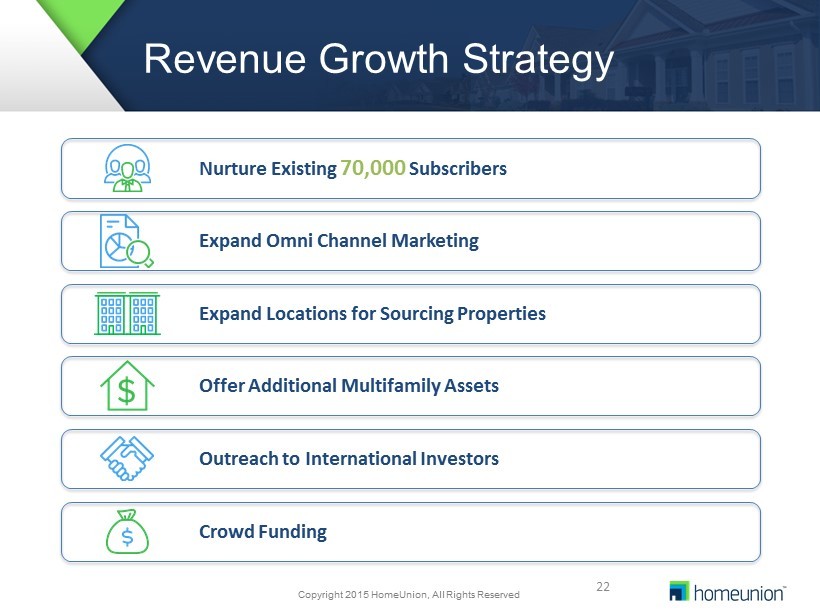
| · | Nurture Existing Clients. Many of our clients buy multiple properties and we believe they will continue to invest over time as their current assets perform. Our current clients also serve as a source of referrals for new clients and this will reach an inflection point as the customer base continues to grow. |
| · | Expand Omni Channel Marketing. We combine online and offline channels to generate prospective investor leads. In addition, we generate significant organic content around real estate investing. This content drives traffic to our website as well as our coverage in the press. |
| · | Expand Locations for Sourcing Properties. We believe that there are many more locations in the U.S. where viable investment properties can be sourced much like the current locations in which we operate. This will allow us to offer a greater number and variety of investment properties on our portal. |
| 6 |
| · | Offer More Multi-family Investments. We believe that we can continue to expand the multi-family residential (MFR) offerings, as we expect significant demand from high-net-worth investors. In general, MFRs do not trade efficiently and there is less availability of government agency financing. |
| · | Outreach to International Investors. U.S. real estate has long been a safe haven for international investors and this is even more so under the current global geopolitical and economic scenario. We have begun outreach to investors in India and the Asia Pacific region. |
Our Risks
An investment in our common stock involves a high degree of risk. You should carefully consider the risks summarized below. These risks are discussed more fully in the “Risk Factors” section immediately following this Offering Circular Summary. These risks include, but are not limited to, the following:
| · | We have a limited track record in executing our business model, making it difficult to evaluate our financial performance and future prospects; |
| · | The success of our business is significantly related to general economic conditions and the real estate industry, particularly the residential rental markets. |
| · | We may not be able to attract and maintain qualified customers to use our services, and our marketing strategies may not produce the desirable result. |
| · | Our success depends substantially on our ability to scale our operations significantly, and we may not be able to do so in a timely manner or at all. |
| · | We may not be able to sustain a sufficient curated set of rental properties and/or expand our operation to include additional property categories. |
| · | We outsource a portion of our asset management services to third party contractors and we may not have full control over the quality of their services. |
| · | We may not be able to maintain local real estate brokerage licenses to operate our business in states or to obtain new brokerage licenses to operate in additional states. |
| · | We depend on third parties to provide critical information and analytics regarding real estate investment and the loss of such relationship may negatively affect our business. |
| · | We have incurred significant losses since inception and we anticipate that we will continue to incur losses for the foreseeable future. |
| · | If we are unable to attract and retain qualified and experienced employees, including solutions managers, loan officers and other real estate professionals, our growth may be limited and our business and operating results could suffer. |
| · | There has been no public market for our common stock prior to this offering, and investors may not be able to resell shares at or above the public offering price. |
| 7 |
| · | The market price for our common stock may be volatile, which could contribute to the loss of some or all of your investment. |
Company and Other Information
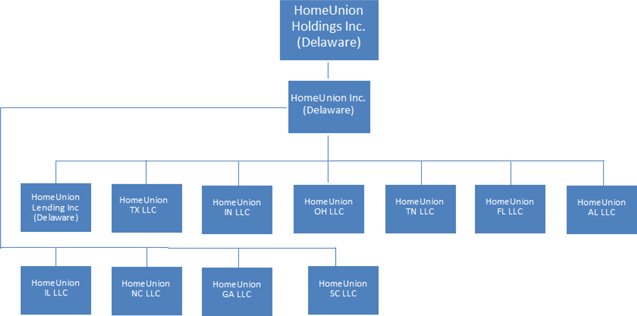
We were initially formed as a limited liability company under the laws of the State of Delaware in 2009 as “innovativeREsolutions LLC,” and we changed our name to “HomeUnion Services LLC” in March 2010. In 2013, we converted HomeUnion Services LLC to a Delaware corporation and changed the name to “HomeUnion Holdings, Inc.”, which is holding company that holds several direct and indirect operating subsidiaries, including HomeUnion Inc., which is our main operating company. We also formed an indirect subsidiary, typically a limited liability company, in each state where we have active operations in order to facilitate the real estate transactions and compliance with local regulations in such state. The following chart sets forth our current corporate organizational structure, including our wholly-owned subsidiaries that have active operations in selected states:
Our principal executive office is located at 2010 Main Street #250, Irvine, CA 92614, and our telephone number is 888-507-1650. Our website address is www.homeunion.com. We do not incorporate the information on or accessible through our website into this Offering Circular, and you should not consider any information on, or that can be accessed through, our website a part of this Offering Circular.
We own various U.S. federal copyright, trademark registrations and applications, and unregistered trademarks, including the following marks referred to in this Offering Circular: “HomeUnion”. All other copyrights, trademarks or trade names referred to in this Offering Circular are the property of their respective owners. Solely for convenience, the trademarks and trade names in this Offering Circular are referred to without the symbols ® and ™, but such references should not be construed as any indicator that their respective owners will not assert, to the fullest extent under applicable law, their rights thereto.
This Offering Circular summary highlights information contained elsewhere and does not contain all of the information that you should consider in making your investment decision. Before investing in our common stock, you should carefully read this entire Offering Circular, including our financial statements and the related notes included elsewhere in this Offering Circular. You should also consider, among other things, the matters described under “Risk Factors” and “Management’s Discussion and Analysis of Financial Condition and Results of Operations” in each case appearing elsewhere in this Offering Circular.
| 8 |
|
Common stock offered by us |
Shares | |
| Option to purchase additional shares | The underwriters will have an option to purchase up to additional shares of our common stock in this offering, exercisable within 30 days from the date of this Offering Circular. | |
| Common stock to be outstanding immediately after this offering | Shares ( shares if the underwriters exercise their option to purchase additional shares in full). | |
| Use of proceeds | We intend to use $ of the net proceeds to repay a portion of the outstanding amount under certain convertible promissory notes (the “Artiman Notes”) held by our major stockholder, Artiman Ventures (“Artiman”). We intend to use the remaining $ of net proceeds to fund and support our growing business, including employee compensation, expansion of internal operations to accommodate more transactions, sales and marketing efforts, and improvement and enhancement of our technological infrastructure and capabilities. We also intend to use a portion of the net proceeds to scale our business operations. Any remaining amount will be used for working capital and general corporate purposes. Under our note agreement with Artiman, if the gross proceeds from this offering are equal to or exceed $12,000,000, Artiman has the option to require us to use a portion of the net proceeds to repay the amount outstanding under Artiman Notes. However, such repayment shall not exceed an amount equal to 30% of the difference between (i) the gross proceeds and (ii) $12,000,000 (“Note Repayment Cap”). | |
| Risk factors | You should carefully read “Risk Factors” on page 11 in this Offering Circular for a discussion of factors that you should consider before deciding to invest in our common stock. |
| 9 |
| Proposed NASDAQ Capital Market Listing | We have applied to list our common stock on the NASDAQ Capital Market under the symbol “HMU.” |
The number of shares of our common stock to be outstanding after this offering is based on 12,269,674 shares of our common stock outstanding as of June 30, 2016 and excludes:
| · | 6,299,901 shares of common stock issuable upon the exercise of stock options outstanding as of June 30, 2016 at a weighted average exercise price of $0.22 per share; |
| · | 6,248,839 shares of common stock reserved for future issuance under our 2013 Equity Incentive Plan which shares will be rolled over to the 2016 Equity Incentive Plan (the “2016 Plan”); |
| · | additional shares of common stock reserved for future issuance under our 2016 Plan, which will become effective immediately prior to the completion of this offering; |
| · | shares of common stock issuable upon conversion of an aggregate of $14,265,434 in outstanding principal and accrued interest on our convertible promissory notes held by Artiman (the “Artiman Notes”) as of September 30, 2016, upon the completion of this offering, at a conversion price equal to $ , which represents 80% of the mid-point of the price range set forth on the cover page of this Offering Circular, assuming that Artiman does not require us to use any net proceeds of this offering to prepay any Artiman Notes and elects to convert all of the outstanding Artiman Notes upon completion of this offering, and assuming the offering is completed on November 15, 2016; and |
| · | shares of common stock issuable upon conversion of $1,500,000 in principal amount of Artiman Notes issued after September 30, 2016 upon completion of this offering, assuming that the offering is completed on November 15, 2016. |
Unless otherwise indicated, all information in this Offering Circular reflects or assumes the following:
| · | the filing of our amended and restated certificate of incorporation and the adoption of our amended and restated bylaws, which will occur immediately prior to the completion of this offering; |
| · | the conversion of all of our outstanding shares of convertible preferred stock into an aggregate of 30,528,485 shares of common stock upon the completion of this offering assuming that the offering is completed on November 15, 2016; and |
| · | a one-for- reverse split of our common stock, which became effective on . |
· | no exercise by the underwriters of their option to purchase up to an additional shares in this offering |
The precise number of shares of our common stock to be issued upon the conversion of the Artiman Notes upon the completion of this offering will vary depending on the actions to be taken by Artiman pursuant to the terms of such notes. Under the Artiman Notes, immediately following the completion of the offering, Artiman has the right to convert some or all of the Artiman Notes at a conversion price equal to 80% of the initial public offering price of this offering. Furthermore, if the gross proceeds from this offering is equal to or exceeds $12,000,000, Artiman has the option to require us to use up to the Note Repayment Cap to repay the outstanding principal amount and unpaid accrued interest under the Artiman Notes.
In the event that the gross proceeds of this offering is equal to or exceeds $12,000,000, and assuming that Artiman requires us to use up to the Note Repayment Cap to repay the Artiman Notes and elects to convert all of the remaining Artiman Notes, and assuming that we sold all of the shares set forth on the cover page of this Offering Circular at an assumed public offering price of $ per share, the midpoint of the price range set forth on the cover page of this Offering Circular, the total number of outstanding shares after the completion of this offering will be shares.
| 10 |
Investing in our common stock involves a high degree of risk. You should carefully consider the risks described below along with all of the other information contained in this Offering Circular, including our financial statements and the related notes, before deciding whether to purchase our common stock. If any of the adverse events described in the following risk factors, as well as other factors which are beyond our control, actually occurs, our business, results of operations and financial condition may suffer significantly. As a result, the trading price of our common stock could decline, and you may lose all or part of your investment in our common stock.
Risks Related to Our Business Operation and Industry
We have a limited track record in executing our business model, which makes it difficult to evaluate our financial performance and future prospects.
We have been operating our current business since 2013 and have a limited track record in executing our business model. Our future success depends on our ability to attract new customers and clients, scale up our online real estate management platform, expand our operations to additional geographical areas, and increase our supply of qualified rental properties, including multi-family rental properties. In addition, a full service online real estate investment platform is a relatively new industry that may require many years to develop and mature. Due to the emerging and evolving nature of our business and technologies, the factors influencing our financial performance may be different from those typically affecting our competitors. As a result, it may be difficult to evaluate our financial performance and future prospects and to compare our business and performance with our competitors and peer companies. If we are not successful in executing our current business plan, our business, financial condition, results of operations and prospects could be adversely affected.
The success of our business is significantly related to general economic conditions and the real estate industry, particularly the residential rental markets and, accordingly, our business could be harmed by an economic slowdown and downturn in real estate asset values, rental activities and property sales.
Our business is closely tied to general economic conditions in the real estate industry and the residential rental market. As a result, our economic performance, and our ability to attract new customers to purchase rental properties and implement our business strategies may be significantly and adversely affected by changes in national and local economic conditions. The condition of the real estate markets in which we operate is cyclical and depends on the condition of the economy in the United States, and on the perceptions of investors of the overall economic outlook. Rising interest rates, declining employment levels, declining demand for real estate, declining real estate values or periods of general economic slowdown or recession or the perception that any of these events may occur have negatively impacted the real estate market in the past and may in the future negatively impact our operating performance. In addition, the economic condition of each local market where we operate may depend on one or more key industries within that market, which, in turn, makes our business sensitive to the performance of those industries.
We have experienced in past years, and expect in the future to be negatively impacted by, periods of economic slowdown or recession, and corresponding declines in the demand for real estate and related services, within the markets in which we operate. The previous recession and the downturn in the real estate market have resulted in and may result in:
| · | a general decline in rents due to defaulting tenants or less favorable terms for renewed or new leases; |
| · | a decline in actual and projected sale prices of our properties, resulting in lower returns on the properties in which we have invested; |
| · | higher interest rates, higher loan costs, less desirable loan terms and a reduction in the availability of mortgage loans, all of which could increase costs and limit our ability to acquire additional real estate assets; |
| 11 |
| · | fewer purchases and sales of properties by clients, resulting in a decrease in acquisition transaction fees, property management fees, brokerage commissions and other fees; and |
| · | lack of buyers who meet our qualifications to purchase rental properties through our online platform. |
We have only a limited ability to change our operations promptly in response to these negative factors, which can have an adverse effect on our ability to grow and expand our business operations.
We may not be able to attract and maintain qualified customers to use our services, and our marketing strategies may not produce the desirable result, which will adversely affect our ability to develop and grow our business operations.
The success and profitability of our business depend substantially on our ability to attract new and qualified customers who use our services, because our revenue model is based on the number of transactions completed by qualified customers who pay various fees to us for such transactions. Our business model involves a high degree of operational intensity and costs, thus it is critical that we increase our customer base significantly from our existing level to offset such costs. We intend to expand and enhance our marketing strategies to attract more customers via online and offline channels. However, there is no guarantee that these strategies will be successful. Furthermore, the cost of implementing these marketing strategies may not produce sufficient number of customer conversions to achieve a positive return.
Our ability to convert potential customers to purchase our services depends on numerous factors that are not completely within our control, including:
| · | rate of return in residential real estate investment as compared to other investment assets, including stocks, bonds and other securities; |
| · | the availability of other real estate investments, including REITs and commercial real estate properties, that are not currently offered by us; |
| · | the potential customer’s familiarity and comfort with online real estate investment versus the traditional “brick and mortar” real estate investment services; |
| · | the financial qualification and credit history of potential customers; |
| · | the interest rate environment for mortgage loans; |
| · | sufficiency of supply of real estate properties that meet the investment objectives of potential customers; and |
| · | the general economic and real estate market conditions. |
In addition, we are highly dependent on long-term customer relationships to generate revenues based on our end-to-end real estate investment services. If we are unable to maintain our existing client relationships and expand our existing client base, our revenue source may decline. Our customers may terminate our services if the rate of return of their rental property declines, and such decline can occur due to a many reasons, such as inability to secure qualified tenants; longer period of vacancy; higher costs of repair and maintenance; and disputes with tenants. Other factors may also cause our existing customers to terminate our relationships, including:
| · | loss of or delay or default by tenants on rental payments; |
| · | changes in the customer’s investment objectives and portfolios; |
| 12 |
| · | financial conditions of the customers; and |
| · | improved rate of return from other investment options. |
Our success depends substantially on our ability to scale our operations significantly, and we may not be able to do so in a timely manner, or at all.
Currently we generate a limited amount of revenues with a relatively small number of transactions. In order for us to expand and grow, we are required to scale our business model and expand our services significantly to accommodate additional customers and transactions. We intend to expend significant financial and human resources to scale up our business, including implementing of aggressive marketing efforts; recruiting, training and hiring additional employees and real estate professionals qualified to perform our services; expanding our technology infrastructure to accommodate new transactions; increasing supplies of real estate properties that meet our investment criteria, including expansion into multi-family rental units; and expanding our operations overseas to acquire more international customers. Our planned expansion involves complex coordination of various elements of our business operation and requires significant resources, and there can be no assurance we can successfully scale our business to achieve the anticipated financial performance. We may incur significant expenses for these plans without corresponding returns, which would harm our business, financial condition and results of operations.
We may not be able to sustain a sufficient curated set of rental properties or expand our operation to include additional property categories.
Currently our operation focuses primarily on providing end-to-end services for the investment of single family rental (“SFR”) properties throughout the U.S. In order to ensure a favorable return on investment, it is important to identify those SFR properties with the desirable characteristics to produce sufficient income and appreciation to offset the costs of acquisition. We have developed a sophisticated analytics to assist our customers to select the appropriate SFR properties for his or her individual circumstances. However, we may not be able to identify a sufficient number of SFR properties with the optimal characteristics for our customers due to number of factors, including the limited geographical areas in which we currently serve, the competition from other buyers for the property; the turn-over rates of SFR properties; and the general SFR rental market. If we cannot identify or secure a sufficient number of viable SFR properties, we may not be able to continue or expand our customer base and generate additional revenues.
We also plan to increase our offerings of other property categories on our platform, particular multi-family rental properties and apartment buildings which currently consist only a small percentage of our available properties. We have limited experience in the acquisition, management and sales of multi-family rental properties, and we will be required to incur additional costs to accommodate new property categories, including updating and enhancing our information analytics, recruiting and training new solutions manager and other real estate professionals, and establishing new relationships with banks, contractors and other vendors. There is no guarantee that we will be able to achieve growth and profitability in the multi-family rental market or any other property categories that we intend to pursue in the future.
The success of our asset management business depends on various factors, including our ability to secure qualified tenants for rental properties, tenant occupancy and rental rates, which, if adversely affected, could cause our operating results to suffer.
A significant portion of our property management business involves facilitating the leasing and rental of single family and multi-family rental properties. In certain areas of operation, there may be inadequate supply of residential property to meet demand, and there is a potential for a decline in the number of overall lease and brokerage transactions. In areas where the supply of residential rental properties exceeds demand, we may not be able to renew leases or obtain new tenants for our owned and managed rental properties as leases expire. Moreover, the terms of new leases and renewals (including renovation costs or costs of concessions to tenants) may be less favorable than current leases. Our revenues may be adversely affected if we fail to promptly find tenants for substantial amounts of vacant space, if rental rates on new or renewal leases are significantly lower than expected. We may be unable to continue to lease properties for our clients in a profitable manner.
| 13 |
Our ability to lease properties also depends on:
| · | the attractiveness of the customers’ properties to potential tenants; |
| · | competition from other available properties that are not listed on our platform; |
| · | our ability to provide adequate maintenance and obtain insurance and to pay increased operating expenses, which may not be passed through to tenants or our customers; |
| · | the availability of capital from customers to periodically renovate, repair and maintain the properties, as well as for other operating expenses; and |
| · | the existence of potential tenants desiring to lease the properties. |
We outsource a portion of our asset management services to third party contractors and we may not have full control over the quality of their services.
We have entered into agreements with local licensed contractors and vendors to provide certain home maintenance services for tenants in our customers’ properties, including services relating to structural repairs, plumbing, electrical upgrades and other maintenance work. We have established procedures to ensure that these third party contractors are appropriately screened and meet our stringent standard of quality. Despite these procedures, we do not have complete control over the services provided by third-party contractors who are not our employees. If they fail to perform their services timely, or if they are unable to provide the quality of work expected by our customers, our brand and reputation will suffer and we may lose our customers, which will have an adverse effect on our financial condition and results of operations.
Decreases in the performance of the properties we manage are likely to result in a decline in the amount of asset management fees we collect.
Our asset management fees are generally structured as a percentage of the rental fees generated by the properties that we manage, and in some cases structured as a percentage of the property value regardless of the rental fees. As a result, our revenues are adversely affected by decreases in the performance of the properties we manage and declines in rental value. Property performance will depend upon, among other things, our ability to control operating expenses (some of which are beyond our control) and financial conditions generally and in the specific areas where properties are located and the condition of the real estate market in general. If the performance or rental values of the properties we manage decline, the asset management fees we derive from such properties could be materially adversely affected.
If we fail to comply with laws and regulations applicable to us in our role as a real estate broker, property/asset manager or mortgage broker, we may incur significant financial penalties.
We are subject to numerous federal, state, local and foreign laws and regulations specific to the services we perform in our business, as well as laws of broader applicability, such as tax, securities and employment laws. Brokerage of real estate sales, leasing, mortgage and loan transactions and the provision of property management and valuation services require us to maintain applicable licenses in each U.S. state and certain foreign jurisdictions in which we perform these services. If we fail to maintain our licenses or conduct these activities without a license, or violate any of the regulations covering our licenses, we may be required to pay fines (including treble damages in certain states), return commissions received or have our licenses suspended or revoked.
As a licensed real estate broker, we and our licensed employees are subject to certain statutory due diligence, disclosure and standard-of-care obligations. Failure to fulfill these obligations could subject us or our employees to litigation from parties who purchased, sold or leased properties that we brokered or managed. In addition, we may become subject to claims by participants in real estate sales claiming that we did not fulfill our statutory obligations as a broker.
| 14 |
We may not be able to maintain local real estate brokerage licenses to operate our business in states or to obtain new brokerage licenses to operate in additional states.
We are required to maintain a valid real estate brokerage license to operate our asset management services in each state where our customers purchased properties, including identification of tenants and collection of rents, and currently we have operations in 10 states in the U.S. In order to obtain and maintain these licenses, we enter into a broker agreement with a third party broker in each state who possesses the necessary state licenses to perform the required management services. However, some of these third-party brokers are independent contractors and not our employees, and they may terminate our agreements at any time without cause by providing us with one month advance notice. If any broker terminates the agreement with and otherwise decides to leave or lose its brokerage license, we will not be able to maintain a valid brokerage license in such state to continue our operations, which will result in a significant disruption to our business operations. Furthermore, while we may be able to identify a replacement broker with the appropriate license to work with us, we may not be able to do so quickly because it may be difficult and time consuming to negotiate these broker agreements, and any delay in engaging a replacement broker which would cause significant interruption to our operations and adversely affect our results of operations. Furthermore, we intend to expand our operations into additional states based on the attractiveness of real estate investment in such states as determined by our analytics. If so, we are required to enter into additional broker agreements to obtain the necessary real estate licenses for these additional states. There is no guarantee that we will be able to do so in a timely manner, or at all, and failure to do so would have an adverse effect on our business operations.
We depend on third parties to provide critical information and analytics regarding real estate investment and the loss of such relationships or services may negatively affect our business
In order to attract and maintain customers, we must assist them with making informed decisions and building an individualized portfolio by providing continuous, up-to-date and expert in-depth analysis of the rental market and expected income and cash flow stream. While we produce some of this data internally, a significant portion of the data is purchased from third-party providers for which there is no certainty of uninterrupted availability. We have entered into a Master Services Agreement with CoreLogic Solutions, LLC (“CoreLogic”), pursuant to which CoreLogic provides us various real estate related analytics data. Pursuant to the Master Services Agreement, CoreLogic is required to provide such services under individual Statement of Work negotiated from time to time, and the Statement of Work typically expires 36 months from the date of the Statement of Work unless it is renewed and extended by written agreement between the parties. Our current primary Statement of Work will expire on November 2017. Any disruption of our ability to provide data to our employees and/or customers could damage our reputation, and our operating results could be adversely affected. Furthermore, there is no guarantee that the analytics and data provided to us by CoreLogic are always complete and accurate, and any incomplete and inaccurate information may reduce the quality and accuracy of our analysis of the customer’s projected investment returns. If our customers cannot achieve the expected return due to incomplete or faulty information regarding the properties, we may lose such customers, which will have an adverse effect on our financial conditions and results of operations.
Our planned international operation may be subject to additional risks
As part of our strategy to scale our business and achieve rapid growth, we intend to expand our online services to customers located outside of the U.S., including India, China, Europe and other parts of the world. We have limited experiences in conducting international real estate transactions and our efforts may not be successful due to a number of additional risk factors, including:
| · | the burden of complying with multiple and potentially conflicting regulations and laws, including laws governing real estate transactions; |
| · | laws restricting foreign companies from conducting business; |
| · | unexpected changes in regulatory requirements; |
| · | the impact of different business cycles and economic instability; |
| 15 |
| · | political instability and civil unrest; |
| · | potentially adverse tax consequences; |
| · | tariff regimes of the countries in which we do business; and |
| · | geographic, time zone, language and cultural differences between personnel in different areas of the world. |
| · | Increased costs |
Failure by our customers to make timely mortgage payments may adversely affect our results of operations.
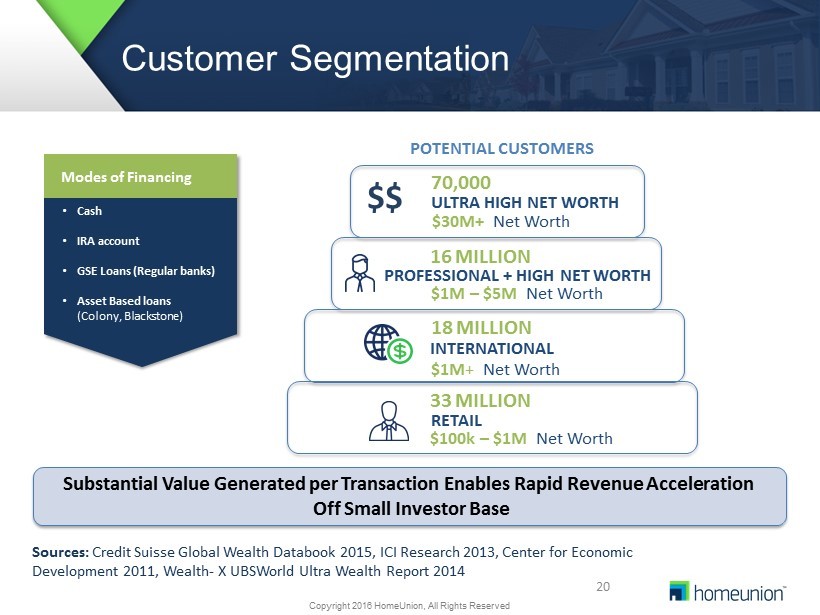
Our services are available to all types of customers, including individuals, retail and high net-worth investors and IRA investors. We have not established a comprehensive screening procedure to assess customer suitability, except for the basic credit check to ensure that potential customers are qualified for a housing loan or mortgage to purchase the rental property. If our customers are not able to make mortgage payments or otherwise default on their loans, we may not be able to continue to collect asset management fees or fees relating to the sale of the property, which may adversely affect our financial conditions and results of operations.
Risks Relating to Our Financial Condition
We have incurred significant losses since inception and we anticipate that we will continue to incur losses for the foreseeable future.
We are in the early stage of our development and have incurred operating losses since we began operations, and our net losses were $9.4 million and $5.2 million for the six months ended June 30, 2016 and 2015, respectively and $14.0 million and $5.0 million for the fiscal years ended December 31, 2015 and 2014, respectively. As of June 30, 2016, we had an accumulated deficit of $31.0 million. We do not know whether or when we will generate sufficient revenue to become profitable.
We have devoted most of our financial resources to marketing our services to scale up our technology and operations to meet additional demand of customers, and to grow our platform to include additional supplies of properties. We expect to continue to incur significant expenses and increasing operating losses for the foreseeable future as we continue to expand our business operations.
Our independent registered public accounting firm has expressed substantial doubt as to our ability to continue as a going concern.
In its audit report for the fiscal years ended 2015 and 2014, the opinion of our independent registered public accounting firm, included an emphasis paragraph as to the uncertainty of our ability to continue as a going concern. Most notably, significant recurring net losses and negative cash flows from operations from inception through 2015 raise substantial doubt about the Company’s ability to continue as a going concern. If we are unable to obtain bank financing, raise capital or generate enough cash from operations to sustain our business, then we may have to liquidate assets or curtail our operations.
We need to raise a significant amount of capital to expand and grow our business and we may not be able to raise such capital on terms favorable to us, or at all.
We expect capital outlays and operating expenditures to increase over the next several years as we expand our marketing infrastructure and increase the scale of our operation to meet accelerating customer demand. Following the completion of this offering, we believe our financial resources will be adequate to sustain our current operations until the breakeven point. However, we may need to raise additional capital to sustain our growth. We cannot be certain that we will be able to obtain financing on terms acceptable to us, or at all. Our failure to obtain adequate and timely funding will materially adversely affect our business and our ability to develop our products and would have a material adverse effect on the value of your investment.
| 16 |
Risks Related to Our Internal Organization and Corporate Structure
If we are unable to attract and retain qualified and experienced employees, including solutions managers, loan officers and other real estate professionals, our growth may be limited and our business and operating results could suffer.
Our success is highly dependent upon the efforts of our employees, including solutions managers, loan officers and other real estate professionals, and we have dedicated significant resources and time to recruit and train these employees. If these employees and personnel depart, we will lose the substantial time and resources we have invested in training and developing those individuals and our business, financial condition and results of operations may suffer. Additionally, such events may have a disproportionate adverse effect on our operations if the most experienced managers or professionals do not remain with us or if these events occur in geographic areas where substantial amounts of our brokerage revenues are generated. In addition, our competitors may attempt to recruit our managers and professionals, and if we are not able to provide attractive compensation and benefits to our employees, we may face attrition.
An increasing component of our growth has also occurred through the recruiting, training and retention of key experienced managers and financing professionals. Any future growth through attracting these types of employees will be partially dependent upon the continued availability of qualified candidates fitting the culture of our firm at reasonable terms and conditions. However, individuals whom we would like to recruit or retain may not agree to terms and conditions acceptable to us.
If we fail to attract and keep senior management and key employees, we may be unable to successfully develop our business and expand our operations.
Our future growth and success depend on our ability to recruit, retain, manage and motivate our employees. We are highly dependent on our senior management team, including our Chief Executive Officer, as well as the other principal members of our management teams. Although we have offer letters with our senior management members, these agreements do not prevent them from terminating their employment with us at any time. The loss of the services of any member of our senior management or scientific team or the inability to hire or retain experienced management personnel could adversely affect our ability to execute our business plan and harm our operating results. Replacing key personnel may be difficult and may take an extended period of time because of the limited number of individuals in our industry with the breadth of skills and experience required to operate our business.
We will need to significantly increase the size of our organization, and we may experience difficulties in managing growth.
We are currently a small company with 100 full-time employees as of June 30, 2016. Future growth will impose significant added responsibilities on members of management, including the need to identify, recruit, maintain and integrate additional employees. In addition, to meet our obligations as a public company, we will need to increase our general and administrative capabilities. Our management, personnel and systems currently in place may not be adequate to support this future growth. Our future financial performance and our ability to scale up our business operations and to compete effectively will depend, in part, on our ability to manage any future growth effectively. Our staff, financial resources, systems, procedures or controls may be inadequate to support our operations and our management may be unable to manage successfully future market opportunities or our relationships with customers and other third parties.
If we do not respond to technological changes or upgrade our technology systems, our growth prospects and results of operations could be adversely affected.
To remain competitive, we must continue to enhance and improve the functionality, features and security of our technology infrastructure. Infrastructure upgrades may require significant capital investment outside of the normal course of business. In the future, we will likely need to improve and upgrade our technology, database systems and network infrastructure in order to allow our business to grow in both size and scope. Without such improvements, our operations might suffer from unanticipated system disruptions, slow performance or unreliable service levels, any of which could negatively affect our ability to provide rapid customer service. We may face significant delays in introducing new services, sales professional tools and enhancements. In addition, the expansion and improvement of our systems and infrastructure may require us to commit substantial financial, operational and technical resources, with no assurance that our business will improve.
| 17 |
Interruption, unauthorized breaches, or failure of our information technology, communications systems or data services could hurt our ability to effectively provide our services
Our business requires the continued operation of information technology and communication systems and network infrastructure. Our ability to conduct our multi-state business may be adversely impacted by disruptions or breaches to these systems or infrastructure. Our information technology and communications systems are vulnerable to damage or disruption from fire, power loss, telecommunications failure, system malfunctions, computer viruses, third-party misconduct or penetration and criminal acts, natural disasters such as hurricanes, earthquakes and floods, acts of war or terrorism, or other events which are beyond our control. In addition, the operation and maintenance of these systems and networks is, in some cases, dependent on third-party technologies, systems and service providers for which there is no certainty of uninterrupted availability. Any of these events could cause system interruption, delays, and loss of critical data or intellectual property (such as our analytics, property lists and other proprietary research) and may also disrupt our ability to provide services to or interact with our clients, and we may not be able to successfully implement contingency plans that depend on communication or travel. We have disaster recovery plans and backup systems to reduce the potentially adverse effect of such events, but our disaster recovery planning may not be sufficient and cannot account for all eventualities. A catastrophic event that results in the destruction or disruption of any of our data centers or our critical business or information technology systems could severely affect our ability to conduct normal business operations and, as a result, our future operating results could be adversely affected. Our business relies significantly on the use of residential real estate data. Failure to maintain the security of our information and technology networks, including personally identifiable and client information could adversely affect us.
Security breaches and other disruptions could compromise our information and expose us to liability, which could cause our business and reputation to suffer. In the ordinary course of our business, we collect and store sensitive data, including our proprietary business information and intellectual property, and that of our clients and personally identifiable information of our employees and contractors, in our data centers and on our networks. The secure processing, maintenance and transmission of this information is critical to our operations. Despite our security measures, our information technology and infrastructure may be vulnerable to attacks by hackers or breached due to employee error, malfeasance or other disruptions. A significant actual or potential theft, loss, fraudulent use or misuse of client, employee or other personally identifiable data, whether by third parties or as a result of employee malfeasance or otherwise, non-compliance with our contractual or other legal obligations regarding such data or a violation of our privacy and security policies with respect to such data could result in significant costs, fines, litigation or regulatory actions against us. Such an event could additionally disrupt our operations and the services we provide to clients, damage our reputation, and cause a loss of confidence in our services, which could adversely affect our business, revenues and competitive position. Additionally, we increasingly rely on third-party data storage providers, including cloud storage solution providers, resulting in less direct control over our data. Such third parties may also be vulnerable to security breaches and compromised security systems, which could adversely affect our reputation.
Upon the completion of this offering, we will be an emerging growth company and subject to less rigorous public reporting requirements
Upon the completion of this offering, we expect to become a public reporting company under the Exchange Act, and thereafter publicly report on an ongoing basis as an “emerging growth company” under the reporting rules set forth under the Exchange Act. If we elect not to do so, we will be required to publicly report on an ongoing basis under the reporting rules set forth in Regulation A for Tier 2 issuers. In either case, we will be subject to ongoing public reporting requirements that are less rigorous than Exchange Act rules for companies that are not “emerging growth companies”, and our stockholders could receive less information than they might expect to receive from more mature public companies.
| 18 |
Upon the completion of this offering, we expect to elect to become a public reporting company under the Exchange Act. If we elect to do so, we will be required to publicly report on an ongoing basis as an “emerging growth company” (as defined in the Jumpstart Our Business Startups Act of 2012, which we refer to as the JOBS Act) under the reporting rules set forth under the Exchange Act. For so long as we remain an “emerging growth company”, we may take advantage of certain exemptions from various reporting requirements that are applicable to other Exchange Act reporting companies that are not “emerging growth companies”, including but not limited to:
| · | not being required to comply with the auditor attestation requirements of Section 404 of the Sarbanes-Oxley Act; |
| · | taking advantage of extensions of time to comply with certain new or revised financial accounting standards; |
| · | being permitted to comply with reduced disclosure obligations regarding executive compensation in our periodic reports and proxy statements; and |
| · | being exempt from the requirement to hold a non-binding advisory vote on executive compensation and stockholder approval of any golden parachute payments not previously approved. |
We expect to take advantage of these reporting exemptions until we are no longer an emerging growth company. We would remain an “emerging growth company” for up to five years, although if the market value of our Common Stock that is held by non-affiliates exceeds $700 million as of any June 30 before that time, we would cease to be an “emerging growth company” as of the following December 31.
If we elect not to become a public reporting company under the Exchange Act, we will be required to publicly report on an ongoing basis under the reporting rules set forth in Regulation A for Tier 2 issuers. The ongoing reporting requirements under Regulation A are more relaxed than for “emerging growth companies” under the Exchange Act. The differences include, but are not limited to, being required to file only annual and semiannual reports, rather than annual and quarterly reports. Annual reports are due within 120 calendar days after the end of the issuer’s fiscal year, and semiannual reports are due within 90 calendar days after the end of the first six months of the issuer’s fiscal year.
In either case, we will be subject to ongoing public reporting requirements that are less rigorous than Exchange Act rules for companies that are not “emerging growth companies”, and our stockholders could receive less information than they might expect to receive from more mature public companies.
We will incur significant increased costs as a result of operating as a public company, and our management will be required to devote substantial time to new compliance initiatives.
As a newly public company, we will incur significant legal, accounting and other expenses that we did not incur as a private company. In addition, the Sarbanes-Oxley Act, and rules of the SEC and those of NASDAQ have imposed various requirements on public companies including requiring establishment and maintenance of effective disclosure and financial controls. Our management and other personnel will need to devote a substantial amount of time to these compliance initiatives. Moreover, these rules and regulations have increased and will continue to increase our legal and financial compliance costs and will make some activities more time-consuming and costly.
The Sarbanes-Oxley Act requires, among other things, that we maintain effective internal control over financial reporting and disclosure controls and procedures. In particular, we must perform system and process evaluation and testing of our internal control over financial reporting to allow management to report on the effectiveness of our internal control over financial reporting, as required by Section 404 of the Sarbanes-Oxley Act. In addition, we will be required to have our independent registered public accounting firm attest to the effectiveness of our internal control over financial reporting the later of our second annual report on Form 10-K or the first annual report on Form 10-K following the date on which we are no longer an emerging growth company. Our compliance with Section 404 of the Sarbanes-Oxley Act will require that we incur substantial accounting expense and expend significant management efforts. We currently do not have an internal audit group, and we will need to hire additional accounting and financial staff with appropriate public company experience and technical accounting knowledge. If we are not able to comply with the requirements of Section 404 in a timely manner, or if we or our independent registered public accounting firm identify deficiencies in our internal control over financial reporting that are deemed to be material weaknesses, the market price of our stock could decline and we could be subject to sanctions or investigations by NASDAQ, the SEC or other regulatory authorities, which would require additional financial and management resources.
| 19 |
Our ability to successfully implement our business plan and comply with Section 404 requires us to be able to prepare timely and accurate financial statements. We expect that we will need to continue to improve existing, and implement new operational and financial systems, procedures and controls to manage our business effectively. Any delay in the implementation of, or disruption in the transition to, new or enhanced systems, procedures or controls, may cause our operations to suffer and we may be unable to conclude that our internal control over financial reporting is effective and to obtain an unqualified report on internal controls from our auditors as required under Section 404 of the Sarbanes-Oxley Act. This, in turn, could have an adverse impact on trading prices for our common stock, and could adversely affect our ability to access the capital markets.
We have identified material weaknesses in our internal control over financial reporting. In addition, our independent registered public accountants will not be required to provide an attestation report as to our internal control over financial reporting for the foreseeable future.
We have identified control deficiencies in our financial reporting process that constitutes a material weakness, for the year ended December 31, 2015. We have initiated certain measures, including performing a comprehensive review of significant and unusual transactions and hiring additional accounting personnel, to remediate this weakness, and plan to implement additional appropriate measures as part of this effort. There can be no assurance that we will be able to fully remediate our existing material weakness or that the comprehensive review of certain significant and unusual transactions will remediate or prevent these weaknesses from re-occurring in the future.
Further, there can be no assurance that we will not suffer from other material weaknesses in the future. If we fail to remediate these material weaknesses or fail to otherwise maintain effective internal controls over financial reporting in the future, such failure could result in a material misstatement of our annual or quarterly financial statements that would not be prevented or detected on a timely basis and which could cause investors and other users to lose confidence in our financial statements, limit our ability to raise capital and have a negative effect on the trading price of our common stock. Additionally, failure to remediate the material weaknesses or otherwise failing to maintain effective internal controls over financial reporting may also negatively impact our operating results and financial condition, impair our ability to timely file our periodic and other reports with the SEC, subject us to additional litigation and regulatory actions and cause us to incur substantial additional costs in future periods relating to the implementation of remedial measures. Our independent registered public accounting firm has not assessed the effectiveness of our internal control over financial reporting and will not, as a result of this offering, be required to assess the effectiveness of our internal control over financial reporting. As an issuer of securities under Regulation A, we do not expect to be required to assess the effectiveness of our internal control over financial reporting pursuant to Section 404 of the Sarbanes-Oxley Act, unless and until we become a reporting company under the Exchange Act and, thereafter, no longer qualify as an emerging growth company or are no longer a non-accelerated filer, as defined in Rule 12b-2 under the Exchange Act, whichever is later. Currently, we would expect to be an emerging growth company for up to five years after we become a reporting company under the Exchange Act. As a result of the foregoing, for the foreseeable future, you may not receive any attestation concerning our internal control over financial reporting from us or our independent registered public accountants.
Our principal stockholders will exercise significant control over our company.
Immediately after this offering, our executive officers, directors and entities affiliated with our major stockholders, including Artiman Ventures (“Artiman”), will beneficially own, in the aggregate, shares representing approximately _____% of our outstanding voting stock, assuming the conversion of all preferred stock and convertible notes held by these entities. Although we are not aware of any voting arrangements that will be in place among these stockholders following this offering, if these stockholders were to choose to act together, as a result of their stock ownership, they would be able to influence our management and affairs and control all matters submitted to our stockholders for approval, including the election of directors and approval of any merger, consolidation or sale of all or substantially all of our assets. This concentration of ownership may have the effect of delaying or preventing a change in control of our company and might affect the market price of our common stock. In addition, following the completion of this offering, Artiman will beneficially own approximately ____% of our outstanding stock, assuming Artiman does not require us to use the proceeds from this offering to prepay certain convertible promissory notes and Artiman elects to convert all of their outstanding convertible notes. In addition, two of our four current directors are affiliated with Artiman. As a result, Artiman will be able to exercise significant control over our business operations and on all matters requiring stockholders’ approval, including the election of directors, approval of significant corporate transactions and the definition of rights and privileges of all securities. Due to Artiman’s controlling position, we may take actions with respect to our business that may conflict with the desire of other stockholders.
| 20 |
If we acquire or collaborate with other companies, we may experience high transaction and integration costs, and the integration process may be disruptive to our business and the acquired businesses and/or personnel may not perform as we expect.
Our growth strategy may include the future acquisition or recruitment of companies and/or people and may involve significant transaction-related expenses. Transaction-related expenditures include severance costs, lease termination costs, legal and consulting costs, possible regulatory costs and merger-related costs, among others. We may also experience difficulties in integrating operations and accounting systems acquired from other companies. These challenges include the diversion of management’s attention from the regular operations of our business and the potential loss of our key clients, our key associates or those of the acquired operations, each of which could harm our financial condition and results of operation. Some acquisitions could initially have an adverse impact on our financial performance before we can realize the anticipated benefits. Acquisitions also frequently involve significant costs related to integrating people, information technology, accounting, reporting and management services and rationalizing personnel levels. If we are unable to fully integrate the accounting, reporting and other systems of the businesses we acquire, we may not be able to effectively manage them and our financial results may be materially affected. In addition, acquisitions of businesses involve risks that the businesses acquired will not perform in accordance with expectations, that the expected synergies associated with acquisitions will not be achieved and that business judgments concerning the value, strengths and weaknesses of the people and the businesses acquired will prove incorrect, which could have an adverse effect on our business, financial condition and results of operations.
Risks Related to Our Stock and this Offering
There has been no public market for our common stock prior to this offering, and you may not be able to resell our shares at or above the price you paid, or at all.
Prior to this offering, there has been no public market for our common stock. We cannot predict the extent to which an active market for our common stock will develop or be sustained after this offering, or how the development of such a market might affect the market price of our common stock. The initial offering price of our Common Stock in this offering will be agreed between us and the underwriter based on a number of factors, including market conditions in effect at the time of the offering, and it may not be in any way indicative of the price at which our shares will trade following the completion of this offering. Investors may not be able to resell their shares at or above the initial offering price.
The market price for our common stock may be volatile, which could contribute to the loss of your investment.
Fluctuations in the price of our common stock could contribute to the loss of all or part of your investment. Prior to this offering, there has not been a public market for our common stock. Accordingly, the initial public offering price for the shares of our common stock may not be indicative of the price that will prevail in the trading market, if any, that develops following this offering. If an active market for our common stock develops and continues, the trading price of our common stock following this offering is likely to be highly volatile and could be subject to wide fluctuations in response to various factors, some of which are beyond our control. Any of the factors listed below could have a material adverse effect on your investment in our common stock and our common stock may trade at prices significantly below the initial public offering price. In such circumstances the trading price of our common stock may not recover and may experience a further decline.
Factors affecting the trading price of our common stock may include:
| · | our failure to meet our financial and business objectives of expanding our operations; |
| · | declining economic and real estate market conditions, including regional and local rental markets; |
| · | interest rate fluctuation for residential mortgage loans; |
| · | changes in the market's expectations about our operating results; |
| · | changes in financial estimates and recommendations by securities analysts concerning our company, our market opportunity, or the real estate industry in general; |
| · | operating and stock price performance of other companies that investors deem comparable to us; |
| 21 |
| · | overall performance of the equity markets; |
| · | announcements by us or our competitors of acquisitions, any major change in our board or management; |
| · | sales of substantial amounts of common stock by our directors, executive officers or significant stockholders or the perception that such sales could occur; and |
Broad market and industry factors may materially harm the market price of our common stock irrespective of our operating performance. The stock market in general has experienced extreme price and volume fluctuations that have often been unrelated or disproportionate to the operating performance of the particular companies affected. The trading prices and valuations of these stocks, and of ours, may not be predictable.
NASDAQ may delist our Common Stock from trading on its exchange, which could limit stockholders’ ability to trade our Common Stock.
In the event we are able to list our Common Stock on the NASDAQ Capital Market, NASDAQ will require us to maintain certain financial, public float, bid price and liquidity standards on an ongoing basis in order to continue the listing of our Common Stock. If we fail to meet these continued listing requirements, our Common Stock may be subject to delisting. If our Common Stock is delisted and we are not able to list our Common Stock on another national securities exchange, we expect our securities would be quoted on an over-the-counter market. If this were to occur, our stockholders could face significant material adverse consequences, including limited availability of market quotations for our Common Stock and reduced liquidity for the trading of our securities. In addition, we could experience a decreased ability to issue additional securities and obtain additional financing in the future.
Sales of a substantial number of shares of our common stock by our existing stockholders in the public market may cause our stock price to decline.
Sales of our common stock in the public market after this offering, or the perception that these sales may occur, could cause the market price of our common stock to decline. Upon the closing of this offering, we will have ______ shares of common stock outstanding. Of these, only the shares of our common stock sold in this offering will be freely transferable without restriction or additional registration under the Securities Act of 1933, as amended, or the Securities Act. The remaining shares outstanding after this offering will be available for sale, upon the expiration of the 180-day lock-up period beginning from the date of this Offering Circular, if applicable, subject to volume and other restrictions as applicable under Rule 144 under the Securities Act. Any or all of these shares may be released prior to expiration of the lock-up period at the discretion of the underwriter for this offering. After the lock-up agreements expire, up to an additional shares of common stock will be eligible for sale in the public market, of which shares are held by directors, executive officers and other affiliates and will be subject to volume limitations under Rule 144 under the Securities Act. To the extent these shares are sold, or if it is perceived that they will be sold, into the market, the market price of our common stock could decline. For a further description of the dilution that you will experience immediately after this offering, see the section entitled "Shares Eligible for Future Sale."
You will experience immediate and substantial dilution in the net tangible book value of the shares you purchase in this offering.
If you purchase shares of our common stock in this offering, you will experience immediate and substantial dilution, as the initial public offering price of our common stock will be substantially greater than the net tangible book value per share of our common stock. Based on the initial offering price of $ per share, the midpoint of the price range set forth on the cover page of this Offering Circular, if you purchase our common stock in this offering, you will suffer immediate and substantial dilution of approximately $ per share.
| 22 |
We have broad discretion in the use of net proceeds from this offering and may not use them effectively.
We currently intend to use the net proceeds from this offering to fund the planned investment in technology and product development, expansion of marketing efforts and scaling of operations. For a further description of our use of proceeds from this offering, see the section entitled "Use of Proceeds." Any remaining amounts will be used for general corporate purposes, including the repayment of any outstanding promissory notes, general and administrative expenses, capital expenditures, working capital and prosecution and maintenance of our intellectual property. Although we currently intend to use the net proceeds from this offering in such a manner, we will have broad discretion in the application of the net proceeds. Our failure to apply these funds effectively could affect our ability to continue to develop and commercialize our product candidate. Furthermore, if the gross proceeds from this offering is equal to or exceeds $12 million, Artiman has the option to require us to use up to 30% of the gross proceeds to repay the outstanding principal amount and unpaid accrued interest under the Artiman Notes. If Artiman exercises this right to require us to repay the Artiman Notes, it will reduce the amount of net proceeds available to advance our business objective, which may have an adverse effect on our business operations and financial conditions.
If equity research analysts do not publish research or reports about our business or if they issue unfavorable commentary or downgrade our common stock, the price of our common stock could decline.
The trading market for our common stock will rely in part on the research and reports that equity research analysts publish about us and our business. We do not control these analysts. The price of our common stock could decline significantly if one or more equity analysts downgrade our common stock or if analysts issue other unfavorable commentary or cease publishing reports about us or our business.
We do not intend to pay dividends on our stock.
We have never paid dividends on our stock and we currently intend to retain any future earnings and do not expect to pay any cash dividends on our stock in the foreseeable future. The declaration and payment of all future dividends, if any, will be at the sole discretion of our board of directors, which retains the right to change our dividend policy at any time, and may be limited by our debt arrangements in place from time to time. Consequently, stockholders must rely on sales of their stock after price appreciation, which may never occur, as the only way to realize any future gains on their investment.
Anti-takeover provisions in our certificate of incorporation and Delaware law could make an acquisition of the Company more difficult and could prevent attempts by our stockholders to remove or replace current management.
Provisions of Delaware law and our amended and restated certificate of incorporation and amended and restated bylaws, which will be effective upon the completion of this offering, may discourage, delay or prevent a merger, acquisition or other change in control that stockholders may consider favorable, including transactions in which stockholders might otherwise receive a premium for their shares. These provisions may also prevent or delay attempts by stockholders to replace or remove our current management or members of our board of directors. These provisions include:
| · | advance notice requirements for stockholder proposals and nominations; |
| · | the inability of stockholders to act by written consent or to call special meetings; |
| · | the ability of our board of directors to make, alter or repeal our amended and restated bylaws: and |
| · | the authority of our board of directors to issue preferred stock with such terms as our board of directors may determine. |
The affirmative vote of the holders of at least 75% of our shares of capital stock entitled to vote, and not less than 75% of the outstanding shares of each class entitled to vote thereon as a class, is generally necessary to amend or repeal the above provisions that are contained in our amended and restated certificate of incorporation. In addition, absent approval of our board of directors, our amended and restated bylaws may only be amended or repealed by the affirmative vote of the holders of at least 75% of our shares of capital stock entitled to vote.
In addition, upon the completion of this offering, we will be subject to the provisions of Section 203 of the Delaware General Corporation Law, which limits business combination transactions with stockholders of 15% or more of our outstanding voting stock that our board of directors has not approved. These provisions and other similar provisions make it more difficult for stockholders or potential acquirers to acquire us without negotiation. These provisions may apply even if some stockholders may consider the transaction beneficial to them.
| 23 |
As a result, these provisions could limit the price that investors are willing to pay in the future for shares of our common stock. These provisions might also discourage a potential acquisition proposal or tender offer, even if the acquisition proposal or tender offer is at a premium over the then-current market price for our common stock.
The following table sets forth our capitalization as of June 30, 2016:
| · | on an actual basis; |
| · | on a pro forma basis to give effect to (i) the automatic conversion of 30,528,485 shares of our issued and outstanding convertible preferred stock into 30,528,485 shares of our Common Stock, (ii) the issuance of an aggregate of shares of common stock upon the conversion of an aggregate of $14,265,434 in outstanding principal and accrued interest under the convertible promissory notes (the “Artiman Notes”) held by funds affiliated with Artiman Ventures (“Artiman”) as of September 30, 2016, at a conversion price equal to $ , which represents 80% of the mid-point of the price range set forth on the cover page of this Offering Circular, assuming that Artiman does not require us to use any net proceeds of this offering to prepay any Artiman Notes and elects to convert all of the outstanding Artiman Notes upon completion of this offering, and assuming the offering is completed on November 15, 2016; |
| · | on a pro forma (with repayment of notes) basis to give effect to (i) the automatic conversion of 30,528,485 shares of our issued and outstanding convertible preferred stock into 30,528,485 shares of our Common Stock, (ii) the issuance of an aggregate of shares of common stock upon the conversion of an aggregate of in outstanding principal and accrued interest under the Artiman Notes as of June 30, 2016, at a conversion price equal to $ , which represents 80% of the mid-point of the price range set forth on the cover page of this Offering Circular, assuming that Artiman requires us to use an amount equal to the Note Repayment Cap from this offering to prepay the Artiman Notes based on the sale of shares of our common stock at $ per share, the mid-point of the price range set forth on the cover page of this Offering Circular, and assuming Artiman elects to convert all of the remaining Artiman Notes outstanding after such prepayment upon completion of this offering, and assuming the offering is completed on November 15, 2016; and |
| · | on a pro forma as adjusted basis to give further effect based on the initial pro forma basis which assumes Artiman does not require to use the proceeds to repay Artiman Notes on the sale in this offering of shares of common stock at an assumed initial public offering price of $ per share (the midpoint of the price range set forth on the cover page of this Offering Circular) after deducting underwriting discount and commissions of $ and our estimated other offering expenses of $ ; |
You should read this table together with our consolidated financial statements as of and for the six months ended June 30, 2016 and 2015 and the years ended December 31, 2015 and 2014 and the related notes thereto, included elsewhere in this Offering Circular. Our use of proceeds from this offering is discussed under “Use of Proceeds”.
| 24 |
As of June 30, 2016 (in thousands, except per share data) | ||||||||||||||||
| Actual (Unaudited) | Pro Forma (Unaudited) | Pro Forma (with repayment of notes) (Unaudited) | Pro Forma As Adjusted (Unaudited) | |||||||||||||
| Debt Obligations | $ | 8,609 | ||||||||||||||
| Stockholders’ equity (deficit): | ||||||||||||||||
| Series A convertible preferred stock, $0.0001 par value, 13,273,802 shares authorized, all of which were issued and outstanding as of June 30, 2016; and no shares were issued and outstanding, pro forma and pro forma as adjusted | 1 | |||||||||||||||
| Series B convertible preferred stock, $0.0001 par value, 17,414,018 shares authorized, 17,254,683 shares issued and outstanding as of June 30, 2016; and no shares issued and outstanding, pro forma and pro forma as adjusted | 1 | |||||||||||||||
| Common stock, $0.0001 par value, 60,000,000 shares authorized, 12,269,674 shares issued and outstanding as of June 30, 2016; shares authorized, shares issued and outstanding, pro forma; shares authorized, shares issued and outstanding, pro forma as adjusted | 1 | |||||||||||||||
| Additional paid-in capital | 23,311 | |||||||||||||||
| Accumulated deficit | $ | (31,021 | ) | |||||||||||||
| Total stockholders’ equity (deficit) | $ | (7,707 | ) | |||||||||||||
| Total capitalization | $ | 902 | ||||||||||||||
The precise number of shares of our common stock to be issued upon the conversion of the Artiman Notes upon the completion of this offering will vary depending on the actions to be taken by Artiman pursuant to the terms of such notes. Under the Artiman Notes, immediately following the completion of the offering, Artiman has the right to convert some or all of the Artiman Notes at a conversion price equal to 80% of the initial public offering price of this offering. Furthermore, if the gross proceeds from this offering are equal to or exceed $12 million, Artiman has the option to require us to use up to 30% of the gross proceeds to repay the outstanding principal amount and unpaid accrued interest under the Artiman Notes.
The tables above exclude the following securities:
| · | 6,299,901 shares of common stock issuable upon the exercise of stock options outstanding as of June 30, 2016 at a weighted average exercise price of $0.22 per share; |
| · | 6,248,839 shares of common stock reserved for future issuance under our 2013 Equity Incentive Plan which shares will be rolled over to the 2016 Equity Incentive Plan (the “2016 Plan”); |
If you purchase shares in this offering, your ownership interest in our Common Stock will be diluted immediately, to the extent of the difference between the price to the public charged for each share in this offering and the pro forma net tangible book value per share of our Common Stock after this offering.
| 25 |
Our historical net tangible book value as of June 30, 2016 was a deficit of $7,707,000, or $0.63 per share of our Common Stock. Historical net tangible book value per share equals the amount of our total tangible assets less total liabilities, divided by the total number of shares of our Common Stock outstanding, all as of the date specified.
Pro forma net tangible book value per share equals the amount of our total tangible assets less total liabilities, divided by the total number of shares of our Common Stock outstanding, as of the date specified after giving effect to the conversion of all of our outstanding shares of convertible preferred stock into an aggregate of 30,528,485 shares of common stock upon the completion of this offering, assuming that the offering is completed on November 15, 2016 and (ii) issuance of shares of common stock upon the conversion of an aggregate of $14,265,434 in outstanding principal and accrued interest on our convertible promissory notes held by Artiman (the “Artiman Notes”) as of September 30, 2016 upon completion of this offering, assuming the offering is completed on November 15, 2016, at a conversion price equal to 80% of the initial public offering price set forth on the cover page of this Offering Circular, and assuming that Artiman has elected to convert all Artiman Notes and that no proceeds from this offering are used to pay down any Artiman Notes. Pro forma as adjusted net tangible book value per share gives further effect to the issuance of shares of our common stock (assuming the underwriters do not exercise their option) at an assumed initial public offering price of $ per share, the midpoint of the price range set forth on the cover page of this Offering Circular, and after deducting underwriting discounts and commissions and estimated offering expenses payable by us. Our pro forma, as adjusted net tangible book value as of December 31, 2015 would have been $ , or $ per share. This represents an immediate increase in pro forma net tangible book value of $ per share to existing stockholders and an immediate dilution in pro forma net tangible book value of $ per share to investors purchasing common stock in this offering.
The following table illustrates the per share dilution:
| Assumed initial public offering price per share | $ | ____ | ||||||
| Historical net tangible book value per share as of June 30, 2016 | $ | ____ | ||||||
| Increase attributable to the conversion of outstanding convertible preferred stock and convertible promissory notes | ||||||||
| Pro forma net tangible book value per share as of June 30, 2016 | ||||||||
| Increase in net tangible book value per share | ||||||||
| Pro forma, as adjusted net tangible book value per share after this offering | ||||||||
| Dilution per share to investors in this offering | $ |
The following table summarizes on an as adjusted basis as of June 30, 2016, the difference between the number of shares of common stock purchased from us, the total consideration paid and the average price per share paid by existing stockholders and by new investors, assuming an initial public offering price of $ per share, the midpoint of the price range set forth on the cover page of this Offering Circular, and before deducting estimated underwriting discounts and commissions and estimated offering expenses payable by us (and assuming the underwriters do not exercise their option). As the table shows, new investors purchasing shares may in certain circumstances pay an average price per share substantially higher than the average price per share paid by our existing stockholders:
| Shares Purchased | Total Consideration(1) | Average Price Per | ||||||||||||||||||
| Number | Percentage | Amount | Percentage | Share | ||||||||||||||||
| Existing Investors | ||||||||||||||||||||
| New Investors | ||||||||||||||||||||
| Total | ||||||||||||||||||||
(1) The table above includes (i) the conversion of all of our outstanding shares of convertible preferred stock into an aggregate of 30,528,485 shares of common stock upon the completion of this offering, assuming that the offering is completed on November 15, 2016; and (ii) issuance of shares of common stock upon the conversion of an aggregate of $14,265,434 in outstanding principal and accrued interest on the Artiman Notes as of September 30, 2016 upon completion of this offering, assuming the offering is completed on November 15, 2016, at a conversion price equal to $ , which represents 80% of the mid-point of the price range set forth on the cover page of this Offering Circular, and assuming that Artiman has elected to convert all Artiman Notes and that no proceeds from this offering is used to pay down any Artiman Notes.
| 26 |
The tables above exclude:
| · | 6,299,901 shares of common stock issuable upon the exercise of stock options outstanding as of June 30, 2016 at a weighted average exercise price of $0.22 per share; |
| · | 6,248,839 shares of common stock reserved for future issuance under our 2013 Equity Incentive Plan which shares will be rolled over to the 2016 Equity Incentive Plan (the “2016 Plan”); |
| · | additional shares of common stock reserved for future issuance under our 2016 Plan, which will become effective immediately prior to the completion of this offering; and |
| · | shares of common stock issuable upon conversion of $1,500,000 in principal amount of Artiman Notes issued after September 30, 2016 upon completion of this offering, assuming that the offering is completed on November 15, 2016. |
To the extent such stock options are hereafter exercised, or awards made under such equity compensation plan result in the issuance of additional shares of our Common Stock, there will be further dilution to our investors. To the extent such stock options are hereafter exercised, or awards made under such equity compensation plan result in the issuance of additional shares of our Common Stock, there will be further dilution to our investors.
The precise number of shares of our common stock to be issued upon the conversion of the Artiman Notes upon the completion of this offering will vary depending on the actions to be taken by Artiman pursuant to the terms of such notes. Under the Artiman Notes, immediately following the completion of the offering, Artiman has the right to convert some or all of the Artiman Notes at a conversion price equal to 80% of the initial public offering price of this offering. Furthermore, if the gross proceeds from this offering is equal to or exceeds $12 million, Artiman has the option to require us to use up to 30% of the gross proceeds to repay the outstanding principal amount and unpaid accrued interest under the Artiman Notes. In the event that the gross proceeds of this offering is equal to or exceeds $12 million, and assuming that Artiman requires us to use up to 30% of the gross proceeds of this offering to repay the Artiman Notes and elects to convert all or some of the remaining Artiman Notes, the dilution experienced by the investors in the offering may be reduced.
| 27 |
B. Riley & Co., LLC is acting as the representative of the underwriters named below. Subject to the terms and conditions set forth in an underwriting agreement, each of the underwriters named below has severally agreed to purchase from us the aggregate number of shares of common stock set forth opposite their respective names below:
| Name | Number of Shares | |||
| B. Riley & Co., LLC | ||||
| Total | ||||
The underwriting agreement provides that the obligations of the several underwriters are subject to various conditions, including approval of legal matters by counsel. The nature of the underwriters’ obligations commits them to purchase and pay for all of the shares of common stock listed above if any are purchased. The underwriters reserve the right to withdraw, cancel or modify offers to the public and to reject orders in whole or in part. Under the underwriting agreement, if an underwriter defaults in its commitment to purchase shares of common stock, the commitments of non-defaulting underwriters may be increased or the underwriting agreement may be terminated, depending on the circumstances.
Option to Purchase Additional Shares of Common Stock
We have granted an option to the underwriters, exercisable for 30 days from the date of this offering circular, to purchase up to a total of additional shares of common stock from us at the initial public offering price, less the underwriting discount. If the underwriters exercise their option in whole or in part, then each of the underwriters will be separately committed, subject to the conditions described in the underwriting agreement, to purchase the additional shares in proportion to their respective commitments set forth in the table above.
Determination of Offering Price
Prior to this offering, there was no public market for our common stock. The initial public offering price was determined through negotiations between us and the representative of the underwriters. In addition to currently prevailing general conditions in the equity securities markets, including current market valuations of publicly traded companies considered comparable to our company, the factors considered in determining the initial public offering price included:
| • | our results of operations; |
| • | our current financial condition; |
| • | our future prospects; |
| • | our management; |
| • | the economic conditions in and future prospects for the industry in which we compete; and |
| • | other factors we and the representative of the underwriters deem relevant. |
We cannot assure you that an active or orderly trading market will develop for our common stock or that our common stock will trade in the public markets subsequent to this offering at or above the initial public offering price.
Commissions and Discounts
The underwriters propose to offer the shares directly to the public at the initial public offering price set forth on the cover page of this offering circular, and at this price less a concession not in excess of $ per share to other dealers. After this offering, the offering price, concessions and other selling terms may be changed by the underwriters. The shares are offered subject to receipt and acceptance by the underwriters and to the other conditions, including the right to reject orders in whole or in part.
| 28 |
The following table summarizes the compensation to be paid to the underwriters and the proceeds, before expenses, payable to us. The information assumes either no exercise or full exercise by the underwriters of their option to purchase an additional shares, discussed above.
| Per Share | Total Without Exercise of Option to Purchase Additional Shares | Total
With Exercise of Option to Purchase Additional Shares | ||||||||||
| Public offering price | $ | $ | $ | |||||||||
| Underwriting discounts and commissions | $ | $ | $ | |||||||||
| Proceeds, before expenses, to us | $ | $ | $ | |||||||||
We estimate that our total expenses in connection with this offering, excluding underwriting discounts and commissions, will be approximately $ . We have also agreed to reimburse the underwriters for all of their reasonable expenses in connection with the offering, including travel and related expenses; services, and the reasonable fees and disbursements of counsel retained by the underwriters for any legal work in connection with the approval of the offering by the Financial Industry Regulatory Authority, Inc (provided that such fees and disbursements of counsel shall not exceed $30,000). In accordance with FINRA Rule 5110, these reimbursed expenses and fees are deemed underwriting compensation for this offering.
Indemnification of Underwriters
We will indemnify the underwriters against some civil liabilities, including liabilities under the Securities Act and liabilities arising from breaches of our representations and warranties contained in the underwriting agreement. If we are unable to provide this indemnification, we will contribute to payments the underwriters may be required to make in respect of those liabilities. We will also indemnify the underwriters for losses if the shares (other than those purchased pursuant to the underwriters’ option to purchase additional shares) are not delivered to the underwriters’ accounts on the initial settlement date.
Lock-Up Agreements
We and our officers, directors, and our stockholders beneficially owning 5% or more of our outstanding shares, have agreed, or will agree, with B. Riley & Co., LLC, as the representative of the underwriters, subject to certain exceptions, that, without the prior written consent of the underwriter, we and they will not, directly or indirectly, during the period ending 180 days after the date of the Offering Circular:
| · | offer, pledge, sell, contract to sell, sell any option or contract to purchase, purchase any option or contract to sell, grant any option, right or warrant for the sale of, or otherwise dispose of or transfer any shares of the Common Stock or any securities convertible into or exchangeable or exercisable for the Common Stock, whether now owned or hereafter acquired by the undersigned or with respect to which the undersigned has or hereafter acquires the power of disposition; or |
| · | enter into any swap or any other agreement or any transaction that transfers, in whole or in part, the economic consequence of ownership of the Common Stock, whether any such swap or transaction is to be settled by delivery of the Common Stock or other securities, in cash or otherwise. |
This agreement does not apply, in our case, to securities issued pursuant to existing employee benefit plans or securities issued upon exercise of options and other exceptions, and in the case of our officers, directors and other holders of our securities, exercise of stock options issued pursuant to a stock option or similar plans, and other exceptions.
Exchange Listing
We have applied with the NASDAQ Capital Market (“NASDAQ”) to list shares of our common under the symbol “HMU.” In order to meet one of the requirements for listing our common stock on NASDAQ, the underwriter intends to sell lots of 100 or more shares to a minimum of 300 beneficial holders.
Short Sales, Stabilizing Transactions and Penalty Bids
In order to facilitate this offering, persons participating in this offering may, but are not obligated to, engage in transactions that stabilize, maintain or otherwise affect the price of the shares during and after this offering. Specifically, the underwriters may engage in the following activities in accordance with the rules of the SEC.
| 29 |
Short Sales
Short sales involve the sales by the underwriters of a greater number of shares of common stock than they are required to purchase in the offering. Covered short sales are short sales made in an amount not greater than the underwriters’ option to purchase additional shares of common stock. The underwriters may close out any covered short position by either exercising their option or purchasing shares in the open market. In determining the source of shares to close out the covered short position, the underwriters will consider, among other things, the price of our common stock available for purchase in the open market as compared to the price at which they may purchase the shares through their option.
Naked short sales are any short sales in excess of such option to purchase additional shares of common stock. The underwriters must close out any naked short position by purchasing shares of our common stock in the open market. A naked short position is more likely to be created if the underwriters are concerned that there may be downward pressure on the price of our common stock in the open market after pricing that could adversely affect investors who purchase in this offering.
Stabilizing Transactions
The underwriters may make bids for or purchases of shares of our common stock for the purpose of pegging, fixing or maintaining the price of our common stock, so long as stabilizing bids do not exceed a specified maximum.
Penalty Bids
If the underwriters purchase shares of our common stock in the open market in a stabilizing transaction or syndicate covering transaction, they may reclaim a selling concession from the underwriters and selling group members who sold those shares as part of this offering. Stabilization and syndicate covering transactions may cause the price of our common stock to be higher than it would be in the absence of these transactions. The imposition of a penalty bid might also have an effect on the price of the shares if it discourages presales of the shares.
The transactions above may occur on NASDAQ or otherwise. Neither we nor the underwriters make any representation or prediction as to the effect that the transactions described above may have on the price of our common stock. If such transactions are commenced, they may be discontinued without notice at any time.
Discretionary Sales
The underwriters have informed us that they do not expect to confirm sales of the shares of common stock offered by this offering circular to accounts over which they exercise discretionary authority without obtaining the specific approval of the account holder.
Electronic Distribution
The Offering Circular in electronic format may be made available on the Internet sites or through other online services maintained by one or more of the underwriters participating in this offering, or by their affiliates. Other than the offering circular in electronic format, the information on any underwriter’s website and any information contained in any other website maintained by an underwriter is not part of the Offering Circular or offering statement of which this Offering Circular forms a part, has not been approved or endorsed by us or any underwriter in its capacity as underwriter and should not be relied upon by investors.
Relationships
The underwriters and their respective affiliates are full service financial institutions engaged in various activities, which may include securities trading, commercial and investment banking, financial advisory, investment management, principal investment, hedging, financing and brokerage activities. Certain of the underwriters and their affiliates have in the past provided, and may in the future from time to time provide, investment banking and other financing and banking services to us, for which they have in the past received, and may in the future receive, customary fees and reimbursement for their expenses. In the ordinary course of their various business activities, the underwriters and their respective affiliates may make or hold a broad array of investments and actively trade debt and equity securities (or related derivative securities) and financial instruments including bank loans for their own account and for the accounts of their customers and may at any time hold long and short positions in such securities and instruments. Such investment and securities activities may involve our securities and instruments.
| 30 |
We estimate the net proceeds to us from the sale of shares of common stock in this offering (assuming the underwriters do not exercise their option to purchase additional shares) will be approximately $ based upon an assumed initial public offering price of $ per share, the midpoint of the price range set forth on the cover page of this Offering Circular after deducting estimated underwriting discounts and commissions and estimated offering expenses payable by us.
We intend to use $ of the net proceeds to repay a portion of the outstanding principal amount and unpaid accrued interest under certain convertible promissory notes (the “Artiman Notes”) held by our major stockholder, Artiman Ventures (“Artiman”). We intend to use the remaining $ of net proceeds to fund and support our growing business, including employee compensation, expansion of internal operations to accommodate more transactions and additional markets, sales and marketing efforts, including advertising through online and offline channels, and improvement and enhancement of our technological infrastructure and capabilities. We also intend to use a portion of the net proceeds to scale our business operations, including expanding our offering of multi-family rental properties; enhancing the capability and responsiveness of our asset management team; recruiting qualified professionals; and developing and accelerating our operations and licensing into new real estate markets in additional states. Any remaining amount will be used for working capital and general corporate purposes.
Under our note agreement with Artiman, in the event that the gross proceeds from this offering are equal to or exceed $12,000,000, Artiman has the option to require us to use a portion of the net proceeds to repay a portion of the outstanding balance under the Artiman Notes. However, such repayment shall not exceed an amount equal to 30% of the difference between (i) the gross proceeds and (ii) $12,000,000 (the “Note Repayment Cap”), or $ . In addition, upon completion of this offering, Artiman has the right to convert some or all of the Artiman Notes at a conversion price equal to 80% of the initial public offering price set forth on the cover page of this Offering Circular. Each Artiman Note carries an interest rate of (i) 3.00% per annum from the date of the Note until earlier of (A) one year anniversary of the Note and (B) the closing date of this offering (the “Closing Date”), and (ii) 8% per annum immediately following the Closing Date, to the extent any Note remains outstanding after the Closing Date. The initial maturity of the Artiman Note is one year from the date of issuance of the Artiman Note. As of September 30, 2016, the total principal amount and unpaid accrued interest outstanding under the Artiman Note was $14,265,434. Currently, we are not required to make any interest or principal payments until the Artiman Notes are matured. In the event that any Artiman Notes remain outstanding after the Closing Date (i.e, those Artiman Notes that were not converted or repaid at the election of Artiman), such Notes will be converted into a fully amortized loan with a five-year term from the Closing Date, and we will be required to make monthly payments during the term, except that we are not required to make any payment on the principal amount of the Artiman Notes prior to the first anniversary of the Closing Date.
The expected use of net proceeds from this offering represents our intentions based upon our current plans and business conditions, which could change in the future as our plans and business conditions evolve and change. The amounts and timing of our actual expenditures, specifically with respect to working capital, may vary significantly depending on numerous factors. As a result, our management will retain broad discretion over the allocation of the net proceeds from this offering.
| 31 |
The expected use of net proceeds from this offering represents our intentions based upon our current plans and business conditions, which could change in the future as our plans and business conditions evolve and change. The amounts and timing of our actual expenditures, specifically with respect to working capital, may vary significantly depending on numerous factors. As a result, our management will retain broad discretion over the allocation of the net proceeds from this offering.
We have never declared or paid any dividends on our common stock. We currently intend to retain any future earnings to finance the growth and development of our business, and we do not anticipate that we will declare or pay any cash dividends on our common stock in the foreseeable future. Any future determination to pay cash dividends will be at the discretion of our Board of Directors, subject to applicable laws, and will be dependent upon our financial condition, results of operations, capital requirements, and other factors our Board of Directors deems relevant. Investors should not purchase our common stock with the expectation of receiving cash dividends.
| 32 |
Mission
Our mission is to democratize residential real estate investment by enabling individual investors to remotely invest in this asset class in a trusted and hands free manner.
Overview
We are the leading online investment management platform dedicated to the residential real estate market, enabling investors to invest outside their local geography. We do this by providing individual investors with a comprehensive, end-to-end solution for the selection, acquisition, management and sale of residential real estate properties. Our proprietary platform combines the power of technology and the experience of local real estate experts to make investment in residential real estate seamless and transparent. We are the first company in our industry to offer individual investors a comprehensive suite of services to remotely invest in residential properties throughout the U.S. with a simplified online process, focusing primarily on single-family rental (SFR) assets. Our platform enables investors to maximize returns, protects assets and provides advice on how to achieve specific investment and fixed income goals. We currently operate in 18 markets in 10 states in the U.S. and continue to expand our geographical reach.
Historically, individual investors have faced significant challenges when investing in real estate. There has been no reliable and comprehensive national level data on available investment properties; no easy and cost-effective way to acquire properties remotely; no straightforward and inexpensive mechanism to analyze, monitor and track investment returns; no easy and inexpensive process for remote management of properties; and no efficient method to sell the properties when necessary. As a result, individual investors who did not have special access or substantial resources were limited to purchasing properties in local geographies, which was often constrained by limited supply and resulted in suboptimal investment performance and missed opportunities.
We founded HomeUnion to create a seamless process for individual investors to invest in residential real estate regardless of location. We accomplish this through our online platform that provides transaction automation for the selection and acquisition of a selective pool of properties tailored to the investment goals of each investor. We support the selection process with a combination of big data-based analytics and local, in-person research which together provides risk analysis, detailed expected returns, and the optimal bid ranges for every investment property on our portal. Our selection process and pre-acquisition due diligence creates more predictability in returns and also more accurately matches properties with investors’ financial goals such as budget, risk and yield. Once a property is selected by our customer, we manage the entire process of acquisition, including negotiation, appraisal, documentation, and closing. Our mortgage brokers assist customers in obtaining and securing loans to purchase the property. Once the property is acquired, our asset management team provides ongoing support and assistance, including the placement of qualified tenants, collection of rents, monitoring property upkeep and providing repair and maintenance services through third party contractors. In the event the customer decides to sell the property, we can maintain the asset management revenue by marketing the rented property to other investors on our extensive online network. Alternatively, our local market agents can market the property to a prospective homeowner in that market, if the property owner so chooses.
We have a local presence in 18 markets and hold real estate licenses in 10 states where we source and manage properties. This provides us with a local market infrastructure for vetting, acquiring and managing the properties. It also serves as a critical feedback loop to continuously improve our investment decision support analytics. By using a combination of proprietary asset management systems and central and local market infrastructure, we serve as a single source of management for all investment properties.
Our revenue was $0.3 million and $1.2 million for the fiscal years ended December 31, 2014 and 2015, respectively, and $0.2 million and $1.2 million for the six month period ended June 30, 2015 and 2016. Our closed transaction volume, which represents the total price of properties purchased by our customers, was $4.4 million and $17.7 million for the fiscal years ended December 31, 2014 and 2015, respectively, and was $4.6 million and $16.8 million for the six months ended June 30, 2015 and 2016. As of September 30, 2016, the total principal and interest amount outstanding under the Artiman Note was $14.3 million.
| 33 |
Market Opportunity
Real estate investment has long been recognized as an effective way to create wealth and serve as a portfolio diversification strategy. Within the real estate umbrella, SFRs are recognized as the most stable yield vehicle across economic cycles over an extended period of time. Making SFRs more than a local (within 50 miles from where one lives) investment vehicle has been a challenge due to lack of information, complex processes, and difficulty in remotely managing rentals and repairs. HomeUnion solves these problems by applying substantial analytics, process automation and machine learning, coupled with experienced local teams of real estate professionals.
Additionally, ongoing appreciation of property values and rents since 2011, and a low interest rate environment over the past seven years, have kept the fundamentals for investing in real estate quite strong.
The total addressable market per year is $52.5 billion for SFR and apartment transactions, asset management and mortgage brokerage fees. We define “total addressable market” per year as the predicted annual revenue generated from the sale, financing and management of SFRs and apartment complexes in the U.S. According to 2015 survey by the National Association of Realtors, one million SFR transactions for investment purpose occur each year, resulting in $9.6 billion in potential brokerage fees. Apartment brokerage fees are estimated at $2.1 billion annually, based on the average number and price of apartment transactions over the past five years, according to CoStar Group, Inc. Based on the data from National Association of Realtors and CoStar Group, Inc., and assuming the standard fee structure in our industry, we believe that the total annual potential asset management fees and total potential annual brokerage fees are approximately $38.9 billion and $1.9 billion, respectively, in the SFR and multi-family rental markets.
Residential real estate investment has grown to be a multi-billion dollar market as it represents an important asset class for many investors due to the following characteristics:
| · | Attractive Returns. Residential real estate often provides better yields when compared to other asset classes. Based on our own analysis of available data from the U.S. Census Bureau, single-family real estate returns have averaged 7.8 percent over the last 25 years. Applying leverage can amplify returns and single-family investors typically enjoy tax advantages not available in other investment vehicles. |
| · | Diversification from the Market. Residential real estate prices are generally uncorrelated to the stock market; therefore it presents an opportunity for portfolio diversification. Real estate investment can also be utilized to hedge the risks of other investments during periods of underperformance of such investments. |
| · | Availability and Cost of Financing. Government agencies provide up to 10 investment loans for investors who wish to purchase SFR properties. The interest rate environment is attractive for residential loans. Private lenders are also lending to individual investors for buying investment real estate. After more than seven years of a low interest rate environment, private lenders are expanding leverage offerings to maintain profitability. |
| · | Tax Benefits. There are several tax benefits including deduction of mortgage interest, depreciation and other costs from gross rental income thereby reducing the tax burden and also deferring capital gains tax via 1031 exchanges. |
| · | Improving Property Fundamentals. According to Zillow, single-family home rents climbed 8.9 percent between the end of 2010 and year-end 2015. According to the National Association of Realtors, single-family home prices have climbed 20 percent from the trough in the first quarter of 2010 through the end of 2015. In addition, apartment fundamentals have improved significantly over the past five years. Vacancy declined 190 basis points from the first quarter of 2011 to 4.2 percent in the first quarter of 2016. Apartment rents climbed 23 percent to $1,257 per month during that time according to MPF Research, a division of RealPage. |
We believe our market opportunity is bolstered by the recent trend towards a larger number of new households opting to rent rather than buy. According to a study from the Urban Institute, 28 percent of new households rented in the 1990s compared to 62 percent in the current decade. The same study also predicts over 13 million new renter households between 2010 and 2030 with homeownership declining from 65.1 percent to 61.3 percent. Across nearly every age cohort, the homeownership rate is expected to decrease by 2030. The homeownership rate for those aged 45 to 54 is anticipated to be 64.9 percent in 2030, down from 71.5 percent for the same cohort in 2010. Similarly, those aged 55 to 64 are expected to have a homeownership rate of 69.6 percent in 2030, compared to 77.3 percent in 2010, according to the same study from the Urban Institute.
| 34 |
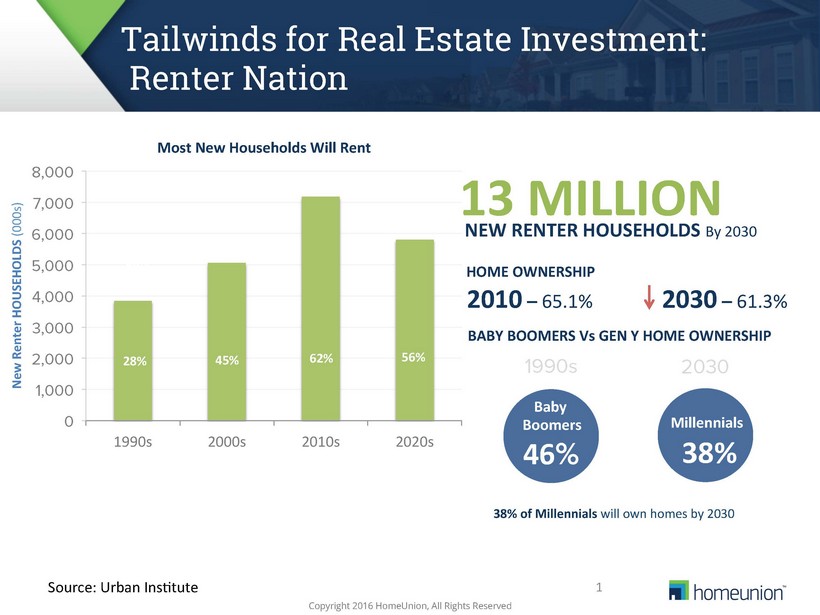
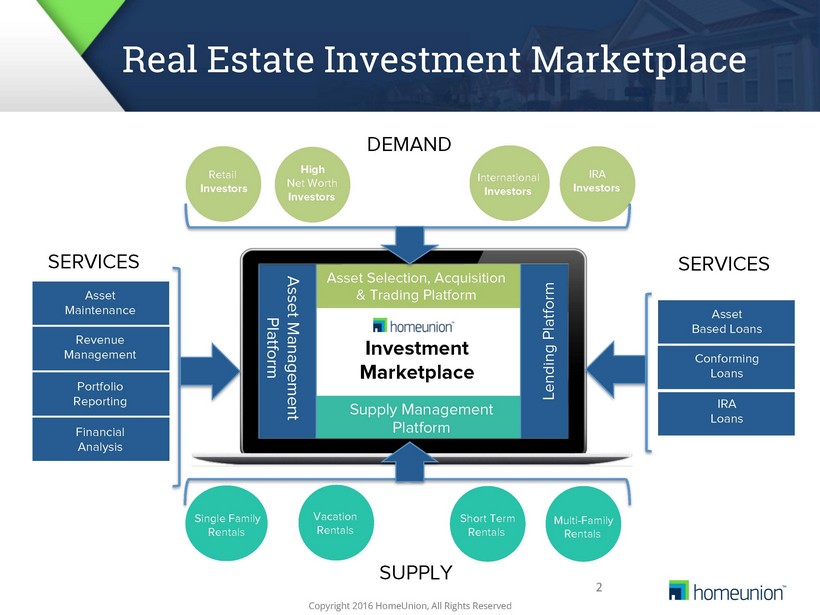
| 35 |
Challenges of Residential Real Estate Investment
An individual investor faces multiple challenges when pursuing real estate investment of residential rental properties, particularly properties located outside of the investor’s immediate geographical area. Some of the challenges we seek to address include:
Lack of Comprehensive Data on Remote Properties. Investors do not have access to reliable, up-to-date and comprehensive data on the best available SFRs throughout the U.S. Before an informed decision can be made, investors must review critical factors about the property, such as the neighborhood condition, school, crime, median income and the condition of the property itself. Without such information, investors are not able to conduct the necessary due diligence and analysis to determine the feasibility of the investment. While local or regional information and data may be available through different vendors and services, there is no single source of national data available to investors. As a result, potential investors must incur significant costs, labor and time to conduct burdensome research if they wish to invest outside their geographic area or in multiple regions, making it an unattractive process.
Lack of Decision Support Analytics. Most of the raw data that is available is targeted to prospective homeowners and not investors. Investors do not have an easy way to derive key investment decision elements such as risk, expected yield, appreciation and major expenses that may be incurred over the life of the investment property.
No Easy Way to Acquire Remote Properties. Even if an investor is able to identify a property in a location that is outside their geographic area, there are a number of hurdles in acquiring the property. The best price has to be negotiated and rents verified to ensure the property will provide the best return. In addition, the condition of the property needs to be properly assessed so that accurate repair and renovation estimates can be made to determine the actual return. The process of acquisition and closing requires the investor to be familiar with local tax and insurance requirements. In addition, the investor has to work with a lender to qualify for a loan and find local vendors for repairs and renovation to get the property rent ready.
Managing Remote Properties is Difficult. Investors have to rely on a local property manager for locating a qualified tenant with appropriate financial credentials. Thereafter the property manager is responsible for maintenance requests, routine upkeep of the property, rent collection and lease renewals at market rates. Most property managers are smaller businesses that lack adequate systems and processes to ensure the best upkeep and revenue maximization of rental properties by obtaining the right renters and ensuring investors receive the best possible rent for that market. Investors are forced to rely on these small businesses for the most important aspect of the performance of their investment property.
Lack of Market Data to Make Purchase and Sales Decisions. Investors do not have easy access to up-to-date and comprehensive local market data to determine if they should sell their property or take advantage of buying opportunities. Relevant information includes new companies entering or leaving the market, job growth, population growth, housing starts and investment home price trends. This lack of data prevents individual investors from regularly monitoring local real estate market trends and the value and pricing fluctuation of the investment portfolio, thus making it difficult to determine whether and when to sell the property.
No Easy Way to Sell Remote Properties. In most cases investors have to wait for tenants to vacate at the end of the lease term and then put the property on the market to sell it to a homeowner. The investor has to vet and select a remote realtor and rely on his or her abilities to sell the property in a timely fashion and at the right price. Once a potential buyer has been found the investor will need to negotiate the right price, comply with local regulations and then conduct the repairs that have been identified by the buyer.
Our Solution
HomeUnion has built an end-to-end online investment management solution that provides investors with a seamless method to remotely invest in residential real estate properties throughout the U.S. that meet their investment goals. We accomplish this through a combination of transaction automation, big data-based decision support analytics, local infrastructure and a fully integrated acquisition, financing and asset management mechanism. We currently have real estate licenses to operate in 18 markets and 10 states and intend to expand our operations in additional states and neighborhoods. We also have begun outreach in selected foreign countries, such as India, China and Australia, to attract qualified international investors.
| 36 |
Our solution provides our customers with an efficient and user-friendly online experience through each critical decision point in the real estate investment cycle, which can be divided into four phases:
| · | Selection of Investment Property; |
| · | Acquisition of Property; |
| · | Asset Management; and |
| · | Sale and Disposition of Property. |
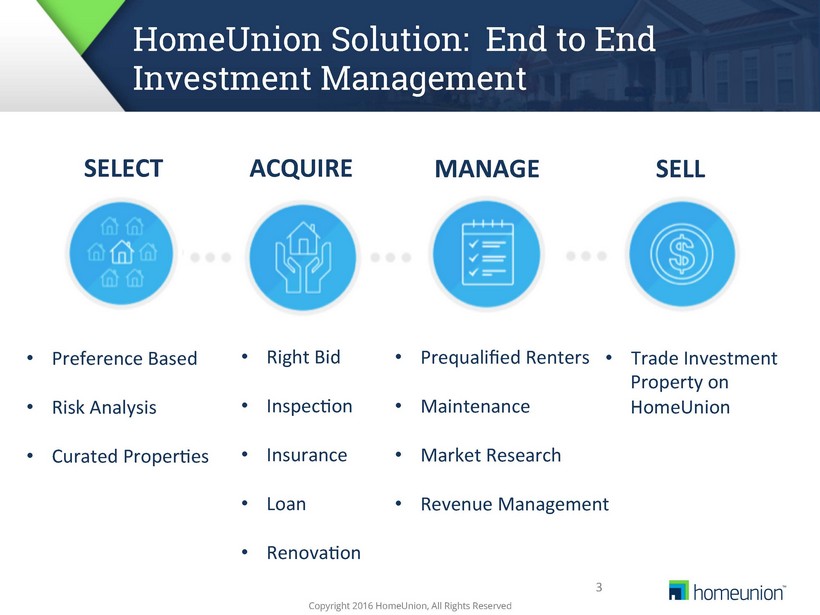
Selection of Investment Property
Selection of Properties
We have developed a sophisticated predictive algorithm for potential investment opportunities by evaluating over 110 million homes and 200,000 neighborhoods, or approximately 95 percent of the single family homes in the U.S. We select neighborhoods and properties based on data science and feedback from local licensed real estate professionals who are typically our employees. By subscribing to our services, our customers gain access to a wealth of information from a single source with respect to a large pool of potential SFR investments in multiple states in the U.S.
To assist our customers in selecting the best investment property, we conduct a rigorous due diligence and certification process to identify the investment properties we recommend. We analyze over 50 criteria when selecting an investment location, including crime, schools, employers, median income, rent-to-price ratio and availability of local resources for management. Furthermore, we deploy experienced local managers/professionals on the ground in selected neighborhoods to examine the actual property to understand fully its condition and potential issues and risks that need to be addressed in an acquisition.
| 37 |
The properties we typically identify and recommend are single-family units located in stable, middle-class neighborhoods. High-end neighborhoods generally do not provide optimal cash flow as home values may be too high compared to rental income. A lower-priced neighborhood may produce good cash flow but will not have tenant stability, as lower income earners are the first to be affected in any local market downturn. Therefore, we usually source properties that can produce positive monthly income after deducting all expenses including mortgage payments, which means properties with high rental-to-purchase ratios in areas that are economically viable and will continue to be for the foreseeable future. Furthermore, the location has to meet many criteria including employment, median income, comparable sales prices, quality of schools, employer diversity and average tenancy.
Currently we focus our pool of investment property on SFRs primarily because we have gained significant expertise and experience in SFR transactions, and we have collected a large amount of data from multiple states on SFRs. SFRs allow customers to build a diversified portfolio across locations so they are not dependent on a single tenant or the economy of a single location. SFRs also have a lower entry price point and so are accessible to more investors than MFR units. We also have a limited operation in MFR units based upon demand from our customers. Higher net worth investors can more efficiently deploy larger pools of capital for MFRs. Many of them use up the 10-loan maximum from government agencies for SFRs and can utilize the government agency loans for MFRs to expand their portfolio.
Property Selection by Customer
The entire property selection process by our customers is conducted through our proprietary online platform, therefore our customers have no need to travel to the property site before making the final decision to purchase.
Once a potential customer is registered with on our Investor Portal, he or she would gain access to a myriad of data and analytics that will facilitate the selection of the best property for the customer. We understand the customer’s financial goals, budget and risk preferences, and method of funding (cash, loan, IRA) through an online questionnaire. Thereafter, we use these responses to create a personalized investment portfolio that fits the customer’s needs using our proprietary real estate asset recommendation engine. In addition, our solutions managers are available to support the customer every step of the way to answer any further questions that investors may have on neighborhoods, properties or funding methods.
| 38 |
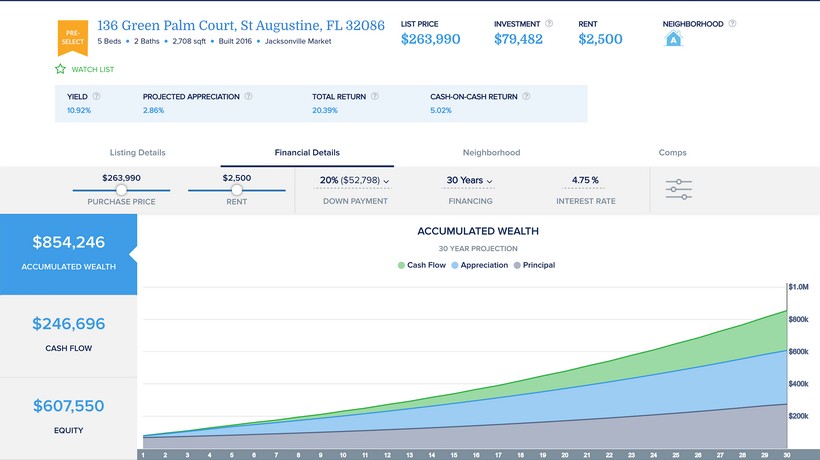
Fully Managed Acquisition Process
Once the customer has selected one or more properties for purchase through our platform, we provide a fully managed service to complete the acquisition process. We arrive at an optimal bid price for every property through a combination of data sciences and on the ground validation by our local real estate professionals. We negotiate and communicate with the seller on behalf of the customer. Prior to closing, we conduct inspections through certified third party inspectors and appraisers to verify the condition of the property and arrive at a final decision on whether or not to acquire the property at the negotiated price. We also assist customers in procuring low-cost insurance that complies with the local regulatory requirements.
Our fully managed acquisition process includes a technology platform that offers a streamlined process to prepare, complete, finalize and execute all documents and contracts required to consummate the acquisition. Our customers grant us a power of attorney to handle and process all contracts in the transaction, thus eliminating the need for multiple visits that are typically required when investors work with “brick-and-mortar” real estate agents. To ensure a timely closing, we facilitate the interaction between the customer and the closing company and provide legal support such as notary and local attorneys. We have a closing team that coordinates all activities and ensures that all contingencies are removed for a smooth acquisition.
HomeUnion Lending
Through our subsidiary HomeUnion Lending, Inc., we provide licensed mortgage brokerage services that enable our customers to quickly secure financing for the acquisition. Our mortgage operation is fully integrated with our online technology platform and supported by experienced loan officers who guide our customers through the entire home financing process.
As a full service mortgage brokerage, we provide different options of financing to our customers, including agency conforming loans, jumbo loans, IRA account and asset-based loans. We currently have relationships with Colony Finance and the B2R unit of Blackstone to provide asset-based loans to investors that have either maxed out their 10 loans from the government or do not qualify for other reasons. Our loan officers match our customers with the appropriate lenders and provide advice with respect to financing strategies, interest rates, financing costs and loan options. We also assist our customers to obtain pre-qualification or pre-approval for the transaction, as well as preparing and completing all necessary loan applications and credit checks. Our loan officers also assist our customers with the financing mechanics to ensure a smooth closing, including collection of documents and coordination of the escrow and funding process. As a mortgage broker, we do not bear any direct financial risk if our customers are in default of the loans.
| 39 |
The HomeUnion Home
We bring every customer’s investment property that we manage up to a quality standard that we call the HomeUnion Home. This helps with renter satisfaction and builds a long-term brand for our company as a desired renter destination, which in turn provides a steady rate of returns for our customers. The HomeUnion Home typically includes standards for countertops, flooring, paint, fixtures, appliances and much more. We have a detailed bill of materials and costs that has been negotiated with national suppliers, which we provide to our national and local construction management vendors. We enforce compliance through our regional rehab management systems that track the jobs and the materials used by our regional rehab managers.
Asset Management
Managing the Property for the Best Return
We use a proprietary workflow based management system called Embrace in conjunction with a streamlined and effective property management system for the renting, maintenance and management of investment properties. We provide asset management services to our customers as a separate and distinct offering from the other services, and customers have the choice and the right to manage the properties themselves or engage other service providers to manage their properties. If the customers decide to use us for the management of their properties, we provide comprehensive consolidated performance reporting on all investment properties held by an investor. These reports are available on demand to investors in their secure personal vault. Our asset management specialists work with these systems to provide our customers with full property management services that are seamlessly integrated into our proprietary platform. These services include:
| · | Advertising of rental property; |
| · | Screening of tenants based on ability to pay, past history and a background check; |
| · | Analysis of optimal rental payments for each property using our proprietary rent valuation models; |
| · | Preparation and negotiation of lease agreement; |
| · | On-going repair, maintenance and upgrades of properties; |
| · | Coordination and communication with tenants; |
| · | Collection of rental payments; and |
| · | Lease renewals and rent escalations per market conditions. |
We have vendor management systems that monitor and track the performance of the vendors we have agreements with to ensure all repair and maintenance work is performed within quality, cost and time parameters.
Market Research
Investors that have their assets managed by us receive quarterly research on the markets where their properties are located. The research provides our investors visibility into the residential real estate investment trends in that market. These reports cover economic trends, including supply and demand indicators as well as major economic news. They also contain forecasts for major SFR fundamentals, including employment, vacancy and rent growth. Additionally, local research reports provide quarterly insight into the SFR transaction market, including price and cap rate trends. An example of market reports is below.
| 40 |
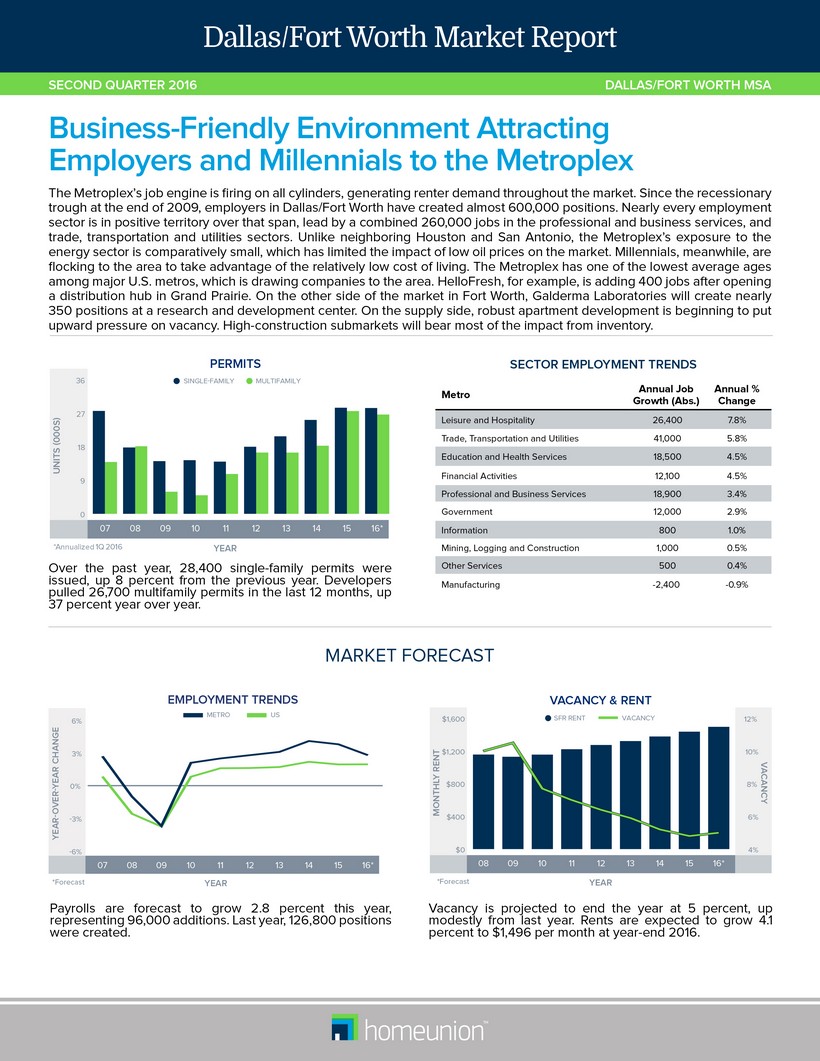
| 41 |
Sale and Disposition of Properties. When investors are ready to sell their assets they are able to list the property on our portal for sale to another investor on HomeUnion. This allows investors to sell properties without having to remove the tenant if they choose to do so. We believe this will facilitate an unprecedented transparent exchange between the buyer and seller given HomeUnion’s performance history on the property.2
Our Competitive Strengths
Our proprietary online platform and decision support analytics provides individual investors with the ability to remotely invest SFRs and other residential properties. We believe we are the first company in our industry to combine technological capability and local infrastructure to allow potential customers to choose from a large number of residential rental properties in multiple states in the U.S. Our differentiating factors include:
| · | Big Data Driven Analytics. We believe we have industry leading analytics that calibrates risk, calculates expected returns, generates optimal bid ranges and provides rich neighborhood information to assist customers with their decision making process. We have collected a substantial amount of valuable and consumable residential real estate data incorporating 200,000 neighborhoods, 110 million single-family properties, 15.5 million apartments and over 1.5 million rental comps. Our data analytics provide the foundation to execute complex real estate transactions remotely and online in a simpler and more efficient manner. |
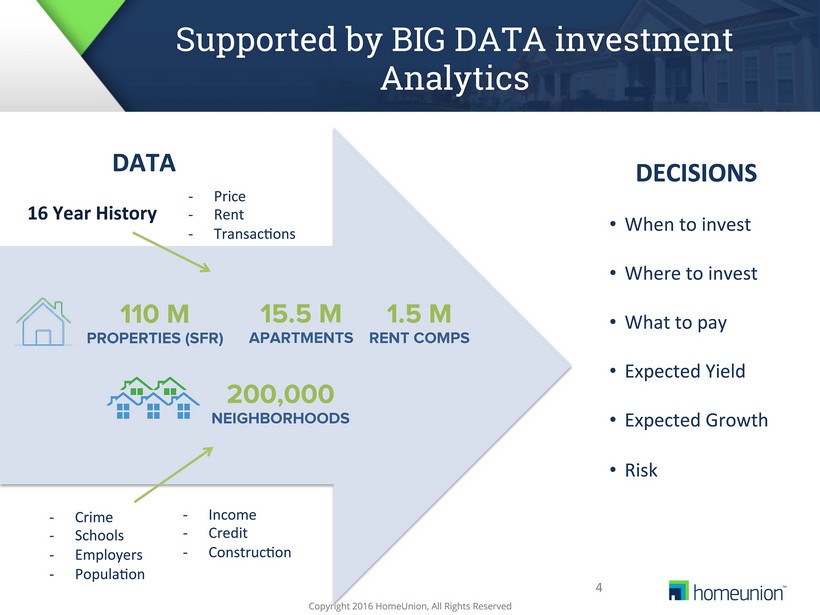
| · | Automated Asset Selection and Acquisition Technology. We have developed a unique asset selection technology that builds personalized real estate portfolios for investors based upon their financial goals. We have developed an automated bidding process that allows us to compress time in the acquisition of properties. |
| 42 |
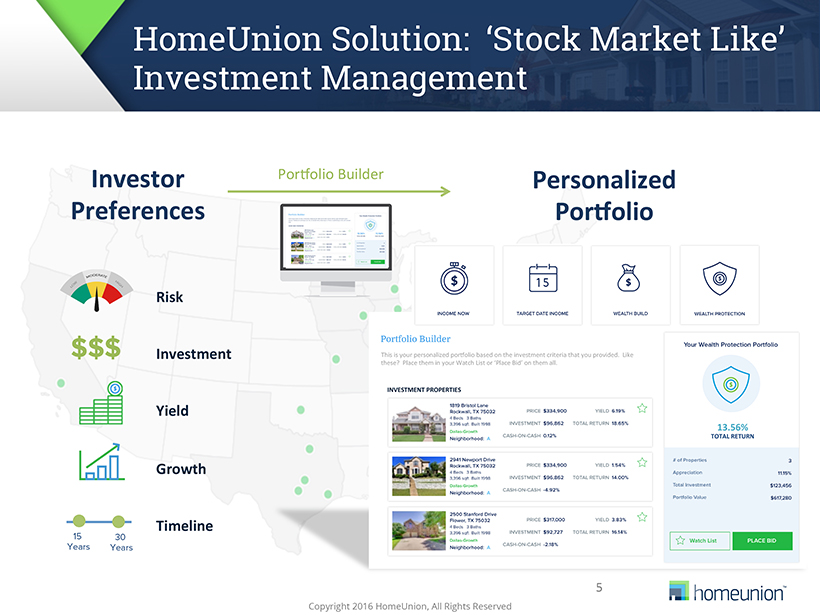
| · | Workflow Driven Asset Management and Reporting Technology. We have created a proprietary workflow management system that tracks the investment process from end-to-end while working with best-in-class customer relationship and property management software. In addition, we provide comprehensive and consolidated reporting for all properties, which allows investors to monitor their property’s performance and enables them to make informed investment decisions without delay. |
| · | Ongoing Revenue Generation from Asset Management. Our asset management group supports a continuous relationship with our customers who choose to use us to manage their properties, and a consistent revenue stream outside of the transaction market. As investors’ needs change and their portfolios mature and expand, we are able to generate additional asset management fees from a large and captive customer base. This unique model serves as a hedge against economic uncertainty. The revenue generated by asset management fees was approximately 11% of total revenue in 2015 and 8% and 24% as of June 30, 2015 and 2016 and is expected to become a larger percentage of the business as the assets under management continue to grow. |
| · | Local Infrastructure in Each Market. Real estate is extremely local and we have a team of licensed real estate employees in each of the locations we serve. This local infrastructure validates our data science and provides continuous feedback on accuracy. In addition, it provides valuable support for acquisition, due diligence and management of assets. Our market-specific infrastructure eliminates the fears often associated with online and remote investment of real estate property and enhances the comfort of our customers to consummate the transactions without having to physically visit the property. |
| · | Market Research Services. We provide comprehensive research in all our markets around local economies and trends that affect investment properties such as employment, transaction activity or population growth. |
| · | Lending Brokerage Operations. We have established HomeUnion Lending as a mortgage broker to help investors secure financing for their properties. This allows us to be a one-stop shop for our investors and firmly and seamlessly connects the financing requirements of real estate investment with the mechanics of the transaction. |
| 43 |
| · | Highly Experienced Management Team and Advisors. We have a seasoned management team with extensive leadership experience, including our founder and Chief Executive Officer who was recently awarded the 2015 Housing-Wire Vanguard Award for impact on the housing economy. In addition, the company is guided by a board of advisors consisting of industry leaders and experts who assist us in the areas of technology and investment management. Our advisors include: |
| o | Dr. Evangelos Christidis – Professor, University of California Riverside. Professor Christidis is an expert in databases, information retrieval, and has received the NSF CAREER award, a Google Research Award, an IBM Scalable Data Analytics for A Smarter Planet Innovation Award, and a Kauffman Entrepreneurship Award. |
| o | Richard H. King Executive VP and CIO, Thomson Reuters. Mr. King’s advisory positions have included service on Minnesota’s Metropolitan Airports Commission, Ultra High-Speed Broadband Task Force and Science and Technology Authority, the State Technology Advisory Committee and on the U.S. Chamber of Commerce’s Telecommunication and e-Commerce Committee. |
| o | JD Montgomery – Managing Director, Canterbury Consulting. Canterbury Consulting oversees $16 billion in client funds. JD heads the Family Office efforts at Canterbury and is a board member of the firm. In addition, he serves on Canterbury’s Hedge Fund and Private Equity Manager Research Committees. |
| o | Jon Olson – Recently retired as the Executive VP of Finance and CFO at Xilinx, Inc., responsible for finance, tax, treasury, IT and investor relations. Prior to Xilinx, he served as VP of Finance and Enterprise Services at Intel Corp., where we worked for 26 years. He held a variety of senior positions, including: Director of Finance and controller for three groups. |
| o | Ken Weiner – Recently retired from Swiss Re as Managing Director, Americas Chief Risk Officer, Mr. Weiner is a risk management expert with over 30 years of experience on the financial services industry. At Swiss Re, he served as Managing Director, Head of Operational Risk Management, and Managing Director, Head of Audit – Reinsurance, Corporate Solutions & Asset Management. Prior to joining Swiss Re in 2008, he worked at Credit Suisse (1995-2008), where he served as Managing Director, Head of Operational Risk Management for Investment Banking, and Managing Director, Americas Head of Audit. |
| o | Rajib Das – Founder and CEO, Lexington Park Group. At Lexington Park Group, he has led capital raising transactions of over $8 billion and over $10 billion of private equity, principal investment and advisory transactions across the world. Previously, he has served at: Dubai International Group, BroadStreet Group, UBS Investment Bank, and Merrill Lynch. |
| o | Abby Hossein – CTO, Mercury Insurance Group. Abby has over 34 years of experience in information technology including executive positions in global financial services, high tech, BPO and retail organizations. He oversees Mercury's core insurance applications for Claims, Underwriting, Billing, Finance, and HR as well as Enterprise Infrastructure and IT Sourcing. |
Our Growth Strategies
We plan to use a number of different initiatives to continue to scale our business model and expand our operations to additional markets.
Nurture Existing Clients. Many of our clients buy multiple properties and we believe that they will continue to invest over time as their current assets perform. Our current clients also serve as a source of referrals for new clients and this will reach an inflection point as the customer base continues to grow.
Expand Omni Channel Marketing. We combine online and offline channels to generate prospective investor leads. In addition, we generate significant organic content around real estate investing. This content drives traffic to our website as well as our coverage in the press.
Expand Locations for Sourcing Properties. We believe that there are many more locations in the U.S. where viable investment properties can be sourced much like the current locations in which we operate. This will allow us to offer a greater number and variety of investment properties on our portal.
| 44 |
Offer More Multi-family Investments. We believe that we can continue to expand the MFR offerings, as we expect significant demand from high-net-worth investors. In general, MFRs do not trade efficiently and there is less availability of government agency financing.
Outreach to International Investors. U.S. real estate has long been a safe haven for international investors and this is even more so under the current global geopolitical and economic scenario. We believe that this segment is quite large and we can offer them a diverse basket of investment real estate across the country. We have begun outreach to investors in India and the Asia Pacific region.
Our Customers
Our goal is to provide stable financial returns and build asset values that meet the needs of people in various stages of their lives. Our customers are diverse and range from:
| · | High-net-worth investors who seek to diversify their investment portfolio from other asset classes, including the stock market. They tend to be professional investors who are familiar with the real estate investment process. |
| · | Retail investors who see real estate as a way to build wealth and afford financial freedom by investing regularly over the years. |
| · | Retirees who invest for yield to support their current needs in retirement. |
| · | Foreign investors who see the U.S. as a safe haven for capital deployment. |
According to the Credit Suisse Global Wealth Databook 2015, ICI Research 2013, Center for Economic Development 2011, and the Wealth-X UBSWorld Ultra Wealth Report 2014, there are 50 million investors in the U.S. who may purchase residential real estate properties, and many more globally that have the ability to invest with us. In addition, according to Trustpilot.com, HomeUnion is rated 8.1 out of 10 by our clients who were requested by us to provide such a review.
Competition
Our business competes with both traditional “brick and mortar” and online real estate sales and management companies. Other competitors include:
| · | Real estate listing sites such as Investability and Roofstock that offer investment properties. Roofstock claims to curate these properties but they refer most services to third parties and do not manage the properties after the initial investment. |
| · | Real estate crowd funding sites such as Realty Mogul, Realty Shares and Patch of Land are largely focused on short-term real estate debt and sometimes equity to accredited investors offered by third party sponsors and developers of real estate projects. |
| 45 |
| · | Turnkey property developers, which tend to be family owned firms such as Memphis Invest and Mack Properties that have on the ground infrastructure to acquire properties in limited geographies, rehab the properties, sell them to investors and manage them post investment. They currently do not offer a strong online transaction experience or data analytics to support the investment decision. |
Our ability to compete against both traditional and online real estate investment and management companies will depend on various factors, including our ability to execute our growth strategies and scale up our business. This is particularly true because many of our existing and potential competitors have, or could have, substantially longer operating histories and greater financial resources than we do.
Government Regulation
We are subject to various real estate regulations. We are licensed as a real estate broker in 13 states and a mortgage broker in 13 states, although we currently have active operations in 10 states.
We have established a separate subsidiary in the form of an LLC (the “State LLC”) for each state where we are required to hold a license to operate our business. We currently have real estate brokerage licenses in Alabama, California, Florida, Illinois, Indiana, Ohio, Oklahoma, Tennessee, Texas, North Carolina, South Carolina and New York. We work with state licensed real estate brokers as independent contractors for each State LLC. We have employees who are licensed real estate agents who are appropriately licensed in each state in which they work. In certain markets, we use contract agents for such work. We work with outside counsel in each state to ensure that we comply with all local real estate laws. We are also subject to numerous other federal, state and local laws and regulations that contain general standards for, and prohibitions on, the conduct of real estate brokers and sales associates, including agency duties, collection of commissions, telemarketing, advertising, and consumer disclosures.
Our subsidiary HomeUnion Lending Inc. provides mortgage brokerage services for our investors only. It currently holds mortgage brokerage licenses in the following states: Alabama, California, Florida, Illinois, Indiana, Iowa, Louisiana, North Carolina, Oklahoma, Oregon, Pennsylvania, Tennessee, and Texas. It only provides mortgage brokerage services in these states. We have contracted with Mortgage Licensing Group to handle all of our state licensing maintenance requirements. They ensure that each licensee has completed the requisite education according to each state’s guidelines. They also ensure that any outstanding compliance issues are handled.
HomeUnion Lending Inc. is regulated by several agencies, including the Consumer Finance Protection Bureau, which monitors our service to ensure compliance with regulatory guidelines, including Dodd Frank, Real Estate Settlement Procedures Act, Equal Credit Opportunity Act, Fair Housing Act, Fair and Accurate Credit Transactions Act and Home Mortgage Disclosure Act.
In order to obtain bank approvals from the lenders we work with we have to comply with The Bank Secrecy Act/Anti Money Laundering Acknowledgement, a Quality Control Plan that complies with agency standards and a Loan Fraud Zero Tolerance policy. We work with Lenders Compliance Group to help us with the Anti-Money Laundering annual training. HomeUnion Lending and HomeUnion are parties to an Affiliated Business Agreement
Intellectual Property
We have obtained copyright protection for some of our original works. We have registered Neighborhood Investment Rating, REALestimate and The Right Bid.
Employees
As of September 30, 2016, we have 100 full-time employees and 2 temporary employees. We believe that we have been able to attract and maintain high quality employees. There are no employees subject to collective bargaining agreements. In addition, we believe we have a good relationship with our employees.
| 46 |
Legal Proceedings
We are currently not involved in any litigation that we believe could have a materially adverse effect on our financial condition or results of operations. There is no action, suit, proceeding, inquiry or investigation before or by any court, public board, government agency, self-regulatory organization or body pending or, to the knowledge of the executive officers of our company or any of our subsidiaries, threatened against or affecting our company, our common stock, any of our subsidiaries or of our company’s or our company’s subsidiaries’ officers or directors in their capacities as such, in which an adverse decision could have a material adverse effect.
We occupy two offices with a total of approximately 14,083 square feet of space in Irvine, California, which serve as our headquarters, under a lease that expires in 2020 with an option to renew for an additional five (5) years. In June 2016, we signed a lease agreement for an office with approximately 2,034 square feet in Los Altos, California, for the purpose of facilitating our expanded operations in Northern California. This lease expires 37 months from September 30, 2016. We also maintain a small office in Cincinnati, Ohio, under a lease that expires in April 2017 for the purpose of complying with certain state licensing requirements. We believe that our facilities are adequate for our current needs.
MANAGEMENT’S DISCUSSION AND ANALYSIS OF FINANCIAL CONDITION AND RESULTS OF OPERATIONS
The following discussion of our financial condition and results of operations should be read in conjunction with our audited consolidated financial statements and the accompanying notes thereto included elsewhere herein. The following discussion contains, in addition to historical information, forward-looking statements that include risks and uncertainties. Our actual results may differ materially from those anticipated in these forward-looking statements as a result of certain factors, including those factors set forth under Risk Factors
Overview
We are the leading online investment management platform dedicated to the residential real estate market, enabling investors to invest outside their local geography. We do this by providing individual investors with a comprehensive, end-to-end solution for the selection, acquisition, management and sale of residential real estate properties. Our proprietary platform combines the power of technology and the experience of local real estate experts to make investment in residential real estate seamless and transparent. We are the first company in our industry to offer individual investors a comprehensive suite of services to remotely invest in residential properties throughout the U.S. with a simplified online process, focusing primarily on single-family rental (SFR) assets. Our platform enables investors to maximize returns, protects assets and provides advice on how to achieve specific investment and fixed income goals. We currently operate in 18 markets in 10 states in the U.S. and continue to expand our geographical reach.
Currently our operations focus primarily on providing end-to-end services for the investment in SFR properties throughout the U.S. In order to ensure a favorable return on investment, it is important to identify those SFR properties with the desirable characteristics to produce sufficient income and appreciation to offset the costs of acquisition. The Company has developed proprietary analytics algorithms using significant amounts of data mostly purchased from third-party providers to assist our customers in selecting the appropriate SFR properties for their investment goals. The Company also plans to increase our offerings of other property categories on our platform, particularly multi-family rental properties and apartment buildings which currently only constitute a small percentage of our available properties.
| 47 |
Our revenue is comprised of two primary components, transaction revenue which is generated upon the purchase of a property by our customer, and recurring asset management revenue which is generated on a monthly basis and tied to the rental proceeds and other fees for the properties we manage.
Our revenue was $0.3 million and $1.2 million for the fiscal years ended December 31, 2014 and 2015, respectively. Our revenue was $0.2 million and $1.2 million for the six months ended June 30, 2015 and 2016, respectively. We closed real estate transactions aggregating $4.4 million and $17.7 million for the fiscal years ended December 31, 2014 and 2015, respectively, and $4.6 million and $16.8 million for the six months ended June 30, 2015 and 2016, respectively.
Transaction Revenues
Transaction revenues are made up of asset selection and acquisition fees which we charge our customers for the use of our platform and services, real estate brokerage commissions which we earn by representing the buyer in the real estate transaction and mortgage brokerage and referral revenue which we generate from our lending partners. In addition, as our current investors sell their properties over time, we expect we will be able to earn a higher real estate brokerage commission by having the buyer and the seller both utilizing our platform as a marketplace.
Recurring Asset Management Revenues
A portion of the ongoing value created by our platform is the asset management services we provide, including the placement of qualified tenants, collection of rents, monitoring property upkeep and providing repair and maintenance services through our employees and third party contractors. We charge our customers a fee for this service which is based on the monthly rental proceeds and other fees from each property. As our portfolio of assets under management continues to grow, we expect the recurring revenue generated from asset management activities will become a larger portion of our overall revenue mix thereby improving our revenue and offsetting potential volatility from our transaction based commissions.
During the six months ended June 30, 2016 and 2015 and the years ended December 31, 2015 and 2014, approximately 76%, 92%, 89%, and 98%, respectively of our revenues were generated from transaction revenues and 24%, 8%, 11%, and 2%, respectively from asset management revenues.
Key Operating Metrics
We measure our business using operating metrics. We use these metrics to analyze our business performance, determine financial forecasts, and help develop long-term strategic plans. We review the following key business metrics:
| Six months ended June 30, | Years ended December 31, | |||||||||||||||
| 2016 | 2015 | 2015 | 2014 | |||||||||||||
| Closed transaction volume ($ M) | 16.80 | 4.62 | 17.71 | 4.41 | ||||||||||||
| Signed purchase agreement carried forward ($ M) | 13.18 | 2.33 | 9.91 | 1.40 | ||||||||||||
| Assets Under Management ($ M) | 36.48 | 6.07 | 18.97 | 2.73 | ||||||||||||
Closed transaction volume
The transaction volume is the value of the real estate, as determined by the purchase price, purchased in a given period. After the execution of a real estate purchase agreement, it often takes 30-60 days to close a transaction whereby the real estate transaction is completed and the title is transferred from the seller to the buyer. The time to close depends on a variety of factors, including the completion of the financing (either loan or all cash) process. Transaction associated revenues are recognized upon closing of a transaction and are derived as a percentage of the real estate transacted on our platform.
| 48 |
Signed purchase agreement carried forward
As real estate transactions often take 30-60 days to close from the date of execution of the purchase agreement, in many cases a property may not close in the same period when its purchase agreement was signed. These properties are classified as signed purchase agreement carried forward where the value represents the aggregate purchase price of all real estate purchase agreements executed and in active process of closing at the end of the period. The significant increase in the first six months of 2016, compared to the same period 2015 is a direct correlation to the Company’s expansion and growth.
Assets Under Management (AUM)
Assets Under Management is the aggregate value of real estate assets being managed by HomeUnion. Included in the AUM is the total acquisition cost which is the purchase price of the property as well as the closing costs and fees and capital improvement costs. Asset management fees are charged as a percentage of the rent, which is dependent on the AUM, along with other fees. Asset management revenue is an annuity revenue and continues until either the property is sold by the investor or the asset management agreement is terminated for any reason. The significant increase in the assets under management in the first six months of 2016, compared to the same period 2015 is due to the Company’s expansion and growth.
Key Financial Measures and Indicators
Revenues
Our revenue is comprised of two primary components, transaction revenue which is generated upon the purchase of a property by our customer, and recurring asset management revenue which is generated on a monthly basis and tied to the rental proceeds and other fees for the properties we manage.
The growth of our revenue is predominately impacted by our ability to increase the gross real estate transactions and the assets under management on the platform. The platform we have built, including support by local real-estate experts, has the ability to scale significantly based on the demand we see from our potential customers. In addition to driving more traffic and improving our conversion rates, we also have several initiatives to incrementally grow revenue including driving follow-on transactions from existing investors, increasing the average transaction size and building our offering of additional residential real estate categories such as multifamily apartments.
Our business is focused on providing services around real estate transactions and, as such, we rely on our platform along with sales and financing professionals to continually develop leads, identify investors to facilitate the purchase of investment properties, market those properties and close the sale timely to generate a consistent flow of revenue. The timing of closings is dependent on many market and personal factors unique to a particular client or transaction. These factors can cause transactions to be accelerated or delayed beyond our control which leads to variability in timing of transaction revenues and the start of our asset management revenue. Further, transaction revenues earned are generally directly related to the value of the property sold and the amount of services provided during the transaction and after.
Operating Expenses
Our operating expenses consist of cost of services, selling, development and administrative expenses and depreciation and amortization. While we expect to grow our operating expenses on a dollar basis year over year, based on the available capacity we have in our business we expect operating expenses to materially decrease as a percentage of revenue over time. The significant components of our expenses are further described below.
| 49 |
Cost of services
Cost of services includes expenses related to the fulfillment of the Company's supply chain, real estate operations and mortgage brokerage operations. This also includes salaries, bonuses, benefits and stock-based compensation expense. Due to the nature of our business, we are often required to invest in personnel and infrastructure in new markets ahead of our growth in those markets. As such, while we expect cost of services related to both transaction commissions and asset management fees to continue to increase on a dollar basis going forward, we expect these costs to decrease as a percentage of sales as we continue to grow revenue and more efficiently utilize the core infrastructure previously built in each served market.
Selling, development and administrative expenses
The largest expense component within selling, development and administrative expenses to date is personnel expenses for our engineering, data sciences, product development, marketing, sales, market research, support staff and management. In addition, these costs include facilities costs (excluding depreciation and amortization), staff related expenses, sales, marketing, legal, telecommunication, network, data sources and other administrative expenses. Also included in selling, development and administrative are expenses for stock-based compensation to employees and non-employee directors.
Depreciation and amortization expense
Depreciation and amortization expense consists of depreciation and amortization recorded on our computer software and hardware, furniture, fixtures and equipment. Depreciation and amortization are provided over estimated useful lives ranging from three to seven years for owned assets or over the lesser of the asset estimated useful lives or the related lease term for leasehold improvements.
Also, the Company amortizes the capitalized software development costs on a straight-line basis over the estimated useful life of the software, which is generally three years, beginning when the asset is placed into service. The amortization of capitalized software development costs is reflected in depreciation and amortization.
Interest Expense
Interest expense primarily relates to notes payable and convertible debt with related parties which have interest rates ranging from 3% to 5% per annum.
Provision for Income Taxes
We are subject to U.S. federal taxes and individual state and local taxes based on the income generated in the jurisdictions in which we operate. Our effective tax rate fluctuates as a result of the change in the mix of our activities in the jurisdictions we operate due to differing tax rates in those jurisdictions and also based on changes in any valuation allowances recorded against our deferred tax assets.
Results of Operations
Following is a discussion of our results of operations for the six months ended June 30, 2016 and 2015 and the years ended December 31, 2015 and 2014. The tables included in the period comparisons below provide summaries of our consolidated results of operations. The period-to-period comparisons of financial results are not necessarily indicative of future results.
| 50 |
Six Months Ended June 30, 2016 Compared to the Six Months Ended June 30, 2015
Below are key operating results for each of the periods indicated (in thousands):
| For the six months
ended June 30, | Percentage | |||||||||||
| 2016 | 2015 | Change | ||||||||||
| Revenues | $ | 1,211 | $ | 154 | 686 | % | ||||||
| Operating expenses | ||||||||||||
| Cost of services | 2,162 | 503 | 330 | % | ||||||||
| Selling, development and administrative | 8,033 | 4,665 | 72 | % | ||||||||
| Depreciation and amortization | 386 | 172 | 124 | % | ||||||||
| Total operating expenses | 10,581 | 5,340 | 98 | % | ||||||||
| Operating loss | (9,370 | ) | (5,186 | ) | 81 | % | ||||||
| Interest expense, net | (70 | ) | (25 | ) | 180 | % | ||||||
| Loss before income taxes | (9,440 | ) | (5,211 | ) | 81 | % | ||||||
| Income tax provision | (- | ) | (- | ) | (- | )% | ||||||
| Net Loss | $ | (9,440 | ) | $ | (5,211 | ) | 81 | % | ||||
Revenue Breakdown by Source
| For the six months
ended June 30, | Percentage | |||||||||||
| 2016 | 2015 | Change | ||||||||||
| Revenues (in thousands): | ||||||||||||
| Transaction revenues | $ | 924 | $ | 142 | 551 | % | ||||||
| Asset management fees | 287 | 12 | 2,292 | % | ||||||||
| Total Revenues | $ | 1,211 | $ | 154 | 686 | % | ||||||
Revenues
Our total revenues were $1,211,000 for the six months ended June 30, 2016 compared to $154,000 for the same period in 2015, an increase of $1,057,000, or 686% primarily driven by an increase in the number of investment sales transactions which resulted an increase in asset selection and acquisition fees, brokerage commissions and asset management fees.
Operating expenses
Our total operating expenses were $10,581,000 for the six months ended June 30, 2016 compared to $5,340,000 for the same period in 2015, an increase of $5,241,000, or 98%. Expenses increased primarily due to an increase in cost of services, which were predominantly variable commissions paid to our investment sales and financing professionals and compensation-related costs related to our sales activities. Selling, development and administrative costs increased as well, as described below.
Cost of services
Cost of services for the six months ended June 30, 2016 increased $1,659,000 or 330% to $2,162,000 from $503,000 for the same period in 2015. The increase was primarily due to increased payroll expenses driven by higher headcount in our real estate supply chain, closing, asset management and mortgage brokerage operations as we built up the platform required to service the business.
Selling, development and administrative expense
| For the six months
ended June 30, | Percentage | |||||||||||
| 2016 | 2015 | Change | ||||||||||
| Selling, development and administrative expense | ||||||||||||
| Product development, analytics and engineering | $ | 2,272,000 | $ | 1,304,000 | 74 | % | ||||||
| Selling and marketing | 3,239,000 | 1,770,000 | 83 | % | ||||||||
| General and administrative | 2,522,000 | 1,591,000 | 59 | % | ||||||||
| Total selling, development and administrative expense | $ | 8,033,000 | $ | 4,665,000 | 72 | % | ||||||
| 51 |
Selling, development and administrative expense for the six months ended June 30, 2016 increased $3,368,000 or 72%, to $8,033,000 from $4,665,000 for the same period in 2015. The increase can be attributed to the following categories: (1) increase in product development analytics and engineering cost of $968,000, (2) increase in selling and marketing expenses of $1,469,000, and an (3) increase in general and administrative expenses of $931,000.
The increase for product development, analytics and engineering of $968,000 was primary attributable to $849,000 increase in salaries and related benefits as a result of higher headcount for engineering, data sciences and product management.
The increase for selling and marketing of $1,469,000 was primary attributable to (i) $388,000 increase in salaries and related benefits as a result of higher headcount for sales and marketing in connection with the development and growth of our platform; and (ii) $970,000 increase in the Company’s marketing campaign to build brand awareness and support increase sales activity;
The increase for general and administrative of $931,000 was primary attributable to (i) $719,000 increase in salaries and related benefits as a result of higher headcount for administrative professionals in connection with the development and growth of our platform; (ii) $410,000 increase in the general office expenses including rent, insurance and other office related items; and (iii) this was partially offset by a decrease in recruiting expenses of $196,000 which is a result of a more strategic recruiting relationship and reducing external recruiting fees.
Depreciation and amortization expense
Depreciation and amortization expense for the six months ended June 30, 2016 increased $214,000 or 124%, to $386,000 from $172,000 for the same period in 2015. The increase was primarily attributable to an increase in amortization expense of software development costs of $181,000, as well as an increase in depreciation expense for fixed assets of $33,000. Increases are driven by more software projects being completed in 2016, as well as more fixed assets purchased in order to support the growth of the business.
Interest expense
There were no significant changes in interest expense for the six months ended June 30, 2016 as compared to the same period in 2015.
Comparison of Year Ended December 31, 2015 and 2014
Below are key operating results for each of the periods indicated (in thousands):
| For the year ended December 31, | Percentage | |||||||||||
| 2015 | 2014 | Change | ||||||||||
| Revenues | $ | 1,179 | $ | 312 | 278 | % | ||||||
| Operating expenses | ||||||||||||
| Cost of services | 2,017 | 447 | 351 | % | ||||||||
| Selling, development and administrative | 12,686 | 4,742 | 168 | % | ||||||||
| Depreciation and amortization | 478 | 100 | 378 | % | ||||||||
| Total operating expenses | 15,181 | 5,289 | 187 | % | ||||||||
| Operating loss | (14,002 | ) | (4,977 | ) | 181 | % | ||||||
| Interest expense, net | (29 | ) | (6 | ) | 383 | % | ||||||
| Loss before income taxes | (14,031 | ) | (4,983 | ) | 182 | % | ||||||
| Income tax provision | (4 | ) | (5 | ) | (20 | )% | ||||||
| Net Loss | $ | (14,035 | ) | $ | (4,988 | ) | 181 | % | ||||
Revenue Breakdown by Source
| For the year ended December 31, | Percentage | |||||||||||
| Revenues (in thousands): | 2015 | 2014 | Change | |||||||||
| Transaction revenues | $ | 1,051 | $ | 306 | 243 | % | ||||||
| Asset management fees | 128 | 6 | 2,033 | % | ||||||||
| Total Revenues | $ | 1,179 | $ | 312 | 278 | % | ||||||
| 52 |
Revenues
Our total revenues were $1,179,000 in 2015 compared to $312,000 in 2014, an increase of $867,000, or 278% primarily driven by an increase in the number of investment sales transactions which generated an increase in asset selection and acquisition fees, brokerage commissions and asset management fees.
Operating expenses
Our total operating expenses were $15,181,000 in 2015 compared to $5,289,000 in 2014, an increase of $9,892,000, or 187%. Expenses increased primarily due to an increase in cost of services, which are predominantly variable commissions paid to our investment sales and financing professionals and compensation-related costs related to our sales activities. Selling, development and administrative costs increased as well, as described below.
Cost of services
Cost of services in 2015 increased $1,570,000 or 351% to $2,017,000 from $447,000 in 2014. The increase was primarily due to increased payroll expenses driven by higher headcount in our real estate supply chain, closing, asset management and mortgage brokerage operations as we built up the platform required to service the business.
Selling, development and administrative expense
| For the year ended
December 31, | Percentage | |||||||||||
| 2015 | 2014 | Change | ||||||||||
| Selling, development and administrative expense | ||||||||||||
| Product development, analytics and engineering | $ | 3,029,000 | $ | 984,000 | 208 | % | ||||||
| Selling and marketing | 5,722,000 | 1,402,000 | 308 | % | ||||||||
| General and administrative | 3,935,000 | 2,356,000 | 67 | % | ||||||||
| Total selling, development and administrative expense | $ | 12,686,000 | $ | 4,742,000 | 168 | % | ||||||
Selling, development and administrative expense in 2015 increased $7,944,000 or 168%, to $12,686,000 from $4,742,000 in 2014. The increase can be attributable to the following categories: (1) increase in product development, analytics and engineering costs of $2,045,000, (2) increase in selling and marketing expenses of $4,320,000, and (3) increase in general and administrative expenses of $1,579,000.
The increase for product development, analytics and engineering of $2,045,000 was primary attributable to (i) $818,000 increase in salaries and related benefits as a result of higher headcount for engineering, data sciences and product management and (ii) $1,147,000 increase in outside technology consultants.
The increase for selling and marketing of $4,320,000 was primary attributable to (i) $2,105,000 increase in salaries and related benefits as a result of higher headcount for sales and marketing in connection with the development and growth of our platform; and (ii) $2,103,000 increase in the Company’s marketing campaign to build brand awareness and support increase sales activity.
The increase for general and administrative of $1,579,000 was primary attributable to (i) $443,000 increase in salaries and related benefits as a result of higher headcount for administrative professionals; (ii) $526,000 increase in the general office expenses including rent, insurance and other office related items; (iii) a increase in recruiting expenses of $375,000 directly correlated to an increase in new hires and (iv) an increase of $115,000 in outside consultants.
Depreciation and amortization expense
Depreciation and amortization expense in 2015 increased $378,000 or 378%, to $478,000 from $100,000 in 2014. The increase was primarily attributable to an increase in amortization expense of software development costs of $342,000, as well as an increase in depreciation expense for fixed assets of $36,000. Increases are driven by more software projects being completed in 2015, as well as more fixed assets purchased in order to support the growth of the business.
Interest expense
There were no significant changes in interest expense in 2015 as compared to 2014.
| 53 |
Provision for income taxes
There were no significant changes in the provision for income tax expense in 2015 as compared to 2014.
Cash Flow Analysis
The following table sets forth our summary cash flows for the six months ended June 30, 2016 and 2015 (in thousands):
| For the six months
ended June 30, | ||||||||||||
| 2016 | 2015 | Dollar Change | ||||||||||
| Net cash used in operating activities | $ | (8,623 | ) | $ | (4,646 | ) | $ | (3,977 | ) | |||
| Net cash used in investing activities | (394 | ) | (621 | ) | 227 | |||||||
| Net cash provided by financing activities | 7,759 | 4,406 | 3,353 | |||||||||
| Net decrease in cash | $ | (1,258 | ) | $ | (861 | ) | $ | (397 | ) | |||
Operating Activities
Cash flows used in operating activities were $8.6 million for the six months ended June 30, 2016 compared to $4.6 million for the six months ended June 30, 2015. Net cash provided by operating activities is driven by our net loss adjusted for non-cash items and changes in operating assets and liabilities. The $4.0 million increase in cash flows used in operating activities for the six months ended June 30, 2016 compared to the same period in 2015 was primarily due to our increase in net loss of $4.2 million.
Investing Activities
Cash flows used for investing activities were $0.4 million for the six months ended June 30, 2016 compared to $0.6 million for the six months ended June 30, 2015. The decrease in cash flows used for investing activities for the six months ended June 30, 2016 compared to the same period in 2015 was due to a decrease in capitalized software development costs of $0.2 million.
Financing Activities
Cash flows provided by financing activities were $7.8 million for the six months ended June 30, 2016 compared to $4.4 million for the six months ended June 30, 2015. In the six months ended June 30, 2016 we borrowed $7.8 million from related parties and in the six months ended June 30, 2015 we raised equity capital through Series B Preferred stock offering for an amount of $4.1 million and borrowed $0.3 million from related parties.
The following table sets forth our summary cash flows for the years ended December 31, 2015 and 2014 (in thousands):
| For the year ended December 31, | ||||||||||||
| 2015 | 2014 | Dollar Change | ||||||||||
| Net cash used in operating activities | $ | (12,723 | ) | $ | (4,591 | ) | $ | (8,132 | ) | |||
| Net cash used in investing activities | (1,402 | ) | (984 | ) | (418 | ) | ||||||
| Net cash provided by financing activities | 13,505 | 3,200 | 10,305 | |||||||||
| Net decrease in cash | $ | (620 | ) | $ | (2,375 | ) | $ | 1,755 | ||||
Operating Activities
Cash flows used in operating activities were $12.7 million in 2015 compared to $4.6 million in 2014. Net cash provided by operating activities is driven by our net loss adjusted for non-cash items and changes in operating assets and liabilities. The $8.1 million increase in cash flows used in operating activities in 2015 compared to the same period in 2014 was primarily due to our net loss which accounted for $9.0 million of the increase. This increase was offset by a $0.5 million increase in accounts payable which is due the timing of payments for operating expenses and a $0.4 million increase in accrued expenses, accrued payroll and deferred revenue as a result of timing of payments and receipts.
Investing Activities
Cash flows used for investing activities were $1.4 million in 2015 compared to $1.0 million in 2014. The increase in cash flows used for investing activities in 2015 compared to the same period in 2014 was due an increase in capitalized software development costs of $0.2 million in order to support the delivery of our services as well as an increase in fixed asset purchases amounting to $0.2 million in 2015 compared to 2014 to support our infrastructure needs.
Financing Activities
Cash flows provided by financing activities were $13.5 million in 2015 compared to $3.2 million in 2014. The change in cash flows provided by financing activities in 2015 compared to the same period in 2014 which was primarily due to monies raised from our Series B preferred stock offering of $12.4 million to support our growth and working capital needs. In addition, the Company raised $1.2 million through the issuance of notes payable and convertible debt in 2015 compared to $3.2 million in 2014.
| 54 |
Liquidity and Capital Resources
We have funded our operations since inception primarily from the issuance of preferred stock, convertible debt and notes payable. Through June 30, 2016, we have raised approximately $22.9 million through various offerings of our common stock, Series A and Series B preferred stock, and approximately $8.6 million from the issuance of debt.
As of June 30, 2016 and December 31, 2015, we had cash and cash equivalents of $0.1 million and $1.4 million, respectively. Cash and cash equivalent balances consist of operating cash on deposit with financial institutions. Amounts on deposit with third-party financial institutions exceed the applicable Federal Deposit Insurance Corporation and the Securities Investor Protection Corporation insurance limits, as applicable. The Company has generated minimal revenues and has incurred net losses since inception, including a net loss of $9.4 million for the six months ended June 30, 2016 and used $8.6 million in cash for operations during the six months ended June 30, 2016. Additionally, the company incurred a net loss of $14.0 million in 2015 and used $12.7 million in cash for operations during the year ended December 31, 2015. Additionally, as of June 30, 2016 and December 31, 2015, the Company has a working capital deficit of $9.8 million and $0.4 million, respectively. Due to these conditions, substantial doubt exists as to our ability to continue as a going concern.
The Company will need to raise additional capital in order to meet its obligations and execute its business plan for at least the next twelve-month period. There is no assurance that additional equity or debt financing will be available when needed or that management will be able to obtain such financing on terms acceptable to the Company or that the Company will become profitable and generate positive operating cash flows in the future. If the Company is unable to raise sufficient additional funds, it will have to develop and implement a plan to extend payables, reduce overhead or scale back its business plan until sufficient additional capital is raised to support further operations. There can be no assurance that such a plan will be successful. The Company may not be able to carry out its business plan, which would have a material adverse impact on the Company.
In February 2016 we entered into a Note Purchase Agreement with Artiman, pursuant to which we were authorized to issue and sell unsecured convertible promissory notes (the “Artiman Notes”) up to an aggregate of $11,000,000. In August 2016, we amended the Note Purchase Agreement to increase the total available amount from $11,000,000 to $19,000,000 (as amended, the “NPA”). The Artiman Notes carry an interest of (i) 3.00% per annum from the date of the issuance of the Note until earlier of (A) the one year anniversary of the issuance of the Note (the “Initial Maturity”) and (B) the closing of this offering (the “Closing Date”), and (ii) 8% per annum immediately following the Closing Date. In the event we complete a private financing of our preferred stock with an aggregate sales price of not less than $10,000,000, the outstanding principal amount and all accrued interest of the Artiman Notes will convert automatically into shares of preferred stock in such financing at a 20% discount on the price per share in the financing. In addition, in the event that the gross proceeds from this offering are equal to or exceed $12,000,000, Artiman has the option to require us to use up to 30% of the gross proceeds to repay the outstanding principal amount and unpaid accrued interest under the Artiman Notes. Furthermore, on or following the Closing Date, Artiman has the right to convert some or all of the outstanding principal and any accrued but unpaid interest of the Notes into shares of our common stock at a conversion price equal to 80% of the initial public offering price in the IPO. We are not required to make any payment under the Notes prior to the Closing Date unless the Notes reaches the Initial Maturity. However, in the event that we receive gross proceeds of $12,000,000 or more in the offering, Artiman has the right to require us to use up to 30% of an amount equal to (i) the gross proceeds minus (ii) $12,000,000 to prepay the Notes. In the event that any Notes remain outstanding after the Closing Date (i.e., those Notes that were not converted or repaid at the election of Artiman), such Notes will be converted into a fully amortized loan with a five-year term from the Closing Date, and we will be required to make monthly payments on the Notes during the term, except that we are not required to make any payment on the principal amount of the Note prior to the first anniversary of the Closing Date. As of September 30, 2016, the total principal amount and unpaid accrued interest outstanding under the Artiman Note was $14,265,434.
Our consolidated financial statements have been prepared assuming that we will continue as a going concern. The factors described above raise substantial doubt about our ability to continue as a going concern. The consolidated financial statements do not include any adjustments that might result from this uncertainty.
| 55 |
Contractual Obligations and Commitments
The contractual obligations and other commitments consisted of the following at December 31, 2015 (in thousands):
| Total | Less than 1 Year | 1-3 Years | 3-5 Years | More Than 5 Years | ||||||||||||||||
| Operating lease obligations(1) | $ | 2,116 | $ | 373 | $ | 833 | $ | 910 | $ | — | ||||||||||
| Notes payable(2) | 893 | 893 | — | — | $ | — | ||||||||||||||
| $ | 3,009 | $ | 1,266 | $ | 833 | $ | 910 | $ | — | |||||||||||
| (1) | See Note 8 – “Commitments and Contingencies” of our Notes to the Consolidated Financial Statements. |
| (2) | See Note 4 – “Convertible Debt and Notes Payable, Related Party” of our Notes to the Consolidated Financial Statements. Amount includes contractual interest. |
The contractual commitment amounts in the table above are associated with agreements that are enforceable and legally binding. Obligations under contracts that we can cancel without a significant penalty are not included in the table above.
During January 2016 through September of 2016, the Company entered into multiple convertible debt agreements for total proceeds of $14.3 million, all with a related party and their largest stockholder. In addition, the related party converted their note payable balance of $0.9 million which was outstanding at December 31, 2015 into convertible debt.
Off Balance Sheet Arrangements
We do not have any off balance sheet arrangements.
Critical Accounting Policies and Estimates
We prepare our financial statements in accordance with U.S. generally accepted accounting principles. In applying many of these accounting principles, we make assumptions, estimates and/or judgments that affect the reported amounts of assets, liabilities, revenues and expenses in our consolidated financial statements. We base our estimates and judgments on historical experience and other assumptions that we believe are reasonable under the circumstances. These assumptions, estimates and/or judgments, however, are often subjective and our actual results may change negatively or positively based on changing circumstances or changes in our analyses. If actual amounts are ultimately different from our estimates, the revisions are included in our results of operations for the period in which the actual amounts become known.
We believe that the critical accounting policies discussed below involve a greater degree of judgment or complexity than our other accounting policies. Accordingly, these are the policies we believe are the most critical to aid in fully understanding and evaluating our consolidated financial condition and results of operations. See the notes to our consolidated financial statements for a summary of our significant accounting policies.
Revenue Recognition
The Company derives revenues primarily from services rendered to its customers. Revenue from customers consists of real estate transaction fees, mortgage referral or brokerage fees, and asset management fees. Real estate transaction revenues consist of asset selection and acquisition fees which the Company charges customers for the use of its platform and services. Revenues from real estate transaction fees are recognized when there is persuasive evidence of an arrangement, all services have been provided, the price is fixed and determinable and collectability is reasonably assured. These criteria are typically met at the close of escrow.
Mortgage referral and brokerage fees are earned by representing the buyer in the real estate transaction and referral revenue which the Company generates from our lending partners. Revenues from mortgage referral and brokerage fees are recognized when there is persuasive evidence of an arrangement, all services have been provided, the price is fixed and determinable and collectability is reasonably assured. These criteria are typically met at the close of escrow.
Asset management fees consist of services related to the placement of qualified tenants, collection of rents, monitoring property upkeep and providing repair and maintenance services through Company employees and third party contractors. The Company charges its customers a fee for this service which is based on the monthly rental proceeds and other fees from each property. Revenues from asset management fees are recognized when there is persuasive evidence of an arrangement, all services have been provided, the price is fixed and determinable and collectability is reasonably assured. These criteria are typically met as services are rendered.
Impairment of Long-Lived Assets
We assess the impairment of long-lived assets whenever events or changes in circumstances indicate that the carrying amount of such assets may not be recoverable. Recoverability of assets to be held and used is measured first by a comparison of the carrying amount of an asset to the future undiscounted net cash flows expected to be generated by the asset. If such assets are considered to be impaired, an impairment loss would be recognized. When measuring the recoverability of these assets, we will make assumptions regarding our estimated future cash flows expected to be generated by the assets. If our estimates or related assumptions change in the future, we may be required to impair these assets. We have not recognized any impairment of long-lived assets to date.
| 56 |
Software Development Costs
Costs incurred in connection with the development of our platform are accounted for as follows: all costs incurred in the preliminary project and post-implementation stages are expensed as incurred. Certain costs incurred in the application development stage of a new product or projects to provide significant additional functionality to existing products are capitalized if certain criteria are met. Maintenance and enhancement costs are typically expensed as incurred. Capitalized costs are amortized on a straight-line basis over the estimated useful lives of the related assets, which is estimated to be three years. Amortization expense is included in depreciation and amortization expense in the consolidated statements of operations.
Stock-Based Compensation
All stock-based compensation payments are recognized in the consolidated financial statements based on grant date fair value using an option pricing model. Forfeitures are recognized as they occur. The Company uses the Black-Scholes-Merton option pricing model to value stock option awards. Fair value determined by the Black-Scholes-Merton model varies based on assumptions used including fair value of common stock, expected life, expected stock price volatility and risk-free interest rates. The Company estimates the fair value of awards granted using the implied volatility of common stock of similar entities. The expected life of options granted represents the period of time for which the options are expected to be outstanding. The risk-free interest rate is derived from the U.S. Treasury yield curve in effect at the date of grant. The Company’s assumptions may change for future grants.
Income Taxes
Income taxes are provided for the tax effects of transactions reported in the consolidated financial statements and consist of taxes currently due and deferred taxes resulting from timing differences in recording of transactions for tax purposes and financial reporting purposes.
The deferred tax assets and liabilities represent the future tax return consequences of those differences, which will either be taxable or deductible when the assets and liabilities are received or settled. Valuation allowances are established when necessary to reduce deferred tax assets to amounts expected to be realized.
The accounting provisions related to uncertain income tax positions require the Company to determine whether any tax position in all open years meets a more likely than not threshold of being sustained upon examination by the applicable taxing authority. For six month periods ended June 30, 2016 (unaudited) and June 30, 2015 (unaudited) and the years ended December 31, 2015 and 2014, the Company did not recognize any uncertain tax liabilities.
The Company’s policy is to recognize interest and/or penalties related to income tax matters in income tax expense. No amount was accrued as of December 31, 2015 and 2014 or June 30, 2016 (unaudited).
Leases
We lease all of our facilities under operating lease agreements. Lease agreements may contain periods of free rent or reduced rent or contain predetermined fixed increases in the minimum rent. We recognize the minimum lease payments as rent expense on a straight-line basis over the noncancellable term of the lease. We record the difference between the amount charged to rent expense and the rent paid as a deferred rent obligation. We typically lease general purpose built-out office space, which reverts to the lessor upon termination of the lease.
Recent Accounting Pronouncements
For information regarding recent accounting pronouncements, see Note 1 – “Summary of Significant Accounting Policies” of our Notes to the Consolidated Financial Statements.
| 57 |
Quantitative and Qualitative Disclosure About Market Risk
Our financial instruments, which are exposed to concentrations of credit risk, consist primarily of bank deposits. Due to the nature of our business and the manner in which we conduct our operations, we believe we do not face any material interest rate risk, foreign currency exchange rate risk, equity price risk or other market risk.
Directors, Executive Officers and Key Employees
The following table sets forth information regarding our directors, executive officers and key employees as of September 30, 2016:
| Name | Age | Position | ||
| Directors and Executive Officers | ||||
| Don Ganguly | 60 | Chief Executive Officer, President and Director | ||
| Chiranjib “CP” Pal | 47 | Chief Financial Officer and Secretary | ||
| Geri Brewster | 60 | Chief Compliance and Risk Officer | ||
| Vivek Pendharkar | 58 | Chief Development Officer | ||
| John Dean | 68 | Director(1) | ||
| Akhil Saklecha, M.D. | 46 | Director(1) | ||
| Amit Shah | 51 | Director(1) | ||
| Significant Employee | ||||
| Joseph Bar, Ph.D. | Chief Analytics Officer |
(1) Member of Audit Committee and Compensation Committee
Executive Officers
Don Ganguly. Mr. Ganguly has been serving as our Chief Executive Officer and President since October 2013. Prior to joining us, from 2005 to 2013, Mr. Ganguly was Chief Executive Officer of Equinox, a banking, financial and process outsourcing services company that was acquired by i-flex Solutions, which was subsequently acquired by Oracle and now operates as Oracle Financial Services Software BPO. From February 2003 to April 2005, he was Chief Executive Officer of i-Flex Processing Services, a company that provides business process outsourcing call center services, and from January 1992 to September 2002, he was Co-Chief Executive Officer of NexGenix, an IT services firm. From 1992 to 1998. Mr. Ganguly was a co-founder and Executive VP of Nexgen SI, which was subsequently renamed “Nexgenix”. Mr. Ganguly holds a B. Tech in Metallurgical Engineering from the Indian Institute of Technology, Kharagpur, and an M.B.A. from the University of Pennsylvania Wharton School. We believe Mr. Ganguly’s extensive executive experience qualifies him to serve as a member of our board of directors. In addition, Mr. Ganguly’s day-to-day management and intimate knowledge of our business and operations provide our board with an in-depth understanding of the Company.
Chiranjib “CP” Pal. Mr. Pal has been our Chief Financial Officer and Secretary since October 2013. Prior to joining us, from January 2003 to October 2013, Mr. Pal served as Vice President, Client Services, at Equinox, a banking, financial and process outsourcing services company that was acquired by i-flex Solutions, which was subsequently acquired by Oracle and now operates as Oracle Financial Services Software BPO. At Equinox, Mr. Pal was responsible for business development, client relationship and onshore operations, while managing the corporate finance and accounting functions and fund raising. From May 1998 to December 2002, Mr. Pal was Director of FP&A and Consulting at NexGenix, Inc., an IT services firm. Prior to that, he was Manager at SBI Capital Markets Limited, a leading investment banking firm in India, from May 1994 to April 1998. Mr. Pal holds a BETCE degree in Electronics & Telecommunication Engineering from Jadavpur University, India, and an MBA in Management from the Indian Institute of Management, Lucknow.
| 58 |
Geri Brewster. Ms. Brewster has been our Chief Compliance and Risk Officer since September 2015. Prior to joining us, Ms. Brewster was the Chief Operating Officer of Fleetgistics, Inc., a private equity funded company in the transportation logistics space, from August 2014 to September 2015. Ms. Brewster also served as Senior Vice President, Operations, and Vice President, HR and Legal, of Fleetgistics from January 2014 to August 2014 and from January 2013 to January 2014, respectively. From 2009 to 2012, Ms. Brewster was an Executive Consultant with GB Consulting, a consulting business, and from 1989 to 2009, Ms. Brewster held several positions at Toyota Financial Services, including General Counsel, Chief Information Officer and Group Vice President of Banking. Ms. Brewster was also a real estate attorney at Voss, Cook & Thel LLP from 1983 to 1989. Ms. Brewster holds a B.A. in Political Science from West Virginia University and a J.D. from West Virginia University College of Law.
Vivek Pendharkar. Mr. Pendharkar has served as our Chief Development Officer since November 2015. Prior to joining us, Mr. Pendharkar was an Entreprenuer-in-Residence at Artiman Ventures, our major stockholder, from January 2015 to November 2015 and provided consulting services to us beginning in May 2015. From October 2008 to January 2015, Mr. Pendharkar was President and Chief Executive Officer of VuCast Media Inc., a provider of wireless datacast services, and from June 2007 to August 2008, he was President and Chief Executive Officer of Kasenna Inc., a video on-demand company that was acquired by Espial, Inc. Mr. Pendharkar was Vice President, NSE BU, at Cypress Semiconductor, and Vice President of Engineering at Lara Networks, which was acquired by Cypress Semiconductor, from July 2001 to 2005 and January 2000 to July 2001, respectively. Mr. Pendharkar holds a B.S. in Electrical Engineering from Birla Institute of Technology and Science, a M.S. in Electrical Engineering from Virginia Tech, and a [certificate] from the Stanford Executive Program at the Stanford Graduate School of Business.
Directors
John Dean. Mr. Dean joined our Board in July 2014. Mr. Dean currently serves as an advisor to Artiman Ventures, our major stockholder. Mr. Dean has served as Executive Chair of Central Pacific Bank in Honolulu, Hawaii, since June 2015, and he was Chief Executive Officer of Central Pacific Bank from April 2011 to June 2015. He is also currently serving as the Managing Director of Startup Capital Ventures LP, an early stage venture capital fund he co-founded in January 2005, and as Managing Director of Tuputele Venture Fund, LLC, a small private equity fund he joined in January 2001. From January 2001 to June 2003, Mr. Dean served as Chairman of the Board of Silicon Valley Bank and Silicon Valley Bancshares. From May 1993 to January 2001, he served as the CEO of Silicon Valley Bank, a leading provider of financial services to early-stage technology companies and venture capital firms. He is also an investment director for various venture capital firms, including Advanced Technology Venture (ATV), Institutional Venture Fund (IVP), Walden International, and Authosis Capital. Mr. Dean also serves as an advisor or director of various technology companies. In March 2010, Mr. Dean joined the Board of Directors of Central Pacific Financial Corporation and Central Pacific Bank as Executive Chairman. Mr. Dean holds a B.A. in Economics from College of the Holy Cross and an M.B.A. from the University of Pennsylvania Wharton School. We believe Mr. Dean’s executive experience with major financial institutions, and his financial, investment, and management experience provide the requisite qualifications, skills, perspectives, and experience that make him well qualified to serve on our Board of Directors.
Akhil Saklecha, M.D. Dr. Saklecha joined our Board in September 2013 and has been a Partner at Artiman Ventures since August 2010. Dr. Saklecha currently serves on the board of directors of CellMax, a cancer diagnostics business, and acts as an advisor to Agnity Health, an early stage health care information technology company. He has also been an emergency medicine physician at CEP America, an emergency medicine company, since 2009. Dr. Saklecha is an Assistant Professor in Emergency Medicine at Northeastern Ohio Universities College of Medicine and continues to practice on a part time basis at Good Samaritan Hospital in San Jose. Prior to that position, he was President and CEO of Canton Aultman Emergency Physicians, a professional services firm that provides physicians, mid-level providers, and coding expertise to multiple hospitals and urgent care centers. Dr. Saklecha graduated from the combined B.S./M.D. program at Northeastern Ohio Universities College of Medicine. He is Board Certified in Emergency Medicine and is a Fellow of the American College of Emergency Medicine. He also holds an M.B.A. from the University of Tennessee at Knoxville. Dr. Saklecha’s experience with venture capital investment make him well qualified to serve on our Board of Directors.
| 59 |
Amit Shah. Amit Shah has served on our board of directors since September 2013. As a Managing Member of Artiman Management since 2000 and Anthelion Management L.L.C. since 1996, he serves on the boards of AV 2014 Mauritius Limited, AV 2014 Global Investments Limited, AVLP Mauritius Limited, Adama Materials, Inc., Aditazz, Inc., CellMax, Ltd., Guavus, Inc., HomeUnion Holdings, Inc., Kaybus, Inc., Motif, Inc., Niron Magnetics, Inc., and Tonbo Imaging Pte. Ltd. In addition, he previously served on the boards of AbsolutelyNew Holdings, Inc., Auryn, Inc., Dyyno, Inc., Lightwire, Inc., Mastek, Inc., Merlins Systems, Inc., MYNDnet, Inc., Net Devices, Inc., Sierra Design Automation, Inc., VuCast Media, Inc., and Zyme Solutions, Inc. Prior to founding Artiman Management, Mr. Shah founded Anthelion I & II, seed stage venture funds, which he has managed since 1996. From 1998 to 2000, he worked as Vice President of New Markets and Technologies for the Business Development and Alliances Group of Cisco Systems, Inc., a consumer electronics company, and he founded and was Chief Executive Officer of PipeLinks, Inc., an optical network company, until its acquisition by Cisco Systems in 1998. Mr. Shah also founded ZeitNet, a networking systems company, which was acquired by Cabletron Systems in 1996. Mr. Shah holds a B.S. in Electrical Engineering from The Maharaja Sayajirao University of Baroda, India and has done graduate work at the University of California, Irvine. Mr. Shah brings to the Board extensive experience and knowledge on strategic, legal and financial matters and provides us with invaluable expertise and support to develop and grow our business operations.
Significant Employee
Joseph Barr, Ph.D. Dr. Barr has served as our Chief Analytics Officer since September 2014 and is a seasoned data scientist who specializes in building statistical, machine learning and econometrics models to solve business problems. He has been serving as an advisor to Analytics Ventures since February 2014. From January 2013 to November 2013, he was a managing partner at SpecterMetrix, a data analysis company. From 2011 to 2012, he served as the chief scientist at ID Analytics, a subsidiary of LifeLock, Inc. From June 2009 to May 2011, he served as the Chief Technology Officer at Chi Analytics LLC, a financial services company, and from 2003 to 2006, he served as the chief scientist and consultant at ProLogic, Inc. Dr. Barr is also a visiting scholar at the University of California, Irvine and an Adjunct Professor at San Diego State University. Dr. Barr is the author of several research articles in mathematics and computer science. He holds a Ph.D. in mathematics from the University of New Mexico, and a B.A. in mathematics from University of Haifa, Israel.
Composition of Our Board of Directors
Our board of directors (the “Board”) currently consists of four members. Our Board has determined that all of our directors, except for Mr. Don Ganguly, our Chief Executive Officer, are independent, as determined in accordance with the rules of The NASDAQ Stock Market and the SEC. In making such independence determination, the board of directors considered the relationships that each non-employee director has with us and all other facts and circumstances that the board of directors deemed relevant in determining their independence, including the fact that Messrs. Amit Shah and Akhil Saklecha are affiliated with our major stockholder, Artiman Ventures. Upon the completion of this offering, we expect that the composition and functioning of our board of directors and each of our committees will comply with all applicable requirements of The NASDAQ Stock Market (“NASDAQ”) and the rules and regulations of the SEC. There are no family relationships among any of our directors or executive officers.
Board Leadership Structure and Board’s Role in Risk Oversight
Our Board has a Chairman, Don Ganguly, who is also our Chief Executive Officer. The Chairman has authority, among other things, to preside over Board meetings and set the agenda for Board meetings. Accordingly, the Chairman has substantial ability to shape the work of our Board. We currently believe that the combination of the roles of Chairman and Chief Executive Officer is appropriate for our business and affairs. Mr. Ganguly has extensive knowledge and experience in the acquisition and management of residential real estate properties, and an in-depth understanding of our business strategies and day-to-day operations, which makes him well suited to set the agenda and lead the discussions at board meetings as the Chairman. This will also facilitate communications between the Board and management by ensuring a regular flow of information, thereby enhancing the Board’s ability to make informed decisions on critical issues facing our company. However, no single leadership model is right for all companies and at all times. The Board recognizes that depending on the circumstances, other leadership models, such as the appointment of a lead independent director, might be appropriate. Accordingly, the Board may periodically review its leadership structure. In addition, following the completion of the offering, the Board will hold executive sessions in which only independent directors are present.
| 60 |
Our Board is generally responsible for the oversight of corporate risk in its review and deliberations relating to our activities. Our principal source of risk falls into two categories, financial and operational risks. The audit committee oversees management of financial risks; our Board regularly reviews information regarding our cash position, liquidity and operations, as well as the risks associated with each. The Board regularly reviews plans, results and potential risks related to our business operations, growth strategies and other operational risks. Our Compensation Committee is expected to oversee risk management as it relates to our compensation plans, policies and practices for all employees including executives and directors.
Committees of the Board of Directors
Our Board of Directors currently has, and upon completion of this offering will have, an audit committee (the “Audit Committee”) and a Compensation Committee (the “Compensation Committee”). The composition and function of each committee are described below.
Audit Committee
Our Audit Committee is comprised of John Dean, Akhil Saklecha and Amit Shah, and Mr. Dean serves as the Chairman of the Audit Committee. Our Board has determined that Messrs. Dean and Saklecha are “independent” for purposes of Audit Committees under applicable NASDAQ and SEC rules. We intend to rely on the phase-in exemption available in connection with the initial public offering to comply with all independence requirements under NASDAQ and the SEC rules.
Each member of the audit committee will be financially literate at the time such member is appointed. The Board has also determined that Mr. Dean qualifies as an “audit committee financial expert” as defined under applicable SEC rules. The audit committee operates under a written charter that will satisfy the applicable standards of the SEC and NASDAQ and which will be available on our website prior to the completion of this offering at www.homeunion.com.
Our Audit Committee is authorized to:
| · | approve and retain the independent auditors to conduct the annual audit of our financial statements; |
| · | review the proposed scope and results of the audit; |
| · | review and pre-approve audit and non-audit fees and services; |
| · | review accounting and financial controls with the independent auditors and our financial and accounting staff; |
| · | review and approve transactions between us and our directors, officers and affiliates; |
| · | recognize and prevent prohibited non-audit services; and |
| · | establish procedures for complaints received by us regarding accounting matters; oversee internal audit functions, if any. |
Compensation Committee
Upon the completion of this offering, the Compensation Committee will be comprised of John Dean, Amit Shah and Akhil Saklecha, and Mr. Saklecha serves as the Chairman of the Compensation Committee. Our Board has determined that each member of the Compensation Committee is “independent” as that term is defined in the applicable NASDAQ Stock Market rules and SEC rules. Our Compensation Committee is authorized to:
| · | review and determine the compensation arrangements for management; |
| · | establish and review general compensation policies with the objective to attract and retain superior talent, to reward individual performance and to achieve our financial goals; |
| · | administer our stock incentive and purchase plans; |
| · | oversee the evaluation of the Board and management; and |
| · | review the independence of any compensation advisers. |
Our Compensation Committee is expected to adopt a written charter, and following this offering, a copy of this charter will be posted on the Corporate Governance section of our website, at www.homeunion.com
| 61 |
Director Nomination Policy
Following the completion of this offering, the Board will adopt a policy pursuant to which all director nominees will be selected or recommended for the Board’s selection by independent directors constituting a majority of the Board’s independent directors in a vote in which only independent directors will participate. The Board will consider all relevant factors in the future to determine whether it should form a Nominating and Corporate Governance Committee to facilitate independent oversight of director nomination.
Code of Business Conduct and Ethics
Prior to the completion of the offering, we will adopt a code of business conduct and ethics that applies to all of our employees, officers and directors, including those officers responsible for financial reporting. The code of business conduct and ethics will be available at our website at www.homeunion.com. We expect that any amendments to the code, or any waivers of its requirement, will be disclosed on our website.
Summary Compensation Table
The following table presents information regarding the total compensation earned by our chief executive officer and our other most highly compensated executive officers who were serving as executive officers as of December 31, 2015. We refer to these officers as our named executive officers.
| Name and Principal Position | Year | Salary ($) | Bonus ($) | Option Awards ($)(1) | Total ($) | |||||||||||||||
| Don Ganguly | 2015 | 187,500 | 20,000 | - | 207,500 | |||||||||||||||
| Chief Executive Officer and President | 2014 | 175,000 | - | 10,396 | 185,396 | |||||||||||||||
| Chiranjib (“CP”) Pal | 2015 | 169,500 | 15,000 | - | 184,500 | |||||||||||||||
| Chief Financial Officer and Secretary | 2014 | 155,000 | - | 7,801 | 162,801 | |||||||||||||||
| Vivek Pendharkar (2) | 2015 | 80,000 | - | 158,817 | 238,817 | |||||||||||||||
| Chief Development Officer | ||||||||||||||||||||
| (1) | In accordance with SEC rules, this column reflects the aggregate grant date fair value of the option awards granted during 2015 and 2014 computed in accordance with Financial Accounting Standards Board ASC Topic 718 for stock-based compensation transactions, or ASC 718. Assumptions used in the calculation of these amounts are included in Note 5 to our consolidated financial statements included elsewhere in this offering statement. These amounts do not reflect the actual economic value that will be realized by the named executive officer upon the vesting of the stock options, the exercise of the stock options or the sale of the common stock underlying such stock options. |
| (2) | Mr. Pendharkar became an employee of the Company in November 2015, and served as a consultant to the Company from May 2015 to November 2015. The amount shown represents the compensation earned by Mr. Pendharkar during 2015 as both an employee and as a consultant from and after his May start date. |
Employment Arrangements with Our Named Executive Officers
We have executed offer letters with each of our named executive officers. All of our named executive officers are employed at-will.
Don Ganguly. Mr. Ganguly entered into an at-will employment agreement with us on September 13, 2013 and commenced employment with us from October 16, 2013. His current annual base salary is $190,000 and is subject to periodic review and adjustments at the discretion of the board of directors or the compensation committee. Following the successful launch of our online platform, the Board awarded Mr. Ganguly a discretionary cash bonus of $20,000 in April 2015.
As of September 30, 2016, Mr. Ganguly holds stock options to purchase an additional 679,493 shares of our common stock. In addition, The Jayalakshmi Trust, of which Mr. Ganguly’s wife is trustee and beneficiary, holds 3,076,000 shares of our common stock subject to a Stock Restriction Agreement between the Company and Mr. Ganguly. A portion of such shares and a portion of each outstanding stock option held by Mr. Ganguly are subject to vesting over the term of Mr. Ganguly’s service to the Company.
| 62 |
Chiranjib (“CP”) Pal. Mr. Pal entered into an at-will employment agreement with us on September 13, 2013 and commenced employment with us from October 18, 2013. His current annual base salary is $170,000 and is subject to periodic review and adjustments at the discretion of the board of directors or the compensation committee. Following the successful launch of our online platform, the Board awarded Mr. Pal a discretionary cash bonus of $15,000 in April 2015.
As of September 30, 2016, Mr. Pal owns 2,308,000 shares of our common stock subject to a Stock Restriction Agreement and holds stock options to purchase an additional 308,496 shares of our common stock. A portion of such shares and a portion of each outstanding stock option held by Mr. Pal are subject to vesting over the term of Mr. Pal’s service to the Company.
Vivek Pendharkar. From May 2015 to November 2015, Mr. Pendharkar provided services to the Company pursuant to a consulting agreement. Pursuant to the terms of the consulting agreement, Mr. Pendharkar was paid a flat rate of $10,000 per month. Mr. Pendharkar entered into an at-will employment agreement with us on November 12, 2015 and commenced employment with us on November 16, 2015. Pursuant to the terms of his employment agreement, Mr. Pendharkar’s annual base salary is $240,000. Following the commencement of his employment, Mr. Pendharkar was granted an option to purchase 1,387,656 shares of our common stock, which equaled 2.5% of our fully-diluted equity as of Mr. Pendharkar’s employment start date.
Employee Confidentiality and Assignment Agreements. Each of our named executive officers has entered into a standard form agreement with respect to confidential information and assignment of inventions. Among other things, this agreement obligates each named executive officer to refrain from disclosing any of our proprietary information received during the course of employment and to assign to us any inventions conceived or developed during the course of employment.
Agreements Regarding Change in Control and Termination of Employment.
Pursuant to the terms of our 2013 Plan, all outstanding stock options, including stock options held by our named executive officers, which are not assumed or replaced in connection with a change in control will vest and become exercisable in full immediately prior to such change in control. In addition, if stock options are assumed or replaced in connection with a change in control and the holder of a stock option is involuntarily terminated during the 12 month period following such change in control, the stock option will vest and become exercisable in full upon such termination. See “2013 Stock Incentive Plan” below.
Mr. Pal and the Jayalakshmi Trust, of which Mr. Ganguly’s wife is trustee and beneficiary, own shares of our common stock which are subject to a repurchase right in favor of the Company in accordance with the terms of a Stock Restriction Agreement. Over the course of Mr. Pal’s and Mr. Ganguly’s as applicable service to the Company, the Company’s repurchase right lapses in monthly installments with respect to such shares. Pursuant to the terms of such Stock Restriction Agreements, in the event Mr. Ganguly or Mr. Pal are terminated by the Company without cause or resign for good reason within 6 months following a change in control, the Company’s repurchase right with respect to 50% of the shares then subject to the repurchase right shall lapse immediately upon such termination or resignation, subject to the execution of a release of claims acceptable to the Company by such executive officer.
As used in the Stock Restriction Agreements:
| · | “cause” means the executive officer has (i) failed to perform his obligations to the Company and such failures have continued for at least 30 days following notice of such failure by the Company; (ii) acted with personal dishonesty, gross negligence or willful misconduct in the course of his service to the Company; (iii) embezzled or committed fraud, or directed embezzlement or the commitment of fraud, or acts of embezzlement or fraud have occurred with executive officer’s personal knowledge; or (iv) been convicted, or plead guilty or no contest to a felony or crime of moral turpitude; |
| 63 |
| · | “change in control” generally means (i) the acquisition by a person or group of the beneficial ownership of securities possessing 50% or more of the total voting power of the Company’s securities, (ii) a merger or consolidation with or acquisition by another entity, (iii) a reverse merger in which the Company survives but the holders of the Company’s securities immediately prior to such merger hold securities possessing less than 50% of the total voting power of the Company or acquiring entity following such merger, or (iv) the sale, transfer or other disposition of all or substantially all of our assets; and“good reason” means, without the executive officer’s consent and other than for cause, (i) a material diminution in executive officer’s duties or responsibilities; (ii) a reduction in executive officer’s base salary; the failure of the Company to pay compensation when due; or (iv) a relocation of executive officer’s principal place of employment or service by more than 25 miles. |
Outstanding Equity Awards at Fiscal Year End
The following table summarizes, for each of the named executive officers, the number of outstanding equity awards held by each of our named executive officers as of December 31, 2015.
| Option Awards | Stock Awards | |||||||||||||||||||||
| Name | Number of Securities underlying Unexercised Options (#) Exercisable | Number of Securities underlying Unexercised Options (#) Unexercisable (1) | Option Exercise Price ($) | Option Expiration Date | Number of Shares that Have Not Vested (#) | Market Value of Shares that Have Not Vested ($) (2) | ||||||||||||||||
| Don Ganguly | 128,308 | 134,888 | (4) | $ | 0.115 | 5/21/2024 | 1,268,850 | (3) | 380,655 | |||||||||||||
| Chiranjib (“CP”) Pal | 96,273 | 101,211 | (4) | $ | 0.115 | 5/21/2024 | 952,050 | (5) | 285,615 | |||||||||||||
| Vivek Pendharkar | - | 1,387,656 | (6) | $ | 0.30 | 11/17/2025 | - | - | ||||||||||||||
| (1) | All unvested option shares will vest and become exercisable in full (i) immediately prior to a change in control if the option is not assumed or replaced in connection with such change in control, or (ii) immediately upon optionee’s termination if the option is assumed or replaced in connection with such change in control and the optionee is involuntarily terminated within 12 months following the change in control. |
| (2) | There was no public market for our common stock as of December 31, 2015. The fair value of our common stock as of December 31, 2015 was estimated by management to be $0.30 per share. |
| (3) | Represents shares held by The Jayalakshmi Trust, of which Mr. Ganguly’s wife is trustee and beneficiary. Under the terms of Mr. Ganguly’s September 2013 Stock Restriction Agreement, our right of repurchase with respect to the shares will lapse in equal monthly installments through September 13, 2018. 50% of the shares then subject to our repurchase right will immediately lapse if Mr. Ganguly is terminated without cause or resigns for good reason within 6 months following a change in control. |
| (4) | 20% of the shares underlying this option became exercisable on the May 22, 2014 grant date, and an additional 20% of the shares became exercisable on the first anniversary of the grant date. Thereafter, 1.25% of the shares underlying the option become exercisable each month during the 48 month period measured from the first anniversary of the grant date. |
| (5) | Under the terms of Mr. Pal’s September 2013 Stock Restriction Agreement, our right of repurchase with respect to the shares will lapse in equal monthly installments through September 13, 2018. 50% of the shares then subject to our repurchase right will immediately lapse if Mr. Pal is terminated without cause or resigns for good reason within 6 months following a change in control. |
| (6) | 20% of the shares underlying this option will become exercisable on each of the first five anniversary dates of the June 1, 2015 vesting commencement date. |
Director Compensation for Fiscal Year 2015
We did not pay any compensation, make any equity awards or non-equity awards to, or pay any other compensation to any of the non-employee members of our board of directors in 2015, nor did we maintain any standard fee arrangements for the non-employee members of our board of directors for their service as directors. We intend to adopt a formal director compensation policy for all of our non-employee directors following the completion of this offering.
| 64 |
If requested by a board member, we reimburse expenses incurred for travel to board and committee meetings.
In 2014, upon commencement of his board service, we granted John Dean an option to purchase up to 154,354 shares of common stock with an exercise price of $0.115 per share. The shares underlying such option become exercisable in 48 equal monthly installments measured from August 25, 2014, and 102,903 shares remained subject to vesting as of December 31, 2015. All unvested shares subject to the option will vest and become exercisable in full (i) immediately prior to a change in control if the option is not assumed or replaced in connection with such change in control, or (ii) immediately upon the cessation of Mr. Dean’s service to the Company’s successor or acquirer if the option is assumed or replaced in connection with a change in control and Mr. Dean’s service is involuntarily terminated within 12 months following the change in control.
In addition to his option, Mr. Dean indirectly owns, through the John and Sue Dean 2008 Revocable Trust, of which he is a trustee and beneficiary, and Ka Hui Lua, LLC, of which he is the managing member, 904,756 shares of Series A and Series B convertible preferred stock of the Company.
Equity Compensation Plans
2013 Stock Incentive Plan
Our board of directors adopted and our stockholders approved our 2013 Stock Incentive Plan, or the 2013 Plan, on September 12, 2013. The 2013 Plan became effective upon adoption by the board. On March 2015 and November 2015, the board and stockholders approved increases to number of shares of common stock reserved for issuance under the 2013 Plan. The features of the 2013 Plan are set forth below.
Administration. Our board of directors currently administers the 2013 Plan; however, the board may delegate its authority to administer the 2013 Plan to the compensation committee of our board of directors. The term “plan administrator,” as used in this summary, will mean our board of directors or our compensation committee, to the extent each such body is acting within the scope of its administrative authority under the 2013 Plan.
Eligibility. Employees, directors and consultants in our employ or service are eligible to participate in the 2013 Plan.
Securities Subject to 2013 Plan. 12,548,740 shares of our common stock have been reserved for issuance over the term of the 2013 Plan. If an option terminates without exercise or if we reacquire shares issued pursuant to a stock award, the shares subject to such terminated option or such reacquired shares will be available for other awards under the 2013 Plan.
Awards. Under the 2013 Plan, eligible persons may, at the discretion of the plan administrator, be granted stock options, restricted stock and stock appreciation rights. The plan administrator will have complete discretion to determine which eligible individuals are to receive awards, the number of shares subject to each such award, and the terms and conditions of each such awards.
Change in Control. In the event we experience a change in control, each outstanding award may be assumed by the successor corporation or replaced with a new award of comparable value. In the absence of such assumption or replacement of the award, each award will automatically accelerate and vest in full immediately prior to the change in control. Any award which is assumed or replaced by the successor corporation will automatically accelerate and vest in full if the holder of such award is terminated without cause or resigns for certain reasons within 12 months following a change in control.
| 65 |
A change in control generally will be deemed to occur in the event of (i) the acquisition by a person or group of the beneficial ownership of securities possessing 50% or more of the total voting power of the Company’s securities, (ii) a merger or consolidation with or acquisition by another entity, (iii) a reverse merger in which the Company survives but the holders of the Company’s securities immediately prior to such merger hold securities possessing less than 50% of the total voting power of the Company or acquiring entity following such merger, or (iv) the sale, transfer or other disposition of all or substantially all of our assets.
Transferability and Shareholder Rights. Awards are generally not transferable and may only be exercised by the participant. No participant will have any shareholder rights with respect to any award until such award is exercised or vests and the underlying shares are issued.
Amendment and Termination. Our stockholders may amend or modify the 2013 Plan at any time. Unless sooner terminated by a vote of our board of directors or shareholders, the Plan will terminate on September 11, 2023.
2016 Equity Incentive Plan
Prior to the completion of this offering, we intend to adopt our 2016 Equity Incentive Plan, or the Plan. The Plan will become effective immediately prior to completion of this offering. Under the Plan, employees, non-employee directors, consultants and advisors may, at the discretion of the plan administrator, be granted options, stock appreciation rights, stock awards, and restricted stock units. The principal features of the Plan are described below.
Administration. The compensation committee of our board of directors will have the exclusive authority to administer the Plan with respect to awards made to our executive officers and non-employee board members and will also have the authority to make awards to all other eligible individuals. The term “plan administrator,” as used in this summary, will mean our compensation committee to the extent it is acting within the scope of its administrative authority under the Plan.
Eligibility. Employees, including officers, and non-employee directors, as well as consultants and independent advisors, in our employ or service or in the employ or service of our parent or subsidiary companies (whether now existing or subsequently established) will be eligible to participate in the Plan.
Securities Subject to Plan. We have reserved shares of our common stock for issuance under the Plan. The share reserve will automatically increase on the first trading day of January each calendar year during the term of the Plan, beginning with calendar year 2017, by an amount equal to % of the total number of shares of our common stock outstanding on the last trading day in the immediately preceding calendar month.
The shares of our common stock subject to outstanding awards made under the Plan will be available for subsequent award and issuance to the extent those awards subsequently expire, are forfeited or cancelled or terminate for any reason prior to the issuance of the shares of common stock subject to those awards. Unvested shares issued under the Plan and subsequently forfeited or repurchased by us will be added back to the reserve and available for subsequent award and issuance under the Plan. Should the exercise price of an option be paid in shares of our common stock (whether through the withholding of a portion of the otherwise issuable shares or through the tender of outstanding shares), then the number of shares reserved for issuance under the Plan will be reduced by the net number of shares issued under the exercised option. Upon the exercise of any stock appreciation right granted under the Plan, the share reserve will be reduced by the net number of shares actually issued upon such exercise. Should shares of common stock otherwise issuable under the Plan be withheld by us in satisfaction of the withholding taxes incurred in connection with the issuance, exercise, vesting or settlement of an award under the Plan, then the number of shares of common stock available for issuance under the Plan will be reduced by the net number of shares actually issued after any such share withholding.
Award Limitations. A participant in the Plan may not receive (i) stock options and stand-alone stock appreciation rights that are settled in shares of more than shares of our common stock in the aggregate in any calendar year or (ii) awards other than stock options and stand-alone stock appreciation rights that are settled in shares of more than shares of our common stock in the aggregate in any calendar year.
| 66 |
In addition, the maximum number of shares of our common stock that may be issued under our Plan pursuant to stock options intended to qualify as incentive stock options under the federal tax laws may not exceed shares. This share limitation, however, will automatically be increased on the first trading day in January of each calendar year, beginning with calendar year 2017, by the number of shares of our common stock added to the share reserve on that day pursuant to automatic share increase feature described above, but in no event shall the aggregate number of shares of common stock which may be issued pursuant to incentive stock options exceed shares over the term of the Plan.
Awards. The plan administrator will have complete discretion to determine which eligible individuals are to receive awards, the time or times when those awards are to be granted, the number of shares subject to each such award, the vesting and exercise schedule (if any) to be in effect for the award, the cash consideration (if any) payable per share subject to the award, the settlement of the awards, the maximum term for which the award is to remain outstanding and the status of any granted option as either an incentive stock option or a non-statutory option under the federal tax laws.
Options. Each granted option will have an exercise price per share determined by the plan administrator, but the exercise price will not be less than one hundred percent of the fair market value of the option shares on the grant date. No granted option will have a term in excess of ten years. Each option will generally vest and become exercisable for the underlying shares in one or more installments over a specified period of service measured from the grant date, provided however that the plan administrator will have complete discretion to award stock options that are immediately exercisable upon grant. Upon cessation of service other than for misconduct, the optionee will have a limited period of time in which to exercise his or her outstanding options to the extent they are at the time exercisable for vested shares. The plan administrator will have complete discretion to extend the period following the optionee’s cessation of service during which his or her outstanding options may be exercised, provide for continued vesting during the applicable post-service exercise period and/or to accelerate the exercisability or vesting of such options in whole or in part. Such discretion may be exercised at any time while the options remain outstanding.
Stock Appreciation Rights. The Plan allows the issuance of two types of stock appreciation rights:
| · | Tandem stock appreciation rights granted in conjunction with stock options which provide the holders with the right to surrender the related option grant for an appreciation distribution from us in an amount equal to the excess of (i) the fair market value of the vested shares of common stock subject to the surrendered option over (ii) the aggregate exercise price payable for those shares. |
| · | Stand-alone stock appreciation rights which allow the holders to exercise those rights as to a specific number of shares of our common stock and receive in exchange an appreciation distribution from us in an amount equal to the excess of (i) the fair market value of the shares of common stock as to which those rights are exercised over (ii) the aggregate exercise price in effect for those shares. The exercise price per share may not be less than the fair market value per share of our common stock on the date the stand-alone stock appreciation right is granted, and the right may not have a term in excess of ten years. |
The appreciation distribution on any exercised tandem or stand-alone stock appreciation right may be paid in (i) cash, (ii) shares of our common stock or (iii) a combination of cash and shares of our common stock. Upon cessation of service, the holder of a stock appreciation right will have a limited period of time in which to exercise such right to the extent exercisable at that time. The plan administrator will have complete discretion to extend the period following the holder’s cessation of service during which his or her outstanding stock appreciation rights may be exercised, provide for continued vesting during the applicable post-service exercise period and/or to accelerate the exercisability or vesting of those stock appreciation rights in whole or in part. Such discretion may be exercised at any time while the stock appreciation right remains outstanding.
| 67 |
Repricing. The plan administrator has the discretionary authority to: (i) cancel outstanding options or stock appreciation rights in return for new options or stock appreciation rights with a lower exercise or base price per share, (ii) cancel outstanding options or stock appreciation rights under the Plan with exercise or base prices per share in excess of the then current fair market value per share for consideration payable in cash or in equity securities, and (iii) reduce the exercise or base price in effect for outstanding options or stock appreciation rights.
Stock Awards and Restricted Stock Units. Shares may be issued under the Plan subject to performance or service vesting requirements established by the plan administrator. Shares may also be issued as a fully-vested bonus for past services without any cash outlay required of the recipient.
Shares of our common stock may also be issued under the Plan pursuant to restricted stock units which entitle the recipients to receive those shares upon the attainment of designated performance goals or the completion of a prescribed service period or upon the expiration of a designated time period following the vesting of those units, including (without limitation), a deferred distribution date following the termination of the recipient’s service with us. Restricted stock units subject to performance vesting may be structured so that the award converts into shares of our common stock at a rate based on the attainment level of performance for each performance objective.
Outstanding stock awards will be forfeited and restricted stock units will automatically terminate if the performance goals or service requirements established for such awards are not attained. However, the plan administrator will have the discretionary authority to vest or make payments in satisfaction of one or more outstanding awards as to which the designated performance goals or service requirements are not attained.
Restricted stock units may be settled in cash, shares of our common stock or a combination of both, as determined by the plan administrator. Dividend equivalents may be paid or credited, whether in cash or in actual or phantom shares of our common stock, on outstanding restricted stock units, upon such terms and conditions as determined by the plan administrator.
Change in Control. In the event we experience a change in control, each outstanding award may be assumed or otherwise continued in effect by the successor corporation or replaced with a cash incentive program which preserves the intrinsic value of the award and provides for the subsequent vesting and payout of that value in accordance with the same vesting schedule in effect for that award. In the absence of such assumption, continuation or replacement of the award, the award will automatically accelerate and vest in full immediately prior to the change in control. The plan administrator will have complete discretion to grant one or more awards which will vest upon a change in control or in the event the individual’s service with us or the successor entity terminates within a designated period following a change in control transaction.
Unless the definition of change in control is otherwise set forth in an individual award agreement, a “change in control” will be deemed to occur in the event of our change in ownership or control due to the following: (a) a merger, consolidation, or other reorganization approved by our stockholders, unless securities representing at least 50% of the total combined voting power of the successor corporation are thereafter beneficially owned, directly or indirectly and in substantially the same proportion, by the persons who beneficially owned our outstanding voting securities immediately prior to the transaction, (b) the sale, transfer, or disposition of all or substantially all of our assets, (c) the closing of any transaction or series of related transactions pursuant to which any person or group of related persons acquires directly or indirectly beneficial ownership of securities possessing (or convertible into or exercisable for securities possessing) more than fifty percent (50%) of the total combined voting power of our outstanding securities or (d) the composition of our board changes over a period of twelve (12) consecutive months or less such that a majority of the board ceases to be comprised of individuals who either (1) have been board members continuously since the beginning of such period, or (2) have been elected or nominated for election as board members during such period by at least a majority of the board members described in clause (1) who were still in office at the time the board approved such election or nomination.
| 68 |
Recapitalization. In the event any change is made to the outstanding shares of our common stock by reason of any stock split, stock dividend, recapitalization, combination of shares, exchange of shares, spin-off transaction or other change affecting the outstanding common stock as a class without our receipt of consideration or should the value of our outstanding shares of common stock be substantially reduced by reason of a spin-off transaction or extraordinary dividend or distribution, or should there occur any change in control transaction or any other merger, consolidation or other reorganization, equitable adjustments will be made to: (i) the maximum number and/or class of securities issuable under the Plan; (ii) the maximum number and/or class of securities for which any one person may be granted stock options or stand-alone rights that are settled in shares under the Plan in any calendar year; (iii) the maximum number and/or class of securities for which any one person may be granted awards (other than stock options or stand-alone rights that are settled in shares) under the Plan in any calendar year; (vi) the maximum number and/or class of securities that may be issued pursuant to incentive stock options; (v) the number and/or class of securities and the exercise or base price per share in effect under each outstanding award under the Plan and the consideration (if any) payable per share; and (vi) the number and/or class of securities subject to outstanding repurchase rights under the Plan and repurchase price payable per share. Such adjustments will be made in such manner as the plan administrator deems appropriate, and such adjustments will be final, binding and conclusive.
Transferability and Stockholder Rights. Awards are generally not transferable and may only be exercised by the participant. No participant will have any stockholder rights with respect to any award until such award is exercised or vests and the underlying shares are issued.
Amendment and Termination. Our board of directors may amend or modify the Plan at any time subject to any stockholder approval required under applicable law or regulation or pursuant to the listing standards of the stock exchange on which our common stock is at the time primarily traded.
Unless sooner terminated by our board of directors, the Plan will terminate on the earliest of (i) , 2026, (ii) the date on which all shares available for issuance under the Plan have been issued as fully-vested shares, or (iii) the termination of all outstanding awards in connection with certain changes in control or ownership.
The following table sets forth certain information known to us regarding beneficial ownership of our capital stock as of September 30, 2016 for (i) each named executive officer, (ii) each director, (iii) all named executive officers and directors as a group and (iv) each person, or group of affiliated persons, known by us to be the beneficial owner of more than five percent (5%) of our capital stock.
The percentage of beneficial ownership before the offering in the table below is based on 12,269,674 shares of common stock deemed to be outstanding as of September 30, 2016 and gives effect to the conversion of all outstanding shares of our convertible preferred stock into an aggregate of 30,528,485 shares of our common stock following the completion of this offering. The percentage of beneficial ownership after the offering is based on shares of common stock deemed to be outstanding as of September 30, 2016 and gives effect to (i) the conversion of all outstanding shares of our convertible preferred stock into an aggregate of 30,528,485 shares of our common stock following the completion of this offering; (ii) issuance of shares of common stock upon the conversion of an aggregate of $14,265,434 in outstanding principal and accrued interest on our convertible promissory notes held by Artiman (the “Artiman Notes”) as of September 30, 2016 upon completion of this offering, assuming the offering is completed on November 15, 2016, at a conversion price equal to 80% of the initial public offering price set forth on the cover page of this Offering Circular, and assuming that Artiman has elected to convert all Artiman Notes and that no proceeds from this offering is used to pay down any Artiman Notes; and (iii) the issuance and sale of shares of common stock in this offering (assuming the underwriters do not exercise their option to purchase additional shares).
Beneficial ownership is determined in accordance with SEC rules and generally includes voting or investment power with respect to securities. For purposes of this table, a person or group of persons is deemed to have “beneficial ownership” of any shares of common stock that such person or any member of such group has the right to acquire within 60 days of September 30, 2016. For purposes of computing the percentage of outstanding shares of our common stock held by each person or group of persons named above, any shares that such person or persons has the right to acquire within 60 days of September 30, 2016 are deemed to be outstanding for such person, but not deemed to be outstanding for the purpose of computing the percentage ownership of any other person. The inclusion herein of any shares listed as beneficially owned does not constitute an admission of beneficial ownership by any person.
| 69 |
Unless otherwise indicated, the business address of each person listed is c/o HomeUnion Holdings, Inc., 2010 Main Street #250, Irvine, CA 92614.
| Shares Beneficially
Owned Before the Offering | Shares Beneficially
Owned After the Offering | |||||||||||||||
| Number | Percent | Number | Percent | |||||||||||||
| Five Percent or Greater Stockholders | ||||||||||||||||
| Funds affiliated with Artiman Ventures (1) | 24,364,968 | 56.9 | % | % | ||||||||||||
| Colchis Opportunities Master Fund, L.P.(2) | 3,265,129 | 7.6 | % | % | ||||||||||||
| Soma Overseas Holdings USA Inc.(3) | 3,395,780 | 7.9 | % | % | ||||||||||||
| The Jayalakshmi Trust (4) | 3,076,000 | 7.2 | % | % | ||||||||||||
| UniSeva Inc. (5) | 2,252,216 | 5.3 | % | % | ||||||||||||
| Named Executive Officers and Directors | ||||||||||||||||
| Don Ganguly (6) | 341,147 | * | % | |||||||||||||
| Chiranjib “CP” Pal (7) | 2,491,264 | 5.8 | % | % | ||||||||||||
| Vivek Pendharkar (8) | 277,531 | * | % | |||||||||||||
| John Dean (9) | 991,581 | 2.3 | % | % | ||||||||||||
| Akhil Saklecha, M.D. | 0 | * | % | |||||||||||||
| Amit Shah (10) | 24,364,968 | 56.9 | % | % | ||||||||||||
| Named executive officers and directors as a group (6 persons)7(10) | 28,446,490 | 65.2 | % | % | ||||||||||||
* Less than 1%
| (1) | Includes 18,965,470 shares of common stock issuable upon conversion of shares of Series A convertible preferred stock and Series B convertible preferred stock held by Artiman Ventures III, L.P. (“AVIII”); 170,738 shares of common stock issuable upon conversion of shares of Series A convertible preferred stock and Series B convertible preferred stock held by Artiman Ventures III Affiliates Fund, L.P. (“AVIIIAF”); and 331,067 shares of common stock issuable upon conversion of shares of Series A convertible preferred stock and Series B convertible preferred stock held by Artiman Ventures III Principals Fund, L.P. (“AVIIIPF”, and together with AVIII and AVIIIAF, the “Artiman III Funds”). Artiman III, L.P., the general partner of the Artiman III Funds may be deemed to beneficially own the shares held by the Artiman III Funds (the “Artiman III Shares”), but disclaim beneficial ownership of the such shares except to the extent of any pecuniary interest therein. Amit Shah and Yatin Mundkur, as the (i) Directors of Artiman III, Ltd, the general partner of Artiman III, L.P, and (ii) Managing Members of Artiman Management, L.L.C. (“Artiman Management”), the management company of the Artiman III Funds, may be deemed to share voting and dispositive power with respect to the Artiman III Shares, but disclaim beneficial ownership of such shares except to the extent of any pecuniary interest therein. In addition, the information also includes 4,813,087 shares of common stock issuable upon conversion of shares of Series B convertible preferred stock held by Artiman Ventures Select 2014, L.P. (“AV Select”); and 84,606 shares of common stock issuable upon conversion of shares of Series B convertible preferred stock held by Artiman Ventures Select 2014 Principals Fund, L.P. (“AV Select PF”, and together with AV Select, the “Artiman Select Funds”, and together with the Artiman III Funds, the “Artiman Funds”). Artiman Select 2014 MTGP, L.P., the general partner of the Artiman Select Funds, may be deemed to beneficially own the shares held by the Artiman Select Funds (the “Artiman Select Shares”, and together with the Artiman III Shares, the “Artiman Shares”), but disclaim beneficial ownership of such shares except to the extent of any pecuniary interest therein. Messrs. Shah and Mundkur, as (i) the Directors of Artiman Select 2014 TTGP, Ltd, the general partner of Artiman Select 2014 MTGP, L.P., and (ii) Managing Members of Artiman Management, the management company of the Artiman Select Funds, may be deemed to share voting and dispositive power with respect to the Artiman Select Shares, but disclaim beneficial ownership of such shares except to the extent of any pecuniary interest therein. Furthermore, shares beneficially owned after the offering includes an aggregate of shares of common stock issuable upon conversion of outstanding principal and unpaid accrued interest under certain convertible promissory notes (the “Artiman Notes”) held by the Artiman Select Funds, assuming that the Artiman Select Funds exercise their option to convert all of the outstanding Artiman Notes immediately upon completion of this offering at a conversion price equal to 80% of the initial public offering price set forth on the cover page of this Offering Circular and that we do not use any proceeds from the offering to repay any Artiman Notes, and assuming that the offering is completed on November 15, 2016. The address of all Artiman parties is 2000 University Avenue, Suite 602, East Palo Alto, CA 94303. |
| (2) | Represents 3,265,129 shares of Series B convertible preferred stock held by Colchis Opportunities Master Fund, L.P. (“Colchis”). The business address of Colchis is 150 California Street, 18th Floor, San Francisco, CA 94111. |
| (3) | Soma Overseas Holdings USA Inc. has the sole voting and dispositive power over 3,395,780 shares of our common stock. |
| (4) | Includes 922,800 shares of common stock which are subject to our right of repurchase as of September 30, 2016 pursuant to the terms of the 2013 Stock Restriction Agreement with Don Ganguly. Premanjali Ganguly, Mr. Ganguly’s wife, is the trustee and beneficiary of The Jayalakshmi Trust. |
| 70 |
| (5) | Includes 675,665 shares of common stock which are subject to our right of repurchase as of September 30, 2016, pursuant to the terms of a Stock Restriction Agreement between the Company and Ravi Reduchintala. Mr. Reduchintala is an employee of the Company and is the sole stockholder and director of UniSeva, Inc. |
| (6) | Reflects options to purchase 341,147 shares of common stock held by Mr. Ganguly that are exercisable within 60 days of September 30, 2016. |
| (7) | Consists of (i) 2,308,000 shares of common stock held by Mr. Pal, 692,400 of which are subject to our right of repurchase as of September 30, 2016 and (ii) options to purchase 183,264 shares of common stock held by Mr. Pal that are exercisable within 60 days of September 30, 2016. |
| (8) | Consists of options to purchase 277,531 shares of common stock held by Mr. Pendharkar that are exercisable within 60 days of September 30, 2016. |
| (9) | Includes (i) 175,545 shares of common stock issuable upon conversion of Series A and Series B convertible preferred stock held by The John and Sue Dean 2008 Revocable Trust, of which Mr. Dean is a trustee and beneficiary, (ii) 729,212 shares of common stock issuable upon conversion of Series B convertible preferred stock held by Ka Hui Lua, LLC, of which Mr. Dean is the managing member, and (iv) options to purchase 86,824 shares of common stock held by Mr. Dean that are exercisable within 60 days of September 30, 2016. |
| (10) | Includes 24,364,968 shares beneficially held by the Artiman Funds and, after the offering, shares of common stock issuable upon conversion of the Artiman Notes. See footnote 2 above. Mr. Shah, as (i) a Director of Artiman III, Ltd, the general partner of Artiman III, L.P, (ii) a Director of Artiman Select 2014 TTGP, Ltd, the general partner of Artiman Select 2014 MTGP, L.P., and (iii) a Managing Member of Artiman Management, shares voting control and investment power of the Artiman Shares and may be deemed to beneficially own the Artiman Shares. Mr. Shah disclaims beneficial ownership of the Artiman Shares except to the extent of any pecuniary interest therein. The address for Mr. Shah is c/o Artiman Management, 2000 University Avenue, Suite 602, East Palo Alto, CA 94303. |
CERTAIN RELATIONSHIPS AND RELATED PARTY TRANSACTIONS
2013 Series A Preferred Stock Financing
In September 2013, we entered into the Series A Preferred Stock Purchase Agreement (“Series A SPA”) pursuant to which we sold an aggregate of 12,911,790 shares of our Series A Convertible Preferred Stock to several investment funds affiliated with Artiman Ventures III, L.P. (“Artiman”) at a price of $0.4143 per share for an aggregate of $5,350,000. Artiman is our major stockholder and as of September 30, 2016 beneficially owned approximately 56.9% of our issued and outstanding capital stock.
Upon the completion of this offering, all shares of Series A Convertible Preferred Stock purchased and held by Artiman will convert into shares of our common stock on a one-for-one basis. In connection with our Series A preferred stock financing, Artiman entered into an investor rights agreement with us September 2013, which was subsequently amended and restated pursuant to the Series B financing as describe below. The terms of the amended and restated investor rights agreement are described in more detail under “Description of Capital Stock—Registration Rights.”
2014 Bridge Note Financing
In November 2014, we issue and sold an aggregate principal amount of $2,000,000 of unsecured convertible promissory notes to Artiman (the “2014 Convertible Notes”). The 2014 Convertible Notes carried an interest of 3% per annum and all unpaid principal and accrued interest were due on the earlier of (i) the first anniversary of issuance of each 2014 Convertible Note and (ii) the occurrence of an event of default. In the event we complete a private financing of our preferred stock with an aggregate sales price of not less than $4,000,000, the outstanding principal amount and all accrued interest of 2014 Convertible Notes will convert automatically into shares of preferred stock in such financing at a 20% discount on the price per share in the financing. In March 2015, we amended the 2014 Convertible Notes to eliminate such 20% discount, such that if we complete a private financing of preferred stock with an aggregate sales price of not less than $4,000,000, the notes will convert automatically to shares of preferred stock with a conversion price equal to the price per share in the financing. In April 2015, in connection with the Series B Preferred Stock financing as described below, all principal amount and accrued interest due under the 2014 Convertible Notes, or $2,023,178, were cancelled as partial consideration for the issuance of Series B Preferred Stock to Artiman.
| 71 |
2015 Series B Preferred Stock Financing
In April 2015, we entered into the Series B Preferred Stock Purchase Agreement (“Series B SPA”) pursuant to which we sold an aggregate of 5,570,824 shares of our Series B Convertible Preferred Stock to several investment funds affiliated with Artiman at a price of $1.0812 per share (“Initial Series B Price”). We closed the initial investment of Series B financing in April, 2015 (the “Initial Closing”) in which we sold an aggregate of 6,921,558 shares of Series B Convertible Preferred Stock for an aggregate consideration of $7,483,601, which consisted of $4,000,001 in cash and $3,483,600 of cancellation of indebtedness previously owed to the investors. In the Initial Closing, Artiman purchased an aggregate of 5,570,824 shares of Series B Convertible Preferred Stock at a total consideration of $6,023,179, which was consisted of $4,000,001 in cash and $2,023,178 in cancellation of the outstanding 2014 Convertible Notes.
In June 2015, we amended the Series B SPA to provide the issuance and sale of an additional 3,699,593 shares of Series B Convertible Preferred Stock for a total of 11,098,778 shares at a total price of approximately $12,000,000. In October 2015, we further amended the Series B SPA to provide the issuance and sale of an additional 3,699,592 shares of Series B Convertible Preferred Stock for a total of 14,798,372 shares at a total price of approximately $16,000,000.
In November 2015, we amended and restated the Series B SPA, as amended in June and October 2015 (the “Amended and Restated Series B SPA”) to (i) authorize the sale and issuance of up to 17,414,018 shares of Series B Convertible Preferred Stock and (ii) revise the Initial Series B Price from $1.0812 per share to $0.9188 per share, which resulted in the issuance of 2,101,292 shares of Series B Convertible Preferred Stock to existing investors, of which an additional 1,720,312 shares of Series B Convertible Preferred Stock were issued to Artiman (“Additional Shares”).
Following the Initial Closing, from July to November 2015, Artiman purchased an aggregate of 4,162,042 shares Series B Convertible Preferred Stock, for an aggregate cash consideration of approximately $4,500,000 (excluding the Additional Shares).
Upon the completion of this offering, all shares of Series B Convertible Preferred Stock purchased and held by Artiman will convert into shares of our common stock on a one-for-one basis. In connection with our Series B preferred stock financing, we entered into the amended and restated investor rights agreement with the investors in the Series B Preferred Stock financing. The terms of the amended and restated investor rights agreement are described in more detail under “Description of Capital Stock—Registration Rights.”
2015 Issuance of Demand Notes
In November 2015, we issued and sold an aggregate of $850,000 in principal amount of unsecured demand notes to Artiman (the “Demand Notes”). The Demand Notes carried an interest of 5% per annum until paid in full. All principal and accrued interest due are payable upon demand by Artiman or upon the occurrence of certain events, including a liquidation of the Company, bankruptcy, and a sale of substantially all of the assets of the Company. In connection with the Note Purchase Agreement executed in February 2016 as described below, all outstanding amounts due under the Demand Notes, or $858,500, were cancelled as partial consideration for the payment of the new convertible notes issued under such Note Purchase Agreement.
2016 Note Purchase Agreement
In February 2016, we entered into a Note Purchase Agreement with Artiman, pursuant to which we were authorized to issue and sell unsecured convertible promissory notes (the “Artiman Notes”) up to an aggregate of $11,000,000. On August 2, 2016, we amended the Note Purchase Agreement to, among other things, increase the total available amount from $11,000,000 to $19,000,000 (as amended, the “NPA”). From February 2016 to October 19, 2016, we borrowed an aggregate of $15,608,500 in principal amount of Artiman Notes under the NPA.
| 72 |
The Artiman Notes carry an interest of (i) 3.00% per annum from the date of the issuance of the Note until earlier of (A) the one year anniversary of the issuance of the Note and (B) the closing of this offering (the “Closing Date”), and (ii) 8% per annum immediately following the Closing Date. In the event we complete a private financing of our preferred stock with an aggregate sales price of not less than $10,000,000, the outstanding principal amount and all accrued interest of Artiman Notes will convert automatically into shares of preferred stock in such financing at a 20% discount on the price per share in the financing. In addition, on or following the Closing Date, Artiman has the right to convert some or all of the outstanding principal and any accrued but unpaid interest of the Notes into shares of our common stock at a conversion price equal to 80% of the initial public offering price of our common stock.
We are not required to repay the Notes prior to the Closing Date until the Notes are matured. However, in the event that we receive gross proceeds of $12,000,000 or more in the offering, Artiman has the right to require us to use up to 30% of the gross proceeds from the offering to prepay the Notes. In the event that any Notes remain outstanding after the Closing Date (i.e, those Notes that were not converted or repaid at the election of Artiman), such Notes will be converted into a fully amortized loan with a five-year term from the Closing Date, and we will be required to make monthly payments on the Notes during the term, except that we are not required to make any payment on the principal amount of the Note prior to the first anniversary of the Closing Date.
Transactions with Directors
In the ordinary course of conducting our business operations, each of Messrs. John Dean, Amit Shah and Akhil Saklecha has used our online platform to purchase rental properties under substantially identical terms and conditions as those with our general customers.
In January 2014, Mr. Dean used our services to purchase two rental properties with an aggregate closing prices of $190,000, and he has paid us a total transaction fees of $2,156. We also received a total brokerage fees from the seller of the properties purchased by Mr. Dean in the amount of $11,759.
From March to June 2015, Mr. Shah used our services to purchase five (5) rental properties for an aggregate closing price of $487,400, and he paid us a total transaction fees of $4,093. We also received a total brokerage fees from the seller of the properties purchased by Mr. Shah in the amount of $16,629.
From November 2014 to March 2015, Mr. Saklecha used our services to purchase four (4) rental properties for an aggregate closing price of $401,000, and he paid us a total transaction fees of $4,641. We also received a total brokerage fees from the seller of the properties purchased by Mr. Saklecha in the amount of $22,838.
Investment by Funds affiliated with Director
Pursuant to the Series A SPA, in October 2013, we issued and sold 120,670 shares of Series A Convertible Preferred Stock to John and Sue Dean 2008 Revocable Trust (the “Dean Trust”) for $50,000 in cash. Pursuant to the Series B SPA, we issued and sold 54,875 shares of Series B Convertible Preferred Stock to the Dean Trust for $50,419 in cash at the Initial Closing. Mr. John Dean, one of our directors, is the trustee of the Dean Trust. In addition, in August 2015 and pursuant to the Series B SPA, we issued and sold 729,212 shares of Series B Convertible Preferred Stock to Ka Hui Lua, LLC for $670,000 in cash. Mr. Dean is the managing member of Ka Hui Lua, LLC.
Investment by Colchis
Pursuant to the Series B SPA, on December 9, 2015, Colchis Opportunities Master Fund, L.P. (“Cholchis”) purchased 3,265,129 shares of Series B Preferred Stock for $3,000,000.
The following descriptions are summaries of the material terms of our amended and restated certificate of incorporation and amended and restated bylaws, which will be effective upon completion of this offering. The descriptions of the common stock and preferred stock give effect to changes to our capital structure that will occur immediately prior to the completion of this offering. We refer in this section to our amended and restated certificate of incorporation as our certificate of incorporation, and we refer to our amended and restated bylaws as our bylaws.
| 73 |
General
Upon completion of this offering, our authorized capital stock will consist of shares of common stock, par value $0.0001 per share, and shares of preferred stock, par value $0.0001 per share, all of which shares of preferred stock will be undesignated.
As of December 31, 2015, 42,798,159 shares of our common stock were outstanding and held by approximately 30 stockholders of record. This amount assumes the conversion of all outstanding shares of our convertible preferred stock into common stock, which will occur immediately prior to the completion of this offering. This number excludes (i) the issuance of shares of common stock upon the conversion of an aggregate of $14,265,434 in outstanding principal and accrued interest on our convertible promissory notes held by Artiman (the “Artiman Notes”) as of September 30, 2016 upon completion of this offering, assuming the offering is completed on November 15, 2016, at a conversion price equal to 80% of the initial public offering price set forth on the cover page of this Offering Circular, and assuming that Artiman has elected to convert all Artiman Notes and that no proceeds from this offering is used to pay down any Artiman Notes, and (ii) shares of common stock issuable upon conversion of $1,500,000 in principal amount of Artiman Notes issued after September 30, 2016 upon completion of this offering, assuming that the offering is completed on November 15, 2016. In addition, as of December 31, 2015, we had outstanding options to purchase 6,115,614 shares of our common stock under our 2013 Stock Incentive Plan, at a weighted average exercise price of $0.22 per share, of which options to purchase an aggregate of 524,852 shares were exercisable.
Common Stock
The holders of our common stock are entitled to one vote for each share held on all matters submitted to a vote of the stockholders. The holders of our common stock do not have any cumulative voting rights. Holders of our common stock are entitled to receive ratably any dividends declared by the Board of Directors out of funds legally available for that purpose, subject to any preferential dividend rights of any outstanding preferred stock. Our common stock has no preemptive rights, conversion rights or other subscription rights or redemption or sinking fund provisions.
In the event of our liquidation, dissolution or winding up, holders of our common stock will be entitled to share ratably in all assets remaining after payment of all debts and other liabilities and any liquidation preference of any outstanding preferred stock. The shares to be issued by us in this offering will be, when issued and paid for, validly issued, fully paid and non-assessable.
Preferred Stock
Immediately prior to the completion of this offering, we expect that all outstanding shares of our convertible preferred stock will be converted into shares of our common stock. Immediately prior to the completion of this offering, our amended and restated certificate of incorporation will be amended and restated to delete all references to such shares of convertible preferred stock. Upon the completion of this offering, our Board of Directors will have the authority, without further action by our stockholders, to issue up to shares of preferred stock in one or more series and to fix the rights, preferences, privileges and restrictions thereof. These rights, preferences and privileges could include dividend rights, conversion rights, voting rights, terms of redemption, liquidation preferences, sinking fund terms and the number of shares constituting, or the designation of, such series, any or all of which may be greater than the rights of common stock. The issuance of our preferred stock could adversely affect the voting power of holders of common stock and the likelihood that such holders will receive dividend payments and payments upon our liquidation. In addition, the issuance of preferred stock could have the effect of delaying, deferring or preventing a change in control of our company or other corporate action. Immediately after completion of this offering, no shares of preferred stock will be outstanding, and we have no present plan to issue any shares of preferred stock.
| 74 |
Convertible Promissory Notes
From February 2016 to October 19, 2016, we borrowed an aggregate of $15,608,500 in principal amount of Artiman Notes under a Note Purchase Agreement with Artiman, as amended. The Artiman Notes carry an interest of (i) 3.00% per annum from the date of the issuance of the Note until earlier of (A) the one year anniversary of the issuance of the Note and (B) the closing of this offering (the “Closing Date”), and (ii) 8% per annum immediately following the Closing Date. In the event we complete a private financing of our preferred stock with an aggregate sales price of not less than $10,000,000, the outstanding principal amount and all accrued interest of the Notes will convert automatically into shares of preferred stock in such financing at a 20% discount on the price per share in the financing. In addition, on or following the Closing Date, Artiman has the right to convert some or all of the outstanding principal and any accrued but unpaid interest of the Notes into shares of our common stock at a conversion price equal to 80% of the initial public offering price of our common stock.
We are not required to repay the Notes prior to the Closing Date until the Notes are matured. However, in the event that we receive gross proceeds of $12,000,000 or more in the offering, Artiman has the right to require us to use up to 30% of the gross proceeds from the offering to prepay the Notes. In the event that any Notes remain outstanding after the Closing Date (i.e., those Notes that were not converted or repaid at the election of Artiman), such Notes will be converted into a fully amortized loan with a five-year term from the Closing Date, and we will be required to make monthly payments on the Notes during the term, except that we are not required to make any payment on the principal amount of the Note prior to the first anniversary of the Closing Date.
Registration Rights
Upon the completion of this offering, the holders of approximately 30,528,485 shares of our common stock, including shares issuable upon the conversion of our convertible preferred stock, or their permitted transferees, are entitled to rights with respect to the registration of these securities under the Securities Act, which we refer to as our registrable securities. These rights are provided under the terms of an investor rights agreement between us and certain holders of our common stock, Series A convertible preferred stock, and Series B convertible preferred stock. The investor rights agreement includes demand registration rights, short-form registration rights and piggyback registration rights. All fees, costs and expenses of underwritten registrations under these agreements will be borne by us and all selling expenses, including underwriting discounts and selling commissions, will be borne by the holders of the shares being registered.
Demand Registration Rights
Beginning 180 days after the completion of this offering, the holders of at least 50% of our Series A and Series B convertible preferred stock are entitled to demand registration rights. Under the terms of the investor rights agreement, upon the written request of such holders to sell registrable securities with an anticipated aggregate offering price (net of underwriting discounts and commissions) of at least $25.0 million, we will be required to use our best efforts to file a registration statement covering the offering and sale of such securities and use reasonable, diligent efforts to effect the registration of all or a portion of these securities for public resale. We are required to effect only two registrations pursuant to this provision of the investor rights agreement. In the event we register securities in connection with an underwritten offering, the underwriters will have the right to limit the number of shares included in such offering.
Short-Form Registration Rights
Upon the completion of this offering, the holders of at least 50% of our Series A and Series B convertible preferred stock are also entitled to short form registration rights. Pursuant to the investor rights agreement, if we are eligible to file a registration statement on Form S-3, upon the written request of such holders to sell registrable securities, we will be required to use our best efforts to effect a registration of such securities. In the event we register securities in connection with an underwritten offering, the underwriters will have the right to limit the number of shares included in such offering.
Piggyback Registration Rights
Upon the completion of this offering, the holders of our Series A and Series B convertible preferred stock are entitled to piggyback registration rights. If we register any of our securities either for our own account or for the account of other security holders, such holders are entitled to include their shares in the registration. In the event we register securities in connection with an underwritten offering, the underwriters will have the right to limit the number of shares included in such offering.
| 75 |
Indemnification
Our investor rights agreement contains customary cross-indemnification provisions, under which we are obligated to indemnify holders of registrable securities in the event of material misstatements or omissions in the registration statement attributable to us, and they are obligated to indemnify us for material misstatements or omissions attributable to them.
Expiration of Registration Rights
The registration rights granted under the investor rights agreement will terminate following the Company’s first registered public offering of common stock on the earlier of (i) the third anniversary of the closing of such public offering, and (ii) with respect to any holder of registrable securities, the date on which all of such holder’s shares can be sold during a 90-day period without registration in reliance on Rule 144 under the Securities Act.
Anti-Takeover Effects of Our Certificate of Incorporation and Bylaws and Delaware Law
Our certificate of incorporation and bylaws include a number of provisions that may have the effect of delaying, deferring or preventing another party from acquiring control of us and encouraging persons considering unsolicited tender offers or other unilateral takeover proposals to negotiate with our Board of Directors rather than pursue non-negotiated takeover attempts. These provisions include the items described below.
Board Composition and Filling Vacancies
Our certificate of incorporation also provides that directors may be removed only for cause and then only by the affirmative vote of the holders of 75% or more of the shares then entitled to vote at an election of directors. Furthermore, any vacancy on our Board of Directors, however occurring, including a vacancy resulting from an increase in the size of our Board, may only be filled by the affirmative vote of a majority of our directors then in office even if less than a quorum. The classification of directors, together with the limitations on removal of directors and treatment of vacancies, has the effect of making it more difficult for stockholders to change the composition of our Board of Directors.
No Written Consent of Stockholders
Our certificate of incorporation provides that all stockholder actions are required to be taken by a vote of the stockholders at an annual or special meeting, and that stockholders may not take any action by written consent in lieu of a meeting. This limit may lengthen the amount of time required to take stockholder actions and would prevent the amendment of our bylaws or removal of directors by our stockholders without holding a meeting of stockholders.
Meetings of Stockholders
Our certificate of incorporation and bylaws provide that only a majority of the members of our Board of Directors then in office may call special meetings of stockholders and only those matters set forth in the notice of the special meeting may be considered or acted upon at a special meeting of stockholders. Our bylaws limit the business that may be conducted at an annual meeting of stockholders to those matters properly brought before the meeting.
Advance Notice Requirements
Our bylaws establish advance notice procedures with regard to stockholder proposals relating to the nomination of candidates for election as directors or new business to be brought before meetings of our stockholders. These procedures provide that notice of stockholder proposals must be timely given in writing to our corporate secretary prior to the meeting at which the action is to be taken. Generally, to be timely, notice must be received at our principal executive offices not less than 90 days nor more than 120 days prior to the first anniversary date of the annual meeting for the preceding year. Our bylaws specify the requirements as to form and content of all stockholders’ notices. These requirements may preclude stockholders from bringing matters before the stockholders at an annual or special meeting.
| 76 |
Amendment to Certificate of Incorporation and Bylaws
Any amendment of our certificate of incorporation must first be approved by a majority of our Board of Directors, and if required by law or our certificate of incorporation, must thereafter be approved by a majority of the outstanding shares entitled to vote on the amendment and a majority of the outstanding shares of each class entitled to vote thereon as a class, except that the amendment of the provisions relating to stockholder action, Board composition, limitation of liability and the amendment of our bylaws and certificate of incorporation must be approved by not less than [75]% of the outstanding shares entitled to vote on the amendment, and not less than [75]% of the outstanding shares of each class entitled to vote thereon as a class. Our bylaws may be amended by the affirmative vote of a majority of the directors then in office, subject to any limitations set forth in the bylaws; and may also be amended by the affirmative vote of at least [75]% of the outstanding shares entitled to vote on the amendment, or, if our Board of Directors recommends that the stockholders approve the amendment, by the affirmative vote of the majority of the outstanding shares entitled to vote on the amendment, in each case voting together as a single class.
Undesignated Preferred Stock
Our certificate of incorporation provides for authorized shares of preferred stock. The existence of authorized but unissued shares of preferred stock may enable our Board of Directors to discourage an attempt to obtain control of us by means of a merger, tender offer, proxy contest or otherwise. For example, if in the due exercise of its fiduciary obligations, our Board of Directors were to determine that a takeover proposal is not in the best interests of our stockholders, our Board of Directors could cause shares of preferred stock to be issued without stockholder approval in one or more private offerings or other transactions that might dilute the voting or other rights of the proposed acquirer or insurgent stockholder or stockholder group. In this regard, our certificate of incorporation grants our Board of Directors broad power to establish the rights and preferences of authorized and unissued shares of preferred stock. The issuance of shares of preferred stock could decrease the amount of earnings and assets available for distribution to holders of shares of common stock. The issuance may also adversely affect the rights and powers, including voting rights, of these holders and may have the effect of delaying, deterring or preventing a change in control of us.
Section 203 of the Delaware General Corporation Law
Upon completion of this offering, we will be subject to the provisions of Section 203 of the Delaware General Corporation Law. In general, Section 203 prohibits a publicly held Delaware corporation from engaging in a “business combination” with an “interested stockholder” for a three-year period following the time that this stockholder becomes an interested stockholder, unless the business combination is approved in a prescribed manner. Under Section 203, a business combination between a corporation and an interested stockholder is prohibited unless it satisfies one of the following conditions:
| · | before the stockholder became interested, our Board of Directors approved either the business combination or the transaction which resulted in the stockholder becoming an interested stockholder; |
| · | upon consummation of the transaction which resulted in the stockholder becoming an interested stockholder, the interested stockholder owned at least 85% of the voting stock of the corporation outstanding at the time the transaction commenced, excluding for purposes of determining the voting stock outstanding shares owned by persons who are directors and also officers, and employee stock plans, in some instances, but not the outstanding voting stock owned by the interested stockholder; or |
| · | at or after the time the stockholder became interested, the business combination was approved by our Board of Directors and authorized at an annual or special meeting of the stockholders by the affirmative vote of at least two-thirds of the outstanding voting stock which is not owned by the interested stockholder. |
| 77 |
Section 203 defines a business combination to include:
| · | any merger or consolidation involving the corporation and the interested stockholder; |
| · | any sale, transfer, lease, pledge or other disposition involving the interested stockholder of 10% or more of the assets of the corporation; |
| · | subject to exceptions, any transaction that results in the issuance or transfer by the corporation of any stock of the corporation to the interested stockholder; |
| · | subject to exceptions, any transaction involving the corporation that has the effect of increasing the proportionate share of the stock of any class or series of the corporation beneficially owned by the interested stockholder; and |
| · | the receipt by the interested stockholder of the benefit of any loans, advances, guarantees, pledges or other financial benefits provided by or through the corporation. |
In general, Section 203 defines an interested stockholder as any entity or person beneficially owning 15% or more of the outstanding voting stock of the corporation and any entity or person affiliated with or controlling or controlled by the entity or person.
Shares Eligible for Future Sale
Prior to this offering, there has been no public market for our common stock, and we cannot predict the effect, if any, that market sales of shares of our common stock or the availability of shares of our common stock for sale will have on the market price of our common stock prevailing from time to time. Nevertheless, sales of substantial amounts of our common stock, including shares issued upon exercise of outstanding options or warrants, or the perception that these sales could occur in the public market after this offering could adversely affect market prices prevailing from time to time and could impair our ability to raise capital through the sale of our equity securities.
Based on the number of shares of common stock outstanding as of December 31, 2015, upon the closing of this offering, shares of common stock will be outstanding. The number of shares outstanding upon completion of this offering assumes:
| · | the conversion of all of our outstanding shares of convertible preferred stock into an aggregate of 30,528,485 shares of common stock upon the completion of this offering, including shares of common stock to be issued as cumulative dividends accrued under such preferred stock; |
| · | the issuance of an aggregate of shares of common stock upon the conversion of an aggregate of $14,265,434 in outstanding principal and accrued interest under the Artiman Notes as of September 30, 2016, at a conversion price equal to 80% of the initial public offering price set forth on the cover page of this Offering Circular, assuming that Artiman requires us to use 30% of the gross proceeds from this offering to prepay the Artiman Notes based on the sale of shares of our common stock at $ per share, the mid-point of the price range set forth on the cover page of this Offering Circular, and assuming Artiman elects to convert all of the remaining Artiman Notes outstanding after such prepayment upon completion of this offering, and assuming the offering is completed on November 15, 2016; | |
| · | no exercise by the underwriters of their option to purchase additional shares; and |
| · | no exercise of outstanding options. |
However, because the number of shares of common stock that will be issued upon conversion of the convertible notes depends in part on the closing date of this offering, the actual number of shares issuable upon such conversion may be different from the amount we have assumed for purposes of this discussion. See “Offering Circular Summary - The Offering.”
| 78 |
All of the shares sold in this offering will be freely tradable unless purchased by our affiliates. The remaining ___ shares of common stock outstanding after this offering will be restricted as a result of securities laws or lock-up agreements as described below. Following the expiration of the lock-up period, all shares will be eligible for resale in compliance with Rule 144 or Rule 701 to the extent these shares have been released from any repurchase option that we may hold.
Rule 144
In general, under Rule 144 as currently in effect, any person who is or has been an affiliate of ours during the 90 days immediately preceding the sale and who has beneficially owned shares for at least six months is entitled to sell, within any three-month period commencing 90 days after the date of this Offering Circular, a number of shares that does not exceed the greater of:
| · | 1% of the then-outstanding shares of common stock, which will equal approximately shares immediately after this offering (or shares if the underwriters exercise their option to purchase additional shares of our common stock in full); and |
| · | the average weekly trading volume during the four calendar weeks preceding the sale, subject to the filing of a Form 144 with respect to the sale. |
Sales under Rule 144 by our affiliates are also subject to certain manner of sale provisions and notice requirements and to the availability of current public information about us.
A person who is not deemed to have been an affiliate of ours at any time during the 90 days immediately preceding the sale and who has beneficially owned his or her shares for at least six months is entitled to sell his or her shares under Rule 144 without regard to the limitations described above, subject only to the availability of current public information about us during the six months after the initial six-month holding period is met. After a non-affiliate has beneficially owned his or her shares for one year or more, he or she may freely sell his or her shares under Rule 144 without complying with any Rule 144 requirements.
We are unable to estimate the number of shares that will be sold under Rule 144, since this will depend on the market price for our common stock, the personal circumstances of the sellers and other factors. Prior to the offering, there has been no public market for the common stock, and there can be no assurance that a significant public market for the common stock will develop or be sustained after the offering. Any future sale of substantial amounts of the common stock in the open market may adversely affect the market price of the common stock offered by this Offering Circular.
Rule 701
In general, under Rule 701 under the Securities Act, any of our employees, directors, consultants or advisors who purchased shares from us in connection with a qualified compensatory stock or option plan or other written agreement and in compliance with Rule 701, is eligible to resell those shares 90 days after the effective date of this offering in reliance on Rule 144, but without compliance with the various restrictions, including the holding period, contained in Rule 144.
The validity of the issuance of the shares of common stock offered by this Offering Circular will be passed upon for us by Morgan Lewis & Bockius, LLP, San Francisco, California. Certain legal matters in connection with this offering will be passed upon for the underwriter by Wyrick Robbins Yates & Ponton LLP, Raleigh, North Carolina.
| 79 |
The consolidated financial statements as of December 31, 2015 and 2014 and for each of the two years in the period ended December 31, 2015 included in this offering circular have been so included in reliance on the report (which contains an explanatory paragraph related to our ability to continue as a going concern) of BDO USA, LLP, an independent registered public accounting firm, appearing elsewhere herein, given on the authority of said firm as experts in auditing and accounting.
WHERE YOU CAN FIND MORE INFORMATION
We have filed an offering statement on Form 1-A with the SEC under the Securities Act with respect to the common stock offered by this Offering Circular. This Offering Circular, which constitutes a part of the offering statement, does not contain all of the information set forth in the offering statement or the exhibits and schedules filed therewith. For further information with respect to us and our common stock, please see the offering statement and the exhibits and schedules filed with the offering statement. Statements contained in this Offering Circular regarding the contents of any contract or any other document that is filed as an exhibit to the offering statement are not necessarily complete, and each such statement is qualified in all respects by reference to the full text of such contract or other document filed as an exhibit to the offering statement. The offering statement, including its exhibits and schedules, may be inspected without charge at the public reference room maintained by the SEC, located at 100 F Street, N.E., Room 1580, Washington, D.C. 20549, and copies of all or any part of the offering statement may be obtained from such offices upon the payment of the fees prescribed by the SEC. Please call the SEC at 1-800-SEC-0330 for further information about the public reference room. The SEC also maintains an Internet website that contains reports, proxy and information statements and other information regarding registrants that file electronically with the SEC. The address of the site is www.sec.gov.
Upon completion of this offering, we will become subject to the information and periodic reporting requirements of the Exchange Act, and, in accordance therewith, will file periodic reports, proxy statements and other information with the SEC. Such periodic reports, proxy statements and other information will be available for inspection and copying at the public reference room and on the SEC website referred to above.
We also maintain a website at www.homeunion.com. Upon completion of this offering, you may access these materials at our website free of charge as soon as reasonably practicable after they are electronically filed with, or furnished to, the SEC. Information contained on our website is not a part of this Offering Circular and the inclusion of our website address in this Offering Circular is an inactive textual reference only.
| 80 |
HOMEUNION HOLDINGS, INC. AND SUBSIDIARIES
Consolidated Financial Statements
| 81 |
Report of Independent Registered Public Accounting Firm
Board of Directors
HomeUnion Holdings, Inc. and subsidiaries
Irvine, California
We have audited the accompanying consolidated balance sheets of HomeUnion Holdings, Inc. and subsidiaries (the “Company”) as of December 31, 2015 and 2014 and the related consolidated statements of operations, changes in stockholders’ equity (deficit), and cash flows for each of the two years in the period ended December 31, 2015. These consolidated financial statements are the responsibility of the Company’s management. Our responsibility is to express an opinion on these consolidated financial statements based on our audits.
We conducted our audits in accordance with the standards of the Public Company Accounting Oversight Board (United States). Those standards require that we plan and perform the audit to obtain reasonable assurance about whether the consolidated financial statements are free of material misstatement. The Company is not required to have, nor were we engaged to perform, an audit of its internal control over financial reporting. Our audits included consideration of internal control over financial reporting as a basis for designing audit procedures that are appropriate in the circumstances, but not for the purpose of expressing an opinion on the effectiveness of the Company’s internal control over financial reporting. Accordingly, we express no such opinion. An audit also includes examining, on a test basis, evidence supporting the amounts and disclosures in the consolidated financial statements, assessing the accounting principles used and significant estimates made by management, as well as evaluating the overall financial statement presentation. We believe that our audits provide a reasonable basis for our opinion.
In our opinion, the consolidated financial statements referred to above present fairly, in all material respects, the consolidated financial position of HomeUnion Holdings, Inc. and subsidiaries at December 31, 2015 and 2014, and the consolidated results of their operations and their cash flows for each of the two years in the period ended December 31, 2015, in conformity with accounting principles generally accepted in the United States of America.
The accompanying consolidated financial statements have been prepared assuming that the Company will continue as a going concern. As described in Note 1 to the consolidated financial statements, the Company has suffered recurring losses from operations and has a working capital deficiency that raises substantial doubt about its ability to continue as a going concern. Management’s plans in regard to these matters are also described in Note 1. The consolidated financial statements do not include any adjustments that might result from the outcome of this uncertainty.
/s/ BDO USA, LLP
Costa Mesa, California
August 12, 2016
| 82 |
| HomeUnion Holdings, Inc. and Subsidiaries |
| Consolidated Balance Sheets |
| (in thousands, except share information) |
| June 30, 2016 (unaudited) | December 31, | |||||||||||
| 2015 | 2014 | |||||||||||
| Assets | ||||||||||||
| Current assets: | ||||||||||||
| Cash and cash equivalents | $ | 137 | $ | 1,395 | $ | 2,015 | ||||||
| Restricted cash | 1,122 | 839 | 25 | |||||||||
| Accounts receivable | 359 | 225 | 10 | |||||||||
| Prepaid expenses and other current assets | 345 | 183 | 78 | |||||||||
| Total current assets | 1,963 | 2,642 | 2,128 | |||||||||
| Restricted cash, net of current portion | 333 | 260 | 95 | |||||||||
| Property and equipment, net | 271 | 286 | 61 | |||||||||
| Software development costs, net | 1,894 | 1,741 | 964 | |||||||||
| Total assets | $ | 4,461 | $ | 4,929 | $ | 3,248 | ||||||
See accompanying notes to consolidated financial statements
| 83 |
| HomeUnion Holdings, Inc. and Subsidiaries |
| Consolidated Balance Sheets (continued) |
| (in thousands, except share information) |
| June 30, 2016 (unaudited) | December 31, | |||||||||||
| 2015 | 2014 | |||||||||||
| Liabilities and Stockholders’ Equity (Deficit) | ||||||||||||
| Current liabilities: | ||||||||||||
| Accounts payable | $ | 1,499 | $ | 972 | $ | 279 | ||||||
| Accrued expenses | 178 | 136 | 23 | |||||||||
| Accrued compensation and related benefits | 378 | 360 | 134 | |||||||||
| Investors payable | 960 | 649 | 23 | |||||||||
| Deferred revenue | 115 | 109 | - | |||||||||
| Note payable, related party | - | 850 | - | |||||||||
| Convertible debt | - | - | 1,100 | |||||||||
| Convertible debt, related party | 8,609 | - | 2,050 | |||||||||
| Other liabilities | 4 | 13 | 30 | |||||||||
| Total current liabilities | 11,743 | 3,089 | 3,639 | |||||||||
| Long-term liabilities: | ||||||||||||
| Investors payable, net of current portion | 264 | 146 | - | |||||||||
| Other long-term liabilities | 161 | 95 | 27 | |||||||||
| Total long-term liabilities | 425 | 241 | 27 | |||||||||
| Total liabilities | 12,168 | 3,330 | 3,666 | |||||||||
| Commitments and contingencies (Note 8) | ||||||||||||
| Stockholders’ equity (deficit): | ||||||||||||
| Convertible Preferred stock Series A, $0.0001 par value, 13,273,802 shares authorized; 13,273,802 issued and outstanding at June 30, 2016, December 31, 2015 and 2014 (liquidation preference of $5,501 as of June 30, 2016 and December 31, 2015) | 1 | 1 | 1 | |||||||||
| Convertible Preferred stock Series B, $0.0001 par value, 17,414,018 shares authorized; 17,254,683, 17,254,683 and 0 shares issued and outstanding at June 30, 2016, December 31, 2015 and 2014, respectively (liquidation preference of $15,854 as of June 30, 2016 and December 31, 2015) | 1 | 1 | - | |||||||||
| Common stock, $0.0001 par value, 60,000,000 shares authorized; 12,269,674 issued and outstanding at June 30, 2016, December 31, 2015 and 2014 | 1 | 1 | 1 | |||||||||
| Additional paid-in capital | 23,311 | 23,177 | 7,126 | |||||||||
| Accumulated deficit | (31,021 | ) | (21,581 | ) | (7,546 | ) | ||||||
| Total stockholders’ equity (deficit) | (7,707 | ) | 1,599 | (418 | ) | |||||||
| Total liabilities and stockholders’ equity (deficit) | $ | 4,461 | $ | 4,929 | $ | 3,248 | ||||||
See accompanying notes to consolidated financial statements.
| 84 |
HomeUnion
Holdings, Inc. and Subsidiaries
Consolidated Statements of Operations
| (in thousands, except per share and share information) |
| Six Months Ended June 30, | Year Ended December 31, | |||||||||||||||
| 2016 | 2015 | 2015 | 2014 | |||||||||||||
| (unaudited) | (unaudited) | |||||||||||||||
| Revenue | $ | 1,211 | $ | 154 | $ | 1,179 | $ | 312 | ||||||||
| Costs and expenses: | ||||||||||||||||
| Cost of services (exclusive of amortization) | 2,162 | 503 | 2,017 | 447 | ||||||||||||
| Selling, development and administrative | 8,033 | 4,665 | 12,686 | 4,742 | ||||||||||||
| Depreciation and amortization | 386 | 172 | 478 | 100 | ||||||||||||
| Total costs and expenses | 10,581 | 5,340 | 15,181 | 5,289 | ||||||||||||
| Operating loss | (9,370 | ) | (5,186 | ) | (14,002 | ) | (4,977 | ) | ||||||||
| Other income (expense) | ||||||||||||||||
| Interest expense, net | (70 | ) | (25 | ) | (29 | ) | (6 | ) | ||||||||
| Total other income (expense), net | (70 | ) | (25 | ) | (29 | ) | (6 | ) | ||||||||
| Loss before income taxes | (9,440 | ) | (5,211 | ) | (14,031 | ) | (4,983 | ) | ||||||||
| Income tax provision | - | - | 4 | 5 | ||||||||||||
| Net loss | $ | (9,440 | ) | $ | (5,211 | ) | $ | (14,035 | ) | $ | (4,988 | ) | ||||
| Net loss per share attributable to common stockholders (1): | ||||||||||||||||
| Basic | $ | (0.77 | ) | $ | (0.42 | ) | $ | (1.14 | ) | $ | (0.41 | ) | ||||
| Diluted | $ | (0.77 | ) | $ | (0.42 | ) | $ | (1.14 | ) | $ | (0.41 | ) | ||||
| Weighted-average common shares outstanding (1) | ||||||||||||||||
| Basic | 12,269,674 | 12,269,674 | 12,269,674 | 12,269,674 | ||||||||||||
| Diluted | 12,269,674 | 12,269,674 | 12,269,674 | 12,269,674 | ||||||||||||
| (1) | Net loss per share amounts and weighted average common shares outstanding for all periods reflect HomeUnion Holdings, Inc’s. two-for-one stock split, which was effective November 24, 2015. |
See accompanying notes to consolidated financial statements.
| 85 |
HomeUnion Holdings, Inc. and Subsidiaries
Consolidated Statements of Changes in Stockholders’ Equity (Deficit)
Six Months Ended June 30, 2016 and Years Ended December 31, 2015 and 2014
| (in thousands, except share information) |
| Additional | Total | |||||||||||||||||||||||||||||||||||
| Preferred Stock Series A | Preferred Stock Series B | Common Stock | Paid-in | Accumulated | Stockholders’ | |||||||||||||||||||||||||||||||
| Shares | Amount | Shares | Amount | Shares | Amount | Capital | Deficit | Equity (Deficit) | ||||||||||||||||||||||||||||
| Balance, December 31, 2013 | 13,213,436 | $ | 1 | - | $ | - | 12,269,674 | $ | 1 | $ | 6,904 | $ | (2,558 | ) | $ | 4,348 | ||||||||||||||||||||
| Stock-based compensation | - | - | - | - | - | - | 172 | - | 172 | |||||||||||||||||||||||||||
| Issuance of Series A preferred stock, net | 60,366 | - | - | - | - | - | 50 | - | 50 | |||||||||||||||||||||||||||
| Net loss | - | - | - | - | - | - | - | (4,988 | ) | (4,988 | ) | |||||||||||||||||||||||||
| Balance, December 31, 2014 | 13,273,802 | 1 | - | - | 12,269,674 | 1 | 7,126 | (7,546 | ) | (418 | ) | |||||||||||||||||||||||||
| Stock-based compensation | - | - | - | - | - | - | 213 | - | 213 | |||||||||||||||||||||||||||
| Issuance of Series B preferred stock, net | - | - | 13,459,724 | 1 | - | - | 12,354 | - | 12,355 | |||||||||||||||||||||||||||
| Conversion of debt for Series B preferred stock, net | - | - | 3,794,959 | - | - | - | 3,484 | - | 3,484 | |||||||||||||||||||||||||||
| Net loss | - | - | - | - | - | - | - | (14,035 | ) | (14,035 | ) | |||||||||||||||||||||||||
| Balance, December 31, 2015 | 13,273,802 | $ | 1 | 17,254,683 | $ | 1 | 12,269,674 | $ | 1 | $ | 23,177 | $ | (21,581 | ) | $ | 1,599 | ||||||||||||||||||||
| Stock-based compensation (unaudited) | - | - | - | - | - | - | 134 | - | 134 | |||||||||||||||||||||||||||
| Net loss (unaudited) | - | - | - | - | - | - | - | (9,440 | ) | (9,440 | ) | |||||||||||||||||||||||||
| Balance, June 30, 2016 (unaudited) | 13,273,802 | $ | 1 | 17,254,683 | $ | 1 | 12,269,674 | $ | 1 | $ | 23,311 | $ | (31,021 | ) | $ | (7,707 | ) | |||||||||||||||||||
See accompanying notes to consolidated financial statements.
| 86 |
HomeUnion
Holdings, Inc. and Subsidiaries
Consolidated Statements of Cash Flows
| (in thousands) |
| Six
Months Ended June 30, | Year Ended December 31, | |||||||||||||||
| 2016 | 2015 | 2015 | 2014 | |||||||||||||
| (unaudited) | ||||||||||||||||
| Operating activities | ||||||||||||||||
| Net loss | $ | (9,440 | ) | $ | (5,211 | ) | $ | (14,035 | ) | $ | (4,988 | ) | ||||
| Adjustments to reconcile net loss to net cash and cash equivalents used in operating activities: | ||||||||||||||||
| Depreciation and amortization | 386 | 172 | 478 | 100 | ||||||||||||
| Stock-based compensation | 134 | 90 | 213 | 172 | ||||||||||||
| Net change in operating assets and liabilities: | ||||||||||||||||
| Accounts receivable | (134 | ) | (3 | ) | (215 | ) | (10 | ) | ||||||||
| Prepaid expenses and other current assets | (162 | ) | (17 | ) | (105 | ) | (78 | ) | ||||||||
| Restricted cash | (356 | ) | (136 | ) | (979 | ) | (120 | ) | ||||||||
| Investors payable | 429 | 126 | 772 | 23 | ||||||||||||
| Accounts payable | 397 | 169 | 615 | 157 | ||||||||||||
| Accrued and other liabilities | 42 | 77 | 147 | (27 | ) | |||||||||||
| Accrued compensation and related benefits | 18 | 76 | 226 | 123 | ||||||||||||
| Deferred revenue | 6 | 1 | 109 | - | ||||||||||||
| Other liabilities | 57 | 10 | 51 | 57 | ||||||||||||
| Net cash and cash equivalents used in operating activities | (8,623 | ) | (4,646 | ) | (12,723 | ) | (4,591 | ) | ||||||||
| Investing activities | ||||||||||||||||
| Purchases of property and equipment | (59 | ) | (95 | ) | (259 | ) | (52 | ) | ||||||||
| Capitalized software development costs | (335 | ) | (526 | ) | (1,143 | ) | (932 | ) | ||||||||
| Net cash and cash equivalents used in investing activities | (394 | ) | (621 | ) | (1,402 | ) | (984 | ) | ||||||||
| Financing activities | ||||||||||||||||
| Proceeds from related party notes payables | - | - | 850 | - | ||||||||||||
| Proceeds from convertible notes | - | - | - | 1,100 | ||||||||||||
| Proceeds from related party convertible notes | 7,759 | 300 | 300 | 2,050 | ||||||||||||
| Proceeds from issuance of Series A preferred stock, net | - | - | - | 50 | ||||||||||||
| Proceeds from issuance of Series B preferred stock, net | - | 4,106 | 12,355 | - | ||||||||||||
| Net cash and cash equivalents provided by financing activities | 7,759 | 4,406 | 13,505 | 3,200 | ||||||||||||
| Net decrease in cash and cash equivalents | (1,258 | ) | (861 | ) | (620 | ) | (2,375 | ) | ||||||||
| Cash and cash equivalents at beginning of year | 1,395 | 2,015 | 2,015 | 4,390 | ||||||||||||
| Cash and cash equivalents at end of year | $ | 137 | $ | 1,154 | $ | 1,395 | $ | 2,015 | ||||||||
| Supplemental disclosure of cash flow information | ||||||||||||||||
| Cash and cash equivalents paid during the year for: | ||||||||||||||||
| Interest | $ | - | $ | - | $ | - | $ | - | ||||||||
| Income taxes | - | - | - | - | ||||||||||||
| Non cash investing and financing activity: | ||||||||||||||||
| Convertible debt and accrued interest converted into Series B preferred stock | - | 3,484 | 3,484 | - | ||||||||||||
| Property and equipment, and capitalized software development costs included in accounts payable | 330 | 237 | 200 | 122 | ||||||||||||
| Related party notes payable converted into related party convertible notes | 850 | - | - | - | ||||||||||||
See accompanying notes to consolidated financial statements
| 87 |
| 1. | Summary of Significant Accounting Policies |
Organization
HomeUnion Holdings, Inc. was incorporated in the State of Delaware in September 2013. HomeUnion Holdings, Inc. has also established Limited Liability Companies (“LLC”) in the jurisdictions in which they operate in order to conduct business and comply with local and state real estate laws. HomeUnion Holdings, Inc. and subsidiaries (collectively, the “Company”) is a U.S. Real Estate Investment Services Company with a proprietary platform providing flexibility for the investment in residential real estate properties. The Company offers an end-to-end comprehensive solution of property selection, acquisition, management, and sales, enabling real estate investor’s access to a hands-free investing experience. The Company uses a combination of local real estate professionals and data-driven proprietary analytics.
Basis of Presentation
The accompanying consolidated financial statements of the Company have been prepared in accordance with accounting principles generally accepted in the United States of America (“GAAP”).
Principles of Consolidation
The consolidated financial statements include the financial statements of HomeUnion Holdings, Inc. and its wholly owned subsidiaries. All significant inter-company balances and transactions have been eliminated in consolidation.
Unaudited Interim Consolidated Financial Information
The accompanying consolidated balance sheet as of June 30, 2016, the consolidated statements of operations, and statements of cash flows for the six months ended June 30, 2016 and 2015, the consolidated statement of changes in stockholders’ equity (deficit) for the six months ended June 30, 2016 and the related footnote disclosures are unaudited. The unaudited interim consolidated financial statements have been prepared on the same basis as the annual consolidated financial statements and, in the opinion of management, reflect all adjustments necessary to present fairly the Company’s consolidated financial position as of June 30, 2016 and results of operations, and cash flows for the six months ended June 30, 2016 and 2015. The results for the six months ended June 30, 2016 are not necessarily indicative of the results to be expected for the year ending December 31, 2016 or for any other periods.
Going Concern and Management's Liquidity Plans
The Company has generated minimal revenues and has incurred net losses since inception, including a net loss for the six months ended June 30, 2016 of $9.4 million (unaudited) and used $8.6 million (unaudited) in cash for operations. For the year ended December 31, 2015, this includes a net loss of $14.0 million and use of $12.7 million in cash for operations. Additionally, as of June 30, 2016 and December 31, 2015, the Company has a working capital deficit of $9.8 million (unaudited) and $0.4 million, respectively. These conditions raise substantial doubt about the Company's ability to continue as a going concern.
The Company will need to raise additional capital in order to meet its obligations and execute its business plan for at least the next twelve-month period. There is no assurance that additional equity or debt financing will be available when needed or that management will be able to obtain such financing on terms acceptable to the Company or that the Company will become profitable and generate positive operating cash flows in the future. If the Company is unable to raise sufficient additional funds, it will have to develop and implement a plan to extend payables, reduce overhead or scale back its business plan until sufficient additional capital is raised to support further operations. There can be no assurance that such a plan will be successful. The Company may not be able to carry out its business plan, which would have a material adverse impact on the Company.
The accompanying consolidated financial statements have been prepared in conformity with GAAP, which contemplate continuation of the Company as a going concern. The consolidated financial statements do not include any adjustments that might result from the outcome of this uncertainty.
Segments
The Company currently operates in a single business segment. Management uses one measurement of profitability and does not segregate its business for internal and financial reporting.
Use of Estimates
The preparation of the consolidated financial statements in conformity with GAAP requires management to make estimates and assumptions that affect the reported amounts of assets and liabilities and disclosure of assets and liabilities at the date of the consolidated financial statements, and the reported amounts of revenues and expenses during the reporting period. Significant estimates include the allowance for doubtful accounts, stock based compensation, income tax valuation allowances and the assessment of uncertain tax positions. Estimates, by their nature, are based on judgment and available information. Actual results could differ materially from those estimates.
| 88 |
Fair Value Measurements
Fair value is defined as the exchange price that would be received for an asset or paid to transfer a liability (an exit price) in the principal or most advantageous market for the asset or liability in an orderly transaction between market participants on the measurement date.
Valuation techniques used to measure fair value must maximize the use of observable inputs and minimize the use of unobservable inputs. Accounting standards describe a fair value hierarchy based on three levels of inputs, of which the first two are considered observable and the last unobservable, that may be used to measure fair value which are the following:
Level 1—Quoted prices in active markets for identical assets or liabilities or funds.
Level 2—Inputs other than Level 1 that are observable, either directly or indirectly, such as quoted prices for similar assets or liabilities; quoted prices in markets that are not active; or other inputs that are observable or can be corroborated by observable market data for substantially the full term of the assets or liabilities.
Level 3—Unobservable inputs that are supported by little or no market activity and that are significant to the fair value of the assets or liabilities.
Fair value is based on quoted market prices, if available. If listed prices or quotes are not available, fair value is based on internally-developed models that primarily use market-based or independently sourced market parameters as inputs.
The consolidated financial statements do not include any financial instruments measured at fair value on a recurring basis.
The carrying amounts of cash, restricted cash, accounts receivable, prepaid expenses and other assets, accounts payable, accrued liabilities and accrued employee liabilities, approximate fair value because of the short term nature of these items. The fair value of the Company’s note payables and convertible debt approximates carrying value due to the short term maturities of these arrangements.
Concentrations of Credit and Business Risk
Financial instruments that potentially subject the Company to a concentration of credit risk consist of cash and cash equivalents and accounts receivable.
The Company maintains several cash balances which are located primarily at one major financial institution. Accounts located in the United States are insured by the Federal Deposit Insurance Corporation, or FDIC, up to $250,000. From time to time, balances may exceed amounts insured by the FDIC. The Company has not experienced any losses in such amounts.
One customer accounted for 12% (unaudited) of revenue for the six months ended June 30, 2016. Two customers accounted for 26% (unaudited) of revenue for the six months ended June 30 2015. Additionally, one customer accounted for 15% and 0% of revenue for the years ended December 31, 2015 and 2014, respectively.
The loss of these customers may have a significant negative impact on the operations and cash flows of the Company.
| 89 |
Cash and cash equivalents
The Company considers all highly liquid investments purchased with an original maturity of three months or less to be cash equivalents.
Restricted Cash
Restricted cash consists primarily of deposits from customers for real estate purchases including the (i) earnest money deposit, inspection fees, appraisal fees, insurance costs and other fees to be paid to third party service providers during the real estate purchase process, (ii) repair provisions and tax, insurance and other provisions received or held back from the investors; and (iii) lease security deposits held from the tenants pursuant to the terms of various purchase and service agreements. Until the time of use, cash is held in trust accounts in accordance with our purchase and service agreements. Cash is collected from our customers upfront in order to initiate the purchase of the property to ensure funds will be available to facilitate the transaction. When a property is purchased the Company also requires the customer to pre-fund a portion of the operating, repair, service fees and other miscellaneous costs. The restricted cash may also include the net rental distribution owed to the investor. As the cash collected can only be used for a specific customer’s transaction it is classified as short term or long term restricted cash based on the expected use or contractual term of the agreement. The Company records a corresponding liability under investors payable on the consolidated balance sheet when the cash is received as the customer can potentially request the monies back until a transaction is consummated. In addition, the Company is required to have a bank deposit for a standby letter of credit for our corporate offices and was $0.2 million as of June 30, 2016 (unaudited), and a deposit relating to $0.1 million as of December 31, 2015 and 2014, which is classified as restricted cash on the consolidated balance sheet.
Changes in restricted cash are reflected within operating activities of the Company’s consolidated statements of cash flows as they are mainly attributed to real estate transactions, management fees and investor deposits used in the general business operations of the Company. Substantially all of our cash and cash equivalents and restricted cash are held by major financial institutions within the United States.
Long-Lived Assets
Long lived assets consist of property and equipment and software development costs. Long-lived assets to be held and used are reviewed for events or changes in circumstances which indicate that their carrying value may not be recoverable. The Company regularly reviews long-lived assets for impairment whenever events or changes in circumstances indicate that the carrying amount of the asset may not be recoverable. If the sum of the expected undiscounted future cash flows is less than the carrying amount of the asset, the Company recognizes an impairment loss equal to the difference between the carrying amount and the fair value of the asset. The Company did not identify any such impairment for the six months ended June 30, 2016 and 2015 (unaudited), or for the years ended December 31, 2015 and 2014.
Property and Equipment
Property and equipment are recorded at cost. Depreciation and amortization is computed using the straight-line method over the estimated useful lives of the assets, which range from three to seven years. Leasehold improvements are amortized over the shorter of the useful life or lease term.
Capitalized Software Development Costs
The Company capitalizes the costs of software developed or obtained for internal use in accordance with the Financial Accounting Standard Board Accounting Standards Codification (ASC) Topic 350-40, Internal Use Software. Capitalized software development costs consist of costs incurred during the application development stage and include purchased, consulting costs and payroll-related costs for projects that qualify for capitalization. These costs relate to major new functionalities. All other costs, primarily related to maintenance and minor software fixes, are expensed as incurred.
The Company amortizes the capitalized software development costs on a straight-line basis over the estimated useful life, which is generally three years, beginning when the asset is placed in service. The amortization of capitalized software development costs is reflected in depreciation and amortization.
| 90 |
Investors Payable
Investors payable is comprised of four primary components: (1) rent received from tenants on behalf of investors less related property expenses, (2) deposits from investors which represent funds for limited power of attorney dealings and rehabilitation monies for properties, (3) amounts received for provisions which includes taxes, insurance and emergency funds and (4) tenant security deposits. As monies can be returned to the investor if not used they are recorded as an investor payable.
Revenue Recognition
The Company derives revenues primarily from services rendered to its customers. Revenue from customers consists of real estate transaction fees, mortgage referral or brokerage fees, and asset management fees. Real estate transaction revenues consist of asset selection and acquisition fees which the Company charges customers for the use of its platform and services. Revenues from real estate transaction fees are recognized when there is persuasive evidence of an arrangement, all services have been provided, the price is fixed and determinable and collectability is reasonably assured. These criteria are typically met at the close of escrow.
Mortgage referral and brokerage fees are earned by representing the buyer in the real estate transaction and referral revenue which the Company generates from our lending partners. Revenues from mortgage referral and brokerage fees are recognized when there is persuasive evidence of an arrangement, all services have been provided, the price is fixed and determinable and collectability is reasonably assured. These criteria are typically met at the close of escrow.
Asset management fees consist of services related to the placement of qualified tenants, collection of rents, monitoring property upkeep and providing repair and maintenance services through Company employees and third party contractors. The Company charges its customers a fee for this service which is based on the monthly rental proceeds and other fees from each property. Revenues from asset management fees are recognized when there is persuasive evidence of an arrangement, all services have been provided, the price is fixed and determinable and collectability is reasonably assured. These criteria are typically met as services are rendered.
Deferred Revenue
Deferred revenue includes amounts collected or billed in excess of recognizable revenue. Such amounts are recognized by the Company over the life of the contract upon meeting the revenue recognition criteria. Deferred revenue that will be recognized during the succeeding twelve month period is recorded as current deferred revenue and the remaining portion is recorded as non-current deferred revenue, as applicable.
Cost of Services
Cost of services includes expenses related to the fulfillment of the Company’s, real estate operations and mortgage brokerage operations. This also includes salaries, bonuses, benefits and stock-based compensation expense.
Selling, Development and Administrative Expenses
Selling, development and administrative expenses include expenses related to engineering, data sciences, product management and selling of the services included in the Company’s real estate operations and mortgage brokerage operations. Costs of certain third-party service providers related to the development of the Company’s internally developed software that do not meet the criteria to be capitalized are also included. This expense also includes salaries, bonuses, benefits and stock-based compensation expense in addition to corporate and office related expenses.
Organization and Offering costs
Organization costs are expensed as incurred.
Offering costs, which consist of direct incremental costs relating to an equity offering, are capitalized prior to the consummation of the offering. These deferred offering costs are reflected as an offset to paid-in capital upon consummation of an offering. In the event an offering is terminated, deferred offering costs are expensed. As of June 30, 2016, deferred offering costs of $20,000 (unaudited) related to the Company’s initial public offering are recorded in prepaid expenses and other assets in the accompanying consolidated balance sheets.
Advertising Expenses
Advertising expenses to promote the Company’s services are expensed as incurred. Advertising expenses included in selling, development and administrative expenses were approximately $1.6 million (unaudited) and $0.6 million (unaudited) for the six months ended June 30, 2016 and 2015, respectively. Advertising expenses included in selling, development and administrative expenses were approximately $2.4 million and $0.3 million for the years ended December 31, 2015 and 2014, respectively.
Stock-Based Compensation
All stock-based compensation payments are recognized in the consolidated financial statements based on grant date fair value using an option pricing model. Forfeitures are recognized as they occur. The Company uses the Black-Scholes-Merton option pricing model to value stock option awards. Fair value determined by the Black-Scholes-Merton model varies based on assumptions used for the fair market value of common stock, expected life, expected stock price volatility and risk-free interest rates. The Company estimates the fair value of awards granted using the implied volatility of common stock of similar entities. The expected life of options granted represents the period of time for which the options are expected to be outstanding. The risk-free interest rate is derived from the U.S. Treasury yield curve in effect at the date of grant. The Company’s assumptions may change for future grants.
| 91 |
Income Taxes
Income taxes are provided for the tax effects of transactions reported in the consolidated financial statements and consist of taxes currently due and deferred taxes resulting from timing differences in recording of transactions for tax purposes and financial reporting purposes.
The deferred tax assets and liabilities represent the future tax return consequences of those differences, which will either be taxable or deductible when the assets and liabilities are received or settled. Valuation allowances are established when necessary to reduce deferred tax assets to amounts expected to be realized.
The accounting provisions related to uncertain income tax positions require the Company to determine whether any tax position in all open years meets a more likely than not threshold of being sustained upon examination by the applicable taxing authority. For the six month periods ended June 30, 2016 (unaudited) and June 30, 2015 (unaudited) and the years ended December 31, 2015 and 2014, the Company did not recognize any uncertain tax liabilities.
The Company’s policy is to recognize interest and/or penalties related to income tax matters in income tax expense. No amount was accrued as of June 30, 2016 (unaudited), December 31, 2015 and 2014.
Net Loss Per Share Attributable to Common Stockholders
The Company applies the two-class method for calculating basic earnings per share. Under the two-class method, net income (loss) is reduced by cumulative preferred stock dividends and the residual amount is allocated between common stock and other participating securities based on their participation rights. As the Company has reported a net loss for all periods, and the participating securities were not contractually obligated to share in the losses of the Company, no losses were allocated to the participating securities.
Basic earnings per share is calculated by dividing net income (loss) attributable to common stockholders by the weighted average number of shares of common stock outstanding, during the period. Diluted earnings per share is calculated by dividing the net income (loss) attributable to common stockholders by the weighted average number of common shares outstanding, adjusted for the effects of potentially dilutive common stock, which are comprised of stock options, using the treasury-stock method, and convertible preferred stock, using the if-converted method. Because the Company reported losses attributable to common stockholders for all periods presented, all potentially dilutive common stock are antidilutive for those periods.
The following outstanding shares of common stock equivalents were excluded from the computation of the diluted net loss per share attributable to common stockholders for the periods presented because their effect would have been anti-dilutive:
| Six Months Ended June
30, (unaudited) | Years Ended December 31, | |||||||||||||||
| 2016 | 2015 | 2015 | 2014 | |||||||||||||
| Convertible preferred stock outstanding | 30,528,485 | 20,287,850 | 30,528,485 | 13,273,802 | ||||||||||||
| Stock options issued and outstanding | 6,319,901 | 3,502,262 | 6,115,614 | 2,855,262 | ||||||||||||
| Total | 36,848,386 | 23,790,112 | 36,644,099 | 16,129,064 | ||||||||||||
All per share amounts and the Company’s shares outstanding for all periods reflect the Company’s two-for-one stock split, which was effective November 24, 2015.
Recent Accounting Pronouncements
In July 2013, the Financial Accounting Standards Board (“FASB”) issued Accounting Standards Update (“ASU”) No. 2013-11, Presentation of an Unrecognized Tax Benefit When a Net Operating Loss Carryforward, a Similar Tax Loss, or a Tax Credit Carryforward Exists (ASU 2013-11) that requires an unrecognized tax benefit or portion of an unrecognized tax benefit to be presented as a reduction to a deferred tax asset for a net operating loss carry-forward, a similar tax loss, or a tax credit carry-forward except when certain conditions exist. The amendment is effective for the Company for fiscal years beginning after December 15, 2014, including interim periods in 2014. This accounting pronouncement did not have a significant impact to its consolidated financial statements.
| 92 |
In May 2014, FASB issued ASU No. 2014-09, Revenue from Contracts with Customers, which provides guidance for accounting for revenue from contracts with customers. The core principle of this ASU is that an entity should recognize revenue to depict the transfer of promised goods or services to customers in an amount that reflects the consideration the entity expects to be entitled in exchange for those goods or services. To achieve that core principle, an entity would be required to apply the following five steps: 1) identify the contract(s) with a customer; 2) identify the performance obligations in the contract; 3) determine the transaction price; 4) allocate the transaction price to the performance obligations in the contract; and 5) recognize revenue when (or as) the entity satisfies a performance obligation. The ASU is effective for public companies for fiscal years beginning after December 15, 2017 and for private companies for fiscal years beginning after December 15, 2018. Early adoption is permitted for annual reporting periods beginning after December 15, 2016. Entities will have the option to apply the final standard retrospectively or use a modified retrospective method, recognizing the cumulative effect of the ASU in retained earnings at the date of initial application. An entity will not restate prior periods if it uses the modified retrospective method, but will be required to disclose the amount by which each financial statement line item is affected in the current reporting period by the application of the ASU as compared to the guidance in effect prior to the change, as well as reasons for significant changes. The Company is currently evaluating the impact that adoption of this ASU will have on its consolidated financial statements and disclosures, as well as whether it will use the retrospective or modified method of adoption.
In August 2014, FASB issued ASU No. 2014-15, Presentation of Financial Statements – Going Concern: Disclosures of Uncertainties about an Entity’s Ability to Continue as a Going Concern. This ASU provides guidance about management’s responsibility to evaluate whether there is substantial doubt about an entity’s ability to continue as a going concern and to provide related footnote disclosures. Specifically, this ASU provides a definition of the term substantial doubt and requires an assessment for a period of one year after the date that the financial statements are issued (or available to be issued). It also requires certain disclosures when substantial doubt is alleviated as a result of consideration of management's plans and requires an express statement and other disclosures when substantial doubt is not alleviated. The new standard will be effective for reporting periods ending after December 15, 2016, with early adoption permitted. The Company will apply the provisions of this standard when evaluating going concern upon adoption.
In April 2015, the FASB issued ASU No. 2015-03, Interest-Imputation of Interest (Subtopic 835-30): Simplifying the Presentation of Debt Issuance Costs. ASU 2015-03 requires that debt issuance costs be reported in the balance sheet as a direct deduction from the face amount of the related liability, consistent with the presentation of debt discounts. Similarly, debt issuance costs and any discount or premium are considered in the aggregate when determining the effective interest rate on the debt. ASU 2015-03 is effective for fiscal years beginning after December 15, 2015. The amendments must be applied retrospectively. All entities have the option of adopting the new requirements as of an earlier date for financial statements that have not been previously issued. The Company’s debt issuance costs are insignificant and the adoption of this new standard did not have a material impact on the consolidated financial statements upon adoption in 2016.
In September 2015, FASB issued ASU No. 2015-16, Business Combination (Topic 805): Simplifying the Accounting for Measurement-Period Adjustments. The ASU requires adjustments to provisional amounts that are identified during the measurement period to be recognized in the reporting period in which the adjustment amounts are determined. This includes any effect on earnings of changes in depreciation, amortization, or other income effects as a result of the change to the provisional amounts, calculated as if the accounting had been completed at the acquisition date. In addition, it will require entities to disclose the nature and amount of measurement-period adjustments recognized in the current period, including separately the amounts in current-period income statement line items that would have been recorded in previous reporting periods if the adjustments to the provisional amounts had been recognized as of the acquisition date. The new standard is effective for public companies for fiscal years beginning after December 15, 2015 and for non-public companies for fiscal years beginning after December 15, 2016, with early adoption permitted. The impact of the adoption of the updated standard on the consolidated statements and related disclosures will be dependent on the completion of a business combination transaction.
| 93 |
In November 2015, FASB issued ASU No. 2015-17, Income Taxes (Topic 740): Balance Sheet Classification of Deferred Taxes. The ASU eliminates the guidance in Topic 740, Income Taxes, that required an entity to separate deferred tax liabilities and assets between current and noncurrent amounts in a classified balance sheet. The amendments require that all deferred tax liabilities and assets of the same tax jurisdiction or a tax filing group, as well as any related valuation allowance, be offset and presented as a single noncurrent amount in a classified balance sheet. The new standard is effective for fiscal years beginning after December 15, 2017, and for interim periods within fiscal years beginning after December 15, 2018. Early adoption is permitted. The Company elected to adopt the accounting standard retrospectively in 2015, which did not have a significant impact on the Company’s consolidated financial statements.
On February 25, 2016, the FASB issued ASU No. 2016-02, Leases. The ASU establishes a right-of-use (ROU) model that requires a lessee to record a ROU asset and a lease liability on the balance sheet for all leases with terms longer than 12 months. Leases will be classified as either finance or operating, with classification affecting the pattern of expense recognition in the income statement. The new standard is effective for public companies for fiscal years beginning after December 15, 2018 and for non-public companies for fiscal years beginning after December 15, 2019, including interim periods within those fiscal years. A modified retrospective transition approach is required for lessees for capital and operating leases existing at, or entered into after, the beginning of the earliest comparative period presented in the consolidated financial statements, with certain practical expedients available. The Company is currently evaluating the impact of the adoption of the new standard on the consolidated financial statements and disclosures.
In March 2016, the FASB issued ASU No. 2016-09, Compensation — Stock Compensation (Topic 718): Improvements to Employee Share-Based Payment Accounting. The intent of the ASU is to simplify several aspects of the accounting for employee share-based payment award transactions, including: recognition of excess tax benefits irrespective of whether the benefit reduces taxes payable in the current period; recognition of excess tax benefits as a reduction to income taxes on the statement of operations; changes to the determination of award classification as being either an equity or liability award; and the cessation of classifying excess tax benefits as a decrease to operating cash flows and an increase to financing cash flows on the statement of cash flows. ASU 2016-09 is effective for annual periods beginning on or after December 15, 2016, including interim periods within those annual periods. Early adoption is permitted. The Company adopted this standard effective January 1, 2014, and elected to account for share-based compensation forfeitures when they occur. There was no impact of this election because prior to the adoption the Company did not have adequate historical information to estimate forfeitures. No prior period amounts have been adjusted as a result of this adoption.
| 2. | Property and Equipment |
A summary of property and equipment, net is as follows (in thousands):
| June 30, 2016 | December 31, | |||||||||||
(unaudited) | 2015 | 2014 | ||||||||||
| Furniture and fixtures | $ | 187 | $ | 182 | $ | 51 | ||||||
| Computer equipment | 182 | 153 | 28 | |||||||||
| Leasehold improvements | 21 | 21 | - | |||||||||
| 390 | 356 | 79 | ||||||||||
| Less accumulated depreciation | (119 | ) | (70 | ) | (18 | ) | ||||||
| Property and equipment, net | $ | 271 | $ | 286 | $ | 61 | ||||||
Depreciation expense was $50,000 (unaudited) and $17,000 (unaudited) for the six months ended June 30, 2016 and 2015, respectively. Additionally, depreciation expense was $52,000 and $16,000 for the years ended December 31, 2015 and 2014, respectively.
| 3. | Capitalized Software Development Costs |
The Company capitalized software development costs of $0.5 million (unaudited) and $0.6 million (unaudited) for the six months ended June 30, 2016 and 2015, respectively. Additionally, the Company capitalized software development costs of $1.2 million and $1.0 million during the years ended December 31, 2015 and 2014, respectively.
| 94 |
The total amortization expense related to capitalized software development costs for the six months ended June 30, 2016 and 2015 was $0.3 million (unaudited) and $0.2 million (unaudited), respectively. Additionally, the total amortization expense related to capitalized software development costs for the years ended December 31, 2015 and 2014 was approximately $0.4 million and $84,000, respectively. Amortization of capitalized software development costs is classified within depreciation and amortization in the consolidated statements of operations.
The expected amortization, as of December 31, 2015, for each of the next three years is as follows (in thousands):
| Years ending December 31, | Total | |||
| 2016 | $ | 750 | ||
| 2017 | 667 | |||
| 2018 | 324 | |||
| $ | 1,741 | |||
The remainder of this page intentionally left blank.
| 95 |
| 4. | Convertible Debt and Note Payable, Related Party |
Convertible debt and note payable, related party consisted of the following (in thousands):
| June 30, | December 31, | |||||||||||
| December 31, | 2016 (unaudited) | 2015 | 2014 | |||||||||
| Convertible debt; all bearing interest at 3.0% per annum | $ | - | $ | - | $ | 1,100 | ||||||
| Convertible debt; all bearing interest at 3.0% per annum, related party | 8,609 | - | 2,050 | |||||||||
| Notes Payable; all bearing interest at 5.0% per annum, related party | - | 850 | - | |||||||||
| Total | $ | 8,609 | $ | 850 | $ | 3,150 | ||||||
Convertible Debt
In November and December of 2014, the Company entered into convertible debt agreements with five investors with maturity dates one year from the date the agreements were signed. Accrued interest was to be paid upon maturity of the loan. Cash proceeds of $3.2 million were raised by issuance of the convertible promissory notes to current and new Company stockholders. The convertible debt agreements had an interest rate of 3% per annum and were due on varying dates throughout 2015. Principal and interest under the notes were due at maturity, unless earlier converted into shares of the Company’s preferred stock. Principal and accrued interest under the convertible debt were automatically converted into shares of the Company’s preferred equity securities, on or prior to the maturity date, if the Company issues and sells shares in a single transaction or a series of transactions yielding gross proceeds to the Company of at least $4.0 million (excluding the conversion of the notes and any other indebtedness of the Company). The conversion price upon automatic conversion was the equivalent to 80% of the price per share paid by the purchasers in the next round of financing. In April 2015, the convertible debt holders amended their conversion feature with the Company and agreed to convert their convertible debt to Series B preferred shares at a price of $0.92 per share and the Company issued 3,466,955 shares of Series B preferred stock. The convertible debt was converted to Series B preferred stock based upon the amount of principal and accrued interest owed on the date of conversion which was $3.2 million.
The Company’s related party convertible debt as of December 31, 2014 consisted of $2.1 million of convertible debt issued in November and December of 2014 to existing stockholders. The debt was converted into Series B preferred stock in 2015.
In the first three months of 2015, the Company issued $0.3 million of convertible debt to four investors with a stated interest rate of 3%. The terms of the convertible debt were the same as the previous convertible debt issued in November and December of 2014. In April 2015 the debt holders agreed to convert their convertible debt to Series B preferred shares at a price of $0.92 per share and the Company issued 328,004 shares of Series B preferred stock. $0.1 million of the 2015 convertible debt was with a family trust controlled by the spouse of the CEO who was deemed to be a related party. The terms of the spouse’s agreement were the same as the other convertible notes. (See Note 10)
During the six months ended June 30, 2016, the Company entered into multiple convertible debt agreements for total proceeds of $7.8 million (unaudited), all with a related party and their largest stockholder. In addition, the related party converted their note payable balance of $0.9 million which was outstanding at December 31, 2015 into convertible debt. In the event the Company consummates, prior to the maturity date (the first anniversary of the date of the note) an equity financing pursuant to which it sells shares of a series of Preferred Stock with an aggregate sales price of not less than $10,000,000, excluding any and all notes which are converted into preferred stock, then the outstanding principal amount of and all accrued interest under this Note shall automatically convert into shares of the Preferred Stock on the same terms as the other investors that purchase the Preferred Stock but at a 20% discount on the price per share. The convertible debt agreements have an interest rate of 3.00% per annum. (See Note 11)
Interest expense relating to convertible debt for the six months ended June 30, 2016 and 2015 was $66,000 (unaudited) and $25,000 (unaudited), respectively. Additionally, interest expense relating to convertible debt for the years ended December 31, 2015 and 2014 was $25,000 and $8,000, respectively. There were no financial covenants associated with the convertible debt agreements.
Note Payable, Related Party
On November 24, 2015, the Company entered into a note payable agreement with an existing stockholder and board member for $0.9 million. Interest is equal to 5% per annum and the note could not be repaid prior to December 31, 2015. The note is to be repaid based on the demand of the note holder or upon liquidation, sale of the Company or bankruptcy. The loan is not subject to financial or non-financial covenants.
In February 2016, $0.9 million of the Notes Payable were converted into Convertible Debt.
| 96 |
| 5. | Stock-Based Compensation |
On September 12, 2013 the Company adopted the 2013 Equity Incentive Plan (“2013 Plan”), under which incentive and non-statutory stock options to acquire shares of the Company’s common stock could be granted to officers, employees, and consultants. The 2013 Plan is administered by the Board of Directors and permits the issuance of up to 12,548,740 shares, as amended, of the Company’s common stock. As of June 30, 2016, December 31, 2015 and 2014, there were 6,319,901 (unaudited), 6,115,614 and 2,855,262 stock options outstanding. All common stock option amounts reflect the Company’s two-for-one stock split, which was effective November 24, 2015.
The Company uses the Black-Scholes option valuation model which was developed for use in estimating the fair value of options. Option valuation models require the input of highly complex and subjective variables including the expected life of options granted and the Company’s expected stock price volatility over a period equal to or greater than the expected life of the options. Because the Company’s employee stock options have certain characteristics that are significantly different from traded options, and because changes in the subjective assumptions can materially affect the estimated value, the fair value of employee stock options determined in accordance with an option valuation model may not be indicative of the fair value observed in a willing buyer/willing seller market transaction. The Company granted 825,809 (unaudited), 4,108,852 and 2,565,262 stock options in the six months ended June 30, 2016, and the years ended December 31, 2015 and 2014, respectively, at a weighted average fair value per option grant of $0.12 (unaudited), $0.11 and $0.04, respectively.
Following is a summary of the assumptions used in determining the fair value of the options granted for the six months ended June 30, 2016 (unaudited) and 2015 (unaudited) and the years ended December 31, 2015 and 2014 :
| Six months ended June 30, | ||||||||||||||||
| (unaudited) | Year Ended December 31, | |||||||||||||||
| 2016 | 2015 | 2015 | 2014 | |||||||||||||
| Weighted average risk-free interest rate (1) | 1.44-1.65 | % | 1.53-1.67 | % | 1.53-1.84 | % | 1.80-2.00 | % | ||||||||
| Expected term (2) | 6.0 -6.5 years | 6.5 years | 6.5 years | 6.5 years | ||||||||||||
| Expected stock volatility (3) | 37.88-38.86 | % | 34.28-34.70 | % | 34.02-34.70 | % | 32.91-34.53 | % | ||||||||
| Dividend yield (4) | - | - | - | - | ||||||||||||
| (1) | The risk-free interest rate is based on the U.S. Treasury yield curve in effect at the time of grant for zero coupon U.S. Treasury notes with maturities approximately equal to the expected term of the options; and |
| (2) | The expected term represents the period that the stock-based compensation awards are expected to be outstanding. Since the Company did not have sufficient historical information to develop reasonable expectations about future exercise behavior, the Company used the simplified method to compute expected term, which reflects the average of the time-to-vesting and the contractual life; |
| (3) | The expected volatility of the Company’s common stock on the date of grant is based on the volatilities of publicly traded companies that are reasonably comparable to the Company’s operations and industry; |
| (4) | The expected dividend yield is assumed to be zero as the Company has never paid dividends and have no current plans to pay any dividends on the Company’s common stock. |
Stock-based compensation expense is recognized over the award’s expected vesting schedule. Forfeitures are recognized as they occur. The Company recorded stock based compensation relating to stock options in the following captions in the accompanying consolidated statements of operations (in thousands):
| Six months ended June 30, (unaudited) | Years ended June 30, | |||||||||||||||
| 2016 | 2015 | 2015 | 2014 | |||||||||||||
| Cost of services | $ | 2 | $ | - | $ | 3 | $ | - | ||||||||
| Selling, development and administrative | 132 | 90 | 210 | 172 | ||||||||||||
| Total stock based compensation cost | $ | 134 | $ | 90 | $ | 213 | $ | 172 | ||||||||
| 97 |
A summary of option activity under the 2013 Plan is set forth below:
| Options | Weighted Average Exercise Price | |||||||
| Outstanding at December 31, 2013 | 320,000 | $ | 0.12 | |||||
| Options granted | 2,565,262 | 0.12 | ||||||
| Options exercised | - | - | ||||||
| Options cancelled/forfeited | (30,000 | ) | 0.12 | |||||
| Outstanding at December 31, 2014 | 2,855,262 | 0.12 | ||||||
| Options granted | 4,108,852 | 0.28 | ||||||
| Options exercised | - | - | ||||||
| Options cancelled/forfeited | (848,500 | ) | 0.21 | |||||
| Outstanding at December 31, 2015 | 6,115,614 | $ | 0.22 | |||||
| Exercisable at December 31, 2015 | 524,852 | $ | 0.12 | |||||
| Options granted (unaudited) | 825,809 | $ | 0.30 | |||||
| Options exercised (unaudited) | - | - | ||||||
| Options cancelled/forfeited (unaudited) | 641,522 | $ | 0.29 | |||||
| Outstanding at June 30, 2016 (unaudited) | 6,299,901 | $ | 0.22 | |||||
| Exercisable at June 30, 2016 (unaudited) | 1,788,641 | $ | 0.16 | |||||
As of June 30, 2016, the weighted average remaining contractual life of options outstanding was 8.7 years (unaudited). The weighted average remaining contractual life of exercisable options as of June 30, 2016 was 8.2 years (unaudited). The weighted average remaining contractual life of exercisable options as of December 31, 2015 was 8.3 years. As of December 31, 2015, the weighted average remaining contractual life of options outstanding was 9.1 years. Additionally, no options were exercised during the six months ended June 30, 2016 (unaudited) and the years ended December 31, 2015 and 2014.
The estimated fair value of the common stock at each grant date during 2014, 2015 and 2016 ranged from $0.12 to $0.31 and was based on valuations received by the Company. Based on its assessment of its stage of development, financial condition and other considerations, management has estimated the fair value of the common stock to be $0.31 (unaudited) and $0.3 as of June 30, 2016 and December 31, 2015, respectively. The intrinsic value of options outstanding and options exercisable was $0.6 million (unaudited) and $0.3 million (unaudited) respectively, as of June 30, 2016. The intrinsic value of options outstanding and options exercisable, calculated as the excess between the estimated market value of the common stock and the exercise price was $0.5 million and $0.1 million respectively, as of December 31, 2015.
Compensation expense is generally recognized for those options expected to vest. Forfeitures are recognized as they occur. During the six months ended June 30, 2016 and 2015, the compensation expense for stock options was $59,000 (unaudited), and $15,000 (unaudited) respectively. During the years ended December 31, 2015 and 2014, the compensation expense for stock options was $63,000 and $22,000 respectively. As of June 30, 2016, unrecognized compensation expense related to the unvested portion of the Company’s stock options was $0.4 million (unaudited) which is expected to be recognized over a weighted average period of 3 years. As of December 31, 2015, unrecognized compensation expense related to the unvested portion of the Company’s stock options was $0.4 million which is expected to be recognized over a weighted average period of 3 years.
The options immediately vest upon a change of control which can occur in any of the following situations: (i) the acquisition, directly or indirectly of 50% of the total combined voting power of all of the outstanding securities; (ii) the consummation of a merger or consolidation in which the Company is not the surviving entity; (iii) a reverse merger in which the Company is the surviving entity but in which the holders of the outstanding voting securities of at least 50% of the securities hold less than 50% after the merger; and (iv) the sale or transfer of all or substantially all of the assets of the Company.
| 6. | Stockholders’ Equity |
As of June 30, 2016 (unaudited), December 31, 2015 and 2014, the authorized capital of the Company consists of 90,687,820 shares of capital stock comprising 30,687,820 shares of preferred stock, $0.0001 par value per share, and 60,000,000 shares of common stock, $0.0001 par value per share. As of June 30, 2016 (unaudited), December 31, 2015 and 2014, issued and outstanding shares of Preferred Stock Series A were 13,273,802 at each period and Preferred Stock Series B were 17,254,683, 17,254,683 and 0, respectively. As of June 30, 2016 (unaudited), December 31, 2015 and 2014, issued and outstanding shares of common stock were 12,269,674. All common stock amounts and the Company’s shares outstanding for all periods presented reflect the Company’s two-for-one stock split, which was effective November 24, 2015.
| 98 |
Series B Preferred Stock Issuance
In 2015, the Company sold an aggregate of 17,254,683 shares of Series B preferred stock at a price of $0.92 per share to third party investors and as a result of debt converted into preferred shares. The convertible debt and accrued interest totaling approximately $3.5 million was converted into 3,794,959 Series B preferred shares at a price of $0.92 per share. The Company sold 13,459,724 Series B preferred shares for a total of $12.4 million in net proceeds.
Dividends
Holders of Series A and Series B Preferred Stock are entitled to receive dividends at an annual rate of $0.03 per share and $0.07 per share, respectively subject to adjustment from time to time for recapitalizations. In any calendar year, the holders of outstanding shares of Preferred Stock shall be entitled to receive dividends, when, as and if declared by the Board of Directors, out of any assets at the time legally available thereof, at the dividend rate specified for such shares of Preferred Stock payable in preference and in priority to any declaration or payment of any distribution on Common Stock of the Company in such calendar year. The rights to receive dividends shall not be cumulative, and no right to dividends shall accrue to holders of Preferred Stock by reason of the fact that dividends on said shares are not declared or paid. Payment on any dividends to the holders of Preferred Stock shall be pro rata, pari passu basis in proportion to the dividend rate for each series of Preferred Stock. No dividends have been declared as of June 30, 2016 (unaudited), December 31, 2015 and 2014.
Liquidation
In the event of any liquidation, dissolution or winding up of the Company, either voluntary or involuntary, the holders of Preferred Stock shall be entitled to receive, prior and in preference to any distribution of any assets of the Company to the holders of the Common Stock an amount per share of Preferred Stock held by them equal to the greater of the sum of (i) the liquidation preference specified for such share of Preferred Stock and (ii) all declared and unpaid dividends (if any) on such share of Preferred Stock and such amount per share as would have been payable had all shares of Preferred Stock been converted into Common Stock immediately prior to such liquidation, dissolution or winding up of the Company. Holders of Series A and Series B Preferred Stock are entitled to receive liquidation preferences at $0.41 per share and $0.92 per share, respectively, subject to adjustment from time to time.
Conversion
Each share of preferred stock, at the option of the holder, at any time after the issuance, shall be converted by dividing the original issue price of the preferred share by the conversion price for each series of preferred stock. The shares of each series of preferred stock shall automatically be converted into fully-paid, non-assessable shares of Common Stock at the then effective conversion rate for such share (i) immediately prior to the closing of a firm commitment underwritten initial public offering pursuant to an effective registration filed under Securities Act of 1933, covering the offer and sale of the Company’s Common Stock, provided that the aggregate proceeds to the Company are not less than $50 million, or (ii) upon the receipt by the Company of the written request for such conversion from the holders of a majority of the Preferred Stock then outstanding (voting as a single class and on an as-converted basis), or, if later, the effective date of the conversion specified in such requests. As of June 30, 2016 and December 31, 2015, the effective conversion rate for the Series A Preferred Stock and Series B Preferred Stock was $1.00 per share, which is subject to adjustment from time to time.
Voting
Holders of preferred stock are entitled to the number of votes equal to the number of shares of Common Stock into which shares of Preferred Stock held by such holder could be converted as of the record date. The holders of the shares of Preferred Stock shall be entitled to vote on all matters on which the Common Stock shall be entitled to vote.
| 99 |
Board of Directors
Holders of the Preferred Stock, voting as a separate class, shall be entitled to elect two members of the Company’s Board of Directors (the “Preferred Directors”) pursuant to consent of the Company’s stockholders for the election of the directors.
Common Stock
The Company is required to reserve and keep available from the Company’s authorized but unissued shares of common stock such number of shares sufficient for the exercise of all the outstanding options granted and available for grant under the Company’s 2013 Plan and the conversion of debt and series A and B preferred stock.
The amount of such shares of the Company’s common stock reserved for these purposes at June 30, 2016 (unaudited) and December 31, 2015 is as follows:
| Number of Shares | |||||
| June 30, 2016 (unaudited) | December 31, 2015 | ||||
| Outstanding stock options | 6,299,901 | 6,115,614 | |||
| Preferred Stock (Series A and B) | 30,528,485 | 30,528,485 | |||
| Additional shares available for grant under the 2013 Plan | 6,248,839 | 6,433,126 | |||
| Total | 43,077,225 | 43,077,225 | |||
Repurchase Option Agreement
Effective September 2013 (the “Effective Date”), 7,626,216 of the outstanding common shares are subject to a Repurchase Option agreement whereby the Company has an exclusive option to repurchase all or any portion of these shares that have not yet been released from the Repurchase Option, at a repurchase price as defined in the agreement. These common shares shall be released from the Repurchase Option as follows: (a) 20% of the total number shall be released from the Repurchase Option on the Effective Date of this agreement; (b) 1.67% of the total number of shares shall be released from the Repurchase Option on each monthly anniversary of the Effective Date over a period of twelve months from the Effective Date; and (c) 1.25% of the total number of shares shall be released from the Repurchase Option on each monthly anniversary of the Effective Period over a period of forty-eight months from the first anniversary of the Effective Date, such that all the shares shall be released from the Repurchase Option on the fifth anniversary of the Effective Date.
Due to the terms of the Repurchase Option agreement and related restrictions, the shares are considered stock based compensation. Accordingly, the 7,626,216 shares were valued as of the Effective Date using the Black-Scholes Pricing Model and resulted in a value of $0.11 per share. The total value of approximately $840,000 is being recognized over the vesting period. For each of the six months ended June 30, 2016 and 2015, the Company recorded $75,000 (unaudited) in compensation expense relating to these shares. For each of the years ended December 31, 2015 and 2014, the Company recorded $150,000 in compensation expense relating to these shares.
The remainder of this page intentionally left blank.
| 100 |
| 7. | Income Taxes |
Significant components of the provision from income taxes consist of the following (in thousands):
| Years ended December 31, | 2015 | 2014 | ||||||
| Current: | ||||||||
| Federal | $ | - | $ | - | ||||
| State | 4 | 5 | ||||||
| Total current | 4 | 5 | ||||||
| Deferred: | ||||||||
| Federal | (4,370 | ) | (1,467 | ) | ||||
| State | (932 | ) | (327 | ) | ||||
| Gross deferred tax liabilities | (5,302 | ) | (1,794 | ) | ||||
| Change in valuation allowance | 5,302 | 1,794 | ||||||
| Income tax provision | $ | 4 | $ | 5 | ||||
The reasons for the differences between the statutory federal income tax rate and the effective tax rates are summarized as follows:
| Years ended December 31, | 2015 | 2014 | ||||||
| Income taxes at statutory rates | 34 | % | 34 | % | ||||
| State income tax | 7 | % | 7 | % | ||||
| Change in valuation allowance | (40 | )% | (40 | )% | ||||
| Other | (1 | )% | (1 | )% | ||||
| - | % | - | % | |||||
Deferred income tax assets and liabilities are recorded for differences between the financial statement and tax basis of the assets and liabilities that will result in taxable or deductible amounts in the future based on enacted laws and rates applicable to the periods in which the differences are expected to affect taxable income. Significant components of deferred tax assets and liabilities are as follows (in thousands):
| December 31, | 2015 | 2014 | ||||||
| Deferred rent | $ | 37 | $ | 18 | ||||
| Net operating loss carryforward | 8,044 | 2,618 | ||||||
| Accrued expenses | 125 | 3 | ||||||
| Other assets | 37 | 2 | ||||||
| Total deferred tax assets | 8,243 | 2,641 | ||||||
| Property and equipment | (20 | ) | (22 | ) | ||||
| Capitalized software | (670 | ) | (373 | ) | ||||
| Other liabilities | (6 | ) | (1 | ) | ||||
| Total deferred tax liabilities | (696 | ) | (396 | ) | ||||
| Total deferred tax assets, net | 7,547 | 2,245 | ||||||
| Valuation allowance | (7,547 | ) | (2,245 | ) | ||||
| Total deferred tax assets (liabilities), net | $ | - | $ | - | ||||
| 101 |
In November 2015, the FASB issued ASU 2015-17, Balance Sheet Classification of Deferred Taxes, requiring all deferred tax assets and liabilities, and any related valuation allowance, to be classified as non-current on the balance sheet. The Company elected to retrospectively adopt the accounting standard in 2015.
The Company reviews its deferred tax assets for realization based upon historical taxable income, prudent and feasible tax planning strategies, the expected timing of the reversals of existing temporary differences and expected future taxable income. As of December 31, 2015 and 2014, management determined that, based on the weight of evidence available at such date, it was more likely than not that the deferred tax assets related to certain net operating losses, credit carryovers, and other items would not be realized and as such has maintained a valuation allowance against them. The valuation allowance increased to $7.5 million as of December 2015 from $2.2 million as of December 31, 2014.
As of December 31, 2015, the Company has federal and state net operating loss carryforwards of $20.9 million and $16.4 million, respectively. The federal net operating losses will expire on various dates beginning in 2031. The state net operating losses will expire on various dates beginning in 2031.
Section 382 of the Internal Revenue Code, or Section 382, imposes limitations on a corporation’s ability to utilize its Net Operating Losses, or NOLs, if it experiences an “ownership change” as defined. In general terms, an ownership change may result from transactions increasing the ownership percentage of certain stockholders in the stock of the corporation by more than 50% over a three year period. In the event of an ownership change, utilization of the NOLs would be subject to an annual limitation under Section 382 determined by multiplying the value of the Company’s stock at the time of the ownership change by the applicable long-term tax exempt rate. The Company has not completed a Section 382 study at this time; however, should a study be completed, certain NOLs may be subject to such limitations. Any future annual limitation may result in the expiration of NOLs before utilization.
The Company recognizes the impact of a tax position in the Company’s consolidated financial statements if the tax position is more likely than not to be sustained upon examination and on the technical merits of the position. Based on the Company’s evaluation, the Company has concluded that for the years ended December 31, 2015 and 2014, there were no unrecognized tax benefits. The Company does not anticipate a significant change in its unrecognized tax benefits during the next twelve months.
The Company files tax returns with federal and state jurisdictions. The Company is not subject to federal or state examinations for the periods prior to 2011 and 2012, respectively. Certain statutes remain open for years that the Company was in a loss position, and the statute of limitations will start in the year the loss is utilized.
The remainder of this page intentionally left blank.
| 102 |
| 8. | Commitments and Contingencies |
Commitments
The Company currently leases office facilities under non-cancelable operating leases. The following is a schedule of future minimum lease payments for non-cancelable operating leases (in thousands) as of December 31, 2015:
| Years ending December 31, | Total | |||
| 2016 | $ | 373 | ||
| 2017 | 410 | |||
| 2018 | 423 | |||
| 2019 | 482 | |||
| 2020 | 428 | |||
| Total future minimum lease payments | $ | 2,116 | ||
Rent expense for each of the six months ended June 30, 2016 and 2015 was $0.2 million (unaudited) and $0.1 million (unaudited), respectively, under operating lease agreements. Rent expense for the years ended December 31, 2015 and 2014 was $0.2 million under operating lease agreements. Due to the terms of the Company’s corporate office lease, the Company is required to have a standby letter of credit in order to secure our deposit with our landlord for our corporate offices and was $0.2 million (unaudited) as of June 30, 2016 (unaudited), and $0.1 million as of December 31, 2015 and 2014.
Contingencies
From time to time, the Company may be involved in legal proceedings and claims that arise in the ordinary course of business. The Company is currently unaware of any legal proceedings or claims against it that management believes will have, individually or in the aggregate, a materially adverse effect on its business, financial condition or operating results.
| 9. | Employee Benefit Plan |
The Company maintains a 401(k) plan for the benefit of the Company’s eligible employees. The plan covers all employees who have attained minimum service requirements. The 401k plan permits eligible employees to make contributions up to specified percentages of their compensation. The Company made contributions totaling approximately $49,000 (unaudited) and $8,000 (unaudited) for the six months ended June 30, 2016 and 2015, respectively. The Company made contributions totaling approximately $62,000 and $22,000 for the years ended December 31, 2015 and 2014, respectively.
| 10. | Related Party Transactions |
During the six months ended June 30, 2016 and 2015, and for the years ended December 31, 2015 and 2014, employees and members of our board of directors participated in purchasing properties and other services the Company offers. The amount of revenue generated from the services provided was approximately $5,000 (unaudited) and $5,000 (unaudited) for the six months ended June 30, 2016 and 2015, respectively. The amount of revenue generated from the services provided was approximately $10,000 and $1,000 for the years ended December 31, 2015 and 2014, respectively.
In April 2015, all outstanding principal and interest accrued on the convertible notes converted into 3,794,959 shares of Series B preferred stock at a conversion price of $0.92 per share. The Company’s largest stockholder and board member was one of the debt holders who received Series B preferred stock upon conversion of $2.1 million of the convertible notes.
In March 2015, a family trust controlled by the spouse of our CEO was issued a convertible note for $0.1 million. This note was converted to Series B preferred stock in April 2015 at a price of $0.92 per share. The purchase price of the Series B preferred stock was the same price as all of the Company’s third party investors.
| 103 |
| 11. | Subsequent Events |
In preparing the financial statements as of and for the year ended December 31, 2015, the Company evaluated subsequent events for recognition and measurement purposes through August 12, 2016, the date that the audited annual consolidated financial statements were available for issuance. For the purpose of the interim financial statements for the six months ended June 30, 2016, the Company evaluated subsequent events or transactions that have occurred through October 19, 2016 that may require disclosure in the accompanying financial statements. Except as described below, the Company has concluded that no events or transactions have occurred that require disclosure in the accompanying financial statements.
During the period July 1, 2016 through October 19, 2016, the Company entered into eight convertible debt agreements for total proceeds of $7.0 million, all with a related party and its largest stockholder. The convertible debt agreements have an interest rate of (i) 3.00% per annum from the date of the notes until earlier of (A) the Initial Maturity Date (the first year anniversary of the date of the note) or (B) the IPO Closing Date and (ii) 8% per annum immediately following the IPO Closing Date, to the extent any portion of the debt agreements remains outstanding.
Effective August 2, 2016, the Company entered into an amendment to each of the convertible debt agreements outstanding as of June 30, 2016 amending the interest rate terms consistent with those above and adding the following terms to the agreements. In the event that the Company completes an IPO in which the total gross proceeds received by the Company (before underwriting discounts, commissions and fees) (the “Gross Proceeds”) is equal to or exceeds $12 million, then the note holders shall have the right to require the Company to use a portion of net proceeds received in the IPO to prepay the outstanding principal amount and accrued interest of the notes, provided that the Company shall not be required to use more than 30% of the Gross Proceeds from the IPO to prepay the notes. Additionally, on or following the closing date of an IPO, the note holders shall have the right to convert some or all of the outstanding principal and any accrued but unpaid interest hereunder into shares of common stock at a conversion price equal to 80% of the initial public offering price. The initial maturity date of the notes is the first anniversary of the note. In the event the Company completes an IPO, the maturity date of any remaining convertible debt will be extended to the date that is the fifth year anniversary of the IPO Closing Date. The debt agreements entered into after June 30, 2016 also include these provisions.
| 104 |
| Exhibit | Description of Document | |
| 1.1 | Form of Underwriting Agreement* | |
| 2.1 | Third Amended and Restated Certificate of Incorporation, as currently in effect+ | |
| 2.2 | Fourth Amended and Restated Certificate of Incorporation, as in effect following the offering+ | |
| 2.3 | Bylaws, as currently in effect+ | |
| 2.4 | Amended and Restated Bylaws, as in effect following the offering+ | |
| 2.5 | Certificate of Amendment of Second Amended and Restated Certificate of Incorporation, filed October 16, 2015+ | |
| 3.1 | Amended and Restated Investors’ Rights Agreement, dated April 6, 2015+ | |
| 3.2 | Note Purchase Agreement, dated February 9, 2016+ | |
| 3.3 | Amendment No. 1 to the Note Purchase Agreement, dated August 2, 2016+ | |
| 3.4 | Form of Convertible Promissory Note+ | |
| 3.5 | Form of Amended and Restated Convertible Promissory Note+ | |
| 3.6 | Amendment No. 1 to Amended and Restated Convertible Promissory Note, dated October 17, 2016 | |
| 3.7 | Demand Promissory Note, dated November 24, 2015+ | |
| 6.1 | Master Services Agreement dated as of November 14, 2014 between the Company and CoreLogic Solutions, LLC† | |
| 6.2 | Lease Agreement dated March 20, 2014 between the Company and SRI Nine Main Plaza LLC+ | |
| 6.3 | Second Amendment to Lease, dated September 14, 2015 between the Company and SRI Nine Main Plaza LLC+ | |
| 6.4 | 2013 HomeUnion Holdings, Inc. Stock Incentive Plan and Form of Stock Option Agreement+ | |
| 6.5 | 2016 HomeUnion Holdings, Inc. Equity Incentive Plan* | |
| 6.6 | Offer Letter to Don Ganguly, dated September 13, 2013+ | |
| 6.7 | Offer Letter to Chiranjib Pal, dated September 13, 2013+ | |
| 6.8 | Offer Letter to Geri Brewster, dated August 6, 2015+ | |
| 6.9 | Offer Letter to Vivek Pendharkar, dated November 11, 2015+ | |
| 6.10 | Stock Restriction Agreement with Don Ganguly, dated September 13, 2013+ | |
| 6.11 | Stock Restriction Agreement with Chiranjib Pal, dated September 13, 2013+ | |
| 6.12 | Form of Indemnification Agreement | |
| 10.1 | Power of Attorney+ | |
| 11.1 | Consent of BDO USA LLP | |
| 12.1 | Opinion of Morgan, Lewis & Bockius LLP* | |
| 13.1 | Testing of the Water Materials – Slide Deck |
| * | To be filed by amendment |
| † | Confidential treatment has been requested for certain information contained in this document. Such information is omitted and filed separately with the Commission |
| + | Previously filed |
| 105 |
Pursuant to the requirements of Regulation A, the issuer certifies that it has reasonable grounds to believe that it meets all of the requirements for filing on Form 1-A and has duly caused this offering statement to be signed on its behalf by the undersigned, thereunto duly authorized, in the City of Irvine, State of California, on this 19th day of October, 2016.
| HomeUnion Holdings, Inc. | ||
| By: | /s/ Don Ganguly | |
| Don Ganguly | ||
| President and Chief Executive Officer | ||
KNOW ALL MEN BY THESE PRESENTS, that each person whose signature appears below constitutes and appoints Don Ganguly and Chiranjib Pal, jointly and severally, as his or her true and lawful attorneys-in-fact and agents, with full power of substitution and resubstitution, for him or her, and in his or her name, place and stead, in any and all capacities, to sign the Offering Statement on Form 1-A of HomeUnion Holdings, Inc. and any or all amendments (including post-effective amendments) thereto, and to file the same, with all exhibits thereto, and other documents in connection therewith, with the Securities and Exchange Commission, granting unto said attorneys-in-fact and agents full power and authority to do and perform each and every act and thing requisite or necessary to be done in and about the premises hereby ratifying and confirming all that said attorneys-in-fact and agents, or his substitute or substitutes, may lawfully do or cause to be done by virtue hereof.
Pursuant to the requirements of the Securities Act of 1933, as amended, this Offering Statement has been signed by the following persons in the capacities indicated.
| Signature | Title | Date | ||
| /s/ Don Ganguly | Chief Executive Officer and Director | October 19, 2016 | ||
| Don Ganguly | (Principal Executive Officer) | |||
| /s/ Chiranjib Pal | Chief Financial Officer | October 19, 2016 | ||
| Chiranjib Pal | (Principal Financial Officer and | |||
| Principal Accounting Officer) | ||||
| /s/ John Dean | Director | October 19, 2016 | ||
| John Dean | ||||
| /s/ Akhil Saklecha | Director | October 19, 2016 | ||
| Akhil Saklecha | ||||
| /s/ Amit Shah | Director | October 19, 2016 | ||
| Amit Shah |
| 106 |