Preliminary Offering Circular
PART II – OFFERING CIRCULAR
An offering statement pursuant to Regulation A relating to these securities has been filed with the Securities and Exchange Commission. Information contained in this Preliminary Offering Circular is subject to completion or amendment. These securities may not be sold nor may offers to buy be accepted before the offering statement filed with the Commission is qualified. This Preliminary Offering Circular shall not constitute an offer to sell or the solicitation of an offer to buy nor may there be any sales of these securities in any state in which such offer, solicitation or sale would be unlawful before registration or qualification under the laws of any such state. We may elect to satisfy our obligation to deliver a Final Offering Circular by sending you a notice within two business days after the completion of our sale to you that contains the URL where the Final Offering Circular or the offering statement in which such Final Offering Circular was filed may be obtained.
SUBJECT TO COMPLETION, DATED FEBRUARY 8, 2018

IRON BRIDGE MORTGAGE FUND, LLC
9755 SW Barnes Road, Suite 420
Portland, Oregon 97225
(503) 225-0300
Best Efforts Offering of
$50,000,000
SENIOR SECURED DEMAND NOTES
Iron Bridge Mortgage Fund, LLC (the “Company”), which does business as Iron Bridge Lending, engages in the business of making commercial purpose loans by lending funds to real estate investors to finance the ownership, entitlement, development or rehabilitation of residential and commercial real estate or for real estate-related purposes throughout the United States. The Company is not an investment company and investors will not have the protections provided under the Investment Company Act of 1940.
This Offering Circular relates to the offer and sale on a best efforts basis of up to an aggregate of $50,000,000 of the Company’s Senior Secured Demand Notes (“Senior Notes”). The offering will commence as soon as this Offering Circular has been qualified by the United States Securities and Exchange Commission and will remain open until the Company has sold Senior Notes with an aggregate purchase price of $50,000,000, unless earlier terminated in the Company’s sole discretion. Senior Notes will be sold at a price equal to the principal amount of such Senior Note, subject to a minimum investment of $50,000; provided that the Company’s Manager, in its sole discretion, may waive this requirement with respect to any investor. See “Description of Senior Notes” on Page 81 and “Plan of Distribution” on Page 85 this Offering Circular.
Generally, no sale may be made to you in this offering if the aggregate purchase price you pay is more than 10% of the greater of your annual income or net worth. Different rules apply to accredited investors and non-natural persons. Before making any representation that your investment does not exceed applicable thresholds, we encourage you to review Rule 251(d)(2)(i)(c) of Regulation A. For general information on investing, we encourage you to refer to www.investor.gov.
Investing in the Senior Notes involves a high degree of risk, including risks associated with income tax, use of proceeds and conflicts of interest. Before buying any Senior Notes, you should carefully read the discussion of material risks of investing in the Senior Notes in “Risk Factors” beginning on Page 6 of this Offering Circular. This Offering Circular supersedes any prior offering circular with respect to the Senior Notes.
THE UNITED STATES SECURITIES AND EXCHANGE COMMISSION DOES NOT PASS UPON THE MERITS OF OR GIVE ITS APPROVAL TO ANY NOTES OFFERED OR THE TERMS OF THE OFFERING, NOR DOES IT PASS UPON THE ACCURACY OR COMPLETENESS OF ANY OFFERING CIRCULAR OR OTHER SOLICITATION MATERIALS. THESE NOTES ARE OFFERED PURSUANT TO AN EXEMPTION FROM REGISTRATION WITH THE COMMISSION; HOWEVER, THE COMMISSION HAS NOT MADE AN INDEPENDENT DETERMINATION THAT THE NOTES OFFERED ARE EXEMPT FROM REGISTRATION.
| Price to public |
Underwriting discount and commissions (2) |
Proceeds to Issuer (3) |
||||||||||
| Per Senior Note |
(1) | $ | 0 | (1) | ||||||||
| Total Minimum |
$ | 50,000 | $ | 0 | $ | 50,000 | ||||||
| Total Maximum |
$ | 50,000,000 | $ | 0 | $ | 50,000,000 | ||||||
| (1) | The Senior Notes will be issued in a principal amount based on the individual investment. |
| (2) | We do not intend to use commissioned sales agents or underwriters. |
| (3) | Represents net proceeds to the Company before deducting our expenses related to the offering, including legal fees, accounting, printing and distribution expenses. See “Use of Proceeds” on Page 19. |
The date of this Offering Circular is , 2018
The Company is following the disclosure format prescribed by Part II of Form 1-A.
| 1 | ||||
| 6 | ||||
| 19 | ||||
| 20 | ||||
| 21 | ||||
| 23 | ||||
| MANAGEMENT’S DISCUSSION AND ANALYSIS OF FINANCIAL CONDITION AND RESULTS OF OPERATIONS |
41 | |||
| 76 | ||||
| SECURITY OWNERSHIP OF MANAGEMENT AND CERTAIN SECURITYHOLDERS |
79 | |||
| 79 | ||||
| 79 | ||||
| 81 | ||||
| 85 | ||||
| 86 | ||||
| 88 | ||||
| 89 | ||||
| 90 | ||||
| 94 | ||||
| 94 | ||||
| 94 | ||||
| 95 | ||||
| F-18 | ||||
| III-2 | ||||
i
This summary highlights information contained elsewhere in this Offering Circular. This summary does not contain all of the information you should consider before deciding whether to purchase our Senior Notes. The summary is subject to, and qualified in its entirety by reference to, the detailed provisions of this Offering Circular, and the other agreements associated with this offering. You should carefully read this entire Offering Circular, including the information under the heading “Risk Factors.” References to “we,” “us” or “our” mean Iron Bridge Mortgage Fund, LLC.
|
THE COMPANY
| ||
|
THE COMPANY: |
Iron Bridge Mortgage Fund, LLC, is an Oregon limited liability company, doing business as Iron Bridge Lending (the “Company”). The Company engages in the business of making commercial purpose loans by lending funds to real estate investors to finance the ownership, entitlement, development or rehabilitation of residential and commercial real estate or for real estate-related purposes throughout the United States. More information about the Company can be found at www.ironbridgelending.com.
| |
|
MANAGEMENT: |
Iron Bridge Management Group, LLC, an Oregon limited liability company, manages the Company as its manager (the “Manager”). The Manager has responsibility for the Company’s investment decisions and selecting, negotiating and administering the Company’s loans. The Manager is owned by Gerard Stascausky and operated by its Managing Directors, Gerard Stascausky and Sarah Gragg Stascausky. The Manager’s principal office is located at 9755 SW Barnes Road, Suite 420, Portland, OR 97225, and its telephone number is 503-225-0300.
| |
|
THE OFFERING
| ||
|
OFFERING: |
The Company is offering up to an aggregate of $50,000,000 in Senior Secured Promissory Notes (“Senior Notes”) that represent a secured debt obligation of the Company at a price equal to the principal amount of such Senior Notes. A purchaser of Senior Notes is referred to herein as a “Senior Noteholder.” The minimum principal investment is $50,000; provided that the Manager, in its sole discretion, may waive this requirement with respect to any investor.
| |
|
USE OF PROCEEDS: |
The Company intends to use the net proceeds from this offering to fund loans (“Portfolio Loans”) to borrowers (“Portfolio Borrowers”) and to fund the Company’s operating expenses and obligations. The Company does not intend to use the net proceeds for the purpose of repurchasing Company equity interests or repaying Senior Notes or other debt obligations of the Company, but because of the nature of the Company’s cash flows, some proceeds from time to time may be used for such purposes.
| |
|
PERMITTED PURCHASERS: |
Investors that are not “accredited investors,” as defined for purposes of Regulation D under the Securities Act of 1933, as amended (the “Securities Act”) will not be permitted to purchase more than 10% of the greater of the investor’s annual income or net worth (for natural persons) or revenue or net assets (for entities).
| |
1
|
THE NOTES
| ||
|
MATURITY: |
Each Senior Note shall have a term commencing on the date of issue (“Issue Date”) and expiring on the Maturity Date. The “Maturity Date” is the date that is 30 days after the date that the Company receives the Senior Noteholder’s written demand for payment; provided that the Manager, in its sole discretion, may extend the Maturity Date by up to three months.
| |
|
INTEREST: |
Each Senior Note will bear simple interest on the unpaid principal amount of the Senior Note at a rate of six percent (6%) interest per annum (the “Interest Rate”). The Interest Rate may be changed by the Company at any time, provided that (i) the Interest Rate may not be increased or decreased by more than one-half percent (0.5%) at the time of any change, (ii) the Interest Rate may not be changed more than once during any 90 day period, and (iii) the Interest Rate change is applied to all Senior Notes outstanding. The Company will provide written notice to each Senior Noteholder before making any change in the Interest Rate (“Rate Change Notice”). The effective date of the change in Interest Rate for any Senior Note will be the date that is 90 days after the date of the Rate Change Notice. Accrued interest will be computed daily on the basis of a 365-day year and applied to the actual number of days for which the principal is outstanding.
At the time the Company issues any Rate Change Notice, it will file with the SEC and distribute to prospective investors a supplement to this Offering Circular that will fully disclose the material terms of the prospective interest rate change. Prior to the effective date of any pending interest rate change, the Company will file with the SEC a post-qualification amendment to the Offering Statement or a supplement to the Offering Circular that will disclose the new interest rate and will be distributed with the Offering Circular beginning on the effective date of the interest rate change.
| |
|
PAYMENT TERMS: |
The Company will make monthly payments of accrued interest only on each Senior Note. Principal and accrued interest may be prepaid in whole or in part at any time without penalty. All payments shall be allocated first to payment of unpaid accrued interest, if any, then to unpaid principal. All unpaid accrued interest and unpaid principal will be due and payable on the Maturity Date.
In the event there are insufficient funds available to pay accrued interest and principal in full as they become due and payable, the Company will direct payment of such interest and principal pro rata among Senior Noteholders in accordance with the relative amounts of unpaid accrued interest and principal on the then-outstanding Senior Notes.
In the event that the Company is in default with respect to its Bank Borrowings, the Company may be precluded from making payments under the Senior Notes.
| |
|
SECURITY INTEREST: |
Senior Noteholders will be creditors of the Company and will maintain a security interest in all assets of the Company, superior to the interests of the holders of equity interests in the Company and the security interests | |
2
| of the holders of secured promissory notes that are subordinate to the Senior Notes (the “Junior Notes” or “Junior Noteholders”). The Senior Notes will be secured by all of the assets of the Company, including but not limited to bank accounts, Portfolio Loans, and personal property of the Company, whether tangible or intangible, either now owned or hereafter acquired (the “Collateral”) pursuant to the Security Agreement for the benefit of the Senior Noteholders between the Company and Carr Butterfield, LLC, as Collateral Agent (the “Security Agreement”). The Company has limited fixed, tangible assets and its primary assets are Portfolio Loans.
Other bank lenders, if any, may obtain a senior security interest in some or all of the Company’s assets as discussed below; however, total debt outstanding, including debt held by Senior Noteholders, Junior Noteholders and other bank lenders, may not exceed eighty percent (80%) of total assets.
| ||
|
SUBORDINATION: |
From time to time the Company may enter into other secured or unsecured lines of credit or other borrowings from unaffiliated lenders for the purpose of providing the Company with additional funds to make Portfolio Loans, for payment of operating expenses, or for other liquidity purposes (a “Bank Borrowing”). Senior Noteholders are agreeing that a secured Bank Borrowing may have a security interest in all or some of the collateral securing a Senior Note that is senior in priority as to either or both its payment or exercise of remedies to the security interest of the Senior Noteholders under the Security Agreement. The Company is authorized by the Senior Noteholders to enter into such agreements and instruments with the lender of a Bank Borrowing on terms as required by the Company to effect the priority of the security interest and conditions to the enforcement rights of the senior lender under the Bank Borrowing with respect to the Collateral.
| |
|
TRANSFER RESTRICTIONS; LIQUIDITY: |
Investors will not be permitted to sell, assign, transfer, pledge, or otherwise dispose of all or any part of their Senior Notes in the Company, without the prior written consent of the Manager, which may be given or withheld in its sole discretion.
| |
|
REINVESTMENT PROGRAM: |
In lieu of receiving payment of interest monthly, a Senior Noteholder may request reinvestment of interest payments at the time of the subscription for its Senior Note or in writing upon 30 days’ prior notice, subject to the investor suitability requirements discussed above. Upon acceptance of the request, in the sole discretion of the Company, monthly interest payments may be added to principal of the outstanding Senior Note as and when they come due (“Roll-over Interest”). Senior Noteholders who elect to have their monthly interest payments reinvested will benefit from monthly compounding.
| |
|
EVENTS OF DEFAULT: |
An “Event of Default” will be deemed to have occurred under the Senior Notes upon the Company’s failure to pay interest or principal when due, any default under indebtedness that results in acceleration of the maturity of a material amount of indebtedness of the Company, any breach in any | |
3
| material respects of any material covenant or obligation of the Company under the Senior Notes or the related agreements, any representation or warranty made by the Company in the Senior Notes or the related agreements proving to be false in any material respect, or certain events involving bankruptcy or the appointment of a receiver. Upon an Event of Default, all unpaid principal and accrued interest, if any, shall become immediately due and payable either automatically in the event of a default because of events involving bankruptcy or the appointment of a receiver, or at the option of Senior Noteholders holding a majority of the principal of the outstanding Senior Notes (“Majority of Interest”). Individual Senior Noteholders, unless a Majority of Interest, will not be able to accelerate payment under the Senior Notes in the event of a default.
| ||
| AMENDMENTS TO SENIOR NOTEHOLDER AGREEMENTS: | No modification or waiver of any provision of the purchase agreement for the Senior Notes (the “Senior Note Purchase Agreement”), the Senior Notes or the Security Agreement or consent to departure therefrom shall be effective unless in writing and approved by the Company and a Majority of Interest of Senior Noteholders.
| |
| ACCOUNTING AND REPORTS TO SENIOR NOTEHOLDERS: | Annual audited financials concerning the Company’s business affairs will be provided to Senior Noteholders. Each Senior Noteholder will receive a copy of the Company’s income statement, balance sheet and statement of cash flows prepared by an Independent Certified Public Accountant, along with the Senior Noteholder’s respective 1099-INT.
The Company will also provide Senior Noteholders with (i) monthly interest statements related to their investment accounts, and (ii) quarterly financial reports, including portfolio metrics and unaudited financial statements.
The Company’s books and records are maintained on the accrual basis for accounting purposes and for reporting income and losses for federal income tax purposes.
In connection with this offering, the Company will also be required to file with the SEC annual, semiannual, and current event reports for at least the fiscal year in which this Offering Circular was qualified and for so long as offers and sales made in reliance on this Offering Circular are ongoing.
| |
| COVENANTS | Among other covenants provided to Senior Noteholders, the Company has agreed that the aggregate amount of debt provided by the Junior Notes, Senior Notes and Bank Borrowings, if any, may not exceed eighty percent (80%) of total assets (the “Maximum Debt Covenant”). In addition, the Company has agreed to (a) perfect the security interest of the Senior Noteholders; (b) to make all payments ratably among the outstanding Senior Notes in proportion to the aggregate principal and interest amount payable under each such Senior Note, subject to the Company’s discretion to prepay all or a portion of certain Senior Notes; (c) require the Managing Directors to devote such amount of their business time to the operations of the Company and the Manager as is | |
4
| reasonably necessary to effectively manage the affairs of the Company and the Manager; (d) keep the Company books in accordance with GAAP and have such books audited at the end of each fiscal year; (e) transmit tax reporting information and certain financial statements to the Senior Noteholders; (f) use commercially reasonable efforts to prevent the structure of any co-lending activity from constituting an investment in a fractionalized mortgage, interest in a mortgage pool, tenancy in common, or other security; (g) make all mortgage loans in the United States and it territories; and (h) to perform its obligations under the Senior Notes, the Security Agreement, the Senior Note Subscription Agreement and the Senior Note Purchase Agreement. The Company also agrees not to amend the Operating Agreement in a manner that materially and adversely affects the Senior Noteholders, except to the extent approved by a Majority of Interest.
|
5
Investing in our Senior Notes involves a high degree of risk. You should carefully consider the following risk factors together with all of the other information included in this Offering Circular in evaluating an investment in the Company’s Senior Notes. If any of the following risks were to occur, the Company’s business, financial condition, results of operations, cash flows and ability to make cash distributions could be materially adversely affected, and you could lose part or all of your investment.
Risks Related to the Offering and the Senior Notes
The Senior Notes are not insured or guaranteed by the FDIC or any third party, so repayment of the Senior Notes depends upon the collateral securing our Portfolio Loans and our ability to manage our business so as to generate adequate cash flows to repay the Senior Notes.
The Senior Notes are not certificates of deposit or similar obligations or guaranteed by any depository institution and are not insured by the FDIC or any governmental or private insurance fund, or any other entity. Therefore, you are dependent upon our ability to manage our business so as to generate adequate cash flows to repay the Senior Notes. If we are unable to generate sufficient cash flow to repay the Senior Notes, you could lose your entire investment.
There will not be any market for the Senior Notes, so you should only purchase them if you do not have any need for your money prior to the maturity of the Senior Note.
The Senior Notes are not listed on a national securities exchange or authorized for quotation on the NASDAQ Stock Market or any securities exchange. Accordingly, there will be no trading market for the Senior Notes. Except as described elsewhere in this Offering Circular, you have no right to require early redemption of the Senior Notes prior to the Maturity Date. You should only purchase these Senior Notes if you do not have the need for your money prior to the maturity of the Senior Note.
There is no sinking fund to ensure repayment of the Senior Notes at maturity, so you are totally reliant upon our ability to generate adequate cash flows to repay the Senior Notes.
We do not contribute funds to a separate account, commonly known as a sinking fund, to repay the Senior Notes upon maturity. Because funds are not set aside periodically for the repayment of the Senior Notes over their respective terms, you must rely on our consolidated cash flows from operations, investing and financing activities and other sources of financing for repayment, such as funds from loan repayments, and other borrowings. To the extent cash flows from operations and other sources are not sufficient to repay the Senior Notes, you may lose all or part of your investment.
We may not generate sufficient distributable cash flow to support the payments required by the Senior Notes. As such there is no guaranteed return of your investment.
The Senior Notes offered hereby are speculative and involve a high degree of risk. There can be no guarantee that you will realize a substantial return on the Senior Notes, or any return at all, or that you will not lose your entire investment. For this reason, you should read this Offering Circular carefully and should consult with your own legal counsel, accountants, or business advisors prior to making any investment decision. We must generate a certain amount of revenue in order to make the payments we are obligated to make under the Senior Notes. The amount of cash we can pay on our Senior Notes principally depends upon the amount of cash we generate from our operations, which will fluctuate from month to month based on, among other things:
| • | the payments received on our Portfolio Loans; |
| • | the levels of our operating expenses, general and administrative expenses and capital expenditures; |
6
| • | the fees and expenses of our Manager and its affiliates that we are required to reimburse; |
| • | the amount of cash reserves established by our Manager; |
| • | the amount of capital we are able to raise and implement towards our operating strategy; and |
| • | other business risks affecting our cash levels. |
In addition, the actual amount of cash flow that we generate will depend on other factors, some of which are beyond our control, including:
| • | overall domestic and global economic and industry conditions; |
| • | the price and availability of alternative lending sources for our Portfolio Borrowers; |
| • | competition from other lenders; and |
| • | the impact of governmental laws and regulations. |
The Senior Notes are and will be subordinated to Bank Borrowings.
The Senior Notes are senior to the Company’s existing Junior Notes and equity interests, and subordinate to the Company’s Bank Borrowings or any replacement or addition to such borrowings. See “Financial Statements” beginning on Page F-1 for information regarding Junior Notes, equity interests and Bank Borrowings. The Senior Note Purchase Agreement that governs the terms of the Senior Notes does not have any restrictions on our ability to incur senior, secured Bank Borrowings other than the Maximum Debt Covenant. Consequently, in the event of our bankruptcy, liquidation, dissolution, reorganization or similar proceeding, the holders of any senior secured indebtedness will be entitled to proceed against the collateral that secures such indebtedness and such collateral will not be initially available for satisfaction of any amounts owed under the Senior Notes, and the debt held by our senior lenders to which the Senior Notes are subordinated will be entitled to be paid in full prior to any right of Senior Noteholders to receive payment.
We may be unable to repay the Senior Notes at maturity or upon default.
On the Maturity Date of a Senior Note, or in the event of a default under the Senior Note Purchase Agreement, Senior Notes or Security Agreement, the Company may not have sufficient funds available at such time to make the required repayment of the principal and accrued and unpaid interest on the Senior Notes. In addition, the loan agreements for our Bank Borrowings contain, and any future credit agreements or other agreements relating to our Bank Borrowings may contain, provisions prohibiting the repayment of the Senior Notes under certain circumstances, or may provide that a designated event constitutes an event of default under that agreement. At maturity, the Manager, in its sole discretion, may extend the Maturity Date by up to three months. If the Company extends the Maturity Date, payment of the Senior Notes would be delayed until that date. If the Company receives demands for payment from Senior Noteholders collectively holding more than thirty percent (30%) of the unpaid principal amounts of all outstanding Senior Notes, the Company may elect to extend the Maturity Date for all Senior Notes while the Company liquidates and winds up its Portfolio Loans. If any agreement governing the Company’s indebtedness prohibits the Company from repaying the Senior Notes when obligated to do so, the Company could seek the consent of the lenders to repay the Senior Notes or attempt to refinance this debt. If the Company does not obtain such consent to refinance the debt, the Company would not be permitted to repay the Senior Notes. The Company’s failure to repay Senior Notes would constitute an Event of Default, which might constitute a default under the terms of our other indebtedness.
A Majority of Interest is necessary to accelerate payments under the Senior Notes
If an Event of Default occurs, your remedies may be limited. A Majority of Interest may, on behalf of all Senior Noteholders accelerate payment under the Senior Notes to exercise and enforce their rights, as provided under the
7
Security Agreement. Furthermore a Majority of Interest may elect to waive such rights and remedies in their discretion. A Senior Noteholder, acting alone, will have no recourse to accelerate payment under the Senior Notes, unless they individually hold a Majority of Interest. If an Event of Default occurs and a Majority of Interest waives or otherwise declines to enforce your rights and remedies under your Senior Note, you will be without recourse with respect to such Event of Default. A Senior Noteholder may contact the Collateral Agent pursuant to the Security Agreement, to coordinate a Majority of Interests, but there is no guarantee that a Majority of Interest will elect to accelerate payment of the Senior Notes.
The Company is permitted to incur more debt, which may intensify the risks associated with current leverage, including the risk that the Company will be unable to service its debt.
The Senior Note Purchase Agreement does not prohibit the Company from incurring any indebtedness or other liabilities except to the extent borrowings exceed the Maximum Debt Covenant. If the Company incurs additional debt, the risks associated with its leverage, including the risk that the Company will be unable to service its debt, will increase.
The Manager has wide discretion to redeem equity interests in the Company prior to the maturity of the Senior Notes and to repurchase Senior Notes prior to maturity.
Under the terms of the Company’s Operating Agreement and the Senior Notes, the Manager may repurchase equity interests in the Company or prepay the Senior Notes under certain circumstances. If the Manager chooses to use Company cash to redeem equity interests in the Company or to prepay certain Senior Notes, Senior Noteholders face the risk of the Company being unable to pay the Senior Notes at maturity. Following a redemption or prepayment, the Company may have less cash available for payment of debt on its terms at maturity. If the Company is unable to continue to generate cash flow or asset values diminish following a redemption or prepayment, Senior Noteholders face a greater risk of loss of investment.
The Collateral securing repayment of the Senior Notes may be insufficient.
Although the Senior Notes will be secured by an interest in the assets of the Company which is senior to that of Junior Noteholders and the Company’s equity owners, such security interest is subordinate to Bank Borrowings, as well as to statutorily protected interests, such as liens in connection with unpaid taxes and construction liens. The terms of the Bank Borrowings and any subsequent borrowings may also impose certain conditions on existing Senior Noteholders with respect to the exercise of remedies in the event the Company is in default under Bank Borrowings or such subsequent borrowings. Therefore, there is no assurance that the Senior Noteholder’s security interest will be perfected in seniority over the interests of other creditors of the Company in such assets, that its remedies will be enforceable, or if such Collateral is foreclosed upon, that it will be sufficient to repay the Senior Notes.
The Company may change the rate of interest payable on the Senior Notes at any time.
Each Senior Note will bear simple interest on the unpaid principal amount of the Senior Note at a rate of six percent (6%) interest per annum. The Company may change the interest rate at any time, provided that (i) the interest rate may not be increased or decreased by more than one-half percent (0.5%) at the time of any change, and (ii) the interest rate change is applied to all Senior Notes outstanding. The Company will provide written notice to each Senior Noteholder before making any change in the interest rate and the rate change will not become effective until 90 days after the notice. If the interest rate is decreased, Senior Noteholders may receive less income from the Senior Notes than they would have had the interest rate stayed the same or increased. In the event the Company changes the interest rate, Senior Noteholders may demand payment of their Senior Notes prior to the date when the interest rate change becomes effective.
8
Senior Noteholders will not have the protection of a trustee, an indenture or the provisions of the Trust Indenture Act of 1939.
Because this offering is being made in reliance on an exemption from registration under the Securities Act, it is not subject to the Trust Indenture Act of 1939. Consequently, purchasers of Senior Notes will not have the protection of an indenture setting forth obligations of the Company for the protection of the Senior Noteholders or a trustee appointed to represent their interests.
You will not have the benefit of an independent review of the terms of the Senior Notes, the Offering Circular or our Company as is customarily performed in underwritten offerings.
The Senior Notes are being offered by us on a “best efforts” basis without an underwriter or placement agent. Therefore, you will not have the benefit of an independent review of the terms of the Senior Notes, the Offering Circular, or our Company. Accordingly, you should consult your investment, tax, and other professional advisors prior to deciding whether to invest in the Senior Notes.
We are conducting this offering on a “best efforts” basis.
This offering is being conducted on a “best efforts” basis by the Manager only. No guarantee can be given that all or any of the Senior Notes will be sold, or that sufficient proceeds will be available to conduct successful operations. The Company can retain any proceeds from the sale of the Senior Notes sold in this offering. Accordingly, all funds raised in the offering will become immediately available to the Company and may be used as they are accepted.
This offering is being made subject to Regulation A under the Securities Act (“Regulation A”), which has recently undergone significant changes.
The Company is conducting this offering pursuant to Regulation A, which was amended effective June 19, 2015. Because of these recent amendments, there is still significant uncertainty with respect to the parameters of an offering pursuant to this regulation. In addition, these regulations may change as regulators develop practices with respect to such amendments, which changes may be detrimental to the Company or its ability to raise funds. If the Company were to inadvertently violate the parameters of this type of offering, it may be subject to enforcement action or civil liabilities under securities laws. Such violation may also affect the Company’s ability to raise capital in the future.
Risks Related to the Business
Any deterioration in the housing industry or economic conditions could result in a decrease in demand and pricing for new and rehabilitated residential properties, which would have a negative impact on our business and could reduce the likelihood we will be able to generate enough cash to repay the Senior Notes.
The Portfolio Borrowers to whom we make loans use the proceeds of our loans to construct or rehabilitate residential properties. The developers obtain the money to repay our loans by selling the residential properties they have constructed or rehabilitated. A Portfolio Borrower’s ability to repay our loans is based primarily on the amount of money generated by selling the properties they have constructed or rehabilitated, and thus, the Portfolio Borrowers’ ability to repay our loans is based primarily on the amount of money generated by the sale of such properties.
The housing industry is cyclical and is significantly affected by changes in industry conditions, as well as in general and local economic conditions, such as:
| • | employment level and job growth; |
| • | demographic trends, including population increases and decreases and household formation; |
9
| • | availability of financing for homebuyers; |
| • | interest rates; |
| • | affordability of residential properties; |
| • | consumer confidence; |
| • | levels of new and existing residential properties for sale, including foreclosed properties and properties held by investors and speculators; and |
| • | housing demand generally. |
These conditions may occur on a national scale or may affect some of the regions or markets in which we operate more than others.
We generally lend a percentage of the values of the residential properties our Portfolio Borrowers are building or rehabilitating. These values are determined shortly prior to loan funding. If the values of properties in markets in which we lend drop fast enough to cause the Portfolio Borrowers losses that are greater than their equity in the property, we may be forced to liquidate the loan in a fashion that will cause us to lose money. If these losses when combined and added to our other expenses are greater than our revenue from interest paid by our Portfolio Borrowers, it may impair our ability to pay interest on the Senior Notes and repay the principal on the Senior Notes. Values are typically affected by the demand for and supply of properties, which can change due to many factors, including but not limited to, demographics, interest rates, cost of building materials and labor, availability of financing, inventory of homes available and governmental action or inaction. Any tightening of credit markets would make it more difficult for potential homeowners to obtain financing to purchase homes. If housing prices decline or sales in the housing market decline, our Portfolio Borrowers may have a hard time selling their homes at a profit. This could cause the number of defaulted loans that we will own to increase. An increase in defaulted loans would reduce our revenue and could lead to losses on our loans. A decline in housing prices will further increase our losses on defaulted loans. If the amount of defaulted loans or the loss per defaulted loan is large enough, we will operate at a loss, which will decrease our equity. This could cause us to become insolvent, and we will not be able to pay back your investment in the Senior Notes.
We have a limited operating history on which to base your investment decision.
The Company began making investment loans as Iron Bridge Mortgage Fund, LLC on April 1, 2009. Although the Manager and its Managing Directors may have achieved favorable returns with some of its previous Portfolio Loans, the performance of past investments cannot be relied upon to predict the Company’s success.
Our operations are not subject to the stringent banking regulatory requirements designed to protect investors, so repayment of your investment is completely dependent upon the successful operation of our business.
Our operations are not subject to the regulatory requirements imposed upon the operations of commercial banks, savings banks, and thrift institutions, and are not subject to periodic compliance examinations by federal or state banking regulators. For example, we will not be well diversified in our product risk, and we cannot benefit from government programs designed to protect regulated financial institutions. Therefore, an investment in the Senior Notes does not have the regulatory protections that the holder of a demand account or a certificate of deposit at a bank does. The return on Senior Notes purchased by a Senior Noteholder is completely dependent upon the successful operation of our business. To the extent that we do not successfully operate our business, our ability to pay interest and principal on the Senior Notes will be impaired.
If the proceeds from the issuance of the Senior Notes exceed the cash flow needed to fund the desirable business opportunities that are identified, we may not be able to invest all of the funds in a manner that generates sufficient income to pay the interest and principal on the Senior Notes.
Our ability to pay interest on our debt, including the Senior Notes, pay our expenses, and cover loan losses is dependent upon interest and fee income we receive from loans extended to our Portfolio Borrowers. If we are not
10
able to lend to a sufficient number of Portfolio Borrowers at high enough interest rates, we may not have enough interest and fee income to meet our obligations, which could impair our ability to pay interest and principal to you. If money brought in from new Senior Notes and from repayments of loans from our Portfolio Borrowers exceeds our short term obligations such as expenses, Senior Note interest and redemptions, and line of credit principal and interest, then it is likely to be held as cash, which will have a lower return than the interest rate we are paying on the Senior Notes. This will lower earnings and may cause losses which could impair our ability to repay the principal and interest on the Senior Notes.
Our cost of funds is substantially higher than that of banks.
Because we do not offer FDIC insurance, and because we want to grow our Senior Notes faster than most banks want to grow their CD base, our Senior Notes offer significantly higher rates than bank CDs. As a result, our cost of funds is higher than banks’ cost of funds. This may make it more difficult for us to compete against banks when they rejoin our niche lending market in large numbers. This could result in losses which could impair or eliminate our ability to pay interest and principal on our outstanding Senior Notes.
Our investments are determined from time to time by the Manager, with no input from Senior Noteholders.
A Senior Noteholder must rely upon the ability of the Manager to identify, structure and implement Portfolio Loans consistent with the Company’s investment objectives. Accordingly, no person should purchase Senior Notes from the Company unless he or she is willing to entrust all aspects of the management, financing, and development of a Project to the Portfolio Borrower, and the management of the Company, valuation of the Projects and the terms of the Portfolio Loans to the Manager.
There can be no assurance that loans of a suitable nature will be available in the market. It is possible that the Company will be less invested in Portfolio Loans than we expect, if sufficiently attractive loan opportunities are not identified.
We may be subject to risks resulting from conflicts of interest between the Company and the Manager and its principals and affiliates.
There may be certain conflicts of interest between the Company and the Manager, its principals and their affiliates. These include:
| • | Time Demands. The Manager’s primary business activity during the life of the Company is the management of the Company. However, the Manager or its Managing Directors may pursue investment and lending activities away from the Company. Their interests and activities in connection with such other investments may create a conflict with the Company’s interests. |
| • | Disproportionate Interest of Manager. The Company’s Manager receives management fees that are proportionally greater than the interest payable to Senior Noteholders. Accordingly, the Manager’s risk profile with respect to the use of the Company’s capital may diverge from that of the Senior Noteholders. |
| • | Potential Conflicts of Interest. The Manager may encounter various potential and actual conflicts of interest between itself and the Company in the event that the Manager sponsors other mortgage funds or is required under other lender loan covenants to purchase non-performing assets from the Company. |
See “Conflicts of Interest” on Page 79 for greater details about these conflicts.
Additional competition may decrease our profitability, which would adversely affect our ability to repay the Senior Notes.
We may experience increased competition for business from other companies and financial institutions that are willing to extend the same types of loans that we extend at lower interest rates and/or fees. These competitors
11
also may have substantially greater resources, lower cost of funds, and a better established market presence. If these companies increase their marketing efforts to our market niche of borrowers, or if additional competitors enter our markets, we may be forced to reduce our interest rates and fees in order to maintain or expand our market share. Any reduction in our interest rates, interest income or fees could have an adverse impact on our profitability and our ability to repay the Senior Notes.
We are heavily dependent on the Manager and its Managing Directors, the loss of which may have a significant impact on operations.
The Manager will make all management decisions for the Company, including Portfolio Loan selection. The Company will be relying in large part on the Manager’s loan origination expertise. The Manager may resign at any time without liability to the Company. If the Manager withdraws from the Company, is terminated by the Company’s equity owners for cause or otherwise, or is terminated as Manager by dissolution or bankruptcy, it may be difficult or impossible for the Company to locate a suitable replacement for the Manager. In addition, two of the Manager’s Managing Directors, Gerard Stascausky and Sarah Gragg Stascausky, are considered an integral part of the Company’s investments and operations. If either or both Managing Directors were to leave the Manager, die or become permanently disabled, the Manager’s ability to continue the management of the Company would be materially and adversely affected.
We may become liable for indemnification obligations to our Manager or its affiliates.
The Company will be required to indemnify the Manager and certain affiliated persons and entities of the Manager for liabilities incurred in connection with the affairs of the Company. Such liabilities may be material and have an adverse effect on the ability to pay the Senior Noteholders. The indemnification obligation of the Company will be payable from the assets of the Company.
The value of the collateral securing a Portfolio Loan may be incorrectly determined by the Manager.
The Manager will develop and utilize a consistent method to estimate the value of the collateral for each Portfolio Loan, in the Manager’s sole discretion. The Manager will use methodologies that it deems reasonable based on various valuation practices commonly used in similar businesses in the industry including broker price opinions, comparative market analyses, appraisals, comparable sales of other similar assets, historical data and trends from actual sales, disposition or performance of assets, cash balances (in the case of cash assets), and other such methodologies generally used and accepted in the market. The determination or estimation of the value of any real estate collateral or other asset is highly subjective and subject to change continuously on an ongoing basis. There is no guarantee that any value as determined by the Manager of any real estate collateral or other asset of the Company will be accurate or represent the true current value of any asset.
The collateral securing our Portfolio Loans may not be sufficient to pay back the principal amount in the event of a default by the borrowers.
In the event of default, our real estate loan investments are generally dependent entirely on the loan collateral securing our Portfolio Loans to recover our investment. Our loan collateral consists primarily of a deed of trust or mortgage on the underlying property. In the event of a default, we may not be able to recover the property promptly and the proceeds we receive upon sale of the property may be adversely affected by risks generally related to interests in real property, including changes in general or local economic conditions and/or specific industry segments, declines in real estate values, increases in interest rates, real estate tax rates and other operating expenses including energy costs, changes in governmental rules, regulations and fiscal policies, including environmental legislation, acts of God, and other factors which are beyond our or our Portfolio Borrowers’ control. Current market conditions may reduce the proceeds we are able to receive in the event of a foreclosure on our loan collateral. Our remedies with respect to the loan collateral may not provide us with a recovery adequate to recover our investment.
12
There is no assurance that our current financing arrangements will remain in place.
We will depend on Bank Borrowings to fund our Portfolio Loans and reach our target leverage ratio. Accordingly, our ability to achieve our investment and leverage objectives depends on our ability to borrow money in sufficient amounts and on favorable terms. Currently, we have entered into a $25 million line of credit with Western Alliance Bank. There can be no assurance that this agreement will remain in place and, even if in place, that the amount and definitive terms under which we would be able to borrow would be adequate. Adverse developments in the residential and commercial mortgage markets could make it more difficult for us to borrow money to finance our operations.
We are subject to significant government regulation, which may affect our ability to operate.
The industry in which the Company is an active participant may be highly regulated at both state and federal levels. The Company will attempt to comply with all applicable regulations affecting the markets in which it operates. However, such regulation may become overly burdensome and therefore may have a negative effect on the Company’s ability to perform. The Company expects to comply with all rules, regulations, advisories and guidelines, however it is extremely difficult to keep up with all changes and proposed changes to all federal and state regulations at all times, and the Company may, on occasion, be delayed in such compliance, requiring the Company to pay penalties, costs, fees, and other charges to regain compliance. Any such penalty, cost, fee, or other charge will negatively impact the Company and its ability to pay Senior Noteholders.
We may become subject to the Investment Company Act, which could interfere with our intended operations.
The Company intends to operate so as to not be regulated as an investment company under the Investment Company Act of 1940 (the “Investment Company Act”) based upon certain exemptions thereunder. Specifically, the Company expects to be exempted from registration under the Investment Company Act because the Company will be primarily engaged in purchasing or acquiring mortgages and other liens on, and interests in, real estate as determined under exemptions from the Investment Company Act and rules issued thereunder. Accordingly, the Company does not expect to be subject to the restrictive provisions of the Investment Company Act. However, if the Company fails to qualify for exemption from registration as an investment company, its ability to conduct its business as described herein will be compromised. Any such failure to qualify for such exemption would likely have a material adverse effect on the Company.
Our reliance on certain exclusions from the Investment Company Act may impact certain investment decisions.
The Investment Company Act excludes from the definition of an “investment company” issuers of non-redeemable securities that are primarily engaged in purchasing or otherwise acquiring mortgages and other liens on, and interests in, real estate. The Manager has not sought a no-action letter from the SEC to confirm that the Company is eligible for this exemption. However, the Manager will rely on guidance issued by the SEC stating that so long as (1) qualifying percentages of the Company’s assets consist of mortgages and other liens on or interests in real estate; and (2) the remaining percentage of the Company’s assets consist primarily of real estate related assets, the Company will remain exempt from the Investment Company Act registration requirements. These formulaic requirements may negatively impact the Company’s investment flexibility and the ability of the Manager to invest in other funds, limited partnerships, limited liability companies, and other similar vehicles.
We may become subject to additional regulations that may interfere with our operations.
Federal and state lawmakers and regulators may take action to increase or otherwise modify the laws, rules and regulations applicable to techniques and instruments in which the Company may invest. New (or modified) laws, rules and regulations may prevent, or significantly limit the ability of, the Manager from using such instruments or from engaging in such transactions. This may impair the ability of the Manager to carry out the Company’s
13
investment strategy and may otherwise have an adverse impact on the Company’s business. Compliance with such new or modified laws, rules and regulations may also increase the Company’s expenses and therefore may adversely affect the Company’s performance. It is not possible at this time to predict with certainty what, if any, impact any new or modified regulations will have on the Manager or the Company, and it is possible that such impact could be adverse and material.
Real estate investing is inherently risky.
The Company is subject to the risks that generally relate to investing in real estate because it principally makes debt investments in real estate assets. Real estate historically has experienced significant fluctuations and cycles in performance that may result in reductions in the value of the Company’s real estate-related investments. The performance and value of its investments once acquired depends upon many factors beyond the Company’s control. The ultimate performance and value of the Company’s investments are subject to the varying degrees of risk generally incident to the ownership and operation of the properties in which the Company invests and which collateralize or support its investments.
In addition, the Company will regularly make loans to Portfolio Borrowers who will borrow Company assets to invest in “rehab and flip” properties. Because these properties are in need of rehabilitation and refurbishment, often before such properties are habitable or tenantable, there is little to no accurate guidance as to the value of such properties. Such lack of guidance may impact our underwriting and cause us to advance more on a loan than such a property is worth. Further, such properties are subject to a number of independent, unique, or increased risks, including, but not limited to, unlicensed and unbonded contractors, delayed payments, faulty or shoddy workmanship of third parties, inability or delays in permitting or final approvals, lack of or inadequate insurance coverage, delay in resale, significant price reduction upon resale, requiring the Company to seize or retake the property in an event of default, loss of loan principal, and other risks.
The ultimate performance and value of the Company’s investments will depend upon, in large part, the Portfolio Borrower’s or the Company’s ability to operate any given property so that it produces sufficient cash flows necessary to pay the interest and principal due to the Company on its Portfolio Loans. Revenues and cash flows may be adversely affected by: changes in national or local economic conditions; changes in local real estate market conditions due to changes in national or local economic conditions or changes in local property market characteristics, including, but not limited to, changes in the supply of and demand for competing properties within a particular local property market; competition from other properties offering the same or similar services; changes in interest rates and the credit markets which may affect the ability to finance, and the value of, investments; the ongoing need for capital improvements, particularly in older building structures; changes in real estate tax rates and other operating expenses; changes in governmental rules and fiscal policies, civil unrest, acts of God, including earthquakes, hurricanes and other natural disasters, acts of war or terrorism, which may decrease the availability of or increase the cost of insurance or result in uninsured losses; changes in governmental rules and fiscal policies which may result in adverse tax consequences, unforeseen increases in operating expenses generally or increases in the cost of borrowing; decreases in consumer confidence; government taking investments by eminent domain; various uninsured or uninsurable risks; the bankruptcy or liquidation of major tenants; adverse changes in zoning laws; the impact of present or future environmental legislation and compliance with environmental laws; the impact of lawsuits which could cause the Company to incur significant legal expenses and divert management’s time and attention from the day-to-day operations of the Company; and other factors that are beyond the Company’s control and the control of the property owners.
Any of the foregoing factors could adversely impact the return on and cash flows and values of the Company’s investments. In addition, property values can decline below their acquisition price or below their appraised, assessed or perceived values after the acquisition. Appraisals, if obtained, are only the appraiser’s opinion of the property values at a given point in time. Material declines in values could result in subsequent losses. The Company’s real estate based investments may be difficult to sell in an efficient and expeditious manner, and there can be no assurance that there will be a ready resale market when the Company elects to sell such investments.
14
Risks Related to the Company’s Mortgage Loans
We will have limited control over our Portfolio Borrowers, which lack of control may affect the repayment of our Portfolio Loans.
Typically a Portfolio Borrower is structured as a single purpose entity or venture for the purpose of acquiring, improving, developing or holding the real property (a “Project”) collateralizing a Portfolio Loan. The Portfolio Borrower and the Project is managed exclusively by the principals of the Portfolio Borrower or its co-investors or affiliates.
Investors will have no opportunity to directly affect the management of the Portfolio Borrower or of the Project. The Company is also likely to have little opportunity to influence the management of the Portfolio Borrower or Project, except to the limited extent of imposing conditions to the draw of funds under a Portfolio Loan. Therefore, the successful operation of the Portfolio Borrower, the choice and terms of any junior lien Project financing, the success of the Project, the repayment of a Portfolio Loan, and the ability of the Portfolio Borrower to repay the Portfolio Loan depends greatly upon the skill, experience and efforts of the Portfolio Borrower or its principals in the acquisition, improvement, development, management and sale of the Project and in the management of the Portfolio Borrower. In the event the Project is not successfully completed, in addition to the inability of the Portfolio Borrower to repay such Portfolio Loan, the value of the Portfolio Loan collateral is likely to be impaired.
There is limited operating history for the Projects that secure our loans, increasing the risk that such Projects may not be able to repay our Portfolio Loans.
Although a Portfolio Borrower or its principals may be experienced real estate investors, the Project may have no operating or financial history. The prior success of Portfolio Borrower or its principals in connection with previous real estate investments are no assurance that the Portfolio Borrower will enjoy comparable success with respect to the Project collateralizing the Portfolio Loan. If a Portfolio Loan or Project collateral is impaired by the poor performance of a Portfolio Borrower, the Company’s ability to make payments on the Senior Notes may be impaired.
Our underwriting standards and procedures are more lenient than conventional lenders.
The Company will invest in Portfolio Loans with borrowers who will not be required to meet the credit standards of conventional mortgage lenders, which is riskier than investing in loans made to borrowers who are required to meet those higher credit standards. Because the Manager approves Portfolio Loans more quickly than some other lenders or providers of capital, there may be a risk that the due diligence the Manager performs as part of its underwriting procedures would not reveal the need for additional precautions. If so, the interest rate the Company charges and the collateral the Company requires may not protect the Company adequately or generate adequate returns for the risk undertaken.
The Projects for which we make a Portfolio Loan may not be able to be completed as planned, thereby increasing the risk that we will not be repaid.
Our Portfolio Loans are made to fund real property Projects, which Projects are often the subject of development plans by the Portfolio Borrower. Costs of planned improvements, development or operations of the Project securing the Portfolio Loan may exceed estimates, which may affect the Portfolio Borrower’s ability to complete the Project according to projections and budgets. Similarly, development plans may not be permissible under then-existing laws, ordinances, regulations and building codes. In either case, such events may affect the Portfolio Borrower’s ability to repay our Portfolio Loan, which may materially affect our ability to generate revenue.
15
We may have difficulty protecting our rights as a secured lender.
The Company believes that its lending documents will enable it to enforce commercial arrangements with Portfolio Borrowers and other counterparties. However, the rights of Portfolio Borrowers, counterparties, and other secured lenders may limit the Company’s practical realization of those benefits. For example:
| • | Judicial foreclosure is subject to the delays of protracted litigation. Although the Company expects non-judicial foreclosure to be generally quicker, the Company’s loan collateral may deteriorate and decrease in value during any delay in foreclosing on it. |
| • | The Portfolio Borrower’s right of redemption during foreclosure proceedings can deter the sale of the loan collateral and can for practical purposes require the Company to manage the property. |
| • | The Company will be making loans in different states, with varying foreclosure laws, procedures and timelines. Depending on which state a Project is located, there may be more or less time, effort and cost associated with foreclosing on Portfolio Loans. |
| • | Unforeseen environmental hazards may subject the Company to unexpected liability and procedural delays in exercising its rights. |
| • | The rights of junior or senior secured parties in the same property can create procedural hurdles for the Company when it forecloses on loan collateral. |
| • | The Company may not be able to pursue deficiency judgments after it forecloses on loan collateral. |
| • | State and federal bankruptcy laws can prevent the Company from pursuing any actions, regardless of the progress in any of these suits or proceedings. |
| • | The courts, particularly the bankruptcy courts, may unilaterally alter the contractual terms of the Company’s assets, including doing so to the detriment of the Company. |
Care is exercised upon creation of the legal documents at the time of origination, or through thorough review of such documents in the event of acquisition, to ensure that as many bases as possible have been covered in the documents. However, in the event of default, it can be very difficult to predict with any certainty how courts will respond.
Our due diligence may not reveal all factors affecting an investment and may not reveal weaknesses in such investments.
There can be no assurance that the Manager’s due diligence processes will uncover all relevant facts that would be material to a lending decision. Before making a Portfolio Loan, the Manager will assess the strength of the underlying properties and any other factors that they believe are material to the performance of the Portfolio Loan. In making the assessment and otherwise conducting customary due diligence, the Manager will rely on the resources available to them and, in some cases, investigations by third parties.
Environmental liabilities may jeopardize our ability to realize repayment of our Portfolio Loans.
The Projects subject to our Portfolio Loans may become subject to liability for costs of cleanup of certain conditions relating to the presence of hazardous or toxic materials on, in or emanating from the Project securing our Portfolio Loan, and any related damages. Liability is often imposed without regard to whether the owner knows of, or was responsible for, the presence of the hazardous or toxic materials. These liabilities may interfere with the economic development of the subject Projects, and may interfere with the repayment of our Portfolio Loans.
The repayment of our Portfolio Loans may be affected by other debt obligations associated with the Project.
While leveraged investments offer the opportunity for greater capital appreciation, such investments also involve a higher degree of risk. The Portfolio Borrower’s financing of a Project may involve varying degrees of leverage
16
in order to provide greater financial return to the Portfolio Borrower, as a result of which recessions, operating problems and other general business and economic risks may have a more pronounced effect on the profitability or survival of such investments than if leverage were not employed. The Portfolio Borrower may also have to make debt service payments, including interest, which may fluctuate based on a spread above an underlying base rate. By its very nature, a variable interest rate will move up or down based on changes in the economy and other factors, all of which are beyond the control of the Portfolio Borrower. Accordingly, there can be no assurance that such rates will not rise significantly and, consequently, that a Portfolio Borrower would be required to pay more interest than is anticipated with respect to its other financing on the Project, thereby impairing its ability to repay the Portfolio Loan.
We may not be able to economically realize on a Project due to mechanic’s liens on the Project.
The Project may be subject to a mechanic’s lien, which entitles the holder of such a lien to foreclose on the Project. Most state laws provide that any person who supplies services or materials to a real estate Project may impose a lien against the Project securing any amounts owed to such person. Although the Portfolio Borrower may be required by the terms of the Portfolio Loan to utilize procedures to prevent the occurrence of mechanic’s liens (such as requiring mechanic’s lien releases prior to payment and issuing joint-party checks) no assurance can be given that mechanic’s liens will not appear against the Project. If a mechanic’s lien does appear, then it must be negotiated by the Portfolio Borrower in order to obtain its release or the person holding such lien will have the right to bring an action of foreclosure on the Project in order to satisfy the amount due under the lien.
We may not be able to economically realize on a Project if the Project becomes subject to eminent domain proceedings.
The Project or a portion of the Project could become subject to an eminent domain or inverse condemnation action. Such an action could have a material adverse effect on the operations or marketability of the Project, and, as a consequence, adversely affect the ability of the Portfolio Borrower to repay the Portfolio Loan. In addition, the value of the Project as collateral would be impaired and the Project may have insufficient remaining value to repay accrued interest and principal on foreclosure.
The Portfolio Loans are subject to credit risk associated with the Portfolio Borrower and the Project.
The financial failure of a Portfolio Borrower and default on a Portfolio Loan could result in a significant reduction in the Company’s income. The Company is relying solely on the value of the underlying collateral as security for the Portfolio Loan in such event. With respect to the collateral, the Company is subject to general economic risks with respect to its debt investments similar to those experienced by the Portfolio Borrower with respect to the Project.
We may have limited diversity with respect to our investments, increasing our risks.
The Company’s portfolio may become concentrated in a limited number of Portfolio Loans, increasing the vulnerability of the portfolio as compared with a portfolio that is more diversified in the number and location of Portfolio Loans and Portfolio Borrowers. If the Company is unable to diversify its investments by lending to a variety of Portfolio Borrowers and by diversifying the geographic and type of collateral, the Portfolio Loans will be dependent on the success of a limited number of Portfolio Borrowers and the Company’s assets may be concentrated in specific markets or collateral categories. If one or more Portfolio Borrowers or markets suffer adverse consequences, the Company’s financial condition and results of operations will be adversely affected.
Our remedies as a lender may be limited, limiting our ability to realize gain from our investments.
Portfolio Loans will generally be personal obligations of the principals of the Portfolio Borrower. In the event of a default under a Portfolio Loan, the Company is entitled to foreclose upon the property securing the Portfolio Loan and may seek a deficiency judgment against the principals, individually. A foreclosure action or other lender remedies may be subject to delays and additional expenses if defenses or counterclaims are interposed.
17
Cross-collateralization may reduce the security available for the Portfolio Loans.
The repayment of one or more of the Portfolio Loans may be cross-collateralized by a direct or indirect interest in more than one Project. A Project is released as collateral as it is sold and the payment is made on the Portfolio Loan. However, there is no assurance that Projects will be sold in the order of their collateral value, or that the passage of time or changes in market conditions will preserve the value of remaining collateral. Therefore, the remaining Project may be insufficient collateral to provide protection in the event that the Portfolio Loan ceases to perform.
The Company’s investment may not be sufficiently protected in the event of damage to collateral.
Although the Company requires its Portfolio Borrowers to maintain adequate insurance coverage against liability for personal injury and property damage, such insurance may prove insufficient to cover any liabilities or casualty losses incurred by a Portfolio Borrower. Also certain risks may be uninsurable or may become uninsurable, or may become insurable only at prohibitive cost, such as the risk of property damage and general liability from earthquakes, floods, damage from terrorist activities, or certain environmental hazards. In addition, such risks may be insurable only in amounts that are less than the full market value or replacement cost of the relevant collateral. In addition to the unintentional loss of the collateral, the Portfolio Borrower may permit uninsured waste or other damage to the collateral by tenants, licensees or invitees. In the event of the occurrence of such risk or waste, the collateral may be substantially impaired or destroyed, and the potential loss to the Company in the event the applicable Portfolio Loan does not perform could be substantial.
The Company may become liable under laws regulating lenders.
In connection with the Portfolio Loans, the Company uses commercially reasonable efforts in reliance on qualified advisors to comply with laws and regulations applying to lenders in the relevant jurisdictions. However, such laws are not always clearly applicable to a particular loan transaction or investment structure, or they may change. In such event, the Company’s interest in a Portfolio Loan may be materially impaired; with the consequence that the Company’s ability to make payments on the Senior Notes may be materially impaired.
The Company may become subject to penalties for usury.
The structure of the Company’s Portfolio Loans is expected to comply with state usury laws and the laws of other relevant jurisdictions. However, usury laws and their exemptions are complex and may change. If, despite the Company’s reasonable efforts in reliance on qualified advisors to avoid such result, a Portfolio Loan made by the Company does not comply with applicable state usury laws, the Company may be responsible for payment of penalties and face the potential loss of its Portfolio Loan investment.
18
This Offering Circular includes forward-looking statements within the meaning of the federal securities laws. Forward-looking statements are generally identifiable by the use of words such as “may,” “should,” “expects,” “plans,” “believes,” “estimates,” “predicts,” “potential,” and other similar words or expressions. Such statements include information concerning our plans, expectations, possible or assumed future results of operations, trends, financial results and business plans, and involve risks and uncertainties that are difficult to predict and subject to change based on various important factors, many of which are beyond our control. Such factors include, but are not limited to, those discussed in the “Risk Factors” section of this Offering Circular. These and other important factors could cause actual results to differ materially from those contained in any forward-looking statement. You should not place undue reliance on our forward-looking information and statements. The forward-looking statements included in this Offering Circular are made as of the date of this Offering Circular, and we do not intend, and assume no obligation, to update the forward-looking statements or to update the reasons why actual results could differ from those projected in the forward-looking statements. All forward-looking statements contained in this Offering Circular are expressly qualified by these cautionary statements. Statements other than statements of historical fact are forward-looking statements.
The historical results described in this Offering Circular with respect to previous mortgage lending are historical only, and were influenced by available opportunities, diverse market conditions and other factors beyond the control of the Company. Any projections made in this Offering Circular are based on historical examples and the Company’s estimates of future conditions. There is no assurance that lending opportunities experienced in the past will occur in the future, that market conditions will be as favorable to the Company as they have been in the past, or that investors will enjoy returns on their investment comparable to those enjoyed by them or by others with respect to their participation in other investments sponsored by the Manager. The actual results experienced by the Company will differ, and such variation is likely to be material. Please see the section “Risk Factors” before deciding to purchase Senior Notes.
IN MAKING AN INVESTMENT DECISION, INVESTORS MUST RELY ON THEIR OWN EXAMINATION OF THE SENIOR NOTES, THE COMPANY AND THE TERMS OF THE OFFERING, INCLUDING THE MERITS AND RISKS INVOLVED. THE SENIOR NOTES HAVE NOT BEEN RECOMMENDED BY ANY FEDERAL, STATE OR FOREIGN SECURITIES COMMISSION OR REGULATORY AUTHORITY. FURTHERMORE, THE FOREGOING AUTHORITIES HAVE NOT CONFIRMED THE ACCURACY OR DETERMINED THE ADEQUACY OF THIS DOCUMENT. ANY REPRESENTATION TO THE CONTRARY IS A CRIMINAL OFFENSE.
19
The net proceeds to the Company from the sale of Senior Notes will be equal to the aggregate principal amount of Senior Notes we sell less our offering expenses. If we sell the maximum offering amount, which is $50,000,000, the net proceeds will be approximately $49,729,500, after deducting estimated expenses for the preparation, filing, printing, legal, accounting and other fees and expenses related to the offering of approximately $270,500. The Company intends to use the net proceeds from this offering to fund loans to borrowers and to fund the Company’s operating expenses and obligations. The Company has not identified the particular investments it will make. Accordingly, an investor must rely upon the ability of the Manager in making investments consistent with the Company’s investment objectives and policies. Although the Managing Directors have been successful in locating investments in the past, the Company may be unable to find a sufficient number of attractive opportunities to invest its committed capital or meet its investment objectives. The Company does not intend to use net proceeds for the purpose of repurchasing equity interests in the Company or repaying Junior Notes or Senior Notes. The Company does not anticipate any material changes to the use of proceeds described above in the event that less than all of the Senior Notes being qualified are sold and the net proceeds are subsequently reduced.
20
The following selected financial data as of and for the fiscal years ended December 31, 2016, 2015 and 2014 is derived from audited financial statements of the Company included in this Offering Circular. The following selected financial data for the six months ended June 30, 2017 and 2016 is derived from unaudited financial statements of the Company. The financial data below should be read in conjunction with “Management’s Discussion and Analysis of Financial Condition and Results of Operations” beginning on Page 40 and the Company’s financial statements and notes thereto beginning on Page F-1.
| As of or for the Six Months Ended June 30, |
As of or for the Year Ended December 31, |
|||||||||||||||||||
| 2017 | 2016 | 2016 | 2015 | 2014 | ||||||||||||||||
| Selected income statement data |
||||||||||||||||||||
| Interest income |
$ | 5,545,478 | $ | 6,002,160 | $ | 11,839,445 | $ | 10,115,280 | $ | 9,880,853 | ||||||||||
| Interest expense |
2,185,070 | 1,979,738 | 4,187,504 | 3,649,578 | 3,934,638 | |||||||||||||||
| Net interest income |
3,360,408 | 4,022,422 | 7,651,941 | 6,465,702 | 5,946,215 | |||||||||||||||
| Provision for loan losses |
56,753 | 69,735 | 157,079 | — | 585,000 | |||||||||||||||
| Net interest income after provision for loan losses |
3,303,655 | 3,952,687 | 7,494,861 | 6,465,702 | 5,361,215 | |||||||||||||||
| Non-interest income |
322,320 | 259,032 | 379,053 | 255,680 | 350,076 | |||||||||||||||
| Non-interest expense |
2,271,768 | 2,409,878 | 4,568,087 | 3,995,900 | 3,714,838 | |||||||||||||||
| Income tax expense (benefit) |
7,457 | 13,250 | 13,250 | 3,470 | 6,276 | |||||||||||||||
| Net income (loss) |
1,412,332 | 1,864,865 | 3,446,336 | 3,240,664 | 2,575,177 | |||||||||||||||
| Net margin |
24.5 | % | 29.8 | % | 28.3 | % | 31.3 | % | 25.2 | % | ||||||||||
| Selected balance sheet data |
||||||||||||||||||||
| Total assets |
$ | 73,748,589 | $ | 67,844,031 | $ | 69,565,409 | $ | 61,067,506 | $ | 51,802,319 | ||||||||||
| Net loans |
68,378,126 | 64,011,861 | 65,277,911 | 58,232,416 | 50,669,516 | |||||||||||||||
| Real estate owned |
3,386,111 | 2,648,385 | 2,925,184 | 1,404,859 | — | |||||||||||||||
| Allowance for loan losses |
1,103,397 | 1,084,356 | 1,150,469 | 1,024,288 | 1,036,499 | |||||||||||||||
| Bank Borrowings |
18,485,522 | 14,597,345 | 13,294,510 | 11,994,150 | 3,549,546 | |||||||||||||||
| Senior Notes |
— | — | — | — | — | |||||||||||||||
| Junior Notes |
34,597,566 | 33,560,509 | 36,398,463 | 30,179,273 | 32,442,861 | |||||||||||||||
| Equity |
19,739,856 | 18,709,801 | 19,006,249 | 17,366,588 | 14,552,342 | |||||||||||||||
| Selected performance ratios |
||||||||||||||||||||
| Net interest rate spread |
7.81 | % | 9.89 | % | 9.12 | % | 9.37 | % | 8.99 | % | ||||||||||
| Net interest margin |
9.71 | % | 12.21 | % | 11.33 | % | 12.44 | % | 12.16 | % | ||||||||||
| Ratio of interest-earning assets to interest-bearing liabilities |
1.30 | 1.39 | 1.36 | 1.44 | 1.39 | |||||||||||||||
| Non-performing loans to total loans (percentage of UPB) |
7.2 | % | 5.6 | % | 9.5 | % | 9.0 | % | 11.2 | % | ||||||||||
| Loan to value – active loans, end of period |
||||||||||||||||||||
| Unpaid principal balance |
$ | 69,970,319 | $ | 65,582,659 | $ | 66,754,985 | $ | 59,891,317 | $ | 52,331,689 | ||||||||||
| Unfunded loan balance (1) |
9,623,347 | 12,439,188 | 9,240,006 | 16,139,296 | 11,693,571 | |||||||||||||||
| Estimated “after-repair” value (2) |
117,258,500 | 115,959,400 | 112,109,500 | 114,411,400 | 106,163,000 | |||||||||||||||
| Estimated “after-repair” loan-to-value (3) |
68 | % | 67 | % | 68 | % | 66 | % | 60 | % | ||||||||||
| Loan to value – paid off loans, during period |
||||||||||||||||||||
| Principal balance |
35,551,022 | 30,925,584 | 61,997,040 | 48,958,402 | 43,922,434 | |||||||||||||||
| Actual sale price |
58,442,938 | 54,053,011 | 104,026,658 | 79,913,961 | 71,726,582 | |||||||||||||||
| Actual loan-to-sale price (4) |
61 | % | 57 | % | 60 | % | 61 | % | 61 | % | ||||||||||
| Original “after-repair” loan-to-value estimate |
68 | % | 61 | % | 64 | % | 60 | % | 63 | % | ||||||||||
| Interest coverage ratios |
||||||||||||||||||||
| Interest coverage – Bank Borrowings (5) |
12.4 | x | 16.1 | x | 14.9 | x | 30.2 | x | 39.0 | x | ||||||||||
| Cumulative interest coverage – Senior Notes (6) |
— | — | — | — | — | |||||||||||||||
| Cumulative interest coverage – Junior Notes (7) |
2.7 | x | 3.2 | x | 2.9 | x | 2.8 | x | 2.6 | x | ||||||||||
| Average portfolio leverage, during period |
74 | % | 72 | % | 72 | % | 68 | % | 73 | % | ||||||||||
| (1) | Unfunded loan balance is comprised of construction funds that have been approved but not yet disbursed. |
21
| (2) | The Company prepares an estimate of the “after-repair” value of the collateral for each Portfolio Loan. The Company’s “after-repair” value estimate for each property assumes that all planned capital improvements to the real estate collateral have been completed and that the Company has disbursed all construction loan proceeds, and represents the Company’s estimate of the market value of the project after completion of all repairs based on information about comparable properties available at the time. See “Portfolio Loan Criteria and Policies – Underwriting” on Page 33 for additional information regarding estimation of “after-repair” value. |
| (3) | Estimated “after-repair” loan-to-value is calculated by dividing the sum of the unpaid principal balance and the unfunded loan balance by the estimated “after-repair” value. Real estate values are based on the Company’s “after-repair” value estimates and loans are weighted by the principal balance of each loan. |
| (4) | Actual loan-to-sale price represents the amount of the fully funded loan divided by the actual sale price of the real estate collateral. The principal balance of each loan was used to calculate the weighted average. Loans that were refinanced or secured by real estate collateral that was sold wholesale (prior to planned improvements being completed) to other investors were excluded from the calculation. |
| (5) | Bank Borrowings have a first priority security interest in all of the Company’s assets, including Portfolio Loans. Interest coverage equals gross income divided by the interest expense related to Bank Borrowings. |
| (6) | Senior Notes will have a second priority interest in all of the Company’s assets, including its Portfolio Loans. Cumulative interest coverage of Senior Notes equals gross income divided by the total interest expense related to Senior Notes and Bank Borrowings combined. As of June 30, 2017, the Company had not issued Senior Notes. |
| (7) | Junior Notes have a third priority security interest in all of the Company’s assets, including Portfolio Loans. Cumulative interest coverage of Junior Notes equals gross income divided by the total interest expense related to Junior Notes, Senior Notes and Bank Borrowings combined. |
22
Overview
The Company was formed in 2009 as an Oregon limited liability company for the purpose of making commercial purpose loans by lending funds to real estate investors to finance the ownership, entitlement, development or rehabilitation of residential and commercial real estate throughout the United States. The Company has no employees and is managed by Iron Bridge Management Group, LLC, an Oregon limited liability company (the “Manager”), which is owned by Gerard Stascausky and operated by Gerard Stascausky and Sarah Gragg Stascausky (the “Managing Directors”). Gerard Stascausky and Sarah Gragg Stascausky combined bring to the Company over 20 years of investment banking experience and over 18 years of distressed real estate investment experience. The Manager provides Portfolio Loan origination and servicing services to the Company. See “Management” on Page 76 of this Offering Circular.
The Company’s primary business is to provide commercial purpose loans for the acquisition and rehabilitation of distressed residential and commercial real estate as well as to provide opportunistic financing for real estate development and construction. The Company’s primary source of funding is private debt and Bank Borrowings. The commercial purpose loans extended by the Company are based upon underwriting criteria the Manager has found to be successful in the past.
The Company primarily originates and structures its own loans, with such loans being secured by first lien deeds of trust or mortgages. However, the Company may also take title to properties (either directly or through a wholly owned subsidiary) to facilitate prompt acquisitions from trustees at auction, pre-foreclosure acquisitions from defaulting borrowers, or any other real estate acquisition in which the Company believes taking title to the property is in the best interest of the Company. The wholly owned subsidiary may provide the Company a level of liability protection on owned assets, while preserving the Company’s economic interests.
The Company’s investments are primarily in non-owner occupied real estate loans. The only owner-occupied residential loans that may be owned by the Company are purchases of existing, non-performing residential loans, with the objective of renegotiating terms with the resident owner or foreclosing on the property. The Company does not originate new owner-occupied residential loans of any kind.
Company Vision
We believe that the real estate finance industry is in the early stages of a major transformation that should create significant value for borrowers, investors and real estate finance companies. Technology and new securities laws should drive increased efficiency. For borrowers, this should mean lower interest rates and better service. For investors, this should mean superior risk-adjusted returns that are not available in the public markets. And for the innovative companies that lead this change, it should mean an opportunity to create value while effectively managing risk.
Background and Strategy
Real estate finance markets are highly fragmented, with numerous large, mid-size, and small lenders and investment companies, such as banks, savings and loan associations, credit unions, insurance companies, institutional lenders and private lenders all competing for investment opportunities. Many of these market participants experienced losses in the real estate market, which started to decline in 2006 and reached its bottom in 2012. As a result of credit losses and restrictive government oversight, many of these financial institutions are not participating in this market to the extent they had before the credit crisis. In addition, it appears that the number of banks and other institutional lenders willing to lend for the acquisition and rehabilitation of commercial and residential investment properties has decreased. In particular, we believe that banks and other institutional lenders are generally more reluctant to lend money secured by residential property until the property is constructed or fully renovated and either rented or ready for purchase by an owner-occupant. Developers
23
particularly rely on private lending sources such as the Company to fill the need for financing between the time a property is purchased and the time, after construction or rehabilitation, when it is ready to be rented or sold. We believe the Company fills a significant gap by providing much needed financing of this type for areas with a growing need for such financing, and that profitable investment opportunities will be available to the Company based on the fragmented nature of the rehab lending market and the limited competition from banks and other institutional lenders.
Why Private Lending Offers Asymmetrical Investment Returns
“The essence of investment management,” said legendary investor Benjamin Graham, “is the management of risks, not the management of returns.” We agree, and also believe that investors cannot be successful over the long term if they do not understand the relationship between risk and return within the context of the efficient market theory, which generally assumes two things: (1) information is ubiquitous and (2) capital moves freely. These two assumptions are critical in understanding the drivers of asymmetrical returns, which can be defined simply as higher rates of investment return per unit of risk than the efficient market theory would suggest.
The first assumption, “information is ubiquitous,” generally means that all investors know about all investments available and have analyzed all the information available related to those investments. In the public markets (e.g., publicly-traded stocks and bonds) this assumption is often true. For example, large investment funds with billions of dollars in investment capital often employ large staffs of analysts, each dedicated to specific industries or companies. The public companies they analyze are generally required by law to disclose material information to the public in a timely manner. When new information is made available, these analysts can quickly assimilate the information and invest accordingly. These conditions make information ubiquitous in the public markets, but these conditions generally do not hold true in the private lending industry for rehab and new construction projects.
The second assumption, “capital moves freely,” generally means that investors are able and motivated to allocate capital among investment opportunities in a way that always maximizes the investment return per unit of risk. Again, in the public markets, this assumption is often true. For example, large investment funds are generally competing to attract investment capital by earning a superior investment return relative to their peers and are therefore motivated to reallocate investment capital in order to maximize investment returns. In addition, the public markets are generally liquid and allow these institutional investors to buy and sell quickly with minimal transactional costs. These conditions allow capital to move freely in the public markets, but these conditions generally do not exist in the private lending industry for rehab and new construction projects.
By comparison, within the private lending industry information generally is not ubiquitous and capital generally does not move freely. For example, private lenders in Florida or New Jersey may not necessarily know about lending opportunities in Oregon or California. Moreover, even if those private lenders were made aware of these lending opportunities, the private lenders may not be interested or structurally capable of evaluating and funding the loans in the timeframes required. Further, capital generally does not move freely in the private lending industry for rehab and new construction projects. For example, the largest lenders in the real estate industry are banks, which are both government regulated and structurally challenged. Government regulations often dissuade banks from pursuing certain types of profitable loans in order to comply with larger risk management overlays. The banks are also often structured in ways that make them relatively slow in analyzing and funding loans. What this means is that the private lending industry for rehab and new construction projects is fragmented and inefficient and does not comply with the efficient market theory’s assumptions of ubiquitous information flow and free movement of capital. This inefficiency provides an opportunity for participants in the private lending industry to earn asymmetrical investment returns, or, in other words, a higher rate of return per unit of risk versus public market investments as indicated in the following graph.
24
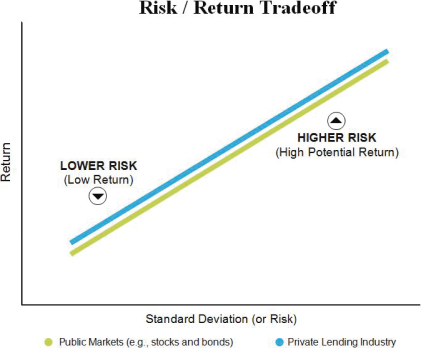
Defensive Attributes of the Company’s Business Model
While there can be no assurance that investors in the Company will not lose all of their investment, we believe that the Company’s business model has certain defensive attributes that may allow the Company to perform relatively well in adverse economic environments. The following is a list of defensive business model attributes that we believe have allowed the Company to perform relatively well between 2009 and 2017. There can be no assurance that these attributes would provide the same or any level of protection in the future.
The Company does not rely on increases or decreases in real estate prices. The Company’s investment returns are primarily derived from the interest payments and fees paid by the Company’s Portfolio Borrowers who have generally demonstrated an ability to find profitable projects in various economic environments. We believe this is one of the reasons why the Company’s profitability and investor returns have remained stable through depreciating, flat and appreciating real estate markets since 2009.
The Company generally makes short term loans of 12 months or less that enable both the Company and its Portfolio Borrowers to adapt quickly to changing economic conditions. For example, if real estate prices soften and resale activity slows down, some of our Portfolio Borrowers may break even or lose money on current Projects because their estimated resale prices may prove to have been too optimistic. However, because these are short-term Projects with defined exit strategies, our Portfolio Borrowers are often able to adapt quickly by buying the next Project at a lower price to account for changing market conditions.
Changes in interest rates do not require the Company to reprice its Portfolio Loans, minimizing interest rate risk. The Company has the intent and ability to hold its Portfolio Loans to maturity. Therefore, Portfolio Loans are stated at their outstanding unpaid principal balance with interest thereon being accrued as earned. Changes in interest rates do not require the Company to reprice its Portfolio Loans. However, changes in interest rates can create reinvestment risk related to changes in the rate of return available on new Portfolio Loans made by the Company.
The Company’s Portfolio Borrowers are more price setters than price takers. Because our Portfolio Borrowers’ Projects are short-term, and their profits come primarily from the value created in the Project, we believe our Portfolio Borrowers are more sensitive to completing and selling their Projects quickly than they are to the
25
current level of real estate prices. For example, between 2009 and 2012, when real estate prices were in decline, many of the Company’s Portfolio Borrowers were buying properties from foreclosure auctions at very low prices, rehabbing the houses, and then listing the houses for sale at prices that were often lower than competing listings, resulting in quick sales.
The Company’s loan portfolio is primarily secured by residential real estate, which we believe to be a more defensive asset class relative to assets correlated to other sectors of the economy. Real estate is a well-known inflation hedge, but what’s more important is that, in our view, the Federal Reserve and other policymakers are likely to prioritize the health of the residential real estate market over other sectors of the US economy. The simple reason is that consumption is approximately 70% of U.S. gross domestic product and housing is the largest single investment for most consumers. Accordingly, we believe that it is unlikely that policymakers will allow the residential real estate market to suffer for an extended period without taking action. The same cannot be said for other sectors of the economy, such as the oil and gas industry which has experienced a major decline in energy prices since mid-2014 that has led to significant capital spending reductions and industry layoffs. However, from an economic perspective the benefits of lower energy prices transmitted through increased consumer spending generally appear to outweigh the negative effects of oil industry contraction.
The Company’s business model generates strong and stable monthly recurring revenues, which means the Company is well positioned to cover interest payments. For the year ended December 31, 2016, the Company generated revenues of $12.2 million and combined interest expense of $4.2 million related to its private debt and Bank Borrowings. Revenues were 2.9 times the amount needed to cover this combined interest expense, with average portfolio leverage of 72% during 2016. We believe that this level of interest coverage provides a significant layer of loan portfolio protection that should help safeguard investor capital during an adverse economic event.
Investor capital is further protected by the value of the underlying real estate collateral. As of December 31, 2016, the estimated “as-is” value of the Company’s real estate collateral was $96.0 million, which secured the approximately $66.8 million loan portfolio. The value of the real estate collateral was approximately 1.9 times the amount necessary to pay off our private debt and Bank Borrowings combined ($49.8 million) and provided a combined loan-to-value of 52%. Similarly, the value of the real estate collateral was approximately 1.4 times the amount needed to pay off our entire capital stack – equity, private debt and Bank Borrowings combined ($68.8 million), providing a loan-to-value of 72%. We believe that this level of real estate asset coverage and loan-to-value provides another important layer of portfolio protection that should help safeguard investor capital during an adverse economic event. See “As-Is Loan-to-Value and Asset Coverage Based on Percentage Completion” on Page 51 for additional information regarding loan-to-value analysis and the method of estimating “as-is” value.
Portfolio Loan Characteristics
Project Type. The primary focus of the Company’s lending activities is on single-family residential rehab and new construction projects. As described above, the Company believes that this market is underserved by banks and other institutional lenders. In addition, the relatively short-term nature of these projects (12 months or less) allows the Company and its Portfolio Borrowers to adjust quickly to changing market conditions.
26
The following table provides information about the distribution of the Company’s loan portfolio by project type segmented further by number of loans and the unpaid principal balance (“UPB”) of those loans.
| As of the Six Months Ended June 30, |
As of the Year Ended December 31, |
|||||||||||||||||||
| 2017 | 2016 | 2016 | 2015 | 2014 | ||||||||||||||||
| Number of loans |
||||||||||||||||||||
| Single-family residential rehab |
202 | 212 | 184 | 190 | 126 | |||||||||||||||
| Single-family residential new construction |
30 | 35 | 32 | 47 | 46 | |||||||||||||||
| Multi-family residential rehab |
16 | 21 | 21 | 21 | 7 | |||||||||||||||
| Multi-family residential new construction |
1 | 0 | 1 | 0 | 2 | |||||||||||||||
| Commercial |
0 | 0 | 0 | 0 | 0 | |||||||||||||||
| Land entitlements |
0 | 5 | 6 | 5 | 2 | |||||||||||||||
| Percentage of UPB |
||||||||||||||||||||
| Single-family residential rehab |
73 | % | 71 | % | 69 | % | 64 | % | 63 | % | ||||||||||
| Single-family residential new construction |
22 | % | 22 | % | 21 | % | 25 | % | 23 | % | ||||||||||
| Multi-family residential rehab |
4 | % | 5 | % | 7 | % | 10 | % | 10 | % | ||||||||||
| Multi-family residential new construction |
1 | % | 0 | % | 1 | % | 0 | % | 3 | % | ||||||||||
| Commercial |
0 | % | 0 | % | 0 | % | 0 | % | 0 | % | ||||||||||
| Land entitlements |
0 | % | 2 | % | 2 | % | 1 | % | 1 | % | ||||||||||
As of June 30, 2017, the percentage of UPB categorized by project type consisted of 73% Single Family Residential Rehab Projects (202 loans), 22% Single Family Residential New Construction Projects (30 loans), 4% Multi-Family Residential Rehab Projects (16 loans), 1% Multi-Family Residential New Construction (1 loan), 0% Commercial and less than 0% Land Entitlements.
By comparison, as of June 30, 2016, the percentage of UPB categorized by project type consisted of 71% Single Family Residential Rehab Projects (212 loans), 22% Single Family Residential New Construction Projects (35 loans), 5% Multi-Family Residential Rehab Projects (21 loans), 0% Multi-Family Residential New Construction, 0% Commercial and less than 2% Land Entitlements (5 loans).
As of December 31, 2016, the percentage of UPB categorized by project type consisted of 69% Single-Family Residential Rehab (184 loans), 21% Single-Family Residential New Construction (32 loans), 7% Multi-Family Residential Rehab (21 loans), 1% Multi-Family Residential New Construction (1 loan), 0% Commercial and 2% Land Entitlements (6 loans).
By comparison, as of December 31, 2015, the percentage of UPB categorized by project type consisted of 64% Single-Family Residential Rehab (190 loans), 25% Single-Family Residential New Construction (47 loans), 10% Multi-Family Residential Rehab (21 loans), 0% Multi-Family Residential New Construction, 0% Commercial and 1% Land Entitlements (5 loans).
By comparison, as of December 31, 2014, the percentage of UPB categorized by project type consisted of 63% Single-Family Residential Rehab (126 loans), 23% Single-Family Residential New Construction (46 loans), 10% Multi-Family Residential Rehab (7 loans), 3% Multi-Family Residential New Construction (2 loans), 0% Commercial and 1% Land Entitlements (2 loans).
27
From 2013 through 2015 the Company modestly increased the amount of loans it made for single-family and multi-family new construction. This trend reflects the general improvement in the real estate market over that time and a corresponding shift in the business models of our borrowers from fixing distressed properties purchased through foreclosure sales or from bank owned inventory to more value-added projects, such as square footage additions or new construction. During 2016 and the first six months of 2017, the Company’s single-family and multi-family new-construction loans, in aggregate, remained consistent at less than 25% of loan portfolio UPB.
It is important to point out that the Company does not make loans for land entitlement purposes only. These land entitlement loans represent phase one of two phase projects that require land entitlement to be completed prior to new construction commencing on either single-family or multi-family residential structures.
Geographical Distribution. During 2014, the Company made fewer loans in Arizona and California, increased its lending activity in Washington and expanded its loan programs into the states of Colorado, Connecticut, Illinois and Texas. During 2015, the Company made fewer loans in Arizona, increased its lending activity in the states of Colorado and Illinois and began lending in Indiana and Pennsylvania. During 2016, the Company maintained stable lending activity across its existing geographies and began lending in Florida, Massachusetts, New Jersey, North Carolina, Oklahoma and South Carolina. These changes reflect the Company’s ability to adjust its loan program offerings to borrowers in those states that offer better investment returns per unit of risk. Some of the variables evaluated by the Company in making the decision to expand or contract in a specific geographic market include the competitive pricing pressure from competing lenders, availability of borrower projects, the margins on those borrower projects and trends in regional economic activity.
The Company continued to expand the geographic scope of its lending activities in 2017 and expects to continue expanding in the states of Arizona, California, Colorado, Connecticut, Delaware, Florida, Georgia, Illinois, Indiana, Maryland, Massachusetts, Michigan, New Jersey, New Mexico, North Carolina, Oklahoma, New Mexico, North Carolina, Oklahoma, Oregon, Pennsylvania, South Carolina, Tennessee, Texas, Virginia, Washington and Wisconsin. This expanding geographic distribution of loans will provide the Company with additional geographic diversification, and enable the Company to continue to identify and rebalance its loan portfolio toward those geographies that offer higher rates of return per unit of risk.
The Company continues to experience steady loan demand and stable real estate resale activity. However, the real estate market is increasingly being driven by regional economics and less so by the macro boom and bust cycle of recent years. While real estate is generally benefiting from improvements in employment and low interest rates, the bounce off the bottom for real estate prices has slowed and regional economics are becoming a larger factor in local real estate trends. For this reason, the Company believes that increasing its geographic diversification and having the ability to rebalance its loan portfolio between geographies is important to effectively manage risk.
28
The following table provides the geographic distribution of the Company’s loan portfolio by state segmented further by the number and unpaid principal balance of loans (“UPB”) that were active at the end of the period and those loans that paid off during the period.
| As of or for the Six Months Ended June 30, |
As of or for the Year Ended December 31, |
|||||||||||||||||||
| 2017 | 2016 | 2016 | 2015 | 2014 | ||||||||||||||||
| Arizona |
||||||||||||||||||||
| Number of active loans, end of period |
— | 2 | — | — | 5 | |||||||||||||||
| Percentage of total UPB |
— | 1% | — | — | 2% | |||||||||||||||
| Number of paid off loans, during period |
— | 2 | 4 | 2 | 18 | |||||||||||||||
| Percentage of paid off UPB |
— | <1% | <1% | <1% | 7% | |||||||||||||||
| California |
||||||||||||||||||||
| Number of active loans, end of period |
55 | 47 | 48 | 46 | 45 | |||||||||||||||
| Percentage of total UPB |
34% | 31% | 34% | 31% | 50% | |||||||||||||||
| Number of paid off loans, during period |
32 | 27 | 60 | 53 | 92 | |||||||||||||||
| Percentage of paid off UPB |
31% | 33% | 30% | 36% | 57% | |||||||||||||||
| Colorado |
||||||||||||||||||||
| Number of active loans, end of period |
11 | 10 | 7 | 13 | 7 | |||||||||||||||
| Percentage of total UPB |
6% | 10% | 7% | 10% | 5% | |||||||||||||||
| Number of paid off loans, during period |
5 | 7 | 13 | 7 | — | |||||||||||||||
| Percentage of paid off UPB |
10% | 7% | 8% | 5% | — | |||||||||||||||
| Connecticut |
||||||||||||||||||||
| Number of active loans, end of period |
— | 3 | 1 | 4 | 2 | |||||||||||||||
| Percentage of total UPB |
— | 1% | <1% | 1% | 1% | |||||||||||||||
| Number of paid off loans, during period |
1 | 1 | 3 | 4 | 2 | |||||||||||||||
| Percentage of paid off UPB |
<1% | <1% | 1% | 1% | <1% | |||||||||||||||
| Florida |
||||||||||||||||||||
| Number of active loans, end of period |
2 | 1 | 1 | — | — | |||||||||||||||
| Percentage of total UPB |
<1% | <1% | <1% | — | — | |||||||||||||||
| Number of paid off loans, during period |
2 | 1 | 3 | — | — | |||||||||||||||
| Percentage of paid off UPB |
<1% | <1% | <1% | — | — | |||||||||||||||
| Georgia |
||||||||||||||||||||
| Number of active loans, end of period |
2 | — | — | — | — | |||||||||||||||
| Percentage of total UPB |
<1% | — | — | — | — | |||||||||||||||
| Number of paid off loans, during period |
2 | — | — | — | — | |||||||||||||||
| Percentage of paid off UPB |
<1% | — | — | — | — | |||||||||||||||
| Illinois |
||||||||||||||||||||
| Number of active loans, end of period |
62 | 91 | 71 | 86 | 13 | |||||||||||||||
| Percentage of total UPB |
16% | 18% | 17% | 18% | 2% | |||||||||||||||
| Number of paid off loans, during period |
42 | 50 | 96 | 33 | — | |||||||||||||||
| Percentage of paid off UPB |
13% | 15% | 14% | 5% | — | |||||||||||||||
| Indiana |
||||||||||||||||||||
| Number of active loans, end of period |
1 | 2 | 3 | 2 | — | |||||||||||||||
| Percentage of total UPB |
<1% | <1% | <1% | <1% | — | |||||||||||||||
| Number of paid off loans, during period |
3 | — | — | 1 | — | |||||||||||||||
| Percentage of paid off UPB |
<1% | — | — | <1% | — | |||||||||||||||
| Maryland |
||||||||||||||||||||
| Number of active loans, end of period |
— | — | — | — | — | |||||||||||||||
| Percentage of total UPB |
— | — | — | — | — | |||||||||||||||
| Number of paid off loans, during period |
— | — | — | — | — | |||||||||||||||
| Percentage of paid off UPB |
— | — | — | — | — | |||||||||||||||
| Massachusetts |
||||||||||||||||||||
| Number of active loans, end of period |
3 | 1 | 2 | — | — | |||||||||||||||
| Percentage of total UPB |
1% | <1% | 1% | — | — | |||||||||||||||
| Number of paid off loans, during period |
— | — | 1 | — | — | |||||||||||||||
| Percentage of paid off UPB |
— | — | <1% | — | — | |||||||||||||||
| New Jersey |
||||||||||||||||||||
| Number of active loans, end of period |
4 | 3 | — | — | — | |||||||||||||||
| Percentage of total UPB |
<1% | <1% | — | — | — | |||||||||||||||
| Number of paid off loans, during period |
4 | — | 4 | — | — | |||||||||||||||
| Percentage of paid off UPB |
<1% | — | <1% | — | — | |||||||||||||||
| North Carolina |
||||||||||||||||||||
| Number of active loans, end of period |
1 | — | 1 | — | — | |||||||||||||||
| Percentage of total UPB |
<1% | — | <1% | — | — | |||||||||||||||
| Number of paid off loans, during period |
1 | — | 1 | — | — | |||||||||||||||
| Percentage of paid off UPB |
<1% | — | <1% | — | — | |||||||||||||||
29
| As of or for the Six Months Ended June 30, |
As of or for the Year Ended December 31, |
|||||||||||||||||||
| 2017 | 2016 | 2016 | 2015 | 2014 | ||||||||||||||||
| Oklahoma |
||||||||||||||||||||
| Number of active loans, end of period |
1 | — | — | — | — | |||||||||||||||
| Percentage of total UPB |
<1% | — | — | — | — | |||||||||||||||
| Number of paid off loans, during period |
— | 1 | 1 | — | — | |||||||||||||||
| Percentage of paid off UPB |
— | <1% | <1% | — | — | |||||||||||||||
| Oregon |
||||||||||||||||||||
| Number of active loans, end of period |
68 | 72 | 70 | 73 | 77 | |||||||||||||||
| Percentage of total UPB |
29% | 30% | 29% | 28% | 28% | |||||||||||||||
| Number of paid off loans, during period |
54 | 47 | 98 | 102 | 83 | |||||||||||||||
| Percentage of paid off UPB |
32% | 29% | 31% | 37% | 33% | |||||||||||||||
| Pennsylvania |
||||||||||||||||||||
| Number of active loans, end of period |
6 | 5 | 8 | 2 | — | |||||||||||||||
| Percentage of total UPB |
1% | <1% | 1% | <1% | — | |||||||||||||||
| Number of paid off loans, during period |
3 | 2 | 6 | 2 | — | |||||||||||||||
| Percentage of paid off UPB |
1% | <1% | 1% | <1% | — | |||||||||||||||
| South Carolina |
||||||||||||||||||||
| Number of active loans, end of period |
2 | — | 1 | — | — | |||||||||||||||
| Percentage of total UPB |
<1% | — | <1% | — | — | |||||||||||||||
| Number of paid off loans, during period |
2 | — | — | — | — | |||||||||||||||
| Percentage of paid off UPB |
<1% | — | — | — | — | |||||||||||||||
| Texas |
||||||||||||||||||||
| Number of active loans, end of period |
3 | 2 | 2 | 1 | 5 | |||||||||||||||
| Percentage of total UPB |
1% | <1% | 1% | <1% | 1% | |||||||||||||||
| Number of paid off loans, during period |
2 | 2 | 4 | 6 | — | |||||||||||||||
| Percentage of paid off UPB |
<1% | <1% | <1% | 1% | — | |||||||||||||||
| Washington |
||||||||||||||||||||
| Number of active loans, end of period |
28 | 34 | 29 | 37 | 30 | |||||||||||||||
| Percentage of total UPB |
10% | 9% | 10% | 11% | 13% | |||||||||||||||
| Number of paid off loans, during period |
25 | 25 | 49 | 50 | 12 | |||||||||||||||
| Percentage of paid off UPB |
10% | 14% | 12% | 14% | 4% | |||||||||||||||
As of June 30, 2017, the geographic concentration of active portfolio loans of 1% or more of the UPB in any state was as follows: California 34%, Colorado 6%, Illinois 16%, Massachusetts 1%, Oregon 29%, Pennsylvania 1%, Texas 1%, Washington 10%.
This compares to June 30, 2016, when the geographic concentration of active Portfolio Loans of 1% or more of the UPB in any state was as follows: Arizona 1%, California 31%, Colorado 10%, Connecticut 1%, Illinois 18%, Massachusetts 1%, Oregon 30% and Washington 9%.
As of December 31, 2016, the geographic concentration of active Portfolio Loans of 1% or more of the UPB in any state was as follows: California 34%, Colorado 7%, Illinois 17%, Massachusetts 1%, Oregon 29%, Pennsylvania 1%, Texas 1% and Washington 10%.
This compares to December 31, 2015, when the geographic concentration of active Portfolio Loans of 1% or more of the UPB in any state was as follows: California 31%, Colorado 10%, Connecticut 1%, Illinois 18%, Oregon 28% and Washington 11%.
This compares to December 31, 2014, when the geographic concentration of the active Portfolio Loans of 1% or more of the UPB in any state was as follows: Arizona 2%, California 50%, Colorado 5%, Connecticut 1%, Illinois 2%, Oregon 28%, Texas 1%, and Washington 13%.
Borrowers. The Company’s Portfolio Borrowers are often comprised of one to three member teams that form a company and take title to Projects in their company name. The team members usually have prior experience in real estate development, construction, finance or sales. For example, a common three-person team might include a real estate agent, general contractor and financier, each contributing their expertise to the team. The real estate agent might be tasked with identifying attractive Projects, making suggestions regarding what capital
30
improvements should be made to the Projects and helping to market and sell the Projects. The contractor might be tasked with assessing the cost, complexity and time necessary to make the planned capital improvements to the Project and managing that construction process. The financier might be tasked with managing the lender relationships, equity investor relationships, if any, and handling all back office accounting.
Between 2009 and 2015, the Company did not pursue a formal marketing or advertising program to grow its base of Portfolio Borrowers. The growth in the number of Portfolio Borrowers came almost exclusively through word of mouth. However, beginning in 2016, the Company implemented a marketing and advertising plan, which has helped the Company identify qualified Portfolio Borrowers and advantageous lending opportunities in each geographic market.
It has been our experience that providing Portfolio Borrowers with exceptional service leads to business referrals, which we believe is the best form of marketing. In addition, because our Portfolio Borrowers are often repeat customers, the value of each Portfolio Borrower relationship is much higher than it would be if the Portfolio Borrowers were not repeat customers.
The following table provides information regarding borrower concentrations as of the dates indicated.
| As of the Six Months Ended June 30, |
As of the Year Ended December 31, |
|||||||||||||||||||
| 2017 | 2016 | 2016 | 2015 | 2014 | ||||||||||||||||
| Portfolio Loans |
249 | 273 | 244 | 264 | 184 | |||||||||||||||
| Portfolio Borrowers |
160 | 172 | 156 | 150 | 105 | |||||||||||||||
| Average number of loans per borrower |
1.6 | 1.6 | 1.6 | 1.8 | 1.8 | |||||||||||||||
| Average percentage of loans per borrower |
1 | % | 1 | % | 1 | % | 1 | % | 1 | % | ||||||||||
| Top borrower (percentage of UPB) |
6 | % | 6 | % | 6 | % | 4 | % | 7 | % | ||||||||||
| Top 3 borrowers (percentage of UPB) |
13 | % | 14 | % | 13 | % | 10 | % | 20 | % | ||||||||||
As of June 30, 2017, the portfolio consisted of 249 active loans provided to 160 borrowers. The average number of loans per borrower was 1.6 loans. The largest borrower represented 6% of UPB, while the top 3 borrowers represented 13% of UPB.
By comparison, as of June 30, 2016, the portfolio consisted of 273 active loans provided to 172 borrowers. The average number of loans per borrower was 1.6 loans. The largest borrower represented 6% of UPB, while the top 3 borrowers represented 14% of UPB.
As of December 31, 2016, the portfolio consisted of 244 active loans provided to 156 borrowers. The average number of loans per borrower was 1.6 loans. The largest borrower represented 6% of UPB, while the top 3 borrowers represented 13% of UPB.
This compares to December 31, 2015, when the portfolio consisted of 264 active loans provided to 150 borrowers. The average number of loans per borrower was 1.8 loans. The largest borrower represented 4% of UPB, while the top 3 borrowers represented 10% of UPB.
This compares to December 31, 2014, when the portfolio consisted of 184 active loans provided to 105 borrowers, and the average number of loans per borrower was 1.8 loans. The largest borrower represented 7% of UPB, while the top 3 borrowers represented 20% of UPB.
The average number of loans per borrower has remained consistent over time. However, borrower concentration has continued to decrease driven primarily by an increase in the size of the loan portfolio.
Loan Term. All of the Company’s loans are made with maturity dates of 12 months or less. However, it is the Company’s policy to provide borrowers, whose loans are not in default, with six-month loan extensions, as needed, to allow more time to finish projects. Loans categorized with aging of 12+ months reflect those loans with loan extensions.
31
As mentioned above, the primary focus of the Company’s lending activities is on single-family residential rehab and new construction projects. We believe that banks and other institutional lenders underserve this market, which provides the Company with the opportunity to earn attractive rates of return per unit of risk. In addition, the relatively short-term nature of these projects allows the Company and its Portfolio Borrowers to adjust quickly to changing market conditions. See “Defensive Attributes of the Company’s Business Model” above for additional disclosures.
The following table sets forth the distribution of loans by age at the dates indicated:
| As of the Six Months Ended June 30, |
As of the Year Ended December 31, |
|||||||||||||||||||
| 2017 | 2016 | 2016 | 2015 | 2014 | ||||||||||||||||
| Number of loans |
||||||||||||||||||||
| 00-06 months |
142 | 151 | 120 | 166 | 103 | |||||||||||||||
| 06-09 months |
24 | 53 | 38 | 45 | 42 | |||||||||||||||
| 09-12 months |
24 | 20 | 24 | 23 | 16 | |||||||||||||||
| 12+ months |
59 | 49 | 62 | 30 | 23 | |||||||||||||||
| Percentage of number of loans |
|
|||||||||||||||||||
| 00-06 months |
57 | % | 55 | % | 49 | % | 63 | % | 56 | % | ||||||||||
| 06-09 months |
10 | % | 20 | % | 16 | % | 17 | % | 23 | % | ||||||||||
| 09-12 months |
10 | % | 7 | % | 10 | % | 9 | % | 9 | % | ||||||||||
| 12+ months |
23 | % | 18 | % | 25 | % | 11 | % | 13 | % | ||||||||||
| Unpaid principal balance |
|
|||||||||||||||||||
| 00-06 months |
$ | 36,499,876 | $ | 32,476,735 | $ | 26,954,393 | $ | 32,276,984 | $ | 26,507,651 | ||||||||||
| 06-09 months |
6,021,385 | 13,928,024 | 9,566,437 | 11,149,205 | 8,125,513 | |||||||||||||||
| 09-12 months |
6,487,248 | 5,175,858 | 7,625,394 | 6,028,598 | 6,772,247 | |||||||||||||||
| 12+ months |
20,961,809 | 14,002,042 | 22,608,761 | 10,436,529 | 10,926,278 | |||||||||||||||
| Percentage of unpaid principal balance |
|
|||||||||||||||||||
| 00-06 months |
52 | % | 50 | % | 40 | % | 54 | % | 51 | % | ||||||||||
| 06-09 months |
9 | % | 21 | % | 14 | % | 19 | % | 16 | % | ||||||||||
| 09-12 months |
9 | % | 8 | % | 11 | % | 10 | % | 13 | % | ||||||||||
| 12+ months |
30 | % | 21 | % | 34 | % | 17 | % | 20 | % | ||||||||||
As of June 30, 2017, the age distribution of the 249 active Portfolio Loans was as follows: 142 loans within 0-6 months (52% of the unpaid principal balance (“UPB”)), 24 loans within 6-9 months (9% of UPB), 24 loans within 9-12 months (9% of UPB) and 59 loans greater than 12 months (30% of UPB). The number of loans that were greater than 12 months in age included non-performing loans but also reflected an increase in the number of larger rehab and new construction projects financed, which were expected to take approximately one year to complete.
By comparison, as of June 30, 2016, the age distribution of the 273 active Portfolio Loans was as follows: 151 loans within 0-6 months (50% of UPB), 53 loans within 6-9 months (21% of UPB), 20 loans within 9-12 months (8% of UPB) and 49 loans greater than 12 months (21% of UPB).
As of December 31, 2016, the age distribution of the 244 active Portfolio Loans was as follows: 120 loans within 0-6 months (40% of UPB), 38 loans within 6-9 months (14% of UPB), 24 loans within 9-12 months (11% of UPB) and 62 loans greater than 12 months (34% of UPB).
This compares to December 31, 2015, when the age distribution of the 264 active Portfolio Loans was as follows: 166 loans within 0-6 months (54% of UPB), 45 loans within 6-9 months (19% of UPB), 23 loans within 9-12 months (10% of UPB) and 30 loans greater than 12 months (17% of UPB).
32
This compares to December 31, 2014, when the age distribution of the 184 active Portfolio Loans was as follows: 103 loans within 0-6 months (51% of UPB), 42 loans within 6-9 months (16% of UPB), 16 loans within 9-12 months (13% of UPB) and 23 loans greater than 12 months (21% of UPB). The number of loans that were greater than 12 months increased from 5% as of December 31, 2013 to 21% as of December 31, 2014. This 16 percentage point increase was due primarily to the increase in non-performing loans during 2014.
Loan Turnover. The following table provides information associated with the Company’s Portfolio Loan turnover for the periods shown:
| As of or for the Six Months Ended June 30, |
As of or for the Year Ended December 31, |
|||||||||||||||||||
| 2017 | 2016 | 2016 | 2015 | 2014 | ||||||||||||||||
| Loans originated, during period |
187 | 179 | 330 | 353 | 274 | |||||||||||||||
| Loans paid off, during period |
178 | 164 | 342 | 261 | 207 | |||||||||||||||
| Loans foreclosed, during period |
4 | 6 | 8 | 12 | — | |||||||||||||||
| Portfolio Loans, end of period |
249 | 273 | 244 | 264 | 184 | |||||||||||||||
| Total historical payoffs, end of period |
1,663 | 1,301 | 1,481 | 1,131 | 858 | |||||||||||||||
| Total historical originations, end of period |
1,912 | 1,574 | 1,725 | 1,395 | 1,042 | |||||||||||||||
During the six months ended June 30, 2017, the Company originated 187 new Portfolio Loans, saw 178 Portfolio Loans pay off, and foreclosed on 4 Portfolio Loans, which all became real estate owned (“REO”) properties. As of June 30, 2017, the Company had originated 1,912 loans since inception of which 1,663 had paid off, resulting in a net 249 active Portfolio Loans.
This compares to the six months ended June 30, 2016, during which the Company originated 179 new Portfolio Loans, saw 164 Portfolio Loans pay off, and foreclosed on 6 Portfolio Loans, which all became REO properties. As of June 30, 2016, the Company had originated 1,574 loans since inception of which 1,301 had paid off, resulting in a net 273 active Portfolio Loans.
During the year ended December 31, 2016, the Company originated 330 new Portfolio Loans, saw 343 Portfolio Loans pay off, and foreclosed on 8 loans, which all became REO properties. As of December 31, 2016, the Company had originated 1,725 loans since inception of which 1,481 had paid off, resulting in a net 244 active Portfolio Loans.
This compares to the year ended December 31, 2015, when the Company originated 353 new Portfolio Loans, saw 261 Portfolio Loans pay off, and foreclosed on 12 loans, which all became REO properties. As of December 31, 2015, the Company had originated 1,395 loans since inception of which 1,131 had paid off, resulting in a net 264 active Portfolio Loans.
This compares to the year ended December 31, 2014, when the Company originated 274 new Portfolio Loans, saw 207 Portfolio Loans pay off, and foreclosed on 0 loans. As of December 31, 2014, the Company had originated 1,042 loans since inception of which 858 had paid off, resulting in a net 184 active Portfolio Loans.
Total loan origination and associated Portfolio Loan turnover increased gradually each year from 2013 through 2017 as the Company worked to balance a steady increase in capital formation with quality loan origination.
33
Loan Size. The following table sets forth the distribution of loans by size (based on the unpaid principal balance) at the dates indicated:
| As of the Six Months Ended June 30, |
As of the Year Ended December 31, |
|||||||||||||||||||
| 2017 | 2016 | 2016 | 2015 | 2014 | ||||||||||||||||
| Average loan size |
$ | 281,005 | $ | 240,229 | $ | 273,586 | $ | 226,861 | $ | 284,411 | ||||||||||
| Median loan size |
205,500 | 161,250 | 189,000 | 148,750 | 200,950 | |||||||||||||||
| $0-$100,000 |
42 | 77 | 52 | 95 | 48 | |||||||||||||||
| $100,001-$200,000 |
79 | 84 | 74 | 67 | 44 | |||||||||||||||
| $200,001-$300,000 |
49 | 43 | 37 | 31 | 39 | |||||||||||||||
| $300,001-$500,000 |
49 | 44 | 49 | 48 | 28 | |||||||||||||||
| $500,001-$1,000,000 |
24 | 20 | 27 | 20 | 17 | |||||||||||||||
| $1,000,000-$1,500,000 |
6 | 3 | 5 | 1 | 7 | |||||||||||||||
| $1,500,000-$2,000,000 |
0 | 2 | 0 | 2 | 1 | |||||||||||||||
As of June 30, 2017, the average and median loan sizes were $281,005 and $205,500, up $7,419 and $16,500 from the average and median loan sizes of $273,586 and $189,000 at December 31, 2016, respectively.
By comparison, as of June 30, 2016 the average and median loan sizes were $240,229 and $161,250, up $13,368 and $12,500 from the average and median loan sizes of $226,861 and $148,750 at December 31, 2015, respectively.
As of December 31, 2016, the average and median loan sizes were $273,586 and $189,000, up $46,725 and $40,250 from the average and median loan sizes of $226,861 and $148,750 at December 31, 2015, respectively.
This compares to December 31, 2015, when the average and median loan sizes were $226,861 and $148,750, down $57,550 and $52,200 from the average and median loan sizes of $284,411 and $200,950 at December 31, 2014, respectively.
This compares to December 31, 2014, when the average and median loan sizes were $284,411 and $200,950, down $27,756 and $22,666 from the average and median loan sizes of $312,167 and $223,616 at December 31, 2013, respectively.
This decline in both the average and median loan size from 2013 through 2015 reflects the Company’s expansion into new geographic markets with lower priced real estate. In contrast, the Company saw a modest increase in average and median loan sizes during 2016 and 2017, reflecting the Company’s modest expansion into California, which has relatively higher priced real estate, and away from lower priced real estate in Illinois.
The Company’s objective is to make loans secured by real estate priced in the liquid segments of each geographic market. Therefore, the distribution of loan sizes between time periods largely reflects both changes in real estate prices over time and a mix shift between geographies. While the Company is sensitive to loan size diversification, it does not target a mix of loan sizes.
Portfolio Loan Criteria and Policies
Underwriting. The Company engages in the business of making loans secured by first lien deeds of trust or mortgages that encumber real estate located in the United States, its territories and possessions. The Company may also invest indirectly in a loan by acquiring an ownership interest in an entity formed for the sole purpose of holding a qualifying loan. The Company’s loans are not insured or guaranteed by any governmental agency or private entity.
34
For each Portfolio Borrower, the Company performs a criminal background check, orders a credit report, measures liquidity, interviews the borrower to assess experience level and evaluates the quality of previous work. The Company also requires each Portfolio Borrower to provide a construction cost budget, detailing the cost and scope of planned capital improvements, and a profit analysis, detailing the borrower’s estimated resale price, total project cost and estimated profit.
As an asset-based lender, the Company’s underwriting guidelines are heavily weighted toward real estate valuation, liquidity and loan-to-value (LTV) coverage. Specifically, the Company operates under the following underwriting guidelines:
| • | the Company does not lend unless secured by a first lien deed of trust or mortgage; |
| • | the Company does not lend unless the borrower has a clearly defined exit strategy; |
| • | the Company does not lend without assessing the borrower’s ability and willingness to pay; and |
| • | the Company does not lend more than 70% of the estimated “after-repair value” of the collateral (70% LTV coverage). |
The Company has the sole discretion whether to originate a mortgage loan at a given LTV. Some of the factors considered by the Company when determining the maximum LTV to be extended on a mortgage loan are:
| • | age, type, condition, and location of the collateral; |
| • | borrower creditworthiness and credit history; |
| • | loan amount and credit terms requested; |
| • | additional cross-collateralized properties; |
| • | proposed changes to or reconstruction of the collateral; |
| • | tenant history and occupancy rate (if applicable); and |
| • | amount of the interest reserve or construction loan (if any). |
In determining the value of real estate collateral for purposes of loan underwriting and LTV calculations, the Company inspects the properties and evaluates comparable property values in the area through the use of Multiple Listing Service (MLS) data. Based on this information, the Company prepares an estimate of the “after-repair value” of each property. The Company’s “after-repair” value estimates assume that all planned capital improvements to the real estate collateral have been completed and that the Company has disbursed all construction loan proceeds, and represents the Company’s estimate of the market value of the collateral after completion of the project based on information about comparable properties available at that time. In more complex transactions or for properties with limited comparable data, the Company may seek a formal valuation report such as an appraisal or broker price opinion. Appraisals are recognized in the mortgage banking industry to represent estimates of value, and should not be relied upon as the only measure of true worth or realizable value. Collateral value is determined solely in the judgment of the Company.
The Company believes that performing in-house real estate valuations provides it with a competitive advantage. By performing hundreds of in-house valuations per year in multiple geographies, the Company is able to continually refine its appraisal process and analyze real estate market trends within different geographies. This internal valuation analysis enables the Company to make faster and more informed lending decisions, which we believe help mitigate risk while providing Portfolio Borrowers with a higher quality of service.
There are no limitations on the types or locations of real estate investment loans within the United States or any requirement for current yield as opposed to overall return. Moreover, the Company’s investment strategy does not seek to balance the investment portfolio by property types, return characteristics or location, but the Company is sensitive to concentration risk. The Manager has the discretion to lend the Company’s assets on both new construction and existing properties.
35
The Company will not enter into any new commitment to make a loan where the cumulative principal amount of such loan would exceed 10% of the principal value of Portfolio Loans plus cash and cash equivalents of the Company as of the date of such commitment.
The Manager has discretion to amend the Portfolio Loan criteria and policies from time to time. THEREFORE, IN ESSENCE, THE INVESTMENT OBJECTIVES ARE THOSE DEFINED BY THE MANAGER FROM TIME TO TIME.
Disbursement of Loan Proceeds
Company loans are funded through an escrow account handled by the Manager or a qualified attorney, title insurance company or escrow company. The escrow agent is instructed not to disburse any funds until the following conditions are met:
| • | Satisfactory title insurance coverage has been obtained, except as described in the following paragraph, with the title insurance policy naming the Company as the insured and providing title insurance in an amount equal to the principal amount of the loan. Title insurance insures only the validity and priority of the Company’s deed of trust or mortgage, and does not insure the Company against loss by reason of other causes, such as diminution in the value of the property securing the loan, over-appraisals or borrower defaults. The Company does not intend to arrange for mortgage insurance, which would afford some protection against loss if the Company foreclosed on a loan and there was insufficient equity in the property securing the loan to repay all sums owed. |
The Company does not intend to arrange for title insurance policies on properties purchased from county auction, in which the borrower is borrowing from the Company under a Master Loan and Security Agreement. In such cases, the Company lends to the borrower during a period in which the borrower has equitable (but not marketable) title, and the Company performs its own title research. Once the Trustee’s Deed or Sherriff’s Deed is received and recorded following the foreclosure sale, the Company’s first lien position is perfected. The Master Loan and Security Agreement cross-collateralizes the loan against other properties owned by the borrower.
| • | Satisfactory hazard and liability insurance has been obtained for all loans, or only liability insurance in the event of a loan secured by unimproved land, which insurance shall name the Company as loss payee in an amount equal to the principal amount of the Company’s loan or the replacement value of the property, as dictated by legal statute. |
| • | All loan documents (notes, deeds of trust, etc.) and insurance policies name the Company as payee and beneficiary or additional loss insured, as applicable. In the event the Company purchases loans, the Company shall receive assignments of all beneficial interest in any document related to each loan so purchased. Company investments in loans may not be held in the name of the Manager or any other nominee. |
Disbursement of Construction Draws
The Company disburses construction draws to Portfolio Borrowers to pay for planned capital improvements to the real estate collateral based on a pre-defined scope of work, construction budget and time schedule. To mitigate risk in this process, the Company follows certain policies and procedures that incorporate some or all of the following practices. However, it is important to point out that the Company evaluates the risks related to each project, considering such variables as borrower experience, and project location, size, timing and scope of work to determine the right combination of practices to follow.
Practices related to disbursement of construction draws include, but are not limited to, the following:
| • | Construction Cost Budget – The construction cost budget is a spread sheet provided by the borrower that provides the Company with line item detail related to the planned capital improvements. The |
36
| construction cost budget is prepared during the underwriting processes, and the borrower will update and submit the construction cost budget with each draw request. |
| • | Summary Page – The summary page organizes the draw request into two categories: (1) reimbursable expenses to be paid by the Company to the borrower, and (2) direct payments by the Company to contractors and vendors. The Company will reimburse the borrower for completed work as long as the borrower provides proof of payment. The Company will pay contractors and vendor invoices directly for completed work. |
| • | Conditional Lien Waivers – Conditional lien waivers are legal agreements provided by contractors and material vendors to the Company or the borrower. The contractor or vendor agrees to waive its right to file a mechanics lien against the property for work performed through a specific date conditioned upon the receipt of a specific payment amount. |
| • | Final Lien Waivers – Final lien waivers are legal agreements provided by contractors and material vendors to the Company or the borrower. The contractor or vendor agrees to waive its right to file a mechanics lien against the property for all work performed on the property, conditioned upon the receipt of a final payment amount. |
| • | Property Inspections – The Company orders property inspections by qualified third party inspectors to evaluate the amount and quality of construction work performed at various stages of construction or redevelopment. |
| • | Advanced Funding – In certain circumstances, the Company may agree to advance a borrower funds to be used to make future capital improvements. In those cases, the Company requires that, among other things, the borrower provide proof of payment and that the work be 100% complete prior to a subsequent advance. In addition, the Company is often secured through cross-collateralization with other projects owned by the same borrower. |
Loan Servicing
The Company’s loans are serviced by the Manager and the Manager is compensated for such loan servicing activities. See “Management Fees” on Page 76 of this Offering Circular.
We believe that the quality of service provided by the Company to Portfolio Borrowers is an important competitive differentiator in the private lending industry. For this reason, the Company chooses to originate, underwrite and service all of its loans in-house. In-house loan underwriting enables the Company to make fast, common sense lending decisions, which Portfolio Borrowers appreciate. For example, new borrower applications generally can be processed in 48 hours, loan proposals generally can be made in 24 hours and existing Portfolio Borrowers can receive funding in two to five days. In addition, because the Company does not require third party approvals to make loans, Portfolio Borrowers have confidence in the funding commitments made by the Company.
We also believe that in-house loan servicing is important for mitigating loan portfolio risk. Maintaining a close relationship with Portfolio Borrowers and servicing Portfolio Loans through every step of the loan life cycle allows the Company to quickly identify and address problem loans.
Loan servicing includes, but is not limited to, the following:
| • | Payment Reminder Statements – Calculating, generating and delivering payment reminders to Portfolio Borrowers on a monthly basis. The accrued interest calculations are performed on a daily basis and take into account intra-month adjustments to the unpaid principal balance related to construction draw advances and adjustments to the interest rate of the loans, if any. |
| • | Loan History Statements – Calculating, generating and delivering loan history statements to Portfolio Borrowers on a monthly basis. The loan history statements are updated on a daily basis and present a |
37
| summary of all financial transaction activity related to the loan, including transaction dates, funding amounts, accrued interest amounts, payment amounts, loan advances, loan fees and payoff amounts. |
| • | Construction Loan Statements – Calculating, generating and delivering construction loan history statements to Portfolio Borrowers on a monthly basis. The construction loan history statements are updated on a daily basis and present all construction loan advances, including transaction dates, advance amounts, vendors paid and balance of construction loan remaining. |
| • | Interest Reserve Statements – Calculating, generating and delivering interest reserve history statements to Portfolio Borrowers on a monthly basis. The interest reserve statements are updated on a daily basis and present all interest reserve advances, if any, made to cover loan payments, including transaction dates, advance amounts and balance remaining. |
| • | Payment Collection – Portfolio Borrowers make loan payments monthly in arrears and are instructed to mail their checks or money orders directly to the Manager for deposit into the Company’s general account. Portfolio Borrowers may also elect to have their payments electronically debited from their bank accounts by the Company. |
| • | Construction Draw Processing – Accepting, evaluating and managing construction loan draw requests submitted by Portfolio Borrowers. Construction draw processing includes educating borrowers about the draw process, collecting required documentation, managing third-party property inspectors, evaluating the quality of work and percentage of completion against the balance of the construction loan, and disbursing funds to Portfolio Borrowers or contractors. |
| • | Loan Payoffs – Calculating, preparing and submitting loan payoff statements. The Company works directly with the escrow company or attorney handling the closing. Following a loan payoff and payoff reconciliation, the Company prepares a reconveyance form in order to release its security interest in the property. |
| • | Delinquent Loans and Foreclosure – The Company follows internal policies and procedures related to colleting payment on delinquent loans, offering and negotiating pre-foreclosure remedies and filing foreclosure. All foreclosure proceedings are handled by third-party foreclosure trustees or attorneys, as required by each state. |
Purchase and Sale of Loans
The Company typically originates its mortgage loans. However, the Company may also purchase loans from unrelated third parties. Loans purchased by the Company must not be in default at the time of purchase and must otherwise satisfy the lending guidelines described above. Generally, the purchase price to the Company for any such loan will be the lesser of par value or fair market value.
The Company does not presently invest in mortgage loans primarily for the purpose of reselling such loans in the ordinary course of business; however, the Company may sell mortgage loans or enter into inter-creditor agreements if the Manager determines that it is advantageous for the Company to do so based upon the current interest rates, the length of time that the loan has been held by the Company, and the overall investment objectives of the Company.
The Company makes mortgage loans for investment and does not expect to engage in real estate operations in the ordinary course of business, except as may be required if the Company forecloses on a property on which it has invested in a mortgage loan and takes over ownership and management of the property. The Company may sell non-performing Portfolio Loans or foreclosed property securing Portfolio Loans, or sell an interest in such collateral to an affiliate of the Company, for the purpose of restructuring the Portfolio Loan or repositioning the property for sale.
None of the Company, its Manager, Managing Directors or affiliates is precluded from (i) selling a property to any Senior Noteholder, Junior Noteholder or equity owners of the Company in connection with a foreclosure,
38
including with purchase financing, or (ii) making a loan to, purchasing a loan from or entering into a loan or co-lending transaction or activity with any Senior Noteholder, Junior Noteholder or equity owner of the Company, provided that any transaction meets our contractual obligations under our agreements related to the Senior Notes or any other contractual or legal obligations.
Legal Proceedings
The Company is not subject to any legal proceedings that are material to its business or financial condition.
Competition
The real estate market is competitive and rapidly changing. We expect competition to persist and intensify in the future, which could harm our ability to identify suitable Portfolio Loans. The business in which the Company is engaged is highly competitive, and the Company and Manager and its affiliates compete with numerous other established entities, including banks and credit unions. The Company and Manager also expect to encounter significant competition from other market participants including private lenders, private equity fund managers, real estate developers, pension funds, real estate investment trusts, other private parties, potential investors or homeowners, and other people or entities with objectives similar in whole or in part to those of the Company. Competition could result in reduced volumes, reduced fees or the failure of the Company to achieve or maintain more widespread market acceptance, any of which could harm the Company’s business. Most of our current or potential competitors have significantly more financial, technical, marketing and other resources than the Company, and may be able to devote greater resources to the development, promotion, sale and support of their platforms and distribution channels. The Company’s potential competitors may also have longer operating histories, or extensive customer bases, greater brand recognition and broader customer relationships than we have.
The Company has historically been able to earn Portfolio Loan yields above the industry average by providing superior service to its Portfolio Borrowers and by opportunistically expanding its loan origination in those markets that offer the best return per unit of risk. However, we anticipate that our portfolio yields will continue to decline over time as we adjust our loan programs to remain price competitive. In order to remain competitive long-term the Company must continue to provide its borrowers with a superior quality of service and lower its cost of capital in order to provide borrowers with more competitively priced loans.
Governmental Regulation
Investment Company Act. An investment company is defined under the Investment Company Act to include any issuer engaged primarily in the business of investing, reinvesting, or trading in securities. Absent an exemption, investment companies are required to register as such with the SEC and to comply with various governance and operational requirements. If we were considered an “investment company” within the meaning of the Investment Company Act, we would be subject to numerous requirements and restrictions relating to our structure and operation. If we were required to register as an investment company under the Investment Company Act and to comply with these requirements and restrictions, we may have to make significant changes in our proposed structure and operations to comply with exemption from registration, which could adversely affect our business. We intend to structure the operation of the Company so as not to subject the Company to the provisions of the Investment Company Act. In particular, the Company expects to rely on, among other things, the exemption from registration afforded by compliance with Section 3(c)(5) of the Investment Company Act. Section 3(c)(5) excludes from the definition of “investment company” issuers of non-redeemable securities primarily engaged in “purchasing or otherwise acquiring mortgages and other liens on and interests in real estate.” The Manager has not sought a no-action letter from the SEC to confirm that the Company is eligible for this exemption. However, the Manager will rely on guidance issued by the SEC stating that so long as (1) qualifying percentages of the Company’s assets consist of mortgages and other liens on or interests in real estate; and (2) the remaining percentage of the Company’s assets consist primarily of real estate-related assets, the Company will remain exempt from the Investment Company Act registration requirements.
39
Lending Regulations. The Company is a lender with respect to its Portfolio Loans, and the Company will be deemed a borrower and the Senior Noteholders deemed lenders with respect to the Senior Notes. Oregon and other states have numerous laws and regulations, which apply to the activities of lenders and the rights of borrowers. The applicability of these laws and regulations, and their exemptions and exclusions, are frequently complex and highly fact-centric, and they vary by jurisdiction and are subject to change. In addition, litigation in a number of states has imposed liability upon lenders, or otherwise adversely impacted lenders, in a manner that Senior Noteholders may not be accustomed to as a result of other investment activities. For example, a number of states have adopted usury laws, which generally prohibit the charging of interest in certain circumstances in excess of a statutorily defined rate. The Company relies on qualified advisors and uses commercially reasonable efforts to comply with laws and regulations applying to lenders and borrowers, and seeks exemptions and exclusions as advisable from such laws where appropriate to meet the investment objectives of the Company and this offering.
In addition, the Company makes its Portfolio Loans pursuant to state finance lender licensing exceptions for commercial loans. However, the Company or the Manager may obtain a finance lender’s license in specific states or retain the services of third parties to comply with such licensing, should it be deemed advisable. The Company relies on qualified advisors and uses commercially reasonable efforts to comply with laws and regulations applying to lenders and borrowers, and seeks exemptions and exclusions as advisable from such laws where appropriate to meet the investment objectives of the Company and this offering. The Company believes that such efforts are sufficient to avoid issues of noncompliance. However, investors should be aware that, under certain circumstances, a failure to comply with applicable regulations by the Company or a Senior Noteholder could result in civil or criminal penalties.
Lender Liability. As an additional consideration, legal decisions in many jurisdictions have imposed liability upon lenders for actions such as declaring defaults with respect to loans and refusing to meet company loan commitments under certain circumstances. In addition, some courts have permitted litigants to pursue claims against lenders for environmental torts of a borrower and other liability as a result of their association with the borrower. Such so-called “lender liability” is a developing and uncertain area of the law, and there can be no assurance that such a claim could not be brought against the Company or, by extension, an investor. In addition, in some cases, courts have re-characterized loans or debt securities as equity instruments, such that lenders or debt security holders have been subject to “equitable subordination” and thus not entitled to the preferred status of a creditor in a bankruptcy or other adversarial proceeding. Such decisions have been highly fact specific, and there can be no assurance that a court would not follow a similar approach with respect to the Senior Noteholders’ loans to the Company, or the Company’s loans to its Portfolio Borrowers. Investors are encouraged to consult with their legal counsel regarding the lender-related issues discussed above.
Environmental Regulations. Federal, state and local laws and regulations impose environmental controls, disclosure rules and zoning restrictions that directly impact the management, development, use, or sale of real estate. Such laws and regulations tend to discourage sales and lending activities with respect to some properties, and may therefore adversely affect us specifically, and the real estate industry in general. The Company’s failure to uncover and adequately protect against environmental issues in connection with a Project investment may subject us to liability. Environmental laws and regulations impose liability on current or previous real property owners or operators for the cost of investigation, cleaning up or removing contamination caused by hazardous or toxic substances at the property. Liability can be imposed even if the original actions were legal and the owner had no knowledge of, or was not responsible for, the presence of the hazardous or toxic substances. Such liabilities may interfere with the Company’s ability to realize on its lending activities.
Property
The Manager leases office space for its principal executive offices in Portland, Oregon pursuant to a multi-year lease. We believe that these facilities are adequate for our current operations.
40
MANAGEMENT’S DISCUSSION AND ANALYSIS OF
FINANCIAL CONDITION AND RESULTS OF OPERATIONS
The following is management’s discussion and analysis of the Company’s results of operation, financial condition, and liquidity. The following should be read in conjunction with the Company’s audited financial statements and the notes thereto as of December 31, 2016 and for each of the years in the three-year period ended December 31, 2016 and the Company’s unaudited financial statements and notes thereto as of and for the periods ending June 30, 2017 and 2016 included in this Offering Circular beginning on Page F-1.
Overview
We are a private lender formed in 2009 as an Oregon limited liability company. The Company makes commercial purpose loans by lending funds to real estate investors to finance the ownership, entitlement, development and redevelopment of residential and commercial real estate throughout the United States. We generate most of our revenue from interest on loans and loan fees. Our loan portfolio consists of a mix of single-family and multi-family redevelopment and new construction projects. Our primary source of funding is private debt and Bank Borrowings. Our largest expenses are management fees paid to the Manager, Iron Bridge Management Group LLC, and interest paid on private debt and Bank Borrowings. We measure our performance through various metrics, including our net income, net margin, net interest rate spread, net interest margin, ratio of interest-earning assets to interest-bearing liabilities, non-performing loans to total loans, late fee and default interest from non-performing loans, charge-offs on non-performing loans, estimated active portfolio loan-to-value compared to actual paid-off portfolio loan-to-sale price, and interest coverage ratios. The following table sets forth the key financial metrics we use to measure our performance.
| As of or for the Six Months Ended June 30, |
As of or for the Year Ended December 31, |
|||||||||||||||||||
| 2017 | 2016 | 2016 | 2015 | 2014 | ||||||||||||||||
| Selected performance ratios |
||||||||||||||||||||
| Net income |
$ | 1,412,332 | $ | 1,864,865 | $ | 3,446,336 | $ | 3,240,664 | $ | 2,575,177 | ||||||||||
| Net margin |
24.5 | % | 29.8 | % | 28.3 | % | 31.3 | % | 25.2 | % | ||||||||||
| Net interest rate spread |
7.81 | % | 9.89 | % | 9.12 | % | 9.37 | % | 8.99 | % | ||||||||||
| Net interest margin |
9.71 | % | 12.21 | % | 11.33 | % | 12.44 | % | 12.16 | % | ||||||||||
| Ratio of interest-earning assets to interest bearing liabilities |
1.30 | 1.39 | 1.36 | 1.44 | 1.39 | |||||||||||||||
| Non-performing loans to total loans (% UPB) |
7.2 | % | 5.6 | % | 9.5 | % | 9.0 | % | 11.2 | % | ||||||||||
| Late fees and default interest from non-performing loans |
30,944 | 193,303 | 234,902 | 111,366 | 267,549 | |||||||||||||||
| Charge-offs of non-performing loans |
(103,824 | ) | (9,667 | ) | (30,898 | ) | (12,211 | ) | (2,501 | ) | ||||||||||
| Loan to value – active loans, end of period |
||||||||||||||||||||
| Unpaid principal balance |
$ | 69,970,319 | $ | 65,582,659 | $ | 66,754,985 | $ | 59,891,317 | $ | 52,331,689 | ||||||||||
| Unfunded loan balance |
9,623,347 | 12,439,188 | 9,240,006 | 16,139,296 | 11,693,571 | |||||||||||||||
| Estimated “after-repair” value |
117,258,500 | 115,959,400 | 112,109,500 | 114,411,400 | 106,163,000 | |||||||||||||||
| Estimated “after-repair” loan-to-value (1) |
68 | % | 67 | % | 68 | % | 66 | % | 60 | % | ||||||||||
| Loan to value – paid off loans, during period |
||||||||||||||||||||
| Principal balance |
$ | 35,551,022 | $ | 30,925,584 | $ | 61,997,040 | $ | 48,958,402 | $ | 43,922,434 | ||||||||||
| Actual sale price |
58,442,938 | 54,053,011 | 104,026,658 | 79,913,961 | 71,726,582 | |||||||||||||||
| Actual loan-to-sale price (2) |
61 | % | 57 | % | 60 | % | 61 | % | 61 | % | ||||||||||
| Original “after-repair” loan-to-value estimate |
68 | % | 61 | % | 64 | % | 60 | % | 63 | % | ||||||||||
| Interest coverage ratios |
||||||||||||||||||||
| Interest coverage – Bank Borrowings (3) |
12.4 | x | 16.1 | x | 14.9 | x | 30.2 | x | 39.0 | x | ||||||||||
| Cumulative interest coverage – Senior Notes (4) |
— | — | — | — | — | |||||||||||||||
| Cumulative interest coverage – Junior Notes (5) |
2.7 | x | 3.2 | x | 2.9 | x | 2.8 | x | 2.6 | x | ||||||||||
| Portfolio leverage, end of period |
74 | % | 72 | % | 72 | % | 68 | % | 73 | % | ||||||||||
41
| (1) | Estimated loan-to-value is based on the Company’s estimate of the “after-repair” value of the collateral, which assumes all loans are fully funded and improvements to real estate collateral have been completed. Real estate values are based on the Company’s “after-repair” value estimates and loans are weighted by the principal balance of each loan. See “Portfolio Loan Criteria and Policies – Underwriting” on Page 33 for additional information regarding the estimation of “after-repair” value. |
| (2) | Actual loan-to-sale price represents the amount of the fully funded loan divided by the actual sale price of the real estate collateral. The principal balance of each loan was used to calculate the weighted average. Loans that were refinanced or secured by real estate collateral that was sold wholesale (prior to planned improvements being completed) to other investors were excluded from the calculation. |
| (3) | Bank Borrowings have a first priority security interest in all of the Company’s assets, including Portfolio Loans. Interest coverage equals gross income divided by the interest expense related to Bank Borrowings. |
| (4) | Senior Notes will have a second priority security interest in all of the Company’s assets, including its Portfolio Loans. Cumulative interest coverage will equal gross income divided by the total interest expense related to Senior Notes and Bank Borrowings combined. As of June 30, 2017, the Company had not issued Senior Notes. |
| (5) | Junior Noteholders will subordinate to Senior Noteholders and have a third priority security interest in all of the Company’s assets, including Portfolio Loans. Cumulative interest coverage of Junior Notes equals gross income divided by the total interest expense related to Junior Notes, Senior Notes and Bank Borrowings combined. |
Pro forma Interest Coverage, Loan-to-Value and Asset Coverage Analysis for Senior Notes. Prior to issuing Senior Notes, the Company is providing the following example to help inform prospective investors as to what the cumulative interest coverage, loan-to-value percentage and asset coverage would have been had the Company issued Senior Notes during the year ended December 31, 2016. In this example, we assume the Company issued $5 million of Senior Notes for all of 2016 with an interest rate of 6%, and the amount of Junior Notes was decreased by $5 million in order to maintain an accurate representation of total private debt issued.
Based on this example, the pro forma Senior Notes interest coverage ratio for 2016 would have been 10.9 times, the loan-to-value percentage would have been 19% and the asset coverage multiple would have been 5.2 times.
For additional details see “Analysis of Interest Coverage” page 48 and Portfolio Loan-to-Value and Asset Coverage” page 49.
Critical Accounting Policies and Accounting Estimates
Critical accounting policies are defined as those that are reflective of significant judgments and uncertainties, and which could potentially result in materially different results under different assumptions and conditions. The Company believes that the most critical accounting policies upon which its financial condition depends, and which involve the most complex or subjective decisions or assessments, are set forth below.
Allowance for Loan Losses. The allowance for loan losses is established through a provision for loan losses charged to expense, which affects our earnings directly. Loans are charged against the allowance for loan losses when the Company believes that the collectability of all or some of the principal is unlikely. Subsequent recoveries are added to the allowance. The allowance is an amount that reflects the Company’s estimate of the level of probable incurred losses in the loan portfolio. Factors considered by the Company in determining the adequacy of the allowance include, but are not limited to, detailed reviews of individual loans, historical and current trends in loan charge-offs for the various portfolio segments evaluated, the level of the allowance in relation to total loans and to historical loss levels, levels and trends in non-performing and past due loans, external factors including regulatory, competition, and the Company’s assessment of economic conditions.
The provision for loan losses is the charge to operating earnings necessary to maintain an adequate allowance for loan losses. We have developed policies and procedures for evaluating the overall quality of our loan portfolio and the timely identification of problem loans. The Company continuously reviews these policies and procedures and makes further improvements as needed. However, the Company’s methodology may not accurately estimate inherent loss or external factors and changing economic conditions may impact the loan portfolio and the level of reserves in ways currently unforeseen.
42
The following table sets forth the beginning and ending balance of allowance for loan losses, the provision for loan losses taken during that period, and the amount of loan charge-offs taken during that period:
| As of or for the Six Months Ended June 30, |
As of or for the Year Ended December 31, |
|||||||||||||||||||
| 2017 | 2016 | 2016 | 2015 | 2014 | ||||||||||||||||
| Unpaid principal balance, end of period |
$ | 69,970,319 | $ | 65,582,659 | $ | 66,754,985 | $ | 59,891,317 | $ | 52,331,689 | ||||||||||
| Allowance for loan losses, beginning balance |
$ | 1,150,469 | 1,024,288 | 1,024,288 | 1,036,499 | 454,000 | ||||||||||||||
| Provision for loan losses, during period |
$ | 56,753 | 69,735 | 157,079 | — | 585,000 | ||||||||||||||
| Charge-offs, during period |
$ | (103,824 | ) | (9,667 | ) | (30,898 | ) | (12,211 | ) | (2,501) | ||||||||||
| Allowance for loan losses, ending balance |
$ | 1,103,397 | 1,084,356 | 1,150,469 | 1,024,288 | 1,036,499 | ||||||||||||||
| Percent of unpaid principal balance, end of period |
1.6 | % | 1.7 | % | 1.7 | % | 1.7 | % | 2.0% | |||||||||||
As of June 30, 2017, the Company’s allowance for loan losses balance was $1,103,397, or 1.6%, of the unpaid principal balance (“UPB”) of Portfolio Loans. During the preceding six months, the Company recognized provisions for loan losses of $56,753 and $103,824 in loan charge-offs.
By comparison, as of June 30, 2016 the Company’s allowance for loan losses balance was $1,084,356, or 1.7%, of UPB. During the preceding six months, the Company recognized provisions for loan losses of $69,735 and $9,667 in loan charge-offs.
As of December 31, 2016, the Company’s allowance for loan losses balance was $1,150,469, or 1.7%, of UPB. During the preceding 12 months, the Company recognized provisions for loan losses of $157,079 and $30,898 in loan charge-offs.
This compares to December 31, 2015, when the Company’s allowance for loan losses balance was $1,024,288, or 1.7%, of UPB. During the preceding 12 months, the Company recognized no provisions for loan losses and $12,211 in loan charge-offs.
By comparison, during 2014 the Company’s provision for loan losses was $585,000, which increased the allowance for loan losses from $454,000 to $1,036,499, or from 1.2% to 2.0% of UPB. The Company made the decision to increase the provision during 2014 to compensate for portfolio growth, larger loan sizes, and an increase in non-performing loans.
Based on the low amount of historical charge-offs, and the Company’s expectation of stable portfolio performance in the near term, the Company expects to accrue a provision for loan losses at a rate of between 0% and 1.2% annualized in order to maintain the allowance for loan losses at approximately 2% of UPB. As of June 30, 2017, the total amount of charges-offs recognized by the Company in the preceding 12 months was $125,055. See “Comparison of Financial Condition at December 31, 2016, 2015 and 2014 – Non-Performing Loans and REO Assets” below for additional disclosures.
REO and Foreclosed Assets. Assets acquired through or in lieu of loan foreclosure are initially recorded at lower of cost or fair value less estimated costs to sell, establishing a new cost basis. Subsequent to foreclosure, valuations are performed annually and the assets are carried at the lower of carrying amount or fair value less estimated costs to sell. Revenue and expenses from operations and changes in the valuation allowance are included in other non-interest income or expense. Costs related to the development and improvement of REO assets are capitalized.
43
Due to the subjective nature of establishing the asset’s fair value when it is acquired, the actual fair value of the REO or foreclosed asset could differ from the original estimate. If it is determined that fair value declines subsequent to foreclosure, a valuation allowance is recorded through non-interest expense. Gains and losses on the disposition of REO and foreclosed assets are netted and posted to other non-interest income or expenses. See “Comparison of Financial Condition at December 31, 2016, 2015 and 2014 – Non-Performing Loans and REO Assets” below for additional disclosures.
Fair Value of Mortgage Loans Receivable. The Company has the intent and ability to hold its mortgage loans to maturity. Therefore, mortgage loans are stated at their outstanding unpaid principal balance with interest thereon being accrued as earned. Mortgage loans receivable make up the only class of financing receivables within the Company’s lending portfolio.
If the probable ultimate recovery of the carrying amount of a loan, with due consideration for the fair value of collateral, is less than amounts due according to the contractual terms of the loan agreement and the shortfall in the amounts due are not insignificant, the carrying amount of the loan will be reduced to the present value of estimated future cash flows discounted at the loan’s effective interest rate. If a loan is collateral-dependent, it is valued at the estimated fair value of the related collateral. If events and or changes in circumstances cause the Company to have serious doubts about the further collectability of the contractual payments, a loan may be categorized as impaired and interest is no longer accrued. Any subsequent payments on impaired loans are applied to reduce the outstanding loan balances including accrued interest and advances. See “Comparison of Financial Condition at December 31, 2016, 2015 and 2014 – Non-Performing Loans and REO Assets” below for additional disclosures.
Deferred Loan Origination Fees. The Company will capitalize loan origination fees and recognize the fees as an adjustment of the yield on the related loan. Deferred loan origination fees are accreted to income over the life of the loan under the effective interest method.
The following table sets forth the deferred loan origination fee balances and associated accretion into income for the time periods indicated:
| As of or for the Six Months Ended June 30, |
As of or for the Year Ended December 31, |
|||||||||||||||||||
| 2017 | 2016 | 2016 | 2015 | 2014 | ||||||||||||||||
| Deferred loan origination fees, end of period |
$ | 488,796 | $ | 486,442 | $ | 326,605 | $ | 634,613 | $ | 625,674 | ||||||||||
| Accreted to income, during period |
763,014 | 980,356 | 1,803,806 | 1,847,088 | 2,065,916 | |||||||||||||||
As of June 30, 2017, deferred loan origination fees were $488,796, and the Company accreted into income $763,014 of deferred loan origination fees during the six months ended June 30, 2017.
By comparison, as of June 30, 2016 deferred loan origination fees were $486,442, and the Company accreted into income $980,356 of deferred loan origination fees during the six months ended June 30, 2016.
As of December 31, 2016, deferred loan origination fees were $326,605, and the Company accreted into income $1,803,806 of deferred loan origination fees during the year ended December 31, 2016.
By comparison, as of December 31, 2015, deferred loan origination fees were $634,613, and the Company accreted into income $1,847,088 of deferred loan origination fees during the year ended December 31, 2015.
By comparison, as of December 31, 2014, deferred loan origination fees were $625,674, and the Company accreted into income $2,065,916 of deferred loan origination fees during the year ended December 31, 2014.
44
The lower amount of income accretion during 2016 and 2015 compared to 2014 reflected a lower percentage of Portfolio Loans that carried high loan origination fees and low interest rates. The Company offers its borrowers loan options with a combination of low origination fees and high interest rates or loans with high origination fees and low interest rates. While the yield earned by the Company on these loan options is similar, changes in the percentage of Portfolio Loans with high origination fees can affect the amount of interest income derived from deferred loan origination fees.
Income Taxes. The Company is a limited liability company for federal and state income tax purposes. Under the laws pertaining to income taxation of limited liability companies, the Company as an entity pays no federal income tax. Accordingly, no provision for income taxes besides the minimum state franchise taxes and the LLC gross receipts fees are reflected in the Company’s financial statements. The Company has evaluated its current tax positions and has concluded that as of December 31, 2016, the Company does not have any significant uncertain tax positions for which a reserve would be necessary.
Leveraging the Portfolio
The Company intends to continue to leverage its loan portfolio. The Company anticipates borrowing funds from Senior Noteholders, Junior Noteholders and bank lenders in order to fund additional mortgage loans. The aggregate amount of debt provided by Senior Noteholders, Junior Noteholders and Bank Borrowings may not exceed eighty percent (80%) of total assets (the “Maximum Debt Covenant”). See “Financial Statements” beginning on Page F-1 for information regarding debt and Bank Borrowings.
The following table sets forth the Maximum Debt Covenant calculation at the dates indicated:
| As of the Six Months Ended June 30, |
As of the Year Ended December 31, |
|||||||||||||||||||
| 2017 | 2016 | 2016 | 2015 | 2014 | ||||||||||||||||
| Total assets |
$ | 73,748,589 | $ | 67,844,031 | $ | 69,565,409 | $ | 61,067,506 | $ | 51,802,319 | ||||||||||
| Junior Notes |
34,597,566 | 33,560,509 | 36,398,463 | 30,179,273 | 32,442,861 | |||||||||||||||
| Senior Notes |
— | — | — | — | — | |||||||||||||||
| Bank Borrowings, net |
18,485,522 | 14,419,317 | 13,294,510 | 11,994,150 | 3,549,546 | |||||||||||||||
|
|
|
|
|
|
|
|
|
|
|
|||||||||||
| Total debt |
$ | 53,083,088 | $ | 47,979,826 | $ | 49,692,973 | $ | 42,173,423 | $ | 35,992,407 | ||||||||||
| Total debt as % of total assets |
72 | % | 71 | % | 71 | % | 69 | % | 69 | % | ||||||||||
Sources of Income
While the Company’s revenues come primarily from monthly interest payments on Portfolio Loans, other sources of income include gains from asset sales, discount points, origination fees, late fees and recapture of loan amounts on discounted note purchases.
Monthly Interest Payments. The Company’s newly originated loans average an interest rate of 8% to 18%. Payments are typically interest-only, due monthly and paid in arrears.
Short Term Capital Gains or Losses. The Company may generate a profit or loss when the disposition value of a foreclosed property exceeds or falls short of the principal amount owed plus accrued interest. The disposition value is defined as the liquidation price minus costs specifically incurred due to the foreclosure process (e.g., legal fees, filing fees, reparation expenses).
Discount Points and Origination Fees. Discount points are pre-paid interest that Portfolio Borrowers purchase to lower the rate of interest the Portfolio Borrowers pay on subsequent monthly interest payments. These points are typically paid as a percentage of the loan’s value. The income generated from discount points range from 0% to 5% of the principal value of the loan. Similarly, origination fees are paid by the Portfolio Borrower at the time
45
the loan is originated to cover the Company’s cost of originating the loan and can range from $0.00 to $2,000. All discount points and origination fees are paid directly to the Company and are accreted to income over the life of the loan.
Late Fees or Default Rate. The Company is entitled but not required to collect late fees if any installment is not received within five days of the due date. The borrower may be charged a late payment fee equal to five percent (5%) of the monthly installment. A similar fee is charged again if late by 10 days and again if late by 15 days. Any dishonored checks are treated as an unpaid installment and are subject to the same late payment penalties plus a $250.00 special handling fee. In the event any installment is past due more than 15 days, the interest rate on the note may be increased to 24% per annum and remain in effect until all defaults have been cured.
Analysis of Net Interest Income
Net interest income represents the difference between the income we earn on our interest-earning assets, such as Portfolio Loans and bank deposits, and the expense we pay on interest-bearing liabilities, such as private debt and Bank Borrowings. Net interest income depends on the volume of interest-earning assets and interest-bearing liabilities and the interest rates earned on such assets and paid on such liabilities.
Average Balances and Yields. The following tables set forth average balance sheets, average yields and costs, and certain other information for the periods indicated. All average balances are daily average balances. Nonaccrual loans were included in the computation of average balances, but have been reflected in the table as loans carrying a zero yield. The yields set forth below include the effect of deferred loan origination fees and discounts that are accreted to interest income. However, loan origination fees related to Bank Borrowings have been excluded from interest and the average yield calculation, in accordance with generally accepted accounting principles.
| For the Six Months Ended June 30, | ||||||||||||||||||||||||
| 2017 | 2016 | |||||||||||||||||||||||
| Average Balance (1) |
Interest (2) | Average Yield |
Average Balance (1) |
Interest (2) | Average Yield |
|||||||||||||||||||
| Interest-earning assets |
||||||||||||||||||||||||
| Bank deposits |
$ | 612,515 | — | — | $ | 394,872 | — | — | ||||||||||||||||
| Portfolio loans |
68,569,521 | $ | 5,545,478 | 16.17 | % | 65,486,381 | $ | 6,002,160 | 18.33 | % | ||||||||||||||
|
|
|
|
|
|
|
|
|
|
|
|
|
|||||||||||||
| Total interest-earning assets |
69,182,036 | 5,545,478 | 16.03 | % | 65,881,253 | 6,002,160 | 18.22 | % | ||||||||||||||||
| Allowance for loan losses |
(1,147,411 | ) | (1,046,961 | ) | ||||||||||||||||||||
| Non-interest earning assets (3) |
4,133,163 | 1,522,254 | ||||||||||||||||||||||
|
|
|
|
|
|||||||||||||||||||||
| Total assets |
72,167,788 | 66,356,546 | ||||||||||||||||||||||
| Interest-bearing liabilities |
||||||||||||||||||||||||
| Junior Notes |
35,701,107 | 1,710,013 | 9.58 | % | 31,922,991 | 1,591,834 | 9.97 | % | ||||||||||||||||
| Senior Notes |
— | — | — | — | — | — | ||||||||||||||||||
| Bank Borrowings |
17,436,735 | 475,057 | 5.45 | % | 15,582,875 | 387,904 | 4.98 | |||||||||||||||||
|
|
|
|
|
|
|
|
|
|
|
|
|
|||||||||||||
| Total interest-bearing liabilities: |
53,137,842 | 2,185,070 | 8.22 | % | 47,505,867 | 1,979,738 | 8.33 | % | ||||||||||||||||
| Non-interest bearing liabilities (4) |
561,082 | 994,342 | ||||||||||||||||||||||
| Shareholders’ equity |
18,468,864 | 17,856,337 | ||||||||||||||||||||||
|
|
|
|
|
|||||||||||||||||||||
| Total liabilities and shareholders’ equity |
$ | 72,167,788 | $ | 66,356,546 | ||||||||||||||||||||
| Net interest income |
$ | 3,360,408 | $ | 4,022,422 | ||||||||||||||||||||
| Net Interest rate spread (5) |
7.81 | % | 9.89 | % | ||||||||||||||||||||
| Net interest margin (6) |
9.71 | % | 12.21 | % | ||||||||||||||||||||
| Ratio of interest-earning assets to interest bearing liabilities |
1.30 | 1.39 | ||||||||||||||||||||||
46
| For the Year Ended December 31, | ||||||||||||||||||||||||||||||||||||
| 2016 | 2015 | 2014 | ||||||||||||||||||||||||||||||||||
| Average Balance (1) |
Interest (2) | Average Yield |
Average Balance (1) |
Interest (2) | Average Yield |
Average Balance (1) |
Interest (2) | Average Yield |
||||||||||||||||||||||||||||
| Interest-earning assets |
||||||||||||||||||||||||||||||||||||
| Bank deposits |
$ | 385,177 | — | — | $ | 323,248 | — | — | $ | 197,560 | — | — | ||||||||||||||||||||||||
| Portfolio loans |
67,138,240 | $ | 11,839,445 | 17.63 | % | 51,662,851 | $ | 10,115,280 | 19.58 | % | 48,701,416 | $ | 9,880,853 | 20.29 | % | |||||||||||||||||||||
|
|
|
|
|
|
|
|
|
|
|
|
|
|
|
|
|
|
|
|||||||||||||||||||
| Total interest-earning assets: |
67,523,417 | 11,839,445 | 17.53 | % | 51,986,099 | 10,115,280 | 19.46 | % | 48,898,976 | 9,880,853 | 20.21 | % | ||||||||||||||||||||||||
| Allowance for loan losses |
(1,083,211 | ) | (1,034,525 | ) | (706,849 | ) | ||||||||||||||||||||||||||||||
| Non-interest earning assets (3) |
2,367,665 | 1,992,230 | (190,921 | ) | ||||||||||||||||||||||||||||||||
|
|
|
|
|
|
|
|||||||||||||||||||||||||||||||
| Total assets |
68,807,871 | 52,943,804 | 48,001,206 | |||||||||||||||||||||||||||||||||
| Interest-bearing liabilities |
||||||||||||||||||||||||||||||||||||
| Junior Notes |
33,598,174 | 3,368,804 | 10.03 | % | 30,149,497 | 3,305,949 | 10.97 | % | 30,601,988 | 3,672,058 | 12.00 | % | ||||||||||||||||||||||||
| Senior Notes |
— | — | — | — | — | — | — | — | — | |||||||||||||||||||||||||||
| Bank Borrowings |
16,170,795 | 818,701 | 5.06 | % | 6,043,295 | 343,629 | 5.69 | % | 4,467,732 | 262,580 | 5.88 | % | ||||||||||||||||||||||||
|
|
|
|
|
|
|
|
|
|
|
|
|
|
|
|
|
|
|
|||||||||||||||||||
| Total interest-bearing liabilities: |
49,768,969 | 4,187,505 | 8.41 | % | 36,192,792 | 3,649,578 | 10.08 | % | 35,069,720 | 3,934,638 | 11.22 | % | ||||||||||||||||||||||||
| Non-interest bearing liabilities (4) |
785,689 | 820,140 | 588,435 | |||||||||||||||||||||||||||||||||
| Shareholders’ equity |
18,253,213 | 15,930,872 | 12,343,051 | |||||||||||||||||||||||||||||||||
|
|
|
|
|
|
|
|||||||||||||||||||||||||||||||
| Total liabilities and shareholders’ equity |
$ | 68,807,871 | $ | 52,943,804 | $ | 48,001,206 | ||||||||||||||||||||||||||||||
| Net interest income |
$ | 7,651,940 | $ | 6,465,702 | $ | 5,946,215 | ||||||||||||||||||||||||||||||
| Net Interest rate spread (5) |
9.12 | % | 9.37 | % | 8.99 | % | ||||||||||||||||||||||||||||||
| Net interest margin (6) |
11.33 | % | 12.44 | % | 12.16 | % | ||||||||||||||||||||||||||||||
| Ratio of interest-earning assets to interest bearing liabilities |
1.36 | 1.44 | 1.39 | |||||||||||||||||||||||||||||||||
| (1) | Average balances are the unpaid principal balance of interest-earning assets and interest-bearing liabilities and include non-accruing loan balances. |
| (2) | Interest includes all Portfolio Loan fee income and interest received on such loans, including late fees and default interest, and discount points and origination fees that are accreted to income over the life of the loan. Bank Borrowings exclude loan origination fees in accordance with generally accepted accounting principles. |
| (3) | Non-interest-earning assets include interest receivable, line of credit origination fees, unamortized loan origination discount and real estate held for sale. |
| (4) | Non-interest-bearing liabilities include loan servicing fees payable, interest payable, management incentive fees payable, accounting fees payable, and refunds due borrower. |
| (5) | Net interest rate spread represents the difference between the yield on average interest-earning assets and the cost of average interest-bearing liabilities. |
| (6) | Net interest margin represents net interest income divided by average total interest-earning assets. |
During the six months ended June 30, 2017, the Company saw continued pricing pressure in certain geographic markets with a weighted average gross yield on interest earning assets of 16.03%. This was a decline of 219 basis points when compared to the six months ended June 30, 2016.
By comparison, during the six months ended June 30, 2016, the Company saw similar pricing pressure in certain geographic markets with a weighted average gross yield on interest earning assets of 18.22%. This was a decline of 112 basis points when compared to the six months ended June 30, 2015.
To help offset this pricing pressure during the six months ended June 30, 2017, the Company reduced the interest rate paid to Junior Noteholders from 10% to 8% by refinancing maturing Junior Notes beginning in April 2017. As of June 30, 2017, approximately 50% of Junior Notes were refinanced and the balance was scheduled to be refinanced by September 30, 2017. In addition, the Company increased the average balance of its lower cost Bank Borrowings to $17.4 million from $15.6 million during the six months ended June 30, 2017 and 2016, respectively, while maintaining Bank Borrowings at 32.8% of total interest-bearing liabilities during both periods.
The initial cost savings from Junior Note refinancing was primarily responsible for lowering the Company’s cost of average interest-bearing liabilities to 8.22% for the six months ended June 30, 2017, a decline of 11 basis points when compared to the six months ended June 30, 2016. The result was an interest rate spread of 7.81%
47
and net interest margin of 9.71% during the six months ended June 2017, a decrease of 208 basis points and 250 basis points, respectively, when compared to the six months ended June 30, 2016.
The Company is currently working on several initiatives to lower its cost of capital: (1) Refinancing Junior Notes from 10% to 8%, which began in April 2017 and should be completed by September 2017; (2) Lowering the cost of Bank Borrowings, and; (3) Lowering the blended cost of private debt with this Senior Note offering. While these initiatives are currently in process, there can be no assurance that the Company will achieve these objectives.
In comparison, during the year ended December 31, 2016, the Company saw similar pricing pressure in certain geographic markets, which resulted in a weighted average gross yield on interest-earning assets of 17.53%, a decline of 192 basis points compared to the prior year. To help offset this pricing pressure during 2016, the Company increased the average balance of its lower cost Bank Financing to $16.2 million, or 32.5% of total interest-bearing liabilities, from $6.0 million, or 16.7% of total interest-bearing liabilities, during the prior year. This increase in Bank Borrowings was primarily responsible for lowering the Company’s cost of average interest-bearing liabilities to 8.41% for the year ended December 31, 2016, a decline of 167 basis points compared the year ended December 31, 2015. The net result was a net interest rate spread of 9.12% and a net interest margin of 11.33%, a decrease of 25 basis points and 111 basis points, respectively, when compared to the same period ended December 31, 2015.
In comparison, during the year ended December 31, 2015, the Company saw similar pricing pressure in certain geographic markets, which resulted in a weighted average gross yield on interest-earning assets of 19.46%, a decline of 75 basis points compared to the same period ended December 31, 2014. To help offset this pricing pressure during 2015, the Company reduced the interest rate paid to Junior Noteholders from 12% to 10% by refinancing maturing Junior Notes beginning in April 2015. As of December 31, 2015, all outstanding Junior Notes had been reissued with an interest rate of 10%. This reduction was primarily responsible for lowering the Company’s cost of average interest-bearing liabilities to 10.08%, a decline of 109 basis points compared to the same period ended December 31, 2014. The net result was an interest rate spread of 9.37% and a net interest margin of 12.44%, an increase of 38 basis points and 28 basis points, respectively, when compared to the same period ended December 31, 2014.
Similarly, during the year ended December 31, 2014, the Company saw pricing pressure in certain geographic markets, which resulted in a weighted average gross yield on interest-earning assets of 20.21%, a decline of 97 basis points compared to the same period ended December 31, 2013. To help offset some of this pricing pressure during 2014, the Company was able to increase the average balance of its lower cost Bank Financing to $4.5 million or 13% of total interest-bearing liabilities, from $2.3 million or 10% of total interest-bearing liabilities during the year ended December 31, 2013. This increase in Bank Borrowings was primarily responsible for lowering the Company’s cost of average interest-bearing liabilities to 11.22% for the year ending December 31, 2014, a decline of 21 basis points compared to the same period ended December 31, 2013. The result was an interest rate spread of 8.99% and net interest margin of 12.16%, a decrease of 76 basis points and 100 basis points, respectively, when compared to the same period ended December 31, 2013.
Between 2009 and 2011, the Company saw very little pricing pressure and was able to maintain its gross yield on interest-bearing assets between 20 and 21%. During 2012 and 2013, while industry pricing pressure increased, the Company was able to maintain its yield on interest-earning assets between 20 and 21% by providing superior service to its borrowers and by opportunistically expanding its loan origination into those markets that the Company believed were less price competitive and offered the best return per unit of risk. However, starting in 2013, the Company began gradually lowering it loan pricing in certain markets in response to increasing pricing pressure. Due to continuing industry pricing pressure, we anticipate that the yield on our interest-earning assets will continue to decline as we adjust our loan programs to remain price competitive. We believe that the lower yield on interest-earning assets can be offset by lowering the Company’s cost of capital.
48
Analysis of Interest Coverage
The interest coverage ratio is the ratio of total income to interest expenses. The following table provides information as to the Company’s interest coverage ratios considering the Company’s two existing components of debt for the periods shown.
| As of or for the Six Months Ended June 30, |
As of or for the Year Ended December 31, |
|||||||||||||||||||
| 2017 | 2016 | 2016 | 2015 | 2014 | ||||||||||||||||
| Interest income |
$ | 5,545,478 | $ | 6,002,160 | $ | 11,839,445 | $ | 10,115,280 | $ | 9,880,853 | ||||||||||
| Non-interest income |
322,320 | 259,032 | 379,053 | 255,680 | 350,076 | |||||||||||||||
|
|
|
|
|
|
|
|
|
|
|
|||||||||||
| Total income |
5,867,798 | 6,261,191 | 12,218,498 | 10,370,960 | 10,230,929 | |||||||||||||||
| Interest expense – Bank Borrowings (1) |
475,057 | 387,904 | 818,701 | 343,629 | 262,580 | |||||||||||||||
| Interest expense – Senior Notes (2) |
— | — | — | — | — | |||||||||||||||
| Interest expense – Junior Notes (3) |
1,710,013 | 1,591,834 | 3,368,804 | 3,305,949 | 3,672,058 | |||||||||||||||
|
|
|
|
|
|
|
|
|
|
|
|||||||||||
| Total interest expense |
$ | 2,185,070 | $ | 1,979,738 | $ | 4,187,504 | $ | 3,649,578 | $ | 3,934,638 | ||||||||||
| Interest coverage ratios |
||||||||||||||||||||
| Interest coverage – Bank Borrowings (1) |
12.4 | x | 16.1 | x | 14.9 | x | 30.2 | x | 39.0 | x | ||||||||||
| Cumulative interest coverage – Senior Notes (2) |
— | — | — | — | — | |||||||||||||||
| Cumulative interest coverage – Junior Notes (3) |
2.7 | x | 3.2 | x | 2.9 | x | 2.8 | x | 2.6 | x | ||||||||||
| Average portfolio leverage, during period |
74 | % | 72 | % | 72 | % | 68 | % | 73 | % | ||||||||||
| (1) | Bank Borrowings have a first priority security interest in all of the Company’s assets, including Portfolio Loans. Interest coverage equals total income divided by the interest expense related to Bank Borrowings. |
| (2) | Senior Notes will have a second priority security interest in all of the Company’s assets, including its Portfolio Loans. Cumulative interest coverage of Senior Notes equals total income divided by the total interest expense related to Senior Notes and Bank Borrowings combined. As of June 30, 2017, the Company had not issued Senior Notes. |
| (3) | Junior Notes will have a third priority security interest in all of the Company’s assets, including Portfolio Loans. Cumulative interest coverage of Junior Notes equals gross income divided by the total interest expense related to Junior Notes, Senior Notes and Bank Borrowings combined. |
During the six months ended June 30, 2017, the Company generated $5,867,798 in total income available to pay interest expense. With average portfolio leverage of 74%, the Company paid interest expense of $475,057 related to Bank Borrowings and $1,710,013 related to Junior Notes. Total income was 12.4 times the amount necessary to pay interest expense related to Bank Borrowings and 2.7 times the amount necessary to pay the interest expense related to Bank Borrowings and Junior Notes combined.
By comparison, during the six months ended June 30, 2016, the Company generated $6,261,191 in total income available to pay interest expense. With average portfolio leverage of 72%, the Company paid interest expense of $387,904 related to Bank Borrowings and $1,591,834 related to Junior Notes. Total income was 16.1 times the amount necessary to pay interest expense related to Bank Borrowings and 3.2 times the amount necessary to pay the interest expense related to Bank Borrowings and Junior Notes combined.
During the six months ended June 30, 2017, the Company saw a modest decrease in interest coverage related to Bank Borrowings and cumulative interest coverage related to Junior Notes when compared to the six months ended June 30, 2016. The decrease in interest coverage was the result of a 16.5% decline in net interest income, primarily attributable to the 219 basis decline in average yield on interest-earning assets.
49
However, it is important to point out that the cumulative interest coverage ratios for the six months ended June 30, 2017 were generally in line with the cumulative interest coverage ratios achieved during 2014 through 2016 of 2.6 to 2.9 times. This was the result of lower net interest income during the first six months of 2017 being largely offset by lower blended interest expense of interest-bearing liabilities, as the percentage of lower cost bank debt increased from 12.7% and 16.7% in 2014 and 2015, to 32.8% during the first six months of 2017.
During the year ended December 31, 2015, the Company generated $12,218,498 in total income available to pay interest expense. With average portfolio leverage of 72%, the Company paid interest expense of $818,701 related to Bank Borrowings and $3,368,804 related to Junior Notes. Total income was 14.9 times the amount necessary to pay interest expense related to Bank Borrowings and 2.9 times the amount necessary to pay the interest expense related to Bank Borrowings and Junior Notes combined.
By comparison, during the year ended December 31, 2015, the Company generated $10,370,960 in total income available to pay interest expense. With average portfolio leverage of 67%, the Company paid interest expense of $343,629 related to Bank Borrowings and $3,305,949 related to Junior Notes. Total income was 30.2 times the amount necessary to pay interest expense related to Bank Borrowings and 2.8 times the amount necessary to pay the interest expense related to Bank Borrowings and Junior Notes combined.
By comparison, during the year ended December 31, 2014, the Company generated $10,230,929 in total income available to pay interest expense. With average portfolio leverage of 72%, the Company paid interest expense of $262,580 related to Bank Borrowings and $3,672,058 related to Junior Notes. Total income was 39.0 times the amount necessary to pay interest expense related to Bank Borrowings and 2.6 times the amount necessary to pay the interest expense related to Bank Borrowings and Junior Notes combined.
The Company anticipates portfolio leverage will remain between 65% and 80% going forward.
Pro forma Analysis of Interest Coverage for Senior Notes. Prior to issuing Senior Notes, the Company is providing the following example to help inform prospective investors as to what the cumulative interest coverage would have been had the Company issued Senior Notes during the year ended December 31, 2016. In this example, we assume the Company issued $5 million of Senior Notes for all of 2016 with an interest rate of 6%, and the amount of Junior Notes was decreased by $5 million in order to maintain an accurate representation of total private debt issued.
Based on this example, for the year ending December 31, 2016, the pro forma interest coverage ratios would have been as follows: Bank Borrowings 14.9 times or total income of $12,218,498 divided by the interest expense related to Bank Borrowings of $818,701. Senior Notes 10.9 times or total income of $12,218,498 divided by the sum of interest expense related to Bank Borrowings of $818,701 plus the pro forma interest expense related to Senior Notes of $300,000. Junior Notes 3.1 times or total income of $12,218,498 divided by the sum of interest expense related to Bank Borrowings of $818,701 plus the pro forma interest expense related to Senior Notes of $300,000 plus the pro forma interest expense related to Junior Notes of $2,868,804.
For additional details regarding pro forma portfolio loan-to-value and asset coverage, see “Portfolio Loan-to-Value and Asset Coverage” below.
Portfolio Loan-to-Value and Asset Coverage
Portfolio Loan-to-Value based on “After-Repair” Value. The Company is an asset-based lender and its underwriting guidelines are heavily weighted toward real estate valuation, liquidity and loan-to-value coverage. In determining real estate collateral value, the Company inspects the properties and evaluates comparable property values in the area through the use of Multiple Listing Service (MLS) data. Based on this information, the Company prepares an estimate of the “after-repair” value for each property. The Company’s “after-repair” value estimates assume that all planned capital improvements to the real estate collateral have been completed
50
and that the Company has disbursed all construction loan proceeds, and represents the Company’s estimate of the market value of the collateral after completion of the project based on information about comparable properties available at that time. In more complex transactions or for properties with limited comparable data, the Company may seek a formal valuation report such as an appraisal or broker price opinion. However, appraisals are recognized in the mortgage banking industry to represent estimates of value, but should not be relied upon as the only measure of true worth or realizable value. Collateral value is determined solely in the judgment of the Company. Please see “Portfolio Loan Criteria and Policies” on Page 33 for additional information regarding the Company’s loan underwriting methodology.
The Company believes that performing in-house real estate valuations provides it with a competitive advantage. By performing hundreds of in-house valuations per year in multiple geographies, the Company is able to continually refine its appraisal process and analyze real estate market trends within different geographies. This internal valuation analysis enables the Company to make faster and more informed lending decisions, which we believe help mitigate risk while providing Portfolio Borrowers with a higher quality of service.
The Company reports to investors on a quarterly basis the results of its valuation methodology testing. These tests compare the actual loan to sale-price for those loans that paid off during a given month against the Company’s estimated valuation for those same properties at the time the loans were made. This quarterly analysis helps the Company to analyze and improve its in-house valuation methodology on an ongoing basis.
The following table sets forth the average loan-to-value for Portfolio Loans at the dates indicated, based on “after-repair” value:
| As of or for the Six Months Ended June 30, |
As of or for the Year Ended | |||||||||||||||||||
| December 31, | ||||||||||||||||||||
| 2017 | 2016 | 2016 | 2015 | 2014 | ||||||||||||||||
| Loan to value – active loans, end of period |
||||||||||||||||||||
| Unpaid principal balance |
$ | 69,970,319 | $ | 65,582,659 | $ | 66,754,985 | $ | 59,891,317 | $ | 52,331,689 | ||||||||||
| Unfunded loan balance (1) |
9,623,347 | 12,439,188 | 9,240,006 | 16,139,296 | 11,693,571 | |||||||||||||||
| Estimated “after-repair” value (2) |
117,258,500 | 115,959,400 | 112,109,500 | 114,411,400 | 106,163,000 | |||||||||||||||
| Estimated “after-repair” loan-to-value (3) |
68 | % | 67 | % | 68 | % | 66 | % | 60 | % | ||||||||||
| Loan to value – paid off loans, during period |
||||||||||||||||||||
| Principal balance |
$ | 35,551,022 | $ | 30,925,584 | $ | 61,997,040 | $ | 48,958,402 | $ | 43,922.434 | ||||||||||
| Actual sale price |
58,442,938 | 54,053,011 | 104,026,658 | 79,913,961 | 71,726,582 | |||||||||||||||
| Actual loan-to-sale price (4) |
61 | % | 57 | % | 60 | % | 61 | % | 61 | % | ||||||||||
| Original “after-repair” loan-to-value estimate |
68 | % | 61 | % | 64 | % | 60 | % | 63 | % | ||||||||||
| Refinanced loans & wholesaled properties |
||||||||||||||||||||
| Unpaid principal balance |
$ | 9,503,704 | $ | 5,582,729 | $ | 16,406,450 | $ | 15,769,764 | $ | 9,263,715 | ||||||||||
| (1) | Unfunded loan balance is comprised of construction funds that have been approved but not yet disbursed. |
| (2) | Estimated “after repair” value assumes all loans are fully funded and improvements to real estate have been completed. Real estate values are based on the Company’s “after-repair” value estimates. See “Portfolio Loan Criteria and Policies” on Page 33 for additional information regarding the estimation of “after-repair” value. |
| (3) | Estimated “after-repair” loan-to-value is calculated by dividing the sum of the unpaid principal balance and the unfunded loan balance by the estimated “after-repair” value, and loans are weighted by the principal balance of each loan. |
51
| (4) | Actual loan-to-sale price is calculated by dividing the fully funded loan amount by the actual sale price of the real estate collateral. The principal balance of each loan was used to calculate the weighted average. Loans that were refinanced or secured by real estate collateral that was sold wholesale (prior to planned improvements being completed) to other investors were excluded from the calculation. |
As of June 30, 2017, the estimated weighted average “after-repair” loan-to-value for active Portfolio Loans was 68%. By comparison, the weighted average loan-to-sales price of paid off Portfolio Loans during the first six months of 2017 was 61%, compared to our estimated weighted average “after-repair” loan-to-value of 68% for those same properties that sold during the first six months of 2017. This suggests that the Manager’s valuation methodology for estimating “after-repair” value for new Portfolio Loans remained accurate, on average, during the first six months of 2017.
This compares to June 30, 2016, when the estimated weighted average “after-repair” loan-to-value for active Portfolio Loans was 67%. By comparison, the weighted average loan-to-sales price of paid off Portfolio Loans during the first six months of 2016 was 57%, compared to our estimated weighted average “after-repair” loan-to-value of 61% for those same properties that sold during the first six months of 2016. This suggests that the Manager’s valuation methodology for estimating “after-repair” value for new Portfolio Loans remained accurate, on average, during the first six months of 2016.
As of December 31, 2016, the estimated weighted average “after-repair” loan-to-value for active Portfolio Loans was 68%. By comparison, the weighted average loan-to-sales price of paid off Portfolio Loans during 2016 was 60%, compared to our estimated weighted average “after-repair” loan-to-value of 64% for those same properties that sold during 2016. This suggests that the Manager’s valuation methodology for estimating “after-repair” value for new Portfolio Loans remained accurate, on average, during 2016.
This compares to December 31, 2015, when the estimated weighted average “after-repair” loan-to-value for active Portfolio Loans was 66%. By comparison, the weighted average loan-to-sales price of paid off Portfolio Loans during 2015 was 61%, compared to our estimated weighted average “after-repair” loan-to-value of 60% for those same properties that sold during 2015. This suggests that the Manager’s valuation methodology for estimating “after-repair” value for new Portfolio Loans remained accurate, on average, during 2015.
This compares to December 31, 2014, when the weighted average “after-repair” loan-to-value for active Portfolio Loans was 60%. By comparison, the weighted average loan-to-sales price of paid off Portfolio Loans during 2014 was 61%, compared to our estimated weighted average “after-repair” loan-to-value of 63% for those same properties that sold during 2014. This suggests that the Manager’s valuation methodology for estimating “after-repair” value for new Portfolio Loans remained accurate, on average, during 2014.
“As-Is” Loan-to-Value and Asset Coverage Based on Percentage Completion. In order to provide an estimate of the “as-is” real estate collateral value at end of period, and to account for projects that are in process of construction or redevelopment, the Company uses a straight line percentage completion method to estimate the “as-is” real estate value. Specifically, the Company estimates the percentage completion of all real estate projects based on the percentage of construction funds disbursed as of a particular date and then multiplies this percentage completion by the total estimated value creation (estimated “after-repair” value of real estate minus purchase price) to determine the current value added through capital improvements. The current value added through capital improvements is then added to the original purchase price to calculate the “as-is” value of the real estate collateral as of a particular date. This estimated “as-is” value is then used to analyze the cumulative loan-to-value and real estate asset coverage of each investment program. It is important to note that the “as-is” loan-to-value and asset coverage ratios improve as the percentage completion increases. As a result, the following “as-is” loan-to-value and asset coverage analysis (based on percentage completion) will be lower than the “after-repair” values and “after-repair” loan-to-values provided above, which assume 100% project completion and associated value creation.
52
The following table provides the cumulative “as-is” loan-to-value and cumulative “as-is” asset coverage ratios for all four tiers of the Company’s capital structure at the dates indicated, based on the estimated “as-is” valuation of real estate collateral.
| As of the Six Months Ended June 30, |
As of the Year Ended December 31, |
|||||||||||||||||||
| 2017 | 2016 | 2016 | 2015 | 2014 | ||||||||||||||||
| Estimated value added through construction improvements |
||||||||||||||||||||
| Estimated "after-repair" value |
$ | 117,258,500 | $ | 115,959,400 | $ | 112,109,500 | $ | 114,411,400 | $ | 106,163,000 | ||||||||||
| Real estate purchase price |
63,023,719 | 58,256,239 | 56,984,773 | 57,248,274 | 49,977,452 | |||||||||||||||
|
|
|
|
|
|
|
|
|
|
|
|||||||||||
| Total estimated value added |
$ | 54,234,781 | $ | 57,703,161 | $ | 55,124,727 | $ | 57,163,126 | $ | 56,185,548 | ||||||||||
| Estimated percentage completion of capital improvements |
||||||||||||||||||||
| Construction loan commitments |
$ | 25,299,022 | $ | 28,730,489 | $ | 26,801,914 | $ | 30,927,503 | $ | 22,467,524 | ||||||||||
| Undisbursed construction loan balance |
9,623,347 | 12,439,188 | 9,240,006 | 16,139,296 | 11,693,571 | |||||||||||||||
| Disbursed construction loan funds |
15,675,675 | 16,291,301 | 17,561,908 | 14,788,207 | 10,773,953 | |||||||||||||||
|
|
|
|
|
|
|
|
|
|
|
|||||||||||
| Percentage completion |
62 | % | 57 | % | 66 | % | 48 | % | 48 | % | ||||||||||
| Real estate value added based on percentage completion |
$ | 33,604,730 | $ | 32,719,929 | $ | 36,120,382 | $ | 27,332,958 | $ | 26,942,908 | ||||||||||
| Real estate purchase price |
63,023,719 | 58,256,239 | 56,984,773 | 57,248,274 | 49,977,452 | |||||||||||||||
|
|
|
|
|
|
|
|
|
|
|
|||||||||||
| Estimated "as-is" real estate value of loan portfolio |
96,628,449 | 90,976,168 | 93,105,155 | 84,581,232 | $ | 76,920,360 | ||||||||||||||
| Estimated value of real estate owned |
3,386,111 | 2,648,385 | 2,925,184 | 1,404,859 | $ | — | ||||||||||||||
|
|
|
|
|
|
|
|
|
|
|
|||||||||||
| Estimated "as-is" real estate collateral value |
$ | 100,014,560 | $ | 93,624,553 | $ | 96,030,339 | $ | 85,986,091 | $ | 76,920,360 | ||||||||||
| Capital structure and investment programs |
||||||||||||||||||||
| Bank Borrowings, net |
$ | 18,562,304 | $ | 14,597,345 | $ | 13,412,871 | $ | 12,000,000 | $ | 3,569,958 | ||||||||||
| Senior Notes |
— | — | — | — | — | |||||||||||||||
| Junior Notes |
34,597,566 | 33,560,509 | 36,398,463 | 30,179,273 | 32,442,861 | |||||||||||||||
| Junior Notes, cumulative |
53,159,870 | 48,157,854 | 49,811,334 | 42,179,273 | 36,012,819 | |||||||||||||||
| Equity |
19,739,856 | 18,709,801 | 19,006,249 | 17,366,589 | 14,552,342 | |||||||||||||||
| Equity, cumulative |
72,899,726 | 66,867,655 | 68,817,583 | 59,545,862 | 50,565,161 | |||||||||||||||
| Capital structure loan-to-value based on "as-is" valuation |
||||||||||||||||||||
| Bank Borrowings |
19 | % | 16 | % | 14 | % | 14 | % | 5 | % | ||||||||||
| Senior Notes, cumulative |
— | — | — | — | — | |||||||||||||||
| Junior Notes, cumulative |
53 | % | 51 | % | 52 | % | 49 | % | 47 | % | ||||||||||
| Equity, cumulative |
73 | % | 71 | % | 72 | % | 69 | % | 66 | % | ||||||||||
| Capital structure asset coverage based on “as-is” valuation |
||||||||||||||||||||
| Bank Borrowings |
5.4x | 6.4x | 7.2x | 7.2x | 21.5x | |||||||||||||||
| Senior Notes, cumulative |
— | — | — | — | — | |||||||||||||||
| Junior Notes, cumulative |
1.9x | 1.9x | 1.9x | 2.0x | 2.1x | |||||||||||||||
| Equity, cumulative |
1.4x | 1.4x | 1.4x | 1.4x | 1.5x | |||||||||||||||
53
As of June 30, 2017, the estimated “after-repair” value of the real estate collateral securing the loan portfolio was $117.3 million, and the real estate purchase price was $63.0 million, resulting in an estimated $54.2 million in total value add to the real estate projects. Total construction loan commitments were $25.3 million and construction funds disbursed were $15.7 million, resulting in an estimated percentage completion of 62%. Multiplying the estimated total value add of $54.2 million by the estimated project completion of 62% equaled an estimated $33.6 million of incremental real estate value added based on percentage completion. Adding $33.6 million of incremental real estate value added to the real estate purchase price of $63.0 million provides an estimated “as-is” loan portfolio real estate collateral value of $96.6 million. When combined with an estimated $3.4 million of real estate owned assets, the total estimated “as-is” real estate collateral value securing the Company’s investment programs was $100.0 million as of June 30, 2017.
Cumulative loan-to-value is the value of the debt or equity investment plus any senior debt divided by the estimated “as-is” real estate value ($100.0 million as of June 30, 2017). As of June 30, 2017, the loan-to-value of Bank Borrowings equaled 19% or $18.6 million in Bank Borrowings divided by the estimated “as-is” real estate collateral value of $100.0 million; Cumulative loan-to-value of Junior Notes equaled 53% or $53.2 million (the sum of $34.6 million in Junior Notes plus $18.6 million in Bank Borrowings) divided by the estimated “as-is” real estate collateral value of $100.0 million, and; Cumulative loan-to-value of equity equaled 73% or $72.9 million (the sum of $19.7 million in equity plus $34.6 million in Junior Notes plus $18.6 million in Bank Borrowings) divided by the estimated “as-is” real estate collateral value of $100.0 million.
Cumulative Asset Coverage is the estimated “as-is” real estate value ($100.0 million as of June 30, 2017) divided by the debt or equity and any senior debt. As of June 30, 2017, the asset coverage of Bank Borrowings equaled 5.4 times or $100.0 million in estimated “as-is” real estate collateral value divided by $18.6 million in Bank Borrowings; Cumulative asset coverage of Junior Notes equaled 1.9 times or $100.0 million in estimated “as-is” real estate collateral value divided by $53.2 million (the sum of $34.6 million in Junior Notes plus $18.6 million in Bank Borrowings), and; Cumulative asset coverage of equity equaled 1.4 times or $100.0 million in estimated “as-is” real estate collateral value divided by $72.9 million (the sum of $19.7 in equity plus $34.6 million in Junior Notes plus $18.6 million in Bank Borrowings).
By comparison, as of June 30, 2016, the estimated “after-repair” value of the real estate collateral securing the loan portfolio was $116.0 million, and the real estate purchase price was $58.3 million, resulting in an estimated $57.7 million in total value add to the real estate projects. Total construction loan commitments were $28.7 million and construction funds disbursed were $16.3 million, resulting in an estimated percentage completion of 57%. Multiplying the estimated total value add of $57.7 million by the estimated project completion of 57% equaled an estimated $32.7 million of incremental real estate value added based on percentage completion. Adding $32.7 million of incremental real estate value added to the real estate purchase price of $58.3 million provides an estimated “as-is” loan portfolio real estate collateral value of $91.0 million. When combined with an estimated $2.6 million of real estate owned assets, the total estimated “as-is” real estate collateral value securing the Company’s investment programs was $93.6 million as of June 30, 2016.
Cumulative loan-to-value is the value of the debt or equity investment plus any senior debt divided by the estimated “as-is” real estate value ($93.6 million as of June 30, 2016). As of June 30, 2016, the loan-to-value of Bank Borrowings equaled 16% or $14.6 million in Bank Borrowings divided by the estimated “as-is” real estate collateral value of $93.6 million; Cumulative loan-to-value of Junior Notes equaled 51% or $48.2 million (the sum of $33.6 in Junior Notes plus $14.6 million in Bank Borrowings) divided by the estimated “as-is” real estate collateral value of $93.6 million, and; Cumulative loan-to-value of equity equaled 71% or $66.9 million (the sum of $18.7 million in equity plus $33.6 million in Junior Notes plus $14.6 million in Bank Borrowings) divided by the estimated “as-is” real estate collateral value of $93.6 million.
Cumulative Asset Coverage is the estimated “as-is” real estate value ($93.6 million as of June 30, 2016) divided by the debt or equity and any senior debt. As of June 30, 2016, the asset coverage of Bank Borrowings equaled 6.4 times or $93.6 million in estimated “as-is” real estate collateral value divided by $14.6 million in Bank Borrowings; Cumulative asset coverage of Junior Notes equaled 1.9 times or $93.6 million in estimated “as-is”
54
real estate collateral value divided by $48.2 million (the sum of $33.6 million in Junior Notes plus $14.6 million in Bank Borrowings), and; Cumulative asset coverage of equity equaled 1.4 times or $93.6 million in estimated “as-is” real estate collateral value divided by $66.9 million (the sum of $18.7 in equity plus $33.6 million in Junior Notes plus $14.6 million in Bank Borrowings).
As of December 31, 2016, the estimated “after-repair” value of the real estate collateral securing the loan portfolio was $112.1 million, and the real estate purchase price was $57.0 million, resulting in an estimated $55.1 million in total value creation of the real estate projects. Total construction loan commitments were $26.8 million and construction funds disbursed were $17.6 million, resulting in an estimated percentage completion of 66%. Multiplying the estimated total value creation of $55.1 million by the estimated project completion of 66% equaled an estimated $36.1 million of incremental real estate value added based on percentage completion. Adding $36.1 million of incremental real estate value added to the real estate purchase price of $57.0 million provides an estimated “as-is” loan portfolio real estate collateral value of $93.1 million. When combined with an estimated $2.9 million of real estate owned assets, the total estimated “as-is” real estate collateral value securing the Company’s investment programs was $96.0 million as of December 31, 2016.
Cumulative loan-to-value is the value of the debt or equity investment plus any senior debt divided by the estimated “as-is” real estate value ($96.0 million as of December 31, 2016). As of December 31, 2016, the loan-to-value of Bank Borrowings equaled 14% or $13.4 million in Bank Borrowings divided by the estimated “as-is” real estate collateral value of $96.0 million; Cumulative loan-to-value of Junior Notes equaled 52% or $49.8 million (the sum of $36.4 million in Junior Notes plus $13.4 million in Bank Borrowings) divided by the estimated “as-is” real estate collateral value of $96.0 million, and; Cumulative loan-to-value of equity equaled 72% or $68.8 million (the sum of $19.0 million in equity plus $36.4 million in Junior Notes plus $13.4 million in Bank Borrowings) divided by the estimated “as-is” real estate collateral value of $96.0 million.
Cumulative Asset Coverage is the estimated “as-is” real estate value ($96.0 million as of December 31, 2016) divided by the debt or equity and any senior debt. As of December 31, 2016, the asset coverage of Bank Borrowings equaled 7.2 times or $96.0 million in estimated “as-is” real estate collateral value divided by $13.4 million in Bank Borrowings; Cumulative asset coverage of Junior Notes equaled 1.9 times or $96.0 million in estimated “as-is” real estate collateral value divided by $49.8 million (the sum of $36.4 million in Junior Notes plus $13.4 million in Bank Borrowings), and; Cumulative asset coverage of equity equaled 1.4 times or $96.0 million in estimated “as-is” real estate collateral value divided by $68.8 million (the sum of $19.0 million in equity plus $36.4 million in Junior Notes plus $13.4 million in Bank Borrowings).
By comparison, as of December 31, 2015, the estimated “after-repair” value of the real estate collateral securing the loan portfolio was $114.4 million, and the real estate purchase price was $57.2 million, resulting in an estimated $57.2 million in total value add to the real estate projects. Total construction loan commitments were $30.9 million and construction funds disbursed were $14.8 million, resulting in an estimated percentage completion of 48%. Multiplying the estimated total value add of $57.2 million by the estimated project completion of 48% equaled an estimated $27.3 million of incremental real estate value added based on percentage completion. Adding $27.3 million of incremental real estate value added to the real estate purchase price of $57.2 million provides an estimated “as-is” loan portfolio real estate collateral value of $84.6 million. When combined with an estimated $1.4 million of real estate owned assets, the total estimated “as-is” real estate collateral value securing the Company’s investment programs was $86.0 million as of December 31, 2015.
Cumulative loan-to-value is the value of the debt or equity investment plus any senior debt divided by the estimated “as-is” real estate value ($86.0 million as of December 31, 2015). As of December 31, 2015, the loan-to-value of Bank Borrowings equaled 14% or $12.0 million in Bank Borrowings divided by the estimated “as-is” real estate collateral value of $86.0 million; Cumulative loan-to-value of Junior Notes equaled 49% or $42.2 million (the sum of $30.2 million in Junior Notes plus $12.0 million in Bank Borrowings) divided by the estimated “as-is” real estate collateral value of $86.0 million, and; Cumulative loan-to-value of equity equaled 69% or $59.6 million (the sum of $17.4 million in equity plus $30.2 million in Junior Notes plus $12.0 million in Bank Borrowings) divided by the estimated “as-is” real estate collateral value of $86.0 million.
55
Cumulative Asset Coverage is the estimated “as-is” real estate value ($86.0 million as of December 31, 2015) divided by the debt or equity and any senior debt. As of December 31, 2015, the asset coverage of Bank Borrowings equaled 7.2 times or $86.0 million in estimated “as-is” real estate collateral value divided by $12.0 million in Bank Borrowings; Cumulative asset coverage of Junior Notes equaled 2.0 times or $86.0 million in estimated “as-is” real estate collateral value divided by $42.2 million (the sum of $30.2 million in Junior Notes plus $12.0 million in Bank Borrowings), and; Cumulative asset coverage of equity equaled 1.4 times or $86.0 million in estimated “as-is” real estate collateral value divided by $59.6 million (the sum of $17.4 million in equity plus $30.2 million in Junior Notes plus $12.0 million in Bank Borrowings).
By comparison, as of December 31, 2014, the estimated “after-repair” value of the real estate collateral securing the loan portfolio was $106.2 million, and the real estate purchase price was $50.0 million, resulting in an estimated $56.2 million in total value add to the real estate projects. Total construction loan commitments were $22.5 million and construction funds disbursed were $10.8 million, resulting in an estimated percentage completion of 48%. Multiplying the estimated total value creation of $56.2 million by the estimated project completion of 48% equaled an estimated $26.9 million of incremental real estate value added based on percentage completion. Adding $26.9 million of incremental real estate value added to the real estate purchase price of $50.0 million provides an estimated “as-is” real estate collateral value of $76.9 million as of December 31, 2014.
Cumulative loan-to-value is the value of the debt or equity investment plus any senior debt divided by the estimated “as-is” real estate value ($76.9 million as of December 31, 2014). As of December 31, 2014, the loan-to-value of Bank Borrowings equaled 5% or $3.6 million in Bank Borrowings divided by the estimated “as-is” real estate collateral value of $76.9 million; Cumulative loan-to-value of Junior Notes equaled 47% or $36.0 million (the sum of $32.4 million in Junior Notes plus $3.6 million in Bank Borrowings) divided by the estimated “as-is” real estate collateral value of $76.9 million, and; Cumulative loan-to-value of equity equaled 66% or $50.6 million (the sum of $14.6 million in equity plus $32.4 million in Junior Notes plus $3.6 million in Bank Borrowings) divided by the estimated “as-is” real estate collateral value of $76.9 million.
Cumulative Asset Coverage is the estimated “as-is” real estate value ($76.9 million as of December 31, 2014) divided by the debt or equity and any senior debt. As of December 31, 2014, the asset coverage of Bank Borrowings equaled 21.5 times or $76.9 million in estimated “as-is” real estate collateral value divided by $3.6 million in Bank Borrowings; Cumulative asset coverage of Junior Notes equaled 2.1 times or $76.9 million in estimated “as-is” real estate collateral value divided by $36.0 million (the sum of $32.4 million in Junior Notes plus $3.6 million in Bank Borrowings), and; Cumulative asset coverage of equity equaled 1.5 times or $76.9 million in estimated “as-is” real estate collateral value divided by $50.6 million (the sum of $14.6 million in equity plus $32.4 million in Junior Notes plus $3.6 million in Bank Borrowings).
As of June 30, 2017, the Company had not issued Senior Notes.
Pro forma Loan-to-Value and Asset Coverage Analysis of Senior Notes. Prior to issuing Senior Notes, the Company is providing the following example to help inform prospective investors as to what the cumulative “as-is” loan-to-value percentage and asset coverage would have been had the Company issued Senior Notes during the year ended December 31, 2016. In this example, we assume the Company issued $5 million of Senior Notes for all of 2016 with an interest rate of 6%, and the amount of Junior Notes was decreased by $5 million in order to maintain an accurate representation of total private debt issued.
Based on this example, as of December 31, 2016, cumulative “as-is” loan-to-value would have been as follows: Bank Borrowings 14% or $13.4 million in Bank Borrowings divided by the estimated “as-is” real estate collateral value of $96.0 million. Senior Notes 19% or $18.4 million (the sum of $5.0 million in Senior Notes plus $13.4 million in Bank Borrowings) divided by the estimated “as-is” real estate collateral value of $96.0 million. Junior Notes 52% or $49.8 million (the sum of $31.4 million in Junior Notes plus $5.0 million in Senior Notes plus $13.4 million in Bank Borrowings) divided by the estimated “as-is” real estate collateral value of
56
$96.0 million. Equity 72% or $68.8 million (the sum of $19.0 million in equity plus $31.4 million in Junior Notes plus $5.0 million in Senior Notes plus $13.4 million in Bank Borrowings) divided by the estimated “as-is” real estate collateral value of $96.0 million.
Based on this example, as of December 31, 2016, cumulative “as-is” asset coverage would have been as follows: Bank Borrowings 7.2 times or $96.0 million in estimated “as-is” real estate collateral value divided by $13.4 million in Bank Borrowings. Senior Notes 5.2 times or $96.0 million in estimated “as-is” real estate collateral value divided by $18.4 million (the sum of $5.0 million in Senior Notes plus $13.4 million in Bank Borrowings). Junior Notes 1.9 times or $96.0 million in estimated “as-is” real estate collateral value divided by $49.8 million (the sum of $31.4 million in Junior Notes plus $5.0 million in Senior Notes plus $13.4 million in Bank Borrowings). Equity 1.4 times or $96.0 million in estimated “as-is” real estate collateral value divided by $68.8 million (the sum of $19.0 million in equity plus $31.4 million in Junior Notes plus $5.0 million in Senior Notes plus $13.4 million in Bank Borrowings).
For additional details regarding pro forma interest coverage ratios, see “Analysis of Interest Coverage” page 48.
Comparison of Operating Results for the Six Months Ended June 30, 2017 and 2016
Net Income. Net income was $1,412,332 for the six months ended June 30, 2017, compared to $1,864,865 for the six months ended June 30, 2016, a decrease $452,533 or 24.3%. The decrease in net income was primarily attributable to 219 basis point year over year decline in average yield on interest earning assets.
Net interest margin for the six months ended June 30, 2017 and 2016 was 9.71% and 12.21%, respectively. Similarly, the net interest rate spread for the six months ended June 30, 2017 and 2016 was 7.81% and 9.89%, respectively.
While these key performance metrics were down year over year, they remain relatively high when compared to mortgage industry averages. In addition, the Company is currently pursuing three initiatives that we believe will lower the Company’s cost of capital and improve the net interest rate spread and net interest income during 2018: (1) Refinancing Junior Notes from 10% to 8%, which began in April 2017 and should be completed by September 2017; (2) Lowering the cost of Bank Borrowings, and; (3) Lowering the blended cost of private debt with this Senior Note offering. While these initiatives are currently in process, there can be no assurance that the Company will be able to accomplish these initiatives.
Interest Income. Total interest income decreased $456,682, or 7.6%, to $5,545,478 for the six months ended June 30, 2017 compared to $6,002,160 for the six months ended June 30, 2016. The decrease in interest income was primarily the result of a 219 basis point decline in average yield earned on interest-earning assets, which more than offset a 5.0% increase in average interest-earning assets.
The average daily balance of cash during the six months ended June 2017 and 2016 was $612,515 and $394,872, respectively. Interest income earned on those cash balances during that time was immaterial.
Interest Expense. Total interest expense increased $205,333, or 10.4%, to $2,185,070 for the six months ended June 30, 2017 from $1,979,738 for the six months ended June 30, 2016.
Interest expense paid on Junior Notes increased $118,179, or 7.4%, to $1,710,013 for the six months ended June 30, 2017 compared to $1,591,834 for the six months ended June 30, 2016. This increase was driven by an 11.8% increase in the average balance of Junior Notes outstanding to $35.7 million from $31.9 million, which more than offset a 39 basis point decrease in the yield paid on those Junior Notes, from 9.97% to 9.58%. This decline in yield paid reflects the initial cost savings from Junior Note refinancing from 10% to 8%, which began in April 2017 and was approximately 50% complete as of June 30, 2017. We expect all Junior Notes to be refinanced to 8% by September 30, 2017.
57
Interest expense on Bank Borrowings increased $87,153, or 22.5%, to $475,057 for the six months ended June 30, 2017 from $387,904 for the six months ended June 30, 2016. This increase was attributable to an 11.9% increase in average Bank Borrowings to $17.4 million from $15.6 million, and a 47 basis point increase in the yield paid on those Bank Borrowings, reflecting two interest rate increases by the Federal Reserve. During the first quarter of 2017, the Company increased its line of credit from $20 million to $25 million with Western Alliance Bank. See “Bank Borrowings” page 68 for additional details.
Net Interest Income. Net interest income decreased $662,014, or 16.5%, to $3,360,408 for the six months ended June 30, 2017 from $4,022,422 for the six months ended June 30, 2016. The decrease resulted primarily from a $456,682 decrease in interest income and a $205,333 increase in interest expense. As explained above, our average interest-earning assets increased to $69.2 million for the six months ended June 30, 2017 from $65.9 million for the six months ended June 30, 2016, and our net interest rate spread and net interest margin decreased to 7.81% and 9.71% for the six months ended June 30, 2017 from 9.89% and 12.21% for the six months ended June 30, 2016, respectively. The decrease in our interest rate spread and net interest margin during the first six months of 2017 compared to the same period in 2016 reflected yields on interest-earning assets falling faster than yields on interest-bearing liabilities, driven primarily by a 219 basis point decline in the average yield earned on interest-earning assets.
Non-Interest Income. Other income increased $63,288, or 24.4%, to $322,320 for the six months ended June 30, 2017 from $259,032 for the first six months of 2016. Other income included reversals in the provision for loan losses or charge offs related to loan losses, wholesale income from properties purchased by the Company and then resold to borrowers, and late payment fees and default interest collected on non-performing loans. We expect this income to vary between periods driven by the amount of charge offs taken, the number of wholesale projects available, and the number of non-performing loans and the collectability of default interest and late fees on those loans. The Company also recognized $8,829 in net short term capital gains related to the successful disposition of REO assets during the six months ended June 30, 2017 compared to a net gain of $6,539 on REO assets during the same period in 2016.
Non-Interest Expense. Non-interest expense decreased $138,110, or 5.7%, to $2,271,768 for the six months ended June 30, 2017 from $2,409,878 for the six months ended June 30, 2016. The largest decrease in noninterest expense was a $506,367, or 52.1%, decrease in management incentive fees to $465,317 from $971,684, caused by the decline in net interest income discussed above. The largest increases in noninterest expense were a $231,318 increase in real estate holding costs related to two large multifamily redevelopment projects, which should be completed in 2018, and a $70,298 increase in professional services related to the preparation of the Senior Note offering.
Provision for Loan Losses. Based on our analysis of loan portfolio performance, as outlined above in “Critical Accounting Policies and Accounting Estimates – Allowance for Loan Losses,” the Company recorded a provision of $56,753 for the six months ended June 30, 2017, compared to $69,735 during the six months ended June 30, 2016. The allowance for loan losses was $1,103,397, or 1.6% of total unpaid principal balance at June 30, 2017, compared to $1,084,356, or 1.7% of total unpaid principal balance at June 30, 2016. Total delinquent loans were $5,066,197, or 7.2% of the total unpaid principal balance, at June 30, 2017 compared to $3,679,455, or 5.6% of the total unpaid principal balance, at June 30, 2016. The allowance for loan losses reflects the estimate we believe to be appropriate to cover probable incurred losses inherent in the loan portfolio at June 30, 2017 and June 30, 2016.
It is important to point out that the Company’s policy is to categorize a loan as both a Delinquent Loan and Non-Performing Loan and to begin the foreclosure process if the Company has not received payment from the borrower within 30 days of the due date. Industry standard is to categorize a loan as Delinquent for the first 90 days and then to categorize the loan as Non-Performing after 90 days. We believe that our more aggressive policy is appropriate given that our loans have shorter maturities relative to traditional loans. This policy enables the Company to get an earlier start on the foreclosure process should the loan continue to remain delinquent (the time to foreclose on a property can range from 75 to 180 days or longer if the borrower files bankruptcy).
58
However, this more conservative policy does tend to generate more Non-Performing Loans that are ultimately cured. See “Non-Performing Loans and REO Assets”, Page 63, for additional details.
Income Taxes. Income tax expense for the six months ended June 30, 2017 and 2016 were $7,457 and $13,250, respectively. This tax expense is related to municipal franchise taxes. Under the laws pertaining to income taxation of limited liability companies, the Company as an entity pays no federal income tax. See “Critical Accounting Policies and Accounting Estimates” for additional disclosures regarding income taxation.
Comparison of Operating Results for the Years Ended December 31, 2016, 2015 and 2014
Net Income. Net income was $3,446,336 for the year ended December 31, 2016, compared to $3,240,664 for the year ended December 31, 2015, an increase of $205,672, or 6.3%. The increase in net income was primarily attributable to a $15.5 million, or 29.9%, increase in total interest-earning assets. In addition, net income for 2015 benefited from a non-recurring short term capital gain of $518,652 related to the successful disposition of REO assets. Excluding this short-term capital gain from 2015 net income results in a more significant 26.6% increase in net income for 2016 compared to 2015. Based on an analysis of the allowance for loan losses, growth in the loan portfolio and associated loan performance, the Company recorded a provision for losses on loans of $157,079 for the 12 months ended December 31, 2016.
By comparison, net income was $3,240,665 for the year ended December 31, 2015, compared to $2,575,176 for the year ended December 31, 2014, an increase of $665,489, or 25.8%. The increase in net income was primarily attributable to short term capital gains of $518,652 related to the successful disposition of REO assets, and a reduction in the provision for loan losses. Excluding short-term capital gains from the sale of REO assets results in a more modest 5.7% increase in net income for the year. Based on an analysis of the allowance for loan losses and the associated loan portfolio performance, we did not record a provision for loan losses for the 12 months ended December 31, 2015.
By comparison, net income was $2,575,176 for the year ended December 31, 2014, compared to $1,828,849 for the year ended December 31, 2013, an increase of $746,327, or 40.8%. The increase was primarily due to a 43.6% increase in interest income, which corresponded to a 51% increase in average interest-earning assets from $32.3 million during 2013 to $48.9 million during 2014. Based on an analysis of the allowance for loan losses, growth in the loan portfolio and associated loan performance, the Company recorded a provision for losses on loans of $585,000 for the 12 months ended December 31, 2014.
Net interest margin for the 12 months ended December 31, 2016, 2015 and 2014 was 11.33%, 12.44%, and 12.16%, respectively. Similarly, the net interest rate spread for the 12 months ended December 31, 2016, 2015 and 2014 was 9.12%, 9.37% and 8.99%, respectively. The stability of these performance metrics between 2014 and 2016 indicates that the Company was able to maintain a similar level of profitability within its loan portfolio, while expanding the loan portfolio geographically in an increasingly price competitive market.
Interest Income. Total interest income increased $1,724,165, or 17.0%, to $11,839,445 for the year ended December 31, 2016 compared to $10,115,280 during the year ended December 31, 2015. The increase in interest income was primarily the result of a $15.5 million, or 29.9%, increase in average interest-earning assets, which more than offset a 192 basis point decline in average yield on those assets.
By comparison, total interest income increased $234,427, or 2.4%, to $10,115,280 for the year ended December 31, 2015 compared to $9,880,853 during the same period in 2014. The slight increase in interest income was primarily the result of a modest $3.1 million increase in average interest-earning assets, which more than offset a 75 basis point decline in average yield on those assets.
By comparison, total interest income increased $3,033,912, or 44.3%, to $9,880,853 for the year ended December 31, 2014 compared to $6,846,941 during the same period in 2013. The increase in interest income was primarily the result of a $16.6 million increase in average interest-earning assets, which more than offset a 97 basis point decline in average yield on those assets.
59
The average daily balance of cash during the years ended December 2016, 2015 and 2014 was $385,177, $323,248, and $197,560, respectively. Interest income earned on those cash balances during that time was immaterial.
Interest Expense. Total interest expense increased $537,927, or 14.7%, to $4,187,505 for the year ended December 31, 2016 from $3,649,578 for the year ended December 31, 2015.
Interest expense on Junior Notes increased $62,855, or 1.9%, to $3,368,804 for the year ended December 31, 2016, from $3,305,949 for the year ended December 31, 2015. The increase in interest expense was primarily attributable to an increase in the average balance of Junior Notes outstanding, which averaged $33.6 million during 2016 versus an average of $30.1 million during 2015, an increase of $3.4 million or 11.4%. The interest rate paid on Junior Notes remained constant at 10% during 2016.
Interest expense on Bank Borrowings increased $475,072, or 138.3%, to $818,701 for the year ended December 31, 2016 from $343,629 for the year ended December 31, 2015. This increase was attributable to an increase in average Bank Borrowings to $16.2 million during 2016 from $6.0 million during 2015, an increase of $10.1 million or 167.6%. This increase in average Bank Borrowings more than offset a 62 basis point decline in average interest rate paid on those Bank Borrowing to 5.1% from 5.7% during 2016 and 2015, respectively.
By comparison, total interest expense decreased $285,060, or 7.2%, to $3,649,578 for the year ended December 31, 2015 from $3,934,638 for the year ended December 31, 2014.
Interest expense on Junior Notes decreased $366,109, or 10.0%, to $3,305,949 for the year ended December 31, 2015 from $3,672,058 for the year ended December 31, 2014, driven primarily by a reduction in the interest rate paid to Junior Noteholders from 12% to 10%. The Company refinanced maturing Junior Notes beginning in April 2015, and as of December 31, 2015 all outstanding Junior Notes had been reissued with an interest rate of 10%. For the year ended December 31, 2015, the average balance of Junior Notes was $30.1 million, a modest decline of $452,492, or 1.5%, compared to the year ended December 31, 2014.
Interest expense on Bank Borrowings increased $81,049, or 30.9%, to $343,629 for the year ended December 31, 2015 from $262,580 for the year ended December 31, 2014. This increase was attributable to an increase in average Bank Borrowings to $6.0 million during 2015 from $4.5 million during 2014, an increase of $1.5 million or 35.3%. This increase in average Bank Borrowings more than offset a 19 basis point decline in average interest rate paid on those Bank Borrowing to 5.7% from 5.9% during 2015 and 2014, respectively.
By comparison, total interest expense increased $1,339,447, or 51.6%, to $3,934,638 for the year ended December 31, 2014 from $2,595,191 for the year ended December 31, 2013.
Interest expense on Junior Notes increased $1,218,632, or 49.7%, to $3,672,058 for the year ended December 31, 2014 from $2,453,426 for the year ended December 31, 2013. The increase in interest expense was primarily attributable to an increase in the average balance of Junior Notes outstanding, which averaged $30.6 million during 2014 versus an average of $20.4 million during 2013, an increase of $10.2 million or 49.7%. The interest rate paid on Junior Notes remained constant at 12% during both periods.
Interest expense on Bank Borrowings increased $120,815, or 85.2%, to $262,580 for the year ended December 31, 2014 from $141,765 for the year ended December 31, 2013. This increase was attributable to an increase in average Bank Borrowings to $4.5 million during 2014 from $2.3 million during 2013, an increase of $2.2 million or 97.6%. This increase corresponded with an increase in the bank line of credit from $5 million in 2013 to $10 million during 2014. This increase in average Bank Borrowings more than offset a 39 basis point decline in average interest rate paid on those Bank Borrowing to 5.9% from 6.3% during 2014 and 2013, respectively.
60
Net Interest Income. Net interest income increased $1,186,238, or 18.3%, to $7,651,940 for the year ended December 31, 2016 from $6,465,702 for the year ended December 31, 2015. The increase resulted primarily from a $1,724,165 increase in interest income more than offsetting a $537,927 increase in interest expense, as explained above. Our average interest-earning assets increased $15.5 million, or 29.9%, to $67.5 million for the year ended December 31, 2016 from $52.0 million for the year ended December 31, 2015, and our net interest rate spread decreased 25 basis points to 9.12% for the year ended December 31, 2016 from 9.37% for the year ended December 31, 2015. Our net interest margin decreased 111 basis points to 11.33% for the year ended December 31, 2016 from 12.44% for the year ended December 31, 2015. The modest decrease in our interest rate spread and net interest margin during 2016 reflected yields on interest-earning assets falling faster than yields on interest-bearing liabilities. The 192 basis point reduction in average yield earned on interest-earning assets was the result of industry pricing pressure, which the Company partially offset with a 167 basis point reduction in average yield paid on interest-bearing liabilities. The reduction in yield paid was the result of the Company increasing the average balance of lower cost Bank Borrowings as a percentage of total interest-bearing liabilities to 32.5% for the year ended December 2016 from 16.7% for the year ended December 31, 2015.
By comparison, net interest income increased $519,487, or 8.7%, to $6,465,702 for the year ended December 31, 2015 from $5,946,215 for the year ended December 31, 2014. The increase resulted primarily from a $234,427 increase in interest income and a $285,060 decrease in interest expense, as explained above. Our average interest-earning assets increased $3.1 million, or 6.3%, to $52.0 million for the year ended December 31, 2015 from $48.9 million for the year ended December 31, 2014, and our net interest rate spread increased 39 basis points to 9.37% for the year ended December 31, 2015 from 8.99% for the year ended December 31, 2014. Our net interest margin increased 28 basis points to 12.44% for the year ended December 31, 2015 from 12.16% for the year ended December 31, 2014. The modest increase in our interest rate spread and net interest margin during 2015 reflected yields on interest-bearing liabilities falling faster than yields on interest-earning assets. The 75 basis point reduction in average yield earned on interest-earning assets was the result of industry pricing pressure, which the Company more than offset with a 114 basis point reduction in average yield paid on interest-bearing liabilities. The reduction in yield paid was the result of the Company reducing the interest rate paid on Junior Notes from 12% to 10%, which began in April 2015 and was completed in September 2015.
By comparison, net interest income increased $1,694,465, or 39.9%, to $5,946,215 for the year ended December 31, 2014 from $4,251,750 for the year ended December 31, 2013. The increase resulted primarily from a $3,033,912 increase in interest income partially offset by a $1,339,447 increase in interest expense as described above. Although our average interest-earning assets increased by $16.6 million, or 51.3%, to $48.9 million for the year ended December 31, 2014 from $32.3 million for the year ended December 31, 2013, our net interest rate spread decreased 76 basis points to 8.99% for the year ended December 31, 2014 from 9.75% for the year ended December 31, 2013. Our net interest margin decreased 99 basis points to 12.16% for the year ended December 31, 2014 from 13.15% for the year ended December 31, 2013. The modest decline in our interest rate spread and net interest margin during 2014 reflected yields on interest-earning assets falling faster than yields on interest-bearing liabilities as the Company responded to increased industry pricing pressure by lowering is loan pricing in certain markets.
Non-Interest Income. Other income increased $123,373, or 48.3%, to $379,053 for the year ended December 31, 2016 from $255,680 for the year ended December 31, 2015. The increase in other income was attributable to growth in non-performing loans and overall portfolio growth during the year ended December 31, 2016 compared to the year ended December 31, 2015. Other income primarily included late payment fees and default interest related to non-performing loans. We expect this income to vary between periods driven by the number of non-performing loans and the collectability of default interest and late fees on those loans. The Company also recognized $3,320 in net short term capital losses related to the disposition of REO assets during the year ended December 31, 2015.
By comparison, other income decreased $94,396, or 27.0% to $255,680 for the year ended December 31, 2015 from $350,076 for the year ended December 31, 2014. The decrease was primarily attributable to a decline in
61
non-performing loans. Other income included late payment fees and default interest related to non-performing loans. We expect this income to vary between periods driven by the number of non-performing loans and the collectability of default interest and late fees on those loans. The Company also recognized $518,652 in net short term capital gains related to the successful disposition of REO assets during the year ended December 31, 2015.
By comparison, other income increased $261,548, or 295%, to $350,076 during the year ended December 31, 2014 from $88,528 for the year ended December 31, 2013. The increase in other income was attributable to growth in non-performing loans and overall portfolio growth during the year ended December 31, 2014 compared to the same period in 2013. The Company did not record any gain or loss on REO assets during the year ended December 31, 2014.
Non-Interest Expense. Non-interest expense increased $572,187, or 14.3%, to $4,568,087 for the year ended December 31, 2016 from $3,995,900 for the year ended December 31, 2015. The largest increase in non-interest expense was a $490,459, or 31.2%, increase in loan servicing fees to $2,063,509. This increase was primarily related to a $15.5 million, or 29.9%, increase in average interest-earnings assets during the year ended December 31, 2016 compared to the year ended December 31, 2015. The second and third largest changes were a $157,079 increase in the provision for loan losses from no provision during the prior year, and a $59,988 decrease in professional services.
By comparison, non-interest expense increased $281,062, or 7.6%, to $3,995,900 for the year ended December 31, 2015 from $3,714,838 for the year ended December 31, 2014. The largest increase in non-interest expense was a $303,373, or 22.6%, increase in management incentive fees to $1,643,619. This increase was primarily related to short term capital gains earned by the Company from the successful disposition of REO assets during the third quarter of 2015. The second and third largest expense increases were a $200,589, or 132.9%, increase in professional fees to $351,550, and a $173,675, or 112.7%, increase in other expenses to $327,713. Both expense increases were primarily the result of additional legal and marketing services related to organizing the Company’s Senior Note offering and its loan program expansion into new states. The Company expects that the marketing initiatives will be ongoing and that similar levels of marketing expense should be expected in coming quarters. Partially offsetting this increase in non-interest expense was a decrease of $585,000 in the provision for loan losses for the year ended December 31, 2015 compared to the same period in 2014.
By comparison, non-interest expense increased $1,203,759, or 47.9%, to $3,714,838 for the year ended December 31, 2014 from $2,511,079 for the year ended December 31, 2013. The increase primarily reflects a $510,092, or 52.3%, increase in loan servicing fees to $1,484,593, and a $389,768, or 41.0%, increase in management incentive fees to $1,340,246. The increase in loan servicing fees and management incentive fees were primarily driven by a corresponding increase in loan portfolio size. The Company also increased its provision for loan losses by $237,000, or 68.1%, to $585,000 for the year ended December 31, 2014.
Provision for Loan Losses. Based on our analysis of loan portfolio performance, as outlined above in “Critical Accounting Policies and Accounting Estimates – Allowance for Loan Losses,” we record a $157,079 provision for loan losses for the year ended December 31, 2016, compared to a no provision for the year ended December 31, 2015. The allowance for loan losses was $1,150,469, or 1.7%, of total unpaid principal balance at December 31, 2016, compared to $1,024,288, or 1.7%, of total unpaid principal balance at December 31, 2015. Total delinquent loans were $6,344,908, or 9.5%, of the total unpaid principal balance at December 31, 2016 compared to $5,390,264, or 9.0%, at December 31, 2015. The allowance for loan losses reflects the estimate we believe to be appropriate to cover probable incurred losses inherent in the loan portfolio at December 31, 2016 and December 31, 2015.
By comparison, we record a $585,000 provision for loan losses for the year ended December 31, 2014, compared to a provision of $348,000 for the year ended December 31, 2013. The allowance for loan losses was $1,036,499, or 2.0%, of total unpaid principal balance at December 31, 2014, compared to $454,000, or 1.2%, of total unpaid principal balance at December 31, 2013. Total delinquent loans were $5,849,277, or 11.2%, of the total unpaid
62
principal balance at December 31, 2014 compared to $912,951, or 2.5%, of the total unpaid principal balance at December 31, 2013. The allowance for loan losses reflected the estimate we believe to be appropriate to cover probable incurred losses inherent in the loan portfolio at December 31, 2014 and December 31, 2013.
It is important to point out that the Company’s policy is to categorize a loan as both a Delinquent Loan and Non-Performing Loan and to begin the foreclosure process if the Company has not received payment from the borrower within 30 days of the due date. Industry standard is to categorize a loan as Delinquent for the first 90 days and then to categorize the loan as Non-Performing after 90 days. We believe that our more aggressive policy is appropriate given that our loans have shorter maturities relative to traditional loans. This policy enables the Company to get an earlier start on the foreclosure process should the loan continue to remain delinquent (the time to foreclose on a property can range from 75 to 180 days or longer in a judicial foreclosure or bankruptcy). However, this more conservative policy does tend to generate more Non-Performing Loans that are ultimately cured. See “Non-Performing Loans and REO Assets”, Page 63, for additional details.
Income Taxes. Income tax expense for the year ended December 31, 2016, 2015 and 2014 were $13,250, $3,470, and $6,276, respectively. This tax expense is related to municipal franchise taxes. Under the laws pertaining to income taxation of limited liability companies, the Company as an entity pays no federal income tax. See “Critical Accounting Policies and Accounting Estimates” for additional disclosures regarding income taxation.
Comparison of Financial Condition at June 30, 2016 and 2015, and December 31, 2016, 2015 and 2014
Total Assets. The following table sets forth the balance of total assets at the dates indicated:
| As of or for the Six Months Ended June 30, |
As of or for the Year Ended December 31, |
|||||||||||||||||||
| 2017 | 2016 | 2016 | 2015 | 2014 | ||||||||||||||||
| Cash |
$ | 953,030 | $ | 259,269 | $ | 204,541 | $ | 366,756 | $ | 175,279 | ||||||||||
| Interest receivable |
1,031,322 | 924,516 | 1,157,773 | 1,063,475 | 957,524 | |||||||||||||||
| Net loans |
68,378,126 | 64,011,861 | 65,277,911 | 58,232,416 | 50,669,516 | |||||||||||||||
| Real estate owned |
3,386,111 | 2,648,385 | 2,925,184 | 1,404,859 | — | |||||||||||||||
| Total assets |
$ | 73,748,589 | $ | 67,844,031 | $ | 69,565,409 | $ | 61,067,506 | $ | 51,802,319 | ||||||||||
Total assets increased $4.1 million, or 6.0%, to $73.7 million at June 30, 2017 from $69.6 million at December 31, 2016, driven primarily by a $3.1 million, or 4.7%, increase in net loans and a $460,927, or 15.8%, increase in real estate owned assets.
By comparison, total assets increased $6.7 million, or 11.1%, to $67.8 million at June 30, 2016 from $61.1 million at December 31, 2015, driven primarily by a $5.8 million, or 9.9%, increase in net loans and a $1.2 million, or 88.5%, increase in real estate owned assets.
Total assets increased $8.5 million, or 13.9%, to $69.6 million at December 31, 2016 from $61.1 million at December 31, 2015, driven primarily by a $7.0 million, or 12.1%, increase in net loans and a $1.5 million, or 108.2%, increase in real estate owned assets.
By comparison, total assets increased $9.3 million, or 17.9%, to $61.1 million at December 31, 2015 from $51.8 million at December 31, 2014, driven primarily by a $7.6 million, or 14.9%, increase in net loans and a $1.4 million increase in real estate owned assets.
By comparison, total assets increased $14.9 million, or 40.5%, to $51.8 million at December 31, 2014 from $36.9 million at December 31, 2013, driven primarily by a $15.0 million, or 42.0%, increase in net loans.
Net Loans. Net loans are the unpaid principal balance of Portfolio Loans, net of deferred loan origination fees, allowance for loan losses and fair value adjustments related to impairment. See “Critical Accounting Policies and
63
Accounting Estimates – Deferred Loan Origination Fees” and “– Fair Value of Mortgage Loans Receivable” above for additional details.
The following table sets forth the net balance of Portfolio Loans at the dates indicated:
| As of or for the Six Months Ended June 30, |
As of the Year Ended December 31, |
|||||||||||||||||||
| 2017 | 2016 | 2016 | 2015 | 2014 | ||||||||||||||||
| Unpaid principal balance |
$ | 69,970,319 | $ | 65,582,659 | $ | 66,754,985 | $ | 59,891,317 | $ | 52,331,689 | ||||||||||
| Deferred loan origination fees |
(488,796 | ) | (486,442 | ) | (326,605 | ) | (634,613 | ) | (625,674 | ) | ||||||||||
| Allowance for loan losses (1) |
(1,103,397 | ) | (1,084,356 | ) | (1,150,469 | ) | (1,024,288 | ) | (1,036,499 | ) | ||||||||||
| Net loans |
68,378,126 | 64,011,861 | 65,277,911 | 58,232,416 | 50,669,516 | |||||||||||||||
| Total assets |
$ | 73,748,589 | $ | 67,844,031 | $ | 69,565,409 | $ | 61,067,506 | $ | 51,802,319 | ||||||||||
| Percentage of total assets |
92.7 | % | 94.4 | % | 93.8 | % | 95.4 | % | 97.8 | % | ||||||||||
| (1) | A $430,000 non-cash impairment was recorded during 2014 (included in the Allowance for loan losses) and reversed in 2015 after the successful disposition of the subject loans and real estate collateral. |
Net loans increased by $3.1 million, or 4.7%, to $68.4 million at June 30, 2017 from $65.3 million at December 31, 2016. The loan portfolio grew modestly during the first six month of 2017, while the Company prepared for the Senior Note offering.
By comparison, net loans increased by $5.8 million, or 9.9%, to $64.0 million at June 30, 2016 from $58.2 million at December 31, 2015. The increase in net loans was the result of broad based portfolio growth across all the Company’s geographic markets.
Net loans increased by $7.1 million, or 12.1%, to $65.3 million at December 31, 2016 from $58.2 million at December 31, 2015. The increase in net loans was driven by broad based growth in the loan portfolio, and geographic expansion into new states, including Florida, Massachusetts, New Jersey, North Carolina and Oklahoma.
By comparison, net loans increased by $7.5 million, or 14.9%, to $58.2 million at December 31, 2015 from $50.7 million at December 31, 2014. The increase in net loans was due to an increase in loan originations in the states of Colorado and Illinois, and geographic expansion into new states, including Indiana and Pennsylvania.
By comparison, net loans increased by $15.0 million, or 42.0%, to $50.7 million at December 31, 2014 from $35.7 million at December 31, 2013. The increase in net loans was primarily due to an increase in loan originations in the state of Washington, and geographic expansion into new states, including Colorado, Connecticut and Illinois.
Non-Performing Loans and REO Assets. The following definitions are used when categorizing the Company’s Delinquent, Non-Performing, Non-Accruing, Impaired and Real Estate Owned assets:
| • | Delinquent Loan: A loan with a monthly payment that is 30 days or more past due. |
| • | Non-Performing Loan: A Delinquent Loan that is in the foreclosure process but still accruing interest. |
| • | Non-Accruing Loan: A Delinquent Loan that is in the foreclosure process but no longer accruing interest. The accrual of interest on a loan is discontinued when, in management’s judgment, the future collectability of principal or interest is in doubt. Loans placed on nonaccrual status may or may not be contractually past due at the time of such determination. |
64
| • | Impaired Loan: A Delinquent Loan in which the estimated net proceeds from the disposition of the collateral (from auction sale or otherwise) is insufficient to cover the total principal, unpaid accrued interest and foreclosure fees due. Impaired loans are measured based on the present value of expected future cash flows, discounted at the loan’s effective interest rate, or the fair market value of the collateral if the loan is collateral dependent. Impaired loans are currently measured at lower of cost or fair value. Impaired loans are charged to the allowance for loan losses when management believes, after considering economic and business conditions, collection efforts and collateral position that collection of principal is not probable. |
| • | Real Estate Owned: Real estate that becomes an asset of the Company following a foreclosure sale or through a deed in lieu of foreclosure. |
The Company’s policy is to categorize a loan as both a Delinquent Loan and Non-Performing Loan and to begin the foreclosure process if the Company has not received payment from the borrower within 30 days of the due date. Industry standard is to categorize a loan as Delinquent for the first 90 days and then to categorize the loan as Non-Performing after 90 days. We believe that our more aggressive policy is appropriate given that our loans have shorter maturities relative to traditional loans. This policy enables the Company to get an earlier start on the foreclosure process should the loan continue to remain delinquent (the time to foreclose on a property can range from 75 to 180 days or longer if the borrower files bankruptcy). However, this more conservative policy does tend to generate more Non-Performing Loans that are ultimately cured.
When a loan becomes Non-Performing and the foreclosure process is initiated, accounting rules require the Company to continue to accrue interest monthly on the Non-Performing Loan, as long as the Manager believes in good faith that the net proceeds from the disposition of the collateral, through foreclosure sale or otherwise, will be sufficient to recover the principal, unpaid accrued interest and foreclosure fees due. In contrast, if the Manager, at any time, believes that the net proceeds from the disposition of the collateral may not be sufficient to recover the principal, unpaid accrued interest and foreclosure fees due, then accounting rules require the Manager to stop accruing interest on the loan. Only this type of loan will be classified as a Non-Accruing Loan. Finally, if for whatever reason, the net proceeds from the disposition of the collateral are estimated to be insufficient to pay the principal, unpaid accrued interest and foreclosure fees due, then the loan will be classified as an Impaired Loan. Accounting rules require that the shortfall related to an Impaired Loan be booked against the Company’s allowance for loan losses.
65
The following table provides information associated with the Company’s Delinquent, Non-Performing, Non-Accruing and Impaired assets:
| As of or for the Six Months Ended June 30, |
As of or for the Year Ended December 31, |
|||||||||||||||||||
| 2017 | 2016 | 2016 | 2015 | 2014 | ||||||||||||||||
| Performing loans, end of period |
239 | 259 | 227 | 245 | 173 | |||||||||||||||
| New delinquent loans, during period |
7 | 26 | 40 | 32 | 21 | |||||||||||||||
| Total delinquent loans, end of period |
11 | 14 | 17 | 19 | 11 | |||||||||||||||
| Total delinquent loans (UPB), end of period |
$ | 5,066,197 | $ | 3,679,455 | $ | 6,344,908 | $ | 5,390,264 | $ | 5,849,277 | ||||||||||
| Allowance for loan losses, end of period |
1,103,397 | 1,084,356 | 1,150,469 | 1,024,288 | 1,036,499 | |||||||||||||||
| Bad debt charge off, during period |
(103,824 | ) | (9,667 | ) | (30,898 | ) | (12,211 | ) | (2,501 | ) | ||||||||||
| Delinquent loan detail |
||||||||||||||||||||
| Total non-performing loans, end of period |
4 | 1 | 9 | 18 | 7 | |||||||||||||||
| Total non-accruing loans, end of period |
7 | 13 | 8 | 1 | 4 | |||||||||||||||
| Total impaired loans, end of period |
0 | 0 | 0 | 0 | 3 | |||||||||||||||
| Total historical delinquent loans, cumulative |
118 | 97 | 111 | 71 | 39 | |||||||||||||||
| Percentage of number of loans |
||||||||||||||||||||
| Performing, end of period |
95.6 | % | 94.9 | % | 93.0 | % | 92.8 | % | 94.0 | % | ||||||||||
| Delinquent, end of period |
|
4.4 |
% |
5.1 | % | 7.0 | % | 7.2 | % | 6.0 | % | |||||||||
| Percentage of unpaid principal balance |
||||||||||||||||||||
| Performing, end of period |
|
92.8 |
% |
94.4 | % | 90.5 | % | 91.0 | % | 88.8 | % | |||||||||
| Delinquent, end of period |
|
7.2 |
% |
5.6 | % | 9.5 | % | 9.0 | % | 11.2 | % | |||||||||
During the six months ended June 30, 2017, the Company saw 7 loans become delinquent and ended the period with 11 delinquent loans, totaling $5.1 million, or 7.2%, of the total unpaid principal balance (“UPB”) of the loan portfolio.
By comparison, during the six months ended June 30, 2016, the Company saw 26 loans become delinquent and ended the period with 14 delinquent loans, totaling $3.7 million, or 5.6%, of UPB.
During the year ended December 31, 2016, the Company had 40 loans become delinquent and ended the period with 17 delinquent loans, totaling $6.3 million, or 9.5%, of UPB.
By comparison, during the year ended December 31, 2015, the Company had 32 loans become delinquent and ended the period with 19 delinquent loans, totaling $5.4 million, or 9.0%, of UPB.
By comparison, during the year ended December 31, 2014, the Company had 21 loans become delinquent and ended the period with 11 delinquent loans, totaling $5.8 million, or 11.2%, of UPB.
66
It is important to point out that the increase in delinquent loans during 2014 and 2015 did not reflect a broad based deterioration in the loan portfolio, but rather a decision by management to foreclose on certain borrowers who over extended themselves and represented a majority of the delinquent loans. While we are not concerned about the financial impact of these delinquent loans on portfolio performance and do not view these loans as indicative of systemic issues, we continue to analyze them as part of our ongoing process to improve our internal policies and procedures.
The following table provides information associated with the Company’s REO assets:
| As of or for the Six Months Ended June 30, |
As of or for the Year Ended December 31, |
|||||||||||||||||||
| 2017 | 2016 | 2016 | 2015 | 2014 | ||||||||||||||||
| New REO properties, during period |
4 | 6 | 8 | 12 | — | |||||||||||||||
| Sold REO properties, during period |
5 | 2 | 3 | 10 | — | |||||||||||||||
| Total REO properties, end of period |
6 | 6 | 7 | 2 | — | |||||||||||||||
| Total REO properties ($), end of period |
$ | 3,386,111 | $ | 2,648,385 | $ | 2,925,184 | $ | 1,404,859 | — | |||||||||||
| Historical foreclosures reverted to lender |
21 | 16 | 18 | 14 | 2 | |||||||||||||||
| Historical deeds-in-lieu of foreclosure |
8 | 7 | 7 | 3 | 3 | |||||||||||||||
| Total historical REOs, cumulative |
29 | 23 | 25 | 17 | 5 | |||||||||||||||
During the first six months ended June 30, 2017, the Company foreclosed 4 loans that became REO assets, sold 5 REO assets and ended the period with 6 REO assets, with a combined cost basis of $3.4 million.
By comparison, during the first six months ended June 30, 2016, the Company foreclosed 6 loans that became REO assets, sold 2 REO assets and ended the period with 6 REO assets, with a combined cost basis of $2.6 million.
During the year ended December 31, 2016, the Company foreclosed 8 loans that became REO assets, sold 3 REO assets and ended the period with 7 REO assets, with a combined cost basis of $2.9 million.
By comparison, during the year ended December 31, 2015, the Company foreclosed 12 loans that became REO assets, sold 10 REO assets and ended the period with 2 REO assets, with a combined cost basis of $1.4 million.
By comparison, during the year ended December 31, 2014, the Company had no REO assets.
The following table provides information associated with the Company’s allowance for loan losses and associated charge offs and gains from non-performing loans and real estate owned assets:
| As of or for the Six Months Ended June 30, |
As of or for the Year Ended December 31, |
|||||||||||||||||||
| 2017 | 2016 | 2016 | 2015 | 2014 | ||||||||||||||||
| Unpaid principal balance, end of period |
$ | 69,970,319 | $ | 65,582,659 | $ | 66,754,985 | $ | 59,891,317 | $ | 52,331,689 | ||||||||||
| Provision for loan losses, during period |
56,753 | 69,735 | 157,079 | — | 585,000 | |||||||||||||||
| Allowance for loan losses, end of period |
1,103,397 | 1,084,356 | 1,150,469 | 1,024,288 | 1,036,499 | |||||||||||||||
| Percent of unpaid principal balance, end of period |
1.6 | % | 1.7 | % | 1.7 | % | 1.7 | % | 2.0 | % | ||||||||||
| Charge-offs |
(103,824 | ) | (9,667 | ) | (30,898 | ) | (12,211 | ) | (2,501 | ) | ||||||||||
| Late fees and default interest from non-performing loans, during period |
30,944 | 193,303 | 234,902 | 111,366 | 267,549 | |||||||||||||||
| Short term capital gain (loss) from REO sales, during period |
8,829 | 6,539 | (3,320 | ) | 518,652 | — | ||||||||||||||
As of June 30, 2017, the Company’s allowance for loan losses was $1,103,397, or 1.6%, of UPB. During the preceding 6 months, the Company recognized $56,753 in provisions for loan losses, $103,824 in loan charge-
67
offs, $30,944 in late fees and default interest related to non-performing loans, and $8,829 in short term capital gains from the sale of REO assets.
By comparison, as of June 30, 2016, the Company’s allowance for loan losses was $1,084,356, or 1.7%, of UPB. During the preceding 6 months, the Company recognized $69,735 in provisions for loan losses, $9,667 in loan charge-offs, $193,303 in late fees and default interest related to non-performing loans, and $6,539 in short term capital gains from the sale of REO assets.
As December 31, 2016, the Company’s allowance for loan losses was $1,150,469, or 1.7%, of UPB. During the preceding 12 months, the Company recognized $157,079 in provisions for loan losses, $30,898 in loan charge-offs, $234,902 in late fees and default interest related to nonperforming loans, and $3,320 in short term capital losses from the sale of REO assets.
By comparison, as December 31, 2015, the Company’s allowance for loan losses was $1,024,288, or 1.7%, of UPB. During the preceding 12 months, the Company recognized no provisions for loan losses, $12,211 in loan charge-offs, $111,366 in late fees and default interest related to nonperforming loans, and $518,652 in short term capital gains from the sale of REO assets.
By comparison, as of December 31, 2014 the Company’s allowance for loan losses was $1,036,499, or 2.0%, of UPB. During the preceding 12 months, the Company recorded a provision for loan losses of $585,000, which increased the allowance for loan losses from $454,000 to $1,036,499, or from 1.2% to 2.0% of UPB. The Company made the decision to increase the provision for loan losses during 2014 to compensate for portfolio growth, larger loan sizes, and an increase in non-performing loans. During this same period, the Company recognized $2,501 in loan charge-offs, $267,549 in late fees and default interest related to non-performing loans, and no short term capital gains or losses from the sale of REO assets.
The Company anticipates that its provision-for-loan-losses accrual rate will fluctuate on a monthly basis between 0.0% and 1.2% annualized in order to maintain its allowance for loan losses at 2% of UPB. These adjustments will increase or decrease distributable income to equity investors, accordingly. However, the provision-for-loan-losses accrual rate and the associated allowance-for-loan-loss balance are subject to adjustments based on the rate of historical charge-offs and the Company’s assessment of near-term portfolio performance.
While the Company’s objective is to minimize the number of non-performing loans in its loan portfolio, on average non-performing loans and related REO properties have generated additional profits for the Company.
Liquidity and Capital Resources
The Company’s primary sources of funds include Portfolio Loan payoffs, monthly interest payments received on Portfolio Loans, and Bank Borrowings. Other sources of funds may include proceeds from equity investors, Junior Notes and Senior Notes as well as the disposition of non-performing assets.
The following table sets forth the Company’s capitalization structure at the dates indicated:
| As of the Six Months Ended June 30, | As of the Year Ended December 31, | |||||||||||||||||||||||||||||||||||||||
| 2017 | 2016 | 2016 | 2015 | 2014 | ||||||||||||||||||||||||||||||||||||
| Equity |
$ | 19,739,856 | 26.8 | % | $ | 18,709,801 | 27.9 | % | $ | 19,006,249 | 27.6 | % | $ | 17,366,588 | 29.0 | % | $ | 14,552,342 | 28.7 | % | ||||||||||||||||||||
| Junior Notes |
34,597,566 | 46.9 | % | 33,560,509 | 50.1 | % | 36,398,463 | 52.8 | % | 30,179,273 | 50.4 | % | 32,442,861 | 64.0 | % | |||||||||||||||||||||||||
| Senior Notes |
— | — | — | — | — | — | — | — | — | — | ||||||||||||||||||||||||||||||
| Bank Borrowings, net |
18,485,522 | 25.1 | % | 14,419,317 | 21.6 | % | 13,294,510 | 19.3 | % | 11,994,150 | 20.0 | % | 3,549,546 | 7.0 | % | |||||||||||||||||||||||||
| Cash |
953,030 | 1.3 | % | 259,269 | 0.4 | % | 204,541 | 0.3 | % | 366,756 | 0.6 | % | 175,279 | 0.3 | % | |||||||||||||||||||||||||
| Total |
$ | 73,775,974 | 100.0 | % | $ | 66,948,896 | 100.0 | % | $ | 68,903,763 | 100.0 | % | $ | 59,906,767 | 100.0 | % | $ | 50,720,028 | 100.0 | % | ||||||||||||||||||||
Equity. On April 1, 2009, the Company commenced a private placement equity offering of 10% Preferred, Participating LLC ownership interests. The private placement offering represents all of the Company’s equity and is a continuous offering that allows the Company to raise additional equity as needed. Equity investors are able to redeem equity units, subject to certain restrictions.
68
The Company’s equity balance at June 30, 2017 was $19.7 million, an increase of $733,607, or 3.9%, from $19.0 million at December 31, 2016. The increase in total equity during this period was due to undistributed net income recorded for the period of $1,412,333, and net equity withdrawals of $678,726.
By comparison, the Company’s equity balance at June 30, 2016 was $18.7 million, an increase of $1.3 million, or 7.7%, from $17.4 million at December 31, 2015. The increase in total equity during this period was due to undistributed net income recorded for the period of $1,864,865, and net equity withdrawals of $521,653.
The Company’s equity balance at December 31, 2016 was $19.0 million, an increase of $1.6 million, or 9.4%, from $17.4 million at December 31, 2015. The increase in total equity during this period was due to undistributed net income recorded for the period of $3,446,336, and net equity withdrawals of $1,806,676.
By comparison, the Company’s equity balance at December 31, 2015 was $17.4 million, an increase of $2.8 million, or 19.3%, from $14.6 million at December 31, 2014. The increase in total equity during this period was due to undistributed net income recorded for the period of $3,240,664, and net equity withdrawals of $426,417.
By comparison, the Company’s equity balance at December 31, 2014 was $14.6 million, an increase of $4.4 million, or 42.7%, from $10.2 million at December 31, 2013. The increase in total equity during this period was due to undistributed net income recorded for the period of $2,575,176, and net equity issuances of $1,776,153.
Bank Borrowings. The Company has a $40 million line of credit from Western Alliance Bank. This revolving line of credit is collateralized by all of the Company’s assets, including all of its Portfolio Loans, and is senior in priority to the Senior Notes and the Junior Notes. While the line of credit does provide leverage and a source of low cost capital to make loans, the primary benefit to the Company is cash management. Because the revolving line of credit allows the Company to draw on and pay down the line of credit daily, the Company can use the line of credit to efficiently manage the ebbs and flows of Portfolio Loan funding and payoffs while keeping investor capital fully utilized. The revolving line of credit can also provide the Company with liquidity to meet investor withdrawal requests.
The line of credit is subject to a “borrowing base” limitation. The borrowing base is an amount equal to the lesser of (i) 60 percent of the outstanding balance of the Company’s Portfolio Loans or, (ii) 45 percent of the appraised value of the collateral securing a defined segment of the Company’s Portfolio Loans; subject to certain adjustments and exclusions and subject to a cap of $40 million. At January 1, 2018, the borrowing base was $40 million. Under the line of credit, the Company is also required to maintain compliance with certain financial covenants, including maintenance at the end of each calendar quarter of (a) a debt to equity ratio that does not exceed 0.50 to 1.00 (calculated as the outstanding line of credit balance divided by the sum of equity, Junior Notes and Senior Notes); (b) a minimum tangible net worth of $20,000,000; (c) compensating balances of $750,000 in account at Western Alliance Bank; (d) minimum annual profitability of not less than $1 million recorded on a trailing 12 month basis; (e) minimum adjusted equity of $40 million; and (f) a debt service coverage ratio of not less than 2.00 to 1.00. As of January 1, 2018, the Company was in compliance with all of the foregoing financial covenants.
69
The following table sets forth the Company’s Bank Borrowings at the dates indicated:
| As of or for the Six Months Ended June 30, |
As of or for the Year Ended December 31, |
|||||||||||||||||||
| 2017 | 2016 | 2016 | 2015 | 2014 | ||||||||||||||||
| Loan portfolio unpaid principal balance (UPB), end of period |
$ | 69,970,319 | $ | 65,582,659 | $ | 66,754,985 | $ | 59,891,317 | $ | 52,331,689 | ||||||||||
| Line of credit commitment, end of period (1) |
25,000,000 | 20,000,000 | 20,000,000 | 12,000,000 | 10,000,000 | |||||||||||||||
| Percentage of UPB, end of period |
36 | % | 30 | % | 30 | % | 20 | % | 19 | % | ||||||||||
| Line of credit outstanding balance, end of period |
18,485,522 | 14,419,317 | 13,294,510 | 11,994,150 | 3,549,546 | |||||||||||||||
| Percentage of UPB, end of period |
26 | % | 22 | % | 20 | % | 20 | % | 7 | % | ||||||||||
| Average loan portfolio UPB, during period |
68,569,521 | 65,486,381 | 67,138,240 | 51,662,851 | 48,701,416 | |||||||||||||||
| Average line of credit UPB, during period |
17,330,039 | 15,377,416 | 15,991,787 | 6,030,799 | 4,441,056 | |||||||||||||||
| Percentage of UPB, during period |
25 | % | 23 | % | 24 | % | 12 | % | 9 | % | ||||||||||
| Average line of credit utilization, during period |
77 | % | 79 | % | 82 | % | 60 | % | 49 | % | ||||||||||
| (1) | As of June 30, 2017, and December 31, 2016, 2015 and 2014, $25 million, $20 million, $12 million and $10 million, respectively, were available under the Company’s line of credit agreement. The Company obtained a $5 million line of credit with Sunwest Bank during the first quarter of 2013. During the first quarter of 2014, Sunwest Bank increased the line of credit from $5 million to $10 million. During the fourth quarter of 2015, Sunwest Bank increased the line of credit from $10 million to $12 million. During the first quarter of 2016, the Company replaced the Sunwest Bank line of credit with a $20 million line of credit with Western Alliance Bank. During the first quarter of 2017, Western Alliance Bank increased the line of credit from $20 million to $25 million. Effective as of January 1, 2018, Western Alliance Bank increased the line of credit from $25 million to $40 million. |
For the six months ended June 30, 2017 and 2016, average line of credit utilization during these periods was 77% and 79%, respectively. The maximum available commitment under the line of credit as a percentage of the Company’s unpaid principal balance at end of period was 36% and 30%, respectively. However, the average line of credit utilization during these periods as a percentage of the average unpaid principal balance during the same period was 25% and 23%, respectively.
By comparison, for the years ending December 31, 2016, 2015 and 2014, average line of credit utilization during these periods was 82%, 60% and 49%, respectively. The maximum available commitment under the line of credit as a percentage of the Company’s unpaid principal balance at end of period was 30%, 20% and 19%, respectively. However, the average line of credit utilization during these periods as a percentage of the average unpaid principal balance during the same period was 24%, 12% and 9%, respectively.
The Company targets a line of credit utilization rate of 50-70%, which allows the Company to meet unanticipated loan requests from borrowers or unanticipated withdrawal requests from investors. Similarly, if the Company’s Portfolio Loans pay off faster than anticipated or if new loan originations do not match the rate of loan payoffs, the line of credit can be paid down while keeping investor capital fully utilized.
Junior Notes. On May 1, 2010, the Company commenced a private placement offering of secured promissory notes with six-month maturities offering an interest rate of 12% per annum. On April 1, 2015, the Company amended the offering, reducing the interest rate to 10% per annum. On April 1, 2017, the Company amended the offering again, reducing the interest rate to 8% per annum. Junior Notes are subordinate to the Senior Notes and Bank Borrowings.
70
The following table sets forth the Company’s Junior Notes at the dates indicated:
| As of or for the Six Months Ended June 30, |
As of or for the Year Ended December 31, |
|||||||||||||||||||
| 2017 | 2016 | 2016 | 2015 | 2014 | ||||||||||||||||
| Total assets |
$ | 73,748,589 | $ | 67,844,031 | $ | 69,565,410 | $ | 61,067,506 | $ | 51,802,319 | ||||||||||
| Junior Notes |
34,597,566 | 33,560,509 | 36,398,463 | 30,179,273 | 32,442,861 | |||||||||||||||
| Percentage of total assets |
47 | % | 49 | % | 52 | % | 49 | % | 63 | % | ||||||||||
As of June 30, 2017 and 2016, Junior Notes were $34.6 million (47% of total assets) and $33.6 million (49% of total assets), respectively.
By comparison, as of December 31, 2016, 2015 and 2014, Junior Notes were $36.4 million (52% of total assets), $30.2 million (49% of total assets) and $32.4 million (63% of total assets), respectively.
The decline in Junior Notes from 2014 to 2015 reflects the Company’s decision to close the Junior Note offering to new capital in preparation for the Senior Note offering. The increase in the Junior Notes from 2015 to 2016 reflects the Company’s decision to require equity investors to take monthly cash distributions or reinvest those monthly distributions into Junior Notes to lower equity as a percentage of total capital from 29% at December 31, 2015 toward the Company’s target range of 20-25%.
Off-Balance Sheet Arrangements. In the normal course of operations, the Company engages in financial transactions that, in accordance with generally accepted accounting principles, are not recorded in its financial statements. Specifically, the Company does not charge interest to borrowers on loan proceeds held back for construction until the funds are disbursed. Upon disbursement, the incremental loan proceeds are added to the existing unpaid principal balance of the loan. This practice requires the Company to categorize these held back loan proceeds as an unfunded loan balance.
The following table sets forth the Company’s off balance sheet commitments at the dates indicated:
| As of the Six Months Ended June 30, |
As of the Year Ended December 31, |
|||||||||||||||||||
| 2017 | 2016 | 2016 | 2015 | 2014 | ||||||||||||||||
| Unpaid principal balance |
$ | 69,970,319 | $ | 65,582,659 | $ | 66,754,985 | $ | 59,891,317 | $ | 52,331,689 | ||||||||||
| Unfunded loan balance |
9,623,347 | 12,439,188 | 9,240,006 | 16,139,296 | 11,693,571 | |||||||||||||||
| Percentage of unpaid principal balance |
14 | % | 19 | % | 14 | % | 27 | % | 22 | % | ||||||||||
As of June 30, 2017, the unfunded loan balance as a percentage of the unpaid principal balance (“UPB”) of the Company’s loan portfolio decreased $383,341, or 4.1%, to $9.6 million (14% of UPB) from $9.2 million (14% of UPB) at December 31, 2016.
By comparison, as of June 30, 2016, the unfunded loan balance as a percentage of UPB decreased $3.7 million, or 22.9%, to $12.4 million (19% of UPB) from $16.1 million (27% of UPB) at December 31, 2015.
As of December 31, 2016, 2015 and 2014, the unfunded loan balance as a percentage of UPB was $9.2 million (14% of UPB), $16.1 million (27% of UPB) and $11.7 million (22% of UPB), respectively.
The unfunded loan balance as a percentage of UPB decreased between December 31, 2015 and June 30, 2016, reflecting a modest decline in the percentage of new construction projects, which require a higher unfunded loan balance compared to residential rehab projects.
By comparison, the unfunded loan balance as a percentage of UPB increased steadily between 2013 and 2015, reflecting an increase in new construction and higher-value add rehab projects, which require a larger percentage
71
of loan proceeds to be allocated toward construction versus purchase. This trend reflected the general improvement in the real estate market over that time and a corresponding shift in the business models of our borrowers from fixing distressed properties purchased through foreclosure sales or from bank owned inventory, which typically require less capital improvements, to more value-added projects, such as square footage additions or new construction.
Portfolio Roll Forward Analysis. The Company makes short term loans with maturities of 12 months or less. These Portfolio Loan payoffs provide a primary source of cash flow to the Company. To help analyze the velocity of this cash flow the Company performs a monthly loan portfolio roll forward analysis. This analysis evaluates the number of active loans and the principal balance of those loans at the beginning of each month, and the dollar volume of principal advances made and principal payment received by the Company during each month. With this information the Company is able to analyze historical monthly cash flows related to loan portfolio funding and payoffs, and calculate the number of days required for the loan portfolio to turn over or to pay off in full, assuming the Company stopped making new loans and the historical principal payment velocity remained constant.
72
The following table sets forth the portfolio roll forward analysis.
| Month |
Number of Loans |
Principal Beginning Balance |
Principal Advances |
Principal Payments |
Principal Ending Balance |
Days to Turnover (1) |
||||||||||||||||||
| Jan-14 |
117 | 36,523,555 | 6,585,399 | (3,170,268 | ) | 39,938,686 | 346 | |||||||||||||||||
| Feb-14 |
127 | 39,938,686 | 6,319,679 | (2,710,377 | ) | 43,547,989 | 442 | |||||||||||||||||
| Mar-14 |
138 | 43,547,989 | 4,651,235 | (2,526,805 | ) | 45,672,420 | 517 | |||||||||||||||||
| Apr-14 |
143 | 45,672,420 | 5,026,665 | (4,002,791 | ) | 46,696,293 | 342 | |||||||||||||||||
| May-14 |
142 | 46,696,293 | 5,946,378 | (4,105,097 | ) | 48,537,574 | 341 | |||||||||||||||||
| Jun-14 |
149 | 48,537,574 | 4,823,071 | (3,553,965 | ) | 49,806,680 | 410 | |||||||||||||||||
| Jul-14 |
169 | 49,806,680 | 6,889,247 | (5,412,506 | ) | 51,283,421 | 276 | |||||||||||||||||
| Aug-14 |
178 | 51,283,421 | 5,715,661 | (6,116,621 | ) | 50,882,461 | 252 | |||||||||||||||||
| Sep-14 |
187 | 50,882,461 | 8,946,509 | (4,760,586 | ) | 55,068,384 | 321 | |||||||||||||||||
| Oct-14 |
189 | 55,068,384 | 7,106,528 | (5,395,982 | ) | 56,778,930 | 306 | |||||||||||||||||
| Nov-14 |
191 | 56,778,930 | 3,291,948 | (4,819,837 | ) | 55,251,041 | 353 | |||||||||||||||||
| Dec-14 |
185 | 55,251,041 | 4,375,304 | (7,294,655 | ) | 52,331,689 | 227 | |||||||||||||||||
|
|
|
|
|
|
|
|
|
|||||||||||||||||
| Total |
579,987,433 | 69,677,624 | (53,869,490 | ) | Average | 323 | ||||||||||||||||||
|
|
|
|
|
|
|
|
|
|||||||||||||||||
| Jan-15 |
184 | 52,331,689 | 3,080,721 | (4,323,154 | ) | 51,089,256 | 363 | |||||||||||||||||
| Feb-15 |
183 | 51,089,256 | 7,682,109 | (7,974,681 | ) | 50,796,684 | 192 | |||||||||||||||||
| Mar-15 |
192 | 50,796,684 | 5,354,211 | (6,511,727 | ) | 49,639,167 | 234 | |||||||||||||||||
| Apr-15 |
194 | 49,639,167 | 7,327,509 | (6,085,907 | ) | 50,880,769 | 245 | |||||||||||||||||
| May-15 |
204 | 50,880,769 | 5,504,036 | (5,862,387 | ) | 50,522,418 | 260 | |||||||||||||||||
| Jun-15 |
208 | 50,522,418 | 5,435,164 | (6,983,257 | ) | 48,974,326 | 212 | |||||||||||||||||
| Jul-15 |
212 | 48,974,326 | 9,238,560 | (7,011,469 | ) | 51,201,417 | 210 | |||||||||||||||||
| Aug-15 |
216 | 51,201,417 | 7,493,769 | (7,210,491 | ) | 51,484,696 | 213 | |||||||||||||||||
| Sep-15 |
212 | 51,484,696 | 5,875,061 | (6,537,645 | ) | 50,822,111 | 236 | |||||||||||||||||
| Oct-15 |
224 | 50,822,111 | 6,796,248 | (5,285,082 | ) | 52,333,278 | 288 | |||||||||||||||||
| Nov-15 |
239 | 52,333,278 | 8,176,536 | (4,740,014 | ) | 55,769,799 | 331 | |||||||||||||||||
| Dec-15 |
252 | 55,769,799 | 8,143,017 | (4,021,500 | ) | 59,891,317 | 416 | |||||||||||||||||
|
|
|
|
|
|
|
|
|
|||||||||||||||||
| Total |
615,845,609 | 80,106,941 | (72,547,314 | ) | Average | 255 | ||||||||||||||||||
|
|
|
|
|
|
|
|
|
|||||||||||||||||
| Jan-16 |
270 | 59,891,317 | 4,877,842 | (2,427,743 | ) | 62,341,416 | 740 | |||||||||||||||||
| Feb-16 |
283 | 62,341,416 | 7,972,463 | (5,390,355 | ) | 64,923,524 | 347 | |||||||||||||||||
| Mar-16 |
302 | 64,923,524 | 9,262,654 | (6,104,046 | ) | 68,082,132 | 319 | |||||||||||||||||
| Apr-16 |
294 | 68,082,132 | 8,712,315 | (6,799,669 | ) | 69,994,778 | 300 | |||||||||||||||||
| May-16 |
276 | 69,994,778 | 7,067,482 | (8,654,828 | ) | 68,407,432 | 243 | |||||||||||||||||
| Jun-16 |
273 | 68,407,432 | 8,101,849 | (10,926,622 | ) | 65,582,659 | 212 | |||||||||||||||||
| Jul-16 |
274 | 65,582,659 | 6,538,128 | (4,431,510 | ) | 67,689,276 | 444 | |||||||||||||||||
| Aug-16 |
276 | 67,689,276 | 9,100,199 | (5,828,843 | ) | 70,960,632 | 348 | |||||||||||||||||
| Sep-16 |
269 | 70,960,632 | 7,351,413 | (9,044,148 | ) | 69,267,897 | 235 | |||||||||||||||||
| Oct-16 |
274 | 69,267,897 | 8,420,711 | (5,923,012 | ) | 71,765,597 | 351 | |||||||||||||||||
| Nov-16 |
257 | 71,765,597 | 4,228,950 | (6,594,758 | ) | 69,399,788 | 326 | |||||||||||||||||
| Dec-16 |
244 | 69,399,788 | 5,780,820 | (8,425,622 | ) | 66,754,985 | 247 | |||||||||||||||||
|
|
|
|
|
|
|
|
|
|||||||||||||||||
| Total |
808,306,446 | 87,414,824 | (80,551,156 | ) | Average | 301 | ||||||||||||||||||
|
|
|
|
|
|
|
|
|
|||||||||||||||||
| Jan-17 |
246 | 66,754,985 | 9,640,864 | (9,239,782 | ) | 67,156,067 | 217 | |||||||||||||||||
| Feb-17 |
248 | 67,156,067 | 7,429,508 | (5,425,096 | ) | 69,160,478 | 371 | |||||||||||||||||
| Mar-17 |
254 | 69,160,478 | 9,289,042 | (7,066,300 | ) | 71,383,220 | 294 | |||||||||||||||||
| Apr-17 |
250 | 71,383,220 | 6,445,553 | (9,340,595 | ) | 68,488,178 | 229 | |||||||||||||||||
| May-17 |
247 | 68,488,178 | 7,920,151 | (8,161,569 | ) | 68,246,761 | 252 | |||||||||||||||||
| Jun-17 |
249 | 68,246,761 | 10,619,223 | (8,895,665 | ) | 69,970,319 | 230 | |||||||||||||||||
|
|
|
|
|
|
|
|
|
|||||||||||||||||
| Total |
411,189,690 | 51,344,341 | (48,129,007 | ) | Average | 256 | ||||||||||||||||||
|
|
|
|
|
|
|
|
|
|||||||||||||||||
| (1) | Days to turnover is calculated by dividing the monthly beginning principal balance by the monthly principal payments received and then multiplying by 30 days. |
During the six months ended June 30, 2017, the principal balance of the Company’s loan portfolio ranged from $66.8 million to $71.4 million, and the Company made $51.3 million in principal advances related to new or existing Portfolio Loans and received $48.1 million in principal payments related to loan payoffs. Based on the average monthly principal balance and principal payments received, on average it would have taken approximately 256 days for the Company’s Portfolio Loans to pay off in full, assuming the Company stopped making new loans, and the average volume of principal payments remained constant.
73
By comparison, during the year ended December 31, 2016, the principal balance of the Company’s loan portfolio ranged from $59.9 million to $71.8 million, and the Company made $87.4 million in principal advances related to new or existing Portfolio Loans and received $80.6 million in principal payments related to loan payoffs. Based on the average monthly principal balance and principal payments received, on average it would have taken approximately 301 days for the Company’s Portfolio Loans to pay off in full, assuming the Company stopped making new loans, and the average volume of principal payments remained constant.
By comparison, during the year ended December 31, 2015, the principal balance of the Company’s loan portfolio ranged from $49.0 million to $59.9 million, and the Company made $80.1 million in principal advances related to new or existing Portfolio Loans and received $72.5 million in principal payments related to loan payoffs. Based on the average monthly principal balance and principal payments received, on average it would have taken approximately 255 days for the Company’s Portfolio Loans to pay off in full, assuming the Company stopped making new loans, and the average volume of principal payments remained constant.
By comparison, during the year ended December 31, 2014 the principal balance of the Company’s loan portfolio ranged from $36.5 million to $56.8 million, and the Company made $69.7 million in principal advances related to new or existing Portfolio Loans and received $53.9 million in principal payments related to loan payoffs. Based on the average monthly principal balance and principal payments received, on average it would have taken approximately 323 days for the Company’s Portfolio Loans to pay off in full, assuming the Company stopped making new loans, and the average volume of principal payments remained constant.
The decline in the number of days to pay off the Portfolio Loans during the six months ended June 30, 2017, and between 2014 to 2015, reflected an increase in smaller projects that required less time to complete and sell. The increase in number of days from 2015 to 2016 reflected an increase in the percentage of larger projects that were expected to take approximately one year to complete.
Cash Utilization. The Company considers all highly liquid financial instruments with maturities of three months or less at the time of purchase to be cash equivalents. Cash on deposit occasionally exceeds federally insured limits. The Company believes that it mitigates this risk by maintaining deposits with major financial institutions.
The following table sets forth the average cash balances and utilization during the periods indicated:
| As of or for the Six Months Ended June 30, |
For the Year Ended December 31, |
|||||||||||||||||||
| 2017 | 2016 | 2016 | 2015 | 2014 | ||||||||||||||||
| Average daily unpaid principal balance (UPB) |
$ | 68,569,521 | $ | 65,486,381 | $ | 67,138,240 | $ | 51,662,851 | $ | 48,701,416 | ||||||||||
| Average daily cash balance |
612,515 | 394,872 | 385,177 | 323,248 | 197,560 | |||||||||||||||
| Average daily cash balance as percentage of UPB |
0.9 | % | 0.6 | % | 0.6 | % | 0.6 | % | 0.4 | % | ||||||||||
| Average cash utilization |
99.1 | % | 99.4 | % | 99.4 | % | 99.4 | % | 99.6 | % | ||||||||||
Average cash utilization during the six months ended June 30, 2017 and 2016 was 99.1% and 99.4%, which was similar to the high levels of average cash utilization achieved during the year ended 2016, 2015 and 2014 of 99.4%, 99.4% and 99.6%, respectively. By comparison, between 2009 and 2012 the Company’s average cash utilization was approximately 95% but fluctuated by up to 5 percentage points intra-quarter as the Company worked to match loan funding with loan payoffs. The significant improvement in average cash utilization starting in 2013 reflects the Company’s use of a revolving line of credit provided by Bank Borrowings. The revolving line of credit is an important cash management tool, which allows the Company to fully utilize investor capital while managing the ebbs and flows of Portfolio Loan originations and payoffs. See “Bank Borrowings” above for additional information.
We generally maintain liquidity to make Portfolio Loans, pay monthly investor distributions and otherwise efficiently manage our long-term investment capital. Because the level of these borrowings can be adjusted on a
74
daily basis, the level of cash and cash equivalents carried on the balance sheet is significantly less important than our potential liquidity available under our Portfolio Loan payoff schedule and revolving line of credit. We currently believe that the Company has sufficient liquidity and capital resources available to make additional Portfolio Loans, repay Junior Notes and Senior Notes and Bank Borrowings, and make monthly cash distributions to investors.
Inflation
The effect of changing prices on financial institutions is typically different than on non-banking companies since a substantial portion of a lender’s assets and liabilities are monetary in nature. In particular, interest rates are significantly affected by inflation, but neither the timing nor magnitude of the changes to interest rates can be directly correlated to price level indices; therefore, the Company can best counter inflation over the long term by managing sensitivity to interest rates of its net interest income and controlling levels of noninterest income and expenses. In addition, the short-term duration of the Company’s Portfolio Loans minimizes interest rate risk compared to loan portfolios with longer durations.
75
The Company is managed by its Manager, Iron Bridge Management Group, LLC, an entity owned by Gerard Stascausky and operated by its Managing Directors, Gerard Stascausky and Sarah Gragg Stascausky. The Managing Directors are responsible for and have complete control over the Company’s operations, lending policies and decisions with respect to the Portfolio Loans. The Manager was organized in May 2008. Gerard Stascausky and Sarah Gragg Stascausky are married to each other.
| Name |
Position |
Age | Term of Office | |||
| Gerard Stascausky | Managing Director of Manager | 47 | May 2008 | |||
| Sarah Gragg Stascausky | Managing Director of Manager | 44 | June 2008 |
Gerard Stascausky
Mr. Stascausky, co-founder of the Manager, has been investing in the real estate foreclosure and pre-foreclosure market since 2004. Prior to launching the Manager, he ran Bridgeport Home Solutions LLC, which specialized in the research, acquisition and management of foreclosure and pre-foreclosure properties in the Portland metro market.
Mr. Stascausky brings to the Manager over 15 years of investment banking experience. In 1993, he joined Sutter Securities as an investment banking analyst, structuring municipal debt offerings. In 1996, he left to join the equity research department at Montgomery Securities, where he conducted securities research on the payment processing and networking equipment industries. With his background in technology research, he joined Credit Suisse in 1999 as one of the industry’s first technology specialist equity salesmen. Finally, in 2003, he was recruited to join Pacific Crest Securities, where he served as a senior equity salesman, research product manager and member of the management team.
Mr. Stascausky graduated with honors from the University of California, Davis in 1993. He earned a B.A. in Economics and minors in Psychology and Political Science. In 1996, he earned his Chartered Financial Analyst designation from the CFA Institute.
Sarah Gragg Stascausky
Sarah Gragg Stascausky, co-founder of the Manager, has over nine years of experience in the real estate foreclosure and pre-foreclosure market and currently provides both operational and strategic services to the Company. From 1995 through 2002, Ms. Stascausky worked as an equity research analyst for Robertson Stephens LLP, conducting securities research on the retail industry, with primary focus on the home improvement sector. Ms. Stascausky was responsible for company specific research as well as analysis of regional and national retail and real estate industry trends.
Ms. Stascausky graduated from the University of Oregon in 1994 with a major in Political Science and minor in Business Administration. She earned her Master’s in Business Administration from the Stanford Graduate School of Business in 2001.
Employees
In addition to its two Managing Directors, the Manager has ten employees, including two in accounting, four in loan underwriting and four in loan servicing.
Company Expenses
The Company will be responsible for all of its operating expenses including, without limitation, (i) all costs and expenses incurred in connection with identifying, evaluating, structuring, negotiating, developing, closing and
76
servicing investments consummated by the Company (including, without limitation, any due diligence, travel, legal and accounting expenses, any deposits and commitment fees and other fees and out-of-pocket costs related thereto); (ii) taxes of the Company; (iii) all costs and expenses associated with obtaining and maintaining insurance for the Company and its assets, if any; (iv) all costs related to litigation (including threatened litigation) involving the Company, and indemnification expenses; (v) expenses and fees associated with third party auditors, accountants, attorneys and tax advisors and other professionals with respect to the Company and its activities; (vi) fees incurred in connection with the maintenance of bank or custodian accounts; (vii) brokerage points and commissions, referral and finder fees, and other investment costs incurred by or on behalf of the Company and paid to third parties; (viii) all expenses incurred in connection with the registration of the Company’s securities under applicable securities laws or regulations; (ix) all expenses of liquidating the Company or its investments; and (x) other general ordinary Company administration and overhead expenses.
The Manager will be responsible for costs of its own personnel (including compensation and benefits), office space and general overhead expenses incurred in performing duties to the Company.
Management Fees
The Company does not have any employees, officers, or directors. The Manager is responsible for managing the Company. The Manager receives compensation for its services to the Company, in the form of a base management fee and a management incentive fee, described in the following paragraphs. During the year ended December 31, 2017, the Manager received the following compensation (all of which was received in cash):
| Name |
Capacity in which compensation was received (e.g. Chief Executive Officer, director, etc.) |
Base Management Fee ($) |
Management Incentive Fee ($) |
Total compensation ($) |
||||||||||||
| Iron Bridge Management Group, LLC |
Manager | $ | 2,126,955 | $ | 909,476 | $ | 3,036,431 | |||||||||
The base management fee relates to servicing investment loans and is equal to 3% per annum of the principal amount of each investment, payable monthly. The Manager is solely responsible for its own operating costs, including the cost of its own personnel, office space and general overhead. The base management fee for a particular month is paid to the Manager no later than the last day of the immediately succeeding month.
The management incentive fee is equal to one-half (1/2) of all distributable cash in excess of the 10% annual preferred return payable to the Company’s equity owners. “Distributable cash” is the excess of the sum of all cash receipts of all kinds (other than capital contributions) over cash disbursements, including interest expense paid to Senior Noteholders, Junior Noteholders and Bank Borrowings. The management incentive fee, if any, is paid to the Manager no later than the last day of the immediately succeeding month.
Gerard Stascausky and Sarah Gragg Stascausky may also receive distributions from the Company in their capacities as equity owners, as discussed below.
Investment by Managing Directors
The Managing Directors, Gerard Stascausky and Sarah Gragg Stascausky, will maintain at all times a minimum combined equity investment in the Company of $500,000. As of June 30, 2017, Gerard Stascausky owned approximately $3,879,903, or 19.7%, of the equity interests in the Company.
Fiduciary Duties of the Manager
Under Oregon law, a manager is accountable to a limited liability company’s equity owners as a fiduciary, which means that a manager is required to exercise good faith with respect to a company’s affairs. The Senior Noteholders do not have an equity owner’s interest in the Company and are solely creditors of the Company.
77
Accordingly, the Manager does not have a direct fiduciary obligation to the Senior Noteholders. The Company, however, will enter into certain contractual operating covenants and commitments to the Senior Noteholders pursuant to the Senior Note Purchase Agreement, the Senior Note, and the Security Agreement, the breach of which by the Company may give the Senior Noteholders a cause of action against the Company. See “Description of Senior Notes” on Page 81 of this Offering Circular.
Indemnification and Exculpation
To the fullest extent not prohibited by law, the Manager will not be liable to the Company or its equity owners for any act or omission performed or omitted by the Manager in good faith pursuant to the authority granted to it by the Operating Agreement, including the management or conduct of the business and affairs of the Company, the offer and sale of securities, the management of affiliates insofar as such business relates to the Company (including activities that may involve a conflict of interest) or the winding up of the business of the Company.
The Company must indemnify the Manager and each agent of the Manager for any loss or damage arising out of its activities on behalf of the Company or in furtherance of the Company’s interests, without relieving the Manager and its agents of liability for a breach of the Manager’s fiduciary duties. A successful indemnification of the Manager or any litigation that may arise in connection with its indemnification could deplete the assets of the Company, thereby reducing funds available to pay the Senior Notes. Therefore, Senior Noteholders may have a more limited opportunity of recovery than they would have absent these provisions in the Operating Agreement.
To the extent that the indemnification provisions permit indemnification for liabilities arising under the Securities Act, in the opinion of the SEC, such indemnification is contrary to public policy and therefore unenforceable.
78
SECURITY OWNERSHIP OF MANAGEMENT AND CERTAIN SECURITYHOLDERS
The following table presents information regarding the ownership of the Company’s equity interests as of June 30, 2017 by:
| • | our Manager; |
| • | each of our Manager’s Managing Directors; |
| • | each equity owner known by us to beneficially hold 10% or more of the Company’s equity interests; and |
| • | all of our Manager’s Managing Directors as a group. |
Beneficial ownership is generally determined under the rules of the SEC and generally includes voting or investment power with respect to securities. Unless otherwise noted, the address for each beneficial owner listed below is 9755 SW Barnes Road, Suite 420, Portland, OR 97225.
| Name |
Number of Units of Company Equity Interests |
Percent of Class (1) |
||||||
| Manager: |
||||||||
| Iron Bridge Management Group, LLC |
0 | 0 | % | |||||
| Managing Directors of Manager: |
||||||||
| Gerard Stascausky |
3,879,903 | 19.7 | % | |||||
| Sarah Gragg Stascausky |
0 | 0 | % | |||||
| TOTAL |
3,879,903 | 19.7 | % | |||||
| Other holders of 10% or more of the Company’s equity interests: |
||||||||
| Susanne Baumann Trust (2) |
4,099,236 | 20.8 | % | |||||
| Howard Bubb |
2,104,061 | 10.7 | % | |||||
| (1) | Percentages are based on 19,739,856 units of equity interests outstanding as of June 30, 2017. |
| (2) | Susanne Baumann exercises voting and dispositive authority over all securities held by the Susanne Baumann Trust. |
INTEREST OF MANAGEMENT AND OTHERS IN CERTAIN TRANSACTIONS
Other than the Manager’s relationship to the Company as Manager, the Company has not engaged in, nor currently proposes to engage in, any transaction in which any of the Manager, any affiliates of the Manager, any other person holding more than a 10% interest in the Company, or any immediate family member of such persons, had or is to have a direct or indirect material interest.
The following describes some of the important areas in which the interests of the Manager may conflict with those of the Company.
Manager’s Affiliation with Other Companies
The Manager’s primary business activity during the life of the Company will be the management of the Company. However, the Manager may be affiliated with other investment entities and not manage the Company as its sole and exclusive business function. In the future, the Manager may act as a manager to other affiliated
79
entities in similar capacities, potentially diluting the Manager’s focus on the Company. The Manager will have conflicts of interest in allocating management time, services and functions between various existing entities and any future mortgage lending entities that it may organize.
The Manager may be the owner or manager of other entities that have investment objectives that are similar to but are not directly competitive with the Company, potentially creating a conflict of interest. The Operating Agreement expressly provides that neither the Manager nor any owner of the Manager will be obligated to present to the Company any particular investment opportunity that comes to its attention, even if such opportunity is of a character that might be suitable for purchasing by the Company.
The Manager, and its affiliates and principals, may invest in but not manage or own a controlling interest in other entities that compete directly with the business of the Company.
The member of the Manager, Gerard Stascausky, invests in real estate for his own accounts, and expects to continue to invest in real estate for his own accounts, including investment in other business ventures, public or private limited partnerships or limited liability companies, and neither the Company, any equity owner of the Company, nor any Senior Noteholder or Junior Noteholder is entitled to an interest therein.
Conflict with Related Programs
The Company will not loan money to any entity in which the Manager has a direct financial interest. However, the Manager and its affiliates may cause the Company to join with other entities organized by the Manager for similar or related purposes as partners, joint ventures or co-owners under some form of ownership in certain loans, or in the ownership of repossessed real property. Such arrangements would be formed because the Manager believed such arrangement is in the best interest of the Company. For example, bank loan covenants applied to the Company’s portfolio of loans may require the Manager to form a separate entity to purchase from the Company at par any loan that is 60 days or more delinquent. Such covenants are designed to protect investor interests; however, the interests of the Company and those of such other entities may conflict, and the Manager controlling or influencing all such entities may not be able to resolve such conflicts in a manner that serves the best interests of the Company.
Lack of Independent Legal Representation
The Company has not been represented by independent legal counsel to date. The use of the Manager’s counsel in the preparation of this document and the organization of the Company may result in a lack of independent review. Investors should consult their own legal counsel with respect to an investment in Senior Notes.
Management Fees
The Manager will act as servicer for the compensation described in this document. The Manager has reserved the right to retain the services of other firms, in addition to, or in lieu of, the Manager, to perform the brokerage services, loan servicing and other activities in connection with the Company’s loan portfolio. Any such other firms may also be affiliated with the Manager. Loan servicing firms not affiliated with the Manager might provide comparable services on terms more favorable to the Company.
The Company will pay management fees to the Manager. The management fees were not determined through arms-length negotiation. The structure of the management fees may provide an incentive to the Manager to seek out higher risk opportunities to earn returns greater than the preferred return.
80
The Company is offering $50,000,000 aggregate principal amount of its Senior Secured Demand Notes. The minimum principal investment is $50,000; provided that the Manager, in its sole discretion, may waive this requirement with respect to any investor.
Interest
Each Senior Note will bear simple interest on the unpaid principal amount of the Senior Note at a rate of six percent (6%) interest per annum (the “Interest Rate”). The Company may change the Interest Rate at any time, provided that (i) the Interest Rate may not be increased or decreased by more than one-half percent (0.5%) at the time of any change, (ii) the Interest Rate may not be changed more than once during any 90 day period, and (iii) the Interest Rate change is applied to all Senior Notes outstanding. The Company will provide written notice to each Senior Noteholder before making any change in the Interest Rate (“Rate Change Notice”). The effective date of the change in Interest Rate for any Senior Note will be the date that is 90 days after the date of the Rate Change Notice. Accrued interest will be computed daily on the basis of a 365-day year and applied to the actual number of days for which the principal is outstanding. Interest will be payable monthly in arrears.
At the time the Company issues any Rate Change Notice, it will file with the SEC and distribute to prospective investors a supplement to this Offering Circular that will fully disclose the material terms of the prospective interest rate change. Prior to the effective date of any pending interest rate change, the Company will file with the SEC a post-qualification amendment to the Offering Statement or a supplement to the Offering Circular that will disclose the new interest rate and will be distributed with the Offering Circular beginning on the effective date of the interest rate change.
Maturity
Each Senior Note shall have a term commencing on the date of issue (“Issue Date”) and expiring on the Maturity Date. The “Maturity Date” is the date that is 30 days after the date that the Company receives the Senior Noteholder’s demand for payment; provided that the Manager, in its sole discretion, may extend the Maturity Date by up to three months.
If the Company receives demands for payment from Senior Noteholders collectively holding more than thirty percent (30%) of the unpaid principal amounts of all outstanding Senior Notes, then the Company may elect to (i) extend the Maturity Date for all Senior Notes while the Company liquidates and winds up its Portfolio Loans to its borrowers, (ii) during any such extension period, make payments, or prepayments as applicable, to all Senior Noteholders in proportion to the relative principal amounts of all outstanding Senior Notes, not just the Senior Noteholders who have demanded payment, and (iii) give notice to the Senior Noteholders that the Company is electing to take these actions.
If the Company receives a demand for payment from a Senior Noteholder (or group of affiliated Senior Noteholders) with respect to a Senior Note or Senior Notes with an aggregate unpaid principal balance of $2 million or more, then the Company must pay at least $1 million in principal on account of such Senior Notes on or before the Maturity Date. The Maturity Date will be extended, as long as the Company continues making payments of at least $1 million in principal on account of such Senior Notes during each 30-day period following the original Maturity Date.
The Company may prepay all or a portion of the Senior Notes without penalty at any time, in the discretion of the Company. Without limiting the foregoing, the Company may prepay without penalty all or any portion of principal or interest of any one or more Senior Notes: (i) of ERISA Plan Senior Noteholders who have submitted prepayment requests for the purpose of meeting ERISA plan distribution requirements; (ii) to ensure that the Company remains exempt from applicable ERISA “Plan Asset” regulations; or (iii) to meet any regulatory compliance requirement for a Senior Noteholder or the Company.
81
Payment Terms
The Company will make monthly payments of accrued interest only on each Senior Note. Principal and accrued interest may be prepaid in whole or in part at any time without penalty. All payments shall be allocated first to payment of unpaid accrued interest, if any, then to unpaid principal. All unpaid accrued interest and unpaid principal will be due and payable on the Maturity Date.
In the event there are insufficient funds available to pay accrued interest and principal in full as they become due and payable, the Company will direct payment of such interest and principal pro rata among Senior Noteholders in accordance with the relative amounts of unpaid accrued interest and principal on the then-outstanding Senior Notes.
In the event that the Company is in default with respect to its Bank Borrowings, the Company may be precluded from making payments under the Senior Notes.
Events of Default
An Event of Default will be deemed to have occurred under the Senior Notes upon:
| • | the Company’s failure to pay interest or principal when due, or any default under indebtedness that results in acceleration of the maturity of a material amount of indebtedness of the Company; |
| • | any breach in any material respects of any material covenant or obligation of the Company under the Senior Note or the related agreements; |
| • | any representation or warranty made by the Company in the Senior Note or the related agreements proving to be false or incorrect in any material respect; or |
| • | certain events involving the bankruptcy or the appointment of a receiver. |
Upon an Event of Default, all unpaid principal and accrued interest, if any, will become immediately due and payable either automatically, in the event of a default because of events involving bankruptcy or the appointment of a receiver, or at the option of holders of a Majority of Interest. If an Event of Default occurs, a Majority of Interest may, on behalf of all Senior Noteholders, (i) instruct the Collateral Agent to provide to the Company notice to cure such default and/or declare the unpaid principal amount of the Senior Notes to be due and payable, together with any and all accrued interest thereon and all costs payable pursuant to such Senior Notes; (ii) instruct the Collateral Agent to proceed to protect, exercise and enforce, on behalf of all Senior Noteholders, their rights and remedies under the Security Agreement, and such other rights and remedies as are provided by law or equity; (iii) instruct the Collateral Agent to waive any Event of Default by written notice to the Company and the other Senior Noteholders; and (iv) instruct the Collateral Agent to take any action that it may take under the Security Agreement by instructing the Collateral Agent in writing to take such action on behalf of all Senior Noteholders. Individual Senior Noteholders, unless individually a Majority of Interest, will not be able to accelerate payment under the Senior Notes or exercise and enforce their rights and remedies under the Security Agreement in the event of a default.
Restrictions on Transfer
The Senior Notes will not be transferable except under very limited circumstances and then only in the sole discretion of the Company. There is no secondary market for sale of the Senior Notes and none is expected to develop. In addition, holders of the Senior Notes may not offer, sell, pledge or otherwise transfer the Senior Notes except in compliance with the registration requirements of the Securities Act and any other applicable securities laws or pursuant to an exemption therefrom.
Reinvestment Program
In lieu of receiving payment of interest, a Senior Noteholder may request reinvestment of interest payments at the time of the subscription for its Senior Note or in writing upon 30 days’ prior notice, subject to the investor
82
suitability requirements described below under “Who May Purchase Senior Notes” and the approval by the Manager. Upon acceptance of the request, in the sole discretion of the Company, interest payments may be added to principal of the outstanding Senior Note as and when they come due (“Roll-over Interest”). Increase in principal due to Roll-over Interest will be noted in the adjustment to the principal of such Senior Noteholder’s Senior Note maintained in the records of the Company. Senior Noteholders who elect to have their monthly interest payments reinvested will benefit from monthly compounding.
Security Interest
Repayment of principal and accrued interest will be secured by an interest in the assets of the Company (the “Collateral”) pursuant to the Security Agreement for the benefit of the Senior Noteholders between the Company and Carr Butterfield, LLC, as Collateral Agent (the “Security Agreement”), a copy of which has been filed as an exhibit to the Offering Statement of which this Offering Circular is a part. The Collateral will consist of all of the assets of the Company, including but not limited to bank accounts, Portfolio Loans, and personal property of the Company, whether tangible or intangible either now owned or hereafter acquired. The Company has limited fixed, tangible assets and its primary assets are Portfolio Loans.
Subordination
The Company currently leverages a portion of its Portfolio Loans through Bank Borrowings, secured by a collateral assignment of promissory notes and related deeds of trust or mortgages. The Company plans to continue to utilize Bank Borrowings and to secure such debt with a senior security interest in the Portfolio Loans, subject to the Maximum Debt Covenant. The bank or banks holding the original Portfolio Loan documents will have a perfected security interest in such assets. Senior Noteholders are agreeing that a secured Bank Borrowing may have a security interest in all or some of the Collateral securing a Senior Note that is senior in priority as to either or both its payment or exercise than the security interest of the Senior Noteholders under the Security Agreement. The Company is authorized by the Senior Noteholders to enter into such agreements and instruments with the lender of a Bank Borrowing on terms as required by the Company to effect the priority of the security interest and conditions to the enforcement rights of the senior lender under the Bank Borrowings with respect to the Collateral. The current subordination agreement affecting the seniority of the Company’s Bank Borrowings has been filed as an exhibit to the Offering Statement of which this Offering Circular is a part. The Company will not collaterally assign notes or deeds of trust to Senior Noteholders.
In the event that the Company is in default with respect to its Bank Borrowings, the Company may be precluded from making payments under the Senior Notes.
As of June 30, 2017, the property subject to the liens associated with Bank Borrowings and the Senior Notes was valued at approximately $96,135,851, and the outstanding amount of Bank Borrowings and Senior Notes was $18,562,304.
Covenants
Among other covenants provided to Senior Noteholders, the Company has agreed that the aggregate amount of debt provided by the Junior Notes, Senior Notes and Bank Borrowings, if any, may not exceed eighty percent (80%) of total assets. In addition, the Company has agreed to:
| • | perfect the security interest of the Senior Noteholders; |
| • | make all payments ratably among the outstanding Senior Notes in proportion to the aggregate principal and interest amounts payable under each Senior Note, subject to the Company’s direction to prepay all or a portion of certain Senior Notes; |
83
| • | require the Managing Directors to devote such amount of their business time to the operations of the Company and the Manager as is reasonably necessary to effectively manage the affairs of the Company and the Manager; |
| • | keep the Company books in accordance with GAAP and have such books audited at the end of each fiscal year; |
| • | transmit tax reporting information and certain financial statements to the Senior Noteholders; |
| • | use commercially reasonable efforts to prevent the structure of any co-lending activity from constituting an investment in a fractionalized mortgage, interest in a mortgage pool, tenancy in common, or other security; |
| • | make all mortgage loans in the United States and it territories; and |
| • | to perform its obligations under the Senior Note Purchase Agreement, the Senior Note Subscription Agreement, the Senior Notes and the Security Agreement. |
The Company also agrees not to amend the Operating Agreement in a manner that materially and adversely affects the Senior Noteholders, except to the extent approved by a Majority of Interest.
Accounting and Reports to Senior Noteholders
Annual audited financials concerning the Company’s business affairs will be provided to Senior Noteholders. Each Senior Noteholder will receive a copy of the Company’s income statement, balance sheet and statement of cash flows prepared by an Independent Certified Public Accountant, along with the Senior Noteholder’s respective 1099-INT.
The Company will also provide Senior Noteholders with (i) monthly interest statements related to their investment accounts, (ii) quarterly financial reports, including portfolio metrics and unaudited financial statements. The Company’s books and records are maintained on the accrual basis for accounting purposes and for reporting income and losses for federal income tax purposes.
In connection with this offering, the Company will also be required to file with the SEC annual, semiannual, and current event reports for at least the fiscal year in which this Offering Circular was qualified and for so long as offers and sales made in reliance on this Offering Circular are ongoing.
Amendments to Senior Noteholder Agreements
No modification or waiver of any provision of the Senior Note Purchase Agreement, the Senior Notes or the Security Agreement or consent to departure therefrom shall be effective unless in writing and approved by the Company and Senior Noteholders holding a Majority of Interest.
Power of Attorney
The Manager will be granted a special power of attorney by the Senior Note Purchase Agreement for the purpose of executing documents that the Senior Noteholders have expressly agreed to execute and deliver or which are required to be executed, delivered or filed under applicable law.
84
We are offering up to $50,000,000 in aggregate principal amount of our Senior Notes on a “best efforts” basis. The initial minimum investment amount required is $50,000, provided that the Manager, in its sole discretion, may waive this requirement with respect to any investor. We are offering the Senior Notes directly, without an underwriter or placement agent, and on a continuous basis. We do not have to sell any minimum amount of Senior Notes to accept and use the proceeds of this offering. Therefore, once you purchase a Senior Note, we may immediately use the proceeds of your investment and your investment will be returned only when we repay your Senior Note. We cannot assure you that all or any portion of the Senior Notes we are offering will be sold. We have not made any arrangement to place any of the proceeds from this offering in an escrow, trust, or similar account. The Senior Notes are not listed on any securities exchange, there will not be any public trading market for the Senior Notes at the time of this offering, and there are no plans to facilitate the development of a market for the Senior Notes in the future. We have the right to reject any investment, in whole or in part, for any reason. The intended methods of offer include, without limitation, website promotion, email, telephone, direct mail and personal contacts. Investors can purchase Senior Notes directly from the Company by completing the applicable purchase documentation, and delivering such documentation together with an amount equal to the principal amount of the Senior Notes subscribed for directly to the Company. Gerard Stascausky and Sarah Gragg Stascausky, on behalf of the Manager, will participate in selling the Senior Notes on behalf to the Company. The Senior Notes can be purchased by check, ACH, money order, or bank wire transfer. Wire transfer instructions will be provided upon request. See “Subscription Procedures” on Page 88 of this Offering Circular.
If an underwriter is selected to assist in this offering, the Company will be required to amend this Offering Circular to include the disclosures required regarding engaging an underwriter to assist in the offering. Although the Company is not using a selling agent or finder in connection with this offering, it will use a website as an online portal and information management tool in connection with the offering. The website is owned and operated by the Manager, and can be viewed at https://www.ironbridgelending.com.
This Offering Circular will be furnished to prospective investors upon their request via electronic PDF format and will be available for viewing and download 24 hours per day, seven days per week on the website, subject to planned or unplanned interruptions of website access, as well as on the SEC’s website at www.sec.gov.
In addition to this Offering Circular, subject to the limitations imposed by applicable securities laws, we expect to use additional advertising, sales and other promotional materials in connection with this offering. These materials may include information relating to the Company and our business, this offering or public advertisements and audio-visual materials, in each case only as authorized by the Company. Although these materials will not contain information in conflict with the information provided by this Offering Circular and will be prepared with a view to presenting a balanced discussion of risk and reward with respect to the Senior Notes, these materials will not give a complete understanding of this offering, the Company or the Senior Notes and are not to be considered part of this Offering Circular. This offering is made only by means of this Offering Circular and prospective investors must read and rely on the information provided in this Offering Circular in connection with their decision to invest in the Senior Notes. All investors will be furnished with a current Offering Circular before or at the time of any written offers.
85
The Company is conducting this offering as a “Tier 2” offering pursuant to Regulation A. As such, the Company is limited with respect to the amount of Senior Notes it can sell to investors that are not “accredited investors,” as defined under Rule 501 promulgated under the Securities Act. In particular, the aggregate purchase price to be paid by the investor can be no more than 10% of the greater of such investor’s:
| • | annual income or net worth (with annual income and net worth for such natural person purchasers determined in accordance with Securities Act regulations, as described below), if the investor is an individual; or |
| • | revenue or net assets for such investor’s most recently completed fiscal year end, if such investor is not a natural person. |
In order to meet this requirement, the Company will ask prospective investors to make representations with respect to their status as an “accredited investor,” and with respect to their annual income or revenue, and net worth or net assets.
An “accredited investor,” within the meaning of Rule 501 promulgated under the Securities Act, must be able to represent at least one of the following:
| (i) | The investor is an INDIVIDUAL who has net worth, either individually or upon a joint basis with the investor’s spouse, of at least $1,000,000, or has had an individual income in excess of $200,000 for each of the two most recent years, or a joint income with the investor’s spouse in excess of $300,000 in each of those years, and has a reasonable expectation of reaching the same income level in the current year. In calculating an investor’s net worth, the investor (A) must exclude the value of the investor’s primary residence as an asset; (B) may exclude debt secured by the primary residence, up to the estimated fair market value of the residence; (C) must include the amount of any increase on the debt secured by the primary residence incurred within 60 days prior to the purchase of the Senior Notes (unless related to the acquisition of the primary residence); and (D) must include debt in excess of the fair market value of the residence; |
| (ii) | The investor is an IRREVOCABLE TRUST, with total assets in excess of $5,000,000 whose purchase is directed by a person with such knowledge and experience in financial and business matters that such person is capable of evaluating the merits and risks of the prospective investment; |
| (iii) | The investor is a BANK, INSURANCE OR INVESTMENT COMPANY registered under the Investment Company Act, a broker or dealer registered pursuant to Section 15 of the Securities and Exchange Act of 1934, as amended (the “Exchange Act”), a business development company, a Small Business Investment Fund licensed by the United States Small Business Administration, a plan with total assets in excess of $5,000,000 established and maintained by a state for the benefit of its employees, or a private business development company as defined in Section 202(a)(22) of the Investment Advisers Act; |
| (iv) | The investor is an EMPLOYEE BENEFIT PLAN and either (A) all investment decisions are made by a bank, saving and loan association, insurance company, or registered investment advisor, or (B) the investor has total assets in excess of $5,000,000 or, if such plan is a self-directed plan, investment decisions are made solely by persons who are accredited investors; |
| (v) | The investor is a CORPORATION, PARTNERSHIP, LIMITED LIABILITY COMPANY OR BUSINESS TRUST, not formed for the purpose of acquiring the Senior Notes, or an organization described in Section 501(c)(3) of the Internal Revenue Code of 1986, as amended (the “Code”), in each case with total assets in excess of $5,000,000; or |
| (vi) | The investor is an ENTITY in which all of the equity owners, or a living trust or other revocable trust in which all of the grantors and trustees, qualify under clause (i), (ii), (iii), (iv) or (v) above. |
86
Investment in the Senior Notes may also only be suitable for certain types of investors. For example, an investment in the Company is illiquid and subject to limitations on the right to demand payment from the Company. Therefore, investment in the Senior Notes is also only suitable for investors that can withstand the lack of liquidity of the Senior Notes. Tax-exempt entities such as Individual Retirement Accounts and Keogh plans should consider the ERISA risks before investing.
Prospective investors are reminded that, notwithstanding his or her qualification as a suitable purchaser of Senior Notes, the Company may accept or reject, in its sole and absolute discretion, all or a portion of such investor’s subscription for Senior Notes or subscription to increase the principal amount of Senior Notes.
87
Investors who wish to purchase Senior Notes must complete and sign a Senior Note Subscription Agreement, the Senior Note Purchase Agreement, an investor suitability questionnaire, and such other documentation as is deemed appropriate by the Manager. The subscription documents must be delivered to the Manager together with a check or wire transfer in an amount equal to the principal amount subscribed pursuant to the Senior Note Purchase Agreement. If the Senior Note Purchase Agreement is accepted, the Company will issue a Senior Note in the principal amount of such purchase. The Manager may reject any subscription for Senior Notes in its discretion, and must reject subscriptions in certain circumstances.
As a condition to the purchase of Senior Notes, prospective investors will be required to deposit payment therefor in a pooled subscription account that is held in the Company’s name with an unaffiliated FDIC insured bank or credit union, for the exclusive purpose of holding subscription deposits as provided in the Senior Note Purchase Agreement. The subscription account shall be separate from the Company’s general accounts. The Company is not obligated to pay interest on funds held in the Subscription Account, and any interest earned with respect thereto may be retained by the Company in consideration of its costs. Effective with the sale of the Senior Notes or additional Senior Notes, the Senior Noteholders authorize the Company to transfer from the subscription account to the Company’s general accounts the purchase price therefor. Any funds remaining in the subscription account after payment of the purchase price shall be returned by the Company to the prospective investor or Senior Noteholder.
A prospective investor or Senior Noteholder may withdraw his commitment to purchase Senior Notes or additional Senior Notes, as applicable, at any time until his offer to purchase the Senior Note or Senior Notes has been accepted by the Company. In the event of a timely withdrawal or the rejection by the Company of a subscription, the Company will promptly return the deposits of the purchase price therefor to the prospective investor or Senior Noteholder.
Interest begins to accrue following the acceptance of a Senior Noteholder’s subscription by the Company and the closing of the purchase of a Senior Note.
Investors will not be entitled to interest on funds pending acceptance of a subscription. If a subscription is not accepted, the purchase price will be returned, without interest, within five business days via check, ACH or wire transfer, at the discretion of the Manager. Investors will be required to provide the Manager with wire transfer instructions in the Senior Note Purchase Agreement.
88
If you are a fiduciary of an Employee Benefit Plan (a “Plan Investor”) subject to the Employee Retirement Income Security Act of 1974, as amended (“ERISA”), or section 4975 of the Code, you are urged to consult with your own counsel regarding the application of ERISA and the Code to your purchase. The following is intended to be a summary only and is not a substitute for careful planning with a professional.
In considering a purchase of the Senior Notes, fiduciaries of Plan Investors should consider their basic fiduciary duty under ERISA that requires them to discharge their investment duties prudently and solely in the interest of plan participants and beneficiaries. In making such a determination, a fiduciary of a Plan Investor should be sure that the investment is in accordance with the governing instruments and the overall policies of the plan, and that the investment will comply with the diversification and prudence requirements of ERISA. Plan Investor fiduciaries should consider the role that a purchase of the Senior Notes would play in the plan’s overall investment portfolio.
In addition, provisions of ERISA and the Code prohibit transactions involving the assets of an Employee Benefit Plan and persons who have specified relationships with the plan, unless an exemption is available for such transaction. A Plan Investor fiduciary should be sure that a purchase of Senior Notes will not constitute or give rise to a direct or indirect non-exempt prohibited transaction. In particular, Plan Investors must make an independent investment decision with respect to their purchase of Senior Notes issued by the Company and must not rely upon the Manager or its affiliates for investment advice regarding such participation.
ERISA and its accompanying regulations are complex and, to some extent may be interpreted by the courts or the administrative agencies inconsistently. This discussion only addresses certain features of ERISA as it applies to the Senior Notes, and does not purport to constitute a thorough analysis of ERISA with respect to your investment in the Company. Each investor subject to ERISA should consult with its own legal counsel concerning the implications under ERISA of the ownership of Senior Notes.
89
CERTAIN FEDERAL INCOME TAX CONSIDERATIONS
NOTE OF CAUTION: THE FOLLOWING DISCUSSION SUMMARIZES CERTAIN, ALTHOUGH NOT ALL, U.S. FEDERAL INCOME TAX CONSIDERATIONS RELATING TO AN INVESTMENT IN THE SENIOR NOTES BY U.S. PERSONS (DEFINED BELOW). THESE CONSIDERATIONS MAY VARY WITH THE IDENTITY AND STATUS OF THE INVESTOR. THIS SUMMARY PROVIDES ONLY A GENERAL DISCUSSION AND DOES NOT REPRESENT A COMPLETE ANALYSIS OF ALL POTENTIAL TAX CONSEQUENCES ARISING FROM AN INVESTMENT IN THE COMPANY. IT IS BASED ON THE PROVISIONS OF THE CODE, THE TREASURY REGULATIONS PROMULGATED THEREUNDER, AND JUDICIAL AND ADMINISTRATIVE INTERPRETATIONS THEREOF, ALL AS OF THE DATE OF THIS OFFERING CIRCULAR. NO ASSURANCE CAN BE GIVEN THAT FUTURE LEGISLATION, TREASURY REGULATIONS, ADMINISTRATIVE PRONOUNCEMENTS OR COURT DECISIONS WILL NOT SIGNIFICANTLY CHANGE APPLICABLE LAW, PERHAPS RETROACTIVELY, AND MATERIALLY AFFECT THE FOLLOWING DISCUSSION.
This summary is based on provisions of the Code, U.S. Treasury regulations promulgated thereunder, judicial authorities and administrative rulings, all as in effect as of the date of this Offering Circular and all of which are subject to change or differing interpretations, possibly with retroactive effect. The Company has not sought, and does not intend to seek, any ruling from the Internal Revenue Service (the “IRS”) with respect to the statements made and the conclusions reached in this summary, and there can be no assurance that the IRS will not take positions contrary to such statements and conclusions or that a court will not agree with any such positions of the IRS. Nor is the Company receiving any tax opinion from counsel.
If an entity that is treated as a partnership for U.S. federal income tax purposes holds Senior Notes, the tax treatment of a partner in the partnership generally will depend upon the status of the partner and the activities of the partnership and certain determinations made at the partner level. Entities that are treated as partnerships for U.S. federal income tax purposes and persons holding Senior Notes through an entity treated as a partnership for U.S. federal income tax purposes are urged to consult their own tax advisors.
This summary does not in any way either bind the IRS or the courts, or constitute an assurance that the federal income tax considerations discussed herein will be accepted by the IRS, any other federal, state or local agency or the courts.
Further, this summary does not address tax considerations that may apply (i) to prospective investors who are subject to special tax rules (such as banks, insurance companies, tax-exempt organizations, regulated investment companies, real estate investment trusts, dealers or traders in securities or currencies, persons who hold their interests in the Company as part of a hedging, “straddle” or “conversion” transaction or otherwise as part of a holding with any other position, or (ii) under the alternative minimum tax, any federal tax other than the federal income tax or any state, local or foreign tax laws. Further, for purposes of this summary, the term “U.S. Person” or “U.S. Holder” means any (i) individual citizens or residents of the United States, (ii) corporations created or organized under the laws of the United States or any state or political subdivision thereof (including the District of Columbia), (iii) estates, the incomes of which are subject to U.S. federal income taxation regardless of the source of such income or (iv) trusts subject to the primary supervision of a U.S. court and the control of one or more U.S. Persons.
This summary is included for general information only. Nothing herein is or should be construed as legal or tax advice to any potential investor. Accordingly, each person considering an investment in the Company should consult its own tax adviser in order to understand fully the possible federal income and other tax consequences to it of such an investment.
Tax Consequences to Senior Noteholders
This summary applies only to beneficial owners of the Senior Notes that will hold the Senior Notes as “capital assets” within the meaning of Section 1221 of the Code, and who purchase Senior Notes in this offering. This
90
summary does not discuss the U.S. federal income tax considerations applicable to subsequent purchasers of the Senior Notes. This summary further assumes that the Senior Notes will be treated as debt for U.S. federal income tax purposes.
Classification of the Senior Notes for U.S. Federal Income Tax Purposes
We believe that the Senior Notes will be treated as “contingent payment debt instruments” (or “CPDI”) for U.S. federal income tax purposes subject to taxation under the “noncontingent bond method,” and the balance of this discussion assumes that this characterization is proper and will be respected. Under this characterization, the Senior Notes generally will be subject to the Treasury regulations governing contingent payment debt instruments (“CPDI Regulations”). Under these regulations, a U.S. Holder will be required to accrue original issue discount (“OID”), taxed as interest income, on a constant yield basis based on a “comparable yield” and a “projected payment schedule,” both as described below. A U.S. Holder which does not use the “comparable yield” and follow the “projected payment schedule” as established by us to calculate its OID and interest income on a note must timely disclose and justify the use of other estimates to the IRS.
Federal Income Taxation of the Senior Notes under the CPDI Regulations
The Noncontingent Bond Method. Generally, a CPDI issued for money must be accounted for under the noncontingent bond method. Under this method, interest accrues as if the CPDI were a “comparable fixed-rate debt instrument”, and then appropriate adjustments are made to account for the difference between the actual payments on the CPDI and the assumed payments on the comparable fixed-rate debt instrument.
To apply the noncontingent bond method, we must determine a “comparable yield” for the Senior Notes and, based on this yield, construct a “projected payment schedule” for the notes, which includes all noncontingent payments and a projected amount for each contingent payment, if any. The comparable yield generally is the yield at which we would issue a fixed rate debt instrument with terms and conditions similar to those of the Senior Notes. The comparable yield is determined as of the issue date of the Senior Notes. For purposes of constructing a projected payment schedule, (i) the monthly interest payments at the initial annual interest rate of six percent (6%) will be treated as noncontingent payments, including any portion of such payments that is Roll-over Interest, and (ii) contingent payments will include any additional interest payments to U.S. Holders (including additional Roll-over Interest) resulting from a Rate Change Notice.
Based on general market conditions, current rates, and our particular circumstances, we believe that the comparable yield on a fixed-rate debt instrument comparable to the Senior Notes to be an annual rate of six percent (6%), which is equal to the annual initial interest rate on the Senior Notes. Based on this comparable yield and the inability to project the amount of any possible changes in the interest rate on the Senior Notes, we intend to take the position that the projected payment schedule, based on a six percent (6%) comparable yield, will consist of monthly payments of interest at an annual rate of six percent (6%), which is the same as the currently projected payment schedule for the Senior Notes (including any Roll-over Interest).
Interest Adjustments. In general, holders and issuers of a CPDI, including cash-basis holders, accrue interest (referred to as OID) based on the projected payment schedule using the constant yield method that applies to a comparable fixed-rate debt instrument. When a payment differs from the projected fixed amount, the holders and issuers make adjustments to their OID accruals. If the actual payment (including any Roll-over Interest) is more than expected, the issuers and the holders increase their OID accruals (a “positive adjustment”). If the actual payment (including any Roll-over Interest) is smaller than expected, the holders and the issuers generally decrease their OID accruals (a “negative adjustment”).
Interest and OID. A U.S. Holder will be required to include accrued interest income (treated as OID) in taxable income under the noncontingent bond method, as described above, regardless of the holder’s method of accounting for U.S. federal income tax purposes. However, it is expected that the amount of the OID accruals on the Senior
91
Notes for any year, after reflecting any positive or negative adjustments, will equal the amount of cash interest payable on the notes (including any Roll-over Interest).
As a consequence of the application of the CPDI and OID rules described herein, the amount a U.S. Holder electing Roll-over Interest will be required to include in taxable income as interest each year will generally significantly exceed the amount of interest payments actually received in that year, if any, regardless of whether the U.S. Holder uses the cash or accrual method of tax accounting.
Sale, Exchange, Retirement, Redemption, or Other Taxable Disposition of Senior Notes
A U.S. Holder generally will recognize gain or loss upon the sale, exchange, or other taxable disposition (including a retirement or redemption) of a Senior Note in an amount equal to the difference between (i) the amount of cash proceeds and the fair market value of any property received on the sale or other taxable disposition (other than any amount received that is attributable to accrued but unpaid stated interest which generally will be taxable as ordinary income if not previously included in such holder’s income) and (ii) such holder’s adjusted tax basis in the Senior Note. A U.S. Holder’s adjusted tax basis in a Senior Note generally will equal the cost of the Senior Note to the holder. Any gain recognized on a taxable disposition of a Senior Note will be ordinary income, even if you hold the debt instrument as a capital asset. Conversely, if you sell a Senior Note at a loss, your loss should be an ordinary loss to the extent of your prior OID accruals on the debt instrument. If the Senior Note is a capital asset to a U.S. Holder, any loss that is more than the prior OID accruals should be treated a capital loss. The deductibility of capital losses is subject to limitations under the Code.
Medicare Contribution Tax on Net Investment Income
Individuals are subject to a Medicare contribution tax of 3.8% on the lesser of (a) “net investment income” for a taxable year and (b) the excess, if any, of the individual’s modified adjusted gross income for such year over a threshold amount. The threshold amount is $250,000 for taxpayers filing a joint return or as a surviving spouse, $125,000 for married taxpayers filing separately and $200,000 for other individuals. This tax is in addition to any income taxes also imposed on such income. “Net investment income” generally means the excess, if any of (a) the sum of (1) gross income from interest, dividends, annuities, royalties and rents, (2) gross income derived from a passive activity, and (3) net gain attributable to the disposition of property other than property held in an active trade or business over (b) the allowable deductions allocable to such gross income or net gain. Look-through rules apply to gains from the disposition of partnership interests and stock in S corporations. Estates and certain trusts are also subject to the Medicare contribution tax, but on a different tax base. Prospective investors should consult their own tax advisors as to the application of Medicare contribution tax to the ownership and disposition of the Senior Notes.
Information Reporting Requirements and Backup Withholding
A U.S. Holder will be subject to U.S. information reporting with respect to interest or distribution paid or accrued on the Senior Notes and gross proceeds from the sale, exchange or other disposition (including a retirement or redemption) of the Senior Notes unless such U.S. Holder comes within certain exempt categories and, when required, demonstrates this fact. A U.S. Holder that is subject to U.S. information reporting generally will also be subject to U.S. backup withholding (currently at a rate of 28%) unless such U.S. Holder provides certain information to the applicable withholding agent, including a correct taxpayer identification number and a certification that it is not subject to backup withholding. A U.S. Holder that does not comply with these requirements may be subject to certain penalties. Backup withholding is not an additional tax. Any amounts withheld from a payment to a U.S. Holder as backup withholding generally are allowable as a refund or a credit against the U.S. Holder’s federal income tax liability, provided the required information is timely furnished to the IRS.
92
Prohibited Transaction Excise Tax
ERISA and the Code prohibit certain transactions between Benefit Plans and certain related parties (termed “disqualified persons” and “parties in interest”). The effect of the prohibited transaction rules is that a five percent (5%) excise tax may be imposed each year on the related party on account of such transactions occurring between a plan and the related party. If the transaction is not corrected during the applicable correction period, a 100 percent (100%) excise tax can be levied. Also, either the Department of Labor or a participant can sue a trustee or other plan fiduciary to make restitution for any losses resulting from the prohibited transaction, and to seek other equitable remedies.
93
Certain legal matters relating to the Senior Notes being offered hereby are being passed upon for the Company by Ater Wynne LLP, Portland, Oregon.
The financial statements of the Company as of and for each of the three years ended December 31, 2016, 2015, and 2014, have been audited by Armanino LLP, the Company’s independent auditors, as stated in their report appearing herein.
The Company has filed with the SEC an Offering Statement under Regulation A of the Act, with respect to securities offered hereby. This Offering Circular does not contain all of the information set forth in the Offering Statement and the exhibits thereto. For further information with respect to the Company and the securities offered hereby, reference is hereby made to the Offering Statement and the exhibits filed therewith, which may be obtained from the principal office of the SEC in Washington, D.C., upon payment of the fees prescribed by the SEC. The Offering Statement may be inspected without charge at the SEC’s principal office at 100 F Street, NE, Washington, D.C. 20549. The SEC also maintains a website that contains information regarding issuers that file electronically with the SEC (http://www.sec.gov).
All inquiries regarding the Offering Circular should be directed to the Managing Directors:
Iron Bridge Management Group, LLC
Attn: Gerard Stascausky, CFA
9755 SW Barnes Road, Suite 420
Portland, OR 97225
Ph. 503-225-0300
invest@ironbridgelending.com
No dealer, salesman, or any other person has been authorized to give any information or to make any representation not contained in this Offering Circular in connection with the offer made by this Offering Circular; and, if given or made, such information or representation must not be relied upon as having been authorized by the Company. This Offering Circular does not constitute an offer of any securities, other than those to which it relates, or an offer or solicitation by anyone in any jurisdiction in which such offer or solicitation is not authorized, or an offer to sell or a solicitation of an offer to buy to any person in any jurisdiction where such an offer would be unlawful.
94
Iron Bridge Mortgage Fund, LLC
| Interim Unaudited Financial Statements |
||||
| Interim Balance Sheets as of June 30, 2017 and June 30, 2016 |
F-1 | |||
| F-2 | ||||
| Interim Statements of Cash Flow for the six months ended June 30, 2017 and June 30, 2016 |
F-3 | |||
| F-4 | ||||
| Audited Financial Statements |
||||
| F-18 | ||||
| F-19 | ||||
| F-20 | ||||
| Statements of Cash Flows For the Years Ended December 31, 2016, 2015 and 2014 |
F-21 | |||
| F-22 | ||||
95
IRON BRIDGE MORTGAGE FUND, LLC
(An Oregon Limited Liability Company)
June 30, 2017 and 2016
(unaudited)
| ASSETS | ||||||||
| As of June 30, | ||||||||
| 2017 | 2016 | |||||||
| Cash and cash equivalents |
$ | 953,030 | $ | 259,269 | ||||
| Mortgage interest receivable |
1,031,322 | 924,516 | ||||||
| Mortgage loans receivable, net |
68,378,126 | 64,011,861 | ||||||
|
|
|
|
|
|||||
| 70,362,478 | 65,195,645 | |||||||
|
|
|
|
|
|||||
| Real estate held for sale |
3,386,111 | 2,648,385 | ||||||
|
|
|
|
|
|||||
| Total assets |
$ | 73,748,589 | $ | 67,844,031 | ||||
|
|
|
|
|
|||||
| LIABILITIES AND MEMBERS’ EQUITY | ||||||||
| Liabilities |
||||||||
| Accounts payable and other accrued liabilities |
$ | (8,619 | ) | $ | 881 | |||
| Servicer fees payable |
171,676 | 178,880 | ||||||
| Incentive fees payable |
77,602 | 125,907 | ||||||
| Interest payable |
342,306 | 347,180 | ||||||
| Notes payable – junior notes |
34,597,566 | 33,560,509 | ||||||
| Line of credit, net |
18,485,522 | 14,419,317 | ||||||
| Deferred interest |
342,680 | 501,557 | ||||||
|
|
|
|
|
|||||
| Total liabilities |
54,008,733 | 49,134,230 | ||||||
| Members’ equity |
19,739,856 | 18,709,801 | ||||||
|
|
|
|
|
|||||
| Total liabilities and members’ equity |
$ | 73,748,589 | $ | 67,844,031 | ||||
|
|
|
|
|
|||||
The accompanying notes are an integral part of these financial statements.
F-1
IRON BRIDGE MORTGAGE FUND, LLC
(An Oregon Limited Liability Company)
Statements of Income and Changes in Members’ Equity
June 30, 2017 and 2016
(unaudited)
| Six Months Ended June 30, | ||||||||
| 2017 | 2016 | |||||||
| Revenues |
||||||||
| Mortgage interest income |
$ | 5,545,478 | $ | 6,002,160 | ||||
| Other income |
322,320 | 259,032 | ||||||
|
|
|
|
|
|||||
| Total revenues |
5,867,798 | 6,261,191 | ||||||
|
|
|
|
|
|||||
| Operating expenses |
||||||||
| Interest expense |
2,185,070 | 1,979,738 | ||||||
| Servicer fees |
1,038,609 | 1,005,161 | ||||||
| Incentive fees |
465,317 | 971,684 | ||||||
| Provision for losses on loans |
56,753 | 69,735 | ||||||
| Professional fees |
198,133 | 127,836 | ||||||
| Real estate owned holding costs |
244,679 | 13,361 | ||||||
| Other |
268,277 | 222,101 | ||||||
|
|
|
|
|
|||||
| Total operating expenses |
4,456,838 | 4,389,615 | ||||||
|
|
|
|
|
|||||
| Other income (expense) |
||||||||
| Gain (loss) on sale of real estate owned |
8,829 | 6,539 | ||||||
|
|
|
|
|
|||||
| Total other income (expense) |
8,829 | 6,539 | ||||||
|
|
|
|
|
|||||
| Income before income tax and LLC fees |
1,419,789 | 1,878,115 | ||||||
| Income tax and LLC fees |
7,457 | 13,250 | ||||||
|
|
|
|
|
|||||
| Net income |
1,412,332 | 1,864,865 | ||||||
| Members’ equity, beginning of year |
19,006,249 | 17,366,589 | ||||||
| Members’ contributions |
3,887,470 | 1,930,794 | ||||||
| Members’ earning distributions |
(451,488 | ) | (1,073,927 | ) | ||||
| Members’ capital withdrawals |
(4,114,707 | ) | (1,378,520 | ) | ||||
|
|
|
|
|
|||||
| Members’ equity, end of period |
$ | 19,739,856 | $ | 18,709,801 | ||||
|
|
|
|
|
|||||
The accompanying notes are an integral part of these financial statements.
F-2
IRON BRIDGE MORTGAGE FUND, LLC
(An Oregon Limited Liability Company)
June 30, 2017 and 2016
(unaudited)
| Six Months Ended June 30, | ||||||||
| 2017 | 2016 | |||||||
| Cash flows from operating activities |
||||||||
| Net income |
$ | 1,412,332 | $ | 1,864,865 | ||||
| Adjustments to reconcile net income to net cash provided by operating activities |
||||||||
| Provision for losses on loans |
56,753 | 69,735 | ||||||
| Amortization of deferred loan origination fees |
(763,014 | ) | (980,356 | ) | ||||
| Loss (gain) on sales of real estate held for sale |
(8,829 | ) | (6,539 | ) | ||||
| Note program interest expense converted to debt |
977,664 | 849,955 | ||||||
| Change in operating assets and liabilities |
||||||||
| Mortgage interest receivable |
(44,065 | ) | 99,769 | |||||
| Accounts payable and other accrued liabilities |
(42,562 | ) | (33,884 | ) | ||||
| Servicer fees payable |
(3,413 | ) | 30,290 | |||||
| Incentive fees payable |
10,847 | (39,588 | ) | |||||
| Interest payable |
(29,687 | ) | 85,253 | |||||
| Deferred interest |
124,273 | (415,161 | ) | |||||
|
|
|
|
|
|||||
| Net cash provided by operating activities |
1,690,299 | 1,524,339 | ||||||
|
|
|
|
|
|||||
| Cash flows from investing activities |
||||||||
| Loans funded |
(50,885,370 | ) | (45,994,604 | ) | ||||
| Principal collected on loans |
47,837,413 | 39,998,747 | ||||||
| Improvement costs on real estate owned |
(678,302 | ) | (112,175 | ) | ||||
| Proceeds from sales of real estate owned |
1,050,724 | 41,412 | ||||||
|
|
|
|
|
|||||
| Net cash used in investing activities |
(2,675,535 | ) | (6,066,621 | ) | ||||
|
|
|
|
|
|||||
| Cash flows from financing activities |
||||||||
| Borrowings on junior notes |
1,021,156 | 2,704,532 | ||||||
| Repayments on junior notes |
(3,681,495 | ) | (173,251 | ) | ||||
| Net borrowings on line of credit |
5,191,012 | 2,425,167 | ||||||
| Members’ contributions |
3,012,470 | 1,930,794 | ||||||
| Members’ earnings distributions |
(451,489 | ) | (1,073,927 | ) | ||||
| Members’ capital withdrawals |
(3,357,929 | ) | (1,378,520 | ) | ||||
|
|
|
|
|
|||||
| Net cash provided by financing activities |
1,733,725 | 4,434,794 | ||||||
|
|
|
|
|
|||||
| Net increase (decrease) in cash and cash equivalents |
748,489 | (285,516 | ) | |||||
| Cash and cash equivalents at beginning of year |
204,541 | 366,756 | ||||||
|
|
|
|
|
|||||
| Cash and cash equivalents at end of period |
$ | 953,030 | $ | 81,240 | ||||
|
|
|
|
|
|||||
| Supplemental disclosures of cash flow information |
||||||||
| Cash paid for interest |
$ | 2,214,757 | $ | 1,894,485 | ||||
| Cash paid for income tax and LLC fees |
$ | 7,457 | $ | 13,250 | ||||
| Supplemental disclosure of non-cash investing and financing transactions |
||||||||
| Mortgage loans receivable converted to real estate owned |
$ | 1,216,799 | $ | 1,991,739 | ||||
| Mortgage loans receivable transferred to real estate owned |
$ | 66,692 | $ | 29,523 | ||||
| Real estate owned sale financed with mortgage loan receivable |
$ | 458,971 | $ | 855,038 | ||||
| Junior notes payable converted to members’ equity |
$ | 875,000 | — | |||||
| Member’s equity converted to junior notes payable |
$ | 756,778 | $ | 765,874 | ||||
The accompanying notes are an integral part of these financial statements.
F-3
IRON BRIDGE MORTGAGE FUND, LLC
(An Oregon Limited Liability Company)
June 30, 2017 and 2016
(unaudited)
| 1. | Organization |
Iron Bridge Mortgage Fund, LLC (the “Fund”) is an Oregon limited liability company that was organized to engage in business as a mortgage lender for the purpose of making and arranging various types of loans to the general public and businesses, acquiring existing loans and selling loans, all of which are or will be secured, in whole or in part, by real or personal property throughout the United States. The Fund is managed by Iron Bridge Management Group, LLC, an Oregon limited liability company (the “Manager”). The Fund receives certain operating and administrative services from the Manager, some of which are not reimbursed to the Manager. The Fund’s financial position and results of operations would likely be different absent this relationship with the Manager.
Term of the Fund
The Fund will continue in perpetuity, at the sole discretion of the Manager, unless dissolved under provisions of the operating agreement at an earlier date.
2. Summary of Significant Accounting Policies
Management estimates and related risks
The preparation of financial statements in conformity with accounting principles generally accepted in the United States of America requires management to make estimates and assumptions about the reported amounts of assets and liabilities, and disclosures of contingent assets and liabilities, at the date of the financial statements and the reported amounts of revenues and expenses during the reported period. Such estimates relate principally to the determination of the allowance for loan losses and fair value of real estate owned. Although these estimates reflect management’s best estimates, it is at least reasonably possible that a material change to these estimates could occur.
The fair value of real estate, in general, is impacted by current real estate and financial market conditions. The real estate and mortgage lending financial markets have stabilized with many of the markets for which the Fund has loans and related loan collateral showing signs of appreciating fair values for the years presented. However, should these markets experience significant declines, the resulting collateral values of the Fund’s loans will likely be negatively impacted. The impact to such values could be significant and as a result, the Fund’s actual loan losses could differ significantly from management’s current estimates.
Cash and cash equivalents
The Fund considers all highly liquid financial instruments with maturities of three months or less at the time of purchase to be cash equivalents. Cash on deposit occasionally exceeds federally insured limits. The Fund believes that it mitigates this risk by maintaining deposits with major financial institutions.
Mortgage loans receivable
Mortgage loans, which the Fund has the intent and ability to hold to maturity, generally are stated at their outstanding unpaid principal balance with interest thereon being accrued as earned. Mortgage loans receivable make up the only class of financing receivables within the Fund’s lending portfolio. As a result, further segmentation of the loan portfolio is not considered necessary.
F-4
IRON BRIDGE MORTGAGE FUND, LLC
(An Oregon Limited Liability Company)
Notes to Financial Statements
June 30, 2017 and 2016
(unaudited)
2. Summary of Significant Accounting Policies (continued)
Mortgage loans receivable (continued)
If the probable ultimate recovery of the carrying amount of a loan, with due consideration for the fair value of collateral, is less than amounts due according to the contractual terms of the loan agreement and the shortfall in the amounts due are not insignificant, the carrying amount of the investment shall be reduced to the present value of estimated future cash flows discounted at the loan’s effective interest rate. If a loan is collateral dependent, it is valued at the estimated fair value of the related collateral.
Interest is accrued daily based on the principal of the loans. If events and or changes in circumstances cause management to have serious doubts about the further collectability of the contractual payments, a loan may be categorized as impaired and interest is no longer accrued. Any subsequent payments on impaired loans are applied to reduce the outstanding loan balances including accrued interest and advances.
Allowance for loan losses
Loans and the related accrued interest are analyzed on a periodic basis for recoverability. Delinquencies are identified and followed as part of the loan system. A provision is made for loan losses to adjust the allowance for loan losses to an amount considered by management to be adequate, with due consideration to collateral value, to provide for unrecoverable loans and receivables, including impaired loans, accrued interest and advances on loans. As a collateral-based lender, the Fund does not consider credit risks which may be inherent in a further segmented loan portfolio as a basis for determining the adequacy of its allowance for loan losses but rather focuses solely on the underlying collateral value of the loans in its portfolio to do so. As a result, the Fund does not consider further segmentation of its loan portfolio and related disclosures necessary. The Fund writes off uncollectible loans and related receivables directly to the allowance for loan losses once it is determined that the full amount is not collectible.
Activity in the allowance for loan losses was as follows for the six months ended June 30, 2017 and 2016:
| 2017 Beginning balance |
$ | 1,150,469 | ||
| Provision for loan losses |
56,752 | |||
| Write-offs |
(103,824 | ) | ||
|
|
|
|||
| Ending balanced as of June 30, 2017 |
$ | 1,103,397 | ||
| 2016 Beginning balance |
$ | 1,024,288 | ||
| Provision for loan losses |
69,735 | |||
| Write-offs |
(9,667 | ) | ||
|
|
|
|||
| Ending balanced as of June 30, 2016 |
$ | 1,084,356 | ||
F-5
IRON BRIDGE MORTGAGE FUND, LLC
(An Oregon Limited Liability Company)
Notes to Financial Statements
June 30, 2017 and 2016
(unaudited)
2. Summary of Significant Accounting Policies (continued)
Allowance for loan losses (continued)
Allocation of the allowance for loan losses by collateral type as of June 30, 2017 and 2016 consisted of the following (allocation of allowance is not an indication of expected future use):
| As of June 30, 2017: |
||||
| Single family residential (1 – 4 units) |
$ | 852,516 | ||
| Multi-family residential (5 or more units) |
2,821 | |||
| Land/Construction |
248,060 | |||
|
|
|
|||
| Total |
$ | 1,103,397 | ||
|
|
|
|||
| As of June 30, 2016: |
||||
| Single family residential (1 – 4 units) |
$ | 815,821 | ||
| Multi-family residential (5 or more units) |
260,670 | |||
| Land/Construction |
7,865 | |||
|
|
|
|||
| Total |
$ | 1,084,356 | ||
|
|
|
Fair value measurements
Fair value is defined as the exchange price that would be received for an asset or paid to transfer a liability (an exit price) in the principal or most advantageous market for the asset or liability in an orderly transaction between market participants on the measurement date. The Fund determines the fair values of its assets and liabilities based on a fair value hierarchy that includes three levels of inputs that may be used to measure fair value (Level 1, Level 2 and Level 3).
Level 1 inputs are quoted prices (unadjusted) in active markets for identical assets or liabilities that the Fund has the ability to access at the measurement date. An active market is a market in which transactions occur with sufficient frequency and volume to provide pricing information on an ongoing basis. Level 2 inputs are inputs other than quoted prices that are observable for the asset or liability, either directly or indirectly. Level 3 inputs are unobservable inputs for the asset or liability. Unobservable inputs reflect the Fund’s own assumptions about the assumptions market participants would use in pricing the asset or liability (including assumptions about risk). Unobservable inputs are developed based on the best information available in the circumstances and may include the Fund’s own data.
The Fund does not record loans at fair value on a recurring basis but uses fair value measurements of collateral security in the determination of its allowance for loan losses. The fair value for real estate owned and impaired secured loans is determined using the sales comparison, income and other commonly used valuation approaches.
The following table reflects the Fund’s assets and liabilities measured at fair value on a non-recurring basis for the six months ended June 30, 2017 and 2016:
| Item |
Level 1 | Level 2 | Level 3 | Total | ||||||||||||
| Real estate owned (June 30, 2017) |
$ | — | $ | — | $ | 3,386,111 | $ | 3,386,111 | ||||||||
| Real estate owned (June 30, 2016) |
$ | — | $ | — | $ | 2,648,385 | $ | 2,648,385 | ||||||||
F-6
IRON BRIDGE MORTGAGE FUND, LLC
(An Oregon Limited Liability Company)
Notes to Financial Statements
June 30, 2017 and 2016
(unaudited)
2. Summary of Significant Accounting Policies (continued)
Fair value measurements (continued)
The following methods and assumptions were used to estimate the fair value of assets and liabilities:
| (a) | Secured loans (Level 2 and Level 3). For loans in which a specific allowance is established based on the fair value of the collateral, the Fund records the loan as nonrecurring Level 2 if the fair value of the collateral is based on an observable market price or a current appraised value. If an appraised value is not available or the fair value of the collateral is considered impaired below the appraised value and there is no observable market price, the Fund records the loan as nonrecurring Level 3. |
| (b) | Real estate owned (Level 2 and Level 3). At the time of foreclosure, real estate owned is recorded at the lower of the recorded investment in the loan, plus any senior indebtedness, or at the property’s estimated fair value, less estimated costs to sell, as applicable. The Fund periodically compares the carrying value of real estate held for use to expected undiscounted future cash flows for the purpose of assessing the recoverability of the recorded amounts. If the carrying value exceeds future undiscounted cash flows, the assets are reduced to estimated fair value. If the future undiscounted cash flows of real estate held for use exceed the carrying value or the fair value less estimated costs to sell for other than held for use real estate exceeds the carrying value, the asset value is recaptured to the estimated fair value, but not to exceed the original basis in the property after reversion. The Fund records real estate owned as nonrecurring Level 2 if the fair value of the real estate owned is based on an observable market price or a current appraised value. If an appraised value is not available and there is no observable market price, the Fund records real estate owned as nonrecurring Level 3. |
Real estate owned
Real estate acquired through or in lieu of loan foreclosure that is to be held for any purpose other than use in operations, is initially recorded at the lower of the recorded investment in the loan, plus any senior indebtedness, or at fair value less estimated selling cost at the date of foreclosure if the plan of disposition is by way of sale. Any write-downs based on the asset’s fair value at the date of acquisition are charged to the allowance for loan losses. After foreclosure, real estate held for sale is carried at the lower of the new cost basis or fair value less estimated costs to sell.
Costs of real estate improvements are capitalized, whereas costs relating to holding real estate are expensed. The portion of interest costs relating to development of real estate is capitalized.
Impairment losses of real estate held and held for sale are measured as the amount by which the carrying amount of a property exceeds its fair value less estimated costs to sell. Impairment losses of real estate held for use are determined by comparing the expected future undiscounted cash flows of the property, including any costs that must be incurred to achieve those cash flows, to the carrying amount of the property. If those net cash flows are less than the carrying amount of the property, impairment is measured as the amount by which the carrying amount of the asset exceeds its fair value. Valuations are periodically performed by management, and any subsequent write-downs are recorded as a charge to operations.
Real estate held and used is depreciated on a straight-line basis over the estimated useful life of the property once the asset is placed in service and is being used in operations.
F-7
IRON BRIDGE MORTGAGE FUND, LLC
(An Oregon Limited Liability Company)
Notes to Financial Statements
June 30, 2017 and 2016
(unaudited)
2. Summary of Significant Accounting Policies (continued)
Real estate owned (continued)
The following schedule reflects the net costs of real estate properties acquired through foreclosure, if any, and the recorded reductions to estimated fair values, including estimated costs to sell when applicable, and other related activity as of and for the six months ended June 30, 2017 and 2016:
| As of June 30, 2017: |
||||
| Beginning balance |
$ | 2,925,184 | ||
| Costs of real estate acquired through foreclosure |
1,272,320 | |||
| Improvement costs on real estate owned |
678,301 | |||
| Sales of real estate |
(1,489,694 | ) | ||
|
|
|
|||
| Ending balance |
$ | 3,386,111 | ||
|
|
|
|||
| As of June 30, 2016: |
||||
| Beginning balance |
$ | 1,404,859 | ||
| Costs of real estate acquired through foreclosure |
2,027,801 | |||
| Improvement costs on real estate owned |
112,175 | |||
| Sales of real estate |
(896,450 | ) | ||
|
|
|
|||
| Ending balance |
$ | 2,648,385 | ||
|
|
|
Deferred loan origination fees
The Fund will capitalize loan origination fees and recognize the fees as an adjustment of the yield on the related loan. Deferred loan origination fees are amortized to income over the life of the loan under the effective interest method. Deferred loan origination fees of $488,796 at June 30, 2017 and $486,442 at June 30, 2016 have been included in mortgage loans receivable, net, on the accompanying balance sheet. Deferred loan origination fees of $763,014 during the first six months of 2017, and $980,356 during the first six months of 2016 were amortized into income during each applicable period.
Subscription liability
The Fund accepts subscription agreements and funds from prospective investors who wish to become members of the Fund. If approved for admittance into the Fund, the subscription funds are maintained in a separate subscription account until such time as the funds are needed in the normal course of the Fund’s operations. Due to the calculation of the incentive fee, the Fund does not allow mid-month contributions or withdrawals. If the subscription funds are needed in the normal course of the Fund’s operations on any day other than the first day of the month, the subscription funds will be borrowed at an annual rate of 8% for the odd days within the month the borrowing took place. After the monthly distribution is processed, the subscription fund borrowings, plus any interest accrued thereon, will be recognized as member contributions on behalf of the subscribing member. There were no subscription fund borrowings as of June 30, 2017 and 2016.
F-8
IRON BRIDGE MORTGAGE FUND, LLC
(An Oregon Limited Liability Company)
Notes to Financial Statements
June 30, 2017 and 2016
(unaudited)
2. Summary of Significant Accounting Policies (continued)
Income taxes
The Fund is a limited liability company for federal and state income tax purposes. Under the laws pertaining to income taxation of limited liability companies, no federal income tax is paid by the Fund as an entity. Individual members report on their federal and state income tax returns their share of Fund income, gains, losses, deductions and credits, whether or not any actual distribution is made to such member during a taxable year. Accordingly, no provision for income taxes besides the applicable minimum state tax or fees would be reflected in the accompanying financial statements.
The Fund has evaluated its current tax positions and has concluded that as of June 30, 2017, the Fund does not have any significant uncertain tax positions for which a reserve would be necessary.
3. Fund Provisions
The Fund is an Oregon limited liability company. The rights, duties and powers of the members of the Fund are governed by the operating agreement. The following description of the Fund’s operating agreement provides only general information. Members should refer to the Fund’s operating agreement and offering circular for a more complete description of the provisions.
The Manager is in complete control of the Fund business, subject to the voting rights of the members on specified matters. The Manager acting alone has the power and authority to act for and bind the Fund.
Members may remove the Manager if: (i) the Manager commits an act of willful misconduct which materially adversely damages the Fund; or (ii) holders of at least seventy five percent of the outstanding membership interests, excluding the membership interests held by the Manager, vote in favor of such removal.
Profits and losses
Profits and losses accrued during any accounting period shall be allocated among the members in accordance with their respective membership interests maintained throughout that accounting period.
Election to receive distributions and incentive fees
Members are entitled, on a non-compounding basis, payable monthly in arrears, to 10% per annum non-guaranteed priority return (“Priority Return”) on their invested capital. The Manager will share in any such distribution to the extent it acquires and holds membership interests.
Once all accrued Priority Return distributions have been made, remaining net income from operations generally shall be distributed 50% to the Fund’s members, including the Manager to the extent it holds memberships interests, and 50% to the Manager as an incentive fee. The Manager earned incentive fees of $465,317 during the six months ended June 30, 2017, and $971,684 during the six months ended June 30, 2016 as the Fund’s return exceeded the Priority Return in every month during 2016 and 2017.
Reinvestment
Members have the option to compound their proportionate share of the Fund’s monthly earnings.
F-9
IRON BRIDGE MORTGAGE FUND, LLC
(An Oregon Limited Liability Company)
Notes to Financial Statements
June 30, 2017 and 2016
(unaudited)
3. Fund Provisions (continued)
Liquidity, capital withdrawals and early withdrawals
There is no public market for units of the Fund and none is expected to develop in the foreseeable future. There are substantial restrictions on transferability of membership interests. Any transferee must be a person that would have been qualified to purchase a member unit in the offering and a transferee may not become a substituted member without the consent of the Manager.
A member may withdraw as a member of the Fund and may receive a return of capital provided that the following conditions have been met: (i) the member has been a member of the Fund for a period of at least six (6) months; (ii) the member provides the Fund with a written request for a return of capital at least 60 days prior to such withdrawal; and (iii) the member requests a full withdrawal of all membership interest if their capital balance is less than 50,000 units or a minimum withdrawal request of 25,000 units, if their capital balance is greater than 50,000 units at the time the withdrawal is honored. The Fund will use its best efforts to honor requests for a return of capital subject to, among other things, the Fund’s then cash flow, financial condition, compliance with regulatory and other limitations, such as ERISA thresholds, and prospective loans. If the Manager determines that there is available cash, the Manager shall honor such withdrawal request in accordance with the conditions stated above. Notwithstanding the foregoing, the Manager may, in its sole discretion, waive such withdrawal requirements or penalties if a member is experiencing undue hardship.
4. Mortgage Loans Receivable, Net
Mortgage loans receivable, net, consisted of the following at June 30, 2017:
| Outstanding mortgage loans receivable |
$ | 69,970,319 | ||
| Unamortized deferred loan origination fees |
(488,796 | ) | ||
| Allowance for loan losses |
(1,103,397 | ) | ||
|
|
|
|||
| Mortgage loans receivable, net |
$ | 68,378,126 | ||
|
|
|
Mortgage loans receivable, net, consisted of the following at June 30, 2016:
| Outstanding mortgage loans receivable |
$ | 65,582,659 | ||
| Unamortized deferred loan origination fees |
(486,442 | ) | ||
| Allowance for loan losses |
(1,084,356 | ) | ||
|
|
|
|||
| Mortgage loans receivable, net |
$ | 64,011,861 | ||
|
|
|
5. Notes Payable – Junior Notes
The note program is a private debt offering by the Fund. Junior noteholders earn a fixed 8% interest rate on their notes and are secured creditors of the Fund. The notes are secured by all assets of the Fund and are only junior to the line of credit balance held (see Note 6). The junior noteholders are given the option to reinvest their earned interest back into the note on a monthly basis. All junior notes hold a six month
F-10
IRON BRIDGE MORTGAGE FUND, LLC
(An Oregon Limited Liability Company)
Notes to Financial Statements
June 30, 2017 and 2016
(unaudited)
5. Notes Payable – Junior Notes (continued)
maturity. Upon maturity, all junior noteholders have the option to renew their notes for another six month term. As of June 30, 2017 and 2016 the junior notes payable within the note program held a balance of $34,597,566 and $33,560,509, respectively.
Interest expense on these junior notes amounted to $1,710,013 and $1,591,834 for the six months ended June 30, 2017 and 2016, respectively.
6. Line of Credit
On January 31, 2013, the Fund entered into a revolving line of credit agreement with a financial institution that included a maximum borrowing limit of $5,000,000. The agreement is subject to a borrowing base calculation and is secured by substantially all of the Fund’s assets. On April 30, 2014, the line of credit was extended and increased to include a maximum borrowing limit of $10,000,000. On December 11, 2015, the line of credit was extended and increased to include a maximum borrowing limit of $12,000,000.
On December 22, 2015, the Fund entered into an additional revolving line of credit agreement with a financial institution that included a maximum borrowing limit of $20,000,000. The credit agreement did not take effect until the Closing Date which was on January 6, 2017, and was used to refinance the prior revolving line of credit. The agreement is subject to a borrowing base calculation and is secured by substantially all of the Fund’s assets. The annual interest rate is equal to the greater of 4.50% plus the one month LIBOR rate from time to time in effect or 4.75%. On March 20, 2017, the line of credit was extended and increased to include a maximum borrowing limit of $25,000,000.
The revolving line of credit matures on January 6, 2018. As of June 30, 2017 and 2016, the outstanding balance on the line of credit was $18,562,304 and $14,597,345, and the unamortized origination fees were $76,782 and $178,028, respectively.
Interest expense on the line of credit amounted to $475,057 and $387,904, for the six months ended June 30, 2017 and 2016, respectively.
The line of credit agreement contains certain covenants and restrictions. The Fund was in compliance with these covenants and restrictions at June 30, 2017 and 2016.
Line of credit, net, consisted of the following at June 30, 2017:
| Line of credit |
$ | 18,562,304 | ||
| Line of credit origination fees |
(76,782) | |||
|
|
|
|||
| Line of credit, net |
$ | 18,485,522 | ||
|
|
|
Line of credit, net, consisted of the following at June 30, 2016:
| Line of credit |
$ | 14,597,345 | ||
| Line of credit origination fees |
(178,028) | |||
|
|
|
|||
| Line of credit, net |
$ | 14,419,317 | ||
|
|
|
F-11
IRON BRIDGE MORTGAGE FUND, LLC
(An Oregon Limited Liability Company)
Notes to Financial Statements
June 30, 2017 and 2016
(unaudited)
7. Related Party Transactions
Servicing fees
Servicing fees of ..25% (3% annually) of the principal amount of each Fund loan are payable monthly to the Manager. During the six ended June 30, 2017 and 2016, servicing fees earned by the Manager amounted to $1,038,609 and $1,005,161, respectively. As of June 30, 2017 and 2016, servicing fees payable to the Manager were $171,676 and $178,880, respectively.
Incentive fees
As described in Note 3, after payment to members of a Priority Return, the Manager is eligible to receive incentive fees. Incentive fees amounted to $465,317 and $971,684 for the six months ended June 30, 2017 and 2016, respectively. As of June 30, 2017 and 2016, the Fund had a payable to the Manager for incentive fees of $77,602 and $125,907, respectively.
Operating expenses
For the six months ended June 30, 2017 and 2016, the Manager elected to absorb all operating expenses of the Fund besides those which have been recorded in the Fund’s statement of income and changes in members’ equity.
F-12
IRON BRIDGE MORTGAGE FUND, LLC
(An Oregon Limited Liability Company)
Notes to Financial Statements
June 30, 2017 and 2016
(unaudited)
8. Loan Concentrations and Characteristics
The loans are secured by recorded deeds of trust or mortgages. At June 30, 2017, there were 249 secured loans outstanding with 172 borrowers with the following characteristics:
| Number of secured loans outstanding |
249 | |||
| Total secured loans outstanding |
$ | 69,970,319 | ||
| Average secured loan outstanding |
$ | 281,005 | ||
| Average secured loan as percent of total secured loans |
0.40 | % | ||
| Average secured loan as percent of members’ equity |
1.42 | % | ||
| Largest secured loan outstanding |
$ | 1,466,881 | ||
| Largest secured loan as percent of total secured loans |
2.10 | % | ||
| Largest secured loan as percent of members’ equity |
7.94 | % | ||
| Number of secured loans over 90 days past due and still accruing interest |
2 | |||
| Approximate investment in secured loans over 90 days past due interest and still accruing interest |
$ | 1,201,484 | ||
| Number of secured loans in foreclosure |
3 | |||
| Approximate principal of secured loans in foreclosure |
$ | 195,630 | ||
| Number of secured loans on non-accrual status |
7 | |||
| Approximate investment in secured loans on non-accrual status |
$ | 3,314,310 | ||
| Number of secured loans considered to be impaired |
0 | |||
| Approximate investment in secured loans considered to be impaired |
$ | 0 | ||
| Average investment in secured loans considered to be impaired |
$ | 0 | ||
| Approximate amount of foregone interest on loans considered to be impaired |
$ | 0 | ||
| Estimated amount of impairment on loans considered to be impaired (included in the allowance for loan losses) |
$ | 0 | ||
| Number of secured loans over 90 days past maturity |
8 | |||
| Approximate principal of secured loans over 90 days past maturity |
$ | 4,459,139 | ||
| Number of states where security is located |
15 | |||
| Number of counties where security is located |
49 |
At June 30, 2017, all of the Fund’s loans are secured by recorded deeds of trust or mortgages in a first lien position on real property located throughout the United States. The various states within the United States in which secured property is located are as follows at June 30, 2017:
| State |
Loan Balances | Percentage | ||||||
| California |
$ | 23,878,369 | 34.13 | % | ||||
| Oregon |
20,415,982 | 29.18 | % | |||||
| Illinois |
10,945,845 | 15.64 | % | |||||
| Washington |
7,103,446 | 10.15 | % | |||||
| Other ** |
7,626,677 | 10.90 | % | |||||
|
|
|
|
|
|||||
| Totals |
$ | 69,970,319 | 100.00 | % | ||||
|
|
|
|
|
|||||
F-13
IRON BRIDGE MORTGAGE FUND, LLC
(An Oregon Limited Liability Company)
Notes to Financial Statements
June 30, 2017 and 2016
(unaudited)
8. Loan Concentrations and Characteristics (continued)
The various counties in which secured property is located are as follows at June 30, 2017:
| County |
Loan Balances | Percentage | ||||||
| Alameda, California |
$ | 13,981,293 | 19.99 | % | ||||
| Multnomah, Oregon |
12,695,391 | 18.14 | % | |||||
| Cook, Illinois |
9,118,944 | 13.03 | % | |||||
| Other ** |
34,174,691 | 48.84 | % | |||||
|
|
|
|
|
|||||
| Totals |
$ | 69,970,319 | 100.00 | % | ||||
|
|
|
|
|
|||||
| ** | None of the states or counties included in the “Other” category above include loan concentrations greater than 10%. |
| Loans by type of property |
||||
| Single family residential (1 – 4 units) |
$ | 54,061,018 | ||
| Land/Construction |
15,730,390 | |||
| Multi-family residential (5 or more units) |
179,911 | |||
|
|
|
|||
| $ | 69,970,319 | |||
|
|
|
The schedule below reflects the balances of the Fund’s secured loans with regards to the aging of interest payments due at June 30, 2017:
| Current (0 to 30 days) |
$ | 64,904,122 | ||
| 31 to 90 days |
607,058 | |||
| 91 days and greater |
4,459,139 | |||
|
|
|
|||
| $ | 69,970,319 | |||
|
|
|
At June 30, 2017, all of the Fund’s loans carry a term of six to 12 months; therefore the entire loan balance of $69,970,319 is scheduled to mature in 2017 or 2018. The scheduled maturities include 9 loans totaling approximately $2,946,213 which are past maturity at June 30, 2017.
It is the Fund’s experience that often times mortgage loans are either extended or repaid before contractual maturity dates, refinanced at maturity or may go into default and not be repaid by the contractual maturity dates. Therefore, the above tabulation is not a forecast of future cash collections.
F-14
IRON BRIDGE MORTGAGE FUND, LLC
(An Oregon Limited Liability Company)
Notes to Financial Statements
June 30, 2017 and 2016
(unaudited)
8. Loan Concentrations and Characteristics (continued)
The loans are secured by recorded deeds of trust or mortgages. At June 30, 2016, there were 272 secured loans outstanding with 172 borrowers with the following characteristics:
| Number of secured loans outstanding |
272 | |||
| Total secured loans outstanding |
$ | 65,582,659 | ||
| Average secured loan outstanding |
$ | 240,229 | ||
| Average secured loan as percent of total secured loans |
0.37 | % | ||
| Average secured loan as percent of members’ equity |
1.28 | % | ||
| Largest secured loan outstanding |
$ | 2,205,000 | ||
| Largest secured loan as percent of total secured loans |
3.36 | % | ||
| Largest secured loan as percent of members’ equity |
11.79 | % | ||
| Number of secured loans over 90 days past due and still accruing interest |
1 | |||
| Approximate investment in secured loans over 90 days past due interest and still accruing interest |
$ | 765,120 | ||
| Number of secured loans in foreclosure |
11 | |||
| Approximate principal of secured loans in foreclosure |
$ | 3,679,455 | ||
| Number of secured loans on non-accrual status |
13 | |||
| Approximate investment in secured loans on non-accrual status |
$ | 2,914,335 | ||
| Number of secured loans considered to be impaired |
1 | |||
| Approximate investment in secured loans considered to be impaired |
$ | 86,400 | ||
| Average investment in secured loans considered to be impaired |
$ | 86,400 | ||
| Approximate amount of foregone interest on loans considered to be impaired |
$ | 6,664 | ||
| Estimated amount of impairment on loans considered to be impaired (included in the allowance for loan losses) |
$ | 11,373 | ||
| Number of secured loans over 90 days past maturity |
9 | |||
| Approximate principal of secured loans over 90 days past maturity |
$ | 1,527,557 | ||
| Number of states where security is located |
13 | |||
| Number of counties where security is located |
46 |
At June 30, 2016, all of the Fund’s loans were secured by recorded deeds of trust in a first lien position on real property located throughout the United States. The various states within the United States in which secured property is located are as follows at June 30, 2016:
| State |
Loan Balances | Percentage | ||||||
| California |
$ | 20,162,390 | 30.74 | % | ||||
| Oregon |
19,394,356 | 29.57 | % | |||||
| Illinois |
11,626,687 | 17.73 | % | |||||
| Other ** |
14,399,125 | 21.96 | % | |||||
|
|
|
|
|
|||||
| Totals |
$ | 65,582,559 | 100.00 | % | ||||
|
|
|
|
|
|||||
F-15
IRON BRIDGE MORTGAGE FUND, LLC
(An Oregon Limited Liability Company)
Notes to Financial Statements
June 30, 2017 and 2016
(unaudited)
8. Loan Concentrations and Characteristics (continued)
The various counties in which secured property is located are as follows at June 30, 2016:
| County |
Loan Balances | Percentage | ||||||
| Multnomah, Oregon |
$ | 15,594,147 | 23.78 | % | ||||
| Alameda, California |
11,444,960 | 17.45 | % | |||||
| Cook, Illinois |
10,121,552 | 15.43 | % | |||||
| Other ** |
28,421,900 | 43.34 | % | |||||
|
|
|
|
|
|||||
| Totals |
$ | 65,582,559 | 100.00 | % | ||||
|
|
|
|
|
|||||
| ** | None of the states or counties included in the “Other” category above include loan concentrations greater than 10%. |
| Loans by type of property |
||||
| Single family residential (1 – 4 units) |
$ | 49,341,399 | ||
| Land/Construction |
15,765,510 | |||
| Multi-family residential (5 or more units) |
475,650 | |||
|
|
|
|||
| $ | 65,582,559 | |||
|
|
|
The schedule below reflects the balances of the Fund’s secured loans with regards to the aging of interest payments due at June 30, 2016:
| Current (0 to 30 days) |
$ | 63,452,022 | ||
| 31 to 90 days |
602,980 | |||
| 91 days and greater |
1,527,557 | |||
|
|
|
|||
| $65,582,559 | ||||
|
|
|
At June 30, 2016, all of the Fund’s loans carry a term of six to 12 months; therefore the entire loan balance of $65,582,559 is scheduled to mature in 2016 or 2017. The scheduled maturities include 13 loans totaling approximately $2,615,908 which are past maturity at June 30, 2016.
It is the Fund’s experience that often times mortgage loans are either extended or repaid before contractual maturity dates, refinanced at maturity or may go into default and not be repaid by the contractual maturity dates. Therefore, the above tabulation is not a forecast of future cash collections.
9. Real Estate Owned Concentrations and Characteristics
At June 30, 2017, there were 6 real estate owned properties located in Cook County, Illinois. The real estate owned properties included 4 single family residential properties and 2 multi-family residential properties held for sale at June 30, 2017.
F-16
IRON BRIDGE MORTGAGE FUND, LLC
(An Oregon Limited Liability Company)
Notes to Financial Statements
June 30, 2017 and 2016
(unaudited)
10. Commitments and Contingencies
Construction loans
The Fund had 155 approved construction loans, which were not fully funded at June 30, 2017. The 155 construction loans have a maximum borrowing limit of approximately $25,299,022 and disbursements are made at various completed phases of the construction project. At June 30, 2017, there was approximately $9,623,347 of undistributed construction funds. Undistributed amounts will be funded by a combination of new note program borrowings, line of credit draws, member contributions, reinvestments of earnings, and the payoff of principal on current loans.
The Fund had 220 approved construction loans, which were not fully funded at June 30, 2016. The 220 construction loans have a maximum borrowing limit of approximately $28,730,489 and disbursements are made at various completed phases of the construction project. At June 30, 2016, there was approximately $12,439,188 of undistributed construction funds. Undistributed amounts will be funded by a combination of new note program borrowings, line of credit draws, member contributions, reinvestments of earnings, and the payoff of principal on current loans.
Legal proceedings
The Fund is involved in various legal actions arising in the normal course of business. In the opinion of management, such matters will not have a significant adverse effect on the results of operations or financial position of the Fund.
11. Subsequent Events
During the three months through September 30, 2017, the Fund acquired, through foreclosure or deed in lieu of foreclosure, three real estate owned properties with a combined cost basis of approximately $248,745. None of the properties were deemed impaired upon acquisition. The Fund also sold two of its real estate owned properties for approximately $52,494, which resulted in a $213,126 loss to the Fund. This loss was charged against the loan loss reserve.
The Fund has evaluated subsequent events through September 30, 2017, the date the financial statements were available to be issued. No other subsequent events have occurred that would have a material impact on the presentation of the Fund’s financial statements.
F-17

To the Members
Iron Bridge Mortgage Fund, LLC
Portland, Oregon
We have audited the accompanying financial statements of Iron Bridge Mortgage Fund, LLC (an Oregon limited liability company) (the “Fund”), which comprise the balance sheets as of December 31, 2016, 2015, and 2014, and the related statements of income and changes in members’ equity, and cash flows for the years then ended, and the related notes to the financial statements.
Management’s Responsibility for the Financial Statements
Management is responsible for the preparation and fair presentation of these financial statements in accordance with accounting principles generally accepted in the United States of America; this includes the design, implementation, and maintenance of internal control relevant to the preparation and fair presentation of financial statements that are free from material misstatement, whether due to fraud or error.
Auditor’s Responsibility
Our responsibility is to express an opinion on these financial statements based on our audit. We conducted our audit in accordance with auditing standards generally accepted in the United States of America. Those standards require that we plan and perform the audit to obtain reasonable assurance about whether the financial statements are free from material misstatement.
An audit involves performing procedures to obtain audit evidence about the amounts and disclosures in the financial statements. The procedures selected depend on the auditor’s judgment, including the assessment of the risks of material misstatement of the financial statements, whether due to fraud or error. In making those risk assessments, the auditor considers internal control relevant to the entity’s preparation and fair presentation of the financial statements in order to design audit procedures that are appropriate in the circumstances, but not for the purpose of expressing an opinion on the effectiveness of the entity’s internal control. Accordingly, we express no such opinion. An audit also includes evaluating the appropriateness of accounting policies used and the reasonableness of significant accounting estimates made by management, as well as evaluating the overall presentation of the financial statements.
We believe that the audit evidence we have obtained is sufficient and appropriate to provide a basis for our audit opinion.
Opinion
In our opinion, the financial statements referred to above present fairly, in all material respects, the financial position of Iron Bridge Mortgage Fund, LLC as of December 31, 2016, 2015, and 2014, and the results of its operations and its cash flows for the years then ended in conformity with accounting principles generally accepted in the United States of America.

ArmaninoLLP
San Ramon, California
October 13, 2017

F-18
IRON BRIDGE MORTGAGE FUND, LLC
(An Oregon Limited Liability Company)
December 31, 2016, 2015, and 2014
| As of December 31, | ||||||||||||
| 2016 | 2015 | 2014 | ||||||||||
| Cash and cash equivalents |
$ | 204,541 | $ | 366,756 | $ | 175,279 | ||||||
| Mortgage interest receivable |
1,157,773 | 1,063,475 | 957,524 | |||||||||
| Mortgage loans receivable, net |
65,277,911 | 58,232,416 | 50,669,516 | |||||||||
|
|
|
|
|
|
|
|||||||
| 66,640,225 | 59,662,647 | 51,802,319 | ||||||||||
|
|
|
|
|
|
|
|||||||
| Real estate held for sale |
2,925,184 | 1,404,859 | — | |||||||||
|
|
|
|
|
|
|
|||||||
| Total assets |
$ | 69,565,409 | $ | 61,067,506 | $ | 51,802,319 | ||||||
|
|
|
|
|
|
|
|||||||
| LIABILITIES AND MEMBERS’ EQUITY |
| |||||||||||
| Liabilities |
||||||||||||
| Accounts payable and other accrued liabilities |
$ | 33,943 | $ | 34,765 | $ | 37,187 | ||||||
| Servicer fees payable |
175,089 | 148,590 | 137,174 | |||||||||
| Incentive fees payable |
66,755 | 165,495 | 161,096 | |||||||||
| Interest payable |
371,993 | 261,927 | 331,237 | |||||||||
| Notes payable – junior notes |
36,398,463 | 30,179,273 | 32,442,861 | |||||||||
| Line of credit, net |
13,294,510 | 11,994,150 | 3,549,546 | |||||||||
| Deferred interest |
218,407 | 916,718 | 590,876 | |||||||||
|
|
|
|
|
|
|
|||||||
| Total liabilities |
50,559,160 | 43,700,918 | 37,249,977 | |||||||||
| Members’ equity |
19,006,249 | 17,366,588 | 14,552,342 | |||||||||
|
|
|
|
|
|
|
|||||||
| Total liabilities and members’ equity |
$ | 69,565,409 | $ | 61,067,506 | $ | 51,802,319 | ||||||
|
|
|
|
|
|
|
|||||||
The accompanying notes are an integral part of these financial statements.
F-19
IRON BRIDGE MORTGAGE FUND, LLC
(An Oregon Limited Liability Company)
Statements of Income and Changes in Members’ Equity
December 31, 2016, 2015, and 2014
| Year Ended December 31, | ||||||||||||
| 2016 | 2015 | 2014 | ||||||||||
| Revenues |
||||||||||||
| Mortgage interest income |
$ | 11,839,445 | $ | 10,115,280 | $ | 9,880,853 | ||||||
| Other income |
379,053 | 255,680 | 350,076 | |||||||||
|
|
|
|
|
|
|
|||||||
| Total revenues |
12,218,498 | 10,370,960 | 10,230,929 | |||||||||
|
|
|
|
|
|
|
|||||||
| Operating expenses |
||||||||||||
| Interest expense |
4,187,505 | 3,649,578 | 3,934,638 | |||||||||
| Servicer fees |
2,063,509 | 1,573,050 | 1,484,593 | |||||||||
| Incentive fees |
1,594,563 | 1,643,619 | 1,340,246 | |||||||||
| Provision for losses on loans |
157,079 | — | 585,000 | |||||||||
| Professional fees |
291,562 | 351,550 | 150,961 | |||||||||
| Real estate owned holding costs |
64,702 | 99,969 | — | |||||||||
| Other |
396,672 | 327,712 | 154,038 | |||||||||
|
|
|
|
|
|
|
|||||||
| Total operating expenses |
8,755,592 | 7,645,478 | 7,649,476 | |||||||||
|
|
|
|
|
|
|
|||||||
| Other income (expense) |
||||||||||||
| Gain (loss) on sale of real estate owned |
(3,320 | ) | 518,652 | — | ||||||||
|
|
|
|
|
|
|
|||||||
| Total other income (expense) |
(3,320 | ) | 518,652 | — | ||||||||
|
|
|
|
|
|
|
|||||||
| Income before income tax and LLC fees |
3,459,586 | 3,244,134 | 2,581,453 | |||||||||
| Income tax and LLC fees |
13,250 | 3,470 | 6,276 | |||||||||
|
|
|
|
|
|
|
|||||||
| Net income |
3,446,336 | 3,240,664 | 2,575,177 | |||||||||
| Members’ equity, beginning of year |
17,366,588 | 14,552,342 | 10,201,012 | |||||||||
| Members’ contributions |
4,134,034 | 5,431,699 | 3,828,960 | |||||||||
| Members’ earning distributions |
(2,267,940 | ) | (115,074 | ) | (1,303,125 | ) | ||||||
| Members’ capital withdrawals |
(3,672,769 | ) | (5,743,043 | ) | (749,682 | ) | ||||||
|
|
|
|
|
|
|
|||||||
| Members’ equity, end of year |
$ | 19,006,249 | $ | 17,366,588 | $ | 14,552,342 | ||||||
|
|
|
|
|
|
|
|||||||
The accompanying notes are an integral part of these financial statements.
F-20
IRON BRIDGE MORTGAGE FUND, LLC
(An Oregon Limited Liability Company)
December 31, 2016, 2015, and 2014
| Year Ended December 31, | ||||||||||||
| 2016 | 2015 | 2014 | ||||||||||
| Cash flows from operating activities |
||||||||||||
| Net income |
$ | 3,446,336 | $ | 3,240,664 | $ | 2,575,177 | ||||||
| Adjustments to reconcile net income to net cash provided by operating activities |
||||||||||||
| Provision for losses on loans |
157,079 | — | 585,000 | |||||||||
| Amortization of deferred loan origination fees |
(1,803,806 | ) | (1,847,088 | ) | (2,065,916 | ) | ||||||
| Loss (gain) on sales of real estate held for sale |
3,320 | (518,652 | ) | — | ||||||||
| Note program interest expense converted to debt |
1,852,256 | 1,678,317 | 1,410,240 | |||||||||
| Change in operating assets and liabilities |
||||||||||||
| Mortgage interest receivable |
(164,455 | ) | (607,094 | ) | (384,581 | ) | ||||||
| Accounts payable and other accrued liabilities |
(822 | ) | (2,422 | ) | 1,552 | |||||||
| Servicer fees payable |
26,499 | 11,416 | 37,210 | |||||||||
| Incentive fees payable |
(98,740 | ) | 4,399 | 51,219 | ||||||||
| Interest payable |
110,066 | (69,310 | ) | 59,631 | ||||||||
| Deferred interest |
(698,311 | ) | 325,842 | 335,758 | ||||||||
|
|
|
|
|
|
|
|||||||
| Net cash provided by operating activities |
2,829,422 | 2,216,072 | 2,605,290 | |||||||||
|
|
|
|
|
|
|
|||||||
| Cash flows from investing activities |
||||||||||||
| Loans funded |
(86,559,786 | ) | (49,587,656 | ) | (64,446,055 | ) | ||||||
| Principal collected on loans |
79,897,390 | 36,175,463 | 50,945,623 | |||||||||
| Improvement costs on real estate owned |
(789,799 | ) | — | — | ||||||||
| Proceeds from sales of real estate owned |
599,941 | 7,311,317 | — | |||||||||
|
|
|
|
|
|
|
|||||||
| Net cash used in investing activities |
(6,852,254 | ) | (6,100,876 | ) | (13,500,432 | ) | ||||||
|
|
|
|
|
|
|
|||||||
| Cash flows from financing activities |
||||||||||||
| Borrowings on junior notes |
5,547,634 | 6,393,341 | 11,582,886 | |||||||||
| Repayments on junior notes |
(2,864,731 | ) | (9,960,246 | ) | (4,701,817 | ) | ||||||
| Net borrowings on line of credit |
1,300,360 | 8,444,604 | 3,337,903 | |||||||||
| Members’ contributions |
4,134,032 | 5,056,699 | 2,303,960 | |||||||||
| Members’ earnings distributions |
(2,267,940 | ) | (115,074 | ) | (1,303,125 | ) | ||||||
| Members’ capital withdrawals |
(1,988,738 | ) | (5,743,043 | ) | (749,682 | ) | ||||||
|
|
|
|
|
|
|
|||||||
| Net cash provided by financing activities |
3,860,617 | 4,076,281 | 10,470,125 | |||||||||
|
|
|
|
|
|
|
|||||||
| Net increase (decrease) in cash and cash equivalents |
(162,215 | ) | 191,477 | (425,017 | ) | |||||||
| Cash and cash equivalents at beginning of year |
366,756 | 175,279 | 600,296 | |||||||||
|
|
|
|
|
|
|
|||||||
| Cash and cash equivalents at end of year |
$ | 204,541 | $ | 366,756 | $ | 175,279 | ||||||
|
|
|
|
|
|
|
|||||||
| Supplemental disclosures of cash flow information |
||||||||||||
| Cash paid for interest |
$ | 4,077,438 | $ | 3,718,888 | $ | 2,464,767 | ||||||
| Cash paid for income tax and LLC fees |
$ | 13,250 | $ | 3,470 | $ | 6,276 | ||||||
| Supplemental disclosure of non-cash investing and financing transactions |
||||||||||||
| Mortgage loans receivable converted to real estate owned |
$ | 2,149,566 | $ | 7,708,592 | $ | — | ||||||
| Mortgage interest receivable transferred to real estate owned |
$ | 39,259 | $ | 488,932 | $ | — | ||||||
| Real estate owned sale financed with mortgage loan receivable |
$ | 855,038 | $ | — | $ | — | ||||||
| Junior notes payable converted to members’ equity |
$ | — | $ | 375,000 | $ | 1,525,000 | ||||||
| Member’s equity converted to junior notes payable |
$ | 1,684,031 | $ | — | $ | — | ||||||
The accompanying notes are an integral part of these financial statements.
F-21
IRON BRIDGE MORTGAGE FUND, LLC
(An Oregon Limited Liability Company)
December 31, 2016, 2015, and 2014
1. Organization
Iron Bridge Mortgage Fund, LLC (the “Fund”) is an Oregon limited liability company that was organized to engage in business as a mortgage lender for the purpose of making and arranging various types of loans to the general public and businesses, acquiring existing loans and selling loans, all of which are or will be secured, in whole or in part, by real or personal property throughout the United States. The Fund is managed by Iron Bridge Management Group, LLC, an Oregon limited liability company (the “Manager”). The Fund receives certain operating and administrative services from the Manager, some of which are not reimbursed to the Manager. The Fund’s financial position and results of operations would likely be different absent this relationship with the Manager.
Term of the Fund
The Fund will continue in perpetuity, at the sole discretion of the Manager, unless dissolved under provisions of the operating agreement at an earlier date.
2. Summary of Significant Accounting Policies
Management estimates and related risks
The preparation of financial statements in conformity with accounting principles generally accepted in the United States of America requires management to make estimates and assumptions about the reported amounts of assets and liabilities, and disclosures of contingent assets and liabilities, at the date of the financial statements and the reported amounts of revenues and expenses during the reported period. Such estimates relate principally to the determination of the allowance for loan losses and fair value of real estate owned. Although these estimates reflect management’s best estimates, it is at least reasonably possible that a material change to these estimates could occur.
The fair value of real estate, in general, is impacted by current real estate and financial market conditions. The real estate and mortgage lending financial markets have stabilized with many of the markets for which the Fund has loans and related loan collateral showing signs of appreciating fair values for the years presented. However, should these markets experience significant declines, the resulting collateral values of the Fund’s loans will likely be negatively impacted. The impact to such values could be significant and as a result, the Fund’s actual loan losses could differ significantly from management’s current estimates.
Cash and cash equivalents
The Fund considers all highly liquid financial instruments with maturities of three months or less at the time of purchase to be cash equivalents. Cash on deposit occasionally exceeds federally insured limits. The Fund believes that it mitigates this risk by maintaining deposits with major financial institutions.
Mortgage loans receivable
Mortgage loans, which the Fund has the intent and ability to hold to maturity, generally are stated at their outstanding unpaid principal balance with interest thereon being accrued as earned. Mortgage loans receivable make up the only class of financing receivables within the Fund’s lending portfolio. As a result, further segmentation of the loan portfolio is not considered necessary.
F-22
IRON BRIDGE MORTGAGE FUND, LLC
(An Oregon Limited Liability Company)
Notes to Financial Statements
December 31, 2016, 2015, and 2014
2. Summary of Significant Accounting Policies (continued)
Mortgage loans receivable (continued)
If the probable ultimate recovery of the carrying amount of a loan, with due consideration for the fair value of collateral, is less than amounts due according to the contractual terms of the loan agreement and the shortfall in the amounts due are not insignificant, the carrying amount of the investment shall be reduced to the present value of estimated future cash flows discounted at the loan’s effective interest rate. If a loan is collateral dependent, it is valued at the estimated fair value of the related collateral.
Interest is accrued daily based on the principal of the loans. If events and or changes in circumstances cause management to have serious doubts about the further collectability of the contractual payments, a loan may be categorized as impaired and interest is no longer accrued. Any subsequent payments on impaired loans are applied to reduce the outstanding loan balances including accrued interest and advances.
Allowance for loan losses
Loans and the related accrued interest are analyzed on a periodic basis for recoverability. Delinquencies are identified and followed as part of the loan system. A provision is made for loan losses to adjust the allowance for loan losses to an amount considered by management to be adequate, with due consideration to collateral value, to provide for unrecoverable loans and receivables, including impaired loans, accrued interest and advances on loans. As a collateral-based lender, the Fund does not consider credit risks which may be inherent in a further segmented loan portfolio as a basis for determining the adequacy of its allowance for loan losses but rather focuses solely on the underlying collateral value of the loans in its portfolio to do so. As a result, the Fund does not consider further segmentation of its loan portfolio and related disclosures necessary. The Fund writes off uncollectible loans and related receivables directly to the allowance for loan losses once it is determined that the full amount is not collectible.
Activity in the allowance for loan losses was as follows for the years ended December 31, 2014, 2015, and 2016:
| 2014 Beginning balance |
$ | 454,000 | ||
| Provision for loan losses |
585,000 | |||
| Write-offs |
(2,501 | ) | ||
|
|
|
|||
| 2014 Ending balance |
1,036,499 | |||
|
|
|
|||
| Provision for loan losses |
— | |||
| Write-offs |
(12,211 | ) | ||
|
|
|
|||
| 2015 Ending balance |
1,024,288 | |||
|
|
|
|||
| Provision for loan losses |
157,079 | |||
| Write-offs |
(30,898 | ) | ||
|
|
|
|||
| 2016 Ending balance |
$ | 1,150,469 | ||
|
|
|
F-23
IRON BRIDGE MORTGAGE FUND, LLC
(An Oregon Limited Liability Company)
Notes to Financial Statements
December 31, 2016, 2015, and 2014
2. Summary of Significant Accounting Policies (continued)
Allowance for loan losses (continued)
Allocation of the allowance for loan losses by collateral type as of December 31, 2016 consisted of the following (allocation of allowance is not an indication of expected future use):
| Single family residential (1 – 4 units) |
$ | 793,418 | ||
| Land/Construction |
277,402 | |||
| Multi-family residential (5 or more units) |
79,649 | |||
|
|
|
|||
| Total |
$ | 1,150,469 | ||
|
|
|
Allocation of the allowance for loan losses by collateral type as of December 31, 2015 consisted of the following (allocation of allowance is not an indication of expected future use):
| Single family residential (1 – 4 units) |
$ | 904,011 | ||
| Land/Construction |
101,027 | |||
| Multi-family residential (5 or more units) |
19,250 | |||
|
|
|
|||
| Total |
$ | 1,024,288 | ||
|
|
|
Allocation of the allowance for loan losses by collateral type as of December 31, 2014 consisted of the following (allocation of allowance is not an indication of expected future use):
| Single family residential (1 – 4 units) |
$ | 898,499 | ||
| Multi-family residential (5 or more units) |
127,000 | |||
| Land/Construction |
11,000 | |||
|
|
|
|||
| Total |
$ | 1,036,499 | ||
|
|
|
Fair value measurements
Fair value is defined as the exchange price that would be received for an asset or paid to transfer a liability (an exit price) in the principal or most advantageous market for the asset or liability in an orderly transaction between market participants on the measurement date. The Fund determines the fair values of its assets and liabilities based on a fair value hierarchy that includes three levels of inputs that may be used to measure fair value (Level 1, Level 2 and Level 3).
Level 1 inputs are quoted prices (unadjusted) in active markets for identical assets or liabilities that the Fund has the ability to access at the measurement date. An active market is a market in which transactions occur with sufficient frequency and volume to provide pricing information on an ongoing basis. Level 2 inputs are inputs other than quoted prices that are observable for the asset or liability, either directly or indirectly. Level 3 inputs are unobservable inputs for the asset or liability. Unobservable inputs reflect the Fund’s own assumptions about the assumptions market participants would use in pricing the asset or liability (including assumptions about risk). Unobservable inputs are developed based on the best information available in the circumstances and may include the Fund’s own data.
F-24
IRON BRIDGE MORTGAGE FUND, LLC
(An Oregon Limited Liability Company)
Notes to Financial Statements
December 31, 2016, 2015, and 2014
2. Summary of Significant Accounting Policies (continued)
Fair value measurements (continued)
The Fund does not record loans at fair value on a recurring basis but uses fair value measurements of collateral security in the determination of its allowance for loan losses. The fair value for real estate owned and impaired secured loans is determined using the sales comparison, income and other commonly used valuation approaches.
The following table reflects the Fund’s assets and liabilities measured at fair value on a non-recurring basis during the year ended December 31, 2016:
| Item |
Level 1 | Level 2 | Level 3 | Total | ||||||||||||
| Real estate owned |
$ | — | $— | $ | 2,925,184 | $ | 2,925,184 | |||||||||
There was $1,404,859 of Level 3 real estate owned measured at fair value on a non-recurring basis during the year ended December 31, 2015.
There was no real estate owned measured at fair value on a non-recurring basis during the year ended December 31, 2014.
The following methods and assumptions were used to estimate the fair value of assets and liabilities:
| (a) | Secured loans (Level 2 and Level 3). For loans in which a specific allowance is established based on the fair value of the collateral, the Fund records the loan as nonrecurring Level 2 if the fair value of the collateral is based on an observable market price or a current appraised value. If an appraised value is not available or the fair value of the collateral is considered impaired below the appraised value and there is no observable market price, the Fund records the loan as nonrecurring Level 3. |
| (b) | Real estate owned (Level 2 and Level 3). At the time of foreclosure, real estate owned is recorded at the lower of the recorded investment in the loan, plus any senior indebtedness, or at the property’s estimated fair value, less estimated costs to sell, as applicable. The Fund periodically compares the carrying value of real estate held for use to expected undiscounted future cash flows for the purpose of assessing the recoverability of the recorded amounts. If the carrying value exceeds future undiscounted cash flows, the assets are reduced to estimated fair value. If the future undiscounted cash flows of real estate held for use exceed the carrying value or the fair value less estimated costs to sell for other than held for use real estate exceeds the carrying value, the asset value is recaptured to the estimated fair value, but not to exceed the original basis in the property after reversion. The Fund records real estate owned as nonrecurring Level 2 if the fair value of the real estate owned is based on an observable market price or a current appraised value. If an appraised value is not available and there is no observable market price, the Fund records real estate owned as nonrecurring Level 3. |
Real estate held for sale
Real estate acquired through or in lieu of loan foreclosure that is to be held for any purpose other than use in operations, is initially recorded at the lower of the recorded investment in the loan, plus any senior indebtedness, or at fair value less estimated selling cost at the date of foreclosure if the plan of disposition is by way of sale. Any write-downs based on the asset’s fair value at the date of acquisition are charged to the allowance for loan losses. After foreclosure, real estate held for sale is carried at the lower of the new cost basis or fair value less estimated costs to sell.
F-25
IRON BRIDGE MORTGAGE FUND, LLC
(An Oregon Limited Liability Company)
Notes to Financial Statements
December 31, 2016, 2015, and 2014
2. Summary of Significant Accounting Policies (continued)
Real estate held for sale (continued)
Costs of real estate improvements are capitalized, whereas costs relating to holding real estate are expensed. The portion of interest costs relating to development of real estate is capitalized.
Impairment losses of real estate held and held for sale are measured as the amount by which the carrying amount of a property exceeds its fair value less estimated costs to sell. Impairment losses of real estate held for use are determined by comparing the expected future undiscounted cash flows of the property, including any costs that must be incurred to achieve those cash flows, to the carrying amount of the property. If those net cash flows are less than the carrying amount of the property, impairment is measured as the amount by which the carrying amount of the asset exceeds its fair value. Valuations are periodically performed by management, and any subsequent write-downs are recorded as a charge to operations.
Real estate held and used is depreciated on a straight-line basis over the estimated useful life of the property once the asset is placed in service and is being used in operations.
The following schedule reflects the net costs of real estate properties acquired through foreclosure, if any, and the recorded reductions to estimated fair values, including estimated costs to sell when applicable, and other related activity as of and for the year ended December 31, 2016:
| Beginning balance |
$ | 1,404,859 | ||
| Costs of real estate acquired through foreclosure |
2,978,624 | |||
| Sales of real estate |
(1,458,299 | ) | ||
|
|
|
|||
| Ending balance |
$ | 2,925,184 | ||
|
|
|
The following schedule reflects the net costs of real estate properties acquired through foreclosure, if any, and the recorded reductions to estimated fair values, including estimated costs to sell when applicable, and other related activity as of and for the year ended December 31, 2015:
| Beginning balance |
$ | — | ||
| Costs of real estate acquired through foreclosure |
8,197,524 | |||
| Sales of real estate |
(6,792,665 | ) | ||
|
|
|
|||
| Ending balance |
$ | 1,404,859 | ||
|
|
|
There was no material real estate property activity as of and for the year ended December 31, 2014.
Deferred loan origination fees
The Fund will capitalize loan origination fees and recognize the fees as an adjustment of the yield on the related loan. Deferred loan origination fees are amortized to income over the life of the loan under the effective interest method. Deferred loan origination fees of $326,605, $634,613, and $625,674 at December 31, 2016, 2015, and 2014, respectively, have been included in mortgage loans receivable, net, on the accompanying balance sheet. Deferred loan origination fees of $1,803,806, $1,847,088, and $2,065,916 in 2016, 2015, and 2014, respectively, were amortized into income during each applicable year.
F-26
IRON BRIDGE MORTGAGE FUND, LLC
(An Oregon Limited Liability Company)
Notes to Financial Statements
December 31, 2016, 2015, and 2014
2. Summary of Significant Accounting Policies (continued)
Line of credit origination fees
The Fund has capitalized the related costs incurred in connection with its borrowings under the line of credit. These costs are being amortized using the straight-line method through maturity of the line of credit.
The Fund elected to early implement provisions of the Financial Accounting Standards Board Accounting Standards Update (“ASU”) No. 2015-03. Under ASU 2015-03, the prepaid loan fees related to the recognized debt liability are presented in the balance sheet as a direct deduction from the carrying amount of that debt liability, consistent with debt discounts.
Subscription liability
The Fund accepts subscription agreements and funds from prospective investors who wish to become members of the Fund. If approved for admittance into the Fund, the subscription funds are maintained in a separate subscription account until such time as the funds are needed in the normal course of the Fund’s operations. Due to the calculation of the incentive fee, the Fund does not allow mid-month contributions or withdrawals. If the subscription funds are needed in the normal course of the Fund’s operations on any day other than the first day of the month, the subscription funds will be borrowed at an annual rate of 10% for the odd days within the month the borrowing took place. After the monthly distribution is processed, the subscription fund borrowings, plus any interest accrued thereon, will be recognized as member contributions on behalf of the subscribing member. There were no subscription fund borrowings as of December 31, 2016, 2015, and 2014.
Income taxes
The Fund is a limited liability company for federal and state income tax purposes. Under the laws pertaining to income taxation of limited liability companies, no federal income tax is paid by the Fund as an entity. Individual members report on their federal and state income tax returns their share of Fund income, gains, losses, deductions and credits, whether or not any actual distribution is made to such member during a taxable year. Accordingly, no provision for income taxes besides the applicable minimum state tax or fees would be reflected in the accompanying financial statements
The Fund has evaluated its current tax positions and has concluded that as of December 31, 2016, 2015, and 2014 the Fund does not have any significant uncertain tax positions for which a reserve would be necessary.
3. Fund Provisions
The Fund is an Oregon limited liability company. The rights, duties and powers of the members of the Fund are governed by the operating agreement. The following description of the Fund’s operating agreement provides only general information. Members should refer to the Fund’s operating agreement and offering circular for a more complete description of the provisions.
The Manager is in complete control of the Fund business, subject to the voting rights of the members on specified matters. The Manager acting alone has the power and authority to act for and bind the Fund.
Members may remove the Manager if: (i) the Manager commits an act of willful misconduct which materially adversely damages the Fund; or (ii) holders of at least seventy five percent of the outstanding
F-27
IRON BRIDGE MORTGAGE FUND, LLC
(An Oregon Limited Liability Company)
Notes to Financial Statements
December 31, 2016, 2015, and 2014
3. Fund Provisions (continued)
membership interests, excluding the membership interests held by the Manager, vote in favor of such removal.
Profits and losses
Profits and losses accrued during any accounting period shall be allocated among the members in accordance with their respective membership interests maintained throughout that accounting period.
Election to receive distributions and incentive fees
Members are entitled, on a non-compounding basis, payable monthly in arrears, to 10% per annum non-guaranteed priority return (“Priority Return”) on their invested capital. The Manager will share in any such distribution to the extent it acquires and holds membership interests.
Once all accrued Priority Return distributions have been made, remaining net income from operations generally shall be distributed 50% to the Fund’s members, including the Manager to the extent it holds memberships interests, and 50% to the Manager as an incentive fee. The Manager earned $1,594,563, $1,643,619, and $1,340,246 in incentive fees during 2016, 2015, and 2014, respectively, as the Fund’s return exceeded the Priority Return in every month in 2016, 2015, and 2014.
Reinvestment
Members have the option to compound their proportionate share of the Fund’s monthly earnings.
Liquidity, capital withdrawals and early withdrawals
There is no public market for units of the Fund and none is expected to develop in the foreseeable future. There are substantial restrictions on transferability of membership interests. Any transferee must be a person that would have been qualified to purchase a member unit in the offering and a transferee may not become a substituted member without the consent of the Manager.
A member may withdraw as a member of the Fund and may receive a return of capital provided that the following conditions have been met: (i) the member has been a member of the Fund for a period of at least six (6) months; (ii) the member provides the Fund with a written request for a return of capital at least 60 days prior to such withdrawal; and (iii) the member requests a full withdrawal of all membership interest if their capital balance is less than 50,000 units or a minimum withdrawal request of 25,000 units, if their capital balance is greater than 50,000 units at the time the withdrawal is honored. The Fund will use its best efforts to honor requests for a return of capital subject to, among other things, the Fund’s then cash flow, financial condition, compliance with regulatory and other limitations, such as ERISA thresholds, and prospective loans. If the Manager determines that there is available cash, the Manager shall honor such withdrawal request in accordance with the conditions stated above. Notwithstanding the foregoing, the Manager may, in its sole discretion, waive such withdrawal requirements or penalties if a member is experiencing undue hardship.
F-28
IRON BRIDGE MORTGAGE FUND, LLC
(An Oregon Limited Liability Company)
Notes to Financial Statements
December 31, 2016, 2015, and 2014
4. Mortgage Loans Receivable, Net
Mortgage loans receivable, net, consisted of the following at December 31, 2016:
| Outstanding mortgage loans receivable |
$ | 66,754,985 | ||
| Unamortized deferred loan origination fees |
(326,605 | ) | ||
| Allowance for loan losses |
(1,150,469 | ) | ||
|
|
|
|||
| Mortgage loans receivable, net |
$ | 65,277,911 | ||
|
|
|
Mortgage loans receivable, net, consisted of the following at December 31, 2015:
| Outstanding mortgage loans receivable |
$ | 59,891,317 | ||
| Unamortized deferred loan origination fees |
(634,613 | ) | ||
| Allowance for loan losses |
(1,024,288 | ) | ||
|
|
|
|||
| Mortgage loans receivable, net |
$ | 58,232,416 | ||
|
|
|
Mortgage loans receivable, net, consisted of the following at December 31, 2014:
| Outstanding mortgage loans receivable |
$ | 52,331,689 | ||
| Unamortized deferred loan origination fees |
(625,674 | ) | ||
| Allowance for loan losses |
(1,036,499 | ) | ||
|
|
|
|||
| Mortgage loans receivable, net |
$ | 50,669,516 | ||
|
|
|
5. Notes Payable – Junior Notes
The junior note program is a private debt offering by the Fund. Junior noteholders earn a fixed 10% interest rate on their notes and are secured creditors of the Fund. The junior notes are secured by all assets of the Fund and only junior to the line of credit balance held (see Note 6). The junior noteholders are given the option to reinvest their earned interest back into the note on a monthly basis. All junior notes hold a six month maturity. Upon maturity, all junior noteholders have the option to renew their notes for another six month term. As of December 31, 2016, 2015, and 2014 the notes payable within the note program held a balance of $36,398,463, $30,179,273, and $32,442,861, respectively.
Interest expense on these notes amounted to $3,368,804, $3,305,949, and $3,672,058 for the years ended December 31, 2016, 2015, and 2014, respectively.
6. Line of Credit, Net
On January 31, 2013, the Fund entered into a revolving line of credit agreement with a financial institution that included a maximum borrowing limit of $5,000,000. The agreement was subject to a borrowing base calculation and was secured by substantially all of the Fund’s assets. On April 30, 2014, the line of credit was extended and increased to include a maximum borrowing limit of $10,000,000. On December 11, 2015, the line of credit was extended and increased to include a maximum borrowing limit of $12,000,000. The annual interest rate was equal to the greater of 4.75% plus the 90 day LIBOR rate from time to time in effect or 5.75%. The interest rate as of December 31, 2015 and 2014 was 5.50% and 5.75% respectively.
During December 2015, the Fund entered into a new revolving line of credit agreement with a financial institution that included a maximum borrowing limit of $20,000,000. The credit agreement took effect on
F-29
IRON BRIDGE MORTGAGE FUND, LLC
(An Oregon Limited Liability Company)
Notes to Financial Statements
December 31, 2016, 2015, and 2014
6. Line of Credit, Net (continued)
January 5, 2016. The agreement is subject to a borrowing base calculation and is secured by substantially all of the Fund’s assets. The annual interest rate is equal to the greater of 4.50% plus the one month LIBOR rate from time to time in effect or 4.75%. The interest rate as of December 31, 2016 was 5.26%.
The revolving line of credit matures on January 1, 2018. As of December 31, 2016, 2015, and 2014 the outstanding balance on the line of credit was $13,412,871, $12,000,000, and $3,569,958, respectively.
Interest expense on the line of credit amounted to $818,701, $343,629, and $262,580, for the years ended December 31, 2016, 2015, and 2014, respectively.
The line of credit agreement contains certain covenants and restrictions. The Fund was in compliance with these covenants and restrictions at December 31, 2016, 2015, and 2014.
Line of credit, net, consisted of the following at December 31, 2016:
| Line of credit |
$ | 13,412,871 | ||
| Line of credit origination fees |
(118,361 | ) | ||
|
|
|
|||
| Line of credit, net |
$ | 13,294,510 | ||
|
|
|
Line of credit, net, consisted of the following at December 31, 2015:
| Line of credit |
$ | 12,000,000 | ||
| Line of credit origination fees |
(5,850 | ) | ||
|
|
|
|||
| Line of credit, net |
$ | 11,994,150 | ||
|
|
|
Line of credit, net, consisted of the following at December 31, 2014:
| Line of credit |
$ | 3,569,958 | ||
| Line of credit origination fees |
(20,412 | ) | ||
|
|
|
|||
| Line of credit, net |
$ | 3,549,546 | ||
|
|
|
7. Related Party Transactions
Servicing fees
Servicing fees of ..25% (3% annually) of the principal amount of each Fund loan are payable monthly to the Manager. Servicing fees earned by the Manager amounted to $2,063,509, $1,573,050, and $1,484,593, for the years ended December 31, 2016, 2015, and 2014, respectively. Servicing fees payable to the Manager amounted to $175,089, $148,590, and $137,174 as of December 31, 2016, 2015, and 2014, respectively.
Incentive fees
As described in Note 3, after payment to members of a Priority Return, the Manager is eligible to receive incentive fees. Incentive fees amounted to $1,594,563, $1,643,619, and $1,340,246 for the years ended December 31, 2016, 2015, and 2014, respectively. The Fund had a payable to the Manager for incentive fees of $66,755, $165,495, and $161,096 at December 31, 2016, 2015, and 2014 respectively.
F-30
IRON BRIDGE MORTGAGE FUND, LLC
(An Oregon Limited Liability Company)
Notes to Financial Statements
December 31, 2016, 2015, and 2014
7. Related Party Transactions (continued)
Operating expenses
For the years ended December 31, 2016, 2015, and 2014, the Manager elected to absorb all operating expenses of the Fund besides those which have been recorded in the Fund’s statement of income and changes in members’ equity.
8. Loan Concentrations and Characteristics
The loans are secured by recorded deeds of trust or mortgages. At December 31, 2016, there were 244 secured loans outstanding with 156 borrowers with the following characteristics:
| Number of secured loans outstanding |
244 | |||
| Total secured loans outstanding |
$ | 66,754,985 | ||
| Average secured loan outstanding |
$ | 273,586 | ||
| Average secured loan as percent of total secured loans |
0.41 | % | ||
| Average secured loan as percent of members’ equity |
1.44 | % | ||
| Largest secured loan outstanding |
$ | 1,459,486 | ||
| Largest secured loan as percent of total secured loans |
2.19 | % | ||
| Largest secured loan as percent of members’ equity |
7.68 | % | ||
| Number of secured loans over 90 days past due and still accruing interest |
7 | |||
| Approximate investment in secured loans over 90 days past due interest and still accruing interest |
$ | 3,100,000 | ||
| Number of secured loans in foreclosure |
10 | |||
| Approximate principal of secured loans in foreclosure |
$ | 3,100,000 | ||
| Number of secured loans on non-accrual status |
8 | |||
| Approximate investment in secured loans on non-accrual status |
$ | 2,500,000 | ||
| Number of secured loans considered to be impaired |
— | |||
| Approximate investment in secured loans considered to be impaired |
$ | — | ||
| Average investment in secured loans considered to be impaired |
$ | — | ||
| Approximate amount of foregone interest on loans considered to be impaired |
$ | — | ||
| Estimated amount of impairment on loans considered to be impaired (included in the allowance for loan losses) |
$ | — | ||
| Number of secured loans over 90 days past maturity |
13 | |||
| Approximate principal of secured loans over |
||||
| 90 days past maturity |
$ | 5,400,000 | ||
| Number of states where security is located |
13 | |||
| Number of counties where security is located |
43 |
F-31
IRON BRIDGE MORTGAGE FUND, LLC
(An Oregon Limited Liability Company)
Notes to Financial Statements
December 31, 2016, 2015, and 2014
8. Loan Concentrations and Characteristics (continued)
At December 31, 2016, all of the Fund’s loans are secured by recorded deeds of trust or mortgages in a first lien position on real property located throughout the United States. The various states within the United States in which secured property is located are as follows at December 31, 2016:
| State |
Loan Balances | Percentage | ||||||
| California |
$ | 22,522,580 | 33.74 | % | ||||
| Oregon |
19,618,541 | 29.39 | % | |||||
| Illinois |
11,139,422 | 16.69 | % | |||||
| Other ** |
13,474,442 | 20.18 | % | |||||
|
|
|
|
|
|||||
| Totals |
$ | 66,754,985 | 100.00 | % | ||||
|
|
|
|
|
|||||
The various counties in which secured property is located are as follows at December 31, 2016:
| County |
Loan Balances | Percentage | ||||||
| Multnomah, Oregon |
$ | 15,518,351 | 23.25 | % | ||||
| Alameda, California |
12,987,417 | 19.46 | % | |||||
| Cook, Illinois |
9,288,751 | 13.91 | % | |||||
| Other ** |
28,960,466 | 43.38 | % | |||||
|
|
|
|
|
|||||
| Totals |
$ | 66,754,985 | 100.00 | % | ||||
|
|
|
|
|
|||||
| ** | None of the states or counties included in the “Other” categories above include loan concentrations greater than 10%. |
| Loans by type of property |
||||
| Single family residential (1 – 4 units) |
$ | 46,037,454 | ||
| Land/Construction |
16,095,990 | |||
| Multi-family residential (5 or more units) |
4,621,541 | |||
|
|
|
|||
| $ | 66,754,985 | |||
|
|
|
The schedule below reflects the balances of the Fund’s secured loans with regards to the aging of interest payments due at December 31, 2016:
| Current (0 to 30 days) |
$ | 60,843,636 | ||
| 31 to 90 days |
437,500 | |||
| 91 days and greater |
5,473,849 | |||
|
|
|
|||
| $ | 66,754,985 | |||
|
|
|
At December 31, 2016, all of the Fund’s loans carry a term of six to twelve months; therefore the entire loan balance of $66,754,985 is scheduled to mature in 2017. The scheduled maturities for 2017 include 13 loans totaling approximately $5,400,000 which are past maturity at December 31, 2016.
It is the Fund’s experience that often times mortgage loans are either extended or repaid before contractual maturity dates, refinanced at maturity or may go into default and not be repaid by the contractual maturity dates. Therefore, the above tabulation is not a forecast of future cash collections.
F-32
IRON BRIDGE MORTGAGE FUND, LLC
(An Oregon Limited Liability Company)
Notes to Financial Statements
December 31, 2016, 2015, and 2014
8. Loan Concentrations and Characteristics (continued)
At December 31, 2015, there were 264 secured loans outstanding with 150 borrowers with the following characteristics:
| Number of secured loans outstanding |
264 | |||
| Total secured loans outstanding |
$ | 59,831,317 | ||
| Average secured loan outstanding |
$ | 226,861 | ||
| Average secured loan as percent of total secured loans |
0.38 | % | ||
| Average secured loan as percent of members’ equity |
1.35 | % | ||
| Largest secured loan outstanding |
$ | 1,778,808 | ||
| Largest secured loan as percent of total secured loans |
2.97 | % | ||
| Largest secured loan as percent of members’ equity |
10.56 | % | ||
| Number of secured loans over 90 days past due and still accruing interest |
19 | |||
| Approximate investment in secured loans over 90 days past due interest and still accruing interest |
$ | 3,300,000 | ||
| Number of secured loans in foreclosure |
15 | |||
| Approximate principal of secured loans in foreclosure |
$ | 2,100,000 | ||
| Number of secured loans on non-accrual status |
2 | |||
| Approximate investment in secured loans on non-accrual status |
$ | 500,000 | ||
| Number of secured loans considered to be impaired |
— | |||
| Approximate investment in secured loans considered to be impaired |
$ | — | ||
| Average investment in secured loans considered to be impaired |
$ | — | ||
| Approximate amount of foregone interest on loans considered to be impaired |
$ | — | ||
| Estimated amount of impairment on loans considered to be impaired (included in the allowance for loan losses) |
$ | — | ||
| Number of secured loans over 90 days past maturity |
3 | |||
| Approximate principal of secured loans over 90 days past maturity |
$ | 2,330,000 | ||
| Number of states where security is located |
9 | |||
| Number of counties where security is located |
44 |
At December 31, 2015, all of the Fund’s loans were secured by recorded deeds of trust or mortgages in a first lien position on real property located throughout the United States. The various states within the United States in which secured property was located were as follows at December 31, 2015:
| State |
Loan Balances | Percentage | ||||||
| California |
$ | 18,854,496 | 31.48 | % | ||||
| Oregon |
16,603,801 | 27.72 | % | |||||
| Illinois |
10,555,553 | 17.62 | % | |||||
| Washington |
6,360,616 | 10.62 | % | |||||
| Colorado |
6,254,433 | 10.45 | % | |||||
| Other ** |
1,262,418 | 2.11 | % | |||||
|
|
|
|
|
|||||
| Totals |
$ | 59,891,317 | 100.00 | % | ||||
|
|
|
|
|
|||||
F-33
IRON BRIDGE MORTGAGE FUND, LLC
(An Oregon Limited Liability Company)
Notes to Financial Statements
December 31, 2016, 2015, and 2014
8. Loan Concentrations and Characteristics (continued)
The various counties in which secured property was located were as follows at December 31, 2015:
| County |
Loan Balances | Percentage | ||||||
| Multnomah, Oregon |
$ | 14,512,127 | 24.23 | % | ||||
| Alameda, California |
10,240,318 | 17.10 | % | |||||
| Cook, Illinois |
9,018,800 | 15.06 | % | |||||
| Other ** |
26,120,072 | 43.61 | % | |||||
|
|
|
|
|
|||||
| Totals |
$ | 59,891,317 | 100.00 | % | ||||
|
|
|
|
|
|||||
** None of the states or counties included in the “Other” categories above included loan concentrations greater than 10%.
| Loans by type of property |
||||
| Single family residential (1 – 4 units) |
$ | 52,858,555 | ||
| Multi-family residential (5 or more units) |
5,907,194 | |||
| Land/Construction |
1,125,568 | |||
|
|
|
|||
| $ | 59,891,317 | |||
|
|
|
The schedule below reflects the balances of the Fund’s secured loans with regards to the aging of interest payments due at December 31, 2015:
| Current (0 to 30 days) |
$ | 51,304,198 | ||
| 31 to 90 days |
3,511,885 | |||
| 91 days and greater |
5,075,234 | |||
|
|
|
|||
| $ | 59,891,317 | |||
|
|
|
At December 31, 2015, all of the Fund’s loans carried a term of six to nine months; therefore the entire loan balance of $59,891,317 was scheduled to mature in 2016. The scheduled maturities for 2016 included 20 loans totaling approximately $5,400,000 which were past maturity at
December 31, 2015.
It is the Fund’s experience that often times mortgage loans are either extended or repaid before contractual maturity dates, refinanced at maturity or may go into default and not be repaid by the contractual maturity dates. Therefore, the above tabulation is not a forecast of future cash collections.
F-34
IRON BRIDGE MORTGAGE FUND, LLC
(An Oregon Limited Liability Company)
Notes to Financial Statements
December 31, 2016, 2015, and 2014
8. Loan Concentrations and Characteristics (continued)
At December 31, 2014, there were 184 secured loans outstanding with the following characteristics:
| Number of secured loans outstanding |
184 | |||
| Total secured loans outstanding |
$ | 52,331,689 | ||
| Average secured loan outstanding |
$ | 284,411 | ||
| Average secured loan as percent of total secured loans |
0.54 | % | ||
| Average secured loan as percent of members’ equity |
1.95 | % | ||
| Largest secured loan outstanding |
$ | 1,778,808 | ||
| Largest secured loan as percent of total secured loans |
3.40 | % | ||
| Largest secured loan as percent of members’ equity |
12.22 | % | ||
| Number of secured loans over 90 days past due and still accruing interest |
2 | |||
| Approximate investment in secured loans over 90 days past due interest and still accruing interest |
$ | 1,200,000 | ||
| Number of secured loans in foreclosure |
3 | |||
| Approximate principal of secured loans in foreclosure |
$ | 1,500,000 | ||
| Number of secured loans on non-accrual status |
2 | |||
| Approximate investment in secured loans on non-accrual status |
$ | 1,100,000 | ||
| Number of secured loans considered to be impaired |
2 | |||
| Approximate investment in secured loans considered to be impaired |
$ | 1,300,000 | ||
| Average investment in secured loans considered to be impaired |
$ | 650,000 | ||
| Approximate amount of foregone interest on loans considered to be impaired |
$ | 100,000 | ||
| Estimated amount of impairment on loans considered to be impaired (included in the allowance for loan losses) |
$ | 430,000 | ||
| Number of secured loans over 90 days past maturity |
9 | |||
| Approximate principal of secured loans over 90 days past maturity |
$ | 3,700,000 | ||
| Number of states where security is located |
8 | |||
| Number of counties where security is located |
38 |
At December 31, 2014, all of the Fund’s loans were secured by recorded deeds of trust in a first trust deed position on real property located throughout the United States. The various states within the United States in which secured property was located were as follows at December 31, 2014:
| State |
Loan Balances | Percentage | ||||||
| California |
$ | 26,076,983 | 49.83 | % | ||||
| Oregon |
14,598,405 | 27.90 | % | |||||
| Washington |
6,622,495 | 12.65 | % | |||||
| Other ** |
5,033,806 | 9.62 | % | |||||
|
|
|
|
|
|||||
| Totals |
$ | 52,331,689 | 100.00 | % | ||||
|
|
|
|
|
|||||
F-35
IRON BRIDGE MORTGAGE FUND, LLC
(An Oregon Limited Liability Company)
Notes to Financial Statements
December 31, 2016, 2015, and 2014
8. Loan Concentrations and Characteristics (continued)
The various counties in which secured property was located were as follows at December 31, 2014:
| County |
Loan Balances | Percentage | ||||||
| Multnomah, Oregon |
$ | 11,901,070 | 22.74 | % | ||||
| Alameda, California |
8,642,251 | 16.51 | % | |||||
| Other ** |
31,788,368 | 60.75 | % | |||||
|
|
|
|
|
|||||
| Totals |
$ | 52,331,689 | 100.00 | % | ||||
|
|
|
|
|
|||||
** None of the states or counties included in the “Other” categories above included loan concentrations greater than 10%.
| Loans by type of property |
||||
| Single family residential (1-4 units) |
$ | 45,374,213 | ||
| Multi-family residential (5 or more units) |
6,400,352 | |||
| Land/Construction |
557,124 | |||
|
|
|
|||
| $ | 52,331,689 | |||
|
|
|
The schedule below reflects the balances of the Fund’s secured loans with regards to the aging of interest payments due at December 31, 2014:
| Current (0 to 30 days) |
$ | 46,255,948 | ||
| 31 to 90 days |
3,935,035 | |||
| 91 days and greater |
2,140,706 | |||
|
|
|
|||
| $ | 52,331,689 | |||
|
|
|
At December 31, 2014, all of the Fund’s loans carried a term of six to nine months; therefore the entire loan balance of $52,331,689 was scheduled to mature in 2015. The scheduled maturities for 2015 included 12 loans totaling approximately $6,400,000 which were past maturity at December 31, 2014.
It is the Fund’s experience that often times mortgage loans are either extended or repaid before contractual maturity dates, refinanced at maturity or may go into default and not be repaid by the contractual maturity dates. Therefore, the above tabulation is not a forecast of future cash collections.
9. Real Estate Held for Sale Concentrations and Characteristics
At December 31, 2016, the real estate held for sale properties included 3 multifamily residential properties in Cook County, Illinois, 2 single family residential properties in Cook County, Illinois, 1 single family residential property in Polk County, Oregon and 1 single family residential property in New Haven County, Connecticut held for sale at December 31, 2016.
At December 31, 2015, there were 2 real estate held for sale properties located in Alameda County, California. The real estate held for sale properties were single family residential properties at December 31, 2015.
At December 31, 2014, there were no real estate held for sale properties.
F-36
IRON BRIDGE MORTGAGE FUND, LLC
(An Oregon Limited Liability Company)
Notes to Financial Statements
December 31, 2016, 2015, and 2014
10. Commitments and Contingencies
Construction loans
The Fund had 181 approved construction loans, which were not fully funded at December 31, 2016. The 181 construction loans have a maximum borrowing limit of approximately $26,800,000 and disbursements are made at various completed phases of the construction project. At December 31, 2016, there was approximately $9,240,000 of undistributed construction funds. Undistributed amounts will be funded by a combination of new note program borrowings, line of credit draws, member contributions, reinvestments of earnings, and the payoff of principal on current loans.
The Fund had 162 approved construction loans, which were not fully funded at December 31, 2015. The 162 construction loans have a maximum borrowing limit of approximately $30,900,000 and disbursements are made at various completed phases of the construction project. At December 31, 2015, there was approximately $16,100,000 of undistributed construction funds.
Undistributed amounts will be funded by a combination of new note program borrowings, line of credit draws, member contributions, reinvestments of earnings, and the payoff of principal on current loans.
The Fund had 107 approved construction loans, which were not fully funded at December 31, 2014. The 107 construction loans have a maximum borrowing limit of approximately $22,500,000 and disbursements are made at various completed phases of the construction project. At December 31, 2014, there was approximately $11,700,000 of undistributed construction funds. Undistributed amounts will be funded by a combination of new note program borrowings, line of credit draws, member contributions, reinvestments of earnings, and the payoff of principal on current loans.
Legal proceedings
The Fund is involved in various legal actions arising in the normal course of business. In the opinion of management, such matters will not have a significant adverse effect on the results of operations or financial position of the Fund.
11. Subsequent Events
The Fund acquired, through foreclosure or deed in lieu of foreclosure, three real estate owned properties with a carrying value of approximately $1,200,000. None of the properties were deemed impaired upon acquisition. The Fund also sold two of its real estate owned properties for approximately $300,000, which resulted in a $25,224 short term capital loss.
Effective April 1, 2017, the Fund lowered the interest rate paid on newly issued junior notes from 10% to 8% annualized. Because junior notes are issued with a maturity of 6 months, the Fund anticipates that all junior notes will have an interest rate of 8% by October 1, 2017.
The Fund has filed a $50,000,000 senior secured note offering pursuant to Regulation A with the Securities and Exchange Commission. The offering will commence as soon as the offering circular has been qualified.
The Fund has evaluated subsequent events through October 13, 2017 the date the financial statements were available to be issued. No other subsequent events have occurred that would have a material impact on the presentation of the Fund’s financial statements.
F-37
PART III
EXHIBITS
| * | Previously filed. |
PART III-1
Pursuant to the requirements of Regulation A, the issuer certifies that it has reasonable grounds to believe that it meets all of the requirements for filing on Form 1-A and has duly caused this offering statement to be signed on its behalf by the undersigned, thereunto duly authorized, in the City of Portland, State of Oregon, on February 8, 2018.
| IRON BRIDGE MORTGAGE FUND, LLC | ||
| By: IRON BRIDGE MANAGEMENT GROUP, LLC | ||
| Its: Manager | ||
| By: | /s/ Gerard Stascausky | |
| Name: Gerard Stascausky | ||
| Title: Managing Director | ||
This offering statement has been signed by the following persons in the capacities and on the date set forth above.
| IRON BRIDGE MANAGEMENT GROUP, LLC | ||
| By: | /s/ Gerard Stascausky | |
| Name: Gerard Stascausky | ||
| Title: Managing Director of | ||
| Iron Bridge Management Group, LLC (Principal Executive Officer) | ||
| By: |
/s/ Sarah Gragg Stascausky |
| Name: Sarah Gragg Stascausky | ||
| Title: Managing Director of | ||
| Iron Bridge Management Group, LLC (Principal Financial Officer and Principal Accounting Officer) | ||
PART III-2