0001193125-17-373513.txt : 20171219 0001193125-17-373513.hdr.sgml : 20171219 20171219145738 ACCESSION NUMBER: 0001193125-17-373513 CONFORMED SUBMISSION TYPE: 1-A PUBLIC DOCUMENT COUNT: 30 FILED AS OF DATE: 20171219 DATE AS OF CHANGE: 20171219 FILER: COMPANY DATA: COMPANY CONFORMED NAME: Iron Bridge Mortgage Fund LLC CENTRAL INDEX KEY: 0001462371 STANDARD INDUSTRIAL CLASSIFICATION: REAL ESTATE [6500] IRS NUMBER: 263458758 STATE OF INCORPORATION: OR FISCAL YEAR END: 1231 FILING VALUES: FORM TYPE: 1-A SEC ACT: 1933 Act SEC FILE NUMBER: 024-10777 FILM NUMBER: 171263784 BUSINESS ADDRESS: STREET 1: 9755 SW BARNES ROAD SUITE 420 CITY: PORTLAND STATE: OR ZIP: 97225 BUSINESS PHONE: 503-522-5600 MAIL ADDRESS: STREET 1: 9755 SW BARNES ROAD SUITE 420 CITY: PORTLAND STATE: OR ZIP: 97225 1-A 1 primary_doc.xml 1-A LIVE 0001462371 XXXXXXXX Iron Bridge Mortgage Fund LLC OR 2008 0001462371 6162 26-3458758 0 0 9755 SW BARNES ROAD, Suite 420 Portland OR 97225 503-225-0300 Gregory E. Struxness Other 953030.00 0.00 1031322.00 3386111.00 73748589.00 0.00 0.00 54008733.00 19739856.00 73748589.00 5867798.00 4456838.00 0.00 1412332.00 0.07 0.07 Armanino LLP N/A 0 000000000 N/A 10 Percent Pref Particip 19739856 000000000 N/A 8 Percent Secured Notes 30179273 000000000 N/A true true false Tier2 Audited Equity (common or preferred stock) Y Y N Y N N 50000000 0 1.0000 50000000.00 0.00 0.00 0.00 50000000.00 Armanino LLP 60500.00 Ater Wynne LLP 165000.00 Ater Wynne LLP 15000.00 4975500.00 true AL AK AZ AR CA CO CT DE DC FL GA HI ID IL IN IA KS KY LA ME MD MA MI MN MS MO MT NE NV NH NJ NM NY NC ND OH OK OR PA RI SC SD TN TX UT VT VA WA WV WI WY PR false Iron Bridge Mortgage Fund, LLC 10 percent Preferred, Particip LLC Ownership Interests (Equity) 2520582 0 October 2016 - September 2017: Equity = $2,520,582 Iron Bridge Mortgage Fund, LLC 8 percent Secured Promissory Notes (Junior Notes) 1047908 0 October 2016- September 2017. Junior Notes= $1,047,908 All securities issued pursuant to the exemption provided by Rule 506(b) of Regulation D under the Securities Act of 1933, as amended. PART II AND III 2 d212592dpartiiandiii.htm PART II AND III PART II AND III

Preliminary Offering Circular

PART II – OFFERING CIRCULAR

An offering statement pursuant to Regulation A relating to these securities has been filed with the Securities and Exchange Commission. Information contained in this Preliminary Offering Circular is subject to completion or amendment. These securities may not be sold nor may offers to buy be accepted before the offering statement filed with the Commission is qualified. This Preliminary Offering Circular shall not constitute an offer to sell or the solicitation of an offer to buy nor may there be any sales of these securities in any state in which such offer, solicitation or sale would be unlawful before registration or qualification under the laws of any such state. We may elect to satisfy our obligation to deliver a Final Offering Circular by sending you a notice within two business days after the completion of our sale to you that contains the URL where the Final Offering Circular or the offering statement in which such Final Offering Circular was filed may be obtained.

SUBJECT TO COMPLETION, DATED DECEMBER 19, 2017

 

LOGO

IRON BRIDGE MORTGAGE FUND, LLC

9755 SW Barnes Road, Suite 420

Portland, Oregon 97225

(503) 225-0300

Best Efforts Offering of

$50,000,000

SENIOR SECURED DEMAND NOTES


Iron Bridge Mortgage Fund, LLC (the “Company), which does business as Iron Bridge Lending, engages in the business of making commercial purpose loans by lending funds to real estate investors to finance the ownership, entitlement, development or rehabilitation of residential and commercial real estate or for real estate-related purposes throughout the United States. The Company is not an investment company and investors will not have the protections provided under the Investment Company Act of 1940.

This Offering Circular relates to the offer and sale on a best efforts basis of up to an aggregate of $50,000,000 of the Company’s Senior Secured Demand Notes (“Senior Notes”). The offering will commence as soon as this Offering Circular has been qualified by the United States Securities and Exchange Commission and will remain open until the Company has sold Senior Notes with an aggregate purchase price of $50,000,000, unless earlier terminated in the Company’s sole discretion. Senior Notes will be sold at a price equal to the principal amount of such Senior Note, subject to a minimum investment of $50,000; provided that the Company’s Manager, in its sole discretion, may waive this requirement with respect to any investor. See “Description of Senior Notes” on Page 81 and “Plan of Distribution” on Page 85 this Offering Circular.

Generally, no sale may be made to you in this offering if the aggregate purchase price you pay is more than 10% of the greater of your annual income or net worth. Different rules apply to accredited investors and non-natural persons. Before making any representation that your investment does not exceed applicable thresholds, we encourage you to review Rule 251(d)(2)(i)(c) of Regulation A. For general information on investing, we encourage you to refer to www.investor.gov.


Investing in the Senior Notes involves a high degree of risk, including risks associated with income tax, use of proceeds and conflicts of interest. Before buying any Senior Notes, you should carefully read the discussion of material risks of investing in the Senior Notes in “Risk Factors” beginning on Page 5 of this Offering Circular. This Offering Circular supersedes any prior offering circular with respect to the Senior Notes.

THE UNITED STATES SECURITIES AND EXCHANGE COMMISSION DOES NOT PASS UPON THE MERITS OF OR GIVE ITS APPROVAL TO ANY NOTES OFFERED OR THE TERMS OF THE OFFERING, NOR DOES IT PASS UPON THE ACCURACY OR COMPLETENESS OF ANY OFFERING CIRCULAR OR OTHER SOLICITATION MATERIALS. THESE NOTES ARE OFFERED PURSUANT TO AN EXEMPTION FROM REGISTRATION WITH THE COMMISSION; HOWEVER, THE COMMISSION HAS NOT MADE AN INDEPENDENT DETERMINATION THAT THE NOTES OFFERED ARE EXEMPT FROM REGISTRATION.


     Price to
public
     Underwriting
discount and
commissions (2)
     Proceeds to
Issuer (3)
 

Per Senior Note

     (1)      $ 0        (1)  

Total Minimum

   $ 50,000      $ 0      $ 50,000  

Total Maximum

   $ 50,000,000      $ 0      $ 50,000,000  


(1) The Senior Notes will be issued in a principal amount based on the individual investment.
(2) We do not intend to use commissioned sales agents or underwriters.
(3) Represents net proceeds to the Company before deducting our expenses related to the offering, including legal fees, accounting, printing and distribution expenses. See “Use of Proceeds” on Page 19.

The date of this Offering Circular is                     , 2017

The Company is following the disclosure format prescribed by Part II of Form 1-A.


OFFERING CIRCULAR SUMMARY

     1  

RISK FACTORS

     6  

FORWARD-LOOKING STATEMENTS

     19  

USE OF PROCEEDS

     20  

SELECTED FINANCIAL DATA

     21  

BUSINESS

     23  

MANAGEMENT’S DISCUSSION AND ANALYSIS OF  FINANCIAL CONDITION AND RESULTS OF OPERATIONS

     41  

MANAGEMENT

     76  

SECURITY OWNERSHIP OF MANAGEMENT AND CERTAIN SECURITYHOLDERS

     79  

INTEREST OF MANAGEMENT AND OTHERS IN CERTAIN TRANSACTIONS

     79  

CONFLICTS OF INTEREST

     79  

DESCRIPTION OF SENIOR NOTES

     81  

PLAN OF DISTRIBUTION

     85  

WHO MAY PURCHASE SENIOR NOTES

     86  

SUBSCRIPTION PROCEDURES

     88  

ERISA CONSIDERATIONS

     89  

CERTAIN FEDERAL INCOME TAX CONSIDERATIONS

     90  

LEGAL MATTERS

     94  

FINANCIAL STATEMENTS

     94  

ADDITIONAL INFORMATION

     94  

INDEX TO FINANCIAL STATEMENTS

     95  

INDEPENDENT AUDITOR’S REPORT

     F-17  

SIGNATURES

     III-2  


i


OFFERING CIRCULAR SUMMARY

This summary highlights information contained elsewhere in this Offering Circular. This summary does not contain all of the information you should consider before deciding whether to purchase our Senior Notes. The summary is subject to, and qualified in its entirety by reference to, the detailed provisions of this Offering Circular, and the other agreements associated with this offering. You should carefully read this entire Offering Circular, including the information under the heading “Risk Factors.” References to “we,” “us” or “our” mean Iron Bridge Mortgage Fund, LLC.


THE COMPANY


THE COMPANY:


Iron Bridge Mortgage Fund, LLC, is an Oregon limited liability company, doing business as Iron Bridge Lending (the “Company”). The Company engages in the business of making commercial purpose loans by lending funds to real estate investors to finance the ownership, entitlement, development or rehabilitation of residential and commercial real estate or for real estate-related purposes throughout the United States. More information about the Company can be found at www.ironbridgelending.com.


MANAGEMENT:


Iron Bridge Management Group, LLC, an Oregon limited liability company, manages the Company as its manager (the “Manager”). The Manager has responsibility for the Company’s investment decisions and selecting, negotiating and administering the Company’s loans. The Manager is owned by Gerard Stascausky and operated by its Managing Directors, Gerard Stascausky and Sarah Gragg Stascausky. The Manager’s principal office is located at 9755 SW Barnes Road, Suite 420, Portland, OR 97225, and its telephone number is 503-225-0300.


THE OFFERING


OFFERING:


The Company is offering up to an aggregate of $50,000,000 in Senior Secured Promissory Notes (“Senior Notes”) that represent a secured debt obligation of the Company at a price equal to the principal amount of such Senior Notes. A purchaser of Senior Notes is referred to herein as a “Senior Noteholder.” The minimum principal investment is $50,000; provided that the Manager, in its sole discretion, may waive this requirement with respect to any investor.


USE OF PROCEEDS:


The Company intends to use the net proceeds from this offering to fund loans (“Portfolio Loans”) to borrowers (“Portfolio Borrowers”) and to fund the Company’s operating expenses and obligations. The Company does not intend to use the net proceeds for the purpose of repurchasing Company equity interests or repaying Senior Notes or other debt obligations of the Company, but because of the nature of the Company’s cash flows, some proceeds from time to time may be used for such purposes.


PERMITTED PURCHASERS:


Investors that are not “accredited investors,” as defined for purposes of Regulation D under the Securities Act of 1933, as amended (the “Securities Act”) will not be permitted to purchase more than 10% of the greater of the investor’s annual income or net worth (for natural persons) or revenue or net assets (for entities).


1


THE NOTES


MATURITY:


Each Senior Note shall have a term commencing on the date of issue (“Issue Date”) and expiring on the Maturity Date. The “Maturity Date” is the date that is 30 days after the date that the Company receives the Senior Noteholder’s written demand for payment; provided that the Manager, in its sole discretion, may extend the Maturity Date by up to three months.


INTEREST:


Each Senior Note will bear simple interest on the unpaid principal amount of the Senior Note at a rate of six percent (6%) interest per annum (the “Interest Rate). The Interest Rate may be changed by the Company at any time, provided that (i) the Interest Rate may not be increased or decreased by more than one-half percent (0.5%) at the time of any change, (ii) the Interest Rate may not be changed more than once during any 90 day period, and (iii) the Interest Rate change is applied to all Senior Notes outstanding. The Company will provide written notice to each Senior Noteholder before making any change in the Interest Rate (“Rate Change Notice”). The effective date of the change in Interest Rate for any Senior Note will be the date that is 90 days after the date of the Rate Change Notice. Accrued interest will be computed daily on the basis of a 365-day year and applied to the actual number of days for which the principal is outstanding.


At the time the Company issues any Rate Change Notice, it will file with the SEC and distribute to prospective investors a supplement to this Offering Circular that will fully disclose the material terms of the prospective interest rate change. Prior to the effective date of any pending interest rate change, the Company will file with the SEC a post-qualification amendment to the Offering Statement or a supplement to the Offering Circular that will disclose the new interest rate and will be distributed with the Offering Circular beginning on the effective date of the interest rate change.


PAYMENT TERMS:


The Company will make monthly payments of accrued interest only on each Senior Note. Principal and accrued interest may be prepaid in whole or in part at any time without penalty. All payments shall be allocated first to payment of unpaid accrued interest, if any, then to unpaid principal. All unpaid accrued interest and unpaid principal will be due and payable on the Maturity Date.


In the event there are insufficient funds available to pay accrued interest and principal in full as they become due and payable, the Company will direct payment of such interest and principal pro rata among Senior Noteholders in accordance with the relative amounts of unpaid accrued interest and principal on the then-outstanding Senior Notes.


In the event that the Company is in default with respect to its Bank Borrowings, the Company may be precluded from making payments under the Senior Notes.


SECURITY INTEREST:

  Senior Noteholders will be creditors of the Company and will maintain a security interest in all assets of the Company, superior to the interests of the holders of equity interests in the Company and the security interests


2


of the holders of secured promissory notes that are subordinate to the Senior Notes (the “Junior Notes” or “Junior Noteholders”). The Senior Notes will be secured by all of the assets of the Company, including but not limited to bank accounts, Portfolio Loans, and personal property of the Company, whether tangible or intangible, either now owned or hereafter acquired (the “Collateral”) pursuant to the Security Agreement for the benefit of the Senior Noteholders between the Company and Carr Butterfield, LLC, as Collateral Agent (the “Security Agreement”). The Company has limited fixed, tangible assets and its primary assets are Portfolio Loans.


Other bank lenders, if any, may obtain a senior security interest in some or all of the Company’s assets as discussed below; however, total debt outstanding, including debt held by Senior Noteholders, Junior Noteholders and other bank lenders, may not exceed eighty percent (80%) of total assets.


SUBORDINATION:


From time to time the Company may enter into other secured or unsecured lines of credit or other borrowings from unaffiliated lenders for the purpose of providing the Company with additional funds to make Portfolio Loans, for payment of operating expenses, or for other liquidity purposes (a “Bank Borrowing”). Senior Noteholders are agreeing that a secured Bank Borrowing may have a security interest in all or some of the collateral securing a Senior Note that is senior in priority as to either or both its payment or exercise of remedies to the security interest of the Senior Noteholders under the Security Agreement. The Company is authorized by the Senior Noteholders to enter into such agreements and instruments with the lender of a Bank Borrowing on terms as required by the Company to effect the priority of the security interest and conditions to the enforcement rights of the senior lender under the Bank Borrowing with respect to the Collateral.


TRANSFER RESTRICTIONS;

LIQUIDITY:


Investors will not be permitted to sell, assign, transfer, pledge, or otherwise dispose of all or any part of their Senior Notes in the Company, without the prior written consent of the Manager, which may be given or withheld in its sole discretion.


REINVESTMENT PROGRAM:


In lieu of receiving payment of interest monthly, a Senior Noteholder may request reinvestment of interest payments at the time of the subscription for its Senior Note or in writing upon 30 days’ prior notice, subject to the investor suitability requirements discussed above. Upon acceptance of the request, in the sole discretion of the Company, monthly interest payments may be added to principal of the outstanding Senior Note as and when they come due (“Roll-over Interest”). Senior Noteholders who elect to have their monthly interest payments reinvested will benefit from monthly compounding.


EVENTS OF DEFAULT:

  An “Event of Default will be deemed to have occurred under the Senior Notes upon the Company’s failure to pay interest or principal when due, any default under indebtedness that results in acceleration of the maturity of a material amount of indebtedness of the Company, any breach in any


3


material respects of any material covenant or obligation of the Company under the Senior Notes or the related agreements, any representation or warranty made by the Company in the Senior Notes or the related agreements proving to be false in any material respect, or certain events involving bankruptcy or the appointment of a receiver. Upon an Event of Default, all unpaid principal and accrued interest, if any, shall become immediately due and payable either automatically in the event of a default because of events involving bankruptcy or the appointment of a receiver, or at the option of Senior Noteholders holding a majority of the principal of the outstanding Senior Notes (“Majority of Interest”). Individual Senior Noteholders, unless a Majority of Interest, will not be able to accelerate payment under the Senior Notes in the event of a default.


AMENDMENTS TO SENIOR NOTEHOLDER AGREEMENTS:  

No modification or waiver of any provision of the purchase agreement for the Senior Notes (the “Senior Note Purchase Agreement”), the Senior Notes or the Security Agreement or consent to departure therefrom shall be effective unless in writing and approved by the Company and a Majority of Interest of Senior Noteholders.


ACCOUNTING AND REPORTS TO SENIOR NOTEHOLDERS:  

Annual audited financials concerning the Company’s business affairs will be provided to Senior Noteholders. Each Senior Noteholder will receive a copy of the Company’s income statement, balance sheet and statement of cash flows prepared by an Independent Certified Public Accountant, along with the Senior Noteholder’s respective 1099-INT.


The Company will also provide Senior Noteholders with (i) monthly interest statements related to their investment accounts, and (ii) quarterly financial reports, including portfolio metrics and unaudited financial statements.


The Company’s books and records are maintained on the accrual basis for accounting purposes and for reporting income and losses for federal income tax purposes.


In connection with this offering, the Company will also be required to file with the SEC annual, semiannual, and current event reports for at least the fiscal year in which this Offering Circular was qualified and for so long as offers and sales made in reliance on this Offering Circular are ongoing.


COVENANTS   Among other covenants provided to Senior Noteholders, the Company has agreed that the aggregate amount of debt provided by the Junior Notes, Senior Notes and Bank Borrowings, if any, may not exceed eighty percent (80%) of total assets (the “Maximum Debt Covenant”). In addition, the Company has agreed to (a) perfect the security interest of the Senior Noteholders; (b) to make all payments ratably among the outstanding Senior Notes in proportion to the aggregate principal and interest amount payable under each such Senior Note, subject to the Company’s discretion to prepay all or a portion of certain Senior Notes; (c) require the Managing Directors to devote such amount of their business time to the operations of the Company and the Manager as is


4


reasonably necessary to effectively manage the affairs of the Company and the Manager; (d) keep the Company books in accordance with GAAP and have such books audited at the end of each fiscal year; (e) transmit tax reporting information and certain financial statements to the Senior Noteholders; (f) use commercially reasonable efforts to prevent the structure of any co-lending activity from constituting an investment in a fractionalized mortgage, interest in a mortgage pool, tenancy in common, or other security; (g) make all mortgage loans in the United States and it territories; and (h) to perform its obligations under the Senior Notes, the Security Agreement, the Senior Note Subscription Agreement and the Senior Note Purchase Agreement. The Company also agrees not to amend the Operating Agreement in a manner that materially and adversely affects the Senior Noteholders, except to the extent approved by a Majority of Interest.


5


RISK FACTORS

Investing in our Senior Notes involves a high degree of risk. You should carefully consider the following risk factors together with all of the other information included in this Offering Circular in evaluating an investment in the Company’s Senior Notes. If any of the following risks were to occur, the Company’s business, financial condition, results of operations, cash flows and ability to make cash distributions could be materially adversely affected, and you could lose part or all of your investment.

Risks Related to the Offering and the Senior Notes

The Senior Notes are not insured or guaranteed by the FDIC or any third party, so repayment of the Senior Notes depends upon the collateral securing our Portfolio Loans and our ability to manage our business so as to generate adequate cash flows to repay the Senior Notes.

The Senior Notes are not certificates of deposit or similar obligations or guaranteed by any depository institution and are not insured by the FDIC or any governmental or private insurance fund, or any other entity. Therefore, you are dependent upon our ability to manage our business so as to generate adequate cash flows to repay the Senior Notes. If we are unable to generate sufficient cash flow to repay the Senior Notes, you could lose your entire investment.

There will not be any market for the Senior Notes, so you should only purchase them if you do not have any need for your money prior to the maturity of the Senior Note.

The Senior Notes are not listed on a national securities exchange or authorized for quotation on the NASDAQ Stock Market or any securities exchange. Accordingly, there will be no trading market for the Senior Notes. Except as described elsewhere in this Offering Circular, you have no right to require early redemption of the Senior Notes prior to the Maturity Date. You should only purchase these Senior Notes if you do not have the need for your money prior to the maturity of the Senior Note.

There is no sinking fund to ensure repayment of the Senior Notes at maturity, so you are totally reliant upon our ability to generate adequate cash flows to repay the Senior Notes.

We do not contribute funds to a separate account, commonly known as a sinking fund, to repay the Senior Notes upon maturity. Because funds are not set aside periodically for the repayment of the Senior Notes over their respective terms, you must rely on our consolidated cash flows from operations, investing and financing activities and other sources of financing for repayment, such as funds from loan repayments, and other borrowings. To the extent cash flows from operations and other sources are not sufficient to repay the Senior Notes, you may lose all or part of your investment.

We may not generate sufficient distributable cash flow to support the payments required by the Senior Notes. As such there is no guaranteed return of your investment.

The Senior Notes offered hereby are speculative and involve a high degree of risk. There can be no guarantee that you will realize a substantial return on the Senior Notes, or any return at all, or that you will not lose your entire investment. For this reason, you should read this Offering Circular carefully and should consult with your own legal counsel, accountants, or business advisors prior to making any investment decision. We must generate a certain amount of revenue in order to make the payments we are obligated to make under the Senior Notes. The amount of cash we can pay on our Senior Notes principally depends upon the amount of cash we generate from our operations, which will fluctuate from month to month based on, among other things:


    the payments received on our Portfolio Loans;


    the levels of our operating expenses, general and administrative expenses and capital expenditures;


6


    the fees and expenses of our Manager and its affiliates that we are required to reimburse;


    the amount of cash reserves established by our Manager;


    the amount of capital we are able to raise and implement towards our operating strategy; and


    other business risks affecting our cash levels.

In addition, the actual amount of cash flow that we generate will depend on other factors, some of which are beyond our control, including:


    overall domestic and global economic and industry conditions;


    the price and availability of alternative lending sources for our Portfolio Borrowers;


    competition from other lenders; and


    the impact of governmental laws and regulations.

The Senior Notes are and will be subordinated to Bank Borrowings.

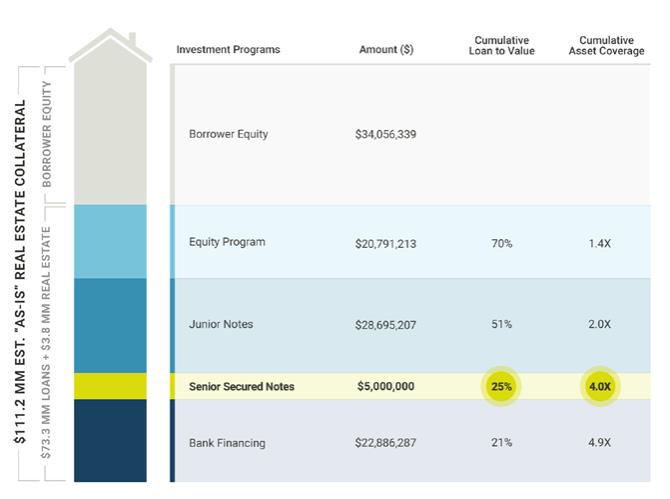
The Senior Notes are senior to the Company’s existing Junior Notes and equity interests, and subordinate to the Company’s Bank Borrowings or any replacement or addition to such borrowings. See “Financial Statements” beginning on Page F-1 for information regarding Junior Notes, equity interests and Bank Borrowings. The Senior Note Purchase Agreement that governs the terms of the Senior Notes does not have any restrictions on our ability to incur senior, secured Bank Borrowings other than the Maximum Debt Covenant. Consequently, in the event of our bankruptcy, liquidation, dissolution, reorganization or similar proceeding, the holders of any senior secured indebtedness will be entitled to proceed against the collateral that secures such indebtedness and such collateral will not be initially available for satisfaction of any amounts owed under the Senior Notes, and the debt held by our senior lenders to which the Senior Notes are subordinated will be entitled to be paid in full prior to any right of Senior Noteholders to receive payment.

We may be unable to repay the Senior Notes at maturity or upon default.

On the Maturity Date of a Senior Note, or in the event of a default under the Senior Note Purchase Agreement, Senior Notes or Security Agreement, the Company may not have sufficient funds available at such time to make the required repayment of the principal and accrued and unpaid interest on the Senior Notes. In addition, the loan agreements for our Bank Borrowings contain, and any future credit agreements or other agreements relating to our Bank Borrowings may contain, provisions prohibiting the repayment of the Senior Notes under certain circumstances, or may provide that a designated event constitutes an event of default under that agreement. At maturity, the Manager, in its sole discretion, may extend the Maturity Date by up to three months. If the Company extends the Maturity Date, payment of the Senior Notes would be delayed until that date. If the Company receives demands for payment from Senior Noteholders collectively holding more than thirty percent (30%) of the unpaid principal amounts of all outstanding Senior Notes, the Company may elect to extend the Maturity Date for all Senior Notes while the Company liquidates and winds up its Portfolio Loans. If any agreement governing the Company’s indebtedness prohibits the Company from repaying the Senior Notes when obligated to do so, the Company could seek the consent of the lenders to repay the Senior Notes or attempt to refinance this debt. If the Company does not obtain such consent to refinance the debt, the Company would not be permitted to repay the Senior Notes. The Company’s failure to repay Senior Notes would constitute an Event of Default, which might constitute a default under the terms of our other indebtedness.

A Majority of Interest is necessary to accelerate payments under the Senior Notes

If an Event of Default occurs, your remedies may be limited. A Majority of Interest may, on behalf of all Senior Noteholders accelerate payment under the Senior Notes to exercise and enforce their rights, as provided under the


7


Security Agreement. Furthermore a Majority of Interest may elect to waive such rights and remedies in their discretion. A Senior Noteholder, acting alone, will have no recourse to accelerate payment under the Senior Notes, unless they individually hold a Majority of Interest. If an Event of Default occurs and a Majority of Interest waives or otherwise declines to enforce your rights and remedies under your Senior Note, you will be without recourse with respect to such Event of Default. A Senior Noteholder may contact the Collateral Agent pursuant to the Security Agreement, to coordinate a Majority of Interests, but there is no guarantee that a Majority of Interest will elect to accelerate payment of the Senior Notes.

The Company is permitted to incur more debt, which may intensify the risks associated with current leverage, including the risk that the Company will be unable to service its debt.

The Senior Note Purchase Agreement does not prohibit the Company from incurring any indebtedness or other liabilities except to the extent borrowings exceed the Maximum Debt Covenant. If the Company incurs additional debt, the risks associated with its leverage, including the risk that the Company will be unable to service its debt, will increase.

The Manager has wide discretion to redeem equity interests in the Company prior to the maturity of the Senior Notes and to repurchase Senior Notes prior to maturity.

Under the terms of the Company’s Operating Agreement and the Senior Notes, the Manager may repurchase equity interests in the Company or prepay the Senior Notes under certain circumstances. If the Manager chooses to use Company cash to redeem equity interests in the Company or to prepay certain Senior Notes, Senior Noteholders face the risk of the Company being unable to pay the Senior Notes at maturity. Following a redemption or prepayment, the Company may have less cash available for payment of debt on its terms at maturity. If the Company is unable to continue to generate cash flow or asset values diminish following a redemption or prepayment, Senior Noteholders face a greater risk of loss of investment.

The Collateral securing repayment of the Senior Notes may be insufficient.

Although the Senior Notes will be secured by an interest in the assets of the Company which is senior to that of Junior Noteholders and the Company’s equity owners, such security interest is subordinate to Bank Borrowings, as well as to statutorily protected interests, such as liens in connection with unpaid taxes and construction liens. The terms of the Bank Borrowings and any subsequent borrowings may also impose certain conditions on existing Senior Noteholders with respect to the exercise of remedies in the event the Company is in default under Bank Borrowings or such subsequent borrowings. Therefore, there is no assurance that the Senior Noteholder’s security interest will be perfected in seniority over the interests of other creditors of the Company in such assets, that its remedies will be enforceable, or if such Collateral is foreclosed upon, that it will be sufficient to repay the Senior Notes.

The Company may change the rate of interest payable on the Senior Notes at any time.

Each Senior Note will bear simple interest on the unpaid principal amount of the Senior Note at a rate of six percent (6%) interest per annum. The Company may change the interest rate at any time, provided that (i) the interest rate may not be increased or decreased by more than one-half percent (0.5%) at the time of any change, and (ii) the interest rate change is applied to all Senior Notes outstanding. The Company will provide written notice to each Senior Noteholder before making any change in the interest rate and the rate change will not become effective until 90 days after the notice. If the interest rate is decreased, Senior Noteholders may receive less income from the Senior Notes than they would have had the interest rate stayed the same or increased. In the event the Company changes the interest rate, Senior Noteholders may demand payment of their Senior Notes prior to the date when the interest rate change becomes effective.


8


Senior Noteholders will not have the protection of a trustee, an indenture or the provisions of the Trust Indenture Act of 1939.

Because this offering is being made in reliance on an exemption from registration under the Securities Act, it is not subject to the Trust Indenture Act of 1939. Consequently, purchasers of Senior Notes will not have the protection of an indenture setting forth obligations of the Company for the protection of the Senior Noteholders or a trustee appointed to represent their interests.

You will not have the benefit of an independent review of the terms of the Senior Notes, the Offering Circular or our Company as is customarily performed in underwritten offerings.

The Senior Notes are being offered by us on a “best efforts” basis without an underwriter or placement agent. Therefore, you will not have the benefit of an independent review of the terms of the Senior Notes, the Offering Circular, or our Company. Accordingly, you should consult your investment, tax, and other professional advisors prior to deciding whether to invest in the Senior Notes.

We are conducting this offering on a “best efforts” basis.

This offering is being conducted on a “best efforts” basis by the Manager only. No guarantee can be given that all or any of the Senior Notes will be sold, or that sufficient proceeds will be available to conduct successful operations. The Company can retain any proceeds from the sale of the Senior Notes sold in this offering. Accordingly, all funds raised in the offering will become immediately available to the Company and may be used as they are accepted.

This offering is being made subject to Regulation A under the Securities Act (“Regulation A”), which has recently undergone significant changes.

The Company is conducting this offering pursuant to Regulation A, which was amended effective June 19, 2015. Because of these recent amendments, there is still significant uncertainty with respect to the parameters of an offering pursuant to this regulation. In addition, these regulations may change as regulators develop practices with respect to such amendments, which changes may be detrimental to the Company or its ability to raise funds. If the Company were to inadvertently violate the parameters of this type of offering, it may be subject to enforcement action or civil liabilities under securities laws. Such violation may also affect the Company’s ability to raise capital in the future.

Risks Related to the Business

Any deterioration in the housing industry or economic conditions could result in a decrease in demand and pricing for new and rehabilitated residential properties, which would have a negative impact on our business and could reduce the likelihood we will be able to generate enough cash to repay the Senior Notes.

The Portfolio Borrowers to whom we make loans use the proceeds of our loans to construct or rehabilitate residential properties. The developers obtain the money to repay our loans by selling the residential properties they have constructed or rehabilitated. A Portfolio Borrower’s ability to repay our loans is based primarily on the amount of money generated by selling the properties they have constructed or rehabilitated, and thus, the Portfolio Borrowers’ ability to repay our loans is based primarily on the amount of money generated by the sale of such properties.

The housing industry is cyclical and is significantly affected by changes in industry conditions, as well as in general and local economic conditions, such as:


    employment level and job growth;


    demographic trends, including population increases and decreases and household formation;


9


    availability of financing for homebuyers;


    interest rates;


    affordability of residential properties;


    consumer confidence;


    levels of new and existing residential properties for sale, including foreclosed properties and properties held by investors and speculators; and


    housing demand generally.

These conditions may occur on a national scale or may affect some of the regions or markets in which we operate more than others.

We generally lend a percentage of the values of the residential properties our Portfolio Borrowers are building or rehabilitating. These values are determined shortly prior to loan funding. If the values of properties in markets in which we lend drop fast enough to cause the Portfolio Borrowers losses that are greater than their equity in the property, we may be forced to liquidate the loan in a fashion that will cause us to lose money. If these losses when combined and added to our other expenses are greater than our revenue from interest paid by our Portfolio Borrowers, it may impair our ability to pay interest on the Senior Notes and repay the principal on the Senior Notes. Values are typically affected by the demand for and supply of properties, which can change due to many factors, including but not limited to, demographics, interest rates, cost of building materials and labor, availability of financing, inventory of homes available and governmental action or inaction. Any tightening of credit markets would make it more difficult for potential homeowners to obtain financing to purchase homes. If housing prices decline or sales in the housing market decline, our Portfolio Borrowers may have a hard time selling their homes at a profit. This could cause the number of defaulted loans that we will own to increase. An increase in defaulted loans would reduce our revenue and could lead to losses on our loans. A decline in housing prices will further increase our losses on defaulted loans. If the amount of defaulted loans or the loss per defaulted loan is large enough, we will operate at a loss, which will decrease our equity. This could cause us to become insolvent, and we will not be able to pay back your investment in the Senior Notes.

We have a limited operating history on which to base your investment decision.

The Company began making investment loans as Iron Bridge Mortgage Fund, LLC on April 1, 2009. Although the Manager and its Managing Directors may have achieved favorable returns with some of its previous Portfolio Loans, the performance of past investments cannot be relied upon to predict the Company’s success.

Our operations are not subject to the stringent banking regulatory requirements designed to protect investors, so repayment of your investment is completely dependent upon the successful operation of our business.

Our operations are not subject to the regulatory requirements imposed upon the operations of commercial banks, savings banks, and thrift institutions, and are not subject to periodic compliance examinations by federal or state banking regulators. For example, we will not be well diversified in our product risk, and we cannot benefit from government programs designed to protect regulated financial institutions. Therefore, an investment in the Senior Notes does not have the regulatory protections that the holder of a demand account or a certificate of deposit at a bank does. The return on Senior Notes purchased by a Senior Noteholder is completely dependent upon the successful operation of our business. To the extent that we do not successfully operate our business, our ability to pay interest and principal on the Senior Notes will be impaired.

If the proceeds from the issuance of the Senior Notes exceed the cash flow needed to fund the desirable business opportunities that are identified, we may not be able to invest all of the funds in a manner that generates sufficient income to pay the interest and principal on the Senior Notes.

Our ability to pay interest on our debt, including the Senior Notes, pay our expenses, and cover loan losses is dependent upon interest and fee income we receive from loans extended to our Portfolio Borrowers. If we are not


10


able to lend to a sufficient number of Portfolio Borrowers at high enough interest rates, we may not have enough interest and fee income to meet our obligations, which could impair our ability to pay interest and principal to you. If money brought in from new Senior Notes and from repayments of loans from our Portfolio Borrowers exceeds our short term obligations such as expenses, Senior Note interest and redemptions, and line of credit principal and interest, then it is likely to be held as cash, which will have a lower return than the interest rate we are paying on the Senior Notes. This will lower earnings and may cause losses which could impair our ability to repay the principal and interest on the Senior Notes.

Our cost of funds is substantially higher than that of banks.

Because we do not offer FDIC insurance, and because we want to grow our Senior Notes faster than most banks want to grow their CD base, our Senior Notes offer significantly higher rates than bank CDs. As a result, our cost of funds is higher than banks’ cost of funds. This may make it more difficult for us to compete against banks when they rejoin our niche lending market in large numbers. This could result in losses which could impair or eliminate our ability to pay interest and principal on our outstanding Senior Notes.

Our investments are determined from time to time by the Manager, with no input from Senior Noteholders.

A Senior Noteholder must rely upon the ability of the Manager to identify, structure and implement Portfolio Loans consistent with the Company’s investment objectives. Accordingly, no person should purchase Senior Notes from the Company unless he or she is willing to entrust all aspects of the management, financing, and development of a Project to the Portfolio Borrower, and the management of the Company, valuation of the Projects and the terms of the Portfolio Loans to the Manager.

There can be no assurance that loans of a suitable nature will be available in the market. It is possible that the Company will be less invested in Portfolio Loans than we expect, if sufficiently attractive loan opportunities are not identified.

We may be subject to risks resulting from conflicts of interest between the Company and the Manager and its principals and affiliates.

There may be certain conflicts of interest between the Company and the Manager, its principals and their affiliates. These include:


    Time Demands. The Manager’s primary business activity during the life of the Company is the management of the Company. However, the Manager or its Managing Directors may pursue investment and lending activities away from the Company. Their interests and activities in connection with such other investments may create a conflict with the Company’s interests.


    Disproportionate Interest of Manager. The Company’s Manager receives management fees that are proportionally greater than the interest payable to Senior Noteholders. Accordingly, the Manager’s risk profile with respect to the use of the Company’s capital may diverge from that of the Senior Noteholders.


    Potential Conflicts of Interest. The Manager may encounter various potential and actual conflicts of interest between itself and the Company in the event that the Manager sponsors other mortgage funds or is required under other lender loan covenants to purchase non-performing assets from the Company.

See “Conflicts of Interest” on Page 79 for greater details about these conflicts.

Additional competition may decrease our profitability, which would adversely affect our ability to repay the Senior Notes.

We may experience increased competition for business from other companies and financial institutions that are willing to extend the same types of loans that we extend at lower interest rates and/or fees. These competitors


11


also may have substantially greater resources, lower cost of funds, and a better established market presence. If these companies increase their marketing efforts to our market niche of borrowers, or if additional competitors enter our markets, we may be forced to reduce our interest rates and fees in order to maintain or expand our market share. Any reduction in our interest rates, interest income or fees could have an adverse impact on our profitability and our ability to repay the Senior Notes.

We are heavily dependent on the Manager and its Managing Directors, the loss of which may have a significant impact on operations.

The Manager will make all management decisions for the Company, including Portfolio Loan selection. The Company will be relying in large part on the Manager’s loan origination expertise. The Manager may resign at any time without liability to the Company. If the Manager withdraws from the Company, is terminated by the Company’s equity owners for cause or otherwise, or is terminated as Manager by dissolution or bankruptcy, it may be difficult or impossible for the Company to locate a suitable replacement for the Manager. In addition, two of the Manager’s Managing Directors, Gerard Stascausky and Sarah Gragg Stascausky, are considered an integral part of the Company’s investments and operations. If either or both Managing Directors were to leave the Manager, die or become permanently disabled, the Manager’s ability to continue the management of the Company would be materially and adversely affected.

We may become liable for indemnification obligations to our Manager or its affiliates.

The Company will be required to indemnify the Manager and certain affiliated persons and entities of the Manager for liabilities incurred in connection with the affairs of the Company. Such liabilities may be material and have an adverse effect on the ability to pay the Senior Noteholders. The indemnification obligation of the Company will be payable from the assets of the Company.

The value of the collateral securing a Portfolio Loan may be incorrectly determined by the Manager.

The Manager will develop and utilize a consistent method to estimate the value of the collateral for each Portfolio Loan, in the Manager’s sole discretion. The Manager will use methodologies that it deems reasonable based on various valuation practices commonly used in similar businesses in the industry including broker price opinions, comparative market analyses, appraisals, comparable sales of other similar assets, historical data and trends from actual sales, disposition or performance of assets, cash balances (in the case of cash assets), and other such methodologies generally used and accepted in the market. The determination or estimation of the value of any real estate collateral or other asset is highly subjective and subject to change continuously on an ongoing basis. There is no guarantee that any value as determined by the Manager of any real estate collateral or other asset of the Company will be accurate or represent the true current value of any asset.

The collateral securing our Portfolio Loans may not be sufficient to pay back the principal amount in the event of a default by the borrowers.

In the event of default, our real estate loan investments are generally dependent entirely on the loan collateral securing our Portfolio Loans to recover our investment. Our loan collateral consists primarily of a deed of trust or mortgage on the underlying property. In the event of a default, we may not be able to recover the property promptly and the proceeds we receive upon sale of the property may be adversely affected by risks generally related to interests in real property, including changes in general or local economic conditions and/or specific industry segments, declines in real estate values, increases in interest rates, real estate tax rates and other operating expenses including energy costs, changes in governmental rules, regulations and fiscal policies, including environmental legislation, acts of God, and other factors which are beyond our or our Portfolio Borrowers’ control. Current market conditions may reduce the proceeds we are able to receive in the event of a foreclosure on our loan collateral. Our remedies with respect to the loan collateral may not provide us with a recovery adequate to recover our investment.


12


There is no assurance that our current financing arrangements will remain in place.

We will depend on Bank Borrowings to fund our Portfolio Loans and reach our target leverage ratio. Accordingly, our ability to achieve our investment and leverage objectives depends on our ability to borrow money in sufficient amounts and on favorable terms. Currently, we have entered into a $25 million line of credit with Western Alliance Bank. There can be no assurance that this agreement will remain in place and, even if in place, that the amount and definitive terms under which we would be able to borrow would be adequate. Adverse developments in the residential and commercial mortgage markets could make it more difficult for us to borrow money to finance our operations.

We are subject to significant government regulation, which may affect our ability to operate.

The industry in which the Company is an active participant may be highly regulated at both state and federal levels. The Company will attempt to comply with all applicable regulations affecting the markets in which it operates. However, such regulation may become overly burdensome and therefore may have a negative effect on the Company’s ability to perform. The Company expects to comply with all rules, regulations, advisories and guidelines, however it is extremely difficult to keep up with all changes and proposed changes to all federal and state regulations at all times, and the Company may, on occasion, be delayed in such compliance, requiring the Company to pay penalties, costs, fees, and other charges to regain compliance. Any such penalty, cost, fee, or other charge will negatively impact the Company and its ability to pay Senior Noteholders.

We may become subject to the Investment Company Act, which could interfere with our intended operations.

The Company intends to operate so as to not be regulated as an investment company under the Investment Company Act of 1940 (the “Investment Company Act”) based upon certain exemptions thereunder. Specifically, the Company expects to be exempted from registration under the Investment Company Act because the Company will be primarily engaged in purchasing or acquiring mortgages and other liens on, and interests in, real estate as determined under exemptions from the Investment Company Act and rules issued thereunder. Accordingly, the Company does not expect to be subject to the restrictive provisions of the Investment Company Act. However, if the Company fails to qualify for exemption from registration as an investment company, its ability to conduct its business as described herein will be compromised. Any such failure to qualify for such exemption would likely have a material adverse effect on the Company.

Our reliance on certain exclusions from the Investment Company Act may impact certain investment decisions.

The Investment Company Act excludes from the definition of an “investment company” issuers of non-redeemable securities that are primarily engaged in purchasing or otherwise acquiring mortgages and other liens on, and interests in, real estate. The Manager has not sought a no-action letter from the SEC to confirm that the Company is eligible for this exemption. However, the Manager will rely on guidance issued by the SEC stating that so long as (1) qualifying percentages of the Company’s assets consist of mortgages and other liens on or interests in real estate; and (2) the remaining percentage of the Company’s assets consist primarily of real estate related assets, the Company will remain exempt from the Investment Company Act registration requirements. These formulaic requirements may negatively impact the Company’s investment flexibility and the ability of the Manager to invest in other funds, limited partnerships, limited liability companies, and other similar vehicles.

We may become subject to additional regulations that may interfere with our operations.

Federal and state lawmakers and regulators may take action to increase or otherwise modify the laws, rules and regulations applicable to techniques and instruments in which the Company may invest. New (or modified) laws, rules and regulations may prevent, or significantly limit the ability of, the Manager from using such instruments or from engaging in such transactions. This may impair the ability of the Manager to carry out the Company’s


13


investment strategy and may otherwise have an adverse impact on the Company’s business. Compliance with such new or modified laws, rules and regulations may also increase the Company’s expenses and therefore may adversely affect the Company’s performance. It is not possible at this time to predict with certainty what, if any, impact any new or modified regulations will have on the Manager or the Company, and it is possible that such impact could be adverse and material.

Real estate investing is inherently risky.

The Company is subject to the risks that generally relate to investing in real estate because it principally makes debt investments in real estate assets. Real estate historically has experienced significant fluctuations and cycles in performance that may result in reductions in the value of the Company’s real estate-related investments. The performance and value of its investments once acquired depends upon many factors beyond the Company’s control. The ultimate performance and value of the Company’s investments are subject to the varying degrees of risk generally incident to the ownership and operation of the properties in which the Company invests and which collateralize or support its investments.

In addition, the Company will regularly make loans to Portfolio Borrowers who will borrow Company assets to invest in “rehab and flip” properties. Because these properties are in need of rehabilitation and refurbishment, often before such properties are habitable or tenantable, there is little to no accurate guidance as to the value of such properties. Such lack of guidance may impact our underwriting and cause us to advance more on a loan than such a property is worth. Further, such properties are subject to a number of independent, unique, or increased risks, including, but not limited to, unlicensed and unbonded contractors, delayed payments, faulty or shoddy workmanship of third parties, inability or delays in permitting or final approvals, lack of or inadequate insurance coverage, delay in resale, significant price reduction upon resale, requiring the Company to seize or retake the property in an event of default, loss of loan principal, and other risks.

The ultimate performance and value of the Company’s investments will depend upon, in large part, the Portfolio Borrower’s or the Company’s ability to operate any given property so that it produces sufficient cash flows necessary to pay the interest and principal due to the Company on its Portfolio Loans. Revenues and cash flows may be adversely affected by: changes in national or local economic conditions; changes in local real estate market conditions due to changes in national or local economic conditions or changes in local property market characteristics, including, but not limited to, changes in the supply of and demand for competing properties within a particular local property market; competition from other properties offering the same or similar services; changes in interest rates and the credit markets which may affect the ability to finance, and the value of, investments; the ongoing need for capital improvements, particularly in older building structures; changes in real estate tax rates and other operating expenses; changes in governmental rules and fiscal policies, civil unrest, acts of God, including earthquakes, hurricanes and other natural disasters, acts of war or terrorism, which may decrease the availability of or increase the cost of insurance or result in uninsured losses; changes in governmental rules and fiscal policies which may result in adverse tax consequences, unforeseen increases in operating expenses generally or increases in the cost of borrowing; decreases in consumer confidence; government taking investments by eminent domain; various uninsured or uninsurable risks; the bankruptcy or liquidation of major tenants; adverse changes in zoning laws; the impact of present or future environmental legislation and compliance with environmental laws; the impact of lawsuits which could cause the Company to incur significant legal expenses and divert management’s time and attention from the day-to-day operations of the Company; and other factors that are beyond the Company’s control and the control of the property owners.

Any of the foregoing factors could adversely impact the return on and cash flows and values of the Company’s investments. In addition, property values can decline below their acquisition price or below their appraised, assessed or perceived values after the acquisition. Appraisals, if obtained, are only the appraiser’s opinion of the property values at a given point in time. Material declines in values could result in subsequent losses. The Company’s real estate based investments may be difficult to sell in an efficient and expeditious manner, and there can be no assurance that there will be a ready resale market when the Company elects to sell such investments.


14


Risks Related to the Company’s Mortgage Loans

We will have limited control over our Portfolio Borrowers, which lack of control may affect the repayment of our Portfolio Loans.

Typically a Portfolio Borrower is structured as a single purpose entity or venture for the purpose of acquiring, improving, developing or holding the real property (a “Project”) collateralizing a Portfolio Loan. The Portfolio Borrower and the Project is managed exclusively by the principals of the Portfolio Borrower or its co-investors or affiliates.

Investors will have no opportunity to directly affect the management of the Portfolio Borrower or of the Project. The Company is also likely to have little opportunity to influence the management of the Portfolio Borrower or Project, except to the limited extent of imposing conditions to the draw of funds under a Portfolio Loan. Therefore, the successful operation of the Portfolio Borrower, the choice and terms of any junior lien Project financing, the success of the Project, the repayment of a Portfolio Loan, and the ability of the Portfolio Borrower to repay the Portfolio Loan depends greatly upon the skill, experience and efforts of the Portfolio Borrower or its principals in the acquisition, improvement, development, management and sale of the Project and in the management of the Portfolio Borrower. In the event the Project is not successfully completed, in addition to the inability of the Portfolio Borrower to repay such Portfolio Loan, the value of the Portfolio Loan collateral is likely to be impaired.

There is limited operating history for the Projects that secure our loans, increasing the risk that such Projects may not be able to repay our Portfolio Loans.

Although a Portfolio Borrower or its principals may be experienced real estate investors, the Project may have no operating or financial history. The prior success of Portfolio Borrower or its principals in connection with previous real estate investments are no assurance that the Portfolio Borrower will enjoy comparable success with respect to the Project collateralizing the Portfolio Loan. If a Portfolio Loan or Project collateral is impaired by the poor performance of a Portfolio Borrower, the Company’s ability to make payments on the Senior Notes may be impaired.

Our underwriting standards and procedures are more lenient than conventional lenders.

The Company will invest in Portfolio Loans with borrowers who will not be required to meet the credit standards of conventional mortgage lenders, which is riskier than investing in loans made to borrowers who are required to meet those higher credit standards. Because the Manager approves Portfolio Loans more quickly than some other lenders or providers of capital, there may be a risk that the due diligence the Manager performs as part of its underwriting procedures would not reveal the need for additional precautions. If so, the interest rate the Company charges and the collateral the Company requires may not protect the Company adequately or generate adequate returns for the risk undertaken.

The Projects for which we make a Portfolio Loan may not be able to be completed as planned, thereby increasing the risk that we will not be repaid.

Our Portfolio Loans are made to fund real property Projects, which Projects are often the subject of development plans by the Portfolio Borrower. Costs of planned improvements, development or operations of the Project securing the Portfolio Loan may exceed estimates, which may affect the Portfolio Borrower’s ability to complete the Project according to projections and budgets. Similarly, development plans may not be permissible under then-existing laws, ordinances, regulations and building codes. In either case, such events may affect the Portfolio Borrower’s ability to repay our Portfolio Loan, which may materially affect our ability to generate revenue.


15


We may have difficulty protecting our rights as a secured lender.

The Company believes that its lending documents will enable it to enforce commercial arrangements with Portfolio Borrowers and other counterparties. However, the rights of Portfolio Borrowers, counterparties, and other secured lenders may limit the Company’s practical realization of those benefits. For example:


    Judicial foreclosure is subject to the delays of protracted litigation. Although the Company expects non-judicial foreclosure to be generally quicker, the Company’s loan collateral may deteriorate and decrease in value during any delay in foreclosing on it.


    The Portfolio Borrower’s right of redemption during foreclosure proceedings can deter the sale of the loan collateral and can for practical purposes require the Company to manage the property.


    The Company will be making loans in different states, with varying foreclosure laws, procedures and timelines. Depending on which state a Project is located, there may be more or less time, effort and cost associated with foreclosing on Portfolio Loans.


    Unforeseen environmental hazards may subject the Company to unexpected liability and procedural delays in exercising its rights.


    The rights of junior or senior secured parties in the same property can create procedural hurdles for the Company when it forecloses on loan collateral.


    The Company may not be able to pursue deficiency judgments after it forecloses on loan collateral.


    State and federal bankruptcy laws can prevent the Company from pursuing any actions, regardless of the progress in any of these suits or proceedings.


    The courts, particularly the bankruptcy courts, may unilaterally alter the contractual terms of the Company’s assets, including doing so to the detriment of the Company.

Care is exercised upon creation of the legal documents at the time of origination, or through thorough review of such documents in the event of acquisition, to ensure that as many bases as possible have been covered in the documents. However, in the event of default, it can be very difficult to predict with any certainty how courts will respond.

Our due diligence may not reveal all factors affecting an investment and may not reveal weaknesses in such investments.

There can be no assurance that the Manager’s due diligence processes will uncover all relevant facts that would be material to a lending decision. Before making a Portfolio Loan, the Manager will assess the strength of the underlying properties and any other factors that they believe are material to the performance of the Portfolio Loan. In making the assessment and otherwise conducting customary due diligence, the Manager will rely on the resources available to them and, in some cases, investigations by third parties.

Environmental liabilities may jeopardize our ability to realize repayment of our Portfolio Loans.

The Projects subject to our Portfolio Loans may become subject to liability for costs of cleanup of certain conditions relating to the presence of hazardous or toxic materials on, in or emanating from the Project securing our Portfolio Loan, and any related damages. Liability is often imposed without regard to whether the owner knows of, or was responsible for, the presence of the hazardous or toxic materials. These liabilities may interfere with the economic development of the subject Projects, and may interfere with the repayment of our Portfolio Loans.

The repayment of our Portfolio Loans may be affected by other debt obligations associated with the Project.

While leveraged investments offer the opportunity for greater capital appreciation, such investments also involve a higher degree of risk. The Portfolio Borrower’s financing of a Project may involve varying degrees of leverage


16


in order to provide greater financial return to the Portfolio Borrower, as a result of which recessions, operating problems and other general business and economic risks may have a more pronounced effect on the profitability or survival of such investments than if leverage were not employed. The Portfolio Borrower may also have to make debt service payments, including interest, which may fluctuate based on a spread above an underlying base rate. By its very nature, a variable interest rate will move up or down based on changes in the economy and other factors, all of which are beyond the control of the Portfolio Borrower. Accordingly, there can be no assurance that such rates will not rise significantly and, consequently, that a Portfolio Borrower would be required to pay more interest than is anticipated with respect to its other financing on the Project, thereby impairing its ability to repay the Portfolio Loan.

We may not be able to economically realize on a Project due to mechanic’s liens on the Project.

The Project may be subject to a mechanic’s lien, which entitles the holder of such a lien to foreclose on the Project. Most state laws provide that any person who supplies services or materials to a real estate Project may impose a lien against the Project securing any amounts owed to such person. Although the Portfolio Borrower may be required by the terms of the Portfolio Loan to utilize procedures to prevent the occurrence of mechanic’s liens (such as requiring mechanic’s lien releases prior to payment and issuing joint-party checks) no assurance can be given that mechanic’s liens will not appear against the Project. If a mechanic’s lien does appear, then it must be negotiated by the Portfolio Borrower in order to obtain its release or the person holding such lien will have the right to bring an action of foreclosure on the Project in order to satisfy the amount due under the lien.

We may not be able to economically realize on a Project if the Project becomes subject to eminent domain proceedings.

The Project or a portion of the Project could become subject to an eminent domain or inverse condemnation action. Such an action could have a material adverse effect on the operations or marketability of the Project, and, as a consequence, adversely affect the ability of the Portfolio Borrower to repay the Portfolio Loan. In addition, the value of the Project as collateral would be impaired and the Project may have insufficient remaining value to repay accrued interest and principal on foreclosure.

The Portfolio Loans are subject to credit risk associated with the Portfolio Borrower and the Project.

The financial failure of a Portfolio Borrower and default on a Portfolio Loan could result in a significant reduction in the Company’s income. The Company is relying solely on the value of the underlying collateral as security for the Portfolio Loan in such event. With respect to the collateral, the Company is subject to general economic risks with respect to its debt investments similar to those experienced by the Portfolio Borrower with respect to the Project.

We may have limited diversity with respect to our investments, increasing our risks.

The Company’s portfolio may become concentrated in a limited number of Portfolio Loans, increasing the vulnerability of the portfolio as compared with a portfolio that is more diversified in the number and location of Portfolio Loans and Portfolio Borrowers. If the Company is unable to diversify its investments by lending to a variety of Portfolio Borrowers and by diversifying the geographic and type of collateral, the Portfolio Loans will be dependent on the success of a limited number of Portfolio Borrowers and the Company’s assets may be concentrated in specific markets or collateral categories. If one or more Portfolio Borrowers or markets suffer adverse consequences, the Company’s financial condition and results of operations will be adversely affected.

Our remedies as a lender may be limited, limiting our ability to realize gain from our investments.

Portfolio Loans will generally be personal obligations of the principals of the Portfolio Borrower. In the event of a default under a Portfolio Loan, the Company is entitled to foreclose upon the property securing the Portfolio Loan and may seek a deficiency judgment against the principals, individually. A foreclosure action or other lender remedies may be subject to delays and additional expenses if defenses or counterclaims are interposed.


17


Cross-collateralization may reduce the security available for the Portfolio Loans.

The repayment of one or more of the Portfolio Loans may be cross-collateralized by a direct or indirect interest in more than one Project. A Project is released as collateral as it is sold and the payment is made on the Portfolio Loan. However, there is no assurance that Projects will be sold in the order of their collateral value, or that the passage of time or changes in market conditions will preserve the value of remaining collateral. Therefore, the remaining Project may be insufficient collateral to provide protection in the event that the Portfolio Loan ceases to perform.

The Company’s investment may not be sufficiently protected in the event of damage to collateral.

Although the Company requires its Portfolio Borrowers to maintain adequate insurance coverage against liability for personal injury and property damage, such insurance may prove insufficient to cover any liabilities or casualty losses incurred by a Portfolio Borrower. Also certain risks may be uninsurable or may become uninsurable, or may become insurable only at prohibitive cost, such as the risk of property damage and general liability from earthquakes, floods, damage from terrorist activities, or certain environmental hazards. In addition, such risks may be insurable only in amounts that are less than the full market value or replacement cost of the relevant collateral. In addition to the unintentional loss of the collateral, the Portfolio Borrower may permit uninsured waste or other damage to the collateral by tenants, licensees or invitees. In the event of the occurrence of such risk or waste, the collateral may be substantially impaired or destroyed, and the potential loss to the Company in the event the applicable Portfolio Loan does not perform could be substantial.

The Company may become liable under laws regulating lenders.

In connection with the Portfolio Loans, the Company uses commercially reasonable efforts in reliance on qualified advisors to comply with laws and regulations applying to lenders in the relevant jurisdictions. However, such laws are not always clearly applicable to a particular loan transaction or investment structure, or they may change. In such event, the Company’s interest in a Portfolio Loan may be materially impaired; with the consequence that the Company’s ability to make payments on the Senior Notes may be materially impaired.

The Company may become subject to penalties for usury.

The structure of the Company’s Portfolio Loans is expected to comply with state usury laws and the laws of other relevant jurisdictions. However, usury laws and their exemptions are complex and may change. If, despite the Company’s reasonable efforts in reliance on qualified advisors to avoid such result, a Portfolio Loan made by the Company does not comply with applicable state usury laws, the Company may be responsible for payment of penalties and face the potential loss of its Portfolio Loan investment.


18


FORWARD-LOOKING STATEMENTS

This Offering Circular includes forward-looking statements within the meaning of the federal securities laws. Forward-looking statements are generally identifiable by the use of words such as “may,” “should,” “expects,” “plans,” “believes,” “estimates,” “predicts,” “potential,” and other similar words or expressions. Such statements include information concerning our plans, expectations, possible or assumed future results of operations, trends, financial results and business plans, and involve risks and uncertainties that are difficult to predict and subject to change based on various important factors, many of which are beyond our control. Such factors include, but are not limited to, those discussed in the “Risk Factors” section of this Offering Circular. These and other important factors could cause actual results to differ materially from those contained in any forward-looking statement. You should not place undue reliance on our forward-looking information and statements. The forward-looking statements included in this Offering Circular are made as of the date of this Offering Circular, and we do not intend, and assume no obligation, to update the forward-looking statements or to update the reasons why actual results could differ from those projected in the forward-looking statements. All forward-looking statements contained in this Offering Circular are expressly qualified by these cautionary statements. Statements other than statements of historical fact are forward-looking statements.

The historical results described in this Offering Circular with respect to previous mortgage lending are historical only, and were influenced by available opportunities, diverse market conditions and other factors beyond the control of the Company. Any projections made in this Offering Circular are based on historical examples and the Company’s estimates of future conditions. There is no assurance that lending opportunities experienced in the past will occur in the future, that market conditions will be as favorable to the Company as they have been in the past, or that investors will enjoy returns on their investment comparable to those enjoyed by them or by others with respect to their participation in other investments sponsored by the Manager. The actual results experienced by the Company will differ, and such variation is likely to be material. Please see the section “Risk Factors” before deciding to purchase Senior Notes.

IN MAKING AN INVESTMENT DECISION, INVESTORS MUST RELY ON THEIR OWN EXAMINATION OF THE SENIOR NOTES, THE COMPANY AND THE TERMS OF THE OFFERING, INCLUDING THE MERITS AND RISKS INVOLVED. THE SENIOR NOTES HAVE NOT BEEN RECOMMENDED BY ANY FEDERAL, STATE OR FOREIGN SECURITIES COMMISSION OR REGULATORY AUTHORITY. FURTHERMORE, THE FOREGOING AUTHORITIES HAVE NOT CONFIRMED THE ACCURACY OR DETERMINED THE ADEQUACY OF THIS DOCUMENT. ANY REPRESENTATION TO THE CONTRARY IS A CRIMINAL OFFENSE.


19


USE OF PROCEEDS

The net proceeds to the Company from the sale of Senior Notes will be equal to the aggregate principal amount of Senior Notes we sell less our offering expenses. If we sell the maximum offering amount, which is $50,000,000, the net proceeds will be approximately $49,729,500, after deducting estimated expenses for the preparation, filing, printing, legal, accounting and other fees and expenses related to the offering of approximately $270,500. The Company intends to use the net proceeds from this offering to fund loans to borrowers and to fund the Company’s operating expenses and obligations. The Company has not identified the particular investments it will make. Accordingly, an investor must rely upon the ability of the Manager in making investments consistent with the Company’s investment objectives and policies. Although the Managing Directors have been successful in locating investments in the past, the Company may be unable to find a sufficient number of attractive opportunities to invest its committed capital or meet its investment objectives. The Company does not intend to use net proceeds for the purpose of repurchasing equity interests in the Company or repaying Junior Notes or Senior Notes. The Company does not anticipate any material changes to the use of proceeds described above in the event that less than all of the Senior Notes being qualified are sold and the net proceeds are subsequently reduced.


20


SELECTED FINANCIAL DATA

The following selected financial data as of and for the fiscal years ended December 31, 2016, 2015 and 2014 is derived from audited financial statements of the Company included in this Offering Circular. The following selected financial data for the six months ended June 30, 2017 and 2016 is derived from unaudited financial statements of the Company. The financial data below should be read in conjunction with “Management’s Discussion and Analysis of Financial Condition and Results of Operations” beginning on Page 40 and the Company’s financial statements and notes thereto beginning on Page F-1.


    As of or for the Six Months
Ended June 30,
    As of or for the Year Ended
December 31,
 
    2017     2016     2016     2015     2014  

Selected income statement data


Interest income

  $ 5,545,478     $ 6,002,160     $ 11,839,445     $ 10,115,280     $ 9,880,853  

Interest expense

    2,185,070       1,979,738       4,187,504       3,649,578       3,934,638  

Net interest income

    3,360,408       4,022,422       7,651,941       6,465,702       5,946,215  

Provision for loan losses

    56,753       69,735       157,079       —         585,000  

Net interest income after provision for loan losses

    3,303,655       3,952,687       7,494,861       6,465,702       5,361,215  

Non-interest income

    322,320       259,032       379,053       255,680       350,076  

Non-interest expense

    2,271,768       2,409,878       4,568,087       3,995,900       3,714,838  

Income tax expense (benefit)

    7,457       13,250       13,250       3,470       6,276  

Net income (loss)

    1,412,332       1,864,865       3,446,336       3,240,664       2,575,177  

Net margin

    24.5     29.8     28.3     31.3     25.2

Selected balance sheet data


Total assets

  $ 73,748,589     $ 67,844,031     $ 69,565,409     $ 61,067,506     $ 51,802,319  

Net loans

    68,378,126       64,011,861       65,277,911       58,232,416       50,669,516  

Real estate owned

    3,386,111       2,648,385       2,925,184       1,404,859       —    

Allowance for loan losses

    1,103,397       1,084,356       1,150,469       1,024,288       1,036,499  

Bank Borrowings

    18,485,522       14,597,345       13,294,510       11,994,150       3,549,546  

Senior Notes

    —         —         —         —         —    

Junior Notes

    34,597,566       33,560,509       36,398,463       30,179,273       32,442,861  

Equity

    19,739,856       18,709,801       19,006,249       17,366,588       14,552,342  

Selected performance ratios


Net interest rate spread

    7.81     9.89     9.12     9.37     8.99

Net interest margin

    9.71     12.21     11.33     12.44     12.16

Ratio of interest-earning assets to interest-bearing liabilities

    1.30       1.39       1.36       1.44       1.39  

Non-performing loans to total loans (percentage of UPB)

    7.2     5.6     9.5     9.0     11.2

Loan to value – active loans, end of period


Unpaid principal balance

  $ 69,970,319     $ 65,582,659     $ 66,754,985     $ 59,891,317     $ 52,331,689  

Unfunded loan balance (1)

    9,623,347       12,439,188       9,240,006       16,139,296       11,693,571  

Estimated “after-repair” value (2)

    117,258,500       115,959,400       112,109,500       114,411,400       106,163,000  

Estimated “after-repair” loan-to-value (3)

    68     67     68     66     60

Loan to value – paid off loans, during period


Principal balance

    35,551,022       30,925,584       61,997,040       48,958,402       43,922,434  

Actual sale price

    58,442,938       54,053,011       104,026,658       79,913,961       71,726,582  

Actual loan-to-sale price (4)

    61     57     60     61     61

Original “after-repair” loan-to-value estimate

    68     61     64     60     63

Interest coverage ratios


Interest coverage – Bank Borrowings (5)

    12.4     16.1     14.9     30.2     39.0

Cumulative interest coverage – Senior Notes (6)

    —         —         —         —         —    

Cumulative interest coverage – Junior Notes (7)

    2.7     3.2     2.9     2.8     2.6

Average portfolio leverage, during period

    74     72     72     68     73


(1) Unfunded loan balance is comprised of construction funds that have been approved but not yet disbursed.


21


(2) The Company prepares an estimate of the “after-repair” value of the collateral for each Portfolio Loan. The Company’s “after-repair” value estimate for each property assumes that all planned capital improvements to the real estate collateral have been completed and that the Company has disbursed all construction loan proceeds, and represents the Company’s estimate of the market value of the project after completion of all repairs based on information about comparable properties available at the time. See “Portfolio Loan Criteria and Policies – Underwriting” on Page 33 for additional information regarding estimation of “after-repair” value.
(3) Estimated “after-repair” loan-to-value is calculated by dividing the sum of the unpaid principal balance and the unfunded loan balance by the estimated “after-repair” value. Real estate values are based on the Company’s “after-repair” value estimates and loans are weighted by the principal balance of each loan.
(4) Actual loan-to-sale price represents the amount of the fully funded loan divided by the actual sale price of the real estate collateral. The principal balance of each loan was used to calculate the weighted average. Loans that were refinanced or secured by real estate collateral that was sold wholesale (prior to planned improvements being completed) to other investors were excluded from the calculation.
(5) Bank Borrowings have a first priority security interest in all of the Company’s assets, including Portfolio Loans. Interest coverage equals gross income divided by the interest expense related to Bank Borrowings.
(6) Senior Notes will have a second priority interest in all of the Company’s assets, including its Portfolio Loans. Cumulative interest coverage of Senior Notes equals gross income divided by the total interest expense related to Senior Notes and Bank Borrowings combined. As of June 30, 2017, the Company had not issued Senior Notes.
(7) Junior Notes have a third priority security interest in all of the Company’s assets, including Portfolio Loans. Cumulative interest coverage of Junior Notes equals gross income divided by the total interest expense related to Junior Notes, Senior Notes and Bank Borrowings combined.


22


BUSINESS

Overview

The Company was formed in 2009 as an Oregon limited liability company for the purpose of making commercial purpose loans by lending funds to real estate investors to finance the ownership, entitlement, development or rehabilitation of residential and commercial real estate throughout the United States. The Company has no employees and is managed by Iron Bridge Management Group, LLC, an Oregon limited liability company (the “Manager”), which is owned by Gerard Stascausky and operated by Gerard Stascausky and Sarah Gragg Stascausky (the “Managing Directors”). Gerard Stascausky and Sarah Gragg Stascausky combined bring to the Company over 20 years of investment banking experience and over 18 years of distressed real estate investment experience. The Manager provides Portfolio Loan origination and servicing services to the Company. See “Management” on Page 76 of this Offering Circular.

The Company’s primary business is to provide commercial purpose loans for the acquisition and rehabilitation of distressed residential and commercial real estate as well as to provide opportunistic financing for real estate development and construction. The Company’s primary source of funding is private debt and Bank Borrowings. The commercial purpose loans extended by the Company are based upon underwriting criteria the Manager has found to be successful in the past.

The Company primarily originates and structures its own loans, with such loans being secured by first lien deeds of trust or mortgages. However, the Company may also take title to properties (either directly or through a wholly owned subsidiary) to facilitate prompt acquisitions from trustees at auction, pre-foreclosure acquisitions from defaulting borrowers, or any other real estate acquisition in which the Company believes taking title to the property is in the best interest of the Company. The wholly owned subsidiary may provide the Company a level of liability protection on owned assets, while preserving the Company’s economic interests.

The Company’s investments are primarily in non-owner occupied real estate loans. The only owner-occupied residential loans that may be owned by the Company are purchases of existing, non-performing residential loans, with the objective of renegotiating terms with the resident owner or foreclosing on the property. The Company does not originate new owner-occupied residential loans of any kind.

Company Vision

We believe that the real estate finance industry is in the early stages of a major transformation that should create significant value for borrowers, investors and real estate finance companies. Technology and new securities laws should drive increased efficiency. For borrowers, this should mean lower interest rates and better service. For investors, this should mean superior risk-adjusted returns that are not available in the public markets. And for the innovative companies that lead this change, it should mean an opportunity to create value while effectively managing risk.

Background and Strategy

Real estate finance markets are highly fragmented, with numerous large, mid-size, and small lenders and investment companies, such as banks, savings and loan associations, credit unions, insurance companies, institutional lenders and private lenders all competing for investment opportunities. Many of these market participants experienced losses in the real estate market, which started to decline in 2006 and reached its bottom in 2012. As a result of credit losses and restrictive government oversight, many of these financial institutions are not participating in this market to the extent they had before the credit crisis. In addition, it appears that the number of banks and other institutional lenders willing to lend for the acquisition and rehabilitation of commercial and residential investment properties has decreased. In particular, we believe that banks and other institutional lenders are generally more reluctant to lend money secured by residential property until the property is constructed or fully renovated and either rented or ready for purchase by an owner-occupant. Developers


23


particularly rely on private lending sources such as the Company to fill the need for financing between the time a property is purchased and the time, after construction or rehabilitation, when it is ready to be rented or sold. We believe the Company fills a significant gap by providing much needed financing of this type for areas with a growing need for such financing, and that profitable investment opportunities will be available to the Company based on the fragmented nature of the rehab lending market and the limited competition from banks and other institutional lenders.

Why Private Lending Offers Asymmetrical Investment Returns

“The essence of investment management,” said legendary investor Benjamin Graham, “is the management of risks, not the management of returns.” We agree, and also believe that investors cannot be successful over the long term if they do not understand the relationship between risk and return within the context of the efficient market theory, which generally assumes two things: (1) information is ubiquitous and (2) capital moves freely. These two assumptions are critical in understanding the drivers of asymmetrical returns, which can be defined simply as higher rates of investment return per unit of risk than the efficient market theory would suggest.

The first assumption, “information is ubiquitous,” generally means that all investors know about all investments available and have analyzed all the information available related to those investments. In the public markets (e.g., publicly-traded stocks and bonds) this assumption is often true. For example, large investment funds with billions of dollars in investment capital often employ large staffs of analysts, each dedicated to specific industries or companies. The public companies they analyze are generally required by law to disclose material information to the public in a timely manner. When new information is made available, these analysts can quickly assimilate the information and invest accordingly. These conditions make information ubiquitous in the public markets, but these conditions generally do not hold true in the private lending industry for rehab and new construction projects.

The second assumption, “capital moves freely,” generally means that investors are able and motivated to allocate capital among investment opportunities in a way that always maximizes the investment return per unit of risk. Again, in the public markets, this assumption is often true. For example, large investment funds are generally competing to attract investment capital by earning a superior investment return relative to their peers and are therefore motivated to reallocate investment capital in order to maximize investment returns. In addition, the public markets are generally liquid and allow these institutional investors to buy and sell quickly with minimal transactional costs. These conditions allow capital to move freely in the public markets, but these conditions generally do not exist in the private lending industry for rehab and new construction projects.

By comparison, within the private lending industry information generally is not ubiquitous and capital generally does not move freely. For example, private lenders in Florida or New Jersey may not necessarily know about lending opportunities in Oregon or California. Moreover, even if those private lenders were made aware of these lending opportunities, the private lenders may not be interested or structurally capable of evaluating and funding the loans in the timeframes required. Further, capital generally does not move freely in the private lending industry for rehab and new construction projects. For example, the largest lenders in the real estate industry are banks, which are both government regulated and structurally challenged. Government regulations often dissuade banks from pursuing certain types of profitable loans in order to comply with larger risk management overlays. The banks are also often structured in ways that make them relatively slow in analyzing and funding loans. What this means is that the private lending industry for rehab and new construction projects is fragmented and inefficient and does not comply with the efficient market theory’s assumptions of ubiquitous information flow and free movement of capital. This inefficiency provides an opportunity for participants in the private lending industry to earn asymmetrical investment returns, or, in other words, a higher rate of return per unit of risk versus public market investments as indicated in the following graph.


24
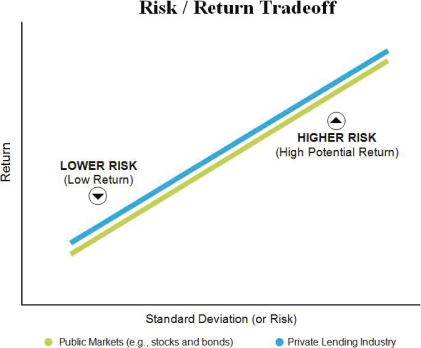

LOGO

Defensive Attributes of the Company’s Business Model

While there can be no assurance that investors in the Company will not lose all of their investment, we believe that the Company’s business model has certain defensive attributes that may allow the Company to perform relatively well in adverse economic environments. The following is a list of defensive business model attributes that we believe have allowed the Company to perform relatively well between 2009 and 2017. There can be no assurance that these attributes would provide the same or any level of protection in the future.

The Company does not rely on increases or decreases in real estate prices. The Company’s investment returns are primarily derived from the interest payments and fees paid by the Company’s Portfolio Borrowers who have generally demonstrated an ability to find profitable projects in various economic environments. We believe this is one of the reasons why the Company’s profitability and investor returns have remained stable through depreciating, flat and appreciating real estate markets since 2009.

The Company generally makes short term loans of 12 months or less that enable both the Company and its Portfolio Borrowers to adapt quickly to changing economic conditions. For example, if real estate prices soften and resale activity slows down, some of our Portfolio Borrowers may break even or lose money on current Projects because their estimated resale prices may prove to have been too optimistic. However, because these are short-term Projects with defined exit strategies, our Portfolio Borrowers are often able to adapt quickly by buying the next Project at a lower price to account for changing market conditions.

Changes in interest rates do not require the Company to reprice its Portfolio Loans, minimizing interest rate risk. The Company has the intent and ability to hold its Portfolio Loans to maturity. Therefore, Portfolio Loans are stated at their outstanding unpaid principal balance with interest thereon being accrued as earned. Changes in interest rates do not require the Company to reprice its Portfolio Loans. However, changes in interest rates can create reinvestment risk related to changes in the rate of return available on new Portfolio Loans made by the Company.

The Company’s Portfolio Borrowers are more price setters than price takers. Because our Portfolio Borrowers’ Projects are short-term, and their profits come primarily from the value created in the Project, we believe our Portfolio Borrowers are more sensitive to completing and selling their Projects quickly than they are to the


25


current level of real estate prices. For example, between 2009 and 2012, when real estate prices were in decline, many of the Company’s Portfolio Borrowers were buying properties from foreclosure auctions at very low prices, rehabbing the houses, and then listing the houses for sale at prices that were often lower than competing listings, resulting in quick sales.

The Company’s loan portfolio is primarily secured by residential real estate, which we believe to be a more defensive asset class relative to assets correlated to other sectors of the economy. Real estate is a well-known inflation hedge, but what’s more important is that, in our view, the Federal Reserve and other policymakers are likely to prioritize the health of the residential real estate market over other sectors of the US economy. The simple reason is that consumption is approximately 70% of U.S. gross domestic product and housing is the largest single investment for most consumers. Accordingly, we believe that it is unlikely that policymakers will allow the residential real estate market to suffer for an extended period without taking action. The same cannot be said for other sectors of the economy, such as the oil and gas industry which has experienced a major decline in energy prices since mid-2014 that has led to significant capital spending reductions and industry layoffs. However, from an economic perspective the benefits of lower energy prices transmitted through increased consumer spending generally appear to outweigh the negative effects of oil industry contraction.

The Company’s business model generates strong and stable monthly recurring revenues, which means the Company is well positioned to cover interest payments. For the year ended December 31, 2016, the Company generated revenues of $12.2 million and combined interest expense of $4.2 million related to its private debt and Bank Borrowings. Revenues were 2.9 times the amount needed to cover this combined interest expense, with average portfolio leverage of 72% during 2016. We believe that this level of interest coverage provides a significant layer of loan portfolio protection that should help safeguard investor capital during an adverse economic event.

Investor capital is further protected by the value of the underlying real estate collateral. As of December 31, 2016, the estimated “as-is” value of the Company’s real estate collateral was $96.0 million, which secured the approximately $66.8 million loan portfolio. The value of the real estate collateral was approximately 1.9 times the amount necessary to pay off our private debt and Bank Borrowings combined ($49.8 million) and provided a combined loan-to-value of 52%. Similarly, the value of the real estate collateral was approximately 1.4 times the amount needed to pay off our entire capital stack – equity, private debt and Bank Borrowings combined ($68.8 million), providing a loan-to-value of 72%. We believe that this level of real estate asset coverage and loan-to-value provides another important layer of portfolio protection that should help safeguard investor capital during an adverse economic event. See “As-Is Loan-to-Value and Asset Coverage Based on Percentage Completion” on Page 51 for additional information regarding loan-to-value analysis and the method of estimating “as-is” value.

Portfolio Loan Characteristics

Project Type. The primary focus of the Company’s lending activities is on single-family residential rehab and new construction projects. As described above, the Company believes that this market is underserved by banks and other institutional lenders. In addition, the relatively short-term nature of these projects (12 months or less) allows the Company and its Portfolio Borrowers to adjust quickly to changing market conditions.


26


The following table provides information about the distribution of the Company’s loan portfolio by project type segmented further by number of loans and the unpaid principal balance (“UPB”) of those loans.


     As of the Six Months Ended
June 30,
    As of the Year Ended
December 31,
 
     2017     2016         2016             2015             2014      

Number of loans


Single-family residential rehab

     202       212       184       190       126  

Single-family residential new construction

     30       35       32       47       46  

Multi-family residential rehab

     16       21       21       21       7  

Multi-family residential new construction

     1       0       1       0       2  

Commercial

     0       0       0       0       0  

Land entitlements

     0       5       6       5       2  

Percentage of UPB


Single-family residential rehab

     73     71     69     64     63

Single-family residential new construction

     22     22     21     25     23

Multi-family residential rehab

     4     5     7     10     10

Multi-family residential new construction

     1     0     1     0     3

Commercial

     0     0     0     0     0

Land entitlements

     0     2     2     1     1

As of June 30, 2017, the percentage of UPB categorized by project type consisted of 73% Single Family Residential Rehab Projects (202 loans), 22% Single Family Residential New Construction Projects (30 loans), 4% Multi-Family Residential Rehab Projects (16 loans), 1% Multi-Family Residential New Construction (1 loan), 0% Commercial and less than 0% Land Entitlements.

By comparison, as of June 30, 2016, the percentage of UPB categorized by project type consisted of 71% Single Family Residential Rehab Projects (212 loans), 22% Single Family Residential New Construction Projects (35 loans), 5% Multi-Family Residential Rehab Projects (21 loans), 0% Multi-Family Residential New Construction, 0% Commercial and less than 2% Land Entitlements (5 loans).

As of December 31, 2016, the percentage of UPB categorized by project type consisted of 69% Single-Family Residential Rehab (184 loans), 21% Single-Family Residential New Construction (32 loans), 7% Multi-Family Residential Rehab (21 loans), 1% Multi-Family Residential New Construction (1 loan), 0% Commercial and 2% Land Entitlements (6 loans).

By comparison, as of December 31, 2015, the percentage of UPB categorized by project type consisted of 64% Single-Family Residential Rehab (190 loans), 25% Single-Family Residential New Construction (47 loans), 10% Multi-Family Residential Rehab (21 loans), 0% Multi-Family Residential New Construction, 0% Commercial and 1% Land Entitlements (5 loans).

By comparison, as of December 31, 2014, the percentage of UPB categorized by project type consisted of 63% Single-Family Residential Rehab (126 loans), 23% Single-Family Residential New Construction (46 loans), 10% Multi-Family Residential Rehab (7 loans), 3% Multi-Family Residential New Construction (2 loans), 0% Commercial and 1% Land Entitlements (2 loans).


27


From 2013 through 2015 the Company modestly increased the amount of loans it made for single-family and multi-family new construction. This trend reflects the general improvement in the real estate market over that time and a corresponding shift in the business models of our borrowers from fixing distressed properties purchased through foreclosure sales or from bank owned inventory to more value-added projects, such as square footage additions or new construction. During 2016 and the first six months of 2017, the Company’s single-family and multi-family new-construction loans, in aggregate, remained consistent at less than 25% of loan portfolio UPB.

It is important to point out that the Company does not make loans for land entitlement purposes only. These land entitlement loans represent phase one of two phase projects that require land entitlement to be completed prior to new construction commencing on either single-family or multi-family residential structures.

Geographical Distribution. During 2014, the Company made fewer loans in Arizona and California, increased its lending activity in Washington and expanded its loan programs into the states of Colorado, Connecticut, Illinois and Texas. During 2015, the Company made fewer loans in Arizona, increased its lending activity in the states of Colorado and Illinois and began lending in Indiana and Pennsylvania. During 2016, the Company maintained stable lending activity across its existing geographies and began lending in Florida, Massachusetts, New Jersey, North Carolina, Oklahoma and South Carolina. These changes reflect the Company’s ability to adjust its loan program offerings to borrowers in those states that offer better investment returns per unit of risk. Some of the variables evaluated by the Company in making the decision to expand or contract in a specific geographic market include the competitive pricing pressure from competing lenders, availability of borrower projects, the margins on those borrower projects and trends in regional economic activity.

The Company continued to expand the geographic scope of its lending activities in 2017 and expects to continue expanding in the states of Arizona, California, Colorado, Connecticut, Delaware, Florida, Georgia, Illinois, Indiana, Maryland, Massachusetts, Michigan, New Jersey, New Mexico, North Carolina, Oklahoma, New Mexico, North Carolina, Oklahoma, Oregon, Pennsylvania, South Carolina, Tennessee, Texas, Virginia, Washington and Wisconsin. This expanding geographic distribution of loans will provide the Company with additional geographic diversification, and enable the Company to continue to identify and rebalance its loan portfolio toward those geographies that offer higher rates of return per unit of risk.

The Company continues to experience steady loan demand and stable real estate resale activity. However, the real estate market is increasingly being driven by regional economics and less so by the macro boom and bust cycle of recent years. While real estate is generally benefiting from improvements in employment and low interest rates, the bounce off the bottom for real estate prices has slowed and regional economics are becoming a larger factor in local real estate trends. For this reason, the Company believes that increasing its geographic diversification and having the ability to rebalance its loan portfolio between geographies is important to effectively manage risk.


28


The following table provides the geographic distribution of the Company’s loan portfolio by state segmented further by the number and unpaid principal balance of loans (“UPB”) that were active at the end of the period and those loans that paid off during the period.


     As of or for
the Six Months Ended

June 30,
     As of or for
the Year Ended
December 31,
 
     2017      2016      2016      2015      2014  

Arizona


Number of active loans, end of period

     —           2           —           —           5     

Percentage of total UPB

     —           1%        —           —           2%  

Number of paid off loans, during period

     —           2           4           2           18     

Percentage of paid off UPB

     —           <1%        <1%        <1%        7%  

California


Number of active loans, end of period

     55           47           48           46           45     

Percentage of total UPB

     34%        31%        34%        31%        50%  

Number of paid off loans, during period

     32           27           60           53           92     

Percentage of paid off UPB

     31%        33%        30%        36%        57%  

Colorado


Number of active loans, end of period

     11           10           7           13           7     

Percentage of total UPB

     6%        10%        7%        10%        5%  

Number of paid off loans, during period

     5           7           13           7           —     

Percentage of paid off UPB

     10%        7%        8%        5%        —     

Connecticut


Number of active loans, end of period

     —           3           1           4           2     

Percentage of total UPB

     —           1%        <1%        1%        1%  

Number of paid off loans, during period

     1           1           3           4           2     

Percentage of paid off UPB

     <1%        <1%        1%        1%        <1%  

Florida


Number of active loans, end of period

     2           1           1           —           —     

Percentage of total UPB

     <1%        <1%        <1%        —           —     

Number of paid off loans, during period

     2           1           3           —           —     

Percentage of paid off UPB

     <1%        <1%        <1%        —           —     

Georgia


Number of active loans, end of period

     2           —           —           —           —     

Percentage of total UPB

     <1%        —           —           —           —     

Number of paid off loans, during period

     2           —           —           —           —     

Percentage of paid off UPB

     <1%        —           —           —           —     

Illinois


Number of active loans, end of period

     62           91           71           86           13     

Percentage of total UPB

     16%        18%        17%        18%        2%  

Number of paid off loans, during period

     42           50           96           33           —     

Percentage of paid off UPB

     13%        15%        14%        5%        —     

Indiana


Number of active loans, end of period

     1           2           3           2           —     

Percentage of total UPB

     <1%        <1%        <1%        <1%        —     

Number of paid off loans, during period

     3           —           —           1           —     

Percentage of paid off UPB

     <1%        —           —           <1%        —     

Maryland


Number of active loans, end of period

     —           —           —           —           —     

Percentage of total UPB

     —           —           —           —           —     

Number of paid off loans, during period

     —           —           —           —           —     

Percentage of paid off UPB

     —           —           —           —           —     

Massachusetts


Number of active loans, end of period

     3           1           2           —           —     

Percentage of total UPB

     1%        <1%        1%        —           —     

Number of paid off loans, during period

     —           —           1           —           —     

Percentage of paid off UPB

     —           —           <1%        —           —     

New Jersey


Number of active loans, end of period

     4           3           —           —           —     

Percentage of total UPB

     <1%        <1%        —           —           —     

Number of paid off loans, during period

     4           —           4           —           —     

Percentage of paid off UPB

     <1%        —           <1%        —           —     

North Carolina


Number of active loans, end of period

     1           —           1           —           —     

Percentage of total UPB

     <1%        —           <1%        —           —     

Number of paid off loans, during period

     1           —           1           —           —     

Percentage of paid off UPB

     <1%        —           <1%        —           —     


29


     As of or for
the Six Months Ended

June 30,
     As of or for
the Year Ended
December 31,
 
     2017      2016      2016      2015      2014  

Oklahoma


Number of active loans, end of period

     1           —           —           —           —     

Percentage of total UPB

     <1%        —           —           —           —     

Number of paid off loans, during period

     —           1           1           —           —     

Percentage of paid off UPB

     —           <1%        <1%        —           —     

Oregon


Number of active loans, end of period

     68           72           70           73           77     

Percentage of total UPB

     29%        30%        29%        28%        28%  

Number of paid off loans, during period

     54           47           98           102           83     

Percentage of paid off UPB

     32%        29%        31%        37%        33%  

Pennsylvania


Number of active loans, end of period

     6           5           8           2           —     

Percentage of total UPB

     1%        <1%        1%        <1%        —     

Number of paid off loans, during period

     3           2           6           2           —     

Percentage of paid off UPB

     1%        <1%        1%        <1%        —     

South Carolina


Number of active loans, end of period

     2           —           1           —           —     

Percentage of total UPB

     <1%        —           <1%        —           —     

Number of paid off loans, during period

     2           —           —           —           —     

Percentage of paid off UPB

     <1%        —           —            —           —     

Texas


Number of active loans, end of period

     3           2           2           1           5     

Percentage of total UPB

     1%        <1%        1%        <1%        1%  

Number of paid off loans, during period

     2           2           4           6           —     

Percentage of paid off UPB

     <1%        <1%        <1%        1%        —     

Washington


Number of active loans, end of period

     28           34           29           37           30     

Percentage of total UPB

     10%        9%        10%        11%        13%  

Number of paid off loans, during period

     25           25           49           50           12     

Percentage of paid off UPB

     10%        14%        12%        14%        4%  

As of June 30, 2017, the geographic concentration of active portfolio loans of 1% or more of the UPB in any state was as follows: California 34%, Colorado 6%, Illinois 16%, Massachusetts 1%, Oregon 29%, Pennsylvania 1%, Texas 1%, Washington 10%.

This compares to June 30, 2016, when the geographic concentration of active Portfolio Loans of 1% or more of the UPB in any state was as follows: Arizona 1%, California 31%, Colorado 10%, Connecticut 1%, Illinois 18%, Massachusetts 1%, Oregon 30% and Washington 9%.

As of December 31, 2016, the geographic concentration of active Portfolio Loans of 1% or more of the UPB in any state was as follows: California 34%, Colorado 7%, Illinois 17%, Massachusetts 1%, Oregon 29%, Pennsylvania 1%, Texas 1% and Washington 10%.

This compares to December 31, 2015, when the geographic concentration of active Portfolio Loans of 1% or more of the UPB in any state was as follows: California 31%, Colorado 10%, Connecticut 1%, Illinois 18%, Oregon 28% and Washington 11%.

This compares to December 31, 2014, when the geographic concentration of the active Portfolio Loans of 1% or more of the UPB in any state was as follows: Arizona 2%, California 50%, Colorado 5%, Connecticut 1%, Illinois 2%, Oregon 28%, Texas 1%, and Washington 13%.

Borrowers. The Company’s Portfolio Borrowers are often comprised of one to three member teams that form a company and take title to Projects in their company name. The team members usually have prior experience in real estate development, construction, finance or sales. For example, a common three-person team might include a real estate agent, general contractor and financier, each contributing their expertise to the team. The real estate agent might be tasked with identifying attractive Projects, making suggestions regarding what capital


30


improvements should be made to the Projects and helping to market and sell the Projects. The contractor might be tasked with assessing the cost, complexity and time necessary to make the planned capital improvements to the Project and managing that construction process. The financier might be tasked with managing the lender relationships, equity investor relationships, if any, and handling all back office accounting.

Between 2009 and 2015, the Company did not pursue a formal marketing or advertising program to grow its base of Portfolio Borrowers. The growth in the number of Portfolio Borrowers came almost exclusively through word of mouth. However, beginning in 2016, the Company implemented a marketing and advertising plan, which has helped the Company identify qualified Portfolio Borrowers and advantageous lending opportunities in each geographic market.

It has been our experience that providing Portfolio Borrowers with exceptional service leads to business referrals, which we believe is the best form of marketing. In addition, because our Portfolio Borrowers are often repeat customers, the value of each Portfolio Borrower relationship is much higher than it would be if the Portfolio Borrowers were not repeat customers.

The following table provides information regarding borrower concentrations as of the dates indicated.


     As of the Six
Months Ended
June 30,
    As of the Year Ended
December 31,
 
     2017     2016     2016     2015     2014  

Portfolio Loans

     249       273       244       264       184  

Portfolio Borrowers

     160       172       156       150       105  

Average number of loans per borrower

     1.6       1.6       1.6       1.8       1.8  

Average percentage of loans per borrower

     1     1     1     1     1

Top borrower (percentage of UPB)

     6     6     6     4     7

Top 3 borrowers (percentage of UPB)

     13     14     13     10     20

As of June 30, 2017, the portfolio consisted of 249 active loans provided to 160 borrowers. The average number of loans per borrower was 1.6 loans. The largest borrower represented 6% of UPB, while the top 3 borrowers represented 13% of UPB.

By comparison, as of June 30, 2016, the portfolio consisted of 273 active loans provided to 172 borrowers. The average number of loans per borrower was 1.6 loans. The largest borrower represented 6% of UPB, while the top 3 borrowers represented 14% of UPB.

As of December 31, 2016, the portfolio consisted of 244 active loans provided to 156 borrowers. The average number of loans per borrower was 1.6 loans. The largest borrower represented 6% of UPB, while the top 3 borrowers represented 13% of UPB.

This compares to December 31, 2015, when the portfolio consisted of 264 active loans provided to 150 borrowers. The average number of loans per borrower was 1.8 loans. The largest borrower represented 4% of UPB, while the top 3 borrowers represented 10% of UPB.

This compares to December 31, 2014, when the portfolio consisted of 184 active loans provided to 105 borrowers, and the average number of loans per borrower was 1.8 loans. The largest borrower represented 7% of UPB, while the top 3 borrowers represented 20% of UPB.

The average number of loans per borrower has remained consistent over time. However, borrower concentration has continued to decrease driven primarily by an increase in the size of the loan portfolio.

Loan Term. All of the Company’s loans are made with maturity dates of 12 months or less. However, it is the Company’s policy to provide borrowers, whose loans are not in default, with six-month loan extensions, as needed, to allow more time to finish projects. Loans categorized with aging of 12+ months reflect those loans with loan extensions.


31


As mentioned above, the primary focus of the Company’s lending activities is on single-family residential rehab and new construction projects. We believe that banks and other institutional lenders underserve this market, which provides the Company with the opportunity to earn attractive rates of return per unit of risk. In addition, the relatively short-term nature of these projects allows the Company and its Portfolio Borrowers to adjust quickly to changing market conditions. See “Defensive Attributes of the Company’s Business Model” above for additional disclosures.

The following table sets forth the distribution of loans by age at the dates indicated:


     As of the Six Months Ended 
June 30,
    As of the Year Ended
December 31,
 
     2017     2016     2016     2015     2014  

Number of loans


00-06 months

     142       151       120       166       103  

06-09 months

     24       53       38       45       42  

09-12 months

     24       20       24       23       16  

12+ months

     59       49       62       30       23  

Percentage of number of loans


00-06 months

     57     55     49     63     56

06-09 months

     10     20     16     17     23

09-12 months

     10     7     10     9     9

12+ months

     23     18     25     11     13

Unpaid principal balance


00-06 months

   $ 36,499,876     $ 32,476,735     $ 26,954,393     $ 32,276,984     $ 26,507,651  

06-09 months

     6,021,385       13,928,024       9,566,437       11,149,205       8,125,513  

09-12 months

     6,487,248       5,175,858       7,625,394       6,028,598       6,772,247  

12+ months

     20,961,809       14,002,042       22,608,761       10,436,529       10,926,278  

Percentage of unpaid principal balance


00-06 months

     52     50     40     54     51

06-09 months

     9     21     14     19     16

09-12 months

     9     8     11     10     13

12+ months

     30     21     34     17     20

As of June 30, 2017, the age distribution of the 249 active Portfolio Loans was as follows: 142 loans within 0-6 months (52% of the unpaid principal balance (“UPB”)), 24 loans within 6-9 months (9% of UPB), 24 loans within 9-12 months (9% of UPB) and 59 loans greater than 12 months (30% of UPB). The number of loans that were greater than 12 months in age included non-performing loans but also reflected an increase in the number of larger rehab and new construction projects financed, which were expected to take approximately one year to complete.

By comparison, as of June 30, 2016, the age distribution of the 273 active Portfolio Loans was as follows: 151 loans within 0-6 months (50% of UPB), 53 loans within 6-9 months (21% of UPB), 20 loans within 9-12 months (8% of UPB) and 49 loans greater than 12 months (21% of UPB).

As of December 31, 2016, the age distribution of the 244 active Portfolio Loans was as follows: 120 loans within 0-6 months (40% of UPB), 38 loans within 6-9 months (14% of UPB), 24 loans within 9-12 months (11% of UPB) and 62 loans greater than 12 months (34% of UPB).

This compares to December 31, 2015, when the age distribution of the 264 active Portfolio Loans was as follows: 166 loans within 0-6 months (54% of UPB), 45 loans within 6-9 months (19% of UPB), 23 loans within 9-12 months (10% of UPB) and 30 loans greater than 12 months (17% of UPB).


32


This compares to December 31, 2014, when the age distribution of the 184 active Portfolio Loans was as follows: 103 loans within 0-6 months (51% of UPB), 42 loans within 6-9 months (16% of UPB), 16 loans within 9-12 months (13% of UPB) and 23 loans greater than 12 months (21% of UPB). The number of loans that were greater than 12 months increased from 5% as of December 31, 2013 to 21% as of December 31, 2014. This 16 percentage point increase was due primarily to the increase in non-performing loans during 2014.

Loan Turnover. The following table provides information associated with the Company’s Portfolio Loan turnover for the periods shown:


     As of or for the Six
Months Ended
June 30,
     As of or for the Year Ended
December 31,
 
       2017          2016          2016          2015          2014    

Loans originated, during period

     187        179        330        353        274  

Loans paid off, during period

     178        164        342        261        207  

Loans foreclosed, during period

     4        6        8        12         

Portfolio Loans, end of period

     249        273        244        264        184  

Total historical payoffs, end of period

     1,663        1,301        1,481        1,131        858  

Total historical originations, end of period

     1,912        1,574        1,725        1,395        1,042  

During the six months ended June 30, 2017, the Company originated 187 new Portfolio Loans, saw 178 Portfolio Loans pay off, and foreclosed on 4 Portfolio Loans, which all became real estate owned (“REO”) properties. As of June 30, 2017, the Company had originated 1,912 loans since inception of which 1,663 had paid off, resulting in a net 249 active Portfolio Loans.

This compares to the six months ended June 30, 2016, during which the Company originated 179 new Portfolio Loans, saw 164 Portfolio Loans pay off, and foreclosed on 6 Portfolio Loans, which all became REO properties. As of June 30, 2016, the Company had originated 1,574 loans since inception of which 1,301 had paid off, resulting in a net 273 active Portfolio Loans.

During the year ended December 31, 2016, the Company originated 330 new Portfolio Loans, saw 343 Portfolio Loans pay off, and foreclosed on 8 loans, which all became REO properties. As of December 31, 2016, the Company had originated 1,725 loans since inception of which 1,481 had paid off, resulting in a net 244 active Portfolio Loans.

This compares to the year ended December 31, 2015, when the Company originated 353 new Portfolio Loans, saw 261 Portfolio Loans pay off, and foreclosed on 12 loans, which all became REO properties. As of December 31, 2015, the Company had originated 1,395 loans since inception of which 1,131 had paid off, resulting in a net 264 active Portfolio Loans.

This compares to the year ended December 31, 2014, when the Company originated 274 new Portfolio Loans, saw 207 Portfolio Loans pay off, and foreclosed on 0 loans. As of December 31, 2014, the Company had originated 1,042 loans since inception of which 858 had paid off, resulting in a net 184 active Portfolio Loans.

Total loan origination and associated Portfolio Loan turnover increased gradually each year from 2013 through 2017 as the Company worked to balance a steady increase in capital formation with quality loan origination.


33


Loan Size. The following table sets forth the distribution of loans by size (based on the unpaid principal balance) at the dates indicated:


     As of the Six
Months Ended
June 30,
     As of the Year Ended
December 31,
 
     2017      2016      2016      2015      2014  

Average loan size

   $ 281,005      $ 240,229      $ 273,586      $ 226,861      $ 284,411  

Median loan size

     205,500        161,250        189,000        148,750        200,950  

$0-$100,000

     42        77        52        95        48  

$100,001-$200,000

     79        84        74        67        44  

$200,001-$300,000

     49        43        37        31        39  

$300,001-$500,000

     49        44        49        48        28  

$500,001-$1,000,000

     24        20        27        20        17  

$1,000,000-$1,500,000

     6        3        5        1        7  

$1,500,000-$2,000,000

     0        2        0        2        1  

As of June 30, 2017, the average and median loan sizes were $281,005 and $205,500, up $7,419 and $16,500 from the average and median loan sizes of $273,586 and $189,000 at December 31, 2016, respectively.

By comparison, as of June 30, 2016 the average and median loan sizes were $240,229 and $161,250, up $13,368 and $12,500 from the average and median loan sizes of $226,861 and $148,750 at December 31, 2015, respectively.

As of December 31, 2016, the average and median loan sizes were $273,586 and $189,000, up $46,725 and $40,250 from the average and median loan sizes of $226,861 and $148,750 at December 31, 2015, respectively.

This compares to December 31, 2015, when the average and median loan sizes were $226,861 and $148,750, down $57,550 and $52,200 from the average and median loan sizes of $284,411 and $200,950 at December 31, 2014, respectively.

This compares to December 31, 2014, when the average and median loan sizes were $284,411 and $200,950, down $27,756 and $22,666 from the average and median loan sizes of $312,167 and $223,616 at December 31, 2013, respectively.

This decline in both the average and median loan size from 2013 through 2015 reflects the Company’s expansion into new geographic markets with lower priced real estate. In contrast, the Company saw a modest increase in average and median loan sizes during 2016 and 2017, reflecting the Company’s modest expansion into California, which has relatively higher priced real estate, and away from lower priced real estate in Illinois.

The Company’s objective is to make loans secured by real estate priced in the liquid segments of each geographic market. Therefore, the distribution of loan sizes between time periods largely reflects both changes in real estate prices over time and a mix shift between geographies. While the Company is sensitive to loan size diversification, it does not target a mix of loan sizes.

Portfolio Loan Criteria and Policies

Underwriting. The Company engages in the business of making loans secured by first lien deeds of trust or mortgages that encumber real estate located in the United States, its territories and possessions. The Company may also invest indirectly in a loan by acquiring an ownership interest in an entity formed for the sole purpose of holding a qualifying loan. The Company’s loans are not insured or guaranteed by any governmental agency or private entity.


34


For each Portfolio Borrower, the Company performs a criminal background check, orders a credit report, measures liquidity, interviews the borrower to assess experience level and evaluates the quality of previous work. The Company also requires each Portfolio Borrower to provide a construction cost budget, detailing the cost and scope of planned capital improvements, and a profit analysis, detailing the borrower’s estimated resale price, total project cost and estimated profit.

As an asset-based lender, the Company’s underwriting guidelines are heavily weighted toward real estate valuation, liquidity and loan-to-value (LTV) coverage. Specifically, the Company operates under the following underwriting guidelines:


    the Company does not lend unless secured by a first lien deed of trust or mortgage;


    the Company does not lend unless the borrower has a clearly defined exit strategy;


    the Company does not lend without assessing the borrower’s ability and willingness to pay; and


    the Company does not lend more than 70% of the estimated “after-repair value” of the collateral (70% LTV coverage).

The Company has the sole discretion whether to originate a mortgage loan at a given LTV. Some of the factors considered by the Company when determining the maximum LTV to be extended on a mortgage loan are:


    age, type, condition, and location of the collateral;


    borrower creditworthiness and credit history;


    loan amount and credit terms requested;


    additional cross-collateralized properties;


    proposed changes to or reconstruction of the collateral;


    tenant history and occupancy rate (if applicable); and


    amount of the interest reserve or construction loan (if any).

In determining the value of real estate collateral for purposes of loan underwriting and LTV calculations, the Company inspects the properties and evaluates comparable property values in the area through the use of Multiple Listing Service (MLS) data. Based on this information, the Company prepares an estimate of the “after-repair value” of each property. The Company’s “after-repair” value estimates assume that all planned capital improvements to the real estate collateral have been completed and that the Company has disbursed all construction loan proceeds, and represents the Company’s estimate of the market value of the collateral after completion of the project based on information about comparable properties available at that time. In more complex transactions or for properties with limited comparable data, the Company may seek a formal valuation report such as an appraisal or broker price opinion. Appraisals are recognized in the mortgage banking industry to represent estimates of value, and should not be relied upon as the only measure of true worth or realizable value. Collateral value is determined solely in the judgment of the Company.

The Company believes that performing in-house real estate valuations provides it with a competitive advantage. By performing hundreds of in-house valuations per year in multiple geographies, the Company is able to continually refine its appraisal process and analyze real estate market trends within different geographies. This internal valuation analysis enables the Company to make faster and more informed lending decisions, which we believe help mitigate risk while providing Portfolio Borrowers with a higher quality of service.

There are no limitations on the types or locations of real estate investment loans within the United States or any requirement for current yield as opposed to overall return. Moreover, the Company’s investment strategy does not seek to balance the investment portfolio by property types, return characteristics or location, but the Company is sensitive to concentration risk. The Manager has the discretion to lend the Company’s assets on both new construction and existing properties.


35


The Company will not enter into any new commitment to make a loan where the cumulative principal amount of such loan would exceed 10% of the principal value of Portfolio Loans plus cash and cash equivalents of the Company as of the date of such commitment.

The Manager has discretion to amend the Portfolio Loan criteria and policies from time to time. THEREFORE, IN ESSENCE, THE INVESTMENT OBJECTIVES ARE THOSE DEFINED BY THE MANAGER FROM TIME TO TIME.

Disbursement of Loan Proceeds

Company loans are funded through an escrow account handled by the Manager or a qualified attorney, title insurance company or escrow company. The escrow agent is instructed not to disburse any funds until the following conditions are met:


    Satisfactory title insurance coverage has been obtained, except as described in the following paragraph, with the title insurance policy naming the Company as the insured and providing title insurance in an amount equal to the principal amount of the loan. Title insurance insures only the validity and priority of the Company’s deed of trust or mortgage, and does not insure the Company against loss by reason of other causes, such as diminution in the value of the property securing the loan, over-appraisals or borrower defaults. The Company does not intend to arrange for mortgage insurance, which would afford some protection against loss if the Company foreclosed on a loan and there was insufficient equity in the property securing the loan to repay all sums owed.

The Company does not intend to arrange for title insurance policies on properties purchased from county auction, in which the borrower is borrowing from the Company under a Master Loan and Security Agreement. In such cases, the Company lends to the borrower during a period in which the borrower has equitable (but not marketable) title, and the Company performs its own title research. Once the Trustee’s Deed or Sherriff’s Deed is received and recorded following the foreclosure sale, the Company’s first lien position is perfected. The Master Loan and Security Agreement cross-collateralizes the loan against other properties owned by the borrower.


    Satisfactory hazard and liability insurance has been obtained for all loans, or only liability insurance in the event of a loan secured by unimproved land, which insurance shall name the Company as loss payee in an amount equal to the principal amount of the Company’s loan or the replacement value of the property, as dictated by legal statute.


    All loan documents (notes, deeds of trust, etc.) and insurance policies name the Company as payee and beneficiary or additional loss insured, as applicable. In the event the Company purchases loans, the Company shall receive assignments of all beneficial interest in any document related to each loan so purchased. Company investments in loans may not be held in the name of the Manager or any other nominee.

Disbursement of Construction Draws

The Company disburses construction draws to Portfolio Borrowers to pay for planned capital improvements to the real estate collateral based on a pre-defined scope of work, construction budget and time schedule. To mitigate risk in this process, the Company follows certain policies and procedures that incorporate some or all of the following practices. However, it is important to point out that the Company evaluates the risks related to each project, considering such variables as borrower experience, and project location, size, timing and scope of work to determine the right combination of practices to follow.

Practices related to disbursement of construction draws include, but are not limited to, the following:


Construction Cost Budget – The construction cost budget is a spread sheet provided by the borrower that provides the Company with line item detail related to the planned capital improvements. The


36


construction cost budget is prepared during the underwriting processes, and the borrower will update and submit the construction cost budget with each draw request.


    Summary Page – The summary page organizes the draw request into two categories: (1) reimbursable expenses to be paid by the Company to the borrower, and (2) direct payments by the Company to contractors and vendors. The Company will reimburse the borrower for completed work as long as the borrower provides proof of payment. The Company will pay contractors and vendor invoices directly for completed work.


    Conditional Lien Waivers – Conditional lien waivers are legal agreements provided by contractors and material vendors to the Company or the borrower. The contractor or vendor agrees to waive its right to file a mechanics lien against the property for work performed through a specific date conditioned upon the receipt of a specific payment amount.


    Final Lien Waivers – Final lien waivers are legal agreements provided by contractors and material vendors to the Company or the borrower. The contractor or vendor agrees to waive its right to file a mechanics lien against the property for all work performed on the property, conditioned upon the receipt of a final payment amount.


    Property Inspections – The Company orders property inspections by qualified third party inspectors to evaluate the amount and quality of construction work performed at various stages of construction or redevelopment.


    Advanced Funding – In certain circumstances, the Company may agree to advance a borrower funds to be used to make future capital improvements. In those cases, the Company requires that, among other things, the borrower provide proof of payment and that the work be 100% complete prior to a subsequent advance. In addition, the Company is often secured through cross-collateralization with other projects owned by the same borrower.

Loan Servicing

The Company’s loans are serviced by the Manager and the Manager is compensated for such loan servicing activities. See “Management Fees” on Page 76 of this Offering Circular.

We believe that the quality of service provided by the Company to Portfolio Borrowers is an important competitive differentiator in the private lending industry. For this reason, the Company chooses to originate, underwrite and service all of its loans in-house. In-house loan underwriting enables the Company to make fast, common sense lending decisions, which Portfolio Borrowers appreciate. For example, new borrower applications generally can be processed in 48 hours, loan proposals generally can be made in 24 hours and existing Portfolio Borrowers can receive funding in two to five days. In addition, because the Company does not require third party approvals to make loans, Portfolio Borrowers have confidence in the funding commitments made by the Company.

We also believe that in-house loan servicing is important for mitigating loan portfolio risk. Maintaining a close relationship with Portfolio Borrowers and servicing Portfolio Loans through every step of the loan life cycle allows the Company to quickly identify and address problem loans.

Loan servicing includes, but is not limited to, the following:


    Payment Reminder Statements – Calculating, generating and delivering payment reminders to Portfolio Borrowers on a monthly basis. The accrued interest calculations are performed on a daily basis and take into account intra-month adjustments to the unpaid principal balance related to construction draw advances and adjustments to the interest rate of the loans, if any.


Loan History Statements – Calculating, generating and delivering loan history statements to Portfolio Borrowers on a monthly basis. The loan history statements are updated on a daily basis and present a


37


summary of all financial transaction activity related to the loan, including transaction dates, funding amounts, accrued interest amounts, payment amounts, loan advances, loan fees and payoff amounts.


    Construction Loan Statements – Calculating, generating and delivering construction loan history statements to Portfolio Borrowers on a monthly basis. The construction loan history statements are updated on a daily basis and present all construction loan advances, including transaction dates, advance amounts, vendors paid and balance of construction loan remaining.


    Interest Reserve Statements – Calculating, generating and delivering interest reserve history statements to Portfolio Borrowers on a monthly basis. The interest reserve statements are updated on a daily basis and present all interest reserve advances, if any, made to cover loan payments, including transaction dates, advance amounts and balance remaining.


    Payment Collection – Portfolio Borrowers make loan payments monthly in arrears and are instructed to mail their checks or money orders directly to the Manager for deposit into the Company’s general account. Portfolio Borrowers may also elect to have their payments electronically debited from their bank accounts by the Company.


    Construction Draw Processing – Accepting, evaluating and managing construction loan draw requests submitted by Portfolio Borrowers. Construction draw processing includes educating borrowers about the draw process, collecting required documentation, managing third-party property inspectors, evaluating the quality of work and percentage of completion against the balance of the construction loan, and disbursing funds to Portfolio Borrowers or contractors.


    Loan Payoffs – Calculating, preparing and submitting loan payoff statements. The Company works directly with the escrow company or attorney handling the closing. Following a loan payoff and payoff reconciliation, the Company prepares a reconveyance form in order to release its security interest in the property.


    Delinquent Loans and Foreclosure – The Company follows internal policies and procedures related to colleting payment on delinquent loans, offering and negotiating pre-foreclosure remedies and filing foreclosure. All foreclosure proceedings are handled by third-party foreclosure trustees or attorneys, as required by each state.

Purchase and Sale of Loans

The Company typically originates its mortgage loans. However, the Company may also purchase loans from unrelated third parties. Loans purchased by the Company must not be in default at the time of purchase and must otherwise satisfy the lending guidelines described above. Generally, the purchase price to the Company for any such loan will be the lesser of par value or fair market value.

The Company does not presently invest in mortgage loans primarily for the purpose of reselling such loans in the ordinary course of business; however, the Company may sell mortgage loans or enter into inter-creditor agreements if the Manager determines that it is advantageous for the Company to do so based upon the current interest rates, the length of time that the loan has been held by the Company, and the overall investment objectives of the Company.

The Company makes mortgage loans for investment and does not expect to engage in real estate operations in the ordinary course of business, except as may be required if the Company forecloses on a property on which it has invested in a mortgage loan and takes over ownership and management of the property. The Company may sell non-performing Portfolio Loans or foreclosed property securing Portfolio Loans, or sell an interest in such collateral to an affiliate of the Company, for the purpose of restructuring the Portfolio Loan or repositioning the property for sale.

None of the Company, its Manager, Managing Directors or affiliates is precluded from (i) selling a property to any Senior Noteholder, Junior Noteholder or equity owners of the Company in connection with a foreclosure,


38


including with purchase financing, or (ii) making a loan to, purchasing a loan from or entering into a loan or co-lending transaction or activity with any Senior Noteholder, Junior Noteholder or equity owner of the Company, provided that any transaction meets our contractual obligations under our agreements related to the Senior Notes or any other contractual or legal obligations.

Legal Proceedings

The Company is not subject to any legal proceedings that are material to its business or financial condition.

Competition

The real estate market is competitive and rapidly changing. We expect competition to persist and intensify in the future, which could harm our ability to identify suitable Portfolio Loans. The business in which the Company is engaged is highly competitive, and the Company and Manager and its affiliates compete with numerous other established entities, including banks and credit unions. The Company and Manager also expect to encounter significant competition from other market participants including private lenders, private equity fund managers, real estate developers, pension funds, real estate investment trusts, other private parties, potential investors or homeowners, and other people or entities with objectives similar in whole or in part to those of the Company. Competition could result in reduced volumes, reduced fees or the failure of the Company to achieve or maintain more widespread market acceptance, any of which could harm the Company’s business. Most of our current or potential competitors have significantly more financial, technical, marketing and other resources than the Company, and may be able to devote greater resources to the development, promotion, sale and support of their platforms and distribution channels. The Company’s potential competitors may also have longer operating histories, or extensive customer bases, greater brand recognition and broader customer relationships than we have.

The Company has historically been able to earn Portfolio Loan yields above the industry average by providing superior service to its Portfolio Borrowers and by opportunistically expanding its loan origination in those markets that offer the best return per unit of risk. However, we anticipate that our portfolio yields will continue to decline over time as we adjust our loan programs to remain price competitive. In order to remain competitive long-term the Company must continue to provide its borrowers with a superior quality of service and lower its cost of capital in order to provide borrowers with more competitively priced loans.

Governmental Regulation

Investment Company Act. An investment company is defined under the Investment Company Act to include any issuer engaged primarily in the business of investing, reinvesting, or trading in securities. Absent an exemption, investment companies are required to register as such with the SEC and to comply with various governance and operational requirements. If we were considered an “investment company” within the meaning of the Investment Company Act, we would be subject to numerous requirements and restrictions relating to our structure and operation. If we were required to register as an investment company under the Investment Company Act and to comply with these requirements and restrictions, we may have to make significant changes in our proposed structure and operations to comply with exemption from registration, which could adversely affect our business. We intend to structure the operation of the Company so as not to subject the Company to the provisions of the Investment Company Act. In particular, the Company expects to rely on, among other things, the exemption from registration afforded by compliance with Section 3(c)(5) of the Investment Company Act. Section 3(c)(5) excludes from the definition of “investment company” issuers of non-redeemable securities primarily engaged in “purchasing or otherwise acquiring mortgages and other liens on and interests in real estate.” The Manager has not sought a no-action letter from the SEC to confirm that the Company is eligible for this exemption. However, the Manager will rely on guidance issued by the SEC stating that so long as (1) qualifying percentages of the Company’s assets consist of mortgages and other liens on or interests in real estate; and (2) the remaining percentage of the Company’s assets consist primarily of real estate-related assets, the Company will remain exempt from the Investment Company Act registration requirements.


39


Lending Regulations. The Company is a lender with respect to its Portfolio Loans, and the Company will be deemed a borrower and the Senior Noteholders deemed lenders with respect to the Senior Notes. Oregon and other states have numerous laws and regulations, which apply to the activities of lenders and the rights of borrowers. The applicability of these laws and regulations, and their exemptions and exclusions, are frequently complex and highly fact-centric, and they vary by jurisdiction and are subject to change. In addition, litigation in a number of states has imposed liability upon lenders, or otherwise adversely impacted lenders, in a manner that Senior Noteholders may not be accustomed to as a result of other investment activities. For example, a number of states have adopted usury laws, which generally prohibit the charging of interest in certain circumstances in excess of a statutorily defined rate. The Company relies on qualified advisors and uses commercially reasonable efforts to comply with laws and regulations applying to lenders and borrowers, and seeks exemptions and exclusions as advisable from such laws where appropriate to meet the investment objectives of the Company and this offering.

In addition, the Company makes its Portfolio Loans pursuant to state finance lender licensing exceptions for commercial loans. However, the Company or the Manager may obtain a finance lender’s license in specific states or retain the services of third parties to comply with such licensing, should it be deemed advisable. The Company relies on qualified advisors and uses commercially reasonable efforts to comply with laws and regulations applying to lenders and borrowers, and seeks exemptions and exclusions as advisable from such laws where appropriate to meet the investment objectives of the Company and this offering. The Company believes that such efforts are sufficient to avoid issues of noncompliance. However, investors should be aware that, under certain circumstances, a failure to comply with applicable regulations by the Company or a Senior Noteholder could result in civil or criminal penalties.

Lender Liability. As an additional consideration, legal decisions in many jurisdictions have imposed liability upon lenders for actions such as declaring defaults with respect to loans and refusing to meet company loan commitments under certain circumstances. In addition, some courts have permitted litigants to pursue claims against lenders for environmental torts of a borrower and other liability as a result of their association with the borrower. Such so-called “lender liability” is a developing and uncertain area of the law, and there can be no assurance that such a claim could not be brought against the Company or, by extension, an investor. In addition, in some cases, courts have re-characterized loans or debt securities as equity instruments, such that lenders or debt security holders have been subject to “equitable subordination” and thus not entitled to the preferred status of a creditor in a bankruptcy or other adversarial proceeding. Such decisions have been highly fact specific, and there can be no assurance that a court would not follow a similar approach with respect to the Senior Noteholders’ loans to the Company, or the Company’s loans to its Portfolio Borrowers. Investors are encouraged to consult with their legal counsel regarding the lender-related issues discussed above.

Environmental Regulations. Federal, state and local laws and regulations impose environmental controls, disclosure rules and zoning restrictions that directly impact the management, development, use, or sale of real estate. Such laws and regulations tend to discourage sales and lending activities with respect to some properties, and may therefore adversely affect us specifically, and the real estate industry in general. The Company’s failure to uncover and adequately protect against environmental issues in connection with a Project investment may subject us to liability. Environmental laws and regulations impose liability on current or previous real property owners or operators for the cost of investigation, cleaning up or removing contamination caused by hazardous or toxic substances at the property. Liability can be imposed even if the original actions were legal and the owner had no knowledge of, or was not responsible for, the presence of the hazardous or toxic substances. Such liabilities may interfere with the Company’s ability to realize on its lending activities.

Property

The Manager leases office space for its principal executive offices in Portland, Oregon pursuant to a multi-year lease. We believe that these facilities are adequate for our current operations.


40


MANAGEMENT’S DISCUSSION AND ANALYSIS OF

FINANCIAL CONDITION AND RESULTS OF OPERATIONS

The following is management’s discussion and analysis of the Company’s results of operation, financial condition, and liquidity. The following should be read in conjunction with the Company’s audited financial statements and the notes thereto as of December 31, 2016 and for each of the years in the three-year period ended December 31, 2016 and the Company’s unaudited financial statements and notes thereto as of and for the periods ending June 30, 2017 and 2016 included in this Offering Circular beginning on Page F-1.

Overview

We are a private lender formed in 2009 as an Oregon limited liability company. The Company makes commercial purpose loans by lending funds to real estate investors to finance the ownership, entitlement, development and redevelopment of residential and commercial real estate throughout the United States. We generate most of our revenue from interest on loans and loan fees. Our loan portfolio consists of a mix of single-family and multi-family redevelopment and new construction projects. Our primary source of funding is private debt and Bank Borrowings. Our largest expenses are management fees paid to the Manager, Iron Bridge Management Group LLC, and interest paid on private debt and Bank Borrowings. We measure our performance through various metrics, including our net income, net margin, net interest rate spread, net interest margin, ratio of interest-earning assets to interest-bearing liabilities, non-performing loans to total loans, late fee and default interest from non-performing loans, charge-offs on non-performing loans, estimated active portfolio loan-to-value compared to actual paid-off portfolio loan-to-sale price, and interest coverage ratios. The following table sets forth the key financial metrics we use to measure our performance.


    As of or for the Six Months
Ended June 30,
    As of or for the Year Ended
December 31,
 
    2017     2016     2016     2015     2014  

Selected performance ratios


Net income

  $ 1,412,332     $ 1,864,865     $ 3,446,336     $ 3,240,664     $ 2,575,177  

Net margin

    24.5     29.8     28.3     31.3     25.2

Net interest rate spread

    7.81     9.89     9.12     9.37     8.99

Net interest margin

    9.71     12.21     11.33     12.44     12.16

Ratio of interest-earning assets to interest bearing liabilities

    1.30       1.39       1.36       1.44       1.39  

Non-performing loans to total loans (% UPB)

    7.2     5.6     9.5     9.0     11.2

Late fees and default interest from non-performing loans

    30,944       193,303       234,902       111,366       267,549  

Charge-offs of non-performing loans

    (103,824     (9,667     (30,898     (12,211     (2,501

Loan to value – active loans, end of period


Unpaid principal balance

  $ 69,970,319     $ 65,582,659     $ 66,754,985     $ 59,891,317     $ 52,331,689  

Unfunded loan balance

    9,623,347       12,439,188       9,240,006       16,139,296       11,693,571  

Estimated “after-repair” value

    117,258,500       115,959,400       112,109,500       114,411,400       106,163,000  

Estimated “after-repair” loan-to-value (1)

    68     67     68     66     60

Loan to value – paid off loans, during period


Principal balance

  $ 35,551,022     $ 30,925,584     $ 61,997,040     $ 48,958,402     $ 43,922,434  

Actual sale price

    58,442,938       54,053,011       104,026,658       79,913,961       71,726,582  

Actual loan-to-sale price (2)

    61     57     60     61     61

Original “after-repair” loan-to-value estimate

    68     61     64     60     63

Interest coverage ratios


Interest coverage – Bank Borrowings (3)

    12.4     16.1     14.9     30.2     39.0

Cumulative interest coverage – Senior Notes (4)


Cumulative interest coverage – Junior Notes (5)

    2.7     3.2     2.9     2.8     2.6

Portfolio leverage, end of period

    74     72     72     68     73


41


(1) Estimated loan-to-value is based on the Company’s estimate of the “after-repair” value of the collateral, which assumes all loans are fully funded and improvements to real estate collateral have been completed. Real estate values are based on the Company’s “after-repair” value estimates and loans are weighted by the principal balance of each loan. See “Portfolio Loan Criteria and Policies – Underwriting” on Page 33 for additional information regarding the estimation of “after-repair” value.
(2) Actual loan-to-sale price represents the amount of the fully funded loan divided by the actual sale price of the real estate collateral. The principal balance of each loan was used to calculate the weighted average. Loans that were refinanced or secured by real estate collateral that was sold wholesale (prior to planned improvements being completed) to other investors were excluded from the calculation.
(3) Bank Borrowings have a first priority security interest in all of the Company’s assets, including Portfolio Loans. Interest coverage equals gross income divided by the interest expense related to Bank Borrowings.
(4) Senior Notes will have a second priority security interest in all of the Company’s assets, including its Portfolio Loans. Cumulative interest coverage will equal gross income divided by the total interest expense related to Senior Notes and Bank Borrowings combined. As of June 30, 2017, the Company had not issued Senior Notes.
(5) Junior Noteholders will subordinate to Senior Noteholders and have a third priority security interest in all of the Company’s assets, including Portfolio Loans. Cumulative interest coverage of Junior Notes equals gross income divided by the total interest expense related to Junior Notes, Senior Notes and Bank Borrowings combined.

Pro forma Interest Coverage, Loan-to-Value and Asset Coverage Analysis for Senior Notes. Prior to issuing Senior Notes, the Company is providing the following example to help inform prospective investors as to what the cumulative interest coverage, loan-to-value percentage and asset coverage would have been had the Company issued Senior Notes during the year ended December 31, 2016. In this example, we assume the Company issued $5 million of Senior Notes for all of 2016 with an interest rate of 6%, and the amount of Junior Notes was decreased by $5 million in order to maintain an accurate representation of total private debt issued.

Based on this example, the pro forma Senior Notes interest coverage ratio for 2016 would have been 10.9 times, the loan-to-value percentage would have been 19% and the asset coverage multiple would have been 5.2 times.

For additional details see “Analysis of Interest Coverage” page 48 and Portfolio Loan-to-Value and Asset Coverage” page 49.

Critical Accounting Policies and Accounting Estimates

Critical accounting policies are defined as those that are reflective of significant judgments and uncertainties, and which could potentially result in materially different results under different assumptions and conditions. The Company believes that the most critical accounting policies upon which its financial condition depends, and which involve the most complex or subjective decisions or assessments, are set forth below.

Allowance for Loan Losses. The allowance for loan losses is established through a provision for loan losses charged to expense, which affects our earnings directly. Loans are charged against the allowance for loan losses when the Company believes that the collectability of all or some of the principal is unlikely. Subsequent recoveries are added to the allowance. The allowance is an amount that reflects the Company’s estimate of the level of probable incurred losses in the loan portfolio. Factors considered by the Company in determining the adequacy of the allowance include, but are not limited to, detailed reviews of individual loans, historical and current trends in loan charge-offs for the various portfolio segments evaluated, the level of the allowance in relation to total loans and to historical loss levels, levels and trends in non-performing and past due loans, external factors including regulatory, competition, and the Company’s assessment of economic conditions.

The provision for loan losses is the charge to operating earnings necessary to maintain an adequate allowance for loan losses. We have developed policies and procedures for evaluating the overall quality of our loan portfolio and the timely identification of problem loans. The Company continuously reviews these policies and procedures and makes further improvements as needed. However, the Company’s methodology may not accurately estimate inherent loss or external factors and changing economic conditions may impact the loan portfolio and the level of reserves in ways currently unforeseen.


42


The following table sets forth the beginning and ending balance of allowance for loan losses, the provision for loan losses taken during that period, and the amount of loan charge-offs taken during that period:


     As of or for the Six Months Ended
June 30,
    As of or for the Year Ended
December 31,
 
     2017     2016     2016     2015     2014  

Unpaid principal balance, end of period

   $ 69,970,319     $ 65,582,659     $ 66,754,985     $ 59,891,317     $ 52,331,689  

Allowance for loan losses, beginning balance

   $ 1,150,469       1,024,288       1,024,288       1,036,499       454,000  

Provision for loan losses, during period

   $ 56,753       69,735       157,079       —         585,000  

Charge-offs, during period

   $ (103,824     (9,667     (30,898     (12,211     (2,501)  

Allowance for loan losses, ending balance

   $ 1,103,397       1,084,356       1,150,469       1,024,288       1,036,499  

Percent of unpaid principal balance, end of period

     1.6     1.7     1.7     1.7     2.0%  

As of June 30, 2017, the Company’s allowance for loan losses balance was $1,103,397, or 1.6%, of the unpaid principal balance (“UPB”) of Portfolio Loans. During the preceding six months, the Company recognized provisions for loan losses of $56,753 and $103,824 in loan charge-offs.

By comparison, as of June 30, 2016 the Company’s allowance for loan losses balance was $1,084,356, or 1.7%, of UPB. During the preceding six months, the Company recognized provisions for loan losses of $69,735 and $9,667 in loan charge-offs.

As of December 31, 2016, the Company’s allowance for loan losses balance was $1,150,469, or 1.7%, of UPB. During the preceding 12 months, the Company recognized provisions for loan losses of $157,079 and $30,898 in loan charge-offs.

This compares to December 31, 2015, when the Company’s allowance for loan losses balance was $1,024,288, or 1.7%, of UPB. During the preceding 12 months, the Company recognized no provisions for loan losses and $12,211 in loan charge-offs.

By comparison, during 2014 the Company’s provision for loan losses was $585,000, which increased the allowance for loan losses from $454,000 to $1,036,499, or from 1.2% to 2.0% of UPB. The Company made the decision to increase the provision during 2014 to compensate for portfolio growth, larger loan sizes, and an increase in non-performing loans.

Based on the low amount of historical charge-offs, and the Company’s expectation of stable portfolio performance in the near term, the Company expects to accrue a provision for loan losses at a rate of between 0% and 1.2% annualized in order to maintain the allowance for loan losses at approximately 2% of UPB. As of June 30, 2017, the total amount of charges-offs recognized by the Company in the preceding 12 months was $125,055. See “Comparison of Financial Condition at December 31, 2016, 2015 and 2014 – Non-Performing Loans and REO Assets” below for additional disclosures.

REO and Foreclosed Assets. Assets acquired through or in lieu of loan foreclosure are initially recorded at lower of cost or fair value less estimated costs to sell, establishing a new cost basis. Subsequent to foreclosure, valuations are performed annually and the assets are carried at the lower of carrying amount or fair value less estimated costs to sell. Revenue and expenses from operations and changes in the valuation allowance are included in other non-interest income or expense. Costs related to the development and improvement of REO assets are capitalized.


43


Due to the subjective nature of establishing the asset’s fair value when it is acquired, the actual fair value of the REO or foreclosed asset could differ from the original estimate. If it is determined that fair value declines subsequent to foreclosure, a valuation allowance is recorded through non-interest expense. Gains and losses on the disposition of REO and foreclosed assets are netted and posted to other non-interest income or expenses. See “Comparison of Financial Condition at December 31, 2016, 2015 and 2014 – Non-Performing Loans and REO Assets” below for additional disclosures.

Fair Value of Mortgage Loans Receivable. The Company has the intent and ability to hold its mortgage loans to maturity. Therefore, mortgage loans are stated at their outstanding unpaid principal balance with interest thereon being accrued as earned. Mortgage loans receivable make up the only class of financing receivables within the Company’s lending portfolio.

If the probable ultimate recovery of the carrying amount of a loan, with due consideration for the fair value of collateral, is less than amounts due according to the contractual terms of the loan agreement and the shortfall in the amounts due are not insignificant, the carrying amount of the loan will be reduced to the present value of estimated future cash flows discounted at the loan’s effective interest rate. If a loan is collateral-dependent, it is valued at the estimated fair value of the related collateral. If events and or changes in circumstances cause the Company to have serious doubts about the further collectability of the contractual payments, a loan may be categorized as impaired and interest is no longer accrued. Any subsequent payments on impaired loans are applied to reduce the outstanding loan balances including accrued interest and advances. See “Comparison of Financial Condition at December 31, 2016, 2015 and 2014 – Non-Performing Loans and REO Assets” below for additional disclosures.

Deferred Loan Origination Fees. The Company will capitalize loan origination fees and recognize the fees as an adjustment of the yield on the related loan. Deferred loan origination fees are accreted to income over the life of the loan under the effective interest method.

The following table sets forth the deferred loan origination fee balances and associated accretion into income for the time periods indicated:


     As of or for the
Six Months Ended

June 30,
     As of or for the Year Ended
December 31,
 
     2017      2016      2016      2015      2014  

Deferred loan origination fees, end of period

   $ 488,796      $ 486,442      $ 326,605      $ 634,613      $ 625,674  

Accreted to income, during period

     763,014        980,356        1,803,806        1,847,088        2,065,916  

As of June 30, 2017, deferred loan origination fees were $488,796, and the Company accreted into income $763,014 of deferred loan origination fees during the six months ended June 30, 2017.

By comparison, as of June 30, 2016 deferred loan origination fees were $486,442, and the Company accreted into income $980,356 of deferred loan origination fees during the six months ended June 30, 2016.

As of December 31, 2016, deferred loan origination fees were $326,605, and the Company accreted into income $1,803,806 of deferred loan origination fees during the year ended December 31, 2016.

By comparison, as of December 31, 2015, deferred loan origination fees were $634,613, and the Company accreted into income $1,847,088 of deferred loan origination fees during the year ended December 31, 2015.

By comparison, as of December 31, 2014, deferred loan origination fees were $625,674, and the Company accreted into income $2,065,916 of deferred loan origination fees during the year ended December 31, 2014.


44


The lower amount of income accretion during 2016 and 2015 compared to 2014 reflected a lower percentage of Portfolio Loans that carried high loan origination fees and low interest rates. The Company offers its borrowers loan options with a combination of low origination fees and high interest rates or loans with high origination fees and low interest rates. While the yield earned by the Company on these loan options is similar, changes in the percentage of Portfolio Loans with high origination fees can affect the amount of interest income derived from deferred loan origination fees.

Income Taxes. The Company is a limited liability company for federal and state income tax purposes. Under the laws pertaining to income taxation of limited liability companies, the Company as an entity pays no federal income tax. Accordingly, no provision for income taxes besides the minimum state franchise taxes and the LLC gross receipts fees are reflected in the Company’s financial statements. The Company has evaluated its current tax positions and has concluded that as of December 31, 2016, the Company does not have any significant uncertain tax positions for which a reserve would be necessary.

Leveraging the Portfolio

The Company intends to continue to leverage its loan portfolio. The Company anticipates borrowing funds from Senior Noteholders, Junior Noteholders and bank lenders in order to fund additional mortgage loans. The aggregate amount of debt provided by Senior Noteholders, Junior Noteholders and Bank Borrowings may not exceed eighty percent (80%) of total assets (the “Maximum Debt Covenant”). See “Financial Statements” beginning on Page F-1 for information regarding debt and Bank Borrowings.

The following table sets forth the Maximum Debt Covenant calculation at the dates indicated:


     As of the Six Months Ended
June 30,
    As of the Year Ended
December 31,
 
     2017     2016     2016     2015     2014  

Total assets

   $ 73,748,589     $ 67,844,031     $ 69,565,409     $ 61,067,506     $ 51,802,319  

Junior Notes

     34,597,566       33,560,509       36,398,463       30,179,273       32,442,861  

Senior Notes


Bank Borrowings, net

     18,485,522       14,419,317       13,294,510       11,994,150       3,549,546  


Total debt

   $ 53,083,088     $ 47,979,826     $ 49,692,973     $ 42,173,423     $ 35,992,407  

Total debt as % of total assets

     72     71     71     69     69

Sources of Income

While the Company’s revenues come primarily from monthly interest payments on Portfolio Loans, other sources of income include gains from asset sales, discount points, origination fees, late fees and recapture of loan amounts on discounted note purchases.

Monthly Interest Payments. The Company’s newly originated loans average an interest rate of 8% to 18%. Payments are typically interest-only, due monthly and paid in arrears.

Short Term Capital Gains or Losses. The Company may generate a profit or loss when the disposition value of a foreclosed property exceeds or falls short of the principal amount owed plus accrued interest. The disposition value is defined as the liquidation price minus costs specifically incurred due to the foreclosure process (e.g., legal fees, filing fees, reparation expenses).

Discount Points and Origination Fees. Discount points are pre-paid interest that Portfolio Borrowers purchase to lower the rate of interest the Portfolio Borrowers pay on subsequent monthly interest payments. These points are typically paid as a percentage of the loan’s value. The income generated from discount points range from 0% to 5% of the principal value of the loan. Similarly, origination fees are paid by the Portfolio Borrower at the time


45


the loan is originated to cover the Company’s cost of originating the loan and can range from $0.00 to $2,000. All discount points and origination fees are paid directly to the Company and are accreted to income over the life of the loan.

Late Fees or Default Rate. The Company is entitled but not required to collect late fees if any installment is not received within five days of the due date. The borrower may be charged a late payment fee equal to five percent (5%) of the monthly installment. A similar fee is charged again if late by 10 days and again if late by 15 days. Any dishonored checks are treated as an unpaid installment and are subject to the same late payment penalties plus a $250.00 special handling fee. In the event any installment is past due more than 15 days, the interest rate on the note may be increased to 24% per annum and remain in effect until all defaults have been cured.

Analysis of Net Interest Income

Net interest income represents the difference between the income we earn on our interest-earning assets, such as Portfolio Loans and bank deposits, and the expense we pay on interest-bearing liabilities, such as private debt and Bank Borrowings. Net interest income depends on the volume of interest-earning assets and interest-bearing liabilities and the interest rates earned on such assets and paid on such liabilities.

Average Balances and Yields. The following tables set forth average balance sheets, average yields and costs, and certain other information for the periods indicated. All average balances are daily average balances. Nonaccrual loans were included in the computation of average balances, but have been reflected in the table as loans carrying a zero yield. The yields set forth below include the effect of deferred loan origination fees and discounts that are accreted to interest income. However, loan origination fees related to Bank Borrowings have been excluded from interest and the average yield calculation, in accordance with generally accepted accounting principles.


     For the Six Months Ended June 30,  
     2017     2016  
     Average
Balance (1)
    Interest (2)      Average
Yield
    Average
Balance (1)
    Interest (2)      Average
Yield
 

Interest-earning assets


Bank deposits

   $ 612,515                  $ 394,872               

Portfolio loans

     68,569,521     $ 5,545,478        16.17     65,486,381     $ 6,002,160        18.33


Total interest-earning assets

     69,182,036       5,545,478        16.03     65,881,253       6,002,160        18.22

Allowance for loan losses

     (1,147,411          (1,046,961     

Non-interest earning assets (3)

     4,133,163            1,522,254       


Total assets

     72,167,788            66,356,546       

Interest-bearing liabilities


Junior Notes

     35,701,107       1,710,013        9.58     31,922,991       1,591,834        9.97

Senior Notes


Bank Borrowings

     17,436,735       475,057        5.45     15,582,875       387,904        4.98  


Total interest-bearing liabilities:

     53,137,842       2,185,070        8.22     47,505,867       1,979,738        8.33

Non-interest bearing liabilities (4)

     561,082            994,342       

Shareholders’ equity

     18,468,864            17,856,337       


Total liabilities and shareholders’ equity

   $ 72,167,788          $ 66,356,546       

Net interest income

     $ 3,360,408          $ 4,022,422     

Net Interest rate spread (5)

          7.81          9.89

Net interest margin (6)

          9.71          12.21

Ratio of interest-earning assets to interest bearing liabilities

          1.30            1.39  


46


    For the Year Ended December 31,  
    2016     2015     2014  
    Average
Balance (1)
    Interest (2)     Average
Yield
    Average
Balance (1)
    Interest (2)     Average
Yield
    Average
Balance (1)
    Interest (2)     Average
Yield
 

Interest-earning assets


Bank deposits

  $ 385,177                 $ 323,248                 $ 197,560              

Portfolio loans

    67,138,240     $ 11,839,445       17.63     51,662,851     $ 10,115,280       19.58     48,701,416     $ 9,880,853       20.29


Total interest-earning assets:

    67,523,417       11,839,445       17.53     51,986,099       10,115,280       19.46     48,898,976       9,880,853       20.21

Allowance for loan losses

    (1,083,211         (1,034,525         (706,849    

Non-interest earning assets (3)

    2,367,665           1,992,230           (190,921    


Total assets

    68,807,871           52,943,804           48,001,206      

Interest-bearing liabilities


Junior Notes

    33,598,174       3,368,804       10.03     30,149,497       3,305,949       10.97     30,601,988       3,672,058       12.00

Senior Notes


Bank Borrowings

    16,170,795       818,701       5.06     6,043,295       343,629       5.69     4,467,732       262,580       5.88


Total interest-bearing liabilities:

    49,768,969       4,187,505       8.41     36,192,792       3,649,578       10.08     35,069,720       3,934,638       11.22

Non-interest bearing liabilities (4)

    785,689           820,140           588,435      

Shareholders’ equity

    18,253,213           15,930,872           12,343,051      


Total liabilities and shareholders’ equity

  $ 68,807,871         $ 52,943,804         $ 48,001,206      

Net interest income

    $ 7,651,940         $ 6,465,702         $ 5,946,215    

Net Interest rate spread (5)

        9.12         9.37         8.99

Net interest margin (6)

        11.33         12.44         12.16

Ratio of interest-earning assets to interest bearing liabilities

        1.36           1.44           1.39  


(1) Average balances are the unpaid principal balance of interest-earning assets and interest-bearing liabilities and include non-accruing loan balances.
(2) Interest includes all Portfolio Loan fee income and interest received on such loans, including late fees and default interest, and discount points and origination fees that are accreted to income over the life of the loan. Bank Borrowings exclude loan origination fees in accordance with generally accepted accounting principles.
(3) Non-interest-earning assets include interest receivable, line of credit origination fees, unamortized loan origination discount and real estate held for sale.
(4) Non-interest-bearing liabilities include loan servicing fees payable, interest payable, management incentive fees payable, accounting fees payable, and refunds due borrower.
(5) Net interest rate spread represents the difference between the yield on average interest-earning assets and the cost of average interest-bearing liabilities.
(6) Net interest margin represents net interest income divided by average total interest-earning assets.

During the six months ended June 30, 2017, the Company saw continued pricing pressure in certain geographic markets with a weighted average gross yield on interest earning assets of 16.03%. This was a decline of 219 basis points when compared to the six months ended June 30, 2016.

By comparison, during the six months ended June 30, 2016, the Company saw similar pricing pressure in certain geographic markets with a weighted average gross yield on interest earning assets of 18.22%. This was a decline of 112 basis points when compared to the six months ended June 30, 2015.

To help offset this pricing pressure during the six months ended June 30, 2017, the Company reduced the interest rate paid to Junior Noteholders from 10% to 8% by refinancing maturing Junior Notes beginning in April 2017. As of June 30, 2017, approximately 50% of Junior Notes were refinanced and the balance was scheduled to be refinanced by September 30, 2017. In addition, the Company increased the average balance of its lower cost Bank Borrowings to $17.4 million from $15.6 million during the six months ended June 30, 2017 and 2016, respectively, while maintaining Bank Borrowings at 32.8% of total interest-bearing liabilities during both periods.

The initial cost savings from Junior Note refinancing was primarily responsible for lowering the Company’s cost of average interest-bearing liabilities to 8.22% for the six months ended June 30, 2017, a decline of 11 basis points when compared to the six months ended June 30, 2016. The result was an interest rate spread of 7.81%


47


and net interest margin of 9.71% during the six months ended June 2017, a decrease of 208 basis points and 250 basis points, respectively, when compared to the six months ended June 30, 2016.

The Company is currently working on several initiatives to lower its cost of capital: (1) Refinancing Junior Notes from 10% to 8%, which began in April 2017 and should be completed by September 2017; (2) Lowering the cost of Bank Borrowings, and; (3) Lowering the blended cost of private debt with this Senior Note offering. While these initiatives are currently in process, there can be no assurance that the Company will achieve these objectives.

In comparison, during the year ended December 31, 2016, the Company saw similar pricing pressure in certain geographic markets, which resulted in a weighted average gross yield on interest-earning assets of 17.53%, a decline of 192 basis points compared to the prior year. To help offset this pricing pressure during 2016, the Company increased the average balance of its lower cost Bank Financing to $16.2 million, or 32.5% of total interest-bearing liabilities, from $6.0 million, or 16.7% of total interest-bearing liabilities, during the prior year. This increase in Bank Borrowings was primarily responsible for lowering the Company’s cost of average interest-bearing liabilities to 8.41% for the year ended December 31, 2016, a decline of 167 basis points compared the year ended December 31, 2015. The net result was a net interest rate spread of 9.12% and a net interest margin of 11.33%, a decrease of 25 basis points and 111 basis points, respectively, when compared to the same period ended December 31, 2015.

In comparison, during the year ended December 31, 2015, the Company saw similar pricing pressure in certain geographic markets, which resulted in a weighted average gross yield on interest-earning assets of 19.46%, a decline of 75 basis points compared to the same period ended December 31, 2014. To help offset this pricing pressure during 2015, the Company reduced the interest rate paid to Junior Noteholders from 12% to 10% by refinancing maturing Junior Notes beginning in April 2015. As of December 31, 2015, all outstanding Junior Notes had been reissued with an interest rate of 10%. This reduction was primarily responsible for lowering the Company’s cost of average interest-bearing liabilities to 10.08%, a decline of 109 basis points compared to the same period ended December 31, 2014. The net result was an interest rate spread of 9.37% and a net interest margin of 12.44%, an increase of 38 basis points and 28 basis points, respectively, when compared to the same period ended December 31, 2014.

Similarly, during the year ended December 31, 2014, the Company saw pricing pressure in certain geographic markets, which resulted in a weighted average gross yield on interest-earning assets of 20.21%, a decline of 97 basis points compared to the same period ended December 31, 2013. To help offset some of this pricing pressure during 2014, the Company was able to increase the average balance of its lower cost Bank Financing to $4.5 million or 13% of total interest-bearing liabilities, from $2.3 million or 10% of total interest-bearing liabilities during the year ended December 31, 2013. This increase in Bank Borrowings was primarily responsible for lowering the Company’s cost of average interest-bearing liabilities to 11.22% for the year ending December 31, 2014, a decline of 21 basis points compared to the same period ended December 31, 2013. The result was an interest rate spread of 8.99% and net interest margin of 12.16%, a decrease of 76 basis points and 100 basis points, respectively, when compared to the same period ended December 31, 2013.

Between 2009 and 2011, the Company saw very little pricing pressure and was able to maintain its gross yield on interest-bearing assets between 20 and 21%. During 2012 and 2013, while industry pricing pressure increased, the Company was able to maintain its yield on interest-earning assets between 20 and 21% by providing superior service to its borrowers and by opportunistically expanding its loan origination into those markets that the Company believed were less price competitive and offered the best return per unit of risk. However, starting in 2013, the Company began gradually lowering it loan pricing in certain markets in response to increasing pricing pressure. Due to continuing industry pricing pressure, we anticipate that the yield on our interest-earning assets will continue to decline as we adjust our loan programs to remain price competitive. We believe that the lower yield on interest-earning assets can be offset by lowering the Company’s cost of capital.


48


Analysis of Interest Coverage

The interest coverage ratio is the ratio of total income to interest expenses. The following table provides information as to the Company’s interest coverage ratios considering the Company’s two existing components of debt for the periods shown.


     As of or for the Six Months
Ended June 30,
    As of or for the Year Ended
December 31,
 
     2017     2016     2016     2015     2014  

Interest income

   $ 5,545,478     $ 6,002,160     $ 11,839,445     $ 10,115,280     $ 9,880,853  

Non-interest income

     322,320       259,032       379,053       255,680       350,076  


Total income

     5,867,798       6,261,191       12,218,498       10,370,960       10,230,929  

Interest expense – Bank Borrowings (1)

     475,057       387,904       818,701       343,629       262,580  

Interest expense – Senior Notes (2)


Interest expense – Junior Notes (3)

     1,710,013       1,591,834       3,368,804       3,305,949       3,672,058  


Total interest expense

   $ 2,185,070     $ 1,979,738     $ 4,187,504     $ 3,649,578     $ 3,934,638  

Interest coverage ratios


Interest coverage – Bank Borrowings (1)

     12.4     16.1     14.9     30.2     39.0

Cumulative interest coverage – Senior Notes (2)


Cumulative interest coverage – Junior Notes (3)

     2.7     3.2     2.9     2.8     2.6

Average portfolio leverage, during period

     74     72     72     68     73


(1) Bank Borrowings have a first priority security interest in all of the Company’s assets, including Portfolio Loans. Interest coverage equals total income divided by the interest expense related to Bank Borrowings.
(2) Senior Notes will have a second priority security interest in all of the Company’s assets, including its Portfolio Loans. Cumulative interest coverage of Senior Notes equals total income divided by the total interest expense related to Senior Notes and Bank Borrowings combined. As of June 30, 2017, the Company had not issued Senior Notes.
(3) Junior Notes will have a third priority security interest in all of the Company’s assets, including Portfolio Loans. Cumulative interest coverage of Junior Notes equals gross income divided by the total interest expense related to Junior Notes, Senior Notes and Bank Borrowings combined.

During the six months ended June 30, 2017, the Company generated $5,867,798 in total income available to pay interest expense. With average portfolio leverage of 74%, the Company paid interest expense of $475,057 related to Bank Borrowings and $1,710,013 related to Junior Notes. Total income was 12.4 times the amount necessary to pay interest expense related to Bank Borrowings and 2.7 times the amount necessary to pay the interest expense related to Bank Borrowings and Junior Notes combined.

By comparison, during the six months ended June 30, 2016, the Company generated $6,261,191 in total income available to pay interest expense. With average portfolio leverage of 72%, the Company paid interest expense of $387,904 related to Bank Borrowings and $1,591,834 related to Junior Notes. Total income was 16.1 times the amount necessary to pay interest expense related to Bank Borrowings and 3.2 times the amount necessary to pay the interest expense related to Bank Borrowings and Junior Notes combined.

During the six months ended June 30, 2017, the Company saw a modest decrease in interest coverage related to Bank Borrowings and cumulative interest coverage related to Junior Notes when compared to the six months ended June 30, 2016. The decrease in interest coverage was the result of a 16.5% decline in net interest income, primarily attributable to the 219 basis decline in average yield on interest-earning assets.


49


However, it is important to point out that the cumulative interest coverage ratios for the six months ended June 30, 2017 were generally in line with the cumulative interest coverage ratios achieved during 2014 through 2016 of 2.6 to 2.9 times. This was the result of lower net interest income during the first six months of 2017 being largely offset by lower blended interest expense of interest-bearing liabilities, as the percentage of lower cost bank debt increased from 12.7% and 16.7% in 2014 and 2015, to 32.8% during the first six months of 2017.

During the year ended December 31, 2015, the Company generated $12,218,498 in total income available to pay interest expense. With average portfolio leverage of 72%, the Company paid interest expense of $818,701 related to Bank Borrowings and $3,368,804 related to Junior Notes. Total income was 14.9 times the amount necessary to pay interest expense related to Bank Borrowings and 2.9 times the amount necessary to pay the interest expense related to Bank Borrowings and Junior Notes combined.

By comparison, during the year ended December 31, 2015, the Company generated $10,370,960 in total income available to pay interest expense. With average portfolio leverage of 67%, the Company paid interest expense of $343,629 related to Bank Borrowings and $3,305,949 related to Junior Notes. Total income was 30.2 times the amount necessary to pay interest expense related to Bank Borrowings and 2.8 times the amount necessary to pay the interest expense related to Bank Borrowings and Junior Notes combined.

By comparison, during the year ended December 31, 2014, the Company generated $10,230,929 in total income available to pay interest expense. With average portfolio leverage of 72%, the Company paid interest expense of $262,580 related to Bank Borrowings and $3,672,058 related to Junior Notes. Total income was 39.0 times the amount necessary to pay interest expense related to Bank Borrowings and 2.6 times the amount necessary to pay the interest expense related to Bank Borrowings and Junior Notes combined.

The Company anticipates portfolio leverage will remain between 65% and 80% going forward.

Pro forma Analysis of Interest Coverage for Senior Notes. Prior to issuing Senior Notes, the Company is providing the following example to help inform prospective investors as to what the cumulative interest coverage would have been had the Company issued Senior Notes during the year ended December 31, 2016. In this example, we assume the Company issued $5 million of Senior Notes for all of 2016 with an interest rate of 6%, and the amount of Junior Notes was decreased by $5 million in order to maintain an accurate representation of total private debt issued.

Based on this example, for the year ending December 31, 2016, the pro forma interest coverage ratios would have been as follows: Bank Borrowings 14.9 times or total income of $12,218,498 divided by the interest expense related to Bank Borrowings of $818,701. Senior Notes 10.9 times or total income of $12,218,498 divided by the sum of interest expense related to Bank Borrowings of $818,701 plus the pro forma interest expense related to Senior Notes of $300,000. Junior Notes 3.1 times or total income of $12,218,498 divided by the sum of interest expense related to Bank Borrowings of $818,701 plus the pro forma interest expense related to Senior Notes of $300,000 plus the pro forma interest expense related to Junior Notes of $2,868,804.

For additional details regarding pro forma portfolio loan-to-value and asset coverage, see “Portfolio Loan-to-Value and Asset Coverage” below.

Portfolio Loan-to-Value and Asset Coverage

Portfolio Loan-to-Value based on “After-Repair” Value. The Company is an asset-based lender and its underwriting guidelines are heavily weighted toward real estate valuation, liquidity and loan-to-value coverage. In determining real estate collateral value, the Company inspects the properties and evaluates comparable property values in the area through the use of Multiple Listing Service (MLS) data. Based on this information, the Company prepares an estimate of the “after-repair” value for each property. The Company’s “after-repair” value estimates assume that all planned capital improvements to the real estate collateral have been completed


50


and that the Company has disbursed all construction loan proceeds, and represents the Company’s estimate of the market value of the collateral after completion of the project based on information about comparable properties available at that time. In more complex transactions or for properties with limited comparable data, the Company may seek a formal valuation report such as an appraisal or broker price opinion. However, appraisals are recognized in the mortgage banking industry to represent estimates of value, but should not be relied upon as the only measure of true worth or realizable value. Collateral value is determined solely in the judgment of the Company. Please see “Portfolio Loan Criteria and Policies” on Page 33 for additional information regarding the Company’s loan underwriting methodology.

The Company believes that performing in-house real estate valuations provides it with a competitive advantage. By performing hundreds of in-house valuations per year in multiple geographies, the Company is able to continually refine its appraisal process and analyze real estate market trends within different geographies. This internal valuation analysis enables the Company to make faster and more informed lending decisions, which we believe help mitigate risk while providing Portfolio Borrowers with a higher quality of service.

The Company reports to investors on a quarterly basis the results of its valuation methodology testing. These tests compare the actual loan to sale-price for those loans that paid off during a given month against the Company’s estimated valuation for those same properties at the time the loans were made. This quarterly analysis helps the Company to analyze and improve its in-house valuation methodology on an ongoing basis.

The following table sets forth the average loan-to-value for Portfolio Loans at the dates indicated, based on “after-repair” value:


    As of or for the Six Months Ended
June 30,
    As of or for the Year Ended  
    December 31,  
    2017     2016     2016     2015     2014  

Loan to value – active loans, end of period


Unpaid principal balance

  $ 69,970,319     $ 65,582,659     $ 66,754,985     $ 59,891,317     $ 52,331,689  

Unfunded loan balance (1)

    9,623,347       12,439,188       9,240,006       16,139,296       11,693,571  

Estimated “after-repair” value (2)

    117,258,500       115,959,400       112,109,500       114,411,400       106,163,000  

Estimated “after-repair” loan-to-value (3)

    68     67     68     66     60

Loan to value – paid off loans, during period


Principal balance

  $ 35,551,022     $ 30,925,584     $ 61,997,040     $ 48,958,402     $ 43,922.434  

Actual sale price

    58,442,938       54,053,011       104,026,658       79,913,961       71,726,582  

Actual loan-to-sale price (4)

    61     57     60     61     61

Original “after-repair” loan-to-value estimate

    68     61     64     60     63

Refinanced loans & wholesaled properties


Unpaid principal balance

  $ 9,503,704     $ 5,582,729     $ 16,406,450     $ 15,769,764     $ 9,263,715  


(1) Unfunded loan balance is comprised of construction funds that have been approved but not yet disbursed.
(2) Estimated “after repair” value assumes all loans are fully funded and improvements to real estate have been completed. Real estate values are based on the Company’s “after-repair” value estimates. See “Portfolio Loan Criteria and Policies” on Page 33 for additional information regarding the estimation of “after-repair” value.
(3) Estimated “after-repair” loan-to-value is calculated by dividing the sum of the unpaid principal balance and the unfunded loan balance by the estimated “after-repair” value, and loans are weighted by the principal balance of each loan.


51


(4) Actual loan-to-sale price is calculated by dividing the fully funded loan amount by the actual sale price of the real estate collateral. The principal balance of each loan was used to calculate the weighted average. Loans that were refinanced or secured by real estate collateral that was sold wholesale (prior to planned improvements being completed) to other investors were excluded from the calculation.

As of June 30, 2017, the estimated weighted average “after-repair” loan-to-value for active Portfolio Loans was 68%. By comparison, the weighted average loan-to-sales price of paid off Portfolio Loans during the first six months of 2017 was 61%, compared to our estimated weighted average “after-repair” loan-to-value of 68% for those same properties that sold during the first six months of 2017. This suggests that the Manager’s valuation methodology for estimating “after-repair” value for new Portfolio Loans remained accurate, on average, during the first six months of 2017.

This compares to June 30, 2016, when the estimated weighted average “after-repair” loan-to-value for active Portfolio Loans was 67%. By comparison, the weighted average loan-to-sales price of paid off Portfolio Loans during the first six months of 2016 was 57%, compared to our estimated weighted average “after-repair” loan-to-value of 61% for those same properties that sold during the first six months of 2016. This suggests that the Manager’s valuation methodology for estimating “after-repair” value for new Portfolio Loans remained accurate, on average, during the first six months of 2016.

As of December 31, 2016, the estimated weighted average “after-repair” loan-to-value for active Portfolio Loans was 68%. By comparison, the weighted average loan-to-sales price of paid off Portfolio Loans during 2016 was 60%, compared to our estimated weighted average “after-repair” loan-to-value of 64% for those same properties that sold during 2016. This suggests that the Manager’s valuation methodology for estimating “after-repair” value for new Portfolio Loans remained accurate, on average, during 2016.

This compares to December 31, 2015, when the estimated weighted average “after-repair” loan-to-value for active Portfolio Loans was 66%. By comparison, the weighted average loan-to-sales price of paid off Portfolio Loans during 2015 was 61%, compared to our estimated weighted average “after-repair” loan-to-value of 60% for those same properties that sold during 2015. This suggests that the Manager’s valuation methodology for estimating “after-repair” value for new Portfolio Loans remained accurate, on average, during 2015.

This compares to December 31, 2014, when the weighted average “after-repair” loan-to-value for active Portfolio Loans was 60%. By comparison, the weighted average loan-to-sales price of paid off Portfolio Loans during 2014 was 61%, compared to our estimated weighted average “after-repair” loan-to-value of 63% for those same properties that sold during 2014. This suggests that the Manager’s valuation methodology for estimating “after-repair” value for new Portfolio Loans remained accurate, on average, during 2014.

“As-Is” Loan-to-Value and Asset Coverage Based on Percentage Completion. In order to provide an estimate of the “as-is” real estate collateral value at end of period, and to account for projects that are in process of construction or redevelopment, the Company uses a straight line percentage completion method to estimate the “as-is” real estate value. Specifically, the Company estimates the percentage completion of all real estate projects based on the percentage of construction funds disbursed as of a particular date and then multiplies this percentage completion by the total estimated value creation (estimated “after-repair” value of real estate minus purchase price) to determine the current value added through capital improvements. The current value added through capital improvements is then added to the original purchase price to calculate the “as-is” value of the real estate collateral as of a particular date. This estimated “as-is” value is then used to analyze the cumulative loan-to-value and real estate asset coverage of each investment program. It is important to note that the “as-is” loan-to-value and asset coverage ratios improve as the percentage completion increases. As a result, the following “as-is” loan-to-value and asset coverage analysis (based on percentage completion) will be lower than the “after-repair” values and “after-repair” loan-to-values provided above, which assume 100% project completion and associated value creation.


52


The following table provides the cumulative “as-is” loan-to-value and cumulative “as-is” asset coverage ratios for all four tiers of the Company’s capital structure at the dates indicated, based on the estimated “as-is” valuation of real estate collateral.


    As of the Six Months Ended
June 30,
    As of the Year Ended
December 31,
 
    2017     2016     2016     2015     2014  

Estimated value added through construction improvements


Estimated "after-repair" value

  $ 117,258,500     $ 115,959,400     $ 112,109,500     $ 114,411,400     $ 106,163,000  

Real estate purchase price

    63,023,719       58,256,239       56,984,773       57,248,274       49,977,452  


Total estimated value added

  $ 54,234,781     $ 57,703,161     $ 55,124,727     $ 57,163,126     $ 56,185,548  

Estimated percentage completion of capital improvements


Construction loan commitments

  $ 25,299,022     $ 28,730,489     $ 26,801,914     $ 30,927,503     $ 22,467,524  

Undisbursed construction loan balance

    9,623,347       12,439,188       9,240,006       16,139,296       11,693,571  

Disbursed construction loan funds

    15,675,675       16,291,301       17,561,908       14,788,207       10,773,953  


Percentage completion

    62     57     66     48     48

Real estate value added based on percentage completion

  $ 33,604,730     $ 32,719,929     $ 36,120,382     $ 27,332,958     $ 26,942,908  

Real estate purchase price

    63,023,719       58,256,239       56,984,773       57,248,274       49,977,452  


Estimated "as-is" real estate value of loan portfolio

    96,628,449       90,976,168       93,105,155       84,581,232     $ 76,920,360  

Estimated value of real estate owned

    3,386,111       2,648,385       2,925,184       1,404,859     $  


Estimated "as-is" real estate collateral value

  $ 100,014,560     $ 93,624,553     $ 96,030,339     $ 85,986,091     $ 76,920,360  

Capital structure and investment programs


Bank Borrowings, net

  $ 18,562,304     $ 14,597,345     $ 13,412,871     $ 12,000,000     $ 3,569,958  

Senior Notes


Junior Notes

    34,597,566       33,560,509       36,398,463       30,179,273       32,442,861  

Junior Notes, cumulative

    53,159,870       48,157,854       49,811,334       42,179,273       36,012,819  

Equity

    19,739,856       18,709,801       19,006,249       17,366,589       14,552,342  

Equity, cumulative

    72,899,726       66,867,655       68,817,583       59,545,862       50,565,161  

Capital structure loan-to-value based on "as-is" valuation


Bank Borrowings

    19     16     14     14     5

Senior Notes, cumulative


Junior Notes, cumulative

    53     51     52     49     47

Equity, cumulative

    73     71     72     69     66
         

Capital structure asset coverage based on “as-is” valuation


Bank Borrowings

    5.4x       6.4x       7.2x       7.2x       21.5x  

Senior Notes, cumulative


Junior Notes, cumulative

    1.9x       1.9x       1.9x       2.0x       2.1x  

Equity, cumulative

    1.4x       1.4x       1.4x       1.4x       1.5x  


53


As of June 30, 2017, the estimated “after-repair” value of the real estate collateral securing the loan portfolio was $117.3 million, and the real estate purchase price was $63.0 million, resulting in an estimated $54.2 million in total value add to the real estate projects. Total construction loan commitments were $25.3 million and construction funds disbursed were $15.7 million, resulting in an estimated percentage completion of 62%. Multiplying the estimated total value add of $54.2 million by the estimated project completion of 62% equaled an estimated $33.6 million of incremental real estate value added based on percentage completion. Adding $33.6 million of incremental real estate value added to the real estate purchase price of $63.0 million provides an estimated “as-is” loan portfolio real estate collateral value of $96.6 million. When combined with an estimated $3.4 million of real estate owned assets, the total estimated “as-is” real estate collateral value securing the Company’s investment programs was $100.0 million as of June 30, 2017.

Cumulative loan-to-value is the value of the debt or equity investment plus any senior debt divided by the estimated “as-is” real estate value ($100.0 million as of June 30, 2017). As of June 30, 2017, the loan-to-value of Bank Borrowings equaled 19% or $18.6 million in Bank Borrowings divided by the estimated “as-is” real estate collateral value of $100.0 million; Cumulative loan-to-value of Junior Notes equaled 53% or $53.2 million (the sum of $34.6 million in Junior Notes plus $18.6 million in Bank Borrowings) divided by the estimated “as-is” real estate collateral value of $100.0 million, and; Cumulative loan-to-value of equity equaled 73% or $72.9 million (the sum of $19.7 million in equity plus $34.6 million in Junior Notes plus $18.6 million in Bank Borrowings) divided by the estimated “as-is” real estate collateral value of $100.0 million.

Cumulative Asset Coverage is the estimated “as-is” real estate value ($100.0 million as of June 30, 2017) divided by the debt or equity and any senior debt. As of June 30, 2017, the asset coverage of Bank Borrowings equaled 5.4 times or $100.0 million in estimated “as-is” real estate collateral value divided by $18.6 million in Bank Borrowings; Cumulative asset coverage of Junior Notes equaled 1.9 times or $100.0 million in estimated “as-is” real estate collateral value divided by $53.2 million (the sum of $34.6 million in Junior Notes plus $18.6 million in Bank Borrowings), and; Cumulative asset coverage of equity equaled 1.4 times or $100.0 million in estimated “as-is” real estate collateral value divided by $72.9 million (the sum of $19.7 in equity plus $34.6 million in Junior Notes plus $18.6 million in Bank Borrowings).

By comparison, as of June 30, 2016, the estimated “after-repair” value of the real estate collateral securing the loan portfolio was $116.0 million, and the real estate purchase price was $58.3 million, resulting in an estimated $57.7 million in total value add to the real estate projects. Total construction loan commitments were $28.7 million and construction funds disbursed were $16.3 million, resulting in an estimated percentage completion of 57%. Multiplying the estimated total value add of $57.7 million by the estimated project completion of 57% equaled an estimated $32.7 million of incremental real estate value added based on percentage completion. Adding $32.7 million of incremental real estate value added to the real estate purchase price of $58.3 million provides an estimated “as-is” loan portfolio real estate collateral value of $91.0 million. When combined with an estimated $2.6 million of real estate owned assets, the total estimated “as-is” real estate collateral value securing the Company’s investment programs was $93.6 million as of June 30, 2016.

Cumulative loan-to-value is the value of the debt or equity investment plus any senior debt divided by the estimated “as-is” real estate value ($93.6 million as of June 30, 2016). As of June 30, 2016, the loan-to-value of Bank Borrowings equaled 16% or $14.6 million in Bank Borrowings divided by the estimated “as-is” real estate collateral value of $93.6 million; Cumulative loan-to-value of Junior Notes equaled 51% or $48.2 million (the sum of $33.6 in Junior Notes plus $14.6 million in Bank Borrowings) divided by the estimated “as-is” real estate collateral value of $93.6 million, and; Cumulative loan-to-value of equity equaled 71% or $66.9 million (the sum of $18.7 million in equity plus $33.6 million in Junior Notes plus $14.6 million in Bank Borrowings) divided by the estimated “as-is” real estate collateral value of $93.6 million.

Cumulative Asset Coverage is the estimated “as-is” real estate value ($93.6 million as of June 30, 2016) divided by the debt or equity and any senior debt. As of June 30, 2016, the asset coverage of Bank Borrowings equaled 6.4 times or $93.6 million in estimated “as-is” real estate collateral value divided by $14.6 million in Bank Borrowings; Cumulative asset coverage of Junior Notes equaled 1.9 times or $93.6 million in estimated “as-is”


54


real estate collateral value divided by $48.2 million (the sum of $33.6 million in Junior Notes plus $14.6 million in Bank Borrowings), and; Cumulative asset coverage of equity equaled 1.4 times or $93.6 million in estimated “as-is” real estate collateral value divided by $66.9 million (the sum of $18.7 in equity plus $33.6 million in Junior Notes plus $14.6 million in Bank Borrowings).

As of December 31, 2016, the estimated “after-repair” value of the real estate collateral securing the loan portfolio was $112.1 million, and the real estate purchase price was $57.0 million, resulting in an estimated $55.1 million in total value creation of the real estate projects. Total construction loan commitments were $26.8 million and construction funds disbursed were $17.6 million, resulting in an estimated percentage completion of 66%. Multiplying the estimated total value creation of $55.1 million by the estimated project completion of 66% equaled an estimated $36.1 million of incremental real estate value added based on percentage completion. Adding $36.1 million of incremental real estate value added to the real estate purchase price of $57.0 million provides an estimated “as-is” loan portfolio real estate collateral value of $93.1 million. When combined with an estimated $2.9 million of real estate owned assets, the total estimated “as-is” real estate collateral value securing the Company’s investment programs was $96.0 million as of December 31, 2016.

Cumulative loan-to-value is the value of the debt or equity investment plus any senior debt divided by the estimated “as-is” real estate value ($96.0 million as of December 31, 2016). As of December 31, 2016, the loan-to-value of Bank Borrowings equaled 14% or $13.4 million in Bank Borrowings divided by the estimated “as-is” real estate collateral value of $96.0 million; Cumulative loan-to-value of Junior Notes equaled 52% or $49.8 million (the sum of $36.4 million in Junior Notes plus $13.4 million in Bank Borrowings) divided by the estimated “as-is” real estate collateral value of $96.0 million, and; Cumulative loan-to-value of equity equaled 72% or $68.8 million (the sum of $19.0 million in equity plus $36.4 million in Junior Notes plus $13.4 million in Bank Borrowings) divided by the estimated “as-is” real estate collateral value of $96.0 million.

Cumulative Asset Coverage is the estimated “as-is” real estate value ($96.0 million as of December 31, 2016) divided by the debt or equity and any senior debt. As of December 31, 2016, the asset coverage of Bank Borrowings equaled 7.2 times or $96.0 million in estimated “as-is” real estate collateral value divided by $13.4 million in Bank Borrowings; Cumulative asset coverage of Junior Notes equaled 1.9 times or $96.0 million in estimated “as-is” real estate collateral value divided by $49.8 million (the sum of $36.4 million in Junior Notes plus $13.4 million in Bank Borrowings), and; Cumulative asset coverage of equity equaled 1.4 times or $96.0 million in estimated “as-is” real estate collateral value divided by $68.8 million (the sum of $19.0 million in equity plus $36.4 million in Junior Notes plus $13.4 million in Bank Borrowings).

By comparison, as of December 31, 2015, the estimated “after-repair” value of the real estate collateral securing the loan portfolio was $114.4 million, and the real estate purchase price was $57.2 million, resulting in an estimated $57.2 million in total value add to the real estate projects. Total construction loan commitments were $30.9 million and construction funds disbursed were $14.8 million, resulting in an estimated percentage completion of 48%. Multiplying the estimated total value add of $57.2 million by the estimated project completion of 48% equaled an estimated $27.3 million of incremental real estate value added based on percentage completion. Adding $27.3 million of incremental real estate value added to the real estate purchase price of $57.2 million provides an estimated “as-is” loan portfolio real estate collateral value of $84.6 million. When combined with an estimated $1.4 million of real estate owned assets, the total estimated “as-is” real estate collateral value securing the Company’s investment programs was $86.0 million as of December 31, 2015.

Cumulative loan-to-value is the value of the debt or equity investment plus any senior debt divided by the estimated “as-is” real estate value ($86.0 million as of December 31, 2015). As of December 31, 2015, the loan-to-value of Bank Borrowings equaled 14% or $12.0 million in Bank Borrowings divided by the estimated “as-is” real estate collateral value of $86.0 million; Cumulative loan-to-value of Junior Notes equaled 49% or $42.2 million (the sum of $30.2 million in Junior Notes plus $12.0 million in Bank Borrowings) divided by the estimated “as-is” real estate collateral value of $86.0 million, and; Cumulative loan-to-value of equity equaled 69% or $59.6 million (the sum of $17.4 million in equity plus $30.2 million in Junior Notes plus $12.0 million in Bank Borrowings) divided by the estimated “as-is” real estate collateral value of $86.0 million.


55


Cumulative Asset Coverage is the estimated “as-is” real estate value ($86.0 million as of December 31, 2015) divided by the debt or equity and any senior debt. As of December 31, 2015, the asset coverage of Bank Borrowings equaled 7.2 times or $86.0 million in estimated “as-is” real estate collateral value divided by $12.0 million in Bank Borrowings; Cumulative asset coverage of Junior Notes equaled 2.0 times or $86.0 million in estimated “as-is” real estate collateral value divided by $42.2 million (the sum of $30.2 million in Junior Notes plus $12.0 million in Bank Borrowings), and; Cumulative asset coverage of equity equaled 1.4 times or $86.0 million in estimated “as-is” real estate collateral value divided by $59.6 million (the sum of $17.4 million in equity plus $30.2 million in Junior Notes plus $12.0 million in Bank Borrowings).

By comparison, as of December 31, 2014, the estimated “after-repair” value of the real estate collateral securing the loan portfolio was $106.2 million, and the real estate purchase price was $50.0 million, resulting in an estimated $56.2 million in total value add to the real estate projects. Total construction loan commitments were $22.5 million and construction funds disbursed were $10.8 million, resulting in an estimated percentage completion of 48%. Multiplying the estimated total value creation of $56.2 million by the estimated project completion of 48% equaled an estimated $26.9 million of incremental real estate value added based on percentage completion. Adding $26.9 million of incremental real estate value added to the real estate purchase price of $50.0 million provides an estimated “as-is” real estate collateral value of $76.9 million as of December 31, 2014.

Cumulative loan-to-value is the value of the debt or equity investment plus any senior debt divided by the estimated “as-is” real estate value ($76.9 million as of December 31, 2014). As of December 31, 2014, the loan-to-value of Bank Borrowings equaled 5% or $3.6 million in Bank Borrowings divided by the estimated “as-is” real estate collateral value of $76.9 million; Cumulative loan-to-value of Junior Notes equaled 47% or $36.0 million (the sum of $32.4 million in Junior Notes plus $3.6 million in Bank Borrowings) divided by the estimated “as-is” real estate collateral value of $76.9 million, and; Cumulative loan-to-value of equity equaled 66% or $50.6 million (the sum of $14.6 million in equity plus $32.4 million in Junior Notes plus $3.6 million in Bank Borrowings) divided by the estimated “as-is” real estate collateral value of $76.9 million.

Cumulative Asset Coverage is the estimated “as-is” real estate value ($76.9 million as of December 31, 2014) divided by the debt or equity and any senior debt. As of December 31, 2014, the asset coverage of Bank Borrowings equaled 21.5 times or $76.9 million in estimated “as-is” real estate collateral value divided by $3.6 million in Bank Borrowings; Cumulative asset coverage of Junior Notes equaled 2.1 times or $76.9 million in estimated “as-is” real estate collateral value divided by $36.0 million (the sum of $32.4 million in Junior Notes plus $3.6 million in Bank Borrowings), and; Cumulative asset coverage of equity equaled 1.5 times or $76.9 million in estimated “as-is” real estate collateral value divided by $50.6 million (the sum of $14.6 million in equity plus $32.4 million in Junior Notes plus $3.6 million in Bank Borrowings).

As of June 30, 2017, the Company had not issued Senior Notes.

Pro forma Loan-to-Value and Asset Coverage Analysis of Senior Notes. Prior to issuing Senior Notes, the Company is providing the following example to help inform prospective investors as to what the cumulative “as-is” loan-to-value percentage and asset coverage would have been had the Company issued Senior Notes during the year ended December 31, 2016. In this example, we assume the Company issued $5 million of Senior Notes for all of 2016 with an interest rate of 6%, and the amount of Junior Notes was decreased by $5 million in order to maintain an accurate representation of total private debt issued.

Based on this example, as of December 31, 2016, cumulative “as-is” loan-to-value would have been as follows: Bank Borrowings 14% or $13.4 million in Bank Borrowings divided by the estimated “as-is” real estate collateral value of $96.0 million. Senior Notes 19% or $18.4 million (the sum of $5.0 million in Senior Notes plus $13.4 million in Bank Borrowings) divided by the estimated “as-is” real estate collateral value of $96.0 million. Junior Notes 52% or $49.8 million (the sum of $31.4 million in Junior Notes plus $5.0 million in Senior Notes plus $13.4 million in Bank Borrowings) divided by the estimated “as-is” real estate collateral value of


56


$96.0 million. Equity 72% or $68.8 million (the sum of $19.0 million in equity plus $31.4 million in Junior Notes plus $5.0 million in Senior Notes plus $13.4 million in Bank Borrowings) divided by the estimated “as-is” real estate collateral value of $96.0 million.

Based on this example, as of December 31, 2016, cumulative “as-is” asset coverage would have been as follows: Bank Borrowings 7.2 times or $96.0 million in estimated “as-is” real estate collateral value divided by $13.4 million in Bank Borrowings. Senior Notes 5.2 times or $96.0 million in estimated “as-is” real estate collateral value divided by $18.4 million (the sum of $5.0 million in Senior Notes plus $13.4 million in Bank Borrowings). Junior Notes 1.9 times or $96.0 million in estimated “as-is” real estate collateral value divided by $49.8 million (the sum of $31.4 million in Junior Notes plus $5.0 million in Senior Notes plus $13.4 million in Bank Borrowings). Equity 1.4 times or $96.0 million in estimated “as-is” real estate collateral value divided by $68.8 million (the sum of $19.0 million in equity plus $31.4 million in Junior Notes plus $5.0 million in Senior Notes plus $13.4 million in Bank Borrowings).

For additional details regarding pro forma interest coverage ratios, see “Analysis of Interest Coverage” page 48.

Comparison of Operating Results for the Six Months Ended June 30, 2017 and 2016

Net Income. Net income was $1,412,332 for the six months ended June 30, 2017, compared to $1,864,865 for the six months ended June 30, 2016, a decrease $452,533 or 24.3%. The decrease in net income was primarily attributable to 219 basis point year over year decline in average yield on interest earning assets.

Net interest margin for the six months ended June 30, 2017 and 2016 was 9.71% and 12.21%, respectively. Similarly, the net interest rate spread for the six months ended June 30, 2017 and 2016 was 7.81% and 9.89%, respectively.

While these key performance metrics were down year over year, they remain relatively high when compared to mortgage industry averages. In addition, the Company is currently pursuing three initiatives that we believe will lower the Company’s cost of capital and improve the net interest rate spread and net interest income during 2018: (1) Refinancing Junior Notes from 10% to 8%, which began in April 2017 and should be completed by September 2017; (2) Lowering the cost of Bank Borrowings, and; (3) Lowering the blended cost of private debt with this Senior Note offering. While these initiatives are currently in process, there can be no assurance that the Company will be able to accomplish these initiatives.

Interest Income. Total interest income decreased $456,682, or 7.6%, to $5,545,478 for the six months ended June 30, 2017 compared to $6,002,160 for the six months ended June 30, 2016. The decrease in interest income was primarily the result of a 219 basis point decline in average yield earned on interest-earning assets, which more than offset a 5.0% increase in average interest-earning assets.

The average daily balance of cash during the six months ended June 2017 and 2016 was $612,515 and $394,872, respectively. Interest income earned on those cash balances during that time was immaterial.

Interest Expense. Total interest expense increased $205,333, or 10.4%, to $2,185,070 for the six months ended June 30, 2017 from $1,979,738 for the six months ended June 30, 2016.

Interest expense paid on Junior Notes increased $118,179, or 7.4%, to $1,710,013 for the six months ended June 30, 2017 compared to $1,591,834 for the six months ended June 30, 2016. This increase was driven by an 11.8% increase in the average balance of Junior Notes outstanding to $35.7 million from $31.9 million, which more than offset a 39 basis point decrease in the yield paid on those Junior Notes, from 9.97% to 9.58%. This decline in yield paid reflects the initial cost savings from Junior Note refinancing from 10% to 8%, which began in April 2017 and was approximately 50% complete as of June 30, 2017. We expect all Junior Notes to be refinanced to 8% by September 30, 2017.


57


Interest expense on Bank Borrowings increased $87,153, or 22.5%, to $475,057 for the six months ended June 30, 2017 from $387,904 for the six months ended June 30, 2016. This increase was attributable to an 11.9% increase in average Bank Borrowings to $17.4 million from $15.6 million, and a 47 basis point increase in the yield paid on those Bank Borrowings, reflecting two interest rate increases by the Federal Reserve. During the first quarter of 2017, the Company increased its line of credit from $20 million to $25 million with Western Alliance Bank. See “Bank Borrowings” page 68 for additional details.

Net Interest Income. Net interest income decreased $662,014, or 16.5%, to $3,360,408 for the six months ended June 30, 2017 from $4,022,422 for the six months ended June 30, 2016. The decrease resulted primarily from a $456,682 decrease in interest income and a $205,333 increase in interest expense. As explained above, our average interest-earning assets increased to $69.2 million for the six months ended June 30, 2017 from $65.9 million for the six months ended June 30, 2016, and our net interest rate spread and net interest margin decreased to 7.81% and 9.71% for the six months ended June 30, 2017 from 9.89% and 12.21% for the six months ended June 30, 2016, respectively. The decrease in our interest rate spread and net interest margin during the first six months of 2017 compared to the same period in 2016 reflected yields on interest-earning assets falling faster than yields on interest-bearing liabilities, driven primarily by a 219 basis point decline in the average yield earned on interest-earning assets.

Non-Interest Income. Other income increased $63,288, or 24.4%, to $322,320 for the six months ended June 30, 2017 from $259,032 for the first six months of 2016. Other income included reversals in the provision for loan losses or charge offs related to loan losses, wholesale income from properties purchased by the Company and then resold to borrowers, and late payment fees and default interest collected on non-performing loans. We expect this income to vary between periods driven by the amount of charge offs taken, the number of wholesale projects available, and the number of non-performing loans and the collectability of default interest and late fees on those loans. The Company also recognized $8,829 in net short term capital gains related to the successful disposition of REO assets during the six months ended June 30, 2017 compared to a net gain of $6,539 on REO assets during the same period in 2016.

Non-Interest Expense. Non-interest expense decreased $138,110, or 5.7%, to $2,271,768 for the six months ended June 30, 2017 from $2,409,878 for the six months ended June 30, 2016. The largest decrease in noninterest expense was a $506,367, or 52.1%, decrease in management incentive fees to $465,317 from $971,684, caused by the decline in net interest income discussed above. The largest increases in noninterest expense were a $231,318 increase in real estate holding costs related to two large multifamily redevelopment projects, which should be completed in 2018, and a $70,298 increase in professional services related to the preparation of the Senior Note offering.

Provision for Loan Losses. Based on our analysis of loan portfolio performance, as outlined above in “Critical Accounting Policies and Accounting Estimates – Allowance for Loan Losses,” the Company recorded a provision of $56,753 for the six months ended June 30, 2017, compared to $69,735 during the six months ended June 30, 2016. The allowance for loan losses was $1,103,397, or 1.6% of total unpaid principal balance at June 30, 2017, compared to $1,084,356, or 1.7% of total unpaid principal balance at June 30, 2016. Total delinquent loans were $5,066,197, or 7.2% of the total unpaid principal balance, at June 30, 2017 compared to $3,679,455, or 5.6% of the total unpaid principal balance, at June 30, 2016. The allowance for loan losses reflects the estimate we believe to be appropriate to cover probable incurred losses inherent in the loan portfolio at June 30, 2017 and June 30, 2016.

It is important to point out that the Company’s policy is to categorize a loan as both a Delinquent Loan and Non-Performing Loan and to begin the foreclosure process if the Company has not received payment from the borrower within 30 days of the due date. Industry standard is to categorize a loan as Delinquent for the first 90 days and then to categorize the loan as Non-Performing after 90 days. We believe that our more aggressive policy is appropriate given that our loans have shorter maturities relative to traditional loans. This policy enables the Company to get an earlier start on the foreclosure process should the loan continue to remain delinquent (the time to foreclose on a property can range from 75 to 180 days or longer if the borrower files bankruptcy).


58


However, this more conservative policy does tend to generate more Non-Performing Loans that are ultimately cured. See “Non-Performing Loans and REO Assets”, Page 63, for additional details.

Income Taxes. Income tax expense for the six months ended June 30, 2017 and 2016 were $7,457 and $13,250, respectively. This tax expense is related to municipal franchise taxes. Under the laws pertaining to income taxation of limited liability companies, the Company as an entity pays no federal income tax. See “Critical Accounting Policies and Accounting Estimates” for additional disclosures regarding income taxation.

Comparison of Operating Results for the Years Ended December 31, 2016, 2015 and 2014

Net Income. Net income was $3,446,336 for the year ended December 31, 2016, compared to $3,240,664 for the year ended December 31, 2015, an increase of $205,672, or 6.3%. The increase in net income was primarily attributable to a $15.5 million, or 29.9%, increase in total interest-earning assets. In addition, net income for 2015 benefited from a non-recurring short term capital gain of $518,652 related to the successful disposition of REO assets. Excluding this short-term capital gain from 2015 net income results in a more significant 26.6% increase in net income for 2016 compared to 2015. Based on an analysis of the allowance for loan losses, growth in the loan portfolio and associated loan performance, the Company recorded a provision for losses on loans of $157,079 for the 12 months ended December 31, 2016.

By comparison, net income was $3,240,665 for the year ended December 31, 2015, compared to $2,575,176 for the year ended December 31, 2014, an increase of $665,489, or 25.8%. The increase in net income was primarily attributable to short term capital gains of $518,652 related to the successful disposition of REO assets, and a reduction in the provision for loan losses. Excluding short-term capital gains from the sale of REO assets results in a more modest 5.7% increase in net income for the year. Based on an analysis of the allowance for loan losses and the associated loan portfolio performance, we did not record a provision for loan losses for the 12 months ended December 31, 2015.

By comparison, net income was $2,575,176 for the year ended December 31, 2014, compared to $1,828,849 for the year ended December 31, 2013, an increase of $746,327, or 40.8%. The increase was primarily due to a 43.6% increase in interest income, which corresponded to a 51% increase in average interest-earning assets from $32.3 million during 2013 to $48.9 million during 2014. Based on an analysis of the allowance for loan losses, growth in the loan portfolio and associated loan performance, the Company recorded a provision for losses on loans of $585,000 for the 12 months ended December 31, 2014.

Net interest margin for the 12 months ended December 31, 2016, 2015 and 2014 was 11.33%, 12.44%, and 12.16%, respectively. Similarly, the net interest rate spread for the 12 months ended December 31, 2016, 2015 and 2014 was 9.12%, 9.37% and 8.99%, respectively. The stability of these performance metrics between 2014 and 2016 indicates that the Company was able to maintain a similar level of profitability within its loan portfolio, while expanding the loan portfolio geographically in an increasingly price competitive market.

Interest Income. Total interest income increased $1,724,165, or 17.0%, to $11,839,445 for the year ended December 31, 2016 compared to $10,115,280 during the year ended December 31, 2015. The increase in interest income was primarily the result of a $15.5 million, or 29.9%, increase in average interest-earning assets, which more than offset a 192 basis point decline in average yield on those assets.

By comparison, total interest income increased $234,427, or 2.4%, to $10,115,280 for the year ended December 31, 2015 compared to $9,880,853 during the same period in 2014. The slight increase in interest income was primarily the result of a modest $3.1 million increase in average interest-earning assets, which more than offset a 75 basis point decline in average yield on those assets.

By comparison, total interest income increased $3,033,912, or 44.3%, to $9,880,853 for the year ended December 31, 2014 compared to $6,846,941 during the same period in 2013. The increase in interest income was primarily the result of a $16.6 million increase in average interest-earning assets, which more than offset a 97 basis point decline in average yield on those assets.


59


The average daily balance of cash during the years ended December 2016, 2015 and 2014 was $385,177, $323,248, and $197,560, respectively. Interest income earned on those cash balances during that time was immaterial.

Interest Expense. Total interest expense increased $537,927, or 14.7%, to $4,187,505 for the year ended December 31, 2016 from $3,649,578 for the year ended December 31, 2015.

Interest expense on Junior Notes increased $62,855, or 1.9%, to $3,368,804 for the year ended December 31, 2016, from $3,305,949 for the year ended December 31, 2015. The increase in interest expense was primarily attributable to an increase in the average balance of Junior Notes outstanding, which averaged $33.6 million during 2016 versus an average of $30.1 million during 2015, an increase of $3.4 million or 11.4%. The interest rate paid on Junior Notes remained constant at 10% during 2016.

Interest expense on Bank Borrowings increased $475,072, or 138.3%, to $818,701 for the year ended December 31, 2016 from $343,629 for the year ended December 31, 2015. This increase was attributable to an increase in average Bank Borrowings to $16.2 million during 2016 from $6.0 million during 2015, an increase of $10.1 million or 167.6%. This increase in average Bank Borrowings more than offset a 62 basis point decline in average interest rate paid on those Bank Borrowing to 5.1% from 5.7% during 2016 and 2015, respectively.

By comparison, total interest expense decreased $285,060, or 7.2%, to $3,649,578 for the year ended December 31, 2015 from $3,934,638 for the year ended December 31, 2014.

Interest expense on Junior Notes decreased $366,109, or 10.0%, to $3,305,949 for the year ended December 31, 2015 from $3,672,058 for the year ended December 31, 2014, driven primarily by a reduction in the interest rate paid to Junior Noteholders from 12% to 10%. The Company refinanced maturing Junior Notes beginning in April 2015, and as of December 31, 2015 all outstanding Junior Notes had been reissued with an interest rate of 10%. For the year ended December 31, 2015, the average balance of Junior Notes was $30.1 million, a modest decline of $452,492, or 1.5%, compared to the year ended December 31, 2014.

Interest expense on Bank Borrowings increased $81,049, or 30.9%, to $343,629 for the year ended December 31, 2015 from $262,580 for the year ended December 31, 2014. This increase was attributable to an increase in average Bank Borrowings to $6.0 million during 2015 from $4.5 million during 2014, an increase of $1.5 million or 35.3%. This increase in average Bank Borrowings more than offset a 19 basis point decline in average interest rate paid on those Bank Borrowing to 5.7% from 5.9% during 2015 and 2014, respectively.

By comparison, total interest expense increased $1,339,447, or 51.6%, to $3,934,638 for the year ended December 31, 2014 from $2,595,191 for the year ended December 31, 2013.

Interest expense on Junior Notes increased $1,218,632, or 49.7%, to $3,672,058 for the year ended December 31, 2014 from $2,453,426 for the year ended December 31, 2013. The increase in interest expense was primarily attributable to an increase in the average balance of Junior Notes outstanding, which averaged $30.6 million during 2014 versus an average of $20.4 million during 2013, an increase of $10.2 million or 49.7%. The interest rate paid on Junior Notes remained constant at 12% during both periods.

Interest expense on Bank Borrowings increased $120,815, or 85.2%, to $262,580 for the year ended December 31, 2014 from $141,765 for the year ended December 31, 2013. This increase was attributable to an increase in average Bank Borrowings to $4.5 million during 2014 from $2.3 million during 2013, an increase of $2.2 million or 97.6%. This increase corresponded with an increase in the bank line of credit from $5 million in 2013 to $10 million during 2014. This increase in average Bank Borrowings more than offset a 39 basis point decline in average interest rate paid on those Bank Borrowing to 5.9% from 6.3% during 2014 and 2013, respectively.


60


Net Interest Income. Net interest income increased $1,186,238, or 18.3%, to $7,651,940 for the year ended December 31, 2016 from $6,465,702 for the year ended December 31, 2015. The increase resulted primarily from a $1,724,165 increase in interest income more than offsetting a $537,927 increase in interest expense, as explained above. Our average interest-earning assets increased $15.5 million, or 29.9%, to $67.5 million for the year ended December 31, 2016 from $52.0 million for the year ended December 31, 2015, and our net interest rate spread decreased 25 basis points to 9.12% for the year ended December 31, 2016 from 9.37% for the year ended December 31, 2015. Our net interest margin decreased 111 basis points to 11.33% for the year ended December 31, 2016 from 12.44% for the year ended December 31, 2015. The modest decrease in our interest rate spread and net interest margin during 2016 reflected yields on interest-earning assets falling faster than yields on interest-bearing liabilities. The 192 basis point reduction in average yield earned on interest-earning assets was the result of industry pricing pressure, which the Company partially offset with a 167 basis point reduction in average yield paid on interest-bearing liabilities. The reduction in yield paid was the result of the Company increasing the average balance of lower cost Bank Borrowings as a percentage of total interest-bearing liabilities to 32.5% for the year ended December 2016 from 16.7% for the year ended December 31, 2015.

By comparison, net interest income increased $519,487, or 8.7%, to $6,465,702 for the year ended December 31, 2015 from $5,946,215 for the year ended December 31, 2014. The increase resulted primarily from a $234,427 increase in interest income and a $285,060 decrease in interest expense, as explained above. Our average interest-earning assets increased $3.1 million, or 6.3%, to $52.0 million for the year ended December 31, 2015 from $48.9 million for the year ended December 31, 2014, and our net interest rate spread increased 39 basis points to 9.37% for the year ended December 31, 2015 from 8.99% for the year ended December 31, 2014. Our net interest margin increased 28 basis points to 12.44% for the year ended December 31, 2015 from 12.16% for the year ended December 31, 2014. The modest increase in our interest rate spread and net interest margin during 2015 reflected yields on interest-bearing liabilities falling faster than yields on interest-earning assets. The 75 basis point reduction in average yield earned on interest-earning assets was the result of industry pricing pressure, which the Company more than offset with a 114 basis point reduction in average yield paid on interest-bearing liabilities. The reduction in yield paid was the result of the Company reducing the interest rate paid on Junior Notes from 12% to 10%, which began in April 2015 and was completed in September 2015.

By comparison, net interest income increased $1,694,465, or 39.9%, to $5,946,215 for the year ended December 31, 2014 from $4,251,750 for the year ended December 31, 2013. The increase resulted primarily from a $3,033,912 increase in interest income partially offset by a $1,339,447 increase in interest expense as described above. Although our average interest-earning assets increased by $16.6 million, or 51.3%, to $48.9 million for the year ended December 31, 2014 from $32.3 million for the year ended December 31, 2013, our net interest rate spread decreased 76 basis points to 8.99% for the year ended December 31, 2014 from 9.75% for the year ended December 31, 2013. Our net interest margin decreased 99 basis points to 12.16% for the year ended December 31, 2014 from 13.15% for the year ended December 31, 2013. The modest decline in our interest rate spread and net interest margin during 2014 reflected yields on interest-earning assets falling faster than yields on interest-bearing liabilities as the Company responded to increased industry pricing pressure by lowering is loan pricing in certain markets.

Non-Interest Income. Other income increased $123,373, or 48.3%, to $379,053 for the year ended December 31, 2016 from $255,680 for the year ended December 31, 2015. The increase in other income was attributable to growth in non-performing loans and overall portfolio growth during the year ended December 31, 2016 compared to the year ended December 31, 2015. Other income primarily included late payment fees and default interest related to non-performing loans. We expect this income to vary between periods driven by the number of non-performing loans and the collectability of default interest and late fees on those loans. The Company also recognized $3,320 in net short term capital losses related to the disposition of REO assets during the year ended December 31, 2015.

By comparison, other income decreased $94,396, or 27.0% to $255,680 for the year ended December 31, 2015 from $350,076 for the year ended December 31, 2014. The decrease was primarily attributable to a decline in


61


non-performing loans. Other income included late payment fees and default interest related to non-performing loans. We expect this income to vary between periods driven by the number of non-performing loans and the collectability of default interest and late fees on those loans. The Company also recognized $518,652 in net short term capital gains related to the successful disposition of REO assets during the year ended December 31, 2015.

By comparison, other income increased $261,548, or 295%, to $350,076 during the year ended December 31, 2014 from $88,528 for the year ended December 31, 2013. The increase in other income was attributable to growth in non-performing loans and overall portfolio growth during the year ended December 31, 2014 compared to the same period in 2013. The Company did not record any gain or loss on REO assets during the year ended December 31, 2014.

Non-Interest Expense. Non-interest expense increased $572,187, or 14.3%, to $4,568,087 for the year ended December 31, 2016 from $3,995,900 for the year ended December 31, 2015. The largest increase in non-interest expense was a $490,459, or 31.2%, increase in loan servicing fees to $2,063,509. This increase was primarily related to a $15.5 million, or 29.9%, increase in average interest-earnings assets during the year ended December 31, 2016 compared to the year ended December 31, 2015. The second and third largest changes were a $157,079 increase in the provision for loan losses from no provision during the prior year, and a $59,988 decrease in professional services.

By comparison, non-interest expense increased $281,062, or 7.6%, to $3,995,900 for the year ended December 31, 2015 from $3,714,838 for the year ended December 31, 2014. The largest increase in non-interest expense was a $303,373, or 22.6%, increase in management incentive fees to $1,643,619. This increase was primarily related to short term capital gains earned by the Company from the successful disposition of REO assets during the third quarter of 2015. The second and third largest expense increases were a $200,589, or 132.9%, increase in professional fees to $351,550, and a $173,675, or 112.7%, increase in other expenses to $327,713. Both expense increases were primarily the result of additional legal and marketing services related to organizing the Company’s Senior Note offering and its loan program expansion into new states. The Company expects that the marketing initiatives will be ongoing and that similar levels of marketing expense should be expected in coming quarters. Partially offsetting this increase in non-interest expense was a decrease of $585,000 in the provision for loan losses for the year ended December 31, 2015 compared to the same period in 2014.

By comparison, non-interest expense increased $1,203,759, or 47.9%, to $3,714,838 for the year ended December 31, 2014 from $2,511,079 for the year ended December 31, 2013. The increase primarily reflects a $510,092, or 52.3%, increase in loan servicing fees to $1,484,593, and a $389,768, or 41.0%, increase in management incentive fees to $1,340,246. The increase in loan servicing fees and management incentive fees were primarily driven by a corresponding increase in loan portfolio size. The Company also increased its provision for loan losses by $237,000, or 68.1%, to $585,000 for the year ended December 31, 2014.

Provision for Loan Losses. Based on our analysis of loan portfolio performance, as outlined above in “Critical Accounting Policies and Accounting Estimates – Allowance for Loan Losses,” we record a $157,079 provision for loan losses for the year ended December 31, 2016, compared to a no provision for the year ended December 31, 2015. The allowance for loan losses was $1,150,469, or 1.7%, of total unpaid principal balance at December 31, 2016, compared to $1,024,288, or 1.7%, of total unpaid principal balance at December 31, 2015. Total delinquent loans were $6,344,908, or 9.5%, of the total unpaid principal balance at December 31, 2016 compared to $5,390,264, or 9.0%, at December 31, 2015. The allowance for loan losses reflects the estimate we believe to be appropriate to cover probable incurred losses inherent in the loan portfolio at December 31, 2016 and December 31, 2015.

By comparison, we record a $585,000 provision for loan losses for the year ended December 31, 2014, compared to a provision of $348,000 for the year ended December 31, 2013. The allowance for loan losses was $1,036,499, or 2.0%, of total unpaid principal balance at December 31, 2014, compared to $454,000, or 1.2%, of total unpaid principal balance at December 31, 2013. Total delinquent loans were $5,849,277, or 11.2%, of the total unpaid


62


principal balance at December 31, 2014 compared to $912,951, or 2.5%, of the total unpaid principal balance at December 31, 2013. The allowance for loan losses reflected the estimate we believe to be appropriate to cover probable incurred losses inherent in the loan portfolio at December 31, 2014 and December 31, 2013.

It is important to point out that the Company’s policy is to categorize a loan as both a Delinquent Loan and Non-Performing Loan and to begin the foreclosure process if the Company has not received payment from the borrower within 30 days of the due date. Industry standard is to categorize a loan as Delinquent for the first 90 days and then to categorize the loan as Non-Performing after 90 days. We believe that our more aggressive policy is appropriate given that our loans have shorter maturities relative to traditional loans. This policy enables the Company to get an earlier start on the foreclosure process should the loan continue to remain delinquent (the time to foreclose on a property can range from 75 to 180 days or longer in a judicial foreclosure or bankruptcy). However, this more conservative policy does tend to generate more Non-Performing Loans that are ultimately cured. See “Non-Performing Loans and REO Assets”, Page 63, for additional details.

Income Taxes. Income tax expense for the year ended December 31, 2016, 2015 and 2014 were $13,250, $3,470, and $6,276, respectively. This tax expense is related to municipal franchise taxes. Under the laws pertaining to income taxation of limited liability companies, the Company as an entity pays no federal income tax. See “Critical Accounting Policies and Accounting Estimates” for additional disclosures regarding income taxation.

Comparison of Financial Condition at June 30, 2016 and 2015, and December 31, 2016, 2015 and 2014

Total Assets. The following table sets forth the balance of total assets at the dates indicated:


     As of or for the
Six Months Ended

June 30,
     As of or for the Year Ended
December 31,
 
   2017      2016      2016      2015      2014  

Cash

   $ 953,030      $ 259,269      $ 204,541      $ 366,756      $ 175,279  

Interest receivable

     1,031,322        924,516        1,157,773        1,063,475        957,524  

Net loans

     68,378,126        64,011,861        65,277,911        58,232,416        50,669,516  

Real estate owned

     3,386,111        2,648,385        2,925,184        1,404,859         

Total assets

   $ 73,748,589      $ 67,844,031      $ 69,565,409      $ 61,067,506      $ 51,802,319  

Total assets increased $4.1 million, or 6.0%, to $73.7 million at June 30, 2017 from $69.6 million at December 31, 2016, driven primarily by a $3.1 million, or 4.7%, increase in net loans and a $460,927, or 15.8%, increase in real estate owned assets.

By comparison, total assets increased $6.7 million, or 11.1%, to $67.8 million at June 30, 2016 from $61.1 million at December 31, 2015, driven primarily by a $5.8 million, or 9.9%, increase in net loans and a $1.2 million, or 88.5%, increase in real estate owned assets.

Total assets increased $8.5 million, or 13.9%, to $69.6 million at December 31, 2016 from $61.1 million at December 31, 2015, driven primarily by a $7.0 million, or 12.1%, increase in net loans and a $1.5 million, or 108.2%, increase in real estate owned assets.

By comparison, total assets increased $9.3 million, or 17.9%, to $61.1 million at December 31, 2015 from $51.8 million at December 31, 2014, driven primarily by a $7.6 million, or 14.9%, increase in net loans and a $1.4 million increase in real estate owned assets.

By comparison, total assets increased $14.9 million, or 40.5%, to $51.8 million at December 31, 2014 from $36.9 million at December 31, 2013, driven primarily by a $15.0 million, or 42.0%, increase in net loans.

Net Loans. Net loans are the unpaid principal balance of Portfolio Loans, net of deferred loan origination fees, allowance for loan losses and fair value adjustments related to impairment. See “Critical Accounting Policies and


63


Accounting Estimates – Deferred Loan Origination Fees” and “– Fair Value of Mortgage Loans Receivable” above for additional details.

The following table sets forth the net balance of Portfolio Loans at the dates indicated:


     As of or for the
Six Months Ended

June 30,
    As of the Year Ended
December 31,
 
   2017     2016     2016     2015     2014  

Unpaid principal balance

   $ 69,970,319     $ 65,582,659     $ 66,754,985     $ 59,891,317     $ 52,331,689  

Deferred loan origination fees

     (488,796     (486,442     (326,605     (634,613     (625,674

Allowance for loan losses (1)

     (1,103,397     (1,084,356     (1,150,469     (1,024,288     (1,036,499

Net loans

     68,378,126       64,011,861       65,277,911       58,232,416       50,669,516  

Total assets

   $ 73,748,589     $ 67,844,031     $ 69,565,409     $ 61,067,506     $ 51,802,319  

Percentage of total assets

     92.7     94.4     93.8     95.4     97.8


(1) A $430,000 non-cash impairment was recorded during 2014 (included in the Allowance for loan losses) and reversed in 2015 after the successful disposition of the subject loans and real estate collateral.

Net loans increased by $3.1 million, or 4.7%, to $68.4 million at June 30, 2017 from $65.3 million at December 31, 2016. The loan portfolio grew modestly during the first six month of 2017, while the Company prepared for the Senior Note offering.

By comparison, net loans increased by $5.8 million, or 9.9%, to $64.0 million at June 30, 2016 from $58.2 million at December 31, 2015. The increase in net loans was the result of broad based portfolio growth across all the Company’s geographic markets.

Net loans increased by $7.1 million, or 12.1%, to $65.3 million at December 31, 2016 from $58.2 million at December 31, 2015. The increase in net loans was driven by broad based growth in the loan portfolio, and geographic expansion into new states, including Florida, Massachusetts, New Jersey, North Carolina and Oklahoma.

By comparison, net loans increased by $7.5 million, or 14.9%, to $58.2 million at December 31, 2015 from $50.7 million at December 31, 2014. The increase in net loans was due to an increase in loan originations in the states of Colorado and Illinois, and geographic expansion into new states, including Indiana and Pennsylvania.

By comparison, net loans increased by $15.0 million, or 42.0%, to $50.7 million at December 31, 2014 from $35.7 million at December 31, 2013. The increase in net loans was primarily due to an increase in loan originations in the state of Washington, and geographic expansion into new states, including Colorado, Connecticut and Illinois.

Non-Performing Loans and REO Assets. The following definitions are used when categorizing the Company’s Delinquent, Non-Performing, Non-Accruing, Impaired and Real Estate Owned assets:


    Delinquent Loan: A loan with a monthly payment that is 30 days or more past due.


    Non-Performing Loan: A Delinquent Loan that is in the foreclosure process but still accruing interest.


    Non-Accruing Loan: A Delinquent Loan that is in the foreclosure process but no longer accruing interest. The accrual of interest on a loan is discontinued when, in management’s judgment, the future collectability of principal or interest is in doubt. Loans placed on nonaccrual status may or may not be contractually past due at the time of such determination.


64


    Impaired Loan: A Delinquent Loan in which the estimated net proceeds from the disposition of the collateral (from auction sale or otherwise) is insufficient to cover the total principal, unpaid accrued interest and foreclosure fees due. Impaired loans are measured based on the present value of expected future cash flows, discounted at the loan’s effective interest rate, or the fair market value of the collateral if the loan is collateral dependent. Impaired loans are currently measured at lower of cost or fair value. Impaired loans are charged to the allowance for loan losses when management believes, after considering economic and business conditions, collection efforts and collateral position that collection of principal is not probable.


    Real Estate Owned: Real estate that becomes an asset of the Company following a foreclosure sale or through a deed in lieu of foreclosure.

The Company’s policy is to categorize a loan as both a Delinquent Loan and Non-Performing Loan and to begin the foreclosure process if the Company has not received payment from the borrower within 30 days of the due date. Industry standard is to categorize a loan as Delinquent for the first 90 days and then to categorize the loan as Non-Performing after 90 days. We believe that our more aggressive policy is appropriate given that our loans have shorter maturities relative to traditional loans. This policy enables the Company to get an earlier start on the foreclosure process should the loan continue to remain delinquent (the time to foreclose on a property can range from 75 to 180 days or longer if the borrower files bankruptcy). However, this more conservative policy does tend to generate more Non-Performing Loans that are ultimately cured.

When a loan becomes Non-Performing and the foreclosure process is initiated, accounting rules require the Company to continue to accrue interest monthly on the Non-Performing Loan, as long as the Manager believes in good faith that the net proceeds from the disposition of the collateral, through foreclosure sale or otherwise, will be sufficient to recover the principal, unpaid accrued interest and foreclosure fees due. In contrast, if the Manager, at any time, believes that the net proceeds from the disposition of the collateral may not be sufficient to recover the principal, unpaid accrued interest and foreclosure fees due, then accounting rules require the Manager to stop accruing interest on the loan. Only this type of loan will be classified as a Non-Accruing Loan. Finally, if for whatever reason, the net proceeds from the disposition of the collateral are estimated to be insufficient to pay the principal, unpaid accrued interest and foreclosure fees due, then the loan will be classified as an Impaired Loan. Accounting rules require that the shortfall related to an Impaired Loan be booked against the Company’s allowance for loan losses.


65


The following table provides information associated with the Company’s Delinquent, Non-Performing, Non-Accruing and Impaired assets:


     As of or for the
Six Months Ended
June 30,
    As of or for the Year Ended
December 31,
 
     2017     2016     2016     2015     2014  

Performing loans, end of period

     239       259       227       245       173  

New delinquent loans, during period

     7       26       40       32       21  

Total delinquent loans, end of period

     11       14       17       19       11  

Total delinquent loans (UPB), end of period

   $ 5,066,197     $ 3,679,455     $ 6,344,908     $ 5,390,264     $ 5,849,277  

Allowance for loan losses, end of period

     1,103,397       1,084,356       1,150,469       1,024,288       1,036,499  

Bad debt charge off, during period

     (103,824     (9,667     (30,898     (12,211     (2,501

Delinquent loan detail


Total non-performing loans, end of period

     4       1       9       18       7  

Total non-accruing loans, end of period

     7       13       8       1       4  

Total impaired loans, end of period

     0       0       0       0       3  

Total historical delinquent loans, cumulative

     118       97       111       71       39  

Percentage of number of loans


Performing, end of period

     95.6     94.9     93.0     92.8     94.0

Delinquent, end of period

    
4.4

    5.1     7.0     7.2     6.0

Percentage of unpaid principal balance


Performing, end of period

    
92.8

    94.4     90.5     91.0     88.8

Delinquent, end of period

    
7.2

    5.6     9.5     9.0     11.2

During the six months ended June 30, 2017, the Company saw 7 loans become delinquent and ended the period with 11 delinquent loans, totaling $5.1 million, or 7.2%, of the total unpaid principal balance (“UPB”) of the loan portfolio.

By comparison, during the six months ended June 30, 2016, the Company saw 26 loans become delinquent and ended the period with 14 delinquent loans, totaling $3.7 million, or 5.6%, of UPB.

During the year ended December 31, 2016, the Company had 40 loans become delinquent and ended the period with 17 delinquent loans, totaling $6.3 million, or 9.5%, of UPB.

By comparison, during the year ended December 31, 2015, the Company had 32 loans become delinquent and ended the period with 19 delinquent loans, totaling $5.4 million, or 9.0%, of UPB.

By comparison, during the year ended December 31, 2014, the Company had 21 loans become delinquent and ended the period with 11 delinquent loans, totaling $5.8 million, or 11.2%, of UPB.


66


It is important to point out that the increase in delinquent loans during 2014 and 2015 did not reflect a broad based deterioration in the loan portfolio, but rather a decision by management to foreclose on certain borrowers who over extended themselves and represented a majority of the delinquent loans. While we are not concerned about the financial impact of these delinquent loans on portfolio performance and do not view these loans as indicative of systemic issues, we continue to analyze them as part of our ongoing process to improve our internal policies and procedures.

The following table provides information associated with the Company’s REO assets:


     As of or for the Six Months
Ended June 30,
     As of or for the Year Ended
December 31,
 
     2017      2016      2016      2015      2014  

New REO properties, during period

     4        6        8        12         

Sold REO properties, during period

     5        2        3        10         

Total REO properties, end of period

     6        6        7        2         

Total REO properties ($), end of period

   $ 3,386,111      $ 2,648,385      $ 2,925,184      $ 1,404,859         

Historical foreclosures reverted to lender

     21        16        18        14        2  

Historical deeds-in-lieu of foreclosure

     8        7        7        3        3  

Total historical REOs, cumulative

     29        23        25        17        5  

During the first six months ended June 30, 2017, the Company foreclosed 4 loans that became REO assets, sold 5 REO assets and ended the period with 6 REO assets, with a combined cost basis of $3.4 million.

By comparison, during the first six months ended June 30, 2016, the Company foreclosed 6 loans that became REO assets, sold 2 REO assets and ended the period with 6 REO assets, with a combined cost basis of $2.6 million.

During the year ended December 31, 2016, the Company foreclosed 8 loans that became REO assets, sold 3 REO assets and ended the period with 7 REO assets, with a combined cost basis of $2.9 million.

By comparison, during the year ended December 31, 2015, the Company foreclosed 12 loans that became REO assets, sold 10 REO assets and ended the period with 2 REO assets, with a combined cost basis of $1.4 million.

By comparison, during the year ended December 31, 2014, the Company had no REO assets.

The following table provides information associated with the Company’s allowance for loan losses and associated charge offs and gains from non-performing loans and real estate owned assets:


    As of or for the Six Months
Ended June 30,
    As of or for the Year Ended
December 31,
 
  2017     2016     2016     2015     2014  

Unpaid principal balance, end of period

  $ 69,970,319     $ 65,582,659     $ 66,754,985     $ 59,891,317     $ 52,331,689  

Provision for loan losses, during period

    56,753       69,735       157,079             585,000  

Allowance for loan losses, end of period

    1,103,397       1,084,356       1,150,469       1,024,288       1,036,499  

Percent of unpaid principal balance, end of period

    1.6     1.7     1.7     1.7     2.0

Charge-offs

    (103,824     (9,667     (30,898     (12,211     (2,501

Late fees and default interest from non-performing loans, during period

    30,944       193,303       234,902       111,366       267,549  

Short term capital gain (loss) from REO sales, during period

    8,829       6,539       (3,320     518,652        

As of June 30, 2017, the Company’s allowance for loan losses was $1,103,397, or 1.6%, of UPB. During the preceding 6 months, the Company recognized $56,753 in provisions for loan losses, $103,824 in loan charge-


67


offs, $30,944 in late fees and default interest related to non-performing loans, and $8,829 in short term capital gains from the sale of REO assets.

By comparison, as of June 30, 2016, the Company’s allowance for loan losses was $1,084,356, or 1.7%, of UPB. During the preceding 6 months, the Company recognized $69,735 in provisions for loan losses, $9,667 in loan charge-offs, $193,303 in late fees and default interest related to non-performing loans, and $6,539 in short term capital gains from the sale of REO assets.

As December 31, 2016, the Company’s allowance for loan losses was $1,150,469, or 1.7%, of UPB. During the preceding 12 months, the Company recognized $157,079 in provisions for loan losses, $30,898 in loan charge-offs, $234,902 in late fees and default interest related to nonperforming loans, and $3,320 in short term capital losses from the sale of REO assets.

By comparison, as December 31, 2015, the Company’s allowance for loan losses was $1,024,288, or 1.7%, of UPB. During the preceding 12 months, the Company recognized no provisions for loan losses, $12,211 in loan charge-offs, $111,366 in late fees and default interest related to nonperforming loans, and $518,652 in short term capital gains from the sale of REO assets.

By comparison, as of December 31, 2014 the Company’s allowance for loan losses was $1,036,499, or 2.0%, of UPB. During the preceding 12 months, the Company recorded a provision for loan losses of $585,000, which increased the allowance for loan losses from $454,000 to $1,036,499, or from 1.2% to 2.0% of UPB. The Company made the decision to increase the provision for loan losses during 2014 to compensate for portfolio growth, larger loan sizes, and an increase in non-performing loans. During this same period, the Company recognized $2,501 in loan charge-offs, $267,549 in late fees and default interest related to non-performing loans, and no short term capital gains or losses from the sale of REO assets.

The Company anticipates that its provision-for-loan-losses accrual rate will fluctuate on a monthly basis between 0.0% and 1.2% annualized in order to maintain its allowance for loan losses at 2% of UPB. These adjustments will increase or decrease distributable income to equity investors, accordingly. However, the provision-for-loan-losses accrual rate and the associated allowance-for-loan-loss balance are subject to adjustments based on the rate of historical charge-offs and the Company’s assessment of near-term portfolio performance.

While the Company’s objective is to minimize the number of non-performing loans in its loan portfolio, on average non-performing loans and related REO properties have generated additional profits for the Company.

Liquidity and Capital Resources

The Company’s primary sources of funds include Portfolio Loan payoffs, monthly interest payments received on Portfolio Loans, and Bank Borrowings. Other sources of funds may include proceeds from equity investors, Junior Notes and Senior Notes as well as the disposition of non-performing assets.

The following table sets forth the Company’s capitalization structure at the dates indicated:


    As of the Six Months Ended June 30,     As of the Year Ended December 31,  
    2017     2016     2016     2015     2014  

Equity

  $ 19,739,856       26.8   $ 18,709,801       27.9   $ 19,006,249        27.6   $ 17,366,588        29.0   $ 14,552,342        28.7

Junior Notes

    34,597,566       46.9     33,560,509       50.1     36,398,463        52.8     30,179,273        50.4     32,442,861        64.0

Senior Notes


Bank Borrowings, net

    18,485,522       25.1     14,419,317       21.6     13,294,510        19.3     11,994,150        20.0     3,549,546        7.0

Cash

    953,030       1.3     259,269       0.4     204,541        0.3     366,756        0.6     175,279        0.3

Total

  $ 73,775,974       100.0   $ 66,948,896       100.0   $ 68,903,763        100.0   $ 59,906,767        100.0   $ 50,720,028        100.0

Equity. On April 1, 2009, the Company commenced a private placement equity offering of 10% Preferred, Participating LLC ownership interests. The private placement offering represents all of the Company’s equity and is a continuous offering that allows the Company to raise additional equity as needed. Equity investors are able to redeem equity units, subject to certain restrictions.


68


The Company’s equity balance at June 30, 2017 was $19.7 million, an increase of $733,607, or 3.9%, from $19.0 million at December 31, 2016. The increase in total equity during this period was due to undistributed net income recorded for the period of $1,412,333, and net equity withdrawals of $678,726.

By comparison, the Company’s equity balance at June 30, 2016 was $18.7 million, an increase of $1.3 million, or 7.7%, from $17.4 million at December 31, 2015. The increase in total equity during this period was due to undistributed net income recorded for the period of $1,864,865, and net equity withdrawals of $521,653.

The Company’s equity balance at December 31, 2016 was $19.0 million, an increase of $1.6 million, or 9.4%, from $17.4 million at December 31, 2015. The increase in total equity during this period was due to undistributed net income recorded for the period of $3,446,336, and net equity withdrawals of $1,806,676.

By comparison, the Company’s equity balance at December 31, 2015 was $17.4 million, an increase of $2.8 million, or 19.3%, from $14.6 million at December 31, 2014. The increase in total equity during this period was due to undistributed net income recorded for the period of $3,240,664, and net equity withdrawals of $426,417.

By comparison, the Company’s equity balance at December 31, 2014 was $14.6 million, an increase of $4.4 million, or 42.7%, from $10.2 million at December 31, 2013. The increase in total equity during this period was due to undistributed net income recorded for the period of $2,575,176, and net equity issuances of $1,776,153.

Bank Borrowings. The Company has a $25 million line of credit from Western Alliance Bank. This revolving line of credit is collateralized by all of the Company’s assets, including all of its Portfolio Loans, and is senior in priority to the Senior Notes and the Junior Notes. While the line of credit does provide leverage and a source of low cost capital to make loans, the primary benefit to the Company is cash management. Because the revolving line of credit allows the Company to draw on and pay down the line of credit daily, the Company can use the line of credit to efficiently manage the ebbs and flows of Portfolio Loan funding and payoffs while keeping investor capital fully utilized. The revolving line of credit can also provide the Company with liquidity to meet investor withdrawal requests.

The line of credit is subject to a “borrowing base” limitation. The borrowing base is an amount equal to the lesser of (i) 60 percent of the outstanding balance of the Company’s Portfolio Loans or, (ii) 45 percent of the appraised value of the collateral securing a defined segment of the Company’s Portfolio Loans; subject to certain adjustments and exclusions and subject to a cap of $25 million. At June 30, 2017, the borrowing base was $25 million. Under the line of credit, the Company is also required to maintain compliance with certain financial covenants, including maintenance at the end of each calendar quarter of (a) a debt to equity ratio that does not exceed 0.50 to 1.00 (calculated as the outstanding line of credit balance divided by the sum of equity, Junior Notes and Senior Notes); (b) a minimum tangible net worth of $20,000,000; (c) compensating balances of $750,000 in account at Western Alliance Bank; and (d) minimum annual profitability of not less than $1 million recorded on a trailing 12 month basis. As of June 30, 2017, the Company was in compliance with all of the foregoing financial covenants.


69


The following table sets forth the Company’s Bank Borrowings at the dates indicated:


    As of or for the Six Months
Ended June 30,
    As of or for the Year Ended
December 31,
 
    2017     2016     2016     2015     2014  

Loan portfolio unpaid principal balance (UPB), end of period

  $ 69,970,319     $ 65,582,659     $ 66,754,985     $ 59,891,317     $ 52,331,689  

Line of credit commitment, end of period (1)

    25,000,000       20,000,000       20,000,000       12,000,000       10,000,000  

Percentage of UPB, end of period

    36     30     30     20     19

Line of credit outstanding balance, end of period

    18,485,522       14,419,317       13,294,510       11,994,150       3,549,546  

Percentage of UPB, end of period

    26     22     20     20     7

Average loan portfolio UPB, during period

    68,569,521       65,486,381       67,138,240       51,662,851       48,701,416  

Average line of credit UPB, during period

    17,330,039       15,377,416       15,991,787       6,030,799       4,441,056  

Percentage of UPB, during period

    25     23     24     12     9

Average line of credit utilization, during period

    77     79     82     60     49


(1) As of June 30, 2017, and December 31, 2016, 2015 and 2014, $25 million, $20 million, $12 million and $10 million, respectively, were available under the Company’s line of credit agreement. The Company obtained a $5 million line of credit with Sunwest Bank during the first quarter of 2013. During the first quarter of 2014, Sunwest Bank increased the line of credit from $5 million to $10 million. During the fourth quarter of 2015, Sunwest Bank increased the line of credit from $10 million to $12 million. During the first quarter of 2016, the Company replaced the Sunwest Bank line of credit with a $20 million line of credit with Western Alliance Bank. During the first quarter of 2017, Western Alliance Bank increased the line of credit from $20 million to $25 million.

For the six months ended June 30, 2017 and 2016, average line of credit utilization during these periods was 77% and 79%, respectively. The maximum available commitment under the line of credit as a percentage of the Company’s unpaid principal balance at end of period was 36% and 30%, respectively. However, the average line of credit utilization during these periods as a percentage of the average unpaid principal balance during the same period was 25% and 23%, respectively.

By comparison, for the years ending December 31, 2016, 2015 and 2014, average line of credit utilization during these periods was 82%, 60% and 49%, respectively. The maximum available commitment under the line of credit as a percentage of the Company’s unpaid principal balance at end of period was 30%, 20% and 19%, respectively. However, the average line of credit utilization during these periods as a percentage of the average unpaid principal balance during the same period was 24%, 12% and 9%, respectively.

The Company targets a line of credit utilization rate of 50-70%, which allows the Company to meet unanticipated loan requests from borrowers or unanticipated withdrawal requests from investors. Similarly, if the Company’s Portfolio Loans pay off faster than anticipated or if new loan originations do not match the rate of loan payoffs, the line of credit can be paid down while keeping investor capital fully utilized.

Junior Notes. On May 1, 2010, the Company commenced a private placement offering of secured promissory notes with six-month maturities offering an interest rate of 12% per annum. On April 1, 2015, the Company amended the offering, reducing the interest rate to 10% per annum. On April 1, 2017, the Company amended the offering again, reducing the interest rate to 8% per annum. Junior Notes are subordinate to the Senior Notes and Bank Borrowings.


70


The following table sets forth the Company’s Junior Notes at the dates indicated:


     As of or for the Six Months
Ended June 30,
    As of or for the Year Ended
December 31,
 
   2017     2016     2016     2015     2014  

Total assets

   $ 73,748,589     $ 67,844,031     $ 69,565,410     $ 61,067,506     $ 51,802,319  

Junior Notes

     34,597,566       33,560,509       36,398,463       30,179,273       32,442,861  

Percentage of total assets

     47     49     52     49     63

As of June 30, 2017 and 2016, Junior Notes were $34.6 million (47% of total assets) and $33.6 million (49% of total assets), respectively.

By comparison, as of December 31, 2016, 2015 and 2014, Junior Notes were $36.4 million (52% of total assets), $30.2 million (49% of total assets) and $32.4 million (63% of total assets), respectively.

The decline in Junior Notes from 2014 to 2015 reflects the Company’s decision to close the Junior Note offering to new capital in preparation for the Senior Note offering. The increase in the Junior Notes from 2015 to 2016 reflects the Company’s decision to require equity investors to take monthly cash distributions or reinvest those monthly distributions into Junior Notes to lower equity as a percentage of total capital from 29% at December 31, 2015 toward the Company’s target range of 20-25%.

Off-Balance Sheet Arrangements. In the normal course of operations, the Company engages in financial transactions that, in accordance with generally accepted accounting principles, are not recorded in its financial statements. Specifically, the Company does not charge interest to borrowers on loan proceeds held back for construction until the funds are disbursed. Upon disbursement, the incremental loan proceeds are added to the existing unpaid principal balance of the loan. This practice requires the Company to categorize these held back loan proceeds as an unfunded loan balance.

The following table sets forth the Company’s off balance sheet commitments at the dates indicated:


    As of the Six Months
Ended June 30,
    As of the Year Ended
December 31,
 
  2017     2016     2016     2015     2014  

Unpaid principal balance

  $ 69,970,319     $ 65,582,659     $ 66,754,985     $ 59,891,317     $ 52,331,689  

Unfunded loan balance

    9,623,347       12,439,188       9,240,006       16,139,296       11,693,571  

Percentage of unpaid principal balance

    14     19     14     27     22

As of June 30, 2017, the unfunded loan balance as a percentage of the unpaid principal balance (“UPB”) of the Company’s loan portfolio decreased $383,341, or 4.1%, to $9.6 million (14% of UPB) from $9.2 million (14% of UPB) at December 31, 2016.

By comparison, as of June 30, 2016, the unfunded loan balance as a percentage of UPB decreased $3.7 million, or 22.9%, to $12.4 million (19% of UPB) from $16.1 million (27% of UPB) at December 31, 2015.

As of December 31, 2016, 2015 and 2014, the unfunded loan balance as a percentage of UPB was $9.2 million (14% of UPB), $16.1 million (27% of UPB) and $11.7 million (22% of UPB), respectively.

The unfunded loan balance as a percentage of UPB decreased between December 31, 2015 and June 30, 2016, reflecting a modest decline in the percentage of new construction projects, which require a higher unfunded loan balance compared to residential rehab projects.

By comparison, the unfunded loan balance as a percentage of UPB increased steadily between 2013 and 2015, reflecting an increase in new construction and higher-value add rehab projects, which require a larger percentage


71


of loan proceeds to be allocated toward construction versus purchase. This trend reflected the general improvement in the real estate market over that time and a corresponding shift in the business models of our borrowers from fixing distressed properties purchased through foreclosure sales or from bank owned inventory, which typically require less capital improvements, to more value-added projects, such as square footage additions or new construction.

Portfolio Roll Forward Analysis. The Company makes short term loans with maturities of 12 months or less. These Portfolio Loan payoffs provide a primary source of cash flow to the Company. To help analyze the velocity of this cash flow the Company performs a monthly loan portfolio roll forward analysis. This analysis evaluates the number of active loans and the principal balance of those loans at the beginning of each month, and the dollar volume of principal advances made and principal payment received by the Company during each month. With this information the Company is able to analyze historical monthly cash flows related to loan portfolio funding and payoffs, and calculate the number of days required for the loan portfolio to turn over or to pay off in full, assuming the Company stopped making new loans and the historical principal payment velocity remained constant.


72


The following table sets forth the portfolio roll forward analysis.


Month

   Number
of Loans
     Principal
Beginning
Balance
     Principal
Advances
     Principal
Payments
     Principal
Ending

Balance
     Days to
Turnover (1)
 

Jan-14

     117        36,523,555        6,585,399        (3,170,268      39,938,686        346  

Feb-14

     127        39,938,686        6,319,679        (2,710,377      43,547,989        442  

Mar-14

     138        43,547,989        4,651,235        (2,526,805      45,672,420        517  

Apr-14

     143        45,672,420        5,026,665        (4,002,791      46,696,293        342  

May-14

     142        46,696,293        5,946,378        (4,105,097      48,537,574        341  

Jun-14

     149        48,537,574        4,823,071        (3,553,965      49,806,680        410  

Jul-14

     169        49,806,680        6,889,247        (5,412,506      51,283,421        276  

Aug-14

     178        51,283,421        5,715,661        (6,116,621      50,882,461        252  

Sep-14

     187        50,882,461        8,946,509        (4,760,586      55,068,384        321  

Oct-14

     189        55,068,384        7,106,528        (5,395,982      56,778,930        306  

Nov-14

     191        56,778,930        3,291,948        (4,819,837      55,251,041        353  

Dec-14

     185        55,251,041        4,375,304        (7,294,655      52,331,689        227  


Total

        579,987,433        69,677,624        (53,869,490      Average        323  


Jan-15

     184        52,331,689        3,080,721        (4,323,154      51,089,256        363  

Feb-15

     183        51,089,256        7,682,109        (7,974,681      50,796,684        192  

Mar-15

     192        50,796,684        5,354,211        (6,511,727      49,639,167        234  

Apr-15

     194        49,639,167        7,327,509        (6,085,907      50,880,769        245  

May-15

     204        50,880,769        5,504,036        (5,862,387      50,522,418        260  

Jun-15

     208        50,522,418        5,435,164        (6,983,257      48,974,326        212  

Jul-15

     212        48,974,326        9,238,560        (7,011,469      51,201,417        210  

Aug-15

     216        51,201,417        7,493,769        (7,210,491      51,484,696        213  

Sep-15

     212        51,484,696        5,875,061        (6,537,645      50,822,111        236  

Oct-15

     224        50,822,111        6,796,248        (5,285,082      52,333,278        288  

Nov-15

     239        52,333,278        8,176,536        (4,740,014      55,769,799        331  

Dec-15

     252        55,769,799        8,143,017        (4,021,500      59,891,317        416  


Total

        615,845,609        80,106,941        (72,547,314      Average        255  


Jan-16

     270        59,891,317        4,877,842        (2,427,743      62,341,416        740  

Feb-16

     283        62,341,416        7,972,463        (5,390,355      64,923,524        347  

Mar-16

     302        64,923,524        9,262,654        (6,104,046      68,082,132        319  

Apr-16

     294        68,082,132        8,712,315        (6,799,669      69,994,778        300  

May-16

     276        69,994,778        7,067,482        (8,654,828      68,407,432        243  

Jun-16

     273        68,407,432        8,101,849        (10,926,622      65,582,659        212  

Jul-16

     274        65,582,659        6,538,128        (4,431,510      67,689,276        444  

Aug-16

     276        67,689,276        9,100,199        (5,828,843      70,960,632        348  

Sep-16

     269        70,960,632        7,351,413        (9,044,148      69,267,897        235  

Oct-16

     274        69,267,897        8,420,711        (5,923,012      71,765,597        351  

Nov-16

     257        71,765,597        4,228,950        (6,594,758      69,399,788        326  

Dec-16

     244        69,399,788        5,780,820        (8,425,622      66,754,985        247  


Total

        808,306,446        87,414,824        (80,551,156      Average        301  


Jan-17

     246        66,754,985        9,640,864        (9,239,782      67,156,067        217  

Feb-17

     248        67,156,067        7,429,508        (5,425,096      69,160,478        371  

Mar-17

     254        69,160,478        9,289,042        (7,066,300      71,383,220        294  

Apr-17

     250        71,383,220        6,445,553        (9,340,595      68,488,178        229  

May-17

     247        68,488,178        7,920,151        (8,161,569      68,246,761        252  

Jun-17

     249        68,246,761        10,619,223        (8,895,665      69,970,319        230  


Total

        411,189,690        51,344,341        (48,129,007      Average        256  


(1) Days to turnover is calculated by dividing the monthly beginning principal balance by the monthly principal payments received and then multiplying by 30 days.

During the six months ended June 30, 2017, the principal balance of the Company’s loan portfolio ranged from $66.8 million to $71.4 million, and the Company made $51.3 million in principal advances related to new or existing Portfolio Loans and received $48.1 million in principal payments related to loan payoffs. Based on the average monthly principal balance and principal payments received, on average it would have taken approximately 256 days for the Company’s Portfolio Loans to pay off in full, assuming the Company stopped making new loans, and the average volume of principal payments remained constant.


73


By comparison, during the year ended December 31, 2016, the principal balance of the Company’s loan portfolio ranged from $59.9 million to $71.8 million, and the Company made $87.4 million in principal advances related to new or existing Portfolio Loans and received $80.6 million in principal payments related to loan payoffs. Based on the average monthly principal balance and principal payments received, on average it would have taken approximately 301 days for the Company’s Portfolio Loans to pay off in full, assuming the Company stopped making new loans, and the average volume of principal payments remained constant.

By comparison, during the year ended December 31, 2015, the principal balance of the Company’s loan portfolio ranged from $49.0 million to $59.9 million, and the Company made $80.1 million in principal advances related to new or existing Portfolio Loans and received $72.5 million in principal payments related to loan payoffs. Based on the average monthly principal balance and principal payments received, on average it would have taken approximately 255 days for the Company’s Portfolio Loans to pay off in full, assuming the Company stopped making new loans, and the average volume of principal payments remained constant.

By comparison, during the year ended December 31, 2014 the principal balance of the Company’s loan portfolio ranged from $36.5 million to $56.8 million, and the Company made $69.7 million in principal advances related to new or existing Portfolio Loans and received $53.9 million in principal payments related to loan payoffs. Based on the average monthly principal balance and principal payments received, on average it would have taken approximately 323 days for the Company’s Portfolio Loans to pay off in full, assuming the Company stopped making new loans, and the average volume of principal payments remained constant.

The decline in the number of days to pay off the Portfolio Loans during the six months ended June 30, 2017, and between 2014 to 2015, reflected an increase in smaller projects that required less time to complete and sell. The increase in number of days from 2015 to 2016 reflected an increase in the percentage of larger projects that were expected to take approximately one year to complete.

Cash Utilization. The Company considers all highly liquid financial instruments with maturities of three months or less at the time of purchase to be cash equivalents. Cash on deposit occasionally exceeds federally insured limits. The Company believes that it mitigates this risk by maintaining deposits with major financial institutions.

The following table sets forth the average cash balances and utilization during the periods indicated:


    As of or for the Six Months
Ended June 30,
    For the Year Ended
December 31,
 
  2017     2016     2016     2015     2014  

Average daily unpaid principal balance (UPB)

  $ 68,569,521     $ 65,486,381     $ 67,138,240     $ 51,662,851     $ 48,701,416  

Average daily cash balance

    612,515       394,872       385,177       323,248       197,560  

Average daily cash balance as percentage of UPB

    0.9     0.6     0.6     0.6     0.4

Average cash utilization

    99.1     99.4     99.4     99.4     99.6

Average cash utilization during the six months ended June 30, 2017 and 2016 was 99.1% and 99.4%, which was similar to the high levels of average cash utilization achieved during the year ended 2016, 2015 and 2014 of 99.4%, 99.4% and 99.6%, respectively. By comparison, between 2009 and 2012 the Company’s average cash utilization was approximately 95% but fluctuated by up to 5 percentage points intra-quarter as the Company worked to match loan funding with loan payoffs. The significant improvement in average cash utilization starting in 2013 reflects the Company’s use of a revolving line of credit provided by Bank Borrowings. The revolving line of credit is an important cash management tool, which allows the Company to fully utilize investor capital while managing the ebbs and flows of Portfolio Loan originations and payoffs. See “Bank Borrowings” above for additional information.

We generally maintain liquidity to make Portfolio Loans, pay monthly investor distributions and otherwise efficiently manage our long-term investment capital. Because the level of these borrowings can be adjusted on a


74


daily basis, the level of cash and cash equivalents carried on the balance sheet is significantly less important than our potential liquidity available under our Portfolio Loan payoff schedule and revolving line of credit. We currently believe that the Company has sufficient liquidity and capital resources available to make additional Portfolio Loans, repay Junior Notes and Senior Notes and Bank Borrowings, and make monthly cash distributions to investors.

Inflation

The effect of changing prices on financial institutions is typically different than on non-banking companies since a substantial portion of a lender’s assets and liabilities are monetary in nature. In particular, interest rates are significantly affected by inflation, but neither the timing nor magnitude of the changes to interest rates can be directly correlated to price level indices; therefore, the Company can best counter inflation over the long term by managing sensitivity to interest rates of its net interest income and controlling levels of noninterest income and expenses. In addition, the short-term duration of the Company’s Portfolio Loans minimizes interest rate risk compared to loan portfolios with longer durations.


75


MANAGEMENT

The Company is managed by its Manager, Iron Bridge Management Group, LLC, an entity owned by Gerard Stascausky and operated by its Managing Directors, Gerard Stascausky and Sarah Gragg Stascausky. The Managing Directors are responsible for and have complete control over the Company’s operations, lending policies and decisions with respect to the Portfolio Loans. The Manager was organized in May 2008. Gerard Stascausky and Sarah Gragg Stascausky are married to each other.


Name


Position

   Age   

Term of Office

Gerard Stascausky    Managing Director of Manager    47    May 2008
Sarah Gragg Stascausky    Managing Director of Manager    44    June 2008

Gerard Stascausky

Mr. Stascausky, co-founder of the Manager, has been investing in the real estate foreclosure and pre-foreclosure market since 2004. Prior to launching the Manager, he ran Bridgeport Home Solutions LLC, which specialized in the research, acquisition and management of foreclosure and pre-foreclosure properties in the Portland metro market.

Mr. Stascausky brings to the Manager over 15 years of investment banking experience. In 1993, he joined Sutter Securities as an investment banking analyst, structuring municipal debt offerings. In 1996, he left to join the equity research department at Montgomery Securities, where he conducted securities research on the payment processing and networking equipment industries. With his background in technology research, he joined Credit Suisse in 1999 as one of the industry’s first technology specialist equity salesmen. Finally, in 2003, he was recruited to join Pacific Crest Securities, where he served as a senior equity salesman, research product manager and member of the management team.

Mr. Stascausky graduated with honors from the University of California, Davis in 1993. He earned a B.A. in Economics and minors in Psychology and Political Science. In 1996, he earned his Chartered Financial Analyst designation from the CFA Institute.

Sarah Gragg Stascausky

Sarah Gragg Stascausky, co-founder of the Manager, has over nine years of experience in the real estate foreclosure and pre-foreclosure market and currently provides both operational and strategic services to the Company. From 1995 through 2002, Ms. Stascausky worked as an equity research analyst for Robertson Stephens LLP, conducting securities research on the retail industry, with primary focus on the home improvement sector. Ms. Stascausky was responsible for company specific research as well as analysis of regional and national retail and real estate industry trends.

Ms. Stascausky graduated from the University of Oregon in 1994 with a major in Political Science and minor in Business Administration. She earned her Master’s in Business Administration from the Stanford Graduate School of Business in 2001.

Employees

In addition to its two Managing Directors, the Manager has ten employees, including two in accounting, four in loan underwriting and four in loan servicing.

Company Expenses

The Company will be responsible for all of its operating expenses including, without limitation, (i) all costs and expenses incurred in connection with identifying, evaluating, structuring, negotiating, developing, closing and


76


servicing investments consummated by the Company (including, without limitation, any due diligence, travel, legal and accounting expenses, any deposits and commitment fees and other fees and out-of-pocket costs related thereto); (ii) taxes of the Company; (iii) all costs and expenses associated with obtaining and maintaining insurance for the Company and its assets, if any; (iv) all costs related to litigation (including threatened litigation) involving the Company, and indemnification expenses; (v) expenses and fees associated with third party auditors, accountants, attorneys and tax advisors and other professionals with respect to the Company and its activities; (vi) fees incurred in connection with the maintenance of bank or custodian accounts; (vii) brokerage points and commissions, referral and finder fees, and other investment costs incurred by or on behalf of the Company and paid to third parties; (viii) all expenses incurred in connection with the registration of the Company’s securities under applicable securities laws or regulations; (ix) all expenses of liquidating the Company or its investments; and (x) other general ordinary Company administration and overhead expenses.

The Manager will be responsible for costs of its own personnel (including compensation and benefits), office space and general overhead expenses incurred in performing duties to the Company.

Management Fees

The Company does not have any employees, officers, or directors. The Manager is responsible for managing the Company. The Manager receives compensation for its services to the Company, in the form of a base management fee and a management incentive fee, described in the following paragraphs. During the year ended December 31, 2016, the Manager received the following compensation (all of which was received in cash):


Name

   Capacity in which
compensation was received
(e.g. Chief Executive
Officer, director, etc.)
     Base
Management
Fee

($)
     Management
Incentive
Fee

($)
     Total
compensation

($)
 

Iron Bridge Management Group, LLC

     Manager      $ 2,063,509      $ 1,594,563      $ 3,658,072  

The base management fee relates to servicing investment loans and is equal to 3% per annum of the principal amount of each investment, payable monthly. The Manager is solely responsible for its own operating costs, including the cost of its own personnel, office space and general overhead. The base management fee for a particular month is paid to the Manager no later than the last day of the immediately succeeding month.

The management incentive fee is equal to one-half (1/2) of all distributable cash in excess of the 10% annual preferred return payable to the Company’s equity owners. “Distributable cash” is the excess of the sum of all cash receipts of all kinds (other than capital contributions) over cash disbursements, including interest expense paid to Senior Noteholders, Junior Noteholders and Bank Borrowings. The management incentive fee, if any, is paid to the Manager no later than the last day of the immediately succeeding month.

Gerard Stascausky and Sarah Gragg Stascausky may also receive distributions from the Company in their capacities as equity owners, as discussed below.

Investment by Managing Directors

The Managing Directors, Gerard Stascausky and Sarah Gragg Stascausky, will maintain at all times a minimum combined equity investment in the Company of $500,000. As of June 30, 2017, Gerard Stascausky owned approximately $3,879,903, or 19.7%, of the equity interests in the Company.

Fiduciary Duties of the Manager

Under Oregon law, a manager is accountable to a limited liability company’s equity owners as a fiduciary, which means that a manager is required to exercise good faith with respect to a company’s affairs. The Senior Noteholders do not have an equity owner’s interest in the Company and are solely creditors of the Company.


77


Accordingly, the Manager does not have a direct fiduciary obligation to the Senior Noteholders. The Company, however, will enter into certain contractual operating covenants and commitments to the Senior Noteholders pursuant to the Senior Note Purchase Agreement, the Senior Note, and the Security Agreement, the breach of which by the Company may give the Senior Noteholders a cause of action against the Company. See “Description of Senior Notes” on Page 81 of this Offering Circular.

Indemnification and Exculpation

To the fullest extent not prohibited by law, the Manager will not be liable to the Company or its equity owners for any act or omission performed or omitted by the Manager in good faith pursuant to the authority granted to it by the Operating Agreement, including the management or conduct of the business and affairs of the Company, the offer and sale of securities, the management of affiliates insofar as such business relates to the Company (including activities that may involve a conflict of interest) or the winding up of the business of the Company.

The Company must indemnify the Manager and each agent of the Manager for any loss or damage arising out of its activities on behalf of the Company or in furtherance of the Company’s interests, without relieving the Manager and its agents of liability for a breach of the Manager’s fiduciary duties. A successful indemnification of the Manager or any litigation that may arise in connection with its indemnification could deplete the assets of the Company, thereby reducing funds available to pay the Senior Notes. Therefore, Senior Noteholders may have a more limited opportunity of recovery than they would have absent these provisions in the Operating Agreement.

To the extent that the indemnification provisions permit indemnification for liabilities arising under the Securities Act, in the opinion of the SEC, such indemnification is contrary to public policy and therefore unenforceable.


78


SECURITY OWNERSHIP OF MANAGEMENT AND CERTAIN SECURITYHOLDERS

The following table presents information regarding the ownership of the Company’s equity interests as of June 30, 2017 by:


    our Manager;


    each of our Manager’s Managing Directors;


    each equity owner known by us to beneficially hold 10% or more of the Company’s equity interests; and


    all of our Manager’s Managing Directors as a group.

Beneficial ownership is generally determined under the rules of the SEC and generally includes voting or investment power with respect to securities. Unless otherwise noted, the address for each beneficial owner listed below is 9755 SW Barnes Road, Suite 420, Portland, OR 97225.


Name

   Number of
Units of
Company
Equity
Interests
     Percent
of
Class (1)
 

Manager:


Iron Bridge Management Group, LLC

     0        0

Managing Directors of Manager:


Gerard Stascausky

     3,879,903        19.7

Sarah Gragg Stascausky

     0        0

TOTAL

     3,879,903        19.7

Other holders of 10% or more of the Company’s equity interests:


Susanne Baumann Trust (2)

     4,099,236        20.8

Howard Bubb

     2,104,061        10.7


(1) Percentages are based on 19,739,856 units of equity interests outstanding as of June 30, 2017.
(2) Susanne Baumann exercises voting and dispositive authority over all securities held by the Susanne Baumann Trust.

INTEREST OF MANAGEMENT AND OTHERS IN CERTAIN TRANSACTIONS

Other than the Manager’s relationship to the Company as Manager, the Company has not engaged in, nor currently proposes to engage in, any transaction in which any of the Manager, any affiliates of the Manager, any other person holding more than a 10% interest in the Company, or any immediate family member of such persons, had or is to have a direct or indirect material interest.

CONFLICTS OF INTEREST

The following describes some of the important areas in which the interests of the Manager may conflict with those of the Company.

Manager’s Affiliation with Other Companies

The Manager’s primary business activity during the life of the Company will be the management of the Company. However, the Manager may be affiliated with other investment entities and not manage the Company as its sole and exclusive business function. In the future, the Manager may act as a manager to other affiliated


79


entities in similar capacities, potentially diluting the Manager’s focus on the Company. The Manager will have conflicts of interest in allocating management time, services and functions between various existing entities and any future mortgage lending entities that it may organize.

The Manager may be the owner or manager of other entities that have investment objectives that are similar to but are not directly competitive with the Company, potentially creating a conflict of interest. The Operating Agreement expressly provides that neither the Manager nor any owner of the Manager will be obligated to present to the Company any particular investment opportunity that comes to its attention, even if such opportunity is of a character that might be suitable for purchasing by the Company.

The Manager, and its affiliates and principals, may invest in but not manage or own a controlling interest in other entities that compete directly with the business of the Company.

The member of the Manager, Gerard Stascausky, invests in real estate for his own accounts, and expects to continue to invest in real estate for his own accounts, including investment in other business ventures, public or private limited partnerships or limited liability companies, and neither the Company, any equity owner of the Company, nor any Senior Noteholder or Junior Noteholder is entitled to an interest therein.

Conflict with Related Programs

The Company will not loan money to any entity in which the Manager has a direct financial interest. However, the Manager and its affiliates may cause the Company to join with other entities organized by the Manager for similar or related purposes as partners, joint ventures or co-owners under some form of ownership in certain loans, or in the ownership of repossessed real property. Such arrangements would be formed because the Manager believed such arrangement is in the best interest of the Company. For example, bank loan covenants applied to the Company’s portfolio of loans may require the Manager to form a separate entity to purchase from the Company at par any loan that is 60 days or more delinquent. Such covenants are designed to protect investor interests; however, the interests of the Company and those of such other entities may conflict, and the Manager controlling or influencing all such entities may not be able to resolve such conflicts in a manner that serves the best interests of the Company.

Lack of Independent Legal Representation

The Company has not been represented by independent legal counsel to date. The use of the Manager’s counsel in the preparation of this document and the organization of the Company may result in a lack of independent review. Investors should consult their own legal counsel with respect to an investment in Senior Notes.

Management Fees

The Manager will act as servicer for the compensation described in this document. The Manager has reserved the right to retain the services of other firms, in addition to, or in lieu of, the Manager, to perform the brokerage services, loan servicing and other activities in connection with the Company’s loan portfolio. Any such other firms may also be affiliated with the Manager. Loan servicing firms not affiliated with the Manager might provide comparable services on terms more favorable to the Company.

The Company will pay management fees to the Manager. The management fees were not determined through arms-length negotiation. The structure of the management fees may provide an incentive to the Manager to seek out higher risk opportunities to earn returns greater than the preferred return.


80


DESCRIPTION OF SENIOR NOTES

The Company is offering $50,000,000 aggregate principal amount of its Senior Secured Demand Notes. The minimum principal investment is $50,000; provided that the Manager, in its sole discretion, may waive this requirement with respect to any investor.

Interest

Each Senior Note will bear simple interest on the unpaid principal amount of the Senior Note at a rate of six percent (6%) interest per annum (the “Interest Rate”). The Company may change the Interest Rate at any time, provided that (i) the Interest Rate may not be increased or decreased by more than one-half percent (0.5%) at the time of any change, (ii) the Interest Rate may not be changed more than once during any 90 day period, and (iii) the Interest Rate change is applied to all Senior Notes outstanding. The Company will provide written notice to each Senior Noteholder before making any change in the Interest Rate (“Rate Change Notice”). The effective date of the change in Interest Rate for any Senior Note will be the date that is 90 days after the date of the Rate Change Notice. Accrued interest will be computed daily on the basis of a 365-day year and applied to the actual number of days for which the principal is outstanding. Interest will be payable monthly in arrears.

At the time the Company issues any Rate Change Notice, it will file with the SEC and distribute to prospective investors a supplement to this Offering Circular that will fully disclose the material terms of the prospective interest rate change. Prior to the effective date of any pending interest rate change, the Company will file with the SEC a post-qualification amendment to the Offering Statement or a supplement to the Offering Circular that will disclose the new interest rate and will be distributed with the Offering Circular beginning on the effective date of the interest rate change.

Maturity

Each Senior Note shall have a term commencing on the date of issue (“Issue Date”) and expiring on the Maturity Date. The “Maturity Date” is the date that is 30 days after the date that the Company receives the Senior Noteholder’s demand for payment; provided that the Manager, in its sole discretion, may extend the Maturity Date by up to three months.

If the Company receives demands for payment from Senior Noteholders collectively holding more than thirty percent (30%) of the unpaid principal amounts of all outstanding Senior Notes, then the Company may elect to (i) extend the Maturity Date for all Senior Notes while the Company liquidates and winds up its Portfolio Loans to its borrowers, (ii) during any such extension period, make payments, or prepayments as applicable, to all Senior Noteholders in proportion to the relative principal amounts of all outstanding Senior Notes, not just the Senior Noteholders who have demanded payment, and (iii) give notice to the Senior Noteholders that the Company is electing to take these actions.

If the Company receives a demand for payment from a Senior Noteholder (or group of affiliated Senior Noteholders) with respect to a Senior Note or Senior Notes with an aggregate unpaid principal balance of $2 million or more, then the Company must pay at least $1 million in principal on account of such Senior Notes on or before the Maturity Date. The Maturity Date will be extended, as long as the Company continues making payments of at least $1 million in principal on account of such Senior Notes during each 30-day period following the original Maturity Date.

The Company may prepay all or a portion of the Senior Notes without penalty at any time, in the discretion of the Company. Without limiting the foregoing, the Company may prepay without penalty all or any portion of principal or interest of any one or more Senior Notes: (i) of ERISA Plan Senior Noteholders who have submitted prepayment requests for the purpose of meeting ERISA plan distribution requirements; (ii) to ensure that the Company remains exempt from applicable ERISA “Plan Asset” regulations; or (iii) to meet any regulatory compliance requirement for a Senior Noteholder or the Company.


81


Payment Terms

The Company will make monthly payments of accrued interest only on each Senior Note. Principal and accrued interest may be prepaid in whole or in part at any time without penalty. All payments shall be allocated first to payment of unpaid accrued interest, if any, then to unpaid principal. All unpaid accrued interest and unpaid principal will be due and payable on the Maturity Date.

In the event there are insufficient funds available to pay accrued interest and principal in full as they become due and payable, the Company will direct payment of such interest and principal pro rata among Senior Noteholders in accordance with the relative amounts of unpaid accrued interest and principal on the then-outstanding Senior Notes.

In the event that the Company is in default with respect to its Bank Borrowings, the Company may be precluded from making payments under the Senior Notes.

Events of Default

An Event of Default will be deemed to have occurred under the Senior Notes upon:


    the Company’s failure to pay interest or principal when due, or any default under indebtedness that results in acceleration of the maturity of a material amount of indebtedness of the Company;


    any breach in any material respects of any material covenant or obligation of the Company under the Senior Note or the related agreements;


    any representation or warranty made by the Company in the Senior Note or the related agreements proving to be false or incorrect in any material respect; or


    certain events involving the bankruptcy or the appointment of a receiver.

Upon an Event of Default, all unpaid principal and accrued interest, if any, will become immediately due and payable either automatically, in the event of a default because of events involving bankruptcy or the appointment of a receiver, or at the option of holders of a Majority of Interest. If an Event of Default occurs, a Majority of Interest may, on behalf of all Senior Noteholders, (i) instruct the Collateral Agent to provide to the Company notice to cure such default and/or declare the unpaid principal amount of the Senior Notes to be due and payable, together with any and all accrued interest thereon and all costs payable pursuant to such Senior Notes; (ii) instruct the Collateral Agent to proceed to protect, exercise and enforce, on behalf of all Senior Noteholders, their rights and remedies under the Security Agreement, and such other rights and remedies as are provided by law or equity; (iii) instruct the Collateral Agent to waive any Event of Default by written notice to the Company and the other Senior Noteholders; and (iv) instruct the Collateral Agent to take any action that it may take under the Security Agreement by instructing the Collateral Agent in writing to take such action on behalf of all Senior Noteholders. Individual Senior Noteholders, unless individually a Majority of Interest, will not be able to accelerate payment under the Senior Notes or exercise and enforce their rights and remedies under the Security Agreement in the event of a default.

Restrictions on Transfer

The Senior Notes will not be transferable except under very limited circumstances and then only in the sole discretion of the Company. There is no secondary market for sale of the Senior Notes and none is expected to develop. In addition, holders of the Senior Notes may not offer, sell, pledge or otherwise transfer the Senior Notes except in compliance with the registration requirements of the Securities Act and any other applicable securities laws or pursuant to an exemption therefrom.

Reinvestment Program

In lieu of receiving payment of interest, a Senior Noteholder may request reinvestment of interest payments at the time of the subscription for its Senior Note or in writing upon 30 days’ prior notice, subject to the investor


82


suitability requirements described below under “Who May Purchase Senior Notes” and the approval by the Manager. Upon acceptance of the request, in the sole discretion of the Company, interest payments may be added to principal of the outstanding Senior Note as and when they come due (“Roll-over Interest”). Increase in principal due to Roll-over Interest will be noted in the adjustment to the principal of such Senior Noteholder’s Senior Note maintained in the records of the Company. Senior Noteholders who elect to have their monthly interest payments reinvested will benefit from monthly compounding.

Security Interest

Repayment of principal and accrued interest will be secured by an interest in the assets of the Company (the “Collateral”) pursuant to the Security Agreement for the benefit of the Senior Noteholders between the Company and Carr Butterfield, LLC, as Collateral Agent (the “Security Agreement”), a copy of which has been filed as an exhibit to the Offering Statement of which this Offering Circular is a part. The Collateral will consist of all of the assets of the Company, including but not limited to bank accounts, Portfolio Loans, and personal property of the Company, whether tangible or intangible either now owned or hereafter acquired. The Company has limited fixed, tangible assets and its primary assets are Portfolio Loans.

Subordination

The Company currently leverages a portion of its Portfolio Loans through Bank Borrowings, secured by a collateral assignment of promissory notes and related deeds of trust or mortgages. The Company plans to continue to utilize Bank Borrowings and to secure such debt with a senior security interest in the Portfolio Loans, subject to the Maximum Debt Covenant. The bank or banks holding the original Portfolio Loan documents will have a perfected security interest in such assets. Senior Noteholders are agreeing that a secured Bank Borrowing may have a security interest in all or some of the Collateral securing a Senior Note that is senior in priority as to either or both its payment or exercise than the security interest of the Senior Noteholders under the Security Agreement. The Company is authorized by the Senior Noteholders to enter into such agreements and instruments with the lender of a Bank Borrowing on terms as required by the Company to effect the priority of the security interest and conditions to the enforcement rights of the senior lender under the Bank Borrowings with respect to the Collateral. The current subordination agreement affecting the seniority of the Company’s Bank Borrowings has been filed as an exhibit to the Offering Statement of which this Offering Circular is a part. The Company will not collaterally assign notes or deeds of trust to Senior Noteholders.

In the event that the Company is in default with respect to its Bank Borrowings, the Company may be precluded from making payments under the Senior Notes.

As of June 30, 2017, the property subject to the liens associated with Bank Borrowings and the Senior Notes was valued at approximately $96,135,851, and the outstanding amount of Bank Borrowings and Senior Notes was $18,562,304.

Covenants

Among other covenants provided to Senior Noteholders, the Company has agreed that the aggregate amount of debt provided by the Junior Notes, Senior Notes and Bank Borrowings, if any, may not exceed eighty percent (80%) of total assets. In addition, the Company has agreed to:


    perfect the security interest of the Senior Noteholders;


    make all payments ratably among the outstanding Senior Notes in proportion to the aggregate principal and interest amounts payable under each Senior Note, subject to the Company’s direction to prepay all or a portion of certain Senior Notes;


83


    require the Managing Directors to devote such amount of their business time to the operations of the Company and the Manager as is reasonably necessary to effectively manage the affairs of the Company and the Manager;


    keep the Company books in accordance with GAAP and have such books audited at the end of each fiscal year;


    transmit tax reporting information and certain financial statements to the Senior Noteholders;


    use commercially reasonable efforts to prevent the structure of any co-lending activity from constituting an investment in a fractionalized mortgage, interest in a mortgage pool, tenancy in common, or other security;


    make all mortgage loans in the United States and it territories; and


    to perform its obligations under the Senior Note Purchase Agreement, the Senior Note Subscription Agreement, the Senior Notes and the Security Agreement.

The Company also agrees not to amend the Operating Agreement in a manner that materially and adversely affects the Senior Noteholders, except to the extent approved by a Majority of Interest.

Accounting and Reports to Senior Noteholders

Annual audited financials concerning the Company’s business affairs will be provided to Senior Noteholders. Each Senior Noteholder will receive a copy of the Company’s income statement, balance sheet and statement of cash flows prepared by an Independent Certified Public Accountant, along with the Senior Noteholder’s respective 1099-INT.

The Company will also provide Senior Noteholders with (i) monthly interest statements related to their investment accounts, (ii) quarterly financial reports, including portfolio metrics and unaudited financial statements. The Company’s books and records are maintained on the accrual basis for accounting purposes and for reporting income and losses for federal income tax purposes.

In connection with this offering, the Company will also be required to file with the SEC annual, semiannual, and current event reports for at least the fiscal year in which this Offering Circular was qualified and for so long as offers and sales made in reliance on this Offering Circular are ongoing.

Amendments to Senior Noteholder Agreements

No modification or waiver of any provision of the Senior Note Purchase Agreement, the Senior Notes or the Security Agreement or consent to departure therefrom shall be effective unless in writing and approved by the Company and Senior Noteholders holding a Majority of Interest.

Power of Attorney

The Manager will be granted a special power of attorney by the Senior Note Purchase Agreement for the purpose of executing documents that the Senior Noteholders have expressly agreed to execute and deliver or which are required to be executed, delivered or filed under applicable law.


84


PLAN OF DISTRIBUTION

We are offering up to $50,000,000 in aggregate principal amount of our Senior Notes on a “best efforts” basis. The initial minimum investment amount required is $50,000, provided that the Manager, in its sole discretion, may waive this requirement with respect to any investor. We are offering the Senior Notes directly, without an underwriter or placement agent, and on a continuous basis. We do not have to sell any minimum amount of Senior Notes to accept and use the proceeds of this offering. Therefore, once you purchase a Senior Note, we may immediately use the proceeds of your investment and your investment will be returned only when we repay your Senior Note. We cannot assure you that all or any portion of the Senior Notes we are offering will be sold. We have not made any arrangement to place any of the proceeds from this offering in an escrow, trust, or similar account. The Senior Notes are not listed on any securities exchange, there will not be any public trading market for the Senior Notes at the time of this offering, and there are no plans to facilitate the development of a market for the Senior Notes in the future. We have the right to reject any investment, in whole or in part, for any reason. The intended methods of offer include, without limitation, website promotion, email, telephone, direct mail and personal contacts. Investors can purchase Senior Notes directly from the Company by completing the applicable purchase documentation, and delivering such documentation together with an amount equal to the principal amount of the Senior Notes subscribed for directly to the Company. Gerard Stascausky and Sarah Gragg Stascausky, on behalf of the Manager, will participate in selling the Senior Notes on behalf to the Company. The Senior Notes can be purchased by check, ACH, money order, or bank wire transfer. Wire transfer instructions will be provided upon request. See “Subscription Procedures” on Page 88 of this Offering Circular.

If an underwriter is selected to assist in this offering, the Company will be required to amend this Offering Circular to include the disclosures required regarding engaging an underwriter to assist in the offering. Although the Company is not using a selling agent or finder in connection with this offering, it will use a website as an online portal and information management tool in connection with the offering. The website is owned and operated by the Manager, and can be viewed at https://www.ironbridgelending.com.

This Offering Circular will be furnished to prospective investors upon their request via electronic PDF format and will be available for viewing and download 24 hours per day, seven days per week on the website, subject to planned or unplanned interruptions of website access, as well as on the SEC’s website at www.sec.gov.

In addition to this Offering Circular, subject to the limitations imposed by applicable securities laws, we expect to use additional advertising, sales and other promotional materials in connection with this offering. These materials may include information relating to the Company and our business, this offering or public advertisements and audio-visual materials, in each case only as authorized by the Company. Although these materials will not contain information in conflict with the information provided by this Offering Circular and will be prepared with a view to presenting a balanced discussion of risk and reward with respect to the Senior Notes, these materials will not give a complete understanding of this offering, the Company or the Senior Notes and are not to be considered part of this Offering Circular. This offering is made only by means of this Offering Circular and prospective investors must read and rely on the information provided in this Offering Circular in connection with their decision to invest in the Senior Notes. All investors will be furnished with a current Offering Circular before or at the time of any written offers.


85


WHO MAY PURCHASE SENIOR NOTES

The Company is conducting this offering as a “Tier 2” offering pursuant to Regulation A. As such, the Company is limited with respect to the amount of Senior Notes it can sell to investors that are not “accredited investors,” as defined under Rule 501 promulgated under the Securities Act. In particular, the aggregate purchase price to be paid by the investor can be no more than 10% of the greater of such investor’s:


    annual income or net worth (with annual income and net worth for such natural person purchasers determined in accordance with Securities Act regulations, as described below), if the investor is an individual; or


    revenue or net assets for such investor’s most recently completed fiscal year end, if such investor is not a natural person.

In order to meet this requirement, the Company will ask prospective investors to make representations with respect to their status as an “accredited investor,” and with respect to their annual income or revenue, and net worth or net assets.

An “accredited investor,” within the meaning of Rule 501 promulgated under the Securities Act, must be able to represent at least one of the following:


  (i) The investor is an INDIVIDUAL who has net worth, either individually or upon a joint basis with the investor’s spouse, of at least $1,000,000, or has had an individual income in excess of $200,000 for each of the two most recent years, or a joint income with the investor’s spouse in excess of $300,000 in each of those years, and has a reasonable expectation of reaching the same income level in the current year. In calculating an investor’s net worth, the investor (A) must exclude the value of the investor’s primary residence as an asset; (B) may exclude debt secured by the primary residence, up to the estimated fair market value of the residence; (C) must include the amount of any increase on the debt secured by the primary residence incurred within 60 days prior to the purchase of the Senior Notes (unless related to the acquisition of the primary residence); and (D) must include debt in excess of the fair market value of the residence;


  (ii) The investor is an IRREVOCABLE TRUST, with total assets in excess of $5,000,000 whose purchase is directed by a person with such knowledge and experience in financial and business matters that such person is capable of evaluating the merits and risks of the prospective investment;


  (iii) The investor is a BANK, INSURANCE OR INVESTMENT COMPANY registered under the Investment Company Act, a broker or dealer registered pursuant to Section 15 of the Securities and Exchange Act of 1934, as amended (the “Exchange Act”), a business development company, a Small Business Investment Fund licensed by the United States Small Business Administration, a plan with total assets in excess of $5,000,000 established and maintained by a state for the benefit of its employees, or a private business development company as defined in Section 202(a)(22) of the Investment Advisers Act;


  (iv) The investor is an EMPLOYEE BENEFIT PLAN and either (A) all investment decisions are made by a bank, saving and loan association, insurance company, or registered investment advisor, or (B) the investor has total assets in excess of $5,000,000 or, if such plan is a self-directed plan, investment decisions are made solely by persons who are accredited investors;


  (v) The investor is a CORPORATION, PARTNERSHIP, LIMITED LIABILITY COMPANY OR BUSINESS TRUST, not formed for the purpose of acquiring the Senior Notes, or an organization described in Section 501(c)(3) of the Internal Revenue Code of 1986, as amended (the “Code”), in each case with total assets in excess of $5,000,000; or


  (vi) The investor is an ENTITY in which all of the equity owners, or a living trust or other revocable trust in which all of the grantors and trustees, qualify under clause (i), (ii), (iii), (iv) or (v) above.


86


Investment in the Senior Notes may also only be suitable for certain types of investors. For example, an investment in the Company is illiquid and subject to limitations on the right to demand payment from the Company. Therefore, investment in the Senior Notes is also only suitable for investors that can withstand the lack of liquidity of the Senior Notes. Tax-exempt entities such as Individual Retirement Accounts and Keogh plans should consider the ERISA risks before investing.

Prospective investors are reminded that, notwithstanding his or her qualification as a suitable purchaser of Senior Notes, the Company may accept or reject, in its sole and absolute discretion, all or a portion of such investor’s subscription for Senior Notes or subscription to increase the principal amount of Senior Notes.


87


SUBSCRIPTION PROCEDURES

Investors who wish to purchase Senior Notes must complete and sign a Senior Note Subscription Agreement, the Senior Note Purchase Agreement, an investor suitability questionnaire, and such other documentation as is deemed appropriate by the Manager. The subscription documents must be delivered to the Manager together with a check or wire transfer in an amount equal to the principal amount subscribed pursuant to the Senior Note Purchase Agreement. If the Senior Note Purchase Agreement is accepted, the Company will issue a Senior Note in the principal amount of such purchase. The Manager may reject any subscription for Senior Notes in its discretion, and must reject subscriptions in certain circumstances.

As a condition to the purchase of Senior Notes, prospective investors will be required to deposit payment therefor in a pooled subscription account that is held in the Company’s name with an unaffiliated FDIC insured bank or credit union, for the exclusive purpose of holding subscription deposits as provided in the Senior Note Purchase Agreement. The subscription account shall be separate from the Company’s general accounts. The Company is not obligated to pay interest on funds held in the Subscription Account, and any interest earned with respect thereto may be retained by the Company in consideration of its costs. Effective with the sale of the Senior Notes or additional Senior Notes, the Senior Noteholders authorize the Company to transfer from the subscription account to the Company’s general accounts the purchase price therefor. Any funds remaining in the subscription account after payment of the purchase price shall be returned by the Company to the prospective investor or Senior Noteholder.

A prospective investor or Senior Noteholder may withdraw his commitment to purchase Senior Notes or additional Senior Notes, as applicable, at any time until his offer to purchase the Senior Note or Senior Notes has been accepted by the Company. In the event of a timely withdrawal or the rejection by the Company of a subscription, the Company will promptly return the deposits of the purchase price therefor to the prospective investor or Senior Noteholder.

Interest begins to accrue following the acceptance of a Senior Noteholder’s subscription by the Company and the closing of the purchase of a Senior Note.

Investors will not be entitled to interest on funds pending acceptance of a subscription. If a subscription is not accepted, the purchase price will be returned, without interest, within five business days via check, ACH or wire transfer, at the discretion of the Manager. Investors will be required to provide the Manager with wire transfer instructions in the Senior Note Purchase Agreement.


88


ERISA CONSIDERATIONS

If you are a fiduciary of an Employee Benefit Plan (a “Plan Investor”) subject to the Employee Retirement Income Security Act of 1974, as amended (“ERISA”), or section 4975 of the Code, you are urged to consult with your own counsel regarding the application of ERISA and the Code to your purchase. The following is intended to be a summary only and is not a substitute for careful planning with a professional.

In considering a purchase of the Senior Notes, fiduciaries of Plan Investors should consider their basic fiduciary duty under ERISA that requires them to discharge their investment duties prudently and solely in the interest of plan participants and beneficiaries. In making such a determination, a fiduciary of a Plan Investor should be sure that the investment is in accordance with the governing instruments and the overall policies of the plan, and that the investment will comply with the diversification and prudence requirements of ERISA. Plan Investor fiduciaries should consider the role that a purchase of the Senior Notes would play in the plan’s overall investment portfolio.

In addition, provisions of ERISA and the Code prohibit transactions involving the assets of an Employee Benefit Plan and persons who have specified relationships with the plan, unless an exemption is available for such transaction. A Plan Investor fiduciary should be sure that a purchase of Senior Notes will not constitute or give rise to a direct or indirect non-exempt prohibited transaction. In particular, Plan Investors must make an independent investment decision with respect to their purchase of Senior Notes issued by the Company and must not rely upon the Manager or its affiliates for investment advice regarding such participation.

ERISA and its accompanying regulations are complex and, to some extent may be interpreted by the courts or the administrative agencies inconsistently. This discussion only addresses certain features of ERISA as it applies to the Senior Notes, and does not purport to constitute a thorough analysis of ERISA with respect to your investment in the Company. Each investor subject to ERISA should consult with its own legal counsel concerning the implications under ERISA of the ownership of Senior Notes.


89


CERTAIN FEDERAL INCOME TAX CONSIDERATIONS

NOTE OF CAUTION: THE FOLLOWING DISCUSSION SUMMARIZES CERTAIN, ALTHOUGH NOT ALL, U.S. FEDERAL INCOME TAX CONSIDERATIONS RELATING TO AN INVESTMENT IN THE SENIOR NOTES BY U.S. PERSONS (DEFINED BELOW). THESE CONSIDERATIONS MAY VARY WITH THE IDENTITY AND STATUS OF THE INVESTOR. THIS SUMMARY PROVIDES ONLY A GENERAL DISCUSSION AND DOES NOT REPRESENT A COMPLETE ANALYSIS OF ALL POTENTIAL TAX CONSEQUENCES ARISING FROM AN INVESTMENT IN THE COMPANY. IT IS BASED ON THE PROVISIONS OF THE CODE, THE TREASURY REGULATIONS PROMULGATED THEREUNDER, AND JUDICIAL AND ADMINISTRATIVE INTERPRETATIONS THEREOF, ALL AS OF THE DATE OF THIS OFFERING CIRCULAR. NO ASSURANCE CAN BE GIVEN THAT FUTURE LEGISLATION, TREASURY REGULATIONS, ADMINISTRATIVE PRONOUNCEMENTS OR COURT DECISIONS WILL NOT SIGNIFICANTLY CHANGE APPLICABLE LAW, PERHAPS RETROACTIVELY, AND MATERIALLY AFFECT THE FOLLOWING DISCUSSION.

This summary is based on provisions of the Code, U.S. Treasury regulations promulgated thereunder, judicial authorities and administrative rulings, all as in effect as of the date of this Offering Circular and all of which are subject to change or differing interpretations, possibly with retroactive effect. The Company has not sought, and does not intend to seek, any ruling from the Internal Revenue Service (the “IRS”) with respect to the statements made and the conclusions reached in this summary, and there can be no assurance that the IRS will not take positions contrary to such statements and conclusions or that a court will not agree with any such positions of the IRS. Nor is the Company receiving any tax opinion from counsel.

If an entity that is treated as a partnership for U.S. federal income tax purposes holds Senior Notes, the tax treatment of a partner in the partnership generally will depend upon the status of the partner and the activities of the partnership and certain determinations made at the partner level. Entities that are treated as partnerships for U.S. federal income tax purposes and persons holding Senior Notes through an entity treated as a partnership for U.S. federal income tax purposes are urged to consult their own tax advisors.

This summary does not in any way either bind the IRS or the courts, or constitute an assurance that the federal income tax considerations discussed herein will be accepted by the IRS, any other federal, state or local agency or the courts.

Further, this summary does not address tax considerations that may apply (i) to prospective investors who are subject to special tax rules (such as banks, insurance companies, tax-exempt organizations, regulated investment companies, real estate investment trusts, dealers or traders in securities or currencies, persons who hold their interests in the Company as part of a hedging, “straddle” or “conversion” transaction or otherwise as part of a holding with any other position, or (ii) under the alternative minimum tax, any federal tax other than the federal income tax or any state, local or foreign tax laws. Further, for purposes of this summary, the term “U.S. Person” or “U.S. Holder” means any (i) individual citizens or residents of the United States, (ii) corporations created or organized under the laws of the United States or any state or political subdivision thereof (including the District of Columbia), (iii) estates, the incomes of which are subject to U.S. federal income taxation regardless of the source of such income or (iv) trusts subject to the primary supervision of a U.S. court and the control of one or more U.S. Persons.

This summary is included for general information only. Nothing herein is or should be construed as legal or tax advice to any potential investor. Accordingly, each person considering an investment in the Company should consult its own tax adviser in order to understand fully the possible federal income and other tax consequences to it of such an investment.

Tax Consequences to Senior Noteholders

This summary applies only to beneficial owners of the Senior Notes that will hold the Senior Notes as “capital assets” within the meaning of Section 1221 of the Code, and who purchase Senior Notes in this offering. This


90


summary does not discuss the U.S. federal income tax considerations applicable to subsequent purchasers of the Senior Notes. This summary further assumes that the Senior Notes will be treated as debt for U.S. federal income tax purposes.

Classification of the Senior Notes for U.S. Federal Income Tax Purposes

We believe that the Senior Notes will be treated as “contingent payment debt instruments” (or “CPDI”) for U.S. federal income tax purposes subject to taxation under the “noncontingent bond method,” and the balance of this discussion assumes that this characterization is proper and will be respected. Under this characterization, the Senior Notes generally will be subject to the Treasury regulations governing contingent payment debt instruments (“CPDI Regulations”). Under these regulations, a U.S. Holder will be required to accrue original issue discount (“OID”), taxed as interest income, on a constant yield basis based on a “comparable yield” and a “projected payment schedule,” both as described below. A U.S. Holder which does not use the “comparable yield” and follow the “projected payment schedule” as established by us to calculate its OID and interest income on a note must timely disclose and justify the use of other estimates to the IRS.

Federal Income Taxation of the Senior Notes under the CPDI Regulations

The Noncontingent Bond Method. Generally, a CPDI issued for money must be accounted for under the noncontingent bond method. Under this method, interest accrues as if the CPDI were a “comparable fixed-rate debt instrument”, and then appropriate adjustments are made to account for the difference between the actual payments on the CPDI and the assumed payments on the comparable fixed-rate debt instrument.

To apply the noncontingent bond method, we must determine a “comparable yield” for the Senior Notes and, based on this yield, construct a “projected payment schedule” for the notes, which includes all noncontingent payments and a projected amount for each contingent payment, if any. The comparable yield generally is the yield at which we would issue a fixed rate debt instrument with terms and conditions similar to those of the Senior Notes. The comparable yield is determined as of the issue date of the Senior Notes. For purposes of constructing a projected payment schedule, (i) the monthly interest payments at the initial annual interest rate of six percent (6%) will be treated as noncontingent payments, including any portion of such payments that is Roll-over Interest, and (ii) contingent payments will include any additional interest payments to U.S. Holders (including additional Roll-over Interest) resulting from a Rate Change Notice.

Based on general market conditions, current rates, and our particular circumstances, we believe that the comparable yield on a fixed-rate debt instrument comparable to the Senior Notes to be an annual rate of six percent (6%), which is equal to the annual initial interest rate on the Senior Notes. Based on this comparable yield and the inability to project the amount of any possible changes in the interest rate on the Senior Notes, we intend to take the position that the projected payment schedule, based on a six percent (6%) comparable yield, will consist of monthly payments of interest at an annual rate of six percent (6%), which is the same as the currently projected payment schedule for the Senior Notes (including any Roll-over Interest).

Interest Adjustments. In general, holders and issuers of a CPDI, including cash-basis holders, accrue interest (referred to as OID) based on the projected payment schedule using the constant yield method that applies to a comparable fixed-rate debt instrument. When a payment differs from the projected fixed amount, the holders and issuers make adjustments to their OID accruals. If the actual payment (including any Roll-over Interest) is more than expected, the issuers and the holders increase their OID accruals (a “positive adjustment”). If the actual payment (including any Roll-over Interest) is smaller than expected, the holders and the issuers generally decrease their OID accruals (a “negative adjustment”).

Interest and OID. A U.S. Holder will be required to include accrued interest income (treated as OID) in taxable income under the noncontingent bond method, as described above, regardless of the holder’s method of accounting for U.S. federal income tax purposes. However, it is expected that the amount of the OID accruals on the Senior


91


Notes for any year, after reflecting any positive or negative adjustments, will equal the amount of cash interest payable on the notes (including any Roll-over Interest).

As a consequence of the application of the CPDI and OID rules described herein, the amount a U.S. Holder electing Roll-over Interest will be required to include in taxable income as interest each year will generally significantly exceed the amount of interest payments actually received in that year, if any, regardless of whether the U.S. Holder uses the cash or accrual method of tax accounting.

Sale, Exchange, Retirement, Redemption, or Other Taxable Disposition of Senior Notes

A U.S. Holder generally will recognize gain or loss upon the sale, exchange, or other taxable disposition (including a retirement or redemption) of a Senior Note in an amount equal to the difference between (i) the amount of cash proceeds and the fair market value of any property received on the sale or other taxable disposition (other than any amount received that is attributable to accrued but unpaid stated interest which generally will be taxable as ordinary income if not previously included in such holder’s income) and (ii) such holder’s adjusted tax basis in the Senior Note. A U.S. Holder’s adjusted tax basis in a Senior Note generally will equal the cost of the Senior Note to the holder. Any gain recognized on a taxable disposition of a Senior Note will be ordinary income, even if you hold the debt instrument as a capital asset. Conversely, if you sell a Senior Note at a loss, your loss should be an ordinary loss to the extent of your prior OID accruals on the debt instrument. If the Senior Note is a capital asset to a U.S. Holder, any loss that is more than the prior OID accruals should be treated a capital loss. The deductibility of capital losses is subject to limitations under the Code.

Medicare Contribution Tax on Net Investment Income

Individuals are subject to a Medicare contribution tax of 3.8% on the lesser of (a) “net investment income” for a taxable year and (b) the excess, if any, of the individual’s modified adjusted gross income for such year over a threshold amount. The threshold amount is $250,000 for taxpayers filing a joint return or as a surviving spouse, $125,000 for married taxpayers filing separately and $200,000 for other individuals. This tax is in addition to any income taxes also imposed on such income. “Net investment income” generally means the excess, if any of (a) the sum of (1) gross income from interest, dividends, annuities, royalties and rents, (2) gross income derived from a passive activity, and (3) net gain attributable to the disposition of property other than property held in an active trade or business over (b) the allowable deductions allocable to such gross income or net gain. Look-through rules apply to gains from the disposition of partnership interests and stock in S corporations. Estates and certain trusts are also subject to the Medicare contribution tax, but on a different tax base. Prospective investors should consult their own tax advisors as to the application of Medicare contribution tax to the ownership and disposition of the Senior Notes.

Information Reporting Requirements and Backup Withholding

A U.S. Holder will be subject to U.S. information reporting with respect to interest or distribution paid or accrued on the Senior Notes and gross proceeds from the sale, exchange or other disposition (including a retirement or redemption) of the Senior Notes unless such U.S. Holder comes within certain exempt categories and, when required, demonstrates this fact. A U.S. Holder that is subject to U.S. information reporting generally will also be subject to U.S. backup withholding (currently at a rate of 28%) unless such U.S. Holder provides certain information to the applicable withholding agent, including a correct taxpayer identification number and a certification that it is not subject to backup withholding. A U.S. Holder that does not comply with these requirements may be subject to certain penalties. Backup withholding is not an additional tax. Any amounts withheld from a payment to a U.S. Holder as backup withholding generally are allowable as a refund or a credit against the U.S. Holder’s federal income tax liability, provided the required information is timely furnished to the IRS.


92


Prohibited Transaction Excise Tax

ERISA and the Code prohibit certain transactions between Benefit Plans and certain related parties (termed “disqualified persons” and “parties in interest”). The effect of the prohibited transaction rules is that a five percent (5%) excise tax may be imposed each year on the related party on account of such transactions occurring between a plan and the related party. If the transaction is not corrected during the applicable correction period, a 100 percent (100%) excise tax can be levied. Also, either the Department of Labor or a participant can sue a trustee or other plan fiduciary to make restitution for any losses resulting from the prohibited transaction, and to seek other equitable remedies.


93


LEGAL MATTERS

Certain legal matters relating to the Senior Notes being offered hereby are being passed upon for the Company by Ater Wynne LLP, Portland, Oregon.

FINANCIAL STATEMENTS

The financial statements of the Company as of and for each of the three years ended December 31, 2016, 2015, and 2014, have been audited by Armanino LLP, the Company’s independent auditors, as stated in their report appearing herein.

ADDITIONAL INFORMATION

The Company has filed with the SEC an Offering Statement under Regulation A of the Act, with respect to securities offered hereby. This Offering Circular does not contain all of the information set forth in the Offering Statement and the exhibits thereto. For further information with respect to the Company and the securities offered hereby, reference is hereby made to the Offering Statement and the exhibits filed therewith, which may be obtained from the principal office of the SEC in Washington, D.C., upon payment of the fees prescribed by the SEC. The Offering Statement may be inspected without charge at the SEC’s principal office at 100 F Street, NE, Washington, D.C. 20549. The SEC also maintains a website that contains information regarding issuers that file electronically with the SEC (http://www.sec.gov).

All inquiries regarding the Offering Circular should be directed to the Managing Directors:

Iron Bridge Management Group, LLC

Attn: Gerard Stascausky, CFA

9755 SW Barnes Road, Suite 420

Portland, OR 97225

Ph. 503-225-0300

invest@ironbridgelending.com

No dealer, salesman, or any other person has been authorized to give any information or to make any representation not contained in this Offering Circular in connection with the offer made by this Offering Circular; and, if given or made, such information or representation must not be relied upon as having been authorized by the Company. This Offering Circular does not constitute an offer of any securities, other than those to which it relates, or an offer or solicitation by anyone in any jurisdiction in which such offer or solicitation is not authorized, or an offer to sell or a solicitation of an offer to buy to any person in any jurisdiction where such an offer would be unlawful.


94


INDEX TO FINANCIAL STATEMENTS

Iron Bridge Mortgage Fund, LLC


Interim Unaudited Financial Statements


Interim Balance Sheets as of June 30, 2017 and June 30, 2016

     F-1  

Interim Statements of Income and Changes in Members Equity for the six months ended June 30, 2017 and June 30, 2016

     F-2  

Interim Statements of Cash Flow for the six months ended June 30, 2017 and June 30, 2016

     F-3  

Notes to Interim Unaudited Financial Statements

     F-4  

Audited Financial Statements


Report of Independent Auditors

     F-18  

Balance Sheets at December 31, 2016, 2015 and 2014

     F-19  

Statements of Income and Changes in Members’ Equity For the Years Ended December 31, 2016, 2015 and 2014

     F-20  

Statements of Cash Flows For the Years Ended December  31, 2016, 2015 and 2014

     F-21  

Notes to Financial Statements

     F-22  


95


IRON BRIDGE MORTGAGE FUND, LLC

(An Oregon Limited Liability Company)

Balance Sheets

June 30, 2017 and 2016

(unaudited)


ASSETS  
     As of June 30,  
     2017     2016  

Cash and cash equivalents

   $ 953,030     $ 259,269  

Mortgage interest receivable

     1,031,322       924,516  

Mortgage loans receivable, net

     68,378,126       64,011,861  


     70,362,478       65,195,645  


Real estate held for sale

     3,386,111       2,648,385  


Total assets

   $ 73,748,589     $ 67,844,031  


LIABILITIES AND MEMBERS’ EQUITY  

Liabilities


Accounts payable and other accrued liabilities

   $ (8,619   $ 881  

Servicer fees payable

     171,676       178,880  

Incentive fees payable

     77,602       125,907  

Interest payable

     342,306       347,180  

Notes payable – junior notes

     34,597,566       33,560,509  

Line of credit, net

     18,485,522       14,419,317  

Deferred interest

     342,680       501,557  


Total liabilities

     54,008,733       49,134,230  

Members’ equity

     19,739,856       18,709,801  


Total liabilities and members’ equity

   $ 73,748,589     $ 67,844,031  


The accompanying notes are an integral part of these financial statements.


F-1


IRON BRIDGE MORTGAGE FUND, LLC

(An Oregon Limited Liability Company)

Statements of Income and Changes in Members’ Equity

June 30, 2017 and 2016

(unaudited)


     Six Months Ended June 30,  
     2017     2016  

Revenues


Mortgage interest income

   $ 5,545,478     $ 6,002,160  

Other income

     322,320       259,032  


Total revenues

     5,867,798       6,261,191  


Operating expenses


Interest expense

     2,185,070       1,979,738  

Servicer fees

     1,038,609       1,005,161  

Incentive fees

     465,317       971,684  

Provision for losses on loans

     56,753       69,735  

Professional fees

     198,133       127,836  

Real estate owned holding costs

     244,679       13,361  

Other

     268,277       222,101  


Total operating expenses

     4,456,838       4,389,615  


Other income (expense)


Gain (loss) on sale of real estate owned

     8,829       6,539  


Total other income (expense)

     8,829       6,539  


Income before income tax and LLC fees

     1,419,789       1,878,115  

Income tax and LLC fees

     7,457       13,250  


Net income

     1,412,332       1,864,865  

Members’ equity, beginning of year

     19,006,249       17,366,589  

Members’ contributions

     3,887,470       1,930,794  

Members’ earning distributions

     (451,488     (1,073,927

Members’ capital withdrawals

     (4,114,707     (1,378,520


Members’ equity, end of period

   $ 19,739,856     $ 18,709,801  


The accompanying notes are an integral part of these financial statements.


F-2


IRON BRIDGE MORTGAGE FUND, LLC

(An Oregon Limited Liability Company)

Statements of Cash Flows

June 30, 2017 and 2016

(unaudited)


     Six Months Ended June 30,  
     2017     2016  

Cash flows from operating activities


Net income

   $ 1,412,332     $ 1,864,865  

Adjustments to reconcile net income to net cash provided by operating activities


Provision for losses on loans

     56,753       69,735  

Amortization of deferred loan origination fees

     (763,014     (980,356

Loss (gain) on sales of real estate held for sale

     (8,829     (6,539

Note program interest expense converted to debt

     977,664       849,955  

Change in operating assets and liabilities


Mortgage interest receivable

     (44,065     99,769  

Accounts payable and other accrued liabilities

     (42,562     (33,884

Servicer fees payable

     (3,413     30,290  

Incentive fees payable

     10,847       (39,588

Interest payable

     (29,687     85,253  

Deferred interest

     124,273       (415,161


Net cash provided by operating activities

     1,690,299       1,524,339  


Cash flows from investing activities


Loans funded

     (50,885,370     (45,994,604

Principal collected on loans

     47,837,413       39,998,747  

Improvement costs on real estate owned

     (678,302     (112,175

Proceeds from sales of real estate owned

     1,050,724       41,412  


Net cash used in investing activities

     (2,675,535     (6,066,621


Cash flows from financing activities


Borrowings on junior notes

     1,021,156       2,704,532  

Repayments on junior notes

     (3,681,495     (173,251

Net borrowings on line of credit

     5,191,012       2,425,167  

Members’ contributions

     3,012,470       1,930,794  

Members’ earnings distributions

     (451,489     (1,073,927

Members’ capital withdrawals

     (3,357,929     (1,378,520


Net cash provided by financing activities

     1,733,725       4,434,794  


Net increase (decrease) in cash and cash equivalents

     748,489       (285,516

Cash and cash equivalents at beginning of year

     204,541       366,756  


Cash and cash equivalents at end of period

   $ 953,030     $ 81,240  


Supplemental disclosures of cash flow information


Cash paid for interest

   $ 2,214,757     $ 1,894,485  

Cash paid for income tax and LLC fees

   $ 7,457     $ 13,250  

Supplemental disclosure of non-cash investing and financing transactions


Mortgage loans receivable converted to real estate owned

   $ 1,216,799     $ 1,991,739  

Mortgage loans receivable transferred to real estate owned

   $ 66,692     $ 29,523  

Real estate owned sale financed with mortgage loan receivable

   $ 458,971     $ 855,038  

Junior notes payable converted to members’ equity

   $ 875,000       —    

Member’s equity converted to junior notes payable

   $ 756,778     $ 765,874  

The accompanying notes are an integral part of these financial statements.


F-3


IRON BRIDGE MORTGAGE FUND, LLC

(An Oregon Limited Liability Company)

Notes to Financial Statements

June 30, 2017 and 2016

(unaudited)


1.     Organization

Iron Bridge Mortgage Fund, LLC (the “Fund”) is an Oregon limited liability company that was organized to engage in business as a mortgage lender for the purpose of making and arranging various types of loans to the general public and businesses, acquiring existing loans and selling loans, all of which are or will be secured, in whole or in part, by real or personal property throughout the United States. The Fund is managed by Iron Bridge Management Group, LLC, an Oregon limited liability company (the “Manager”). The Fund receives certain operating and administrative services from the Manager, some of which are not reimbursed to the Manager. The Fund’s financial position and results of operations would likely be different absent this relationship with the Manager.

Term of the Fund

The Fund will continue in perpetuity, at the sole discretion of the Manager, unless dissolved under provisions of the operating agreement at an earlier date.

2.     Summary of Significant Accounting Policies

Management estimates and related risks

The preparation of financial statements in conformity with accounting principles generally accepted in the United States of America requires management to make estimates and assumptions about the reported amounts of assets and liabilities, and disclosures of contingent assets and liabilities, at the date of the financial statements and the reported amounts of revenues and expenses during the reported period. Such estimates relate principally to the determination of the allowance for loan losses and fair value of real estate owned. Although these estimates reflect management’s best estimates, it is at least reasonably possible that a material change to these estimates could occur.

The fair value of real estate, in general, is impacted by current real estate and financial market conditions. The real estate and mortgage lending financial markets have stabilized with many of the markets for which the Fund has loans and related loan collateral showing signs of appreciating fair values for the years presented. However, should these markets experience significant declines, the resulting collateral values of the Fund’s loans will likely be negatively impacted. The impact to such values could be significant and as a result, the Fund’s actual loan losses could differ significantly from management’s current estimates.

Cash and cash equivalents

The Fund considers all highly liquid financial instruments with maturities of three months or less at the time of purchase to be cash equivalents. Cash on deposit occasionally exceeds federally insured limits. The Fund believes that it mitigates this risk by maintaining deposits with major financial institutions.

Mortgage loans receivable

Mortgage loans, which the Fund has the intent and ability to hold to maturity, generally are stated at their outstanding unpaid principal balance with interest thereon being accrued as earned. Mortgage loans receivable make up the only class of financing receivables within the Fund’s lending portfolio. As a result, further segmentation of the loan portfolio is not considered necessary.


F-4


IRON BRIDGE MORTGAGE FUND, LLC

(An Oregon Limited Liability Company)

Notes to Financial Statements

June 30, 2017 and 2016

(unaudited)


2.     Summary of Significant Accounting Policies (continued)

Mortgage loans receivable (continued)


If the probable ultimate recovery of the carrying amount of a loan, with due consideration for the fair value of collateral, is less than amounts due according to the contractual terms of the loan agreement and the shortfall in the amounts due are not insignificant, the carrying amount of the investment shall be reduced to the present value of estimated future cash flows discounted at the loan’s effective interest rate. If a loan is collateral dependent, it is valued at the estimated fair value of the related collateral.

Interest is accrued daily based on the principal of the loans. If events and or changes in circumstances cause management to have serious doubts about the further collectability of the contractual payments, a loan may be categorized as impaired and interest is no longer accrued. Any subsequent payments on impaired loans are applied to reduce the outstanding loan balances including accrued interest and advances.

Allowance for loan losses

Loans and the related accrued interest are analyzed on a periodic basis for recoverability. Delinquencies are identified and followed as part of the loan system. A provision is made for loan losses to adjust the allowance for loan losses to an amount considered by management to be adequate, with due consideration to collateral value, to provide for unrecoverable loans and receivables, including impaired loans, accrued interest and advances on loans. As a collateral-based lender, the Fund does not consider credit risks which may be inherent in a further segmented loan portfolio as a basis for determining the adequacy of its allowance for loan losses but rather focuses solely on the underlying collateral value of the loans in its portfolio to do so. As a result, the Fund does not consider further segmentation of its loan portfolio and related disclosures necessary. The Fund writes off uncollectible loans and related receivables directly to the allowance for loan losses once it is determined that the full amount is not collectible.

Activity in the allowance for loan losses was as follows for the six months ended June 30, 2017 and 2016:


2017 Beginning balance

   $  1,150,469  

Provision for loan losses

     56,752  

Write-offs

     (103,824


Ending balanced as of June 30, 2017

   $ 1,103,397  

2016 Beginning balance

   $ 1,024,288  

Provision for loan losses

     69,735  

Write-offs

     (9,667


Ending balanced as of June 30, 2016

   $ 1,084,356  


F-5


IRON BRIDGE MORTGAGE FUND, LLC

(An Oregon Limited Liability Company)

Notes to Financial Statements

June 30, 2017 and 2016

(unaudited)


2.     Summary of Significant Accounting Policies (continued)

Allowance for loan losses (continued)


Allocation of the allowance for loan losses by collateral type as of June 30, 2017 and 2016 consisted of the following (allocation of allowance is not an indication of expected future use):


As of June 30, 2017:


Single family residential (1 – 4 units)

   $ 852,516  

Multi-family residential (5 or more units)

     2,821  

Land/Construction

     248,060  


Total

   $ 1,103,397  


As of June 30, 2016:


Single family residential (1 – 4 units)

   $ 815,821  

Multi-family residential (5 or more units)

     260,670  

Land/Construction

     7,865  


Total

   $ 1,084,356  


Fair value measurements

Fair value is defined as the exchange price that would be received for an asset or paid to transfer a liability (an exit price) in the principal or most advantageous market for the asset or liability in an orderly transaction between market participants on the measurement date. The Fund determines the fair values of its assets and liabilities based on a fair value hierarchy that includes three levels of inputs that may be used to measure fair value (Level 1, Level 2 and Level 3).

Level 1 inputs are quoted prices (unadjusted) in active markets for identical assets or liabilities that the Fund has the ability to access at the measurement date. An active market is a market in which transactions occur with sufficient frequency and volume to provide pricing information on an ongoing basis. Level 2 inputs are inputs other than quoted prices that are observable for the asset or liability, either directly or indirectly. Level 3 inputs are unobservable inputs for the asset or liability. Unobservable inputs reflect the Fund’s own assumptions about the assumptions market participants would use in pricing the asset or liability (including assumptions about risk). Unobservable inputs are developed based on the best information available in the circumstances and may include the Fund’s own data.

The Fund does not record loans at fair value on a recurring basis but uses fair value measurements of collateral security in the determination of its allowance for loan losses. The fair value for real estate owned and impaired secured loans is determined using the sales comparison, income and other commonly used valuation approaches.

The following table reflects the Fund’s assets and liabilities measured at fair value on a non-recurring basis for the six months ended June 30, 2017 and 2016:


Item

   Level 1      Level 2      Level 3      Total  

Real estate owned (June 30, 2017)

   $ —        $ —        $ 3,386,111      $ 3,386,111  

Real estate owned (June 30, 2016)

   $ —        $ —        $ 2,648,385      $ 2,648,385  


F-6


IRON BRIDGE MORTGAGE FUND, LLC

(An Oregon Limited Liability Company)

Notes to Financial Statements

June 30, 2017 and 2016

(unaudited)


2.     Summary of Significant Accounting Policies (continued)

Fair value measurements (continued)


The following methods and assumptions were used to estimate the fair value of assets and liabilities:


  (a) Secured loans (Level 2 and Level 3). For loans in which a specific allowance is established based on the fair value of the collateral, the Fund records the loan as nonrecurring Level 2 if the fair value of the collateral is based on an observable market price or a current appraised value. If an appraised value is not available or the fair value of the collateral is considered impaired below the appraised value and there is no observable market price, the Fund records the loan as nonrecurring Level 3.


  (b) Real estate owned (Level 2 and Level 3). At the time of foreclosure, real estate owned is recorded at the lower of the recorded investment in the loan, plus any senior indebtedness, or at the property’s estimated fair value, less estimated costs to sell, as applicable. The Fund periodically compares the carrying value of real estate held for use to expected undiscounted future cash flows for the purpose of assessing the recoverability of the recorded amounts. If the carrying value exceeds future undiscounted cash flows, the assets are reduced to estimated fair value. If the future undiscounted cash flows of real estate held for use exceed the carrying value or the fair value less estimated costs to sell for other than held for use real estate exceeds the carrying value, the asset value is recaptured to the estimated fair value, but not to exceed the original basis in the property after reversion. The Fund records real estate owned as nonrecurring Level 2 if the fair value of the real estate owned is based on an observable market price or a current appraised value. If an appraised value is not available and there is no observable market price, the Fund records real estate owned as nonrecurring Level 3.

Real estate owned

Real estate acquired through or in lieu of loan foreclosure that is to be held for any purpose other than use in operations, is initially recorded at the lower of the recorded investment in the loan, plus any senior indebtedness, or at fair value less estimated selling cost at the date of foreclosure if the plan of disposition is by way of sale. Any write-downs based on the asset’s fair value at the date of acquisition are charged to the allowance for loan losses. After foreclosure, real estate held for sale is carried at the lower of the new cost basis or fair value less estimated costs to sell.

Costs of real estate improvements are capitalized, whereas costs relating to holding real estate are expensed. The portion of interest costs relating to development of real estate is capitalized.

Impairment losses of real estate held and held for sale are measured as the amount by which the carrying amount of a property exceeds its fair value less estimated costs to sell. Impairment losses of real estate held for use are determined by comparing the expected future undiscounted cash flows of the property, including any costs that must be incurred to achieve those cash flows, to the carrying amount of the property. If those net cash flows are less than the carrying amount of the property, impairment is measured as the amount by which the carrying amount of the asset exceeds its fair value. Valuations are periodically performed by management, and any subsequent write-downs are recorded as a charge to operations.

Real estate held and used is depreciated on a straight-line basis over the estimated useful life of the property once the asset is placed in service and is being used in operations.


F-7


IRON BRIDGE MORTGAGE FUND, LLC

(An Oregon Limited Liability Company)

Notes to Financial Statements

June 30, 2017 and 2016

(unaudited)


2.     Summary of Significant Accounting Policies (continued)

Real estate owned (continued)


The following schedule reflects the net costs of real estate properties acquired through foreclosure, if any, and the recorded reductions to estimated fair values, including estimated costs to sell when applicable, and other related activity as of and for the six months ended June 30, 2017 and 2016:


As of June 30, 2017:


Beginning balance

   $ 2,925,184  

Costs of real estate acquired through foreclosure

     1,272,320  

Improvement costs on real estate owned

     678,301  

Sales of real estate

     (1,489,694


Ending balance

   $ 3,386,111  


As of June 30, 2016:


Beginning balance

   $ 1,404,859  

Costs of real estate acquired through foreclosure

     2,027,801  

Improvement costs on real estate owned

     112,175  

Sales of real estate

     (896,450


Ending balance

   $ 2,648,385  


Deferred loan origination fees

The Fund will capitalize loan origination fees and recognize the fees as an adjustment of the yield on the related loan. Deferred loan origination fees are amortized to income over the life of the loan under the effective interest method. Deferred loan origination fees of $488,796 at June 30, 2017 and $486,442 at June 30, 2016 have been included in mortgage loans receivable, net, on the accompanying balance sheet. Deferred loan origination fees of $763,014 during the first six months of 2017, and $980,356 during the first six months of 2016 were amortized into income during each applicable period.

Subscription liability

The Fund accepts subscription agreements and funds from prospective investors who wish to become members of the Fund. If approved for admittance into the Fund, the subscription funds are maintained in a separate subscription account until such time as the funds are needed in the normal course of the Fund’s operations. Due to the calculation of the incentive fee, the Fund does not allow mid-month contributions or withdrawals. If the subscription funds are needed in the normal course of the Fund’s operations on any day other than the first day of the month, the subscription funds will be borrowed at an annual rate of 8% for the odd days within the month the borrowing took place. After the monthly distribution is processed, the subscription fund borrowings, plus any interest accrued thereon, will be recognized as member contributions on behalf of the subscribing member. There were no subscription fund borrowings as of June 30, 2017 and 2016.


F-8


IRON BRIDGE MORTGAGE FUND, LLC

(An Oregon Limited Liability Company)

Notes to Financial Statements

June 30, 2017 and 2016

(unaudited)


2.     Summary of Significant Accounting Policies (continued)


Income taxes

The Fund is a limited liability company for federal and state income tax purposes. Under the laws pertaining to income taxation of limited liability companies, no federal income tax is paid by the Fund as an entity. Individual members report on their federal and state income tax returns their share of Fund income, gains, losses, deductions and credits, whether or not any actual distribution is made to such member during a taxable year. Accordingly, no provision for income taxes besides the applicable minimum state tax or fees would be reflected in the accompanying financial statements.

The Fund has evaluated its current tax positions and has concluded that as of June 30, 2017, the Fund does not have any significant uncertain tax positions for which a reserve would be necessary.

3.     Fund Provisions

The Fund is an Oregon limited liability company. The rights, duties and powers of the members of the Fund are governed by the operating agreement. The following description of the Fund’s operating agreement provides only general information. Members should refer to the Fund’s operating agreement and offering circular for a more complete description of the provisions.

The Manager is in complete control of the Fund business, subject to the voting rights of the members on specified matters. The Manager acting alone has the power and authority to act for and bind the Fund.

Members may remove the Manager if: (i) the Manager commits an act of willful misconduct which materially adversely damages the Fund; or (ii) holders of at least seventy five percent of the outstanding membership interests, excluding the membership interests held by the Manager, vote in favor of such removal.

Profits and losses

Profits and losses accrued during any accounting period shall be allocated among the members in accordance with their respective membership interests maintained throughout that accounting period.

Election to receive distributions and incentive fees

Members are entitled, on a non-compounding basis, payable monthly in arrears, to 10% per annum non-guaranteed priority return (“Priority Return”) on their invested capital. The Manager will share in any such distribution to the extent it acquires and holds membership interests.

Once all accrued Priority Return distributions have been made, remaining net income from operations generally shall be distributed 50% to the Fund’s members, including the Manager to the extent it holds memberships interests, and 50% to the Manager as an incentive fee. The Manager earned incentive fees of $465,317 during the six months ended June 30, 2017, and $971,684 during the six months ended June 30, 2016 as the Fund’s return exceeded the Priority Return in every month during 2016 and 2017.

Reinvestment

Members have the option to compound their proportionate share of the Fund’s monthly earnings.


F-9


IRON BRIDGE MORTGAGE FUND, LLC

(An Oregon Limited Liability Company)

Notes to Financial Statements

June 30, 2017 and 2016

(unaudited)


3.     Fund Provisions (continued)


Liquidity, capital withdrawals and early withdrawals

There is no public market for units of the Fund and none is expected to develop in the foreseeable future. There are substantial restrictions on transferability of membership interests. Any transferee must be a person that would have been qualified to purchase a member unit in the offering and a transferee may not become a substituted member without the consent of the Manager.

A member may withdraw as a member of the Fund and may receive a return of capital provided that the following conditions have been met: (i) the member has been a member of the Fund for a period of at least six (6) months; (ii) the member provides the Fund with a written request for a return of capital at least 60 days prior to such withdrawal; and (iii) the member requests a full withdrawal of all membership interest if their capital balance is less than 50,000 units or a minimum withdrawal request of 25,000 units, if their capital balance is greater than 50,000 units at the time the withdrawal is honored. The Fund will use its best efforts to honor requests for a return of capital subject to, among other things, the Fund’s then cash flow, financial condition, compliance with regulatory and other limitations, such as ERISA thresholds, and prospective loans. If the Manager determines that there is available cash, the Manager shall honor such withdrawal request in accordance with the conditions stated above. Notwithstanding the foregoing, the Manager may, in its sole discretion, waive such withdrawal requirements or penalties if a member is experiencing undue hardship.

4.     Mortgage Loans Receivable, Net

Mortgage loans receivable, net, consisted of the following at June 30, 2017:


Outstanding mortgage loans receivable

   $ 69,970,319  

Unamortized deferred loan origination fees

     (488,796

Allowance for loan losses

     (1,103,397


Mortgage loans receivable, net

   $ 68,378,126  


Mortgage loans receivable, net, consisted of the following at June 30, 2016:


Outstanding mortgage loans receivable

   $ 65,582,659  

Unamortized deferred loan origination fees

     (486,442

Allowance for loan losses

     (1,084,356


Mortgage loans receivable, net

   $ 64,011,861  


5.     Notes Payable – Junior Notes

The note program is a private debt offering by the Fund. Junior noteholders earn a fixed 8% interest rate on their notes and are secured creditors of the Fund. The notes are secured by all assets of the Fund and are only junior to the line of credit balance held (see Note 6). The junior noteholders are given the option to reinvest their earned interest back into the note on a monthly basis. All junior notes hold a six month


F-10


IRON BRIDGE MORTGAGE FUND, LLC

(An Oregon Limited Liability Company)

Notes to Financial Statements

June 30, 2017 and 2016

(unaudited)


5.     Notes Payable – Junior Notes (continued)


maturity. Upon maturity, all junior noteholders have the option to renew their notes for another six month term. As of June 30, 2017 and 2016 the junior notes payable within the note program held a balance of $34,597,566 and $33,560,509, respectively.

Interest expense on these junior notes amounted to $1,710,013 and $1,591,834 for the six months ended June 30, 2017 and 2016, respectively.

6.     Line of Credit

On January 31, 2013, the Fund entered into a revolving line of credit agreement with a financial institution that included a maximum borrowing limit of $5,000,000. The agreement is subject to a borrowing base calculation and is secured by substantially all of the Fund’s assets. On April 30, 2014, the line of credit was extended and increased to include a maximum borrowing limit of $10,000,000. On December 11, 2015, the line of credit was extended and increased to include a maximum borrowing limit of $12,000,000.

On December 22, 2015, the Fund entered into an additional revolving line of credit agreement with a financial institution that included a maximum borrowing limit of $20,000,000. The credit agreement did not take effect until the Closing Date which was on January 6, 2017, and was used to refinance the prior revolving line of credit. The agreement is subject to a borrowing base calculation and is secured by substantially all of the Fund’s assets. The annual interest rate is equal to the greater of 4.50% plus the one month LIBOR rate from time to time in effect or 4.75%. On March 20, 2017, the line of credit was extended and increased to include a maximum borrowing limit of $25,000,000.

The revolving line of credit matures on January 6, 2018. As of June 30, 2017 and 2016, the outstanding balance on the line of credit was $18,562,304 and $14,597,345, and the unamortized origination fees were $76,782 and $178,028, respectively.

Interest expense on the line of credit amounted to $475,057 and $387,904, for the six months ended June 30, 2017 and 2016, respectively.

The line of credit agreement contains certain covenants and restrictions. The Fund was in compliance with these covenants and restrictions at June 30, 2017 and 2016.

Line of credit, net, consisted of the following at June 30, 2017:


Line of credit

   $ 18,562,304  

Line of credit origination fees

     (76,782)  


Line of credit, net

   $ 18,485,522  


Line of credit, net, consisted of the following at June 30, 2016:


Line of credit

   $ 14,597,345  

Line of credit origination fees

     (178,028)  


Line of credit, net

   $ 14,419,317  


F-11


IRON BRIDGE MORTGAGE FUND, LLC

(An Oregon Limited Liability Company)

Notes to Financial Statements

June 30, 2017 and 2016

(unaudited)


7.     Related Party Transactions

Servicing fees

Servicing fees of ..25% (3% annually) of the principal amount of each Fund loan are payable monthly to the Manager. During the six ended June 30, 2017 and 2016, servicing fees earned by the Manager amounted to $1,038,609 and $1,005,161, respectively. As of June 30, 2017 and 2016, servicing fees payable to the Manager were $171,676 and $178,880, respectively.

Incentive fees

As described in Note 3, after payment to members of a Priority Return, the Manager is eligible to receive incentive fees. Incentive fees amounted to $465,317 and $971,684 for the six months ended June 30, 2017 and 2016, respectively. As of June 30, 2017 and 2016, the Fund had a payable to the Manager for incentive fees of $77,602 and $125,907, respectively.

Operating expenses

For the six months ended June 30, 2017 and 2016, the Manager elected to absorb all operating expenses of the Fund besides those which have been recorded in the Fund’s statement of income and changes in members’ equity.


F-12


IRON BRIDGE MORTGAGE FUND, LLC

(An Oregon Limited Liability Company)

Notes to Financial Statements

June 30, 2017 and 2016

(unaudited)


8.     Loan Concentrations and Characteristics

The loans are secured by recorded deeds of trust or mortgages. At June 30, 2017, there were 249 secured loans outstanding with 172 borrowers with the following characteristics:


Number of secured loans outstanding

     249  

Total secured loans outstanding

   $ 69,970,319  

Average secured loan outstanding

   $ 281,005  

Average secured loan as percent of total secured loans

     0.40

Average secured loan as percent of members’ equity

     1.42

Largest secured loan outstanding

   $ 1,466,881  

Largest secured loan as percent of total secured loans

     2.10

Largest secured loan as percent of members’ equity

     7.94

Number of secured loans over 90 days past due and still accruing interest

     2  

Approximate investment in secured loans over 90 days past due interest and still accruing interest

   $ 1,201,484  

Number of secured loans in foreclosure

     3  

Approximate principal of secured loans in foreclosure

   $ 195,630  

Number of secured loans on non-accrual status

     7  

Approximate investment in secured loans on non-accrual status

   $ 3,314,310  

Number of secured loans considered to be impaired

     0  

Approximate investment in secured loans considered to be impaired

   $ 0  

Average investment in secured loans considered to be impaired

   $ 0  

Approximate amount of foregone interest on loans considered to be impaired

   $ 0  

Estimated amount of impairment on loans considered to be impaired (included in the allowance for loan losses)

   $ 0  

Number of secured loans over 90 days past maturity

     8  

Approximate principal of secured loans over 90 days past maturity

   $ 4,459,139  

Number of states where security is located

     15  

Number of counties where security is located

     49  

At June 30, 2017, all of the Fund’s loans are secured by recorded deeds of trust or mortgages in a first lien position on real property located throughout the United States. The various states within the United States in which secured property is located are as follows at June 30, 2017:


State

   Loan Balances      Percentage  

California

   $ 23,878,369        34.13

Oregon

     20,415,982        29.18

Illinois

     10,945,845        15.64

Washington

     7,103,446        10.15

Other **

     7,626,677        10.90


Totals

   $ 69,970,319        100.00


F-13


IRON BRIDGE MORTGAGE FUND, LLC

(An Oregon Limited Liability Company)

Notes to Financial Statements

June 30, 2017 and 2016

(unaudited)


8.     Loan Concentrations and Characteristics (continued)


The various counties in which secured property is located are as follows at June 30, 2017:


County

   Loan Balances      Percentage  

Alameda, California

   $ 13,981,293        19.99

Multnomah, Oregon

     12,695,391        18.14

Cook, Illinois

     9,118,944        13.03

Other **

     34,174,691        48.84


Totals

   $ 69,970,319        100.00


  ** None of the states or counties included in the “Other” category above include loan concentrations greater than 10%.


Loans by type of property


Single family residential (1 – 4 units)

   $ 54,061,018  

Land/Construction

     15,730,390  

Multi-family residential (5 or more units)

     179,911  


   $ 69,970,319  


The schedule below reflects the balances of the Fund’s secured loans with regards to the aging of interest payments due at June 30, 2017:


Current (0 to 30 days)

   $ 64,904,122  

31 to 90 days

     607,058  

91 days and greater

     4,459,139  


   $ 69,970,319  


At June 30, 2017, all of the Fund’s loans carry a term of six to 12 months; therefore the entire loan balance of $69,970,319 is scheduled to mature in 2017 or 2018. The scheduled maturities include 9 loans totaling approximately $2,946,213 which are past maturity at June 30, 2017.

It is the Fund’s experience that often times mortgage loans are either extended or repaid before contractual maturity dates, refinanced at maturity or may go into default and not be repaid by the contractual maturity dates. Therefore, the above tabulation is not a forecast of future cash collections.


F-14


IRON BRIDGE MORTGAGE FUND, LLC

(An Oregon Limited Liability Company)

Notes to Financial Statements

June 30, 2017 and 2016

(unaudited)


8.     Loan Concentrations and Characteristics (continued)


The loans are secured by recorded deeds of trust or mortgages. At June 30, 2016, there were 272 secured loans outstanding with 172 borrowers with the following characteristics:


Number of secured loans outstanding

     272  

Total secured loans outstanding

   $ 65,582,659  

Average secured loan outstanding

   $ 240,229  

Average secured loan as percent of total secured loans

     0.37

Average secured loan as percent of members’ equity

     1.28

Largest secured loan outstanding

   $ 2,205,000  

Largest secured loan as percent of total secured loans

     3.36

Largest secured loan as percent of members’ equity

     11.79

Number of secured loans over 90 days past due and still accruing interest

     1  

Approximate investment in secured loans over 90 days past due interest and still accruing interest

   $ 765,120  

Number of secured loans in foreclosure

     11  

Approximate principal of secured loans in foreclosure

   $ 3,679,455  

Number of secured loans on non-accrual status

     13  

Approximate investment in secured loans on non-accrual status

   $ 2,914,335  

Number of secured loans considered to be impaired

     1  

Approximate investment in secured loans considered to be impaired

   $ 86,400  

Average investment in secured loans considered to be impaired

   $ 86,400  

Approximate amount of foregone interest on loans considered to be impaired

   $ 6,664  

Estimated amount of impairment on loans considered to be impaired (included in the allowance for loan losses)

   $ 11,373  

Number of secured loans over 90 days past maturity

     9  

Approximate principal of secured loans over 90 days past maturity

   $ 1,527,557  

Number of states where security is located

     13  

Number of counties where security is located

     46  

At June 30, 2016, all of the Fund’s loans were secured by recorded deeds of trust in a first lien position on real property located throughout the United States. The various states within the United States in which secured property is located are as follows at June 30, 2016:


State

   Loan Balances      Percentage  

California

   $ 20,162,390        30.74

Oregon

     19,394,356        29.57

Illinois

     11,626,687        17.73

Other **

     14,399,125        21.96


Totals

   $ 65,582,559        100.00


F-15


IRON BRIDGE MORTGAGE FUND, LLC

(An Oregon Limited Liability Company)

Notes to Financial Statements

June 30, 2017 and 2016

(unaudited)


8.     Loan Concentrations and Characteristics (continued)


The various counties in which secured property is located are as follows at June 30, 2016:


County

   Loan Balances      Percentage  

Multnomah, Oregon

   $ 15,594,147        23.78

Alameda, California

     11,444,960        17.45

Cook, Illinois

     10,121,552        15.43

Other **

     28,421,900        43.34


Totals

   $ 65,582,559        100.00


  ** None of the states or counties included in the “Other” category above include loan concentrations greater than 10%.


Loans by type of property


Single family residential (1 – 4 units)

   $ 49,341,399  

Land/Construction

     15,765,510  

Multi-family residential (5 or more units)

     475,650  


   $ 65,582,559  


The schedule below reflects the balances of the Fund’s secured loans with regards to the aging of interest payments due at June 30, 2016:


Current (0 to 30 days)

   $ 63,452,022  

31 to 90 days

     602,980  

91 days and greater

     1,527,557  


     $65,582,559  


At June 30, 2016, all of the Fund’s loans carry a term of six to 12 months; therefore the entire loan balance of $65,582,559 is scheduled to mature in 2016 or 2017. The scheduled maturities include 13 loans totaling approximately $2,615,908 which are past maturity at June 30, 2016.

It is the Fund’s experience that often times mortgage loans are either extended or repaid before contractual maturity dates, refinanced at maturity or may go into default and not be repaid by the contractual maturity dates. Therefore, the above tabulation is not a forecast of future cash collections.

9.     Real Estate Owned Concentrations and Characteristics

At June 30, 2017, there were 6 real estate owned properties located in Cook County, Illinois. The real estate owned properties included 4 single family residential properties and 2 multi-family residential properties held for sale at June 30, 2017.


F-16


IRON BRIDGE MORTGAGE FUND, LLC

(An Oregon Limited Liability Company)

Notes to Financial Statements

June 30, 2017 and 2016

(unaudited)


10.   Commitments and Contingencies

Construction loans

The Fund had 155 approved construction loans, which were not fully funded at June 30, 2017. The 155 construction loans have a maximum borrowing limit of approximately $25,299,022 and disbursements are made at various completed phases of the construction project. At June 30, 2017, there was approximately $9,623,347 of undistributed construction funds. Undistributed amounts will be funded by a combination of new note program borrowings, line of credit draws, member contributions, reinvestments of earnings, and the payoff of principal on current loans.

The Fund had 220 approved construction loans, which were not fully funded at June 30, 2016. The 220 construction loans have a maximum borrowing limit of approximately $28,730,489 and disbursements are made at various completed phases of the construction project. At June 30, 2016, there was approximately $12,439,188 of undistributed construction funds. Undistributed amounts will be funded by a combination of new note program borrowings, line of credit draws, member contributions, reinvestments of earnings, and the payoff of principal on current loans.

Legal proceedings

The Fund is involved in various legal actions arising in the normal course of business. In the opinion of management, such matters will not have a significant adverse effect on the results of operations or financial position of the Fund.

11.   Subsequent Events

During the three months through September 30, 2017, the Fund acquired, through foreclosure or deed in lieu of foreclosure, three real estate owned properties with a combined cost basis of approximately $248,745. None of the properties were deemed impaired upon acquisition. The Fund also sold two of its real estate owned properties for approximately $52,494, which resulted in a $213,126 loss to the Fund. This loss was charged against the loan loss reserve.

The Fund has evaluated subsequent events through September 30, 2017, the date the financial statements were available to be issued. No other subsequent events have occurred that would have a material impact on the presentation of the Fund’s financial statements.


F-17


LOGO

INDEPENDENT AUDITOR’S REPORT

To the Members

Iron Bridge Mortgage Fund, LLC

Portland, Oregon

We have audited the accompanying financial statements of Iron Bridge Mortgage Fund, LLC (an Oregon limited liability company) (the “Fund”), which comprise the balance sheets as of December 31, 2016, 2015, and 2014, and the related statements of income and changes in members’ equity, and cash flows for the years then ended, and the related notes to the financial statements.

Management’s Responsibility for the Financial Statements

Management is responsible for the preparation and fair presentation of these financial statements in accordance with accounting principles generally accepted in the United States of America; this includes the design, implementation, and maintenance of internal control relevant to the preparation and fair presentation of financial statements that are free from material misstatement, whether due to fraud or error.

Auditor’s Responsibility

Our responsibility is to express an opinion on these financial statements based on our audit. We conducted our audit in accordance with auditing standards generally accepted in the United States of America. Those standards require that we plan and perform the audit to obtain reasonable assurance about whether the financial statements are free from material misstatement.

An audit involves performing procedures to obtain audit evidence about the amounts and disclosures in the financial statements. The procedures selected depend on the auditor’s judgment, including the assessment of the risks of material misstatement of the financial statements, whether due to fraud or error. In making those risk assessments, the auditor considers internal control relevant to the entity’s preparation and fair presentation of the financial statements in order to design audit procedures that are appropriate in the circumstances, but not for the purpose of expressing an opinion on the effectiveness of the entity’s internal control. Accordingly, we express no such opinion. An audit also includes evaluating the appropriateness of accounting policies used and the reasonableness of significant accounting estimates made by management, as well as evaluating the overall presentation of the financial statements.

We believe that the audit evidence we have obtained is sufficient and appropriate to provide a basis for our audit opinion.

Opinion

In our opinion, the financial statements referred to above present fairly, in all material respects, the financial position of Iron Bridge Mortgage Fund, LLC as of December 31, 2016, 2015, and 2014, and the results of its operations and its cash flows for the years then ended in conformity with accounting principles generally accepted in the United States of America.

 

LOGO

ArmaninoLLP

San Ramon, California

October 13, 2017

 

LOGO


F-18


IRON BRIDGE MORTGAGE FUND, LLC

(An Oregon Limited Liability Company)

Balance Sheets

December 31, 2016, 2015, and 2014


     As of December 31,  
     2016      2015      2014  

Cash and cash equivalents

   $ 204,541      $ 366,756      $ 175,279  

Mortgage interest receivable

     1,157,773        1,063,475        957,524  

Mortgage loans receivable, net

     65,277,911        58,232,416        50,669,516  


     66,640,225        59,662,647        51,802,319  


Real estate held for sale

     2,925,184        1,404,859        —    


Total assets

   $ 69,565,409      $ 61,067,506      $ 51,802,319  


LIABILITIES AND MEMBERS’ EQUITY


Liabilities


Accounts payable and other accrued liabilities

   $ 33,943      $ 34,765      $ 37,187  

Servicer fees payable

     175,089        148,590        137,174  

Incentive fees payable

     66,755        165,495        161,096  

Interest payable

     371,993        261,927        331,237  

Notes payable – junior notes

     36,398,463        30,179,273        32,442,861  

Line of credit, net

     13,294,510        11,994,150        3,549,546  

Deferred interest

     218,407        916,718        590,876  


Total liabilities

     50,559,160        43,700,918        37,249,977  

Members’ equity

     19,006,249        17,366,588        14,552,342  


Total liabilities and members’ equity

   $ 69,565,409      $ 61,067,506      $ 51,802,319  


The accompanying notes are an integral part of these financial statements.


F-19


IRON BRIDGE MORTGAGE FUND, LLC

(An Oregon Limited Liability Company)

Statements of Income and Changes in Members’ Equity

December 31, 2016, 2015, and 2014


     Year Ended December 31,  
     2016     2015     2014  

Revenues


Mortgage interest income

   $ 11,839,445     $ 10,115,280     $ 9,880,853  

Other income

     379,053       255,680       350,076  


Total revenues

     12,218,498       10,370,960       10,230,929  


Operating expenses


Interest expense

     4,187,505       3,649,578       3,934,638  

Servicer fees

     2,063,509       1,573,050       1,484,593  

Incentive fees

     1,594,563       1,643,619       1,340,246  

Provision for losses on loans

     157,079       —         585,000  

Professional fees

     291,562       351,550       150,961  

Real estate owned holding costs

     64,702       99,969       —    

Other

     396,672       327,712       154,038  


Total operating expenses

     8,755,592       7,645,478       7,649,476  


Other income (expense)


Gain (loss) on sale of real estate owned

     (3,320     518,652       —    


Total other income (expense)

     (3,320     518,652       —    


Income before income tax and LLC fees

     3,459,586       3,244,134       2,581,453  

Income tax and LLC fees

     13,250       3,470       6,276  


Net income

     3,446,336       3,240,664       2,575,177  

Members’ equity, beginning of year

     17,366,588       14,552,342       10,201,012  

Members’ contributions

     4,134,034       5,431,699       3,828,960  

Members’ earning distributions

     (2,267,940     (115,074     (1,303,125

Members’ capital withdrawals

     (3,672,769     (5,743,043     (749,682


Members’ equity, end of year

   $ 19,006,249     $ 17,366,588     $ 14,552,342  


The accompanying notes are an integral part of these financial statements.


F-20


IRON BRIDGE MORTGAGE FUND, LLC

(An Oregon Limited Liability Company)

Statements of Cash Flows

December 31, 2016, 2015, and 2014


     Year Ended December 31,  
     2016     2015     2014  

Cash flows from operating activities


Net income

   $ 3,446,336     $ 3,240,664     $ 2,575,177  

Adjustments to reconcile net income to net cash provided by operating activities


Provision for losses on loans

     157,079       —         585,000  

Amortization of deferred loan origination fees

     (1,803,806     (1,847,088     (2,065,916

Loss (gain) on sales of real estate held for sale

     3,320       (518,652     —    

Note program interest expense converted to debt

     1,852,256       1,678,317       1,410,240  

Change in operating assets and liabilities


Mortgage interest receivable

     (164,455     (607,094     (384,581

Accounts payable and other accrued liabilities

     (822     (2,422     1,552  

Servicer fees payable

     26,499       11,416       37,210  

Incentive fees payable

     (98,740     4,399       51,219  

Interest payable

     110,066       (69,310     59,631  

Deferred interest

     (698,311     325,842       335,758  


Net cash provided by operating activities

     2,829,422       2,216,072       2,605,290  


Cash flows from investing activities


Loans funded

     (86,559,786     (49,587,656     (64,446,055

Principal collected on loans

     79,897,390       36,175,463       50,945,623  

Improvement costs on real estate owned

     (789,799     —         —    

Proceeds from sales of real estate owned

     599,941       7,311,317       —    


Net cash used in investing activities

     (6,852,254     (6,100,876     (13,500,432


Cash flows from financing activities


Borrowings on junior notes

     5,547,634       6,393,341       11,582,886  

Repayments on junior notes

     (2,864,731     (9,960,246     (4,701,817

Net borrowings on line of credit

     1,300,360       8,444,604       3,337,903  

Members’ contributions

     4,134,032       5,056,699       2,303,960  

Members’ earnings distributions

     (2,267,940     (115,074     (1,303,125

Members’ capital withdrawals

     (1,988,738     (5,743,043     (749,682


Net cash provided by financing activities

     3,860,617       4,076,281       10,470,125  


Net increase (decrease) in cash and cash equivalents

     (162,215     191,477       (425,017

Cash and cash equivalents at beginning of year

     366,756       175,279       600,296  


Cash and cash equivalents at end of year

   $ 204,541     $ 366,756     $ 175,279  


Supplemental disclosures of cash flow information


Cash paid for interest

   $ 4,077,438     $ 3,718,888     $ 2,464,767  

Cash paid for income tax and LLC fees

   $ 13,250     $ 3,470     $ 6,276  

Supplemental disclosure of non-cash investing and financing transactions


Mortgage loans receivable converted to real estate owned

   $ 2,149,566     $ 7,708,592     $ —    

Mortgage interest receivable transferred to real estate owned

   $ 39,259     $ 488,932     $ —    

Real estate owned sale financed with mortgage loan receivable

   $ 855,038     $ —       $ —    

Junior notes payable converted to members’ equity

   $ —       $ 375,000     $ 1,525,000  

Member’s equity converted to junior notes payable

   $ 1,684,031     $ —       $ —    

The accompanying notes are an integral part of these financial statements.


F-21


IRON BRIDGE MORTGAGE FUND, LLC

(An Oregon Limited Liability Company)

Notes to Financial Statements

December 31, 2016, 2015, and 2014


1.     Organization

Iron Bridge Mortgage Fund, LLC (the “Fund”) is an Oregon limited liability company that was organized to engage in business as a mortgage lender for the purpose of making and arranging various types of loans to the general public and businesses, acquiring existing loans and selling loans, all of which are or will be secured, in whole or in part, by real or personal property throughout the United States. The Fund is managed by Iron Bridge Management Group, LLC, an Oregon limited liability company (the “Manager”). The Fund receives certain operating and administrative services from the Manager, some of which are not reimbursed to the Manager. The Fund’s financial position and results of operations would likely be different absent this relationship with the Manager.

Term of the Fund

The Fund will continue in perpetuity, at the sole discretion of the Manager, unless dissolved under provisions of the operating agreement at an earlier date.

2.     Summary of Significant Accounting Policies

Management estimates and related risks

The preparation of financial statements in conformity with accounting principles generally accepted in the United States of America requires management to make estimates and assumptions about the reported amounts of assets and liabilities, and disclosures of contingent assets and liabilities, at the date of the financial statements and the reported amounts of revenues and expenses during the reported period. Such estimates relate principally to the determination of the allowance for loan losses and fair value of real estate owned. Although these estimates reflect management’s best estimates, it is at least reasonably possible that a material change to these estimates could occur.

The fair value of real estate, in general, is impacted by current real estate and financial market conditions. The real estate and mortgage lending financial markets have stabilized with many of the markets for which the Fund has loans and related loan collateral showing signs of appreciating fair values for the years presented. However, should these markets experience significant declines, the resulting collateral values of the Fund’s loans will likely be negatively impacted. The impact to such values could be significant and as a result, the Fund’s actual loan losses could differ significantly from management’s current estimates.

Cash and cash equivalents

The Fund considers all highly liquid financial instruments with maturities of three months or less at the time of purchase to be cash equivalents. Cash on deposit occasionally exceeds federally insured limits. The Fund believes that it mitigates this risk by maintaining deposits with major financial institutions.

Mortgage loans receivable

Mortgage loans, which the Fund has the intent and ability to hold to maturity, generally are stated at their outstanding unpaid principal balance with interest thereon being accrued as earned. Mortgage loans receivable make up the only class of financing receivables within the Fund’s lending portfolio. As a result, further segmentation of the loan portfolio is not considered necessary.


F-22


IRON BRIDGE MORTGAGE FUND, LLC

(An Oregon Limited Liability Company)

Notes to Financial Statements

December 31, 2016, 2015, and 2014


2.     Summary of Significant Accounting Policies (continued)

Mortgage loans receivable (continued)


If the probable ultimate recovery of the carrying amount of a loan, with due consideration for the fair value of collateral, is less than amounts due according to the contractual terms of the loan agreement and the shortfall in the amounts due are not insignificant, the carrying amount of the investment shall be reduced to the present value of estimated future cash flows discounted at the loan’s effective interest rate. If a loan is collateral dependent, it is valued at the estimated fair value of the related collateral.

Interest is accrued daily based on the principal of the loans. If events and or changes in circumstances cause management to have serious doubts about the further collectability of the contractual payments, a loan may be categorized as impaired and interest is no longer accrued. Any subsequent payments on impaired loans are applied to reduce the outstanding loan balances including accrued interest and advances.

Allowance for loan losses

Loans and the related accrued interest are analyzed on a periodic basis for recoverability. Delinquencies are identified and followed as part of the loan system. A provision is made for loan losses to adjust the allowance for loan losses to an amount considered by management to be adequate, with due consideration to collateral value, to provide for unrecoverable loans and receivables, including impaired loans, accrued interest and advances on loans. As a collateral-based lender, the Fund does not consider credit risks which may be inherent in a further segmented loan portfolio as a basis for determining the adequacy of its allowance for loan losses but rather focuses solely on the underlying collateral value of the loans in its portfolio to do so. As a result, the Fund does not consider further segmentation of its loan portfolio and related disclosures necessary. The Fund writes off uncollectible loans and related receivables directly to the allowance for loan losses once it is determined that the full amount is not collectible.

Activity in the allowance for loan losses was as follows for the years ended December 31, 2014, 2015, and 2016:


2014 Beginning balance

   $ 454,000  

Provision for loan losses

     585,000  

Write-offs

     (2,501


2014 Ending balance

     1,036,499  


Provision for loan losses

     —    

Write-offs

     (12,211


2015 Ending balance

     1,024,288  


Provision for loan losses

     157,079  

Write-offs

     (30,898


2016 Ending balance

   $ 1,150,469  


F-23


IRON BRIDGE MORTGAGE FUND, LLC

(An Oregon Limited Liability Company)

Notes to Financial Statements

December 31, 2016, 2015, and 2014


2.     Summary of Significant Accounting Policies (continued)

Allowance for loan losses (continued)


Allocation of the allowance for loan losses by collateral type as of December 31, 2016 consisted of the following (allocation of allowance is not an indication of expected future use):


Single family residential (1 – 4 units)

   $ 793,418  

Land/Construction

     277,402  

Multi-family residential (5 or more units)

     79,649  


Total

   $ 1,150,469  


Allocation of the allowance for loan losses by collateral type as of December 31, 2015 consisted of the following (allocation of allowance is not an indication of expected future use):


Single family residential (1 – 4 units)

   $ 904,011  

Land/Construction

     101,027  

Multi-family residential (5 or more units)

     19,250  


Total

   $ 1,024,288  


Allocation of the allowance for loan losses by collateral type as of December 31, 2014 consisted of the following (allocation of allowance is not an indication of expected future use):


Single family residential (1 – 4 units)

   $ 898,499  

Multi-family residential (5 or more units)

     127,000  

Land/Construction

     11,000  


Total

   $ 1,036,499  


Fair value measurements

Fair value is defined as the exchange price that would be received for an asset or paid to transfer a liability (an exit price) in the principal or most advantageous market for the asset or liability in an orderly transaction between market participants on the measurement date. The Fund determines the fair values of its assets and liabilities based on a fair value hierarchy that includes three levels of inputs that may be used to measure fair value (Level 1, Level 2 and Level 3).

Level 1 inputs are quoted prices (unadjusted) in active markets for identical assets or liabilities that the Fund has the ability to access at the measurement date. An active market is a market in which transactions occur with sufficient frequency and volume to provide pricing information on an ongoing basis. Level 2 inputs are inputs other than quoted prices that are observable for the asset or liability, either directly or indirectly. Level 3 inputs are unobservable inputs for the asset or liability. Unobservable inputs reflect the Fund’s own assumptions about the assumptions market participants would use in pricing the asset or liability (including assumptions about risk). Unobservable inputs are developed based on the best information available in the circumstances and may include the Fund’s own data.


F-24


IRON BRIDGE MORTGAGE FUND, LLC

(An Oregon Limited Liability Company)

Notes to Financial Statements

December 31, 2016, 2015, and 2014


2.     Summary of Significant Accounting Policies (continued)

Fair value measurements (continued)


The Fund does not record loans at fair value on a recurring basis but uses fair value measurements of collateral security in the determination of its allowance for loan losses. The fair value for real estate owned and impaired secured loans is determined using the sales comparison, income and other commonly used valuation approaches.

The following table reflects the Fund’s assets and liabilities measured at fair value on a non-recurring basis during the year ended December 31, 2016:


Item

   Level 1      Level 2      Level 3      Total  

Real estate owned

   $ —          $—        $ 2,925,184      $ 2,925,184  

There was $1,404,859 of Level 3 real estate owned measured at fair value on a non-recurring basis during the year ended December 31, 2015.

There was no real estate owned measured at fair value on a non-recurring basis during the year ended December 31, 2014.

The following methods and assumptions were used to estimate the fair value of assets and liabilities:


  (a) Secured loans (Level 2 and Level 3). For loans in which a specific allowance is established based on the fair value of the collateral, the Fund records the loan as nonrecurring Level 2 if the fair value of the collateral is based on an observable market price or a current appraised value. If an appraised value is not available or the fair value of the collateral is considered impaired below the appraised value and there is no observable market price, the Fund records the loan as nonrecurring Level 3.


  (b) Real estate owned (Level 2 and Level 3). At the time of foreclosure, real estate owned is recorded at the lower of the recorded investment in the loan, plus any senior indebtedness, or at the property’s estimated fair value, less estimated costs to sell, as applicable. The Fund periodically compares the carrying value of real estate held for use to expected undiscounted future cash flows for the purpose of assessing the recoverability of the recorded amounts. If the carrying value exceeds future undiscounted cash flows, the assets are reduced to estimated fair value. If the future undiscounted cash flows of real estate held for use exceed the carrying value or the fair value less estimated costs to sell for other than held for use real estate exceeds the carrying value, the asset value is recaptured to the estimated fair value, but not to exceed the original basis in the property after reversion. The Fund records real estate owned as nonrecurring Level 2 if the fair value of the real estate owned is based on an observable market price or a current appraised value. If an appraised value is not available and there is no observable market price, the Fund records real estate owned as nonrecurring Level 3.

Real estate held for sale

Real estate acquired through or in lieu of loan foreclosure that is to be held for any purpose other than use in operations, is initially recorded at the lower of the recorded investment in the loan, plus any senior indebtedness, or at fair value less estimated selling cost at the date of foreclosure if the plan of disposition is by way of sale. Any write-downs based on the asset’s fair value at the date of acquisition are charged to the allowance for loan losses. After foreclosure, real estate held for sale is carried at the lower of the new cost basis or fair value less estimated costs to sell.


F-25


IRON BRIDGE MORTGAGE FUND, LLC

(An Oregon Limited Liability Company)

Notes to Financial Statements

December 31, 2016, 2015, and 2014


2.     Summary of Significant Accounting Policies (continued)

Real estate held for sale (continued)


Costs of real estate improvements are capitalized, whereas costs relating to holding real estate are expensed. The portion of interest costs relating to development of real estate is capitalized.

Impairment losses of real estate held and held for sale are measured as the amount by which the carrying amount of a property exceeds its fair value less estimated costs to sell. Impairment losses of real estate held for use are determined by comparing the expected future undiscounted cash flows of the property, including any costs that must be incurred to achieve those cash flows, to the carrying amount of the property. If those net cash flows are less than the carrying amount of the property, impairment is measured as the amount by which the carrying amount of the asset exceeds its fair value. Valuations are periodically performed by management, and any subsequent write-downs are recorded as a charge to operations.

Real estate held and used is depreciated on a straight-line basis over the estimated useful life of the property once the asset is placed in service and is being used in operations.

The following schedule reflects the net costs of real estate properties acquired through foreclosure, if any, and the recorded reductions to estimated fair values, including estimated costs to sell when applicable, and other related activity as of and for the year ended December 31, 2016:


Beginning balance

   $ 1,404,859  

Costs of real estate acquired through foreclosure

     2,978,624  

Sales of real estate

     (1,458,299


Ending balance

   $ 2,925,184  


The following schedule reflects the net costs of real estate properties acquired through foreclosure, if any, and the recorded reductions to estimated fair values, including estimated costs to sell when applicable, and other related activity as of and for the year ended December 31, 2015:


Beginning balance

   $ —    

Costs of real estate acquired through foreclosure

     8,197,524  

Sales of real estate

     (6,792,665


Ending balance

   $ 1,404,859  


There was no material real estate property activity as of and for the year ended December 31, 2014.

Deferred loan origination fees

The Fund will capitalize loan origination fees and recognize the fees as an adjustment of the yield on the related loan. Deferred loan origination fees are amortized to income over the life of the loan under the effective interest method. Deferred loan origination fees of $326,605, $634,613, and $625,674 at December 31, 2016, 2015, and 2014, respectively, have been included in mortgage loans receivable, net, on the accompanying balance sheet. Deferred loan origination fees of $1,803,806, $1,847,088, and $2,065,916 in 2016, 2015, and 2014, respectively, were amortized into income during each applicable year.


F-26


IRON BRIDGE MORTGAGE FUND, LLC

(An Oregon Limited Liability Company)

Notes to Financial Statements

December 31, 2016, 2015, and 2014


2.     Summary of Significant Accounting Policies (continued)


Line of credit origination fees

The Fund has capitalized the related costs incurred in connection with its borrowings under the line of credit. These costs are being amortized using the straight-line method through maturity of the line of credit.

The Fund elected to early implement provisions of the Financial Accounting Standards Board Accounting Standards Update (“ASU”) No. 2015-03. Under ASU 2015-03, the prepaid loan fees related to the recognized debt liability are presented in the balance sheet as a direct deduction from the carrying amount of that debt liability, consistent with debt discounts.

Subscription liability

The Fund accepts subscription agreements and funds from prospective investors who wish to become members of the Fund. If approved for admittance into the Fund, the subscription funds are maintained in a separate subscription account until such time as the funds are needed in the normal course of the Fund’s operations. Due to the calculation of the incentive fee, the Fund does not allow mid-month contributions or withdrawals. If the subscription funds are needed in the normal course of the Fund’s operations on any day other than the first day of the month, the subscription funds will be borrowed at an annual rate of 10% for the odd days within the month the borrowing took place. After the monthly distribution is processed, the subscription fund borrowings, plus any interest accrued thereon, will be recognized as member contributions on behalf of the subscribing member. There were no subscription fund borrowings as of December 31, 2016, 2015, and 2014.

Income taxes

The Fund is a limited liability company for federal and state income tax purposes. Under the laws pertaining to income taxation of limited liability companies, no federal income tax is paid by the Fund as an entity. Individual members report on their federal and state income tax returns their share of Fund income, gains, losses, deductions and credits, whether or not any actual distribution is made to such member during a taxable year. Accordingly, no provision for income taxes besides the applicable minimum state tax or fees would be reflected in the accompanying financial statements

The Fund has evaluated its current tax positions and has concluded that as of December 31, 2016, 2015, and 2014 the Fund does not have any significant uncertain tax positions for which a reserve would be necessary.

3.     Fund Provisions

The Fund is an Oregon limited liability company. The rights, duties and powers of the members of the Fund are governed by the operating agreement. The following description of the Fund’s operating agreement provides only general information. Members should refer to the Fund’s operating agreement and offering circular for a more complete description of the provisions.

The Manager is in complete control of the Fund business, subject to the voting rights of the members on specified matters. The Manager acting alone has the power and authority to act for and bind the Fund.

Members may remove the Manager if: (i) the Manager commits an act of willful misconduct which materially adversely damages the Fund; or (ii) holders of at least seventy five percent of the outstanding


F-27


IRON BRIDGE MORTGAGE FUND, LLC

(An Oregon Limited Liability Company)

Notes to Financial Statements

December 31, 2016, 2015, and 2014


3.     Fund Provisions (continued)


membership interests, excluding the membership interests held by the Manager, vote in favor of such removal.

Profits and losses

Profits and losses accrued during any accounting period shall be allocated among the members in accordance with their respective membership interests maintained throughout that accounting period.

Election to receive distributions and incentive fees

Members are entitled, on a non-compounding basis, payable monthly in arrears, to 10% per annum non-guaranteed priority return (“Priority Return”) on their invested capital. The Manager will share in any such distribution to the extent it acquires and holds membership interests.

Once all accrued Priority Return distributions have been made, remaining net income from operations generally shall be distributed 50% to the Fund’s members, including the Manager to the extent it holds memberships interests, and 50% to the Manager as an incentive fee. The Manager earned $1,594,563, $1,643,619, and $1,340,246 in incentive fees during 2016, 2015, and 2014, respectively, as the Fund’s return exceeded the Priority Return in every month in 2016, 2015, and 2014.

Reinvestment

Members have the option to compound their proportionate share of the Fund’s monthly earnings.

Liquidity, capital withdrawals and early withdrawals

There is no public market for units of the Fund and none is expected to develop in the foreseeable future. There are substantial restrictions on transferability of membership interests. Any transferee must be a person that would have been qualified to purchase a member unit in the offering and a transferee may not become a substituted member without the consent of the Manager.

A member may withdraw as a member of the Fund and may receive a return of capital provided that the following conditions have been met: (i) the member has been a member of the Fund for a period of at least six (6) months; (ii) the member provides the Fund with a written request for a return of capital at least 60 days prior to such withdrawal; and (iii) the member requests a full withdrawal of all membership interest if their capital balance is less than 50,000 units or a minimum withdrawal request of 25,000 units, if their capital balance is greater than 50,000 units at the time the withdrawal is honored. The Fund will use its best efforts to honor requests for a return of capital subject to, among other things, the Fund’s then cash flow, financial condition, compliance with regulatory and other limitations, such as ERISA thresholds, and prospective loans. If the Manager determines that there is available cash, the Manager shall honor such withdrawal request in accordance with the conditions stated above. Notwithstanding the foregoing, the Manager may, in its sole discretion, waive such withdrawal requirements or penalties if a member is experiencing undue hardship.


F-28


IRON BRIDGE MORTGAGE FUND, LLC

(An Oregon Limited Liability Company)

Notes to Financial Statements

December 31, 2016, 2015, and 2014


4.     Mortgage Loans Receivable, Net

Mortgage loans receivable, net, consisted of the following at December 31, 2016:


Outstanding mortgage loans receivable

   $ 66,754,985  

Unamortized deferred loan origination fees

     (326,605

Allowance for loan losses

     (1,150,469


Mortgage loans receivable, net

   $ 65,277,911  


Mortgage loans receivable, net, consisted of the following at December 31, 2015:


Outstanding mortgage loans receivable

   $ 59,891,317  

Unamortized deferred loan origination fees

     (634,613

Allowance for loan losses

     (1,024,288


Mortgage loans receivable, net

   $ 58,232,416  


Mortgage loans receivable, net, consisted of the following at December 31, 2014:


Outstanding mortgage loans receivable

   $ 52,331,689  

Unamortized deferred loan origination fees

     (625,674

Allowance for loan losses

     (1,036,499


Mortgage loans receivable, net

   $ 50,669,516  


5.     Notes Payable – Junior Notes

The junior note program is a private debt offering by the Fund. Junior noteholders earn a fixed 10% interest rate on their notes and are secured creditors of the Fund. The junior notes are secured by all assets of the Fund and only junior to the line of credit balance held (see Note 6). The junior noteholders are given the option to reinvest their earned interest back into the note on a monthly basis. All junior notes hold a six month maturity. Upon maturity, all junior noteholders have the option to renew their notes for another six month term. As of December 31, 2016, 2015, and 2014 the notes payable within the note program held a balance of $36,398,463, $30,179,273, and $32,442,861, respectively.

Interest expense on these notes amounted to $3,368,804, $3,305,949, and $3,672,058 for the years ended December 31, 2016, 2015, and 2014, respectively.

6.     Line of Credit, Net

On January 31, 2013, the Fund entered into a revolving line of credit agreement with a financial institution that included a maximum borrowing limit of $5,000,000. The agreement was subject to a borrowing base calculation and was secured by substantially all of the Fund’s assets. On April 30, 2014, the line of credit was extended and increased to include a maximum borrowing limit of $10,000,000. On December 11, 2015, the line of credit was extended and increased to include a maximum borrowing limit of $12,000,000. The annual interest rate was equal to the greater of 4.75% plus the 90 day LIBOR rate from time to time in effect or 5.75%. The interest rate as of December 31, 2015 and 2014 was 5.50% and 5.75% respectively.

During December 2015, the Fund entered into a new revolving line of credit agreement with a financial institution that included a maximum borrowing limit of $20,000,000. The credit agreement took effect on


F-29


IRON BRIDGE MORTGAGE FUND, LLC

(An Oregon Limited Liability Company)

Notes to Financial Statements

December 31, 2016, 2015, and 2014


6.     Line of Credit, Net (continued)


January 5, 2016. The agreement is subject to a borrowing base calculation and is secured by substantially all of the Fund’s assets. The annual interest rate is equal to the greater of 4.50% plus the one month LIBOR rate from time to time in effect or 4.75%. The interest rate as of December 31, 2016 was 5.26%.

The revolving line of credit matures on January 1, 2018. As of December 31, 2016, 2015, and 2014 the outstanding balance on the line of credit was $13,412,871, $12,000,000, and $3,569,958, respectively.

Interest expense on the line of credit amounted to $818,701, $343,629, and $262,580, for the years ended December 31, 2016, 2015, and 2014, respectively.

The line of credit agreement contains certain covenants and restrictions. The Fund was in compliance with these covenants and restrictions at December 31, 2016, 2015, and 2014.

Line of credit, net, consisted of the following at December 31, 2016:


Line of credit

   $ 13,412,871  

Line of credit origination fees

     (118,361


Line of credit, net

   $ 13,294,510  


Line of credit, net, consisted of the following at December 31, 2015:


Line of credit

   $ 12,000,000  

Line of credit origination fees

     (5,850


Line of credit, net

   $ 11,994,150  


Line of credit, net, consisted of the following at December 31, 2014:


Line of credit

   $ 3,569,958  

Line of credit origination fees

     (20,412


Line of credit, net

   $ 3,549,546  


7.     Related Party Transactions

Servicing fees

Servicing fees of ..25% (3% annually) of the principal amount of each Fund loan are payable monthly to the Manager. Servicing fees earned by the Manager amounted to $2,063,509, $1,573,050, and $1,484,593, for the years ended December 31, 2016, 2015, and 2014, respectively. Servicing fees payable to the Manager amounted to $175,089, $148,590, and $137,174 as of December 31, 2016, 2015, and 2014, respectively.

Incentive fees

As described in Note 3, after payment to members of a Priority Return, the Manager is eligible to receive incentive fees. Incentive fees amounted to $1,594,563, $1,643,619, and $1,340,246 for the years ended December 31, 2016, 2015, and 2014, respectively. The Fund had a payable to the Manager for incentive fees of $66,755, $165,495, and $161,096 at December 31, 2016, 2015, and 2014 respectively.


F-30


IRON BRIDGE MORTGAGE FUND, LLC

(An Oregon Limited Liability Company)

Notes to Financial Statements

December 31, 2016, 2015, and 2014


7.     Related Party Transactions (continued)


Operating expenses

For the years ended December 31, 2016, 2015, and 2014, the Manager elected to absorb all operating expenses of the Fund besides those which have been recorded in the Fund’s statement of income and changes in members’ equity.

8.     Loan Concentrations and Characteristics

The loans are secured by recorded deeds of trust or mortgages. At December 31, 2016, there were 244 secured loans outstanding with 156 borrowers with the following characteristics:


Number of secured loans outstanding

     244  

Total secured loans outstanding

   $ 66,754,985  

Average secured loan outstanding

   $ 273,586  

Average secured loan as percent of total secured loans

     0.41

Average secured loan as percent of members’ equity

     1.44

Largest secured loan outstanding

   $ 1,459,486  

Largest secured loan as percent of total secured loans

     2.19

Largest secured loan as percent of members’ equity

     7.68

Number of secured loans over 90 days past due and still accruing interest

     7  

Approximate investment in secured loans over 90 days past due interest and still accruing interest

   $ 3,100,000  

Number of secured loans in foreclosure

     10  

Approximate principal of secured loans in foreclosure

   $ 3,100,000  

Number of secured loans on non-accrual status

     8  

Approximate investment in secured loans on non-accrual status

   $ 2,500,000  

Number of secured loans considered to be impaired

     —    

Approximate investment in secured loans considered to be impaired

   $ —    

Average investment in secured loans considered to be impaired

   $ —    

Approximate amount of foregone interest on loans considered to be impaired

   $ —    

Estimated amount of impairment on loans considered to be impaired (included in the allowance for loan losses)

   $ —    

Number of secured loans over 90 days past maturity

     13  

Approximate principal of secured loans over


90 days past maturity

   $ 5,400,000  

Number of states where security is located

     13  

Number of counties where security is located

     43  


F-31


IRON BRIDGE MORTGAGE FUND, LLC

(An Oregon Limited Liability Company)

Notes to Financial Statements

December 31, 2016, 2015, and 2014


8.     Loan Concentrations and Characteristics (continued)


At December 31, 2016, all of the Fund’s loans are secured by recorded deeds of trust or mortgages in a first lien position on real property located throughout the United States. The various states within the United States in which secured property is located are as follows at December 31, 2016:


State

   Loan Balances      Percentage  

California

   $ 22,522,580        33.74

Oregon

     19,618,541        29.39

Illinois

     11,139,422        16.69

Other **

     13,474,442        20.18


Totals

   $ 66,754,985        100.00


The various counties in which secured property is located are as follows at December 31, 2016:


County

   Loan Balances      Percentage  

Multnomah, Oregon

   $ 15,518,351        23.25

Alameda, California

     12,987,417        19.46

Cook, Illinois

     9,288,751        13.91

Other **

     28,960,466        43.38


Totals

   $ 66,754,985        100.00


  ** None of the states or counties included in the “Other” categories above include loan concentrations greater than 10%.


Loans by type of property


Single family residential (1 – 4 units)

   $ 46,037,454  

Land/Construction

     16,095,990  

Multi-family residential (5 or more units)

     4,621,541  


   $ 66,754,985  


The schedule below reflects the balances of the Fund’s secured loans with regards to the aging of interest payments due at December 31, 2016:


Current (0 to 30 days)

   $ 60,843,636  

31 to 90 days

     437,500  

91 days and greater

     5,473,849  


   $ 66,754,985  


At December 31, 2016, all of the Fund’s loans carry a term of six to twelve months; therefore the entire loan balance of $66,754,985 is scheduled to mature in 2017. The scheduled maturities for 2017 include 13 loans totaling approximately $5,400,000 which are past maturity at December 31, 2016.

It is the Fund’s experience that often times mortgage loans are either extended or repaid before contractual maturity dates, refinanced at maturity or may go into default and not be repaid by the contractual maturity dates. Therefore, the above tabulation is not a forecast of future cash collections.


F-32


IRON BRIDGE MORTGAGE FUND, LLC

(An Oregon Limited Liability Company)

Notes to Financial Statements

December 31, 2016, 2015, and 2014


8.     Loan Concentrations and Characteristics (continued)


At December 31, 2015, there were 264 secured loans outstanding with 150 borrowers with the following characteristics:


Number of secured loans outstanding

     264  

Total secured loans outstanding

   $ 59,831,317  

Average secured loan outstanding

   $ 226,861  

Average secured loan as percent of total secured loans

     0.38

Average secured loan as percent of members’ equity

     1.35

Largest secured loan outstanding

   $ 1,778,808  

Largest secured loan as percent of total secured loans

     2.97

Largest secured loan as percent of members’ equity

     10.56

Number of secured loans over 90 days past due and still accruing interest

     19  

Approximate investment in secured loans over 90 days past due interest and still accruing interest

   $ 3,300,000  

Number of secured loans in foreclosure

     15  

Approximate principal of secured loans in foreclosure

   $ 2,100,000  

Number of secured loans on non-accrual status

     2  

Approximate investment in secured loans on non-accrual status

   $ 500,000  

Number of secured loans considered to be impaired

     —    

Approximate investment in secured loans considered to be impaired

   $ —    

Average investment in secured loans considered to be impaired

   $ —    

Approximate amount of foregone interest on loans considered to be impaired

   $ —    

Estimated amount of impairment on loans considered to be impaired (included in the allowance for loan losses)

   $ —    

Number of secured loans over 90 days past maturity

     3  

Approximate principal of secured loans over 90 days past maturity

   $ 2,330,000  

Number of states where security is located

     9  

Number of counties where security is located

     44  

At December 31, 2015, all of the Fund’s loans were secured by recorded deeds of trust or mortgages in a first lien position on real property located throughout the United States. The various states within the United States in which secured property was located were as follows at December 31, 2015:


State

   Loan Balances      Percentage  

California

   $ 18,854,496        31.48

Oregon

     16,603,801        27.72

Illinois

     10,555,553        17.62

Washington

     6,360,616        10.62

Colorado

     6,254,433        10.45

Other **

     1,262,418        2.11


Totals

   $ 59,891,317        100.00


F-33


IRON BRIDGE MORTGAGE FUND, LLC

(An Oregon Limited Liability Company)

Notes to Financial Statements

December 31, 2016, 2015, and 2014


8.     Loan Concentrations and Characteristics (continued)


The various counties in which secured property was located were as follows at December 31, 2015:


County

   Loan Balances      Percentage  

Multnomah, Oregon

   $ 14,512,127        24.23

Alameda, California

     10,240,318        17.10

Cook, Illinois

     9,018,800        15.06

Other **

     26,120,072        43.61


Totals

   $ 59,891,317        100.00


** None of the states or counties included in the “Other” categories above included loan concentrations greater than 10%.


Loans by type of property


Single family residential (1 – 4 units)

   $ 52,858,555  

Multi-family residential (5 or more units)

     5,907,194  

Land/Construction

     1,125,568  


   $ 59,891,317  


The schedule below reflects the balances of the Fund’s secured loans with regards to the aging of interest payments due at December 31, 2015:


Current (0 to 30 days)

   $ 51,304,198  

31 to 90 days

     3,511,885  

91 days and greater

     5,075,234  


   $ 59,891,317  


At December 31, 2015, all of the Fund’s loans carried a term of six to nine months; therefore the entire loan balance of $59,891,317 was scheduled to mature in 2016. The scheduled maturities for 2016 included 20 loans totaling approximately $5,400,000 which were past maturity at

December 31, 2015.

It is the Fund’s experience that often times mortgage loans are either extended or repaid before contractual maturity dates, refinanced at maturity or may go into default and not be repaid by the contractual maturity dates. Therefore, the above tabulation is not a forecast of future cash collections.


F-34


IRON BRIDGE MORTGAGE FUND, LLC

(An Oregon Limited Liability Company)

Notes to Financial Statements

December 31, 2016, 2015, and 2014


8.     Loan Concentrations and Characteristics (continued)


At December 31, 2014, there were 184 secured loans outstanding with the following characteristics:


Number of secured loans outstanding

     184  

Total secured loans outstanding

   $ 52,331,689  

Average secured loan outstanding

   $ 284,411  

Average secured loan as percent of total secured loans

     0.54

Average secured loan as percent of members’ equity

     1.95

Largest secured loan outstanding

   $ 1,778,808  

Largest secured loan as percent of total secured loans

     3.40

Largest secured loan as percent of members’ equity

     12.22

Number of secured loans over 90 days past due and still accruing interest

     2  

Approximate investment in secured loans over 90 days past due interest and still accruing interest

   $ 1,200,000  

Number of secured loans in foreclosure

     3  

Approximate principal of secured loans in foreclosure

   $ 1,500,000  

Number of secured loans on non-accrual status

     2  

Approximate investment in secured loans on non-accrual status

   $ 1,100,000  

Number of secured loans considered to be impaired

     2  

Approximate investment in secured loans considered to be impaired

   $ 1,300,000  

Average investment in secured loans considered to be impaired

   $ 650,000  

Approximate amount of foregone interest on loans considered to be impaired

   $ 100,000  

Estimated amount of impairment on loans considered to be impaired (included in the allowance for loan losses)

   $ 430,000  

Number of secured loans over 90 days past maturity

     9  

Approximate principal of secured loans over 90 days past maturity

   $ 3,700,000  

Number of states where security is located

     8  

Number of counties where security is located

     38  

At December 31, 2014, all of the Fund’s loans were secured by recorded deeds of trust in a first trust deed position on real property located throughout the United States. The various states within the United States in which secured property was located were as follows at December 31, 2014:


State

   Loan Balances      Percentage  

California

   $ 26,076,983        49.83

Oregon

     14,598,405        27.90

Washington

     6,622,495        12.65

Other **

     5,033,806        9.62


Totals

   $ 52,331,689        100.00


F-35


IRON BRIDGE MORTGAGE FUND, LLC

(An Oregon Limited Liability Company)

Notes to Financial Statements

December 31, 2016, 2015, and 2014


8.     Loan Concentrations and Characteristics (continued)


The various counties in which secured property was located were as follows at December 31, 2014:


County

   Loan Balances      Percentage  

Multnomah, Oregon

   $ 11,901,070        22.74

Alameda, California

     8,642,251        16.51

Other **

     31,788,368        60.75


Totals

   $ 52,331,689        100.00


** None of the states or counties included in the “Other” categories above included loan concentrations greater than 10%.


Loans by type of property


Single family residential (1-4 units)

   $ 45,374,213  

Multi-family residential (5 or more units)

     6,400,352  

Land/Construction

     557,124  


   $ 52,331,689  


The schedule below reflects the balances of the Fund’s secured loans with regards to the aging of interest payments due at December 31, 2014:


Current (0 to 30 days)

   $ 46,255,948  

31 to 90 days

     3,935,035  

91 days and greater

     2,140,706  


   $ 52,331,689  


At December 31, 2014, all of the Fund’s loans carried a term of six to nine months; therefore the entire loan balance of $52,331,689 was scheduled to mature in 2015. The scheduled maturities for 2015 included 12 loans totaling approximately $6,400,000 which were past maturity at December 31, 2014.

It is the Fund’s experience that often times mortgage loans are either extended or repaid before contractual maturity dates, refinanced at maturity or may go into default and not be repaid by the contractual maturity dates. Therefore, the above tabulation is not a forecast of future cash collections.

9.     Real Estate Held for Sale Concentrations and Characteristics

At December 31, 2016, the real estate held for sale properties included 3 multifamily residential properties in Cook County, Illinois, 2 single family residential properties in Cook County, Illinois, 1 single family residential property in Polk County, Oregon and 1 single family residential property in New Haven County, Connecticut held for sale at December 31, 2016.

At December 31, 2015, there were 2 real estate held for sale properties located in Alameda County, California. The real estate held for sale properties were single family residential properties at December 31, 2015.

At December 31, 2014, there were no real estate held for sale properties.


F-36


IRON BRIDGE MORTGAGE FUND, LLC

(An Oregon Limited Liability Company)

Notes to Financial Statements

December 31, 2016, 2015, and 2014


10.  Commitments and Contingencies

Construction loans

The Fund had 181 approved construction loans, which were not fully funded at December 31, 2016. The 181 construction loans have a maximum borrowing limit of approximately $26,800,000 and disbursements are made at various completed phases of the construction project. At December 31, 2016, there was approximately $9,240,000 of undistributed construction funds. Undistributed amounts will be funded by a combination of new note program borrowings, line of credit draws, member contributions, reinvestments of earnings, and the payoff of principal on current loans.

The Fund had 162 approved construction loans, which were not fully funded at December 31, 2015. The 162 construction loans have a maximum borrowing limit of approximately $30,900,000 and disbursements are made at various completed phases of the construction project. At December 31, 2015, there was approximately $16,100,000 of undistributed construction funds.

Undistributed amounts will be funded by a combination of new note program borrowings, line of credit draws, member contributions, reinvestments of earnings, and the payoff of principal on current loans.

The Fund had 107 approved construction loans, which were not fully funded at December 31, 2014. The 107 construction loans have a maximum borrowing limit of approximately $22,500,000 and disbursements are made at various completed phases of the construction project. At December 31, 2014, there was approximately $11,700,000 of undistributed construction funds. Undistributed amounts will be funded by a combination of new note program borrowings, line of credit draws, member contributions, reinvestments of earnings, and the payoff of principal on current loans.

Legal proceedings

The Fund is involved in various legal actions arising in the normal course of business. In the opinion of management, such matters will not have a significant adverse effect on the results of operations or financial position of the Fund.

11.   Subsequent Events

The Fund acquired, through foreclosure or deed in lieu of foreclosure, three real estate owned properties with a carrying value of approximately $1,200,000. None of the properties were deemed impaired upon acquisition. The Fund also sold two of its real estate owned properties for approximately $300,000, which resulted in a $25,224 short term capital loss.

Effective April 1, 2017, the Fund lowered the interest rate paid on newly issued junior notes from 10% to 8% annualized. Because junior notes are issued with a maturity of 6 months, the Fund anticipates that all junior notes will have an interest rate of 8% by October 1, 2017.

The Fund has filed a $50,000,000 senior secured note offering pursuant to Regulation A with the Securities and Exchange Commission. The offering will commence as soon as the offering circular has been qualified.

The Fund has evaluated subsequent events through October 13, 2017 the date the financial statements were available to be issued. No other subsequent events have occurred that would have a material impact on the presentation of the Fund’s financial statements.


F-37


PART III

EXHIBITS


Exhibit
No.


Description

  2.1    Articles of Organization of Iron Bridge Mortgage Fund, LLC
  2.2    Amended and Restated Operating Agreement of Iron Bridge Mortgage Fund, LLC, as amended
  3.1    Form of Senior Secured Demand Note
  3.2    Form of Senior Secured Demand Note Security Agreement
  3.3    Form of Subordination Agreement between Carr Butterfield, LLC, as Collateral Agent for the holders of Senior Secured Demand Notes and the holders of the Junior Secured Promissory Notes
  3.4    Subordination Agreement among Iron Bridge Mortgage Fund LLC, Iron Bridge Management Group, LLC and Western Alliance Bank dated as of December 22, 2015
  4.1    Form of Senior Secured Demand Note Subscription Agreement
  4.2    Form of Senior Secured Demand Note Purchase Agreement
  6.1    Loan and Security Agreement between Iron Bridge Mortgage Fund, LLC and Western Alliance Bank dated as of December 22, 2015
  6.2    Custodial Agreement by and among Western Alliance Bank, Iron Bridge Mortgage Fund, LLC and U.S. Bank National Association dated as of January 5, 2016
  6.3    Amendment No. 1 to Loan and Security Agreement between Iron Bridge Mortgage Fund, LLC and Western Alliance Bank dated as of March 20, 2017
11.1    Consent of Armanino LLP
11.2    Consent of Ater Wynne LLP (included in Exhibit 12)
12    Opinion of Ater Wynne LLP as to the legality of the securities being registered
13    Testing the Waters Materials


PART III-1


SIGNATURES

Pursuant to the requirements of Regulation A, the issuer certifies that it has reasonable grounds to believe that it meets all of the requirements for filing on Form 1-A and has duly caused this offering statement to be signed on its behalf by the undersigned, thereunto duly authorized, in the City of Portland, State of Oregon, on December 19, 2017.


IRON BRIDGE MORTGAGE FUND, LLC
By: IRON BRIDGE MANAGEMENT GROUP, LLC
Its: Manager
By:  

/s/ Gerard Stascausky

Name: Gerard Stascausky
Title: Managing Director

This offering statement has been signed by the following persons in the capacities and on the date set forth above.


IRON BRIDGE MANAGEMENT GROUP, LLC
By:  

/s/ Gerard Stascausky

Name: Gerard Stascausky
Title: Managing Director of

Iron Bridge Management Group, LLC

(Principal Executive Officer)


By:


/s/ Sarah Gragg Stascausky

Name: Sarah Gragg Stascausky

Title: Managing Director of

Iron Bridge Management Group, LLC

(Principal Financial Officer and Principal Accounting Officer)


PART III-2

EX1A-2A CHARTER 3 d212592dex1a2acharter.htm ARTICLES OF ORGANIZATION ARTICLES OF ORGANIZATION

Exhibit 2.1

ARTICLES OF ORGANIZATION


LOGO      E-FILED
  Corporation Division    Sep 29, 2008


www.filinginoregon.com

   OREGON SECRETARY OF STATE


REGISTRY NUMBER

55026299

TYPE

DOMESTIC LIMITED LIABILITY COMPANY

1. ENTITY NAME

IRON BRIDGE MORTGAGE FUND, LLC

2. MAILING ADDRESS

1255 NW 9TH AVE, SUITE 1403

PORTLAND OR 97209 USA

3. NAME & ADDRESS OF REGISTERED AGENT

52248698 - IRON BRIDGE LENDING, LLC

1255 NW 9TH AVE, SUITE 1403

PORTLAND OR 97209 USA

4. ORGANIZERS

52248698 - IRON BRIDGE LENDING, LLC

1255 NW 9TH AVE, SUITE 1403

PORTLAND OR 97209 USA

5. DURATION

PERPETUAL

6. MANAGEMENT

This Limited Liability Company will be manager-managed by one or more managers

By my signature, I declare as an authorized authority, that this filing has been examined by me and is, to the best of my knowledge and belief, true, correct, and complete. Making false statements in this document is against the law and may be penalized by fines, imprisonment, or both.

By typing my name in the electronic signature field, I am agreeing to conduct business electronically with the State of Oregon. I understand that transactions and/or signatures in records may not be denied legal effect solely because they are conducted, executed, or prepared in electronic form and that if a law requires a record or signature to be in writing, an electronic record or signature satisfies that requirement.

ELECTRONIC SIGNATURE

GERARD STASCAUSKY


Page 1

EX1A-2A CHARTER 4 d212592dex1a2acharter1.htm AMENDED AND RESTATED OPERATING AGREEMENT AMENDED AND RESTATED OPERATING AGREEMENT

Exhibit 2.2

AMENDED AND RESTATED OPERATING AGREEMENT

IRON BRIDGE MORTGAGE FUND, LLC


Among:    Iron Bridge Mortgage Fund, LLC, an Oregon limited liability company    the “Fund
And:    Iron Bridge Management Group, LLC, an Oregon limited liability company    the “Manager
And:    the persons and/or entities listed from time to time in the Schedule of Members    Each a “Member” and collectively the “Members
Dated:    February 1, 2013   

Background

The Fund was formed pursuant to Articles of Organization filed in the office of the Secretary of State of the State of Oregon on September 29, 2008. The Operating Agreement of the Fund adopted on April 1, 2008, is being amended and restated in its entirety by this Amended and Restated Operating Agreement (“Operating Agreement”). This Operating Agreement of the Fund sets forth the terms under which the Fund will operate and Persons will be admitted as Members of the Fund.

Agreement


1. Definitions; Interpretation.

1.1 Definitions.

As used herein the following terms shall have the following respective meanings:

Acquisition Affiliate - Iron Bridge Realty, LLC, an Oregon limited liability company wholly owned by the Fund.

Additional Member - as defined in Section 4.2.

Adjusted Capital Account – means, with respect to any Member, such Member’s Capital Account increased by the sum of such Member’s share of “partnership minimum gain” as defined in and determined under Treasury Regulations Sections 1.704-2(b)(2) and 1.704-2(d) and such Member’s share of “partner nonrecourse debt minimum gain” as defined and determined under Treasury Regulations Section 1.704-2(i).

Advisors Act - the Investment Advisors Act of 1940, as the same may be hereafter amended from time to time.

Affiliate - with reference to any Person, any other Person of which such Person is a member, director, officer, manager, general partner or employee or any other Person directly or indirectly controlling or controlled by or under direct or indirect common control with such Person.

Agreement - this Operating Agreement, as amended from time to time as provided herein.


Equity Program Operating Agreement    1


Applicable Law - any applicable law, regulation, ruling, order or directive, or license, permit or other similar approval of any Governmental Authority, now or hereafter in effect, to which a Member (or any of its Affiliates) is or may be subject.

Assignment - as defined in Section 10.1.

Authorized Representative - as defined in Section 15.14.

Bankruptcy Code - Title 11 of the United States Code entitled “Bankruptcy,” as the same may be hereafter amended from time to time, and any successor statute or statutes thereto.

Book Value - with respect to any Fund asset, the asset’s adjusted basis for federal income tax purposes, except that the Book Values of all Fund assets shall be adjusted to equal their respective Fair Market Values, in accordance with the rules set forth in Section 1.704-1(b)(2)(iv)(f) of the Treasury Regulations, except as otherwise provided herein, immediately prior to: (a) the date of the acquisition of any additional Interest by any new or existing Member in exchange for more than a de minimis Capital Contribution; (b) the date of the actual distribution of more than a de minimis amount of Fund assets (other than a pro rata distribution) to a Member; or (c) the date of the actual liquidation of the Fund within the meaning of Section 1.704-1(b)(2)(ii)(g) of the Treasury Regulations; provided that adjustments pursuant to clauses (a) and (b) above shall be made only if the Manager determines in its sole discretion that such adjustments are necessary or appropriate to reflect the relative economic interests of the Members. The Book Value of any Fund asset distributed to any Member shall be adjusted immediately prior to such distribution to equal its Fair Market Value. The Book Value of any Fund asset shall be adjusted to reflect any write-down which constitutes a Disposition.

Business Day - any day excluding a Saturday, a Sunday and any other day on which banks are required or authorized to close in New York.

Capital Account - as defined in Section 5.1.

Capital Contribution - a contribution to the capital of the Fund made pursuant to Section 4.

Closing - with respect to any Member, the sale to and the subscription for and purchase by, such Member of its Interest and its admission as a Member, pursuant to its Subscription Agreement.

Code - the Internal Revenue Code of 1986, as the same may be hereafter amended from time to time.

Confidential Matter - as defined in Section 15.14.

Damages - any and all damages, disbursements, suits, claims, liabilities, obligations, judgments, fines, penalties, charges, amounts paid in settlement, expenses, costs and expenses (including, without limitation, attorneys’ fees and expenses) arising out of or related to litigation and interest on any of the foregoing.

Disabling Event - as defined in Section 13.2(a).

Disposition - the sale, exchange, refinance, redemption, assignment, transfer, repayment, repurchase or other disposition by the Fund of all or any portion of an Investment for cash or for marketable securities that can be distributed to the Members pursuant to Section 6.2, and the term shall


Equity Program Operating Agreement    2


also include (a) a distribution in kind to the Members of all or any portion of an Investment and (b) a write down of an Investment or determination that an Investment is worthless in accordance with the Code.

Distributable Cash - the excess of the sum of all cash receipts of all kinds (other than Capital Contributions) over cash disbursements (or reserves therefor) for Fund Expenses.

DOL Regulations – regulation of the United States Department of Labor included within 29 CFR section 2510.3-101.

ERISA - the Employee Retirement Income Security Act of 1974, as the same may be hereafter amended from time to time and any successor statute or statutes thereto.

ERISA Member - any Member that is an “employee benefit plan” within the meaning of section 3(3) of ERISA, a “plan” within the meaning of section 4975(e)(1) of the Code or a “benefit plan investor” within the meaning of 29 C.F.R. 2510.3-101 or any insurance company investing the assets of its general account which may be deemed to include “plan assets.”

Event of Termination - as defined in Section 12.1.

Exchange Act - the Securities Exchange Act of 1934, as the same may be hereafter amended from time to time.

Fair Market Value - the fair market value of such property on such date as determined in good faith by the Manager, provided that if a Majority in Interest so requests in writing, the fair market value of such property shall be determined by an independent, nationally recognized investment banking firm, accounting firm or an appraisal firm selected by the Manager.

Final Closing - the Initial Closing or, if any Subsequent Closing occurs, the last Subsequent Closing.

Fund - as defined in the Background paragraph to this Agreement.

Fund Expenses - as defined in Section 8.1.

GAAP - generally accepted accounting principles in the United States of America.

Governmental Authority - any nation or government, any state or other political subdivision thereof and any other Person exercising executive, legislative, judicial, regulatory or administrative functions of or pertaining to government.

Initial Closing - the first Closing under which Members have acquired Interests pursuant to the Subscription Agreements.

Interest - the entire limited liability company interest owned by a Member in the Fund at any particular time as represented by the number of Units held by such Member, including the right of such Member to any and all benefits to which a Member may be entitled as provided in this Agreement, together with the obligations of such Member to comply with all the terms and provisions of this Agreement.

Internal Revenue Service - the Internal Revenue Service or its successor.


Equity Program Operating Agreement    3


Investment – a structured bridge or other loan made by the Fund to finance the acquisition and rehabilitation of distressed residential and commercial real estate, other opportunistic lending for real estate development and construction meeting the investment criteria of the Fund established and as may be amended from time to time by Manager, in its sole discretion, or strategic acquisition by the Acquisition Affiliate of certain distressed real property.

Investment Company Act - the Investment Company Act of 1940, as the same may be hereafter amended from time to time.

Members - as defined in the introduction to this Agreement.

LLC Act - as defined in Section 2.1.

Liquidation Representative - as defined in Section 12.2.

Majority in Interest - Members (other than Defaulting Members) with more than one-half of the issued and outstanding Units of all Members (other than Defaulting Members).

Manager – Iron Bridge Management Group, LLC, an Oregon limited liability company.

Management Fees - as defined in Section 8.2.

Material Adverse Effect - (a) a violation of a statute, rule or regulation of any Governmental Authority that is reasonably likely to have a material adverse effect on an Investment, a potential Investment, any Person in which the Fund has a direct or indirect interest in, the Fund, the Manager, any Member or any of their respective Affiliates or on any Member or any Affiliate of any such Member, (b) an occurrence that is reasonably likely to subject an Investment, a potential Investment, any Person in which the Fund has a direct or indirect interest, the Fund, the Manager, any Member or any of their respective Affiliates to any material regulatory requirement to which it would not otherwise be subject, or which is reasonably likely to materially increase any such regulatory requirement beyond what it would otherwise have been, (c) an occurrence that is reasonably likely to subject any Member to any tax under Section 897 of the Code, (d) an occurrence that is reasonably likely to cause the Fund to be taxed as a corporation, or (e) an occurrence that is reasonably likely to result in any assets owned by the Fund being deemed to be “plan assets” under ERISA or that is reasonably likely to result in a “prohibited transaction” under ERISA.

Members - the Members and such substituted or additional Members as shall be admitted to the Fund pursuant to Sections 4.2, 10 or 13.

Net Income and Net Loss - for each fiscal year or other period, the taxable income or loss of the Fund, or particular items thereof, determined in accordance with the accounting method used by the Fund for federal income tax purposes with the following adjustments: (a) all items of income, gain, loss, deduction or expense specially allocated pursuant to this Agreement (including Section 5.2) shall not be taken into account in computing such taxable income or loss; (b) any income of the Fund that is exempt from federal income taxation and not otherwise taken into account in computing Net Income and Net Loss shall be added to such taxable income or loss; (c) if the Book Value of any asset differs from its adjusted tax basis for federal income tax purposes, any gain or loss resulting from a disposition of such asset shall be calculated with reference to such Book Value; (d) upon an adjustment to the Book Value of any asset pursuant to the definition of Book Value, the amount of the adjustment shall be included as gain or loss in computing such taxable income or loss; (e) if the Book Value of any asset differs from its


Equity Program Operating Agreement    4


adjusted tax basis for federal income tax purposes the amount of depreciation, amortization or cost recovery deductions with respect to such asset for purposes of determining Net Income and Net Loss shall be an amount which bears the same ratio to such Book Value as the federal income tax depreciation, amortization or other cost recovery deductions bears to such adjusted tax basis (provided that if the federal income tax depreciation, amortization or other cost recovery deduction is zero, the Manager may use any reasonable method for purposes of determining depreciation, amortization or other cost recovery deductions in calculating Net Income and Net Loss); and (f) except for items in (a) above, any expenditures of the Fund not deductible in computing taxable income or loss, not properly capitalizable and not otherwise taken into account in computing Net Income and Net Loss pursuant to this definition, shall be treated as deductible items.

Offering Memorandum - the Private Placement Memorandum distributed to each Member in connection with the offering of the Interests as amended, supplemented or modified.

Organizational Expenses - all costs and expenses of the Fund relating to the organization of the Fund and the offer and sale of Interests.

Percentage Interest - the percentage determined by dividing (a) such Member’s Units by (b) the total Units of all Members, as adjusted from time to time pursuant to any provision of this Agreement.

Permitted Temporary Investments - investments by the Fund in (a) securities that are obligations of or guaranteed by the U.S. government or an instrumentality thereof; (b) domestic, corporate or governmental indebtedness rated Aa or Prime-1 (or the equivalent thereof) or better by Moody’s Investors Service Inc. or A-1 (or its equivalent) or better by Standard & Poor’s Corporation; (c) certificates of deposit, money market accounts, savings accounts, checking accounts or any combination thereof in banks which have total assets of $100,000,000 or more (or in banks insured by the Federal Deposit Insurance Corporation (the “FDIC”) which have total assets of less than $100,000,000 if the amount of the Fund’s funds deposited in such bank is fully insured by the FDIC); or (d) any other securities that the Manager determines are appropriate for short term investments.

Person - an individual, partnership, corporation, limited liability company, joint venture, business, trust or unincorporated organization, Governmental Authority or any other entity.

Preferred Return - as to each Member, an amount calculated like interest (cumulative but without compounding) at a per annum rate equal to ten percent (10%) of the average daily balance of difference between (i) the Capital Contributions made by such Member and (ii) any amount withdrawn by the Member pursuant to Section 6.1 in excess of accrued but undistributed Preferred Return of such Member.

Related Person - as defined in Section 3.2.

Schedule of Members - as defined in Section 3.1.

Schedule K-1 - Internal Revenue Schedule K-1.

Securities Act - the Securities Act of 1933, as the same may be hereafter amended from time to time.

Subscription Agreement - as to any Member, the subscription agreement between such Member and the Fund in connection with its purchase of an Interest.

Subsequent Closing - any Closing which occurs subsequent to the Initial Closing.


Equity Program Operating Agreement    5


Substitute Member - a Member who is admitted as a Substitute Member in accordance with the provisions of Section 10.1.

Successor Manager - any Person admitted to the Fund as a successor manager pursuant to Section 7.9 or 13.2.

Tax Matters Member - as defined in Section 7.6.

Treasury Regulations - the Income Tax Regulations promulgated under the Code, as the same may be hereafter amended from time to time.

U.S. Dollars and $ - lawful money of the United States of America.

Units - A measure of a Member’s Interest in the Fund.

Withdrawing Manager - as defined in Section 13.2(a).

1.2 Accounting Terms and Determinations. All accounting terms used in this Agreement and not otherwise defined shall have the meaning accorded to them in accordance with GAAP and, except as expressly provided herein, all accounting determinations shall be made in accordance with GAAP, consistently applied.

1.3 Interpretation.

(a) Schedules, Exhibits, Sections. References to a “Schedule” or an “Exhibit” are, unless otherwise specified, to a Schedule or an Exhibit attached to this Agreement and references to a “Section” or a “subsection” are, unless otherwise specified, to a Section or a subsection of this Agreement.

(b) Plural. Wherever from the context it appears appropriate, each term stated in either the singular or the plural shall include the singular and the plural, and pronouns stated in the masculine, the feminine or neuter gender shall include the masculine, the feminine and the neuter.

(c) Captions. Captions contained in this Agreement are inserted only as a matter of convenience and in no way define, limit or extend or otherwise affect the scope or intent of this Agreement or any provision hereof.

1.4 Manager’s Standard of Care. Whenever in this Agreement the Manager is permitted or required to make a decision (a) in its “sole and absolute discretion,” “sole discretion,” “discretion” or under a grant of similar authority or latitude, the Manager shall consider the interests of the Fund and the Members and such other interests and factors (including its own interests) as it deems necessary or appropriate under the circumstances, or (b) in its “good faith” or under another express standard, the Manager shall act under such express standard and shall not be subject to any other or different standard imposed by this Agreement or other applicable law. The Manager’s duty of care is limited to refraining from engaging in grossly negligent or reckless conduct, intentional misconduct or a knowing violation of the law.


Equity Program Operating Agreement    6


2. Organization.

2.1 Formation; Term. The parties to this Agreement hereby agree to form a limited liability company pursuant to the provisions of the Oregon Limited Liability Company Act, as amended from time to time (the “LLC Act”), and in accordance with the further terms and provisions of this Agreement. The term of the Fund commenced on September 29, 2008, the date the Articles of Organization were filed with the Secretary of State of the State of Oregon and shall continue in perpetuity, unless the Fund is sooner dissolved pursuant to Section 12.

2.2 Name. The name of the Fund shall be “Iron Bridge Mortgage Fund, LLC” or such other name or names as may be selected by the Manager from time to time, and its business shall be carried on in such name with such variations and changes as the Manager deems necessary to comply with requirements of the jurisdictions in which the Fund’s operations are conducted. The Manager shall give the Members prompt written notice of any change in the name of the Fund.

2.3 Purpose. The Fund is organized primarily for the object and purpose of (a) acquiring, directly or indirectly, holding for investment, converting and distributing or otherwise disposing of Investments and (b) engaging in such additional acts and activities and conducting such other businesses related or incidental to the foregoing as the Manager shall reasonably deem necessary or advisable.

2.4 Places of Business. The Fund shall have its principal place of business at 1255 NW 9th Avenue, Suite 1403, Portland, OR 97209, or at such other place or places as the Manager may select. The Fund may from time to time have such other place or places of business in such other jurisdictions as the Manager may deem advisable.

2.5 Registered Office and Agent. The address of the Fund’s registered office in the State of Oregon is 601 SW Second Avenue, Suite 1800, Portland, OR 97204. The name of the registered agent at the address is FPS Registry Services, Inc.

2.6 Fiscal Year. The fiscal year of the Fund shall end on the 31st day of December in each year. The Manager shall have the authority to change the ending date of the fiscal year to any other date required or allowed under the Code if the Manager, in its sole discretion, shall determine such change to be necessary or appropriate. The Manager shall promptly give notice of any such change to the Members.

2.7 Powers. Subject to the provisions of Sections 7 and 14, the Fund, and the Manager acting on behalf of the Fund, shall be empowered to do or cause to be done, or not to do, any and all acts deemed by the Manager in its sole discretion to be necessary or appropriate in furtherance of the purposes of the Fund including, without limitation, the power and authority to:

(a) invest, directly or indirectly through one or more intermediate entities, in Investments;

(b) leverage and dispose of Investments, including the power to borrow money and provide the Fund’s assets as security for loans;

(c) open, have, maintain and close bank and brokerage accounts, including the power to draw checks or other orders for the payment of moneys;

(d) bring and defend actions and proceedings at law or in equity or before any governmental, administrative or other regulatory agency, body or commission;


Equity Program Operating Agreement    7


(e) hire consultants, custodians, attorneys, accountants and such other agents of the Fund as it may deem necessary or advisable, and to authorize each such agent to act for and on behalf of the Fund;

(f) cause the Fund to enter into and carry out the terms of the Subscription Agreements without any further act, approval or vote of any Member;

(g) make all elections, investigations, evaluations and decisions, binding the Fund thereby, that may, in the sole judgment of the Manager be necessary or appropriate for the acquisition, holding or disposition of any Investment;

(h) organize or cause to be organized one or more intermediate entities to hold Investments;

(i) enter into, perform and carry out contracts and agreements of every kind necessary or incidental to the offer and sale of Interests or to the accomplishment of the Fund’s purposes, and to take or omit to take such other action in connection with such offer and sale or with the business of the Fund as may be necessary or desirable to further the purposes of the Fund; and

(j) carry on any other activities necessary to, in connection with, or incidental to any of the foregoing or the Fund’s business.

2.8 Certificates and Other Filings.

(a) Authority. The Manager is hereby authorized to execute, acknowledge, file and cause to be published, as appropriate, all instruments, certificates, notices and documents, and to do or cause to be done all such filing, recording, publishing and other acts as may be deemed by the Manager in its sole discretion to be necessary or appropriate from time to time to comply with all applicable requirements for the operation or, when appropriate, termination of a limited liability company in the State of Oregon and all other jurisdictions where the Fund does or shall desire to conduct its business.

(b) Further Assurances. If requested by the Manager, the Members shall immediately execute all certificates and other documents consistent with the terms of this Agreement necessary for the Manager to accomplish all filing, recording, publishing and other acts as may be appropriate to comply with all requirements for: (i) the operation of a limited liability company under the laws of the State of Oregon; (ii) if the Manager deems it advisable, the operation of the Fund as a limited partnership, or a partnership in which the Members have limited liability, in all jurisdictions where the Fund proposes to operate; and (iii) all other filings required to be made by the Fund.


3. Members.

3.1 Manager and Members.

The Fund shall consist of the Manager and the Members admitted to the Membership at the Initial Closing of the sale of Units, and such additional and substituted Members as may be admitted to the Fund pursuant to Sections 4.2, 10 or 13. The Fund shall have the authority to issue 100,000,000 Units evidencing Interests of the Members. The number of Units may be increased by amendment of this Agreement approved by the Manager and a Majority in Interest. The number of Units shall not be reduced if the Fund redeems any outstanding Units. Instead, the redeemed Units may be issued by the Fund at any later date. The initial purchase price for a Unit shall be $1.00 per Unit, which may be adjusted by the Manager in good faith. The Manager will prepare and maintain at its principal place of


Equity Program Operating Agreement    8


business a schedule listing, with respect to each Member, the name and address of the Member and the Member’s Units (the “Schedule of Members”). The Manager shall cause the Schedule of Members to be amended from time to time to reflect the admission of any Member, reinvestment by a Member in additional Units, the removal or withdrawal of any Member for any reason or the receipt by the Fund of notice of any change of name of a Member.

3.2 Liability of Manager.

(a) General. Except to the extent that the LLC Act, as it now exists or may hereafter be amended, prohibits elimination or limitation of liability, neither the Manager nor any of the Manager’s Affiliates, or any officer, director, stockholder, member, partner, employee, agent or assign of the Manager or any of the Manager’s Affiliates, or any Person who was, at the time of the act or omission in question, such a Person (collectively, including the Manager, the “Related Persons”), shall be liable, responsible or accountable, whether directly or indirectly, in contract or tort or otherwise, to the Fund, any other Person in which the Fund has a direct or indirect interest or any Member (or any Affiliate thereof) for any Damages asserted against, suffered or incurred by the Fund, any other Person in which the Fund has a direct or indirect interest or any Member (or any of their respective Affiliates) arising out of, relating to or in connection with any act or failure to act pursuant to this Agreement or otherwise with respect to:

(i) the management or conduct of the business and affairs of the Fund, any other Person in which the Fund has a direct or indirect interest or any of their respective Affiliates (including, without limitation, actions taken or not taken by any Related Person as a director of any Person in which the Fund has a direct or indirect interest or any Affiliates of such Person);

(ii) the offer and sale of interests in the Fund;

(iii) the management or conduct of the business and affairs of any Related Person insofar as such business or affairs relate to the Fund, any other Person in which the Fund has a direct or indirect interest or to any Member in its capacity as such, including, without limitation, all:

(A) activities in the conduct of the business of the Fund and any other Person in which the Fund has a direct or indirect interest, whether or not the same as any specific activities or within any category, class or type of activities disclosed in the Offering Memorandum, and

(B) activities in the conduct of other business engaged in by it (or them) which might involve a conflict of interest vis-à-vis the Fund, any other Person in which the Fund has a direct or indirect interest or any Member (or any of their respective Affiliates) or in which any Related Person realizes a profit or has an interest; or

(iv) the winding up of the business of the Fund.

No repeal or amendment of this section or of provisions of the LLC Act shall adversely affect any right or protection of a Related Persons for actions or omissions prior to the repeal or amendment.

(b) Conflicts of Interest. For purposes of this Agreement, no action or failure to act on the part of any Related Person in connection with the management or conduct of the business and


Equity Program Operating Agreement    9


affairs of such Related Person or any other Related Person and other activities of such Related Person which involve a conflict of interest with the Fund, any other Person in which the Fund has a direct or indirect interest or any Member (or any of their respective Affiliates) or which are specified in or contemplated by the Offering Memorandum or in which such Related Person realizes a profit or has an interest shall constitute, per se, bad faith, gross negligence, intentional misconduct, a material breach of this Agreement or a knowing violation of law. The Members acknowledge that some or all of the Manager are or may be in the future engaged in other businesses, including limited liability companies, corporations and partnerships doing business with the Fund, and that the Members understand such participation may result in conflicts of interest with the business of the Fund. The Members have entered into this Agreement with full knowledge of such other business activities of the Manager and have consented to and approve such other activities. The Members understand and agree that each Manager and Member may engage in other enterprises and that neither the Manager nor the other Members shall be required to offer business opportunities to the Fund and may take advantage of those opportunities for their own account or for the account of other limited liability companies, corporations or partnerships with which the Members or Managers are associated. Neither the Fund nor any Manager or Member shall have any right to any ownership interest or income derived by a Manager or Member from any enterprise or opportunity permitted by this Section 3.2(b) or Section 7.7. This Section 3.2(b) and Section 7.7 are intended to modify any provisions or obligations of the LLC Act to the contrary and each of the Members and the Fund hereby waives and releases any claims the Members or the Fund may have under the LLC Act with respect to any such activities or ventures of the Manager or other Members.

(c) Reliance on Third Parties. Any Related Person may (in its own name or in the name of the Fund) consult with counsel, accountants and other professional advisors in respect of the affairs of the Fund, any other Person in which the Fund has a direct or indirect interest and each Related Person shall be deemed not to have acted in bad faith or with gross negligence or to have materially breached this Agreement or engaged in intentional misconduct with respect to any action or failure to act and shall be fully protected and justified in so acting or failing to act, if such action or failure to act is in accordance with the advice or opinion of such counsel, accountants or other professional advisors, except for actions or failures to act by such Related Person which constitute a knowing violation of law.

(d) Reliance on This Agreement. To the extent that, at law or in equity, the Manager has duties (including fiduciary duties) and liabilities relating thereto to the Fund or to another Member, the Manager acting under this Agreement shall not be liable to the Fund or to any such other Member for its good faith reliance on the provisions of this Agreement. The provisions of this Agreement, to the extent that they expand or restrict the duties and liabilities of the Manager otherwise existing at law or in equity, are agreed by the Members to modify to that extent such other duties and liabilities of the Manager.

3.3 Limited Liability of Members. The liability of each Member is limited to its obligation to make Capital Contributions to the Fund in amounts from time to time provided by this Agreement and to make the payments required by this Agreement and its respective Subscription Agreement, all of which obligations are intended to be enforceable only by the Fund and the Manager but not by creditors of the Fund, and nothing elsewhere set forth in this Agreement or in any other document, and nothing arising from any other transaction whatsoever between or among any or all of the Members or the Fund, shall have the effect of removing, diminishing or otherwise affecting such limitation.

3.4 No Priority, Etc. No Member shall have priority over any other Member either as to the return of the amount of its Capital Contribution to the Fund or, other than as provided in Section 5, as to any allocation of Net Income and Net Loss.


Equity Program Operating Agreement    10


3.5 Membership Property; Membership Interest. No real or other property of the Fund shall be deemed to be owned by any Member individually, but shall be owned by and title shall be vested solely in the Fund. The Interests of the Members shall constitute personal property.

3.6 Meetings of Members.

(a) General. The Manager, or Members holding 25% or more of the outstanding Units, may call a meeting of the Fund in accordance with the provisions of this Section 3.6. Meetings of the Members may be held at any location, either within or without the State of Oregon, designated by the Manager. No meetings of Members are required. The purpose for which a Member may call a meeting is limited to items that expressly require the consent of Members. The record date for determining Members entitled to vote at a meeting shall be the date of the notice of the meeting.

(b) Voting. At any Meeting of Members, each Member shall have one vote for each Unit held by such Member. Unless a greater vote is required by the Act or this Agreement, any action approved by Members holding the right to a Majority Interest entitled to be vote on such action is the act of the Members. A Member may vote either in person or by written proxy signed by the Member or by the Member’s duly authorized attorney-in-fact.

(c) Quorum. A majority of the outstanding Units will constitute a quorum for a meeting. No action may be taken in the absence of a quorum.

(d) Rules of Conduct. The Manager will establish rules of conduct for meetings of the Members, which shall be binding on all Members.

(e) Notice of Meetings. Written notice stating the place, day and hour of the meeting and the purpose or purposes for which the meeting is called shall be delivered not less than 10 nor more than 60 days before the date of the meeting, either personally or by mail, by or at the direction of the person calling the meeting to each Member. If mailed, such notice shall be deemed to be delivered two calendar days after being deposited in the United States mail, addressed to the Member at the Member’s address as it appears on the records of the Fund, first class postage prepaid. Notwithstanding the foregoing provisions, each Member who is entitled to notice waives notice if before or after the meeting the Member signs a waiver of the notice which is filed with the records of Members’ meetings, or is present at the meeting in person or by proxy.

(f) Action Without Meeting. Any action required or permitted to be taken at a meeting of Members may be taken without a meeting if the action is evidenced by one or more written consents, describing the action taken, signed by Members holding a Majority Interest, or such greater percentage as is required to approve the action under this Agreement or the Act, of the votes entitled to be cast as to such action. The written consents evidencing any such action without a meeting shall be promptly delivered to the Fund for inclusion in the minutes or for filing with the Fund records. Action taken under this Section 3.6 is effective when the necessary Members have signed the consent, unless the consent specifies a different effective date. The record date for determining Members entitled to take action without a meeting shall be the date the first Member holding Units signs a written consent.

(g) Meetings by Telephone. Meetings of the Members may be held by, or may include participants using, conference telephone or by any other means of communication by which all participants can hear each other simultaneously during the meeting, and such participation shall constitute presence in person at the meeting.


Equity Program Operating Agreement    11


4. Capital Contributions.

4.1 Capital Contributions. Each Member agrees to make Capital Contributions to the Fund, for the purposes of the Fund making Investments and satisfying Organizational Expenses and Fund Expenses. Such Capital Contributions shall be made in the amount set forth in the Member’s Subscription Agreement and shall be made in cash or by wire transfer of immediately available funds, as determined by the Manager, in each case in U.S. Dollars and in the case of a wire transfer, to the bank account of the Fund as shall be designated in the Subscription Agreement executed by such Member. The Manager may authorize additional contributions, including without limitation reinvestment of Distributions pursuant to the terms of Section 4.3 below at such times and on such terms and conditions as it determines. Absent the Manager’s authorization, no Member is permitted to make additional Capital Contributions. If, in the opinion of the Manager, the aggregate Capital Contributions of (or the value of any other interests of or the Units held by) ERISA Members equal or exceed or would, after giving effect to the admission of any ERISA Member(s), equal or exceed twenty-five percent (25%) of the aggregate Capital Contributions of (or the value of any other interests of or the Units held by), as applicable, of all Members, then the Manager shall not permit such Member to contribute capital or purchase Units or other interests.

4.2 Admissions of Additional Members at Subsequent Closings.

(a) Conditions to Admission. In addition to the admission of Members at the Initial Closing, the Manager, in its sole discretion, may schedule one or more Subsequent Closings (effective on the first day of a month) for such Person or Persons seeking admission to the Fund as a Member of the Fund or a Member wishing to increase the amount of its Capital Commitment other than in connection with Reinvestment as set forth in Section 4.3 below (collectively, an “Additional Member”), subject to (1) acceptance of the subscription by the Manager, and (2) the determination by the Manager that, in the case of each such admission or increase, the following conditions have been satisfied:

(i) The Additional Member shall have executed and delivered such instruments and shall have taken such actions as the Manager shall deem necessary or desirable to effect such admission or increase, including, without limitation, the execution of a Subscription Agreement and a counterpart of this Agreement;

(ii) Such admission or such increase shall not result in a violation of any applicable law, including the United States federal securities laws, or any term or condition of this Agreement;

(iii) Such admission or such increase shall not result in any assets owned by the Fund being deemed to be “plan assets” under ERISA or result in a “prohibited transaction” under ERISA; and

(iv) As a result of such admission or increase the Fund shall not be regarded as a “publicly traded partnership” under Section 7704 of the Code or be required to register as an investment company under the Investment Company Act and neither the Manager nor any Affiliate of the Manager would be required to register as an investment advisor under the Advisors Act.

(b) Admission as Member. A Person shall be deemed admitted to the Fund as an Additional Member at the time the conditions specified in Section 4.2(a) are satisfied. The Manager shall revise the Schedule of Members to reflect the admission of such Additional Member. The Manager may hold funds in a subscription account, with all interest on funds credited to the Fund, until such time as the Manager accepts a subscription and schedules a Subsequent Closing. The Manager may schedule Subsequent Closings at such times as, in its sole and absolute discretion, it determines the funds held are needed.


Equity Program Operating Agreement    12


(c) Other Mechanical Provisions.

(i) The Manager shall cause this Agreement to be amended to reflect as appropriate the occurrence of any of the transactions referred to in this Section 4 as promptly as is practicable after such occurrence.

(ii) The admission of an Additional Member shall not be a cause for dissolution of the Fund.

(iii) The transactions contemplated by this Section 4.2 shall not require the consent of any of the Members.

4.3 Reinvestment of Distributions. Upon authorization of the Manager, each Member shall be permitted to reinvest Distributions for the purchase of additional Units, subject to the determination by the Manager that, in the case of each such reinvestment, the Member has provided advance written notice to the Manager of its election to reinvest Distributions on such form and within such times as established by the Manager. Pursuant to a valid election, a Member may elect to receive a portion of Distributions from the LLC in cash and the remainder reinvested. If no election is made, then the Distribution will be a cash distribution. In the event a Member is permitted to reinvest Distributions, such reinvestment shall be at the purchase price of $1.00 per Unit, unless changed by the Manager in good faith and with prior notice to the Members. No transaction fees shall be charged to a Member who elects to reinvest and the election to reinvest shall apply both to Units held at the time of the election and Units subsequently acquired pursuant to reinvestment. To terminate an election to reinvest, a Member must notify the Manager in writing of its termination on such form as established by the Manager and such revocation will be effective for distributions related to the first month following the month in which the revocation notice is received, which are paid, if at all, in the second month following the month in which the revocation notice is received. The Manager, in its sole and absolute discretion, may terminate reinvestment of Distributions. If, in the opinion of the Manager, the reinvestment of distributions by an ERISA Member equal or exceed or would, after giving effect to the admission of any ERISA Member(s), equal or exceed twenty-five percent (25%) of the aggregate Capital Contributions of (or the value of any other interests of or the Units held by), as applicable, of all Members, then the Manager shall not permit such Member to reinvest distributions.


5. Capital Accounts, Allocations.

5.1 Capital Accounts. A capital account (a “Capital Account”) shall be established and maintained for each Member to which shall be credited the Capital Contributions made by such Member and such Member’s allocable share of Net Income (and items thereof), and from which shall be deducted distributions to such Member of cash or other property and such Member’s allocable share of Net Loss (and items thereof). To the extent not provided for in the preceding sentence, the Capital Accounts of the Members shall be adjusted and maintained in accordance with Treasury Regulations Section 1.704-1(b)(2)(iv).

5.2 Allocations to Capital Accounts.

(a) General Rule. Except as provided in Section 5.2(b) or elsewhere in this Agreement, Net Income and Net Loss for any fiscal year shall be allocated among the Members in a manner such that the Capital Account of each Member, immediately after giving effect to such allocation,


Equity Program Operating Agreement    13


is, as nearly as possible, equal (proportionately) to distributions that would be made to such Member during such fiscal year pursuant to Section 6.2, if (i) the Fund were dissolved and terminated; (ii) its affairs were wound up and each Fund asset was sold for cash equal to its Book Value (except that any Fund asset that is a realized Investment in such fiscal year shall be treated as if sold for an amount of cash equal to the sum of (x) the amount of any net cash proceeds actually received by the Fund in connection with such Disposition and (y) the Fair Market Value of any property actually received by the Fund in connection with such Disposition); (iii) all Fund liabilities were satisfied (limited with respect to each nonrecourse liability to the Book Value of the assets securing such liability); and (iv) the net assets of the Fund were distributed in accordance with Section 6.2 to the Members immediately after giving effect to such allocation. The Manager may, in its sole and absolute discretion, make such other assumptions (whether or not consistent with the above assumptions) as it deems necessary or appropriate in order to effectuate the intended economic arrangement of the Members.

(b) Allocations Relating to Last Fiscal Year. Except as otherwise provided elsewhere in this Agreement, if upon the dissolution and termination of the Fund pursuant to Section 12 and after all other allocations provided for in Section 5.2 have been tentatively made as if this Section 5.2(b) were not in this Agreement, a distribution to the Members under Section 12 would be different from a distribution to the Members under Section 6.2, then Net Income (and items thereof) and Net Loss (and items thereof) for the fiscal year in which the Fund dissolves and terminates pursuant to Section 12 shall be allocated among the Members in a manner such that the Adjusted Capital Account of each Member, immediately after giving effect to such allocation, is, as nearly as possible, equal (proportionately) to the amount of the distributions that would be made to such Member during such last fiscal year if liquidating distributions were made pursuant to Section 6.2 rather than pursuant to Section 12.2. The Manager may, in its sole and absolute discretion, apply the principles of this Section 5.2(b) to any fiscal year preceding the fiscal year in which the Fund dissolves and terminates (including through application of Section 761(e) of the Code) if delaying application of the principles of this Section 5.2(b) would likely result in distributions under Section 12.2 that are materially different from distributions under Section 6.2 in the fiscal year in which the Fund dissolves and liquidates.

(c) Allocations in Special Circumstances. The following special allocations shall be made in the following order:

(i) Minimum Gain Chargeback. Notwithstanding any other provision of this Section 5, if there is a net decrease in partnership minimum gain (as defined in Treasury Regulations Section 1.704-2(b)(2) and (d)) during any fiscal year, the Members shall be specially allocated items of income and gain for such fiscal year (and, if necessary, subsequent fiscal years) in an amount equal to the portion of such Member’s share of the net decrease in partnership minimum gain, determined in accordance with Treasury Regulations Section 1.704-2(f) and (g). This Section 5.2(c)(i) is intended to comply with the minimum gain chargeback requirement in such Section of the Treasury Regulations and shall be interpreted consistently therewith.

(ii) Member Minimum Gain Chargeback. Notwithstanding any other provision of this Section 5, if there is a net decrease in Member nonrecourse debt minimum gain attributable to a Member nonrecourse debt (as defined in Treasury Regulations Section 1.704-2(i)) during any fiscal year, each Member shall be specially allocated items of Membership income and gain for such fiscal year (and, if necessary, subsequent fiscal years) in an amount equal to the portion of such Member’s share of the net decrease in Member nonrecourse debt minimum gain attributable to such Member’s nonrecourse debt, determined in accordance with Treasury Regulations Section 1.704-2(i). This Section 5.2(c)(ii) is intended to comply with the minimum gain chargeback requirement in such Section of the Treasury Regulations and shall be interpreted consistently therewith.


Equity Program Operating Agreement    14


(iii) Qualified Income Offset. In the event any Member unexpectedly receives any adjustments, allocations, or distributions described in Treasury Regulations Sections 1.704-1(b)(2)(ii)(d)(4), (5) or (6), items of Membership income and gain shall be specially allocated to each such Member in an amount and manner sufficient to eliminate, to the extent required by the Treasury Regulations, the deficit, if any, in such Member’s Capital Account (as determined under Treasury Regulations Section 1.704-1) as quickly as possible, provided that an allocation pursuant to this Section 5.2(c)(iii) shall be made only if and to the extent that such Member would have such Capital Account deficit after all other allocations provided for in Section 5.2 have been tentatively made as if this Section 5.2(c)(iii) were not in this Agreement. This Section 5.2(c)(iii) is intended to comply with the qualified income offset provisions in Treasury Regulations Section 1.704-1(b)(2)(ii)(d) and shall be interpreted consistently therewith.

(iv) Gross Income Allocation. In the event any Member has a deficit balance in such Member’s Capital Account (as determined after crediting such Capital Account for any amounts that such Member is obligated to restore or is deemed obligated to restore pursuant to Treasury Regulations Section 1.704-2), items of Membership income and gain shall be specially allocated to such Member in an amount and manner sufficient to eliminate such deficit (as so determined) of such Member’s Capital Account as quickly as possible; provided that an allocation pursuant to this Section 5.2(c)(iv) shall be made only if and to the extent that such Member would have such Capital Account deficit (as so determined) after all other allocations provided for in Section 5.2 (other than Section 5.2(c)(iii)) have been tentatively made as if this Section 5.2(c)(iv) were not in this Agreement.

(v) Loss Allocation Limitation. No allocation of Net Loss (or items thereof) shall be made to any Member to the extent that such allocation would create or increase a deficit in such Member’s Capital Account (as determined after debiting such Capital Account for the items described in Treasury Regulations Section 1.704-1(b)(2)(ii)(d)(4),(5) and (6) and crediting such Capital Account for any amounts that such Member is obligated to restore to the Company under Treasury Regulations Section 1.704.1(b)(2)(ii)(c) or is deemed obligated to restore pursuant to the next to last sentences of Treasury Regulations Section 1.704-2(g)(k) and 1.704.2(i)(5)).

(d) Allocation Periods. In each fiscal year of the Fund, Net Income (and items thereof) and Net Loss (and items thereof) shall be allocated:

(i) at the time of any distribution pursuant to Section 6.2, for the period commencing on the later of (x) the first day of such fiscal year and (y) the date of the most recent prior distribution in such fiscal year, and ending on the date immediately preceding such distribution; and

(ii) as of the last day of each fiscal year of the Fund, for the period commencing on the later of (x) the first day of such fiscal year and (y) the date of the most recent prior distribution in such fiscal year, and ending on such last day.

(e) Transfer of or Change in Interests. The Manager is authorized to adopt any convention or combination of conventions likely to be upheld for federal income tax purposes regarding


Equity Program Operating Agreement    15


the allocation and/or special allocation of items of Membership income, gain, loss, deduction and expense with respect to a newly issued Interest, a transferred Interest and a redeemed Interest. A transferee of an Interest in the Fund shall succeed to the Capital Account of the transferor Member to the extent it relates to the transferred Interest.

(f) Syndication and Organization Expenses. Syndication and organization expenses (as defined in Section 709(a) of the Code) for any fiscal year shall be allocated to the Capital Accounts of the Members so that, as nearly as possible, the cumulative amount of such expenses allocated with respect to such Member corresponds to the amount paid by such Member.

(g) Certain Interest Expense. Interest expense attributable to borrowings described in Section 7.4 shall be specially allocated pro rata to the Members other than those Members making a Capital Contribution in lieu of such borrowings as described in Section 7.4.

5.3 Tax Allocations.

(a) General Rules. Except as otherwise provided in Section 5.3(b), for each fiscal period, items of Membership income, gain, loss, deduction and expense shall be allocated, for federal, state and local income tax purposes, among the Members in the same manner as the Net Income (and items thereof) or Net Loss (and items thereof) of which such items are components were allocated pursuant to Section 5.2.

(b) Section 704(c) of the Code. Income, gains, losses and deductions with respect to any property (other than cash) contributed or deemed contributed to the capital of the Fund shall, solely for income tax purposes, be allocated among the Members so as to take account of any variation between the adjusted basis of such property to the Fund for federal income tax purposes and its Fair Market Value at the time of the contribution or deemed contribution in accordance with Section 704(c) of the Code and the Treasury Regulations promulgated thereunder. Such allocations shall be made in such manner and utilizing such permissible tax elections as determined in the sole and absolute discretion of the Manager.

If there is a revaluation of Membership property pursuant to the definition of Book Value, subsequent allocations of income, gains, losses or deductions with respect to such property shall be allocated among the Members so as to take account of any variation between the adjusted tax basis of such property to the Fund for federal income tax purposes and its Fair Market Value in accordance with Section 704(c) of the Code and the Treasury Regulations promulgated thereunder. Such allocations shall be made in such manner and utilizing such permissible tax elections as determined in the sole and absolute discretion of the Manager.

(c) Capital Accounts Not Affected. Allocations pursuant to this Section 5.3 are solely for federal, state and local tax purposes and shall not affect, or in any way be taken into account in computing, any Member’s Capital Account or allocable share of Net Income (or items thereof) or Net Loss (or items thereof).

(d) Tax Allocations Binding. The Members acknowledge that they are aware of the tax consequences of the allocations made by this Section 5.3 and hereby agree to be bound by the provisions of this Section 5.3 in reporting their respective shares of items of Membership income, gain, loss, deduction and expense.

5.4 Determinations by Manager. All matters concerning the computation of Capital Accounts, the allocation of items of Membership income, gain, loss, deduction and expense for all purposes of this Agreement and the adoption of any accounting procedures not expressly provided for by


Equity Program Operating Agreement    16


the terms of this Agreement shall be determined by the Manager in its sole and absolute discretion. Such determinations shall be final and conclusive as to all the Members. Without in any way limiting the scope of the foregoing, if and to the extent that, for income tax purposes, any item of income, gain, loss, deduction or expense of any Member or the Fund is constructively attributed to, respectively, the Fund or any Member, or any contribution to or distribution by the Fund or any payment by any Member or the Fund is recharacterized, the Manager may, in its sole and absolute discretion and without limitation, specially allocate items of Membership income, gain, loss, deduction and expense and/or make correlative adjustments to the Capital Accounts of the Members in a manner so that the net amount of income, gain, loss, deduction and expense realized by each relevant party (after taking into account such special allocations) and the net Capital Account balances of the Members (after taking into account such special allocations and adjustments) shall, as nearly as possible, be equal, respectively, to the amount of income, gain, loss, deduction and expense that would have been realized by each relevant party and the Capital Account balances of the Members that would have existed if such attribution and/or re-characterization and the application of this sentence of this Section 5.4 had not occurred. Notwithstanding anything expressed or implied to the contrary in this Agreement, in the event the Manager shall determine, in its sole and absolute discretion, that it is prudent to modify the manner in which the Capital Accounts, or any debits or credits thereto, are computed in order to effectuate the intended economic sharing arrangement of the Members, the Manager may make such modification.


Equity Program Operating Agreement    17


6. Distributions; Withdrawal.

6.1 No Right to Withdraw. No Member shall have the right to withdraw capital or demand or receive distributions or other returns of any amount in its Capital Account, except as expressly provided in this Section 6. Notwithstanding the foregoing, Manager may permit, in its sole and absolute discretion, withdrawal of capital by a Member, provided the following conditions are satisfied:

(a) Timing. Withdrawal requests shall be granted, if at all, in the order received by Manager. Early withdrawal shall only be permitted at calendar month end, and then only to the extent that such requesting Member has been a Member for at least six months and has held the Units subject to the withdrawal request for at least six months.

(b) Written Withdrawal Request. Any Member requesting early withdrawal of capital shall provide to Manager an irrevocable written request therefore, delivered not less than sixty days prior to withdrawal.

(c) Amount of Units Subject to Withdrawal Request. Any Member requesting early withdrawal of capital who holds less than 250,000 Units must submit a withdrawal request to all of their Units. Any Member requesting early withdrawal of capital who holds more than 250,000 Units must submit a withdrawal request at least 250,000 Units, provided, however, that such Member must hold 250,000 Units or more following acceptance and completion of the withdrawal request.

6.2 Ordinary Distributions. Subject to the provisions of Section 6.4, after provision for sufficient working capital consistent with good fiscal operating policy and management and such other reserves and needs as the Manager, in its sole and absolute discretion, shall deem necessary, the Manager shall cause the Preferred Return, or any available portion thereof, to be distributed to Members promptly following the end of each month and all other Distributable Cash to be distributed promptly following the end of each fiscal quarter. Distributions of Distributable Cash shall be distributed to Members as follows: (a) first, in proportion to the difference between (i) each Member’s accrued Preferred Return and (ii) aggregate distributions made to that Member pursuant to this Section 6.2(a); and (b) thereafter, in proportion to their respective Percentage Interest.

6.3 Distributions in Kind.

(a) General Rule. Subject to the provisions of Section 6.4, if at any time the Manager, in its sole discretion, decides to make a distribution of property other than cash, such property shall be deemed to be sold for its Fair Market Value (net of any liabilities secured by such distributed property that the recipient Members are considered to assume or take subject to under Section 752 of the Code), and any gain or loss associated with such deemed sale shall be included in determining Net Income or Net Loss for purposes of the allocations specified in Section 5.2. Any such distributions shall be made after giving effect to the allocations required by Section 5.2, adjustments to Capital Accounts in respect of distributions of such property shall reflect such Fair Market Value and all such distributions shall be made in the same respective proportions as distributions would at the time be made pursuant to Section 6.2 or 12.2, as the case may be.

(b) Allocations as Between Cash and Non-Cash. Except as provided in this Section 6.3, distributions consisting of both cash and other property shall be made, to the extent practicable, in equal proportions of cash and such other property as to each Member receiving such distributions.

(c) Receipt of Distributions in Kind. The Manager may, in its sole discretion, elect to receive any distribution to it in kind, provided that the Fair Market Value of any such distribution shall


Equity Program Operating Agreement    18


not exceed the amount which the Manager would have been entitled to receive if the property so distributed had been sold for cash at such Fair Market Value in accordance with and following the principles of Section 6.3(a).

(d) Violation of Law. If a Member shall, upon the advice of counsel, determine that there is a reasonable likelihood that any distribution in kind of an asset would cause such Member to be in violation of any law, regulation or order, such Member and the Manager shall each use its reasonable best efforts to make alternative arrangements for the sale or transfer into an escrow account of any such distribution on mutually agreeable terms.

6.4 Restrictions on Distributions. The foregoing provisions of this Section 6 to the contrary notwithstanding, no distribution shall be made:

(a) if such distribution would violate any contract or agreement to which the Fund is then a party or any law, rule, regulation, order or directive of any Governmental Authority then applicable to the Fund;

(b) to the extent that the Manager, in its sole discretion, determines that any amount otherwise distributable should be retained by the Fund to pay, or to establish a reserve for the payment of, any liability or obligation of the Fund, whether liquidated, fixed, contingent or otherwise;

(c) to the extent the Manager determines that legal, tax, accounting or regulatory issues or uncertainties make distribution of funds imprudent or impractical; or

(d) to the extent that the Manager, in its sole discretion, determines that the cash available to the Fund is insufficient to permit such distribution.

6.5 Withholding. Notwithstanding any other provision of this Agreement, the Manager is authorized to take any action that it determines to be necessary or appropriate to cause the Fund to comply with any foreign or United States federal, state or local withholding or deduction requirement with respect to any allocation, payment or distribution by the Fund to any Member or other Person. All amounts so withheld, and, in the manner determined by the Manager in its sole and absolute discretion, amounts withheld with respect to any allocation, payment or distribution by any Person to the Fund, shall be treated as distributions to the applicable Members under the applicable provisions of this Agreement. If any such withholding requirement with respect to any Member exceeds the amount distributable to such Member under the applicable provision of this Agreement, or if any such withholding requirement was not satisfied with respect to any amount previously allocated or distributed to such Member, such Member and any successor or assignee with respect to such Member’s Interest hereby indemnifies and agrees to hold harmless the Manager and the Fund for such excess amount or such withholding requirement, as the case may be.

6.6 Record Holders. Any distribution of Fund assets, whether pursuant to this Section 6 or otherwise, shall be made only to Persons who, according to the books and records of the Fund, were the holders of record of Interests on the date determined by the Manager as of which the Members are entitled to any such distribution.

6.7 Final Distribution. The final distributions following dissolution of the Fund shall be made in accordance with the provisions of Section 12.


Equity Program Operating Agreement    19


7. Management.

7.1 Management by Manager. The Fund shall be managed exclusively by the Manager and the Manager shall devote such time to the business and affairs of the Fund as it deems reasonably necessary. The Fund shall not have any of its own employees. No Member shall take part, or have the right or power to take part, in the control or management of the business of the Fund, nor shall any Member have any right or authority to act for or bind the Fund.

7.2 Investment Powers of the Manager.

(a) Investments. The Manager will seek, and will cause the Fund to seek, Investment opportunities for the Fund.

(b) Permitted Temporary Investments. To the extent practicable in the sole discretion of the Manager, the Manager shall invest Capital Contributions in Permitted Temporary Investments pending investment in Investments and shall invest Distributable Cash in Permitted Temporary Investments pending the distribution thereof.

7.3 Limitations on the Manager. The Manager shall not, and shall not permit the Fund to: (i) do any act in contravention of any applicable law or regulation, or provision of this Agreement; (ii) possess Fund property for other than a Fund purpose; (iii) admit any Person as a Manager of the Fund except as permitted under Section 13 of this Agreement or the LLC Act; and (iv) admit any Person as a Member except as permitted under Sections, 4 or 10 of this Agreement or the LLC Act.

7.4 Borrowing and Guarantees. The Manager shall have the right, at its option, to cause the Fund to borrow money from any Person, or to guarantee loans or other extensions of credit for the purpose of: (i) providing interim financing to cover Fund Expenses; or (ii) leveraging existing Investments to increase the Fund’s lending capacity, provide a means for additional Investments, manage cash utilization and augment annual investment returns. Any loan shall be non-recourse to the Members and secured solely by applicable Investments.

7.5 Third Party Reliance. Third parties dealing with the Fund are entitled to rely conclusively upon the authority of the Manager as set forth in this Agreement.

7.6 Designation of Tax Matters Member. The Manager or such other permitted Member shall be designated as the “Tax Matters Member” under Section 6231(a)(7) of the Code, to manage administrative tax proceedings conducted at the Fund level by the Internal Revenue Service with respect to Membership matters. Each Member expressly consents to such designation and agrees that, upon the request of the Manager, it will execute, acknowledge, deliver, file and record at the appropriate public offices such documents as may be necessary or appropriate to evidence such consent. The Manager is specifically directed and authorized to take whatever steps the Manager in its sole and absolute discretion deems necessary or desirable to perfect such designation, including, without limitation, filing any forms or documents with the Internal Revenue Service and taking such other action as may from time to time be required under Treasury Regulations. Expenses of administrative proceedings relating to the determination of Membership items at the Fund level undertaken by the Tax Matters Member shall be Fund Expenses. Without limiting the generality of the foregoing, the Tax Matters Member shall have the sole and absolute authority to make any elections on behalf of the Fund permitted to be made pursuant to Section 754 or any other Section of the Code or the Treasury Regulations promulgated thereunder.

7.7 Other Activities of the Manager and Related Persons.

(a) Ability to Engage in Other Activities. Each Member expressly agrees that the Manager and any other Related Person, subject to the limitations of paragraph (c) of this Section 7.7 may


Equity Program Operating Agreement    20


engage independently or with others, for its or their own accounts and for the accounts of others, in other business ventures and activities of every nature and description whether such ventures are competitive with the business of the Fund or otherwise, including, without limitation, purchasing, selling or holding real estate assets or loans for the account of any other Person or enterprise or for its or his own account, regardless of whether or not any such investments are also purchased, sold or held for the account of the Fund. The Manager will, and will cause the other Related Persons to, use its or their, as applicable, best efforts to ensure that such other investments or business ventures are not inconsistent with the achievement by the Fund of the investment goals established by Manager as set forth in the Offering Memorandum. Neither the Fund nor any Member shall have any rights or obligations by virtue of this Agreement in and to such independent ventures and activities or the income or profits derived therefrom.

(b) Engagement of Other Persons. The Manager may, from time to time, on behalf and at the expense of the Fund, employ any Person or engage third parties to render services to the Fund on such terms and for such compensation as the Manager may determine in its sole discretion. Such service providers may include, without limitation, attorneys, investment consultants, brokers and finders, independent auditors, printers, title and escrow companies, environmental consultants, engineers, architects and other professionals, consultants and service providers. Such third parties may be Affiliates of any Related Person or of one or more of the Members. Persons retained, engaged or employed by the Fund may also be engaged, retained or employed by and act on behalf of any Related Person, one or more Members or any of their respective Affiliates. The Fund shall not have any of its own employees.

(c) Contract Restrictions. The Manager may cause the Fund to enter into contracts and transactions with the Manager and any Related Person or Affiliate thereof, provided that the terms of any such contract or transaction are fair and reasonable to the Fund and are not less favorable than could be obtained in arms-length negotiations with unrelated third parties for similar services.

(d) Referral of Opportunities. Neither the Manager nor any other Related Person shall be obligated to disclose or refer to the Fund any particular investment opportunity, whether or not any such opportunity is of a character which could be taken by the Fund.

7.8 Conflicts of Interest. While the Manager intends to use commercially reasonable efforts to avoid situations involving conflicts of interest, each Member acknowledges that there may be situations in which the interests of the Fund, may conflict with the interests of the Manager or one or more Members or any other Related Person. Each Member agrees that the activities of the Manager or any Member and any other Related Person specifically authorized by or described in this Agreement may be engaged in by the Manager or any Member or any such Related Person and will not, in any case or in the aggregate, be deemed a breach of this Agreement or any duty owed by any such Related Person to the Fund or to any Member. The Members acknowledge that the Fund and the Manager will encounter conflicts of interest on a routine and recurring basis, and that the Fund and the Manager will use commercially reasonable efforts to manage and minimize such conflicts of interest. Any transaction between the Fund, on the one hand, and the Manager, any Member or any Related Person, on the other hand, will be on commercially reasonable and market-based terms and conditions.

Without limiting the generality of the foregoing, it is hereby acknowledged and agreed that the Manager shall be permitted to bargain for and accept the following transactions connected with the business of the Fund, subject to the terms of any other agreement among the Members: (1) in selling or otherwise disposing of real property owned by the Fund or its Acquisition Affiliate, the Manager may sell the same to one or more of its Affiliates, or to other organizations in which Manager or its Affiliates have an interest, provided the price and terms of such sale are at least as advantageous as the Fund could otherwise have obtained; (2) the Manager may cause the Fund to purchase existing loans from the Manager and/or its Affiliates, provided such loans meet the underwriting standards applicable to other


Equity Program Operating Agreement    21


loans purchased by the Fund, no foreclosure has been initiated with respect to such loan, and the price paid by the Fund does not exceed the principal balance then owing upon such loan; and (3) reimbursement of the Manager for any expenses incurred by the Manager that are properly considered ordinary and reasonable business expenses of the Fund.

7.9 Removal of Manager. The Manager may be removed as the manager of the Fund, for cause only, with the written approval of the Members who hold at least seventy five percent of the outstanding Units (excluding Units held by the Manager). Removal of the Manager will not affect in any manner the Interests held by the Manager or its Affiliates. Upon removal of the Manager, the Members may elect one or more successor managers of the Fund with the written approval of the Members who hold at least seventy five percent of the issued and outstanding Units.


8. Expenses and Fees.

8.1 Fund Expenses.

The Fund will be responsible for, and pay (or reimburse the Manager for), all expenses incurred by the Fund, (the “Fund Expenses”) that are not paid or reimbursed by a third–party pursuant to the terms of an Investment including, without limitation: (i) Organizational Expenses; (ii) Management Fees as specified in Section 8.2; (iii) all expenses incurred in connection with Fund operations, including, without limitation, all expenses incurred with the purchase, holding, sale or proposed sale of any Investments including, without limitation, all travel-related expenses and all third party out-of-pocket costs and expenses of custodians, paying agents, registrars, counsel, independent accountants, tax preparation, and others; (iv) legal, accounting, tax preparation and other specialized consulting or professional services including environmental, engineering, architectural, and other building trades and inspection services, due diligence costs, title fees, escrow fees, closing fees, and other expenses that the Manager would not normally be expected to render with its own professional staff; (v) all third-party costs incurred in connection with the preparation of or relating to reports made to the Members; (vi) all costs related to litigation involving the Fund, directly or indirectly, including, without limitation, attorneys’ fees incurred in connection therewith; (vii) all costs related to the Fund’s indemnification obligations set forth in Section 11; (viii) the costs of any litigation, director and officer liability or other insurance and indemnification or extraordinary expense or liability relating to the affairs of the Fund; (ix) all unreimbursed out-of-pocket expenses relating to transactions that are not consummated including legal, accounting and consulting fees and all extraordinary professional fees incurred in connection with the business or management of the Fund; (x) all expenses of liquidating the Fund; and (xi) any taxes, fees or other governmental charges levied against the Fund and all expenses incurred in connection with any tax audit, investigation, settlement or review of the Fund. Fund Expenses do not include, and the Fund will not pay, costs associated with the Manager’s personnel, overhead and profit, except as such items may be included in the Management Fees.

8.2 Manager Expenses. The Manager shall be entitled to management fees in consideration of its duties and responsibilities under this Agreement, including: (a) a base management fee related to servicing of Investments equal to one-twelfth of 3% of the principal amount of each Investment, payable monthly (i.e. 3% per year) (the “Base Management Fee”), and (b) a performance fee equal to 50% of all Net Income (computed without regard to the Performance Fee but taking into account the Base Management Fee) after application of the Preferred Return to Members calculated and payable in arrears at the end of each month (the “Performance Fee”) (Base Management Fee together with the Performance Fee, collectively, the “Management Fees”). The Management Fees are intended to reimburse the Manager for all costs associated with its personnel, overhead and profit, and no such expenses shall be considered Fund Expenses.

8.3 Member Expenses. Each Member shall be solely responsible for its own expenses and out-of-pocket costs incurred in connection with the organization of, its admission to, and the maintenance of its Interest in, the Fund.


Equity Program Operating Agreement    22


9. Books of Account, Records and Banking.

9.1 Maintenance of Books and Records, Etc.

(a) Maintenance of Books and Records. The Fund shall maintain books and records in such manner as is utilized in preparing the Fund’s United States federal information tax return in compliance with Section 6031 of the Code, and such other records as may be required in connection with the preparation and filing of the Fund’s required United States federal, state and local income tax returns or other tax returns or reports of foreign jurisdictions, including, without limitation, the records reflecting the Capital Accounts and adjustments thereto specified in Section 5.

(b) Access. All such books and records shall at all times be made available at the principal office of the Fund and shall be open to the reasonable inspection and examination of the Members or their duly authorized representatives during normal business hours upon five (5) Business Days’ prior written notice. The Fund shall promptly furnish a list of names and addresses of all Members to any Member who requests such a list in writing for any proper purpose.

(c) Banking. All funds of the Fund may be deposited in such bank, brokerage or money market accounts as shall be established by the Manager. Withdrawals from and checks drawn on any such account shall be made upon such signature or signatures as the Manager may designate.

9.2 Tax Information. Subject to the Manager receiving all necessary information from third parties, within ninety (90) days after the end of each fiscal year of the Fund, the Manager shall send each Person who was a Member at any time during the fiscal year then ended (including any permitted assignee of a Member who so requests in writing, whether or not a Substitute Member) a Schedule K-1 and such Membership tax information as the Manager reasonably believes shall be necessary for the preparation by such Person of its United States federal, state and local tax returns in accordance with any applicable laws, rules and regulations then prevailing. The Manager shall not be obligated to provide any such information until it is completed to the satisfaction of the Manager. Such information shall include a statement showing such Person’s share of distributions, income, gain, loss, deductions and expenses and other relevant fiscal items of the Fund for such fiscal year. Promptly upon the request of any Member, the Manager will furnish to such Member: (i) all United States federal, state and local income tax returns or information returns, if any, which the Fund is required to file; and (ii) such other information as such Member may reasonably request for the purpose of applying for refunds of withholding taxes.

9.3 Financial Statements and Other Reports.

(a) Annual Financial Information. Subject to the Manager receiving all necessary information from third parties, within ninety (90) days after the end of each fiscal year of the Fund, the Manager shall send to each Person who was a Member in the Fund at any time during the fiscal year then ended an internally prepared, audited statement of assets, liabilities and Members’ capital as of the end of such fiscal year and related statements of income or loss and changes in assets, liabilities and Members’ capital.

(b) Quarterly Financial Information. Promptly after the end of each calendar quarter in each year, the Manager may mail to each Person who is a Member on the date of dispatch an unaudited report providing narrative and unaudited summary financial information with respect to the Fund.

(c) Monthly Distribution Statement. Promptly after the end of each month, the Manager will mail to each Person who is a Member on the date of such dispatch their monthly distribution and associated capital account adjustment (if any).


Equity Program Operating Agreement    23


10. Transfer of Membership Interests; Substitute Members.

10.1 Assignments and Withdrawals by Members.

(a) No Withdrawal. Subject to the provisions of Section 6.1, no Member may withdraw from the Fund or make a demand for or receive paid-in capital until the termination of the Fund.

(b) Limited Right of Assignment; Discretion of Manager. No Member may directly or indirectly sell, transfer, assign, hypothecate, pledge or otherwise dispose of or encumber all or any part of such Member’s Interest (including, without limitation, any right to receive distributions or allocations in respect of such Interests and whether voluntarily, involuntarily or by operation of law) (each, an “Assignment”) without the prior written consent of the Manager, the granting or denial of which shall be in the Manager’s sole and absolute discretion. Each Member and each assignee thereof hereby agrees that it will not affect any Assignment of all or any part of its Interest (whether voluntarily, involuntarily or by operation of law) in any manner contrary to the terms of this Agreement or that violates or causes the Fund or the Manager to violate the Securities Act, the Exchange Act, the Investment Company Act, or the laws, rules, regulations, orders and other directives of any Governmental Authority.

(c) Conditions Precedent to Assignment. Any proposed Assignment by a Member shall be subject to the provisions of this Section 10, including satisfaction of the following conditions:

(i) the Manager shall have given its prior written consent to the Assignment, as referred to in Section 10.1(b);

(ii) the Manager shall have been given at least twenty (20) Business Days’ prior written notice of such desired Assignment specifying the name and address of the proposed assignee and the terms and conditions of the proposed Assignment;

(iii) the assigning Member or assignee shall undertake to pay all expenses incurred by the Fund or the Manager on behalf of the Fund in connection therewith;

(iv) the Fund shall receive from the assignee (A) such documents, instruments and certificates as may be requested by the Manager, pursuant to which such assignee shall agree to be bound by this Agreement, (B) a certificate duly executed by the assignee to the effect that each of the representations, warranties and acknowledgments set forth in the Subscription Agreement are (except as otherwise disclosed to the Manager) true and correct with respect to such Person as of the date of such Assignment and that the assignee agrees to be bound by each of the agreements, covenants and acknowledgments in the Subscription Agreement as if it were a party thereto, (C) a completed suitability statement in the form contained in the Subscription Agreement, as relevant to the proposed assignee, (D) such other documents, opinions, instruments and certificates as the Manager shall request and (E) a counterpart of this Agreement executed by or on behalf of such Person;

(v) such assigning Member or assignee shall, prior to making any such Assignment, deliver to the Fund the opinion of counsel described in Section 10.1(d);


Equity Program Operating Agreement    24


(vi) such Assignment would not pose a material risk that: the Fund will be treated as a “publicly traded partnership” within the meaning of Section 7704 of the Code and the regulations promulgated thereunder; the Fund will be ineligible for “safe harbor” treatment under Section 7704 of the Code and the regulations promulgated thereunder; or the Fund will be an “investment company” within the meaning of the Investment Company Act. The Manager may waive any or all of the conditions set forth in this Section 10.1(c) in its sole and absolute discretion; and

(vii) the assignment shall not result in ERISA Members to equal or exceed twenty-five percent (25%) of the aggregate Capital Contributions of (or the value of any other interests of or the Units held by) all Members.

(d) Requisite Opinion of Counsel. The opinion of counsel referred to in Section 10.1(c)(c)(iv)(D) shall be in form and substance satisfactory to the Manager, shall be from counsel satisfactory to the Manager (which, in the case of an assignee that is an institutional investor, may be staff counsel regularly employed by such institutional investor) and shall be substantially to the effect that (unless specified otherwise by the Manager) the consummation of the Assignment contemplated by the opinion will not:

(i) violate any provisions of the Securities Act or applicable state securities laws;

(ii) require the Manager or the Fund to register as an investment company under the Investment Company Act and (whether or not such Assignment is of the assigning Member’s entire Interest), that the assignee is a Person that counts as one beneficial owner for purposes of Section 3(c)(1) of the Investment Company Act;

(iii) require the Manager or any Affiliate of the Manager that is not registered under the Advisors Act to register as an investment advisor under the Advisors Act;

(iv) cause the Fund to be taxable as a corporation or association under the Code;

(v) violate the laws of any state or the rules and regulations of any Governmental Authority applicable to such Assignment;

(vi) pose a material risk that the Fund will be treated as a “publicly traded partnership” within the meaning of Section 7704 of the Code and the regulations promulgated thereunder and would not make the Fund ineligible for “safe harbor” treatment under Section 7704 of the Code and the regulations promulgated thereunder; and

(vii) cause all or any portion of the assets of the Fund to constitute “plan assets” under ERISA or the Code or to be subject to the provisions of ERISA to substantially the same extent as if owned directly by any ERISA Member.

In giving such opinion, counsel may, with the consent of the Manager, rely as to factual matters on certificates of the assigning Member, the assignee and the Manager.

(e) Admission of Assignees as Substitute Members. No assignee of all or any part of an Interest of a Member in the Fund shall be admitted to the Fund as a Substitute Member unless and until


Equity Program Operating Agreement    25


the Manager has consented to such substitution in its sole and absolute discretion. Unless and until an assignee of an Interest becomes a Substitute Member, such assignee shall not be entitled to exercise any vote, consent or any other right or entitlement with respect to such Interest. In the event of the admission of an assignee as a Substitute Member, all references herein to the assigning Member shall be deemed to apply to such Substitute Member, and such Substitute Member shall succeed to all rights and obligations of the assigning Member hereunder. A Person shall be deemed admitted to the Fund as a Substitute Member at the time that the foregoing provisions are satisfied. The Manager shall revise the Schedule of Members to reflect such admission. No attempted Assignment and no substitution shall be recognized by the Fund unless effected in accordance with and as permitted by this Agreement.

(f) Default. Any Assignment by a Member in violation of the terms of this Section 10.1 will be deemed to be a material breach of this Agreement and entitle the Manager to exercise all available remedies including, without limitation, expulsion of the Member.

10.2 Sale of Interest; Applicable Law Withdrawal.

(a) Sale of Interest. If, at any time, the Manager determines, after consultation with the affected Member and counsel to the Manager, that there is a reasonable likelihood that the continuing participation in the Fund by any Member might: (i) cause the Fund or any Member to be subject to a requirement to register as an investment company under the Investment Company Act, or (ii) have a Material Adverse Effect, then such Member will, upon the written request of the Manager, use its best efforts to dispose of its entire Interest (or such portion of its Interest that, in the sole and absolute discretion of the Manager, is sufficient to prevent or remedy the circumstance described above) to any Person at a price acceptable to such Member, in a transaction that complies with Section 10.1.

(b) Applicable Law Withdrawal. If, as a result of Applicable Law, the ownership of an Interest by a Member becomes illegal or is likely to become illegal or the Applicable Law more likely than not requires divestiture of such Member’s Interest or indirect investment through the Fund in an Investment, the Manager and the Member shall use their respective best efforts to avoid a violation of any such Applicable Law by a Member. These steps may include, depending on the provisions of such Applicable Law, (i) arranging for the sale of the Member’s Interest to a third party upon terms reasonably satisfactory to the Member in a transaction that complies with Section 10.1, (ii) making any appropriate applications to the relevant Governmental Authority, or (iii) permitting the Member to withdraw from the Fund for a “payment” to such Member equal to the amount of Distributable Cash to which the Member would be entitled, assuming that the Fund is dissolved, wound-up and terminated on the date of withdrawal. The aforesaid “payment” shall be made in cash unless the Manager determines that the payment in cash would be economically detrimental to the Fund, in which case such payment may be made in kind, subject to the Applicable Law. The timing of any such withdrawal must be mutually agreeable to the Member and the Manager taking proper account of the effective date of the Applicable Law that is the basis for the withdrawal or other remedy provided herein and the need of the Manager for a reasonable period of time to find a solution to the illegality or requirement for divestiture.


11. Indemnification of Manager.

11.1 Indemnification. The Fund shall, to the maximum extent permitted by applicable law, indemnify and hold harmless all Related Persons and the Fund, and each Member shall release each Related Person, to the fullest extent permitted by law, from and against any and all Damages, including, without limitation, Damages incurred in investigating, preparing or defending any action (including any action to enforce this Section 11.1), claim, suit, inquiry, proceeding, investigation or appeal taken from any of the foregoing by or before any court or Governmental Authority, whether pending or threatened, whether or not a Related Person is or may be a party thereto, which, in the judgment of the Manager, arise


Equity Program Operating Agreement    26


out of, relate to or are in connection with this Agreement or the management or conduct of the business or affairs of the Manager, the Fund, any other Person in which the Fund has a direct or indirect interest or any of their respective Affiliates (including, without limitation, actions taken or not taken by any Related Person as a director of any Person in which the Fund has a direct or indirect interest or any Affiliates of such Person or activities of any Related Person which relate to the offering and selling of Interests or winding up of the Fund), except for any such Damages that are finally found by a court of competent jurisdiction to have resulted primarily from the bad faith, gross negligence or intentional misconduct of, or material breach of this Agreement or knowing or grossly negligent violation of law by, the Person seeking indemnification. If any Related Person is entitled to indemnification from any source other than the Fund, including, without limitation, any insurance policy by which such Person is covered, but excluding any insurance owned by such Related Person, then the Manager shall use its reasonable best efforts to cause such Related Person to seek indemnification from such other source simultaneously with seeking indemnification from the Fund, and the amount recovered by such Related Person from such other source shall reduce the amount of the Fund’s indemnification hereunder. Such attorneys’ fees and expenses shall be paid by the Fund as they are incurred upon receipt, in each case, of an undertaking by or on behalf of the Related Person on whose behalf such expenses are incurred to repay such amounts if it is finally adjudicated by a court of competent jurisdiction that indemnification is not permitted by law or this Agreement.

The termination of any proceeding by settlement shall not be deemed to create a presumption that the Related Person involved in such settlement acted in a manner which constituted bad faith, gross negligence, intentional misconduct, material breach of this Agreement or a knowing or grossly negligent violation of law. The indemnification provisions of this Section 11.1 may be asserted and enforced by, and shall be for the benefit of, each Related Person, and each Related Person is hereby specifically empowered to assert and enforce such right, provided that any Related Person who enters into a settlement of any proceeding without the prior approval of the Manager (which shall not be unreasonably withheld) shall not be entitled to indemnification provided in this Section. The right of any Related Person to the indemnification provided herein shall be cumulative of, and in addition to, any and all rights to which such Related Person may otherwise be entitled by contract or as a matter of law or equity and shall extend to his or its heirs, successors, assigns and legal representatives.

11.2 Obligations of the Members. At any time and from time to time, the Manager may require the Members to make further Capital Contributions to satisfy all or any portion of the indemnification obligations of the Fund pursuant to Section 11.1 above, whether such obligations arise before or after the last day of the term of the Fund or before or after such Member’s withdrawal from the Fund.

11.3 Not Liable for Return of Capital. Neither the Manager nor any other Related Person shall be personally liable for the return of the Capital Contributions of any Member or any portion thereof or interest thereon, and such return shall be made solely from available Fund assets, if any.


12. Duration and Termination of the Fund.

12.1 Event of Termination. The existence of the Fund commenced on the date of the filing of Articles of Organization pursuant to the LLC Act and shall continue until the first to occur of the following events (an “Event of Termination”): (i) the failure to continue the business of the Fund as provided in Section 13.2 following a Disabling Event in respect of the Manager or any other event that causes the Manager to cease to be the Manager of the Fund under the LLC Act; (ii) a determination by the Manager to terminate the Fund (other than a determination based on the factors set forth in subsection (c) of this Section 12.1) on or before the 5th anniversary of the date first set forth above, which is consented to by Members holding at least a Majority in Interest, and thereafter a determination by the Manager to


Equity Program Operating Agreement    27


terminate the Fund in the Manager’s sole and absolute discretion; (iii) a determination by the Manager to terminate the Fund because it has determined that (W) changes in the application or interpretation of a statute, law, rule, order, decree or regulation to which the Fund is subject have produced or could reasonably be expected to produce a Material Adverse Effect on the Fund; (X) the Fund cannot carry out or meet its investment program as contemplated by this Agreement, as reasonably determined by the Manager; (Y) termination is required in order for the Fund to comply with a statute, law, rule, order, decree, regulation, writ or injunction to which the Fund is subject; or (Z) there is a substantial likelihood that due to a change in the application or interpretation of the provisions of the United State federal securities laws (including the Securities Act, the Investment Company Act and the Advisors Act), that the Fund cannot operate effectively in the manner contemplated; (iv) a determination by the Manager to terminate the Fund because the Manager receives withdrawal requests totaling thirty percent (30%) or more of the total Fund capital accounts outstanding as of the first day of any calendar quarter; (v) the sale of all or substantially all of the Fund’s assets and determination of the Manager, in its sole and absolute discretion, to cease doing business; (vi) a determination by the Manager that there is a substantial likelihood that due to a change in the application or interpretation of the provisions of the United State federal securities laws (including the Securities Act, the Investment Company Act and the Advisers Act) or the provisions of ERISA (including the applicable DOL Regulations), that the Fund cannot operate effectively in the manner contemplated herein or is unable to comply with another exception that will prevent the assets of the Fund from being treated as the assets of any ERISA Partner for purposes of the DOL Regulations; or (vii) the entry of a decree of judicial dissolution or upon administrative dissolution under the LLC Act.

12.2 Winding-Up. Upon the occurrence of an Event of Termination, the Fund shall be dissolved and wound-up. In connection with the dissolution and winding-up of the Fund, the Manager or, if there is no Manager, a liquidator or other representative (the “Liquidation Representative”) appointed by a Majority in Interest shall proceed with the sale or liquidation of all of the assets of the Fund (including the conversion to cash or cash equivalents of its notes or accounts receivable) and shall apply and distribute the proceeds of such sale or liquidation in the following order of priority, unless otherwise required by mandatory provisions of applicable law: (i) first, to pay (or to make provision for payment of) all expenses of the liquidation in satisfaction of all obligations of the Fund for such expenses of liquidation; (ii) second, to pay (or to make provision for the payment of) all creditors of the Fund (including Members who are creditors of the Fund) in the order of priority provided by law or otherwise, in satisfaction of all debts, liabilities or obligations of the Fund due such creditors; (iii) third, to the establishment of any reserve which the Manager or the Liquidation Representative, as the case may be, may deem reasonably necessary for any contingent or unforeseen liabilities or obligations of the Fund (such reserve may be paid over by the Manager or the Liquidation Representative to an escrow agent acceptable to the Manager or the Liquidation Representative, to be held for disbursement in payment of any of the aforementioned liabilities and, at the expiration of such period as shall be deemed advisable by the Manager or the Liquidation Representative for distribution of the balance in the manner hereinafter provided in this Section 12.2); and (iv) fourth, after the payment (or the provision for payment) of all debts, liabilities and obligations of the Fund in accordance with each of the clauses above, to the Members or their legal representatives in accordance with the positive balances in their respective Capital Accounts, after taking into account all adjustments to Capital Accounts for all periods, no later than the end of the fiscal year in which the Event of Termination occurs or, if later, within ninety (90) days after the date of the liquidation of the Fund.

12.3 Distributions on Winding Up. Upon dissolution, the Manager or the Liquidation Representative, as the case may be, may in its sole and absolute discretion (i) liquidate all or a portion of the Fund assets and apply the proceeds of such liquidation in the manner set forth in Section 12.2 and/or (ii) hire independent appraisers to appraise the value of Fund assets not sold or otherwise disposed of (the cost of such appraisal to be considered a Membership Expense) or determine the Fair Market Value of


Equity Program Operating Agreement    28


such assets, and allocate any unrealized gain or loss determined by such appraisal to the Members’ respective Capital Accounts as though the properties in question had been sold on the date of distribution and, after giving effect to any such adjustment, distribute said assets in the manner set forth in Section 12.2, provided that the Manager or the Liquidation Representative shall in good faith attempt to liquidate sufficient Fund assets to satisfy in cash the debts and liabilities described in Section 12.2.

If a Member shall, upon the advice of counsel, determine that there is a reasonable likelihood that any distribution in kind of an asset would cause such Member to be in violation of any law, regulation or order, such Member and the Manager shall each use its reasonable best efforts to make alternative arrangements for the sale or transfer into an escrow account of any such distribution on mutually agreeable terms.

12.4 Time for Liquidation. A reasonable amount of time shall be allowed for the orderly liquidation of the assets of the Fund and the discharge of liabilities to creditors so as to enable the Manager or the Liquidation Representative to minimize the losses attendant upon such liquidation.

12.5 Termination. Upon compliance with the foregoing distribution plan, the Fund shall cease to be such, and the Manager or the Liquidation Representative, as the case may be, shall execute, acknowledge and cause to be filed with the Secretary of State of the State of Oregon a notice of dissolution of the Fund pursuant to the power of attorney contained in Section 15.10. The provisions of this Agreement shall remain in full force and effect during the period of winding up and until the filing of such certificate of cancellation of the Fund with the Secretary of State of the State of Oregon.


13. Dissolution, Etc. of Members.

13.1 Effect of Retirement, Withdrawal, Bankruptcy, Dissolution, Death, Etc. of Member. The occurrence of a Disabling Event to a Member shall not dissolve the Fund, and the Fund shall continue in a reconstituted form, if necessary, without any action on the part of the remaining Members. The trustee, executor, administrator, committee or guardian of the Member or of the Member’s estate, as the case may be, shall have all the rights of the Member for the purpose of settling or managing the estate and such power as such Member possessed to assign all or part of such Member’s Interest, provided that any such trustee, executor, administrator, committee or guardian shall become a Substitute Member only upon compliance with the provisions of Section 10.1.

13.2 Effect of Bankruptcy, Etc. of the Manager.

(a) Not the Last Manager. In the event of the death, incapacity, adjudication of incompetency, bankruptcy, dissolution, liquidation, retirement, resignation, withdrawal or removal of a Manager (a “Disabling Event”) who is not the last remaining Manager (the “Withdrawing Manager”), the Fund may be continued with the consent of the remaining Managers or Manager pursuant to the terms and conditions of this Agreement.

(b) Last Manager. Notwithstanding anything express or implied in this Agreement to the contrary, upon the occurrence of a Disabling Event to the last remaining Manager, the Fund shall be dissolved and wound up as provided in Section 12.2, unless within ninety (90) days of such Disabling Event, Members holding at least seventy-five percent of the issued and outstanding Units, consent in writing to the reconstitution and continuation of the operations of the Fund and their election, effective as of the date of the Disabling Event, of one or more successor Managers.


Equity Program Operating Agreement    29


14. Amendments.

14.1 Amendments Requiring Consents. Sections 2.1, 3.2, 3.3, 4.1, 5.1, 5.2, 5.3, 6.2, 8.1, 11, 12.1, 13.2, 14, 15.10, 15.13, 15.18 of this Agreement may be modified or amended only with the written consent of the Manager and the consent of Members holding at least sixty-six and two-thirds percent of the issued and outstanding Units of all Members. Except as otherwise provided in Section 14.2 below, the other Sections of this Agreement (and all defined terms used therein) may be modified or amended only with the written consent of the Manager and a Majority in Interest.

14.2 Amendments by Manager. Notwithstanding the provisions of Section 14.1, the Manager shall have the authority to amend or modify this Agreement without any vote or other action by the other Members, as expressly permitted by Section 15.10 or to satisfy any requirements, conditions, guidelines, directives, orders, rulings or regulations of any Governmental Authority, or as otherwise required by applicable law. The Manager shall have the authority to amend or modify this Agreement without any vote or other action by the other Members: (a) to reflect issuance of Units pursuant to reinvestment and the admission of substitute, additional or successor Members and transfers of Interests pursuant to this Agreement; (b) to qualify or continue the Fund as a limited liability company (or a partnership in which the Members have limited liability) in all jurisdictions in which the Fund conducts or plans to conduct business; (c) to change the name of the Fund; (d) to cure any ambiguity or correct or supplement any provisions herein contained which may be incomplete or inconsistent with any other provision herein contained; or (e) to correct any typographical errors contained herein.


15. Miscellaneous.

15.1 Waiver of Partition. Each of the Members hereby irrevocably waives any and all rights that such Member may have to maintain any action for partition of any of the Fund’s property.

15.2 Entire Agreement. This Agreement and the Subscription Agreements, each as amended or supplemented, constitute the entire agreement among the parties hereto pertaining to the subject matter hereof and supersede all prior agreements and understandings pertaining thereto.

15.3 Choice of Law. This Agreement and the rights of the parties hereunder shall be governed by and interpreted in accordance with the laws of the State of Oregon (without giving effect to the principles of conflicts of laws thereof).

15.4 Successors and Assigns. Except as otherwise specifically provided herein, this Agreement shall be binding upon and inure to the benefit of the parties and their legal representatives, heirs, administrators, executors, successors and assigns.

15.5 Severability. Each provision of this Agreement shall be considered severable and if, for any reason, any provision of this Agreement, or the application of such provision to any Person or circumstance, shall be held by a court of competent jurisdiction to be invalid, illegal or unenforceable in any jurisdiction, the validity, legality and enforceability of the remaining provisions of this Agreement, or the application of such provision in jurisdictions or to Persons or circumstances other than those to which it is held invalid, illegal or unenforceable shall not be affected thereby.

15.6 Counterparts. This Agreement may be executed in several counterparts, each of which shall be deemed an original but all of which shall constitute one and the same instrument. It shall not be necessary for all Members to execute the same counterpart hereof.

15.7 Additional Documents. Subject to the provisions of this Agreement, each party hereto agrees to execute, with acknowledgment or affidavit, if required, any and all documents and writings which may be necessary or expedient in connection with the Fund and the achievement of its purposes,


Equity Program Operating Agreement    30


specifically including (a) any amendments to this Agreement and such certificates and other documents as the Manager deems necessary or appropriate to form, qualify or continue the Fund as a limited liability company (or a partnership in which the Members have limited liability) in all jurisdictions in which the Fund conducts or plans to conduct business and (b) all such agreements, certificates, tax statements, tax returns and other documents as may be required of the Fund or its Members by the laws of the United States of America or any jurisdiction in which the Fund conducts or plans to conduct business, or any political subdivision or agency thereof.

15.8 Non-Waiver. No provision of this Agreement shall be deemed to have been waived unless such waiver is contained in a written notice given to the party claiming such waiver has occurred, provided that no such waiver shall be deemed to be a waiver of any other or further obligation or liability of the party or parties in whose favor the waiver was given.

15.9 Notices. To be effective, unless otherwise specified in this Agreement, all notices and demands, consents and other communications under this Agreement must be in writing and must be given: (a) by depositing the same in the United States mail, postage prepaid, certified or registered, return receipt requested; (b) by delivering the same in person and receiving a signed receipt therefor; (c) by sending the same by an internationally recognized overnight delivery service; or (d) by telecopy. The address of the Manager shall be as set forth in the Schedule of Members and the address of the Fund shall be as set forth in Section 2.4.

Notices, demands, consents and other communications mailed in accordance with the foregoing clause (a) shall be deemed to have been given and made three (3) Business Days following the date so mailed, provided that any notice to the Manager shall be effective only if and when received by the Manager. Notices, demands, consents and other communications given in accordance with the foregoing clauses (b) through (d) shall be deemed to have been given when delivered. Notices, demands, consents and other communications to the Members are effective when delivered in accordance with the foregoing to each Member or its representative.

Any Member or its representative, the Fund or the Manager or its assignee may designate a different address to which notices or demands shall thereafter be directed and such designation shall be made by written notice given in the manner hereinabove required and, in the case of any representative, directed to the Fund at its offices as hereinabove set forth.

15.10 Grant of Power of Attorney. Each Member hereby irrevocably constitutes and appoints the Manager and each member of the Manager as its true and lawful attorney and agent, in its name, place and stead to make, execute, acknowledge and, if necessary, to file and record: (i) any certificates or other instruments or amendments thereof which the Fund may be required to file pursuant to the requirements of any Governmental Authority having jurisdiction over the Fund or which the Manager shall deem it advisable to file, including, without limitation, this Agreement, any amended Agreement and a notice of dissolution as provided in Section 12.5; (ii) any certificates or other instruments (including counterparts of this Agreement with such changes as may be required by the law of other jurisdictions) and all amendments thereto which the Manager deems appropriate or necessary to qualify, or continue the qualification of, the Fund as a limited liability company (or a partnership in which the Members have limited liability) and to preserve the limited liability status of the Fund in the jurisdictions in which the Fund may acquire investments; (iii) any certificates or other instruments which may be required in order to effectuate any change in the membership of the Fund or to effectuate the dissolution and termination of the Fund pursuant to Section 12; (iv) any certificates or other instruments which may be required to establish and maintain a loan facility and to pledge to a third party lender a collateral interest in the Investments; and (v) any amendments to any certificate or to this Agreement necessary to reflect any other changes made pursuant to the exercise of the powers of attorney contained in this Section or pursuant to this Agreement.


Equity Program Operating Agreement    31


15.11 Irrevocable and Coupled with an Interest; Copies to Be Transmitted. The powers of attorney granted under Section 15.10 shall be deemed irrevocable and to be coupled with an interest. A copy of each document executed by the Manager pursuant to the powers of attorney granted in Section 15.10 shall be transmitted to each Member promptly after the date of the execution of any such document.

15.12 Survival of Power of Attorney. The powers of attorney granted in Section 15.10 shall survive delivery of an Assignment by any Member of the whole or any part of such Member’s Interest, provided that if such Assignment was of all of such Member’s Interest and the substitution of the assignee as a Member has been consented to by the Manager, the foregoing powers of attorney shall survive the delivery of such Assignment for the purpose of enabling the Manager to execute, acknowledge and file any and all certificates and other instruments necessary to effectuate the substitution of the assignee as a Substitute Member. Such powers of attorney shall survive the death, incapacity, dissolution or termination of a Member and shall extend to such Member’s successors and assigns.

15.13 Limitation of Power of Attorney. Except as expressly set forth in Section 14, the powers of attorney granted under Section 15.10 cannot be used by the Manager for the purpose of increasing or extending any financial obligation or liability of a Member or altering the method of division of profits and losses or the method of distributions in connection with the investment of a Member without the written consent of such Member. Additionally, the powers of attorney granted under Section 15.10 cannot be used by the Manager to vote for or consent to any matter which requires the vote or consent of a Member.

15.14 Confidentiality. Each Member agrees, as set forth below, with respect to any information pertaining to the Fund or Investments or Affiliates that is provided to such Member pursuant to this Agreement or otherwise (collectively, “Confidential Matter”), to treat as confidential all such information, together with any analyses, studies or other documents or records prepared by such Member, its Affiliates, or any representative or other Person acting on behalf of such Member (collectively, its “Authorized Representatives”), which contain or otherwise reflect or are generated from Confidential Matters, and will not permit any of its Authorized Representatives to, disclose any Confidential Matter, provided that any Member (or its Authorized Representative) may disclose any such information: (a) as has become generally available to the public (except pursuant to a breach of this Agreement); (b) as may be required or appropriate in any report, statement or testimony submitted to any Governmental Authority having or claiming to have jurisdiction over such Member (or its Authorized Representative) but only that portion of the data and information which, in the written opinion of counsel for such Member or Authorized Representative is required or would be required to be furnished to avoid liability for contempt or the imposition of any other material judicial or governmental penalty or censure and only after providing the Fund the opportunity to seek a protective order or similar commitment of confidentiality; (c) as may be required or appropriate in response to any summons or subpoena or in connection with any litigation only after providing the Fund the opportunity to seek a protective order or similar commitment of confidentiality; or (d) as to which the Manager has consented in writing.

15.15 Payment in U.S. Dollars. Unless otherwise requested by the Manager, all payments required to be made pursuant to this Agreement (other than distributions by the Fund) shall be payable only in U.S. Dollars and shall not be discharged or satisfied by any tender or recovery pursuant to any judgment expressed in or converted into any currency other than U.S. Dollars, or any other realization in such other currency, whether as proceeds of set-off, distributions or otherwise, except to the extent that such tender, recovery or realization shall result in the effective receipt by the Person to whom such payment was owed of the full amount of U.S. Dollars due and payable hereunder.


Equity Program Operating Agreement    32


15.16 Submission to Jurisdiction. Each Member irrevocably consents and agrees that any legal action or proceeding with respect to this Agreement and any action for enforcement of any judgment in respect thereof may be brought in the courts of the State of Oregon for Multnomah County or the United States federal courts for the District of Oregon (Portland, Oregon), and, by execution and delivery of this Agreement, each Member hereby submits to and accepts for itself and in respect of its property, generally and unconditionally, the non-exclusive jurisdiction of the aforesaid courts and appellate courts from any appeal thereof. Each Member further irrevocably consents to the service of process out of any of the aforementioned courts in any such action or proceeding by the mailing of copies thereof in the manner set forth in Section 15.9. Each Member hereby irrevocably waives any objection which it may now or hereafter have to the laying of venue of any of the aforesaid actions or proceedings arising out of or in connection with this Agreement brought in the courts referred to above and hereby further irrevocably waives and agrees not to plead or claim in any such court that any such action or proceeding brought in any such court has been brought in an inconvenient forum. Nothing herein shall affect the right of the Manager or the Fund to serve process in any other manner permitted by law or to commence legal actions or proceedings or otherwise proceed against any other Member hereunder in any other jurisdiction. Nothing in this Section shall be deemed to constitute a submission to jurisdiction, consent or waiver with respect to any matter not specifically referred to herein.

15.17 Entity Classification. It is the intention of the Members that the Fund be treated as a partnership for income tax purposes. The Tax Matters Member is authorized to make a protective election to be treated as a partnership for federal income tax purposes on IRS Form 8832, Entity Classification Election, in the manner described under Section 301.7701-3(c) of the Treasury Regulations. By executing this Agreement, each of the Members hereby consents to any election made by the Tax Matters Member for the Fund to be treated as a partnership for federal income tax purposes.

15.18 Survival. Except as otherwise expressly provided herein, all indemnities and reimbursement obligations made pursuant to this Agreement shall survive dissolution and liquidation of the Fund until expiration of the longest applicable statute of limitations (including extensions and waivers) with respect to the matter for which a party would be entitled to be indemnified or reimbursed, as the case may be.

15.19 Waiver of Trial by Jury. To the extent permitted by applicable law, each party hereto hereby irrevocably waives all right of trial by jury in any action, proceeding or counterclaim, arising out of or in connection with this Agreement or any matter arising hereunder.

15.20 Fund Counsel. Each Member hereby acknowledges and agrees that the law firm of Foster Pepper LLP was retained by the Manager in connection with the offering of Units, the management and operation of the Fund, or any dispute between the Manager and any Member, and is acting as counsel to the Manager and as such does not represent or owe any duty to such Member or to the Members as a group.

15.21 Ownership and Use of Name. Upon termination of the Fund, the entire right, title and interest to the name “Iron Bridge Mortgage Fund” and the goodwill attached thereto shall be assigned without compensation to the Manager or to such other Person as shall be designated by the Manager.

[Remainder of Page Intentionally Left Blank]


Equity Program Operating Agreement    33


Signature Page to

Operating Agreement of

Iron Bridge Mortgage Fund, LLC

IN WITNESS WHEREOF, Iron Bridge Management Group, LLC, the Manager of the Fund, and the Fund have executed this Operating Agreement as of the date indicated on Page 1.


Iron Bridge Management Group, LLC,

an Oregon limited liability company

By:  


Name:   Gerard Stascausky
Title:   Member/Manager
 

Iron Bridge Mortgage Fund, LLC,

an Oregon limited liability company

  By:   Iron Bridge Management Group, LLC
  Its:   Manager
  By:  


  Name:   Gerard Stascausky
  Title:   Member/Manager


Equity Program Operating Agreement    34


Iron Bridge Mortgage Fund, LLC

Signature Page and Power of Attorney

The undersigned, desiring to become a Member of Iron Bridge Mortgage Fund, LLC (the “Fund”), by executing this Signature Page and Power of Attorney, hereby (a) executes, adopts and agrees to all the terms, conditions and representations set forth in the undersigned’s Subscription Agreement and the Fund’s Operating Agreement and (b) reaffirms the Power of Attorney set forth in Section 2 of the Subscription Agreement.

Dollar amount of Capital Commitment: $         Date:             , 20    

If Purchaser is an entity, an authorized individual signs below:


Print Name of Entity    Type of Entity    Tax Identification No.


Signature    Print Name    Title or Capacity


State of                                )
  ) ss.
County of                        )

On the      day of 20    , before me personally appeared                                         , personally known to me (or proved to me on the basis of satisfactory evidence) to be the person whose name is subscribed above and acknowledged to me that he or she executed the same in his or her authorized capacity, and that by his or her signature the entity upon behalf of which the person acted, executed the instrument.

WITNESS my hand and official seal.


    Notary Public for the State of  


    My Commission Expires:  


Accepted:     IRON BRIDGE MORTGAGE FUND, LLC
    By:  

Iron Bridge Management Group, LLC,

its Manager

    By:  


    Name:   Gerard Stascausky
    Title:   Member/Manager
    Date:               , 20    


Equity Program Operating Agreement    35


AMENDMENT NO. 1

TO

AMENDED AND RESTATED OPERATING AGREEMENT

OF

IRON BRIDGE MORTGAGE FUND, LLC


This Amendment No. 1 to Amended and Restated Operating Agreement (“Amendment”) is executed by Iron Bridge Management Group, LLC (“Manager”) effective the 1st day of March, 2013.

Whereas, effective February 1, 2013, the Company and its Members entered into that certain Amended and Restated Operating Agreement (“Agreement”).

Whereas, pursuant to Section 14.2 of the Agreement, the Manager has the authority, without the vote of the Members, to amend the Agreement, to supplement any provisions contained in the Agreement which may be incomplete.

Whereas, the Manager wishes to supplement the Agreement through this Amendment.

Now, therefore, the following Amendment to the Agreement is hereby adopted:

AMENDMENT


1. Amendment. Section 10.2 of the Agreement is amended by adding paragraph (c), which shall read as follows:

(c) Notwithstanding anything to the contrary herein, the Manager, in its sole discretion, may return a portion of the Member’s Interest if a Member who also participates in the Company’s note program (“Note Program”) withdraws some or all of the Member’s investment in the Note Program. In such case, the Manager may return some or all of the Member’s Interest so as to ensure that the Member’s Interest shall constitute not more than 25% of the Member’s total investment in the Company and in the Note Program.

Date effective the date first set forth above,


        IRON BRIDGE MANAGEMENT GROUP, LLC
        By: /s/ Gerard Stascausky                            
        Name: Gerard Stascausky
        Title: Member/Manager
EX1A-3 HLDRS RTS 5 d212592dex1a3hldrsrts.htm FORM OF SENIOR SECURED DEMAND NOTE FORM OF SENIOR SECURED DEMAND NOTE

Exhibit 3.1

THE PAYMENTS OF THE AMOUNTS DUE UNDER THE SENIOR NOTES ARE SUBJECT TO THE CONDITIONS SET FORTH IN AGREEMENTS WITH THE SENIOR LENDERS OF IRON BRIDGE MORTGAGE FUND, LLC, AN OREGON LIMITED LIABILITY COMPANY (THE “COMPANY”), INCLUDING THAT CERTAIN SUBORDINATION AGREEMENT BETWEEN THE COMPANY AND WESTERN ALLIANCE BANK, AN ARIZONA CORPORATION, A COPY OF WHICH MAY BE OBTAINED UPON REQUEST FROM THE COMPANY.

IRON BRIDGE MORTGAGE FUND, LLC

SENIOR SECURED DEMAND NOTE

NON-NEGOTIABLE


$[        ]    [            ], 20[    ]

For value received, IRON BRIDGE MORTGAGE FUND, LLC, an Oregon limited liability company (the “Company”), promises to pay to [        ] (the “Senior Noteholder”), in lawful money of the United States of America and in immediately available funds, the principal sum of $[        ], together with accrued and unpaid interest thereon, due and payable on the dates and in the manner set forth below under the terms and conditions set forth herein.

This promissory note is issued as part of a series of similar notes (the “Senior Notes”) pursuant to that certain Senior Secured Demand Note Purchase Agreement by and among the Company and the various Investors party thereto dated [            ], 2018 (the “Purchase Agreement”). Additional rights and obligations of the Company are set forth in the Purchase Agreement and that certain Security Agreement dated [            ], 2018 (the “Security Agreement”). Terms not defined herein shall have the definitions given them in the Purchase Agreement or Security Agreement, as the context indicates.


  1. Interest Rate.

The Company further promises to pay simple interest at the annual rate of six percent (6%) (the “Interest Rate”) on the outstanding principal amount from the date of the Senior Note until payment in full. Interest shall be due and payable (or, if the Company has accepted an Interest Roll-over Request from the Senior Noteholder pursuant to Section 1.2 of the Purchase Agreement, interest shall be added to the principal balance of the Senior Note) monthly in arrears on the first day of each month for interest accrued the previous month, and shall be calculated on the basis of actual days accrued and a 365 day year. The Company may change the Interest Rate from time to time as provided in Section 4(b) of this Senior Note. Monthly interest distributions will be sent to Investors via ACH transfer on or before the 10th day of the subsequent month.


  2. Maturity.

(a) This Senior Note shall become due and payable on the “Maturity Date,” which is the date that is 30 days after the date that the Company receives the Senior Noteholder’s written demand for payment; provided that the Company, in its sole discretion, may extend the Maturity Date by up to three months. The Maturity Date may also be extended pursuant to the following paragraphs.


Page 1 – Senior Secured Demand Note   


(b) If the Company receives demands for payment from Senior Noteholders collectively holding more than thirty percent (30%) of the unpaid principal amounts of all outstanding Senior Notes, then the Company may elect to (i) extend the Maturity Date for all Senior Notes while the Company liquidates and winds up its portfolio loans to its borrowers, (ii) during any such extension period, make payments, or prepayments as applicable, to all Senior Noteholders in proportion to the relative principal amounts of all outstanding Senior Notes, not just the Senior Noteholders who have demanded payment, and (iii) give notice to the Senior Noteholders that the Company is electing to take these actions.

(c) If the Company receives a demand for payment from a Senior Noteholder (or group of affiliated Senior Noteholders) with respect to a Senior Note or Senior Notes with an aggregate unpaid principal balance of $2 million or more, then the Company must pay at least $1 million in principal on account of such Senior Notes on or before the Maturity Date. The Maturity Date will be extended, as long as the Company continues making payments of at least $1 million in principal on account of such Senior Notes during each 30-day period following the original Maturity Date.


  3. Prepayment.

(a) The Company may prepay all or a portion of the Senior Note without penalty at any time, in the discretion of the Company.

(b) Without limiting the provisions of Section 3(a) above, in the sole and absolute discretion of the Manager, the Company may prepay without penalty all or any portion of principal or interest of any one or more Senior Notes:

(i) of ERISA Plan Senior Noteholders who have submitted prepayment requests for the purpose of meeting ERISA plan distribution requirements;

(ii) to ensure that the Company remains exempt from the ERISA “Plan Asset” Regulations under Title 29 of the U.S. Code of Federal Regulations; or

(iii) to meet any regulatory compliance requirement for a Senior Noteholder or the Company.

(c) Subject to the provisions of Sections 3 and 6, all payments of the Senior Notes will be made pro rata among Senior Noteholders according to the relative principal amounts of outstanding Senior Notes, and all payments to a Senior Noteholder shall be allocated first to accrued but unpaid interest and then to principal.


  4. Senior Note Adjustments.

(a) Principal. The principal amount of the Senior Note may be adjusted from time to time in the records of the Company to reflect increases in the Loan Amount of the Senior Noteholder as provided in paragraphs 1.2(b), 1.2(c) and 1.2(d) of the Purchase Agreement, and


Page 2 – Senior Secured Demand Note   


to reflect decreases with respect to prepayments of the Senior Note principal. The principal amount of the Senior Note shall be deemed amended as of the effective date of such increase or decrease. The Company may, but shall not be obligated to, issue a replacement Senior Note in a principal amount equal to the adjusted principal as provided in the Purchase Agreement against receipt of this Senior Note for replacement. Adjustments to principal will be reported to Investor’s in their monthly statements. Upon no less than two business days’ prior written notice by the Senior Noteholder of record of a Senior Note, the Company will confirm the current principal amount of the Senior Note.

(b) Interest. Subject to the provisions of this Section 4(b), the Company may change the Interest Rate paid on this Senior Note at any time. Any rate change will be applied to all Senior Notes at the same time, subject to the provisions of this Section 4(b).

(i) Notice. The Company shall send written notice to the holder of the Senior Note before making any change in the Interest Rate paid on the Senior Note (“Rate Change Notice”). A Rate Change Notice may be sent and delivered by U.S. Mail, electronic mail, facsimile transmission or hand delivery. The date such Rate Change Notice is sent shall be the “Rate Change Notice Date.” A Rate Change Notice shall state the new Interest Rate, the date the new Interest Rate will become effective, the name and phone number of a person who will answer questions regarding the Rate Change Notice, and such other information as may be necessary or appropriate.

(ii) Limits on Interest Rate Change. The Interest Rate paid on the Senior Note may not be increased or decreased by more than one-half percent (0.5%) at the time of any change. The Interest Rate paid on the Senior Note may not be changed more than once during any 90 day period.

(iii) Effective Date. The effective date of any change in the Interest Rate paid on the Senior Note shall be the date that is 90 days after the date of the Rate Change Notice (the “Effective Date”).


  5. Waiver.

The Company waives presentment and demand for payment, notice of dishonor, protest and notice of protest of this Senior Note, and shall pay all costs of collection when incurred, including, without limitation, reasonable attorneys’ fees, costs and other expenses.


  6. Amendment; Waiver.

Any term or provision of the Senior Notes may be amended or waived with the consent of the Company by Senior Noteholders entitled to receive a majority of the aggregate unpaid principal amounts under all outstanding Senior Notes, provided, however, that except as specifically provided in the Purchase Agreement, no amendment or waiver shall be effective to the extent it has discriminatory application to a Senior Note without the consent of the Senior Noteholder adversely affected by such discriminatory application.


Page 3 – Senior Secured Demand Note   


  7. Senior Secured Note.

Payment of the full amount of this Senior Note is secured by the “Collateral” identified and described as security therefor in the Security Agreement. The Company shall not, directly or indirectly, create, permit or suffer to exist, and shall defend the Collateral against and take such other action as is necessary to remove, any Lien (as defined in the Security Agreement) on or in the Collateral, or in any portion thereof, except as permitted pursuant to the Security Agreement. The rights of the Senior Noteholders in the Collateral are subordinated to the interests in such Collateral securing the Company’s Bank Borrowings (as defined in the Security Agreement).


  8. Default.

Each of the following events shall be an “Event of Default” by the Company hereunder:

(a) Failure to pay interest or principal when due under the Senior Notes;

(b) Any default under indebtedness that results in acceleration of the maturity of a material amount of indebtedness of the Company;

(c) Any breach of the observance or performance in any material respect of any material covenant, obligation or agreement of the Company under this Senior Note or the Purchase Agreement or the Security Agreement;

(d) Any representation, warranty or certification made by the Company herein or in the Purchase Agreement or the Security Agreement shall prove to have been false or incorrect in any material respect on the dates as of which made; or

(e) The Company shall (i) apply for or consent to the appointment of a receiver, trustee, custodian or liquidator for itself or any part of its property, (ii) become subject to the appointment of a receiver, trustee, custodian or liquidator for itself or any part of its property, (iii) make an assignment for the benefit of creditors, (iv) institute any proceedings under the United States Bankruptcy Code or any other federal or state bankruptcy, reorganization, receivership, insolvency or other similar law affecting the rights of creditors to take advantage of any insolvency law, or file an answer admitting the material allegations of a bankruptcy, reorganization or insolvency petition filed against it, or (v) become subject to any proceedings under the United States Bankruptcy Code or any other federal or state bankruptcy, reorganization, receivership, insolvency or other similar law affecting the rights of creditors generally, or have an order for relief entered against it in any proceeding under the United States Bankruptcy Code.

Upon the occurrence of an Event of Default hereunder, all unpaid principal, accrued interest and other amounts owing hereunder shall, at the option of holders of a majority of the aggregate principal amount of the Senior Notes then outstanding and, in the case of an Event of Default pursuant to (e) above, automatically, be immediately due and payable, and collectible by the Senior Noteholder.


Page 4 – Senior Secured Demand Note   


  9. Transfer.

This Senior Note is non-negotiable and shall not be assigned or transferred without the prior written consent and at the sole discretion of the Company. Any attempted assignment or delegation of this Senior Note without the consent of the Company shall be null and void. Without limiting the foregoing, any transfer of the Senior Note shall be in compliance with the federal and state securities laws governing the offer and sale of unregistered securities, as they may be amended from time to time.


  10. Lost, Stolen, Mutilated or Destroyed Senior Notes.

If this Senior Note is lost, stolen, mutilated or destroyed, the Company shall, on such terms as to indemnity or otherwise as it may reasonably impose (which shall, in the case of a mutilated Senior Note, include the surrender thereof), issue a new Senior Note of like denomination and tenor as the Senior Note so lost, stolen, mutilated or destroyed. Any such new Senior Note shall constitute an original contractual obligation of the Company, whether or not the allegedly lost, stolen, mutilated or destroyed Senior Note shall be at any time enforceable by anyone.


  11. Miscellaneous.

(a) Subject to the provisions of Section 9 above, this Senior Note will be binding in all respects upon the Company and the Senior Noteholder and their representatives, successors and assigns.

(b) This Senior Note shall be governed by and construed under the laws of the State of Oregon, as applied to agreements among Oregon residents, made and to be performed entirely within the State of Oregon, without giving effect to conflicts of laws principles.

(c) If any provision of this Senior Note is held invalid or unenforceable by any court of competent jurisdiction, the other provisions of this Senior Note will remain in full force and effect. Any provision of this Senior Note held invalid or unenforceable only in part of degree will remain in full force and effect to the extent not held invalid or unenforceable.

(d) This Senior Note, the Purchase Agreement and the Security Agreement constitute the full, complete, and final agreement of the parties with respect to the Senior Noteholder’s investment in the Company and supersede all prior written or oral agreements between the parties with respect to the Company.

[Signature Appears on the Following Page]


Page 5 – Senior Secured Demand Note   


AGREED AND ACCEPTED
IRON BRIDGE MORTGAGE FUND, LLC
an Oregon limited liability company
BY:   IRON BRIDGE MANAGEMENT GROUP, LLC
  an Oregon limited liability company
  its Manager
  BY:  


    Gerard Stascausky, Managing Director


    Date


Page 6 – Senior Secured Demand Note   
EX1A-3 HLDRS RTS 6 d212592dex1a3hldrsrts1.htm FORM OF SECURITY AGREEMENT FORM OF SECURITY AGREEMENT

Exhibit 3.2

THE PAYMENTS OF THE AMOUNTS DUE UNDER THE SENIOR NOTES ARE SUBJECT TO THE CONDITIONS SET FORTH IN AGREEMENTS WITH THE SENIOR LENDERS OF IRON BRIDGE MORTGAGE FUND, LLC, AN OREGON LIMITED LIABILITY COMPANY (“GRANTOR”), INCLUDING THAT CERTAIN SUBORDINATION AGREEMENT BETWEEN THE COMPANY AND WESTERN ALLIANCE BANK, AN ARIZONA CORPORATION, A COPY OF WHICH MAY BE OBTAINED UPON REQUEST FROM THE COMPANY.

IRON BRIDGE MORTGAGE FUND, LLC

SECURITY AGREEMENT

THIS SECURITY AGREEMENT dated as of             , 2018 (the “Security Agreement” or the “Agreement”), is made by IRON BRIDGE MORTGAGE FUND, LLC, an Oregon limited liability company (“Grantor”), in favor of Carr Butterfield, LLC, the Collateral Agent, as defined below, for the benefit of the Secured Parties, also as defined below. By separate acknowledgement, each Secured Party shall agree to be bound by the terms of this Security Agreement for as long as their respective Loan, as defined below, remains outstanding.

RECITALS

A. Certain persons (the “Secured Parties”) have made and have agreed to make certain advances of money and to extend certain financial accommodation to Grantor (individually, a “Loan,” and collectively, the “Loans”) as evidenced by those certain non-negotiable Senior Secured Demand Notes executed from time to time by Grantor in favor of Secured Parties (individually, a “Senior Note” and, collectively, the “Senior Notes”) and that certain Senior Secured Demand Note Purchase Agreement dated             , 20     by and between Grantor and Secured Parties (the “Purchase Agreement”).

B. Secured Parties are willing to make the Loans to Grantor, but only upon the condition, among others, that Grantor shall have executed and delivered to Secured Parties this Security Agreement.

AGREEMENT

NOW, THEREFORE, in order to induce Secured Parties to make the Loans and for other good and valuable consideration, the receipt and adequacy of which are hereby acknowledged, and intending to be legally bound, Grantor hereby represents, warrants, covenants and agrees as follows:


1. DEFINED TERMS

When used in this Security Agreement, the following terms shall have the following meanings (such meanings being equally applicable to both the singular and the plural forms of the terms defined):

Bankruptcy Code” means Title XI of the United States Code.

Collateral” shall have the meaning assigned to such term in Section 2 of this Security Agreement.


Page 1 – Security Agreement   


Collateral Agent” shall mean that person designated by the Secured Parties as their Agent for certain purposes related to the Collateral and the rights and remedies provided in this Security Agreement. The initial Collateral Agent shall be Carr Butterfield, LLC.

Bank Borrowing” means loan agreements, lines of credit or other financial accommodations entered into by the Company with banks, credit unions and other financial institutions for the purpose of borrowing operating capital and funds in order to make Portfolio Loans.

Contracts” means all contracts (including any customer, vendor, supplier, service or maintenance contract), leases, licenses, undertakings, purchase orders, permits, franchise agreements or other agreements (other than any right evidenced by Chattel Paper, Documents or Instruments), whether in written or electronic form, in or under which Grantor now holds or hereafter acquired any right, title or interest, including, without limitation, with respect to an Account, any agreement relating to the terms of payment or the terms of performance thereof.

Event of Default” means any “Event of Default” as defined in the Senior Notes.

General Intangible” means and includes any “general intangible,” as such term is defined in Article 9 of the UCC, now owned or hereafter acquired or received by Grantor or in which Grantor now holds or hereafter acquired or receives any right or interest, and shall include, in any event, any Contract (including any license), copyright, trademark, patent or other Intellectual Property, payment intangible, interest in a partnership, limited liability company, joint venture or other business association, books and records, ledger card, file, correspondence, computer program, tape, disk and related date processing software that at any time evidences or contains information related to any of the Collateral, permit, goodwill (including the goodwill associated with any trademark, trademark registration or trademark licensed under any trademark license), insurance policy or any claim in or under any policy of insurance (including unearned premiums), chose in action, judgment taken or any rights or claims included in the Collateral, cash or other forms of money or currency, right to any tax refund of any kind from any governmental authority, any right to receive the proceeds of any indemnity, warranty (including any manufacturer’s warranty) or guaranty (including any performance guaranty) in favor of Grantor, any claim of Grantor arising out of any breach of default under any Contract (including any license) or claim for damages arising out of such breach or default and right of Grantor to terminate, amend, supplement, modify or exercise rights, options or remedies under any Contract (including any license).

Intellectual Property” means any intellectual property, in any medium, of any kind or nature whatsoever, now or hereafter owned or acquired or received by Grantor or in which Grantor now holds or hereafter acquires or receives any right or interest, and shall include, in any event, any copyright, trademark, patent, trade secret, customer list, internet domain name (including any right related to the registration thereof), proprietary or confidential information, mask work, source, object or other programming code invention (whether or not patented or patentable), technical information, procedure, design, knowledge, know-how, software, data base, data, skill, expertise, recipe, experience, process, model, drawing, material or record.


Page 2 – Security Agreement   


Lien” means any mortgage, lien, deed of trust, charge, pledge, security interest or other encumbrance.

Majority in Interest” means the Secured Parties owed a majority of the unpaid principal amounts under all outstanding Senior Notes.

Permitted Lien” means: (a) Liens for taxes, fees, assessments or other governmental charges or levies, either not delinquent or being contested in good faith by appropriate proceedings; (b) Liens arising solely by virtue of any statutory or common law provision relating to banker’s liens, rights of setoff or similar rights and remedies as to deposit accounts or other funds maintained with a creditor depository institution; (c) a Lien or Liens related to the Bank Borrowings; (d) a Lien or Liens related to the Company’s outstanding 8% Secured Promissory Notes issued pursuant to a Confidential Private Placement Memorandum dated February 1, 2013; and (e) Liens expressly approved in writing by a Majority in Interest of the Secured Parties.

Portfolio Loan” means any secured or unsecured loan and related forbearances, agreements, arrangements and actions, undertaken by Grantor in the ordinary course of its business as a real estate lender.

Secured Obligations” means (a) the obligation of Grantor to repay Secured Parties all of the unpaid principal amount of, and accrued interest on (including any interest that accrues after the commencement of bankruptcy), the Loans, (b) the obligation of Grantor to pay any fees, costs or expenses of the Collateral Agent or Secured Parties under the Senior Note or Senior Notes, the Purchase Agreement or this Security Agreement, or any other amounts owed from the Grantor to the Collateral Agent or Secured Parties from time to time, and (c) all other indebtedness, liabilities and obligations of Grantor to Secured Parties, whether now existing or hereafter incurred, and whether created under, arising out of or in connection with any written agreement or otherwise.

Security Agreement” means this Security Agreement, as the same may from time to time be amended, modified, supplemented or restated.

UCC” means the Uniform Commercial Code as the same may from time to time be in effect in the State of Oregon and shall refer to the Article or Division as from time to time in effect; provided, however, in the event that, by reason of mandatory provisions of law, any or all of the attachment, perfection or priority of Collateral Agent’s security interest in any Collateral is governed by the Uniform Commercial Code as in effect in a jurisdiction other than the State of Oregon, the term “UCC” shall mean the Uniform Commercial Code (including the Articles thereof) as in effect at such time in such other jurisdiction for purposes of the provisions hereof relating to such attachment, perfection or priority and for purposes of definitions related to such provisions.

In addition, the following terms shall be defined terms having the meaning set forth from such terms in the UCC: “Account” (including health-care-insurance receivables), “Account Debtor,” “Chattel Paper” (including tangible and electronic chattel paper), “Commercial Tort Claims,” “Commodity Account,” “Deposit Account,” “Documents,” “Equipment” (including all accessions and additions thereto), “Fixtures,” “Instrument,” “Inventory” (including all goods


Page 3 – Security Agreement   


held for sale or lease or to be furnished under a contract of service, and including returns and repossessions), “Investment Property” (including securities and securities entitlements), “Letter-of-Credit Right” (whether or not the letter of credit is evidenced by a writing), “Payment Intangibles,” “Proceeds,” “Promissory Notes,” “Securities Account,” and “Supporting Obligations.” Each of the foregoing defined terms shall include all of such items now owned, or hereafter acquired, by Grantor.


2. GRANT OF SECURITY INTEREST

As collateral security for the full, prompt, complete and final payment and performance when due (whether at stated maturity, by acceleration or otherwise) of all the Secured Obligations and in order to induce Secured Parties to cause the Loans to be made, Grantor hereby assigns, conveys, mortgages, pledges, hypothecates and transfers to the Collateral Agent, for the benefit of the Secured Parties, a security interest in all of Grantor’s right, title and interest in, to and under the following, whether now owned or hereafter acquired (all of which being collectively referred to herein as the “Collateral”):

(a) All Accounts of Grantor;

(b) All Chattel Paper of Grantor;

(c) All Commercial Tort Claims of Grantor;

(d) All Contracts of Grantor;

(e) All Deposit Accounts of Grantor;

(f) All Documents of Grantor;

(g) All Equipment of Grantor;

(h) All Fixtures of Grantor;

(i) All General Intangibles of Grantor, including, without limitation, Payment Intangibles;

(j) All Instruments of Grantor, including, without limitation, Promissory Notes;

(k) All Inventory of Grantor;

(l) All Investment Property of Grantor;

(m) All Letter-of-Credit Rights of Grantor;

(n) All Supporting Obligations of Grantor;

(o) All property of Grantor held by Collateral Agent or Secured Parties, or any other party for whom Secured Parties are acting as agent hereunder, including, without


Page 4 – Security Agreement   


limitation, all property of every-description now or hereafter in the possession or custody of or in transit to Collateral Agent or Secured Parties or such other party for any purpose, including, without limitation, safekeeping, collection or pledge, for the account of grantor, or as to which Grantor may have any right or power;

(p) All other goods and personal property of Grantor, wherever located, whether tangible or intangible, and whether now owned or hereafter acquired, existing, leased or consigned by or to Grantor; and

(q) To the extent not otherwise included, all Proceeds of each of the foregoing and all accessions to, substitutions and replacements for and rents, profits and products of each of the foregoing.

Notwithstanding the foregoing provisions of this Section 2, the grant, assignment and transfer of a security interest as provided herein shall not extend to, and the term “Collateral” shall not include: (a) “intent-to-use” trademarks at all times prior to the first use thereof, whether by the actual use thereof in commerce, the recording of a statement of use with the United States Patent and Trademark Office or otherwise or (b) any Contract, Instrument or Chattel Paper in which Grantor has any right, title or interest if and to the extent such Contract, Instrument or Chattel Paper includes a provision containing a restriction on assignment such that the creation of a security interest in the right, title or interest of Grantor therein would be prohibited and would, in and of itself, cause or result in a default thereunder enabling another person or party to such Contract, Instrument or Chattel Paper to enforce any remedy with respect thereto; provided that the foregoing exclusion shall not apply if (i) such prohibition has been waived or such other person has otherwise consented to the creation hereunder of a security interest in such Contract, Instrument or Chattel Paper or (ii) such prohibition would be rendered ineffective pursuant to Sections 9-407(a) or 9-408(a) of the UCC, as applicable and as then in effect in any relevant jurisdiction, or any other applicable law (including the Bankruptcy Code) or principles of equity; provided further that immediately upon the ineffectiveness, lapse or termination of any such provision, the Collateral shall include, and Grantor shall be deemed to have granted a security interest in, all its rights, title and interests in and to such Contract, Instrument or Chattel Paper as if such provision had never been in effect; and provided further that the foregoing exclusion shall in no way be construed so as to limit, impair or otherwise affect Collateral Agent’s unconditional continuing security interest in and to all rights, title and interests of Grantor in or to any payment obligations or other rights to receive monies due or to become due under any such Contract, Instrument or Chattel Paper and in any such monies and other proceeds of such Contract, Instrument or Chattel Paper.


3. RIGHTS OF COLLATERAL AGENT; COLLECTION OF ACCOUNTS

Notwithstanding anything contained in this Security Agreement to the contrary, Grantor expressly agrees that it shall remain liable under each of its Contracts to observe and perform all the conditions and obligations to be observed and performed by it thereunder and that it shall perform all of its duties and obligations thereunder, all in accordance with and pursuant to the terms and provision of each such Contract. Collateral Agent and Secured Parties shall not have any obligation or liability under any Contract by reason of or arising out of this Security Agreement or the granting by Collateral Agent of a lien therein or the receipt by Collateral Agent


Page 5 – Security Agreement   


of any payment relating to any Contract pursuant thereto, nor shall Collateral Agent or Secured Parties be required or obligated in any manner to perform or fulfill any of the obligations of Grantor under or pursuant to any Contract, or to make any payment, or to make any inquiry as to the nature or the sufficiency of any payment received by it or the sufficiency of any performance by any party under any Contract, or to present or file any claim, or to take any action to collect or enforce any performance or the payment of any amounts which may have been assigned to it or to which it may be entitled at any time or times.

Collateral Agent authorizes Grantor to collect its Accounts, provided that such collection is performed in a prudent and businesslike manner, and Collateral Agent may, upon the occurrence and during the continuation of any Event of Default and without notice, limit or terminate said authority at any time. Upon the occurrence and during the continuance of any Event of Default, at the request of Collateral Agent, Grantor shall deliver all original and other documents evidencing and relating to the performance of labor and service which created such Accounts, including, without limitation, all original orders, invoices and shipping receipts.

For all purposes of this Security Agreement, unless otherwise specifically set forth to the contrary, all actions and consents to be taken or granted by Collateral Agent shall be deemed taken or given upon the written action or written consent of a Majority in Interest.


4. REPRESENTATIONS AND WARRANTIES

Grantor hereby represents and warrants to Collateral Agent and the Secured Parties that:

(a) Except for the security interest granted to the Collateral Agent on behalf of Secured Parties under this Security Agreement and Permitted Liens, Grantor is the sole legal and equitable owner of each item of the Collateral in which it purports to grant a security interest hereunder, having good and marketable title thereto, free and clear of any and all material Liens.

(b) No effective security agreement, financing statement, equivalent security or lien instrument or continuation statement covering all or any part of the Collateral exists, except such as may have been filed by Grantor in favor of Collateral Agent pursuant to this Security Agreement, and Permitted Liens.

(c) This Security Agreement creates a legal and valid security interest on and in all of the Collateral in which Grantor now has rights and will create a legal and valid security interest in the Collateral in which Grantor later acquires rights.

(d) Grantor’s taxpayer identification number is, and chief executive office, principal place of business, and the place where Grantor maintains its records concerning the Collateral are presently located at the address set forth on the signature page hereof. The Collateral, other than Deposit Accounts, Securities Accounts, Commodity Accounts and motor vehicles and other mobile goods of the type contemplated in the UCC code, is presently located at such address and at such additional addresses set forth on the signature page hereto.


Page 6 – Security Agreement   


5. COVENANTS

Grantor covenants and agrees with the Collateral Agent, on behalf of the Secured Parties, that from and after the date of this Security Agreement and until the Secured Obligations have been performed and paid in full:


  5.1 Disposition of Collateral

Grantor shall not sell, lease, transfer or otherwise dispose of any of the Collateral, or attempt or contract to do so, other than in the ordinary course of Grantor’s business in exchange for reasonable compensation therefor.


  5.2 Maximum Debt, Priority of Security Interest

Other bank and credit union lenders, if any, may obtain a senior security interest in some or all of the Grantor’s assets; however, the Company shall not issue debt or accept Bank Borrowings, which in aggregate, exceed eighty percent (80%) of the Grantor’s assets (the “Maximum Debt Covenant”).


  5.3 Change of Jurisdiction of Organization, Relocation of Business or Collateral

Grantor shall not change its jurisdiction of organization, relocate its chief executive office, principal place of business or its records, or allow the relocation of any Collateral (except as allowed pursuant to Section 5.1) from such addresses provided to Collateral Agent pursuant to Section 4(d) without thirty (30) days prior written notice to Collateral Agent, which notice may be provided by regular United States Mail, or by electronic mail.


  5.4 Limitation on Liens on Collateral

Grantor shall not, directly or indirectly, create, permit or suffer to exist, and shall defend the Collateral against and take such other action as is necessary to remove, any Lien on the Collateral, except (a) Permitted Liens and (b) the Lien granted to Collateral Agent, on behalf of Secured Parties under this Security Agreement. Grantor shall further defend the right, title and interest of Collateral Agent and Secured Parties in and to any of Grantor’s rights under the Chattel Paper, Contracts, Documents, General Intangibles, Instruments and Investment Property and to the Equipment and Inventory and in and to the Proceeds thereof against the claims and demands of all persons.


  5.5 Limitations on Modifications of Accounts, Etc.

Upon the occurrence and during the continuance of any Event of Default, Grantor shall not, without prior written consent of the Collateral Agent, grant any extension of the time of payment of any of the Accounts, Chattel Paper, Instruments or amounts due under any Contract or Document, compromise, compound or settle the same for less than the full amount thereof, release, wholly or partly, any person liable for the payment thereof, or allow any credit or discount whatsoever thereon other than trade discounts and rebates granted in the ordinary course of Grantor’s business.


Page 7 – Security Agreement   


  5.6 Taxes, Assessments, Etc.

Grantor shall pay promptly when due all property and other taxes, assessments and government charges or levies imposed upon, and all claims (including claims for labor, materials and supplies) against, the Equipment, Fixtures or Inventory, except to the extent the validity thereof is being contested in good faith and adequate reserves are being maintained in connection therewith.


  5.7 Maintenance of Records

Grantor shall keep and maintain at its own cost and expense satisfactory and complete records of the Collateral. Except for the Senior Notes and with respect to any Portfolio Loans, Grantor shall not create any Chattel Paper without placing a legend on the Chattel Paper indicating that Collateral Agent, on behalf of the Secured Parties, has a security interest in the Chattel Paper.


  5.8 Further Assurances; Pledges of Instruments

At any time and from time to time, upon the written request of Collateral Agent, and at the sole expense of Grantor, Grantor shall promptly and duly execute and deliver any and all such further instruments and documents and take such further action as Collateral Agent may reasonably deem necessary or desirable to obtain the full benefits of this Security Agreement, including, without limitation (a) using its best efforts to secure all consents and approvals necessary or appropriate for the grant of a security interest to Collateral Agent in any Contract held by Grantor or in which the Grantor has any right or interest not heretofore assigned, (b) executing, delivering and causing to be filed any financing or continuation statements (including “in lieu” continuation statements) under the UCC with respect to the security interests granted hereby, (c) filing or cooperating with Collateral Agent in filing any forms or other documents required to be recorded with the United States Patent and Trademark Office, United States Copyright Office, or any actions, filings, recordings or registrations in any foreign jurisdiction or under any international treaty, required to secure or protect Collateral Agent’s interest in Grantor’s Collateral, (d) executing and delivering and causing the applicable depository institution, securities intermediary, commodity intermediary or issuer or nominated party under a letter of credit to execute and deliver a collateral control agreement with respect to each new Deposit Account, Securities Account or Commodity Account or Letter-of-Credit Right in or to which Grantor has any right or interest in order to perfect the security interest created hereunder in favor of Collateral Agent (including giving Collateral Agent “control” over such Collateral within the meaning of the applicable provisions of the UCC code, (e) at Collateral Agent’s reasonable request, executing and delivering or causing to be delivered written notice to insurers of Collateral Agent’s security interest in, or claim in or under, any policy of insurance (including unearned premiums), or (f) at Collateral Agent’s reasonable request, using its reasonable efforts to obtain acknowledgments from bailees having possession of any Collateral and waivers of liens from landlords and mortgagees of any location where any of the Collateral may from time to time be stored and located. Collateral Agent may at any time and from time to time file


Page 8 – Security Agreement   


financing statements, continuation statements (including “in lieu” continuation statements) and amendments thereto that describe the Collateral as all assets of Grantor or words of similar effect. Any such financing statements, continuation statements or amendments may be signed by Collateral Agent on behalf of Grantor and may be filed at any time in any jurisdiction. Grantor also hereby authorizes Collateral Agent to file any such financing and continuation statement (including “in lieu” continuation statements) without the signature of Grantor. If any amount payable under or in connection with any of the Collateral is or shall become evidenced by any Instrument, such Instrument, other than checks and notes received in the ordinary course of business and any Instruments in the outstanding or stated amount of less than $25,000, shall be duly endorsed in a manner reasonably satisfactory to Collateral Agent and delivered to Collateral Agent promptly and in any event within five (5) business days of Grantor’s receipt thereof.


6. RIGHTS AND REMEDIES UPON DEFAULT

After any Event of Default shall have occurred and while such Event of Default is continuing:

(a) Collateral Agent, on behalf of Secured Parties, may exercise in addition to all other rights and remedies granted to it under this Security Agreement, the Senior Notes(s) or the Purchase Agreement and under any other instrument or agreement securing, evidencing or relating to the Secured Obligations, all rights and remedies of a secured party under the UCC. Without limiting the generality of the foregoing, Grantor expressly agrees that in any such event Collateral Agent, without demand of performance or other demand, advertisement or notice of any kind (except the notice specified below of time and place of public or private sale) to or upon Grantor or any other person (all and each of which demand, advertisements and notices are hereby expressly waived to the maximum extent permitted by the UCC and other applicable law), may (i) reclaim, take possession, recover, store, maintain, finish, repair, prepare for sale or lease, shop, advertise for sale or lease and sell or lease (in the manner provided herein) the Collateral, and in connection with the liquidation of the Collateral and collection of the accounts receivable pledged as Collateral, use any trademark, copyright, or process used or owned by Grantor and (ii) forthwith collect, receive, appropriate and realize upon the Collateral, or any part thereof, and may forthwith sell, lease, assign, give an option or options to purchase or sell or otherwise dispose of and deliver said Collateral (or contract to do so), or any part thereof, in one or more parcels at public or private sale or sales, at any exchange or broker’s board or at any of Collateral Agent’s offices or elsewhere at such prices as it may deem best, for cash or on credit or for future delivery without assumption of any credit risk. To the extent Grantor has the right to do so, Grantor authorizes Collateral Agent, on the terms set forth in this section, to enter the premises where the Collateral is located, to take possession of the Collateral, or any part of it, and to pay, purchase, contract, or compromise any encumbrance, charge, or lien which, in the opinion of Collateral Agent, appears to be prior or superior to its security interest. Collateral Agent shall have the right upon any such public sale or sales, and, to the extent permitted by law, upon any such private sale or sales, to purchase the whole or any part of said Collateral so sold, free of any right or equity or redemption, which equity of redemption Grantor hereby releases. Grantor further agrees, at Collateral Agent’s request, to assemble its Collateral and make it available to the Collateral Agent at places, which Collateral Agent shall reasonably select, whether at Grantor’s premises or elsewhere. Collateral Agent shall apply the net proceeds of any such collection, recovery, receipt, appropriation, realization or sale as provided in Section 6(e)


Page 9 – Security Agreement   


below and only after so paying over such net proceeds and after the payment by Secured Parties of any other amount required by any provision of law, need Collateral Agent’s account for the surplus, if any, to Grantor. To the maximum extent permitted by applicable law, Grantor waives all claims, damages, and demands against Collateral Agent and Secured Parties arising out of the repossession, retention or sale of the Collateral. Grantor agrees that Collateral Agent need not give more than (10) days’ notice of the time and place of any public sale or of the time after which a private sale may take place and that such notice is reasonable notification of such matters. Grantor shall remain liable for any deficiency if the process of any sale or disposition of its Collateral are insufficient to pay all amounts to which Collateral Agent is entitled from Grantor, Grantor also being liable for the attorney costs of any attorneys employed by Collateral Agent to collect such deficiency.

(b) Grantor agrees that in any sale of any of such Collateral, whether at a foreclosure sale or otherwise, Collateral Agent is hereby authorized to comply with any limitation or restriction in connection with such sale as they may be advised by counsel is necessary in order to avoid any violation of applicable law (including compliance with such procedures as may restrict the number of prospective bidders and purchasers, require that such prospective bidders and purchasers have certain qualifications and restrict such prospective bidders and purchaser to persons who will represent and agree that they are purchasing for their own account for investment and not with a view to the distribution or resale of such Collateral), or in order to obtain any required approval of the sale or of the purchaser by any governmental authority, and Grantor further agrees that such compliance shall not result in such sale being considered or deemed not to have been made in a commercially reasonable manner, nor shall Collateral Agent or Secured Parties be liable nor accountable to Grantor for any discount allowed by the reason of the fact that such Collateral is sold in compliance with any such limitation or restriction.

(c) Grantor also agrees to pay all fees, costs and expenses of Secured Parties, including, without limitation, reasonable attorneys’ fees, incurred in connection with the enforcement of any of its rights and remedies hereunder.

(d) Grantor hereby waives presentment, demand, protest or any notice (to the maximum extent permitted by applicable law) of any kind in connection with this Security Agreement or any Collateral.

(e) The Proceeds of any sale, disposition or other realization upon all or any part of the Collateral shall be distributed by Collateral Agent in the following order of priorities:

(i) First, to Collateral Agent in an amount sufficient to pay in full the reasonable costs of Collateral Agent, acting on behalf of Secured Parties, in connection with such sale, disposition or other realization, including fees, costs, expenses, liabilities and advances incurred or made by Collateral Agent in connection therewith, including, without limitation, reasonable attorney’s fees and any fees of Collateral Agent;

(ii) Second, to Secured Parties in an amount equal to their respective unpaid Secured Obligations; and

(iii) Finally, upon payment in full of the Secured Obligations, to Grantor or its representatives, in accordance with the UCC or as a court of competent jurisdiction may direct.


Page 10 – Security Agreement   


7. COLLATERAL AGENT


  7.1 Exculpatory Provisions

Collateral Agent shall not have any duties or obligations except those expressly set forth herein. Without limiting the generality of the foregoing, Collateral Agent:

(a) shall not be subject to any fiduciary or other implied duties, regardless of whether an Event of Default has occurred and is continuing;

(b) shall not have any duty to take any discretionary action or exercise any discretionary powers, except discretionary rights and powers expressly contemplated hereby or that Collateral Agent is required to exercise as directed in writing by the Majority in Interest, provided that Collateral Agent shall not be required to take any action that, in its opinion or the opinion of its counsel, may expose Collateral Agent to liability or that is contrary to any documents associated with the Loans (the “Loan Documents”) or applicable law;

(c) shall not, except as expressly set forth herein and in the other Loan Documents, have any duty to disclose, and shall not be liable for the failure to disclose, any information relating to Grantor or any of its affiliates that is communicated to or obtained by the person serving as Collateral Agent or any of its affiliates in any capacity; and

(d) Collateral Agent shall not be liable for any action taken or not taken by it (i) with the consent or at the request of the Majority in Interest or (ii) in the absence of its own gross negligence or willful misconduct. Collateral Agent shall be deemed not to have knowledge of any Event of Default unless and until written notice describing such Event of Default is given to Collateral Agent by Grantor or a Secured Party. Collateral Agent shall not be responsible for or have any duty to ascertain or inquire into (i) any statement, warranty or representation made in or in connection with this Security Agreement or any other Loan Document, (ii) the contents of any certificate, report or other document delivered hereunder or thereunder or in connection herewith or therewith, (iii) the performance or observance of any of the covenants, agreements or other terms or conditions set forth herein or therein or the occurrence of any Event of Default, or (iv) the validity, enforceability, effectiveness or genuineness of this Security Agreement, any other Loan Document or any other agreement, instrument or document.


  7.2 Delegation of Duties

Collateral Agent may perform any and all of its duties and exercise its rights and powers hereunder or under any other Loan Document by or through any one or more sub-agents appointed by Collateral Agent. The exculpatory provisions of this section shall apply to any such sub-agent and to the affiliates of Collateral Agent.


Page 11 – Security Agreement   


  7.3 Resignation of Agent

Collateral Agent may at any time give notice of its resignation to Secured Parties. Upon receipt of any such notice of resignation, the Majority in Interest shall have the right, in consultation with Grantor, to appoint a successor. If no such successor shall have been so appointed by the Majority in Interest and shall have accepted such appointment within 30 days after the retiring Collateral Agent gives notice of its resignation, then the retiring Collateral Agent may on behalf of Secured Parties, appoint a successor Collateral Agent. Upon the acceptance of a successor’s appointment as Collateral Agent hereunder, such successor shall succeed to and become vested with all of the rights, powers, privileges and duties of the retiring (or retired) Collateral Agent, and the retiring Collateral Agent shall be discharged from all of its duties and obligations hereunder or under the other Loan Documents (if not already discharged therefrom as provided above in this section). The fees payable by Grantor to a successor Collateral Agent shall be the same as those payable to its predecessor unless otherwise agreed between Grantor and such successor.


  7.4 Non-Reliance on Collateral Agent and Secured Parties

Each Secured Party acknowledges that it has, independently and without reliance upon Collateral Agent or any other Secured Party, and based on such documents and information as it has deemed appropriate, made its own credit analysis and decision to make a Loan or Loans to Grantor. Each Secured Party also acknowledges that it will, independently and without reliance upon Collateral Agent or any other Secured Party and based on such documents and information as it shall from time to time deem appropriate, continue to make its own decisions in taking or not taking action under or based upon this Security Agreement, any other Loan Document or any related agreement or any document furnished hereunder or thereunder.


  7.5 Collateral Agent May File Proofs of Claim

In case of the pendency of any proceeding under any debtor relief law or any other judicial proceeding relative to Grantor, Collateral Agent (irrespective of whether the principal of any Loan shall then be due and payable as herein expressed or by declaration or otherwise and irrespective of whether Collateral Agent shall have made any demand on Grantor) shall be entitled and empowered, by intervention in such proceeding or otherwise,

(a) to file and prove a claim for the whole amount of the principal and interest owing and unpaid in respect of the Loans that are owing and unpaid and to file such other documents as may be necessary or advisable in order to have the claims of Secured Parties and Collateral Agent (including any claim for the reasonable compensation, expenses, disbursements and advances of Secured Parties allowed in such judicial proceeding; and

(b) to collect and receive any monies or other property payable or deliverable on any such claims and to distribute the same;

and any custodian, receiver, assignee, trustee, liquidator, sequestrator or other similar official in any such judicial proceeding is hereby authorized by each Secured Party to make such payments to Collateral Agent and, in the event that Collateral Agent shall consent to the making of such payments directly to Secured Parties, to pay to Collateral Agent any amount due for the


Page 12 – Security Agreement   


reasonable compensation, expenses, disbursements and advances of Collateral Agent and its agents and counsel, and any other amounts due Collateral Agent. Nothing contained herein shall be deemed to authorize Collateral Agent to authorize or consent to or accept or adopt on behalf of Secured Parties any plan of reorganization, arrangement, adjustment or composition affecting the Loans or the rights of any Secured Party or to authorize Collateral Agent to vote in respect of the claim of any Secured Party in any such proceeding.


  7.6 Collateral Matters

(a) Each Secured Party hereby irrevocably authorizes and directs Collateral Agent to enter into the Security Agreement and any related documents for the benefit of such Secured Party. Collateral Agent is hereby authorized (but not obligated) on behalf of all of Secured Parties, without the necessity of any notice to or further consent from any Secured Parties from time to time prior to an Event of Default, to take any action with respect to any Collateral or related documents which may be necessary to perfect and maintain perfected the liens upon the Collateral granted pursuant to the Loan Documents. Each Secured Party hereby agrees, and each holder of any Senior Note by the acceptance thereof will be deemed to agree, that any action taken by the Majority in Interest, in accordance with the provisions of this Security Agreement, and the exercise by the Majority in Interest of the powers set forth herein or therein, together with such other powers as are reasonably incidental thereto, shall be authorized and binding upon all of the Secured Parties. Each Secured Party hereby agrees, and each holder of any Senior Note by the acceptance thereof will be deemed to agree, that only a Majority in Interest shall have the right, but not the obligation, to undertake the following actions:

(i) if an event of Default occurs, after the applicable cure period, if any, a Majority in Interest may, on behalf of all Secured Parties, instruct the Collateral Agent to provide to Grantor notice to cure such default and/or declare the unpaid principal amount of the Senior Notes to be due and payable, together with any and all accrued interest thereon and all costs payable pursuant to such Senior Notes;

(ii) upon the occurrence of any Event of Default after the applicable cure period, if any, a Majority in Interest may instruct the Collateral Agent to proceed to protect, exercise and enforce, on behalf of all the Secured Parties, their rights and remedies under the Loan Documents, and such other rights and remedies as are provided by law or equity;

(iii) a Majority in Interest may instruct the Collateral Agent to waive any Event of Default by written notice to Grantor, and the other Secured Parties; and

(iv) a Majority in Interest may instruct the Collateral Agent to take any action that it may take under this Agreement by instructing the Collateral Agent in writing to take such action on behalf of all the Secured Parties.

(b) Each Secured Party hereby irrevocably authorizes Collateral Agent, at its option and in its discretion,

(i) to release any lien on any property granted to or held by Collateral Agent under any Loan Document (A) upon termination or the payment in full of all Loans, (B) that is sold or to be sold as part of or in connection with any sale permitted hereunder or under


Page 13 – Security Agreement   


any other Loan Document, (C) if approved, authorized or ratified in writing by the Majority in Interest, or (D) in connection with any foreclosure sale or other disposition of Collateral after the occurrence of an Event of Default; and

(ii) to subordinate any lien on any property granted to or held by Collateral Agent under any Loan Document to the holder of any lien on such property that is permitted by this Security Agreement or any other Loan Document.

Upon request by Collateral Agent at any time, each Secured Party will confirm in writing Collateral Agent’s authority to release or subordinate its interest in particular types or items of Collateral pursuant to this section.

(c) Subject to (b) above, Collateral Agent shall (and is hereby irrevocably authorized by each Secured Party to) execute such documents as may be necessary to evidence the release or subordination of the liens granted to Collateral Agent for the benefit of Collateral Agent and Secured Parties or pursuant hereto upon the applicable Collateral; provided that (i) Collateral Agent shall not be required to execute any such document on terms which, in Collateral Agent’s opinion, would expose Collateral Agent to or create any liability or entail any consequence other than the release or subordination of such liens without recourse or warranty and (ii) such release or subordination shall not in any manner discharge, affect or impair the Loans or any liens upon (or obligations of Grantor in respect of) all interests retained by Grantor, including the proceeds of the sale, all of which shall continue to constitute part of the Collateral. In the event of any sale or transfer of Collateral, or any foreclosure with respect to any of the Collateral, Collateral Agent shall be authorized to deduct all expenses reasonably incurred by Collateral Agent from the proceeds of any such sale, transfer or foreclosure.

(d) Collateral Agent shall have no obligation whatsoever to any Secured Party or any other person to assure that the Collateral exists or is owned by Grantor or is cared for, protected or insured or that the liens granted to Collateral Agent herein or in any of the Loan Documents or pursuant hereto or thereto have been properly or sufficiently or lawfully created, perfected, protected or enforced or are entitled to any particular priority, or to exercise or to continue exercising at all or in any manner or under any duty of care, disclosure or fidelity any of the rights, authorities and powers granted or available to Collateral Agent in this section or in any of the Loan Documents, it being understood and agreed that in respect of the Collateral, or any act, omission or event related thereto, Collateral Agent may act in any manner it may deem appropriate, in its sole discretion, given Collateral Agent’s own interest in the Collateral as one of Secured Parties and that Collateral Agent shall have no duty or liability whatsoever to Secured Parties.

(e) Each Secured Party hereby appoints each other Secured Party as agent for the purpose of perfecting Secured Parties’ security interest in assets which, in accordance with Article 9 of the UCC can be perfected only by possession. Should any Secured Party (other than Collateral Agent) obtain possession of any such Collateral, such Secured Party shall notify Collateral Agent thereof, and, promptly upon Collateral Agent’s request therefor shall deliver such Collateral to Collateral Agent or in accordance with Collateral Agent’s instructions.


Page 14 – Security Agreement   


8. PERMITTED ACTIONS

Notwithstanding anything contained in this Security Agreement to the contrary, nothing in this Security Agreement shall be deemed to limit the Grantor’s ability, and the Grantor is expressly permitted, to take the actions and make the payments set forth in Article 5 of the Purchase Agreement, including without limitation the payment of Management Fees and Permitted Expenses, and to enter into the transactions described in Article 4 of the Purchase Agreement.


9. INDEMNITY

Grantor agrees to defend, indemnify and hold harmless Collateral Agent, Secured Parties and their officers, employees, agents against (a) all obligations, demands, claims, and liabilities claimed or asserted by any other party in connection with the transactions contemplated by this Security Agreement and (b) all losses or expenses in any way suffered, incurred, or paid by Collateral Agent, on behalf of Secured Parties, as a result of or in any way arising out of transactions between Collateral Agent, Secured Parties and Grantor, whether under this Security Agreement or otherwise (including without limitation, reasonable attorneys fees and expenses), except for losses arising from or out of Collateral Agent or Secured Parties’ gross negligence or willful misconduct.


10. LIMITATION ON COLLATERAL AGENT AND SECURED PARTIES’ DUTY IN RESPECT OF COLLATERAL

Collateral Agent and Secured Parties shall be deemed to have acted reasonably in the custody, preservation and disposition of any of the Collateral if they take such action as Grantor requests in writing, but failure of Collateral Agent or Secured Parties to comply with any such request shall not in itself be deemed a failure to act reasonably, and no failure of Collateral Agent or Secured Parties to do any act not so requested shall be deemed a failure to act reasonably.


11. REINSTATEMENT

This Security Agreement shall remain in full force and effect and continue to be effective should any petition be filed by or against Grantor for liquidation or reorganization, should Grantor become insolvent or make an assignment for the benefit of creditors or should a receiver or trustee be appointed for all or any significant part of Grantor’s property and assets, and shall continue to be effective or be reinstated, as the case may be, if at any time payment and performance of the Secured Obligations, or any part thereof, is, pursuant to applicable law, rescinded or reduced in amount, or must otherwise be restored or returned by any obligee of the Secured Obligations, whether as a “voidable preference,” “Fraudulent conveyance,” or otherwise, all as though such payment or performance had not been made. In the event that any payment, or any part thereof, is rescinded, reduced, restored or returned, the Secured Obligations shall be reinstated and deemed reduced only by such amount paid and not so rescinded, reduced, restored or returned.


Page 15 – Security Agreement   


12. MISCELLANEOUS


  12.1 Waivers; Modifications

None of the terms or provisions of this Security Agreement may be waived, altered, modified or amended except by an instrument in writing, duly executed by Grantor and Collateral Agent.


  12.2 Termination of this Security Agreement

Subject to Section 11 hereof, this Security Agreement shall terminate upon the payment and performance in full of the Secured Obligations.


  12.3 Successor and Assigns

This Security Agreement and all obligations of Grantor hereunder shall be binding upon the successors and assigns of Grantor, and shall, together with the rights and remedies of Collateral Agent on behalf of Secured Parties hereunder, inure to the benefit of Collateral Agent on behalf of Secured Parties, any future holder of any of the indebtedness and their respective successors and assigns. No sales of participations, other sales, assignments, transfers or other dispositions of any agreement governing or instruments evidencing the Secured Obligations or any portion thereof or interest therein shall in any manner affect the lien granted to Collateral Agent on behalf of Secured Parties hereunder.


  12.4 Governing Law

In all respects, including all matters of construction, validity and performance, this Security Agreement and the Secured Obligations arising hereunder shall be governed by, and construed and enforced in accordance with, the laws of the State of Oregon applicable to contracts made and performance in such state, without regard to the principles thereof regarding conflict of laws, except to the extent that the UCC provides for the application of the law of a different jurisdiction.


13. NOTICES

Any notices required under this Security Agreement shall be delivered to the following:


If to the Grantor:    If to the Collateral Agent, to:
Iron Bridge Mortgage Fund, LLC    Carr Butterfield, LLC
Attn: Gerard Stascausky    Attn: John T. Carr
1255 NW 9th Avenue, Suite 107    5285 Meadows Road, Suite 199
Portland, OR 97209    Lake Oswego, OR 97035
E-mail: gerard@ironbridgelending.com    E-mail: jcarr@carbutterfield.com


Page 16 – Security Agreement   


With Copy to:

Ater Wynne LLP

Attn: Gregory E. Struxness

1331 NW Lovejoy Street, Suite 900

Portland, OR 97209-3280

E-mail: ges@aterwynne.com

IN WITNESS WHEREOF, each of the parties hereto has caused the SECURITY AGREEMENT to be executed and delivered by its duly authorized officer on the date first set forth above.


IRON BRIDGE MORTGAGE FUND, LLC

as Grantor

By:  

IRON BRIDGE MANAGEMENT GROUP, LLC

Its Manager

    By:  


      Gerard Stascausky, Managing Director
GRANTORS ADDRESS:
1255 NW 9th Avenue, Suite 107
Portland, Oregon 97209
GRANTORS TAX IDENTIFICATION NUMBER:
26-3458758
GRANTORS JURISDICTION OF ORGANIZATION:
Oregon
ACCEPTED AND ACKNOWLEDGED BY COLLATERAL AGENT ON BEHALF OF THE SECURED PARTIES:


By:  


Name:  


Title:  


Page 17 – Security Agreement   
EX1A-3 HLDRS RTS 7 d212592dex1a3hldrsrts2.htm FORM OF SUBORDINATION AGREEMENT FORM OF SUBORDINATION AGREEMENT

Exhibit 3.3

SUBORDINATION AGREEMENT

This Subordination Agreement (this “Agreement”) is made and entered into effective as of this      day of             , 2018, by and between Carr Butterfield, LLC, as collateral agent (the “Collateral Agent”) for the Senior Noteholders (as defined below) and each Junior Noteholder (as defined below) who executes and delivers a copy of the signature page to this Agreement.

Iron Bridge Mortgage Fund, LLC, an Oregon limited liability company (“Company”), has issued 10% Secured Promissory Notes (“Junior Notes”), pursuant to a Confidential Private Offering Memorandum dated February 1, 2013 (“Offering Memorandum”). Each of the Junior Notes has been issued and sold pursuant to a Secured Promissory Note Purchase Agreement (“Junior Note Purchase Agreement”) among Company and the purchasers thereto from time to time (each such purchaser, and its successor or assign, a “Junior Noteholder” and collectively all such purchasers, and their respective successors and assigns, “Junior Noteholders”).

Company has entered into a Loan and Security Agreement dated as of December 22, 2015 with Western Alliance Bank (the “Bank”) pursuant to which Company may borrow up to $20 million from the Bank from time to time (“Bank Borrowings”). Company, acting for and on behalf of the Junior Noteholders, has also entered into a Subordination Agreement dated as of December 22, 2015 with the Bank pursuant to which Company agreed, for and on behalf of each of the Junior Noteholders, to subordinate the Junior Note Obligations (as defined below) to any and all Obligations (as defined below) owed by Company to the Bank in connection with the Bank Borrowings.

Company is offering and intends to issue from time to time Senior Secured Promissory Notes (“Senior Notes”) pursuant to an Offering Circular dated                  , 2016 (which may be amended, restated or otherwise modified from time to time). Each of the Senior Notes will be issued and sold pursuant to a Senior Secured Promissory Note Purchase Agreement among Company and the purchasers thereto from time to time (each such purchaser, and its successor or assign, a “Senior Noteholder” and collectively all such purchasers, and their respective successors and assigns, “Senior Noteholders”).

Each of the undersigned Junior Noteholders agree that the financing arrangements between Company and the Senior Noteholders are in Company’s and each Junior Noteholder’s best interests and, in order to induce the Senior Noteholders to enter into such financing arrangements with Company, the undersigned Junior Noteholders agree as follows:

1. The term “Obligations” is used in this Agreement in its broadest and most comprehensive sense and shall mean all present and future indebtedness of Company which may be, from time to time, incurred by Company, including, but not limited to, any negotiable instruments evidencing the same, all guaranties, debts, demands, monies, indebtedness, liabilities and obligations owed or to become owing, including interest, principal, costs, and other charges, and all claims, rights, causes of action, judgments, decrees, remedies, or other obligations of any kind whatsoever and howsoever arising, whether voluntary, involuntary, absolute, contingent, direct, indirect, or by operation of law.


Page 1 – Subordination Agreement   


2. The term “Junior Note Obligations” shall mean all Obligations owing at any time by Company to the Junior Noteholders, pursuant to and in accordance with the Offering Memorandum, the Junior Note Purchase Agreement, the Junior Notes and all other agreements, instruments, documents and certificates executed and delivered in connection with the issuance of the Junior Notes.

3. Except as provided in Section 5 below, each of the undersigned Junior Noteholders agree that the Junior Note Obligations are hereby subordinated and subject, in the manner and to the extent described below, to any and all Obligations owed by Company, including, but not limited to, Obligations arising pursuant to any agreements between the Senior Noteholders and Company, now or hereafter existing, whether matured or not (“Senior Note Obligations”), so long as any Senior Note Obligations shall remain unpaid, in whole or in part. Additionally, so long as any of the Senior Note Obligations shall remain unpaid, in whole or in part, each of the undersigned Junior Noteholders hereby subordinates for all purposes and in all respects, any liens and any security interests that the Junior Noteholders may have in the property, real or personal, of Company, to the liens and security interests of the Senior Noteholders in and to the property of Company, regardless of the time, manner or order of perfection of any such liens and security interests.

4. So long as any of the Senior Note Obligations remain unpaid, in whole or in part, each of the undersigned agrees that, except to the extent that payments on the Junior Note Obligations are permitted under Section 5 below, the Junior Noteholders shall not: (a) collect, or receive payment upon, by setoff or in any other manner, all or any portion of the Junior Note Obligations now or hereafter existing; (b) sell, assign, transfer, pledge, or give a security interest in the Junior Note Obligations (except subject expressly to this Agreement); (c) enforce or apply any security, now or hereafter existing for the Junior Note Obligations; (d) commence, prosecute or participate in any administrative, legal, or equitable action against Company concerning the Junior Note Obligations (except that a Junior Noteholder who is named as a party in an action commenced by a third-party may appear in and defend against such action, so long as the Junior Noteholder does not obtain a monetary judgment against Company, or a judgment foreclosing a security interest in violation of this Agreement); (e) join in any petition for bankruptcy, assignment for the benefit of creditors, or creditors’ agreement; (f) take, maintain or enforce any lien or security, which is senior to the Senior Noteholders’ interest, in any property, real or personal, to secure the Junior Note Obligations; or (g) incur any obligation to, or receive any loans, advances, dividends, payments of any kind or gifts from, Company.

5. Notwithstanding the preceding section, so long as Company has made each and every payment of principal and interest due and owing to the Senior Noteholders, is not in default under any of Company’s agreements with the Senior Noteholders and none of the following payments would cause such default, then the Junior Noteholders shall be entitled to receive payments pursuant to and in accordance with the Junior Note Obligations.

6. Except as otherwise expressly agreed to herein, all of the Senior Note Obligations now or hereafter existing shall be first paid by Company before any payment shall be made by Company on the Junior Note Obligations. This priority of payment shall apply at all times until all of the Senior Note Obligations have been repaid in full. In the event of any assignment by Company for the benefit of Company’s creditors, any bankruptcy proceedings


Page 2 – Subordination Agreement   


instituted by or against Company, the appointment of any receiver for Company’s business or assets, or any dissolution or other winding up of the affairs of Company or of Company’s business, and in all such cases, the officers of Company and any assignees, trustee in bankruptcy, receiver or other person or persons in charge, respectively, are hereby directed to pay to the Senior Noteholders the full amount of the Senior Note Obligations before making any payments to the Junior Noteholders.

7. Each of the undersigned Junior Noteholders agree that if part or all of the Junior Note Obligations are evidenced, now or in the future, by one or more promissory notes or other instruments, the Junior Noteholders shall place or cause to be placed on the face of each promissory note or other instrument, a legend stating that the payment thereof is subject to the terms of this Agreement and is subordinate to the payment of all the Senior Note Obligations.

8. This Agreement, the obligations of the Junior Noteholders owing to the Senior Noteholders, and the rights and privileges of the Senior Noteholders hereunder shall continue until payment in full of all of the Obligations owing to the Senior Noteholders by Company notwithstanding any action or non-action by the Senior Noteholders with respect to the Senior Note Obligations or with respect to any collateral therefor or any guaranties thereof. All rights, powers and remedies hereunder shall apply to all past, present and future Senior Note Obligations, including under successive transactions, any of which may continue, renew, increase, decrease or from time to time create new Senior Note Obligations.

9. Each of the undersigned Junior Noteholders further agree that in case a Junior Noteholder should, contrary to Section 4 above, take or receive any additional security interest in, or additional lien by way of attachment, execution, or otherwise on any property, real or personal, or should take or join in any other measure or advantage contrary to this Agreement, at any time prior to the payment in full of all of the Senior Note Obligations, the Senior Noteholders shall be entitled to have the same vacated, dissolved and set aside by such proceedings at law, or otherwise, as the Senior Noteholders may deem proper, and this Agreement shall be and constitute full and sufficient grounds therefor and shall entitle the Senior Noteholders to become a party to any proceedings at law, or otherwise, initiated by the Senior Noteholders or by any other party, in or by which the Senior Noteholders may deem it proper to protect their interests hereunder. Each of the undersigned Junior Noteholders agree that a Junior Noteholder that violates this Agreement shall be liable to the Senior Noteholders for all losses and damages sustained by the Senior Noteholders by reason of such breach.

10. This Agreement shall be binding upon the successors and assigns of the undersigned and shall inure to the benefit of the successors and assigns of the Senior Noteholders.

11. This Agreement and all rights and liabilities of the parties hereto shall be governed as to validity, interpretation, enforcement and effect by the laws of the State of Oregon.

12. In the event of any dispute under this Agreement, the prevailing party shall be entitled to recover its reasonable attorneys’ fees and costs whether or not suit is brought.


Page 3 – Subordination Agreement   


13. This Agreement may be executed in counterparts, all of which together shall constitute a single agreement. Email or other electronic copies of signatures may be accepted as originals.

[SIGNATURE PAGE FOLLOWS]


Page 4 – Subordination Agreement   


IN WITNESS WHEREOF, the undersigned have executed this Agreement as of the date first set forth above.


COLLATERAL AGENT:
Carr Butterfield, LLC
By:  


Name:  


Title:  


JUNIOR NOTEHOLDERS:


[Individual Name]


[Individual Name]
[Entity Name]
By:  


Name:  


Title:  


[Entity Name]
By:  


Name:  


Title:  


The undersigned approves the terms of this Agreement.
IRON BRIDGE MORTGAGE FUND, LLC,
an Oregon limited liability company
By:   Iron Bridge Management Group, LLC, an
  Oregon limited liability company
  By:  


    Gerard Stascausky
    Sole Member


Page 5 – Subordination Agreement   
EX1A-3 HLDRS RTS 8 d212592dex1a3hldrsrts3.htm SUBORDINATION AGREEMENT WESTERN ALLIANCE BANK SUBORDINATION AGREEMENT WESTERN ALLIANCE BANK

Exhibit 3.4

SUBORDINATION AGREEMENT


TO:    WESTERN ALLIANCE BANK    Dated: December 22, 2015

The undersigned, IRON BRIDGE MORTGAGE FUND, LLC, an Oregon limited liability company (“Company”), is managed by its sole manager, and also an undersigned, IRON BRIDGE MANAGEMENT GROUP, LLC, an Oregon limited liability company (“Manager”). The Company has issued and will issue, from time to time, 10% Secured Promissory Notes, Six Month Maturity, Interest Paid Monthly (“Notes”), pursuant to the IBMF Note Program memorialized by a Confidential Private Offering Memorandum dated February 1, 2013 (which may be amended, restated or otherwise modified from time to time, “Offering Memorandum”). Each of the Notes shall be issued and sold pursuant to a Secured Promissory Note Purchase Agreement (“Note Purchase Agreement”) among the Company and the purchasers thereto from time to time (each such purchaser, and its successor or assign, a “Note Holder” and collectively all such purchasers, and their respective successors and assigns, “Note Holders”). Pursuant to the terms of the Offering Memorandum and the Note Purchase Agreement, the Company and the Manager may subordinate the Notes to certain bank borrowings that the Company may enter into from time to time.

The Company and WESTERN ALLIANCE BANK, an Arizona corporation (“Bank”), have entered into or are presently intending to enter into certain financial arrangements. Each of the undersigned agrees, on behalf of the Note Holders, that the financing arrangements between the Company and Bank are in Company’s and each Note Holder’s best interests and, in order to induce Bank to enter into or continue such financing arrangements with the Company, the undersigned, in accordance with the Offering Memorandum and the Note Purchase Agreement, agrees as follows:

1. The term “Obligations” is used in this Agreement in its broadest and most comprehensive sense and shall mean all present and future indebtedness of Company which may be, from time to time, incurred by Company, including, but not limited to, any negotiable instruments evidencing the same, all guaranties, debts, demands, monies, indebtedness, liabilities and obligations owed or to become owing, including interest, principal, costs, and other charges, and all claims, rights, causes of action, judgments, decrees, remedies, or other obligations of any kind whatsoever and howsoever arising, whether voluntary, involuntary, absolute, contingent, direct, indirect, or by operation of law.

2. The term “Note Obligations” shall mean all Obligations owing at any time by Company to the Note Holders, pursuant to and in accordance with the Offering Memorandum, the Note Purchase Agreement and all other agreements, instruments, documents and certificates executed and delivered in connection with the issuance of the Notes.

3. Except as provided in section 5, below, the Note Obligations are hereby subordinated and subject, in the manner and to the extent described below, to any and all Obligations owed by the Company to Bank, including, but not limited to, Obligations arising pursuant to any agreements between Bank and the Company, now or hereafter existing, whether matured or not (“Bank Obligations”), so long as any Bank Obligations shall remain unpaid, in whole or in part, or Bank is committed or otherwise obligated to extend credit to the Company. Additionally, so long as any Bank Obligations shall remain unpaid, in whole or in part, or Bank is committed or otherwise obligated to extend credit to the Company, each of the undersigned, on behalf of the Note Holders, hereby subordinates for all purposes and in all respects, any liens and any security interests that the Note Holders may have in the property, real or personal of the Company, to the liens and security interests of the Bank in and to the property of the Company, regardless of the time, manner or order of perfection of any such liens and security interests.

4. So long as any of the Bank Obligations remain unpaid, in whole or in part, or so long as Bank is committed or otherwise obligated to extend credit to the Company, each of the undersigned agrees, on


behalf of the Note Holders, except to the extent that payments on the Note Obligations are permitted under Section 5 below, the Note Holders shall not: (a) collect, or receive payment upon, by setoff or in any other manner, all or any portion of the Note Obligations now or hereafter existing; (b) sell, assign, transfer, pledge, or give a security interest in the Note Obligations (except subject expressly to this Agreement); (c) enforce or apply any security, now or hereafter existing for the Note Obligations; (d) commence, prosecute or participate in any administrative, legal, or equitable action against Company concerning the Note Obligations (except that a Note Holder who is named as a party in an action commenced by a third-party may appear in and defend against such action, so long as the Note Holder does not obtain a monetary judgment against the Company, or a judgment foreclosing a security interest in violation of this Agreement); (e) join in any petition for bankruptcy, assignment for the benefit of creditors, or creditors’ agreement; (f) take, maintain or enforce any lien or security, which is senior to Bank’s interest, in any property, real or personal, to secure the Note Obligations; or (g) incur any obligation to, or receive any loans, advances, dividends, payments of any kind or gifts from, Company.

5. Notwithstanding the preceding section, so long as Company has made each and every payment of principal and interest due and owing to Bank, is not in default under any of Company’s agreements with Bank and none of the following payments would cause such default, then the Note Holders shall be entitled to receive payments pursuant to and in accordance with the Note Obligations.

6. Except as otherwise expressly agreed to herein, all of the Bank Obligations now or hereafter existing shall be first paid by Company before any payment shall be made by Company on the Note Obligations. This priority of payment shall apply at all times until all of the Bank Obligations have been repaid in full. In the event of any assignment by Company for the benefit of Company’s creditors, any bankruptcy proceedings instituted by or against Company, the appointment of any receiver for Company’s business or assets, or any dissolution or other winding up of the affairs of Company or of Company’s business, and in all such cases, (a) the officers of Company and any assignees, trustee in bankruptcy, receiver or other person or persons in charge, respectively, are hereby directed to pay to Bank the full amount of the Bank Obligations before making any payments to the Note Holders, and (b) each of the undersigned, on behalf of the Note Holders, hereby authorizes Bank, in Bank’s discretion, to file an appropriate claim on the Note Holders’ behalf and/or to vote such claim with respect to any reorganization or arrangement or to take any other action Bank considers appropriate to protect its interest in the circumstances.

7. Each of the undersigned agrees, on behalf of the Note Holders, that if part or all of the Note Obligations are evidenced, now or in the future, by one or more promissory notes or other instruments, the Note Holders shall place or cause to be placed on the face of each promissory note or other instrument, a legend stating that the payment thereof is subject to the terms of this Agreement and is subordinate to the payment of all the Bank Obligations.

8. Each of the undersigned agrees, on behalf of the Note Holders, that Bank shall have absolute power and discretion, without notice to the Note Holders, to deal in any manner with the Bank Obligations, including, interest, costs and expenses payable by Company to Bank, and any security and guaranties therefor including, but not limited to, release, surrender, extension, renewal, acceleration, compromise, or substitution. Each of the undersigned, on behalf of the Note Holders, hereby waives and agrees not to assert against Bank any rights which a guarantor or surety could exercise; but nothing in this Agreement shall constitute any Note Holder a guarantor or surety. Each of the undersigned, on behalf of the Note Holders, hereby waives the right, if any, to require that Bank marshal, or otherwise proceed to dispose of or foreclose upon, any collateral that Bank may have in any manner or order.

9. If, at any time hereafter, Bank shall, in its own judgment, determine to discontinue the extension of credit to or on behalf of Company, Bank may do so. This Agreement, the obligations of Note Holders


2


owing to Bank, and Bank’s rights and privileges hereunder shall continue until payment in full of all of the Obligations owing to Bank by Company notwithstanding any action or non-action by Bank with respect to the Obligations or with respect to any collateral therefor or any guaranties thereof. All rights, powers and remedies hereunder shall apply to all past, present and future Bank Obligations, including under successive transactions, any of which may continue, renew, increase, decrease or from time to time create new Bank Obligations and notwithstanding that from time to time Bank Obligations theretofore existing may have been paid in full.

10. Each of the undersigned, on behalf of the Note Holders, further agrees that in case a Note Holder should, contrary to Section 4 above, take or receive any additional security interest in, or additional lien by way of attachment, execution, or otherwise on any property, real or personal, or should take or join in any other measure or advantage contrary to this Agreement, at any time prior to the payment in full of all of the Bank Obligations, Bank shall be entitled to have the same vacated, dissolved and set aside by such proceedings at law, or otherwise, as Bank may deem proper, and this Agreement shall be and constitute full and sufficient grounds therefor and shall entitle Bank to become a party to any proceedings at law, or otherwise, initiated by Bank or by any other party, in or by which Bank may deem it proper to protect its interests hereunder. Each of the undersigned, on behalf of the Note Holders, agrees that a Note Holder which violates this Agreement shall be liable to Bank for all losses and damages sustained by Bank by reason of such breach.

11. Except as otherwise expressly agreed to herein, if any Note Holder shall receive any payments, security interests, or other rights in any property of Company in violation of this Agreement, such payment or property shall be received by Note Holder in trust for Bank and shall forthwith be delivered and transferred to Bank.

12. Each of the undersigned represents and warrants that the Note Obligations are not subordinated for the benefit of any other party, and agrees that any subordinations hereafter executed shall be expressly made subject and subordinate to the terms of this Agreement. Each of the undersigned further warrants that the Company has established with the Note Holders, adequate means of distributing and providing, on an ongoing basis, such information as the Note Holders may require, from time to time, with respect to the Note Obligations. Bank shall have no duty to provide any information to any of the Note Holders.

13. This Agreement shall be binding upon the successors and assigns of the undersigned as well as each of the Note Holders, and shall inure to the benefit of Bank’s successors and assigns.

14. This Agreement and all rights and liabilities of the parties hereto shall be governed as to validity, interpretation, enforcement and effect by the laws of the State of Arizona.

15. In the event of any dispute under this Agreement, the prevailing party shall be entitled to recover its reasonable attorneys’ fees and costs whether or not suit is brought.

16. This Agreement may be executed in counterparts, all of which together shall constitute a single agreement. Email or other electronic copies of signatures may be accepted as originals.

[SIGNATURE PAGE FOLLOWS]


3


IN WITNESS WHEREOF, the undersigned have executed this Agreement as of the date first set forth above.


IRON BRIDGE MORTGAGE FUND, LLC,

an Oregon limited liability company

By:   Iron Bridge Management Group, LLC, an Oregon limited liability company
  By:  


    Name:   Gerard Stascausky
    Title:   Sole Member

IRON BRIDGE MANAGEMENT GROUP, LLC,

an Oregon limited liability company

By:  


  Name:   Gerard Stascausky
  Title:   Sole Member


4

EX1A-4 SUBS AGMT 9 d212592dex1a4subsagmt.htm FORM OF SENIOR SECURED DEMAND NOTE SUBSCRIPTION AGREEMENT FORM OF SENIOR SECURED DEMAND NOTE SUBSCRIPTION AGREEMENT

Exhibit 4.1

THE PAYMENTS OF THE AMOUNTS DUE UNDER THE SENIOR NOTES ARE SUBJECT TO THE CONDITIONS SET FORTH IN AGREEMENTS WITH THE SENIOR LENDERS OF IRON BRIDGE MORTGAGE FUND, LLC, AN OREGON LIMITED LIABILITY COMPANY (THE “COMPANY”), INCLUDING THAT CERTAIN SUBORDINATION AGREEMENT BETWEEN THE COMPANY AND WESTERN ALLIANCE BANK, AN ARIZONA CORPORATION, A COPY OF WHICH MAY BE OBTAINED UPON REQUEST FROM THE COMPANY.

IRON BRIDGE MORTGAGE FUND, LLC

SENIOR SECURED DEMAND NOTE SUBSCRIPTION AGREEMENT

This Senior Secured Demand Note Subscription Agreement (this “Subscription Agreement”) is entered into by and among Iron Bridge Mortgage Fund, LLC, an Oregon limited liability company (the “Company”), and the investor identified on the signature page hereto (the “Investor”) in connection with the Investor’s purchase of senior secured demand notes (the “Senior Notes”) issued by the Company pursuant to the Senior Secured Demand Note Purchase Agreement by and among the Company, the Investor, and the other Investors party thereto (the “Purchase Agreement”). Capitalized terms used but not defined in this Subscription Agreement have the meanings ascribed to them in the Purchase Agreement.

The Investor hereby subscribes to purchase Senior Notes issued by the Company, and the Investor hereby agrees as follows:

1. Senior Note Purchase and Loan. The Investor agrees to purchase a Senior Note by loaning the total note subscription amount specified on the signature page of this Subscription Agreement (the Investor’s “Senior Note Subscription Amount”) to the Company pursuant to the terms of, and at the times required by, the Purchase Agreement. Payment of the Senior Note Subscription Amount shall be made in cash by check or by wire transfer pursuant to instructions provided by the Company.

2. Adoption. If the Subscription Agreement is accepted by the Company pursuant to Section 3 below, the Investor hereby agrees to be bound by all of the terms and provisions of the Purchase Agreement and Security Agreement and to perform all obligations therein imposed upon a Senior Noteholder with respect to the Senior Notes.

3. Acceptance of Subscription; Delivery of Purchase Agreement. The Investor understands and agrees that this subscription is made subject to the following terms and conditions:

(a) The Company reserves the right to review the suitability of any person desiring to purchase the Senior Notes and, in connection with such review, to waive such suitability standards as to such person as the Company deems appropriate under applicable law.

(b) The Company shall have no obligation to accept subscriptions in the order received.


Page 1 – Senior Note Subscription Agreement   


(c) The Company in its discretion may elect to take whatever action it deems in the best interest of the Company to collect any amounts owing to the Company.

(d) The Senior Notes subscribed by this Subscription Agreement shall be issued only in the name of the Investor, and the Investor agrees to comply with the terms of the Purchase Agreement and to execute any and all further documents necessary in connection with becoming a Senior Noteholder.

(e) Investor acknowledges that, in the Company’s discretion: (i) this Subscription Agreement may be rejected by Company, accepted by Company as to a portion only of the Senior Note Subscription Amount, or accepted by Company in the entire Senior Note Subscription Amount; and (ii) that the purchase of the Senior Note subscribed for and the issuance of the Senior Note may be made effective by Company as of the next closing held by the Company. Investor understands that, by written notice to the Company, Investor may withdraw or modify its subscription at any time prior to its acceptance by the Company and issuance of the Senior Note.

(f) Investor acknowledges that the cash received by the Company from each subscriber prior to the closing of the sale of Senior Notes will be deposited into an interest-bearing or non-interest bearing account (the “Subscription Account”) pursuant to the Purchase Agreement, and all interest earned thereon will accrue to the benefit of the Company. Concurrently with the delivery of this Subscription Agreement, Investor will deposit an amount equal to the Senior Note Subscription Amount by wire transfer to the Subscription Account, or will provide Company a personal check made payable to the Company in readily available funds in the amount of the Senior Note Subscription Amount, for the purpose of depositing such amount in the Subscription Account. Instructions for deposit of the Senior Note Subscription Amount to the Subscription Account will be provided by the Company.

(g) The Investor authorizes the Company to transfer cash deposited by Investor in the Subscription Account to the Company’s general accounts upon the Company’s acceptance of this Subscription Agreement and the issue of the Senior Note, provided, however, (i) that the amount of such transferred payment shall not exceed the Principal of the Senior Note purchased, and (ii) in the event that the Company does not accept the full Senior Note Subscription Amount, any excess funds are returned to Investor as provided in the Purchase Agreement.

(h) Investor acknowledges that accrued interest on the Senior Note will be payable monthly and will be distributed to Investor. If Investor desires that the interest payment be rolled over into the Senior Note Principal, by adding such amount to the principal amount of the Senior Note, instead of being distributed directly to Investor, Investor has so instructed Manager by checking the box provided on the signature page to this Agreement. Investor acknowledges that the Company may, in its sole discretion, approve or reject the request to roll over Interest in lieu of direct distributions to Investor. Investor represents that it has consulted with its own tax advisors of the possible consequences of the rollover of interest prior to making this decision. Investor understands that interest rolled-over into principal is thereafter subject to the restrictions on withdrawal or prepayment governing withdrawal or prepayment of principal.


Page 2 – Senior Note Subscription Agreement   


(i) The Company has the discretion to close the offering at any time. The Company also has the discretion to extend the closing date.

4. Company’s Conditions to Closing. The Company’s obligation to sell Senior Notes to the Investor is subject to acceptance by the Company of the Investor’s subscription (“Acceptance”) and, after Acceptance, to fulfillment, prior to or at the time of such admission, of each of the following conditions subsequent:

(a) The Investor makes, completes and delivers with this Subscription Agreement the Investor Representations and Questionnaire accompanying this Subscription Agreement (the “Investor Representations”), which shall be incorporated in and deemed an integral part of this Subscription Agreement as though fully set forth herein;

(b) The representations and warranties of the Investor set forth in this Subscription Agreement and the Investor Representations shall be true and correct at the time of the sale and issuance of the Senior Note;

(c) The Investor has deposited a cash sum in the Subscription Account equal to the Senior Note Subscription Amount; and

(d) All proceedings in connection with the transactions contemplated hereby and all documents and instruments incident to such transactions shall be reasonably satisfactory in substance and form to the Manager and to the Company, and the Manager, the Company or Company Counsel shall have received all such counterpart originals or certified or other copies of such documents as the Company may reasonably request.

5. Survival of Agreements, Representations and Warranties. All agreements, representations and warranties contained herein, in the Investor Representations, or made in writing by or on behalf of the Investor, the Company or the Manager in connection with the transactions contemplated by this Subscription Agreement shall survive the execution of this Agreement and the Purchase Agreement, any investigation at any time made by the Investor, the Company or the Manager or on behalf of any of them and the sale and purchase of the Senior Notes and payment therefore. Upon Acceptance, the Purchase Agreement, Security Agreement and Subscription Agreement shall be binding on the heirs, executors, administrators, successors, and assigns of the Investor.

6. Withholding. The Company is required to withhold a certain portion of the taxable income and gain allocated or distributed to each Investor unless the Investor provides documentation confirming that such Investor is not subject to withholding, or is subject to a reduced rate of withholding. The following information is provided to assist the Investor in complying with the U.S. rules for backup withholding and withholding with respect to income earned by foreign persons. This information is only a summary and is not a substitute for the advice of a tax advisor. Each Investor is urged to consult with a tax advisor concerning the application of the U.S. withholding rules to such Investor.


Page 3 – Senior Note Subscription Agreement   


The type of documentation required by the Investor is a function of whether the Investor is a Foreign Person. “Foreign Persons” include nonresident aliens, foreign corporations, foreign partnerships, foreign trusts or foreign estates (as each of those terms is defined in the Internal Revenue Code of 1986, as amended (the “Code”) and Treasury Regulations). In the case of entities that are disregarded for purposes of U.S. tax law (e.g., fiscally transparent entities with a single owner that have not elected to be taxed as a corporation for U.S. tax purposes), such entities are treated as U.S. Persons or Foreign Persons depending on the residence and status of their owners, rather than on where the disregarded entities are organized. Thus, an investor that is a U.S. disregarded entity with a foreign owner will generally be treated as a Foreign Person and should complete and submit the appropriate Form W-8 based on the owner’s status. An investor that is a foreign disregarded entity with a U.S. owner will generally be treated as a U.S. Person and should complete and submit Form W-9.

Summary guidelines will be provided for the benefit of those Foreign Persons required to provide Form W-8. These guidelines are not a substitute for independent advice by legal or tax advisors of any Investor who believes he, she or it may qualify as a Foreign Person.

(a) The Investor is a U.S. Person, has completed IRS Form W-9 and agrees to notify the Managing Member within sixty (60) days if the Investor ceases to be a U.S. Person.

(b) The investor is a Foreign Person, has completed and provided either Form W-8BEN, Form W-8ECI, Form W-8EXP or Form W-8IMY (along with any accompanying withholding certificates, if appropriate), in accordance with the instructions included with the appropriate form. Each of these forms and their instructions is included as part of the documents accompanying this Subscription Agreement. These forms must be updated and provided again to the Company in certain circumstances, as described in the printed instructions provided with each form.

7. Counterparts. The Subscription Agreement may be executed in two or more counterparts, each of which shall be deemed an original but all of which together shall constitute one and the same instrument.

8. Amendments. Neither this Subscription Agreement nor any term hereof may be changed, waived, discharged or terminated without the written consent of the Investor and the Company.

9. Assignment. This Subscription Agreement is not transferable or assignable by the Investor without the prior written consent of the Company, which may be withheld in the Company’s sole discretion.

10. Parties. If the Investor is more than one person, the obligations of the Investor shall be joint and several and the representations and warranties shall be deemed to be made by and be binding on each such person and its, his or her heirs, executors, administrators, successors, and assigns.


Page 4 – Senior Note Subscription Agreement   


11. Governing Law. This Subscription Agreement shall be governed by and construed in accordance with the laws of the State of Oregon, without regard to its conflicts of laws principles.

[Signatures of the Parties Appear on the Following Page]


Page 5 – Senior Note Subscription Agreement   


IN WITNESS WHEREOF, the parties have executed this SENIOR NOTE SUBSCRIPTION AGREEMENT as of the date first written above.


INVESTOR (if an individual)     INVESTOR (if an entity)


    Legal Name of Entity


Signature     Signature of Authorized Person


Print Name     Print Name, Title


Date     Date


Signature     Signature of Authorized Person


Print Name     Print Name, Title


Date     Date

AMOUNT OF REQUESTED SUBSCRIPTION ($):         


¨ New Subscription


¨ Incremental Investments, Original Subscription Dated                     

MONTHLY INTEREST ROLLOVER ELECTION (please select one):


¨ Reinvest 100% of Monthly Interest (Added to Principal)


¨ Receive 100% Distribution of Monthly Interest in form of ACH


¨ Receive $         Distribution in form of ACH, Reinvest Balance (Added to Principal)


Page 6 – Senior Note Subscription Agreement   


IRON BRIDGE MORTGAGE FUND, LLC  
an Oregon limited liability company  
BY:  

IRON BRIDGE MANAGEMENT GROUP, LLC

an Oregon limited liability company

   
  its Manager  
  BY:  


    Gerard Stascausky, Managing Director    


  ¨   Received Signed Senior Secured Promissory Note Purchase Agreement
  ¨   Received Signed and Completed Investor Representations and Questionnaire
  ¨   Received Evidence of Entity’s Authority to Invest (if Applicable) (see Section 1(a) of Investor Representations and Questionnaire)
  ¨   Received Applicable Tax Forms
  ¨   Received Signed Security Agreement


  Amount Accepted     Date Accepted


Page 7 – Senior Note Subscription Agreement   
EX1A-4 SUBS AGMT 10 d212592dex1a4subsagmt1.htm FORM OF SENIOR SECURED DEMAND NOTE PURCHASE AGREEMENT FORM OF SENIOR SECURED DEMAND NOTE PURCHASE AGREEMENT

Exhibit 4.2

SENIOR SECURED DEMAND NOTE PURCHASE AGREEMENT

by and among

IRON BRIDGE MORTGAGE FUND, LLC

an Oregon limited liability company

and

INVESTORS


Iron Bridge Mortgage Fund, LLC

9755 SW Barnes Road, Suite 420, Portland, OR 97225


TABLE OF CONTENTS


              Page  
1.   AMOUNT AND TERMS OF THE LOANS      1   
  1.1    Issuance of Senior Notes      1   
  1.2    Change in Loan Amounts      1   
  1.3    Interest      2   
  1.4    Payment of Interest and Principal      3   
  1.5    Amendment; Waiver      4   
  1.6    Maturity Date      4   
  1.7    Re-Issue of Senior Notes; Lost, Stolen or Mutilated Senior Notes      4   
  1.8    Purchase of Senior Notes Not In Connection with Services      5   
2.   CLOSINGS      5   
  2.1    Minimum, Maximum Financing      5   
  2.2    Closing; Delivery      5   
  2.3    Security Agreement      6   
  2.4    Funding of Additional Loan Amounts      6   
3.   REPRESENTATIONS, WARRANTIES AND COVENANTS OF THE COMPANY      7   
  3.1    Organization and Qualification      7   
  3.2    Limited Liability Company Power      7   
  3.3    Authorization      7   
  3.4    Governmental Consents      7   
  3.5    Compliance with Other Instruments      8   
  3.6    Offering      8   
  3.7    Company Purpose      8   
  3.8    Use of Proceeds      8   
  3.9    Maximum Debt      8   
4.   PERMITTED ACTIVITIES AND USES OF LOAN PROCEEDS      9   
  4.1    Certain Definitions      9   
  4.2    Use of Investor Loan Proceeds      9   
  4.3    Certain Company and Manager Undertakings      9   
  4.4    Compensation      11   
  4.5    Expenses      11   
  4.6    Senior Noteholder Transactions      11   
  4.7    Outside Activities      12   
5.   OPERATING COVENANTS OF THE COMPANY      12   
  5.1    Affirmative Covenants      12   
  5.2    Adverse Amendments      13   


Page i – Senior Note Purchase Agreement   


              Page  
6.   TRANSFER OF SENIOR NOTES      13   
7.   POWER OF ATTORNEY      13   
  7.1    Power of Attorney by Senior Noteholders      13   
  7.2    Covenant to Sign Documents      14   
8.   MISCELLANEOUS      14   
  8.1    Binding Agreement      14   
  8.2    Governing Law      14   
  8.3    Counterparts      14   
  8.4    Notices      14   
  8.5    Modification; Waiver      14   
  8.6    Exercise of Remedies by Senior Noteholders      15   
  8.7    Entire Agreement      15   
  8.8    Company Representation      15   


Page ii – Senior Note Purchase Agreement   


THE PAYMENTS OF THE AMOUNTS DUE UNDER THE SENIOR NOTES ARE SUBJECT TO THE CONDITIONS SET FORTH IN AGREEMENTS WITH THE SENIOR LENDERS OF IRON BRIDGE MORTGAGE FUND, LLC, AN OREGON LIMITED LIABILITY COMPANY (THE “COMPANY”), INCLUDING THAT CERTAIN SUBORDINATION AGREEMENT BETWEEN THE COMPANY AND WESTERN ALLIANCE BANK, AN ARIZONA CORPORATION, A COPY OF WHICH MAY BE OBTAINED UPON REQUEST FROM THE COMPANY.

IRON BRIDGE MORTGAGE FUND, LLC

SENIOR SECURED DEMAND NOTE PURCHASE AGREEMENT

THIS SENIOR SECURED DEMAND NOTE PURCHASE AGREEMENT (the “Agreement”) is dated as of [            ], 2018 (the “Effective Date”), and is by and among IRON BRIDGE MORTGAGE FUND, LLC an Oregon limited liability company (the “Company”), and the persons and entities who adopt this Agreement and join as parties hereto from time to time as provided herein (individually, an “Investor” and collectively, the “Investors”).

AGREEMENT

NOW, THEREFORE, in consideration of the representations, warranties, covenants and conditions set forth below and in the Senior Secured Demand Note Subscription Agreement between each Investor and the Company, the Company and each Investor, intending to be legally bound, hereby agree as follows:


1. AMOUNT AND TERMS OF THE LOANS


  1.1 Issuance of Senior Notes

Subject to the terms of this Agreement, each Investor, severally and not jointly, agrees to lend to the Company the amount set forth in such Investor’s Senior Secured Demand Note Subscription Agreement (such Investor’s “Senior Note Subscription Amount”), to be paid against the issuance and delivery by the Company of a senior secured demand note for such amount in substantially the form attached hereto as Exhibit A. The minimum Senior Note Subscription Amount shall be U.S. $50,000, except as may be permitted in the sole discretion of the Company. Each senior secured demand note issued and delivered by the Company pursuant to this Section 1.1 shall be referred to herein as a “Senior Note” and collectively as the “Senior Notes,” and effective upon the purchase of the Senior Note, such Investor shall be deemed a “Senior Noteholder” for so long as such Investor remains the recorded owner of the Senior Note and the Senior Note is outstanding.


  1.2 Change in Loan Amounts

(a) The aggregate amount loaned to the Company by each Investor on a given date pursuant to Section 1.1, or which a Senior Noteholder elects to contribute pursuant to Sections 1.2(b), 1.2(c) or 1.2(d), shall be referred to herein as the “Loan Amount,” and the aggregate Loan Amounts by Investors to the Company shall collectively be referred to as the “Total Loan Amount” or “Loan.” Although a Senior Note will be issued initially to each


Page 1 – Senior Note Purchase Agreement   


Investor in the principal amount of the Senior Note Subscription Amount, the Loan Amount shall be adjusted from time to time in the records of the Company to reflect increases in the Loan by such Investor, as provided in Sections 1.2(b), 1.2(c) or 1.2(d), and the accrual and payment of interest and principal with respect to the Senior Note (without distinction, “Senior Note Adjustment”). Adjustments to principal will be reported on the Investor’s monthly account statement. Upon no less than two (2) business days’ prior written request, the Company will certify to a Senior Noteholder the current Loan Amount and the cumulative Senior Note Adjustments with respect to the Senior Noteholder’s Senior Note effective as of the last day of the immediately preceding month.

(b) Senior Noteholder Requests to Increase Loan. A Senior Noteholder may request to increase the Loan Amount to the Company, provided such request is made in writing and is funded as provided in Section 2.4 below or as may otherwise be requested by the Company. Notwithstanding the foregoing, the Company may reject for any reason or for no reason any request for an increase in the Loan Amount by a Senior Noteholder.

(c) Company Requests for Voluntary Loan Increases. No Senior Noteholder shall be obligated to increase the Loan Amount in excess of its Senior Note Subscription Amount. However, from time to time the Company may request or permit by written notice or announcement to one or more Senior Noteholders, voluntary increases in such Senior Noteholder’s Loan Amounts in excess of their Senior Note Subscription Amounts. Any voluntary increases made by a Senior Noteholder pursuant to this Section 1.2(c) shall be deemed to increase the Loan Amount of such Senior Noteholder by the amount of such voluntary increase, subject to the provisions of Section 2.4 below. The Company may terminate for any or no reason its request for or permission to make voluntary increases in Loan Amounts at any time, with or without notice. Furthermore, the Company may reject for any reason or for no reason a Senior Noteholder’s acceptance of the Company’s request for a voluntary increase in Loan Amounts.

(d) Senior Noteholder Requests to Re-invest Accrued Interest. At any time during the period that a Senior Note is outstanding, the Senior Noteholder may request that the Company reinvest all or a portion of the accrued interest with respect to the Senior Note by adding such amount to the Loan Amount as it becomes due and payable, provided that the Senior Noteholder is a qualified investor at the time of the request, and the request is made in writing or as may otherwise be required by the Company (an “Interest Roll-over Request”). Notwithstanding the foregoing, the Company may reject for any reason or for no reason any Interest Roll-over Request.


  1.3 Interest

(a) Each Senior Note shall bear simple interest at the annual rate of six percent (6%) on the outstanding principal amount from the date of the Senior Note until payment in full. Interest shall be due and payable (or, if the Company has accepted an Interest Roll-over Request from the Senior Noteholder pursuant to Section 1.2(d), interest shall be added to the principal balance of the Senior Note) monthly in arrears on the first day of each month for interest accrued the previous month, and shall be calculated on the basis of actual days accrued and a 365 day year. Monthly interest distributions will be sent to Investors via ACH transfer on or before the 10th day of the subsequent month.


Page 2 – Senior Note Purchase Agreement   


(b) Subject to the provisions of this Section 1.3(b), the Company may change the Interest Rate paid on the Senior Notes at any time. Any rate change will be applied to all Senior Notes at the same time, subject to the provisions of this Section 1.3(b).

(i) Notice. The Company shall send written notice to the holder of the Senior Note before making any change in the Interest Rate paid on the Senior Note (“Rate Change Notice”). A Rate Change Notice may be sent and delivered by U.S. Mail, electronic mail, facsimile transmission or hand delivery. The date such Rate Change Notice is sent shall be the “Rate Change Notice Date.” A Rate Change Notice shall state the new Interest Rate, the date the new Interest Rate will become effective, the name and phone number of a person who will answer questions regarding the Rate Change Notice, and such other information as may be necessary or appropriate.

(ii) Limits on Interest Rate Change. The Interest Rate paid on the Senior Note may not be increased or decreased by more than one-half percent (0.5%) at the time of any change. The Interest Rate paid on the Senior Note may not be changed more than once during any 90 day period.

(iii) Effective Date. The effective date of any change in the Interest Rate paid on the Senior Note shall be the date that is 90 days after the date of the Rate Change Notice (the “Effective Date”).


  1.4 Payment of Interest and Principal

(a) The Company may prepay all or a portion of the Senior Note without penalty at any time, in the discretion of the Company.

(b) Without limiting the provisions of Section 1.4(a) above, in the sole and absolute discretion of the Manager, the Company may prepay without penalty all or any portion of principal or interest of any one or more Senior Notes:

(i) of ERISA Plan Senior Noteholders who have submitted prepayment requests for the purpose of meeting ERISA plan distribution requirements;

(ii) to ensure that the Company remains exempt from the ERISA “Plan Asset” Regulations under Title 29 of the U.S. Code of Federal Regulations; or

(iii) to meet any regulatory compliance requirement for a Senior Noteholder or the Company.

(c) Subject to the provisions of Sections 1.4 and 1.5, all payments of the Senior Notes will be made pro rata among Senior Noteholders according to the relative principal amounts of outstanding Senior Notes, and all payments to a Senior Noteholder shall be allocated first to accrued but unpaid interest and then to principal.


Page 3 – Senior Note Purchase Agreement   


  1.5 Amendment; Waiver

Any term or provision of the Senior Notes may be amended or waived with the consent of the Company by Senior Noteholders entitled to receive more than fifty percent (50%) of the aggregate unpaid principal amounts of all outstanding Senior Notes; provided, however, that except as specifically provided in this Agreement, no amendment, to the extent it has a discriminatory application to a Senior Note, shall be effective as to such Senior Note without the consent of the Senior Noteholder adversely affected by such discriminatory application.


  1.6 Maturity Date

(a) Each Senior Note shall have a term commencing on the date of issue (“Issue Date”) and expiring on the Maturity Date. The “Maturity Date” is the date that is 30 days after the date that the Company receives the Senior Noteholder’s written demand for payment; provided that the Company, in its sole discretion, may extend the Maturity Date by up to three months. The Maturity Date may also be extended pursuant to the following paragraphs.

(b) If the Company receives demands for payment from Senior Noteholders collectively holding more than thirty percent (30%) of the unpaid principal amounts of all outstanding Senior Notes, then the Company may elect to (i) extend the Maturity Date for all Senior Notes while the Company liquidates and winds up its portfolio loans to its borrowers, (ii) during any such extension period, make payments, or prepayments as applicable, to all Senior Noteholders in proportion to the relative principal amounts of all outstanding Senior Notes, not just the Senior Noteholders who have demanded payment, and (iii) give notice to the Senior Noteholders that the Company is electing to take these actions.

(c) If the Company receives a demand for payment from a Senior Noteholder (or group of affiliated Senior Noteholders) with respect to a Senior Note or Senior Notes with an aggregate unpaid principal balance of $2 million or more, then the Company must pay at least $1 million in principal on account of such Senior Notes on or before the Maturity Date. The Maturity Date will be extended, as long as the Company continues making payments of at least $1 million in principal on account of such Senior Notes during each 30-day period following the original Maturity Date.


  1.7 Re-Issue of Senior Notes; Lost, Stolen or Mutilated Senior Notes

The Company may, but is not obligated to, re-issue Senior Notes to reflect Senior Note Adjustments or permitted assignments or transfers of any Senior Note, and then only upon the condition that the original Senior Note is returned to the Company. In the event that a Senior Note is lost, or stolen, mutilated or destroyed, the Company shall, on such terms as to indemnity or otherwise as it may reasonably impose (which shall, in the case of the mutilated Senior Note, include the surrender thereof), issue a new Senior Note of like denomination and tenor of the Senior Note so lost, stolen, mutilated or destroyed. In the event that a replacement Senior Note is issued, the Company shall not be obligated to honor the presentment of the original Senior Note in the event that it is located subsequently.


Page 4 – Senior Note Purchase Agreement   


  1.8 Purchase of Senior Notes Not In Connection with Services

The Company and each Investor, as a result of arm’s length bargaining, agree that neither such Investor nor any affiliated company has rendered any services to the Company in consideration for the purchase of the Senior Note pursuant to this Agreement.


2. CLOSINGS


  2.1 Minimum, Maximum Financing

There is no minimum to the amount of Senior Notes the Company may issue. The Company may, in its discretion, accept subscriptions for the purchase of Senior Notes at any time following the Effective Date. The Company may issue Senior Notes pursuant to the Offering Circular with a Total Loan Amount of no more than $50,000,000.


  2.2 Closing; Delivery

(a) The purchase and sale of Senior Notes (each a “Closing”) shall take place from time to time as described in this Section 2.2. Investors seeking to purchase Senior Notes at any Closing shall deliver to the Company a Senior Note Subscription Agreement for the proposed Loan Amount in the form provided by the Company and funds in the amount of such Investor’s applicable Loan Amount as provided in Section 2.2(b) below. The Company may, in its sole and absolute discretion, decline or accept the subscription of the prospective Investor. If the Company accepts such subscription, it may, in its sole and absolute discretion, accept such subscription for a lesser amount than the Loan Amount proposed in the Senior Note Subscription Agreement.

(b) Payment of the subscribed Loan Amount shall be made by cash deposit to a pooled bank account maintained by the Company exclusively for deposit of prospective investor loan funds pending acceptance of their subscription to purchase a Senior Note (the “Subscription Account”) or as otherwise required in the Senior Note Subscription Agreement between such Investor and the Company. The Subscription Account shall be maintained by the Company with an independent banking institution and shall be segregated from the Company’s general bank accounts. The Company shall not be obligated to pay interest to any Investor with respect to any funds held in the Subscription Account or by the Company during the period of time prior to the Closing in which a Senior Note is issued with respect to such Investor’s Loan Amount (the “Pre-Qualification Period”). Any interest or fees paid to the Company on account of the Investor’s funds with respect to the Pre-Qualification Period may be retained by the Company in consideration of the costs of management associated with accepting the subscription and issuing the Senior Note.

(c) When the Company has (i) accepted an Investor’s subscription, and (ii) confirmed receipt of the subscribed Loan Amount, a Closing will occur. At the Closing, the Company shall issue and deliver to such Investor a Senior Note in favor of such Investor payable in the principal amount of the approved Loan Amount. At the time of such Closing, the Company is authorized to transfer funds equal to the approved Loan Amount from the Subscription Account to the Company’s general accounts.


Page 5 – Senior Note Purchase Agreement   


(d) A prospective Investor may withdraw its Senior Note Subscription Agreement or amend its Senior Note Subscription Agreement to increase or to decrease its proposed Senior Note Subscription Amount upon demand, at any time prior to the acceptance by the Company, and by written notice as provided herein. A prospective Investor’s funds in the Subscription Account shall be returned by the Company, without interest, within five (5) business days after receipt by the Company of notice of the withdrawal by the prospective Investor or the rejection by the Company of his or her Senior Note Subscription Agreement. Any funds belonging to the Investor in the Subscription Account exceeding the Senior Note Subscription Amount approved by the Company shall be returned to the Investor without interest within five (5) business days after the Closing in which the Investor’s Senior Note is issued.


  2.3 Security Agreement

(a) Performance of the Company’s obligations to repay the Loans and amounts due under the Senior Notes shall be secured under a security agreement in the form attached hereto as Exhibit B (the “Security Agreement”), pursuant to which the Company shall grant to the Senior Noteholders a security interest in the Company’s assets, as set forth therein. The Company will deliver to each Senior Noteholder with the delivery of the Senior Note an executed copy of the Security Agreement.

(b) The lien on the Company’s assets established by the Security Agreement (the “Lien”) will be subordinate to the liens of any Bank Borrowings, as provided in Section 4.3(a).


  2.4 Funding of Additional Loan Amounts

(a) Payment of the amount of any commitment to fund an additional Loan Amount pursuant to Sections 1.2(b) and 1.2(c) shall be due as of the first day of the next following month, or such other date as determined by the Company with notice to the Senior Noteholder so affected (the “Increase Effective Date”). Payment by the Senior Noteholder of such increase shall be made in readily available funds by personal check drawn on a U.S. bank received by the Company no less than ten (10) days prior to the Increase Effective Date, or by wire transfer of funds in U.S. dollars wired no less than 24 hours prior to the Increase Effective Date, to a Company bank account with a non-affiliated bank designated by the Company from time to time for the purpose of receiving and pooling funds from Senior Noteholders (the “Pre-Investment Account”), so that such funds are available to the Company as of the Increase Effective Date. The Company may, but is not obligated to, waive the time of receipt provided in the previous sentence. Subject to acceptance by the Company of such Senior Noteholder’s request to increase its Loan Amount, transfer of such payment shall be made from the Pre-Investment Account to the Company’s general accounts on the Increase Effective Date, and Senior Note Adjustments reflecting the increase in the Loan Amount shall be made effective as of the date of such transfer. The Company shall not be obligated to pay interest to any Senior Noteholder with respect to the period of time that funds are held in the Pre-Investment Account.


Page 6 – Senior Note Purchase Agreement   


(b) The roll-over of amounts of accrued interest for an Interest Roll-over Request pursuant to Section 1.2(d) shall be effective as described in Section 1.3, and Senior Note Adjustments shall be made accordingly.

(c) As a condition to the Company’s acceptance of the additional Loan Amount or accepting an Interest Roll-Over Request, the Company may require the Senior Noteholder to (i) acknowledge receipt of the Company’s current Offering Circular and updated financial information, and (ii) deliver an updated Investor Representations and Questionnaire to the Company.


3. REPRESENTATIONS, WARRANTIES AND COVENANTS OF THE COMPANY

The Company hereby makes the following representations and warranties separately to each Investor.


  3.1 Organization and Qualification

As of the Effective Date, and as of the time of such Investor’s Closing, the Company is a limited liability company duly formed and validly existing under the laws of the State of Oregon. As of the Effective Date, and as of the time of such Investor’s Closing, the Company has the requisite limited liability company power to own and operate its properties and assets and to carry on its business as now conducted and as proposed to be conducted.


  3.2 Limited Liability Company Power

As of the Effective Date, and as of the time of such Investor’s Closing, the Company will have all requisite limited liability company power to execute and deliver this Agreement and the Security Agreement and, at the Closing, have all requisite limited liability company power to issue such Investor’s Senior Note.


  3.3 Authorization

All limited liability company action on the part of the Company and its manager or managers (the “Manager”) necessary for the authorization, execution, delivery and performance of this Agreement by the Company and the performance of the Company’s obligations hereunder, including the issuance and delivery of the Senior Note, has been taken or will be taken prior to the issuance of such Senior Note. This Agreement, the Security Agreement, and the Senior Note to be issued in such Closing, when executed and delivered by the Company, shall constitute valid and binding obligations of the Company enforceable in accordance with their terms, subject to laws of general application relating to bankruptcy, insolvency, the relief of debtors and, with respect to rights to indemnity, subject to federal and state securities laws.


  3.4 Governmental Consents

All consents, approvals, orders, or authorizations of, or registrations, qualifications, designations, declarations, or filings with, any governmental authority, required on the part of the Company in connection with the valid execution and delivery of this Agreement, the Security Agreement, and the offer, sale and issuance of such Investor’s Senior Note will be effective at the Closing.


Page 7 – Senior Note Purchase Agreement   


  3.5 Compliance with Other Instruments

As of the Effective Date, and as of the time of such Investor’s Closing, the Company is not in violation or default of any terms of its operating agreement, or of any provision of any mortgage, indenture or contract to which it is a party and by which it is bound, other than such violations that would not have a material adverse effect on the Company. The execution, delivery and performance of this Agreement and the Senior Note and the consummation of the transactions contemplated hereby or thereby will not result in any such violation.


  3.6 Offering

Assuming the accuracy of the representations and warranties of the Investors contained in the Investor Representations and Questionnaire, the offer, and sale of the series of Senior Notes to be issued at such Closing are and will be exempt from the registration and prospectus delivery requirements of the Securities Act of 1933, as amended (the “Act”), pursuant to Regulation A under the Act, and are exempt from registration and qualification requirements of all applicable state securities laws.


  3.7 Company Purpose

The primary purpose of the Company is to source, make and service loans secured by first lien deeds of trust or mortgages on real property located primarily in the United States, and to engage in such other related activities, including without limitation the ownership, operation and sale of real and personal property foreclosed or otherwise acquired in connection with such loans, the purchase and sale of portfolio loans, or the co-investment, co-ownership or co-lending with respect to any of the foregoing activities, as the Company deems reasonably necessary or appropriate to the foregoing purpose, including any and all actions permitted in its operating agreement and Section 4 of this Agreement.


  3.8 Use of Proceeds

The Company shall use the proceeds of the Loan solely for the operations of its business, and not for any personal, family or household purposes.


  3.9 Maximum Debt

The Company may borrow from other lenders and may grant other security interests. Other bank and credit union lenders, if any, may obtain a senior security interest in some or all of the Company’s assets. Notwithstanding this authority and the maximum Total Loan Amount authorized in Section 2.1, the Company shall not issue debt or accept Bank Borrowings, as defined in Section 4.3, which in aggregate, exceed eighty percent (80%) of total assets (the “Maximum Debt Covenant”).


Page 8 – Senior Note Purchase Agreement   


4. PERMITTED ACTIVITIES AND USES OF LOAN PROCEEDS


  4.1 Certain Definitions

For purposes of the provisions in this Section 4 and elsewhere as specified in this Agreement, certain capitalized terms shall have the following definitions:

(a) “Affiliate” of a party shall mean any entity under control of, controlled by or under common control with such party, and shall include their respective principals, managers, managing members, officers, directors, members, partners or controlling shareholders, provided, however, that “Affiliate” shall not include any Senior Noteholder or limited partner or non-voting member of a Sponsored Investment Company.

(b) “Private Client” shall mean any investor or client or their Affiliates for whom the Manager or its Affiliates provides lending services, other than the Company, a Senior Noteholder or a Sponsored Investment Company.

(c) “Sponsored Investment Company” shall mean any investment company, mortgage lending company, mortgage investment pool or other investment companies sponsored, promoted, owned or managed now or in the future by the Manager or its Affiliates, including without limitation, the Company.


  4.2 Use of Investor Loan Proceeds

The Investors hereby expressly consent to the use by the Company of the proceeds of the Loans for any purpose not prohibited by the Company’s operating agreement, including without limitation for the purpose, compensation and activities expressly identified in this Agreement.


  4.3 Certain Company and Manager Undertakings

Investors hereby expressly agree that the Manager has power and authority to take such actions on behalf of the Company and to cause the Company to enter into such transactions as it may determine, in its sole discretion, pursuant to the terms of the Company’s operating agreement. Without limiting the foregoing, and for avoidance of doubt, the Investors expressly agree to the provisions of this Section 4.3.

(a) The Manager may enter into loan agreements, lines of credit or other financial accommodations on behalf of the Company with banks, credit unions and other financial institutions for the purpose of borrowing operating capital and funds in order to make Portfolio Loans and to accomplishing the objectives of the Company (“Bank Borrowings”) on such terms as it may determine in its discretion. The terms of a Bank Borrowing may include, but are not limited to, the provisions of a security interest in the assets of the Company that is senior to the Lien and the interests of the Senior Noteholders in the Collateral, or the execution of one or more agreements or instruments that provides to such senior lender rights to enforce remedies with respect to the Bank Borrowing that subordinate or otherwise restrict the rights of the Senior Noteholders to enforce their remedies under the Security Agreement or this Senior Note Purchase Agreement, or diverts revenues of the Company for purposes of enforcing the payment of the Company’s obligations under the Bank Borrowings. Such terms may provide, by


Page 9 – Senior Note Purchase Agreement   


way of example and not of limitation, for the payment of principal and interest on the Bank Borrowing on a priority basis under specified circumstances from certain income and assets of the Company, including from revenues and income generated by Portfolio Loans and from proceeds payable to the Company with respect to Portfolio Loan principal, or for a standstill or forbearance in connection with the enforcement of the exercise of the Company’s rights and remedies with respect to the Collateral in favor of the exercise by the lender under the Bank Borrowing of its rights and remedies. The Investors agree that the Manager may enter into terms and agreements with respect to the subordination of the Lien and the enforcement of rights of the lender under any Bank Borrowing, as the Manager may deem commercially reasonable. The Manager is hereby authorized by the Investors to enter into, execute and deliver such subordination agreements and other agreements and instruments on behalf of the Company or the Senior Noteholders as the Manager may determine are appropriate to negotiate or comply with the terms of a Bank Borrowing or, as applicable.

(b) The Company may enter into such operating and portfolio transactions with Members, Senior Noteholders, Junior Noteholders, Private Clients or their respective Affiliates as may be within the general scope and purpose of the Company, on such terms and conditions as the Manager, in its sole discretion, determines, except to the extent prohibited by this Agreement. However, the Company may not enter into such transactions with the Manager or its Affiliates, except as may be required by loan covenants related to Bank Borrowings.

(c) The Company may act as a co-lender, co-guarantor or enter into inter-creditor agreements in connection with one or more Portfolio Loans with the Manager, Members, Sponsored Investment Companies, Private Clients, Senior Noteholders, Junior Noteholders, or their respective Affiliates, on such terms and conditions as the Manager, in its sole discretion, determines, except to the extent prohibited by this Agreement.

(d) The Company may hold real and personal property collateral acquired through the foreclosure of a Portfolio Loan or through the work-out or restructuring of a Portfolio Loan, or sell such foreclosed property to the Manager, Members, Senior Noteholders, Junior Noteholders, Private Clients or their respective Affiliates on such terms and conditions as the Manager, in its sole discretion, determines, except to the extent prohibited by this Agreement.

(e) The Company may purchase or sell Portfolio Loans to or from the Manager, Members, Senior Noteholders, Junior Noteholders, Private Clients or their respective Affiliates, on such terms and conditions as the Manager, in its sole discretion, determines, except to the extent prohibited by this Agreement.

(f) The Company may enter into an agreement with a non-Affiliated person, as the Manager, in its discretion may select, to provide portfolio loan sourcing, origination, brokerage, due diligence, loan servicing or related services to the Company, as provided in its operating agreement.


Page 10 – Senior Note Purchase Agreement   


  4.4 Compensation

The Company is entitled to pay cash fees to the Manager (or a designee of the Manager) in the following amounts and at the following times:

(a) A base management fee calculated as an amount, payable monthly, equal to 0.25% monthly (3.0% on an annualized basis) on the total unpaid principal balance of each Portfolio Loan with respect to which loan services are rendered; and

(b) A management fee equal to one-half (1/2) of all distributable cash in excess of a 10% annual preferred return payable to the Company’s equity owners.

(c) The Manager passes through to the Company all fee income, including origination fees, discount points, late fees, prepayment penalties, default interest, extension fees, profits from the sale of any Company loans or foreclosed real and personal property, and any other income generated by the Company’s business activities. The Manager derives 100% of its fees from the base management fee and the management fee.


  4.5 Expenses

(a) The Company bears all costs, fees, and expenses incurred on behalf of the Company, the Manager or their Affiliates in connection with the operating costs of the Company, including without limitation, legal and accounting fees, loan origination fees, and expenses incident thereto, taxes, insurance, and costs of reporting to Senior Noteholders (the “Company Expenses”). Without limiting the foregoing, Company Expenses also include any direct out-of-pocket costs of the Manager or its Affiliates incurred from time to time on behalf of the Company, and any extraordinary expenses of the Company, including any indemnification expenses pursuant to the operating agreement and organizational expenses of the Company, including the expenses of this offering. Company Expenses shall not include expenses incurred in connection with the provision of Loan Services; such expenses shall be borne by the Manager.

(b) The Company reimburses the Manager and any of its Affiliates for any direct out-of-pocket costs incurred from time to time that are Company Expenses.

(c) The Company is permitted, in the discretion of the Manager, to indemnify the members, officers, employees, and consultants of the Company to the maximum extent permitted by law in connection with the activities of the Company and the Manager, provided, however, that such activities did not result from conduct which constitutes willful misconduct or gross negligence in performing or in failing to perform the Manager’s duties under the operating agreement of the Company. The Company may advance expenses incurred by an indemnified party in defending a claim or proceeding covered by the preceding sentence upon an undertaking by such indemnified party to repay such amounts if it is ultimately determined that such party was not entitled to such indemnification.


  4.6 Senior Noteholder Transactions

The Company, as lender, may enter into a loan transaction with a Senior Noteholder or its Affiliate, as borrower or co-borrower, upon such terms and conditions as the Manager may determine in its discretion; provided, however, that the terms and risk to the Company shall be no less advantageous to the Company than if such loan were made pursuant to an arm’s length transaction with a person or entity not Affiliated with the Company in the same geographical market with comparable property as security.


Page 11 – Senior Note Purchase Agreement   


  4.7 Outside Activities

Each Investor hereby acknowledges and agrees that the Manager and its members, employees, and affiliates shall be entitled to have business interests and engage in business activities in addition to those relating to the Company, and may engage in the ownership, operation and management of businesses and activities for their own account and for the account of others, including, without limitation, with respect to Sponsored Investment Companies and Private Clients, without having or incurring an obligation to offer any interest in such properties, businesses or activities to the Company or to any Senior Noteholder, and no provision of this Agreement shall be deemed to prohibit any such person from conducting such other businesses or activities.


5. OPERATING COVENANTS OF THE COMPANY


  5.1 Affirmative Covenants

Until the satisfaction of its obligation to pay principal and interest on all outstanding Senior Notes, the Company agrees as follows:

(a) To perfect the security interest of the Senior Noteholders in the assets of the Company pursuant to the Security Agreement promptly upon the issuance of the Senior Notes;

(b) Subject to its discretion to prepay all or a portion of certain Senior Notes as provided in paragraph 1.4 and in the Senior Notes, to make all payments ratably among the outstanding Senior Notes in proportion to the aggregate principal and interest amounts payable under each such Senior Note until paid in full;

(c) To require the Principals of the Manager to devote such amount of their business time to the operations of the Company and the Manager as is reasonably necessary to effectively manage the affairs of the Company and the Manager;

(d) To keep Company books in accordance with generally accepted accounting principles consistently applied, or in the discretion of the Company, in accordance with U.S. GAAP, and to be audited at the end of each fiscal year by an independent public accountant selected by the Company.

(e) To transmit to the Senior Noteholders (i) such tax reporting information as is reasonably required to enable the Senior Noteholders to complete their income tax returns with respect to their investment in the Senior Notes and (ii) such reports and financial statements as the Company, in its discretion, may determine, provided that such reports and statements may be provided through a limited-access, secure website provided by the Company;

(f) To use commercially reasonable efforts to prevent the structure of any co-lending activity from constituting an investment in a fractionalized mortgage, interest in a mortgage pool, tenancy in common or other security;


Page 12 – Senior Note Purchase Agreement   


(g) To make all mortgage loans within the United States, its territories and possessions; and

(h) To perform its obligations under this Agreement, the Senior Note Subscription Agreement, the Senior Notes and the Security Agreement.


  5.2 Adverse Amendments

The Company shall not amend its operating agreement in a manner that materially and adversely affects the economic interest of the Senior Noteholders, except to the extent approved by Senior Noteholders holding Senior Notes representing a majority of the unpaid principal amounts under all outstanding Senior Notes.


6. TRANSFER OF SENIOR NOTES

The Senior Notes are non-negotiable and shall not be assigned or transferred without the prior written consent of the Company, which consent may be withheld in its sole and absolute discretion. Any attempted assignment or delegation of a Senior Note without the consent of the Company shall be null and void. Without limiting the foregoing, any permitted transfer of the Senior Note shall be to qualified investors only and in compliance with federal and state securities laws governing the offer, sale and resale of unregistered securities.


7. POWER OF ATTORNEY


  7.1 Power of Attorney by Senior Noteholders

(a) Each of the Senior Noteholders irrevocably constitutes and appoints the Manager, acting by and through any of its executive officers, as the Senior Noteholder’s true and lawful attorney-in fact, with full power and authority for the Senior Noteholder, and in the Senior Noteholder’s name, place and stead, to execute, acknowledge, publish and file:

(i) This Agreement, the Security Agreement, and any amendments or cancellation thereof required under the laws of the State of Oregon;

(ii) Any certificates, instruments and documents, as may be required by, or may be appropriate under, the laws of any state or other jurisdiction in which the Company is doing or intends to be doing business; and

(iii) Any documents or instruments which may be required to effect the continuation of the Company or to comply with state or federal securities laws with respect to issuance of the Senior Notes.

(b) The foregoing grant of authority is a special power of attorney coupled with an interest, is irrevocable, and shall survive the death of the undersigned or the delivery of an assignment by the undersigned of a Senior Note for the sole purpose of enabling the Manager to execute, acknowledge and file any instrument necessary to effect such transfer.


Page 13 – Senior Note Purchase Agreement   


  7.2 Covenant to Sign Documents

Without limiting the power of attorney granted in Section 7.1, each Investor agrees to execute, with acknowledgement or verification, if required, any and all certifications, document and other writings which may be necessary or expedient to carry out the transactions contemplated by this Agreement, including, without limitation, all such filings, records or publications necessary or appropriate in the judgment of the Manager to comply with the applicable laws of any jurisdiction in which the Company conducts its business.


8. MISCELLANEOUS


  8.1 Binding Agreement

The terms and conditions of this Agreement shall inure to the benefit of and be binding upon the respective successors and assigns of the parties. Nothing in this Agreement, expressed or implied, is intended to confer upon any third party any rights, remedies, obligations, or liabilities under or by reason of this Agreement, except as expressly provided in this Agreement.


  8.2 Governing Law

This Agreement shall be governed by and construed under the laws of the State of Oregon as applied to agreements among Oregon residents, made and to be performed entirely within the State of Oregon, without giving effect to conflicts of laws principles.


  8.3 Counterparts

This Agreement may be executed in two or more counterparts, each of which shall be deemed an original, but all of which together shall constitute one and the same instrument.


  8.4 Notices

All notices required or permitted hereunder shall be in writing and shall be deemed effectively given: (a) upon personal delivery to the party to be notified; (b) when sent by confirmed telex, electronic mail or facsimile if sent during normal business hours of the recipient, if not, then on the next business day; (c) five (5) days after having been sent by registered or certified mail, return receipt requested, postage prepaid; or (d) one (1) day after deposit with a nationally recognized overnight courier, specifying next day delivery, with written verification of receipt.


  8.5 Modification; Waiver

No modification or waiver of any provision of this Agreement or consent to departure therefrom shall be effective with respect to all Investors unless in writing and approved by the Company and Senior Noteholders holding Senior Notes representing a majority of the unpaid principal amounts under all outstanding Senior Notes. Notwithstanding the foregoing, any Senior Noteholder may waive or modify the application of any provision of this Agreement with respect to his or her own Senior Note, with the consent of the Manager. Any notice provision or provision as to the time in which an Investor or Senior Noteholder is required to perform its


Page 14 – Senior Note Purchase Agreement   


obligations hereunder may be waived by the Company in its discretion. No modification or waiver of any time of performance or failure to perform any term of this Agreement shall be construed as the modification or waiver of such time or term in the past or in the future, or of the performance of any other term hereof, except as may be expressly agreed in writing by the party granting such waiver. In no event shall a modification or waiver, whether mutual, approved, in writing or otherwise, be binding on any party to the extent such waiver would result in the violation of any federal or state laws, including securities or lending laws.


  8.6 Exercise of Remedies by Senior Noteholders

It is agreed that no delay or omission to exercise any right, power or remedy accruing to each Senior Noteholder upon any breach or default of the Company under this Agreement shall impair any such right, power or remedy, nor shall it be construed to be a waiver of any such breach or default, or any acquiescence therein, or of or in any similar breach or default thereafter occurring; nor shall any waiver of any single breach or default be deemed a waiver of any other breach or default theretofore or thereafter occurring. It is further agreed that any waiver, permit, consent or approval of any kind or character by a Senior Noteholder of any breach or default under this Agreement, or any waiver by any Senior Noteholder of any provisions or conditions of this Agreement must be in writing and shall be effective only to the extent specifically set forth in writing and that all remedies, either under this Agreement, or by law or otherwise afforded to the Senior Noteholder, shall be cumulative and not alternative.


  8.7 Entire Agreement

This Agreement, the Senior Note Subscription Agreement, the Security Agreement and the Secured Promissory Senior Note constitute the full and entire understanding and agreement between the parties with regard to the subject matter hereof and no party shall be liable or bound by any other party in any manner by any representations, warranties, covenants and agreements except as specifically set forth herein or therein.


  8.8 Company Representation

Each Senior Noteholder hereby agrees and acknowledges that:

(a) Ater Wynne LLP (“Company Counsel”) has been retained as the Company’s general legal counsel by the Company in connection with the transactions contemplated by this Agreement, and in such capacity it has provided or will provide certain legal services to the Company and to the Manager.

(b) Company Counsel is not representing, and will not represent, the Senior Noteholders in connection with their purchase of Senior Notes or any dispute that may arise between the Senior Noteholders, on the one hand, and the Manager, the Company or the respective Affiliates, on the other (the “Company Legal Matters”).

(c) Each Senior Noteholder will, if it wishes counsel on a Company Legal Matter, retain its own independent counsel with respect thereto and, except as otherwise specifically provided by this Agreement, will pay all fees and expenses of such independent counsel.


Page 15 – Senior Note Purchase Agreement   


[Signatures of the Parties Appear on the Following Page]


Page 16 – Senior Note Purchase Agreement   


IN WITNESS WHEREOF, the parties have executed this SENIOR SECURED PROMISSORY NOTE PURCHASE AGREEMENT as of the date first written above.


INVESTOR (if an individual)     INVESTOR (if an entity)


    Legal Name of Entity


Signature     Signature of Authorized Person


Print Name     Print Name, Title


Date     Date


Signature     Signature of Authorized Person


Print Name     Print Name, Title


Date     Date


IRON BRIDGE MORTGAGE FUND, LLC
an Oregon limited liability company
BY:   IRON BRIDGE MANAGEMENT GROUP, LLC
  an Oregon limited liability company
  its Manager
  BY:  


    Gerard Stascausky, Managing Director


    Date


Page 17 – Senior Note Purchase Agreement   
EX1A-6 MAT CTRCT 11 d212592dex1a6matctrct.htm LOAN AND SECURITY AGREEMENT LOAN AND SECURITY AGREEMENT

Exhibit 6.1

LOAN AND SECURITY AGREEMENT

This LOAN AND SECURITY AGREEMENT is dated effective December 22, 2015 between WESTERN ALLIANCE BANK, an Arizona corporation (“Alliance”), with a place of business located at 3033 West Ray Road, Chandler, Arizona 85226, and IRON BRIDGE MORTGAGE FUND, LLC, an Oregon limited liability company (“Borrower”), whose address is 1255 NW 9th Avenue, Suite 1403, Portland, Oregon 97209.

The parties agree as follows:

1. DEFINITIONS AND CONSTRUCTION.

1.1 Definitions. As used in this Agreement, the following terms shall have the following definitions:

“Account Funds” has the meaning set forth in Section 2.4.

“Act” means all present and future laws, regulations, statutes, common law, rules, ordinances, codes, licenses, permits, orders, approvals, plans, authorizations, concessions, franchises, and similar items of any federal, state, or local government, instrumentality, or body, as the same may be amended, modified, or supplemented from time to time related to Hazardous Materials.

“Advance” or “Advances” means borrowings from time to time in accordance with this Agreement.

“Affiliate” means, as applied to any Person, any other Person directly or indirectly Controlling, Controlled by, or under common Control with, that Person.

“Agreement” means this Loan and Security Agreement and any extensions, riders, supplements, notes, amendments, or modifications to or in connection with this Loan and Security Agreement.

“Alliance” has the meaning set forth in the preamble to this Agreement.

“Alliance Expenses” means all actual, reasonable, out-of-pocket costs, fees, and expenses related to: costs, fees and expenses (including taxes, photocopying, notarization, telecommunication and insurance premiums) required to be paid by Borrower under any of the Loan Documents that are paid or advanced by Alliance; fees and costs relating to documentation, cash management fees, filing, recording, title insurance, publication, appraisal or broker’s opinions of value (including periodic Collateral appraisals), real estate survey, real property taxes on any real property, should Alliance elect to pay them, environmental audit pursuant to the terms of this Agreement, Custodian and search fees assessed, paid, or incurred by Alliance in connection with Alliance’s transactions with Borrower; costs and expenses incurred by Alliance in determining, from time to time, the Borrowing Base and the value of the Notes; costs and expenses incurred by Alliance in the asset reviews set forth in Section 2.7; costs and expenses incurred by Alliance in preserving the value of the Collateral; costs and expenses incurred by Alliance in the disbursement of funds to Borrower (by wire transfer or otherwise); charges paid


or incurred by Alliance resulting from the dishonor of checks; costs and expenses paid or incurred by Alliance to correct any default or enforce any provision of the Loan Documents, or in gaining possession of, maintaining, handling, preserving, storing, shipping, selling, preparing for sale, or advertising to sell the Collateral, or any portion thereof, irrespective of whether a sale is consummated; costs and expenses paid or incurred by Alliance in examining Borrower’s Books; costs and expenses of third party claims or any suit paid or incurred by Alliance in enforcing or defending the Loan Documents; and Alliance’s reasonable attorneys’ fees and expenses incurred in advising, structuring, drafting, reviewing, administering, amending, terminating, enforcing (including reasonable attorneys’ fees and expenses incurred in connection with a “workout,” a “restructuring,” or an Insolvency Proceeding concerning Borrower or any guarantor of the obligations), defending, or concerning the Loan Documents, irrespective of whether suit is brought.

“Appraised Eligible Note” means each Eligible Note for which a current, qualified real estate appraisal performed by an appraiser acceptable to Alliance in its sole discretion has been performed prior to an Advance against such Eligible Note.

“Authorized Officer” means any manager or officer of Borrower, any Person authorized by law, or other Person designated in writing as an authorized officer by Borrower to Alliance.

“Bankruptcy Code” means the United States Bankruptcy Code (11 U.S.C. § 101 et seq.), as amended, and any successor statute.

“Borrower” has the meaning set forth in the preamble to this Agreement.

“Borrower’s Books” means all of Borrower’s books and records including all ledgers; records indicating, summarizing, or evidencing Borrower’s properties or assets (including the Collateral) or liabilities; all information relating to Borrower’s business operations or financial condition; and all computer programs, disc or tape files, printouts, runs, or other computer prepared information, and the equipment containing such information.

“Borrower’s Loan Amount” means the total principal amount advanced by Borrower on any Eligible Note.

“Borrowing Base” means, subject to the Committed Sum (and subject to change from time to time in Alliance’s sole discretion), an amount equal to:


  (1.) The lesser of: (a) sixty percent (60%) of the Borrower’s Loan Amount on the Eligible Notes; or (b) forty-five percent (45%) of the value of the Appraised Eligible Notes; less


  (2.) Any portion of a single Eligible Note in excess of 10% of the Committed Sum; less


  (3.) The total of all Obligations.


2


Alliance has no obligation, at any time, to advance funds in excess of the Committed Sum. Additionally, Alliance has no obligation, at any time, to advance funds on Ineligible Collateral.

“Borrowing Base Certificate” means, as of any date of preparation, a certificate setting forth the Borrowing Base in substantially the form of Exhibit A attached hereto, prepared by and certified by an Authorized Officer of Borrower.

“Business Day” means any day that is not a Saturday, Sunday, or other day on which national banks are authorized or required to close.

“Capitalized Costs” means Protective Advances and other costs incurred by Borrower to acquire and maintain the Eligible Notes and the Collateral.

“Change of Control” shall be deemed to have occurred when Iron Bridge Management Group, LLC fails to directly or indirectly Control Borrower or Gerard Stascausky fails to directly or indirectly Control Iron Bridge Management Group, LLC.

“Closing Date” means the date of the initial Advance.

“Code” means the Uniform Commercial Code as enacted in the State of Arizona, as amended from time to time.

“Collateral” means all of the following, whether now existing or hereafter acquired: the Notes, Note Files, the funds in the Collection Account and REO, the records, and all servicing rights related to the Notes, the Note Mortgages and any other documents execution in connection with the Notes, any property relating to any Notes or the related mortgaged property, any takeout commitments relating to any Notes, all insurance policies and insurance proceeds relating to any Notes or the related mortgaged property, including but not limited to any payments or proceeds under any related primary insurance or hazard insurance, any income (whether principal, interest, dividends or other distributions) relating to any Notes, Borrower’s operating account, settlement account and servicing account established with Alliance, and any other contract rights, accounts, deposit accounts (including any interest of the Borrower in escrow accounts) and any other payments, rights to payment (including payments of interest or finance charges) and general intangibles to the extent that the foregoing relates to any Notes and any other assets relating to the Notes (including, without limitation, any other accounts) or any interest in the Notes, the servicing of the Pledge Notes; together with (a) all substitutions and replacements for and products of such property; (b) any money, or other assets of Borrower that come into the possession, custody, or control of Alliance now or in the future; (c) all books and records of Borrower, including all mail or e-mail addressed to Borrower; and (d) all products and proceeds whether tangible or intangible, of any of the foregoing including proceeds of insurance covering any or all of the foregoing, and any and all accounts, money, deposit accounts, judgments, attachments, claims for relief, levies, causes of action or other tangible or intangible property resulting from the sale, foreclosure, exchange, collection, or other disposition of any of the foregoing, or any portion thereof or interest therein, and the proceeds thereof.

“Collection Account” has the meaning set forth in Section 2.4.


3


“Committed Sum” means $20,000,000.00 or such lesser amount as may be outstanding on the Conversion Date, reduced on the date of each scheduled payment under the Promissory Note by the principal amount of each such scheduled payment during the Term Loan Period only.

“Compliance Certificate” means a certificate, substantially in the form of Exhibit B attached hereto, prepared by and executed by an Authorized Officer of Borrower.

“Control” means the possession, directly or indirectly, of the power to direct or cause the direction of the management and policies of any Person, whether through the ownership of voting securities, by contract, or otherwise.

“Conversion Date” means the date on which the Revolving Loan Period ends.

“Custodial Agreement” means the Custodial Agreement, dated as of the Closing Date, among Borrower, Alliance, and U.S. Bank, National Association, in form and substance satisfactory to Alliance and all amendments, extensions, renewals, replacements, increases, and modifications to such agreement.

“Custodian” means U.S. Bank, National Association, or another Person acceptable to Alliance acting as Alliance’s custodian respecting some or all of the Collateral.

“Daily Balance” means the amount of all Obligations owed at the end of a given day.

“Eligible Note” means each promissory note or other evidence of indebtedness executed by a third party in favor of Borrower (or assigned to Borrower by valid allonge and endorsement), and if Alliance elects in its sole discretion, each deed evidencing REO, together with all assignments, allonges, mortgages, trust deed, amendments or modifications thereto or replacements of substitutions therefor, that is assigned to Alliance and accepted by Alliance in its sole discretion to Advance against. Eligible Notes shall not include, and Alliance shall not advance against Nonperforming Notes or other Ineligible Collateral. Alliance may advance against REO in its sole and absolute discretion, subject to such further conditions as Alliance may require.

“Eligible Note File” means and shall include: (a) the Eligible Note bearing all intervening endorsements, or a Lost Note Affidavit (as defined in the Custodial Agreement) with applicable changes reasonably acceptable to Alliance, endorsed in blank, (b) a conformed copy of the Note Mortgage bearing the original recording information, (c) an original “Assignment of Mortgage” in favor of Alliance for each Note Mortgage, in form and substance acceptable for recording and signed in the name of Borrower by an authorized Person on behalf of Borrower, (d) the originals or copies of recorded intervening assignments of mortgage, if any, with evidence of recording thereon, showing an unbroken chain of title from the originator thereof to Borrower (or in the case of a MERS Designated Mortgage Loan, MERS), (e) the original attorney’s opinion of title and abstract of title or the original or copy of mortgagee title insurance policy, or if the mortgagee title insurance policy has not been issued, a copy of the irrevocable commitment to issue the same, related to the Note Mortgage, and (f) if any of the above documents has been executed by a person holding a power of attorney for Borrower, as notified to the Custodian in writing, an original of such power of attorney.


4


“Equity” means the total contributed capital of Borrower plus fund-to-date earnings, less fundraising costs, management fees and other offsets to equity as required by GAAP, each as reported on Borrower’s consolidated balance sheet.

“ERISA” means the Employee Retirement Income Security Act of 1974, as amended from time to time, or any predecessor, successor, or superseding laws of the United States of America, together with all regulations promulgated thereunder.

“Event of Default” has the meaning set forth in Section 8.

“FEIN” means Federal Employer Identification Number.

“GAAP” means generally accepted accounting principles as in effect from time to time in the United States, consistently applied.

“Guaranty” means each Guaranty, in form and substance satisfactory to Alliance, whereby each Guarantor guarantees repayment of all or a portion of the Obligations.

“Guarantor” means Gerard Stascausky.

“Indebtedness” means all items of indebtedness or liability which in accordance with GAAP would be included in determining total liabilities as shown on the liabilities side of a balance sheet, and in any event including: (a) all obligations of Borrower for borrowed money; (b) all obligations of Borrower evidenced by bonds, debentures, notes, or other similar instruments and all reimbursement or other obligations of Borrower in respect of letters of credit, letter of credit guaranties, bankers acceptances, interest rate swaps, controlled disbursement accounts, or other financial products; (c) all obligations under capitalized leases; (d) all obligations or liabilities of others secured by a lien or security interest on any property or asset of Borrower, irrespective of whether such obligation or liability is assumed; and (e) any obligation of Borrower guaranteeing or intended to guarantee (whether guaranteed, endorsed, co-made, discounted, or sold with recourse to Borrower) any indebtedness, lease, dividend, letter of credit, or other obligation of any other Person.

“Indemnified Persons” means Alliance and its parents, subsidiaries, affiliates and participants, and each of their officers, directors, agents, employees, trustees, receivers, executors, and administrators, and the heirs, successors, and assigns of all of the foregoing, except for third-party purchasers of real property at foreclosure or from Alliance after foreclosure or deed in lieu of foreclosure.

“Ineligible Collateral” means the following types of Collateral:


  (1.) REO;


  (2.) Nonperforming Notes;


  (3.) Note Mortgages that have been subordinated;


  (4.) Owner-occupied Note Mortgages;


5


  (5.) Note Mortgages secured by property located outside the states of California, Arizona, Nevada, Oregon, Washington, Colorado, or Texas (Note Mortgages secured by property in other states may be considered eligible by Lender in its sole discretion); and


  (6.) Note Mortgages which have original maturities in excess of 2 years and extension options greater than 1 year.

“Insolvency Proceeding” means any action commenced by or against any Person under any provision of the Bankruptcy Code or under any other bankruptcy or insolvency law, including assignments for the benefit of creditors, formal or informal moratoria, compositions, extensions generally with its creditors, or proceedings seeking receivership, reorganization, arrangement, or other similar relief.

“IRC” means the Internal Revenue Code of 1986, as amended, and the regulations thereunder.

“Loans” means the Revolving Loan and the Term Loan, collectively

“Loan Documents” means this Agreement, the Promissory Note, the Guaranty, the Custodial Agreement, the Subordination Agreement, any other note or notes executed by Borrower or any Guarantor and payable to Alliance, and any other agreement entered into in connection with this Agreement, together with every other agreement, note, document, contract or instrument to which Borrower now or in the future may be a party and which may be required by Alliance in connection with, or as a condition to, the execution of this Agreement and every amendment, modification or substitution therefor.

“Losses” means any and all losses, liabilities, contingent liabilities, damages, obligations, claims, contingent claims, actions, suits, proceedings, disbursements, penalties, costs, and expenses (including, without limitation, actual attorneys’ fees and costs of counsel retained by Alliance to monitor the proceedings and actions of Borrower in satisfying its obligations hereunder, and to advise and represent Alliance with respect to matters related hereto, including, without limitation, fees incurred pursuant to 11 U.S.C. §101 et seq. and all other professional or consultants’ fees and expenses), whether or not an action or proceeding is commenced or threatened.

“Maker” means the maker(s) under a Note.

“Maturity Date” means the last day of the Term Loan Period.

“Mezzanine Debt” means all Indebtedness of Borrower arising under promissory notes issued pursuant to the IBMF Note Program memorialized by a Confidential Private Offering Memorandum dated February 1, 2013 (as amended, restated or otherwise modified from time to time), or similar private offering memorandum approved by Lender in its reasonable discretion, and in each case subordinated to the Obligations of Borrower to Lender by written agreement acceptable to Lender in its sole discretion.


6


“Nonperforming Note” means a note greater than sixty (60) days past due, upon which foreclosure has commenced, or which is otherwise in monetary default.

“Note” means each promissory note or other evidence of indebtedness executed by a third party maker in favor of Borrower (or assigned to Borrower by valid allonge and endorsement), and if Alliance elects in its sole discretion, each deed evidencing REO, together with all assignments, allonges, mortgages, trust deed, amendments or modifications thereto or replacements of substitutions therefor.

“Note File” means and shall include: (a) the Note bearing all intervening endorsements, or a Lost Note Affidavit (as defined in the Custodial Agreement) with applicable changes reasonably acceptable to Alliance, endorsed in blank, (b) a conformed copy of the Note Mortgage bearing the original recording information, (c) an original “Assignment of Mortgage” in favor of Alliance for each Note Mortgage, in form and substance acceptable for recording and signed in the name of Borrower by an authorized Person on behalf of Borrower, (d) the originals or copies of recorded intervening assignments of mortgage, if any, with evidence of recording thereon, showing an unbroken chain of title from the originator thereof to Borrower (or in the case of a MERS Designated Mortgage Loan, MERS), (e) the original attorney’s opinion of title and abstract of title or the original or copy of mortgagee title insurance policy, or if the mortgagee title insurance policy has not been issued, a copy of the irrevocable commitment to issue the same, related to the Note Mortgage, and (f) if any of the above documents has been executed by a person holding a power of attorney for Borrower, as notified to the Custodian in writing, an original of such power of attorney.

“Note Mortgage” means each deed of trust, mortgage, security agreement, or other document or instrument encumbering real or personal property, which serves as collateral for the repayment of the Notes.

“Obligations” means all loans, advances, debts, principal, interest (including any interest that, but for the provisions of the Bankruptcy Code, would have accrued), premiums, liabilities (including all amounts charged to Borrower’s loan account pursuant to any agreement authorizing Alliance to charge Borrower’s loan account), obligations, fees, lease payments, guaranties, covenants, and duties owing by Borrower to Alliance of any kind and description (whether pursuant to or evidenced by the Loan Documents, by any note or other instrument, or pursuant to any other agreement between Alliance and Borrower, and irrespective of whether for the payment of money), whether direct or indirect, absolute or contingent, due or to become due, now existing or hereafter arising, and including any debt, liability, or obligation owing from Borrower to others that Alliance may have obtained by assignment or otherwise, and further including all interest not paid when due and all Alliance Expenses that Borrower is required to pay or reimburse by the Loan Documents, by law, or otherwise.

“Permitted Liens” means: (a) liens and security interests held by Alliance; (b) liens for unpaid taxes which are not at imminent risk of foreclosure or automatic divestiture of title; (c) exceptions listed in the title insurance, if any, or property profiles in respect of the real property which serves as collateral for the repayment of the Eligible Notes; (d) liens junior to the Note Mortgage granted or permitted by the Maker of the Note secured by such Note Mortgage; (e) liens and security interest granted to Borrower’s investors pursuant to a PPM, which are subordinate to the lien and security interest of Alliance pursuant to a Subordination Agreement; and (f) such other liens approved by Alliance in its sole discretion.


7


“Person” means and includes natural persons, corporations, limited liability companies, limited partnerships, general partnerships, joint ventures, trusts, land trusts, business trusts, or other organizations or associations, irrespective of whether they are legal entities, and governments and agencies and political subdivisions thereof.

“Plan” means an employee benefit plan (as defined in Section 3(3) of ERISA) which Borrower or any ERISA Affiliate sponsors or maintains or to which Borrower or any ERISA Affiliate makes, is making, or is obligated to contribute.

“PPM” means the Confidential Private Offering Memorandum, Iron Bridge Mortgage Fund LLC, IBMF Note Program, 12% Secured Promissory Notes/Six Month Maturity, dated February 1, 2013

“Principal Balance” means the aggregate unpaid principal balance of the Promissory Note as of any date of determination.

“Promissory Note” means the promissory note, dated as of the Closing Date, in the maximum principal amount of $20,000,000.00, executed by Borrower and payable to the order of Alliance, in form and substance satisfactory to Alliance, and all amendments, extensions, renewals, replacements, increases, and modifications thereof.

“Protective Advances” means amounts actually paid by Borrower to governmental agencies or other Persons to reduce or pay in full senior liens or delinquent taxes, municipal charges or assessments, or environmental fees or costs on property encumbered by any Note Mortgage.

“REO” means real or personal property acquired by Borrower through purchase or exercise of foreclosure, deed in lieu of foreclosure, or other remedies, including property subject to installment land sale contracts.

“Revolving Loan” and “Revolving Loans” have the meanings set forth in Section 2.1.

“Revolving Loan Period” means the period beginning on the Closing Date and ending on the two (2) calendar year anniversary thereof.

“Solvent” means, with respect to any Person on a particular date, that on such date (a) at fair valuations, all of the properties and assets of such Person are greater than the sum of the debts, including contingent liabilities, of such Person, (b) the present fair salable value of the properties and assets of such Person is not less than the amount that will be required to pay the probable liability of such Person on its debts as they become absolute and matured, (c) such Person is able to realize upon its properties and assets and pay its debts and other liabilities, contingent obligations and other commitments as they mature in the normal course of business, (d) such Person does not intend to, and does not believe that it will, incur debts beyond such Person’s ability to pay as such debts mature, and (e) such Person is not engaged in business or a transaction, and is not about to engage in business or a transaction, for which such Person’s


8


properties and assets would constitute unreasonably small capital after giving due consideration to the prevailing practices in the industry in which such Person is engaged. In computing the amount of contingent liabilities at any time, it is intended that such liabilities will be computed at the amount that, in light of all the facts and circumstances existing at such time, represents the amount that reasonably can be expected to become an actual or matured liability.

“Stated Interest Rate” has the meaning set forth in the Promissory Note.

“Subordination Agreement” means, collectively, one or more Subordination Agreements, dated as of the Closing Date, among Borrower’s investors and Alliance, in form and substance satisfactory to Alliance and all amendments, extensions, renewals, replacements, increases, and modifications to such agreements.

“Subordinated Debt” means Borrower’s obligations to its investors that are subject to the Subordination Agreement.

“Tangible Net Worth” means, for any Person at any particular time, all amounts which, in conformity with GAAP, or other method of accounting acceptable to Alliance, would be included as owner’s equity on a balance sheet of a Person; but excluding (a) all assets which are properly classified as intangible assets, and (b) all loans and advances to any owner, officer, or employee of such Person.

“Term Loan Period” means the period beginning on the first calendar day after the last calendar day of the Revolving Loan Period and ending on the one (1) calendar year anniversary thereof.

“Term Loan” has the meaning set forth in Section 2.1.

“Termination Date” has the meaning set forth in Section 3.3.

“Unused Amount” has the meaning set forth in Section 2.7(b).

“Voidable Transfer” has the meaning set forth in Section 15.8.

1.2 Accounting Terms. All accounting terms not specifically defined herein shall be construed in accordance with GAAP. When used herein, the term “financial statements” shall include the notes and schedules thereto.

1.3 Code. Any terms used in this Agreement which are defined in the Code shall be construed and defined as set forth in the Code unless otherwise defined herein.

1.4 Construction. Unless the context of this Agreement clearly requires otherwise, references to the plural include the singular, references to the singular include the plural, the term “including” is not limiting, and the term “or” has, except where otherwise indicated, the inclusive meaning represented by the phrase “and/or” The words “hereof,” “herein,” “hereby,” “hereunder,” and similar terms in this Agreement refer to this Agreement as a whole and not to any particular provision of this Agreement. Section, subsection, clause, schedule, and exhibit references are to this Agreement unless otherwise specified. Any reference


9


in this Agreement or in the Loan Documents to this Agreement or any of the Loan Documents shall include all alterations, amendments, changes, extensions, modifications, renewals, replacements, substitutions, and supplements, thereto and thereof, as applicable.

1.5 Schedules and Exhibits. All of the schedules and exhibits attached to this Agreement shall be deemed incorporated herein by reference.

2. LOAN AND TERMS OF PAYMENT.

2.1 Revolving Loans and Term Loans. Subject to and upon the terms and conditions of this Agreement, during the Revolving Loan Period, Alliance agrees to make one or more Advances (hereinafter called, individually, a “Revolving Loan” and, collectively, the “Revolving Loans”) to Borrower in an aggregate principal amount at any one time outstanding up to but not exceeding the Committed Sum. Within the limit of the Committed Sum in effect from time to time, during the Revolving Loan Period, Borrower may borrow, repay, and re-borrow at any time in whole or in part (subject to Section 2.4(c)) without penalty and from time to time from the Closing Date to the expiration of the Revolving Loan Period. If, by virtue of payments made on the Promissory Note during the Revolving Loan Period, the principal amount owed on the Promissory Note during its term reaches zero at any point, Borrower agrees that all of the Collateral and all of the Loan Documents shall remain in full force and effect to secure any Advances made thereafter, and Alliance shall be fully entitled to rely on all of the Collateral and all of the Loan Documents unless an appropriate release of all or any part of the Collateral or all or any part of the Loan Documents has been executed by Alliance. The Principal Balance may not exceed the Committed Sum at any time. Upon the expiration of the Revolving Loan Period, and provided that no Event of Default has occurred and is continuing, the Revolving Loans shall, without any further action by Alliance or Borrower, convert to a term loan (the “Term Loan”) in accordance with the terms of the Promissory Note.

2.2 Promissory Note. The Loans shall be evidenced by, be repayable, and accrue interest in accordance with, the Promissory Note. Subject to the terms and conditions in this Agreement, the Promissory Note, and the other Loan Documents, Borrower may borrow, repay, and re-borrow under the Promissory Note during the Revolving Loan Period in whole or in part (subject to Section 2.4(c)). The unpaid principal balance of the Promissory Note shall be repaid as provided therein.

2.3 Advances.

(a) Subject to the terms and conditions of this Agreement, Alliance agrees to make one or more Advances to Borrower secured by Collateral in an amount requested by Borrower, but not to exceed the Borrowing Base.

(b) At any time, if the amount of the Obligations exceeds the Borrowing Base, Borrower shall, within fifteen (15) days after written notice from Alliance: (i) pay the difference to Alliance; or (ii) provide to Alliance a lien and security interest in additional collateral acceptable to Alliance in its sole and absolute discretion.


10


(c) Alliance shall have no obligation to make Advances hereunder to the extent they would cause the outstanding obligations under this Section 2.3 to exceed the Committed Sum, less outstanding Obligations and Borrowing Base Reserve.

(d) Alliance is authorized to make Advances under this Agreement based upon written request of Borrower’s Authorized Officer. Any Advance requested by Borrower and made by Alliance hereunder shall be made to such deposit accounts of Borrower as Borrower’s Authorized Officer shall direct. Amounts borrowed pursuant to this Section 2.3 may be repaid and, subject to the terms and conditions of this Agreement and the Promissory Note, reborrowed at any time during the term of this Agreement.

2.4 Collection of Accounts and Application of Payments to Loans.

(a) The Collection Account. Borrower has granted a security interest to Alliance in the Collateral, including the Collection Account, pursuant to the terms of this Agreement. Except as otherwise agreed by both parties in writing, all proceeds of accounts and other Collateral, upon receipt or collection, shall be deposited on a monthly basis into a deposit account of Borrower established with Alliance (the “Collection Account”). Funds so deposited (“Account Funds”) may be used by Borrower in Borrower’s sole discretion, including, without limitation, to be swept into Borrower’s separate operating accounts or distributed to Borrower’s members, unless an Event of Default shall have occurred and be continuing.

(b) Payment of Accounts by Borrower’s Account Debtors. Borrower or its servicer shall be entitled to collect checks for payment from Borrower’s account debtors, provided that Borrower or its servicer causes all such payments to be deposited into the Collection Account in the manner contemplated in Section 2.4(a). Until deposited, Borrower or its servicer will hold all such payments and proceeds in trust for Alliance without co-mingling such funds with other funds or property of Borrower or its servicer, as applicable. All deposits held in the Collection Account shall constitute proceeds of Collateral and shall not constitute payment of the Obligations.

(c) Amount Due Upon Liquidation of Eligible Note. Upon the payoff or sale of any Eligible Note, Borrower shall deposit or instruct its servicer to deposit the proceeds less closing costs (including any fees payable to the asset manager) for such payoff or sale in the Collection Account.

(d) Application of Payments During Default. During the existence of an Event of Default during the Term Loan Period, Alliance may withdraw Account Funds deposited to the Collection Account and pay down borrowings on the Loans by applying such Account Funds.


11


2.5 Crediting Payments; Application of Collections. The receipt of any wire transfer of funds, check, or other item of payment from Borrower to Alliance shall be applied to provisionally reduce the Obligations, but shall not be considered a payment on account unless such wire transfer is of immediately available funds and is made to the appropriate deposit account of Alliance or unless and until such check or other item of payment is honored when presented for payment. Should any check or item of payment not be honored when presented for payment, then Borrower shall be deemed not to have made such payment, and interest shall be recalculated accordingly. Anything to the contrary contained herein notwithstanding, any wire transfer, check, or other item of payment shall be deemed received by Alliance only if it is received into Alliance’s operating account on or before 3:00 p.m. Phoenix, Arizona time. If any wire transfer, check, or other item of payment is received into Alliance’s operating account after 3:00 p.m. Phoenix, Arizona time it shall be deemed to have been received by Alliance as of the opening of business on the immediately following Business Day.

2.6 Statements of Obligations. Alliance may render statements to Borrower of the Obligations, including principal, interest, fees, and including an itemization of all charges and expenses constituting Alliance Expenses owing, and such statements shall be conclusively presumed to be correct and accurate, absent manifest error and constitute an account stated between Borrower and Alliance unless, within forty-five (45) days after receipt thereof by Borrower, Borrower shall deliver to Alliance written objection thereto describing the error or errors contained in any such statements.

2.7 Fees. Borrower shall pay to Alliance the following fees:

(a) Origination Fee. Borrower shall pay Alliance a fully-earned and non-refundable origination fee equal to one-half of one percent (0.50%) of the Committed Sum, which fee shall be due and payable upon the Closing Date.

(b) Unused Line Fee. For the purposes of this Section 2.7(b), “Unused Amount” means (a) fifty percent (50%) of the Committed Sum, less (b) outstanding Advances. Commencing on the 151st day following the date of this Agreement, the Borrower agrees to pay to Alliance an unused line fee at the rate of one-quarter of one percent (0.25%) per annum on the average daily Unused Amount from the date of this Agreement to and including the Conversion Date, due and payable quarterly in arrears on the first day of each quarter after the 151st day following the date of this Agreement and on the Conversion Date. In the event this Agreement is terminated, the fee calculated pursuant to this Section 2.7(b) shall cease as of the termination date, and no fee shall be due or payable for the period after the termination date.

(c) Conversion Fee. Borrower shall pay Alliance a fully-earned and non-refundable fee equal to one-quarter of one percent (0.25%) of the Committed Sum outstanding on the Conversion Date, which fee shall be due and payable upon the Conversion Date.

(d) Financial Audit/Collateral Exam Fees. Borrower shall pay Alliance’s actual fees incurred, including for both in-house personnel and third


12


parties, in connection with any collateral exams, audits, appraisals, inspections or valuations conducted by or on behalf of Alliance of any Collateral or of the Borrower’s operations or business, together with any related out-of-pocket costs and expenses incurred by Alliance.

3. CONDITIONS; TERM OF AGREEMENT.

3.1 Conditions Precedent to Initial Advance. The obligation of Alliance to fund the initial Advance is subject to the fulfillment, to the satisfaction of Alliance in its sole discretion, of each of the following conditions:

(a) The representations and warranties contained in this Agreement and the other Loan Documents shall be true and correct in all material respects on and as of the date of the funding, as though made on and as of such date (except to the extent that such representations and warranties relate solely to an earlier date);

(b) No Event of Default or event which with the giving of notice or passage of time would constitute an Event of Default shall have occurred and be continuing as of the date of the funding nor shall either result from the making of the funding;

(c) No injunction, writ, restraining order, or other order of any nature prohibiting, directly or indirectly, the making of such funding shall have been issued and remain in force by any governmental authority against Borrower, Alliance, or any of their Affiliates;

(d) Borrower shall have delivered to Alliance or its Custodian if Alliance so directs Borrower, each Note File;

(e) Alliance shall have received each of the Loan Documents, duly executed by Borrower or Guarantor, as applicable, and each such document shall be in full force and effect;

(f) Borrower shall have provided evidence satisfactory to Alliance that its lien in the Collateral shall be a lien of first-priority (subject to Permitted Liens);

(g) A field audit, satisfactory to Alliance in its sole and absolute discretion, shall have been conducted by or on behalf of Alliance of the Collateral and of the Borrower’s operations or business, with the cost and expense of such audit to be borne solely by Borrower;

(h) Alliance shall have received a certificate from the manager or members of Borrower, and each entity Guarantor, as required, attesting to the resolutions of Borrower’s or such Guarantor’s members and managers authorizing its execution and delivery of all of the documents evidencing the purchase of the Collateral and of this Agreement and the other Loan Documents to which Borrower or such Guarantor is a party and authorizing specific officers, managers or members of Borrower or Guarantor to execute same;


13


(i) Alliance shall have received copies of Borrower’s, and each entity Guarantor’s, formation documents and any operating agreements or member agreements, as amended, modified, or supplemented to the Closing Date, certified by the manager of Borrower or such Guarantor;

(j) Alliance shall have received a certificate of LLC status with respect to Borrower and each entity Guarantor by the Secretary of State of its state of formation, which certificate shall indicate that such entity is in good standing;

(k) Alliance shall have recevied a a Certificate (in form and substance acceptable to Alliance) certifying as to the existence of each trust Guarantor and authority of the trustee(s) of each trust Guarantor to execute and deliver their respective Guarantees, and such other matters as Alliance may require.

(l) Borrower shall have confirmed to Alliance that each property encumbered by a Note Mortgage and securing a Eligible Note is insured by a policy of casualty insurance meeting the requirements of Section 6.10 hereof;

(m) Alliance shall have received the certified copies of the policies of insurance, together with the endorsements thereto, as are required by Section 6.10 hereof, the form and substance of which shall be satisfactory to Alliance in its sole and absolute discretion;

(n) Payment of Alliance’s fees and reimbursable costs and expenses due under this Agreement through the date of initial Advance, including without limitation all legal expenses, filing and recording fees, incurred through the date of the closing of this Agreement, shall have been made to Alliance;

(o) Evidence Borrower is licensed or qualified to transact business in all jurisdictions where the character of the property owned or leased or the nature of the business transacted by it makes such licensing or qualification necessary shall have been provided to Alliance;

(p) A Customer Identification Information Form and such other forms and verification as Alliance may need to comply with the U.S.A. Patriot Act and other applicable laws and regulations.;

(q) Borrower shall provide a Borrowing Base Certificate computed as of a date not more than thirty (30) days prior to such Advance.

(r) No material adverse change shall have occurred relative to Borrower, Borrower’s business activities, operations and projections, the Collateral, or the liens, security interest, or rights of Alliance; and

(s) Such other documents as Alliance in its reasonable discretion may require.


14


3.2 Conditions Precedent to Subsequent Advances. The following shall be conditions precedent to all subsequent Advances:

(a) the representations and warranties contained in this Agreement and the other Loan Documents shall be true and correct in all material respects on and as of the date of such Advance as though made on and as of such date (except to the extent that such representations and warranties relate solely to an earlier date);

(b) no Event of Default or event which with the giving of notice or passage of time would constitute an Event of Default shall have occurred and be continuing on the date of such Advance nor shall either result from the making of the Advance;

(c) no injunction, writ, restraining order, or other order of any nature prohibiting, directly or indirectly, the making of such Advance shall have been issued and remain in force by any governmental authority against Borrower, Alliance, or any of their Affiliates;

(d) Borrower shall have delivered to Alliance or its Custodian, if Alliance elects, each Note File; and

(e) Borrower shall have received and confirmed to Alliance, within thirty (30) days after the applicable subsequent Advance, evidence satisfactory to it that all of the property encumbered by the Note Mortgages is insured by policies of insurance acceptable in form and substance to Alliance.

3.3 Term. This Agreement shall become effective upon the execution and delivery hereof by Borrower and Alliance and shall continue in full force and effect until all Obligations are paid in full. Borrower may request Advances from the date the conditions set forth in Section 3.1 are satisfied until the earlier of (the earliest of these dates, the “Termination Date”): (i) the Maturity Date; (ii) the date Borrower terminates the Loans, or (iii) the date Alliance terminates the Loans following an Event of Default. If not earlier due as provided herein, all outstanding principal and unpaid accrued interest shall be due and payable on the Termination Date. The foregoing notwithstanding, Alliance shall have the right to terminate its obligation to make Advances under this Agreement immediately and without notice upon the occurrence and during the continuation of an Event of Default.

3.4 Effect of Termination. On the Termination Date, all Obligations immediately shall become due and payable without notice or demand. No termination of this Agreement, however, shall relieve or discharge Borrower of Borrower’s duties, obligations, or covenants hereunder, and Alliance’s continuing security interests in the Collateral shall remain in effect until all Obligations have been fully and finally discharged and Alliance’s obligation to provide Advances hereunder is terminated.

3.5 Early Termination by Borrower. Borrower has the option, at any time, to terminate this Agreement by paying to Alliance in full, in cash, without penalty, all outstanding amounts under the Loan Documents.


15


4. SECURITY INTEREST.

4.1 Grant of Security Interest. Borrower hereby grants to Alliance a continuing security interest in all currently existing and hereafter acquired or arising Collateral in order to secure prompt repayment of any and all Obligations and in order to secure prompt performance by Borrower of each of its covenants and duties under the Loan Documents. Alliance’s security interests in the Collateral shall attach to all Collateral without further act on the part of Alliance or Borrower. Anything contained in this Agreement or any other Loan Document to the contrary notwithstanding, Borrower has no authority, express or implied, to dispose of any item or portion of the Collateral, except for sales in the ordinary course or as provided in this Section 4.

4.2 Negotiable Collateral. In the event that any Collateral, including proceeds, is evidenced by or consists of negotiable collateral, Borrower shall, immediately upon the request of Alliance, endorse and assign such negotiable collateral to Alliance and deliver physical possession of such negotiable collateral to Alliance.

4.3 Maintenance of Collateral; Collection on Notes. In the Note Files, Borrower will cause to be delivered promptly to Alliance or its Custodian each of the original Notes properly endorsed (by allonge or otherwise) by Borrower, or Borrower’s seller directly, in favor of Alliance or Alliance’s nominee. In the Note Files, Borrower will cause to be delivered promptly to Alliance for perfecting security interests if Alliance elects, an assignment of mortgagee’s interest in each Note Mortgage from Borrower, or Borrower’s seller directly, to Alliance, in recordable form. All allonges, endorsements, and assignments shall be in a form satisfactory to Alliance in its reasonable discretion.

4.4 Compromise or Settlements with Respect to Notes. Subject to limitations contained herein to the contrary, and provided there has not occurred an Event of Default, Borrower or its servicer shall service and administer the Notes and the Note Mortgages in its own name. Such administration shall include, without limitation, corresponding and negotiating with the makers and/or guarantors of the Notes, collection or other proceedings under and pursuant to the Notes and related documents, entering into agreements with the makers and/or guarantors of the Notes, and taking such action as Borrower deems necessary and/or appropriate to collect upon the Notes.

4.5 Exercise of Rights and Remedies with Respect to Default Under Notes. Borrower shall notify Alliance in advance of any foreclosure action brought under a Note Mortgage. In addition to other provisions contained herein, all notices to be sent to the makers of the Notes, shall be sent in the name of Borrower, unless otherwise required by law. All foreclosure proceedings are to be conducted in the name of Borrower, unless otherwise required by law and title shall, be taken in the name of Borrower or an Affiliate of Borrower.


16


Should Borrower be the successful bidder at foreclosure, or accept a deed in lieu of foreclosure, on any of the real property collateral which serves as security for the Notes, in consideration for Alliance consenting to such transfer, Borrower shall deliver to Alliance concurrently for recording a mortgage or deed of trust securing the Obligations, on all of the subject real property and fixtures in form and content satisfactory to Alliance.

Provided that no Event of Default exists, should Borrower request that Alliance re-deliver a Note or deliver a reassignment of a Note Mortgage, Alliance shall deliver the requested document within two (2) business days provided that commercially reasonable escrow or other trust arrangements are made for the receipt and handling of the delivered documents, all without any adjustment in the Borrowing Base.

4.6 Release of Security Interests in the Notes. Upon payment of a Note, Alliance shall, from time to time, within five (5) business days subsequent to the payoff and after request therefor from Borrower, deliver to Borrower, an assignment of such Note and its related security.

4.7 Delivery of Additional Documentation Required. At any time upon the request of Alliance, Borrower shall execute and deliver to Alliance all financing statements, continuation financing statements, fixture filings, security agreements, chattel mortgages, pledges, assignments, endorsements of certificates of title, applications for title, affidavits, reports, notices, schedules of accounts, letters of authority, and all other documents that Alliance may reasonably request, to perfect and continue to perfect Alliance’s security interests in the Collateral.

4.8 Power of Attorney. Borrower hereby irrevocably makes, constitutes, and appoints Alliance (and any of Alliance’s officers, employees, or agents designated by Alliance) as Borrower’s true and lawful attorney, with power to, during the continuance of any Event of Default: (a) sign Borrower’s name on any invoice or bill of lading relating to any Account, drafts against Account Debtors, schedules and assignments of Accounts, verifications of Accounts, and notices to Account Debtors; (b) send requests for verification of Accounts; (c) endorse Borrower’s name on any checks, notices, acceptances, money orders, drafts, or other item of payment or security that may come into Alliance’s possession; (d) notify the post office authorities to change the address for delivery of Borrower’s mail to an address designated by Alliance, to receive and open all mail addressed to Borrower, and to retain all mail relating to the Collateral and forward all other mail to Borrower; (e) make, settle, and adjust all claims under Borrower’s policies of insurance and make all determinations and decisions with respect to such policies of insurance; and (f) settle and adjust disputes and claims respecting the accounts or Notes directly with account debtors or the makers thereof, for amounts and upon terms which Alliance determines to be reasonable, and Alliance may cause to be executed and delivered any documents and releases which Alliance determines to be necessary. The appointment of Alliance as Borrower’s attorney, and each and every one of Alliance’s rights and powers, being coupled with an interest, is irrevocable until all of the Obligations have been fully and finally repaid and performed and Alliance’s obligation to extend credit hereunder is terminated.

4.9 Right to Inspect. Alliance (through any of its officers, employees, or agents) shall have the right, from time to time hereafter during Borrower’s business hours to


17


inspect Borrower’s Books and to check, test, and appraise the Collateral in order to verify Borrower’s financial condition or the amount, quality, value, condition of, or any other matter relating to, the Collateral.

5. REPRESENTATIONS AND WARRANTIES.

Borrower represents and warrants to Alliance as follows. Any request for an Advance will be deemed a representation by Borrower that all of the following representations and warranties are true, correct and complete as of the time of the request, unless they relate exclusively to an earlier date. Borrower shall promptly notify Alliance in writing of any change in circumstances that would affect the accuracy of any representation or warranty, unless the representation and warranty specifically relates to an earlier date.

5.1 No Prior Encumbrances. Borrower has good and indefeasible title to the Collateral, free and clear of liens, claims, security interests, or encumbrances, except for Permitted Liens.

5.2 Bona Fide Obligation. Each Note is a bona fide, good, valid, and subsisting obligation of the account debtor thereunder, and, to Borrower’s actual knowledge, there are no facts which impairs or will impair the validity of any such Note.

5.3 No Defenses or Setoffs. To Borrower’s knowledge, each Note and each Note Mortgage is free of any claim for credit, deduction, discount, allowance, defense (including the defense of usury), dispute, counter-claim, or setoff.

5.4 Enforceable Agreements. Each Note and Note Mortgage is enforceable according to its terms against each named account debtor thereon or trustor thereunder, and complies with all applicable federal, state, and local laws, regulations, and requirements.

5.5 Correct Loan Terms. To Borrower’s knowledge, each Note correctly sets forth the loan terms between Borrower and the account debtor thereunder, including, without limitation, the interest rate applicable thereto.

5.6 Further Advances on Notes. To Borrower’s knowledge, there are no further advances or lending or other obligations to be made by the holder of any Note to the makers thereof, except as otherwise disclosed to Alliance at or prior to the time of pledging of the applicable Note.

5.7 Compliance with Laws. To Borrower’s knowledge, all state and federal laws (including any applicable usury and/or truth-in-lending statutes) have been complied with in conjunction with the Collateral, the non-compliance with which would have an adverse impact on the value, enforceability, or collectability of the Collateral.

5.8 Commercial Transactions. Each Note evidences a commercial transaction and each property encumbered by a Note Mortgage is either (i) a commercial property that is not used for residential purposes, or (ii) a residential property that is being encumbered as part of a commercial transaction.


18


5.9 Authority To Assign. Borrower has such title to the Notes and Note Mortgages as it acquired, and full right and authority to pledge, assign and encumber the same.

5.10 Business Location; FEIN. Borrower has one place of business, located at the address indicated in the preamble to this Agreement. Borrower’s correct federal identification number has been provided to Alliance.

5.11 Due Organization and Qualification. Borrower is duly organized and existing and in good standing under the laws of the state of its formation and qualified and licensed to do business in, and in good standing in the State of Arizona and any state where the failure to be so licensed or qualified could reasonably be expected to have a material adverse effect on the business, operations, condition (financial or otherwise), finances, or prospects of Borrower or on the value of the Collateral to Alliance.

5.12 Due Authorization; No Conflict. The execution, delivery, and performance of the Loan Documents are within Borrower’s limited liability company powers, have been duly authorized, and are not in conflict with nor constitute a breach of any provision contained in Borrower’s formation documents nor will they constitute an event of default under any material agreement to which Borrower is a party or by which its properties or assets may be bound.

5.13 Litigation. There are no actions or proceedings pending by or against Borrower before any court or administrative agency and Borrower does not have knowledge or belief of any pending, threatened, or imminent litigation, governmental investigations, or claims, complaints, actions, or prosecutions involving Borrower or any guarantor of the Obligations, except for ongoing collection matters in which Borrower is the plaintiff, that, if decided adversely to Borrower, would not materially impair the prospect of repayment of the Obligations or materially impair the value or priority of Alliance’s security interests in the Collateral.

5.14 No Material Adverse Change in Financial Condition. All financial statements relating to Borrower or Guarantor of the Obligations that have been delivered by Borrower to Alliance have been prepared in accordance with GAAP and fairly present Borrower’s (or such Guarantor’s, as applicable) financial condition as of the date thereof and Borrower’s results of operations for the period then ended. There has not been a material adverse change in the financial condition of Borrower (or such Guarantor, as applicable) since the date of the latest financial statements submitted to Alliance on or before the Closing Date.

5.15 Solvency. Borrower and Guarantor are Solvent. No transfer of property is being made by Borrower or Guarantor and no obligation is being incurred by Borrower or Guarantor in connection with the transactions contemplated by this Agreement or the other Loan Documents with the intent to hinder, delay, or defraud either present or future creditors of Borrower or Guarantor.

5.16 Employee Benefits. To Borrower’s actual knowledge, there are no outstanding liabilities under Title IV of ERISA with respect to any Plan maintained or sponsored by Borrower or any ERISA Affiliate.


19


5.17 Environmental Condition.

(a) Borrower has not used Hazardous Materials at or affecting any real property included among the Collateral in any manner which violates any Act governing the use, storage, treatment, transportation, manufacturing, refinement, handling, production, or disposal of Hazardous Materials, or that may make the owner of any of the real property liable in tort under a common law public or private nuisance action.

(b) To Borrower’s actual knowledge, no prior or current owner, occupant or operator of the real property included among the Collateral has used Hazardous Materials at or affecting the real property in any manner which violates any Act governing the use, storage, treatment, transportation, manufacturing, refinement, handling, production, or disposal of Hazardous Materials, or that may make the owner of any of the real property liable in tort under a common law public or private nuisance action.

5.18 Cumulative. The warranties and representations set forth herein shall be cumulative and in addition to any and all other warranties and representations that Borrower now or hereafter shall give, or cause to be given, to Alliance.

6. AFFIRMATIVE COVENANTS.

Borrower covenants and agrees that, as long as any credit hereunder shall be available and until full and final payment of the Obligations, and unless Alliance shall otherwise consent in writing, Borrower shall do all of the following:

6.1 Collateral. Borrower shall provide to Alliance or the Custodian within five (5) business days of Borrower’s acquisition the Note Files, including originals of the Notes endorsed to Alliance in form acceptable to Alliance.

6.2 Debt to Equity Ratio. Commencing on the Closing Date, at all times, but measured quarterly, Borrower shall maintain an Debt-to-Equity Ratio of not more than 0.50:1.00. For purposes of this Agreement, the term “Debt-to-Equity Ratio” means the aggregate sum of all outstanding Obligations divided by the Equity of the Borrower plus all Mezzanine Debt.

6.3 Minimum Tangible Net Worth. Borrower shall maintain Tangible Net Worth of not less than $17,500,000.00, as measured quarterly on a trailing twelve month basis, commencing with the quarter ending March 31, 2016.

6.4 Compensating Balances. Commencing on the Closing Date, Borrower’s average unrestricted aggregate deposit account balances with Alliance shall not be less than $750,000.00, as measured quarterly on a trailing basis. In the event this covenant is not met for any calendar quarter, in addition to any other remedies available to Lender, the Stated Interest Rate set forth in the Promissory Note shall increase automatically by one quarter of one percent (.25%) per annum for the quarter in which the compensatign balances in this Section 6.4 are not maintained. This covenant will be tested quarterly and to the extent that the average unrestricted aggregate deposit account balances once again exceed $750,000, the interest rate shall be re-set to the Stated Interest Rate.


20


6.5 Minimum Profitability. Borrower shall maintain a profit of not less than $1,000,000.00, as measured quarterly on a trailing twelve month basis.

6.6 [Reserved.]

6.7 Accounting System. Borrower shall maintain a standard and modern system of accounting in accordance with GAAP with ledger and account cards or computer tapes, discs, printouts, and records pertaining to the Collateral which contain information as from time to time may be reasonably requested by Alliance.

6.8 Financial Statements, Reports, Certificates. Borrower agrees to deliver to Alliance, and if Alliance so requests on a consolidating and consolidated basis to include any Affiliates: (a) as soon as available, but in any event within thirty (30) days after the end of each quarter during each of Borrower’s fiscal years, a company prepared balance sheet, income statement, and cash flow statement covering Borrower’s operations during such period, Borrowing Base Certificate, detailed portfolio loan report detailing all loans and corresponding activity, including, but not limited to, interest and principal payments and collections, and deposit reconciliation report; (b) as soon as available, but in any event, within thirty (30) days after the end of each month during each of Borrower’s fiscal year, a Monthly Borrowing Base Certificate; and (c) as soon as available, but in any event no later than April 30 after the end of each of Borrower’s fiscal years, financial statements of Borrower for each such fiscal year, audited by independent certified public accountants reasonably acceptable to Alliance and certified, without any qualifications, by such accountants to have been prepared in accordance with GAAP; and (d) such other documents and reports as Alliance may reasoanbly require. Borrower’s audited financial statements shall include a balance sheet, profit and loss statement, and cash flow statement, and, if prepared, an accountants letter to management.

Each quarter, together with the financial statements provided for above, Borrower shall deliver to Alliance a Compliance Certificate signed by its chief financial officer to the effect that: (i) all reports, statements, or computer prepared information of any kind or nature delivered or caused to be delivered to Alliance hereunder have been prepared in accordance with GAAP and fairly present the financial condition of Borrower; (ii) Borrower is in timely compliance with all of its covenants and agreements hereunder; (iii) the representations and warranties of Borrower contained in this Agreement and the other Loan Documents are true and correct in all material respects on and as of the date of such certificate, as though made on and as of such date (except to the extent that such representations and warranties relate solely to an earlier date); and (iv) on the date of delivery of such certificate to Alliance there does not exist any condition or event that constitutes an Event of Default (or, in each case, to the extent of any non-compliance, describing such non-compliance as to which he or she may have knowledge and what action Borrower has taken, is taking, or proposes to take with respect thereto). Such Compliance Certificate shall be in the form of Exhibit B to the Agreement or in such other form as Bank may reasonably require.


21


6.9 Tax Returns. Borrower agrees to deliver to Alliance copies of Borrower’s state and federal income tax returns, together with any schedules and amendments thereto, within thirty (30) days of the filing thereof with the state taxing authority or Internal Revenue Service, including any authorized extensions of filing deadlines.

6.10 Guarantor Reports. Borrower agrees to deliver, or to cause each Guarantor to deliver, to Alliance copies of Guarantor’s state and federal income tax returns, together with any schedules and amendments thereto, within thirty (30) days of the filing thereof with the state taxing authority or Internal Revenue Service, including any authorized extensions of filing deadlines. Borrower further agrees to deliver, or to cause each Guarantor to deliver, to Alliance updated annual financial statements no later than April 30 of each year.

6.11 Taxes. Except for Permitted Liens, all assessments and taxes, whether real, personal, or otherwise, due or payable by, or imposed, levied, or assessed against Borrower or any of its property have been paid, and shall hereafter be paid in full, before delinquency or before the expiration of any extension period. Borrower shall make due and timely payment or deposit of all federal, state, and local taxes, assessments, or contributions required of it by law, and will execute and deliver to Alliance, on demand, appropriate certificates attesting to the payment thereof or deposit with respect thereto. Borrower will make timely payment or deposit of all tax payments and withholding taxes required of it by applicable laws, including those laws concerning F.I.C.A., F.U.T.A., state disability, and local, state, and federal income taxes, and will, upon request, furnish Alliance with proof satisfactory to Alliance indicating that Borrower has made such payments or deposits. Except for Permitted Liens, Borrower shall pay, or shall cause to be paid, in full, before delinquency or before the expiration of any extension period, all assessments and taxes, whether real, personal, or otherwise, due or payable by, or imposed, levied, or assessed against any of the makers under the Eligible Notes relating to the property which secures the Eligible Notes.

6.12 Insurance.

(a) Borrower will obtain and maintain, or cause the owners of the real property encumbered by the Note Mortgages to obtain and maintain, (i) insurance of the type necessary to insure the applicable real property improvements and chattels for an amount equal to the appraised value of the improvements and chattels, against any loss by fire, lightning, windstorm, hail, explosion, aircraft, smoke damage, vehicle damage, and other risks from time to time included under “extended coverage” policies, but in any event in amounts sufficient to prevent Borrower from becoming a co-insurer under such polices, and (ii) combined single limit bodily injury and property damages insurance against any loss, liability, or damages on, about, or relating to each parcel of real property, in an amount of not less than $1,000,000, with such deductibles as Borrower determines in its reasonable discretion.

(b) All insurance required herein shall be written by companies of recognized financial standing, shall contain the terms and provisions customarily required by Borrower of its customers that obtain financing secured by real property, and shall be reasonably satisfactory to Alliance.


22


(c) Borrower shall give Alliance prompt notice of any loss covered by such insurance and Alliance shall have the right to adjust any loss to the extent of Borrower’s rights to do so. Alliance shall have the exclusive right to so adjust all losses payable under any such insurance policies without any liability to Borrower whatsoever in respect of such adjustments. Any monies received by Borrower as payment for any loss under any insurance policy including, but not limited to, the insurance policies mentioned above, shall be paid over to Alliance to be applied either to the prepayment of the Obligations without premium, in such order or manner as Alliance may elect, or, if no Event of Default shall exist, be disbursed to Borrower under stage payment terms satisfactory to Alliance for application to the cost of repairs, replacements or restorations. All restorations shall be effected with reasonable promptness and shall be of a value at least equal to the value of the items or property to destroyed prior to such damage or destruction. Upon the occurrence of an Event of Default, all prepaid premiums shall be the sole and absolute property of Alliance to be applied by Alliance to the payment of the Obligations in such order or form as Alliance shall determine.

(d) Borrower shall not take out separate insurance concurrent in form or contributing in the event of loss with that required to be maintained under this Section 6.10, unless Alliance is included thereon as named insured with the loss payable to Alliance.

(e) Borrower will obtain and maintain, or shall cause the owners of any real property encumbered by Note Mortgages to obtain and maintain, insurance substantially in the form required under Section 6.12(a) for all of the property which secures the Eligible Notes, except that the amount of insurance coverage need not exceed 100% of the value of the Eligible Notes secured by such property.

(f) If requested by Alliance, Borrower will make available for Alliance’s review all policies of insurance covering any Collateral during the financial and Collateral audits allowed pursuant to Section 2.7(d) hereof.

6.13 No Setoffs or Counterclaims. All payments hereunder and under the other Loan Documents made by or on behalf of Borrower shall be made without setoff or counterclaim and free and clear of, and without deduction or withholding for or on account of, any federal, state, or local taxes.

6.14 Compliance with Laws. Borrower shall comply with the requirements of all applicable laws, rules, regulations, and orders of any governmental authority, including the Fair Labor Standards Act and the Americans With Disabilities Act.


23


7. NEGATIVE COVENANTS.

Borrower covenants and agrees that, until full and final payment of the Obligations, Borrower will not do any of the following without Alliance’s prior written consent:

7.1 Indebtedness. Create, incur, assume, permit, guarantee, or otherwise become or remain, directly or indirectly, liable with respect to any Indebtedness, except:

(a) Indebtedness evidenced by this Agreement or any note executed by Borrower in favor of Alliance relating to this Agreement or any other Loan Document;

(b) Indebtedness secured by Permitted Liens; or

(c) Indebtedness subordinated to Alliance by written agreement.

7.2 Restrictions on Fundamental Changes. Enter into any acquisition, merger, consolidation, reorganization, or recapitalization, or reclassify its membership interests, or liquidate, wind up, or dissolve itself (or suffer any liquidation or dissolution).

7.3 Change Name. Change Borrower’s name, FEIN, business structure, or identity, or add any new fictitious name, without Alliance’s prior written consent, which shall not be unreasonably withheld.

7.4 Other Liens. Create or permit to be created or allow to exist any lien on any Collateral or property of Borrower now owned or hereafter acquired, except Permitted Liens.

7.5 Payments on Subordinated Debt. Make any payments in violation of the Subordination Agreement, or prepay any Subordinated Debt during the continuation of any Event of Default or if an Event of Default would occur as a result of making such prepayment on Subordinated Debt

7.6 Maximum Debt Covenant. Breach the Maximum Debt Covenant as defined in Borrower’s Confidential Private Offering Memoranda, dated February 1, 2013.

7.7 Guarantee. Guarantee or otherwise become in any way liable with respect to the obligations of any third Person except by endorsement of instruments or items of payment for deposit to the account of Borrower or which are transmitted or turned over to Alliance.

7.8 Manager; Servicer. Change its manager or fee structure or increase fees under its Management Agreement, or change its servicer, without Alliance’s prior written consent in its sole and absolute discretion.

7.9 Restructure. Make any material change in Borrower’s financial structure, the principal nature of Borrower’s business operations, or the date of its fiscal year.

7.10 Change of Control. Cause, permit, or suffer, directly or indirectly, any Change of Control; provided, however, that this prohibition shall not apply to a Change in Control arising from the death of Guarantor.

7.11 Distributions. Make any distribution or declare or pay any fees to any of Borrower’s members if an Event of Default has occurred and is continuing, or if an Event of Default shall occur upon giving effect to such distribution or payment.


24


7.12 Accounting Methods. Modify or change its method of accounting.

7.13 Investments. Directly or indirectly make any loan, advance, or capital contribution to, any member of Borrower except by written agreement in an arms length transaction to fund a Eligible Note, and further provided no Event of Default has occurred and is continuing, and no Event of Default shall occur upon giving effect to such loan, advance or capital contribution.

7.14 Suspension. Suspend or go out of a substantial portion of its business.

7.15 Use of Proceeds. Use the proceeds of any Advance made hereunder for any purpose other than to satisfy ongoing working capital needs of Borrower to finance real estate investors and to pay Protective Advances, interest, principal, fees and costs (including but not limited to Alliance Expenses and those fees set forth in Sections 2.7(d)) required under the Loan Documents.

7.16 Change in Location of Chief Executive Office. Relocate without thirty (30) days prior written notification to Alliance, its chief executive office.

8. EVENTS OF DEFAULT.

Any one or more of the following events shall constitute an event of default (each, an “Event of Default”) under this Agreement:

8.1 If Borrower fails to pay when due and payable or when declared due and payable, any portion of the Obligations (whether of principal, interest (including any interest which, but for the provisions of the Bankruptcy Code, would have accrued on such amounts), fees and charges due Alliance, reimbursement of Alliance Expenses, or other amounts constituting Obligations);

8.2 If Borrower fails or neglects to perform, keep, or observe any term, provision, condition, covenant, or agreement contained in this Agreement, in any of the other Loan Documents, or in any other present or future agreement between Borrower and Alliance and such failure is not cured within ten (10) days of written notice thereof (provided, however, that if such failure cannot reasonably be cured within ten (10) days through the use of commercially reasonable and diligent efforts, then Borrower will have such additional time as is necessary to cure such failure through the use of commercially reasonable and diligent efforts, but in no event more than sixty (60) days from the date of the original written notice of such failure);

8.3 If Borrower fails or neglects to perform, keep or observe any term, provision, condition, or agreement contained in any Note Mortgage beyond applicable grace or cure periods;

8.4 If any material portion of Borrower’s properties or assets is attached, seized, subjected to a writ or distress warrant, or is levied upon;

8.5 If an Insolvency Proceeding is commenced by Borrower;


25


8.6 If an Insolvency Proceeding is commenced against Borrower and any of the following events occur: (a) Borrower consents to the institution of the Insolvency Proceeding against it; (b) the petition commencing the Insolvency Proceeding is not timely controverted; (c) the petition commencing the Insolvency Proceeding is not dismissed within sixty (60) calendar days of the date of the filing thereof; provided, however, that, during the pendency of such period, Alliance shall be relieved of its obligation to make additional advances; (d) an interim trustee is appointed to take possession of all or a substantial portion of the properties or assets of, or to operate all or any substantial portion of the business of, Borrower; or (e) an order for relief shall have been issued or entered therein;

8.7 If Borrower is enjoined, restrained, or in any way prevented by court order from continuing to conduct all or any material part of its business affairs and the same is not dismissed within five (5) days of entry of such order;

8.8 Except for Permitted Liens, if a notice of lien, levy, or assessment is filed of record with respect to any of Borrower’s properties or assets by the United States Government, or any department, agency, or instrumentality thereof, or by any state, county, municipal, or governmental agency, or if any taxes or debts owing at any time hereafter, to any one or more of such entities becomes a lien, whether choate or otherwise, upon any of Borrower’s properties or assets and the same is not: (i) paid on the payment date thereof, or (ii) adequately bonded against and reserved for, in a manner acceptable to Alliance in its sole and absolute discretion;

8.9 If a judgment or other claim in excess of $200,000.00 becomes a line or encumbrance upon any material portion of Borrower’s properties or assets, and either: (a) there is a period of 30 consecutive days at any time after the entry of any such judgment, order, or award during which (1) the same is not discharged, satisfied, vacated, or bonded pending appeal, or (2) a stay of enforcement thereof is not in effect, in each case, except to the extent that the terms of such judgment, order or award specifically provide for a longer payment term and Borrower timely discharges or satisfies such obligations during such specified longer term, or (b) enforcement proceedings are commenced upon such judgment, order, or award.

8.10 If any material misstatement or misrepresentation exists now or hereafter in any warranty, representation, statement, or report made to Alliance by Borrower or any officer, employee, agent, or director of Borrower, or if any such warranty or representation is withdrawn: the foregoing notwithstanding if the representation breached is that set forth in Sections 5.1 through 5.7 and 5.16, Alliance shall not declare an Event of Default, but rather, to the extent that Alliance determines that the value of the Appraised Eligible Notes should be reduced the property which is the subject of such breach shall be backed out of the Borrowing Base to the extent of such reduction, and if such computation results in an overadvance, Borrower shall immediately pay the same, or provide Alliance with substitute Collateral acceptable to Alliance in its sole and absolute discretion;

8.11 If any Guarantor fails or neglects to perform, keep, or observe any term, provision, condition, covenant, or agreement contained in their respective Guarantee;


26


8.12 If the obligation of any Guarantor or other third Person under any Loan Document is limited or terminated by operation of law, or terminated or purported to be terminated by the Guarantor or other third Person thereunder, or any such Guarantor or other third Person becomes the subject of an Insolvency Proceeding; or

8.13 With respect to any Plan, the occurrence of any event which could reasonably be expected to have a material adverse effect on the financial condition of Borrower.

8.14 If there shall occur during any consecutive twelve month period, one or more uninsured losses, thefts, damage or destruction of the Collateral, or any part thereof, having an aggregate value in excess of $500,000.00.

9. ALLIANCE’S RIGHTS AND REMEDIES.

9.1 Rights and Remedies. In addition to the remedies set forth in the other Loan Documents and any of the Note Mortgages, upon the occurrence of an Event of Default Alliance may, at its election, without additional notice of its election and without demand, do any one or more of the following, all of which are authorized by Borrower:

(a) Declare all Obligations, whether evidenced by this Agreement, by any of the other Loan Documents, or otherwise, immediately due and payable;

(b) Cease advancing money or extending credit to or for the benefit of Borrower under this Agreement, under any of the Loan Documents, or under any other agreement between Borrower and Alliance;

(c) Terminate this Agreement and any of the other Loan Documents as to any future liability or obligation of Alliance, but without affecting Alliance’s rights and security interests in the Collateral and without affecting the Obligations;

(d) Without notice to or demand upon Borrower or any guarantor, make such payments and do such acts as Alliance considers necessary or reasonable to protect its security interests in the Collateral. Borrower authorizes Alliance to pay, purchase, contest, or compromise any encumbrance, charge, or lien that in Alliance’s determination appears to conflict with its security interests and to pay all expenses incurred in connection therewith;

(e) Without notice to Borrower (such notice being expressly waived), and without constituting a retention of any Collateral in satisfaction of an obligation (within the meaning of Section 9505 of the Code), set off and apply to the Obligations any and all (i) balances and deposits of Borrower held by Alliance, or (ii) indebtedness at any time owing to or for the credit or the account of Borrower held by Alliance;

(f) Hold, as cash collateral, any and all balances and deposits of Borrower held by Alliance to secure the full and final repayment of all of the Obligations;


27


(g) Prepare for sale, advertise for sale, and sell the Collateral in accordance with the procedures set forth in Section 9.1(h). Alliance is hereby granted a license or other right to use, without charge, Borrower’s labels, patents, copyrights, rights of use of any name, trade secrets, trade names, trademarks, service marks, and advertising matter, or any property of a similar nature, as it pertains to the Collateral, in advertising for sale, and selling any Collateral and Borrower’s rights under all licenses and all franchise agreements shall inure to Alliance’s benefit;

(h) Sell the Collateral at either a public or private sale, or both, by way of one or more contracts or transactions, for cash or on terms, in such manner and at such places (including Borrower’s premises) as Alliance determines is commercially reasonable. Any party, including Borrower, Guarantor and any affiliate of Borrower or Guarantor, may bid at any such sale of any Collateral. It is not necessary that the Collateral be present at any such sale;

(i) Without regard to any waste, adequacy of the security or solvency of the Borrower, apply for the appointment of a receiver of the Collateral, to which appointment the Borrower hereby consents, whether or not foreclosure proceedings have been commenced under any security documents and whether or not a foreclosure sale has occurred.

9.2 Remedies Cumulative. Alliance’s rights and remedies under this Agreement, the other Loan Documents, and all other agreements shall be cumulative. Alliance shall have all other rights and remedies as provided under the Code, by law, or in equity. No exercise by Alliance of one right or remedy shall be deemed an election, and no waiver by Alliance of any Event of Default shall be deemed a continuing waiver. No delay by Alliance shall constitute a waiver, election, or acquiescence by it.

9.3 Foreclosure Not A Discharge. Foreclosure shall not operate as a discharge to Borrower’s obligations to Alliance and the indemnity provisions in Section 11. The indemnity provisions in Section 11 shall not be discharged or affected in any way by foreclosure or by Alliance’s acceptance of a deed in lieu thereof.

10. TAXES AND EXPENSES REGARDING THE COLLATERAL.

If Borrower fails to pay, or cause the payment of, any monies (whether taxes, rents, assessments, insurance premiums, or otherwise), which are not being actively contested by Borrower diligently, in good faith, and by appropriate proceedings (provided such reserves or other appropriate provisions, if any, as shall be required in conformity with GAAP shall have been made or provided therefor) and are not a Permitted Lien, due to third Persons, or fails to make any deposits or furnish any required proof of payment or deposit, all as required under the terms of this Agreement, or the other Loan Documents, then, to the extent that Alliance determines that such failure by Borrower could have a material adverse effect on Alliance’s interests in any part of the Collateral, in its discretion and without prior notice to Borrower, Alliance may do any or all of the following: (a) make payment of the same or any part thereof; (b) set up such reserves in Borrower’s loan account as Alliance deems necessary to protect


28


Alliance from the exposure created by such failure; or (c) obtain and maintain insurance policies of the type described in Section 6.10, and take any action with respect to such policies as Alliance deems prudent. Any such amounts paid by Alliance shall constitute Alliance Expenses. Any such payments made by Alliance shall not constitute an agreement by Alliance to make similar payments in the future or a waiver by Alliance of any Event of Default under this Agreement. Alliance need not inquire as to, or contest the validity of, any such expense, tax, security interest, encumbrance, or lien and the receipt of the usual official notice for the payment thereof shall be conclusive evidence that the same was validly due and owing.

11. WAIVERS; INDEMNIFICATION.

11.1 Demand; Protest; etc. Borrower waives presentment, demand, protest, notice of protest, notice of default or dishonor, notice of payment and nonpayment, notice of any default, nonpayment at maturity, release, compromise, settlement, extension, or renewal of accounts, documents, instruments, chattel paper, and guarantees at any time held by Alliance on which Borrower may in any way be liable. The foregoing shall not be deemed to be a waiver by Borrower of any requirement of notice from Alliance contained herein or in the Loan Documents.

11.2 Alliance’s Liability for Collateral. So long as Alliance complies with its obligations, if any, under Section 9207 of the Code, Alliance shall not in any way or manner be liable or responsible for: (a) the safekeeping of the Collateral; (b) any loss or damage thereto occurring or arising in any manner or fashion from any cause; (c) any diminution in the value thereof; or (d) any act or default of any carrier, warehouseman, bailee, forwarding agency, or other Person. All risk of loss, damage, or destruction of the Collateral shall be borne by Borrower.

11.3 Indemnification. Borrower agrees to defend, indemnify, save, and hold harmless all Indemnified Persons for, from and against: (a) all obligations, demands, claims, and liabilities claimed or asserted by any other Person arising out of or relating to the transactions contemplated by this Agreement or any other Loan Document including, but not limited to, those claimed by any broker or finder, and (b) all Losses, and (c) all losses (including attorneys’ fees) suffered or incurred by any Indemnified Person.

12. NOTICES.

Unless otherwise provided in this Agreement, all notices, requests, demands and other communications provided for under the Loan Documents shall be in writing and shall be (a) personally delivered, (b) sent by first class United States mail, (c) sent by overnight courier of national reputation, (d) transmitted by email, in each case delivered or sent to the party to whom notice is being given to the business address or email address set forth below as to each party, at such other business address or email address as it may hereafter designate in writing to the other party pursuant to the terms of this Section. All such notices, requests, demands and other communications shall be deemed to be an authenticated record communicated or given on (a) the date received if personally delivered, (b) two business days after deposit in the mail if delivered by mail, (c) the date delivered to the courier if delivered by overnight courier, or (d) the date of transmission if sent by email, provided that confirmation of delivery is received for any email notice and further provided that immediately following any email notice additional notice shall be sent in any other manner authorized hereunder to supplement the email notice.


29


If to Borrower:   Iron Bridge Mortgage Fund, LLC
  1255 NW 9th Avenue, Suite 1403
  Portland, Oregon 97209
  Attn.: Gerard Stascausky
  Email: gerard@ironbridgelending.com
With a copy to:  


   Email:  


If to Alliance:   Western Alliance Bank
  3033 W. Ray Road
  Chandler, Arizona 85226
  Attn: Seth Davis, Vice President
  Email: sdavis@westernalliancebank.com
With a copy to:   Gallagher & Kennedy, P.A.
  2575 E. Camelback Road, #1100
  Phoenix, Arizona 85016
  Attn: Julie Rystad, Esq.
  Email: julie.rystad@gknet.com

The failure of a party to provide notice to either law firm shall not affect the validity of any notice otherwise properly sent to the other party.

13. GOVERNING LAW; CONSENT TO JURISDICTION.

(a) Substantial Relationship. The parties understand and agree that the payment obligations of Borrower are to be performed in the State of Arizona, which state the parties agree has a substantial relationship to the parties and to the underlying transactions embodied by this Agreement and the Loan Documents.

(b) GOVERNING LAW; JURISDICTION. THIS AGREEMENT AND EACH OF THE OTHER LOAN DOCUMENTS HAS BEEN DELIVERED IN ARIZONA, AND SHALL BE CONSTRUED IN ACCORDANCE WITH AND GOVERNED BY THE LAWS OF THE STATE OF ARIZONA, WITHOUT GIVING EFFECT TO ITS CONFLICT OF LAWS PRINCIPLES. THE COURTS IN MARICOPA COUNTY, ARIZONA, FEDERAL OR STATE, SHALL HAVE EXCLUSIVE JURISDICTION OF ALL LEGAL ACTIONS ARISING OUT OF THIS AGREEMENT OR THE OTHER LOAN DOCUMENTS. BY EXECUTING THIS AGREEMENT, BORROWER CONSENTS AND SUBMITS TO THE JURISDICTION OF THE FEDERAL AND STATE COURTS IN MARICOPA COUNTY, ARIZONA.


30


14. Waiver Of Jury Trial And Certain Damage Claims. BORROWER AND ALLIANCE AND ANY OTHER PARTY LIABLE FOR BORROWER’S OBLIGATIONS EACH HEREBY WAIVE THEIR RESPECTIVE RIGHTS TO A JURY TRIAL WITH RESPECT TO ANY ACTION OR CLAIM ARISING OUT OF ANY DISPUTE IN CONNECTION WITH THIS AGREEMENT, THE NOTE OR ANY OF THE OTHER LOAN DOCUMENTS, ANY RIGHTS OR OBLIGATIONS HEREUNDER OR THEREUNDER OR THE PERFORMANCE OF SUCH RIGHTS AND OBLIGATIONS (WHETHER SUCH CASE OR CONTROVERSY IS INITIATED BY OR AGAINST ALLIANCE OR IN WHICH ALLIANCE IS JOINED AS A PARTY LITIGANT), WHICH CASE OR CONTROVERSY ARISES OUT OF, OR IS IN RESPECT TO, ANY RELATIONSHIP AMONGST OR BETWEEN BORROWER, ANY SUCH PERSON, AND ALLIANCE. EXCEPT TO THE EXTENT EXPRESSLY PROHIBITED BY LAW, BORROWER HEREBY WAIVES ANY RIGHT IT MAY HAVE TO CLAIM OR RECOVER IN ANY LITIGATION REFERRED TO IN THE PRECEDING SENTENCE ANY SPECIAL, EXEMPLARY, PUNITIVE OR CONSEQUENTIAL DAMAGES OR ANY DAMAGES OTHER THAN, OR IN ADDITION TO, ACTUAL DAMAGES. BORROWER (A) CERTIFIES THAT NO REPRESENTATIVE, AGENT OR ATTORNEY OF ALLIANCE HAS REPRESENTED, EXPRESSLY OR OTHERWISE, THAT ALLIANCE WOULD NOT, IN THE EVENT OF LITIGATION, SEEK TO ENFORCE THE FOREGOING WAIVERS AND (B) ACKNOWLEDGES THAT ALLIANCE HAS BEEN INDUCED TO ENTER INTO THIS AGREEMENT AND THE OTHER LOAN DOCUMENTS TO WHICH IT IS A PARTY BY, AMONG OTHER THINGS, THE WAIVERS AND CERTIFICATIONS CONTAINED HEREIN. BORROWER MAKES THE FOREGOING WAIVER (IN WHICH ALLIANCE JOINS) KNOWINGLY, VOLUNTARILY, AND INTENTIONALLY, AND UNDERSTANDS THAT ALLIANCE, IN THE ESTABLISHMENT AND MAINTENANCE OF ITS RELATIONSHIP WITH BORROWER, IS RELYING THEREON.

15. GENERAL PROVISIONS.

15.1 Effectiveness. This Agreement shall be binding and deemed effective when executed by Borrower and Alliance.

15.2 Successors and Assigns. This Agreement shall bind and inure to the benefit of the respective successors and assigns of each of the parties; Provided, however, that Borrower may not assign this Agreement or any rights or duties hereunder without Alliance’s prior written consent and any prohibited assignment shall be absolutely void. No consent to an assignment by Alliance shall release Borrower from its Obligations. Alliance may assign this Agreement and its rights and duties hereunder and no consent or approval by Borrower is required in connection with any such assignment. Alliance reserves the right to sell, assign, transfer, negotiate, or grant participations in all or any part of, or any interest in Alliance’s rights and benefits hereunder. In connection with any such assignment or participation, Alliance may disclose all documents and information which Alliance now or hereafter may have relating to Borrower or Borrower’s business. To the extent that Alliance assigns its rights and obligations hereunder to a third Person, Alliance shall thereafter be released from such assigned obligations to Borrower and such assignment shall effect a novation between Borrower and such third Person.


31


15.3 Section Headings. Headings and numbers have been set forth herein for convenience only. Unless the contrary is compelled by the context, everything contained in each section applies equally to this entire Agreement.

15.4 Interpretation. Neither this Agreement nor any uncertainty or ambiguity herein shall be construed or resolved against Alliance or Borrower, whether under any rule of construction or otherwise. On the contrary, this Agreement has been reviewed by all parties and shall be construed and interpreted according to the ordinary meaning of the words used so as to fairly accomplish the purposes and intentions of all parties hereto.

15.5 Severability of Provisions. Each provision of this Agreement shall be severable from every other provision of this Agreement for the purpose of determining the legal-enforceability of any specific provision.

15.6 Amendments in Writing. This Agreement cannot be changed or terminated orally. All prior agreements, understandings, representations, warranties, and negotiations, if any, are merged into this Agreement.

15.7 Counterparts; Executed Copies. This Agreement may be executed in any number of counterparts and by different parties on separate counterparts, each of which, when executed and delivered, shall be deemed to be an original, and all of which, when taken together, shall constitute but one and the same Agreement. Email copies of signatures shall be as effective as original executed counterparts of this Agreement.

15.8 Revival and Reinstatement of Obligations. If the incurrence or payment of the Obligations by Borrower or any guarantor of the Obligations or the transfer by either or both of such parties to Alliance of any property of either or both of such parties should for any reason subsequently be declared to be void or voidable under any state or federal law relating to creditors’ rights, including provisions of the Bankruptcy Code relating to fraudulent conveyances, preferences, and other voidable or recoverable payments of money or transfers of property (collectively, a “Voidable Transfer”), and if Alliance is required to repay or restore, in whole or in part, any such Voidable Transfer, or elects to do so upon the reasonable advice of its counsel, then, as to any such Voidable Transfer, or the amount thereof that Alliance is required or elects to repay or restore, and as to all reasonable costs, expenses, and attorneys fees of Alliance related thereto, the liability of Borrower and Guarantor automatically shall be revived, reinstated, and restored and shall exist as though such Voidable Transfer had never been made.

15.9 Lending Relationship. Nothing contained in the this Agreement or any of the other Loan Documents shall be deemed or construed by the parties hereto or by any third party to create the relationship of principal and agent, partnership, joint venture or any association between Borrower and Alliance, it being expressly understood and agreed that nothing contained in this Agreement or the other Loan Documents shall be deemed to create any relationship between Borrower and Alliance other that the relationship of borrower and lender.


32


15.10 Integration. This Agreement, the exhibits attached hereto and the other Loan Documents contain the entire agreement and understanding of the parties with respect to the subject matter hereof, supersede all other prior understandings, oral or written, with respect to the subject matter hereof, and are intended by Alliance and Borrower as the final, complete and exclusive statement of the terms agreed to by them.

[Signature page follows]


33


IN WITNESS WHEREOF, the parties hereto have caused this Agreement to be executed in Phoenix, Arizona.


BORROWER:        
    IRON BRIDGE MORTGAGE FUND, LLC, an Oregon limited liability company
    By: Iron Bridge Management Group, LLC, an Oregon limited liability company
    Its: Manager
      By:  


        Gerard Stascausky
      Its:   Sole Member
ALLIANCE:        
    WESTERN ALLIANCE BANK, an Arizona corporation
    By:  


      Seth Davis
    Its:   Vice President

[Signature Page to Loan and Security Agreement]


EXHIBIT A

BORROWING BASE CERTIFICATE

[Attached]


EXHIBIT B

COMPLIANCE CERTIFICATE

[Attached]


COMPLIANCE CERTIFICATE

REPORTING PERIOD:             , 20     through             , 20     This Compliance Certificate (this “Certificate”) is being delivered in connection with that certain Loan and Security Agreement (as amended and modified from time to time, and including all addenda and exhibits thereto, the “Agreement”) dated effective November     , 2015 executed by Western Alliance Bank, an Arizona corporation (“Bank”) and the undersigned executing this Certificate as “Borrower.” Capitalized terms used in this Certificate shall, unless otherwise indicated herein, have the meanings set forth in the Agreement. On behalf of Borrower, the undersigned certifies to Bank as of the last day of the reporting period indicated above (the “Determination Date”) that: (a) no Event of Default has occurred and is continuing; (b) all representations and warranties of Borrower contained in the Agreement and in the other Loan Documents are true and correct in all material respects (except to the extent that such representations and warranties relate solely to an earlier date); and (c) the information set forth below and all documents provided to Bank to substantiate the same are true, correct and complete.

Debt-to-Equity Ratio:


Actual Debt-to-Equity Ratio

(as of the Determination Date)


Required Debt-to-Equity Ratio

(pursuant to the Agreement)

   0.50:1.00 (measured quarterly)

Minimum Tangible Net Worth:


Actual Tangible Net Worth

(as of the Determination Date)


Required Minimum Tangible Net Worth

(pursuant to the Agreement)

   $15,000,000.00 (measured quarterly commencing quarter ending 12/31/15) and $17,500,000.00 (measure quarterly commencing quarter ending 3/31/16)

Compensating Balance:


Unrestricted Deposit Account Balances wiwth Bank

(as of the Determination Date)


Required Minimum Unrestricted Deposit Account Balances with Bank

(pursuant to the Agreement)

   $750,000.00 (measured quarterly)

Profitability:


Actual Profitability

(as of the Determination Date)


Required Minimum Profitability

(pursuant to the Agreement)

   $1,000,000.00 (measured quarterly on a trailing twelve month basis)


Maximum Borrower Concentration:


Borrower Concentration Limit (pursuant to the Agreement):

As of the Determination Date, Borrower: ¨ has  ¨ has exclude from the Borrowing Base any portion of a single Eligible Note in excess of 10% of the Committed Sum.

Non-Financial Requirements:

Borrower has at all times on and prior to the Determination Date complied with each of the covenants set forth in the Agreement, except as follows (describe areas of non-compliance, or else note “in compliance” or “none” if there are no points of noncompliance):                     


EXECUTED by Borrower as of the Determination Date.


BORROWER:
IRON BRIDGE MORTGAGE FUND, LLC, an Oregon limited liability company
By: Iron Bridge Management Group, LLC, an Oregon limited liability company
Its: Manager
  By:  


    Gerard Stascausky
  Its:   Sole Member
EX1A-6 MAT CTRCT 12 d212592dex1a6matctrct1.htm CUSTODIAL AGREEMENT CUSTODIAL AGREEMENT

Exhibit 6.2


CUSTODIAL AGREEMENT

Among

WESTERN ALLIANCE BANK, as Lender,

IRON BRIDGE MORTGAGE FUND, LLC, as Borrower

and

U.S. BANK NATIONAL ASSOCIATION, as Custodian,

Dated as of January 5, 2016


TABLE OF CONTENTS


         Page  

Section 1.


Definitions

     1  

Section 2.


Delivery of Mortgage File

     4  

Section 3.


Notice of Borrowing and Pledge; Exception Report; Trust Receipt

     5  

Section 4.


Obligations of Custodian

     6  

Section 5.


Release of Mortgage Files

     7  

Section 6.


Fees and Expenses of Custodian

     8  

Section 7.


Removal or Resignation of Custodian

     9  

Section 8.


Examination of Files, Books and Records

     9  

Section 9.


Insurance

     10  

Section 10.


Representations and Warranties

     10  

Section 11.


No Adverse Interest

     11  

Section 12.


Indemnification

     11  

Section 13.


Reliance of Custodian

     12  

Section 14.


Term of Agreement

     14  

Section 15.


Notices

     14  

Section 16.


GOVERNING LAW

     14  

Section 17.


Authorized Representatives

     15  

Section 18.


Amendment

     15  

Section 19.


Cumulative Rights

     15  

Section 20.


Assignment; Binding Upon Successors

     15  

Section 21.


Entire Agreement; Severability

     15  

Section 22.


Execution in Counterparts

     16  

Section 23.


Tax Reports

     16  

Section 24.


Assignment by Lender

     16  

Section 25.


SUBMISSION TO JURISDICTION; WAIVERS

     16  

Section 26.


Confidentiality

     17  

Annex 1


Required Fields for Loan Data Transmission


Annex 2


Trust Receipt


Annex 3


Review Procedures


Annex 4


Request for Release and Receipt


Annex 5


Authorized Representatives of Western Alliance Bank


Annex 6


Authorized Representatives of Borrower


Annex 7


Authorized Representatives of Custodian


Annex 8


Form of Lost Note Affidavit/Assignment of Mortgage


-i-


CUSTODIAL AGREEMENT, dated as of January 5, 2016 (“Agreement”), made by and among:


  (i) IRON BRIDGE MORTGAGE FUND, LLC, an Oregon limited liability company (including any successors in interest, the “Borrower”);


  (iii) U.S. BANK NATIONAL ASSOCIATION, as custodian for Lender pursuant to this Agreement (in such capacity, including its successors in interest and any successor Custodian as permitted hereunder, “Custodian”); and


  (iii) WESTERN ALLIANCE BANK, an Arizona corporation (including its successors in interest, the “Lender”).

RECITALS

Borrower and Lender are parties to the Loan and Security Agreement, dated as of December 22, 2015 (as amended, supplemented or otherwise modified and in effect from time to time, the “Loan Agreement”), pursuant to which Lender has agreed, subject to the terms and conditions of the Loan Agreement, to make one or more Advances from time to time to Borrower. In connection with the Advances, all of Borrower’s Notes, including the security interests securing the Notes, shall be assigned to Lender. The Custodian has agreed, subject to the terms hereof, to hold all of the Loans pledged to Lender under the Loan Agreement for the benefit of Lender, and to report to Lender with respect to the Loans and Eligible Loans as provided herein.

It is a condition precedent to the effectiveness of the Loan Agreement that the parties hereto execute and deliver this Agreement to provide for the appointment of Custodian as custodian hereunder. Accordingly, the parties hereto agree as follows:


Section 1. Definitions.

Unless otherwise defined herein, capitalized terms used herein and defined in the Loan Agreement shall have the respective meanings given them in the Loan Agreement, and the following terms shall have the following meanings:

“Assignment of Mortgage” shall mean, with respect to any Mortgage, a fully-executed original assignment of the Mortgage, notice of transfer or equivalent instrument in recordable form, reflecting the assignment of the Mortgage to Lender.

“Authorized Representative” shall have the meaning specified in Section 18.

“Custodial Delivery Failure” shall have the meaning specified in Section 12(b).

“Custodian” shall have the meaning specified in the preamble to this Agreement.

“Custodian Loan Transmission” shall mean in the case of each Loan, a computer-readable transmission containing the following information to be delivered by the Custodian to the Lender pursuant to this Custodial Agreement: the Loan number, mortgagor’s name, codes


indicating Exceptions and, with respect to any Mortgage Files which have been released pursuant to Section 5 hereof, a description of reason for release of file. “Daily Aged Report” shall mean the Custodian Loan Transmission and the Exception Report.

“Default” shall mean an Event of Default or any event that, with the giving of notice or the passage of time or both, would become an Event of Default.

“Electronic Transmission” shall mean the delivery of information in an electronic format acceptable to the applicable recipient thereof. An Electronic Transmission shall be considered written notice for all purposes of this Agreement (except when a request or notice by its terms requires execution).

“Exception” shall mean with respect to any Loan, (i) any variance from the requirements of Section 2(a) hereof with respect to the Mortgage File (giving effect to Borrower’s right to deliver certified copies in lieu of original documents in certain circumstances); or (ii) that the documents in the Mortgage File referred to in the preceding clause (i) have been reviewed by Custodian in accordance with the Review Procedures and do not appear on their face to be regular or to relate to such Loan.

“Exception Report” shall mean a list of Loans, in a format reasonably acceptable to the Lender and delivered by the Custodian to the Lender in an electronic format as provided in Section 3 hereof, reflecting the Loans held by the Custodian for the benefit of the Lender, which includes exception codes customarily used by the Custodian, indicating any Exceptions with respect to each Loan listed thereon. Each Exception Report shall set forth the Loans with Exceptions delivered to the Custodian for pledging under the Loan Agreement on any applicable Funding Date as well as the Loans previously delivered to the Custodian to be pledged to Lender and held by the Custodian hereunder, which such Loans shall be listed separately from those funded on the current Funding Date, and all Exceptions with respect thereto, with any updates thereto from the time last delivered.

“Fannie Mae” shall mean the entity formerly known as the Federal National Mortgage Association, and its successors in interest.

“Freddie Mac” shall mean the entity formerly known as the Federal Home Loan Mortgage Corporation, and its successors in interest.

“Funding Date” shall mean, the date on which an Advance is made pursuant to the Loan Agreement.

“Governmental Authority” shall mean, with respect to any Person, any nation or government, any state or other political subdivision thereof, any entity exercising executive, legislative, judicial, regulatory or administrative functions of or pertaining to government and any court or arbitrator having jurisdiction over such Person, any of its subsidiaries or any of their properties.

“Lender” shall have the meaning specified in the preamble to this Agreement.

“Loan” means a Pledged Loan.


2


“Loan Data Transmission” shall mean a computer tape or other electronic medium generated by or on behalf of Borrower and delivered or transmitted to Lender and Custodian which provides information relating to the Pledged Loans, including the information set forth on Annex 1, in a format acceptable to the Lender and the Custodian.

“Loan Schedule” shall mean a hard copy or electronic format schedule, which shall include with respect to each Loan without limitation: (i) the Loan number, (ii) the Mortgagor’s/borrower’s name, (iii) the property address (including, street address, city, state and zip code), (iv) the interest rate, (v) the date of the Note, (vi) the first payment date, (vii) the maturity date, (viii) the original principal amount of the Loan, (ix) the current principal balance of the Loan, and (x) any other information mutually agreed to by Lender and Custodian pursuant to this Agreement.

“Lost Note Affidavit” means a lost note affidavit in the form of Annex 8 attached hereto pursuant to this Agreement.

“Mortgage” means a mortgage, deed of trust, security agreement or other document or instrument securing a Note, which creates a first priority lien on the mortgaged property described therein.

“Mortgage File” shall mean, as to each Loan, those documents listed in Section 2(a) and any other documents related to such Loan that are delivered to Custodian or which at any time come into the possession of Custodian.

“Note” means each promissory note or other evidence of indebtedness executed by a third party in favor of Borrower (or assigned to Borrower by valid allonge, endorsement or other assignment document), including any amendments thereto, which is pledged to Lender.

“Pledge Date” shall mean, with respect to each Advance, the date on which Pledged Loans are pledged by Borrower to the Lender pursuant to the Loan Agreement.

“Pledged Loan” shall mean a loan evidenced by a Note and pledged to Lender pursuant to the Loan Agreement.

“Loan Agreement” shall have the meaning specified in the Recitals.

“Request for Release” shall mean a request of Borrower in the form of Annex 4, attached hereto.

“Required Delivery Item” shall have the meaning specified in Section 3(a).

“Required Delivery Time” shall have the meaning specified in Section 3(a).

“Required Party” shall have the meaning specified in Section 3(a).

“Review Procedures” shall have the meaning specified in Section 3(c).


3


“Servicer” shall mean Iron Bridge Management Group, LLC, or another servicer of the Pledged Loans approved by Lender and identified to Custodian in writing.

“Trust Receipt” shall mean a trust receipt in the form annexed hereto as Annex 2, delivered to Lender by Custodian covering the Loans subject to this Agreement from time to time, as reflected on the Custodian Loan Transmission and Exception Report attached thereto in accordance with Section 3.


Section 2. Delivery of Mortgage File.

Borrower shall deliver to Custodian the following documents pertaining to each Loan monthly upon the second Business Day of each month for Loans closed or acquired within the prior month. Upon delivery by Borrower, without any further act by any party, Borrower shall be deemed to certify to the Lender that the Loans pledged on such date are not subject to a lien of any third party.

(a) the Mortgage File; including originals or certified copies where indicated of the following, provided, however, that as to documents which have been delivered or are being delivered to recording offices for recording and have not been returned to Borrower in time to permit their delivery hereunder at the time of such transfer, and in lieu of delivering such original documents or certified copies where permitted, Borrower has delivered to Custodian a true copy thereof, and provided further that provided that, the original assignment of mortgage to Borrower with mortgage recording information thereon, shall be delivered by Borrower to Custodian within fourteen (14) days of the related acquisition date, and Borrower shall deliver all other original or certified documents when received:

(i) original promissory note and any allonges;

(ii) original Mortgage reflecting recording information;

(iii) original Assignment of Mortgage to Lender (in blank and unrecorded) , together with all intervening assignments of mortgage;

(iv) title commitment;

(v) policy of title insurance.

(b) With respect to all Mortgage Files, from time to time, Borrower shall forward to Custodian additional original documents or additional documents evidencing any assumption, modification, consolidation or extension of a Loan approved by Borrower (or the servicer on its behalf), and Custodian shall hold such other documents as the Lender shall request from time to time.

(c) Additionally, on or promptly following the execution date of this Agreement, the Borrower shall cause the delivery of Mortgage Files held by U.S. Bank National Association as custodian under the Custody Agreement dated as of April 30, 2014 (as amended on May 27, 2014) ( the “Initial Custody Agreement”) among Iron Bridge Mortgage Fund LLC, Iron Bridge Realty LLC, Sunwest Bank and U.S. and National Association (collectively,


4


“Previously Held Mortgage Files”), to the Custodian under this Custody Agreement. The Custodian shall have no obligation to perform a review of the Previously Held Mortgage Files and no obligation to provide a Trust Receipt with respect to such files, but promptly following its receipt of such Previously Held Mortgages Files, the Custodian shall provide a Custodial Loan Transmission and Exception Report with respect to such files; provided such Exception Report shall list only those exceptions previously reported under the Initial Custody Agreement.


Section 3. Exception Report; Trust Receipt.

(a) The Custodian will review any Mortgage Files, subject to the limitations set forth in the following paragraph, delivered to it in a particular month on or before the fifth Business Day following delivery. No later than 5:30 p.m. (New York City time) on the fifth Business Day following Custodian’s receipt of the Mortgage Files and the Loan Schedule the Custodian will deliver to the Lender, via Electronic Transmission acceptable to the Lender, the Custodian Loan Transmission and an Exception Report showing the status of all Loans then held by the Custodian, including but not limited to the Loans which are subject to Exceptions, and with respect to each Loan, the time and date that any related Loan Documents have been released pursuant to Sections 5(a) or 5(b).

Upon discovery by the Custodian of an Exception, Custodian shall promptly send to Borrower and Lender, by Electronic Transmission, a Custodian Loan Transmission and Exception Report listing such Exceptions.

(b) Custodian shall deliver to Lender, no later than 5:30 p.m. (New York City time) on the fifth Business Day following Custodian’s receipt of the Mortgage Files, a Trust Receipt in the form of Annex 2 with respect to Loans pledged to Lender on each delivery date and any prior delivery date and held by Custodian hereunder, and shall deliver to Lender a Custodian Loan Transmission and Exception Report for all delivered Loans. Upon request of Lender, Custodian shall deliver a cumulative Trust Receipt (appropriately identified by Custodian as a cumulative Trust Receipt in the form of Annex 2), together with a Custodian Loan Transmission and Exception Report for all Loans, to the Lender which shall supersede and cancel all Trust Receipts previously delivered by the Custodian to the Lender hereunder (a “Cumulative Trust Receipt”). Custodian shall deliver any Cumulative Trust Receipt on (i) the same Business Day as requested by Lender if Custodian receives such request no later than 11:00 a.m. New York City time and (ii) the following Business Day as requested by Lender if Custodian receives such request later than 11:00 a.m. New York City time. Custodian shall also deliver to Borrower and Lender, no later than 5:30 p.m. New York City time, by Electronic Transmission, a Daily Aged Report.

(c) Each Custodian Loan Transmission and Exception Report shall list all Exceptions using such exception codes customarily used by Custodian. The delivery of each Custodian Loan Transmission and Exception Report to Lender shall be Custodian’s representation that, other than the Exceptions listed as part of the Exception Report: (i) all documents required to be delivered in respect of each Loan pursuant to Section 2(a) of this Agreement have been delivered and are in the possession of Custodian as part of the Mortgage File for such Loan, (ii) Custodian is holding each Loan identified on the Custodian Loan Transmission and Exception Report, pursuant to this Agreement, as the bailee of and custodian


5


for Lender and/or its designees and (iii) all such documents have been reviewed by Custodian and appear on their face to be regular and to relate to such Loan and satisfy the requirements set forth in Section 2 of this Agreement and the review procedures attached hereto as Annex 3 (the “Review Procedures”).

(d) In connection with a Custodian Loan Transmission and Exception Report delivered hereunder by Custodian, Custodian shall make no representations as to and shall not be responsible to verify (A) the validity, ownership, title, legality, enforceability, due authorization, recordability, sufficiency or genuineness of any of the documents contained in each Mortgage File, (B) the collectability, insurability, effectiveness, priority, perfection or suitability of any such Loan, or (C) the sufficiency, perfection, priority or maintenance of any security interest granted in such Loan. Subject to the following sentence, Borrower and Lender hereby give Custodian notice that from and after the Funding Date, Lender shall have a first priority security interest in each Loan identified on a Custodian Loan Transmission and Exception Report until such time that Custodian receives written notice from Lender that Lender no longer has a security interest in such Loan.

(e) Notwithstanding anything to the contrary set forth herein, in the event that the Custodian Loan Transmission and Exception Report attached to the Trust Receipt is different from the most recently delivered Custodian Loan Transmission and Exception Report, then the most recently delivered Custodian Loan Transmission and Exception Report shall control and be binding upon the parties hereto.

(f) Notwithstanding anything herein to the contrary, in the event that more than 250 Mortgage Files are to be delivered pursuant to Section 2 hereof on any given date, the Custodian shall have a reasonable amount of additional time (beyond that set forth in Section 3(a) and (b) above to complete its review of such Mortgage Files in excess of 250 and the specific amount of additional time may be as agreed between the Custodian and Lender.

(g) The Custodian shall be entitled to rely upon each Loan Schedule provided by the Borrower pursuant to Section 3(a) as the conclusive schedule in its review of the Mortgage Files.


Section 4. Obligations of Custodian.

(a) Custodian shall maintain continuous custody of all items constituting the Mortgage Files in secure, fire resistant facilities in accordance with customary standards for such custody and shall reflect in its records the interest of Lender therein.

(b) With respect to the documents constituting each Mortgage File, Custodian shall (i) act exclusively as the bailee of, and custodian for, Lender, (ii) hold all documents constituting such Mortgage File received by it for the exclusive use and benefit of Lender, and (iii) make disposition thereof only in accordance with the terms of this Agreement.

(c) In the event that (i) Lender, Borrower or the Custodian shall be served by a third party with any type of levy, attachment, writ or court order with respect to any Mortgage File or any document included within a Mortgage File or (ii) a third party shall institute any court proceeding by which any Mortgage File or a document included within a Mortgage File shall be


6


required to be delivered other than in accordance with the provisions of this Agreement, the party receiving such service shall promptly deliver or cause to be delivered to the other parties to this Agreement copies of all court papers, orders, documents and other materials concerning such proceedings. Custodian shall, to the extent permitted by law or any court order, continue to hold and maintain all of the Mortgage Files that are the subject of such proceedings pending delivery to the Custodian of a final, nonappealable order of a court of competent jurisdiction permitting or directing disposition thereof. Upon final determination of such court, Custodian shall dispose of such Mortgage File or any document included within such Mortgage File as directed by Lender, which shall give a direction consistent with such determination. Expenses of Custodian (including reasonable attorneys’ fees and related expenses) incurred as a result of such proceedings shall be borne by Borrower.


Section 5. Release of Mortgage Files.

(a) From time to time until Custodian is otherwise notified by Lender in writing, which notice shall be given by Lender in its good faith and reasonable judgment, the Custodian shall, upon receipt of written request of Borrower, release documentation relating to Loans in the possession of Custodian to Borrower, for the purpose of correcting documentary deficiencies relating thereto or to begin remedial action on such Loans upon receipt of a Request for Release and Receipt delivered by Electronic Transmission by Borrower in the form of Annex 4 hereto. Custodian shall promptly notify Lender in its Daily Aged Report that it has released any Mortgage File to Borrower. Borrower shall hold each Mortgage File delivered to it pursuant to this Section 5(a) as bailee for Lender. Borrower or its designee shall return to Custodian each document previously released from Custodian’s Mortgage File within ten (10) Business Days of receipt thereof, unless foreclosure proceedings have commenced, in which case the documents will be returned as soon as reasonably possible. Borrower hereby further covenants to Lender and Custodian that any such request by Borrower for release of Loan Documents pursuant to this Section 5(a) shall be solely for the purposes of correcting clerical or other non-substantial documentation problems or submittal as required by local law for ultimate sale, foreclosure, other remedial action or exchange and that Borrower has requested such release in compliance with all terms and conditions of such release set forth herein and in the Loan Agreement.

(b) From time to time until Custodian is otherwise notified by Lender in writing, which notice shall be given by Lender in its good faith and reasonable judgment, and as appropriate for the servicing of any of the Loans, Custodian shall, upon written receipt from Borrower of a Request for Release of Documents and Receipt in the form of Annex 4 hereto, release to Borrower the Mortgage File or the documents set forth in such request relating to Loans in the possession of Custodian. Custodian shall promptly notify Lender that it has released any Mortgage File to Borrower. Borrower shall hold each Mortgage File delivered to it pursuant to this Section 5(b) as bailee for Lender. Borrower shall return to Custodian each document previously released to Servicer within ten (10) Business Days of receipt thereof. Borrower hereby further covenants to Lender and Custodian that any such request by Borrower for release of Loan Documents pursuant to this Section 5(b) shall be solely for the purposes of servicing of any of the Loans and that Borrower has requested such release in compliance with all terms and conditions of such release set forth herein and in the Loan Agreement. Subject to subsection (e) below, notwithstanding any other provision to the contrary, Custodian shall not be liable for following any direction or instruction of Borrower or Servicer, and shall be entitled to conclusively rely on such direction or instruction given pursuant to this Section 5.


7


(c) So long as no Default or Event of Default has occurred and is continuing, Custodian and Lender shall take such steps as they may reasonably be requested to take from time to time by Borrower in writing, which are necessary and appropriate, to transfer promptly and deliver to Borrower any Mortgage File in the possession of Custodian relating to any Loan which was previously a Pledged Loan, but which Borrower, with the written consent of Lender, has notified Custodian has ceased to be a Loan pledged under the Loan Agreement. In furtherance of the foregoing, upon receipt of written request from Borrower in the form of Annex 4 hereto, which must be acknowledged by Lender, Custodian shall release to Borrower the requested Mortgage Files. With regard to Custodian’s obligations under this clause (c), a Default or Event of Default shall be deemed to have occurred and be continuing only upon the Lender’s written notice (which may be electronic) to the Custodian of such Default or Event of Default.

(d) Following written notification by Lender (which may be electronic) to Custodian that a Default or an Event of Default has occurred and is continuing, (i) Custodian shall not release, or incur any liability to Borrower or any other Person for refusing to release, any item relating to a Loan to Borrower or any other Person without the express prior written consent and at the direction of Lender, and (ii) Custodian is expressly authorized to follow any written direction of Lender to release and deliver to any Person, in accordance with such direction any Mortgage File or other item relating to a Loan.

(e) Prior to any shipment of Mortgage Files hereunder, Borrower shall deliver to Custodian, with a copy to Lender, written instructions as to the method of shipment and shippers(s) Custodian is to utilize in connection with the transmission of Mortgage Files or other loan documents in the performance of Custodian’s duties hereunder. Borrower shall arrange for the provision of such services at its sole cost and expense (or, at Custodian’s option, reimburse Custodian for all costs and expenses incurred by Custodian consistent with the instructions) and will maintain such insurance against loss or damage to Mortgage Files or other loan documents as Lender deems appropriate. Without limiting the generality of the provisions of Section 13(a), it is expressly agreed that in no event shall Custodian have any liability for any losses or damages to any person, including without limitation, Borrower or Lender, arising out of actions of Custodian consistent with the shipment instructions of Borrower or Lender. In the event Custodian does not receive such written instructions, Custodian shall be authorized and shall be indemnified as provided herein from losses resulting from its utilization of a nationally recognized courier service.


Section 6. Fees and Expenses of Custodian.

Custodian shall charge such fees for its services under this Agreement as are set forth in a separate agreement between Custodian and Borrower, the payment of which fees, together with Custodian’s expenses (including, without limitation, reasonable legal fees and expenses) incurred in connection herewith, shall be solely the obligation of Borrower, except as herein provided. Following the termination of the Loan Agreement or Custodian’s receipt of a notice of an Event of Default thereunder, so long as Custodian is holding any Loans on behalf of Lender hereunder, Lender shall be obligated to pay the fees and expenses of Custodian that are


8


incurred on and after the termination of the Loan Agreement or Custodian’s receipt of a notice of an Event of Default; provided that Borrower shall be responsible for reimbursing the Lender for any such fees and expenses that are paid by the Lender. The obligations to pay Custodian such fees and reimburse Custodian for such expenses in connection with services provided by Custodian shall survive the termination of this Agreement and the resignation or removal of the Custodian.


Section 7. Removal or Resignation of Custodian.

(a) Custodian may at any time resign and terminate its obligations under this Agreement upon at least sixty (60) days’ prior written notice to Borrower and Lender. Promptly after receipt of notice of Custodian’s resignation, Lender shall appoint, by written instrument, a successor custodian subject to written approval by Borrower (which approval shall not be unreasonably withheld, delayed or conditioned). One original counterpart of such instrument of appointment shall be delivered to Borrower, Custodian and the successor custodian. In the event that no successor custodian shall have been appointed within such sixty (60) day notice period, Custodian may petition any court of competent jurisdiction to appoint a successor custodian provided, however, Custodian may deliver the Mortgage Files to Lender or its designee in lieu of petitioning such court to appoint a successor custodian.

(b) Lender, with the consent of Borrower (which consent shall not be unreasonably withheld), upon at least sixty (60) days’ prior written notice to Custodian and Borrower, may remove and discharge Custodian (or any successor custodian thereafter appointed) from the performance of its obligations under this Agreement. Promptly after the giving of notice of removal of Custodian, Lender shall appoint, by written instrument, a successor custodian, with the consent of Borrower (which consent shall not be unreasonably withheld). One original counterpart of such instrument of appointment shall be delivered to each of Lender, Borrower, Custodian and the successor custodian.

(c) In the event of any such resignation or removal, Custodian shall, upon receipt of payment of all fees and expenses due and owing to Custodian, promptly transfer to the successor custodian, as directed in writing, all the Mortgage Files being administered under this Agreement to the successor custodian or as otherwise directed by Lender. Borrower shall be responsible for the fees and reasonable out-of-pocket expenses of the successor custodian.


Section 8. Examination of Files, Books and Records.

In the absence of a Default or Event of Default, upon seventy-two (72) hours’ prior written notice to Borrower and Custodian and at the expense of Borrower, Lender, Borrower and each of their respective agents, accountants, attorneys and auditors will be permitted during the Custodian’s normal business hours to examine, inspect, and make copies of, the Mortgage Files and any and all documents, records and other instruments or information in the possession of or under the control of Custodian relating to any or all of the Loans. During the occurrence of a Default or Event of Default, upon twenty-four (24) hours’ prior written notice to Borrower and Custodian and at the expense of Borrower, Lender, Borrower and each of their respective agents, accountants, attorneys and auditors will be permitted during the Custodian’s normal business hours to examine, inspect, and make copies of, the Mortgage Files and any and all documents, records and other instruments or information in the possession of or under the control of Custodian relating to any or all of the Loans.


9


Section 9. Insurance.

At its own expense, Custodian shall maintain at all times during the existence of this Agreement and keep in full force and effect fidelity insurance. All such insurance shall be in amounts, with standard coverage and subject to standard deductibles, all as is customary for insurance typically maintained by institutions that act as custodian for Mortgage Loans. A certificate of an Authorized Representative of Custodian shall be furnished to Borrower and Lender, upon written request, stating that such insurance is in full force and effect.


Section 10. Representations and Warranties.

(a) Custodian represents and warrants to Lender that:

(i) Custodian has the power and authority and the legal right to execute and deliver, and to perform its obligations under, this Agreement, and has taken all necessary action to authorize its execution, delivery and performance of this Agreement;

(ii) no consent or authorization of, filing with, or other act by or in respect of, any arbitrator or Governmental Authority and no consent of any other Person (including, without limitation, any stockholder or creditor of Custodian) is required in connection with the execution, delivery, performance, validity or enforceability of this Agreement;

(iii) this Agreement has been duly executed and delivered on behalf of Custodian and constitutes a legal, valid and binding obligation of Custodian enforceable in accordance with its terms, except as enforceability may be limited by bankruptcy, insolvency, reorganization, moratorium or similar laws affecting the enforcement of creditors’ rights generally and by general principles of equity (whether enforcement is sought in a proceeding in equity or at law); and

(iv) Custodian is not an Affiliate of Borrower.

(b) Borrower represents and warrants to Custodian that:

(i) Borrower has the power and authority and the legal right to execute and deliver, and to perform its obligations under, this Agreement, and has taken all necessary action to authorize its execution, delivery and performance of this Agreement;

(ii) no consent or authorization of, filing with, or other act by or in respect of, any arbitrator or Governmental Authority and no consent of any other Person (including, without limitation, any stockholder or creditor of Borrower) is required in connection with the execution, delivery, performance, validity or enforceability of this Agreement; and

(iii) this Agreement has been duly executed and delivered on behalf of Borrower and constitutes a legal, valid and binding obligation of Borrower enforceable in accordance with its terms, except as enforceability may be limited by bankruptcy, insolvency, reorganization, moratorium or similar laws affecting the enforcement of creditors’ rights generally and by general principles of equity (whether enforcement is sought in a proceeding in equity or at law).


10


Section 11. No Adverse Interest.

By execution of this Agreement, the Custodian represents and warrants that (in its capacity as Custodian) it currently holds, and during the period that such Loans are held pursuant to this Agreement shall hold, no adverse interest, by way of security or otherwise, in any Loan, and hereby waives and releases any such interest which it may have in any Loan as of the date hereof. The Loans shall not be subject to any security interest, lien or right to set-off by Custodian or any third party claiming through Custodian, and Custodian shall not pledge, encumber, hypothecate, transfer, dispose of, or otherwise grant any third party interest in, the Loans. Subject to the foregoing, nothing in this Agreement shall be deemed to require Custodian to determine whether there are any prior or adverse interests in any Loan, including, without limitation, interests for which Custodian may act as agent; provided, however, that (i) nothing in this sentence shall be deemed to relieve Custodian from any duties assigned to it hereunder with respect to such Loan, and (ii) Custodian shall promptly notify Lender if an Authorized Representative of Custodian receives written notice of any prior or adverse interests in any Loan.


Section 12. Indemnification.

(a) Borrower shall indemnify, defend and hold Custodian and its affiliates, directors, officers, employees, agents and representatives harmless from and against any and all liabilities, obligations, losses, damages, penalties, actions, judgments, suits, costs, of any kind or nature whatsoever, including reasonable attorney’s and agent’s fees and expenses, that may be imposed on, incurred by, or asserted against it or them in any way relating to or arising out of this Agreement or any action taken or not taken by it or them hereunder unless such liabilities, obligations, losses, damages, penalties, actions, judgments, suits, costs, expenses or disbursements were imposed on, incurred by or asserted against Custodian due to Custodian’s gross negligence, bad faith or willful misconduct on the part of Custodian or any of its directors, officers, agents or employees. Custodian agrees that it will promptly notify Borrower of any such claim, action or suit asserted or commenced against it and that Borrower may assume the defense thereof with counsel reasonably satisfactory to Custodian, at the sole expense of Borrower, that Custodian will cooperate with Borrower on such defense, and that Custodian will not settle any such claim, action or suit without the consent of Borrower; provided, however, that if a conflict of interest shall exist between the Borrower and the Custodian or Borrower has not retained counsel reasonably satisfactory to Custodian, the Custodian shall be entitled to retain separate counsel from the Borrower at the sole expense of the Borrower. The foregoing indemnification shall survive any resignation or removal of Custodian or the termination or assignment of this Agreement.

(b) In the event that Custodian fails to produce a Note, Assignment of Mortgage or any other document related to a Loan that was in its possession pursuant to Section 2


11


within two (2) Business Days after required or requested by Borrower or Lender, and provided that (i) Custodian previously delivered to Lender a Custodian Loan Transmission and Exception Report which did not list such document as an Exception on the related Funding Date (or as of any later date); (ii) such document is not outstanding pursuant to a properly delivered Request for Release and Receipt in the form annexed hereto as Annex 4; and (iii) such document was held by Custodian on behalf of Borrower or Lender, as applicable (a “Custodial Delivery Failure”), then Custodian shall (a) with respect to any missing Note, promptly deliver to Lender or to Borrower, if the Loan is released, upon request, a Lost Note Affidavit in the form of Annex 8 hereto and (b) with respect to any missing document related to such Loan, including but not limited to a missing Note, indemnify Borrower and Lender, as applicable, in accordance with Section 12(c) below.

(c) Custodian agrees to indemnify and hold harmless Lender and Borrower, and their respective affiliates, directors, officers, employees, agents and representatives for, from and against any and all liabilities, obligations, losses, damages, penalties, actions, judgments, suits, costs, expenses or disbursements of any kind or nature whatsoever, including reasonable attorney’s fees, that may be imposed on, incurred by, or asserted against it or them directly relating to or arising out of a Custodial Delivery Failure. The foregoing indemnification shall survive the resignation or removal of Custodian and any termination or assignment of this Agreement.

(d) Under no circumstances shall Custodian be liable for indirect, punitive, special or consequential damages under or pursuant to this Agreement, its duties or obligations hereunder or arising out of or relating to the subject matter hereof.


Section 13. Reliance of Custodian.

(a) In the absence of bad faith on the part of Custodian, Custodian may conclusively rely and shall be fully protected in acting or refraining from acting upon, as to the truth of the statements and the correctness of the opinions expressed therein, any request, instruction, certificate, opinion or other document furnished to Custodian (including such items received via Electronic Transmission), reasonably believed by Custodian to be genuine and to have been signed or presented by the proper party or parties and conforming to the requirements of this Agreement; provided, however, that in the case of any Loan Document or other request, instruction, document or certificate which by any provision hereof is specifically required to be furnished to Custodian, Custodian shall be under a duty to examine the form of the same in accordance with the requirements of this Agreement.

(b) Custodian shall not have any duties or responsibilities except those that are specifically set forth in this Agreement. Custodian shall have no responsibility nor duty with respect to any Mortgage File while not in its possession. If Custodian requests instructions from Lender with respect to any act, action or failure to act in connection with this Agreement, Custodian shall be entitled to refrain from taking such action and continue to refrain from acting unless and until Custodian shall have received written instructions from Lender with respect to a Mortgage File without incurring any liability therefor to Lender or any other Person.


12


(c) Neither Custodian nor any of its directors, officers, agents or employees shall be liable for any action or omission to act hereunder except for its or their own gross negligence, bad faith or willful misconduct. In no event shall the Custodian or any of its directors, officers, agents or employees have any responsibility to ascertain or take action except as expressly provided herein.

(d) Neither Custodian nor any of its directors, officers, agents or employees shall be liable to the Lender, Borrower or any other Person with respect to any action taken or not taken by it in good faith in the performance of its obligations under this Agreement or in accordance with the Lender’s, or if applicable, Borrower’s, written instructions. The obligations of the Custodian or any of its directors, officers, agents or employees shall be determined solely by the express provisions of this Agreement.

(e) With respect to legal matters arising hereunder, Custodian may consult with counsel, and the written advice or opinion of such counsel shall be full and complete authorization and protection in respect of any action taken, omitted or suffered by Custodian in good faith and in accordance therewith.

(f) No provision of this Agreement shall require Custodian to expend or risk its own funds or otherwise incur financial liability in the performance of its duties under this Agreement if it shall have reasonable grounds for believing that repayment of such funds or indemnity satisfactory to it is not reasonably assured to it.

(g) Any entity into which Custodian may be merged or converted or with which it may be consolidated, or any corporation resulting from any merger, conversion or consolidation to which Custodian shall be a party, or any corporation succeeding to the business of Custodian shall be the successor of Custodian hereunder without the execution or filing of any paper with any party hereto or any further act on the part of any of the parties hereto except where an instrument of transfer or assignment is required by law to effect such succession, anything herein to the contrary notwithstanding.

(h) The Custodian shall use the same degree of care and skill as is reasonably expected of the financial institutions acting in comparable capacities and this Section 14 shall not be interpreted to impose upon the Custodian a higher standard of care than that set forth in this sentence.

(i) In order to comply with laws, rules, regulations, and executive orders in effect from time to time applicable to banking institutions, including those relating to the funding of terrorist activities and money laundering (“Applicable Law”), the Custodian is required to obtain, verify and record certain information relating to individuals and entities which maintain a business relationship with the Custodian. Accordingly, each of the parties hereto agrees to provide the Custodian upon its reasonable request from time to time, such identifying information and documentation as may be available for such party in order to enable the Custodian to comply with Applicable Law.

(j) For all purposes of this Agreement, the Custodian may rely conclusively on any written notice from the Lender as to the existence of a Default or Event of Default under


13


the Loan Agreement and shall not be deemed to have knowledge thereof or of any fact or circumstance in the absence of such written notice. In the event of any question or dispute as to the terms and conditions of the Loan Agreement, the Custodian may rely conclusively on any written determination or direction furnished to it by the Lender.

(k) The Custodian may engage one or more nationally recognized third parties to perform recording services and document delivery services and any other third party as requested or directed by Lender or Borrower in connection with the Custodian’s duties hereunder, and shall not be responsible for the actions or non-actions of such third parties to the extent that such third parties are selected with due care; provided, however, that such appointment shall not relieve the Custodian from performance of its duties hereunder.

(l) The provisions of this Section 14 shall survive the resignation or removal of the Custodian and the termination of this Agreement.


Section 14. Term of Agreement.

Promptly after written notice from Lender of the termination of the Loan Agreement and payment in full of all amounts owing to Lender thereunder, Custodian shall deliver all documents remaining in the Mortgage Files to Borrower, and, except as otherwise set forth herein, this Agreement shall thereupon terminate. Notwithstanding the foregoing, if more than two (2) years passes since the last date on which any activity has occurred under this Agreement (“activity” meaning any withdrawals or deliveries of Mortgage Files), the Custodian is entitled to terminate this Agreement as of such date and return the Mortgage File in its physical possession to the address of Lender (or Borrower if the Custodian has had notice of release of the pledge) specified herein, at the Lender’s (or Borrower’s, if the Custodian has had written notice of release) expense, upon 30 days’ prior written notice to the Lender.


Section 15. Notices.

All demands, notices and communications hereunder shall be in writing (including without limitation by Electronic Transmission, email or facsimile) and shall be deemed to have been duly given when received by the recipient party at the address shown on its signature page hereto, or at such other addresses as may hereafter be furnished to each of the other parties by like notice. Any such demand, notice or communication hereunder shall be deemed to have been received on the date delivered to or received at the premises of the addressee. Each party hereto hereby represents and warrants that its office is located at the respective address set forth on its signature page hereto, and each such party shall notify each other party hereto if such address should change.


Section 16. GOVERNING LAW.

THIS AGREEMENT SHALL BE GOVERNED BY THE INTERNAL LAWS OF THE STATE OF NEW YORK WITHOUT GIVING EFFECT TO THE CONFLICT OF LAW PRINCIPLES THEREOF.


14


Section 17. Authorized Representatives.

Each individual designated as an authorized representative of Lender or its successors or assigns, Borrower and Custodian, respectively (an “Authorized Representative”), is authorized to give and receive notices, requests and instructions and to deliver certificates and documents in connection with this Agreement on behalf of Lender, Borrower and Custodian, as the case may be, and the specimen signature for each such Authorized Representative, initially authorized hereunder, is set forth on Annexes 5, 6 and 7 hereof, respectively. From time to time, Lender, Borrower and Custodian or their respective successors or permitted assigns may, by delivering to the others a revised annex, change the information previously given pursuant to this Section 18, but each of the parties hereto shall be entitled to rely conclusively on the then current annex until receipt of a superseding annex.


Section 18. Amendment.

This Agreement may be amended from time to time by written agreement signed by Borrower, Lender and Custodian.


Section 19. Cumulative Rights.

The rights, powers and remedies of Custodian and Lender under this Agreement shall be in addition to all rights, powers and remedies given to Custodian and Lender by virtue of any statute or rule of law, the Loan Agreement or any other agreement, all of which rights, powers and remedies shall be cumulative and may be exercised successively or concurrently without impairing Lender’s interest in the Loans. This Agreement shall inure to the benefit of the successors and assigns of the parties hereto. Nothing in this Agreement shall be construed to give any person or entity other than the parties hereto, and their successors and assigns, any legal or equitable right, remedy or claim under this Agreement.


Section 20. Assignment; Binding Upon Successors.

This Agreement may not be assigned in whole or in part by Borrower or Custodian without the prior written consent of Lender. The Lender may assign its rights and obligations under the Agreement upon at least ten (10) Business Days written notice to Custodian. Within such period, and so long as the Custodian has received all information necessary to allow Custodian to perform the know your customer procedures with regard to such assignee, the Custodian will either confirm that Custodian may legally transact business with the proposed assignee pursuant to the limitations and requirements of Section 14(j) of this Agreement and the requirements and limitations of Custodian’s know your customer rules that may be in effect from time to time, or advise the Lender that Custodian may not transact business with such assignee. Lender shall provide Custodian with notice of such assignment together with written acknowledgment that the assignee is assuming all of the obligations of Lender under this Agreement to the extent applicable. All rights of Custodian and Lender under this Agreement shall inure to the benefit of Custodian and Lender and their successors and permitted assigns, and all obligations of Borrower shall bind its respective successors and assigns.


Section 21. Entire Agreement; Severability.

This Agreement contains the entire agreement with respect to the rights and obligations of Custodian relating to the Loans among Custodian, Lender and Borrower. If any of


15


the provisions of this Agreement shall be held invalid or unenforceable, this Agreement shall be construed as if not containing such provisions, and the rights and obligations of the parties hereto shall be construed and enforced accordingly.


Section 22. Execution in Counterparts.

This Agreement may be executed in counterparts, each of which when so executed shall be deemed to be an original and all of which when taken together shall constitute one and the same agreement.


Section 23. Tax Reports.

Custodian shall not be responsible for the preparation or filing of any reports or returns relating to federal, state or local income taxes with respect to this Agreement, other than in respect of Custodian’s compensation or for reimbursement of expenses.


Section 24. Assignment by Lender.

Lender hereby notifies Custodian that Lender may assign, as of the applicable Funding Date or thereafter, all of its right, title and interest in and to some or all of the Pledged Loans to a third party assignee (an “Assignee”), subject only to the requirement set forth in Section 21. Borrower hereby irrevocably consents to any such assignment. Subject to any limitations in any agreement among the Assignee and Lender, the Assignee may, upon written notice of Lender’s default to the Custodian pursuant to the agreement effecting the assignment of Lender’s right, title and interest in and to the Pledged Loans assigned to Assignee, directly enforce and exercise such rights under this Agreement that have been assigned or pledged to it and, until otherwise notified by the Assignee, Lender shall no longer have any of such rights. Custodian shall assume that any assignment from Lender to the Assignee is subject to no limitations that are not expressly set forth in this Agreement.


Section 25. SUBMISSION TO JURISDICTION; WAIVERS.

EACH OF LENDER, BORROWER AND CUSTODIAN HEREBY IRREVOCABLY AND UNCONDITIONALLY:

(a) SUBMITS FOR ITSELF AND ITS PROPERTY IN ANY LEGAL ACTION OR PROCEEDING RELATING TO THIS AGREEMENT AND THE OTHER LOAN DOCUMENTS, OR FOR RECOGNITION AND ENFORCEMENT OF ANY JUDGMENT IN RESPECT THEREOF, TO THE EXCLUSIVE GENERAL JURISDICTION OF THE COURTS OF THE STATE OF NEW YORK SITTING IN THE BOROUGH OF MANHATTAN, THE FEDERAL COURTS OF THE UNITED STATES OF AMERICA FOR THE SOUTHERN DISTRICT OF NEW YORK, AND APPELLATE COURTS FROM ANY THEREOF;

(b) CONSENTS THAT ANY SUCH ACTION OR PROCEEDING MAY BE BROUGHT IN SUCH COURTS AND, TO THE EXTENT PERMITTED BY LAW, WAIVES ANY OBJECTION THAT IT MAY NOW OR HEREAFTER HAVE TO THE VENUE OF ANY SUCH ACTION OR PROCEEDING IN ANY SUCH COURT OR THAT SUCH ACTION OR PROCEEDING WAS BROUGHT IN AN INCONVENIENT COURT AND AGREES NOT TO PLEAD OR CLAIM THE SAME;


16


(c) AGREES THAT SERVICE OF PROCESS IN ANY SUCH ACTION OR PROCEEDING MAY BE EFFECTED BY MAILING A COPY THEREOF BY REGISTERED OR CERTIFIED MAIL (OR ANY SUBSTANTIALLY SIMILAR FORM OF MAIL), POSTAGE PREPAID, TO ITS ADDRESS SET FORTH UNDER ITS SIGNATURE BELOW OR AT SUCH OTHER ADDRESS OF WHICH EACH OTHER PARTY HERETO SHALL HAVE BEEN NOTIFIED;

(d) AGREES THAT NOTHING HEREIN SHALL AFFECT THE RIGHT TO EFFECT SERVICE OF PROCESS IN ANY OTHER MANNER PERMITTED BY LAW OR SHALL LIMIT THE RIGHT TO SUE IN ANY OTHER JURISDICTION; AND

(e) WAIVES, TO THE FULLEST EXTENT PERMITTED BY APPLICABLE LAW, ANY AND ALL RIGHT TO TRIAL BY JURY IN ANY LEGAL PROCEEDING ARISING OUT OF OR RELATING TO THIS AGREEMENT, ANY OTHER LOAN DOCUMENT OR THE TRANSACTIONS CONTEMPLATED HEREBY OR THEREBY.


Section 26. Confidentiality.

Custodian hereby acknowledges and agrees that (i) all written or computer-readable information provided by Lender or Borrower regarding Lender or Borrower and (ii) the terms of this Agreement and the Loan Agreement (the “Confidential Information”), shall be kept confidential and shall not be divulged to any Person other than the parties hereto without Lender’s and Borrower’s prior written consent. Notwithstanding anything herein to the contrary, the foregoing shall not be construed to prohibit (i) disclosure of any and all information that is or becomes publicly known, or information obtained by the Custodian from sources other than the parties hereto, (ii) disclosure of any and all information (A) required to be disclosed by applicable rule or regulation, (B) to any government agency or regulatory body having or claiming authority to regulate or oversee any aspect of Custodian’s business or that of its affiliates, (C) pursuant to any subpoena, civil investigative demand or similar demand or request of any court, regulatory authority, arbitrator or arbitration to which the Custodian or any affiliate, officer, director, employer or shareholder of Custodian is a party or (D) to any affiliate, independent auditor or internal auditor, agent, employee or attorney of Custodian having a need to know the same, provided that the Custodian advises such recipient of the confidential nature of the information being disclosed, (iii) any other disclosure authorized by this Agreement or the parties hereto or (iv) disclosure necessary to allow Custodian to enforce its rights hereunder. To the extent that Custodian is required to disclose Confidential Information pursuant to the requirements of any legal proceeding, Custodian shall notify, to the extent not otherwise prohibited by applicable law, rule or regulation, Lender and Borrower in writing within one Business Day of its knowledge of such legally required disclosure so that Lender or Borrower may seek an appropriate protective order and/or waive Custodian’s compliance with this Agreement. In the absence of a protective order or waiver, Custodian may disclose the relevant Confidential Information if, in the written opinion of its counsel, failure to disclose such Confidential Information would subject Custodian to liability for contempt, censure or other legal penalty or liability.


17


[SIGNATURE PAGE FOLLOWS]


18


IN WITNESS WHEREOF, this Custodial Agreement was duly executed by the parties hereto as of the day and year first above written.


BORROWER
IRON BRIDGE MORTGAGE FUND, LLC, an Oregon limited liability company
By:   Iron Bridge Management Group, LLC, an
Oregon limited liability company
Its:   Manager
  By:  


    Gerard Stascausky
  Its:   Sole Member
Address for Notices:
1255 NW 9th Avenue, Suite 1403
Portland, Oregon 97209
Attn.:   Gerard Stascausky
Email:  


[Signature Page to Custodial Agreement]


IN WITNESS WHEREOF, this Custodial Agreement was duly executed by the parties hereto as of the day and year first above written.


LENDER
WESTERN ALLIANCE BANK, an Arizona corporation
By  


  Seth Davis
Title:   Vice President
Address for Notices:
  3033 West Ray Road
  Chandler, Arizona 85226
  Attn: Seth Davis
  Email: SDavis@WesternAllianceBank.com


[Signature Page to Custodial Agreement]


IN WITNESS WHEREOF, this Custodial Agreement was duly executed by the parties hereto as of the day and year first above written.


U.S. BANK NATIONAL ASSOCIATION, as Custodian
By  


Name:  


Title:  


Address for Notices:

U.S Bank Global Corporate Trust Services

Document Custody Services

269 Technology Way Bldg. B Unit #3

Rocklin, CA 95765

Attn: Cheryl Whitehead

Email: cheryl.whitehead@usbank.com


[Signature Page to Custodial Agreement]

EX1A-6 MAT CTRCT 13 d212592dex1a6matctrct2.htm AMENDMENT NO. 1 TO LOAD AND SECURITY AGREEMENT AMENDMENT NO. 1 TO LOAD AND SECURITY AGREEMENT

Exhibit 6.3

AMENDMENT NO. 1 TO LOAN AND SECURITY AGREEMENT

DATED EFFECTIVE: March 20, 2017


PARTIES:    Borrower:    IRON BRIDGE MORTGAGE FUND, LLC, an Oregon limited partnership
   Alliance:    WESTERN ALLIANCE BANK, an Arizona corporation


I. RECITALS:

A. Obligations Owing to Alliance. Borrower is obligated to Alliance in the principal amount of up to Twenty Million and 00/00 Dollars ($20,000,000.00) in connection with a revolving line of credit (the “Loan”), which is evidenced by among other documents, the Loan and Security Agreement, dated effective December 22, 2015 (as amended from time to time, the “Loan Agreement”). The Loan is further evidenced by a Promissory Note, dated December 22, 2015 in the stated principal amount of up to Twenty Million and 00/100 Dollars ($20,000,000.00) (the “Note”). Capitalized terms not otherwise defined herein shall have the meanings ascribed to them in the Loan Agreement.

B. Security for Repayment and Satisfaction of Obligations Owing to Alliance. As security for repayment of the Loan, Alliance holds (among other things) valid, perfected, and enforceable liens and security interests in the Collateral.

C. Loan Documents. The obligations set forth in paragraph A above, and the Security Interests of Alliance in the Collateral described in paragraph B above are evidenced by (among other things) the following “Loan Documents,” as amended, modified or superseded from time to time:

1. The Loan Agreement;

2. The Note;

3. A Uniform Commercial Code financing statement; and

4. All other documents delivered by Borrower in relation to the Loan, including amendments, modifications, and extensions thereto.

D. Request for Modifications of Loan Documents. Borrower has requested certain modifications to the Loan Documents. Alliance agrees to accommodate Borrower’s request for modifications to the Loan Documents, so long as Borrower satisfies all of the conditions set forth in Section II(2) below, and provided that Borrower complies with the terms of this Amendment and all other obligations under the Loan Documents.


1


II. AGREEMENT.

For present and fair consideration, the receipt and sufficiency of which are hereby acknowledged, Borrower and Alliance hereby agree as follows:


1. INCORPORATION OF RECITALS.

The foregoing Recitals are hereby incorporated into and made a part of this Amendment No. 1 to Loan and Security Agreement (“Amendment”). Borrower acknowledges and confirms that each of the foregoing Recitals is true and correct.


2. CONDITIONS.

2.1 Conditions to Loan Modifications. The modification of the Loan Documents pursuant to this Amendment are expressly conditioned upon the prior satisfaction of the following:

(a) Delivery of this Agreement. Borrower shall deliver to Alliance a fully-executed copy of this Amendment.

(b) Delivery of an Amended and Restated Promissory Note. Borrower shall deliver to Alliance an Amended and Restated Promissory Note, a copy which is attached as Exhibit A to this Amendment.

(c) Delivery of an Amended and Restated Guaranty. Guarantor shall deliver to Alliance an Amended and Restated Guaranty, a copy which is attached as Exhibit B to this Amendment.

(d) Delivery of a Consent and Agreement of Subordinated Parties. The parties to the Subordination Agreement shall deliver to Alliance a Consent and Agreement of Subordinated Parties, a copy which is attached as Exhibit C to this Amendment.

(e) Certificates of Authority. Borrower shall deliver to Alliance certificates of authority (in form and substance acceptable to Alliance), certifying as to the authority of Borrower to enter into this Amendment, and to perform their respective duties and obligations thereunder.

(f) Origination Fee. Borrower shall pay Alliance a fully-earned and nonrefundable origination fee in the amount of $25,000.00, which fee shall be due and payable upon the date of this Amendment.

(g) No Defaults. There does not exist any default or Event of Default by Borrower under the Loan Documents (as modified hereby).

(h) Miscellaneous. Borrower shall perform or cause to be performed such additional conditions and shall deliver or cause to be delivered to Alliance such additional documentation as Alliance may require in Alliance’s sole and absolute discretion.


2


2.2 Continued Effect of Loan Documents. Except as otherwise provided herein, all Loan Documents and other documents and agreements between or among Alliance and Borrower shall remain in full force and effect.

2.3 No Accommodations Without Satisfaction of All Conditions. Upon satisfaction of all of the conditions set forth above, Alliance agrees to modify the Loan Documents as provided below.

3. MODIFICATION OF LOAN DOCUMENTS. Subject to the terms and conditions of this Amendment, the Loan Documents are modified as follows:

3.1 Committed Sum. The definition of “Committed Sum” in Section 1.1 of the Loan Agreement is hereby deleted in its entirety and replaced with the following:

“Committed Sum” means $25,000,000.00 or such lesser amount as may be outstanding on the Conversion Date, reduced on the date of each scheduled payment under the Promissory Note by the principal amount of each such scheduled payment during the Term Loan Period only.

3.2 Ineligible Notes. Part (5) of the definition of “Ineligible Collateral” in Section 1.1 of the Loan Agreement is hereby deleted in its entirety and replaced with the following:


  “(5.) Note Mortgages secured by property located outside the states of California, Arizona, Nevada, Oregon, Washington, Colorado, Illinois, or Texas (Note Mortgages secured by property in other states may be considered eligible by Lender in its sole discretion); and”

3.3 Promissory Note. The definition of “Promissory Note” in Section 1.1 of the Loan Agreement is hereby deleted in its entirety and replaced with the following:

“Promissory Note” means the promissory note, in the maximum principal amount of $25,000,000.00, executed by Borrower and payable to the order of Alliance, in form and substance satisfactory to Alliance, and all amendments, extensions, renewals, replacements, increases, and modifications thereof.

3.4 Minimum Tangible Net Worth. Section 6.3 of the Loan Agreement is hereby deleted in its entirety and replaced with the following:

Minimum Tangible Net Worth. Borrower shall maintain Tangible Net Worth of not less than $20,000,000.00, as measured quarterly on a trailing twelve month basis, commencing with the quarter ending June 30, 2017.

3.5 Defaults Under Agreement. Each of the Loan Documents is modified to provide that it shall be an Event of Default if Borrower fails to pay or perform any of its duties or obligations under this Amendment or under any of the other Loan Documents, subject to any applicable cure periods set forth in the Loan Documents Further, it shall be an Event of Default under each of the Loan Documents if any representation or warranty made by Borrower set forth in this Amendment is materially incomplete, incorrect, or misleading.


3


4. RATIFICATION OF LOAN DOCUMENTS AND COLLATERAL. The Loan Documents are ratified and affirmed by Borrower and the Loan Documents shall and do remain in full force and effect as modified by this Amendment. The liens and security interests granted to Alliance in the Collateral also remain in full force and effect.

5. REPRESENTATIONS AND WARRANTIES OF BORROWER. Each Borrower represents and warrants to Alliance as follows:

5.1 No Adverse Claims. Borrower has no claims, counterclaims, defenses, off sets, or recoupments of any kind against Alliance with respect to the Loan and its obligations to Alliance under the Loan Documents, or the liens and security interests of Alliance in the Collateral.

5.2 Valid and Binding Obligations Owing to Alliance. The Loan Documents as modified by this Amendment are the legal, valid, and binding obligations of Borrower. Any person executing this Amendment for Borrower in a representative capacity confirms and acknowledges that he or she has full authority to bind Borrower to the terms and conditions of this Amendment.

5.3 Requisite Power and Authority. Borrower is validly existing under the laws of the jurisdiction of its formation and organization, and has the requisite power and authority to execute and deliver this Amendment to Alliance and to perform all obligations under the Loan Documents as modified by this Amendment.

5.4 No Third Party Consents Required. No consent, license, permit, approval or authorization of any person, entity or governmental authority is required in connection with Borrower’s execution, delivery and performance of this Amendment by Borrower.

5.5 No Bankruptcy Proceeding. As of the date of this Amendment, Borrower is not the subject of a pending bankruptcy proceeding and Borrower is not aware of any threatened bankruptcy proceeding against Borrower.

5.6 Consultation with Counsel. Borrower acknowledges that it has consulted with counsel and with such other experts and advisors as it has deemed necessary in connection with the negotiation, execution and delivery of this Amendment. This Amendment shall be construed without regard to any presumption or rule requiring that it be construed against the party causing this Amendment to be drafted.

5.7 Accuracy of Information. All written information provided by Borrower to Alliance in furtherance of the transactions contemplated by this Amendment or in or accompanying any loan application, financial statement, certificate, or other document, and all other written information delivered by or on behalf of Borrower in connection with this Amendment is correct and complete in all material respects as of the date of such information, and there are no omissions in any of the information that result in such information being materially incomplete, incorrect, or misleading as of the date of such information. Borrower does not have any knowledge of any material change in any of the information that has not been disclosed to Alliance in writing on or before the date of this Amendment. All financial statements (other than projections) were prepared in accordance with GAAP and accurately present the financial condition of Borrower.


4


6. AFFIRMATIVE COVENANTS OF BORROWER.

6.1 Further Assurances. Borrower will perform (and cause to be performed) such acts, and will execute, deliver, and provide (or cause to be executed, delivered and provided) Alliance with any documents, agreements, or instruments as Alliance may require in order to carry out the terms and conditions of this Amendment. Without limiting the foregoing, Borrower will execute such documents requested by Alliance to confirm, reaffirm, or otherwise secure Alliance’s liens and security interests on all existing and hereafter acquired Collateral.

6.2 Release of Alliance. In consideration of the benefits provided by Alliance through this Amendment, each Borrower hereby fully, finally, and absolutely and forever releases and discharges Alliance and its present and former directors, shareholders, officers, employees, agents, representatives, attorneys, successors and assigns, and their separate and respective heirs, personal representatives, successors and assigns (the “Released Parties”), for, from, and against any and all actions, causes of action, claims, debts, damages, demands, liabilities, obligations, and suits, of whatever kind or nature, in law or equity of the Borrower and, whether now known or unknown to the Borrower, and whether contingent or matured: (i) in respect of any of the Loan Documents, or the actions or omissions of Alliance occurring prior to the date of this Amendment in respect of the obligations, or any duties under the Loan Documents; and (ii) arising from events occurring prior to the date of this Amendment. Each Borrower acknowledges that it has been informed by their attorneys, and are aware of and familiar with the general principle of law which provides that a general release does not extend to claims which a creditor does not know or suspect to exist in his favor at the time of executing the release, which if known by him must have materially affected his settlement with a debtor (the “Unknown Claims”). To the extent applicable, each Borrower expressly waives and relinquishes all rights and benefits they may have under the principle of law relating to the release of Unknown Claims.

6.3 Reimbursement of Alliance’s Costs and Expenses. Borrower will reimburse Alliance for all of its costs and expenses (including appraisal, recording/filing and attorneys’ fees) reasonably incurred in relation to the preparation and negotiation of this Amendment.

7. EXECUTION AND DELIVERY OF AGREEMENT BY LENDER. Alliance is not bound by this Amendment until Alliance has executed and delivered this Amendment to Borrower.

8. BINDING EFFECT. The Loan Documents, as modified by this Amendment, will be binding upon and will inure to the benefit of Borrower and Alliance and their respective successors and assigns.

9. COUNTERPARTS. This Amendment may be signed in any number of counterparts, all of which together shall constitute one document. Email or other electronic copies of signatures will be deemed acceptable as original signatures.

10. NOTICES. Any notice or other communication required or permitted hereunder or under this Amendment shall be done in the manner described in the Loan Agreement.


5


11. ATTORNEYS’ FEES. In the event of any dispute between the parties arising out of or in connection with this Amendment, the party which prevails in the dispute will be reimbursed by the other party for reasonable attorneys’ fees, costs and expenses incurred by such prevailing party in connection with the dispute.

12. CHOICE OF LAW/VENUE. This Amendment will be governed by and construed in accordance with federal law applicable to Alliance and, to the extent not preempted by federal law, the laws of the State of Arizona, without giving effect to any conflicts of law principles. Borrower agrees that the exclusive venue for any voluntary or involuntary bankruptcy of Borrower will be the United States Bankruptcy Court for the District of Arizona (Phoenix Division), and that the exclusive venue for any litigation or disputes arising under or with respect to the Loan Documents or this Amendment will be in Maricopa County, Arizona.

13. CONFLICTS, INCONSISTENCIES. In the event of any conflict or inconsistency between the terms and provisions of this Amendment and the terms and provisions of the Loan Documents, the terms and provisions of this Amendment shall control to the extent necessary to resolve such conflict or inconsistency.

[Signature page follows]


6


IN WITNESS WHEREOF, the parties have executed this Amendment No. 1 to Loan and Security Agreement as of the date first set forth above.


ALLIANCE:


WESTERN ALLIANCE BANK, an Arizona corporation

By:    
  Seth Davis
Its:   Senior Vice President
Address for Notices:

Western Alliance Bank

3033 West Ray Road

Chandler, Arizona 85226

Attention: Seth Davis

Facsimile: (480) 899-4769

E-mail: sdavis@westernalliancebank.com


BORROWER:


IRON BRIDGE MORTGAGE FUND, LLC, an Oregon limited liability company


By: Iron Bridge Management Group, LLC, an Oregon limited liability company

Its: Manager

By:    
  Gerard Stascausky
Its:   Sole Member
EX1A-11 CONSENT 14 d212592dex1a11consent.htm CONSENT OF INDEPENDENT REGISTERED PUBLIC ACCOUNTING FIRM CONSENT OF INDEPENDENT REGISTERED PUBLIC ACCOUNTING FIRM

Exhibit 11.1

CONSENT OF INDEPENDENT

REGISTERED PUBLIC ACCOUNTING FIRM

We consent to the use in the Offering Circular constituting a part of this Offering Statement on Form 1-A, as it may be amended, of our Independent Auditor’s Report dated October 13, 2017 relating to the balance sheets of Iron Bridge Mortgage Fund, LLC as of December 31, 2016, 2015, and 2014, and the related statements of income and changes in members’ equity, and cash flows for the years then ended and the related notes to the financial statements.


/s/Armanino LLP

Armanino LLP
San Ramon, California
December 19, 2017
EX1A-12 OPN CNSL 15 d212592dex1a12opncnsl.htm OPINION OF ATER WYNNE LLP OPINION OF ATER WYNNE LLP

Exhibit 12


LOGO  

Suite 900

1331 NW Lovejoy Street

Portland, OR 97209-3280

503-226-1191

Fax 503-226-0079

www.aterwynne.com

December 19, 2017

Iron Bridge Mortgage Fund

9755 SW Barnes Road, Suite 420

Portland, OR 97225


  Re: Iron Bridge Mortgage Fund, LLC Offering Statement on Form 1-A

Ladies and Gentlemen:

We have acted as securities counsel to Iron Bridge Mortgage Fund, LLC (the “Company”), in connection with the preparation and filing with the Securities and Exchange Commission of a Regulation A Offering Statement on Form 1-A (the “Offering Statement”) relating to the offer by the Company of up to $50,000,000 of the Company’s Senior Secured Demand Notes (the “Senior Notes”).

This opinion letter is being delivered in accordance with the requirements of Item 17(12) of Form 1-A under the Securities Act of 1933, as amended.

In connection with rendering this opinion, we have examined the originals, or certified, conformed or reproduction copies, of all such records, agreements, instruments and documents as we have deemed relevant or necessary as the basis for the opinion hereinafter expressed. In all such examinations, we have assumed the genuineness of all signatures on original or certified copies and the conformity to original or certified copies of all copies submitted to us as conformed or reproduction copies. As to various questions of fact relevant to this opinion, we have relied upon, and assumed the accuracy of, certificates and oral or written statements and other information of or from public officials, officers or representatives of the Company, and others.

Based on the foregoing and in reliance thereon, and subject to the assumptions, comments, qualifications, limitations and exceptions set forth herein, we are of the opinion that, the Senior Notes are duly authorized and, upon issuance and delivery of the Senior Notes and the receipt by the Company of all consideration therefor in accordance with the terms described in the Offering Statement, the Senior Notes will be validly issued and will constitute binding obligations of the Company in accordance with their terms.


  GROWTH-MINDED LAW  


LOGO

December 19, 2017

Page 2


In addition to the assumptions, comments, qualifications, limitations and exceptions set forth above, the opinions set forth herein are subject to and based upon the following assumptions, comments, qualifications, limitations and exceptions:

(a) We express no opinion with regard to the applicability or effect of the law of any jurisdiction other than the internal laws of the State of Oregon, as in effect of the date of this letter. We assume no obligation to revise or supplement the opinion should the laws be changed after the effective date of the Offering Statement by legislative action, judicial decision or otherwise.

(b) Our opinions contained herein may be limited by (i) applicable bankruptcy, insolvency, reorganization, receivership, moratorium or similar laws affecting or relating to the rights and remedies of creditors generally, including without limitation laws relating to fraudulent transfers or conveyances, preferences and equitable subordination, and (ii) general principles of equity (regardless of whether considered in a proceeding in equity or at law).

We hereby consent to the filing of this opinion as an exhibit to the Offering Statement and to the reference to our firm under the caption “Legal Matters” in the Offering Statement. In giving this consent, we do not hereby admit that we are in the category of persons whose consent is required under Section 7 of the Act.


Very truly yours,
/s/ Ater Wynne LLP
Ater Wynne LLP
EX1A-13 TST WTRS 16 d212592dex1a13tstwtrs.htm SENIOR SECURED DEMAND NOTES OFFERING SUMMARY SENIOR SECURED DEMAND NOTES OFFERING SUMMARY

Exhibit 13


LOGO


Dear Prospective Investor,

Thank you for your interest in evaluating an investment in Iron Bridge Mortgage Fund, our real estate redevelopment lending company (the “Company” or “Iron Bridge”).

The Company is proposing to conduct an offering of $50,000,000 of its Senior Secured Demand Notes (the “Senior Notes”). This summary provides an overview of the Company, a description of the proposed offering and the Company’s Senior Secured Demand Notes, answers to frequently asked questions, information about the Company’s management team and certain financial information, but does not contain all the information you should consider before deciding whether to purchase our Senior Notes. The Company intends to file an Offering Statement on Form 1-A for the Senior Note offering with the Securities and Exchange Commission and will thereafter deliver to prospective investors an Offering Circular that provides detailed information regarding the Company and the Senior Notes. References to “we,” “us” or “our” mean Iron Bridge Mortgage Fund, LLC.

If, upon review of these documents, you believe that an investment in the Company’s Senior Notes is something that would be of interest to you, please email us at invest@ironbridgelending.com to set up a call. We look forward to answering any questions you may have and hope to develop a long-term and mutually beneficial relationship.

Regards,


LOGO     LOGO
Gerard Stascausky, Managing Director     Sarah Stascausky, Managing Director
Iron Bridge Management Group LLC     Iron Bridge Management Group LLC

An Offering Statement on Form 1-A regarding the proposed offering of Senior Notes has not yet been filed with the SEC. No money or other consideration is currently being solicited, and if sent in response, will not be accepted. No offer to buy the securities can be accepted and no part of the purchase price can be received until an Offering Statement is qualified by the SEC, and any such offer may be withdrawn or revoked, without obligation or commitment of any kind, at any time before notice of its acceptance given after the qualification date. An indication of interest made by a prospective investor involves no obligation or commitment of any kind. No offer to sell any securities, and no solicitation of an offer to buy any securities, is being made in any jurisdiction in which such offer, sale or solicitation would not be permitted by law.


IRON BRIDGE MORTGAGE FUND, LLC

Overview

Iron Bridge Mortgage Fund, LLC was formed in 2009 as an Oregon limited liability company for the purpose of making commercial purpose loans by lending funds to real estate investors to finance the ownership, entitlement, development or rehabilitation of residential and commercial real estate throughout the United States. The Company’s primary source of funding is private equity, private debt and bank borrowings. The commercial purpose loans extended by the Company are based upon underwriting criteria the Manager has found to be successful in the past.

The Company primarily originates and structures its own loans, with such loans being secured by first lien deeds of trust or mortgages. However, the Company may also take title to properties (either directly or through a wholly owned subsidiary) to facilitate prompt acquisitions from trustees at auction, pre-foreclosure acquisitions from defaulting borrowers, or any other real estate acquisition in which the Company believes taking title to the property is in the best interest of the Company. The wholly owned subsidiary may provide the Company a level of liability protection on owned assets, while preserving the Company’s economic interests.

For more information visit our website: www.ironbridgelending.com

Company Vision

We believe that the real estate finance industry is in the early stages of a major transformation that should create significant value for borrowers, investors and real estate finance companies. Technology and new securities laws should drive increased efficiency. For borrowers, this should mean lower interest rates and better service. For investors, this should mean superior risk-adjusted returns that are not available in the public markets. And for the innovative companies that lead this change, it should mean an opportunity to create value while effectively managing risk.

Management

Iron Bridge Management Group, LLC, an Oregon limited liability company, manages the Company as its manager (the “Manager”). The Manager has responsibility for the Company’s investment decisions and selecting, negotiating and administering the Company’s loans. The Manager is owned by Gerard Stascausky and operated by its Managing Directors, Gerard Stascausky and Sarah Gragg Stascausky. Gerard Stascausky and Sarah Gragg Stascausky combined bring to the Company over 20 years of investment banking experience and have been working in the distressed real estate investment industry since 2004. The Manager’s principal office is located at 9755 SW Barnes Road, Suite 420, Portland, OR 97225, and its telephone number is 503-225-0300.


Senior Secured Demand Notes Offering Summary    Page 1


SENIOR SECURED DEMAND NOTES

Senior Note Offering

The Company is proposing to offer up to an aggregate of $50,000,000 in Senior Secured Demand Notes (“Senior Notes”) that represent a secured debt obligation of the Company at a price equal to the principal amount of such Senior Notes. A purchaser of Senior Notes is referred to herein as a “Senior Noteholder.” The minimum principal investment is $50,000; provided that the Manager, in its sole discretion, may waive this requirement with respect to any investor.

Use of Proceeds

The Company intends to use the net proceeds from the offering to fund loans (“Portfolio Loans”) to borrowers (“Portfolio Borrowers”) and to fund the Company’s operating expenses and obligations. The Company does not intend to use the net proceeds for the purpose of repurchasing Company equity interests or repaying Senior Notes or other debt obligations of the Company, but because of the nature of the Company’s cash flows, some proceeds from time to time may be used for such purposes.

Permitted Purchasers

Investors that are not “accredited investors,” as defined for purposes of Regulation D under the Securities Act of 1933, as amended (the “Securities Act”) will not be permitted to purchase more than 10% of the greater of the investor’s annual income or net worth (for natural persons) or revenue or net assets (for entities).

Maturity

Each Senior Note shall have a term commencing on the date of issue (“Issue Date”) and expiring on the Maturity Date. The “Maturity Date” is the date that is 30 days after the date that the Company receives the Senior Noteholder’s written demand for payment; provided that the Manager, in its sole discretion, may extend the Maturity Date by up to three months.

Interest

Each Senior Note will bear simple interest on the unpaid principal amount of the Senior Note at a rate of six percent (6%) interest per annum (the “Interest Rate”). The Interest Rate may be changed by the Company at any time, provided that (i) the Interest Rate may not be increased or decreased by more than one-half percent (0.5%) at the time of any change, (ii) the Interest Rate may not be changed more than once during any 90 day period, and (iii) the Interest Rate change is applied to all Senior Notes outstanding. The Company will provide written notice to each Senior Noteholder before making any change in the Interest Rate (“Rate Change Notice”). The effective date of the change in Interest Rate for any Senior Note will be the date that is 90 days after the date of the Rate Change Notice. Accrued interest will be computed daily on the basis of a 365-day year and applied to the actual number of days for which the principal is outstanding.

Payment Terms

The Company will make monthly payments of accrued interest only on each Senior Note. Principal and accrued interest may be prepaid in whole or in part at any time without penalty. All payments shall be allocated first to payment of unpaid accrued interest, if any, then to unpaid principal. All unpaid accrued interest and unpaid principal will be due and payable on the Maturity Date.

In the event there are insufficient funds available to pay accrued interest and principal in full as they become due and payable, the Company will direct payment of such interest and principal pro rata among Senior Noteholders in accordance with the relative amounts of unpaid accrued interest and principal on the then-outstanding Senior Notes.

In the event that the Company is in default with respect to its Bank Borrowings, the Company may be precluded from making payments under the Senior Notes.


Senior Secured Demand Notes Offering Summary    Page 2


Security Interest

Senior Noteholders will be creditors of the Company and will maintain a security interest in all assets of the Company, superior to the interests of the holders of equity interests in the Company and the security interests of the holders of secured promissory notes that are subordinate to the Senior Notes (the “Junior Notes” or “Junior Noteholders”). The Senior Notes will be secured by all of the assets of the Company, including but not limited to bank accounts, Portfolio Loans, and personal property of the Company, whether tangible or intangible, either now owned or hereafter acquired (the “Collateral”) pursuant to the Security Agreement for the benefit of the Senior Noteholders between the Company and Carr Butterfield, LLC, as Collateral Agent (the “Security Agreement”). The Company has limited fixed, tangible assets and its primary assets are Portfolio Loans.

Other bank lenders, if any, may obtain a senior security interest in some or all of the Company’s assets as discussed below; however, total debt outstanding, including debt held by Senior Noteholders, Junior Noteholders and other bank lenders, may not exceed eighty percent (80%) of total assets.

Subordination

From time to time the Company may enter into other secured or unsecured lines of credit or other borrowings from unaffiliated lenders for the purpose of providing the Company with additional funds to make Portfolio Loans, for payment of operating expenses, or for other liquidity purposes (a “Bank Borrowing”). Senior Noteholders agree that a secured Bank Borrowing may have a security interest in all or some of the collateral securing a Senior Note that is senior in priority as to either or both its payment or exercise of remedies to the security interest of the Senior Noteholders under the Security Agreement. The Company is authorized by the Senior Noteholders to enter into such agreements and instruments with the lender of a Bank Borrowing on terms as required by the Company to effect the priority of the security interest and conditions to the enforcement rights of the senior lender under the Bank Borrowing with respect to the Collateral.

Transfer Restrictions; Liquidity

Investors will not be permitted to sell, assign, transfer, pledge, or otherwise dispose of all or any part of their Senior Notes in the Company, without the prior written consent of the Manager, which may be given or withheld in its sole discretion.

Reinvestment Program

In lieu of receiving payment of interest monthly, a Senior Noteholder may request reinvestment of interest payments at the time of the subscription for its Senior Note or in writing upon 30 days’ prior notice, subject to the investor suitability requirements discussed above. Upon acceptance of the request, in the sole discretion of the Company, monthly interest payments may be added to principal of the outstanding Senior Note as and when they come due (“Roll-over Interest”). Senior Noteholders who elect to have their monthly interest payments reinvested will benefit from monthly compounding.

Events of Default

An “Event of Default” will be deemed to have occurred under the Senior Notes upon the Company’s failure to pay interest or principal when due, any default under indebtedness that results in acceleration of the maturity of a material amount of indebtedness of the Company, any breach in any material respects of any material covenant or obligation of the Company under the Senior Notes or the related agreements, any representation or warranty made by the Company in the Senior Notes or the related agreements proving to be false in any material respect, or certain events involving bankruptcy or the appointment of a receiver. Upon an Event of Default, all unpaid principal and accrued interest, if any, shall become immediately due and payable either automatically in the event of a default because of events involving bankruptcy or the appointment of a receiver, or at the option of Senior Noteholders holding a majority of the principal of the outstanding Senior Notes (“Majority of Interest”). Individual Senior Noteholders, unless a Majority of Interest, will not be able to accelerate payment under the Senior Notes in the event of a default.


Senior Secured Demand Notes Offering Summary    Page 3


Amendments to Senior Noteholder Agreements

No modification or waiver of any provision of the purchase agreement for the Senior Notes (the “Senior Note Purchase Agreement”), the Senior Notes or the Security Agreement or consent to departure therefrom shall be effective unless in writing and approved by the Company and a Majority of Interest of Senior Noteholders.

Accounting and Reports to Senior Noteholders

Annual audited financials concerning the Company’s business affairs will be provided to Senior Noteholders. Each Senior Noteholder will receive a copy of the Company’s income statement, balance sheet and statement of cash flows prepared by an Independent Certified Public Accountant, along with the Senior Noteholder’s respective 1099-INT. The Company’s books and records are maintained on the accrual basis for accounting purposes and for reporting income and losses for federal income tax purposes. In addition, Senior Noteholders will receive (i) monthly interest statements related to their investment accounts, and (ii) quarterly financial reports, including portfolio metrics and unaudited financial statements.

The Company will also be required to file with the SEC annual, semiannual, and current event reports for at least one fiscal year and for so long as offers and sales of the Senior Notes are ongoing.

Senior Note Issuance

The Company currently anticipates issuing Senior Notes on or around February 1, 2018 (the “Initial Closing”). The Company may hold one or more additional closings in its discretion, and currently anticipates that additional closings will be held at various times each month after the Initial Closing, although there is no assurance that closings will be held monthly or that there will be additional closings.

Covenants

Among other covenants provided to Senior Noteholders, the Company has agreed that the aggregate amount of debt provided by the Junior Notes, Senior Notes and Bank Borrowings, if any, may not exceed eighty percent (80%) of total assets (the “Maximum Debt Covenant”). In addition, the Company has agreed to (a) perfect the security interest of the Senior Noteholders; (b) require the Managing Directors to devote such amount of their business time to the operations of the Company and the Manager as is reasonably necessary to effectively manage the affairs of the Company and the Manager; (c) keep the Company books in accordance with GAAP and have such books audited at the end of each fiscal year; (d) transmit tax reporting information and certain financial statements to the Senior Noteholders; (e) use commercially reasonable efforts to prevent the structure of any co-lending activity from constituting an investment in a fractionalized mortgage, interest in a mortgage pool, tenancy in common, or other security; (f) make all mortgage loans in the United States and it territories; and (g) not sell or otherwise dispose of the Collateral, other than in the ordinary course of business. The Company also agrees not to amend the Operating Agreement in a manner that materially and adversely affects the Senior Noteholders, except to the extent approved by a Majority of Interest.


Senior Secured Demand Notes Offering Summary    Page 4


FREQUENTLY ASKED QUESTIONS

Why is Iron Bridge offering Senior Notes?

Iron Bridge Mortgage Fund’s capital structure is made up of two private investment programs, the Junior Notes and the Equity Program, each offering investors different investment options relative to risk, return and liquidity. The Senior Notes will be the third and newest investment program designed to provide investors the highest level of security and liquidity compared to the Company’s Junior Notes and Equity Program. The Senior Notes will also help Iron Bridge lower its blended cost of capital, which will allow the Company to make lower priced loans and attract higher quality Portfolio Borrowers.

What is unique about the Senior Notes?

Senior Notes have a perpetual maturity and are redeemable at par with 30-day notice to Iron Bridge, providing investors liquidity while minimizing reinvestment risk and interest rate risk. In addition, Senior Noteholders can add to their Senior Notes or withdraw from their Senior Notes intra-month, offering investors the ability to earn interest from the day Iron Bridge receives the funds through the day the funds are returned to the investor. It’s a great way for investors to earn an attractive rate of return on capital that might otherwise be sitting in the bank.

What are Bank Borrowings?

Iron Bridge has a $25 million line of credit with Western Alliance Bank, which is senior in security interest in all of the Company’s assets, including Senior Notes. The Company targets a line of credit utilization rate of 50-70%, which allows the Company to meet unanticipated loan requests from borrowers or unanticipated withdrawal requests from investors. Similarly, if the Company’s Portfolio Loans pay off faster than anticipated or if new loan originations do not match the rate of loan payoffs, the line of credit can be paid down while keeping investor capital fully utilized.

What are Junior Notes?

On May 1, 2010, the Company commenced a private placement offering of secured promissory notes with six-month maturities offering an interest rate of 12% per annum. On April 1, 2015, the Company amended the offering, reducing the interest rate to 10% per annum. On April 1, 2017, the Company amended the offering again, reducing the interest rate to 8% per annum. Junior Notes will be subordinate to the Senior Notes and Bank Borrowings.

What is the Equity Program?

On April 1, 2009, the Company commenced a private placement equity offering of 10% Preferred, Participating LLC ownership interests. The private placement offering represents all of the Company’s equity and is a continuous offering that allows the Company to raise additional equity as needed. Equity is subordinate in security interest to Senior Notes, and investors are able to redeem equity units, subject to certain restrictions.

What is the Maximum Debt Covenant and how is it calculated?

The aggregate amount of debt provided by Senior Notes, Junior Notes and Bank Borrowings may not exceed eighty percent (80%) of total assets. The Maximum Debt Covenant restricts the total amount of debt the Company can assume and is designed to maintain a minimum buffer of equity protection for Senior Noteholders and Junior Noteholders. This equity protection is in addition to the loan-to-value protection provided by the real estate collateral securing the Portfolio Loans.

What is my security position in Iron Bridge as a Senior Noteholder?

The Senior Notes will be senior in security interest to the Company’s existing Junior Notes and Equity Program capital, and subordinate to the Company’s Bank Borrowings or any replacement or addition to such borrowings.


Senior Secured Demand Notes Offering Summary    Page 5


Specifically, Equity Program investors share in the profits of Iron Bridge but are only protected by the value of the real estate collateral securing the Company’s loan portfolio and are first at risk of capital loss should the value of the real estate collateral be insufficient to repay the loan portfolio. Junior Noteholders earn an 8% interest rate and are protected by the real estate collateral securing the loan portfolio and further protected by over $20 million in Equity Program capital, which would have to be charged off before a Junior Noteholder would lose any of their principal investment. The Senior Noteholders earn an 6% interest rate and are protected by the real estate collateral, over $20 million in Equity Program capital and further protected by over $28 million in Junior Notes, which would all have to be charged off prior to a Senior Noteholder losing any of their principal investment.

As of September 30, 2017, the pro forma interest coverage, “as-is” loan-to-value and “as-is” asset coverage would have been 8.2 times, 26% and 3.9 times, respectively. See “Pro Forma Interest Coverage, Loan-To-Value and Asset Coverage” graph for additional details.

How many loans has the Company made since inception and how did they perform?

As of September 30, 2017, the Company had originated 1,987 loans since inception (April 1, 2009) of which 1,708 had paid off and 32 had become REO properties through either the foreclosure or deed in lieu process, resulting in a net 247 active Portfolio Loans. See the Company’s most recent quarterly report for management’s discussion and analysis of loan portfolio originations, payoffs and overall loan portfolio performance.

How much capital does the Company currently have invested in Portfolio Loans?

As of September 30, 2017, the unpaid principal balance of the Company’s loan portfolio was $73.3 million. The loan portfolio consisted of 247 active loans provided to 152 borrowers. The average number of loans per borrower was 1.6 loans. The largest borrower represented 7% of the unpaid principal balance while the top 3 borrowers represented 15% of the unpaid principal balance. See the Company’s most recent quarterly report for management’s discussion and analysis of loan portfolio originations, payoffs and overall loan portfolio performance.

How long does the Manager intend to operate the company?

The Manager and its Principals intend to operate Iron Bridge for the foreseeable future.

How will the Company react to future changes in the housing market?

The private money lending industry has thrived in both increasing and decreasing real estate pricing environments and is not dependent on a high volume of distressed real estate sales, a restrictive lending environment or appreciating real estate values. The value of private money lending to a borrower is measured by the speed, specialization and quality of service provided by the lender. While the real estate environment will continue to change, Iron Bridge will adapt to those changes by shifting its loan portfolio to different geographic markets and adjusting loan programs and related underwriting guidelines.

Where does the Company source most of its loans?

The company has developed and continues to develop a network of real estate investors who have a need for private real estate financing to execute their investment strategies. These investors are professional home builders, developers, rehabbers, remodelers, or other real estate oriented professionals who utilize different techniques to acquire, improve and resell real property.

If Portfolio Loans become non-performing, what happens?

Iron Bridge underwrites each loan with the expectation that if it must foreclose on the property, there will be sufficient equity in the real estate collateral to insulate Iron Bridge from a capital loss. The Company relies on outside counsel to manage the foreclosure process. In some cases, it is possible that the Company will earn a greater return on non-performing loans due to the late fees and default interest rates that apply. If the final disposition value of a foreclosed property is less than the principal plus accrued interest due, then the amount of the short fall is booked against the Company’s loan loss reserve. See the “Iron Bridge Mortgage Fund 3Q17 Report” for additional details regarding non-performing assets.


Senior Secured Demand Notes Offering Summary    Page 6


What assurances do I have that I will not lose my money?

There can be no assurance that an investor will not lose some or all of their investment in the Company. However, the Company has established the following guidelines to minimize risk and maximize the preservation of capital: (a) All of the Company’s Portfolio Loans are secured by first lien deeds of trust on real property; (b) The Company does not lend more than 70% of the estimated after-repair value of the real estate collateral; (c) The Company seeks to maintain strong cash flow generation and conservative debt service coverage ratios, and; (d) the Senior Noteholders’ principal investments are further secured by all of the subordinate Junior Notes and equity interests.

How is Iron Bridge confident it will have the cash flow necessary to return my investment capital when I need it?

The Company makes short term loans with maturities of 12 months or less. These Portfolio Loan payoffs provide a primary source of cash flow to the Company, which can be used to pay back Senior Noteholders or to make new loans. For the nine months through September 30, 2017, Portfolio Loan payoffs ranged from $4.1 million to $9.3 million per month. In addition, Iron Bridge targets a line of credit utilization rate of 50-70% on its $25 million credit facility, which would provide approximately $7.5 to $12.5 million in line of credit borrowing capacity to meet investor withdrawal requests. If there is still not sufficient liquidity to meet the redemption request, Iron Bridge can elect to delay the return of Junior Noteholder or Senior Noteholder capital for up to 90 days.

What happens if all Senior Noteholders want their money back at the same time?

If the Company receives demands for payment from Senior Noteholders collectively holding more than thirty percent (30%) of the unpaid principal amounts of all outstanding Senior Notes, then the Company may elect to (i) extend the Maturity Date for all Senior Notes while the Company liquidates and winds up its Portfolio Loans to its borrowers, (ii) during any such extension period, make payments, or prepayments as applicable, to all Senior Noteholders in proportion to the relative principal amounts of all outstanding Senior Notes, not just the Senior Noteholders who have demanded payment, and (iii) give notice to the Senior Noteholders that the Company is electing to take these actions.

What secures the Senior Notes and is there a collateral agent to administer the security agreements?

Yes. The Senior Notes will be secured by all of the assets of the Company, including but not limited to bank accounts, Portfolio Loans, and personal property of the Company, whether tangible or intangible, either now owned or hereafter acquired (the “Collateral”) pursuant to the Security Agreement for the benefit of the Senior Noteholders between the Company and the law firm, Carr Butterfield, LLC, as Collateral Agent (the “Security Agreement”). The Company has limited fixed, tangible assets and its primary assets are Portfolio Loans.

Has Iron Bridge ever been in default with any of its creditors?

No. Since Company inception (April 1, 2009) all interest and principal payments to creditors of the Company have been made when due.

Have investors ever lost money in Iron Bridge or another investment sponsored by the Manager or its Principals?

No investor has ever lost money in Iron Bridge Mortgage Fund or in any other investment program sponsored by the Manager or its Principals.

How is the Manager compensated and do I pay a fee to the Manager?

Senior Noteholders do not pay any fees to Iron Bridge. The Manager earns compensation from two sources: (a) A loan servicing fee, equal to 3% of the principal value of the Portfolio Loans, and; (b) A performance fee equal to 50% of Company profits in excess of the 10% preferred return payable to equity investors.

Compensation to the Manager is paid from profits earned by the Company, and only after all accrued interest has been paid on Bank Borrowings, Senior Notes and Junior Notes.


Senior Secured Demand Notes Offering Summary    Page 7


What ongoing financial reports will Iron Bridge provide Senior Noteholders?

Annual audited financials concerning the Company’s business affairs will be provided to Senior Noteholders. Each Senior Noteholder will receive a copy of the Company’s income statement, balance sheet and statement of cash flows prepared by an Independent Certified Public Accountant. The Company will also provide Senior Noteholders with (i) monthly interest statements related to their investment accounts, and (ii) quarterly financial reports, including portfolio metrics and unaudited financial statements. The Company’s books and records are maintained on the accrual basis for accounting purposes and for reporting income and losses for federal income tax purposes. In connection with this offering, the Company will also be required to file with the SEC annual, semiannual, and current event reports for at least the fiscal year in which this Offering Circular was qualified and for so long as offers and sales of Senior Notes are ongoing.

What accounting firm performs the annual financial audit of Iron Bridge and for how many years?

Armanino, the largest California-based CPA & consulting firm, completed the Company’s 2011 through 2016 financial audits. The 2017 financial audit will be prepared by Armanino and distributed to investors in March 2018. Armanino brings a deep industry expertise surrounding real estate and more specifically mortgage pools, providing the Iron Bridge with proactive counsel and tax services throughout the year. Copies of our 2009 through 2016 financial audits are available upon request.

What IRS tax forms will Iron Bridge provide Senior Noteholders?

Senior Noteholder’s will receive their respective IRS Form 1099-INT.

What investment returns can I expect if I choose to reinvest my monthly interest payments?

The Senior Notes pay investors a fixed 6% annualized rate of return. Senior Noteholders may elect to have their monthly interest distributions sent to them in the form of electronic ACH transfers or reinvested into additional principal (“Roll-Over Interest). Senior Noteholders who elect Roll-Over Interest will benefit from monthly compounding, providing the Senior Noteholders an annualized yield of approximately 6.17%. Changes in principal value will be kept in the records of the Company and reported on the investor’s monthly investment history report.

Can I change my Roll-Over investment election?

Yes. A Senior Noteholder may change their distribution election with 30-day written notice to the Company.

Can I use my IRA money to invest in the Note Program?

Yes. Self-directed IRA investments are allowed. However, due to regulatory restrictions, the Company may not accept more than 25% of its investment capital from IRA accounts. IRA investors should inquire whether the Company is currently accepting IRA investments.


Senior Secured Demand Notes Offering Summary    Page 8


Are there any restrictions on who can invest or how much an investor can invest in Senior Notes?

There is no restriction on the amount an accredited investor can invest in Senior Notes. However, Senior Noteholders may be limited to $1 million per month in redemptions. Investors that are not “accredited investors,” as defined for purposes of Regulation D under the Securities Act of 1933, as amended (the “Securities Act”) will not be permitted to purchase more than 10% of the greater of the investor’s annual income or net worth (for natural persons) or revenue or net assets (for entities).

An accredited investor is generally defined as an individual who has a net worth of at least $1,000,000, excluding the value of the investor’s primary residence, or has had an individual income in excess of $200,000 for each of the two most recent years, or a joint income with the investor’s spouse of $300,000 in each of those years, and has a reasonable expectation of reaching the same income level in the current year.

Does Iron Bridge have to verify my status as an accredited investor prior to investing in Senior Notes?

No. Iron Bridge will ask prospective investors to make representations with respect to their status as an “accredited investor,” and with respect to their annual income or revenue, and net worth or net assets. Iron Bridge will not ask prospective investors for personal financial information and will not direct a third party to collect or evaluate the investors’ personal financial information.

What is the minimum investment?

The minimum investment in the Senior Notes is $50,000. However, the Manager has the discretion to allow investments of less than $50,000. Investors should inquire whether the Company is currently accepting investments of less than $50,000.

How do I make an investment in Senior Notes?

Investors who wish to purchase Senior Notes must complete and sign a Senior Note Subscription Agreement, the Senior Note Purchase Agreement and an investor suitability questionnaire. The subscription documents must be delivered to the Manager together with a check or wire transfer in an amount equal to the principal amount of the investment.

How do I add money to or withdraw money from my Senior Notes?

Senior Noteholders provide Iron Bridge with a deposit request form or a withdrawal request form. After verbal verification, Iron Bridge will initiate an ACH debit or credit to the Noteholder bank account. For security purposes, Iron Bridge will not send investor withdrawals to third party bank accounts.

Is my investment transferable to others?

No. Senior Notes are subject to restrictions on transferability and resale based on federal and state securities laws.


Senior Secured Demand Notes Offering Summary    Page 9


MANAGEMENT

The Company is managed by its Manager, Iron Bridge Management Group, LLC, an entity owned by Gerard Stascausky and operated by its Managing Directors, Gerard Stascausky and Sarah Gragg Stascausky. The Managing Directors are responsible for and have complete control over the Company’s operations, lending policies and decisions with respect to the Portfolio Loans. The Manager was organized in May 2008. Gerard Stascausky and Sarah Gragg Stascausky are married to each other.


Name


Position


Age


Term of Office


Gerard Stascausky

   Managing Director of Manager      47        May 2008  

Sarah Stascausky

   Managing Director of Manager      45        June 2008  

Gerard Stascausky


LOGO


Gerard Stascausky, co-founder of the Manager, has been investing in the real estate foreclosure and pre-foreclosure market since 2004. Prior to launching the Manager, he ran Bridgeport Home Solutions LLC, which specialized in the research, acquisition and management of foreclosure and pre-foreclosure properties in the Portland metro market.


Mr. Stascausky has been investing in the real estate foreclosure and pre-foreclosure market since 2004. Prior to launching Iron Bridge Management Group, he managed Bridgeport Home Solutions LLC, which specialized in the research, acquisition and management of foreclosure and pre-foreclosure properties in the Portland Metro market. Mr. Stascausky’s work experience also includes 15 years in the investment banking industry. In 1993, he joined Sutter Securities as an investment banking analyst, structuring municipal debt offerings. In 1996, he left to join the

technology equity research department at Montgomery Securities, where he conducted securities research on the payment processing and networking equipment industries. With his background in technology research, he joined Credit Suisse First Boston in 1999 as one of the industry’s first Technology Specialist Equity Salesmen. Finally, in 2003, he was recruited to join Pacific Crest Securities, where he served as a senior equity salesman, research product manager and member of the management team before launching Iron Bridge Management Group in 2008.

Mr. Stascausky graduated with honors from the University of California, Davis in 1993. He earned a B.A. in Economics and minors in Psychology and Political Science. In 1996, he earned his Chartered Financial Analyst designation from the CFA Institute.

Sarah Gragg Stascausky


LOGO


Sarah Gragg Stascausky, co-founder of Iron Bridge Management Group LLC, has been working in the real estate foreclosure and pre-foreclosure market since 2003 and currently provides financial, operational and strategic services to the Company. From 1995 through 2002, Mrs. Stascausky worked as an equity research analyst for Robertson Stephens LLP, conducting securities research on the retail industry, with specific focus on the home improvement sector. Mrs. Stascausky was responsible for company-specific research as well as analysis of regional and national retail and real estate industry trends.


Mrs. Stascausky graduated from the University of Oregon in 1994 with a major in Political Science and minor in Business Administration. She earned her Masters in Business Administration from the Stanford Graduate School of

Business in 2001.


Senior Secured Demand Notes Offering Summary    Page 10


PRO FORMA INTEREST COVERAGE, LOAN-TO-VALUE AND ASSET COVERAGE

Prior to issuing Senior Notes, the Company is providing the following example to help inform prospective investors as to what the cumulative interest coverage ratios, loan-to-value percentages and asset coverage ratios would have been for each investment program had the Company issued Senior Notes for the year ended December 31, 2016 and through the third quarter of 2017 (our most recently reported quarter). In this example, we assume the Company issued $5 million of Senior Notes for all of 2016 and through the first quarter of 2017 with an interest rate of 6%, and the amount of Junior Notes was decreased by $5 million in order to maintain an accurate representation of total private debt issued.

Based on this example, the pro forma cumulative interest coverage ratio of Senior Notes for the third quarter of 2017 would have been 8.2 times, and the pro forma cumulative interest coverage ratio of Senior Notes for the year ended December 31, 2016 would have been 10.9 times. This means that the Company generated over 8 times and over 10 times the income necessary during these periods to pay the pro forma interest expense related to Bank Borrowings (senior lien to Senior Noteholders) and Senior Notes combined.

Based on this example, the pro forma cumulative “as-is” loan-to-value of Senior Notes as of September 30, 2017 and December 31, 2016 would have been 25% and 19%, respectively. Similarly, the pro forma cumulative asset coverage ratios of Senior Notes as of September 30, 2017 and December 31, 2016 would have been 4.0 and 5.2 times, respectively.

For additional details regarding interest coverage, or “after-repair” and “as-is” loan-to-value analysis see the “Iron Bridge Mortgage Fund 3Q17 Report”.

The following table provides information as to the Company’s pro forma interest coverage ratios considering the Company’s two existing components of debt and the anticipated Senior Note offering for the periods shown.

IRON BRIDGE MORTGAGE FUND

Interest Coverage Ratios


     For the Three Months Ended
September 30,
    For the Year Ended
December 31,
 
     2017     2017     2016     2016  
     pro forma           pro forma        

Interest income

   $ 2,745,607     $ 2,745,607     $ 11,839,445     $ 11,839,445  

Non-interest income

     326,470       326,470       379,053       379,053  


Total income

     3,072,077       3,072,077       12,218,498       12,218,498  

Interest expense – Bank Borrowings (1)

     300,165       300,165       818,701       818,701  

Interest expense – Senior Notes (2)

     75,000       —         300,000       —    

Interest expense – Junior Notes (3)

     577,922       702,922       2,868,804       3,368,804  


Total interest expense

   $ 953,087     $ 1,003,087     $ 3,987,504     $ 4,187,504  

Interest coverage ratios


Interest coverage—Bank Borrowings (1)

     10.2 x       10.2 x       14.9 x       14.9 x  

Cumulative interest coverage—Senior Notes (2)

     8.2 x       —         10.9 x       —    

Cumulative interest coverage—Junior Notes (3)

     3.2 x       3.1 x       3.1 x       2.9 x  

Average portfolio leverage, during period

     72.3     72.3     72.3     72.3


Senior Secured Demand Notes Offering Summary    Page 11


The following table and chart provide the pro forma “as-is” loan-to-value and pro forma asset coverage ratios based on percentage completion for the two existing investment programs and the anticipated Senior Note offering at the dates indicated.

IRON BRIDGE MORTGAGE FUND

Loan-to-Value Based on “As-Is” Value


     As of or for the Three Months Ended
September 30,
    As of the Year Ended
December 31,
 
     2017     2017     2016     2016  
     pro forma           pro forma        

Estimated value added through construction improvements


Estimated “after-repair” value

   $ 131,406,500     $ 131,406,500     $ 112,109,500     $ 112,109,500  

Real estate purchase price

     64,537,331       64,537,331       56,984,773       56,984,773  


Total estimated value added

     66,869,169     $ 66,869,169       55,124,727     $ 55,124,727  

Estimated percentage completion of capital improvements


Construction loan commitments

   $ 24,592,350     $ 24,592,350     $ 26,801,914     $ 26,801,914  

Undisbursed construction loan balance

     8,828,847       8,828,847       9,240,006       9,240,006  

Disbursed construction loan funds

     15,763,503       15,763,503       17,561,908       17,561,908  


Percentage completion

     64     64     66     66

Real estate value added based on percentage completion

     42,862,611     $ 42,862,611       36,120,382     $ 36,120,382  

Real estate purchase price

     64,537,331       64,537,331       56,984,773       56,984,773  


Estimated “as-is” real estate value of loan portfolio

   $ 107,399,943     $ 107,399,943     $ 93,105,155     $ 93,105,155  

Estimated value of real estate owned (REO)

   $ 3,827,675     $ 3,827,675     $ 2,925,184     $ 2,925,184  


Estimated “as-is” real estate collateral

   $ 111,227,618     $ 111,227,618     $ 96,030,339     $ 96,030,339  

Capital structure and investment programs


Bank Borrowings, net

   $ 22,886,287     $ 22,886,287     $ 13,412,871     $ 13,412,871  

Senior Notes

     5,000,000       —         5,000,000       —    

Senior Notes, cumulative

     27,886,287       —         18,412,871       —    

Junior Notes

     28,695,207       33,695,207       31,398,463       36,398,463  

Junior Notes, cumulative

     56,581,494       56,581,494       49,811,334       49,811,334  

Equity

     20,791,213       20,791,213       19,006,249       19,006,249  

Equity, cumulative

     77,372,707       77,372,707       68,817,583       68,817,583  

Capital structure loan-to-value based on “as-is” valuation


Bank Borrowings

     21     21     14     14

Senior Notes, cumulative

     25     —         19     —    

Junior Notes, cumulative

     51     51     52     52

Equity, cumulative

     70     70     72     72

Capital structure asset coverage based on “as-is” valuation


Bank Borrowings

     4.9 x       4.9 x       7.2 x       7.2 x  

Senior Notes, cumulative

     4.0 x       —         5.2 x       —    

Junior Notes, cumulative

     2.0 x       2.0 x       1.9 x       1.9 x  

Equity, cumulative

     1.4 x       1.4 x       1.4 x       1.4 x  


Senior Secured Demand Notes Offering Summary    Page 12


The following chart provides the same pro forma “as-is” loan-to-value and pro forma asset coverage ratios based on percentage completion for the two existing investment programs and the anticipated Senior Note offering as of September 30, 2017.


LOGO


Senior Secured Demand Notes Offering Summary    Page 13
GRAPHIC 17 g212592dsp01.jpg GRAPHIC begin 644 g212592dsp01.jpg M_]C_X 02D9)1@ ! $ 8 !@ #__@ ?3$5!1"!496-H;F]L;V=I97,@26YC M+B!6,2XP,0#_VP"$ (" @(" @(" @(" @(" @(" @(" @(" @(" @(" @(" M @(" @,# @(# @(" P0# P,#! 0$ @,$! 0$! ,$! ,! @(" @(" @(" @," M @(# P,# P,# P,# P,# P,# P,# P,# P,# P,# P,# P,# P,# P,# P,# M P,# P,# __$ :( $% 0$! 0$! ! @,$!08'" D*"P$ P$! M 0$! 0$! 0 $" P0%!@<("0H+$ " 0,# @0#!04$! 7T! @, M!!$%$B$Q008346$'(G$4,H&1H0@C0K'!%5+1\"0S8G*""0H6%Q@9&B4F)R@I M*C0U-CH.$A8:' MB(F*DI.4E9:7F)F:HJ.DI::GJ*FJLK.TM;:WN+FZPL/$Q<;'R,G*TM/4U=;7 MV-G:X>+CY.7FY^CIZO'R\_3U]O?X^?H1 (! @0$ P0'!00$ $"=P ! @,1 M! 4A,08205$'87$3(C*!"!1"D:&QP0DC,U+P%6)RT0H6)#3A)?$7&!D:)BH*#A(6& MAXB)BI*3E)66EYB9FJ*CI*6FIZBIJK*SM+6VM[BYNL+#Q,7&Q\C)RM+3U-76 MU]C9VN+CY.7FY^CIZO+S]/7V]_CY^O_ !$( $4 1@,!$0 "$0$#$0'_V@ , M P$ A$#$0 _ /WMJ" H \JUCXMZ!::U>>%O#MCJGC7Q59NUM/I'AR*"6&SU M#:VRUU;5;F>*UTZ..7RTNYRTJV/G0B[$3W$"3NS5M++^OZ^06^5CY>T3X\_$ M+XF>)'T+PUJ-U\/Y]6\+^*O%WAFVUKP_'?)XAT3P7JMEH7B+4? ^H7WA9;+Q M%86VJZCIR1OJ=YHTMS%J5K=6\$EG(T\3>E-QY4JB^U&3:LT[)*R;Z/6*?2W0 MI)*U[.UKJ_1[??KYJSO8U?@EXC^.OQ=\"Z?\2-$^).HKI&J_:%TG1_'/PW\, M>#9[Z*+RT%]YNF6VJ7<$*W*W4(+V8CE6-9[=YX)8Y"U*G[K45*.CNI:-=D_- M=5\A-*.EK6Z'N\'B_P"('@VV#>/?"SZOI%M%NO\ Q=X2[T)[ M#3/LOARWA!:35I)4:,(\ES:P01F>H6B6MVEV[;Z*]OZ06[:6/1_"_BWP[XRT MJ'6?#6JVVJ6$Q9-\)9)H)HTAEDM[NTF5)K.Y2*XMG,4T:-LN87QLE1F/PM\M MA6MY6.CH * "@#Y(\;_&O0?$OQ,TGX/:5XQA\/Z1?6UY-XC\36-YI\37T-M; M-:MNKBQN%>E:R>DD];:VMV=K;^3V>]]F ME;U6WRVV.ZUOQ[X&^$ND7VA^$M*LIVT/3TN=1GCN[:P\-Z(S;_(;QEXKG>06 MM_,BR21VVV[OYR\$<UM]^VO6RMT ML?-?PJ\%?#;P]K]OJ5_XSU3P=JOBK3M>LO#UA9>($O/#/AS3=5OEUWQ3X:\( MV_Q UOQ#<^ ="OM3@L[EM*L],\,@FWM+:59HQ;0*VI>[%Q<6GHK6=U[MKI>6 MBO?1JWQ(K7EMRZ6U37HM;:/MU7;74]2\%WOA_P /Z1KD:)XFT+Q%KOA*;4_"#:G:W>GZCHEJNDWAT&:;48;?7VO+BR:W9 M--OQ[^[[NOE:V]ES*5]$UW23:DG:0TH^EKV5KZVTW[7336S6FS/$9_BWHGP' M\):7K,5U'H_C*_U/Q5XS\26WA6Z.M> _AUX!U#Q1K!T?P7K>L>)--TF]\:^( M;&/5//M]!MK.WUBXM-.U*6RMH-,T+3IK8<9KXOYFK;-:JVGO.Z6[>C=WHK)- M6O:UN5?CZZ+H]%JM-&W=_I3X#\:0>,M(,TEN=,UW3##9>)-#E>(SZ3JIMXY9 M(P(Y9"]C*69K>5BK,JLDJ17$,\$ TUTLNGR_RNB&K'<4@/%/C[XTO_!7PZU. M?1X;NXUG5O.TNR@TVRNM3U46RV-YJ&LW&F:=8YGFO8M%L;X0S!6CMIY8+B=7 MAA>.1Q6J2WZ(:7X'P/8_#^U^)?A_P7X$^)7PVU/X9_M$^#]8UG1+W5;2Q;1/ M"UO\,?&FLWU[>V=OXMT^YOM,^(7@J^T#4#HTMD;G3C'J5Y=6G]GZ3'JUMI6K M%HN7-=KDO:[DE=I6T7NRO=)74DG=)IIM5MY)V[7T_+\/N+FN:E.-#X>IKTMNTFK7\'Q%FM9+?7?B5-IL6I072SPC4H MXY-3M9-*@MXVA9IQEJGHM&EW5N:SMRO71:/E::=[,E-)M6O=:I[.UTU:]^MG MMNM7;3SN^\=>&?"^AZYX-\3^ -)T?0/%UQ?VGFV.D:C;Z=-<7YT[R],UP:9X MQ$.I64^H^:\$R/I#:4-:N%M+>;3WU2+6YDU"TG[J5EO97FU!*RW:?+=]$U:3 M7/9K>VONWMVLKR>VR72Z3^>^MX)^.GA>SUF[FO\ 5]+O(=-.H)IL_P#;-O"+ M^(WNB0>'[S4+9[6#['\3=1\0:5=7FI^(+#1-0N+V/3+6>UG@ET]M4B;E%+?E MY4G[SLN5*S=VVVX[R322EE;>RN[7OI;2U]>C[LZ//;>&K M/XC:')\)]-N-=U :QK/AOP+JOAK0-7MF6ZMF\.66GO#K:/-+:3VFE?81:Z@+ MH3QVDL-A;WDS):-+D7+&GK'1125^UDG:*>K2V=WOHK-/1=5;3TMHK_))=/0[ MKP[KM[J.A6?QZUC0='U.[\%^)KJ74?",NH6TNJ3:A9^%KC2[#Q;JEGI,^L+X M2\56-QKOB=I+>WL)C/IMP-7NEM9D>9U%JV]OT7SM;;6]K:H+->[K?I^B5M^E MO*VY%\(M3^/-GJ6E?'SXJW'A2[\/^*8;*'4DT:QO/"W-YJ,VJW-W+;:?,T%S;O.7MS;R3Z6NXM;VM9M:;-2:;;O: MR@>6UMEK^-W^26G1[O\ 16D2?('QZT;QAXT\?:3X4^'_ (\L_AQX[M/ T^I> M#?%4T5C)=+J-_P"(4N-:\)63:CIVH16\OB/POX4U8O=)IVIW%G!X9NKV&RN$ ML[A12?+&5E=VT5[+2SU=F[7MTTT?2S:T6VEU]W];+JSYRTGPM\4/^%:W5]X_ MU77=?\41VGA[PY\0+WX@^'M"\>-:Z]X6\/V^JW.EZ=J'A_6K:'P[/_PMWQMH MFI:#?:9:ZQ)8S> 6)5'NI/+7O1DU:RLN5:)+K?>[NGV2M'I>[I65O/HORV_' M5;=5KO:9XDTV=+";PA_#KP[<2:9X.T3PSI&A:<[^&EN?!OAG1]0TK4M- MTE+*SU&RU"Y2V\O4=.#21E8&5OLLJT2LGHV]-5^>B[VLMV[:)>\A?@ME9N]] M>VUK;W\M':]7QGXIU+PC!))XA\%>'+FZ7Q#X!GTF\T:WT;2(DTGQQXFOX8M4 MU2XOGM['6_[.N+%;VXU<:?;!M5TS[>%@MK>;;3:=KWMTC[UM'>V]XK5];MZ; MNX]OEZ&E#J$-WK36FE>'+:8_:+-D:'2+6:V$L]W!ITMK%*(V$5_>SWD6EEQ) M,Y;5HXH/.E0,NCBDHQ;<;+=[<^ETTKV25MDI=UW-+3( M;1IKF#6+3_A"_#WA^UE&MZY>:(&O;:R75@465#8-=)-!JB6EI%9B*5#J5MO$ M2W-]?,<;O3W=;RL_LJR5K[:ZWTZ/LKLO:VCU_KY;',P^,=#-'LO&]W'XR^)?PX\+:I8:]J'A/P?>:W%XFU3XH2>$?!_B;P9HB>"+-(;E- M,\(?#+4='&KZ;'>7LIBFU+X@Z==2O]MT>T,]KE7N\KVBK*\=+-JW36_Q6>R2 M=HI"5T^:S]YW;;TV[.Z[77G???\ 2WX%_$!?'_@=));N74M8\(7R^!?$VKNL M:PZYXF\/Z1I#:SK-D(P%^PWEU>F:/@<2=!4;?+^O(EZ?+Y'B_P :HOA_!\8] M,U?XA^(]>\.V>A>!]/\ $^BCPQ>>*M,\0ZK/X;T[XRQ:]9:3J/@F_M-8CDCT M;7S,].UB#XPS^%?$=UH6L:UK&IZ=XBTK MPQX^\(76K:]J,D$WA_5+^"S\-3N-0TYGO+BW%N?L\PVW#LX>ZU;E4;+F;TM= M2=UKIIO>\KW>MG9)KNDK/KYI;_TD8VM?"#]GKP_9:)J4OC/73X;\0Z9HGBWP MP^GZ#XP\56MU8:C)X:'916K2 MCJ]=6[Z;+F[>ZMWI9IV%?R^'MY>G],XWQ=^SC\*-;\">*]4^'?B[Q!:ZM+X5 MD\6:;KT?AKQ3I/A@6#(_B.TO9M8N6L;,&32M=C>!YM5MK>.SF52B MW!4U)PTY5**LTE9:-:1:BK1>EGJEI8(^YK9GGJWHFK_);][V.)\,7OP.? M3;'Q)H_Q4U9-2LK:3P[I=OJ6AKJ.F&?PNLFA9E\*^)O#>HQVMUJ>H7Z6EC-) M';WMD-%MIHIHH+V_6=V2Y6G+FBGIS*TE9*SCHM'RNZ:LVDFE)J5.71)6Z6Z6 MO\_+KNNUUGWND?"*WUGQ/JO@KXQ>+]=\6:E;:QXDNM$L],\+:?'I$%I MJUQ:Z7X/\/:=I::G:W,.IL-/@T]/.\.V%JGDR7K1R5%13=/F46MTOLM\VZW7 MO)IM[M/?9I72NE=*S6N^B>FV]^CV:=SC/V4;#Q1XU\/?$[1_%-O>:MHMAX2G M&O6XTJ7XD31^)YKK4O WAX7G@WP?KT=SK-U?VFH>/;J:$7.FO!'HMK*;>UL) M(C*IN:L^=1DN96C&5M7[K:3VC>TDG%26ONQ3$O<:W<5W>VRW>NNKO9^;VO\ M17Q A^#]E\2?%VM>+OB-\0_AAJ'C7Q5+\,=0B\*^![S5/"?Q7\-V"6T!^&LV MK7G@'Q%!H>K1:_HOB>=FT>^TS4XK+Q"S^>T,]LUFG+EBDVDE)*VKLY/ECZ-N M44^EDM$M2M6DETUU]-=+KHM/U/XF=C&#!:6\R-;7UP5A/EOK;2W3^M=/FE;4OEYE;737 M339/JM59-[-::;-IY6J>!="\(>++?POIVD:!HGAC7[#PK?\ PSTZ+1K"]T3P MM\0/AHMS;V0TCP[+)I]AI^KS>'9-+^PWMQM_7MNN_SI\3O ]CXAMX?#=QKE[H5_P"+=8OX M?AIX;FL_#VNZ;HVM:U)J]CXS^%>OW>B/JD-AKOAG5O%VH2&TT/58+:[T(7=H M(YK'3M5OX)DHRCRRC&5K\NEVFURW:W<;M*<;I./,FXJ3L[N-M)>=FD^C6]M^ MFZVOIJ>(^./#_P 8+Z2]TS0_%7Q"\>^!]#T"6;4+"#5OB+X=MXM+U$Z7K9^Q M26>B7$6HVFLZ-:R:+!K%Y>LDLVC^))[0VD&LAKC3X>DI.VRLTFFVK)+G56OYWZIK7\+W;?D?/=I\*?&>MIJ>DZ!H-QXXLH;.&2%]*N_B M1>QV%\;[7I;+Q=:6VD^"8KQ+F_MKS4;F;4=7U"&.\,&G,L[O.A$2?+*"NVFW M%Z2Z_"[I2BK./O*Z24KN2T4R+]VSLG9.W7M:^ETKZNSZ;(]Q^"OP,\/V6CKX MJ\4ZQ8>,M \0W^F6%@NDP:SJ-UKFJ6$.CK8V'A:RUJTLKZWL-7U"^\,W=N]Y M-I]MJLFJVKSRYNK>236;5HQB](VO\5EM=:JVK_ETUT>FB4;7=U=VOHEHF[;6 MOI[M[VT3MT?W#X=T;PK\*O"&J7>MZ39PV?A[Q!:>-/%.B1W6F^+8/#6N6NG1 M1^#OAAIES9:^U_H>O6']HZ#XDN;F73KVUO)=;UO4 575Y)(YDUILK=?QOK;] M+6^8TG?W6_1=K6MM_P &_6VAA^-_VU6XUS7];?6G\+:BFCZO#9>)_#5L;B>SFTK4+6[74[+3?LY1[JXC:G9 MN\-)16^BMNE=W2\E>6MK+HAIO:^BV1]D>#_#%EX,\+>'_"UA)+/;Z!HNDZ.M M[?Z'<6OQ3\-:EX+\>V4FE^-/#EXAU.U3%GJ>EW]K.TWAWQ= MH5U;N4$S6S6L_GV;O;B:2XMOWMI*!2 MV\->+(=(@UK4KF-]>BN;G4-&TCQ]I?A^W\9:OHNN_"+4+?6;+0_A_P#&"Z\8 M:AHTT]QJ]Q!(19P[G>,6T\3MIS)>35Y:=5_=775)2?72,4/IY+;^NOWZ'":_ MXS\13I/X;U%-&CT30_$6JZ)JT$O@9-./B[P[H>I:9X>\46WBSPE=^%=3$,&F M^%_$6H6#>)--LM7\#W=[+IEP^HZ/;7CP:,?$=I?7-IH7@^#78]9U)K;Q'J6BZ:Q6WAM8KRXD$D,J M%F](Q6B48QMI:*7.K*\HV:5M%%I=-%=Z;QY=%KIIK=);;V[MKLE;[+TW3++3 M;.P\8ZEI?AOPE>PZA>0/<2Z'#8>&_"=CI_BJ+PCXH\+^#K:TAT?Q;K7Q$;PQ MHAM;3Q7_EL=KX#\&K>RZ7KNL6VKVOA'PO]DO_"UOXKF^U^)/$NMQ:=!I MLGQ%^(ES.\DFJ:_#9V5JEC=WN)K>.+[0Q4I$ZI6C%)/2*W;;T7F[M^K=WU$[ MW[=TE]R\EY+K;T=[38;OXH>/;3Q/*%E^''@F:8^&H)LFV\0>*XULG@\20VH= MX;R#3V:Z^SW]5(!0!YUXS^'UOXEN;# M7M+O[CP]XQT1'&CZ_9X9G3SC8ZR.]AIV M]#CG\=V3H_@'XS>'X=)N=0C73Y]2D@,_@3Q&'\PI=:?J$DC/I\3&%7Q>"%K2 M5H%DEBFEMQ(6:M9.W?HGT3[7L[>GH"3Z=/EZ?U\S\Q_BW\88_AQ\%+9_&GA^ M^\7Z7\5?$WQ4M-*^'\.6>OSZ_H6IZC)J,ML_AFXU"U MTJ\L[Z;^UE?_#GT5IV MI>(X_P!I+Q'\(M7L3>WL%GXV\3_#CQY!::8UCK7BC7?!'A/7/$.B7NG:U>>) MI?#'AN73;^QL6G.G_P!G;M*$5FB7%TD,,)V2BW=^]9-N_+S7]U-].9)ZM:Z* M-U86BVM;U+7[+'Q,OM75O-<^)_[0\/V M.JZA9>&]#7Q?XBL;"72=5U.^TB35;'5Y+-X20\M@D-Y:VI*T-+V2N_DNK^5F M^U[7>XK;;)O>VU]M]/R1]1BV\2?&2V1=:TK5_ _P\DE#-H]^8;7Q9XG^RXE1 MM0AC\T:+I)NY+<1JLADD;2+MAYUI?6-XA=Q>FF^NWE]S5[_D*UNMFMONMZ/Y MZ>1[7I]A9Z58V>F:?;I:6%A;06=G;1YV06UM&L4,2EB6(6-5&6))QDDDDT 7 M*0!0 4 5KNSM+^UN+&_M;>]LKN&2WNK.[@BN;6YMY5*2P7%O,K1S0NA*LCJ5 M8$@@@T;>5@V\K'F<7P3^&$&J'68?"ZP:DAM_L%Q%J^O1_P!@K:(\=K%X6A35 M!%X2@A264)%HL=@B^;)M4;VRX^XK1]U+2RTTM:VG2VENP;6ZI3ZG9KI^HMK'BGQ9K*7UDDHFCM[N'5= GRAPHIC 18 g212592g1214085653345.jpg GRAPHIC begin 644 g212592g1214085653345.jpg M_]C_X 02D9)1@ ! 0$ 8 !@ #_VP!# @&!@<&!0@'!P<)"0@*#!0-# L+ M#!D2$P\4'1H?'AT:'!P@)"XG("(L(QP<*#7J#A(6&AXB)BI*3E)66EYB9FJ*CI*6FIZBIJK*SM+6VM[BYNL+#Q,7& MQ\C)RM+3U-76U]C9VN'BX^3EYN?HZ>KQ\O/T]?;W^/GZ_\0 'P$ P$! 0$! M 0$! 0 $" P0%!@<("0H+_\0 M1$ @$"! 0#! <%! 0 0)W $" M Q$$!2$Q!A)!40=A<1,B,H$(%$*1H;'!"2,S4O 58G+1"A8D-.$E\1<8&1HF M)R@I*C4V-S@Y.D-$149'2$E*4U155E=865IC9&5F9VAI:G-T=79W>'EZ@H.$ MA8:'B(F*DI.4E9:7F)F:HJ.DI::GJ*FJLK.TM;:WN+FZPL/$Q<;'R,G*TM/4 MU=;7V-G:XN/DY>;GZ.GJ\O/T]?;W^/GZ_]H # ,! (1 Q$ /P#W\G R>E<) MKOQ6T'2KTZ=8)<:QJ(./L]BN_!ST+=!^M9/C/6+C7+G5K(W\NF>&]'VKJ5U M"99G(!\M?0 $9/O47@_Q1X$T>""#0M)U!5G('VG[$QWY/4O]: /3=/N7O=.M MKJ2W>W>:-7:&3[T9(SM/N*LUQWC'QVGA6]M;?[)Y_F0M:@@\YR$0+N);C ]Z 'T5YGIGC37=5^(]E;6R1?\ ".:@L[6[L/F=80 S MCV+$8]JEU[Q3K6H^(KNQT6YM]-TG22/[0U*X&07')C4'KQUH ]'HK"\.^(/[ M4\'VFNWZ"T62$RR;S@*H)^;Z$#/XUR7A?Q?XAUKX@-:RPQ)H=U9O>VH9<2>4 M&V*?Q//T- 'I50Z<( @/VJ:4#<2>HV;AP/0U7UGQ? MK-SKFH6&@I9V]GI6/MVH7I^0-C)0#UQ6/\-);GQG>7>O7D8BL+74)I;: ?QS M.!ES_NJ0!]: /6*KWM]:Z;9R7=[<1V]O&,O)(V *L5Y7X[\5^#?$FDSZ5=W- M[)!!,'>YM("\<;I_>/3'K0!T_ASX@:7XKUNXL-)@NIK>"/>UZ8RL3'/W1GZY MK5O=?CM/$VEZ(L1EGO4ED8@_ZI$7[Q]B<"N5T#Q[H6G?#FSURZ5+:VR\(6WA MP&*$C(4=,@9_&L/P9XRAU+6_$'BK4=.O(HC"3!/)'\D5K&,@ ^K')^M 'KU% M>5:?XP\3+?:?JNIF"*VU:YC@L]'5?WWE,?\ 6$]B!S7<^,=8NM \(ZEJME;B M>XMH2Z1GI]?PZ_A0!N45YMH&HZKX>\&7WC'Q)JYU(W$*2QP0?ZM Q 15]R6 MKH/"^J>)KIYY/$>G6UC;NBRP%),E<]4;W'6@#J:*\[\1^)]7U+Q#+HOAVYM[ M.UL$674M3FP4B!^8(OJ>0Q564>C<'\: . MTHKF]!\9Z=KM^FFPM_Q,%M$N;B-#N$.[^$GUK ^(&M>(5\0:+X;T.XAL/[3# MEKZ3G!7^!?>@#T.N7T'6[O7?%>LM X.BV(6TC('^MG!)=@?09"U@^/O$TGP\ M^'4=N+R2[U62/[/!+)R[''S2'Z#^E5O 'B6/3/AYG:]/=2_;+VS%X/]*CMI,)-QC+#UQ70Z)H]KH&C6NEV086U MLFQ-QR<5>HH XK5OAEI6M:T^JWM[?OI3P7">6X+@'&03R!WQC\374T4 >Q;304M9+5]C(A !7Z M' K-U#X7Z1J":D);B[9;U&)B:7]VLI7:9,=VZ&NWHH Y-/"EUJWA6'1O$5TC M*CIO2RRB/&G 0YYP>,U8UGP58:M?6-['<7-A<69B&23 &XCN< 5MV6CC3=6GGL_+CL[B-=\"K@ M*ZC 8?5< _05J44 +7G4?PK"1OI?]MW \//*9&T](PI;)R59^I'->B44 9DW MAW2I=!?1!9Q)8-$8O*51@*1@X]\=ZEO-&L;W0IM&DA5;&6$P&-. $(Q@5>HH M X";X=/I]UIFI:)>>9JMF[!KC46,FZ-EVD<="!@BKVM_#V'Q!.[WNM:F(I5 MEMXI=L;<<\>]=C10!D?\(QI7_"+KX<-OG3%B$0B)Z*#D<^H/-8<'PWLO.W7V MKZM?1 Y$,]P=O7VZUV=% ''ZA\-M%U&^OKB1[A8KQ )+9),1%@FP.1W(&/RJ M&#P++J?@Q?#GB:>&:WA,:PBT!0*L?"DD]SWKMJ* .%TSXF,#GVKLJQ_%<8F\(ZM$695>TD4E3@X*G- '*_"S0;&U@U+Q M!9V:6T.IS8M$ Z6R?*A_X%@G\J]#J"TMHK*R@M(%VPPQK&B^@ P*FH 6BDHH ( 6BDHH __]D! end GRAPHIC 19 g212592g1214085653454.jpg GRAPHIC begin 644 g212592g1214085653454.jpg M_]C_X 02D9)1@ ! 0$ 8 !@ #_VP!# @&!@<&!0@'!P<)"0@*#!0-# L+ M#!D2$P\4'1H?'AT:'!P@)"XG("(L(QP<*#7J#A(6&AXB)BI*3E)66EYB9FJ*CI*6FIZBIJK*SM+6VM[BYNL+#Q,7& MQ\C)RM+3U-76U]C9VN'BX^3EYN?HZ>KQ\O/T]?;W^/GZ_\0 'P$ P$! 0$! M 0$! 0 $" P0%!@<("0H+_\0 M1$ @$"! 0#! <%! 0 0)W $" M Q$$!2$Q!A)!40=A<1,B,H$(%$*1H;'!"2,S4O 58G+1"A8D-.$E\1<8&1HF M)R@I*C4V-S@Y.D-$149'2$E*4U155E=865IC9&5F9VAI:G-T=79W>'EZ@H.$ MA8:'B(F*DI.4E9:7F)F:HJ.DI::GJ*FJLK.TM;:WN+FZPL/$Q<;'R,G*TM/4 MU=;7V-G:XN/DY>;GZ.GJ\O/T]?;W^/GZ_]H # ,! (1 Q$ /P#W^BHKB4PV MLLJKN*(6"^N!TKA] %WKWA;3_$>GW&_5IY5DF+R':%WXDBQT R/J* .]HK, MU3Q#IFCI(][<;1$N^38C.47U8*#@>YI+WQ%I.G-9+=7T4;WK*MLG5I">F .: M -2BJ-GK%A?I=/;W*LMK(8IBZE_9\%P6N3$9E4QL Z M X+*2,$9(Z4 :9=0P4L S= 3R:6O,7O[V] %BF>=%YOE>8GF'^#<,_E6%K^K M3)J-AH=@^R^ORS&3&?)A7[S_ %Z >YJ/6]$T^T\.WLT1CM;F&!G2_D&Z2-@, M[RW4_G0!TE%3R/K6W::O8WMS= MV]OVMC!Q]:; MJGB?2-'>1+RZ(:%/,E$<;2>4G]Y]H.T>YH UZ*P;7Q?I-U9SW@DEBMHY1"DD ML17SF(!'ECJV<]A3;/QGI.H:K'IMG]JFN&=DD'V=U$)49(?&W:!K MG4KBX>"VG$;2(%+XCW8ZMM(X[X-=Q!?Q1:1#=WZ@M)6:6U*B9'C9"N1D<,!P1266OZ9J-_-96MT)+B')9=I&0# MM)!/# $8..] &E16:NOZ8^JKIJW(-TVX*NTX8KU ;&"1Z9S3-4\1Z5HZR->W M.P1@&38C/Y8/=MH.!]: -6BLG4_$VCZ/+9Q7]]'%)>.L<"8)+EC@<#MD]:MI MJ=G)JLFF),&O(HA,\8!^52< D].<4 6Z0LH8*6&X]!GDUG0Z_IEQJTFEQ72M M>1@Y3:<$C&0#T)&1D#IFN"TO4[4?$/6M9U&^9K?3XQ80D MNE^_*549Z# ^E M 'I]%9.H>)='TL6AO+U(S=LBP+@EGW$!>!SC)'-3PZS87&LW.D17 >^MHUEF MC"GY%;ID],^U %^BBB@#GM3FU"'QCHI64II(/ M$\UBIDT633VU)8?X8;C=MP/0-UQ[5ZA+%'/&8Y8UD0]589!J-K*U>W>W:VB, M,@VO&4&UAZ$=Z /);_4X8X-&\."22Y?4I#=:K>(I/V@KAFB0_P 1)*K@=!6W M=6$?B#XG:8A@$0TJV%W=C.<.PVQQY[8&X\5WRV%FKPNMK"&@!6(B,9C!Z@>E M/CM;>*>6>."-)IL>8ZJ SX&!D]\"@#A_$MU9+XNL]%EV6]DT3:C>JBX:Z8$* MB8'++. ?\ :9LG'M7HKV=M)=)= M/;Q-<(NU)2@+*/0'K35L+-+:2V6UA$$A)>,1C:Q/7([YH \L\-F/3-$US47# M2^*M7Q<"!E.Y!-D0J/8 9./3GI7H_AK2/[!\,Z=I6_>;6!8RP[D#G]:N_8;3 M[4MU]FA^T(NQ9=@W!?0'KBK% '%>*4FTKQ;I/B"":U4M"]A(MVQ2,AB&'S@' M:@KT"[M+:_M7MKN" M.>"08>.10RG\*I:;X?TO20HLK18PA)0%F;9GKMR3M_"@#B==T*TO?%GA?PY: MIA+",75PW7;%'PBCTW,<_A6AXQN+6#6-+T?=':0ZFS2WTX^5I(8@/W>1R225 M'TS7:"UMUNFNE@C%PZA&E"C<5'0$]<4V:SMKB:*::WBDEBR8W= 2F>N#VH \ M]\+ZR-?\9(1V' M2YT[Q3;W<;,\WV*=0T3,3DK$02XY/'WJ +^MZ1]G\6>&)T22 MXM=.MY4BM(N6\S: CD>@&1GL2*UO".AW6DV]_=Z@R'4-2NFNIPARJ9P%0'OA M0!7):4EUXOOHO%8UU-$O%A,(LXB&*J#G$P?J@"YXE%^?#&IC2V*W_V9_LY7J'QQBN,\::?<7.@ MZ-XJTJ7.MZ;Y10KUG5B \9'?)->D5 MG;)(9$MXE=CDL$&2?6@#A/$>I?;_B M-HFCI$9S80M?O"O\4I^6,'T R6R?:F:IXC@_X2S5)]0W2P:#"OD648W-+.R; MV?'9.NV5_+&7 M&,8)[C% 'GGA+Q(;'0(]8O+:2:;5[Z+[1.IPJ/*V%49_A1=H)_\ KU4TR8:' M\+O[:$*KJ1EN+:"Y8P\/\ ANX>QM%NGT>VREVP#*DS84?- MW8ELG']:YN^U&W2?1/"\1ENDN&-[J5TJY-XZD'8I_BRY /8"O5S869LC9FUA M-J1M,/EC9CTQTI18VBRQ2K;0B2)2D;!!E%/4 ]A0!Y5XDEAOOBCI-E]E,DEE M"-0N85.XM+C$29[*O)].])X/\2W%GIVN>*KZV:[>[O0)98^%1 XBC5<]0,DG MVKU865J+B6X%M$)I5"R2;!N<#H">XH%C:"S^QBVA%KMV^3L&S'ICIB@#S_07 MM-,\/^(?$5W"KR6.IZA-;2MUVDX^4^AP!7'>!-.FUW3)=+,_V6]N'-QJTTYV MS>6YW%(EZ[6R,N:]O.G61L#8&T@-F5VF#RQLQZ;>E5+SPYI%_>07=S81-<0+ MLCD&5(7^[QC(]CQ0!YUXGU/24\6Z7%80_:UBA&H%(?F,[(-D* ]D'+$].,UL M_">RNWT.\\1:D =0UJY:X GRAPHIC 20 g212592g1214085653548.jpg GRAPHIC begin 644 g212592g1214085653548.jpg M_]C_X 02D9)1@ ! 0$ 8 !@ #_VP!# @&!@<&!0@'!P<)"0@*#!0-# L+ M#!D2$P\4'1H?'AT:'!P@)"XG("(L(QP<*#7J#A(6&AXB)BI*3E)66EYB9FJ*CI*6FIZBIJK*SM+6VM[BYNL+#Q,7& MQ\C)RM+3U-76U]C9VN'BX^3EYN?HZ>KQ\O/T]?;W^/GZ_\0 'P$ P$! 0$! M 0$! 0 $" P0%!@<("0H+_\0 M1$ @$"! 0#! <%! 0 0)W $" M Q$$!2$Q!A)!40=A<1,B,H$(%$*1H;'!"2,S4O 58G+1"A8D-.$E\1<8&1HF M)R@I*C4V-S@Y.D-$149'2$E*4U155E=865IC9&5F9VAI:G-T=79W>'EZ@H.$ MA8:'B(F*DI.4E9:7F)F:HJ.DI::GJ*FJLK.TM;:WN+FZPL/$Q<;'R,G*TM/4 MU=;7V-G:XN/DY>;GZ.GJ\O/T]?;W^/GZ_]H # ,! (1 Q$ /P#R6*$GM5V* MW]JL6]OG'%:45K[4 4HK?VJY';>U7H[3 Z4^=X+&V>XN'"1H.2: (D@55RV M!U)J"75+"WR/,WL.RBN] '*S6 M?M5&2V^;I7636HP>*S9K4;^E &Q;0=.*U8(.!Q5>W XK3A'% #DAKC?&0FT#LHJU9PK"!D@#D=0LB%../;- M<1JMLOS*5!]17J&HP9@+I@@CM7":C""\@90#UH \>UK319SLR#$9;(]JZ+PG MJOVJW;3YFS+$,QD_Q+Z?A2^(X5%F^X9SWKE]!=H]>LBK;3YP4D^AX(H ]#FB MS6?)#\W2MN2(Y/%4Y8OFH =;YK3AS@52M8]V*V[:USCB@"/RW:%]H^;:?\ @6>1/&UN@!#98,*]:@M.G%8L'A86WQ"LKZ.!4AG#EG7NV/3M0!WDWB#3 MM.(>Z\UL_P!Q,@5..OTI=(\*IIB1[LE8R-I*]<=30!:\0ZI9Z99L99-GH.]>?7'B&"_),=E<%< MXW%,5O\ CVT:X\0Q!"1MC#D#N*Q;KPS;3Q6\RD^;%&5.WC<3_$?>@#C/$++/ M:3;01M'0CD5R.@VC7FMVH8[(EF4N_8 '->AZKI;0Z:S2GI]*=ILD4VG)+P?EZ&J6OZ59>7Y[W4 =9" M5&_^&J%A>DQLD(W1Y^\IX% &/XHNS(6BS@ _E5;P?$O$D/@_7;A=0M))U0E/W;8*'U Z'- 'MQ@W1ABA4D MHJA-;?/TJMIOQ#\-:Q*D$=X;>9^ EPNS)],]*W)8OFS0!YK 0*27Q3IUA MQO,KCC:G^-8^N7S6FFE4.))?E!'8=ZY)1ZT =GQ(W&L*]UO M5-38F\O9I ?X2W'Y5G 8IX(H ]1^'GBF*1%TR[DVW,8_=,Q^^H[?45ZI"//A M&Q@HQP1VKY6,K12I)&S*Z-N4@X(->^#4+O2XH?+S-%-!'-&2><,H/XT 6M;T MYO+MD( _$UEK1>3>??32YSND)S2 X- $V>*4<5'0I)Z M]J )"@=LU]#:38/KOPZT6^MAOGM[8+CNP'!'X8KYZ!Q7TA\(;Z*'X%_P"!>OUJQ>Q06\9"!555Z@8"CVH \4^*>HBSTN'2XL*T MYRRK_"B]!^?\J\E1.7N28MY2(>B#@?X_C6*%P.E $3)F4'L M!3QTI7X=1ZBDH BW<*?]JK(.15)C@595LC(H ES3E-1;J>#Z4 2!N:]H^&EM M<7_A**R9F%LDWV@@?QG(VK^?->* ]?I7NGPLE'_"'*_WPO5!U//_ -:@"UXO M\0232?V7 Q2)&VL.[G/J?RI=7N+[1/AQJ$EU=F:98=B$C[F_Y0N>_6L2]M)? MM]X[0G<9"T1/3KGC-0?$_75D\'Z=:1-S>S"9P/[J+_B?TH \AHHID@+*5!P3 MW]* &NZ[U .6'7':FY(J.)0%QC![T\GF@"MN^7!Z=JDC;Y<>E5P2!@W<4Y3Q58/Q3U:@"<'FO8/AT6C\'1,96CW.^",\\D?I7C2OS7KGP]N_P#B MDXT2159'=6WCC[W;\Z .CU"")A!(968B1@0%'RCC)R3[UY-XRO3/K'V99-T5 MJNQ/;)R1^9KU"\OV@MO,(A148MGC)X!].E>(ZE?/J&IW-Y)]Z:5G./#DEAT/2F,W-(7J%GYH BI1UHHH E6I%HHH =7J7 M@'GPKSSB>3^8HHH M:D[?V5=C<>(GQS_ -,Z\B'2BB@!:A_Y:M110 IZ5"W6 %BB@#_]D! end GRAPHIC 21 g212592g1214085653657.jpg GRAPHIC begin 644 g212592g1214085653657.jpg M_]C_X 02D9)1@ ! 0$ 8 !@ #_VP!# @&!@<&!0@'!P<)"0@*#!0-# L+ M#!D2$P\4'1H?'AT:'!P@)"XG("(L(QP<*#7J#A(6&AXB)BI*3E)66EYB9FJ*CI*6FIZBIJK*SM+6VM[BYNL+#Q,7& MQ\C)RM+3U-76U]C9VN'BX^3EYN?HZ>KQ\O/T]?;W^/GZ_\0 'P$ P$! 0$! M 0$! 0 $" P0%!@<("0H+_\0 M1$ @$"! 0#! <%! 0 0)W $" M Q$$!2$Q!A)!40=A<1,B,H$(%$*1H;'!"2,S4O 58G+1"A8D-.$E\1<8&1HF M)R@I*C4V-S@Y.D-$149'2$E*4U155E=865IC9&5F9VAI:G-T=79W>'EZ@H.$ MA8:'B(F*DI.4E9:7F)F:HJ.DI::GJ*FJLK.TM;:WN+FZPL/$Q<;'R,G*TM/4 MU=;7V-G:XN/DY>;GZ.GJ\O/T]?;W^/GZ_]H # ,! (1 Q$ /P#SZ->*GVC% M-C%2"@!A6HV2K6!2,HVD]A0!3*XJE<7D4)P22WH*EO+@B)MG?I5"+3IW_?/& M[$\@ =* 'O.2FX?+FHTOP#B4''J*69&5?]7CV/!J@[ GI0!NIB1 Z-E3T(I& M7BLBTNVM9.N8S]Y:WEVRHKHK'PY:) %6W08''%3^&-'BTO2+>!%QM0;O<]ZVY<>7F@#SO4O"MG.6+1+Q7 MF7BOPS_9SF>!2$S\PKW2\Q\V!7$>(8%GMY(V7J* /%LG\JV]$GW!X&/NM9=] M!]GNY(_[IQ2Z?/\ 9[Q'[ \_2@#IV2H'3GI5]T!&1T-5F7F@!X2I5C]JLI!4 MZP>U %/;M4L>PK,TV/[7XSTN C.;E:[\K;PJ8_SFJ5CXF?4I6B$2, <;XS_ #!K3N]$M-06.65 9%R! MGD7IU%':WAPOJ[ M@&K_ ([#7>O6T*OM5%R17/:MH=WB-[2:0!8\&-3@,WK0!YUKP8:E+N3:P/(S MFLL'# UM:]:7%OKF/#$@U[PEI3I(0'C5)>?[HP1^8KI[".=(&M;R>WBD#%8P(R$9.W.> MOJ* .#\6RQ)KSSK*C$*"%'.?:M".:*73EF4#!'Y>U4_%6FI;.'>2T^8;EV,2 MQ_"LO23=S64WF*(5YP"V?E'\7M0!Q7C=EDN$?.6W8KC&'S5T?B"0S7R1YSM! M8US[?ZP_6@#;\-3I'?,CG =<#/K75.@S7 VEQ]GEW$9!X(KK++5(F@ =R0/N MD]?QH VTJ.6_M;;_ %LZ+[9R:R]:OVMX1!$Q5W&68=A7/';G/7WH W-4UF"[ M@:&&-VS_ !'@5S<8P74]P:E=\# XJ3R@T08=QF@#NOA-XD^P7\VC7)Q;S?O8 M6/1'Z$?0_P!*]O=?,@)4]17RSI5R=/UF";/W''Y&OHG2]5DN-)3RF#87D9P: M ,7Q#9$C&X#MBN&O]6%HDT:-B-5VG'?VKJ_$^I7$BE(X#&0,;B@K+)Y^M7+AMD>S/)JB>M !G)Q4\<[QC -0+UIW6@# M9NYGN)Y)'.22<>U5]QH+$YR>M1Y.* $EQMR:=%?," W*] /2HIS^Z;Z4D$8> M,9&: )IFWLK)WX!]Q7K?@[5O.TR$EL KM/L17D7*Y Z>E=CX%NB9)K=SD$Y M]#0!W.L?OG(!)^IK@]%Z<4XC% #\XII.!0QXJ$MAL'H>* ))/ MFA-26V! I'6H8SE64TZV;$>/2@"P>E:WA6[^RZR 3@.*Q]U.M9?)OH9!Q@T M>Y1M"UDLRR$S;L%,=!ZUYS\0[E3?VUHI^Y'O?ZM_]85V&D70FMD]".M>9>)K MO[;X@O)0I:CD).$'?K[4 2 5&S#-.E;RXCZG@ M5%P!B@!YJ&0=ZE)XJ)_NXH 5&PP/K4J?*&JJK=O2IF;*T 3*P8 CO0YQ@^AS M4:?=IS#?LN1N>0 M(?H.:P,XYH <[A%S^0IJC@9^\>32?>.X_A3EZT 17+_,HIH7*Y;O[TR8[Y@* ME/'% !3'HHH @_CJQ_!110!(/N4O:BB@!4)\G&3C<>*9)_#]:** %:G=C]** /* *R_P#'P*E;K110!__9 end GRAPHIC 22 g212592g1214085654421.jpg GRAPHIC begin 644 g212592g1214085654421.jpg M_]C_X 02D9)1@ ! 0$ 8 !@ #_VP!# @&!@<&!0@'!P<)"0@*#!0-# L+ M#!D2$P\4'1H?'AT:'!P@)"XG("(L(QP<*#7J#A(6&AXB)BI*3E)66EYB9FJ*CI*6FIZBIJK*SM+6VM[BYNL+#Q,7& MQ\C)RM+3U-76U]C9VN'BX^3EYN?HZ>KQ\O/T]?;W^/GZ_\0 'P$ P$! 0$! M 0$! 0 $" P0%!@<("0H+_\0 M1$ @$"! 0#! <%! 0 0)W $" M Q$$!2$Q!A)!40=A<1,B,H$(%$*1H;'!"2,S4O 58G+1"A8D-.$E\1<8&1HF M)R@I*C4V-S@Y.D-$149'2$E*4U155E=865IC9&5F9VAI:G-T=79W>'EZ@H.$ MA8:'B(F*DI.4E9:7F)F:HJ.DI::GJ*FJLK.TM;:WN+FZPL/$Q<;'R,G*TM/4 MU=;7V-G:XN/DY>;GZ.GJ\O/T]?;W^/GZ_]H # ,! (1 Q$ /P#W^BBB@ HH MHH **** "BBB@ HHHH **** "BBB@ HHHH **** "BBB@ HHHH **** "BBB M@ HHHH **** "BBB@ HHHH **** "BBB@ HHHH **** "BBB@ HHHH **** M"BBB@ HHHH **** "BBB@ HHHH **** "BBB@ HHHH **** "BBB@ HHHH * M*** "BBB@ HHHH **** "BBB@ HHHH **** "BBB@ HHHH **** "BBB@ HH MHH **** "BBJEQ?)"=JC>W?!Z4 6Z*CAG2==R'ZCN*DH **** "BBB@ HHHH M **** "BBB@ HHHH **** "BBB@ HHHH **** "BBB@ HHHH **** "BBB@ MHHHH **** "BBB@ HHHH **** "BBB@ HHHH **** "BBB@ HHHH **** "B MBB@ HHHH **** "BBB@ HHHH **** "BBB@ HHHH **** "BBB@ HHHH *** M* "BBB@ HHHH *1F5%+,0 .I-13W,=NOS'+=E%9C-/?28 R!V["DV!+,]S34M$10UR^S/1>]+OBLQB/$DW=NRU5=VD8LY))]:D":2&6U<.K97L MZU=MKY9,+)A7]>QJC!=-#\I&Z,]5-2O;),GF6QSZIW%/T BE=_M3#HJW]KMLX^T19W;/OC[WI]?:@":BJW]I6/D//]MM_)C;:\GFKM4^A.>#4 M']NZ6;]K'[=!]H2(3,A;HAZ'/2@#0HJK%J5C/(L<-[;2.^=JI*I+8ZXYI1J- MB4=Q>VY2-MKL)5PI]#SP: +-%45UG37OH+)+V%[B>,R1(KYWJ.I&*SIO%^FV M]]23$C'H"P^OI0!OT55;4[!$9VOK945@K,95 !/0'GK3Y+ MZTBD2.2Z@21QE5:0 L/4#O0!/155M3L$4L]];*H;8295 W>G7K1)J5C%)Y?8D>>&&T+GW/6@#3HJJFIV$KJD=];.SD MJJK*I+$=0.:O_ !9!9K*4LY[AA*8H4BP3,5^_ MM]E]ZNZ;KD&ISF.-'4&-98F;I(A[CN,'@@T :E%%% !1110 4444 %8VIZW< M6NI)I]CIS7EP8#.V91&JJ#@#.#DD@X'ZUJ7%S!:HKW$J1*S! 7. 2>@K)U;1 M+RZU&/4--U(65T(3 Y>'S59"<],C# DX.?PH DA\1V#6RR7+M:2YC22"88>- MW^ZI]S4)\9>'U)!U%>%+_P"K?[H.">G0=SVK-N?!=U-=1L-99H3)#+/Y\.^2 M1X\8.X$8R!Z4I\$GR$B_M#[MA-9Y\K_GH<[NO;TH V)O$>F1V[R)=QNPV<9K%C\$RN\7D:S$ MUDLPG*"WW,9!&4/S;NG.<8J.3P6JZKIL;ZU'OACB,<,D)+-Y1&2GS8 .>>#0 M!K6?C33;NT6[=A;6Y,H8S$AAL8+G&.1DCG/%:%QXDTBVW>;>J-K,I"JS$$ % MN@Z $9/05B:3X8MI8W U**]M%:ZA*I'VD8%E)R>5(-4T\%VVH:39):ZG%@J6@ HHHH ***A-W;K>+:-/&+ET,BQ%AN*@X)QZ9- %#5=8DL;VRL;:T^ MTW=WO**9-BJJ@$EFP?4#IWID'B*U%D9M15M/FCB\V:";EHUW%+:WUIO$;R1>8C*V-P9<@]@>".E8VH>#;^^@\O^W6,DMM]GNI9K M<.T@#EP5P1MY)'?C% &M+XLT.&X:![X>:K,FU8G.67[P&!R1Z"IE\1Z.\/G+ M?Q&,^5AAG'[W_5_GD5GV_AU!=I(E^KFWNKB9U5>090?E//&,Y]ZYRQ\/V-S< MQZ38>)K61[86YNH%A#.S0.""#NX'8]<&@#J+3Q;I[V<4U](MK)(SC9\S!0LA M3<2!P"1U.!S4">-;"228$>3'!>R6DC3$KG8AP10KJH M5$21"KP%@-TA?!VJZG@UDU47)OPT"ZBU^(C#SEHRC*3GISGI[4 M :TOB/2(W8U6 MJS%=83RIAOC]^HH T8+J.<<'#=U-3UDM:ME9+=BZ$\$=16JN0H!.3CK5(!:* M*:70'!91]33 XBY\&7MQJ-C=%0Y)(\Q5"]O8YIL?@B^/E0M<6\4' MV(*Y3);[2$V;Q[8/Z"NX\V/_ )Z+^='FQ_\ /1?SH X*+P7?1Z8H-M;->1&( M+F\;:P0$!A^[PIYZ$-[T7/@K5)G+'[ QFL%MY-HV!6#[N %P01QV^E=[YL?_ M #T7\Z/-C_YZ+^= ''W'@Z9[QY8!:P[K\W =!AEC*!>,#KGM5:P\%W47VQN0IVE=O/=AC%>F^;'_ST7\Z/-C_YZ+^= M '$W_A'4GT:"SMELMVZ8R\A"=Y)#;MA/?D8&?6EA\%W($)F2S=TN;>5F(R2J M* PY%=KYL?\ ST7\Z/-C_P">B_G0!P$?@O5K=%6%; L9I,.[%E2,ON *%2&^ M@VD'O7H*@A0#C('84WS8_P#GHOYT>;'_ ,]%_.@!]%,\V/\ YZ+^='FQ_P#/ M1?SH ?13/-C_ .>B_G1YL?\ ST7\Z 'T4SS8_P#GHOYT>;'_ ,]%_.@!]%,\ MV/\ YZ+^='FQ_P#/1?SH )?,$+^2%,FT[ QP,]LUY^_@76/),[:C#/=3Q21W M$3J%0;SGA@,M@^M>@>;'_P ]%_.CS8_^>B_G0!QLO@V2+981&* Q12(S9N#O#9?Y?EZ>]=WYL?_/1?SH\V/\ YZ+^ M= '%)X3U&YNOM-['8@O)+(T8'?#=[H^M/=3"W>*6SCA9D8 M[E=/PY!^M=3YL?\ ST7\Z/-C_P">B_G0!PL^D7SZ.^G1645W):W3LTB_G1YL?_ #T7\Z /.+ZP M\22:Y<3Q6]ZK&*6(LDC%''E_*02^T?-V"Y'K6]X7TF]L9;F&Z%W]GGM8BWG3 MLY,I!#X))(/3I74^;'_ST7\Z/-C_ .>B_G0!Y;'H&KV=@MK#9:H(XXIO(2&< MC;=%SM.O%=9KUEJIT73]0MXOM6L:>1((D('FDKM8>G<'\*Z;S8_^ M>B_G1YL?_/1?SH \WU?1=;L[73[;3+6Z#V\22"6"1B&E+YDR X XSRP;.<8J M26PUVSM+D165Z3/%>(BP,.)'D)1CR,9!ZUZ)YL?_ #T7\Z/-C_YZ+^= '#6F MFZY_PF N;E[Q(UD7RF +QF+9RI^<*/F]5)SWKO*9YL?_ #T7\Z/-C_YZ+^= M#Z*9YL?_ #T7\Z/-C_YZ+^= #ZX&\TK6I?%#^)$L%)@NEBB0R'S3;@;&POW< M$L7Y.>!7=^;'_P ]%_.CS8_^>B_G0!YN-+UL1:K&(M8W7&2\_F_./W@.T+YF MUQMSRFPXXZT7>EZ[-I^FPK%J$%M$LP C:1W63D>;'_S MT7\Z/-C_ .>B_G0!R?AS1;FRU+Q-YL4TB_G1YL?_ #T7 M\Z /.SIVO6UE/=:%:ZA&+>2-H+6]G+/(S(4E/S,?E!96Y/5#CK4IT36X/$=H M&N+YHK80+#-&&960+B0/^\ &6R3E2>1CI7?^;'_ST7\Z/-C_ .>B_G0!Y?J> MC>((_#NGQ6EMJ/VY;4SF47#R-]IX^4C> O X)R.V*GOVOX_$L*F6Z75)]098 M9!.?(,7D,44H&QP<$_+UY[BO2?-C_P">B_G4(@L1=FZ$5N+DC:9@J[R/3/7% M ',>!K#4;(7+7S7JF2./?'P+.V<\9Q@<#%=A3/-C_ .>B_G3@P894 M@CVH 6BBB@ HHHH K%9I9I=MPR*K !0>P/<4>1/_P _C_\ ?"_X5)#_ *V? M_?'_ *"*EH KB"?/_'VY_P" +_A27)D,\,<@]ZLTQHU:1'(^9,X M_&@"'R)_^?Q_^^%_PH\B?_G\?_OA?\*LT4 -165 &2?E1]GA_YY)^5244 1_9X?^>2?E1]GA_YY)^5244 1_9X?^>2?E1]GA_YY M)^5244 1_9X?^>2?E1]GA_YY)^5244 1_9X?^>2?E1]GA_YY)^5244 1_9X? M^>2?E1]GA_YY)^5244 1_9X?^>2?E1]GA_YY)^5244 1_9X?^>2?E1]GA_YY M)^5244 1_9X?^>2?E1]GA_YY)^5244 1_9X?^>2?E1]GA_YY)^5244 1_9X? M^>2?E1]GA_YY)^5244 1_9X?^>2?E1]GA_YY)^5244 1_9X?^>2?E1]GA_YY M)^5244 1_9X?^>2?E1]GA_YY)^5244 1_9X?^>2?E1]GA_YY)^5244 1_9X? M^>2?E1]GA_YY)^5244 1_9X?^>2?E1]GA_YY)^5244 1_9X?^>2?E1]GA_YY M)^5244 1_9X?^>2?E1]GA_YY)^5244 1_9X?^>2?E1]GA_YY)^5244 1_9X? M^>2?E1]GA_YY)^5244 1_9X?^>2?E1]GA_YY)^5244 1_9X?^>2?E1]GA_YY M)^5244 1_9X?^>2?E1]GA_YY)^5244 1_9X?^>2?E1]GA_YY)^5244 1_9X? M^>2?E1]GA_YY)^5244 1_9X?^>2?E1]GA_YY)^5244 1_9X?^>2?E1]GA_YY M)^5244 1_9X?^>2?E4\2*B (H4>@%,J5?NB@!:*** "BBB@"*'_6S_[X_P#0 M14M11 B28D8R^1[\"I: "L+49+]=5QIAN'FVC>DJ_P"C@?7J#]*W:P)TU4:[ M=O9S011&.,9N%)!/S?=P?S_"@#6LC>&WS?+"LV3Q"25QVZU9JM8_:OLW^F2P MR2Y/S0J0N/QJS0 5C7W_ !]O^%;-8U]_Q]O^%)[ 5Z***@ HHHH **** "BB MB@#6T[_CU_X$:MU4T[_CU_X$:MU:V *RIO\ D)?\"%:M94W_ "$O^!"A@7Z* M**8!1110 4444 %%%% !1110 4444 %%%% !1110 4444 %%%% !1110 444 M4 %%%% !1110 4444 %%%% !1110 4444 %%%% !1110 4444 %%%% !1110 M 4444 %%%% !1110 4444 %%%% !1110 5*OW1452K]T4 +1110 4454U-;- M]*NUU$J+(PL)RS;0$Q\V3VXS0!!KVJC1M U#4UC$QM+=YA'NQNVC.,]JM6%S M]MTZVNBNSSHEDVYSC(!Q^M>07MKX&D\B+0?"5WJWVF3R(9_.EAMGD()"^8S< M]#T!Z5Z_8QF'3[:)HEB*1*IC5LA, < ]P* +%<]J^E27=^95M-*D!4#=<[M_ MZ=JZ&N:U2S74]9E@@L[$SQ1JTDMTI8L#G !]CS0!HZ"8AI[1Q6\,!CE9'6$ MY0L.I'M6I63H,LKV\L36]M!% _E(+<_*2/O$>W/\ZUJ "L:^_P"/M_PK9K&O MO^/M_P *3V KT445 !1110 4444 %%%% &MIW_'K_P "-6ZJ:=_QZ_\ C5N MK6P!65-_R$O^!"M6LJ;_ )"7_ A0P+]%%%, HHHH **** "BBB@ HHHH *** M* "BBB@ HHHH **** "BBB@ HHHH **** "BBB@ HHHH **** "BBB@ HHHH M **** "BBB@ HHHH **** "BBB@ HHHH **** "BBB@ HHHH **** "BBB@ MHHHH *E7[HJ*I5^Z* %HHHH *ANS;K9S&[\O[,(V,OF#*[<2?#^6%M2T7Q!<:+<6D@FA"K(8RQS MM9('&&!Y^Z*];L)&ETZUD=S(SQ(QWT[5Y8=$\0VDD&LOXC\-EM. MTT+&[VC-Y5OP0^W.1TZ_6O5+*4S6%M*TB2L\2L9$&%;('('H:0$]X'I5J@ K&OO\ MC[?\*V:QK[_C[?\ "D]@*]%%%0 4444 %%%% !1110!K:=_QZ_\ C5NJFG? M\>O_ (U;JUL 5E3?\A+_@0K5K*F_P"0E_P(4,"_1113 **** "BBB@ HHHH M **** "BBB@ HHHH **** "BBB@ HHHH **** "BBB@ HHHH **** "BBB@ MHHHH **** "BBB@ HHHH **** "BBB@ HHHH **** "BBB@ HHHH **** "B MBB@ HHHH **** "I5^Z*BJ5?NB@!:*** "LKQ-"ESX6U6"2>.WCDM)5::3[L M8*GYC["M6LOQ+:SWWA?5;2VC\R>:TECC3(&YBI '- 'GW_"%^+[ZSG>/5]#> M*^TQ+ NL$G,(!VD<]<,>?TKTS3[9K/3+6U=@S0PI&2.A( ']*\_'A2_TK1+> M74?B#JFG1I NY7>)5CPHRH)':O0K(JUA;E)S<*8E(F/608'S?CUH GKEM7MK M:XU&]$MS>0KM@258MNU]S$+P1G@UU-UAEB3"S9/U_&M*@ K&OO M^/M_PK9K&OO^/M_PI/8"O1114 %%%% !1110 4444 :VG?\ 'K_P(U;JIIW_ M !Z_\"-6ZM; %94W_(2_X$*U:RIO^0E_P(4,"_61XFN+BUT5I+:26.0RQINA MQOP6 .,\9K7J"[L[>_MS;W,?F1$@XW$<@Y!R.:8'.6&JZG$TUDL5" M+]U1D39N)8H"".#C'-(/%UR_V@QZ?%BUMGFGW3'.Y6*E5XY&1UK:.@Z88RAM MNLGF[_,??OQC.[.[./>G+HFF)&\:V<85XO)89/S)G.#SZ\T 8S^)[Z.*:4Z= M 8[6%)KHBX.5#\@)D2SB9IY$ED)'WF7[I/TH Q8_%TCZFUK]@ M^5"48CS"RL%RUVA?+R1@#IR.: ,?[==Z M>8;6!+JXNI][@:E*J[549."@/6G0^)7DTQ[PV85DC1RGF9Y8D8SCMBK\VAV, MT/ENDI()*NT\A921C@[L_A5:V\,:=%9V\%Q%Y[PH$W[F4, ] &9#K MFJM!6WI.K#5A))'&%B0(-V[)W$99?PZ5)_9-I% MM>V@2.:,L\;9; 9NN<'D'TI-(TN+2-/6UBVG+M([*,!G8Y)Q0!?HHHH **** M "BBB@ HHHH **** .=\5O?+!#]GN)[>U7+SS6R;Y$Q]WY>I3/7':JM]J6I0 M'3;M-2\R*+N>5)[T#>7&"I9V5L M;L]?PJ-2-]#=-?[3$GV>[">6 ML\0P5!.3CW]Z1/#^FI=&X\EF8DML9R4W$89@O0$]S0!@'5]4L8Y(+B6^;4I@ MHBBFAB9%W,1N79C./1C6W:S75WHDD<-U+'>QDQO+<0J75AU^53M)],<4J>&] M,19%\J5MZA0S3,2@!R AS\H!]*4Z!:-'Y#-*UL02\;2,2[DYWELYW4 8L%]J MMQI%T1J%VIMIV4LMJK7;*!P"F,#GVY%9\_B?4X[>VN9KU86$4;QQQ0[TNR6P MP)Q\I'L1BNI/AS3B@^6<2AR_V@3MYN2,'Y\YZ<5/_8NG^1;P>0?(M^8X=YV9 MZY(SR<^M("\IW(K8QD9Q2T44P"BBB@ HHHH **** "BBB@ HHHH **** "BB MB@ HHHH **** "BBB@ HHHH **** "BBB@ J5?NBHJE7[HH 6BBB@ J"]AEN M;&X@@N&MI9(V1)E )C)& P!].M3U#>3O;64\Z027#QH76&/&YR!]T9[F@#R* M^\':YIE]97^JZ6OB-;6Z$LUXDSRW$D8!^3R7^7'(.%]*]>MG66UAD2-HE=%8 M(R[2H(Z$=B/2N!U[Q3KFJ>']0L;;P9K\%Q<6[QQRXC&QB" U=QI22QZ M/8I.&$RV\8<,>=VT9S[YI 6ZY?Q$(I;P02RRN"@/E6MF)9%'J6.<>U=17.ZI M+%9ZN9(-2^R7$R*)M\'F1X!.TL?X>I')I@:&A);1Z5&MI+/)%D\SDEP>X.>G MTK2K-T3R38L\,[W&^1F>9UV^8W<@>G8?2M*@ K&OO^/M_P *V:QK[_C[?\*3 MV KT445 !1110 4444 %%%% &MIW_'K_ ,"-6ZJ:=_QZ_P# C5NK6P!65-_R M$O\ @0K5K*F_Y"7_ (4,"_1113 **** "BBB@ HHHH **** "BBB@ HHHH M**** "BBB@ HHHH **** "BBB@ HHHH **** "BBB@ HHHH **** "BBB@ H MHHH **** "BBB@ HHHH **** "BBB@ HHHH **** "BBB@ HHHH **** "I5 M^Z*BJ5?NB@!:*** "H+R:2WLIYX;=[B2-"RPH0&D('"C/&34]4-\0^)=7\/ZAIT/@G589;JW>))/M$7R%@0#PV: M[C2HY(='L8I@1*EO&K@GD,%&:\>DE\-)HPU#3_%>K3>*3$'CA-T[2/7 K MI& 3M+$\C)KK:Y;7;:&?49DBCU*XFDC3SXK5U50HSMW;AUZTP-G1I7FT\.\L MTOS$*\T(C+#L0H[>E:%9^C.KZ>");IV#D.+H@R(W=3BM"@ K&OO^/M_PK9K& MOO\ C[?\*3V KT445 !1110 4444 %%%% &MIW_'K_P(U;JIIW_'K_P(U;JU ML 5E3?\ (2_X$*U:RIO^0E_P(4,"_1113 **** "BBB@ HHHH **** "BBB@ M HHHH **** "BBB@ HHHH **** "BBB@ HHHH **** "BBB@ HHHH **** " MBBB@ HHHH **** "BBB@ HHHH **** "BBB@ HHHH **** "BBB@ HHHH ** M** "I5^Z*BJ5?NB@!:*** "L_7+^32M U#4(8O-DMK=Y5C_O%5) K0IDTD4, M+RS.B1(I9V<@*H'4DGM0!P-UJ-W9_#]=?36=)DU1(_M;7 MD"3+C=Y0&#_!=K=G61I>G1R)_I!F) 11UWXSM M [YQ73HZ21K)&P9& 964Y!![T .KF]9FMK?4FDCN;VWN?+43/;1AU(R=@8$8 MR3D"NDK)OM @O[F2=KJZB,@4.L4@"G:<@].QH ET3R/[/_P M%>BBBH **** "BBB@ HHHH UM._X]?\ @1JW533O^/7_ ($:MU:V *RIO^0E M_P "%:M94W_(2_X$*&!?HHHI@%%%% !1110 4444 %%%% !1110 4444 %%% M% !1110 4444 %%%% !1110 4444 %%%% !1110 4444 %%%% !1110 4444 M %%%% !1110 4444 %%%% !1110 4444 %%%% !1110 4444 %%%% !4J_=% M15*OW10 M%%% !67XDM'O_#&J6<9023VDL:F1MJ@E2.3V%:E8_BR-YO!^LQ1 MQM([V4RJB#)8E#P!W- 'GU> MHZ9;O::39VTN/,A@2-L'(R% -<3I^C^.8M$M&'BNQMHEMTPDNFC,8VC@DMVK MO+;?]EA\R599-B[I%& YQR1[&@"6H)79;J! <*V[(]>*GJK=[ \3F;RV!.WY M=V>* +5%4///_/X?^_-'GG_G\/\ WYI7 OUC7W_'V_X5JPMNB4[]^?XMN,_A M7.:OJL=MJE4HREI$B=2,%>3L345E_VY#_ ,\)/S%']N0_\\)/ MS%/V%3L9?6J/\QJ45E_VY#_SPD_,4?VY#_SPD_,4>PJ=@^M4?YC4HK+_ +$GYBC^W(?^>$GYBCV%3L'UJC_,:E%9?]N0_\\)/S%']N0_\ /"3\Q1[" MIV#ZU1_F.JT[_CU_X$:MUG:)9_LM19AS(?13/,_V6H\S M_9:BS#F0^BF>9_LM1YG^RU%F',A]%,\S_9:CS/\ 9:BS#F0^BF>9_LM1YG^R MU%F',A]%,\S_ &6H\S_9:BS#F0^BF>9_LM1YG^RU%F',A]%,\S_9:CS/]EJ+ M,.9#Z*9YG^RU'F?[+4689_LM19AS( M?13/,_V6H\S_ &6HLPYD/HIGF?[+4>9_LM19AS(?13/,_P!EJ/,_V6HLPYD/ MHIGF?[+4>9_LM19AS(?13/,_V6H\S_9:BS#F0^BF>9_LM1YG^RU%F',A]%,\ MS_9:CS/]EJ+,.9#Z*9YG^RU'F?[+468_$ Z-9&'2]#DC-O'L>2[DW,-HP3 M\O6NZ@\TV\9G55EV#>J'*AL<@>V:0$E5IO\ C]MO^!?RJS4,D3-<0R#&U,Y_ M$4P)J*** "N#\1?\AR?Z+_*N\K@_$7_(:]/TN>2ZTBRN)2&DE@1W(&,DJ":0%NL&;Q)!:W[VUQ/!&5N/+(8X*ILW!O MSXK>K 6YU$WU\L.GQW<:3;5=Y@A7Y5.,8_SFF!I:1>/J&E074FW=("?EZ=2* MNU%:F5K9#-"L,A'S1JVX+^-2T %<'XB_Y#D_T7^5=Y7!^(O^0Y/]%_E71AOC M.+'_ ,->IET445VGD!1110 4444 %%%% ':^%O\ D#_]M&_I6W6)X6_Y _\ MVT;^E;=>=5^-GO8?^%'T"N+O?^1N'_71?Z5VE<7>_P#(W#_KHO\ 2KP^[]#' M&?#'U.I[T4=ZJZCJ$.F6;74ZRLBD+MB3L6#RK"UPD,S[BL4K!6(!P3BK,US%! M#-*[ K"NYPO) ^E $M%9=CK]G?-M*7%JQ3S%%W$8MZ^H)X(J^MS [HB3Q,SC M@J0RQK(L;2()&Y5"PR?H* '44U98V=D61&=?O*&!*_ M4=J8+FW:3RUN(3)G&P2#/Y4 2T4U)$E!,;HX!P2K X-+D;=V1C&,]&5@1^=#2QJZHTB*S_ '5+ %OH.] #J*** "BBB@ HHHH **** M "BBJ]U?V=EM^UW=O;[ON^=*J9^F30!8HJM_:-CN@7[;;;IQF$>:N9/]WGG\ M*EBN()GD2*:.1XCMD5'!*'T('2@"2BBB@ HHHH **** "BBB@ HHI&940N[* MJJ,EF. !0 M%("&4,I!4C((/!IBW$#/L6>,N6*;0XSN'4?4>E $E%,CECEW> M7(C[6*MM8'!'4'WI] !1110 5/#_ *O\:@J>'_5_C2EL5'A:4B1Z/8I')YD:V\85]NW<-HP<=OI0!>?RKIZYY[:6.\U&5M8-C'YH:K6.FZE+I,,<%D MCP7,5NWFF8+Y>P\@J>3[8KN**5AW.-ET!(81)J5I;>1LN%GF+(#$&:B-.@M;:2>"WGCGGC=6\PENK]P3Z-S6IJN@:C/JL+6MG; MI!%+$\O'6BBP7.7_P"$8C,L#OI]HV+>9)"4 M4Y=B2N>.?K6_IT,EMIEK!* )(XE5@#GD"K-%.PKA1110 4444 %%%% !1110 M 4444 3(P5)'1S_":S7ET>6YT^S,:V5TRQ32/ M=/NDC ^[&A/.3[=J[IT21=KHK#.<,,\T_)]:5AW.,TN:P@U"U?\ =1WD"R_; MWV89YT[RT@\RXG80Q-Y6\QENK>P R:U* M* .*O=/AL9KFQCMF,S16Z63^26SM(SAL<8Y)Z5)>VCZ-J:W<%K/-$O\ ><@. M_+!1M7)Y8@;NY]J[')]:*5AW&HQ9%8J5)&2#U%.HHIB"BBB@ HHHH **** " MJ6L6\=UHUY%+"LP,#D(R[LG:<<>M7:* ,;S;R+P[!!I\0?4/LJ;(W;9MX )R M1C(]*Y2WL+P:#=Z=!I]Q!?MJC&RE:3<8GZF5FQ]T27]U=R* WRF1 MB5*\Y[=*]8MI6FM897C\MG0,4)!VDCID=:\CN-*\;W%K?Q?\(U %NM)33#_Q M,8R$VAAO^OS=/:O5=)A>VT>Q@D #QV\:, O<0ZI+ &E\T((E(5MNW//M3 MZ'&D.C6T M<5P?B+_D.3_1?Y5T8;XSBQ_P##7J9=%%%=IY 4444 %%%% !1110!VOA;_ M ) __;1OZ5MUB>%O^0/_ -M&_I6W7G5?C9[V'_A1] KB[W_D;A_UT7^E=I7% MWO\ R-P_ZZ+_ $J\/N_0QQGPQ]3J>]%'>BH-@HHHH **** "BBB@ HHHH ** M** "BBB@ HHHH **** "BBB@ HHHH **** "BBB@ HHHH **** "BBB@ HHH MH **** "BBB@ HHHH **** "BBB@ HHHH **** "BBB@ HHHH **** "BBB@ M HHHH *GA_U?XU!4\/\ J_QI2V*CN24445!H%9GB)[J/PUJCV._[6MK(8?+& M6W[3C'OFM.JVH7L>G:?/>2J[1PH798QEB!Z"@#PZV@M(IH;?^Q_%\&D2VB_V ME;0029N[@=SDYVG)S@C/%>YV(B&GVPAB:*(1+LC<89%P, ^X%-T^^BU*PAO( M5E6.9=RK*A1A]0>E6: "LF^N-7@ED:*/3Q;#[KS3,I_'C%:UAH V-!C\K1+9/,CEP#\\1RI^8]#6E5/2[@W6F0 M3%$0LN"L9RHP<B5XWXZ_Y&^\^B?\ MH(KJPBO/Y'!F#M27J6?[3L?^?E/UH_M.Q_Y^4_6N4HKT.1'C\[.K_M.Q_P"? ME/UH_M.Q_P"?E/UKE**.1!SLZO\ M.Q_Y^4_6C^T['_GY3]:Y2BCD0<[.K_M M.Q_Y^4_6C^T['_GY3]:Y2BCD0<[/:/",T<^B;XG#KYK#(_"MZN3^'?\ R*X_ MZ[O_ $KK*\FM_$9]#AOX,?0*X34+VVC\9^4TRB02I\O?H*[NO*-9_P"2E?\ M;>/^0K3#*[?H88UVC'U1Z/\ :H<_>/\ WR:3[5#_ 'C_ -\FJW>BH-KEG[5# M_>/_ 'R:/M4/]X_]\FJU% 7+/VJ'^\?^^31]JA_O'_ODU6HH"Y9^U0_WC_WR M:/M4/]X_]\FJU% 7+/VJ'^\?^^31]JA_O'_ODU6HH"Y9^U0_WC_WR:/M4/\ M>/\ WR:K44!/_?)H^U0_WC_WR:K44!/_?)H^U0_P!X_P#?)JM10%RS]JA_ MO'_ODT?:H?[Q_P"^35:B@+EG[5#_ 'C_ -\FC[5#_>/_ 'R:K44!/_?)JM10%RS]JA_O'_ODT M?:H?[Q_[Y-5J* N6?M4/]X_]\FC[5#_>/_?)JM10%RS]JA_O'_ODT?:H?[Q_ M[Y-5J* N6?M4/]X_]\FC[5#_ 'C_ -\FJU% 7+/VJ'^\?^^31]JA_O'_ +Y- M5J* N6?M4/\ >/\ WR:/M4/]X_\ ?)JM10%RS]JA_O'_ +Y-'VJ'^\?^^35: MB@+EG[5#_>/_ 'R:/M4/]X_]\FJU% 7+/VJ'^\?^^31]JA_O'_ODU6HH"Y9^ MU0_WC_WR:/M4/]X_]\FJU% 7+/VJ'^\?^^31]JA_O'_ODU6HH"Y9^U0_WC_W MR:MVSK)%N4Y&?2LNM&R_X]_^!&IEL5!ZEFBBBH-0K,\136EOX_M5NK2* MW=Y8&7(D4 DK@^M:=5=2*#2[HR6C7:>2VZW103*,?= /!STH \]/B[5-'T:U MM-+T73EDL]._M&^A68B*"$DE4C/=B,GGCBO1K.Y6\LK>Z0$)-&LB@]0",_UK MRV.'2X=+ETZ'X=>(DM9IEFEC7&9=O16)?)4=-O2O4[9@]K"PA:$%%/E,,%.. MA'MTH EKDM1-I'J\V[5+VV"R^866$&))"F,;L'DKV]ZZVL>YT 7%S),NH7<( M>02[(RNT, !D9'L* +.C11PZ1;I%YQ0*<&9=KGDGD=JOU%;1-!;I$TTDS*,& M23&YOKBI: "O&_'7_(WWGT3_ -!%>R5XWXZ_Y&^\^B?^@BNO!_Q'Z'GYC_"7 MJ<[1117HGBA1110 4444 %%%% 'K7P[_ .17'_7=_P"E=97)_#O_ )%4:S_R4K_MO'_(5IA?B?H88 M[X8^J.][T4=Z*S-@HHHH **** "BBB@ HHHH **** "BBB@ HHHH **** "B MBB@ HHHH **** "BBB@ HHHH **** "BBB@ HHHH **** "BBB@ HHHH *** M* "BBB@ HHHH **** "BBB@ HHHH **** "BBB@ HHHH *T;'_CW_P"!&LZM M&Q_X]_\ @1I2V+AN6:***S-0IKND4;22,%102S,< =S3JH:WIQU?0K_ $X2 M>4;JW>$/_=W*1F@# N_$>CP:OIFM2^(K2+2[FVDAAC:4@3.77YQVP-I&?>NM M!! (.0>A%>67WA+5K?0KZYU:70XYVLDTR)F8I;VMN,[Y?F'WSUP/2O2M-CCB MTJSCAE\V)($5)/[X"C!_&@"U7$Z^--75)C%DCS(9'Q&O QDY7;QZ$_2N MVKDM>2^M+N6Z=;'[&Q&':!'=>.X8@G\,T =!I 4:5;A!$%V=(I#(OX,>M7:I M:2P;2K=@Z."N0R1>6#]%[5=H *\;\=?\C?>?1/\ T$5[)7C?CK_D;[SZ)_Z" M*Z\'_$?H>?F/\)>ISM%%%>B>*%%%% !1110 4444 >M?#O\ Y%KUY1K/_)2O M^V\?\A6F%^)^AACOACZH[WO11WHK,V"BBB@ HH!!&00?I10 44<>M% !1110 M 4444 %%%% !1110 4444 %%%% !1110 44A( R2 /_\ P(UG5HV/_'O_ ,"-*6Q<-RS1 M1169J%07L=Q+8SQVDX@N'C98I2NX(Q'!QWP>U3U1UC3SJNCW=@)!$9XR@4:CX7URPO[*]U[2KCQ MM=">XO(;@S"2( Y7[,V ""0?ESTKV"UD MCEM(9(D*1O&K(A7:5!' QV^E4]"TU]'T.TT^2597@3:752H;DGH23^IK1H * MQKKP]:SW\EZUW=1RMR=L@PO;C(.*V:YK4/#MQ_3K0!T%M#]GMTB\V27:/OR-EC]34M9^B1K#HUM&LZ3JJD>8GW3R>GL.GX5 MH4 %>-^.O^1OO/HG_H(KV2O&_'7_ "-]Y]$_]!%=>#_B/T//S'^$O4YVBBBO M1/%"BBB@ HHHH **** /6OAW_P BN/\ KN_]*ZRN3^'?_(KC_KN_]*ZRO(K? MQ&?1X;^#'T"O*-9_Y*5_VWC_ )"O5Z\HUG_DI7_;>/\ D*TPOQ/T,,=\,?5' M>]ZK7M_;:; )[N3RH2X4N0<+GN3V'N:L]Z" 1@C(/4&LS8XFTU?^SUN+A[I8 MK.YFNI(I&^[(P V[3WZ''K5NQU#4;BWCNGO9.&MU,7EJ%8.!NSQG]>*ZK:, M;1@=!CI1@>@_*E8=SB6UJ[A@<27HL]L+/:JD*_Z1)YA&W&.>,<#GG-=%I4MU M<6]U/=2N7W%1$0 L>%!P,#/4GJ:U,#C@<36US<^ M; <9\J0,V5)]#U%6/[4O+VS:)-1EF9K21[L(BJ;9P>!T^7TP?K7;X'H*3 YX M'/7CK2L%SBGUS41J*6\%Y"L8$/V^2:Z*]T^TU&)8[RW2958,H8="*:^EZ?+ M.)GL;9I1C#F(9&.G/M2L.YSVBO.==CFD:40W(EQ(UR7$V#Q^[/$>/:HH]2OW MO;B4X,UQ/+9VV)F_?S%:_V.U$#P?9H?*E%@N@HL%R0# ]..:***8@HHHH **** "BBB@ KG_%'DB* MV>?4+>S$9=E:YMQ+&YQT.> ?U]*Z"D(!&" 1[B@#G8%6:\\/W[VRPW,J,'"Y M V#@#L*IS_\2+5#,PEEMVD&!N$6]^P 'WR W?J?I77T8!Z@''3-%AW <@&B MBB@04444 %%%% !1110 5E>(+G3[/3EN-119(TD'EQ.P"R2'( .>,=>O ZUJ MTA 888 CT(S0!RD[Q)X)>VL[V"X<*)'^S/E?+\T%]O\ L@9'T%49FBECU Z& M__ C6=6C8_P#'O_P( MTI;%PW+-%%%9FH54U._CTK2KO4)49X[:%IF5.I"C) ]^*MUF^(+47WAS4K1I MTMQ-:R(9I/NQY4CUN;BW#P/-AA&S#(W+GG&>E:4' MF"WB$LBR2;!N=1@,<;?E:0CJJY[ MGCFO4+=(HK:*. *(40+&%/ 4#C'X4 25SUP=7GU&Z2&\:WAC8*5\@'";<[U) MZG((Q70UST]KK#WERCO-]G=@WFPRA3L X1%ZAB>IS0!J:1)/-I-O)#CMD?1/_01 M7LE>-^.O^1OO/HG_ *"*Z\'_ !'Z'GYC_"7J<[1117HGBA1110 4444 %%%% M 'K7P[_Y%4:S_P E*_[;Q_R%:87XGZ&&.^&/JCO>]%'>BLS8**** "BB MB@ HHHH **** "BBB@ HHHH **** "BBB@ HHHH **** "BBB@ HHHH **** M "BBB@ HHHH **** "BBB@ HHHH **** "BBB@ HHHH **** "BBB@ HHHH M**** "BBB@ HHHH **** "M&Q_X]_P#@1K.K1L?^/?\ X$:4MBX;EFBBBLS4 M*S?$-M;7GAS4K:\N!;VTMM(DLQ_Y9J5.6_#K6E6?KMA)JN@:AI\3JDEU;20J MS] 64@$_G0!Y])X>O1H6I7-[K>D/=SZ=':-,H(CM]/ .9 O4LW)],@5Z1IT< M,.EVD5O)YD"0HL;_ -Y0HP?RKS>;P3XTFAO(VN] 'VK34TUR%FXC4'!'^U\Q M]O:O2-.MFL],M+5R&>&%(V*]"0H'% %FLK5=1N[*>V2WLWF620*S KSU^49/ M7CKTK5K*N-;2&2:-+6:5HY%B0+C]XY&2!SV'))H TT8M&K,I1B 2I[>U.JO8 MW:7]E%R5XWXZ_Y&^\^B?^@B MNO!_Q'Z'GYC_ EZG.T445Z)XH4444 %%%% !1110!ZU\._^17'_ %W?^E=9 M7)_#O_D5Q_UW?^E=97D5OXC/H\-_!CZ!7E&L_P#)2O\ MO'_ "%>KUY1K/\ MR4K_ +;Q_P A6F%^)^AACOACZH[WO11WHK,V"BBB@ HHHH **** "BBB@ HH MHH **** "BBB@ HHHH **** "BBB@ HHHH **** "BBB@ HHHH **** "BBB M@ HHHH **** "BBD) ZD"ANVX"T4SSD]?TI0ZMT(J%5A)V30[,=1115B"BBB M@ HHHH **** "BBB@ HIAD0?Q?E0)4/?\ZCVM.]N9#LQ]%%%6(**** "M&Q_ MX]_^!&LZM&Q_X]_^!&E+8N&Y9HHHK,U"JVH/=QZ;+$Q@C,E;RM4AT319\[0-2CG MCC8_[,@RA_.O3K9WDM87D:-I&12S1'*$XYV^WI7DC:%KUUM6@(LH WE;A&H/DCY.G\/MZ4 35RNKYLM4EN%TY9)I05 MCV79$CY&"50 X;'&?:NJKC-;&DIJMU,BW\]\B@S""8H(QCU]/IF@#I]*C,6E MV\9MOLQ5/]3NW;?Q[FKE5-,ADM]-@BE!#JO(,AD(Y_O'K5N@ KS#Q;H%U>^) M;JXCDA"L$P&)SPH]J]/KDM:_Y"LWT'\J\O-\QKX"@JM#=NVNO1_Y">'A7]V> MQP7_ BM[_SVM_S/^%'_ BM[_SVM_S/^%==17SO^MF9=U]Q/]E8?L_O.1_X M16]_Y[6_YG_"C_A%;W_GM;_F?\*ZZBC_ %LS+NON#^RL/V?WG(_\(K>_\]K? M\S_A1_PBM[_SVM_S/^%==11_K9F7=?<']E8?L_O.1_X16]_Y[6_YG_"C_A%; MW_GM;_F?\*ZZBC_6S,NZ^X/[*P_9_>;/@FQDT_P_Y$K*S>:QRO3M71UEZ!_R M#?\ @9K4KZW!UYXC#PK5-Y*[+4%3]R.R"O.M4T2YF\=?;%>+R_-0X).> /:O M1:YBZ_Y&+_@:US9ECJV#A"5'>4DGZ,3H0K:3Z:FE]GE]%_.C[/+Z+^=7.]07 ME[:Z=:/=7D\<$$8RTDAP!75[>8>SB1?9Y?1?SH^SR^B_G1INJV&L0--IUU'< MQHVUBA^Z?0CJ*N8.,XH]O,/9Q*?V>7T7\Z/L\OHOYU-:7<-]!YULY>/<5SM( MY!P>M3'Y1D\ N/:M7!]*/;S#V<2E]GE]%_.C[/+Z+^=7,'TI<'T-'MYA[-%+[/+Z+ M^='V>7T7\Z6]U*TTY[9;N7RVN91#"-I.YST''2FR:QIT4]U!)>1++:QB6="> M8T/<^U'MYA[.(OV>7T7\Z/L\OHOYU9BE2:!)XV#1.H=7'0@\YIEK=6]] )[2 M:.>(D@/&V1D<'FCV\P]G$A^SR^B_G1]GE]%_.KF#Z44>WF'LT4_L\OHOYT?9 MY?1?SJY11[>8>S13^SR^B_G1]GE]%_.KE%'MYA[-%/[/+Z+^='V>7T7\ZN44 M>WF'LT4_L\OHOYT?9Y?1?SJ6]O;?3[.2[NY5B@C&6=NU9%OXPT:;3%OFG>)3 M+Y)B,3&17_NE0,YQSTH]M4#DB:7V>7T7\Z/L\OHOYTV76+"#2_[2FG,5H1D/ M(C*>>@VD9S[8S5-_%NAQZ>E\U^/(=S&N(W+[AU&S&X$=^.*/;5 Y(E[[/+Z+ M^='V>7T7\ZIR^*]"AF@B?48]TZJZ;58C:WW22!A0>V<5/JFNZ9HHC.H70A\W M.P!&8>S13^SR^B_G1]GE]%_.KE%'MYA[-&?+&\:\[P M/-7[N7:9'/11Q7)ZCJ]EI^)=0O(H/,/RESU^E?.9IFE;F5.GJWL;0I1W9IF\ M;/"#'N:FBN5D8*?D8],GBN??7M)CFBA:_A\R4*T:@D[@W0\>M3P:E8W3,L-U M$[!MI&<'/ISU_"O#CCL=3?/*[7FO^ :NG!G50B1CL.,]CFI_L\OHOYUG6$QD MAP3\R'&:VT;FG9/LT4 M_L\OHOYT?9Y?1?SJY11[>8>S13^SR^B_G1]GE]%_.KE%'MYA[-%,V\@&3M ^ MM4YBV"6(5![UHW38C"^IKG]0F+2^7G"IU^M>/FN9SHPLC2G238CWG.$7/N:1 M;S^^GY&LN'4[&YLGO(;N)[5,[I0WRC'7GVJ"#7M)NO*\C4('\V3RDP?O/C.W MZXKY?Z[CG)RUTWTV_ WY('50,S*'0AE/O5U8'90PVX/O7-:/J5O7T7\Z/L\OHOYU] MBU%@ED\#K.Q;: A!W'/;C-7*BN+>&[MI;:XC62&5"DB,.&4\$&@#PU]%T02I M'X4TZSURP+8=M4@1(4'?;<$JQ^F&KW"R01V-NBI'&%B4!(SE5XZ ]Q7.MX!\ M%F)G?0=-,:CDE!@5TL$<45O'' JK$BA4"] H'&/;% $E<[J:G5)YX(]&ANHX M&VO+)*(V+8!PI SW%=%7-ZF/#QU"8W-^;>Y( E6.X9-W'&0/:@#5T9XI-(MF MA\T1[< 2MN82]W;K+YBCRS*H;\LYKASV+E3 MI67VU^I5-V;.E[UB^*K,WV@RPC3Y;[YE;RH9O+D&#G&M: M!^U2Q7\MY UIY$C2%3@$[\J&(R!@'.:],\V/_GHOYT>;'_ST7\ZKF8CR:70/ M$9$WGV&HSNYD%@8I]OV:0RD[W^8<$8YYXXKL?"VB7-E'JEU?QS-?7$K*?-E8 MJZ8&-HSA03GM74>;'_ST7\Z/-C_YZ+^=)R; \N?2O$_V*:PT?3KZSB6"0;+U MHV\EB?NP2@AB&YZU7LM UJ*&(W^GZM=Z7YC$Z?&?)='*X# >:3MSZGKSBO6? M-C_YZ+^='FQ_\]%_.GS,#RNYTKQ&JSV<>F:F?-NH)TD,XD"(JX*L^02?PJ*^ M\)ZW!INEBW@OG1XV:ZC5VED2B_G1YL?_/1?SHYF M!Y5!X>UW^W=/DO["_NKN*_CE:^9P8_)"XQC=P0>O'XUH>*/#&KWNLZYJ>G0R M"?R$2'IMN$((=*]%\V/_ )Z+^='FQ_\ /1?SHYF!YFV@ZRVHPH^GWK7)\@0W M8FQ##"$PZ,N[KU[E>Q^ M;'_ST7\Z/-C_ .>B_G1S,#S_ $K2=8M_&T-S/:WLD?\ RUN)FV@#8!P5?##/ M\)7CUKT.F>;'_P ]%_.CS8_^>B_G4MMC'T4SS8_^>B_G1YL?_/1?SI /HIGF MQ_\ /1?SH\V/_GHOYT /HIGFQ_\ /1?SH\V/_GHOYT 9GB2VEN] NH(K)+UF M49@:0H6 _NL.C>GO7&IINJW_ (;#WNC:E+!>*F, LXQN(/JB_G1YL?_/1?SJDVA'"/'K%UH%OI$UO-<:GI_E7;[Y =X#'$>\GE\=S M5<:3KMOLUE=&EDFDNKB0V*S)YB+(N 2<[B_G1S,# MS#_A$]=M8'L$L/.74+>"-YUE4+;LK9;<"PCL_.AO/LK-= M+(H2'R\;@P)SVXQ6IH^B:O;ZY86LU@R6NG3SR_;#(I68/T"C.<^N:[GS8_\ MGHOYT>;'_P ]%_.CF8#Z*9YL?_/1?SH\V/\ YZ+^=0,?13/-C_YZ+^='FQ_\ M]%_.@!]%,\V/_GHOYT>;'_ST7\Z 'T4SS8_^>B_G1YL?_/1?SH R[Y289E[B MN#\4F\-M'#8Z;) MA':OD\RISHUU64;V_I&\&FK' OIU[;WEHVE:=J=M)B%1*TZ^6$7AED7UQ]:N M7&F7NFZNMWIMDK(S[0A!DQTR;'_ ,]%_.CS8_\ GHOYT /HIGFQ M_P#/1?SH\V/_ )Z+^= $-WT4UQWB2SN[VWN;6SN$MY92 9'!(V]QQSR.*[.8 MQR1D!UR.1S6->P+,-Z,-Z]L]:\#-Z-1M3@M4T_N-:;6QYC;:5JZ>%[[16T_# M3/+)$R?*BX8$*+1[&UN+-K6:#$3(>AV_Q#V/6N MYM/]8Q]JR+& (?-D(#?PC/2MJW*(F2ZY;WKU\IHSB_G1YL?_/1?SKZ(R'U-%]S\:K>;'_ST7\ZL0L&CRI!&>U:TOB$R2BBBND0 M50URTN;_ $'4+.SF\FYGMWCBDSC:Q4@&K]175S%9VDUU.VV&%#([8)PH&2<# MF@#R^;P)J=MX)E.AVO\ 9U_Q M@E7;)%;QHRYS@A0#7*W_ (]\$:KIL]G=ZCYUI<1E)%$$P#*?<+_*NOLO(%C; MBU_X]_*7RNOW<<=>>GK0!/6+,A(M;5=4^-GI4_@05\_P#B$#_A>2G _P"/N'^0KZ KP#Q#_P ER7_K[A_D M*TH;OT(K[+U/:#U-%!ZFBH+"BBB@ HHHH **** "BBB@ HHHH **** "BBB@ M HHHH **** "BBB@ HHHH **** "BBB@ HHHH **** "BBB@ HHHH **** $ M(!&".*@> C[O(]*L45C5H0JKWAIM% VJD\PC/TJ5+=NFT**M45R0RVC"5T4Y ML:B!!@4ZBBN^,5%61(44450@HHHH **** "HI(0_(X-2T5$Z<:BY9(:=BD]N M6^_&&_#-(EMM^Y$!^%7J*X7EE'FYO\K_ 'E<[(8X0IRW)]*FHHKMITXTU:)+ M=PHHHK005?L_]1^)JA5^S_U'XFI>PT6****DH*ANYH+>SFGN6"P1HS2$C("@ M<\?2IJBN9(8K662Y9%@5"9&<_*%QSGVQ0!Q^G>.O NE:;!96FM0K;0+MC!$C M87L,D=!790RQSP1S1,&CD4,C#N",@URVG>(?!.DZ;#8V^O:9Y$"[4#W2,0O8 M9)[=*ZF*1)8DDB96C=0RLIR"#T(H ?7#^(/[);59Q''MO@1YCS >4>!U!!SQ MZ"NXK)N=>B@NGMUL[J9E?RPT:#:SXSM!)ZXYH L:/L_LBV\OR-NSCR%*IU[ M\BKU065W'?6<=S$&"2#(##!'8@U/0 5\U_%7_DHVI?[L7_H KZ4KYK^*O_)1 MM2_W8O\ T 5OA_B.?$? <;1117:<84444 %%%% !1110!]"_!K_D0Q_U]2?T MKT&O/O@U_P B&/\ KZD_I7H->=4^-GHT_@05X!XA_P"2Y+_U]P_R%>_UX!XA M_P"2Y+_U]P_R%:4-WZ$5]EZGM!ZFB@]316984444P"BBB@ HHHH **** "BB MB@ HHHH **** "BBB@ HHHH **** "BBB@ HHHH **** "BBB@ HHHH **** M "BBB@ HHHH **** "BBB@ HHHH **** "BBB@ HHHH **** "BBB@ HHHH M**** "K]G_J/Q-4*OV?^H_$U+V&BQ1114E!5/5;VPL-,N+C4YHHK14/F&4\$ M8Y'OQVJY5/5-+LM9T^6QO[=)[>52K*Z@XR,9'H?0]J .#@U7P=H6@Z.%]#U(KT*TFM[BTBEM'1[=D!C:/[I7MBN4'PZL%TZZ MM%U/5"UV$BGN))P\K0+G]R&(X3D]*ZJRLK;3K.*TM(4AMXEVHB# H GJB\> MGP37,C/%')( TNZ3&,# ;KQUQFKU(U?> /KW]:M53TNS;3],@M7<.T:X)48'7/'M5R@ MKYK^*O\ R4;4O]V+_P! %?2E?-?Q5_Y*-J7^[%_Z *WP_P 1SXCX#C:***[3 MC"BBB@ HHHH **** /H7X-?\B&/^OJ3^E>@UY]\&O^1#'_7U)_2O0:\ZI\;/ M1I_ @KP#Q#_R7)?^ON'^0KW^O /$/_)=S@"ICU-9/B.*:;2"L"R,XEC;]VF]@ P)('?%9EE^TO+:_A\ MVSN(YX\[=T;9 /I]:GP?2N-N8+\PW9C2[D%Q>!C/)%)$2-G5DCPQ&< =/>HH MK36)899Y/[1$\-K%Y WNH,@2X[Y['I5ZTM+U M+_5)O/DCA>7*P^4/WGR 9#=>M.X&Q&ZRQK)&P9&&0PZ$4[!]*XE[/5W6:?&H M">*&W,(61@-V3OXS@G'7-,F36GU.Z:*.]CCDCF4JIE)!_A.XG;GTVBE<#N<' MTIHD0S&(,#(HW%>X'K7*RV5S;3R0'^TWTXRQ,_ERR.^-IW8.=V,XR!27MO?R MQK';+J0@)A WNPDV[_FR1ST_''6G<#K<'THKBY(+R#SX[S^TOL$+3F QO(7! MXVDD')7K@GBNHTEVDT>R=V9F:%268Y)X[T7 N4444Q!1110 4444 %%%% !1 M110!2U'5;/2T1KJ7;O;"J!D^YQZ#N:5M7TY;A(&O8?-? 5=W7/3GIS63XE/D MRP7"VUV90CQQ3VZB0;F_Y9NAZJWK4.V66XM+.YTF6WMTV2SFWMR5DE X&1P% M'>E<9NP:I8W-R;:"ZCDF&0F5,[EW=,=>>G'>LB& M\":C)>7=C>6T-J&CMXQ;D(%)Y;/0DGH*S$L-0,\JI97#L7G?R9U MU##@HW4 MD^F?RI7 ZF+6--FBFECOH#'"-TC%L!1V)SV]ZD:_M%LOMK7"+;8SYK<"N,BT MJ^D@F+6^H&(1P"1I$"S?*?F2,=U'K^IK9@O9;;39(YK._O90S2VT%PN^8H#A M2V??\:+@:IUG31;B<[AU&,9S^%$FM:;"JM)>1A6 8-@E2#T.0,5 MS=Q;W,J6MQ]GU 2F21[F>*WVRAV7 VJ?X>V<=JT+2SNY=-TG3;BT,4*+YEP% M/RC;]U3[D\D>U%P.B!! (Z'I1115""BBB@ HHHH **** "JMYJ-I8;?M,NPL M"54*68@=3@ G [FK58VOR7211):6%Q.TV8Y9[>-6>*,_>QDCD]J0%U-6T^2X M@MTNXGFG7?$BG)=<9S2PZG93R-''<+O5@N#EGI5+[*Z7:1LBD&=HW M=<IV4NF+J27*&S9=XFYP138M7L)_+"7*YDE,"JRE3 MYF,["",AL=C6-INFW,GA*+2=4MI(Y%C\S= !\I5]RCD_>R <=*J2:+JE]IU[ M#.A$^JW2NTLJJ&M450-^%. _R\ $X)Z\4KL9U=M=0W<1EMY!)&&*;@#@D'!Q MZ\]ZFK/T1)H=)@MI[;R)+=?)*@85MO&Y?]D]:T*8@HHHI@%7[/\ U'XFJ%7[ M/_4?B:E[#18HHHJ2@HHHH CC27?E$3.I!97(QD8) S@''> M@!VDRVLVFQ&T=VA *@2,2RGN#GG(J[4-K:PV5LEO;H$C08 J:@ KYK^*O_)1 MM2_W8O\ T 5]*5\U_%7_ )*-J7^[%_Z *WP_Q'/B/@.-HHHKM.,**** "BBB M@ HHHH ^A?@U_P B&/\ KZD_I7H->??!K_D0Q_U]2?TKT&O.J?&ST:?P(*\ M\0_\ER7_ *^X?Y"O?Z\ \0_\ER7_ *^X?Y"M*&[]"*^R]3V@]310>IHK,L** M**8!1110 4444 %%%% $%S96MZJBZMXY@O0.N<5, %4*H 4# ' I:*0!111 M3 **** "BBB@ HHHH **** "BBB@ Z]:*** "C SG SZT44 %%%% !1110 4 M444 %%%% !1110 4444 %%%% !1110 4444 %%%% !1110 4444 %%%% !11 M10 4444 %7[/_4?B:H5?L_\ 4?B:E[#18HHHJ2@HHHH BA_UL_\ OC_T$5+4 M,7^MG_WQ_P"@BILB@ J"5V6Z@0'"MNR/7BI\BJTW_'[;?\"_E0!9HHR*,B@ MKYK^*O\ R4;4O]V+_P! %?2E?-?Q5_Y*-J7^[%_Z *WP_P 1SXCX#C:***[3 MC"BBB@ HHHH **** /H7X-?\B&/^OJ3^E>@UY]\&O^1#'_7U)_2O0:\ZI\;/ M1I_ @KP#Q#_R7)?^ON'^0KW^O /$/_)IH MK,L****8!1110 4444 %%%% !1110 4444 %%%% !1110 4444 %%%% !111 M0 4444 %%%% !1110 4444 %%%% !1110 4444 %%%% !1110 4444 %%%% M!1110 4444 %%%% !1110 4444 %%%% !5^S_P!1^)JA5^S_ -1^)J7L-%BB MBBI*"BBB@"&2TMY7+O"C,>I(IOV"U_Y]X_RJQ10!7%C:@Y$"<>U22P13@"6- M7QTR.E244 5_L%K_ ,^\?Y4?8+7_ )]X_P JL44 -1$C0(BA5'0"N8UCX=^& MM=U274=0L7ENI0 [B=US@8' ..E=3133:V$TGN<1_P *D\&_] V3_P "9/\ MXJC_ (5)X-_Z!LG_ ($R?_%5V]%5[2?TGW#V<.QQ'_"I/!O_ $#9/_ F3_XJC_A4 MG@W_ *!LG_@3)_\ %5V]%'M)]P]G#L<1_P *D\&_] V3_P "9/\ XJC_ (5) MX-_Z!LG_ ($R?_%5V]%'M)]P]G#L9NAZ#IWAS3OL&F0F*WWE]IO).>U: M5%%0W? GRAPHIC 23 g212592g22k79.jpg GRAPHIC begin 644 g212592g22k79.jpg M_]C_X 02D9)1@ ! 0$ 8 !@ #_X1#R17AI9@ 34T *@ @ ! $[ ( M - (2H=I 0 ! (6)R= $ : 0T.H< < @, /@ M &UL;G,Z9&,](FAT=' Z M+R]P=7)L+F]R9R]D8R]E;&5M96YT#IX;7!M971A/@T*(" @(" @(" @(" @(" @(" @(" @(" @(" @(" @(" @ M(" @(" @(" @(" @(" @(" @(" @(" @(" @(" @(" @(" @(" @(" @(" @ M(" @(" @(" @(" @(" @(" @(" @( H@(" @(" @(" @(" @(" @(" @(" @ M(" @(" @(" @(" @(" @(" @(" @(" @(" @(" @(" @(" @(" @(" @(" @ M(" @(" @(" @(" @(" @(" @(" @(" @(" @(" @(" @"B @(" @(" @(" @ M(" @(" @(" @(" @(" @(" @(" @(" @(" @(" @(" @(" @(" @(" @(" @ M(" @(" @(" @(" @(" @(" @(" @(" @(" @(" @(" @(" @(" @(" @(" * M(" @(" @(" @(" @(" @(" @(" @(" @(" @(" @(" @(" @(" @(" @(" @ M(" @(" @(" @(" @(" @(" @(" @(" @(" @(" @(" @(" @(" @(" @(" @ M(" @(" @(" @( H@(" @(" @(" @(" @(" @(" @(" @(" @(" @(" @(" @ M(" @(" @(" @(" @(" @(" @(" @(" @(" @(" @(" @(" @(" @(" @(" @ M(" @(" @(" @(" @(" @(" @(" @"B @(" @(" @(" @(" @(" @(" @(" @ M(" @(" @(" @(" @(" @(" @(" @(" @(" @(" @(" @(" @(" @(" @(" @ M(" @(" @(" @(" @(" @(" @(" @(" @(" @(" @(" *(" @(" @(" @(" @ M(" @(" @(" @(" @(" @(" @(" @(" @(" @(" @(" @(" @(" @(" @(" @ M(" @(" @(" @(" @(" @(" @(" @(" @(" @(" @(" @(" @(" @(" @( H@ M(" @(" @(" @(" @(" @(" @(" @(" @(" @(" @(" @(" @(" @(" @(" @ M(" @(" @(" @(" @(" @(" @(" @(" @(" @(" @(" @(" @(" @(" @(" @ M(" @(" @(" @"B @(" @(" @(" @(" @(" @(" @(" @(" @(" @(" @(" @ M(" @(" @(" @(" @(" @(" @(" @(" @(" @(" @(" @(" @(" @(" @(" @ M(" @(" @(" @(" @(" @(" @(" *(" @(" @(" @(" @(" @(" @(" @(" @ M(" @(" @(" @(" @(" @(" @(" @(" @(" @(" @(" @(" @(" @(" @(" @ M(" @(" @(" @(" @(" @(" @(" @(" @(" @(" @( H@(" @(" @(" @(" @ M(" @(" @(" @(" @(" @(" @(" @(" @(" @(" @(" @(" @(" @(" @(" @ M(" @(" @(" @(" @(" @(" @(" @(" @(" @(" @(" @(" @(" @(" @"B @ M(" @(" @(" @(" @(" @(" @(" @(" @(" @(" @(" @(" @(" @(" @(" @ M(" @(" @(" @(" @(" @(" @(" @(" @(" @(" @(" @(" @(" @(" @(" @ M(" @(" @(" *(" @(" @(" @(" @(" @(" @(" @(" @(" @(" @(" @(" @ M(" @(" @(" @(" @(" @(" @(" @(" @(" @(" @(" @(" @(" @(" @(" @ M(" @(" @(" @(" @(" @(" @( H@(" @(" @(" @(" @(" @(" @(" @(" @ M(" @(" @(" @(" @(" @(" @(" @(" @(" @(" @(" @(" @(" @(" @(" @ M(" @(" @(" @(" @(" @(" @(" @(" @(" @(" @"B @(" @(" @(" @(" @ M(" @(" @(" @(" @(" @(" @(" @(" @(" @(" @(" @(" @(" @(" @(" @ M(" @(" @(" @(" @(" @(" @(" @(" @(" @(" @(" @(" @(" @(" *(" @ M(" @(" @(" @(" @(" @(" @(" @(" @(" @(" @(" @(" @(" @(" @(" @ M(" @(" @(" @(" @(" @(" @(" @(" @(" @(" @(" @(" @(" @(" @(" @ M(" @(" @( H@(" @(" @(" @(" @(" @(" @(" @(" @(" @(" @(" @(" @ M(" @(" @(" @(" @(" @(" @(" @(" @(" @(" @(" @(" @(" @(" @(" @ M(" @(" @(" @(" @(" @(" @"B @(" @(" @(" @(" @(" @(" @(" @(" @ M(" @(" @(" @(" @(" @(" @(" @(" @(" @(" @(" @(" @(" @(" @(" @ M(" @(" @(" @(" @(" @(" @(" @(" @(" @(" *(" @(" @(" @(" @(" @ M(" @(" @(" @(" @(" @(" @(" @(" @(" @(" @(" @(" @(" @(" @(" @ M(" @(" @(" @(" @(" @(" @(" @(" @(" @(" @(" @(" @(" @( H@(" @ M(" @(" @(" @(" @(" @(" @(" @(" @(" @(" @(" @(" @(" @(" @(" @ M(" @(" @(" @(" @(" @(" @(" @(" @(" @(" @(" @(" @(" @(" @(" @ M(" @(" @"B @(" @(" @(" @(" @(" @(" @(" @(" @(" \/WAP86-K970@ M96YD/2=W)S\^_]L 0P '!04&!00'!@4&" <'" H1"PH)"0H5#Q ,$1@5&AD8 M%1@7&QXG(1L=)1T7&"(N(B4H*2LL*QH@+S,O*C(G*BLJ_]L 0P$'" @*"0H4 M"PL4*AP8'"HJ*BHJ*BHJ*BHJ*BHJ*BHJ*BHJ*BHJ*BHJ*BHJ*BHJ*BHJ*BHJ M*BHJ*BHJ*BHJ*BHJ_\ $0@ +@"Z P$B (1 0,1 ?_$ !\ $% 0$! 0$! M ! @,$!08'" D*"__$ +40 (! P,"! ,%!00$ !?0$" P $ M$042(3%!!A-180'EZ@X2%AH>( MB8J2DY25EI>8F9JBHZ2EIJ>HJ:JRL[2UMK>XN;K"P\3%QL?(R;GZ.GJ\?+S]/7V]_CY^O_$ !\! ,! 0$! 0$! 0$ ! M @,$!08'" D*"__$ +41 (! @0$ P0'!00$ $"=P ! @,1! 4A,08205$' M87$3(C*!"!1"D:&QP0DC,U+P%6)RT0H6)#3A)?$7&!D:)BH*#A(6&AXB)BI*3E)66 MEYB9FJ*CI*6FIZBIJK*SM+6VM[BYNL+#Q,7&Q\C)RM+3U-76U]C9VN+CY.7F MY^CIZO+S]/7V]_CY^O_: P# 0 "$0,1 #\ ^D:*** ,WQ!KUAX8T"[UG6)3 M#96B;Y7 R<9P !W)) Q5^&:.X@CF@<212*'1U/# C((KS'XK:=+X]U>P^'UG M.T22VTNIW\B?PJ@*P*?9I2#]$JG\'-5NO&'PBD\.7=]=:=JNCR'3;F6!ML\: M*?E*G^$[04SV*DT >NT5XKXIL-1T;XL^#_#EGXJ\1?8-86X-UOU$ESL3*[6Q MQS6S\0M-U'P7\*?$FH:;XDUF>XC6.:VFN;LM);GA]: /4:*\]\" M6D%S9^']3/B_4+R^EL4FN;*?41,DI>++'R^V&.?;%85A;ZEKWQF\9^'Y/$FM M6EE96UO)9BVO"OD/(@)(SG//.#D4 >IZMJEOHVESZA>+,;>W0O*88FD95 R3 MM7)P *SO"GC'1O&VEOJ/ARXDN;1)#&96A:,%AU W 'C(_.N>^$&MZSXD^'[2 M^)Y%O)8KN>UCN]@ O(D;:),#CD[A[XKC?@D1X-\=>-_ ETXCAL[C[?:[SC]R M< G_ +Y,7ZT >R1ZM82ZU/I,=RC7]O"D\L /S*CDA6_$J?\ )%4->\6Z7X;N M["VU0W EU&406HAMWD\R0]$^4'![\UX+%K>I^'OBQH?Q+U&9AHOBZ>6S9&X$ M%ON"0$_5523\&KT_6['_ (3#XPP:;Y\\-KX>TM[AYK>0H\=S1^#?'-WX2@\3>'/'][-=ZIH):Z@N)&+/J%LY_=E M!W;<0N!W8#UJ/Q'#XR\-?"VTO8-6NI/%.H:I;,(IK@M%"TDORVP!XV#(0YZ\ M\T >P45QGP]^(-EX^T>:.2-K#6;,^3J6FN2LEO(."1WVD@X/X'FJ'@B[U!_ M_B6>]O[NYN;?4-0@BEFF+LB1.RH%)Z8 H ]"HKR#X2?%"]O4L/"_CW_1];FM M([C3[N0_)J4#J&5@W0OCKZX/<&NGLGNQ\;=2L7OKMK!=%ANH[9IV,:R/+(C, M!VX04 =Q17B>@W$NK?%+QSI6N>+]5L;#2YH19*NI^2(PZL6 )ZXXQGI7L&D0 MFVT6RA-XU^8X$7[4[;FGPH^W6Y<[K=%8#V.6'-4I-<,J[9= U1UZX:!"/_0Z M /._ 6AZ'\2[K7O&FL*;I[^^:&S2.ZDB:"UB^2,$(P(+$,V#ZUSMJ;'X._M& MM9HXM/#WB:U4_O)"RPRY(!9F.?OAN2>DGM7LR:WY>?+\/ZFF>NV!!G_Q^D?6 MA('M37XK^'K_PTS0OXBMY=&O94'W8RIW,??RR MQ_[9BO6GUOS,>9X?U-]IR-T"''_C]..O.2"=!U4E3D$PIQ_X_0!SGQ/\"0>) M?A)>:!I\ 62RMUDT] /NO$/E4?505_X%5/X'6FH2> E\0:ZQDU37'$\TC#!, M:((HA_WR@/\ P(UV'_"02?\ 0#U;_ORG_P 735UYD4*F@ZHJ@8 $* #_ ,?H M \N^+#::OQT^',D[VXD6>07!=A\J J4W>@W9(SWKJOB]J%M9^']$>6XA0_V] M82*'<#*K,I)^@')-=*^L+(Q,GAW4F)ZEK>,Y_P#'J'UD28\SP]J38&!N@C./ M_'J .-^('P^N[O5(/'7P\FCM?$]HNXA2/*U*/',;]B2. >_ ]"(O ^IO<_!/ M7-3U2W_LN6ZFU*:2"9L>2[2293)P>&R.:[I=>=5"KH6J@ 8 $*AXKT)-< M,0(CT#5$!.2%@09_\?IW]O/NS_86JYQC/DI_\70!XQX:U+P4_P 9_B)_PETV MCM!// +=M1$;*^U65]A;CTSBN_\ &^IV#_!2:^T2N M"OY@UT?]K)C_ )%S4?\ P'C_ /BJ>=<+)L;0-4*_W3 F/_0Z .F35?0[*35OB+K-Y8:BT46G:NCR*LS'S M8GLH\Q;,XVF1MY]"O'4UU!U6,H%/AO42HZ#[-'@?^/5(NN%6)70-4!;J1 G/ M_C] &U165!K&.HQE.O]\4FGZK7T,]K'"ME*(G=9BV6,:/P-HXP^/PJO;>)#-_94\EKL ML]7;;:RB3+ E&D7>N.-RJ>A.#@&M6WL8+6XNIH5(>[D$LN6)RP4+GVX4#\*J MV>@6%A)$;='V6Y)MXFD+)!D$'8#TX)'L#@8% $$6O^;XFDTA;<$QL59UE!*X MC1]Q7LIWA<^OUJ*\\4Q6>HWUE);.LMO'O@9VPER0@=E4]F (.#VY&<'%V30[ M&2^^V,CBX\\3B19""K; G'L5 !'0TE]X?TW4X;F&_M_/CN9$E=68\.H 5E_N MD8'2@!FJ:T--U+3[0QHQO6=0[OM"[0#Z'.]N[:YF,BRVI;RFCD*XW#!SCKP*FFM8YY[>:3=OMW M+QX8@9*E>1WX)H I3ZN(?$5OI;(J&>(R(\C%?,QG'F-"YV*V"-P7UPQ&?>I+NUBO;9 MH+@$QL1N .,X._M3PS'J]C K;D8O$\H&PKD.NX @D%2..*O:9= M2WVG0W4T2PF9%D5%?=@$ CG YYIL.E6EO'=QP1E$O'+RJ&.-Q4 D#MG';OSW MJQ;6\=K:Q6\((CA0(@)R0 ,#F@"!+XOK4UAY>!%;QS>9NZ[F<8Q[;/UJM_;U MK_PE']AY'VC[/YX;>.<$97'7."I^AJRVFPMJGV_=*LQC6-MLA"LJDD CIU8_ MG49T2R:Z2Y,;>>EP;E9-YW!RNP\^FTXQTH SI/%L%M?M:7EN\3)=O;NX;XLX9IHO)>1 S1DYV$C.,U4NM TR]ENI+JU61KL1+.2 43\XC8LGY$UHT %%%% !1110!_]D! end GRAPHIC 24 g212592g26u94.jpg GRAPHIC begin 644 g212592g26u94.jpg M_]C_X 02D9)1@ ! 0$ 8 !@ #_X1#R17AI9@ 34T *@ @ ! $[ ( M - (2H=I 0 ! (6)R= $ : 0T.H< < @, /@ M &UL;G,Z9&,](FAT=' Z M+R]P=7)L+F]R9R]D8R]E;&5M96YT#IX;7!M971A/@T*(" @(" @(" @(" @(" @(" @(" @(" @(" @(" @(" @ M(" @(" @(" @(" @(" @(" @(" @(" @(" @(" @(" @(" @(" @(" @(" @ M(" @(" @(" @(" @(" @(" @(" @( H@(" @(" @(" @(" @(" @(" @(" @ M(" @(" @(" @(" @(" @(" @(" @(" @(" @(" @(" @(" @(" @(" @(" @ M(" @(" @(" @(" @(" @(" @(" @(" @(" @(" @(" @"B @(" @(" @(" @ M(" @(" @(" @(" @(" @(" @(" @(" @(" @(" @(" @(" @(" @(" @(" @ M(" @(" @(" @(" @(" @(" @(" @(" @(" @(" @(" @(" @(" @(" @(" * M(" @(" @(" @(" @(" @(" @(" @(" @(" @(" @(" @(" @(" @(" @(" @ M(" @(" @(" @(" @(" @(" @(" @(" @(" @(" @(" @(" @(" @(" @(" @ M(" @(" @(" @( H@(" @(" @(" @(" @(" @(" @(" @(" @(" @(" @(" @ M(" @(" @(" @(" @(" @(" @(" @(" @(" @(" @(" @(" @(" @(" @(" @ M(" @(" @(" @(" @(" @(" @(" @"B @(" @(" @(" @(" @(" @(" @(" @ M(" @(" @(" @(" @(" @(" @(" @(" @(" @(" @(" @(" @(" @(" @(" @ M(" @(" @(" @(" @(" @(" @(" @(" @(" @(" @(" *(" @(" @(" @(" @ M(" @(" @(" @(" @(" @(" @(" @(" @(" @(" @(" @(" @(" @(" @(" @ M(" @(" @(" @(" @(" @(" @(" @(" @(" @(" @(" @(" @(" @(" @( H@ M(" @(" @(" @(" @(" @(" @(" @(" @(" @(" @(" @(" @(" @(" @(" @ M(" @(" @(" @(" @(" @(" @(" @(" @(" @(" @(" @(" @(" @(" @(" @ M(" @(" @(" @"B @(" @(" @(" @(" @(" @(" @(" @(" @(" @(" @(" @ M(" @(" @(" @(" @(" @(" @(" @(" @(" @(" @(" @(" @(" @(" @(" @ M(" @(" @(" @(" @(" @(" @(" *(" @(" @(" @(" @(" @(" @(" @(" @ M(" @(" @(" @(" @(" @(" @(" @(" @(" @(" @(" @(" @(" @(" @(" @ M(" @(" @(" @(" @(" @(" @(" @(" @(" @(" @( H@(" @(" @(" @(" @ M(" @(" @(" @(" @(" @(" @(" @(" @(" @(" @(" @(" @(" @(" @(" @ M(" @(" @(" @(" @(" @(" @(" @(" @(" @(" @(" @(" @(" @(" @"B @ M(" @(" @(" @(" @(" @(" @(" @(" @(" @(" @(" @(" @(" @(" @(" @ M(" @(" @(" @(" @(" @(" @(" @(" @(" @(" @(" @(" @(" @(" @(" @ M(" @(" @(" *(" @(" @(" @(" @(" @(" @(" @(" @(" @(" @(" @(" @ M(" @(" @(" @(" @(" @(" @(" @(" @(" @(" @(" @(" @(" @(" @(" @ M(" @(" @(" @(" @(" @(" @( H@(" @(" @(" @(" @(" @(" @(" @(" @ M(" @(" @(" @(" @(" @(" @(" @(" @(" @(" @(" @(" @(" @(" @(" @ M(" @(" @(" @(" @(" @(" @(" @(" @(" @(" @"B @(" @(" @(" @(" @ M(" @(" @(" @(" @(" @(" @(" @(" @(" @(" @(" @(" @(" @(" @(" @ M(" @(" @(" @(" @(" @(" @(" @(" @(" @(" @(" @(" @(" @(" *(" @ M(" @(" @(" @(" @(" @(" @(" @(" @(" @(" @(" @(" @(" @(" @(" @ M(" @(" @(" @(" @(" @(" @(" @(" @(" @(" @(" @(" @(" @(" @(" @ M(" @(" @( H@(" @(" @(" @(" @(" @(" @(" @(" @(" @(" @(" @(" @ M(" @(" @(" @(" @(" @(" @(" @(" @(" @(" @(" @(" @(" @(" @(" @ M(" @(" @(" @(" @(" @(" @"B @(" @(" @(" @(" @(" @(" @(" @(" @ M(" @(" @(" @(" @(" @(" @(" @(" @(" @(" @(" @(" @(" @(" @(" @ M(" @(" @(" @(" @(" @(" @(" @(" @(" @(" *(" @(" @(" @(" @(" @ M(" @(" @(" @(" @(" @(" @(" @(" @(" @(" @(" @(" @(" @(" @(" @ M(" @(" @(" @(" @(" @(" @(" @(" @(" @(" @(" @(" @(" @( H@(" @ M(" @(" @(" @(" @(" @(" @(" @(" @(" @(" @(" @(" @(" @(" @(" @ M(" @(" @(" @(" @(" @(" @(" @(" @(" @(" @(" @(" @(" @(" @(" @ M(" @(" @"B @(" @(" @(" @(" @(" @(" @(" @(" @(" \/WAP86-K970@ M96YD/2=W)S\^_]L 0P '!04&!00'!@4&" <'" H1"PH)"0H5#Q ,$1@5&AD8 M%1@7&QXG(1L=)1T7&"(N(B4H*2LL*QH@+S,O*C(G*BLJ_]L 0P$'" @*"0H4 M"PL4*AP8'"HJ*BHJ*BHJ*BHJ*BHJ*BHJ*BHJ*BHJ*BHJ*BHJ*BHJ*BHJ*BHJ M*BHJ*BHJ*BHJ*BHJ_\ $0@ '@"Y P$B (1 0,1 ?_$ !\ $% 0$! 0$! M ! @,$!08'" D*"__$ +40 (! P,"! ,%!00$ !?0$" P $ M$042(3%!!A-180'EZ@X2%AH>( MB8J2DY25EI>8F9JBHZ2EIJ>HJ:JRL[2UMK>XN;K"P\3%QL?(R;GZ.GJ\?+S]/7V]_CY^O_$ !\! ,! 0$! 0$! 0$ ! M @,$!08'" D*"__$ +41 (! @0$ P0'!00$ $"=P ! @,1! 4A,08205$' M87$3(C*!"!1"D:&QP0DC,U+P%6)RT0H6)#3A)?$7&!D:)BH*#A(6&AXB)BI*3E)66 MEYB9FJ*CI*6FIZBIJK*SM+6VM[BYNL+#Q,7&Q\C)RM+3U-76U]C9VN+CY.7F MY^CIZO+S]/7V]_CY^O_: P# 0 "$0,1 #\ ^D:I:EK&GZ.EN^J7<=JMU<); M0F0XWRN<*@]S5VO OC/9:K\0K_68- G=+7P3;+I^+_#/C_PAH%KXQO)H->GDBGDDLK;=&%VX*XCQ_$>M 'LM%(=(L]5 MNKKQ9=:A"+)F@$EM#&\,J@G<"J ,#Z$=JXKX8ZCXN\>_#9==O/&=S9WSS2Q@ M+:6WE#:<#(,>>>_- 'L=%>8?&'Q'KOAF;PP=!U62S&J:K'8W"B*-QL;N-RG! MHN]?\4^%/B]H'AZXU$Z]I.O1RD":WC2>T,8R6W1@ KTZCU]* .QU#QSX8TK5 M5TS4M;M+6^<@);2OM=R3@84\G)XXK=5@RAEZ$9%>+?M)^'II/"^F>+],7;?Z M!=*Y=1R(V88/X.$/XFNJ\3>-FO?A/8ZCX?8?VCXDCAM-.4'E9IQ@G_@ W,?] MV@#NK2\MK^U2YL9X[B"3)26)PRMSC@CW%9TWBO0[?7%T:;4H4U-QE;0D^8P] M0O4CWZ5Y-\ ]5O/#FKZ[\,M?DS>:1.TUFQX$D1(W;<]N5<>SGTK3LM.UCQGX MJ\9>*?#VIG3;VU(T;1K@QI(A$/S2@A@?E:0XR.1COB@#UVBO,?!7Q22?X=:C M=^+3)#KOA]C;:I:[0)7FSA-J@8RYP !WX]ZJ^(-0\=^%_A&=9NM3-QXEGN;? MR[5HHO*A\R90(.%&XX.TL3U)QCK0!ZQ17&?#SXD6'CJQEA>)M.URR.S4-+FX MD@<'!(!Y*Y[]NAJ/P]J6K3_%CQ/I%YJ4TVGZ=;VDMK R1C!E5]V6"@GE.,F@ M#MZ*\G^*8&;PJ+V.U@U)$XLI3"C;'QU4[LY/(YZC..O^)VM M7VE_"_4]?\-:CY-Q:P+/!-$$D1P67GY@01M)Z4 =I17G'Q;UW6O"7PGEUO0] M5FAO[4PCS7CC<2;W"G<"N._;%:WAW3]=D31-3NO%MS=Q30K+\;^,+#P5X3O]8OYH@]O"S0P,X#32=%4#J< MM@?GZ5QW@'X:6C>#+:]U75-4?4M5#7NH/9ZI+%')-+\S?*C ' (7\*]*N-/L M[MU>[M()V48#2QAB!^(J6&"*VB$5O$D4:]$10H'X"@#Y[^'5]!\)/C9KG@/4 M+D0Z-J3"?3I)GX5B,H"Q[EI0>M;OQ8O[0?&CX9,;J$*EW(S'S!A03& 3 M['M7L$^F6%U(9+FRMYG/5I(E8G\2*:VD::Y!?3[5B ,P*< =!TH @\0S1IX M6U.5Y$6/['*=Y8 ?O _@Q!\.YOA/'-XLGTB*_MKJ61FN)U2= K!E(!.>P MQZU]%/;02V_D201O#@#RV0%<#IQTJM_8FE$Y.F6>?7[.G^% 'D'[0%[:75KX M+6ZSZU#-N#^7)'&1RW^R1N'/8U/K$E_\ "GQY'XIOIKKQ!X8U*%+2XOK@ M^?<:7@Y!# ?ZHDY('?W SZ]/IUE=.'NK.WF8# :2)6('IR*E6&)8/)6)!%C; MY84;<>F* ,F\BTCQMX2N[2&Z@O=/U*V:(RP.'4JZXR"._.:\8^ WA_6Y]4:V M\1K_ *%X*N+FSL5(^]K:SMK-2MI;Q0*QR1$@4$_A4B11 MQ;O+14WL6;:,;CZGWH \-^.VC:IX<\4:%\1O"4?_ !,8)18W"A<^9ORL9([Y MW%/Q6O5_!7AU?"G@O3-&!W26T \Y_P#GI*WS2-^+%C6W)%',FR5%D7(.UAD9 M!R#^! -.H \'\4P:7%^USX;Y@5;BR\Z[4N KS(LWELPZ;AM7&?05VGQNO(+3 MX+I/BJT >WO8CA+D#^"3'4$<9YX MX.16?\)-:U;7O&?BV\\2:4VE:K%#8VUW 3\ID02_,O\ LD$$=?J:]5BBC@B6 M.%%C11A508 _"CRT#L^Q=S !FQR0.@/YF@#R[P?:Z/XC\6?$K2-46VO[>YU. M(26[L&W+Y"C/X$<$="/:N"\<:!XH^%WA35M L/.UOP5JJ^7;L[9ETN1F! )[ MH3QZ<]CU^AX=-L;:7S;>RMXI.F^.)5/Y@5.Z)+&R2*KHPP589!% 'EG[14\< M/P2U".1U5Y9;=44GEB)%/'X U/X/'PXMH_#E_I<^DC6I((X8A:3JTSN\>&!4 M'/J3D<8KTBXLK6[V_:[:&?;]WS8PV/IFHH=)TZWF$UO86L4J]'2%58?B!0!R MFO:J;'XM^&[:34#;VD^GWLDT33[8W9#%L)&<9&YL?C3/#^MQ2?$SQ9:W.J!K M9%L?LD,EQ\J^9&2=@)_B..GM78W&GV=VX>ZM()V P#)&&('XBD.FV)N!.;*W M\X$$2>4NX'ZXH X'X?1:MJ=TFJKK,\MA;WFI6UQ%+<-+Y^+AEA !R%V*IYSD ;@@<]:]'J."V@M5*VT,<*DY(C0*"?7BI* /_9 end GRAPHIC 25 g212592g26z70.jpg GRAPHIC begin 644 g212592g26z70.jpg M_]C_X 02D9)1@ ! 0$#P / #_[2W64&AO=&]S:&]P(#,N, X0DE-! 0 M $4< 5H QLE1QP!6@ #&R5'' ( ( !P"4 ,06YG96QA(%=E;&QS M' (W @R,#$V,#DR,AP"/ +,38R.3 T*S P,# .$))300E 0YV#+ M,'I%-I$\[D3G$*E'"CA"24T$.@ Y0 ! ! +<')I;G1/ M=71P=70 % %!S=%-B;V]L 0 !);G1E96YU;0 !);G1E M $-L.$))30/S ) M ! #A"24TG$ "@ ! $X0DE- _4 $@ M+V9F $ ;&9F 8 $ +V9F $ H9F: 8 $ ,@ $ 6@ M 8 $ -0 $ +0 8 $X0DE- _@ ' /______ M______________________\#Z #_____________________________ M ^@ _____________________________P/H /______________ M______________\#Z .$))300( 0 0 D ) #A" M24T$'@ ! X0DE-!!H S4 & (M " MH@ ! $ J( (M M $ $ $ M !N=6QL @ 9B;W5N9'-/8FIC 0 %)C=#$ $ M %1O<"!L;VYG !,969T;&]N9P 0G1O;6QO;F< (M M %)G:'1L;VYG "H@ 9S;&EC97-6;$QS 4]B:F, ! M %7!E96YU;0 I%4VQI8V54>7!E $EM9R & M8F]U;F1S3V)J8P $ !28W0Q ! !4;W @;&]N9P M 3&5F=&QO;F< $)T;VUL;VYG "+0 !29VAT;&]N9P M J( #=7)L5$585 $ !N=6QL5$585 $ !-'1415A4 0 "6AOD%L:6=N !V1E9F%U;'0 )=F5R=$%L:6=N M96YU;0 ]%4VQI8V5697)T06QI9VX '9&5F875L= MB9T-O;&]R M5'EP965N=6T 115-L:6-E0D=#;VQO7U5F9V MAI:FML;6YO8W1U=G=X>7I[?'U^?W$0 " @$"! 0#! 4&!P<&!34! (1 R$Q M$@1!46%Q(A,%,H&1%*&Q0B/!4M'P,R1BX7*"DD-3%6-S-/$E!A:BLH,')C7" MTD235*,79$55-G1EXO*SA,/3=>/S1I2DA;25Q-3D]*6UQ=7E]59F=H:6IK;& MUN;V)S='5V=WAY>GM\?_V@ , P$ A$#$0 _ /54E&S^;=\#^14?J_)Z!TTD MR?LE&IU_P;$E.@DDDDI22222G&^M'2\SJF+B4XFT/IS]Q'MKJ?ZEA:UP M7-./375[62UKVV/?3Z M%V[^<]2W(9]/T*L_/^K?UB/7\[JO3[*JVW6UV8P>]P(<,1^"W(=L8?;C9+O6 MLQ'>I3FT_3_2T_I.R224\A9TOZ]M%EU&>TW654-#+'-AI%>8W):&_9[*-S@WYW7.DYQJJ--#;_VC+H+C94VG&V-VGU/2M]S?=^A_G:_TBK?8?KZ M,>AM>?5]H-'ZS9=L+1D&F^J*JJL1OZ!F7]BRMW_'5_S7Z&WJDDE/(T=&^N6* MVQF%E4X[+?M=X:8LC(OR+LBOUG.J^C]EOKVOH_FLJC^9NHM0,CZK?6'-RFWY MUS+BZW"%WZ1P:<>J[)MS\;TVL:W;=C/PF75_S>5D4^M^XNU224L! @$WDR_YJ'Z/^VR?+B_]*,?'*?R#AC_ )R7_J.'Z7][_IMKIF1G7^J[+])K M@X;:*CN-8CZ%UGT7O_J*^ATTU4,%=30Q@[!$0!D=9"(/:'R#RXF2(H59/C+= M_]'U.S^;=\#^14?J]_R!TS_PI1_Y[8KUG\V[X'\BH_5[_D#IG_A2C_SVQ)3H M))))*4DDDDI22222E))))*4DDDDI28F.52S^K8F"16XFW)L_FL:H;K''^H/H M_P!=ZRKAG=1L]//D-/'3,=W:?^UV4W_SVQ&7#"/'DEP0.W64_P"KBQ_-D8SD MUX8#CF-P/EC_ 'Y_H-S)ZX;'NHZ4P95C-++W';CU?\;=^?\ U*E5QNGVY5PR MK'',R!QEW"*:_+#Q?HN_XQZT<;I;0Q@R-I97_-XU8VTL_L?X1W\IZ%U[J5_3 ML7=C479%FTEE6,P/M<6EC&4U,(G:W>-WH9-7MV9%/Y^S]&^OT;:_IK01A",!PQ B/!D4DDD MG*?_TO2Z<['RQD-H+G>@75O<6/:WVNRQK66['UO8_TD'ZO?\@=,_P#" ME'_GMBS/JZYKL[K3JPYM;K9A[2UX>79'JSN96[9_H_YS_OBT_J]_R!TS_P * M4?\ GMB2G025?/S*L#!R,ZX$U8M3[K V-Q;6TV/V[BUN[:W]Y8F5]>>D8^3= MCBN[(]* U]'IO%CG"LL;4WUA;^DLR,>BFRVNJJ^Z[]#8_P#2)*>C27+'_&)T M>3MQ\E[/5JI8\"J'^LPY%5M?Z??Z7H[+/H_X6I$S/KYTK$OS:+*,ASL!_IO+ M15#G0]Y])UE[/]#9_.;$E4]*DLWI'7L+J]F2S$#HQ2&O<_:-VXV-W5M:]SWU M?HO;?_,V?S==GJTY'I:22E))EE9/7 ][L;I=8S+V:66S%%7G=?\ ^BZTZ,3+ M;IN?T8_WI+9SC'<[[#>4O[L71R+[1&-5Y8N/_A'M_TCEL8^#74[ MU7DW7GFU_/\ 8'T:VJ/W@=, &0_YZ?\ ,1_V-C1;CM>UK_8-E]M?I9%_P#IO2_1 MH#'ZN.1.3(=\D]9?W8_N1_JP7QB(CAB!$#H&EU"[Z[UNR',-(QS8]N/Z9I;; ML-MK:6-?E[L?[6^G[-Z7J-]'9_._K"CDU_7JVR@6U4OQ_6:ZQE0J+' M9+JO^Z_Z7'].[TO^&]1:;/JKA'&;CY-MN0SU!?:USH#[-EE-K_WF>MZVZS:_ M_P!&(0^J%)M]1^?ENG<+0+-HL:[U/;;M^EM]9_\ GW6?X5/7-&G'^N].#A5! M]#QOI6>LZ_P!?]8LH^T>EZ5_V17J?JI15F5Y(S,DMKL-I MHAGZF8(]M>3DU5$N<^IK_:Y[O2_2O$>[8^AEE3? MH5?X))3T!('*=8A^K+"3:_-R+RJU;020 M_P#_T^ZZ'TO/POMUV?Z3KLHM<;*B#N(#]SK&MQL3:[<_]ZW_ -&76_J]_P @ M=,_\*4?^>V*]9_-N^!_(J/U>_P"0.F?^%*/_ #VQ)3>>UKVEC@'-=HYIU!!Y M!7.X[>OU -IZ?0"'@%SVUL9Z;&[Z**O1L98QF/D^MZ=EE5O\Y1Z3/3MNR,?I M$DE/*90ZU6^NYM>#1D^@YN5B0S98Z+*L5MEKJW6,HVMI^ED4_P YZ=?J[%9V M?6:YKZKL/"+G GU;&A[ + QS\?TA3U"G(KORV M-KL+W,Q[_2HN:Z'-JZA5O:[]$]NWU*&6/MQ/U=_^#]/8]2G!PV'(M#:Z&!K[ M7PT':-L_VD@+T"B0-3T1=+&4:['YE;*[RXM!: ); >[_ *W]H??Z7_!I^H=5 MQ,':RUQ?=9I7CUC=:\_R*Q_WY9]_5&5SR_YG'\_GEE\N*+%QRG_-Z1_P Y M+Y?^IQ_3_P"@@O\ MV>_9GDUUN^CTS'=[W#_ +NY(^@W^0Q:.-TH;&MO#64L M^AB5#;6/Z_\ I7JYCXU&,S92W:#J3R2?%SOSD51RC/+_ #Q'!TP0_F8_W_\ M/2_VB^&.,38LR.\Y:S_]!_NQ6 #0&M$ : #A.DDI%RDDDDE*22224I))))2D MDDDE/__4]3L_FW? _D5'ZO?\@=,_\*4?^>V*]9_-N^!_(J/U>_Y Z9_X4H_\ M]L24Z":4ZQNKU69&2*+,A_V8M'ZGCB+;':SZUT^RA RA'6X=1R6'1SA& M)2?^!J_PS_Y:OXW2_P!$VNUK:,=OT<2G1O\ UUX]UKEH-8UC0U@#6C0 : )I MR9)Z8P<&/]\_[IR#_P!01_\ '%@QV;R'C/2'^3C_ -__ (;7HP6,L]:YQOO_ M -([@?\ %L^BQ6DDD88XP%1%=3WD>\I?I,BDDDDY2DDDDE*22224I))))2DD MDDE*22224__5]3L_FW? _D5'ZO?\@=,_\*4?^>V*]9_-N^!_(J/U>_Y Z9_X M4H_\]L24Z"CL;N+X&XB"Z-8\)4DDE*22224I))))2DDDDE*22224I))))2DD MDDE*22224I))))3_ /_6]4<-P(/<0LK"Z=UO#PZ,.O.QG,QJV5,<[%?)#&BM MI=MSF^[VK6224Y_H=>_[FXO_ +"V?^]R7H=>_P"YN+_["V?^]RON_[FXO_L+9_P"]R7H=>_[FXO\ ["V?^]ROR$Z2G.=5UQK2 MYV=B-:T22<6P =S^OH./?U+*J]7'ZI@VU@;BYF.\@#Q/Z^M5[&V,F2VW:/M_P#@W,?N M_J*/_,_H?V@9#JGNZ1^=_,M^E_Z2V.[ZJ=+?B#"<;OLWINK? M4+"UKPYS[PZW9M]]5UUEE22DS_VPR=_4,-H:TO<3C/ #1])Y_7_HZ)V#K+P" MS/PW;N(Q7ZZ;O^Y_[IW*O;]3^A6,J:^I^VEP>T>HZ-&"GW2?H[6_].W_ $MJ M+C?5?H^+>,BNIQM;.U[G$D;FFNR/^,W/W?YG\UZ5=:4IUG5&TNO=U+"%+&E[ MK/LSX#0!9OG[?]'8[>FKOZE94VYG4\%U3]&O&,^"0"\Q^O\ [K7)\?ZL]+H% MQV.>_(J--SW'EC@SU6_R?5=7O?\ YG\UZ5=8C]5.BUW,R6M=7;7L%+MY :6O M]3'AGT7^E9_-,>DIM-JZZYHEO'VCQ^E_@O]=ZQ+/V-ZC8_:,;J_0V<>GML^R> MG_A?LWH^KL]7_A/^&7A"2AY?^;'R[R^3Y?GDN?>\C]C?M!VW[?Z^\>I]FV[) MC']>/3_P.W[%]IV?\ E@?L?[5A^A^T=TL^S>I.W9-7[W^ _FO5_]*+P1)3=D M/O\ A>EOZ?\ 9_MFW[2_=ZGT=WHMVQ^9]F_J?\*GR?L'[3NW?;OM4M]39_-? MV=_^ ]7U/4_P/I?:/^T_J+Y_224^]U_LO[$_T?VIZ.^B-GT^JS;QZD>GD^ELW?IOL_H^K_ .@WI_\ :7U%X&DET4^]6_LJ M:MO[1WR[TM_^D]WJ;O5_D?TC_!>EZ7J?X)=5A;/L=&S=L]-FW?\ 2C:(W_RU M\MI)*+]4GAI?_-> MI^C_ -)]'_M+_._H_57@222GW_IW[,_:=7H?;O5]1OJ>MNC9MN]+U?\ @O5] M#^>]_J?9/\'O75KY52247__9.$))300A !5 0$ / $$ 9 !O M &( 90 @ % : !O '0 ;P!S &@ ;P!P $P!! &0 ;P!B &4 ( !0 &@ M;P!T &\ V $R ( 4 ]@$[ ( - !"IR= $ : ! M%^H< < @, !,8=I 0 ! )0 $>@ " ( @ / 0 M \ !061O8F4@4&AO=&]S:&]P($-3-B H5VEN9&]W&UP.DUE=&%D871A1&%T93X*(" @(" @(" @/'AM<#I# M&UP M.D-R96%T;W)4;V]L/@H@(" @(" \+W)D9CI$97-C&UL M;G,Z9&,](FAT=' Z+R]P=7)L+F]R9R]D8R]E;&5M96YT&UL;G,Z&%P+S$N,"]S5'EP92]297-O=7)C M945V96YT(R(*(" @(" @(" @(" @>&UL;G,Z&%P+S$N,"]S5'EP92]297-O=7)C95)E9B,B/@H@(" @(" @ M(" \>&UP34TZ26YS=&%N8V5)1#YX;7 N:6ED.D8P.#(X.#%%,40X,D4V,3$Y M0T1!1$,U,D9$1CDP,T,S/"]X;7!-33I);G-T86YC94E$/@H@(" @(" @(" \ M>&UP34TZ1&]C=6UE;G1)1#YX;7 N9&ED.D4Y.#(X.#%%,40X,D4V,3$Y0T1! M1$,U,D9$1CDP,T,S/"]X;7!-33I$;V-U;65N=$E$/@H@(" @(" @(" \>&UP M34TZ3W)I9VEN86Q$;V-U;65N=$E$/C@P-C(W.38V0S7!E/2)297-O=7)C92(^"B @ M(" @(" @(" @(" @(" @(#QS=$5V=#IA8W1I;VX^&UP M+FEI9#I&1#1$,C@U.3 Y.#)%-C$Q.4-$041#-3)&1$8Y,#-#,SPO7!E/2)297-O=7)C92(^"B @ M(" @(" @(" @(" @(" @(#QS=$5V=#IA8W1I;VX^&UP M+FEI9#I&1C1$,C@U.3 Y.#)%-C$Q.4-$041#-3)&1$8Y,#-#,SPO7!E/2)297-O=7)C92(^"B @ M(" @(" @(" @(" @(" @(#QS=$5V=#IA8W1I;VX^&UP M+FEI9#I%-C@R.#@Q13%$.#)%-C$Q.4-$041#-3)&1$8Y,#-#,SPO7!E/2)297-O=7)C92(^"B @ M(" @(" @(" @(" @(" @(#QS=$5V=#IA8W1I;VX^&UP M+FEI9#I%.#@R.#@Q13%$.#)%-C$Q.4-$041#-3)&1$8Y,#-#,SPO7!E/2)297-O=7)C92(^"B @ M(" @(" @(" @(" @(" @(#QS=$5V=#IA8W1I;VX^&UP M+FEI9#I%03@R.#@Q13%$.#)%-C$Q.4-$041#-3)&1$8Y,#-#,SPO7!E/2)297-O=7)C92(^"B @ M(" @(" @(" @(" @(" @(#QS=$5V=#IA8W1I;VX^&UP M+FEI9#I%1C@R.#@Q13%$.#)%-C$Q.4-$041#-3)&1$8Y,#-#,SPO7!E/2)297-O M=7)C92(^"B @(" @(" @(" @(#QS=%)E9CII;G-T86YC94E$/GAM<"YI:60Z M148X,C@X,44Q1#@R138Q,3E#1$%$0S4R1D1&.3 S0S,\+W-T4F5F.FEN'!A8VME="!E;F0] M(G2U?>6* MQ5*!9C-R[)!%9RQ9W18C^1-#&%]]&*)J?/\ 'W_T]?;_ %XK,=+F-I*K^.;R M!UI<-U\Q*Q:-6\,E;3;M46M'6!.$\#1ZA 5O9,QM2"E8W8TE>4[,>MSC94Z, MIKB'=MWB=C4D9XT2I'1Z"F/E^_3C@?+C/MQ615Q\1#47+/B/N4=10&VXJ-VC MP,Y/<@M7;(>H5IC7)*J:\@8:M*N&=IH.P+(^JU[0GK_7I%K3Y4L+5@H6H89S(.EX:+U7Q_57U2QG(1@H;X M!N%^OL1L.\'D61##,Q$S ?$.ETF3)%JJG_ _'^H)P,G_ '(KYS?&=N7]TGCB M>%/7#;1N>MM+[B<1\KR!@$=JWBJZWN+!IL5>%ZR+>!U+89R4GF1;^C$OM3RDU&4N2"(:QKZQ.)8A'*J93*9_7V]?N M]\??^'M[&I#67C1<-)78[2CPKZ^354>C$HU"@1U+2N M\PY>O3S-M8PB#\$*^I_K^_QKVJU_:)>'=IX9V-)A)TY,HVA';%%=XDJGO^ M_P!?UXQ^?X7BL_C=<8:EMG@3I^4U?R*4GO$6TYKC=>AIIA5]8.Z[&UW9T228 M@X'8/EV^6Q0MM8-W#%O+L:[7;;$?&OV[>&G9DH+*I*<_U/[_ %_IS]U6@NO] MH>XDZ]B=,S-MT%S2A6N[^2FR^*=<:R>H:%%3<%M;54_2J_9TK/6Y?<+"Q%@S MKWZ"=1SZM15E>+%3EHEQ&M;-%NX)-5:S2XM^)[H;E3R4D:I,-ZVNQN%6&O72XI/H$_UMKI%BRIX:9:C,1IW$01N\:N M%E4_3GT_?O\ OBKY;3XPUG=.\-<[+ODO8)&JZ[USLBIM-RWFR: M_DF]PGHFNSD1%3C^MQ%.DH>(&9;2!X[ZU2BS$&RC@YS*?CZ\_G_QZ?F!7R;^ M -JJY\^.%_B%0>R]T[E=[6@^3T[3],[:E-P[6>V#5R\35J_.5A*,>-[)IR;&O@^=RQH MUXS4CA4_']_G^_;\[MVOQC^*->U3M;;$%%[3V,UT'IC46^]\TBF0=*9[)T_K MG=%8;W&JOKG4+]L.D.OI6/KSE-]98&N+V&5B%?-'@W=2!?AA57\?W\JJ6S>+ MEPZA-.<1]RUZSV+9D=SENU:UYQGIU AH]Q>]A6RP3!*Z[CC1-FGJS%5TE1L MGA+J\L4[&LZ]*E".56<.SI)JJIGUSZ#]_P!L'TJ%/P>M\VY?QB?'&CM@;.O[ M73FI9A[,P53V3>;&]J&K86/V-:5YEPTB)V9E(:JM(Y@V6^*6C 0:IL6Y@(HL MU23-BGR_[>O_ #^>:F5T!XPG$GD;>-"U"DALB,A^5">]U.-&S+56H2)UYNXO M&R>6KNW1J;IK:Y*T0_U>>(F7:?7NJU$)YD55S!&D2(*B"G[_ 'Z_\?.J7'QM MN$H0$GL@TM>B\?X;DL'$F4Y,#!5T=)L]UF:MWA8=61+<1O!JR*+I$1OZ-$6I M %-Z_P!/"V_' JM0T^(YS1Y$[/\ '=XG>'8VA^358XR6W2VP2SE'U1)T2LV[ M;EEV#K+D'$17(BHR[7:D8UFM<::D*]6K_#)7*6K-ABY/55\E([75E>#5FMF4 M_?Z?O^U8Y63:G,#9'BW4KPC+SMKFI)ZNUOQ(G](1VPHMU1:QM25V1*U9[&,. M?5F+";=;(3M=@'CN/NU94E+*[O3&H1461?7SFZ*3)UU/4?[U]L.KJ=*:^UQ1 M*--W6P['F*A4X&N2=^MAFQ[-CI/8MG8[PI&X9FWR-_U!1J3# M1%8J^S:LY@55KML"!M;NPN%[2PDDOH^K.H,D>"WFG0>D58$53W_[_?\ E5D^ M:/AQFKH9@TK$LTLEK@+O9 M]7N72D(R6B47;BS+R+^I/81V*,+<*9'Q95 ?^/7\<_G_ $]/N%%-N%WB)3WC M/<@?$:2XD*4NA;2X/VS4--A-B;5X\69./W2UT568B A[G 5/;%D-(:_G+[3C M5SZ38(NW+IA+1S^ZF\)#<7'6Y\K+;QBH M]AT+J'>G"_=5)V1PSBMIUN]ZDOO*[8E2"-KT_P ?)*S3\4>FT*/$-XPO#_C%PTV'H*KVV%Y=\8N4 M^T9FU\>GF_\ 5"N@MFZ-V+&P[Z1FG;A7:3FFQ\K*E8OJ#+)H0BEKD(^5^EBE MC1K\#*2"J9'IZ_E^_?Y]CXI7.;U_K)Y4N2$[J";^J.L[%::8N> ML;3DZ^X9Q,;*V^*GY*FO&,)/KI.UY5C.N&[M@T,='IV<6I%/4?/\/[C^_'I^ M-7 T+JZ'TCI/56GH#H8C6.OZK1V:_N*CT*W"LXQ>2CN&$O$GOTRILWCU7IB[ MMTKJ>T/U==5NS[?AY)RW09+"U(%T3IRKR2342*W3CC-9!RJG]^7'A\>)S,L:%/:NO8G.Z4M>O6-TN$%47 MS]F^DWDM'1V5Q(V%NK0&_..&HN M1G'Q;DVVY1\=>2-JVU*.%:1-MF3*#BRR6EU_4FW&W*_"QR"["VC\.V,ZD)A% M2].6KL6IE/O_ +_OGG[_ ,ZR9X,^'EROXG^,;XB7)V:J='M'&SF2JQM%7V(Q MV"WCYRIKGG7MA>5J0H"D2]G7U@:R+E1@59\H#^ON/E^_F/].,L[5X:G.V4 MY9> #MQMQ[?'I7A[\7^/VJ.2CQ3:&CDG=?MU*BVM4M"=<8?WFBZMC&+^C"SW MQD.FLF_A'K1.-(\G0>PC-0G'^WS_ 'Q66'CQ\%^5O,G/U^=>O/J\ZA7@^+_ "'T5_=;KJ]?7K6$C(+3 MD&AQK32D9>G15V?7")@YL=/6@8M9>#&11!W"?3<9#F/I54>52.L-@K>4VA):@?WR;UE-S4 MZY1>Q-+7>II1"T'"PGU:FD*=LJ7MK&R*+-U'2 MJJ]@%FZ3OXR;8.!9MGJG! MY_?[SSQZ\>U;^ /!#EII3QQO$CYH;3TTK6^.7)VM6.NZNN8WG5TVZ?*,[CKQ M['/)BI0%UEK5$,;+&U.3?1OQD*#INDLR1GVL,]64:(J9_?I^_O\ SKS^=_!? MQ-N5W(SG[2XV(TVAP]W-PSDM;<>1:76$H@J[NDHZOMD+/MV-@*@YO6P[/#EC M[5!0I;J]>T.H0D_ RM0?M9A"81!3('S.<>@)X_?YUA95_!9YW5+BUX+MX84> MC/>2WAD[DG+;=] /-O13:+OM#L>]E]RIC!W=-!6B1=QBEA;Q#YFHI(,E&(N% MF-E>'02B':F>?^#Z\?OV]/TROXL^$?RL:\K_ !G=E[\)K2C:J\2[6^S]>U!S M2-BS%HNU/7O#N>:(O'L2^CR1%HD'J4BG88V42=1C1 D.V!^=:+4S_S\ MO]1^6?2O?\)SPH-E\?-1:^X]

+NG9*T\5ISW^WMQ6&!? +Y7H M(R/*%IRA/98Y>KM=$$J\76DXQS23RR>SU]RE;QI5C0*40 MK3G#@Q'*FT$5""<5/W^^/3[ZS:V]X>_*=U_:"N _-NCZF?3G$KC!Q;2T!<=A M/-@ZT1GAE'>O.3=50F&=4F;PWN\U$PR^X:F$Z^4B0EES,;"XBXZ9!!BK*J?] MOZ9^55 WX,PTZGL0;UK 7PV(FKFS$),:.6[#>OH$ M\XW-! X^KGTF#PY'AXHL&!Y8BAP?;//[]?N_.OI%Q5:8I3%*8I3%*8I3%*8I M3%*8I3%*8I3%*M+L[=%#U!):JC+W+*1#C=.U(K2^OS@Q=/$)'8,]6+=;8>)= MJ-4C_ )OHNDS::#QR!&GQP,V:BQ#/"*$53G]_P#;V]AQFKL%[Z^U\P$0[Z$. M_P!?0B/7^\>_G]_0*J/W^_W_ *5NQ2F*4Q2F*4Q2F*4Q2F*4Q2F*4Q2F*4Q2 MN,4DQ[[ ?<2B/VC![E'L/D/W#[]?(??OOL<4QG]_O]:U!,@?(/V>XCU[ 'MV M/M[ 'RZ^\?F(]J8'R]?7[ZU,0IPZ,'?OW\Q#W_/V @/W?[O;Y8I6WTD^O+UT M E\O0&,'V??V]A#V]Q]L53 QCVK4$R%'L Z]NOF/778C\N^O<1'O\_MWWT'2 MJUM]%+W^P'N AU[]=&_Q =] !NOM _?WBE<@ !0Z#Y8I6P$B (" ==#V M'0CT'0^WMWU[![![>Q?L_+%,?O\ ?[_6MWD+[^P>_L/ZP_7_ ._Y_OQ3'.?> M@$* B;KW'KOOW^7W^_W_ '=XICU^_P!:T],@?(O77L'78=!\N@Z^0?J^7ZL4 MK04B"(FZ'L0 H]&, =!\O8! /;L>A ._<<4H*1!Z[#Y%\@=&,'V?S>PA\O\ M9'YE_P!D0Q2GHI]]^7KW P]"( (@/?8@ ^_?MWWWV ^P=8I04B"'70]=@/ ML8Q?< /N$/N#H>_G]_>*?O]_I6[RAT!1[$ Z^\?N^7?O[_Y_?[XI]U; 13 M.O+[>_L)C"'N @/L(]=#V/8?+]7L'2E:BF0P]B'OUUWV(>W0AU[#^O\ Y=_+ M%,#]_CG^]/23_P#3_EV/0_(.Q#OH1Z*4 $0$0 Z^08I6OID]O;Y>WS'KH/N MZ[^7MWU\N\4Q^_Z?VK0$B (F ON(>7YC\OV=]>WOT/S 1,(#V8W:G^M;O(7W M^R'O[>_N'77770_(/;W /G\Q]\4_?[_?%/*4?F'?OW_G^PA\ONQ2M@ MHIB("(#V'8@/F-W]KY^_?OW\NOD >P8I6H)$ #H>@ZZ[.<1]NNNS"81'Y!W MV(]AV ]@(]JI@#]G'Z>E<@ ![ 'L ?J#%5IBE,4IBE,4IBE,4IBE,4IBE M,4IBE,4J,#Q*ORJ\,O\ >?Z._DUR*Q2I/\4IBE,4IBE,4IBE,4IBE,4IBE,4 MIBE,4IBE,4IBE,4IBE,4IBE,4IBE,4IBE,4IBE,4IBE,4IBE,4IBE,4IBE,4 MIBE,4IBE,4IBE,4IBE,4IBE,4IBE,4IBE,4IBE,4IBE1@>)5^57AE_O/]'?R M;Y%8I4G^*4Q2F*4Q2F*4Q2F*4Q2F*4Q2F*4Q2F*4Q2F*4Q2F*4Q2F*4Q2F*4 MQ2F*4Q2F*4Q2F*4Q2F*4Q2F*4Q2F*4Q2F*4Q2F*4Q2F*4Q2F*4Q2F*4Q2F*4 MQ2F*4Q2F*4Q2F*4Q2HP/$J_*KPR_WG^COY-&]L^F:I>9G8B"8.Y67DXV(C6C= M99_*2#LK1JT;H%'SJK++ "1"D\H>8QU"@D'9@\P![RP175Q<1VT-M//(Y41I M&I;>Q&0JJ,MSSZ GU_&L2[N[*PM)]0N[RWL[.W5FO+VYECBC@5?M.S2,J!5S M]IG '!-0^)(=&MVV7US$[ (;F;:\5E$Z$DD M++,I7:T<>_<.*?%#Z9G3.DW=STQX;K+U1J8A=;CJ9+>.ZTS3R(\F33=->>W? M7IH'NK"$%V:![MHE62M?#BG^5MG<7^S[R&Q2VO;4W93T%+W@?HZ;">*HF MU53@X#X1%1K N8Y$5P)Z3%@FL1NI%(N?CW*Q=#XUVGAU&-+L>EX+>/4--)AO M(K!DGMRJ9V]ZY61NY>QOG>S*9'$F)"#$M?4?1BG\9+FYZJU'Q%U2YUGIC5HK M75.G;[4XGL[\2W!+36\-@\2/;V*H4"1.$$3HW:#"0U+>V$AO*9/S 04BB!1* M = ;H2_>/71?;K]0YX4 2V_/JH&/QYR>>3770Y52.%(\H^0_?[QBNYEU*8I3 M%*8I3%*C \2G\JO#+_>?Z._DUR*Q2I/\4IBE,4IBE,4IBE,4IBE,4IBE,4IB ME,4IBE,4IBE,4IBE,4IBE,4IBE,4IBE,4IBE,4IBE,4IBE,4IBE,4IBE,4IB ME,4IBE,4IBE<9SB4#CY1$"E[#K[Q_5[?/_/'XG'WFJ'CGD_4OD#U#F*4A.P$X]B'G,(%'[/D((G'L0[ .@[$0RF002"/0D$Y /''RSDX] M/G0;_4QM@X]!P <\LQ\H].,\D^5S>JBWI58= MHN73=V0_D(2=E$2N&%?*4_7K(O5 DQ( BU8.3B4N>E=">%'5774BLL)T33 P M=]7ODVV\UN#AGM(V^LNM-_.=?SVB;6*W86"202,=1JE,$5-/L%>1[>%BAQX8 9XENM5\:_I(Z MO*EE]=H,%YVCH6F1W6F],Z7&K@N.H+R=+>VU/4(HYED;2M4:YN)54&WT[?6= M.KN*'';B2V;6G::D=MS;8I).(Z(502781:IR"*1&T(:RQ00 M](1,)C&-T8ON8?+Y1.)@#R]^4!+_ (0Z*'0 !0'RAUG1<0D52LC]P[B=^U5R M,G:,* !M!P?F?7.,UCMAB#C&%"X&0,#[O3V]<9^^NSDE4IBE,4IBE,4J,#Q* MORJ\,O\ >?Z._DWR*Q2I/\4IBE,4IBE,4IBE,4IBE,4IBE,4IBE,4IBE,4IB ME,4IBE,4IBE,4IBE,4IBE,4IBE,4IBE,4IBE,4IBE,4IBE,4IBE,4IBE,4KK M Z)Y?.;RE /-V(F#R@!3F)\^OF(E'L.O;\XY;DYVX\^"0,\$9P.<>XY]./ZU M0L -V1M!QN!R ?<'Y8/%6AVYO;6.D*XYMFR[2QK40F8R#<'2@&>R2Z9#*?#1 M$>0#NI-ZVB,DME,@BTZ MWFPQ7NSRLZWBJ "@-O'$TJ@;94Y;A#KGZ475'7S2=/>'-K?Z99:K,L.E:I9J M]]J>I@M&3;_!1+ ]FS#N)<01W:W @+R"[MWC(%3Z1\-X2M/[U.6-N-\8H@Y76,W,>,C%'[IR8HB,DFL< 3^-\5_I/:%T7 MH]X- ETW3[.VA,1$^7,"?WE M%P,2RUEQPID?2ZZT C%@XB8HK:4<^010*K%135$"-C+D HGW,VR9A?ZD_\8N0P1E#,$[?D8J"0KN?,"Y'K@ $G. .*D$JU0K].B MTH>NQC.,8("/IHM6Y$?M#[F,H!Z#\JJ8 $/O#K\W M0]]_M[^7ZNN_UCGT 4@\$;,<+CD'.?7/I]V,_?5E;LNI3%*8I3%*8I48'B5? ME5X9?[S_ $=_)KD5BE2?XI3%*8I3%*8I3%*8I3%*8I3%*8I3%*8I3%*8I3%* M8I3%*8I3%*8I3%*8I3%*8I3%*8I3%*8I3%*8I3%*8I3%*8I3%*VF.4@=F'H/ M?WZ'[@$P_(/;H $??%/W]WYGT'YXKC,X1*43F4*4H B8W8%Z'Y?:$.O?]O> M =Q%"K22M]F) 3*QSC"Q_;8D\ *I)/I M4-Q<06D;374T=O"BEWFF<1PQHHRSR2N1'&BCEG=E4 $DC!J'_DIXHU-I(R]1 MT*FSN]I9*JD?VV01.C1H<#&.8YX\I5$'=H?I&,43)H_!1@@ @,LH)!3#WSH; MP'U#74@U3JX3Z3I)V/'IJF,ZI=9S(DC1H9$MK=@"&[Q[Z;LF%6S7(WB=]*G1 M=%N]0Z8\/8X-3ZAM$876MZA%<0]*V>QQ%,(KV18TOKT,P=%A(M)-N?BRAYP0 MUAQ2Y.G[>TEO8(2'L;(!8HI#'DSZGJK (S%7(^(4@$KZ M8(BF!2)'Z D) )(1J?D]-0$/*10?RC\?_IN#OW.EV]ZW4.OQ&9-/T_3/B9>F M=*8IY))'>#O2?A]!C0-+L$O)XHX]0UF]M MX1JFH",*H[LT%N3Y3EQ&K(FXY(!R3TX'7^Y>24R6?L#EPWAA7/Z@_%SZ0^IKKO4-W>6.GFXS+_' M&QH45FY=MFD:49)IR^W&T/86Z9*%I/*37JT)48AC;@< M]O-:N6=I?4X!]AGGYY' Y^[CCU]ZO24@AT/V0'YB!0]N^@ >O8._S>_W?M$, M]AQ(=I+ <#<%SZXYP2!GGT) S[@9P,>N3_+K_K]62?EC]_=2F*4Q2F*4Q2F* M4Q2HP/$I_*KPR_WG^CO^.FN108I4G^*4Q2F*4Q2F*4Q2F*4Q2F*4Q2F*4Q2F M*4Q2F*4Q2F*4Q2F*4Q2F*4Q2F*4Q2F*4Q2F*4Q2F*4Q2F*4Q2F*4Q2F*4Q2N MNX*!R@41Z P* (#_ +0"F;V]NC?K^R(#T X^_P"6,?C_ *U0C=P3P&ZO97TIU/7#!W;;0+)A+= %C''->'.+*S,F%:XN611GR M[VPIA&N^Z>6?/FSC1ZE"225:^+\ZE(@BO8ZEP;4JGXM]=9]R7U)4W7IJ%1EE MEX]5P0BD3%^J( ;IO3>D_#KPAM?XMJ=Q#<:B(P5O[AUEU&Z>15$T-A:Y:.% MP)W)"98Q]J=<$CACJ'Q#\7OI WXZ=ZZAK$< M<+ZJ70)MMIKZ>TG)\EDQQG.C5'#30G%]K'73?%WT7])T!K/4^L2O5^LP M=J=+>.U6/IC2KD1A)/A]-BC%Q<,IW OK=S>P+)AH+>V145;A63;.UM[/STZD MQ#B+KQO,D2 @$Q(4&7_A I/2"8%(FT\@CZB G2CP*/E,DJ!0'/R@ZH\8/%OQ MSU6XZ=Z.L+FST2X/;:RTV.0ZJL;DQRS:S._>D@A<-GA8(P%)W$@D]816<5K' MAH4A"C:L8PJ #: !MCY&=NWRY&!ZD@)%P/YCS@_+'IZ?>.>?7)SF:BT0 M;D12113231\A4R(%]--,J8 !2^0G10*4 Z*7H"A\@#.M8;6WMXX(8X8D2':L M2VZ=M(PJ[5RJ$# ]QM^ZL LQ.=Q],$$@Y^6,CC'MCT]J[N9E4IBE,4IBE,4 MIBE,4IBE,4J,#Q*?RJ\,O]Y_H[^37(K%*D_Q2F*4Q2F*4Q2F*4Q2F*4Q2F*4 MQ2F*4Q2F*4Q2F*4Q2F*4Q2F*4Q2F*4Q2F*4Q2F*4Q2F*4Q2F*4Q2F*4Q2F*5 MM$0 .Q_]O^ON[RTG&.,YJG!Y^6?VSTK3H5<]RXE M DN)$4N8+2')DFN"/L11HSLQ "^AJ#3D1XF.R=C.U:)QN@Y6!CI!0\8VE4&G MTGL.S*'6*/H0T,T0>!7$UTTURBHD65E%4ERBE]$+(J%-U!T5X$:-HQAU;K>_ MM9%@@:4Z?W!%H]L%43&2ZN9I(/B6B&]7A"1Q)LWB:97M!+."&"[3389E :.4_%SSI*(72P<]Y.GH[PW)^ M=:);,Y5696B5UTL,F\JYGZAK5+?&?CEOK78%7H!%E6.8QU&[11]+*G.B&P_$7Z1_2W1NGW%ITO+:0VNEPM&^O:D8;?3=.^%#+C3K=U+WH$2H8G(1%& M (9A@U%X9_12Z@ZE=.I/%:X3IZ/4+A[ZYZ9T^22:\UE+U>_(=>NMZ1:?;A\M)>6KJ4.:KK=E5UK7$=6\;*JA6H9H8K9"9;QY/76 ?:VP+@$_H/T[TOT]TG8VFCZ3:I:VZ*%2../" 8 M #NSEGD<@#<[%F/!+/@D>SKKB]=-B/2VO:#]W$-7JOQBK=THNI990YA _:Q5 MQ,6.04* E RGG7(4?L-2= ;//>@OHU=5^(=_%U5XJZD]AW76[C@42'6;LRMW MSW=Q2.WADW,2H>5D#;2G%?03W*QY102%.T%1C 'EX/.,CV.ENDM"Z.TN'1 M^G["&PLHF>38BY>663;W)Y7X)ED*@L3GT'IS6KD=I&)/RX^[U]N?3)]_RJKL M^EXS]_\ 6K*8I3%*8I3%*8I3%*8I3%*8I3%*C \2K\JO#+_>?Z._DUR*Q2I/ M\4IBE,4IBE,4IBE,4IBE,4IBE,4IBE,4IBE,4IBE,4IBE,4IBE,4IBE,4IBE M,4IBE,4IBE,4IBE,4IBE;%#^F0Q^N_* CUV =_YF$ #_ #$,#]/QJASC@%C[ M >I_"O)7D$VJ#QVX>MF[5N0YE5W+EDDW:%3 1.JLJ8Y2IID /M^L8!+]_70Y M;&&D1!$H)EDE;MQ0@>ID=M@ 7^ M8[OES46?)SQ/Z+K$LI4-1%9;*NZ*+ANZG"*B2DP"YT50342D&R:Q[.]1.9!< MC6( T6]=!>!>N]1&WU+J,3=/Z4SCM6[I&=4O#N3,9BE8+9* MP)VRW&UFQY8F!!KD_P 6/I2=-=)&^T7HHVO4VOVUNTM_>AKA] T6)XRR7?Q, M$3/KN!EGCT=[M("ICNYK=QL:.6C6O.VUQVP[_ &*695(XBJC=K(S/'5MC M&K* 5=.FULAF"3DJA&X"?Z*^'8*&1 'C\71UN_:-6ZU\-/"/3+O2M$M;*XU. M*/?-:VDPN;PR;&*G4M08RM%"LB;FCD=V3>7AAV^8&WC1X^ZMIW5'5.L MWUOHY.VTU"ZMX[+1O@"RDW.CZ8D=L);BXBE=$GMU4.(%CNK@L2#)!2J=QGX8 M1R[/7T,QV%ME9(4I>U2:B,A)_$%$2*'&1$J[2!:)F%0GT7!)(K&2 $G?J*=K MY^9_T@OIH,4E07UOJD\,TL5IT_IETBZ7I[*C8ENY[=LR3_9C99IG=V)\BC=M M[S\,/ GHGPVA8Z581WFO2HC7^NZEB?5)RV >R;C>+&U9LXBLUB7:0C,^,GS& M,+NWDU-$=.S.D(!!42%>.$U(^K1J?G ?3CVJ7I%D':0&*;RI NX[\IEW!.^B M\$6=AXU?25UA+Z^M]6T_IM9E5IKZ66PT.T@;)^(TRVWPP7UT%("RK#&UMS$(X5=0<$0H&/& K,%+M&>Z9'PI+6D%T\T%DY89[EJD;X)4N02#AW-]/<; [+B,84I##"<E,K2F*4Q2F*4Q2F*4Q2F*4Q2F*5(=VKPR_WGVCA_W::Y%8I4GV M*4Q2F*4Q2F*4Q2F*4Q2F*4Q2F*4Q2F*4Q2F*4Q2F*4Q2F*4Q2F*4Q2F*4Q2F M*4Q2F*4Q2F*4Q2MAS@0!$WL !WWW^O\ -\_\_P#+*9R< 9;Y#]_\U0D 9)P* MX%'1"%(8 ?/Y@+]KKL2D,I[>P]_9+\OG[^W?WFW@$A02.6RVT 9')."?<<8 M_2BLI(Y]3@<9+'&<*/Z+\-PMOK>H"75[F%WL=%M707]VRC.TDB1 M+2/D;KB8;%!RJNP"F"[8W(3E1SGM2E#HD#+1\"JL &US3G:\[ M2N9(LD )JD%5-VHQAE%4TQ;PRRPIK+]4:)T1X?\ A+9QZQK5W;W-\BO(NHWT M*2O+(% [.F:>'';E7S\]V9R,EF RJ\#]7>(GBS](;4&Z=T&"^M;%;J)5Z;Z; MNWTV".W+@K<=3:Q,ES_$+<.JGZJ+2X#Y L>Y1(V;&H>!ND^.\?NI"]S<):M&$W67='=- MT;=NW8.UGQ*1JV(=UZ'5\K1M#P1@^/<($#X?MZ]:E01CF)P*(*-TC-T"$\J* MKKL! WY-=:^/77OBWJIZ8\/M/O;>"\"@O97,EYJ5PTTCQO<:E?\ :AB@MY.& M:V6T#0XD+74FX%>QK6WMK*%.RD*21;HUB:%?A8HD^Q\/;Q=HPLOIS(\9'&Q> M*O9J7AY'M#-I_:"Q9*2\J2Q*VU.0T<@H!A4$DJZ#SFDS"8WXU!$4VOL)%#N2 M"/F].\,?HG6%K-;]2>(]W/J>KGMW"Z+;S :;'?]OZ8XJVMK9XW>%]1JLDX2]P]5!4BR?F >A*! MTS&+V'N AWV @(" >W=]4!S^_P!\_,>U=K%5IBE,4IBE,4IBE,4IBE,4IBE, M4IBE1@>)3^57AE_O/]'?R:Y%8I4G^*4Q2F*4Q2F*4Q2F*4Q2F*4Q2F*4Q2F* M4Q2F*4Q2F*4Q2F*4Q2F*4Q2F*4Q2F*4Q2F*5H(@ "(_(,4K7%*XSK))_XS@' M^\>_V #ECR(@RQ/'J%5G8 ^Y5 S ??C'WT')P/7T]0,GY#/J?N'.>*H&_;0 MH.LJ[(6R^VJ)JE>CDP.XE)984$P'LP D@D!#.7;@YO*1)NT1675./D33,?[. M;31](U+J"^CTW1+&XU.^D.!!:)W"HX&9'XCC"^LAD=1&N&DV@@G0=1]4=/\ M2.F3ZSU-JMEHVEVXS)=7\@A0G!8(B',LTC8PD<4;/(?*BL:@SY(>*%=;TY=4 M;C:T<03*07^CF=[=,EEK3+JJK^F@6K1"8+*QAG8)^FV\1 M?I1=0]5K+T]X.RPVHOI6MK;J*:TN7ENCA65;/;&PLQ+R@:6.6]+E%6UB+[A3 M.D/#DV%L9PKL[E%8I"E59Z49B0B7$L@K>[.90 7,]FY5X"Y()%<3 94'AU)X M@"L51NR6!-0'B-](/H[H?2FLNF9K&W6UC>-]7N6CT_1]+1?M"S4R1?%%!N $ M";"S*8N\#@ZGP\^C!USUY=3:SXO7,-GHUX5DO-&LYWU#5]?W+EIKZXNHHVTY M92(B&E;XO:K*XMSM89VK;DUGI6LAK3C53X6%CD3%3--H1OIHNUA\Q!>E$P@_ MG9)0?3#Z3DU#*+*&$P*N0.F _D9XX_3%U36]1N]-Z/N-0U?7.8GUO54GD78" M5_\ T:S)EN[E!C,?;MD4_P J8&3^@G170?3/0NDPZ-TYI&GZ-I\7,=KIMM' MN_WDNV5(S+(W\\A:=F]<^F.*A<<=D[>DR6O8TE(P\8\ JRKZ44!Q89% 3]^F MR9J^H1@EUT*!WB2:12 7RQYNBFSQ[HSZ//B%XGZG#U+XCZI>66GR,MX%U"Z[ M^M72SLDQ$2Q27(M89 [$6]Q/;S1+MCEMXW#(GUDFH",%(T7 ROE7 )'!P2 0 MOMG'S\OO4AE&UI4=>1A(NKPS1@4"E!P]\A59&1.'N)Y!Z4P ?LG8#[?9]@\W7^UU\NP[S M[!$(E+N&#F,*=KDPD!CC"D@]S'JQ0<':#@5%QCCY_+G]>>/NS_QYUAFXRLP, MW8YIVG'P]?B)*;EGZP]),8R*9K/G[Q40 >DVS1!98X]#T4@^P_+)ZI49>]MG M\=M0<;9+FUXA\C"H4I"O1MI94"\HC8:E1B6!LFZJFNJ5K5V=U%VS:\@@NDPD MK$X8.['*SJLHC'.8.FI$BHU5HY]S_3[_ /O^&/OSWN,\_P 8.4VA*QRR\.V: MJU9)/L5WL"6F,$Z15YNP193B\U;O'7\0BU;>JG)*%BY8JDRBW M=%/)J8_?^Q]?3(XQZGTK/S5&P8G:VMZ9L:$(X1CKA LII)H]*!'T:X?Z._DUR*Q2I/\ %*8I3%*8I3%*8I3%*8I3%*8I3%*8 MI3%*8I3%*8I3%*8I3%*8I3%*8I3%*8I3%*8I3%*8I7 X73;)&65,4B9 $3F- MT!0* "(]F$0 H!U[B/8 #V'78A4#)Q5CN$4L?0?O]_E46?)SQ+]9ZM&7J>L MD&>S]B,@<(NOA7"AJA7U/*4GGD91JL1>96(50H+,(,YQ07*H@YD&KDI$5/;_ M ]\$M?ZG:VU37"VAZ!/VWMY#$&U&^C8I)&85D^JB@N(V+1W$R.H&,12KN9> M7/%CZ3_3'18O]$Z4C@ZGZHM%874'>9-+L& E65I9XL/?7%K+&%FL+&6&<,VQ M[B*4;3&)4=0 ?0_AK&_\,TEK_69P MDMUJ5Y_]9,S;01I^G^6WLX3XOQFZ^3TT+9!$R-=;JE*"!# M+LZQ%$ PB071S"H=XZ#L 3\Q%U_, ?BVI3 0GYW-<^+'TE-:EMDMKFVZ?MYV M$RAY(=$L;4-GX>.I7W>ZJZAC".E[JYBF.GML3,5E$L:*JH M00K2B5SN8;L>F!-=-(1LP@YP?SX/R''.1S]YY%9,)E3( 4"E$0 !#V ?8/D M(?J^77W?+.B8UB0?5JJ!N2 OKSR/;\/;Y5BDD^IR?LW:6B#?0CA=+S%,'J(HOCJ$[*;[10] MA^6*&H'>6O@]Z?\ &);T*P\I>2W+"DS.F(:)IEAX\:QM>K8'6VN]GQT61.US MR5>LFIK3+R$I:!=C(0]ND9E^G,4YW#J5Y9."<)@LJ@S[_O\ ?]/2JAX+>#UQ MX\%Z3O.U=)7-IK]VBP@Y?0NP;5J>;I6T+B8@$IK>'K<#J2K2ZNR%WK8T7 M6W\+,,G:J#YRRD"N(D52)J?O\?E[_O[A4QW'77TGJS2NOZ-.J-U;#$Q"SNRG M9CYF(6>PR3ZRV5..'H!&-0G9B01CA.4I_@DT/.4I^PQ51^_?\/W_ 'J]6*4Q M2F*4Q2F*4Q2F*4Q2F*4Q2F*5/Y5>&9^\^T=_)OD5_P!?L[Q2I/L4IBE, M4IBE,4IBE,4IBE,4IBE,4IBE,4IBE,4IBE,4IBE,4IBE,4IBE,4IBE,4IBE= M5TH*8)"'^$3B!NA,!NA(8 \I2%,)A P@(@(E [-WV -#_\<_W'WCY_+'^U M5"LQPN,$'=D@$#YJ20,YQ[^F:Q;Y \K-*\>XDQKS8P/871 5C:E"G1>V63. M* 0Y6'JI@@U Q#@X>OU&[5+RF RHJ>1,_P!ET?T-U+UO,L>B6C=@L$DU"Y5H M[2T4MM9V8KEFC^UVX@TA'(!&2/+?$3Q?Z"\,(">I-6C%_)$9+71+'9<:I?,H M.U7@611#;R$;6N;AXK<'C?N*J8,-G'WA[X1ZM5BZ7Z5TO4--T M6YF=?X+H]X89C8J^PZEJ.K9C@O+41S1M+9SMIPC\90QRZTSX?&HM),F M&R^3E@A+386H@[CJY05B#&[(9)X5)%8O M/'C+]+/3=!TRZ,.J1=*:(BE%NIVVZO%7T3NG]"O+;6^L3#U#U&8DS:RXFL=[0A9$ENI4CFN(VP-T+Q]E6#>5UD8F] M]RY"VZ\G2H.GX)]6X,P)Q;%M#MRIS3]LB3T"MDDF0^C#L"$[*9%J<%$TB@/Q M*10\A?R.\0/I&=9>*6K773/AQ9ZS96]^T:1Z[:9;6-4N9&;XB/4(A)MM+=U; M!:.\NG8%FW @K78]EI]M8V\<"P"T6W':CMA'$D,4:!0BV_;.!&,83 7'(P < M5D\HG.!E# =%LH85G*P'' MO['PQ^BL&FCZA\2A;G5659$L+5FGS/O5S=W,KHH%PP+*X0OR[^O],?,UGK#PT;!1[:,B639@Q:E!-!LV2(DB0@?^DB92E 1'[0B M =B(B)A$1'.U]+TNRT>SAL=.B2"W@555%51Y5&/8#DX'K_?FM<[EV+'W]OE7 MJYLZMK"XW-S4O]X7,G7 1%Y)-\'J92[WMMP>)@PC)J)O>OI[942A0EQLOQ,O M((UVNOD)!&=:5E!&3.V11F#; MW<:KD\L2,8 -2I#(;BVB(P;R%9H!G[ACPW\7SB(C7 MI*Z64^PJ+5(?B1KWF3*3UJK42"!-;;0D#0]-K+1G 66>EI39E%)56,CG MC5W(OF3.+F9!=P4@378:QN+FVDYN+6_T[29P/YKG4[.XO[4CU+*L5O)O;C:6 MP,C.(8E,D$%PBLT=U#J%RFW);;IL\%M<%@<8 :<$$'! );:!BJ9T;XRF@-T2 M=ZK4QHCF7Q[ME2T];=\PU)'44CM;5U#BU96RV752\C8G\18V[-HFV]$ MLC*00N#2#0R(F;IOEV<XNM/LH"._JFY?=[4-E))VQ5.$,2GPKEFX-7%[;Y)\R#0GJL%#R:>2 ML,ANI; D/W4C@#MB"QB@GG5#D^8)<1A0/M%6R1C)B=UCMVNSQ"+RWLF M7'G:ZN;F2TC<+Z%#+%R?7:00">*CTU?XE/&3GSLS7D;7N ?B>,&%VF9.BU[E MM'Z'N.I]3Q,? RTTSDEY3DYI_<4;*1E+:SL;)LC"UEW31*=_U4\>G)>J0L"2 M++:I>@C:;:2[X;.$BC,A!)]3@'@@>AYXS4UTCV..)3.=//?6O!B M"U3,W?5&_P#<\QN#826NJ!0..&O8[9FQ9BTA 3-A*@TJ3NT5A]()#&Q#X?)# MFDY#U 2'X#T!571Q5E$FH?PZ->_,EE/?,G_HQVLEM&94)MQ-5TIKVUR&K>3^KK3#\D-&\8+ MCI7MMUZ]OO(*38PVL9FYTB>MY"15+G$G02X2Z,L]D0ADEUT(1PZ*5D? M*"&9M'BADCE&MRZK!;W$;!X]VD)760F)X)>!F(=D!H-JP>/V)B)O006:K MKPVFZ[MTN8%!#037,"':LGPT*ACE2?5E ^1>RN,NO]&TJNT^4W!=+;J&S M2-;V+=(R =WR.A(W4E95B'4K,[#M%D@(J)B1;*2I&$@X2CS+-Q=QV,T"!X-4 MTU-7:1-Q2..Y,:KW2%PC'NX]?-@E2<&HIU:#XM9_*^GSQV(W'F1U;.V-< L< M1DD#./0CT)E93'M,@^42]D*/E$2B)>P#[(B41*(A\A$HB4?N$0]\GP!P/0<# M\!5V2>3ZGD_C[UOQ2F*4Q2F*4Q2K'[PJN=<[,UON&G1.P]2;!I&TM?SXOP@KSKFUP-WITT,7 M).X>3")LU9?R<+(C'2\>_BGX,WJWP7W,940*4I ['HON %'VZ]O\7O]_S$!E=Q.W'L M<9/I^)_H/2K<9P?ES]_&?6J-NE_KM!A9&QVR?AJ] 1J!57,I+ MOF[!JB D4,/;ARH1)5=3R?ZLT1]1RX, D32,(@ Y%C8W^L7$5EHEI<:G?R$A M;6UC,SGY,RH"ZHGJ[N7UGI>G0+E[F]N(K:-&SC; M))-(B*9"0L29#R/Y(PS8%0AC&D$/6#J'HWP"MK.WAUOK^Y420(+@:);7)C MM5VHS,][>1R*9%520\22=J+:6>0OM X5\2_I6ZGK%Q+TKX5V\]C\;.]@O5US M9=R2*9O+&L=E=0R#3X97Q%!<7\<=U<7$D,=K$2QW6\T5X>>U]QR:>TN1TY+4 M6O2)5)*72L;DSF]VL@&[$L@YF@\]:CU!$5CGF$WCP[RMM\^H*8[70=)6*-EEF$\9CM[J>WV*Q82=H*=TDKG?(W%TS^($I@.\4D70JR%F?%,"8D7=N3 M->NBHNE"E!(GY/\ CE],U[O5+ZPZ=U.?J37Y&*1:O=P*VB62MG":(IC6QOKF M-V5HK:);F%B&S$_F![TZ+\.^F^B-'ATW0M)M=+M$'*1!N[.RA0);FZD9KFXE MV@#NR2L^% # +QXE-TEM;?4HE:KI*/XZ'7.D<\M,)"#ARU,'G]&#B3%32;MA M *10B2+3H0.4JA.D\YZZ3\(?$WQNUE.I^N-3O[71A(9EN-6AB2[E220.\-K M82P!+2&11S%;06\$8*JJJH /UTTT<40CC"J< $[%9SP 6+'S%O7)8@D\YR:D M)UQJ*DZUC_A:]#((/#?9=RJIOB)%\8"^45%7)@ R29NQ$K9 J#=,!\I$0#W' MNSH;PRZ1Z#L%M-"T6VL95D9Y+Q7FENYW9$5I#<32R2Q1OMR+6-H[:)BQBA3< M60@O(S^4+YCNPH)(7GV&3C\<5='R$#KV^7L'O\ G]^NN\]#P/Z8YY./ MED\U#ZT#RAV(=>WS]_8/V^_7M[_LRFU0E;6O=]7ZA9<.9J'W7;:.D_N=9TA,UVS$E MX&C7ZN-#)-[PTJS9,NQHU>*70*NLT]2+6D0-@L#'INM]G(NI-2EF4D%@4_@^ MG1QD(V8VQ)'(OV=S?8;( V*W*-J'3ZRX-I:6"1W&%VD,-:OKA@74+)S%,I\ MK'U&T @8L=(>$SR\NU*A(,8JH4.RT_P[.$E IDU:+!"S]1/R5XP;>A]K.:%; MH^NR,C*K5"2=UYI$R-C:QTC#F:/UG4<:17:^B.SU"7=K>KZJK*PDU_IW4[;N M1EE:*RTB^T^Y#(PV.2UV1]8&8 [A]G-:[39?A]*M;5DR%TSJ6U<#:2!J>HV5 MW&-Q\V]C;(=P(95#(&".P:\%,T;XPW(+>.\]F[_@7.@-43?&_MB7+2@42G/M8Q=6U94GVM:Y]:6KBU3@;(V/9'JCR:8MT$F:$*X=.L"X M@632^I+4N;F[OX[V.RD:)(PHEF9[1)%4".8PVA%KO=6,H!ED4.=U36,HBU'0 MI\]N.QO;&6=N>$2-9IRJMN()G)?"EEIM<5%/)'C#<:K9/H*KV?8,U2U2*;@FV39!/6,,5!JP,H9B5 M*NE4 -K'=1KJ&H-"66V?3M5L>26;XBXLK5;=M[DRL$S*A5B4?C-?LXM[?4[FX;=M\NX1B([C]9P1N/.<>_#5\-'D=Q7WAH^U;#\ M)WK853V'<3VCF$V\2GU8N#K^P9>W,7=T3XGQJLQ3I0T+2;4$22JLUA/F5#KH:6V4RZ)8V4:729E*ME5,.^[V'&SCAD."I&.XA/&"/ MM*0<8COV%W\>.&[U[=3+ZC$>Q^;,CPEK=0 M-9;'9ZQV11:*.N;9 A/TRRB[1DTIHDU)1\=Z->2DI,&KI MVJ#8[;U5@UT5NPU\:B0P1=$UVRW(S)ODN9M+DMQ)LV,P!M6(5O+]H< L:-*% MTJ:WPID>ZTYE5@2.W"UQWA\APXR_+@[=N<5'+4_"VY1ZSU]-:2:T)_M&;K_B M6\/>1J'*^W;A1L5VY!:+US?H>?DY79C78.P):T1>Q-,4Z/\ JF[B(UI&P5H3 M00>TB)(HN\0-E1S2R'HQ\QP#2GU>=XH8Q%'%-J-A>QW+[$7.Z>XN3N#F0^;& M<9 J2 O5$39:+4K2RLX5]66*WO+.\[:RKC%3> /B*T_F M;#VFB\?ZAHJ*'E99=O[8Y0ZCY?V%/C]O?5TU8U91^WF^ 5E1MC2N[;G*H"$ MZM=?=P39*UOY:<.8[/FQO:Q2FIYO:5=-3-N\*]K[(E5%J+ KRDXG2:!.-V,BWVG M#J.'L3*A:0E6DX"JCE@Q;1:2T6DPZ+IZ I8V^@R:3?19:1B\03X)HYI3(R?# MW*6\0[9#3(SO*T@WFL[5P-1OM;GW;1/>0ZCIA7RK'(H/?W\9E:9)9D99=RIA M0B*1NKZN6JAU6S=51%1L=1!)0[=84C+('.F4QD53(*+(F42$1(<45E4A,413 M4.3HPS8QQ\N*@!R <8R R#.3C; MBV:R?U@EWA*BJ^CH6/@(MQ988)$$L\>"&5<[@>#G[N"/M>Q/SQCTFDB)MH'] M!WB<@>XX*GD$G X. !@^M2F:#7NSC6-?/L;4M+T==/-+!-:QUY=D]BTZN"6= ME2,#0]Q2HNM22_TQ%E93C_RTN&%C)R3R..#]1H>3>Y$B[!&=V[>!GC&W[O5L M\>A]_;C%8J/O+C&-K8]?7U'R&/3[_P#2L)?$J_*KPR_WG^COY-\BP@(]#W[#W[94JPXVDD#)1?,_W87@G/M5C2($[@90H]7D.R,'TQOPV3GV MVCYYQ49E4"+D6/N0SWBGXN\3:6S#9MM*1L1M M$\C!"K;D$F"!S=XJ?28Z)\/;348M,G_\1ZOI[F&^33I(GM-,D+(K_%3*S]QX M@^YH(59L*5=XFVYB6KU(Y9>(/;VDW./I92I-WBBR,\Y(M#:^K3142"*<;$E* MJ,W*(@GT0B"#]K^'?@U9-;6-O ^K&%1-#&R3ZM=LRL5 M,UP-BP6TC!MKN %!;9$V,'C_ $GIGQ0^DOJMOJVKZEJ8T6.XDFTN\BC>SZ?L M;>3:,"RD8_%W2QA=T*EWR,M=HK[DD[UWH?B_PJ9I2;I/^\K<@IE47G)))J:6 M17,0Z2P0S 1JN^<%^P9RZ-[9^?\ X^_3"L;9Y;34]1,2K)*M MITKIMTL"2)L;_P#=+TJ\C*0 &K*DES')Y':'3+3!AT^T#KNC3,UP!CN7&@V*S>OI.# M&-%19S(P3)$#%*"LU(F\I7:GI"3I)0#"80$R;(@] /YN7W5WBS](W59-$TO3 MQ8](1W 2:STV6:2UC@)*M+>Z@8XOB^"I,8CM]_E 9=QQT+MCMDW!U,JJ0I/' M')5 ,A0ISC+!F'\K#T.7&H^*U4I@(S-K*A:;(0Q5TP70$L1'KAY1!1JR4,?X MAT3TR%*[=B8Y0+V5(AA ON,\CCT&/RY/(QZ#*])N5,I0+T7RE$ MI2@ @4H#\OL]_,H#T/0E ?S!G3$=NL:J8]B,B%$")MC5.=@* \E5P"VX$G)& M!Q6(6)]?E8IF<+E81+%G Q+6D322VD:#<+J..3>",1 MB2%9ER 3NX8CU7D'\*QY9!#;:A.X(;3XI)#$WE,IBN! RAB!MY);.U@5XP*6[A=662VN)KO&>)/I"&Y%[1X_;.FR4^=B=O:KU?J]ZPINRYZ*L2FVM1ZPN]17O5PA:E M*477+ZUVZ]RM-I;>[V.L)VI["':0X/)--VBGEB,F61/1HYVM'C]2]RN"PR., M]MH^#SCT) %0OY(K>0GBXLWOE8^B6PDF3W^UYX)>00 >#S53J=9V^ERW6I%7O MNH]WL-%G7XXM-H\A*WMBQ36O*MLR-#4]5I=$FMN668@JY93L[Y6XVFSCRGKU M^:F)=VUB$W!V&1,44:>Z.S->1Z@TD*QK_ACIT\H>2>3N@+'-"B"$E5S)*%VX MP6B0LQN,>6Q[VDU([0L.GVMC=/(&4FY'>RK) TZJVJG4 MNQ-K;I'?5,OT58=@/&L;14'6H[9K&&VP,?;GKU!O6YU*E'@9@X.#1\FX(T=& M1ME$D+6\&W;+>W)M;; +CNK!/="-]N-I^'MIF^8V\C'(J,=N27.Y(H3<,RD$ M- )8X#,F3YHQ--$A<9 W<9P15K[GXK/'MH3CVK0$[O<(WD%M?8FF$YF1U)OF MIKZOM>N:C,3TS_>139?4(76JN&63:V*SC_$LXK1#O2E(O>S54+[MR(T^O&R54T_ MON3U&-GW)#PSRCPDAM,VLU*3KQU;#SD2XKE=VK9*=;?HR9@%9"';&DVPGDEB MD:YBMHB%E6X,+( I9WACS-%C>/,-Z>FXYP-O(J(,%@$Y&4E#3(/LQ#23TM<.6=:CX1%V\-'3*''78.QJC#.GRI MB"Y05LC6BM7LH1N4X-%G[A-F/II)B.#R<*:-L\S&I(.'Z@ P7V#HT$EQ;3+)]5:7%W)NGBN<6(W M56^]DZ^F['L>0T5K&T;2"JIZXV_4S;+@JV^0A32^JYZ>UH5CM"A+SKZ-C9'9 M^JD+[2*^VE&$W+RB$4LFL?!;>+6'4#'F-9+*-T,@#+<7P"0"1R-JA8V=B&C4 MF0#TP:RNR_Q@L Q[[I._E3=L-L&>>V +#?,BHQ=0Z%;E+7UEDO4L(QP-]RZJP3!/!PPSGTP1G(Q6*)!\.]RX MV1QV,NHL)U##/ID ^E6KG_%>X1UUY*QK[8=]=O8N]R^KR MI5_CKR8M:4]L6 -:B3U(I;NKZ,*>YIT^JQ#>//96TD44TVY@H C>>)6]0"_) #$9,L,D3%61@5NX[ M-P1@I+*F],@9.&7)'X?>,W%K_,VBW"9XMV&C.8ZUZ2Y6L+;$4/9!$9V!=I;! M@ZZYNL+77\!/QC&7C1GJW6-B(.HZ(+6471*AP\:GE.&J!V5 9 2T4=XUG<2A2%A*[XD+:N+)*3K^NPD;H"&D(-Y5W"QHR25>RCI.5?RI%$'C8 MS.%AU0QXE(GG<@[6 "D;3NX'J#R.1Z_IS60S#X>%=V2&8L .!R?<^OJ."/?/ MH>;W>%K9X^T\*]7R+&FU77GPT[M^NR%,I&P[WMBK5^>IFZ]B4^RL(G8>R%G- MNM*9)^$D%%Y%XX<1PNE5D*\X7@$(T^9DY!2W8'(:**4'&WZN4;XCCUY7T#>8 M#@@#&=?%@2W"?S+,\;#.@#OL!$1$ #H.N_F(?=E"RCD MD ?,D 9^63QD^PSD^P-5)QZ_OT'^HK:#UJ)BE]4/,81 H>4X>80 1'H1+T/0 M%$1'Y!U[Y3HP0#D $^GH"?04]R/<>ORQ@G.?0CC&0<9P/4@ M'8,@S+UVM\^^A]-40'RE\X^X$Z]B^_\ P#W]LN^9!!"\$@@C)) (X9LC&U< MG[JM9@H4L<;P67@YVC@L0.5'WL /?TK>#UL)Q3!3[92^<0\BGL7S"7OOR>7_ M ! ( '?8C\LL$B%I%!\T7;WC:W'=#%,<>;(5OLYQCS8XJ\@AE7W92P^6T8R2 M?0#D>I%;#R+-,0 ZW0B8A0Z35, BIUY.A*00$#=A[@/0 /8B&5#JS2H,[H5+ M2#:P*@)O.,CS>7G";CGRXW<53^7=_*2@S]\C!$_5F ^0')P,FMYWK9,Q2'5Z M,?ORAY%!_P ( (]]%'R] (#]KKOOVRJD.NY>1M#>ASA@2.#SGRGC&1C!&:>^ M/?#'\DVAOTWK]YSQG!P!\U$PE!8O90['[)_* =]#]KR^7L/]H.^RA[B ![Y& M)XCMPWVXWE!*LH[:':[,Q "8/&'*M\A3T)'NK!"/4[CZ P#V #\O?Y#\N_P#B&7AU+;08!'RF[ 0 2^4?- MUT.421'2-U/EE4NA8%,A<9!#A2KE:Y6E,4IB ME,4IBE;!4(4>A'H?G\A_Y@'6!R<>^,_(8/WGCV],YIZ?]B?[5L.X13'HZA2C MT(]>XCT "(C[ /W /_+YX] 2> !DD\ #YDG@8]^>!R>* Y( ]3CCWY],CV&2 M!DX&3CUK'[?/)W3W'NOGE-A6QJPD7;5<\)6V8?&6.;7(7["3"/#HJ93&$"B[ MD5&<>F)B^L[3*/8_5=*]%=0]9W"P:'8R3P]Q$GU!L+8VBO\ ^9-.Q"ML4%^U M%W)W"D1Q.V ?/NO/$[H_PYM&GZEU6*"[>%Y++2K=35B5Y"L9 MNKQ[>QB9@;BYB3++ OM[F?R4Y@V =;:?KU@K4'*B9$M+J!G?UDG6"I@;G@M/UG2[,7(6/ MIK0U?O:W;@H6'4NM%;9;2S.QQ/!!*^G212-'+-<%USE!HWPU==ZTCFVR>5@>N-'"I"*F9S#I %)*R/$%/(B>-8*!$J]*)G+)I' "^+^+/T MJ[+I^TE2PU.+IC1D62)]?U";9>WB*Q5%TRSMS-('9<,K+"]VRN HB88KW+PN M^B-H5G;Q7GB!96.K2N;>]CZ;@1;BPTZ[D19YX9[N18I+J*.8F%+!-NGHD:*I ME3FLA;=R-E7K9'7FD84*K"(&2BHHT,S%O(JH)^9%JWAHU@F5&+34#OHJ11<^ M3H2_#"!P)^1'B5]*7J_K[4;[ISPPT_6+6[N;AHI=;DQ+J^I(9''>M C336T< MX),37#6]RNXEXT8@'MRTT2TTJVM;* 6,-E!#&+:#3H/ATM% 55CDB$,,:]L# M#"'NKGE&/-5/JOB/-SZZ=CVQ(.B$=&%XK" X!68=J&,"GFE7WG.*!51.(K)( MJ&=^;R@HY*/F ,CPY^BUJNNS1:[XF:G=3VUPINI]$O)WNM5NKEG5S\=.9' M M2"Y$)G<]PJ3$IRU9,]X4/FF6ZN .V+B(.L79 R(PLB(VY6P3Y,<8#>YS_K]7 M@ZI&MXBO0[*(CD!+Z;:/02;$\Q0Z%5?R K*" =J*J&555'W.(F'O.X="Z=T M;I?3H-*Z?TBRTG3H.VL5MI\,5L!M&WN3B,1B0X'G),C-GD-S6M=VD.68YP?7 MD?@/Q^_T^=5 4HE$P_/L #Y?[@^?>;L"126+;Q[(,#^O%1_(?U_WKD#_ M *[_ /M[?[LD'(!QC(]#[?=^5*V&#S>8/*(]@!>^P^0]]]!W]WS^[OO[^L$D M8(&>1G[A^HJAYR#Z8]?GG/&/V.?QQA!R4U39I#=G%K==:C'LZWUW,[.UC=8R M.:J/WC&B[VJ3&$4M:#!(?6=(UJ[U*@KS9D0!1A5G=AE3C\-'N"FU\]@L_P#& MXV]-=N?:+* M8VLML9*V\%I$0I S\):16ZDGCEV4L<9 (]3ZF"6/OKJ229_QRW1&3E5:ZNVN M2H'J53(49V@#@ #BHMN67$OEKH.(V/I'C/';$OLGR>T7M/6-NM4;QK1V9KF9 M+L3D'O\ V?6*W&W..W35UN/]NK#?=KZOVN^;2K]PUE*5U_'6"#A$YN'F$(_7 MQ6[O"+.X.Z".ZZ9!+?5=Q='CLH)+I#"9&"-':I+-"0C]Z+9 K1RLS;*2X66] M:[DR3+)K-U)C+$2:B6F2+;Y Q6=F*MG;A]K>11B6JQ\#IZSP^VVIM@1\8\VQ MR#XM[T$0KZKLM?;\>H'0<4_JIEPF4%)1:R*Z:>KLY;IHE$2*L7@,3J.MC M(X74);N'3]W=ZDAKLK@9X7/).*N3RVX64;E_*<=&6UJS1[UK74&VI+9%OUELFEPU^J ME]:N=9WND1\.\AII0\4D,;-6UA9$7#MA*AZD*FFFBDX42=M\6"WC@N3=*C'AL$51>VN";.%@-%+<)&>F>+EKXVW>VVW6-<3TRPEM%+MMCU25I6PHF MT:NH-IU-(+A,0LV\?,I.MW.LR;.P-6#MTY?L_BF2UJR7D.<]LG(5DN45WP5+1JX!;(6I L160' E<*J2C=B,-]7*64#SYA+*,@D'& M,>M8D7;P?[!?JI7ZM8-XM'2MNHW+*O:UN.1M^IF<7>6* M.M@JNV*G"*L(.>-?6K^BH/8!9TUGG@6Q.U[>-HWB[1(CM=+MK([RO:&B7=U> MZ>;C#$R?7ZA>%U&\89!D!0!:I\\4C &47]W>7$FYBDK7-G:V3;$P=B]BTB"X M"MO#,PYR>YIGPD++KN 45L>Q=:&O#K>?&C9T@[UO1]L1=6>5GCEL-K?6D LA MN;D#OF['GK0X6F&RLH6[(5B%,LW<1M,35-(?2&4LLO>L9$#11VU_->31/M82 M&;2;_2V";22N1>B3E@?J\ @D&HS$O:O(]V379'A[;"L-C6M=0VM6XB2>@+E M2&J;.\5U5"U(1QW=BKEO.N\B6+PR*$E4)M(%4U=,^FM+IATP,T:)TYU3HD+L MYQ$=>NYKN"6,KW&W6\VQR&V[EED >-^5RQ<;+RZN@A/Q6IZ%=L 5#*NEV-C8 ML22FW[%L6PHSD#&\C!Q$MW@K[1LUNUE*'WQI^6KNMI'B7985S?\ 1=PO.S:K M-<7J]KF#4K6I[')[T)0=44+81=[ MV!#H$4=3>6SSZ5=V,>!)-;:@$=L M8$UU-<.BD>P"RKDCC@Y+'BLR&41:E\6OV!;6VMEX& >98<>G&?=5% M6"IWAO06LY_C3;-6+U/7ELUGJ-IH;?\ (5RCQ<3#\CM5&IH0SB.GV,.^CW\5 M:8.XH(WNF6M5[+/(=T]FX>03FHV8<%;YU\\UY5C6:)HMH+JK1XT([<<*DDM#(D@( R=SR&4-DD':JQE?-P M7XSAA6(>C?!(=:HA=G5&7V?39&!F>.6R^-NM9^M4O9S>^Q]:V&WB8\MDV5([ M"W_L>GS%@BXN AT'+'4]%TU6I9VFX*;M,6Y1[G2C:/$QEFN-,N9P) M !NM+B"XE4# !)FA64'=C:&09W;3F"8?Q*.^P-D?Q1ELWBL7AOP(*XK)#7'!F4U^XX]NSWEE+&T=R"Y8;NSU%MQW%1:6SVX X'VPV<<$ +ELBK*JYX3Z1.Y=VFFZ,W=N[E!<]B(0KB%C3.I1798:^HR17$BZ\DHYFMWJN%T6 M[UR=:'U_*.'3-@C+,FY-A&6$EC@':M(Y+@ M[SYF&U!(S"L>= UO>V2>:#4]46[GD'K#%#J!UN$@/R0][##;D*"VUMWEC#9E M40252.(>3[(G\PG\Q>NC!UT!?,(_9 H=_+L1]@Z^4AQD'G)7:?D F2.?OW'] M.?OOYS)QPSJ^3[DC#?+TP#D_/W(-=_%5IBE?+QXB;.U2O,*"1Y4<2?![V]%7 MV.K.J^+X,;8UH_>$K'.5W[L <;023G.?89]_8 X!J:7$41;)PB,Y//'JWI^ M7MR]S9698SX#L=A.[:"P56W> M09/D"GWK#3+RW,AV^:\N\!>=H5HU()]VR"6QG#$KDX)-L?$I][3X9?W?_,^T M1CHU\M&OBKM5'+%LH=(WIAE M;4F35;6U/V9-.UJZQ_[M/M$G7CU."P_"JR1[K"[<8W+<:4N3CA9[^.V;G@\C M@@\>A((JR_BA7;:]CWQP-X94'D+=.)]*Y9VW=*FR=WZV>QD%L\&.GZ)&VFOZ MRUS:YF.D8ZKV*\RDP;_M$J R9V40LW8D>^JXCW>);PF_O[ZWN%;X:QTB75(8 MUV@WUT+JUM^WE@TNI26=QL 6.XCONGYS:7,2YY[=]<11J!PTF"&W [9+BR+D-.Z9D>5UOI-XJ](>MESKU1)/45-H9%LW<0EM(JZ M6.!5S*9^E:<;./1=!G226_TZ^/4&JRMD]W371[D)+@%EB)229I:ZD2BPN]*N>G-/C9CB+5XS';[U)&#,LC%PUJK M5X[@;+"0$XV)88(IXN 28.3@.:[IF<7%EH>HW(A(NM*AO;D21F02S%&V*VUT M.W[0&[EB0XP,J9-5#03ZC;QY,MJL,:@#:ZB8*0?5L-AL@@D>A8^N+%W_ )(\ MGGG(_1/BMQV])'Q";KI;C-\-L+6,1X:;]S [ AUXS6%UE-F61G,N)9M M6C3GQU$@$'8R+<8./A(M\YN733K&5 M*[B+&)5'IMPO MH>\;[9FQM;\$ZW-ZXO>\J+;ISD;QII,U+<9I56(W7(U^X7Z.AK?6=7+*.FJ+ MFVS[ [J.K$;+'!@_G#QC22)Z"JQLAN#NU/0XH2RVUYK,D+@D*QMH=,U:Z4,2 M0O\ F0Q,V3C<#ZCBKK-.[::M*RH98=&:\0ONVJTEU8Q$G@E1@N,@9&3[\B#Z MC4L5Q#\5>[ZNY!>("75.H:KI"K4J2YU7_ %V7F3JOD:GN&)A]L0J+/5L[ M)S>OJ@:ER4*@C'64T:ZDA>JO8=,S9=\X/D2"&;3K.4!6:[ZIT&*W,:GX:72[ MO4;:.\AG;=RL_>$<91U^V>_*N@\NMU\CKERSY6QFA-9\JZ)0ZO;N/LSJ;=' [6>M4RUZ M(MVF^7FC(RQ0NZ:)LXCQ>1A9B_?!V%)C9+76GJ;5IZ,9ZLFD1L9]+21$GFO+ M_4E.5989XOB7MK,V+J"JL1"(-KMM,D3;5.7K"U @:?J%P6>&*WT^"X9CL%S& M'LHKF1YERP,(#LZG8#MR21P!TMU;C&3HV>]HPSR#UZSN<4Y.@:2M)%"8NE M6_\ $38Q7#;0FI=16UG"-J/JE];WUQ-:+NPH98+.S;,8!5H^#@5FZENM4FN% MC7OS:7I9E0;B$MI! S7&Q6!W-O+,>'@X:):.I!\TBXJ/CVS MV6E'TY*O&[-HDW1=24U)N'P>4O8F.;[)0$P@ WV MMI?:C>)8Z5 ]_?R[%CL(E+R-O8A&"H-XW$$<^7R^U8&I:II^C60:?I M]NI>6ZG=8T7 RVYG(48&W ]23@/-LF199&B2TO9V[+W+K"('8J6L-I3@%O+DC8!VQON9GJ M95Y7TGLA+3BJ[Z_VIFF!7"/T:TE_6+!1YFJZHM'+SUV:'^!E"^AVN;ZKJ?QB MZ1Z!T]]%Z0M-,O7M5WQ]D+#HVFL%;>T\UL8C>21@*6(F"##&1MP*GSCHKZ.G M7WBCK,G577%[K'2]G=R$:MJEQ-)>]2=4VGD/PVFZ=JJ7<&@:9-AMLO8>XZ(XNUY:B:&JL>]EFY"HR,X"AW9G+I$A_.]G9P1&0EGAU!]51-F= M-J10PII&:I%!,/RN\=OICV:WE_##J$_5NNPEQLA'^GVNG].Z39Z:I55:4_XG4]0*EB'O)Y&DG=F9MWF" MHN<(%4 "B*]KG<7(V93L%AD'#:#%;H)B3]1./;M#"43-J[&%Z(J*92@'J($] M(1$ <.5# 81Y'Z?Z#\8_'_5H=7ZDOC9:!)(+B+6;J/%K!93'N0PZ#I1FCBG> M.V9(OBI4NMQ59'9B:^[EF@BW*B;64E6'/VA]L GT.[/)/J,%N,5G_K+1U%UF MV(,-'@[F3(B1U/2?E7DW!E0**Q"G(!$FSH*AB^8.XO#KP6Z M'\-X4;1;)KK6"N;K6=3;XF\GG=465O2..%3M\D,$<2H/F22<&2YD?(SA2?U M.?7'Z^WZ5>,B($.!OF;R"7OW]@$P#T7[@#V#V^?R[$0 ,]=5!O$C+];LV%AG M:5SG &2/7GGGVSBL7/\ O7/DE*8I3%*8I6TQ /UV(AT/?L/6*H0#ZUJ4 *4" MA\@ #]@>W_77M^;%5K:=,BG7F#OH0$/\O\ V$.P$/D8HF(/93& 5*W@'0 ' MYO;%*8I3%*8I3%*8I3%*8I3%*8I3%*8I6T" ^;[^NN^_P X]C^KW'YC]_08 MI6[%*8I3%*^<[F7>M(;[W]89KC5SDXLT3;^CX_6:^\ZWR"B+4OK-I6N*&]F& M^FLK$['AIJI1;>4I5\>JU+:L5$S\XU90TXJUL05FSUJ)<(8UHS(TD@XMY'3< MA!\UP=J"Y4G!93@6P9D7R0J0<, 9Y08[>6''"V\\#8.2/B003@YY(*^F?,PR M,BI-_#OCZ8[X@ZSDZ%?WFU*_9['M&\'V0YH4IJ]K>+!=-L7ZU7&RUVA2K-@Z MK],E+A.SR]%(+1=2W$9-I#;, I2PM[8#+' A>,C)))+% M4SSP,X4*@51@[=TLKC[+WLMP.% Q)%MXP,8]!GEFQN=F=F8VX\28ODL_AD$_ M]'B>:,+_ /ITSR) /^62DY)/S)-2J-JJ/DH'Z#%2@Y2KJ8I3%*8I6'W,#@SQ M@YXT6#UARNUB?:=$K-N;W>"AD+ULG7ZS"SMHR0BF\J67UC;Z9..#(L9B0; T M<F>S4JC 2-@ MF:E;++LJ7V[5YYG1UZY)._JK:HPT; /$W1T&S67<*.\@F6\EM\EE:P,K18. MUOY!+]D#*,\JJ0206*CU85"7%JMQ,3@3K!;'(&-SF1U7S9&=L;$'A@ S#*@U M?F@^&KP?U%QHV;Q(U]H"OUKCSMQD^9;&I#.?NSN2NI)ENW;/W%CV))V=[LN2 MDS-T6K=G,.;>I+Q2"*!(AXT3:IE3AN81J44%HTTB1P]OM,"-J!;N+4 T>?*/ MK(1DXYXR>*O662RGNKV/!E4"-3@ D&)[1D.,^4K,P;'&&(QEJJ:/X <1FUFX MI6Q#4C!.Q<*:W(5'C%()6>\@.L:])5].IO8Q-K]:OA+>F,$W38)+WU"T.FRI M32C5RC)J'?#D&9WU2\U3O$2WUC_#6&!YX8W=G8C9A>)&7R!>"1Z;0(5C6&TM M=/VD1VTPU$KN/^>S]U3DG).<'!8Y(!(W9K"#&6<*I,@8&2,5 MOF)H[_P&.PM=/?;\/$D-B!M)*I%)&,;@V28FDX.S5&H_"MYWEIG1ECTGR(U7?MJ.]P[JB]6;XD]@G:[=M$ MC'V(ER);*?L&1M>N)US)P#&3ASU"=JC>+.R$\$W: LZ!:9(5@MH!'D+;3.]I MMSF*;>SL3C[*EV+>V03DL!@T,KO<.7.6FM8K>Y8XQ-;K$L2H,YWL(U"X.<$ M^M9B;@T'HG:]%I-$W'$%G*?1;_JVZTY&9NEIBG#*_P"M+%&S&M9->?;6)A.S M\HRL[5@J9I-2DHG9GW36?:3!'*J"ES'N7=G<$@75M.;J$JH(>X>"6"3:I#*5 M,,LH^SPO.!C-0J.S;7<"EDMKBV^$N/-@K:=R.3:[<$$RJA)&"3@ \XJV.U_# MVX?[NM.Z+7L?5"DO.\A:'3-:[K5BM@[.J+'8-4U_9&5JIJ$_!T^Z5^%4FX&7 M8M086]M'-[>6.*>!6G%8-=S&J1A3MD@C=@D=Q97>T8<1SV3PR6S(K@@;A$C' MT!QR#4Q8'LRO@LJRQ1D@ ]N23N2*67#$=WV)(Y ]/6UVQ/")\./:^_D>45_X MOU*P[H3EHZPO+&I8-@1\#.V"$()6,]:]<1%N8:TMTRW$J!CRUIILN^>+-HU1 MZX<+1[ S>:R>>R9#:W$BE)Y[E!E>)KD*&*,07C(*[AL(P6+##9:K)T2;=W,> M92K'U\ISD8X4CGW!'Y5_D/A[8>8US)C4J[3G<0C2W-5*T!HRL<45&1>*R3K&C01V<-LA=+6T MO9KNU:,[9$NYKLWEPR-MR5DNF,H+$[O."=A*U(97^*:\;>&W9' 94MX(I M(8,C&/JXI)(SM'!8<@YK,2DU&(H=2K-+KY7Q("IP47781.4F9RQR:43#LD8^ M.2?6"RR,O8)ETDS0237E)J4D)-Z20YDD9GD/S=B6<^@ M]6)/H*B1%1$1 -J*JKQC"J,+P/D.,<#UQ\JJG+:OIBE<2XB"*@AV @0W0@/0 M_+[A^X?S#E1ZC\:H0"""Q4>[#U4>Y'X5YYUVI4 ,H8H@!1'U#%Z !+\_,8XE M H]=>YNO<>@['K+'C\V1%OD& HRWY?O[JH&4QLY=3$GJ6.T8&<^OK^'J!^9 MJ.[DQXA6IM(JR==K<@78VQ(Y Z9ZQ"/TT8>%=_9.'UJFD_B"QXD _0LV3>0D M3CZ0';H%6(H7UKH;P:ZCZPDM[N[232=(E)5KFZ4AYTX)6SL21\1*!(H$LTEO M <9$A*[3SQXG_20Z*\/X=0M]+N8NI^I+*, Z78SJFF:;,P.=*KMI)160@M55@AQ#U@;-_* MNK,O_*EY1,5*6EVR@@)!8MUC&3Z.@O/#3P7LI(P4EU0Q%6CA2.ZUJ]W 1D33 M8CBM81)&'[32A &DQOVX/%;V_BU]*C5X)+*XN9=*L[B.X6[U%+C3.B])/F<6 M^F1A;B?4+@0R2*;IHNZ"8>%24]B3#6G&7C+PV;,[%:WR^Q=L%13>$?/6Z3QR M@\,EY@+7X$ZYFD,T34.L4LLN8D@LF8?6=B'E;EX>\=OI>:=IT,MKK6HC2;>1 MGBM.F]+VRW=TB!G,UZW=@7LL$ 9IWC6/([5O*^-W=?A=]'CI#P],=_,;C6]: M)5[C5M0^N6-P5(ALX#O2((0,2 ,SD;C)'N[8X[%M/;G(F8<YD\:P8F*F>$ MB55$D ;"<0!S.RH_#@*9P,/V#F;(_9$")./\NW2);B$*297DC@DBR1#;W. 3T7%';QS23A]D447U>]5 M#NX&/_\ KT #8R><\&LE=2\2:_5Q93=X43L;-A; N4\O=6CF=IT>J":2OPKI@ MRIE1CPBVB0;=JA1(J1C?@$98LA5U"*D7I%Z5#A%R#MU$(C(H,$I1Z?#$$\E22#C')S_3GT_I6 M.H &!Z>GO[<^_P#<5@WXE7Y5>&7^\_T=_)KD5BJU)_BE,4IBE,4KRUS&$ZWV MAZ(LF5,/G[F*G[?< _; >A$>RCT " AWD-PF$25,B1-VT[CCSMM;*YVG(X\P M./5<9)JD;>>17^SE ..?,%X!_$_/_2OF_9[WHNF)O@;O?D'9U*DS7Y#^)>AN M6SN(6?F@A-G2=UG8!2O2B-5/)/5>MY/C&QV!P=_P!'_65EFX/DER1; MWC9,1:*1<(-]K&QO;T:*5KFIXQGK&REJC=Q%V^7ET'3@LBLX8XUI"P6YMS(= ML<]A90/%_-<(P*F1X9C M+'&".5':12"G+[F&X[1CQ-S\I.:^B-K2A[2;8#BL\>7];YJ[?@:M#2EF"V:1 MVG Z[U2YX^0;I--=24;TS9$KR+OL>Q:G<.F:&L*(44R-%P7/>[1"%S#&7GTI MO_#\2;23>WVI37$D&L(,$O!:P-:0L?\ )W#=+$2SM5T,237%F)G[8UBTN-9E MGQQI]OI+,LFFN 0B37"KY-Z&209*2!N&RIY@TO=3SPSM34RT6=62WD_V9PR< MV:X62NJ7=E%[ G>1FKY>:D):IH/XD)RLU69D54#P RT4@O78Q.-&28I"#Q&* MXABLM;T2WLE-$M]/4.^:(1MD7)[5L:%>CG>[K)+[OU99GIU5ZO)$N;.(A M7U2F*;4K:I:K##DMNI&-DKQ;XGN=:M;74'R78Z8A$,D,:,"EN)-[*]U"J3IP MXD!4.XFM:5=Z B-]T?)7;M;%8O5J][PWMQ M*F;!MO=.U'6FM.\WN&=CK.RJELG9>U+.UB9/8,>RV:>P;:M_$WCRZNE$TJQ?4&8.+&5G/A8^/CVVQPEOMM_B#8W4YS%H,KA2Z]0J^G M1EA&PX-O')<0O;X^'?(:1'9%89IBA;4+565?A?\ Q8]GM5WV#1&BU&0P;MY; M/>CM3WR1."K 2*KNIMU;*IRV1U78;.QYIU?Q[UJ29.[=1\>J.1-MMKB]N$!$5O9Z M=+;QYR!=7#70NF8G'RB M%J+)5*,#"4_//WGU/WFLE1 MA0/D /GZ#Y^]+*))E%(2E,8W7G/[D*!0$QO, )A[ OE "AYNQ#K& M5'F=MJ*"6_#[C\_QX_/%4.[!**&(_P"HG:!G&3@ACR0 %YR1[9JQ&Y.1>K=$ M5M>=V7<&L658JIXZ(;HJ.K%* 4I@]&)AFY/CG'2A?(=V=(K-N)BF=ND4Q$Y? MH>ENE.HNM;J.VZ;TR:\42(EQRRBRABF)&Q3E))15,$EG4D53RCYKXK?2=TW2M+OI.GKFRT30[( M31W>OZI)\%*JQL40:;;7LB16I=54VY[7Q,P*?"HO<4-ZEX2_0^BA6QO_ !$N M)]1U$K;W0Z8TPVT4-S*4628Z]J6C10W6K(\AD[]M/=S6LVXFY^(S64MLY(Q\ M9'-=>Z#KK>OP[Q_( M?Q9^EE>=17L^@^'5WJEUJFI[5&K2:?+=ZCJ-S*TH>'3(I8))UN(VP7DN(?*) M0R$!@Q[OTO0=/T.PMK"SL],L+.SA2WMK#3(+>WM;.*(;1;K%;*L<3KC;(,*W M WY-<^N^*5ONSLMDVD\D8IN\Z=+1[E99Q8),OF X&D5SBK\!YQ$PBBH8SLH" M %2;F+V71] _1GZOZPE.O>+-[>+1Q1&&W 6/=DJ560ENCNG.C M-+M])ZOVC[_ /'/I@J@@X&1QN/+?KZU'6N74IBE M,4IBE,4IBE,4IBE,4IBE,4IBE,4IBE,4IBE,4IBE,4IBE,4IBE,4IBE,4IBE M<()F#YG[Z,!OEU[>W8?XOOZ_^WRZ@$3X(,F3W5D!V_R@J2GK[X(S]_IZDW9' MR]L?\^G[^=D/[A(5INK'&O5M=WBP-".GBD&5556R<^@7VQQQ5:BP[ 0,KV(F[\WD#OR^;S>7Y^X?/KS>;YCV(B(CEG: M\LZ[C]?OYQRH887'MY1CG SCT%2*VTH< ["2!]Y1E//./M%OQKA5BP/Y3&5[ M I% .7RB4#^8H 'N!^P^70B/F]@+UY1+[T$1$D,NX;[=6$>5RI+)&NZ1<^8J M4W#!7@X]LU&03&T1)VN6+XX8AOY5;^48R".?7V%8_6R\7VT6BPZYTFPJ@2U3 M69MKQLJ[H25M-.G.N[1J[=,*V!926ID91I?5=N6(=,A57%3L3N^72N/9!LB"P MLZ[8(J*:S"PH-%;E7R^L\/1XR]M- 6P\T2CN <+.)-YEVY)9?DA8'=@ER!@@ M"K6C9.;9IR_!/<61I#&JC^0QQLJ,QW[R"0$W8%^:#9:[L.HQ%NK+P[J*ETE3 M$!TS78R+!ZU648RT/-1KD2/(J?A)9L\BIR)?IIOXJ79.X]ZDFZ:JD*>,R8W$ M' VYQA@" 'P0<9.U,<>4# &*O4JK.RK@,3Y>/LC.U?3D*2?89'Y&JQ!C]D $ MQ.P,)@$$N_$NKHS95Y4<@@D=I0@[7VN0=I.?0;B O'FD5]L@D X'HOR;^9L_P#NX]O7 MGWQ5$0.KJU6;=<[W#I+!:[\2O-['+R+EY)K*1U49N6JJ2=O;\HCY.U 4YSD0 ME!G*X!$4<2Y&<"(C:3SR6&[N>A=BK9&T UV1W]CLP%$I!43.<#_[21Q3[$OD M]O,(?+O[(B(!YN@$;P'18U;+OM0,P'J<#+$9.,^N.3_>JET.64CMC.68[2", M@J!SNP1C.1GUP/2O)L%JAJO&O9F>?,XN(CFYW;^4?NT&;!DV2()UEW3IR9)% M%)(@"8ZAS@4I0$3"4 [&6&.2YDC@MHI+FXE?MPV\"-+-,_ V1(H)=\D#;QZ@ MYK'O;VUTZVDO+V>*UM84:6>XN)%B@@A49,TLKD*J8W<_^TU#?RF\4QFU^DJ1 MQPCD)B50,=)39-<\>^(<*K3]+0+66M?D2"4E_,@[=/GR"2B8.+18 MQ$ZSH2&4$QHI@F@0BGE*B1F7LP?F%X]?3(L+.\N;*\U.;J3J)=ZZ986C+;]. MZ6'8E([F96N"BQOP[+$\T@SO?C([XZ#\+^E_#ZS%KTQI=O8O.(_XGJ+Q+)JF MKRQ(J"6_N\(&W*O^7 D42Y\D:9JWT75=S-'TA]9CU:_G@LM!BED1FDCN1I MD4$CX*V-LLD?Q$3)Q&\DQ9T(DW1Y 'IC&*R&;222VE8'+*P+9(\RH6&%4>@ M\V!@G(K//4G'NB:N1^*8-OI:PGZ!W/2"1#./5\H J#% ?,G'IF[Z J7:OE M.L!W17ATAN]/M5O==8"*YU6YC4O%M5=T%E"YD%M$K9(W/-+EFS* M?+MUTTX<_5J$! +X))DDXW2/G^9L>; 7/'WYOR"( 83>8WW]!]P=CV/M[^_? MW^W[,]G6( GD@98A5X&6.[+9R2V<^X7D^7TQ 3D#@<8Y]^!BN4 Z ]O]W_W M_P#[R7&,8X'O[YJVM_7L/N ]=>WS[$! .OSB ]?FQ2H6MOZ)Y6[RX*V"+X M3\F[-QAY653;?(.>-,(1]8DZ]>M@-]S;&-9J)L9I:*Y85V,?.R(IC6[)'IHN MX1H:"?H)25>6*S<*M].?;CC!_?\ 3Y #-03>$16_[1#RUY$6;_3$Y7;\T)QZ MT)=QK^T4+!1=5PUIV?;81X120UO0EO[O?*K$KH%34L-_C1M4H!V^DW MR:T:JO''[_3^@_.OKEXWAU(\C@8&,:JAR0M1:H;S 9(PDH>M4]AF1,4"E$3; MH+LXST2A[R8OA$1,)C"JHK)@QBEZ$P]=^P?K'Y^P??BF?Z\5L%=(.^S= "( MCY3==!^OR]"/Z@]Q^X,M#J21SD>N58#]2 /Z\4^?!.!G@$_IC.?P'-<17C8P M%,"O0'\WE\Q3D$WE'HW13E*;V']7O[]=]#E^#Z?EZC^^<4'*EP&VK]K*LI'W MD$!@./4C%8"\G.?^H- ?%UZ/=([ V*@!S#3*\Y04+'&'M1->Q2X"=G$H";RF M4;$,ZEO*;LL:< ,)?3>A?"/JCK1HKX(^@Z()"LE]J,6U+I23A[6)=TTJOC*2 M*JQ9([DJDXKG_P 4/I$]%>'+3Z5;O'U;U6L+O'TYI%Q ]S"1P6NYI&6WA:(G M<]N'>[*JVRW/)$,TA8N7OB(6\D=% ]6J;62*X629F6A]<55,INP.NJ[423E) M=H@<# H(.YA!^GR75Z8/XHZ#8%C6[UG49) !E.RK= MB*0'+1[HH64 N7;;NXI;J/QP^DGJ4%KH,-P=$>[DM]2F69=/T3I]8E+-#V;M MXY+F[BWKBZ6&2[R^R$!=XCDPU+P[X]<08UG<]FRK38NS #XI-Q+($?D;R($\ MQ35*MK"L1-1-7HR- /Z0\=>.WTKM/L;*X76M7BT'2HX'^!Z= ML)S)K6K1=MAVKN"WQ.\,B@DB18[!6P'8R!">S_![Z,G2GAK'\7(@ZCUZZF6Z MO=1U(-<6EG>=U9FFL;>Z$BR3)(N5NI=UT<[U9/LUWK;O+:^[)7ZIT*,E(^)> M>1(8J(5'Z0D&RB@)'-*R &2^#:>0W2S=/X9H!/M.%E"&,GGY6]5>-/B?XXW/ M_A_H'3[[2=,N)3I[V&CRB#4KF.8F,'5-0D-J+6TE1BLT4EW\-M),I(KJ.**R MM-_$DDH1F,DX5K1L*"#;@,TT=R"#L5K>.+/K,/:^^JN(3"+]"=V2=&9DP[63 MKB)O/%MC&#S 1\M]GZ25*(_C"%\C,_N!BJ>X9[!X8?17LM)V:WU](-8U&1=T MF@EQ/IQ9LY6^W.8+IMW+#$D?)PY&VL;*WL+>"**&*VLHXX+>".)%2.)(HE1.W&JA$4*%"*% K 9BY8DYR2?-Y MO4^@)&?[5WB]@'N ![_=FP&??&?N^56 8_>:W96E,4IBE,4IBE,4IBE,4IBE M,4IBE,4IBE,4IBE,4IBE,4IBE,4IBE,4IBE,4IBE,4IBE,4IBE,4IBE1@>)5 M^57AE_O/]'?R:Y%8I4G^*4Q2F*4Q2F*4Q2F*5H( 8! ?D("'^_%*QYMFMK]7 MK9-["TA,UEA,6OX9Q>Z+>T9,*3@YDR8G%C*3:=R8,'7IKKUV321,W653/YC[OW^?M^>:OM1Z97M>U M:)I]6:&9PL.DJ1 JSA9Z\=.7;A5_)2LI(N3J/9::FI-T[F)N9D%G$C,2[Y[) MR#EP\=++'54?\^N?TKWWAO(5,W^(04]D^P 5.RB'1?81[ /M>WOT _=E1CW; M: "<_E5#G:Q$9E(&<+G*\@;N/EG'Y_/%68W+OK6&BX$D_LRS1]<9+#Y8YHL8 MSF6EG >43M(F);B9_(N0 0_%MD5/((@902)^90FZZ>Z8U_JVZ^$T*P:\?^<\ M1Q(F<%YKAF2*W0#U>0X]QGV^1ZRZ^Z4\/=,75NI]7CT^.1MEO 0TMW=2D>6W MM+6/?/=7#GRI#$C%FP#M]3!7O'Q$=V[_ )-MK?05=M54BIMT:.:)0S=5SL6R MD5,*:A%',<4P0S/H2+>G J)NT" 8CR6.05$2=6=)>"G3/2%L_4G6FH6.HSV@ M65DN)XUT?3RZ@K&L:M'\5,DBE8WNWDA=N! 1@MP'XE?2$_T4M1:X_\2^*6JP7=T]S+=?P*PA@CN)HY0V(=4UEN[.T9W]SX:R^% MO8F"QW&HW#K(9H8_JE;N1$#F_)?QB^E^;JXO=/Z,DN.H]7O0(EUN[>:9C?,QC9-. MC.4E>(=LQDB1<2!57&,=VZ+TWI73]E:V>G:7I^FZ2L>(6TF..*W@)]8GV%F: MX'$DYE8R$NK.7+9KQ*!QNV#M.0):]DOY:(CW@E747E?QU@E41$%2IMVZQ?39 M-S%[%$SA$2I !?0: 82B7R?HKP!\0?%2\AZL\3[O4]+69EE26^W1ZW=VY\RV M,%N^V""W*[I@WPN_*A5\IQ6X-Q%:P-9P%9(Q-W^\3ND9F4H03C[/F&1GUQA= MHS4A]%UU4-?QR3"K0Z$B+"*SZ;T>#3UV(LURT8:^NBO&^YF=0[.<9; 50.0HSSK9)G?(8\?= MG'M[CU^[//)JX&?;5#3%*8I3%*8I3%*8I3%*8I3%*8I3%*8I3%*8I3%*8I3% M*8I3%*8I3%*8I3%*8I3%*8I3%*8I3%*8I3%*8I3%*C \2K\JO#+_ 'G^COY- M\BL4J3_%*8I3%*8I3%*8I3%*8I3%*8I5)V&8902;Z4D7;2-8L&173J1?G;MV MK=LCZQW!S.5ER%_%IE%0Y503(4A1."HCV4+8[>6ZN5M[2*9KR<(D0AB,C3-N M(2'"G<@J(GD[XI=J"/4.L9?X=9O$K2:)$X-U/&0DA-Q+M*62R( M2.%DG^TCI"1NKC#Q9^E[T]T]+_!NA$DUN]GDELH.HS;K+IL-\QEC!L;*66WE MU5H9(V+JTMG"%*S02W9'9?#35/#SDIS%L[?96YK%.0E1F5$E#VNU%5/-RS,# M#Z(5:JJD;)HH(B!A146".B"-O1.U,^.7M/TOJ/Q-\/O"_31T_P!*6,$U_9QL MGP%EVA;03* C)?:C'([=QEV;D19I9&RLK0\5XKT?X'^+?C7K#=3>(VL36^AZ MBP>VU66XNUN98-SR6]UIFC3V\+I/;N2([BX:Q2S7MFV%V 6,HE?C^.W#2#7K M6MX9O/7H6Y&LI+CZ3^T2"R8%,*MBL)O.6/8F,0%213,"D3,4!)')CVL/YJ^/ MWTO+;2;IX-3U!NI=7D[ILM!T8QG3]$9N5-^K2)!% I78\TERQ0Q17NL3HDNLZR8E9=\LZQ@M(Q)?86BC'(VYJV@$W9 MR:EP\I5$Z\@X!,3',X:5:(2^0CY@*)WSL ]S@'Q3KS_X0;@8?+P7(GC;](_5 M !;6L73L5R^]IYIXM#BMC*"AC#1":>14(VM\*I;.3MS7I^RW@ (+9/.UP _( MSYE' ?G#9)YR 3C-9NZGXTTO7 MY5T0MALJ9B*'E7J1?2:J_9,)8YH8IR(@0 MW?E7/YG(A\U2^Y0["\,/H^=(^'H@OVSJ>N(VZ2[E0=J!BJ$P6BL&86\; F,G M#'@)SSZXQP?:LE0 /80^77L'7_$/S9T$!DAO; M&,O'IGW MH3CG!..< 9)^X 9)/R !KI"Z$JA0$YS 8PE*0B7?R\W9CCY!\H#U[&\P$'H0 M#W]LMWKZ9W,!DXY/M[#..?F?TH25*JRC+GRD9)&3_-S@?+D5A?R2YU:AXZH. MF;V8+;;L1NL+6BU\[9T^39*"1\_E-Z;D1D%T0%9DP=$*8,]&Z( M\,.JNMYHI+2U-AI+3+'+JE^CQ0LI;8WP4>%DN7#@J7Q\.&PK2IE6/C?B7XX] M!^&5M=/J^KVUSJ=M')C1K.XA>X$Z)N$5W)DQVTCJ0\5JS?&W*D"UMY6(4PH3 M^Q^7_B)7 U=B63]&J,W1W"=?@"GC==P;(ZOJ-/KE,+I?#2KQ,J!E&XR@+/\ MU .,='HF'T3=0P:%X:>#EA'?WDLN,T* MVM8YX8M;UI DK*BRQM\7(SP F1;,K"FX+*2Q&>QO"_Z,'2/3$MCK?4=K:]3] M3VD,#B21))M TF\01=S^$64O^&D[@53:&* )^SATF7S"'Y1];?2&Z^ M\2[N7I7PTTO5;&QO)C9QRZ5!OUJ]>;,:27=UMEN-/4@J7NXGMI8E4R?$+C(Z MLAMHX29' )"%&W>;"8P50$C9\QMY'L?6KA:IX@)E,G8=JK'55/Y5?JVR<'%, M/-]O_M9^F8#F-T'XUNT%(A3B<%'"OF,4?NO"[Z*B _\ B#Q,F:6[F832:19W MLW:?3#D8 M.,XXK/*)@X>&9M&4.P;1S%HBFDU:LB @V33*0"E\J27E(8PE !,H8!.H;[1S M&-[YVMI>C:5I%K:VFDVD-C96L,<-O;V>8K<11QA(R8XR$E8H!F60/(Y\S.S< MUK&=W+%B26))SZY)R?7D<^U>OT'YLVF!\A^E65KE?WZ_Z>E*8I3%*8I3%*8I M3%*8I3%*8I3%*8I3%*8I3%*8I3%*8I3%*8I3%*8I3%*8I3%*8I3%*8I3%*8I M3%*8I3%*8I3%*8I48/B4_E5X9?[S[1W\FN17ZA_Z^_%*D^Q2F*4Q2F*4Q2MA MC" B'0#[ /S_ #CU[^P]?J^??ZLID<@O-Y1Z >OGY1_9CS@J"A\W'E.[;P3E^!M7C&><$CBK= MP(;!4;>GZDXM>P[)%UF/3+Y$RO'0&>/')DSJ$91 M;(J8NI1^8A/.FT:(G4.7LP@4I3#FVT30=;ZENO@>GM.DU2\S@QH2D,>/5KBY MV.D$2X)>1QA1SZX!T'4O5?3W1^GG5.IM6L]*L^=C33QB2Y;'EALHVP]S">@=,QKKO6>HZ?>2V\)N);5LQZ59R X M0W-Q)(IN5C."^8U0[BNPC#UP/XE?24ZZZRN%Z4\.-'U7I[2-2O1ITL[VK3]7 MZM$W)?1>PY@L))4#]AGAN7P$?>&^KJMN./ACR,LY/LCD]+O81D8 D'%."3 \ MT^]-/SBYM-B,JHBP!0B10=LV2CUXND<2#+,52J)9INO?I!:9I-I_!^C!9)'; MQ2QOKDZ]BRMXD4]U+*W?EC RAXYYBB#MY[$H(>MYX9?1,;4=2CZQ\3I-0CB$ M47PW3\]RMSJ$IA,8BGU+4%V0QR7$*%=0MA%=2/)(2EY;E=ISAL6_M>:J@"Z] MT+68=DPC4U6;-9DS28P#4/\ PE/AVB(%7F%U%1\Y7:KA,%5U#K*"Z,8W?Y.> M-'TP8(9]2M^FISU#K[W$D+:M>RM+ UP)<2"TM(\O<[#AHG6>WBP=JQ;5Y[XZ ML'5KNUE^,N%W1_4VMD984L=T6=E[W9T$:F(V9 M,@E3?R79@A^%A,:VO<[W85!F.0JRY20LS;,' C;=_+YSZ&0[7VIJ9K2.^"K$ M8FV65 @/)-4I%9-X<.@$5W8E*(E ?_#3(4B*8>Q$^L[PZ&\,>DO#O34L.G-/ M%O(R*DU_,5FOYFV@%WG** 01E0L84'V-:IYGD/F/!]O;Y?C^0P/< 5<',R\?$(+.I)XC'LVB(NW3MV846:#9$#"JJX5(;>"2>YF*QQ1QQNS,S'@*54@MP0!G.2 !D@&&>6 M"!#-743$@"6(,RVD;$ N)T$NW&(QD-7(7B;]*[1-.$ MUCX;#3.I+V*]?3&U:XCN!I-M?1*&ECLF:%?XQ=+$7,9LR]H2DC&=NVZ5@EK; MB]RGYS6M/8^QYYY'5!RMZBMWM9%BKJLU1!8T51ZR;T#?1:I%3?#@@5M5OM%$ M':ZZ:A#^NZWX@>'WA'IQT3INQAN;[;VX].TP@%9UX2;5-0B!3\)/&;Z0742=1]:7<%CTVCK+)J6J1O.]Q$Q'?L](T2^A CC=3Q'\ M/#IC *WSGII-8")65 M*F=2&C/@V1C@4_P3A9,5L_.'QW^EGHNDRW+]0:W)J.I1-))8]+Z4+VXT^SF* M^03V]L);6 X.UYYF[ISDGUQ^@_AQX.='>'%G&N@:96^0[6TNL7LXO(].[@+Q:='=)9Q%@8K<$&K7.[#NODS-DB(A!RC!HJ&$\26YU25(=A$TMM=5;L^N%()8Y4\'8&4L#LRO-9A:@XMUFA E,6-%M:+2DH!R+NTTUHAB_5GA?\ 1LZ7Z%DBUK6(;3JCJ@J.]>ZI'\?; M6QVX LEO(Y'[L1)*7#HDN&4!@(TQASZA=3A1-.9MJA595[>Q 25B"L 55"6Q MC/KD5E:0@E, ^7H 3 @%]NB@40ZZ#OH/8 ^77O\ (,Z34$;2$V!5VA/+Y0, M8VDJ , *?EZ5A'\?]_[\O^77_7ZAR3U]1C!!'I_I5*URM*8I3%*8 MI3%*8I3%*8I3%*8I3%*8I3%*8I3%*8I3%*8I3%*8I3%*8I3%*8I3%*8I3%*8 MI3%*8I3%*8I3%*8I3%*8I3%*8I3%*C \2K\JO#+_ 'G^COY-;;&&!=".7]%.EP#E, M$U2LX:%<)FD9R23<@J)G+]8X*]>HC$LC) VK/(S@$5XWX5?1=Z>Z?DM]=ZMDMNJ.K[=A&D% ME;?"=*Z;*I^J^$TH_$237SHA,UY=74[.2P@C@0D&Y-_Y06>VK!4=11;F)9.E M/A$EF;7UK)(]B)1(Q0;E6)'M3(="1-) 7Y0$3BJW(0P&_)OK[Z2O5O75]/TW MX707+:?=]RTM;RWB>YZFU.ZF+1I:VK_66ELDV0HA_AT]Z#DK=*?3KB&T6V1/ M\.CS18-Q#"H5+2%>#*ZIZ;/0EB5SCC(.:GU1Q+?3"R5DVF_<)@J(.S5UFN;Z M154.<%.IQ^8%/3$P=@X;-CF<' WE,[(4#$-N_#'Z+VHZS>Q]6>*>LO=7;XF? M0;'ZJX!8#ZO599#.3*",/'%' V>@^X.Q$P_,QQ$3F-V(C[CG;^C:#HVAVT-K MI&F6]A!#%'$B0QA"$C0(H;W+ +AF]2>2:UK.S_:8GDG[LGUKWP^_Y?,?E_[_ M *\W8(.<'///.>:MK7*TIBE,4IBE,4IBE,4IBE,4IBE,4IBE,4IBE,4IBE,4 MIBE,4IBE,4IBE,4IBE,4IBE,4IBE,4IBE,4IBE,4IBE,4IBE,4IBE,4IBE,4 MJ,#Q*ORJ\,O]Y_H[^37(K%*D_P 4IBE,4IBE,4JV.V;#9:O2IZH- Z5U2_P"E M]-_BNLV\!>*VW[3'&0P:<>5MQ0 MMXR$/.0 9H8T9@SD #/'_5C&1QZX!]\? M<:CEK&J]O.6]N>^+VSBWC_ ^F0=H*TJJ,9[T* M;-WGR=IV1G6W0=LCG\ /GG' Y./3V)/.,&0?6NF*5JYHFG78\AY%0J0/9YX/ MJRST?,7SD.7_:'O#PW\*.DO#/3DM.G;54N94C^.U9 MTQJ.I.I!(NVY/;.T':6;#?@"=9+,\C$GWS]^ ?O]_P A[Y^57ASU&HJ8I3%* M8I3%*8I3%*8I3%*8I3%*8I3%*8I3%*8I3%*8I3%*8I3%*8I3%*8I3%*8I3%* M8I3%*8I3%*8I3%*8I3%*8I3%*8I3%*8I3%*8I3%*8I48'B5?E5X9?[S_ $=_ M)KD5BE2?XI3%*8I3%*8I7&=),_F Y"F Q?*8!#L#%]P\I@^1B]"(=&[#H1#[ MQRTHC;MR*=Z[6RH.Y>?*V1RO)X.1R?F:9_W_ '^E;$6K=L0J;=!)!,@=$31( M5(A0Z .BE(!2@'0 '0!]P?FR*&VM[=!';PQ01JVX1PHL2;CZDK&%4D_>#[?( M54L3ZDG\3G^]<_7W_?DV!G..?F./UQZ_G5*96E,4IBE,4IBE,4IBE,4IBE,4 MIBE,4IBE,4IBE,4IBE,4IBE,4IBE,4IBE,4IBE,4IBE,4IBE,4IBE,4IBE,4 MIBE,4IBE,4IBE,4IBE,4IBE,4J,'Q*?RJ\,O]Y]H[^37(H,4J3[%*8I3%*8I M3%*8I3%*8I3%*8I3%*8I3%*8I3%*8I3%*8I3%*8I3%*8I3%*8I3%*8I3%*8I M3%*8I3%*8I3%*8I3%*8I3%*8I3%*8I3%*8I3%*8I3%*8I3%*8I3%*8I3%*8I M48'B5?E5X9?[S_1W\F^16*5)_BE,4IBE,4IBE,4IBE,4IBE,4IBE,4IBE,4I MBE,4IBE,4IBE,4IBE,4IBE,4IBE,4IBE,4IBE,4IBE,4IBE,4IBE,4IBE,4I MBE,4IBE,4IBE,4IBE,4IBE,4IBE,4IBE,4J,#Q*ORJ\,O]Y_H[^37(K%*D_Q M2F*4Q2F*4Q2F*4Q2F*4Q2F*4Q2F*4Q2F*4Q2F*4Q2F*4Q2F*4Q2F*4Q2F*4Q M2F*4Q2F*4Q2F*4Q2F*4Q2F*4Q2F*4Q2F*4Q2F*4Q2F*4Q2F*4Q2F*4Q2F*4Q M2F*4Q2F*5&!XE7Y5>&7^\_T=_)KD5BE2?XI3%*8I3%*8I3%*8I3%*8I3%*8I M3%*8I3%*8I3%*8I3%*8I3%*8I3%*8I3%*8I3%*8I3%*8I3%*8I3%*8I3%*8I M3%*8I3%*8I3%*8I3%*8I3%*8I3%*8I3%*8I3%*8I3%*B_P#$J,4+3X9G8@'7 MB?:.$>Q#V#^YOD2'8_F#L>NQ^_\ 7BE2?@(#\A ?<0]A[]P^8>WWA]^*9SZ5 MKBE,4IBE,4IBE,4IBE,4IBE,4IBE,4IBE,4IBE,4IBE,4IBE,4IBE,4IBE,4 MIBE,4IBE,4IBE,4IBE,4IBE,4IBE,4IBE,4IBE,4IBE,4IBE,4IBE,4IBE,4 MK0! ?D(#T(@/0]]" B A^T! 0'\P@(8I6N*4Q2K%[^XU:.Y24QAKW?VNH/9M M.B[/&W.,A)[XXB4=:8=I)L8N=8.8UZQ>LY%BSF91JBX;N$S?#OW2)O,18P8J MF/WCG]?^*Q.+X0?AP /%JGB(??]8MAA_P"X_F_.(C^O%5K7\$)X;_Z+-/_ M (DV'_6.*4_!">&_^BS3_P")-A_UCBE/P0GAO_HLT_\ B38?]8XI3\$'X;WZ M+%/_ (CV'_6.*4_!">&_^BS3_P")-A_UCBE/P0GAO_HLT_\ B38?]8XI3\$' MX;WZ+%/_ (CV'_6.*4_!">&_^BS3_P")-A_UCBE/P0GAO_HLT_\ B38?]8XI M3\$)X;_Z+-/_ (DV'_6.*4_!">&_^BS3_P")-A_UCBE/P0GAO_HLT_\ B38? M]8XI3\$)X;_Z+-/_ (DV'_6.*5I^"$\-_P#18IW\2;$_K#*'/L,_GB@S[\?U MK8;PA_#?+V(\6*;T /?UEV)\Q'KK\K_ ,WW^_YLM9PBEG\H'K[T')Q^_P!/ M^:%\(?PX#"'_ ,+%.Z$OF ?K-L01^?7R^MX>WZ^_\OORJMN 8&^ "/^BQ3_;OK_O)L/Y?QA[97/SX_.E/P0GAP>_?% MBGA_]2[#_K'* ^N1@#T/S'S]/]Z5K^"$\-_[N+-/_B38?]8Y7Y8]/W]U*?@A M/#?_ $6*?_$FP_ZQQGG],??GVJA_#//[-;1\(7PWP#O_ $6*>/\ ]2;##_C] M<,H3QGWYP,^N/3'X_P"M5K7\$)X;_L/^BQ3O?K_S+L/^L??W'K__ '*Y.!QS M\L_K^GY53//IC\_T_7G]*U_!">&_^BS3_P")-A_UCE:K3\$'X;_Z+%/_ (CV M'_6.*5I^"$\-_P"[BQ3_ .)-A_?\_P#SC_G^O*?/C\/W_P!Z4_!">'!^BQ3_ M +__ #)L/Y_QA]X??C)P3CGY9I^\T_!!^&_T'_PL4_[O;ZR;#]O_ -X_=C)P M./7''RS_ +4K7\$)X;_Z+-/_ (DV'_6.5I6T/"%\. ?GQ7IX?/\ \R[#'Y#U M_P#C'_/'OCVQG/W_ "J@.1G]/]/UKA6\(KPX4OEQ5IYO81_*;89>^NNNO^]X M_/O_ "']OL')(/'R)]_7/X8.!^>?3U'/L,\9_J!_K_2M4O")\-]3H!XK4\G9 M>^OK+L,>A >A+^6 ?+W_ #?+Y?/ISCGCT^\N+-/'SAY@_[R;#^7M\_^^/[/^'W9%WD+1J#GNJ74Y_D !+?U'Z\X MJ[!QD^QP?QKF_!">&_\ HLT_^)-A_P!8Y-5*?@A/#?\ T6:?_$FP_P"L<4I^ M"$\-_P#19I_\2;#_ *QQ2GX(/PW_ -%BG_Q'L/\ K'%*?@A/#?\ T6:?_$FP M_P"L<4I^"$\-_P#19I_\2;#_ *QQ2GX(3PW_ -%FG_Q)L/\ K'%*?@A/#?\ MT6:?_$FP_P"L<4I^"$\-_P#19I_\2;#_ *QQ2GX(3PW_ -%FG_Q)L/\ K'%* M?@A/#?\ T6:?_$FP_P"L<4I^"$\-_P#19I_\2;#_ *QQ2GX(3PW_ -%FG_Q) ML/\ K'%*?@A/#?\ T6:?_$FP_P"L<4I^"$\-_P#19I_\2;#_ *QQ2KNZIX!\ M2M&#/CJ#3A]NQ]O<1Z^0 =B/?0=@ "/O[ (Y9R%8@9.6(''/YD@>OS/%6\E@/ M0>I/[_"H0>=G*/D=IK>4^G(;DNG%O0==H5?F]=[*K_#JPUE5H9[N0E[B*80FR;= M&@BPIBD$KE+;=*QD#8F[B")=P&Y2V0\3&:WB0*R3QL58,H8RQL>ZO)5@JH8B M"V 2^ <59FB[$U)==01E(V=:-[UAK)OW M+"[;3W)4H>MT:9D7IY"FVC9"6OH1A 1*C>?ECV"0-CW-4*YJJARNCAL$#8-#D\VP M&\ONGK!HM?=$1102R I:RVQNVDQ MO86BNZO(8H]TV[,;@1[!(0,A"&7=2(/(UU%_YL$T5L5)P%GN%#0*7;"!7!R7 MW&-/LNZL#C3=7BA-C:20MW&_36[=L66T\2Y+E(L_K41KMJAHV@S,--H4JV;# MB]A7RKC9W8V:&EDUZ)K=ML"VNF=8G''U=69?#'=731-#JIM;ANW:V-[;6>H/ MAR5ENVQ#&@1',FY>7:)72#<.ZRDC- ^^*V,9R][;WEQ;9( :*PEMX;J5B<", M)+=0QH)"AG)S-A:MI"UTS4DO28!RZ>LEYM U=F@CIS&?XA?64 M8#O!>W]M&NYV%9 Y!ER%CWD[:MD9EMDNO/V1:V]P\A1P#'/A M4D4;27&[=OV*3'@F0(5.+EAXFR,PXF65%XL\B]A3+K=E]T+J*%@GVD8EQN^Y M:@G+U&;DDZBYMVX*Y#U.IZW:45U)2L[ME]0DISZ8BHFEEL$N2391^K$HN8+$ M(^)[Z"ZU6W4AU9M*M)+:&6XD)79">]<11I:S-'=,7#"W*>897;*-=2,1V[:2 MTL92""JWMW#)<00J 29"\*ES+&KQ1[&621'5E%+:PY=;OOGAONX*R5ID9]"N9ZH1%:AH>QI*JR",E*QSI9R MZD 74=+Y6K&* Z=)"VZ">;1I"^&&8+ZYM@C,,(WG$ZC:%W*&&0,'&-IX,D-R MEQD2Q_'QD*02K6T4H;#H74[70X*G#;25XQ7G/MO\EN&]LT+:N1O**/Y!Z-W. MXM,#<%9O3%1UK;=5OZMI:][Q;VZM.M8)(MK-7Q@=;V:&LM?F8%W+&5=P$E"R M+7X:38R-\K1P75[&^4$ U:>(^9^]#:BU"YV@A">XQ0<,6&T+EP:K;I+>16!@ M3=)=?PE2N]44&\DE5B6D8#"ML#,LTDWH-\KZ<#!TV_ MMT#WCC[?'\AIBU7NK:_D]NR+#3NX]A.*-&T-]E[A HU4))RE=-O,. MG.N!\;JDVFP_:4O0'G%[(CQ)7J 25/I&C>1G*':C&]+1K(EAB'%8TGON[:=<,>-DG;-^PT908 MZAZ]C>50P[34JMDK=GO\#M%ZZ=3-@C8JR,*M0[$^JRC@CN;1;QQ!>GBC5A>E M)'58Y=031X"6R)-2:T@OU@48X22UNH'2X;;;R-(L2R=WZL02S)';37!)$<-E M<:A(P4EEM;6YGLYY-F.X6BN+6='A"F8"-Y!'VP)#E[O?Y=C2AYZ6=1X/RQ&K];5.4OEZ6:).CE;)R4V=E7Z:W<*(/%(]"S/)9LU^(8) M+(1&YC6YFA9F_P -IUUJL^$DQ'I]G<6EK/<$A2ODN+ZVC$0)GD[FZ*-T1RF7 MVFV!>.ZUS!9HH*DFZGCN)8XE]=VZ.UG8-G8"NUR&9-V'C/Q9Z %;E=DV;0V_ MZ3IJ;UAN+:.AMM3['7"M!1NWK<26Y)"AX[>"65F!<@( %'#[68YPI-1M:%Y][ M.G[W>H^J-J"VUO;E M$WL"86[AD;MQ1_9D;))3!<%;2T9&'Q%R\7U@RGE5XHMI!%HNX;ZQ7EGM[J;9MDB^)6!.<-+;!.X MK$ QC&X %F"/Z*6]*RKA8[9H55PZ2NJE^=AW X[;D /Z;L1[F*^P.0+6:-\0 M^Y[MX S_ ")H1'%PNV@--:XO>WKPE'U9M1+[LZN52!OV]-)0$0C(MYF.FF53 M.HQ>V%I#1E9K]FLD>UAY>7=5VPQ+:Z[^'LS\0O-G!?KI=K.4EW3QF^BTZ680 MD"3M+X93 M('OZTK 7=' R&VEL^V[1JO)CE5Q_D]C5^%KNV*SHZ]4!G4MF1L#'&@HI>:BM MFZMV@[ITTA7E%X$]HU)(ZWL[Q@9%=[,N)2)@Y"+Q-@C%RN._&Y@D-L!@A@S MON7#^<8XSCZL\YR1,)6)A)(S")50GT F"[AMR ?L_+WQ]QLY=?")X\6EPQ)4 MME[VU%%0-6X_P-+KVNIS5TC7J/+<:HJ6K>L+S!QNU-2[,)*VQ"D3DI29E*[' MMM1E(1S](A5&UN;MK,C.S/)=!PZ@0R/)V@ <":U>W(R15FUZQH%ICCS4JR:3243(.8X^06/?,\F"97CDN"922,C!Y'/ S'*>Y&JJ=H1+F. #&V.*\EMYKB-<@DHS6T956+*OF( M ))JD!\(C2#/8,!=87=O)^OP\)<>-NR'VN(*T:E1H=ROW%6#U] ZNLET7?Z5 MD+Y+(GBM:5U&=J32\QVOEGXO)R%J$'9 :3#-'0[F),).%(* A*!/$T&T;;BUM[;FJ+94MT;BWW2-NZ_L-$:[/J%LW=:;59=AQ46I9 M];VBB2%/ED[S-5X*_:Z'8P+!%C55G;B?CFL\GBV]KV_X=,-H%CI,VE(@8NK6 M]T]O)AFS]:5^%0A_^L D$C-7=TGXF/\ ENKR.^=<;1W;6,PHP7&4(65@>2V' MD&[:Y6JIH?!S6%"XI[%XB,+MMB:HNU4]V'LEWM%E@IO:8N=]V"TVFY22%G5J MB<6XE&LK;I-:%>3-=EU/Q;4\Y].N/BUG'(;. M &MX\@ # XJV%A%N< S_ !+'C@FZ=R^<;17)KEN6&IUKH5.A.1,_I[ZL4:'O=?/3[@ZK\!I#2NDXUQ8)RIJ+UL;) M9D;%-1D,\DFD&\BRRTH9Y#<.+B"YRQ1[H7-KO4E2?BNVK*2.-OFY 2" M5!%\8:(P"/"+;&V>,#U4VS.T1&<^9>ZPSPV"1D@XKP=*^%9H/2L/LVM?7[;N MSJYL_4V-\HBTC4"W7:CO8]_(G'H@ M-K,9W*FD)KK?<6US;HW:>X>*5G &\/"X92"2!ZD(3G JL;*LL4FT$P[N MT,D[488D7UY5LX.3P"P 9L^M+^&=Q[L6B]<\?9VQ;6DJ7JRD;QJ*U0Q+ M=<2\A:?;J=L^SW>?0JQ#R-NF_KG/VL)2&:P+;ZV/#/74>[C3*Q*M[$W(+J4' M<3L# .U9XOJW< DD$R+YO4$Y].!449-N6:3SG)N%+ ':H9A'MQC["*JKG/"@ M'TYHFH^$[JN!JNUX5YR3Y67&?VPPX[LE-A62Q:.;6S7JO%FX2UYTJ]U?%U#0 ME4US5%*Q-RQCN(U:A2=?EOA$7\C#+SCR;EY:O>$B6$.(R-(OC>*,,RFZ:)HG M:0,[*=R$#&!D!ZUP'QB[$,; <$B"!85]202$3W& 2< XJ1+EPD# M<$VS1,I/H>Q;_")N&0#A./Q+;< D&N&_ARZ"C->6[6%??7Z I]R1XR,3QL=. MPZQX2.XIR-6>ZT8PSV6K_M63UJO_'#:5/&/&R:9V5(.Y5C(K>BE/:QV M!69.BWY@V5.0Z*R8PTZQ3UOMS6.H]366\4)[0>-U8W76)BDV MX^F4&FKF-C<2C"IS\K6J6^V]9-LEIE>>KP->090SA=@KF6[-$+>>?$D]M##" MK.2W^2BJ-QR"QPHRQ.XGDG-0S+O>6*/,:S2222! !DNS,QVX.T%F8XP,$XQB MLZ]L:2J&W-"WGCS89&PLJ=>=:3&J9:5A'4:VM#2OS4 >NN7D:\?Q,E%(S)&9 M_6;N'<(]8E=E*=2.61_$#9*BRG=+@]R>WG4$<=VWG2XCXSG&] 3SG;Z$>M26 M[M&P,1P\<RX4R%"&\R =B,':N3;10 MMD9# DDT,\\.BJZSTA?M5<<;/=6"6WM$:MXS7F/LDW6@JJE;KS1M093>\C'1 M%0BW#S=++4+AW *OH=:-@;0G7*?%/:XQ+'$E&UCQBX6.SO853OZM!J]Y\."O M:N+>.6Y,%H2S;;.XU)+H ]<^HEABX]K$QD=%,4@091C!I'LT"]^5%JR;IMFZ1>Q$>DT4R$ M#L1'H/<%C144?)44*/Z"N_D= M7TQ2F*4Q2F*4Q2F*4Q2F*4Q2F*4Q2F*4Q2F*4Q2F*4Q2F*4Q2F*4Q2F*4Q2F M*4Q2F*4Q2F*4Q2F*4Q2F*4Q2F*4Q2F*4Q2F*4Q2F*4Q2F*4Q2F*4Q2F*4Q2F M*4Q2F*4Q2F*4Q2F*4Q2F*4Q2F*4Q2F*4Q2F*4Q2F*4Q2F*4Q2F*4Q2F*4Q2M MIA$.N@[]_E_D/S_4 ^_W9:Q(' R2E8U\E]LV'5E6CW%9 B4I-R! MHY"16;MW:,\5+34[;6HY+N;2-HEUCX."TCN"QP M/+9V]O:C/!PD2GUX'%+FW$0\IQZ 8.O)!JQ_+7;>WZYR'TWK M*A; W1582VZ+Y$W1W#Z2UCK+8=@GKC2+/I2*IBTJ.P=:;!+$0S!"Y3K906:\ M"SX=Q)YJA6%+;39"JEY]4NX+DL[;C;V]G!($5%< #NM(S.HWX(7. !5#U'G9M MQAHO7:FT=?Q,7NN2WC_HL7]>-L;)>-AMBPFB)K8UJO< MI(K&CQ;*_$I6!RDD5!?+U*1(H9;BT?ZF32I]5MFX8B*VG6&5&W Y.2P&X D+ MNVKD@82;T%HLPR\L]M;N!@>>YDF1#P3@#M#.,@%MN<^:L5[EXD?):F<:=-6* MZ1$3 [(?:;T?O6P6&EV*JV!38=*NVM-LR<[#RR,[J9*NZYN;^PZ]:R9U*_5[ M/6H_Z2*C".)9E$2D8\FD0R:M:6<)[<4VJM:%2-P83:?>7=K#N8[U7N0*CR## M 8R_F.,B]6.UBOY6PJVX55.2>T4UG3]/GF.-Q<+%>&39@D@-M4L%S)9Q_P"2 MFS=]SDDO7J'56.LZ;96=#M]FF[^Y"^*6$=:5:ZOI&)I\=KCZ!?QR$Q;(N +\ M39ZXN\3"0G6\2+=GL&-'XY=KBWAN8L^4 8MYX)\J<$3=M@)8V6HS'7/GDY$Z\ MYR4Y]L!L?:2.UWL-]S:Q11-:+(&$KR7$URMRL8D[ MO;@<1XC$@%Y_PIENJE><.)C5R%W)#:&W#>&EDCINP1S.VWK0FDXC9UEBI2PM M-4J:FB/K3)?3D,XBZA?+7:Z$Z;II6FC1+PKZ(B=JJ?%WO;@B^'6?6&T](&WD M6JOKCZ+&S/*P>:..55?*%W9,^=V!-:VW297M;>XDWS2PV$1;$:DSW>GP7?>9 M$V]O)E)"D*F"I"JK!:\V%\2C;5*W7R=IFUZ?'R$;JZIK[C^C8>4.VKU3H--X MU:SV39:1K"UNM;00TPC&'JT*Y?23Z781*,!%R6OCG/P5XY7 MNW5IJ=_9JF&C-U';3VEONB3)/:MS,9)I%5VC21!+RR5E2V[#4;"V5PD.H:?! M/W"5,5I*DFH=YI78CS7:6P6WC=U#&)S$N=Y'J2?B$E-<2+JVL;;2/HR=5:0Z<.D\-5DFDZ^ MB;,^&-R5 $M[&\B,+19HU=,,EP\5XEN+F *S-V6!(V,2V76/_.**88&2Z194 M4QB>"*[2)B"ULD@4B"8@G,F'+@@D")#*6[88C(MESHF7G$WD)OQ_5*[#7O1M M5L\C)ZT27V2TFX"P,M?Q-TKL'L:K;7U;IV_4F6?$FV2[B-DJM\,YKZK&>B)= MZTDB VCF221$AMG*3W),4,NU65)2=N0KYR4!#NCJ3"I#3A4()NM1W9XX6QN9 MD!Y] QP&R#C8QR%?(64@K$2P8#P=:2 .TJT>/11^/F\LKF M=-L4%U=:@MK#G/:BM961%R6>4_8=1O+E\ [R3Y8Y=T$:AR'D-M92$@<%KB/< MY] .?*<[0HW8"^7)K*R,$[=92^/H:X(6ZR4"" MV!(6&'HGU'?,I:N1"%A80115MK"1DGA'4JV9)0B(/E,.U:22YAAD8_XL:H+< M8C 4Z;;SSL93Y2YE>WDAC[1(0&(2KN[D@DN-L4<[_P#XJZ:TP&6S\=/:KMC( MSO*6UR)6V(_;99(Y"&C85G+(3CYC R4DU8.9F19-'Z[2(;^BU=2CMFU570CF MRCD$FQ%WRI"-DE5#>B0ZQ%#& @&ZH96CCB9V4]UAL.^,;E.< L#L>0D';%'] M8XP$7<&JBCSLA(\C;&QDX/KD8_EP5\Y\@.=S#TJ%RV>)]MR,7U38I.@5>@M( MFWXJE5SC'L?;T-$/ZUM'26OY2#E7E@IDFE#3T25]3;5] M MU8:YOX9Y, SDBE\]XTAS;Q101+*48!+NZN[2TM595*R6TL]Q(^)(X]\ZPGAF5I4Y!#0Q!WFDCD#&.ZC1(W)FMB8MRB(.9)(\Y&H\X-Q- M=JU?CU-Z=H3/>-Y<4R0KC=IMR4D]5(5"WT/:-V-)2MX2U*TG4K%$K:CLT$:L ML:=)A(?2%?G&TH$8[D!BY8(92]R7E#K%>7UK)&0J=B:PM--FEA3;YI(R;U"Y MD/<@E9Q(_:DMD,$AVJ""2K6]I.' R<7MU>PP<$*,LMJ6. ?JS&"LQKOI=::O$-2HF9&.9?0,%H;05@7U;I:;;:PCYO=\V79>Q M)%U/2+F$1FZY!ST3Z[5:1F:?35L=&DDLN^LJ(YN+N/+KA@$U..&#.]:")]KRJ#-,%CNUB'$;6]O)SR-SP2N_(8G>[()(DR 8EE;:0AVY1 MP_-5R_XVWC=#JOU8ERHT^I4I37J$Y>81S&6IY(03.OUBWQ>QM443:%4M[]*S MP+E:C&U7)7*1"1CVE&A+I(3U;:2TLB7$AMXX?J6N"L@D<*ZB(:A/8,P"]SNH M&@:1T0+/@]E=L@#&R%E=I05+"**>1\':%%O9_&,6)*X7:0I;)'N#[58*E^)% MM?8\I"U2EZ$J_P!;CM^7CBTDO&P[U08>'#BI9-1PBA8UA.Z,0ORZUZ3VW'JM MVEGI51?5QQ%.6[YL^35);?3I4& 2?C+B\MLXWMP9+0GU(VL M"".,TB!>66,\]N0J?PV(X Q\@_J?<<^]=.W<]MQ;#KFN[AI>IP]/US(\@.%> MO;C;9^R,75Y(TWX33.P++!1E"D:#*0;N <4O:L+3G%D+;8RP(2S,XQCW+#:R@U7<]R_W/JO?._H^W5^%N>BJ M)N3COK-"31GH^&N]06W32Z4V(%>J+"DG^N;!E=+,PE)Q2P76/EDHJ9>_0*#L MD(6-5QXYXO@)KJ0L'BU[4; ^1L"UMM,T.X0^7).)[VY8,JNQ#;78A4"I(F2X MM4_\M]!@OY?3S7)U?6X9&!R2"UI;6<9C\JKVQ(J[Y'9Z4;^)!M$\3IU8^B*H M,WR,@='W74# -N.58II3MU7)E4VRVQIAOK(PUZP5M&9@IE]$0#.VLI'%5U+'#++.\)6%U9%W"H< M[;66\;#1K:MX.'^R54JG69'CU8C4UNXHDI+ZN=&N\I//'3:?C6%GK-;A&!6X M1]B=D1>(++8[&66S:YB;M=NT>Y92H<[C0%BEL99WVG<\;*B!CDKF6 M\ 2^MK>X!FCFU2WL0 0A=6L-.U*3#!E*[XM2BMT;D+(KNY50-W+4^:F];W6+ M91G\"RT[LQCINRW+6EIN[2PI2NUIRCU*H6DEHK$/):?8Z9N="L_TPLK;&>O] ML2EMI4$\20>P]:G5UC5>6_D,$4SV\?6=0I,$4O<\ZQKGB^Y2SSQB&YN M8%?N1PW$\,4A&&E2"5HA*1@;>YMW[2JE4! 3== /G O7F]Q >@#S![A MUU]XY&ZR,T91]JJV9!A3O4CAK%68#G^7&?N]\8Y^>/6HJ MO$6YD[6X]H4*LZG*TAYNW1LC.O;7(1\^"7A_T_P!;2ZKJ/4!DFT[2Y5M38QS3P&6643[99)+5 MX[A(U[/EPZ*['&3@K7)7TF?&;KOP[;IKI[H'3;<:WU%:W6JMJ5Y';NL-C9RV M\#VNGQ:@'L[F[,MS&\Z-'/)!;#NLB*ZR5 7-!XQ=#Z9T7KE MK#H5TWP5_;M?):2,TDMM$LLD?;+W&^4PL%!CEFYK0G [5[J\^DQRM)LR- MNV]F.UMJJ,$8P*Z*GC8WM[%$42+3- M65W>0M;>5_06MO%=LZ%<"5D ;9S#&R]GXBYWP6QE@DDG #"#3Y8HV-TH/+JE MP[VS'9(%*$LRL.;8;V\2_<5/KVV*U7=:UB#N\-ISDO,U&Y-YVUVNJ1.RN/FK M4;E8FC^>5U*UU=9&\?+?3;!& K5[GK='OH%G%;"J=-D9":CZ[%;RK+EHI/B; M=[7XJSN1L"W=NU_86:3X0^F;MV9XU[,8B9)&#M&3(JL([9ITV3R7$-O=6Z;F M^&FDL-1NW0$G?(BBTC/H7&.:BYB @8 MN(ABR;&JL./%$V5.0\>JS9,G4N\E)N2EW#1>:>NUTEWY&B;I&.0000U2W31Z M?<7QN!RV%;T&:B"GNLOL&V\^ MGX$\'/!^7X5:#8'B-[NO.A]H672&O*_5+7KK2;'8=^L4[=&SA6E2LSMG;.I4 MD]=P\KK.3B=DI0TCIBY3J[BS(U!H]C!A6)>O(.&C)VC)>Z-&DC+#==1=.6 M-PJH&WVFH#3;NZ0L_F026UXT3R1L)8L,\95E!%IS':WDT@Y30]8U" @@XFLV MOXXMZAAC8ULCA3N#C 96!8UZ5=\2O:;BN[%F([4<39(73>EML\@M@SUMV:E$ MSB]2UQOO?6LI"M5B*JFF2Q-(*:F'3MLXM4K@Q3]NT M^)N9-W;3IU)56,!C)K$5W)(XPX4=D0 NF0'QB,1%MM2/$RS11*,M=S:W%;GT M1#I1TT ,#AR9VOU$1\ZQJKM*7.P'(S2W-*^[9V/JN&6UC7H+6.Z&>_Y"BV_Z M_N'EX3;Z(NL72U@L^O5Z)%LXHMP5DCR\:,;<)E6#;-?@IPB4@X1;&RFBFM[J M^T^:4/=64%M?NZH-KVUS?Q1XCP5"QK!)LCWAI]@#2$R9>L?<7M8;I"0LL_PS M(VTF.3X:4E68##/'/$5D9!VF?#1DQ,!6,]+\1'=\*AR%/8Z16]@UGC]:K18[ M?=).X(U"R'H,]S#Y&Z/K-7J%+KFKWT3,2=#INF4'8/YZPPZEF57;-7\D,B+Z M866A[EMH6:U MQV2/'FO[#@RQ]FC)#6;@VNVDK<:@\GXM]7;#,2+=A#M&<^U]*:4:)8\:S2RC M%PR1RZ#IM\A,"$17&H=1:!9"0YVNQCLKV[C[7,;!VE.'A21+Y%6*-PP'>CU& M:V.&X,<&G:GQ->VS9-3IFCI._CK:ZZLK$Y M/,5;W.,8*(V/K&R7X;E;J_JW5.R[S$UJ(E82,J;Q_#56Q-V:UD8SDVZ@HAL[ M42N:=8;6XGD.XVU]>6CC*IW#!#;7484DJH[D5VD2.3M1HF:3=N&8%5^Y#&<[ MKJSM;J,X\J+//<6S9 8F.2U9W#'F#M$ )],F*LDRBXI MLLYRDC>%)%GW/-:_QFYG#J(F:TT_4],TY?(C' 1]3B)=>6 W%F!&(7E5E@D0 ME([H:+:1\JXCO-5BUFX[I8A?JT31Y8WR"D1FC#A7\QSFXC6(ZKVC'"DC2=Q9FE>WDP LUJ'*I,N !M+!D_%"><\2,Z?$30*?K+5G@N MX\$=FZ21AVQNY8-#VIP?3;*H%9DY95U,4IBE,4IBE,4IBE<2QA(03!\P W7^ M1##_ .V1S,4BD=?549AGY@9JH]1^(JC[73ZY?88T):HQ&4CES H9%03D.FJG M[$6063,59!8G^RJDDNB.F>B+-M/Z:TR'3K:=B\RQC+2-@GS-@ M$\D\5;-,\OF<^@/ SC^I/RKQG]0K3O8T#>',.U6ML# 6FKP\\?U1?1]>M"L/ M*3\0W$% 1*TE']5KSIR4R1CBK%-1*?:K93W%CC_8[@;94UK.& M?W)&T#=49)9[. Q0NAZ]]17-R;5TDJ6LM;<_ISM:MR=G;0Z,[)Q D9OW[A)% M("86:) 3M^IDYYR\6YXR?G ML9CMSG&<>@%4LAPEXK1U%6H[?2U5/4G#>'9#!O3R\FU;Q%?B)NN5ZN1JDE)N MW4/5*]"6"?CX"IQ#AC6X1*P J#4"2+O/IM@EQ[;QJ%O> X^ZYACE ]-R\@@D5<.(X_:>K] M\CKO!TAA$V%L*:R2L>\E6L4,FPK2=396-Q6DGY:R]M[6J$3JZ%S>Q#BU)UQ% M&$+,!&(IMBVP,P-X=S?47;)$,\*DL43R+\]KR2.Y&>7=F/)J21N[-"9%5C)O M+MCS/L*,NX^I 9V8 \#@ 8 \A3BUQZD9)"5>:FJ*\FP=;?692"C$ZCQJKO% M5TOML[9RJJ=5N-]6,$8.3522H:8'ZSXD7F3_P#D&%X=^/\ X.PQZ>A]JIAQPKXN M+2#EPYT[779!A;1"(1[EY/+0L=$W^M.J7?F$+!&E_H> ;WNNN56=V)!L8[ZV MN ;REA&2E63)ZWSX\QRV3HSADN$NXSN)[5R+AK\31YSAA=YG .4WDG;6.&)D MFSR8K9'1L>8&"WCBBY'KLBC6,9YV #.*KR:XU:)F91_/R^LJQ)R[R81M#M\] M9BNLZFFNOCZG*X<>93RJMW.MEUJ5)1QP&-EJ\H>.E&CM$QBC9.H6-W'VS)A)B3! SF]3N.]N6CCMD7UP!&]R\?&?5&FE*G_P![ M9SFJ=8<2..[5@SB UI'N6<9*M9YB>2F+++2"#M.JR%+28_2\G-.Y52N(U&3D M:RA4E7IZJA!2#Z*1ADV3QRBK?"E4VG M#S3/824K.6.PS=N3F:ZA4G:D[:[#+RMHD7*-:9,82,=.IA5>(C&+)G%G:-VC M=-/"OII(=+EN(SB6&U::-L?8<*64C&/LG.W\>2:DMO+,L@)#K("#]ZE>?Q;/ MF^>!]^:0U!H?63II3]CRL&O,;!2A( \A;'DK)MG-@G8FN+51I=;#"1#J,J,K M?"0!/HQ.Y+5T)]HR-\''/63--!NELI&Q>WT*A5BM[Z\:*-<[4,TB[\9).#@# MU]/7-8Z+O@B#EF_P=ER3DC",1CCV+$C\:PWL.C:99?$0BHN86G',=3VU3W'! MM2O6K<2V^I4EO2X-Q*NT&"W43>I97E6,QB0U(I6ZDP):K2DN]G)*(<4&AUOZN3$R^F(%-E'O; MHFLY^"DE72CF5FVL@1C891\X=O)EG&Q:3Q4XMC'5EF1=A3_T[AUW?S.H$8P_ MMS[[54_(BL> DHC^G<\Q4?94EC]G.2,8R,D\\G)J@V_$'CBP$O6L(R05:OF, MPF\G9:R6*2.=M!3M-;1#B4G9J1DG52;U2P3M>1I#ETK3DX>9E8XL$#21>)+1 M7:H+97V*=L;(J-DHJ$HI4#.3]HLK$ET<*R,I%3JS+*[ XO;9RR/),&8GMW[19)):1;C3]/DE: M0L27D?X@((]*FE M8M=HQ +&&T7)S_-;W !]?Y%!C3V",RD'(Q6S;CKIME1Y_6B-,14J=JGDK+8T MGLO8)*>F[,16&=L[1)7*1E7=R>6F(<0L$I V=>>//P/T! DAY%DG#1I&TLV? MA[=@S(T<\:0E#L,&;TS[H2/L-\1+)<9Y#3.S,&#$&.#"R2D >:)E8$<,LJ&W MD5A[AHO)]P]*Z5&XK5>2#DVU25(=E.7;R0D7 M;AY(7I:C5-[:I1VHM)3]F8R'3/#(/@BUUVBDD4TK7DTI MD;NQW5U<++GS]W5(Y&OW)QR;DW,QDXYWD^M7L2TBHW*2G#K[,$;>H^?#(I]? M;\,=@W'K2TKLE+;\CKV%=[$20GU):*VA0_,( M/8 59DM;PN22PE6V!R>(!-*_;]?LEI';'S)(P2<]2L<4N.]75%2"U36F(Q,Y M5YJ%+_V@X2K[BGS#F>JC&M(NWRZ59KE;FI"0E8.HU\D;5(J0D'KME"HKNESG MC>62"21XW8&W>#MC)(S=6\UI(SC^=A:W$\"$_9CF<<^4K9& PFA8!HPDL>T@ M?8$T-P5X P&GMX)6 QEXE/ID'CNO$7CC>6D_&6C59N1(5R%]]$D\26SY$=[-''-MX;:H6;RD@X) M>--VX,& P0:LM9# K2J%9K7LF+>/+G=.HW!=N=N5)E&Q;!JR8M$BA[%2;M4DD4R@ !"% /EDN]IF>XG$JB1@ HB'9 $0'_"< ,8/G]XD+_NS&E=EN+1 <+([AQ\P%&/TS M5'X0N/M#('RP<'_058??K(I%: M-RNYMI*97)%A8P]7Z1'J?\+=Y-.F[LUOY@>.: M,2*JB1 ^Q]JEE)52/6UCJRA:6J\?2=;5QG7*^F\]91LD*SEP]=NE#HN7T@^= M*+.WSY=)N@11TY645$B1"@8"E P==ZCUCJ>>?5];O9+V_D^H,KA5"Q*[(L: M(@"1H!G"H ,DG%;#I/HWIKH+0[?1.E=)M]*T]KYYI(HM[O-<2@-)=3S.S2SW M+%5S+*[MA57[*@#8KI_6*.HWFFTZ5"EU;(PKNO/:-Y''T$XA)X7#B5C3H_$> MN+9VJ\<&.7U_,'G\I3 4 #, @%YXR!MLH(EMO4F-;,(]L!G/^488MO\ \17T M$CLL$4PQW+R666Y./\Q[LN+@G_\ L[DA;WRY.?3%.V+C]I6RIR0V+6M7G/I3 M:51W,_"49&>E<;1HD55F-.NQB+*F(6;KK&I5ME&KD*4B32':-SIJ)^J53#L[ MN8RQR@JLEI>Q6\#*N"D>H6UM-=X/)W2/=S^8$$!@!R,UD.3\'-&?,D-G)!&K M<@1/8&"@R["C99^6\EA8U@%M>JIRT\#^7:M7R%JQI!;M!&NV*WB:QC0$A M1;)<03I'@$<)-%'*N,8D0-ZYS)*6%P\>XD1L)%).6WIF%6)/&1'-(G &0Q!S MDYJZJ<<=*TN:1O58HS:)L\>T4(U?)S-E=-P?$@"U ]D7B7\TZAWEU=U5NE79 M&]O&#BYR<*!HV0GG+0YTASX'9I0S'):YN9&X !DFO))I7P!@&2621V PN7; M .*PYU"QW ^S&Z \9V6\1BB7(Q@)'&J@#& /GS79_T==0R=UL>QW=:?#9[: M1JI<"M[==&=9N1TX *F4UPHS2PH4BU"-;9LH8XSU>D!58,6:"OG(U1 F#:QI M+920R#=')=7993D@EC&K?J$7/W\C'&)V)-RA)R5M;=!]RIW651]P+LGSM :?1,E8I>5?1\5'TRPS]>B* M\T71K\)'SDL6&C&"K]PJIFNS,\A8Y^)A>TG!])+>5_B9(V^8:>WBD_%15JG, MH_\ <03^)./?/L??\ZI"P' M["=;QLFT3LD>%TF92W,6%@+)LXFRO5IR*1929OB0J[O$LX9(X8U!!'"C.<50^998S]AUN+1U]C!+$'DC_!FD<_\ ^LCGFO>;<6^/ MT8PL<"QU966T7L&DV?7-R;)HNBEGJ/;[';[E9:V\Z<^\;,V?8-SFGA">10SR MPR!B*$(9,B<+1K)WT;(1FT]V0'RE[+X@VC$'/,!=BF"!S@@@ 5U-K#<^H.&BXV'9N73VHQ0K.85E$JV%R+F=NXVNTJ)SZ-VF3RS6EW M/*QDGEN);.:=^998K/5)HX2[<>?$2,Q4*N[=L5%8K5DJKW[2W VPB>RD6-?L MKW;>+R#.3L17*)N+-M"[V;]22WY_RG$V MT%?D0 /E@5<2?C[P_\ J3PE_?<2K@DY]R ?G[U3SWB1QMN-BF+5:M05.Q2 M\XE:@D2S"+U_$&-L&)7@K^NUKCAXI78UU>HR0<(7)W'1;1U9UBM'TVL]?L&# MIM/%E!SC8,8J+/K:/LC-K1G35U9IIG8+#9&]UOR5YFIJ!@EZU%R4G ML$+1]>'KIM5WCBJ@=Q8%//6#A ' 8I--J3%B47%M:B7S+--<3RJ>5D>5U@E# M*:5"/YY&W;E. MVN4>/>E=;2$ALJC:YKU:M]?K*GT(^BTG+=C%#%TAG1V2D; E<_0+!=.G5^"K M"KEG&H.7<)"Q#!XJNA%1Q6VNO[J:./7'5AO<=IW(RS1ZE<6TUVA/_3)+:6[X M&,-&/F GRAPHIC 26 g212592g41y02.jpg GRAPHIC begin 644 g212592g41y02.jpg M_]C_X 02D9)1@ ! 0(!>@%Z #_X4+E:'1T<#HO+VYS+F%D;V)E+F-O;2]X M87 O,2XP+P \/WAP86-K970@8F5G:6X](N^[OR(@:60](EG)E4WI.5&-Z:V,Y9"(_/CQX.GAM<&UE=&$@>&UL;G,Z>#TB861O8F4Z;G,Z M;65T82\B('@Z>&UP=&L](D%D;V)E(%A-4"!#;W)E(#4N,RUC,#$Q(#8V+C$T M-38V,2P@,C Q,B\P,B\P-BTQ-#HU-CHR-R @(" @(" @(CX*(" @/')D9CI2 M1$8@>&UL;G,Z&UL;G,Z>&UP/2)H='1P.B\O;G,N861O8F4N M8V]M+WAA<"\Q+C O(@H@(" @(" @(" @("!X;6QN&UP.DUE=&%D871A1&%T M93XR,#$V+3 Y+3(R5#$P.C,Y.C S*S U.C,P/"]X;7 Z365T861A=&%$871E M/@H@(" @(" @(" \>&UP.E1H=6UB;F%I;',^"B @(" @(" @(" @(#QR9&8Z M06QT/@H@(" @(" @(" @(" @(" \&UP1TEM9SIH M96EG:'0^.#@\+WAM<$=);6&UP1TEM9SIF;W)M870^2E!%1SPO>&UP1TEM9SIF;W)M870^"B @(" @(" @ M(" @(" @(" @(#QX;7!'26UG.FEM86=E/B\Y:B\T04%14VM:2E)G04)!9T5! M4T%"24%!1"\W44%S54=H=F1'.7IA1SEW241-=4U!0311:VQ.02LP04%!04%! M0D%!4T%!04%!14$F(WA!.T%10DE!04%!05%!0B\K-$%$:T9K8C)*;$%'5$%! M04%!068O8D%)44%"9U%%0D%514)G549"9VM'0E%92D-W9T="9V=,1$%O2T-W M;TLF(WA!.T1"04U$07=-1$%W441!-%!%03A/1$)-5$9"451%>'=B1WAS8TAX M.&9(>#AF2'@X9DAW14A"=V-.1$$P645"05E':%521E)O9DAX.&8F(WA!.TAX M.&9(>#AF2'@X9DAX.&9(>#AF2'@X9DAX.&9(>#AF2'@X9DAX.&9(>#AF2'@X M9DAX.&9(>#AF2'@X9B\X04%%46=!5T%%04%W15(F(WA!.T%!25)!44U2068O M14%A24%!04%(05%%0D%114%!04%!04%!04%!449!=TE'05%!2$-!:TM#=T5! M06=)1$%114)!445!04%!04%!04$F(WA!.T%104-!=U%&0F=C24-1;TQ%04%# M05%-1$%G44-"9V-$0D%)1T%N34)!9TU20D%!1DE227A15D5'13)%:6-9155- M<$=H0GA7>%%I4$(F(WA!.U5T2&A->%II.$-2>6=V16Q1>E)4:W%+>5DS4$-. M55%N:S9/>DYH9%5:2%1$,'5)24IO34I#:&=::$I21E)Q4S!6=$Y62T)R>30O M4$4F(WA!.S%/5#!:6%=&;&%7,7AD6&PY5UHR:'!A;71S8E&=:17DF(WA!.V]B2'=&34A2-%-. M0T962FEC=D5Z2D121&=H85-5>5=I63=,0T(S4%-.94I%9WAD56MW9TI#:&=: M2FI:1D=I9&MD1E4S.'%/>G=Y9W F(WA!.S K4'IH2E-K=$U453504FQD65=6 M<&)81C%E6#%2;%IM9&]A5W!R8D71R<2MV+V%!07=$05%!0T5135)!1#A!.54T<3=&6%EQ-T98;E!N>C@R M3%0F(WA!.U-V53 W4D-L,7%)<7-L>G,P54HY=7IU4$1O3R]H:7)Y87@X,2M9 M8DQ6=C!T1&93;3E:=55K:G-716=05EA",EI4-%EQ.74X:V9M5' F(WA!.V9M M3D9T<"M.;G%W2'A7>%!W>54V=$54,2]W0EAQ4&9R:7)-8U9D:7)S5F1I65#=S9L M5#=H3E0O:68S*T\F(WA!.TM82MA9$DX=3)"=3E2;#1L<6E#0F0U2D=(6D8O M5V5G>%8T3#5X.#DV>#5N=68S-V5H64DQ64Q*1#A#+W=#57@O8F(F(WA!.S-0 M,%5X5FIE2TA9<3=&6%EQ-T976F52+WI+,51Y-#8R$4Y4#E8<#AU=4M8=75I-C5P97170U@R;E1R4$$F(WA!.R]7;C)L8G5RF1!3WEQ0G-O2&=- M5E)7:RM7-W95-UHF(WA!.W T6EDP5EA-6D0QBLK6"]M M:D8F(WA!.UAF.$%+:2]-;B],9%HO9DPO=T$P67$W+T%*55@U:R\U8G)0-S5F M.$%M:D96"M)-UEQ.30X;"]M0G!(;6$F(WA!.T%2<5)B86UO%8R2W5X5C)+=7A6,DMU>%8R2W5X M5C)+=7A6,DMU>%8R2W5X5C)+=7@F(WA!.U8R2W9+3AY-DPK:$YC=3E+.6(V>#E68THV,TAH M>7%O879'%8V4F,S M5G9A=VUA-&-2>$Q11GHP,S)'2W%5,G%A9D1B>#--E%4;SAC9CDT=T]Y,#,K M2W941E5-9DUE:&E1I<4LF(WA!.S S M>FXU5S%/-ED0X:WDF(WA!.T]Q3'$X2$IJ46-I M5DD1O=&IE,G1J9%AA4EA6-E9&E-#3DY9='=X-F,R-$0O9VY#:D95-'4Y4G-,3WEA.75R:4]'>E5";75( M64)+3G-0:39B,3(F(WA!.WA622\K5FHK4U X07$W=R\X4#A!.# T<6I.3#@T M95=.5G5H839F<4U-.7E14W-)2D1%059014U"5V&]-5E50*U9J*U-0.$%Q-WF8X06U6+WEN3W(O05!'5F8K5&$T<6YN-64O.&-78B\F(WA!.T%* M:53-'<4Q*<$)$,$A6149F9F,T<70P:4-23DDQ>55W=$1$2VC(P8VMH6G=86E%471'6G1'6'EU;V5.,70S5FLY56]A:6EH55=R M:V-244%E3RM+;UDV:&]T:BM92&TF(WA!.T=85G1,8E9R8WI4:$E645!W8C%Q M.'I8,D)'2W%0;5A74$LR=6%E;' U8SAU>5=T.$IK6G!9-#%*2T5-3T@W=FMF M:4I'2W-J.#124U$F(WA!.RMC=DES56DX6DEX6F\V;G%'5V1!4FEQ,U4W0WDQ M1#@X1G1,,D9,:3)L465P1$E+<3-'>4Q#;SEI06-66G!Q,S5C95,W%8F(WA!.S@S+VU6+WEN3W(O.%I6+S5.$UQ3WA5:&UR5#146'181E5"<5AL,C9U=$=SC!N5C$P-F94 M-WDT:FQH:VI:27!2>4QR555!3E(F(WA!.W50<'A60C)E:65A8D]!5SET9G=X M=W%3479%2'%A;F1K2GA68F4K6%!-3V]E;6PY9E)34F\Q4E)A158V,&]Q,7A6 M36(W4EIP.5ISCAQ,U9T<&5R,EAR4G,Q+T$P34PW9T%L2%5&='8X M=G0F(WA!.VER1DY%.&EF;6)O9&UB4%,Y8W,W93):>DE9*T%F-#)!0DY8:%DO MF)A:C5K9RMQ>41H37-+;$MQ96]+>'AX M8W9P3TMP;&4O;&HF(WA!.V%J>5$S;'I4-2M%-6M7-&$V;$7@K8F1N85%7;'0U9W,T-V4R:E=+1E!343A54E%Q:7)116UG M2&8F(WA!.T96*VQE42].,'9M,GDQ+WI&<6QV9'99;U54,%4TGHS,G,O>&U0 M+T%!"\Q<% Q3&U:-TEC.&XK8B]V:UIE:D---UIO M9&ER5HF(WA!.U-S-VYF<7-X=6UE8FQG>%AZ2&18<6%S:TU&>$I%D0R4')O>FE:6GE10TQ(1DI4361Y13@F(WA!.W=A:F8R,G-F=4IN M5E964TEW5'6M!04YR,BM82DU)9VA/3D@Q>415 M131.4T\U02M+4'@Y,7IO97EE,G,F(WA!.V5R:E(Y3U%C>"MK9FI::$M&3SAX M>E-W-E9).%1T1S1:84UP2VYD:#-'2'0O3%!(<$I39U1'5FIC8F169TXQ1W=N M;F)Y=3!Z4TTP,V\F(WA!.WI(,4-X3%9"86AR,3)Z1S!796-U>D1->4IN=UI. M-S,R-'$S4U(V:VPP>4A89%)74F],-3%%6D%B;DQ)3W1E;$LK1V,Q,F1H,3)R M0DTF(WA!.TTP:'&UV.$%Z-69P1DUE3U!C<6%.#%Y5&DY6FQS-3)5:TU),TE),DE)534P1W)K M4FAM4GHT5#EZ06,F(WA!.S!M.'!83GI02&-M958U4W!4:GI9=%-O4%-U8SGI286)583-8-6I'1U%X,DHK;WA&5U U=G9::T-)4C,V1#AY M+SE81"]K=$PO5$YN+TEV85@K$E: M6&YD3DPU=CA!>DLO-51N5B\K37$O.&TQ>%904'DF(WA!.SDO-#1S,R]-4S,O M2G1-.#DY&=N:7(F(WA!.VPU5VUC3%DY+W=!<3@Q5"]!2F%9 M4"M(+T%/86,V2"]28G O-7,O3@P4V&=H15)A;6=*,TY39#ES,S="1&9N4F5W=V54+W$W35!6 M=3=I3EDQB]T3B]I:"]R0G-X.#$O;&8X030T.%@K#AK6B]H=E8O.$%Q-$@O04E*+S8UD1!>&=) M:S)103%&:2MR:79M;3)"+VYH+S1K331J=&(O:E5X*R](.3=D2#968E=03')X M4#A!6$Y.<7)+950F(WA!.U),7AN,$M$=61E3C5P16QR8VEL>7!8:30V3T%WB]R9DXS;U K36LO.$QY M9F9*:$PV;$1Y6B]D6%@K5 P57IZ>E=41V)T465(=C8T+UI6+TPY1&5. M;W%M=68X<$I$+W)29G)'6&1S+SA!1VQ$,W69B1"]*9C4O.$%V55EU<71Q4&PR3S=T63=I,D%3-31+5UAODXY:V9O>64X9G!9-55(-5 O04]/;DPO>&AB M+VEA-7)F6E O1UIF.$Q0*S9I>7DX:S@Q83 Q965333).=W-+045/0U-+;79S MFQT6G%D9'!C,&-E5$I:3DAB=75U-&1Z64(F(WA!.T5H M;4]E:$Y$-78X07I++S54;E8O*TUQ+SAM,7A65#AV96)F,%!:4&)F5F98-7E' M5&XV;D-L5E9A531T+TQN4&1R9&E=F-D0O.70O,D@O2&UF:F54=BM6:V8Y<32LF(WA!.TXU3R\U5U(O,G)V*U,S+UAV2"]1 M9B]T=BMW+S0X=FIE4TAV+T%$-3EB='92*V\X4&IJ9FPV=&8W=5)8<%1G3W9' M;5IV6C-S,RM7>G@F(WA!.WDK2GAC3C=C3F-W4B]/4&5X;&MS36UU+WHT,4)K M<%HV4D9#+UEZ4W1+2R]*5FDO6&Y4=&)!3F8X>#9X7=3:#!-:5))D%D M*VEV3E@O3%HO=T%L1R]P:B]*;F$F(WA!.W8K<2\W22]Q6&EJ,TQO=$PX>FE6 M0SDS5D%W3$0Q1S96,S=:4$8R9#)M2D%Y>3=8=C9J*W!42U!C:4PO4G)Y9EG!M=$I.83AU4C-H33ET4T\U4#)G9&QB-3 V2$]B-UDY;C0V:C$T-FIK M*W$9O3%=,8V9836-Q8D@T8757<'8Y3UI7;#=0 M>5DY06-"&-I=%!O>FYT4#)&,FAH$MO*V@K635H=VUV0G=054=2 M>40Y04=7>C=&-U)Y8E1Y-V8Q<&9D4SAC935-9$&U! M2U9F35=K,U=O9E8O<2](.3%Z-6-J5#=81VY9*T=89'8Y;%ID6'=E2%AP-')V M>G(Y4W=K06TP0T8F(WA!.TE9,&)Q<6=(-6=5>F99;VU-040P06%Y9V18,%,S M,4-/=CDS8TM09VQ(-FTX4FUS-U8W2'@V=4XO5&M(2U@V+TIN1V1+4&PW4W)R M5# F(WA!.VY78W%4259+.%18<%@R2&IM4#)$,EIL,&M::DI8<4DU3$]6<&(O M:')63-Q,7AD4GDS$%"E)I#%/ M-'4F(WA!.S=74T$%M:BM);6\T.38T<3%,-68X=TI);W0W-&8F(WA!.U8Q;3E65EHR-4%# M475/44MN,5=B-&9T34M5-S%X4V\V8G!V;DYX85-81C!B55$S4$]E0U-54W,X M6$=)1W)+%1833AS M5C F(WA!.W-+>5$X26M743A9,W P-&U097 S.51Q3VY%-'%O4S9(-6ED65I& M,5(T-6\Q031">5EZ4C57*TPT0GI)-5)R>6]/454Q1RM+<&IR,FTF(WA!.S-L M+V)W<%HS2G1*;UI$2TI"5670U:6MA M96UP:C!:56PT,C5,9T-34S)A,U4X9TLX5D%29TLF(WA!.V1E4CA-5E13>C S M5D)Q9#EE>FU+25AC2TES85-34SA:15=L9#%I;U!L*T)R>593;E-V2V5U,E$P M.51F251:0S1#>4U42U8Y6D-O4$4F(WA!.V]N4#0K3&16<'50:7)81EA1*U9D M85%):S P9'=%='!)1VY.>$UK:W)025A(<4%P279';GHS,UE-3G-5<'1P96QA M:%EE;3-.2FY.%HR,V5$;4IP3GAU4W)I;FI49D9#;F8V2F98 M1C=E4TM9>6QZ1S91,T134W)*14=G.4PP,5%!;U4U+TA5;G%F'IY4G=Y4G5X;&MQ>&-4,4):55=V<4=D0WI51D\F(WA!.T$R M3TMQ569K,UA&87I0,3A)3&0P63A863!64D=/-D1K94M-3G5(6'-T5DML5S S M>7!Q.79Q3VTS56QY:7A76F9N06MK:G(X8V9"<6,F(WA!.S%Q,TYV:C9R46LO M83)X5B\O.6L]/"]X;7!'26UG.FEM86=E/@H@(" @(" @(" @(" @(" \+W)D M9CIL:3X*(" @(" @(" @(" @/"]R9&8Z06QT/@H@(" @(" @(" \+WAM<#I4 M:'5M8FYA:6QS/@H@(" @(" \+W)D9CI$97-C&UL;G,Z M<&1F/2)H='1P.B\O;G,N861O8F4N8V]M+W!D9B\Q+C,O(CX*(" @(" @(" @ M/'!D9CI02 Q,"XP,3PO<&1F.E!R M;V1U8V5R/@H@(" @(" \+W)D9CI$97-C&UL;G,Z9&,] M(FAT=' Z+R]P=7)L+F]R9R]D8R]E;&5M96YT&UL.FQA;F<](G@M9&5F875L="(^;&]G M;SPO7!E+T1I;65N&UP5%!G.DAA&UP5%!G.DUA>%!A9V53:7IE(')D9CIP87)S951Y<&4](E)E M6%N/"]R9&8Z;&D^"B @(" @(" @(" @(" @ M(#QR9&8Z;&D^36%G96YT83PO7!E/C \+WAM<$7!E/@H@(" @(" @(" @(" @(" \+W)D9CIL M:3X*(" @(" @(" @(" @/"]R9&8Z4V5Q/@H@(" @(" @(" \+WAM<%109SI3 M=V%T8VA'&UL;G,Z&%P M+S$N,"]S5'EP92]297-O=7)C95)E9B,B"B @(" @(" @(" @('AM;&YS.G-T M179T/2)H='1P.B\O;G,N861O8F4N8V]M+WAA<"\Q+C O&UP34TZ1&]C=6UE;G1)1#YX;7 N9&ED M.CDQ,30P,D-%-D$X,$4V,3%"0D8X.49&1C-#-T$P-#@S/"]X;7!-33I$;V-U M;65N=$E$/@H@(" @(" @(" \>&UP34TZ26YS=&%N8V5)1#YX;7 N:6ED.CDQ M,30P,D-%-D$X,$4V,3%"0D8X.49&1C-#-T$P-#@S/"]X;7!-33I);G-T86YC M94E$/@H@(" @(" @(" \>&UP34TZ3W)I9VEN86Q$;V-U;65N=$E$/GAM<"YD M:60Z0S)!0T,P,T)",C="138Q,3DY-T-$,D9",S0Y0C(R,T8\+WAM<$U-.D]R M:6=I;F%L1&]C=6UE;G1)1#X*(" @(" @(" @/'AM<$U-.E)E;F1I=&EO;D-L M87-S/F1E9F%U;'0\+WAM<$U-.E)E;F1I=&EO;D-L87-S/@H@(" @(" @(" \ M>&UP34TZ1&5R:79E9$9R;VT@&UP34TZ2&ES=&]R>3X* M(" @(" @(" @(" @/')D9CI397$^"B @(" @(" @(" @(" @(#QR9&8Z;&D@ M#IX;7!M M971A/@H@(" @(" @(" @(" @(" @(" @(" @(" @(" @(" @(" @(" @(" @ M(" @(" @(" @(" @(" @(" @(" @(" @(" @(" @(" @(" @(" @(" @(" @ M(" @(" @(" @(" @(" @"B @(" @(" @(" @(" @(" @(" @(" @(" @(" @ M(" @(" @(" @(" @(" @(" @(" @(" @(" @(" @(" @(" @(" @(" @(" @ M(" @(" @(" @(" @(" @(" @(" @(" @(" *(" @(" @(" @(" @(" @(" @ M(" @(" @(" @(" @(" @(" @(" @(" @(" @(" @(" @(" @(" @(" @(" @ M(" @(" @(" @(" @(" @(" @(" @(" @(" @(" @(" @(" @( H@(" @(" @ M(" @(" @(" @(" @(" @(" @(" @(" @(" @(" @(" @(" @(" @(" @(" @ M(" @(" @(" @(" @(" @(" @(" @(" @(" @(" @(" @(" @(" @(" @(" @ M(" @"B @(" @(" @(" @(" @(" @(" @(" @(" @(" @(" @(" @(" @(" @ M(" @(" @(" @(" @(" @(" @(" @(" @(" @(" @(" @(" @(" @(" @(" @ M(" @(" @(" @(" @(" *(" @(" @(" @(" @(" @(" @(" @(" @(" @(" @ M(" @(" @(" @(" @(" @(" @(" @(" @(" @(" @(" @(" @(" @(" @(" @ M(" @(" @(" @(" @(" @(" @(" @(" @( H@(" @(" @(" @(" @(" @(" @ M(" @(" @(" @(" @(" @(" @(" @(" @(" @(" @(" @(" @(" @(" @(" @ M(" @(" @(" @(" @(" @(" @(" @(" @(" @(" @(" @(" @"B @(" @(" @ M(" @(" @(" @(" @(" @(" @(" @(" @(" @(" @(" @(" @(" @(" @(" @ M(" @(" @(" @(" @(" @(" @(" @(" @(" @(" @(" @(" @(" @(" @(" @ M(" *(" @(" @(" @(" @(" @(" @(" @(" @(" @(" @(" @(" @(" @(" @ M(" @(" @(" @(" @(" @(" @(" @(" @(" @(" @(" @(" @(" @(" @(" @ M(" @(" @(" @(" @( H@(" @(" @(" @(" @(" @(" @(" @(" @(" @(" @ M(" @(" @(" @(" @(" @(" @(" @(" @(" @(" @(" @(" @(" @(" @(" @ M(" @(" @(" @(" @(" @(" @(" @(" @"B @(" @(" @(" @(" @(" @(" @ M(" @(" @(" @(" @(" @(" @(" @(" @(" @(" @(" @(" @(" @(" @(" @ M(" @(" @(" @(" @(" @(" @(" @(" @(" @(" @(" @(" *(" @(" @(" @ M(" @(" @(" @(" @(" @(" @(" @(" @(" @(" @(" @(" @(" @(" @(" @ M(" @(" @(" @(" @(" @(" @(" @(" @(" @(" @(" @(" @(" @(" @(" @ M( H@(" @(" @(" @(" @(" @(" @(" @(" @(" @(" @(" @(" @(" @(" @ M(" @(" @(" @(" @(" @(" @(" @(" @(" @(" @(" @(" @(" @(" @(" @ M(" @(" @(" @(" @"B @(" @(" @(" @(" @(" @(" @(" @(" @(" @(" @ M(" @(" @(" @(" @(" @(" @(" @(" @(" @(" @(" @(" @(" @(" @(" @ M(" @(" @(" @(" @(" @(" @(" @(" *(" @(" @(" @(" @(" @(" @(" @ M(" @(" @(" @(" @(" @(" @(" @(" @(" @(" @(" @(" @(" @(" @(" @ M(" @(" @(" @(" @(" @(" @(" @(" @(" @(" @(" @( H@(" @(" @(" @ M(" @(" @(" @(" @(" @(" @(" @(" @(" @(" @(" @(" @(" @(" @(" @ M(" @(" @(" @(" @(" @(" @(" @(" @(" @(" @(" @(" @(" @(" @(" @ M"B @(" @(" @(" @(" @(" @(" @(" @(" @(" @(" @(" @(" @(" @(" @ M(" @(" @(" @(" @(" @(" @(" @(" @(" @(" @(" @(" @(" @(" @(" @ M(" @(" @(" @(" *(" @(" @(" @(" @(" @(" @(" @(" @(" @(" @(" @ M(" @(" @(" @(" @(" @(" @(" @(" @(" @(" @(" @(" @(" @(" @(" @ M(" @(" @(" @(" @(" @(" @(" @( H@(" @(" @(" @(" @(" @(" @(" @ M(" @(" @(" @(" @(" @(" @(" @(" @(" @(" @(" @(" @(" @(" @(" @ M(" @(" @(" @(" @(" @(" @(" @(" @(" @(" @(" @"B @(" @(" @(" @ M(" @(" @(" @(" @(" @(" @(" @(" @(" @(" @(" @(" @(" @(" @(" @ M(" @(" @(" @(" @(" @(" @(" @(" @(" @(" @(" @(" @(" @(" @(" * M(" @(" @(" @(" @(" @(" @(" @(" @(" @"CP_>'!A8VME="!E;F0](G M 0$ 00# 0$ P$"!08$!P@)"O_$ %<1 $# P$$!08$#1 + M 0 $" P0 !1$&!Q(A,0@3%$%1(C)A<9'PW^*F4K6#&-C5> M][U1K6HKG*B(J]*50/SR]7>!COVSJ/B?9Q+:]3Y%;D>Z!-#,IJ=R>09,+7@R MM)&NK%KO,;\L.,M-$1JOH@VQ3 MJ]4:EXX#W]_<5G#M;:TO;.PNKNRGW%Q;3 M)%A:6UI+D6%E93Y97'E39\Z60LF7+DF>\TB3(*0QBO<\CW.U4T]CDN-B3Q""+G(AM+,R:F$WQ1,@ R1DD%&N6P%?",A MZY4B5^/M^/W]E:3**^I,HIJS(L;MZV_H+J$"QJ+JGFQ[*KLX$H:%C38$^(0L M:7&.-R/$8!'C>U>[7+TJ2O6Z4HZ4HZ4HZ4HZ4HZ4HZ4HZ4HZ4HZ4HZ4HZ4HZ M4HZ4HZ4HZ4HZ4HZ4HZ4IO]G[3U]IG"[C86SLJJ\/Q&C#[DZVM3*QKBN1R@@P M(PVDF6EI-3A;776LUM-=:+4A(Q MZ]ITCY9L(#7*U#YA*B%>R'3%:GD'$8$@L)?)274RX*V(.O5$5D\N'O[^-52] M*LHZ4HZ4HZ4HZ4J?7"WU!=NZ4U=+3P(@#L?(K;(8GRJF?/A^,ARI00>5/QTJ MM'2E'2E'2E'2E'2E'2E'2E'2E'2E'2E'2E'2E'2E'2E'2E'2E'2E9;.5_%OU M5^5NP)F0[%U+\BAJ9TX&&8A0;-U7'PK&JUQ7#82F@S<]C2Y4R:%@WS;VXC-O M+!/;'(;#B@B5D)4:@HGE[^VJ4),)(9[UJ*Y-.;VB;/WG$,M:YTIK*MQQQ:@E#:$)FE M2UK40E*4@J4H@ $FN86'PD_6'@,']Y< '#^CPJR?CKZA/ S"^/NC,/R_:V/U MV68II[6F-Y/7FUML*<:#D-'AE+674,LV%@LN',)&LHLD))427)C2',4H)!A/ M:1VXU#Y)X^3\E/)_A+_3J_VQXU^RS9?_ .>]*>1_-^2OZWU+?3J6KMDL;W5>WU<[7R-:G\[G*B(GU543I3R/YOR5)-^&<9.5>M(EO\ @QK+ M;VN,LA26UMR*HK)X7L:0L*2ZMM!1PVU%;U\H1HQ21#UMU43P$$YT28!S6*K@ M$58UN8>CX?''DIM?3E7*DS:3$KZ*7'I$QZ%F+CF24M9E6/@F':UC)$V M%47<.#-DL&)LB7&.5!"1_M,5"H8)%24XG\9O44Q4F',F"W(*^\B.E4]W$ MS77$2IRJC9.+&EU=_CE[E\$MC3R94(HS0+>N&YA@BG0_CRPPY@U5 5P('R__ M +6NG6]AG%KK_"[+9E%68QL*?C-++S7'::3?J[<_V;)Z_--H[] MN>EOOGLG]JQ:[2>^QW?@5_D&L\B#>OU1CU1?JBHU?K_]=?I9KJVCVR?Z-_\ MNN_Z=*4>T3_1O_W'?].E*U]^CSCN0X[POHFY#4V50MQGV;75.*TBR(995+)/ M7Q8\^,&2P9%A29<*:L,C7N5,CS:H.]5>U@6_/+>AJZ2*6&(7 M*HQ0O:\;9]5K##(%E&\FJJ>["G@D0I#%[.')CF$Y$5B]*C7YQ^+YJTM>FS_( MSMMCI0WJ6,W[0$))&91H/NRQG9*,.%XQ_:8XRJT<8#&*U!#\5*DEKG==_ M09"'4^]HX:'-F> :#*T\18[FT=7>U',&5X"C L)*HC6.:T )4A712 K[)&P" MJ57=RLR3(H/IO;]MX5_=0[>)N2CCQ;2+:SH]C&CNS[ Q. ":([)(0N$4HG"& M5K%&0C%;XO2>17 M-61_9"X(8L=0YW0#_"QZO12@VIEWIL,U[L")JK;7*0FVQX9D1]>U\F^W:B%S M,=/*-BXYP+:O'#;7&MTA-GOEN$)(+S/0PG>!6JJ=SNY^ S^>GIRW)]K1L']& M;\-K[-H>57^X<>BY:V[L;B)=7=:[.=?"J19,V080KY'F M\Y7/54_U'%*^?IFFY*^J;RMUML#,-FUV)8IK37F4TM;A6>76+#C6KL* MT_ (OA$(2/\ '*.YGF*%@!^Y*+\ASE?Y>2JE(*CGP'Y_T5SY>Z;O/3QPO%.2 M7'/=NXQNIL_QZ@R_6>Q<^FYE@^;TMPR<1\8U;.")6R_*"L.0=5"-T @XP?7S\/T=_/F*[5CK^+RX]2K>>N=CYKM>LP'#=%ZZR_$,1-8R.QYIID(0B^TUO2F,J.>0Q@?%4?= MV4W$?4-I/C5&Q?4"T]DF!;"6I-L>55Y?DN-2)>/6^G%YW6M/+]17!<:SFLY!9IKV7QYJ M[";@W'L^02,TFVC;C/W0[.)34EM5N)'BD" MM(0B*R&)/<\V#:U%#Q4,CACC M\OA4G-"<->-6Z\8FYK6XUS1UFVKR*;CGV!NG.<^P?))9(U556#K>%2R+VQ^5 M0G'/T MKCUH$RS\T\F_5VY_LV3U^:;1W[<]+??/9/[5BUVD]]CN_ K_ "#4J..OJ;<( ML"X_:,P;*]O%KJ]OITIO)\?GJ0>87V7PBXBN;0S$$XT1\4#)-K 'CTV/-$:%8EL\>O9]/*$1I:3Y M<5\9RJ^KW\*Q0;JPK8NN]L[!PW;?S';)I,HM!YC*GS2V*CEL@$R/'K>C9-()3LB/M(!X;9#PM()Q6A4R$4:$&KT;XH]JKW M15U,+/X[S)N :BPMN516%UCD<6]/8+5%<.W9&ER92QA1TG(Z&YZ'1B$>60B* MU7>"]^R*4MMJ:8AY]+J\IQ^XD81L>@(-U-F=8'S.L=CE\ZZVC-(!+. \;R-8 M(Q.XO<>-?=AGEPY*E);8&F,VSH^NLF'L&LH-@X!]H(V\A8RR75V+YOQO&8RH MGSS#A2!_&52!(Z=%*XY%&,#6B8RF1XCVBE>9.U;R-LH4ROF\AJTT.?%D0I8? MX-<:'[L:4)X#C\Q"81GF)[F^8WL>WOW8YKD149'B/:*5R+QN-J04BZDR(0(0Y_>&US[=!A(^3)5K(_D1KGE7QKD>//EZ:4] M6QM:8GM+'C8[EE>V2%?,D">'Q%9T\Q6^+9M9+5CW ,WZ>X-S21I+$]F6 X54 M:J5#K:O":RV)Q1SSC7&V+#K9>89A4Y,#,)F/'EBB!J[[&[GXTFI';A+(D2&4 M#@N,RQ&UA)2$\'H)6O9QSJBAD$4B:GC7ZB-%1UF.57/+#H553U,*EK!-XVX* M4T2OKH8H,,;9$@A3$(",$;4,=Y2O]ZJY60.9Q5!O# \GY:1,CTOG1>+ MFI^.U-M\;Y^ [\A;UOLPM,2?\:^G"K+NLDTE;1QK]25 %!8P6AE2+:S>I(<@ MY!I\Q@(M,CQ'M%4W.&,]^?DJ3_*OAOCW(@N-YYBF3S]/<@=?R 2=?[GQ@#EN M:\03.(2BR"-'E0"7^/G8:2@HAI@RUY9)UCE? G7%7;5JXC/H/'!]8Q[]](_: M7$O:.Z[7B%E.Q]JXD?,>-.SX.?Y):T6$SJV#L<5?+V,8Y/K96J*;.9(::@QG$*8T,A\CF2Z]WS+'$8UHT\6KB20L>V(IGL0R MFKD>-4(5G(('=[\,5T2>GGMS;^7X=>YB!F2$(INYQDY(\.%*7;/"7=\[DUF MW)KCOR9AZ6R;8V(T&(Y36VFJ\?SUKH5#!HJ]C(,B_ER(8H\QN,TLE[&U 9L> M5'.C+ L:4Z.-FA!SD'&>=-AM+@)S!Y!8_ P#??.*KS+7#$X]8 M&-5/-[;X5I2&J90)7L29(0N-(-#&0S32(4Q!-"Y5-U1X$\/1[CW]H=;D/PLW M-L3DYCW)K2/(2HTQE..ZTAZZB)-US79T=(S)V2'L9*-O)SZAPYT2_2*@RU)3 MQW1W&%)1Y&^%,CQ'M%5(.Z)QHUBG?Z?SI!_ MG[+U7(/(YH OO(/H]Q5FW2KJ^>CDGYQ7_P#35I_7C]*X]:!,L_-/)OU=N?[- MD]?FFT=^W/2WWSV3^U8M=I/?8[OP*_R#6>'K]+-=6T=*4=*5K*]$OYGXGMW\ MKW_83=F:?9WN^7MI#_!K!?/XWE]$!]H?.5WA^3\E9"K^6K^E3(\VJ>/6&C ! MSCS_%[:;V(J?1?P;E_P#.+KHWI+DC8)M4 M(."-)3L$<#YS5<^V_9\3X=OYZ;WB"JKIB JKW7[?OOJOU_SEG75?04)5L!MI M423^J?4O$DD_937C7+OOVP7\&U^34H.O8U8>J@=<8OJG)\JST>T\NFXK'AV3 MW4KXEC$@+,*:QLFS6/6766:$0#!QE:@VA5ON+Y*]'(C?A3LGT?L6UCK+:6UM MGUU<=&1H%U6O3[D*[0;8;@_(NMV3<$.*GV>[AX1VVHBDAI+!1URBHN!20C>I M;\YAB+V)A+Q4C#@*%*W0$(W<;JT8SE7//*I*8KQIX\9PDY<2SW++]*Q8R3UK M[VE+\59GR/BH7OC#?'W_ (LCP[=^_M/^[MUZVT7T1^BUM%%R.A]IFM]3"T&( M+F;7J73SW8C/[288?SH].[VCL>HZDQJEE34B4-E-@U\N6=JSD9'@QO9,>1&#&9[S'=GJ0 M(!=E1'-8BIU@NFUI>'L^V6;$-):?FW 0M-7>=;;9.G24JN*6XEMC=1(DRH<> M(@R$*PLNQXS.%)"D-@@5?9'5/RISSB4E3K>^M*1Y)*EDD *)X'E@GUFE/JSD M%>XE=)JW? CT]Y">R)7958>+126*OA%2ZDM50&"9$1(F1A>^+)9V=8/:]#3R M;AL9Z3^I-$ZA&QGI*,R+#J.WN-0;5K2YE*6)C:CU<-.H)@)C/L24@=BU7'<7 M#F(*5W1:'$OW)Z"9;&WFNVVTA;2AO+93S3_"W!S&[^Z:/%/[G(PFORYO/1<1 MP5XW(K79%,RM5.RHJ+V5.RIU!]$1<"M#;.%MKRA>JIZD MK0K*5H59R4D*2<*2H$$$$@CB*NTZ/](D _<0"#_3%>9SC54IM<=E5/\ M^1? MR+C:KV15^B*JKV^]?\ +UN47Z'YLA?BQWE:LVF) M6]':=4$W?36Z%.-I6< Z2)W03P!)..9[ZB.H9F2.JBXR1YCO+\-^:FJS2LS/ MB?DN+V^-9=<9'@EW).&706Y5&<11%$8*@8 MYLOI?:!:=?="?5VC;YI+7-^U7LUU#,?CS],7V1UC9[ J,N=;WXZ5?2]$J3"D M]?:KU;XL&2R^R\S(85&;*)W+CJ8O3+S;K#3,EL!276ACSLX.>*L!0PI*BH$' M(X\OU>R_S];'TL9K4[I# M]&^=$<*XLY6CY;"QE(<8DZX9>:64_P YM:3@\LXJRT@IMUS2>8#P/K#!!KAR MW#>RMHZIAXQ)/$R&9$^)2'CRU@F9:RKL8(*CEH\:1WND$&Q#.>QC/+N]S6>2 MI9TX8^I)FV+8G T?,D0=4SX:H.GI,6:JW/MWJ9J%B-;2U."VQ%6J6ZTA+ZW$ M-M[V\XM+>\0LA:3"G*>2%-)(+@*=[*$MDJX=^!DXY^'&G.TOR,==3TUYM0"X MUL""9*X0%Z#96W15\?$'9D*Q>Y'05$0P8;NWNC_TJW-07 M0;*]M$8Z1VGVZ1]*FY=QCBUQ-0S6B&TQ94=Q+3=IU ]Y.[' 1;[JXI*K:677 MX\!7$N%JZI':H9ZZ*H;V$G>4V#W@CSV_3YR>2AP*J2/(Y53?/'Y$541;VA[H MB_?_ .,JS[^M'Z5ZE#I)]& D ZETYD D _[>V;F.^I[5]K+K\$[_5UTGN3 M#Y;OK6&O;"RLH^-V\#'0R(T&3[2C+=Y-;5\V3K;I+;'MEUSN]WBZ3OMMTHQ*AVZ6&"R_J+5]\M=PN,=MYN1#^F M!APXC;3\B+(2@1T MJ1O)5):2(]LF2T(0IY"W"DK3G@VT@I2<$*QE2B<*'.E M1><3M&8R$$C)-AY)CX))'!C'N\HQ*J#(,UOFX023J$#"D:S\M6,D&(\K5FU35NEXTMY4>)(U#K+0]E8DOI07%,QW;EIJ,V\ZEL%: MFVU*6$ J(">-1-WRY.DAJ,RZ0,D-LR%D#Q(2\<#UTEL>U3A6(9_7W.M.0.*P M:P5:81HUCF%':74V<<%@*2-8U4^K@%KA@?#D":5#F9("8RHGMA/TKCUH+DSZ"=#D0I5C6&BS(Q8L@2V &H6/($ MX1A^0SM>U'C>YODQS7)W[M8<"'&%MJW'$)5NK0I"L84E220>TBXRI&ZIQLA2=U0WTC@1@C@>'CGQN;L31=7^"5 M&M1DN\]=8UE 'Y3?/!-Q>VLC"N(Z MHUGAN+Q9+JK"\=N*N7;$4A"S)*5>*TI[#([JQG2BED2Y X4R5*EG?)G2%>1Y ME^G%:SD#O K(;S)Y!,Y0@7E M$.PL 05MK$ CR Q9T^1%!(. (BN5"HY.:UC^FS_(D=7SKU'O+%[O4YQN#99,Y@1YS[;C!$AI005%*3O)QE)X&LY=+7+E2U/,I04 M%" "5I2Q#5>H;'IBSW+4#EVU%=[=9+:A_3TMAE<^Z2VH4 M1+KRE%+3:GWD!;BO)0DE1X"L6[9IS3:W5H0$-H4M1#B20E().!W\!RJ"^J[_ M $_197L%^VZ=EO'DV*MHVOJS6?L&%96:SG(T+V*'W&/BIW=W\_#LG;Q7KYP[ M%]3["=-ZTVH+VX6%N^19=TW=.I,V#I.3$JZ90)9K&6>E?C MY7>7L?*D>';MV]U_W]^O96B^D_T0MG0N0T/:I^F1>#$-S%KT ME.9[:8':>QE_+JM[L_;975\L=>YSSPPSUKO$C=Z]0=W,[N^\D[N]C./7@>RD M/RXR:JS'7NK,GI'F)57%M:RH3Y 71S.$D40NY O[N&[S&[\E?KV[+_EZZ\Z< M6KK-KS97L:U?IYQ]VRWZ^7B9;W)3"XKZV.Q-LY=CKRMI6^TL;JCG&#WU/8VE ML2IK+@ 6VVE*@#D9WNXCG4LMIZBQ3;5']FWH/C648;UIL@BC9]I5)W)W_(V[3GTHU)&[+=HC;BK!J>&T@W:R2 M5C/UM2BD3+>\L)[;:WUB/)2 MM4:6W'EL86%.?@N;[1R@XZQHGR' /'GA0[E M#B/2"0:R-NUVT<$K:K5V=O=8T--9ELL/N7>Z>.:%[#XA8U;.>J.^&UI O?5R MD^35D1@QM'%,+W?D!MSM6V39O:+-L;VDN+NNFM/W=V[Z$U H/28K]O[*Y!=A MVFY.87V%"'6%N6:8.UV9U#;326H3[/7;? 7"DN+F1O(=<1N2&N (5O!04I/C MD$;Z?)7G)\H&I+>E="8MO2%Z-=NB@IC0/U'0HZ5'*@Q%UNPPT%' R0VVD$X&3QP*@M)* MK=W("R?XNFS"$%6U>1!%W4B,[N' MQL[/F0%JL&NX$ZNX6Q2N#:\]L MMJU%Z$LMJDPY>/M]R>@JQQ<84?+9)X<>:D9\U6/B5R5W$0-E2=E1=O:>Q#9P MS$ML/S+&8%992?(Q[*FDY/5OBE;8]_"UBC< B19R]Y/B]\:8[Y$=PQ_-6;,V MMPMN>P?0FV!J0Y>]!Z^TC;;1>)>_(D7BPS-865R&^FZDEN]0VE1W$Q+B09FZ MXY$N"^U15M-;(D0S N#\,@-OQWE+;'#JW RX""G/D$Y&4^;PRGR2*=WDE91\ M6Y':LRRW9(%25E9B\V1)$%YE<*HRNYE3V 8WM[QP ,%[@M7R[&#W[>XWOWET MM+M&T;TKMB^M[XB2SIVT6?1UPE3&8ZWRIFQ:VU!-N;<="<%^1&C2([BF$'?Q M(8S@.I)X-J07[3-CMX+JEN@ D#SVFPG)[@2D\?0:7.:[[XR[$B0H.91KJZBU M\A\N&$E9=PT#(()0O(CJ^;$>]7#56^)'/8GWHU%^O78^T#I,=$/:G!@6W7L/ M4&H85KE+G0&';-J""(\IQDL+="[7<(+BRII11NNK6@9R$A6#7&8M=WBJ4I@H M;4H;JB'&SD9SCR@>\5%JY'KW(]N8Y'TK3304I:0S"P'"LW2"W 8U\>:9K+*5 M,DJSX"0_JTB!_BW>+$=YN=XUOS>RW5>W/2<7H^V"X1M/O:=D-O6Q3-X5*>OT M>)J:3<'T-W67/F% M@@9*'0P RO=;2L.*5F4=J9M[QN#@+G6 A14D@-E302, MI 'G;WIXU;SU]SJT>L*^0<1>5YKZ[,'C%R&*$MO9%$46EMD$&09)AG,(-[<: M5KV/:J.8]JJUS514547I4&#X'V&O(_%!Y9_HOY$_L3V5^[/2F#X'V&C\4'EG^B]R)_8GLK]V>E,'P/L-'XH/+/]%[D3^Q/ M97[L]*8/@?8:/Q0>6?Z+W(G]B>ROW9Z4P? ^PT?B@\L_T7N1/[$]E?NSTI@^ M!]AK7UZ?V,9+AG#G0^,9ACUYBF2T^*38]MCV2U,^BO*N0_)+L[06-3:1XL^$ M9P"B,T4F.)ZB*,B-\'M552I\T?'\]2NR!HG4=NIJT=P-E;,,M42&VP98.!'( M9D3X+_R9;CD8T;(_T4KW-8BHJHJ<6;!A7.)(@7*'%N$&4V694*;':EQ)+2O. M:D1GT.,O-JP,H<0I)[Q5X44D*22E0X@@D$>HCB*9%2X^D\5TR/N[WX5?_P!5U:^U@)8R6P=& KIT)L6PJK%N(J!8+V8? RSW M9178_!;\X-F<]!6"I;"8^5>5TF#-D4,D8U+R(NSO9] E1YL'0NCHKI\S%VA?8SK/)95#(<-QL84 M'/ QCEX]>D=C:\57"KC@5[?;R"R# +(9 >"V+9]3 M#9K_ ">:&_%*P?X?51)D?=GAR_?5]_\ W=WN*]J_R5/L.MA_P+$F, 4RUM1* MQHUG#KXJ@QF7YQ(,:A?&!.)&R*0TT$IZH+95#>1F6,DL)['965HW1\ZWP;3- MTIIN9:[9O&VVV58K7(M]OW\[_88;L5<>)OY.]V=MO>R$QQ#'>#$WBPV+4,=N)?[+:; MY$:>$AJ+>+=#N<=M]*%MI?;8FLOMH>2AQQ <2D+"%K2%840;DN+;)*%+0<8) M0HI)' XR",C\XKTX4\.:V\BIRK6_MPJ\UVVJL;^O#9Q3)6DHFN.QLVL8*"EL M"ZCNK_:.=\PE1>A KXYZW&ZV4ZUJ94[.(0+JM5U($+E"[&J0EE E%BD@1[\)ELZUR(CK_4\F4ZFS#+*:LL'8B>VLY%+C<9DVFM*J;.'%APFW,M2&B2W MV F.,T((4&2A2V<7@W'3.F[Q-AW*[:?L=TN-N+9M\^XVF!-FP2T[VAHPY4F. MZ_&+;X#S99<04._7$X7QJJ7'$A24K6E)\X!1"59X'(!P>' Y[JZQLTN+=E3> M6.K1FN8E1A=HV%/Q7(IMM26ER@)MC35]M.Q^&PDRN.DEA98F5XJ5T6!**VSM M[9N.5U\_3NG[I.@72YV*S7&YVM:';9<9]LA3)UN<:=3(:<@2Y##DB(MM]"7D M+CN-J0ZE+B2%@*%$N.)2I*5J2%>!R!SR,C!!X<#X4[R9%9,H;^>M M-(D7=./*9$2C$&:$MH"HM;R#1($BQ9!$)D$>J :.H0R7O24AHP#A<+W,S5*0 M,C(+";.AS;G#(M] I(V.38^0-PRZ88=A=YF^FE$J8%N(U]7&HZN".\E#@P+5 MKQJ";(LZZ*R*Z7B;A8;'=I-OF76RVFYS+2^)-JE7"W0YLFV20XTZ)%O?DLN. MPWPZPRX'8RFW XRTL*WFT$7!Q:0H)4I*5<%)2I0"AR.\!C/ G@HHX,QK2,'8V\V7 M*"L3'C1[)=[!8M0,HC7ZRVF]QVEEQN/=[=#N3+:R,%:&IC+S:%D#!4E()'#. M*(<6@DH6I!('%"E))Y\"01X4A9-@$,QX0:(IYT-N<5&/-GAP0@4)0STEGG72 M1950$S157L#K"R7+X$DN2:L,+SCIV:Y]3#9K_)YH;\4K!_A]7&5(!QUSV/'K M5]_CQI2:]OII,HK*]NIHN)Q+*A=.EW\#&)-,( GRAPHIC 27 g212592g61i97.jpg GRAPHIC begin 644 g212592g61i97.jpg M_]C_X 02D9)1@ ! 0$#P / #_[16H4&AO=&]S:&]P(#,N, X0DE-! 0 M !\< 5H QLE1QP!6@ #&R5'' %: ,;)4<< @ KK #A"24T$)0 M $(MTN04%>8QDC?;^,J\?-T\X0DE-!#H /< 0 0 M"W!R:6YT3W5T<'5T !0 !0&Q .$)) M3009 $ 'CA"24T#\P "0 0 X0DE-)Q M H 0 ".$))30/U !( "]F9@ ! &QF9@ & ! "]F M9@ ! *&9F@ & ! #( ! %H & ! #4 ! "T & M !.$))30/X !P #_____________________________ ^@ M _____________________________P/H /__________________ M__________\#Z #_____________________________ ^@ #A"24T$ M" $ $ ) "0 X0DE-!!X 0 .$))300: M ,U !@ B0 << 0 M ! '' B0 ! M ! ! ;G5L; ( &8F]U;F1S M3V)J8P $ !28W0Q ! !4;W @;&]N9P 3&5F M=&QO;F< $)T;VUL;VYG B0 !29VAT;&]N9P << & M7!E $YO;F4 )=&]P3W5T)E\K.$ MP]-UX_-&)Y2DA;25Q-3D]*6UQ=7E]59F=H:6IK;&UN;V-T=79W>'EZ>WQ]?G M]Q$ @(! @0$ P0%!@<'!@4U 0 "$0,A,1($05%A<2(3!3*!D12AL4(CP5+1 M\#,D8N%R@I)#4Q5C+RLX3#TW7C M\T:4I(6TE<34Y/2EM<75Y?569G:&EJ:VQM;F]B7I[?'_]H # ,! M (1 Q$ /P#U5))))2DDDDE*22224I))))2DDDDE*22224I))))2DDDDE*69 MUWJ7V'%VUF,B^6U_R1^?;_8_\^+0MMKIJ=;:[;6P%SG'L N(S\VS.RGY-F@= MHQG[K!]%O_?G_P M4^?YGVL?#$_K)Z#^K']*3:Y/![D^(CT0W_K'I%Z;ZO9[ MLO!V6N+[\<['N)DDCZB=R.663!$RNX^FS^EP[26\WC$,TA&J/JH?HW^B__T/54EPOU MW^OG6>A]9JZ/TC!KRK[*&W[GBRPGM8F9Z'7^ MF,:T1O92VRBY@G5_H9CK/5_J;Z?^,24^J)+D/KI]=[NA]-Z;U#I==693U$DL M=9N +"P75O;MVN][7?G+G*?\:_U@SK<=N#TJL5!]569<6VW-#G%C+',]'TF4 M-]WZ-MMEJ2GU))>8]7_QL]3Z;UG/P3@X]E&'=;0QV][7'82RI[_I-^EM=8J_ M3_\ '%U2FVUG6>G5OAI-;<;?2\/V[JFVLRG6_H[/9^D_P;/TGI7)*?5DEY)C M?XX^N-RF6YG3\=^ \DAE(L;:6 [9JOM>^FYU?YWZ+W_\$NS^MGUT'1_JYB=; MZ;4S,;GV5LQ]YH27DW_ (\G6'4FJOIM#LU[OT1#K',VP/;Z#?T]MF[= M]%]:O_5G_&OEY75*^G=?Q:J/7L%++Z ]GIV..QC,FC(=:_:][OYWU/T22GI/ MK'_C Z/]7>IU]-S:,JVZRMEH=0QCF;7N=4V7675.W;J_W%TR\M_QD]1Z=C_6 MK&IRNDX^?8['H(ONLN:X!UMS P-HL97[?ZBV/KM_C!ZA]6NN5=/HQ:;Z'45W MO<\N#_<^VM[6;3L^A3[4E/=)+R/(_P <'UB>\Y&)T[&KP=VT&T76&?W'95;J M:-__ %M=]]5OK=@?6'I#^H@#$=C$MS*K'@BHM'J;S;[/T'I^]MVUG_@:2D_7 M<;J6;Z6)BL'H.]UUCG "6GV,_\ T:@/*XI9#EF..73B MUC&OW8LPYC((#'$\$>O#\TO.3VO4NHX?3L>;X)<-M=#8EWD&_N?O?F++^I'2 MND=-Z2YO3:?2=;:\Y!<=[]P/Z.MUD-W5TTN8VC_@_P#A7VHW4_JT,S(LRJLA MS+;(EM@WMT$!K/HOK:A]"Z?U3IN;95=6'8US9-K' M#F_0,.VV>YKMOT$WW, MXS 2A6(^DAX]F6RZ]^33937ZY:Z_=]JQ\C&9^DV>^S](S_!^ MG^EKN53KU7^,?ZRXM>7U+IUPQJK=M.)71Z;@\M?ON^SOWY?I[&[/5O?Z?Z3] M$DIE]:23_B_^JDF='\^3"O2?J* /J?TB!'ZJSCS"X3ZQ]!ZY?]2/JUB48&1; MDXN_[12RLE[):0/49^8N_P#J=CY&+]5NEX^36ZF^K'8VRIXVN:0/HN:?HI*? M,^BUUV?XWWML:'M'4,UP#A(W,JOLK=K^[S_ $U[ M=?[*T>C="ZW5_C3?U&W O9@G,S'C*M]2 M^L6/?T_ ORZ6X;&.LI87M#A=<\L+A^=M+4E.I_C@HHJ^KW36U5MK%.6VNH- M :ST;_T; /H5_HV>Q9M7UW_YM_47H6/BU,OZE?4^RLW:LIK;996;GM:6V/>_ MH]2Z'AU=/QKRQF-634UIL?\ H=MF8U^QOL_F[%7^I1_[#OKC MX?9F?^>KU9LZI_C4ZUTVWI3\&ZJ@4/;DW68QILMKVEME1LR/YRZYOLV8E/JV M(OU1Z!US&^JOUJQ\CI^13=EX[&XU3ZR'6$5W-VU-_/\ I-24WO\ $Q77Z/5K M=K?4%E30^!NVEKG;-WTMNY8G^-YC*_K=CN8T-=9AT/>1H7.%]]8<[^5L8QBZ M?_%-TKJG3<;J8ZCB789MMJ-8N:6%P#'!VV?W5D_XT^@];ZC]9<;(Z?@7Y=+< M.ICK*6%S0YMU]CF%P_.V.:DII?XU_P#Q:8G_ (6QO_/]R;_&Y!^M^,")!Q,< M$'P]?(5__&5T+K6?];,7)P<"_*H;CT-=;4PN:'-NN>YIUNQ>0_5N^ZGZD_6Y]3BUSJ\!CB/W;++*;O\ZI[U[)]9*;;_J[U M2BACK;KCZR4WTPR_(Q&V7[="75O?73G_UE*CI/^,#ZC]2N_9F M-9FTW>TV44NR*;FM_FK+:*CZ^/G_A;/TMZ2GUK$LLLQ:;+1ML?6USQQ#B 7(J2 M22G_V3A"24T$(0 50 $! #P!! &0 ;P!B &4 ( !0 &@ ;P!T M &\ M <@$R ( 4 D(=I 0 ! I - +<:V G$ MQK8 M "<0061O8F4@4&AO=&]S:&]P($-3-B H5VEN9&]W 1L !0 $ $F M 2@ P $ @ @$ ! $ $N @( ! $ $@ M ! 2 $X0DE- _T @ /_A 3!-30 J " ' M 1( P $ 1H !0 $ !B 1L !0 $ !J 2@ P $ M @ 3$ @ !X !R 3( @ !0 "0AVD ! $ "D T M \ ! #P %!9&]B92!0:&]T;W-H;W @0U,V("A7:6YD;W=S*0 R M,#$W.C$P.C V(#$Y.C,T.C$V #H $ P '__P H ( ! $ '' MH , ! $ ") 8! P # 0 & !&@ % 0 1X! M&P % 0 28!* # 0 " " 0 $ 0 2X" @ $ 0 M #P $ / ?_A2R!H='1P.B\O;G,N861O8F4N8V]M M+WAA<"\Q+C O #P_>'!A8VME="!B96=I;CTB[[N_(B!I9#TB5S5-,$UP0V5H M:4AZDY48WIK8SED(C\^/'@Z>&UP;65T82!X;6QN#IX;7!T:STB061O8F4@6$U0($-O&UP.DUE=&%D871A1&%T93XR,#$W+3$P+3 V5#$Y.C,T M.C$V*S U.C,P/"]X;7 Z365T861A=&%$871E/@H@(" @(" \+W)D9CI$97-C M&UL;G,Z9&,](FAT=' Z+R]P=7)L+F]R9R]D8R]E;&5M M96YT&UL;G,Z M>&UP34T](FAT=' Z+R]N&%P+S$N,"]M;2\B"B @(" @ M(" @(" @('AM;&YS.G-T179T/2)H='1P.B\O;G,N861O8F4N8V]M+WAA<"\Q M+C O&UP+FEI9#I# M0C T-S(Q,CE&04%%-S$Q.#DP,4$S-40Q-#5!.3@P-SPO>&UP34TZ26YS=&%N M8V5)1#X*(" @(" @(" @/'AM<$U-.D1O8W5M96YT240^>&UP+F1I9#I#0SE# M-#DV-SE%04%%-S$Q.#DP,4$S-40Q-#5!.3@P-SPO>&UP34TZ1&]C=6UE;G1) M1#X*(" @(" @(" @/'AM<$U-.D]R:6=I;F%L1&]C=6UE;G1)1#YX;7 N9&ED M.C@S1D(U04(V-3E!044W,3$X.3 Q03,U1#$T-4$Y.# W/"]X;7!-33I/7!E/2)297-O=7)C92(^"B @(" @(" @(" @(" @(" @(#QS=$5V M=#IA8W1I;VX^8W)E871E9#PO7!E M/2)297-O=7)C92(^"B @(" @(" @(" @(" @(" @(#QS=$5V=#IA8W1I;VX^ M&UP+FEI9#HX-$9"-4%"-C4Y04%%-S$Q.#DP,4$S-40Q M-#5!.3@P-SPO7!E/2)297-O=7)C92(^"B @ M(" @(" @(" @(" @(" @(#QS=$5V=#IA8W1I;VX^9&5R:79E9#PO7!E/2)297-O M=7)C92(^"B @(" @(" @(" @(" @(" @(#QS=$5V=#IA8W1I;VX^&UP+FEI9#I#1#E#-#DV-SE%04%%-S$Q.#DP,4$S-40Q-#5!.3@P M-SPO7!E/2)297-O=7)C92(^ M"B @(" @(" @(" @(" @(" @(#QS=$5V=#IA8W1I;VX^8V]N=F5R=&5D/"]S M=$5V=#IA8W1I;VX^"B @(" @(" @(" @(" @(" @(#QS=$5V=#IP87)A;65T M97)S/F9R;VT@87!P;&EC871I;VXO=FYD+F%D;V)E+G!H;W1O7!E M/2)297-O=7)C92(^"B @(" @(" @(" @(" @(" @(#QS=$5V=#IA8W1I;VX^ M9&5R:79E9#PO&UP34TZ1&5R:79E9$9R;VT@ M'!A8VME="!E;F0](GWN/ :(B0J.%%G>(&1EI>QMO'_Q < 0$! (" P M 0((! <#!0G_Q U$0 !0(#!08%! ,! 0(#! 41!B'P!Q(Q M05$387&1H;$(%"*!T2/!X?$60H+"_]H # ,! (1 Q$ /P#?X\ '@ \ '@ \ M '@ \ '@ \ '@ \ '@ \ '@ \ /0*E1P,61-&'K<:)$,71,F0=J:HM6+!BAN MY>.W*NV<:IH-VZ2BJN^V?EKIIMG/Y><:;,BTZ'*J$Z0U$A08[TN7*?62&8\: M.VIY]]U9Y(;::0I:U'D24F8\\6-(FR8\.(RY(E2GFH\9AI)K=>?>6EMIIM)9 MJ6XM24I(N)F1"FRI.=AR9A^"/B.J%>VZG\Y,DL8&Q&LL,T>EO.&F/ 5 MVI)H]56R=D-SZA-+VJI+/LER:?JTVU'Z#4=L*($G">-'OBTVK?*1F]F-$DVDS$,S,5O M,KLIF&JSL&CF:>"I?T39B#-)E&3$;/?;ENI+:GX>-GWS#Z\=U5C]",IV+A]I MQ-R1IC%OQ8RLR-]4A9;JX[:A6937'BY;K)(8KB*$EV:#G7W9:[ MRH(C0I5%37.5%3Z^NJ&SEMOZ5/HQN7A3&-?6BSWSK^&HV MEN/-H$MK_ !6B MRW&&W2-=;?WH-)AK;41[ZJDX26U/,G9?813?F970PJPV+Q;CW"6#HZSQ!4XZ M'5MGN4MJTNHR4K29$E,%!FLFW"NGMI'91>2WBOG@[GQVM=Q2//81U0<1ZBK6 MO[D(,(,V8WGJ.=V,]F$=D43%EBMR,-Y4!;PN!P0)LJ;WDRI.&S!<&^CY4>W( MN7[9)JO]AJ(U5&*-2F*V_&DUAFG0VJI)ADLHLBH-QVT2WXY.H;<)IY]*W$$M M"5$E1$:2L/FU57(#M3J#M*9?CTQV;)6J,R\:#6@W&F32A2DK M41FG(SN-M^J@$UBE75O%[)FO\)5BQN P\!/K&^S,8[^G\U#QX<.E4U_1\7HF M,!?I4=;OSOV8=IHQ&?7_ $3335N@GC'M!P!W[P > #P > #P > #P > #P > M #P UZKI[8^7M<]Q4)Z^(UQ7$2'CG))A4$?)WZI&K.<$1PZ?P4')I$_U.#U\ M05/8"4)NAJ>[A+V$-&V$WV,N,*9R#6M?N-A7P > '';&V==L:;8UVSKG&NV= M?5C7;./PVSK\]?5C&?EG.OJU^?Y?/'Y^0[F1DD['8[&97(CMD9E&C]]N&U;XU9X$9023\UDPS\,>&F:U-Q3M!J^I0DY;=N5AQJKG M:52W=O'XT-V2$ 0((>AHX)D=V[A=D CXIMANUU<*HM7"FFNVS5BT;H+.'2[= MNENICNS$N)L,[.L/%4*B3-.ID7=B0($",V@WGS0M;,"GQ&2;:2M2&UFE/Z3+ M2$+<<6VVE2BZ26Y*GR''I#STF2\HW'I$AU;SKBC/ZG'77%*6M1F>:E*-1GU, M5;<4>5T8N[G S8ZV3T=AJ.TC?6;GE?BI;9)2;FI)_4?4CRXU-.M&:HG?+F5R :EE-M\F&WH14S@!^0UWX'V/]@?3SS-K: S7L+@ M/85Q].F .\]%0KD8MR;A+F$/3VHL^.8%),X*R^G[(#M,JEQS1ALQ&NWGTN7' MZ4"=R+;P,2RYW\GAQY\A/OORY<=@U=]RG'3C]PRY/V]5CZR*]XV"X'7H M6R# .J2UIV#;,B5E'&24GY26H L:=&X"!9S6:,HUI%MB),Z4"AET< E[%D(<>BL MIL)C+I'1P]SX$S]/#/TX_:P[?Q$D7?OW?Q$F!J[F7(XQ!^*L7%A"LJ?6P?I' M:9R@HD9(1L9)B=3"%999-A%1X]1GI(Y1^ M1D=O/H+O/AD.S+D]RPB?)3B1R5FTEL^RJ%CPZ65K9^WLD80=3$3(XE-GA D14;,"F-CYH<0")C R%'76E8/?9 MV<$;AHSC=SWN-J &,(0?MF?6]R%F312'#U7,H81AM&Y?A&76S'OT@55/8,CZ MP;LVY_42,S,-U4A(#*(8EGG?+[?SW<^/D)B47R3[4ND_M2H7B1S*Y(R3D+4U M['JP92486PV40R3LR:Q(X!T-)-B M8HB+*:A>!Z.WIEW<2RY":7*#F#RLC?Q1]4<;8_R0N\)Q])V+QS'DJ2%V;,&- M5OF)^D8R9.-'<%;%TXVX;%RSEP2)(JC=DWKY95TXU46WVWR%Y]VLA!7EORC[ M=;&[U.2O#?@[RQN4&;DED2J%UW71BVG+6J8C&DJN9R"4OF$?F+@I#XW@$!:' M#; D&![R08^2V>1/761[,,[!,]:UED>8QWS B_>[T92ZD>3=KLZ9),B2P@Y'2[<8Z5! MK19%X?L0NN[M>^.Q>/\ Q$X>H<15K%)#"8^WM6SJD;\DKBF4_A,3231+$W4NB4N;.JKF#2*L\9>S6'_ %9P M2,&-'.J#4TU8NTVX8V.V1YZMR/[V\[$0V=>EGL%$]O'!Y217U"H<8MNK)=O6 M5U W $>YB\B.M0[,M&K&"@W2;IN&3E8(GG*[9OA+49)QLE1$:-1.H]/'KZG2 M:76HBX%7IT*J0EF2E19\9F6P:B(R2OLWT+23B24>XX1$M%S-*B,9H6I-E),T MGU(S(^\O/D)?2+K>I'$K!3NJR4GJ"5QT^,D0Q4$^V/ DWXQZD^3VR'D"CERE MC99'7Y(M"[5EIIMNEEDHCM[6.FIVP#!Q52#6\-/U'"M3I\Z//CJA/'-A$]'> M2\DSBSU.N)(U)(MQJ4VR23-)M*0>Z.2F6Y8TK(G$F1D=_I.QE;B67I?O%A/G M>HXH_-4OE&$]EW?WR(HCLJY32"@>/U8VW>M;5SN2E@2%@A48J:1/8Y7,)B)B M>(O()7KFQ0P].:$).1#O-9*3<.DDDW)>0C'"03B9^W3^R[K^PASW.<<.M?BY M?E"UIUS6PSM\4A&WCRZ) /M5I;[=I+MI2U;@6"LH HI1!)[@2DZ5=#(_G.[7 M.Z>Q)%#=5MIL$L5\K%Y=UO8_?B+A^Z;./\)AZU/WCZ]/[5!S^_Y?LSCYY\"F M1W+6O/Q([$-F_ON_D@>=']%0G^L.%^!3%.?0!_-Y>8'S_'_*N:WY_G^HT%X MN'XX#'_P9_ZC.<7]+%0_+_I"6_M_\^!"_O67L*+.J^\[9XV0KN[NFC'+P=:4 M-XO+XC!P/7 QLR1M)%6TKY P>JB"0!LP%DFLND M+B:H/K#L!]+G;]\N@:CY5HTPLU6#Y3?F6[O9,'?]_#EGQX6MEEQ&0_AEFE?C M^W[F&PJ=UE[5C'C/R?9UF]RL^<9>5\VO>HD88ZRX)Z)DE\KQW0 MX_VJWG_92DW_ #_;^'^KP);.^N7EX9]1//XQW_0QXJ?[SSO^JJ9_AC\,^ /7 MY/,A0YW"0695E6W1-RY5CSH[7"77UQ?AR.54M]@V\RJ%9"Q7T:?N)#P!?#,0+^#OIJ:1'B9R@N@\.?#HGR^1QLAL6CA9AC?*XYQHF$+A^#N-P;P*'@!23V = '7[V+6EO=UJB[ M1JZW"+1BRE<[H>4QF)$IVB+;:LABTQ%R^#S^,DRC%BF@PT/MP3&0.![1@P?% M';,% M%/*E?0A*-3,:)A6R],3ES8,.^] '$8(.W^FQ]VK@OJD8:?7,/0W2RUWU]_(7 MO$T>4W&RN>8''ZSN-=M[R%.N;:!H1Z5[Q0H@&D.K!L6'&D\BRCEB309N/K!; M7U**,'.,H^YIZ,9WQOJ 1ZXI]:7'#AQQ*L#A=4*UAJ4Y96]D*2-262AD:E^- MK3C+6)R?[><; A;9KC44T2R-QN*7^D=>I93ZC7;V\ 'R>NSJYXR=848LR)<: M5K)6%6P> 2*59L>5L)4ZU(1L>_&CL#%F$? :M&^6Q)Q]0FHDYV54]O;533&G MIR 8EX<=)7![A'++XE57A[!F.O)*$%ZZMB+6])0LYAIZ('BRA*O4%QZJC91+;U9W\ (%$_A->JHC9*D[1=<8VP"Q%K743NX7](7!W@/R! ML#D;QT'6B/M2;",Q_+-7*T@?_ %>ZN[K"VF$-==4O;SG< $)PR9C@,8W9P2?&;(!_>A#J,EW#]7,B.OM7NZ)%GAP/]EKKJCNG ME?<)8KWUK1#PS_IXXC61V QWLHD3BU]>1D8-P@^-1'S0:UKW+^ 11A#@.',8 MWC"[Y5#(@0N MT7].F=-@#M4PZ\^*=E<.H3P5M6ND[0X_5] H97\7%3)\JO*!;. $(Y% MI(/E@?4,5#30<.1SKI)0&XAYG+E\AC&K%\[9K %+D>^$FZL LT0E)$]RLEH1 M%]]9M7$AMN'-X6X0]W"GVQ=[%JJC5A?0^G'L^M&>(D #P __9 end GRAPHIC 28 g212592g82c14.jpg GRAPHIC begin 644 g212592g82c14.jpg M_]C_X 02D9)1@ ! 0$#P / #_[1\.4&AO=&]S:&]P(#,N, X0DE-! 0 M "<< 5H QLE1QP!6@ #&R5'' %: ,;)4<< 5H QLE1QP" "NL M.$))300E 0,2E?90]$<2;7AGL"4G9IISA"24T$.@ ]P ! M ! +<')I;G1/=71P=70 % %!S=%-B;V]L 0 !);G1E M96YU;0 !);G1E $-L.$))30/S ) ! #A" M24TG$ "@ ! (X0DE- _4 $@ +V9F $ ;&9F 8 M $ +V9F $ H9F: 8 $ ,@ $ 6@ 8 $ -0 M $ +0 8 $X0DE- _@ ' /______________________ M______\#Z #_____________________________ ^@ ________ M_____________________P/H /____________________________\# MZ .$))300( 0 0 D ) #A"24T$'@ ! M X0DE-!!H S4 & !D !,@ ! M $ 3( !D M $ $ $ !N=6QL @ M 9B;W5N9'-/8FIC 0 %)C=#$ $ %1O<"!L;VYG M !,969T;&]N9P 0G1O;6QO;F< !D %)G:'1L;VYG M !,@ 9S;&EC97-6;$QS 4]B:F, ! %7!E96YU;0 I%4VQI8V54>7!E $EM9R &8F]U;F1S3V)J8P M $ !28W0Q ! !4;W @;&]N9P 3&5F=&QO;F< M $)T;VUL;VYG 9 !29VAT;&]N9P 3( #=7)L5$58 M5 $ !N=6QL5$585 $ !-'1415A4 0 "6AOD%L:6=N !V1E9F%U;'0 )=F5R=$%L:6=N96YU;0 ]%4VQI M8V5697)T06QI9VX '9&5F875L= MB9T-O;&]R5'EP965N=6T 1 M15-L:6-E0D=#;VQO7U5F9VAI:FML;6YO8W1U=G M=X>7I[?'U^?W$0 " @$"! 0#! 4&!P<&!34! (1 R$Q$@1!46%Q(A,%,H&1 M%*&Q0B/!4M'P,R1BX7*"DD-3%6-S-/$E!A:BLH,')C7"TD235*,79$55-G1E MXO*SA,/3=>/S1I2DA;25Q-3D]*6UQ=7E]59F=H:6IK;&UN;V)S='5V=WAY>G MM\?_V@ , P$ A$#$0 _ /55R_4OK7;B]9VUM)Z7BBZG)MV2VR^NB[J#ZZKQ M.UV)7B^ELV_I;KZE;T7.OLQFX^=3>W#HKJLWCU;ACLI_2W5-9NQ M\G,^SV[J?3]3'?\ F*F_ZZWUC(?9CU54-K56Y^N'1VU>K9ZU;6UOMOW5.'H[++,-U>1^;Z[LVBW%JIK]1 M]UO\S^B_2)*<;%^N>?CXUGVRJNUV'B,ORG675U6FZ^NC(H8VAC=S,7UCW,LOR;?6#6.QZ[,FK[3T[U V[-_0X?VO M]%3_ #5N/_@LC[2KW4>NXKNAT]39C'(IMMK@7S574YMFYN3FVAE_H8^+=3O^ MU5U9%7\W=_1_UA-;]<.F8[K69++:WU9!Q&M:W>;'M;6_(?C,9^EMIQ_5V/\ MT>_?^CJKLNLKJ24Y&7]=NI,Z9878U.)U"PN94QUCGM:XT8F350PC'=]HS_6Z MC55Z#*O1_095OJ>G18K57UKSB_*H;13:^C(&%2Y]H#S:QUS0RLUMRFML#1O;:['L99LV?\%_ M/6U5O2D?1/K%E=0?F793*K](ZSZ73;*++6YK;O4HMK+0&XUAQ[VY >1_VH9Z7IM]3_A?T=BB M[ZU].IR+,:UCVAF2<6IU;38"&?9:[[W[!LQZJY)36Z-]9^I]0ZA1C M9FR[=O#+7/?7%&+G#U-U%5?Z/[;3CW>[^?L]G\R]5LCZ\75GJ)911LPR6 ML+K2'APO=A;,BIU;&_:+&496;1A46_:[J*JZO3]7(K6E5];NEV6TT.;=7=D9 M%F/54YDN(KL^R?:MK'.=]ELO_1LL_P",?_,T7V52I^MO2;W8PK%Y&66FIQI> M!Z=CQCX^59I^BQLF]WI8]EO\[_._S'Z5)3G9?USLH^V#;C,]#(;C5V66.])I M-5V199E6TUV>G8Y^,_%JP-GV[[3Z5=U5?VBA3;]:,W)M?2*6XCV6XF.^C?OR MZ[;_ $;[G6X[J75MQ6X[\EM=O^&^R_HOYS]%8/UTZ8:&WTT95S'6MK&VDM.Q M]5V:S+;ZQKWXSL;&?=[/TO\ -_HD2KZW=++3Z^^LLH]>U[6/?6'!E=]V+79L M99=D55Y%/Z/T?S]G\]ZM5:4Y>)]=,[-JQ;JJ,>NF_,JI<_<^S]'9CW=2MQJP MQE?^4Z:JZ*/3K]:O[7;Z'^#0+_KSGV='&533CTW9HL^PN]86\,H%=/IX]>5N MZC]JS*ZOLK_^X^3D7^A56MYGUJZ6]^/7MO#\A_IEIJ=^B>;K,"MF5_H?5RZ+ MZJ_^)L_P:EA]>=D8O2;W8Y8_J[CZ=8<3LK].[+;<]Q8S_ TU^W;_ #ER2FKU MOZT'H>35BVT.R@:J[7V,/OV>I]ER+/197M<_U;<.NFEG\]=E_P"#KK]14;/K M9U"F\FUM5==;[)HZ>X,H]:QG4,FVM_J>IZM.+;95_P=_P#Y MY],9M#F6V/M]0U-QZ[+0YC795=!W^G4UMF2WI^2]C/S/3W^K]G_3HCOK9@LR M PL<[&)<3DM#MM=;,:OJ=V1E>HRKT:FT9./LV.N_G$E)OJWG9^9@.;U$,.7B M6?9K[:W;FV65LK]>T?HL?;^G=;38UE?I^I5^B_1K67.W?77I_P!B9?ATVY%] MQVTX[FFO4V5XE;[K=KVU46Y%]53;?TGOWU_SF/D^CT22G__0]56=D_5[HN7; M9=DXK;;+?5+WN+B3Z]3,'(CW>WU<2FNCV?F*GU[ZTU="ZITO%RZFC$ZI8ZG[ M4;-KJGB-N^@U[74N>^IKK?79Z2-]:OK'C?5KHUO5,AOJEI:RFC=M-ECOHUM? M#]OM#['^W^;K24EL^KO1[;,BU^/+\K6TA[Q#IKL-E&UX^RW/MQ\>ZR[%]&VR M^BF^S]+56G'U?Z.W'?CMQPVNQE=;MKGAT4O?D4.;8U_J,NKR+KRIN1DT,NVX^/4XAN^_-?5N]V[]%77B^M9_.> ME7^C2Q?K-DU=9JZ+US"'3\G*#G8-]=GKX]Y8 ZVMEQKQ[*KV_P"BNI_\^4^J ME.GE]'P,W'JQLIK[::1#6FVV7-V^FYF0\6;\JNVOVW5Y+K67_P"&WJ Z#TMM MXR65.9O\ 0L;^@O=36^_%_HMUGZ2RGU%G-^LF?U#-R,;H M& S,HPWNIR,[(N-%'K-V[\?'V4Y5V0YF[WV>G74JSOKM8WIW4WV=/]#J_1F> MKF],NN#9JC?Z^+EUU7-R*G,_X+Z?\YZ?Z/>E.G@?5?I&%4U@8ZZP$.=?:]Q> M71>W?[2VNO\ IF79Z=+*ZF79%MWI^JBM^KO1VM=6*"*GMJ8^CU+/2(H](8[G M8_J>AZE;<:BOU?3]7TJO2?\ HUF8?UNRSF=,Q^J=/;B4]:K#\')IO]=I>6>O MZ&0Q]&);2_TS])K+:]Z5OUEZX[K>?TC!Z33DV8#&6[W9AJWLM!-6UCL2S99[ M?>UUFS_A$E.Q7T;IM>35E-J/K4>H:BY[W-:ZYUEN1G M9Z7J>DH_L/I7J>J<=I>'FP$EWTC>.I%WTO\ NW(^S-]2YS M7OU=MW,=5=N95N]*KU+<7&LR/28S[5Z%7VGU56P.J_6"_(%65TFK'JMQW6T9 M->4;JS8-GIXU_P"JU64>HU^[UMEGT/\ "+&I^O\ GCI577S-EKOTM?VF[TT1_1.F/."?2+#TP 87IV65^FT!K/3_0O9ZE3F5L8^JW?6 M]4^E=>S,[K_5>D6XE=+.D^ENR&W&PV>NWUL?;2<>K9^A_GOTWZ.SV,];^=4< M#K_4,SKO5>D?8JJ_V4VL^OZ[CZAO:ZW$'I?9F^E[&?K'Z2ST?\']H24VC]6^ MB.J](XC2S8*XEWT&TVX+6?2_[B9-]7_7?](I6?5[HUCR]^,"7>L'>YP#AD,9 M1E,>P.VOJMJJJ9Z3_P!'^BJ]/^;6/TKZU=?ZECTYM?1*_L;\@X]SV9F^RMK+ M?LU^1Z'V2OU65;76;&6>H]'H^N%0^M-_U;SJ!C6-C['DAY?7<2WUO1=-57V? M)]%S7^ENM_XS^:]9*=!WU=Z0^W&NMI===B;?1MMMML?['_:*O6LML>_)]&[] M)1]I]7T/\$M)VUEOOM=E/=CX]7H.J:REOK57> MK;]HLV,].ST_TGZ.WTSJO6K\RJG/Z?55BY-)OIS,7(.37/LVX]OZOC[7NK?Z MC+OYBS_!I*?_T>E^M6/TSK'UCP>AY=K1Z^#FUO!@N:ZXXOV5S-WM];=C674_ M\2L#);UCJ'U?ZGD?6#;79T##R.F8Y?)]?,>/2MSF;_>]]V)]FQ\=VW]);E9- MC%Z%D=9Z5C7.HR,EE=K(W,=R)&YO_10O^H8[\7*]+_P#P MG_%W^E>ZAFXWUMZWTBGHTY&)TK+&;F=2:TBIIJ'Z/#IN<&MOLO<]OJMJ_,71 M?\X>B?\ 58TBG)IL<;FVLR&[F>NS?\ I*G>_P#F_P#A-E#K=S>J M_M[ZSU,=3TQW2'=+PK;6FLY5EC_7]:BJP-M]/CCW9 BRUE/ZN MW)>T[7_I_3]3WLK>_P#G/3K7$=:SNB/MR.K=)RG]&^N&-8^BW!I:][LNUKS7 M7CV88;MS:\IU>ZK(J9_A?UG^;]G=?\XNB?\ MK*8,[W.UD_.<+JN=U#+MI?2^F^ZZRBI@# MZ1UGHU63EWY&6VC)M<[IS[G_96O%S[\ M=[L'VL]U;V7>_P#1V>HNR_YQ=$_[F5_>?[DO^MZ-P96_=O]%& M^JCNF8'UP^L^+1=%+&8CF&VU]IBFNQN9.1DOML=]FMM:RW]+^@_FUTG_ #AZ M)_W,K^\_W)?\X>A_]S*_O/\ B?]S*_ MO/\ L^LV&+[L&CI^'U-K6[Z[JS;F MUNSZ:0SWT/QLAF2^OT_]-_-?04_JQ9B8?UEQ\#ZIYS^H?5_(ILMS<4DV581@ MOQ7T9-GNK=DV_HOL;OTW\[==_P %UO\ SBZ)_P!S*_O/]R)C]9Z7DW-HQ\EE MEKYVL;R8&X_]$)'',:F,OL2,V(FA.))_K!__TNVZG_S4^WV_M#^E^WU?Y[]T M;/YK]']#]U5?^P;R_P#!U\_)*]#Y(_[IV'R?)_@?U7,R?SD_]Q_,?YS^<_P_ MZ_[S] _]@WE_X.E_V#>7_@Z^?DD[_P!JEG_M"_0/_8-Y?^#I?]@WE_X.OGY) M+_VJ5_[0OT#_ -@WE_X.E_V#>7_@Z^?DDO\ VJ5_[0OT#_V#>7_@Z7_8-Y?^ M#KY^22_]JE?^T+] _P#8-Y?^#I?]@WE_X.OGY)+_ -JE?^T+] _]@WE_X.E_ MV#>7_@Z^?DDO_:I7_M"_0/\ V#>7_@Z7_8-Y?^#KY^22_P#:I7_M"_0/_8-Y M?^#I?]@WE_X.OGY)+_VJ5_[0OT#_ -@WE_X.K73/^:GV^K]G_P!+]WI?SW[I MW_SOZ/\ FU\Z))L_DE_NG8_/\G^'_57X_P"FMC.60B/SX\>#IX;7!M971A('AM;&YS.G@](F%D;V)E M.FYS.FUE=&$O(B!X.GAM<'1K/2)!9&]B92!835 @0V]R92 U+C,M8S Q,2 V M-BXQ-#4V-C$L(#(P,3(O,#(O,#8M,30Z-38Z,C<@(" @(" @("(^"B @(#QR M9&8Z4D1&('AM;&YS.G)D9CTB:'1T<#HO+W=W=RYW,RYO&UP.DUO9&EF M>41A=&4^,C Q-RTQ,"TP-E0Q.3HS-#HP-"LP-3HS,#PO>&UP.DUO9&EF>41A M=&4^"B @(" @(" @(#QX;7 Z365T861A=&%$871E/C(P,3&UL;G,Z&%P+S$N,"]S5'EP92]297-O=7)C945V96YT(R(* M(" @(" @(" @(" @>&UL;G,Z&%P+S$N,"]S5'EP92]297-O=7)C95)E9B,B/@H@(" @(" @(" \>&UP34TZ M1&]C=6UE;G1)1#YX;7 N9&ED.D0P.4,T.38W.45!044W,3$X.3 Q03,U1#$T M-4$Y.# W/"]X;7!-33I$;V-U;65N=$E$/@H@(" @(" @(" \>&UP34TZ26YS M=&%N8V5)1#YX;7 N:6ED.D,Y,#0W,C$R.49!044W,3$X.3 Q03,U1#$T-4$Y M.# W/"]X;7!-33I);G-T86YC94E$/@H@(" @(" @(" \>&UP34TZ3W)I9VEN M86Q$;V-U;65N=$E$/C(T1C)%,#9%030X-T8W.$,X.$(Q04(T1# Y0D,P.$5& M/"]X;7!-33I/7!E/2)297-O=7)C92(^"B @(" @(" @(" @ M(" @(" @(#QS=$5V=#IA8W1I;VX^&UP+FEI9#HX-49" M-4%"-C4Y04%%-S$Q.#DP,4$S-40Q-#5!.3@P-SPO7!E/2)297-O=7)C92(^"B @(" @(" @(" @ M(" @(" @(#QS=$5V=#IA8W1I;VX^&UP+FEI9#I#1CE# M-#DV-SE%04%%-S$Q.#DP,4$S-40Q-#5!.3@P-SPO7!E/2)297-O=7)C92(^"B @(" @(" @(" @(" @(" @(#QS=$5V M=#IA8W1I;VX^8V]N=F5R=&5D/"]S=$5V=#IA8W1I;VX^"B @(" @(" @(" @ M(" @(" @(#QS=$5V=#IP87)A;65T97)S/F9R;VT@87!P;&EC871I;VXO<&1F M('1O(&%P<&QI8V%T:6]N+W9N9"YA9&]B92YP:&]T;W-H;W \+W-T179T.G!A M7!E/2)297-O=7)C92(^"B @(" @(" @(" @(" @(" @(#QS=$5V=#IA M8W1I;VX^&UP+FEI9#I#-S T-S(Q,CE&04%%-S$Q.#DP M,4$S-40Q-#5!.3@P-SPO7!E/2)297-O=7)C92(^"B @(" @(" @(" @(" @(" @(#QS=$5V=#IA M8W1I;VX^&UP+FEI9#I#.3 T-S(Q,CE&04%%-S$Q.#DP M,4$S-40Q-#5!.3@P-SPO&UP34TZ2&ES=&]R M>3X*(" @(" @(" @/'AM<$U-.D1E&UP M+FEI9#I#.# T-S(Q,CE&04%%-S$Q.#DP,4$S-40Q-#5!.3@P-SPO&UP M+F1I9#I$,#E#-#DV-SE%04%%-S$Q.#DP,4$S-40Q-#5!.3@P-SPO&UL;G,Z9&,](FAT M=' Z+R]P=7)L+F]R9R]D8R]E;&5M96YT4TR$Q05%A<8&1H;'!T>$2 M$_&#_]H # ,! (1 Q$ /P#]Z+K);(:BRR4,8+,NVH*1]4AAV=L& I;'E&V8 M!L#I#3KW288/$AEHV&)$*/*(:AN$K(?#F3?-$7J MK((?FZ,;F9S9HR7JU6@PQCDQ$1IB]N4-98L*5S5=UK^^&M(F8/4AYD)$O6=T1RV+5A!8)L*3 !X2S1?89/H1Z;DP M[G!I[(EH2Q0!PAQM&K0)40*29G,BFOR)@_S.4Z..FR4G[TF(TK+7!)KC0+C% M5D5%T3@-!/Q[Z&U]8N3Y*J]G?MT"O=*#@K"!X+5!E[WMF'VM,UZ2;%*%$-\* MO_5UAKV.>GP(>PUY@%9/9&.LC*E 8$:?\Q#3%T^RQ%>S".J&7QG>QHZM$%[9 MT:K%[7$EBHVUMWSI4?=:6;)L"A2)$)FQP?8,QA9ZR&!_H;@!8V9]_P"8W#.1 M"2-QH9(4L/XC-R]"@SQ&]$'CF\G U;S>6!EXAM;"T%8X=AP6D#;,2U&-!SQ@ MDB978)MV^D/0Q8>OYD43;YNDS:UF[]@ D8GQLP*T0!^MT*BZ]@0%-?\ LG!3 M-0%,K?KBQ\,0I$976M8C[H&YD%D(0&:HJ_= M?CZFE&9O"1U**R""S< RQ72(K,.25*;P9UP1NB[HS'OC0F(I>V0H@9GD)$"< MOI&V%%DA"64:$)VZ=.7-.4//07X% FRP+ U5R_*ZDI*V9&1AD[,+J:8I$QK02(BJ\7M>K*#<00K, MD^RXT[8S S2*T-#-I"5N.>PE$N"*%] MHYB)ZYP :D\Z]:@R<;$_T\ .R^9NU)X^$ODNM21,-K5CHHL0T3,U9F- MDS)E@QD;_JRLF#Y07?N 3P,P6?%S,9:8>!8PE\1M!3".J>$1'V7('-O9\8/) M":^K_ ^. (# A%!0[1.EY%8=;3XY INCG5B;]AGG3=9H]#AL"XK-(F5AXO[B.VC+00'Z88 YJYM[$ M%D0^.*]T\LZJP7*A]@ MT-9G1%=/U06 7MY#M!5IS0+D6:ACL62OJK:@ENKFL^!D#%7>!)!VT44T$1;+ M'F:YX0>!:;>W>B*0 5=;O3/+B?6E V&J=9D[L3I% M2JBIBOD6P^NK+V1KZP'#RO3!?3Y%P=@FJ2>T ^/85?+OS56>^[;JFL&6C*\7 M<[:LGJ6KH>NL^A9EM/E>E>7&IX5C#?;%>3:6KJ0G5F[R4C;I6''4=+?9&&)7 M"3Q>N07U;\ ?]1'3>-GDCNZT^EG>0'-U)0:*J0[2&7*G"]#(.,I0:B:9(EX3QSQ-) (AD'NF"9D?=.DP!-O+9W_"_TCW2]5/U M,H\HUS657FWQQJ';;"1MNVYR])0;M)0V(L$*TY11335CXNM%I!((S0P'!I\Z MN?3AYU!MF]J=N*71 7GI0XII)E8+ KKH&W:G\9^RF M!/,LJ#0[?6*IEK:AXOE-U74QU?,;3!%%Y>CN3.$&Z=4B*R-PF3YLQT ]7N=S MX\O#J;8'N^WC_5-N<[ZZ=Y\$AJ8N*EJN9&!CZR( +&9(-PI":\XL=>561Y^U M#FJ:LP'#"-)6=ECBI1F2*F:A,_;)W1(FX41JE\V:P"MCAD)BYWJ^)]]+XZZY MR2=29TR22XGU6/C'UR) C_CP?N\]GN.=0[DM9OZDN>@M M-4\^B%JE.A5.BBQX[U82$6PV1W*FJ[N48X(U-3J"T#C_ /1![+$#RR[Y9\:7 MCM"-,H5-+?3844H*+2M_FI[;$I[J(OLI$>G=(6ZE2=6#A):G;7,Q1D%'+A;"G;I(! MA%,^S=G*U&E<,(_Q[?/B\P.EOEYM?2CY=SO,M[76#$P2.96+G"R:_%R\+.H% MZYR(67(]98\\IOD!#N#Z(MY]5# W^@BC]*P<(C)T4]X0V;- OM$?@G2?RFCP MNY&FW:>M=4J$FDM'-+QR;JA)A5GAU>9Y[I-FYZ-+%F"Y+"&_Q#0+IJEL)+CF M- ED@^(RC#2@Q@FE8V,SP1VU5W[OK?"]QN6)\O1G[$)L;!WDY([']I0MM<_5 MR@T&$9%=7K@;=^@-$LBT=;*]&&0ZPVH0B+*W#59OTD$OI0\=(C>!V2<2EE\A M?V.!8+\=]676EUW1'5=\5#85$5VW5HWLT]#K%I4+5Z.WTTRAG:NQ%H;BSLPI MB,*WN2NK,%E:TL09R>I G?$">5^()21>(1Y;196(Y)/Q%2^:4Z)M]GNT6H,T+4R:9VFP*,<63;JJ]ZF2#6O4'D,0S>+A M#VB;"CB)\KZK'UR/.4N&;RYT/&ES]A!GJIM; M9095IEJ@,2'>:S M:),<5I(P)5-!O9L7:(D>FMS":E>RAV4:)IVAU[QZ""SX;O,5U!T3?RJT\M;- M5]VI4KW!(6!11Y\L^J1E8(:;7/OJ U;W86'AMA ,K2#@L/ MO9QT^\UM1]]WIIO5"L05SCG'PB#APV,6\)+I)UC08GL^?-*G8P.1[)RU0C&& M>KS6)XQ'KY%P)Q+>ROTI?MY &3E21'O;HM"N?PLYT2Q.5M5JO)]65-3$]=07 M7>]"QH]B+I58RYHYAW@=T "QMQ#?F",CHOL*<#MKWQWY=.8(VQ\KF7;%"ULL M;;,'(W154V':K$NW*EAY\<::K6Z[B8;#L^D&X'.FR)9NOW!?Q%B(]AOV-Q MP\/;PS. [KB_TB"P$]A",IK+!(B@ 6K9AKP\@"X^!'5CJBX>X>Y8X^:\//YL M\O?X?Y_'4V-:*QV4RZ$SY^SJJ+5GJ),29F<:%.HRRZ72Y2*JK.S\K^M7SBO< MJO5=F\X36.QVL+=;C3:]%M@K^PJ.T*3*I$TR&92I,B@4"1*22B4>BR5G463- M27/1')M5=@%?@,L7\\/3GZHE?NOQIWJ,+"JH^472,2X>M..]ING?U1*_=?[_X^%ZK M!PJJ/E5TA'IS]42OW7XEZK"PJJ/E%THW;AM..UIN0N'K3CM:;G)&L1^ NQ?SP].?JB5^Z_"]5A855'RB\?^7^< M!?G\V&/O\/\ +XS&S:*QVJRZ:SYBSJJ+*GJ7,RIJ;:-!HZR*71)2 MJBI.S$K^M'3B.IMU GRAPHIC 29 g212592g98r50.jpg GRAPHIC begin 644 g212592g98r50.jpg M_]C_X 02D9)1@ ! 0$#P / #_[1.<4&AO=&]S:&]P(#,N, X0DE-! 0 M "(< 5H QLE1QP!6@ #&R5'' ( *ZP!P"4 &1W)A;G1L.$))300E M 0& PQ.0C]Y^3>_8".R ^W#3A"24T$.@ ]P ! ! M +<')I;G1/=71P=70 % %!S=%-B;V]L 0 !);G1E96YU;0 M !);G1E $-L.$))30/S ) ! #A"24TG$ M "@ ! (X0DE- _0 !( -0 $ +0 8 $X M0DE- _< !P /____________________________\#Z .$))300( M 0 0 D ) #A"24T$'@ ! X0DE-!!H M S4 & F ! @ ! M $ 0( F $ M $ $ !N=6QL @ 9B;W5N9'-/ M8FIC 0 %)C=#$ $ %1O<"!L;VYG !,969T M;&]N9P 0G1O;6QO;F< F %)G:'1L;VYG ! @ 9S M;&EC97-6;$QS 4]B:F, ! %7!E96YU;0 M I%4VQI8V54>7!E $EM9R &8F]U;F1S3V)J8P $ !2 M8W0Q ! !4;W @;&]N9P 3&5F=&QO;F< $)T M;VUL;VYG )@ !29VAT;&]N9P 0( #=7)L5$585 $ M !N=6QL5$585 $ !-'14 M15A4 0 "6AOD%L:6=N M !V1E9F%U;'0 )=F5R=$%L:6=N96YU;0 ]%4VQI8V5697)T06QI M9VX '9&5F875L= MB9T-O;&]R5'EP965N=6T 115-L:6-E0D=# M;VQO7U5F9VAI:FML;6YO8W1U=G=X>7I[?'U^?W M$0 " @$"! 0#! 4&!P<&!34! (1 R$Q$@1!46%Q(A,%,H&1%*&Q0B/!4M'P M,R1BX7*"DD-3%6-S-/$E!A:BLH,')C7"TD235*,79$55-G1EXO*SA,/3=>/S M1I2DA;25Q-3D]*6UQ=7E]59F=H:6IK;&UN;V)S='5V=WAY>GM\?_V@ , P$ M A$#$0 _ /5&M:UH:T - @ : +-ZE]9.C=+S\/IV;D"O+Z@X,QJH+B27-K; MOV!WI-?8_8Q]B+UKJ^)T3I>1U3-W?9\9H<\, +C);6QK XL;N>][6_27D>9U M ?6'IO5NNV8O4']:>]IQ,BBBRS&P:L5S;Z\9F2WW47/9^FR+F;/TEOJ_HOUC MU4I]J27 ?63ZT]1S_J)E]4QJ,SI-M5>'?5DG;6+?6MK:_P"SNJLML]':[\[T M_II91Z[]8/J]U#K_ %+,OZ3TLXEMN!@8>P6/HV.M;?G/L]3U7Y%>S]#790ST M_P#1^H])3WZ2\ES?K'UF_H#3T_*?3B_5C"P7Y=U3X=D9M@IJ^RVVU/\ TN+C ML?;]JKW?S[/TG^">NHS?K3E97UXZ;T;IQ=^SL:ZVKJ.0WZ#\CT+[687'_:9M M?J6^_P#G?^(24]@][6-+WD-:-2XF $F6,L:'UN#VGAS3(TTY"Y'ZX48O7.O= M'^K60"_%9ZG4^I-!+ *:6NHQM]FW^;NR+'U6>G;O9_VU:L3_ !>/Z=?]9?K- MG=#8,;I;&5,QF'< -WJ.%S*GMJ5=)Z9D=0 MM8ZT4-EM58+GO>XBNBEC6->[==<^NKZ*X%OUE^M>;]6.F=)Z>Y[OK%F8E^=D MY!80]N)4^YN+95[=OK]1V4TX[_Y?^"]:JY;^7]8@?\7S_P"T%E=7\Z/4 M]2RS)=L]3\]8'7_K=UPYQR\"\U=$^KMF*.LVUM:77W6V,JRL:EQ.RW[/79L] M)OH[+M_J?]I4E/HZ2YGZ[];?B8+.D]/RJJ>L=5MJQ,=I>1:QN0YU+LMC*CZS M&U[;-F1^99_PBI?5^OJ_0_K9_P WLGJ-_5L3(Z>,WU M+=])C/?[_P!&S^;OM24]5U'J.'TS!NS\ZT4XV.TOLL=V'9H_>>]WLK9_A+/8 MB8N35EXU.502: ]DL?M>SVN_.7.?XRFV6_4_+Q:6&R[+LQZ*6 M@@2]]].R7/(:NCQL>G%QZL:ANVFAC:ZVDET-8-C&[GESW>T?G)*:_5>L=/Z/ MC-RNH6BFI]C*6:%SG66':RNMC)>]WYWL_,5U M0T>E0RVS*]^YC]WH.>_V?N?Z3TUUJ2GGLSZ_?5+!ZA?T[,SVTY.,8M:YED Z M>T6-K=6YS=RU>F]8Z5U6KUNFY=.6P %WI/#BW<-S1:P>^I_\BSWKBOKAU;HG M3OKCT!IR*Z&X]V3D]2JI:7N]2RJFO&?DX^,U]C\B]GZ.I]C/4]+_ ()-B=#/ M5?K!T[J_1.AN^K>/A6!V3E9#!CVVL;+'X5/2Z7^FUE['[;,JVOZ'Y_Z+TK4I M_]#NNJ?5K]K=I3TP- K=E NVYE]D_I?3K=^BIV>S_2?I+ZK MMBVJJZI]-S&V56-++*W@.:YKAMUS7-7RPDDI]OM^H_76_57JWU4HR<> MS LLK?T>RS>U[&&\9F31F%E=GT-OZ%[&O]3?_P!;HZO.Z5]LZ#?T?U!7Z^*[ M%]4-+@W=7Z/J"NRQ[W;?W'W[_P#AOSU\RI)*?H3_ )C8#?J8_P"JM-AJ;;6/ M4RF-ASKP67?:7UN+_:^ZINZKU/YC]!7:HL^HU5'1,;!Q,ZVGJF+>KW.HLJLH MZS8_2Z]EMGVRT8^UNVFN^YE=/H?S5&/_ *;]-Z^WTOZJ,Z7U?J.9C9&W"ZAC MX^.W"#/YH8U8Q:7,NA7Z-=M=2\&224^[9/^+=N9TO.KSNHOR^L]195 M59U.VL0RNFRN]E.-B,77G?6&G(?= M9E]3!++6/J.'Z+_LS?78W'KV.QVLL_G/^M>CM]"^KUV#EY75NIY(S^KYH#;+ M@S8RJION;A83'&Q]6,U_TO?^G_G;?TB^<$DE/TO]8NA8WU@Z1?TO)>ZIEVTM MMKCQ]=8 /H8E%3W:^[>^S[2W=M_X) M?/:22GZ!SOJ*W)Q6BOJV<>HTY+$DE/T'9]4,BKJ/0 MLS#SK+7=(LO^T79[G9%UM60S8]OJRSWMV^G5_-TT^IZWZ39Z-_3KY5224__9 M.$))300A !5 0$ / $$ 9 !O &( 90 @ % : !O '0 ;P!S M &@ ;P!P $P!! &0 ;P!B &4 ( !0 &@ ;P!T &\ DZ@ M "<0 !Z3J )Q!!9&]B92!0:&]T;W-H;W @0U,V("A7:6YD;W=S*0 R,#$W M.C$P.C V(#$Y.C4S.C V $=R86YT; .@ 0 # ?__ "@ @ $ M 0 0*@ P $ 0 "8 !@$# , ! 8 $: 4 ! M !,@$; 4 ! !.@$H , ! ( (! 0 ! !0@(" 0 M ! !( 0 $@ !.$))30/] ( M #_X0%$34T *@ @ " $2 , ! $: 4 ! ;@$; 4 M ! =@$H , ! ( $Q ( > ?@$R ( 4 G $[ M ( ' L(=I 0 ! N .0 / 0 \ !061O M8F4@4&AO=&]S:&]P($-3-B H5VEN9&]W&UP.DUO9&EF>41A=&4^,C Q M-RTQ,"TP-E0Q.3HU,SHP-BLP-3HS,#PO>&UP.DUO9&EF>41A=&4^"B @(" @ M(" @(#QX;7 Z365T861A=&%$871E/C(P,3&UL;G,Z&%P+S$N,"]S5'EP92]297-O=7)C945V96YT(R(*(" @(" @(" @ M(" @>&UL;G,Z&%P+S$N,"]S M5'EP92]297-O=7)C95)E9B,B/@H@(" @(" @(" \>&UP34TZ1&]C=6UE;G1) M1#YX;7 N9&ED.D0Q,#0W,C$R.49!044W,3$X.3 Q03,U1#$T-4$Y.# W/"]X M;7!-33I$;V-U;65N=$E$/@H@(" @(" @(" \>&UP34TZ26YS=&%N8V5)1#YX M;7 N:6ED.C@P-S(P-$1&03%!044W,3$X.3 Q03,U1#$T-4$Y.# W/"]X;7!- M33I);G-T86YC94E$/@H@(" @(" @(" \>&UP34TZ3W)I9VEN86Q$;V-U;65N M=$E$/G5U:60Z,T)&-44Q,34M0T9%,RTT1$$X+4%",S@M13@P1CA%,D%#0S$U M/"]X;7!-33I/7!E/2)297-O=7)C92(^"B @(" @(" @(" @ M(" @(" @(#QS=$5V=#IA8W1I;VX^&UP+FEI9#HX.$9" M-4%"-C4Y04%%-S$Q.#DP,4$S-40Q-#5!.3@P-SPO7!E/2)297-O=7)C92(^"B @(" @(" @(" @(" @(" @(#QS=$5V=#IA M8W1I;VX^9&5R:79E9#PO7!E/2)297-O=7)C92(^"B @(" @(" @(" @(" @(" @ M(#QS=$5V=#IA8W1I;VX^&UP+FEI9#I$,# T-S(Q,CE& M04%%-S$Q.#DP,4$S-40Q-#5!.3@P-SPO7!E/2)297-O=7)C92(^"B @(" @(" @(" @(" @(" @(#QS=$5V M=#IA8W1I;VX^8V]N=F5R=&5D/"]S=$5V=#IA8W1I;VX^"B @(" @(" @(" @ M(" @(" @(#QS=$5V=#IP87)A;65T97)S/F9R;VT@87!P;&EC871I;VXO=FYD M+F%D;V)E+G!H;W1O7!E/2)297-O=7)C92(^"B @(" @(" @(" @ M(" @(" @(#QS=$5V=#IA8W1I;VX^9&5R:79E9#PO&UP34TZ1&5R:79E9$9R;VT@&UP34TZ1&5R:79E9$9R M;VT^"B @(" @(#PO&UL;G,Z9&,](FAT=' Z+R]P=7)L+F]R9R]D M8R]E;&5M96YT,P.RS%I1!E&9^TBZ+Q8\A '*I3"TY+C?Q[Q!8!$T#! MW9ZAL/1'*/\ .C;:9B>KN<#LBH2(B+F@;^4]1P%_:7/4>1,I?F+;KL9&!\S( M3"&C]]=7)$&TBQ4><5>932UPQ>*QLR>+3^S3,R!4V^DU&7/$X'=CRNTI0O.E*ML([!V<1D;&*IPV0 MX+/UBH]JFY8Y'HJKD=]6F="BUY4H!AR=AG+AJT+ %98O DIR6L&)CH5\YA:%T0N\L;ST<0A"\Y,)2]B\C2C/4RU79:)SV9.NE=[ZXFH6B[5 MK;G^,W!;10[:%GR_6.2:P9W%Z;"*VB$44X6/-EU::%]I 3'H9*?/QE CVT@AO)8+JD[9RC]#6.(LY+::]9A8(@) MU9*.%"CK#(B?R46)MT\(,5F2(UQG55XC(^[.LH_POR+>_6DHB9B>!Z2A>\HV MA8%XW&E)01=%!H &#;DW3=X@+3(G# YL[)[L7^1S-1P]3'D%$-&:['1&1;2J M'1B6;#7(O>1QD+(LAU]OY'8[8P+;$LC5M]DV_P"]RTRX_JJ;911_5O>D2D_.NT+<7\&JYE4G01RH!5J0PO8E5.)C$(7/ M1D\0*RB%"%BIL"QB3U["7F< SN^"RC)L]VAYEZ=I+L*F(I?_ #U-49[5\QV+ M-Q1K488!/FQ2/%GH"1 3D?D+ 6> GH^<'/A1846'-'3=TVVVUT4;*(+K8G^@ M'/G6?L3;,\Y @DSM#B3B[FJ31U:U;9GM&1F9,NQ+K$&XO-8O&*R@\\T O3M. M5/D3AZ!YIUGS9+,,*4Y[Z)"U7SPG'@55V75$@<0^($XXM7DAE1?231TM)7 M#5-L\$4CYG^?CX#Y7=Q==E8+,K/[>L"FO0NL.:F=@1-Y+3M/5X*>7B)KVHZ, M@,O'DAXUG9$]>&IB;T$ =<6"0FWX8@B5&_RX)J9&N"^^.3>4O.7N-KSQ,K[] M$W]TTS$8]6K6-/3"_,'/L"X;N'F3CNI)HVVRDXAD+B9H]%+,Z;)(-8D/5F\E M.[3-HE(0"!ERX5+0+T)\Q>=_3/DL;2/4O5/4'1F+WZPA?:E?B6[ZJWD]FG%$ M7WF!]29/2;.6+6>)Z.AC^,PJLQT<4E<@TD45=@WBZ;-\X2A?#U7=.V3V;XLW MU*>;[LJO@>BZMN&@>0JJ.1LJ\EU?;!>7]AJG6?2JT;;C!=>*]$O4WX&$AI7E MXQ_J!QJK-HR=R=GL3H&N?)7K'LKF+L<7;-,SBJX[RU8'=DTXBH^6/"< 4Q6H8^@>3E1*5V5.PL[9,WX?(Q_+YZI] II MTMYW=?2_S-Z7)1JL#O9 JB^>(> ?,[0=W5+^>JXIN'S/J5TL^*P&B:ZD\BFM MZBX/)C1\BT"5YE>6&FA$GHP06JX3Q?W=Z,>E?:-4]I4.E0?"\Q-\:6UTFC%C MTC*!+X/4YSZ,UK;G:M;-)@XGBP80#M4\?/VY.(['FK%?-?!8SJTCY DS?.J1 MG,Q[8;<+<4\"]F\A3BC^&.<[@YGY_P"Y>@)U&R4T<6)6-)V3*C<%!U)":Q!F MB4BHLY"Z0JZ"S"RR4=(NCAFU(R&<,G:&DA.GMTO)^I5DKE[[ZTB//[_E;GOJ M&=40#YZI8U7;:HI&^A?/55JUX[N8S5>H$2\K]K:KU^FM%8\\_&O=8M'Q;XQ% M AQX1?G*QG5PR#B;UF5GXFTGJZ*R?0-LK$FB*J[Q MNAHLFY5;?SN%'_57:R![YQ2GGCZ860^9 4"F[:0\SLN?!Z9C?1BHZB*QGIF> MT^W7.C<$6N'2X-$X"=?JYW"&"Z0\FJRROY)Y([,N/T3];7=A]2V]Q[M85N\T M2V?!^BGEWE6B>-*@#T9SM!TH+7H@F;D"K54P=DQ^0RJ3D%2TGF$PE\I)&93 M+I7(22V[DF=D!<@^43T:L$%$!C >R:L-]SMIKOC&-]==L8VUWQC;&-L8VTVQ GMIMC&<9_3;3;&-M<_P#NNV,9QG&<8^Z^/CX^/CX^/CX^/CX^/O_9 end GRAPHIC 30 g212592new1.jpg GRAPHIC begin 644 g212592new1.jpg M_]C_X 02D9)1@ ! @ 9 !D #_[ 11'5C:WD 0 $ 9 _^X #D%D M;V)E &3 ?_; (0 0$! 0$! 0$! 0$! 0$! 0$! 0$! 0$! 0$! 0$! M 0$! 0$! 0$! 0$! 0(" @(" @(" @(" P,# P,# P,# P$! 0$! 0$" 0$" M @(! @(# P,# P,# P,# P,# P,# P,# P,# P,# P,# P,# P,# P,# P,# M P,# P,# P,#_\ $0@#40*4 P$1 (1 0,1 ?_$ .< 0 !! ,! 0$ M '!08("0(#! $*"P$! (# 0$! 0% 0,& @<($ M!@( @0)"@($!PP$"0T @,$!08!!Q$($A,)&2$4%=66UE>76#$BE-25%E;7 M&!I!%U%A,B-Q5+0U=;4*@9%",T.3)#1T)C8WTM,E./#!S/?GL[S^/S_P!X?4_K:O9P\1^BN[GI7U5OM9^,?MP.RM]E>S/?GL[S M^'>'U/ZVKVS/?GL[S^'>'U/ZVKVS/?GL[S^'>'U/ZVKVS/?G ML[S^'>'U/ZVKVS/?GL[S^'>'U/ZVKVS/?GL[S^'>'U/ZVKVS M/?GL[S^'>'U/ZVKVS/?GL[S^'>'U/ZVKVS/?GL[S^'>'U/ZVKVS/?GL[S^'>'U/ZVKVS/?GL[S^'>'U/ZVKV MS/?GL[S^'>'U/ZVKVS/?GL[S^'>'U/ZVKVS/?GL[S^'>'U/Z MVKVS/?GL[S^'>'U/ZVKVS/?GL[S^'>'U/ZVKVS/?GL[S^'>' MU/ZVKVS/?GL[S^'>'U/ZVKVS/?GL[S^'>'U/ZVKVS/?GL[S^ M'>'U/ZVKVS/?GL[S^'>'U/ZVKVS/?GL[S^'>'U/ZVKVS/?GL M[S^'>'U/ZVKVS/?GL[S^'>'U/ZVKVS/?GL[S^'>'U/ZVKVS/ M?GL[S^'>'U/ZVKVS/?GL[S^'>'U/ZVKVS/?GL[S^'>'U/ZVKVS/?GL[S^'>'U/ZVKVS/?GL[S^'>'U/ZVKV< M/$.[GI7U5OM9^,?MP.RM]E>S/?GL[S^'>'U/ZVKVS/?GL[S^'>'U/ZVKVS/?GL[S^'>'U/ZV MKVS/?GL[S^'>'U/ZVKVS/?GL[S^'>'U/ZVKVS/?GL[S^'>'U M/ZVKVS/?GL[S^'>'U/ZVKVS/?GL[S^'>'U/ZVKVS/?GL[S^' M>'U/ZVKVS/?GL[S^'>'U/ZVKVS/?GL[S^'>'U/ZVKVS/?GL[ MS^'>'U/ZVKVS/?GL[S^'>'U/ZVKVS/?GL[S^'>'U/ZVKVS/? MGL[S^'>'U/ZVKVS/?GL[S^'>'U/ZVKVS/?GL[S^'>'U/ZVKV MS/?GL[S^'>'U/ZVKVS/?GL[S^'>'U/ZVKVS/?GL[S^'>'U/ZVKVS/?GL[S^'>'U/ZVKVS/?GL[S^'>'U/ZVK MVS/?GL[S^'>'U/ZVKVS/?GL[S^'>'U/ZVKVS/?GL[S^'>'U/ MZVKVS/?GL[S^'>'U/ZVKVS/?GL[S^'>'U/ZVKVS/?GL[S^'> M'U/ZVKVS/?GL[S^'>'U/ZVKVS/?GL[S^'>'U/ZVKVS/?GL[S M^'>'U/ZVKVS/?GL[S^'>'U/ZVKVS/?GL[S^'>'U/ZVKVS/?G ML[S^'>'U/ZVKVS/?GL[S^'>'U/ZVKVS/?GL[S^'>'U/ZVKVS M/?GL[S^'>'U/ZVKVS/?GL[S^'>'U/ZVKVS/?GL[S^'>'U/ZVKVS/?GL[S^'>'U/ZVKVS/?GL[S^'>'U/ZVKV MS/?GL[S^'>'U/ZVKVS/?GL[S^'>'U/ZVKVS/?GL[S^'>'U/Z MVKVS/?GL[S^'>'U/ZVKVS/?GL[S^'>'U/ZVKVS/?GL[S^'>' MU/ZVKVS/?GL[S^'>'U/ZVKVS/?GL[S^'>'U/ZVKVS/?GL[S^ M'>'U/ZVKVS/?GL[S^'>'U/ZVKVS/?GL[S^'>'U/ZVKV9+RS<)5LL:H:WA5T#V>R."E-A- M=0ALF)"P2:W#"S]QC"1/#A/"JG!//GFB#0IKSMI.8>*W$\MFQ8>O634DR\PB MXUA",&4:ZJD3UF<(N:K9%$O*#^7:HFXJXD%#HO,\<8PAGHY*YH@_2-HS?^J> M8VBLMA:EM32R03GH)/4,8\6FH"1R3I*Q%BB%,Y=Q$FAGCC)%,=$^,=),QR9P M;.4T_ "9AD M M !\SG@ -/7/=VJE+T#Y7U?H]:)O^YTRK,925R8LA2]< MN38Z!LRBJ!\)S]E:^')8Y%3"2)^'C)\<.J-XFD.=)Z T MHRY0?HV MY%.UXC[#Y$U/S723>'G\Y;Q==W+DB;2$G%$E%3&P7,DF4K- M8W#*Q439R M M ( YB>9;4G+!1G5ZVQ8T8AGG"B$%"-CT!@MU:AOG834SC. M(?R?QU'A-I/(UVG&Q^5U>+H.P?*>R=%%5(@G#*.?&+70D#F MX&?EQPSC.?:>JU,$E#( M M QWYJM MO7+1>B;[LR@Z]D-G6RN,&AHBJ1R+QSE9=^_;Q^9)\VC4EY-Q%0Q%\N7*;.3% _&[NB6YI>8*]2>QMLU?:]HL;[IE2,O0K8WB(&/*8RA(BNQ:< M3XG"Q#7''@FG_:SQ.9#+KQG/#H\1[4H2_DYO^IY<91? ME.+_ -#=K_,7E\_'>F_2>D_7@,#^8O+Y^.]-^D])^O !_,7E]S\EZTWZ3TGZ M\ +L9Q>MKG$F781U'M<$[Z:)EF;2!G8ESPQCK$C*(INF:W IOG%XY\&?" -% M':R<@VK*MJZ0YE=,U6/HLO5Y6-+L>MUUN1A6IZ!FWR486?;0B!2L8N9C)5VA MUN6Q$DG#=0YCEZ9,&SKL^@RC\YQ2F.8I"%,231-PO%N\*I-UNDW4/GHY.FF?),XZ1"FXEQZ!)( M M < !39CB6(E,ESG&<1K[. M,XSGCC.&RN<9QQX^'&0!_/:D/\XR/^D7_P#EBPT2\+,FHSF+V;L6"W1>(J%N M]GBHQF[CB-(]A+.FS1L0\0P6.5%!,Y2$P=50QL\/XYR/K73^V;=/9Z,R=%;O MG+1MKPI+_P _XGRKJ+<]QQMVNQ:;[(T1@I):_2^/^W\#*_DYLE@MVO+*\M,S M(V)TVMZC=NXF'2C]5%#$2P5ZI,[C)\D)UBAL\,?QSG(Y#J^BK$R^RQXJ,-?H M.IZ2R\C*Q.TODY3_ (F6GB[?_%V__,)?^@.5YY'6#Q=O_B[?_F$O_0#GD!XN MW_Q=#'^!%/'_ .0H<\@;L.PWL\\TYA]E4MO*O4JK+:H>3;V!*NIY*/,1%F@& MS"5PSZ7BZ3Y%M)KI]84N#&(IDNSC/#.+!"9QG'RXSB4:9QG']>,CSR1 M!_0>9YSEDTSG.$9!5]UK74K#" M3LL:QIR*C7,/AAG"'DPS0JV''CKQKPRIXV7H]'C\F>( @S]?^MOP;=OESCY( M'Y+H'2<-$([K2O6[AI\Y0KUNLB9/*>,YZ1\<"YSC., M@#%ASS_ZL15.1&L71=+!LX25RA"M\JDX\,'ZI66Z:?2^7HF\( \_>":Q_"%T M_P#Y!YW %?K7/3JF?F6$0YB+5!IR#INS))O6\8X8MEG2I$4C/#,I%=9%#K%, M=(_1-T<9XYQP $[[EW)":5KL=9)R*E)=G)2R<0DC$9:=>1PJT2\3,I1G@QCM M5L<,]'/A34+\XAC8\( D+/R>#_!_O^#_ '0!CQ2.8VL7K9T[JR/@YYG,U\\Z M1U(/<1_DU?, ]38NNHR@\5<_WJBF,DZ29?!CP@#%3FC[4#4_*EMAUJ*Z:_V) M8YQK7H2QGDJR6N&BS-9TKLS9N3RG-,7>7")69NLXDX<4JT?"&I_DXSM^VN$>ZD MX>51Q+.X]#Q([1KQ-C)\'QT\?-X\> &O4W;KLEVSUL;K$%T5CIJ8P;'@,4Q< 0 M5RP]H]K'FEW'8M,5"BWVO3E:B;',.Y:QXK^(A=O6YMG!.TD,QTJ[>=:NY>E. MGQ3QCH8STLXSX !;?-!VH^HN5?;LIIZX:^V+89N*A(&<6E*X6M>23MY]J9VV M23S)S;%UUR)"YPIQ)@N,_)G. !CIW[?+GQX?RIV]QQ_72?\ X[1@ 2UK#MF. M438$NTA9]:[ZN7>N"MDI6Z0;):M(J'X%3\>FJ[*3&(Y/)S8QE19(B1/E.6FQ%;=VYY86[@CN,^[K*.4E5I9NY:Y5([:98)Y4(9 M+)^LQPZ/'C@ :>9;MT.69D^70C]<[@E6!#F*TDCL:G%X?)%_Y=-D^LY72)#X M\.,'Q@_#Y<8SX !3._=YN5")$5,D9+"ARX-G''B ,GN.2J>(8RS->&8M7SA5[B6DH\F$EDW6,$Z!CYXXSQQ@ M8'9[=CEVQX,ZFW#Q_CCHTOCC_#_WG\&0!\[]CEV_AJ; MA-Q0G,!I^A[DK<;)P\%?X?,U&1DSEKF49M\/7;+JGOB2SEIUW3:&S\PYL<,X M\/$ 2\ M ILS_F>5_T:^_R54 ?SVI#_ #C)?Z1?_P"6+#0_"_\ 4R:5 M.:'_ ,]]@?\ ;8S_ %)&C[1T[_\ X[C?_ M(Y#K6$7G> ZWHO\ _8GZ*NX73^)MQ[KD/70<7R1.T'<+D^)MQ[KD/70.2('< M+D^)MQ[KD/70.2(,Z>2GLZ:%R03MOV2]V8_NUEG*YFNKS$O'1U4KU?KY7[>4 M?91;8?/C^,.W#-'*BZSGHD33Z)2XXYSG*27@!B7VKW/GJ.2T[.\M^I;=#W^V MW=Y&-;M*UA\C+5^J5N+D6TJZ8JS3-16.>SLNZ9)(E0054ZE'*AU@:FY3_W\V__ M -X47_J!N +X[0G'%WK'&/#G+2W8Q_#YV5(3H_T ":J=S \LT=4JLPDIZM)R M3*NPC203/5GRBA'S6-:HNRJ*%A3E4.5P4V,FQG.#9\/'( AOF>W%HBZ:L>05 M%D(:1LJTQ#.&96%<F3CX#)F.4V../!GAD 5KD1@(*6HEV6E86)D MUDKB1))61CF;U5-/R(P-U9%'**IRDZ1LYX8SPXYR ,YON53?PE6?L&*^J@#5 MGSP1<;$[7IR$5'L8Q U19JF1CVB#)(ROW@?$ZTR;9-(AE.AC&.EG''AX/D & M0//5X-/4OA_"WQ?#CX?_ -02W^^ ,26-2VSH.)I6\:*^7>5JR0$1)2;@A#JM M6?CR)%7$%;8\F>BO&J*YX-W>,8Z.'$##+EW\/.%LK/]*VRL_[ M]A; @:B^U4G(ZK]HU7;/,(GV/Y#;;2?/ CI_7/+GKB2A[;'VN06<2MEBZ32L/$YF.\ELX-.1)-*()MUG> M2K**.ET$"=67ATC9\ &=O:44>8UEV8&D]>6!1JK/4F=TA69D[%3KF7E.(JTT MS>E:+^'"[=-PD8I#X\!\8XX\&1YD]%J@6SR!\X7(YJOE5UI1MQVNEQNPX4UJ M\NLI77\K-R".)"VSOA\)DE?F8 MYXNSNN'+]N.JU*RT>:MEAUY:(>KQL?J^7;OG%A?Q;AM#9:NG=39MV:J,BHFI MA8ZJ>$NCTN.,X&9-I<#!&'8,H+$H/,>X.FIU*ERH+"95NB7@7&, M "[>PWIE.M=$YA5;14ZU9%6=QHB3-2?@HN84:IJU^6.HFV/(M7!D"*'+C)L% MX8SG&,Y &=W,=S986A(E?T[ 33'R5).GS-J8SQ-N MB7"^5HY7B3H^#&,9X^$ :_9O>O9*[OW_ $G8KVO;=+>CR]&KU7B8.JO*?2FL MQ'3Z9ZZ^<14 XCTSN,RSTAG"JJARF(0N,EZ..&0+][>/&?Y?\N6,_+]]KWC^ MKC]W8@ 1EH+M2^3[5FDM6:YM^E;5-VJE4>!K<_+M*9KMVWD96)8I-7;M!U(S MB+YRFJJ3C@ZI"J&X_.QQ &W3E1VWH+F[UBZVIK_58OV0 MZ9_^?=?/PXWGD=J._1YB_9#IG_Y]U\_!SR []'F,]D.F?^XZNK6-FE$/5Y:JVN";.VS&51(RETC/&#^.. M]2.9)0[A)9$^38-C),E&PP0KVK'(9JM?35HYC-6U*%HEYUYAO,6YE5XY")AK MA5%WB+247?0S(B+!*>B3.\.B.TTRG5234(KT^),DUS,H_-/7?_$->_T_"?ZT M:#,/!_U,,_H0,?\ J3/_ +*W_P#HB#V#4W*?^_FW_P#O"B_]0-P!?':$\<.] M8YQ_!G;S?[N%(3AG_$R34"=%R@WDX\V/"X9JXZU/.,X^:;'1,!L2W ZJ\[RN79;7GDUW6, MTW)X9.!23(P18,W+595))N@4N&QFB21\JIY*4Y,E-TL<>( P^Y3N8#6^HZG9 MHBYOI1J^EK&649D80[R12,T+&,VN3'7;%,FF?KD38Z.>&>'A &5GZV-#?_M> MP^C$G_Z P,YH-HU/<&QZK,4=9^^9M81A!J8=QSA@N:25G'"R:**"^,**E.1 MP3^4V> RXY[2G)J&G$.7)#DN,:0Q<_+@Q8&6P;&>'\<&\ R&T2S:O\ M0^M63ULW>-'=$AV[EJ[1(NV<-U6)"*H+HJ%,15%0FM:&ZPZ:?''!0G'& + M(Y/)I[9.8J9L$EA'$C-UZVRC_P 73ZE'+UZ_C5W1DDO^2(=8YL]'_@\> U= M]J?*0\'VC]8F["0IZ]#0^C9:?*=IX^GF$C9QR]EL*,>@IXXGE@@IC*/1-UN, M]'AGCP&-$#9IGM$^RRXY_P#9E7S_ %_I]=^'^OPU+CX1D&L+M..9ODVWQ1]: MQ/+I!1B%E@;3)25CF&&M,T1,E<7AEVN(M=XM%Q2\EXQ)915*E@JA$\)9-Q+G M.,9 RZY[#SJO9&\MA[-F0S.F4T%Y2S+==Y2RMBHS&"Y>^,YROE?*6"\>G\[^ MD 7=R \A?*GOCDPU_<=CZHC96\6QM=F["^79PDC,EDHQ M"9BNGE92//)Q#QKFI[&B6V.."*F5:/2ER8I3)F-A-HF#]*W)=>>6&\:7C'G* MM&5JM49%NJ1JV-DI,>$V?!@:IMIF3;IGMD.2 I39Q:+^?)>EGH%U MO8NEGP_)CI)E+QSG^G.!L7%:F#7;SX=JY3-]ZKG-"Z"JMP.TOQV,79;;9XY& M/>NHHK]%V>O5BN-',C).7DPX;II&64RF;".3%(F8QND7(,B.7CE7NNANR]YF M4[A".F&R-O:[O=WDJSE,V92$AT*:=E6H:1;%QDZ4N2-;JNETN'21,XZHV.D3 M. ?@!A7V5G.SH7E/J6X(O<,S8(]U=K%4I:!\@UJ1L*2S**AY!F[.X5CRG*V. M59T7HESX38XYQ\@TQ?'BV9-@-Y[1#LK=G32=CV+36UXGTF2,:G-6K0Z\Y)IQ M[=195!D1[(QCAP5JBJX4,4G2Z)=";AYX=,2W*Q5V<'07 ME@TS"MH2(IA*25>TMKQA2342@$FS;*BJS55'I+]#^\P3/'.>CQ &S+MY/_+_ M )<^'XWO?_\ CL0/$WHN /!RX<_O9Y4#0NHJ3L6N-G5ZJVOZU"6QPII!.:,M M.Q\EG!<<<^# ]@V.:;VY3-[ZVJ^V- M>N7[NG7!LZ=PCF3CEXI\J@SD7D6N9>/=8PNWSAXQ4QC!OEQC&?DS@ 2: M M ILS_ )GE?]&OO\E5 '\]J0_SC)?Z1?\ ^6+#0_"_]3)I4YH?_/?8'_;8 MS_4D:/M'3O\ _CN-_P#'/@&4_J M&C7A-LG8OLW3GG/(Z0044;QVI[VN^5*7.4VZ3AS -$#+&QC."X5<*8*7C\N1 M[AKJS#/T2\^V./)GS*YSXV9]>#'<)1 M?N3CWBK15D/%D<% MC_**:I\LRO.JRZ(EU2R6>"V42=+CQ_LX%R0 MI]\LNFMQ[*<7&>UO9)&!FR0NL+I:82'M,.LHPFHME86$8DU=.XYVB=!QXLH= M'K"9+TC;Z(Y&/!*J?UM<5_HVO]R%D;[M%%GNM\GVD']&OA_Z?_#(D MJO\ M W8QT=E)1U4O=NA(Z6QG,E'-M.;"4CWN C9>T M[KAWUXUL-+[?!X'K_HT2<7=]LS,>>34WV%3X^'A_J8KF[;3L*D\Y*HZGBYQP M_M:4V/CY<<<9X9;\<<<"4^F=[IER\BYM-=.:+_\ 4C?,VT7^5S2:7_TO_P!" M4=+=LEV*UTV?3*C1+8UK-QLD['0E7F;=JBZP4&UGY1TFRATG$]*QZ\="J/7Z MY$DG*V4DB*'QTE"X\(UV]/[U"IVRAPC]36O^VO$]U[]L]MD:5)IR^M-+_T[U;9F0H5PG("6BG6H;V[:,K/69%_7Y/+=PV9D3<80=-UTR M*%SDIRYZ6/!G S7TWO,ZXVQC%QDM?YH^,Q;U%M=-CJEVG-%_^UL^17^T:=DC M68J.@XK9M^BHF,:I,HQ@EIF_)H-F:!<$200PI'9-E-,O@QXS*/ILF]5MV3;*E.[[)ZVB6CG7=R+;9 MNTP<'$6&9)$U9*+5DG,5$Q<\T.N]-@C8BBY4^GT\]$1UT]O,[WCQAY<4M?!] M/\==#?+>]JA4KY2?++^#U_V,:H?M_P#L7*_97MQ@KE98FSR)'2;R88:3OC=R MN5ZT,Y@*W2\9A;QO"_89U6J.=DZZOE7-9G<PKUH?55:IE(KDS;+58)-&0080T! L5I&4D'*F9'/\ =MFB M!C<,?.-G&"EQG.<8%/"$[)JNOC:VDE_%^#_Q+FR<*ZW98]*XIMO^"\)AYR%; M-[&SG8N5H;\IVM:'-W;6#.(LDK$VS6T] RC>+D':C5G/Q,3'^WUF: MO:"[GY*-&:.;V3GI=5\NI%;;$,8"$EH>9L+N?NJ;-\O%L:]7:XDO*OI%I'D< MJ9Z)<(HHX,8^2XQC(U8>+D9MZHQ%S6M-_P"RXF_-RL?"H=^4]*DTO]WHC67K MG_:">QDU'4HRAZWO5NIU.A1%?0T__(W4[_M=UJIKD^>3^E:?^98MD[2WL7>S\W]LK6R3&6U+N'7L@M1+ M[FG:NV*^CSN?%V<@I&J/FF7$/-MTBN4SD/T5,$/G/0SC/$8QNG]VS*%DT0UJ MEQUU7_J,GJ';,2]XUSEVL>&B6O\ Y$2:T[:3L%M.7"0O^KUY6E7*5:2+&2L$ M-I79!'[QI+/4I&2;JF6172ZMX^0(J?&"XSTBXX?(/3B78=SQ\A)7)+7_ *\46V+E4YM* MR,=MU-O_ ,.#*?\ RX[)WP?_ &)TSP?)_P!S[7_ZX:"03!KA[V>VI2_?;6VL MJ34W;"21C$Y^-UJX4G&;YRU6>I%:R+QBYDFV3H-3&Z:9R\.'#.>.> V*-UF M$ 4R MFHXD46ZZ6<'RCD_ M1QX#.DZ;C/]&:?;,9QQ_P#TW] MOBD\O/9;[ D4(>N:AU6:7='PFTC92,G8AR[4SQX)M?*+INBY6-P^:F0^3F_A MC( V,:_U]3-5U"%H.O:]'U2G5U%=O"5^*(JFPC4'+M=\LFW*LJLI@JCMTHIG MB;/SCY %Y M *;,_P"9Y7_1K[_)50!_/:D/\XR7^D7_ /EBPT/PO_4R M:4^:'/\ ]O&P/ZG\7C/]7"$C>/\ O#[3TLG\OT_PFV_X+ZV?&NJ9P_O]RU6K MK27\7]2_B6W0MW[)UG%NX:F3C>,CGS_,DY15B8Y]D[PR*3?*A57:"JA"]2B7 M'1QGAX!*SMBQ=RES9M;D]?J(^!ON5MJTP[%'_J7Q^K7?'XM9>CL+]3$+Y/VG MU4O]B?\ ..[>MC_N/U:[X_%K+T=A?J8?)^T^JE_L/G'=O6Q_W)1TIS([@N.U MJ15[!96KN%FYCQ.1;$A(IL==OXHZ5ZLJZ#9-9+B=+&>)-+6LUV.>(.GE7J[IPB>=GI]-$ZF8S"[) M$S9HDKT55U5ND7&2)G-C$V@?E.KO_B&O?Z?A/]:-!F'@_P"IAG]"!C_U)G_V M5O\ _1$'L'\__F>Y,-O\XW:[]J&;EXLTI7>8#ET)6^8'43>'=>(2%GLM62UJ MR4KT1*E,FK$695J_RM%+],J1GR)$E>":N38^D8^Z4X&Q86+DKFQKHR4OX+GD M?/LO(QWRY%4DX_6_(CX#8U6/]H^=N>1/,*[HLG)=IZA8VN@8;4R58 M?^+V38CXIX=CMO,,5N0B+1!X3JWL#G)7'WA+AH4A6ZF%"5=W2[KW*-BDO[-9 MY2GKY,8OBDWX$].!-CU*O$K*\/)Q=_PO>9/%?P^DS&_V?#6VO-E<^':=,]C42F; :1UBD'D:N+ MR+FOXR?C.U6)1KY5-27^B\1_/XY;FS5CI;_:$V#!!!FQ::](U9LFB9&[-JT9 M\T=B?:K@W_ *I*JFG6TVDO#PUU?^FAEEV\8N)LU7:XTYQ6OE-SNAOCH]QQ[(JNU-Z1X M<6OJ6G#0_<#;N7309JG;'KS1^G'4GFN3CES(JZQI*SQP_-%.E7#Y5VK!9<+. M7#GI*&4/G)S&SQSXT>[JQ.R]6-XQ6WU&OV=6-0#'#KNK\B<%A1ILFERMZ1\&KTU\'TOZ7X3D>E::)QS)2A MI+M6N*^CZ^**%_M*U HE*WYV;5?IM)J%2@I*U7!:1A*S6H6"B)!9SL+3[1RJ M]C(MDU8NE'#0N$U#'3-DZ>.CGCCP"1TC;;;AYMW:-QC#763_ -?K^HU]65)9 M>%"F/&4TM$OXKZ$;_.?)K0^5#3\+L72G9F4?F[M4G>HBJ.M;:XU/2F\Y&P\A M%3+US;7"C'7MD6\FQ[F,204XH8+TW1/GX^3/*[?;;G7#_ ,F4^?+$VC<*,W:;*Y5J"4HQDGX-%QTU\.O_ (/P&:G^TT;=HF^. M0CD8W/K"=1L5 V9L^2N-5F&Y\<',7+ZLE7"9%RD,;+=^Q4,=!PD;/30<)'(; M@8N<"MZ-QY8FX95-BTE"J2T_W^@L.L+_ 'C Q9U?\=ED>/\ L_";I-LUG6O+ MWR+TO=6M.S]UYS2[$BM=Z:PVU13=5TG[W6HUACZS'2\FBZ0I%@=J&B6SU1ZN M;Q=7)B)&XYQX3#G:KLNW-G2\F5-$I/CS-+P_3Q1T-M./3AUWPHA;?&"_[5KX M/"N&I^=KF.Y[- R>WN6Q?F\["&;TW8BW-FPU*O8+I)::CW#Z0M=21DYWR!6- M=4]M=U*S(E8K$*[Z\K8QLEQ@N%C9SU%&V9]5-L<'/A='L]9)/71?[O34YC(W M;&G?5[_A.N;L2APXMKP_1Q(7LUYVWKW_ &@'G7G]*,NNJ$^E,=7WRIAK+P>! M^4M$S1++LCU7DUT8ZMEI#75<5Y+XK_S/T>'A'*;DL?"QXSP\ MR=EC?%)OA_'@=;@RMR+90RL6%=:6J;2X_P"Y.W.%!URB6O1D95*I$1-?A"R3 MUG5*O#QT1&G*6S1,@Y91\1'-$6"2LFK@^,E*EP444SDV,YSD4CG*SRY2.2BV'BS1PZQER M?,*E@N%LH= O$V/G&P,'LCGGTAHB(HU#Q$Q4;%E7MSTRY8]BU986-B%<=$RN M&J26%#%Q\G'CP &>M4_\+5W_ $!#_P"K6P P#W7CCSI:4SCY.HJ7A_\ XQ.@ M""*)IB;VK<=URM0GUH&[T:[NY.MJ87,U0=KN9R?RJV,^2X.(URH>:1\A**ZNWNT-5+TQR:.;SS] K!E*JY+T$49@F.B@P>N<\ M,D<)_P#1'''&>),YX9 Q2J'AY9^87/@\-^J/R9QG'AE$ODS\F< #8#RS5>L/ MM$ZW>/:]!.W2\(J99R[B(YPX5,64D"8,JLLV,JH;HEQCYV,7>MG9':BR"I&1$2KK-LH%625X=8EDG@-C& M5E*E".WZBG@46L<*-QPZ/=J9/LG_ M !*^_:]LR[ED7TIVHHOZ<=%^S&M?\T[^MC=_?MX]:S1_8=H]3'_8?IQT7[,: MU_S3OZV']^WCUK']AVCU,?\ 8?IQT7[,:U_S3OZV']^WCUK']AVCU,?]BK06 MCM15F783T!08&*F8M;QF/D&J;DKAJOT#I]8D8SDY<&Z"FJ]DVRN:LJK49Q>J9GC-PL[B%;X:) M)%13;9\BDCE3)%2)@O#)L\O7+AZ\=JF7= M/'BZCIVZ7/X3K.72YE'#A4^?#DQS&SG/\0Y)?49*C7O_ !#7O]/PG^M&@V03 M2XF#^@\SX^(-.'ASXHW_ *O^2(/0--/*QV>>ZM*=J[SM\\-JGZ \U-S&T]I! M4>%A9.97N\>^1=T-K;_ /4HL7:[:-VR-PE+6%K6B_TBE_Z&0;#LL>4:/Y['O:"MJ,9'=+N! M.AB*QEE]Q&][7*=F\V\V@,-,=5LAY"F\4.\ZS*?ARYP3#LQEA&ENF=+"6"YO ML=/_ ^K_H35MF'[U[\X+WCP_P#7ZS$3G%[-+?6_NU@Y*^>*EV'7##4G+K&T MME=H2?E)MO=Y ]=MUSGGV:\P9P;R)=$59V%$J>5W:&L;]PG9Q9Y:F$@>U'KDE;9NW1%?FXV6U[G^I5K9-[QLF^_"OJAVMNNFGT?[$UXY4?\ ::<9 MQG]??+9GAG&>&8*+X9X9QGAGCHK./#P$=9O26O'&MT_U_P#F;I8?56CTR:M? M]/\ Y$;\OG8*\TVM.5;M%ZKL/;NI+3S#\[5/@:S"J0J]D;T.#-?15-8U$D]&]5II]6IC#Z? MSJ]NR:,BV#R+H-:I:/5_Q-Q/9C\C-FY5>S_J')]S&MM?[#=M76SF]TBXC"]E MH,_7[W;9R93B'#:PQ4>=^V4BY0I'":K;!>MZ71XXX9%+O.ZV9^ZV;A0G%REY M+\&GU,MMGVV.W[5#;[HJ2Y7S?2M6:T83L?.=7D.YMI+\8&=MZ MQ]VA.69#7ELB^+U^O_30JX;-N6!N7;;;;%8O)1S5ZKDJ;@S5$ZB>,&RD7.>CCE M8*%=_:P4N52^GZ?]#J)1G.J59B'WE8M;6)?< M5QH]AK*FNI6>2-=UF)AZ\^NK\I MY"0,FY=)-#J]6FH?HX&RW>]DCMLL#$HM@IRU?E?^/A^HS7LN\RSHYF3?5.48 M_5X/_ G;D[[!.&G;IS#;\[5J.UOS3;UWAL!6QQ[6NSET^Y5/C7&3O'[MLMC[ MHR2TH^>."LT4,D,V81C!!-/CG)NC#S^HINJ&-M:[#&A]"^G3P?\ Q]9OV_IV M,+)Y.YOMLF7TO^/TF9EY[!+LL[-2K;7*_P JM1I$[/5V7B(:YUZ:NV9ZJ2K] MBLWC[%$%?6IRR4?PSM0CA,BR9TCF3Z)RY+G.! JZEW>JV-KE*48R3<>'%:\4 M3[.GMLMKE4HJ+E%K7ZOXFDI7_9^.T.M?)FMR8O3 MU!MFQ1,M7+]2)M#[I).8&'L!7+>:9&;^-$:27C29B=!QA0G21ZHVZC*T_Z:F5$'R(@V9_2 M\FY>[6\SEKX?_F3X8W4R\EW5**6BX$27?L9>UTYP-T\OELY\>;;1%YH^C[O' MV-HO68U[BS,X4]AKDW9HN!CH?75.CW\V;GMED$K$M=?I:6A+ M>.6__:;/X\\O*?X?E_[G0V>'_P#I#^ T^]]+-:2QK?\ TYJJ(PK*.J\ WPNQ MK#=-NMG+5#BN7CDQO"84&?/#LR7+ BX8VBT3\.NG'_Q+W CEQQDLYJ63J]6O M!IKP_P# VN<.EC_A8X_PX^'_ ?+G ADPQPYF-(R>[JE#1$)*LHN6@IKRJV- M)X6\0=)*M%F;ELLHV36715Z*N#$-@IL<2YQG'A $8-:%SK,FK9DUVCKE-LS; MH-&Y/)*9NB@V2*BB7)C5C)C9*F3&..?#G^( IU>Y=MUS.X*?M';-VJLP>I*M M5")P319)V[1C\NEF30J1(R.:))X=N\G4/GI&R7P8 $F: TK:M6VW:\]87L*Y M:7F<\HQ2<6N[5700Q)S+S@]PNU;D34RG)$QP)D^.)<^$ 7SN;1%+W1#>*SC? MQ"?:)'+"VADF3RE'&-GI806X]'#^,.IX3MU,\,_*7)#?. &,%1(P(TA7"1U_'>FPRN@LLFEQ(4I5,<<\,FQ\H J-5U' MSA4JO1=5K>RM>,(.';Y:QS0S#+DR")E5%C%RX,(UZOI*HHJ9SG'6HIJG:QS1AAP3'144(@HJ8G@P8O@ MS@#.Q@Q:QK%I',6Z;1DQ;(LVC9+'12;MFR94$$4\?P3223P7']6 !ZP M M '2Y0(Z;N&RG2ZMRBJ@IT<]$W063,F;HF\/1-T3>#/\ !JA5[%_DN5556.W MVODZRJJQ\XV&MPZ:RAE#\,>2O!CI&SP '#N7.2S_ !?:_O$6\U !W+G)9_B^ MU_>(MYJ #N7.2S_%]K^\1;S4 ':@ [ESDL_Q?:_O$6\U #O:]C)R8LW35X@WVKU[-TV>(=+8: MV2]O?+]J5\;.W?HU#]31^E?E'IGX*G[7I'Y@^B.^7[4KXV= MN_1J'ZFA\H],_!4_:](?.75/QUWV/1'?+]J5\;.W?HU#]30^4>F?@J?M>D/G M+JGXZ[['HCOE^U*^-G;OT:A^IH?*/3/P5/VO2'SEU3\==]CT1WR_:E?&SMWZ M-0_4T/E'IGX*G[7I#YRZI^.N^QZ([Y?M2OC9V[]&H?J:'RCTS\%3]KTA\Y=4 M_'7?8]$=\OVI7QL[=^C4/U-#Y1Z9^"I^UZ0^B.^7[4KXV=N_1J' MZFA\H],_!4_:](?.75/QUWV/1'?+]J5\;.W?HU#]30^4>F?@J?M>D/G+JGXZ M[['HCOE^U*^-G;OT:A^IH?*/3/P5/VO2'SEU3\==]CT1WR_:E?&SMWZ-0_4T M/E'IGX*G[7I#YRZI^.N^QZ([Y?M2OC9V[]&H?J:'RCTS\%3]KTA\Y=4_'7?8 M]$=\OVI7QL[=^C4/U-#Y1Z9^"I^UZ0^B.^7[4KXV=N_1J'ZFA\H M],_!4_:](?.75/QUWV/1'?+]J5\;.W?HU#]30^4>F?@J?M>D/G+JGXZ[['HC MOE^U*^-G;OT:A^IH?*/3/P5/VO2'SEU3\==]CT1WR_:E?&SMWZ-0_4T/E'IG MX*G[7I#YRZI^.N^QZ([Y?M2OC9V[]&H?J:'RCTS\%3]KTA\Y=4_'7?8]$=\O MVI7QL[=^C4/U-#Y1Z9^"I^UZ0^B.^7[4KXV=N_1J'ZFA\H],_!4 M_:](?.75/QUWV/1'?+]J5\;.W?HU#]30^4>F?@J?M>D/G+JGXZ[['HCOE^U* M^-G;OT:A^IH?*/3/P5/VO2'SEU3\==]CT1WR_:E?&SMWZ-0_4T/E'IGX*G[7 MI#YRZI^.N^QZ([Y?M2OC9V[]&H?J:'RCTS\%3]KTA\Y=4_'7?8]$=\OVI7QL M[=^C4/U-#Y1Z9^"I^UZ0^B.^7[4KXV=N_1J'ZFA\H],_!4_:](? M.75/QUWV/1'?+]J5\;.W?HU#]30^4>F?@J?M>D/G+JGXZ[['HCOE^U*^-G;O MT:A^IH?*/3/P5/VO2'SEU3\==]CT1WR_:E?&SMWZ-0_4T/E'IGX*G[7I#YRZ MI^.N^QZ([Y?M2OC9V[]&H?J:'RCTS\%3]KTA\Y=4_'7?8]$=\OVI7QL[=^C4 M/U-#Y1Z9^"I^UZ0^B.^7[4KXV=N_1J'ZFA\H],_!4_:](?.75/Q MUWV/1'?+]J5\;.W?HU#]30^4>F?@J?M>D/G+JGXZ[['HCOE^U*^-G;OT:A^I MH?*/3/P5/VO2'SEU3\==]CT1WR_:E?&SMWZ-0_4T/E'IGX*G[7I#YRZI^.N^ MQZ([Y?M2OC9V[]&H?J:'RCTS\%3]KTA\Y=4_'7?8]$=\OVI7QL[=^C4/U-#Y M1Z9^"I^UZ0^B.^7[4KXV=N_1J'ZFA\H],_!4_:](?.75/QUWV/1 M'?+]J5\;.W?HU#]30^4>F?@J?M>D/G+JGXZ[['HCOE^U*^-G;OT:A^IH?*/3 M/P5/VO2'SEU3\==]CT1WR_:E?&SMWZ-0_4T/E'IGX*G[7I#YRZI^.N^QZ([Y M?M2OC9V[]&H?J:'RCTS\%3]KTA\Y=4_'7?8]$=\OVI7QL[=^C4/U-#Y1Z9^" MI^UZ0^B.^7[4KXV=N_1J'ZFA\H],_!4_:](?.75/QUWV/1'?+]J M5\;.W?HU#]30^4>F?@J?M>D/G+JGXZ[['HCOE^U*^-G;OT:A^IH?*/3/P5/V MO2'SEU3\==]CT1WR_:E?&SMWZ-0_4T/E'IGX*G[7I#YRZI^.N^QZ([Y?M2OC M9V[]&H?J:'RCTS\%3]KTA\Y=4_'7?8]$=\OVI7QL[=^C4/U-#Y1Z9^"I^UZ0 M^B.^7[4KXV=N_1J'ZFA\H],_!4_:](?.75/QUWV/1'?+]J5\;.W M?HU#]30^4>F?@J?M>D/G+JGXZ[['HCOE^U*^-G;OT:A^IH?*/3/P5/VO2'SE MU3\==]CT1WR_:E?&SMWZ-0_4T/E'IGX*G[7I#YRZI^.N^QZ([Y?M2OC9V[]& MH?J:'RCTS\%3]KTA\Y=4_'7?8]$=\OVI7QL[=^C4/U-#Y1Z9^"I^UZ0^B.^7[4KXV=N_1J'ZFA\H],_!4_:](?.75/QUWV/1'?+]J5\;.W?HU#] M30^4>F?@J?M>D/G+JGXZ[['HCOE^U*^-G;OT:A^IH?*/3/P5/VO2'SEU3\== M]CT1WR_:E?&SMWZ-0_4T/E'IGX*G[7I#YRZI^.N^QZ([Y?M2OC9V[]&H?J:' MRCTS\%3]KTA\Y=4_'7?8]$=\OVI7QL[=^C4/U-#Y1Z9^"I^UZ0^ MB.^7[4KXV=N_1J'ZFA\H],_!4_:](?.75/QUWV/1'?+]J5\;.W?HU#]30^4> MF?@J?M>D/G+JGXZ[['HCOE^U*^-G;OT:A^IH?*/3/P5/VO2'SEU3\==]CT1W MR_:E?&SMWZ-0_4T/E'IGX*G[7I#YRZI^.N^QZ([Y?M2OC9V[]&H?J:'RCTS\ M%3]KTA\Y=4_'7?8]$=\OVI7QL[=^C4/U-#Y1Z9^"I^UZ0^B.^7[ M4KXV=N_1J'ZFA\H],_!4_:](?.75/QUWV/1'?+]J5\;.W?HU#]30^4>F?@J? MM>D/G+JGXZ[['HCOE^U*^-G;OT:A^IH?*/3/P5/VO2'SEU3\==]CT1WR_:E? M&SMWZ-0_4T/E'IGX*G[7I#YRZI^.N^QZ([Y?M2OC9V[]&H?J:'RCTS\%3]KT MA\Y=4_'7?8]$=\OVI7QL[=^C4/U-#Y1Z9^"I^UZ0^B.^7[4KXV= MN_1J'ZFA\H],_!4_:](?.75/QUWV/1'?+]J5\;.W?HU#]30^4>F?@J?M>D/G M+JGXZ[['HCOE^U*^-G;OT:A^IH?*/3/P5/VO2'SEU3\==]CT1WR_:E?&SMWZ M-0_4T/E'IGX*G[7I#YRZI^.N^QZ([Y?M2OC9V[]&H?J:'RCTS\%3]KTA\Y=4 M_'7?8]$=\OVI7QL[=^C4/U-#Y1Z9^"I^UZ0^B.^7[4KXV=N_1J' MZFA\H],_!4_:](?.75/QUWV/1'?+]J5\;.W?HU#]30^4>F?@J?M>D/G+JGXZ M[['HCOE^U*^-G;OT:A^IH?*/3/P5/VO2'SEU3\==]CT1WR_:E?&SMWZ-0_4T M/E'IGX*G[7I#YRZI^.N^QZ)K,'1'- M M M M M M M M M M +C)S9(3!CGPF=;)"%R SP+CY?Z T8U7UG--5)8O32435+QR7I) MG*@;IYQ@G1-QX&Z6<^#A\H:,:KP_0=I\935. M@H4R2Z>"F.BH4R:Q"GQQ(8Z1\%.4I\>'& SX'H_">8SQH7)BF M=-RF(;HG*9=+&2FX\.B;&3<2FX_PR,Z/ZC'-'ZT>@8,GSCC@J;Y2MT\*N#8Q MG)4$C9R4JJYL>!%,QL<,&-PQG(R#K.N@D4AE%DDRJ<.@8ZA"%/QQTL=#)LXP M;CCP^#^ :,PVEX3XFX05-DB2Z*AL8Z62IJ$.;!>/#I9P4V5T2]7@RJ1 M,Y^?GP_PXC.C,:HY&43)DN#G(3)S8(3!C8+DY\^'!"\ M(:/P?2-?I^@ZRNFIS%(1R@8Y\\ M"%*LF8QL\./ I<&SDV>'] :,:KZSX9VT(8Y#.FY3)_VRF63P8G_R\9-C)?\ M=#1_4-5]9W%,4Y<'(8IR&QQ*8N<&*;'].#8XXS@#)P4<((Y*559%(Q^/0*HH M0F3C.<8QQSX,8\.?6'WK8M@F@K783:P+S<:_DJM!QE"H%8W,W42/%V#6\M'R!V=9=*%82#F4. MY43/DV%VW(;S;/ W7W_<<>63L;H4-8KG["2DW*3K^E336LUQ227\'V>R4U[A MM+V_;UA+I&5VWV=KB]O"4))N32G?'6*;?-P3<-'QT\EHG;"\Y]8QIW&O MLLOL)QL@THIN&/+2327+Q:4]5PU\I,U]WW8_-15N7Z8EKKS04';]=O-[IE(3 MAJKMNM[9M%,L]1RWVM![!C)6O+J2% ?$<5W+!!P54GE%!T[3S@V$N);VC'VR MW/4:<:RFR$)2UE!P4E+R'%I\)+CJU]#2^LYZ_)W6K;Y3NRJ[JYV1CI&Q62C* M/EJ::XP?#1/Z4VOH-@.Z=4/0FTFB;9&+C%>>G4T M[INN7VZQ2+1@TC6COF)U@_D'CUF4IG\FRZYM].W9 M=L/I?NTU8XQ?'7^E-))_1&7U?3T&;C4]1XM5%*2ZDHPZIKP+WJMUJ MX3*664EH1@DP?>.D5650;II*YSA(F"R\ZFJ&R[Q.$4FI7--?0U3!Q:?T:-ZK M3Z]5X2'M]UT]\V:%DI-.-*:?TIW61DFOIU2T>OT+3Z"1]H5@NIN7?M"^?1EE ME+[^M7:5WKDSU';I-DUDWFB*/&/[1>[A9Z U=I+1EDG_-JB3E5>Z;? MN&_1T>?/RBN:FL8_RZ/B0CR?L)/GDY>^?+56])MW> M;;R[\L%CYO- [:N+M>9V%KNQ:IEX].Y45&[/U%IZ1UWLV"F"(NHAZX<,FKUN MF[:D1<=(YIF[2CLN?@Y6%%0JR,E46PCPA-33Y9159+C.#K:YH\SXN$T^,6VDUJM&9_U6,YFKG1.R(N>NKA5H[5 M=/Y3)?=/-T[O\I1Y>L/]/4;>MF98S)FT/*+X,=$A M5$E?[TM%;+;:;]VIR(2>3/*5="BI)JR5:<(PFM(P?/QXRBO#X5P.@JAN=U&T M78TX+$AB.S(YW%Q=<;6IRG!ZRL2@N7A&3\'@?$T \VEAT?;>9W?5GY:(%2L< MO\_L^S2FHX%1FK&$CZ:Z=8.R\2BG'_2(>)>.>N<,62F,'9,E4D#%+E/HX[K: MJ\VK;:*MQES9\:DK'X=9?Z_2_H;^EZLX#=K,&[<\BW;(\NWRMDZUX-(_1HOH M3\*7T+1&U;ESUU8>9[E&T+2>SYW_ %W5O.!HW&RGN[^5*;G(K7=FYGI^8N3V M?K^V*98)DR=9W0LPHYF<(>KS9U&3%FQ.EA- JIS/>8W#(KVW=;[M^HE;M-W) MV=Z3FJ4HI.$DN->LM9<\>+;UXZ>3U6W8UFZ;1CT=/Y$:MXHYW90VH2N;EJK( MM^39I'2/)+@DM.&OE5SD6M&SK-S&=K@ZLD"ST/L1WR1W[4JY._'6;3 M%26LG96U+APXSYEIJN.K\/$V;%;E6[CN[LBJ,AX5\G&6D578G!:Z-:0Y7KH] M%RKP<#%!:L\PN\'?*ORU[6YB]?[=KO--S-5:$A)VLWVM;9EM4RD#,PVMY1YF MW0QE<0BMAB=L*.5(=4YB+XC6;C)<9-C.;168&$LK<<7'LJLQL:3:<7!333FO M)?AT<-.;Z-6BI[+<,V6+MN7DUVUY63%)QDK'6TU!^4O!JK->7^"9U<_&\[QI MCFYW7R_\N<[+Z'T9RU[$G-*ZWUSKYT>$AG3?6R^*Q,7+8""9.&S[I?9^.=24 MK(6#$B=UXSA#AAL0B6&QX-&9M5.?N$5?FY%:LG.?%^7Y2C'_ -D8II14=--- M?#Q,;_G7X>[W[?MTG1@XUCKA"#T7D>2Y3_\ ?*;3>6S?=CVYJ MOMC=JHQT317TER;ZPM3:OT^,C(.M5.],K?K;6EBLM!AHUFU84@]@9)/3$3C4 MVWBS=[U!<]%(F<0=QP:\3*VC%;LM'IX==6M2?MN?;E MXN\922KD\.N6D4E&,N:$)2BEPCJM?!IHGI]!@;RG6ZSURI\YR<%.R,61WR?W M1VL5HODG_32[9TI'%D4G@U2*':;K:JLU5R:UPY?[\]:U_P!=&UJN.C9N0H==YM]G MXJ=0J-X\DK M&MHV=7(P4RW30XJ)E'(WV;5C;QNO]QA)U_\ X\8**EJISK?"$H\*Y2EIQ;BM M>.OA.RHKW;*V7:/[;.*LUR)6.3CHX5VKC.,M79&$=>"C)Z<$O 8ZZEOO+A?> MWMU;8>3N&1KO+)L+FDH\17J^TAU(2JV6"E()DQOAF-.?-TB1]#M]L3?O6$8X M;ID0:+I<$4>!$T[#*HW"CH:VO=GS;E7C2;>NLDT]8ZR7AE&.B;3XO7BRNQ+] MMOZ\JLV>/+MEF5%)):1DFDI:1?@C*6K46N":X+P*"=YW+F7&QZ?E=2,=LU':4LC#;(NMM2A)9G48E19]2SZ_-4T3(R!>JRS>=2U\)5 M3DS.PJMMLLQ8UXUE>0HJQ3Y)06L(QU7,^$N;FXKZ5J_H(.?;N==>7*S)JMQG M-UNM3C-Z3E+1J*XQY>5:/Z'HOI)8YG]Z;BUMV?O9&3= V-9:E,6W6/-&_MLG M#KM4WML>5#F"4KE66M2Z[1P:R^0( F&;8C[QA--MQ3Z.2YSC,7;<+$R-^W:% M]<9PA92HI^"/-5K+E^K5\7IIQ)6YYV9C=/[1.BR4)SKOGA1[>7URESV9)2*Q+'O[)N^%9A.4UONSYU>F>8.UZK[)F*U5S/4'1CO9_)OKUM:G=P MW34]8S-CMDEM:V5UO=I2,E3I2EO=MXE!LVP[-A95R=OA#I&/Q%?A>X59.Z2R ML:R]59D^7EKE-**A%\J:X1XZO3Z-=2PSO[A;B[3'$RJZ';APYN:R,&Y.R2YF MGQEPT6O'730MCL[M]4W9-AYTJMS:M:\_U7S>;+TSHK84IB&CHV,UC=][)[FJ M<;NJFL%<$9TV79[#@X=^^,V,@@4F3G-C&$$L$V[_ (-V/7AV[4Y+*Q*[+(+5 MMSC7VTBK(KP1:FHMZ M:+_9$1]GKRUKZ [0J$:\R-2CI9WH/F]U-ROQM2FFQ7,'=]_[.V.C485XDV6Q ME&5KM,UHUF;P7/SDS&0B<&^:[)TI6_[BL_89/;IM*_$G.N[7S#]I' MNS4\?)+XE+ES:;AIR$LLD99K4*=#;*MOE28*S;)]6TKNO:/$NGV6Z)"I(,V) MBD+C&,8%IA9%6!T[3E27DPQ:Y:?^Z3A'1?ZSDTM?K94Y^/;N'4E^)%^5/+LC MK_[8JN=JBU6CYVYZ/SGS(Q,F.?&39K>GKLC%S\K9<^Q6W\, MB$M4TXV_\L5I]$+-4E]3+3J.G&RMOQ-\P*G5C\<:<6FFI5?\4G_&=6C;^M$X MUJ)UWV@'*QRG>4OF LSF.BTMP34/O3;%-=V9_P 6 M:YNTUCFHRS]595&41R@93^\ZIW!LGD;%N>5N>.G+95;"-]2U?9IU5R[> M"_\ I M.CQDI,_MNB]V!K^U/;=5+!4.P&^-$5Q_4K1'.2=:[2AD M)!\Q\2>86010<+)$+A)4V#65T,6][E?4H2KGB5RC)<4TZK6I1?\ '1/5<6TG MX45M,\O'6UT6N<+(9LXRB^#6EM2<9+^&K6CX+5KZ2_>:#G"V=J#M0>9VM6#$ M'MO0<+S;;'H5AY>=EU>MW'5\UJEOL1W .:;$5V8B':=2=,*]Q)%/XG+1]'N4 MTE$U,X*8IM&V;3C9?36-97S59TL6$E;"3C-3Y=>9M/RM7_,I:IK4W[IO&5A] M3Y55G+=@++G!U3C&4'#G:Y4FO)T7\KCHT]#%?M+N7&N\E7/WOS1VK9*0;5"@ M6ZNV77*N9!TK,UF"NE4KFQ("$/***Y?J/ZCBPX9).%#Y<'(V(H=BHS#26FNG@XE5U+MU>R[_D8.*WV-*4HJ: M6OAUCKIKX>!L3V-1*1VC6E]&ZFC&+&+[2C67*'JS:^OY]3R9&_K?UU+5V3G; MGJR8*U:QS1;?%!RP6D(!R?IKS3-19%4QLX551H,>^[I_,ORI-OIVS+G"2XOW M>::49KP_TI:I27@B]&OH3Z')HHZCPJ,2*2ZDJQ(60?!>\P:;E!\$NUCQ<'X9 M+5/ZRVN4S3\)S1[IY$J9S#)3-QUKICD4WUS!7?61RUZ?Z2WIS%-&-)L9 M.@C)'5?O8V*CI/KN+TT3'&99.0F,8)LW7+GMN'G78&D,B[.JJC-:/E5E=7E+ MZ."RQIEWKG9]GCJD]K-,URT;MZSKXU.83 MA%:Z[A&[![#N62"J"Q3%/D]QN>TXV/M5LL-=GF4U2G"U:]ISP3EK*?AES->6 MI-J2;U13;7N^5D;M3'-?:X5]L83J:_IN$Y*/+&"X0Y4_(<4G%I-,S7T++;!Y M9NULT[V>5/O#TW+YJ;GTE:$M X:Q*F=F5JWWY.0Q_-!P9@=:TOD*N9C&'26/ MELEAJ?*:9#*J9-39T*-QZ5MW^V"]_MP5+7CY#C'_ +./DKFU?U\2[P)9&V=6 MT]/4S?\ ;Z<]QTX>7&4M?+X>4^72/'AP( U_S4[SM_/KK/3]QO#ZUTV/[2>C MR%?1FFT:Y>UJ.CMW3-#?5&)=D8IKYI%CJM@\5?PZQE8]8C1#/4XR7.FNC;K4E)\?YE):J7A6KXD#'W7.NW^K#NFYTKG+XPW/'A+M<9M1E;+F!Z:M^3<]9=Z;FL=JI2^M;3/[2ODU9==N8@T M0Y^4LT MD^EZ>:!.U99A2UU^NHT(TZE+#NO,DEI M+7CKJN.OTG'9\[+,ZZRV'96RMDW#33E;DVXZ<--'PT^@B82B( M M!DA$2W+/9=/42EWEMM2A[5J=IO+.$4H2E*+C):ZM249+26JU MCI]&NO'0L83VRS#KIO[6O*A.3T54V*OWBR]QTAS1A&$6VM9/EG)R:CKRK@N9IOP%3VOOB,SM326VN7NQ[,I5 MNTYJS0E1A[--,H*OV.&O&C:/ 5%O;ZXYKEBL"/B$PYA/&DV[CHG224,@MUY# M&SGSBX,O=KL7/C7.FZVV32;:<;).7*]4N*UTU7^JT/67GQ]ZHR]OE;"ZFJJ* M;T34JHJ/-'1O@]-='_H]3+.U=HC3-I\^_*;SMWW6;ZGK:-8Z:L&SJ3JV*KB3 M&\[/UEL"S7ZU3-.8/92"C:Y#;,G)O+YQXP=1=D[:Y&'G7U+MJ18:5-!3T8N^8DF(XI5$'+%BE'BN:+2?*^#4D:'O6/8LW!NC9+:LN]W+P*RJSF;4DM7&7!\LXM MKF7%.+(TK?,;0- Z-WGJ+EXS?)^Y\SD!$:[V]NB_0<+2#PNEHN6+/2.KM:4. MOVR['26ODNBAF?FI*5,=1DU(S:M$<'43EX% MHDO"3-9NT 8TM+L\+=RU+;#K6U^1?5,KJV1>WN$K*--V?&6&W2]JLK)VR@;; M,/34^S,K ]A9"+=I'\9CUL'PJ14O@AU["[GN%6X]G+%S;5-#0FV]0*E;=;MKLCE8-3@^91Y9IR$W!4;I; MMM^7*_;(6543>O9RT:@WX5"2?&&NO+JDTM%Q+E;63E9GJ_HQR^>;\TYLW65: M:1E_MVMZ[1[>RO13E512G M*"C)2:E)J4?*@X22:6K^X MTJ4HB6K;XI&"2=TY>]95@T[I-[O>7WY'7G7]CH%\V%! M4&H5?5K2FS9+6_G:[#52ZW.1FK]+SD/%MD5W1T&32-(Z+U:BJR9D[KL<_)LY M,Q4+!<)J48N4G/F7*DW*,4HI.3:7%O3Z$42OV_%J[3"=[W!3@X2FH1C#E?,V ME&4FYMJ*3>B4=?I9.O,OOCE"YN]@3/,?=H/?&C][[ *QF-VT76%:UYL#45\V M"A'M6,Y>M>V*UWJH6C61KJJTP[>QS^.L*+1ZJJHDJL4V4\PMMP=VVFA;?3*B M["KU5PLS4+_4YZQI)0UBV!5K+7D)!V202:L)8Z[DF,,RF1PEOW';+\RO'LJM M2S\:Y6QE)>1)Z-2C)+BH23:6FKCP\/'71MFZX^';D5W5/^WY5#JG&+\N*U3C M.+?!SBTF]=%+5^#AI93R^:)U?KS:=4TE([9V!<-R5IAKZ?NVS:C4M:PM/ULW MN%:O,Q$UVI5B\[)?3]NMDS38UNXD'4BT9L(]-=-%LNJXPLCN5&=DY%5N:JJZ M:9.2C"4IN4^5Q3FK6FCT._ Q<>VK"=UEUT5!RG&,%&',I-* M,93;E)QBFVTDM4DV]5D+8N>>'J^A>SQK'+[([4HV_>0RR[DM<=L&8B:HC5;/ M*[?OT=>%THUK&6F2E6T3$(LE(MXT>HKHS3%RJ17")#Y3S7U[).S.S[,]53P< MZ-<7%.7,E7%QXZQ2U>O,FFN5I>$L+-]A5@;?5M[MKS\"5DE-J/+)V34N&DF] M%_*TTU)-ZZ%P5_FVY1:IS_Z9YY*+JK;&M8JN7^"W1M#05;C:))51MM%LW4>6 MB/TW8'-PBEHG75CL[A5V@TDF95XQ-0Z:6#)Y321\3VK=;=ANV6^VJR[[15O].^456UPC8K)U147'G_ .Y5OF6D&^*4 MEK'P+Z-,>9JV+FXFWM3<; GH+ M8UDFYBLTR4F"/56K)BBK(K,TT\G12.I@3X5;NJJL?_\ 'A"/(I2C*=JL3%@KM,U3(LK_ (VQL;.QI!:*)+[-:.*X MI"N399H*+I/,+D_O3I%SCJ\Q,;;]SQ-RS4C%P;.P[ NDD7!CD:,FL? M&-_^CM4^ADYCR]MVIX5]^=DV=KN.3).:Y MJWFB#L[1KVOT:6BJ,VT;=I>ZMS/&-HNU<>6%>T.)3#RDY>"4DWS:Z?1I_$IY>:W7NI>6C:G+/RQTV[12G,6XK+;F,WOM1[7#7Z MXT:H2!Y6"U/0*54\O(+7=$/++'=2BJLM*R4P8W4J*HH<$\>O[7D96XU;CN4X M/W?7LJH:\L926CG*4N,Y:<(^3%1\.C9C^ZX^)MENV;9":]X:[:V;7/*,7JJX M1CPA'7C+RI.7@;2+WWWS![E;UX+P\#=G[AM.?CX=,GE0EBXRJU4*WS:2LO"] M");E[;[MDXV-&Z$;)52@V"4_>ZAK>N0^7#E591@V MCC= A\*=$5E73:Q-MS<'$FG+*[2,.;7EJKGS-06B;TC*%9VIS"R%_ M/HFP-HNHQKC4T5MG8Q;ELC$_+Q5[++(V67J1W%6:R,/G!FS)^[<=#)E<(DF1 MVW+EC86'=V,L7'4>U6LGVCA#EAHG'312TFU+PM)?1J0Y;GAQRL[.H[>.5D.? M9/2*[-63YIZM2UU<=8)Q\";?TZ%:T?SJU]/ELYM.7#FOL&_-OU[?L5KZ1UH\ M0EV-Y=ZAVQK.6D9FN;'9O]CW5L[1;N,W9K'N. M+N&UQHJLH1DV7JMU734DDV^"KC!J2 M<4GKRZ\.''3^)6Y>3CV8^-7CNQ740E%MI)-NR5B<6I-K3FTX\>&NOT&76V.T M1;\R>P>1+9^]:O*H7WEBGLS.[;I1(JMYE]^2$+>-=V&OW-5@[?P+%ML.>K%! M;QDV\=*F24<(IND\&*;+=*JQ=@>W8^;C84EV&3'2N,F]*DXR3CKHWR*4FXI? M1P_B6^7U$MRR,#)SHOM\66MDHI:VM2@U+35+G<8*,F_I6J^I>.^\S?)G9>J4<(D.?&T5;/&RBJ,*54[8\\I\J7*W&+44I-?2VU'PZ, MQD;GLUN\V[S*K(ME.Z5JJER0AS.7,E.2 M^V)9.8V#M2UOK9:7K1OELQ17#G5JFMZA M7-IZSTW_ "VW=44X]FPUINZ9L5IV:_V_*J1$4F0\-&;DAM@'5>@F8]11TO1#:LC9[;)RQK+N>N6NLZTE!5K5^%UN.B^N.B>A<7]5Y%F[XV M]55PCEU4\ED=-(6-RGVCT7@5BGJ_I4M6M>!!.LML:UKW,DRWZG"HPU:3OSUE'[.3V2C4 MSMCVC[MMGJQB>(G>X>J)E_X[".?^*QLNQ,FW9I;>NS61+&=6NKY=7#DYOY=? MXZ:?PU^D\49F-3O<=R?:/&CD]KIHN9I3Y^7^;37Z-=?XZ?02]M;;_)+L_F5W M3S'SD7S/3[?9VR-H[<8Z>D:WJF"KKBRW27FK37:C<+Q&;(E9=>CQ]E?MRR9V M461Z]8(G(EA%53!R1,7$WG&VZG;H/&BZJX5]HG-O2*47*,7!+F:3TUEHF^.J M)>5E[)E;E?N,UE25MD[%6U6EK)N2C*2FWRJ37-I'5I<-&1=%7/E<>GT':3O^ M8+36R-4U2EL]@36KZ]1+ C>[G4)=[(IWC74FZO%%E-8VAS'JMF9EW9)='*S4 MKO!2Y,=N:5.G9P49;?NS MJT%JL:XP];P,>DPCX2&CUI'#9GY5DTH:);Y>O.I1P[>Y56PF3!\$QMVG;X[5 MMM.W1DYJJ'+S/Z7JVWI]"U;T7T+1&C=]PENVYW[E.*@[I\W*N.BT22UX:O1+ M5Z+5ZLQS%@5P M M M M M M M M M M M M &>_P"BZ*]H/#1Q]CCDF%.&>A_=XZ>,9RGQ5QDR6.LX M=#BK@NQ[6. MS=Q$B]^]+.LR,)&2$'&OVV4V$=()JSZ!\F7/G@GQX$-G' 5.Y[JMLNQ*95N? MO>5"C522Y'-2:DT^+7DOP?3])>[/LDMWQ\[(C:J_'^'^OU%'I))2T>C\'#P_P"GU_\ 0N.T4ZT4NR/:=:8.0AK3'9:% M?P+INIB3:*O8UK+(MUVI2F5(Z*Q>)F43X=-(W$I\8,4V,1\;+QLS'CEXLXSQ M9:Z23X/1N.J?U:IZ/Z?"B5F8&9@9%Z$I[LU)(:8W->-,* M2[6V2E,L;:M%F8UFM'-)QX[91KI!5DS>K*+M4UE)(J9,*GX^#B;H\>&*S9MU MKWC9Z=X4'55=6Y\K>KBDVGJUP>FFO N.H-DMV'?LC87-778]JKYHIQ4VU%II M-ZK7FT6K_P!="];QR]-*)*;6I\GM.M9V7I6.P3J9*9DLV157:9=(EP"3DTVHSY7P+#<>F(;==FX-V93_ ';;X-W4N%D=91E&,X53:Y;' M!SXMJ"<4Y0YX\3' Q3$2(N'B?.B?@7/5JYZ9^J3X)*&RHKT2GZE/&"YR MHMDA\9P0O$V<&QX/#@. X_4_]O\ P_U_@7+:*=:*79I"FVB#D(>U11T$9&!= M-U/*3-PX8-Y(K9=J3!E"NDFCHF54^'22-TBFQ@Q38Q&QLO&S,:.9C3C/%EKI M)/@TFUJG]6JX/Z?"O"2\S S,#+E@9E!^ MDG] MX;!4\94-G),8*GC)S9RH?JTRX*7&<])13YI9-J+< M5S2TU2U2U_W^OP:^ ]047)*;Y8.6C>C:7U\%Q>BXZ+B2EO;5#O1NW;YJ5[.- M+,XHLTC!K6*/8NHZ.EUU8:,F#*M&CQ15PW*5*2+CJU#94Z..EG&./#%9L>Z0 MWO::-UA!UQOAS\G9;+%=+'L4.>*<8R?+&6 MJ3U:_F\#XD3G*9)-)54ITDER'4054*9-)=-,W04414/C!%2)GSP-DNM.,6X2DN.G%+5'3QZW)PX5SOH4;%*$+9JN,HV M2BJ[7&#EHSU9Y:+AAEXEY4C_P"8G\E<\PO\M?$GWE7&J_$L3V'F M9?\ ZC]Z\TK_ +P>2>KZ7D?Y_7>,?]&'GYCQ.?GY9?V_WSW7MM5R]MKRZ7RCU\IYW9]GSQ_NG]O]][#1\WN^G/KS>#M.R_K]GI_Q<>;F M\@QPXXX<<9QG'#CQQX<9Q\O''#Y<G\Q]T5BB463N$%6SXD'<,BZ,LBA@Y.LRNFJB3FY=&EBYPQC;!9(BIRCZ'CCD.9\U9XR95$[AN1 M3;?U'B43NFXR>!CY,,>VW5:0MGRK3E\+C"5D(V3U7+*7!-1DUHQ^D\[(KHA& M<5N>5AV95-&CYITUJ;UYO!&=D:[)U0:?/&/%QC++O=M9:\>&J M^Q*?KF0JQ"RQK,60ND/9IN)EE#'CTH5.*,TJSC&.@Y67,?..D1/'#I3+-UKK MWNO8Y5V=M;CV6J?D\FE%)?Q9 JV2R[IV[J.%U784Y55#K\KM M.:V-DXR_E4>72N7@DWKX4B3M?\N=*OD5&<>9G5L!=GU/GKJ\UZYJ6U)F1@8R MNU^7MC]K-6F#J3NE-9!&MPYW*I/'LD;&4*BJ8JV#$Q6Y_4.9@VR__C.FJ6G$M]LZ5P-RIA_\ R^'5N$J)VNAUY$I0 MC"$K)*=D*W4I*N+DUSZ1U46^;5&*Q#=,A3=')>D4INB;P&+QQC/1-C''PXX^ M$=.^#T.-3U6IR R M 9>W MJY96>?B*NSONG]X:LC)ZP/4HR!86C8FLY^O57$U*.,E:Q4<^G7"#8SE8Q$$3 M+%,H3@Y>/&.(6.CY!\Y>P4+#59RNXDBE\0Z1D4 MR+'46(7,N>?A[QGXD-NGVT*[W;.2C+EA#LK()2;22E*4TE#^;PMI)-D&O;,_ M8=MSK-UAV%EN,J:XRE%RG/MJ9MPC&3;A"%?C9615NTD^E,CIBGFA+DY)Y,L*OL902XO)]XY7%_SQAJWI6CPV2%>19N M:)W0;;6S\L%^Y!LQ.C&338=0CH%Y(1,1JW#FMIUQY/MGL;LUC8VTTI*E5:IO MUGCE0ZICY<%P;WCW0M6V0SJK/F6C?>;);JL=/]XGMM]/RAD]-]=VFMW*D1-9=0\!#NXB3LFD=?0\J:0I,/"LETF#U MR0_E69DL*K+))JYZE.1L]M-V_;?;"JRNNR6X56PG79*:E*2DH9%LHZ62D]91 M7\E<-$FUQ<;?J,C'Z9W2FRZFVZJ.UW460MJC6XPBXRLQ*(RYJHP34)27]2V> MLI13?*K\V?#/]@[TYS\56P5"Q[EM#_3M]Y?BS>X$:X>WZ::MW;R\QNM[O$7F M Q 33F66C)+$>'.H247)<2QW?'MW/J+?_B=3VN J2*VKH+7!6)WM M-G']E*QGXZ(VB15Y;SQD@X:NY,I79^M0(0PN<>&)MF?@XN=')LZ8>!;"B5\) M3_K2NUTLBH:Q7B'\=8[_ !CQI.0,M%3< M8JUDH: 0,^;O81XY9\4%L*9,EA0BB1B9*;!,CH>B.:KH["C*$XV5T-.,HRB] M5*3T:DD^/#CIH]?I.5_<7DNZ^W&<9PE5;DQ:G"49Q:E""U3@VN#UX:IK3P(R M6O/*OZ=&H3>D8KBD^MW&^_=-JW#$ZXKQ[29ZGNR=OP[\C95@2Z0S*L9T3[;GG"5:K< M(54.UNG)KFIJR2I2<>=S;YF25S3["N=9N?:#5;9\KAGK-:6JDERZQ63PK;$5 MNAM>J7*PUAU@2)(G(1DHPJA9M>P.FO0.4A,)O386.D0U=TQM^'DX>P9.VQUW M)0FLN7E/FQW79&4+N;@XN?9JJ+X?3!:)LM>L=TS\3/ZGP]WGR[2YURP8^0N7 M*5U4HSQ^7C&4:^U=THZ/1:6/F<4ZELZ$DK]O3G7^Z,_4+'NJQ6C4^P=#)S6X MD*TK;M(-B3#RWL-:W>'O5?3A9569!LFS> M]UW5[-75?5D\M#GV>2^55NZN5O))NZ/'XFY*)K5P8UU5 MMFVPW;9L2R-]NUQP\R+]X4FW6W7*I6K2*2:YNSA-)J*2:U6ASU^\[O9LG4&? M7+'HWB6?@22Q7%15L8VQNE2U*3QZL>/3V3"$HYO;Y55LFI\_9PFFW[8V#&;E,@] M/E4Z">?&Q;2UM^T6[36ZNI:9VK(DU.,HU\MR<+^;1=Q+*Q\8#^6U<>)V1LK%1L M<0K5)#PGPAQF[%' R\:-V1[['>:-OMJRJYU=G%2,:7RWQ=<(+E4?#RF M*7/9L*W6[F3W#"3-F4G*53]K[0/K!@U5C'%>AJE9[2M,(JU<\.GXJI%3J":# MOI$.IA4YLJ<>F<^3=1T1@8F)T[B74U\F9=BT]LWJIRLA!1\OFX\T7K'CIHN' M@2.,_<7=,[-ZKSL?(N=F!1FY'N\5RN$*[+')=GR\.6:TEP;U?'PMZURLQ#[6 MFAM[:]W;1*.PK&P=:Q-UU5K9(B8DSRL< MY*9M&HE4.KA%QT2J:,FV&Y;Y@Y^S7W2RY$M5K[Q[E[G[MRZZ]IVO'ET_X_P"I_+Q-:]]U M1=M3ITQ*ZL�EVI,->JPZBYZ$L3.2K]! MOS.;OVSYFZ0PLAW.O&R(M05%TNUOB](:25?)V=,1(F;QQ MK*]<7.4T7!DZ#,VS+_LFZ],QC)[AE[K*=?!M2JONJM[7FTTY:XJ:F]?)<.7P MN.O38&\8/S%LO6$IQ6U8.R1KNXI.%^-1=1V'+KKSW3=;K6GE1LYEPC+3%2EH MJYY$MYI&\63=/.8O0TRV8^-M".W$7!4K;3"=D6; RY7KB-AW\ZS176(F9-([ ME/!LXR8=1F-?.^"UJXK;\F+>CT4I64.*;\"C.,V^+[NMQB]%.6Z8 M739.?MR5?TA5FV%T?'R,;0 MYS;]DRZ;;I^,D:)56J-XDZW1P0WEPQ./'C@6.?"67NV'AZ/L*G/)F]'IK!=G M3'7P:\\W-+__ %ZE5MDX86QY^?JO>;U#$K6OE:6/M;Y:>'3LZXUM_P#^UH@D M79SH M #.,9QG&<8SC..&<9\.,X MS\N,X_CC( ZR(H$SPP@G@AN&%"$+U76$QGPIY,GT3XQDO'''&<9QQ\'#(RY2 M^OB848KP):$I[:V;G/3EC%: M.4FTM.'@U+C>]XNWW,AFY-=5=L,>JEO-*3U4(I-Z\=-=-2+.I1 MZ63]4GT\YP;)^@7I9-CY#9-PX\!F7%/PI'(I2E+@I2E*7'R%+C&"XX_+PQCP>$8U;XL:)<%X#@5%(INF5),I M_#\XI"X-X>''YV,%15Z&"FRFJ0_#^R;&?"/,U*<'!2<=4UJM.'\5KJO\ =-'N MMQA8K'%2T:;3U6NGT-IIZ/\ @T_XD@[@V;,;IV?FOATU+/?-WOW_=[]ZRX5PR\F?/-5IJ/-HDVE*4FM=/!KH1G ME!'),IY12R3)NEDF4R9)DV?^%DO#ATOZQ8ZO775ZE1RQTTT6ARRDEG)3933S MDF.B3.2%SDI?DZ)<\.)<5?4CYA!''1X(I8Z&.UG"Q\%ZQ=RLHJH8ZAS&SIKIKI MYG6M)3ES2>K;;X+5M\7HDDOH222T2-]V1;?R*QZQA'EBDDE&.K>B2T2U;/'^(W\TM--7H1^6.NNBU.S MH$R;!^@7IXQPP?HXZ6,>'P8-PXXQX1C5Z:?09T6NOTC*:>3X4R0F3XQPP?)2 MY/C']&#<..,!J]-/H&BUUTXGWACCTN&.EPZ/2X>'H\>/1X_+PX^'@,&=..OT MGT M M M M M M M M &3&I.72P7S7%IW$^@;S.4Z!L;>B5N MLZZ@74Y=-C;!<1*D^[A8K*,;+-X"MU.O$P^FI99LZZ@JS=L@@JNXQE+G-UZ@ MHP=QJVB$Z(9=E;MG.V2C754I M7*R//7H]%&OD3:TES+G6JY4R9M_3&%G M;'+9S,.K!Q*5X99M%V>Y/]2T%E=V>KZ&Y9M; MS?B/+-'0#\T.L[C9M1.(J#!Z>1D\M6#UZ=(B:2*6,J94)6;_ +VMGGB52E53 M#*O=;NM3==6D')_0SKH0NOMPL96K'I:5UV MMD8/E;C/R:DW.SEA.;22BN.JL:T5.I3,K56>FD;G++RM3>2ULK=J/$+35)L< M5-6%M/1+V4CVD/'&@(F$C&KWR@[19=%%QG*Y$[NF$86J,) MPYE&R$HP<9*+2+EQ7DME=F86%?=3#85D3E.ERLKLY7.J<9S4XN45 M&/)&$8RYY*'"7E*)S3T#NY>8GX!MJJ[NY>KP,3:K S90J[[$;5Y_+3$#93NV M>5V+B G/'D^[+&FN^652JK9RA%N26LXZ\T-'HU* M.CYHM)K3BC*Z:Z@E?;C0PLB5]-<;)I0;Y:YZS-,U98KI(PU>59Q3RGH&@4Y>M['LSY>/FXY]KE@BJ5TYZ@Y M/'VYL%0<$.-%N\X61BX^5M^9C*F[*A6I3UDK'S5\91:)-/ M3^X8N9E86Z8&9*^C#G;*$-(NI5+33GCPC),L1#5&RG-5=7= MO29Y>K,80MF>2R39,_BU6._\EEMBT:5;,PG4LR>/%_*N6_D_"WS>NXB<]TVZ M.4L*5U:RI3Y%'7PSTYN37^7GTX\FO/IQT*V.S;M/#>X1Q['AQK[1R2\%>O+V MCCKS=GS<.TY>37AS%7F]%;GK5++L6PZPN<'1%&5>DD[7*PZS&'5CK:Z>LJR^ M277R115I-NX]9-!0I)F_(Z=W[$P/[KE8>17MW+"7:2BU'EL;5;U?T3<6HOQK64ZCHR(4Y=<\ MP\U7-B;"@2;*G*#:F6LI.'CLZEBH:%@)1G:;J9_7;0X55MRTXHG%D428QI2L M5.O==8LF4E7E[W:NH/E^FS'Q[_=HVP=T9/MY2E).%>DX+^FHISTV+5&=G2A:A-KI1D>_G6TLJJ2JMG76.VT5BTV B)\(QS=51=99 M-0B!5<$SD64-SABX%61O3ACY3JYK(\6HN/\ .UP*;E6HO1RLBDVZXIS2XN(B=.[4GE*&E"T&QR:FTEY9IKFJ[ M#+JF\?<9&-)L\]44^^[,LQ;?[U1[ZY*/)S+FYG%S2:^A\B&O'_J4F8U#M& 2KJTK0[(@E;9YS5*V=NRQ*8E[:R5;(O:BWQ$* MOS)VYFJ]1PK%*X3D$^M)TD<8-@;:=VVR]V*J^MNJ"G/5\O+!ZZ6/FT_IO1Z3 M6L'H^)HOV/>,952NQK4K['77HN;FL6B=:Y=?ZB;6M;TFM5K$E[8FA6^ON6S6 M>T9F-L< ML%WWM94;X]GZ=N>DZJ)!P-GKL-"R+.YU:Q68DR=21I,^_;.XW%>,AE+!SIJ] M:4_$O1R7++W/6LF631GU8_)"R$(25M<[.?RJIR3CR-::M/5/AX#JOW+\T3UEJ?=6G M)&S76B[4M,WK0],GV5E$VTK%S>5!QDG&<9-Z/324DSSN73, M%M&%U!L4[LC;LRZ='9RBNVJR8)-TRY/)L4XM3KG%1UCKS1BT1VWT-NAY-5^N MQ^L[7+3%L@92T5=K",4YQ&Q5R",Z).S4+)0Z[Z*D8^#59+$>G27-XHHF8BO0 M/\T6$M\V>%-F19DU1IJG&$W)\O).6G+&2DE).6J<=5Y2>JU15QZ42H=']562A"&WY+E92[8:0_F@M=7'CQ:T>L M%Y:T?DED1NI-G3-4) MV#OYN1Z.E:ZV+7BXKE;;2>B3D_)XDGDV&:C'RC:4:OI*7J"UEAR1KEPS1(CAT?J?&2J8,05G4?4,=JJA' M#LJEFO+QZI0DI2T5UD(M:II1LY)5KB6W2?2TMZOLGGU7QV[W'*NA M.+C'65%4YQEI).4JG9%5RE%)=/@6#RU4G66S]GP='VU/6:G5>P1=A<+W MFLJQJN*6:!JDW9UIZ9A)"(DE)^#;(P^?&&[95HYPGQ,13.?FB?U'F[EMNVSS M=JA7=DURBE7/7^IS3C!1C)27+)\W!M26OA16])[?M&[[O7MV]V748=L)MW5\ MK[+DKG8YRA*,N>"4?*C%QEIX&7=*\O2^L-E;6UIMYK*.'U(U=:]CU2<]:10A8E6_P =RV[%W':7 M%0OR84SC9%\]J?A\#3)UW3$MHW;-VG?(S=F/AV7USJG M%0MC&/-59"3A-3IMB]4XZ-<5X4TH<:ZIV4^J[JZLJ3/NJNRA%[0ZE$&I%3(U M5L_S%N;7F-*KF84JC62QENK*%;FCTUL9*9;&<9X6\MTVZ&2L.=U:R934%%O_ M +VN90U_EYVN*AKS-<="BALV[68KHM#HPL":0 M=*J9(W9MU."RA3IJX)$P]_VS.>3V4](XM[JFY)Q\I*.NFJ6OE2Y(I:N37!-- M:SMPZ7WC;EA]M7S3S<97P47&6D&YZO M/*-,LY4E>BK;DKPT>TC3U6=5;MX*RH6!P^2KKJ"G'3I-!DZ2=G1=N#X22,=3 MB42([QMDZ?>(7P=7:2KX:M\\=7*#@ESJ44FY1<=8I:O1<2)/8=YKR/=;,>R- MW91LX\JCVMV*-=PT_ 23R'FXA^ MGU+Z+E8Y<[5_'O$N)NJ1/$RH2KR:YN,XRX.,HO1Q:^M/@RE#::0 M M S)IVVX:0T!J36A-A*:KN6D.8B@3-2Z3=HN5+#QH^QA%7!TU"9Y',VJZO?;M\:''R-8SK<]( MM3:79VQGQDM>64?*6C3.[P=[HMZ:PMI64\+/V_=)Y*EY>DZ[57K*+K4GVM,J M^$7IS1GY,M4T4JY;FK=^W;O_ &PJH_A-;VZ^V+9<1I,TB_:QNPIR4G^NJ4+9 MH:-6Q#JQ;=P5*4L!SYSTF[<[9$QE%D3%V8>SY.#LV!M:49[C51"F61HFZHQC M_4E"3\KF:UA5_%J3X)IZ<_?L7M<+(Q?*XIZ M67:_1%PBVY1:O2'V5J6:T-9#W>3AI#8.11=M^JSA\F56'=MVZT[Y7[E&<<"%V-V;4OZ=>-" MNV.17):\93FXOC%N;<):^0])].[;+D=-VO<)USW2RC,[6,HZVVY=EM,L6Z$N M7A"N"FGI)1@E./+_ %$GC]IUU&Q+F?LS+;CW3.T*R>MR>J+0V4M+%LXE,R#Q M&QL'T[4F$E(5['DDR:B3I1$[8QR]2KCH*F,2^W>-EL:\:>)',VRSG5\'R-J. MBY&HS:4_*U3BGK]*XK1\SL4ZJ)VY=>=+ WBKLY8UB[1)RYFIQ8 MJ!ZRR>7!HTK-8;PUCE4(HAWBKLQD"'1;E4'!QZ[Y%4-VRMGLQLK<*J.: MKWAWPNILE5V:=J5=<:K[%6G-RUBG&*9#\7MJOLOU$5VWD)3?*DVW),HZ=ZQJ_[IBYVZ++ ME+8WAT6S4HTQC&2YK(P3DVDE%HNE/;VI/O#%.3;.@4VS?L MQI3EK7=XCKB8J6WG-(F*VUK71Q6.O49$>ODN#_!]0F\NM072$L!OEM_P#W+JE6 MJ_\ CUTU:\O^33Z>!YS\P&IX[<,%S)0\W'98+\-M#+Z, M3II4O)IJV^UN_?IM9W$CA[T"MBJ)G1P[*5,WI;#NEFT6=.W0EVBW59$,G6/* MZWDK)[3P\ZN2YJN3E\.C3Y-6O#ZFV6K?:^JZ+(]F]E]UGB)V7\O9 MNAOENY^;3EU3CSZ)XZM[BQ8DGVY82VQ5SNM MA>M#%EXN-:OFZC*QML)<'H]&OK.6ZGSL/+P-FHP[XW2Q=JKHM2YUR61MMFUY48IK2< M?*CJFT_J*KH2^2^IFE;OFGN8R,T]M169L$7?JW;FUL-2Y^DH*1"U;7EF\95[ M16KCJWW!JW6=F#N^WRR]K4(RJG6X=I&SRN=1 M;G"=;7DN-D7IQ:EP7'?TWN5^RPJW+8]UA@[R[)QNKL5G93J7*X.2C797;%ZS M4JI1UX)QXOAE'/;GY<-CXWC7M:W^ Y5LI\PK+>6K+#.ZOD9ZE6M@>@052L\6 MS@H2M6Z<\>4ZK% MV,*K(J$*[9TR5D'=2E'@IN&J?@CIYLC5>VM?5&6G.9"R:LW-I3<>W;WFYSE3 MM3JX;DAMF2L!/HWJK/J$@LW@=NLW]>\6RV?.&3?J%$.D\P5(YA80V[<]JS[: MJ=NKRMGS<.BKLXV05>/*F,H]E-6O65#4M=8J3U4O(XHJ[-UV;>]LHNR-UMP] M^V_.R;NUG78[F MMZZ?JKZ?R6?ATUU62<&E*&,ZI:\DI224WX=.,=6B' M+J#:<"'3UU=TM;OU1IW=U( M=KK:QRLTG2M5W)5MG6JGAVV.YY/4]V\Y6';C8MVWTU^7.IR5D+;9 MRBU"FNARN\3V?#Z.Q]@PL^G,S:-UON_IPNC%U64TPC).RN&CU MK?-%\4WHM=&SC2+%0U^3;8^I9+8U3K=^M7,)KC8T3"SC>X=7FK5"DVVNRCEU M)0M3FHYL\4D+ EE!#*F3J)$.;/1ST<&SFX^='J_'W6O'MLP:L"ZJ4HNO^>RR MN<4E*<6UI!ZO31-HQMV5MTNA,O9+9S2^FXOE_TBE)SMKUW7;QMC8>Z]H,*VHVZF[[;U7,Z>BI#6U6 MGFN)>2A=55^5*ZRK(-D%Y9T4^4VJ9<$P>DW7IO>-WMS]Z<85;A9315CTN>NM M=%\4[+MKJR,F_+R(UZ:6Y./ M+&BZ*YKFE#'A+FUG%.R6ND$M->K6FU*=J_?FFF5FYJXG:>LM7Q^[7L78Z]0; M13J!3C[&UU/5IBSK]<3IL78CVNS3KQLXF,H,?$6V"$Z*ZYR*&QG<=LR]SV+, MGC;7+%W+)EC*4)6PLML[&V,VYS[1PY(135>LN9\?)BFD8VC><#9^I,"O+WF& M9M&''+<9PILJIJ[>B=:4*^RC/M+)N,K=(23*ON\939]:J0ZQ"J='K#Y M+LWK:MSS9]02Q\:;]_P::J7K6N>4(61DGK/R4G*/&6BX/3P(T]/;WM&WU=+Q MR\NM?VSK2?A9=.L]C:"JM?8D=[O@LOISE MNYJ=43B=FKVR;'.U.Z[ =WM:JPU,<)5MQ!U'3DPVE6KQ/$:7RB^EGKC+U/!3 M=%&-N.W[[E9#<,*SDKW'"OCR3IA&RNI5\\K%SJ5F1%QE%\_D1A&/(_\ W3=I MW3IK#Q8J>X5]I9M6XXT^TA?9.NVYW=G&I]FX5XLE*,UV?ESLG+M%H_)IVM]R M:E@Y_E >2VSH5DPU3RG(_+L2+*X7; M=<@EU2V#GSA$O2V;CM&ZWT;M"K&F[,K=<6ZOC7Y5=/NW-+5S6FG93T3T;U6B MX\-6U;]LF/D['9=EUQJPMES<>WR;7R6W^]\D=%6]>;MZ^9QU2TEJ_)6M;J&T M>7A6XZEV^OM^#I!87DJLG+5:]8/ZI?'T[6K[&Z.N&LV4G!KU^L2$!+T2XS$J MG*$<%=$=E=.5"K-^L,8Y=&7MG4"P\O:8XD[G/>89D+E.I1G4\FNYQDI34HVU MQBX:7N_:6W T7E+13-8WJ Y:-DL^N<25>1MY6[.RZAGE2I&6D*!,%R:1AC*XQB M)D$KA?'ZK8_R6:?SQ>O&4>/ M2;9U3AV=,9.P;Y%SS,?#NA@7K5R@K=%9C3>FLJ9?\E6O_'-:+2,M%*;'?VIH MG;^L.9.+G8\K6N\JY-/VS2:T;+DG\W2$TG,Z91JC%/$8>MR.N;8[=-)D[_+P MN$$#.2JHX=%3(K63V+=;=HR>G;82YK-T]XAD*4>7LY9$+ MY6GRMM7-?4NRT;YA]5TV1Y*MF]VLQ7&7/VL,2>*JUY/9RHL;C;S\W!V,_-2S.[3<)(0:T-9ZB]7 MRV0.C'J/G*S!XXR9-+).!M69M&^-9KQ\=SE#>UG5Q=D81R*G&,77&2DI0L2U M:6#C[Y#$R;<6_<<+<\2&+"AUY%-D<.^KM78Z:M* MHVU.IZ6PMY8>6Y*&JTYL/]TN]>R&V]BOM3JSZVM7EJDG%+5M#IX^GC0BIB&1 MP_>R."R;PI%\J%05=8P[4;83,OC"N3X'6;/#/KVK'ANJK6XJI*SD24>;^"7! M<--5'R4]>7AH4^.NCEY3CIS>5J1B+ M(J M M M ) MIY<:A6=A;^TQKVY1Z\G5K_LZDTB>;M))Y$/B1EJL4=".W;"19'*LV?LT7F5$ MLFP=/)RXP 4_4.7DX&Q9F?AR4D7+7 MUOUKS/L="4>MOIN8M$9O!E/2\Q%,VU6;3L,XQC)N;B^7LIZM1YDI)I\6CKMSZ5V MZW9<[<-OQ[\7.Q-W6'3!SE9'+4Y2BE6IQ4NVARJ4^5N#C)<(L@B$Y4=Y6AY2 M6=5K$1:,;!MT_KZMOX&Y5)_$'O\ 5V!):?H\E+XF$V$7:6$2?#HC14^#NV^> ML:]>7&[U1MFI5V*793?+&Q1Y=7!R\GF7\KX2Y3G,?HS MJ',GCPPZ87+*OG37*%M3CVU<>:=4I,.8J+7D_WH\:.9-*,H M)8./=TYA,V1;<>ITJW7GU[9RCVNL[).&N/B$ Z5+#.45B.CI&0=)^+F_OC%) MG7+JW9(353E?V\E8XP6/?SS532FX1[/62\I-..NL7S+AQ-L.ANHK(.Y0QO=X MRJC*;RL95P=RDX*R?:\L&^22:DUI)X8]CNQK*I6Q[.$IR[.#TG-Q2YDH/R9:I-2UCHVM"'/I3?:=PMVO*IC1ET MWPIEVLX0CVMBUK@IR?+)SCY47%N+CI)M1:9<$ORO7RNZU:WBQOJY79YSO*?T M.O0)Z?BHBR0]JJ["-6FD9M%\Y2(R>)2,TV3(AC)\X:Y,Z.8J.4S&T4]2X.1N M+PL:-EE"PHY*MC&4H2A-OEY=%Q6D6]?_ '>2O*UTDW](;EB[2MQRI559+W&> M&Z9SC&R-E<8N:FFUH^:<4EQ\GRVU'1NW5N6W="3^]1"=-.]F];;.K6G+E QL MQ"2,Y%['N,V\K=5KJ$8TD%7,KF>GH]=JW17)QDHRJKBISGS-:1Y8M2:EI+1^ BRZ4W]69%"HYLC$S*\6V$90E.- M]LW"N"BI:RYYQ<5*.L=5X2O06B)^J[$TNCLN"BYRA; W AK5XM6KG'R#%[*U MZY0-7V'45YRL/'3J$L=;-.(Y5)GH&R59-1(RB9NF-%^^496WYCVZI;VPZI6:IS*WRAL8;QFFU[>]MI#"!7DY%$QJU&["D:XQ MCS3"*WE0BR,8D0N''3,KDY<&-TO#C,C;\K)RNG*,Z<],RS!A8Y**?ENI3;Y7 MY/A^CP?0M"-N>%B875F3MM=?-@5;C94H.4E_3C?*"CS)\VJBEY6NNO%ZDW\T MG+#!4K>-(KNAU9.3U5O!JV=:GD+&[,\>14A$S;ND;&KEFE,IIE,ZU]H+124HJRJ<(_5;7**BOIEJE] M1T'6'2./M_4./B]..<]FW"*>-*QZN,HS=5]=DOKIMA)S?T0T;^L]7,MRWU6O M;6K5"Y>HV1E*PGRUT3?=BN5JL!DBGKLW5<6:QWFPN)-="(JM<8,U$3D02+TB M'7*ECK5#ID'GISJ'*R-KLSM_E&.2]QMQ85PC_P!\9\D*X)+FG-O75OZM>"39 M[ZLZ5P\7>:MMZ8A.>'_::KA/%C=U1@Q]S>-&VV.9E3H6D):PG6INQ3BUS*<7!KDTU?%_RK4J: M.C-SE[^LN=%$L'"KR7S60TLA=*M52KDGRN$U9&7/KHN$?YGH6>UY==LOI6N0 MK*"C'!N<$I?R^4N)!ATOO5EU6/77"5 MM^%++K2LAY=$%.4IQ?-HW%5S;APGY+\DO.(Y6-R1+_5LU.T2KSD9?I;5[VKT MYWM:BP\EL.&V+(./NRV9E96I.:9PMGQ%K,UI)#&"QZJI2F.1?@7$.[J?:+:\ MJFB^V%E$+E.Q46254JDN=O6'*Y0YE)0?\R6J37$L*.CM]ILP\C(QZ;*LF>.Z MZGD4QE?&^3[-+2SG4+.5Q=B_D;T;4N!USO+K._<2[[5.]HU*:1?,3):.0UV] MO$<9S79E!"_4[8HW MW2EMZR7:JWI..L4FHQ7!RUO9(%7$. MA).X=BP1:NV[]9E-OG;NP,R)H,5'"JGC!3%QDN#&+.Q=[V[-QL;+Q92GCY7@YL(5Y6#%2NB[(>2I.*233:FV MYP24&V^;APUTB,6Q2 M M $S[+I=YFS1<8>8DW+"J6"/G'#".CRN&I M%GS]-EE)/*BJ:13&QDQL8P*?J#$R=PV+,V_$47DY&-97'5\J3G%Q3;T?!:ZO M1-_47W2^?B;5U)@;IG.4:353K:%=A;&[DV:RU>=7)Q8U(1LRE'DDE7GYHYSU/%+)DB."%/C M)B%QD0I;%[STM/9)QKQ\J["5,Y02>DU6HG#@I+7BD9"5C>N@M<4M4V_IT>B?AU4RS?-MJ;;JF2,;.5=T;Z;938NR;EPEKS)1X+59%3_,3RH2MM MYCIF5F=O66N*-F=)=RO"3;-C8U$D)1H9 M(JQRI]04ILF53Y^CI_JFK$VZFJ&)7D;?M^3C*3LSTY6X)N$M= M./-KP3ZC)ZHZ+NS=UONLSK<7=-TQ,N4(U*N485W666T\_:Z\Z5C2LCIJ].5+ MBU9%QWSI!]!Z!KT5=+5*DTSS6V_::JZ.H6%+@U-9621UO*L4*_!QUF>*M'L* MC2E6N&KCINGCI;*ZRQ2YZ9YF'L>]0OS\BVFJ+S-KKHT[=V2[:"MBW.3@M5+M M%+5:1C%5ZRE M)\TI)<7BUL&WU&VI,D1;)#+%XX4Z&>D.GP,3*Q>GJ=OLC%YM>%&II27*Y1K4.$M/Y6UKKI MKI]&IQ^YYV%F]59&Z53DMONW"=RDX/F4)VNSC#5^4D]&M=-?ITXD[3?-'7_Y M5[IU6S8.K$\E]R7F\:#V,^8KQ;_6U3W7B6C-UQJD:9TX=-G-CKOBB*:">5B) MNG#M+,F<5;RN>/;.4W"-O(W78M5K)+5 MI249+FU)V=U!TIN&[UY5]E_8U[#5B0FZ.95Y5-<8*R=+FE=5+27+%O12<93@ M^70JENYDM&7"8VGXU:-B(,-I\D^I-%.9QUKV/5DHC8VK9/6TBL1S#LK6DV?Q MUF+1%\8=H+(MVBKI+'1.F4Y\:L3IW>\2K%Y:L=V8N\WY*BK7I*FZ-R6DG#5. M':KR6FY*+\#T1NS>J^GL59HXV=B_*348N M2X-)L\VN^8G0D8OR_7"USVPHVP:PY6=KU M1;5]'/$MC-R*L>I171<)',97"..D;UN'3^^61S\3%KQY49.Z49<)RM<>$)42 MG6X*$FFNR>DM6FFM%J>=KZHZ;IEMF=FV94,K#V?(P9UQI4EK9#)C"V,W9%.+ M[>.L-$TT]7RD66/;^JG>W.3.XQTW/.X#0^ON7^H7QPXIZS.1P\T_:%IV:<5] MAF47Q+-)ALK@C3I*MS85QGK,%+P-FSQ]IW2&T[OAV0@K\Z_*LJ2LU6E\%&*D M^5#7P%/E;YLT][V'.JLM>-MN-A5W-U-2UQK'.3A'F?,I+A'BN/A MT7$]%VVGK38VK]WZVB7MQ<6JZ\XSI9WQ+K$7*&G*NVK,C@DN5U6YY MFYF43F(5)]XUGBDA@Q\XR,8>V;CM^YX6XVQI6+3M$<:YNS3LY5RC-S7DZ3BU M%\=8\OAEP,[AO&T[KM&X;53*]YN1OLLO'BJM>UC;&=:KEY6M>F\&F&Y9F7A70NV-72ECT;?A;ACV4=1NB,1@ #N077:KH.FJZS5TU62S,[*R8*4U[MZ6)"2^)0I33E0U?;+96 MUFJ\/)Q+Y-0L[#M\*$PKT%DLF3-CAGCCDNMLW+VW899N%=.B^.11'FCR_P M MET(3U4HR7\LGIPX/B=Q^W>W8.[=31V[<**\C&GBY,N27-_/5CV65M.,HO^>, M=5KHUP94]T:JK-7T#IN6M%)8:MYI[7>IEG(ZGKJTCAQ/Z??P[)U2[_/TM_-S MSBE3S;GDY.^YE6-=+)Z8JHBU?-+2-ZDU95& MQ1BK(Q@N:;\KLY>3S?0;M^V;$P^FL"_,QXX?6-V1)2QH3[=L5#NI)K!I3TA%;-K.G;!5XE">1L$+L&Y.%H^L1) M"3<'#Q5C8RDRV5C_ !^(=/V2+Y/*:BA2F34/,IZMV:VY5RFX5SQIY$)R<>25 M5:UG+R92E!QBU+ELC&3B]4M4TH-_0W4%-#MA6K+89=>+.N*FIPNM;5N4XJ:T;2:;E)OH"/7Y8+0PKS37VQ-T8YQ-8:9B)BCKSCVQ-W$]2MB8 MDZ,H_F6D3$O85]98QJHU?,4U&3G*"AO&#D3QG%7+?;(]2U3R'D8^S_VB[(E& MSE4&HV5:6Z1E9(PT%:*77 ME[?849QC9ZY R?D1"HLW$DWDV:#QB\;-E<(J&6)U6;./5NT=I;3FM54GC.V1S](B65GB3:&5.X0ZM\?K2;'#G"[EGE>[*SE7([W M7VBBM6IMX0G0Y5X3RY5S< MU9R>5RF2VY>5K%R4I$QJ#.I*W,8Y/]1[CD].1UB>1]_MYB456R;,N%7K[Q"3 M;OUVZ9%7BK9S))/W*""AVR*J:?$;ND-QNG.N&YQII4G%-<^/ M58JXM\L5%-SDW)I))MM_37[GL"S\#9K-IHA799L\\C(E%2:?)E75.V27/.4F ME7!**;6=5FO++22C.+33C*$XQE&2 M::\&MWS7+9=8.E66[.K#1E6M&::FD]@1;"8DI&1I$1NQLF\H'E,& M0<(^46T8[?/8TZY$U4>GT\$B4]18=^97AQKO4KW?&J3BDK)8[TM4=9*4>*?( MYQC&>C:>FFL[(Z4W#'V^W<)VX[AC1QI714I2E5'+6M,I-0<9<&N>-+F4T]'Z#W):M5QUL97,E4\A-W4JV:23,QG[NMPLJ^(Z:R,>Q*B1=V_.H M@1(S@I6IDRJ*=;@Y<>^G=WLWS:*MTLJE2[>9J+:?!3E%:--^!+1MZ>5KHM-# M7U9L573>_7;-5=&]4\B NWS>:*<^W#R[;]WQ]Y=%&-)0FK:N:OR'%04^$93D[>9./+Q? MU_4*.G.G\F_:Z=PP:,;8LKI]9.3EQ=D'3?RW:61G*QUMN4*XJCE:ES/2/U:\ MD^7*[*4":OB,U376:WJVM[KGJLVEGBUEC-7VNSH5*'LCPR$8M6VSX\F[057B M32.)1LT7(J=#^T4O?/J'"6?#!<+EVF5/'C-Q2@[H0=DH+67.UHFE/DY')-*7 M@U^8+I;<'MEFY*RA]EAUY^ MF,K8*(69N3AROLC5-55V.5O9W5=K"SEY$N33R6^;52TX:-2=;I'*Q?-@)Z'5 M@++K[JN8NQVVF4!5],SB"+.ZTP\>G*4^W+)5IPG 3[L\JV\23XK)NB.$SE/@ MARFSIS>I\' >M MWQL?;,NRYY5=%.-&R=M/(YQC/71UO5KG27,VURJ+3U::'3^Q9F5O2L.W) MOS)50IR.=5SE6TFK5RI]G)M123YG)..B:9*^K-!5&/DN3._V:6J=V9;WYB). MCV36#R/LY(Y&NUS8U&I)TJL;#Y-,B9FQ4O&,E6%7NF_9Y; MI*FS'<;.50A?55*/@CJ_+DWY:27(ES>41=O?0LG1"6O9$1,4.7H"N]=BZL\F M4V9<2+W7]CB'LC.Q-0L;56-9L45%:I@JC91@X?M<8042,J55/)19['OE>&.%EM>XR MWGIRC=5K5;D8:L\E\8R<-7RMZ\%)/377AX2IWG:8=/\ 5N3LCTNIQ<^52YUP MG!6:+F2:XN+6NC7'P&6UUI^AF7/K>.6*=U!7(74LCNC.G*[-TE_:X>^T TX] M90=;M3*7?6&:864\1,2"2KQG)LW*+MMUA2]4?HFQRN'E[Y/H:CJ6C+LGNLCXK4[7<,'INO]RC(,=6L8MZ:D;M^7^W/JCI&[1LU4I2#WU<96@U,T<^F7# MJ!MD&ZAFLM#WA#R"0M?=-,6!HXP4AW)E62OC">#I%,;%C+?L2&7FX=D+8W8- M,;;-5%*4)*3C*M\WE)\DE]&DERO1\"JATUG68.W[A591/&W*^5-?*Y-PL@XJ M4;ER>0USQEP)4.7=A3TN86C5>[UBK[5H\CUR6CWKE%OE1@Z/T,8Z1L+1?JW$J3 M6.MKY21:U?9/9TU;C#R M7!.?)/LH3G&5G+Y*XQYI%@N70\?(MMG M25)BJM:#GB&1G,*ZDH$[&4P1RFLNNXZML4R6,.#5]_4'/7O%>37D4XFWQY7; M4X.S1TJR4X>4]))2YH<&DEK+CY):8_2SJMV&W$MQ3+IDV7>8*V*J8Y%3$G6]08>)CN:CD7PIIIG:X M14Y0C:ER.:33E-I\\XUQDU'RM-&M:ZGI?/SLM5N>+C69%^1"F,YNN%DJ)2[1 M5R:<85QDNSA*V4(N6D$VU+3E3N57;=XKA)Z'CFB+I[KFP[9@*_(I3K:0LM$J MYI',K)14NG!KT]*25;0[MPRCW4FV>OV[8QT$S=-'"K+ZGVK"R.PNDW&.1"B4 MURM0MGIRJ4>96::RBI3C!QBWI)K26C!Z-WO<,7WFB,5.6+/)A"2FI64U\W-* M,N1UQ:JC$U MDL25XNML&C3]'4=K.)AXU;H(Q;>>,YP7!5#+'3P3YN,Y,.>ZGVG*WO:O[?BR MKA8[JI\T^;1*JR-FFD4V^9QT^C377B=3T=OF'TYO2W7-A;96L>^M1KY=6[J9 MTZMR:245/F^G5K3AX2L&WU S6K-<5BW1EBD-I-LLC[GD)1XTQESQQ\B M+>LHPFN:J49-P4I0T<="4;3S1Z>8;RJG,OJ76^QXS9V-IPNW+;4;[=(J5UA! M3;>;Q8;5#Z[3B&2=@6C[=)**X(O)Y+Y*;J&*B@2$K>9\FM:TX0_G:XR2UUN,SK#8J^HJ>K=EQ,N&[^^0R; M*KK8RQX34^>R-'*N=JR6NCL_XXO2,6].6K0W-;IC4S1\?2%%V@9_^J/67,W ML=D2E/4A(E:D,+GKZ;F2E85=I;UVZ#_BBZ.7!%#D(9/)5M5W2^\;K. M*WJ_&Y/[9=AR=,;.:7:.#5JYM%&2=:;CQ7A2;UX;J.L]AV6$GT]C9G:_WC'S MX*^57)%U*U2H?)K*4&K914^$GP;2T\JVXKF%Y?=8[H@=E:AUAM65JTBK]Q3Q1"E;$JD_3K1KO7L]8P6B2DY4JA;JY?M1[R@;U0* MSN^3HL)5]GQ2QK[/U&8V)*2.Q*%.T5BU+B.-'5B,K]3:S>5BFP9=Y(+%/E0R M93ID1VYVS[]NNR3PL^S"CG3MIE_2C.-455;&UOCK-RFXZ?1&*TTUT;>G;=_Z M9V3J&O<=LJW">W5TY$7VTZY7RE?3.E+R>6N,*U/7Z93>NNFJ4:CJOF9USKK] M%IW4!?)57E5O.Q[E-X;(5MNG*-'*19$5E''684*H8Y< M8R7!3:]TZ;W#<%O"C91%;I137'5S?9]G!P;EY/E:\S:2TTTT?\-NS=6[7M?] M@5)MZZZZKP:%PPW,YHF HE;9AD+= MRUW725KB(5]2(^L2-YGK*WGT]Q.$#9^7YT,NZ[%G*K<:\B$I*QS5<8./NZ?!1A#5N'*ESMZSY7JW*Q^KNG<7;; M,"C'S:XW[3;B61@ZHURNG8IK*:XRG99I%3YV^S2TKYHZ)6DYYHJTTL6N]IUR M!M#/:.O^6F.Y>X^+D#PRM+1DV6O)K5Y]B)R[=T6;>IFK5@4Y+F[1Q=L;NRY6N5>7%)V*3\G72*;X09=7 MXE>5B[SB571WC&VF.$HRY>R4E1/'[?F3YW_3G*2J<%Y>FLW%-.XZ7S6:O@H/ M5M$LU&O5BH$;RR63EGVNUC)2%KUF=Q\WM%]MV*O.M9HCI^BPG:O:EFV$4)!+ M"+E%KGK,XZW)21\SI?<[[\K.QKZ*\^6Y0S*&XRG!.-*HE7='1:QG!/5Q>J&;"0V'*QTO=YIR95PNO,S^85)"!CU3'7PDBS9E, MDB@B7I*JJF4/GK-NKSJZ$]R=+RG+5JJ+C7%<$HQYM9/P:N4N+;>B221PV[6; M=;DM;1&^.'&.D97RC*V;XMRGR:0CX=%&.J22U9MZ1E7%J$8+^FDM4_H?<9 M_5O3]^RYVTX./F4U9>+B0A6I5=C3;CR4IN*7E2C;).R=DOZLI2T:_P"Y07S/ M;5IV[]Q3^UJE#VJ ^^C6 ?V6*L[B&=^3[$QKL-!2+: 4B,%Z^!)Y)ZQ!5R8K ME7K,],B?1QQN^FMKR]EVBO:\J=5G8N2A*"DM8. M<'J'?;=YPJ[JO>(PE9&QQ?+-0C"2AR^&'DZIR\IZ\4M#UI-D=S,:0C=5V77T92=I5XEXY7F&E;) M 0$E3$:0VV7&VJL6B0VJT252Q+V"0O[ZN]9).)'B\CB*Y;ML+(83*C36=.;U M9NE>?;=C6.CN-4LU7CK# M%MX/4>J-:OFMB3BR+KO=84F)I7E9F:*?/D_%)I"(*YZI3.%$#GR3B?&,&%[T M_MF3M.);C9,JY2GEWW)PYM-+K)6/5&KF7*WPFH\VCXIO3CX2J:UYC)S6NG;UK.-CNMFY&]5/9.J[ MH5T=&0U-=8Z-DZS<)^#*3.#Y>VZFO$6&>&<82.W(M_QB:><:]QZ?IW'=Z-RL ME_1C1.F^O3A?6VIUQE_"NQ.7\=6O V;MIZIR-IV+(VFJ.N1+)KOQ[==)8UL8 MRKMG#^-M34/X.*EX4B3/U6UM]SFT?F?>4-U7ZM4+A!WD^O:HJQRJO.)F7LER M.Q5?+MV#/%QV/,2O"/" M%>NFK?9U1A#^+CKKQ+;YSQ;.O,?J^S&=6'1?"[L*VM7/_DMY6VDNUOE98_\ MVJ6B7!(X53F+UC"P7+,SDZ[L-S+JL3KY.#Y- M)8YAH^1E$8).,8P\I7)RO%JSXC.4=/ M%)5 LWE;+E,N4#92Z'1QTND67@;+FXV[8^X6SI=5.V1Q6H\W,Y1G&?.M8IKLC>99L924.51E"<.S>DF^9<^O,N'#33CJ6;J MFYZMUO(:_P!E&1VBYVYKJ],[G'QTZ8>Y[C7?MR>,MJR*'6V^=VQYTXS\G_CEP?D:N/*]&U( M@;-G[/M5N+NVF8][Q+K=8F9.)=L-M.3=D[5.%;R,&&+/GU?*JE*-5L=/YI0C.47%Z*7DOF6C MUG4=3T9&'1B;W7.U8NY69D.SY5S.YPE=3+7^2$YUPE&<>9PUFN26JTB6S[&> M;'W'/;;V =?RA'#-KC;?#;MHKVK T[.G'54.9OP1CRIR:3?\7HO"4N9NMFZ[[9O>YM]K?E M.ZSD2\,I\[4$VEP_ECJ^"T,HK'S-Z@6YI[CS:1%"O=CM\C?'6S:-0[B[KD12 MJW=L]4O!R5HD(%Y+3=MC*S*H)O$6*!(WQM9(A55RIX,4W,X_3>[+IBGI6V^B MO$C0J;+:U.5DZ_!)04E&-;G%N+D^?E3>D==&NORNKMCEUE?UK1C9-N=/)>13 M3:X1JKMX.$K)0-BL;Q_=Y1;A!1\E1MY4Y6?\G_ &M-::2MBZWVG;Y49N?5 MF2W;MLR65.IU*.5[U"<8V6.7E.=/.U"K_B_[DU+76U=?3EXTCRQ;(5LU2ZB@ M[@/!V#EJF+!*QRDRRV.U5G]?6*_U)I'.G.F=U:B]?)QY6PL;44I]E]/*8R::M=>H&S:9<[,VFW<) M5I4DJNPKB<<>5>900621:MC2KIHQ;E.=7'24-DW1+CP%SG/@Z3=\7(SMMNP\ M9P5UL>5.>O*M7Q;Y4V_]/_$Y+8M6;,J5NCFL%,D00>T_8,C39NI57:]7XK.T(2RQ[.7 M.TDDT5,D?QBRB)S&R1'.*O>^G:]XRL7-GRZ+(J$M$ZKI53KKR:_"H614G&:3TG6W% MMZ1+]KW-/68Z5RT+/K+Y,<5OR#]3RERZ^4IRE+D>OD MQ2YES-Z+OG]]\O\ L6@,:OM+7&S9:]KV/4,K59^JP3"R4_:ES>; <:_V MZVD&,3+GDXF3DSQI5SKA&=61:[ MG3DJ2DTH6-M3J;DXMK@]&J-9=Z::V!JC7C.[T39"6Z-5:_2U?!N*E:XF+U!= M:S#NY5>ER%WAG+=6TQ\I46\N9$Z4%?C_V M?*R.VDK(2=]'\<\.&..1 MUIPI] M !QP.!G1 MF-4_ $PFGX#D,&3Y M@Q39-@IBFR7/1-C&<9R7/#CP-P^3/#(:,:GT <.L3Z71Z9.EQX='I%Z7'^CA MQX\1G1^'Z#&J.8P9 .)CD)PZ9REX_)TC8+Q_P ''.!E)OP&&TO" M'2,4O'."XZ6<8XFS\A<$9X?+G_ (.,XQG.?[)G]F=K!G(5BB3.\:QL.*F[DE2XX[F6LB&Z;!4*S( M64U>91LM.+LX=BBR2.NXZ*9/G'-CYQL_.:-SEL^7U)N M/"R:ASMQBG)N327%\%]1]9R=FAO^#TEM%[]5Y^'A;@J\6-6X8N'7D5\UBE& M5=LI04GRQX3A*+UKXI\/+TU(6P]$;;N&X[4[ M:?E5V1DM+=(R7'R-="-->IYL+\D=XPQ\M+IF256.EA,F,*6.X=3/ E;3#'E?F8U5<[:X. M3D^TU:A5I6U.?(N?279IZI)ZOA4;7TA'5F1EB36WX"C*ZUV1 M3C"=+NC*->G-*3X0<-4XM\7X4;JNBH6X>!.&=7+=-S<97) M\D8KC-6:.,HK@O WVQ/)\M:9#7<34=I563FKSL"T:[7J<@I6V%V:OJ[5W]LC M9^OUN-N\[]XZ[>6L8M'PYEG$:X/-Y29.$T3+$.,6]6K&KR+YV:_QTIJ+EW>[-^[\KKA6L6>K MW+[[P-,?5V[5J4M"3A*4K!)M%TFBBX,V?E=$4ZTA$\IJLS?]P7N$L.NB567N M"IYHW<\)U]G*Q3KG&&G+/E<6VM8Z-:-O5,#I?;)/KG*+?!3<8N,7IP;U7%(U=#;1A;CEY^=GPC=C[;M>1EJJ6 MO+;.M1C7&:33<%*:G-)^4H\KX-EU5JFFVFT3.DX+JN6?L^[J$IK;+)&(?#JS'K=>?"6==L\MQK MK[&:4JX*6+9&@+^UB M)I.HL5&UJND7NS:4=6(&7)%.Z\7$W964,A&-'[@RF5'F4"+F_O,J8KH[M=LE MF_;AV<\C'Q\^IRCVCUA6\>ESE'F4_)@Y./\ ,@IPR_L17C C;+'3Y[D[?[K@4Y5LI+)NLM79..CC&N M7(YM\WTSYH*/+P=<^/!:[-M89KC32W(#8+>ST6PH5BV#ON.Y@);9M?UBUS9] M8U2]5QAXL^>2D66Z3=]HQ'G2SJ M\?%>+&F=SY+IUS>J49=G%2FHN?/I%Q3_ (GUO:/=:]@Z9RUG*%;DJ^S;FI..GT&,,%RT4W3 MS;::W"4^SIQN>=<+D<12"I\&*HF=(LZWJ!T9 MN?@7T']1=FT]6IM+P-,KZ>EHY.W[9N>-D\^+N&19 M38^S:]VLJ4935GE^5_3EVR:Y5*M-^%-*^]:N MVBVMK"^<-[A39*OQ42C9C(S*+>,AK XLC;*SM([G+'K,%*DYX*&3@[CU5D[? M/.A[E*?]NHJNM?;02==BG*7)Y.LI04'I%ZV^MT^RZ]V+%VIG(V[:5' MOYG5:D:VA0YO4%"2V7;7S!>4D)NS$C%%WB>$E$42J%4QLMZLAB M9-V-GX\JIQJILJTFINV-]O8UIJ*_ISY].:/EI1>J;:T-='1%F=B49>V94+H2 MOR*;M:Y5JF>-2K[))RE_5K[/7EEI6W):.,4]3V07*&PLMAJ,1&;IJ3=O;=1; M8VD9!\P:R5HI[S3T-+SEBI][KM+L]M0@7$I%1/CD8_(]<(O6:G2(GE8AD1XO MZLGCX]MUF':Y59=%/!M0L61*,8653LA6Y*,IO+RJ**= MPH4;\')R-&E*RIXL93G5="JRU0J-PJP\E4X\*MRQMPQL:<96<\>7(E5RSC)0XMQLT::7(]7Y6B3E M[5T9M=^?B2ORYW;3F;7EY=#T*P0M6NJ_ MO*+T[L&Q\P3G5T5#RL7<)V)GDCZKI%4KU)-&TZR[VL-<6ZM\A&K-VICXZQPK MTTC8SHVS)W?;[\ZR5619LDLNJ&*KI2C*N,H_UK)SLULAC0GQBYIR^B*T:-^\ M8>Q;KC[;7&[%JZBA@73S7CQC*-LXS_\ QZJX59MM.57"R&RV97-.E2=E$\972J<)7C;C.+W*SIW*R.Q=49Q@K,9V5?U9-N%R M@XV^3!))\O/S:HQVY0+7%TK>=LE)M$+$ST+:8JLZXM5D M/%.&@ZMQ;L&]NY=D[)J;9^L$Y-+*\1L>F;VL\4AI>IN<+)X*_0 M*\DW*L9UR0*;'#(YV>_P";N/1[C"3JZ@[.^F[EX2ILQH2]XFOJ>D4X M/Z)6UZ'60Z7V[:>O8SLBK^EE;C9&/S<8WU9ED5BUO7^9:RDK%],:+4R+]_:G M9N]L\UFRIZ03H^I=<WW7(VZ-[Y[&ERJ%:E.+,BX<,9 M4A\QSQ1%0KG!D5%4B%,OCW5U9[U[E#"Q9SOS+,BKEE9"'978REVE-@58MW/"J=G;49;BJK:UK'1M23Y)--2UBY) M)R*];N56EZTI/-4_LU\DYZP:>2Y=GNOI>"J^$8.>KF^F:5LKT])QTA/MWS"4 M>P?5LW#)3KDXXRJJF#NC8(4NC$ZHS-QS=KAC41KHRWEJV,I^5&>,^2<4U!IQ M4M9*7!ST2TCQ9)SNC<#:=OWFW+R9V9."L%TRA7I"<,Q=I"LWHB0>932<#L"3L-O@+=!P=RUWR6\M>Z)K7$9131,1+UP^N=;1UQEDK#%' MC(&+LRTK;"OR,46"J3A')\F724SA/$#IW>;\"NO$OJG/#R-YR\>-SLYI1GVU MSKCR2UE*'+#EYG)-/3R6N):=6=/XVY6VYV-?77GXNP8&5.B-/+&4.PHC;)3C MRPC8Y6=LY?:I&SD33;F^Y :)L*O0L5261L;0MM7C] M@V&4JS%"#=0#)I=;+%1"AVJRJ9\/5T<'>+-DQ<_*LA.[#COUM4Y M2L?]&N;JA&;3!YA1S+WJN.[4YKYXO+0U>AC3 MDE#0#A60R_7\H&L:42L\2+U#?*;4R1L]+K"Y'[ M53R=([LHJ>E:_I\M:J\CR^.L%]/_ ':U MW>7_ $_)TL;TY?\ M\GP\3AKCFV-K%'4R,#K=L[_ )39^*L$X.(1PW>IFRN1STE#)G*;"9<[ATK_MOABO MEK7DJN;G&Q:S>KYI/6+X-:+5>$QM76O]HCA1QL12]RW2S-CS6M\[MA&N53T@ MM%R16DUQ4M6TT]%X&',C0#ZY_E;<>76LWNK5"X6BY:/-,7^WL)K6"UORQ6GJ MW.2\0DU6V/4):1C$'SIFN6/RH[Z>4SI)G*1/9/IW/6X?W/$W"RC*MIA7D\M5 M;C6<8RU[&R*DXQDN?2.FJ;6KU5=5;8]J_L^=M=.1AT7V6XG-=:IX[MT< MZYRCH[ZI2BIRB^366NCBGHJ(;F;G8]ARS+5*N-*S<.6&T2PJHTYVT63G79SHISG M&:45Y*79I0\*YB -0;=M.E;MBZ55&+>^.0EAJ5FK$V@X=5FXT>WQRT1:J98& MJ+I!ZK#3,:MDF3)+IN4%2)K)J%53*87V[;3B[SA^YY3DM)PG"<6E.NRM\T+( MO1KFBU]*::;36C.9V/>\S8-P_N&&H2YJYUV5S3==M5L7&RJ:33<91>FJ:E%I M23U29V'"ZBJ+VER&T:TZHMGL\W;3VZR3MJ]G*/4E$H"N(1+ M&R'8HH2+YP5W(N62>6Y5$B*+Y5CV[19G9&/=NUL;J\:Q6PA&'9Q=J34;)^5- MR<-6X17+!2?-HVHZ2Z-^JVS%RL?8Z)8]N94Z;+)V=K.-$FG.JOR(**GHE.;Y MIR@N5.*;)K'2M+EB:P(HI2^5BQ712;<'""4I-))O5\'P MCU9=_44-MVO#ECX.1M6+-0NNR%7&25TK^;FE%)6*MBIIQZ,;)R'B<*G$Q?D2,5CV'2*XF6L-CAF-/;IQ5Y-N$LXP?#N35R;Y MVKM[?474.3NJ45 M5.6D.6/)'ECX9*'_ &]K-RMDO#S62UXG&\;I9W+2.F-+ITSR0GI>0V%(QMIQ M9EI%U8%MF2\=-V DE#GA6C9FFU>1:16?4+<4TNEA3*NK(7=M61F6]ZGZPVLE>WE#3\ M/8G4Q 1T:Z8*7F-:SYFK6:.98V(Y!)L9OG*:2J=5N?2ENXY.5=',E75E3QIN M+JC-PGC2C*"C)M/LVX\TJ^'EMRYN+3N]FZWIVG$PJ)X$+;L.O+K4U=.M60RX MSC-RA&+CVT5/EC:]7V:4.7@FJ?7K;.:7Y:MBUU.V:WEHSF4;5)W5:3 65G;; M?KM2$>V&,L]IFVB!E'FNIYQ27KFM&3=G\U5GU?4*'5.GE4IC<3E,GLS^F7GV;E)Y#C' M;BK5 M [6H:FL[MK&>BD8..*K7Y&GJF3([35(Z3=9Z[HYQC">-&X](PW2Z=V3DSC*6 M)53%P@HRA*BWMJ[HRYGY:LXN+3BX\/XDC:>N9[-CUX^)B5RA'/OR)*R;G&R& M13[O;CSBH1\B57!234E+RM/H+>KG,10*#L=W;]9Z!BJ155M?;.H:%+2V'89V M0-G;%4D:;89N4N\[$OI.1-$PDF=.*9$;(-FF2%,?K5#K'5WY'3^?G[E=7[G MU$\:.;F\;N;O4]XDM^+0LJ];5\GW9FHT]S<^)+(IN4RE33PHF?.#&-KS.EGE M^_2>2XV9F3CWIJM-5V8W9\G!R\N+[- MY.:U_9&,Q,.7L=VE.FQ2DW&V5,H\;ZXM0A9S\.53TUU3M?1.Z6NE'.S'2M-Q<#[+U%>-..B M*V1>ODAH*_M6C29EVGB\/*&=S+5-D3+;K,X0+G)NF0_''"5O>SRWF.-%7=BL M;+KR%Y"ES2J;<8O64=(O5ZZ7-T=N\O!NQ7_ %'#EA"^E,\.D]LQNI):]+RE(1NT-?]:6K64@S+8GM2L4(PLRL:N:;JEOC M6#]U!SB&(LK=50K8Y'3%PX;G+@BV1[WG:K-UJHC7U[U_*&-9+O>5E3E;>Q+"\316!H177:&L,6EHJ_B9%RU>L: MPV)XNT,94N7/24666QG!2T\.E)PP5A>]RE&.Y^^J3KCKS=J[N1Z22:XJZ>G)V"Q^T3<9--5I=>/M5BTC!V#:I>7Z/7\(EN=4F:@[?F>$BI=192/CYM55%/H%*9< MA.GDQ.D7/3[EAV9^.J*[%4U;7/7EYM>SG&Q+3FCIJXI-_5KIQ..VC/JVS*>3 M;4[DZ;:U%3Y-.UKG4WKRRUY8S;2T\*6O#@2W'\T=QQ7N7"F6*-;V&G7N5*KL>G-&/DNA=U=89WNNU8&5!6X&TWNVN. MO+*?]3M(0G/1MQK?,H:+A&<]--2J6?F?1NV>8.$M&OO&*#S!;/1W6]KL6N*DM3IF^:23M-?WE7[)3FSE#,FXJ*X<%Q2/.1UA;F8VXXV50G'/HQ:(\LW'L*L- MQ[&$$XRY^$$I.3X\7HFRXKGS<-+RTW3%S.IV68C<=%T155F1+Q*E6KO9Q\N M.5+GL@TY/E:?\LUKHO#%OB2L_K:&XU[A3?A1[#/QL.MKMI:USPH*%5B:@N9. M*\N#2U?%22X'1*\V+>4E+]*&UD5%2^\KE6Y6'"7WX74)%URI1=1B(^W-C8JR M1G,\LVI#'*J!^BVR:OZ:\JO;W_ %7Y,*XUQC:OZ?&;54-4_)UYOK6E1K>P M)O;M_P!+7&K3M"T5*@8^0BF#JPW#/EE91 M:#8874>MR=6D3CDV#Z\C IVG S,3*A?G5;IDW2<*Z6^65T-'&34FH5^2DK): M*+XM_5LQ-SR-[W+;\[#LQMNNV;$HBK+;TN:&/9JIPBXQ<[?*;=4-7**T2^O' M?<^P\;8VM?=AHQ;2"C;/9)!Y 5Z/:D8QUP2SE)BTAX%LW0*D3 M.2ER3/R\>(O]GV_^U;71M[DYV55I2FWJYS?&!( ^\,\"FX9X&QQ+G M.,XP;''..)'^ ::2;3T?@_C_ M *?6=8R8.71-X?FGQP+@VB7.<\,FST2YSG@7'')L\,<>!2X^7^& &GU'' M.<8,4IOFF.3K"%-\TQD^/#IEQGADQ./\<> !].GTGT =JJ"Z&2%7060,HDFN MF5=%1$RB"Q>FBNGA4I#&,9SD/ M7X$%Q:2\+/IRF34424*9-5(^4U4E"F3524QPXD53/C M!TSXX^'&<8R"::U7@8::;3X->$X@#M*BN=)5S:KEK6\>?^JX>%/Z&O"FN*?%'1]'Y%V+U3M]^/+EMCE5Z?4_*\#7TQ?@DG MP:X,RIW30:;-;2JO.!%5YHGH3:^NR_[;@7[Q3US35%=-YN+[]*"_D63&2KMQ/J\K+<5IZJ;:X1+AYU-: MJ77FAYV=EV60DT:%HESJHCV,@/%4I%[)[!BJ=7:G5*X5^FYBJY&'>J/7KEQE MNNF@BW,4J*BJQ=G*_1RUT4:I63G.>FDIO3EBEJFV_" ME$E=?[2]PZPZ@W;+E-;;MSQ]8PTYG*Z-4*ZX:ZQA'7GG*6C247I%RD1>;E*U M\W@[7?'>Q[D;7Z?*]5^:2A+,*K!.;+)P,KL>*UC9*/:&Z\ZS8,;16K0ZE2(XR9 N3(BS756?*^K!CCT^_\ ]SGA6ZSDH1E&F5T+(-1;<)P2;3\J M.KCY3XE/\E;9#'NW*>7?_;%L]>X4Z5P=DH2OCCV4V)S45978Y14H^1))2\E> M27$]Y;]+4VM0>?=V(FH)ANVY41@Z9V6.11>Q;VT0 MN)99H5=!0C3+0RBA4^M.3JH\.HMXS,G;Z8*BJR>YY6->ESRC)X]=K3@]5)0E MRJ6C7-S:+71/659TIL&!B;K?.63?5#9L/,QF^2,X1R[:8M612<79#F<=4^7E MU:7,UI>VTM:57=\/I]"=N%Q:;2KG9K5K:]?R2)B7U0DFFK&EXL,K$6F4>2)9 M_,A/0S5=-HJU1ZMJJD3KMXJZ3KR(>3%U26.KIRC9)RY]9P347 M%:1:7-KKHJ4]H%;WN7L[];7NX3M<>7KEBM5;IT\VQ&NDU[NEO'<+6B5F;6F# MX(QB;$\9MXA)R7)LM%ET,Y(9/!N&V&?D;'\P;CA50LA1N4)V1>JTK]VH=LX\ MOAE!-V-?]R4N*9IGMN)U&NE]IW&^RJS)VBRNJ:Y7K:LO*5-4LF\:0RM7UFC')-X]X_CVKYO#/)Q=PW:JKIHIJ*G,7 MHY-GCR;:Q>L]SRJ:X2NKV>FQ)\$Y<]S>K2;3DHI.23;21W*B\S]OMGP;[+(X M]V_9%4FO*:@ZZ%'2+E%-11:NI=:/?-#4YP@]P^0,4_6X60*GPP3/FKJG=KL> MN5LUF;2U*<^25<82E"Q-133[1./*^&FDF_">KNB]CHR[:Z\C+MAA[_ M %;?>G&N'/"Z=D8SJDG)Q:[)J?.N.O-%+P%&N7+IJUO?MJVJ6L+_ %_IJ)YI MKGH2%;*356C9:,-7'KN3LTRR6FD#L9*'J4"Z9>)QI2^//RF/@[A'*>3GW8?4 M&YRP<7%JKC?N\]LKR9/EFXOG24(M1XJ5DE+FG_+'AI%ZZ+1G]+;/'<\W,OME MC;##>;<."YZXRCR-RLDG):2C7!PY:].>>KUE'35VP?E^TC#ZNL^R)7;MTMS9 MGOJYZ&ICC6]-@EX*YR#&D&M=#N*#NRV&/>,J[/K.6J<@FHF5TT(H8J)5LEZP M25OV]6[G7MU6)35)X->38KK)W*BV??= M;JNT]?;-I.OIJ/EWD?*05@:2\^E6MBST2PAD/+=4+JMVIE\LC*JG\I129U"& M;K%ZD8P^H]SS84YV-@V6[9?C66Q<4XRBXQYZHR2G!>1-I/FCY1G/Z M3V?;K+]NR]RJIWC&S*J9QDXRA-2FJ[YQ45SU^[ORVK&^TK3:<9+E);I/*72: MES)T/6FU*MM+$7-5K>5F;(2KJINJM=8K7] F[50+M2[Q6V[FOW"G6C$6JJY; M-C]>S732155,0YLGJLSJK-RNG;]RVNW%[6%F-!N*FIURMMC"VNRN;4Z[(:->WB!;JMI%1B5%HL=VS6 M,FX(0N$52F,7)>CG@.NW^'/L&;"]1JUX\&M5]*_U.%Z8L4. MJ-NGC.<8//QTM6N;E=T$U+31/5/26G!ZM::&R/FH.C3-89[AC=P\T M5MIFCT89L_FV7+QT&;EJ0Y38L(&.*JSE6*9EL',BE@ MV/GG3"EF;GM%6!!XEF)MD+,ER:B\JNZJ,8+:L103FL*VB^4K.>R<8NF3G\EQY= M)$H63E[@+/8Y8EVW/LZ;84/D,UIS%5V5DJW#RLLE6BP]=PPU>DS7LI$8J'K# M"Q)-XXJ:RQ<]6;IJ)%\.:S'W^_&QXO"P\:$[]\NQ)Q4Y1CS\T];M5#64IN#< M]4O#P39;Y?3.-EYY74^8#1+&4B:PC8)ZW>0+-+XU!;7DV.-%<)R34=:X]I)S3:UC!)M MZJ4JSRE4&[V'8Y-7[#G]ZUJCRFO7&(K5*-;SM(M MD(\E;A=DJ9,J*'O*FK) M-IB*D6$%A4[EJL["Q\=[GCUX.3=&U2TY)EQB=%;;N&5EK9\JW<<3'G2^7'4/>.QL@Y6V]E+_F]WDNSG M"G5R;YDXQ:/%':2U!8-76S=>VRW(I0TKA%I%777=*BU6D"\ MS$*H-(U"=ZY!N9QA3"RSDZQC\4TB^[-YW;'W/=VU3/&P<*FV%?E1XRKMLEK) MFFBBEIQ;UU=/['D[1L,4\BO,W+<;Z;+4HRT4;J*HZ0?+HHJ>J3EKJ MYN3?!+T3'+GH*OUJS6^1V%N-U$ZVYG'G+?>F,?4*4G)S;MZC87=>M%(7=3N6 MC!DT;5EUB03DBG56.4F4")X5Z*?FKJ'?;\FO$KQ\16Y&VK+J;LLTBDX*<+$H MZMMSCRN&B7'F;TX^K^ENFL7$NS;8?9.AXVYMUX.(KLO<<.%NT8KLS7M].2ZWS23=W-R4J4= M.5OLY?U))I:QUC_-ILR.A<#:MPG1OF:JMO6Z7X<;4X1:CC\BG?*$]7-+M(:U M0:D]):37DZ].M^5K3MFC-,/;'M>[.OYQ M\L$PU?O:E*8NK5TLBHW1?&1SU9")F+E7.=QZFW?&MS(8^+2O=-NKRVK9R4M) M=HYU-1BTIQ[-I--QUXMOP'C:>C]BS*L">5FY#]_W:W C*FN#AS0=2A>D#3E\"UU97;ELVV8'1]68XV/>7NV5CSGJN1K'A5HDM-5%\[?AUC79+GBN0$B3'CE><7B: M>%5?.6YT5W3-H1OT^JRH4\7(MEN'7,=HRN.W8VV^\1K?\MEL[>SYY+P35<5I M%/51E)RTUT:FXM$-K_;B>_87D[ME[M[K*U?SU45T=KR0EX8.Z;UG*+3E&*CK MRZIRAJ_64!S.2>,#V M@]$L*?C;)9VX479,72R)Y7]-]0Y5>W0C+"EL]F7*EMQA&VB?+S M1T3Y.TAY,E%)2DD_#JRWVC:,;J[I7"MW:R<-QCO].!&])3LE3DU\W)+F:[3L M9^5!RDW"$I16JTB4G7?*MHRWS]6?P5VV1:86F\V>M.7?>%:G82O51V_C]D6F M7@JO;J!*L'TT8D&]?UURS?-WR17Y"8RLGU72*0N[<.I][Q*+:[J<>JZ[:KLK M&G&4YI.F$93A;%J/E)34HN+Y7X'KIJ:-KZ-Z=SLFFS&R,J['Q]ZHPLNN<(5N M4;[)0KLIE%S\AN$HSC-:QR+1T0V$Z7.H*GCDO%#=2DL4YU3'P0KZN6QRB=&.DEE_'H]P53QA!8ADFY.5#6NOV?,Y'5+8=[L%NY:5=1RTI MFQ5BOQ%9L]6VDYKT29!@:-EG\LTLL!*V-!4YE,>)KM\G3)CI)]:I#VCJG<<^ M>VV9>/17B;BKXQY)SE.$Z5.6KUBHN$HP:X>4GHWP>BG;[T9M.V5[O5A963;G M;2\:4N>N$:[*\APCHN64I*R$IIO7R6M4N*YG@4.Y/G M M 7IKJZN=<7>M7MC#Q$[(U64;S,;&SWE/,0K(-#=-JH^2B)&)?.$D5/G M=65646TOJU6I3(^+,FB"L4.)4NOP?"ZBBW3ZPV3"-_9\/^Y2WE)K=I8RH=NBUY%)R MUTTY>;5^'331)::(E_W[/_M$-@;3V2&6\E4ZRT[1Q4&N;7GY=%X-==6Y:ZO4 ME2T\WE]N6P=RWNP5:C.&O,)7(RM[?HS=M8V]/LZ4#Y(4KDRQ3/8UYNMV2M/H M)JZ8NV;PG4N"'XD.FLJF:LQ>D\'#P,/!HMO4L"QSHL;@[(*TXII-7.9UON6?N>?N633C.&YU1KR:4K%58H6YUV5N$90E&2T:? M!J33MU'F8N:<7=8%6!JKF N&F(70#2%5)8",Z7J^ L3&W,(BIF;SR*Y))6TQ MY)!T^?&>K.G2BQC^!8Q1OETYANVF]66J^G,EE.7DZV72@ZW*>L=-.1\L8QY5 M&*6G@3(L>K<]4Y&-*JEXU^!##47SZ58\)JQ1KTFGS.R*G*MGT-8]!47EVE(-XSM:TG))2:TTYH_P#; M)$F?6V=8K*[,;$E1;MM.%*#5CBZL>49TS_Y->TA*";>O+/P2BTSI:5YCA0EORDIK.9BI:%?KNB%M9ER1,AE,&PCQ M(7AZGTMB3KLJ=U_+9N$+X>'B8AUGG5VUW1Q\;G MJVJ6WK_ET["490;?]3_DY9R\K@EKKR\$4^-MZ6Z4M44JW7O7FB(K0>O)*(I= M[?L]A/7C]HTMSNZ$B\HP)+6Y>71Q/V%Z]8*)MF*&3$ZG*A,82P/=F(]G>5F8 ME&1G69V0I65)U))NM5\WE)I]<9$L.E*9FG"%F19.(B0;P#1,S M=%NAE,J/%,Y3&-G.FS8J;-QR=S[:Y7Y6,J))-AYCR8-]IS.V7*I<[5B3BU"*Y5%::<&FVRYI?FNO,JILAT M2L4F,DMG[YJG,?.R3%O8SJL-ETR2FI>%6A6KZQNV+>!*^L;\RK-9)QTRN.CT M\833Z,>KI?"J6/%VW2KQL&>)%-PXTV*,9;37@M+D_69973[;B,_IW1UMHVX M[EC9<]J^SUVUR%-@]GYR],OL*JN$[DVM<389',BN1YC$D9JY;'*WRD5 A"8C M?*&-&&(Z,O-JS<.GL8W0G!62IX:5379N$H+1./DP:59.E'(L95&N1U?;P*";9NR28%*WPF4Q#8-CB+:G9 M=R-EM:< M^2M^WRTQY'/8QEL7*DZM"+-I12);XECQK./<2I4BE65R3'1S78/2F+MU=F-C M9.9_;W&Q5TNQ=G1VB:;J\GF3CS/DYY34-=4M>):[EUOG;K;5F9>)@/=(RKE= M>JGVN3V3BXJ_RW!J7+'M'7&$K-$I/3@>:LHU6G1%3U5-;/G:YK MMP>USE5.XW'7L538$>JO,V1Y8F,'(UTI6S5HS>MB,5E0IC.UIZ1@H.2GQE*46Y>!^2DEXQ.M=PV^_$EA4T0PL* MS(G70^TG7KE0[.Z.LK'-0E#R8QC**A_,M9-R<(U2\'IVQ8#8\36JYAS5[7&7 M""K!R3"=68R$'*-Y>$980;RZ4RM%1SMHEP3.],JL0G!50^3&SFZRL)9>WV;? M;99RVU.N4_)YVI1<9/5QY5)IOCRZ+7@EP.?PMP>#NE6ZTU5<]-T;85^5V:<) M*4%HIWQ(R=5H\S6N8]^YG-FZYE6MC<4M:V*S; MBQLKI6DT[(C/UJU04N]<'8.D'W%!%PHAG!T<]#%2NF<2-M?#)VZ*C3;% MP5G)RJ#KGY#C.$HI>)NLG/(HDINIV.;FK:_Z MBG79"3DX24^"DX\8\#E9>:&TV_6U=H=DH.JYBQU"HIZYK&YGM:D%MN0^MVR: MK5A2TIHTUY!=MXJ+7.Q9OW,. MIKL)7/B[.7EYDY2TE**FH2DM7%K@9R^L,S.VFK;6Z(Y6'A$T[<4B>L8-"* M;,%VW&UF.G:RH0C7!WN<]3Q.;CKCTMB1C"*NOTAN,LU?\ '_S2++ M3F>8>ZR-JT7=(MA!52QFA7:7S37NIWW;ET MDZY0;_$[X+(H;7UK=X!=YKRT,GAY(#F-E*[96UMC];ZW M93ZYL#7SF$:VFL?RVD*FQ)'PL!6#P%G8NG5/,DBF=ZRD57JDBN3K5US'4 M5,I[OZ>JR,9XMF1D.FRB=5JDX3[93>LI3YX-*SPJ,H**@N$8Z):>,;JF[%RU MFU8F)'(JR874N"LK["5:Y80KY+$W5HDYPFYN;6LI-N3?L8KT2 MS2>KMSV/>-5L\Q'32$VC9[=9(6YV.(2$)5PDN:,I;3P2:ZNL-P MC3BUWTXUUV'GSRZ[)1FIJRRR%LXODG&/)*R$9-**DEK%246T>&8YCIV86?P@:W).<7MHG,H$9QZ_P!Z3>*5E1O87I#-LX.MP6QG"V#) MDR7W5T]13D4Y4+KNUHP7BQU[/3LGRO5KDXSUA'RO!P\'%FN_JK)R,7(P[,?' M[')W%9L].T3[9QH39FQI#< M6*S=ZQ89:&HFU)=BWCYJX40Z-K9R\>6;;LTL/8UTZ=QKKJBX.CDO2*:OKZ,P M\98SP8MQP]OR ML?+RI9/9VUSE&G(DE&=M.EBE'G27/7*4JY:+6.G L2LFL/)LRK'9=!9>%'%FDXZ*J/-IRN46U+RY:R;EKK_!%;B=79^)5AUJJB);7!A77*T\JT-#3*<&UQ@KY!XX;%(;"2I>GG(WXVQ48FX0W*J MV[M8XD,>4=8\MD*G)UN:4=>:/-+^5Q3^E<"/F=2Y.;M=FTW48_83SK,J,M)\ M]5ERBK5!N;7++DC_ #J4HZ/EDM2VJ7MFP4^J6_7JS&)M6N+VYAY.RTBQ$>FC M3V"O96\@6R#D(M['3%:MD2BZ60(]:+DZYJLHW<$71-T,2,S:Z,O*JSXRG5N% M"DH60TUY)Z M2R#BXRKLCJTI1:UBW&2E%Z$UZ6W>93B5 MRV>!DKG>[%(2+B9G+/;7L/"IH876.LH5NW2:M$4D_P"[S3[QLJ6T;G;1&S)W MG+PYU&U+A3K%*R%!EY%:=EGZIZU%-I-PJVC$,MT$U'ZYCXR?J^J]XO3]&5@06YRN MLOEM[QM)\L95UV0BK8I1BO+DTDYO5M1CIPUUUYG5.3A[G8]GCCU8\-T69K7S M3C;;5.3IE)SE)]G%2DXUKE2+;;BSZLRN3<*\;'QZ([A?5;+L^T3K MG3-VUNINQZ/M)2DW+FU;TX))+HOO,A;+^OLI^[KE1K\QNUU /=URU90FHY79 M*\#*(6 Q';)69=1]::6&S-4I651BDFA'DBF13'5D+A(>L#I[%P%C0A9;93A* M2QXS<7V*E%QX/E3FX0;A!S=RZJS=SEEV65457[A*#RY5J<>W<)* M?%.3C6IV)66*M14II/@EH5VY\UUQO+K?CZ5IM":O.8V)HL1?5HU&UI89(ZZ> M0TA7%ZNBYM+I*,<8>U]H=QUV'1%N@8O1*4YL#1A]+8>%'!A5=>X;?.V52;AQ M[524U/2"YEI*26G+I];T).?UGG;C/ M M M M M M M M M M M M M M M M M M M M M M M M M M M M M M M M M M M M M M M M M M M M M M M M M M M M M &S M7N?N?SV35KWIZ^\^#YOWM="?%6>PM]$^M]QO[E?!5?F*?3'<_<_GLFK7O3U] MY\#O:Z$^*L]A;Z([C?W*^"J_,4^F.Y^Y_/9-6O>GK[SX'>UT)\59["WT1W&_ MN5\%5^8I],=S]S^>R:M>]/7WGP.]KH3XJSV%OHCN-_OO/@=[70GQ5GL+?1'<;^Y7P57YBGTQW/W/Y[)JU[T]?>? [VNA/BK/86 M^B.XW]RO@JOS%/ICN?N?SV35KWIZ^\^!WM="?%6>PM]$=QO[E?!5?F*?3'<_ M<_GLFK7O3U]Y\#O:Z$^*L]A;Z([C?W*^"J_,4^F.Y^Y_/9-6O>GK[SX'>UT) M\59["WT1W&_N5\%5^8I],=S]S^>R:M>]/7WGP.]KH3XJSV%OHCN-_OO/@=[70GQ5GL+?1'<;^Y7P57YBGTQW/W/Y[)JU[T]?>? M [VNA/BK/86^B.XW]RO@JOS%/ICN?N?SV35KWIZ^\^!WM="?%6>PM]$=QO[E M?!5?F*?3'<_<_GLFK7O3U]Y\#O:Z$^*L]A;Z([C?W*^"J_,4^F.Y^Y_/9-6O M>GK[SX'>UT)\59["WT1W&_N5\%5^8I],=S]S^>R:M>]/7WGP.]KH3XJSV%OH MCN-_OO/@=[70GQ5GL+?1'<;^Y7P57YBGTQW/W/ MY[)JU[T]?>? [VNA/BK/86^B.XW]RO@JOS%/ICN?N?SV35KWIZ^\^!WM="?% M6>PM]$=QO[E?!5?F*?3'<_<_GLFK7O3U]Y\#O:Z$^*L]A;Z([C?W*^"J_,4^ MF.Y^Y_/9-6O>GK[SX'>UT)\59["WT1W&_N5\%5^8I],=S]S^>R:M>]/7WGP. M]KH3XJSV%OHCN-_OO/@=[70GQ5GL+?1'<;^Y7P M57YBGTQW/W/Y[)JU[T]?>? [VNA/BK/86^B.XW]RO@JOS%/ICN?N?SV35KWI MZ^\^!WM="?%6>PM]$=QO[E?!5?F*?3'<_<_GLFK7O3U]Y\#O:Z$^*L]A;Z([ MC?W*^"J_,4^F.Y^Y_/9-6O>GK[SX'>UT)\59["WT1W&_N5\%5^8I],=S]S^> MR:M>]/7WGP.]KH3XJSV%OHCN-_OO/@=[70GQ5G ML+?1'<;^Y7P57YBGTQW/W/Y[)JU[T]?>? [VNA/BK/86^B.XW]RO@JOS%/IC MN?N?SV35KWIZ^\^!WM="?%6>PM]$=QO[E?!5?F*?3'<_<_GLFK7O3U]Y\#O: MZ$^*L]A;Z([C?W*^"J_,4^F.Y^Y_/9-6O>GK[SX'>UT)\59["WT1W&_N5\%5 M^8I],=S]S^>R:M>]/7WGP.]KH3XJSV%OHCN-_O MO/@=[70GQ5GL+?1'<;^Y7P57YBGTQW/W/Y[)JU[T]?>? [VNA/BK/86^B.XW M]RO@JOS%/ICN?N?SV35KWIZ^\^!WM="?%6>PM]$=QO[E?!5?F*?3'<_<_GLF MK7O3U]Y\#O:Z$^*L]A;Z([C?W*^"J_,4^F.Y^Y_/9-6O>GK[SX'>UT)\59[" MWT1W&_N5\%5^8I],=S]S^>R:M>]/7WGP.]KH3XJSV%OHCN-_OO/@=[70GQ5GL+?1'<;^Y7P57YBGTQW/W/Y[)JU[T]?>? [VNA M/BK/86^B.XW]RO@JOS%/ICN?N?SV35KWIZ^\^!WM="?%6>PM]$=QO[E?!5?F M*?3'<_<_GLFK7O3U]Y\#O:Z$^*L]A;Z([C?W*^"J_,4^F.Y^Y_/9-6O>GK[S MX'>UT)\59["WT1W&_N5\%5^8I],=S]S^>R:M>]/7WGP.]KH3XJSV%OHCN-_< MKX*K\Q3Z8[G[G\]DU:]Z>OO/@=[70GQ5GL+?1'<;^Y7P57YBGTQW/W/Y[)JU M[T]?>? [VNA/BK/86^B.XW]RO@JOS%/ICN?N?SV35KWIZ^\^!WM="?%6>PM] M$=QO[E?!5?F*?3'<_<_GLFK7O3U]Y\#O:Z$^*L]A;Z([C?W*^"J_,4^F.Y^Y M_/9-6O>GK[SX'>UT)\59["WT1W&_N5\%5^8I],=S]S^>R:M>]/7WGP.]KH3X MJSV%OHCN-_OO/@=[70GQ5GL+?1'<;^Y7P57YBG MTQW/W/Y[)JU[T]?>? [VNA/BK/86^B.XW]RO@JOS%/ICN?N?SV35KWIZ^\^! MWM="?%6>PM]$=QO[E?!5?F*?3'<_<_GLFK7O3U]Y\#O:Z$^*L]A;Z([C?W*^ M"J_,4^F.Y^Y_/9-6O>GK[SX'>UT)\59["WT1W&_N5\%5^8I],=S]S^>R:M>] M/7WGP.]KH3XJSV%OHCN-_OO/@=[70GQ5GL+?1' M<;^Y7P57YBGTQW/W/Y[)JU[T]?>? [VNA/BK/86^B.XW]RO@JOS%/ICN?N?S MV35KWIZ^\^!WM="?%6>PM]$=QO[E?!5?F*?3'<_<_GLFK7O3U]Y\#O:Z$^*L M]A;Z([C?W*^"J_,4^F.Y^Y_/9-6O>GK[SX'>UT)\59["WT1W&_N5\%5^8I], M=S]S^>R:M>]/7WGP.]KH3XJSV%OHCN-_OO/@=[ M70GQ5GL+?1'<;^Y7P57YBGTQW/W/Y[)JU[T]?>? [VNA/BK/86^B.XW]RO@J MOS%/ICN?N?SV35KWIZ^\^!WM="?%6>PM]$=QO[E?!5?F*?3'<_<_GLFK7O3U M]Y\#O:Z$^*L]A;Z([C?W*^"J_,4^F.Y^Y_/9-6O>GK[SX'>UT)\59["WT1W& M_N5\%5^8I],=S]S^>R:M>]/7WGP.]KH3XJSV%OHCN-_OO/@=[70GQ5GL+?1'<;^Y7P57YBGTQW/W/Y[)JU[T]?>? [VNA/BK/8 M6^B.XW]RO@JOS%/ICN?N?SV35KWIZ^\^!WM="?%6>PM]$=QO[E?!5?F*?3'< M_<_GLFK7O3U]Y\#O:Z$^*L]A;Z([C?W*^"J_,4^F.Y^Y_/9-6O>GK[SX'>UT M)\59["WT1W&_N5\%5^8I],=S]S^>R:M>]/7WGP.]KH3XJSV%OHCN-_OO/@=[70GQ5GL+?1'<;^Y7P57YBGTQW/W/Y[)JU[T]?> M? [VNA/BK/86^B.XW]RO@JOS%/ICN?N?SV35KWIZ^\^!WM="?%6>PM]$=QO[ ME?!5?F*?3'<_<_GLFK7O3U]Y\#O:Z$^*L]A;Z([C?W*^"J_,4^F.Y^Y_/9-6 MO>GK[SX'>UT)\59["WT1W&_N5\%5^8I],=S]S^>R:M>]/7WGP.]KH3XJSV%O MHCN-_OO/@=[70GQ5GL+?1'<;^Y7P57YBGTRT>] M2Y^OB#DO0C6?J:)?=AT+\!'VEWWA"[Y/W*_4Y>RH^Z'>I<_7Q!R7H1K/U-#N MPZ%^ C[2[[P=\G[E?J#OD_A&L_4T.[#H7X"/M+OO! MWR?N5^IR]E1]T.]2Y^OB#DO0C6?J:'=AT+\!'VEWW@[Y/W*_4Y>RH^Z'>I<_ M7Q!R7H1K/U-#NPZ%^ C[2[[P=\G[E?J#OD_A&L_4T M.[#H7X"/M+OO!WR?N5^IR]E1]T.]2Y^OB#DO0C6?J:'=AT+\!'VEWW@[Y/W* M_4Y>RH^Z'>I<_7Q!R7H1K/U-#NPZ%^ C[2[[P=\G[E?J#OD_A&L_4T.[#H7X"/M+OO!WR?N5^IR]E1]T.]2Y^OB#DO0C6?J:'=AT+ M\!'VEWW@[Y/W*_4Y>RH^Z'>I<_7Q!R7H1K/U-#NPZ%^ C[2[[P=\G[E?J#OD_ MA&L_4T.[#H7X"/M+OO!WR?N5^IR]E1]T.]2Y^OB# MDO0C6?J:'=AT+\!'VEWW@[Y/W*_4Y>RH^Z'>I<_7Q!R7H1K/U-#NPZ%^ C[2 M[[P=\G[E?J#OD_A&L_4T.[#H7X"/M+OO!WR?N5^IR M]E1]T.]2Y^OB#DO0C6?J:'=AT+\!'VEWW@[Y/W*_4Y>RH^Z'>I<_7Q!R7H1K M/U-#NPZ%^ C[2[[P=\G[E?J#OD_A&L_4T.[#H7X"/ MM+OO!WR?N5^IR]E1]T.]2Y^OB#DO0C6?J:'=AT+\!'VEWW@[Y/W*_4Y>RH^Z M'>I<_7Q!R7H1K/U-#NPZ%^ C[2[[P=\G[E?J#OD_A M&L_4T.[#H7X"/M+OO!WR?N5^IR]E1]T.]2Y^OB#DO0C6?J:'=AT+\!'VEWW@ M[Y/W*_4Y>RH^Z'>I<_7Q!R7H1K/U-#NPZ%^ C[2[[P=\G[E?J#OD_A&L_4T.[#H7X"/M+OO!WR?N5^IR]E1]T.]2Y^OB#DO0C6?J: M'=AT+\!'VEWW@[Y/W*_4Y>RH^Z'>I<_7Q!R7H1K/U-#NPZ%^ C[2[[P=\G[E M?J#OD_A&L_4T.[#H7X"/M+OO!WR?N5^IR]E1]T.]2 MY^OB#DO0C6?J:'=AT+\!'VEWW@[Y/W*_4Y>RH^Z'>I<_7Q!R7H1K/U-#NPZ% M^ C[2[[P=\G[E?J#OD_A&L_4T.[#H7X"/M+OO!WR? MN5^IR]E1]T.]2Y^OB#DO0C6?J:'=AT+\!'VEWW@[Y/W*_4Y>RH^Z'>I<_7Q! MR7H1K/U-#NPZ%^ C[2[[P=\G[E?J#OD_A&L_4T.[# MH7X"/M+OO!WR?N5^IR]E1]T.]2Y^OB#DO0C6?J:'=AT+\!'VEWW@[Y/W*_4Y M>RH^Z'>I<_7Q!R7H1K/U-#NPZ%^ C[2[[P=\G[E?J#OD_A&L_4T.[#H7X"/M+OO!WR?N5^IR]E1]T.]2Y^OB#DO0C6?J:'=AT+\!' MVEWW@[Y/W*_4Y>RH^Z'>I<_7Q!R7H1K/U-#NPZ%^ C[2[[P=\G[E?J#OD_A&L_4T.[#H7X"/M+OO!WR?N5^IR]E1]T.]2Y^OB#DO0 MC6?J:'=AT+\!'VEWW@[Y/W*_4Y>RH^Z'>I<_7Q!R7H1K/U-#NPZ%^ C[2[[P M=\G[E?J#OD_=NM%5U$H1EDW M6U41EKK;;37&V<$TFH^3*,8N7"4Y*/!:M>E#11)BE1-FIVSZ3>;)*6/7E/-K MBO15])96EJV4F^4A( LM+52.J$M(,<1CC#S#%^Y*D9(W1R?'#.?$M[=.9+&S M,:ZC&C7;9VTI5-IJFJZ^)LA91%R[:ERLWB%&W5NBK=9U)%5":'U+CPVNO<[*W&-]B MA5!W8_\ 5;XIQL[7L? GP=B>JTTU:3DQZ1RI[S;L]5RE+&I=E\U1E?T5%Z-3 MJ=/;O1N/&-3CI)2UY4VHPH.L)G95FLE>J3DLNC5JQ<;N_DHZ,EGZ[VI4IN9Y M)RD'74&N)Z5=.6F2*HL\)$7*F?)UNJ(DJN['M43LBH2<-K&"UQ:YQ1BQLJSIS5-B3$1 *3C-GF*363+ M19B<;MIU!7H+-ECXPCA'5D8^+;CW1NR9W0CJX)*=492Y6^;_ /5C M%NMK5-+CR^ EU;#&_%RLRG+HG1B5T63T5C;KOE&'.ERZ_P!&4XQNB]'%OR>; M74^;/T;-:FL>V:M9[##'D]46.MUA4[-C-X97)]:&KB4C7%77=L&QL1YX)J>0 M*H\(WRHSR4Q2](^"!MN]T[KCXN3C5S[/*KG/BXZUJ#2:FDWQYGR:1UTEP;X: MC=^G+4A(R47/57AV9U5<,UBE)UB MZ.3^"/D=1T8EF5V]-JQ\.VJ%LTX-+ME!PDH\W-**YX\VBYEQTB]"5B])Y.;7 MA>[WTO*SZ+[*:VIIOW=S4XRGR\D9/LYM)] M-96#<-*Q..4I=-NS-(.#QIT&*A7I4(\AG!\IY-@J!'A*"&W[A;"%E>/?*%B;@U7-\VBYGRZ+CI'B]/H MX^ ]82.B.AB6?S%0L,6QBNM?J12>9)V^CD&['"DHD9L7* MIB8RX+E/'S\9*/%6X[??.-=-]$[)_P JC9"3EPYN"3;?D\>'T[MJW3&K ME;DXN375#^9RJG%1X\OE-Q27E+EX_P#=P\)YD*+=W*T:V;4RV.'$RU5?1""- M;F55I5F@JD@LZC4R,C'?((KN$TS&2P;!3JD+GYQRXSZEFX48RE*ZI1@])/GC MY+?'1\>#T3?'Z$W]#/$=NW"V;2]RJ MS+I70IKPL9WSYHR;<%9"MJ*BGY2E9'@].&O'AH_??]'[!U_L"3UNM$K6J=CX M2LV=-6ELI:<;/JUDHM:Q;37%/0V[GT]N>V;G/:I0=V3"NN MS6I2FG7;"-EK&7309LI#+;Q1TZ<*-52IID.8ZADCX+C.2&QBP]YQW;*A65]O%:N/,N9+AQ M:UU26JU;\&JU\**MXF6J8Y+JL]WG+2,N67+)O71*6FC;T>B3U>CT\#+UV%JF M?UK":RF+ IE);9M3EK6UAG,5*Q,K7T8>XS],7CY=O*MFQE7*SRO*+IJ(X,B9 M!4G V<\>$+ W2C<;LFFCBL:V,')2C*,N:N-FL7%OAI-)I\=4RPW39GP<7/243-S<6Q=L*PZD4)ILE&D=9Z;Q4QC<$T$SK8UW[O55G3V^ MJN5N555"R<8N*DH62<5*,9-.:3BW/E_E6GADTC;C;#==MU>ZWVPIPKKK*H2E M&;B[*H1G*,YQ35;DI14%+C)ZOA%.1:$'0K1+2T1'NZ_:XEI(OZNU>2/W,LTL M>+9VY8A(:1-$QD>K(R6))MTUF*#2ML*&$N[.QJJIV0LJE.,9M+M(1 MYG7_ #+F;T6CX2;X0U\K0@X^VYEU]=4ZKH5SE6G+LK)QZ@SPJ99"-6+ MT#EPICJS9SCACCGQ5N>!;*V$;:^>AQ5BYEY#E%22;UT\#7@X<39=L^YTQILE M1;V>2I.E\LOZD82<&XK37^:+X/CP*/7*?.V:WQE(:MLL)V1F20BR4R56,3A5 MRN.HD'$]XPD5:+:0I2**/,J$P=$B1^)!,*/+P MZ6E-KU?^9= 1O>K5MJ&Q27'WF3DK?%:9+)N+O*P\KB#/7H.HYI)NFK MN03;*8(0INKPI4/?XJK%R?=KW@Y2H_J+DTKED:*N,H\W-+C*,9R@I1@VM6^. MEY'I>NFC+?1 MJW)6"57CUUJR[UXPO,(VP[Q)4I[M>HNKO0V\F=9!-J\S*03)4KC+41]M)IKZZ.M9QDB6)D= M@MZS+K4UC)F431PQ=6(C0T6BOA=4B><&4Q@JABDSG!LXQF7+12M MRE'F53G'M&O#JH:\VFG'P>#CX"#':-VGMLMXABY#VF$^65RKDZE+P:.>G*GJ MTO#X>'A+\U=HI_M*N.K&SN=9K:2&T=9ZB2:3S.Q*J.;7MPMD+3%?&(6*DTT( M=5U5G*3M;.,J-LF3-U9RFSDL'<][AMF0L>=-EC>-=?K%PX0HY.TX2DO*TFG% M>!\>*?AL=GZ=LWC%EE0R*:DLRC&2FIO6S)Y^RXPC)*+=JX+PE=D;1N>-?;CV M46NRF^5,G&+E'M(S<'!2BFF^=.*T?%\%Q+^I_+?M>S3=$CYBJV"A0M^V55]5 MQULN-:GHZ*966V&;>3#.6AV))-=B5%VD29PH7 ,;@(.7U#M>/3?93 M;7?=1C3O<*YQLY>52=/6:;.,6;,E MB/'3I6.7PFDGDQSY14+C&=AQX66U1FH*33G%.,=$]9:O@EJM6_K7U MHJO[9N$N-5%TX.QPC*,)-2EJUI%I/5MQ>B7%Z/ZF=S/7EU<6.(JSFJ6J-EIE M&.D&[-W5I_Q[$%).$T$;$2*(PS).X7^\Z6%TDSD4X=$FZ]4L*/7<64^,8R@LW374=)Y0S61ZAPY8M>Y953LTC&?\ &,G%1?,6\^E<^&;;M'/![Y31*V>.N;F2 MC7VLZU/3E=T*]92K7U2BI.:Y3WV7EFL4%6;598ZX52S$I&J]1;GM$8Q0L$8] M84#=1H1"IOVR\O%-HV0D6CVQLD'S,BY5DS+9,AAP1-0Q/&-U)CWY-6-93;6[ MLJ_'A)N#3MQ^9S349-I-0DXRTT>FDN5M:[W.-EI@ MI).:=TQ*N2ZE?C8%X=ZE%.7ZN3H=6@58YR8-Y>\WQS98<\+)7D62A+6I]HJW M&/"*LYX\[E'EW1W"O<<-^75"<-+TZG;&4O*FZE"7)&$G M-5RF]5I%2;6M:/R[1[>X5& ?;OUA'5G8E9K%FU]L%TROAHFS$MUAEJE&1B]< M:U5Q<*X]C[) /6TF=^R2;L"-^MRHH55'K-"Z@LEB6WPPLF63CV3A;4G5S0[. M$;')3F]]+U1SJ,:S<,..)E4UV4W-7W6](5..\KV=:HUF8L*5?B^"IL/I<\6T MBX/P_4_J*MJ/5-@W%9G5>@#JM M&\57Y6U6*;)7K9:D*_78@J!7,HZA*/!V2T/4,NW:"/!JR6R3*V#GZ*1%#EU; MKNF/M&,LB_1RE9&$(\\(.4Y:Z14K)0@GHF_*DO!HN+2-VR;+D[[EO%QM5&%4 MK)SY++%"$=-9.%,++&M6EY,7X=7HDVKB;Z%LK^M*66)F(:30>US9=YJ+%)&5 M:O+IKS4DP6'N=TBROF3?R5D78MM%M-E/(_*Y6I M1GSYKR.=2A.OEYE*,XQ;CY: MY+(ZQEY27&+1<$+IDUBUU.7J%V+0GDM56U;F+90%EYQA/5ZKVJUQU+B["YFW ML.C4'F&L[,,O'V3=\H\8MG9%3DST52):+MX]WW"&%=CWJJUSC"W2+C.<(.R4 M5%2[1:QC+EDXJ,G%I/P-R:-A>5M5FXX^5C2NI5$9N4(R4FN$DKP;\L-@GIW5T=K^Z5K9D+M0EVS&66FP-_>FA%M9]0IL!"7I MJM43OCGR"R>-W*&6,<[S)H.$_%BF4R9,D.74E%%&39GTV8UV+V>L+)5+F[;7 MLG&SG[)/B)R*3-).>J.5\V;JI=$V3D+C MWG5U;<]RS(NFF%3LFFXR<8Q3D^,'*,N M"U7+)I_0RCCMMM^[1VC DLB^=\:JW%2@ISE)16BLC&CYXQ:XZI$@FT65 MK,TQ&8V14H:H7Q_8H2O7]6*MTC$.;'5+=./T:EG\N\E M]$;\JBO!R93A"YQLE%V5V]E.')&#GJI-/733LY1G]/*JP7)"84Q\P8 M;LC'EL5;]W4Y-*/9RRO^&,TWJF^"EI_)S1U\+TS\K;@JISYZG8O>G",6Y=K' M#_\ W$ZY)PRZRYI= MWFZD6ZQ=?D5%T4V[_+B'(Y3,X;&.B1]'N4,_V"'5V[?O>)N-L:Z5)*VJ5M3> MFEE<9]G*2TXK26CT?%QG&7TM+3NG3N;M-,[LAPDZ;XTW1CKK5=.OM8PEJM'K M'F7-'5*<)Q^A-VC_ "PV5]POYJ?R^NG\L?*7D?\ F']V9C[E^5>N\6\0^\GB MGDKQCQG^ZX=;PZ[^[X]/YHE_W+;O?O[7[Q3_ '+EYNRYX]IR^'7DUYM-./@\ M''P$'^T;M_;?[S[KD?VCGY>W[.79'AX'1'4>:F:ZWFX6/ ML,T]8B2F4 MB+PT=*^,L4_)S^814*=HBMT%')#8RE@V,\1[AFX5BBZ[JI*<6XZ3B^91X2<= M'Q4?^YK@OIT/%FW;A2YJ['O@ZY1C+6N:Y93XPC+5>3*2XQ3TD@ICH\4S]'/OF)K MIVM6O)S?SQ_EX>5X?Y>*X^#BOK1CW#/TYNPNY7/D_DE_/Q\CP?S<'Y/AX/AP M9="6F=JK,(>3S0K(V93]S5U_$KR$:O&%\;6K)U]O6YUT]K+1IZ5MN*EPUUU<6DEJVUX"7'8=YE77; M[M:J[;^QBY1<=;4HRB2>NNFI[T]3N7S)PY@YES.X;XP1*6:5* MP(4:4>FZ1A-1O@H:_\ M:YP=L5HFW*M<5HFI22E*48\6M#:MEE96Y8]CLT\$E7-4R>K2C&U\&Y23C!RC M&,Y>3&6I1%M:6U9M&.Z_7;C9D'53C[5*J1]"MR","B^)+NZ1RDU5K3;,SSV/2C3 M&8Q,8QJ:Y7.%2E42RHF*-&;UH]24-(JGPR M:HJD55/A,Y5)II+5,B5;3F MRJED7U7U8ZJE.,W38XSY8J22DHZ)--/G;Y(IIR>C16OY-6W&JV&TS-7Y&TML M:,UU#UM2OSJJ2-M8SD,L=D5C*Q:K.-,E@KK3\#19F*/=LOUXK%,MN91LS-(KQN*W->/I1Q2**9D# M,_$O&/$U&+: MK0TP^D]8J<7)!GU4+) MMHNCC-Q2FZYJ+[DT@"T MFX+R\4:C6Y"GJ1$^F2-P6*1F7:N549-3&(Y(N,)J*85/@HK:=\QLC*MQ:5&2 MINJK6_"EHM2WR.F\O%PJ,S(KT(WDJ%>X9>,:S%(N,0YFG3UC#-I2KSL=@W1E*FZF<8).3C.+44_ Y-/@G]#? MA^@JK=MW&B4(7X]\)V-J*E7.+DX\)**:6KCKY27%?3H4E_ 3T5()Q$I!349+ M+F1*A%R$3(,I%QEPIU3;Q9BY;I.G&'*OS4LD(;"AO 7CD;87T6UNVJ<)5+PR M4DTM/#JT]%I].O@-%N-DTVJFZNR%STTC*,E)Z\%HFM7K]&GA^@JGW%O'CSZ, M^YEMS)1C%&4D8_%;F-I%TUPRRNBQ%/@S=_;MP[25/N]_:PBI2CR2U46M5) MK35)KBGX&DVN![V>L-FR*;!:/UOL!^C*KLFT6LRI=E=)23F38*RD:@P40C#D M>+2,8B=RW*GDV5FY,J$Z1,9,/$]SVVMR5F11%Q3T;M:HRJQ,F49M*+55CYG) @--/1\&CB,F M ,A]-J. MP;!5UZ:OLMN^D&SR:8SD97W6<)-H[+0CURW:G=JG2;%1/S^\;!C;Q8G:E%24 M8VR3DIV51FK%2TFHN+DN+GSIZ]HMFP92$1C74T\=2:< M7!1*M<:OWK1HZ6KM7BUAC1OG9=*"BYMRY81=:;2;A7'AS- M:RG/BEQ))/N=G(6JEVB0NVW&$YIVI5BNZUNT*2*+=Y\]7MLK8&1+A(KV=)Q" M-6<9+YCXTZ#J6.R:-4$5"+I8Z.*Y;/.O%NQ:Z<25&7;.=U#'1S-R-MY]LKVQ1JOQHQA"<;US*RN,>5I\)>4]%)- MIZ-?]2OQ=VY-XNWERNQLN<[+*YX[Y94VSGS1<>,=8).47%-:Q?\ T)P2YI*^ M;F =;9F:$UG*Y;-5+ZUW!7VD=#5+^;DB_IODV=O4K!P?&O5^7G[NRCYE5%KD MQ,*LBJ9,9=0YLTKZ9R%L,=JIO<,BK*5U$VY3[!*S6-<92\N<8UN5:92JY9W2A#R(2G:H6M1X:P3_F;(PW?OF1 MW;%:R--1N4+96J@UB]BV8R_6K;&ML2=:!@K4[)XO(Z+C"E-Q-E1!=3_ M )066S;'7LUN3V,M<6RURJAI_P 4)>5*"_UMI+>H*<1WPTS: MJ%&^S7C?;'6$+']7+1&NO_52?TDU:VYJJKK^%Y?&*C;8$NPU#3]J5J]:^\6K MJ-&V\WV39K-/K5J<=.9MXNUJ3AK/$9R)C1RSM1)')D,)GR3)*?<>E\K/NS[$ MZ(69=U$ZK=9NRATPA'GBE%)V)Q6HIO26JUUO]JZRP]LHVRMK)G5@T9%=U M&D%3DJ^RR;KFW-M5M349OD;/4M+AH!BTA]MH.8T]'DUC(FKD M@Y;2T!R[;+T?,,F]C?69"=E($7T3A;+L]7!*/)+5\W?9K=T MKPJ+77*JB^,[=7*'.E595)0Y$^5MV>W":;P.P:G.7O:&H-\RCV M)>1\LX@=EZ]+/DM58KTM)3J4JYUW9'-E7?PIW1\/*^Y111,D[1)@Y:^GI_<: M(4TRGCVT48U^-%23BI4V\O).<5'E5L%!1LY?)M3M2;"G*B9>OGKC.5HETV3/3\/6[([>N9EG Y8;$.K7&^&*#2$=M2DPW/A55 MR:KLZ.W.5?NLL.12IMOG.-=C;FH:7MT1Y%&J44N1ZRF\>;[;-*W2@56LQD MYM)H]TQK6RP-(?6F*JA-;<6X14GSP6B:7DO3PHYCW=12#2$G-4[B@G+#Q>J1\I'RS\N:U-PCI54V9A!HN^;$ZL[4Q% M"9*?&^;%;N]G.NRA?7R.B].4;\>2>LW%Q7EQDM/Z;DHOBI)I\,]-]2T[#7R2 M[:S%MYUDXS4)X^5!QTKC*,I?TYQ>O]6,7.*T<&FN,J4GFIUO6F=(>OX?91[' M!0W*%%3*,9]W/)!?TM7=>=75B'KF:0DW>+E"&*5+KDV^6+K)BFZY/^\%7F]+ M[CDSNA7/&]WG//E'7GYO_P VM1\I*+2[.7AT;YH\>#X%SM_66U8M>/.VO+]Z MKKVR,N7DY?\ ^/M[[>%/M]8CY]\O%RSY-PY)%3$6[,V2.TZTR#O)S$Z&ZWI_ M=.TG?1/'<_>*+HQD[%&;KQEC65S<4I16B0NU+=L.3@H[:!;G- M1KF;=;;1=S]HD&$=88J;/(KR->F*RFE9Y,\0D9P;!SM3'QA,Q5"%Z1K>_8X7 M;95@53EC=C!J*H:C!-PE'1*<9^1'F>G_ '?3JF4./U'/'WB_<[JXYG;V1COE&,M5K&"Y6T_#M'F':W^L;!:-H9\SLNY)K2,_L5 M9SEKB(8/=*4.2J2"%:,BX5=NV]JFI0\HH9PFW,R(0K8N%N.51LVS8)X&3CSE M.+QL.&3&I+7F:R+5-N?#1.$8J"T;YOYN'@->\=40W/#RH0A*.7GV8D[V].5/ M%IE6E7HVVK)R=CU2Y$E!;J-KK2^QJ179*W5_8%LV3JN\P%HK^631I#-= M=1=_CW#<\GB20FF4K(*W@JS==JCQ;F9_VN*F,DZ3/V=;AO&/FY$:K,"K&OKE M">K3R^'5ZJ3*-S.5NIK4"=5A++Y?KVGV6D[7%M-X+DZ>*S-Z;R,J-]"G7V%F6\B$GJI1;H[ M+LFDFNSUTXI_\3<.7P,MMNZNQ,*6-D.NWWFK!6)9%:.$XK)[?MTW)/M=/^UK M_F2LY_"BHQ',]3D[6ULE@:[%E.NDN'T MZ\-M/5^"LV.7E+*GV>_K/C_*VZM=75+FGY,HZ)1T;B]7X-.-Y:NYL-1Z[;5@ MWD;;3A]$S&G)^2ZO%8=F/(ZFW79=E*-H>6?V,LC'P%@A;$9%M&I%09Q+SKS8 M*YRY4<")N?2^[;A*SR\50G#(BOYUPOQX4ZRBH:.4)0U.V,==K18V"->8M.!<6!I.UGF$MV[8=NV;R-@)E[4Y]C:_$9 AW2"[9^R M;NDBKD)U>9LNG]QKW&6X8TL?1WN79OF4'&>+7CR;:APG%PYHM1:<92B^5O4K M8]4;5;M,-JS(Y7-'&C#MH\CFIUYMF7%)2GQKFK.2:-C8M-<9P=;O6WROCEY>9D6SKL4/Z<934JFI1;UD^:2DG],4UP9)C[FZ(3.'YI5] E2E'DHRB3,DU$WJI$%') MT$LG5K8=-W+9*>FK)P>UTV0\OCVDJ:[5;"MQTY5+A&$I\S3BG)14GHK:SJ[' M?45_5]5=D=ZOJL_I^3V4;[:739:I5*R%;@FI-14C+R2DLM6Z0B:G(-T(%G/US:^F:2PHRLH^:-YOQ.U:VNT4DXRM'NW&',8ZR M@Z:\%DUL./&#TYF8&=_=:I4>^RRLF4T^9QG1D6.S1-QUA=7+3245I-)&N24%.O(Q:E2Y-*>EE%L==82ES5RY9P\I2YHMT MWS!V?3D6^2BWCJ458N9^F.MEMGT@V>33&.6[4[M4Z;8J)[/=]@QMWM3M2BI*,;9)R4[*H35BI:347%S7%SYN5.2@ MDY:JGV'J?,V*F2IDYRBYSI@XP<*KIUNIWIR3FIQ@^$89;C9BRC^F6B7KE]_F"C;%)'?)64! M6XME13DJVL5753FXAV=&")'U]:Y>2$X"HPR*2C#IO'"[B6.9TX+GH9PO5O"W M[W#W51P>>RR3M\N[2<9+66L^SYN:R6JEI%)5I1CX?)NUN/3/]T6:Y;EV=545 M3_3Q]:YQ>D.6':\O)5%)PUDW*QN.26M;,J]:UW5[VSV [9S MK->;DWT.Y@+,PC3-E,'3SE-B.L_;[]T=Q_;_ !,O#Q,6G)AD MR4TYR<7"Q1Y4WRI\\=--8^2]5PDM68;TBTQT5:Y"[2]FOE3L[-^2U5>8UFVC M6[U.UXG4959-99S-P:D#'G2,KE!=J9P9NMA/&4%4^D4==FXUEN+'"IKHMQG' MDG&YMKDY>7Z(RYGX-5+35:^4F<)M^953F2W"^[)IS(R[2N5"BGVG.I/5N<.2 M.FO*XZ\KTUBUP,@Y#FL0FF[B?D*RJQO+>CMH9O#IL$JHA7N8NW3]GDY)3 M&54'+:0J#>\3S5NV2;90>96:'R='"*A#T,.EW3)45V*6$[\2Z3EKSN>)7&"7 MTIJQUU2;;UCI):/5-=/;UG&^+R;:7'<5C9U$5'15J&=;.R4OH:E4KKHQBHZ2 MU@]8\K3LN2WK'Q-9UW2*]$1VS8'6,W>Y*LO-XT.NR7BD)>&, VS325QA-R[? M,+#2$.O))94?J$))/E5$4DL9-UDRO9++-B672K>73"6D+5!=ER1G)?2ZFN'D-A?:T/=+/*-YJYLJ]7*&TH#QVC.J.6$=&JJV8T\G M5JG$O%U8^.RV2*XDN@995-,B64-WNV\+<%=IBSPZXN-;G.UVIP/:I4:YM>?=-3M4(4JEM3UC&+=G/V=<6W"OE7-9HY-)1Y M?=;K-HV2DZTC4+'S 5R J\),LZ^JO#4-&3J[XJZ,E!9B6\+!9?;.+GI*W2:TTES.5;TY8J,:XKVYN7T[;=3'!MW.K&IKFH:PI4JWJI0Y5"U:NZV4\D9M5)6*?'LO ^3GT@F^$807T$B'6 M>57O7]Y]VQ9Y/OE61SSK3O;K=?#MEHUVG9ZV-+C*9"JJR$I34%757**T?(W)RG*4G%J.D6DI:K5XEOV$H MXE&)9EX]>!9==39&,'8[;K8S>J=B45"N$(1DG)N2;-E+N7-I+3 ML5^VPS#FB@Z+$P2,@JVF8.@@V:F0?F<-R_]&(B M;!XE72TZHK%=W:8LY84K)2U[1RP^733PZ]KR5IMRUCI+^9M:3K>M:[IO,5'9 M9M<=PA3&"BJHQSW)O7P:.EV6M*,=)ZQ7D*+ULSK375PG8I\T]5HI*,(0T6JU4I:\4E W[J:O=L?)KIKE"W. MSJ\J[732,X4RKY*]&VXN=ED^9\K2<(Z<&W._>/W_ /0_^BC^7=1\D^1?NA_, M/QUYY2^Z'EWR]XK]VO%/$/O%UO\ <>4/&>CU?][U'7_W@H^[S ^=/G+WBWM> M?M.RT6G:[_W6CL.S[+M]7S=ES\^G9Z#CR\W$M_EROT34-71T8\L4/'OR7'=%A135V;KRL.F[?8N@9C2;)(T9 M8+A#3#-=E,O222ILH%(NT3QA/.3Y*82.H<&W+W.5L*YRAV./#_AMFFZLJ.2^ M,:Y1>L5R+CJI/CP(W2NY4X.SQIG;"-O;Y4U_7IK:5^'/$7DSMC)-2:L?#1Q7 M#CH7'B\(HR,DDO,ZOLM8F^7/4.L9.'G-Y:O;*_S9T;!P7\NMCIG2L\FFYCX: MUP&#Y(IG#E:(?.FN<%RIQ$?W)NN+C#)KR8;A?49Y>.G[SB0AV%__)+6,;(:Z/RG7.M+0K0F>/(%S* MP4I@K+*KI^NFZSE19#R MM(UQNQW-KU]5H9ELOE\J^G9F3:,W%UF;'!-X2 MR5P\BPBD%) C2+=X:I+\6I"J*:,W'M[>V&3D?T*HM/'M4Y.G*GD13:KC"3E" M?)*;4'*<>9Q\IZ8OR=OR:?=J+,3%_P#R+I1:RJ77!7X5>+.23MG9!0L@YPKB MYJ-(Z>P-8L4FZF&9$D3.)%ZN7R@=H;"B@T8CLA;%3]XOOA5?!I8N1&;E?D(K^FI\$2O_GWM-&33')>'ATZO+QU%O&LR)RU:NU<9QN44M M/^UZK1HD#&W8=LOS"JQ<]1XUKS"(VB<6C$-V:FZK6]KL&H;EK;$56'2=T:F> MU?$E=#JG7Z#1QB)C637Q,-T5DW%96-_0LGC6TND9=G M77#E;6J\>=J,D)8\Q%WBN1#UC>>4_8C%Y'[TU2S?S,GRX:J6UW,5^7G(JA9'(VZ]-9>.G*6#C]A*$FKN"M?E1GY>BU4H-EOV*_ MIV.RR?W>[F=<9*7*Y=EKVFB__ .=7KJ1LK->62Z/W419:O!JWS M;CS;4Y7G^YM#KP4+F4T'=M3V#6E1=N[U'I2#"1<60J,6Z=&@S(QV")&6:JHI MN!56X6?CX<86UVS5&(J(S6/DJ4M,JN^%TTJWHTH:SC'M-9ZOEDI.)=4[AM>5 MGRG3;37+)SGDSA+*PW"'-AVXTZ*V[DFI.>ED*Y(-WR$_&RJ\D MQ?X4,=NMTS)B17CY&4HW^Z.5-G;JZ%E&7*NU9$XVRMCI37)34TXNJ<%"4=$I M+34BW96-A.>-[]&-]7NTJ+*LC"C;2\2N=,*)-WW0<)5R4U="QV0GKK&6K1;T M)?:LWKL)!.;I#U66KVNM*,82_P!$W)H<]LAMBZ:G-C2Q/$T[!9%VAJC8DMA9 M,F\*HVDHV08(.2HJXZ20D7X.5+(G?&F=M5F1D.55N/D\DJLB-4>/)!/M(=EQ MCHX3C*4=5X2+C;CAPQ:\:=\*;JL7$4+J5DW1LJ*HX)Q)G3?M%MUL&VG>835S.9LFWM)HR2[C4*_AFJF M\Z*QCN'.<+)%)TS%)*A1GV97OF31*-CR\6YQA1D:)8]4JI)-U+^?5./#@O); M>G&'/)VVK"_M^)D1E6L#-QU.S)Q.9O*OC="4E&]_R:-2X\9>5%+5Z28AL"OW M_9,J[5N=.1:V7>&XMFE:3&Z=*.7"U5V5H5/4ZE$:K2FPV\1K M;Q8^#$>-ER$-BME@7X&W1@J;G*O"QZ=8X^0ESTY7;]J^6IOE2?@Y9O5<82BV MBVCN>-N>ZSG+(H4+=QRLC265BMNN_#]V[%.5ZCSMKP\U<>5K2R$DF1A+-*;4 MMV4S8DGL&J7UQ14:52RTZ0VSHZM$A-;5FC3FM'L&A/1&R[^V4ND)!IQCZ#D4 M';M [HRBCOH*IEQFRJGF9>S7;?71;1&]V6=HJ,F?-=.R-RDXRIJ?9RESQL@X MQ?+HH:IE1=# PNH*-TMR:VJ$)"WZ/EV&I=PZVVOKJTV3>FGLVN;C:%&/(P^M["P:7-:-JE M9237)Y)\1<2"3#"SW)T#^.9*G[R*,K+E;==1*%F7B746PAC9')%VM/MH-UZS MG_[^914N35Z\;)P\&%&/CY,9UX6=1DT669>-VDXTQ<>PFE:XUUK5=ER. M:AK9K%\^BNB2VFQDB/3XN-1BU7];Y5HG+*+W7JI"*CGVA;T\MUF+%H%V$GE" M(EVSOQ>))PP=+HXPO@I?"(U>USK<5V-LE&S-EJ\>YR:R:U7#F?9<91:UG]#^ MC4F6[S"U2?;TP7D5N+KMR;+% MRRC-:63#&,8X8QC^K& M M M M M 5;R!8/P_/_8DI M]4&KWC']97YT?&;O=LGU5OF2\0\@6#\/S_V)*?5 ]XQ_65^='QCW;)]5;YDO M$/(%@_#\_P#8DI]4#WC']97YT?&/=LGU5OF2\0\@6#\/S_V)*?5 ]XQ_65^= M'QCW;)]5;YDO$/(%@_#\_P#8DI]4#WC']97YT?&/=LGU5OF2\0\@6#\/S_V) M*?5 ]XQ_65^='QCW;)]5;YDO$/(%@_#\_P#8DI]4#WC']97YT?&/=LGU5OF2 M\0\@6#\/S_V)*?5 ]XQ_65^='QCW;)]5;YDO$/(%@_#\_P#8DI]4#WC']97Y MT?&/=LGU5OF2\0\@6#\/S_V)*?5 ]XQ_65^='QCW;)]5;YDO$/(%@_#\_P#8 MDI]4#WC']97YT?&/=LGU5OF2\0\@6#\/S_V)*?5 ]XQ_65^='QCW;)]5;YDO M$/(%@_#\_P#8DI]4#WC']97YT?&/=LGU5OF2\0\@6#\/S_V)*?5 ]XQ_65^= M'QCW;)]5;YDO$/(%@_#\_P#8DI]4#WC']97YT?&/=LGU5OF2\0\@6#\/S_V) M*?5 ]XQ_65^='QCW;)]5;YDO$/(%@_#\_P#8DI]4#WC']97YT?&/=LGU5OF2 M\0\@6#\/S_V)*?5 ]XQ_65^='QCW;)]5;YDO$/(%@_#\_P#8DI]4#WC']97Y MT?&/=LGU5OF2\0\@6#\/S_V)*?5 ]XQ_65^='QCW;)]5;YDO$/(%@_#\_P#8 MDI]4#WC']97YT?&/=LGU5OF2\0\@6#\/S_V)*?5 ]XQ_65^='QCW;)]5;YDO M$/(%@_#\_P#8DI]4#WC']97YT?&/=LGU5OF2\0\@6#\/S_V)*?5 ]XQ_65^= M'QCW;)]5;YDO$/(%@_#\_P#8DI]4#WC']97YT?&/=LGU5OF2\0\@6#\/S_V) M*?5 ]XQ_65^='QCW;)]5;YDO$/(%@_#\_P#8DI]4#WC']97YT?&/=LGU5OF2 M\0\@6#\/S_V)*?5 ]XQ_65^='QCW;)]5;YDO$/(%@_#\_P#8DI]4#WC']97Y MT?&/=LGU5OF2\0\@6#\/S_V)*?5 ]XQ_65^='QCW;)]5;YDO$/(%@_#\_P#8 MDI]4#WC']97YT?&/=LGU5OF2\0\@6#\/S_V)*?5 ]XQ_65^='QCW;)]5;YDO M$/(%@_#\_P#8DI]4#WC']97YT?&/=LGU5OF2\0\@6#\/S_V)*?5 ]XQ_65^= M'QCW;)]5;YDO$/(%@_#\_P#8DI]4#WC']97YT?&/=LGU5OF2\0\@6#\/S_V) M*?5 ]XQ_65^='QCW;)]5;YDO$/(%@_#\_P#8DI]4#WC']97YT?&/=LGU5OF2 M\0\@6#\/S_V)*?5 ]XQ_65^='QCW;)]5;YDO$/(%@_#\_P#8DI]4#WC']97Y MT?&/=LGU5OF2\0\@6#\/S_V)*?5 ]XQ_65^='QCW;)]5;YDO$/(%@_#\_P#8 MDI]4#WC']97YT?&/=LGU5OF2\0\@6#\/S_V)*?5 ]XQ_65^='QCW;)]5;YDO M$/(%@_#\_P#8DI]4#WC']97YT?&/=LGU5OF2\0\@6#\/S_V)*?5 ]XQ_65^= M'QCW;)]5;YDO$/(%@_#\_P#8DI]4#WC']97YT?&/=LGU5OF2\0\@6#\/S_V) M*?5 ]XQ_65^='QCW;)]5;YDO$/(%@_#\_P#8DI]4#WC']97YT?&/=LGU5OF2 M\0\@6#\/S_V)*?5 ]XQ_65^='QCW;)]5;YDO$/(%@_#\_P#8DI]4#WC']97Y MT?&/=LGU5OF2\0\@6#\/S_V)*?5 ]XQ_65^='QCW;)]5;YDO$/(%@_#\_P#8 MDI]4#WC']97YT?&/=LGU5OF2\0\@6#\/S_V)*?5 ]XQ_65^='QCW;)]5;YDO M$/(%@_#\_P#8DI]4#WC']97YT?&/=LGU5OF2\0\@6#\/S_V)*?5 ]XQ_65^= M'QCW;)]5;YDO$/(%@_#\_P#8DI]4#WC']97YT?&/=LGU5OF2\0\@6#\/S_V) M*?5 ]XQ_65^='QCW;)]5;YDO$/(%@_#\_P#8DI]4#WC']97YT?&/=LGU5OF2 M\0\@6#\/S_V)*?5 ]XQ_65^='QCW;)]5;YDO$/(%@_#\_P#8DI]4#WC']97Y MT?&/=LGU5OF2\0\@6#\/S_V)*?5 ]XQ_65^='QCW;)]5;YDO$/(%@_#\_P#8 MDI]4#WC']97YT?&/=LGU5OF2\0\@6#\/S_V)*?5 ]XQ_65^='QCW;)]5;YDO M$/(%@_#\_P#8DI]4#WC']97YT?&/=LGU5OF2\0\@6#\/S_V)*?5 ]XQ_65^= M'QCW;)]5;YDO$/(%@_#\_P#8DI]4#WC']97YT?&/=LGU5OF2\0\@6#\/S_V) M*?5 ]XQ_65^='QCW;)]5;YDO$/(%@_#\_P#8DI]4#WC']97YT?&/=LGU5OF2 M\0\@6#\/S_V)*?5 ]XQ_65^='QCW;)]5;YDO$/(%@_#\_P#8DI]4#WC']97Y MT?&/=LGU5OF2\0\@6#\/S_V)*?5 ]XQ_65^='QCW;)]5;YDO$/(%@_#\_P#8 MDI]4#WC']97YT?&/=LGU5OF2\0\@6#\/S_V)*?5 ]XQ_65^='QCW;)]5;YDO M$/(%@_#\_P#8DI]4#WC']97YT?&/=LGU5OF2\0\@6#\/S_V)*?5 ]XQ_65^= M'QCW;)]5;YDO$/(%@_#\_P#8DI]4#WC']97YT?&/=LGU5OF2\0\@6#\/S_V) M*?5 ]XQ_65^='QCW;)]5;YDO$/(%@_#\_P#8DI]4#WC']97YT?&/=LGU5OF2 M\0\@6#\/S_V)*?5 ]XQ_65^='QCW;)]5;YDO$/(%@_#\_P#8DI]4#WC']97Y MT?&/=LGU5OF2\0\@6#\/S_V)*?5 ]XQ_65^='QCW;)]5;YDO$/(%@_#\_P#8 MDI]4#WC']97YT?&/=LGU5OF2\0\@6#\/S_V)*?5 ]XQ_65^='QCW;)]5;YDO M$/(%@_#\_P#8DI]4#WC']97YT?&/=LGU5OF2\1^A+O\ R1^%IK[WE/R['P/N M(K_4W[#\4_3O^2UOZ/'\S^ ._P#)'X6FOO>4_+L.XBO]3?L/Q1_DM;^CQ_,_ M@#O_ "1^%IK[WE/R[#N(K_4W[#\4?Y+6_H\?S/X [_R1^%IK[WE/R[#N(K_4 MW[#\4?Y+6_H\?S/X [_R1^%IK[WE/R[#N(K_ %-^P_%'^2UOZ/'\S^ ._P#) M'X6FOO>4_+L.XBO]3?L/Q1_DM;^CQ_,_@#O_ "1^%IK[WE/R[#N(K_4W[#\4 M?Y+6_H\?S/X [_R1^%IK[WE/R[#N(K_4W[#\4?Y+6_H\?S/X [_R1^%IK[WE M/R[#N(K_ %-^P_%'^2UOZ/'\S^ ._P#)'X6FOO>4_+L.XBO]3?L/Q1_DM;^C MQ_,_@#O_ "1^%IK[WE/R[#N(K_4W[#\4?Y+6_H\?S/X [_R1^%IK[WE/R[#N M(K_4W[#\4?Y+6_H\?S/X [_R1^%IK[WE/R[#N(K_ %-^P_%'^2UOZ/'\S^ . M_P#)'X6FOO>4_+L.XBO]3?L/Q1_DM;^CQ_,_@#O_ "1^%IK[WE/R[#N(K_4W M[#\4?Y+6_H\?S/X [_R1^%IK[WE/R[#N(K_4W[#\4?Y+6_H\?S/X [_R1^%I MK[WE/R[#N(K_ %-^P_%'^2UOZ/'\S^ ._P#)'X6FOO>4_+L.XBO]3?L/Q1_D MM;^CQ_,_@#O_ "1^%IK[WE/R[#N(K_4W[#\4?Y+6_H\?S/X [_R1^%IK[WE/ MR[#N(K_4W[#\4?Y+6_H\?S/X [_R1^%IK[WE/R[#N(K_ %-^P_%'^2UOZ/'\ MS^ ._P#)'X6FOO>4_+L.XBO]3?L/Q1_DM;^CQ_,_@#O_ "1^%IK[WE/R[#N( MK_4W[#\4?Y+6_H\?S/X [_R1^%IK[WE/R[#N(K_4W[#\4?Y+6_H\?S/X [_R M1^%IK[WE/R[#N(K_ %-^P_%'^2UOZ/'\S^ ._P#)'X6FOO>4_+L.XBO]3?L/ MQ1_DM;^CQ_,_@#O_ "1^%IK[WE/R[#N(K_4W[#\4?Y+6_H\?S/X [_R1^%IK M[WE/R[#N(K_4W[#\4?Y+6_H\?S/X [_R1^%IK[WE/R[#N(K_ %-^P_%'^2UO MZ/'\S^ ._P#)'X6FOO>4_+L.XBO]3?L/Q1_DM;^CQ_,_@#O_ "1^%IK[WE/R M[#N(K_4W[#\4?Y+6_H\?S/X [_R1^%IK[WE/R[#N(K_4W[#\4?Y+6_H\?S/X M [_R1^%IK[WE/R[#N(K_ %-^P_%'^2UOZ/'\S^ ._P#)'X6FOO>4_+L.XBO] M3?L/Q1_DM;^CQ_,_@#O_ "1^%IK[WE/R[#N(K_4W[#\4?Y+6_H\?S/X [_R1 M^%IK[WE/R[#N(K_4W[#\4?Y+6_H\?S/X [_R1^%IK[WE/R[#N(K_ %-^P_%' M^2UOZ/'\S^ ._P#)'X6FOO>4_+L.XBO]3?L/Q1_DM;^CQ_,_@#O_ "1^%IK[ MWE/R[#N(K_4W[#\4?Y+6_H\?S/X [_R1^%IK[WE/R[#N(K_4W[#\4?Y+6_H\ M?S/X [_R1^%IK[WE/R[#N(K_ %-^P_%'^2UOZ/'\S^ ._P#)'X6FOO>4_+L. MXBO]3?L/Q1_DM;^CQ_,_@#O_ "1^%IK[WE/R[#N(K_4W[#\4?Y+6_H\?S/X M[_R1^%IK[WE/R[#N(K_4W[#\4?Y+6_H\?S/X [_R1^%IK[WE/R[#N(K_ %-^ MP_%'^2UOZ/'\S^ ._P#)'X6FOO>4_+L.XBO]3?L/Q1_DM;^CQ_,_@#O_ "1^ M%IK[WE/R[#N(K_4W[#\4?Y+6_H\?S/X [_R1^%IK[WE/R[#N(K_4W[#\4?Y+ M6_H\?S/X [_R1^%IK[WE/R[#N(K_ %-^P_%'^2UOZ/'\S^ ._P#)'X6FOO>4 M_+L.XBO]3?L/Q1_DM;^CQ_,_@#O_ "1^%IK[WE/R[#N(K_4W[#\4?Y+6_H\? MS/X [_R1^%IK[WE/R[#N(K_4W[#\4?Y+6_H\?S/X [_R1^%IK[WE/R[#N(K_ M %-^P_%'^2UOZ/'\S^ ._P#)'X6FOO>4_+L.XBO]3?L/Q1_DM;^CQ_,_@#O_ M "1^%IK[WE/R[#N(K_4W[#\4?Y+6_H\?S/X [_R1^%IK[WE/R[#N(K_4W[#\ M4?Y+6_H\?S/X [_R1^%IK[WE/R[#N(K_ %-^P_%'^2UOZ/'\S^ ._P#)'X6F MOO>4_+L.XBO]3?L/Q1_DM;^CQ_,_@#O_ "1^%IK[WE/R[#N(K_4W[#\4?Y+6 M_H\?S/X [_R1^%IK[WE/R[#N(K_4W[#\4?Y+6_H\?S/X [_R1^%IK[WE/R[# MN(K_ %-^P_%'^2UOZ/'\S^ ._P#)'X6FOO>4_+L.XBO]3?L/Q1_DM;^CQ_,_ M@#O_ "1^%IK[WE/R[#N(K_4W[#\4?Y+6_H\?S/X [_R1^%IK[WE/R[#N(K_4 MW[#\4?Y+6_H\?S/X [_R1^%IK[WE/R[#N(K_ %-^P_%'^2UOZ/'\S^ ._P#) M'X6FOO>4_+L.XBO]3?L/Q1_DM;^CQ_,_@#O_ "1^%IK[WE/R[#N(K_4W[#\4 M?Y+6_H\?S/X [_R1^%IK[WE/R[#N(K_4W[#\4?Y+6_H\?S/X [_R1^%IK[WE M/R[#N(K_ %-^P_%'^2UOZ/'\S^ ._P#)'X6FOO>4_+L.XBO]3?L/Q1_DM;^C MQ_,_@#O_ "1^%IK[WE/R[#N(K_4W[#\4?Y+6_H\?S/X [_R1^%IK[WE/R[#N M(K_4W[#\4?Y+6_H\?S/X [_R1^%IK[WE/R[#N(K_ %-^P_%'^2UOZ/'\S^ . M_P#)'X6FOO>4_+L.XBO]3?L/Q1_DM;^CQ_,_@#O_ "1^%IK[WE/R[#N(K_4W M[#\4?Y+6_H\?S/X [_R1^%IK[WE/R[#N(K_4W[#\4?Y+6_H\?S/X [_R1^%I MK[WE/R[#N(K_ %-^P_%'^2UOZ/'\S^ ._P#)'X6FOO>4_+L.XBO]3?L/Q1_D MM;^CQ_,_@#O_ "1^%IK[WE/R[#N(K_4W[#\4?Y+6_H\?S/X [_R1^%IK[WE/ MR[#N(K_4W[#\4?Y+6_H\?S/X [_R1^%IK[WE/R[#N(K_ %-^P_%'^2UOZ/'\ MS^ ._P#)'X6FOO>4_+L.XBO]3?L/Q1_DM;^CQ_,_@#O_ "1^%IK[WE/R[#N( MK_4W[#\4?Y+6_H\?S/X!^=