An offering statement pursuant to Regulation A relating to these securities has been filed with the Securities and Exchange Commission. Information contained in this Preliminary Offering Circular is subject to completion or amendment. These securities may not be sold nor may offers to buy be accepted before the offering statement filed with the Commission is qualified. This Preliminary Offering Circular shall not constitute an offer to sell or the solicitation of an offer to buy nor may there be any sales of these securities in any state in which such offer, solicitation or sale would be unlawful before registration or qualification under the laws of any such state. We may elect to satisfy our obligation to deliver a Final Offering circular by sending you a notice within two business days after the completion of our sale to you that contains the URL where the Final Offering Circular or the offering statement in which such Final Offering Circular was filed may be obtained.
ViaDerma, Inc.
115,000,000 Shares of Common Stock
This offering is for up to 115,000,000 common shares of ViaDerma, Inc. (“Company,” “VDRM,” “ViaDerma,” “we,” “us,” and “our”) for a price per share of $______________ [$0.01-$0.05], for gross proceeds of up to $5,750,000.00, before deduction of offering expenses, assuming all shares are sold. From the total offering amount, 100,000,000 shares are being offered by the Company for up to $5,000,000 in gross offering proceeds, and 15,000,000 shares are being offered by selling shareholders for up to $750,000 in gross offering proceeds.
The minimum investment established for each investor purchasing from the Company is $10,000.00, unless such minimum is waived by the Company in its sole discretion, which may be done on a case-by-case basis. Selling shareholders will be entitled to keep all proceeds from their sale of shares. There is no minimum offering amount and no provision to escrow or return investor funds if any minimum amount of shares is not sold.
Shares offered by the Company will be sold by our directors and executive officers. We may also elect to engage licensed broker-dealers. No sales agents have yet been engaged to sell shares. Selling shareholder shares will be sold by the selling shareholders directly or through their respective broker-dealers. The Company will not pay for any selling expenses of the selling shareholders. All shares will be offered on a “best-efforts” basis.
The sale of shares will begin once the offering statement to which this circular relates is qualified by the Securities and Exchange Commission (“SEC”) and will terminate one year thereafter or once all offered securities are sold, whichever occurs first. Notwithstanding, the Company may extend the offering by an additional 90 days or terminate the offering at any time.
Our common stock is not now listed on any national securities exchange or the NASDAQ stock market; however, our stock is quoted on OTC Markets Pink marketplace under the trading symbol “VDRM.” There is currently only a limited market for our securities. There is no guarantee that our securities will ever trade on any listed exchange or be quoted on OTCQB or OTQX marketplaces. See “Securities Being Offered” on Page 24 for the rights and privileges associated with our common stock. We qualify as an “emerging growth company” as defined in the Jumpstart our Business Startups Act (“JOBS Act”).
This offering is being made pursuant to Tier 1 of Regulation A following the Offering Circular disclosure format.
| Title of each class of securities to be registered | Amount to be registered [1] | Proposed
maximum offering price per unit | Proposed maximum aggregate offering price | Commissions and Discounts | Proceeds to Company [2] | |||||||||||||||
| Common Stock offered by the Company | 100,000,000 | $ | 0.05 | $ | 5,000,000 | $ | 0 | $ | 5,000,000 | |||||||||||
| Common Stock offered by selling shareholders | 15,000,000 | $ | 0.05 | $ | 750,000 | $ | 0 | $ | 0 | |||||||||||
| (1) | Pursuant to Rule 416 under the Securities Act, the securities being registered hereunder include such indeterminate number of additional shares of common stock as may be issued after the date hereof as a result of stock splits, stock dividends or similar transactions. |
| (2) | There are no underwriting fees or commissions currently associated with this offering; however, the Company may engage sales associates after this offering commences. Nonetheless, the Company expects to spend approximately $23,000 in expenses relating to this offering, including legal, accounting, travel, printing and other misc. expenses. |
We hereby amend this offering circular on such date or dates as may be necessary to delay our effective date until we will file a further amendment which specifically states that this Offering circular shall thereafter become effective in accordance with Section 8(a) of the Securities Act of 1933 or until this Offering circular shall become effective on such date as the Commission, acting pursuant to Section 8(a) may determine.
This offering is highly speculative and these securities involve a high degree of risk and should be considered only by persons who can afford the loss of their entire investment. SEE “RISK FACTORS” ON PAGE 6.
THE UNITED STATES SECURITIES AND EXCHANGE COMMISSION DOES NOT PASS UPON THE MERITS OF OR GIVE ITS APPROVAL TO ANY SECURITIES OFFERED OR THE TERMS OF THE OFFERING, NOR DOES IT PASS UPON THE ACCURACY OR COMPLETENESS OF ANY OFFERING CIRCULAR OR OTHER SOLICITATION MATERIALS. THESE SECURITIES ARE OFFERED PURSUANT TO AN EXEMPTION FROM REGISTRATION WITH THE COMMISSION; HOWEVER, THE COMMISSION HAS NOT MADE AN INDEPENDENT DETERMINATION THAT THE SECURITIES OFFERED ARE EXEMPT FROM REGISTRATION.
4640 Admiralty Way, Suite 500, Marina Del Rey, CA 90292
310-496-5744; http://www.viadermalicensing.com
Offering Circular Date: February 20, 2018
| (1) |
| SUMMARY INFORMATION | 3 | ||
| RISK FACTORS | 7 | ||
| SPECIAL INFORMATION REGARDING FORWARD LOOKING STATEMENTS | 13 | ||
| DILUTION | 14 | ||
| PLAN OF DISTRIBUTION AND SELLING SHAREHOLDERS | 15 | ||
| USE OF PROCEEDS | 18 | ||
| DESCRIPTION OF BUSINESS | 19 | ||
| DESCRIPTION OF PROPERTY | 24 | ||
| MANAGEMENT’S DISCUSSION AND ANALYSIS OF FINANCIAL CONDITION AND RESULTS OF OPERATIONS | 25 | ||
| DIRECTORS, EXECUTIVE OFFICERS, AND SIGNIFICANT EMPLOYEES | 29 | ||
| COMPENSATION OF DIRECTORS EXECUTIVE OFFICERS | 30 | ||
| SECURITY OWNERSHIP OF MANAGEMENT AND CERTAIN SHAREHOLDERS | 31 | ||
| INTEREST OF MANAGEMENT AND OTHERS IN CERTAIN TRANSACTION | 32 | ||
| SECURITIES BEING OFFERED | 33 | ||
| DISCLOSURE OF COMMISSION POSITION ON INDEMNIFICATION FOR SECURITIES LIABILITIES | 37 | ||
| FINANCIAL STATEMENTS | 38 | ||
| EXHIBITS | 80 |
| (2) |
SUMMARY INFORMATION
This summary highlights some of the information in this circular. It is not complete and may not contain all of the information that you may want to consider. To understand this offering fully, you should carefully read the entire circular, including the section entitled “Risk Factors,” before making a decision to invest in our securities. Unless otherwise noted or unless the context otherwise requires, the terms “we,” “us,” “our,” the “Company,” and “ViaDerma” refer to ViaDerma, Inc. together with its wholly owned subsidiaries.
The Company
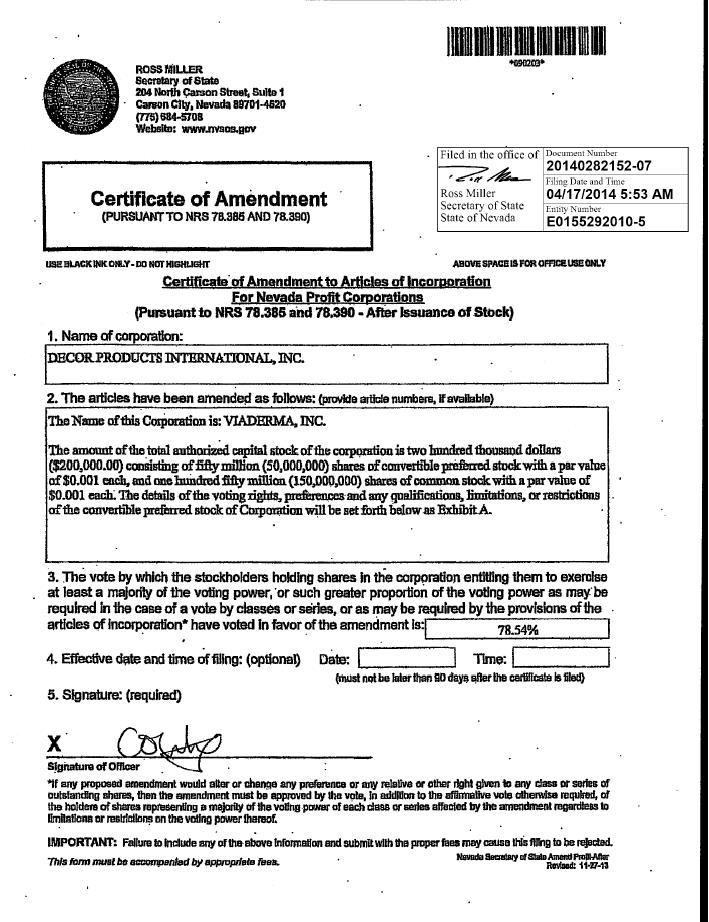
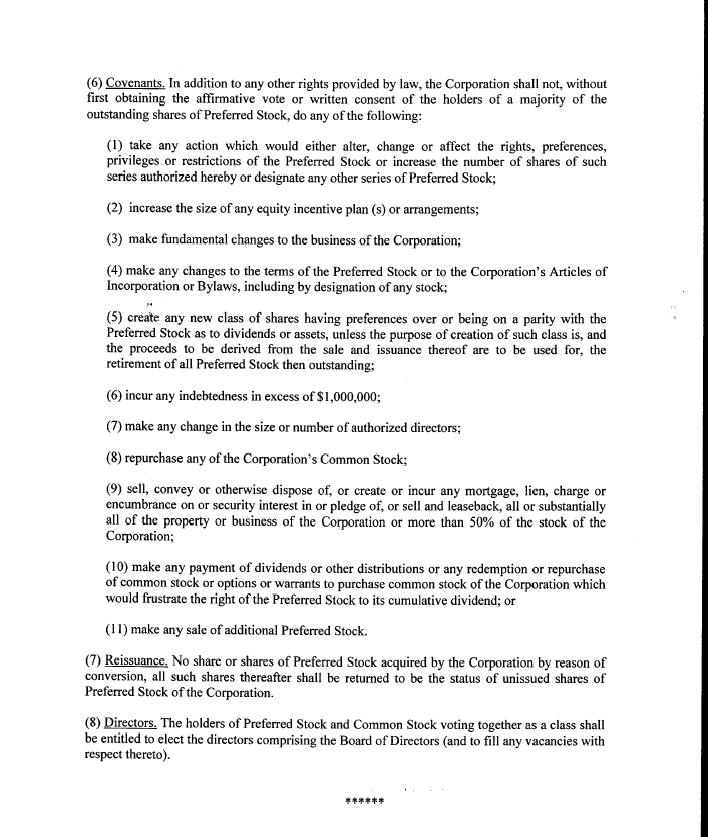
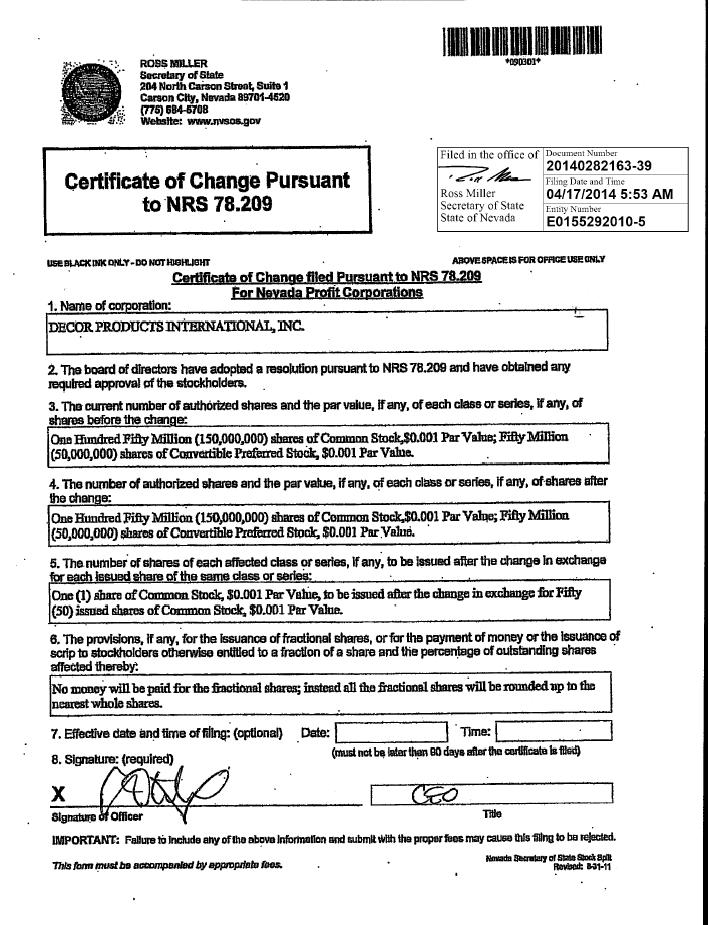
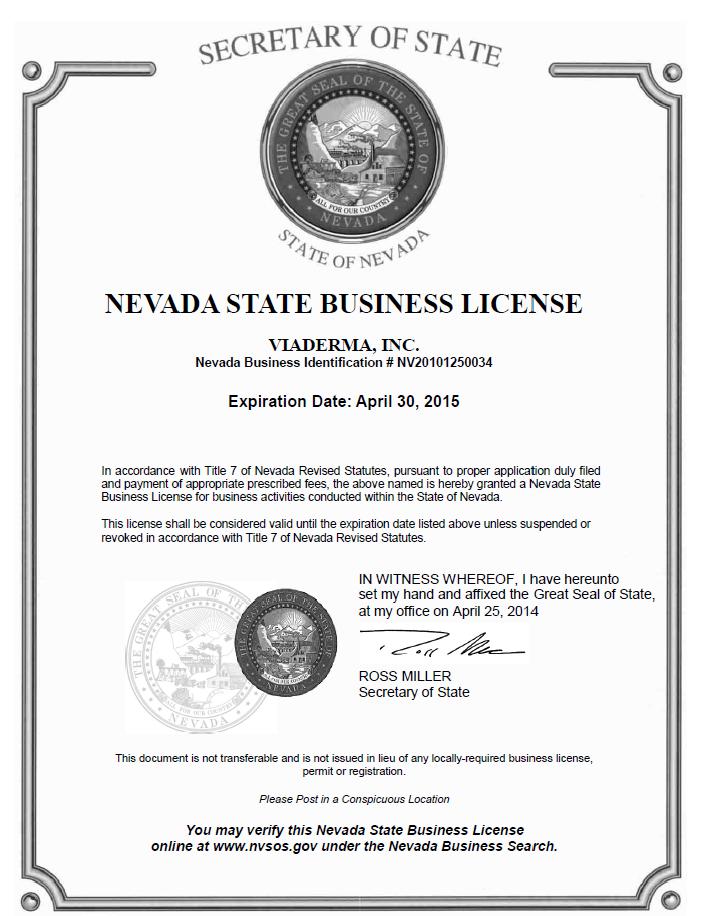
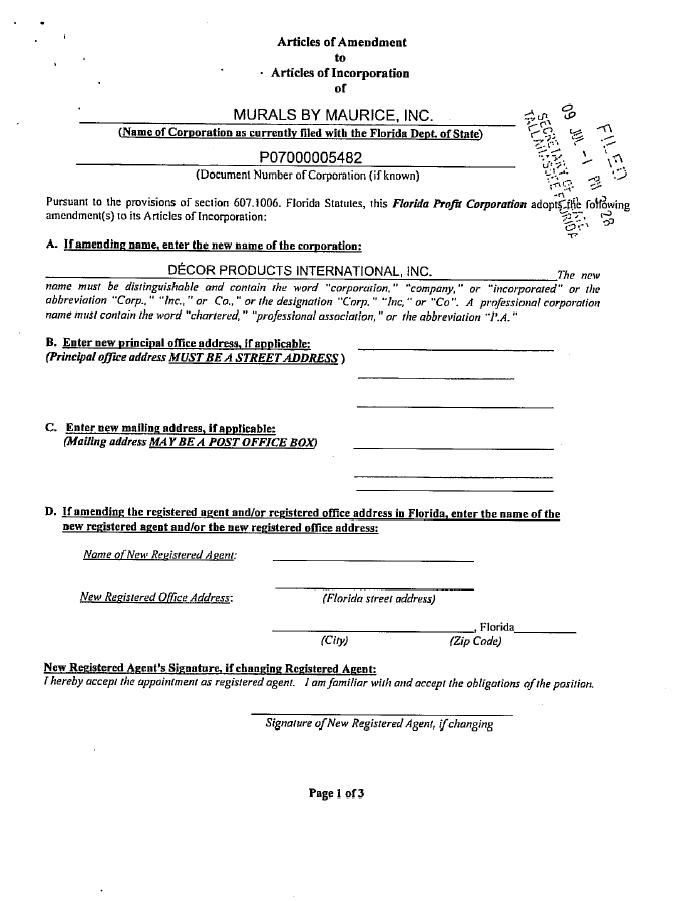
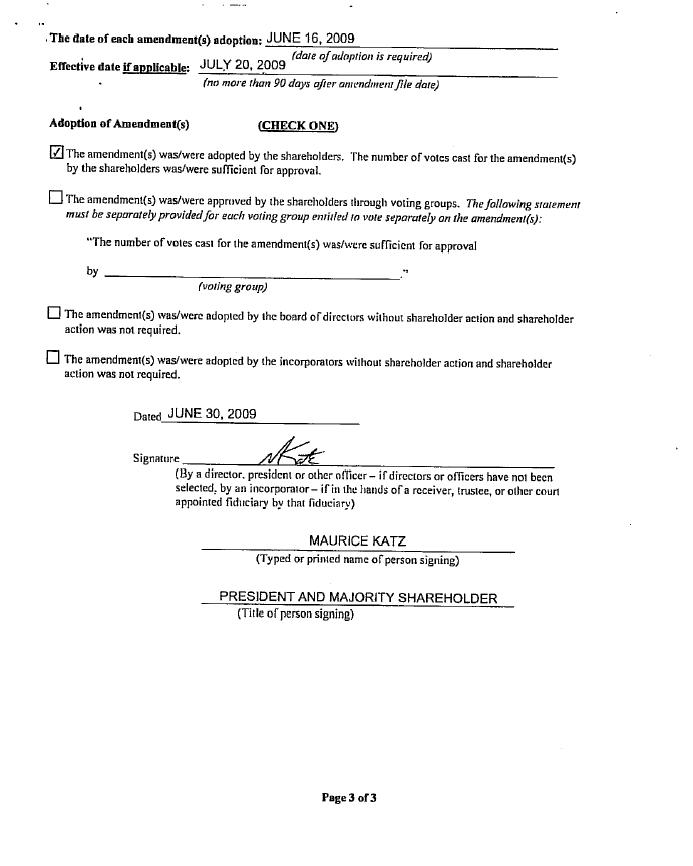
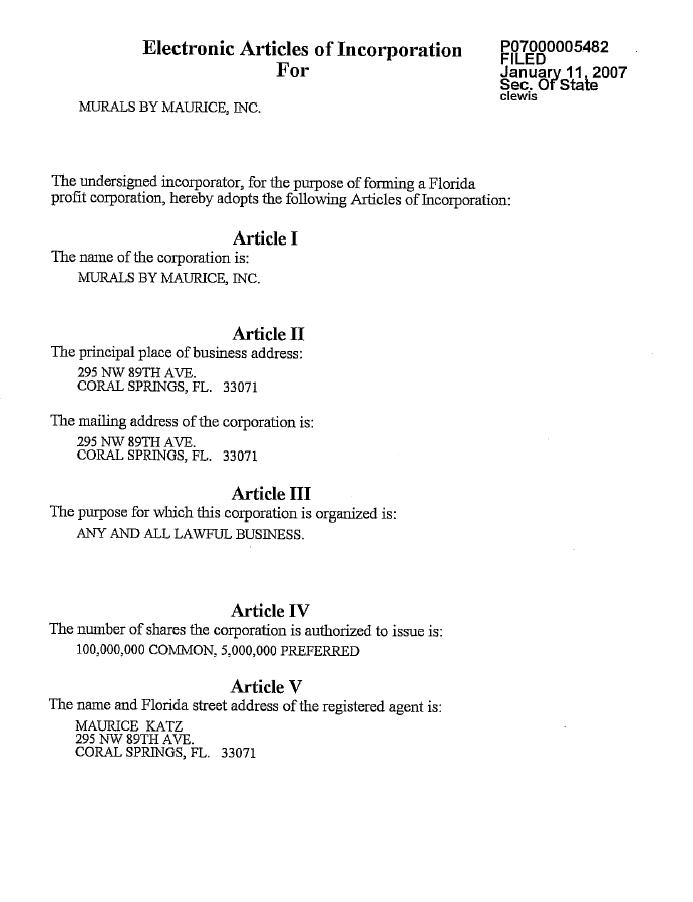
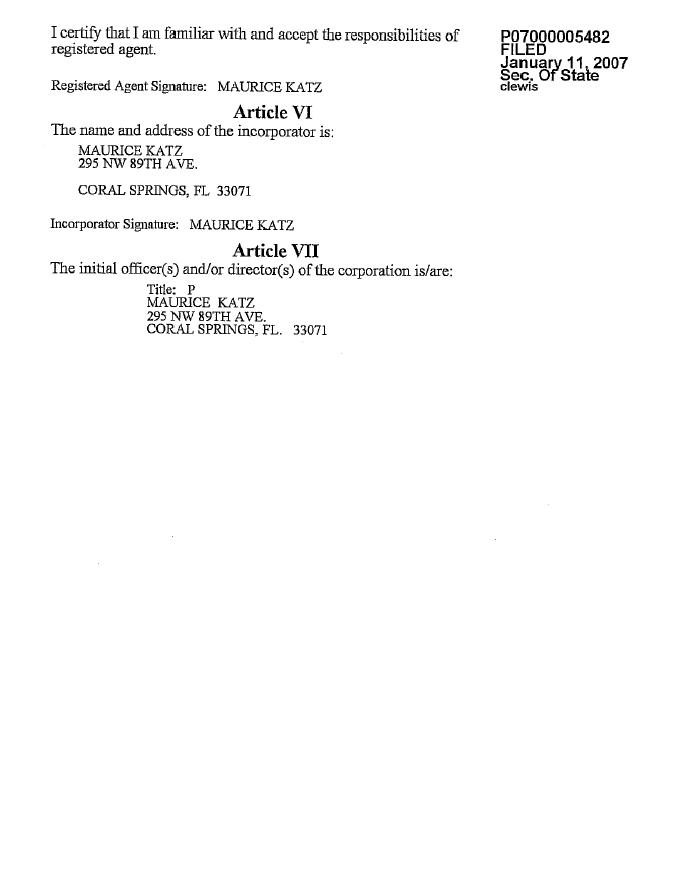
ViaDerma, Inc. was incorporated in the State of Florida on January 11, 2007 in the name of Murals By Maurice, Inc. On July 1, 2009, the Company changed its name to Décor International Products, Inc. On January 20, 2010 the Company filed Articles of Merger with the Secretary of State of Florida to effect a merger with Wide Broad Group, LTD a corporation incorporated in the British Virgin Islands. On May 13, 2010, Décor International Products, Inc. filed articles of merger and redomicile to the State of Nevada with DCRD Merger Sub, Inc. The resulting entity, newly domiciled in Nevada remained Décor Products International, Inc. until May 6, 2014 when it changed its name to ViaDerma, Inc.
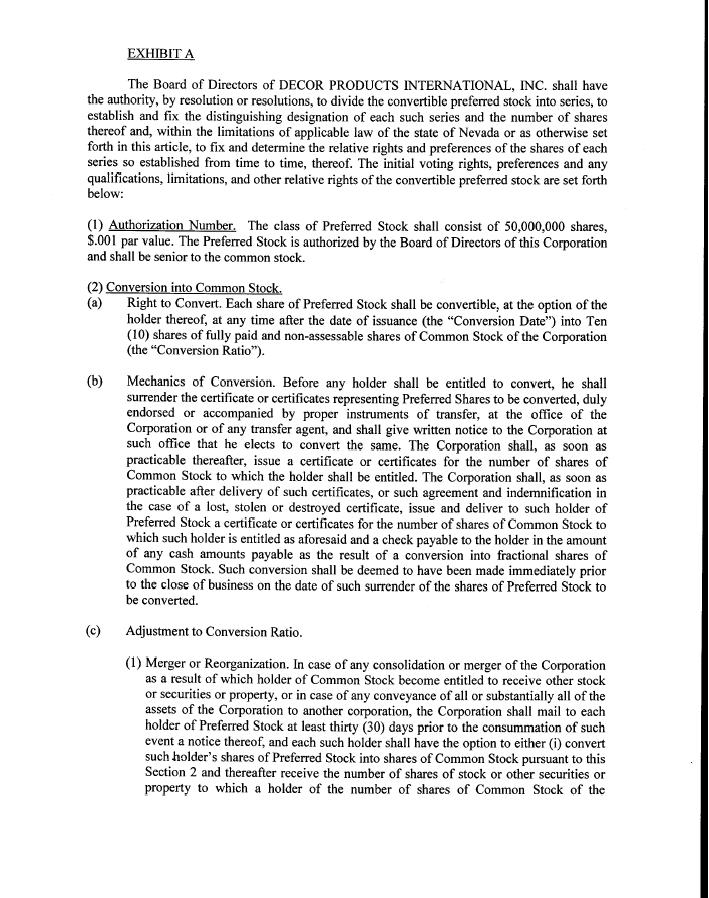
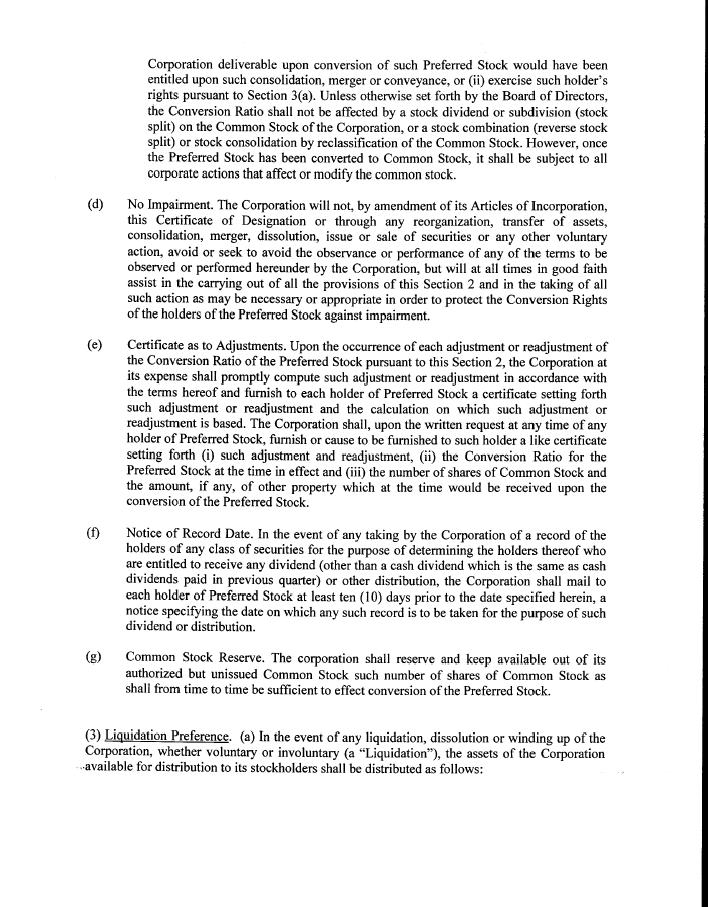
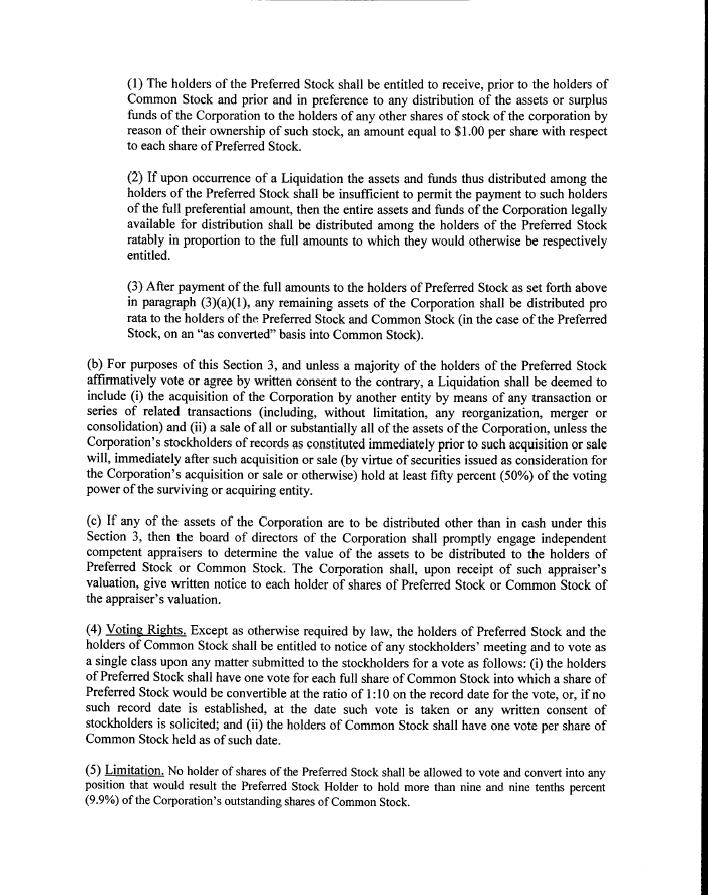
The Company is currently authorized to issue a total of 15,000,000 shares of common stock, par value $0.001, and 50,000,000 shares of Convertible Preferred Stock, par value of $0.001. As of December 29, 2017, the Company had approximately 467,086,221 shares of common stock and 31,000,000 shares of Convertible Preferred Stock outstanding.
Business Overview
ViaDerma, Inc.’s lead product is an FDA registered topical antibiotic called that will be sold under the brand name Vitastem™. The Company also has products in development in the following fields; anti-aging skin care, pain management, hair-loss, and toenail fungus. The products are based on a patent pending delivery system technology that allows for rapid mass transfer of the pharmaceutical active ingredient across the skin and into the body to provide immediate localized therapy. Detailed product information is available online by accessing the Government website, DailyMed.
| (3) |
Emerging Growth Company
We are an emerging growth company under the JOBS Act. We shall continue to be deemed an emerging growth company until the earliest of:
| (a) | the last day of the fiscal year of the issuer during which it had total annual gross revenues of $1,500,000,000 (as such amount is indexed for inflation every five years by the Commission to reflect the change in the Consumer Price Index for All Urban Consumers published by the Bureau of Labor Statistics, setting the threshold to the nearest 1,000,000) or more; | |
| (b) | the last day of the fiscal year of the issuer following the fifth anniversary of the date of the first sale of common equity securities of the issuer pursuant to an effective IPO registration statement; | |
| (c) | the date on which such issuer has, during the previous three-year period, issued more than $1,500,000,000 in nonconvertible debt; or | |
| (d) | the date on which such issuer is deemed to be a ‘large accelerated filer’, as defined in section 240.12b-2 of title 17, Code of Federal Regulations, or any successor thereto.’ |
The Section 107 of the JOBS Act provides that we may elect to utilize the extended transition period for complying with new or revised accounting standards and such election is irrevocable if made. As such, we have made the election to use the extended transition period for complying with new or revised accounting standards under Section 102(b)(1) of the JOBS Act. Please refer to a discussion under “Risk Factors” of the effect on our financial statements of such election.
As an emerging growth company we are exempt from Section 404(b) of Sarbanes Oxley. Section 404(a) requires Issuers to publish information in their annual reports concerning the scope and adequacy of the internal control structure and procedures for financial reporting. This statement shall also assess the effectiveness of such internal controls and procedures. Section 404(b) requires that the registered accounting firm shall, in the same report, attest to and report on the assessment on the effectiveness of the internal control structure and procedures for financial reporting. As an emerging growth company we are also exempt from Section 14A (a) and (b) of the Securities Exchange Act of 1934 which require the shareholder approval of executive compensation and golden parachutes.
We have elected to use the extended transition period for complying with new or revised accounting standards under Section 102(b)(2) of the JOBS Act, that allows us to delay the adoption of new or revised accounting standards that have different effective dates for public and private companies until those standards apply to private companies. As a result of this election, our financial statements may not be comparable to companies that comply with public company effective dates.
| (4) |
Going Concern
As of September 30, 2017, the Company was in default on the repayment of certain convertible notes and promissory notes with an aggregate principal amount of $266,000, which are immediately due and payable. The continuation of the Company as a going concern through December 31, 2017 is dependent upon the continuing financial support from its stockholders or negotiation of repayment term. Management believes the existing shareholders will provide the additional cash to meet the Company’s obligations as they become due. These factors raise substantial doubt about the Company’s ability to continue as a going concern.
The Offering
This circular relates to the offering of up to 115,000,000 shares of our common stock, of which 100,000,000 shares are being offered by the Company and 15,000,000 shares are being offered by selling shareholders. Shares will be sold for $______________ [$0.01-$0.05] per share, for total offering proceeds of up to $5,750,000 ($5,000,000 to Company and $750,000 to selling shareholders) if all offered shares are sold.
The minimum amount established for investors purchasing from the Company is $10,000, unless such minimum is waived by the Company, in its sole discretion, on a case-by-case basis. Sales by selling shareholders will be privately negotiated or through their respective broker dealers and the selling shareholders will be entitled to keep all proceeds from their sale of shares. There is no minimum offering amount and no provision to escrow or return investor funds if any minimum number of shares is not sold. All funds raised by the Company from this offering will be immediately available for the Company’s use.
Shares offered by the Company will be sold by our directors and executive officers. We may also elect to engage licensed broker-dealers. No sales agents have yet been engaged to sell shares. The Company will not pay for any selling expenses of the selling shareholders. All shares will be offered on a “best-efforts” basis. Investors may be publicly solicited provided the “blue sky” regulations in the states in which the Company solicits investors allow such solicitation.
This offering will terminate at the earlier to occur of: (i) all shares offered hereby are sold, or (ii) one year from the date this offering circular is qualified with the SEC. Notwithstanding the foregoing, the Company may terminate this offering at any time or extend this offering by 90 days, in its sole discretion.
| (5) |
ABOUT THIS CIRCULAR
We have prepared this offering circular to be filed with the SEC for our offering of securities. The offering circular includes exhibits that provide more detailed descriptions of the matters discussed in this circular. You should rely only on the information contained in this circular and its exhibits. We have not authorized any person to provide you with any information different from that contained in this circular. The information contained in this circular is complete and accurate only as of the date of this circular, regardless of the time of delivery of this circular or sale of our shares. This circular contains summaries of certain other documents, but reference is hereby made to the full text of the actual documents for complete information concerning the rights and obligations of the parties thereto. All documents relating to this offering and related documents and agreements, if readily available to us, will be made available to a prospective investor or its representatives upon request.
INDUSTRY AND MARKET DATA
The industry and market data used throughout this circular have been obtained from our own research, surveys or studies conducted by third parties and industry or general publications. Industry publications and surveys generally state that they have obtained information from sources believed to be reliable, but do not guarantee the accuracy and completeness of such information. We believe that each of these studies and publications is reliable. We have not engaged any person or entity to provide us with industry or market data.
TAX CONSIDERATIONS
No information contained herein, nor in any prior, contemporaneous or subsequent communication should be construed by a prospective investor as legal or tax advice. We are not providing any tax advice as to the acquisition, holding or disposition of the securities offered herein. In making an investment decision, investors are strongly encouraged to consult their own tax advisor to determine the U.S. Federal, state and any applicable foreign tax consequences relating to their investment in our securities. This written communication is not intended to be “written advice,” as defined in Circular 230 published by the U.S. Treasury Department.
| (6) |
RISK FACTORS
In addition to the other information provided in this circular, you should carefully consider the following risk factors in evaluating our business and before purchasing any of our common stock. All material risks identified by the Company are discussed in this section.
Risks Related to our Business
Our accountant has indicated doubt about our ability to continue as a going concern.
Our accountant has expressed doubt about our ability to continue as a going concern. Our financial statements do not include adjustments that might result from the outcome of this uncertainty. If we are unable to generate significant revenue or secure financing we may be required to cease or curtail our operations.
We will need a significant amount of capital to carry out our proposed business plan and, unless we are able to raise sufficient funds or generate sufficient revenues, we may be forced to discontinue our operations.
We currently have sufficient capital to carry the Company for approximately 1 month, at which time the Company will require additional capital, either from this offering, revenues or from alternative sources, which alternative sources may include debt or equity financing on more favorable terms than those offered pursuant to this offering statement. Our ability to obtain the necessary financing to execute our business plan is subject to a number of factors, including general market conditions and investor acceptance of our business plan. These factors may make the timing, amount, terms and conditions of such financing unattractive or unavailable to us. If we are unable to raise sufficient funds or generate them through revenues, we will have to significantly reduce our spending, delay or cancel our planned activities or substantially change our current corporate structure. There is no guarantee that we will be able to obtain any funding or that we will have sufficient resources to continue to conduct our operations as projected, any of which could mean that we will be forced to discontinue our operations.
We are currently engaged in a lawsuit over the intellectual property used to deliver our products.
The plaintiff in such lawsuit has alleged that he had a licensing arrangement with Dr. Howard Phillips for some of the patents related to the first-generation transdermal delivery system that were licensed by Dr. Phillips to the Company. The lawsuit further alleges that, through a separate consulting agreement Dr. Chris Otiko had with Thru Pharma, LLC, an entity related to the plaintiff, that Dr. Chris Otiko should need to assign the rights of the transdermal patent to the plaintiff. Should the plaintiff be successful in his suit, it could materially, negatively impact the Company and its manufacture and sale of its products.
We may incur substantial costs as a result of litigation or other proceedings relating to patent and other intellectual property rights.
A third party may sue us or one of our strategic collaborators for infringing its intellectual property rights. Likewise, we may need to resort to litigation to enforce licensed rights or to determine the scope and validity of third-party intellectual property rights.
The cost to us of any litigation or other proceeding relating to intellectual property rights, even if resolved in our favor, could be substantial, and the litigation would divert our efforts. Some of our competitors may be able to sustain the costs of complex patent litigation more effectively than we can because they have substantially greater resources. If we do not prevail in this type of litigation, we or our strategic collaborators may be required to pay monetary damages; stop commercial activities relating to the affected products or services; obtain a license in order to continue manufacturing or marketing the affected products or services; or attempt to compete in the market with a substantially similar product.
| (7) |
Uncertainties resulting from the initiation and continuation of any litigation could limit our ability to continue some of our operations. In addition, a court may require that we pay expenses or damages, and litigation could disrupt our commercial activities.
Any inability to protect our intellectual property rights could reduce the value of our technologies and brand, which could adversely affect our financial condition, results of operations and business.
Our business is partly dependent upon our licensed patents, trademarks, trade secrets, copyrights and other intellectual property rights. Effective intellectual property rights protection, however, may not be available under the laws of every country in which we and our sub-licensees may operate. There is a risk of certain valuable trade secrets, beyond what is described publicly in patents, being exposed to potential infringers. Regardless of the Company’s technology being protected by patents or otherwise, there is a risk that other companies may employ the technology without authorization and without recompensing us.
The efforts we have taken to protect our proprietary rights may not be sufficient or effective. Any significant impairment of our intellectual property rights could harm our business or our ability to compete. In addition, protecting our intellectual property rights is costly and time consuming. There is a risk that we may have insufficient resources to counter adequately such infringements through negotiation or the use of legal remedies. It may not be practicable or cost effective for us to fully protect our intellectual property rights in some countries or jurisdictions. If we are unable to successfully identify and stop unauthorized use of our intellectual property, we could lose potential revenue and experience increased operational and enforcement costs, which could adversely affect our financial condition, results of operations and business.
The intellectual property behind our technology may include unpublished know-how as well as existing and pending patent protection. All patent protection eventually expires, and unpublished know-how is dependent on key individuals.
The commercialization of our technology is partially dependent upon know-how and trade secrets held by certain individuals working with and for us. Because the expertise runs deep in these few individuals, if something were to happen to any or all of them, the ability to properly operate our technologies without compromising quality and performance could be diminished greatly.
Knowledge published in the form of patents has finite protection, as all patents have a limited life and an expiration date. While continuous efforts will be made to apply for additional patents if appropriate, there is no guarantee that additional patents will be granted. The expiration of patents relating to our technology may hinder our ability to sub-license or sell the technology for a long period of time without the development of a more complex licensing strategy.
Our potential for rapid growth and our entry into new markets make it difficult for us to evaluate our current and future business prospects, and we may be unable to effectively manage any growth associated with these new markets, which may increase the risk of your investment and could harm our business, financial condition, results of operations and cash flow.
Our proliferation into new markets may place a significant strain on our resources and increase demands on our executive management, personnel and systems, and our operational, administrative and financial resources may be inadequate. We may also not be able to effectively manage any expanded operations, or achieve planned growth on a timely or profitable basis, particularly if the number of customers using our technology significantly increases or their demands and needs change as our business expands. If we are unable to manage expanded operations effectively, we may experience operating inefficiencies, the quality of our products and services could deteriorate, and our business and results of operations could be materially adversely affected.
If we are unable to keep up with rapid technological changes, our processes, products or services may become obsolete.
The market for our technologies is characterized by significant and rapid change. Although we will continue to expand our technological capabilities in order to remain competitive, research and discoveries by others may make our processes, products or services less attractive or even obsolete.
| (8) |
Competition could adversely affect our business.
Our industry in general is competitive. It is possible that future competitors could enter our market, thereby causing us to move market share and revenues. Further, we are aware of several competitors, each with more resources and market share than us. In addition, some of our current or future competitors may have significantly greater financial, technical, marketing and other resources than we do or may have more experience or advantages in the markets in which we will compete that will allow them to offer lower prices or higher quality technologies, products or services. If we do not successfully compete with these providers, we could fail to develop market share and our future business prospects could be adversely affected.
If we are unable to develop and maintain our brand and reputation for our product offerings, our business and prospects could be materially harmed.
Our business and prospects depend, in part, on developing and then maintaining and strengthening our brand and reputation in the markets we serve. If problems with our technologies cause end users to experience operational disruption or failure or delays in the delivery of their products and services to their customers, our brand and reputation could be diminished. If we fail to develop, promote and maintain our brand and reputation successfully, our business and prospects could be materially harmed.
The development of new products by us involves considerable costs and any new product may not generate sufficient consumer interest and sales to become a profitable brand or to cover the costs of its development and subsequent promotions
We are subject to government regulation, and unfavorable changes could substantially harm our business and results of operations.
We are subject to general business regulations and laws as well as regulations and laws specifically governing our industries in the U.S. and other countries in which we operate. Existing and future laws and regulations may impede our services and increase the cost of providing such services. These regulations and laws may cover taxation, tariffs, user pricing, distribution, consumer protection and the characteristics and quality of services.
General economic conditions could affect our profitability.
A general economic downturn or sudden disruption in business conditions may affect consumer purchases of discretionary items and/or the financial strength of our customers that are retailers, which could adversely affect our financial results
The Company could be effected by a change in the availability of the components used to make its products.
In the event of a significant disruption in the supply of the materials used in the manufacture of our products, we might not be able to locate alternative suppliers of materials of comparable quality at an acceptable price.
We may be subject to product liability claims if people or properties are harmed by the products we sell.
Claims, recalls or actions could be based on allegations that, among other things, the products sold by us are misbranded, contain contaminants or impermissible ingredients, provide inadequate instructions regarding their use or misuse, or include inadequate warnings concerning flammability or interactions with other substances. A significant product liability judgment or a widespread product recall may negatively impact on sales and profitability of the affected brand or all brands for a period of time depending on product availability, competitive reaction and consumer attitudes.
We may be subject to federal regulation, prosecution and civil forfeiture as a result of our CBD infused products.
Cannabis and cannabis derivatives illegal under federal law pursuant to the Controlled Substances Act, as amended (“CSA”). Our CBD is derived from industrial hemp. It is unclear under current federal law to what extent CBD products derived from industrial hemp are subject to the CSA. Any federal enforcement against the Company could materially negatively impact its operations and revenues. The Company intends to limit its sale of CBD products to states in which such activity is legal.
Risks Related to this Offering and Our Securities
The offering price of our shares has been arbitrarily determined.
Our management has determined the shares offered by the Company. The price of the shares we are offering was arbitrarily determined based upon the current market value, illiquidity and volatility of our common stock, our current financial condition and the prospects for our future cash flows and earnings, and market and economic conditions at the time of the offering. The offering price for the common stock sold in this offering may be more or less than the fair market value for our common stock.
| (9) |
We may not register or qualify our securities with any state agency pursuant to blue sky regulations.
The holders of our shares of common stock and persons who desire to purchase them in the future should be aware that there may be significant state law restrictions upon the ability of investors to resell our shares. We currently do not intend to and may not be able to qualify securities for resale in states which require shares to be qualified before they can be resold by our shareholders.
We have broad discretion in the use of the net proceeds from this offering and may not use them effectively.
Our management will have broad discretion in the application of the net proceeds and may spend or invest these proceeds in a way with which our stockholders disagree. The failure by our management to apply these funds effectively could harm our business and financial condition. Pending their use, we may invest the net proceeds from this offering in a manner that does not produce income or that loses value.
Investors may have difficulty in reselling their shares due to the lack of market.
Our common stock is not currently traded on any exchange, but is quoted on OTC Markets Pink marketplace under the trading symbol “VDRM.” There is a limited trading market for our common stock. There is no guarantee that any significant market for our securities will ever develop. Further, the state securities laws may make it difficult or impossible to resell our shares in certain states. Accordingly, our securities should be considered highly illiquid.
We will be subject to penny stock regulations and restrictions and you may have difficulty selling shares of our common stock.
The SEC has adopted regulations which generally define so-called “penny stocks” to be an equity security that has a market price less than $5.00 per share or an exercise price of less than $5.00 per share, subject to certain exemptions. Our common stock is a “penny stock”, and we are subject to Rule 15g-9 under the Exchange Act, or the “Penny Stock Rule”. This rule imposes additional sales practice requirements on broker-dealers that sell such securities to persons other than established customers. For transactions covered by Rule 15g-9, a broker-dealer must make a special suitability determination for the purchaser and have received the purchaser’s written consent to the transaction prior to sale. As a result, this rule may affect the ability of broker-dealers to sell our securities and may affect the ability of purchasers to sell any of our securities in the secondary market.
For any transaction involving a penny stock, unless exempt, the rules require delivery, prior to any transaction in a penny stock, of a disclosure schedule prepared by the SEC relating to the penny stock market. Disclosure is also required to be made about sales commissions payable to both the broker-dealer and the registered representative and current quotations for the securities. Finally, monthly statements are required to be sent disclosing recent price information for the penny stock held in the account and information on the limited market in penny stock.
We do not anticipate that our common stock will qualify for exemption from the Penny Stock Rule. In any event, even if our common stock were exempt from the Penny Stock Rule, we would remain subject to Section 15(b)(6) of the Exchange Act, which gives the SEC the authority to restrict any person from participating in a distribution of penny stock, if the SEC finds that such a restriction would be in the public interest.
We are an “emerging growth company,” and we cannot be certain if the reduced reporting requirements applicable to emerging growth companies will make our common stock less attractive to investors.
We are an “emerging growth company,” as defined in the Jumpstart Our Business Startups Act, or the JOBS Act. The Section 107 of the JOBS Act provides that we may elect to utilize the extended transition period for complying with new or revised accounting standards and such election is irrevocable if made. As such, we have made the election to use the extended transition period for complying with new or revised accounting standards under Section 102(b)(1) of the JOBS Act.
| (10) |
As an emerging growth company we are exempt from Section 404(b) of Sarbanes Oxley. Section 404(a) requires Issuers to publish information in their annual reports concerning the scope and adequacy of the internal control structure and procedures for financial reporting. This statement shall also assess the effectiveness of such internal controls and procedures. Section 404(b) requires that the registered accounting firm shall, in the same report, attest to and report on the assessment on the effectiveness of the internal control structure and procedures for financial reporting. As an emerging growth company we are also exempt from Section 14A (a) and (b) of the Securities Exchange Act of 1934 which require the shareholder approval of executive compensation and golden parachutes.
We have elected to use the extended transition period for complying with new or revised accounting standards under Section 102(b)(2) of the JOBS Act, that allows us to delay the adoption of new or revised accounting standards that have different effective dates for public and private companies until those standards apply to private companies. As a result of this election, our financial statements may not be comparable to companies that comply with public company effective dates.
If securities or industry analysts publish inaccurate or unfavorable research about our business, our stock price could decline.
The trading market for our common stock will depend in part on the research and reports that securities or industry analysts publish about us or our business. If one or more of the analysts who cover us downgrade our common stock or publish inaccurate or unfavorable research about our business, our common stock price would likely decline.
We do not intend to pay dividends for the foreseeable future.
We currently intend to retain any future earnings to finance the operation and expansion of our business, and we do not expect to declare or pay any dividends on our common stock in the foreseeable future.
The market price for our common stock is volatile, which could lead to wide fluctuations in our share price.
Our stock price is particularly volatile when compared to the shares of larger, more established companies that trade on a national securities exchange and have large public floats. The volatility in our share price is attributable to a number of factors. First, our common stock is sporadically and thinly traded. As a consequence of this limited liquidity, the trading of relatively small quantities of shares by our shareholders may disproportionately influence the price of those shares in either direction. The price for our shares could decline precipitously in the event that a large number of our common stock is sold on the market without commensurate demand. Secondly, we are a speculative or “risky” investment due to our limited operating history and lack of significant profits to date, and uncertainty of future market acceptance for our products. Many of these factors are beyond our control and may decrease the market price of our common stock, regardless of our operating performance. We cannot make any predictions or projections as to what the prevailing market price for our common stock will be at any time. Moreover, the OTC Pink marketplace is not a liquid market in contrast to the major stock exchanges. Consequently, you may be unable to sell your common stock at or above your purchase price, which may result in substantial losses to you.
Purchasers of our common stock may experience immediate dilution and/or future dilution.
Our Board of Directors has the authority to cause us to issue additional shares of common stock without consent of any of our stockholders and there are shares of preferred stock that may be converted to common stock. Consequently, the common stockholders may experience dilution in their ownership of our stock in the future and as a result of this offering.
Risks Related to Management and Personnel
We depend heavily on key personnel, and turnover of key senior management could harm our business.
Our future business and results of operations depend in significant part upon the continued contributions of our senior management personnel. If we lose their services or if they fail to perform in their current positions, or if we are not able to attract and retain skilled personnel as needed, our business could suffer. Significant turnover in our senior management could significantly deplete our institutional knowledge held by our existing senior management team. We depend on the skills and abilities of these key personnel in managing the product acquisition, marketing and sales aspects of our business, any part of which could be harmed by turnover in the future. We may not have written employment agreements with all of our senior management. We do not have any key person insurance.
| (11) |
Our management has limited experience in managing the day to day operations of a public company and, as a result, we may incur additional expenses associated with the management of our Company.
The management team is responsible for the operations and reporting of the Company. The requirements of operating as a small public company are many and sometimes difficult to navigate. This may require us to obtain outside assistance from legal, accounting, investor relations, or other professionals that could be more costly than planned. If we lack cash resources to cover these costs of being a public company in the future, our failure to comply with reporting requirements and other provisions of securities laws could negatively affect our stock price and adversely affect our potential results of operations, cash flow and financial condition after we commence operations.
Because we do not have an audit or compensation committee, shareholders will have to rely on the entire board of directors to perform these functions.
We do not have an audit or compensation committee and these functions are performed by the board of directors as a whole. Thus, there is a potential conflict in that board members who are also part of management will participate in discussions concerning management compensation and audit issues that may affect management decisions.
Certain of our stockholders hold a significant percentage of our outstanding voting securities, which could reduce the ability of minority shareholders to effect certain corporate actions.
Our sole officers and directors are the beneficial owners of a majority of our outstanding voting securities. As a result, they possess significant influence over Company elections and votes. As a result, their ownership and control may have the effect of facilitating and expediting a future change in control, merger, consolidation, takeover or other business combination, or encouraging a potential acquirer to make a tender offer. Their ownership and control may also have the effect of delaying, impeding, or preventing a future change in control, merger, consolidation, takeover or other business combination, or discouraging a potential acquirer from making a tender offer.
| (12) |
SPECIAL INFORMATION REGARDING FORWARD LOOKING STATEMENTS
Some of the statements in this circular are “forward-looking statements.” These forward-looking statements involve certain known and unknown risks, uncertainties and other factors which may cause our actual results, performance or achievements to be materially different from any future results, performance or achievements expressed or implied by these forward-looking statements. These factors include, among others, the factors set forth above under “Risk Factors.” The words “believe,” “expect,” “anticipate,” “intend,” “plan,” and similar expressions identify forward-looking statements. Forward-looking statements contained in this Memorandum include, but are not limited to, statements about:
| • | risks and uncertainties associated with our research and development activities; |
| • | the timing or likelihood of regulatory filing and approvals or of alternative regulatory pathways for our products; |
| • | the potential market opportunities for commercializing our products; |
| • | our expectations regarding the potential market size and the size of the consumer populations for our products, and our ability to serve such markets; |
| • | estimates of our expenses, future revenue, capital requirements and our needs for additional financing; |
| • | the implementation of our business model and strategic plans for our business and products; |
| • | the initiation, cost, timing, progress and results of future research and development programs; |
| • | the terms of future licensing arrangements, and whether we can enter into such arrangements at all; |
| • | timing and receipt of revenues, if any; |
| • | the scope of protection we are able to establish and maintain for intellectual property rights covering our products and our ability to operate our business without infringing the intellectual property rights of others; |
| • | regulatory developments in the United States; |
| • | the performance of our third party suppliers and manufacturers; |
| • | our ability to maintain and establish collaborations or obtain additional funding; |
| • | the success of competing therapies that are currently or may become available; |
| • | our use of proceeds from this offering; |
| • | our financial performance; and |
| • | developments and projections relating to our competitors and our industry. |
We caution you that the forward-looking statements highlighted above do not encompass all of the forward-looking statements made in this circular. The outcome of the events described in these forward-looking statements is subject to risks, uncertainties, and other factors described in the section of this circular entitled “Risk Factors” and elsewhere in this circular. Moreover, we operate in a very competitive and challenging environment. New risks and uncertainties emerge from time to time, and it is not possible for us to predict all risks and uncertainties that could have an impact on the forward-looking statements contained in this circular. We cannot assure you that the results, events and circumstances reflected in the forward-looking statements will be achieved or occur, and actual results, events or circumstances could differ materially from those described in the forward-looking statements.
We may not actually achieve the plans, intentions or expectations disclosed in our forward-looking statements and you should not place undue reliance on our forward-looking statements. Our forward-looking statements do not reflect the potential impact of any future acquisitions, mergers, dispositions, joint ventures, other strategic transactions or investments we may make.
We undertake no obligation to update and revise any forward-looking statements or to publicly announce the result of any revisions to any of the forward-looking statements in this document to reflect any future or developments. However, the Private Securities Litigation Reform Act of 1995 is not available to us as a non-reporting issuer. Further, Section 27A(b)(2)(D) of the Securities Act and Section 21E(b)(2)(D) of the Securities Exchange Act expressly state that the safe harbor for forward looking statements does not apply to statements made in connection with an initial public offering.
| (13) |
DILUTION
Investors in this offering will experience immediate dilution, as exampled below, from the sale of shares by the Company. If you invest in our shares, your interest will be diluted to the extent of the difference between the public offering price per share of our common stock and the as adjusted net tangible book value per share of our capital stock after this offering. Net tangible book value per share represents our total tangible assets less total liabilities, divided by the number of shares of common stock outstanding. Net tangible book value dilution per share of common stock to new investors represents the difference between the amount per share paid by purchasers in this offering and the as adjusted net tangible book value per share of common stock immediately after completion of this offering.
As of September 30, 2017, our net tangible book value was estimated at approximately $408,028, or approximately $0.00096869 per share. After giving effect to our sale of the maximum offering amount of 5,000,000 in securities, assuming no other changes since September 30, 2017, our as-adjusted net tangible book value would be approximately $5,408,028, or $0.0104 per share. At an assumed offering price of $0.05 per share, this represents an immediate decrease in net tangible book value of $0. 0396 per share to investors of this offering, as illustrated in the following table:
| Public offering price per share | $ | 0.05 | ||||||
| Net tangible book value per share | $ | 0.00096869 | ||||||
| Change in net tangible book value per share attributable to new investors | $ | 0.009 | ||||||
| Adjusted net tangible book value per share | $ | 0.0104 | ||||||
| Dilution to new investors in this offering | $ | 0.0396 |
The above calculations are based on 421,214,603 common shares issued and outstanding as of September 30, 2017 before adjustments and 521,214,603 common shares outstanding after adjustment, assuming the Company sells all 100,000,000 of its offered shares without additional shares issued, assets acquired or liabilities incurred, which assumption is made for purposes of the above calculations only.
| (14) |
PLAN OF DISTRIBUTION AND SELLING SHAREHOLDERS
We are offering up to 100,000,000 shares of our common stock at a price of $______________ [$0.01-$0.05] per share, for total offering proceeds of up to $5,000,000 if all offered shares are sold. The minimum amount established for investors is $10,000, unless such minimum is waived by the Company, in its sole discretion, on a case-by-case basis.
There is no minimum offering amount or provision to escrow or return investor funds if any minimum number of shares is not sold, and we may sell significantly fewer shares of common stock than those offered hereby. In fact, there can be no assurances that the Company will sell any or all of the offered shares. All funds received from the Company will be immediately available for its use.
Upon this circular being qualified by the SEC, the Company may offer and sell shares from time to time until all of the shares registered are sold; however, this offering will terminate one year from the initial qualification date of this circular, unless extended or terminated by the Company. The Company may terminate this offering at any time and may also extend the offering term by 90 days.
Currently, we plan to have our directors and executive officers and directors sell the shares offered hereby on a self-underwritten basis. They will receive no discounts or commissions. Our executive officers will deliver this circular to those persons who they believe might have interest in purchasing all or a part of this offering. The Company may generally solicit investors; however, it must abide by the “blue sky” regulations relating to investor solicitation in the states where it will solicit investors. All shares will be sold on a “best efforts” basis.
Our directors and officers will not register as broker-dealers under Section 15 of the Securities Exchange Act of 1934 in reliance upon Rule 3a4-1. Rule 3a4-1 sets forth those conditions under which a person associated with an issuer may participate in the offering of the issuer’s securities and not be deemed to be a broker-dealer. The conditions are that:
| | the person is not statutorily disqualified, as that term is defined in Section 3(a)(39) of the Act, at the time of his participation; and |
| | the person is not at the time of their participation an associated person of a broker-dealer; and |
| | the person meets the conditions of paragraph (a)(4)(ii) of Rule 3a4-1 of the Exchange Act, in that he (i) primarily performs, or is intended primarily to perform at the end of the offering, substantial duties for or on behalf of the issuer otherwise than in connection with transactions in securities; and (ii) is not a broker or dealer, or an associated person of a broker or dealer, within the preceding 12 months; and (iii) does not participate in selling and offering of securities for any issuer more than once every 12 months other than in reliance on paragraphs (a)(4)(i) or (a)(4)(iii) of Rule 3a4-1 of the Exchange Act. |
Our officers and directors are not statutorily disqualified, are not being compensated, and are not associated with a broker-dealer. They are and will continue to hold their positions as officers or directors following the completion of the offering and have not been during the past 12 months and are currently not brokers or dealers or associated with brokers or dealers. They have not nor will they participate in the sale of securities of any issuer more than once every 12 months.
As of the date of this circular, we have not entered into any arrangements with any selling agents for the sale of the securities; however, we may engage one or more selling agents to sell the securities in the future. If we elect to do so, we will supplement this circular as appropriate.
In various states, the securities may not be sold unless these securities have been registered or qualified for sale in such state or an exemption from registration or qualification is available and is complied with. We have not yet applied for “blue sky” registration in any state, and there can be no assurance that we will be able to apply, or that our application will be approved and our securities will be registered, in any state in the US. We intend to sell the shares only in the states in which this offering has been qualified or an exemption from the registration requirements is available, and purchases of shares may be made only in those states.
All subscription agreements and checks received by the Company for the purchase of shares are irrevocable until accepted or rejected by the Company and should be delivered to the Company as provided in the subscription agreement. A subscription agreement executed by a subscriber is not binding on the Company until it is accepted on our behalf by the Company’s CEO or by specific resolution of our Board of Directors. Any subscription not accepted within 30 days will be automatically deemed rejected. Once accepted, the Company will deliver a stock certificate to a purchaser within five days from request by the purchaser; otherwise purchasers’ shares will be noted and held on the book records of the Company.
| (15) |
Selling Shareholders
The persons and entities named below are the “selling shareholders.” The table assumes that all of the securities will be sold in this offering. However, any or all of the securities listed below may be retained by any of the selling shareholders, and therefore, no accurate forecast can be made as to the number of securities that will be held by the selling shareholders upon termination of this offering.
Selling shareholders are offering up to 15,000,000 shares of common stock at a price of $______________ [$0.01-$0.05] per share, for total offering proceeds of up to $750,000 if all offered shares are sold. We will not receive proceeds from the sale of shares from the selling shareholders.
Selling shareholders in this offering may be considered underwriters, as that term is defined in Section 2(a)(11) of the Securities Act. We are not aware of any underwriting arrangements that have been entered into by the selling shareholders. The distribution of the securities by the selling shareholders may be effected in one or more transactions that may take place in the OTC Markets, including broker's transactions or privately negotiated transactions.
The selling shareholders may pledge all or a portion of the securities owned as collateral for margin accounts or in loan transactions, and the securities may be resold pursuant to the terms of such pledges, margin accounts or loan transactions. Upon default by such selling shareholders, the pledge in such loan transaction would have the same rights of sale as the selling shareholders under this circular. The selling shareholders may also enter into exchange traded listed option transactions, which require the delivery of the securities listed under this circular. The selling shareholders may also transfer securities owned in other ways not involving market makers or established trading markets, including directly by gift, distribution, or other transfer without consideration, and upon any such transfer the transferee would have the same rights of sale as such selling shareholders under this circular.
Each of the selling shareholders will be affected by the applicable provisions of the Securities Exchange Act of 1934, including, without limitation, Regulation M, which may limit the timing of purchases and sales of any of the securities held by the selling shareholders or any such other person. We have instructed our selling shareholders that they may not purchase any of our securities while they are selling shares under this offering statement.
We will not pay for any expenses relating to the sale of shares by the selling shareholders except the fee for this offering statement, edgarizing and other expenses related to filing this offering statement.
Except as noted, we believe that the selling shareholders holders listed in the table have sole voting and investment powers with respect to the securities indicated. The selling shareholders each have an agreement with the Company to register their shares in consideration for bridge financing previously provided by the selling shareholders. We will not receive any proceeds from the sale of the securities by the selling shareholders. None of our selling shareholders is, or is affiliated with, a broker-dealer.
| Selling Shareholder | Holdings of Selling Shareholder Prior to Offering [1] | Percent of Outstanding Stock Held by Selling Shareholder [2] | Securities Being Offered by Selling Shareholder [3] | Holdings of Selling Shareholder After Offering |
| The Thomas Group LLC [4] | 136,500 | 0.13% | 15,000,000 | 0 |
| Selling shareholders as a group | 136,500 | 0.13% | 15,000,000 | 0 |
(1) Assumes the full conversion of the convertible promissory note held by the selling shareholder as of January 18, 2018. Prior to conversion, the selling shareholder does not hold any shares in the Company.
(2) The percentages in the above table are based on 473,222,721 common shares outstanding, which includes 467,086,221 common shares outstanding as of December 29, 2017 and the 6,136,500 shares presumed converted by the selling shareholder as detailed in note 1 above.
(3) In order to sell any shares pursuant to this offering circular, each selling shareholder must first convert all or part of its convertible promissory note into common shares of the Company. The conversion price is variable based on the market price of the Company’s common stock. The Company is registering 15,000,000 shares on behalf of the selling shareholder to account for fluctuations in the Company’s common stock, which will in turn affect the number of shares available to be sold by the selling shareholder.
(4) The Thomas Group, LLC is a Florida limited liability company controlled by Alan C. Thomas.
| (16) |
OTC Markets Considerations
Our common stock is not now listed on any national securities exchange or the NASDAQ stock market; however, the Company’s common stock is quoted on OTC Markets Pink marketplace. There is currently only a limited market for our securities and there is no guarantee that a more substantial or active trading market will develop in the future. There is also no guarantee that our securities will ever trade on any listed exchange. Accordingly, our shares should be considered highly illiquid, which inhibits investors’ ability to resell their shares.
The OTC Markets is separate and distinct from the NASDAQ stock market or other national exchange. NASDAQ has no business relationship with issuers of securities quoted on the OTC Markets. The SEC’s order handling rules, which apply to NASDAQ-listed securities, do not apply to securities quoted on the OTC Markets.
Although the NASDAQ and other national stock markets have rigorous listing standards to ensure the high quality of their issuers, and can delist issuers for not meeting those standards; the OTC Markets has no listing standards. Rather, it is the market maker who chooses to quote a security on the system, files the application, and is obligated to comply with keeping information about the issuer in its files.
Investors may have greater difficulty in getting orders filled than if we were on NASDAQ or other exchanges. Trading activity in general is not conducted as efficiently and effectively on OTC Markets as with exchange-listed securities. Also, because OTC Markets stocks are usually not followed by analysts, there may be lower trading volume than for NASDAQ-listed securities.
| (17) |
USE OF PROCEEDS
The following table illustrates the amount of net proceeds to be received by the Company on the sale of shares by the Company and the intended uses of such proceeds over an approximate 12 month period. The Company will not receive any proceeds from the sale of shares by the selling shareholders.
| Capital Sources and Uses | ||||
| 100 | % | |||
| Gross Offering Proceeds | $ | 5,000,000 | ||
| Use of Proceeds: | ||||
| Offering Expenses(1) | $ | 23,000 | ||
| Inventory (2) | $ | 1,000,000 | ||
| Research and Development(3) | $ | 50,000 | ||
| Salaries to Officers and Directors(4) | $ | 500,000 | ||
| Investor Relations(5) | $ | 6,000 | ||
| Accounting(6) | $ | 3,000 | ||
| Travel(7) | $ | 25,000 | ||
| Marketing(8) | $ | 750,000 | ||
| Legal Expenses(9) | $ | 250,000 | ||
| Working Capital Reserves(10) | $ | 2,393,000 |
________________
| (1) | The Company expects to pay approximately $23,000 in expenses relating to this offering including legal fees, accounting fees, printing, travel and reimbursements for these expenses previously incurred by the Company’s management. |
| (2) | Assuming a fully funded offering, the Company intends to acquire approximately $1,000,000.00 in inventory. |
| (3) | The Company expects to spend approximately $50,000.00 in offering proceeds on researching and developing new products. |
| (4) | The Company intends to clean up its balance sheet by paying Dr. Chris Ayo Otiko for compensation which is owed to him and has been deferred. |
| (5) |
The Company intends to utilize $6,000.00 to pay consultants providing IR services for the Company. |
| (6) | The Company expects to utilize up to $3,000.00 in offering proceeds for its ongoing accounting fees. |
| (7) | The Company anticipates travel expenses relating to promoting the Company and its products to the public. |
(8)
|
The Company intends to apply offering proceeds towards marketing campaigns for its products, with a focus towards distributor promotions. |
| (9) | The Company intends to allocate approximately 250,000.00 towards legal expenses related protecting its intellectual property rights and its commercial transactions. |
| (10) | The Company will use working capital to pay for miscellaneous and general operating expenses. |
In the event the Company does not sell all shares offered hereby, it intends to reduce the allocation to working capital. Once no proceeds are available for allocation to working capital reserves, the Company intends to proportionately reduce the amount of proceeds allocated to each other category above, which are listed in order of priority.
The allocation of the use of proceeds among the categories of anticipated expenditures represents management’s best estimates based on the current status of the Company’s proposed operations, plans, investment objectives, capital requirements, and financial conditions. Future events, including changes in economic or competitive conditions of our business plan or the completion of less than the total offering, may cause the Company to modify the above-described allocation of proceeds. The Company’s use of proceeds may vary significantly in the event any of the Company’s assumptions prove inaccurate. We reserve the right to change the allocation of net proceeds from the offering as unanticipated events or opportunities arise.
| (18) |
DESCRIPTION OF BUSINESS
Organization
ViaDerma, Inc. was incorporated in the State of Florida on January 11, 2007 in name of Murals By Maurice, Inc. On July 1, 2009, the Company changed its name to Décor International Products, Inc. On January 20, 2010 the Company filed Articles of Merger with the Secretary of State of Florida to effect a merger with Wide Broad Group, LTD a corporation incorporated in the British Virgin Islands. On May 13, 2010, Décor International Products, Inc. filed articles of merger and redomicile to the State of Nevada with DCRD Merger Sub, Inc. The resulting entity, newly domiciled in Nevada remained Décor Products International, Inc. until May 6, 2014 when it changed its name to ViaDerma, Inc.
Business
ViaDerma, Inc’s lead product is an FDA registered topical antibiotic called Viabecline or Vitastem™. The Company also has products in development in the following fields; anti-aging skin care, pain management, hair-loss, and toenail fungus. The products are based on a patent pending delivery system technology that allows for rapid mass transfer of the pharmaceutical active ingredient across the skin and into the body to provide immediate localized therapy. Detailed product information about Viabecline is available online by accessing the Government website, DailyMed.
The Company utilizes a specific Trade Secret Formulation System in the manufacture of all the products. On January 31, 2014, the Company purchased an exclusive license (the "License") on the patent pending technology from Dr. Howard Phillips represented by US Patent application #20130190274. The Company amended the License on January 20, 2017 such that it is now a non-exclusive distribution and licensing agreement.
Apart from the technology licensed from Dr. Howard Phillips, the Company is currently using a second-generation transdermal technology to manufacture and develop its products. This technology was exclusively licensed from a related party. During 2016, provisional patents were filed on this technology. The Company received provisional patent #62433964 ‘AQUEOUS TOPICAL SOLUTIONS for this technology. The Company believes the newer technology has additional benefits and plans to incorporate this topical delivery system into most, if not all of its future products.
In June 2017, the Company received notification that its newer product Prolayed (15ml), was also registered with the FDA.
| (19) |
The Company is in the early development stage of a medical cannabis product containing cannabidiol (“CBD”) that can be absorbed through the skin with our proprietary transdermal delivery system. A provisional patent application using the combination of CBD and THC with the delivery system was filed in 2017 (Provisional Patent # 62466209). The use of CBD is aimed at the reduction of inflammation and for the treatment of several diseases, such as, nicotine addiction, fibromyalgia, Cohn's disease, schizophrenia, migraine headaches, pain management for cancer and Multiple Sclerosis.
In addition, the Company has filed with the Food and Drug Administration (FDA) for a new over the counter or OTC version of a "Premature Ejaculation Drug". The new "OTC Drug" received FDA registration during the second quarter of 2017 (NDC:69006-010-00) and the Company's name of the new drug will portray prolonged endurance. The Company's recent testing of the drug has shown to be successful in retarding the onset of ejaculation during sexual intercourse.
The Company recently engaged an Operations Manager, effective on March 1, 2017, for an initial Go-to-Market strategy. The Operation Manager will initially be responsible for overseeing product manufacturing and development. He will additionally oversee the storage, delivery and fulfillment of our products.
Currently, the Company’s products are sold to local medical practitioners, and patients in clinics primarily in the Los Angeles, California area; however, the Company is moving towards a wholesale distributor model. The Company’s primary goal during 2017 has been to commercially manufacture the product on a larger scale and seek wholesale distribution partners that will carry and sell the product. The Company is presently using a manufacturing partner on the East Coast of the United States. During November 2017, the Company received its first finished order of Vitastem (bottle sizes range from 5ml to 15ml). The Company, along with its wholesale partners, will attempt to sell and distribute the product in several key areas during the next quarter.
In addition to the primary plan of developing and selling new products to the market, the Company is exploring the possibility of licensing the technology to other pharmaceutical companies. As of the date of this filing, the Company has entered into two licensing and distribution agreements as follows:
On January 1, 2017, the Company entered into a licensing and distribution agreement with Biogenx, Inc. for the purpose of commercializing and distributing a topical antibiotic product to be branded VitaStem. The product will carry the Company’s tetracycline-based technology. This product will be separately registered with the FDA. Pursuant to the agreement, the Company will receive 50% of gross profit from sales of Vitastem. For purposes of the agreement, gross profit is defined as total revenues less cost of production, distribution and marketing. In addition ViaDerma will receive an additional 5% of gross sales as a licensing fee. The agreement will terminate on December 31, 2022 unless extended by both parties. Biogenx, Inc. has the right to terminate the agreement early with two month notice if it deems the arrangement to not be financially viable.
On January 1, 2017, the Company entered into a licensing and distribution agreement with Vage Nigeria, Ltd. for the purpose of commercializing and distributing a topical antibiotic product to be branded Dermafix. The product will carry the Company’s tetracycline-based technology. This product will be separately registered with the FDA. Pursuant to the agreement, the Company will receive 50% of the net sales from Dermafix. For purposes of the agreement, net sales is defined as total revenues less cost of production, distribution and marketing (which includes taxes, discounts, allowances, credits for returns, rebates, import duties and other governmental charges, freight and transportation). The agreement will terminate on December 31, 2022 unless extended by both parties. Vage Nigeria, Ltd. has the right to terminate the agreement early with two month notice if it deems the arrangement to not be financially viable.
| (20) |
Intellectual Property
The following table summarizes the intellectual property currently held or applied for by the Company:
| Type of Intellectual Property | Name | Identification Number | Status |
| Trademark | BIOGENX | 87290961 | Live |
| Trademark | VITASTEM | 87227123 | Live |
| Provisional Patent | AQUEOUS TOPICAL SOLUTIONS | 62433964 | |
| Provisional Patent | Medical Marijuana topical ointment | 62466209 | |
| FDA NDC # (ViaDerma) | PROLAYED | 69006-010 | |
| FDA NDC # (ViaDerma) | VIABECLINE 15 ML | 69006-005-00 | |
| FDA NDC # (ViaDerma) | VIABECLINE 28 ML | 69006-005-01 | |
| FDA NDC # (Biogenx) | VITASTEM 5 ML | 71262-002-00 | |
| FDA NDC # (Biogenx) | VITASTEM 15 ML | 71262-002-15 |
Market Information
There are numerous competitors in our segment of the OTC drug market that have greater market share and resources than we do. We believe our competitive edge will be our patent-pending delivery system which we believe significant increases efficacy of normal OTC medications.
The Company’s transdermal delivery system allows for mass transport of active ingredients in medications across the skin faster and more effectively than most other topical medications. This gives the Company the ability to produce a pipeline of OTC topical products that are world-class relatively quickly and inexpensively. For example, Vitastem and Viabecline is one of the world’s strongest broad spectrum topical antibiotic for cuts, scrapes, wounds, infections, infection prevention and burns, infected insect bites and diabetic ulcers and general non-healing wounds. It has been able to heal wounds that have been resistant to even the strongest prescription medication. In addition to our own products, licensing opportunities may arise later with other manufacturers to formulate new versions of their drugs using the Company’s delivery system.
Research and Development
The Company estimates that, combined with Dr. Howard Philipps, $100,000 has been spent over the past three years towards research and development of our products. Dr. Phillips also used his lab facilities and staff towards the development of our delivery system.
Employees
The Company has no full time employees and 1 part time employee to support production and sales support.
| (21) |
Bankruptcy or Receivership
During 2014, the Company defaulted on a note payable to a creditor which resulted in a legal action to issue 520,000 common shares and 1,666,667 preferred shares to the creditor. During the year ended December 31, 2015, 666,667 shares of preferred stock of the Company were converted into 6,666,670 shares of common stock at the ratio of 10:1 upon the request from the preferred shareholder.
Legal Proceedings
The Company is not currently a party to any legal proceedings.
Material Agreements
In addition to the licensing, marketing and distribution agreements relating to its products, the Company has entered into various agreements which may have a material impact on our business operations if they were terminated prior to their expiration date. Below are descriptions of such agreements.
The Company entered into an Employment Agreement with Dr. Chris A. Otiko on January 1, 2017 (the “Employment Agreement”), which is attached hereto as Exhibit 6.1 and is incorporated herein by reference. Pursuant to the Employment Agreement, Dr. Otiko agreed to act as the Company’s President until January 1, 2020. Dr. Otiko is also currently the Company’s sole Director. If Dr. Otiko or the Company should resign or terminate the Employment Agreement prior to January 1, 2020, the Company will have to immediately invest money, time and effort in identifying a new President for the Company.
On March 1, 2017, the Company entered into an Independent Contractor Agreement (the “Contractor Agreement”) with Ivan Klarich. The Contractor Agreement is attached hereto as Exhibit 6.2 and is incorporated herein by reference. Pursuant to the Contractor Agreement, Mr. Klarich agreed to serve as Operations Manager of the Company for a term of one (1) year. Though Mr. Klarich is only considered an independent contractor of the Company, he provides valuable services and the Company would be required to promptly invest money, time and effort in identifying a new Operations Manager for the Company if Mr. Klarich resigned or terminated his Contractor Agreeemnt before the end of its term.
The Company entered into a Financial Advisory Agreement dated April 20, 2017 (the “Advisory Agreement”) with Greentree Financial Group, Inc. (“Greentree”). Pursuant to the Advisory Agreement, which is attached hereto as Exhibit 6.3 and is incorporated herein by reference, Greentree agreed, inter alia, to assist the Company with the preparation of its quarterly and annual reports for the fiscal year 2017. If Greentree should terminate the Advisory agreement prior to the end of its term on December 31, 2017, the Company may not be able to timely file its periodic reports until a replacement for Greentree can be engaged.
Reports to Security Holders
We file alternative reports with OTC Markets. Our filings are available to you free of charge at www.otcmarkets.com.
Government Regulation
The Company is not aware of any government regulations that could adversely affect its products. The active ingredients in its products have been available and approved by the FDA for several decades and the components of the delivery systems are also approved for use by the FDA.
| (22) |
DESCRIPTION OF PROPERTY
The Company leases an office located at 18740 Ventura Blvd, Suite 102, Tarzana, CA 91356 which we use for daily operations, marketing, research and development. The office is approximately 800 square feet with annual rental expense of approximately $10,000. We believe the current office space is sufficient for the next 12 months.
MANAGEMENT’S DISCUSSION AND ANALYSIS OF
FINANCIAL CONDITION AND RESULTS OF OPERATIONS
Issuer’s Plan of Operation for the next twelve months.
ViaDerma, Inc. is a specialty pharmaceutical company committed to bringing new products to the pharmaceutical industry through innovative research and development. The Company attempts to license and sell products in fields of medicine ranging from infectious diseases to stem-cell therapy. The Company’s products are normally applied topically using a patent-pending delivery system technology originally created by Dr. Phillips and Dr. Chris Ayo Otiko. Presently, the products are used within the OTC drug market, i.e. non-prescription. However, the Company believes the delivery system can be used for the prescription medication market as well not only for topical prescription medications but also to turn certain oral medications into topically based medications.
In addition to the primary plan of developing and selling new products to the market, the Company is exploring the possibility of licensing the technology to other pharmaceutical companies. As of the date of this filing, the Company has entered into two licensing and distribution agreements as discussed elsewhere in this circular. The Company has also engaged an operations manager to assist it implement its goals.
For the three and nine months ended September 30, 2017 and 2016 (Unaudited)
Revenues and Cost of Sales
The Company had revenues of $7,002 and $26,802 for the three and nine months ended September 30, 2017, respectively, as compared with $83,500 and $209,573 for the same periods in 2016. The decrease was primarily due to the Company’s strategy to shift selling focus to wholesale distributors instead of mostly local physicians. The Company believes this strategy will be a key component to achieve significant revenue growth. Thus far, the Company has entered into agreements with two distributors during the first nine months of the year and plans to enter into additional agreements during the fourth quarter. Although new orders from these distributors have not been placed to date, the Company believes initial volume indications are very encouraging. The Company experienced a delay in receiving its first large-scale order of its products from its new manufacturer as and such some initial new orders needed to be pushed back until the product arrives. The Company received this order in November 2017 and is now ready and available to fulfill product orders.
The Company had accounts receivable from related party in amount of $371,565 as of September 30, 2017 due to the related party sales in 2016 and 2015. The related party sales were to either Coast to Coast Podiatry Inc. or Neurogenx Nerve Center of Newport Beach, the second office of Coast to Coast Podiatry Inc. opened in September 2016 under a different DBA. Coast to Coast Podiatry Inc. is related by virtue of the majority interest being owned by Dr. Chris Otiko, the President of the Company. In additional to the benefit of the Company getting the sales associated with these transactions, the Company uses this platform to evaluate results and any quality control issues that could arise with the products since Dr. Chris Otiko is able to monitor both businesses. The Neurogenx Nerve Center DBA was recently closed but the primary entity, Coast to Coast Podiatry, Inc., is still obligated to make payments on the receivable balance.
To date, there have not been payments yet towards these amounts. However, the Company expects to begin receiving payments towards the balances during 2018.
| (23) |
Cost of sales were $1,400 and $5,546 for the three and nine months ended September 30, 2017, respectively, compared with $5,984 and $8,298 for the same periods in 2016, respectively. Cost of sales were primarily attributable to the cost of manufacturing and bottling our products. We expect sales to grow in 2017 and moving forward as we build awareness for our products and attempt to sell to larger pharmaceutical product retailers through distributors. We also expect margins to improve if we are successful in selling larger volumes of our products.
Operating Expenses
We had operating expenses of $137,666 and $509,915 for the three and nine months ended September 30, 2017, respectively. This compares with $58,756 and $173,336 for the same periods in 2016, respectively. Operating expenses were higher during 2017 primarily due to increases in stock based compensation, professional fees and officer’s compensation which were $142,050, $98,000 and $180,000 for the 2017 nine-month period, respectively.
The stock based compensation was attributable to 4,500,000 shares of common stock issued for services pursuant to a product marketing contract signed with BK Consulting, LLC. However, the Company and the vendor have had a dispute as to the scope and deliverables of the contract and the contract was cancelled during the third quarter of 2017 prior to any services being rendered. The Company is expecting the shares to be returned and eventually retired back to the Company’s treasury. Upon receipt of these shares, the Company will process a corresponding credit to the same expense account.
The professional fees of $20,000 and $98,000 for the three and nine months ended September 30, 2017 were primarily due to public company compliance costs as well as litigation costs connected to the Steven Keough intellectual property lawsuit as described herein.
The officer compensation of $60,000 is due to the cash and non-cash portions of payments to our President, Dr. Chris Otiko.
On January 1, 2017, the Company entered into an employment agreement with Dr. Chris A. Otiko, the Company’s President, pursuant to which the Company agreed to compensate Dr. Chris Otiko for his contribution and work as the Company’s President for a period of three years in amount of $30,000 per year in cash, plus one-time payment of 30,000,000 shares of Preferred Stock of Company, 20,000,000 shares of which are subject to be cancelled if Dr. Chris Otiko resigns from his position of the Company before December 31, 2019. This employment agreement may be renewed upon mutual written consent.
Based on the price of $.021 per share for the Preferred Stock, which was determined by the market price of common stock at $.0021 per share on the grant date multiplied by the conversion ratio of 1:10, the fair value of the issuance of Preferred Stock was $630,000. Accordingly, the Company booked the stock based compensation pro rata within the relative service period. For the three months ended September 30, 2017, the Company recognized $52,500 to the consolidated statements of operations. The unrecognized compensation was recorded as deferred compensation amounting to $472,500 as of September 30, 2017.
We expect our operating expenses will significantly increase in 2018 as we attempt to build our product line and market our products. However, both operating costs and expected revenue generation are difficult to predict. There can be no assurance that revenues will be sufficient to cover future operating costs, and it may be necessary to continuously raise additional capital to sustain operations.
Product Marketing Contracts
During the second quarter of 2017, the Company engaged four entities to assist in marketing of the Company’s products, primarily in South America. Based on certain performance measures, these entities would have received up to 65,000,000 shares of common stock. Immediately after the agreements were signed there arose a dispute as to the performance measures and the Company did not feel that the written agreements actually portrayed the desires and goals of the Company. Therefore, in the third quarter 2017 the Company sent a notice of cancellation to the parties. As described above, only 4,500,000 of the shares were actually issued pursuant to the agreements. The Company has already received one mutual release from one of the entities representing a maximum of 11,500,000 shares and has reached an agreement in principle to get a release from the other the parties in exchange for a small cash payment. Upon satisfaction of the settlement, the Company expects the 4,500,000 common shares to be returned to the treasury for cancellation.
Income/Losses
We had net losses of $180,673 and $806,657 for the three and nine months ended September 30, 2017 compared with net losses of $30,796 and $217,318 during the same periods in 2016, respectively. The net losses during 2017 increased primarily due to the increase in operating expenses described and also an increase in derivative expenses in connection with the Company’s convertible notes payable which were $509,915 and $140,089, respectively. We are attempting to negotiate payoffs on most of our promissory notes which, if successful, would remove most of our future interest charges. In addition, we also expect to increase sales and marketing costs during 2018.
Impact of Inflation
We believe that inflation has had a negligible effect on operations since inception. We believe that we can offset inflationary increases in the cost of operations by increasing sales and improving operating efficiencies.
| (24) |
Liquidity and Capital Resources
During the nine months September 30, 2017, net cash flows used in operating activities was $129,573, compared to net cash flows of $1,228 provided by operation in the first nine months of 2016. Negative cash flow in the first nine months of 2017 was due primarily to our net loss of $806,657, partially offset by the non-cash expenses including stock based compensation of $276,750, note issue for services of $69,000, derivative related expense of $140,089, amortization of debt discount of $109,881 and an increase in accrued interest payable by $68,028. Net cash flows provided by operating activities in the first nine months of 2016 was due primarily to the increase in accrued interest payable by $92,111, plus the non-cash expenses including derivative liabilities expense of $37,052 and amortization of debt discount of $122,769, partially offset by the net loss of $217,318.
There were no cash flows from investing activities during the nine months ended September 30, 2017 and 2016.
During the nine months ended September 30, 2017 and 2016, net cash flows provided by financing activities were $129,600 and $5,964, respectively, due to the $79,600 in proceeds from a line of credit and $50,000 in proceeds from two notes payable as discussed in the notes to the financial statements. On July 12, 2016, the Company issued an unrelated third party a 15% promissory note (the “Line of Credit”) with 20% prepayment penalty and 20% default charge, pursuant to which the note holder agreed to invest total amount up to $200,000 into the Company for working capital.
We had cash on hand of $9,870 and a working capital deficit of $577,602 as of September 30, 2017. On the short-term basis, we will be required to raise a significant amount of additional funds over the next 12 months to sustain operations. On the long-term basis, we will potentially need to raise capital to grow and develop our business. We currently have additional funds available to us of approximately $100,000 under our July 2016 credit line. Additionally, we plan to initiate an equity offering under Regulation A during the fourth quarter to attempt to raise additional equity capital. If successful, proceeds from this offering will be used to pay down debts and fund our working capital.
In preparation of our common stock offering, on or about August 3, 2017 we amended our Articles of Incorporation to increase our authorized shares of common stock to 15,000,000. Authorized preferred shares amount remain unchanged.
For the years ended December 31, 2016 and 2015 (Unaudited)
Revenues and Cost of Sales
The Company had revenues of $251,981 and $191,777 for the years ended December 31, 2016 and 2015, respectively, of which $201,585 and $169,980, respectively, were from related parties. The Company generated revenues primarily from sales of its Viabecline antibiotic which presently is sold primarily through local physicians and a license fee.
The related party sales were to either Coast to Coast Podiatry Inc. or Neurogenx Nerve Center of Newport Beach, the second office of Coast to Coast Podiatry Inc. opened in September 2016 under a different DBA. Coast to Coast Podiatry Inc. is related by virtue of the majority interest being owned by Dr. Chris Otiko, the President of the Company. In additional to the benefit of the Company getting the sales associated with these transactions, the Company uses this platform to evaluate results and any quality control issues that could arise with the products since Dr. Otiko is able to monitor both businesses.
To date, there have not been payments yet towards these amounts. However, the Company expects to begin receiving payments towards the balances during the second quarter of 2017.
Cost of sales were ($10,737) and ($9,986) for the years ended December 31, 2016 and 2015, respectively. We expect sales to grow in 2017 as we build awareness for our products and attempt to sell to larger pharmaceutical product retailers. We also expect margins to improve if we are successful in selling larger volumes of our products.
| (25) |
Operating Expenses
We had operating expenses of $113,796 and $88,044 for the years ended December 31, 2016 and 2015, respectively. Operating expenses were primarily in connection with rent, consulting and licensing fee.
Both operating costs and expected revenue generation are difficult to predict. There can be no assurance that revenues will be sufficient to cover future operating costs, and it may be necessary to continuously raise additional capital to sustain operations.
We expect our operating expenses will significantly increase in 2017 as we attempt to build our product line and market our products.
Income/Losses
We had a net loss of ($121,806) and net income of $27,121 for the years ended December 31, 2016 and 2015, respectively. The increased net loss in 2016 was due to the increase in operating income not sufficient to cover the increase in other expenses in 2016. The amortization of debt discount of $151,586 was due to the addenda to convertible promissory notes on March 15, 2016. We are attempting to negotiate payoffs on most of our promissory notes which, if successful, would remove most of our future interest charges. In addition, we also expect to increase sales and marketing costs during 2017. Impact of Inflation We believe that inflation has had a negligible effect on operations since inception. We believe that we can offset inflationary increases in the cost of operations by increasing sales and improving operating efficiencies.
Liquidity and Capital Resources
During the years ended December 31, 2016 and 2015, net cash flows used in operating activities was $12,064 and $11,189, respectively. Negative cash flow in 2016 was due primarily to our net loss of $121,806, and the increase in accounts receivable from related party by $201,585, partially offset by the non-cash expenses including amortization of discount to note payable of $151,586, convertible notes issued for services of $60,000 and changes in derivative liabilities by $15,473. Net cash flows used in operating activities in 2015 was due primarily to the increase in accounts receivable – related party, in amount of $169,980, partially offset by net income of $27,121, the non-cash stock based compensation of $38,121, and the increase in accrued interest payable and accrued expenses by $97,249 and $21,059, respectively.
There were no cash flows from investing activities during the years ended December 31, 2016 and 2015.
During the years ended December 31, 2016 and 2015, we had cash flows of $21,889 and $10,451, respectively, from financing activities. These cash flows were primarily as a result of proceeds from notes payable, which were $7,964 in 2016 and $10,451 in 2015. In addition, we had proceeds from a line of credit in amount of $13,925 in 2016. On July 12, 2016, we issued an unrelated third party a 15% promissory note (the “Line of Credit”) with 20% prepayment penalty and 20% default charge, pursuant to which the note holder agreed to invest total amount up to $200,000 into the Company for working capital.
We had cash of $9,843 on hand as of December 31, 2016. On the short-term basis, we will be required to raise a significant amount of additional funds over the next 12 months to sustain operations. On the long-term basis, we will potentially need to raise capital to grow and develop our business.
There are currently no off-balance sheet arrangements.
| (26) |
DIRECTORS, EXECUTIVE OFFICERS, AND SIGNIFICANT EMPLOYEES
Our board of directors is elected by our shareholders. The board of directors elects our executive officers. Our directors and executive officers are as follows:
| Name | Age | Position | ||
| Dr. Chris Ayo Otiko | 49 | President, Treasurer, Secretary, Director | ||
Dr. Chris Ayo Otiko. For the past five years Dr. Chris Ayo Otiko has worked in the biotechnology field performing research and development. His Master of Science background in Biochemistry, along with his pioneering clinical work as a Podiatric Surgeon, allowed Dr. Chris Otiko to develop a new topical antibiotic product that won Drug Store News Best New Product award in 2012.
Dr. Chris Otiko also personally developed and supervised the research and development that resulted in the founding of ViaDerma, Inc., in 2014 where he now serves as Chairman of the Board and CEO. The ViaDerma products feature a ground breaking delivery system that allows for rapid mass transfer of a diverse range of pharmaceuticals through the skin and directly into the affected body part to provide immediate localized therapy.
Prior to founding ViaDerma, Dr. Chris Otiko practiced medicine in his specialty surgical field and built/sold several medical related companies in Southern California.
Dr. Chris Otiko received a Masters of Science Degree in Biochemistry from Oklahoma State in 1993 and a Doctorate from the California College of Podiatric Medicine, San Francisco in 1997.
Family Relationships
There are no family relationships among and between the issuer’s directors, officers, persons nominated or chosen by the issuer to become directors or officers, or beneficial owners of more than five percent (5%) of any class of the issuer’s equity securities.
Legal Proceedings
No officer, director, or persons nominated for such positions, promoter, control person or significant employee has been involved in the last ten years in any of the following:
| | Any bankruptcy petition filed by or against any business of which such person was a general partner or executive officer either at the time of the bankruptcy or within two years prior to that time, | |
| | Any conviction in a criminal proceeding or being subject to a pending criminal proceeding (excluding traffic violations and other minor offenses), | |
| | Being subject to any order, judgment, or decree, not subsequently reversed, suspended or vacated, of any court of competent jurisdiction, permanently or temporarily enjoining, barring, suspending or otherwise limiting his involvement in any type of business, securities or banking activities, | |
| | Being found by a court of competent jurisdiction (in a civil action), the Commission or the Commodity Futures Trading Commission to have violated a federal or state securities or commodities law, and the judgment has not been reversed, suspended, or vacated. | |
| | Having any government agency, administrative agency, or administrative court impose an administrative finding, order, decree, or sanction against them as a result of their involvement in any type of business, securities, or banking activity. | |
| | Being the subject of a pending administrative proceeding related to their involvement in any type of business, securities, or banking activity. | |
| | Administrative proceedings related to their involvement in any type of business, securities, or banking activity. |
| (27) |
COMPENSATION OF DIRECTORS EXECUTIVE OFFICERS
The table below summarizes all compensation awarded to, earned by, or paid to our executive officers and directors for all services rendered in all capacities to us since the beginning of fiscal year 2015 until the date of the offering statement to which this offering circular relates. We do not have a compensation committee and compensation for our directors and officers is determined by our board of directors. We have not approved any stock option plan for the compensation of employees and contractors.
| Name and principal position | Fiscal Year | Cash Compensation | Other Compensation | Total Compensation |
|
Dr. Chris Ayo Otiko Treasurer, President, Secretary and Director (1) |
2015 | $0 | $0 | $0 |
| 2016 | $0 | $0 | $0 | |
| 2017 | $30,000 | $210,000 | $240,000 |
| (1) | The Company entered into an employment agreement dated January 1, 2017 (the “Employment Agreement”) with Dr. Otiko. Pursuant to the Employment agreement, Dr. Otiko will serve as the Company’s President for a period of three years. As compensation, Dr. Otiko received a one-time payment of 30,000,000 shares of Preferred Stock, 20,000,000 shares of which are subject to be cancelled if Dr. Chris Otiko resigns from his positions of the Company before December 31, 2019, and receives an annual salary of $30,000 in cash. Dr. Otiko is also owed deferred compensation, as indicated in the Company’s financial statements herewith included. Based on the price of $.021 per share for the Preferred Stock, which was determined by the market price of common stock at $.0021 per share on the grant date multiplied by the conversion ratio of 1:10, the fair value of the issuance of Preferred Stock was $630,000. Accordingly, the Company booked the stock based compensation pro rata. |
| (28) |
SECURITY OWNERSHIP OF MANAGEMENT AND CERTAIN SHAREHOLDERS
The following tables set forth the ownership, as of December 29, 2017, of our shares of stock by each person known by us to be the beneficial owner of more than 10% of our outstanding voting stock, our directors, and our executive officers and directors as a group. To the best of our knowledge, the persons named have sole voting and investment power with respect to such shares, except as otherwise noted. There are not any pending or anticipated arrangements that may cause a change in control.
The information presented below regarding beneficial ownership of our voting securities has been presented in accordance with the rules of the Securities and Exchange Commission and is not necessarily indicative of ownership for any other purpose. Under these rules, a person is deemed to be a “beneficial owner” of a security if that person has or shares the power to vote or direct the voting of the security or the power to dispose or direct the disposition of the security. A person is deemed to own beneficially any security as to which such person has the right to acquire sole or shared voting or investment power within 60 days through the conversion or exercise of any convertible security, warrant, option or other right. More than one person may be deemed to be a beneficial owner of the same securities.
Except as otherwise indicated below and under applicable community property laws, we believe that the beneficial owners of our common stock listed below have sole voting and investment power with respect to the shares shown. Unless stated otherwise, the business address for these shareholders is 4640 Admiralty Way, Suite 500, Marina Del Rey, CA 90292.
| Common Stock | ||||||||
| Name | Number Of Common Shares | Percentage Of Class
| ||||||
| Dr. Chris Ayo Otiko | 40,592,854 | 8.69 | % | |||||
| Preferred Stock | ||||||||
| Name | Number Of Series A Preferred Shares
| Percentage Of Class
| ||||||
| Dr. Chris Ayo Otiko | 30,000,000 | 96.77 | % | |||||
| (29) |
INTEREST OF MANAGEMENT AND OTHERS IN CERTAIN TRANSACTION
Except as described within the section entitled Executive Compensation of this circular, the Company had the following transactions with “Related Persons,” as that term is defined in item 404 of Regulation SK, which includes, but is not limited to:
| | any of our directors or officers; |
| | any person who beneficially owns, directly or indirectly, shares carrying more than 10% of the voting rights attached to our outstanding shares of common stock; or |
| | any member of the immediate family (including spouse, parents, children, siblings and in- laws) of any of the above persons. |
As of September 30, 2017 and December 31, 2016, the Company had accounts receivable balances from related parties in amount of $371,565 and $371,565, respectively. The related party sales were to either Coast to Coast Podiatry Inc. or Neurogenx Nerve Center of Newport Beach, the second office of Coast to Coast Podiatry Inc. opened in September 2016 under a different DBA. Coast to Coast Podiatry Inc. is related by virtue of the majority interest being owned by Dr. Chris Otiko, the President of the Company. In additional to the benefit of the Company receiving the sales associated with these transactions, the Company uses this platform to evaluate results and any quality control issues that could arise with the products since Dr. Chris Otiko is able to monitor both businesses. To date, there have not been payments yet towards these amounts. However, the Company expects to begin receiving payments towards the balances during 2017.
As of September 30, 2017, the Company had due to related party in amount of $7,983.
On December 27, 2016, we were assigned an exclusive use of a new provisional patent developed by a company controlled by our President, Dr. Chris Otiko in exchange for the cash payment of One Dollar ($1.00).
PROVISIONAL
PATENT NUMBER: 62433964
ENHANCED ANTIBIOTIC AND DRUG DELIVERY FOR AQUEOUS TOPICAL APPLICATIONS FOR HUMAN AND VETERINARY USES
A significant portion of the Company’s historic revenues are from medical offices related to our President. Additionally, The Company will also begin to market its Vitastem product through Biogenx, Inc. during the fourth quarter of 2017. Biogenx, Inc. is minority owned (25%) by the Company’s President, Dr. Chris Otiko. While the Company believes these transactions are at terms that would similar to arm’s length transactions, there is always a possibly a conflict of interest may arise.
| (30) |
SECURITIES BEING OFFERED
This circular relates to the offering of up to 115,000,000 shares of our common stock. Up to 100,000,000 shares are being offered by the Company and 15,000,000 shares are being offered by selling shareholders. Shares are being offered at a price of $______________ [$0.01-$0.05] per share, for total offering proceeds of up to $5,750,000 if all offered shares are sold. The Company will receive up to $5,000,000 in offering proceeds. Selling shareholders will be entitled to keep all proceeds from their sale of shares.
The minimum amount established for investors purchasing from the Company is $10,000, unless such minimum is waived by the Company, in its sole discretion, on a case-by-case basis. There is no minimum offering amount and no provision to escrow or return investor funds if any minimum number of shares is not sold. All funds raised by the Company from this offering will be immediately available for the Company’s use.
The Company is currently authorized to issue a total of 715,000,000 shares of common stock, par value $0.0001, and 50,000,000 shares of Convertible Preferred Stock, par value of $0.001. As of December 29, 2017, the Company had approximately 467,086,221 shares of common stock and 31,000,000 shares of Convertible Preferred Stock outstanding.
Each share of common stock entitles the holder to one vote, either in person or by proxy, at meetings of shareholders. The holders are not permitted to vote their shares cumulatively. Accordingly, the shareholders of our common stock who hold, in the aggregate, more than fifty percent of the total voting rights can elect all of our directors and, in such event, the holders of the remaining minority shares will not be able to elect any of such directors. The vote of the holders of a majority of the issued and outstanding shares of common stock entitled to vote thereon is sufficient to authorize, affirm, ratify or consent to such act or action, except as otherwise provided by law. Shareholders may take action by written consent of over 50% of the issued and outstanding common stock of the Company.
Holders of common stock are entitled to receive ratably such dividends, if any, as may be declared by the board of directors out of funds legally available. We have not paid any dividends since our inception, and we presently anticipate that all earnings, if any, will be retained for development of our business. Any future disposition of dividends will be at the discretion of our board of directors and will depend upon, among other things, our future earnings, operating and financial condition, capital requirements, and other factors.
Holders of our common stock have no pre-emptive rights or other subscription rights, conversion rights, redemption or sinking fund provisions. Upon our liquidation, dissolution or winding up, the holders of our common stock will be entitled to share ratably in the net assets legally available for distribution to shareholders after the payment of all of our debts and other liabilities. There are not any provisions in our Articles of Incorporation or our Bylaws that would prevent or delay change in our control.
Preferred Stock
The Board of Directors of the Company shall have the authority, by resolution or resolutions, to divide the convertible preferred stock into series, to establish and fix the distinguishing designation of each such series and the number of shares thereof and, within the limitations of applicable law of the state of Nevada or as otherwise set forth in this article, to fix and determine the relative rights and preferences of the shares of each series so established from time to time, thereof. The initial voting rights, preferences and any qualifications, limitations, and other relative rights of the convertible preferred stock are set forth below.
On August 16, 2016, the Company filed a Certificate of Amendment with the Secretary of State of Nevada to change the par value of common stock from $.001 per share to $.0001 per share. The par value of preferred stock remains unchanged. The Preferred Stock is authorized by the Board of Directors of this Corporation and shall be senior to the common stock.
| (31) |
Convertible Preferred Stock
| (1) | Conversion into Common Stock. |
| (a) | Right to Convert. Each share of Preferred Stock shall be convertible, at the option of the holder thereof, at any time after the date of issuance (the “Conversion Date”) into Ten (10) shares of fully paid and non-assessable shares of Common Stock of the Corporation (the “Conversion Ratio”). |
| (b) | Mechanics of Conversion. Before any holder shall be entitled to convert, he shall surrender the certificate or certificates representing Preferred Shares to be converted, duly endorsed or accompanied by proper instruments of transfer, at the office of the Corporation or of any transfer agent, and shall give written notice to the Corporation at such office that he elects to convert the same. The Corporation shall, as soon as practicable thereafter, issue a certificate or certificates for the number of shares of Common Stock to which the holder shall be entitled. The Corporation shall, as soon as practicable after delivery of such certificates, or such agreement and indemnification in the case of a lost, stolen or destroyed certificate, issue and deliver to such holder of Preferred Stock a certificate or certificates for the number of shares of Common Stock to which such holder is entitled as aforesaid and a check payable to the holder in the amount of any cash amounts payable as the result of a conversion into fractional shares of Common Stock. Such conversion shall be deemed to have been made immediately prior to the close of business on the date of such surrender of the shares of Preferred Stock to be converted. |
| (c) | Adjustment to Conversion Ratio. |
| (1) | Merger or Reorganization. In case of any consolidation or merger of the Corporation as a result of which holder of Common Stock become entitled to receive other stock or securities or property, or in case of any conveyance of all or substantially all of the assets of the Corporation to another corporation, the Corporation shall mail to each holder of Preferred Stock at least thirty (30) days prior to the consummation of such event a notice thereof, and each such holder shall have the option to either (i) convert such holder’s shares of Preferred Stock into shares of Common Stock pursuant to this Section 2 and thereafter receive the number of shares of stock or other securities or property to which a holder of the number of shares of Common Stock of the Corporation deliverable upon conversion of such Preferred Stock would have been entitled upon such consolidation, merger or conveyance, or (ii) exercise such holder’s rights pursuant to Section 3(a). Unless otherwise set forth by the Board of Directors, the Conversion Ratio shall not be affected by a stock dividend or subdivision (stock split) on the Common Stock of the Corporation, or a stock combination (reverse stock split) or stock consolidation by reclassification of the Common Stock. However, once the Preferred Stock has been converted to Common Stock, it shall be subject to all corporate actions that affect or modify the common stock. |
| (d) | No Impairment. The Corporation will not, by amendment of its Articles of Incorporation, this Certificate of Designation or through any reorganization, transfer of assets, consolidation, merger, dissolution, issue or sale of securities or any other voluntary action, avoid or seek to avoid the observance or performance of any of the terms to be observed or performed hereunder by the Corporation, but will at all times in good faith assist in the carrying out of all the provisions of this Section 2 and in the taking of all such action as may be necessary or appropriate in order to protect the Conversion Rights of the holders of the Preferred Stock against impairment. |
| (e) | Certificate as to Adjustments. Upon the occurrence of each adjustment or readjustment of the Conversion Ratio of the Preferred Stock pursuant to this Section 2, the Corporation at its expense shall promptly compute such adjustment or readjustment in accordance with the terms hereof and furnish to each holder of Preferred Stock a certificate setting forth such adjustment or readjustment and the calculation on which such adjustment or readjustment is based. The Corporation shall, upon the written request at any time of any holder of Preferred Stock, furnish or cause to be furnished to such holder a like certificate setting forth (i) such adjustment and readjustment, (ii) the Conversion Ratio for the Preferred Stock at the time in effect and (iii) the number of shares of Common Stock and the amount, if any, of other property which at the time would be received upon the conversion of the Preferred Stock. |
| (f) | Notice of Record Date. In the event of any taking by the Corporation of a record of the holders of any class of securities for the purpose of determining the holders thereof who are entitled to receive any dividend (other than a cash dividend which is the same as cash dividends paid in previous quarter) or other distribution, the Corporation shall mail to each holder of Preferred Stock at least ten (10) days prior to the date specified herein, a notice specifying the date on which any such record is to be taken for the purpose of such dividend or distribution. |
| (g) | Common Stock Reserve. The corporation shall reserve and keep available out of its authorized but unissued Common Stock such number of shares of Common Stock as shall from time to time be sufficient to effect conversion of the Preferred Stock. |
| (32) |
(2) Liquidation Preference. (a) In the event of any liquidation, dissolution or winding up of the Corporation, whether voluntary or involuntary (a “Liquidation”), the assets of the Corporation available for distribution to its stockholders shall be distributed as follows:
| (1) | The holders of the Preferred Stock shall be entitled to receive, prior to the holders of Common Stock and prior and in preference to any distribution of the assets or surplus funds of the Corporation to the holders of any other shares of stock of the corporation by reason of their ownership of such stock, an amount equal to $1.00 per share with respect to each share of Preferred Stock. |
| (2) | If upon occurrence of a Liquidation the assets and funds thus distributed among the holders of the Preferred Stock shall be insufficient to permit the payment to such holders of the full preferential amount, then the entire assets and funds of the Corporation legally available for distribution shall be distributed among the holders of the Preferred Stock ratably in proportion to the full amounts to which they would otherwise be respectively entitled. |
| (3) | After payment of the full amounts to the holders of Preferred Stock as set forth above in paragraph (3)(a)(1), any remaining assets of the Corporation shall be distributed pro rata to the holders of the Preferred Stock and Common Stock (in the case of the Preferred Stock, on an “as converted” basis into Common Stock). |
| (b) | For purposes of this Section 3, and unless a majority of the holders of the Preferred Stock affirmatively vote or agree by written consent to the contrary, a Liquidation shall be deemed to include (i) the acquisition of the Corporation by another entity by means of any transaction or series of related transactions (including, without limitation, any reorganization, merger or consolidation) and (ii) a sale of all or substantially all of the assets of the Corporation, unless the Corporation’s stockholders of records as constituted immediately prior to such acquisition or sale will, immediately after such acquisition or sale (by virtue of securities issued as consideration for the Corporation’s acquisition or sale or otherwise) hold at least fifty percent (50%) of the voting power of the surviving or acquiring entity. |
| (c) | If any of the assets of the Corporation are to be distributed other than in cash under this Section 3, then the board of directors of the Corporation shall promptly engage independent competent appraisers to determine the value of the assets to be distributed to the holders of Preferred Stock or Common Stock. The Corporation shall, upon receipt of such appraiser’s valuation, give written notice to each holder of shares of Preferred Stock or Common Stock of the appraiser’s valuation. |
(3) Voting Rights. Except as otherwise required by law, the holders of Preferred Stock and the holders of Common Stock shall be entitled to notice of any stockholders’ meeting and to vote as a single class upon any matter submitted to the stockholders for a vote as follows: (i) the holders of Preferred Stock shall have one vote for each full share of Common Stock into which a share of Preferred Stock would be convertible at the ratio of 1:10 on the record date for the vote, or, if no such record date is established, at the date such vote is taken or any written consent of stockholders is solicited; and (ii) the holders of Common Stock shall have one vote per share of Common Stock held as of such date.
(4) Limitation. No holder of shares of the Preferred Stock shall be allowed to vote and convert into any position that would result the Preferred Stock Holder to hold more than nine and nine tenths percent (9.9%) of the Corporation’s outstanding shares of Common Stock.
| (33) |
(5) Covenants. In addition to any other rights provided by law, the Corporation shall not, without first obtaining the affirmative vote or written consent of the holders of a majority of the outstanding shares of Preferred Stock, do any of the following:
| a. | take any action which would either alter, change or affect the rights, preferences, privileges or restrictions of the Preferred Stock or increase the number of shares of such series authorized hereby or designate any other series of Preferred Stock; |
| b. | increase the size of any equity incentive plan (s) or arrangements; |
| c. | make fundamental changes to the business of the Corporation; |
| d. | make any changes to the terms of the Preferred Stock or to the Corporation’s Articles of Incorporation or Bylaws, including by designation of any stock; |
| e. | create any new class of shares having preferences over or being on a parity with the Preferred Stock as to dividends or assets, unless the purpose of creation of such class is, and the proceeds to be derived from the sale and issuance thereof are to be used for, the retirement of all Preferred Stock then outstanding; |
| f. | incur any indebtedness in excess of $1,000,000; |
| g. | make any change in the size or number of authorized directors; |
| h. | repurchase any of the Corporation’s Common Stock; |
| i. | sell, convey or otherwise dispose of, or create or incur any mortgage, lien, charge or encumbrance on or security interest in or pledge of, or sell and leaseback, all or substantially all of the property or business of the Corporation or more than 50% of the stock of the Corporation; |
| j. | make any payment of dividends or other distributions or any redemption or repurchase of common stock or options or warrants to purchase common stock of the Corporation which would frustrate the right of the Preferred Stock to its cumulative dividend; or |
| k. | make any sale of additional Preferred Stock. |
(6) Reissuance. No share or shares of Preferred Stock acquired by the Corporation by reason of conversion, all such shares thereafter shall be returned to be the status of unissued shares of Preferred Stock of the Corporation.
(7) Directors. The holders of Preferred Stock and Common Stock voting together as a class shall be entitled to elect the directors comprising the Board of Directors (and to fill any vacancies with respect thereto).
There are no other material rights of common or preferred stockholders.
Market Price, Dividends, and Related Stockholder Matters
Our securities are not traded on a national exchange, but are quoted on OTC Markets Pink marketplace. There is only a limited market for our securities.
The last sale price of the Company’s common stock on January 12, 2018 was $0.01166 per share.
As of December 29, 2017, there were approximately 71 shareholders of record.
We do not have an equity incentive plan.
We have not declared any cash dividends on our common stock in the past two years and do not anticipate paying such dividends in the foreseeable future. We plan to retain any future earnings for use in our business. Any decisions as to future payments of dividends will depend on our earnings and financial position and such other facts, as the Board of Directors deems relevant.
| (34) |
DISCLOSURE OF COMMISSION POSITION ON INDEMNIFICATION FOR SECURITIES LIABILITIES
Our Bylaws, subject to the provisions of Florida Law, contain provisions which allow the corporation to indemnify any person against liabilities and other expenses incurred as the result of defending or administering any pending or anticipated legal issue in connection with service to us if it is determined that person acted in good faith and in a manner which he reasonably believed was in the best interest of the corporation. Insofar as indemnification for liabilities arising under the Securities Act of 1933 may be permitted to our directors, officers and controlling persons, we have been advised that in the opinion of the Securities and Exchange Commission, such indemnification is against public policy as expressed in the Securities Act of 1933 and is, therefore, unenforceable.
| (35) |
FINANCIAL STATEMENTS FOR THE THREE AND NINE MONTHS ENDED SEPTEMBER 30, 2017
VIADERMA, INC. AND SUBSIDIARY
| (36) |

To the Board of Directors and
ViaDerma Inc.
The accompanying consolidated financial statements of ViaDerma Inc. and its subsidiary as of and for the period ended September 30, 2017, were not subjected to an audit, review, or compilation engagement by us and, accordingly, we do not express an opinion, a conclusion, nor provide any assurance on them.
/s/ L&L CPAs, PA
L&L CPAs, PA
Plantation, FL
November 13, 2017

www.llcpas.net
| (37) |
| VIADERMA, INC. AND SUBSIDIARY | ||||||||
| CONSOLIDATED BALANCE SHEETS | ||||||||
| AS OF SEPTEMBER 30, 2017 AND DECEMBER 31, 2016 | ||||||||
| (UNAUDITED) | ||||||||
| September 30, 2017 | December 31, 2016 | |||||||
| ASSETS | ||||||||
| CURRENT ASSETS: | ||||||||
| Cash | $ | 9,870 | $ | 9,843 | ||||
| Accounts receivable - related party | 371,565 | 371,565 | ||||||
| Inventory | 23,870 | 700 | ||||||
| Prepayment | 2,000 | — | ||||||
| TOTAL CURRENT ASSETS | 407,305 | 382,108 | ||||||
| Furniture & equipment (net of accumulated depreciation of $4,097 and $3,374, respectively) | 723 | 1,446 | ||||||
| NET FURNITURE & EQUIPMENT | 723 | 1,446 | ||||||
| Patents | 2,950 | 2,950 | ||||||
| TOTAL ASSETS | $ | 410,978 | $ | 386,504 | ||||
| LIABILITIES AND STOCKHOLDERS' (DEFICIT) | ||||||||
| CURRENT LIABILITIES | ||||||||
| Accounts payable | $ | 3,800 | $ | 3,800 | ||||
| Accrued interest payable | 342,341 | 308,204 | ||||||
| Accrued expenses | 9,328 | 2,328 | ||||||
| Convertible line of credit (net of discount of $46,478 and $7,706) | 47,047 | 6,219 | ||||||
| Convertible notes payable (net of discount of $82,454 and $35,507) | 317,961 | 300,410 | ||||||
| Derivative liabilities | 233,647 | 52,351 | ||||||
| Due to related party | 7,983 | — | ||||||
| Common stock to be issued | 22,800 | — | ||||||
| TOTAL CURRENT LIABILITIES | $ | 984,907 | $ | 673,312 | ||||
| STOCKHOLDERS' (DEFICIT) | ||||||||
| Preferred stock ($.001 par value, 50,000,000 shares authorized; 31,000,000 and 1,000,000 shares issued and outstanding as of September 30, 2017 and December 31, 2016, respectively) | 31,000 | 1,000 | ||||||
| Common stock ($.0001 par value, 400,000,000 shares authorized; 421,214,603 and 262,319,103 shares issued and outstanding as of September 30, 2017 and December 31, 2016, respectively) | 42,121 | 26,232 | ||||||
| Additional paid in capital | 7,918,376 | 6,972,229 | ||||||
| Deferred compensation | (472,500 | ) | — | |||||
| Retained deficit | (8,092,926 | ) | (7,286,269 | ) | ||||
| TOTAL STOCKHOLDERS' (DEFICIT) | (573,929 | ) | (286,808 | ) | ||||
| TOTAL LIABILITIES AND STOCKHOLDERS' (DEFICIT) | $ | 410,978 | $ | 386,504 | ||||
| (38) |
| VIADERMA, INC. AND SUBSIDIARY | ||||||||||||||||
| CONSOLIDATED STATEMENTS OF OPERATIONS | ||||||||||||||||
| FOR THE THREE AND NINE MONTHS ENDED SEPTEMBER 30, 2017 AND 2016 | ||||||||||||||||
| (UNAUDITED) | ||||||||||||||||
| For the Three Months Ended | For the Nine Months Ended | |||||||||||||||
| September 30, 2017 | September 30, 2016 | September 30, 2017 | September 30, 2016 | |||||||||||||
| REVENUES: | ||||||||||||||||
| Sales | $ | 7,002 | $ | 83,500 | $ | 26,802 | $ | 209,573 | ||||||||
| Sales - related party | — | — | — | — | ||||||||||||
| Licensing fee - related party | — | — | — | — | ||||||||||||
| Total revenues | 7,002 | 83,500 | 26,802 | 209,573 | ||||||||||||
| Cost of sales | (1,400 | ) | (5,984 | ) | (5,546 | ) | (8,298 | ) | ||||||||
| Gross profit | 5,602 | 77,516 | 21,256 | 201,275 | ||||||||||||
| EXPENSES: | ||||||||||||||||
| Depreciation | 241 | 241 | 723 | 723 | ||||||||||||
| Stock based compensation | 22,800 | — | 142,050 | — | ||||||||||||
| Professional fee | 20,000 | — | 98,000 | — | ||||||||||||
| Advertising | 1,400 | — | 5,250 | — | ||||||||||||
| Officer compensation | 60,000 | — | 180,000 | — | ||||||||||||
| Meals and entertainment | 205 | — | 686 | 135 | ||||||||||||
| Rent | 298 | 2,499 | 1,282 | 7,497 | ||||||||||||
| Other selling, general and administrative expenses | 32,722 | 56,016 | 81,924 | 164,981 | ||||||||||||
| Total operating expenses | 137,666 | 58,756 | 509,915 | 173,336 | ||||||||||||
| Income from operations | $ | (132,064 | ) | $ | 18,760 | $ | (488,659 | ) | $ | 27,939 | ||||||
| OTHER (EXPENSE): | ||||||||||||||||
| Change in derivative liabilities expense | 19,585 | (21,658 | ) | (140,089 | ) | (37,052 | ) | |||||||||
| Amortization of discount to note payable | (47,589 | ) | (6,675 | ) | (109,881 | ) | (122,769 | ) | ||||||||
| Interest expense | (20,605 | ) | (21,223 | ) | (68,028 | ) | (85,436 | ) | ||||||||
| Total other (expense) | (48,609 | ) | (49,556 | ) | (317,998 | ) | (245,257 | ) | ||||||||
| NET INCOME (LOSS) | $ | (180,673 | ) | $ | (30,796 | ) | $ | (806,657 | ) | $ | (217,318 | ) | ||||
| Basic and fully diluted net (loss) per common share | ** | ** | ** | ** | ||||||||||||
| Weighted average common shares outstanding | 398,368,449 | 178,679,922 | 354,245,423 | 141,136,189 | ||||||||||||
| ** Less than $.01 | ||||||||||||||||
| (39) |
| VIADERMA, INC. AND SUBSIDIARY | |||||||||
| CONSOLIDATED STATEMENT OF STOCKHOLDERS' (DEFICIT) | |||||||||
| FOR THE YEARS ENDED DECEMBER 31, 2015 AND 2016 AND FOR THE NINE MONTHS ENDED SEPTEMBER 30, 2017 | |||||||||
| UNAUDITED | |||||||||
| Preferred Stock | Common Stock | Deferred | Paid-in | Deferred | Retained | ||||
| Shares | Amount | Shares | Amount | Compensation | Capital | Compensation | (Deficit) | Total | |
| Balances, December 31, 2014 | 1,666,667 | $ 1,667 | 77,612,116 | $ 7,761 | $ (38,121) | $ 6,298,534 | $ - | $ (7,191,584) | $ (921,743) |
| . | |||||||||
| Conversion of preferred stock | (666,667) | (667) | 6,666,670 | 667 | - | - | |||
| Common stock issued for partial settlement of convertible note | 24,764,001 | 2,476 | 294,693 | 297,169 | |||||
| Common stock issued for services rendered | 38,121 | 38,121 | |||||||
| Common stocks issued for partial settlement of convertible note | 2,000,000 | 200 | 2,500 | 2,700 | |||||
| Reclassification of derivative liability associated with debt conversion | 2,729 | 2,729 | |||||||
| Net income for the year ended December 31, 2015 | 27,121 | 27,121 | |||||||
| Balances, December 31, 2015 | 1,000,000 | $ 1,000 | 111,042,787 | $ 11,104 | $ - | $ 6,598,456 | $ - | $ (7,164,463) | $ (553,903) |
| . | |||||||||
| Intrinsic value of beneficial conversion feature | 194,799 | 194,799 | |||||||
| Common stocks issued for partial settlements of convertible notes | 151,276,316 | 15,128 | 75,247 | 90,375 | |||||
| Reclassification of derivative liability associated with debt conversion | 103,727 | 103,727 | |||||||
| Net (loss) for the nine months ended December 31, 2016 | (121,806) | (121,806) | |||||||
| Balances, December 31, 2016 | 1,000,000 | $ 1,000 | 262,319,103 | $ 26,232 | $ - | $ 6,972,229 | $ - | $ (7,286,269) | $ (286,808) |
| . | |||||||||
| Intrinsic value of beneficial conversion feature | 129,600 | 129,600 | |||||||
| Common stocks issued for partial settlements of convertible notes | 154,395,500 | 15,440 | 78,955 | 94,395 | |||||
| Stock based compensation | 4,500,000 | 450 | 118,800 | 119,250 | |||||
| Preferred stock issued for services | 30,000,000 | $ 30,000 | - | 600,000 | (472,500) | 157,500 | |||
| Reclassification of derivative liability associated with debt conversion | 18,793 | 18,793 | |||||||
| Net (loss) for the period ended September 30, 2017 | (806,657) | (806,657) | |||||||
| Balances, September 30, 2017 | 31,000,000 | $ 31,000 | 421,214,603 | $ 42,121 | $ - | $ 7,918,376 | $ (472,500) | $ (8,092,926) | $ (573,929) |
| (40) |
| VIADERMA, INC. AND SUBSIDIARY | ||||||||
| CONSOLIDATED STATEMENT OF CASH FLOWS | ||||||||
| FOR THE NINE MONTHS ENDED SEPTEMBER 30, 2017 AND 2016 | ||||||||
| (UNAUDITED) | ||||||||
| For the Nine Months Ended | ||||||||
| September 30, 2017 | September 30, 2016 | |||||||
| CASH FLOWS FROM OPERATING ACTIVITIES: | ||||||||
| Net income (loss) | $ | (806,657 | ) | $ | (217,318 | ) | ||
| Adjustments to reconcile net (loss) to net cash (used in) operations: | ||||||||
| Depreciation | 723 | 723 | ||||||
| Common stock issued for services rendered | 276,750 | — | ||||||
| Convertible note issued for services rendered | 69,000 | — | ||||||
| Derivative liabilities expense | 140,089 | 37,052 | ||||||
| Amortization of discount to note payable | 109,881 | 122,769 | ||||||
| Changes in operating assets and liabilities: | ||||||||
| Due to related party | 7,983 | — | ||||||
| Inventory | (23,170 | ) | (7,750 | ) | ||||
| Prepayment | (2,000 | ) | — | |||||
| Accrued interest payable | 68,028 | 92,111 | ||||||
| Accrued expenses | 7,000 | (26,359 | ) | |||||
| Common stock to be issued | 22,800 | — | ||||||
| NET CASH PROVIDED BY (USED IN) OPERATING ACTIVITIES | (129,573 | ) | 1,228 | |||||
| CASH FLOWS FROM FINANCING ACTIVITIES: | ||||||||
| Proceeds from notes payable | 50,000 | — | ||||||
| Proceeds from line of credit | 79,600 | 5,964 | ||||||
| NET CASH PROVIDED BY FINANCING ACTIVITIES | 129,600 | 5,964 | ||||||
| NET INCREASE IN CASH AND CASH EQUIVALENTS | 27 | 7,192 | ||||||
| CASH AND CASH EQUIVALENTS, | ||||||||
| BEGINNING OF THE PERIOD | 9,843 | 18 | ||||||
| END OF THE PERIOD | $ | 9,870 | $ | 7,210 | ||||
| Supplemental disclosures of non-cash investing and financing activities: | ||||||||
| Stock issued to settle partial accrued interest | $ | 33,891 | $ | 21,687 | ||||
| Stock issued to settle partial convertible notes | $ | 60,502 | $ | 152 | ||||
| Debt discount issued with convertible notes | $ | 189,600 | $ | — | ||||
| Notes payable issued for accrued expenses | $ | — | $ | 2,000 | ||||
| (41) |
VIADERMA, INC. AND SUBSIDIARY
NOTES TO CONSOLIDATED FINANCIAL STATEMENTS
FOR THE THREE AND NINE MONTHS ENDED SEPTEMBER 30, 2017
(UNAUDITED)
NOTE 1 – BASIS OF PRESENTATION
The accompanying unaudited consolidated financial statements have been prepared by management in accordance with accounting principles generally accepted in the United States (“GAAP”).
NOTE 2 – ORGANIZATION AND BUSINESS BACKGROUND
ViaDerma, Inc. (“VDRM” or the “Company”) was incorporated under the laws of the State of Florida on January 11, 2007 as Murals by Maurice, Inc. On July 1, 2009, the Company changed its name to Décor Products International, Inc. and redomiciled to the State of Nevada on April 6, 2010. The Company again changed its name to ViaDerma, Inc. on May 6, 2014 to reflect the Plan of Exchange disclosed below. The Company’s common shares are quoted on the “Pink Sheets - Other” quotation market under the symbol “VDRM”.
On March 21, 2014, a Plan of Exchange (the “Exchange”) was executed between and among the Company, ViaDerma II Inc., a Nevada corporation, the majority stockholder of the Company and the majority stockholder of ViaDerma, II Inc. (“ViaDerma Stockholders”), pursuant to which the Company acquired 100% of the Capital Shares of ViaDerma in exchange for an issuance by the Company of 44,000,000 shares of Common Stock to ViaDerma Stockholders, and/or their assigns. The above issuance gave ViaDerma Stockholders and/or their assigns a 'controlling interest' in the Company representing approximately 98.52% of the then issued and outstanding shares of the Company’s Common Stock. The transaction resulted in a change in control of the Company. The Company and ViaDerma were hereby reorganized, such that the Company acquired 100% of the Capital Shares of ViaDerma, and ViaDerma, II Inc. became a wholly-owned subsidiary of the Company.
The reorganization between the Company and ViaDerma has been accounted for as a reverse acquisition and recapitalization of the Company whereby ViaDerma, II Inc. is deemed to be the accounting acquirer (legal acquiree) and the Company to be the accounting acquiree (legal acquirer). The accompanying consolidated financial statements are in substance those of ViaDerma, II Inc., with the assets, liabilities, revenues and expenses, of the Company being included effective from the date of stock exchange transaction. The Company is deemed to be a continuation of the business of ViaDerma. Accordingly, the accompanying consolidated financial statements include the following:
| (1) | The balance sheet consists of the net assets of the accounting acquirer at historical cost and the net assets of the accounting acquiree at historical cost; | |
| (2) | The financial position, results of operations, and cash flows of the accounting acquirer for all periods presented as if the recapitalization had occurred at the beginning of the earliest period presented and the operations of the accounting acquiree from the date of stock exchange transaction. |
The Company and its subsidiary, ViaDerma, II Inc., are hereinafter referred to as (the "Company").
The Company, through its subsidiary, is mainly engaged in the manufacture and sales of pharmaceutical related products in the United States of America.
| (42) |
VIADERMA, INC. AND SUBSIDIARY
NOTES TO CONSOLIDATED FINANCIAL STATEMENTS
FOR THE THREE AND NINE MONTHS ENDED SEPTEMBER 30, 2017
(UNAUDITED)
NOTE 3 – GOING CONCERN UNCERTAINTIES
The accompanying condensed consolidated financial statements have been prepared using the going concern basis of accounting, which contemplates the realization of assets and the satisfaction of liabilities in the normal course of business.
As of September 30, 2017, the Company was in default on the repayment of certain convertible notes and promissory notes with an aggregate principal amount of $266,000, which are immediately due and payable. The continuation of the Company as a going concern through December 31, 2017 is dependent upon the continuing financial support from its stockholders or negotiation of repayment term. Management believes the existing shareholders will provide the additional cash to meet the Company’s obligations as they become due.
These factors raise substantial doubt about the Company’s ability to continue as a going concern. These consolidated financial statements do not include any adjustments to reflect the possible future effects on the recoverability and classification of assets and liabilities that may result in the Company not being able to continue as a going concern.
NOTE 4 – SUMMARY OF SIGNIFICANT ACCOUNTING POLICIES
The accompanying condensed consolidated financial statements reflect the application of certain significant accounting policies as described in this note and elsewhere in the accompanying condensed consolidated financial statements and notes.
| • | Use of estimates |
In preparing these condensed consolidated financial statements, management makes estimates and assumptions that affect the reported amount of assets and liabilities in the balance sheets and revenues and expenses during the periods reported. Actual results may differ from these estimates.
| • | Basis of consolidation |
The condensed consolidated financial statements include the accounts of VDRM and its subsidiary. All significant inter-company balances and transactions within the Company have been eliminated upon consolidation.
| • | Cash and cash equivalents |
Cash and cash equivalents are carried at cost and represent cash on hand, demand deposits placed with banks or other financial institutions and all highly liquid investments with an original maturity of three months or less as of the purchase date of such investments.
| (43) |
VIADERMA, INC. AND SUBSIDIARY
NOTES TO CONSOLIDATED FINANCIAL STATEMENTS
FOR THE THREE AND NINE MONTHS ENDED SEPTEMBER 30, 2017
(UNAUDITED)
NOTE 4 – SUMMARY OF SIGNIFICANT ACCOUNTING POLICIES (CONTINUED)
| • | Accounts receivable |
Accounts receivable are recorded at the invoiced amount and do not bear interest. The Company extends unsecured credit to its customers in the ordinary course of business but mitigates the associated risks by performing credit checks and actively pursuing past due accounts. An allowance for doubtful accounts is established and determined based on managements’ assessment of known requirements, aging of receivables, payment history, the customer’s current credit worthiness and the economic environment. As of September 30, 2017 and December 31, 2016, the Company had accounts receivable of $371,565 and $371,565, respectively, all of which were from related parties, and the allowance for uncollectible accounts was $0. See Note 5 for detailed discussion.
| • | Patents |
The Company developed several patents for its products. Costs incurred for submitting the applications to the United States Patent and Trademark Office for these patents have been capitalized. Patent costs are being amortized using the straight-line method over the related 15 year lives. The Company begins amortizing patent costs once a filing receipt is received stating the patent serial number and filing date from the Patent Office.
| • | Plant and equipment |
Plant and equipment are stated at cost less accumulated depreciation and accumulated impairment losses, if any. Depreciation is calculated on the straight-line basis over the following expected useful lives from the date on which they become fully operational and after taking into account their estimated residual values:
| Expected useful lives | ||
| Furniture | 7 years | |
| Office equipment | 5 years |
Expenditure for repairs and maintenance is expensed as incurred. When assets have retired or sold, the cost and related accumulated depreciation are removed from the accounts and any resulting gain or loss is recognized in the other income / (expenses) section of the Statement of Operations.
During the three and nine months ended September 30, 2017, the Company had depreciation expenses of $241 and $723, respectively, compared to depreciation expenses of $241 and $723 during the three and nine months ended September 30, 2016, respectively.
| (44) |
VIADERMA, INC. AND SUBSIDIARY
NOTES TO CONSOLIDATED FINANCIAL STATEMENTS
FOR THE THREE AND NINE MONTHS ENDED SEPTEMBER 30, 2017
(UNAUDITED)
NOTE 4 – SUMMARY OF SIGNIFICANT ACCOUNTING POLICIES (CONTINUED)
| • | Valuation of long-lived assets |
In accordance with the provisions of Accounting Standards Codification (“ASC”) Topic 360-10-5, “Impairment or Disposal of Long-Lived Assets”, all long-lived assets such as plant and equipment and construction in progress held and used by the Company are reviewed for impairment whenever events or changes in circumstances indicate that the carrying amount of an asset may not be recoverable. Recoverability of assets to be held and used is evaluated by a comparison of the carrying amount of assets to estimated discounted net cash flows expected to be generated by the assets. If such assets are considered to be impaired, the impairment to be recognized is measured by the amount by which the carrying amounts of the assets exceed the fair value of the assets. There has been no impairment charge for the period presented.
| • | Revenue recognition |
In accordance with ASC Topic 605, “Revenue Recognition”, the Company recognizes revenue when persuasive evidence of an arrangement exists, transfer of title has occurred or services have been rendered, the selling price is fixed or determinable and collectibility is reasonably assured. Cost of goods sold consists primarily of material costs which are directly attributable to the manufacture of products.
| • | Income taxes |
Income taxes are determined in accordance with ASC Topic 740, “Income Taxes” (“ASC 740”). Under this method, deferred tax assets and liabilities are recognized for the future tax consequences attributable to differences between the financial statement carrying amounts of existing assets and liabilities and their respective tax basis. Deferred tax assets and liabilities are measured using enacted income tax rates expected to apply to taxable income in the years in which those temporary differences are expected to be recovered or settled. Any effect on deferred tax assets and liabilities of a change in tax rates is recognized in income in the period that includes the enactment date.
ASC 740 prescribes a comprehensive model for how companies should recognize, measure, present, and disclose in their financial statements uncertain tax positions taken or expected to be taken on a tax return. Under ASC 740, tax positions must initially be recognized in the financial statements when it is more likely than not the position will be sustained upon examination by the tax authorities. Such tax positions must initially and subsequently be measured as the largest amount of tax benefit that has a greater than 50% likelihood of being realized upon ultimate settlement with the tax authority assuming full knowledge of the position and relevant facts.
For the nine months ended September 30, 2017, the Company did not have any interest and penalties associated with tax positions. As of September 30, 2017, the Company did not have any significant unrecognized uncertain tax positions.
| • | Uncertain tax positions |
The Company did not take any uncertain tax positions and had no adjustments to unrecognized income tax liabilities or benefits pursuant to the provisions of Section 740-10-25 for the nine months ended September 30, 2017 and 2016.
| (45) |
VIADERMA, INC. AND SUBSIDIARY
NOTES TO CONSOLIDATED FINANCIAL STATEMENTS
FOR THE THREE AND NINE MONTHS ENDED SEPTEMBER 30, 2017
(UNAUDITED)
NOTE 4 – SUMMARY OF SIGNIFICANT ACCOUNTING POLICIES (CONTINUED)
| • | Fair value of financial instruments |
The Company measures its financial and non-financial assets and liabilities, as well as makes related disclosures, in accordance with FASB Accounting Standards Codification No. 820, Fair Value Measurement (“ASC 820”), which provides guidance with respect to valuation techniques to be utilized in the determination of fair value of assets and liabilities. Approaches include, (i) the market approach (comparable market prices), (ii) the income approach (present value of future income or cash flow), and (iii) the cost approach (cost to replace the service capacity of an asset or replacement cost). ASC 820 utilizes a fair value hierarchy that prioritizes the inputs to valuation techniques used to measure fair value into three broad levels. The following is a brief description of those three levels:
Level 1: Observable inputs such as quoted prices (unadjusted) in active markets for identical assets or liabilities.
Level 2: Inputs other than quoted prices that are observable, either directly or indirectly. These include quoted prices for similar assets or liabilities in active markets and quoted prices for identical or similar assets or liabilities in markets that are not active.
Level 3: Unobservable inputs in which little or no market data exists, therefore requiring an entity to develop its own assumptions, such as valuations derived from valuation techniques in which one more significant inputs or significant value drivers are unobservable.
Our financial instruments include cash, accounts receivable, inventories, accounts payable, accrued liabilities, convertible note payable, and derivative liabilities.
The carrying values of the Company’s cash, accounts receivable, inventories, accounts payable and accrued liabilities approximate their fair value due to their short-term nature.
The Company’s convertible note payable are measured at amortized cost.
The derivative liabilities are stated at their fair value as a level 3 measurement. The Company used a Black-Scholes model to determine the fair values of these derivative liabilities. See Note 6 for the Company’s assumptions used in determining the fair value of these financial instruments.
| • | Convertible note payable |
The Company accounts for convertible note payable in accordance with the FASB Accounting Standards Codification No. 815, Derivatives and Hedging, since the conversion feature is not indexed to the Company’s stock and can’t be classified in equity. The Company allocates the proceeds received from convertible note payable between the liability component and conversion feature component. The conversion feature that is considered embedded derivative liabilities has been recorded at their fair value as its fair value can be separated from the convertible note and its conversion is independent of the underlying note value. The Company has also recorded the resulting discount on debt related to the conversion feature and is amortizing the discount using the effective interest rate method over the life of the debt instruments.
| (46) |
VIADERMA, INC. AND SUBSIDIARY
NOTES TO CONSOLIDATED FINANCIAL STATEMENTS
FOR THE THREE AND NINE MONTHS ENDED SEPTEMBER 30, 2017
(UNAUDITED)
NOTE 4 – SUMMARY OF SIGNIFICANT ACCOUNTING POLICIES (CONTINUED)
| • | Derivative liabilities |
The Company accounts for derivative liabilities in accordance with the FASB Accounting Standards Codification No. 815, Derivatives and Hedging (“ASC 815”). ASC 815 requires companies to recognize all derivative liabilities in the balance sheet at fair value, and marks it to market at each reporting date with the resulting gains or losses shown in the Statement of Operations.
| • | Related parties |
The Company follows subtopic 850-10 of the FASB Accounting Standards Codification for the identification of related parties and disclosure of related party transactions.
Pursuant to Section 850-10-20 the related parties include a. affiliates of the Company; b. entities for which investments in their equity securities would be required, absent the election of the fair value option under the Fair Value Option Subsection of Section 825–10–15, to be accounted for by the equity method by the investing entity; c. trusts for the benefit of employees, such as pension and profit-sharing trusts that are managed by or under the trusteeship of management; d. principal owners of the Company; e. management of the Company; f. other parties with which the Company may deal if one party controls or can significantly influence the management or operating policies of the other to an extent that one of the transacting parties might be prevented from fully pursuing its own separate interests; and g. other parties that can significantly influence the management or operating policies of the transacting parties or that have an ownership interest in one of the transacting parties and can significantly influence the other to an extent that one or more of the transacting parties might be prevented from fully pursuing its own separate interests.
The consolidated financial statements shall include disclosures of material related party transactions, other than compensation arrangements, expense allowances, and other similar items in the ordinary course of business. However, disclosure of transactions that are eliminated in the preparation of consolidated or combined financial statements is not required in those statements. The disclosures shall include: a. the nature of the relationship(s) involved; b. a description of the transactions, including transactions to which no amounts or nominal amounts were ascribed, for each of the periods for which income statements are presented, and such other information deemed necessary to an understanding of the effects of the transactions on the financial statements; c. the dollar amounts of transactions for each of the periods for which income statements are presented and the effects of any change in the method of establishing the terms from that used in the preceding period; and d. amounts due from or to related parties as of the date of each balance sheet presented and, if not otherwise apparent, the terms and manner of settlement.
As of September 30, 2017 and December 31, 2016, the Company had accounts receivable balances from related parties in amount of $371,565 and $371,565, respectively. See Note 5 for detailed discussion. Material related party transactions have been identified in Note 7 to the financial statements.
| (47) |
VIADERMA, INC. AND SUBSIDIARY
NOTES TO CONSOLIDATED FINANCIAL STATEMENTS
FOR THE THREE AND NINE MONTHS ENDED SEPTEMBER 30, 2017
(UNAUDITED)
NOTE 4 – SUMMARY OF SIGNIFICANT ACCOUNTING POLICIES (CONTINUED)
| • | Net income (loss) per share |
The Company calculates net income (loss) per share in accordance with ASC Topic 260, “Earnings per Share”. Basic income per share is computed by dividing the net income by the weighted-average number of common shares outstanding during the period. Diluted income per share is determined using the weighted-average number of common shares outstanding during the period, adjusted for the dilutive effect of common stock equivalents, consisting of shares that might be issued upon exercise of common stock options and conversion of convertible notes. In periods where losses are reported, the weighted-average number of common shares outstanding excludes common stock equivalents, because their inclusion will be anti-dilutive.
| • | Subsequent events |
The Company adopted FASB Accounting Standards Codification 855 “Subsequent Events” (“ASC 855”) to establish general standards of accounting for and disclosure of events that occur after the balance sheet date, but before the financial statements are issued or available to be issued.
| • | Recent accounting pronouncements |
In March 2016, the FASB issued ASU 2016-09, Stock Compensation, which is intended to simplify the accounting for share-based payment award transactions. The new standard will modify several aspects of the accounting and reporting for employee share-based payments and related tax accounting impacts, including the presentation in the statements of operations and cash flows of certain tax benefits or deficiencies and employee tax withholdings, as well as the accounting for award forfeitures over the vesting period. The guidance is effective for fiscal years beginning after December 15, 2016, including interim periods within that year, and will be adopted by the Company in the first quarter of fiscal 2017. The Company anticipates the new standard will result in an increase in the number of shares used in the calculation of diluted earnings per share and will add volatility to the Company’s effective tax rate and income tax expense. The magnitude of such impacts will depend in part on whether significant employee stock option exercises occur.
In April 2015, the FASB issued Accounting Standards Update No. 2015-03, Interest—Imputation of Interest (Topic 83530): Simplifying the Presentation of Debt Issuance Costs (“ASU 2015-03”). ASU 2015-03 requires that debt issuance costs related to a recognized debt liability be presented in the balance sheet as a direct deduction from the carrying amount of that debt liability, consistent with debt discounts. The recognition and measurement guidance for debt issuance costs is not affected by ASU 2015-03. ASU 2015-03 is effective for financial statements issued for fiscal years beginning after December 15, 2016, and interim periods within those fiscal years. The Company has reclassified debt issuance costs from prepaid expenses and other current assets and other assets as a reduction to debt in the condensed consolidated balance sheets.
| (48) |
VIADERMA, INC. AND SUBSIDIARY
NOTES TO CONSOLIDATED FINANCIAL STATEMENTS
FOR THE THREE AND NINE MONTHS ENDED SEPTEMBER 30, 2017
(UNAUDITED)
NOTE 4 – SUMMARY OF SIGNIFICANT ACCOUNTING POLICIES (CONTINUED)
| • | Recent accounting pronouncements (continued) |
In July 2015, the Financial Accounting Standards Board (“FASB”) issued Accounting Standards Update No. 2015-11, Inventory (Topic 330): Simplifying the Measurement of Inventory (“ASU 2015-11”), which applies guidance on the subsequent measurement of inventory. ASU 2015-11 states that an entity should measure inventory at the lower of cost and net realizable value. Net realizable value is the estimated selling price in the ordinary course of business, less reasonable predictable costs of completion, disposal and transportation. The guidance excludes inventory measured using last-in, first-out or the retail inventory method. ASU 2015-11 is effective for interim and annual reporting periods beginning after December 15, 2016. Early adoption is permitted. The Company is not planning to early adopt ASU 2015-11 and is currently evaluating ASU 2015-11 to determine the potential impact to its condensed consolidated financial statements and related disclosures.
Other pronouncements issued by the FASB or other authoritative accounting standards groups with future effective dates are either not applicable or are not expected to be significant to the Company’s financial position, results of operations or cash flows.
NOTE 5 – ACCOUNTS RECEIVABLE – RELATED PARTIES
As of September 30, 2017 and December 31, 2016, the Company had accounts receivable balances from related parties in amount of $371,565 and $371,565, respectively. The related party sales were to either Coast to Coast Podiatry Inc. or Neurogenx NerveCenter of Newport Beach, the second office of Coast to Coast Podiatry Inc. opened in September 2016 under a different DBA. Coast to Coast Podiatry Inc. is related by virtue of the majority interest being owned by Dr. Chris Otiko, the President of the Company. In additional to the benefit of the Company getting the sales associated with these transactions, the Company uses this platform to evaluate results and any quality control issues that could arise with the products since Dr. Otiko is able to monitor the businesses.
There have not been payments yet towards this amount. However, the Company expects to begin receiving payments towards the balances during the fourth quarter of 2017.
NOTE 6 – CONVERTIBLE NOTES PAYABLE
| (A) | Convertible Notes Payable |
At September 30, 2017, the carrying value of the convertible notes payable was $180,000 and the debt discount was fully amortized. No collateral exists on any of the note instruments. All of the note instruments were originally dated December 4, 2009 and carried stated interest rates of 8%. However, see below for discussion of these notes being past due and the revised interest rates thereto.
In accordance with the terms and conditions in Promissory Notes, if the Company defaults in the payment of principal or interest due on the Promissory Notes, the holders of Promissory Notes (the “Holders”) shall be entitled to receive and the Company agreed to pay all reasonable costs of collection incurred by Holders, including, without limitation, reasonable attorney’s fees for consultation and suit. If any payment due is not made and remains unpaid for ten (10) days, it is in default hereof. Any such payment in default shall bear interest at 18% per annum. Should any payment not be made when due, there shall also be a late charge equal to 5% of the amount of the installment of principal or interest which is paid after the due date. In the event of default hereunder, the entire unpaid balance hereof shall, at the option of the Holders, become due and payable upon demand. All costs and fees (including reasonable fees and disbursements of legal counsel) incurred by the Holders as the result of any default by anyone liable hereunder or as the result of any collection effort by the Holders shall also be due and owing to the Holders. Failure to exercise any right shall not be deemed a waiver of the right to exercise the same at any subsequent date, or event.
| (49) |
VIADERMA, INC. AND SUBSIDIARY
NOTES TO CONSOLIDATED FINANCIAL STATEMENTS
FOR THE THREE AND NINE MONTHS ENDED SEPTEMBER 30, 2017
(UNAUDITED)
NOTE 6 – CONVERTIBLE NOTES PAYABLE (CONTINUED)
(A) Convertible Notes Payable (continued)
The promissory notes were in default as of September 30, 2017 and the Company has been in negotiations with the Holders of the promissory notes, but has not yet reached an agreement as to repayment schedule. The Company recorded the default interest of the notes in amount of $9,261 and $27,481 during the three and nine months ended September 30, 2017, respectively, and the accrued interest payable of $274,869 as of September 30, 2017.
| (B) | Convertible Notes Payable – Derivative Liabilities |
As of September 30, 2017, the principal balance in the 10% convertible promissory note entered into on March 21, 2014 was $33,500 and accrued interest payable was $22,843. The Note is currently in default.
During the first quarter of 2017, one of the note holders and its assigns converted a portion of principal and accrued interest in amount of $25,269 and $1,472, respectively, plus conversion cost reimbursement of $4,000, into 61,482,000 shares of common stock of the Company at the conversion price of $0.0005 per share.
During the first quarter of 2017, one of the note holders converted a portion of principal and accrued interest in amount of $18,734 and $920, respectively, into 4,913,500 shares of common stock of the Company at the conversion price of $0.004 per share. The derivatives liabilities of $18,793 due to this conversion were reclassified into additional paid in capital.
Under Financial Accounting Standard Board (“FASB”), U.S. GAAP, Accounting Standards Codification, “Derivatives and Hedging”, ASC Topic 815 (“ASC 815”) requires that all derivative financial instruments be recorded on the balance sheet at fair value. Fair values for exchange traded securities and derivatives are based on quoted market prices. Where market prices are not readily available, fair values are determined using market based pricing models incorporating readily observable market data and requiring judgment and estimates.
The Company’s convertible notes have been evaluated with respect to the terms and conditions of the conversion features contained in the notes to determine whether they represent embedded or freestanding derivative instruments under the provisions of ASC 815. The Company determined that the conversion features contained in the notes of $52,234 carrying value represents a freestanding derivative instrument that meets the requirements for liability classification under ASC 815. As a result, the fair value of the derivative financial instrument in the note is reflected in the Company’s balance sheet as a liability.
The fair value of the derivative financial instrument of the convertible note was measured using the Black-Scholes valuation model at the inception date of the note and will do so again on each subsequent balance sheet date. Any changes in the fair value of the derivative financial instruments are recorded as non-operating, non-cash income or expense at each balance sheet date. The derivative liabilities will be reclassified into additional paid in capital upon conversion.
The table below sets forth the assumptions for Black-Scholes valuation model on December 31, 2016, February 2, 2017, and September 30, 2017, respectively. For the nine months ended September 30, 2017, the Company decrease the derivative liability of $52,351 by $44, furthermore, $18,793 was reclassified into additional paid in capital due to the conversion of the principal of $18,734, resulting in a derivative liability of $33,514 at September 30, 2017.
| Reporting Date | Fair Value | Term (Years) | Assumed Conversion Price | Market Price on Issuance Date | Volatility Percentage | Risk-free Rate | ||||||||||||||||||
| 12/31/2016 | $ | 52,351 | 0.003 | $ | 0.0013 | $ | 0.0025 | 604 | % | 0.0044 | ||||||||||||||
| 2/2/2017 | $ | 18,793 | 0.003 | $ | 0.0045 | $ | 0.0090 | 633 | % | 0.0050 | ||||||||||||||
| 9/30/2017 | $ | 33,514 | 0.003 | $ | 0.0082 | $ | 0.0164 | 493 | % | 0.0096 | ||||||||||||||
| The Notes | ||||
| Balance as of December 31, 2016 | 52,234 | |||
| Less note conversion | (18,734 | ) | ||
| Balance as of September 30, 2017 | 33,500 | |||
The Company recorded interest expense of $1,756 and $6,995 related to the Notes during the three and nine months ended September 30, 2017.
| (50) |
VIADERMA, INC. AND SUBSIDIARY
NOTES TO CONSOLIDATED FINANCIAL STATEMENTS
FOR THE THREE AND NINE MONTHS ENDED SEPTEMBER 30, 2017
(UNAUDITED)
NOTE 6 – CONVERTIBLE NOTES PAYABLE (CONTINUED)
| (C) | Convertible Notes Payable – Profit Sharing Note |
On January 26, 2015, the Company entered into a 10% promissory note (the “Profit Sharing Note”) with an unrelated third party (the “Note Holder”), which was amended on March 15, 2016, pursuant to which the Note Holder agreed to invest total amount up to $50,000 into the Company for the purchase of inventories. In the case that the Note Holder was not paid back in full within six months from the date of investment, the Note Holder had an option to convert any and all unpaid principal and accrued interest into common shares of the Company at the lesser of $0.0005 per share or 50% discount to market, and the note holder should be reimbursed for the conversion cost by adding $1,000 to the Principal for each note conversion effected by note holder. Since the Company’s stock price has not been lower than $0.001 for the past three years, the Company determined that the conversion features contained in the Addendum should carry beneficial conversion feature instead of derivative liabilities.
During the first quarter of 2017, a portion of accrued interest of this Note in amount of $6,000 were converted into 12,000,000 shares of common stock of the Company at the conversion price of $0.0005 per share.
During the second quarter of 2017, a portion of accrued interest of this Note in amount of $10,500, plus $2,000 conversion cost reimbursement were converted into 25,000,000 shares of common stock of the Company at the conversion price of $0.0005 per share.
During the third quarter of 2017, a portion of accrued interest of this Note in amount of $15,000, plus $2,000 conversion cost reimbursement were converted into 34,000,000 shares of common stock of the Company at the conversion price of $0.0005 per share.
As a result, the outstanding balance of the Profit Sharing Note was $18,415 and accrued interest was $7,659 as of September 30, 2017. The Note is currently in default.
| (D) | Convertible Notes Payable – Line of Credit |
On July 12, 2016, the Company issued an unrelated third party (the “Note Holder”) a 15% promissory note (the “LOC”) with 20% prepayment penalty and 20% default charge, pursuant to which the Note Holder agreed to invest total amount up to $200,000 into the Company for working capital. The LOC is convertible at the Note Holder’s option into the shares of the common stock of the Company at a conversion price of the lesser of $0.0005 per share or 50% discount to market, and the Note Holder should be reimbursed for the conversion cost by adding $1,000 to the Principal of LOC for each note conversion effected by Note Holder. Since the Company’s stock price has not been lower than $0.001 for the past three years, the Company determined that the conversion features contained in the LOC should carry beneficial conversion feature instead of derivative liabilities.
During the nine months ended September 30, 2017, the principal of LOC was increased by $79,600. Accordingly, the intrinsic value of $79,600 was credited to additional paid in capital at the effective date and was amortized over the life of the LOC. As of September 30, 2017, the outstanding balance of the LOC was $47,047, net of debt discount of $46,478. The Company recorded interest expense of $3,400 and $6,531 related to the LOC during the three and nine months ended September 30, 2017, and the accrued interest payable was $6,970 as of September 30, 2017. The Company recorded amortization of debt discount in amount of total $19,962 and $40,829 related to the LOC during the three and nine months ended September 30, 2017, respectively.
| (51) |
VIADERMA, INC. AND SUBSIDIARY
NOTES TO CONSOLIDATED FINANCIAL STATEMENTS
FOR THE THREE AND NINE MONTHS ENDED SEPTEMBER 30, 2017
(UNAUDITED)
NOTE 6 – CONVERTIBLE NOTES PAYABLE (CONTINUED)
| (E) | Convertible Notes Payable – 2016 Services |
On August 4, 2016, the Company issued an unrelated third party (the “Note Holder”) a 12% promissory note in principal amount of $60,000 with 20% prepayment penalty and 20% default charge (the “Services Note”) for financial services rendered. The Services Note is convertible at the Note Holder’s option into the shares of the common stock of the Company at a conversion price of the lesser of $0.0005 per share or 50% discount to market, and the Note Holder should be reimbursed for the conversion cost by adding $1,000 to the Principal of the Services Note for each note conversion effected by Note Holder. Since the Company’s stock price has not been lower than $0.001 for the past three years, the Company determined that the conversion features contained in the Services Note should carry beneficial conversion feature instead of derivative liabilities. Accordingly, the intrinsic value of $60,000 was credited to additional paid in capital at the effective date and was amortized over the life of the Services Note.
During the second quarter of 2017, a portion of principal of this Services Note in amount of $5,000 were converted into 10,000,000 shares of common stock of the Company at the conversion price of $0.0005 per share.
During the third quarter of 2017, a portion of principal of this Services Note in amount of $2,500, plus $1,000 conversion cost reimbursement were converted into 7,000,000 shares of common stock of the Company at the conversion price of $0.0005 per share.
As of September 30, 2017, the outstanding balance of the Services Note was $52,500, and the debt discount was amortized in full. The Services Note is currently in default due to non-payment when semi-annual interest was due. The Company recorded interest expense and penalty in amount of total $3,526 and $22,939 related to the Services Note during the three and nine months ended September 30, 2017, respectively, and the accrued interest payable was $25,919 as of September 30, 2017. The Company recorded amortization of debt discount in amount of total $5,753 and $35,507 related to the Services Note during the three and nine months ended September 30, 2017, respectively.
| (F) | Convertible Notes Payable – 2017 Services |
On April 20, 2017, the Company issued an unrelated third party (the “Note Holder”) a 12% promissory note in principal amount of $60,000 with 20% prepayment penalty and 20% default charge (the “2017 Services Note”) for financial services rendered in 2017. The Services Note is convertible at the Note Holder’s option into the shares of the common stock of the Company at a conversion price of the lesser of $0.005 per share or 50% of the market, and the Note Holder should be reimbursed for the conversion cost by adding $1,500 to the Principal of the Services Note for each note conversion effected by Note Holder.
The Company determined that the conversion features contained in 2017 Services Note carrying value represents a freestanding derivative instrument that meets the requirements for liability classification under ASC 815. As a result, the fair value of the derivative financial instrument in the note is reflected in the Company’s balance sheet as a liability. The fair value of the derivative financial instrument of the convertible note was measured using the Black-Scholes valuation model at the inception date of the note and will do so again on each subsequent balance sheet date. Any changes in the fair value of the derivative financial instruments are recorded as non-operating, non-cash income or expense at each balance sheet date. The derivative liabilities will be reclassified into additional paid in capital upon conversion.
| (52) |
VIADERMA, INC. AND SUBSIDIARY
NOTES TO CONSOLIDATED FINANCIAL STATEMENTS
FOR THE THREE AND NINE MONTHS ENDED SEPTEMBER 30, 2017
(UNAUDITED)
NOTE 6 – CONVERTIBLE NOTES PAYABLE (CONTINUED)
(F) Convertible Notes Payable – 2017 Services (continued)
The table below sets forth the assumptions for Black-Scholes valuation model on April 20, 2017 (inception date) and September 30, 2017, respectively.
| Reporting Date | Fair Value | Term (Years) | Assumed Conversion Price | Market Price on Issuance Date | Volatility Percentage | Risk-free Rate | ||||||||||||||||||
| 4/20/2017 | $ | 220,628 | 1.00 | $ | 0.005 | $ | 0.0184 | 634 | % | 0.0101 | ||||||||||||||
| 9/30/2017 | $ | 200,133 | 0.55 | $ | 0.005 | $ | 0.0164 | 493 | % | 0.0120 | ||||||||||||||
As a result, the 2017 Services Note was discounted in the amount of $60,000 and amortized over the remaining life of this Note. During the three and nine months ended September 30, 2017, the Company recorded interest expenses related to 2017 Services Note in amount of $1,840 and $3,260, respectively, and amortization of debt discounts in amount of $15,124 and $26,795, respectively. This resulted in an unamortized debt discount of $33,205 as of September 30, 2017.
| (G) | Convertible Notes Payable – L&H |
On August 16, 2017, the Company issued L&H Inc., an unrelated third party (the “Note Holder”) a 12% promissory note in principal amount of $28,000 with Original Issuance Discount of $3,000, 20% prepayment penalty and 20% default charge (“L&H Note”) for working capital. L&H Note is convertible at the Note Holder’s option into the shares of the common stock of the Company at a conversion price of the lesser of $0.001 per share or 50% discount to market, and the Note Holder should be reimbursed for the conversion cost by adding $1,500 to the Principal of L&H Note for each note conversion effected by Note Holder. Since the Company’s stock price has not been lower than $0.002 for the past three years, the Company determined that the conversion features contained in L&H Note should carry beneficial conversion feature instead of derivative liabilities. Accordingly, the intrinsic value of $25,000 was credited to additional paid in capital at the effective date, and was amortized over the life of L&H Note. As of September 30, 2017, the outstanding balance of L&H Note was $3,452, net of unamortized debt discount of $24,548. The Company recorded interest expense of $420 related to L&H Note during the three and nine months ended September 30, 2017, respectively, and the accrued interest payable was $420 as of September 30, 2017.
| (H) | Convertible Notes Payable – Thomas Group |
On August 18, 2017, the Company issued The Thomas Group LLC, an unrelated third party (the “Note Holder”) a 12% promissory note in principal amount of $28,000 with Original Issuance Discount of $3,000, 20% prepayment penalty and 20% default charge (“Thomas Note”) for working capital. Thomas Note is convertible at the Note Holder’s option into the shares of the common stock of the Company at a conversion price of the lesser of $0.001 per share or 50% discount to market, and the Note Holder should be reimbursed for the conversion cost by adding $1,500 to the Principal of Thomas Note for each note conversion effected by Note Holder. Since the Company’s stock price has not been lower than $0.002 for the past three years, the Company determined that the conversion features contained in Thomas Note should carry beneficial conversion feature instead of derivative liabilities. Accordingly, the intrinsic value of $25,000 was credited to additional paid in capital at the effective date, and was amortized over the life of Thomas Note. As of September 30, 2017, the outstanding balance of Thomas Note was $3,299, net of unamortized debt discount of $24,701. The Company recorded interest expense of $401 related to Thomas Note during the three and nine months ended September 30, 2017, respectively, and the accrued interest payable was $401 as of September 30, 2017.
| (53) |
VIADERMA, INC. AND SUBSIDIARY
NOTES TO CONSOLIDATED FINANCIAL STATEMENTS
FOR THE THREE AND NINE MONTHS ENDED SEPTEMBER 30, 2017
(UNAUDITED)
NOTE 7 – RELATED PARTY TRANSACTIONS
As of September 30, 2017 and December 31, 2016, the Company had accounts receivable balances from related parties in amount of $371,565 and $371,565, respectively. The related party sales were to either Coast to Coast Podiatry Inc. or Neurogenx NerveCenter of Newport Beach, the second office of Coast to Coast Podiatry Inc. opened in September 2016 under a different DBA. Coast to Coast Podiatry Inc. is related by virtue of the majority interest being owned by Dr. Chris Otiko, the President of the Company. In additional to the benefit of the Company getting the sales associated with these transactions, the Company uses this platform to evaluate results and any quality control issues that could arise with the products since Dr. Otiko is able to monitor the businesses.
There have not been payments yet towards this amount. However, the Company expects to begin receiving payments towards the balances during the fourth quarter of 2017.
As of September 30, 2017, the Company had due to related party in amount of $7,983, which was borrowed from Dr. Chris Otiko for daily operating expenses. The borrowing was not evidenced by promissory note, but rather was oral agreement between Dr. Chris Otiko and the Company, and due on demand.
On December 27, 2016, we were assigned exclusive use of a new provisional patent developed by a company controlled by our President, Dr. Chris Otiko in exchange for the cash payment of One Dollar ($1.00). The patent number and description are as follows:
PROVISIONAL PATENT NUMBER: 62433964
ENHANCED ANTIBIOTIC AND DRUG DELIVERY FOR AQUEOUS TOPICAL APPLICATIONS FOR HUMAN AND VETERINARY USES
NOTE 8 – OFFICER COMPENSATION
On January 1, 2017, the Company entered into an employment agreement with Dr. Chris A. Otiko, the Company’s President, pursuant to which the Company agreed to compensate Dr. Otiko for his contribution and work as the Company’s President for a period of three years in amount of $30,000 per year in cash, plus one-time payment of 30,000,000 shares of Preferred Stock of Company, 20,000,000 shares of which are subject to be cancelled if Dr. Otiko resigns from his position of the Company before December 31, 2019. This employment agreement may be renewed upon mutual written consent.
Based on the price of $.021 per share for the Preferred Stock, which was determined by the market price of common stock at $.0021 per share on the grant date multiplied by the conversion ratio of 1:10, the fair value of the issuance of Preferred Stock was $630,000. Accordingly, the Company booked the stock based compensation pro rata within the relative service period. For the three and nine months ended September 30, 2017, the Company recognized $52,500 and $157,500, respectively, to the consolidated statements of operations. The unrecognized compensation was recorded as deferred compensation amounting to $472,500 as of September 30, 2017.
| (54) |
VIADERMA, INC. AND SUBSIDIARY
NOTES TO CONSOLIDATED FINANCIAL STATEMENTS
FOR THE THREE AND NINE MONTHS ENDED SEPTEMBER 30, 2017
(UNAUDITED)
NOTE 9 – STOCKHOLDERS’ EQUITY
As of September 30, 2017, the Company had 400,000,000 shares of common stock authorized, $0.0001 par value, of which 421,214,603 shares issued and outstanding, and had 50,000,000 shares of preferred stock authorized, $0.001 par value, of which 31,000,000 shares issued and outstanding. Each share of preferred stock has conversion ratio and voting right of 10:1.
During the first quarter of 2017, the note holder and its assigns converted a portion of principal and accrued interest in amount of $25,268 and $7,472, respectively, plus conversion cost reimbursement of $4,000, into 73,482,000 shares of common stock of the Company at the conversion price of $0.0005 per share.
During the first quarter of 2017, the note holder converted a portion of principal and accrued interest in amount of $18,734 and $920, respectively, into 4,913,500 shares of common stock of the Company at the conversion price of $0.004 per share. The derivatives liabilities of $18,793 due to this conversion were reclassified into additional paid in capital.
During the second quarter of 2017, a portion of principal of $5,000, accrued interest in amount of $10,500, plus $2,000 conversion cost reimbursement were converted into 35,000,000 shares of common stock of the Company at the conversion price of $0.0005 per share.
During the third quarter of 2017, a portion of principal of $2,500, accrued interest in amount of $15,000, plus $3,000 conversion cost reimbursement were converted into 41,000,000 shares of common stock of the Company at the conversion price of $0.0005 per share.
NOTE 10 – STOCK BASED COMPENSATION
During the second quarter of 2017, the Company engaged four entities to assist in marketing of the Company’s products, primarily in South America. Based on certain performance measures, these entities would have received up to 65,000,000 shares of common stock. Immediately after the agreements were signed there arose a dispute as to the performance measures and the Company did not feel that the written agreements actually portrayed the desires and goals of the Company. Therefore, in the third quarter 2017 the Company sent a notice of cancellation to the parties. As described above, only 4,500,000 of the shares were actually issued pursuant to the agreements. The Company has already received one mutual release from one of the entities representing a maximum of 11,500,000 shares and has reached an agreement in principle to get a release from the other the parties in exchange for a small cash payment. Upon satisfaction of the settlement, the Company expects the 4,500,000 common shares to be returned to the treasury for cancellation.
Since the 4,500,000 shares were actually issued, the Company evaluated the fair value of this stock issuance by the fair value of the Company’s Common Stock on the grant date, at a price of approximately $.0265 per share. Accordingly, the Company recognized stock based compensation of $119,250 to the consolidated statements of operations for the nine months ended September 30, 2017.
On February 10, 2017, the Company entered into a consulting service agreement with a Consultant for public relationship and marketing services in exchange for 1,000,000 shares of Common Stock of the Company. The agreement had a term of one year effective upon the signing date, but the shares paid to Consultant were not refundable for any reasons. Accordingly the Company recorded the total fair value of this stock issuance in amount of $22,800, which was determined by the fair value of the Company’s Common Stock on the grant date, at a price of approximately $0.0228 per share, as stock based compensation during the nine months ended September 30, 2017.
| (55) |
VIADERMA, INC. AND SUBSIDIARY
NOTES TO CONSOLIDATED FINANCIAL STATEMENTS
FOR THE THREE AND NINE MONTHS ENDED SEPTEMBER 30, 2017
(UNAUDITED)
NOTE 11 – CONTINGENT LIABILITIES
On or about April 12, 2017 the Company was made aware of a lawsuit filed against the Company and several other parties in U.S. District Court for the District of South Dakota by Steven Keough, an individual. The complaint alleges, among other things, that Mr. Keough had a licensing arrangement with Dr. Howard Phillips for some of the patents related to the first-generation transdermal delivery system that were developed by Dr. Phillips. The lawsuit also alleges that Dr. Phillips should not have been able to initially license the transdermal technology to the Company. The lawsuit further alleges that, through a separate consulting agreement Dr. Chris Otiko had with Thru Pharma, LLC, an entity related to Keough, that Dr. Chris Otiko should need to assign the rights of the transdermal patent to Mr. Keough. The lawsuit seeks monetary and injunctive relief.
Based on information and belief, both agreements were breached by Thru Pharma, LLC. The Company does not believe Mr. Keough has any right to the Company's patents or technology. Furthermore, the predecessor transdermal technology, which is the subject of dispute by Mr. Keough, is not even currently used by the Company and any protections related to its provisional patents are believed to have expired. All new products being developed and sold by the Company are based on a newer transdermal technology created directly by the Company or its management team. The Company believes the lawsuit is without merit and has engaged legal counsel to vigorously defend it. The Company is also evaluating a counter-claim against Mr. Keogh.
The Company evaluated the potential loss and believed the loss was not probable and the amount was not estimable. Accordingly, there was no contingent loss was recorded during the three and nine months ended September 30, 2017.
NOTE 12 – SUBSEQUENT EVENTS
In accordance with ASC Topic 855-10, the Company has analyzed its operations subsequent to September 30, 2017 to the date these consolidated financial statements were issued. The Company does not have any material subsequent events to disclose in these financial statements other than the following:
On November 1, 2017, a portion of accrued interest of Profit Sharing Note in amount of $6,500, plus $1,000 conversion cost reimbursement were converted into 15,000,000 shares of common stock of the Company at the conversion price of $0.0005 per share.
| (56) |
FINANCIAL STATEMENTS FOR THE YEARS ENDED DECEMBER 31, 2016 AND DECEMBER 31, 2015
VIADERMA, INC. AND SUBSIDIARY
| (57) |

To the Board of Directors and
ViaDerma Inc.
The accompanying consolidated financial statements of ViaDerma Inc. and its subsidiary as of and for the year ended December 31, 2016, were not subjected to an audit, review, or compilation engagement by us and, accordingly, we do not express an opinion, a conclusion, nor provide any assurance on them.
/s/ L&L CPAs, PA
L&L CPAs, PA
Plantation, FL
April 17, 2017

www.llcpas.net
| (58) |
| VIADERMA, INC. AND SUBSIDIARY | ||||||||
| CONSOLIDATED BALANCE SHEETS | ||||||||
| AS OF DECEMBER 31, 2016 AND 2015 | ||||||||
| (UNAUDITED) | ||||||||
| December 31, 2016 | December 31, 2015 | |||||||
| ASSETS | ||||||||
| CURRENT ASSETS: | ||||||||
| Cash | $ | 9,843 | $ | 18 | ||||
| Accounts receivable - related party | 371,565 | 169,980 | ||||||
| Inventory | 700 | 500 | ||||||
| TOTAL CURRENT ASSETS | 382,108 | 170,498 | ||||||
| Furniture & equipment (net of accumulated depreciation of $3,374 and $2,410, respectively) | 1,446 | 2,410 | ||||||
| NET FURNITURE & EQUIPMENT | 1,446 | 2,410 | ||||||
| Patents | 2,950 | 2,950 | ||||||
| TOTAL ASSETS | $ | 386,504 | $ | 175,858 | ||||
| LIABILITIES AND STOCKHOLDERS' (DEFICIT) | ||||||||
| CURRENT LIABILITIES | ||||||||
| Accounts payable | $ | 3,800 | $ | 3,800 | ||||
| Accrued interest payable | 308,204 | 273,521 | ||||||
| Accrued expenses | 2,328 | 22,559 | ||||||
| Convertible line of credit (net of discount of $7,706) | 6,219 | — | ||||||
| Convertible notes payable (net of discount of $35,507 and $22,027) | 300,410 | 288,251 | ||||||
| Derivative liabilities | 52,351 | 140,605 | ||||||
| Common stock to be issued | — | 1,025 | ||||||
| TOTAL CURRENT LIABILITIES | $ | 673,312 | $ | 729,761 | ||||
| STOCKHOLDERS' (DEFICIT) | ||||||||
| Preferred stock ($.001 par value, 50,000,000 shares authorized; 1,000,000 shares issued and outstanding as of December 31, 2016 and 2015, respectively) | 1,000 | 1,000 | ||||||
| Common stock ($.0001 par value, 400,000,000 shares authorized; 262,319,103 and 111,042,787 shares issued and outstanding as of December 31, 2016 and 2015, respectively) | 26,232 | 11,104 | ||||||
| Additional paid in capital | 6,972,229 | 6,598,456 | ||||||
| Retained deficit | (7,286,269 | ) | (7,164,463 | ) | ||||
| TOTAL STOCKHOLDERS' (DEFICIT) | (286,808 | ) | (553,903 | ) | ||||
| TOTAL LIABILITIES AND STOCKHOLDERS' (DEFICIT) | $ | 386,504 | $ | 175,858 | ||||
| (59) |
| VIADERMA, INC. AND SUBSIDIARY | ||||||||
| CONSOLIDATED STATEMENTS OF OPERATIONS | ||||||||
| FOR THE YEARS ENDED DECEMBER 31, 2016 AND 2015 | ||||||||
| (UNAUDITED) | ||||||||
| For the Years Ended | ||||||||
| December 31, 2016 | December 31, 2015 | |||||||
| REVENUES: | ||||||||
| Sales | $ | 50,396 | $ | 21,797 | ||||
| Sales - related party | 201,585 | 99,980 | ||||||
| Licensing fee - related party | — | 70,000 | ||||||
| Total revenues | 251,981 | 191,777 | ||||||
| Cost of sales | (10,737 | ) | (9,986 | ) | ||||
| Gross profit (loss) | 241,244 | 181,791 | ||||||
| EXPENSES: | ||||||||
| Depreciation | 964 | 964 | ||||||
| Common Stock issued for services rendered | — | 38,121 | ||||||
| Consulting Expense | 60,000 | 16,500 | ||||||
| Advertising | — | 5,751 | ||||||
| Licensing fee | — | 6,000 | ||||||
| Meals and entertainment | 135 | 1,313 | ||||||
| Rent | 9,996 | 7,497 | ||||||
| Other selling, general and administrative expenses | 42,701 | 11,898 | ||||||
| Total expenses | 113,796 | 88,044 | ||||||
| Income from operations | $ | 127,448 | $ | 93,747 | ||||
| OTHER (EXPENSE): | ||||||||
| Gain on debt forgiveness | 16,025 | — | ||||||
| Change in derivative liabilities expense | (15,473 | ) | 52,650 | |||||
| Amortization of discount to note payable | (151,586 | ) | (22,027 | ) | ||||
| Interest expense | (98,220 | ) | (97,249 | ) | ||||
| Total other (expense) | (249,254 | ) | (66,626 | ) | ||||
| NET (LOSS) | $ | (121,806 | ) | $ | 27,121 | |||
| Basic and fully diluted net (loss) per common share | ** | ** | ||||||
| Weighted average common shares outstanding | 160,802,386 | 103,679,195 | ||||||
| ** Less than $.01 | ||||||||
| (60) |
| VIADERMA, INC. AND SUBSIDIARY | ||||||||||||||||||||||||||||||||
| CONSOLIDATED STATEMENT OF STOCKHOLDERS' (DEFICIT) | ||||||||||||||||||||||||||||||||
| FOR THE YEARS ENDED DECEMBER 31, 2015 AND 2016 | ||||||||||||||||||||||||||||||||
| (UNAUDITED) | ||||||||||||||||||||||||||||||||
| Preferred Stock | Common Stock | Deferred | Paid-in | Retained | ||||||||||||||||||||||||||||
| Shares | Amount | Shares | Amount | Compensation | Capital | (Deficit) | Total | |||||||||||||||||||||||||
| Balances, December 31, 2014 | 1,666,667 | $ | 1,667 | 77,612,116 | $ | 7,761 | $ | (38,121 | ) | $ | 6,298,534 | $ | (7,191,584 | ) | $ | (921,743 | ) | |||||||||||||||
| . | ||||||||||||||||||||||||||||||||
| Conversion of preferred stock | (666,667 | ) | (667 | ) | 6,666,670 | 667 | — | — | ||||||||||||||||||||||||
| Common stock issued for partial settlement of convertible note | 24,764,001 | 2,476 | 294,693 | 297,169 | ||||||||||||||||||||||||||||
| Common stock issued for services rendered | 38,121 | 38,121 | ||||||||||||||||||||||||||||||
| Common stocks issued for partial settlement of convertible note | 2,000,000 | 200 | 2,500 | 2,700 | ||||||||||||||||||||||||||||
| Reclassification of derivative liability associated with debt conversion | 2,729 | 2,729 | ||||||||||||||||||||||||||||||
| Net income for the year ended December 31, 2015 | 27,121 | 27,121 | ||||||||||||||||||||||||||||||
| Balances, December 31, 2015 | 1,000,000 | $ | 1,000 | 111,042,787 | $ | 11,104 | $ | — | $ | 6,598,456 | $ | (7,164,463 | ) | $ | (553,903 | ) | ||||||||||||||||
| . | ||||||||||||||||||||||||||||||||
| Intrinsic value of beneficial conversion feature | 194,799 | 194,799 | ||||||||||||||||||||||||||||||
| Common stocks issued for partial settlements of convertible notes | 151,276,316 | 15,128 | 75,247 | 90,375 | ||||||||||||||||||||||||||||
| Reclassification of derivative liability associated with debt conversion | 103,727 | 103,727 | ||||||||||||||||||||||||||||||
| Net (loss) for the nine months ended December 31, 2016 | (121,806 | ) | (121,806 | ) | ||||||||||||||||||||||||||||
| Balances, December 31, 2016 | 1,000,000 | $ | 1,000 | 262,319,103 | $ | 26,232 | $ | — | $ | 6,972,229 | $ | (7,286,269 | ) | $ | (286,808 | ) | ||||||||||||||||
| (61) |
| VIADERMA, INC. AND SUBSIDIARY | ||||||||
| CONSOLIDATED STATEMENT OF CASH FLOWS | ||||||||
| FOR THE YEARS ENDED DECEMBER 31, 2016 AND 2015 | ||||||||
| (UNAUDITED) | ||||||||
| For the Years Ended | ||||||||
| December 31, 2016 | December 31, 2015 | |||||||
| CASH FLOWS FROM OPERATING ACTIVITIES: | ||||||||
| Net income (loss) | $ | (121,806 | ) | $ | 27,121 | |||
| Adjustments to reconcile net (loss) to net cash (used in) operations: | ||||||||
| Depreciation | 964 | 964 | ||||||
| Common Stock issued for services rendered | — | 38,121 | ||||||
| Convertible note issued for services rendered | 60,000 | |||||||
| Derivative Liabilities Expense | 15,473 | (52,650 | ) | |||||
| Amortization of discount to note payable | 151,586 | 22,027 | ||||||
| Gain on debt forgiveness | (16,025 | ) | — | |||||
| Changes in operating assets and liabilities: | ||||||||
| Accounts receivable - related party | (201,585 | ) | (169,980 | ) | ||||
| Inventory | (200 | ) | 4,900 | |||||
| Accrued interest payable | 97,760 | 97,249 | ||||||
| Accrued expenses | 1,769 | 21,059 | ||||||
| Common stock to be issued | — | — | ||||||
| NET CASH PROVIDED BY (USED IN) OPERATING ACTIVITIES | (12,064 | ) | (11,189 | ) | ||||
| CASH FLOWS FROM FINANCING ACTIVITIES: | ||||||||
| Proceeds from line of credit | 13,925 | — | ||||||
| Proceeds from notes payable | 7,964 | 10,451 | ||||||
| NET CASH PROVIDED BY FINANCING ACTIVITIES | 21,889 | 10,451 | ||||||
| NET INCREASE IN CASH AND CASH EQUIVALENTS | 9,825 | (738 | ) | |||||
| CASH AND CASH EQUIVALENTS, | ||||||||
| BEGINNING OF THE PERIOD | 18 | 756 | ||||||
| END OF THE PERIOD | $ | 9,843 | $ | 18 | ||||
| Supplemental disclosures of non-cash investing and financing activities: | ||||||||
| Stock issued to settle partial accrued interest | $ | 63,077 | $ | 148,969 | ||||
| Stock issued to settle partial convertible notes | $ | 27,298 | $ | 150,900 | ||||
| Debt discount issued with convertible notes | $ | 194,799 | $ | — | ||||
| Notes payable issued for accrued expenses | $ | 21,889 | $ | 10,451 | ||||
| (62) |
VIADERMA, INC. AND SUBSIDIARY
NOTES TO CONSOLIDATED FINANCIAL STATEMENTS
FOR THE YEAR ENDED DECEMBER 31, 2016
(UNAUDITED)
NOTE 1 – BASIS OF PRESENTATION
The accompanying unaudited consolidated financial statements have been prepared by management in accordance with accounting principles generally accepted in the United States (“GAAP”).
NOTE 2 – ORGANIZATION AND BUSINESS BACKGROUND
ViaDerma, Inc. (“VDRM” or the “Company”) was incorporated under the laws of the State of Florida on January 11, 2007 as Murals by Maurice, Inc. On July 1, 2009, the Company changed its name to Décor Products International, Inc. and redomiciled to the State of Nevada on April 6, 2010. The Company again changed its name to ViaDerma, Inc. on May 6, 2014 to reflect the Plan of Exchange disclosed below. The Company’s common shares are quoted on the “Pink Sheets - Other” quotation market under the symbol “VDRM”.
On March 21, 2014, a Plan of Exchange (the “Exchange”) was executed between and among the Company, ViaDerma II Inc., a Nevada corporation, the majority stockholder of the Company and the majority stockholder of ViaDerma, II Inc. (“ViaDerma Stockholders”), pursuant to which the Company acquired 100% of the Capital Shares of ViaDerma in exchange for an issuance by the Company of 44,000,000 shares of Common Stock to ViaDerma Stockholders, and/or their assigns. The above issuance gave ViaDerma Stockholders and/or their assigns a 'controlling interest' in the Company representing approximately 98.52% of the then issued and outstanding shares of the Company’s Common Stock. The transaction resulted in a change in control of the Company. The Company and ViaDerma were hereby reorganized, such that the Company acquired 100% of the Capital Shares of ViaDerma, and ViaDerma, II Inc. became a wholly-owned subsidiary of the Company.
The reorganization between the Company and ViaDerma has been accounted for as a reverse acquisition and recapitalization of the Company whereby ViaDerma, II Inc. is deemed to be the accounting acquirer (legal acquiree) and the Company to be the accounting acquiree (legal acquirer). The accompanying consolidated financial statements are in substance those of ViaDerma, II Inc., with the assets, liabilities, revenues and expenses, of the Company being included effective from the date of stock exchange transaction. The Company is deemed to be a continuation of the business of ViaDerma. Accordingly, the accompanying consolidated financial statements include the following:
| (1) | The balance sheet consists of the net assets of the accounting acquirer at historical cost and the net assets of the accounting acquiree at historical cost; | |
| (2) | The financial position, results of operations, and cash flows of the accounting acquirer for all periods presented as if the recapitalization had occurred at the beginning of the earliest period presented and the operations of the accounting acquiree from the date of stock exchange transaction. |
The Company and its subsidiary, ViaDerma, II Inc., are hereinafter referred to as (the "Company").
The Company, through its subsidiary, is mainly engaged in the manufacture and sales of pharmaceutical related products in the United States of America.
| (63) |
VIADERMA, INC. AND SUBSIDIARY
NOTES TO CONSOLIDATED FINANCIAL STATEMENTS
FOR THE YEAR ENDED DECEMBER 31, 2016
(UNAUDITED)
NOTE 3 – GOING CONCERN UNCERTAINTIES
The accompanying condensed consolidated financial statements have been prepared using the going concern basis of accounting, which contemplates the realization of assets and the satisfaction of liabilities in the normal course of business.
As of December 31, 2016, the Company was in default on the repayment of certain convertible notes and promissory notes with an aggregate principal amount of $274,917, which are immediately due and payable. The continuation of the Company as a going concern through December 31, 2017 is dependent upon the continuing financial support from its stockholders or negotiation of repayment term. Management believes the existing shareholders will provide the additional cash to meet the Company’s obligations as they become due.
These factors raise substantial doubt about the Company’s ability to continue as a going concern. These consolidated financial statements do not include any adjustments to reflect the possible future effects on the recoverability and classification of assets and liabilities that may result in the Company not being able to continue as a going concern.
NOTE 4 – SUMMARY OF SIGNIFICANT ACCOUNTING POLICIES
The accompanying condensed consolidated financial statements reflect the application of certain significant accounting policies as described in this note and elsewhere in the accompanying condensed consolidated financial statements and notes.
| • | Use of estimates |
In preparing these condensed consolidated financial statements, management makes estimates and assumptions that affect the reported amount of assets and liabilities in the balance sheets and revenues and expenses during the periods reported. Actual results may differ from these estimates.
| • | Basis of consolidation |
The condensed consolidated financial statements include the accounts of VDRM and its subsidiary. All significant inter-company balances and transactions within the Company have been eliminated upon consolidation.
| • | Cash and cash equivalents |
Cash and cash equivalents are carried at cost and represent cash on hand, demand deposits placed with banks or other financial institutions and all highly liquid investments with an original maturity of three months or less as of the purchase date of such investments.
| (64) |
VIADERMA, INC. AND SUBSIDIARY
NOTES TO CONSOLIDATED FINANCIAL STATEMENTS
FOR THE YEAR ENDED DECEMBER 31, 2016
(UNAUDITED)
NOTE 4 – SUMMARY OF SIGNIFICANT ACCOUNTING POLICIES (CONTINUED)
| • | Accounts receivable |
Accounts receivable are recorded at the invoiced amount and do not bear interest. The Company extends unsecured credit to its customers in the ordinary course of business but mitigates the associated risks by performing credit checks and actively pursuing past due accounts. An allowance for doubtful accounts is established and determined based on managements’ assessment of known requirements, aging of receivables, payment history, the customer’s current credit worthiness and the economic environment. As of December 31, 2016 and 2015, the Company had accounts receivable of $371,565 and $169,980, respectively, all of which were from related parties, and the allowance for uncollectible accounts was $0. See Note 5 for detailed discussion.
| • | Patents |
The Company developed several patents for its products. Costs incurred for submitting the applications to the United States Patent and Trademark Office for these patents have been capitalized. Patent costs are being amortized using the straight-line method over the related 15 year lives. The Company begins amortizing patent costs once a filing receipt is received stating the patent serial number and filing date from the Patent Office.
| • | Plant and equipment |
Plant and equipment are stated at cost less accumulated depreciation and accumulated impairment losses, if any. Depreciation is calculated on the straight-line basis over the following expected useful lives from the date on which they become fully operational and after taking into account their estimated residual values:
| Expected useful lives | ||
| Furniture | 7 years | |
| Office equipment | 5 years |
Expenditure for repairs and maintenance is expensed as incurred. When assets have retired or sold, the cost and related accumulated depreciation are removed from the accounts and any resulting gain or loss is recognized in the other income / (expenses) section of the Statement of Operations.
During the years ended December 31, 2016 and 2015, the Company had depreciation expenses of $964 and $964, respectively.
| (65) |
VIADERMA, INC. AND SUBSIDIARY
NOTES TO CONSOLIDATED FINANCIAL STATEMENTS
FOR THE YEAR ENDED DECEMBER 31, 2016
(UNAUDITED)
NOTE 4 – SUMMARY OF SIGNIFICANT ACCOUNTING POLICIES (CONTINUED)
| • | Valuation of long-lived assets |
In accordance with the provisions of Accounting Standards Codification (“ASC”) Topic 360-10-5, “Impairment or Disposal of Long-Lived Assets”, all long-lived assets such as plant and equipment and construction in progress held and used by the Company are reviewed for impairment whenever events or changes in circumstances indicate that the carrying amount of an asset may not be recoverable. Recoverability of assets to be held and used is evaluated by a comparison of the carrying amount of assets to estimated discounted net cash flows expected to be generated by the assets. If such assets are considered to be impaired, the impairment to be recognized is measured by the amount by which the carrying amounts of the assets exceed the fair value of the assets. There has been no impairment charge for the year presented.
| • | Revenue recognition |
In accordance with ASC Topic 605, “Revenue Recognition”, the Company recognizes revenue when persuasive evidence of an arrangement exists, transfer of title has occurred or services have been rendered, the selling price is •fixed or determinable and collectibility is reasonably assured. Cost of goods sold consists primarily of material costs which are directly attributable to the manufacture of products.
| • | Income taxes |
Income taxes are determined in accordance with ASC Topic 740, “Income Taxes” (“ASC 740”). Under this method, deferred tax assets and liabilities are recognized for the future tax consequences attributable to differences between the financial statement carrying amounts of existing assets and liabilities and their respective tax basis. Deferred tax assets and liabilities are measured using enacted income tax rates expected to apply to taxable income in the years in which those temporary differences are expected to be recovered or settled. Any effect on deferred tax assets and liabilities of a change in tax rates is recognized in income in the period that includes the enactment date.
ASC 740 prescribes a comprehensive model for how companies should recognize, measure, present, and disclose in their financial statements uncertain tax positions taken or expected to be taken on a tax return. Under ASC 740, tax positions must initially be recognized in the financial statements when it is more likely than not the position will be sustained upon examination by the tax authorities. Such tax positions must initially and subsequently be measured as the largest amount of tax benefit that has a greater than 50% likelihood of being realized upon ultimate settlement with the tax authority assuming full knowledge of the position and relevant facts.
For the years ended December 31, 2016 and 2015, the Company did not have any interest and penalties associated with tax positions. As of December 31, 2016, the Company did not have any significant unrecognized uncertain tax positions.
| • | Uncertain tax positions |
The Company did not take any uncertain tax positions and had no adjustments to unrecognized income tax liabilities or benefits pursuant to the provisions of Section 740-10-25 for the years ended December 31, 2016 and 2015.
| (66) |
VIADERMA, INC. AND SUBSIDIARY
NOTES TO CONSOLIDATED FINANCIAL STATEMENTS
FOR THE YEAR ENDED DECEMBER 31, 2016
(UNAUDITED)
NOTE 4 – SUMMARY OF SIGNIFICANT ACCOUNTING POLICIES (CONTINUED)
| • | Fair value of financial instruments |
The Company measures its financial and non-financial assets and liabilities, as well as makes related disclosures, in accordance with FASB Accounting Standards Codification No. 820, Fair Value Measurement (“ASC 820”), which provides guidance with respect to valuation techniques to be utilized in the determination of fair value of assets and liabilities. Approaches include, (i) the market approach (comparable market prices), (ii) the income approach (present value of future income or cash flow), and (iii) the cost approach (cost to replace the service capacity of an asset or replacement cost). ASC 820 utilizes a fair value hierarchy that prioritizes the inputs to valuation techniques used to measure fair value into three broad levels. The following is a brief description of those three levels:
Level 1: Observable inputs such as quoted prices (unadjusted) in active markets for identical assets or liabilities.
Level 2: Inputs other than quoted prices that are observable, either directly or indirectly. These include quoted prices for similar assets or liabilities in active markets and quoted prices for identical or similar assets or liabilities in markets that are not active.
Level 3: Unobservable inputs in which little or no market data exists, therefore requiring an entity to develop its own assumptions, such as valuations derived from valuation techniques in which one more significant inputs or significant value drivers are unobservable.
Our financial instruments include cash, accounts receivable, inventories, accounts payable, accrued liabilities, convertible note payable, and derivative liabilities.
The carrying values of the Company’s cash, accounts receivable, inventories, accounts payable and accrued liabilities approximate their fair value due to their short-term nature.
The Company’s convertible note payable are measured at amortized cost.
The derivative liabilities are stated at their fair value as a level 3 measurement. The Company used a Black-Scholes model to determine the fair values of these derivative liabilities. See Note 6 for the Company’s assumptions used in determining the fair value of these financial instruments.
| • | Convertible note payable |
The Company accounts for convertible note payable in accordance with the FASB Accounting Standards Codification No. 815, Derivatives and Hedging, since the conversion feature is not indexed to the Company’s stock and can’t be classified in equity. The Company allocates the proceeds received from convertible note payable between the liability component and conversion feature component. The conversion feature that is considered embedded derivative liabilities has been recorded at their fair value as its fair value can be separated from the convertible note and its conversion is independent of the underlying note value. The Company has also recorded the resulting discount on debt related to the conversion feature and is amortizing the discount using the effective interest rate method over the life of the debt instruments.
| (67) |
VIADERMA, INC. AND SUBSIDIARY
NOTES TO CONSOLIDATED FINANCIAL STATEMENTS
FOR THE YEAR ENDED DECEMBER 31, 2016
(UNAUDITED)
NOTE 4 – SUMMARY OF SIGNIFICANT ACCOUNTING POLICIES (CONTINUED)
| • | Derivative liabilities |
The Company accounts for derivative liabilities in accordance with the FASB Accounting Standards Codification No. 815, Derivatives and Hedging (“ASC 815”). ASC 815 requires companies to recognize all derivative liabilities in the balance sheet at fair value, and marks it to market at each reporting date with the resulting gains or losses shown in the Statement of Operations.
| • | Related parties |
The Company follows subtopic 850-10 of the FASB Accounting Standards Codification for the identification of related parties and disclosure of related party transactions.
Pursuant to Section 850-10-20 the related parties include a. affiliates of the Company; b. entities for which investments in their equity securities would be required, absent the election of the fair value option under the Fair Value Option Subsection of Section 825–10–15, to be accounted for by the equity method by the investing entity; c. trusts for the benefit of employees, such as pension and profit-sharing trusts that are managed by or under the trusteeship of management; d. principal owners of the Company; e. management of the Company; f. other parties with which the Company may deal if one party controls or can significantly influence the management or operating policies of the other to an extent that one of the transacting parties might be prevented from fully pursuing its own separate interests; and g. other parties that can significantly influence the management or operating policies of the transacting parties or that have an ownership interest in one of the transacting parties and can significantly influence the other to an extent that one or more of the transacting parties might be prevented from fully pursuing its own separate interests.
The consolidated financial statements shall include disclosures of material related party transactions, other than compensation arrangements, expense allowances, and other similar items in the ordinary course of business. However, disclosure of transactions that are eliminated in the preparation of consolidated or combined financial statements is not required in those statements. The disclosures shall include: a. the nature of the relationship(s) involved; b. a description of the transactions, including transactions to which no amounts or nominal amounts were ascribed, for each of the periods for which income statements are presented, and such other information deemed necessary to an understanding of the effects of the transactions on the financial statements; c. the dollar amounts of transactions for each of the periods for which income statements are presented and the effects of any change in the method of establishing the terms from that used in the preceding period; and d. amounts due from or to related parties as of the date of each balance sheet presented and, if not otherwise apparent, the terms and manner of settlement.
As of December 31, 2016 and 2015, the Company had accounts receivable balances from related parties in amount of $371,565 and $169,980, respectively. See Note 5 for detailed discussion. Material related party transactions have been identified in Note 8 to the financial statements.
| (68) |
VIADERMA, INC. AND SUBSIDIARY
NOTES TO CONSOLIDATED FINANCIAL STATEMENTS
FOR THE YEAR ENDED DECEMBER 31, 2016
(UNAUDITED)
NOTE 4 – SUMMARY OF SIGNIFICANT ACCOUNTING POLICIES (CONTINUED)
| • | Net income (loss) per share |
The Company calculates net income (loss) per share in accordance with ASC Topic 260, “Earnings per Share”. Basic income per share is computed by dividing the net income by the weighted-average number of common shares outstanding during the period. Diluted income per share is determined using the weighted-average number of common shares outstanding during the period, adjusted for the dilutive effect of common stock equivalents, consisting of shares that might be issued upon exercise of common stock options and conversion of convertible notes. In periods where losses are reported, the weighted-average number of common shares outstanding excludes common stock equivalents, because their inclusion will be anti-dilutive.
| • | Subsequent events |
The Company adopted FASB Accounting Standards Codification 855 “Subsequent Events” (“ASC 855”) to establish general standards of accounting for and disclosure of events that occur after the balance sheet date, but before the financial statements are issued or available to be issued.
| • | Recent accounting pronouncements |
In March 2016, the FASB issued ASU 2016-09, Stock Compensation, which is intended to simplify the accounting for share-based payment award transactions. The new standard will modify several aspects of the accounting and reporting for employee share-based payments and related tax accounting impacts, including the presentation in the statements of operations and cash flows of certain tax benefits or deficiencies and employee tax withholdings, as well as the accounting for award forfeitures over the vesting period. The guidance is effective for fiscal years beginning after December 15, 2016, including interim periods within that year, and will be adopted by the Company in the first quarter of fiscal 2017. The Company anticipates the new standard will result in an increase in the number of shares used in the calculation of diluted earnings per share and will add volatility to the Company’s effective tax rate and income tax expense. The magnitude of such impacts will depend in part on whether significant employee stock option exercises occur.
In April 2015, the FASB issued Accounting Standards Update No. 2015-03, Interest—Imputation of Interest (Topic 83530): Simplifying the Presentation of Debt Issuance Costs (“ASU 2015-03”). ASU 2015-03 requires that debt issuance costs related to a recognized debt liability be presented in the balance sheet as a direct deduction from the carrying amount of that debt liability, consistent with debt discounts. The recognition and measurement guidance for debt issuance costs is not affected by ASU 2015-03. ASU 2015-03 is effective for financial statements issued for fiscal years beginning after December 15, 2016, and interim periods within those fiscal years. The Company has reclassified debt issuance costs from prepaid expenses and other current assets and other assets as a reduction to debt in the condensed consolidated balance sheets.
In July 2015, the Financial Accounting Standards Board (“FASB”) issued Accounting Standards Update No. 2015-11, Inventory (Topic 330): Simplifying the Measurement of Inventory (“ASU 2015-11”), which applies guidance on the subsequent measurement of inventory. ASU 2015-11 states that an entity should measure inventory at the lower of cost and net realizable value. Net realizable value is the estimated selling price in the ordinary course of business, less reasonable predictable costs of completion, disposal and transportation. The guidance excludes inventory measured using last-in, first-out or the retail inventory method. ASU 2015-11 is effective for interim and annual reporting periods beginning after December 15, 2016. Early adoption is permitted. The Company is not planning to early adopt ASU 2015-11 and is currently evaluating ASU 2015-11 to determine the potential impact to its condensed consolidated financial statements and related disclosures.
Other pronouncements issued by the FASB or other authoritative accounting standards groups with future effective dates are either not applicable or are not expected to be significant to the Company’s financial position, results of operations or cash flows.
| (69) |
VIADERMA, INC. AND SUBSIDIARY
NOTES TO CONSOLIDATED FINANCIAL STATEMENTS
FOR THE YEAR ENDED DECEMBER 31, 2016
(UNAUDITED)
NOTE 5 – ACCOUNTS RECEIVABLE – RELATED PARTIES
As of December 31, 2016 and 2015, the Company had accounts receivable balances from related parties in amount of $371,565 and $169,980, respectively. The related party sales were to either Coast to Coast Podiatry Inc. or Neurogenx NerveCenter of Newport Beach, the second office of Coast to Coast Podiatry Inc. opened in September 2016 under a different DBA. Coast to Coast Podiatry Inc. is related by virtue of the majority interest being owned by Dr. Chris Otiko, the President of the Company. In additional to the benefit of the Company getting the sales associated with these transactions, the Company uses this platform to evaluate results and any quality control issues that could arise with the products since Dr. Otiko is able to monitor the businesses.
There have not been payments yet towards this amount. However, the Company expects to begin receiving payments towards the balances during the second quarter of 2017.
NOTE 6 – CONVERTIBLE NOTES PAYABLE
| (A) | Convertible Notes Payable |
At December 31, 2016, the carrying value of the convertible notes payable was $180,000 and the debt discount was fully amortized. No collateral exists on any of the note instruments. All of the note instruments were originally dated December 4, 2009 and carried stated interest rates of 8%. However, see below for discussion of these notes being past due and the revised interest rates thereto.
In accordance with the terms and conditions in Promissory Notes, if the Company defaults in the payment of principal or interest due on the Promissory Notes, the holders of Promissory Notes (the “Holders”) shall be entitled to receive and the Company agreed to pay all reasonable costs of collection incurred by Holders, including, without limitation, reasonable attorney’s fees for consultation and suit. If any payment due is not made and remains unpaid for ten (10) days, it is in default hereof. Any such payment in default shall bear interest at 18% per annum. Should any payment not be made when due, there shall also be a late charge equal to 5% of the amount of the installment of principal or interest which is paid after the due date. In the event of default hereunder, the entire unpaid balance hereof shall, at the option of the Holders, become due and payable upon demand. All costs and fees (including reasonable fees and disbursements of legal counsel) incurred by the Holders as the result of any default by anyone liable hereunder or as the result of any collection effort by the Holders shall also be due and owing to the Holders. Failure to exercise any right shall not be deemed a waiver of the right to exercise the same at any subsequent date, or event.
The promissory notes were in default as of December 31, 2016 and the Company has been in negotiations with the Holders of the promissory notes, but has not yet reached an agreement as to repayment schedule. The Company recorded the default interest of the notes in amount of $36,842 during the year ended December 31, 2016, and the accrued interest payable of $247,388 as of December 31, 2016.
| (70) |
VIADERMA, INC. AND SUBSIDIARY
NOTES TO CONSOLIDATED FINANCIAL STATEMENTS
FOR THE YEAR ENDED DECEMBER 31, 2016
(UNAUDITED)
NOTE 6 – CONVERTIBLE NOTES PAYABLE (CONTINUED)
| (B) | Convertible Notes Payable – Derivative Liabilities |
On March 21, 2014, the Company entered into 10% convertible promissory note with three unrelated entity in the total amount of $100,500. The notes are due March 20, 2015 and are convertible at the lesser of $0.10 or 50% discount to market.
On February 3, 2016, a portion of principal of $152 and accrued interest of $9,848 of the convertible promissory note was converted into 10,000,000 shares of common stock of the Company at the conversion price of $0.001 per share. The derivatives liabilities of $154 due to this conversion were reclassified into additional paid in capital.
On March 15, 2016, the Company amended the convertible promissory note with one of the note holder, pursuant to which the balance of principal of $30,800 were convertible at the lesser of $0.0005 per share or 50% discount to market, and the note holder should be reimbursed for the conversion cost by adding $1,000 to the Principal for each note conversion effected by note holder. Since the Company’s stock price has not been lower than $0.001 for the past three years, the Company determined that the conversion features contained in the Addendum should carry beneficial conversion feature instead of derivative liabilities. Accordingly, the Company remeasured the fair value of the convertible note of $30,800 using the Black-Scholes valuation model at the Addendum date and reclassified the related derivative liabilities of $31,078 into additional paid in capital. Subsequent to the Addendum, the note holder converted a portion of principal and accrued interest in amount of $6,532 and $15,343, respectively, plus conversion cost reimbursement of $5,000, into 53,750,000 shares of common stock of the Company at the conversion price of $0.0005 per share. At December 31, 2016, the carrying value of this convertible note payable was $25,268. The Company recorded interest expense of $4,976 during the year ended December 31, 2016, respectively. The Note is currently in default and the accrued interest payable related to the Note were $180 as of December 31, 2016.
The remaining principal of $66,848 convertible at a discount to market remained unchanged and were considered embedded derivatives.
On July 22, 2016, a portion of principal of $6,161 and accrued interest of $3,839 of the convertible promissory note was converted into 10,526,316 shares of common stock of the Company at the conversion price of $0.00095 per share. The derivatives liabilities of $6,175 due to this conversion were reclassified into additional paid in capital.
On November 18, 2016, a portion of principal of $8,453 and accrued interest of $1,547 of the convertible promissory note was converted into 10,000,000 shares of common stock of the Company at the conversion price of $0.001 per share. The derivatives liabilities of $8,472 due to this conversion were reclassified into additional paid in capital.
Under Financial Accounting Standard Board (“FASB”), U.S. GAAP, Accounting Standards Codification, “Derivatives and Hedging”, ASC Topic 815 (“ASC 815”) requires that all derivative financial instruments be recorded on the balance sheet at fair value. Fair values for exchange traded securities and derivatives are based on quoted market prices. Where market prices are not readily available, fair values are determined using market based pricing models incorporating readily observable market data and requiring judgment and estimates.
| (71) |
VIADERMA, INC. AND SUBSIDIARY
NOTES TO CONSOLIDATED FINANCIAL STATEMENTS
FOR THE YEAR ENDED DECEMBER 31, 2016
(UNAUDITED)
NOTE 6 – CONVERTIBLE NOTES PAYABLE (CONTINUED)
(B) Convertible Notes Payable - Derivative Liabilities (continued)
The Company’s convertible notes have been evaluated with respect to the terms and conditions of the conversion features contained in the notes to determine whether they represent embedded or freestanding derivative instruments under the provisions of ASC 815. The Company determined that the conversion features contained in the notes of $66,848 carrying value represents a freestanding derivative instrument that meets the requirements for liability classification under ASC 815. As a result, the fair value of the derivative financial instrument in the note is reflected in the Company’s balance sheet as a liability. The fair value of the derivative financial instrument of the convertible note was measured using the Black-Scholes valuation model at the inception date of the note and will do so again on each subsequent balance sheet date. Any changes in the fair value of the derivative financial instruments are recorded as non-operating, non-cash income or expense at each balance sheet date. The derivative liabilities will be reclassified into additional paid in capital upon conversion.
The table below sets forth the assumptions for Black-Scholes valuation model on December 31, 2015, February 3, 2016, March 15, 2016, July 22, 2016, November 18, 2016 and December 31, 2016, respectively. For the year ended December 31, 2016, the Company decreased the derivative liability of $98,837 by $607, furthermore, $14,801 and $31,078 was reclassified into additional paid in capital due to the conversion of the principal of $14,766, and the addendum for the principal of $30,800, respectively, resulting in a derivative liability of $52,351 at December 31, 2016.
| Reporting Date | Fair Value | Term (Years) | Assumed Conversion Price | Market Price on Issuance Date | Volatility Percentage | Risk-free Rate | ||||||||||||||||||
| 12/31/2015 | $ | 98,837 | 0.003 | $ | 0.0014 | $ | 0.0028 | 782 | % | 0.0016 | ||||||||||||||
| 2/3/2016 | $ | 154 | 0.003 | $ | 0.0006 | $ | 0.0012 | 850 | % | 0.0027 | ||||||||||||||
| 3/15/2016 | $ | 31,078 | 0.003 | $ | 0.0022 | $ | 0.0043 | 758 | % | 0.0029 | ||||||||||||||
| 7/22/2016 | $ | 6,175 | 0.003 | $ | 0.0011 | $ | 0.0022 | 604 | % | 0.0029 | ||||||||||||||
| 11/18/2016 | $ | 8,472 | 0.003 | $ | 0.0017 | $ | 0.0033 | 604 | % | 0.0028 | ||||||||||||||
| 12/31/2016 | $ | 52,351 | 0.003 | $ | 0.0013 | $ | 0.0025 | 604 | % | 0.0044 | ||||||||||||||
At December 31, 2016, the carrying value of the convertible notes payable was $52,234. The Company recorded interest expense of $12,203 related to the Notes during the year ended December 31, 2016. The Notes were in default as of December 31, 2016 and the accrued interest payable related to these notes were $18,058 as of December 31, 2016.
| The Notes | ||||
| Balance as of December 31, 2015 | 67,000 | |||
| Less note conversion | (14,766 | ) | ||
| Balance as of December 31, 2016 | 52,234 | |||
| (C) | Convertible Notes Payable – Derivative Liabilities |
On January 26, 2015, the Company entered into a 10% promissory note (the “Note”) with an unrelated third party (the “Note Holder”), pursuant to which the Note Holder agreed to invest total amount up to $50,000 into the Company for the purchase of inventories. In the case that the Note Holder was not paid back in full within six months from the date of investment, the Note Holder had an option to convert any and all unpaid principal and accrued interest into common shares of the Company at a 50% discount to the average closing bid price for the last twenty days immediately prior to the Conversion Notice delivery date.
| (72) |
VIADERMA, INC. AND SUBSIDIARY
NOTES TO CONSOLIDATED FINANCIAL STATEMENTS
FOR THE YEAR ENDED DECEMBER 31, 2016
(UNAUDITED)
NOTE 6 – CONVERTIBLE NOTES PAYABLE (CONTINUED)
(C) Convertible Notes Payable - Derivative Liabilities (continued)
On March 15, 2016, the Company amended this Note, pursuant to which the principal and accrued interest of the Note were convertible at the lesser of $0.0005 per share or 50% discount to market, and the note holder should be reimbursed for the conversion cost by adding $1,000 to the Principal for each note conversion effected by note holder. Since the Company’s stock price has not been lower than $0.001 for the past three years, the Company determined that the conversion features contained in the Addendum should carry beneficial conversion feature instead of derivative liabilities. Accordingly, the Company remeasured the fair value of the note using the Black-Scholes valuation model at the Addendum date and reclassified the related derivative liabilities of $57,848 into additional paid in capital. The changes of $16,080 in derivative liabilities were included in other expenses in the accompanying statements of operation.
The table below sets forth the assumptions for Black-Scholes valuation model on December 31, 2015 and March 15, 2016, respectively.
| Reporting Date | Fair Value | Term (Years) | Assumed Conversion Price | Market Price on Issuance Date | Volatility Percentage | Risk-free Rate | ||||||||||||||||||
| 12/31/2015 | $ | 41,768 | 0.003 | $ | 0.0014 | $ | 0.0028 | 782 | % | 0.0016 | ||||||||||||||
| 3/15/2016 | $ | 57,848 | 0.003 | $ | 0.0022 | $ | 0.0043 | 758 | % | 0.0029 | ||||||||||||||
During the year ended December 31, 2016, a portion of accrued interest of this Note in amount of $32,500, plus conversion cost reimbursement of $1,000, were converted into 67,000,000 shares of common stock of the Company at the conversion price of $0.0005 per share.
As of December 31, 2016, the outstanding balance of the Note was $18,415 and accrued interest of $39,159. The Company recorded interest expense of $40,780 related to the Note during the year ended December 31, 2016, including the default penalty of $40,000 since the Note was currently in default.
| (D) | Convertible Notes Payable – Line of Credit |
On July 12, 2016, the Company issued an unrelated third party (the “Note Holder”) a 15% promissory note (the “LOC”) with 20% prepayment penalty and 20% default charge, pursuant to which the Note Holder agreed to invest total amount up to $200,000 into the Company for working capital. The LOC is convertible at the Note Holder’s option into the shares of the common stock of the Company at a conversion price of the lesser of $0.0005 per share or 50% discount to market, and the Note Holder should be reimbursed for the conversion cost by adding $1,000 to the Principal of LOC for each note conversion effected by Note Holder. Since the Company’s stock price has not been lower than $0.001 for the past three years, the Company determined that the conversion features contained in the LOC should carry beneficial conversion feature instead of derivative liabilities. Accordingly, the intrinsic value of $13,925 was credited to additional paid in capital at the effective date and was amortized over the life of the LOC. As of December 31, 2016, the outstanding balance of the LOC was $6,219, net of debt discount of $7,706. The Company recorded interest expense of $439 related to the LOC during the year ended December 31, 2016, which was included in the accrued interest payable as of December 31, 2016.
| (73) |
VIADERMA, INC. AND SUBSIDIARY
NOTES TO CONSOLIDATED FINANCIAL STATEMENTS
FOR THE YEAR ENDED DECEMBER 31, 2016
(UNAUDITED)
NOTE 6 – CONVERTIBLE NOTES PAYABLE (CONTINUED)
| (E) | Convertible Notes Payable – Services |
On August 4, 2016, the Company issued an unrelated third party (the “Note Holder”) a 12% promissory note in principal amount of $60,000 with 20% prepayment penalty and 20% default charge (the “Services Note”) for financial services rendered. The Services Note is convertible at the Note Holder’s option into the shares of the common stock of the Company at a conversion price of the lesser of $0.0005 per share or 50% discount to market, and the Note Holder should be reimbursed for the conversion cost by adding $1,000 to the Principal of the Services Note for each note conversion effected by Note Holder. Since the Company’s stock price has not been lower than $0.001 for the past three years, the Company determined that the conversion features contained in the Services Note should carry beneficial conversion feature instead of derivative liabilities. Accordingly, the intrinsic value of $60,000 was credited to additional paid in capital at the effective date and was amortized over the life of the Services Note. As of December 31, 2016, the outstanding balance of the Services Note was $24,493, net of debt discount of $35,507. The Company recorded interest expense of $2,980 related to the Services Note during the year ended December 31, 2016, which was included in the accrued interest payable as of December 31, 2016.
NOTE 7 – BENEFICIAL CONVERSION FEATURE
In addition to the intrinsic value of total $73,925 in connection with the LOC and the Services Note, the intrinsic value of beneficial conversion feature in amount of $120,874 was due to the Addenda entered into by the Company on March 15, 2016, pursuant to which the principal and accrued interest of the Notes were convertible at the lesser of $0.0005 per share or 50% discount to market, and the note holder should be reimbursed for the conversion cost by adding $1,000 to the Principal for each note conversion effected by note holder. Since the Company’s stock price has not been lower than $0.001 for the past three years, the Company determined that the conversion features contained in the Addendum should carry beneficial conversion feature instead of derivative liabilities. The notes were in default and due on demand, therefore, the debt discount of $120,874 was amortized in full during the year ended December 31, 2016.
NOTE 8 – RELATED PARTY TRANSACTIONS
As of December 31, 2016 and 2015, the Company had accounts receivable balances from related parties in amount of $371,565 and $169,980, respectively. The related party sales were to either Coast to Coast Podiatry Inc. or Neurogenx NerveCenter of Newport Beach, the second office of Coast to Coast Podiatry Inc. opened in September 2016 under a different DBA. Coast to Coast Podiatry Inc. is related by virtue of the majority interest being owned by Dr. Chris Otiko, the President of the Company. In additional to the benefit of the Company getting the sales associated with these transactions, the Company uses this platform to evaluate results and any quality control issues that could arise with the products since Dr. Otiko is able to monitor the businesses.
There have not been payments yet towards this amount. However, the Company expects to begin receiving payments towards the balances during the second quarter of 2017.
On December 27, 2016, we were assigned exclusive use of a new provisional patent developed by a company controlled by our President, Dr. Chris Otiko in exchange for the cash payment of One Dollar ($1.00). The patent number and description are as follows:
PROVISIONAL PATENT NUMBER: 62433964
ENHANCED ANTIBIOTIC AND DRUG DELIVERY FOR AQUEOUS TOPICAL APPLICATIONS FOR HUMAN AND VETERINARY USES
| (74) |
VIADERMA, INC. AND SUBSIDIARY
NOTES TO CONSOLIDATED FINANCIAL STATEMENTS
FOR THE YEAR ENDED DECEMBER 31, 2016
(UNAUDITED)
NOTE 9 – STOCKHOLDERS’ EQUITY
As of December 31, 2016, the Company had 400,000,000 shares of common stock authorized, $0.0001 par value, of which 262,319,103 shares issued and outstanding, and had 50,000,000 shares of preferred stock authorized, $0.001 par value, of which 1,000,000 shares issued and outstanding. Each share of preferred stock has conversion ratio and voting right of 10:1.
On August 16, 2016, the Company filed Certificate of Amendment with the Secretary of State of Nevada to change the par value of common stock from $.001 per share to $.0001 per share. The par value of preferred stock remains unchanged.
On February 3, 2016, a portion of principal of $152 and accrued interest of $9,848 of the convertible promissory note was converted into 10,000,000 shares of common stock of the Company at the conversion price of $0.001 per share. The derivatives liabilities of $154 due to this conversion were reclassified into additional paid in capital.
On July 22, 2016, a portion of principal of $6,161 and accrued interest of $3,839 of the convertible promissory note was converted into 10,526,316 shares of common stock of the Company at the conversion price of $0.00095 per share. The derivatives liabilities of $6,175 due to this conversion were reclassified into additional paid in capital.
On November 18, 2016, a portion of principal of $8,453 and accrued interest of $1,547 of the convertible promissory note was converted into 10,000,000 shares of common stock of the Company at the conversion price of $0.001 per share. The derivatives liabilities of $8,472 due to this conversion were reclassified into additional paid in capital.
According to the Addenda entered into by the Company on March 15, 2016, the principal and accrued interest of the Notes were convertible at the lesser of $0.0005 per share or 50% discount to market. Since the Company’s stock price has not been lower than $0.001 for the past three years, the Company determined that the conversion features contained in the Addendum should carry beneficial conversion feature instead of derivative liabilities. Therefore, derivative liabilities of $88,926 were reclassified into additional paid in capital and intrinsic value of beneficial conversion feature of $120,874 were recorded as additional paid in capital.
Subsequent to the Addendum, the note holder and its assigns converted a portion of principal and accrued interest in amount of $6,532 and $47,843, respectively, plus conversion cost reimbursement of $6,000, into 120,750,000 shares of common stock of the Company at the conversion price of $0.0005 per share.
| (75) |
VIADERMA, INC. AND SUBSIDIARY
NOTES TO CONSOLIDATED FINANCIAL STATEMENTS
FOR THE YEAR ENDED DECEMBER 31, 2016
(UNAUDITED)
NOTE 10 – INCOME TAXES
At December 31, 2016, the Company had federal and state net operating loss carry forwards of approximately $7,200,000 that expire in various years through the year 2036.
Due to operating losses, there is no provision for current federal or state income taxes for the year ended December 31, 2016.
Deferred income taxes reflect the net tax effects of temporary differences between the carrying amounts of assets and liabilities for financial reporting purposes and the amount used for federal and state income tax purposes.
The Company’s deferred tax asset at December 31, 2016 consists of net operating loss carry forwards calculated using federal and state effective tax rates equating to approximately $2,808,000 less a valuation allowance in the amount of approximately $2,808,000. Because of the Company’s lack of earnings history, the deferred tax asset has been fully offset by a valuation allowance.
The Company’s total deferred tax asset as of December 31, 2016 is as follows:
| Net operating loss carry forwards | $ | 2,808,000 | ||
| Valuation allowance | (2,808,000 | ) | ||
| Net deferred tax asset | $ | 0 |
The reconciliation of income taxes computed at the federal and state statutory income tax rate to total income taxes for the year ended December 31, 2016 is as follows:
| Income tax computed at the federal statutory rate | 34 | % | ||
| Income tax computed at the state statutory rate | 5 | % | ||
| Valuation allowance | (39 | )% | ||
| Total deferred tax asset | 0 | % |
No provision for deferred tax assets or liabilities has been made, since the Company has no material temporary difference between the tax bases of assets and liabilities and their carrying amounts.
| (76) |
VIADERMA, INC. AND SUBSIDIARY
NOTES TO CONSOLIDATED FINANCIAL STATEMENTS
FOR THE YEAR ENDED DECEMBER 31, 2016
(UNAUDITED)
NOTE 11 – SUBSEQUENT EVENTS
In accordance with ASC Topic 855-10, the Company has analyzed its operations subsequent to December 31, 2016 to the date these consolidated financial statements were issued. The Company does not have any material subsequent events to disclose in these financial statements other than the followings:
On or about April 12, 2017 the Company was made aware of a lawsuit filed against the Company and several other parties in U.S. District Court for the District of South Dakota by Steven Keough, an individual. As of the date of this filing, the lawsuit has not been properly served on the Company. The complaint alleges, among other things, that Mr. Keough had a licensing arrangement with Dr. Howard Phillips for some of the patents related to the first-generation transdermal delivery system that were developed by Dr. Phillips. The lawsuit also alleges that Dr. Phillips should not have been able to initially license the transdermal technology to the Company. The lawsuit further alleges that, through a separate consulting agreement Dr. Chris Otiko had with Thru Pharma, LLC, an entity related to Keough, that Dr. Chris Otiko should need to assign the rights of the transdermal patent to Mr. Keough. The lawsuit seeks monetary and injunctive relief.
Based on information and belief, both agreements were breached by Thru Pharma, LLC. The Company does not believe Mr. Keough has any right to the Company's patents or technology. Furthermore, the predecessor transdermal technology, which is the subject of dispute by Mr. Keough, is not even currently used by the Company and any protections related to its provisional patents are believed to have expired. All new products being developed and sold by the Company are based on a newer transdermal technology created directly by the Company or its management team. The Company believes the lawsuit is without merit and has engaged legal counsel to vigorously defend it. The Company is also evaluating a counter-claim against Mr. Keogh.
During the first quarter of 2017, the note holder and its assigns converted a portion of principal and accrued interest in amount of $24,268 and $7,473, respectively, plus conversion cost reimbursement of $5,000, into 73,482,000 shares of common stock of the Company at the conversion price of $0.0005 per share.
During the first quarter of 2017, the note holder converted a portion of principal and accrued interest in amount of $18,734 and $920, respectively, into 4,913,500 shares of common stock of the Company at the conversion price of $0.004 per share.
| (77) |
The following exhibits are filed with this offering circular:
| (78) |
SIGNATURES
Pursuant to the requirements of Regulation A, the issuer certifies that it has reasonable grounds to believe that it meets all of the requirements for filing on Form 1-A and has duly caused this offering statement to be signed on its behalf by the undersigned, thereunto duly authorized, in California, on February 20, 2018.
| ViaDerma, Inc. | |||
| February 20, 2018 | By: | /s/ Dr. Chris Ayo Otiko | |
| Dr. Chris Ayo Otiko | |||
| President, Director | |||
Pursuant to the requirements of the Securities Act of 1933, this Offering circular has been signed by the following persons in the capacities and on the date indicated.
| Signature | Title | Date | |||||
| /s/Dr.Chris Ayo Otiko | President, Treasurer, Secretary and Director | February 20, 2018 | |||||
| Dr. Chris Ayo Otiko | |||||||
| (79) |